A Complete Course in Quiz Bowl · Volume 7
The Romans
The Roman Republic and Empire, and the peoples beyond the frontier, to about 500
20 chapters · 163 answers · 769 clues · 270 pages in print
Contents
Kings and Republic
Rome and Carthage
The Fall of the Republic
Augustus and His Poets
The Early Empire
The Late Empire
Back matter
The Stage: Rome and Its World, 753 BC to AD 476
In 167 BC a Greek cavalry commander named Polybius (puh-lib-ee-us) was shipped to Italy with about a thousand other leading men of the Achaean (uh-kee-un) League, an alliance of Greek cities. The year before, at Pydna (pid-nuh) in northern Greece, a Roman army had destroyed the kingdom of Macedon, and Rome now held the Achaeans’ best men as hostages for their cities’ good behavior. Polybius stayed seventeen years. He became the friend and teacher of a young Roman noble, Scipio Aemilianus (sip-ee-oh ee-mil-ee-ay-nus), rode with him to Spain and Africa, and in 146 BC stood beside him to watch Carthage burn. Then he wrote a history to answer one question. He wanted to know, in W. R. Paton’s translation, “by what means and under what system of polity the Romans in less than fifty-three years have succeeded in subjecting nearly the whole inhabited world to their sole government.”
This volume follows the Romans from their beginnings to the end of their empire in the West. Their city began as a cluster of villages on hills above the Tiber (ty-bur), a river of central Italy, ruled by kings. By tradition the kings were driven out in 509 BC, and for nearly five hundred years Rome governed itself as a republic, conquering first Italy and then the lands around the Mediterranean Sea. In the first century BC its generals turned their armies on one another, and out of their civil wars came one man’s rule. The emperors who followed held an empire that ran from Britain to the Sahara and from Portugal to the Euphrates (yoo-fray-teez). In the fifth century AD its western half broke apart under the pressure of the peoples beyond its frontiers, and in 476 the last emperor in the West was deposed. The volume ends with Odoacer (oh-doh-ay-sur) and the Goth Theodoric (thee-od-uh-rik), who ruled Italy after him as kings.
Before the first chapter come maps of Italy and the Roman world at four dates, a plan of the city, and a timeline. Then come the offices of the Republic, Roman names and dates, and a guide to the ancient writers who tell the stories. Earlier volumes laid some of the ground. The first (Vol. 1, The Toolkit) taught how to read the series’ maps and timelines, how BC and AD work, the orders of architecture, and the epic. The fourth (Vol. 4, Classical Myth) told the myths of Aeneas (ih-nee-us) and of Romulus (rom-yuh-lus) and Remus, and named the gods by both their Greek and their Roman names. The fifth (Vol. 5, In the Beginning) told the stories of Carthage, Judea, and the early Church from their own side. The sixth (Vol. 6, The Greeks) followed the Greek kingdoms that Rome conquered.
Romans believed that their gods watched over the city, and that its success depended on worshiping them correctly. The book keeps three things apart: what the Romans and, later, the Christians believed and did; what a named ancient writer reports; and what modern historians conclude. When the historian Livy (liv-ee) tells how a priestess of Vesta who broke her vow of chastity was buried alive, that is a fact about Roman law. When he mentions a shield that fell from the sky, the book calls it a story the Romans told.
Italy and the Roman world
Italy is a long, narrow peninsula with a spine of mountains, the Apennines (ap-uh-nynz), running down its whole length. In the north, the great arc of the Alps walls it off from the rest of Europe, and between the Alps and the Apennines lies the broad, flat valley of the river Po. The best farmland and the easiest harbors lie on the western side, which faces the Tyrrhenian (tih-ree-nee-un) Sea. Rome stands on that side, about 15 miles up the Tiber from its mouth, at the first place where the river could be crossed easily, by an island. Figure S.1 shows the peninsula about 500 BC, a few years after the last king fell.
Italy about 500 BC
Rome was a city of the Latins, a people of farmers and herdsmen who lived in Latium (lay-shee-um), the low country south of the Tiber, and who spoke Latin. About thirty Latin towns shared festivals and sometimes fought together, and Rome was the largest of them. The founding stories that Livy and the poet Virgil told, of Aeneas and his son’s city at Alba Longa and of Romulus and Remus, belong to this little country, and the volume of myths mapped it (Vol. 4, Classical Myth).
North of the Tiber lived the Etruscans (ih-trus-kunz), the richest people of central Italy before the Romans. Their land, Etruria (ih-troor-ee-uh), ran from the Tiber to the Arno and is roughly modern Tuscany, which takes its name from them. They lived in walled cities on hilltops, among them Veii (vee-eye), Caere (seer-ee), Tarquinii (tar-kwin-ee-eye), Volsinii (vol-sin-ee-eye), and Clusium (kloo-zee-um), and twelve of these cities met each year at a shrine of their god Voltumna (vol-tum-nuh). They mined iron and copper, traded with Greeks and Carthaginians, and spoke a language unlike any other in Italy, which can be read aloud but is still only partly understood. Etruscans also founded towns in the Po valley, such as Felsina (fel-sih-nuh), now Bologna, and in Campania (kam-pay-nee-uh), the rich plain around Capua (kap-yoo-uh), south of Latium. For about a century, by Roman tradition, Etruscan kings ruled Rome itself (Chapter 1).
In the hills around Latium lived peoples who spoke languages related to Latin. The Sabines (say-bynz) lived to the northeast, the Aequi (ee-kwy) to the east, and the Volsci (vol-sky) to the southeast, and Rome fought them all through its first two centuries. Farther south, in the central Apennines, lived the Samnites (sam-nyts), tough highlanders who would become Rome’s hardest enemy in Italy (Chapter 2). The southern coasts belonged to the Greeks. From the eighth century BC Greek settlers had founded so many cities there, among them Cumae (kyoo-mee), Neapolis (nee-ap-uh-lis) (now Naples), Taras (tair-us), and Croton (kroh-tun), that the Romans called the region Magna Graecia (mag-nuh gree-shuh), “Great Greece.” Most of Sicily’s coast was Greek too, with Syracuse soon the greatest of its cities, while its western corner and much of Sardinia belonged to Carthage, the great Phoenician (fuh-nish-un) city of North Africa (Vol. 5, In the Beginning). Off Corsica, about 540 BC, Etruscan and Carthaginian ships fought the Greeks of Alalia (uh-lay-lee-uh), a battle the first chapter returns to.
In the far north lived the Ligurians (lih-gyoor-ee-unz), the Veneti (ven-eh-ty), and, around the lakes below the Alps, Celts. About 400 BC new bands of Celts, whom the Romans called Gauls, crossed the Alps, took the Po valley from the Etruscans, and in a raid soon afterward sacked Rome itself (Chapter 2). The valley kept their name, Cisalpine (sis-al-pyn) Gaul, “Gaul on this side of the Alps,” until the end of the Republic.

The Mediterranean in 264 BC
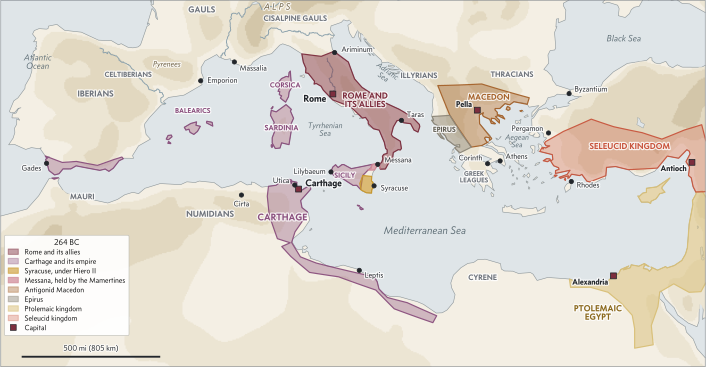
By 264 BC Rome had conquered every people of the peninsula south of the Po valley, as far as the Arno and Ariminum (uh-rim-ih-num), now Rimini (Figure S.2). It did not annex them all. Some it made Roman citizens. On some of their land it planted colonies, new towns of settlers who held the ground for Rome. The rest it bound by treaty as allies, in Latin socii (soh-shee-eye), who governed themselves and paid no tax but sent soldiers to fight in Rome’s wars. Taras, which the Romans called Tarentum (tuh-ren-tum), was the last great Greek city to submit, in 272 BC, after the Greek king Pyrrhus (pir-us) of Epirus (ih-py-rus) came to its aid and won two famous, ruinous victories (Chapter 2).
Across the sea lay Carthage, which held the North African coast, western Sicily, Sardinia, and Corsica. The two powers had signed treaties for centuries. They came to blows in 264 BC over Messana (meh-sah-nuh), a Sicilian city at the strait between Sicily and Italy, which a band of Italian mercenaries called the Mamertines (mam-ur-tynz) had seized. The rest of eastern Sicily belonged to Syracuse and its king, Hiero (hy-uh-roh) II. The Mamertines asked first Carthage, and then Rome, for help. Rome’s answer began the first of three wars with Carthage, and it took Rome out of Italy for good. The Romans called them the Punic Wars, from Punicus, their word for Phoenician (Chapter 3). Farther east stood the kingdoms of Alexander the Great’s successors (Vol. 6, The Greeks): the Antigonids (an-tig-uh-nidz) in Macedon, the Seleucids (suh-loo-sidz) in Syria and Asia Minor, and the Ptolemies (tol-uh-meez) in Egypt. Within a century Rome had beaten Macedon and the Seleucids, and in 30 BC it took Egypt, the last of the three.
The empire, AD 14 and 117
Rome governed its conquests outside Italy as provinces, each ruled for a year or more by a governor sent from Rome. The first was Sicily, taken from Carthage in 241 BC. Figure S.3 shows the empire at two later dates: at the death of Augustus (aw-gus-tus), the first emperor, in AD 14, and at the death of the emperor Trajan (tray-jun) in 117, when it was at its largest. Trajan had also crossed the Euphrates and made provinces of Armenia and Mesopotamia, but his successor, Hadrian (hay-dree-un), gave them up at once.

Augustus left an empire bounded by the Atlantic, the Rhine, the Danube, the Euphrates, and the Sahara. Five years before his death, in AD 9, three legions under the general Varus (vair-us) had been destroyed in the Teutoburg (toy-toh-burg) Forest, and Rome gave up its plan to hold Germany as far as the Elbe. Along the empire’s edges ruled client kings, local kings who kept their thrones by obeying Rome, in Mauretania (mor-ih-tay-nee-uh), Thrace, Cappadocia (kap-uh-doh-shuh), and the desert kingdom of the Nabataeans (nab-uh-tee-unz). One by one their kingdoms became provinces. The emperor Claudius invaded Britain in AD 43 (Chapter 13), and Trajan conquered Dacia (day-shee-uh), north of the lower Danube, in 106 (Chapter 16). At his death the empire covered nearly 2 million square miles, about half the area of the United States, and held perhaps sixty million people or more.
Hispania (hih-span-ee-uh) was the Iberian Peninsula, the land of modern Spain and Portugal; Augustus divided it into three provinces. Gaul was roughly France, Belgium, and the land west of the Rhine, and Britannia (brih-tan-ee-uh) was Britain south of what is now Scotland. Africa meant the province around Carthage, roughly modern Tunisia, not the whole continent, and Asia meant the province of western Asia Minor, around Ephesus (ef-ih-sus). Syria ran from the Taurus Mountains to Judea, Egypt was ruled for the emperor himself by a governor of his own choosing, and Dacia was the heart of modern Romania.
The city of Rome
Romans called their city simply Urbs (urbz), “the City.” It grew on and among seven low hills on the east bank of the Tiber (Figure S.4). The Palatine (pal-uh-tyn), where Romulus was said to have founded the city, held the houses of great men in the Republic and the palaces of the emperors later; the English word palace comes from its name. The Capitoline (kap-ih-tuh-lyn), smallest and steepest, was the citadel and the religious heart of the state, crowned by the temple of Jupiter Best and Greatest. The Aventine (av-un-tyn), the Caelian (see-lee-un), the Esquiline (es-kwih-lyn), the Viminal (vim-ih-nul), and the Quirinal (kwir-ih-nul) make up the seven. Across the river rose the long ridge of the Janiculum (juh-nik-yuh-lum), and to the north the Vatican hill, outside the city in Roman times.
The low ground between the hills was marsh until the Romans drained it with a great sewer, the Cloaca Maxima (kloh-ay-kuh mak-sih-muh). In the valley below the Capitoline and the Palatine lay the Forum, the open square that was market, meeting place, and seat of government at once. Around it stood the Senate house, the Curia (kyoor-ee-uh), and the speakers’ platform, the rostra (ros-truh), decorated with the bronze beaks of captured warships. Nearby, in the round temple of Vesta, her priestesses kept the city’s sacred fire (Chapter 1). In the next valley south, between the Palatine and the Aventine, lay the Circus Maximus (sur-kus mak-sih-mus), the racetrack for chariots and the largest building for spectators in the city.
North of the old city, in the bend of the Tiber, stretched the Campus Martius (kam-pus mar-shus), the Field of Mars. It lay outside the sacred boundary of the city, the pomerium (poh-meer-ee-um), and so it was where armies gathered, where citizens met to vote in their military assembly, and where great men could be buried. Later it filled with temples, theaters, baths, and tombs: the theater of the general Pompey, in whose meeting hall Julius Caesar (see-zur) was killed (Chapter 8); the Pantheon (Chapter 16); and the round tomb of Augustus. East of the Forum, where the emperor Nero had made a private lake, a later emperor, Vespasian (veh-spay-zhun), began the great amphitheater later called the Colosseum (kol-uh-see-um) (Chapter 14).
Two walls mark the city’s growth. The Servian Wall, named for King Servius Tullius (sur-vee-us tul-ee-us) but built in the early fourth century BC after the Gauls’ sack, ran about 7 miles around the seven hills. By the time of Augustus the city had spilled far beyond it and held perhaps a million people, more than any city in Europe again until London about 1800. When raiders from beyond the Danube threatened Italy in the third century AD, the emperor Aurelian (aw-ree-lee-un) began a new wall, 12 miles around, which still stands for much of its length. From the city’s gates the great roads ran out across Italy: the Appian Way (ap-ee-un) south to Capua and Brundisium (brun-diz-ee-um), the Flaminian Way north across the Tiber at the Milvian (mil-vee-un) Bridge (Chapter 18). The port of Rome was Ostia (os-tee-uh), at the river’s mouth.

Kings, Republic, and Empire
Rome had three kinds of government, and the chapters use their names constantly. Figure S.5 sets them down the left side of the page, with the periods and ruling families beside them, the volume’s main events in two lanes, and the six Parts of this book on the right. Time runs down the page on a changing scale, so that the crowded last century of the Republic is stretched out and the centuries of the kings are squeezed together.
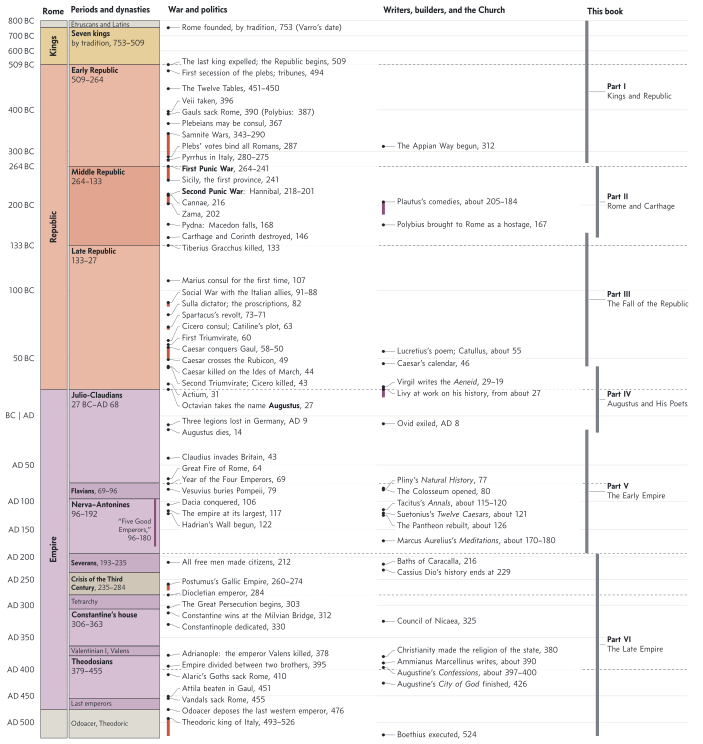
According to Roman tradition, seven kings ruled the city from its founding in 753 BC to 509 BC; the fifth and the seventh, the two Tarquins, came from an Etruscan family. Their dates and stories were written down centuries later, and Chapter 1 tells them as Livy does. In 509 BC, by tradition, the Romans drove out the last king, Tarquin (tar-kwin) the Proud, and swore never to have another. The word rex, “king,” stayed hateful to them for the rest of their history.
The Republic, from the Latin res publica (rays poob-lih-kuh), “the public thing,” lasted from 509 to 27 BC. In it the citizens elected their officials each year, and a council of former officials, the Senate, guided the state. Historians divide it into three parts. In the Early Republic, to 264 BC, Rome fought its neighbors and conquered Italy, and its common people won a share of power (Chapter 2). In the Middle Republic, from 264 to 133 BC, it beat Carthage and the Greek kingdoms (Chapter 3). In the Late Republic, from 133 to 27 BC, its politicians and generals turned on one another in a century of riots, proscriptions, and civil wars, which ended with the victory of Caesar’s heir.
The Empire began in 27 BC, when that heir, Octavian, took the name Augustus. He never called himself king, and he kept the Republic’s offices and the Senate, but from then on one man ruled. Modern historians call the first three centuries of his system the principate (prin-sih-payt), from Augustus’s chosen title, princeps, “first citizen,” and divide them by ruling families. The Julio-Claudians (joo-lee-oh klaw-dee-unz) were Augustus and four emperors of his family and his wife Livia’s, ending with Nero in AD 68. After the civil war of 69, the Year of the Four Emperors, came the Flavians (flay-vee-unz), Vespasian and his two sons. Then came five emperors, from Nerva (nur-vuh) in 96 to the death of Marcus Aurelius (mar-kus aw-ree-lee-us) in 180, each of whom except Marcus had no son to succeed him and chose his heir by adoption. The Florentine writer Machiavelli (mak-ee-uh-vel-ee) praised them in the 1510s, and they are still called the Five Good Emperors. Marcus’s own son Commodus (kom-uh-dus), murdered in 192, ended the line, and historians call the whole family, from Nerva to Commodus, the Nerva–Antonines (an-tuh-nynz).
The Severans (seh-veer-unz), a family from Africa and Syria, ruled from 193 to 235. Then came half a century of invasion, plague, and civil war, the Crisis of the Third Century, in which more than twenty men held the throne. The emperor Diocletian (dy-uh-klee-shun) ended it in 284 and, from 293, shared power with three colleagues in the four-man Tetrarchy (tet-rar-kee), “rule of four.” Constantine, who became the first Christian emperor, and his family ruled from 306 to 363. Theodosius (thee-uh-doh-shus) I, who came to power in 379, was the last man to rule the whole empire, and his family, the Theodosians, ruled the West until 455. At his death in 395 the empire was divided between his two sons, one ruling the West from Italy and the other the East from Constantinople, the new capital Constantine had founded on the site of Byzantium (bih-zan-tee-um). The western half fell apart in the next eighty years. Germanic peoples from beyond the Rhine and the Danube, among them the Goths and the Vandals, crossed its frontiers and carved kingdoms out of its provinces. In 476 a German general, Odoacer, deposed the last western emperor, a boy named Romulus Augustulus (aw-gus-chuh-lus), and ruled Italy as a king (Chapter 20). The eastern half, which historians call the Byzantine Empire, lasted until 1453 (Vol. 9, Cathedrals and Crusades).
How the Republic governed itself
Romans were born into one of two orders. The patricians (puh-trish-unz) were a few old families who claimed descent from the first senators, the patres, “fathers.” Everyone else was a plebeian (plih-bee-un), a member of the plebs (plebz), the common people. At first only patricians could hold the high offices and the priesthoods. In a long struggle that modern historians call the Conflict of the Orders, from about 494 to 287 BC, the plebeians won the right to hold every office (Chapter 2). After that, what mattered was wealth, and whether a family had held the consulship. A man who was the first of his family to become consul, as the orator Cicero (sis-uh-roh) was, was called a new man, a novus homo (noh-vus hoh-moh).
Below the senators stood the equites (ek-wih-teez), the “knights,” wealthy men outside the Senate whose name recalled the days when the richest citizens served in the cavalry. Below them came the mass of citizens, then free foreigners, and at the bottom the slaves. Rome was a slave society. War brought in captives by the hundred thousand, and slaves worked the great estates, the mines, and the households of the rich. A master could free a slave, and the freedman, in Latin libertus (lih-bur-tus), became a citizen, though not quite the equal of the freeborn.
Every citizen assembly voted by groups, not by heads. In the Centuriate Assembly the citizens met on the Campus Martius in 193 voting units, the centuries, arranged by wealth, so that the rich voted first and often settled the matter before the poor were called; it elected the highest officials and declared war. In the Tribal Assembly they voted in thirty-five tribes, districts of citizens, and passed laws. The plebeians alone met in a council of their own, and after 287 BC its votes bound every Roman.
The officials, or magistrates, were elected for one year, and every office except the dictatorship had at least two holders, so that each could check the other. An ambitious man climbed them in a fixed order, the cursus honorum (kur-sus hon-or-um), the “course of offices” (Figure S.6). Each rung had a minimum age, and to win each office “in his year,” at the youngest legal age, was a mark of distinction. The higher offices carried imperium (im-peer-ee-um), the power to command an army and to punish. Its sign was the fasces (fas-eez), a bundle of rods tied around an ax, carried before the magistrate by attendants called lictors (lik-turz).
The quaestor (kwes-tur) looked after public money. The aedile (ee-dyle) cared for the city’s streets, markets, and grain supply and put on the public games, and a lavish show could win votes for higher office. The praetor (pree-tur) judged lawsuits and could command an army. The two consuls were the heads of the state: they commanded the armies, presided over the Senate and the assemblies, and gave their names to the year. The two censors, elected every fifth year from among former consuls, counted the citizens and their property, revised the roll of the Senate, and could expel a senator for disgraceful conduct. After their year in office, praetors and consuls were often sent to govern a province, with the title of propraetor or proconsul, “in place of a praetor” or “of a consul.” A rich province made a governor’s fortune, and the provinces of the late Republic paid for its politics.

Two offices stood outside the ladder. The ten tribunes of the plebs, elected by the plebeians alone, were created to protect the common people from the magistrates. A tribune’s person was sacred, so that anyone who laid hands on him could be killed without trial, and his single word veto, “I forbid,” could stop a law, an election, or any act of any magistrate except a dictator. The dictator was appointed only in a crisis. One of the consuls named him, on the Senate’s advice, to rule above every other magistrate for six months at most, and he chose a deputy, the Master of the Horse. In the Late Republic two generals, Sulla and then Caesar, took the old office and broke its limits (Chapter 4, Chapter 8).
The Senate was not elected. It was a council of about 300 men, most of them former magistrates, who sat for life; Sulla raised it to 600 and Caesar to about 900. In law it could only advise, but its advice, the senatus consultum (seh-nay-tus kon-sul-tum), was rarely disobeyed. It handled foreign affairs, war, and the treasury, and assigned the provinces. Under the emperors it kept its dignity and lost most of its power, and the emperors kept the old offices too, so that a consul still gave his name to the year a thousand years after the first.
Money
Romans counted in coins. The denarius (dih-nair-ee-us), a silver coin first struck about 211 BC, was the standard coin of the empire, and four brass sesterces (ses-tur-seez) made one; large sums were reckoned in sesterces. Under Augustus a legionary’s pay was 900 sesterces a year, and a senator had to own property worth a million. Table S.1 explains the legion and the other Roman words, from SPQR to the triumph, that the chapters use without stopping to define them.
| Word | What it meant |
|---|---|
| BC and AD | “Before Christ” and anno Domini, “in the year of the Lord,” a count invented in AD 525 (Vol. 1, The Toolkit). Romans never used it; they named years by consuls or counted from the founding of the city. |
| SPQR | Senatus Populusque Romanus, “the Senate and the People of Rome,” the formal name of the Roman state, carved on monuments and carried on the army’s standards. |
| patrician, plebeian | A member of the old aristocratic families, and anyone else. |
| legion | The heavy infantry of the Roman army, at first about 4,200 citizens and under Augustus about 5,000, in ten cohorts of six centuries, each led by a centurion. Augustus kept twenty-eight legions. |
| triumph | A victory parade that the Senate granted to a general who had won a great war. He rode in a chariot from the Campus Martius through the city to the temple of Jupiter on the Capitol, with his captives, spoils, and singing soldiers. |
| province | At first a magistrate’s assigned task or area of command; then a territory outside Italy ruled by a Roman governor. |
| colony | A town of Roman or Latin settlers planted on conquered land. |
| proscription | A posted list of men declared outlaws. Anyone might kill them for a reward, and their property was seized and sold. Sulla used it in 82 BC, and in 43 BC so did the triumvirs, the three men who took power after Caesar’s murder. |
| imperator | “Commander.” Soldiers hailed a victorious general with the title; the emperors made it part of their name, and English emperor comes from it. |
| princeps | “First citizen,” the title Augustus preferred; hence the principate, and English prince. |
| Caesar, Augustus | Family name and honorary name of the first emperors, which became titles of any emperor. In Diocletian’s Tetrarchy an Augustus was a senior emperor and a Caesar a junior one. |
| pontifex maximus | The chief priest of the state religion, a post held by Julius Caesar and by every emperor from Augustus until the late fourth century; the popes later took the title. |
Latin and Roman names
Latin began as the language of Latium, one small corner of Italy. Like Greek, the Celtic languages, and English, it belongs to the great Indo-European family, and its nearest relatives were other languages of ancient Italy: Faliscan, spoken just north of Rome, and, more distantly, Oscan and Umbrian. Etruscan was no relation. Rome’s conquests carried Latin with its soldiers, colonists, and officials, until it was the language of law and government in the whole western half of the empire. The eastern half never gave up Greek, which Alexander’s conquests had spread from Egypt to Afghanistan (Vol. 6, The Greeks). Educated Romans learned Greek as children. Plutarch (ploo-tark), Appian, and Cassius Dio (kash-us dee-oh) wrote Roman history in Greek, and the emperor Marcus Aurelius wrote his private notes to himself in it (Chapter 17). The spoken Latin of the western provinces became the Romance languages: Italian, French, Spanish, Portuguese, Catalan, and Romanian, spoken in the lands of Trajan’s Dacia. English is not one of them, but more than half of its words come from Latin, directly or through French.
The Romans pronounced their language differently from the way English speakers say Latin names. They said c and g hard always, so that Cicero was “KIK-eh-ro,” Caesar “KYE-sar,” and Scipio “SKIP-ee-oh.” That is why the Germans’ word for an emperor is Kaiser; the Russians’ tsar comes from the same name, by way of the Goths’ language. They said v like an English w. This book gives the traditional English pronunciation at a name’s first appearance.
How a Roman name works
A Roman man of good family had at least three names, the tria nomina (tree-uh noh-mih-nuh). Take Publius Cornelius Scipio Africanus, the general who beat Hannibal of Carthage. His first name, the praenomen (pree-noh-men), Publius, was his own personal name, used by family and close friends. Romans had only about a dozen in common use, so they wrote them in short forms: C. for Gaius (gy-us), Cn. for Gnaeus (nee-us), L. for Lucius, M. for Marcus, P. for Publius, Q. for Quintus, and T. for Titus. His second name, the nomen (noh-men), Cornelius, was the name of his clan, the gens (jenz), the great family of the Cornelii (kor-nee-lee-eye). His third name, the cognomen (kog-noh-men), Scipio, was his family name, the name of his branch of the clan. Many cognomens began as nicknames, some of them rude: Scipio means “staff,” Cicero “chickpea,” Naso “nose,” Brutus “dullard,” Crassus “fat.” A fourth name, the agnomen (ag-noh-men), honored a deed, as Africanus did his victory in Africa, or recorded an adoption.
The short form C. for Gaius is a fossil. Early Latin used the letter C for both the hard k sound and the g sound, until, by tradition, a schoolmaster named Spurius Carvilius Ruga (spyoor-ee-us kar-vil-ee-us roo-guh) added a new letter, G, about 230 BC. The old abbreviations never changed. Gaius is therefore also spelled Caius, as Shakespeare spells it, though the Romans always said the name with a G.
A Roman adopted into another family took his new father’s full name and added his old clan’s name with the ending -ianus. Gaius Octavius, adopted in Julius Caesar’s will, became Gaius Julius Caesar Octavianus, and historians call him Octavian until 27 BC and Augustus afterward. The son of Aemilius Paullus (ee-mil-ee-us paw-lus), the victor of Pydna, adopted by a Scipio, became Publius Cornelius Scipio Aemilianus, the friend of Polybius. Because a family used the same few first names generation after generation, fathers, sons, and grandsons often had identical names, and the chapters say which one they mean.
A Roman woman usually had only one name, the feminine form of her father’s clan name. Julius Caesar’s daughter was Julia, and Cicero’s was Tullia, from Marcus Tullius Cicero. Scipio Africanus’s daughter was Cornelia, later the mother of the Gracchi (grak-eye), two brothers who tried to reform the Republic (Chapter 4). Every daughter of a family had the same name, so sisters were told apart by “the Elder” and “the Younger,” or by numbers: Mark Antony’s two daughters by his wife Octavia, Augustus’s sister, were both Antonia. The same name came around again in every generation, and the chapters meet two famous Julias, Caesar’s daughter and Augustus’s (Chapter 7, Chapter 9).
| Full Latin name | In English | The pattern |
|---|---|---|
| Marcus Antonius | Mark Antony | first name translated; -ius becomes -y |
| Gnaeus Pompeius Magnus | Pompey the Great | -eius becomes -ey; agnomen translated |
| Titus Livius | Livy | -ius becomes -y |
| Gaius Plinius Secundus | Pliny the Elder | -ius becomes -y |
| Publius Vergilius Maro | Virgil or Vergil | clan name, ending dropped |
| Publius Ovidius Naso | Ovid | clan name, ending dropped |
| Quintus Horatius Flaccus | Horace | clan name, by way of French |
| Gaius Octavius, adopted as Gaius Julius Caesar Octavianus | Octavian; from 27 BC Augustus | -ianus becomes -ian; a new honorary name |
| Marcus Ulpius Traianus | Trajan | -anus becomes -an |
| Publius Aelius Hadrianus | Hadrian | -anus becomes -an |
| Flavius Valerius Constantinus | Constantine | -inus becomes -ine |
| Gaius Julius Caesar | Julius Caesar | clan name and family name kept |
| Marcus Tullius Cicero | Cicero (once Tully) | family name kept |
| Lucius Cornelius Sulla | Sulla | family name kept |
| Publius Cornelius Scipio Africanus | Scipio Africanus | family name and agnomen kept |
Most English names of Romans come from the clan name, with its Latin ending cut off or turned into an English one (Table S.2). The poet Vergilius is Virgil in most English books and Vergil in some; the spelling with i appeared by about AD 400, and in the Middle Ages, when Virgil was thought a magician, readers linked it with virga, “wand,” or virgo, “maiden.” Others are known by their family name: Cicero, Sulla, Seneca (sen-ih-kuh), Brutus.
The Roman calendar
Romans did not number the days of a month from one to thirty. They counted down to three fixed days in each month. The Kalends (kal-endz) was the first day, when priests had once announced the new moon; it gives us the word calendar. The Nones (nohnz) was the fifth day or the seventh, and the Ides (eyedz) the thirteenth or the fifteenth, near the full moon. In March, May, July, and October the Nones fell on the seventh and the Ides on the fifteenth; in every other month, on the fifth and the thirteenth. So the Ides of March, the day Julius Caesar was killed in 44 BC, was March 15.
Any other day was named by how many days it fell before the next fixed day, and Romans counted both ends. The day before the Ides of March was simply “the day before the Ides,” March 14, but March 13 was “the third day before the Ides,” since March 13, 14, and 15 make three. After the Ides, Romans counted down to the Kalends of the next month, so that March 16 was “the seventeenth day before the Kalends of April.”
The Roman year once began in March. By tradition the earliest calendar had only ten months, from March to December, and King Numa (noo-muh) added January and February. So September, October, November, and December are Latin for the “seventh,” “eighth,” “ninth,” and “tenth” months. The fifth and sixth months, Quintilis (kwin-til-is) and Sextilis (seks-til-is), were renamed in honor of two men. In 44 BC Quintilis became Iulius, July, for Julius Caesar, who was born in it, and in 8 BC Sextilis became Augustus, August, because the great moments of Augustus’s rise had fallen in it. From 153 BC the consuls took office on the Kalends of January, and the Roman year began there, as ours does (Table S.3).
| Month | Named for | Nones | Ides | Days before | Days after |
|---|---|---|---|---|---|
| Ianuarius | Janus, god of doorways and beginnings | 5 | 13 | 29 | 31 |
| Februarius | februa, rites of purification held in it | 5 | 13 | 28 | 28 or 29 |
| Martius | Mars; first month of the old year | 7 | 15 | 31 | 31 |
| Aprilis | uncertain | 5 | 13 | 29 | 30 |
| Maius | the goddess Maia | 7 | 15 | 31 | 31 |
| Iunius | the goddess Juno | 5 | 13 | 29 | 30 |
| Quintilis, then Iulius | “fifth” month; Julius Caesar from 44 BC | 7 | 15 | 31 | 31 |
| Sextilis, then Augustus | “sixth” month; Augustus from 8 BC | 5 | 13 | 29 | 31 |
| September | “seventh” month | 5 | 13 | 29 | 30 |
| October | “eighth” month | 7 | 15 | 31 | 31 |
| November | “ninth” month | 5 | 13 | 29 | 30 |
| December | “tenth” month | 5 | 13 | 29 | 31 |
The old year had only 355 days, so it drifted out of step with the seasons, and the priests in charge of the calendar were supposed to add an extra month every other year to pull it back. They often added it, or left it out, to lengthen or shorten a friend’s year in office, and in the years of Caesar’s wars, when he was chief priest but far from Rome, the additions stopped altogether. By 46 BC the calendar was about three months ahead of the sun. Figure S.7 shows a calendar painted on a wall in those years. Caesar, as chief priest and dictator, fixed it with the help of an astronomer from Alexandria, Sosigenes (soh-sij-uh-neez). He made 46 BC a year of 445 days, and from January 1, 45 BC, every year had 365 days, with an extra day every fourth year. The Julian calendar is the one we still use, as amended in 1582 by Pope Gregory XIII, who dropped three leap days every four hundred years.

Romans did not number their years either. They named each year after its two consuls, so that an event happened “in the consulship of Messalla and Piso,” which was 61 BC. Official lists of the consuls, the Fasti (fas-tee), let a Roman look up how long ago a given year was; one great list, carved under Augustus, survives in pieces in Rome’s Capitoline Museums. Scholars also counted years from the founding of the city, ab urbe condita (ab ur-beh kon-dih-tuh), abbreviated AUC. The scholar Varro (var-oh) fixed the founding at the year we call 753 BC, and his date became the standard one. To turn a year from the founding into a year BC, subtract it from 754. The Gauls’ sack in the year 364 from the founding was 390 BC, and Caesar’s death in 710 was 44 BC. After 753 from the founding, subtract 753 instead, so the year 1229 from the founding was AD 476.
The writers behind the stories
Most of this volume’s famous stories were written down long after they happened. Livy, who wrote in the time of Augustus, told of the kings five centuries after the last of them, using older histories that are now lost and legends that no one could check. Romans began to write their city’s history late, about 200 BC, and the first to do it, the senator Fabius Pictor (fay-bee-us pik-tur), wrote in Greek. So the chapters name the writer each time a story’s source matters: “Livy tells,” “Suetonius (swee-toh-nee-us) says some report,” “Cassius Dio repeats a rumor.” Where the writers disagree, the chapters say whose version they follow.
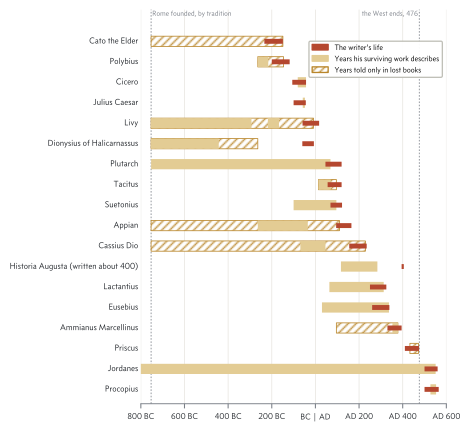
The list below gives, in order of their dates, the ancient writers the chapters rely on most, and Figure S.8, after it, sets each writer’s life against the years his work describes.
- Cato the Elder (234–149 BC), a soldier and statesman, wrote the Origins, in Latin Origines (oh-rij-ih-neez), in his old age, the first history of Rome in Latin. It is lost except for quotations in later writers (Chapter 3).
- Polybius of Megalopolis (meg-uh-lop-uh-lis) (about 200–118 BC), the Greek hostage taken to Rome after Pydna, wrote the Histories, which explain how Rome conquered the Mediterranean, and saw Carthage burn in 146 BC (Chapter 3). Five of its forty books survive whole.
- Cicero (106–43 BC), lawyer, consul, and philosopher, left speeches and more than eight hundred letters of his own, the best witness to the last years of the Republic (Chapter 5, Chapter 9).
- Julius Caesar (100–44 BC) wrote the Commentaries on his war in Gaul and on the civil war, telling his own deeds in the third person (Chapter 7).
- Livy of Patavium (puh-tay-vee-um), now Padua (59 BC–AD 17), wrote From the Founding of the City under Augustus, in 142 books. Thirty-five survive: Books 1 to 10, to 293 BC, and Books 21 to 45, from 218 to 167 BC. He is the main source for the kings and the early Republic (Chapter 1, Chapter 2, Chapter 3).
- Dionysius (dy-uh-nish-us) of Halicarnassus (hal-ih-kar-nas-us) (about 60 BC–after 7 BC), a Greek teacher of public speaking at Rome, told the same early centuries in Greek in his Roman Antiquities, down to the First Punic War. About half survives (Chapter 1).
- Pliny the Elder (plin-ee) (AD 23–79), an officer and scholar, gathered everything from glass to elephants in his Natural History in thirty-seven books. He died when the volcano Vesuvius (vuh-soo-vee-us) erupted. His nephew Pliny the Younger (about 61–113) published his letters, which describe the eruption and ask the emperor Trajan what to do about the Christians (Chapter 14, Chapter 16).
- Plutarch of Chaeronea (ker-uh-nee-uh) (about AD 46–after 119), a Greek priest at Delphi, wrote the Parallel Lives, biographies that set a Greek beside a Roman (Chapter 4).
- Tacitus (tas-ih-tus) (about AD 56–120), senator and consul, wrote the Agricola (uh-grik-uh-luh), a life of his father-in-law, and the Germania (jur-may-nee-uh), on the Germans (both 98); the Histories, on the years 69 to 96; and the Annals, on the years 14 to 68, written about 115 to 120. Parts of the last two are lost. He is the main source for the early emperors (Chapter 12).
- Suetonius (about AD 69–after 122), secretary to the emperor Hadrian, wrote the Lives of the Twelve Caesars about 121, from Julius Caesar to Domitian (doh-mish-un), the last of the Flavians, mixing official records with gossip (Chapter 12).
- Appian of Alexandria (about AD 95–165) wrote a Roman History in Greek, arranged by the peoples Rome fought. Its books on the Civil Wars run from the Gracchi to 35 BC (Chapter 8).
- Cassius Dio (about AD 155–235), senator and twice consul, wrote a Roman History in Greek in eighty books, from Aeneas to AD 229. Much of it survives only in summaries made in the Byzantine Empire (Chapter 5, Chapter 9, Chapter 13, Chapter 16, Chapter 17).
- The Historia Augusta (his-tor-ee-uh aw-gus-tuh) is a set of lives of the emperors from Hadrian to 284. It claims six authors writing about AD 300, but in 1889 the German scholar Hermann Dessau showed that one man wrote it, about 400. It is full of invented letters and anecdotes, and the chapters use it with care (Chapter 16, Chapter 17, Chapter 18).
- Lactantius (lak-tan-shus) (about AD 250–325), a Christian teacher, wrote On the Deaths of the Persecutors, which tells how the emperors who persecuted Christians died. Eusebius (yoo-see-bee-us) of Caesarea (see-zuh-ree-uh) (about 260–339), a bishop in Palestine, wrote the Church History and the Life of Constantine (Chapter 18).
- Ammianus Marcellinus (am-ee-ay-nus mar-seh-ly-nus) (about AD 330–395), a Greek from Antioch and an army officer, wrote a history in Latin. Its surviving books cover the years 353 to 378 and end with the battle of Adrianople (ay-dree-uh-noh-pul), where the Goths killed the emperor Valens (vay-lenz) (Chapter 19).
- Priscus (pris-kus) of Panium (pan-ee-um) (fifth century AD), an envoy from Constantinople who dined with Attila (uh-til-uh), king of the Huns, in 449, wrote a history that survives only in passages quoted by others (Chapter 20).
- Jordanes (jor-day-neez) (wrote AD 551), a Goth living in Constantinople, wrote the Getica (jet-ih-kuh), the only full account of the Goths’ early history to survive, which keeps Priscus’s account of Attila (Chapter 19, Chapter 20).
- Procopius of Caesarea (proh-koh-pee-us) (about AD 500–565) wrote the Wars of the emperor Justinian against the Persians, the Vandals, and the Goths; his books on the Vandals and the Goths open with the fall of the West. The ninth volume teaches him (Vol. 9, Cathedrals and Crusades).
Other writers appear where their stories come. The historian Sallust (sal-ust) wrote on Catiline’s (kat-ih-lyn) plot to seize power in 63 BC and on Rome’s war with Jugurtha (joo-gur-thuh), a North African king. Seneca the Elder collected the sayings of speakers, and Valerius (vuh-leer-ee-us) Maximus collected famous deeds. Later ones include the grammarians Donatus (doh-nay-tus) and Servius, who wrote about Virgil; Eutropius (yoo-troh-pee-us), who wrote a short history of Rome; and Sulpicius Severus (sul-pish-us seh-veer-us), who wrote the life of Saint Martin. The Romans’ own poets, from Plautus (plaw-tus) to Ovid, are the chapters’ subject rather than their witnesses, and each is introduced in the decade he wrote.
Meanwhile elsewhere
Rome’s merchants bought silk from China and pepper from India, and its armies fought Parthians and then Persians on the Euphrates for centuries. Table S.4 sets its story beside what was happening elsewhere in the same centuries and names the volumes of this Course that teach it.
| Region | In these years | Taught in |
|---|---|---|
| Greece and the Hellenistic East | Classical Athens; Alexander’s successors, whom Rome absorbs one by one: Macedon (168 BC), Greece (146 BC), Pergamon (133 BC), Seleucid Syria (64 BC; Chapter 5), and Cleopatra’s Egypt (30 BC). | Vol. 6, The Greeks |
| Carthage, Egypt, Judea, and Parthia | Carthage’s wars with Rome (264–146 BC); Cleopatra; Herod and the Jewish revolts (AD 66–73 and 132–135); Jesus and the first Christians; Parthia’s victory over Crassus at Carrhae (53 BC). | Vol. 5, In the Beginning |
| Ireland and the North | Celts, Germans, and Picts beyond the frontier; Ireland, never conquered; Saint Patrick’s mission in the fifth century; Angles and Saxons in Britain after 410. | Vol. 8, The Northern Worlds |
| Byzantium | The eastern empire, ruled from Constantinople, outlasts the West by nearly a thousand years; Justinian (527–565). | Vol. 9, Cathedrals and Crusades |
| India | The Mauryan Empire (about 322–185 BC) and its emperor Ashoka (uh-shoh-kuh); Greek kings in the northwest; the Gupta (goop-tuh) age (about 320–550) and the poet Kalidasa (kah-lee-dah-suh). | Vol. 39, India |
| China | The First Emperor unites China (221 BC); the Han dynasty (206 BC–AD 220) and the Silk Road; the Han envoy Gan Ying sets out for Rome in AD 97. | Vol. 40, The Middle Kingdom |
| Japan and Korea | Japan’s first rice farmers and the great tombs of the Kofun period; the Three Kingdoms of Korea. | Vol. 41, Islands of the Rising Sun |
| Southeast Asia | The trading kingdom of Funan on the Mekong; the Trưng Sisters’ revolt against Han China (AD 40). | Vol. 42, Monsoon and Ocean |
| Africa | Kush, with its capital at Meroë (merr-oh-ee); the kingdom of Aksum (ahk-soom) in Ethiopia, Christian from the fourth century; the Nok culture of Nigeria. | Vol. 43, Africa |
| The Americas | The Olmecs; Teotihuacan (tay-oh-tee-wah-kahn), the great city of Mexico (about AD 100–550); the Maya cities of the Classic age, from about 250. | Vol. 44, Gold, God, and Glory |
Kings and Republic
Chapter 1 · 37 clues
The Etruscans and the Kings of Rome
About 27 BC, when Livy sat down to write the history of Rome from its founding, a Roman crossing the Forum walked over ground that had once been a marsh. Beneath his feet ran a great stone drain that carried the water of three valleys down to the Tiber. Above him, on the Capitoline Hill, stood the temple of Jupiter, the largest in the city. Both, every Roman knew, were the work of kings. Rome had not had a king for nearly five hundred years, and its citizens hated the very word (the Stage). Yet they kept the kings’ buildings, their priesthoods, and their stories, and told the stories to their children.
The stories held an awkward fact. The kings who built the drain and the temple had come from Etruria, the country of the Etruscans across the river. So had much that Romans thought most Roman: the purple-bordered robes of their officials, the parade of a victorious general, and the art of reading the will of the gods in the body of a sacrificed sheep. Rome’s story begins with that older people, and it ends, as Livy tells it, with an Etruscan king watching a young Roman hold his right hand in a fire.
Etruria’s twelve cities
The Etruscans, whom the Stage met north of the Tiber, were already building cities when Rome was a cluster of shepherds’ huts. They worked iron and bronze, painted their tombs, sailed the sea as traders and pirates, and wrote. The Romans learned from them, fought them, and in the end swallowed them, and their language died. Yet for three centuries before Rome grew strong, they were the great pre-Roman civilization of Italy,This civilization was a pre-Roman civilization in Italy. → Etruscans•• and the Greeks knew them better than they knew the Romans. The Greeks called them Tyrrhenians (tih-ree-nee-unz), and the sea west of Italy still carries that name.
Where they came from was argued even in antiquity. The Greek historian Herodotus (hih-rod-uh-tus), writing about 430 BC, told a story he had heard from the Lydians (lid-ee-unz) of Asia Minor. A famine had lasted eighteen years, so the king divided his people in two by lot, and half of them sailed from Smyrna under his son Tyrsenus (tur-see-nus). In G. C. Macaulay’s translation of Herodotus, they came at last “to the land of the Ombricans,” the Umbrians of central Italy, and took the name Tyrsenians from their prince. Four centuries later, Dionysius of Halicarnassus disagreed: the Etruscans, he said, spoke like no one else and lived like no one else, so they must always have lived in Italy.
Archaeology sides with Dionysius. In 1853 the scholar Giovanni Gozzadini (goh-tsah-dee-nee) dug up an Iron Age cemetery at Villanova (vil-uh-noh-vuh), near Bologna, full of clay urns holding the ashes of the dead. The people who made such urns, whom archaeologists call Villanovans after the site, lived across Etruria from about 900 BC, and no break separates their villages from the Etruscan cities that rose in the same places. Most scholars now hold that the Etruscans were Italian natives, and that their culture grew out of the Villanovan cultureTheories state that this culture grew out of the Villanovans. → Etruscans• (vil-uh-noh-vun) without any migration at all.
About 700 BC the Etruscans borrowed their alphabet from the Greeks who had settled at Cumae, and they passed it on to the Romans, which is why this book is printed in letters an Etruscan could have read. They wrote mostly from right to left. About thirteen thousand Etruscan inscriptions survive, most of them short labels on tombs and gifts. Because the letters are Greek, every word can be sounded out, but the language belongs to no family that scholars know, so many meanings are still guesses. The emperor Claudius would write a twenty-book history of the Etruscans in Greek (Chapter 12), and it is lost.
The Etruscans never formed one kingdom. Each city ruled its own farms and villages, first under kings and later under elected magistrates, and the cities often fought one another. But twelve of them, the “twelve peoples of Etruria,” shared a religion and a festival. Livy names the place: their league met at Voltumna’s shrine,These people’s twelve-city league met at the sanctuary of Voltumna near Volsinii. → Etruscans•• the sanctuary of an Etruscan god, where their chiefs gathered each year to hold council, choose a leader, and watch games. He never says where it was, but since 2000 archaeologists digging on the plain below Volsinii, the city on a cliff that is now Orvieto, have uncovered a great sanctuary that most of them believe was this meeting place. No ancient writer lists all twelve, and modern lists differ, but Veii, Caere, Tarquinii, Vulci (vool-chee), Volsinii, Clusium, Perusia (peh-roo-zhuh), Cortona, Arretium (uh-ree-shee-um), and Volaterrae (vol-uh-ter-ee) appear in nearly all of them (Figure 1.1).

The nearest of them to Rome was the richest. Veii was an Etruscan cityVeii was a city of this civilization. → Etruscans••• on a rock plateau about 10 miles north of Rome, across the Tiber, and it fought Rome for control of the river and its salt beds. Livy says the two cities first went to war under Romulus, and they fought on and off for three centuries. Rome destroyed Veii in 396 BC, after a siege that Roman tradition said lasted ten years.
At their height, about 500 BC, the Etruscans ruled far beyond Etruria. They founded towns in the Po valley, such as Felsina and the seaport of Spina, and in Campania, around Capua. Iron ore from the island of Elba was smelted at Populonia and shipped across the sea. Greek vases by the thousand ended up in Etruscan tombs (Vol. 6, The Greeks), and Etruscan wine jars turned up as far away as southern Gaul.
The sea brought them into conflict with Greeks. About 600 BC Greeks from Phocaea (foh-see-uh), a city of Asia Minor, founded Massalia, now Marseille, and about 565 BC they planted a second colony at Alalia on Corsica. When the Persians took Phocaea in 546 BC, many of its people sailed to Alalia, and for five years, Herodotus says, they plundered all their neighbors. So the Etruscans, with Caere foremost among them, joined Carthage, the Phoenician city in Africa that ruled the sea lanes to Spain (Vol. 5, In the Beginning), and they fought the Phocaean Greeks at AlaliaThese people allied with Carthage against Phocaean Greeks at Alalia. → Etruscans•• (foh-see-un), about 540 BC. Each ally brought sixty ships. The Phocaeans had sixty of their own, and in Macaulay’s Herodotus they “won a kind of Cadmean victory,” a win that ruins the winner: forty of their ships were destroyed, and the other twenty had their prows bent aside. They abandoned Corsica, which became Etruscan, and Carthage kept Sardinia.
It was the high point. In 474 BC the Greek city of Syracuse smashed an Etruscan fleet off Cumae, about 400 BC Gauls took the Po valley, and one by one the cities of Etruria fell to Rome. By 264 BC Volsinii, the last of the great ones, had surrendered. In 90 BC the Etruscans became Roman citizens, and their language slowly died, kept alive longest by the priests who read the sacred books.
Etruscan religion
What the Romans most respected in the Etruscans was their knowledge of the gods. In Canon Roberts’s translation of Livy, they were “distinguished above all others by their devotion to religious observances.” They believed that every thunderbolt, every strange birth, and every mark on a sacrificed animal was a message, and that the messages could be read by those who knew the rules.
Their gods resembled the Greeks’ and Romans’ but were not the same. Tinia (tin-ee-uh), the sky god who threw the lightning, matched the Greek Zeus and the Roman Jupiter. His wife, Uni (oo-nee), matched Hera and Juno. Menrva (men-ruh-vuh), a goddess of wisdom and war, matched Athena and Minerva. Tinia, Uni, and Menrva formed the chief triadThis people's chief triad of deities was made up of Menrva, Uni, and Tinia. → Etruscans• of Etruscan cities, often worshipped together in temples with three rooms side by side. Rome copied the arrangement. The great temple on the Capitol that the Etruscan kings built had three chambers side by side, Jupiter’s in the middle between Juno’s and Minerva’s (Vol. 4, Classical Myth).
The rules for reading the gods’ messages filled a library of sacred books, which Romans called the Etruscan discipline. The Etruscans said these teachings had been revealed. Cicero, the Roman orator and statesman (the Stage), tells the story in his dialogue On Divination. A man was plowing a field near Tarquinii when the plow cut deeper than usual, and out of the furrow rose a being with the face of a child and the wisdom of an old man. Later writers describe him as a child with gray hair, as if born old. The plowman cried out, a crowd gathered, and soon all Etruria came to hear. Tages (tay-jeez), the child from the furrow,These people credited their divinatory teachings to Tages, a grey-haired child said to have emerged from a plough furrow. → Etruscans•• taught them how to read the will of the gods, and they wrote down every word.
The commonest way was to read a liver. A priest the Romans called a haruspex (huh-rus-peks) sacrificed a sheep, cut out its liver, and studied its shape, color, and marks. In the haruspex’s lore, every part of the liver belonged to a god, and a mark in one part told which god was speaking. The Romans hired haruspices for public crises down to the end of the empire.

How a haruspex worked can be seen in a single object. In 1877 a field near Piacenza (pyah-chen-tsah), in the Po valley, gave up an Etruscan bronze model of a sheep’s liver,These people created a bronze model of a sheep's liver found at Piacenza. → Etruscans• life-size and about 5 inches long, made about 100 BC. Its upper surface is divided into forty fields, each engraved in Etruscan letters with the name of a god (Figure 1.3). Sixteen fields run around the rim, and Roman writers say that the Etruscans divided the sky into the same sixteen regions, each the home of a god. To a haruspex, the liver was a map of the heavens laid out in the belly of a sheep.

Lightning had its own books. The Etruscans sorted thunderbolts by the part of the sky they came from, their color, and what they struck. The Roman writer Pliny the Elder says a bolt from the east was lucky and one from the northwest the worst of all. Tinia, the Etruscans said, had three kinds of bolts, the strongest of which he could throw only with the consent of other gods. Romans credited this lore to a woman. Vegoia (veh-goy-uh), a nymph and prophetess,This people's lightning divination was attributed to the prophetess Vegoia. → Etruscans• was said to have taught the Etruscans the art of lightning, along with the sacred rules for marking the boundaries of fields. One passage of her teaching survives in Latin, in a Roman handbook for land surveyors. It warns that anyone who moves a boundary stone will be struck by disease and storms.

The sacred books themselves are lost, except for one, which survived by the oddest of accidents. In 1848 a Croatian official named Mihajlo Barić (mee-hy-loh bar-ich) bought a mummy in Alexandria as a souvenir and stood it in a corner of his sitting room in Vienna. He unwrapped it and displayed the strips of linen in a glass case, but he never noticed that they were covered in writing. After his death the mummy went to the museum in Zagreb (zah-greb). In 1892 a scholar finally showed that the writing was Etruscan. The cloth had been a book, a linen book that wrapped an Egyptian mummyThese people’s linen book, now in Zagreb, survived as the wrappings of an Egyptian mummy. → Etruscans•• (Figure 1.4). Someone in Ptolemaic Egypt had torn it into strips to bind the body of a woman. Today it is called the Liber Linteus (ly-bur lin-tee-us), the “linen book.” Its 1,330 readable words make it by far the longest Etruscan text, and the dates and gods’ names in it suggest that it was a calendar of sacrifices.
Etruscan art
The Etruscans built their houses of wood and mud brick, and almost nothing of them is left. They built their tombs to last. Outside each city lay a necropolis (neh-krop-uh-lis), a “city of the dead,” with streets of mound tombs whose rooms were cut into the rock to look like the rooms of a house, down to carved beams and chairs. At Tarquinii the walls of the tombs are painted with banquets, dancers, musicians, and games.


The finest thing found in those cities of the dead is a coffin from Caere, now in the National Etruscan Museum at the Villa Giulia (vee-lah joo-lyah) in Rome. The Sarcophagus of the SpousesThese people made the terracotta Sarcophagus of the Spouses, showing a reclining married couple. → Etruscans•• (sar-kof-uh-gus), made about 520 BC, shows a married couple reclining together on a dining couch, as if at a banquet that will never end (Figure 1.5). It is made of terracotta, baked clay, and it was once brightly painted. The husband rests his arm around his wife’s shoulders; both smile. The Greek historian Theopompus, writing in the fourth century BC, was shocked that Etruscan wives dined with the men, which no respectable Greek woman did, and here a wife reclines beside her husband as an equal, forever.
Etruscan sculptors worked best in terracotta. In 1916 archaeologists digging at a sanctuary of Veii found the pieces of several life-size clay figures that had once stood on the ridge of a temple roof, about 40 feet above the ground. The finest is the Apollo of Veii, striding forward with a fixed smile, his robe falling in neat folds. He was part of a group that showed Apollo and Hercules quarreling over a sacred deer. Its maker may have been Vulca (vul-kuh), the only Etruscan artist whose name survives. Pliny the Elder says that Vulca came from Veii to Rome to make the clay statue of Jupiter for the Capitol, at the call of one of the Tarquins.
Rome’s legends
Rome, meanwhile, was growing on its hills. The Stage named them: the Palatine, the Capitoline, the Aventine, the Caelian, the Esquiline, the Viminal, and the Quirinal, low hills around marshy valleys on the east bank of the Tiber. Rome grew up on seven hills,This city is located on seven hills. → Rome• and Romans held a festival for the hills of the old city every December. Poets called it “the city of seven hills” so often that seven-hilled cities all over the world, from Constantinople to Lisbon, have borrowed the boast.
The steepest and smallest, the Capitoline, still holds Rome’s oldest public collection of art. In 1471 Pope Sixtus IV gave a group of ancient bronzes to the people of Rome, and they were set up in a palace on the hill. In 1536 Michelangelo began a new design for the square there, and in 1734 another pope opened the palaces to everyone. The Capitoline Museums stand in RomeThe Capitoline Museums are located in this city. → Rome• on that square to this day, among the oldest public museums anywhere, and later chapters visit some of their treasures (Chapter 17, Chapter 18).
Among Sixtus’s bronzes was a she-wolf. In the Middle Ages she had stood outside the pope’s palace at the Lateran, where criminals were judged and punished “at the wolf.” The volume of myths printed her and told the dispute over her age (Vol. 4, Classical Myth). Her stiff mane and alert stance are in the style of Etruscan bronzes of the fifth century BC, and for centuries she was taken for one, though recent scientific tests point to the Middle Ages instead. The two baby boys beneath her were added about 1471. Whatever her date, the Capitoline Wolf is the bronze that commemorates Rome’s founding:A bronze sculpture showing two infants suckling an Etruscan styled wolf commemorates the founding of this city. → Rome• the she-wolf that suckled Romulus and Remus, as the legend tells, and the symbol of the city ever since.
The kings who followed Romulus are harder to see than the wolf. Livy and Dionysius told their stories five hundred years after them (the Stage), and Livy himself admits that Rome’s early records burned when the Gauls sacked the city about 390 BC. What survives is a mixture of family legend, temple tradition, and guesswork. Yet archaeology shows that some of it is true. People lived in huts on the Palatine from about 900 BC. By about 600 BC the valley of the Forum had been drained and paved, and temples with Etruscan-style clay roofs were rising. A stone found beneath the Forum’s pavement in 1899 carries one of the oldest Latin inscriptions, of about 570 to 550 BC, and among its broken words is rex, “king.”
A king of Rome was not born to the throne. When a king died, the senators took turns governing for five days each, each one an interrex (in-tur-reks), “between-king,” until one of them named a candidate and the people approved him. The king then ruled for life. He led the army, judged lawsuits, and spoke for the city to the gods. When the kings were gone, the Romans kept a priest called the “king of sacrifices” to perform the royal rites, and forbade him any other office. Figure 1.7 gives the seven kings with the dates Roman scholars worked out for them.

Numa and the Vestals
The volume of myths told how the Sabine Numa Pompilius (pom-pil-ee-us) was chosen to succeed Romulus (Vol. 4, Classical Myth). Numa Pompilius became the second king of Rome,Numa Pompilius held this title. → King of Rome•• and he reigned, Livy says, for forty-three years without a war. Romulus had founded the city by arms; Numa founded it again, as Livy puts it, by justice, laws, and customs. He shut the doors of Janus’s shrine, set up the priests of Mars who danced with sacred shields, and reformed the calendar (Vol. 4, Classical Myth). He told the Romans that he met at night with a nymph named Egeria (ih-jeer-ee-uh), who advised him on every rite he founded.
The strangest story of Numa is a bargain with Jupiter, told by Ovid in his calendar poem, the Fasti, and by Plutarch. Numa caught two woodland gods, Picus (py-kus) and Faunus (faw-nus), by mixing wine into the spring where they drank on the Aventine. To win their freedom they brought Jupiter himself down from the sky, and Numa asked him for a charm to turn aside his lightning. Jupiter demanded heads. In Arthur Hugh Clough’s version of Plutarch the talk runs: “How,” said Numa, “with the heads of onions?” “No,” replied Jupiter, “of men.” Numa twisted the answer: “Your meaning is, the hairs of men’s heads.” “No,” replied Jupiter, “with living”—and Numa broke in with “pilchards,” small fish like sardines. Egeria had coached him. Since Numa offered onions, hair, and fishAccording to legend, this Roman king offered an onion’s head, human hair and a fish to Jupiter in a negotiation about lightning. → Numa Pompilius• in place of human lives, Jupiter, in Ovid’s telling, laughed and agreed, and Romans used that charm against lightning ever after.
Numa’s most lasting gift was a priesthood of women. Vesta, the goddess of the hearth, had a round temple in the Forum with no statue in it, for Romans held that the fire itself was the goddess (Vol. 4, Classical Myth). Every Roman house had a hearth, and the city as a whole had one too, which must never go out. The Vestal Virgins tended Vesta’s sacred fireThese priestesses tended the sacred fire of Rome’s hearth goddess. → Vestal Virgins•• day and night. Livy says Numa brought the order from Alba Longa, where Romulus’s own mother had been a Vestal, paid the priestesses from public funds, and made them holy by a vow of chastity. If the fire went out, the Romans took it as a terrible omen, and the Vestal on duty was whipped.
There were six Vestals at a time, and new ones were chosen as children. Their choice belonged to the pontifex maximus (pon-tih-feks), the chief priest of the state religion, who in Numa’s story was a new office too. The pontifex maximus chose girls aged six to ten,The pontifex maximus appointed children aged six through ten to become these people. → Vestal Virgins• with both parents living and nothing wrong with their bodies. He took the chosen girl by the hand and led her from her father with an old formula that called her amata, “beloved.” From that moment she was no longer under her father’s power. She was the city’s.
A Vestal served Vesta for thirty years.These people served for thirty years. → Vestal Virgins• Plutarch says she spent the first ten learning her duties, the next ten performing them, and the last ten teaching the younger girls. Then she was free to leave and marry. Few did. Plutarch says those who married were thought to regret it, and most stayed in the order until they died.

Beside the fire, the Vestals kept the city’s most secret objects. In a storeroom of the temple that no man could enter, the Romans believed, lay the Palladium (puh-lay-dee-um), the small wooden statue of Athena that had protected Troy (Vol. 4, Classical Myth) and that, Romans said, Aeneas had carried to Italy. The Vestals guarded the PalladiumThese people guarded the Palladium. → Vestal Virgins• as a pledge of Rome’s safety, and Romans believed that its loss would mean the city’s fall.
They also made the city’s sacred flour. Every Roman sacrifice began with a sprinkling of salted meal on the victim’s head. Each year the Vestals gathered ears of emmer, an ancient kind of wheat, roasted and ground the grain, and mixed salt and emmer into mola salsaThese people were responsible for mixing salt and emmer to make mola salsa. → Vestal Virgins• (moh-luh sal-suh), “salted meal.” The Latin verb for sprinkling with it, immolare, gave English the word immolate, to sacrifice.
Once a year they had charge of a rite no man could see. The Bona Dea (boh-nuh day-uh), the “Good Goddess,” was worshipped by women alone. Each December her festival was held at night in the house of a consul or a praetor, led by his wife, and the Vestals presided over the Bona Dea rites.These people oversaw rites during the Bona Dea festival. → Vestal Virgins• Every man in the house had to leave, down to the boys and the male slaves. In 62 BC a young noble disguised as a woman was caught inside, and the scandal shook Rome (Chapter 7).
In return the Vestals had powers no other Roman woman had. They could make wills and own property without a guardian. A lictor, an attendant carrying rods, cleared the way before them in the street, and a criminal on his way to execution who met a Vestal by chance was set free. Great men left their wills in the Vestals’ keeping, which is why Octavian would one day seize Mark Antony’s from them (Chapter 9).
The punishment for breaking the vow of chastity was the most terrible in Roman religion. A Vestal’s blood could not be shed, so the city found a death without bloodshed: an unchaste Vestal was buried alive.These Roman priestesses could be buried alive for breaking their vows of chastity. → Vestal Virgins•• Plutarch describes the ritual. She was carried through the silent Forum in a closed litter, as if to her own funeral, to a mound by the Colline Gate. There the pontifex maximus prayed and led her to a ladder into a small underground room. It held a bed, a lamp, and a little bread, water, milk, and oil, so that no one could say a body sacred to the gods had died of hunger. Then he turned his face away. The ladder was drawn up and the entrance covered with earth. Her lover was flogged to death in the Forum. Only a handful of Vestals are known to have died this way, most of them in years of war or plague, when frightened Romans looked for a broken vow to blame.
Some Romans told a darker story about the cliff on the Capitol where traitors were thrown. The volume of myths gave Livy’s version, in which Tarpeia (tar-pee-uh), a commander’s daughter, let the Sabines into the citadel and was crushed under their shields (Vol. 4, Classical Myth). But the scholar Varro called her a Vestal, and so did Propertius (proh-pur-shus), a love poet of Augustus’s day. In his poem she fetches water from a spring for Vesta’s rites, sees the Sabine king Titus Tatius (tay-shus), falls in love with him, and betrays the city. By their account the Tarpeian Rock was named for a VestalThe Tarpeian Rock is named for one of these people. → Vestal Virgins• who betrayed both her goddess and her city.
The order lasted for centuries, well into the reigns of Christian emperors. The House of the Vestals beside the temple was rebuilt on a grander scale more than once, and statues of the chief Vestals lined its courtyard (Figure 1.8). In AD 382 the emperor Gratian (gray-shun) took away their income, and within a few years the fire that Numa was said to have lit went out for good.
The later kings
Numa’s successor, Tullus Hostilius (tul-us hos-til-ee-us), was his opposite, a king who thought peace had made Rome soft. He went to war with Alba Longa, the mother city of Rome. Livy says the two armies agreed to let three brothers on each side, the Horatii (huh-ray-shee-eye) of Rome and the Curiatii (kyoo-ree-ay-shee-eye) of Alba, fight for them, and the last Horatius left standing won Rome the victory. Alba had to accept Rome’s lead. Its army stayed under the dictator the Albans had chosen for the war, Mettius Fufetius (met-ee-us fyoo-fee-shus), but now it fought at Rome’s side.
The alliance did not last. Mettius secretly encouraged Fidenae (fih-dee-nee) and Veii to fight Rome, and when Tullus led the two armies against them, Mettius drew the Albans off to the hills to watch which side would win. Rome won anyway. The next morning King Tullus called both armies together, denounced Mettius, and sentenced him. In Roberts’s translation, “two four-horse chariots were brought up,” and Mettius was torn apart by chariotsAccording to legend, Tullus Hostilius, a holder of this title, had Mettius Fufetius torn apart by chariots. → King of Rome• driven in opposite directions. Livy, who did not admire it, adds that it was “the first and last instance amongst the Romans of a punishment so regardless of humanity.” Tullus razed Alba and moved its people to Rome. At the end of his life, Livy says, the warrior king turned fearful of the gods. He found secret rites to Jupiter in Numa’s books, performed them wrongly, and was burned to death with his house by a thunderbolt.
The fourth king, Ancus Marcius (ang-kus mar-shus), was Numa’s grandson. Livy credits him with the ritual by which Rome declared war, with Rome’s first prison, and with the first bridge over the Tiber, a wooden bridge called the Sublician (suh-blish-un), which led to the Janiculum hill on the far bank. He also founded Ostia, the port at the river’s mouth.
In his reign a rich newcomer arrived from Etruria, the man Rome would remember as King Tarquinius (tar-kwin-ee-us) Priscus. His father, Demaratus (dem-uh-ray-tus), was a Corinthian nobleman who had fled his city and settled at Tarquinii, and the son, then named Lucumo (loo-kyuh-moh), found that the Etruscans looked down on him as a foreigner’s child. His wife, Tanaquil (tan-uh-kwil), came from one of the first families of Tarquinii and would not bear the slight. She persuaded him to move to Rome, a young city where talent counted for more than birth. As they drove up to the Janiculum, an eagle swooped down, lifted the cap from Lucumo’s head, circled the carriage screaming, and set it back in place. Tanaquil, Livy says, was skilled like most Etruscans in reading such signs. Tanaquil read the eagle and the capTanaquil interpreted an eagle’s taking and returning her husband Tarquinius Priscus’s cap as a sign that he would hold this title. → King of Rome•• as a promise that her husband would be king, and she threw her arms around him.
In Rome, Livy says, he took the name Lucius Tarquinius Priscus; Priscus means “the Elder,” and it sets him apart from the later Tarquin. He was rich, generous, and charming, and King Ancus made him guardian of his sons. When Ancus died, Tarquinius sent the boys away on a hunting trip and asked the people to elect him, the first man, Livy says, to campaign for the crown. They did, about 616 BC by the Romans’ count. The Etruscan city of Tarquinii had given Rome its fifth king, and the Etruscans produced the Tarquin dynastyThis civilization produced the Roman Tarquin dynasty. → Etruscans•• that would rule Rome for more than a century (Figure 1.9).


Tarquinius Priscus built on a grand scale. He laid out the Circus Maximus for chariot races in the valley between the Palatine and the Aventine, and on the Capitol he leveled a platform for a temple to Jupiter. Most important, he drained the city. Livy says that he drained the low ground around the Forum and the other valleys between the hills, where water could not escape, with channels that emptied into the Tiber. Their main line became the Cloaca Maxima, Rome’s great sewerRome’s Cloaca Maxima, traditionally attributed to Tarquinius Priscus, is one of these drainage systems. → sewer systems•• (Figure 1.11). Its name means “the Greatest Drain.” It began as an open stone-lined channel and was later vaulted over, and the tunnel grew so large, says the Greek geographer Strabo, who wrote under Augustus, that carts loaded with hay could pass inside. Marcus Agrippa, Augustus’s admiral and right-hand man (Chapter 9), cleaned it out in 33 BC and, according to Cassius Dio, sailed through it to the Tiber in a boat. Romans honored a goddess of the sewer, Venus Cloacina, with a little shrine in the Forum. The Cloaca still drains the center of Rome today.
Tarquinius reigned thirty-eight years, Livy says, until the sons of Ancus sent two shepherds to the palace, pretending to quarrel, and one of them split the king’s head with an ax. Tanaquil acted at once. She shut the palace and spoke to the crowd from an upper window, saying the king was only stunned and had ordered that a young man named Servius Tullius govern in his place. By the time the death was announced, Servius held power.
Servius had grown up in the palace. Livy says his mother was a captive from a Latin town, and that once, as the boy slept, his head was seen wrapped in flames. A servant ran for water, but Tanaquil stopped him; when the boy woke, the flames vanished. She saw it as a sign of greatness, and the king and queen raised him as their own and gave him their daughter in marriage. Servius Tullius became Rome’s sixth king,Servius Tullius held this title. → King of Rome•• the first, Livy says, to take the throne without the people’s vote, though he later won it. Romans remembered him as a great organizer. He held Rome’s first census, a count of every citizen and his property, and sorted the citizens into classes by wealth for the army and for voting. The Servian Wall bears his name, though it was built after his time (the Stage).
His end was the most shocking story in Livy’s first book. Servius had married his two daughters, both named Tullia, to two Tarquin brothers, Lucius and Arruns, whom Livy calls the sons of Tarquinius Priscus. The fierce younger Tullia was married to the gentle Arruns, and she despised him. She plotted with her sister’s ambitious husband, Lucius, and the two murdered their own spouses and married each other. Then Lucius burst into the Senate house, sat on the king’s throne, and when the old king came to protest, threw him down the steps into the Forum. Servius staggered toward home and was killed in the street by Lucius’s men. Tullia drove her carriage to the Forum to greet her husband as king. On her way home, her driver saw the old man’s body in the road and pulled up in horror. Livy says that she ordered him on, and Tullia drove her carriage over her father’s corpse,According to legend, this Roman king’s daughter Tullia drove a chariot over his corpse. → Servius Tullius•• so that his blood spattered her. The street was called the Vicus Sceleratus (vy-kus sel-uh-ray-tus), the “Street of Crime,” ever after.
In Livy’s telling Lucius Tarquinius ruled as a tyrant, and Romans called him Superbus (soo-pur-bus), “the Proud.” He refused his father-in-law a burial, killed the senators he suspected, and kept a bodyguard. He took the Latin town of Gabii (gay-bee-eye) by a trick. His son Sextus fled there, claiming to be a victim of his father’s cruelty, won the townspeople’s trust, and then had their leading men killed or driven out. The king finished the temple of Jupiter on the Capitol, sending to all Etruria for workmen. He forced the common people to finish the great sewer and build the seats of the Circus, and they hated him for it. Tarquin the Proud was the seventh king, and he would be the last king of Rome.Tarquin the Proud was the last king of this city. → Rome•Tarquinius Superbus was the last holder of this title. → King of Rome••
Dionysius of Halicarnassus, and after him Aulus Gellius (aw-lus jel-ee-us), a Roman of the second century AD who filled a book with curious things he had read, tell how Rome got its holiest books in Tarquin’s reign. An old woman, a stranger, came to Tarquin with nine books of prophecies and asked a huge price for them; Gellius calls it excessive and enormous. Tarquin laughed at her. She went away, burned three of the books, and came back to ask the same price for the six. Again he laughed, and again she burned three. Now uneasy, he consulted his priests, and paid the full price for the last three. These were the Sibylline Books (sib-ih-leen) that Tarquin had twice refused,According to legend, this Roman king twice refused to buy the Sibylline Books. → Tarquinius Superbus• and the woman, whom later Romans identified with the Sibyl of Cumae (Vol. 4, Classical Myth), was never seen again. The books were kept under the temple of Jupiter, and in times of plague, earthquake, or disaster the Senate ordered their keepers to search them for the rites that would calm the gods.
Tarquin’s fall, as Livy tells it, began in a camp. About 509 BC, by the Romans’ count, his army was besieging the town of Ardea (ar-dee-uh), and one evening the young princes, drinking in the tent of his son Sextus, fell to boasting of their wives. Their cousin Collatinus (kol-uh-ty-nus) proposed that they ride home and see. At Rome they found the princes’ wives feasting with friends; at Collatia (kuh-lay-shuh), a small town about 10 miles east of Rome, they found Collatinus’s wife, Lucretia (loo-kree-shuh), spinning wool late at night among her maids. She won. But Sextus had seen her. A few days later he came to her house as a guest, and in the night, threatening her with his sword and with disgrace, he raped her. Lucretia sent for her father and her husband, told them what Sextus had done, made them swear to punish him, and stabbed herself.
Collatinus had brought a friend, Lucius Junius Brutus, the king’s own nephew. Brutus had saved his life for years by pretending to be dull-witted, brutus in Latin, after the king killed his brother. Now he pulled the knife from Lucretia’s wound and swore on her blood, in Roberts’s translation, that “I will drive hence Lucius Tarquinius Superbus, together with his cursed wife and his whole brood.” The men carried her body into the marketplace of Collatia, roused the town, and marched on Rome, where Brutus turned the people against the king. When Tarquin hurried back from the siege, he found the gates shut against him. Tarquin was expelled after Lucretia’s rape,This last Roman king was expelled after his son Sextus raped Lucretia. → Tarquinius Superbus•• and he went into exile at Caere with two of his sons; Sextus fled to Gabii, where men he had wronged killed him. In place of a king the Romans elected two consuls for one year, Brutus and Collatinus (Chapter 2). Livy says the kings had ruled 244 years.
Porsena and the new Republic
The Tarquins did not give up. They raised the armies of Veii and Tarquinii, and in the battle that followed, Livy says, Brutus and the king’s son Arruns (not the uncle of the same name whom Tullia had murdered) killed each other. Then the exiles went to the most powerful king in Etruria. Lars Porsena ruled the Etruscan city of ClusiumLars Porsena ruled these people’s city of Clusium. → Etruscans•• (larz por-sih-nuh), about 80 miles north of Rome; Lars was a common Etruscan first name, though older books took it for a title meaning “lord.” The exiles begged him not to let kings be driven out unpunished, or no king would be safe. Porsena thought an Etruscan on the Roman throne would be an honor to his nation, and Porsena besieged Rome to restore Tarquin,According to Roman tradition, this Etruscan king besieged Rome to restore Tarquin the Proud. → Lars Porsena•• about 508 BC by the Romans’ count (Figure 1.11).

He nearly took the city at the first rush. His army stormed the Janiculum and charged down to the Sublician bridge, and only one man stood in the way. Livy tells how Horatius Cocles (huh-ray-shus koh-kleez), a later Horatius than the one who beat the Curiatii, held the far end of the bridge, at first with two comrades and then alone, while the Romans behind him hacked it down. Then he leaped into the Tiber in his armor and swam back. So Porsena settled down to starve Rome out, camped on the plain between the Janiculum and the river.
Food ran short, and Livy tells how a young noble named Gaius Mucius (myoo-shus) asked the Senate’s leave to swim the river and enter the enemy camp. He arrived on the soldiers’ payday and found two richly dressed men side by side at the royal platform. Not daring to ask which was the king, he stabbed the wrong one, the king’s secretary. Dragged before Porsena and threatened with fire if he did not reveal the plot, Mucius answered him. “Look,” he cried in Roberts’s translation, “and learn how lightly those regard their bodies who have some great glory in view.” Then he thrust his right hand into the flames burning on an altar and held it there without a sign of pain. Porsena leaped from his seat and had him pulled from the altar. In admiration the king released Mucius,Mucius Scaevola reportedly burned his hand before this Etruscan king, who released him in admiration. → Lars Porsena•• and Mucius, as if in return, warned him that three hundred young Romans had sworn to try the same deed, one after another. Romans afterward called Mucius Scaevola (sev-uh-luh), “Lefty,” for the hand he had burned away (Figure 1.12).

Shaken by the thought of three hundred more assassins, Porsena made peace, took hostages, and withdrew. Livy adds that a girl among the hostages, Cloelia (klee-lee-uh), led the others in swimming the Tiber to escape, and that Porsena so admired her that he sent her back with half the hostages as a gift. Tarquin, abandoned, ended his life as an exile at Cumae, the Greek city on the Bay of Naples, in 495 BC.
Not every Roman told it so proudly. The historian Tacitus, mourning the burning of Jupiter’s temple in AD 69, wrote that it had survived even Porsena. In Church and Brodribb’s translation, it was a temple “which neither Porsenna, when the city was surrendered, nor the Gauls, when it was captured, had been able to violate.” Pliny the Elder quotes a clause of the treaty Porsena granted Rome, which forbade the Romans to use iron for anything but farming. Neither looks like the treaty of a king who went home in admiration, and Porsena may well have taken Rome after all. Whoever won, no king ever ruled Rome again. The new Republic had a Senate, two consuls, and a long fight ahead with its neighbors, the Etruscans among them, and with its own common people (Chapter 2).
What to remember
- The Etruscans, whose culture grew out of the Villanovan culture, were the great civilization of Italy before Rome. Twelve of their cities, among them Veii and Clusium, met in a league at the shrine of Voltumna near Volsinii.
- About 540 BC the Etruscans and Carthage fought the Phocaean Greeks off Alalia on Corsica.
- Etruscan religion had a chief triad, Tinia, Uni, and Menrva. Tages, a child who rose from a furrow, taught the reading of livers, as on the bronze liver of Piacenza; Vegoia taught the lore of lightning. The linen book in Zagreb survived as a mummy’s wrappings.
- Etruscan terracotta art includes the Sarcophagus of the Spouses and the Apollo of Veii.
- Rome grew up on seven hills. The Capitoline Museums hold the Capitoline Wolf, the bronze that commemorates the founding.
- Numa, the second king, bargained with Jupiter over onions, hair, and fish, and founded the Vestal Virgins: six priestesses chosen at six to ten by the pontifex maximus, who served thirty years, kept Vesta’s fire and the Palladium, made the mola salsa, led the Bona Dea rites, and were buried alive if they broke their vows.
- Tullus Hostilius had Mettius Fufetius torn apart by chariots. Tanaquil read an eagle as a sign that Tarquinius Priscus, who drained the Forum, would be king. Servius Tullius was killed, and his daughter Tullia drove over his body.
- Tarquin the Proud, who twice refused the Sibylline Books, was expelled in 509 BC after his son Sextus raped Lucretia. Lars Porsena of Clusium besieged Rome to restore him, and released Mucius Scaevola after he burned his hand in the fire.
Chapter 2 · 29 clues
The Republic and Its Senate
Late in 280 BC a Greek diplomat named Cineas (sin-ee-us) came to Rome to make peace. His master was Pyrrhus, king of Epirus in northwestern Greece, who had just beaten a Roman army in southern Italy. Pyrrhus liked to say that Cineas had taken more towns with words than he himself had taken with weapons. This time the words failed. Plutarch says that not one leading Roman would accept the king’s presents, and the Senate, the council that guided the city, sent Cineas away with a flat refusal.
Back in camp, Cineas told the king what he had seen. In Clough’s translation of Plutarch, “the senate seemed to him an assembly of kings.” The men he meant were not kings. Rome had driven out its last king about 230 years before (Chapter 1), and ever since it had been a republic (the Stage), a state run by elected officials and a council instead of a monarch. In those years the Republic had grown from one city on the Tiber into the master of most of Italy, and it had done so under the eye of that council.
The Senate and the magistrates
When the Romans drove out Tarquin the Proud in 509 BC, as their historians dated it, they did not abolish the king’s powers. They split them and put a time limit on them. In place of one king for life they elected two consuls each year, and each consul could block the other (the Stage). A consul led Rome’s armies in war, with twelve lictors carrying the fasces before him. At home a consul could summon the Senate,Consuls could summon and preside over this Roman deliberative body. → Roman Senate• lay business before it, and preside while it debated, and it was usually the consuls who called it together.
The Senate was older than the Republic. Its name comes from senex, “old man,” and Livy says that Romulus chose a hundred elders to advise him (Vol. 4, Classical Myth). By 300 BC it had some three hundred members, who sat for life. As the Stage explained, it could not pass laws, which only the people could do in their assemblies (Figure 2.1), but its advice was nearly always followed, because the senators were the men who had held every office and would hold the next ones. Rome stamped this partnership on its coins and standards and carved it on its buildings in four letters (the Stage). They stand for Senatus Populusque Romanus: SPQR is “the Senate and the Roman People.”This body is combined with "the people" in the abbreviation SPQR. → Roman Senate•• The city of Rome still puts the letters on its manhole covers.

Who sat in the Senate? At first the consuls chose its members. Shortly before 312 BC a law named for its proposer, Ovinius, handed the choice to the censors, the two senior magistrates who counted the citizens every five years. From then on, the censors drew up the roll of senators,This body's members were appointed by the censors. → Roman Senate• mostly from men who had held an elected office, and they could strike off any senator for disgrace, writing the reason beside his name. The first censor to draw up a formal list was Appius Claudius, a proud patrician who in 312 BC began Rome’s first great road and its first aqueduct (Chapter 15). He angered the old families by enrolling men of humble birth.
The usual road into the Senate ran through the elected offices, the ladder that the Stage described. Senators passed through the cursus honorumMembers of this body passed through ranks like quaestor and praetor in the cursus honorum. → Roman Senate• in order: quaestor, the finance officer, then aedile if a man wished, praetor, the judge, and at the top consul. Each office lasted a year, and the censors usually enrolled the men who had held one, so that an office was the road to a seat for life.

Families whose ancestors had been consuls called themselves nobles. They kept wax masks of those ancestors in cupboards in the hall of the house, and at a funeral actors wore the masks and walked in procession, so that the dead man went to his grave escorted by the great men of his line. A Roman with no such masks had to make his own name. The first man of his familyA man who was the first in his family to enter this body could be called a novus homo. → Roman Senate• to reach the Senate, and above all the first to be elected consul, was called a novus homo, a “new man” (the Stage). Cato the Elder, the stern censor, and the orator Cicero were the most famous (Chapter 3, Chapter 5).
A senator could be picked out in the street. Senators wore red shoes and purple:Members of this Roman body wore distinctive red shoes and purple-bordered togas. → Roman Senate•• shoes of reddish leather laced high up the shin, and a tunic with a broad purple stripe from shoulder to hem beneath the toga. Those who held or had held high office wore the purple-bordered toga praetexta. In time even a senator’s hand set him apart. In the early Republic, Pliny the Elder says, Romans wore rings of plain iron, and a senator was entitled to an iron ring;Members of this body were permitted to wear an iron ring. → Roman Senate• later a gold ring became the mark of senators and of the rich class below them, the knights.

Romans called a senate house a curia. The oldest, on the north side of the Forum, was the Curia Hostilia, said to have been built by the third king, Tullus Hostilius (Chapter 1). After it burned in 52 BC and was briefly rebuilt, Julius Caesar began a new one, the Curia Julia, which Augustus finished, and from then on the Senate met in this curiaThis body met in the curia, including at locations like the Curia Julia. → Roman Senate• more often than anywhere else. It still stands, because in the seventh century it became a church (Figure 2.3). Inside is a hall about the size of a basketball court, with three broad, low steps along each side that held chairs for about three hundred senators, though by then the Senate had some six hundred members (the Stage).
The Senate could meet only in a place consecrated by the augurs, the priests who read the will of the gods in the flight of birds, and only near the city. Rome’s sacred boundary was the pomerium (the Stage), the line Romulus was said to have plowed around his new town (Vol. 4, Classical Myth), marked not by a wall but by stones. A general who crossed it gave up his command, and envoys from an enemy were not allowed inside. To hear a general’s report or receive such envoys, the Senate met outside the line, often in the Temple of Bellona, the goddess of war. But it never met more than a mileThis body could not meet more than one mile outside the pomerium. → Roman Senate•• outside the pomerium.
Senators were expected to live from their land, not from trade. In 218 BC, as Hannibal marched on Italy (Chapter 3), the rule became law, proposed by Quintus Claudius, one of the officers the plebeians elected for themselves. Under his Lex Claudia, no senator could own a large ship:The Lex Claudia forbade members of this body from owning ships with a capacity of more than 300 amphorae. → Roman Senate• neither he nor his son might own a seagoing vessel that held more than 300 amphorae (am-fuh-ree), the tall two-handled clay jars in which Romans shipped wine and oil. An amphora held about 26 liters, so such a ship carried about 7,800 liters, some 8 tons: a coasting boat, not a merchant fleet. Livy, in Canon Roberts’s translation, says it was “quite large enough for the conveyance of produce from their estates,” since “all profit made by trading was regarded as dishonourable for the patricians.”
In a crisis the Senate had a stronger word. From 121 BC it sometimes passed what modern historians call the senatus consultum ultimum, the Senate’s “final” or “ultimate” decree,This body issued "final" or "ultimate" decrees in extreme emergencies. → Roman Senate• telling the consuls to see that the Republic came to no harm. It suspended no law, but the consuls took it as permission to use force at once, and they did. It was first passed against the reformer Gaius Gracchus (Chapter 4), and Cicero acted on one against Catiline in 63 BC (Vol. 1, The Toolkit; Chapter 5).
The early Republic met its emergencies in another way. When an enemy was at the gates, the Senate asked one of the consuls to name a dictator (the Stage), a single commander with supreme power for six months at most. His twenty-four lictors matched both consuls’ together. His first act was to choose a deputy, and his lieutenant was the Master of the Horse,Roman dictators appointed a lieutenant whose title was "Master" of one of these animals. → horses•• in Latin magister equitum, who commanded the cavalry while the dictator led the foot soldiers. Plutarch says that an ancient law forbade a dictator to ride a horse in battle without the Senate’s leave, perhaps to keep him among the infantry, the army’s strength. The last dictator of the old kind was named in 202 BC, and then the office lay unused for 120 years.
Patricians and plebeians
Rome’s citizens were divided into two orders, the few patrician families and the many plebeians (the Stage), and the plebeians ranged from day laborers to rich landowners. In the early Republic only patricians could be consuls or priests, and a plebeian could not marry a patrician. Many plebeians were small farmers, called up to fight every summer while their fields went untended, and a man who fell into debt could be seized by his creditor and made to work in chains until he paid. Their long struggle for a share of power, from 494 to 287 BC, is called the Conflict of the Orders.
Their weapon was the strike. In 494 BC, Livy tells, soldiers back from war found that the Senate would not relieve their debts. When it ordered them out again against the Aequi, they marched instead to the Sacred Mount, a hill across the river Anio (an-ee-oh) 3 miles from Rome, and camped there in good order, leaving Rome without its army or its workers (Figure 2.4). This walkout of a whole order was called a secessio, and Rome’s plebeians used the secessionThis city’s plebeians used secessions to press for rights during the Conflict of the Orders. → Rome•• again and again; Livy tells of another in 449 BC, and the last came in 287 BC.

The frightened Senate sent the one man the plebs would hear. Menenius Agrippa (meh-nee-nee-us) was a former consul, and Livy says he was welcome to the plebeians as “being himself of plebeian origin.” He told them a fable. Once, he said, the parts of the body rebelled against the belly, which seemed to lie idle in the middle and enjoy everything the others worked for. The hands stopped carrying food to the mouth, the mouth refused it, and the teeth would not chew. In Roberts’s translation, “the members themselves wasted away, and the whole body was reduced to the last stage of exhaustion.” Only then did they see that the belly gave back all it received, sending nourishment through the blood to every limb. Menenius’s fable of the belly and the limbsAccording to tradition, this Roman statesman used a fable about the belly and the limbs to reconcile the orders. → Menenius Agrippa•• persuaded the soldiers that patricians and plebeians needed each other, and they came home.
The price of their return was an office of their own. The plebeians now elected tribunes of the plebs, at first two and later ten, whose persons were sacred and whose single word veto, “I forbid,” came in time to stop any magistrate or decree of the Senate (the Stage). Over the next two centuries the plebeians won the rest. They got Rome’s first written code of law, the Twelve Tables (451 and 450 BC), the right to marry patricians (445 BC), and one of the two consulships each year (367 BC). After the last secession, in 287 BC, a law made the votes of their own assembly binding on all Romans. By then rich plebeian families sat beside the patricians in the Senate, and the old conflict was over.
One patrician paid for fighting the change, at least in the story Livy and Plutarch tell. Gnaeus Marcius won the surname Coriolanus (kor-ee-oh-lay-nus) in 493 BC at the siege of Corioli (kuh-ry-oh-ly), a town of the Volsci, a people of the hills and coast south of Rome (the Stage). He burst through the open gate and set the town on fire. A few years later, in a famine, Coriolanus told the Senate to sell grain cheaply only if the plebs gave up their tribunes. The tribunes put him on trial, and he went into exile among the very Volsci he had beaten. He led their army to within 5 miles of Rome, and neither envoys nor priests could turn him back. Then the women of Rome came to his camp. In Livy his mother Veturia (veh-toor-ee-uh) asked him “whether it is to an enemy or a son that I have come,” and with his wife Volumnia (voh-lum-nee-uh) and their two small sons she broke his will. He led the army away. Plutarch, who tells the same story, calls the mother Volumnia and the wife Vergilia (ver-jil-ee-uh), and Shakespeare followed Plutarch in his play Coriolanus (Vol. 11, The Age of Shakespeare).
The toga
In 458 BC, Livy tells, the Aequi, a hill people east of Rome, trapped a consul and his army in their camp on Mount Algidus (al-jih-dus). The Senate turned to Lucius Quinctius Cincinnatus (sin-sih-nat-us), a patrician and former consul who now farmed 4 acres across the Tiber. Its envoys found him plowing, or digging a ditch, and asked him to put on his toga to hear the Senate’s orders. Puzzled, he asked whether all was well. His wife was Racilia (ruh-sil-ee-uh), and at his call she fetched his toga from their cottage.According to legend, the wife of Cincinnatus fetched this garment for him when emissaries of the Senate arrived. → togas• He wiped off the dust and sweat, put it on, and the envoys saluted him as dictator. Next morning he named his Master of the Horse, Lucius Tarquitius (tar-kwish-ee-us), a patrician so poor that he had served on foot, and called up every man of military age. They marched through the night, surrounded the Aequi, and sent them under the yoke, a frame of three spears that beaten men had to stoop beneath. Cincinnatus resigned his six-month office on the sixteenth day and went back to his farm.

Putting on the toga turned the farmer back into a Roman magistrate. The toga was heavy white woolMale Roman citizens draped this heavy white woolen garment over a tunic for public life. → togas•• that a male Roman citizen draped over his tunic, a half-circle of cloth 12 to 20 feet long wound over the left shoulder and around the body. It was the dress of public life. A man wore it to the Forum, the law courts, and the assemblies, and wore only his tunic at work or at home. Only citizens could wear it at all. Virgil called the Romans the people of the toga, and Suetonius says that the emperor Augustus, angered by a crowd in dark cloaks, quoted the line and banned from the Forum anyone not wearing one.
The toga’s color showed what its wearer was doing. A man running for office rubbed his toga with chalk until it shone, and office seekers wore the chalk-whitened candida,Office seekers wore the candida variety of this garment, whitened with chalk. → togas•• the “bright toga,” which gave English the word candidate. The toga praetexta (pry-tex-tuh) had a purple stripe along its edge, and the higher magistrates wore it in office and, Livy says, were cremated in it when they died. Roman tradition linked the praetextaRoman tradition linked the purple-bordered praetexta variety of this garment to the Etruscans and Tullus Hostilius; children wore it for protection. → togas•• to the Etruscans, whose magistrates were said to have worn it first, and to Tullus Hostilius, the king who was said to have brought it to Rome. Freeborn children wore it too, boys until they took the plain toga of manhood at fourteen to seventeen, because Romans believed its purple protected a child from harm and from evil magic.
On the greatest day of his life a victorious general was voted a triumph, the victory parade through the city to the Capitol (the Stage). For that day the triumphing general wore the toga picta,Triumphant generals and emperors wore the Tyrian-purple picta variety of this garment. → togas•• the “painted toga,” dyed all over with Tyrian purple and embroidered in gold. Tyrian purple was the costliest dye in the ancient world, made from sea snails and famous from Tyre in Phoenicia (fuh-nish-uh) (Vol. 5, In the Beginning), and later emperors wore the picta on great occasions. At the other extreme, mourners wore the dark toga pullaThe pulla type of this garment was worn in mourning. → togas• (pul-uh), of black or dark-brown wool.
Priests had their own dress. The flamens (flay-menz) were priests each devoted to the worship of a single god, the chief of them the priest of Jupiter, and they sacrificed wearing the laena (lee-nuh), a heavy woolen cloak fastened with a brooch. Suetonius, who wrote the lives of the emperors, also wrote a book on Roman clothing that is now lost. In it, Suetonius called the laena a “double” toga,Suetonius described the laena worn by flamens as a “double” form of this garment. → togas• a toga folded over on itself.
By the later Republic, women of good name did not wear the toga at all. A married woman wore a long dress over her tunic called the stola (stoh-luh), and the stola was the toga’s counterpart,The stola served as a counterpart to this garment. → togas• the badge of a respectable wife as the toga was of a citizen. For a woman, then, Roman custom turned the citizen’s dress into a badge of disgrace, and the toga marked prostitutes and adulteresses.This garment came to be associated with prostitution and adultery for women. → togas• A woman divorced for adultery lost the right to the stola. Martial, a poet of the first century AD, jokes that the proper gift for a notorious adulteress is a toga, though it is uncertain whether a convicted adulteress was really made to wear one in public.
The toga was hot, heavy, and hard to put on without help, and Romans wore it less and less. Under the emperors a Greek cloak, the pallium (pal-ee-um), replaced the toga in everyday wear.The pallium increasingly replaced this garment in everyday wear. → togas• It was a rectangle of cloth that a man could throw around himself in a moment, and about AD 200 the Christian writer Tertullian (ter-tul-ee-un) wrote a short book, On the Pallium, in its praise. By AD 382 even the senators of Rome went about in cloaks, and a law of that year allowed them cloaks in daily life but required the toga on official business.
The conquest of Italy
In 509 BC Rome ruled a few hundred square miles on the lower Tiber. By 272 BC it led all of Italy south of the Arno and the Rubicon, partly as its own land and partly as a league of allies sworn to send soldiers when Rome called (Figure 2.6). The first great prize was Veii, the Etruscan city 10 miles north of Rome, which Livy says fell in 396 BC after a ten-year siege. Six years later Rome nearly ceased to exist.

The Gauls were Celtic peoples from beyond the Alps who had settled in the valley of the Po (the Stage). One tribe, the Senones (sen-uh-neez), led by a chief named Brennus, attacked the Etruscan town of Clusium, and Roman envoys sent to make peace joined the fighting instead. When Rome refused to hand the envoys over for punishment, the Gauls marched on Rome. On July 18, 390 BC, as Roman historians dated it (modern historians prefer 387), they met the Roman army at the river Allia (al-ee-uh), about 10 miles north of the city, and routed it; most of the survivors fled to Veii. The day of the Allia stayed unlucky in the Roman calendar. Brennus’s Gauls entered and sacked Rome,Brennus sacked this city after the Battle of the Allia. → Rome• while a garrison held the Capitol. Livy tells that the old men who had held high office put on their robes of state and sat in their ivory chairs in front of their houses. The Gauls stared at them as if they were statues, until one of the warriors stroked the long beard of Marcus Papirius (puh-pir-ee-us), who struck him with his ivory staff. Then they were all killed.
In the story Livy tells, Juno’s sacred geese woke the Capitol’s defenders when the Gauls climbed it by night (Vol. 4, Classical Myth). After seven months of siege the hungry defenders agreed to pay a ransom of 1,000 pounds of gold. The Gauls brought false weights, and when the Roman commander protested, Brennus threw his sword onto the scalesAccording to tradition, a conqueror of this city threw his sword onto its ransom scales and said “Woe to the vanquished!” → Rome• with words that, in Roberts’s Livy, were “intolerable to Roman ears”: “Woe to the vanquished!” In Livy’s story Camillus (kuh-mil-us), the general who had taken Veii and then been driven into exile, arrived as dictator before the gold was all weighed out, declared the bargain void, and won the city back with steel. Polybius, who wrote more than a century before Livy, says only that the Gauls made a treaty, gave back the city, and went home because another people had invaded their own lands.
Rome rebuilt and turned on its neighbors. In 340 BC its Latin allies, the other towns of Latium, demanded that one of the consuls and half the Senate should be Latins, and when Rome refused, they went to war. That year both consuls, Titus Manlius Torquatus (tor-kway-tus) and Publius Decius Mus (dee-shee-us moos), marched south into Campania, the rich plain around Capua. Torquatus had won his name, Livy says, as a young man, when he killed a giant Gaul in single combat and took the twisted gold collar, the torques, from his neck. Now the consuls ordered that no Roman should leave the ranks to fight. Torquatus’s own son, out scouting with a troop of horsemen, was challenged to a duel by Geminus Maecius (mee-shus), a Latin cavalry commander from Tusculum (tus-kyuh-lum), and killed him. He rode back proudly to his father with the spoils. Instead of praise, Torquatus had his own son beheadedBefore a battle near this mountain, Titus Manlius Torquatus reportedly executed his son for fighting a duel against orders. → Mount Vesuvius•• before the assembled army for fighting against orders, and “Manlian orders” became the Roman phrase for merciless discipline.
The battle came soon after, near the foot of Mount Vesuvius. When the Roman left began to give way, Decius called the chief priest to dictate the words of a devotio (deh-voh-tee-oh). By this vow a commander offered his own life to the gods of the underworld and the Earth, and the enemy army with it. Covering his head with his purple-bordered toga, standing on a spear, he spoke the prayer, girded his toga tight in the old ritual way, and rode alone into the Latin ranks. Decius’s devotio near VesuviusAccording to Livy, Publius Decius Mus performed a devotio at a battle near this mountain. → Mount Vesuvius• worked as Livy tells it: Decius fell under a shower of spears, the Latins panicked, and Torquatus’s reserves won the day. By 338 BC the Latin League was dissolved. Some Latin towns received Roman citizenship and others became allies, who paid no tribute but sent soldiers to Rome’s wars.
Next came the Samnites, hill peoples of the central Apennines, in three wars between 343 and 290 BC. In 321 BC they trapped a Roman army in the pass of the Caudine Forks (kaw-dyne) and sent it under the yoke, as Cincinnatus had once sent the Aequi. At Sentinum (sen-ty-num) in 295 BC Rome beat Samnites and Gauls together, and Livy says that Decius’s son, consul in his turn, devoted himself in his father’s way.
By then only the Greek cities of the south were left. The richest was Tarentum, the city the Greeks called Taras (Vol. 6, The Greeks). In 282 BC it attacked a Roman squadron that sailed into its gulf, claiming that an old treaty kept Roman ships out of those waters, and when Rome demanded satisfaction, it called on Pyrrhus. His career in Greece and his helmeted portrait belong to the story of the Greeks (Vol. 6, The Greeks). In 280 BC he crossed the sea with about 25,500 soldiers and twenty elephants.

At Heraclea (hair-uh-klee-uh) in Lucania (loo-kay-nee-uh), in 280 BC, Pyrrhus met the consul Publius Valerius Laevinus (lee-vy-nus). The battle swung back and forth until the elephants came forward. Plutarch says the Roman horses would not go near them and bolted with their riders, and Pyrrhus’s cavalry charged into the confusion. No Roman had ever seen an elephant. Pliny the Elder says that, meeting them first in Lucania, the Romans called them “Lucanian oxen”After encountering Pyrrhus’s use of these animals at Heraclea, Romans called them “Lucanian oxen.” → elephants•• after the region, and the scholar Varro adds that the ox was the largest beast they knew (Figure 2.7).
After Heraclea came Cineas’s embassy. The Senate was ready to listen until Appius Claudius, the old censor of 312 BC, now blind, had his servants carry him in his chair through the Forum to the Senate house. Hearing of their plans for peace, he told them, in Clough’s translation, “it is my affliction, that being already blind, I am not deaf too.” Rome would talk peace when Pyrrhus had left Italy, and not before. In 279 BC Pyrrhus won again at Asculum (as-kyuh-lum), after two days of fighting. When someone congratulated him, Plutarch says, he answered that “one other such would utterly undo him,” and a victory that ruins the winner is still called a Pyrrhic victory.
Pyrrhus spent most of the next three years in Sicily, fighting Carthage. In 275 BC he came back to face the consul Manius Curius Dentatus (may-nee-us kyoor-ee-us den-tay-tus) near Beneventum (ben-uh-ven-tum). His night march to surprise the Roman camp lost its way in the woods, and in the battle the Romans drove his elephants back into his own ranks. Plutarch counts it a Roman victory, and Pyrrhus sailed home to Greece. He was killed three years later in a street fight at Argos (Vol. 6, The Greeks), and in that same year, 272 BC, his garrison gave up Tarentum. The Republic now ruled Italy from the Arno to the toe of the peninsula. Across the narrow strait lay Sicily, and Rome’s next war would be fought there, against Carthage (Chapter 3).
What to remember
- Two consuls, elected yearly, summoned and presided over the Senate. In an emergency a consul named a dictator, who chose a Master of the Horse.
- The Senate advised but ruled in practice. Senators sat for life, were enrolled by the censors, wore red shoes, purple, and a ring, and met in the curia, never more than a mile outside the pomerium. SPQR means “the Senate and the Roman People.”
- A novus homo was the first of his family in the Senate. The Lex Claudia of 218 BC barred senators from large ships; the “ultimate decree” licensed force in a crisis.
- The plebeians won tribunes and equal rights by secession (494 to 287 BC); Menenius Agrippa’s fable of the belly and the limbs ended the first.
- The toga was the citizen’s white wool dress: candida for candidates, praetexta for magistrates and children, picta for a triumph, pulla for mourning. Women wore the stola, and the pallium later replaced the toga.
- Brennus’s Gauls won at the Allia and sacked Rome in 390 BC; at the ransom he threw his sword on the scales.
- Near Vesuvius in 340 BC Torquatus executed his son for disobeying orders, and Decius Mus devoted himself to win the battle.
- Pyrrhus’s elephants, the “Lucanian oxen,” won at Heraclea (280) and Asculum (279) at a ruinous cost; he lost at Beneventum (275), and Tarentum fell in 272 BC.
Rome and Carthage
Chapter 3 · 42 clues
The Punic Wars
In 264 BC the Roman Senate met to decide a question it could not answer. Across the narrow strait between Italy and Sicily, a band of hired soldiers held the town of Messana, and they had asked Rome to protect them. They were not respectable friends. Twenty-four years earlier the townspeople had taken them in as guests, and they had repaid the welcome by murdering the men and dividing the houses, the land, and the women among themselves. Only six years before, Rome had punished its own soldiers for the same crime, after a Roman garrison seized the Greek city of Rhegium (ree-jee-um) on the Italian side of the strait: the Senate had the survivors flogged and beheaded in the Forum. To help the murderers of Messana now was, in W. R. Paton’s translation of the Greek historian Polybius, “a piece of injustice very difficult to excuse.”
Yet if Rome refused, Messana would fall to Carthage, the great sea power of North Africa, which already held the west of Sicily, Sardinia, and trading towns on the coast of Spain (Vol. 5, In the Beginning). The senators feared that Carthage would then, as Polybius puts it, “build a bridge for crossing over to Italy.” They argued and could not agree. So the consuls, the two magistrates who led Rome’s armies each year (the Stage), took the question to the people’s assembly and promised the voters plunder. The people voted for war.
That vote began a struggle that lasted, with two long truces, for 118 years. When it began, Rome had no warships and had never sent an army across the sea. When it ended, in 146 BC, Rome was master of the western Mediterranean, and Carthage was a field of ashes. Carthage’s side of the three wars is told elsewhere in the Course (Vol. 5, In the Beginning). This chapter tells how Rome fought them: the Senate’s choices, the fleet it built from nothing, its generals, the laws it passed in the worst years, and the stern old soldier who demanded the end.
Sicily and the First War
Sicily, the largest island in the Mediterranean, is a little larger than Vermont. It lies like a stepping-stone between Italy and Africa: the strait at its northeast corner is only 2 miles wide, and its western tip is about 90 miles from Africa. In 264 BC three powers shared it, as the stage’s map of that year shows (the Stage) and Figure 3.4 draws more closely. Carthage held the west, with the harbors of Lilybaeum (lil-ih-bee-um), Drepana (drep-uh-nuh), and Panormus (puh-nor-mus), and had held it for three centuries. The Greek city of Syracuse held the southeast. And the corner opposite Italy belonged to the men of Messana.
They called themselves the Mamertines, from Mamers, the name of the war god Mars in Oscan, the language of their homeland. They were Italians from Campania, the plain around Naples, hired by Agathocles (uh-gath-uh-kleez), the ruler of Syracuse (Vol. 6, The Greeks). After he died in 289 BC, they took Messana for themselves, in 288, and spent twenty years raiding the towns of the island.
The man who stopped them was Hiero II. Born about 308 BC, he had served as an officer under King Pyrrhus of Epirus when Pyrrhus fought in Sicily (Chapter 2), and about 275 BC the army of Syracuse chose him as its general. The Greeks had a word for a man who seized power in a city without any lawful title, as Hiero did: tyrant, which meant a usurper, not necessarily a cruel one (Vol. 6, The Greeks). Hiero II ruled Syracuse as its tyrantThis city's tyrants included Hiero II. → Syracuse• until he beat the Mamertines in battle, about 269 BC by the usual dating, though some historians put it as late as 265, and then his soldiers hailed him as king. He kept his throne for half a century.

In 265 BC Hiero closed in on Messana. The Mamertines called for help from both Carthage and Rome, and a Carthaginian garrison arrived first and took over the citadel. When the Roman people voted to accept the Mamertines’ appeal, the consul Appius Claudius Caudex (kaw-deks) crossed the strait by night in 264 BC on borrowed ships, since Rome had none of its own. By threats and a trick, the Mamertines eased the Carthaginian commander out of their citadel, and Carthage crucified him for giving it up. Romans called the Carthaginians Poeni (pee-nee), their word for Phoenicians (the Stage), and the adjective was Punicus (Vol. 5, In the Beginning). Rome’s rescue of the Mamertines at MessanaRoman intervention on behalf of the Mamertines at Messana in Sicily helped start this war. → First Punic War•• thus started the First Punic War, the first time a Roman army had ever fought outside Italy. Polybius chose that crossing as the starting point of his history.
Hiero at first joined the Carthaginians in besieging Messana, and Appius drove them both away. In 263 BC both consuls landed in Sicily with some forty thousand men and marched on Syracuse, and Hiero, seeing which way the war would go, made peace. He paid Rome 100 talents of silver, became its ally, and sent grain to its armies. He kept his word for the rest of his life, almost fifty years. When the Romans besieged Carthage’s fortress of Akragas (ak-ruh-gus), also spelled Acragas, which they called Agrigentum (ag-rih-jen-tum), on the south coast, Polybius says, disease and hunger in their camp would have forced them to give up if Hiero had not kept them supplied. They took the city in 262 BC and sold its people as slaves.
Victory changed what Rome wanted. In Paton’s translation, the senators were “no longer satisfied with having saved the Mamertines,” and set out to drive Carthage out of the whole island. But the Carthaginian towns of Sicily stood on the coast, and Carthage’s fleet kept them supplied from the sea while its raiders burned the shores of Italy. A Roman army could besiege a town for years and never take it. To win Sicily, Rome would have to fight at sea.
The Roman navy
The warship of the age was the quinquereme (kwin-kwih-reem), a long, low galley about 150 feet from end to end. Its name means “five-oared,” which probably counted the men pulling each column of oars rather than the oars themselves. It carried about three hundred rowers and, in battle, up to 120 soldiers on its deck, and at its prow, at the waterline, it had a ram, a heavy bronze beak for smashing holes in enemy hulls. Carthage had built such ships for generations. Rome had never built one. When its first army crossed to Messana it had to borrow small warships from the Greek cities of southern Italy.
In 261 BC the Senate decided to build a fleet anyway. Polybius says the Romans ordered a hundred quinqueremes and twenty smaller triremes, ships with three banks of oars. Their shipwrights had no idea how to build a quinquereme, so they copied a Carthaginian warship that had run aground near Messana in 264 and fallen into Roman hands. While the ships were building, the crews learned to row on dry land. They sat on benches set out in the order of the benches on board, and a man standing in the middle called the stroke, so that they learned to reach and pull together before they ever touched the sea. Florus, a Roman who wrote a short history of Rome’s wars nearly four centuries later, says that within sixty days of the felling of the timber the fleet lay at anchor. In J. S. Watson’s translation, “the trees themselves appeared to have been turned into ships by the aid of the gods.” Rome built a navy from nothingRome greatly expanded its navy to fight Carthage during this war. → First Punic War• in a single season, and before the First Punic War was over it would build more than a thousand galleys.
New ships and new rowers made a slow, clumsy fleet. Its first squadron of seventeen ships was trapped in the harbor of Lipara, an island north of Sicily, and captured with its commander, Gnaeus Cornelius Scipio, one of the consuls of 260 BC. The Romans needed a way to win without out-sailing the enemy, and someone, Polybius does not say who, suggested a machine. On the prow of each ship stood a pole about 24 feet high with a pulley at the top. Around it was fitted a gangway of planks 4 feet wide and 36 feet long, with a slot near one end so that it could swing around the pole, and a knee-high railing down both sides. Under its far end hung an iron spike shaped like a pestle. The machine came to be called a “raven,” in Latin corvus (kor-vus). As a ship closed with an enemy, the bridge was hauled upright and then let go, so that it crashed down onto the other deck and the spike bit into the planks (Figure 3.2). The two ships were pinned together, and Roman soldiers ran across two abreast, with their shields up, to fight hand to hand.

The commander who first tried it was Gaius Duilius (doo-il-ee-us), the other consul of 260 BC, who had been leading the army in Sicily. He took over the fleet and found the Carthaginians plundering the coast near Mylae (my-lee), west of Messana. They had 130 ships, and their admiral, a general named Hannibal (not the famous one, who was not yet born), sailed in a seven-banked galley that had once belonged to Pyrrhus. Polybius says the Carthaginians rowed in without even keeping their line, “just as if they were falling on a prey that was obviously theirs,” and were puzzled to see the ravens nodding on the Roman prows. One after another, the Roman navy’s spiked boarding bridgesThis navy used a spiked boarding bridge called a corvus at the Battle of Mylae. → Roman navy•• crashed down on their leading ships, and the soldiers boarded them. In Paton’s words, the battle became “just like a fight on land.” The first thirty ships were taken, the admiral’s galley among them, and when the rest tried to swing around and strike the Romans from the side, the ravens swung around to meet them. Carthage lost fifty ships. The Battle of Mylae, in 260 BC,The Battle of Mylae took place during this war. → First Punic War• four years into the First Punic War, was Rome’s first victory at sea.


Rome gave Duilius the first triumph ever held for a battle at sea, the parade through the city in which a victorious general rode in a chariot to the temple of Jupiter (the Stage). In the Forum it set up a column studded with the rams of the ships he had captured (Figure 3.3). A ram was a rostrum, Latin for “beak,” and that is why a speaker’s platform is still called a rostrum: the platform in the Forum was decorated with rams taken from the town of Antium (an-tee-um) in 338 BC (Chapter 15). Duilius enjoyed his fame. Florus says that for the rest of his life, when he walked home from dinner, he had torches carried and a flute played before him, “as if he would triumph every day.”
Rome now carried the war to Africa. In 256 BC its fleet met Carthage’s off Cape Ecnomus (ek-nuh-mus), on the south coast of Sicily, in what was probably the largest sea battle of the ancient world: some 680 warships and, by Polybius’s count, nearly three hundred thousand men. The Romans won and landed an army near Carthage under the consul Marcus Atilius Regulus (reg-yuh-lus), which was destroyed the next year (Vol. 5, In the Beginning). Then the sea itself turned on Rome. The fleet that sailed to rescue the survivors was caught by a storm off Camarina (kam-uh-ry-nuh), in southern Sicily, and of its 364 ships, Polybius says, only eighty were saved. The corvus may have made the ships top-heavy in rough water. No ancient writer mentions it again.
The next disaster was blamed on the gods. In 249 BC the consul Publius Claudius Pulcher (pul-ker), a son of the blind censor Appius Claudius who had built the Appian Way, planned a night attack on the Carthaginian fleet in the harbor of Drepana. Romans believed that the gods showed their will through signs called auspices, and an army or fleet carried sacred chickens for the purpose. Before a battle their keeper set food in front of them: if they ate greedily, the gods approved, and if they refused, the attack should wait. On the way to Drepana the chickens would not eat. Claudius threw the sacred chickens overboard.Publius Claudius Pulcher threw these sacred animals overboard after they refused to eat before the Battle of Drepana. → chickens•• The story survives first in the Roman orator Cicero, writing two centuries later, and in C. D. Yonge’s translation Claudius jokes, “Let them drink, since they will not eat.” Polybius does not mention the chickens. But he describes what followed: a fleet scattered in the dark, trapped against the shore, and beaten. The Carthaginian admiral Adherbal (ad-hur-bul) took ninety-three Roman ships, Carthage’s greatest victory at sea in the war. Claudius was recalled, tried, and heavily fined. When his sister Claudia was jostled by a crowd in the streets a few years later, Suetonius and other later writers tell, she was punished too, for wishing aloud that her brother could lose another fleet and thin out the mob. (Do not confuse this Claudius Pulcher with his descendant Clodius (kloh-dee-us) Pulcher, Cicero’s enemy two centuries later, Chapter 5.)

After Drepana, Rome gave up the sea for years and fought on land. Hamilcar Barca (huh-mil-kar bar-kuh), Hannibal’s father, held out in the mountains of western Sicily and was never beaten (Vol. 5, In the Beginning). Polybius compares the two cities in those years to fighting cocks so exhausted that they can no longer use their wings, yet still strike blow on blow. Rome’s treasury was empty. So in 243 BC the richest citizens, alone or in twos and threes, each lent the state the cost of a warship, to be repaid if Rome won. By the next year two hundred new quinqueremes were ready, built on the model of a fast Carthaginian blockade-runner the Romans had captured. On March 10, 241 BC, the consul Gaius Lutatius Catulus (loo-tay-shus kach-uh-lus) caught a Carthaginian fleet off the Aegates (ee-gay-teez) Islands, west of Sicily. It was heavy with grain for Hamilcar’s army and crewed by men hastily raised. Fifty ships were sunk and seventy captured. Divers have since found more than a dozen bronze rams on the seabed there (Figure 3.5).

Carthage gave up. Under the peace treaty it left the island and agreed to pay Rome an indemnity, a sum of silver to make good the cost of the war, and the First Punic War ended after twenty-three years. Rome took Carthage’s part of Sicily,Much of the First Punic War was fought on this island, where Rome then took over Carthage’s possessions. → Sicily•• the island on which most of the war had been fought, while Hiero kept his kingdom as Rome’s ally. Polybius counted the cost: Rome had lost about seven hundred quinqueremes, many of them in storms, and Carthage about five hundred. In Paton’s translation he calls it “the longest, most unintermittent, and greatest war we know of.” From 227 BC Sicily was governed by a praetor, a Roman magistrate sent out each year, and it became Rome’s first province, a territory outside Italy ruled by a governor sent from Rome (the Stage).
The Mercenary and Illyrian Wars
Carthage’s defeat in the First Punic War was followedCarthage’s defeat in this war was followed by the Mercenary War. → First Punic War• at once by a war with its own army, the Mercenary War (241 to 237 BC), which nearly destroyed the city. Carthage fought with hired soldiers, and in 241 BC some twenty thousand of them came home from Sicily expecting their pay. The city, nearly bankrupt, tried to bargain them down. They seized the town of Tunis, chose as leaders a runaway slave from Italy named Spendius (spen-dee-us) and a Libyan named Matho (may-thoh), and called on the Libyan farmers of the countryside, who hated Carthage’s taxes, to rise with them. The war was waged without mercy on either side (Vol. 5, In the Beginning). Rome behaved correctly. It refused to help the rebels, let Italian merchants sell food to Carthage, and released its Carthaginian prisoners. Hiero sent grain too. Polybius explains his reasoning: Syracuse needed Carthage to survive, so that Rome would not become too strong to bargain with.
Carthage’s best general, Hamilcar Barca, finally cornered the main rebel army of about fifty thousand men in hills near a place called the Saw, from its jagged outline. He ringed them with trenches and a palisade and waited. Polybius says that the starving rebels ate their prisoners and then their slaves, and at last their leaders, Spendius among them, came out to ask for terms. Hamilcar agreed that Carthage might choose any ten of the enemy and let the rest go free with one tunic each. Then he said that he chose the ten envoys standing in front of him. The rebel soldiers, not knowing of the agreement, thought they had been betrayed and took up their arms. At the Saw the trapped rebels were massacred:During this war, rebels were trapped and massacred at the Battle of the Saw. → Mercenary War•• Hamilcar surrounded them with his elephants and his troops and cut down more than forty thousand men. Spendius was crucified before the walls of Tunis, and by 237 BC the revolt was over.
Rome’s good behavior did not last. When Carthage’s mercenaries in Sardinia revolted too, and offered the island to Rome, the Senate took it in 238 BC, and when Carthage prepared to win Sardinia back, Rome called that an act of war. Carthage, with no strength left, gave up Sardinia and Corsica and paid 1,200 talents more. Polybius, who admired Rome, thought this the plainest injustice of the whole story and a chief cause of the next war. From 227 BC Sardinia and Corsica together became Rome’s second province.
Rome’s next war at sea was against pirates. Across the Adriatic, on the coasts of what are now Albania, Montenegro, and Croatia, lived the Illyrians (ih-lir-ee-unz), a people of chieftains and seafarers. Their favorite ship was the lembus (lem-bus), plural lembi, a small, light galley with a low side, fast under oars and able to carry about fifty fighting men besides its rowers. Illyrian pirates in their lembiIllyrian people in this profession used the lembus. → pirates• could dash out from the islands, take a merchant ship, and be gone before any warship arrived. Philip V, the king of Macedon (Vol. 6, The Greeks), later built lembi for his own navy, and so did the Romans.
About 231 BC the Illyrian king Agron died after a drinking feast, and his widow, Teuta (too-tuh), ruled for his young son. Polybius says that she gave her captains license to plunder any ship they met. When Italian merchants were robbed and killed, the Senate sent two envoys, the brothers Gaius and Lucius Coruncanius (kor-un-kay-nee-us), to complain. Teuta heard them out with contempt and replied, in Paton’s translation, that “it was contrary to the custom of the Illyrian kings to hinder their subjects from winning booty from the sea.” The younger envoy answered that Rome had a better custom, and would soon teach it to the Illyrian kings. On his way home he was murdered, and Polybius says Teuta sent the killers. Queen Teuta’s support for piracyThis Illyrian queen’s support for piracy led to war with Rome. → Queen Teuta•• brought on the First Illyrian War. In 229 BC a fleet of two hundred ships crossed the Adriatic, and Teuta’s governor of the island of Corcyra (kor-sy-ruh), Demetrius of Pharos (fair-os), handed it over to the Romans. The Greek ports of Corcyra, Apollonia, and Epidamnus (ep-ih-dam-nus) put themselves under Roman protection. Teuta fled to her fortress of Rhizon and in 228 BC made peace: she paid tribute, gave up most of her kingdom, and promised that no more than two lembi, and those unarmed, would sail south of the town of Lissus.
Demetrius was rewarded with a kingdom of his own, and in 220 BC he too took to piracy and broke the treaty. In the Second Illyrian War of 219 BC, one of the consuls, Lucius Aemilius Paullus, stormed his fortresses, and Demetrius fled to the court of Philip V, where he urged the young king to strike at Rome. Twice in ten years Roman armies had crossed the Adriatic. Paullus, the victor of 219, had three years to live.
Hannibal’s war
The Ebro and Saguntum
Hamilcar Barca, his work in Africa done, sailed for Spain in 237 BC to build Carthage a new empire there. He and then his son-in-law Hasdrubal the Fair (haz-droo-bul) conquered the south of the peninsula and its silver mines (Vol. 5, In the Beginning). The Romans called the whole peninsula, Spain and Portugal together, Hispania (the Stage). They watched the power of Hamilcar’s family, the Barcids, grow with alarm, but they were busy closer to home: the Gauls of the Po valley were preparing to invade Italy, and in 225 BC they did. So Rome made a bargain. Hasdrubal the Fair agreed to the Ebro (ee-broh) TreatyUnder this treaty, Hasdrubal the Fair agreed that Carthaginian forces would not cross its namesake river in arms. → Ebro Treaty• in 226 BC: in the words Polybius reports, the Carthaginians undertook not to cross the river Ebro, in northeastern Spain, in arms. North of the river, in effect, Spain would be left alone, and Carthage could do as it liked to the south.
The trouble lay south of the river. Saguntum (suh-gun-tum), a walled town on the east coast, had at some point become Rome’s friend; when, no one knows, and the question has been argued ever since. Hasdrubal was murdered in 221 BC, and in 219 his successor, Hamilcar’s son Hannibal, attacked it. The siege of Saguntum, in Hispania,The siege of Saguntum took place in this region. → Hispania••The siege of Saguntum helped trigger this war. → Second Punic War•• lasted eight months, and Rome sent its friend envoys but no army. When the town fell, a Roman embassy went to Carthage and declared war in the Senate house (Vol. 5, In the Beginning). The Second Punic War had begun, and it would last from 218 to 201 BC.
Trebia and Trasimene
Rome planned to fight it far away. It held the sea, so in 218 BC the Senate sent one consul, Publius Cornelius Scipio, with an army toward Spain, and the other, Tiberius (ty-beer-ee-us) Sempronius Longus (sem-proh-nee-us), to Sicily to cross into Africa. Neither plan allowed for what Hannibal did. Hannibal crossed the Alps into ItalyHannibal invaded Roman Italy by crossing the Alps during this war. → Second Punic War•• with an army and elephants that autumn, by a march told and mapped from Carthage’s side (Vol. 5, In the Beginning), and came down into the plain of the Po among the Gauls, Rome’s enemies of a few years before. Scipio, who had sailed for Spain by way of Massalia, near the mouth of the Rhône (rohn), and found Hannibal already gone, made a decision that mattered more than any battle. He sent his army on to Spain under his brother Gnaeus and hurried back to Italy alone. For the next seven years the Scipio brothers fought the Carthaginians in Spain and kept them from sending Hannibal help.
Hannibal beat the consul Scipio’s cavalry at the river Ticinus (tiss-ih-nus), and the Senate called Sempronius back from Sicily. In December 218 BC the two consuls’ armies were joined on the river Trebia (tree-bee-uh), a tributary of the Po, and Sempronius, eager for glory before his year of office ran out, led his men through the icy river into Hannibal’s trap. The Battle of the TrebiaThe Battle of the Trebia took place during this war. → Second Punic War• was the first great battle of the Second Punic War, and of some forty thousand Romans and allies only about ten thousand cut their way out in good order.
In 217 BC the people elected as consul Gaius Flaminius (fluh-min-ee-us), a hero of the common voters, who as censor had built the great road north from Rome that still bears his name, the Via Flaminia. Livy, the historian of Rome who wrote under Augustus (the Stage), says that Flaminius set out without performing the proper religious rites. As the campaign began, Livy goes on, his horse threw him, and a standard stuck so fast in the ground that its bearer could not pull it up. On June 21, in a morning mist, Hannibal caught his army on the narrow road between the hills and the north shore of Lake Trasimene (traz-ih-meen). The Battle of Lake TrasimeneThe Battle of Lake Trasimene took place during this war. → Second Punic War• lasted three hours. Flaminius and some fifteen thousand of his men were killed, and most of the rest captured. In Rome a crowd gathered in the Forum, and shortly before sunset, in Canon Roberts’s translation of Livy, the praetor Marcus Pomponius told them simply: “We have been defeated in a great battle.”
The Delayer
Rome turned to an old remedy for a crisis. A dictator was a single commander given full power for six months, with a deputy called the Master of the Horse (the Stage), and the dictator chosen now was Quintus Fabius Maximus, a patrician of about sixty who had already been consul twice. Plutarch, the Greek biographer who wrote his life, says that he was nicknamed Verrucosus (vair-oo-koh-sus), “Warty,” for a wart on his lip, and as a slow, gentle child had been called Ovicula (oh-vik-yoo-luh), “the Lamb.” He began, Livy says, with the gods, insisting that Flaminius had been beaten by his neglect of religion and ordering vows and sacrifices to win them back.

Then he refused to fight. Fabius saw that Hannibal could not be beaten in open battle, but that his army was far from home and lived off the land, and could not replace the men it lost. Fabius used delaying tactics against Hannibal:This Roman commander used delaying tactics against Hannibal after the defeat at Lake Trasimene. → Quintus Fabius Maximus••• he shadowed him through the hills, never coming down to the plains where the Carthaginian cavalry could charge, and cut off his foraging parties one by one. Once he seemed to have Hannibal trapped in Campania. But Hannibal tied burning bundles of sticks to the horns of two thousand oxen and drove them up the hills by night, and while the Roman guards on the pass ran to fight what they thought was his army, he slipped away. Romans called Fabius Cunctator (kunk-tay-tor), “the Delayer,” and they meant it as an insult. Hannibal made it worse by burning the farms around Fabius’s estate and sparing Fabius’s own.
The people voted his Master of the Horse, Marcus Minucius (mih-noo-shus), a share of the dictator’s command equal to his own, a thing never done before. Minucius promptly led his half of the army into an ambush, and Fabius marched down and rescued it. In Livy’s account Minucius brought his men to Fabius’s camp, saluted him as “Father,” and put himself back under his command. Fabius’s way of fighting is still called a Fabian strategy, and the poet Ennius, a generation later, wrote the line that made the nickname an honor: unus homo nobis cunctando restituit rem, “one man, by delaying, restored the state to us.”
Cannae

The Romans did not have the patience for Fabius. In 216 BC they elected two consuls with orders to fight, gave them eight legions, twice the usual army, and with the allies’ troops about 86,000 men. Lucius Aemilius Paullus, the victor over Demetrius of Pharos, was a patrician and a friend of Fabius, and wanted to be careful. Gaius Terentius Varro (teh-ren-shus) came from a family new to high office, and Livy, who disliked him, says his father had been a butcher. The two consuls took the supreme command on alternate days. On August 2, Varro’s day, the army deployed against Hannibal’s on the plain beside the river Aufidus (aw-fih-dus), near the village of Cannae (kan-ee) in Apulia (uh-pyoo-lee-uh). Varro and Paullus commanded the Roman armyGaius Terentius Varro and Lucius Aemilius Paullus commanded the defeated Roman army at this battle. → Battle of Cannae•• that marched out that morning, with the river on its right and its infantry packed deeper than usual, to break Hannibal’s center by sheer weight.
Hannibal let it. He set his Gauls and Spaniards in a curved line that bulged toward the Romans and placed his African veterans, the best infantry he had, on either side of it and a little behind (Figure 3.7). As the Romans pushed, the bulge gave way and bent backward, and the Romans poured into the hollow. Then the Africans turned inward and fell on both their flanks, while Hannibal’s cavalry, having routed the Roman horse, rode around the battlefield and attacked the Romans from behind. An attack that strikes both sides of an army at once until the two arms meet behind it is called a double envelopment, and Hannibal used double envelopment at CannaeHannibal used double envelopment to defeat a Roman army at this battle. → Battle of Cannae••• to surround an army almost twice the size of his own. The Romans were crushed together so tightly that most of them could not swing a sword. Livy says that 45,500 infantry and 2,700 cavalry were killed, Polybius some seventy thousand. Paullus died on the field. Varro escaped with about fifty horsemen.
The Battle of Cannae, in 216 BC,The Battle of Cannae took place during this war. → Second Punic War• was the worst defeat Rome had ever suffered, and it came in the third year of the Second Punic War. In the next weeks Capua, the second city of Italy, and much of the south went over to Hannibal, and the next year Philip V of Macedon made an alliance with him (Vol. 6, The Greeks). What Rome did next surprised everyone. When Varro came home, the senators did not punish him. In Roberts’s translation, Livy says that the people met him in crowds and voted him thanks because he “had not despaired of the republic.”
The laws of the emergency
Rome had never been so frightened, and it reached for every remedy. The priests consulted the Sibylline Books, the city’s collection of ancient prophecies. Then, Livy reports, “a Gaulish man and a Gaulish woman and a Greek man and a Greek woman were buried alive under the Forum Boarium,” the cattle market by the Tiber, as an offering to avert the danger. The senator Quintus Fabius Pictor, a Fabius like the Delayer but a different man, was sent to ask the oracle of Delphi how the gods might be appeased. The Senate refused to ransom the eight thousand Romans whom Hannibal had captured, and instead bought eight thousand young slaves from their owners and armed them. In the years that followed, senators gave up their gold and silver to the treasury, widows lent their savings to the state, and contractors agreed to supply the armies on credit until the war was won.
In 215 BC a tribune of the plebs named Oppius, one of the officers elected to protect the common people (the Stage), proposed a law to match the mood, the Lex Oppia (op-ee-uh), lex being Latin for “law.” The Lex Oppia was passedThe Lex Oppia was passed during this war. → Second Punic War•• in the fourth year of the Second Punic War, when Fabius was consul for the third time, and Livy gives its terms. In Roberts’s translation, it “forbade any woman to have in her possession more than half an ounce of gold.” It also forbade her to wear a dress of several colors, or to ride in a two-horse carriage in Rome or any Roman town or within a mile of one, unless she was going to a religious ceremony. A sumptuary law is one that limits spending on luxuries, and this law against women’s display of wealthThis Roman law restricted women’s displays of wealth, including possession of more than half an ounce of gold. → Lex Oppia•• was Rome’s most famous. Gold, brightly colored dresses, and carriages were the marks of rich women, and in a year when every family was in mourning and every coin was needed for the war, the law made the rich look like everyone else.
Syracuse and Capua
Rome did not seek battle with Hannibal again for years. It followed the Delayer’s plan, besieging the cities that had joined him one by one. Fabius was consul again in 215 and 214 BC, and beside him the most famous commander of those years was Marcus Claudius Marcellus (mar-sel-us), a fighter who had once killed a Gallic king in single combat. The Romans, Plutarch says in A. H. Clough’s version, “called Marcellus their sword, and Fabius their buckler,” a buckler being a shield. When old Hiero died in 215, his grandson went over to Carthage, and Marcellus besieged Syracuse by land and sea. Archimedes’s machines held off the Roman fleet, the city fell in 212 BC, and Archimedes was killed in the sack (Vol. 6, The Greeks). Marcellus carried the statues and paintings of Syracuse to Rome to adorn the city, and Romans who had known only plain clay images of their gods saw Greek art in quantity for the first time. Capua fell in 211, though Hannibal marched to the very walls of Rome to draw the besiegers away. Livy says that while his army camped outside, the land it stood on was sold in Rome at its full price, a sign of how little the Romans feared him now.
The war in Spain went badly. In 211 BC both Scipio brothers were killed there, within a month of each other, and Rome nearly lost its hold north of the Ebro. In 207 BC Hannibal’s brother Hasdrubal led a second army over the Alps (Vol. 5, In the Beginning), and the consul Gaius Claudius Nero marched north in secret to destroy it on the river Metaurus (meh-taw-rus). Hannibal was left in the toe of Italy with an army he could not reinforce. The war would now be decided in Spain and Africa, by the son of the consul who had sent his army on to Spain in 218.
Scipio Africanus
Publius Cornelius Scipio, the consul’s son and namesake, was born in 236 BC into one of the proudest of Rome’s patrician families, the Cornelii, and into its branch called Scipio, which means “staff.” Roman tradition said that an ancestor had been the staff of his blind father, leading him by the hand. At seventeen he saved his wounded father’s life at the Ticinus (Vol. 5, In the Beginning). He survived Cannae, where his future father-in-law, the consul Paullus, was killed. Livy says that in the panic afterward, at the town of Canusium (kuh-noo-zee-um), he heard that some young nobles were planning to flee Italy. He burst into their meeting with his sword drawn and made each of them swear never to abandon Rome.

In 210 BC, after his father and uncle were killed in Spain, the people chose him to command there. He was only about twenty-five and had never held any office higher than that of aedile, the magistrate who looked after the city’s streets and games. It was against every rule of the cursus honorum, the ladder of offices by which a Roman normally rose (the Stage). Scipio was a new kind of general. He drilled his troops hard, used his cavalry and light infantry boldly, and won the Spanish chiefs by courtesy. He also let it be believed that the gods spoke to him; Livy says he sat for a time alone in the temple of Jupiter on the Capitol before doing any important business. In 209 BC he took New Carthage, the Carthaginian capital in Spain, by storm, and in 208 he beat Hannibal’s brother Hasdrubal at Baecula (bee-kyoo-luh), though Hasdrubal escaped to cross the Alps.
Ilipa and Sucro
In 206 BC the last Carthaginian armies in Spain, under Hasdrubal son of Gisco (jis-koh) and Hannibal’s youngest brother, Mago (may-goh), met Scipio near Ilipa (il-ih-puh), in the valley of the Baetis (bee-tis), the river now called the Guadalquivir (gwah-dul-kih-veer). They had about seventy thousand infantry and thirty-two elephants; Scipio had about forty-five thousand men, many of them Spanish allies he did not trust. For several days the two armies drew up facing each other without fighting, and each day both generals put their best troops in the center: the Romans opposite the Carthaginians’ African veterans, the Spanish allies on the wings facing Spaniards. Each evening they marched back to camp.
Then Scipio changed everything at once. He fed his men before dawn, sent his cavalry and light troops to harass the enemy camp, and drew up with his Spanish allies in the center and his Roman legions on the wings. The Carthaginians, rushed out unfed, formed up as they always had. Scipio held his center back and led the legions forward on both sides, swinging out and around the enemy’s Spaniards and elephants and rolling them up from the flanks, while the African veterans in the middle stood waiting for an attack that never came. Hannibal at Cannae had let his weak center give way and closed in with his strong flanks; Scipio held back his weak center and won with his strong flanks before the enemy’s center could fight at all. Modern writers call the maneuver a “reverse Cannae” at the Battle of IlipaA "reverse Cannae" maneuver was executed at this battle. → Battle of Ilipa•• (Figure 3.7). A sudden downpour let the beaten Carthaginians reach their camp, but they deserted it in the night, and Scipio’s pursuit destroyed what was left. Hasdrubal son of Gisco escaped to Africa, and Mago to Gades (gay-deez), the last Carthaginian stronghold in Spain, from which he soon sailed away. Scipio’s victory at Ilipa, in Hispania,Scipio Africanus’s victory at this battle broke Carthaginian power in Hispania. → Battle of Ilipa•The Battle of Ilipa took place in this region. → Hispania•• had broken Carthage’s power in Spain for good.
That same year Scipio fell ill, and a rumor spread that he had died. Eight thousand Roman soldiers were camped at Sucro (soo-kroh), on the river of that name in eastern Spain. They had sat idle for months and their pay was overdue, and now they threw off discipline, drove out their officers, and chose two of their own number as leaders. The Roman army at Sucro mutiniedA Roman army mutinied at Sucro in this region during Scipio’s command. → Hispania• while Scipio lay sick, but he recovered and handled it carefully. He promised the men their pay and summoned them to New Carthage to receive it. When they arrived, they found the rest of his army waiting under arms around the forum. Livy gives the speech in which Scipio shamed them, comparing them to the Roman legion that had seized Rhegium some seventy years before, and then the thirty-five ringleaders, already arrested by stealth, were flogged and beheaded in front of their comrades. The rest were pardoned and paid.
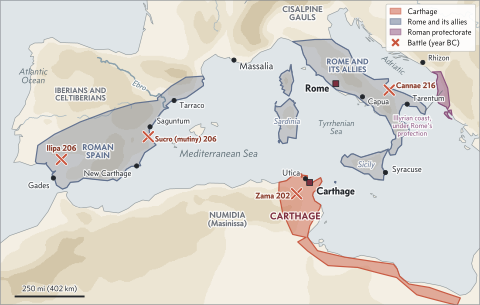
Zama
Scipio came home late in 206 BC, was elected consul for the next year at about thirty, and demanded to carry the war to Africa. Old Fabius opposed him in the Senate, remembering how Regulus’s African army had been destroyed fifty years before. The Senate gave Scipio Sicily as his province, with permission to cross if he wished, but no new army, so he raised volunteers. In 204 BC he landed near Utica (yoo-tih-kuh), won over the Numidian prince Masinissa (mas-ih-niss-uh), and the next spring burned two enemy camps by night. Carthage recalled Hannibal from Italy. Fabius died in 203, just as Hannibal left. In 202 BC the two greatest generals of the age met near Zama (zay-muh), southwest of Carthage, in the battle told from Carthage’s side (Vol. 5, In the Beginning): the elephants sent harmlessly down lanes in the Roman lines, the long struggle of the infantry, and Masinissa’s horsemen returning to strike Hannibal’s rear. Scipio defeated Hannibal at Zama,This general defeated Hannibal at the Battle of Zama. → Scipio Africanus•••This war ended after the Battle of Zama. → Second Punic War• and that battle ended the Second Punic War. Carthage made peace in 201 BC, gave up Spain and all but ten warships, and agreed to pay 10,000 talents over fifty years and never again make war without Rome’s permission (Figure 3.9).
Rome gave its general the name Africanus, the first Roman to be named after a land he had conquered. His later life was less happy. In 190 BC he served under his brother Lucius in the war against Antiochus (an-ty-uh-kus) III, the Seleucid king of Syria (Vol. 5, In the Beginning). Back in Rome, enemies led by Cato, whom the next section meets, accused the brothers of keeping money that Antiochus had paid. Livy says that when Africanus was asked to produce his account books, he tore them up in front of the Senate. He withdrew to his country house at Liternum (lih-ter-num), on the coast of Campania, and died there about 183 BC, the same year as Hannibal by some accounts.
Cato the Censor
Rome’s most famous enemy of Carthage was not a general of the first rank but a farmer’s son from Tusculum, a Latin town in the hills 15 miles southeast of Rome. Marcus Porcius Cato (por-shus kay-toh) was born in 234 BC and grew up working his father’s land in the Sabine country northeast of the city. He had red hair and gray eyes, Plutarch says, and he made his first campaign at seventeen, the year of Trasimene. He fought through the Second Punic War and served under Fabius when Fabius retook the Greek city of Tarentum in 209 BC. He drank water on the march, carried his own arms on foot, and helped the one slave who followed him cook his supper.
Two famous statesmen of the Roman Republic bore his name, and they are told apart as Cato the Elder and Cato the Younger.This name is shared by an Elder and Younger Roman Republic statesman. → Cato• He is the Elder, and the Younger is his great-grandson and namesake, who defied Julius Caesar a century and a half later (Chapter 8; Figure 3.10). Cato was their cognomen, the last part of a Roman name (the Stage), and Plutarch says the Elder earned it himself, from catus, “shrewd.” Both stood for the same thing: an old Rome of plain living and hard duty, set against the wealth and the new manners that conquest brought.

A man from a family that had never held high office at Rome was called a novus homo, a “new man” (the Stage), and he needed a patron. Lucius Valerius Flaccus was Cato’s mentor.Lucius Valerius Flaccus was this man's mentor. → Cato the Elder• Flaccus was a patrician with an estate next to Cato’s farm. Plutarch says that his servants told him about the young neighbor who worked in the fields beside his slaves and walked into town each morning to plead other men’s cases in court. Flaccus invited him to dinner, liked him, and urged him to go into politics at Rome. Cato rose, with his patron’s help, through every office of the ladder. He served as quaestor under Scipio in Sicily and quarreled with him over his spending, and the two men were enemies from then on.
The consul and the women
In 195 BC Cato and Flaccus were consuls together. The Second Punic War had been over for six years, and two tribunes proposed to repeal the Lex Oppia. The women of Rome came out to support them. In Roberts’s translation, Livy says that the matrons “filled all the streets and blocked the approaches to the Forum.” Women came in from the country towns to join them, begging the men on their way to vote to let them wear their ornaments again. Cato opposed the repeal of the Lex Oppia,This man opposed the repeal of the Lex Oppia. → Cato the Elder•• and Livy gives him a long speech against it. He was ashamed, he said, to have made his way to the Forum “through a regular army of women,” and warned the men what would follow if they gave way: “From the moment that they become your fellows they will become your masters.” Luxury, he said, had ruined great empires, and he complained that Romans had begun to admire Greek statues and laugh at the clay gods in front of their own temples.
The tribune Lucius Valerius, a different man from Cato’s colleague Flaccus, answered that a law made for a war should end with the war. In Livy’s version he says that “laws made in times of peace war generally repeals, those made during war peace rescinds.” Next day the women besieged the houses of the two tribunes who had threatened to veto the repeal, and would not leave until those tribunes gave way. The Lex Oppia was repealed, twenty years after it was passed. Livy wrote the speeches himself, nearly two hundred years later, as ancient historians did, so the words are his, not Cato’s. But the vote and the crowds were real, and Cato lost. He sailed the same year to command in Spain, put down a great revolt in the north of Roman Spain, and came home to a triumph.
Thermopylae and the censorship
In 192 BC Antiochus III, the Seleucid king, crossed into Greece with an army, and in 191 Rome sent the consul Manius Acilius Glabrio (uh-sil-ee-us glab-ree-oh) against him with Cato as one of his officers. Antiochus fortified the pass of Thermopylae (ther-mop-ih-lee), between the mountains and the sea, where three hundred Spartans had held off the Persians in 480 BC (Vol. 6, The Greeks). Cato remembered how the Persians had won that battle, by a path over the mountains to the defenders’ rear. He took part of the army up the heights by night, through wild olive trees and over cliffs, with a guide who lost the way, until at dawn they came out above the enemy’s camp. Cato fought at Thermopylae against Antiochus III,This man fought at the Battle of Thermopylae against Antiochus III and the Seleucids. → Cato the Elder•• and when his men charged down on the king’s Aetolian (ee-toh-lee-un) allies who held the heights, the whole Seleucid army broke and fled. Plutarch says that Cato himself carried the news to Rome, sailing and riding so fast that he arrived on the fifth day, and he never let anyone forget what he had done.
Cato was known as “the Censor”This man was known as "the Censor." → Cato the Elder•• because of the office he held in 184 BC, again with Flaccus as his colleague. The censors, two former consuls elected every fifth year, counted the citizens and their property and could strike from the Senate any senator whose life disgraced it (the Stage). Cato used the office as no one had before. He expelled Lucius Quinctius Flamininus (flam-ih-ny-nus), a former consul and brother of the Flamininus who had beaten Philip V of Macedon (Vol. 6, The Greeks), because, Livy says, he had killed a Gaul with his own hand at a dinner party to amuse a favorite. He had jewelry, fine clothes, and carriages assessed at ten times their value and taxed accordingly. He cut the pipes by which rich men drew the public water into their own houses, and he built Rome’s first basilica, a great roofed hall beside the Forum for business and law courts, which he named the Basilica Porcia (por-shuh) after his family. Romans set up a statue of him in a temple, Plutarch says, with an inscription praising not his victories but his censorship.
Cato is credited with one Porcian law,This man is credited with sponsoring one of the Porcian Laws. → Cato the Elder• so called from his family name, Porcius. Romans prized the right of a citizen to appeal to the people against a magistrate’s sentence, and three laws proposed by men of the Porcian family between 199 and 184 BC extended it. One of them, perhaps Cato’s, forbade magistrates to flog a Roman citizen. The dates and the exact terms of the three laws are uncertain, but more than a century later Cicero could boast that the Porcian law had taken the rods away from the body of every Roman citizen.
Against the Greeks
Cato knew Greek, which Plutarch says he learned only late in life. What he feared was the effect on young Romans of Greek learning and of Greek ways in general, which are also called Hellenic, from Hellenes, the Greeks’ name for themselves. Cato opposed Greek influences in Roman societyThis man opposed Hellenic influences in Roman society. → Cato the Elder•• all his life. In 155 BC Athens sent three philosophers to Rome as ambassadors, and one of them, Carneades (kar-nee-uh-deez), drew crowds of young men by lecturing one day in praise of justice and the next day arguing just as brilliantly against it. Cato urged the Senate to settle the Athenians’ business and send them home, so that the youth of Rome would go back to obeying the laws and the magistrates. Plutarch, in Clough’s translation, says that he called Socrates “a prating seditious fellow,” warned his son that Rome would be destroyed once it was infected with Greek literature, and distrusted Greek doctors, treating his household instead from his own little book of remedies.
“Carthage must be destroyed”
Carthage, meanwhile, had paid its debt and grown rich again. Cato saw it with his own eyes on an embassy to Africa about 153 BC and came home convinced that Rome was in danger. Plutarch tells how he dropped fresh African figs in the Senate to show how close the enemy lay (Vol. 5, In the Beginning). From then on, Plutarch says, Cato closed every speech by demanding Carthage’s destruction,This man supposedly concluded every speech with "Carthago delenda est" ("Carthage must be destroyed"). → Cato the Elder•• whatever the subject of the debate. In Clough’s translation of Plutarch, the sentence was “Also, Carthage, methinks, ought utterly to be destroyed.” The short Latin form everyone quotes, Carthago delenda est (kar-tah-goh deh-len-duh est), is a later wording. Another senator, Publius Cornelius Scipio Nasica, always answered that Carthage should be left standing, because the fear of it kept the Roman people disciplined. Cato won. In 149 BC Rome declared war, and Cato died that same year, at eighty-five.
The Third Punic War lasted from 149 to 146 BC, and its end is told from Carthage’s side (Vol. 5, In the Beginning): Scipio Aemilianus took the city, street by street, with the historian Polybius (Vol. 6, The Greeks) beside him, and wept as it burned. Carthage’s land became the Roman province of Africa. In the same year a Roman army sacked Corinth, and Macedonia was already a province. Rome had been at war with Carthage, off and on, for 118 years, and was now master of the western Mediterranean and of Greece as well (Figure 3.11). Romans came to speak of it as their own lake. Romans called the Mediterranean “Mare Nostrum”Romans called this sea “Mare Nostrum” and “Mare Internum.” → Mediterranean Sea•• (mah-ray nos-trum), “our sea,” and also Mare Internum (in-ter-num), “the inner sea.” The English name comes from a later Latin name for it, Mare Mediterraneum, from mediterraneus, “in the middle of the land.”

Plautus and the first Latin books
Rome had fought for a century without a literature of its own. Latin, the language of Latium, the plain around Rome (the Stage), was spoken by farmers, soldiers, and lawyers, but the books an educated Roman read were Greek. Latin writing began in the Punic Wars. In 240 BC, the year after the First War ended, a Greek former slave named Livius Andronicus (an-druh-ny-kus) put on the first play in Latin at Rome’s games and translated Homer’s Odyssey into Latin verse. Gnaeus Naevius (nee-vee-us), who had fought in the First War, wrote a Latin epic about it. And Quintus Ennius, a soldier whom Cato is said to have found in Sardinia and brought to Rome, wrote the Annals, the verse history of Rome from Aeneas to his own day that gave Fabius his famous line.
The most popular of the new writers was a comic playwright, Titus Maccius Plautus, born about 254 BC in Sarsina (sar-sih-nuh), a hill town of Umbria, northeast of Rome, who died in 184 BC, the year of Cato’s censorship. Little is known about his life; later Romans told a story that he lost his money in trade and worked in a flour mill. Twenty of his comedies survive nearly complete, more than of any other ancient playwright. Plautus wrote his comedies in Latin,Plautus wrote in this language. → Latin• but he took his plots from the Greek New Comedy of Menander (meh-nan-der) and his rivals (Vol. 6, The Greeks). They are stories of young men in love, stern fathers, boastful soldiers, and above all clever slaves who outwit their masters, and they end in a wedding or a long-lost child found again. He kept the Greek settings, in Athens or some other Greek town, which let a Roman audience laugh at behavior it would never have allowed at home. But he added songs, puns, and Roman jokes, and he wrote a Latin full of slang and comic invented words.

His plays were acted at the city’s religious festivals on temporary wooden stages, since Rome had no permanent theater for more than another century. The Menaechmi (meh-neek-my), about identical twins separated as children, gave Shakespeare the plot of The Comedy of Errors. In the Pot of Gold a miser guards a buried treasure, and the French playwright Molière (mol-yair) borrowed him for The Miser. The Braggart Soldier mocks a boastful officer, and the Little Carthaginian brings a Carthaginian father onstage, speaking lines in his own Punic language, some years after Zama. Plautus’s audiences had fought Hannibal, and they laughed.
Cato wrote prose, and he wrote it to be useful. In his old age he set down the history of his people in seven books, the Origines, and it was the first Roman history in Latin.This man wrote Origines, the first Roman history composed in Latin. → Cato the Elder•• Earlier Romans who wrote history, such as Fabius Pictor, the senator sent to Delphi after Cannae, wrote it in Greek. Its title means “Origins,” because its first books told the beginnings of Rome and of the other towns of Italy, and the later books carried the story through the Punic Wars to Cato’s own time, with his own speeches included. Only quotations by later writers survive. Cato made one rule that annoyed every Roman noble: he left out the names of the generals, writing only “the consul” or “the dictator,” so that the credit for Rome’s victories would go to the Roman people rather than to the great families.
He made one exception, an elephant named Surus (soo-rus). Pliny the Elder, who gathered everything known about animals in his Natural History two centuries later, says that Cato named no general in his history but did record the name of the elephant that had fought most bravely in the Carthaginian line. Surus was a Carthaginian war elephant,Surus was one of these animals. → elephants• and Cato remembered that one of its tusks was broken. Its name probably means “the Syrian,” so it may have been one of the large Asian elephants that the Greek kings of Egypt and Syria used, not one of Carthage’s smaller North African beasts. Livy says that after the winter of 218 BC only one of Hannibal’s elephants was left alive, and that Hannibal rode it through the flooded marshes of the Arno in 217 BC. Some modern writers guess that it was Surus, but no ancient writer says so.
Cato’s other book survives whole. Cato wrote De Agri CulturaThis man wrote De Agri Cultura. → Cato the Elder•• (day ag-ree kul-too-ruh), “On Farming,” about 160 BC, and it is the oldest complete book of Latin prose. It is a manual for a farm of olive groves and vineyards worked by slaves, as practical as a recipe book. It contains recipes too: cakes to offer to the gods, cures made of cabbage, and the prayer to Mars said while leading a suckling pig, a lamb, and a calf around the fields (Vol. 4, Classical Myth). Its advice is hard. The owner should sell worn-out oxen, old tools, and old or sickly slaves, Cato writes, as he would anything else that has stopped earning its keep. Plutarch, nearly three centuries later, called that a sign of an over-rigid temper. Cato would not have understood the complaint. He had seen Rome survive Cannae by refusing to give an inch, and he wanted its farms run the same way.
What to remember
- The First Punic War (264–241 BC) began when Rome answered the Mamertines’ call for help at Messana and was fought mostly in Sicily. Hiero II, tyrant and then king of Syracuse, became Rome’s loyal ally.
- Rome built a navy from nothing. Its boarding bridge, the corvus, won the Battle of Mylae (260 BC) for Duilius. Claudius Pulcher threw the sacred chickens overboard and lost at Drepana (249), and Lutatius Catulus won the war at the Aegates Islands (241). Sicily became Rome’s first province.
- The Mercenary War followed Carthage’s defeat; Hamilcar Barca massacred the trapped rebels at the Saw. Rome seized Sardinia and Corsica. Queen Teuta’s Illyrian pirates, sailing in lembi, brought the First Illyrian War (229 BC), and Demetrius of Pharos the second (219 BC).
- Under the Ebro Treaty (226 BC) Hasdrubal the Fair agreed not to cross the Ebro in arms. The siege of Saguntum began the Second Punic War (218–201 BC), in which Hannibal crossed the Alps and won at the Trebia, Lake Trasimene, and Cannae.
- Fabius Maximus, the Delayer, wore Hannibal down by refusing battle. At Cannae (216 BC) Hannibal’s double envelopment destroyed the army of Varro and Paullus. The Lex Oppia (215 BC) limited women’s gold, colored dress, and carriages.
- Scipio Africanus won Spain with the “reverse Cannae” at Ilipa (206 BC), put down the mutiny at Sucro, and beat Hannibal at Zama (202 BC).
- Cato the Elder, Valerius Flaccus’s protégé, opposed repealing the Lex Oppia (195 BC), led the flank march at Thermopylae (191 BC), and as censor (184 BC) fought luxury and Greek ways. He ended his speeches by demanding Carthage’s destruction, which came in 146 BC. Romans called the Mediterranean Mare Nostrum.
- Plautus adapted Greek comedies into Latin. Cato wrote the Origines, the first history of Rome in Latin, which named the elephant Surus but no general, and De Agri Cultura, the oldest surviving Latin prose book.
The Fall of the Republic
Chapter 4 · 34 clues
Spain, the Gracchi, Marius, and Sulla
In 137 BC a young Roman officer rode north through Etruria, the hill country above Rome, on his way to a war in Spain. He was Tiberius Sempronius Gracchus, about twenty-five years old, a grandson of the general who had beaten Hannibal. His younger brother Gaius later wrote, Plutarch says, that on this journey Tiberius first thought of the plan that would cost him his life. The countryside was almost empty of free men. The shepherds and field hands were foreign slaves, bought cheap after Rome’s wars and working for owners who lived in the city. The small farmers who had always filled the legions were gone.
Four years later Tiberius was clubbed to death on the Capitol by senators. In the fifty-five years that followed, Romans fought in the Forum, marched Roman armies on Rome, and posted lists of fellow citizens to be hunted down for money. This chapter follows that slide from the Spanish wars to the dictatorship of Sulla, and ends with the Greek writer whose biographies tell most of it (Figure 4.1).

Roman Spain
The Romans called the whole peninsula south of the Pyrenees Hispania. The Greeks called it Iberia, after the Iberians of its eastern coast, but Hispania was the Romans’ name for the Iberian Peninsula,This region was the Roman designation for the Iberian Peninsula. → Hispania• today’s Spain and Portugal. It was a land of high, dry plateaus rimmed by fertile coasts, and it was rich in silver, copper, and gold.
The oldest kingdom the Greeks knew there was Tartessos (tar-tess-os), near the mouth of the Guadalquivir River in the far south, famous for its silver. Herodotus, the Greek historian (Vol. 6, The Greeks), tells how sailors from Phocaea, a Greek city in Asia Minor, reached it and made friends with Arganthonios (ar-gan-thoh-nee-os), king of Tartessos.Ancient writers describe Arganthonios as king of Tartessos in this region. → Hispania• In G. C. Macaulay’s translation, the king “was ruler of the Tartessians for eighty years and lived in all one hundred and twenty.” When the Greeks would not settle in his country, he gave them money to wall their own city against the Persians. No one has found his capital, and the long reign may hide several kings of one name.
Rome came to Spain to fight Carthage (Chapter 3). By 206 BC Scipio Africanus had driven the Carthaginians out and settled his wounded veterans at Italica, near modern Seville. In 197 BC Rome divided its Spanish lands into two provinces, Hispania Citerior and Hispania Ulterior,Rome divided this Iberian region into Citerior and Ulterior, later reorganizing it into Tarraconensis, Baetica and Lusitania. → Hispania•• “Hither” and “Further” Spain as seen from Rome, each governed by a praetor. Hither Spain ran down the east coast, and Further Spain held the rich valley of the Baetis, the Guadalquivir. Augustus finished the conquest in 19 BC, and under him the land was redrawn as three provinces. Tarraconensis (tar-uh-koh-nen-sis) covered the north, center, and east and was governed from Tarraco (tar-uh-koh); Baetica (bee-tih-kuh), in the south, from Corduba (kor-dyoo-buh); and Lusitania (loo-sih-tay-nee-uh), roughly modern Portugal, from Emerita Augusta (Figure 4.2). Spain later gave Rome the philosopher Seneca, born at Corduba (Chapter 12), and the emperor Trajan, born at Italica (Chapter 16).
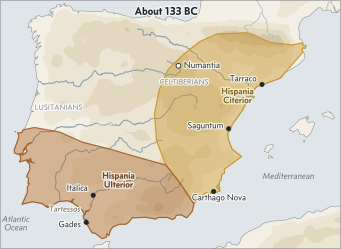

The coasts were easy to hold; the interior was not. On the cold central plateau lived the Celtiberians, “Celts among the Iberians,” who spoke a Celtic language and fought from walled hill towns. In 153 BC a quarrel over a new city wall at Segeda (sej-ih-duh) turned into war, and Polybius, who rode with Rome’s generals in Spain (the Stage), called the Celtiberian war a “fiery war.”Polybius called a Roman conflict with Celtiberians in this region a “fiery war.” → Hispania• Wars in Greece and Asia, he explained, were settled by one battle or two, but this one burned on without a pause, stopped only by nightfall and winter. In 151 BC young Romans dodged the call-up to avoid it, until Scipio Aemilianus, the adopted grandson of Africanus, volunteered and shamed the rest.
The Lusitanians, the herdsmen of the west, had their own grievance. In 150 BC the governor Servius Sulpicius Galba promised them farmland if they laid down their arms, then had his soldiers massacre them. Appian, the Greek historian of Rome’s wars (the Stage), says thousands died. One who escaped was a young shepherd named Viriathus (vir-ee-ay-thus). From 147 to 139 BC Viriathus led the Lusitanian rebellion,A rebellion in this region was led by Viriathus. → Hispania•• beating one Roman army after another in ambushes in the hills, and in 140 BC he forced a trapped Roman general to sign a peace. The next governor, Quintus Servilius Caepio (see-pee-oh), had it broken, and in 139 BC he bribed three of Viriathus’s companions, who stabbed him in his sleep.

The hardest fight came at Numantia (noo-man-shee-uh), a Celtiberian hill town on the upper Douro River, near modern Soria (Figure 4.3). With perhaps eight thousand fighting men, it beat army after army from 143 BC in what the Romans called the Numantine War.The Numantine War took place in this region. → Hispania•• In 137 BC the consul Gaius Hostilius Mancinus (man-sy-nus), beaten again and again, tried to slip away by night, and the Numantines trapped his twenty thousand men in rough ground. They would talk to only one Roman: Mancinus’s quaestor, the junior officer who kept the army’s accounts, the young Tiberius Gracchus. His father had governed Hither Spain forty years before and made treaties the Celtiberians trusted. Tiberius negotiated peace with the Numantines,This Roman politician negotiated peace with the Numantines after Gaius Hostilius Mancinus’s defeat. → Tiberius Gracchus•• on terms that let Mancinus’s army march home. The Senate was ashamed and refused the treaty. To free Rome from its oath, it handed Mancinus over to the Numantines in chains, but they would not take him. Tiberius had seen the Senate disown a promise made in his name.
In 134 BC Rome sent Scipio Aemilianus, who had destroyed Carthage twelve years before (Chapter 3). With him went Jugurtha, a Numidian prince leading horsemen and elephants, and a young officer named Gaius Marius (mair-ee-us), both of whom return later in this chapter. Scipio would not attack. He ringed Numantia with a wall about 6 miles long, blocked the river with beams studded with blades, and waited. Appian says the starving people ate hides, then the dead, and at last one another. In the summer of 133 BC the town gave up. Many Numantines killed themselves rather than surrender,Some Numantians in this region reportedly killed themselves rather than surrender to Scipio Aemilianus. → Hispania• Appian writes, and Scipio kept fifty survivors for his triumph, sold the rest as slaves, and leveled the town. Seventeen centuries later Miguel de Cervantes, the author of Don Quixote, made a tragedy of the siege.
The Gracchi
Tiberius came from the most admired family in Rome. His father, also Tiberius Sempronius Gracchus, had been consul twice and censor, and his mother, Cornelia, was the daughter of Scipio Africanus. Of her twelve children only three grew up: Tiberius; Gaius, nine years younger; and Sempronia, who married Scipio Aemilianus (Figure 4.4). Widowed young, Cornelia refused even a king of Egypt, Ptolemy VIII, and had her sons taught by Greek scholars. Both of them served as tribunes of the plebs at Rome,The Gracchi brothers served as tribunes in this city. → Rome•• ten years apart, and both died for what they did in the office. A tribune was one of ten officers elected each year by the plebs alone. His person was sacred, and he could propose laws to the people’s assembly and veto the act of any other official (the Stage).


Valerius Maximus, who collected famous deeds and sayings in the first century AD, tells how a lady from Campania, staying at Cornelia’s house, showed off her jewelry and asked to see her hostess’s. Cornelia kept her talking until her sons came home from school, and then said, “These are my jewels.” The Swiss-born painter Angelica Kauffman painted the scene in 1785 (Figure 4.5).
The problem Tiberius set out to fix was land. When Rome conquered a people in Italy, it often kept part of their territory as public land, and over the generations rich families had spread over huge tracts of it, paying little or nothing, as if it were their own. An old law, as Tiberius understood it, limited any holder to 500 iugera (yoo-guh-ruh), a Roman measure of land, but no one enforced it. Elected tribune for 133 BC, Tiberius proposed to enforce the limit, with 250 iugera more for each of up to two sons, and to share out the rest in small farms that poor citizens could rent cheaply but not sell. A board of three would survey the land: Tiberius, his brother Gaius, and his father-in-law, Appius Claudius Pulcher. Plutarch gives the speech in which Tiberius made his case. In the old translation revised by Arthur Hugh Clough, Tiberius told the people that the wild beasts of Italy had their dens. “But the men who bear arms, and expose their lives for the safety of their country,” he went on, “enjoy in the meantime nothing more in it but the air and light.”
The rich fought back through another tribune, Marcus Octavius, who vetoed the bill. Tiberius then did what no tribune had ever done: he asked the people to vote Octavius out of office. When seventeen of the thirty-five voting tribes had voted to remove him, one short of a majority, Tiberius stopped the count and begged his friend to give way. Octavius refused, was removed, and the law passed. That year Attalus III (at-uh-lus), king of Pergamon in Asia Minor, died and left his kingdom to the Roman people. Tiberius proposed to spend the king’s treasure on the new farms and to let the people, not the Senate, decide about Pergamon’s cities. The Senate had always managed money and foreign affairs, and now a tribune was taking both.
To protect his law and his own safety, Tiberius then stood for a second year as tribune, which no one had done in living memory. On election day the crowd on the Capitol was too loud for him to be heard, so he touched his head to show his friends that his life was in danger. His enemies ran to the Senate and said he was asking for a crown. The consul refused to kill a citizen without a trial, and Tiberius’s own cousin rose: Publius Cornelius Scipio Nasica, the pontifex maximus, Rome’s chief priest. “Let everyone who will defend the laws, follow me,” he cried, in Clough’s version. Then Nasica drew a fold of his toga over his head,Scipio Nasica covered his head with this garment to rally Tiberius Gracchus’s assassins. → togas• the citizen’s wool mantle (Chapter 2), as a priest did when he offered a sacrifice, and led the senators out. The gesture may have been meant to make the killing that followed a sacrifice to the gods. The senators and their servants broke up benches for clubs, and Tiberius, stumbling over the fallen, was beaten to death with the leg of a stool. More than three hundred of his followers died with him, and their bodies were thrown into the Tiber. Plutarch calls it the first strife among Romans since the end of the kings to be settled by bloodshed. At Numantia, Plutarch adds, Scipio Aemilianus heard the news and quoted a line of Homer: “Even so perish all who do the same.”
Ten years later Gaius took up his brother’s work. He was the fiercer speaker; Plutarch says he was the first Roman orator to stride about the platform and pull his toga off his shoulder as he spoke. As tribune in 123 and 122 BC, he let citizens in Rome buy a monthly ration of grain at a fixed low price, built roads, and founded colonies, one of them on the ruins of Carthage. He gave the knights, the wealthy rank just below the senators (the Stage), the juries that tried governors for robbing their provinces. But when he proposed citizenship for Rome’s Latin allies, the voters of Rome, unwilling to share their privileges, turned against him, and he failed to win a third term.
In 121 BC, after a servant of the consul Lucius Opimius (oh-pim-ee-us) was stabbed in a scuffle, the Senate passed its emergency decree for the first time, telling the consul to see that the state came to no harm (Chapter 2). Gaius’s armed followers seized the Aventine Hill, and Opimius stormed it. Gaius fled across the Tiber into a grove sacred to the Furies, where his slave killed him and then himself. Opimius had promised the head’s weight in gold, and Plutarch says the man who brought it in had filled the skull with lead. About three thousand of Gaius’s followers died. From the Gracchi on, Romans spoke of two kinds of politician: populares, who worked through the people, and optimates (op-tih-may-teez), the “best men,” who stood with the Senate. Cornelia retired to a villa on the Bay of Naples, and after her death Rome raised her statue, one of the first public statues of a real Roman woman.
Marius and the army
Gaius Marius was born about 157 BC near Arpinum (ar-py-num), a hill town about 60 miles southeast of Rome, into a family that had never held Roman office. Plutarch tells that as a youth he caught a falling eagle’s nestAs a teenager, this man supposedly saw seven eaglets in a nest. → Gaius Marius• in the fold of his cloak, with seven eaglets in it, and that soothsayers told his parents he would hold the highest power seven times. Plutarch reports that others called the story a fable, since an eagle never hatches more than two, but Marius told it himself in his darkest days.
He learned soldiering under Scipio Aemilianus at Numantia and rose slowly, a new man (the Stage), and he married Julia, an aunt of the future Julius Caesar. His chance came in Numidia (noo-mid-ee-uh), the kingdom west of Roman Africa, in what is now Algeria. Its prince Jugurtha, the cavalry leader at Numantia, murdered one cousin for the throne and in 112 BC killed another at Cirta (sur-tuh), along with the Italian traders in the city. For years he bribed the senators sent against him. The Roman historian Sallust, writing The Jugurthine War about 40 BC, has him call Rome, as he left it, a city for sale, doomed to perish if it found a buyer.
Marius served in Numidia as an officer of the general Quintus Caecilius (see-sil-ee-us) Metellus (meh-tel-us). He went home, won the consulship for 107 BC, and had the people give him the African command. Only men with enough property to buy their own arms had served in the legions. The poorest citizens, listed in the census by nothing but their heads, were the capite censi (kap-ih-tay ken-see), the “head count,” called up only in emergencies. To fill his legions fast, Marius enrolled the capite censiThis man enrolled the capite censi, or landless men, in the legions. → Gaius Marius• as volunteers. Sallust reports that some blamed his ambition, since to a man seeking power the poorest are the most useful: they have nothing of their own to lose. The charge looked ahead: a landless soldier looked to his commander for a farm when the war was over, and an army of such men could become loyal to its general rather than to the state. The old draft went on for decades after him, so one levy cannot have changed everything, but by Sulla’s time soldiers did look to their generals for their rewards.
Marius’s quaestor in Africa was a penniless patrician named Lucius Cornelius Sulla. Jugurtha had taken refuge with his father-in-law Bocchus (bok-us), king of Mauretania farther west, and in 105 BC Bocchus handed him over to Sulla, who had ridden into the king’s country with a small escort to fetch him. On January 1, 104 BC, Marius led Jugurtha in his triumph,This man celebrated a triumph over Jugurtha, whose surrender had been secured by his subordinate Sulla. → Gaius Marius• the victory parade of a Roman general (the Stage). Then the king was stripped and thrown into the pit of the prison below the Capitol, crying, as Plutarch tells it, “Hercules! how cold your bath is!” He starved there for six days, struggling to the last. After the parade Marius entered the Senate in triumphal robes,Plutarch reports that this general offended the Senate by appearing in triumphal robes. → Gaius Marius• the gold-embroidered purple toga that a general could wear only on the day of his triumph (Chapter 2). Seeing the senators offended, Plutarch says, he went out and changed. Sulla, meanwhile, had a signet ring cut showing Bocchus handing Jugurtha over to him, and he sealed his letters with it for life. Marius took it as a theft of his glory, and from it Plutarch dates the rivalry between Marius and SullaThis man was a Roman general and rival of Sulla. → Gaius Marius••This man was the rival of Gaius Marius. → Sulla•• that would set Roman armies against each other.
By then a worse danger had come from the north. The Cimbri (sim-bry) and the Teutones (too-tuh-neez), peoples who may have come from Jutland in Denmark, were moving south with their wagons and families in search of land. On October 6, 105 BC, at Arausio (uh-raw-zee-oh), now Orange in the Rhône valley, they destroyed two Roman armies whose commanders would not cooperate. The surviving summary of Livy’s lost books counts 80,000 dead, more than at Cannae. Rome elected Marius consul for 104 BC while he was still in Africa, and again every year until 100 BC, though the law forbade a second consulship so soon.

While the Cimbri wandered into Spain, Marius trained his army. Tradition credits Marius with replacing maniples with cohorts.This leader is traditionally credited with replacing maniples with cohorts in the Roman army. → Gaius Marius• The legion that Polybius described had fought in thirty maniples, companies of 120 men, with sixty in each maniple of the rear line, set out in three lines like the dark squares of a checkerboard. The new legion fought in ten cohorts of about 480, each in effect one maniple from each old line, joined into a block that could fight alone (Figure 4.6). The cohort was probably not his invention, since Polybius already mentions cohorts in a battle in Spain in 206 BC, and the change came gradually; but the tradition gives it to Marius. His soldiers carried their own gear on forked poles, Plutarch says, and were nicknamed “Marius’s mules.”

The legionary’s shield was the scutum (skoo-tum), tall and curved. Polybius describes it as 4 feet high and 2.5 feet wide, made of layers of wood glued together and covered with canvas and calfskin, with iron edges and an iron boss in the middle to turn aside stones and spears. Because the shields were curved and covered a man from shoulder to knee, soldiers could lock them together. In the testudo, legionaries overlapped their scutaRoman legionaries overlapped their scuta, examples of these objects, to form a testudo. → shields• (the plural of scutum): the front rank held theirs in front, the men behind raised theirs overhead, and the edges overlapped like the plates of a tortoise’s shell, which is what testudo (tes-too-doh) means. Arrows and stones slid off, so the formation could creep right up to an enemy wall (Figure 4.7).
In 102 BC the invaders split. The Cimbri went around through the eastern Alps toward Italy, while the Teutones and their allies the Ambrones (am-bruh-neez) marched along the coast of Gaul. Marius kept his men in camp while the Teutones filed past for six days, shouting, Plutarch says, to ask whether the Romans had messages for their wives. Then he followed. Near Aquae Sextiae (ah-kwee seks-tee-ee), today’s Aix-en-Provence (eks-ahn-proh-vahns), Marius’s army destroyed the Teutones and AmbronesThis man's armies won the Battle of Aquae Sextiae. → Gaius Marius•• in two battles. Plutarch reports that the people of nearby Massilia, the Latin form of Massalia, now Marseille, fenced their vineyards with the bones.
The Cimbri, meanwhile, had pushed the army of the other consul, Quintus Lutatius Catulus, back from the Alps. Marius joined him, and on July 30, 101 BC, on the Raudine Plain (raw-dyne) near Vercellae (ver-sel-ee) in northern Italy, Marius and Catulus defeated the Cimbri at VercellaeThis leader defeated the Cimbri at the Battle of Vercellae. → Gaius Marius• so completely that the Cimbri vanish from history. The Romans, Plutarch says, hailed Marius as the third founder of Rome, after Romulus and Camillus (Chapter 2). He was consul for the sixth time in 100 BC, but he proved a clumsy politician in peacetime and lost favor. In 86 BC, old and bitter, he would take the office once more, so that Marius was consul seven times,This man was a seven-time consul. → Gaius Marius•• more than any Roman before him.
Mithridates
While Marius was winning his consulships, a king across the Aegean (ih-jee-un) Sea was building an empire. Pontus (pon-tus) was a kingdom on the south shore of the Black Sea, in what is now northern Turkey, whose kings claimed Persian royal descent and spoke Greek at court. From 120 BC its king was Mithridates (mith-rih-day-teez) VI Eupator (yoo-puh-tor), the ruler known as Mithridates the Great.This ruler of Pontus was known as “the Great.” → Mithridates VI of Pontus•• He was still a boy when his father was poisoned at a banquet. Later stories say the boy fled into the wild for seven years, fearing his mother, who ruled in his name. About 113 BC he came back, imprisoned her, and took the throne.
According to tradition, the young king remembered his father’s death, and he took small doses of poisonAccording to tradition, this ruler of Pontus took small doses of poison to build immunity. → Mithridates VI of Pontus•• every day to make himself immune. A mixture called mithridatium, said to be his antidote, was sold by Europe’s apothecaries for centuries. Pliny the Elder says he spoke the languages of all twenty-two peoples he ruled. He took Colchis (kol-kis) at the eastern end of the Black Sea and the Greek cities of the Crimea, and gave his daughter Cleopatra, no relation of the Egyptian queen, in marriage to the king of Armenia, making Tigranes (ty-gray-neez) the Great his son-in-law.Tigranes the Great was this ruler’s son-in-law. → Mithridates VI of Pontus• Tigranes would one day rule from Syria to the Caspian Sea and call himself King of Kings. About 98 BC Marius met Mithridates in the east and told him, in Clough’s version, “O king, either endeavor to be stronger than the Romans, or else quietly submit to their commands.”

He chose to be stronger (Figure 4.8). In 89 BC the king of Bithynia (bih-thin-ee-uh), his western neighbor, invaded Pontus at Roman urging. Mithridates crushed him and swept into the Roman province of Asia, the rich west coast of Asia Minor that Attalus III had left to Rome. The Greek cities, squeezed by Roman tax collectors, opened their gates. In 88 BC he ordered every city to kill, on a single day, every Roman and Italian in it, men, women, and children; Valerius Maximus puts the dead at 80,000, and Plutarch at 150,000. Athens declared for him, and his general Archelaus (ar-kuh-lay-us) landed in Greece (Figure 4.9).

Rome fought him on and off for twenty-six years, in three Mithridatic Wars against Sulla, Lucullus (loo-kul-us), and Pompey.This king of Pontus fought three namesake wars against Roman commanders including Sulla, Lucullus and Pompey. → Mithridates VI of Pontus• The first, from 89 to 85 BC, was Sulla’s. The second, from 83 to 81 BC, was a raid by Sulla’s officer Murena (myoo-ree-nuh), which Mithridates beat off. In the third, from 73 BC, Lucius Licinius (lih-sin-ee-us) Lucullus, once Sulla’s quaestor, drove the king into Armenia and took Tigranes’s new capital, and Pompey, the great general of the next generation, finished the war (Chapter 5). In 63 BC, in the Crimea, the old king’s own son rose against him. Appian says Mithridates took poison, but it would not work on his hardened body, so he asked a Gallic officer to kill him with a sword.
Sulla
Lucius Cornelius Sulla was born in 138 BC into a patrician family sunk in poverty, and he spent his youth among actors and comedians. Plutarch says his statues show what he looked like, except for his blue eyes, “extremely keen and glaring,” in a face of white blotched with fiery red. An Athenian jester likened that face to a mulberryPlutarch writes that this man's pale, blotchy complexion was compared to a "mulberry sprinkled o'er with meal." → Sulla• sprinkled with flour, Plutarch writes, in a mocking verse. After the wars with Jugurtha and the Cimbri, Sulla became a praetor. In the 90s BC he governed Cilicia (sih-lish-ee-uh), on the southern coast of Asia Minor, with orders to restore Ariobarzanes (air-ee-oh-bar-zay-neez), a king whom Mithridates had driven out, to the throne of Cappadocia.
On the Euphrates he was met by envoys from Parthia, the Iranian kingdom that had taken Mesopotamia from the Seleucids (Vol. 5, In the Beginning). While serving in Cilicia, Sulla became the first Roman magistrate to receive a Parthian ambassador.While serving in the province of Cilicia, this man was the first Roman magistrate to meet a Parthian ambassador. → Sulla• Plutarch says Sulla had three chairs set out, for Ariobarzanes, for the envoy Orobazus (or-oh-bay-zus), and for himself, and sat in the middle, as if Rome outranked both kings. The Parthian king later had Orobazus put to death for allowing it.
Then Italy itself exploded. Rome’s Italian allies, the socii, fought in every Roman war but had no vote at Rome. In 91 BC the tribune Marcus Livius Drusus proposed to make them citizens and was stabbed in his own house. The allies rose and set up a state of their own, with a capital they named Italia. Rome won this Social War, the war of the socii, by giving away what it had refused: in 90 and 89 BC it granted citizenship to the Italians who stayed loyal or laid down their arms. Sulla won battles in Campania and besieged Pompeii (pom-pay), and his success in the Social War won SullaThis general's first consulship followed his success in the Social War. → Sulla• his first consulship, for 88 BC.
The Senate gave Sulla the command against Mithridates, the richest war in a generation. Marius, nearly seventy and hungry for one more triumph, made a bargain with the tribune Publius Sulpicius Rufus, whose law, passed amid riots, gave the command to Marius instead. Sulla went to his army near Nola, told the soldiers that Marius would take other men east to share the plunder, and led six legions on Rome. All his officers but one refused to follow. No Roman general had done this before. His men fought their way in against citizens throwing tiles from the rooftops, and Marius fled. Caught hiding in the marshes near the coastal town of Minturnae (min-tur-nee), he was shut in a dark room. Plutarch tells how a horseman, a Gaul or a Cimbrian (he gives both versions), sent in to kill him, ran away when a voice cried, “Fellow, darest thou kill Caius Marius?” The townspeople let him go, and he escaped to Africa.
Sulla sailed for Greece in 87 BC with five legions. As soon as he was gone, the consul Lucius Cornelius Cinna brought Marius back, and the two took Rome and killed their enemies in the streets. Marius began his seventh consulship on January 1, 86 BC, and died on January 13.
In Greece, Athens held out for Mithridates, and Archelaus held its port, Piraeus (py-ree-us). Sulla besieged both. Short of timber for his siege engines, he cut down the groves of the Academy and the Lyceum, where Plato and Aristotle had taught. At midnight on March 1, 86 BC, his men broke into Athens, and Plutarch says that by most accounts the blood from the marketplace flowed out through the city gate. At last, begged for mercy, Sulla called a halt: “I forgive,” he said, in Clough’s version, “the many for the sake of the few, the living for the dead.” Soon afterward Sulla’s troops ransacked PiraeusThis man ordered his troops to ransack Piraeus. → Sulla• and burned most of it, along with its famous naval arsenal. Sulla also shipped to Rome a library that held Aristotle’s own writings (Vol. 6, The Greeks).
Archelaus marched north into Boeotia (bee-oh-shuh) to meet fresh troops from Mithridates. At Chaeronea in 86 BC, Sulla, with fewer than fifteen thousand foot soldiers and fifteen hundred horsemen by Plutarch’s count, faced an army several times larger, with chariots carrying scythes on their wheels. Sulla defeated Archelaus at Chaeronea,This man defeated Archelaus at Chaeronea and Orchomenus during the First Mithridatic War. → Sulla•• and in 85 BC he beat him again near Orchomenus (or-kom-ih-nus); these were the decisive battles of the First Mithridatic War. At Orchomenus, Plutarch says, when his men broke, Sulla seized a standard and ran at the enemy alone. If anyone asked where they had betrayed their general, he shouted, they should “remember and say, at Orchomenus.” They turned and won. That year Sulla and Mithridates made peace at Dardanus, near Troy. The king gave up his conquests, paid two thousand talents, and handed over seventy ships, and Sulla left him his kingdom, because a war was waiting in Italy.
Sulla landed at Brundisium in 83 BC. The young Gnaeus Pompeius (pom-pee-us), later Pompey the Great, raised three legions to join him, and Marcus Licinius Crassus, whose father had died in Marius’s purge, came too (Chapter 5). Against them stood the Marians, the party of the dead Marius, and the Samnites of the southern hills, who had never forgiven Rome. On November 1, 82 BC, a Samnite army made a dash for Rome itself, and Sulla defeated the Marians at the Colline Gate,This man defeated the Marian faction at the Battle of the Colline Gate. → Sulla•• the city’s northeastern gate, in a battle that lasted into the night. Soon afterward, Plutarch says, Sulla calmly went on addressing the Senate while his soldiers butchered six thousand prisoners nearby, and he told the startled senators that only some criminals were being punished.

Having taken Rome by force, Sulla issued proscriptions,This man issued proscriptions after marching on Rome. → Sulla•• lists of citizens who could be killed on sight, posted in public, as the Latin proscribere means (the Stage). He posted eighty names in the Forum, then 220 more, then 220 again (Figure 4.10). Anyone who killed a man on the list could claim two talents, even a slave who killed his master. The dead man’s property was auctioned, and his sons and grandsons were barred from office. Men were listed for their wealth. Plutarch tells of a quiet citizen who found his own name and cried, “Woe is me, my Alban farm has informed against me.”
Rome had not had a dictator for 120 years, and the old dictators served six months at most. Late in 82 BC Sulla was appointed dictator without a fixed term,This man was appointed dictator without a fixed term to reconstruct Rome's constitution. → Sulla• “for making laws and settling the constitution.” He doubled the Senate to about six hundred, gave the jury courts back to the senators, and crippled the tribunes: a former tribune could hold no higher office. He fixed the order and the minimum ages of the offices on the ladder (the Stage). Then, to everyone’s surprise, he resigned at the start of 80 BC, served a year as consul, and retired to his villa near Puteoli (pyoo-tee-oh-lee) on the Bay of Naples. He wrote his memoirs there and died in 78 BC. He had called himself Felix, “Lucky.” His epitaph, which Plutarch says he wrote himself, declared that no friend had outdone him in kindness, nor any enemy in harm.
Plutarch’s Parallel Lives
Most of these stories come from one Greek writer, born about AD 46 at Chaeronea, the very town where Sulla beat Archelaus. Plutarch (Vol. 6, The Greeks) says that Sulla’s trophies, inscribed with the names of Mars, Victory, and Venus, still stood there in his day. Around AD 100 he began the Parallel Lives, biographies of a famous Greek and a famous Roman set side by side, usually followed by a short comparison of the two men’s characters. He was writing lives, he said, not histories, and he valued a revealing joke or habit above the order of a battle. That is why his pages are full of eaglets, signet rings, and mulberry faces.
Plutarch paired Sulla with LysanderIn Plutarch's Parallel Lives, this man is paired with Lysander. → Sulla• (ly-san-der), the Spartan admiral who starved Athens into surrender in 404 BC (Vol. 6, The Greeks). Both men, he wrote, were founders of their own greatness, and both took Athens. But Lysander lived soberly and poor and held power by his city’s consent, while Sulla was greedy for pleasure and took power by force; as a soldier, though, Sulla was beyond compare. The other pairs work the same way (Table 4.1). The Gracchi are set beside Agis (ay-jis) and Cleomenes (klee-om-ih-neez), Spartan kings of the third century BC who tried to cancel debts and share out land (Vol. 6, The Greeks), and Marius beside Pyrrhus (Chapter 2).
| Roman | Greek partner |
|---|---|
| Romulus | Theseus |
| Numa | Lycurgus |
| Coriolanus | Alcibiades |
| Fabius Maximus | Pericles |
| Marcellus | Pelopidas |
| Cato the Elder | Aristides |
| Tiberius and Gaius Gracchus | Agis and Cleomenes |
| Marius | Pyrrhus |
| Sulla | Lysander |
| Lucullus | Cimon |
| Crassus | Nicias |
| Pompey | Agesilaus |
| Caesar | Alexander |
| Cato the Younger | Phocion |
| Cicero | Demosthenes |
| Brutus | Dion |
| Antony | Demetrius |
In 1559 the French scholar Jacques Amyot (ah-mee-oh) put the Lives into French, and in 1579 Thomas North put Amyot’s French into English. Shakespeare took the plots of Julius Caesar, Antony and Cleopatra, and Coriolanus from North, sometimes word for word (Vol. 11, The Age of Shakespeare). The version quoted here is later: translated from the Greek in 1683 under the poet John Dryden’s name, and revised by Arthur Hugh Clough in 1859.
What to remember
- Hispania was the Roman name for the Iberian Peninsula. Rome made two provinces there in 197 BC, Hither and Further Spain, and Augustus later made three: Tarraconensis, Baetica, and Lusitania.
- The Spanish wars were long and cruel: Viriathus led the Lusitanians from 147 to 139 BC, and Numantia held out until Scipio Aemilianus starved it into surrender in 133 BC.
- Tiberius Gracchus, tribune in 133 BC, passed a law to share out public land and was killed by senators led by his cousin Scipio Nasica; his brother Gaius, tribune in 123 and 122 BC, was killed in 121 BC.
- Gaius Marius, a new man, beat Jugurtha, the Teutones at Aquae Sextiae (102 BC), and the Cimbri at Vercellae (101 BC), and was consul seven times; tradition credits him with the cohort and with enrolling the landless.
- Mithridates VI of Pontus massacred the Romans of Asia in 88 BC and fought Rome in three wars, against Sulla, Lucullus, and Pompey, until his death in 63 BC.
- Sulla, Marius’s rival, was the first general to march a Roman army on Rome (88 BC); he beat Archelaus at Chaeronea and Orchomenus, won the Colline Gate (82 BC), proscribed his enemies, and ruled as dictator without a fixed term.
- Plutarch of Chaeronea set Greek and Roman lives in pairs, Sulla with Lysander among them, and North’s English version of 1579 gave Shakespeare his Roman plays.
Chapter 5 · 42 clues
Spartacus, Crassus, Pompey, and Cicero
Some time around 80 BC a general in his mid-twenties came home from Africa with an army that refused to be disbanded, and he asked for a triumph, the victory parade through Rome that the Senate granted for a great war (the Stage). His name was Gnaeus Pompeius, Pompey in English. Lucius Cornelius Sulla, the general who had taken Rome by force and now ruled it as dictator (Chapter 4), said no. The law allowed a triumph only to a consul or a praetor, and this young man was not even a senator.
Plutarch tells what happened next. Pompey answered that more people worship the rising sun than the setting one. Sulla did not catch the words and asked what had been said. When he was told, he was so taken aback that he cried out twice, in Arthur Hugh Clough’s translation, “Let him triumph.” Sulla laid down the dictatorship in 80 BC, retired from public life in 79, and died the next year. He had tried to lock the Republic into the hands of the Senate, and the men who rose in his shadow spent the next thirty-five years picking the locks. Four lives fill those years (Figure 5.1). One was a gladiator who shook Italy for two years. One was Sulla’s officer Marcus Licinius Crassus, who became the richest man in Rome, and one was Pompey, who skipped every rung of the ladder of offices. The last was Marcus Tullius Cicero, a lawyer from a country town who talked his way to the top and outlived the other three.

Spartacus
A gladiator, from the Latin gladius, “sword,” was a man trained to fight another man with weapons before a crowd, often until one of them died. The custom began at funerals. In 264 BC the sons of a nobleman named Junius Brutus Pera set three pairs of fighters against each other in Rome’s cattle market to honor their dead father. By the first century BC rich men staged such shows to win votes, and gladiators had become a trade. Most were slaves: prisoners of war, criminals condemned to the arena, men bought at market. A few were free men who sold themselves for a fee.
Gladiators lived and trained in a ludus (loo-dus), a gladiator school, owned by a lanista (luh-nis-tuh). The lanista bought men, fed and drilled them, and rented or sold them to anyone giving a show, and Romans held his trade in the same contempt as a pimp’s. The busiest schools were at Capua, the rich city of Campania on the Appian Way, some 120 miles southeast of Rome by road. One of them belonged to a man whom Plutarch calls Lentulus Batiatus (bat-ee-ay-tus).

In 73 BC about two hundred of Batiatus’s gladiators, most of them Gauls and Thracians, plotted to escape. Someone betrayed them, but seventy-eight men, Plutarch says, broke out of Lentulus Batiatus’s schoolThis man escaped from the school of Lentulus Batiatus. → Spartacus•These fighters trained at schools run by a lanista, such as Lentulus Batiatus. → gladiators•• with choppers and roasting spits snatched from the kitchen. On the road they met wagons carrying gladiators’ weapons to another town and armed themselves with real swords and shields. They chose three leaders. Two were Gauls, Crixus (krik-sus) and Oenomaus (ee-nom-ay-us). The chief was a Thracian named Spartacus,This leader of a Roman slave revolt was Thracian. → Spartacus• from the wild country north of the Aegean Sea, much of it now Bulgaria. Appian, a Greek historian of the second century AD, says Spartacus had once fought for Rome, been taken prisoner, and been sold as a gladiator. Plutarch, in Clough’s translation, calls him brave, intelligent, and gentle, “more of a Grecian than the people of his country usually are.”
The runaways beat a force sent out from Capua, took its weapons, and camped on Mount Vesuvius, the mountain above the Bay of Naples. No one alive had seen it erupt, and it would stay quiet until AD 79 (Chapter 14). Plutarch says its top could be reached by only one narrow path, and wild vines grew there. The praetor Gaius Claudius Glaber (glay-ber) came from Rome with three thousand men, hastily raised rather than trained legions, and blocked the path to starve the rebels out. They cut the vines, twisted them into ladders long enough to reach the plain, and climbed down the cliffs on the far side. They came down Vesuvius on vine ladders,This man’s rebels descended Mount Vesuvius on vines and defeated Gaius Claudius Glaber’s forces. → Spartacus••During the Third Servile War, Spartacus’s forces descended this mountain using vines and defeated Roman forces. → Mount Vesuvius•• circled the mountain, and fell on Glaber’s camp from behind. His men ran. Rome now had a real war on its hands, the Third Servile War, named from servus, “slave.”
Slaves from the farms and herdsmen from the hills poured in, until, Appian says, the gladiator Spartacus ledThis gladiator led the slave revolt known as the Third Servile War. → Spartacus••Spartacus was one of these fighters before leading the Third Servile War. → gladiators•• seventy thousand men, and later 120,000. There had been two servile wars before, and both on one island. Sicily, Rome’s first province (Chapter 3), had become a land of huge grain estates worked by gangs of slaves in chains. Many of them were prisoners from Rome’s wars in the East, sold by the thousand. The First and Second Servile WarsThis island experienced the First and Second Servile Wars. → Sicily• broke out there in 135 and 104 BC. The first was led by Eunus (yoo-nus), a Syrian slave who claimed to see visions and called himself a king, and each took Roman armies years to crush. Italy itself had never seen a slave army so large.
Spartacus beat a second praetor, Publius Varinius, and his officers, and wintered in the south. In 72 BC the Senate sent both consuls against him. One of them caught Crixus, who had split off with thirty thousand men, near Mount Garganus (gar-gay-nus) in Apulia and killed him and two-thirds of his followers. Spartacus beat both consular armies in turn. Appian says he then sacrificed three hundred Roman prisoners to Crixus’s spirit. Florus, a Roman who wrote a short history of Rome in the second century AD, says he made captives fight as gladiators around the funeral pyres of his fallen officers. Then Spartacus marched north to Mutina (myoo-tih-nuh), the modern Modena, beat the governor of Cisalpine Gaul, Rome’s province in the valley of the Po, and stood before the Alps (Figure 5.3).
Plutarch says Spartacus had meant all along to cross them and send his men home, the Thracians to Thrace and the Gauls to Gaul. His followers would not obey. Rich with plunder and sure of their numbers, they wanted to stay and ravage Italy, and he turned back south. Appian thought he meant to march on Rome. Neither writer knew his mind, since no rebel’s own account survives.

The Senate now turned to Marcus Licinius Crassus, a praetor in his early forties who had been one of Sulla’s best officers and was already the richest man in Rome. He raised six new legions, took over the consuls’ two, and posted himself on the borders of Picenum (pih-see-num), the Adriatic region of central Italy. His legate, or second-in-command, Mummius (mum-ee-us), was sent with two legions to shadow the enemy and told not to fight. He fought anyway and was routed. Crassus answered with a punishment out of Rome’s distant past: he revived the ancient punishment of decimation.This man revived the ancient punishment of decimation after some of his troops deserted from battle. → Marcus Licinius Crassus• He took the five hundred men who had run first and divided them into fifty groups of ten. In each group the man who drew the fatal lot was put to death, by custom clubbed by his own comrades, while the whole army watched. The Latin decimare means “to take one in ten.” After that, Appian says, Crassus’s soldiers feared him more than the enemy.
Spartacus fell back to the toe of Italy. At the strait of Messana, the channel about 2 miles wide that divides Italy from Sicily, he struck a bargain with pirates from Cilicia, the rugged southern coast of Asia Minor, whose fleets ruled the sea in these years. They were to carry two thousand of his men across to Sicily, where, in Clough’s Plutarch, he hoped “to new kindle the war of the slaves, which was but lately extinguished, and seemed to need but a little fuel to set it burning again.” The Cilician pirates took his moneyThis man was betrayed by Cilician pirates who were supposed to take him and his men to Sicily. → Spartacus•• and sailed away without him.
Crassus came up behind and set his soldiers to dig a ditch from sea to sea across the neck of the peninsula, with a high wall behind it. Plutarch makes it 300 furlongs long, about 35 miles. Spartacus was trapped and his food ran short. On a snowy night he filled part of the ditch with earth and branches and broke out with a third of his army. By now the Senate had lost patience. It recalled Pompey from Hispania,Pompey was recalled from Hispania to engage this man's forces. → Spartacus•• Rome’s Spanish provinces, where the thirty-four-year-old general, once Sulla’s favorite, had been fighting a Roman rebel for five years, and it ordered a second army landed at Brundisium. Plutarch says Crassus had asked for help and now regretted it, because the credit would go to whoever arrived in time. He drove his men to finish first.
In the spring of 71 BC, near the river Silarus (sil-uh-rus) south of Naples, Spartacus’s followers forced him to turn and fight. Plutarch says that when his horse was brought before the battle, he drew his sword and killed it: if he won, he would have plenty of the enemy’s horses, and if he lost, he would need none. He made for Crassus himself through the press, killed two centurions, the officers who led the legion’s companies, and was cut down fighting. Appian says his body was never found. About six thousand of his men were taken alive, and Crassus crucified them along the Appian Way.After defeating Spartacus’s revolt, this man reportedly crucified 6,000 prisoners along the Appian Way. → Marcus Licinius Crassus••After Crassus defeated this man’s revolt, about 6,000 followers were crucified along the Appian Way. → Spartacus•• Appian writes that the crosses stood along the whole road from Capua to Rome. Crucifixion was the death Rome kept for slaves, rebels, and pirates (Vol. 5, In the Beginning).
Pompey’s army, marching south, caught five thousand fugitives from the battle and killed them all. Then Pompey wrote to the Senate, in Clough’s version of Plutarch, “that Crassus had overthrown the slaves in battle, but that he had plucked up the whole war by the roots.” Crassus never forgave him. Pompey received a full triumph for Spain. Crassus, who had won a war against slaves, was allowed only an ovation, the lesser triumph in which a general walked into the city instead of riding in a chariot, crowned with myrtle instead of laurel. Crassus, Pliny the Elder says, wore the laurel all the same.
The Romans soon tried to forget Spartacus, but later centuries made him a hero of freedom. Denis Foyatier’s marble statue of him, which shows him nude, stands in the Louvre. Aram Khachaturian (kah-chuh-toor-ee-un) wrote a ballet about him (1956), and near the end of Stanley Kubrick’s film Spartacus (1960) his captured followers each claim “I’m Spartacus!” to protect him, a scene with no ancient source.
Crassus
Marcus Licinius Crassus was born about 115 BC into an old plebeian family that had given Rome consuls, though not great riches. In 87 BC Gaius Marius and his ally Cinna seized Rome and hunted down their enemies (Chapter 4), and Crassus’s father and a brother died in the purge. Crassus, then in his twenties, fled to Hispania, where his father had once governed. Plutarch says he hid for eight months in a cave by the sea on a friend’s estate, and that a slave brought food to a rock outside every day without ever seeing who ate it. When Sulla came back from the East to fight the Marians, the party of the dead Marius, Crassus joined him. At the Colline Gate of Rome in 82 BC he commanded the right wing and routed the enemy facing it, while Sulla’s own wing was being broken.
Victory made him rich. Sulla’s proscriptions, the posted lists of enemies whose lives and property were forfeit (the Stage), put whole estates up for auction, and Crassus bought at the bottom of the market. Then he found a second trade. Rome had no fire brigade, and its tall, crowded apartment blocks, Plutarch says, were forever catching fire or falling down. Crassus bought more than five hundred slaves who were builders and architects. Then, according to Plutarch, Crassus bought houses that were on fire,According to Plutarch, this man cheaply bought burning houses and neighboring properties whose owners feared the flames. → Marcus Licinius Crassus•• and the houses next to them, from owners frightened enough to sell for almost nothing. In Clough’s translation, “the greatest part of Rome, at one time or other, came into his hands.”
He added silver mines, farms, and an army of skilled slaves: readers, secretaries, silversmiths, and stewards, whom he trained himself. When he started out, Plutarch says, he was worth no more than three hundred talents; when he counted up before leaving for the East in 55 BC, the total was 7,100. A talent was a weight of silver, about 57 pounds in the Greek measure Plutarch used, so Crassus owned something like 200 tons of silver. He was known as the richest man in Rome,This man was known as the richest man in Rome. → Marcus Licinius Crassus•• and he said, Plutarch reports, that “no man was to be accounted rich that could not maintain an army at his own cost and charges.” He lent money to his friends without interest, Plutarch adds, but called it in to the day.
He could not buy Pompey’s glory, though, and it galled him. When someone announced that “Pompey the Great” was coming, Crassus smiled, Plutarch says, and asked, “How big is he?” The two rivals were elected consuls together for 70 BC, the year after Spartacus. They quarreled through most of it, but between them they gave back to the tribunes of the plebs the powers Sulla had taken away. Crassus feasted the people at ten thousand tables and gave every citizen grain for three months. In 60 BC he put his feud aside and joined Pompey and Julius Caesar in the private alliance later called the First Triumvirate, which Chapter 7 explains. Five years later he and Pompey were consuls again, and Crassus got the province of Syria.

Crassus was past sixty and had never won a great war against a foreign enemy. In 53 BC he crossed the Euphrates to attack the Parthians, the Iranian empire beyond it, though Rome had no quarrel with them. The Parthian general Surena (soo-ree-nuh) defeated himThis man was defeated at Carrhae by the Parthian general Surena. → Marcus Licinius Crassus•• near Carrhae (kar-ee), in northern Mesopotamia. Surena had ten thousand horsemen, and his archers shot the Roman army to pieces while it stood in a hollow square. Crassus’s son Publius led a charge, was cut off, and died, and Crassus himself was cut down soon after at a parley. The Parthians’ side of the battle is told with their empire (Vol. 5, In the Beginning).
Romans told stories about his end that turned on his greed. The historian Cassius Dio, writing in Greek about AD 230, repeats a report that the Parthians poured molten gold into his mouth,Molten gold was reportedly poured down this man’s throat after his defeat. → Marcus Licinius Crassus•• so that the man who had hungered for gold all his life could have his fill of it in death. Crassus’s death also broke the balance of the alliance. With the richest man gone, only two great men were left, and within four years they were at war (Chapter 8).
Pompey
Pompey was born on September 29, 106 BC, in Picenum, where his family owned great estates. His father, Gnaeus Pompeius Strabo, had been consul in 89 BC and was so hated, Plutarch says, that when he died the crowd dragged his body from its bier. In 83 BC, when Sulla landed in Italy to make war on the Marians, Pompey was twenty-three and held no office. He raised an army of his own from his father’s old soldiers and tenants in Picenum and marched it to Sulla, who greeted him as imperator, the title soldiers gave a victorious general (the Stage).
Sulla sent him to clear his enemies out of Sicily and Africa. The leader of the Marians there was Gnaeus Papirius Carbo (kar-boh), three times consul of Rome. Pompey had him brought before him in chains, tried him from the judge’s seat, and sent him off to be killed. To the town of Messana, which pleaded its old legal privileges, he said, in Clough’s Plutarch, “What! will you never cease prating of laws to us that have swords by our sides?” For killing Carbo and his followers his enemies nicknamed him “the Young Butcher,”This man earned the nickname "Young Butcher" for executing Gnaeus Papirius Carbo and his supporters. → Pompey the Great•• adulescentulus carnifex in Latin. In Africa he beat the Marian army and its Numidian ally in forty days, and his soldiers began calling him Magnus, “the Great,” after Alexander, whom he admired and whom, people said, he resembled.

That was when he demanded his triumph from Sulla and got it. Pompey had brought elephants home from Africa, and Plutarch says he planned to ride behind four elephants,This man failed to fit his elephant-drawn chariot through an arch during one of his triumph processions. → Pompey the Great• to vex the men who had grumbled at his triumph. The arch of the city gate proved too narrow for them, and he had to change to horses. After his triumph he took his place again among the knights, the class of rich men outside the Senate, and the people loved him for it.
His next war was in Spain. Quintus Sertorius (ser-tor-ee-us) was a Roman, a brave and clever officer of Marius’s who had lost an eye in battle. Proscribed by Sulla, he fled to Hispania and from 80 BC made himself its master, with the help of the Lusitanians and Celtiberians, the peoples Rome had fought there for a century (Chapter 4). He kept a white fawn, which he said the goddess Diana had given him to bring him advice. He set up a senate of Roman exiles and a school where the sons of Spanish chiefs learned Latin and Greek. The war Rome fought against him, the Sertorian War in Hispania,Quintus Sertorius fought a namesake war in this region. → Hispania•• went badly for years. Sertorius would not fight pitched battles. He raided, ambushed, and vanished into the hills.
The general sent against him, Quintus Caecilius Metellus Pius (py-us), one of Sulla’s senior commanders, was worn down again and again. In 77 BC the Senate sent Pompey, who still held no office, to help. Sertorius beat Pompey at Lauron and nearly captured him in a battle by the river Sucro. Plutarch says Sertorius called Metellus an old woman and Pompey a schoolboy, and boasted that if the old woman had not come up, he would have thrashed the boy and sent him home to Rome. But Pompey and Metellus Pius wore Sertorius downThis man worked with Metellus Pius to suppress the revolt of Sertorius. → Pompey the Great•• town by town over five years, until his own officer Perperna murdered him at a banquet in 73 or 72 BC. Pompey beat Perperna at once. When Perperna offered him Sertorius’s letters, which named leading men in Rome who had written to the rebel, Pompey burned them unread and put Perperna to death.
The war on the pirates
Pompey came home in 71 BC, too late for Spartacus but in time for a consulship, which he held in 70 BC without ever having been quaestor or praetor, or even a senator. His next command was at sea. Piracy is as old as ships, but in the first century BC it became a power. The pirates’ strongholds were in Cilicia,Many people in this profession were based in Cilicia. → pirates•• the south coast of Asia Minor, where in its western half, called Rough Cilicia, the Taurus Mountains drop straight into the sea and every cove makes a harbor. The pirates grew strong while Rome was busy with its civil wars and Mithridates VI of Pontus hired their ships against it (Chapter 4). They lived largely by kidnapping and slave dealing, and the great slave market on the small Aegean island of Delos, the geographer Strabo says, could take in and send off ten thousand slaves in a single day.
Plutarch describes their fleets with disgust: gilded masts, purple sails, oars plated with silver, more than a thousand ships, four hundred towns taken. They kidnapped two Roman praetors in their purple-bordered robes, with their attendants, and the young Julius Caesar was their prisoner for a while (Chapter 7). In 68 BC they sailed into Ostia, Rome’s own harbor at the mouth of the Tiber, and burned a consul’s fleet there. Rome ate grain brought by sea from Sicily, Sardinia, and Africa, and the price of bread soared.
In 67 BC the tribune Aulus Gabinius (guh-bin-ee-us) proposed that one man be given the whole sea. Under the Lex Gabinia, Pompey received extraordinary powers:This man was given extraordinary powers by the Lex Gabinia to hunt down Cilician pirates. → Pompey the Great•• command over the entire Mediterranean and the coasts 50 miles inland, for three years, with the power to name his own lieutenants and draw on the treasury. Nearly the whole Senate opposed it. When the elder statesman Catulus asked the people whom they would turn to if they lost Pompey, Plutarch says, they shouted, “Yourself!” The law passed, and the price of grain fell, he adds, on the news alone.
Pompey got five hundred ships, 120,000 infantry, five thousand cavalry, and twenty-four former generals as lieutenants. He divided the Mediterranean into thirteen districts, each with its own squadron, so that pirates driven out of one ran into the next. The western seas were clear in forty days. Then he sailed east to Cilicia, beat the last pirate fleet off the fortress of Coracesium (kor-uh-see-shee-um), and accepted the surrender of their castles. The war took three months. Instead of crucifying his twenty thousand prisoners, he settled them as farmers in half-empty towns, at Soli in Cilicia, which he renamed Pompeiopolis (pom-pay-op-uh-lis), and at Dyme (dy-mee) in Greece (Figure 5.6).
The East
The next year, 66 BC, the tribune Gaius Manilius (muh-nil-ee-us) proposed that Pompey also take over the war against Mithridates, Rome’s oldest enemy in the East. One of the men who spoke for the law was Marcus Tullius Cicero, then a praetor and already the finest speaker in Rome. In the speech, which survives, Cicero says the perfect general must have four things: knowledge of war; virtus, courage and excellence; auctoritas (owk-tor-ih-tahs), the prestige that makes friends trust and enemies fear a man’s very name; and felicitas (feh-lee-kih-tahs), luck, the favor of the gods. Pompey, Cicero said, had all four,Cicero praised this man as a perfect commander for having military knowledge, prestige, excellence, and luck. → Pompey the Great• more than any man living or dead.

Pompey beat Mithridates in a night battle by the river Lycus, where he later founded a city called Nicopolis, “Victory City,” and the old king fled to the Crimea, where he died in 63 BC (Chapter 4). Tigranes of Armenia, Mithridates’s son-in-law, came to Pompey’s camp and laid his crown at his feet; Pompey gave it back to him and took a fine instead. In 64 BC he made Syria, the last remnant of the Seleucid kingdom founded by one of Alexander’s generals (Vol. 6, The Greeks), a Roman province, and in 63 BC he took Jerusalem (Vol. 5, In the Beginning). He organized the new province of Bithynia-and-Pontus, enlarged Cilicia, set friendly kings over the rest, and founded or refounded dozens of towns. By Plutarch’s figures, the empire’s yearly revenue rose from fifty million to eighty-five million drachmas, Greek silver coins each worth about a denarius.
In September 61 BC, on his forty-fifth birthday, he celebrated his third triumph, two days long. Plutarch says he was the first Roman to triumph over all three parts of the known world: his first triumph was over Africa, his second over Europe, and this one over Asia. Then he hit a wall. The Senate, led by Cato the Younger, a stern defender of its power (Chapter 8), and by Lucullus, the general Pompey had replaced in the East, refused for two years to approve his settlement of the East or to give his veterans land. In 60 BC Pompey found the friends he needed in Crassus and Caesar (Chapter 7). Twelve years later he would die on a beach in Egypt, a fugitive from Caesar (Chapter 8).
Cicero the politician
Marcus Tullius Cicero was born on January 3, 106 BC, at Arpinum, a hill town about 60 miles southeast of Rome, the same town that had produced Marius. His family were country gentry with money but no consul among their ancestors. A man from such a family who won high office was a new man (the Stage), and the old nobles looked down on him. Cicer means “chickpea.” Plutarch says friends urged him to drop the odd name, and he answered that he would make it more famous than the names of the great families.

He made his name in the law courts. In 80 BC, while Sulla still ruled, he defended Sextus Roscius (rosh-ee-us), a man falsely accused of murdering his father in a plot by Chrysogonus (kry-sog-uh-nus), a favorite freedman of Sulla’s who had seized the family’s land. Cicero won. Then he spent two years studying philosophy and speaking in Athens and on Rhodes. In 75 BC he served as quaestor in Sicily, the first rung of the ladder of offices (the Stage), and there he found Archimedes’s overgrown tomb (Vol. 6, The Greeks).
The Sicilians remembered him. From 73 to 71 BC their governor had been Gaius Verres (vair-eez), who used his three years to strip the island: he took statues from temples and private houses, rigged trials, sold judgments, flogged Roman citizens, and even crucified one. In 70 BC the Sicilians asked Cicero to prosecute him in the special court that heard charges of extortion, the crime of a governor squeezing money out of his province. Cicero prosecuted Gaius Verres for extortionThis man prosecuted Gaius Verres for extortion. → Cicero•• against the most famous advocate in Rome, Quintus Hortensius (hor-ten-see-us). He gathered evidence across Sicily in fifty days, skipped the usual long opening speech, and put his witnesses on at once. After the first hearing Verres gave up and fled into exile at Massilia. Cicero then published the five long speeches he had prepared for the rest of the trial, and they made him the first speaker in Rome.
He climbed the ladder at the youngest legal age at every step: aedile in 69 BC, praetor in 66 BC, and consul for 63 BC. His rival in that election was Lucius Sergius Catilina, called Catiline in English, a nobleman of an old but poor family, ruined by debt. Catiline lost, ran again the next year, and lost again. Then he turned to plotting. His friends gathered an army of debtors and Sulla’s old soldiers in Etruria, while he stayed in Rome, Cicero’s informers said, to kill the consul and set the city on fire.
On November 8, 63 BC, Cicero called the Senate to the temple of Jupiter Stator near the Forum, and Catiline came to take his seat. Senators moved away from the bench where he sat, the scene of Cesare Maccari’s fresco (Vol. 1, The Toolkit). Cicero opened with a question: Quo usque tandem abutere, Catilina, patientia nostra? The little word tandem, “at last,” carries the scorn, as if Rome had waited long enough. In C. D. Yonge’s Victorian translation it reads, “When, O Catiline, do you mean to cease abusing our patience?”This man asked “When do you mean to cease abusing our patience?” → Cicero•• A few sentences later came the speech’s most famous cry. He exclaimed, “O tempora, o mores!”This man exclaimed “O tempora, o mores!” → Cicero•• In English that is “Oh, the times! Oh, the customs!” The Senate knows these things, the consul sees them, and yet this man lives. Further on, Cicero showed that he knew the plot in detail and named the house of Marcus Laeca (lee-kuh) in the street of the scythe-makers, where Catiline had met the plotters two nights before. Catiline tried to answer, according to the historian Sallust, who wrote a short book on the conspiracy twenty years later, but the senators shouted him down. He left Rome that night to join his army.
This was the first of the four Catilinarian Orations,This man delivered the Catilinarian Orations while suppressing Catiline’s conspiracy. → Cicero•• which Cicero delivered as he crushed the conspiracy. He gave the second and third to the people in the Forum. Envoys of the Allobroges (uh-lob-roh-jeez), a Gallic tribe, had been drawn into the plot, and Cicero had them caught with letters sealed by leading conspirators who had stayed in Rome. Five of those men were arrested. On December 5 the Senate debated their punishment. Julius Caesar argued for life imprisonment in Italian towns; Cato the Younger argued for death, and won. That evening Cicero led the five men to the Tullianum (tul-ee-ay-num), Rome’s underground prison, where they were strangled. Plutarch says he announced it to the crowd in one word, Vixerunt, “They have lived,” which meant that they were dead. Catiline fell in battle a month later. Senators hailed Cicero as “father of his country,” and he never stopped reminding people that he had saved Rome.
The executions were the mistake that haunted him. A Roman citizen had the right to appeal to the people against a death sentence, and the five had had no trial. Cicero’s enemy was Publius Clodius Pulcher, a reckless young patrician who in 62 BC slipped into the women’s festival of the Bona Dea, the “Good Goddess,” disguised as a woman (Chapter 7). At his trial for sacrilege, Cicero’s evidence broke his alibi. A jury that Cicero believed had been bribed acquitted him anyway, and Clodius never forgave Cicero. Only plebeians could be tribunes of the plebs, so Clodius had himself adopted into a plebeian family, and as tribune in 58 BC he passed a law exiling anyone who had put a Roman citizen to death without trial. Clodius drove Cicero into exileClodius drove this man into exile for executing Roman citizens without trial. → Cicero•• in March 58 BC. Cicero fled to Thessalonica (thes-uh-lon-ih-kuh) in northern Greece, and Clodius’s gangs tore down his house on the Palatine Hill and built a shrine to Liberty on the site. Pompey, who could have helped, would not even see him.
Within eighteen months Pompey changed his mind, because Clodius had turned his gangs against him too. With the help of a tribune who ran a gang of his own, Titus Annius Milo (my-loh), Cicero was recalled and landed at Brundisium on August 5, 57 BC, to cheering crowds. For five years the gangs of Clodius and Milo fought in Rome’s streets. On January 18, 52 BC, the two men met with their armed escorts on the Appian Way near the town of Bovillae (boh-vil-ee). Clodius was wounded in a brawl, dragged out of an inn, and killed on Milo’s orders. His supporters burned his body in the Senate House, and the building burned with it. The Senate made Pompey sole consul to restore order, and Milo was put on trial for murder. Cicero defended Milo against the murder charge,This man defended Milo against charges of murdering Clodius Pulcher. → Cicero•• but Pompey’s soldiers ringed the court, Clodius’s followers howled, and Cicero spoke badly. Milo was convicted by thirty-eight votes to thirteen and went into exile at Massilia. Cicero later wrote out the speech he had meant to give, Pro Milone, “For Milo,” and sent Milo a copy. Cassius Dio says Milo wrote back that it was lucky for him the speech had not been given in court, or he would not now be eating the delicious red mullets of Massilia.
In 51 BC Cicero was sent, unwillingly, to govern Cilicia, which Pompey had enlarged to reach the borders of Syria. After Carrhae the Parthians were raiding across the Euphrates, and the mountain tribes of Mount Amanus (uh-may-nus), the range between Cilicia and Syria, lived by robbery. Cicero campaigned on Mount AmanusAs governor of Cilicia, this man campaigned on Mount Amanus and was hailed as imperator by his troops. → Cicero•• in the autumn, burned the tribes’ villages, and was hailed as imperator by his troops, the soldiers’ salute that could lead to a triumph. He then besieged a mountain stronghold until it surrendered in December. He was proud of the campaign and hoped for a triumph, but he came home in 50 BC to a Rome on the edge of civil war, and the triumph never came.
Through all these years one friend heard everything. Titus Pomponius Atticus was Cicero’s friend from boyhood, a rich knight who kept out of politics. He lived for twenty years in Athens, which gave him his nickname: Atticus means “of Attica,” the country around Athens. He was a banker and a publisher. Cicero wrote to Atticus all his life,This man was a lifelong correspondent of Titus Pomponius Atticus. → Cicero•• sometimes twice a day, about elections, debts, books, his daughter Tullia, his fears, and gossip. Sixteen books of letters to Atticus survive, from 68 to 44 BC, besides sixteen books of letters to other friends and some to his brother. They were lost to most readers in the Middle Ages until the Italian poet Petrarch found the letters to Atticus in the cathedral library of Verona in 1345. Petrarch was shocked to meet a Cicero so anxious and so changeable, and he wrote a letter to the dead man to scold him.
Cicero the philosopher
Educated Romans of Cicero’s day read philosophy in Greek, the language of Plato, Aristotle, and the Stoics (Vol. 6, The Greeks). Cicero set out to make Latin a language for it too. Cicero wrote in LatinCicero wrote in this language. → Latin•• even when his sources were Greek, and where Latin had no word, he made one. From the Greek poiotes, “of-what-kind-ness,” he made qualitas, which became English “quality,” and he coined moralis, which became “moral.” His long, balanced sentences were the model of Latin prose for fifteen hundred years. The more politics shut him out, the more he wrote: in the 50s BC, while the alliance of Pompey, Crassus, and Caesar ran Rome, and again after Caesar beat Pompey in 48 BC and pardoned Cicero.
Cicero modeled his De Re PublicaThis philosopher wrote De Re Publica, modeled on Plato’s Republic. → Cicero•• (day ray poob-lih-kuh), “On the Republic,” written between 54 and 51 BC, on Plato’s Republic (Vol. 6, The Greeks). It is a dialogue in six books, set in 129 BC in the garden of Scipio Aemilianus, the general who destroyed Carthage (Chapter 3), with his friend Gaius Laelius (lee-lee-us) and other guests, during a holiday. Plato had designed an ideal city that never existed. Cicero’s Scipio argues that the best state is a mixture of kingship, the rule of the best men, and the rule of the people, held in balance, and that Rome’s own Republic, as it had been in its great days, was that state. Most of the work was lost in the Middle Ages. In 1819 the Vatican librarian Angelo Mai (my) found about a third of it in a palimpsest, a parchment book whose old writing had been scraped off so it could be written over. Under a copy of a commentary on the Psalms by the Christian bishop Augustine (aw-gus-tin) (Chapter 19) lay Cicero.
One part had never been lost. Plato had ended the Republic with the myth of Er, a soldier who returned from the dead to describe the afterlife (Vol. 6, The Greeks), and Cicero ended his with “The Dream of Scipio,”This author wrote “The Dream of Scipio.” → Cicero• a vision of his own invention that he put in Scipio’s mouth. Er’s story had been about punishment and reward after death for every soul; Scipio’s would be about the reward waiting for those who serve their country. Scipio tells how in 149 BC, as a young officer in Africa, he visited Rome’s old ally King Masinissa of Numidia, who talked late into the night about Scipio Africanus, the conqueror of Hannibal and Scipio’s grandfather by adoption (Chapter 3). That night Africanus appeared to him in a dream. He foretold that Scipio would destroy Carthage within two years, and that when he had lived seven times eight years, the state would turn to him in a crisis. (Scipio died suddenly in 129 BC, at fifty-six, the year the dialogue is set.)

Africanus and Scipio’s father show him the universe from the Milky Way (Figure 5.8). It is made of nine spheres. The outermost is the heaven of the fixed stars, which is itself the highest god. Inside it turn seven spheres carrying the planets, Saturn, Jupiter, Mars, the Sun, Venus, Mercury, and the Moon, and at the center sits the Earth, which does not move. Their motion makes a music too loud for human ears to notice. The stars are far larger than the Earth, and the spheres make the Earth seem tiny.This passage describes celestial spheres that make Earth seem tiny by comparison. → "The Dream of Scipio"•• In C. D. Yonge’s translation Scipio could not help being moved “on seeing our whole empire no larger than if we touched the earth, as it were, at a single point.” Africanus points out the Earth’s five zones, two frozen, one scorched, and only two fit to live in, and tells him how short and narrow fame is. The true reward of a man who serves his country, Africanus says, is a place among the stars, for the soul is eternal. Then Scipio wakes. The dream is the last passage of De Re Publica,This passage concludes Cicero’s De Re Publica. → "The Dream of Scipio"• and Cicero’s book on the best state ends on that promise.
The dream survived because of one later reader. About AD 400 a Roman official and writer named Macrobius (muh-kroh-bee-us) wrote a long commentary on it. Neoplatonism was the late form of Plato’s philosophy taught by the Greek philosopher Plotinus (ploh-ty-nus) in the third century AD, in which everything flows from a single source, the One, and the soul longs to climb back to it. Macrobius wrote a Neoplatonic commentaryMacrobius wrote a Neoplatonic commentary on this passage. → "The Dream of Scipio"• that used the dream to explain dreams, numbers, the soul, the stars, and the music of the spheres. Medieval monks copied his commentary, with Cicero’s text inside it, hundreds of times. Chaucer’s poem The Parlement of Foules begins with its narrator reading the dream (Vol. 8, The Northern Worlds), and the commentary’s diagrams taught generations the shape of the Earth (Figure 5.9).

Cicero’s last philosophical book was written in a hurry and in danger. On the Ides of March, 44 BC, Julius Caesar was murdered in the Senate (Chapter 8). Cicero, now sixty-two, had not been told of the plot, but he rejoiced at it. That autumn, in October and November, he wrote De OfficiisThis philosopher wrote De Officiis. → Cicero•• (day oh-fish-ee-ees), “On Duties,” in under four weeks. Panaetius (puh-nee-shus) of Rhodes, a Stoic philosopher who had lived in Rome as a friend of Scipio Aemilianus, had planned a book on duty in three parts but never wrote the third, and Cicero followed him closely for his first two books. He addressed the work to his son,This work is addressed to Cicero’s son. → De Officiis•• Marcus, then twenty-one and studying philosophy at Athens, as a father’s guide to how a good man should live.
The first of its three books treats what is honorable, the second what is useful or expedient, the advantage a man gains by wealth, friends, and fame. The third book weighs honor against expediency,The final book of this work discusses conflicts between honor and expediency. → De Officiis•• the cases where doing right seems to cost a man his advantage. Cicero’s answer is that the conflict is never real: nothing dishonorable can be truly useful. Must a grain merchant who brings food to starving Rhodes tell the buyers that more ships are on the way? Cicero says yes. Should the general Regulus (Chapter 3), who in the story Romans told was captured in Africa and sent home by the Carthaginians on his oath to return, have stayed safe in Rome? Cicero praises him for going back to his death.
Then Cicero turns to the case on everyone’s mind. A man can owe nothing to a tyrant, he writes. A surgeon cuts off a limb that is dying and endangers the rest of the body, and the tyrant must be cut offThis philosopher compared removing tyrants to amputating a diseased limb from the body of humanity. → Cicero• in the same way from the body of mankind, since he is a beast in human form. He meant Caesar, and the passage defended the men who had killed him. By the time Cicero finished it, he had already begun his last fight, against Caesar’s lieutenant Mark Antony, which cost him his life the next year (Chapter 9). De Officiis outlived him by two thousand years. It was among the first classical books ever printed, at the German city of Mainz (mynts) in 1465, and for centuries schoolboys learned their duties from it.
What to remember
- Spartacus, a Thracian gladiator, broke out of Lentulus Batiatus’s school at Capua in 73 BC, came down Vesuvius on vine ladders, and led the Third Servile War; the First and Second had been fought on Sicily.
- The Cilician pirates cheated him, Pompey was recalled from Spain, and Crassus, who revived decimation, beat him in 71 BC and crucified six thousand prisoners along the Appian Way.
- Crassus, the richest man in Rome, bought burning houses cheap, and died after his defeat at Carrhae by the Parthian general Surena in 53 BC; a story says molten gold was poured down his throat.
- Pompey, “the Young Butcher” of Carbo, fought Sertorius in Spain with Metellus Pius and was given the whole sea by the Lex Gabinia in 67 BC, clearing the pirates of Cilicia in three months.
- Cicero praised Pompey as the perfect general for his knowledge, prestige, excellence, and luck. Pompey then settled the East for Rome, and his three triumphs were over three continents.
- Cicero prosecuted Verres (70 BC), exposed Catiline in four orations as consul (63 BC), was exiled by Clodius for executing citizens without trial (58 BC), defended Milo (52 BC), and was hailed imperator on Mount Amanus (51 BC). His letters to Atticus survive.
- His De Re Publica, modeled on Plato’s Republic, ends with “The Dream of Scipio,” a vision of nine spheres that make the Earth look tiny, preserved by Macrobius’s commentary.
- De Officiis, written to his son in 44 BC, sets honor against expediency in its last book and compares killing a tyrant to cutting off a diseased limb.
Chapter 6 · 45 clues
Catullus and Lucretius
In February 54 BC Marcus Tullius Cicero, the great orator whose consulship and exile Chapter 5 told, wrote a letter to his younger brother, Quintus. In the middle of his news came a line about a new book. The poems of Lucretius (loo-kree-shus), Cicero agreed, were just as Quintus had said: full of flashes of genius, and full of craftsmanship too. The poem they meant explained the whole universe as atoms falling through empty space.
In the same city, in the same years, a young man from Verona was writing poems of a very different kind. They were about a woman he called Lesbia (lez-bee-uh), her pet sparrow, a stolen napkin, a holiday villa on a lake, and his brother’s grave near Troy. Both poets wrote in Latin in the last decade of the Republic, while Pompey, Crassus, and Caesar divided the power of Rome among themselves. Neither lived to see Caesar cross the Rubicon in 49 BC. Both books came close to being lost forever. Nearly every poem of Catullus (kuh-tul-us) that we read passed through a single old copy found at Verona about 1300, and Lucretius’s poem came back into circulation only in 1417, when a book hunter found a copy in a German monastery.
Catullus and Lesbia
Gaius Valerius Catullus was born at Verona about 84 BC. Verona then lay in Cisalpine Gaul, “Gaul on this side of the Alps,” the rich plain of the river Po in the north of Italy, which Celts had settled long before and Rome had turned into a province. His family was wealthy and well connected. The biographer Suetonius reports that Julius Caesar, who governed the province from 58 BC, stayed with Catullus’s father as a guest. The family also owned a villa at Sirmio (seer-mee-oh), a narrow spit of land that runs out into Lake Garda. No ancient life of Catullus survives. The Christian scholar Saint Jerome (Chapter 19), writing four centuries later, says that Catullus was born in 87 BC and died in his thirtieth year, which would put his death before 56 BC. But some of the poems mention events of 55 BC, so most scholars now give his dates as about 84 to 54 BC (Figure 6.1).

Catullus repaid the family friend with insults. He wrote vicious little poems about Caesar and Caesar’s chief of engineers in Gaul, Mamurra (muh-mur-uh), who had grown rich in his service. Suetonius says that Caesar admitted the verses had left a lasting stain on his name. Yet when Catullus apologized, Caesar invited him to dinner that same day, and he went on staying with the poet’s father as before.
Catullus came to Rome as a young man and fell in with other young poets, among them his friends Gaius Licinius Calvus (kal-vus), an orator as well as a poet, and Gaius Helvius Cinna. Cinna spent nine years polishing a short epic, and Catullus praised it in a poem of his own when at last it appeared. Cicero, who disliked their fashions, called them in Greek hoi neōteroi (nee-oh-teh-roy), “the newer ones,” and English calls them the neoterics, or the New Poets. Catullus once thanked Cicero in verse, calling himself “the worst of all poets” and Cicero “the best advocate of all,” in F. W. Cornish’s prose translation of 1913, and readers still argue whether he meant it. Their hero was Callimachus (kuh-lim-uh-kus) of Cyrene (sy-ree-nee), the scholar-poet who cataloged the Library of Alexandria in the third century BC (Vol. 5, In the Beginning). He preferred short, polished, learned poems to long epics, and a saying credited to him held that a big book is a big evil. Catullus wrote in Latin,Catullus wrote in this language. → Latin•• the language of Rome, but nearly all his models were Greek: he borrowed their meters, their myths, and their taste for a small poem made perfect.
He tells us how he presented his poems. An ancient book was a scroll: sheets of papyrus, a paper made from the stems of an Egyptian reed, glued end to end into a long strip and rolled up. Its edges were trimmed and rubbed smooth with pumice, a light, rough stone made of volcanic froth. The first poem of his collection asks to whom he should give his “pretty new book,” which is, in Cornish’s words, “freshly smoothed off with dry pumice stone.”This poet described his poetry collection as "just polished with dry pumice." → Catullus•• His word is libellus, “little book,” and it is a boast as much as modesty. A New Poet wanted his book to be small, smooth, and perfect, like a polished stone. His answer to the question is a friend from the Po valley, and he dedicates the book to Cornelius NeposThis poet dedicated his poetry collection to Cornelius Nepos. → Catullus•• (nee-pos). Nepos had dared, Catullus says, to tell the whole history of the world in three learned volumes, and he used to think Catullus’s “trifles” were worth something. That history is lost, but Nepos’s short lives of famous generals, Hannibal among them, are still read by students of Latin. The poem ends with a prayer that the little book may last for more than one century.

The prayer was nearly not granted. Ancient readers knew Catullus well, but in the Middle Ages he almost vanished. Around 1300 a single manuscript of his poems turned up in Verona, his hometown, and was copied before it disappeared again. Every later copy descends from it (only one wedding song, Carmen 62, also survives in an older anthology copied in the ninth century), and the oldest surviving ones, made in the fourteenth century, are now in Oxford, Paris, and Rome. Modern editors print the poems in the order those manuscripts give, and they number them from 1 to 116.This poet's collection is conventionally numbered from 1 to 116. → Catullus•• First come about sixty short poems in a variety of meters, then eight long poems, then short epigrams in elegiac couplets, the meter of mourning (Vol. 1, The Toolkit). A few numbers belong to poems that editors removed because they were not his, and a few were later split in two, so the count is not exact. Whether Catullus arranged the book himself is still argued.
At the center of the collection is a woman he calls Lesbia. The name honors Sappho of Lesbos, the Greek poet of love (Vol. 6, The Greeks), and it was a disguise. Roman poets gave the women in their poems Greek-sounding false names, and they chose names that fit the meter exactly where the real name would have stood. Two centuries later the writer Apuleius (ap-yoo-lee-us), whom Chapter 17 will meet as the author of The Golden Ass, listed several such disguises in a speech he made in his own defense, and he said that Lesbia’s real name was Clodia.This poet addressed love poems to Lesbia, who may have been Clodia. → Catullus••• Lesbia and Clodia have the same rhythm: one long syllable and two short.

Which Clodia? Since the sixteenth century most readers have chosen the most famous woman of the name, the wife of Quintus Caecilius Metellus Celer (sel-er), who was consul in 60 BC. She belonged to the Claudii Pulchri (klaw-dee-eye pul-kree), one of the proudest patrician families of Rome, the same family as the consul who drowned the sacred chickens (Chapter 3). Her youngest brother was Publius Clodius, the tribune who drove Cicero into exile in 58 BC (Chapter 5), and she and her brother spelled the family name the way ordinary Romans said it, Clodius instead of Claudius (Figure 6.3). In one short poem Catullus jokes that “Lesbius,” a name that would make him Lesbia’s brother, is pulcher, “handsome,” which was the family’s own surname. Her husband died suddenly in 59 BC. In April 56 BC Cicero defended a young man named Marcus Caelius (see-lee-us) Rufus, Clodia’s former lover, who was accused, among other things, of trying to poison her. In court Cicero painted her as a shameless woman and a “Medea of the Palatine,” and he hinted that she had poisoned her husband. Medea was the witch of Greek myth who killed with poison (Vol. 4, Classical Myth), and the Palatine was the rich hill where Clodia lived. Some scholars doubt that Lesbia was Clodia at all, since the poems give no dates and a poet’s beloved may be partly invented. The poems themselves care only for the story of a love.

It begins with a bird. In the second poem Lesbia plays with her pet sparrow, holds it on her lap, and offers it her fingertip to peck, while the poet wishes he could play with it as she does and so ease his own heart. In the third poem the sparrow is dead. “Mourn, ye Graces and Loves,” it begins in Cornish’s version: the little bird that hopped about her lap and chirped to her alone is dead, and “now he goes along the dark road, thither whence they say no one returns.” The poem is a joke and a tenderness at once, a full funeral lament for a pet. It ends by cursing the shades of the underworld for swallowing every pretty thing, and by turning to Lesbia herself, whose pretty eyes are swollen and red with weepingThis poet describes his lover's eyes as "red with weeping" in a poem mourning her sparrow. → Catullus••• for her sparrow.
The affair did not last, and the short poems follow it from joy through doubt to disgust. In one short poem Lesbia says she would rather marry him than Jupiter himself, but “what a woman says to her ardent lover,” Cornish’s Catullus answers, “should be written in wind and running water.” In another he no longer asks for her love; he prays to the gods only to be cured of it, as of a sickness, “this plague and ruin.” In the eighth poem the poet talks to himself: “Poor Catullus, ’tis time you should cease your folly,” and he tells himself to be firm and let her go. In the eleventh he gives two companions, Furius and Aurelius, a last message to carry to her. Let her live with her lovers, he says, but let her not look for his love as before, which by her fault has fallen “like a flower on the meadow’s edge, when it has been touched by the plough passing by.”
Carmen 5, 7, 51, 85, and 16
Each of Catullus’s poems is called a carmen (kar-men), Latin for “song” or “poem,” plural carmina, and the modern number follows the word: Carmen 3, the sparrow’s lament, is the third poem. Many of the short ones are written in hendecasyllables (hen-dek-uh-sil-uh-bulz), lines of eleven syllables, from the Greek for “eleven.” The most famous of them all is his fifth poem, Carmen 5,This poet wrote Carmen 5. → Catullus••• an invitation to Lesbia that begins as an argument and ends as a sum.
The poem opens with a command to both of them: let us live, and let us love.This poem begins "let us live and let us love." → Catullus's Carmen 5••• The first word, vivamus, means “let us live,” and Catullus means live fully, not merely stay alive. Then he dismisses the disapproving gossip of the strict old men of Rome, who think young people should be serious. Their talk, he says, is worth one copper coin,In this poem, the speaker values the "rumors of the old men" to be "worth just one penny." → Catullus's Carmen 5•• a single as, which would buy very little. Cornish turned it into an English farthing, and modern translators often say a penny.
Next comes the reason for hurrying. Suns can set and rise again, but for us, he says, when our brief light has once set, there is only one endless night of sleep.In this poem, the speaker notes that "once our brief light sets, we must sleep an eternal night." → Catullus's Carmen 5• In Latin the sentence ends with the line nox est perpetua una dormienda, “one everlasting night must be slept.” Having faced death in a single sentence, the poet turns at once to kisses. “Give me a thousand kisses, then a hundred,” he says, and then another thousand and a second hundred, and yet another thousand and a hundred, so that the kisses add up to 3,300.This poet begged his girlfriend to "give me a thousand kisses, then another hundred." → Catullus•In this poem, the speaker asks for "a thousand kisses, then a hundred," repeated to total 3,300. → Catullus's Carmen 5••• Then he plans to throw the count into confusion, so that no one will know the total.
Carmen 7 answers a question Lesbia is supposed to have asked: how many of your kisses are enough for me? As many, he replies, as the grains of Libyan sandIn a poem, this poet counts Libyan grains of sand to describe the number of kisses he wishes from his lover. → Catullus•• that lie around Cyrene, the Greek city in North Africa, “between the oracle of sultry Jove and the sacred tomb of old Battus.” The oracle is the shrine of Ammon (am-un) in the desert at Siwa (see-wuh), which Alexander the Great had visited (Vol. 6, The Greeks), and Battus was the founder of Cyrene. The geography is a learned compliment, because Callimachus came from Cyrene and liked to call himself a son of Battus. Then Catullus gives a second measure, as many as the stars that look down on the secret loves of men on a silent night. So many kisses, he says, would be enough for “your mad Catullus.”
Catullus’s Carmen 51This poet wrote Carmen 51. → Catullus•• is a translation, and a famous one. More than five centuries earlier Sappho had described the panic of watching the woman she loved laugh with a man (Vol. 6, The Greeks). Her poem survived because a Greek critic quoted it as an example of the sublime, writing so grand that it carries the reader away, and Catullus knew it in her own Greek. Catullus followed Sappho’s Fragment 31This poem emulates Sappho 31. → Catullus's Carmen 51•• closely for three stanzas, even keeping her meter, the Sapphic stanza of three long lines and a short one. “He seems to me to be equal to a god,” Cornish translates, and Catullus adds a phrase of his own, that the man seems even to surpass the gods, since he sits opposite and hears her laughing.In this poem, the speaker envies a man who "seems to me to be equal to a god" watching his beloved laugh. → Catullus's Carmen 51• The poet’s symptoms follow Sappho’s: his tongue falters, a thin flame runs through his limbs, his ears ring, and “my eyes are quenched in twofold night.” He also gives the woman a name, which Sappho never did: she is Lesbia, and the poem may be the one in which Catullus first gave her the name of Sappho’s island.
Then he adds a fourth stanza that is not in Sappho at all. Abruptly he speaks to himself by name and scolds himself for having too much time on his hands. His word is otium, leisure or idleness, the free time a rich young Roman had for love and poetry instead of the law courts and the army. Leisure, he warns, has ruined kings and prosperous citiesThis poem warns "idleness has destroyed both kings and blessed cities before." → Catullus's Carmen 51• before now. His Latin word for prosperous, beatas, also means “blessed.” Scholars still argue whether the stanza belongs to the poem, but it turns a Greek poem of desire into a Roman poem of self-reproach.
The shortest of the famous poems is two lines long, a single elegiac couplet. It is Carmen 85, “I hate and I love,”This poet wrote Carmen 85, which begins "I hate and I love." → Catullus•••The speaker of this poem says "I hate and I love." → Catullus's Carmen 85•• and it holds the whole affair in fourteen words.
The poem has eight verbs and not one noun. Someone asks him why he hates and loves at once, and he answers that he does not know: he only feels it happening, and is tortured.This poem includes "I feel it happening and I am tortured." → Catullus's Carmen 85•• The last word, excrucior, comes from crux, the cross on which Rome executed slaves and rebels, and it gives English the word “excruciating.” Odi et amo (oh-dee et ah-moh) is the best-known phrase Catullus wrote. Other short poems try to explain the riddle. In Carmen 72 he tells Lesbia that he once loved her “as a father loves his sons,” and that now he knows her. Her betrayal, he says in Cornish’s words, “drives a lover to love more, but to like less.”
Not every poem is about Lesbia. Many are about friends, and some are about the small crimes of Roman social life. In Carmen 13 he invites his friend Fabullus (fuh-bul-us) to a fine dinner, on one condition: Fabullus must bring the dinner, the wine, the pretty girl, and the jokes, because, Cornish translates, “your Catullus’ purse is full of cobwebs.” In return Catullus will give him a perfume so lovely that he will pray the gods to make him “nothing but nose.”
Guests at a Roman dinner party brought their own napkins, and in Carmen 12 he scolds a dinner guest who steals napkins.In one poem, this poet harangues a friend who is stealing his napkins. → Catullus• The thief is Asinius Marrucinus (mar-oo-sy-nus), who slips his left hand out while everyone is laughing and drinking and walks off with the linen of anyone not paying attention. Catullus calls the joke ill-bred and in the worst taste. Your brother Pollio (pol-ee-oh), he says, a boy who knows what real wit is, would pay a fortune to undo it. That boy was Gaius Asinius Pollio, later a consul, a historian, and Virgil’s first patron (Chapter 10). The napkin, Catullus explains, is not worth much in itself, but it was a keepsake: his friends Fabullus and Veranius (veh-ray-nee-us) had sent it from Saetabis (see-tuh-bis) in Spain, a town famous for its linen. Send it back, he threatens, or expect three hundred hendecasyllables, a whole volley of insulting verse.
Verse was his weapon even against friends. The two companions of Carmen 11 had read his poems of many thousands of kisses, and they concluded that a man who wrote such soft verses must be soft himself. They called his manhood into question.This poem’s addressees question the speaker’s manhood after reading about his many kisses. → Catullus's Carmen 16•• Romans expected a man to be hard in war and in public life, and to call a man soft or womanish was one of the worst insults in their language. Catullus answered them in a short poem of fourteen lines. The poem is Carmen 16,This poet wrote Carmen 16. → Catullus•• among the most notorious things he wrote, because of the line that opens and closes it.
It is addressed to Furius and AureliusThis poem is addressed to Furius and Aurelius. → Catullus's Carmen 16• by name, the friends whom Carmen 11 pictured following him to India or to Britain, and it does not spare them. Its first line, which Catullus repeats as its last, threatens the two men with sexual violence,This poem's first line is "I will sodomize and face-fuck you" or "Pēdīcābo ego vōs et irrumābō." → Catullus's Carmen 16••• in the crude terms Roman men hurled at one another as insults. Cornish’s translation leaves those lines out and prints only the middle of the poem, which is an argument. The two men, it says, have “supposed me to be immodest, on account of my verses.” But, Catullus replies, a poet’s life should be chaste; his verses need not be:In this poem, the speaker defends his poetry against critics, stating that "the devoted poet should stand erect in his values, but not necessarily in his little poems, which are truly witty and charming." → Catullus's Carmen 16• “For the holy poet ought to be chaste himself, his verses need not be.” Verses have wit and charm, he goes on, only if they are a little racy, racy enough to stir even old menThe narrator of this poem says that his poems have the wit and charm to arouse old men who "can't make their own loins stand upright." → Catullus's Carmen 16• whose bodies no longer obey them. The argument is one of the earliest statements of a rule that critics still use: the “I” who speaks in a poem is not simply the poet.
Carmen 64
The long poems in the middle of the book show a different Catullus, the learned craftsman. Two are songs for weddings, to be sung as a bride was led to her new home. Another translates a poem of Callimachus about a lock of hair that Queen Berenice (bair-uh-ny-see) of Egypt offered to the gods, which an astronomer at Alexandria claimed to have found among the stars. His Carmen 64This poet wrote Carmen 64. → Catullus•• is the most ambitious thing he wrote, a poem about another wedding, and no reader forgets the picture at its center. It is an epyllion (eh-pil-ee-on) of 408 lines,This poem is the poet's longest work, an epyllion describing the marriage of Peleus and Thetis. → Catullus's Carmen 64•• his longest work. Its story is the wedding of the hero Peleus (pee-lee-us) and the sea goddess Thetis (thee-tis), the parents of Achilles (Vol. 4, Classical Myth). An epyllion, from the Greek for “little epic,” is a short poem in the epic meter, the hexameter (Vol. 1, The Toolkit), that tells one story from myth with great care, often with a second story set inside it. Callimachus and his followers at Alexandria had made the form fashionable, and the New Poets of Rome copied it.
The poem starts before the wedding, with a ship. It begins with the pine trees on the summit of PelionThis poem begins by describing the pine trees on Mount Pelion's summit. → Catullus's Carmen 64•• (pee-lee-on), a mountain in Thessaly, in northern Greece. “Pinetrees of old, born on the top of Pelion,” Cornish translates, “are said to have swum through the liquid waters of Neptune” to the river Phasis in Colchis, at the far end of the Black Sea. The pines had been cut and built into the Argo, the ship of Jason and the Argonauts (Vol. 4, Classical Myth), on its voyage for the Golden Fleece. Catullus treats it as the first ship ever to sail. The sea nymphs, the Nereids (neer-ee-idz), rise from the waves to stare at the strange thing, and on that day, the poem says, Peleus saw Thetis and caught fire with love, and Jupiter agreed to the match. Catullus moves the wedding from the cave of the centaur Chiron (ky-ron) on Pelion, where the myth sets it (Vol. 4, Classical Myth), to Peleus’s palace at Pharsalus (far-say-lus) in Thessaly. All Thessaly crowds in with gifts, and the farms stand empty while rust creeps over the plows.
In the middle of the palace stands the marriage bed, of Indian ivory, with a purple coverlet, or bedspread, embroidered with “shapes of ancient men.” Here Catullus uses a device as old as Homer. An ekphrasis (ek-fruh-sis), Greek for “description,” is a description in words of a work of art, like the shield that the god Hephaestus (hih-fes-tus) made for Achilles in the Iliad. The ekphrasis of Carmen 64 fills more than half the poem. The coverlet shows Ariadne (ar-ee-ad-nee) abandoned by TheseusThis poem contains an ekphrasis of a bedspread showing Theseus' abandonment of Ariadne. → Catullus's Carmen 64•• (thee-see-us) on the shore of Dia, the old name of Naxos. Ariadne is the princess of Crete who gave Theseus the thread that led him out of the Labyrinth (Vol. 4, Classical Myth). On the cloth she has just woken from sleep, alone on the sand, and she watches his ship grow small on the sea (Figure 6.6).


The poet then steps back in time to tell how she came there (Figure 6.5). Athens had to send young men and girls to Crete as food for the Minotaur, to pay for the death of King Minos’s son, until Theseus offered himself. Ariadne saw the stranger and fell in love, the monster died, and the two fled together, until she fell asleep on the shore of Dia. Back on the beach, she climbs the hills to look out to sea and pours out a long lament. “Henceforth let no woman believe a man’s oath,” she cries in Cornish’s version. “What lioness bore thee under a desert rock?” she asks the absent Theseus, and she calls down a curse: let Theseus bring grief on himself and his own family as he has brought it on her. Jupiter nods, and earth and sea tremble. Theseus forgets his father’s order to hoist a white sail if he came home alive. Old Aegeus (ee-jee-us), watching from a high rock, sees the dark sail and throws himself down to his death, and so Theseus, Cornish’s Catullus says, “himself received such grief as by forgetfulness of heart he had caused to the daughter of Minos.” In another part of the cloth, the god Bacchus, the Roman Dionysus, comes with his wild followers to find Ariadne and love her.
When the guests have looked their fill, the mortals go home and the gods arrive. Chiron, the wise centaur, brings garlands of flowers, and the river god Peneus (peh-nee-us) brings whole trees to shade the doorway. Prometheus (pruh-mee-thee-us) comes too, the Titan who stole fire for mankind, “bearing the faded scars” of the chains that once bound him to a rock. Then the three Fates, old women in white robes with crimson borders, sit spinning wool and sing the future of the son to be born. Each holds a distaff of soft wool in her left hand and draws out the thread with her right, and they bite off the loose ends with their teeth as they work. Each stanza ends with the refrain “Run, drawing the woof-threads, ye spindles, run.” Their song is no lullaby. Achilles, they sing, will choke the river Scamander (skuh-man-der) at Troy with corpses, mothers will tear their gray hair at their sons’ funerals, and a captive Trojan princess, Polyxena (puh-lik-sih-nuh), will be killed on his tomb. The poem ends by looking back. In those days, Catullus says, the gods visited the homes of heroes and showed themselves to men. Since then the earth has been stained with crime, brother has killed brother, and the gods no longer come. Many readers have heard in that ending the poet’s own Rome, a city soon to fall into civil war. Painters, for their part, loved the coverlet: Titian’s Bacchus and Ariadne (Vol. 4, Classical Myth) was painted from Catullus’s lines and Ovid’s.
Carmen 101
In 57 BC Catullus left Rome for Bithynia, the Roman province along the southern shore of the Black Sea, whose last king had left his kingdom to Rome in his will. He went on the staff of the new governor, Gaius Memmius (mem-ee-us). Young Romans of good family joined such staffs for experience and, they hoped, for money. Back in Rome a year later, he complained in Carmen 10 that he had come home no richer than he went, and he called the governor a beast who cared nothing for his men. In the same poem a girl asks him whether he had at least bought some litter-bearers in Bithynia, the strong slaves who carried a rich Roman through the streets in a covered chair. Catullus boasts that he has eight, and is caught out when she asks to borrow them. They are really his friend Cinna’s, he stammers, but he uses them as if they were his own.
His brother had died in the Troad (troh-ad), the country around the ruins of Troy in the northwest corner of Asia Minor, and was buried there, far from home. We do not know how he died. In other poems Catullus speaks of him often: the Trojan earth lies heavy on him under the shore of Rhoeteum (ree-tee-um), a headland near Troy, he writes, and Troy, “the common grave of Europe and Asia,” in Cornish’s words, has taken his brother too. With his brother, he says, their whole house is buried. He visited his brother’s grave, it seems, on his way to BithyniaThis poet visited his brother's grave while traveling to Bithynia. → Catullus•• (Figure 6.7).

Romans honored their dead with offerings at the tomb and with words spoken to the dead by name, and Catullus brought both. Carmen 101 is the poem he addressed to his brother there.This poet wrote Carmen 101. → Catullus• It is ten lines long, five elegiac couplets, each a long line of six beats followed by a shorter one, and it is the model of the elegy (Vol. 1, The Toolkit). It begins with the journey: through many peoples and over many seas,This poem invokes the speaker's voyage "through many nations and over many seas." → Catullus's Carmen 101•• in Latin multas per gentes et multa per aequora, he has come to these sad funeral rites. The Latin word for the seas, aequora, means “level places,” the flat stretches of open water that he has crossed. He has come to give his brother the last gift that is owed to the dead and to speak in vain to silent ashes,In this poem, the speaker recalls "speaking in vain to silent ash." → Catullus's Carmen 101•• since fortune has taken away his brother himself. Romans burned their dead, so all that lay in the tomb was a little ash in an urn, and it could not answer. “Alas, my brother, so cruelly torn from me!” Cornish translates. Then he turns to the gifts, brought by the custom of their ancestors, and asks his brother to accept them, sad gifts wet with a brother’s tears.In this poem, the speaker describes offering "sad gifts covered in tears" at his brother's grave. → Catullus's Carmen 101• The Latin line ends on the word for weeping, fletu. The poem itself ends with three words, ave atque vale, “hail and farewell”This poem commemorates the death of the speaker's brother with the words "hail and farewell" or "ave atque vale." → Catullus's Carmen 101••• (ah-weh aht-kweh wah-leh), the greeting and the parting that Romans spoke to the dead. “And for ever, my brother, hail and farewell!” is Cornish’s last line.
Two thousand years later the poem gave a Canadian poet the shape of her own grief. Anne Carson, the classical scholar who translated Sappho (Vol. 6, The Greeks), lost her brother Michael in 2000. He had left Canada in 1978 and lived abroad for more than twenty years, almost out of touch with his family. In 2010 she published Nox, Latin for “night,” as a box holding one long sheet folded like an accordion. It reproduces a notebook she kept after his death. Anne Carson built Nox around Carmen 101:This elegy inspired Anne Carson's Nox. → Catullus's Carmen 101•• she sets the Latin poem at the start and gives each of its words a dictionary entry of its own. Facing the entries are fragments of her brother’s life: photographs, scraps of letters, and memories.
In the spring of 56 BC Catullus’s year was over. “Now spring brings back balmy warmth,” he wrote in Carmen 46: farewell to the plains of Bithynia, “away let us fly to the renowned cities of Asia.” In Carmen 4 a little yacht boasts of the voyage it made, built of timber from Mount Cytorus (sy-tor-us) on the Black Sea and sailing home past Rhodes, through the Cyclades (sik-luh-deez), and up the stormy Adriatic, until it came to rest on a clear lake. It was probably the boat that carried Catullus.

The homecoming poem is Carmen 31, to the peninsula itself. A peninsula is in Latin a paeninsula, an “almost-island,” and Catullus plays on the word: Sirmio, he calls it, little eye of all peninsulas and islands.This poet praises Sirmio as a "little eye of peninsulas and of islands." → Catullus• His word is ocelle, “little eye,” a Roman pet name, like “apple of my eye” in English. What is more blessed, he asks in Cornish’s version, “than to put cares away,” and to come home tired from far travel and “rest on the couch we longed for”? He tells the waters of “the Lydian lake” to laugh with him: the Etruscans, who were believed to have come from Lydia in Asia Minor, had once held the country around the lake. Today the tip of the peninsula, now called Sirmione (seer-mee-oh-neh), is covered by the ruins of a huge Roman villa built after his death but known as the Grottoes of Catullus (Figure 6.8). Catullus died about two years after that homecoming, probably in Rome, around the age of thirty.
Lucretius and Epicureanism
Of the other poet we know even less. Titus Lucretius Carus was probably born about 99 BC and died about 55, and nothing in his poem tells us where he lived. Saint Jerome, writing about four hundred years later, tells a lurid story. Lucretius, he says, was driven mad by a love potion, wrote his books in the calm spells between fits of madness, and killed himself in his forty-fourth year, and Cicero afterward corrected the poem. Jerome was a Christian, writing about a poet who mocked religion, and most modern scholars reject the potion and the madness.
Lucretius put the philosophy of Epicurus (ep-ih-kyoor-us) into a Latin poem,This poet wrote De Rerum Natura. → Lucretius•••Lucretius expounded this philosophy in On the Nature of Things. → Epicureanism•• De Rerum Natura (day ray-room nah-too-rah), On the Nature of Things. It runs to six books and about 7,400 lines of hexameter, and it is addressed to a patron, Gaius Memmius, the same Memmius whom Catullus served in Bithynia. Epicureanism is the teaching of Epicurus, the Athenian philosopher who died in 270 BC and whose school was called the Garden (Vol. 6, The Greeks). He taught that the world is made of atoms moving in empty space, and that the gods exist but never meddle with men. The goal of life, he said, is pleasure, which he understood as freedom from pain in the body and from fear in the mind. The two fears that spoil most lives, he said, are the fear of the gods and the fear of death, and knowing how nature works cures both.
The poem opens, oddly for an Epicurean, with a hymn to Venus: “Mother of Rome, delight of Gods and men,” in William Ellery Leonard’s translation of 1916. Venus was the mother of Aeneas, the Trojan from whom the Romans claimed descent (Vol. 4, Classical Myth), and for Lucretius she also stands for the force of nature that makes every living thing. Then it praises Epicurus as a conquering hero. When mankind lay crushed under religion, “a Greek it was who first opposing dared / Raise mortal eyes” against it, and journeyed in his mind beyond “the flaming ramparts of the world.” To show what religion can do, Lucretius tells how King Agamemnon let his daughter Iphigenia be killed at the altar at Aulis, so that the gods would send the Greek fleet a wind for Troy (Vol. 4, Classical Myth). “Such are the crimes to which religion leads,” Leonard translates his most quoted line. Lucretius knew that his teaching tasted like bitter medicine, and he explains why he wrote it in verse. Doctors who give a child bitter wormwood, he says, first smear the rim of the cup with honey, and poetry is his honey. He complains too of “our pauper-speech”: Latin had no words yet for Greek philosophy, and he had to make them.
The six books move from the smallest things to the largest. The first two explain the atoms and the void. The third proves that the mind and the soul die with the body. The fourth explains the senses and dreams, and warns against the madness of love. The fifth tells how the world was made, how living things began, and how men rose from a life like that of wild beasts to cities and laws, using tools of stone, then of bronze, then of iron. The sixth explains thunder, earthquakes, the fires of the volcano Etna in Sicily, and the magnet, and ends, abruptly, with the plague that struck Athens in 430 BC. The poem may be unfinished.
The first lesson is that “nothing from nothing ever yet was born.” Everything is made of tiny solid bodies, too small to see, which can be neither created nor destroyed. These are the atoms, from the Greek for “uncuttable,” and they move through the void, the empty space between them. For evidence, Lucretius asks the reader to watch a shaft of sunlight in a dark room. The specks of dust in it dance and tumble, struck by blows no one can see, and so, he argues, the unseen atoms are always in motion beneath the stillness of things.
The second book opens with Lucretius’s picture of the calm that this knowledge brings. “’Tis sweet,” Leonard translates, when the winds churn up the sea, to watch from the land another’s “labouring anguish far.” His trouble is no joy to us, Lucretius explains, but it is sweet “to mark what evils we ourselves be spared.” Philosophy, he says, is a high, safe plateau from which to watch other men wander, lost, looking for the road of life.

Then comes the poem’s most famous idea. The atoms, Lucretius says, all fall downward through the void at the same speed, “like drops of rain.” If they always fell straight, they would never meet, and nature would never have made anything. So at no fixed time or place they “decline a little,” as Leonard translates, “call it, so to speak, / Mere changed trend.” This tiny turn is the clinamen (kly-nay-men), from a Latin verb meaning “to lean,” and it has been drawn before (Vol. 6, The Greeks). In De Rerum Natura, the swerve of the atoms leaves room for free will.This poem describes a random atomic “swerve,” or clinamen, associated with free will. → De Rerum Natura•••These objects have a clinamen, or tendency to swerve, as described by Lucretius in On the Nature of Things. → atoms•In De Rerum Natura, Lucretius explained this concept through the atomic "swerve," or clinamen. → free will• If every motion followed from an older one, so that cause followed cause “from everlasting,” then everything we do would be fixed by fate. But we feel ourselves choose. When the gates fly open at a horse race, Lucretius says, the horses’ bodies cannot burst forward quite as soon as their minds desire it, because the will must first stir the matter in their limbs. A swerve in the atoms of the mind, he concludes, is where “this free will for creatures o’er the lands” comes from (Figure 6.9).
The third book takes on death. The mind is made of atoms too, Lucretius argues, and it scatters when the body dies, so “death to us / Is nothing, nor concerns us in the least.” We felt nothing, he points out, in the years before we were born, when the armies of Carthage were fighting Rome (Chapter 3), and we will feel nothing when we are gone. The time before our birth is a mirror held up to show us the time after our death.
Epicurus had followers in Italy too, and the best known of them in Lucretius’s day was a Greek. Philodemus (fil-oh-dee-mus) of Gadara (gad-uh-ruh), a town east of the Sea of Galilee, lived from about 110 to about 35 BC. He studied in Athens, settled in Italy, and became the friend and house philosopher of a Roman noble, Lucius Calpurnius Piso (py-soh), consul in 58 BC and the father-in-law of Julius Caesar. As consul, Piso had sided with Clodius when Clodius drove Cicero into exile. Cicero never forgave him, and he attacked Piso in a speech for keeping in his house a Greek philosopher who wrote him clever verses, almost certainly Philodemus, though of the Greek himself Cicero spoke with some respect. Piso is thought to have owned a splendid villa on the Bay of Naples, at the seaside town of Herculaneum (hur-kyoo-lay-nee-um). In AD 79 Mount Vesuvius erupted and buried Herculaneum under more than 65 feet of volcanic rock, as Chapter 14 will tell.

In the 1750s workmen digging tunnels through that rock reached the villa, which is now called the Villa of the Papyri. In it they found what looked like lumps of charcoal, and some were thrown away before anyone saw faint letters on one. They were rolls of papyrus, about 1,800 of them, charred black by the heat of the volcano. It is the only library from the ancient world that has been found more or less whole. When scholars slowly unrolled them, they found that most were Greek books of Epicurean philosophy, and that many were the writings of Philodemus,Philodemus' writings for this school were found in the Villa of the Papyri at Herculaneum. → Epicureanism• on music, poetry, the gods, anger, and death. Opening them destroyed many. In 1756 a priest named Antonio Piaggio built a machine that unrolled a scroll by a fraction of an inch a day. Today scanners and computers read the rolls without opening them at all, and in 2023 a student first read a whole word, porphyras, “purple,” inside a scroll that had never been unrolled. The next year a team won a prize for reading whole columns of it, which seem to be a lost book of Philodemus on pleasure. Another roll, it seems, names the young Virgil among the friends to whom Philodemus spoke.
Lucretius’s own poem nearly perished in the Middle Ages. Two copies made in the ninth century survive at Leiden in the Netherlands, and in 1417 the Italian book hunter Poggio Bracciolini (poh-joh brah-choh-lee-nee) found another in a German monastery and sent a copy home to Florence. From that copy Renaissance readers rediscovered the atoms (Figure 6.11). The French essayist Michel de Montaigne (mon-tayn) filled the margins of his own printed copy with notes, and in the seventeenth century the French priest Pierre Gassendi (gas-ahn-dee) revived Epicurus’s atoms as a theory of matter. The Roman poets themselves had never forgotten Lucretius. Virgil (Chapter 10), in a famous line of his Georgics, called happy the man who has been able to learn the causes of things, and readers have long heard in it a salute to Lucretius.

What to remember
- Catullus (about 84 to 54 BC), from Verona, wrote short, polished Latin poems in the manner of the Greek poet Callimachus. His book, dedicated to Cornelius Nepos, is numbered 1 to 116 and survives almost entirely through one manuscript found at Verona about 1300.
- Lesbia, named after Sappho of Lesbos, was Clodia according to Apuleius, probably the wife of Metellus Celer and sister of Cicero’s enemy Clodius. Her sparrow’s death left her eyes red with weeping (Carmen 3).
- Carmen 5 begins “let us live and let us love” and counts 3,300 kisses; Carmen 7 measures them by the sands of Libya. Carmen 51 translates Sappho’s Fragment 31 and ends on idleness. Carmen 85 is “I hate and I love.”
- Carmen 16, to Furius and Aurelius, argues that a poet’s life should be chaste though his verses need not be.
- Carmen 64 is an epyllion on the wedding of Peleus and Thetis, with an ekphrasis of a coverlet showing Ariadne abandoned by Theseus.
- Carmen 101, written at his brother’s grave in the Troad on the way to Bithynia, ends “hail and farewell”; Anne Carson’s Nox is built around it. Carmen 31 greets Sirmio, “little eye” of peninsulas.
- Lucretius’s De Rerum Natura puts Epicureanism into Latin verse. Its atoms swerve, the clinamen, which starts the collisions that make the world and leaves room for free will.
- The library of the Epicurean Philodemus was found, carbonized, in the Villa of the Papyri at Herculaneum, buried by Vesuvius in AD 79.
Chapter 7 · 38 clues
Caesar’s Rise and the Conquest of Gaul
In 61 BC a newly appointed Roman governor and his staff rode over the Alps on their way to Spain. They passed a mountain village of a few poor huts, and his companions began to joke. Were there quarrels over offices even here, they asked one another, and rivalries among the great men? Plutarch, the Greek biographer, says the governor answered them in earnest. In Arthur Hugh Clough’s translation his words were: “For my part, I had rather be the first man among these fellows, than the second man in Rome.”
The governor was Gaius Julius Caesar, thirty-eight years old and so deep in debt that his creditors had nearly stopped him from leaving the city. Ten years later he had conquered every land between the Alps, the Rhine, and the Atlantic, and he was the most famous general Rome had ever had. He got there through a scandal or two, a secret bargain among three ambitious men, and eight years of war against peoples whose world was older than Rome itself.
The young Caesar
Caesar was born in Rome on July 12 or 13, 100 BC, into one of the oldest families of the city. The Julii (joo-lee-eye) were patricians, members of the few old noble clans of Rome (the Stage), and they claimed descent from Iulus (yoo-lus), the son of Aeneas, and so from the goddess Venus herself (Vol. 4, Classical Myth). Old blood was not the same as power, though. Few Julii had reached the consulship in living memory, and Caesar’s father, who died in 84 BC, never rose higher than praetor. The family’s real asset was a marriage. Caesar’s aunt Julia had married Gaius Marius, the general who had saved Italy from the Cimbri and been consul seven times (Chapter 4). The boy was Marius’s nephew by marriage, and in the civil wars that followed, that made him a marked man.
Marius died in 86 BC, and his ally Lucius Cornelius Cinna ruled Rome as consul for four years running. Cinna had the teenage Caesar named flamen Dialis (flay-men dee-ay-lis), the high priest of Jupiter, an ancient office hedged with taboos: its holder could not ride a horse or even look at an army drawn up for battle. Cinna also gave him his daughter Cornelia as a wife. Then Cinna was killed by his own mutinous soldiers in 84 BC, and two years later Marius’s great rival, Lucius Cornelius Sulla, won the civil war and made himself dictator (Chapter 4). Sulla set about undoing everything Cinna had done. He ordered Caesar, who was eighteen, to divorce Cinna’s daughter.This man was ordered to divorce his wife after the triumph of Sulla. → Julius Caesar•
Others obeyed such orders. Pompey, a young general on Sulla’s side, put away his own wife that same year to marry Sulla’s stepdaughter. Caesar refused. Suetonius, who wrote the lives of the first twelve Caesars about two centuries later, says that Sulla stripped Caesar of his priesthood, his wife’s dowry, and his family inheritance. Caesar went into hiding, sick with a fever and changing his lodging almost every night. In the end two of Caesar’s kinsmen and the Vestal Virgins, the priestesses of Vesta, begged Sulla to spare him. In Alexander Thomson’s translation of Suetonius, as revised by T. Forester, Sulla gave way with a warning: “in this one Cæsar, you will find many a Marius.” The remark may have been invented later, once Caesar had proved it true.
Caesar thought it wiser to leave Italy. He went east to serve on the staff of Marcus Minucius Thermus, the governor of the province of Asia, in what is now western Turkey. Thermus sent him to fetch warships from Bithynia, a kingdom on the Black Sea allied to Rome and ruled by King Nicomedes IV (nik-oh-mee-deez). Caesar stayed at the court so long that people talked, and the talk followed him for the rest of his life. Romans despised a man who took the woman’s part in love, and Caesar’s enemies said he had been the king’s lover. Suetonius collects their insults. Marcus Calpurnius Bibulus (bib-yoo-lus), later his colleague as consul, posted public notices calling him “the queen of Bithynia,”Rumors of an affair with Nicomedes IV earned this man the mocking title “Queen of Bithynia.” → Julius Caesar•• and at Caesar’s triumph over the Gauls, years afterward, his own soldiers sang that Caesar had conquered Gaul but Nicomedes had conquered Caesar. Whether any of it was true, no one can now say. On the same campaign Caesar won the civic crown, a wreath of oak leaves given to a soldier who saved a fellow citizen’s life, at the storming of Mytilene (mit-ih-lee-nee) on the island of Lesbos.
About 75 BC Caesar sailed for the island of Rhodes to study public speaking with Apollonius Molon (moh-lon), the most famous teacher of rhetoric of the day. Near the little island of Pharmacusa (far-muh-koo-suh), off the coast of Asia Minor, pirates took his ship. They were Cilicians (sih-lish-unz), from the rugged southern coast of Asia Minor, whose fleets made the whole eastern sea unsafe until Pompey swept them away in 67 BC (Chapter 5). Plutarch tells what followed. The pirates asked twenty talents for his ransom, and Caesar laughed at them for not knowing whom they had caught and promised to pay fifty instead.According to ancient accounts, this man demanded that the pirates holding him raise his ransom above twenty talents and later had them crucified. → Julius Caesar•• He sent his companions off to raise the money and spent thirty-eight days among the pirates with one friend and two servants. He joined their games, read them his poems and speeches, and called them, in Clough’s words, “illiterate and barbarous” to their faces when they did not admire his work. He often told them, laughing, that he would crucify them. When the ransom came from Miletus he was set free, manned some ships, caught the pirates still at their island, and had them crucified at Pergamon, just as he had promised. Suetonius adds that he had their throats cut first, as a mercy.
Back in Rome Caesar began to climb the cursus honorum, the fixed ladder of offices from quaestor to consul (the Stage). As quaestor in 69 BC he spoke at the funeral of his aunt Julia and had the images of Marius carried in the procession, which no one had dared to do since Sulla’s victory. His wife Cornelia died soon after, leaving him a daughter, Julia, about seven years old. In 67 BC he married Pompeia, no close relation of Pompey’s but a granddaughter of Sulla, of all people. As aedile, the official in charge of the city’s games and public buildings, he borrowed enormous sums to give the people shows they never forgot.

In 63 BC, the year Cicero was consul (Chapter 5), the chief priest of Rome died. The pontifex maximus, as he was called, chose the Vestal Virgins (Chapter 1) and headed the college of pontiffs, the priests who kept the calendar and watched over the state religion. He held office for life and lived in an official house on the Sacred Way, beside the House of the Vestals. Two of the most respected senators in Rome stood for the post. Caesar, not yet forty and only a former aedile, stood against them, and he spent so much on bribes that he would be ruined if he lost. Plutarch says that on election morning his mother saw him to the door in tears. In Clough’s translation he told her: “My mother, to-day you will see me either High-Priest, or an exile.” He won, and he remained pontifex maximusThis dictator held the position of Pontifex Maximus. → Julius Caesar•• for the rest of his life, through the years when he ruled Rome as dictator (Chapter 8).
The next year, 62 BC, Caesar was praetor, the judge-magistrate just below the consul, and his own house became the scene of a scandal. Every December the women of Rome’s leading families, with the Vestal Virgins presiding, held the night festival of the Bona Dea, the “Good Goddess,” in the house of a senior magistrate, and no man could be present (Chapter 1). That year the rites were held in the pontifex maximus’s house, with Caesar’s wife Pompeia as hostess and his mother Aurelia watching over everything. Plutarch says that Publius Clodius Pulcher, a young patrician whom Cicero would come to hate (Chapter 5), was in love with Pompeia. That night he slipped in disguised as a woman musician. A servant of Aurelia’s found him wandering the house, his voice gave him away, and the women drove him out. Clodius was put on trial for sacrilege. Called as a witness, Caesar said he knew nothing against him, but he divorced Pompeia all the same.This man divorced Pompeia after the Bona Dea scandal involving Clodius Pulcher. → Julius Caesar•• When the prosecutor asked why, he answered, in Clough’s translation, “I wished my wife to be not so much as suspected.” The jury acquitted Clodius, and many believed it had been bribed.
Caesar’s creditors would not let him leave for his province in Spain in 61 BC until Marcus Licinius Crassus, the richest man in Rome, guaranteed his debts. In Spain he won victories over the hill peoples of the west, paid his creditors out of the plunder, and came home in 60 BC to stand for consul.
Then he made the bargain that changed Roman history. Pompey the Great, the conqueror of the East, and Crassus were old rivals who had quarreled through their joint consulship of 70 BC (Chapter 5), and each was stuck. The Senate would not approve the treaties Pompey had made in the East or give land to his veterans. Crassus wanted relief for the tax collectors of Asia, who were his friends and clients and had bid too much at auction for the right to collect the province’s taxes. Caesar reconciled them, and in 60 BC Caesar, Pompey, and Crassus joined forcesThis man was a member of the First Triumvirate along with Pompey and Crassus. → Julius Caesar••This man was a member of the First Triumvirate with Caesar and Crassus. → Pompey the Great••This man was a member of the First Triumvirate with Pompey and Julius Caesar. → Marcus Licinius Crassus•• in a private alliance: each would use his money, soldiers, and friends to get the others what they wanted. Historians call it the First Triumvirate. Plutarch, looking back, thought that it was not the later quarrel between Caesar and Pompey that began the civil wars, but their friendship.
Caesar was elected consul for 59 BC, with Bibulus as his colleague. When the Senate blocked his bill to give land to Pompey’s veterans, Caesar took it straight to the assembly of the people, with Pompey and Crassus standing beside him. Bibulus tried to stop it and was driven from the Forum. He shut himself in his house for the rest of the year, issuing notices that declared Caesar’s laws invalid because he was watching the sky for omens, and by Roman religious law no assembly could vote while a magistrate watched. Suetonius says that wits dated their documents not “in the consulship of Cæsar and Bibulus” but “of Julius and Cæsar.”
To bind Pompey closer, Caesar broke off his daughter’s engagement and married Julia to Pompey.This man’s daughter Julia married Pompey. → Julius Caesar•This man married Julia, the daughter of Caesar. → Pompey the Great• She was about seventeen and he forty-six, and Plutarch says that they loved each other. Caesar himself married Calpurnia (kal-pur-nee-uh), the daughter of Lucius Calpurnius Piso, who became consul the next year. Then Caesar collected his reward. A law moved by the tribune Publius Vatinius (vuh-tin-ee-us) made him governor for five years of Cisalpine Gaul, the Po valley of northern Italy, and of Illyricum (ih-lir-ih-kum), the coast across the Adriatic, with three legions. The Senate added Transalpine Gaul, the province beyond the Alps, and a fourth legion. A governor normally served a year or two. Caesar had five years, an army, and a frontier, and he meant to use them (Figure 7.2).

Prehistoric Europe and the Celts
The lands Caesar was about to enter had been farmed and fought over for thousands of years before there was a Rome. Archaeologists divide European prehistory by the material of the best tools: a Stone Age, a Bronze Age, and an Iron Age. In central Europe bronze, an alloy of copper and tin, came into common use about 2000 BC, and iron about 800 BC.
Long before either metal, the grasslands north of the Black and Caspian seas were home to the people archaeologists call the Yamnaya (yam-nyuh). A steppe is a vast, flat, nearly treeless grassland, and this one stretches from the mouth of the Danube to the Ural River. Between about 3300 and 2600 BC the Yamnaya herded on the steppesThe Yamnaya culture occupied steppes in this modern country and neighboring Ukraine. → Russia•• of what are now Ukraine and southern Russia. They moved with their cattle and sheep in wagons, among the first wheeled vehicles anywhere, and they rode horses. They buried their dead in pits under earth mounds called kurgans, and the name Yamnaya comes from the Russian word for “pit.” Many linguists believe the Yamnaya spoke Proto-Indo-European, the lost language that was the ancestor of Latin, Greek, the Celtic and Germanic languages, Sanskrit, and English. Studies of ancient DNA published since 2015 show that people with their ancestry spread west across Europe after about 3000 BC.
Iron came later than bronze because it is harder to work: copper and tin melt in a hot charcoal fire, but iron must be heated into a spongy lump and hammered clean. Once the method was learned, iron had one great advantage. Its ore is found almost everywhere, while tin came from a few distant mines.
The first Iron Age culture of central Europe is named after Hallstatt (hahl-shtaht), a village squeezed between a lake and a steep mountain in the Austrian Alps. The mountain is full of salt. People mined it from the Bronze Age on, and in a world without refrigerators salt was precious: it kept meat and fish through the winter, and herders needed it for their animals. Salt made the Hallstatt miners rich,The Hallstatt culture derived much of its wealth from this commodity. → salt• and their wealth went into their graves. In 1846 Johann Georg Ramsauer (rowm-zow-er), who managed the salt works, found a great cemetery on the mountainside above the village. He and later diggers opened more than a thousand graves, filled with swords, daggers, bronze vessels, and jewelry of amber and glass. Inside the mine, the salt preserved what usually rots away: the miners’ leather backpacks, their wooden tools, scraps of cloth, and even shoes.

Archaeologists sort the objects of the Hallstatt style into four phases, lettered A to D. The first two belong to the late Bronze Age, from about 1200 to 800 BC. The later two belong to the Iron Age,The late Hallstatt culture belonged to the age named for this metal. → iron• from about 800 to 450 BC, when iron swords and daggers fill the graves. By then the culture stretched from eastern France to Hungary, and its chieftains, in hill forts such as the Heuneburg (hoy-neh-burk) on the Danube, drank from Greek wine jars brought up the Rhône from Massalia, now Marseille (Vol. 6, The Greeks).
About 450 BC a new style took the place of the Hallstatt style across much of the same region. It is named after La Tène (lah ten), a spot in the shallows at the north end of Lake Neuchâtel (noo-shuh-tel) in Switzerland. Thousands of objects, many of them iron swords and spearheads, had been laid in the water there, and they came to light when the lake fell in 1857. The La Tène culture belonged to the later Iron Age,The La Tène culture belonged to the age named for this metal. → iron• and it lasted until the Romans conquered its lands. Its art is unmistakable. The craftsmen covered metal with curving lines, spirals, and swelling leaves and tendrils that turn into animal faces and back again, never quite a picture and never quite a pattern. The finest pieces are of bronze and gold, made for chieftains: helmets, the heavy neck rings called torcs, and shields.

The most famous shield in the style was dredged from the River Thames at Battersea, in London, in 1857, the same year the lake gave up La Tène. The bronze of the Battersea Shield is too thin to have stopped a sword, and it shows no marks of battle. It was probably made for show and then thrown into the river as an offering to the gods.
The Greeks called the peoples of the north and west Keltoi (kel-toy), and the Romans called them Celts or, more often, Galli, Gauls. They were never one nation. They were dozens of peoples who spoke related languages and shared gods, warrior nobles, and the La Tène style (Figure 7.5). Their raids and migrations took them far. A Gallic army sacked Rome itself in 390 BC, as Roman historians dated it (Chapter 2). Others settled the Po valley; mixed with the Iberians of Spain as the Celtiberians (Chapter 4); raided Greece; and settled in Asia Minor as the Galatians, to whom Paul wrote a letter (Vol. 5, In the Beginning). Celtic languages survive today at the western edge of Europe as Irish, Scottish Gaelic, Welsh, and Breton. The religion of the Celts and their priests, the druids, is taught with the Celts of Britain and Ireland (Vol. 8, The Northern Worlds).
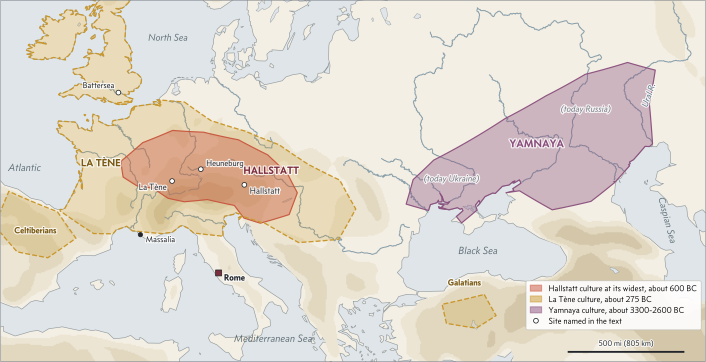
The Gauls
To a Roman, Gaul (Latin Gallia) meant any land where Gauls lived, and there were two of them. Cisalpine Gaul, “Gaul on this side of the Alps,” was the Po valley of northern Italy, which Rome had conquered around the time of the war with Hannibal (Chapter 3). Transalpine Gaul, “Gaul across the Alps,” was everything beyond. Its Mediterranean strip, from the Pyrenees to the Alps and up the Rhône to Lake Geneva, had been a Roman province since about 121 BC. Romans called it simply the Province, Provincia, a name that survives as Provence, and later Gallia Narbonensis (nar-boh-nen-sis), after its colony of Narbo, now Narbonne. North of the Province lay free Gaul, which the Romans called “long-haired Gaul”: roughly the land of modern France,This region roughly corresponds with modern-day France. → Gaul•• with Belgium, western Switzerland, and the German lands west of the Rhine.
Gaul was a land of farms and fortified hill towns. The Romans called such a town an oppidum (op-ih-dum) (plural oppida): a hilltop or river bend ringed with walls of timber, earth, and stone, with houses, workshops, and markets inside. Each people had its own towns, assemblies, and nobles, and each noble had a following of warriors and dependents. The Aedui (ed-yoo-eye) held Burgundy; the Arverni (ar-vur-nye) held the mountains of the Auvergne (oh-vairn), which still bear their name; the Sequani (sek-wuh-nye) lived in the Jura; and there were dozens more. The Gauls struck gold coins modeled on those of Philip II of Macedon (Vol. 6, The Greeks) and bought Italian wine by the shipload.
Above the nobles stood the druids, a class of priests who, Caesar says, also judged disputes, taught the young, and learned long verses by heart rather than writing their lore down. Caesar describes their sacrifices too. According to him, some Gauls built huge figures woven of willow twigs,A possibly false account describes this region’s inhabitants burning people inside huge willow-branch effigies in "wicker-man" sacrifices. → Gaul• effigies made like baskets, filled their limbs with living men, and set them on fire, offering criminals by preference and the innocent when criminals ran short. This is the “wicker man.” The Greek geographer Strabo tells a similar story of a colossus of straw and wood. Both men may have copied an earlier Greek writer, Posidonius (pos-ih-doh-nee-us), and no archaeologist has found any trace of such a burning, so the wicker man may be a tale told about foreigners rather than a fact. Caesar had good reasons to make the Gauls look cruel.
The Gauls’ worst enemies were one another. For generations the Aedui, allies of Rome whom the Senate had often called its “brothers,” had fought the Arverni and the Sequani for first place in Gaul. In the 60s BC the Sequani and the Arverni hired help from across the Rhine: Ariovistus (air-ee-oh-vis-tus), king of the Suebi (sway-bye), a Germanic people, who crossed the river with fifteen thousand warriors. At the battle of MagetobrigaThe Battle of Magetobriga took place in this region. → Gaul• (maj-eh-tob-rih-guh), fought somewhere in eastern Gaul near the river Saône (sohn), perhaps in 63 BC, the Germans and their allies crushed the Aedui, killing, as Caesar was later told, all their nobles and their whole council. The Aedui sent their leading man, Diviciacus (div-ih-shy-uh-kus), to Rome to beg the Senate for help. He stayed with Cicero, who describes him as a druid learned in the study of nature. Rome sent nothing. Ariovistus stayed in Gaul, took a third of the Sequani’s land, and demanded another third for more Germans crossing the Rhine. Caesar himself, as consul in 59 BC, had the Senate hail the king as a friend of the Roman people.
The Gallic Wars
In March 58 BC Caesar was still near Rome when news came that the Helvetii (hel-vee-shee-eye) were on the move. They lived in what is now Switzerland, hemmed in by the Rhine, the Jura mountains, and Lake Geneva, and they had decided to move west to the Atlantic coast. They burned their twelve towns and four hundred villages so that no one would be tempted to turn back. Caesar later found their lists, written in Greek letters, which counted 368,000 people. The easiest road west ran through the Roman Province. Caesar rode north to Geneva as fast as he could travel, broke down the bridge over the Rhône, and built a wall about 19 Roman miles long along the river to stop them.
The Helvetii turned instead to the narrow road through the land of the Sequani, and from there into the lands of the Aedui, plundering as they went. The Aedui sent envoys to Caesar. In Thomas Rice Holmes’s 1908 translation of Caesar, they pleaded that it was not right “that their lands should be ravaged, their children carried off into slavery, and their towns captured almost under the eyes of our army.” That plea gave Caesar what he wanted, a lawful reason to march out of his province. The Helvetii’s ravaging of the AeduiThis conflict was precipitated by the Helvetii ravaging the territory of the Aedui. → Gallic Wars• began the eight years of fighting called the Gallic Wars.
Caesar caught a quarter of the emigrants, the clan of the Tigurini (tig-yoo-rye-nye), still crossing the Arar (air-ar), now the Saône, and cut them to pieces. It was the same clan, he notes, that had killed a Roman consul half a century before and sent his beaten soldiers under the yoke, a frame of spears that the defeated had to stoop beneath. Then, near Bibracte (bih-brak-tee), the chief town of the Aedui, he fought the main body in a long battle and won. Caesar says that of the 368,000 who set out, about 110,000 went home, as he ordered, to farm their old lands as a buffer against the Germans.
Next the chiefs of Gaul came to him in tears, with Diviciacus as their spokesman, and begged him to rid them of Ariovistus. Caesar marched against the king. On the way his officers heard tales of the Germans’ size and fury, and panic swept the camp; some soldiers wrote their wills. Caesar called a council and declared that if no one else followed him, he would march with the Tenth Legion alone. Shamed, the army followed. In the plain of Alsace, near the Rhine, he routed the Germans, and Ariovistus escaped across the river in a small boat.
His second-in-command through all of it was Titus Labienus (lab-ee-ee-nus). A legatus, or lieutenant, was a senator appointed to command troops under a governor, and Labienus was Caesar’s chief lieutenant,This man's primary lieutenant during his campaigns was Titus Labienus. → Julius Caesar•Titus Labienus served as a lieutenant and second-in-command during this conflict. → Gallic Wars• often left in command of the winter quarters while Caesar went south to keep watch on Rome. The two had worked together before. As a tribune in 63 BC, Labienus had carried the law that let the people elect the pontifex maximus, just in time for Caesar’s election. He was a fine general, and in the civil war he would desert Caesar for Pompey (Chapter 8).
In 57 BC Caesar turned north against the Belgae (bel-jee). The Remi (ree-mye), around what is now Reims (reemz), went over to Rome at once. At the river Axona (ak-suh-nuh), the Aisne (ayn), Caesar held off a huge Belgic army, and at the river Sabis he was surprised in camp by the Nervii (nur-vee-eye). The battle nearly went the other way. Caesar writes that he snatched a shield from a soldier in the rear, pushed to the front line, called the centurions, the officers who led the companies of a legion, by name, and steadied his men until help came. When his report reached Rome, the Senate voted fifteen days of thanksgiving, longer than for any victory before.
Between 58 and 50 BC Caesar conquered for Rome nearly all of Gaul,This man conquered most of Gaul for Rome. → Julius Caesar••Julius Caesar conquered much of the territory of modern France during these wars. → Gallic Wars••Julius Caesar conquered this region. → Gaul• the lands that are now France and Belgium (Figure 7.6). Suetonius says that he turned the whole country, about 3,200 Roman miles around, into a province that paid forty million sesterces a year in tribute.

By 56 BC the alliance of the three was fraying. Pompey and Crassus were quarreling again, and Lucius Domitius Ahenobarbus (doh-mish-us uh-hee-noh-bar-bus), a candidate for consul, promised to strip Caesar of his command. In April Caesar invited his partners to Luca (loo-kuh), now Lucca in Tuscany. It was the southernmost town of his province, and a governor could not leave his province without giving up his army. Plutarch says so many men of power came to pay court that 120 lictors, the attendants who walked before magistrates with their bundles of rods, crowded the town, with more than two hundred senators. At the conference of Lucca the three renewed their pact. Pompey and Crassus would be consuls again in 55 BC and then take great provinces of their own, Spain and Syria, for five years, and Caesar’s command would run five more years.This politician met with his allies at the Lucca Conference to extend his governorship by five years. → Julius Caesar••
In 55 BC two Germanic peoples, the Usipetes (yoo-sip-eh-teez) and the Tencteri (tenk-teh-rye), crossed the lower Rhine into Gaul. Caesar held their envoys during a truce and fell on their camp, and by his own account most of them died. In Rome, Cato the Younger, the stern senator who led the opposition to Caesar (Chapter 8), proposed handing Caesar over to the Germans for breaking faith. To show the Germans that Rome could reach them anywhere, Caesar then decided to cross the Rhine, the river he treated as the border between Gaul and the Germans. He would not go by boat, which he thought beneath his dignity and that of the Roman people. Somewhere near what is now Koblenz, where the river is hundreds of yards wide and fast, his army bridged the Rhine in ten days.Julius Caesar’s army built a bridge across this river in about ten days. → Rhine River• Holmes’s translation gives Caesar’s own count: “Within ten days after the collection of the timber began, the whole work was finished.”
Caesar describes the bridge with an engineer’s pride. Pairs of heavy timber posts were driven into the riverbed at a slant, with a second pair 40 feet away leaning the other way, and beams joined each pair to the next, so that the harder the current pushed, the tighter the frame locked together. The army crossed, burned the villages of the Sugambri (soo-gam-bree), spent eighteen days beyond the Rhine, and marched back, destroying the bridge behind it. That summer Caesar also crossed to Britain, a story Chapter 13 tells.
In 54 BC, back from his second crossing to Britain, Caesar learned that his daughter Julia had died in childbirth; the baby died a few days later. Plutarch says that both her father and her husband grieved, and that their friends feared the bond that had kept the sickly commonwealth at peace was broken. The people of Rome, in spite of the tribunes, carried her body to the Campus Martius, the Field of Mars, and buried her there, a rare honor that normally needed a decree of the Senate.
That year the harvest in Gaul had been poor, and Caesar spread his legions among several peoples so that each could find food. One legion and five cohorts, each cohort a tenth of a legion (Chapter 4), wintered at Atuatuca (at-yoo-at-yoo-kuh), among the Eburones (eb-yoo-roh-neez) of what is now Belgium. Two lieutenants commanded them, Quintus Titurius Sabinus (suh-bye-nus) and Lucius Aurunculeius (aw-run-kuh-lee-us) Cotta (kot-uh). The Eburones were ruled by two kings, Ambiorix (am-by-uh-riks) and Catuvolcus (kat-yoo-vol-kus). Ambiorix attacked the camp, failed, and asked for a parley. He told the Romans that all Gaul was rising and that a great army of Germans had crossed the Rhine. As Caesar’s friend, he said, he would let them march safely to the nearest legion.
In Caesar’s account, which lays all the blame on Sabinus, Cotta argued for staying behind their walls, and Sabinus insisted on going. At dawn the column marched out. In a wooded valley 2 miles from camp Ambiorix’s Eburones killed Sabinus and CottaAmbiorix’s Eburones killed the Roman commanders Sabinus and Cotta during these wars. → Gallic Wars•• and nearly all their men. Sabinus was cut down while he was trying to talk with Ambiorix; Cotta died fighting; and the few who struggled back to the camp killed themselves that night rather than be taken. Fifteen cohorts were lost. Suetonius says that Caesar let his hair and beard grow until he had avenged them. Ambiorix escaped every hunt, and in the nineteenth century, Belgium made him a national hero.
In 53 BC Crassus died in Mesopotamia, destroyed with his army by the Parthians at Carrhae (Chapter 5). Of the three partners only two were left, and Julia no longer joined them. That year Caesar laid waste the land of the Eburones, crossed the Rhine a second time, and dealt with a plot among the Senones and the Carnutes (kar-noo-teez). At a council of Gaul held at Durocortorum (dur-oh-kor-tor-um), now Reims, he tried the plot’s leader, a Senonian noble named Acco (ak-oh). Then, before the assembled chiefs of Gaul, Caesar had Acco flogged to death,A general flogged the chief Acco to death in front of his allies during this conflict. → Gallic Wars• the old Roman punishment that he calls the custom of the ancestors. The Gallic nobles watched and drew their own conclusion: Caesar meant to rule them as a conqueror. Within months they were planning a general revolt.
Alesia
Early in 52 BC Rome itself fell into chaos. Clodius was murdered in a brawl on the Appian Way, the great road south from Rome, his supporters burned the Senate house at his funeral, and Pompey was made sole consul to restore order (Chapter 5). The Gauls heard the news and believed Caesar would be kept in Italy. The Carnutes struck first, killing the Roman traders at Cenabum (sen-uh-bum), now Orléans (or-lay-ahn). Within a day the news had been shouted from field to field across Gaul to the Arverni, and there a young nobleman called his followers to arms.
Vercingetorix (vur-sin-jet-uh-riks) was the son of Celtillus (kel-til-us), once the leading man of all Gaul, whom the Arverni had put to death for trying to make himself king. When Vercingetorix began stirring up war, his uncle and the other elders of Gergovia (jur-goh-vee-uh), the Arverni’s chief town, threw him out. He raised an army among the poor of the countryside, came back, drove out his enemies, and was hailed as king. Then he sent envoys to the other peoples, and one after another they joined him and gave him the supreme command. For the first time in the war, a king of the Arverni united GaulThis leader of the Arverni united Gallic resistance against Caesar. → Vercingetorix• against Caesar.

Vercingetorix knew he could not beat the legions in open battle, so he made war on their stomachs. He had the Gauls burn their own villages and barns around the Roman line of march, so that the army could find no grain. Only one town was spared, at its people’s pleading: Avaricum (uh-var-ih-kum), the rich capital of the Bituriges (bit-yoo-ry-jeez), now Bourges (boorzh). Caesar besieged it for nearly a month in cold and rain, stormed it, and spared no one. By his count, of forty thousand people barely eight hundred escaped.
Then Caesar marched south against Gergovia, high on a plateau in the Auvergne. The assault went wrong. Some of his legions charged up to the town wall, though Caesar says he had sounded the recall, and the Gauls counterattacked down the slope. The Romans were beaten at Gergovia,The Romans were defeated at the Battle of Gergovia during this conflict. → Gallic Wars•• losing, by Caesar’s own figures, nearly seven hundred men, forty-six of them centurions. It was the worst defeat Caesar suffered in person in Gaul. After Gergovia even the Aedui, Rome’s oldest friends in Gaul, joined the revolt.
Caesar joined forces with Labienus, who had beaten the Gauls near Lutetia (loo-tee-shuh), the town of the Parisii (puh-riz-ee-eye) that became Paris, and turned east toward the Sequani. Vercingetorix’s cavalry attacked the Roman column on the march and was routed. Plutarch suggests that Caesar was hard pressed at first in this fight, and says that the Arverni later showed visitors a small sword in one of their temples, taken, they said, from Caesar. He saw it himself, smiled, and would not let his friends take it down, since it had been offered to the gods. After the rout the king fell back with his whole army, eighty thousand men by Caesar’s count, to Alesia (uh-lee-zhuh). It was a fortified town of the Mandubii (man-doo-bee-eye) on a high hill in Burgundy, with rivers on two sides. He meant to hold it until all Gaul came to his rescue.

Caesar would not storm another hilltop. He decided to starve the town out, and his soldiers began to dig (Figure 7.8). They ringed Alesia with a line of works 11 Roman miles around, about 16 kilometers. Across the open plain to the west they first cut a trench 20 feet wide; behind it came two more ditches, one filled with water from the river, then an earth rampart 12 feet high with a palisade and battlements, and towers every 80 feet. In front of the works they planted traps. There were rows of sharpened branches, pits hiding fire-hardened stakes under brushwood, which the soldiers called “lilies,” and blocks of wood set with iron hooks. Vercingetorix had sent his horsemen out before the ring closed to summon all Gaul, so Caesar built a second line 14 Roman miles around. One line faced inward, toward the defenders,Caesar built both inward- and outward-facing fortifications at this siege to face the defenders and a relief army. → Siege of Alesia••• and the other faced outward, toward the army that was coming to relieve them. Between them, in a ring of camps, waited the legions.
Inside, food ran short. The Gauls sent out the Mandubii, the townspeople, with their wives and children, hoping Caesar would take them as slaves and feed them. Caesar posted guards on his rampart and refused to let them through. He does not say what became of them, trapped between the two armies.
At last the relief army arrived. Caesar puts it at eight thousand horsemen and a quarter of a million foot soldiers, probably far more than ever came, and it camped on the hills a mile from his outer line. Twice the Gauls attacked from both sides at once, the men in the town filling the ditches while the men outside stormed the outer works, and twice they were thrown back. Then they found the weak point. On the north side, a hill was too large to bring inside the lines, and the camp of two legions stood on its slope below the crest. Vercassivellaunus (vur-kas-ih-vuh-law-nus), Vercingetorix’s cousin, led sixty thousand picked men around it by night and hid behind the hill. At noon he struck the camp from above, while Vercingetorix attacked the inner line from the town.
Caesar sent Labienus with six cohorts to hold the camp, rode along the lines encouraging the men, and finally came himself, known from far off, he writes, by the color of the cloak he wore in battle. He sent cavalry around behind the attackers. The Gauls broke and fled, and the relief army melted away. The next day Vercingetorix called a council and offered himself, alive or dead, to save the rest. Caesar tells the surrender in a few flat words: the chiefs were brought to him, Vercingetorix was handed over, and the weapons were thrown down. Plutarch, writing a century and a half later, paints it. The king put on his finest armor, rode out of the gates on a decorated horse, rode around Caesar on his seat, jumped down, threw off his armor, and sat silent at Caesar’s feet. Caesar had defeated and captured Vercingetorix at Alesia,This man defeated and captured Vercingetorix at Alesia. → Julius Caesar•••Caesar captured Vercingetorix at Alesia during these wars. → Gallic Wars••Vercingetorix was defeated at the Battle of Alesia in this region. → Gaul•• and the great revolt of Gaul was over (Figure 7.9).

Vercingetorix was kept a prisoner for six years, led in Caesar’s triumph in 46 BC, and then put to death. Nineteen centuries later he became a hero of France. In 1865 Napoleon III, emperor of the French and nephew of the great Napoleon, set up a giant statue of him on the hill of Alise-Sainte-Reine (ah-leez sant ren), where the emperor’s own diggers had found Caesar’s ditches.
A year of hard fighting remained. At Uxellodunum (uk-sel-oh-doo-num), in 51 BC, Caesar cut off the hands of every defender who had borne arms, as a warning to the rest. By 50 BC Gaul was quiet, and Caesar was rich beyond counting and the most famous man in Rome, with an army devoted to him. But the alliance that had sent him there was gone. Julia and Crassus were dead, and Pompey had drawn close to Caesar’s enemies in the Senate, who meant to prosecute Caesar the moment his command ended and he became a private citizen. In January 49 BC, ordered to give up his army, the conqueror of Gaul crossed the Rubicon,This conflict's winning general later crossed the Rubicon. → Gallic Wars• the little river that marked the edge of his province, with a single legion, and began a civil war (Chapter 8).
The Commentaries
While his army rested in winter quarters, Caesar wrote. He called his books commentaries. A commentarius was a plain record, the kind of notes a general or an official kept, from which a historian might later write a polished history. Caesar’s Commentaries on the Gallic WarThis man wrote Commentaries on the Gallic War. → Julius Caesar••Julius Caesar wrote commentaries on wars in this region. → Gaul•• (Commentarii de Bello Gallico (kom-en-tar-ee-ee day bel-oh gal-ih-koh)) tell the war in seven books, one for each year from 58 to 52 BC, as if their author were only supplying the facts. Whether he wrote each book at the end of its year or all seven together in the winter after Alesia is still debated.
The most striking thing is the voice. Caesar never writes “I.” He writes “Caesar”: Caesar learned, Caesar decided, Caesar hurried to the army. The effect is of a calm report by an impartial observer. Speeches are mostly summarized rather than quoted, enemies are given their reasons, and every number is exact, though enemy numbers are often enormous. Readers in Rome met a general who was always quick, reasonable, and right. That was the purpose: the books appeared while Caesar’s enemies in the Senate were trying to end his command.
The first book begins by dividing Gaul into three parts.This work opens by dividing Gaul into three parts. → Commentaries on the Gallic War•• In Latin the sentence is Gallia est omnis divisa in partes tres. In Holmes’s translation it reads: “Gaul, taken as a whole, is divided into three parts, one of which is inhabited by the Belgae, another by the Aquitani, and the third by a people who call themselves Celts and whom we call Gauls.” The three, Caesar goes on, differ in language, customs, and laws. “Of all these peoples the bravest are the Belgae,” because they live farthest from the comforts of the Province and nearest the Germans, with whom they are always at war. Then he turns straight to the Helvetii and their plan to emigrate, and the war begins.
Cicero, the greatest orator of the age and no friend of Caesar’s politics, admired the books. Suetonius quotes his verdict from the Brutus, his history of Roman oratory. In Thomson’s translation, Cicero calls them “plain, precise, and elegant, without any affectation of rhetorical ornament.” Cicero added that by preparing materials for historians Caesar had frightened sensible men away from writing the history at all. For the same reasons, generations of students have learned Latin from the Commentaries: the words are few, the grammar regular, and the story moves.
Caesar stopped after the seventh book, with Alesia. The civil war began before he could write up his last two years in Gaul, and he went on instead to his Commentaries on the Civil War. One of his officers and friends, Aulus Hirtius (hur-shee-us), filled the gap. Hirtius added an eighth book,Aulus Hirtius added an eighth book to this work. → Commentaries on the Gallic War•• covering 51 and 50 BC, so that the story ran on to the point where the Civil War begins. In his preface he wrote that everyone admired Caesar’s books, but that his friends admired them more. In the words Suetonius quotes, others “only know how well and correctly he has written, but we know, likewise, how easily and quickly he did it.”
What to remember
- Caesar, born in 100 BC, a patrician and Marius’s nephew by marriage, refused Sulla’s order to divorce Cinna’s daughter Cornelia; enemies mocked him as “the queen of Bithynia” for his stay with King Nicomedes IV.
- Plutarch tells that Caesar, held by pirates, told them to ask fifty talents instead of twenty, and later crucified them.
- Caesar was elected pontifex maximus in 63 BC and divorced Pompeia after Clodius Pulcher broke into the Bona Dea rites in 62 BC.
- In 60 BC Caesar, Pompey, and Crassus formed the First Triumvirate; as consul in 59 BC Caesar married his daughter Julia to Pompey and won Gaul as his province.
- Before Rome came, the Yamnaya herded on the steppe of Ukraine and Russia; the Hallstatt culture grew rich on salt and entered the Iron Age; La Tène, of the later Iron Age, made the swirling art of the Battersea Shield.
- Gaul, roughly modern France, was divided among rival peoples; the Sequani and Ariovistus beat the Aedui at Magetobriga, and Caesar describes, perhaps falsely, wicker-man sacrifices.
- The Gallic Wars (58–50 BC) began when the Helvetii ravaged the Aedui; Labienus was Caesar’s second-in-command; the Lucca conference (56 BC) extended his command five years; his army bridged the Rhine in ten days (55 BC); Ambiorix’s Eburones killed Sabinus and Cotta (54 BC); Acco was flogged to death (53 BC).
- In 52 BC Vercingetorix of the Arverni united Gaul and beat Caesar at Gergovia, but at Alesia Caesar’s two lines, one facing in and one facing out, defeated both the town and the relief army, and Vercingetorix surrendered.
- Caesar’s Commentaries on the Gallic War, written in the third person, open by dividing Gaul into three parts; Aulus Hirtius added the eighth book.
Chapter 8 · 25 clues
Caesar’s Civil War and the Ides of March
On an evening in January 49 BC, Gaius Julius Caesar was dining with friends at Ravenna, a town near the Adriatic coast of northern Italy. He had spent the day in plain sight, watching a public show and looking over the plans for a school of gladiators he meant to build. After sunset he excused himself. According to his biographer Suetonius, he slipped away in a hired carriage drawn by mules from a nearby mill, with only a few companions. The torches went out, the party lost the road, and they wandered in the dark until a guide led them on foot along narrow paths.
Toward dawn Caesar reached a body of his soldiers waiting on the bank of a small river. Behind him lay the province he had governed for nine years. Ahead lay Italy, and Rome, about 200 miles away by road. On this bank he was a lawful governor at the head of a lawful army. If he crossed, he would be a rebel making war on his own country.
From the Rubicon to Pharsalus
How Caesar came to that river is the story of an alliance that fell apart. In 60 BC he had joined the two most powerful men in Rome, the general Pompey the Great and the millionaire Marcus Licinius Crassus, in the private partnership historians call the First Triumvirate (Chapter 7). It made Caesar consul in 59 BC and then governor of Gaul, which he spent eight years conquering. But Pompey’s wife, Caesar’s daughter Julia, died in 54 BC, and Crassus died fighting the Parthians at Carrhae in 53 BC (Chapter 5). With nothing left to bind them, Pompey drifted toward Caesar’s enemies in the Senate. These were the optimates, “the best men” (Chapter 4), conservative senators who wanted the Senate to rule and distrusted any one man who grew too great.
Caesar’s danger was legal as well as political. While he held his command, no one could put him on trial. The day he became a private citizen, his enemies meant to prosecute him for the high-handed things he had done as consul, and Cato the Younger, a senator famous for his rigid honesty, swore that he would. So Caesar meant to keep his army until he could pass straight into a second consulship, which a law of 52 BC let him seek without coming to Rome. His enemies insisted that he give up the army first. In early January 49 BC the Senate ordered him to, and two tribunes of the plebs vetoed the order. On January 7 the Senate overrode them with its “ultimate decree,” the emergency order telling the magistrates to see that the state came to no harm (Chapter 2), and the two tribunes, threatened, fled north to Caesar disguised as slaves. One of them was Marcus Antonius, Mark Antony in English, a burly cavalry officer of about thirty-four who had served under Caesar in Gaul and was famous for his courage, his debts, and his drinking.
A Roman governor held imperium (the Stage), the lawful right to command soldiers, only inside his own province. Caesar’s province of Cisalpine Gaul, “Gaul on this side of the Alps,” ended on the Adriatic coast at a stream called the Rubicon (Figure 8.1). A governor who led troops across that line lost his command, and every soldier who followed him became an outlaw. Suetonius says that while Caesar stood hesitating on the bank, a stranger of noble looks appeared, sitting and playing a reed pipe. Soldiers gathered to listen, and the stranger snatched a trumpet from one of them, sounded the advance, and crossed. Then, in Suetonius’s story, Caesar crossed the Rubicon saying the die was cast.This man reportedly said “the die is cast” when crossing the Rubicon to begin a civil war. → Julius Caesar••• In Alexander Thomson’s translation of Suetonius, as revised by Thomas Forester, his words were: “Let us go whither the omens of the Gods and the iniquity of our enemies call us. The die is now cast.” A gambler who has thrown the dice cannot take the throw back. In Latin, “the die is cast” is alea iacta est (ah-leh-ah yahk-tah est). Plutarch, a Greek, says that Caesar spoke the words in Greek, quoting a saying of men who stake everything on one bold stroke.
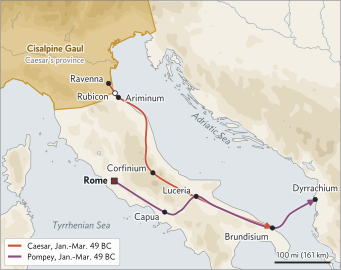
He moved faster than anyone expected. Plutarch says he had only five thousand foot soldiers and three hundred horsemen with him, but the towns of Italy opened their gates. Pompey had once boasted that he had only to stamp his foot on the ground of Italy to raise armies. Now he abandoned Rome, taking the consuls and most of the Senate with him, and marched south to Brundisium, the port for Greece. At Corfinium (kor-fin-ee-um) Caesar captured a Pompeian army and its general, Lucius Domitius Ahenobarbus, and then let the general go. This was Caesar’s clemency, in Latin clementia: unlike Sulla a generation earlier, who had murdered his enemies by the thousand (Chapter 4), he pardoned Romans who fought against him. Pompey sailed from Brundisium in March, and Caesar was master of Italy in sixty days. That summer he marched to Spain and forced Pompey’s generals there to surrender at Ilerda (ih-lur-duh).
Pompey meant to fight from the East, where he had won his greatest victories and where kings and cities owed him favors. In January 48 BC Caesar slipped across the Adriatic, and Antony brought over the rest of the army that spring. At Dyrrachium (dih-ray-kee-um), on the coast of what is now Albania, Caesar tried to wall in Pompey’s larger army with miles of earthworks. In July Pompey broke out and beat him. Plutarch reports that Caesar said afterward that the enemy would have won the war that day if they had had a commander who knew how to win.
Caesar marched inland into Thessaly, the great plain of northern Greece, and Pompey followed. On August 9, 48 BC, the armies met near the town of Pharsalus (Figure 8.2). By Caesar’s own count, Pompey had forty-five thousand infantry and seven thousand cavalry, and Caesar twenty-two thousand infantry and a thousand cavalry. Caesar put Mark Antony in command of his left wing,This man commanded the left wing at the Battle of Pharsalus. → Mark Antony•• beside a stream, and took the right himself. Pompey planned to send his cavalry around Caesar’s open right flank. It was led by Titus Labienus, Caesar’s second-in-command in Gaul, who had changed sides (Chapter 7). Caesar guessed the plan. Plutarch says he had quietly taken six cohorts, three thousand men in all, from his rear line and hidden them behind his right.
When Pompey’s horsemen charged, these men ran out and thrust their javelins up at the riders’ faces, as Caesar had told them to, and the cavalry broke and fled. The hidden cohorts then fell on the flank of Pompey’s infantry, and his whole army gave way. Walking over the field afterward among the Roman dead, Caesar said, as his officer Asinius Pollio remembered it, that they had wanted it so: if he had given up his army, they would have condemned him. He pardoned most of the prisoners. A senator named Marcus Junius Brutus, whom Caesar had ordered his men to spare, escaped to Larissa, Plutarch says, and wrote to Caesar, who gladly forgave him.
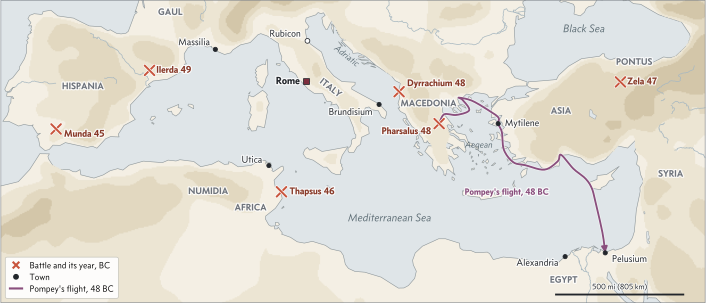
Beaten by Caesar at Pharsalus, Pompey fledThis man defeated Pompey at the Battle of Pharsalus. → Julius Caesar••After Caesar defeated him at Pharsalus, this man fled to Egypt. → Pompey the Great•• to Egypt. He picked up his wife, Cornelia, on the island of Lesbos and sailed for the kingdom whose young king, Ptolemy XIII, owed his throne to the help Pompey had given his father. The king was about fourteen and at war with his older sister and co-ruler, Cleopatra. His advisers, the eunuch Pothinus (poh-thy-nus), the tutor Theodotus (thee-od-uh-tus), and the general Achillas (uh-kil-us), decided that a living Pompey would bring Caesar’s anger down on them and a dead one would earn his thanks. On September 28, 48 BC, they sent a small boat to bring him ashore at Pelusium (pih-loo-see-um), at the eastern mouth of the Nile. As he rose to step out, a Roman officer who had once served under him stabbed him from behind. In sight of his wife, Pompey was murdered and beheaded by order of Ptolemy’s court,This man was murdered and beheaded in Egypt on the orders of Ptolemy XIII’s court. → Pompey the Great•• and his body was left on the beach, a scene also told from Egypt’s side (Vol. 5, In the Beginning).
Caesar arrived at Alexandria a few days later, was shown Pompey’s head, and wept. Then he stayed. Cleopatra, twenty-one years old, had herself carried into his quarters, as Plutarch tells it, rolled up in a bedding sack, and she became Caesar’s lover.Cleopatra had a relationship with this man. → Julius Caesar• He took her side in a war against her brother that kept him besieged in Alexandria through the winter. When it ended in 47 BC, Ptolemy XIII had drowned, Cleopatra was queen, and she soon bore a son the Alexandrians called Caesarion (sih-zair-ee-on), “little Caesar” (Vol. 5, In the Beginning). Caesar went north to deal with Pharnaces (far-nuh-seez), a son of Rome’s old enemy Mithridates, who had seized lands in Asia Minor. He beat him at Zela (zee-luh) in a battle so quick that he summed it up in three Latin words, veni, vidi, vici, “I came, I saw, I conquered.” Plutarch says he wrote them in a letter to a friend; Suetonius says they were carried on a placard in his triumph.
Cato the Younger
The war did not end with Pompey, because his side had a conscience that outlived him. Marcus Porcius Cato, born in 95 BC, is called Cato the Younger to tell him from his great-grandfather, Cato the Elder, the censor who had demanded the destruction of Carthage (Chapter 3). He was a Stoic, a follower of the Greek philosophy that taught that virtue is the only good and that a wise man stays calm in pain and in fortune (Vol. 6, The Greeks). He lived it in public. Plutarch says he walked where others rode, went bareheaded in heat and cold, and sat as a judge without shoes, in a city where most magistrates took bribes and he took none. He led the optimates in the Senate and fought Pompey, Crassus, and Caesar from the day their alliance began. As consul in 59 BC, Caesar had him dragged from the Senate to prison for speaking against his laws.

His enemies found a clever way to be rid of him for a while. In 58 BC Publius Clodius, the tribune who was about to drive Cicero into exile (Chapter 5), passed a law to annex Cyprus. The island was ruled by a brother of Egypt’s king, an uncle of Cleopatra. Clodius had Cato named to carry out the annexation, praising him as the most honest man in Rome. Cato called it an injury dressed up as a favor, but the people voted it, and so Cato was sent away to annex Cyprus,This man was sent away from Rome to oversee the annexation of Cyprus. → Cato the Younger• with no soldiers and only two clerks. The king poisoned himself rather than lose his throne. Cato sold the royal treasure at auction, standing over every sale to push up the price, and shipped home nearly seven thousand talents, about 200 tons of silver. He tied the chests to long ropes with cork floats, so that they could be found if a ship sank. Both copies of his accounts were lost on the way, one in a shipwreck and one in a fire, and Plutarch says the loss vexed him.
In the civil war Cato took Pompey’s side, though he mourned the war itself. After Pharsalus he led the survivors through the Libyan desert to the Roman province of Africa, in what is now Tunisia. There Pompey’s father-in-law, Quintus Metellus Scipio, and Juba (joo-buh), the king of Numidia, raised a new army. Cato took charge of Utica, the provincial capital, a port near the ruins of Carthage (Vol. 5, In the Beginning). On April 6, 46 BC, Caesar destroyed Scipio and Juba at Thapsus (thap-sus), more than 100 miles down the coast.
Cato spent the next days getting the senators and merchants of Utica away by sea. Then, Plutarch says, he dined with his friends and argued that only the good man is free and every wicked man a slave, so warmly that they guessed what he meant to do. In his room he read Plato’s Phaedo (fee-doh), the dialogue on the soul that tells of the death of Socrates (Vol. 6, The Greeks). His son had taken away his sword. Cato demanded it, and when it was brought he read the book through again and slept. Near dawn at Utica, rather than accept his life as a gift of Caesar’s clemency, Cato stabbed himself in the chest.This Optimates politician killed himself at Utica after Thapsus rather than accept Caesar’s clemency. → Cato the Younger•• The wound did not kill him at once, and when his doctor tried to close it, Cato pushed him away and tore it open. Caesar arrived soon after. According to Plutarch, in Clough’s translation, he said: “Cato, I grudge you your death, as you have grudged me the preservation of your life.”
The Romans called him Cato Uticensis (yoo-tih-sen-sis), “of Utica.” The quarrel over him went on in books: Cicero wrote a eulogy called Cato, and Caesar, between campaigns, answered with an Anti-Cato. Both are lost. Cato’s children included a son, Marcus, and a daughter, Porcia, whose second husband would help kill Caesar (Figure 8.4).
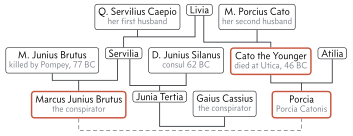
The dictatorship
In 46 BC Caesar came home and celebrated four triumphs, the victory parades through the city (the Stage), for Gaul, Egypt, Pontus, and Africa. Pompey’s sons raised one more army in Spain, and at Munda, on March 17, 45 BC, Caesar won the hardest battle of his life. He told his friends, Plutarch says, that he had often fought for victory but that this was the first time he had fought for his life. Labienus died there, and the war was over.
The Senate had already made him dictator, the emergency office the Republic had once granted for six months at most (the Stage). After Thapsus, in 46 BC, it had named him dictator for ten years, and in February 44 BC it made him dictator for life. He used the power fast. He planned colonies for his veterans overseas, on the ruins of Carthage and of Corinth among other places, and he gave the Romans the Julian calendar of 365 days with a leap year, starting on January 1, 45 BC (the Stage). He also packed the Senate. Sulla had raised it to about six hundred members, and Cassius Dio says that Caesar expanded the Senate to nine hundred,This man expanded the Roman Senate to about 900 members. → Julius Caesar• filling the new seats with his officers, his friends from Italian towns, and even men from Gaul. Rome laughed. Suetonius quotes a notice posted in the streets that asked people, as a good deed, not to show any new senator the way to the Senate house.
The honors piled up. His statue stood among the statues of the old kings on the Capitol, his head appeared on Rome’s coins, as no living Roman’s had before, and his birth month, Quintilis, was renamed Julius, our July. He once received the whole Senate without rising from his seat, and Suetonius says nothing made him more hated. On February 15, 44 BC, Rome kept the Lupercalia (loo-pur-kay-lee-uh) (Vol. 4, Classical Myth), an ancient festival in which young nobles ran through the streets stripped to a goatskin, striking the women they met with leather thongs, which was thought to help them bear children. Antony, now consul with Caesar, ran among them. Caesar watched from the speakers’ platform in the Forum, Rome’s main public square, sitting in a golden chair and a triumphal robe. Romans had hated the word “king” since, by tradition, they drove out Tarquin the Proud in 509 BC (Chapter 1). Antony came up and offered him a diadem, the white band that kings wore, wound with laurel. A few people cheered. When Caesar refused the crown,This leader refused a crown offered by Mark Antony. → Julius Caesar•• the whole crowd roared. Antony offered it again, Caesar refused again, and he ordered it taken to the Capitol and offered to Jupiter. Whether he staged the scene to silence the talk of kingship or to test it, no one knew then or knows now.
Caesar was fifty-five, and he was restless. He planned to drain marshes, cut a canal through the Isthmus of Corinth, and above all to make war on the Parthians, the Iranian kings who had destroyed Crassus at Carrhae. Sixteen legions and ten thousand cavalry were being gathered, and his great-nephew Octavius was waiting with the army at Apollonia, on the Adriatic coast. Caesar meant to leave Rome on March 18, 44 BC, and expected to be gone for three years.
The conspiracy and the Ides
To many senators a dictator for life was a king in all but name. They had lost the right to decide anything, and the clemency that spared them made them Caesar’s dependents. Suetonius says that someone wrote under the statue of Lucius Junius Brutus, who had expelled the kings in 509 BC, “Would you were now alive!” The plotters gathered around two men. The first was Gaius Cassius Longinus (lon-jy-nus), a hard and able soldier who had led the survivors of Crassus’s army back to Syria after Carrhae. He had fought for Pompey and been pardoned, and in 44 BC he was a praetor, one of the city’s judges. Plutarch makes him the first mover of the plot.
The second was Marcus Junius Brutus, who claimed descent from the Brutus of 509 BC. He was about forty, serious, bookish, and proud of his honesty. His mother was Servilia (sur-vil-ee-uh), Cato’s half-sister, and Caesar’s lover for many years.This man had an affair with Servilia, the mother of Brutus. → Julius Caesar•• Suetonius says she was the woman Caesar loved most, and that he once bought her a pearl that cost six million sesterces, enough to pay more than six thousand of his soldiers for a year. Some Romans whispered that Brutus was Caesar’s son, though Caesar was only fifteen when Brutus was born. Brutus had fought for Pompey, although Pompey had killed his father, and after Pharsalus Caesar not only pardoned him but promoted him. He made Brutus governor of Cisalpine Gaul, then city praetor, and marked him out for a future consulship. According to Plutarch, Caesar trusted Brutus as a close friend.Julius Caesar was this man's close friend and confidant. → Brutus• Warned against him, Caesar touched his own body and asked whether Brutus would not wait for it to die.
In 45 BC Brutus divorced his wife and married his cousin, Porcia, Cato’s daughter, whose first husband had been Caesar’s old enemy Bibulus. She is known as Porcia Catonis, “Porcia, daughter of Cato.” As the husband of Porcia Catonis,This character was the husband of Porcia Catonis. → Brutus• Brutus was bound by marriage as well as blood to the man who had died rather than be pardoned. Plutarch tells how she learned the secret. Seeing her husband sleepless with worry, she sent her maids out of the room and gave herself a deep gash in the thighAccording to Plutarch, this wife of Brutus wounded her thigh to show that she could endure pain and keep his secrets. → Porcia Catonis• with a little knife for trimming nails. A fever followed. Then she told him that she had tested herself and could bear pain, so that he could trust Cato’s daughter with whatever he was hiding.
Brutus’s name made the plot respectable, and with Cassius he led the conspiracy.This character was a leading conspirator in the assassination of Julius Caesar. → Brutus••This character partners with Cassius to commit an assassination. → Brutus• Suetonius counts about sixty conspirators. Many were men Caesar had promoted, like Decimus Brutus, a kinsman of Marcus and one of Caesar’s best officers, and Gaius Trebonius (trih-boh-nee-us), who had served as Caesar’s general in Gaul and been made consul in 45 BC. Appian of Alexandria, a Greek who wrote a history of Rome’s civil wars about two hundred years later, lists the conspirators near the endAppian lists the conspirators involved in this event near the end of Book 2 of his Civil Wars. → assassination of Julius Caesar• of the second book of his Civil Wars. The plotters argued over where to strike: on the Campus Martius at an election, on the Sacred Way through the Forum, or at a theater door. Brutus refused to let them kill Antony too, because they were killing a tyrant, he said, and no one else. Then the calendar decided for them. Caesar was to leave for ParthiaThe conspirators behind this event acted shortly before their target’s planned departure for a Parthian campaign. → assassination of Julius Caesar• on March 18, protected by his army, so they had to strike before then. The Senate was called to meet on the Ides of March, the fifteenth (the Stage).
The meeting place had a bitter fitness. The old Senate house in the Forum had burned in a riot in 52 BC, and its replacement was not finished. So the Senate met in a hall at the end of the great portico behind the Theater of Pompey (Figure 8.5). Pompey had dedicated it in 55 BC as the first stone theater in Rome, out on the Campus Martius, the Field of Mars, an open plain beside the Tiber outside the old city. A statue of Pompey stood in the hall. Suetonius says the soothsayer Spurinna (spuh-rin-uh) had warned Caesar of danger that would come no later than the Ides of March. On the night before, his wife Calpurnia dreamed that she held him murdered in her arms. Caesar nearly stayed home, but Decimus Brutus came to fetch him and laughed at the omens. As he went into the hall, Caesar laughed at Spurinna, because the Ides had come and he was unharmed. “They are come, indeed,” Thomson’s Suetonius has the soothsayer reply, “but not past.”
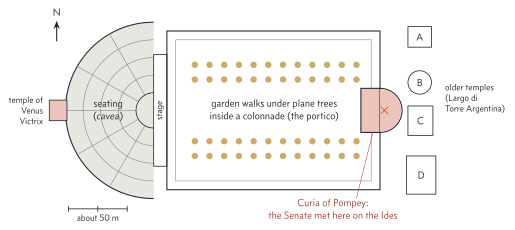

Trebonius kept Antony talking outside the door, Plutarch says in his Life of Brutus. Inside, the senators rose as Caesar entered and took his seat. The conspirators crowded around his chair. Lucius Tillius Cimber (til-ee-us sim-ber) came up to beg for the recall of his brother from exile, and the others pressed in as if to support him. When Caesar waved them off, Tillius Cimber grabbed his togaTillius Cimber grabbed the victim’s toga, allowing Casca to strike the first blow during this event. → assassination of Julius Caesar• at both shoulders and pulled it down from his neck. That was the signal. Publius Servilius Casca struck first, from behind, a glancing blow near the neck, and Caesar seized his arm. Plutarch says Caesar cried out in Latin, “Vile Casca, what does this mean?” and Casca called to his brother in Greek for help.
Then they were all on him. On the Ides of March, 44 BC, in the Senate’s own meeting, the conspirators, senators led by Brutus and Cassius and calling themselves the Liberatores (lib-er-uh-tor-eez), “the liberators,” stabbed Caesar to death with daggers.This man was assassinated on the Ides of March in 44 BC by conspirators including Brutus and Cassius. → Julius Caesar•••Brutus and Cassius led the “Liberatores” in this event on the Ides of March, 44 BC. → assassination of Julius Caesar••On the Ides of March, members of this body stabbed Julius Caesar to death. → Roman Senate• They had agreed that every man would strike a blow, and in the crush they wounded one another; Brutus was cut in the hand. Suetonius counts twenty-three wounds and says a doctor named Antistius (an-tis-tee-us) found only one of them fatal, the second, in the chest. Caesar pulled his toga over his head and drew its folds down over his legs so that he would fall decently. Plutarch says he fell at the foot of Pompey’s statue, which was wet with his blood (Figure 8.7).

Suetonius says that Caesar uttered no word, only a groan at the first blow. Yet he adds that some writers recorded that when Marcus Brutus rushed at him,Suetonius records a tradition that this man said “kai su, teknon?” when attacked by Brutus. → Julius Caesar• Caesar said in Greek, kai su, teknon (ky soo tek-non), “you too, child?” The famous Latin line “Et tu, Brute?” comes from no ancient writer at all.
Brutus tried to speak, but the senators ran. The conspirators marched to the Capitol, holding up their bloody daggers and shouting that Rome was free. They had made no plan for what came next. Two days later the Senate met and, on Cicero’s proposal, agreed both to pardon the killers and to keep every law and appointment Caesar had made. Then Caesar’s will was read at Antony’s house. It adopted his great-nephew Octavius as his son (Chapter 9), gave his gardens across the Tiber to the people, and left three hundred sesterces to every citizen of Rome.
On the day of the funeral, about March 20, Antony spoke over Caesar’s body in the Forum.Mark Antony gave his funeral oration for Caesar at this location. → Roman Forum• Suetonius says he gave hardly a speech at all: he had a herald read out the honors the Senate had voted Caesar and the oath it had sworn to protect him, and added a few words. Plutarch and Appian tell it more grandly, with Antony holding up the bloody toga and counting the holes. Either way, the crowd broke loose. It piled the benches of the law courts into a pyre and burned the body there in the Forum. Then it ran with torches to burn the conspirators’ houses, and tore to pieces a poet named Cinna, a friend of Caesar’s and probably the friend of Catullus (Chapter 6), whom it mistook for another Cinna who had spoken against him.

Within weeks Brutus and Cassius had left Rome, and the war they had hoped to prevent began again. Trebonius, who had helped to organize the plot and had kept Antony at the door, took up the governorship Caesar had given him in the province of Asia, the west of what is now Turkey. There, in January 43 BC, Publius Cornelius Dolabella (dol-uh-bel-uh), Cicero’s former son-in-law and a young noble who had fought for Caesar, seized the city of Smyrna on his way to govern Syria. The first of the Liberators to die, Trebonius was murdered by Dolabella.Trebonius, later murdered by Dolabella in Asia, helped organize this event. → assassination of Julius Caesar• In the East, Brutus paid his troops with silver coins that told the whole story (Figure 8.8). Within three years he and Cassius would both be dead, at Philippi (fih-lip-eye) (Chapter 9).
What to remember
- In January 49 BC Caesar led his army over the Rubicon, the border of his province, and so began a civil war; Suetonius says he said “the die is cast.”
- At Pharsalus in 48 BC Caesar beat Pompey, with Antony on his left wing; Pompey fled to Egypt and was murdered at Pelusium on the orders of Ptolemy XIII’s advisers.
- Caesar became Cleopatra’s lover in Alexandria, then won at Zela (47 BC), Thapsus (46 BC), and Munda (45 BC).
- Cato the Younger, the Stoic leader of the optimates, had annexed Cyprus in 58 BC; he killed himself at Utica after Thapsus rather than accept Caesar’s clemency.
- As dictator Caesar enlarged the Senate to about nine hundred and reformed the calendar; he refused the crown Antony offered at the Lupercalia in February 44 BC.
- Brutus, son of Caesar’s lover Servilia and husband of Cato’s daughter Porcia, led the plot with Cassius; Porcia proved she could keep the secret by wounding her own thigh.
- On the Ides of March, 44 BC, three days before Caesar was to leave for Parthia, the conspirators stabbed him in the Senate’s meeting hall at Pompey’s theater; Tillius Cimber pulled at his toga and Casca struck first.
- Antony spoke at Caesar’s funeral in the Forum, and the crowd burned the body there; Trebonius was the first conspirator to die, killed by Dolabella in Asia in 43 BC.
Augustus and His Poets
Chapter 9 · 46 clues
Antony, Cleopatra, and Augustus
In the spring of 44 BC a sickly eighteen-year-old named Gaius Octavius was studying Greek oratory at Apollonia, a port on the Adriatic coast of what is now Albania. His great-uncle, Julius Caesar, had sent him there ahead of a war that Caesar meant to fight against Parthia in the East. Late in March a messenger arrived from Rome with a letter from his mother. Caesar had been stabbed to death in the Senate on the Ides of March (Chapter 8). Suetonius says the young man wondered for a while whether to call on the legions camped near Apollonia, decided that it would be rash, and sailed for Italy instead. On the way he learned the rest of the news. Caesar’s will had named him his heir. His mother feared for his life, and his stepfather begged him to refuse. He accepted.
Fifty-seven years later, in August AD 14, the same man lay dying at Nola, near Naples. Suetonius says he asked for a mirror, and then asked his friends whether he had played his part well in the comedy of life. In between, the student from Apollonia had beaten every rival, ended a century of civil wars, and turned the Roman Republic into a monarchy that never called itself one. Romans knew him by the name the Senate gave him in 27 BC: Augustus (Figure 9.1).

The Second Triumvirate
Gaius Octavius was born on September 23, 63 BC, the year Cicero was consul (Chapter 5). His family came from Velitrae (veh-ly-tree), a small town in the hills south of Rome. His father, also named Gaius Octavius, was the first of the family to enter the Senate; he governed Macedonia and died when the boy was four. His mother, Atia (ay-shuh), was the daughter of Julia, the sister of Julius Caesar. Caesar had no legitimate son, and he took up the clever, delicate boy. At sixteen Octavius was honored in Caesar’s African triumph, and at seventeen he followed him to Spain, surviving a shipwreck on the way. Caesar’s will, opened a few days after the murder, left the boy three-quarters of Caesar’s fortune, and in its last lines Caesar adopted his great-nephew as his son.This ruler was Julius Caesar’s great-nephew and adopted son. → Augustus••• A Roman adopted son took his new father’s names, and Gaius Octavius became Gaius Julius Caesar, with Octavianus added by the usual rule (the Stage). He called himself simply Caesar. Historians call him Octavian until 27 BC, and so does this book.
His first rival was Mark Antony, in Latin Marcus Antonius, then thirty-nine years old. Antony came from a noble family that claimed descent from Hercules, and he had spent his youth in debt and in taverns. He grew into a big, bearded, open-handed soldier whom the troops loved. He had served Caesar in Gaul and commanded his left wing at Pharsalus, and as consul in 44 BC he had offered Caesar a crown at the Lupercalia. After the murder, his funeral speech for Caesar turned the people of Rome against the assassins (Chapter 8). Antony now held Caesar’s papers and much of his money, and he would not hand over the inheritance to a boy. Octavian sold his own property to pay what Caesar’s will had promised every citizen, 300 sesterces a head. Then he raised an army of Caesar’s veterans with his own money, which no private citizen had any right to do.
The man who chose to make use of him was Cicero, the greatest orator in Rome, now sixty-two. Cicero had not been told of the plot against Caesar, but he had rejoiced at the murder, and he came to see Antony as a new tyrant. On September 2, 44 BC, he rose in the Senate to criticize Antony, and Antony answered with a furious speech. Cicero replied with a pamphlet written as if it had been spoken. It mocked Antony’s debts, his drinking, and the day he had vomited in front of the Roman people while doing public business. From that September to April 21, 43 BC, Cicero attacked Antony in fourteen speeches,This man attacked Mark Antony in the Philippics. → Cicero•••Cicero attacked this man in his Philippics. → Mark Antony•• which he called the Philippics, after the speeches in which the Athenian orator Demosthenes had attacked Philip of Macedon three centuries before (Vol. 6, The Greeks).
Cicero’s plan was to set Caesar’s heir against Caesar’s lieutenant. Antony had claimed northern Italy, the province of Cisalpine Gaul, for himself. Its governor, Decimus Brutus, a distant cousin of Marcus Brutus and another of the assassins, refused to give it up, and Antony besieged him in the town of Mutina, modern Modena. In January 43 BC the Senate gave Octavian a command beside that year’s two consuls, Hirtius and Pansa. In April they beat Antony outside Mutina, but both consuls died: Hirtius was killed in the fighting, and Pansa died of his wounds. Antony escaped over the Alps to Marcus Aemilius Lepidus, a patrician who had been Caesar’s master of the horse, his deputy as dictator. Lepidus governed southern Gaul and part of Spain with a large army, and his soldiers went over to Antony. In Rome the senators now thought they could drop the young man. A saying went round, which Suetonius reports in Alexander Thomson’s translation, that he “ought to be promoted to honours, and cut off.” The joke is a pun in Latin, where one word means both “lifted up” and “done away with,” and a letter of the time says Cicero made it. Octavian marched on Rome with eight legions. When the Senate hesitated to make him consul, Suetonius says, a centurion named Cornelius threw back his cloak, showed his sword hilt, and said, “This will make him consul, if ye will not.” In August 43 BC, at nineteen, Octavian became the youngest consul the Republic had ever had.
Then he turned around and made peace with Antony. In the autumn the two met with Lepidus on a little island in a river near Bononia (buh-noh-nee-uh), modern Bologna, and talked for three days. They agreed to rule together, and a tribune’s law of November 27, 43 BC, made it legal. By that law Octavian, Antony, and Lepidus formed the Second Triumvirate,This ruler formed the Second Triumvirate with Marcus Lepidus and Mark Antony. → Augustus•••This man was a member of the Second Triumvirate. → Mark Antony•• officially the “three men for restoring the commonwealth,” for five years, with power to make laws and name magistrates without asking the Senate or the people. A triumvirate is a board of three men. This one was an office created by law, and it gave them the powers of a dictator three times over.
The proscriptions and Cicero’s death
The triumvirs needed money for a war against Brutus and Cassius, who held the eastern provinces with seventeen legions, and they wanted their enemies dead. They revived Sulla’s method (Chapter 4), the proscription: a list of names posted in the Forum. Anyone could kill a man on the list and claim a reward for his head; a slave who killed his master won his freedom as well. The dead men’s property was seized and sold. Each triumvir gave up a friend or relative in exchange for an enemy. Plutarch says that Octavian gave up Cicero, Lepidus his own brother, and Antony his uncle, and he comments in Arthur Hugh Clough’s version that “no beast is more savage than man, when possessed with power answerable to his rage.” Octavian, Plutarch adds, argued for Cicero for two days and gave him up on the third. The historian Appian counts some 300 senators and 2,000 knights condemned to death and the loss of their property.
Cicero heard the news at his country house at Tusculum and set out for the coast, meaning to sail to Brutus in Macedonia. He went aboard a ship, landed again, set off toward Rome, turned back, and spent the night in fear and doubt. At last his servants brought him to his villa by the sea near Formiae (for-mee-ee), on the road between Rome and Naples. Plutarch tells that crows flew down from a chapel of Apollo on the shore, cawing at his window, and one pecked the bedclothes from his face. His servants, ashamed that birds cared more for their master than they did, put him in his litter, a curtained couch on poles, and bore him toward the sea. On December 7, 43 BC, the killers caught up with them. They were led by a centurion, Herennius (heh-ren-ee-us), and by Popillius (poh-pil-ee-us), a legion’s officer called a military tribune, whom Cicero had once defended in court on a charge of murdering his own father.
Cicero ordered the litter set down. Plutarch says he stroked his chin with his left hand, as he always did, and looked steadily at his murderers, his hair and beard uncombed and his face worn with worry. Most of those standing by covered their eyes. He died “stretching forth his neck out of the litter,” in Clough’s words, in his sixty-fourth year. His last words come from another writer. Seneca the Elder, a writer on public speaking from Corduba in Spain and the father of the philosopher Seneca (Chapter 12), collected the exercises in which young Romans argued famous cases. One asked whether Cicero should have begged Antony for his life, and Seneca copied out what historians had written of his end, among them Aufidius Bassus (aw-fid-ee-us), whose history is lost. From Bassus’s account Seneca the Elder reports Cicero’s last words:Seneca the Elder reports that this man said "There is nothing proper about what you are doing, soldier, but do try to kill me properly" before his death. → Cicero• he told the old soldier to come closer and, if he could do nothing else properly, at least to cut off his head properly.
Antony had ordered that the head be brought to Rome, and the hands too, because they had written the Philippics. In the Forum Cicero’s head and hands were nailed upAfter this man was killed in the Second Triumvirate’s proscriptions, his head and hands were displayed on the rostra. → Cicero••• on the rostra, the speakers’ platform (the Stage), where Cicero had so often spoken. When the head arrived, Plutarch says, Antony cried out, “Now let there be an end of our proscriptions,” and the people who saw it “believed they saw there not the face of Cicero, but the image of Antony’s own soul.”
Antony’s wife, Fulvia (ful-vee-uh), had her own reasons to hate the dead man. Her first husband had been Clodius, Cicero’s bitter enemy, killed in a brawl on the Appian Way in 52 BC; Cicero had defended his killer in court (Chapter 5). The historian Cassius Dio, writing more than two centuries later, tells that before the head was put up Fulvia took it in her lap, pulled out the tongue, and pierced Cicero’s tongue with her hairpins,Cassius Dio reports that Fulvia pierced this man’s severed tongue with a hairpin. → Cicero•• jeering cruelly all the while. Plutarch does not tell this story; it is Dio’s.
Plutarch ends Cicero’s life with a scene from many years later. Octavian, by then Augustus, found one of his grandsons reading a book of Cicero’s. The frightened boy tried to hide it in his clothes. Augustus took it, read a long passage standing, and handed it back: “My child, this was a learned man, and a lover of his country.”
Philippi and Naulochus
Brutus and Cassius, the leaders of the plot against Caesar (Chapter 8), had gone east. Brutus held Macedonia and Greece, and Cassius held Syria, and they squeezed the eastern cities for money to pay their legions, eight under Brutus and nine under Cassius. On January 1, 42 BC, the Senate in Rome declared Julius Caesar a god, so that Octavian could now call himself divi filius, “son of a god.” That summer he and Antony crossed the Adriatic with their armies, leaving Lepidus to hold Rome; nineteen of their legions would fight in the coming battles. The armies met in the autumn at Philippi, a town in eastern Macedonia founded by Philip II of Macedon, on the great Roman road that crossed the Balkans (Figure 9.2). Before the battle, Octavian vowed a temple to Mars the Avenger if he won (Vol. 4, Classical Myth).
There were two battles, three weeks apart. In the first, on October 3, Brutus’s men overran Octavian’s camp; Octavian, who was ill, had left it in time. On the other wing Antony stormed Cassius’s camp. Cassius was nearsighted. Plutarch says he watched from a hill as horsemen rode toward him, took them for enemies, and sent his friend Titinius to find out. The horsemen were Brutus’s, and they crowded around Titinius cheering, but Cassius thought his friend had been captured. Believing the battle lost, Cassius had his freedman kill him,This character's co-commander Cassius committed suicide at Philippi, thinking he had failed. → Brutus• on the very day his co-commander, Brutus, had won. Plutarch says he went into a tent with Pindarus, a former slave he had set free, covered his head, bared his neck, and ordered him to strike. Brutus wept over his body and called him “the last of the Romans.”
Brutus had food enough and held the sea, while the triumvirs were running short; time was on his side. But his men were deserting, and Plutarch says he feared worse treachery, so on October 23 Brutus offered battle again and was beaten. He fell on his own sword; Plutarch says his old friend Strato may have held it for him. In two battles, then, Antony and Octavian defeated Brutus and Cassius,This character lost the Battle of Philippi against the forces of Octavian and Mark Antony. → Brutus•The leading conspirators behind this event were defeated by Antony and Octavian at Philippi. → assassination of Julius Caesar••This man defeated Brutus and Cassius at the Battle of Philippi. → Mark Antony• the leading men of the Ides of March, and the cause of the Republic died with them. The victory belonged mostly to Antony. Suetonius says Octavian had Brutus’s head sent to Rome to be thrown at the foot of Caesar’s statue. Shakespeare ends his Julius Caesar here, on the field of Philippi (Vol. 11, The Age of Shakespeare).
The victors divided the work. Antony took the rich and troubled East. Octavian took the hardest job in Italy: finding land for tens of thousands of discharged veterans, which meant taking it from Italian farmers around eighteen cities. One of the farms near Mantua, the ancient lives of the poet Virgil say, belonged to his family (Chapter 10). Antony’s brother Lucius Antonius, consul in 41 BC, and Antony’s wife Fulvia took up the cause of the angry farmers and of Antony’s own veterans against Octavian. Lucius occupied Rome, was driven out, and was shut up in Perusia, modern Perugia, a hill town of Etruria, through the winter of 41 to 40 BC. This was the Perusine War, in which Fulvia raised troops against Octavian for her husband,Fulvia led a revolt against this ruler in the Perusine War on behalf of her husband. → Augustus• though Antony himself stayed in the East and may not have wanted the war at all. Lead sling bullets found at Perugia still carry the rude jokes that soldiers on both sides molded into them. Famine forced Lucius to surrender. Suetonius says Octavian answered every plea for mercy from the town’s leading men with “You must die,” and that some writers told of 300 prisoners killed at an altar of the god Julius on the Ides of March. The town burned.
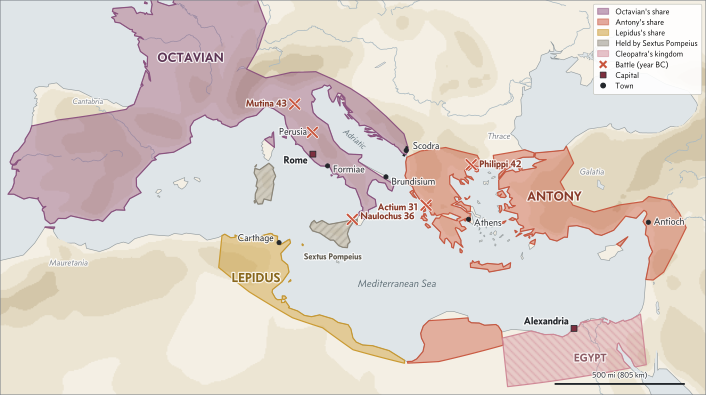
Antony came west with a fleet in 40 BC, and the town of Brundisium, Italy’s port for Greece, shut its gates against him. War seemed certain, but the soldiers on both sides refused to fight Caesar’s men. Fulvia had just died in Greece, and Plutarch says that made peace easier. In September 40 BC, envoys arranged the Treaty of Brundisium. Under it Octavian received all the western provinces except Africa,According to the Treaty of Brundisium, this ruler was given all western lands except Africa. → Augustus• which was left to Lepidus. Antony kept the East, from the town of Scodra (skoh-druh) in Illyricum (modern Shkodër (shkoh-dur), in Albania) to the Euphrates, and Italy was to be shared, though Octavian, who lived there, really held it. To seal the bargain Antony married Octavian’s sister, Octavia, a young widow whom Plutarch calls “quite a wonder of a woman.”
One power in the West answered to none of them. Sextus Pompeius, the younger son of Pompey the Great (Chapter 5), had escaped from his father’s defeat and his brother’s, raised a fleet, and by 42 BC had seized Sicily, the grain island that Rome had taken from Carthage two centuries before (Chapter 3). He welcomed men fleeing the proscriptions and runaway slaves, and his captains stopped the grain ships, so that Rome went hungry. Cassius Dio says Sextus came to believe he was the son of Neptune, the sea god, and wore a sea-blue cloak. For six years Sicily answered to Sextus, not to Rome.This island was briefly independent of Roman rule during the revolt of Sextus Pompeius. → Sicily• In 39 BC, at a meeting on the shore at Misenum (my-see-num), near Naples, the triumvirs even had to recognize him as its master, and as master of Sardinia, Corsica, and the Peloponnese.
The peace broke down within a year. Octavian lost two fleets to storms, and Suetonius says he swore, “I will conquer in spite of Neptune,” and banned the god’s statue from the next procession of the games. He turned the war over to his oldest friend. Marcus Vipsanius (vip-say-nee-us) Agrippa was about Octavian’s age and from a family so obscure that he dropped its name, Vipsanius, as soon as he could. He had been with Octavian at Apollonia, and he became the best general and admiral of his day. Agrippa built a new harbor near Baiae (by-ee), on the Bay of Naples, by cutting channels into two lakes behind the shore, and through one winter he trained 20,000 freed slaves there as rowers.
On September 3, 36 BC, Agrippa’s fleet met Sextus’s off Naulochus (naw-luh-kus), on the northeast coast of Sicily, about 300 ships on each side. The historian Appian describes the weapon of the Roman navy under Agrippa, a grappling hook called the harpaxThis navy used a large grappling hook called the harpax. → Roman navy• (har-paks). It was a beam of wood about seven and a half feet long, bound with iron, with an iron claw at one end and ropes at the other. A catapult shot it into an enemy ship, the claw caught, and winches on Agrippa’s ship hauled on the ropes until the enemy was dragged alongside for boarding. The iron bands kept the enemy from cutting it loose. It did from a distance the work of the corvus, the Roman navy’s boarding bridge in the First Punic War (Chapter 3). Sextus fled east with seventeen ships, and a year later one of Antony’s officers put him to death.
Lepidus had brought legions from Africa to help in Sicily, and when the fighting was over he tried to claim the island for himself. Octavian rode into Lepidus’s camp with only a few attendants and talked to the soldiers, who went over to him. Then Octavian expelled Lepidus from the triumvirate,This ruler expelled Lepidus from the Second Triumvirate. → Augustus• taking his army and his provinces. Lepidus kept his life, his property, and the title of pontifex maximus, the chief priest of Rome, and lived out more than twenty years at the seaside town of Circeii (sur-see-eye). The Roman world now had two masters, one in Rome and one in Alexandria.
Antony and Cleopatra
Egypt’s view of Antony and Cleopatra, from her golden barge at Tarsus to the asp, is told with the story of Egypt (Vol. 5, In the Beginning). From Rome it looked different. In 41 BC, when Antony summoned the queen of Egypt to explain why she had not helped him against Caesar’s murderers, Antony became Cleopatra’s lover,This man was a lover of Cleopatra. → Mark Antony•• and she bore him twins in 40 BC: Alexander Helios (hee-lee-os), “the Sun,” and Cleopatra Selene (seh-lee-nee), “the Moon.” A third child, Ptolemy Philadelphus (fil-uh-del-fus), followed in 36 BC. Meanwhile Antony had married Octavia, who bore him two daughters, and in 37 BC at Tarentum she persuaded her husband and her brother to make up a quarrel and renew the triumvirate. Then Antony sailed east, leaving her in Italy, and went back to Cleopatra. His great campaign against Parthia in 36 BC failed, and Plutarch says it cost him 20,000 foot soldiers and 4,000 horsemen, more than half of them to disease. When Octavia came as far as Athens with soldiers for him, he told her to go no farther.
In 34 BC Antony captured the king of Armenia and led him through Alexandria in a procession that looked to Romans like a triumph held in the wrong city. Soon afterward, in the ceremony called the Donations of Alexandria, he and Cleopatra sat on golden thrones in the city’s gymnasium and handed out kingdoms. Plutarch tells which: Antony gave kingdoms to his two sons,This man gave land to his sons Alexander Helios and Ptolemy Philadelphus via the Donations of Alexandria. → Mark Antony• Armenia and Media to Alexander Helios, with Parthia “so soon as it should be overcome,” and Phoenicia, Syria, and Cilicia to Ptolemy Philadelphus. The six-year-old Alexander wore Median dress with a tall tiara, and the two-year-old Ptolemy the boots and cloak of a Macedonian king. Romans saw provinces won by Roman armies being given to the children of a foreign queen.
The two sides fought a war of insults for two years. In 32 BC both consuls were Antony’s men. When one of them attacked Octavian in the Senate, Octavian came to the next meeting with a guard of soldiers, and the consuls and several hundred senators fled to Antony. Antony then divorced Octavia. Then two of Antony’s friends, Titius and Plancus, quarreled with Cleopatra and came over to Octavian, bringing word of what Antony’s will said. Like many Romans, Antony had left his will in the keeping of the Vestal Virgins, the six priestesses who tended the sacred fire in the Temple of Vesta in the Forum (Chapter 1). Plutarch says the Vestals refused to hand it over and told Octavian that if he wanted it, he must come and take it himself. Octavian seized Antony’s secret will from the Vestals,This ruler illegally took a rival's secret will from the Temple of Vesta. → Augustus• though opening a living man’s will was against both law and custom. He read to the Senate the passages that suited him. Antony wished to be buried in Alexandria beside Cleopatra, even if he died in Rome. Many thought the trick unfair, but it worked. Rome declared war on Cleopatra alone, so that it would look like a foreign war, and all of Italy swore an oath of loyalty to Octavian.
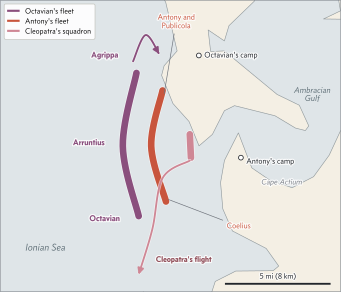
Plutarch gives Antony 500 warships, 100,000 foot soldiers, and 12,000 horsemen, against Octavian’s 250 ships and 80,000 foot. Antony’s fleet and army gathered at Actium (ak-tee-um), a cape at the narrow mouth of the Ambracian Gulf (am-bray-shun) on the west coast of Greece. In the spring of 31 BC Agrippa seized the bases behind them and cut off their supplies from Egypt, while Octavian landed his army and camped on the heights north of the strait. Through the summer Antony’s crews sickened and his allies deserted. Early on, when Octavian landed at a place called Toryne (tuh-ry-nee), “the Ladle,” Cleopatra joked, in Clough’s Plutarch, “we may well be frightened if Caesar has got hold of the Ladle!” By “Caesar” she meant Octavian. On September 2, 31 BC, Antony’s fleet rowed out. Agrippa commanded Octavian’s left wing and Octavian his right. Antony’s great ships were too slow to ram and too stoutly built to be rammed, so the battle was fought like a siege, three or four light ships swarming around each big one. Agrippa stretched his wing to get around Antony’s right. Then, with the fight still even, Cleopatra’s sixty ships hoisted sail and broke through toward the Peloponnese, and Antony left his fleet and followed her. His ships fought on until the afternoon and then gave up: Octavian’s fleet under Agrippa had defeated AntonyThis ruler defeated Antony and Cleopatra at Actium in 31 BC. → Augustus•••Marcus Agrippa's fleet defeated this man at the Battle of Actium. → Mark Antony•• and Cleopatra at Actium. Plutarch, using Octavian’s own memoirs, says no more than 5,000 men were killed and 300 ships were taken, and Antony’s army surrendered a week later (Figure 9.3). On the site of his camp Octavian founded a new city, Nicopolis, “Victory City.”
Octavian came to Egypt the next summer. On August 1, 30 BC, Antony’s fleet saluted Octavian’s with its oars and joined it, and his cavalry deserted. Cleopatra shut herself in her tomb and sent word that she was dead. Antony had a servant named Eros (eer-os), who had long ago promised to kill him if he asked, and now he asked. Plutarch says Eros drew his sword, then turned it on himself and killed himself instead of his master.This character commands his attendant Eros to kill him, but Eros commits suicide instead. → Mark Antony• “It is well done, Eros,” said Antony, in Clough’s version; “you show your master how to do what you had not the heart to do yourself.” He stabbed himself in the belly, but the wound did not kill him at once. Told that Cleopatra was alive, he had himself carried to her tomb, where she and her two women hauled him up through a window with ropes, and he died in her arms. Antony had killed himself shortly before Cleopatra,This man died by suicide shortly before Cleopatra. → Mark Antony• who lived on for little more than a week and died, as the best-known story tells, by the bite of an asp (Vol. 5, In the Beginning). Octavian had Caesarion, Caesar’s son by Cleopatra, put to death, and Antony’s eldest son by Fulvia too; but Octavia raised Antony’s other children with her own. Egypt became a Roman province, and Octavian kept it as his own. In August 29 BC he rode through Rome in three triumphs on three days. That year the doors of the shrine of Janus, shut only when Rome was at peace, were closed for the first time in two hundred years.
The principate
In 27 BC Octavian was thirty-five, the master of the world, and the commander of every legion in it. He also remembered what had happened to Caesar, who had ruled openly as dictator. On January 13, 27 BC, he went to the Senate and announced that he was handing the commonwealth back to the Senate and the Roman people. The senators begged him not to abandon them. He agreed to govern for ten years the provinces where the armies were, Spain, Gaul, and Syria, besides Egypt, and to leave the peaceful ones to governors chosen by the Senate. Three days later the Senate gave him a new name. Suetonius says some proposed “Romulus,” as the city’s second founder, but the name voted was Augustus, “revered,” a word Romans used for holy places and things blessed by the gods (Vol. 4, Classical Myth). A wreath of oak leaves was hung over his door, the crown given to a man who saved a citizen’s life.
He took no title of king or dictator. Instead he called himself princeps, “first citizen”This ruler took the title princeps, or "first citizen." → Augustus•• (the Stage), the old name for the leading senator, the man who spoke first in debate. From it historians call his system the principate. In his own account of his reign he wrote that after 27 BC he stood above everyone in prestige, but had no more power in any office than his colleagues. That was true of the offices and false of everything else. He commanded nearly all the legions, and the money of Egypt was his. From 23 BC he held for life the powers of a tribune of the plebs, which let him veto any law and made his person sacred, and a command greater than any governor’s. He became pontifex maximus when Lepidus died, and in 2 BC the Senate named him Father of his Country. Soldiers had long hailed a winning general as imperator, “commander,” and he made the word his first name: Imperator Caesar Augustus. In English the word became emperor, and Augustus is counted the first Roman emperor,This ruler was the first Roman emperor. → Augustus••• though he never used it as a title of office.
A general of the Republic had kept a bodyguard of picked men camped by his headquarters tent, the praetorium. In 27 BC Augustus created the Praetorian GuardThis ruler created the Praetorian Guard. → Augustus•• (pree-tor-ee-un) as a permanent force, nine cohorts of about 500 men, later 1,000. Apart from the fleets and a small city police, they were the only soldiers kept in Italy, and they earned more and served fewer years than the legions. Only three cohorts stayed in Rome at a time, and there they wore the toga, so that the city would not look like an armed camp. From 2 BC two prefects of the knights’ rank commanded them. Later emperors would learn that the men who guarded an emperor could also kill one (Chapter 12).

In his household one person counted more than any other. Augustus’s wife was Livia DrusillaThis ruler’s wife was Livia Drusilla. → Augustus•• (droo-sil-uh), born in 59 BC into the proud old family of the Claudii. Her father fought for Brutus at Philippi and killed himself after the defeat. Her first husband, Tiberius Claudius Nero, took Lucius Antonius’s side in the Perusine War and fled with her and their baby son, the future emperor Tiberius, to Sextus’s Sicily and then to Greece. After the peace of Misenum they came home, and Octavian fell in love with her. Octavian had married Scribonia (skrih-boh-nee-uh), a kinswoman of Sextus Pompeius, in 40 BC to win Sextus over; Cassius Dio says he divorced her on the day she gave birth to his only child, a daughter named Julia. Livia’s husband gave her away, and in January 38 BC Octavian married her, though Suetonius says she was pregnant with her second son, Drusus. They had no children together, but the marriage lasted more than fifty years. Suetonius says Augustus wrote out beforehand what he meant to say to her about serious matters, so as to get it right.
The other indispensable man was Gaius Maecenas (my-see-nus), a rich knight from the Etruscan town of Arretium who boasted descent from Etruscan kings. He refused to become a senator but served as Octavian’s diplomat at Brundisium and governed Rome and Italy while Octavian was away at Actium. He also gathered poets. Maecenas was the patron of Virgil and Horace,This ruler’s adviser Maecenas patronized Virgil and Horace. → Augustus• the two greatest poets of the age: a patron was a rich friend who supported a writer with gifts and introductions. Virgil brought Horace to meet him in 38 BC; Maecenas gave Horace a farm in the Sabine hills, and Virgil addressed the Georgics to him (Chapter 10, Chapter 11). The poets in turn sang of the peace Augustus had brought. In French and Italian, a patron of the arts is still called a mécène or mecenate.
Peace inside the empire did not mean peace on its edges. Hispania, the Romans’ name for the whole peninsula of Spain and Portugal (Chapter 4), had been fought over for two centuries, and in its northwestern mountains the Cantabrians (kan-tay-bree-unz) and the Astures (as-tyoo-reez) were still free. The Cantabrian Wars were fought in HispaniaThe Cantabrian Wars were fought in this region. → Hispania•• from 29 to 19 BC, and they took eight legions. Augustus went himself in 26 BC, fell ill, and directed the war from the coast at Tarraco; Suetonius says lightning struck his litter on a night march and killed the slave who walked ahead with a torch. Agrippa finished the conquest in 19 BC.
Cassius Dio, summing up Augustus’s character, tells a story from Spain. A bandit named Corocotta (kor-oh-kot-uh) was raiding so boldly that Augustus, in a rage, offered a million sesterces to whoever brought him in alive. Corocotta came to Augustus of his own accord and claimed the reward on his own head.Cassius Dio tells of the bandit Corocotta claiming the reward Augustus offered for his capture in this region. → Hispania• Augustus did him no harm and paid him the money. Dio tells it to show that Augustus kept his word even to men who did not deserve it.

In the East, Augustus won without a battle. At Carrhae in 53 BC (Chapter 5) the Parthians, whose kings ruled Iran and Mesopotamia, had destroyed Crassus’s army and taken its standards, the silver eagles each legion carried and swore by; more were lost in 40 BC, when a Parthian army overran Syria, and in Antony’s failed campaign of 36 BC. Phraates IV (fray-uh-teez), king of Parthia, had murdered his father and brothers to take the throne, and a rival had carried off his young son to the Romans. Augustus sent the boy home and pressed for the standards. In 20 BC, with Augustus in Syria and his stepson Tiberius leading an army into Armenia, Phraates gave back the eagles and the surviving prisoners. Augustus’s coins showed a Parthian kneeling to hand over a standard (Figure 9.5), and the eagles went to the temple of Mars the Avenger in his new forum (Vol. 4, Classical Myth). It was diplomacy, but Rome celebrated it like a conquest.
Historians call the two centuries that followed the Pax Romana, the “Roman peace.” The Pax Romana began under AugustusThe Pax Romana began under this ruler. → Augustus•• and lasted, roughly, until the death of Marcus Aurelius in AD 180 (Chapter 17). In those years the lands from Spain to Syria saw no great war among their peoples, though the frontier wars went on. Suetonius says the doors of the shrine of Janus had been shut only twice since Rome’s founding, and Augustus shut them three times.
When Augustus came home in 13 BC after three years settling Spain and Gaul, the Senate voted on July 4 to build an altar to Pax in his honor;The Ara Pacis, an altar to Pax, was erected in this ruler's honor. → Augustus•• Pax was Peace, worshiped as a goddess. It is the Ara Pacis (ah-rah pah-kis), in full Ara Pacis Augustae (aw-gus-tye), “Altar of Augustan Peace.” It was dedicated on January 30, 9 BC, Livia’s birthday, on the Campus Martius beside the road leading north out of Rome. A visitor climbed a flight of steps on the west side into a walled enclosure of white marble, open to the sky, about 38 feet by 35 feet, with the altar on its own steps in the middle. Inside, the walls are carved with garlands of fruit hanging from the skulls of sacrificed oxen. Outside, the lower half of every wall is covered with curling acanthus leaves, with swans among them. Above them, along the two long sides, a procession moves toward the entrance: priests in spiked caps, officials, and the family of Augustus, with women and children among them (Figure 9.6). On the ends are panels of Aeneas, or perhaps King Numa, offering a sacrifice, of a seated goddess with two babies on her lap and fruit and animals around her, and of Romulus and Remus with the wolf. Tiber floods buried the altar under silt. Pieces turned up from 1568 on, and in 1938 it was put back together near Augustus’s tomb; since 2006 it has stood in a glass museum designed by the American architect Richard Meier.

Augustus boasted, Suetonius says, that he found Rome a city of brick and left it a city of marble (Vol. 4, Classical Myth). In the same years an old army engineer, Vitruvius (vih-troo-vee-us), wrote the only book on architecture to survive from the ancient world (Vol. 1, The Toolkit). He had built and repaired catapults for Caesar and then for Octavian. Vitruvius dedicated De Architectura to Augustus,Vitruvius dedicated De Architectura to this ruler. → Augustus•• addressing him as “Imperator Caesar” in Morris Hicky Morgan’s 1914 translation, and thanking him for a pension that Augustus had kept paying “on the recommendation of your sister.” Its ten books cover the training of an architect, building materials, temples and the orders of columns, theaters and baths, houses, aqueducts, sundials, and machines. Every building, Vitruvius says, must be built “with due reference to durability, convenience, and beauty.” His remarks on the proportions of the human body, which he says fit inside a circle and a square, gave Leonardo da Vinci the idea for the drawing called Vitruvian Man in about 1490.
The Augustus of Prima Porta
On April 20, 1863, men digging at Prima Porta (pree-mah por-tah), about 9 miles north of Rome on the Via Flaminia, found a statue of Augustus at Livia’s villa,The Prima Porta statue depicts this ruler. → Augustus••This statue of Rome’s first emperor was found at Livia’s villa at Prima Porta. → Augustus of Prima Porta•• the country house of the emperor’s wife. The marble figure stands nearly 7 feet tall, and it has become the best-known portrait of Augustus. The Romans called the villa Ad Gallinas Albas, “At the White Hens.” Suetonius tells why. Soon after Livia married Octavian, an eagle flying overhead dropped a white hen into her lap, with a sprig of laurel in its beak. She raised the hen and planted the laurel. The hen’s chicks filled the villa, and the laurel grew into a grove, from which, Suetonius says, the emperors cut the laurels they wore in their triumphs. The statue now stands in the Vatican Museums. It is probably a marble copy of a bronze set up in Rome after 20 BC, and the copy may have been made for Livia after her husband’s death.

The sculptor shows Augustus as a general before his army. He raises his right arm in address,This statue raises its right arm in a gesture of address. → Augustus of Prima Porta•• the gesture Romans called adlocutio (ad-loh-koo-tee-oh), a speech to the troops; his left hand once held a spear or a general’s staff. He wears a short tunic, a general’s cloak wrapped around his hips and over his left arm, and a breastplate molded like a muscular chest, the cuirass (kwih-ras). But his feet are bare, and in Greek and Roman art bare feet belonged to gods and heroes. The face is calm and young, though Augustus was past forty when the bronze was made; all his portraits show him young. The fork of locks on his forehead appears on his coins too, and lets scholars recognize his portraits wherever they are found.
The stance comes from Greece. More than four centuries earlier the sculptor Polykleitos (pol-ee-kly-tos) of Argos made a bronze Doryphoros (dor-if-uh-ros), “Spear-Bearer,” to show his rules of perfect proportion (Vol. 6, The Greeks). The statue is nude and is not shown in this book. Its pose, called contrapposto (kon-truh-pos-toh), “set against,” puts the weight on one leg and bends the other knee, so that the hips tilt one way and the shoulders the other. The sculptor of Augustus gave the emperor the pose of Polykleitos’s Doryphoros:This imperial statue’s contrapposto pose draws on Polykleitos’s Doryphoros. → Augustus of Prima Porta• the weight on the right leg, the left knee bent, the head turned slightly. Romans took the Doryphoros for a statue of Achilles, which made the borrowing a compliment. The pose lets a general in heavy armor stand as easily as a Greek athlete, relaxed even while he gives orders.
Beside his right leg a little Cupid rides a dolphin.A dolphin-riding Cupid stands beside this statue’s right leg. → Augustus of Prima Porta•• Cupid, the god of love, was the son of Venus, and the Julian family claimed descent from Venus through her son Aeneas and his son Iulus (Vol. 4, Classical Myth); the child at Augustus’s knee announces that the emperor’s family is divine. The dolphin, a sea creature sacred to Venus, may also recall the sea victory at Actium. The group does a practical job as well. A marble figure is heavy, and its slender ankles would break without something to lean on.

The breastplate tells the story of the reign. At the top, the sky god Caelus (see-lus) spreads his cloak like the vault of heaven, and below him the sun god drives his chariot, with the goddess of dawn flying ahead. In the center a Parthian hands back a Roman standard:This ruler negotiated with Phraates IV of Parthia for the return of lost battle standards. → Augustus•This statue’s cuirass depicts the return of Roman standards by the Parthians. → Augustus of Prima Porta•• the return of the lost eagles that Augustus had won from Phraates IV of Parthia by negotiation in 20 BC. A bearded man in Parthian trousers holds out the standard to a Roman in armor, who may be the god Mars, or Tiberius, or simply the Roman army. At the sides sit two women in mourning, peoples Rome had conquered. Below, Apollo rides a griffin and his sister Diana a stag, and at the bottom the earth goddess reclines with a horn of plenty and two babies. Two sphinxes on the shoulder straps may recall the conquest of Egypt.
Augustus’s last years
Augustus had no son, and for thirty years he tried to choose a successor and watched his choices die (Figure 9.9). He married his daughter Julia first to Octavia’s son Marcellus, who died in 23 BC at nineteen (Chapter 10). Then he married her to Agrippa, a man of her father’s age. Julia bore Agrippa three sons and two daughters, and Augustus adopted the two eldest boys, Gaius and Lucius, as his own sons and heirs. When Agrippa died in 12 BC, Augustus made Livia’s elder son, Tiberius, the best general left to him, divorce the wife he loved and marry Julia. The marriage was unhappy. In 6 BC Tiberius withdrew to the island of Rhodes and stayed there for seven years.
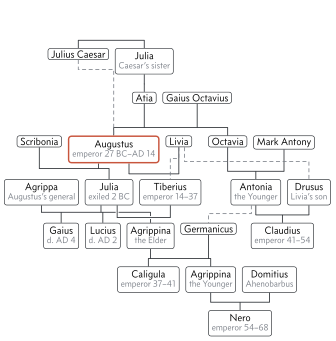
Julia was clever, witty, and fond of pleasure. In 2 BC, the year her father was named Father of his Country, he learned that she had lovers among the young nobles of Rome, one of them a son of Mark Antony. Adultery was now a crime under Augustus’s own law of 18 BC, and he told the Senate in a letter, being too ashamed to appear. Then Augustus exiled Julia to PandateriaThis ruler exiled his daughter Julia to Pandateria for adultery. → Augustus•• (pan-duh-teer-ee-uh), a small island 28 miles out in the sea off the coast between Rome and Naples. She had no wine, and no man could visit her unless Augustus had been told his age, height, and complexion, and every scar on his body. Her mother, Scribonia, went with her. After five years she was moved to the mainland, but he never forgave her. When Julia’s freedwoman Phoebe (fee-bee) hanged herself, Suetonius says, Augustus said, “I had rather be the father of Phœbe than of Julia.”
Fortune took the rest. Lucius died at Massilia in AD 2, and Gaius in Asia Minor in AD 4, of a wound taken in Armenia. Augustus, now sixty-five, adopted Tiberius as his son and heir and made Tiberius adopt his own nephew Germanicus (jer-man-ih-kus), the son of his dead brother Drusus. On the same day he adopted Julia’s youngest son, Agrippa Postumus (pos-tyoo-mus), born after his father’s death; within three years the violent young man had been banished to an island. In AD 8 Augustus banished his granddaughter, another Julia, and the poet Ovid (Chapter 11).
Then came the worst defeat of the reign. Augustus’s generals had pushed the frontier from the Rhine toward the Elbe, and Germany was being made a province. Its governor, Publius Quinctilius (kwink-til-ee-us) Varus, had governed Syria and was married to a great-niece of Augustus. He trusted a young chief of the Cherusci (keh-rus-kee), Arminius (ar-min-ee-us), who had served in the Roman army and been made a Roman citizen and knight. In September AD 9 Arminius led Varus’s three legions into an ambush among the forests and bogs of the Teutoburg Forest, and over several days of rain the Germans destroyed them; Varus killed himself. Some 15,000 soldiers and their camp followers died. Suetonius says Augustus set guards around Rome against a rising, let his hair and beard grow for months, and beat his head against a door, crying to VarusThis ruler reportedly shouted "Quinctilius Varus, give me back my legions!" after the Battle of the Teutoburg Forest. → Augustus••• to give him back the lost legions. The numbers of the three legions, the Seventeenth, Eighteenth, and Nineteenth, were never used again, and Rome gave up the land beyond the Rhine. Since 1987 archaeologists at Kalkriese (kahlk-ree-zuh), in northern Germany, have dug up coins, weapons, and bones from the battle.
In his last years Augustus wrote his own record of his life, called the Res Gestae Divi Augusti (rays ges-tye), “The Deeds of the Divine Augustus.” In thirty-five short paragraphs he listed the honors he had accepted and the ones he had refused, and the money he had paid from his own purse to veterans and to the people of Rome. He counted the temples he had built or restored, the games he had given, and the peoples he had conquered, and he recorded the standards won back from Parthia and the closing of Janus. Antony and the triumvir Lepidus are never named in it. He left it with the Vestals beside his will, with orders that it be cut on two bronze pillars before his tomb in Rome. The bronze is lost, but copies were carved in the provinces, and a copy survives in the Monumentum Ancyranum,A copy of this ruler’s Res Gestae survives in the Monumentum Ancyranum. → Augustus•• the “Ancyra monument,” on the walls of the Temple of Augustus and Rome at Ancyra (an-sy-ruh), now Ankara, the capital of Turkey (Figure 9.10). The Latin text runs down the inner walls of the temple’s porch, and a Greek translation for the local people runs along the outside. Europeans first copied it in 1555, when envoys of the Habsburg king Ferdinand passed through on their way to the Ottoman sultan.

In the summer of AD 14 Augustus fell ill on a journey and stopped at Nola, at the family house where his father had died. Suetonius describes the last day. He asked for a mirror and had his hair combed. Then he asked his friends, in Thomson’s translation, “Do ye think that I have acted my part on the stage of life well?” and quoted the lines a Greek actor spoke at the end of a comedy, asking the audience for applause. He died kissing Livia, with the words, “Livia! live mindful of our union; and now, farewell!” It was August 19, AD 14, thirty-five days before his seventy-sixth birthday.
Not everyone believed the death was natural. Tacitus hints at suspicion of Livia, and Cassius Dio reports a rumor of poisoned figs.Cassius Dio reports a rumor that Livia killed this ruler with poisoned figs. → Augustus•• Some said, Dio writes, that Livia feared Augustus was about to bring back his exiled grandson, Agrippa Postumus. Knowing that Augustus liked to pick figs from the trees with his own hands, she smeared poison on some still hanging, ate the clean ones herself, and offered him the others. Dio gives it only as what some people said.
Tiberius had already been given the powers of a tribune and a command equal to Augustus’s. The soldiers and the Senate accepted him at once, and Tiberius succeeded AugustusThis ruler was succeeded by Tiberius. → Augustus•• at fifty-five. The first act of the new reign, Tacitus says, was the killing of Agrippa Postumus on his island. On September 17 the Senate declared Augustus a god, and Suetonius says a former praetor swore that he had seen the emperor’s spirit rising from the funeral pyre into heaven. The ashes were laid in the great round tomb Augustus had built on the Campus Martius. His heirs took his names, Caesar and Augustus, as titles, and the family in Figure 9.9 ruled Rome for another fifty-four years (Chapter 12).
What to remember
- Octavian, Caesar’s great-nephew, was adopted in Caesar’s will in 44 BC. Cicero attacked Antony in the Philippics, and in 43 BC Octavian, Antony, and Lepidus formed the Second Triumvirate, a legal office for five years.
- The triumvirs’ proscriptions killed Cicero near Formiae on December 7, 43 BC; his head and hands were nailed on the rostra, and Cassius Dio says Fulvia pierced his tongue with her hairpins.
- At Philippi in 42 BC Antony and Octavian defeated Brutus and Cassius, who both killed themselves. Fulvia and Lucius Antonius fought the Perusine War (41–40 BC), and the Treaty of Brundisium (40 BC) gave Octavian the West, Antony the East, and Lepidus Africa.
- Agrippa beat Sextus Pompeius, master of Sicily, at Naulochus in 36 BC with the harpax, and Octavian expelled Lepidus.
- Antony, Cleopatra’s lover, gave kingdoms to their children in the Donations of Alexandria (34 BC); Octavian seized his will from the Vestals, and Agrippa’s fleet beat Antony and Cleopatra at Actium (31 BC). Antony killed himself in 30 BC, after his servant Eros had killed himself instead.
- In 27 BC Octavian became Augustus and princeps, the first emperor. He created the Praetorian Guard, married Livia Drusilla, relied on Maecenas, the patron of Virgil and Horace, and won back the Parthian standards from Phraates IV by diplomacy (20 BC).
- The Pax Romana began under Augustus; the Senate built the Ara Pacis in his honor (13–9 BC), and Vitruvius dedicated De Architectura to him.
- The Augustus of Prima Porta, found at Livia’s villa, raises its right arm, stands in the pose of the Doryphoros, has a Cupid on a dolphin at its leg, and shows the return of the standards on its cuirass.
- Augustus exiled his daughter Julia to Pandateria (2 BC), lost Varus’s three legions in the Teutoburg Forest (AD 9), left the Res Gestae, best preserved at Ancyra, and died in AD 14; Dio repeats a rumor that Livia poisoned his figs, and Tiberius succeeded him.
Chapter 10 · 29 clues
Virgil
In the summer of 29 BC, Octavian came home from the East. Two years before, his fleet had beaten Antony and Cleopatra off Actium, and both of them were now dead (Chapter 9). He was thirty-three, and no one in the Roman world could stand against him. On his way to Rome he stopped at Atella (uh-tel-uh), a small town in Campania, to rest his sore throat. There, according to the ancient Life of the poet, a biography first written more than a century after his death, a shy man from the north read him a new poem for four days running. When the poet’s voice gave out, his friend Maecenas, Octavian’s closest adviser, took the scroll and read on.
The poem was about plowing, pruning vines, breeding cattle, and keeping bees. Its author was Publius Vergilius Maro, whom English calls Virgil or Vergil (the Stage). He was forty years old, and he was about to begin the poem that the master of the world wanted most: an epic of Rome’s beginnings, written in Latin and meant to stand beside Homer.
Virgil’s life
Virgil was born on October 15, 70 BC, the year Pompey and Crassus were first consuls together (Chapter 5). His village, Andes, lay near Mantua, in the flat, rich farmland of the Po valley (Figure 10.1). The Romans called that country Cisalpine Gaul, “Gaul on this side of the Alps,” and it was not yet counted as part of Italy. The ancient Life says that some called his father a potter, but more called him a hired man who married his employer’s daughter and did well. Somehow the family found money to send the boy to school at Cremona, then at Milan, and then at Rome, where he studied rhetoric, the art of public speaking that led to a career in the law courts. The same Life adds that he put on the plain white toga of manhood at fifteen on the very day the poet Lucretius died (Chapter 6).
He was not made for the courts. Virgil was tall, dark, and awkward, with the look of a countryman, and he was often ill. He went south to Naples to study the philosophy of Epicurus (Vol. 6, The Greeks) with a teacher named Siro (sy-roh), and at Naples he spent most of the rest of his life. He was so modest and so retiring, the Life says, that people there nicknamed him Parthenias, “the maiden.”
Every poem Virgil wrote was in Latin.Virgil wrote in this language. → Latin• Educated Romans of his day read Greek as well, and the greatest poems they knew were Greek, above all Homer’s. In time Virgil gave Rome a poem to answer each of three great kinds of Greek verse. His first book answered the shepherd songs of Theocritus (thee-ok-rih-tus), his second the farming poem of Hesiod, and his third, the Aeneid (ih-nee-id), answered Homer himself.
His career began in a disaster. After Julius Caesar was murdered in 44 BC, his heir Octavian and his old lieutenant Mark Antony hunted down the assassins and destroyed their army at Philippi, in Macedonia, in 42 BC (Chapter 9). They had promised their soldiers farms, and in 41 BC they began to take the land from the towns of Italy. Cremona’s fields were seized, and when they ran short, the ancient commentators say, the surveyors took Mantua’s as well. In one of Virgil’s poems a herdsman’s song laments that Mantua lay too close to unlucky Cremona. Virgil’s own farm, his ancient biographers say, was among those taken, and powerful friends got it back for him. The most important was Gaius Asinius Pollio, then governing the Po valley for Antony: a soldier who had fought for Caesar, a historian of the civil wars, and later the founder of Rome’s first public library. Modern scholars suspect that the story of the lost and recovered farm was pieced together from the poems themselves.

By about 38 BC he had joined a new circle. Gaius Maecenas, a rich man who claimed descent from Etruscan kings and never sought public office, was Octavian’s closest adviser, and he gathered poets around him (Chapter 9). Virgil became his friend and brought another young poet, Quintus Horatius Flaccus, whom English calls Horace, into the circle (Chapter 11). For the next twenty years Virgil had money, leisure, and the attention of the most powerful men in Rome. He used them to write slowly. The Georgics took about seven years, and the Aeneid about ten. While he wrote the Georgics, the Life says, he dictated a great many lines each morning and spent the rest of the day cutting them down to a very few (Figure 10.2).

In 19 BC, with the Aeneid drafted but not finished, Virgil sailed for Greece, meaning to spend three years revising it. At Athens he met Augustus, as Octavian was now called, coming home from the East, and agreed to return to Italy with him. On a visit to Megara (meg-uh-ruh), under a burning sun, he fell ill. He grew worse on the voyage and died a few days after landing at Brundisium, on September 21, 19 BC (Vol. 4, Classical Myth). The Life says that he had asked for the manuscript of the Aeneid to be burned. Augustus overruled him and ordered two of the poet’s friends, Lucius Varius (vair-ee-us) Rufus and Plotius Tucca (tuk-uh), to publish it as he had left it.

Virgil’s ashes were carried to Naples and buried beside the road to Puteoli. His tomb bore two lines that he was said to have written himself: Mantua me genuit, Calabri rapuere, tenet nunc Parthenope; cecini pascua, rura, duces. They say that Mantua bore him, the people of Calabria (the heel of Italy, where Brundisium stood) carried him off, and Parthenope (par-then-uh-pee), the old poetic name of Naples, now holds him; and that he sang of pastures, fields, and leaders. Those three words name his three poems in order (Figure 10.3).
The Eclogues
Two centuries before Virgil, the Sicilian poet Theocritus had invented pastoral poetry, songs in which herdsmen sing, compete, fall in love, and mourn their dead in a lovely landscape (Vol. 6, The Greeks). It was also called bucolic poetry, from the Greek word for a cowherd. Virgil’s first book was a collection called the EcloguesThis author wrote the Eclogues. → Virgil••• (ek-logz), which means “selections”; the ancients also called it the Bucolics. He wrote it between about 42 and 38 BC, in the years of the land seizures, and it made him famous at once. Its poems were even sung on the stage.
Virgil borrowed openly. He modeled the Eclogues on Theocritus,This collection was modeled on the bucolic poetry of Theocritus. → Eclogues•• taking his meter, his singing matches, many of his shepherds’ names, and whole lines translated from the Greek. In the poet John Dryden’s English translation of 1697, the sixth poem opens with Virgil’s boast: “I first transferr’d to Rome Sicilian Strains.” But Virgil’s herdsmen also talk about Rome, about land seized by soldiers, and about friends of the poet. A Roman reader found the Greek countryside and his own troubled Italy in the same pages.

The book is small and carefully built. It holds ten bucolic poems,This collection consists of 10 bucolic poems. → Eclogues•• each between 63 and 111 lines long, all in dactylic hexameter, the six-beat line of Homer and Theocritus (Vol. 1, The Toolkit). Poems with two or more speakers alternate with poems spoken by one voice. The first and the ninth both deal with the land seizures. The first is a dialogue between two herdsmen. Meliboeus (mel-ih-bee-us) has been driven off his farm and is leading his goats away into exile. Tityrus (tit-ih-rus) lies in the shade of a beech tree, playing his pipe, because a young man in Rome has let him keep his land. In Dryden’s version, Tityrus says: “These blessings, Friend, a Deity bestow’d: / For never can I deem him less than God.” Readers have always taken the young man to be Octavian.
The second poem is a love song. The shepherd Corydon (kor-ih-don) woos Alexis,One poem in this collection features the shepherd Corydon attempting to woo Alexis. → Eclogues• a handsome boy who belongs to Corydon’s master and lives in town. In the heat of midday Corydon wanders alone through the beech woods, pleading. He offers everything he has: a thousand lambs, milk all year, a pipe of seven reeds, two spotted kids, baskets of lilies and violets, and peaches and plums. Alexis never answers. At sunset Corydon comes to himself, remembers his vine half pruned, and tells himself that he will find another Alexis if this one scorns him. “Young Corydon, th’ unhappy Shepherd Swain, / The fair Alexis lov’d, but lov’d in vain,” as Dryden’s version begins.
Virgil gave the pastoral its most famous home. Arcadia (ar-kay-dee-uh) was a real region of Greece, a ring of bare mountains in the middle of the Peloponnese, poor and remote, where shepherds really did keep flocks and where, the Greeks said, the goat-footed god Pan was born. In Virgil the place becomes a dream. The two singers of the seventh poem are “Both young Arcadians,” in Dryden’s words, though they sing beside the Mincius (min-shee-us), Virgil’s own river at Mantua. In the tenth and last poem the gods of the countryside gather around a dying lover in the Arcadian hills. Virgil made Arcadia a pastoral paradise,This region of Greece was idealized as a pastoral paradise. → Arcadia••Vergil evokes this region as a pastoral setting in his Eclogues. → Arcadia• a land of shade, song, and love, outside history, and later poets and painters kept it so. Jacopo Sannazaro’s Arcadia (Vol. 10, Rebirth), Philip Sidney’s (Vol. 12, Crown and Parliament), and Nicolas Poussin’s painted shepherds puzzling over a tomb in Arcadia (Vol. 13, Valois, Bourbon, and Orange) all descend from these poems.
The lover in the tenth poem is a real man, Virgil’s friend Gaius Cornelius Gallus, a soldier and a writer of love elegies (Vol. 1, The Toolkit), whose mistress Lycoris (ly-kor-is) has left him to follow another soldier north across the Alps. Apollo asks why he is mad, and Pan tells him that Love is never satisfied with tears. Gallus wishes he had been born a simple Arcadian shepherd, and he tries to cure his love by hunting in the mountains. He cannot. Near its close the tenth poem coins “omnia vincit amor,”The phrase "omnia vincit amor" ("love conquers all") was coined in the tenth and final poem of this collection. → Eclogues•• “love conquers all,” and in Dryden’s words the full line is “Love conquers all; and we must yield to Love.”
The Fourth Eclogue
One poem in the book is like no other. “Sicilian Muse begin a loftier strain!” it begins in Dryden’s version, and it leaves the sheepfolds behind. Its date is fixed by the man it praises. The Fourth Eclogue addresses Gaius Asinius Pollio,This poem addresses Gaius Asinius Pollio. → "Fourth Eclogue" (Virgil)• Virgil’s patron, in the year of his consulship, 40 BC. That autumn Pollio had helped make the Treaty of Brundisium, which reconciled Octavian and Antony for a time (Chapter 9), and Romans weary of ten years of civil war dared to hope for peace.
Virgil turns that hope into a prophecy. The last age foretold by the Sibyl of Cumae, the prophetess near Naples, has come, he says, and the great cycle of the ages is beginning again. The maiden goddess of Justice, who fled the earth in the age of iron, returns, and with her the reign of Saturn, the golden age of the first men (Vol. 4, Classical Myth). A boy is about to be born, and with him the race of iron will end and a golden race will spring up over the whole world. Virgil prays to Lucina (loo-sy-nuh), the goddess of childbirth, to help the mother, and he promises that all this will begin in Pollio’s consulship.
Then he describes the boy’s growing up, and nature changing as he grows. While he is a baby, the earth will bring him ivy and flowers without plowing. In this golden age the herds will not fear lions:This poem envisions a golden age in which herds need not fear lions. → "Fourth Eclogue" (Virgil)• the goats will come home of themselves with their udders full of milk, and the lowing cattle will graze without fear of the great lions. In Dryden’s lines, “The Goats with strutting Dugs shall homeward speed, / And lowing Herds, secure from Lyons feed.” The snake will die, and so will the poisonous herb. While the boy is young a few traces of the old wickedness will remain, so there will be another voyage of the Argonauts and another war at Troy. When he is a grown man, sailing and plowing will end, because every land will bear every crop. Virgil hails him as the dear child of the gods and magnum Iovis incrementum, which a modern translation renders “great increase of Jove,” Jupiter’s great offspring, a child who will grow into a god. Dryden has “O of Cœlestial Seed! O foster Son of Jove!”
The ending is tender. The poet turns to the newborn and tells him to smile at his mother, who has carried him for ten long months. The Latin line is incipe, parve puer, risu cognoscere matrem, and a modern English version renders it “Begin, baby boy, to recognize your motherThis poem includes the line "Begin, baby boy, to recognize your mother with a smile." → "Fourth Eclogue" (Virgil)• with a smile.” Dryden has “Begin, auspicious Boy, to cast about / Thy Infant Eyes, and with a smile, thy Mother single out.”
Who was the child? Virgil never says. Ancient commentators guessed a son of Pollio. Some modern scholars, among them the American Latinist Wendell Clausen, have argued for the child expected from the marriage of Antony and Octavia, Octavian’s sister, which sealed the Treaty of Brundisium; the child turned out to be a girl. Others think there was no particular child at all. Christians had their own answer. Early Christians read the Fourth EclogueEarly Christians read this poem’s prediction that a child called the "great increase of Jove" would inaugurate a golden age as a prophecy of Christ. → "Fourth Eclogue" (Virgil)••• as a prophecy of Christ. To them the child called the “great increase of Jove,” who would bring in the golden age, was Jesus, who, the Gospels say, was born in Bethlehem a few decades after the poem (Vol. 5, In the Beginning), and the returning maiden was the Virgin Mary. Constantine, the first Christian emperor (Chapter 18), said so in a speech that the bishop Eusebius preserved with his Life of Constantine, and the North African bishop Augustine (Chapter 19) agreed that the Sibyl’s song pointed to Christ. Medieval Christians counted Virgil almost among the prophets.
The Georgics
The poem Virgil read to Octavian at Atella was his second book. Virgil wrote the GeorgicsThis author wrote the Georgics. → Virgil••• (jor-jiks) between about 37 and 29 BC, at the urging of Maecenas, to whom he dedicated it. Its title comes from the Greek for “farming matters.” It has four books and 2,188 lines, and its model is Hesiod’s Works and Days, the Greek poem of farming and hard labor (Vol. 4, Classical Myth). It is a didactic poem, one that teaches a subject, in this case the work of the countryside.
The Georgics teach how to run a farm,This poem describes running a farm. → Georgics• a book at a time. The first book covers plowing and grain, the calendar of the stars, and the signs of coming weather, and it ends with the portents that followed Caesar’s murder: the sun hid its face, wolves howled in the cities, and statues wept. The second book covers trees and vines, and it breaks into praise of Italy as the great mother of crops and of men. Then it praises the farmer himself: “Oh happy, if he knew his happy State!” in Dryden’s words. The third book covers horses, cattle, sheep, and goats, and it ends with a plague that wipes out the herds of the Alps.
The fourth book is the most famous. Book Four describes the habits of bees,Book four of this poem discusses the habits of bees. → Georgics• and Virgil treats a hive as a little city. The bees share their houses and their honey, obey their ruler, go to war against rival swarms, and die for the common good. Virgil, like Aristotle and most ancient writers, believed that the leader of a hive was a king; that the “king” is really a queen was not proved until the 1600s. He tells how to place the hives, how to call home a swarm, and how to take the honey. He remembers an old man from Corycus (kor-ih-kus) in Asia Minor whom he once saw near Tarentum, in southern Italy, who had turned a few acres of poor ground into a garden full of flowers and bees, and who felt as rich as a king. Last he explains how to replace a hive that has died. A young bullock is killed without breaking its skin and left in a closed hut, and from the body, the ancients believed, a new swarm would rise.
Who first discovered that art? To answer, Virgil tells a myth, and here the book turns from teaching to story. He uses the form of the epyllion, the “little epic” that tells one myth in the epic meter and style, as Catullus told the wedding of Peleus and Thetis (Chapter 6). The Georgics end with an epyllion about AristaeusThis poem includes an epyllion about Aristaeus. → Georgics• (ar-iss-tee-us), the beekeeper son of Apollo (Vol. 4, Classical Myth). His bees have all died. Weeping on the bank of the river Peneus, he calls to his mother, the water nymph Cyrene, and she takes him down to her home under the river. She sends him to Proteus (proh-tee-us), the old prophet of the sea, who must be held fast while he changes into fire, a beast, and running water. Bound at last, Proteus tells the truth. The nymph Eurydice (yoo-rid-ih-see) had been running from Aristaeus along a river when a snake bit her, and she died. Then Proteus tells how her husband Orpheus (or-fee-us) went down to the dead to bring her back and lost her by looking back (Vol. 4, Classical Myth). Her companions, the nymphs, had killed Aristaeus’s bees in revenge. Cyrene tells him to sacrifice four bulls and four heifers to the nymphs. Nine days later he returns, and bees are swarming out of the bodies, hanging from a tree like bunches of grapes.
Virgil’s friend Gallus was made the first governor of Egypt after Actium, then fell from Augustus’s favor and killed himself in 26 BC. Servius, a commentator who wrote about four hundred years later, claimed that the second half of the book had once praised Gallus, and that Virgil replaced the praise with Aristaeus. Many scholars doubt the story.
Virgil closes with a signature. He has sung of tilling fields, of flocks, and of trees, he says, while Caesar, as Octavian called himself, thundered in war by the Euphrates; meanwhile he, Virgil, lived at Naples, the poet who once played at shepherds’ songs. The last line of the Georgics echoes the first line of the Eclogues, with Tityrus lying under his beech tree.
The Aeneid
In 29 BC Virgil began the poem everyone had been waiting for. A few years later the love poet Propertius told the writers of Rome and Greece to make way, because something greater than the Iliad was being born. Augustus, campaigning in Spain, wrote to Virgil, the Life says, half begging and half threatening in jest, to send him a first sketch or any piece at all. Virgil’s epic, the Aeneid,This author wrote the Aeneid. → Virgil•••This poem is an epic written by Virgil. → The Aeneid•• was the work of the last ten years of his life, and it was still unfinished when he died. It is an epic, a long poem in an elevated style about heroes and great deeds, and it has twelve books and 9,896 lines (Vol. 1, The Toolkit).
Its story was already old. Since at least the 200s BC Romans had said that their ancestors came from Troy. The Aeneid follows a Trojan refugee to Italy.This epic follows a Trojan refugee to Italy, where he becomes an ancestor of the Romans. → The Aeneid••• He is Aeneas, son of the goddess Venus and the mortal Anchises (an-ky-seez), who escapes from the burning city with his father and his son, wanders for seven years, and fights a war in Latium. His descendants will found Rome and become the Romans. Augustus’s own family, the Julii, claimed descent from Aeneas’s son Iulus. The story is told book by book with the myths (Vol. 4, Classical Myth), and Table 10.1 sums it up.
The first words announce the plan. The poem opens “I sing of arms and the man,”This poem opens with the phrase "I sing of arms and the man." → The Aeneid•• as a modern translation puts its first words, Arma virumque cano: arms, that is, war, and the man, Aeneas. Dryden made it “Arms, and the Man I sing.” Those two subjects divide the poem. Books 1 to 6 are a voyage of wandering, like Homer’s Odyssey, and Books 7 to 12 are a war, like the Iliad. Like Homer, Virgil begins in the middle of things and calls on the Muse a few lines in (Vol. 1, The Toolkit). An African mosaic shows the poet with that call to the Muse written on his scroll (Vol. 4, Classical Myth).
| Book | What happens |
|---|---|
| 1 | Juno’s storm wrecks the Trojans on the coast of Africa. Venus leads Aeneas to Carthage, where Queen Dido welcomes him. |
| 2 | At Dido’s banquet Aeneas tells of the wooden horse and the fall of Troy, and how he carried his father Anchises out of the flames. |
| 3 | He tells of seven years at sea: Thrace, Delos, Crete, the Harpies, the Cyclops. Anchises dies in Sicily. |
| 4 | Dido and Aeneas become lovers. Mercury orders him to sail for Italy, and Dido curses him and kills herself on a pyre. |
| 5 | Funeral games for Anchises in Sicily, where Cloanthus wins the ship race. The helmsman Palinurus falls overboard. |
| 6 | At Cumae the Sibyl leads Aeneas, carrying the golden bough, through the underworld. Anchises shows him the Romans to come. |
| 7 | The Trojans land in Latium. King Latinus offers his daughter Lavinia, and the Fury Alecto stirs Turnus and the Latins to war. |
| 8 | Aeneas visits King Evander at the future site of Rome and takes his son Pallas as an ally. Venus brings a shield showing Actium. |
| 9 | Turnus attacks the Trojan camp. The young Trojans Nisus and Euryalus die on a night raid. |
| 10 | Battle on the shore. Turnus kills Pallas and takes his sword belt, and Aeneas kills the Etruscan tyrant Mezentius. |
| 11 | A truce to bury the dead. The Latins quarrel in council, and the warrior girl Camilla dies in battle. |
| 12 | The duel. Aeneas, seeing Pallas’s belt on Turnus, kills him, and the poem ends. |
Romans heard their own history all through the story. In Book 1, after Juno’s storm has driven the fleet to Africa, Jupiter promises Venus that her son’s people will rule forever: “To them, no Bounds of Empire I assign; / Nor term of Years to their immortal Line,” in Dryden’s version. He even names “Cæsar from the Julian Stock.” Aeneas falls in love with Dido at Carthage,This figure falls in love with Dido at Carthage. → Aeneas•• the city she has founded, in Book 4. Virgil gives the queen the passion and the tragedy, but Aeneas loves her too: when the gods order him to leave, he goes, Virgil says, groaning and shaken by his great love. Her dying curse calls for an avenger to rise from her bones, and every Roman heard in it Hannibal, Carthage’s great general (Chapter 3). Four centuries later Augustine (Chapter 19) confessed that as a schoolboy he had wept for Dido.
Book 5 slows down for a holiday. A year after Anchises’s death, the Trojans are back in Sicily, and Aeneas holds funeral games at his father’s tomb. First comes a race of four ships around a rock out at sea, where Aeneas has set up a leafy oak branch as the turning mark. Gyas (jy-us) leads in the huge Chimaera (ky-meer-uh), but his cautious helmsman steers too wide of the rock, so Gyas throws him overboard. Sergestus (sur-jes-tus) cuts the turn too close and runs his Centaur onto the rocks. Mnestheus (nes-thee-us) in the Pristis rows past Gyas and closes on the leader. Cloanthus (kloh-an-thus) wins the ship raceIn this epic’s funeral games on Sicily, Cloanthus wins a ship race. → The Aeneid•• in the Scylla, after he stretches out his hands to the sea gods and vows them a white bull, and the harbor god Portunus pushes his ship home. Virgil adds that noble Roman families of his own day descended from these captains, among them the Sergii (sur-jee-eye), the family of Catiline (Chapter 5), from Sergestus.

Book 6 takes the hero to the dead. At Cumae Aeneas begs the Sibyl, the prophetess of Apollo, to lead him to his father’s ghost. She warns him that the way down is easy and the way back is hard. The Cumaean (kyoo-mee-un) Sibyl tells Aeneas to pluck a golden boughThe Cumaean Sibyl tells this figure to pluck a golden bough before guiding him to the underworld. → Aeneas••• that grows in the dark forest, a gift for Proserpina, the queen of the dead. If fate has called him, it will come away easily in his hand; if not, no strength will tear it off. Two doves lead him to the tree, the bough breaks off, and the Sibyl guides him down through a cave by the lake of Avernus (uh-vur-nus) (Figure 10.5).
In the fields of the blessed, Anchises shows his son the souls waiting to be born as the great men of Rome. Among them is Augustus, who, in Dryden’s words, is “Sent to the Realm that Saturn rul’d of old; / Born to restore a better Age of Gold.” The golden age of the Fourth Eclogue has found its man. Last comes a sad young man who walks beside the old general Marcellus, the conqueror of Syracuse (Chapter 3): he is the young Marcellus, Augustus’s nephew, who had died in 23 BC. Two gates of Sleep lead out of the underworld, Virgil says, one of horn for true visions and one of ivory for false dreams. Anchises sends Aeneas out through the ivory gate,This figure leaves the underworld through the ivory gate of false dreams. → Aeneas•• the gate of false dreams. Virgil never explains why, and readers have argued about it ever since.
The second half is war. In Latium King Latinus offers Aeneas his daughter Lavinia, whom Turnus, king of the Rutuli (roo-tyoo-ly), had expected to marry. Juno, the queen of the gods and Aeneas’s enemy since the first page, stirs up war. Aeneas finds allies in King Evander (ih-van-der), a Greek exile from Arcadia living on the hill where Rome will stand, and in Evander’s young son Pallas. In Book 10 Turnus kills Pallas and strips off his golden sword belt to wear as a trophy. In Book 12 the two leaders fight alone, and Turnus falls wounded and begs for his life for his old father’s sake. Aeneas hesitates. Then Aeneas sees the belt of PallasThis figure kills Turnus after recognizing Pallas’s belt. → Aeneas••• on Turnus’s shoulder, and in a rage he kills him, crying that Pallas strikes the blow. The poem ends with Turnus’s soul fleeing in anger to the world of the dead. There is no wedding and no founding of a city.
Virgil’s legend
Most of what we know about Virgil’s life comes from the Life attached to the commentary of Aelius (ee-lee-us) Donatus, a teacher at Rome about AD 350, who copied it largely from a lost book by Suetonius on the lives of the poets. Suetonius, the author of the Lives of the Caesars, is taught as a writer in Chapter 12. Donatus tells the best story. Years after the Georgics, Virgil read three books of the Aeneid aloud to Augustus and his family: the second, the fourth, and the sixth. In the sixth, the parade of Romans waiting to be born ends with the young Marcellus. His mother was Augustus’s sister Octavia, and he had married Augustus’s daughter Julia and was expected to be his heir when he died at nineteen (Chapter 9). When Virgil reached the lines that praise and mourn the young man, and the words tu Marcellus eris, “you will be Marcellus,” Octavia fainted at the reading,According to tradition, this author made Octavia faint by reading praise of her son. → Virgil• and she was revived only with difficulty (Figure 10.6). Dryden renders the passage “Ah, cou’dst thou break through Fate’s severe Decree, / A new Marcellus shall arise in thee!”

A great poet attracts other men’s poems. By the time of Nero, readers owned short pieces said to be Virgil’s early work, which scholars call the Appendix Vergiliana (vur-jil-ee-ah-nuh), the “Virgilian Appendix,” a name given in an edition of 1573. They include a poem about a barmaid, curses, little epigrams, and a poem on the volcano Etna. The Appendix was traditionally called his juvenilia,Poems in an "Appendix" named for this author were traditionally attributed to him as his juvenilia. → Virgil• the writings of his youth, but nearly all scholars now judge that most of the poems were written by other men after his death. Only a few of the short epigrams may really be his.
The best known of them has a charming plot. “The Gnat” was attributed to VirgilA short poem called "The Gnat" was traditionally attributed to this author. → Virgil•• by the first century AD. Its Latin title is Culex (kyoo-leks), and Suetonius said that Virgil wrote it at sixteen. At noon a shepherd falls asleep under the trees, and a snake creeps up to strike him. A gnat stings him in the eye. He wakes, swats the gnat dead, sees the snake, and kills it. That night the gnat’s ghost comes to him in a dream, complains of its unjust death, and describes the underworld it has seen. In the morning the shepherd builds the gnat a tomb. The surviving poem echoes the Aeneid, which Virgil wrote much later, so most scholars date it after Virgil’s death, to the reign of Tiberius, though a few still defend it as his.
Virgil quickly became the schoolbook of the Latin world, and schoolbooks need notes. About AD 400 the Roman grammarian Servius wrote a commentary that went through all three poems line by line, explaining grammar, myths, places, and Roman customs. Servius’s commentary on VirgilServius wrote commentaries on this author's works. → Virgil• was copied for a thousand years, and it preserves myths and customs recorded nowhere else. In 1471 it became the first book ever printed in Florence (Figure 10.7).

Readers soon treated the poems as more than poems. They opened Virgil at random and took the first line they saw as an answer about the future, a practice called the Sortes Vergilianae (sor-teez vur-jil-ee-ah-nee), the “Virgilian lots.” Christians honored him as a poet who had foretold Christ without knowing it. In the 1100s the people of Naples turned their poet into a wizard who had guarded their city with talismans, such as a bronze fly that kept all other flies away. A medieval story even mocked him as a lover left hanging in a basket under a lady’s window. Those legends belong to the Middle Ages (Vol. 9, Cathedrals and Crusades), and so does the Virgil of Dante’s Divine Comedy, the wise poet from before Christ who leads Dante through Hell.
What to remember
- Virgil (Publius Vergilius Maro) was born near Mantua in 70 BC and died at Brundisium in 19 BC. He wrote in Latin, for the patrons Pollio and then Maecenas, and his epitaph names his three poems: pastures, fields, and leaders.
- The Eclogues (about 42 to 38 BC) are ten bucolic poems modeled on Theocritus. Tityrus keeps his land, Corydon woos Alexis, and the tenth ends “love conquers all.” Virgil made Arcadia the ideal pastoral land.
- The Fourth Eclogue, addressed to Pollio as consul in 40 BC, foretells a child, the “great increase of Jove,” and a golden age when herds need not fear lions. Christians read it as a prophecy of Christ.
- The Georgics (finished about 29 BC) teach farming in four books. Book 4 is about bees and ends with the epyllion of Aristaeus, which contains Orpheus and Eurydice.
- The Aeneid (29 to 19 BC), published unfinished on Augustus’s order, opens “I sing of arms and the man” and follows the Trojan Aeneas to Italy, where his descendants will found Rome.
- In it Aeneas loves Dido at Carthage, Cloanthus wins the ship race, the Cumaean Sibyl sends Aeneas for the golden bough, he leaves the underworld by the ivory gate, and he kills Turnus on seeing Pallas’s belt.
- Donatus says Octavia fainted at the lines on her dead son Marcellus. “The Gnat” and the Appendix Vergiliana were called his juvenilia, and Servius wrote the great ancient commentary on him.
Chapter 11 · 48 clues
Horace and Ovid
In the autumn of 42 BC, on the plain below the hill town of Philippi in northern Greece, a young officer of twenty-two, by his own later account, dropped his shield and ran. The army he served, the army of Caesar’s murderers, was being destroyed (Chapter 9). He was the son of a former slave, he had no money and no friends in power, and the men who had just won the battle would soon take away his father’s farm.
Half a century later, in AD 8, a famous poet in a fine house near the Capitol in Rome spent his last night in the city with his weeping wife. An order from the emperor Augustus had told him to leave Italy and never come back. He was fifty years old, rich, and admired, and he would die in exile on the cold shore of the Black Sea. The runaway officer was Horace, and he ended his life as the honored friend of Augustus’s closest adviser. The banished poet was Ovid. Together with Virgil (Chapter 10), they are the three great poets of the age of Augustus, and this chapter follows the two whose lives went in opposite directions (Figure 11.1).

Horace and the Odes
The freedman’s son
Horace was born on December 8, 65 BC, in Venusia (veh-noo-see-uh), a hill town in the southeast of Italy on the Appian Way, the great road from Rome to the port of Brundisium. His Roman name was Quintus Horatius Flaccus. His father had been a slave and had won his freedom, which made him a freedman (the Stage), a former slave who was a citizen but never quite a gentleman. He worked as a collector of payments at auctions, and he spent his savings on his son. Horace remembered that his father would not send him to the local school, where the big sons of army officers went with their satchels. He took the boy to Rome himself and walked him to his lessons. There a schoolmaster named Orbilius (or-bil-ee-us) beat the old Latin poets into him, and Horace never forgot the beatings.
At about nineteen Horace went on to Athens to study philosophy, as rich young Romans did. In 44 BC, after the Ides of March, Brutus, the leader of Caesar’s murderers (Chapter 8), came to Athens to raise an army against Caesar’s heirs, and he made the freedman’s son a military tribune, one of the six senior officers of a legion. Then came Philippi. Years later, in an ode to an old comrade, Horace joked that he had shared the rout there and, in the words of the 1872 edition of John Conington’s translation, come away “Unseemly parted from my shield.” The joke had a pedigree. The Greek poets Archilochus (ar-kil-uh-kus) and Alcaeus (al-see-us) had both boasted of throwing away their shields to save their skins (Vol. 6, The Greeks). Horace came home under the pardon Octavian offered his beaten enemies, to find his father’s land confiscated for the winners’ veterans. He found a post as a clerk in the treasury and began to write verse.
He had studied Greek poetry in Athens, and at first he thought of writing in Greek. In one of his Satires, conversational poems in hexameters about the follies of everyday life, he tells how the god Quirinus (kwih-ry-nus), the deified Romulus, appeared to him in a dream after midnight, the hour when Romans believed dreams came true. Writing Greek verse, the god said, would be as mad as carrying wood into a forest, since the Greeks had poets enough. So Horace wrote in Latin,Horace wrote in this language. → Latin•• the language of Latium that had become the language of Rome (the Stage). His own description of himself, written at forty-four, is of a short man, gray before his time, fond of the sun, quick to anger and quick to calm down.
Maecenas and the Sabine farm
His friend Virgil, already famous for his Eclogues (Chapter 10), and Virgil’s friend the poet Lucius Varius Rufus introduced him in about 38 BC to Maecenas, Octavian’s friend and political agent and a very rich man of old Etruscan family (Chapter 9). In a later satire Horace describes the meeting. He stammered out a few words about himself, Maecenas answered briefly, and nothing happened for nine months. Then Maecenas invited him to join his circle of friends. Maecenas became Horace’s patron,This poet's patron was Maecenas. → Horace•• the rich friend who supported a writer with gifts and introductions, and the poet repaid him with fame. The very first of Horace’s odes is addressed to him. Some men love chariot races, it says, some politics, some farming, trade, wine, war, or hunting; Horace wants only the ivy crown of poets. In Conington’s version it ends, “O, write my name among that minstrel choir, / And my proud head shall strike upon the sky!” The two men stayed close for thirty years.
In about 33 BC Maecenas gave Horace a farm in the Sabine hills, about 25 miles northeast of Rome, with a house and five tenant families to work the land. It was what Horace, in one of his satires, says he had prayed for: a piece of land not too large, with a garden, a spring of water near the house, and a bit of woodland. The same poem ends with the fable of the town mouse who visits the country mouse, sneers at his plain food, and takes him to a rich house in the city, where the feast is interrupted by barking dogs. The country mouse goes home to his hole and his peas.

The remains of a villa near Licenza (lee-chen-tsah), a village in that valley, have been identified as Horace’s farm for more than two centuries, because they match his descriptions (Figure 11.2). The poet loved the place, and when he died he left it, with the rest of his property, to Augustus.
From these years come the Epodes (ep-ohdz), seventeen short poems published in 30 BC in the mocking manner of Archilochus. One of them is a mock curse. Maecenas had served Horace a dish heavy with garlic, and Horace says that a son who strangles his own father should be made to eat garlic, which is deadlier than hemlock, the poison the Athenians gave Socrates. His insides are burning, he complains. Was viper’s blood cooked into the food, or had the witch Canidia (kuh-nid-ee-uh) handled it?This poet blamed the witch Canidia for his pain from eating garlic. → Horace• Canidia is a witch who haunts several of Horace’s poems; in another epode she buries a boy up to his chin to make a love potion from his liver. If Maecenas ever wants such food again, Horace ends, may his girl push his kisses away.
The Odes
An ode (Vol. 1, The Toolkit) is a poem addressed to someone or something in a lofty style, and Horace’s odes are written for one voice, to be read. For his meters he went back nearly six hundred years, to Alcaeus and Sappho, the Greek poets of the island of Lesbos (Vol. 6, The Greeks). Their stanzas of four lines, the Alcaic and the Sapphic, were made for Greek, and Horace was the first to fit them to Latin over a whole book. Horace’s greatest work, the Odes,This Roman poet wrote the Odes. → Horace••• came out in three books in 23 BC, eighty-eight poems in all. They range from drinking songs and love poems to hymns, advice to friends, and praise of Augustus. Ten years later, at Augustus’s request, he added a fourth book of fifteen more, and the Odes became four books,This collection consists of four books. → Odes•• 103 poems in all. The Romans called them simply Carmina, “songs.”
The best-known of all the odes has only eight lines, and the reader has met it before (Vol. 1, The Toolkit). Horace tells a young woman named Leuconoë (loo-kon-oh-ee) not to ask how many years the gods have given to her or to him. Astrologers from Babylon, called Chaldeans, cast horoscopes from tables of the stars, and Romans paid them to foretell the future. Leuconoë must not try Babylonian numbers:A poem in this collection warns Leuconoe not to seek her fate in Babylonian calculations. → Odes•• it is better to bear whatever comes, whether Jupiter grants many winters or this is the last, the one that is now wearing out the sea against the rocks. Be wise, Horace says; strain the wine, and cut long hopes short, since life is short. In Conington’s version, “In the moment of our talking, envious time has ebb’d away”; plainer modern versions say that while we talk, envious time will have fled.A poem in this collection states "While we talk, envious time will have fled." → Odes•• The fleeing moment is the point of the poem: by the time a sentence about time is finished, a little of the life it speaks of is gone. Then comes the last line, the most quoted words Horace ever wrote. Horace’s Latin words carpe diemThis author coined the phrase "carpe diem." → Horace•••The phrase "carpe diem" comes from this language. → Latin•• (kar-peh dee-em) mean “pluck the day,” as you pluck a fruit when it is ripe, and the line ends by telling her to trust tomorrow as little as she can.

Other odes speak to the city. In the late summer of 30 BC, news reached Rome that Cleopatra, the queen of Egypt who had joined Mark Antony against Octavian, had killed herself in Alexandria rather than be led in a Roman triumph (Vol. 5, In the Beginning; Chapter 9). Horace began his ode with words borrowed from Alcaeus, who had celebrated the death of a tyrant of Lesbos: “Nunc est bibendum,” now we must drinkA poem in this collection about Cleopatra begins "now is the time to drink" ("nunc est bibendum"). → Odes••This poet wrote "now is the time to drink!" → Horace• (noonk est bih-ben-doom), now dance and feast the gods. Until today, he says, it was wrong to bring the good wine up from the cellars while a mad queen plotted ruin for the Capitol. Octavian chased her from Italy like a hawk chasing doves. But then the poem turns. She looked for a nobler death, took up the snakes with a calm face, and would not be paraded through Rome. In Conington’s words she was “no vulgar dame.”
The first six odes of the third book are called the Roman Odes. They praise the old Roman virtues: courage, loyalty, piety, and simple living. The second of them says that a young Roman should learn hardship in the army and become a terror to the Parthians, the empire’s enemies in the east. Its most famous line is dulce et decorum est pro patria mori (dool-keh et deh-koh-rum est): it is sweet and fitting to die for one’s country. Conington put it “What joy, for fatherland to die!”

For nineteen centuries schoolboys learned the line by heart, and it was carved on monuments to the war dead. Then came the First World War. In October 1917 Wilfred Owen, a young English officer, was in Craiglockhart (krayg-lok-hart) War Hospital near Edinburgh, being treated for shell shock. There he drafted a poem about a gas attack. Exhausted soldiers are trudging back from the front when gas shells burst among them, and one man fails to get his mask on in time; Owen watches him drown in the green gas and sees his face in every dream afterward. If you had seen it, the poem tells the reader, you would not repeat to eager children that it is sweet and fitting to die for one’s country, “The old Lie: Dulce et decorum est / Pro patria mori.” Owen took Horace’s line as his title,Wilfred Owen took the title "Dulce et Decorum Est" from this poet. → Horace•••This poet wrote "it is sweet and fitting to die for one's country." → Horace•• “Dulce et Decorum Est,” and it is now one of the best-known poems of the war (Vol. 21, Trenches and Modernists). Owen never saw it in print. He went back to the front and was killed in France a week before the fighting ended.
Horace ended the three books of 23 BC with a boast. He had finished his work, he said, and built a monument more lasting than bronze,This author boasted of having built a "monument more lasting than bronze." → Horace••• higher than the pyramids of kings. No rain could eat it away, no north wind knock it down, and no long run of years destroy it. In Conington’s words, “I shall not wholly die.” People would say of him that, risen from humble birth in the dry country of his boyhood by the river Aufidus, he was the first to bring the Greek songs of Lesbos into Latin measures.
The song for the Secular Games
Virgil died in 19 BC, and Horace became the leading poet of Rome. Two years later Augustus held the Secular Games, the ludi saeculares. A saeculum was the longest span of a human life, reckoned at a hundred or a hundred and ten years, and the games were meant to be held once in each, so that no one could see them twice. They marked the end of one age and the start of another, and Augustus used them to announce that the civil wars were over and a golden age had begun. For three nights there were sacrifices to the Fates, the goddesses of childbirth, and Mother Earth, and for three days to Jupiter, Juno, Apollo, and Diana.

On the third day, June 3, 17 BC, twenty-seven boys and twenty-seven girls, all of them children whose fathers and mothers were still living, sang a hymn at the temple of Apollo on the Palatine and again on the Capitol. Horace wrote the hymn, the Carmen SaeculareThis poet wrote Carmen Saeculare. → Horace•• (kar-men sy-koo-lah-reh), the “Song of the Age,” in nineteen Sapphic stanzas. It asks Apollo and Diana to bless the new marriage laws, give Rome children and harvests, and keep its empire safe. Those laws, passed the year before, rewarded citizens who raised children and made adultery a crime, and Augustus wanted the gods and the poets on their side. The official record of the games was carved in marble, and pieces of it were dug up near the Tiber in 1890. One line says plainly that Quintus Horatius Flaccus composed the song. The hymn is the only surviving Latin poem whose choral performance we know by place and date.
Augustus liked Horace. According to the biographer Suetonius, who wrote a short life of the poet more than a century later, the emperor once offered him the post of private secretary, and Horace politely refused without losing his favor. Suetonius quotes letters in which Augustus teased the poet about being short and plump, and complained that none of Horace’s verse letters was addressed to him: was he afraid that posterity would think them friends? Horace answered with a long verse letter to Augustus about the state of Roman poetry. Maecenas died in 8 BC. Horace followed him less than two months later, on November 27, and was buried beside his patron on the Esquiline Hill.
The Ars Poetica
In his later years Horace wrote letters in verse, called the Epistles. The longest, 476 lines in hexameters, gives advice to a father and his two sons who wanted to write poetry. The family name was Piso, one of the proudest names in Rome. Ancient commentators said that Horace wrote to Lucius Calpurnius Piso and his sons,This poem was written as a letter to Lucius Calpurnius Piso and his sons. → Ars Poetica•• the father being a senator who became consul in 15 BC. Modern scholars still argue about which Piso was meant, and about the date, which falls somewhere between 19 and 10 BC. About a century later Quintilian (kwin-til-ee-un), a Spanish-born teacher of public speaking who wrote a long handbook on the training of an orator, called the poem Horace’s Ars PoeticaThis Roman author wrote the Ars Poetica. → Horace••• (ars poh-et-ih-kuh), “The Art of Poetry,” and the name stuck. The title promises more order than the poem has, since Horace wrote as an older poet chatting with younger ones, not as a professor. Much of its theory came from Greek critics who wrote after Aristotle and built on his Poetics (Vol. 6, The Greeks). But Horace wrote the Ars Poetica in Latin,Ars Poetica was written in this language. → Latin• in easy, joking hexameters, and it became the most quoted book of advice to writers ever written. Its lessons can be followed in order, from the shape of a whole poem down to the patience a poet needs before he publishes.
It opens with a picture. Suppose a painter joined a human head to a horse’s neck,This poem opens with the image of a human head on a horse's neck. → Ars Poetica•• covered the limbs with feathers of every color, and made a lovely woman above end in an ugly black fish below. In Conington’s version, “Should couple head of man with neck of horse.” You would laugh, Horace tells the Pisos, and so you should laugh at a book whose parts do not belong together. A poem must be one thing.
Showy description tempts young poets into another fault. Purple was the costliest dye in the ancient world, made from a sea snail, and only the rich wore it. A purple patch sewn onto a plain cloakThis poem criticizes "purple patches." → Ars Poetica•• would shine from far away, but it would not belong there. Poets, Horace says, sew on one or two such patches: a description of Diana’s grove and altar, a stream winding through the fields, the river Rhine, a rainbow. All are fine in their place, but this is not their place. A painter who is good at cypress trees should not paint one into a picture of a shipwrecked sailor. English still calls a showy passage of writing a “purple patch” or “purple prose.”
Beginnings get special attention. A poet should not open with a trumpet blast, promising to sing the whole Trojan War, because he cannot live up to it. In Conington’s rhyme, “The mountain labours, and a mouse is born.” Homer is Horace’s model of how to tell a story. Homer did not begin the Trojan War ab ovo (ahb oh-woh), “from the egg,” meaning the egg that Leda laid and from which her daughter, Helen of Troy, hatched (Vol. 4, Classical Myth). He hurries into the middle of things,This poem praises beginning a narrative in medias res rather than ab ovo. → Ars Poetica•• in medias res (in meh-dee-ahs rays), and carries the listener along as if he already knew the start. Conington’s rhyme is that Homer does not beg “Attention first for Leda and her eggs.” The phrase stuck, and it is still the name for a story that opens in the middle of the action.
For playwrights Horace has rules that later ages took as law. A play should have five acts, no more and no fewer. Medea should not kill her children in front of the audience. And a god should not step inThis poem warns against unnecessary use of deus ex machina. → Ars Poetica• unless the tangle is worthy of a god to untie it. Greek tragedy sometimes ended with a god swung onto the stage by a crane to settle everything, a device known by its Latin name, the deus ex machina (day-oos eks mah-kih-nah), “the god from the machine” (Vol. 6, The Greeks). In Conington’s version, “Bring in no god save as a last resource.” The best poet, Horace adds, mixes the useful with the sweet, delighting the reader and teaching him at the same time.
Near the end come two of his most famous sayings, one after the other. He is annoyed, he admits, when even good Homer sometimes nods,This poem says that "even good Homer nods." → Ars Poetica•• as if half asleep; but in a long work a drowsy moment can be forgiven. Then he compares poems to pictures. Some paintings please you more when you stand close, some from far away; one likes the shade, another the light; one pleases once, another ten times over. Ut pictura poesis, “as is painting, so is poetry”This poem states "as is painting, so is poetry" ("ut pictura poesis"). → Ars Poetica•• (oot pik-too-rah poh-ay-sis): Horace meant that poems, like pictures, should be judged by how they are meant to be seen.
His last advice is patience. If you write something, the elder of the two sons is told, read it first to a strict critic, to your father, and to me, and then keep it in a drawer until the ninth year.This poem suggests waiting for nine years before publishing one's work. → Ars Poetica• What you have not published you can still destroy. In Conington’s couplet, “What’s kept at home you cancel by a stroke: / What’s sent abroad you never can revoke.” The poem ends with a comic picture of a mad poet who reads his verses to everyone he catches and clings to his listener, Horace says, like a leech that will not let go until it is full of blood. Seventeen centuries later the English poet Alexander Pope modeled his Essay on Criticism on it (Vol. 11, The Age of Shakespeare).
Ovid’s love poetry
Publius Ovidius Naso, called Ovid, was born on March 20, 43 BC, in Sulmo (sul-moh), a town in the mountains east of Rome (Vol. 4, Classical Myth). His family were knights, the equites (the Stage), the rank of rich Romans just below the senators. He had a brother born exactly a year earlier, on the same day, and their father sent both boys to Rome to study public speaking so that they could become lawyers. The brother died at twenty. Ovid held a few junior offices and then gave up a public career for poetry, against his father’s wishes. He wrote that he could not help it. In the 1876 translation by Alfred Church, a Victorian schoolmaster, “Whate’er I sought to say was still in verse.” He only caught sight of Virgil, but he heard Horace read his poems aloud. In time he became the most fashionable poet in Rome. He married three times and had one daughter.
The Romans already had love elegy before Ovid. Catullus had written of his Lesbia (Chapter 6), and in Ovid’s youth the poets Tibullus (tih-bul-us) and Propertius wrote whole books of couplets to a mistress under a Greek-sounding false name. Ovid’s first book was the AmoresThis author wrote Amores. → Ovid• (uh-mor-eez), “Loves.” It first came out in five books in about 16 BC; later he cut it to three, and a short verse at the front jokes that the reader should be grateful there are fewer.
Its first poem is a joke about meter (Figure 11.6). Ovid says he was getting ready to sing of arms and violent wars in the weighty meter of epic, with the second line equal to the first. Its opening, arma gravi numero violentaque bella parabam, is a hexameter, and its first word, arma, “arms,” is also the first word of the Aeneid (Chapter 10). But Cupid laughed and stole one footIn this collection's opening poem, a god steals a poetic foot from the speaker. → Amores• from the second line, and so the poem became elegiac couplets, the meter of love. Ovid protests that he has no girl to write about. Cupid answers by shooting him with an arrow, and now he has a subject.

The subject has a name. The Amores tell of an affair with Corinna,This collection describes the narrator's affair with Corinna. → Amores• a married woman whom the poet meets in secret. In one poem she comes to him on a hot afternoon; in another he begs her doorkeeper, who is chained at the gate, to let him in. He scolds her for selling her love for presents. She ruins her hair with dye, and when her pet parrot dies, he writes it a funeral poem. In two poems he sends her maid with a pair of wax tablets asking for a meeting, and when the tablets come back with the answer “No,” he curses them as unlucky wood. Ancient readers wondered who Corinna was. Ovid himself says that some woman in Rome was going about claiming to be her, and most scholars now think she was invented.

Next came a new kind of book, which Ovid claimed to have invented: letters in verse from the heroines of myth to the men who had left them. These are the Heroides (heh-roh-ih-deez), “Heroines,” twenty-one poems in all. Dido writes to Aeneas as he sails away, Ariadne to Theseus from the beach where he abandoned her, Medea to Jason, and the poet Sappho to a young man who has deserted her (Vol. 4, Classical Myth, Vol. 6, The Greeks). In a later group of paired letters, the lovers write back, as Paris and Helen do. The first and most famous of Ovid’s Heroides is from Penelope (peh-nel-oh-pee), waiting in Ithaca for her husband. Penelope writes to OdysseusThis author's Heroides includes letters from heroines to absent lovers, including Penelope's letter to Odysseus. → Ovid•• (oh-dis-ee-us), whom the Romans called Ulysses, long after the war at Troy has ended. Troy has fallen, the other Greek wives have their husbands home, and she questions every sailor who puts in at the island. Her letter begins by telling him not to write back, but to come himself.
Ovid also wrote a short teaching poem in couplets for women about their looks. His poem on cosmetics for women’s faces,This author wrote Women's Facial Cosmetics (also called "Makeup for a Woman's Face"). → Ovid• the Medicamina Faciei Femineae (meh-dih-kah-mih-nah fah-kee-ay-ee feh-min-eh-eye), survives only in its first hundred lines. It tells women that good manners matter more than beauty, then gives recipes for face creams made of barley, eggs, ground deer’s horn, narcissus bulbs, and honey, with the amount of each. It breaks off in the middle of a recipe.
Then, in about 1 BC, came the poem that made Ovid’s fame and ruined him. Ovid’s Ars AmatoriaThis author wrote Ars Amatoria, also known as The Art of Love. → Ovid•• (ars ah-mah-toh-ree-ah), “The Art of Love,” is a joke on the didactic poem, a poem that teaches a skill step by step, as Virgil’s Georgics teach farming (Chapter 10). Didactic poets wrote in hexameters, but Ovid kept the couplets of love poetry. He writes with the same solemn care as a teacher of farming, but his subject is the art of seduction.This poem gives advice on seduction. → Ars Amatoria•• Its opening sets out his plan. Venus herself has made him the teacher of her son. In J. Lewis May’s prose translation of 1930, “Chiron was tutor to Achilles; I am tutor to Love.” Chiron was the wise centaur who had brought up the hero Achilles and taught him music, and Ovid means that he will train Cupid as Chiron trained Achilles:This poem declares "I am Cupid's teacher just as Chiron was Achilles'." → Ars Amatoria• both boys are wild, and both are sons of goddesses.
The first book tells a young man where in Rome to find a girl: in the shady colonnades, at the theater, and at the chariot races in the Circus Maximus, where he can sit close to her and ask which horses she favors. The second tells him how to keep her. Then Ovid turned to the other side. The first two books address men,The first two of this poem's three books address men. → Ars Amatoria•• and the third gives the same kind of advice to women, so that, he says, the two sides fight on equal terms. He followed it with the Remedia Amoris, “Cures for Love,” for those who wanted to escape. All this appeared less than twenty years after Augustus had passed laws to strengthen marriage and to punish adultery, and the emperor did not find it funny.
The Metamorphoses
By AD 2, Ovid was past forty and wanted something greater than love poems. He began two long works at the same time. The larger was Ovid’s Metamorphoses,This author wrote Metamorphoses. → Ovid••• whose stories have been told one by one with the myths (Vol. 4, Classical Myth): the flood, Phaethon (fay-uh-thon), Narcissus, Pygmalion, and dozens more. Painters and poets have drawn on it ever since, and Shakespeare read it in Arthur Golding’s English version of 1567 (Vol. 11, The Age of Shakespeare). Here the poem is looked at as a whole. Its title is a Greek word meaning “transformations,” but the Metamorphoses is a Latin poem,Metamorphoses was written in this language. → Latin• written in hexameters, the meter of epic. It runs to fifteen books and nearly twelve thousand lines, and it holds more than 250 stories.
Its first sentence states the plan. Ovid’s mind, he says, is moved to tell of bodies changed into new forms, from the first beginning of the world down to his own times, in one unbroken song. Most epics follow one hero, but this one has none. Every story in the Metamorphoses turns on a transformation:This poem relates its stories to the theme of transformation. → Metamorphoses•• a girl becomes a tree, a hunter a stag, a boastful weaver a spider. The changes are the thread that ties hundreds of tales into one poem. The stories also run into one another. A character in one story tells the next, and a guest at a feast tells a third. So the reader is carried from Chaos through the age of the gods and the age of heroes to the fall of Troy, the founding of Rome, and Ovid’s own day (Figure 11.8).

The first love story in the poem, in Book 1, sets the tone. Cupid, mocked by Apollo, shoots him with a golden arrow, which kindles love, and the nymph Daphne (daf-nee) with a lead one, which puts love to flight, and Daphne becomes a laurel treeThis poem includes the story of Daphne being turned into a laurel tree to avoid Apollo. → Metamorphoses• to escape the god (Vol. 4, Classical Myth). Ovid gives the story a Roman ending. Apollo promises that laurel will crown Roman generals in their triumphs and will stand guard on either side of the doors of Augustus’s house on the Palatine. Real laurel trees did stand there, planted in honor of Augustus in 27 BC, so the myth ends at the emperor’s front door.
In Book 8 the river god Achelous (ak-eh-loh-us) gives a feast, and one guest scoffs that the gods cannot change men’s shapes. An old man named Lelex answers with a story from a place he says he has seen with his own eyes, about Philemon (fih-lee-mon) and Baucis (baw-sis), a poor old couple in Phrygia, in Asia Minor. When every other house in their country shut its door on Jupiter and Mercury, who were traveling in disguise, the two old people took them in (Vol. 4, Classical Myth). The gods drowned the valley in a flood and turned the couple’s hut into a temple. The two asked to serve as its priests and to die at the same moment, and the gods granted it: Philemon and Baucis were turned into trees,This poem tells the story of Philemon and Baucis being turned into trees. → Metamorphoses•• an oak and a linden, growing side by side.
In the last book the philosopher Pythagoras (pih-thag-uh-rus) gives a long speech on the poem’s real subject: everything changes, and nothing dies. In John Dryden’s version, “Thus all things are but alter’d, nothing dies.” Then the poem reaches Ovid’s own century. Venus, the mother of Aeneas and so the ancestor of the Julian family, sees the daggers being sharpened for Julius Caesar and begs the gods to save him (Chapter 8). Jupiter tells her that the Fates cannot be changed, but she may take his soul and make it a god. As he dies in the Senate she carries it up through the sky, where it catches fire, and Caesar’s soul becomes a star.The final book of this poem includes Julius Caesar's apotheosis. → Metamorphoses••This character ascends to heaven at the end of Ovid's Metamorphoses. → Julius Caesar•• In Leonard Welsted’s version, printed in Samuel Garth’s English Metamorphoses of 1717, “And kindling, as it soar’d, a Comet grew.” Romans had really seen a comet during games held for Caesar a few months after his murder, and they called it the Julian star (Figure 11.3). Ovid adds that Caesar’s greatest deed was to be the father of Augustus.
Then Ovid speaks in his own voice, and he answers Horace. Horace had begun the last ode of his first three books exegi monumentum, “I have finished a monument.” Ovid begins iamque opus exegi, “and now I have finished a work,” which neither the anger of Jupiter, nor fire, nor sword, nor devouring time can destroy. In Welsted’s version, “The Work is finish’d, which nor dreads the Rage / Of Tempests, Fire, or War, or wasting Age.” The last word of the poem, in Latin, is vivam, “I shall live.”
The second work of those years was a poem about the Roman calendar. The Latin word fasti meant an official list. It named the lists of consuls (the Stage), and also the calendar of the year, which marked the festivals and the days when courts and assemblies could meet. Ovid planned a book for each month, to explain each festival and the old story behind it, along with the rising and setting of the stars. He asks the gods themselves for answers, and Janus, the two-faced god of doorways, appears to him to explain why the year begins with his month, January. But the Fasti covers only six months,This author's Fasti corresponds to the first six months of the Roman calendar. → Ovid• the first half of the year from January to June, one book for each; perhaps exile interrupted the work. For Ovid the year began in January, although the oldest Roman year had begun in March (the Stage). He had dedicated the Fasti to Augustus, as he reminded the emperor from exile.
Ovid in exile
In AD 8, just as he finished the Metamorphoses, the blow fell. There was no trial and no vote of the Senate, only an order from the emperor himself. Augustus banished Ovid to TomisThis ruler had Ovid exiled. → Augustus•This author was exiled to Tomis on the Black Sea. → Ovid•• (toh-mis), a Greek town on the western shore of the Black Sea, at the very edge of the empire. It was the milder of the two Roman kinds of banishment. Ovid kept his property and his citizenship, and he insisted that he was “relegated,” sent away, not exiled. But he was never allowed to come back.
Ovid blamed “a poem and a mistake,”This author attributed his exile to "a poem and an error" ("carmen et error"). → Ovid•• in Latin carmen et error (kar-men et er-ror). The poem was the Art of Love, which seemed to make fun of the emperor’s marriage laws, though it had been published eight years before. The mistake he never explained. He says only that his eyes saw something he should not have seen, and that it was a fault, not a crime. In the same year Augustus banished his own granddaughter, the younger Julia, for adultery, as he had banished her mother, his daughter Julia, in 2 BC (Chapter 9). Alfred Church, writing about Ovid in 1876, argued that the poet had known of the granddaughter’s affair and kept quiet. It remains a guess, and no one has proved what Ovid saw.
He described his last night in Rome in a poem. The moon was shining on the temples of the Capitol near his house, his wife was weeping, his daughter was far away in Africa, and the house was full of mourning like a funeral. Before he left, he tells us, he burned his own copy of the Metamorphoses, which he said still lacked its final polish, as Meleager’s mother burned the log that held her son’s life (Vol. 4, Classical Myth). Friends had other copies, and the poem survived. He left in December. He probably went down the Appian Way to Brundisium, the usual port for Greece, though he never names it. He crossed the Adriatic in a winter storm, writing poems on board as the waves broke over the ship (Figure 11.9). He crossed the narrow Isthmus of Corinth and sailed on in a ship named for the helmet of Minerva. From Samothrace he crossed to the coast of Thrace, left the ship, and went on by land. The ship was to sail on through the straits into the Black Sea and up the coast to Tomis, and he wrote a poem praying for her safe arrival.

Tomis had been founded more than five hundred years earlier by Greeks from Miletus, and Ovid found it a hard place. Around it lived the Getae (jee-tee), a Thracian people, and beyond the Danube roamed the Sarmatians (sar-may-shunz), horsemen of the steppes. In winter, he wrote, raiders rode across the frozen river to plunder the farms with poisoned arrows. The wine froze, he says, and stood up in the shape of its jar, and people were served it in chunks. He exaggerated, as an unhappy man will, but the place was a long way from Rome.
He went on writing, and every poem he wrote was a plea to come home. Ovid’s TristiaThis author's Tristia describes his exile. → Ovid•• (tris-tee-uh), “Sorrows,” five books of letters in couplets written between AD 9 and 12, describes his exile. In the first poem he sends his little book to Rome without him, dressed plainly, as a poor exile’s book should be. The second book is one long letter to Augustus defending his poetry. If poems about love corrupt their readers, he asks, why not ban Homer, whose Iliad is about a stolen wife? His life, he insists, was decent, even if his Muse liked to joke. Another poem tells the story of his life, and it is the source of most of what we know about him. Four more books followed, the Epistulae ex Ponto (eh-pis-too-lye eks pon-toh), “Letters from the Black Sea,” addressed by name to friends who might speak for him.

What hurt him most was the silence of his own language. Ovid wrote in Latin,Ovid wrote in this language. → Latin•• and he had made that language sing, but almost no one in Tomis could speak it. In Church’s translation, “There is scarcely a man among the people who by any chance can give you an answer on any matter in Latin.” The townspeople spoke a Greek mixed with the language of the Getae. Barbarus hic ego sum, he wrote: here I am the barbarus, because no one understands me. The Greeks had called anyone who could not speak Greek a barbaros, a man whose speech sounded to them like “bar-bar,” and the Romans borrowed the word. Now the greatest poet of Rome was the one whose speech no one could follow.
Tomis lay on the line between the empire’s two great languages. Latin was the language of government in the western provinces:This was the principal administrative language of the western Roman Empire. → Latin• Roman governors, judges, soldiers, and settlers spread it from Britain to Africa, and the peoples of Spain and Gaul came to speak it. In the eastern half of the empire, where Greek had been the common language since Alexander, the Romans left Greek in place and learned it themselves (the Stage). Ovid even learned the language of the Getae, and he wrote a poem in it praising Augustus and his family. When he read it aloud, he says, the Getae murmured their approval.
None of it helped. Augustus died in AD 14 without recalling him, and his successor, Tiberius, was no kinder (Chapter 12). Ovid died at Tomis in AD 17 or 18, aged about sixty. The town is now Constanța (kon-stahn-tsah), the largest port of Romania, whose language grew from the Latin spoken in the Roman provinces of the Danube. A bronze statue of the poet stands in its main square (Vol. 4, Classical Myth), and the French painter Eugène Delacroix (deh-lah-krwah) painted his exile for a Paris audience in 1859 (Figure 11.10; Vol. 15, The Age of Revolution).
What to remember
- Horace (65–8 BC), a freedman’s son from Venusia, fled from Philippi, was taken up by Maecenas, and lived on his Sabine farm. His Epodes blame the witch Canidia for a dish of garlic.
- Horace’s Odes fill four books: Leuconoë and carpe diem, “nunc est bibendum” on Cleopatra’s death, “dulce et decorum est,” which Wilfred Owen answered in 1917, and the “monument more lasting than bronze.” He wrote the Carmen Saeculare for the Secular Games of 17 BC.
- The Ars Poetica, a verse letter to the Pisos, opens with a man’s head on a horse’s neck and gives us purple patches, in medias res, Homer nodding, ut pictura poesis, the warning against the god from the machine, and nine years in the drawer.
- Ovid (43 BC–AD 17 or 18) wrote love elegies: the Amores to Corinna, where Cupid steals a foot; the Heroides, letters of heroines such as Penelope; a poem on cosmetics; and the Ars Amatoria, two books for men and one for women, in which he is Cupid’s teacher.
- The Metamorphoses, fifteen books of Latin hexameters, ties hundreds of myths together by transformation, from Daphne to Philemon and Baucis to Caesar’s soul becoming a star. The Fasti covers January to June.
- In AD 8 Augustus banished Ovid to Tomis on the Black Sea for “a poem and a mistake.” The Tristia and the Letters from the Black Sea describe his exile.
- Latin was the language of government in the western half of the empire; the east kept Greek.
The Early Empire
Chapter 12 · 54 clues
Tiberius, Caligula, Claudius, and Nero
In AD 14, on August 19, Augustus died at Nola, a country town east of Naples, in the room where his father had died seventy-two years before. He had ruled the Roman world for forty-four years, since his victory at Actium, and almost no one alive could remember a time without him. A few weeks later the Senate met in Rome to hand his powers to his stepson, Tiberius, a gloomy general of fifty-five. The senators begged; Tiberius, as Tacitus tells the scene, refused. He said that only the mind of Augustus had been equal to so great a burden, and he offered to take one part of the government if they would give the rest to others. The senators could not tell what he wanted them to say. One of them asked him outright which part he would like. At last, worn out, Tiberius stopped refusing, without ever quite saying yes.
Four emperors followed Augustus from his own family: Tiberius; Gaius, whom the soldiers called Caligula (kuh-lig-yoo-luh); Claudius; and Nero. Their fifty-four years are the most famous stretch of Roman history, full of poison, treason trials, and a burning city. Nearly all of it comes to us from two men who wrote two generations later and did not like what they saw.
Tacitus and Suetonius
Publius Cornelius Tacitus was born about AD 56, perhaps in southern Gaul, probably into a family of knights, the wealthy rank just below the senators. He trained as an orator, married the daughter of the general Agricola, the governor of Britain (Chapter 13), and climbed the ladder of offices under the Flavian emperors who came after Nero. He was a senator through the reign of Domitian, the last of them, whose final years were a reign of terror. He kept his head down and watched friends die. In AD 97, the year after Domitian’s murder, he was consul, and about 112 he governed the rich province of Asia in what is now western Turkey.
He wrote history as a senator who had learned to hate tyranny and to despise the men, himself among them, who had served it in silence. After a life of his father-in-law, the Agricola, and a book on the peoples of Germany, both written in AD 98, he wrote the Histories, on the years AD 69 to 96. Then, about AD 115 to 120, he went back to the beginning and wrote the Annals, a history arranged year by year (Latin annales, “yearly records”), from the death of Augustus to the death of Nero. He promised in its first chapter to write, in the translation of Alfred Church and William Brodribb, “without either bitterness or partiality.” He did not quite manage it. Tacitus seldom tells a lie, but he is a master of the rumor reported and then denied, so that the reader keeps the rumor. His sentences are short, hard, and bitter. Of an emperor’s cruelty he can say more in five Latin words than another historian in a page.

Much of the Annals is lost. Most of the first six books survived in a single manuscript from a German monastery, and Books 11 to 16 in another, written at Monte Cassino in Italy in the eleventh century (Figure 12.1). The books on Caligula and the first years of Claudius are gone, and the story breaks off in AD 66, two years before Nero’s end. For those gaps we have the biographer.
Gaius Suetonius Tranquillus was born about AD 69, the son of an army officer who had fought for Otho (oh-thoh), one of four men who held the throne in turn that year (Chapter 14). He was a scholar, a friend of the letter writer Pliny the Younger (Chapter 16), and under the emperor Hadrian he became the emperor’s secretary for correspondence. He had the imperial archives at his fingertips, and he quotes the letters of Augustus in Augustus’s own words. About 121 he published the Lives of the Twelve Caesars, from Julius Caesar to Domitian. The Historia Augusta, a later and much less reliable book of imperial lives, says that he lost his post the next year for being too familiar with Hadrian’s wife.
Suetonius did not tell a story in order. He sorted each life under headings: family, career, public works, cruelty, appearance, habits, and death. Under each heading he piled up what he had found, records and gossip side by side, often with “some say” and seldom with a judgment of which report was true. That makes him the source of most of the famous anecdotes about these emperors, and the reason to read every one of them with care. Tacitus tells you what he thinks; Suetonius tells you what people said. Where both survive, this chapter names whose version it follows.
Tiberius
Tiberius was born in 42 BC into the Claudii, one of the proudest families of the old Republic. When he was three, his mother, Livia, divorced his father and married Octavian, the future Augustus (Chapter 9). Augustus had no son, and for nearly thirty years Tiberius watched him pick other heirs: his nephew Marcellus, his friend Agrippa, and then Agrippa’s sons by Augustus’s daughter Julia. Tiberius was made to divorce the wife he loved, Vipsania, and marry Julia instead, and the marriage was a misery. In 6 BC he retired to the island of Rhodes for seven years. Only when Agrippa’s two elder sons had died young did Augustus adopt him, in AD 4. Augustus made Tiberius adopt in turn his own nephew, Germanicus, so that the line would pass through Germanicus’s wife, Agrippina (ag-rih-py-nuh), who was Augustus’s granddaughter (Figure 12.2).

Germanicus
Germanicus was everything Tiberius was not. He was the son of Tiberius’s dead brother, Drusus the Elder, and he was handsome, open, a fine speaker, and adored by the soldiers and the crowds of Rome. When Augustus died, Germanicus was commanding the eight legions on the Rhine. The four on the lower river mutinied over their pay and their long years of service, and some of them offered to make him emperor. He refused, threatened to kill himself, and brought them back to order. His wife Agrippina, called Agrippina the Elder to tell her from her daughter, went with him on campaign with their children.
Five years before, in AD 9, the German chief Arminius had destroyed three Roman legions under Publius Quinctilius Varus in the Teutoburg Forest and taken their eagles, the sacred standards of the legions (Chapter 9). In AD 15 and 16 Germanicus led his armies across the Rhine to take revenge. His officers found two of the three lost eagles. In AD 15 his army reached the battlefield. Tacitus describes what they saw in the forest clearing: Varus’s camps, the altars where the officers had been sacrificed, skulls nailed to the trees, and in the open “the whitening bones of men, as they had fled, or stood their ground.” Germanicus’s soldiers buried the dead of the three legions without knowing whether they were burying strangers or their own kin, and Germanicus laid the first turf of the mound himself.
Tiberius recalled him, gave him a triumph in AD 17, and sent him east with wide powers. There he quarreled with the governor of Syria, Gnaeus Calpurnius Piso. In AD 19 he fell ill at Antioch, the Syrian capital, and died on October 10, at thirty-three, convinced that Piso had poisoned him. Tacitus reports that spells and human remains were found hidden in the walls of his room. Piso, tried before the Senate the next year, killed himself before the verdict. Agrippina carried his ashes home to Italy, and all Rome mourned. Many Romans believed that Tiberius had wanted him dead; Tacitus does not say so, but he does not let the reader forget the suspicion. Germanicus left six children who grew up: three daughters, Agrippina the Younger, Drusilla, and Julia Livilla; and three sons, Nero Caesar, Drusus Caesar, and the youngest, Gaius. This son of Germanicus became the emperor Caligula.This ruler was the son of Germanicus. → Caligula•• He was seven when his father died, and the memory of his father would carry him to the throne.
Sejanus
Tiberius trusted few men, and the one he trusted most was the worst choice he made. Lucius Aelius Sejanus (sih-jay-nus), a knight from Etruria, commanded the Praetorian Guard, the emperor’s own soldiers in Rome, whom Augustus had created (Chapter 9). Sejanus gathered its cohorts, scattered through the city and nearby towns, into a single walled camp on the city’s edge, so that thousands of soldiers stood together under one man. When Tiberius’s own son, Drusus the Younger, struck him in a quarrel, Sejanus seduced Drusus’s wife, Livilla, the sister of Germanicus. Drusus died in AD 23. Eight years later Sejanus’s former wife said that he and Livilla had poisoned him.

In AD 26 Tiberius, now sixty-seven, left Rome for good. On his way south he was dining in a seaside grotto at Sperlonga (spair-long-guh), between Rome and Naples (Vol. 4, Classical Myth), when the rocks of the entrance fell in. Tacitus says that Sejanus threw himself over the emperor and took the falling stones on his own back, and after that Tiberius believed anything Sejanus told him. In AD 27 Tiberius settled on the island of Capri (kah-pree), the Roman Capreae (kap-ree-ee), and in twelve villas on its cliffs he lived out his last ten years (Figure 12.4). He governed by letter, and Sejanus decided who could reach him. Suetonius filled pages with the vices that rumor placed on the island, and Tacitus repeats some of them.

With the emperor away, Sejanus struck at Germanicus’s family, whose two elder sons now stood next in line for the throne. Agrippina the Elder was proud and angry and made no secret of what she thought had happened to her husband. In AD 29 she was banished to the island of Pandateria, and her eldest son, Nero Caesar, the uncle of the later emperor of that name, to Pontia, where he died or was made to die. Her second son, Drusus Caesar, was starved to death in a cellar of the palace, and in AD 33 she starved herself. These were the years of the treason trials. Roman law punished maiestas (my-es-tahs), any act that “diminished the majesty” of the Roman people, and under Tiberius that came to mean any word or deed against the emperor. Informers who brought a charge were rewarded with part of the convicted man’s property, and so accusers multiplied. In AD 25 the historian Cremutius Cordus (krih-myoo-shus kor-dus) was prosecuted for having praised Brutus and called Cassius, two of Caesar’s assassins, “the last of the Romans.” He starved himself to death, and the Senate ordered his books burned.
By AD 31 Sejanus was consul, beside the emperor himself, and was to marry into the imperial family. Then Tiberius learned, perhaps from his sister-in-law Antonia, the mother of Germanicus, that Sejanus was plotting. Tacitus’s account of what followed is lost, and the story comes from Cassius Dio. Tiberius moved in secret. He gave command of the Guard to another officer, Macro, and on October 18 of that year sent the Senate a long, rambling letter. Sejanus came expecting new honors. The letter wandered for pages and ended by ordering his arrest. He was strangled that evening, and his body was thrown down the Gemonian (jeh-moh-nee-an) Stairs, the steps below the Capitol where the corpses of criminals were exposed (Chapter 15). For three days the crowd abused it before it went into the Tiber. His young children were killed too.
The astrologer and the end
Tiberius was a serious, well-read man who believed in the stars. On Rhodes he had studied astrology with a Greek scholar named Thrasyllus (thruh-sil-us), who stayed at his side until the astrologer’s death in AD 36. Tacitus tells how Tiberius tested astrologers there. He would meet each one on a cliff top, with a strong freedman as guide on the narrow path; if he suspected a fraud, the freedman threw the man into the sea on the way down. When Thrasyllus had read the stars for Tiberius, Tiberius asked him to read his own fate for that day. Thrasyllus looked, turned pale, and cried out that he stood in mortal danger. Tiberius embraced him and kept him as a friend from then on.
In March 37 Tiberius was dying at Misenum, the naval base on the Bay of Naples, in a villa that had once belonged to the general Lucullus. On the sixteenth his breath stopped, and his grandnephew Gaius went out to receive the congratulations of the crowd. Then word came that the old man had woken and was asking for food. Everyone fled. Tacitus says the new Guard commander, Macro, calmly had Tiberius smothered under a heap of bedclothes. He was seventy-seven and had ruled for twenty-three years. The people of Rome, Suetonius says, shouted “Tiberius to the Tiber!”
Caligula
Gaius Julius Caesar Germanicus was born at Antium, on the coast south of Rome, in AD 12, on August 31. As a little boy he lived in his father’s camps on the Rhine, and his mother dressed him in a soldier’s uniform in miniature, down to the hobnailed boots. The Latin for that boot was caliga, and the soldiers nicknamed him Caligula, “Little Boots,” for his tiny military boots.This emperor’s nickname means “little boots,” from the miniature military uniform he wore as a child. → Caligula•• He hated the name as a man, but the world has called him by it ever since. When the legions mutinied in AD 14, Suetonius says, the sight of the two-year-old being sent away for safety shamed them into calm.
He grew up in a family being destroyed. After his mother’s and brothers’ arrests, Tiberius took him to Capri in AD 31, and there he survived by agreeing with the old man in everything. The orator Passienus (pas-ee-ee-nus) said of him that there had never been a better slave or a worse master. When Tiberius died in AD 37, Rome went wild with joy. The Senate set aside Tiberius’s will, which had made his teenage grandson, Tiberius Gemellus, the son of Drusus the Younger, an equal heir, and Gaius succeeded Tiberius as the third emperor,This third Roman emperor succeeded Tiberius. → Caligula•• at twenty-four. Suetonius says that 160,000 animals were sacrificed in thanks within three months. Gaius sailed to the islands in a storm to bring home the ashes of his mother and brother, and he recalled exiles, gave money to the people, and staged splendid games.

In the autumn of AD 37 he fell gravely ill, and when he recovered he was changed, or perhaps only freed. Our sources, all hostile, describe a ruler who was cruel, extravagant, and drunk on power. He was devoted to his three sisters and put all three on his coins (Figure 12.5). Suetonius alleges incest with all three sisters,Suetonius alleges that this ruler had incestuous relations with his sisters, including Agrippina the Younger. → Caligula•• Agrippina the Younger, Drusilla, and Julia Livilla, and says that he treated Drusilla, his favorite, as his wife; modern historians doubt much of this. When Drusilla died in June 38, Caligula had her declared a goddess, the first Roman woman to be so honored. A year later he accused the other two of plotting against him with Drusilla’s widower and sent them into exile on the Pontian islands.
The bridge of boats
The most famous of his whims was a bridge. In AD 39, Suetonius says, he gathered merchant ships from everywhere and anchored them in two lines across the bay from Baiae, the seaside resort of the rich, to the harbor wall of Puteoli, more than 3 miles away. Then he had them covered with earth like a paved road, so that the boats became a pontoon bridge, a road afloat (Figure 12.6). On the first day Caligula rode across the bridge at BaiaeAccording to Suetonius, this ruler rode across a pontoon bridge at Baiae to defy a prediction by Thrasyllus. → Caligula•• on a horse, wearing a cloak of gold and, according to Cassius Dio, the breastplate of Alexander the Great. On the second day he drove back in a chariot. Suetonius gives three explanations people offered. Some said Caligula meant to outdo the Persian king Xerxes (zurk-seez), who had bridged the Hellespont (hel-uh-spont) with boats (Vol. 5, In the Beginning), and some that he meant to frighten the Germans and the Britons. Suetonius believed a third, because his own grandfather had heard it from the emperor’s courtiers. Tiberius, anxious about his heir, had been told by Thrasyllus, in Alexander Thomson’s translation of Suetonius, “That Caius would no more be emperor, than he would ride on horseback across the gulf of Baiae.” Gaius had become emperor, and now he had ridden across the gulf as well.

He loved horses and chariot racing. His favorite racehorse was named Incitatus (in-sih-tay-tus), “Swift.” Suetonius says that on the day before a race Caligula sent soldiers to order silence in the neighborhood so that the horse could sleep. Incitatus had a stall of marble, a manger of ivory, purple blankets, and a jeweled collar, and a house with slaves and furniture so that guests could be invited in the horse’s name. And he planned to make the horse a consul,This ruler allegedly attempted to make his horse Incitatus a consul. → Caligula•• it was said. No one knows whether that was a real plan, a joke at the Senate’s expense, or a story that grew in the telling. It became a proverb for giving high office to the unfit.
Lake Nemi and the Ocean
In the Alban Hills, about 20 miles southeast of Rome, lies Lake Nemi (nay-mee), a deep crater lake beside the sacred grove of Diana at Aricia (uh-rish-ee-uh) (Vol. 4, Classical Myth). On it Caligula built huge floating palaces.This ruler built a gigantic floating palace on Lake Nemi. → Caligula•• Fishermen had long known that wrecks lay in the lake, and in 1928 the Italian government began pumping the water out through an ancient Roman tunnel. By 1932 two ships stood on the mud of the lake bed: one about 230 feet long, the other about 240 feet. They had marble and mosaic floors, bronze fittings, heated baths, and running water. Lead pipes stamped with Caligula’s name told whose they were. Suetonius, who never mentions Nemi, describes ships of Caligula’s with sterns set with jewels, baths, colonnades, banquet halls, and vines and fruit trees growing on board. The ships were put in a museum by the lake, and on the night of May 31, 1944, as the German army retreated past it, the museum burned and the ships with it (Figure 12.7).

In AD 39 and 40 Caligula went north to the armies on the Rhine and then to the Channel coast of Gaul, facing Britain. A British prince named Adminius, banished by his father, King Cunobelinus (koo-noh-beh-ly-nus), had come over to him, and Caligula wrote to the Senate as if the whole island had surrendered. The invasion never sailed. Instead, Suetonius says, he drew up his army on the shore with its catapults, and then suddenly ordered the soldiers to gather seashells and fill their helmets with them. The shells were “spoils of the ocean,”According to Suetonius, this ruler ordered soldiers to collect seashells as spoils taken from the ocean. → Caligula••Caligula reportedly ordered soldiers preparing to invade this region to collect seashells. → Roman Britain•• he told them, to be sent to Rome for the Capitol and the palace. He built a tall lighthouse there as a monument. Some modern historians suspect that the story twists something real: musculi, the Latin for “shells,” was also the name of a kind of engineers’ hut. Three years later his uncle would conquer Britain in earnest (Chapter 13).
Murders and a murder
He killed easily. Among his victims was his cousin Ptolemy, the king of Mauretania, a rich kingdom in what is now Morocco and western Algeria. Ptolemy was the son of King Juba II and of Cleopatra Selene, the daughter of Antony and Cleopatra (Vol. 5, In the Beginning), so he and Caligula were both descendants of Mark Antony. In AD 40 Caligula invited him from his kingdom and received him with honor. Then, Suetonius says, the king entered the theater at a show and every eye turned to the splendor of his purple cloak, and for that alone Caligula had Ptolemy killed.This ruler had Ptolemy of Mauretania killed, reportedly out of envy of his purple cloak. → Caligula•• Cassius Dio says the motive was his wealth. Mauretania became two Roman provinces.
By the start of AD 41 the men around Caligula were afraid for their lives. Cassius Chaerea (keer-ee-uh), an old soldier who was now a tribune, one of the senior officers of the Praetorian Guard, had been mocked by the emperor for months as a weakling; when Chaerea came for the watchword, Caligula would give him an obscene one. In AD 41, on January 24, during games on the Palatine, Caligula left the theater early in the afternoon by a covered passage and stopped to talk to some boys rehearsing a performance. There officers of the Praetorian Guard assassinated Caligula,This ruler was assassinated by members of the Praetorian Guard in AD 41. → Caligula• the soldiers who existed to protect him. Suetonius says that Chaerea struck him on the neck from behind, and that his fellow tribune Cornelius Sabinus stabbed him in the chest. Others killed his wife Caesonia (sih-zoh-nee-uh) and dashed out the brains of their baby daughter. He was twenty-eight and had reigned less than four years.
Claudius
In the confusion, Suetonius says, a soldier wandering through the palace noticed a pair of feet sticking out from under a curtain on a balcony. He pulled the curtain aside and found Caligula’s uncle Claudius, fifty years old, shaking with terror. The soldier fell at his feet and hailed him as emperor. While the Senate met on the Capitol to talk of restoring the Republic, the Guard carried Claudius to its camp, and he promised each soldier fifteen thousand sesterces, several years’ pay. In J. C. Rolfe’s translation of Suetonius, he was “the first of the Caesars who resorted to bribery to secure the fidelity of the troops.” The next day the Senate gave way (Figure 12.8).

The family had always been ashamed of him. Germanicus’s younger brother, born in 10 BC at Lugdunum (lug-doo-num) in Gaul, he had a limp, a stammer, a shaking head, and a nose that ran when he was excited. His own mother, Antonia, called him, in Rolfe’s version, “a monster of a man, not finished but merely begun by Dame Nature.” Augustus kept him out of public life and gave him no offices of state. So Claudius read. The historian Livy, then writing his great history of Rome (the Stage), encouraged him to write history, and he became the most learned man ever to rule Rome. He wrote in Greek a history of Carthage in eight books and a history of the Etruscans, the people of Etruria north of Rome whose kings had once ruled the city (Chapter 1). Claudius called his Etruscan history the TyrrhenicaThis ruler studied Etruscan culture and wrote the Tyrrhenica, a history of the Etruscans. → Claudius•• (tih-ren-ih-kuh), from the Greek name for the Etruscans, Tyrrhenians, and Suetonius says it ran to twenty books. It is entirely lost, and with it much of what anyone in Rome still knew about the Etruscan past. A new wing of the Museum, the academy of scholars at Alexandria, was named for him, and his histories were read aloud there every year.
As emperor he worked hard and judged cases himself, sometimes wisely and sometimes absurdly. He began the conquest of Britain in AD 43 and crossed over to see the victory (Chapter 13). He finished two great aqueducts into Rome and spent eleven years trying to drain a lake in the mountains east of the city. He made many citizens in the provinces and spoke in the Senate for admitting chiefs from Gaul to its ranks. He trusted his freedmen, former slaves who served as his ministers, men like Narcissus and Pallas, and the senators never forgave him for it.
Ostia and the harbor
The city of Rome was the largest in the world, with perhaps a million people, and it lived on imported grain, much of it from Egypt (Vol. 5, In the Beginning). The grain came by sea, and its port was a problem. Ostia, “the mouths,” stood where the Tiber met the sea, about 15 miles from Rome. Romans said King Ancus Marcius had founded it (Chapter 1), and it was Rome’s port, naval base, and warehouse town. But the river mouth silted up, and big seagoing ships could not enter it. They unloaded at Puteoli on the Bay of Naples, about 150 miles south, and the grain came on in smaller boats.
Julius Caesar had thought of building a real harbor and given it up as too difficult. Claudius built it. In AD 42 work began about two and a half miles north of Ostia: workmen dug out a great basin on the shore and built two curving moles, walls of stone, out into the sea to enclose it. To give the lighthouse at its entrance a foundation, Claudius sank the giant ship that had carried an obelisk from Egypt for Caligula’s racecourse, filled it with concrete, and built the tower on top, modeled on the famous Pharos of Alexandria. Canals joined the harbor to the Tiber, so that barges could carry the grain upstream to Rome (Figure 12.9).

The new harbor was called Portus, simply “the harbor.” It was finished under Nero, who put it on his coins (Figure 12.10). It was not perfect: in AD 62, Tacitus says, a storm sank two hundred ships inside it. Half a century later the emperor Trajan (Chapter 16) dug a six-sided inner basin, still a lake today, and this harbor of Claudius and Trajan supplemented OstiaThis ancient port city near Rome was supplemented by the imperial harbor at Portus, developed under Claudius and Trajan. → Ostia•• without replacing it. Ostia stayed the town where the shippers, grain merchants, and dockworkers lived, about fifty thousand people in the second century, in brick apartment blocks whose ruins are among the best preserved of any Roman city (Chapter 15).

Four wives
Claudius’s family life was his weakness. He married four times. His first wife was Plautia UrgulanillaThis ruler's first wife was Plautia Urgulanilla. → Claudius•• (ur-gyoo-luh-nil-uh), whom he divorced, Suetonius says, for scandalous conduct and the suspicion of murder. Urgulanilla’s grandmother had been a close friend of Livia, and the son Urgulanilla bore Claudius choked to death as a boy on a pear he had tossed into the air and caught in his open mouth. His second wife was Aelia Paetina (ee-lee-uh pee-ty-nuh), the mother of his daughter Antonia, whom he divorced for trivial offenses. His third wife was Valeria MessalinaThis ruler's third wife was Messalina. → Claudius• (mes-uh-lee-nuh), a great-granddaughter of Augustus’s sister, married in AD 38 when she was perhaps twenty and he forty-seven. She bore him a daughter, Octavia, and a son, Britannicus (brih-tan-ih-kus), named for the conquest of Britain. In the sources she is a monster of greed and desire who had rivals killed for their gardens. In AD 48, while Claudius was away at Ostia, she went through a public wedding ceremony with a handsome young senator, Gaius Silius. The freedman Narcissus persuaded the terrified emperor that it was a plot to overthrow him, and he had Messalina killed in the Gardens of Lucullus. Suetonius says that soon afterward Claudius took his place at dinner and asked why the empress did not come.
He soon married again. Claudius’s fourth wife was Agrippina the Younger,This ruler's fourth wife was Agrippina. → Claudius• the daughter of his brother Germanicus and the sister of Caligula, now home from exile. A Roman could not marry his niece, so the Senate changed the law. Agrippina was clever, ruthless, and determined that her son by her first husband would rule. In AD 50 Claudius adopted the boy, Lucius Domitius Ahenobarbus, who took the name Nero, and in AD 53 Nero married Claudius’s daughter Octavia. Britannicus, three years younger, was pushed into the background. By AD 54 Claudius seemed to be regretting it. He was heard to say that it was his fate to have unfaithful wives and to punish them, and he began to talk of giving Britannicus the toga of manhood, which would make the boy a grown man and Nero’s rival.
The mushrooms
Poisoning, killing with a deadly substance hidden in food or drink, was the fear of every Roman court, because it could look like a natural death. Emperors kept a slave, the praegustator (pree-gus-tay-tor), to taste each dish before them. Halotus, a eunuch, was Claudius’s taster,Halotus’s job as an imperial food taster was meant to prevent this form of killing. → poisoning• and his job was to stop exactly this kind of murder. Rome’s best-known poisoner was a woman from Gaul named Locusta (loh-kus-tuh), already convicted of poisoning and kept in prison as a useful tool. Tacitus says that Agrippina had Locusta prepare a poison that would act slowly and confuse the mind, and that Halotus himself served it. On the evening of October 12 in AD 54, Agrippina poisoned Claudius with mushrooms,According to ancient accounts, Agrippina poisoned this ruler with mushrooms. → Claudius•• his favorite dish, according to Tacitus, Suetonius, and Cassius Dio. When it seemed not to work, Tacitus adds, a doctor in the plot, Xenophon (zen-uh-fun), pushed a feather dipped in a faster poison down the emperor’s throat as if to help him vomit. Claudius died before dawn the next day, at sixty-three.
Agrippina kept the death secret for hours, until the Guard was ready to acclaim her son. Claudius, Caligula’s successor, was succeeded by Nero,This ruler was succeeded by Claudius. → Caligula••This Roman emperor succeeded Caligula and was succeeded by Nero. → Claudius••This fifth Roman emperor succeeded Claudius. → Nero•• at sixteen the fifth emperor. Claudius was declared a god, and Nero later joked, Suetonius says, that mushrooms must be the food of the gods, since a man had become a god by eating them. Britannicus did not long survive his father. In February 55, at a family dinner, he was handed a drink that the taster had tried, too hot to swallow; cold water was added to cool it, and the poison was in the water. He fell silent and died, and Nero told the guests calmly that it was epilepsy. Suetonius says that Nero had the poison from Locusta, and that he first tried it on a goat and a pig. Locusta practiced poisoning for the Julio-Claudian emperors,Locusta specialized in this practice under the Julio-Claudian dynasty. → poisoning• and Nero rewarded her with estates and pupils.
Nero
Nero was born at Antium in AD 37, on December 15. His father, Gnaeus Domitius Ahenobarbus, came from an old and violent family and died when the boy was about three, close to the time when his mother, Agrippina, was exiled by her brother Caligula, and Nero spent some years in the house of an aunt. When Claudius married Agrippina, she brought two men to raise her son. One was the philosopher and writer Lucius Annaeus (uh-nee-us) Seneca, recalled from exile to be his tutor. The other was Sextus Afranius Burrus (bur-us), a plain soldier from southern Gaul, made sole prefect of the Praetorian Guard in AD 51. In the first years of the reign Burrus and Seneca governed for Nero.The early stages of this ruler's reign were dominated by his advisor Sextus Afranius Burrus. → Nero• Tacitus says that they guided the young emperor with a rare unity of purpose, Burrus with a soldier’s discipline and Seneca with eloquence and tact.

Those years were remembered as good ones. Aurelius Victor, a historian of the fourth century, reports that the emperor Trajan called them the best five years of any reign. But they were good partly because Nero was not ruling at all. Agrippina had expected to rule through him. Her head appeared beside his on coins, sculptors showed her crowning him (Figure 12.11), and she listened to Senate meetings from behind a curtain. Seneca and Burrus worked to push her aside, and Nero, a teenager, wanted to be free of her. He fell in love with a freedwoman, Acte, and Agrippina raged. After Britannicus’s death she began to court the Guard, and Nero took her guards away and moved her out of the palace.
The collapsing boat
Then Nero met Poppaea Sabina (pop-ee-uh), a beautiful and ambitious woman of a rich family, who, Tacitus says, had everything but a right mind. Poppaea was married to Otho,This man's wife Poppaea was previously married to Otho. → Nero• Nero’s friend and drinking companion Marcus Salvius Otho. In AD 58 Nero sent Otho to govern Lusitania, in what is now Portugal, and kept his wife. Agrippina stood in the way of a marriage, and of much else, and Nero decided to kill her. Poison would be suspected after Britannicus, and she was said to take antidotes. Anicetus (an-ih-see-tus), the commander of the fleet at Misenum, who had been Nero’s tutor as a boy and hated Agrippina, offered a better idea: a ship built to fall apart at sea. Who would blame the emperor for a shipwreck?
In March 59, Tacitus tells, Nero invited his mother to the spring festival of Minerva at Baiae, embraced her warmly at dinner, and sent her home across the bay at night in the specially built ship. The night was clear and the sea calm. At a signal, the ceiling of her cabin, weighted with lead, crashed down and killed one of her attendants, but the high sides of her couch protected her. The ship did not break up as planned. Her companion Acerronia (as-eh-roh-nee-uh) cried out that she was Agrippina, hoping to be rescued, and the crew beat her to death with oars and poles. Agrippina, silent and wounded in the shoulder, swam away in the dark until fishing boats picked her up and took her to her villa by the Lucrine Lake (loo-kryn). She understood everything, and sent a message to her son that she had survived an accident by the favor of the gods.
Nero panicked. Burrus said the Guard would not kill a daughter of Germanicus, and so, the collapsing boat having failed, Nero sent assassins:This ruler had his mother Agrippina the Younger assassinated after a plot involving a collapsing boat failed. → Nero••• Anicetus and some sailors. They broke into her room. When a centurion drew his sword, Tacitus says, she pointed to her body and said, in Church and Brodribb’s version, “Smite my womb,” the womb that had borne Nero. Years before, Tacitus adds, astrologers had told Agrippina that her son would rule and kill his mother. “Let him kill her,” she answered, “provided he is emperor.” Seneca wrote the letter to the Senate claiming that she had plotted against her son. The senators thanked the gods for his escape.
Poppaea, Sporus, and the Nile
Now Nero did as he pleased. He sang and played the lyre in public, drove chariots, and founded Greek-style games in Rome. In AD 62 Burrus died, perhaps poisoned, and his place went to Ofonius Tigellinus (tij-eh-ly-nus), a man Tacitus calls brutal and shameless. Seneca asked to retire and withdrew from public life. Nero divorced Octavia, exiled her to Pandateria, and had her killed, and twelve days after the divorce he married Poppaea. Their daughter died at four months old. In AD 65, while she was pregnant again, Nero kicked Poppaea, and she died.This ruler allegedly kicked his wife Poppaea to death while she was pregnant. → Nero•• Tacitus calls it a chance outburst of rage and refuses to believe the writers who say she was poisoned. Nero gave her a public funeral and had her body embalmed in the eastern fashion instead of burned.
Then he went further. A young freedman named Sporus (spor-us) looked like Poppaea. Suetonius and Cassius Dio report that Nero had him dressed as an empress and called by her name, and that Nero married SporusThis ruler married a young man named Sporus. → Nero• with a full wedding ceremony, dowry, and bridal veil, and took him about Greece in a litter. Sporus was still at his side when he died.
Not everything in the reign was scandal. About AD 61, Seneca writes in his Natural Questions, Nero sent two centurions with a small company up the Nile to find its source. With help from the king of Meroë (mehr-oh-ee), in what is now Sudan, they went on south until Nero’s Nile expedition reached the Sudd,An expedition sponsored by this ruler to investigate the Nile reached the Sudd swamps. → Nero• an immense swamp. There, the centurions reported, the water was so choked with plants that no one could wade through it and only a boat for a single man could pass. The Sudd, in what is now South Sudan, is one of the largest wetlands on earth, and it kept outsiders from the upper Nile until the nineteenth century.
The Pisonian conspiracy and the end
After the Great Fire of AD 64, which the next section tells, Nero was hated by the senators and feared by the Guard’s own officers. In AD 65 a group of senators, knights, and officers planned to kill him at the games and put a new emperor in his place. Their choice was Gaius Calpurnius Piso, a rich, charming nobleman with a fine voice and little else, from the same family as the Piso who had quarreled with Germanicus. This was the Pisonian conspiracy against NeroThis ruler was the target of the Pisonian conspiracy. → Nero•• (py-soh-nee-an). It was betrayed by a freedman, Milichus, whose master told him to sharpen an old dagger and get bandages ready; he guessed why and went to the emperor. A freedwoman named Epicharis (ep-ik-uh-ris), who had tried to recruit officers of the fleet, was tortured for two days and named no one; on the second day she hanged herself with her own breastband from the chair she was carried in. The senators were not so brave. Under questioning they named one another, and Nero had many of them killed or ordered to kill themselves, among them Seneca and his nephew Lucan (loo-kun). A Guard tribune, Subrius Flavus, asked why he had broken his oath, answered in words Tacitus kept because they were a soldier’s: “I began to hate you when you became the murderer of your mother and your wife, a charioteer, an actor, and an incendiary.”
In AD 66 and 67 Nero toured Greece as a singer and charioteer. He competed at the Olympic Games, fell out of his ten-horse chariot, and, Suetonius says, was declared the winner anyway. In March 68 Gaius Julius Vindex (vin-deks), the governor of a province in Gaul, rebelled. Galba, the governor of northern and eastern Spain, an old general of about seventy, joined him, and the Guard went over to Galba. The Senate declared Nero a public enemy. He fled at night, barefoot and in a faded cloak, to a freedman’s villa 4 miles outside Rome, with Sporus and a few others. There, as they dug his grave, he kept saying, in Rolfe’s translation of Suetonius, “What an artist the world is losing!” When he heard the horsemen coming to take him alive, he drove a dagger into his throat with the help of his secretary. It was June 9, 68, six years to the day after Octavia’s death. He was thirty.
Nero was the last of the Julio-Claudians,This ruler was the last emperor of the Julio-Claudian dynasty. → Nero•• the family descended from Augustus’s Julian line and Livia’s Claudian one. No one else of that blood could claim the throne, and the legions now learned what Tacitus called the secret of empire, that an emperor could be made elsewhere than in Rome. Nero’s death was followed by the Year of the Four Emperors,This ruler's death was followed by the Year of the Four Emperors. → Nero••• AD 69, when Galba, Otho, Vitellius (vih-tel-ee-us), and Vespasian each held power in turn, and the last founded a new dynasty (Chapter 14). In the East rumors ran for twenty years that Nero was not dead and would come back (Vol. 5, In the Beginning).
The Great Fire
On the night of July 18 to 19 in AD 64, fire broke out in the shops at the end of the Circus Maximus, the great racecourse in the valley below the Palatine Hill. The shops sold oil and cloth and other things that burned, and a wind was blowing. Tacitus soon sets down a fact that his readers would weigh when they asked who was to blame. When the fire began, Nero was at Antium,The emperor was in Antium when this event began. → Great Fire of Rome• his seaside villa 35 miles away, where he had been born. Most of what follows comes from Tacitus, who was about eight years old that summer and may have watched the glow from the city. He wrote fifty years later, from the records and from the histories of men who had lived through it.

The fire began by the Palatine and Caelian hills,According to Tacitus, this event began near the Palatine Hill. → Great Fire of Rome• Tacitus says, in that part of the Circus, and ran at once down its whole length, for there were no stone walls or temples there to stop it (Figure 12.12). It raced through the low ground, climbed the hills, and swept down again into the narrow, crooked lanes between the tall apartment blocks of old Rome. People who fled found flames ahead of them and beside them (Figure 12.13); some, who had lost everything, let themselves die. Men went about forbidding anyone to fight the fire, and others threw torches, shouting that they had orders. Tacitus does not know whether they were looters or telling the truth.
The fire devastated Rome in AD 64This disaster devastated Rome in AD 64, during Nero’s reign. → Great Fire of Rome• for six days and was stopped at last at the foot of the Esquiline Hill, where buildings over a wide space were pulled down so that the flames met open ground. Then it broke out again in another part of the city, on property belonging to Tigellinus, and burned for three more days. People noticed that the fire began on the anniversary of the Gauls’ sack.According to Tacitus, this event took place on the anniversary of a Gallic raid following the Battle of the Allia. → Great Fire of Rome• The Senones, a tribe of Gauls, had burned Rome after the battle of the Allia in 390 BC, as the Romans dated it (Chapter 2), and Tacitus says that the fire began on July 19, the very day on which they had set fire to the city. Some, he adds, worked out that the two fires were separated by the same number of years, months, and days. Of the fourteen regions into which Augustus had divided the city, four were untouched, three leveled to the ground, and seven left with only a few half-burned walls. The palace on the Palatine burned, with Nero’s new house that linked it to the gardens on the Esquiline. So did the oldest temples in Rome, the round shrine of Vesta among them.
The city had a fire brigade of seven cohorts of freedmen, the Vigiles, and an official in charge of order. Titus Flavius Sabinus was the city prefectTitus Flavius Sabinus was Rome’s urban prefect during this event. → Great Fire of Rome• during the fire, the senator whom the emperor set over the city; he was the elder brother of Vespasian, the general who would become emperor five years later. Nero came back from Antium, Tacitus says, only when the flames neared his new house. He opened the Campus Martius, the public buildings of Agrippa, and his own gardens to the homeless, put up shelters, brought in grain from Ostia, and cut its price to three sesterces a measure. It did him no good.
The song of Troy

A rumor spread that while the city burned, Nero had climbed onto a private stage and sung of the fall of Troy, comparing the present disaster with the ancient one. Tacitus reports it as a rumor. Suetonius, writing a little later, has no doubts. He says Nero watched from the Tower of Maecenas on the Esquiline, delighted by what he called “the beauty of the flames,” and sang the whole of a poem on the sack of Troy in his stage costume. Cassius Dio puts him on the palace roof. Nero was said to sing of Troy while Rome burned;According to a famous but anachronistic legend, this ruler fiddled while Rome burned. → Nero•••Nero was said to sing of Troy’s fall while watching this event; later legend had him fiddling. → Great Fire of Rome•• the English saying that he fiddled while Rome burned came much later. It is an anachronism, a detail from the wrong age: he could not have played a fiddle, which was not invented until about fifteen centuries afterward. His instrument was the cithara (sith-uh-ruh), a large lyre.
Worse than the song was the charge behind it. The ancient writers accused Nero of starting the fireAncient accounts accused Nero of causing this event to clear space for rebuilding. → Great Fire of Rome•• to clear space for building. Suetonius says flatly that Nero set the city on fire because he disliked its ugly old buildings and narrow, winding streets; former consuls caught his chamberlains on their estates with torches and did not dare touch them. Tacitus is more careful. He says that writers disagreed whether the fire was an accident or the emperor’s crime, and that it “seemed” Nero wanted the glory of founding a new city and naming it after himself. The charge is probably unjust. Rome burned often, and Nero lost his own palace in this fire. But Nero’s next actions made the suspicion stick.
The Christians and the oracle
Nero needed someone else to blame. The Romans first tried to calm the gods: the priests consulted the Sibylline Books, the oracles that King Tarquin had bought (Chapter 1), and prayed to Vulcan, Ceres, and Proserpina. Then Nero blamed the Christians for the fireNero blamed these people for causing the Great Fire of Rome. → Christians•This ruler blamed Christians for the Great Fire of Rome and persecuted them. → Nero••Nero blamed Christians for this event and subjected them to persecution. → Great Fire of Rome•• and had many of them killed (Vol. 5, In the Beginning). Tacitus explains to his readers who these people were: followers of Christus, the Latin form of Christ, “the Anointed,” who had been executed under Tiberius by the governor Pontius Pilate (Vol. 5, In the Beginning). He despises them, calling their faith a “most mischievous superstition,” and still he is disgusted by what Nero did. Some were sewn into the skins of animals and torn apart by dogs, some crucified, and some burned as torches to light Nero’s gardens on the Vatican at night. The Annals says they were convicted of hatredAccording to the Annals, those blamed for this event were prosecuted "not so much on the count of causing it as for hatred of the human race." → Great Fire of Rome• more than of arson: in Church and Brodribb’s version, “not so much of the crime of firing the city, as of hatred against mankind.” Christians later remembered Nero as the first emperor to persecute them.
Romans also passed around a verse. The historian Cassius Dio says that people recalled a line said to be an old prophecy of the Sibyl, the prophetess whose books the priests had just consulted. The Sibylline verse called Nero a mother-slayerAfter this event, a purported Sibylline oracle circulated: “Last of the sons of Aeneas, a mother-slayer shall govern.” → Great Fire of Rome• and the last of the sons of Aeneas. The Julian family claimed descent from Aeneas’s son Iulus (Vol. 4, Classical Myth), and Nero was the last of that line; everyone knew whom he had killed by the Bay of Naples.
The new city and the Golden House
The rebuilding was Nero’s best work. Tacitus describes the rules: streets laid out by measurement and made broad, a limit on the height of buildings, open courtyards, and colonnades along the fronts of apartment blocks, which Nero promised to pay for himself. Rubble was carried down the Tiber on the grain ships and dumped in the marshes by Ostia. Buildings had to use fireproof stone from Gabii or Alba,After this event, rebuilding rules required fire-resistant stone from Gabii or Alba and curbed private diversion of water. → Great Fire of Rome• volcanic stone quarried in the hills east and southeast of Rome, without wooden beams up to a certain height. No two houses could share a wall. Water officers were appointed so that the public water, which private owners had been drawing off illegally, would flow more freely, and every householder had to keep firefighting gear in his courtyard.
Much of the burned heart of the city, though, he kept for himself. After the fire, Severus and Celer built Nero’s Domus AureaThis ruler built the Domus Aurea after the Great Fire of Rome. → Nero•••After this event, Severus and Celer designed Nero’s Domus Aurea. → Great Fire of Rome• (doh-mus ow-ray-uh), the “Golden House,” on the land the flames had cleared. Tacitus calls the two architects men with the genius and the daring “to attempt by art even what nature had refused.” The palace and its park spread over the Palatine, the slopes of the Esquiline and the Caelian, and the valley between them, where they dug an artificial lake. Suetonius describes its entrance hall, large enough to hold a bronze statue of Nero 120 Roman feet high; a colonnade a mile long; fields, vineyards, pastures, and woods full of animals; and rooms overlaid with gold, gems, and mother-of-pearl. The dining rooms had ivory ceilings whose panels turned to shower flowers and perfume on the guests, and the main banquet hall was round and revolved day and night like the heavens. When it was finished, Rolfe’s Suetonius says, Nero remarked that he “was at last beginning to be housed like a human being.”

The emperors after him tore it down. Vespasian drained the lake and built the Colosseum in its bed (Chapter 14), and Trajan buried the wing on the Oppian Hill under the foundations of his public baths. Its rooms survive underground, including the Octagonal Room, a hall roofed by a concrete dome with a round opening in the center, like a small Pantheon (Figure 12.14). From the late fifteenth century, young painters, and later Raphael, were let down by ropes into these buried “grottoes” to copy the painted walls, and the playful decoration they found there was named grotesque after the grottoes (Vol. 10, Rebirth).
Seneca
Lucius Annaeus Seneca was born about 4 BC at Corduba, now Córdoba (kor-duh-buh) in southern Spain, the son of a rich writer on oratory, Seneca the Elder; the philosopher is Seneca the Younger. His older brother Gallio was the governor of Achaia (uh-kay-uh), the Roman province of southern Greece, who, the Acts of the Apostles says, dismissed the case against the apostle Paul at Corinth (Vol. 5, In the Beginning). Seneca came to Rome as a boy, studied the philosophy of the Stoics, and became the most fashionable writer and speaker of his generation. Stoicism (Vol. 6, The Greeks) taught that virtue is the only good, that the passions are errors, and that the wise man is free whatever happens to his body. In AD 41 Messalina had him banished to Corsica on a charge of adultery with Julia Livilla, Caligula’s sister. He spent eight years there, writing and pleading to come home. In AD 49 Agrippina recalled him to teach her son.
So began the strange double life of the philosopher at court. He wrote Nero’s speeches, among them the praise of Claudius at the funeral, and a cruel comic skit on Claudius’s reception among the gods, the Apocolocyntosis (uh-pok-uh-loh-sin-toh-sis), the “Pumpkinification,” a pun on apotheosis, “becoming a god.” He guided the government with Burrus, and he grew enormously rich: an enemy in the Senate charged him with amassing three hundred million sesterces in four years of royal favor. He wrote essays on anger, on mercy, on the shortness of life, and on peace of mind, while he lived in luxury and drafted the letter that excused a mother’s murder. His enemies called him a hypocrite. He answered that he wrote about virtue as a man still trying to reach it.

After he withdrew from the court in AD 62, he wrote his finest work, the Moral Letters to Lucilius (loo-sil-ee-us), 124 letters to a younger friend who was then a Roman official in Sicily. Each is a short lesson in how to live, written as if from one friend to another, and they have been read ever since. The forty-seventh is about slaves. Lucilius, Seneca has heard, lives on friendly terms with his household, and Seneca praises his humane treatment of slaves.This philosopher advocated humane treatment of slaves in his letters to Lucilius. → Seneca• In Richard Gummere’s translation, “ ‘They are slaves,’ people declare. Nay, rather they are men.” A slave, Seneca goes on, was born from the same stock as his master and breathes, lives, and dies as he does. Fortune could make any free man a slave tomorrow, and so a man should treat his inferiors as he would want his betters to treat him. Like every Roman writer, though, Seneca took slavery itself for granted.
He also wrote tragedies, nine of them, on Greek myths: Medea, Phaedra (fee-druh), Thyestes, Oedipus (ed-ih-pus), and others. Seneca wrote Hercules FurensThis Roman author wrote the tragedy Hercules Furens. → Seneca• (hur-kyoo-leez fyoor-enz), “Hercules Insane,” on the story the Greek playwright Euripides (yoo-rip-ih-deez) had told (Vol. 4, Classical Myth). Juno opens the play raging at her husband’s bastard son. Hercules comes back from the underworld, kills the tyrant who has seized Thebes, and is then driven mad by the goddess, so that he kills his own wife, Megara, and their sons, thinking them his enemy’s family. When he wakes and sees what he has done, he wants to die, and his father and his friend Theseus persuade him to live. Seneca’s plays are full of long speeches, ghosts, and blood, and scholars still argue whether they were staged or only read aloud. Fifteen centuries later they were the model for the revenge tragedies of Shakespeare’s England (Vol. 11, The Age of Shakespeare).
In April 65, after the Pisonian plot was discovered, Nero ordered his old Stoic tutor to kill himself.This Stoic philosopher tutored Nero. → Seneca••This ruler forced his former tutor Seneca the Younger to commit suicide. → Nero••• A tribune brought the order to Seneca’s villa outside Rome. Seneca asked for tablets to write his will and was refused. Turning to his friends, Tacitus says, he left them “the only, but still the noblest possession yet remaining to him, the pattern of his life.” He and his wife, Paulina, opened their veins together; Nero ordered her saved, and she lived on for some years, very pale. Seneca’s old body bled too slowly. He drank hemlock, the poison of Socrates, but it did nothing; at last he was carried into a hot bath and suffocated in its steam. Readers have compared his death with Socrates’s ever since.
Lucan and Petronius
Seneca’s nephew Marcus Annaeus Lucanus, Lucan in English, was born at Corduba in AD 39, on November 3, the son of Seneca’s younger brother. He was a prodigy. He was a friend of the young Nero, won a prize at Nero’s games for a poem in the emperor’s praise, and by his early twenties was writing an epic. Then the two quarreled; Tacitus says Nero, jealous of a better poet, forbade him to publish. Lucan joined the Pisonian conspiracy. When it was discovered, he named others to save himself, Tacitus says even his own mother, and was ordered to die. As he bled and felt his hands and feet grow cold, he recited some lines of his own about a wounded soldier dying the same way. They were his last words. He was twenty-five.
His epic is the Pharsalia (far-say-lee-uh), also called The Civil War, ten books on the war between Caesar and Pompey, whose great battle was fought at Pharsalus (Chapter 8). It breaks off in the tenth book, with Caesar trapped in the palace at Alexandria, because Lucan died before he could finish it. It is an epic without gods: no deity comes down to help the heroes, as in Homer and Virgil (Chapter 10). Its Caesar is a force of destruction, swift and pitiless; its Pompey a great man grown old and living on his past; and its true hero is Cato the Younger, the Stoic senator who chose death rather than live under Caesar (Chapter 8). In the first book of Lucan’s epic of Caesar’s civil war,An epic about this character’s civil war says "the winning cause pleased the gods, but the lost cause pleased" his enemy. → Julius Caesar• the poet says that no one may ask which side had justice, since each had a supreme judge to vouch for it. In his Latin, victrix causa deis placuit sed victa Catoni, which modern translators put as “the winning cause pleased the gods, but the lost cause pleased Cato”: the gods favored Caesar, and Cato chose Pompey. Edward Ridley’s translation of 1896 condenses it into one line: “The victor, heaven: the vanquished, Cato, thee.”
Trimalchio’s feast
The other great writer of Nero’s court died a year after Lucan. Tacitus gives a portrait of a man named Petronius, who slept through the day and lived by night, idle by reputation and famous for his elegant pleasures. Yet as governor of Bithynia and as consul he had shown himself vigorous and able. Nero made him one of his closest friends, his elegantiae arbiter (el-eh-gan-tee-eye ar-bih-ter), the “judge of elegance,” and the emperor thought nothing fine unless Petronius had approved it. Tigellinus was jealous and in AD 66 had him accused. Petronius did not wait for the order. At Cumae he opened his veins, bound them up, opened them again, and passed his last hours talking with friends, not about philosophy but about light verse. In his will, instead of flattering the emperor, he described Nero’s debaucheries with the names of his partners and sent the list to Nero under seal. Then he broke his signet ring so it could not be used to forge letters that would ruin others.
The manuscripts name one Petronius Arbiter as the author of the Satyricon (suh-teer-ih-kon), a comic novel of which only fragments survive, and he is very probably the same man, since “Arbiter” echoes his title at court. The Satyricon was written in Latin,The Satyricon was written in this language. → Latin• in prose broken by passages of verse, and its characters speak the everyday Latin of the street, slang and bad grammar included, the best record we have of how ordinary Romans talked. Its narrator, Encolpius (en-kol-pee-us), a young rogue, wanders through the Greek towns of southern Italy with his friends, getting into one scrape after another.
Its most famous episode is the Satyricon’s feast at the house of TrimalchioThis author's Satyricon depicts an extravagant feast at the house of Trimalchio. → Petronius•• (trih-mal-kee-oh), a former slave who has made a vast fortune in trade and wants everyone to know it. His dinner never ends. One dish is arranged as the twelve signs of the zodiac; a whole roast boar arrives with baskets of dates hanging from its tusks; a hare is dressed up with wings as Pegasus. A silver skeleton is brought in and set on the table to remind the guests that they will die, so they had better drink. Trimalchio boasts, misquotes the poets, reads out his will, describes the tomb he has designed for himself, and at last stages his own funeral, with trumpets so loud that the fire brigade breaks in, thinking the house is on fire. The guests escape in the confusion. Readers have laughed at Trimalchio for two thousand years. The Polish novelist Henryk Sienkiewicz (shen-kyeh-vich) made Petronius a leading character in his novel of Nero’s Rome, Quo Vadis (Vol. 20, The North and the East). The Sibyl of Cumae, whom Trimalchio claims to have seen hanging in a bottle and longing to die, opens T. S. Eliot’s The Waste Land (Vol. 21, Trenches and Modernists).
What to remember
- Tacitus (about AD 56–120), senator and consul, wrote the Annals (from AD 14 to Nero) about 115 to 120; Suetonius (about AD 69–after 122), Hadrian’s secretary, wrote the Lives of the Twelve Caesars, a mix of records and gossip.
- Tiberius (14–37), Livia’s son, adopted Germanicus, who buried Varus’s dead in the Teutoburg Forest and died at Antioch in AD 19. Sejanus, prefect of the Guard, ruled while Tiberius lived on Capri, until his fall in AD 31. Thrasyllus was Tiberius’s astrologer.
- Caligula (37–41), Germanicus’s son, “Little Boots,” rode across a bridge of boats at Baiae, was said to plan to make his horse Incitatus consul, built floating palaces on Lake Nemi, had soldiers gather seashells as spoils of the Ocean, and killed Ptolemy of Mauretania. Praetorian officers murdered him in AD 41.
- Claudius (41–54), a scholar of the Etruscans who wrote the Tyrrhenica, married Urgulanilla, Paetina, Messalina, and Agrippina the Younger. He built the harbor at Portus beside Ostia. Agrippina poisoned him with mushrooms; Locusta was the poisoner and Halotus the taster.
- Nero (54–68) was guided by Seneca and Burrus, had his mother killed after the collapsing boat failed (AD 59), kicked Poppaea, once Otho’s wife, to death (AD 65), married Sporus, and sent an expedition up the Nile to the Sudd. After the Pisonian conspiracy (AD 65) and revolts in Gaul and Spain he killed himself, the last of the Julio-Claudians; the Year of the Four Emperors followed.
- The Great Fire of AD 64 began by the Circus Maximus while Nero was at Antium. Rumor said he sang of Troy; he was accused of arson and blamed the Christians. Nero rebuilt the city in stone and built the Domus Aurea, designed by Severus and Celer.
- Seneca, Nero’s Stoic tutor, wrote the Moral Letters to Lucilius (Letter 47 on slaves) and tragedies such as Hercules Furens; Nero forced him to kill himself in AD 65.
- Lucan’s Pharsalia tells Caesar’s civil war: “the winning cause pleased the gods, but the lost cause pleased Cato.” Petronius, Nero’s judge of elegance, probably wrote the Satyricon, in Latin, with Trimalchio’s feast.
Chapter 13 · 29 clues
Britannia
In late summer 55 BC, eighty Roman transports lay at anchor off the coast of Kent, the corner of Britain nearest to Gaul. On the beach waited an army of Britons, with horsemen and light two-wheeled war chariots of a kind none of Caesar’s soldiers had ever fought. The loaded ships sat too deep to run ashore, so the legionaries would have to jump into the surf in their armor and fight their way up the shingle. They hung back. Then, as Julius Caesar tells it in his Commentaries, the standard-bearer of the Tenth Legion prayed aloud and shouted, in T. Rice Holmes’s translation, “Leap down, men, unless you want to abandon the eagle to the enemy.” He leaped, carrying the silver eagle that was the legion’s sacred standard, and the men followed rather than lose it.
To the Romans this was a voyage off the edge of the map. Britain lay out in Ocean, the great sea that the ancients believed ran around the whole inhabited world, and, Plutarch says, some writers doubted that the island existed at all. The island was not new, though. People had farmed it for some four thousand years, and their greatest monument, a ring of giant stones on a chalk plain in the south, had been begun nearly three thousand years before Caesar’s men waded ashore.
Prehistoric Britain
Farming came to Britain from the continent about 4000 BC. Its first farmers lived in the Neolithic, the New Stone Age, the last stretch of the Stone Age (Chapter 7), when people grew wheat and herded cattle and pigs but still made their tools of stone, bone, and antler. They left no writing, so everything known about them comes from what they built and buried. That is what prehistoric means: before written history. On Salisbury Plain, in what is now Wiltshire in southern England, Stonehenge was begun in the Neolithic,This prehistoric stone circle in England began during the Neolithic period. → Stonehenge•• about 3000 BC, and it is the most famous prehistoric stone circle in the world. An earlier volume used it as its example of post and lintel (Vol. 1, The Toolkit). Here is the monument itself.
The first Stonehenge had no standing stones at all. Its builders dug a circular ditch about 360 feet across, loosening the chalk with picks made of red-deer antler, and heaped the chalk into a bank just inside it. A ring of earth with its ditch inside its bank is called a henge, and Stonehenge gave the name to the whole class, although its own ditch, oddly, lies outside its bank. A wide gap in the northeast served as the main entrance. Just inside the bank the builders dug a ring of pits, each about 3 feet across. Stonehenge is surrounded by fifty-six Aubrey holes,This structure is surrounded by 56 holes called "Aubrey holes." → Stonehenge•• named for John Aubrey, a seventeenth-century antiquarian, a scholar of old remains, who noticed hollows in the ground there in 1666. The ring itself was found in the 1920s and named in his honor, though the hollows Aubrey saw were probably something else. Many of the holes later received the cremated bones of the dead, and an excavation in 2008 suggested that some had first held small standing stones. Figure 13.1 shows every ring at once.

About 2500 BC the builders raised the circle that makes the place famous. They set up thirty great uprights in a ring about 100 feet across, each about 13 feet tall and weighing some 25 tons, and laid thirty stone beams, called lintels, along their tops to make an unbroken ring in the air. The great uprights and lintels are sarsenThe large uprights and lintels of this monument are made of sarsen stone. → Stonehenge• (sar-sen), a hard sandstone that lies in boulders on the chalk downs. In 2020 a chemical study matched fifty of the fifty-two surviving sarsens to boulders at West Woods, about 15 miles to the north. Several still stand with their lintels in place (Figure 13.2). Inside the ring stood five trilithons (try-lith-onz), Greek for “three stones”: two uprights with a lintel across them, arranged in a horseshoe whose tallest member stood about 24 feet. The builders shaped the stones like a carpenter’s timbers: knobs carved on top of each upright fit hollows in the lintel above.

The smaller standing stones are called bluestones,The smaller standing stones of this monument are called bluestones. → Stonehenge• a name builders give to several kinds of dark, bluish-gray stone. Most of them came from much farther away than the sarsens: from the Preseli (preh-sel-ee) Hills in southwest Wales, about 150 miles off. How Neolithic people moved stones weighing 2 tons and more that far, with no metal tools, is still argued. They were arranged and rearranged inside the sarsen ring, in a circle and in a horseshoe of their own. The last known building came about 1600 BC, when two more rings of pits were dug outside the sarsen circle. William Hawley, who excavated there in the 1920s, had at first called the Aubrey holes the X holes, so in 1923 he named the new rings after the next letters of the alphabet. Stonehenge is surrounded by the Y and Z holes,This monument is surrounded by the Y and Z Holes. → Stonehenge• thirty pits in the outer ring and twenty-nine in the inner, and no one knows what they were for.
Nor does anyone know what Stonehenge was for. The whole monument is aligned on the sunrise at midsummer and the sunset at midwinter, so the turning of the year mattered to its builders. Cremated bones show that it was a place of burial for at least five hundred years. Medieval writers had their own answer: the wizard Merlin, they said, brought the stones from Ireland. That legend, and the Neolithic villages of Orkney far to the north, have their own telling (Vol. 8, The Northern Worlds).
The stones had owners. In 1824 Edmund Antrobus (an-truh-bus) bought the estate around Amesbury, the nearest town, and Stonehenge came with it. Two years later he became Sir Edmund, the second holder of a baronetcy, an inherited title that carries the address “Sir.” The Antrobus family owned StonehengeThe Antrobus family once owned this landmark. → Stonehenge• for ninety-one years, until 1915. On the last day of 1900 a gale blew down one of the sarsen uprights, and the fourth baronet, another Sir Edmund, paid for the first major restoration of the monument in 1901. He also fenced the stones and charged visitors a shilling, a twentieth of a pound. His son and heir was killed in the First World War, and after his own death in 1915 his brother put Stonehenge up for auction. A local lawyer named Cecil Chubb bought it on a whim for £6,600, and in 1918 he gave it to the nation.
Caesar’s crossings
Julius Caesar was in the fourth year of his conquest of Gaul when he looked across the Channel (Chapter 7). His reason, he wrote, was that the Britons had helped his enemies in Gaul, but he also wanted fame: no Roman army had ever crossed Ocean, and that same summer of 55 BC he had already bridged the Rhine. So he took two legions across, the Seventh and the Tenth, and landed on the open beach of east Kent after the standard-bearer’s leap. The Britons fought from their chariots, and Caesar, who had never seen chariots in war, described their tactics with a soldier’s respect. The warriors hurled javelins as they drove along the line, then jumped down to fight on foot while the drivers waited nearby to carry them off again. The drivers were so skilled, Caesar says, that they could check their horses at full gallop on a steep slope and “run along the pole, stand on the yoke.” A storm wrecked many of his ships at anchor, and after a few skirmishes he sailed back to Gaul. In Rome the Senate voted twenty days of thanksgiving all the same.
He came back the next summer, 54 BC, with five legions, 2,000 cavalry, and 800 ships counting the traders who sailed with him. This time the Britons chose a single war leader, Cassivellaunus (kas-ih-veh-law-nus), a king whose lands lay north of the Thames. Giving up hope of beating the legions in open battle, Cassivellaunus sent most of his army home and kept some four thousand chariot fighters, who shadowed the Romans and cut off their foraging parties. Caesar forced a crossing of the Thames, and the Britons’ alliance began to break apart. The Trinovantes (trin-oh-van-teez) of what is now Essex, whose king Cassivellaunus had overthrown, went over to Rome. Other peoples showed Caesar the way to Cassivellaunus’s stronghold, and he stormed it. Cassivellaunus gave hostages and promised a yearly tribute, a payment that a beaten people makes to its conqueror, and Caesar sailed back to Gaul before the autumn storms, leaving not a single soldier behind.
Whether the tribute was ever paid is unknown. Cicero wrote from Rome that the island had turned out to have no silver and no loot except slaves, and he doubted the slaves would be learned in literature or music. For almost a century Rome left Britain alone (Figure 13.3). Augustus planned invasions three times and called each one off, and Roman wine, pottery, and coins crossed the Channel by trade instead of conquest. In AD 40 the emperor Caligula marched an army to the Channel shore and, Suetonius says, had his soldiers gather seashells as spoils of the Ocean (Chapter 12).
Claudius’s invasion
Caligula’s uncle Claudius, who became emperor after Caligula’s murder in AD 41, needed a victory (Chapter 12). He had never commanded an army. The Senate had voted him the badges of a triumph, but not the thing itself, the great parade through Rome of a victorious general and his army. Suetonius says he chose Britain as the best place to earn a real triumph. A pretext was at hand, for the Catuvellauni (kat-yoo-veh-law-nee), the strongest people of the southeast, had driven out a British king who was Rome’s friend. So in AD 43 Claudius launched the conquest of Britain,This Roman emperor is best known for conquering Britain. → Claudius•Claudius launched the conquest of this region in AD 43 with Aulus Plautius commanding the invasion. → Roman Britain•• with Aulus Plautius (plaw-shus), a senator who had been consul and had probably governed a province on the Danube, commanding the invasion. Of everything Claudius did in thirteen years as emperor, it is the thing he is best known for.

The army was about forty thousand strong: probably four legions of about five thousand men each, and as many auxiliaries, soldiers who were not Roman citizens and served beside the legions. On the beach in Gaul the soldiers refused to embark, since they did not want to campaign beyond the edge of the world. Cassius Dio, a Greek senator who wrote Rome’s history in the early third century, tells how Claudius sent his secretary Narcissus, a freed slave, to win them over. When the former slave climbed onto the general’s platform, the soldiers jeered “Io Saturnalia!” That was the cry of the winter festival, when slaves and masters traded places. Then they followed Plautius after all. The army probably landed at Richborough in Kent, beat the Britons in a two-day battle at the river Medway, and pushed across the Thames. There Plautius halted and sent for the emperor. Claudius arrived with the Praetorian Guard, the emperor’s own bodyguard, and, Dio says, elephants, and led the march into Camulodunum (kam-yuh-loh-doo-num), the Catuvellauni’s capital, now Colchester. An inscription on his arch in Rome says eleven British kings surrendered to him. He stayed in Britain sixteen days and celebrated his triumph in Rome in 44, and the Senate voted his young son the name Britannicus.

One of the legion commanders would one day be emperor himself. Titus Flavius Vespasianus, called Vespasian in English, was thirty-three, the son of a tax collector from the Sabine hill country northeast of Rome. Vespasian led the Second Legion Augusta,This ruler led the Legio II Augusta during the conquest of Britain. → Vespasian• the Legio II Augusta, west across southern Britain while the rest of the army moved north. Suetonius says he fought thirty battles, conquered two powerful peoples, took more than twenty towns, and captured the Isle of Wight. Most of those towns were hill forts ringed with earth ramparts. Twenty-six years later he would win the empire in a civil war (Chapter 14).
The conquered land became a province (the Stage) under the Latin name Britannia. Resistance went west with Caratacus (kuh-rat-uh-kus), a prince of the Catuvellauni, who fought on for eight years, at last in the hills of Wales. In 51 he fled to Cartimandua (kar-tih-man-dyoo-uh), queen of the Brigantes (brih-gan-teez) of the north, who handed him over in chains. Tacitus, the senator and historian of the early emperors (Chapter 12), says he spoke so proudly before Claudius in Rome that the emperor pardoned him. Meanwhile the Romans built a bridge over the Thames, and beside it grew a town of merchants, warehouses, and quays, Londinium, the town that became London.The settlement of Londinium on this island later became the city of London. → Roman Britain•• The capital was Camulodunum, which in 49 became a colonia, a colony (the Stage) of Roman citizens, settled with retired legionaries who were given land there. In the colony rose a great temple to Claudius, whom the Senate declared a god after his death in 54.
Boudica
Not every British ruler fought Rome. Some made peace and kept their thrones as client kings (the Stage), rulers who governed their own people as Rome’s allies and did as Rome told them. One was Prasutagus (pruh-soo-tuh-gus), king of the Iceni (eye-see-nye), a people of what is now Norfolk, on the bulge of eastern England. He was famously rich. When he died about AD 60, he left a widow, BoudicaThis ruler of the Iceni was the widow of Prasutagus. → Boudica•• (boo-dih-kuh), and two daughters. In his will Prasutagus had named the emperor, now Nero, as his heir together with his daughters, hoping that a share for Rome would keep the rest safe, since Rome often took over a client kingdom when its king died. The Romans set his will asideThe Romans rejected Prasutagus's will and annexed this ruler's lands after Prasutagus died. → Boudica• and took the whole kingdom, as if, Tacitus says, they had been given it outright. Centurions, the officers who commanded the companies of a legion, looted the country, the leading men of the Iceni lost their family estates, and the king’s relatives were made slaves. Boudica herself was flogged, and her daughters raped.

Other grievances piled on. Cassius Dio says that money Claudius had given to British chiefs was now demanded back, and that the philosopher Seneca, Nero’s adviser (Chapter 12), suddenly called in large loans he had pressed on them. The Trinovantes, neighbors of the Iceni, hated the retired soldiers of Camulodunum, who had driven them from their houses and farms and called them captives, and they hated the temple of Claudius, which they had to pay for. So in AD 60 or 61 Boudica, queen of the Iceni, led a revoltThis leader led a revolt against Roman rule in Britain. → Boudica••Boudica, queen of the Iceni, led a revolt in this region. → Roman Britain••• against Roman rule in Britain, and the Trinovantes rose with her. Her name means “victorious” in the Britons’ language. Dio describes her as very tall and terrifying to look at, with a fierce gaze, a harsh voice, and a mass of tawny hair falling to her hips. She wore a great gold torc, the heavy neck ring of Celtic chieftains, and a tunic of many colors under a thick cloak fastened with a brooch. Neither he nor Tacitus ever saw her.
Before her army, Dio says, Boudica made a speech and then performed a rite of divination, reading the will of the gods from a sign. She let a hare escape from her robe,According to Cassius Dio, this ruler released a hare in a divination ritual and invoked Andraste. → Boudica•• and when it ran on the side the Britons counted lucky, the whole host cheered. Boudica raised her hand to the sky and thanked Andraste (an-dras-tee), a goddess of victory otherwise almost unknown.
The moment was well chosen. The governor of Britain, Gaius Suetonius Paulinus (paw-ly-nus), an experienced general, was far away in the west, attacking the island of Mona, now Anglesey (ang-gul-see), off the coast of Wales. Mona was a refuge for fugitives and a holy place of the druids, the priests whom Caesar had described among the Gauls (Chapter 7). Tacitus tells how his soldiers stood frozen on the shore as women in black ran among the enemy with torches and druids raised their hands to heaven and cursed them. Then they charged, and afterward cut down the sacred groves. While he was there, the revolt began behind him.
Camulodunum had no wall. Its veterans had never built one, trusting to their temple, and Catus Decianus (kay-tus dek-ee-ay-nus), the emperor’s chief finance officer in Britain, sent them only two hundred men. The rebels poured in. The last defenders shut themselves in the temple of Claudius, which fell after two days, and Boudica’s army burned CamulodunumThis leader sacked Camulodunum (modern-day Colchester), burning it to the ground. → Boudica•• to the ground. Archaeologists digging in Colchester still find a thick layer of ash and burned daub, the clay plaster of its walls, from that fire. The Ninth Legion’s commander, Quintus Petillius Cerialis (peh-til-ee-us seer-ee-ay-lis), marched to the rescue with part of his legion, and the Britons routed the Ninth LegionThis leader defeated the Ninth Legion. → Boudica•• on the march, killing all the foot soldiers with him. Cerialis escaped with his cavalry to his fortified camp. Catus Decianus fled to Gaul.
Suetonius Paulinus hurried ahead of his army down the road toward Londinium (Figure 13.6). When he reached it he saw that his small force could not hold the town, and in spite of the tears of its people he gave the order to leave, taking with him anyone who would come. Boudica’s host sacked Londinium,This leader sacked Londinium (modern-day London). → Boudica•• then the town of Verulamium (vair-yoo-lay-mee-um), now St. Albans. Tacitus puts the dead in the three towns at about seventy thousand, and says the rebels took no prisoners to sell, only lives. In the southwest, Poenius (pee-nee-us) Postumus, the camp prefect who ran the base of the Second Legion, ignored Paulinus’s order to join him and stayed where he was.

Paulinus gathered about ten thousand men: the Fourteenth Legion, part of the Twentieth, and auxiliaries. He chose a narrow valley with a wood behind him and open ground in front, so that he could be attacked only from the front. The Britons came on in enormous numbers, so sure of victory that they brought their wives in wagons to watch, and drew up the wagons at the edge of the field. The legionaries waited, threw their javelins, then charged in a wedge, and the auxiliaries and the cavalry charged with them. The wagons blocked the Britons’ escape. Tacitus reports a story that nearly eighty thousand Britons died and only about four hundred Romans. Boudica, he says, killed herself with poison, though Dio says she fell ill and died and was given a costly burial. Poenius Postumus, ashamed, fell on his own sword.
In the reign of Nero, Suetonius Paulinus defeated Boudica at Watling Street,Suetonius Paulinus defeated this rebel at the battle traditionally called Watling Street. → Boudica•••During this emperor’s reign, Suetonius Paulinus defeated Boudica’s revolt at the Battle of Watling Street. → Nero•••One of these structures traditionally names the Battle of Watling Street, where Suetonius Paulinus defeated Boudica. → roads•• or so the battle is traditionally named. No ancient writer says where it was fought, but Paulinus had probably fallen back along Watling Street, the great Roman road that ran from the Channel ports through Londinium to the northwest, and later historians named the battle after the road. The road’s Roman name is lost. “Watling Street” is the name the Anglo-Saxons, the Germanic settlers who came after the Romans, gave it centuries later. Mancetter, in the Midlands, is only one of several battle sites proposed along it.
The revolt shook Rome, and Suetonius says that Nero at one time thought of giving up Britain altogether. Paulinus punished the rebels so harshly that Nero replaced him with a milder governor. Boudica was nearly forgotten until Renaissance scholars read Tacitus again. By the nineteenth century the warrior queen who stood up to an empire had become a British heroine, celebrated in poems and in Thomas Thornycroft’s bronze chariot by the Houses of Parliament (Figure 13.5).
Agricola
On Paulinus’s staff in that terrible year was a young officer who would finish what he began. Gnaeus Julius Agricola was born in AD 40 at Forum Julii, now Fréjus (fray-zhoos) on the south coast of Gaul. His father, a senator, had been put to death by Caligula for refusing to prosecute a man the emperor wanted condemned. At about twenty Agricola served under Suetonius PaulinusThis future governor served under Suetonius Paulinus in Britain. → Gnaeus Julius Agricola• in Britain as a military tribune, a junior officer on the general’s staff. In the words of Alfred Church and William Brodribb’s translation, Paulinus “selected him to share his tent.” He lived through the year in which the colony burned and the province was nearly lost.
Agricola chose the winning side in the civil war of 69, and Vespasian rewarded him. He commanded the Twentieth Legion in Britain, governed a province in Gaul, and in 77 became consul. As consul he betrothed his daughter to a young man named Cornelius Tacitus, the future historian, and after the wedding he went out as governor of Britain, a post he held for six or seven years, about twice the usual term. He finished the conquest of Wales, crossed to Mona, and pushed north along the east of the island into Caledonia (kal-ih-doh-nee-uh), the Roman name for what is now Scotland.
In AD 83 or 84 the Caledonian peoples, more than thirty thousand strong, made a stand at a hill Tacitus calls Mons Graupius (monz graw-pee-us). Before the battle, he says, the bravest and noblest of their chiefs, Calgacus (kal-guh-kus), spoke to them. The speech is Tacitus’s own composition, and it is one of the fiercest attacks on Rome ever written, by a Roman. In Church and Brodribb’s words, “To robbery, slaughter, plunder, they give the lying name of empire; they make a solitude and call it peace.” He reminds his men that Rome can be beaten, and as proof Calgacus held up Boudica’s revolt:According to Tacitus, this ruler's legacy was invoked in a speech by Calgacus. → Boudica• “Under a woman’s leadership the Brigantes were able to burn a colony, to storm a camp.” Tacitus here names the Brigantes, the northern people of Cartimandua, but the colony burned was Camulodunum, and the rebels were Boudica’s.
Agricola put his auxiliaries in front, Batavians and Tungrians from what is now the Netherlands and Belgium, and kept the legions in reserve, so that the victory might be won without Roman blood. His auxiliaries fought their way up the hill and his cavalry swept around behind, and at Mons Graupius Agricola defeated Calgacus’s CaledoniansThis Roman governor defeated Calgacus’s forces at Mons Graupius in northern Britain. → Gnaeus Julius Agricola•• in northern Britain. Tacitus counts ten thousand Caledonians dead and 360 Romans. No one knows where the hill was. Most guesses put it in the northeast of Scotland, and the Grampian Mountains are probably named after it by mistake, since a printed edition of Tacitus in 1476 spelled Graupius as “Grampius.” That summer Agricola’s fleet sailed around the north of Scotland and proved, Tacitus says, that Britain was an island.
The emperor Domitian, Vespasian’s younger son (Chapter 14), recalled Agricola in 84 or 85, gave him honors, and never employed him again. He died at home on August 23, 93. Five years later, with Domitian dead and a milder emperor on the throne, Tacitus wrote a biography of Agricola,Tacitus wrote a biography of this governor of Britain. → Gnaeus Julius Agricola•• his first book, On the Life and Character of Julius Agricola. It is a son-in-law’s tribute, and much of what is known about the conquest of Britain comes from it. Within a few years of Agricola’s departure the Romans had pulled back from the far north, and as Tacitus put it in his Histories, Britain had been conquered and at once let go.
Bath and the lead mines
In the winters between his campaigns, Tacitus says, Agricola encouraged the Britons to build temples, market squares, and town houses, and had the sons of their chiefs taught Latin. Soon the toga was in fashion, and so were “the lounge, the bath, the elegant banquet,” which, Tacitus adds sourly, the Britons “called civilization, when it was but a part of their servitude.” Nowhere in Britain did the Romans build baths more splendid than in the west, where the hottest springs on the island rise from the ground.
At the main spring, water at about 115 degrees Fahrenheit wells up at more than 300,000 gallons a day. The Britons held it sacred to a goddess named Sulis (soo-lis). The Romans identified her with their own Minerva, goddess of wisdom and crafts (Vol. 4, Classical Myth), and worshipped her as Sulis Minerva. Between about AD 60 and 70 they built her a temple beside the spring and, fed by its water, a long chain of bathing halls. The finest was the Great Bath (Figure 13.7), a pool lined with sheets of lead and roofed over, in which bathers soaked in water that was warm without any fire. Around the spring of Sulis the Romans founded a town and called it Aquae Sulis, “the waters of Sulis.” The Anglo-Saxons who came after them named the place simply for what they found there, and so the baths of Aquae Sulis gave Bath its name.Roman thermal baths associated with the goddess Sulis gave this Somerset city its name. → Bath••A complex of these facilities at Bath was associated with the goddess Sulis. → Roman baths•This island's Aquae Sulis were located at modern Bath. → Roman Britain• The city of Bath, in the county of Somerset, stands on the site.


Visitors talked to the goddess. In 1979 and 1980 archaeologists pulled about 130 curse tablets from the sacred spring: small sheets of lead on which people scratched prayers asking Sulis to punish someone who had wronged them. Many concern clothes stolen while their owners were in the baths.
The lead for those tablets, and for the lining of the Great Bath, came from the Mendip Hills, a limestone ridge about 15 miles to the southwest. The ore there, called galena, holds lead together with a little silver, and Rome’s coinage ran on silver. Within a few years of the invasion, probably by AD 49, the Romans mined lead and silver at Charterhouse,This metal and silver were mined by the Romans at Charterhouse. → lead• high on the Mendips, first under army control and soon through private contractors. Miners dug and smelted the ore. The silver was separated by heating the lead in a shallow hearth with a draft of air, so that the lead turned to an oxide, which was blown off or soaked into the hearth, and the silver remained. The lead itself was cast into heavy bars stamped with the emperor’s name, the pigs in Figure 13.4, and shipped across the empire for water pipes, roofs, coffins, and tanks. The Latin word for lead, plumbum, gives English “plumber” and the chemical symbol Pb.
The end of Roman Britain
For more than three centuries after Agricola, Britain was a Roman province. Hadrian built his wall across the north of England from 122 (Chapter 16). Eboracum (eh-bor-uh-kum), now York, became the great fortress of the north, where in 306 the soldiers acclaimed Constantine emperor after his father’s death (Chapter 18). Roads, towns, country villas, and baths covered the lowlands, and Figure 13.8 shows the places of this chapter.

The end came from the continent. The army in Britain was large, far from Rome, and quick to make emperors of its own. In 383 its commander Magnus Maximus was proclaimed emperor by his troops and took many of them to Gaul to fight for the throne. In 407 the soldiers raised another usurper, a common soldier named Constantine whom historians call Constantine III, and he took the last field army across the Channel. Raiders from Ireland, from the far north, and from across the North Sea struck at an island with few defenders left. According to Zosimus (zos-ih-mus), a Greek historian writing about AD 500, the Britons expelled the Roman officials in 409. In 410, the year the Goths sacked Rome (Chapter 19), the emperor in the West, Honorius (hoh-nor-ee-us), the son of Theodosius I, wrote to the cities of Britain and told them to see to their own defense. Only Zosimus reports the letter, and his sentence stands in a passage about events in Italy, so his “Britain” could be a copyist’s slip for Bruttium, in the far south of Italy. But the British monk Gildas, writing in the sixth century, tells a similar story of Britain left to fend for itself, and 410 is the traditional end of Roman Britain. The story of the island after Rome, of Saxons, saints, and Arthur, belongs to another volume (Vol. 8, The Northern Worlds).
What to remember
- Stonehenge was begun in the Neolithic, about 3000 BC, as a bank and ditch with fifty-six Aubrey holes; the sarsen uprights and lintels and the smaller bluestones came later, and the Y and Z holes last, about 1600 BC.
- Caesar crossed to Britain in 55 and 54 BC, made Cassivellaunus promise tribute, and left.
- Claudius conquered Britain from AD 43, with Aulus Plautius in command and Vespasian leading the Second Legion Augusta; Londinium became London.
- Boudica, widow of Prasutagus of the Iceni, revolted in AD 60 or 61, burned Camulodunum, Londinium, and Verulamium, and routed the Ninth Legion; under Nero, Suetonius Paulinus beat her at the battle named for Watling Street.
- Agricola served under Paulinus, governed Britain about 77 to 84, and beat Calgacus at Mons Graupius; Tacitus wrote his life in 98.
- The Romans built baths at Aquae Sulis, the spring of Sulis at Bath, and mined lead and silver at Charterhouse.
- The last Roman army left in 407, and in 410 Honorius told the British cities to defend themselves.
Chapter 14 · 37 clues
Vespasian, the Colosseum, and Vesuvius
In June of AD 68 the emperor Nero, deserted by his guards and declared a public enemy by the Senate, killed himself in a villa outside Rome (Chapter 12). He was the last of the family of Augustus. For a century Romans had taken it for granted that their ruler would be a Caesar, chosen in the palace on the Palatine Hill. Now no Caesar was left, and the armies on the frontiers noticed. The historian Tacitus, a boy of about twelve that year, would later write that the death of Nero had given away the secret of empire (Chapter 12): an emperor could be made far from Rome, by soldiers.
In the next eighteen months four men held the title of emperor. The fourth was a balding soldier of fifty-nine, the son of a tax collector, and he founded a dynasty that ruled for twenty-seven years. His family built the largest amphitheater in the Roman world, and his elder son was emperor when a mountain on the Bay of Naples blew apart and buried two towns so deeply that they lay hidden for more than sixteen centuries.
The Year of the Four Emperors and Vespasian
The first to try was Servius Sulpicius Galba, the old nobleman who governed the largest of the Spanish provinces and had joined the revolt against Nero (Chapter 12). In April 68 his legion proclaimed him emperor, and after Nero’s death the Senate accepted him. He reached Rome that October. Galba was stern and stingy. The Praetorian Guard, the emperor’s bodyguard in the capital (Chapter 12), had been promised a huge bonus in his name, and he refused to pay it. In Church and Brodribb’s translation of Tacitus, his answer was “I choose my soldiers, I do not buy them,” noble words, Tacitus adds, but dangerous for the man who spoke them. On January 10, 69, the childless old man adopted a young aristocrat, Piso, as his son and heir.
That choice cost him his life. Marcus Salvius Otho, once Nero’s companion and the husband from whom Nero had taken his wife Poppaea, had governed Lusitania, roughly modern Portugal, for ten years. He had backed Galba in the hope of being adopted himself, and when he was passed over he bribed the Guard. On the morning of January 15 the old emperor was carried in his litter into the Forum, the great public square at the heart of Rome. Near the spot called the Lake of Curtius (kur-shee-us), whose legend Chapter 15 will tell, his bearers dropped him, and Otho’s soldiers killed Galba in the Forum.The emperor Galba was murdered by the forces of Otho at this location. → Roman Forum• Tacitus heard two versions of his last words. In one he begged for a few days to pay the bonus; in the more common one he offered his neck and told them to strike, if it was for the good of the commonwealth. Everyone, Tacitus wrote, would have thought Galba “equal to empire, had he never been emperor.” That evening the Senate recognized Otho.
Otho had no time to enjoy it. The legions on the Rhine had crushed the revolt of Vindex, the governor in Gaul who rose against Nero (Chapter 12), the spring before, and they feared that Galba counted them as enemies. On January 2 they had already proclaimed their own governor, Aulus Vitellius, a fat, easygoing senator whom Galba had sent to Lower Germany only a month before. While Vitellius followed slowly, two of his generals led the Rhine armies over the Alps into the valley of the Po (Figure 14.1). On April 14 they beat Otho’s army near Bedriacum (beh-dry-uh-kum), a village east of Cremona, in what is called the First Battle of Bedriacum. Otho could have fought on. Instead he killed himself two days later, after a reign of three months, rather than drag Romans through more civil war. Vitellius reached Rome in July and gave himself up to feasting.


The man who would end the year was far away in Judea. Titus Flavius Vespasianus, whom we call Vespasian, was born in AD 9 in a village near Reate (ree-ay-tee), a Sabine town northeast of Rome. Suetonius calls his family obscure, a house without the wax masks of ancestors that noble Romans kept in their halls. His father, Flavius Sabinus, collected taxes in the province of Asia so fairly that cities there set up statues to him inscribed, in J. C. Rolfe’s translation of Suetonius, “To an honest tax-gatherer.” Vespasian himself led the Second Legion in Claudius’s invasion of Britain (Chapter 13) and rose to be consul. As governor of Africa, the province around Carthage, he ruled honestly and with dignity, Suetonius says, except that in a riot at Hadrumetum (had-roo-mee-tum) a crowd pelted him with turnips.This ruler was pelted with turnips while serving as governor of Africa. → Vespasian•• He came home no richer than he left. He had to mortgage his estates to his brother and trade in mules to keep up appearances, so that people called him “the Muleteer.” Touring Greece with Nero, he offended the emperor by walking out while Nero sang, or by falling asleep if he stayed, and he was banished from court.
Nero needed a general for a hard war, though, and Suetonius says he chose Vespasian as a proven soldier whose humble family made him no danger to the throne. In 67 Vespasian set out, with his elder son Titus, to crush the revolt of the Jews in Judea, a war also told from the Jewish side (Vol. 5, In the Beginning). At the hill town of Jotapata (joh-tap-uh-tuh) in Galilee Vespasian captured the rebel commander JosephusWhile campaigning against the Jewish revolt, this man captured Josephus. → Vespasian•• (joh-see-fus), a young priest who later wrote the history of the war. Both Suetonius and Josephus himself say that the prisoner, as he was led away in chains, foretold that his captor would become emperor.
That prophecy came true in the summer of 69. On July 1 the Roman governor of Egypt had his legions swear allegiance to Vespasian at Alexandria, and the army in Judea followed within days. Egypt mattered more than its soldiers. Its wheat fed Rome (Vol. 5, In the Beginning), and whoever held it could starve the capital, so Vespasian went to Alexandria to hold the grain. The march on Italy belonged to Gaius Licinius Mucianus (myoo-shee-ay-nus), the governor of Syria, a rich, clever, ambitious man who could have bid for the throne himself. Tacitus judged Vespasian the better soldier and Mucianus the better speaker and politician. Instead of claiming power, Mucianus backed Vespasian’s bid for the throne,Licinius Mucianus supported this man’s bid to become emperor. → Vespasian• and in August he set out from Antioch with an army across Asia Minor toward the Balkans.
He never had to fight. The legions on the Danube, which had fought for Otho and hated Vitellius, declared for Vespasian too. Their leader was Marcus Antonius Primus, a legion commander who shared Mark Antony’s Latin name and whom Tacitus describes as convicted of fraud under Nero, brave, greedy, and “in war no contemptible ally.” Against orders to wait for Mucianus, Primus led them into Italy from the northeast. On October 24 and 25, on the same ground near Cremona where Otho had lost in April, Primus beat Vitellius’s army in the Second Battle of Bedriacum,Antonius Primus’s victory over Vitellius’s forces at the Second Battle of Bedriacum helped bring this man to power. → Vespasian•• which raged through the night. At dawn, Tacitus says, the Third Legion, which had long served in Syria, turned to salute the rising sun as Syrians did, and a rumor ran through the ranks that Mucianus had arrived. Primus’s men charged as if they had been reinforced, and the Vitellians broke. The victors then sacked and burned Cremona.
In Rome, Vespasian’s elder brother, also named Flavius Sabinus, was prefect of the city, the official who kept order in the capital. He tried to arrange Vitellius’s surrender, but Vitellius’s soldiers would not allow it, and in December they besieged Sabinus and his friends on the Capitol, the hill of Jupiter’s great temple. In the fighting on December 19 the temple burned, and Sabinus was caught and killed. With him had been Vespasian’s younger son, Domitian, who was eighteen. Suetonius says the boy hid overnight and slipped away in the morning disguised as a worshiper of the Egyptian goddess Isis (Chapter 17). The next day Primus’s army fought its way into the city. Vitellius was found hiding in the palace, dragged through the Forum with a noose around his neck, and killed on the Gemonian Stairs (Chapter 15), where the bodies of criminals were thrown. His corpse went into the Tiber.
On December 21 the Senate voted Vespasian all the powers of an emperor. His accession ended the Year of the Four Emperors,This ruler's ascension ended the Year of the Four Emperors. → Vespasian•• as AD 69 came to be called. Mucianus reached Rome a few days later and governed it in Vespasian’s name until the new emperor arrived from Egypt later in 70. Titus stayed behind in Judea to finish the war and take Jerusalem.
Vespasian’s reign
Vespasian founded the Flavian dynasty,This ruler founded the Flavian Dynasty. → Vespasian•• named for his family name, Flavius, and he ruled for ten years. He found the treasury empty. Suetonius says he announced at the start of his reign that forty billion sesterces were needed to set the state upright, and he raised old taxes, invented new ones, and sold offices. He even taxed the urine collected from public urinals.This ruler levied a tax on urine in public urinals. → Vespasian•• Fullers, who washed and bleached new woolen cloth, and tanners, who made leather, bought stale urine for its ammonia. When Titus complained that the tax was undignified, Suetonius says, his father held a coin from the first payment under his son’s nose and asked whether the smell offended him. Titus said no. “Yet it comes from urine,” Vespasian replied. The Latin saying “money does not stink” grew out of this story, and Italians still call a public urinal a vespasiano.
The money went into building: Jupiter’s temple on the Capitol, a Temple of Peace beside the Forum to hold the treasures taken from Jerusalem, and the great amphitheater now called the Colosseum. Vespasian made Titus his partner and put him in command of the Praetorian Guard. He told the Senate, Suetonius says, that either his sons would succeed him or no one would. Titus, born in AD 39 and given his father’s full name, had been brought up at court beside Claudius’s son Britannicus. He took Jerusalem in 70 and rode beside his father in the triumph of 71 (Vol. 5, In the Beginning). When Vespasian died, his son Titus succeeded himThis ruler was succeeded by his son Titus. → Vespasian•• without a struggle. No earlier emperor had been followed on the throne by his own son; the Julio-Claudians had passed power to adopted sons and other relatives (Figure 14.3).

In June 79 Vespasian fell ill at his summer home near Reate, beside the cold springs of Aquae Cutiliae (koo-til-ee-eye). He went on working, receiving envoys in bed. Romans expected the Senate to declare a good emperor a god after his death, as it had Julius Caesar and Augustus (Chapter 9). Vespasian had never taken himself too seriously. According to Suetonius, as death drew near he joked that he was becoming a god.According to Suetonius, this ruler joked “I think I am becoming a god!” as he was dying. → Vespasian•• In Rolfe’s version the words are “Woe’s me. Methinks I’m turning into a god.” At the end, saying that “an emperor ought to die standing,” he struggled to his feet and died in the arms of his attendants on June 23, 79, at the age of sixty-nine.
The Colosseum
After the great fire of 64, Nero had built his Golden House across the middle of Rome, with a private lake in the valley between the Palatine, Esquiline, and Caelian hills (Chapter 12). Vespasian drained the lake and gave the ground back to the people. There, Suetonius says, he began an amphitheater in the heart of Rome,The Colosseum is located in this city. → Rome•• a plan Augustus had once had in mind. An amphitheater is a “theater on both sides.” A Greek or Roman theater was a half-circle of seats facing a stage; an amphitheater closes the ring into an oval around an open floor, so that everyone faces the fighting in the middle.
Work started about AD 70 to 72, and by Vespasian’s death three stories of arches stood. Vespasian began it, and Titus completed it:This ruler began the Colosseum, which his son Titus completed. → Vespasian••Vespasian of the Flavian dynasty began building this structure. → the Colosseum•• Titus added the top and opened the building in 80 with a hundred days of games, at which, the historian Cassius Dio writes, nine thousand animals were killed. The Jewish War paid for it. An inscription on the building once spelled out its builder’s words in bronze letters; the letters are lost, but modern scholars have read it again from the holes that held them. As they restore it, it says that the emperor ordered the new amphitheater built from his share of the spoils.Spoils from suppressing the Jewish revolt helped fund this structure. → the Colosseum• Those spoils were the treasure of Jerusalem, which the relief on the Arch of Titus shows carried in triumph (Vol. 5, In the Beginning).


The building is an oval 189 meters long and 156 meters wide (620 by 510 feet), and its outer wall rises 48 meters (157 feet), as high as a fifteen-story building. Modern estimates of its crowd run from 50,000 to 80,000, about as many people as a large football stadium holds today. For more than three centuries gladiators fought in the largest amphitheater the Romans ever built.These people fought in the Colosseum. → gladiators••This Roman amphitheater, the largest of its kind, hosted gladiatorial combats. → the Colosseum••
Walk up to it as a Roman would (Figure 14.4). The outer wall of travertine, a hard, pale limestone, rises in three stories of arches framed by half-columns, a Doric kind below, Ionic in the middle, and Corinthian above (Vol. 1, The Toolkit), and over them a solid fourth story, the attic. Around the ground floor run eighty arches, and seventy-six of them were numbered entrances for the public. Your ticket, a numbered piece of pottery, told you which one to use. On the attic, sailors from the fleet at Misenum, near Naples, worked a huge canvas awning on wooden masts to shade the crowd. Inside, vaulted corridors and stairs led up to passages that opened onto the seats. Their Latin name, vomitoria (vom-ih-tor-ee-uh), comes from vomere, “to spew forth,” because they poured thousands of people out of the building in minutes. Despite a popular myth, a vomitorium was a passage, not a roomThis structure’s vomitoria were passages for spectators to enter and exit, not rooms for vomiting. → the Colosseum• where Romans went to throw up at banquets. Where you sat depended on who you were. Senators sat on the podium, a broad terrace just above the arena wall, near the emperor’s box and the Vestal Virgins’; knights sat above them, and ordinary citizens above the knights. At the very top, on wooden benches under a colonnade that Domitian added, sat women, slaves, and the poor (Figure 14.5).

The floor of the arena was wood, spread with sand, in Latin harena, which gave us the word arena. Under it Domitian dug the hypogeum (hy-poh-jee-um), Greek for “underground”: passages and cages for animals and equipmentThis structure’s hypogeum contained underground passages for animals and arena equipment. → the Colosseum•• on two levels. Eighty vertical shafts held lifts worked by ropes and pulleys, which hoisted caged beasts and pieces of scenery to trapdoors in the floor, so that a lion or a whole painted hillside could appear in the middle of the arena. Before the hypogeum was built, the arena may have been flooded. Cassius Dio writes that at Titus’s opening games the floor was filled with water for horses and bulls trained to swim, and for a battle between ships; Suetonius says that Domitian, too, gave a naval battle in the amphitheater. These mock sea battles, or naumachiaeAncient accounts describe naumachiae, or mock naval battles, at this structure. → the Colosseum•• (naw-may-kee-ee), puzzle historians, who cannot see how the arena was made watertight or how warships fit into it, but the ancient accounts describe them plainly.
No ancient Roman ever called the building the Colosseum, a name it did not acquire for some nine hundred years. To them it was the Flavian Amphitheater,This structure is alternatively called the Flavian Amphitheater. → the Colosseum•• named for the family that built it, or simply the amphitheater. Beside the Golden House, Nero had set up a bronze statue of himself, the Colossus, about 100 feet tall by Pliny the Elder’s measure (Suetonius gives 120 Roman feet). Vespasian gave it a crown of sun rays and turned it into Sol, the sun god, and the later emperor Hadrian (Chapter 16) moved it next to the amphitheater, with the help, the Historia Augusta claims, of twenty-four elephants. By about the year 1000 people had begun to call the amphitheater the Colosseum, after Nero’s ColossusThis structure was named for the nearby Colossus of Nero, later rededicated as a sun-god statue. → the Colosseum• beside it. The statue is long gone. The building outlived the games, fires, an earthquake in 1349 that brought down its southern side, and centuries of builders who carted off its stone for palaces and churches.
Gladiators
Gladiators had first fought at Rome in 264 BC, the year the First Punic War began (Chapter 3), at a nobleman’s funeral (Chapter 5). Such a show was a munus, a “duty” owed to the dead, and for two centuries it stayed a funeral rite paid for by great families. Politicians soon saw how the crowds loved it, and under the emperors the games became the emperor’s gift to the people, with the Colosseum as their grandest stage. The fighters lived and trained in schools run by a lanista, the owner and trainer of a troupe, who rented or sold them to whoever was giving the games.
Most gladiators were slaves, but some volunteered.Many of these arena fighters were enslaved, though some volunteered. → gladiators•• The slaves were prisoners of war, criminals sentenced to the schools, or men their masters had sold. The volunteers were free men whom debt, poverty, or a hunger for glory drove into the arena, and they hired themselves out by contract. Every recruit, slave or free, swore an oath, which the novelist Petronius (Chapter 12) records: to endure being burned, chained, beaten, and killed by the sword. Romans despised a gladiator as a man who had sold his body and admired him as a man who did not fear death. The best became stars. On a wall at Pompeii someone scratched that a fighter named Celadus (sel-uh-dus) was “the sigh of the girls.”
Gladiators fought as set types, each with its own arms, and the trainers matched them in pairs that made a good show. The murmillo (mur-mil-oh) was a heavily armed gladiator.The murmillo was a type of these people. → gladiators•• He wore a big helmet with a broad brim and a tall crest and carried a tall curved shield like a legionary’s and a short sword, with a padded guard on his sword arm and a metal greave, or shin guard, on his left leg. His name comes from the Greek word for a kind of fish, and his helmet may have borne a fish as its badge.
In name, at least, his opposite was a fisherman. The retiarius (ret-ee-air-ee-us), or “net-man,” wore no helmet and carried no shield: only a loincloth, a padded guard on one arm, and a metal flap rising from his shoulder to protect his neck. He fought with a net and trident,The retiarius type of these fighters used a net and trident. → gladiators•• the three-pronged fish spear, and kept a dagger in reserve. He tried to tangle his enemy in the net and stab him from a safe distance with the trident. He usually faced the secutor (sih-kyoo-tor), the “chaser,” a heavy fighter whose smooth, egg-shaped helmet, with two small eyeholes, gave a net nothing to catch on (Figure 14.6).
A fight had a referee. When a gladiator was beaten or exhausted, he could drop his shield and raise a finger to ask for mercy. The decision then belonged to the man giving the games, in the Colosseum the emperor himself, who usually followed the crowd as it shouted “Let him go!” or “Cut his throat!” Romans called the crowd’s signal pollice verso (pol-ih-keh ver-soh), “with a turned thumb.” The satirist Juvenal (joo-vuh-nul) (Chapter 16) sneers at upstarts who give games and, when the mob turns its thumb, kill to please it. In the arena a turned thumb decided the loser’s fate,A pollice verso, or “turned thumb,” gesture was used to judge these fighters’ fate. → gladiators••In this structure, a pollice verso, or "turned thumb," gesture was used to determine the fate of defeated competitors. → the Colosseum• but no ancient writer says which way it turned. The classicist Anthony Corbeill argues that thumbs up meant death and that a fist with the thumb tucked in meant mercy. The picture everyone knows was painted in 1872, when the French painter Jean-Léon Gérôme (zhay-rohm) showed Vestal Virgins in the Colosseum turning their thumbs down. His Pollice Verso made thumbs down mean death, and films have followed it ever since. In fact most fights did not end in death. A trained gladiator was expensive, and a loser who had fought well was often spared. The emperor Honorius banned gladiator fights in 399 and again in 404, though hunts of wild beasts went on in the Colosseum until at least 523.


Vesuvius in AD 79
Titus became emperor in June 79, at the age of thirty-nine. As a young man he had been harsh as commander of the Guard and given to revels that lasted until midnight, and people feared him as a second Nero, Suetonius says. As emperor he was so generous and kind that the biographer calls him “the delight and darling of the human race.” Within months came the disaster that made his short rule famous.
The Bay of Naples, about 190 kilometers (120 miles) southeast of Rome, was the Romans’ favorite seaside. Around its curve lay the old Greek city of Neapolis, now Naples, the busy port of Puteoli, and the villas of the rich. At its western point was Misenum, base of the western fleet. On the shore below the mountain stood two country towns: Pompeii, a market town of about 11,000 people, and Herculaneum, a smaller town by the sea. Beyond them lay Stabiae (stay-bee-ee), a scatter of villas on a hill above the water (Figure 14.7). Above them all rose Vesuvius, a green mountain covered with vineyards, where Spartacus’s band had camped in 73 BC (Chapter 5). The Greek geographer Strabo had noticed that its summit rocks looked burned, but no one alive had seen it erupt. A strong earthquake had shaken the region on February 5, 62, and Pompeii was still repairing the damage.

In AD 79, a few months into Titus’s reign, Vesuvius erupted and buried Pompeii and Herculaneum.This volcano erupted in AD 79 during Titus’s reign, destroying Pompeii and Herculaneum. → Mount Vesuvius••This city was buried with Herculaneum by Vesuvius’s eruption in AD 79. → Pompeii••• Around one o’clock in the afternoon the mountain exploded. A column of ash and pumice, the frothy, glassy rock of a volcano, shot as much as 30 kilometers (19 miles) into the sky. The wind carried it southeast, and for some eighteen hours pumice fell on Pompeii like gray hail, piling up about 2.8 meters (9 feet) deep; roofs collapsed under the weight, and most people fled. Then, in the night and the next morning, the column collapsed into pyroclastic surges, avalanches of scorching gas, ash, and rock that race down a volcano faster than anyone can run. They buried Herculaneum, which the wind had spared from the pumice, under more than 20 meters (65 feet) of volcanic rock. Since 1980 excavators there have found about three hundred skeletons crowded into the arched boat sheds on the old beach, where people had waited for rescue. On the second morning the surges reached Pompeii and killed everyone still there.
One man watched the start of it as a scientist. Gaius Plinius Secundus, Pliny the Elder (AD 23–79), was a knight and a friend of Vespasian who had served as a cavalry officer in Germany. He was also the most tireless reader in Rome: his Natural History, thirty-seven books dedicated to Titus, gathered everything known about the world, from stars to glass to elephants. In 79 he commanded the fleet at Misenum. At about one in the afternoon his sister pointed out a cloud over the far side of the bay. In Church and Brodribb’s account of his nephew’s letter, it rose “like a stone-pine with a lofty trunk and a cluster of branches at the top.” Pliny ordered a light ship to go and look. As he was leaving, a message came from Rectina (rek-ty-nuh), a woman whose villa lay at the foot of the mountain, begging to be saved, for she could escape only by sea. Pliny turned his outing into a rescue and launched the fleet’s warships. Hot ash and pumice fell on the decks as they neared the shore, and his helmsman urged him to turn back. “Fortune helps the bold,” Pliny cried, and he made for Stabiae, where his friend Pomponianus (pom-poh-nee-ay-nus) waited with a loaded ship that the wind kept in harbor.
At Stabiae, to calm his frightened friend, he bathed, dined cheerfully, and went to bed, and people passing his door heard him snore. By night the courtyard outside his room was filling with ash, and he was woken before he could be trapped. The house shook with earthquakes. The party tied pillows on their heads against the falling stones and went down to the beach, but the sea was too wild to sail. There Pliny the Elder died in the rescue:Pliny the Elder died while attempting a rescue during an eruption of this volcano. → Mount Vesuvius•• he lay down on a cloth, rose with the help of two slaves, and fell dead. His nephew blamed fumes that choked his weak lungs, but the people around him survived, and modern writers suspect a heart attack. When daylight returned, his body was found unhurt, its look, in Church and Brodribb’s words, “more like that of a sleeper than that of a dead man.”
His nephew, Pliny the Younger, was seventeen. He had stayed behind at Misenum to study, and that night, as earthquakes rocked the house, he sat in the courtyard reading Livy. In the morning he and his mother fled with a panicking crowd. A black cloud came down over the bay and hid the island of Capri and the point of Misenum, and then the darkness reached them. It was not like a moonless night, he wrote, but, in Church and Brodribb’s translation, “such as there is in some closed room when the lights are extinguished.” People shrieked, prayed, and called for their families, and some cried that the gods were gone and the world’s last night had come. Ash fell so thick that they had to keep standing up to shake it off. At last a weak sun came out, as in an eclipse, on a land white with ash as if with snow. About twenty-five years later Tacitus asked Pliny how his uncle had died, and Pliny described the eruption in two letters to Tacitus,Pliny the Younger described this volcano’s AD 79 eruption in letters to Tacitus. → Mount Vesuvius•• the only eyewitness account of it that survives. Volcanologists still call an explosive eruption of this kind “Plinian.”
Titus and Domitian
Titus did what he could. He chose former consuls to direct relief in Campania, Suetonius says, and gave the property of victims who had left no heirs to rebuild the ruined towns. In 80 a fire burned in Rome for three days and nights, and a plague followed. Remembering at dinner once that he had granted no one a favor all day, Titus said, in Rolfe’s version, “Friends, I have lost a day.” He died of a fever on September 13, 81, at forty-one, in the same farmhouse as his father, after two years, two months, and twenty days as emperor.
His brother Domitian ruled for fifteen years, from 81 to 96. He was a hardworking administrator and a great builder. He rebuilt the burned Capitol, finished the amphitheater and dug its hypogeum, and raised the Arch of Titus over the Sacred Way in memory of his brother (Vol. 5, In the Beginning). He fought the Dacians beyond the Danube, a war Trajan would finish (Chapter 16). But Domitian trusted no one. Suetonius says he spent hours alone catching flies and stabbing them with a sharpened pen, and that a letter sent out in his name began, “Our Master and our God bids that this be done.” After a general on the Rhine rebelled against him in 89, he grew crueler and put many senators to death, among them, in 95, his own cousin Flavius Clemens. On September 18, 96, Suetonius tells, a steward named Stephanus, his arm wrapped in bandages that hid a dagger, brought him a paper about a plot and stabbed him as he read it, and others of the plot finished him off. The Senate ordered his name chiseled off the empire’s monuments. The Flavian dynasty ended with him, and the senators chose one of their own, the elderly Nerva, as emperor (Chapter 16).
Pompeii and its painting
For more than sixteen centuries the buried towns were forgotten. In 1738 workmen digging foundations for a palace of the king of Naples, Charles of Bourbon, struck Herculaneum, and in 1748 digging began at Pompeii, which an inscription identified in 1763. For a century the diggers mostly hunted statues and paintings for the king’s museum. Then, in the 1860s, Giuseppe Fiorelli (fyoh-rel-ee), an Italian archaeologist, took charge. He divided the city into nine regions, numbered every block and doorway, and published reports of what was found. Diggers had long noticed hollows in the hardened ash. Fiorelli realized they were molds left by bodies that had rotted away inside it, and he poured plaster into the hollows.Plaster was used to fill spaces where bodies were when this city was rediscovered from under volcanic ash. → Pompeii• When the ash was chipped away, the plaster held the shapes of the dead (Figure 14.8): people crouched with their hands over their faces, families lying together, a dog twisted on its chain, with the folds of their clothes and the straps of their sandals.


Pompeii had begun as a town of the Oscans, an Italian people, and became a Roman colony after Sulla besieged it in 89 BC (Chapter 4). Seen from its Forum, with Jupiter’s temple at the north end and Vesuvius behind, it was an ordinary prosperous town (Figure 14.9). The main street, now called the Via dell’Abbondanza, ran east from the Forum toward the amphitheater. Painted slogans on the walls urged votes for candidates in the town elections, and graffiti record jokes, love notes, debts, and gladiators’ victories. Bakeries with their millstones, snack bars with jars set into the counters, and fullers’ workshops lined the streets. Two blocks east of the Forum stands the Lupanar (loo-pah-nar), Pompeii’s purpose-built brothel,This city is home to the Lupanar Grande brothel. → Pompeii• a small two-story building with tiny rooms fitted with beds of masonry. Its name, also given as Lupanare Grande, “the great brothel,” comes from lupa, “she-wolf,” Latin slang for a prostitute.

The grandest house in town was the House of the Faun, which filled a whole city block, about 3,000 square meters (32,000 square feet). It was built in the second century BC, and its owners never stopped showing it off: the pavement at the front door spells HAVE, “welcome.” It is named for a bronze statuette of a dancing faun, a woodland spirit, found in 1830 beside the basin in its front hall. In 1831 excavators uncovered the floor of a room between its two colonnaded gardens. It was the Alexander Mosaic (Vol. 6, The Greeks), made of more than a million tiny stones. On it the Persian king Darius III flees in his chariotDarius III retreats in a chariot as a mounted conqueror advances in this floor mosaic from Pompeii’s House of the Faun. → Alexander Mosaic•••The House of the Faun in this city contained the Alexander Mosaic. → Pompeii•• as Alexander the Great charges on horseback, bareheaded, from the left. It now hangs in the museum at Naples.
A few streets away stands a much smaller house, the House of the Tragic Poet, found in 1824 and named for a mosaic of actors getting ready for a play. Its owner paved his doorway with a warning. A mosaic dog guards the House of the Tragic Poet:A dog mosaic reading “cavē canem” appears in this city’s House of the Tragic Poet. → Pompeii• a black hound with a red collar, on a chain, teeth bared, above the words CAVE CANEM, “beware of the dog” (Figure 14.8).

Some 400 meters outside the Herculaneum Gate, along the road lined with tombs, lay a large country house uncovered in 1909, now called the Villa of the Mysteries. Its fame is one room, whose walls carry a frieze, a continuous band of life-size figures, painted about 70 to 60 BC on a red ground. Like most Roman wall paintings, it is a fresco, painted in colors laid on the plaster while it was still wet, so that they dried into the wall. Read around the room, the scenes run in order. A veiled woman enters; a boy reads aloud from a scroll; a girl carries a tray of offerings. Old Silenus (sy-lee-nus), a follower of the wine god, plays a lyre, and at the center the god himself, Dionysus (Vol. 4, Classical Myth), whom the Romans called Bacchus, lolls in the lap of a goddess, perhaps his wife Ariadne. A winged figure raises a whip over a kneeling woman; a young woman has her hair dressed; a lady sits enthroned. The frescoes are often read as an initiationFrescoes in this city’s Villa of the Mysteries are often interpreted as Dionysian initiation scenes. → Pompeii•• into the mysteries of Dionysus. A mystery cult admitted its members through secret rites that outsiders were not allowed to see or tell, which is why no one can be sure what the painter meant. One common reading sees a bride being prepared for marriage under the god’s protection (Figure 14.10).
The walls of Pompeii also gave scholars a way to date Roman painting. August Mau (mow) (1840–1909), a German archaeologist who worked for the German Archaeological Institute in Rome, studied hundreds of painted rooms. In a book of 1882 Mau sorted Pompeii’s wall painting into four stylesAugust Mau created a four-part chronological typology of painting from the artwork of this city. → Pompeii•• that followed one another in time (Figure 14.11). In the First Style, painted plaster raised in low relief imitates blocks of colored marble, as in the House of the Faun. The Second Style paints columns and views that seem to open the wall into deep space; the frieze in the Villa of the Mysteries belongs to it. The Third Style, fashionable under Augustus, flattens the wall again into broad fields of one color, often black or red, with slender painted ornaments and small pictures floating in the middle. The Fourth, the style of Pompeii’s last years, mixes the others: large framed pictures of myths set among airy, impossible buildings. Much of the town was repainted in it after the earthquake of 62, and Nero’s Golden House was decorated in the same style. Mau’s dates have been argued over ever since, but students of Roman painting still learn his four styles first.

What to remember
- In AD 69, the Year of the Four Emperors, Galba was killed in the Forum by Otho’s men, Otho fell to Vitellius after the First Battle of Bedriacum, and Vitellius fell to the armies of Vespasian.
- Vespasian, proclaimed in the East with the support of Mucianus and brought to power by Antonius Primus’s victory at the Second Battle of Bedriacum, founded the Flavian dynasty and ruled from 69 to 79. Suetonius tells of his turnips, his urine tax, and his last joke.
- Vespasian began the Flavian Amphitheater, paid for with the spoils of Jerusalem, and Titus completed it in 80. Its later name, the Colosseum, came from Nero’s colossal statue nearby.
- Its parts: the arena over the hypogeum, the tiers of seats by rank, the vomitoria that let the crowds in and out, and the mock sea battles that the ancient writers describe.
- Gladiators were mostly slaves, with some volunteers. The murmillo was heavily armed; the retiarius fought with a net and trident. No ancient source says which way the thumb turned in pollice verso.
- Vesuvius buried Pompeii and Herculaneum in AD 79, under Titus. Pliny the Elder died at Stabiae trying to rescue people, and his nephew Pliny the Younger described the eruption in two letters to Tacitus.
- At Pompeii, Fiorelli made plaster casts of the victims. The House of the Faun held the Alexander Mosaic, the House of the Tragic Poet has its “cave canem” dog, and the Villa of the Mysteries has its frieze of a Dionysian initiation. August Mau divided the town’s wall painting into four styles.
- Titus died in 81 and Domitian, murdered in 96, was the last of the Flavians.
Chapter 15 · 43 clues
The City at Its Height
Around AD 100, in the reign of the emperor Trajan, a soldier from Spain who ruled from 98 to 117 (Chapter 16), Rome held close to a million people. No city in Europe would be so large again until London, around 1800. Most of those people never entered the Senate or the palace on the Palatine. Their Rome was a different place: a rented room up many stairs, a fountain on the corner, an afternoon at the public baths, a jar of wine, a seat at the races. The poet Martial, a Spaniard who lived in the city for more than thirty years and wrote short, sharp poems about it, grumbled that his room was up three flights of stairs, and high ones.
His city is the subject of this chapter. It gathers the things Romans built and used in every century, from the kings to the last emperors of the West, and shows them as they stood when the city was at its greatest. Here are the square where Romans met and the baths where they washed, the water and roads that fed the city, and what its people ate, drank, and paid with. Here too are the slaves and freed slaves who did much of the work, and the racetrack that held more people than any other building in the empire.
The Forum
The heart of Rome was a valley. It lies between two of the city’s hills, the Palatine, where Romulus was said to have founded the city (Vol. 4, Classical Myth), and the Capitoline, the steep citadel crowned by the temple of Jupiter. In the earliest days the valley was a marsh, a place for burying the dead. Rome’s kings, Livy says, drained it into the Tiber through the channel that became the Cloaca Maxima, the city’s great sewer (Chapter 1), and the ground was raised and paved. A Latin forum was a town’s open square, its marketplace and meeting place, and this one became the Forum Romanum, the Roman Forum. For a thousand years it was the center of public life:This location was an outdoor plaza that was the center of public life in ancient Rome. → Roman Forum•• an open paved plaza where Romans voted, held trials, heard speeches, watched funerals and triumphal processions, changed money, bought meat, and swapped rumors. A Roman who said he was going down to the Forum meant roughly what a modern townsman means by going downtown.
The Forum was crowded with buildings, and the plan in Figure 15.1 shows it as it stood about AD 110. A visitor coming from the east walked along the Sacred Way, the Forum’s main street, past the round temple of Vesta, where the Vestal Virgins kept the city’s fire burning (Chapter 1). Ahead lay the temple of the Deified Julius, built where Julius Caesar’s body had been burned after the Ides of March (Chapter 8). Along each long side of the square stood a basilica, a great roofed hall like the one Cato had built (Chapter 3), where judges sat and businessmen met out of the rain; Christians would later borrow its shape for their churches. The Basilica Aemilia (ee-mil-ee-uh), first built in 179 BC, ran along the north side, and the Basilica Julia, begun by Caesar, along the south.

Small shops filled the gaps. From the time of the kings, Livy says, the Forum was lined with tabernaeThis location was lined with tabernae or shops. → Roman Forum• (tuh-bur-nee), single rooms opening onto the square with a counter in front and a loft behind. Butchers kept them at first; by about 310 BC bankers and money-changers had taken their place. A row of these shops ran along the front of the Basilica Aemilia, as the plan shows, and the English word tavern comes from taberna.
At the western end, under the Capitoline, stood the buildings of government. The Senate met in the Curia, the Senate house (Chapter 2). In front of it lay the Comitium (koh-mish-ee-um), the small open space where the people’s assemblies first met, and facing both was the speakers’ platform. Its name came from a victory. In 338 BC the consul Gaius Maenius (mee-nee-us) took the war fleet of Antium, a town on the coast south of Rome, and fixed the bronze beaks of six of its warships to the front of the platform. A ship’s beak, or ram, was a rostrum, so the platform was called the Rostra (the Stage), and English still calls a speaker’s stand a rostrum.
For two centuries speakers on the Rostra faced the Comitium and the Senate house, as if the senators were the audience that mattered. Then, Cicero says, a tribune of the plebs, one of the officers elected to protect ordinary citizens (the Stage), broke the habit. In 145 BC Gaius Licinius Crassus, a different man from the millionaire Marcus Crassus of a later day (Chapter 5), was urging a law that would let the people elect the city’s priests. In Cicero’s account he was the first to turn and face the Forum,The tribune Gaius Licinius was the first to symbolically "turn his back" to face this location while standing on its rostra. → Roman Forum• turning his back on the Senate house to speak to the crowd in the open square, a gesture that told everyone whom he served. The law failed, but the gesture stuck. Plutarch tells the same story of Gaius Gracchus (Chapter 4) twenty years later. Julius Caesar moved the Rostra to the end of the open square, and there in 43 BC Mark Antony had the severed head and hands of Cicero himself nailed up (Chapter 9).
Beside the Rostra, in 20 BC, Augustus set up the Golden Milestone, a column covered in gilded bronze. The great roads of Italy were thought of as starting from it, and on them distances were counted outward from Rome. Nearby rose the temple of Saturn (Vol. 4, Classical Myth), whose basement held the treasury of the Roman state. Past it a steep road climbed the Capitoline to the temple of Jupiter. That was the road of the triumph, the parade in which a victorious general rode through the city in a chariot behind his captives and his loot (the Stage). Every triumph ended there, so every triumphal procession passed through the Forum.
Near the middle of the square was a spot that every Roman knew, a small paved enclosure called the Lacus Curtius, the Pool of Curtius, though by then it held no water. Livy tells its story in his history of Rome, in Canon Roberts’s translation. In 362 BC, “owing either to an earthquake or the action of some other force,” the middle of the Forum fell in, and no amount of earth thrown in could fill the hole. The seers said that the gulf must be given whatever made up Rome’s strength. A young soldier, Marcus Curtius, rode into the chasm.According to legend, Marcus Curtius leapt into a chasm at this location to save Rome. → Roman Forum• He asked, in Livy’s words, “whether anything that Rome possessed was more precious than the arms and valour of her sons,” then mounted his horse and “leaped in full armour into the cavern.” The crowd threw gifts and fruits of the earth in after him. Livy knew an older explanation as well, that the pool was named for the Sabine Mettius Curtius, whose horse floundered in the marsh in Romulus’s war (Vol. 4, Classical Myth). He chose the more famous story and admitted that the truth could no longer be known.
Not every story of the Forum was glorious. At its western corner, under the cliff of the Capitoline, stood the city prison, and beside it a flight of steps climbed to the citadel, the Gemonian Stairs. They were Rome’s stairs of shame. Men strangled in the prison, and sometimes men killed elsewhere, had their corpses thrown down the Gemonian StairsThe corpses of executed criminals were thrown down the Gemonian Stairs leading to this location. → Roman Forum•• into the Forum, where they lay for days for the crowd to abuse before being dragged with hooks to the Tiber. The most famous body was that of Sejanus, the commander of the emperor Tiberius’s guard, who had ruled Rome while Tiberius hid on Capri and who fell in AD 31 (Chapter 12). Cassius Dio says the mob abused his corpse for three days. In AD 69 the emperor Vitellius was dragged to the same steps and killed there (Chapter 14).

A century after the time of this chapter, one more monument closed the Forum’s western end. Septimius (sep-tim-ee-us) Severus, a general from Leptis Magna (lep-tis) in Africa who seized the throne in 193 (Chapter 18), won two wars against the Parthians, Rome’s great rivals in the East. In 203 the Senate honored him with a triple arch of white marble, 75 feet high, at the Forum’s northwest endThe Arch of Septimius Severus was built at one end of this location. → Roman Forum• beside the Rostra (Figure 15.2). Its inscription named the emperor and his two sons, Caracalla (kar-uh-kal-uh) and Geta (jee-tuh). When Caracalla murdered his brother in 211, Geta’s name was chiseled out of the inscription, as it was from monuments all over the empire, and new words were cut to fill the gap.
Houses and apartments
The men who spoke on the Rostra went home to a domus, a private town house. From the street a visitor saw almost nothing of it: a blank wall, a door, and often shops rented out on either side. Inside, a narrow passage led to the atrium (ay-tree-um), a tall hall with a square opening in the roof. Rain fell through the opening into a shallow pool in the floor, the impluvium (im-ploo-vee-um), which drained into a cistern below. Bedrooms opened off the atrium, and at its far end was the tablinum (tuh-bly-num), where the master of the house sat each morning to receive his clients, the humbler men who owed him their loyalty. Behind lay a garden surrounded by columns, the peristyle, with the dining room and kitchen around it (Figure 15.3).

Very few Romans lived like that. A list of the city’s buildings made in the fourth century counts fewer than 1,800 town houses against more than 40,000 apartment blocks. The Romans called a block an insula (in-suh-luh), an “island,” because it stood alone, surrounded by streets. In Rome working families lived in apartment blocks,This city housed working-class families in apartment buildings called insulae. → Rome• or insulae, of brick and concrete four or five stories high, sometimes more. The ground floor was given to shops, each with a loft where the shopkeeper’s family might sleep. The largest and costliest apartments were on the floor above. Higher up the rooms were smaller, darker, and cheaper, for the tenant had more stairs to climb, no running water, and the farthest to run when the building caught fire.
Fire and collapse were the great fears of insula life. Landlords built cheaply and packed in tenants. Cicero, who owned rental property, joked in a letter that two of his shops had fallen down and the rest were cracking, so that even the mice had moved out. Augustus limited new buildings to 70 Roman feet, about 68 feet, and Trajan cut the limit to 60 Roman feet. After the great fire of AD 64, Nero’s new building code called for wider streets and fireproof stone (Chapter 12).

Almost none of Rome’s own insulae survive, but at Ostia, Rome’s port at the mouth of the Tiber about 15 miles away, whole streets of them still stand two and three stories high. The House of Diana (Figure 15.4) shows the pattern: shops along the street, a staircase straight up from the pavement, rows of windows, and a balcony carried on brick brackets.
The baths
A Roman’s working day began at dawn and was mostly over by early afternoon. Then, rich or poor, he went to the baths. Every town in the empire had at least one bathhouse, and Rome had hundreds, from small private ones run for profit to the vast halls built by emperors, which the Romans called thermae (thur-mee). Entry cost a quadrans, the smallest coin there was, and children paid nothing. People came to wash, but also to exercise, to gossip, to eat a snack, to read, and to be seen. The philosopher Seneca, Nero’s tutor (Chapter 12), once took rooms above a bathhouse, and in one of his letters, in Richard Gummere’s translation, he complained of the din: “I have lodgings right over a bathing establishment.” He heard men grunting over lead weights, the slap of the masseur’s hand, and “the enthusiast who plunges into the swimming-tank with unconscionable noise and splashing.”
The bather followed a fixed path through a series of rooms (Figure 15.5). He undressed first in the changing room, the apodyteriumThe apodyterium was the changing room at these locations. → Roman baths• (ap-oh-dih-teer-ee-um), and left his clothes in a niche in the wall, where a slave of his own or a paid attendant watched them, for bath thieves were notorious. Then he could go out into an open courtyard to work up a sweat. Roman baths borrowed it from the Greek gymnasium (Vol. 6, The Greeks), and the palaestra (puh-les-truh) was the exercise courtThe palaestra was an exercise facility attached to these locations. → Roman baths• where men wrestled, ran, threw a ball, or swung weights.


Romans did not wash with soap. Instead the bather rubbed olive oil into his skin, often from a small flask he brought with him on a ring. After exercise or a sweat he scraped off the oil and dirt with a curved strigilVisitors to these locations used curved strigils to scrape oil and dirt from their skin. → Roman baths•• (strij-il), a bronze blade shaped like a long, narrow spoon with its bowl cut open (Figure 15.6). A rich man had a slave to do the scraping. A poor man did it himself, and the Historia Augusta, a late and unreliable collection of emperors’ lives, tells of an old soldier whom the emperor Hadrian found rubbing his back against the wall of a bath because he owned no slave.
Then came the rooms that made a Roman bath Roman. The tepidarium (tep-ih-dair-ee-um), caldarium (kal-dair-ee-um), and frigidariumThese locations contained rooms called the caldarium, tepidarium, and frigidarium. → Roman baths•• (frij-ih-dair-ee-um) were the warm room, the hot room, and the cold room, named from the Latin words for lukewarm, hot, and cold. The bather sat in the tepidarium to warm up gently, moved on to the caldarium, where he sweated in steamy air and soaked in a pool of hot water, and finished with a plunge in the cold pool of the frigidarium. The largest baths added a sweating room of dry heat and an open-air swimming pool, the natatio (nuh-tay-shee-oh). Women bathed too, in a smaller set of rooms of their own or at separate hours, and the bathers went home clean, warm, and hungry for dinner.

The heat came from below. Baths were heated by hypocaustsThese locations were heated by underground systems called hypocausts. → Roman baths•• (hy-poh-kawsts), from Greek words meaning “burned from underneath.” The floor of each hot room rested on stacks of square tiles about 2 feet high, leaving a hollow space beneath it. Slaves fed a furnace outside the wall with wood. Its hot air and smoke flowed through the hollow space under the floor and up through hollow tiles built into the walls, so that the whole room was warmed from floor and walls at once (Figure 15.7).
Roman tradition credited Sergius Orata (oh-rah-tuh) with the raised floor.Sergius Orata is traditionally credited with inventing the raised-floor heating used at these locations. → Roman baths• Gaius Sergius Orata was a businessman of about 95 BC who made a fortune breeding oysters in the Lucrine Lake beside Baiae, the resort on the Bay of Naples, and building luxury villas there. Pliny the Elder, who gathered all he knew into his Natural History (Chapter 14), says Orata was the first to build “hanging baths,” and later Romans took these to be baths with floors raised over hot air. Whether he really invented underfloor heating, or only sold it to rich men as a fashion, nobody knows.
Each emperor tried to outdo the last with the baths he gave the people, and Rome’s largest baths were those of Caracalla and Diocletian,Rome’s largest examples of these complexes were named for Diocletian and Caracalla. → Roman baths•• both built after the time of this chapter. Caracalla, Septimius Severus’s son and the murderer of his brother Geta, opened his in AD 216 in the south of the city (Figure 15.8). They stood in a walled park of some 27 acres with gardens, shops, and two libraries, one Greek and one Latin. The main building alone was some 700 feet long, and its round caldarium carried a dome 115 feet across, not far short of the Pantheon’s (Vol. 1, The Toolkit). About 1,600 bathers could use it at once, and its furnaces burned some 10 tons of wood a day. A still larger set, named for the emperor Diocletian, who reformed the empire at the end of the third century (Chapter 18), went up in his honor between 298 and 306. In the 1560s its great cold hall was made into a church to Michelangelo’s design, Santa Maria degli Angeli, which still holds services under the Roman vaults.

The baths were also galleries of sculpture. Between 1545 and 1547, diggers working for Pope Paul III in the ruins of Caracalla’s baths brought up dozens of ancient statues. The Farnese (far-nay-zay) Hercules was found in Caracalla’s baths,The Farnese Hercules was discovered in one of these locations. → Roman baths•• a marble giant more than 10 feet tall, copied in Rome from a bronze by the Greek sculptor Lysippus (ly-sip-us) and signed by Glykon (gly-kon) of Athens. It shows the hero leaning on his club, worn out after his labors, and it is named for the Farnese, the pope’s family (Vol. 6, The Greeks). It now stands in the archaeological museum at Naples.
Water and roads
In AD 97 the emperor Nerva gave the old general Sextus Julius Frontinus (fron-ty-nus) charge of Rome’s water. Frontinus had been consul and governor of Britain, and he set about his new job by writing a book about it, The Aqueducts of Rome. In it he counted nine aqueducts. The first was the Aqua Appia, brought into the city in 312 BC by the censor Appius Claudius; the newest were the two finished by the emperor Claudius in AD 52. Frontinus was proud of them. In Charles Bennett and Clemens Herschel’s translation he challenges the reader: “With such an array of indispensable structures carrying so many waters, compare, if you will, the idle Pyramids or the useless, though famous, works of the Greeks!”
An aqueduct, “water-leader,” was a channel that carried water from springs in the hills to a city by gravity alone, sloping gently downhill all the way. Most of its length ran underground in a covered stone channel. Where it had to cross a valley, it rode on arcades of arches (Vol. 1, The Toolkit), and those arches marching across the countryside are what most people picture. In the city the water flowed into tanks and then through lead pipes, Latin plumbum, which gives English plumber. About a tenth of it fed Rome’s 591 public fountains, where most households drew their water. The rest went to the baths, to public buildings, and to the houses of those who held a grant from the emperor. On modern estimates the aqueducts brought Rome well over a hundred million gallons a day.
Not all of it reached the city. Farmers whose land lay along an aqueduct could be granted the right to draw a fixed amount for their crops at set times, and the Romans used aqueducts for irrigationThe Romans implemented this process through building aqueducts. → irrigation• of fields and gardens as well as for drinking and bathing. Many took more than their share. Frontinus complained that “a large number of landed proprietors also, past whose fields the aqueducts run, tap the conduits,” so that the public channels ran dry “just to water their gardens.”

Every Roman city wanted the same, and the most famous aqueduct bridge of all is in Gaul. The colony of Nemausus (neh-maw-sus), now Nîmes (neem), drew its water from springs near Uzès (oo-zez), about 12 miles to the north, but hills stood in the way, and the channel had to wind some 31 miles around them. Where it crossed the gorge of the river Gardon (gar-dawn), the engineers built the Pont du Gard (pawn doo gar) across the Gardon River,This Roman aqueduct bridge near Nîmes carried water across the Gardon River. → Pont du Gard•• near Nîmes, about the middle of the first century AD (Figure 15.9). Its three tiers of arches stand 160 feet high and run 900 feet along the top. Its limestone blocks, some weighing 6 tons, were cut so precisely that they hold together without mortar. The channel along the top carried some 10 million gallons a day. In Nîmes it poured into a round stone basin 18 feet across, from which ten pipes led off to the fountains, baths, and houses of the town. Teams of workmen crawled along the channel to scrape away the lime that the water left on its walls, but after the fourth century nobody kept it clean, and the crust and tree roots slowly choked it.
So much water did not keep Rome from burning. Its streets were narrow, its upper floors were wood, and its tenants cooked on open fires and lit their rooms with lamps. In the Republic fighting fires had been left to the magistrates and to private gangs of slaves; the millionaire Crassus, Plutarch says, kept five hundred slave builders and bought burning houses cheap (Chapter 5). After a run of bad fires, Augustus in AD 6 created the vigiles (vij-ih-leez), “the watchmen,” a standing force of seven cohorts, each guarding two of the city’s fourteen districts from its own barracks. They were freedmen, not freeborn citizens, and they patrolled all night, watching for fires and for burglars. They carried hooks and axes to pull down burning buildings, pumps, and buckets made of rope sealed with pitch. From those rope buckets, and for their work at fires, the vigiles were nicknamed the SparteoliThe Vigiles were nicknamed the Sparteoli for their role in these events. → fire• (spar-tee-oh-lee), “the little bucket men,” from spartum, the tough grass the ropes were made of. They could not stop the great fire of AD 64, which burned for days and destroyed much of the city (Chapter 12).

Water came to Rome on aqueducts; nearly everything else came on roads. In 312 BC, the same year he began his aqueduct, the censor Appius Claudius began a road south from Rome to Capua, about 120 miles away, to supply Rome’s armies in its wars with the Samnites. He was later called Caecus (see-kus), “the Blind,” for he lost his sight in old age. The Via Appia, the Appian Way,The Via Appia was part of the Roman system of these structures. → roads•• was the first of the great Roman roads, and later builders carried it on to Brundisium, the port for Greece (Figure 15.10). The poet Statius (stay-shus) called it the queen of the long roads. Horace was born beside it, at Venusia, and Ovid probably went down it to Brundisium on his way into exile (Chapter 11). Along it in 71 BC Crassus crucified six thousand of Spartacus’s followers (Chapter 5), and on it, the Acts of the Apostles says, the apostle Paul walked into Rome (Vol. 5, In the Beginning).
A Roman highway was built to last. Its builders dug a trench, filled it with layers of rubble and gravel set in mortar, and topped it with fitted blocks of hard volcanic stone. They curved the surface so that rain ran off into ditches at the side. Every 1,000 paces of 5 Roman feet they set up a stone column, a milestone, giving the distance to the nearest town or to Rome; the Latin for a thousand paces, mille passus, gives English the word mile. At the empire’s height twenty-nine great highways ran out of Rome, and the empire held some 50,000 miles of paved road. One of the oldest routes of all was the Via Salaria (suh-lair-ee-uh), named for salt,The Roman road Via Salaria was named for this commodity. → salt• the “salt road.” The Sabines of the hills northeast of Rome used it to fetch salt from the marshes at the mouth of the Tiber, and it ran on through their country to the Adriatic.
The roads carried armies and merchants, and they carried the emperor’s messages. Augustus set up the cursus publicus, the public post, so that couriers and officials carrying a permit could cross the empire quickly. Along the main roads mansiones (man-see-oh-neez) offered overnight stops and mutationesRoman mansiones provided overnight stops and mutationes offered changes of horses along these structures. → roads•• (myoo-tay-shee-oh-neez) fresh horses. A mansio, from the Latin verb “to stay,” was an inn and stable roughly a day’s journey from the next, where an official could eat, sleep, and have his wagon mended; the English mansion comes from the word. Between them stood the smaller mutationes, “changes,” where a courier left his tired horses and took fresh ones.
To plan a journey a Roman did not use a map, which was rare and hard to copy, but a list. Itineraria (eye-tin-uh-rair-ee-uh) listed the stops along the roadsItineraria were used to plan journeys along and depict these structures. → roads• in order, with the distance from each to the next, much like a modern train timetable. Four silver cups found in 1852 at Vicarello, northwest of Rome, are engraved with such a list: 104 stops on the road from Gades, in southern Spain, to Rome, some 1,840 Roman miles in all. The Roman writer Vegetius (veh-jee-shus), about AD 400, advised generals to carry painted itineraries as well, which drew the roads as lines.

One painted itinerary survives, in a medieval copy. It is a parchment scroll about 22 feet long and only a foot high, made about 1200 from a Roman original last revised in the fourth or fifth century. The German scholar Conrad Celtes came upon it and left it in 1508 to his friend Konrad Peutinger (poy-ting-er), a scholar of Augsburg, so it is called the Peutinger Table, and it is now in Vienna (Figure 15.11). Because it is so long and so narrow, the whole world from Gaul to India is squeezed flat, with seas shrunk to ribbons, but the Peutinger Table shows every Roman road,A system using these structures is depicted on Peutinger's Table. → roads• town, and distance, and 555 cities are marked.
Food, trade, and money
Feeding a million people was the city’s hardest task. Its grain came by sea from Egypt, Sicily, and Africa to the harbors at Ostia, and from there up the Tiber on barges; the state handed out free grain each month to some two hundred thousand citizens. Olive oil came from Spain in amphorae, the clay jars of the Lex Claudia (Chapter 2), which could not be cleaned for reuse, because the oil soaked into the clay and went rancid. Romans smashed the empties and piled the pieces in a heap near the river, a short walk from the docks where the jars were unloaded. That heap, Monte Testaccio (teh-stah-choh), is now a hill 115 feet high, made of the remains of some 53 million jars.
Romans liked their food salty and strong, and their favorite seasoning was garum (gair-um), a sauce made from fish.This commodity was used to create garum in ancient Rome. → fish• Makers packed the guts of mackerel and other fish, with small whole fish such as anchovies, into vats with salt and left them to ferment in the sun, stirring now and then. The fish broke down into a clear brown liquid, which was strained off and bottled; the paste left behind fed the poor. Garum went into almost every recipe, rather as soy sauce does in Chinese cooking. The best grades cost as much as perfume, and the factories of southern Spain and of Pompeii shipped it across the empire (Figure 15.12).
The main meal, the cena, came in the late afternoon, after the baths. A poor family ate bread, porridge, beans, and vegetables, bought from the bakeries and stalls of the street. A rich one dined in the triclinium, where guests lay on three couches set around a low table, propped on their left elbows, while slaves brought the courses.

Everyone drank wine, slaves and senators alike, almost always mixed with water. The best came from Italy, and much of the best from the slopes of Mount Vesuvius above the Bay of Naples. Before it erupted in AD 79 (Chapter 14), the volcano’s slopes were green with vines, and wine was widely produced on Mount Vesuvius.This commodity was widely produced on Mount Vesuvius. → wine• Merchants of Pompeii stamped their names on amphorae that have been found as far away as Gaul and Spain. The eruption destroyed the vineyards and the wine stored in the towns below.
Some Roman wines were made in ways that sound strange now. Passum (pass-um) was a raisin wine,Passum is a type of this beverage. → wine• made from grapes left to dry in the sun until they shriveled, then soaked in fresh grape juice and pressed, which gave a thick, sweet wine. The method came from Carthage: the Roman writer on farming Columella copied it from the handbook of Mago, a Carthaginian, and the Romans used passum for drinking, for cooking, and as medicine. Because old wine was prized and cost more than new, lower-quality wines were aged in a fumariumLower-quality varieties of this good were sometimes processed in fumaria to improve their value. → wine• (fyoo-mair-ee-um), a smoke room built over a hearth, where jars sat in the heat and fumes until they tasted older than they were. Columella, who advised building the wine store over the smoke, warned that the jars must then be moved before too much smoke tainted them.

Wine was usually carried in clay amphorae and wooden barrels, but the richest households served it from glass. In 1867 workmen near Speyer (shpy-er), a town on the Rhine in Germany that had been a Roman frontier post, opened a Roman tomb of the fourth century and found a glass bottle with its contents still liquid. The Speyer bottle still holds wineA vessel containing this good was found at and named for the city of Speyer, Germany. → wine• from about AD 325 to 350, sealed under a thick layer of olive oil and a plug of wax (Figure 15.13). It is the oldest known unopened bottle of wine, and the museum in Speyer has never dared to open it.
The bottle itself tells a story. The Romans did not invent glass, and they could only guess who had. Pliny the Elder claimed that Phoenicians discovered glassPliny the Elder claimed this material was accidentally discovered by Phoenicians. → glass• by accident. The Phoenicians, the seafaring traders of the coast of Lebanon (Vol. 5, In the Beginning), carried natron (nay-tron), a natural soda used for washing and for preserving the dead. A ship loaded with it, Pliny says, put in at the mouth of the river Belus (bee-lus), near Ptolemais (tol-uh-may-is). Finding no stones on the sandy beach to prop up their cooking pots, the merchants used lumps of natron from the cargo, and in the heat of the fire the natron and sand melted together into a strange clear liquid: glass. No modern scholar believes the story, for glass is far older, and an open fire is not hot enough. But the real revolution did happen on that coast. In the first century BC craftsmen there learned to blow glass through a pipe, and by Trajan’s time cheap blown cups and bottles were on every Roman table.
Romans paid with coins of silver, gold, and bronze, and the metal of the bronze coins came partly from an island. Cyprus, in the eastern Mediterranean, had been mined for copper since the Bronze Age. The Romans named the metal for the island, aes Cyprium, “Cyprian bronze”,This metal’s Latin name derives from Cyprus, an important ancient source of it. → copper•• which later Latin shortened to cuprum. From cuprum come both the English word copper and its chemical symbol, Cu. Mixed with a little tin, copper made bronze, and mixed with zinc it made brass, and Roman mints used both for the small change of daily life.
The coin every Roman knew was the silver denarius, the common Roman coin,A common Roman variant of these objects was the denarius. → coins•• first struck about 211 BC during the war with Hannibal (Chapter 3). Its name means “containing ten,” because at first it was worth ten of the small bronze coins called asses. A denarius was about a day’s pay for a laborer; the King James Bible calls it a “penny” (Vol. 5, In the Beginning). Four brass sesterces (the Stage), in Latin sestertii (ses-tur-shee-eye), made a denarius, and twenty-five denarii a gold aureus. Each emperor put his face on his coins, so that every Roman carried his ruler’s portrait in his purse. Slowly the emperors cheated: they made the denarius smaller and mixed in more base metal, until by the middle of the third century the silver coins were mostly copper. The coin outlived the empire in words: the dinar of the Arab world and the Spanish dinero, “money,” both come from it.
Soldiers and officials were paid in coin, and their pay has left a word in English. The Romans called an allowance of this kind a salarium (suh-lair-ee-um), and the word salary comes from salarium,The word “salary” derives from a Latin word connected with this commodity. → salt•• which is connected with sal, “salt.” Pliny the Elder, who liked such links, says salaries were named from salt. Exactly how is unknown. Perhaps it was once money for buying salt, which every household and army needed, as the old salt road shows. But no ancient writer says that soldiers were ever paid in salt itself.
Slaves and freedmen
Much of the work in this chapter was done by slaves. Slaves dug the aqueducts’ channels, stoked the bath furnaces, carried the litters of the rich, and kept the shops. Modern estimates for Italy under Augustus run from about one person in six to one in three. Many had been captured in war, like the thousands Caesar sold as slaves during his war in Gaul (Chapter 7); others, and by Trajan’s time probably most, were born to slave mothers, and some were kidnapped by pirates or sold as children. The worst lot fell to those sent to the mines and the great farms, where gangs worked in chains. Household slaves might be cooks, nurses, secretaries, doctors, or tutors to the children, and some were better educated than their owners. By law all were property. A master could beat a slave, sell him, or part him from his family.
Yet Rome differed from most slave societies in one way: it freed slaves often, and when it did, it made them citizens. A master could free a slave before a magistrate, by enrolling him in the census, or in his will, and a slave who earned money might buy his freedom. A slave freed by a Roman citizen became a citizen himself, with the right to vote, though not to hold office. He took his master’s first and family names and added his own slave name at the end. Cicero’s secretary Tiro (ty-roh), freed in 53 BC, became Marcus Tullius Tiro. To his former owner the freed slave was a libertus, and he still owed his former master respect and services. As a class the freedmen, or libertini (lib-er-ty-nee), had all once been slaves,The Roman libertini were formerly these people. → slaves• and their sons were born free, with every right of a citizen.
Freedmen were everywhere in Trajan’s Rome. They ran shops and businesses, and some became very rich. Under the emperor Claudius freed slaves ran whole departments of the government. The vigiles were freedmen, and so were many of the city’s bakers, builders, and merchants. Snobbish Romans laughed at them, and Petronius’s novel the Satyricon makes a vulgar millionaire freedman, Trimalchio, the host of its famous comic dinner party (Chapter 12).
Freedmen and senators alike wanted to be remembered after death, and Roman law kept the dead outside the city walls. So tombs lined the roads leading out of Rome for miles, each competing for the passing traveler’s eye. One of the oddest belongs to Marcus Vergilius Eurysaces (yoo-ris-uh-seez), probably a freedman, who made a fortune as a baker in the last years of the Republic. His tomb, by the city gate now called the Porta Maggiore, is carved with scenes of his bakery and with round openings that look like the bowls of his kneading machines.

A senator outdid him. Gaius Cestius (ses-tee-us) had been a praetor and a tribune of the plebs and belonged to the board of priests who arranged feasts for the gods. After Augustus conquered Egypt in 30 BC, Egyptian things were the height of fashion, and Cestius left orders for a pyramid as his tomb. His heirs built it about 18 to 12 BC beside the road to Ostia, in 330 days, according to its inscription: a pyramid of concrete faced in white marble, 100 Roman feet square and 125 high (Figure 15.14). Nearly three centuries later, raids into Italy from beyond the Danube frightened the emperor Aurelian (Chapter 18) into building a wall around Rome, 12 miles long, between 271 and 275. To save time his builders made use of whatever stood in the way, and the pyramid of Cestius was built into the Aurelian Walls,The monument of Gaius Cestius incorporated into Rome’s Aurelian Walls is one of these structures. → pyramids• which is why it still stands. The tomb of Eurysaces was swallowed by a tower added to the same walls and was uncovered only in 1838.
Chariot racing
The biggest crowds in Rome gathered not at the Colosseum but in the valley between the Palatine and the Aventine. Romans believed the races there were as old as the city. Livy says that Tarquinius Priscus, the fifth king, laid out the first track (Chapter 1), and Romans held that Romulus’s men had seized the Sabine women at games on this ground (Vol. 4, Classical Myth). Trajan rebuilt the track in stone, and it was the largest building of the Roman world: the Circus Maximus, the “greatest circus,” some 2,000 feet long, with seats for perhaps 150,000 people (Figure 15.15). In Latin a circus was a racetrack, not a show with clowns. Horse-drawn chariots raced in the Circus MaximusThe Circus Maximus in Rome hosted this sport. → chariot racing••These horse-drawn vehicles were raced in the Circus Maximus and Hippodrome. → chariots••These animals were used in events at locations like the Circus Maximus. → horses• on dozens of festival days each year, and the same sport filled tracks across the empire. The Greeks called such a track a hippodrome, “horse-course,” and the Hippodrome of Constantinople, enlarged by Constantine for his new capital, carried on the races for centuries after Rome’s had stopped (Chapter 18; Vol. 9, Cathedrals and Crusades).

Down the middle of the track ran a long, low wall. A central barrier, the spina (spy-nuh), divided the track,A spina separated the lanes for this sport, with a meta at either end. → chariot racing• with metae (mee-tee), turning posts, at either end, each a group of three tall cones on a half-round base. The barrier carried statues, shrines, basins of water, and an Egyptian obelisk brought from Heliopolis by Augustus. That obelisk stands today in the Piazza del Popolo in Rome. The barrier also carried the lap counters: seven large eggs and seven dolphins, one of each taken down as each lap was finished, so that the crowd could see how many remained. Before the first race the magistrate who was paying for the games led a procession into the circus, with images of the gods carried behind him. A race began when he dropped a white cloth. The gates of the twelve starting stalls sprang open together, and the chariots ran counterclockwise, keeping the barrier on their left, for seven laps.
The chariots themselves were tiny: a light two-wheeled box, open behind, on which the driver stood. Racers drove two-horse bigae (bee-gy) and four-horse quadrigaeParticipants in this sport used two-horse bigae and four-horse quadrigae. → chariot racing•• (kwah-dree-gy), the four-horse race being the great event; for show, a driver sometimes harnessed as many as ten. The driver wrapped the reins around his waist so that he could steer by leaning his weight, and he carried a curved knife to cut himself free. He needed it. The tightest moments came at the turning posts, where a driver tried to cut as close as he could and rivals tried to force him into the wall. A crash that wrecked the chariot and threw horses and driver into the sand had its own name, and the mosaic from Lyon in Figure 15.16 shows one at a turning post. Such crashes were called naufragia (naw-fray-jee-uh), “shipwrecks”,Naufragia, the Latin word for 'shipwreck,' often occurred in this activity. → chariot racing• and a driver tangled in his reins could be dragged to his death.

The drivers raced for four companies, called factions by their colors: the Reds, Whites, Greens, and Blues. Domitian added a Purple and a Gold, which vanished after his death. Each faction kept its own stables, trainers, and doctors, and Romans followed them as fiercely as any modern fan follows a team. They buried lead curse tablets near the track to bring down rival horses. Pliny the Younger, a senator who preferred his books, wondered in a letter why thousands of grown men would watch horses run, like children. He decided that they did not love the speed of the horses or the skill of the men at all, only the color of a tunic. Some fans went further. Pliny the Elder records that at the funeral of Felix, a driver of the Reds, a fan threw himself onto Felix’s pyrePliny tells of a fan throwing himself onto the funeral pyre of Felix, a champion of this sport. → chariot racing• as it burned. The other factions, unwilling to let the Reds have the glory, said the man had been overcome by the fumes of the perfumes.
Drivers were usually slaves or freed slaves, and respectable Romans ranked them with actors and gladiators as men of low repute. Yet the best of them were the most famous men in Rome. Scorpus (skor-pus), also spelled Scorpius, was the star charioteerScorpius excelled at this sport. → chariot racing• of Martial’s day, credited with 2,048 victories before he died in a crash, it seems, in his twenty-seventh year, about AD 95. Martial wrote two epitaphs for him, in one of which the dead driver calls himself the glory of the noisy Circus, and complains that jealous Lachesis (lak-ih-sis), the Fate who measures out each life, counted his victories and took him for an old man.
The greatest of them all came a generation later. Gaius Appuleius (ap-yoo-lee-us) Diocles (dy-uh-kleez) of Lusitania won a fortune.Gaius Appuleius Diocles of Lusitania amassed immense winnings in this sport. → chariot racing•• He was born in AD 104 in Lusitania, the province that covered most of modern Portugal, and came to Rome to race at eighteen. He drove for the Whites, then the Greens, and for fifteen years the Reds. His favorite tactic, the inscription shows, was to lead from the start, and he won 815 of his races that way; at other times he hung back and passed the whole field at the end. When he retired in 146, at forty-two, an inscription set up in Rome listed his career: 4,257 races, 1,462 victories, and prize money of 35,863,120 sesterces. He then went to live in comfort at Praeneste (pree-nes-tee), a hill town near Rome.
Chariot racing outlasted almost everything else in this chapter. Gladiator fights died out in the fifth century, but the races went on. The last known race in the Circus Maximus was given in 549 by Totila (tot-ih-luh), a king of the Goths who then held Rome. In Constantinople the Blues and the Greens became political parties, and in 532 their riot nearly overthrew the emperor Justinian (Vol. 9, Cathedrals and Crusades).
What to remember
- The Roman Forum was the open plaza at the center of public life. It held the Curia, the Rostra (named for the beaks of ships taken at Antium), the shops called tabernae, the Lacus Curtius of Livy’s legend, and, from AD 203, the Arch of Septimius Severus; the Gemonian Stairs led down to it.
- Most Romans lived in insulae, apartment blocks with shops below and the cheapest rooms at the top; the rich lived in a domus built around an atrium.
- At the baths a Roman changed in the apodyterium, exercised in the palaestra, scraped off oil with a strigil, and moved through the tepidarium, caldarium, and frigidarium. Hypocausts heated the floors; Sergius Orata got the credit. The largest baths were Caracalla’s and Diocletian’s.
- Aqueducts brought water by gravity, and also irrigated fields; the Pont du Gard carried Nîmes’s aqueduct over the Gardon. The vigiles, nicknamed Sparteoli, fought fires.
- The Via Appia (312 BC) was the first great road; the Via Salaria was the salt road. Mansiones gave lodging and mutationes fresh horses; itineraries listed the stops, and the Peutinger Table is a medieval copy of a Roman road map.
- Garum was fish sauce; Vesuvius was wine country; passum was raisin wine; fumaria smoked cheap wine. The Speyer bottle still holds fourth-century wine. Pliny said Phoenicians found glass by accident; copper is named for Cyprus; the denarius was the silver coin; salarium is linked to salt.
- Freed slaves, libertini, became citizens. The pyramid of Cestius survives because it was built into the Aurelian Walls.
- Chariots raced in the Circus Maximus around the spina and its metae, in two-horse bigae and four-horse quadrigae, and crashes were naufragia. Diocles of Lusitania won almost 36 million sesterces; Scorpus won over 2,000 races; Pliny tells of the fan on Felix’s pyre.
Chapter 16 · 43 clues
Trajan and Hadrian
In October of AD 97 an old man climbed the Capitoline Hill to the temple of Jupiter, the holiest place in Rome, to make an announcement he hoped would keep him alive. He was Marcus Cocceius (kok-see-us) Nerva, the emperor, a senator of about sixty-six from a family of famous lawyers, whom the Senate had chosen a year before, after Domitian was stabbed to death in his palace (Chapter 14). Nerva had no son and no army of his own. That month the Praetorian Guard, the soldiers who protected the emperor in Rome, had besieged his palace and made him hand over the men who had killed Domitian, whom the soldiers had loved for paying them well. The next mutiny might put a general on the throne by force.
So Nerva chose a general first. Before the temple, Cassius Dio says, he prayed for good fortune for the Senate, the Roman people, and himself, and declared that he adopted Marcus Ulpius Traianus as his son. The heir was governing Upper Germany, far away on the Rhine, and he had an army. Three months later Nerva was dead. For the next forty years Rome was ruled by two men whose families came from the same small town in Spain, and between them they carried the empire to its greatest size and then drew the lines it would defend.
Trajan
Trajan, as English calls him, was born on September 18, AD 53, at Italica, the town near modern Seville where Scipio Africanus had settled his wounded veterans in 206 BC (Chapter 4). His family, the Ulpii (ul-pee-eye), had come there from Tuder in Umbria, in central Italy, but they had lived in Spain for generations, and Trajan was born in Hispania,This region was the birthplace of Emperor Trajan. → Hispania•• the Roman name for the Iberian peninsula. He was the first emperor whose family had settled in the provinces; Claudius had been born at Lugdunum in Gaul, but only because his father was posted there (Chapter 12). Cassius Dio says that Nerva did not hold it against him that he was a Spaniard, because he looked at a man’s ability rather than his country. Trajan’s father, also Marcus Ulpius Traianus, had commanded a legion for Vespasian in the Jewish War and risen to be consul and governor of Syria.

The son was a soldier first. He spent ten years as a junior officer in the legions, and in 89, when a general on the Rhine rebelled against Domitian, he marched a legion from Spain to put the revolt down, though it was over before he arrived. By 97 he was governor of Upper Germany. He was in his forties, tall and strong, and he liked to march on foot beside his men. When Nerva died in January 98, Trajan’s young cousin Hadrian rode north to bring him the news. According to the Historia Augusta, the late and unreliable collection of imperial lives (the Stage), Hadrian’s brother-in-law Servianus wanted his own messenger to arrive first and win the new emperor’s thanks. He had Hadrian’s carriage broken, and Hadrian finished the journey on foot.
Trajan did not hurry to Rome. He stayed more than a year on the Rhine and the Danube, inspecting the frontier, and when he did arrive in 99 he walked into the city among the crowds (Figure 16.1). He was married to Pompeia Plotina (ploh-ty-nuh), a serious, educated woman who admired the philosophy of Epicurus. Dio says that as she climbed the steps of the palace for the first time she turned to the people and said she was entering it as the kind of woman she wished to be when she left. The couple had no children.
The state Trajan took over had been an empire for 124 years. It was the Roman Empire of Caligula and Nero,Nero, Caligula and Constantine ruled this empire. → Roman Empire• the two most hated of Augustus’s heirs (Chapter 12), and it would last long enough to be ruled, two centuries later, by Constantine, the first emperor to become a Christian (Chapter 18). The Roman people judged Trajan the best ruler they had had since Augustus, and in 114 the Senate gave him the title Optimus, “the Best.” Nerva had begun the line of adoptive rulers whom later writers called the Five Good Emperors (the Stage), and Trajan was the second of the fiveThis ruler was the second of the Five Good Emperors. → Trajan•• (Figure 16.2).

Trajan’s best-remembered gift to Italy was for its children. Under a program called the alimenta (al-ih-men-tuh), from the Latin for “food” or “support,” the emperor lent money to landowners in the towns of Italy, and the interest they paid went to feed and raise poor boys and girls of the town. Nerva seems to have begun it, but Trajan spread the alimentaThis ruler expanded the alimenta program supporting Italian children. → Trajan•• across Italy, paying for it partly with the spoils of his wars. Pliny the Younger, in a speech of thanks to Trajan in the Senate, said the children would grow up to fill the army’s camps. The program lasted about 170 years, but only in Italy.
Dacia and the Column
North of the lower Danube, in what is now Romania, lived the Dacians, a people of farmers and miners whose mountains held gold and silver. Their king, Decebalus (deh-seb-uh-lus), had united them and built a ring of stone fortresses in the Carpathian Mountains around his capital, Sarmizegetusa (sar-mih-zeh-jeh-too-suh) (Figure 16.3). In the 80s the Dacians raided the Roman province of Moesia (mee-shuh), south of the river, and Decebalus destroyed a Roman army sent against him. Domitian made peace with him in 89 on terms that made Rome look weak: Rome paid Decebalus a yearly subsidy and lent him engineers. Trajan meant to end the arrangement.

In the spring of 101 Trajan gathered his legions at Viminacium (vim-ih-nay-shee-um) on the Danube and crossed the river on bridges of boats. He wrote a history of the war himself, the Dacica, but only one sentence of it survives, quoted by a grammarian for its Latin: “From there we advanced to Berzobis, then to Aizis,” two halts on the road north. Late in the year the armies met near Tapae (tay-pee), at a pass in the mountains, in a battle so bloody that Trajan, Dio says, tore up his own clothes for bandages. In 102, with the Romans closing on his capital, Decebalus asked for peace. He gave up land, weapons, and the Roman engineers, and promised to treat Rome’s friends and enemies as his own.
Trajan did not trust him, and he prepared a crossing for the next war. His architect, Apollodorus of Damascus, built Trajan’s Danube bridgeApollodorus of Damascus built this ruler’s Danube bridge for the conquest of Dacia. → Trajan•• (uh-pol-uh-dor-us) at Drobeta (droh-bay-tuh) between 103 and 105. Apollodorus was a Greek-speaking engineer from Roman Syria. His bridge, about 3,700 feet long, stood on twenty stone piers that carried arches of timber, and for a thousand years no longer arch bridge was built anywhere (Vol. 3, Geography: Europe, Asia, and Africa). Legions could now cross the Danube at any season and in any weather.
The second war began in 105, when Decebalus broke the treaty and raided across the river. Trajan crossed the Danube at Drobeta, took the mountain forts one by one, and in the summer of 106, after cutting off its water, took Decebalus’s capital, Sarmizegetusa.Trajan conquered the Dacians led by Decebalus in a campaign involving this river. → Danube River•This emperor defeated Decebalus and captured the Dacian capital Sarmizegetusa. → Trajan•• The king fled north with a few horsemen. When Roman cavalry overtook him, he cut his own throat. A cavalryman named Tiberius Claudius Maximus carried his head to Trajan, and Maximus’s gravestone, found in northern Greece in 1965, shows the scene. The head was sent to Rome. Dio adds a treasure story: Decebalus had turned a river near his capital aside, buried his gold and silver in its bed, and let the river flow back, but one of his companions, taken prisoner, showed the Romans the place.
Dacia became a Roman province. Its gold mines filled the treasury, and settlers from all over the empire came to farm it. Romanian, the language of the land today, grew from the Latin spoken in the provinces along the lower Danube, Dacia among them, though just where it first took shape is still argued over (Vol. 3, Geography: Europe, Asia, and Africa). Trajan celebrated with games that, Dio says, lasted 123 days, in which eleven thousand animals were killed and ten thousand gladiators fought.
The Forum and the Column
With the spoils of Dacia, Trajan gave Rome its largest public square. To make room, his builders cut away the lower slope of the Quirinal Hill north of the old Forum. Apollodorus designed Trajan’s ForumApollodorus of Damascus designed this ruler’s forum complex, which included the Basilica Ulpia. → Trajan•• and the buildings around it, dedicated in 112. Across the far end of its great courtyard, which held a bronze statue of the emperor on horseback, stood the Basilica Ulpia (ul-pee-uh), named for Trajan’s family, and beyond the basilica were two libraries, one for Greek books and one for Latin. A basilica was not yet a church but a roofed hall for law courts and business (Chapter 15), and the Basilica Ulpia, about 385 feet long, was the largest in Rome. Beside the Forum rose Trajan’s Markets, a half-circle of shops and offices in brick climbing the hillside.


Between the two libraries stood the monument that has made Trajan’s war famous. Trajan’s Column commemorates his Dacian victories,This ruler’s column in his namesake forum commemorates his Dacian victories. → Trajan•• and it was dedicated in May 113 (Figure 16.4). Its shaft is about 98 feet tall, made of twenty drums of white marble, and around it winds a carved band that tells both wars from the first crossing of the Danube to the death of Decebalus. Figure 16.5 shows how to read it. Few of its 155 scenes are battles. Most show soldiers marching, building camps and bridges, felling trees, and listening to their emperor, as if the conquest were above all a great work of engineering. Nobody standing on the ground could follow the story far, but visitors could see more of it from the libraries’ upper floors. A staircase inside leads to the top, and after Trajan’s death his ashes were placed in a golden urn in a chamber in the base.

Trajan also gave the city new baths, dedicated in 109. They stood on the Oppian Hill, over a wing of the Domus Aurea, Nero’s Golden House (Chapter 12). The emperor Titus had already built a bathhouse at the edge of the same ground. Trajan’s builders filled Nero’s rooms with earth and set on top of them baths far larger than Titus’s.This ruler's baths were the larger of two imperial bathing complexes built on the former site of Nero's Domus Aurea. → Trajan• They were the first of Rome’s vast imperial bathing palaces, with gardens, lecture halls, and libraries around the pools (Chapter 15).
Rome and the East
The conquest of Dacia was not Trajan’s only gain in 106. South of Syria lay the kingdom of the Nabataeans, Arabs who had grown rich carrying incense and spices from Arabia to the Mediterranean, and whose capital, Petra, was cut into the red cliffs of a desert valley. When their last king, Rabbel II, died, Trajan annexed the Nabataean kingdom.This ruler annexed the Nabataean Kingdom. → Trajan• Aulus Cornelius Palma, the governor of Syria, marched in with troops from Syria and Egypt; how much fighting there was is unknown. The kingdom became the province of Arabia. Trajan’s soldiers built a paved road, the Via Nova Traiana, from Bostra in the north to Aila on the Red Sea, where the Jordanian port of Aqaba (ak-uh-buh) stands today.
The emperor also kept a close eye on the cities of the East. About 111 he sent Pliny the Younger, the nephew who had watched Vesuvius erupt (Chapter 14), to govern Bithynia, on the Black Sea coast of Asia Minor, where the cities had wasted money on half-built aqueducts and theaters. Pliny wrote to Trajan about everything, and the emperor’s short, sensible replies survive with his letters.
When Pliny met Christians in his province, he wrote to Trajan about them.This ruler corresponded with Pliny the Younger about the persecution of Christians. → Trajan•• He had never attended a trial of Christians, he said, and did not know what they were punished for. He had asked those accused whether they were Christians, warned them twice more, and had those who held to it executed, sending the Roman citizens among them to Rome. Others denied it, offered wine and incense to the emperor’s statue, and cursed Christ, and he let them go. In Alfred Church and William Brodribb’s translation of 1872, Pliny learned that the Christians “met on a stated day before daybreak, and addressed a form of prayer to Christ, as to a divinity,” and that they swore to commit no theft or fraud. He found nothing worse than what he called a superstition. Trajan answered that Pliny had done right. “Do not go out of your way to look for them,” he wrote. A Christian who was accused and convicted must be punished, but one who denied it and prayed to the gods was to be pardoned. Accusations without the accuser’s name were not to be accepted, because that “is quite foreign to the spirit of our age.” The ruling governed Rome’s treatment of Christians for more than a century. About 197 the Christian writer Tertullian of Carthage mocked its logic: if Christians were guilty, why not hunt them, and if innocent, why punish them?
The Parthian war
Trajan’s last war was against Parthia, the empire beyond the Euphrates that had destroyed Crassus at Carrhae (Chapter 5). When the Parthian king put his own man on the throne of Armenia, which Rome claimed the right to approve, Trajan marched east. In 114 he made Armenia a province, and in 115 he took northern Mesopotamia. He spent that winter at Antioch, the capital of Roman Syria and the third city of the empire. On December 13, 115, the city was shaken by an earthquake that brought down whole streets. Dio says that Trajan escaped the Antioch earthquakeThis ruler survived the 115 CE earthquake at Antioch. → Trajan•• through a window of the house where he was staying, with only slight injuries, while one of the consuls of the year was killed. For several days the emperor lived in the open air in the city’s hippodrome.
In 116 Trajan went down the Tigris and took Ctesiphon (tes-ih-fon), the Parthian capital. Then he sailed on to the Persian Gulf, where the king of Charax (kair-aks), the port near its head, submitted to him. On the shore of the Gulf, Dio says, he watched a ship set sail for India and said that if he were still young he would go there too, as Alexander the Great had (Vol. 6, The Greeks). In those last months of Trajan’s reign the Roman Empire reached its largest extent.Under this ruler's reign, the Roman Empire reached its largest territorial extent. → Trajan•• It ran from the Atlantic to the Persian Gulf and from Britain to the Sahara: nearly 2 million square miles, about half the area of the United States, holding perhaps sixty million people (the Stage).
It did not hold. Mesopotamia rose behind the army, and so did the Jews of the eastern Mediterranean. Their revolt began in 115 in Cyrene, in what is now Libya, and spread to Egypt and Cyprus, and both sides killed without mercy; Dio’s figures for the dead, hundreds of thousands, are probably too large. Trajan sent Lusius Quietus (loo-shee-us kwy-ee-tus), a Berber prince from Mauretania who had led his own horsemen in the Dacian wars, to crush the Jews of Mesopotamia. Then Trajan made him consul and sent Lusius Quietus to JudeaThis ruler's consul Lusius Quietus was sent to Judea to suppress the Kitos War. → Trajan• as governor, to put down the rising there. Jewish tradition remembers that last fighting as the Kitos (kee-tohs) War, “Kitos” being Quietus’s name worn down in the retelling.
In 117 Trajan, now sixty-three, fell ill, suffered a stroke that left him partly paralyzed, and started home by sea. In August he died at Selinus (seh-ly-nus), a small port on the coast of Cilicia, in the south of what is now Turkey.
The view from China
At the far end of the trade routes, the Chinese had heard of Rome. In 97, the year Nerva adopted Trajan, Ban Chao, a general of China’s Han dynasty, had sent an officer named Gan Ying (gahn ying) west to find Rome, the great empire the Chinese called Daqin (dah-chin), “Great Qin” (chin), after the dynasty that first united China. Gan Ying crossed Parthia to the shore of a sea, probably the Persian Gulf, and turned back when sailors warned him that the crossing could take two years (Vol. 5, In the Beginning). What China learned is set down in the Book of the Later Han, compiled in the fifth century by Fan Ye from older reports, among them one that Ban Chao’s son made to the emperor in 125. It describes Daqin, the land of “water sheep”:Chinese accounts associated with Gan Ying called this empire Daqin and described textiles from “water sheep,” while reporting Parthian obstruction of direct contact. → Roman Empire• a country of walled cities and post stations, rich in gold, silver, coral, and glass, whose people wove a fine cloth that some said came from the down of “water sheep.” Fan Ye himself thought it was silk from wild silkworms. It may have been sea silk, a rare golden cloth woven in the Mediterranean from the threads that a large shellfish, the pen shell, uses to anchor itself to the seabed. The king of Daqin, the book says, always wished to send envoys to China, but the Parthians, who wanted to keep the trade in Chinese silk in their own hands, blocked the way.
The routes that linked the two empires were later called the Silk Road, a name made popular by the German geographer Ferdinand von Richthofen in 1877. They were not one road but a web of caravan tracks and sea lanes, and few travelers went the whole way; goods passed from merchant to merchant across Central Asia, Persia, and the Indian Ocean. China stood at one end, and the Roman Empire stood at the western endThis empire was on the western end of the Silk Road. → Roman Empire• of the Silk Road, where caravans reached Antioch and the ports of Syria and ships came up the Red Sea to Egypt. Romans prized silk from the people they called the Seres, the “silk people,” and Pliny the Elder complained that India, the Seres (seer-eez), and Arabia drained Rome of 100 million sesterces a year.
Juvenal
The angriest voice of these years belonged to a poet. Decimus Junius Juvenalis, Juvenal in English, was probably born in the AD 50s or 60s, and almost nothing certain is known of his life. He wrote satires, long poems in hexameters that mock the vices of the day. Quintilian, Rome’s great teacher of oratory, said that satire was wholly Roman, the one kind of literature the Greeks had not invented. Lucilius had begun it in the second century BC, and Horace had written it in a genial, smiling way (Chapter 11). Juvenal’s sixteen satires, published in five books from about 100 to after 127, are fierce. He scorns crowded, noisy, fire-prone Rome, the rich and their flatterers, foreigners, upstarts, and women. One line of his sixth satire asks who will guard the guards themselves: Quis custodiet ipsos custodes? Juvenal meant the guards a jealous husband sets over his wife, but the line is still quoted against anyone who holds power without a check.
His tenth satire, probably written under Hadrian, is about what people pray for. Wealth, power, eloquence, glory, long life, and beauty, it argues, ruin the men who win them. For power, Juvenal shows the fall of Sejanus, Tiberius’s all-powerful minister (Chapter 12): his bronze statues are melted down for pots and pans, and the same mob that would have hailed him emperor cheers as his body is dragged through the streets. That mob, Juvenal says, no longer cares about politics at all. In G. G. Ramsay’s translation (1918), “the people that once bestowed commands, consulships, legions and all else, now meddles no more and longs eagerly for just two things—Bread and Games!” In Latin the phrase is panem et circenses, and Juvenal’s “bread and circuses”This satirist wrote about "bread and circuses." → Juvenal•• meant the free grain the state handed out each month and the chariot races of the Circus Maximus (Chapter 15). His sneer survived him, and “bread and circuses” is still the phrase for a government that buys the people’s quiet with free food and shows. The satire ends with the only prayer Juvenal thinks worth making. In Ramsay’s words, “you should pray for a sound mind in a sound body,” mens sana in corpore sano. In 1749 the English critic and dictionary-maker Samuel Johnson imitated the whole poem in English as The Vanity of Human Wishes.
Hadrian
Publius Aelius Hadrianus, whom English calls Hadrian, was born on January 24, AD 76. His family came from Italica too, and his father was Trajan’s first cousin. The Historia Augusta says that he was born in Rome, in the year when Vespasian was consul for the seventh time and his son Titus for the fifth. Modern reference books usually say instead that, like Trajan, Hadrian was born at ItalicaThis region was the birthplace of Emperor Hadrian. → Hispania•• in Hispania; the question cannot be settled. His father died when he was ten, and Trajan became one of his two guardians. The other, Publius Acilius Attianus (at-ee-ay-nus), would later command Trajan’s Praetorian Guard. The boy loved Greek so much that, the Historia Augusta says, people called him Graeculus (gry-kyuh-lus), “the little Greek.”

Hadrian rose through the army and the Senate under Trajan’s eye (Figure 16.6), fought in both Dacian wars, and was governing Syria when the Parthian war ended. About 100 Hadrian married Vibia SabinaThis ruler was the husband of Vibia Sabina. → Hadrian• (vib-ee-uh), the granddaughter of Trajan’s sister, a match that tied him closer to the emperor’s family. The marriage was unhappy and childless, but it lasted until her death about 136, and he had her declared a goddess.
Trajan never openly named an heir. As he lay dying at Selinus, his wife, his niece, and Attianus were at his side. Then a letter reached the army in Syria announcing that Trajan had adopted Hadrian, and the troops at Antioch hailed Hadrian as emperor on August 11, 117. Plotina had long favored Hadrian and had helped arrange his marriage, and Dio believed that Plotina put Hadrian on the throne.Pompeia Plotina facilitated this ruler's rise to power. → Hadrian•• Dio’s father, who later governed Cilicia, told him that Trajan’s death was kept secret for several days so that the adoption could be announced first, and the letter to the Senate was signed not by Trajan but by Plotina. Whatever the truth, Hadrian succeeded Trajan as the thirdThis ruler was succeeded by Hadrian. → Trajan•This successor of Trajan was the third of the “Five Good Emperors.” → Hadrian•• of the Five Good Emperors, and Trajan’s ashes went home to his Column.
Hadrian’s first decision was to give up most of Trajan’s last conquests, which were already slipping away. He returned Mesopotamia to Parthia and let Armenia go back to being a client kingdom, ruled by its own king under Roman protection; in Dacia he took the wooden deck off Apollodorus’s bridge, so that no enemy could use it. Many officers were furious. In 118, while Hadrian was still in the provinces, the Senate condemned four consulars, as former consuls were called, for plotting to murder him, and they were put to death without a hearing. They were Gaius Avidius (uh-vid-ee-us) Nigrinus, who had been spoken of as an heir; Lucius Publilius Celsus; Cornelius Palma, who had annexed Arabia; and Lusius Quietus, among the “Four Consulars”,Lusius Quietus was among the “Four Consulars” executed near the beginning of this ruler’s reign. → Hadrian•• the Berber general Hadrian had already removed from Judea. Hadrian blamed Attianus and swore that no senator would be punished again except by the Senate’s own judgment, but the Senate never forgave him.
The new emperor wanted to know what was said about him. The frumentarii (froo-men-tair-ee-eye) had begun as army officers in charge of the grain supply, from frumentum, “grain,” and because they traveled between the provinces and Rome they had also carried messages. Hadrian used the frumentarii as spiesUnder this ruler, the frumentarii performed intelligence and policing duties. → Hadrian•• and secret police. The Historia Augusta tells of a man whose wife wrote complaining that he cared more for pleasures and the baths than for coming home. When the man asked the emperor for leave, Hadrian scolded him in his wife’s words, and the man asked in surprise whether she had written to the emperor too.
The traveling emperor
No emperor saw more of his empire. Hadrian spent more than half his reign away from Rome: from 121 to 125 he toured Gaul, Germany, Britain, Spain, and the East, and from 128 to 132 Africa, Greece, Asia Minor, Syria, and Egypt. He inspected camps and drilled with the soldiers, marching 20 miles in full armor, and everywhere he founded cities and paid for temples, aqueducts, and baths.
He loved Athens best. Hadrian was a philhellene (fil-heh-leen), a lover of Greek culture. He was initiated into the Mysteries of Eleusis (ih-loo-sis), the secret rites of Demeter near Athens (Vol. 4, Classical Myth), and he finished the giant temple of Olympian Zeus at Athens, begun more than six hundred years before and never completed. A gateway put up beside it carries two inscriptions, one side reading “This is Athens, the ancient city of Theseus,” and the other “This is the city of Hadrian, and not of Theseus.” In 131 or 132 Hadrian founded the PanhellenionThis philhellenic emperor founded the Panhellenion league of Greek cities. → Hadrian•• (pan-heh-lee-nee-on), a league of Greek cities whose council met at Athens. Only cities that could prove Greek descent could join, and the league lasted about a hundred and twenty years.
The builder
Hadrian was an architect himself, and Rome still shows it. The Pantheon, the temple “of all the gods,” had first been built by Marcus Agrippa, Augustus’s friend and general (Chapter 9), and had burned down. The Pantheon was rebuilt under HadrianThe Pantheon was rebuilt during this ruler's reign. → Hadrian•• as a round hall under a concrete dome 142 feet across, the widest dome in the world for more than thirteen centuries; why it stands is explained, and its interior pictured, with the orders of architecture (Vol. 1, The Toolkit). It was finished about 126. Hadrian put back Agrippa’s name on the front, M AGRIPPA L F COS TERTIVM FECIT, “Marcus Agrippa, son of Lucius, consul for the third time, made this,” so that the building seems to be a hundred and fifty years older than it is.

His own retreat lay less than 20 miles east of Rome, below the hill town of Tibur (ty-bur), now Tivoli (tee-voh-lee). There, from about 120, Hadrian built a sprawling villa at Tivoli,This ruler had a sprawling villa in Tivoli. → Hadrian•• more than thirty buildings spread over at least 250 acres, more ground than the town of Pompeii covered. The Historia Augusta says he named parts of it after famous places he had seen, among them the Lyceum and the Academy of Athens, the Painted Porch where the Stoics had taught (Vol. 6, The Greeks), and the Canopus (kuh-noh-pus) of Egypt; he even made an underworld. At the Canopus a long pool, lined with columns and statues, imitates a canal of the Nile (Figure 16.7).
Apollodorus of Damascus, Trajan’s great builder, did not admire Hadrian’s designs, and Cassius Dio tells how it cost him his life. Once, while Trajan was talking over a building with Apollodorus, the young Hadrian broke in with an opinion, and Apollodorus told him to go away and draw his pumpkins, mocking the round domes Hadrian liked to sketch. When Hadrian became emperor he sent the architect his plans for a vast temple of Venus and Rome beside the Forum. Apollodorus answered that it should have stood higher, with room beneath for the machines of the Colosseum, and that the seated goddesses were too tall for their rooms: if they wished to stand up and go out, they could not. Hadrian banished him and later, Dio says, had Apollodorus put to death.Cassius Dio reports that this ruler had Apollodorus of Damascus killed after the architect criticized his designs. → Hadrian•• No other ancient writer tells the story, and it may be gossip, but Dio tells it as the act of a jealous man.
Hadrian’s Wall
Rome had ruled the south of Britain since Claudius’s invasion of AD 43, and Agricola had marched to the far north of Scotland (Chapter 13). The army had since pulled back to a line across the narrow neck of northern England, between the Tyne, which flows east to the North Sea, and the Solway Firth on the west. Along that line ran a road later called the Stanegate (stayn-gayt), “stone road,” with forts every day’s march (Figure 16.8). One of them was Vindolanda (vin-doh-lan-duh), about a mile south of the line Hadrian’s Wall would later take. Since 1973 archaeologists there have dug up more than 1,700 letters and lists written in ink on thin slips of wood the size of a postcard, preserved in the wet ground. These Vindolanda tablets, found near Hadrian’s Wall,The Vindolanda tablets, including a Roman birthday invitation, were found near this structure. → Hadrian's Wall•• include a birthday invitation, but they are a generation older than the wall itself: most were written between about 92 and 105.

The tablets let us hear the garrison talk. The commander of Vindolanda about 100 was Flavius Cerialis, prefect of the Ninth Cohort of Batavians, a unit of about a thousand auxiliaries, foot and horse together, from the mouth of the Rhine. A cavalry officer writes to him that his men have run out of beer. A letter mentions socks and underpants sent from home. And Claudia Severa, wife of the commander of a nearby fort, invites his wife, Sulpicia Lepidina (sul-pish-ee-uh lep-ih-dy-nuh), to her birthday on the third day before the Ides of September, September 11 (the Stage). She calls Lepidina her sister, as Roman women friends did. A scribe wrote the invitation, but the last few lines, in which Claudia says she will be expecting her friend and bids her a loving farewell, are in her own hand, among the oldest writing in Latin by a woman known anywhere (Figure 16.9).
In 122 Hadrian came to Britain, and, says the Historia Augusta, he was the first to build a wall, 80 miles long, to separate the Romans from the “barbarians.” Soldiers of three legions built it. Hadrian’s Wall crossed northern England,This defensive structure stretched across northern England. → Hadrian's Wall••Hadrian’s Wall stands in this modern-day country. → United Kingdom••This region's northern boundary was marked by Hadrian's Wall. → Roman Britain•• from Wallsend on the Tyne to Bowness on the Solway, 80 Roman miles, which is 73 of ours; it lies in today’s United Kingdom, and for most of the next three centuries it marked the northern edge of Roman Britain. In the east it was stone, about 10 feet thick and perhaps 15 feet high; in the west it was first built of turf. A deep ditch ran in front of it, and every Roman mile there was a small fort with a gate, a milecastle, with two watchtowers between each pair. Larger forts, like Housesteads on its crag, were added along the line, and behind the wall another wide ditch between banks, the Vallum, marked the military zone.


The wall was not built to stop an army. Its gates let traders, herdsmen, and travelers pass under guard, and the soldiers watched who came and went and what they carried. It stands today entirely in England. Scotland and England, which had long since absorbed Wales, were separate kingdoms until 1707, when they were joined as Great Britain; with Northern Ireland they now make up the United Kingdom.
The next emperor moved the frontier again. In 142 Antoninus Pius (an-toh-ny-nus), the senator Hadrian had adopted as his heir in 138, sent his governor, Quintus Lollius Urbicus, into the Lowlands of Scotland, and a second wall rose north of Hadrian’s,This ruler built a defensive wall across northern Britain, later supplemented farther north by Antoninus Pius’s wall. → Hadrian•••Antoninus Pius built another frontier wall farther north than this structure. → Hadrian's Wall•The Antonine Wall stands in this modern-day country. → United Kingdom•• across Scotland, which is also part of the United Kingdom today. The Antonine Wall ran 39 miles from the Firth of Forth to the Clyde, where the island narrows again, and it was built of turf on a stone base, with sixteen forts. It was held for only about twenty years. About 162 the army withdrew to Hadrian’s Wall, and Hadrian’s line remained the frontier for the rest of Roman Britain.
Antinous
On his travels Hadrian was followed by a young man from Bithynia, the province Pliny had governed. Antinous (an-tin-oh-us) was born about 111 near Claudiopolis, a Greek city of that province, and he probably met the emperor when Hadrian passed through in 123. Cassius Dio and the Historia Augusta say plainly that Antinous was Hadrian’s lover,Antinous was this ruler’s lover. → Hadrian•••This youth was Hadrian’s lover. → Antinous••• in the Greek custom by which a grown man courted a youth. In 130 he was about nineteen, and he hunted a lion with Hadrian in Libya (Figure 16.10).

That autumn the court sailed up the Nile in a flotilla of boats. In October, near Hermopolis (her-mop-uh-lis) in Middle Egypt, Antinous drowned in the Nile.This youth drowned in the Nile. → Antinous•• How it happened, no one knows. Dio says that Hadrian wrote that he fell into the river, but Dio himself believed he had been offered as a sacrifice in some magic rite. Some, the Historia Augusta reports, said that he gave his life willingly, to win the ailing emperor more years. The Historia Augusta says that Hadrian wept for him like a woman.
Hadrian answered with a cult. Egyptians believed that a person drowned in the Nile was joined to Osiris (oh-sy-ris), the god who had been killed, cast into the river, and brought back to life to rule the dead (Vol. 5, In the Beginning). On the riverbank near the place where he died, Hadrian founded a Greek city, Antinoopolis (an-tin-oh-op-uh-lis), “the city of Antinous,” where Antinous was worshiped as a god,This youth was deified after his death and worshipped at Antinoopolis, often identified with Osiris. → Antinous•• and across Egypt he was honored as Osiris-Antinous. Dio says Hadrian claimed to have seen a new star in the sky that was the young man’s soul. Temples, games, and priests of Antinous spread through the Greek East and even to Italy, and his statues, with their thick curls and lowered eyes, became one of the most familiar faces of Roman art. In Rome an obelisk carved with Egyptian hieroglyphs calls him Osiris-Antinous; it stands today on the Pincian Hill.
Jerusalem and the succession
The same journey took Hadrian to Judea, and what he decided there led to the last great Jewish war. Jerusalem had lain in ruins since Titus burned the Temple in AD 70 (Vol. 5, In the Beginning). About 130 Hadrian ordered Aelia Capitolina (kap-ih-toh-ly-nuh) foundedThis ruler ordered the founding of Aelia Capitolina. → Hadrian• on the site: a Roman colony named for his own family, the Aelii (ee-lee-eye), and for Jupiter of the Capitol, whose temple, Cassius Dio says, would stand where the Jewish Temple had been. To the Jews it meant that the Temple would never be rebuilt.
In 132 Judea rose under a commander remembered as Simon bar Kokhba (kokh-vah), whose revolt is also told from the Jewish side, with one of his coins (Vol. 5, In the Beginning). The rebels held out for more than three years, and Roman losses were so heavy that Hadrian, writing to the Senate, left out the usual opening formula telling the senators that he and the legions were well, Dio says. The emperor brought in his best general, Sextus Julius Severus, the governor of Britain. Severus avoided pitched battles and wore the rebels down, cutting off small bands and starving out their strongholds one by one, until Severus put down the Bar Kokhba revoltThis ruler’s general Sextus Julius Severus suppressed the Bar Kokhba revolt. → Hadrian•• with the fall of the fortress of Betar (beh-tar) in 135. Judea was devastated and its name was changed to Syria Palaestina (pal-uh-stee-nuh), and Christian writers say that Jews were barred from Jerusalem.
Hadrian came home a sick man, with failing breath and swollen limbs, and he had to choose an heir. In 136 he adopted a young senator, Lucius Aelius, and forced his brother-in-law Servianus, about ninety and a possible rival, to kill himself. Dio says the old man prayed that Hadrian would long to die and be unable to. Lucius Aelius died on January 1, 138. On February 25 Hadrian adopted Titus Aurelius Antoninus, a rich and upright senator of fifty-one, on condition that Antoninus in turn adopt two boys: Marcus, sixteen, the future emperor Marcus Aurelius, and Lucius, seven, the son of the dead Aelius (Chapter 17).
Hadrian died at his villa at Baiae, on the Bay of Naples, on July 10, 138, aged sixty-two. The Historia Augusta says that as he was dying he wrote five short lines to his own soul, the little wanderer about to leave its body for a pale and cheerless place. In 1806 the young English poet Lord Byron translated them into English.
Antoninus Pius succeeded Hadrian,This ruler was succeeded by Antoninus Pius. → Hadrian•• and he ruled for twenty-three quiet years (Chapter 17). The Senate, which had hated Hadrian, wanted to cancel his acts. Antoninus pleaded with the senators until they declared Hadrian a god, and for that devotion, the Historia Augusta says among several explanations, he was called Pius, “the dutiful.” Hadrian’s ashes were laid in the great round tomb he had built across the Tiber, which as the Castel Sant’Angelo later became the popes’ fortress.
What to remember
- Nerva adopted Trajan in 97. Trajan (98–117), born at Italica in Hispania, was the first emperor from a family settled in the provinces and the second of the Five Good Emperors; his alimenta fed poor children in Italy.
- Trajan conquered Dacia from King Decebalus in two wars (101–102 and 105–106), crossing the Danube on Apollodorus’s bridge at Drobeta and taking Sarmizegetusa.
- Apollodorus designed Trajan’s Forum with the Basilica Ulpia; Trajan’s Column (113) tells the Dacian wars in a spiral frieze; Trajan’s baths stood over Nero’s Golden House.
- Trajan annexed Nabataea (106), told Pliny the Younger not to hunt Christians, survived the Antioch earthquake (115), and took Ctesiphon; the empire was then at its largest. Lusius Quietus crushed the Kitos War.
- The Chinese called Rome Daqin; Rome lay at the western end of the Silk Road.
- Juvenal’s tenth satire says the Roman people want only “bread and circuses” and ends with “a sound mind in a sound body.”
- Hadrian (117–138), Vibia Sabina’s husband, owed his throne, Dio believed, to Plotina. He gave up Trajan’s eastern conquests, executed the Four Consulars, used the frumentarii as spies, founded the Panhellenion, rebuilt the Pantheon, and built a villa at Tivoli.
- Hadrian’s Wall (from 122) crossed northern England; the older Vindolanda tablets come from a fort just south of it. Antoninus Pius built the Antonine Wall farther north in Scotland (142). Both are in the United Kingdom.
- Antinous, Hadrian’s beloved, drowned in the Nile in 130 and was worshiped as Osiris-Antinous at Antinoopolis.
- Hadrian founded Aelia Capitolina; Sextus Julius Severus crushed Bar Kokhba (132–135). Antoninus Pius succeeded Hadrian in 138.
Chapter 17 · 32 clues
Marcus Aurelius and the Stoics
On March 7, 161, an old man lay dying in a country house at Lorium, 12 miles west of Rome. He was Antoninus Pius, emperor for twenty-three years, the longest reign since Augustus. His biographer in the Historia Augusta says he had eaten too much Alpine cheese at dinner two nights before. He vomited in the night, and the fever came the next day. He called his council together and handed the empire, and the care of his daughter, to the man he had raised as a son and made his son-in-law. When the officer of the night watch came to ask for the password, the same biographer says, the emperor gave a single word: aequanimitas (eye-kwah-nim-ih-tahs), “equanimity,” the calm that nothing can shake. Then he turned over as if to sleep, and died.
The heir was thirty-nine years old and had never commanded an army. He would spend most of the next nineteen years at war, against the Parthians, against a plague, and against the peoples beyond the Danube. In his tent at night he wrote notes to himself, in Greek, on how to keep the calm his father had named. Those notes are why most people know his name.
The last of the Good Emperors
He was born in Rome on April 26, 121, as Marcus Annius Verus, into a rich senatorial family whose roots lay in southern Spain. His father died when he was about three, and his grandfather raised him. He was a serious boy. At eleven, his own biographer in the same collection says, he put on the rough Greek cloak of a philosopher and slept on the ground until his mother talked him into using a bed.
In 138 the dying Hadrian had to choose an heir for the second time, as Chapter 16 tells. His first choice, Lucius Aelius, had died on the first day of the year. Hadrian now chose Antoninus, a wealthy senator of fifty-one whose wife, Faustina the Elder (faw-stee-nuh), was Marcus’s aunt. He made one condition. In Roman law an adoption made a man’s chosen heir his son in every legal sense, with the same rights as a son by birth, and Antoninus had to adopt two such sons at once. In February 138 Antoninus adopted Marcus,Antoninus Pius adopted this ruler, who succeeded him. → Marcus Aurelius•• aged sixteen, together with Lucius Aelius’s seven-year-old son, also named Lucius. When Hadrian died that July, Antoninus became emperor, and Marcus, now Marcus Aurelius, his heir (Figure 17.1).
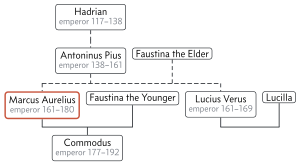
Antoninus gave his heir the best teachers in the empire. For Greek oratory he had Herodes Atticus, the richest man in Athens. For Latin, Marcus Cornelius Fronto was his tutor,Fronto was this ruler's tutor. → Marcus Aurelius•• a lawyer from Cirta in Numidia, in Roman North Africa, whom many Romans ranked second only to Cicero as an orator. Fronto taught him to hunt through old Latin books for the rare, exact word. Their letters to each other survived in a palimpsest, a parchment scraped clean and written over: in 1815 Angelo Mai, the scholar who later found Cicero’s Republic the same way (Chapter 5), found them under the records of a church council in a library at Milan. They show an unusual friendship. Marcus told his teacher that he hoped to learn every word of literature from Fronto’s own lips.
Fronto had no use for philosophy, and he watched with dismay as his pupil drifted toward it. By his mid-twenties Marcus had given up his exercises in speechmaking for the teaching of a Stoic named Quintus Junius Rusticus. In April 145 Marcus married Faustina the Younger,This ruler was the spouse of Faustina the Younger. → Marcus Aurelius• the emperor’s daughter. She was his first cousin and, since both were Antoninus’s children by law, his legal sister as well. Over the next twenty-three years she bore at least thirteen children, including two pairs of twins, and most of them died young.
Two emperors and a war in the East
When Antoninus died in 161, the Senate offered the empire to Marcus alone. He refused to take it unless Lucius, his adoptive brother, received the same powers. The Senate gave way. Lucius took Marcus’s old family name, Verus, and Marcus took his adoptive father’s, ruling as Marcus Aurelius Antoninus. For the first time in its history Rome was ruled jointly by Lucius VerusThis ruler co-ruled with Lucius Verus. → Marcus Aurelius•• and Marcus, two emperors with equal titles. Lucius was thirty, handsome and easygoing, fond of hunting, the chariot races, and the gladiators, and everyone knew that Marcus was the senior partner. Marcus betrothed his eleven-year-old daughter Lucilla to him, and they married three years later.
Trouble came within months, from the Parthians, the Iranian kingdom beyond the Euphrates that had destroyed Crassus’s army at Carrhae (Chapter 5). Their king, Vologases IV (voh-log-uh-seez), put his own man on the throne of Armenia, the mountain kingdom between the two empires, and wiped out a Roman legion. In 162 Lucius went east and made his headquarters at Antioch, the great city of Syria (Figure 17.2), while his generals did the fighting. The best of them was Gaius Avidius Cassius, a Syrian-born officer of about thirty-five. In 165 he led his legion down the Euphrates, beat the Parthians at Dura-Europos (door-uh yoo-roh-pos), and crossed to the Tigris. There two cities faced each other across the river: Seleucia (seh-loo-shuh), the Greek city founded by Seleucus (Vol. 6, The Greeks), and Ctesiphon, where the Parthian kings spent their winters. Cassius’s legions sacked the Parthian capital,Forces serving this ruler and Lucius Verus sacked the Parthian capital Ctesiphon. → Marcus Aurelius•• Ctesiphon, and burned the king’s palace. Seleucia opened its gates to the Romans and was burned anyway.
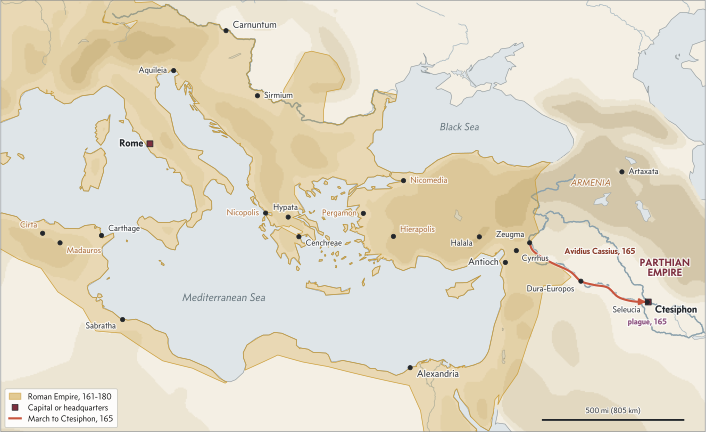
The soldiers brought something home besides plunder. A sickness broke out in Cassius’s army at Seleucia, marched west with the legions, and reached Rome in 166. Its best witness was Galen (gay-lun) of Pergamum, as the Romans spelled Pergamon (Chapter 4), the greatest doctor of the age, who had come to Rome a few years before and later served the emperors themselves. Galen described the Antonine Plague,The Antonine Plague, described by Galen, spread during this ruler’s reign after campaigns in the Near East. → Marcus Aurelius•• named for the Antonines, the family of Antoninus and Marcus. He lists a fever, diarrhea, an inflamed throat, and about the ninth day a rash of sores over the whole body, some dry and some full of pus. Galen’s account fits smallpox, though no one can be sure. It raged until about 180, a new outbreak struck Rome in 189, and modern estimates of the dead vary widely, though many fall between five and ten million. The empire had perhaps seventy-five million people, so the middle of that range means about one person in every ten.
The war on the Danube
The plague struck just as war came to the north. For most of its course the Danube was the empire’s border, and the peoples across it had traded with Rome for generations. The Marcomanni (mar-koh-man-eye) lived in Bohemia, in what is now the Czech Republic, and the Quadi (kway-dye) beside them in Moravia and Slovakia; both were Germanic peoples. East of them, on the plain between the Danube and the Tisza (tee-saw), lived the Iazyges (eye-az-ih-jeez), horsemen of the Sarmatians, a people who spoke an Iranian language. In 166 bands of raiders began crossing the river, perhaps pushed by other peoples moving behind them (Figure 17.3). That same year Lucius came home from the East and celebrated a triumph with Marcus. In 168 the two emperors went north together to face the raiders, and early in 169, on the road back to Rome, Lucius fell ill and died, perhaps of the plague. From then on Marcus ruled alone.
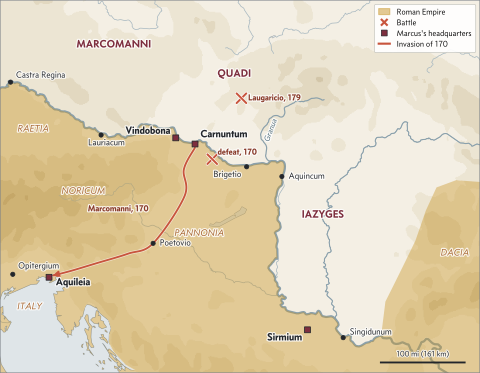
The worst blow fell in 170. The Marcomanni, led by their king Ballomar, crossed the Danube with their allies and destroyed a Roman army of 20,000 men near Carnuntum (kar-nun-tum). Then they marched south over the Alps, burned the town of Opitergium (op-ih-tur-jee-um), and besieged Aquileia (ak-wih-lee-uh), the great port at the head of the Adriatic. No enemy had broken into Italy since the Cimbri, whom Marius had destroyed in 101 BC (Chapter 4). The treasury was empty after the Parthian war and the plague. The Historia Augusta says that Marcus refused to raise taxes and instead sold the palace treasures at auction in the Forum of Trajan for two months: gold cups, statues, and even his wife’s silk robes embroidered with gold.
For most of the rest of his reign Marcus fought the Marcomanni and QuadiThis emperor fought the Marcomannic Wars against peoples along the Danube, including the Quadi and Marcomanni. → Marcus Aurelius•• and their neighbors along the Danube, in what are called the Marcomannic Wars. Aquileia was relieved, and by 171 the invaders had been driven back over the river. Then Marcus carried the war across it. For about three years he lived in the legionary camp at Carnuntum, in the province of Pannonia (puh-noh-nee-uh), and he later worked from Sirmium (sur-mee-um), farther down the river. He took on the Marcomanni, then the Quadi, then the Iazyges. Cassius Dio, a Greek senator who wrote his history of Rome within living memory of these wars, says that the beaten Iazyges handed back a hundred thousand Roman captives in 175.
One battle against the Quadi became a legend. Dio tells how a Roman force was surrounded in the summer heat and was dying of thirst when a sudden storm broke over it. The soldiers held up their shields and helmets to catch the rain, while hail and lightning fell on the enemy. Dio credits an Egyptian magician who prayed to the god Mercury; Christian writers said it was the prayers of the Christian soldiers in one of the legions. The scene was carved on the column that Rome raised in Marcus’s honor after his death (Figure 17.4).

In the spring of 175 a false rumor reached the East that Marcus had died of an illness on the Danube. Avidius Cassius, the conqueror of Ctesiphon, now governed Syria and commanded the whole eastern half of the empire. Believing the report, or choosing to believe it, Cassius proclaimed himself emperor,Avidius Cassius rebelled after false reports of this ruler’s death. → Marcus Aurelius•• and Egypt and Syria went over to him. The historian Cassius Dio, a different man from the rebel, repeats a story that Faustina herself had encouraged him, afraid that her husband would die while their son, Commodus, was still a boy. The rising lasted about three months. Then a centurion, a junior officer, killed Cassius and sent his head to Marcus, who, Dio says, refused to look at it and ordered it buried. He traveled east anyway to calm the provinces, and Faustina went with him. She died that winter at Halala in Cappadocia, in central Asia Minor, a village he renamed Faustinopolis. She had been honored with the title “Mother of the Camp” for following her husband to the frontier.

Rome honored the emperor’s victories with statues, and one of its bronzes survives. The bronze horseman in the Capitoline MuseumsA bronze equestrian statue of this ruler is held in the Capitoline Museums. → Marcus Aurelius•• shows Marcus, bearded and larger than life, riding without stirrups and stretching out his right hand, the gesture of an emperor addressing his troops. Rome once had more than twenty such bronze riders, and all the others were melted down for their metal. This one is said to have survived because people in the Middle Ages took it for Constantine, the first Christian emperor (Chapter 18). In 1538 Pope Paul III had it moved to the Capitoline Hill, where Michelangelo designed its pedestal in the center of his new square. The original is now kept indoors in the museum, and a copy stands in the square.
The end of an age
In 177 Marcus made his son Commodus, then fifteen, emperor beside him. The next year the Marcomanni and Quadi rose again, and father and son went back to the Danube. On March 17, 180, Marcus died in camp, either at Vindobona (vin-doh-boh-nuh), the fort that grew into Vienna, or at Sirmium. He was fifty-eight. The two centuries of peace inside the empire that began under Augustus are called the Pax Romana, the “Roman Peace” (Chapter 9), and his death in 180 traditionally ends the Pax RomanaThis ruler died during the Marcomannic Wars in AD 180, traditionally marking the end of the Pax Romana. → Marcus Aurelius•• (Figure 17.6).
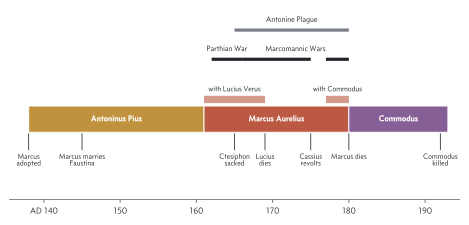
Later writers looked back on these years as a golden age. In 1776 the English historian Edward Gibbon wrote that anyone asked to name the time “during which the condition of the human race was most happy and prosperous” would choose the years “from the death of Domitian to the accession of Commodus.” The five rulers of those years, Nerva, Trajan, Hadrian, Antoninus, and Marcus, are the Five Good Emperors whom Machiavelli had praised more than two centuries before Gibbon (the Stage), and Marcus was the last of the five.This ruler was the last of the Five Good Emperors. → Marcus Aurelius••

Their good fortune had a simple cause. Nerva, Trajan, Hadrian, and Antoninus had no surviving sons, so each adopted the ablest man he could find. Adoption let an emperor choose a grown man whose talents he had already tested in office. But Marcus left the empire to Commodus,This ruler was succeeded by his biological son Commodus rather than an adopted heir. → Marcus Aurelius•• his son by birth rather than an adopted heir, the first son to succeed his own father since Titus followed Vespasian in AD 79 (Chapter 14). Commodus was eighteen. He made peace with the Marcomanni and Quadi, against the advice of his father’s generals, and hurried home to Rome. In 182 his sister Lucilla, once the wife of Lucius Verus, plotted to have him stabbed at the theater. The plot failed, and after it he trusted no one but a series of favorites, each more hated than the last.
Commodus came to believe he was Hercules, the hero and god who had cleared the world of monsters (Vol. 4, Classical Myth). He was painted and carved in the lion’s skin with the club, and in 192 he renamed Rome itself the Colony of Commodus. Worst of all, in Roman eyes, Commodus fought as a gladiatorThe emperor Commodus often participated as one of these people. → gladiators•• in the arena, a trade the law counted as shameful, left to slaves, criminals, and the desperate (Chapter 14). He chose the armor of a secutor, the “chaser” (Chapter 14), and his opponents were careful to lose. Cassius Dio sat among the senators and watched. Commodus shot wild beasts from a raised platform, a hundred in a single day. Once he cut off an ostrich’s head, carried it up to the senators’ seats, and held it up before them with his bloody sword, as if they would be next. Dio admits that he and the senators around him chewed the laurel leaves from their wreaths to keep from laughing out loud.
Commodus planned to begin the year 193 by entering the consulship dressed as a gladiator. Three of the people closest to him, afraid that they would be his next victims, struck first: his mistress Marcia, the chamberlain who ran his palace, and the commander of the Praetorian Guard. On December 31, 192, they poisoned his food. When he vomited the poison, they sent in his wrestling partner, Narcissus, who strangled him in his bath. A year of civil war followed, told in Chapter 18. Cassius Dio, looking back, wrote that with Commodus his history fell from an age of gold to one of iron and rust.
Epictetus and Roman Stoicism
Marcus belonged to a school four and a half centuries old. Zeno of Citium (sish-ee-um) had founded it in Athens about 301 BC, teaching under the Painted Porch, the Stoa, that gave the Stoics their name (Vol. 6, The Greeks). For the Stoics, virtue was the only true good, and the passions, such as grief, fear, and greed, were false judgments that a wise man could unlearn. Romans loved this philosophy, because it was a philosophy of duty. It told a man to do his job well, whatever fortune brought him, and to care nothing for what he could not control.
Its first great Roman voice was Seneca, Nero’s tutor, whose life and death Chapter 12 tells. He is called the Younger to tell him from his father, Seneca the Elder, a writer on public speaking. Seneca the Younger was a StoicSeneca the Younger was a member of this school. → Stoicism••• who wrote his philosophy in Latin, in essays and in letters to his friend Lucilius. The leading Stoic teacher in Rome in Nero’s time was Gaius Musonius Rufus (myoo-soh-nee-us), a knight from Etruria and a generation younger than Seneca. Nero exiled him in AD 65 to a bare island in the Aegean, and he came back to teach that philosophy is something a person practices every day, like medicine, and that women ought to study it too.
Among the young men who came to hear Musonius was a lame slave. He had been born about AD 50 at Hierapolis (hy-uh-rap-uh-lis), a town in Phrygia in Asia Minor, and his only known name is Epictetus (ep-ik-tee-tus), Greek for “acquired.” His master was Epaphroditus (ep-af-roh-dy-tus), a freedman who served as one of Nero’s secretaries. The Greek philosopher Celsus, an enemy of the Christians quoted by the Christian writer Origen (or-ih-jen), says that his master broke his leg; Simplicius, a philosopher of the sixth century, says only that he was lame from childhood. With his master’s permission, the slave studied with Musonius Rufus,This philosopher was a former slave who studied under Musonius Rufus. → Epictetus•• and after Nero’s death in AD 68 he was set free and began to teach. About AD 93 the emperor Domitian banished all philosophers from Rome. Epictetus moved to Nicopolis, a city on the west coast of Greece, opened a school, and taught there until his death about 135.
He wrote nothing. Our record comes from a pupil, Arrian (air-ee-un) of Nicomedia (nik-oh-mee-dee-uh), in northwest Asia Minor, a young Greek who later governed Cappadocia for Hadrian and wrote the history of Alexander’s campaigns (Vol. 6, The Greeks). In a letter that opens his book, in Thomas Wentworth Higginson’s translation, Arrian says, “whatever I heard from his own mouth, that I tried to set down in the very same words.” Arrian gathered his master’s Stoic teachingEpictetus’s teachings, collected by Arrian in the Enchiridion and Discourses, belong to this school. → Stoicism••• into two books. The Discourses are the lessons themselves, of which four books out of eight survive. The Enchiridion (en-ky-rid-ee-on), Greek for “handbook,” is a short summary, small enough to carry everywhere.
The handbook opens with the idea at the center of everything Epictetus taught: “There are things which are within our power, and there are things which are beyond our power.” Our opinions, our aims, our desires, and our dislikes are within our power. Our bodies, our property, our reputations, and the offices we hold are not, and to set our hearts on them is to be a slave to luck. The one thing that is wholly ours is the faculty he called prohairesisEpictetus emphasized prohairesis, or volition, in this philosophical tradition. → Stoicism••• (proh-hy-ruh-sis), our volition or will: the power to choose, to say yes or no to how things seem to us. Nobody can take it away. In the Discourses he imagines a tyrant threatening to chain him and answers, “You will fetter my leg, but not Zeus himself can get the better of my free will.” The words carry extra weight from a lame man who had been born a slave.
Epictetus liked pictures from everyday life. “Men are disturbed not by things,” the handbook says, “but by the views which they take of things.” Another of its pictures says that life is like a dinner party.This philosopher compared life to a dinner party in the Enchiridion. → Epictetus• “Remember that you must behave as at a banquet,” it begins. When a dish is passed to you, put out your hand and take a modest share. If it passes you by, do not grab at it, and if it has not reached you yet, do not crane after it, but wait your turn. Treat children, a wife, public office, and riches in the same way, Epictetus says, and you will be fit to dine with the gods. Table 17.1 sets the four great Roman Stoics side by side.
| Stoic | Dates | Who he was | What survives | One teaching |
|---|---|---|---|---|
| Seneca the Younger | about 4 BC–AD 65 | Nero’s tutor and minister; forced to kill himself | essays, tragedies, and letters to Lucilius | a slave is a fellow human being |
| Musonius Rufus | about AD 25–before 101 | Roman knight; exiled by Nero | summaries of his lectures, written down by a pupil | philosophy is daily practice, for women as well as men |
| Epictetus | about AD 50–135 | freed slave; teacher at Nicopolis | the Discourses and the Enchiridion, recorded by Arrian | some things are in our power, and some are not |
| Marcus Aurelius | AD 121–180 | emperor from 161 | the Meditations, twelve books in Greek | every man is a citizen of the world |
The Meditations
The emperor’s notebook is the most famous book of Stoic philosophy ever written, and its author never meant anyone else to read it. Marcus wrote the Stoic MeditationsThis work was written by Marcus Aurelius. → Meditations••This ruler wrote the Stoic Meditations. → Marcus Aurelius•••Marcus Aurelius’s Meditations espouses this philosophy. → Stoicism••• in Greek, the language of philosophy, though he was a Roman writing for a Roman, himself. It is a book of reminders: short passages, from one line to a page, in which he argues with himself, scolds himself, and repeats what he most needed to remember. The name Meditations is a modern one. The manuscripts divide the work into twelve books under the title Ta eis heautonThis work comprises twelve books and bears the Greek title Ta eis heauton, or “things to oneself.” → Meditations•• (tah ays heh-ow-ton), “things to himself.” The title fits, for the book speaks to no one but its writer, calling him “thou” and giving him orders.
Most of it dates from the 170s, the years of the Marcomannic Wars. Marcus wrote it on campaign, partly at Carnuntum,This work was written during its author’s military campaigns, partly at Carnuntum. → Meditations•• and two notes in the text say where. At the end of the first book stand the words “Among the Quadi at the Granua,” a river in Slovakia now called the Hron (hrawn). At the end of the second, in George Long’s translation of 1862, stands “This in Carnuntum,” the legionary camp on the Danube where Marcus lived for about three years (Figure 17.3).
The first book is unlike the rest. Instead of arguments, it gives a roll call of the people who made him what he was, family and teachers alike. The Meditations opens with this list of debts,This work opens by listing lessons learned from people such as Rusticus. → Meditations•• each person with the lesson Marcus owed him or her. From his grandfather Verus he learned good character and an even temper; from his mother, kindness and a simple way of living. From Fronto he learned what envy, double-dealing, and hypocrisy are like in a tyrant. One of the longest entries is a portrait of Antoninus, his adoptive father, and another goes to the Stoic Rusticus. “From Rusticus,” the list says, “I received the impression that my character required improvement and discipline.” Rusticus taught him to avoid showy speeches and fine writing, to forgive quickly, and to read a book carefully. Hadrian, who made Marcus’s career, is missing from the list.
Rusticus also gave him a book. Marcus thanks him for “being acquainted with the discourses of Epictetus, which he communicated to me out of his own collection.” This was probably Arrian’s record, and the lessons of Epictetus shaped his StoicismEpictetus’s writings inspired this ruler’s Stoic philosophy. → Marcus Aurelius• more than any other teacher’s. The emperor quotes the freed slave by name, as in “Thou art a little soul bearing about a corpse, as Epictetus used to say.” Above all he took from Epictetus the line between what is in our power and what is not.
The second book opens with a famous piece of advice to himself. “Begin the morning by saying to thyself,” it says, “I shall meet with the busybody, the ungrateful, arrogant, deceitful, envious, unsocial.” Such people do wrong, Marcus reasons, because they do not know good from evil. None of them can harm the part of him that matters, and he cannot hate them, since they share his reason. They are his kin, made, as he says, “for co-operation, like feet, like hands, like eyelids, like the rows of the upper and lower teeth.”
Marcus did not claim to know how the universe worked. The Stoics taught that a divine reason runs through the world and orders everything for the best, which they called providence. The Epicureans taught that the world is only atoms, tiny particles colliding by chance in empty space (Chapter 6). Again and again the Meditations sets the two side by side, and in Book 4 Marcus tells himself to remember “this alternative; either there is providence or atoms.”This work repeatedly considers whether the world is governed by “providence or atoms.” → Meditations•• Either way, he concludes, the answer is the same. If the gods rule, accept what they send. If there are only atoms, then at least his own mind is his to govern.
From the reason that all men share, Marcus drew a larger idea. If our reason is common, he argues in Book 4, then there is a common law, and if a common law, then “we are fellow-citizens,” and “the world is in a manner a state.” The Greek word for such a world-city was cosmopolis, and the Cynic Diogenes (dy-oj-ih-neez) had called himself a “citizen of the world” (Vol. 6, The Greeks). The Meditations urges its reader to act as a citizen of the world-city, the cosmopolis.This work urges readers to act as citizens of the “cosmopolis.” → Meditations•• In Book 6 the emperor, who ruled under the name Antoninus, puts it in one sentence: “My city and country, so far as I am Antoninus, is Rome, but so far as I am a man, it is the world.”
The hardest command in the book is the shortest. An impression, in Stoic language, is the way a thing first appears to us, which the mind may accept or reject; Zeno, Cicero says, showed it as an open hand, and assent as the fingers curling shut (Vol. 6, The Greeks). Long translates the Greek word as “imagination,” and in Book 9 Marcus orders himself, “Wipe out imagination; check desire: extinguish appetite.” The same order comes back in Books 7 and 8. Modern translators render it “erase the impression,” and the book’s repeated advice is to wipe out the impression before it rules you.This book contains repeated admonitions to "erase your impressions." → Meditations• An insult hurts only when we add the judgment “I have been harmed.”
No one outside the palace seems to have read the notebook for centuries. Its first clear mention comes about AD 900, when a Byzantine bishop named Arethas wrote that he owned an old copy of the emperor’s book, so worn that it was falling to pieces, and had a new one made. The first printed edition appeared at Zurich in 1559, made from a manuscript at Heidelberg that has since been lost.
Apuleius and the Isis mysteries
In the same years a very different writer was making his name in Africa. Apuleius was born about AD 124 at Madauros (muh-daw-ros), a Roman colony in Numidia, in what is now Algeria, and he called himself half Numidian and half Gaetulian (jee-too-lee-un), from two peoples of the region. His father, a magistrate of the town, left him and his brother nearly two million sesterces, a fortune. He spent much of his share on learning. He studied at Carthage and then at Athens, where he became a follower of Plato, and he traveled widely, joining several of the secret cults of the gods as he went.
On a journey to Alexandria he fell ill at Oea (ee-uh), now Tripoli in Libya, in the house of a friend from his student days. He stayed, and he married his friend’s mother, Pudentilla, a rich widow some years older than he was. Her late husband’s family, who had hoped for her money, accused him of winning her with magic spells. About 158 he was tried at Sabratha (sab-ruh-thuh), a city on the coast, before the governor of Africa, Claudius Maximus, probably the same Stoic Maximus whom Marcus thanks in the first book of the Meditations. Apuleius’s speech in his own defense survives as the Apology, a witty demolition of his accusers. He seems to have won, for he spent the rest of his life as a famous lecturer at Carthage.
Apuleius wrote The Golden Ass,This author wrote The Golden Ass. → Apuleius•• the novel that made him immortal. He called it the Metamorphoses, “transformations,” like Ovid’s poem (Chapter 11). The name The Golden Ass comes from Augustine, who grew up two centuries later in the same corner of Africa (Chapter 19), and “golden” perhaps meant something like “wonderful.” It is the only Roman novel written in LatinThe Golden Ass was written in this language. → Latin• to survive whole. Petronius’s Satyricon (Chapter 12) is only fragments. Apuleius took his plot from a Greek tale now lost, whose story also survives in a short Greek version called Lucius, or the Ass. In eleven books he filled it out with stories inside the story, told in a dazzling Latin full of rhymes, rare words, and jokes.
The hero, Lucius, is a curious young Greek who travels on business to Hypata (hip-uh-tuh) in Thessaly, a region famous for its witches. He lodges with a miser named Milo, whose wife, Pamphile (pam-fih-lee), is a witch. One night the maid Photis (foh-tis) lets him watch through a crack in a door as Pamphile rubs herself with ointment, sprouts feathers, and flies off as an owl. Lucius begs to try it. Photis fetches him a box, but it is the wrong box, and instead of feathers he grows coarse hair and hooves. He meant to become a birdIn this novel, a character accidentally turns into a donkey while trying to become a bird. → The Golden Ass•• and became a donkey. In William Adlington’s translation, first printed in 1566, he looks himself over and finds “that I was no bird, but a plaine Asse.”
The cure is simple: he has only to eat a rose. But that same night robbers break into the house and lead him away loaded with their loot, and for most of the novel he cannot find one. He keeps a man’s mind inside a donkey’s body, and because people say anything in front of a donkey, he hears every secret. In the robbers’ cave an old woman tells a captive girl the story of Cupid and Psyche (sy-kee), told in full with the myths (Vol. 4, Classical Myth). He is sold to wandering priests, to a miller, and to a gardener, and then seized by a soldier, and nearly all of them beat him. At last he is to be shown in a shameful spectacle in the arena at Corinth. He bolts and gallops to the beach at Cenchreae (ken-kree-ee), the port of Corinth, and falls asleep on the sand.

He wakes in the night to see the full moon rising out of the sea, and he prays to the queen of heaven to give him back his shape. The last book belongs to Isis (Vol. 5, In the Beginning), the Egyptian goddess whose worship had spread across the Roman world. She rises from the waves crowned with flowers, a bronze rattle in her hand. “I am she that is the naturall mother of all things,” she says in Adlington’s words. The Athenians call her Minerva, the Cypriots Venus, others Diana, Proserpina, or Ceres, but the Egyptians “doe call mee Queene Isis.” Tomorrow is her festival, she tells him, when her priests launch a ship to open the sailing season. The high priest will carry a garland of roses.
Lucius follows the procession, eats the roses from the priest’s hand, and becomes a man again in front of the crowd. In gratitude he devotes the rest of his life to the goddess. A mystery cult (Chapter 14) was a worship whose central rites were secret, open only to those who had been initiated, and which promised its members the god’s protection in this life and the next. After ten days of fasting, dressed in new linen, Lucius is initiated into the mysteries of IsisLucius joins this figure's mystery cult in Apuleius's The Golden Ass. → Isis•• in her temple at night. He may not tell what happened, but he gives a hint: “I approached neere unto Hell, even to the gates of Proserpina,” and “About midnight I saw the Sun shine.”
The novel ends with Lucius in Rome, initiated twice more, a successful lawyer and a priest of Isis and Osiris, walking about proudly with his head shaved. In the last pages the god Osiris tells his priest in a dream to expect “a poore man of Madura,” the Elizabethan spelling of Madauros. The hero had introduced himself in the first book as a Greek, with forebears from Attica, Corinth, and Sparta. With one word, Apuleius had written himself into his own story.
What to remember
- Antoninus Pius adopted Marcus Aurelius and Lucius Verus in 138 at Hadrian’s command. Fronto taught Marcus Latin, and Marcus married Antoninus’s daughter Faustina the Younger in 145.
- In 161 Marcus made Lucius Verus his co-emperor, the first time that Rome had two emperors. Avidius Cassius sacked the Parthian capital Ctesiphon in 165, and the army brought back the Antonine Plague, which the doctor Galen described.
- From 166 to 180 Marcus fought the Marcomannic Wars on the Danube against the Marcomanni, the Quadi, and the Iazyges, living for years at Carnuntum. In 175 Avidius Cassius rebelled on a false report of Marcus’s death.
- Marcus died in 180, the last of the Five Good Emperors, and his death traditionally ends the Pax Romana. His bronze equestrian statue is in the Capitoline Museums.
- His son Commodus, a son by birth and not an adopted heir, fought as a gladiator, as Cassius Dio saw, and was strangled in 192.
- Seneca the Younger, Musonius Rufus, Epictetus, and Marcus Aurelius were the great Roman Stoics. Epictetus, a freed slave and pupil of Musonius, taught prohairesis, the will; Arrian recorded him in the Discourses and the Enchiridion, which compares life to a banquet.
- The Meditations, twelve books in Greek titled “to himself,” were written on campaign, partly at Carnuntum. They open with lessons from Rusticus and others, weigh “providence or atoms,” call every man a citizen of the world-city, and repeat the command to wipe out the impression.
- Apuleius of Madauros wrote The Golden Ass in Latin. Lucius wants to become a bird, is turned into a donkey, and is saved by Isis, into whose mysteries he is initiated.
The Late Empire
Chapter 18 · 39 clues
Crisis, Diocletian, and Constantine
Early in February 211 an old emperor lay dying at York, in the north of Britain. Septimius Severus had spent three years fighting beyond Hadrian’s Wall, and he was worn out. According to the historian Cassius Dio, a senator who knew him, he left his two sons a short piece of advice: agree with each other, make the soldiers rich, and despise everyone else. Ninety-five years later, in the summer of 306, another emperor died in the same fortress at York, and the soldiers there raised his son in his place. That son was Constantine.
Between those two deaths the Roman Empire came close to falling apart. For fifty years after 235 about two dozen men were hailed as emperor, most of them by armies, and nearly all of them were murdered or killed in battle. The frontiers broke, the silver coins turned to bronze, and for a time Gaul and the East went their own ways. Then two soldiers from the Balkans put the empire back together in a new shape. Diocletian shared the work of ruling among four emperors, and Constantine turned the empire toward the Christians’ God and gave it a new capital on the Bosporus (Figure 18.1).
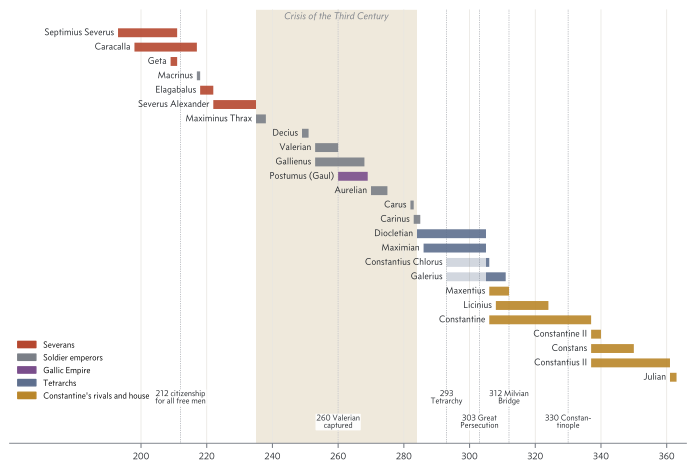
The Severans and Africa
The story starts with an auction. On the last day of 192 the emperor Commodus, the son of Marcus Aurelius, was murdered (Chapter 17). The next emperor, an old general named Pertinax (pur-tih-naks), tried to make the Praetorian Guard, the emperor’s bodyguard in Rome, obey him, and within three months the guardsmen killed him. Then, Cassius Dio says, they offered the empire to whoever would pay them most, and a rich senator, Didius Julianus, bought it. The armies on the frontiers would not accept an emperor who had bought his throne from the guard. Three generals were proclaimed by their legions: Pescennius Niger (peh-sen-ee-us ny-jer) in Syria, Clodius Albinus in Britain, and the commander of the Danube armies. The last of them reached Rome first. Historians call 193 the Year of the Five Emperors.
The winner was Lucius Septimius Severus, and he was the first emperor born in Africa. On April 11, 145, Septimius Severus was born at Leptis Magna,Septimius Severus came from a city in this province called Leptis Magna. → Africa•This country is the birthplace of the Roman Emperor Septimius Severus. → Libya•• a port in the Roman province of Africa whose ruins stand today on the coast of Libya. His father’s family was of mixed Libyan and Punic descent, his mother’s Italian, and the boy grew up speaking Punic, the Phoenician language of Carthage, along with Latin and Greek. He spent four years beating two rival generals, one in the East and one in Gaul, and ruled in all for eighteen years. He did not forget his birthplace. Leptis got a new forum and basilica, a colonnaded street, a bigger harbor, and an arch with four faces over a crossroads for his visit in 203.
To a Roman, Africa meant a province before it meant a continent. It was the land around Carthage that Rome took in 146 BC, after the Third Punic War (Vol. 5, In the Beginning), and it grew to include the coast to the east, later called Tripolitania, “the land of three cities”: Sabratha, Oea, and Leptis Magna. Oea is now Tripoli, the capital of Libya. Only later did the province’s name spread to the whole continent, as “Asia” spread from Rome’s province in western Anatolia.
East of Leptis, across the empty bend of coast called the Gulf of Sirte, or Sidra, lay a Greek world. Cyrene was founded about 631 BC by settlers from the island of Thera (Vol. 6, The Greeks), and its region, the eastern part of Libya, is still called Cyrenaica (seer-uh-nay-ih-kuh). It passed to the Ptolemies of Egypt and then, by the will of its last king, to Rome in 96 BC. Today Libya holds the ruins of Leptis Magna and Cyrene,This country is home to the ancient cities of Leptis Magna and Cyrene. → Libya•• the greatest Roman city of its west and the greatest Greek city of its east. Cyrene’s wealth came from silphium, a wild plant used as a medicine and a seasoning, so prized that it was stamped on the city’s coins; Pliny the Elder says that only one stalk had been found in his lifetime, and it was sent to Nero. When Roman forces conquered Crete from its pirates in 67 BC, the Senate joined Cyrenaica with Crete in one province,The eastern portion of this country, known as Cyrenaica, was paired with Crete in a Roman province. → Libya• governed from Gortyn on Crete, though the two halves lay 200 miles apart across open sea (Figure 18.2).

South of the coast stretched the Sahara. The Greek historian Herodotus had heard of a people there whom he called, in G. C. Macaulay’s translation, “a very great nation, who carry earth to lay over the salt and then sow crops.” They were the Garamantes (gar-uh-man-teez). In the Fezzan (feh-zan), a chain of oases in what is now southern Libya, the Garamantes built a desert civilization,The Garamantes developed an extensive civilization in this country. → Libya• one of the first to grow up in a great desert without a river to feed it. They dug long tunnels, called foggaras, to bring water from under the sand to their fields of wheat and dates. Their capital, Garama, had about four thousand people, with some six thousand more in the villages around it. The Garamantes brought slaves to the coast and bought Roman wine, glass, and pottery. Under Severus a Roman legion fought them for several years and built forts along the desert roads to guard the coast.

About 187 Severus, a widower, married Julia Domna (dom-nuh), the daughter of Julius Bassianus, high priest of the sun god at Emesa (em-ih-suh) in Syria. The Historia Augusta, a late and unreliable collection of emperors’ lives, says he chose her because her horoscope promised that she would marry a king. She was clever and well read, and she gathered philosophers and writers around her. They had two sons. The elder is known by his nickname, Caracalla, from the long hooded Gallic cloak he wore, and the younger was Geta. Severus made both of them emperors beside him, and both were at York when he died in 211. The brothers hated each other. In December 211, Dio says, Caracalla had Geta cut down by soldiers in the arms of their mother. Then he ordered Geta’s name chiseled off inscriptions and his face scraped off pictures, a punishment modern historians call damnatio memoriae, “condemnation of memory” (Figure 18.3).
In 212 Caracalla gave Roman citizenship to almost every free man and woman in the empire. Dio thought the real aim was money, since only citizens paid the tax on inheritances. Money was always short, because Severus had raised the soldiers’ pay and Caracalla raised it again, and the soldiers were paid in silver. So in 215 Caracalla introduced a new silver coin,Caracalla introduced the antoninianus, one of these Roman monetary objects. → coins• a little larger than the denarius, the empire’s ordinary silver coin (Chapter 15), and stamped with the emperor wearing a crown of sun rays. Modern collectors call it the antoninianus (an-toh-nin-ee-ay-nus), after Caracalla’s official name, Antoninus. It was valued at two denarii but held only as much silver as one and a half.
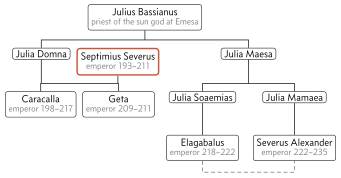
Caracalla did not live to see where his coin would lead. In April 217, near Carrhae in Mesopotamia, he stepped off the road to relieve himself and a soldier stabbed him to death. The plot was the work of Macrinus (muh-kry-nus), his praetorian prefect, the commander of the guard, who took the throne. Julia Domna’s sister, Julia Maesa (mee-suh), won it back for the family within a year: she told the soldiers that her teenage grandson was Caracalla’s son, and they made him emperor. He was Elagabalus (el-uh-gab-uh-lus), the priest of the sun god of Emesa (Vol. 4, Classical Myth), and he was murdered in 222. His cousin Severus Alexander ruled for thirteen years under the eye of his mother, Julia Mamaea (mam-ee-uh), until in 235 mutinous soldiers on the Rhine killed them both (Figure 18.4).
The Crisis of the Third Century
The man the soldiers raised in 235, Maximinus Thrax (mak-sim-ih-nus thrax), was a soldier from Thrace who had risen from the ranks, and in his three years as emperor he never went to Rome. His reign opened what historians call the Crisis of the Third Century, the fifty years from 235 to 284 in which the empire nearly broke apart. An emperor needed an army to win the throne and had to keep paying it to keep the throne. Whenever he left one frontier to fight a rival, another frontier broke, and the general he sent to mend it was often hailed as emperor by his own troops.
The enemies were new and stronger. In Persia a new Iranian dynasty, the Sasanians (suh-say-nee-unz), had overthrown the Parthians in 224 (Vol. 5, In the Beginning) and wanted back the lands of the old Persian kings. On the Rhine and the Danube, Germanic peoples had gathered into large confederations: the Franks, the Alamanni (al-uh-man-eye), and the Goths. In 251 the Goths killed the emperor Decius and his son in a swamp at Abritus, in what is now Bulgaria; he was the first emperor to die fighting a foreign enemy. In 260 the Persian king Shapur (shah-poor) I captured the emperor Valerian near Edessa, in upper Mesopotamia. No Roman emperor had ever been taken prisoner before, and Valerian died in captivity. A plague raged through the empire in the same years.
With Valerian’s son Gallienus (gal-ee-ee-nus) busy on the Danube, the West decided to defend itself. In 260 the armies of the Rhine proclaimed their commander, Marcus Cassianius Latinius Postumus, emperor. He did not march on Rome. He ruled Gaul, the land Caesar had conquered (Chapter 7), with the Rhine frontier, Britain, and for a time Spain, from a capital at Cologne or Trier (treer), with his own consuls and his own coins. Historians call his state the Gallic Empire, after Gaul, its heart,Roman commander Postumus founded an empire named for this region during the Crisis of the Third Century. → Gaul• and Postumus ruled it for nine years, beating back the Franks and Alamanni whom Rome had failed to stop. In 269 his own soldiers killed him, because after taking the rebel city of Mainz he would not let them plunder it. The Gallic Empire lasted five years more.
In the East, meanwhile, the caravan city of Palmyra (pal-my-ruh) in the Syrian desert held the frontier against Persia, and then, under its queen Zenobia (zeh-noh-bee-uh), took Egypt and much of Anatolia for itself in 270. The empire was in three pieces. The emperor Aurelian, a cavalry officer from the Danube lands, put them back together. He captured Zenobia in 272 and beat the last Gallic emperor at Châlons (shah-lon), in Gaul, in 274, and his coins called him “Restorer of the World.” He also gave Rome a new brick wall, about 12 miles round, because for the first time in centuries an enemy might reach the city, and he built the temple of the Unconquered Sun (Vol. 4, Classical Myth). Like most of the others, he was murdered by his own officers, in 275.
Aurelian had mended the map, but the old way of ruling, one emperor in Rome trusting generals far away, had failed again and again.
Diocletian and the Tetrarchy
On November 20, 284, the army of the East gathered on a hill 3 miles outside Nicomedia, a city on the Asian shore of the Sea of Marmara. The young emperor Numerian (noo-meer-ee-un) had died on the march home from Persia, and his death had been hidden for days inside his closed litter. The officers chose the commander of the imperial bodyguard, a man named Diocles, of humble birth from Dalmatia on the Adriatic coast of the Balkans. Before the army, the historian Eutropius says, he swore that he had no part in Numerian’s death, accused the praetorian prefect Aper of the murder, and killed Aper on the spot with his own sword. As emperor he took the grander name Diocletian.
Numerian’s brother Carinus (kuh-ry-nus) still ruled the West with a larger army. In July 285 Diocletian beat Carinus at the Margus,This emperor secured power by defeating his rival Carinus at the Battle of the Margus. → Diocletian•• a river now called the Great Morava, in Serbia. The accounts say that Carinus was winning when one of his own officers killed him, and that his praetorian prefect went over to Diocletian. Diocletian ruled for more than twenty years, longer than any emperor for a century, and Diocletian ended the Crisis of the Third CenturyThis ruler ended the Crisis of the Third Century. → Diocletian•• by facing the problem that had killed his predecessors. One man could not be on every frontier at once, and any general left in charge of a frontier might make himself emperor. His answer was to share power with men he could trust.
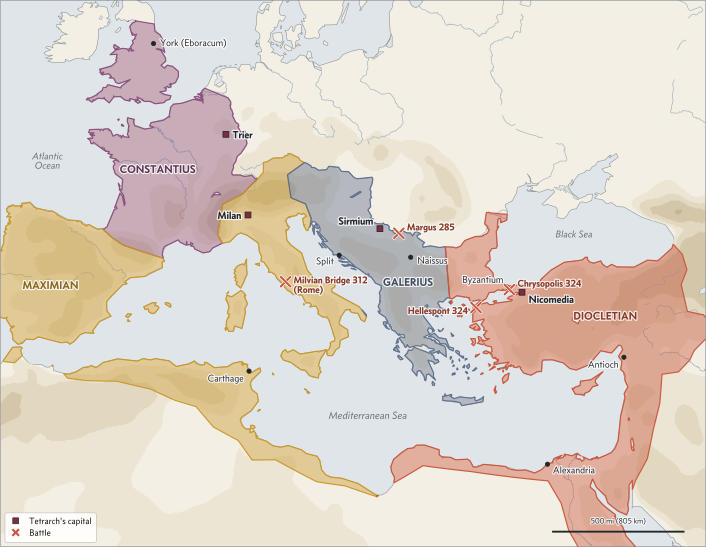
In 285 he made a fellow officer from the Balkans, Maximian (mak-sim-ee-un), his junior colleague, and the next year raised him to his own rank. Each held the title Augustus, the name of the first emperor, now used for a senior emperor. Diocletian kept the East and Maximian took the West. Neither lived in Rome, which stayed the grandest city of the empire but was no longer where it was ruled. Diocletian built himself a palace at Nicomedia, and Maximian ruled from Milan,Maximian ruled from this city, a western imperial capital under Diocletian’s division of power. → Milan•• on the flat plain of the Po, where the roads from Rome met the roads over the Alps to the Rhine and the Danube. Emperors went on living there for a century, and Saint Ambrose (am-brohz) would be its bishop (Chapter 19). The city, then called MediolanumThis city was previously called Mediolanum. → Milan• (med-ee-oh-lay-num), had been founded by Gauls, and its name probably meant “the middle of the plain” in their language. To bind the partnership with religion, Diocletian took the name Jovius, “Jupiter’s man,” the one who plans, and Maximian took Herculius, “Hercules’s man,” the strong arm.
In 293 each Augustus took a junior partner with the title Caesar, once Julius Caesar’s family name and now the title of an heir. Diocletian created the Tetrarchy,This ruler created the Tetrarchy, appointing Galerius as his junior ruler and Constantius Chlorus to serve under Maximian from Trier. → Diocletian•• as modern historians call the system, from the Greek for “rule of four.” His own Caesar was Galerius (guh-leer-ee-us), a hard soldier from the Danube who married Diocletian’s daughter Valeria and made his base at Sirmium on the river Sava. Maximian’s Caesar was Constantius (kon-stan-shus), later nicknamed Chlorus (klor-us), “the Pale,” who had put aside Helena, the mother of his son Constantine, to marry Theodora, the daughter of Maximian (some ancient writers say his stepdaughter). Constantius governed Gaul and Britain from Trier on the river Moselle (moh-zel) (Figure 18.5).

The four rulers issued laws in all their names and were shown alike in stone. A famous group carved in porphyry, a hard purple stone quarried only in the desert of Egypt and kept for emperors, shows two pairs of them embracing, with matching armor, square caps, and eagle-headed swords (Figure 18.6). It is not four portraits but a picture of one idea: four men acting as one.
Diocletian rebuilt the government underneath the emperors. He doubled the number of provinces, to about a hundred, and grouped them into twelve larger districts called dioceses. He took the troops away from provincial governors, so that a governor ran the courts and the taxes and a separate general led the soldiers, and no single officer held both the money and the men to rebel. He also tried to repair the money. Diocletian reformed and standardized the coinage,Diocletian carried out standardization and reform of these objects. → coins• with a gold coin struck at sixty to the Roman pound, a coin of nearly pure silver, and a large bronze coin washed with silver. Every mint of the empire made them to the same standard and marked each coin with the mint’s name.
The new coins did not stop inflation, the steady rise of prices. Late in 301 Diocletian issued the Edict on Maximum Prices,This ruler issued the Edict on Maximum Prices to attempt to check inflation. → Diocletian•• which set the highest legal price for well over a thousand goods and services, from beef and beer to a day’s work by a carpenter. The dearest item, a pound of purple-dyed silk, was capped at 150,000 denarii, the same price as a lion. Selling above the limit was punishable by death. The edict was carved on stone in the markets of the eastern provinces, and pieces of it are still being found. It failed. Lactantius, a Christian who taught Latin rhetoric at Nicomedia and hated Diocletian, wrote in William Fletcher’s translation that “much blood was shed for the veriest trifles; men were afraid to expose aught to sale.” Within a few years the edict was ignored.
Diocletian believed the gods kept Rome safe, and Christians would not sacrifice to them. Lactantius says that at a sacrifice, probably in 299, the priests could not read the signs in the animals’ organs and blamed Christians at court who made the sign of the cross. Diocletian ordered everyone in the palace to sacrifice, and every soldier to sacrifice or leave the army. Galerius, Lactantius says, pressed him to go further and strike at every Christian in the empire. The emperors chose their day with care. February 23 was the Terminalia (tur-mih-nay-lee-uh), the feast of Terminus, god of boundary stones, and in Fletcher’s translation Lactantius says it was chosen “to terminate, as it were, the Christian religion.” At dawn on February 23, 303, the praetorian prefect and his officers broke into the church at Nicomedia, which stood in view of the palace, burned its Scriptures, and had the guard level it with axes. With that, Diocletian began the last great persecutionThis ruler began Rome’s last major Christian persecution by destroying Nicomedia’s church during the Terminalia. → Diocletian••The last massive persecution of these people began during the reign of Diocletian. → Christians• of the Christians. Edicts followed ordering churches pulled down and clergy jailed, and at last everyone was ordered to sacrifice. Christians call it the Great Persecution. It was fiercest in the East; in Gaul and Britain, Constantius did little more than pull down some churches.
In 304 Diocletian fell gravely ill. On May 1, 305, on a hill 3 miles outside Nicomedia, perhaps the one where he had been proclaimed, he stood before the army and a statue of Jupiter and told them, in tears, that he was too tired to rule. Diocletian abdicated on May 1, 305;Diocletian performed this action in 305. → abdication• to abdicate is to give up a throne of one’s own free will, and no Roman emperor had done it before. On the same day, at Milan, Maximian unwillingly did the same. Galerius and Constantius became the Augusti and took two new Caesars, one of them Galerius’s nephew Maximinus Daia. Lactantius says the soldiers at Nicomedia expected Constantine, who stood near the platform, to be named, and that they were astonished when Galerius brought forward someone else.
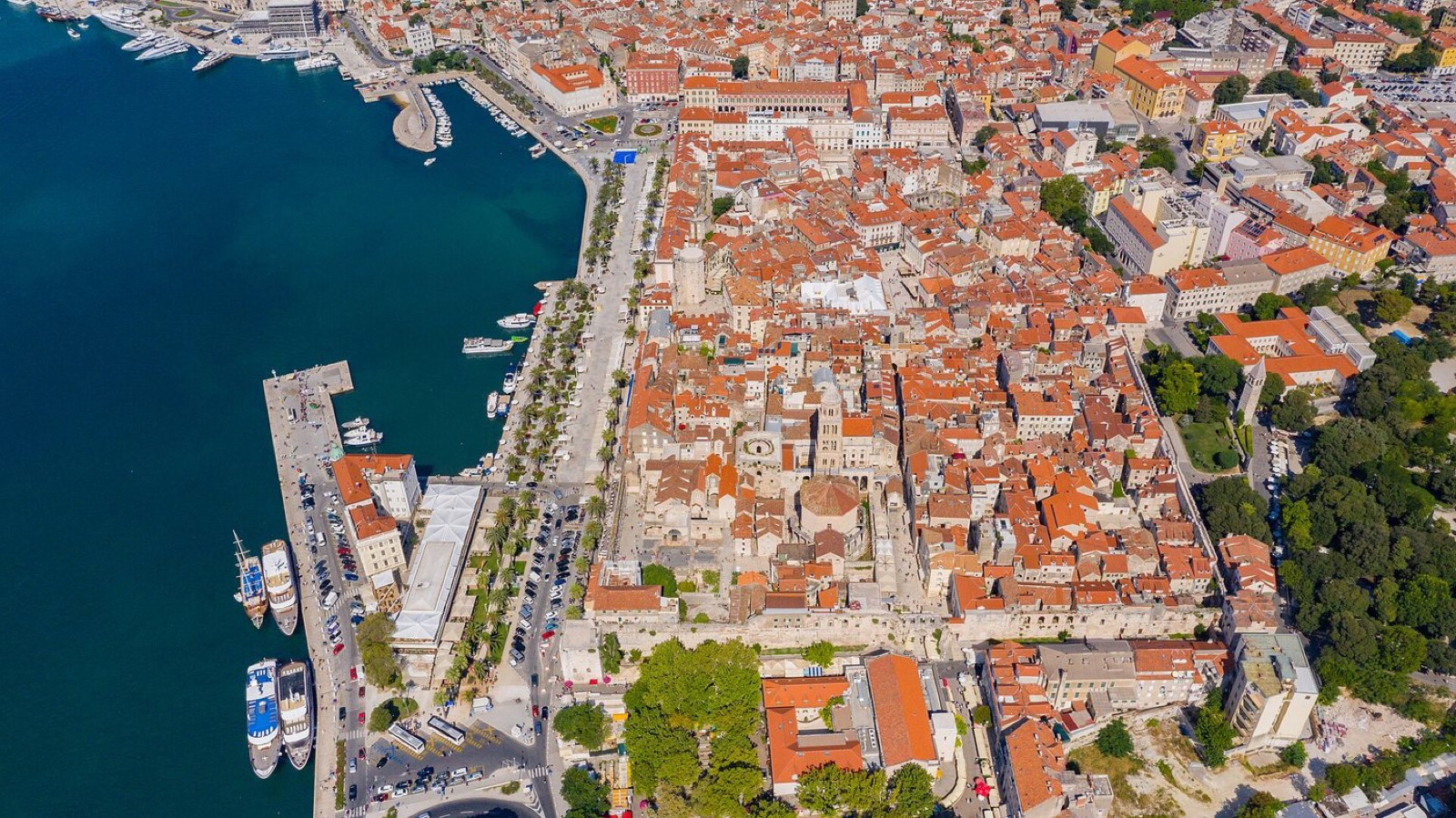
Diocletian went home to Dalmatia. He retired to his palace at Split,This ruler retired to his palace at Split in Dalmatia, where he is said to have grown cabbages. → Diocletian••Diocletian’s Palace is in this city. → Split•• a fortified villa on the coast a few miles from the city of Salona (suh-loh-nuh), with walls and towers like a legion’s camp, a hall facing the sea, and a tomb waiting for him (Figure 18.7). The Epitome de Caesaribus (ih-pit-uh-mee day see-zar-ih-bus), a short Latin history of the emperors written about 400, tells a story of his retirement. When Maximian and Galerius begged him to take back power, he answered that if they could see the cabbages he had planted with his own hands, they would never ask him. He died there about 311. Three centuries later, when invaders sacked Salona, its people fled inside the palace walls, and the city of Split grew up in its courtyards and corridors, where people still live.
Constantine’s rise
The Tetrarchy’s plan had left out two sons. Constantine, Constantius’s son by Helena, was born at Naissus (ny-sus), now Niš (neesh) in Serbia, probably on February 27, 272. Helena was a woman of low birth, probably from Bithynia, the region around Nicomedia. The boy grew up at Diocletian’s court, half officer and half hostage for his father’s loyalty, and he was at Nicomedia when the persecution began. Maxentius (mak-sen-shus), the son of Maximian, had been passed over too.
In 305 Constantine asked Galerius to let him join his father, who needed him for a campaign in Britain. Galerius agreed one evening and meant, Lactantius says, to stop him in the morning. As Constantine’s admirers later told it, he rode through the night from one post station to the next, laming the horses he left behind so that no one could follow. He found his father at Boulogne, on the coast of Gaul, crossed with him to Britain, and fought the Picts, the peoples of what is now Scotland, beyond Hadrian’s Wall (Chapter 16). On July 25, 306, Constantius died at York, the Roman Eboracum, the legion’s fortress where Septimius Severus had died. There, in Britain, his father’s troops proclaimed Constantine emperor,This ruler was proclaimed emperor at Eboracum after the death of his father. → Constantine I•Constantine the Great was acclaimed emperor by troops in this region. → Roman Britain• led, the Epitome says, by Chrocus, a king of the Alamanni who served in the Roman army.
Galerius was furious but accepted him as a Caesar rather than fight. In October 306 the Praetorian Guard in Rome proclaimed Maxentius emperor, and old Maximian came out of retirement to help his son. Together they overthrew the other new Caesar of 305, who had become Augustus in the West. In 307, to win Constantine as an ally, Maximian married his daughter Fausta to him and hailed him as Augustus. In 308, at a conference at Carnuntum on the Danube, Galerius made his old comrade Licinius Augustus in the West, and Diocletian came out of his garden long enough to attend. By 310 six men were calling themselves Augustus at once. That year Maximian, who had quarreled with his son and fled to Constantine’s court, tried to seize his son-in-law’s power; he was caught and forced to hang himself. Galerius died in 311. That left four: Constantine in Gaul and Britain, Maxentius in Italy and Africa, Licinius in the Balkans, and Maximinus Daia in the East.
In the spring of 312 Constantine crossed the Alps. He won battles at Turin and Verona and marched down the Flaminian Way, the great road into Rome from the north. Maxentius had cut the bridges over the Tiber, but on October 28, the sixth anniversary of his reign, he led his army out across the river by a bridge of boats beside the old stone Milvian Bridge, just north of the city. Lactantius says the Sibylline Books, Rome’s ancient books of prophecy, had promised that on that day “the enemy of the Romans should perish.” Constantine’s cavalry broke Maxentius’s army, which stood with its back to the river, and the fugitives crowded onto the bridge of boats. It gave way, and Maxentius drowned in the TiberThis ruler defeated Maxentius, who drowned in the Tiber, at the Battle of Milvian Bridge. → Constantine I••• with many of his men. The next day his body was pulled out of the river, and his head was paraded through Rome.

In Rome, Constantine disbanded the Praetorian Guard, which had fought for Maxentius and had made and unmade emperors for nearly three hundred years. In the great basilica that Maxentius had built in the Forum he set up a seated statue of himself, about 40 feet tall; its head, hands, and feet were marble, and the body was probably brick and wood under gilded bronze (Figure 18.8).
The Senate voted him a triumphal arch beside the Colosseum, dedicated in 315 (Figure 18.9). Much of its sculpture, perhaps for lack of time, was taken from older monuments to Trajan, Hadrian, and Marcus Aurelius, with the old emperors’ heads recut as Constantine’s. The inscription says that he won “by the prompting of the divinity,” instinctu divinitatis, words vague enough to please both the Senate, most of whose members still worshiped the old gods, and an emperor who now favored the Christians.

The Christians and the empire
For eight years the Great Persecution had run on in the East, longest and hardest under Galerius and Maximinus Daia, while Constantius and then Constantine left the Christians of Gaul and Britain mostly alone. In April 311 Galerius, dying of a horrible disease, gave up. His edict, which Lactantius copied, said that the persecution had failed, and it promised, in Fletcher’s translation, “to permit them again to be Christians,” and asked them in return to pray to their God for the emperors.
What happened to Constantine before the Milvian Bridge is told by two Christian writers, and their stories differ. Lactantius, who later tutored Constantine’s eldest son, wrote within about three years that “Constantine was directed in a dream to cause the heavenly sign to be delineated on the shields of his soldiers.” The sign was a monogram of Christ’s name: the Greek letter chi, written X, with the letter rho, written P, drawn through it, the first two letters of Christos. It is called the Chi-Rho (ky-roh). Eusebius, bishop of Caesarea in Palestine and the first historian of the church, told a grander story in his Life of Constantine, finished after the emperor died in 337. Constantine, he wrote, was praying on the march when at noon he saw a cross of light in the sky,According to a later account, Constantine saw a cross in the sky before embracing this group’s faith. → Christians•Christian accounts connect this ruler’s Chi-Rho standard, the labarum, with a vision promising “in this sign, you will conquer.” → Constantine I••• above the sun, “bearing the inscription, Conquer by this,” in Ernest Cushing Richardson’s translation of 1890, and his whole army saw it too. Later ages remembered the words in Latin, in hoc signo vinces, “in this sign you will conquer.” That night, Eusebius goes on, Christ appeared to him in a dream and told him to make a standard in the shape of the sign. It was the labarum (lab-uh-rum): a tall gilded spear with a crossbar, a golden wreath at the top around the Chi-Rho, and a jeweled banner hanging below. Eusebius insists that the emperor told him the story himself “and confirmed his statement by an oath.”
The two accounts have different strengths. Lactantius wrote close to the event and says nothing of a vision in the sky; Eusebius wrote twenty-five years later, from the emperor’s own telling. A speech in his praise in 310 had already described Constantine seeing a vision of the god Apollo in Gaul. A halo around the sun, a ring of light made by ice crystals high in the air, could have looked like such a sign, but no one can now tell what he saw. What is certain is the result. From 312 Constantine favored the Christians and their God, though for another dozen years his coins still honored the Unconquered Sun (Vol. 4, Classical Myth).
In February 313 Constantine met Licinius at Milan and gave him his half-sister Constantia as a wife. The two emperors agreed on a policy of religious freedom. No edict issued at Milan survives. What we have is the letter Licinius sent to his provincial governors after he had beaten Maximinus Daia, posted at Nicomedia that June, which Lactantius copied out. It begins, in Fletcher’s translation, “When we, Constantine and Licinius, emperors, had an interview at Milan,” and it declares “that the Christians and all others should have liberty to follow that mode of religion which to each of them appeared best.” Churches and land taken in the persecution were to be given back to the Christians, without payment. Later writers named the agreement made at Milan in 313These people were officially tolerated after the Edict of Milan. → Christians••This ruler and Licinius issued the Edict of Milan, proclaiming religious toleration. → Constantine I•••The 313 agreement between Constantine and Licinius on religious toleration is named for this city. → Milan•• the Edict of Milan, and under it Christians were tolerated by law throughout the empire.
Constantine went far beyond toleration. He gave bishops money, freed clergy from costly public duties, and let bishops judge lawsuits. He also built great churches: the Lateran basilica, the cathedral of the bishop of Rome, the first St. Peter’s over the apostle’s traditional grave (Vol. 5, In the Beginning), and in Jerusalem the Church of the Holy Sepulchre, where Christians believed Jesus had been buried. In 321 he made Sunday a weekly day of rest (Vol. 4, Classical Myth). Christians remember him as the first Christian Roman emperor,This ruler was the first Christian Roman emperor. → Constantine I••• though like many believers of his day he put off baptism until he was dying, believing that it would wash away the sins of a lifetime. He was baptized in May 337, near Nicomedia, by its bishop, also named Eusebius, and died on May 22.
His favor brought the church’s quarrels to the emperor. The sharpest was over the teaching of Arius (uh-ry-us), a priest of Alexandria, that the Son of God was created by the Father and was not his equal (Vol. 5, In the Beginning). To settle it, in May 325 Constantine called the Council of NicaeaThis ruler convened the First Council of Nicaea, which condemned Arianism. → Constantine I••• (ny-see-uh), the first council of bishops from the whole empire, to a city in Bithynia not far from Nicomedia. About three hundred came, many traveling at the state’s expense, and Constantine opened the meeting himself. The council condemned Arius and his teaching, which came to be called Arianism (air-ee-uh-niz-um), and agreed on a creed, a short statement of belief, that called the Son “of one substance” with the Father. The quarrel was not over: Constantine’s son Constantius II favored the Arians, and so did the Goths, who learned their Christianity from an Arian bishop (Chapter 19).
Constantinople
Two emperors could not share the world for long. Constantine and Licinius fought once, about 316, and made peace. In 324 they fought again. Licinius lost a great battle at Adrianople in Thrace that July and fell back to Byzantium, the old Greek city on the European shore of the Bosporus, the strait between the Black Sea and the Sea of Marmara (Vol. 6, The Greeks). His fleet held the Hellespont, the long, narrow strait, now the Dardanelles, at the other end of the Sea of Marmara. Constantine’s fleet was commanded by his eldest son, Crispus, then in his twenties, born to an earlier companion named Minervina. In two days of fighting in the narrows, Crispus destroyed Licinius’s fleet;This ruler’s son Crispus defeated Licinius’s fleet at the Battle of the Hellespont. → Constantine I•• in the account of Zosimus, a Greek historian of about 500, he had eighty ships against two hundred, and a storm drove many of the enemy’s onto the shore.
With the strait open and the enemy fleet gone, Constantine ferried his army across the Bosporus in light transports, out of reach of Licinius’s camp. On September 18, 324, Constantine beat Licinius at ChrysopolisThis ruler defeated his former ally Licinius at Chrysopolis and became sole Roman emperor. → Constantine I••• (kry-sop-uh-lis), across the water from Byzantium, marching, Eusebius says, behind the labarum. Licinius surrendered at Nicomedia after Constantia begged for his life, and within a year he was put to death. Constantine was the only emperor of the whole Roman world, the first since Diocletian chose a partner in 285.

His victory carried his new money to the East. While he still ruled Gaul, Constantine had begun to strike a gold coin lighter than the old gold aureus, seventy-two to the Roman pound, so that each held about four and a half grams of nearly pure gold. It was called the solidus (sol-ih-dus), Latin for “solid.” Constantine introduced the gold solidus,This ruler introduced the gold solidus to stabilize Roman currency. → Constantine I•• made it in enormous numbers from gold taken from temple treasuries, and paid his soldiers and officials with it (Figure 18.10). The silver and bronze coins kept falling in value, but the solidus held its weight and purity for seven hundred years, and merchants trusted it from Britain to India. The English word “soldier,” a man paid in solidi, comes from it.
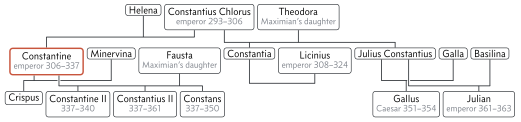
At the height of his power Constantine destroyed his own family. In 326 Constantine had his son Crispus executed,This ruler executed his son Crispus; a later account linked the death to an alleged affair with Fausta. → Constantine I•• at Pola, now Pula in Croatia. No writer of the time explains why, and Eusebius never mentions the death at all. Zosimus, who kept the old religion and disliked Constantine, gives the reason most often repeated: Constantine suspected Crispus of an affair with his stepmother, Fausta, the daughter of Maximian and the mother of his three younger sons (Figure 18.11). Fausta died soon after Crispus. The Epitome reports that Constantine’s mother, Helena, grieving for her grandson, reproached her son, and that Constantine then had Fausta killed in an overheated bath.This ruler had his wife Fausta killed, reportedly in an overheated bath. → Constantine I•• Both names were erased from the inscriptions.
Constantine spent much of his last decade on the Danube. In 332 his army beat the Goths, who had been raiding the Sarmatians, a horse-riding people of the steppe. One Sarmatian people, the Iazyges, lived beyond the river on the Hungarian plain of the Tisza, and had become Rome’s allies. To shelter them, Roman engineers dug long lines of earthen banks and ditches that ran from near Aquincum (uh-kwing-kum), now Budapest, east to the hills and south to the Danube. Hungarians call them the Devil’s Dykes, and the Devil’s Dykes are traditionally linked to Constantine,The Devil’s Dykes, associated with the defense of the Iazyges, are traditionally linked to this ruler. → Constantine I• though some stretches are older and no inscription dates them.
But the work Constantine cared most about was a city. Late in 324, soon after Chrysopolis, he marked out new walls for Byzantium, enclosing ground several times the size of the old town. It stood on a hilly peninsula between the Sea of Marmara and a long harbor called the Golden Horn, where Europe faces Asia across the Bosporus. Ships could supply it from the Black Sea and from Egypt, it was hard to attack by land, and it lay halfway between the Danube and the Persian frontier, the two fronts that mattered. Builders worked for six years. On May 11, 330, Constantine dedicated the city as New Rome, but everyone called it by his name: he had rebuilt Byzantium as Constantinople, Constantine’s city.This ruler rebuilt Byzantium as his new capital, Constantinople. → Constantine I••This city was named after the first Christian Roman emperor. → Constantinople• Like Rome it had fourteen districts, a senate, and free bread for its people. It had a great palace, a forum with a porphyry column topped by a statue of the emperor, and the Church of the Holy Apostles, where Constantine was buried. Statues were carried in from all over the Greek world, among them the bronze Serpent Column that the Greeks had set up at Delphi after their victory over the Persians at Plataea (pluh-tee-uh) (Vol. 6, The Greeks). Constantinople remained the capital of the Roman emperors in the East for more than eleven hundred years, until the Ottoman Turks took it in 1453 (Vol. 9, Cathedrals and Crusades).

Beside the palace lay the Hippodrome, Greek for “horse course.” Septimius Severus had begun it when Byzantium was a provincial town, and Constantine enlarged it to about 1,500 feet long, with seats for perhaps a hundred thousand people. Like the Circus Maximus in Rome (Chapter 15), the Hippodrome was built for chariot racing,The Hippodrome in Constantinople, decorated with Theodosius’s Egyptian obelisk, hosted this sport. → chariot racing•• and in 390 the emperor Theodosius I (Chapter 19) gave it its most famous ornament, an Egyptian obelisk, a tall four-sided pillar of granite tapering to a point. The pharaoh Thutmose (thoot-moh-suh) III had set it up at Karnak, in Egypt, about 1450 BC. Its lower part was broken off, perhaps on the long journey, and the upper part, about 60 feet of red granite, stands today on the low wall that ran down the middle of the racecourse (Figure 18.12).
Julian the Apostate
When Constantine died in 337, his three sons by Fausta divided the empire. First, though, the soldiers at Constantinople murdered nearly all his other male relatives, so that no cousin could compete. Among the dead was Constantine’s half-brother Julius Constantius. Two of his sons were spared, being children. The younger, Julian, was six, and he later blamed his cousin Constantius II for the killings.
Julian grew up under guard, for six years on a remote imperial estate in Cappadocia, in the middle of Anatolia. He was raised a Christian and learned the Bible, but he loved Homer and the Greek philosophers more. As a young man he gave up Christianity in secret for the old gods, whom he understood through the philosophy of Plato’s later followers. Christians later called him Julian the Apostate, from a Greek word for one who abandons his faith (Figure 18.11).

By 350 both of Constantius II’s brothers were dead, and he needed help. He made Julian’s elder half-brother, Gallus, a Caesar in the East, then had him executed in 354. In 355 he sent Julian, a student of twenty-four who had never commanded troops, to Gaul as Caesar. Julian surprised everyone. In 357 he crushed the Alamanni near Strasbourg. In 360, when Constantius II ordered many of his troops east for a war with Persia, the soldiers at Paris, then a small town called Lutetia, refused to go and proclaimed Julian Augustus. Civil war was coming when Constantius II died of a fever in November 361, naming Julian his heir.
As sole emperor Julian reopened the temples and restored the sacrifices, and he grew his beard like a philosopher’s (Figure 18.13). He did not put Christians to death, but Julian turned against the ChristiansJulian the Apostate notably opposed this group. → Christians• in every other way he could. He called them “Galileans,” after Galilee, where Jesus grew up, as if they were a small local sect. He took back the privileges Constantine had given their clergy, and in 362 issued a law that kept Christians from teaching literature, since he thought no one should teach Homer who did not believe in Homer’s gods. Even his admirer Ammianus Marcellinus, an officer who kept the old religion and served under him and later wrote his history (Chapter 19), called this law, in C. D. Yonge’s translation, “a cruel action, and one deserving to be buried in everlasting silence.” Julian also gave the Jews leave to rebuild their Temple in Jerusalem, whose ruin by the Romans in AD 70 (Vol. 5, In the Beginning) Christians took as proof of Jesus’s words in the Gospels that not one stone of it would be left upon another. Ammianus says that “fearful balls of fire burst forth with continual eruptions close to the foundations,” and the work stopped.
In March 363 Julian marched against Persia with the largest Roman army ever sent there. He reached the Persian capital, Ctesiphon, could not take it, and turned north. On June 26, in a skirmish, he rode out without his armor, was struck by a spear, and died that night, in his early thirties. A Christian story of the next century has him cry, “You have won, Galilean”; it is a legend. His successor, a Christian officer named Jovian, gave the Persians the lands beyond the Tigris and the fortress city of Nisibis (nis-ih-bis) to bring the army home, and restored the church’s privileges. Julian was the last emperor to oppose the Christians, and within a generation, under Theodosius I, their faith became the religion of the state (Chapter 19).
What to remember
- Septimius Severus (193–211), born at Leptis Magna in the province of Africa, now in Libya, founded the Severan dynasty; his son Caracalla killed his brother Geta, gave citizenship to the free men of the empire, and introduced the antoninianus.
- Roman Libya held Leptis Magna in the west and the Greek city of Cyrene in the east; Cyrenaica was joined with Crete in one province, and the Garamantes of the Fezzan built a civilization in the desert.
- In the Crisis of the Third Century (235–284) about two dozen emperors rose and fell, Valerian was captured by Persia, Postumus ruled a Gallic Empire, and the coinage collapsed.
- Diocletian beat Carinus at the Margus (285), created the Tetrarchy of two Augusti and two Caesars, ruling from Nicomedia, Sirmium, Milan, and Trier, reformed the coinage, and issued the Edict on Maximum Prices (301).
- Diocletian began the Great Persecution at Nicomedia on the Terminalia in 303, abdicated in 305, and retired to his palace at Split.
- Constantine was proclaimed at York in 306, beat Maxentius at the Milvian Bridge in 312, and agreed with Licinius at Milan in 313 to tolerate the Christians; Lactantius tells of a dream and Eusebius of a cross of light and the labarum.
- Constantine beat Licinius at Chrysopolis (324), called the Council of Nicaea (325), introduced the gold solidus, executed Crispus, killed Fausta, and dedicated Constantinople in 330.
- Julian the Apostate (361–363) tried to restore the old gods and was killed in Persia; he was the last emperor to oppose the Christians.
Chapter 19 · 44 clues
The Goths and the Church Fathers
In the autumn of 410 an old scholar in Bethlehem, near Jerusalem, heard news from the West that he could hardly bring himself to repeat. Rome had been captured and plundered by an army of Goths. The scholar was Jerome, the translator of the Latin Bible (Vol. 5, In the Beginning), and two years later he still could not write about it calmly. In W. H. Fremantle’s translation of his letter, he says: “My voice sticks in my throat; and, as I dictate, sobs choke my utterance. The City which had taken the whole world was itself taken.”
Across the sea, at Carthage in Roman Africa, refugees from Rome were stepping off the ships with stories of fire and ransom, and some of them said aloud that the Christians were to blame. Rome had abandoned the gods who made it great, they said, and the gods had abandoned Rome. The bishop of Hippo, a smaller port to the west, a man of fifty-five named Augustine, decided to answer them. His answer took thirteen years and twenty-two books. To understand it, and the Goths at the gate, the story must go back to the forests beyond the Roman frontier.
The Goths
The Germans of Tacitus
The Romans had been watching the peoples beyond the Rhine and the Danube for centuries. In AD 98 the historian Tacitus, a senator who later wrote the history of the first emperors (Chapter 12), published a short book about them, the Germania. Most of what he knew came from soldiers and traders. He describes a land of forests and swamps, where people lived on scattered farms instead of in cities, chose their kings for noble birth and their war leaders for courage, and met in armed assemblies, where they showed approval by clashing their spears.
The largest group was the Suebi, a family of tribes that held much of Germany toward the Baltic, whose free men twisted their hair into a knot. Their religion puzzled Tacitus. In Alfred Church and William Brodribb’s Victorian translation, he writes that “Some of the Suevi also sacrifice to Isis.” Isis was the Egyptian goddess whose worship had spread across the Roman world (Chapter 17), and each spring her followers launched a ship in her honor to open the sailing season. Tacitus says that among the Suebi her image was shaped like a Liburnian ship,Tacitus's Germania claims that a form of this figure represented by a Liburnian ship was worshipped by the Suebi. → Isis• a liburna, the light, fast warship that Rome’s navy had copied from the Liburni (lih-bur-nee), pirates of the Dalmatian coast. Church and Brodribb call it “a light galley,” and Tacitus took it as proof that the cult had come from abroad. More probably a German goddess was carried in a ship, and Tacitus gave her the name of the goddess she most resembled.
Far to the east, near the Baltic, past a people called the Ligii (lij-ee-eye), lived a people ruled more firmly than the rest. “Beyond the Ligii are the Gothones,” Tacitus writes, “who are ruled by kings, a little more strictly than the other German tribes.” This is one of the earliest notices of the Goths. The Goths themselves later told a grander story. It survives in a history written in Constantinople in 551 by Jordanes, a Goth who had worked as a general’s secretary. Jordanes’s history of the Goths, the Getica,Jordanes wrote a history of these people called the Getica. → Goths•• takes its name from the Getae, a people of the lower Danube whom he confused with the Goths. It is a short version of a lost history in twelve books by the Roman statesman Cassiodorus (kas-ee-oh-dor-us), who served the Gothic kings of Italy; Jordanes says he was allowed to borrow it for only three days. According to Jordanes, the Goths sailed long ago under a king named Berig from the great northern island of Scandza (skand-zuh), Scandinavia. In Charles Mierow’s translation, the Gothic race “burst forth like a swarm of bees from the midst of this island and came into the land of Europe.”
Archaeologists follow a trail of a different kind. In the first and second centuries AD a culture of farming villages and distinctive graves, called the Wielbark (vyel-bark) culture after a site in Poland, spread along the lower Vistula, where Tacitus put his Gothones. By about 250 a related way of life had spread across the plains north of the Black Sea, in what are now Ukraine, Moldova, and Romania (Figure 19.2). Archaeologists name it after Chernyakhov (cher-nyah-khof), a village in Ukraine where its graves were first dug, and most now link the Chernyakhov culture to the Goths.The Chernyakhov culture is often associated with these people’s presence north of the Black Sea. → Goths• Its large villages of timber houses, its fine wheel-made pottery, and its Roman coins show a rich farming people who traded across the Danube. Its villages also held Sarmatian horsemen and Dacian farmers, and for a century archaeologists argued over who made it.
In the fourth century, Roman writers knew two main Gothic peoples there. West of the river Dniester (nee-stur), on the plains across the Danube from the empire, lived the Thervingi (ther-vin-gee); east of it, as far as the Don, lived the Greuthungi (groy-thung-gee). The Thervingi and the Greuthungi were Goths,The Greuthungi and Thervingi were prominent subgroups within these people. → Goths• though neither was a single kingdom: each was a league of chiefs, who met in council and chose a leader in time of war. The Thervingi’s leader, Athanaric (uh-than-uh-rik), was called by the Romans a “judge.” The Greuthungi had a king, Ermanaric (er-man-uh-rik), whose realm, the Roman historian Ammianus Marcellinus says, was vast and much feared.
Later Goths looked back to two royal families. Jordanes writes that the Amali (am-uh-lee) and the Balti (bal-tee) ruled the Goths.The two ruling houses of these people were the Amali and the Balti. → Goths•• The Amali, he says, were the line of Ermanaric, and their descendant Theodoric would one day rule Italy (Chapter 20). The Balti, whose name Jordanes explains as the Gothic word for “bold,” were the family of Alaric (al-uh-rik), who sacked Rome. Modern historians doubt that either house was as ancient as Jordanes claimed, since the Balti appear only with Alaric and the Amali only in the century after.
Ulfilas and the Gothic Bible
Some of the Goths were already Christians. Their bishop, Ulfilas (ul-fih-lus), was born about 311 north of the Danube, descended from Christians whom Gothic raiders had carried off from Cappadocia, in Asia Minor. His name, Wulfila in Gothic, means “little wolf.” About 341 he was made bishop of the Goths by Eusebius of Nicomedia, not the historian of Caesarea but a bishop who followed the teaching of Arius, the priest whom the Council of Nicaea had condemned in 325 (Chapter 18). The Arians held that God the Son was created by the Father and was not his equal, and Ulfilas taught the Goths that faith. When a Gothic chief began persecuting Christians in 348, Ulfilas led his flock across the Danube into the empire, and they settled as shepherds near Nicopolis, in the province of Moesia.

There he gave the Goths a written language. Gothic had no alphabet, so Ulfilas devised an alphabet and translated the Bible.Ulfilas devised an alphabet and translated the Bible into these people’s language. → Goths•• He built his letters mostly from Greek, adding a few from Latin and from the runes that Germanic peoples carved on stone and wood. Scholars today think a team of translators worked under him. The church historian Philostorgius says that Ulfilas left out the Books of Kings, because they were full of wars and the Goths were warlike enough already. Gothic is the oldest Germanic language preserved in long texts, older by centuries than anything in English or German, and nearly all of it survives in pieces of this Bible. The finest is the Codex Argenteus (ar-jen-tee-us), copied about 520 in silver and gold on purple parchment (Figure 19.1). Lost for a thousand years, it turned up in a German abbey in the sixteenth century, passed to the emperor Rudolf II’s library in Prague, was carried off by Swedish soldiers in 1648, and is now in Uppsala.
Across the Danube
About 375 a new people swept out of the steppe east of the Don. The Huns, horse archers whose story is told with Attila’s (Chapter 20), shattered the Greuthungi, and Ermanaric, Ammianus says, took his own life. The Thervingi fled to the Danube. In 376 their leaders Fritigern (frit-ih-gurn) and Alavivus asked to be let into the empire. The emperor of the East was Valens, the younger brother of the late western emperor Valentinian I (val-un-tin-ee-un), and himself an Arian Christian. He agreed gladly, because the Goths would farm empty land and fill his armies.

The crossing was a disaster. The Romans ferried tens of thousands of Goths over the river, probably near the fortress of Durostorum, and then could not feed them. Ammianus, translated by C. D. Yonge, blames two corrupt officers, Lupicinus (loo-pih-sy-nus) and Maximus. As the Goths starved, these men “collected hounds from all quarters” and “exchanged them for an equal number of slaves, among whom were several sons of men of noble birth”: a dog for a child. At a banquet in the city of Marcianople (mar-shee-uh-noh-pul), Lupicinus tried to seize the Gothic leaders. Fritigern escaped, and the Goths rose. Bands of Greuthungi slipped across the river while the Romans were busy, and together they plundered the Balkans for two years.
Valens marched from Antioch to finish them. On August 9, 378, near the city of Adrianople, in Thrace, he attacked without waiting for his nephew Gratian, the young western emperor, who was coming with reinforcements. It was a hot afternoon, and the Roman infantry had marched for hours. As they closed on the Gothic wagon camp, the Greuthungi cavalry, who had been away foraging, came back and struck them in the flank. Fritigern’s Goths destroyed the army and killed Valens.Led by Fritigern, these people defeated and killed Emperor Valens at Adrianople. → Goths•• About two-thirds of the eastern army died, and Valens’s body was never found. Ammianus heard two stories: that an arrow killed him in the dusk, or that he was carried wounded into a farmhouse, which the Goths burned without knowing who was inside. “Nor, except the battle of Cannae,” he wrote, “is so destructive a slaughter recorded in our annals” (Cannae was Hannibal’s great victory of 216 BC, Chapter 3).
Ammianus Marcellinus ended his history with that battle. He was a Greek from Antioch and a former officer who wrote in Latin, and he signed off in Yonge’s words as “a Greek by birth, and formerly a soldier.” His surviving books, covering 353 to 378, are the last great history in Latin by a Roman who still worshiped the old gods.
Theodosius
Gratian needed a soldier to save the East, and on January 19, 379, he made one emperor. Theodosius was a Spaniard of thirty-two, the son of a general of the same name. He could not drive the Goths out, so he made peace with them. By the treaty of October 3, 382, the Goths were settled south of the Danube as foederati (fay-deh-rah-tee), “allies by treaty”: they kept their own leaders and farmed Roman land, and in return they fought in Roman wars. No emperor had ever let a whole unconquered people live inside the frontier under its own chiefs.

Theodosius was a Nicene Christian, holding with the Council of Nicaea that the Son is fully equal to the Father. On February 27, 380, at Thessalonica, he decreed that all his peoples must hold that faith, and the Council of Constantinople confirmed it in 381. Arians like the Goths were now heretics, believers in a condemned teaching. In 388 he marched west and destroyed a usurper who had killed Gratian, and that year his court celebrated the tenth anniversary of his reign (Figure 19.3). In 391 and 392 he forbade sacrifice to the old gods altogether, and the temples began to close (Vol. 4, Classical Myth, Vol. 5, In the Beginning). In 394 he crushed another usurper at the river Frigidus, below the Alps. Thousands of his Gothic allies, placed in the front line, died in that battle. Theodosius died at Milan on January 17, 395, the last emperor to rule both halves of the empire. The East passed to his elder son, Arcadius (ar-kay-dee-us), aged seventeen, and the West to Honorius, aged ten (Figure 19.4).

Stilicho and Alaric
The real ruler of the West was a general, Stilicho (stil-ih-koh). Stilicho’s father was a Vandal,Stilicho, whose father belonged to these people, served Honorius before being executed on his orders. → Vandals•• a cavalry officer from the Germanic people who then lived on the middle Danube and who later crossed the Rhine and took Roman Africa (Vol. 5, In the Beginning, Chapter 20). His mother was Roman, and Stilicho thought of himself as wholly Roman. He married Theodosius’s niece Serena, became guardian of the boy Honorius, and married his own daughter Maria to the young emperor. For thirteen years he held the West together with armies made up more and more of Germanic soldiers.
His great opponent was a Goth. Alaric was born about 370, probably on an island in the mouth of the Danube, into what Jordanes calls the house of the Balti. He had led Gothic troops for Theodosius at the Frigidus and come away with heavy losses and little reward. In 395 the Goths in the Balkans rose and made him their king. He plundered Greece, where his men looted the sanctuary of Eleusis (Vol. 4, Classical Myth), and the eastern court bought him off with a Roman command. In 401 he invaded Italy. Stilicho beat him at Pollentia on Easter Day 402 and again at Verona, and Honorius moved his court to Ravenna, behind its marshes, where it stayed.
Then Stilicho fell. Honorius, now twenty-three, came to believe rumors that his general meant to make his own son emperor. Stilicho took sanctuary in a church at Ravenna and came out on a promise of safety, but Honorius had him executed on August 22, 408. Roman soldiers then murdered the wives and children of the Germanic troops in the cities of Italy, and thousands of those soldiers went over to Alaric.
Alaric marched straight for Rome. In the autumn of 408 he surrounded the city and starved it until the senate paid him to leave. In 409 he besieged it again and made a senator, Priscus Attalus, a puppet emperor. All the while he bargained with Honorius for land and a command, and all the while Honorius, safe in Ravenna, refused. In August 410 Alaric’s patience ran out. On August 24 his Goths entered through the Salarian Gate, and Alaric’s Goths sacked RomeA group of these people sacked Rome in 410 CE under the leadership of their king Alaric. → Goths••This city was sacked by forces under Alaric. → Rome•• for three days. It was the first time in almost eight hundred years that an enemy had taken the city, since the Gauls of Brennus (Chapter 2). The Goths stripped houses and palaces and carried off captives. Yet Augustine and other Christian writers say that the Goths, being Christians, spared the great churches of Saint Peter and Saint Paul and everyone who had fled into them. Among the prisoners was Honorius’s half sister, Galla Placidia (gal-uh pluh-sid-ee-uh), who later married Alaric’s successor, Athaulf (ath-awlf).
Honorius heard the news in Ravenna. The Greek historian Procopius, writing more than a century later, tells a story that shows what people thought of him. When a servant cried that Roma had perished, the emperor was horrified, because Roma was the name of his favorite chicken. He was relieved to learn that only the city was lost. Alaric went south, meaning to cross to Sicily and then to Africa, but a storm wrecked his ships, and he died that winter at Consentia, in the toe of Italy. Jordanes tells how his people turned the river Busentus from its bed, buried their king in it with his treasure, let the river back over the grave, and killed the captives who had dug it, so that no one would ever find the place.
Alaric’s people went on to found a kingdom in Gaul and Spain. In the sixth century, writers called them the Visigoths, and the Goths who had stayed under the Huns and later followed Theodoric into Italy the Ostrogoths. “Ostro-” is related to the word “east,” and “Visi-” probably first meant “good” or “noble,” but readers have always heard the pair as East Goths and West Goths, and that is the division they describe: the Goths split into Visigoths and Ostrogoths.These people were divided into western and eastern branches prefixed "Visi-" and "Ostro-." → Goths•• Historians trace the Visigoths mostly to the Thervingi of 376 and the Ostrogoths mostly to the Greuthungi, though both peoples took in many others along the way.
Martin and Ambrose
The Christian empire of Theodosius needed a new kind of leader. Bishops, the overseers of each city’s Christians, now had the ear of emperors, ran charities larger than any town’s, and sat as judges in disputes. The two most famous bishops of the West in these years, Martin of Tours and Ambrose of Milan, were both sons of men in the emperor’s service, and both tried at first to escape being bishops at all.

Martin was born about 316 at Savaria, in the province of Pannonia (now Szombathely (som-baw-tay) in Hungary), the son of an army officer who worshiped the old gods. As a boy he became a catechumen, someone being taught the faith before baptism, and at fifteen he was enrolled in the cavalry under a law that made veterans’ sons serve. One winter, when he was stationed at Amiens in northern Gaul, he met a nearly naked beggar at the city gate whom everyone else had passed by. Martin had nothing to give but the cloak he wore. According to the life written by his disciple, he cut his military cloak in twoAccording to legend, this saint shared half his military cloak with a beggar. → Saint Martin of Tours• with his sword and gave the beggar half (Figure 19.5).
The disciple was Sulpicius Severus, a rich lawyer from southern Gaul who knew Martin well and wrote his Life of Saint Martin about 396, while Martin was still alive. That night, Sulpicius says, Martin dreamed that he saw Christ wearing the half cloak and heard him tell the angels, in Alexander Roberts’s translation, “Martin, who is still but a catechumen, clothed me with this robe.” Martin was baptized, and some time later he told his commander, “I am the soldier of Christ: it is not lawful for me to fight.” He founded the first monastery in Gaul, at Ligugé (lee-gew-zhay), about 361, and in 371 the people of Tours made him their bishop, Sulpicius says, by luring him into town with a tale of a sick wife. He died in 397. His half cloak, the cappa, became a treasured relic of the Frankish kings, and the shrine that held it was called a capella. From it come the English words “chapel” and “chaplain.”
Ambrose took the opposite road into the church. He was born about 339 at Trier, where his father served the emperor as a high official. A legend says that a swarm of bees settled on his face in his cradle and left honey on his lips, a sign of his sweet eloquence. He trained as a lawyer, and about 372 he became governor of the province around Milan. Milan was then the capital of the western emperors (Chapter 18), the place where they lived and held court. In 374 its bishop died, and the city’s Nicene Christians and Arians met in the cathedral to choose a successor, ready to riot. Ambrose came to keep order. As he spoke, his biographer Paulinus says, a child’s voice cried “Ambrose bishop!” and the whole crowd took up the cry. He was not even baptized. He fled, was brought back, and within a week was baptized and made bishop. Milan was the city of Saint AmbroseThis city is home to Saint Ambrose. → Milan•• for the rest of his life. He gave away his fortune, wrote hymns that its people still sing, and refused an empress who demanded a church for the Arians, and he lies buried beneath the altar of the basilica that bears his name, Sant’Ambrogio.

His most famous moment came in 390. At Thessalonica a popular charioteer was jailed by the city’s garrison commander, Butheric, a general with a Germanic name, and a mob in the circus killed Butheric when he refused to free him. Theodosius, then at Milan, ordered the city punished. His soldiers trapped the people in the circus and killed them for hours; the church historian Theodoret, writing about 450, puts the dead at seven thousand. Ambrose wrote the emperor a private letter, which survives. He reminded him of King David, who had confessed his sin after arranging a man’s death, and Ambrose demanded penance from Theodosius:This bishop of Milan demanded penance from Theodosius after the massacre at Thessalonica. → Saint Ambrose•• he would not celebrate the Eucharist, the Christian meal of bread and wine, in the emperor’s presence until Theodosius repented. The emperor obeyed. He laid aside his imperial robes and did public penance, and at Christmas he was received back into the church. Theodoret turned the story into a scene in which Ambrose stops the emperor at the church door (Figure 19.6). Historians think that confrontation never happened. The penance did, and for a thousand years popes and bishops pointed to it to show that even an emperor answers to the church.
Jerome, Chrysostom, and Nino
Ambrose wrote in Latin for the West. The same years produced a scholar who gave the West its Bible and a preacher who gave the East its worship. Two generations earlier, at the far end of the Black Sea, a woman had given a kingdom its faith.

Jerome was born about 347 at Stridon, near the border of Dalmatia, and studied in Rome under the great grammarian Donatus. He loved the Latin classics so much that, he wrote, he fasted only so that he could read Cicero afterward. Then, sick with fever, he saw himself dragged before the judgment seat of Christ, in a vision he insisted was no dream. When he said he was a Christian, the Judge answered, in Fremantle’s translation, “Thou liest, thou art a follower of Cicero and not of Christ.” He went to live as a hermit in the Syrian desert and learned Hebrew there. From 382 until the pope’s death in 384 he was secretary to Pope Damasus (dam-uh-sus) in Rome, who asked him to correct the Latin Gospels. After a scandal over his friendship with a rich widow, Paula, he left Rome for good, and from 386 until his death in 420 he lived in a monastery at Bethlehem that Paula paid for. There he translated most of the Old Testament from the Hebrew. Jerome’s Latin Bible was the VulgateThis saint is associated with working on the Vulgate. → Saint Jerome•• (vul-gayt), “the common version,” the Bible of Western Christians for a thousand years (Vol. 5, In the Beginning). A medieval legend gave him a lion that he had healed by pulling a thorn from its paw, and painters never let him go without it (Figure 19.7).
In the East the greatest preacher of the age was John of Antioch. Born about 347, he studied with Libanius (lih-bay-nee-us), the most famous teacher of speech in the city and a worshiper of the old gods, and then lived for years as a monk in the hills before becoming a priest. His sermons were so powerful that after his death he was called Chrysostom (kris-us-tum), Greek for “golden-mouthed.” In 398 he was made archbishop of Constantinople. There he preached against the luxury of the rich and the court, and he offended the empress Aelia Eudoxia (yoo-dok-see-uh), the wife of Arcadius. In 403 a council of hostile bishops, led by Theophilus of Alexandria (Vol. 5, In the Beginning), deposed him, and in 404 he was exiled to a mountain town in eastern Asia Minor. In 407, as soldiers marched him toward a still more distant exile on the eastern coast of the Black Sea, he died. His last words, it is said, were “Glory be to God for all things.”
His name lives on in the worship of the Orthodox Church, the Greek-speaking Christianity of the East and its daughter churches. Its way of worship is called Byzantine, after Byzantium, the Greek city that Constantine rebuilt as Constantinople (Chapter 18), and its service of the Eucharist is called the Divine Liturgy, from a Greek word for public service. The Divine Liturgy of Saint John ChrysostomThe most widely used Byzantine Divine Liturgy bears this saint’s name. → John Chrysostom• is the one celebrated on most Sundays of the year from Greece to Russia; its central prayer has been credited to him since the Middle Ages. A short Easter sermon also bears his name, though scholars doubt that he wrote it. At the midnight service that begins Easter, Chrysostom’s Paschal Homily is read aloudThis saint’s Paschal Homily is read at Orthodox Easter services. → John Chrysostom• while the congregation stands. A homily is a sermon, and “Paschal” (pas-kul) means “of Easter.” It invites everyone to the feast, those who came early and those who came at the last hour, those who fasted and those who did not, because, it proclaims, death has been defeated and Christ is risen.
Chrysostom died on the road to the land that is now Georgia, in the Caucasus Mountains between the Black and Caspian seas (Vol. 3, Geography: Europe, Asia, and Africa). Its eastern kingdom, Kartli (kart-lee), was called Iberia by the Greeks and Romans, a name with nothing to do with Spain. Its conversion was first written down about 402 by Rufinus, an Italian scholar, who heard it from a Georgian prince serving as a Roman officer. A captive Christian woman, he says, healed a sick child and then the queen by her prayers, and the king, lost in darkness while hunting, called on her God and found his way home. Georgian tradition names her Nino (nee-noh), a young woman from Cappadocia who carried a cross of grapevine bound with her own hair. Saint Nino brought Christianity to Georgia:Christianity was popularized in this country by St. Nino. → Georgia• King Mirian III (meer-ee-ahn) made it the faith of his kingdom about 326, at his capital of Mtskheta (mts-kheh-tah). Georgia was one of the first lands, after Armenia, to adopt Christianity as a kingdom, and a grapevine cross is still its church’s emblem.
Augustine’s life
Augustine was born on November 13, 354, at Thagaste (thuh-gas-tee), a small town in the province of Numidia, in what is now eastern Algeria. His father, Patricius, was a councilor of modest means who worshiped the old gods until he was baptized on his deathbed. His mother, Monica, was a devout Christian who prayed for years for her son to share her faith. We know them so well because he told their story in the Confessions, the book that tells how Augustine came to his mother Monica’s faithThis spiritual autobiography recounts Augustine’s conversion to his mother Monica’s Christianity. → Confessions•••This thinker's mother was named Monica. → Saint Augustine of Hippo• after years of wandering. She followed him across the sea, wept over him, scolded him, and lived to see him baptized.
He was the clever son of a family with little money, and a rich neighbor paid for his studies. At seventeen he went to Carthage, the great city of Roman Africa, to study rhetoric, the art of persuasive speaking that led to careers in law and government. There he took a mistress, whose name he never tells us, and lived faithfully with her for some fifteen years; their son was named Adeodatus (ay-dee-od-uh-tus), “given by God.” At nineteen he read Cicero’s Hortensius, a lost dialogue in praise of philosophy, and fell in love with wisdom itself. He looked for it first among the Manichees (man-ih-keez), followers of the Persian prophet Mani, who taught that the world was a battlefield of two powers, light and darkness, and he was one of their Hearers, or ordinary believers, for nine years (Vol. 5, In the Beginning). Their leaders could not answer his questions, and he drifted away.
He taught rhetoric at Thagaste, at Carthage, and from 383 at Rome, where his students slipped away without paying. In 384 the prefect of Rome, Symmachus (sim-uh-kus), a leader of the senators who still worshiped the old gods, chose him for the post of official speaker at the court in Milan. Augustine went to hear the city’s bishop, Ambrose, at first only to judge his style, and he became Ambrose’s studentThis thinker was a student of St. Ambrose. → Saint Augustine of Hippo• without meaning to, sitting in his church week after week, though the busy bishop rarely had time to talk with him. He found that Ambrose could explain the Old Testament stories that had embarrassed him as pictures of deeper truths. He was struck, too, that Ambrose read silently, with his lips still, which most people of the time did not do.
At Milan he also read some books of the Platonist philosophers in Latin translation, probably works of Plotinus and his pupil Porphyry. They taught Neoplatonism, the “new Platonism” of the third century (Chapter 5; Vol. 6, The Greeks): everything flows from a single perfect source, the One or the Good, as light flows from the sun, and the soul’s task is to turn inward and climb back toward it. In his essay “On Beauty,” Plotinus argued that the beauty of a body points to the beauty of the soul, and that beyond both lies the Good, the source of all beauty. The Neoplatonists bound beauty to the Good,Neoplatonic traditions closely associate this concept with the Good. → beauty• so that to love what is beautiful is to take the first step of the climb. Years before, Augustine had written a little book, now lost, called On the Beautiful and the Fitting, puzzling over why some things please us. Now he found an answer that reached all the way to God, and he was overwhelmed. Augustine became a NeoplatonistThis thinker was a Neoplatonist before converting to Christianity. → Saint Augustine of Hippo•• before he became a Christian, and for the first time he could think of God as something other than a body made of light. In many ways he remained a Neoplatonist all his life.
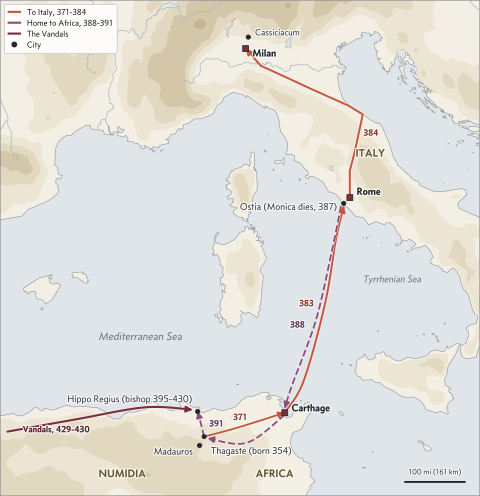
Philosophy alone did not change his life. In August 386, in a garden in Milan, he gave himself to Christianity, in a scene he later made famous. He resigned his post, spent a winter with friends in a country house at Cassiciacum (kas-ih-ky-uh-kum) talking philosophy, and at Easter 387, on the night of April 24, he was baptized by Ambrose together with Adeodatus and his friend Alypius (uh-lip-ee-us). A few months later, as they waited at Ostia, the port of Rome, for a ship home, Monica died (Figure 19.8). Back in Africa, Augustine lived with a few friends as a kind of monk at Thagaste, until a visit to the port of Hippo Regius in 391. The congregation there seized him in church and had him made a priest, against his tears. In 395 or 396 Augustine became bishop of Hippo,This thinker was a bishop of Hippo. → Saint Augustine of Hippo•• and he stayed in that small, quarrelsome harbor town for the last thirty-five years of his life, preaching, judging lawsuits, and writing more than almost any other ancient author whose works survive. Hippo Regius, “royal Hippo,” had once been a seat of the kings of Numidia; its ruins lie beside the Algerian city of Annaba.
The Confessions
About 397, soon after he became bishop, Augustine wrote the Confessions,This thinker wrote Confessions. → Saint Augustine of Hippo•• in thirteen books. It is a prayer: from its first line to its last he speaks to God, and the reader overhears. “Confession” in his Latin meant two things at once, owning up to one’s sins and praising God, and the book does both. Its first nine books tell his life from infancy to his mother’s death, which is why it is often called the first autobiography (Vol. 1, The Toolkit); its last four think aloud about memory, time, and the opening of Genesis (Figure 19.9).

He begins before memory, with what he has learned by watching babies. Then he describes how he learned to talk. In J. G. Pilkington’s Victorian translation, “When they called anything by name, and moved the body towards it while they spoke, I saw and gathered that the thing they wished to point out was called by the name they then uttered.” Fifteen centuries later this passage became the starting point of one of the most famous books of modern philosophy, by the Austrian philosopher Ludwig Wittgenstein (vit-gen-shtine). Wittgenstein opened his Philosophical InvestigationsWittgenstein opens Philosophical Investigations by quoting this thinker’s account of learning words from adults. → Saint Augustine of Hippo•• (1953) by quoting it. He took it as the perfect statement of an attractive mistake, the idea that every word is the name of an object, and spent the book showing how much more language does (Vol. 21, Trenches and Modernists).
The second book holds the most famous theft in literature. At sixteen, idle at home in Thagaste, Augustine and a gang of friends shook a pear tree near his family’s vineyard late one night and carried off great loads of pears. They were not hungry, and the pears were not even good; they ate a few and threw the rest to the pigs. Augustine asks why he stole the pearsThis book’s narrator recalls stealing pears in his youth. → Confessions•• and concludes that he loved the wrongdoing itself, and the company of friends who shared it: “It was foul, and I loved it.” To him the small, pointless crime showed something deep about human nature, a will that chooses evil for its own sake.
The next books follow him to Carthage, to the Manichees, to Rome, and to Milan, and they show a man who wanted to be good but not yet. As a young man, he remembers, he had prayed for chastity, but not yet:This book’s narrator prays, “Give me chastity and continence—but not yet.” → Confessions• “Grant me chastity and continency, but not yet,” in Pilkington’s words, because he was afraid that God might answer him too quickly. It is the most quoted joke against himself in the book. In Milan he was still ambitious and still torn, unable to give up the pleasures he no longer approved of. Monica had arranged his engagement to a young heiress, and the mother of his son, his companion since Carthage, had been sent home to Africa, leaving the boy with him.
The crisis came in August 386. A visitor named Ponticianus told Augustine and Alypius about Anthony, the Egyptian hermit (Vol. 5, In the Beginning), and about two court officials who had given up their careers after reading his life. Ashamed, Augustine rushed into the garden of their lodging, threw himself down under a fig tree, and wept, asking “How long, how long? Tomorrow, and tomorrow?” Then he heard a child’s voice chanting tolle, legeThis book's narrator hears a voice command "tolle, lege," or "take up and read!" → Confessions•• (tol-eh leg-eh), “take up and read.” In Pilkington’s words it was “the voice as of a boy or girl, I know not which,” coming from a neighboring house, “chanting, and oft repeating, ‘Take up and read; take up and read.’ ” He could think of no children’s game with such words. He took it as a command and opened the book of Paul’s letters he had left beside Alypius. The first words his eyes fell on came from Paul’s Letter to the Romans: “Not in rioting and drunkenness, not in chambering and wantonness, not in strife and envying; but put ye on the Lord Jesus Christ.” All his doubt, he says, vanished.
The ninth book tells of his baptism and of a last conversation with Monica at a window in Ostia, where for a moment they felt themselves rise toward God together. A few days later she fell sick with a fever, and on the ninth day of her illness she died. The tenth turns to memory, and to a cry that sums up the whole book, “Too late did I love Thee, O Fairness, so ancient, and yet so new!” His Latin word was pulchritudo, beauty. The eleventh asks what time is. “If no one ask of me, I know,” he writes; “if I wish to explain to him who asks, I know not.” The past is no longer, the future is not yet, and the present has no length at all, so where is the time we measure? It must be in the mind. When he recites a psalm, his expectation of the part to come shrinks as his memory of the part already said grows. Time is a distension of the mind,This thinker argued that time is a distension of the mind. → Saint Augustine of Hippo•• he concludes, a stretching of the soul between memory and expectation; Pilkington calls it a “protraction.”
Augustine’s doctrines
As a Manichee, Augustine had believed that evil was a real substance, the stuff of the kingdom of darkness. The Neoplatonists showed him another answer, and he defended it for the rest of his life. Everything God made, he argued, is good, and so evil cannot be a thing at all. It is a lack: blindness is not a substance but the absence of sight, and a wound is the absence of health in flesh that is itself good. Augustine called evil a privation of good,This thinker defined evil as the privation of good. → Saint Augustine of Hippo••Augustine stated that this concept is a "privation" or absence of good. → evil•• a privation being a missing good that ought to be there. In his late handbook of the faith, the Enchiridion (about 421), translated by J. F. Shaw, he asks, “For what is that which we call evil but the absence of good?”
He had also been tempted by the Academic skeptics, followers of a school of Plato’s Academy that taught that nothing could be known for certain. Augustine found one thing they could not shake. In The City of God, his answer to the sack of Rome, he wrote, in Marcus Dods’s translation, “For if I am deceived, I am”:This philosopher anticipated Descartes by asserting "If I am deceived, I am" regarding existence. → Saint Augustine of Hippo• whoever is mistaken must exist in order to be mistaken. Twelve centuries later the French philosopher Descartes made the same move with “I think, therefore I am” (1637), and readers soon noticed that Augustine had been there first (Vol. 13, Valois, Bourbon, and Orange). Augustine went on: I know that I exist, I know that I know it, and I love both my being and my knowing.
That threefold knowledge became a key to the hardest Christian doctrine. Christians believe in the Trinity, one God in three persons, the Father, the Son, and the Holy Spirit. In his fifteen books On the Trinity (about 400 to 420), Augustine looked for an image of that mystery in the human mind, which Genesis says was made in God’s image. The mind, its knowledge of itself, and its love of itself are three, yet they are one mind; so are memory, understanding, and will. Augustine’s psychological analogy for the TrinityThis thinker proposed a psychological analogy for the Trinity, mapping the Holy Trinity to different parts of human knowledge. → Saint Augustine of Hippo• saw in the powers by which we know a faint reflection of God.
He read Genesis with the same boldness. In The Literal Meaning of Genesis he pointed to a verse in his Latin Bible which says that God created all things simul, at the same time, and argued that God created all things at once,This thinker argued that God created all things simultaneously rather than over six ordinary days. → Saint Augustine of Hippo• in a single instant. The six days, he said, are not ordinary days of the sun, which did not exist until the fourth day, but an order in the knowledge of the angels. God, he taught, planted in creation hidden “seeds,” causes that would unfold in their own time, as a tree is folded up in a seed.
His darkest teaching grew from the pears. Paul wrote that through one man sin entered the world, and in Augustine’s Latin Bible the verse went on to say that all sinned in that one man. So, he taught, the whole human race was present in Adam when he disobeyed God, and his guilt and weakness pass to every child. This is original sin. It is passed on, Augustine said, through concupiscence (kon-kyoo-pih-sens), the unruly desire that the will cannot command and that accompanies the act by which every child is conceived. In his view, concupiscence passes sin from parent to child,Augustine described this concept's transmission via "concupiscence." → sin• and so even a newborn needs baptism. He argued the point from the church’s own custom of baptizing infants: why wash away the sins of a baby who has done nothing wrong, unless it was born with a fault it did not choose? Augustine shaped Western teaching on original sinThis thinker strongly influenced Western Christian doctrines of original sin. → Saint Augustine of Hippo•• more than any other writer, among Catholics and, later, Protestants; the Eastern churches never made his version their own.
The doctrine drew him into his last great fight. Pelagius (puh-lay-jee-us), a British monk admired in Rome for his strict life, was shocked by a line in the Confessions: “Give what Thou commandest, and command what Thou wilt.” To Pelagius it sounded like an excuse. God would not command what people could not do, he taught, and Adam’s sin had harmed his children only by setting a bad example. Augustine answered that since Adam’s fall no one can even want the good without grace, God’s free and unearned help, and that salvation is God’s gift, not a reward. Augustine defended grace against PelagiusThis thinker emphasised the role of Divine Grace in salvation, in opposition to Pelagius. → Saint Augustine of Hippo• in book after book from 412, and in 418 a council of African bishops at Carthage, backed by the pope, condemned Pelagius’s teaching.
Augustine also taught the teachers. In 396 or 397 he began a handbook for anyone who would explain the Bible, and finished it in 426: Augustine wrote De doctrina christianaThis thinker wrote De doctrina christiana. → Saint Augustine of Hippo•• (day dok-tree-nuh kris-tee-ah-nuh), “On Christian Teaching.” Its first three books show how to read Scripture, with a single test for any reading: does it build up the love of God and of one’s neighbor? Its fourth book, the first Christian handbook of rhetoric, turns to how to speak. Cicero had said that a speaker must teach, delight, and move, and that each aim had a style. Augustine kept the three: the subdued, moderate, and grand styles,This thinker outlined "subdued," "moderate," and "grand" teaching styles in De doctrina christiana. → Saint Augustine of Hippo• plain speech for teaching, a graceful style for praise and blame, and a forceful one to move a listener to act. Shaw’s translation calls them the “subdued,” “temperate,” and “majestic.” A Christian, Augustine added, always speaks of great things, so he must choose his style by his purpose, not his subject.
The City of God
When the refugees from Rome reached Africa in 410 and 411, Augustine preached to calm his flock, and a Roman official in Carthage, his friend Marcellinus, begged him to answer the worshipers of the old gods properly. Augustine wrote The City of GodThis thinker wrote The City of God. → Saint Augustine of Hippo••• in twenty-two books between 413 and 426, and it became the most influential work of history and politics in the Christian West. He addressed it to Marcellinus, who was executed in 413 in a purge after a failed rebellion in Africa, and went on writing it through the busiest years of his life as a bishop.
The first ten books reject the charge that Christianity ruined Rome.Written after the sack of Rome in 410, this work rejects the claim that Christianity caused Rome’s decline. → The City of God•• The Romans who blamed it, Augustine wrote, forgot that Rome had suffered worse disasters long before Christ, from the Gauls to Cannae, and that the gods had never protected it then. He noted that many who now mocked Christ had saved their lives by hiding in his churches, and of those churches, in Dods’s translation, “in the sack of the city they were open sanctuary for all who fled to them, whether Christian or Pagan.” Earthly power, he argued, is never as glorious as it looks. “Justice being taken away, then, what are kingdoms but great robberies?” He tells of a pirate captured by Alexander the Great, who asked him what he meant by seizing the sea. “What thou meanest by seizing the whole earth,” the pirate answered; “but because I do it with a petty ship, I am called a robber, whilst thou who dost it with a great fleet art styled emperor.”
The last twelve books tell the history of the world as a tale of two cities built by two lovesThis work contrasts an earthly city founded on self-love with a heavenly city founded on love of God. → The City of God•• (Figure 19.10). “Accordingly, two cities have been formed by two loves,” Augustine writes in Dods’s translation: “the earthly by the love of self, even to the contempt of God; the heavenly by the love of God, even to the contempt of self.” In Augustine’s scheme the earthly city and the heavenly city are not Rome and the church. They are two communities of people, known only to God, defined by what they love most. The first citizen of the earthly city was Cain, who built a city and murdered his brother, and Rome, Augustine says, repeated his crime when, in its own legend, Romulus killed Remus (Vol. 4, Classical Myth); Abel, a stranger on earth, built none. In this world, he teaches, the two are tangled together, and they will be separated only at the Last Judgment.

Even the heavenly city’s pilgrims, Augustine says, must live in the earthly city’s world, and that includes its wars. In the nineteenth book he grants that “the wise man will wage just wars,” but adds at once that a wise man will lament the necessity, since only the other side’s wrongdoing forces him to it. The aim of every war is peace, and peace, he wrote in a famous phrase, is “the tranquillity of order.” From these pages and his other writings Augustine helped build the Christian theory of just war.This thinker helped develop Christian just-war theory in The City of God. → Saint Augustine of Hippo•• A war may be just, he taught, if a lawful ruler wages it to right a real wrong, and if it is fought for the sake of peace, never from cruelty or the love of power. The medieval theologian Thomas Aquinas set out the conditions as a system eight centuries later (Vol. 9, Cathedrals and Crusades).
Augustine finished The City of God in 426, and the world he described closed in on him. In 429 the Vandals crossed from Spain into Africa under their king Gaiseric (gy-zuh-rik), and in the spring of 430 they besieged Hippo (Chapter 20). Augustine fell ill in the third month of the siege. His friend Possidius, who wrote his life, says he had the penitential psalms copied out and hung on the wall by his bed, so that he could read them as he lay there, weeping. He died on August 28, 430, aged seventy-five. The Vandals took Hippo the next year, but his books survived, and through them the bishop of a small African port taught the Latin West for a thousand years.
What to remember
- Tacitus’s Germania (AD 98) describes the Germans; he says some Suebi worshiped Isis in the form of a Liburnian ship. Jordanes’s Getica (551) is the later history of the Goths, whose fourth-century peoples were the Thervingi and the Greuthungi and whose royal houses were the Amali and the Balti.
- Ulfilas, an Arian bishop, devised the Gothic alphabet and translated the Bible; its finest copy is the Codex Argenteus in Uppsala.
- The Thervingi crossed the Danube in 376; Fritigern’s Goths killed Valens at Adrianople in 378, where Ammianus Marcellinus ends his history.
- Theodosius I settled the Goths as allies (382), made Nicene Christianity the faith of the empire (380), did penance at Ambrose’s demand after the massacre at Thessalonica (390), and was the last emperor of both halves; at his death (395) Arcadius took the East and Honorius the West.
- Stilicho, son of a Vandal officer, ruled the West for Honorius until Honorius had him executed (408); Alaric’s Visigoths sacked Rome on August 24, 410.
- Martin of Tours, a soldier, cut his cloak in half for a beggar; Ambrose was bishop of Milan; Jerome made the Vulgate; John Chrysostom’s name is on the Orthodox Divine Liturgy and the Paschal Homily; Saint Nino converted Georgia.
- Augustine of Hippo, Monica’s son and Ambrose’s student, was a Manichee and a Neoplatonist before his conversion in 386. His Confessions tell of the pears, “not yet,” and tolle, lege, and define time as a distension of the mind.
- He taught that evil is a privation of good, that “if I am deceived, I am,” that original sin passes through concupiscence, and that salvation is by grace, against Pelagius; he wrote De doctrina christiana and The City of God, with its two cities and its just war, and died at Hippo in 430.
Chapter 20 · 33 clues
Huns, Vandals, and Theodoric
On October 15, 1764, a young Englishman named Edward Gibbon sat among the ruins on the Capitol, the hill at the heart of ancient Rome. Barefoot friars were singing evening prayers in a church that he believed stood on the site of the temple of Jupiter, the greatest temple of the Roman gods. It was there, Gibbon wrote years later, “as I sat musing amidst the ruins of the Capitol,” that he first thought of writing the history of the city’s decline and fall. He spent the next twenty-three years on the question the ruins put to him: how could the greatest empire the West had ever known simply stop?
The question is sharpest for the eighty years after 395, when Theodosius I divided the empire between his two sons (Chapter 19). In those years the western half lost Britain, Spain, Africa, and Gaul, and its last emperor, a boy, was quietly pensioned off, while the eastern half lasted almost a thousand years longer. Three peoples from beyond the old frontier drove the story in the West: the Huns, who rode out of the steppe; the Vandals, who took to the sea; and the Ostrogoths, whose king Theodoric ruled Italy as the emperors had (Figure 20.1).

The Huns
The Romans first heard of the Huns in the 370s, when news came from the Goths north of the Black Sea that a people no one had seen before was destroying them (Chapter 19). The soldier and historian Ammianus Marcellinus, who probably never met one, called them in C. D. Yonge’s Victorian translation “a race savage beyond all parallel.” His Huns gash the cheeks of their baby boys so that no beard will grow, never sleep under a roof, and warm raw meat between their thighs and their horses’ backs. Much of this is the old Greek and Roman picture of any nomad, but one line rings true: “There is not a person in the whole nation who cannot remain on his horse day and night.” The Huns were horse archers, who shot powerful bows of wood, horn, and sinew from the saddle. In their graves archaeologists find skulls that were bound in infancy to grow long and narrow.
Where they came from no Roman knew. In 1748 a French scholar of Chinese, Joseph de Guignes (duh geen-yuh), read in Chinese histories about the Xiongnu (shyoong-noo). They were a great league of horse nomads who had raided China from the north since the third century BC and fought the emperors of China’s Han dynasty for three hundred years (Vol. 40, The Middle Kingdom). Beaten at last, part of them moved west, and de Guignes made them the Huns’ ancestors.Joseph de Guignes proposed a link between these people and the Xiongnu of northern China. → Huns• Gibbon took up the idea, and it became famous. Modern scholars are divided: a few Hun-age skeletons from Hungary carry ancestry from Mongolia, but “Hun” may also have been a proud title that different steppe peoples took for themselves.
Certainly others used it. In the same years a people called the Hephthalites (hef-thuh-lyts) ruled Bactria, in what is now Afghanistan and Uzbekistan, and in 484 they killed the Persian king Peroz in battle. The Greek historian Procopius, writing some seventy years later, calls them in H. B. Dewing’s translation “the Ephthalitae Huns, who are called White Huns.” They were, he says, “the only ones among the Huns who have white bodies and countenances which are not ugly,” and they were not nomads but had long been settled in one land under one king. The Indians too called the Hephthalites “white Huns,”The Hephthalites are sometimes called the "white" variety of these people. → Huns• but no one has shown that they were kin to the Huns of Europe.
By the 420s the European Huns had moved their camps to the Great Hungarian Plain, the plain of the Tisza and the middle Danube, the only wide grassland near the empire that could feed great herds of horses. From there they ruled a crowd of subject peoples, Ostrogoths, Gepids (jep-idz), Alans, and Rugii (roo-jee-eye), who kept their own chiefs and fought under Hun command. The Romans used them too. Flavius Aetius (ay-ee-shus), a western general born about 390 on the Danube, had lived among the Huns as a hostage in his youth, and he hired thousands of Hun horsemen for his own wars. In 437, Huns in his pay destroyed the kingdom of the Burgundians on the Rhine, probably around Worms (vormz).
The Hun king in those years was Rugila (roo-gih-luh), who received Aetius as a friend and demanded gold and runaway subjects from the eastern emperor, Theodosius II. Then, about 434, Rugila died, and his two nephews, Bleda (blay-duh) and Attila, took his place. Socrates of Constantinople, a Christian historian of the church (no relation to the Athenian philosopher), had no love for the Huns, and he told the death as a miracle. God struck King Rugila with lightning,This ruler succeeded his uncle Rugila, whose death was attributed to divine lightning in a hostile account. → Attila the Hun••Rugila was a king of these people. → Huns• he wrote, in answer to the prayers of the pious emperor, and sent plague and fire upon his army. A plain chronicle of the time says only that Rugila died.
Attila
The brothers were sons of Rugila’s brother Mundzuk (mund-zook). Attila, whose name may be Gothic for “little father,” was probably born about 406, and Bleda was the elder. In 435 they met the eastern emperor’s envoys at Margus, on the Danube. The Huns would not get off their horses, so the Romans bargained mounted too, and they gave in on everything: the runaways would be returned, the markets opened, and the yearly payment of gold doubled. When the payments fell behind, the Huns crossed the Danube in 441 and 443, sacked the cities of the Balkans, and won a tribute three times as large (Figure 20.2).

About 445 Bleda died, and Attila ruled alone. Jordanes, the Gothic historian who wrote in Constantinople in 551 and copied the lost work of the eyewitness Priscus, says plainly that Attila had his brother Bleda killed,This ruler shared power with his brother Bleda, whose death was traditionally attributed to him. → Attila the Hun••• and the chroniclers of the time agree. Jordanes also gives, from Priscus, the only description of him that survives. In Charles Mierow’s translation of 1908, Attila was “short of stature with a broad chest and a large head; his eyes were small, his beard thin and sprinkled with gray; and he had a flat nose and a swarthy complexion.”
Attila soon had a sign that heaven was with him. Jordanes, quoting Priscus, tells that a herdsman saw one of his heifers limping, followed the trail of blood, and found a sword in the grass that the animal had stepped on. He dug it up and took it to Attila, who believed that he now held the sword of Mars,According to legend, this ruler possessed the Sword of Mars. → Attila the Hun•• the Roman god of war, and that he had been appointed “ruler of the whole world.” Jordanes calls the blade sacred among the kings of the Scythians, the old Greek name for the peoples of the steppe.
His enemies gave him a different title. Jordanes calls him “the scourge of all lands,” a man “born into the world to shake the nations.” Christian writers of later centuries, who believed God sent invaders to punish people for their sins, called the Huns’ king Attila the Scourge of God,This man was a leader of the Huns. → Attila the Hun•••This man was given the byname "Flagellum Dei," or "Scourge of God." → Attila the Hun•••Attila, the “Scourge of God,” led these people. → Huns••• in Latin flagellum Dei, a whip in God’s hand. The Hungarian chroniclers of the Middle Ages, who claimed Attila as an ancestor of their kings, used the title with pride, and it has stuck to him for fifteen hundred years.
In 447 he struck the East again. That January an earthquake had thrown down long stretches of the walls of Constantinople, and the city’s prefect was rushing the repairs. The eastern commander, Arnegisclus (ar-nuh-jis-klus), probably a Goth, met him on the river Utus (yoo-tus), now the Vit in Bulgaria. There Attila defeated Arnegisclus at the Utus;This man defeated Arnegisclus at the Battle of Utus. → Attila the Hun•• the general fought on foot after his horse was killed, and died. The Huns plundered the Balkans as far south as Thermopylae, but the rebuilt walls held, and the emperor bought peace once more.
Two years later, in 449, a Greek writer named Priscus of Panium went north with an embassy from Theodosius II. He did not know that the emperor’s chief minister, a eunuch (a castrated court servant) named Chrysaphius (kry-saf-ee-us), had bribed one of Attila’s own envoys, Edeco, to murder his master; Edeco told Attila everything, and Attila later sent to Constantinople to demand the eunuch’s head, though in the end he took gold instead. The embassy rode for days beyond the Danube to Attila’s village of wooden houses. There Priscus met a Greek merchant, captured years before, who had won his freedom fighting for the Huns and now lived as one of them. Life among the Huns was better, the man argued, than life under Roman taxes and Roman courts, where only the rich got justice; Priscus argued back for Roman law.
Then Priscus described Attila’s feastThe historian Priscus described a dinner or feast held by this leader. → Attila the Hun•• in a passage that survives through later quotation. The guests sat along the walls, with Attila on a couch in the middle; to sit on his right was the greater honor, and the Romans sat on his left. They drank to his health in turn. The guests ate from silver and gold plates, but Attila ate only meat, from a wooden plate, and drank from a wooden cup. His clothes were plain, and neither his sword nor his horse’s bridle was decorated with gold. When torches were lit, two singers chanted his victories, and old men wept. A jester, and then a dwarf from North Africa named Zerco, made the whole hall roar with laughter. Attila never smiled, Priscus says, except when his youngest son, Ernak, came in; then he drew the boy close by the cheek and looked at him gently.
The next spring brought Attila an excuse to turn west. The western emperor was Valentinian III. His mother was Galla Placidia, the princess whom Alaric’s Goths had carried off from Rome (Chapter 19), and he had been put on the throne at six in 425 (Figure 20.3). His elder sister, Justa Grata Honoria (hoh-nor-ee-uh), held the title of Augusta, the rank of an empress, but about 449 she was caught in a love affair with the steward of her household. Her lover was put to death, and she was betrothed to a safe, dull senator. In 450 Honoria sent a eunuch, Hyacinthus, to Attila with money and her ring, begging him to rescue her. Attila chose to read the ring as an offer of marriage, and he demanded half the western empireThis ruler interpreted Honoria’s ring as a marriage proposal and demanded half the Western Roman Empire as dowry. → Attila the Hun••• as her dowry. Valentinian wanted his sister killed; their mother persuaded him to spare her, and he answered Attila that she was promised to another man and had no share of the empire to give. In the East, meanwhile, Theodosius II died after a fall from his horse in July 450, and the new emperor, Marcian (mar-shun), stopped paying tribute at all.

Gaul and Italy
Attila crossed the Rhine early in 451 with a huge army of Huns and subject peoples; Jordanes says half a million men, which is impossible. He sacked Metz on April 7 and besieged Orléans. Aetius gathered every ally he could, above all the Visigoths of southern Gaul, whose king since 418 had been Theodoric I, ruling from Toulouse. The allies reached Orléans before it fell, and Attila drew back east into open country, where his horsemen could fight.
The armies met on the Catalaunian (kat-uh-law-nee-un) Plains, somewhere between Châlons and Troyes (twah), by tradition on June 20, 451; the battle is also called the battle of Châlons. Jordanes describes a plain rising to a ridge that both sides tried to seize, and a slaughter so great that a brook ran with blood. In the confusion the old king Theodoric I was killed:The Visigothic king Theodoric I was killed fighting this ruler’s forces. → Attila the Hun•• thrown from his horse and trampled by his own men, Jordanes says, or, as others said, struck by the spear of an Ostrogoth fighting for Attila. The Visigoths charged on and drove Attila back inside a ring of wagons. While the allies besieged the camp, Attila, as Jordanes heard it, heaped up a funeral pyre of saddles,After the Battle of Chalons, this ruler reportedly prepared a saddle pyre on which to die if captured. → Attila the Hun• the horse trappings of his army, meaning to throw himself into the flames rather than be taken alive. The attack never came. Theodoric’s son Thorismund wanted to storm the camp, but Aetius advised him to hurry home and make sure of his throne; Jordanes thought Aetius feared the Goths as much as the Huns. The battle of the Catalaunian Plains was no rout, but Aetius and his Visigoths had beaten Attila,This ruler was defeated at the Battle of the Catalaunian Plains, also called Chalons. → Attila the Hun•••A coalition led by Flavius Aetius defeated this ruler. → Attila the Hun•••Flavius Aetius and his Visigothic allies checked these people at the Battle of the Catalaunian Plains. → Huns••• and he never attacked Gaul again.
He came back the next year by another road. In 452 he crossed the Julian Alps into Italy and besieged Aquileia, the great city at the head of the Adriatic, for three months, then took it and, Jordanes says, laid it waste so cruelly that scarcely a trace was left. A later tradition says the refugees fled to islands in the lagoons and founded Venice. Milan and Pavia (pah-vee-uh) fell. The emperor sent an embassy of two senators and the bishop of Rome, Pope Leo I, called Leo the Great, and they met Attila at a ford of the river Mincio (min-choh), near Mantua. After the meeting Attila withdrew from ItalyThis ruler withdrew from Italy after meeting Pope Leo I in 452. → Attila the Hun••• and never came back.

Why he turned back was argued from the start. Prosper of Aquitaine, a Christian chronicler of the time, gave the credit to Leo. Priscus wrote that Attila’s men reminded him of Alaric, who had died soon after sacking Rome (Chapter 19). Others tell of hunger and disease in his army, and of an eastern army that attacked the Huns’ homeland. A medieval legend added that Saints Peter and Paul appeared in the sky above the pope, threatening Attila with swords, and that is the scene the Italian painter Raphael put on a Vatican wall a thousand years later (Figure 20.4).
The wedding night
Early in 453 Attila married again. His bride was a young woman named Ildico (il-dih-koh), probably a Goth. Jordanes, following Priscus, calls her “a very beautiful girl” and says Attila took her “after countless other wives, as was the custom of his race.” He drank deep at the wedding feast and went to bed. In the morning his servants broke in the door and found him dead, without a wound, and the bride weeping beneath her veil. As he lay on his back, heavy with wine, Attila died of a nosebleed:This ruler reportedly died of a nosebleed on his wedding night with Ildico. → Attila the Hun••• the blood ran down his throat instead of from his nose and choked him. A chronicler writing eighty years later said that his wife had stabbed him, but most historians prefer the account of Priscus, who was alive at the time.
The Huns mourned him in their own way. The men cut their hair and gashed their faces, Jordanes says, so that the greatest of warriors would be mourned “by the blood of men.” His body lay in a silk tent in the open plain while the best horsemen of the nation rode around it in circles, singing his deeds. Then the Huns celebrated a strava over his tomb,Jordanes describes a funeral feast called a strava held by these people. → Huns• a funeral feast in which, in Mierow’s words, “they gave way in turn to the extremes of feeling,” grief and joy by turns. That night, Jordanes adds, they buried him in three coffins, bound with gold, silver, and iron, and killed the men who dug the grave so that no one would ever find it. No one has. Jordanes told a like story of Alaric’s grave in a riverbed (Chapter 19), and Hungarian legend borrowed it: the Tisza was turned from its bed,In Hungarian legend, the Tisza was diverted to conceal this ruler’s grave. → Attila the Hun• they say, to hide Attila’s tomb beneath it.
His empire did not outlast him by two years. His many sons demanded, Jordanes says, that the subject nations be divided among them by lot “like a family estate.” The subject kings refused. Ardaric (ar-duh-rik), king of the Gepids, once Attila’s most trusted counselor, led the revolt, and in 454 the nations met the Huns by a river called the Nedao in Pannonia, the old Roman province south and west of the Danube bend. There Ardaric’s Gepids killed Attila’s son Ellac,After this ruler’s death, his son Ellac was killed at Nedao, helping break up his empire. → Attila the Hun••Ardaric’s Gepids defeated these people at Nedao, helping break up their empire. → Huns•• his father’s favorite, with thousands of Huns. The Hun empire broke apart, the Gepids took the plain, and the Ostrogoths settled in Pannonia as free men.
Attila himself lived on in legend. The Nibelungenlied (nee-buh-lung-un-leet), “the Song of the Nibelungs,” is a German epic written about 1200. In it Kriemhild (kreem-hilt), the widow of the hero Siegfried, marries the king of the Huns and invites her Burgundian brothers to his court to take revenge on her husband’s killers. In the Nibelungenlied, Attila is EtzelThis ruler is represented in the Nibelungenlied as Etzel. → Attila the Hun• (et-sul), a generous, rather helpless king who watches the Burgundians and his own men die in his burning hall. The memory of 437, when Huns destroyed the real Burgundian kingdom, lies somewhere under the poem. The Norse poems call him Atli, and in Hungary Attila is still a common boy’s name.
The Vandals
The Vandals came a long way to become Rome’s most dangerous enemy at sea. They were a Germanic people from the lands that are now Poland, and by Roman times they were divided into two great groups, the Hasdingi (haz-ding-gee) and the Silingi (sih-ling-gee).Two major groups of these people were the Hasdingi and Silingii. → Vandals•• The Hasdingi, whose name probably meant “the long-haired,” had moved south to the Carpathian Mountains and the Danube, while the Silingi lived to the north, in the land later called Silesia, which may be named for them. On the last day of 406, Hasdingi and Silingi together, with Alans and Suebi, crossed the Rhine into Gaul (Vol. 5, In the Beginning). In 409 they crossed the Pyrenees into Spain, where the Visigoths, fighting for Rome, nearly destroyed the Silingi. The survivors joined the Hasdingi king.
In 428 that king’s half brother, Gaiseric, became king, and he ruled for nearly fifty years. Jordanes describes him in Mierow’s words as “a man of moderate height and lame in consequence of a fall from his horse,” and “of deep thought and few words, holding luxury in disdain, furious in his anger, greedy for gain.” In 429 he took his whole people, perhaps eighty thousand, across the Strait of Gibraltar to Africa; in 430 they besieged Augustine’s Hippo (Chapter 19); and in 439 they seized Carthage (Vol. 5, In the Beginning). There Gaiseric built a fleet. For the first time since the Punic Wars, an enemy of Rome ruled the sea from Carthage. A treaty of 442 made peace, and Gaiseric’s son Huneric (hyoo-nuh-rik) was promised Valentinian’s little daughter Eudocia (yoo-doh-shuh). Huneric already had a wife, a daughter of the Visigoth king Theodoric I. Suspected, Jordanes says, of plotting to poison her father-in-law, she was sent home with her nose and ears cut off. Fearing her father’s revenge, Gaiseric was glad to see Attila march against the Visigoths in 451.
In 454 Valentinian, sure that Aetius meant to make his own son emperor, struck down his great general with his own sword. Procopius tells that someone at court told him that he had cut off his right hand with his left. Six months later, on March 16, 455, two of Aetius’s old guardsmen cut Valentinian down in Rome as he dismounted to practice archery on the Campus Martius, the Field of Mars. A rich senator, Petronius Maximus, made himself emperor, forced Valentinian’s widow, Licinia Eudoxia, to marry him, and married Eudocia to his own son. That broke the promise to Huneric, and Gaiseric sailed. As the Vandal fleet neared Rome, Maximus tried to flee, and a Roman crowd stoned him to death.
On June 2, 455, the Vandals entered Rome. Pope Leo met Gaiseric outside the walls, as he had met Attila, and won a promise that the city would not be burned and its people not massacred. The king kept the promise, but for fourteen days Gaiseric’s Vandals sacked RomeUnder Gaiseric, these people sacked Rome in AD 455. → Vandals•• at leisure. Procopius says that they carried off the imperial treasure, among it the treasures of the Temple of Jerusalem that Titus had brought to Rome (Vol. 5, In the Beginning). Gaiseric even “tore off half of the roof” of the temple of Jupiter on the Capitol, which was covered in gilded bronze. The Vandals took thousands of captives to Africa, among them Licinia Eudoxia and her daughters, and Eudocia married Huneric after all (Figure 20.3).
The two halves of the empire tried once more to destroy the Vandals. In 468 the eastern emperor Leo I (no relation to the pope) and the western emperor he had chosen, Anthemius (an-thee-mee-us), sent the greatest fleet of the age, perhaps eleven hundred ships, against Carthage. Its commander, Basiliscus (bas-ih-lis-kus), the brother of Leo’s wife, owed his post to family rather than skill. He anchored off Cape Bon, about 40 miles from Carthage, and granted Gaiseric five days to discuss peace. Gaiseric used them to wait for a favorable wind. Then he filled empty boats with things that would burn, set them alight, and let the wind carry them into the crowded anchorage. Off Cape Bon Vandal fireships wrecked the Roman fleet;A fleet of this navy was defeated by Vandal fireships at Cape Bon in 468. → Roman navy• Procopius says the burning boats “easily spread fire wherever they struck,” and Vandal warships finished the work. Half the fleet was lost, and the West never again had the money to take back Africa. Gaiseric died, still king, in 477. His kingdom lasted until the eastern general Belisarius (bel-ih-sair-ee-us) conquered it in 533 (Vol. 9, Cathedrals and Crusades).
The Vandals’ name outlived their kingdom. In 1794, in the French Revolution, crowds and officials were smashing statues, tombs, and church treasures as relics of kings and priests. Henri Grégoire (gray-gwahr), the revolutionary bishop of Blois (blwah), wanted the destruction stopped, and in reports to the National Convention, the assembly then governing France, he called it vandalisme, after the people who had robbed Rome. The word spread at once, and the Vandals’ name became a byword for wrecking and defacing propertyThese people's name has become a byword for destruction and defacement of property. → Vandals•• in every language of Europe. It is not quite fair: modern historians do not think the Vandals were more destructive than other invaders of their time.
Odoacer and the end of the West
After Valentinian’s death the throne of the West became a prize for generals. In twenty-one years there were nine emperors (Figure 20.2). Most were set up and pulled down by Ricimer (ris-ih-mur), the son of a Suebian prince and a Visigothic princess. As a German and an Arian, he could never be emperor himself, so from 456 to his death in 472 he made and unmade emperors instead. Meanwhile the Visigoths took most of Spain and southern Gaul, the Franks and the Burgundians took much of the rest, and the western emperor ruled little beyond Italy.
The army that defended Italy was no longer Roman. It was made up of foederati, Germanic soldiers serving under their own leaders by treaty (Chapter 19): Heruli (hair-uh-ly), Sciri (sy-ry), and Rugii, men of the peoples who had served Attila. In 475 their commander was Orestes (or-es-teez), a Roman from Pannonia who had been Attila’s secretary in Priscus’s day. He held the title of magister militum, “master of soldiers,” the commander-in-chief of the army. Orestes drove the emperor Julius Nepos out of Italy, across the Adriatic to Dalmatia, and on October 31, 475, he made his own young son emperor instead.

The boy was called Romulus, and he took the name Augustus. He bore the names of the city’s founder and its first emperor at once, but people called him by the mocking diminutive Augustulus, “little Augustus” (Figure 20.5). He reigned for ten months. In the summer of 476 the soldiers demanded a third of the land of Italy to settle on, as allied peoples had been given land in Gaul. Orestes refused. An officer named Odoacer, the son of a man named Edeco, perhaps the same Edeco who had served Attila, offered to give them the land if they made him their leader. On August 23 they proclaimed him king. Within days Orestes was caught and killed at Placentia, and on September 4 Odoacer took Ravenna.
He did not kill the boy. An anonymous chronicle says that he pitied Romulus for his youth and his good looks and gave him a pension of six thousand solidi a year. The boy went to live with his relatives in Campania, in the old seaside villa of the general Lucullus (Chapter 4) near Naples. Odoacer named no new emperor. Instead, at his bidding, the Senate sent the imperial regalia, the purple robe and the diadem, to the eastern emperor Zeno in Constantinople (no relation to the philosopher). Their message, the Greek historian Malchus reports, was that one emperor was enough for the whole world. Zeno made Odoacer a patrician, one of the empire’s highest honors, and told him to take Nepos back, which he never did.
Odoacer ruled Italy well for thirteen years. He kept the Roman officials and the Senate in their places, won Sicily back from Gaiseric by treaty, and, though an Arian, left the Catholic Church, the Nicene church of the Romans, alone. But he grew too strong for Zeno’s comfort, and Zeno had a Gothic king on his hands whom he wanted to be rid of.
Theodoric
That king was Theodoric, later called the Great, of the royal Amal family of the Ostrogoths (Chapter 19). He was born about 454 in Pannonia, the year the Ostrogoths won their freedom from the Huns. When he was seven or eight, his father handed him over to Constantinople as a hostage for a treaty, and he spent ten years at the imperial court, where he learned how the Romans ruled. Back among his people, he became their king while still young and spent fifteen years fighting for the emperor, against him, and against a rival Gothic leader of the same name. Zeno could neither beat him nor trust him, so he tried to bind him with honors. In 483 Zeno made Theodoric magister militum, then consul for 484, and adopted him, Jordanes says, as his “son-at-arms.” Still the Goths plundered the Balkans, and in 487 Theodoric’s army cut the aqueduct of Constantinople.
Zeno found the answer in Italy. Jordanes gives Theodoric a speech asking leave to go west and overthrow Odoacer. “It is better that I, your servant and your son, should rule that kingdom,” he says, “receiving it as a gift from you if I conquer, than that one whom you do not recognize should oppress your Senate.” If he failed, Zeno would lose nothing and save the cost of the Goths. Zeno agreed, and sent his magister militum to conquer Italy.Zeno appointed this ruler magister militum and encouraged him to invade Italy. → Theodoric the Great• In the autumn of 488 the whole Ostrogothic people set out with their wagons. Theodoric beat Odoacer on the river Isonzo (ee-zon-tsoh) and at Verona in 489 and on the river Adda in 490, and shut him up in Ravenna, a city ringed by marshes and supplied by sea.
The siege lasted two and a half years. In February 493 the bishop of Ravenna arranged a treaty: the two kings would share Italy and the palace. Theodoric entered Ravenna on March 5. Ten days later, as the two kings dined together to celebrate the peace, Theodoric killed Odoacer at the banquetThis ruler killed Odoacer at a banquet and succeeded him as king of Italy. → Theodoric the Great• with his own sword, striking him on the collarbone and cutting him nearly in two. A Greek writer of the seventh century, John of Antioch, preserves the story. Odoacer cried out to ask where God was. Theodoric answered that this was what Odoacer had done to Theodoric’s friends, and, looking down at the body, remarked that the wretch had no bones in him. Odoacer’s men were hunted down and killed, and Theodoric was master of Italy.

For thirty-three years Theodoric ruled Italy from Ravenna,This ruler's capital was Ravenna. → Theodoric the Great• the city that had been the western capital since Honorius moved his court there behind its marshes (Chapter 19). He called himself king, never emperor, but he wore purple and named consuls. His Goths, perhaps forty thousand of them, settled around Ravenna, Pavia, and the Adriatic coast and formed the army. The Romans ran the government: the Senate met, Roman law ruled Romans, and senators such as Cassiodorus wrote the king’s letters in elaborate Latin. The Goths were Arian Christians and the Romans Catholics, and for most of his reign Theodoric let each worship in its own churches. He tied the new kingdoms of the West to his own by marriage (Figure 20.6). Procopius, whose master, the eastern emperor Justinian, later destroyed the Gothic kingdom, still wrote that “although in name Theoderic was a usurper, yet in fact he was as truly an emperor as any who have distinguished themselves in this office from the beginning.”

He built in Ravenna as the emperors had. Beside his palace he raised a church for Arian worship, dedicated in 504 to Christ the Redeemer and lined with mosaics on gold, one of which shows the palace itself (Figure 20.7). The Catholics later took it over; it is now Sant’Apollinare (sahnt ah-pol-ih-nah-ray) Nuovo.

Outside the walls, about 520, Theodoric built his tomb of white stone from across the Adriatic and roofed it with a single stone 33 feet across (Figure 20.8). He was laid inside in an old Roman bathtub of purple porphyry, which is still there, though his bones are gone.
His last years were dark. A new emperor in Constantinople, Justin I, began to persecute Arians, and Theodoric came to suspect the senators of plotting with the East. In 523 a senator was accused of treasonable letters to Justin. Boethius (boh-ee-thee-us), a philosopher who had translated Aristotle into Latin and was the king’s chief minister, defended him and was arrested himself. In prison at Pavia he wrote The Consolation of Philosophy, in which Philosophy, as a woman, visits him in his cell and teaches him to bear his fall (Vol. 9, Cathedrals and Crusades). He was executed in 524, and his father-in-law Symmachus, a descendant of the prefect who had hired Augustine (Chapter 19), soon after. Procopius tells that one day a great fish’s head was set before Theodoric at dinner, and it seemed to him the head of Symmachus, glaring at him. He ran shivering to his bed, wept for the wrong he had done, and died on August 30, 526. His grandson Athalaric (uh-thal-uh-rik), a boy of ten, succeeded him, and the story of Italy after him belongs to the emperor Justinian (Vol. 9, Cathedrals and Crusades).
Gibbon and the eastern empire
Gibbon, the young man on the Capitol, was born in 1737 near London, a rich man’s sickly son who read everything. At sixteen he became a Catholic at Oxford, and his furious Protestant father sent him to Lausanne, in Switzerland, where a pastor brought him back to the Protestant church. After 1764 he gave his working life to one book, The History of the Decline and Fall of the Roman Empire.

The first volume came out in February 1776, the year the American colonies declared their independence. The last of the six appeared in May 1788, carrying the story from the Antonine emperors to the fall of Constantinople in 1453 (Figure 20.9). Readers loved its grand, ironic sentences. But two chapters that treated the early church as ordinary history, and counted fewer martyrs than tradition did, caused a scandal.
At the end of his account of the West, in a chapter of “General Observations,” Gibbon gave his verdict. He wrote that “the decline of Rome was the natural and inevitable effect of immoderate greatness”: the empire had grown too large to last, “and, instead of inquiring why the Roman empire was destroyed, we should rather be surprised that it had subsisted so long.” He blamed the invading armies, the division of the empire, and emperors who feared their own soldiers. And Gibbon blamed the spread of ChristianityEdward Gibbon argued that the spread of this group’s religion contributed to Rome’s decline. → Christians• in part. He wrote that “the introduction, or at least the abuse, of Christianity had some influence on the decline and fall of the Roman empire.” The clergy, he argued, preached patience instead of courage, wealth went to churches and monks instead of soldiers, and “the last remains of military spirit were buried in the cloister.” It was a polished version of the charge that Augustine had written The City of God to answer. Few historians accept it today, partly because the East was at least as Christian as the West and survived.
Gibbon himself saw why the East survived. Constantinople sat on a peninsula between two seas behind the strongest walls in the world, and no invader took it for many centuries. In his words, “the foundation of Constantinople more essentially contributed to the preservation of the East than to the ruin of the West.” Its emperors ruled Greece, Asia Minor, Syria, and Egypt, the richest provinces of the old empire, and spoke Greek more than Latin, but they called themselves simply Romans. Historians of later centuries gave it a new name, from Byzantium, the Greek town on whose site Constantine had built his capital (Chapter 18). The eastern empire is called Byzantine,The eastern half of this empire is often called the Byzantine Empire. → Roman Empire• and it lasted until the Ottoman Turks took Constantinople in 1453. Within a century of Odoacer, its emperor Justinian sent armies to win back Africa from the Vandals and Italy from Theodoric’s heirs (Vol. 9, Cathedrals and Crusades). The Roman story did not end in 476. Half of it went on.
What to remember
- The Huns arrived from the steppe in the 370s and ruled the Hungarian plain by the 420s. Joseph de Guignes linked them to the Xiongnu of China; the Hephthalites of Central Asia were called the White Huns. Rugila, Attila’s uncle, died about 434.
- Attila ruled with his brother Bleda from 434 and alone after about 445, when he had Bleda killed. He beat Arnegisclus at the Utus (447), feasted Priscus (449), and was called the Scourge of God and said to own the Sword of Mars.
- Honoria sent Attila her ring; he demanded half the West as her dowry. Aetius and the Visigoths, whose king Theodoric I was killed, checked him on the Catalaunian Plains in 451. In 452 he invaded Italy and withdrew after meeting Pope Leo I.
- Attila died of a nosebleed on his wedding night with Ildico in 453; the Huns held a strava over his grave. Ardaric’s Gepids killed his son Ellac at Nedao in 454, and his empire broke up. He is Etzel in the Nibelungenlied.
- The Vandals (the Hasdingi and the Silingi) crossed the Rhine in 406 and took Carthage in 439. Under Gaiseric they sacked Rome in 455 and burned a Roman fleet with fireships off Cape Bon in 468. “Vandalism” was coined in 1794.
- In 476 Odoacer deposed the last western emperor, the boy Romulus Augustulus, and sent the regalia to Zeno in Constantinople.
- Theodoric the Great, an Ostrogoth made magister militum by Zeno, conquered Italy, killed Odoacer at a banquet (493), and ruled from Ravenna until 526. He had Boethius executed in 524.
- Edward Gibbon’s Decline and Fall of the Roman Empire (first volume 1776) blamed the empire’s size, the invaders, and in part Christianity. The eastern half, later called the Byzantine Empire, lasted until 1453.
Back matter
Answers by Type
Every question asks for one kind of thing, and its first words usually say which: “this emperor,” “this poet,” “this battle,” “this city.” That kind of thing is the question’s answer type. The chapters of this volume followed Rome from its Etruscan kings to Theodoric’s Italy. This section takes the volume’s 163 answers out of that story and sorts them by type into eighteen groups. The kings, generals, emperors, and invaders come first, then the things of daily life, the cities and lands, the poets and their poems, the philosophers, the saints, and last the buildings and works of art.
Each group opens with a table for comparing its answers at a glance and then gives a short entry for each answer, with the chapter that teaches it. The entries reprint only the clues that tell an answer from its look-alikes. Rome repeated its names from father to son and from century to century. Boxes at the end of a group take apart the names that players confuse most: two Catos, three Scipios, three Agrippas, Verres, Varus, and Verus, two Plinys, two Julias, three Cassiuses, and three sacks of Rome.
Kings, Etruscans, and the early Republic
Nine answers come from Rome’s first centuries, the age of the seven kings, which by the Romans’ own count ran from 753 to 509 BC, and the early Republic that followed (Table A.1). Nearly every story here is Livy’s, written five centuries after the events, so the clues retell his scenes: an eagle and a cap, a carriage driven over a corpse, a hand held in the fire. The kings are best told apart by their number and by the one scene each is known for. A clue that names a king and asks for his title wants the answer “King of Rome,” and a clue that names an Etruscan city or king and asks for “these people” wants the Etruscans.
| Answer | What | When | Known for | Ch. |
|---|---|---|---|---|
| King of Rome | The title of the seven kings | 753–509 BC | Romulus, Numa, Tullus Hostilius, Ancus Marcius, Tarquinius Priscus, Servius Tullius, Tarquin the Proud | 1 |
| Numa Pompilius | The second king, a Sabine | 43 years of peace, Livy says | Founded the Vestals; bargained with Jupiter over onions, hair, and fish | 1 |
| Servius Tullius | The sixth king | Before 509 BC | The first census; murdered, and his daughter Tullia drove over his body | 1 |
| Tarquinius Superbus | Tarquin the Proud, the seventh and last king | Expelled 509 BC | Twice refused the Sibylline Books; his son Sextus raped Lucretia | 1 |
| Lars Porsena | King of Clusium in Etruria | About 508 BC | Besieged Rome to restore Tarquin; released Mucius Scaevola | 1 |
| Etruscans | The people of Etruria | From about 700 BC | Twelve cities, among them Veii and Clusium; the Tarquins; reading livers; the Sarcophagus of the Spouses | 1 |
| Menenius Agrippa | A former consul | 494 BC | The fable of the belly and the limbs ended the first secession | 2 |
| Roman Senate | Rome’s council of elders | Older than the Republic | SPQR; red shoes and purple; the curia; the “ultimate decree” | 2 |
| Lex Oppia | A law limiting women’s luxury | 215 BC; repealed 195 BC | Half an ounce of gold; Cato opposed its repeal | 3 |
King of Rome. The title of the seven kings whom Livy names, from Romulus to Tarquin the Proud. A clue that names one of them and asks “this title” wants this answer, as when Tarquin the Proud was the last king.Tarquinius Superbus was the last holder of this title. → King of Rome•• Livy tells how an eagle lifted the cap of an Etruscan newcomer on his way into Rome and set it back, and how Tanaquil read the eagle and the capTanaquil interpreted an eagle’s taking and returning her husband Tarquinius Priscus’s cap as a sign that he would hold this title. → King of Rome•• as a sign that her husband, Tarquinius Priscus, would be the fifth king. Taught in Chapter 1.
Numa Pompilius. The Sabine chosen to follow Romulus as second king, who, Livy says, reigned forty-three years without a war and founded Rome’s priesthoods, the Vestals among them. Ovid tells how he bargained with Jupiter over a charm against lightning: Numa offered onions, hair, and fishAccording to legend, this Roman king offered an onion’s head, human hair and a fish to Jupiter in a negotiation about lightning. → Numa Pompilius• in place of human lives, and the god laughed and agreed. Taught in Chapter 1.
Servius Tullius. The sixth king, raised in the palace after flames played harmlessly round his head as a boy, and remembered as a great organizer who held Rome’s first census. His end is the worst crime in Livy’s book: after his murder Tullia drove her carriage over her father’s corpse.According to legend, this Roman king’s daughter Tullia drove a chariot over his corpse. → Servius Tullius•• He is not Servius the grammarian, who wrote on Virgil about AD 400. Taught in Chapter 1.
Tarquinius Superbus. Tarquin the Proud, the seventh king, who finished the temple of Jupiter on the Capitol and twice refused to buy the Sibylline Books. His son Sextus raped Lucretia, she killed herself, and Tarquin was expelled after Lucretia’s rapeThis last Roman king was expelled after his son Sextus raped Lucretia. → Tarquinius Superbus•• in 509 BC. Lucretia is a different name from Lucretius, the poet who lived four centuries later. Taught in Chapter 1.
Lars Porsena. The king of Clusium, the most powerful city in Etruria, to whom the exiled Tarquin fled. He thought an Etruscan on Rome’s throne would honor his nation, so Porsena besieged Rome to restore Tarquin,According to Roman tradition, this Etruscan king besieged Rome to restore Tarquin the Proud. → Lars Porsena•• about 508 BC by the Romans’ count. When a young Roman, Mucius, held his right hand in the altar fire to show his courage, the king released Mucius in admiration.Mucius Scaevola reportedly burned his hand before this Etruscan king, who released him in admiration. → Lars Porsena•• Taught in Chapter 1.
Etruscans. The people of Etruria, north of the Tiber, the great civilization of Italy before Rome, whose language later died. A clue may name one of their kings and still want the people: Lars Porsena ruled the Etruscan city of Clusium.Lars Porsena ruled these people’s city of Clusium. → Etruscans•• They also gave Rome its fifth king and his line, so that the Etruscans produced the Tarquin dynasty,This civilization produced the Roman Tarquin dynasty. → Etruscans•• which ruled Rome for more than a century. Taught in Chapter 1.
Menenius Agrippa. A former consul, welcome to the plebeians because Livy says he was of plebeian origin himself. When the plebeians walked out of Rome to the Sacred Mount in 494 BC, his fable of the belly and the limbsAccording to tradition, this Roman statesman used a fable about the belly and the limbs to reconcile the orders. → Menenius Agrippa•• persuaded them that the orders needed each other. He lived nearly five centuries before Marcus Agrippa, Augustus’s admiral. Taught in Chapter 2.
Roman Senate. The council of Rome, older than the Republic, whose members sat for life on a roll drawn up by the censors. Its name is half of four famous letters: SPQR is “the Senate and the Roman People.”This body is combined with "the people" in the abbreviation SPQR. → Roman Senate•• The body is not its building, the curia, though clues name both. On the Ides of March, in one of its own meetings, senators stabbed Caesar to death.On the Ides of March, members of this body stabbed Julius Caesar to death. → Roman Senate• Taught in Chapter 2 and Chapter 8.
Lex Oppia. A lex, or law, proposed in 215 BC by the tribune Oppius in the dark years after Cannae. It limited women’s display of wealth:This Roman law restricted women’s displays of wealth, including possession of more than half an ounce of gold. → Lex Oppia•• no woman might own more than half an ounce of gold, wear brightly colored dresses, or ride in a carriage in town. When it was repealed in 195 BC, Cato the Elder spoke against the repeal and lost. Taught in Chapter 3.
The Punic Wars
Eleven answers come from Rome’s wars with Carthage and its other fights at sea (Table A.2). There were three Punic Wars, and the first two carry nearly all the clues. The First, from 264 to 241 BC, was fought in Sicily and at sea, so its clues name ships, Messana, and the sacred chickens. The Second, from 218 to 201 BC, was Hannibal’s war in Italy, so its clues name the Alps, Cannae, and Zama. The Third, from 149 to 146 BC, ended with Carthage destroyed. A clue that names a battle usually wants the war or the battle itself, so read whether it says “this war” or “this battle.”
| Answer | When | What | Known for | Ch. |
|---|---|---|---|---|
| First Punic War | 264–241 BC | Rome against Carthage in Sicily | The Mamertines at Messana; the new fleet; Mylae (260 BC) | 3 |
| Mercenary War | 241–237 BC | Carthage against its own unpaid army | Hamilcar’s massacre at the Saw | 3 |
| Queen Teuta | 229 BC | Queen of the Illyrians | Her pirates brought on the First Illyrian War | 3 |
| pirates | 230s BC; 67 BC | Raiders at sea | Illyrian lembi; the pirates of Cilicia, cleared by Pompey | 3 |
| Ebro Treaty | 226 BC | Rome and Hasdrubal the Fair | Carthage’s armies not to cross the Ebro | 3 |
| Second Punic War | 218–201 BC | Hannibal’s war | Saguntum; the Alps; Trebia, Trasimene, Cannae; Zama | 3 |
| Battle of Cannae | August 2, 216 BC | Hannibal against Varro and Paullus | Double envelopment; Rome’s worst defeat | 3 |
| Battle of Ilipa | 206 BC | Scipio against Carthage in Spain | The “reverse Cannae” | 3 |
| Roman navy | From 260 BC | Rome’s fleet | The corvus at Mylae; the harpax; Vandal fireships off Cape Bon (468) | 3 |
| chickens | 249 BC | The sacred chickens | Thrown overboard before Drepana | 3 |
| elephants | 280 BC; 218 BC | War elephants | “Lucanian oxen”; Surus | 2 |
First Punic War. Rome’s first war with Carthage, 264 to 241 BC, and the first time a Roman army fought outside Italy. It began when Rome answered a call for help from Sicily: Rome’s rescue of the Mamertines at Messana.Roman intervention on behalf of the Mamertines at Messana in Sicily helped start this war. → First Punic War•• Rome built a fleet for it, and the Battle of Mylae, in 260 BC,The Battle of Mylae took place during this war. → First Punic War• was its first victory at sea. Taught in Chapter 3.
Mercenary War. Carthage’s war with its own army, 241 to 237 BC, which broke out when the city could not pay the soldiers who had fought Rome. It was Carthage’s war alone, and its one famous scene is a slaughter: at the Saw the trapped rebels were massacredDuring this war, rebels were trapped and massacred at the Battle of the Saw. → Mercenary War•• by Hamilcar Barca, Hannibal’s father. Taught in Chapter 3.
Queen Teuta. The queen of the Illyrians, on the eastern shore of the Adriatic, whose subjects lived by raiding ships. Polybius says she sent the killers of a Roman envoy, and Queen Teuta’s support for piracyThis Illyrian queen’s support for piracy led to war with Rome. → Queen Teuta•• brought on the First Illyrian War in 229 BC, between the first two Punic Wars. Taught in Chapter 3.
pirates. Two sets of pirates matter, a century and a half apart. In the 230s BC Illyrian pirates in their lembi,Illyrian people in this profession used the lembus. → pirates• small fast galleys, raided the Adriatic under Queen Teuta. In the first century BC, pirates raided the whole Mediterranean, and the pirates’ strongholds were in Cilicia,Many people in this profession were based in Cilicia. → pirates•• on the south coast of Asia Minor, until Pompey cleared them in 67 BC. Taught in Chapter 3 and Chapter 5.
Ebro Treaty. The bargain of 226 BC, made while Rome feared a Gallic invasion, by which Hasdrubal the Fair agreedUnder this treaty, Hasdrubal the Fair agreed that Carthaginian forces would not cross its namesake river in arms. → Ebro Treaty• that Carthaginian armies would not cross the river Ebro in Spain in arms. Saguntum lay south of the river, and its siege started the next war. Taught in Chapter 3.
Second Punic War. Hannibal’s war, 218 to 201 BC, fought in Italy, Spain, and at last Africa. Its most famous clue is its start: Hannibal crossed the Alps into Italy,Hannibal invaded Roman Italy by crossing the Alps during this war. → Second Punic War•• with elephants, and won at the Trebia, Lake Trasimene, and Cannae. At last Scipio carried the war to Africa, and that battle ended the Second Punic WarThis war ended after the Battle of Zama. → Second Punic War• at Zama in 202 BC. Taught in Chapter 3.
Battle of Cannae. Hannibal’s greatest victory, fought in Apulia in 216 BC and the worst defeat Rome had ever suffered. His center gave ground while his wings closed in, so that Hannibal used double envelopment at CannaeHannibal used double envelopment to defeat a Roman army at this battle. → Battle of Cannae••• to surround an army almost twice the size of his own. The two Roman consuls were Varro, who escaped, and Paullus, who died on the field. Taught in Chapter 3.
Battle of Ilipa. Scipio’s victory of 206 BC in the valley of the Baetis, in southern Spain, after which Carthage’s power in Spain was brokenScipio Africanus’s victory at this battle broke Carthaginian power in Hispania. → Battle of Ilipa• for good. It was Cannae turned inside out: Scipio held back his weak center and won with his strong wings before the enemy’s best troops could fight, which modern writers call a “reverse Cannae.”A "reverse Cannae" maneuver was executed at this battle. → Battle of Ilipa•• Taught in Chapter 3.
Roman navy. Rome had no real fleet until the First Punic War, and then built one in a single season. Clues name its gear. At Mylae in 260 BC its secret weapon was the Roman navy’s spiked boarding bridges,This navy used a spiked boarding bridge called a corvus at the Battle of Mylae. → Roman navy•• the ravens, or corvi. Two centuries later Agrippa beat Sextus Pompeius with a grappling hook called the harpax.This navy used a large grappling hook called the harpax. → Roman navy• Its last famous defeat came off Cape Bon in 468, against Vandal fireships. Taught in Chapter 3, Chapter 9, and Chapter 20.
chickens. A Roman fleet carried sacred chickens, and if they would not eat, the attack should wait. Before the night attack on Drepana in 249 BC they would not eat, so the consul Claudius threw the sacred chickens overboard,Publius Claudius Pulcher threw these sacred animals overboard after they refused to eat before the Battle of Drepana. → chickens•• and he lost the battle. The story survives first in Cicero. Taught in Chapter 3.
elephants. Rome first met war elephants in Pyrrhus’s army at Heraclea in 280 BC, and the Romans called them “Lucanian oxen”After encountering Pyrrhus’s use of these animals at Heraclea, Romans called them “Lucanian oxen.” → elephants•• after the region where they saw them. Hannibal brought his across the Alps, and Cato’s history, which named no general, named Surus, a Carthaginian war elephantSurus was one of these animals. → elephants• with a broken tusk. Taught in Chapter 2 and Chapter 3.
Generals and statesmen of the middle Republic
Nine answers are the men who led Rome from the war with Hannibal to the age of Sulla, and the king who fought Rome longest in those years (Table A.3). Three families supply most of the look-alikes. Two famous Catos lived more than a century apart; at least three Scipios matter, all named Publius Cornelius Scipio; and two Gracchi were brothers. Figure A.1 shows how the Scipios and the Gracchi were related. The quickest way to tell them apart is the enemy in the clue: Hannibal for Fabius and Africanus, Carthage and Greek luxury for the elder Cato, Caesar for the younger, the Numantines for Tiberius Gracchus, Jugurtha and the Cimbri for Marius, and Mithridates for Sulla.
| Name | Dates | Role | Known for | Ch. |
|---|---|---|---|---|
| Quintus Fabius Maximus | Dictator 217 BC | General, “the Delayer” | Shadowed Hannibal and refused battle | 3 |
| Scipio Africanus | Born 236 BC | General | Won Spain at Ilipa (206 BC); beat Hannibal at Zama (202 BC) | 3 |
| Cato | A family name | Shared by Cato the Elder and Cato the Younger | 3 | |
| Cato the Elder | 234–149 BC | Censor in 184 BC | “Carthage must be destroyed”; the Origines; De Agri Cultura; the Lex Oppia | 3 |
| Cato the Younger | 95–46 BC | Stoic senator | Annexed Cyprus; killed himself at Utica | 8 |
| Tiberius Gracchus | Tribune 133 BC | Reformer | Peace with Numantia; a land law; killed by his cousin Nasica | 4 |
| Gaius Marius | About 157–86 BC | General, a new man | Consul seven times; Jugurtha; Aquae Sextiae and Vercellae; the landless in the legions | 4 |
| Sulla | 138–78 BC | General and dictator | Chaeronea; marched on Rome; the Colline Gate; proscriptions | 4 |
| Mithridates VI of Pontus | King from 120 BC; died 63 BC | King of Pontus | Poison to build immunity; three wars with Rome | 4 |
Quintus Fabius Maximus. The patrician named dictator after the disaster at Lake Trasimene in 217 BC. Fabius used delaying tactics against Hannibal,This Roman commander used delaying tactics against Hannibal after the defeat at Lake Trasimene. → Quintus Fabius Maximus••• shadowing him through the hills and cutting off his foragers. Romans called him Cunctator, “the Delayer,” first as an insult and then as praise, and a “Fabian strategy” is named for him. Taught in Chapter 3.
Scipio Africanus. Publius Cornelius Scipio, born in 236 BC, who won Spain from Carthage at Ilipa and then carried the war to Africa, where Scipio defeated Hannibal at ZamaThis general defeated Hannibal at the Battle of Zama. → Scipio Africanus••• in 202 BC and earned his name, “Africanus.” He was the grandfather of the Gracchi and, by adoption, of Scipio Aemilianus, who dreams of him in Cicero’s “Dream of Scipio.” Taught in Chapter 3.
Cato. A shared name, not a person: Cato the Elder and Cato the YoungerThis name is shared by an Elder and Younger Roman Republic statesman. → Cato• were great-grandfather and great-grandson, born 139 years apart, and both were famous for stern virtue. A clue that asks for “this name” wants Cato alone. Taught in Chapter 3.
Cato the Elder. Marcus Porcius Cato (234–149 BC), a new man who rose to the censorship in 184 BC, which is why Cato was known as “the Censor.”This man was known as "the Censor." → Cato the Elder•• He fought luxury and Greek ways all his life, and in his last years, Plutarch says, Cato closed every speechThis man supposedly concluded every speech with "Carthago delenda est" ("Carthage must be destroyed"). → Cato the Elder•• by demanding the destruction of Carthage. He wrote the Origines and De Agri Cultura. Taught in Chapter 3.
Cato the Younger. Marcus Porcius Cato (95–46 BC), the great-grandson, a Stoic and the stubbornest leader of the optimates, the senators who resisted Caesar. His rivals sent him away to annex Cyprus in 58 BC. After Caesar won at Thapsus, Cato stabbed himself at UticaThis Optimates politician killed himself at Utica after Thapsus rather than accept Caesar’s clemency. → Cato the Younger•• rather than accept a pardon. His daughter Porcia married Brutus. Taught in Chapter 8.
Tiberius Gracchus. The elder of the two Gracchi, grandson of Scipio Africanus through his mother, Cornelia. As a young officer in Spain in 137 BC Tiberius negotiated peace with the NumantinesThis Roman politician negotiated peace with the Numantines after Gaius Hostilius Mancinus’s defeat. → Tiberius Gracchus•• and saved a beaten army, but the Senate refused the treaty. As tribune in 133 BC he passed a law to share out public land, and senators led by his cousin killed him. He is not the emperor Tiberius, who ruled from AD 14 to 37. Taught in Chapter 4.
Gaius Marius. A new man from Arpinum who beat Jugurtha and then the Germanic invaders, the Teutones at Aquae Sextiae and the Cimbri at Vercellae. Marius was consul seven times,This man was a seven-time consul. → Gaius Marius•• more than any Roman before him, and tradition credits him with filling the legions with landless volunteers. His quarrel with his officer over who had ended the Jugurthine war began the rivalry between Marius and Sulla.This man was a Roman general and rival of Sulla. → Gaius Marius•• Taught in Chapter 4.
Sulla. Lucius Cornelius Sulla (138–78 BC), a poor patrician who fetched the captured Jugurtha for Marius and became his enemy. Against Mithridates Sulla defeated Archelaus at Chaeronea,This man defeated Archelaus at Chaeronea and Orchomenus during the First Mithridatic War. → Sulla•• the king’s general, in 86 BC. He was the first general to march a Roman army on Rome, and after his victory at the Colline Gate in 82 BC Sulla issued proscriptionsThis man issued proscriptions after marching on Rome. → Sulla•• and ruled as dictator. Taught in Chapter 4.
Mithridates VI of Pontus. The Greek-speaking king of Pontus, on the Black Sea, from 120 BC. According to tradition, he took small doses of poisonAccording to tradition, this ruler of Pontus took small doses of poison to build immunity. → Mithridates VI of Pontus•• every day to make himself immune. He massacred the Romans of Asia in 88 BC and fought three Mithridatic Wars against Sulla, Lucullus, and Pompey,This king of Pontus fought three namesake wars against Roman commanders including Sulla, Lucullus and Pompey. → Mithridates VI of Pontus• until he died in the Crimea in 63 BC. Taught in Chapter 4.
Caesar’s generation
Twelve answers come from the last forty years of the Republic, from Spartacus’s revolt in 73 BC to Antony’s death in 30 BC (Table A.4). The same men keep turning up in one another’s clues. Crassus beat Spartacus; Caesar, Pompey, and Crassus made the First Triumvirate; Caesar beat Pompey; Brutus and Cassius killed Caesar; and Antony and Octavian beat Brutus and Cassius at Philippi. So read a clue for the event it names, and then for which side the answer was on. Events and people are separate answers too. The siege of Alesia was one episode of the Gallic Wars, and Vercingetorix was the man who lost it.
| Answer | Dates | Role | Known for | Ch. |
|---|---|---|---|---|
| Spartacus | Revolt 73–71 BC | Thracian gladiator | Broke out of Batiatus’s school; came down Vesuvius on vines | 5 |
| Marcus Licinius Crassus | About 115–53 BC | The richest man in Rome | Bought burning houses; crucified 6,000 rebels; died after Carrhae | 5 |
| Pompey the Great | 106–48 BC | General | “The Young Butcher”; the Lex Gabinia (67 BC); beaten at Pharsalus; killed in Egypt | 5 |
| Cicero | 106–43 BC | Orator; consul 63 BC | Verres; the Catilinarians; exiled by Clodius; the Philippics | 5 |
| Julius Caesar | 100–44 BC | General and dictator | The First Triumvirate; Gaul; the Rubicon; Pharsalus; the Ides of March | 7 |
| Gallic Wars | 58–50 BC | Caesar’s conquest of Gaul | The Helvetii; the Rhine bridge; Gergovia; Alesia | 7 |
| Siege of Alesia | 52 BC | The last great siege in Gaul | Two lines of works, one facing in and one out | 7 |
| Vercingetorix | 52 BC | King of the Arverni | United Gaul; won at Gergovia; surrendered at Alesia | 7 |
| Porcia Catonis | 44 BC | Cato’s daughter | Wounded her own thigh to prove she could keep a secret | 8 |
| Brutus | Died 42 BC | Leading conspirator | Servilia’s son; Porcia’s husband; lost at Philippi | 8 |
| assassination of Julius Caesar | March 15, 44 BC | The event | The Liberators; Tillius Cimber and Casca | 8 |
| Mark Antony | Died 30 BC | Caesar’s officer; triumvir | The Philippics; Cleopatra; Actium | 9 |
Spartacus. The gladiator who broke out of Lentulus Batiatus’s school at Capua in 73 BC with seventy-eight companions, most of them Gauls and Thracians. He was a Thracian named Spartacus,This leader of a Roman slave revolt was Thracian. → Spartacus• and his rising is called the Third Servile War, after servus, “slave.” After his defeat in 71 BC six thousand of his men were crucifiedAfter Crassus defeated this man’s revolt, about 6,000 followers were crucified along the Appian Way. → Spartacus•• along the Appian Way, so a clue about the crosses may want Spartacus or Crassus; read whose followers or whose victory it means. Taught in Chapter 5.
Marcus Licinius Crassus. The man Plutarch calls the richest man in Rome,This man was known as the richest man in Rome. → Marcus Licinius Crassus•• who made his fortune buying burning houses cheap. He crushed Spartacus in 71 BC and joined Caesar and Pompey in the First Triumvirate. Then he attacked Parthia, and the Parthian general Surena defeated himThis man was defeated at Carrhae by the Parthian general Surena. → Marcus Licinius Crassus•• near Carrhae in 53 BC. Taught in Chapter 5.
Pompey the Great. Gnaeus Pompeius (106–48 BC), Sulla’s young favorite, nicknamed “the Young Butcher” for killing Carbo. In 67 BC, under the Lex Gabinia, Pompey received extraordinary powersThis man was given extraordinary powers by the Lex Gabinia to hunt down Cilician pirates. → Pompey the Great•• over the whole sea and cleared it of pirates. He married Caesar’s daughter Julia and later fought her father. Beaten at Pharsalus, he fled to Egypt, where he was murdered and beheadedThis man was murdered and beheaded in Egypt on the orders of Ptolemy XIII’s court. → Pompey the Great•• by order of Ptolemy XIII’s court. Taught in Chapter 5 and Chapter 8.
Cicero. Marcus Tullius Cicero (106–43 BC), a new man from Arpinum and the greatest orator of Rome. His first great case was against the governor of Sicily: Cicero prosecuted Gaius Verres for extortionThis man prosecuted Gaius Verres for extortion. → Cicero•• in 70 BC. As consul in 63 BC he crushed Catiline’s plot and executed the plotters without trial, and five years later Clodius drove Cicero into exileClodius drove this man into exile for executing Roman citizens without trial. → Cicero•• for it. He died in the proscriptions of 43 BC, and Seneca the Elder reports Cicero’s last wordsSeneca the Elder reports that this man said "There is nothing proper about what you are doing, soldier, but do try to kill me properly" before his death. → Cicero• to the soldier who killed him. His books are listed with the prose works. Taught in Chapter 5 and Chapter 9.
Julius Caesar. Gaius Julius Caesar (100–44 BC), a patrician, general, and dictator. In 60 BC Caesar, Pompey, and Crassus joined forcesThis man was a member of the First Triumvirate along with Pompey and Crassus. → Julius Caesar•• in the alliance now called the First Triumvirate, and to bind Pompey he married Julia to Pompey.This man’s daughter Julia married Pompey. → Julius Caesar• He conquered Gaul, crossed the Rubicon, and beat Pompey at Pharsalus. Of his death Suetonius records a traditionSuetonius records a tradition that this man said “kai su, teknon?” when attacked by Brutus. → Julius Caesar• that he said “you too, child?” to Brutus. Taught in Chapter 7 and Chapter 8.
Gallic Wars. Caesar’s campaigns in Gaul, from 58 to 50 BC, which won Rome nearly all of modern France and Belgium. The Helvetii’s ravaging of the AeduiThis conflict was precipitated by the Helvetii ravaging the territory of the Aedui. → Gallic Wars• gave him his excuse to begin. A clue that names any of the war’s other battles wants the whole war, not one siege, as when the Romans were beaten at GergoviaThe Romans were defeated at the Battle of Gergovia during this conflict. → Gallic Wars•• in 52 BC. Taught in Chapter 7.
Siege of Alesia. The siege of 52 BC that ended the Gallic revolt. Vercingetorix shut himself in the hill town, and Caesar ringed it with two lines of works: one line faced inward, toward the defenders,Caesar built both inward- and outward-facing fortifications at this siege to face the defenders and a relief army. → Siege of Alesia••• and the other outward, toward the Gallic army coming to relieve them. Both were beaten. Taught in Chapter 7.
Vercingetorix. The son of Celtillus, a noble of the Arverni, who in 52 BC persuaded the peoples of Gaul to follow him, so that for the first time a king of the Arverni united GaulThis leader of the Arverni united Gallic resistance against Caesar. → Vercingetorix• against Caesar. He beat Caesar at Gergovia, was trapped at Alesia, and surrendered at Caesar’s feet. Taught in Chapter 7.
Porcia Catonis. “Porcia, daughter of Cato,” the daughter of Cato the Younger and the wife of Brutus. Plutarch tells that, to prove she could keep his secret, she gave herself a deep gash in the thigh,According to Plutarch, this wife of Brutus wounded her thigh to show that she could endure pain and keep his secrets. → Porcia Catonis• and only then asked what was troubling him. Taught in Chapter 8.
Brutus. Marcus Junius Brutus, son of Caesar’s lover Servilia, whom Caesar pardoned after Pharsalus and trusted. He is known as the husband of Porcia Catonis,This character was the husband of Porcia Catonis. → Brutus• the daughter of Cato. With Cassius he led the plot of the Ides, and at Philippi in 42 BC, after Cassius, wrongly believing the battle lost, had his freedman kill him,This character's co-commander Cassius committed suicide at Philippi, thinking he had failed. → Brutus• Brutus lost the second battle and fell on his sword. Shakespeare’s Brutus belongs to a later volume (Vol. 11, The Age of Shakespeare). Taught in Chapter 8 and Chapter 9.
assassination of Julius Caesar. The killing of Caesar on the Ides of March, March 15, 44 BC, in the Senate’s meeting hall at Pompey’s theater, three days before he was to leave for Parthia. A clue that names the plotters may want the event rather than Brutus: the senators calling themselves the Liberators stabbed Caesar to death with daggers.Brutus and Cassius led the “Liberatores” in this event on the Ides of March, 44 BC. → assassination of Julius Caesar•• Tillius Cimber grabbed his toga,Tillius Cimber grabbed the victim’s toga, allowing Casca to strike the first blow during this event. → assassination of Julius Caesar• and Casca struck first. Taught in Chapter 8.
Mark Antony. Marcus Antonius, Caesar’s officer, who at Pharsalus held command of his left wing.This man commanded the left wing at the Battle of Pharsalus. → Mark Antony•• After the Ides, Cicero attacked him in fourteen speeches, the Philippics, and in 43 BC Antony formed the Second TriumvirateThis man was a member of the Second Triumvirate. → Mark Antony•• with Octavian and Lepidus. In the East he became Cleopatra’s lover, and at Actium in 31 BC Octavian’s fleet under Agrippa defeated Antony.Marcus Agrippa's fleet defeated this man at the Battle of Actium. → Mark Antony•• He killed himself in 30 BC. Taught in Chapter 8 and Chapter 9.
Emperors
Fourteen answers are emperors, the people and events of their reigns, and the empire itself (Table A.5). The ten emperors who are answers span more than three centuries, and Figure A.2 sets their reigns on one line, with some of the emperors between them whom clues also name. The easiest way to place an emperor is by his dynasty and his neighbors. Clues often say whom a ruler succeeded or was succeeded by, so it pays to know the order: Augustus, Tiberius, Caligula, Claudius, Nero; Vespasian, Titus; Nerva, Trajan, Hadrian, Antoninus Pius, Marcus Aurelius. The late empire’s two answers, Diocletian and Constantine, are told apart by the Tetrarchy and the cross.
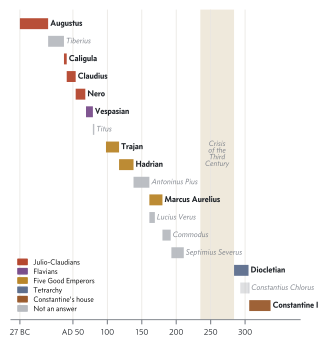
| Emperor | Reigned | Dynasty | Came after | Known for | Ch. |
|---|---|---|---|---|---|
| Augustus | 27 BC–AD 14 | Julio-Claudian | Caesar, his adoptive father | Actium; princeps; the Praetorian Guard; Varus’s legions; the Res Gestae | 9 |
| Caligula | 37–41 | Julio-Claudian | Tiberius | “Little Boots”; Incitatus; seashells; the Nemi ships | 12 |
| Claudius | 41–54 | Julio-Claudian | Caligula | The conquest of Britain; the Tyrrhenica; four wives; mushrooms | 12 |
| Nero | 54–68 | Julio-Claudian, the last | Claudius | The Great Fire; the Domus Aurea; killed his mother; Seneca | 12 |
| Vespasian | 69–79 | Flavian, the founder | The Year of the Four Emperors | Began the Colosseum; the urine tax; “I am becoming a god” | 14 |
| Trajan | 98–117 | Five Good Emperors, the second | Nerva | Dacia and the Column; the empire at its largest; Pliny’s letters | 16 |
| Hadrian | 117–138 | Five Good Emperors, the third | Trajan | The Wall; Antinous; the Pantheon; the villa at Tivoli | 16 |
| Marcus Aurelius | 161–180 | Five Good Emperors, the last | Antoninus Pius | Lucius Verus; the Marcomannic Wars; the Meditations | 17 |
| Diocletian | 284–305 | The Tetrarchy | Carinus, beaten 285 | The Tetrarchy; the price edict; the Great Persecution; abdicated | 18 |
| Constantine I | 306–337 | Constantine’s house | Constantius Chlorus, his father | The Milvian Bridge; Milan; Nicaea; Constantinople | 18 |
Augustus. Gaius Octavius, Caesar’s great-nephew and adopted son, who beat Antony at Actium and in 27 BC took the name Augustus. He is counted the first emperor. Clues test his family and his losses. In 2 BC Augustus exiled Julia to Pandateria,This ruler exiled his daughter Julia to Pandateria for adultery. → Augustus•• his own daughter, for adultery under his own law. In AD 9 three legions died with their general in the Teutoburg Forest, and Suetonius says that he beat his head against a door, crying to VarusThis ruler reportedly shouted "Quinctilius Varus, give me back my legions!" after the Battle of the Teutoburg Forest. → Augustus••• to give them back. When Augustus died in AD 14, Cassius Dio reports a rumor of poisoned figsCassius Dio reports a rumor that Livia killed this ruler with poisoned figs. → Augustus•• from his wife, Livia. Taught in Chapter 9.
Caligula. Gaius, the son of Germanicus, nicknamed “Little Boots,” for his tiny military bootsThis emperor’s nickname means “little boots,” from the miniature military uniform he wore as a child. → Caligula•• as a child in his father’s camp. At twenty-four Gaius succeeded Tiberius as the third emperor;This third Roman emperor succeeded Tiberius. → Caligula•• he planned, it was said, to make his horse a consul, and his own guards murdered him in AD 41. Taught in Chapter 12.
Claudius. Caligula’s uncle, a scholar of the Etruscans whom the Guard made emperor in AD 41. A clue about the invasion of Britain wants him, not Caligula, whose army only gathered seashells: in AD 43 Claudius launched the conquest of Britain.This Roman emperor is best known for conquering Britain. → Claudius• His fourth wife was Agrippina, and Agrippina poisoned Claudius with mushrooms,According to ancient accounts, Agrippina poisoned this ruler with mushrooms. → Claudius•• ancient writers say, in AD 54. Taught in Chapter 12 and Chapter 13.
Nero. Agrippina’s son, emperor at sixteen in AD 54 and the last of the Julio-Claudians. Seneca was his tutor and adviser, and in AD 65 Nero ordered his old Stoic tutor to kill himself.This ruler forced his former tutor Seneca the Younger to commit suicide. → Nero••• Three years later he killed himself, and Nero’s death was followed by the Year of the Four Emperors.This ruler's death was followed by the Year of the Four Emperors. → Nero••• Clues about the fire of AD 64 may want him or the fire itself. Taught in Chapter 12.
Great Fire of Rome. The fire that burned for six days in July of AD 64, under Nero, and then for three more. A clue that asks for “this event” wants the fire, not the emperor: the fire devastated Rome in AD 64This disaster devastated Rome in AD 64, during Nero’s reign. → Great Fire of Rome• and began by the Circus Maximus. A rumor said Nero was said to sing of TroyNero was said to sing of Troy’s fall while watching this event; later legend had him fiddling. → Great Fire of Rome•• while it burned; the fiddle is a much later legend. Taught in Chapter 12.
Vespasian. Titus Flavius Vespasianus, a tax collector’s son who led a legion in Britain and the war in Judea. His general Antonius Primus won the Second Battle of Bedriacum for him, and his accession ended the Year of the Four Emperors.This ruler's ascension ended the Year of the Four Emperors. → Vespasian•• Vespasian founded the Flavian dynasty,This ruler founded the Flavian Dynasty. → Vespasian•• began the Colosseum, and taxed urine. Taught in Chapter 14.
Trajan. Born in Hispania, the second of the Five Good Emperors, who conquered Dacia across the Danube. In his last months, after he took Ctesiphon, the Roman Empire reached its largest extent.Under this ruler's reign, the Roman Empire reached its largest territorial extent. → Trajan•• When Pliny the Younger, his governor in Bithynia, met Christians, he wrote to Trajan about them.This ruler corresponded with Pliny the Younger about the persecution of Christians. → Trajan•• Taught in Chapter 16.
Hadrian. Trajan’s cousin and successor, the third of the Five Good Emperors, a lover of Greece who traveled the whole empire. From 122 he built a wall across northern Britain,This ruler built a defensive wall across northern Britain, later supplemented farther north by Antoninus Pius’s wall. → Hadrian••• and in Egypt his beloved Antinous drowned. He adopted Antoninus Pius in 138, and Antoninus Pius succeeded HadrianThis ruler was succeeded by Antoninus Pius. → Hadrian•• later that year. Taught in Chapter 16.
Antinous. A young man from Bithynia whom ancient writers call Hadrian’s beloved. In October of 130 Antinous drowned in the Nile,This youth drowned in the Nile. → Antinous•• and Hadrian founded Antinoopolis where he died and had him worshiped as a god. The name is easily confused with Antoninus and Antonius (see the box below). Taught in Chapter 16.
Marcus Aurelius. The philosopher-emperor (161–180), the last of the Five Good Emperors. For the first time Rome was ruled jointly by Lucius VerusThis ruler co-ruled with Lucius Verus. → Marcus Aurelius•• and Marcus. He spent his last years fighting on the Danube, and in 175, on a false report of his death, Cassius proclaimed himself emperorAvidius Cassius rebelled after false reports of this ruler’s death. → Marcus Aurelius•• in the East. His son Commodus succeeded him. Taught in Chapter 17.
Diocletian. The soldier from Dalmatia who ended the Crisis of the Third Century.This ruler ended the Crisis of the Third Century. → Diocletian•• In 293 Diocletian created the Tetrarchy,This ruler created the Tetrarchy, appointing Galerius as his junior ruler and Constantius Chlorus to serve under Maximian from Trier. → Diocletian•• two senior emperors and two juniors, with Constantius Chlorus as Caesar in the West. He began the Great Persecution, gave up the throne in 305, and retired to his palace at Split. Taught in Chapter 18.
abdication. Giving up a throne of one’s own accord, which no emperor before him had done: Diocletian abdicated on May 1, 305,Diocletian performed this action in 305. → abdication• at Nicomedia, and made his co-emperor Maximian do the same. Taught in Chapter 18.
Constantine I. The son of Constantius Chlorus, emperor from 306 to 337. When his father died at York, his father’s troops proclaimed Constantine emperor.This ruler was proclaimed emperor at Eboracum after the death of his father. → Constantine I• Christian writers tell of a sign before his victory at the Milvian Bridge in 312, where Maxentius drowned in the Tiber.This ruler defeated Maxentius, who drowned in the Tiber, at the Battle of Milvian Bridge. → Constantine I••• He later called the Council of Nicaea and built Constantinople. Taught in Chapter 18.
Roman Empire. The state the emperors ruled, as a clue may ask without naming a reign: the Roman Empire of Caligula and Nero,Nero, Caligula and Constantine ruled this empire. → Roman Empire• and of Constantine. The Chinese called it Daqin, at the western end of the Silk Road. Its eastern half outlived the western by nearly a thousand years, and the eastern empire is called Byzantine.The eastern half of this empire is often called the Byzantine Empire. → Roman Empire• Taught in Chapter 16 and Chapter 20.
Britain
Eight answers concern Britain, from the prehistoric stones to the Roman frontier (Table A.6). Two pairs of answers overlap. “Roman Britain” is the province, from Claudius’s invasion of AD 43 until the legions left about 410. The “United Kingdom” is the modern country, wanted when a clue says that something “stands in this modern-day country.” Bath is the town and the Roman baths are the type of building. The people are told apart by their side and their date: Boudica was the rebel queen of AD 60 or 61, and Agricola the Roman governor who pushed into Scotland a generation later.
| Answer | When | What | Known for | Ch. |
|---|---|---|---|---|
| Stonehenge | Begun about 3000 BC | A prehistoric stone circle | Aubrey holes; sarsens and bluestones; Y and Z holes | 13 |
| Roman Britain | AD 43 to about 410 | The Roman province | Claudius’s invasion; Londinium; Hadrian’s Wall | 13 |
| Boudica | AD 60 or 61 | Queen of the Iceni | Burned Camulodunum and Londinium; beaten by Suetonius Paulinus | 13 |
| Gnaeus Julius Agricola | Governor about 77–84 | Roman governor | Mons Graupius; Tacitus’s biography | 13 |
| Bath | Roman Aquae Sulis | A town in Somerset | The baths of the goddess Sulis | 13 |
| lead | Roman times | A metal | Mined with silver at Charterhouse | 13 |
| Hadrian’s Wall | From 122 | The frontier wall across northern England | The Vindolanda tablets; the Antonine Wall farther north | 16 |
| United Kingdom | Today | The modern country | Holds both Hadrian’s Wall and the Antonine Wall | 16 |
Stonehenge. The stone circle on Salisbury Plain, built in stages over many centuries and older than any Roman by thousands of years. It was begun in the Neolithic,This prehistoric stone circle in England began during the Neolithic period. → Stonehenge•• about 3000 BC, as a bank and ditch. Its great uprights and lintels are of sarsen, a hard sandstone, while the smaller stones are the bluestones.The smaller standing stones of this monument are called bluestones. → Stonehenge• Taught in Chapter 13.
Roman Britain. The island as a Roman province. Caesar crossed twice and left, so a clue about the conquest wants Claudius’s war: Claudius launched the conquest of BritainClaudius launched the conquest of this region in AD 43 with Aulus Plautius commanding the invasion. → Roman Britain•• in AD 43, with Aulus Plautius in command. Its new port on the Thames was Londinium, and Londinium became London.The settlement of Londinium on this island later became the city of London. → Roman Britain•• Taught in Chapter 13.
Boudica. The queen of the Iceni, widow of their king Prasutagus, whose lands Rome seized when he died. In her revolt of AD 60 or 61 she burned Camulodunum and Londinium and routed the Ninth Legion. Under Nero Suetonius Paulinus defeated Boudica at Watling Street,Suetonius Paulinus defeated this rebel at the battle traditionally called Watling Street. → Boudica••• as the battle is traditionally called. Taught in Chapter 13.
Gnaeus Julius Agricola. The general who served under Suetonius Paulinus as a young officer and governed Britain from about 77 to 84. In the far north Agricola defeated Calgacus’s army at Mons Graupius.This Roman governor defeated Calgacus’s forces at Mons Graupius in northern Britain. → Gnaeus Julius Agricola•• His son-in-law Tacitus wrote Agricola’s lifeTacitus wrote a biography of this governor of Britain. → Gnaeus Julius Agricola•• in 98. Agricola is a different name from Agrippa. Taught in Chapter 13.
Bath. The town in Somerset that grew up around a hot spring, which the Romans called Aquae Sulis. Its baths of the goddess Sulis gave Bath its name.Roman thermal baths associated with the goddess Sulis gave this Somerset city its name. → Bath•• A clue that asks for “this city” wants Bath; one that asks for “these facilities” wants the Roman baths. Taught in Chapter 13.
lead. One of the metals that drew Rome to Britain. The Romans mined lead and silverThis metal and silver were mined by the Romans at Charterhouse. → lead• at Charterhouse, in the Mendip Hills, from the first years of the conquest. Taught in Chapter 13.
Hadrian’s Wall. The stone wall that Hadrian began in 122 across northern England, from sea to sea. The Vindolanda tablets were foundThe Vindolanda tablets, including a Roman birthday invitation, were found near this structure. → Hadrian's Wall•• at a fort just south of it, though they are a generation older than the wall. Twenty years later a second wall rose north of Hadrian’s,Antoninus Pius built another frontier wall farther north than this structure. → Hadrian's Wall• the Antonine Wall in Scotland. Taught in Chapter 16.
United Kingdom. The modern country, wanted when a clue asks where something stands today. Hadrian’s Wall stands in the United Kingdom,Hadrian’s Wall stands in this modern-day country. → United Kingdom•• in the north of England. Twenty years after it was begun, Antoninus Pius built a second wall farther north, and the Antonine Wall stands there too,The Antonine Wall stands in this modern-day country. → United Kingdom•• in Scotland. Taught in Chapter 16.
Goths, Huns, and Vandals
Five answers are the peoples and kings who broke the western empire in the fifth century (Table A.7). Figure A.3 shows their routes. Each people is best known by one leader and one date: the Goths by Alaric’s sack of Rome in 410, the Huns by Attila, and the Vandals by Gaiseric’s sack of 455. The Goths split into two peoples, the Visigoths, who sacked Rome, and the Ostrogoths, whose king Theodoric ruled Italy. Two kings named Theodoric are easy to mix up: the Visigoth Theodoric I died fighting Attila in 451, and the Ostrogoth Theodoric the Great ruled Italy from 493 to 526. The boxes at the end take the two peoples apart.
| Answer | Came from | Crossed or took | Leaders | Ch. |
|---|---|---|---|---|
| Goths | North of the Black Sea | Crossed the Danube 376; Adrianople 378; sacked Rome 410 | Fritigern, Alaric; the Amali and Balti | 19 |
| Huns | The steppe, about 370 | The Hungarian plain by the 420s; Gaul 451; Italy 452 | Rugila, Bleda, Attila | 20 |
| Attila the Hun | Ruled 434–453 | Checked on the Catalaunian Plains, 451 | Ruled at first with his brother Bleda | 20 |
| Vandals | Beyond the Rhine | Crossed the Rhine 406; took Carthage 439; sacked Rome 455 | Gaiseric | 20 |
| Theodoric the Great | An Ostrogoth | Took Italy; ruled 493–526 | King of the Ostrogoths, at Ravenna | 20 |
Goths. A Germanic people from north of the Black Sea, divided into western and eastern branches,These people were divided into western and eastern branches prefixed "Visi-" and "Ostro-." → Goths•• the Visigoths and the Ostrogoths. In 378, led by Fritigern, they killed the emperor Valens at Adrianople, and on August 24, 410, Alaric’s Goths sacked RomeA group of these people sacked Rome in 410 CE under the leadership of their king Alaric. → Goths•• for three days. Jordanes’s Getica is their history. Taught in Chapter 19.
Huns. Horse archers from the steppe who reached Europe about 370 and shattered the Goths north of the Black Sea. Clues name their king and their defeat: Attila, the “Scourge of God,” led the Huns,Attila, the “Scourge of God,” led these people. → Huns••• and in 451 Aetius and his Visigothic allies checked the HunsFlavius Aetius and his Visigothic allies checked these people at the Battle of the Catalaunian Plains. → Huns••• on the Catalaunian Plains. Their empire broke up after Attila’s death. Taught in Chapter 20.
Attila the Hun. The king of the Huns from 434, at first with his brother Bleda, whom he had killed. The historian Priscus described a feast held by AttilaThe historian Priscus described a dinner or feast held by this leader. → Attila the Hun•• in 449. On the Catalaunian Plains in 451, the Visigothic king Theodoric I was killedThe Visigothic king Theodoric I was killed fighting this ruler’s forces. → Attila the Hun•• fighting his army, and in 452 he withdrew from Italy after meeting Pope Leo I. He died on his wedding night in 453. Taught in Chapter 20.
Vandals. A Germanic people who crossed the Rhine in 406, passed through Spain, and took Carthage in 439. From there, under Gaiseric they sacked RomeUnder Gaiseric, these people sacked Rome in AD 455. → Vandals•• in 455, the second sack in half a century. Their name became a word: “vandalism” was coinedThese people's name has become a byword for destruction and defacement of property. → Vandals•• in 1794 for wanton destruction. Taught in Chapter 20.
Theodoric the Great. The king of the Ostrogoths, of the royal house of the Amali, whom the eastern emperor Zeno sent to take Italy from Odoacer. In 493 Theodoric killed Odoacer at a banquetThis ruler killed Odoacer at a banquet and succeeded him as king of Italy. → Theodoric the Great• and ruled Italy until 526, and his capital was Ravenna.This ruler's capital was Ravenna. → Theodoric the Great• He is not the Visigoth Theodoric I, killed fighting Attila. Taught in Chapter 20.
Games, goods, and daily life
Nineteen answers are ordinary things: a sport, a garment, a metal, a food, a kind of person (Table A.8). Their clues usually give a Latin word and ask for the English thing, so the table lists the Latin words each one brings. The traps are between a thing and what was done with it. Chariots are the vehicles, chariot racing the sport, and horses the animals; gladiators are the fighters, while the Colosseum, listed with the buildings, is where they fought. Salt and iron both lead back to the Celtic culture of Hallstatt, so read whether the clue asks for the source of its wealth or the age it belonged to.
| Answer | Latin words in clues | Known for | Ch. |
|---|---|---|---|
| gladiators | lanista, murmillo, retiarius, pollice verso | Spartacus; the Colosseum; Commodus fought as one | 14 |
| chariot racing | spina, metae, bigae, quadrigae, naufragia | The Circus Maximus; Diocles of Lusitania; Scorpus; the Hippodrome | 15 |
| chariots | Raced in the Circus Maximus and the Hippodrome | 15 | |
| horses | magister equitum | The dictator’s Master of the Horse; the races | 2 |
| togas | candida, praetexta, picta, pulla | Heavy white wool; the stola for women; Nasica’s covered head | 2 |
| slaves | libertini | Freedmen had all been slaves | 15 |
| coins | denarius; antoninianus; solidus | The silver denarius; Caracalla’s and Diocletian’s reforms | 18 |
| wine | passum, fumarium | The slopes of Vesuvius; the Speyer bottle | 15 |
| fish | garum | The Romans’ fish sauce | 15 |
| salt | salarium; Via Salaria | “Salary”; the salt road; the Hallstatt mines | 15 |
| glass | Pliny: found by the Phoenicians | 15 | |
| copper | aes Cyprium, cuprum | Named for Cyprus | 15 |
| iron | The Iron Age of Hallstatt and La Tène | 7 | |
| fire | vigiles; Sparteoli | Rome’s fire brigade | 15 |
| poisoning | praegustator | Locusta; Halotus, Claudius’s taster | 12 |
| shields | scutum, testudo | The tortoise formation | 4 |
| roads | mansiones, mutationes, itineraria | The Via Appia; Watling Street; the Peutinger Table | 15 |
| sewer systems | Cloaca Maxima | Rome’s great drain, credited to Tarquinius Priscus | 1 |
| irrigation | Aqueducts watered fields as well as towns | 15 |
gladiators. Armed fighters, most of them slaves, trained by a lanista and matched in pairs of set types. The heavy murmillo might face the lightly armed retiarius, who fought with a net and trident.The retiarius type of these fighters used a net and trident. → gladiators•• A clue about the most famous of them all may want the class of fighter rather than the man, since Spartacus had been a gladiatorSpartacus was one of these fighters before leading the Third Servile War. → gladiators•• before he led the slaves in 73 BC. Taught in Chapter 14 and Chapter 5.
chariot racing. Rome’s favorite sport, run in the long valley below the Palatine, where horse-drawn chariots raced in the Circus MaximusThe Circus Maximus in Rome hosted this sport. → chariot racing•• on dozens of festival days a year. The racetrack was divided by a central barrier, the spina,A spina separated the lanes for this sport, with a meta at either end. → chariot racing• with turning posts, the metae, at either end. Taught in Chapter 15.
chariots. The vehicles themselves, light two-wheeled boxes on which the driver stood. A clue that asks for “these horse-drawn vehicles” wants chariots, not the sport: chariots were raced in the Circus MaximusThese horse-drawn vehicles were raced in the Circus Maximus and Hippodrome. → chariots•• and in the Hippodrome of Constantinople. Taught in Chapter 15.
horses. An answer for two kinds of clue. At the races the horses drew the chariots; in the Republic a dictator chose a deputy who commanded the cavalry, and his lieutenant was the Master of the Horse,Roman dictators appointed a lieutenant whose title was "Master" of one of these animals. → horses•• the magister equitum. Taught in Chapter 2 and Chapter 15.
togas. The heavy white wool garment that a male citizen draped over his tunic for public life. Clues name its varieties: office seekers wore the chalk-whitened candida,Office seekers wore the candida variety of this garment, whitened with chalk. → togas•• magistrates and children the purple-bordered praetexta, and mourners the dark pulla. In 133 BC Nasica drew a fold of his toga over his headScipio Nasica covered his head with this garment to rally Tiberius Gracchus’s assassins. → togas• and led the senators against Tiberius Gracchus. Taught in Chapter 2 and Chapter 4.
slaves. Rome was full of them, and many were freed. A clue about freedmen wants this answer, since the libertini had all once been slaves;The Roman libertini were formerly these people. → slaves• a freed slave of a citizen became a citizen himself. Taught in Chapter 15.
coins. The coin every Roman knew was the silver denarius, the common Roman coin,A common Roman variant of these objects was the denarius. → coins•• first struck about 211 BC. Later emperors changed the money as the silver ran thin: in 215 Caracalla introduced a new silver coin,Caracalla introduced the antoninianus, one of these Roman monetary objects. → coins• the antoninianus, and later Diocletian reformed the coinage and Constantine struck the gold solidus. Taught in Chapter 15 and Chapter 18.
wine. Before AD 79 vineyards covered the volcano above Pompeii, and wine was widely produced on Mount Vesuvius.This commodity was widely produced on Mount Vesuvius. → wine• Romans also drank passum, a raisin wine, and aged cheap wine in smoke rooms. A glass bottle found at Speyer still holds wine of the fourth century. Taught in Chapter 15.
fish. The base of the Romans’ favorite seasoning: garum, a sauce made from fish,This commodity was used to create garum in ancient Rome. → fish• the guts of mackerel and others left to ferment in the sun. Taught in Chapter 15.
salt. The Romans’ word for an allowance of salt has stayed in English: the word salary comes from salarium,The word “salary” derives from a Latin word connected with this commodity. → salt•• and the Via Salaria was the salt road. Long before Rome, in the Austrian Alps, salt made the Hallstatt miners rich.The Hallstatt culture derived much of its wealth from this commodity. → salt• Taught in Chapter 15 and Chapter 7.
glass. The Romans did not invent glass and could only guess who had. Pliny the Elder claimed that Phoenicians discovered glassPliny the Elder claimed this material was accidentally discovered by Phoenicians. → glass• by accident. Taught in Chapter 15.
copper. The metal of Cyprus, which had been mined for it since the Bronze Age. The Romans called it aes Cyprium, “Cyprian bronze,”This metal’s Latin name derives from Cyprus, an important ancient source of it. → copper•• later shortened to cuprum. Taught in Chapter 15.
iron. The metal that names the age of the Celts before Rome. The later phases of the Hallstatt culture belong to the Iron Age, from about 800 to 450 BC, and after them the La Tène culture belonged to the later Iron Age,The La Tène culture belonged to the age named for this metal. → iron• lasting until the Romans conquered its lands. Taught in Chapter 7.
fire. After a run of bad fires, Augustus created a fire brigade of freedmen in AD 6, the vigiles. For their rope buckets the vigiles were nicknamed the Sparteoli,The Vigiles were nicknamed the Sparteoli for their role in these events. → fire• “the little bucket men.” Taught in Chapter 15.
poisoning. The murder the Julio-Claudians feared most, which an imperial taster was kept to prevent. Suetonius says Nero had his poison from a specialist: Locusta practiced poisoning for the Julio-Claudian emperors.Locusta specialized in this practice under the Julio-Claudian dynasty. → poisoning• Taught in Chapter 12.
shields. A legionary carried the curved scutum, covering him from shoulder to knee, and in the testudo, legionaries overlapped their scutaRoman legionaries overlapped their scuta, examples of these objects, to form a testudo. → shields• to make a roof like a tortoise’s shell. Taught in Chapter 4.
roads. Rome’s paved highways, some 50,000 miles of them. The Via Appia, the Appian Way,The Via Appia was part of the Roman system of these structures. → roads•• begun in 312 BC, was the first of the great roads. In Britain the battle against Boudica is named for Watling Street,One of these structures traditionally names the Battle of Watling Street, where Suetonius Paulinus defeated Boudica. → roads•• the Roman road near which it was fought. Taught in Chapter 15 and Chapter 13.
sewer systems. Rome’s oldest great work began, Livy says, when Tarquinius Priscus drained the marshy valley of the Forum, and its main channel became the Cloaca Maxima, Rome’s great sewer,Rome’s Cloaca Maxima, traditionally attributed to Tarquinius Priscus, is one of these drainage systems. → sewer systems•• which still drains into the Tiber. Taught in Chapter 1.
irrigation. Watering fields. Aqueducts carried water to the towns by gravity, but landowners along them could be granted a share, and the Romans used aqueducts for irrigationThe Romans implemented this process through building aqueducts. → irrigation• as well as for drinking and bathing. Taught in Chapter 15.
Cities
Seven answers are cities and one is the mountain above two of them (Table A.9). Most are told apart by the one event or building that clues return to: the sacks of Rome, the ash of Pompeii, the palace of Split, the agreement of Milan. Three of them changed name or became something else. Milan was Mediolanum; Constantinople was the Greek town of Byzantium before Constantine rebuilt it; and Split grew up inside an emperor’s palace. Mount Vesuvius is an answer for clues of three different centuries, not only for the eruption of AD 79.
| Answer | Where | Known for | Ch. |
|---|---|---|---|
| Rome | On the Tiber, in Latium | Seven hills; sacked by Brennus (390 BC), Alaric (410), and Gaiseric (455) | 1 |
| Ostia | At the mouth of the Tiber | Rome’s port; the harbor of Portus beside it | 12 |
| Pompeii | On the Bay of Naples | Buried in AD 79; the House of the Faun; the Villa of the Mysteries; Mau’s four styles | 14 |
| Mount Vesuvius | Above the Bay of Naples | The battle of 340 BC; Spartacus’s vine ladders; the eruption of AD 79 | 14 |
| Syracuse | Eastern Sicily | Hiero II; taken by Rome in 212 BC | 3 |
| Milan | Mediolanum, in the Po plain | Maximian’s capital; the agreement of 313; Saint Ambrose | 18 |
| Split | The coast of Dalmatia | Diocletian’s palace | 18 |
| Constantinople | Byzantium, on the Bosporus | Constantine’s city, dedicated in 330 | 18 |
Rome. The city of seven hills on the Tiber, founded in 753 BC by the Romans’ count. Clues about its sacks want the city. After the Battle of the Allia in 390 BC Brennus’s Gauls entered and sacked Rome,Brennus sacked this city after the Battle of the Allia. → Rome• and threw a sword on the scales. On August 24, 410, the city was sacked by Alaric’s Goths,This city was sacked by forces under Alaric. → Rome•• for the first time in almost eight hundred years. Taught in Chapter 1, Chapter 2, and Chapter 19.
Ostia. Rome’s old port at the mouth of the Tiber, which silted up so that big seagoing ships could not enter. So Claudius built a new harbor nearby at Portus, and Trajan enlarged it, and this harbor of Claudius and Trajan supplemented OstiaThis ancient port city near Rome was supplemented by the imperial harbor at Portus, developed under Claudius and Trajan. → Ostia•• without replacing it. Taught in Chapter 12.
Pompeii. The town on the Bay of Naples that Vesuvius buried with HerculaneumThis city was buried with Herculaneum by Vesuvius’s eruption in AD 79. → Pompeii••• in AD 79. A clue about a house, a painting, or a mosaic wants the town: the House of the Faun held the Alexander Mosaic,The House of the Faun in this city contained the Alexander Mosaic. → Pompeii•• and August Mau sorted the town’s wall paintings into four styles. Taught in Chapter 14.
Mount Vesuvius. The volcano above the Bay of Naples. Its clues are not all about AD 79: in 340 BC Torquatus executed his son before a battle near it, and in 73 BC Spartacus’s men came down it on vine ladders. In the eruption Pliny the Elder died in the rescuePliny the Elder died while attempting a rescue during an eruption of this volcano. → Mount Vesuvius•• at Stabiae, where he had taken his ships to carry people off the shore. About twenty-five years later his nephew wrote it all down: Pliny described the eruption in two letters to Tacitus.Pliny the Younger described this volcano’s AD 79 eruption in letters to Tacitus. → Mount Vesuvius•• Taught in Chapter 2, Chapter 5, and Chapter 14.
Syracuse. The greatest Greek city of Sicily. From about 275 BC Hiero II ruled Syracuse as its tyrant,This city's tyrants included Hiero II. → Syracuse• then took the title of king, and from 263 BC he was Rome’s loyal ally in the First Punic War. Rome took the city in 212 BC, during the Second Punic War. Taught in Chapter 3.
Milan. Mediolanum, in the flat plain of the Po, where the roads from Rome met the roads over the Alps. Under the Tetrarchy Maximian ruled from Milan,Maximian ruled from this city, a western imperial capital under Diocletian’s division of power. → Milan•• and there in 313 Constantine and Licinius made the agreement made at Milan,The 313 agreement between Constantine and Licinius on religious toleration is named for this city. → Milan•• later called the Edict of Milan, to tolerate the Christians. Ambrose was its bishop from 374. Taught in Chapter 18 and Chapter 19.
Split. A city on the coast of Dalmatia that grew up inside an emperor’s walls. Diocletian built a fortified villa there, and he retired to his palace at SplitDiocletian’s Palace is in this city. → Split•• in 305. Three centuries later refugees from nearby Salona moved inside it. Taught in Chapter 18.
Constantinople. The old Greek town of Byzantium on the Bosporus, which Constantine rebuilt and dedicated in 330 as New Rome. Everyone called it by his name instead: the city was named for Constantine.This city was named after the first Christian Roman emperor. → Constantinople• It is Istanbul today. Taught in Chapter 18.
Lands, seas, and rivers
Ten answers are lands, seas, and rivers (Table A.10). Some are Roman names for whole regions, and their clues gather events of many centuries: Hispania runs from Saguntum in 219 BC to Hadrian’s birth. Others are modern countries, and their clues name an ancient place or people inside them, as Libya holds Leptis Magna and Russia part of the Yamnaya steppe. A clue’s wording tells which kind it wants: “this region” or “this province” wants the Roman name, and “this modern country” wants today’s. Figure A.4 shows the provinces.
| Answer | What | Known for | Ch. |
|---|---|---|---|
| Sicily | Island; Rome’s first province | The First Punic War; the First and Second Servile Wars; Sextus Pompeius | 3 |
| Hispania | The Iberian Peninsula | Saguntum; Ilipa; Numantia; Sertorius; the Cantabrian Wars; birthplace of Trajan | 4 |
| Gaul | Roughly modern France | Caesar’s conquest; Alesia; wicker men; Postumus’s Gallic Empire | 7 |
| Africa | Roman province, from Carthage to the Gulf of Sirte | Septimius Severus born at Leptis Magna | 18 |
| Libya | Modern country | Leptis Magna and Cyrene; Cyrenaica and Crete; the Garamantes | 18 |
| Mediterranean Sea | The sea | Mare Nostrum, “our sea,” and Mare Internum | 3 |
| Rhine River | River | Caesar’s bridge, 55 BC; the Vandals crossed it in 406 | 7 |
| Danube River | River | Trajan’s bridge and the Dacian wars; the Goths crossed it in 376 | 16 |
| Russia | Modern country | The steppe of the Yamnaya | 7 |
| Georgia | Modern country | Saint Nino brought Christianity | 19 |
Sicily. The island off the toe of Italy. Most of the First Punic War was fought on it,Much of the First Punic War was fought on this island, where Rome then took over Carthage’s possessions. → Sicily•• and Rome took Carthage’s part of the island as its first province. A century later the First and Second Servile WarsThis island experienced the First and Second Servile Wars. → Sicily• broke out on its slave-worked grain estates, in 135 and 104 BC. Taught in Chapter 3 and Chapter 5.
Hispania. The Romans’ name for the Iberian Peninsula, today’s Spain and Portugal, split in 197 BC into Hither and Further Spain. Its clues span three centuries. At Numantia in 133 BC many Numantines killed themselves rather than surrenderSome Numantians in this region reportedly killed themselves rather than surrender to Scipio Aemilianus. → Hispania• to Scipio Aemilianus. Trajan was born there, at Italica, and modern books usually say Hadrian was born at ItalicaThis region was the birthplace of Emperor Hadrian. → Hispania•• too, though one ancient life says Rome. Taught in Chapter 4 and Chapter 16.
Gaul. The land beyond the Alps that Caesar conquered, roughly the land of modern France,This region roughly corresponds with modern-day France. → Gaul•• with Belgium and the German lands west of the Rhine. Three centuries later, in the Crisis of the Third Century, Postumus ruled a breakaway state that historians call the Gallic Empire, after Gaul, its heart.Roman commander Postumus founded an empire named for this region during the Crisis of the Third Century. → Gaul• Taught in Chapter 7 and Chapter 18.
Africa. The Roman province made from Carthage’s land in 146 BC, which under the emperors ran along the coast from Carthage to the Gulf of Sirte. A clue that asks for “this province” wants Africa, as when Septimius Severus was born at Leptis Magna,Septimius Severus came from a city in this province called Leptis Magna. → Africa• the first emperor born in Africa. Taught in Chapter 18.
Libya. The modern country on the coast west of Egypt. A clue that asks for “this country” wants Libya: Libya holds the ruins of Leptis Magna and Cyrene,This country is home to the ancient cities of Leptis Magna and Cyrene. → Libya•• the greatest Roman city of its west and the greatest Greek city of its east. In its southern desert the Garamantes built their civilization. Taught in Chapter 18.
Mediterranean Sea. As Rome came to rule its shores, Romans called the Mediterranean “Mare Nostrum,”Romans called this sea “Mare Nostrum” and “Mare Internum.” → Mediterranean Sea•• “our sea,” and also Mare Internum, “the inner sea.” Taught in Chapter 3.
Rhine River. The river that divided Gaul from the Germans. In 55 BC, after two Germanic peoples crossed it into Gaul, Caesar crossed the other way: his army bridged the Rhine in ten days,Julius Caesar’s army built a bridge across this river in about ten days. → Rhine River• near what is now Koblenz. The Vandals crossed it in 406. Taught in Chapter 7.
Danube River. Rome’s northern frontier from the Alps to the Black Sea. Beyond it lay Dacia, and Trajan crossed the Danube to conquer DaciaTrajan conquered the Dacians led by Decebalus in a campaign involving this river. → Danube River• from King Decebalus, on a bridge his architect Apollodorus built. Taught in Chapter 16.
Russia. A modern country that appears in this volume because of the people of the steppe long before Rome. Between about 3300 and 2600 BC the Yamnaya herded on the steppesThe Yamnaya culture occupied steppes in this modern country and neighboring Ukraine. → Russia•• of what are now Ukraine and southern Russia. Taught in Chapter 7.
Georgia. The modern country in the Caucasus. About 326 a young woman from Cappadocia converted its king, Mirian III, and Saint Nino brought Christianity to Georgia.Christianity was popularized in this country by St. Nino. → Georgia• Taught in Chapter 19.
Catullus and Lucretius
Nine answers are two poets of the last years of the Republic and seven of their poems (Table A.11). Catullus’s poems are known by number, and a clue usually quotes a line or names a person, so the table gives each poem’s best-known words. Two pairs look alike. Carmen 5 and Carmen 7 both count Lesbia’s kisses, and Carmen 51 and Carmen 85 both describe the pain of love. The others stand apart: Carmen 16 is the obscene reply to two friends, Carmen 64 the one long poem, and Carmen 101 the elegy at a brother’s grave. Lucretius wrote one long poem, and its clues about atoms and the swerve can want the poem, the poet, or the ideas, which are listed with the philosophers.
| Poem | Best-known words | Subject | Length | Ch. |
|---|---|---|---|---|
| Carmen 5 | “Let us live, my Lesbia, and love” | Kisses counted to 3,300 | 13 lines | 6 |
| Carmen 16 | An obscene threat, opening and closing it | To Furius and Aurelius: a poet’s verses need not be chaste | 14 lines | 6 |
| Carmen 51 | “He seems to me to be equal to a god” | A version of Sappho’s Fragment 31, with a stanza on idleness | Sapphic stanzas | 6 |
| Carmen 64 | “Pinetrees of old, born on the top of Pelion” | An epyllion: Peleus and Thetis, and Ariadne on the coverlet | 408 lines | 6 |
| Carmen 85 | “I hate and I love” | Love and hate at once | One couplet | 6 |
| Carmen 101 | “Hail and farewell” | At his brother’s grave in the Troad | Five couplets | 6 |
| De Rerum Natura | The clinamen, the swerve of the atoms | Lucretius’s poem of Epicurus’s teaching: atoms and empty space | Six books | 6 |
Catullus. Gaius Valerius Catullus (about 84 to 54 BC), from Verona, the master of short, polished Latin poems. His Lesbia was Clodia,This poet addressed love poems to Lesbia, who may have been Clodia. → Catullus••• according to Apuleius, probably the wife of Metellus Celer. A clue about kisses as many as the sands may want the poet rather than a numbered poem, because Carmen 7, which is not an answer, counts them as the grains of Libyan sand.In a poem, this poet counts Libyan grains of sand to describe the number of kisses he wishes from his lover. → Catullus•• Taught in Chapter 6.
Catullus’s Carmen 5. The most famous of his poems, an invitation to Lesbia. It opens let us live, and let us love,This poem begins "let us live and let us love." → Catullus's Carmen 5••• and it values the gossip of strict old men at a single copper coin. Then it asks for a thousand kisses and a hundred, three times over, so that the kisses add up to 3,300,In this poem, the speaker asks for "a thousand kisses, then a hundred," repeated to total 3,300. → Catullus's Carmen 5••• and muddles the count against the evil eye. Taught in Chapter 6.
Catullus’s Carmen 16. His answer to two friends who called him soft for writing of kisses. It is addressed to Furius and AureliusThis poem is addressed to Furius and Aurelius. → Catullus's Carmen 16• by name and threatens them obscenely in its first and last lines. Its argument is in the middle: a poet’s life should be chaste; his verses need not be.In this poem, the speaker defends his poetry against critics, stating that "the devoted poet should stand erect in his values, but not necessarily in his little poems, which are truly witty and charming." → Catullus's Carmen 16• Taught in Chapter 6.
Catullus’s Carmen 51. A translation, and the poem that may first give Lesbia her name. Catullus followed Sappho’s Fragment 31This poem emulates Sappho 31. → Catullus's Carmen 51•• for three stanzas, in her own meter, and then added a fourth of his own, scolding himself because leisure has ruined kings and prosperous cities.This poem warns "idleness has destroyed both kings and blessed cities before." → Catullus's Carmen 51• Taught in Chapter 6.
Catullus’s Carmen 64. His longest poem, a learned piece in the epic meter: an epyllion of 408 linesThis poem is the poet's longest work, an epyllion describing the marriage of Peleus and Thetis. → Catullus's Carmen 64•• on the wedding of Peleus and Thetis. More than half of it describes the coverlet of the marriage bed, which the coverlet shows Ariadne abandoned by TheseusThis poem contains an ekphrasis of a bedspread showing Theseus' abandonment of Ariadne. → Catullus's Carmen 64•• on the shore of Dia. Taught in Chapter 6.
Catullus’s Carmen 85. The shortest of the famous poems, a single elegiac couplet of fourteen words, with eight verbs and no noun. It begins “I hate and I love,”The speaker of this poem says "I hate and I love." → Catullus's Carmen 85•• odi et amo, and ends in torment. Carmen 51 also tells the pangs of love, but in four stanzas and after Sappho. Taught in Chapter 6.
Catullus’s Carmen 101. The elegy of five couplets that Catullus wrote at his brother’s grave in the Troad, on his way to Bithynia. He came through many nations and over many seas,This poem invokes the speaker's voyage "through many nations and over many seas." → Catullus's Carmen 101•• and he ends with “hail and farewell,”This poem commemorates the death of the speaker's brother with the words "hail and farewell" or "ave atque vale." → Catullus's Carmen 101••• ave atque vale. Taught in Chapter 6.
Lucretius. Titus Lucretius Carus (about 99 to 55 BC), of whose life almost nothing is known. He wrote De Rerum Natura,This poet wrote De Rerum Natura. → Lucretius••• the poem that puts the teaching of Epicurus into Latin verse. He is a different name from Lucretia of Livy’s story. Taught in Chapter 6.
De Rerum Natura. On the Nature of Things, Lucretius’s poem in six books, which explains the world as atoms falling through empty space. Its most famous idea is that the atoms swerve, the clinamen,This poem describes a random atomic “swerve,” or clinamen, associated with free will. → De Rerum Natura••• which starts the collisions that make the world. Taught in Chapter 6.
Virgil
Seven answers are Virgil, his three works, the hero of his epic, the one poem of the Eclogues that is an answer of its own, and the land he made the home of shepherds (Table A.12). His epitaph names the three works in order: “pastures, fields, and leaders.” The Eclogues are songs of shepherds, the Georgics teach farming, and the Aeneid tells of Aeneas. The commonest mistakes are between a collection and one poem in it, and between the hero and the poem named for him, so read whether a clue asks for “this collection,” “this poem,” or “this figure.”
| Work | Written | Size | Subject | Famous words | Ch. |
|---|---|---|---|---|---|
| Eclogues | About 42–38 BC | Ten poems | Shepherds’ songs after Theocritus | “Love conquers all” (Eclogue 10) | 10 |
| “Fourth Eclogue” | 40 BC | One poem | A child and a golden age, for Pollio’s consulship | “Great increase of Jove” | 10 |
| Georgics | Finished about 29 BC | Four books | Farming; bees; Aristaeus | 10 | |
| The Aeneid | 29–19 BC | Twelve books | Aeneas from Troy to Italy | “I sing of arms and the man” | 10 |
Virgil. Publius Vergilius Maro (70–19 BC), born near Mantua, the poet of Augustus’s Rome. Clues about the men who read and explained him want Virgil: Donatus says Octavia fainted at the readingAccording to tradition, this author made Octavia faint by reading praise of her son. → Virgil• of his lines on her dead son, Marcellus, and about AD 400 Servius’s commentary on VirgilServius wrote commentaries on this author's works. → Virgil• explained every line. Taught in Chapter 10.
The Aeneid. Virgil’s epic in twelve books, written from 29 BC until his death and published unfinished. It opens “I sing of arms and the man,”This poem opens with the phrase "I sing of arms and the man." → The Aeneid•• and the Aeneid follows a Trojan refugee to Italy,This epic follows a Trojan refugee to Italy, where he becomes an ancestor of the Romans. → The Aeneid••• whose descendants will found Rome. A clue about a scene, such as Cloanthus winning the ship race, may still want the poem. Taught in Chapter 10.
Aeneas. The Trojan prince who carried his father, Anchises, out of burning Troy. A clue that asks for “this figure” wants him, not the poem. Aeneas falls in love with Dido at Carthage,This figure falls in love with Dido at Carthage. → Aeneas•• goes down to the underworld with a golden bough, and at the end, when Aeneas sees the belt of PallasThis figure kills Turnus after recognizing Pallas’s belt. → Aeneas••• on Turnus’s shoulder, he kills him. Taught in Chapter 10.
Eclogues. Virgil’s first book, of shepherds’ songs, after the Greek poet Theocritus. It holds ten bucolic poems,This collection consists of 10 bucolic poems. → Eclogues•• “bucolic” meaning of cowherds. A clue that names a single poem may still want the collection, as when the tenth poem coins “omnia vincit amor,”The phrase "omnia vincit amor" ("love conquers all") was coined in the tenth and final poem of this collection. → Eclogues•• “love conquers all.” Taught in Chapter 10.
Fourth Eclogue. The one poem of the Eclogues that is an answer of its own. It addresses Gaius Asinius Pollio,This poem addresses Gaius Asinius Pollio. → "Fourth Eclogue" (Virgil)• Virgil’s patron, in his consulship of 40 BC, and foretells a child who will bring back the golden age. Early Christians read the Fourth EclogueEarly Christians read this poem’s prediction that a child called the "great increase of Jove" would inaugurate a golden age as a prophecy of Christ. → "Fourth Eclogue" (Virgil)••• as a prophecy of Christ. Taught in Chapter 10.
Georgics. Virgil’s second work, a teaching poem in four books: the Georgics teach how to run a farm,This poem describes running a farm. → Georgics• from plowing to vines, cattle, and bees. Book Four describes the habits of beesBook four of this poem discusses the habits of bees. → Georgics• and ends with the epyllion of Aristaeus, which holds the story of Orpheus and Eurydice. Taught in Chapter 10.
Arcadia. A real region of Greece, a ring of bare mountains in the middle of the Peloponnese where shepherds kept flocks. In the Eclogues Virgil made Arcadia a pastoral paradise,Vergil evokes this region as a pastoral setting in his Eclogues. → Arcadia• a land of shade, song, and shepherds in love, and the name has meant that ever since. Taught in Chapter 10.
Horace and Ovid
Seven answers are the two other great poets of Augustus’s reign and five of their works (Table A.13). Horace was the elder, Maecenas’s friend and the poet of the Odes; Ovid, a generation younger, wrote of love and ended his life in exile. Their titles are easily confused, above all the two Arts. The Ars Poetica is Horace’s advice to poets, and the Ars Amatoria is Ovid’s advice to lovers.
| Work | Poet | Form | Subject | Famous words | Ch. |
|---|---|---|---|---|---|
| Odes | Horace | Four books of lyric poems | Love, wine, friendship, and death | Carpe diem; “Nunc est bibendum” | 11 |
| Ars Poetica | Horace | A verse letter to the Pisos | Advice to poets | In medias res; “Even good Homer nods” | 11 |
| Amores | Ovid | Love elegies | An affair with Corinna | Cupid steals a foot | 11 |
| Ars Amatoria | Ovid | Three books of couplets | Seduction: two books for men, one for women | “I am tutor to Love” | 11 |
| Metamorphoses | Ovid | Fifteen books of hexameters | Myths of transformation | Caesar’s soul becomes a star | 11 |
Horace. Quintus Horatius Flaccus (65–8 BC), a freedman’s son from Venusia who fought for Brutus at Philippi and ran. Virgil introduced him to Maecenas, and Maecenas became Horace’s patron,This poet's patron was Maecenas. → Horace•• later giving him a farm in the Sabine hills. His most quoted words are the end of a short ode: Horace’s Latin words carpe diem,This author coined the phrase "carpe diem." → Horace••• “pluck the day.” Taught in Chapter 11.
Odes. Horace’s greatest work, lyric poems in Greek meters. Three books came out in 23 BC, and later the Odes became four books.This collection consists of four books. → Odes•• A clue that quotes one ode wants the collection, as with the ode on Cleopatra’s death, “Nunc est bibendum,” now we must drink.A poem in this collection about Cleopatra begins "now is the time to drink" ("nunc est bibendum"). → Odes•• Taught in Chapter 11.
Ars Poetica. Horace’s Art of Poetry, a verse letter of advice. Horace wrote to Lucius Calpurnius Piso and his sons,This poem was written as a letter to Lucius Calpurnius Piso and his sons. → Ars Poetica•• ancient commentators said. It opens with a painted monster and gives the rule that an epic poet hurries into the middle of things,This poem praises beginning a narrative in medias res rather than ab ovo. → Ars Poetica•• in medias res. Taught in Chapter 11.
Ovid. Publius Ovidius Naso (43 BC–AD 17 or 18), the poet of love and transformation. In AD 8 Augustus banished Ovid to Tomis,This author was exiled to Tomis on the Black Sea. → Ovid•• on the Black Sea, and the poet said only that his crime was “a poem and a mistake,”This author attributed his exile to "a poem and an error" ("carmen et error"). → Ovid•• carmen et error. The poem was the Ars Amatoria. Taught in Chapter 11.
Metamorphoses. Ovid’s long poem of fifteen books, hundreds of myths in one unbroken song. Every story turns on a transformation,This poem relates its stories to the theme of transformation. → Metamorphoses•• from Daphne to Philemon and Baucis. It ends in Rome: as Caesar dies, Venus carries up his soul, and Caesar’s soul becomes a star.The final book of this poem includes Julius Caesar's apotheosis. → Metamorphoses•• Taught in Chapter 11.
Ars Amatoria. Ovid’s Art of Love, a mock handbook of about 1 BC. The first two books address men,The first two of this poem's three books address men. → Ars Amatoria•• and the third gives women the same advice. Ovid calls himself Love’s tutor: he will train Cupid as Chiron trained Achilles.This poem declares "I am Cupid's teacher just as Chiron was Achilles'." → Ars Amatoria• Taught in Chapter 11.
Amores. Ovid’s first book, love elegies in couplets. The Amores tell of an affair with Corinna,This collection describes the narrator's affair with Corinna. → Amores• a married woman. In its first poem Ovid sets out to write of war, but Cupid laughed and stole one footIn this collection's opening poem, a god steals a poetic foot from the speaker. → Amores• from his second line, turning the poem into an elegy. Taught in Chapter 11.
Prose writers and the Latin language
Eight answers come from Latin prose: four works, three writers known for one book each, and the language itself (Table A.14). Two of the works are Caesar’s and Cicero’s, so a clue may name the author and ask for the book. “The Dream of Scipio” is a passage, the end of Cicero’s De Re Publica, and De Officiis is a different book of his. Petronius and Apuleius each wrote a comic novel, a century apart, and Juvenal is the satirist of “bread and circuses.” “Latin” is the answer whenever a clue names a writer or a book and asks for its language.
| Answer | Writer | Date | What clues ask | Ch. |
|---|---|---|---|---|
| “The Dream of Scipio” | Cicero | 54–51 BC | The end of De Re Publica; nine spheres; Macrobius’s commentary | 5 |
| Commentaries on the Gallic War | Caesar | 50s BC | Gaul in three parts; Hirtius’s eighth book | 7 |
| De Officiis | Cicero | 44 BC | “On Duties,” to his son; honor against expediency | 5 |
| Petronius | Under Nero | The Satyricon; Trimalchio’s feast | 12 | |
| Juvenal | About 100 to after 127 | Sixteen satires; “bread and circuses” | 16 | |
| Apuleius | Born about 124 | The Golden Ass | 17 | |
| The Golden Ass | Apuleius | Second century AD | Lucius turned into a donkey; Isis | 17 |
| Latin | The language of Rome and of the western empire | 11 |
The Dream of Scipio. A passage, not a book: the dream is the last passage of De Re Publica,This passage concludes Cicero’s De Re Publica. → "The Dream of Scipio"• as the myth of Er ends Plato’s Republic. Scipio Aemilianus dreams that Africanus shows him the heavens, where the spheres make the Earth seem tiny.This passage describes celestial spheres that make Earth seem tiny by comparison. → "The Dream of Scipio"•• It survived whole because Macrobius wrote a commentary on it. Taught in Chapter 5.
Commentaries on the Gallic War. Caesar’s own record of his campaigns, written in the third person. The first book begins by dividing Gaul into three parts,This work opens by dividing Gaul into three parts. → Commentaries on the Gallic War•• and Caesar wrote seven; after his death Hirtius added an eighth book,Aulus Hirtius added an eighth book to this work. → Commentaries on the Gallic War•• on the last two years. Taught in Chapter 7.
De Officiis. On Duties, written in under four weeks in the autumn of 44 BC, after the Ides. He addressed the work to his son,This work is addressed to Cicero’s son. → De Officiis•• Marcus, then studying philosophy at Athens. The first two books follow the Stoic Panaetius, and the third book weighs honor against expediency,The final book of this work discusses conflicts between honor and expediency. → De Officiis•• which Panaetius never wrote about. Taught in Chapter 5.
Petronius. Nero’s “judge of elegance” at court, who probably wrote the Satyricon, a comic novel in prose and verse. Its most famous episode is the Satyricon’s feast at the house of Trimalchio,This author's Satyricon depicts an extravagant feast at the house of Trimalchio. → Petronius•• a vulgar, rich former slave. Taught in Chapter 12.
Juvenal. The satirist of Trajan’s and Hadrian’s Rome, whose sixteen satires are fierce. In his tenth he says the people no longer care for politics, only for Juvenal’s “bread and circuses,”This satirist wrote about "bread and circuses." → Juvenal•• panem et circenses. Taught in Chapter 16.
Apuleius. A writer and speaker born about AD 124 at Madauros, in Numidia, who called himself half Numidian and half Gaetulian. Apuleius wrote The Golden Ass,This author wrote The Golden Ass. → Apuleius•• which he called Metamorphoses. Taught in Chapter 17.
The Golden Ass. Apuleius’s comic novel, the only Roman novel in Latin to survive whole. Its hero, Lucius, dabbles in magic: he meant to become a birdIn this novel, a character accidentally turns into a donkey while trying to become a bird. → The Golden Ass•• and became a donkey instead. After many adventures the goddess Isis saves him. Taught in Chapter 17.
Latin. The language of Latium and of Rome, which became the language of government in the western half of the empire while the east kept Greek: Latin was the language of government in the western provinces.This was the principal administrative language of the western Roman Empire. → Latin• A clue that names a work and asks for its language wants Latin even when the work is a prose novel, as the Satyricon was written in Latin.The Satyricon was written in this language. → Latin• Taught in Chapter 11 and Chapter 12.
Epicureans and Stoics
Seven answers come from the two Greek schools of philosophy that the Romans made their own (Table A.15). Epicureans held that the world is atoms and empty space; Lucretius put their teaching into Latin verse. Stoics held that virtue was the only true good, and the Roman world had three great Stoics: Seneca, Epictetus, and Marcus Aurelius, whose Meditations are listed here. Two names are easy to confuse: Epicurus founded Epicureanism, and Epictetus was a Stoic. One idea of Lucretius, the swerve of the atoms, is the clue for three different answers.
| Answer | What | Who | What clues ask | Ch. |
|---|---|---|---|---|
| Epicureanism | The school of Epicurus | Lucretius; Philodemus | De Rerum Natura; the library at Herculaneum | 6 |
| atoms | Tiny bodies in empty space | Lucretius | The clinamen, or swerve | 6 |
| free will | A concept | Lucretius | The swerve leaves room for it | 6 |
| Stoicism | The school of Zeno | Seneca, Epictetus, Marcus Aurelius | Prohairesis; the Meditations; Arrian’s books | 17 |
| Seneca | About 4 BC–AD 65 | Nero’s tutor | Letters to Lucilius; Hercules Furens | 12 |
| Epictetus | About AD 50–135 | A freed slave | Musonius Rufus; the Enchiridion; life as a banquet | 17 |
| Meditations | Twelve books in Greek | Marcus Aurelius | Carnuntum; Rusticus; “providence or atoms” | 17 |
Epicureanism. The teaching of Epicurus, the Athenian philosopher who died in 270 BC, whose school was called the Garden. At Rome Lucretius put Epicurus’s philosophy into Latin verse.Lucretius expounded this philosophy in On the Nature of Things. → Epicureanism•• The other Roman Epicurean came out of the ash: in the Villa of the Papyri at Herculaneum, buried by Vesuvius, many of the books were by Philodemus.Philodemus' writings for this school were found in the Villa of the Papyri at Herculaneum. → Epicureanism• Taught in Chapter 6.
atoms. The tiny, uncuttable bodies of which, Lucretius taught, everything is made. They fall through empty space, and the atoms have a swerve, the clinamen,These objects have a clinamen, or tendency to swerve, as described by Lucretius in On the Nature of Things. → atoms• a tiny turn at no fixed time or place, which starts the collisions that make the world. Taught in Chapter 6.
free will. The power to choose. If atoms only fell and bounced by fixed rules, every act would be fated, so for Lucretius the swerve leaves room for free will.In De Rerum Natura, Lucretius explained this concept through the atomic "swerve," or clinamen. → free will• Taught in Chapter 6.
Stoicism. The school that Zeno of Citium founded in Athens about 301 BC, named for the Painted Porch, the Stoa. Its great Romans were teachers and an emperor: Seneca the Younger was a Stoic,Seneca the Younger was a member of this school. → Stoicism••• and so were Musonius Rufus, Epictetus, and Marcus. Arrian gathered Epictetus’s Stoic teachingEpictetus’s teachings, collected by Arrian in the Enchiridion and Discourses, belong to this school. → Stoicism••• into two books. Taught in Chapter 17.
Seneca. Lucius Annaeus Seneca (about 4 BC–AD 65), born at Corduba in Spain, a philosopher, playwright, and courtier. Seneca was Nero’s Stoic tutor,This Stoic philosopher tutored Nero. → Seneca•• and later Nero forced him to kill himself. A clue about tragedies wants him, for Seneca wrote Hercules Furens.This Roman author wrote the tragedy Hercules Furens. → Seneca• He is Seneca the Younger, to tell him from his father, a writer on public speaking. Taught in Chapter 12.
Epictetus. A slave born about AD 50 at Hierapolis, in Phrygia, whose master served Nero. The slave studied with Musonius Rufus,This philosopher was a former slave who studied under Musonius Rufus. → Epictetus•• was freed, and taught at Nicopolis in Greece until about 135. His pupil Arrian wrote down his teaching, and in the Enchiridion life is like a dinner party.This philosopher compared life to a dinner party in the Enchiridion. → Epictetus• Taught in Chapter 17.
Meditations. Marcus Aurelius’s notebook to himself, written in Greek and never meant for other readers. It has twelve books titled Ta eis heauton,This work comprises twelve books and bears the Greek title Ta eis heauton, or “things to oneself.” → Meditations•• “to himself.” Most of it dates from the Marcomannic Wars, and he wrote it on campaign, partly at Carnuntum,This work was written during its author’s military campaigns, partly at Carnuntum. → Meditations•• on the Danube. Taught in Chapter 17.
Augustine
Six answers come from one man: Augustine of Hippo, two of his books, and three ideas he taught or inherited (Table A.16). A clue about his teaching can want the thinker or the idea, so read the last words. “This thinker” who called evil a privation of good is Augustine; “this concept” that he called a privation is evil. His two famous books are easy to keep apart. The Confessions tell his own life up to his conversion, and The City of God answers the worshipers of the old gods who blamed the Christians for the sack of Rome.
| Answer | What | When | What clues ask | Ch. |
|---|---|---|---|---|
| Saint Augustine of Hippo | Bishop of Hippo | 354–430 | Monica’s son; Ambrose’s student; a Neoplatonist before his conversion; grace against Pelagius | 19 |
| Confessions | His life, in 13 books | About 397 | The pears; “not yet”; tolle, lege; time as a distension of the mind | 19 |
| The City of God | 22 books | 413–426 | Written after the sack of 410; two cities, two loves; just war | 19 |
| evil | A concept | A privation of good | 19 | |
| sin | A concept | Original sin, passed on through concupiscence | 19 | |
| beauty | A concept | Bound by the Neoplatonists to the Good | 19 |
Saint Augustine of Hippo. Augustine (354–430), born at Thagaste in Africa, was a teacher of rhetoric who went to Milan and became Ambrose’s studentThis thinker was a student of St. Ambrose. → Saint Augustine of Hippo• without meaning to. He was baptized in 387 and became bishop of Hippo,This thinker was a bishop of Hippo. → Saint Augustine of Hippo•• a small port in Africa, in 395 or 396, and died there in 430 while the Vandals besieged it. Taught in Chapter 19.
Confessions. Augustine’s own story, in thirteen books, written about 397 as a prayer, spoken to God from first line to last. A clue about his youth wants this book: he stole the pearsThis book’s narrator recalls stealing pears in his youth. → Confessions•• with friends and threw them to the pigs. In a garden in Milan a child’s voice chanting tolle, legeThis book's narrator hears a voice command "tolle, lege," or "take up and read!" → Confessions•• told him to take up and read. Taught in Chapter 19.
The City of God. Augustine’s answer to the sack of Rome, in twenty-two books written from 413 to 426. The first ten books reject the charge that Christianity ruined Rome.Written after the sack of Rome in 410, this work rejects the claim that Christianity caused Rome’s decline. → The City of God•• The rest tell the world’s history as a tale of two cities built by two loves,This work contrasts an earthly city founded on self-love with a heavenly city founded on love of God. → The City of God•• the earthly city of self-love and the heavenly city of the love of God. Taught in Chapter 19.
evil. A concept that Augustine explained without making it a thing. Blindness is the absence of sight, and Augustine called evil a privation of good,Augustine stated that this concept is a "privation" or absence of good. → evil•• a good that ought to be there and is missing. Taught in Chapter 19.
sin. Augustine taught that Adam’s sin passes to every child through the desire that accompanies conception, so that concupiscence passes sin from parent to child.Augustine described this concept's transmission via "concupiscence." → sin• This is the Western doctrine of original sin. Taught in Chapter 19.
beauty. An idea Augustine took from the Neoplatonists, the followers of Plotinus. The beauty of a body points to the beauty of the soul, and the Neoplatonists bound beauty to the Good,Neoplatonic traditions closely associate this concept with the Good. → beauty• the source of all beauty. Taught in Chapter 19.
Priestesses, gods, and saints
Seven answers come from Roman religion and early Christianity (Table A.17). The Vestals were Rome’s own priestesses, Isis an Egyptian goddess whom Romans worshiped in mysteries, and the Christians the people whom emperors from Nero to Diocletian persecuted and Constantine tolerated. The four saints lived within one lifetime of one another, in the late fourth century, and each is known for one thing: Ambrose for humbling an emperor, Jerome for the Vulgate, John Chrysostom for his liturgy, and Martin for his cloak. Augustine, the greatest of them, is listed with the philosophers.
| Answer | What | When | Known for | Ch. |
|---|---|---|---|---|
| Vestal Virgins | Priestesses of Vesta | From Numa, by tradition | Vesta’s fire; thirty years’ service; buried alive if unchaste | 1 |
| Isis | An Egyptian goddess | First and second centuries AD | Lucius’s initiation in The Golden Ass; a ship among the Suebi | 17 |
| Christians | Followers of Jesus | AD 64 to 313 | Blamed by Nero; persecuted by Diocletian; tolerated at Milan | 18 |
| Saint Ambrose | Bishop of Milan | From 374 | Made Theodosius do penance, 390 | 19 |
| Saint Jerome | Scholar and monk | Died 420 | The Vulgate, made at Bethlehem | 19 |
| John Chrysostom | Archbishop of Constantinople | From 398 | The Divine Liturgy; the Paschal Homily | 19 |
| Saint Martin of Tours | Soldier, then bishop | About 316–397 | Cut his cloak in two for a beggar | 19 |
Vestal Virgins. Six priestesses, chosen as girls of six to ten, who served Vesta for thirty years. They tended Vesta’s sacred fire,These priestesses tended the sacred fire of Rome’s hearth goddess. → Vestal Virgins•• the hearth of the whole city, which must never go out. A Vestal’s blood could not be shed, so an unchaste Vestal was buried alive.These Roman priestesses could be buried alive for breaking their vows of chastity. → Vestal Virgins•• Taught in Chapter 1.
Isis. The Egyptian goddess whose worship spread across the Roman world as a mystery cult, with secret rites for the initiated. At the end of The Golden Ass Lucius is initiated into the mysteries of Isis.Lucius joins this figure's mystery cult in Apuleius's The Golden Ass. → Isis•• Tacitus even says that among the Suebi her image was shaped like a Liburnian ship.Tacitus's Germania claims that a form of this figure represented by a Liburnian ship was worshipped by the Suebi. → Isis• Taught in Chapter 17 and Chapter 19.
Christians. The followers of Jesus, a small and suspected sect for the empire’s first three centuries. After the fire of AD 64 Nero blamed the Christians for the fireNero blamed these people for causing the Great Fire of Rome. → Christians• and had many of them killed. Two and a half centuries later, in 303, Diocletian began the last great persecution,The last massive persecution of these people began during the reign of Diocletian. → Christians• at Nicomedia. Ten years after that, in 313, the agreement made at MilanThese people were officially tolerated after the Edict of Milan. → Christians•• gave them toleration. Taught in Chapter 12 and Chapter 18.
Saint Ambrose. The governor of the province around Milan, made its bishop in 374 before he was even baptized. After Theodosius’s soldiers massacred the people of Thessalonica in 390, Ambrose demanded penance from Theodosius,This bishop of Milan demanded penance from Theodosius after the massacre at Thessalonica. → Saint Ambrose•• and the emperor did penance. Augustine heard him preach. Taught in Chapter 19.
Saint Jerome. The scholar who left Rome for good and, from 386 until his death in 420, lived in a monastery at Bethlehem. There he translated most of the Old Testament from the Hebrew, and Jerome’s Latin Bible was the Vulgate,This saint is associated with working on the Vulgate. → Saint Jerome•• the Bible of the Western Church. Taught in Chapter 19.
John Chrysostom. John of Antioch, the greatest preacher of the East, called Chrysostom, “golden-mouthed,” who was made archbishop of Constantinople in 398. His clues are about the Orthodox Church today: the Divine Liturgy of Saint John ChrysostomThe most widely used Byzantine Divine Liturgy bears this saint’s name. → John Chrysostom• is the one celebrated on most Sundays from Greece to Russia. Taught in Chapter 19.
Saint Martin of Tours. An army officer’s son from Pannonia who served as a soldier, founded the first monastery in Gaul, and in 371 became bishop of Tours. At the gate of Amiens, says the life his disciple wrote, he cut his military cloak in twoAccording to legend, this saint shared half his military cloak with a beggar. → Saint Martin of Tours• and gave half to a beggar. Taught in Chapter 19.
Buildings and works of art
Seven answers are buildings, a statue, and a mosaic (Table A.18). Read a clue for what the place was used for. The Colosseum was an amphitheater for gladiators and wild-beast hunts, the Forum the open plaza at the center of public life, and the baths a set of hot and cold rooms. The Circus Maximus, a racetrack for chariots, is not an answer of its own: its clues want chariot racing. The statue and the mosaic each show a ruler, so a clue that asks for “this ruler” wants the man, and one that asks for “this statue” or “this mosaic” wants the work.
| Answer | What | Where and when | What clues ask | Ch. |
|---|---|---|---|---|
| the Colosseum | The Flavian Amphitheater | Rome; opened AD 80 | Begun by Vespasian; the hypogeum; vomitoria; mock sea battles | 14 |
| Roman Forum | The city’s central plaza | Rome | Antony’s funeral speech; the Gemonian Stairs; the Arch of Septimius Severus | 15 |
| Roman baths | Public bathhouses | Across the empire | Tepidarium, caldarium, frigidarium; hypocausts; Caracalla’s and Diocletian’s | 15 |
| Pont du Gard | An aqueduct bridge | Near Nîmes; first century AD | Carried water across the Gardon | 15 |
| pyramids | A tomb in Egyptian form | Rome; about 18–12 BC | The pyramid of Cestius, in the Aurelian Walls | 15 |
| Augustus of Prima Porta | A marble statue | Found at Livia’s villa, 1863 | Raised arm; Cupid on a dolphin; Parthian standard on the cuirass | 9 |
| Alexander Mosaic | A floor mosaic | Pompeii, House of the Faun | Darius III flees from Alexander | 14 |
the Colosseum. The largest amphitheater the Romans ever built, begun by Vespasian and opened by Titus in 80. To the Romans it was the Flavian Amphitheater,This structure is alternatively called the Flavian Amphitheater. → the Colosseum•• after the family that built it; the name Colosseum, from Nero’s colossal statue nearby, came about nine hundred years later. Beneath the arena, passages and cages for animals and equipmentThis structure’s hypogeum contained underground passages for animals and arena equipment. → the Colosseum•• filled the hypogeum. Taught in Chapter 14.
Roman Forum. The open paved plaza below the Palatine that for a thousand years was the center of public life,This location was an outdoor plaza that was the center of public life in ancient Rome. → Roman Forum•• with the Senate house, the Rostra, and shops. A clue about a speech or a death there wants the place: in March 44 BC Antony spoke over Caesar’s body in the Forum.Mark Antony gave his funeral oration for Caesar at this location. → Roman Forum• Taught in Chapter 15 and Chapter 8.
Roman baths. The public bathhouses where a Roman exercised, sweated, and soaked. He moved through the tepidarium, caldarium, and frigidarium,These locations contained rooms called the caldarium, tepidarium, and frigidarium. → Roman baths•• the warm, hot, and cold rooms, heated from below by hypocausts. Each emperor tried to outdo the last, and Rome’s largest baths were those of Caracalla and Diocletian.Rome’s largest examples of these complexes were named for Diocletian and Caracalla. → Roman baths•• Taught in Chapter 15.
Pont du Gard. The three-tiered bridge that carried the aqueduct of Nîmes, in southern France, across the Gardon River,This Roman aqueduct bridge near Nîmes carried water across the Gardon River. → Pont du Gard•• about the middle of the first century AD. Over the bridge and its approaches the channel drops about an inch in 1,500 feet. Taught in Chapter 15.
pyramids. Tombs in the Egyptian shape, which came into fashion at Rome after Augustus conquered Egypt in 30 BC. One survives in Rome because the pyramid of Cestius was built into the Aurelian Walls.The monument of Gaius Cestius incorporated into Rome’s Aurelian Walls is one of these structures. → pyramids• Taught in Chapter 15.
Augustus of Prima Porta. The marble statue, about 6 feet 10 inches tall, found in 1863 at Livia’s villa north of Rome. The emperor raises his right arm in address,This statue raises its right arm in a gesture of address. → Augustus of Prima Porta•• and on his breastplate a Parthian hands back a Roman standard,This statue’s cuirass depicts the return of Roman standards by the Parthians. → Augustus of Prima Porta•• the eagles that Augustus won back in 20 BC. Beside his right leg Cupid, the son of Venus, rides a dolphin. Taught in Chapter 9.
Alexander Mosaic. The great floor mosaic of more than a million tiny stones from the House of the Faun at Pompeii. It shows Alexander the Great charging, while the Persian king Darius III flees in his chariot.Darius III retreats in a chariot as a mounted conqueror advances in this floor mosaic from Pompeii’s House of the Faun. → Alexander Mosaic••• Taught in Chapter 14.