A Complete Course in Quiz Bowl · Volume 10
Rebirth
Italy from about 1400, and Spain and Portugal from 1453, to 1788
26 chapters · 264 answers · 1110 clues · 400 pages in print
Contents
Florence, 1400-1498
New Worlds and Old Popes, 1469-1513
The High Renaissance, 1470-1530
Emperor and Pope, 1517-1598
The Spanish Golden Age, 1554-1681
The Baroque, 1590-1682
The Eighteenth Century, 1680-1788
Back matter
The Stage: Italy, Spain, and Portugal, 1400 to 1788
In 1550 a painter from Arezzo (uh-ret-soh) named Giorgio Vasari (jor-joh vuh-sah-ree) published in Florence a thick book of the lives of artists. In its prefaces he told a story about his own country. The arts, he wrote, had flourished among the ancient Greeks and Romans, had decayed when Rome fell, and had come back to life in Tuscany, the region around Florence, more than two centuries before his time, with the painters Cimabue (chee-mah-boo-ay) and Giotto (jot-oh). Vasari called that return a rinascita (ree-nah-shee-tah), a “rebirth.” Three hundred years later historians writing in French and German took up the word in its French form, Renaissance, and made it the name of a whole age (Vol. 1, The Toolkit).
This volume tells the story of that age in the lands where it began, and of the two kingdoms that grew rich and powerful beside it. Its stage is two peninsulas of southern Europe: Italy from about 1400, when the architect Brunelleschi (broo-nuh-les-kee) and the sculptor Donatello (don-uh-tel-oh) were starting out in Florence, and Spain and Portugal from 1453. It ends in 1788, when Charles III of Spain died, a year before the French Revolution began. Seven Parts carry the story. The first is the Florence of the Medici (med-ih-chee). The second is the 1490s, when Spain was united, Columbus and Vasco da Gama (vash-koo duh gah-muh) crossed the oceans, and a French army marched into Italy. Then come the High Renaissance of Leonardo, Michelangelo (my-kul-an-juh-loh), and Raphael (raf-ee-el), and the century of the emperor Charles V, the Council of Trent that reformed the Catholic Church, and Philip II. The last three Parts are Spain’s Golden Age of writers, the Baroque in Rome and Madrid, and the eighteenth century, from the violinist Corelli (koh-rel-ee) to the rebuilding of Lisbon after the earthquake of 1755.
Earlier volumes laid some of the ground. The first (Vol. 1, The Toolkit) taught perspective, fresco, tempera and oil paint, the Baroque, the sonata, the concerto, the opera, and the violin family. The third (Vol. 3, Geography: Europe, Asia, and Africa) drew the places of Italy and Iberia as they are today. The ninth (Vol. 9, Cathedrals and Crusades) followed Florence to the rise of the Medici, Milan to 1450, Venice to the 1380s, the Christian reconquest of Spain from the Muslims to 1415, and the fall of Constantinople to the Ottoman Turks in 1453. It also taught the poets Dante (dahn-tay), Petrarch (pee-trark), and Boccaccio (boh-kah-choh) and the painter Giotto, whom this volume names without teaching them again.
Italy in 1454
On April 9, 1454, envoys of Milan and of Venice signed a peace at Lodi (loh-dee), a town on the river Adda southeast of Milan, and ended a war that had flared on and off for thirty years. That August, Milan, Venice, and Florence made a league at Venice, and by March 1455 the king of Naples and the pope had joined it. The five promised one another twenty-five years of peace and swore to keep the borders as they stood. Historians call the settlement the Peace of Lodi. Through smaller wars, the balance it set held for forty years. Figure S.1 shows Italy in that year.
Italy was a name for a peninsula, not a country. It had no king, no capital, and no common government, and five powers divided most of it. The Duchy of Milan held the rich plain of Lombardy. A duke was a prince who ruled a duchy, in theory by the grant of a greater lord. Milan’s overlord, in name, was the Holy Roman Emperor, the elected ruler of Germany, who claimed northern Italy as well (Vol. 9, Cathedrals and Crusades). Milan’s duke since 1450 was Francesco Sforza (sfort-sah). He had been a condottiere (kon-doh-tyair-ay), a captain who hired out his army to whoever paid, and he had married the last Visconti (vis-kon-tee) duke’s only daughter. The Republic of Venice was ruled by its merchant nobles through councils, under an elected doge (dohj), who held office for life. Its lands ran west across the mainland to the Adda and east along the far shore of the Adriatic, in Istria and Dalmatia, and it held Crete and a string of Greek islands besides (Chapter 12).
The Republic of Florence ruled most of Tuscany, with Pisa, Arezzo, and Pistoia. In name it was governed by councils of citizens chosen by lot for a few months at a time. In fact it was governed, since 1434, by the friends of Cosimo (koh-zee-moh) de’ Medici, its richest banker (Chapter 1). The Papal States stretched across the middle of the peninsula from Rome to Bologna (buh-lohn-yuh), and the pope ruled them as their prince. Many of their towns, though, were held by local lords, who ruled them as the pope’s vicars, or deputies, and paid him a yearly sum. The Kingdom of Naples filled the whole south. Since 1442 it had belonged to Alfonso V of Aragon (air-uh-gon), who also ruled Sicily, Sardinia, and his kingdoms in Spain. At his death in 1458 Naples passed to his son Ferrante (feh-rahn-tay), and the rest to his brother.
Between the great powers lay smaller states, each the court of one family, and the chapters keep returning to them for their painters and poets. A court was the household of a ruler: his family, officials, guards, servants, and guests, and the artists he paid. The Gonzaga (gon-zah-guh) were marquises of Mantua (man-choo-uh), a lake-ringed city held from the emperor; a marquis ranked just below a duke. The Este (es-tay) ruled Ferrara (feh-rar-uh) from the pope and Modena (moh-deh-nah) and Reggio (rej-oh) from the emperor. The Montefeltro (mon-teh-fel-troh) ruled Urbino (oor-bee-noh), in the hills, and the Malatesta (mah-lah-tes-tah) ruled Rimini (ree-mee-nee), on the Adriatic coast, both as the pope’s vicars. Several of these lords were condottieri themselves, who rented their armies to the great powers and spent the money on churches, palaces, and pictures (Chapter 3). Italians called a man who ruled a city in his own name, whatever his title, its signore (seen-yor-ay), its “lord.”

Genoa (jen-oh-uh), the other great sea republic and Venice’s old rival (Vol. 9, Cathedrals and Crusades), held the Ligurian coast and the island of Corsica. Its sailors and bankers worked in every port of the Mediterranean, and Christopher Columbus was born a Genoese (jen-oh-eez) (Chapter 6). In 1458, threatened by Alfonso of Naples, it gave itself to the king of France. In the northwest the duke of Savoy ruled lands on both sides of the Alps from Chambéry (shahm-bay-ree), and in Tuscany the little republics of Siena (see-en-uh) and Lucca (loo-kuh) kept their freedom.
This map did not last. In 1494 the king of France marched an army the length of Italy to claim Naples (Chapter 4), and for sixty-five years France and Spain fought over the peninsula. When the Italian Wars ended in 1559, Milan, Naples, Sicily, and Sardinia belonged to the king of Spain, and Florence had become a duchy under the Medici (Chapter 13). Of the five powers of Lodi, only Venice and the Papal States came through those wars with their old independence. Venice kept it until Napoleon’s army ended the republic in 1797.
The Iberian peninsula in 1479 and 1580
The Romans had called the whole peninsula Hispania, and in the fifteenth century “Spain” often still meant the peninsula, Portugal included, rather than one kingdom. In 1479 five realms shared it (Figure S.2). The largest realm was the Crown of Castile (kas-teel), the kingdoms that its kings had gathered from Galicia (guh-lish-ee-uh) in the northwest to Seville and Murcia in the south. The Crown of Aragon was a union under one king of the kingdom of Aragon, the county of Barcelona with the rest of Catalonia, the kingdom of Valencia, and the Balearic Islands, with Sicily and Sardinia overseas. Each of its lands kept its own laws, and Aragon, Catalonia, and Valencia each kept its own Cortes (kor-tes), an assembly of nobles, clergy, and towns that granted the king his taxes. Portugal, on the Atlantic, was ruled from Lisbon by the house of Aviz (uh-veesh), its royal family since 1385. Navarre (nuh-var), a small kingdom, sat astride the western Pyrenees. In the southeast, behind its mountains, lay Granada (gruh-nah-duh), the last Muslim state in western Europe, ruled from the Alhambra (al-ham-bruh), its palace-fortress, by the Nasrid (nas-rid) emirs, or princes (Vol. 9, Cathedrals and Crusades).
The year 1479 matters because it joined the two largest crowns. Ten years before, Isabella, heir to Castile, had married Ferdinand, heir to Aragon. She became queen in 1474 and won a war against a rival claimant, and in 1479 Ferdinand became king of Aragon (Chapter 5). The crowns were joined in a personal union: they shared their rulers but kept their own laws, taxes, coins, and assemblies, as Castile and Aragon went on doing until the early 1700s. Granada fell to them in 1492. Ferdinand seized Navarre south of the Pyrenees in 1512, and the part north of the mountains kept its own kings.
The second map shows the peninsula a century later. In 1578 the young king Sebastian of Portugal died in battle at Alcácer Quibir (al-kah-ser kee-beer) in Morocco (Chapter 17), leaving no children. His great-uncle Henry, a cardinal, reigned for two years and died in January 1580. Philip II of Spain, whose mother was a Portuguese princess, claimed the throne. His army won at Alcântara (al-kahn-tuh-ruh), outside Lisbon, on August 25, 1580, and the next spring the Portuguese Cortes accepted him as their king, Philip I. Portugal kept its own laws, its own officials, and its own empire overseas, and in 1640 it broke away again. Philip had made Madrid his capital in 1561, and from 1580 to 1640 one king ruled the whole peninsula from there, apart from five years (1601 to 1606) when Philip III moved his court north.


The world of the voyages
To the Spaniards and Portuguese of 1450, the Atlantic was the Ocean Sea, the open water that ringed the known world. Since the 1430s Portuguese captains had been working their way south along the coast of Africa (Vol. 9, Cathedrals and Crusades). In 1488 Bartolomeu Dias (bar-too-loo-may-oo dee-ush) rounded its southern tip, and in 1498 Vasco da Gama reached India. In 1492 Columbus, a Genoese sailing for Castile, crossed the Atlantic westward and reached the islands of the Caribbean, which he took for the edge of Asia (Chapter 6).
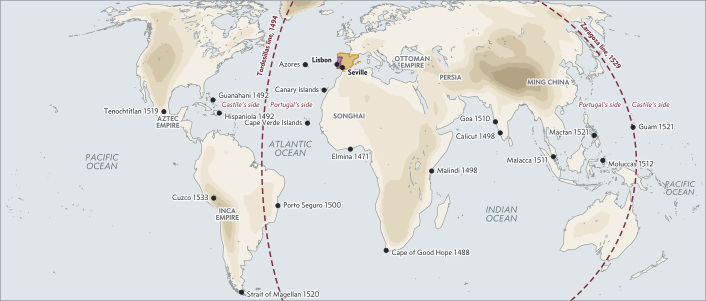
To keep the two crowns from war over the new lands, Castile and Portugal agreed at Tordesillas (tor-deh-see-yahs), a Castilian town, on June 7, 1494, to divide the world by a line from pole to pole, 370 leagues west of the Cape Verde Islands. A league was a sailor’s measure of roughly 3 or 4 miles. Lands found west of the line would be Castile’s, and lands east of it Portugal’s. The treaty gave the distance in leagues, not in degrees, and no one could then measure longitude at sea, so where the line ran was argued for decades. Wherever it was drawn, it gave Portugal the eastern bulge of Brazil. When Magellan’s (muh-jel-un) fleet, sailing west for Spain, reached the Spice Islands of the Moluccas (muh-luk-uz) in 1521, the two crowns quarreled over where the line ran on the far side of the globe. At Zaragoza (thah-rah-goh-thah) in 1529 the emperor Charles V sold Castile’s claim to the islands to Portugal for 350,000 ducats, and a second line was drawn 17 degrees of longitude east of them. A ducat was a gold coin first struck at Venice in 1284, and Spain and much of Italy counted large sums in ducats.
Figure S.3 marks the places the voyages reached and the year the first Europeans reached each one. The routes that joined them, from Dias to Magellan, are drawn in the chapter that tells the voyages (Chapter 6). The great American empires that Spain conquered next, the Aztecs of Mexico from 1519 and the Inca of Peru from 1532, are told from their own side in a later volume (Vol. 44, Gold, God, and Glory), and so are the islands where Magellan died (Vol. 42, Monsoon and Ocean).
Popes and kings
Two kinds of ruler appear in almost every chapter: the popes in Rome, and the kings of Spain and Portugal. Figure S.4 sets them side by side. Time runs down the page from 1415 to 1800. The left-hand lane gives the popes, each reign a block in the narrow band, with the seventeen whom the chapters meet printed in gold and bold. Next come Castile and Aragon, side by side until 1516 and then one line as Spain, and then Portugal. The dark strip beside each band names the ruling family. The events lane holds the chief events the chapters tell, and the gray bars on the right show the years each Part of this book covers. Each chapter teaches the rulers it uses; the timeline only holds them in place.

The pope was the bishop of Rome. Catholics hold that he is the successor of Saint Peter, the chief of Jesus’s apostles, and so the head of the whole Church on earth (Vol. 9, Cathedrals and Crusades). Christians call Jesus “Christ,” a title rather than a surname: it is the Greek for Messiah, “anointed one” (Vol. 5, In the Beginning). In these centuries he was also a prince, who ruled the Papal States with soldiers, judges, and tax collectors like any other. The cardinals were the senior clergy of the Church, named by the pope from Italy and every Catholic country, and when a pope died they chose his successor. They met in a conclave (kon-klayv), from the Latin for “with a key,” because they were locked in until they agreed. A man elected pope took a new name: Rodrigo Borgia (bor-juh) became Alexander VI, and Giuliano della Rovere (joo-lyah-noh del-uh roh-veh-reh) became Julius II.
A pope could not leave his throne to a son, and most were old men when they were elected, so they raised their families quickly. They made their nephews cardinals, gave them towns and lands, and married their nieces to princes. The Italian for nephew is nipote (nee-poh-tay), and favoring one’s relatives is still called nepotism. Callixtus III (kuh-lik-stus) made his nephew Rodrigo Borgia a cardinal, and Sixtus IV his nephew Giuliano della Rovere; both nephews later became popes. The families who climbed this way, among them the Medici of Florence, the Farnese (far-nay-zay), the Barberini (bar-beh-ree-nee), and the Chigi (kee-jee), built the palaces, chapels, and fountains that still fill Rome. Table S.1 lists the seventeen popes the chapters use, with the names they were born with.
| Pope | Reigned | Born as | Chs. |
|---|---|---|---|
| Callixtus III | 1455–1458 | Alfonso de Borja, of Valencia | 7 |
| Sixtus IV | 1471–1484 | Francesco della Rovere, of Liguria | 1, 4, 5, 10, 11 |
| Alexander VI | 1492–1503 | Rodrigo de Borja, Callixtus’s nephew | 5–8 |
| Julius II | 1503–1513 | Giuliano della Rovere, Sixtus’s nephew | 7, 8, 10–12 |
| Leo X | 1513–1521 | Giovanni de’ Medici, Lorenzo the Magnificent’s son | 1, 10, 11 |
| Clement VII | 1523–1534 | Giulio de’ Medici, Lorenzo’s nephew | 1, 10, 13, 14 |
| Paul III | 1534–1549 | Alessandro Farnese, of a noble family of Lazio | 13, 14 |
| Julius III | 1550–1555 | Giovanni Maria del Monte, of Rome | 14 |
| Marcellus II | 1555 | Marcello Cervini | 14 |
| Paul IV | 1555–1559 | Gian Pietro Carafa, of Naples | 14 |
| Pius IV | 1559–1565 | Giovanni Angelo Medici, of Milan, no kin to Florence’s | 14 |
| Pius V | 1566–1572 | Antonio Ghislieri, a Dominican friar | 15, 16 |
| Paul V | 1605–1621 | Camillo Borghese, of Rome | 22 |
| Urban VIII | 1623–1644 | Maffeo Barberini, of Florence | 22 |
| Innocent X | 1644–1655 | Giovanni Battista Pamphili, of Rome | 22, 23 |
| Alexander VII | 1655–1667 | Fabio Chigi, of Siena | 22 |
| Clement XIV | 1769–1774 | Giovanni Vincenzo Antonio Ganganelli, a Franciscan friar | 26 |
The queen of Castile and the king of Aragon in 1479 both belonged to the house of Trastámara (trahs-tah-mah-rah), a branch of the old royal family of Castile. Figure S.5 follows the crowns from parent to child. Ferdinand and Isabella, known from 1496 as the Catholic Monarchs, left their crowns to their daughter Juana (hwah-nah), who married Philip, the son of the emperor Maximilian. Their son Charles, born at Ghent in the Netherlands in 1500, inherited the lands of all four grandparents. Isabella left him Castile and its Americas; Ferdinand, Aragon and its Italian lands; Maximilian, Austria; and Maximilian’s wife, Mary of Burgundy, the Netherlands. In 1516 he became Charles I of Spain. In 1519 he was also elected emperor, as Charles V, and his family, the Habsburgs (haps-burgz), named after a castle in what is now Switzerland, held that title almost without a break until 1806 (Chapter 13). When he gave up his crowns in 1556, Spain, its Italian lands, the Netherlands, and the Americas went to his son Philip II, and the empire to his brother Ferdinand, who already ruled the Austrian lands. The Spanish Habsburgs ended in 1700 with Charles II, who died childless. His will left Spain to a French prince, Philip of Anjou, grandson of Louis XIV and a member of the Bourbon (boor-bun) family that had ruled France since 1589. Philip V had to win his throne in a European war, the War of the Spanish Succession (1701–1714), and his descendants have reigned in Spain for most of the years since. In 1724 he gave up the crown to his son Luis I (loo-ees) and took it back when Luis died seven months later. Two more of his sons reigned after him, Ferdinand VI and Charles III (Chapter 26). Ferdinand’s queen, Maria Barbara of Portugal, was the pupil of the harpsichordist Domenico Scarlatti (skar-lah-tee).

Portugal had three ruling houses in these years. The house of Aviz, founded by John I in 1385, gave the kings of the voyages. John II turned Columbus away (Chapter 6), Manuel I sent Vasco da Gama to India and a white elephant to Pope Leo X (Chapter 11), and Sebastian was lost with his army at Alcácer Quibir. The three Habsburg Philips ruled from 1580 to 1640. Then the Portuguese nobles rose, threw out the king’s governor in Lisbon, and crowned the duke of Braganza (bruh-gan-zuh) as John IV. His descendants, the house of Braganza, ruled Portugal for the rest of this volume. Among them were Peter II, who joined England’s side in that war by the Methuen (meth-yoo-in) Treaty of 1703, and Joseph I, who left the government of his kingdom to his minister, the marquis of Pombal (pom-bahl) (Chapter 26).
Words for painters and sculptors
The chapters on art use words that earlier volumes taught, and one, chiaroscuro (kee-ar-uh-skoor-oh), that none of them did. Here each is given in a line, so that the chapters can use them without stopping.
- Tempera: paint made by mixing powdered color with egg yolk, which dries in minutes and is laid on in fine strokes, often on a wooden panel (Vol. 1, The Toolkit).
- Oil paint: color bound in linseed oil, which dries slowly over days, so that the painter can blend one color into the next and lay thin, glowing glazes (Vol. 1, The Toolkit).
- Foreshortening: drawing a thing shortened as it points toward the viewer, as the painter Mantegna (man-tayn-yuh) painted the dead Christ feet first in his Lamentation (Vol. 1, The Toolkit).
- Contrapposto (kon-truh-pos-toh): the standing pose with the weight on one leg, so that the hips and shoulders tilt in opposite directions and the body looks relaxed and alive (Vol. 6, The Greeks).
- Chiaroscuro: Italian for “light-dark,” the modeling of figures by strong contrasts of light and shadow, so that they seem round and solid.
Italians name the centuries of their art by their hundreds, and the chapters do the same. The Quattrocento (kwah-troh-chen-toh), “four hundred,” is the 1400s, the Cinquecento (cheen-kweh-chen-toh) the 1500s, and the Seicento (say-chen-toh) the 1600s.
Other words wait for the chapters that teach them. Fresco, from the first volume, comes back with its two kinds, buon (bwon) and secco, in Chapter 2, and sotto in sù (soh-toh in soo), the ceiling seen from below, in Chapter 22. Two words are new: sfumato (sfoo-mah-toh), Leonardo’s soft haze, in Chapter 9, and tenebrism (ten-uh-briz-um), the darkest kind of chiaroscuro, in Chapter 20.
Words for musicians
The chapters on music use words from the first volume in the same way.
- Basso continuo (bah-soh kun-tin-yoo-oh), or continuo: a “continuous bass” played by a cello together with a keyboard instrument such as the harpsichord or the organ, whose player fills in the chords (Vol. 1, The Toolkit).
- Trio sonata: a piece in three lines, two high melodies, usually for a pair of violins, over a bass line played by the continuo (Vol. 1, The Toolkit).
- Ritornello (rit-or-nel-oh): Italian for “little return,” the passage for the whole orchestra that keeps coming back between the soloist’s passages in a concerto (Vol. 1, The Toolkit).
- Recitative (res-ih-tuh-teev) and aria: in opera, singing that imitates speech and carries the plot, and a song for one voice and orchestra that holds a single feeling (Vol. 1, The Toolkit).
The church sonata and the concerto grosso, which Corelli fixed in the forms later composers followed, are recalled and taught in his chapter (Chapter 24).
How to read the names
The names of this volume come from Italian, Spanish, Portuguese, and Latin, and English books spell many of them in English forms. A few rules help.
First names, places, and nicknames. Italian artists are mostly known by their first names, and the chapters do the same: Leonardo, Michelangelo, Raphael, and Titian (tish-un) are the names English uses for Leonardo da Vinci (dah vin-chee), Michelangelo Buonarroti (bwon-uh-roh-tee), Raffaello (rahf-fah-el-loh) Sanzio (sahn-tsee-oh), and Tiziano Vecellio (veh-chel-yoh). “Da Vinci” is not a surname but means “from Vinci,” a village near Florence. Many painters are known by their towns or homelands: Caravaggio (kar-uh-vah-joh) took his name from his family’s town near Bergamo, Perugino (pair-oo-jee-noh) was “the Perugian,” and El Greco, born Domenikos Theotokopoulos (thee-oh-toh-kop-oo-los) on Crete, was “the Greek.” Others are known by nicknames. Italian endings change a name’s size: -etto and -ello make it small, -one large, and -accio large or clumsy. So Tintoretto (tin-tuh-ret-oh) was the “little dyer,” after his father’s trade, Giorgione (jor-joh-nay) “big George,” and Masaccio (muh-zah-choh) “clumsy Tom.”
“Of” and “son of.” In Italian da and di mean “from” and “of,” and de’ is short for dei, “of the.” Cosimo de’ Medici was Cosimo “of the Medici,” and Lorenzo (loh-ren-tsoh) di Piero was “Lorenzo, son of Piero (pyair-oh).” The Medici reused a few first names for generations, so the chapters always say which Cosimo or Lorenzo they mean (Chapter 1, Chapter 13). A Spanish family could take an Italian name in Rome: Borgia is the Italian spelling of Borja (bor-hah), the family’s name in Valencia.
Spanish and Portuguese names. A Spaniard often carries two family names, his father’s and then his mother’s, sometimes joined by y, “and.” The painter Diego Rodríguez (roh-dree-gez) de Silva y Velázquez (vuh-las-kes) is known by his mother’s name. Don and Doña (dohn-yah) were titles of respect for a gentleman and a lady, as in Don Quixote (kee-hoh-tee). The same man may have a name in each language. The Portuguese Fernão (fer-nowng) de Magalhães (mah-gahl-yainsh) was Fernando de Magallanes in Spanish and is Ferdinand Magellan in English. The Genoese Cristoforo Colombo was Cristóbal Colón (krees-toh-bahl koh-lohn) in Spain and is Christopher Columbus in English. English books turn kings’ names into English, so Juan and João (zhoo-owng) both become John, Felipe becomes Philip, and Carlos Charles. The chapters keep Juana for Isabella’s daughter, Juana the Mad.
Numbers. A ruler’s number counts the rulers of the same name in the same realm, so one man can carry two. Charles I of Spain was the emperor Charles V, and Philip II of Spain was Philip I of Portugal. Ferdinand II of Aragon was Ferdinand V in Castile, where four earlier Ferdinands had reigned.
Letters. Table S.2 shows how to sound the letters that trip English readers. The chapters give a pronunciation the first time each hard name appears.
| Language | Letters and their sounds | Examples |
|---|---|---|
| Italian | c and g before e or i = ch and j; ch and gh = hard k and g; gn = ny; gli = ly; z = ts | Medici; Chigi; Castiglione (kah-steel-yoh-nay) |
| Spanish | j, and g before e or i = a throaty h; ll = y; ñ = ny; in Castile z and c before e or i = th; h is silent | Juana; Tordesillas; Zaragoza |
| Portuguese | ão and ões = nasal owng and oinsh; lh = ly; nh = ny; j = zh; a final s or z = sh | João; Camões (kuh-moinsh); Aviz |
| Catalan | x = sh | Xàtiva (shah-tee-vah), the Borgias’ town |
Old names of places. The chapters call places by their English names or by the names they had at the time, and Table S.3 gives their names today.
| In this volume | Today | In this volume | Today |
|---|---|---|---|
| Florence | Firenze, Italy | Ragusa | Dubrovnik, Croatia |
| Venice | Venezia, Italy | Zara | Zadar, Croatia |
| Genoa | Genova, Italy | Candia | Heraklion, Greece |
| Mantua | Mantova, Italy | Constantinople | Istanbul, Turkey |
| Padua | Padova, Italy | Alcácer Quibir | Ksar el-Kebir, Morocco |
| Naples | Napoli, Italy | Calicut | Kozhikode, India |
| Seville | Sevilla, Spain | Malacca | Melaka, Malaysia |
| Lisbon | Lisboa, Portugal | Cuzco | Cusco, Peru |
Who wrote it down
Much of what this volume tells comes from a few writers with reasons of their own. Several were artists writing about their teachers or their rivals, and several wrote decades after the events. So the chapters name the writer each time a story’s source matters (“Vasari says,” “Ferdinand Columbus tells”), and where versions disagree they say whose they follow. A story first written down long after the event, or never shown to have happened, is told as that writer’s story.
Fifteenth-century Florence and Rome
- Antonio Manetti (mah-net-ee) (1423–1497), a Florentine mathematician and architect, is usually credited with a Life of Brunelleschi written in the 1480s, though some scholars doubt that it is his. It preserves Brunelleschi’s demonstration of perspective with a mirror and the story of his dome (Chapter 1).
- Leon Battista Alberti (al-bair-tee) (1404–1472), a scholar and architect, wrote On Painting, in Latin in 1435 and in Italian in 1436, with a dedication to Brunelleschi. It sets out his rule for drawing in perspective, which later writers called the “legitimate construction” (Chapter 1).
- Bartolomeo Platina (plat-ih-nuh) (1421–1481), Sixtus IV’s librarian at the Vatican, wrote the Lives of the Popes (about 1475). It is the first source for the story that Callixtus III cursed a comet (Chapter 7).
- Johann Burchard (boor-kart) (about 1450–1506), from Alsace, was the papal master of ceremonies, who ran the rituals of the pope’s court. His Latin diary (1483–1506) is the only source for the Banquet of the Chestnuts, a scandalous supper in the papal palace in 1501 (Chapter 7).
- Baldassare Castiglione (kah-steel-yoh-nay) (1478–1529), a courtier of Urbino, wrote The Book of the Courtier (1528), which set the manners of the Italian courts. The chapters meet its world in the courtier Girolamo Muzio’s (jee-roh-lah-moh moo-tsee-oh) code of the duel (Chapter 8) and its author in Raphael’s portrait of him (Chapter 11).
The voyages
- Columbus’s own journal of his first voyage (1492–1493) is lost. It survives in an abridgment made decades later by Bartolomé de las Casas (bar-toh-loh-may deh lahs kah-sahs) (1484–1566), a Dominican friar. His Short Account of the Destruction of the Indies (1552) accused the Spanish conquerors of destroying the peoples of the Indies, as Spaniards called the Americas (Chapter 6, Chapter 13).
- Ferdinand Columbus (1488–1539), Columbus’s younger son, wrote a life of his father in the 1530s. It was printed only in an Italian translation in 1571, and it tells of the eclipse in Jamaica (Chapter 6).
- Girolamo Benzoni (ben-zoh-nee) (born about 1519), a Milanese traveler, published his History of the New World in 1565. It is the first to tell of Columbus and the egg (Chapter 6).
- Antonio Pigafetta (pee-gah-fet-uh) (about 1491 to after 1531) sailed with Magellan and came home with the survivors. His report (about 1524) is the main account of the voyage, beside the letter that Maximilianus Transylvanus (mak-sih-mil-ee-ah-nus tran-sil-vay-nus), a secretary of Charles V, wrote from the survivors’ own accounts in October 1522. That letter was printed at Cologne in 1523, the first account of the voyage in print (Chapter 6).
The lives of the artists
Most of what this volume tells about its artists was written by other artists, and most of it by one man, whose book was printed twice in his lifetime (Figure S.6).

- Giorgio Vasari (1511–1574), painter and architect to Duke Cosimo I of Florence, wrote the Lives of the Most Excellent Painters, Sculptors, and Architects (1550, enlarged in 1568). It is the source of most of the stories this volume tells about artists from Giotto to Michelangelo, and the chapters quote it from Chapter 1 on. Vasari himself is taught as a painter in Chapter 13.
- Ascanio Condivi (kon-dee-vee) (1525–1574), Michelangelo’s pupil, wrote a Life of Michelangelo (1553) with the master’s help, as an answer to Vasari’s first edition (Chapter 10).
- Benvenuto Cellini (cheh-lee-nee) (1500–1571), goldsmith and sculptor, dictated his autobiography from 1558; it was first printed in 1728. It tells his defense of the Castel Sant’Angelo (sahn-tahn-jeh-loh), the pope’s fortress in Rome, his later escape from its prison, and the casting of his bronze Perseus (pur-see-us) (Chapter 13).
- Giulio Mancini (jool-yoh mahn-chee-nee) (1559–1630), a papal physician, wrote Considerations on Painting (about 1620), which tells of El Greco’s offer to repaint Michelangelo’s Last Judgment (Chapter 16).
- Giovanni Baglione (bahl-yoh-nay) (1566–1643), a painter and Caravaggio’s rival, wrote Caravaggio’s life in The Lives of the Painters (1642), and Giovan Pietro Bellori (beh-lor-ee) (1613–1696) wrote the Lives (1672) that fixed Caravaggio’s reputation (Chapter 20).
- Filippo Baldinucci (bal-dee-noo-chee) (1625–1697) wrote the Life of Bernini (1682), the first full account of the sculptor (Chapter 22).
- Antonio Palomino (pal-oh-mee-noh) (1655–1726), painter to the Spanish court, wrote lives of the Spanish painters (1724), the main early source for Velázquez (Chapter 23).
- Bernardo De Dominici (deh doh-mee-nee-chee) (1683–1759) wrote lives of the artists of Naples (1742–1745), which tell of the “Cabal of Naples” (Chapter 23).
Galileo, and two stories of musicians
- Galileo Galilei (gal-ih-lay-oh gal-ih-lay-ee) (1564–1642) wrote his own books: The Starry Messenger (1610), The Assayer (1623), the Dialogue on the two chief systems of the world (1632), and Two New Sciences (1638). His last pupil, Vincenzo Viviani (vee-vyah-nee) (1622–1703), wrote a life of him in 1654 that tells of the experiment from the Leaning Tower of Pisa (Chapter 22), a story already told (Vol. 9, Cathedrals and Crusades).
- Giuseppe Baretti (joo-zep-peh bah-ret-ee) (1719–1789), an Italian writer living in London, published The Italian Library (1757), the first book to print the words “And yet it moves” as Galileo’s (Chapter 22).
- Leopold Mozart (1719–1787), a violinist and composer, wrote home from Rome on April 14, 1770, to tell how his fourteen-year-old son, Wolfgang, had written out Allegri’s Miserere (miz-uh-rair-ay) from memory (Chapter 14).
- Jérôme Lalande (zhay-rohm lah-lahnd) (1732–1807), a French astronomer, published his Voyage of a Frenchman in Italy in 1769, with the account of a famous dream that the violinist Giuseppe Tartini (tar-tee-nee) told him (Chapter 24).
Two later historians are quoted for their verdicts. The Swiss historian Jacob Burckhardt (burk-hart) wrote The Civilization of the Renaissance in Italy (1860), which made the age a subject of its own (Chapter 3). The American Alfred Crosby wrote The Columbian Exchange (1972), which gave a name to the trade in plants, animals, and diseases between the hemispheres (Chapter 6).
Meanwhile elsewhere
While Brunelleschi raised his dome, the Ming emperors of China were sending great fleets across the Indian Ocean, and while Charles III reigned in Madrid, thirteen British colonies across the Atlantic declared their independence. Table S.4 sets this volume’s years beside the rest of the world and names the volumes of the Course that teach them.
| Region | In these years | Taught in |
|---|---|---|
| Britain and Ireland | The Wars of the Roses (1455–1487); the Tudors, from Henry VIII’s break with Rome to Elizabeth I and the Armada (1588); the Stuarts, the Civil War, and the Glorious Revolution of 1688. | Vol. 12, Crown and Parliament |
| France and the Low Countries | Francis I, the Wars of Religion, and Louis XIV (reigned 1643–1715); the Dutch revolt against Spain, from 1568, and the Dutch Golden Age. | Vol. 13, Valois, Bourbon, and Orange |
| Germany, Austria, and the East | Gutenberg’s press (1450s); Luther’s protest (1517); the Thirty Years’ War (1618–1648); Peter the Great of Russia; Bach and Mozart. | Vol. 14, From Luther to Mozart |
| The Ottomans and Persia | Mehmed II takes Constantinople (1453); Suleiman the Magnificent (reigned 1520–1566); the Safavid shahs of Persia, from 1501. | Vol. 37, The House of Islam |
| India | The Mughal emperors, from Babur (1526) to Akbar and Shah Jahan, who built the Taj Mahal. | Vol. 39, India |
| China | The Ming dynasty and Zheng He’s fleets (1405–1433); the Qing from 1644. | Vol. 40, The Middle Kingdom |
| Japan and Korea | The age of warring lords; the Tokugawa shoguns from 1603; Japan’s invasions of Korea (1592–1598). | Vol. 41, Islands of the Rising Sun |
| Africa | The empire of Songhai, until 1591; the kingdom of Kongo; the Atlantic slave trade. | Vol. 43, Africa |
| North America | Jamestown (1607) and the English colonies; the American Revolution (1775–1783). | Vol. 27, New Worlds |
| Latin America | The Aztec and Inca empires and their conquest; the silver of Potosí; the Spanish viceroyalties and Portuguese Brazil. | Vol. 44, Gold, God, and Glory |
Florence, 1400-1498
Chapter 1 · 36 clues
The Medici City and the Dome
On March 25, 1436, the people of Florence began a new year. Florentines counted their years from the feast of the Annunciation, the day on which, the Gospel of Luke says, the angel Gabriel told Mary that she would bear a son. That morning Pope Eugene IV walked from the convent of Santa Maria Novella to the city’s cathedral along a raised wooden walkway hung with cloth and greenery, above the crowds that packed the streets below. Eugene had fled a revolt in Rome two years before, and Florence had taken him in. Now he had come to consecrate its cathedral, Santa Maria del Fiore (sahn-tah mah-ree-ah del fyoh-reh), “Saint Mary of the Flower.” Florentines call it the Duomo (dwoh-moh), the house of God (Vol. 9, Cathedrals and Crusades). At its east end, where eighteen years before there had been only an eight-sided hole open to the sky, stood a dome of brick roofed in red tile, all but closed. Among the pope’s singers was Guillaume Dufay (doo-fye), the finest composer of the age (Vol. 1, The Toolkit), and they sang a motet, a piece for several voices, that he had written for the day.
The man who built the dome was a goldsmith who had lost the first great competition of his life. The city that paid for it called itself a republic, governed by its guildsmen, yet its real master was a banker who held no office at all. His family would rule Florence for most of the next three centuries. Forty-two years after the consecration, two of its sons were attacked at Mass under that same dome.
The republic and the Medici bank
Florence stood on the Arno, about 50 miles from the sea, inside walls finished in 1333. In the 1420s it held about 40,000 people, fewer than before the Black Death but enough to make it one of the great cities of Europe. Its wealth came from woolen and silk cloth and from banking, and its gold coin, the florin, was trusted from London to Constantinople. It governed itself as a republic, a state with no king, whose citizens chose their own rulers. Power lay with its twenty-one guilds, the sworn associations of merchants and craftsmen (Vol. 9, Cathedrals and Crusades). Every two months nine guildsmen, the Signoria (seen-yoh-ree-ah), moved into the fortress-like Palazzo Vecchio (pah-laht-soh vek-yoh) on the main square to govern. They were drawn by lot from leather bags of approved names, and whoever decided which names went into the bags decided who governed Florence (Vol. 9, Cathedrals and Crusades).
Florence policed its citizens’ private lives as well as their streets. In 1432 it created an Office of the Night to police sodomy,Sodomy was policed by the Office of the Night in this city. → Florence•• the Church’s word above all for sex between men, which the Church taught was a grave sin and the city’s law made a crime. The office was a board of magistrates, the Officers of the Night. Anyone could drop an unsigned accusation into a box at a church or a public building, and the officers questioned the men it named. Between 1432 and 1502, when the office was abolished, more than 17,000 men were accused and about 3,000 convicted, by the count of the historian Michael Rocke, who read its records. Most of those found guilty paid a fine.

The whole city could be crossed on foot in half an hour (Figure 1.1). The cathedral and the Baptistery stood at its center, the Palazzo Vecchio a few streets to the south, and between them Orsanmichele (or-sahn-mee-kay-lay), the guilds’ church (Chapter 2). Many of the paintings that Florentines paid for in these years now hang in a building that did not yet exist. In 1560 Duke Cosimo I, a later Medici, had the painter and architect Giorgio Vasari begin a long range of government offices, in Italian uffizi, between the Palazzo Vecchio and the river (Chapter 13). The Uffizi (oo-feet-see) became Florence’s great gallery,This city is home to the Uffizi Gallery. → Florence•• one of the most visited in the world, and many of the pictures in this volume hang there.
The Medici came from the Mugello (moo-jel-loh), the valley north of the city, and in the 1300s they were one of many middling merchant families. Giovanni di Bicci (joh-vahn-nee dee bee-chee) de’ Medici (1360–1429) made them rich. He learned the trade in a distant cousin’s firm, ran its branch in Rome, and in 1397 founded his own bank in Florence. A Florentine bank was a partnership of merchants who took deposits, changed coins, lent money, and moved it across Europe with bills of exchange, the letters of payment that let a merchant pay in Florence and collect in Bruges (Vol. 9, Cathedrals and Crusades). The Medici made their fortune in banking,The Medici family made their fortune in this industry. → banks•• above all from one customer, the pope. Giovanni’s Rome branch became the papal depositary: it held the Church’s revenues, paid its bills, and lent against its income. In Giovanni’s day more than half of the bank’s profits came from Rome.
By the 1450s the bank had branches in Rome, Venice, Milan, Pisa, Geneva, Avignon, Bruges, and London, each a partnership run by a manager who owned a share. A firm spread so wide lived or died by its accounts. The Medici kept double-entry books,This banking family ruled Florence and used double-entry bookkeeping in its business. → Medici family•• as Italian merchants had for more than a century. Every sum was written twice, once as a debit in one account and once as a credit in another, so that the two sides of the ledger had to come out equal. Once a year the branch books came to Florence to be checked against the head office’s. A Franciscan friar, Luca Pacioli (pah-choh-lee), explained the method in print in 1494, and companies everywhere still keep their accounts this way.
The bank’s boldest venture came in the 1460s. Florence lived by cloth, and its dyers could not do without alum, a mineral salt that fixed dyes in wool so that the colors held fast. A substance that binds dye to cloth is called a mordant. Most of Europe’s alum came from mines in Turkish lands. In 1461 a papal official, Giovanni da Castro, found rich alum rock at Tolfa (tohl-fah), in the hills behind the port of Civitavecchia (chee-vee-tah-vek-kyah) in the Papal States (Figure 1.4). Pope Pius II called the find a gift of God, and the popes declared it sinful for Christians to buy Turkish alum, since the money helped the sultan. From 1466, as partners in the company that worked the mines, the Medici bank managed the pope’s alumThis family’s bank managed papal alum interests at Tolfa. → Medici family•• from Tolfa, shipping it as far as Bruges and London, though the trade never paid as well as everyone hoped.
Giovanni’s son Cosimo de’ Medici (1389–1464), later called Cosimo the Elder to tell him from a duke of the same name, took over the bank in the 1420s. His money and his many friends made enemies. The old ruling circle of the city was led by the Albizzi (ahl-beet-see), the Medici’s first great rivals,This family's early rivals included the Albizzis. → Medici family• a family of wool merchants. In 1433 their head, Rinaldo (ree-nahl-doh) degli Albizzi, had Cosimo arrested and exiled. A year later a new Signoria called him home, and the Albizzi went into exile instead, for good (Vol. 9, Cathedrals and Crusades).
Cosimo made sure it never happened again. He held office only a few times in thirty years and lived as a private citizen, yet the Medici ruled FlorenceThe Medici family ruled this city. → Florence••• from his return in 1434 until 1494, and with breaks from 1512 until the last of their grand dukes died in 1737 (Chapter 13). He governed through the bags. Friendly officials who filled them took care that the lot fell on Medici men, and special councils, packed with his friends, passed the laws he wanted. He lent money to allies and forgave debts to friends. Pope Pius II, who knew him, wrote in his memoirs that questions of war and peace were settled in Cosimo’s house, and that he was a king in all but name.

He took care not to look like one (Figure 1.2). Vasari tells how Cosimo asked Brunelleschi, the builder of the dome, for a design for a new family palace. Brunelleschi made a model so grand that Cosimo would not build it, “more in fear of envy, than because he was deterred by the expense,” in the 1850 translation of Mrs. Jonathan Foster; Brunelleschi, Vasari says, smashed the model to pieces. Cosimo gave the work instead to the sculptor and architect Michelozzo (mee-keh-lot-soh), whose Palazzo Medici, begun in 1444, looks from the street like a fortress of rough stone.
Inside, it was richer. In 1459 Cosimo’s son Piero had the painter Benozzo Gozzoli (beh-not-soh got-soh-lee) cover the walls of the palace chapel with The Procession of the Magi. The wise men of the Gospel of Matthew, three kings in Christian tradition, ride through a Tuscan landscape of castles, cypresses, and hunting parties toward Bethlehem, and the Medici ride with them, with their friends and guests in a crowd behind (Figure 1.3). Gozzoli put himself in the crowd too, with his name on his red cap.

Cosimo’s Florence fought its wars with hired captains, the condottieri (Vol. 9, Cathedrals and Crusades). Its great enemy was the duke of Milan, Filippo Maria Visconti (Vol. 9, Cathedrals and Crusades), and in 1440 his best general, Niccolò Piccinino (neek-koh-loh pee-chee-nee-noh), marched into Tuscany. On June 29, 1440, he met the army of Florence and its allies, with papal troops, at Anghiari (ahn-gyah-ree), a hill town above the upper valley of the Tiber. After a day of fighting around a bridge on the plain below, Florence won the Battle of Anghiari,This city won the Battle of Anghiari. → Florence• and Milan never threatened Tuscany so seriously again. Niccolò Machiavelli (mak-ee-uh-vel-ee), writing his History of Florence in the 1520s (Chapter 8), claimed that only one man died, and he by falling from his horse. Machiavelli told it to mock the mercenaries of his grandfathers’ day, who, he said, fought for prisoners rather than for victory. The British writer Frances Stonor Saunders reckons that as many as nine hundred may have died. Sixty years later the city hired Leonardo da Vinci to paint the battle on a wall of its council hall (Chapter 9). In 1450 Cosimo’s friend Francesco Sforza became duke of Milan (Vol. 9, Cathedrals and Crusades), and in 1454 the Peace of Lodi brought the five great states of Italy into a balance that held for forty years (the Stage).

Cosimo also collected books and the men who could read them. In 1439 the Church held a council in Florence to reunite the Catholic and Orthodox churches, and the Byzantine emperor, John VIII, came with hundreds of Greek churchmen and scholars (Vol. 9, Cathedrals and Crusades). One of them, an old philosopher who called himself Plethon (plee-thon), lectured on Plato, and Cosimo, by the later account of Marsilio Ficino (mar-see-lyoh fih-chee-noh), then conceived the idea of reviving Plato’s school in Florence. Ficino (1433–1499) was the son of Cosimo’s doctor. Cosimo had him taught Greek, and in 1462 he gave him manuscripts of Plato’s dialogues to translate into Latin, and soon after a house near the Medici villa at Careggi (kah-red-jee), in the hills north of the city. Ficino first put Plato aside to translate for him the Hermetica, books of philosophy and magic said to be the wisdom of an ancient Egyptian sage (Vol. 5, In the Beginning). Then he translated every dialogue, the first complete Plato in Latin, printed in 1484, and he coined the phrase “Platonic love” (Vol. 6, The Greeks).
Friends, pupils, and patrons gathered around Ficino to talk philosophy at dinners and in villa gardens, and the Medici patronized Ficino’s circle,This family patronized Marsilio Ficino’s circle traditionally called the Florentine Platonic Academy. → Medici family• which later writers called the Florentine Platonic Academy. Cosimo began it, and his son and grandson kept it going; Lorenzo, the grandson, was Ficino’s pupil. The American historian James Hankins has argued that it was never a school, with members and meetings, but a loose circle of friends that tradition dignified with the name of Plato’s Academy.
Cosimo died at Careggi on August 1, 1464, aged seventy-four, and asked to be buried without pomp. The city gave him the honor the Roman Senate had given the orator Cicero after he crushed a conspiracy against the republic (Vol. 7, The Romans). By a public decree Florence honored Cosimo as “Pater Patriae”Cosimo of this family was posthumously honored as “Pater Patriae.” → Medici family• (pah-ter pah-tree-eye), Latin for “Father of His Country,” and the words were carved on his tomb before the high altar of the church of San Lorenzo.
Lorenzo the Magnificent
Cosimo’s elder son, Piero (1416–1469), inherited the bank and the city at forty-eight. He suffered from gout, a disease in which crystals form in the joints and swell them so painfully that a man may not bear a sheet on his foot. Florentines called him Piero “the Gouty”,Piero of this Florentine banking family was known as “the Gouty.” → Medici family•• il Gottoso, and he often governed from his bed in the palace. He made enemies at once by calling in old loans that his father had let stand, many of them owed by Medici friends, and some of the borrowers were ruined. In August 1466 a group of his father’s old allies, led by the rich banker Luca Pitti, planned to seize him on the road from Careggi. His seventeen-year-old son, riding ahead, ran into their armed men and sent a warning, and Piero came home by another road. The other leaders were exiled, though Pitti made his peace with Piero and was pardoned, and Piero ruled quietly until he died in December 1469.
That son was Lorenzo de’ Medici, born on January 1, 1449. He was twenty when his father died, and two days later the leading men of the city came to his house and asked him to take his father’s place. He was not handsome. He had a flattened nose, a jutting jaw, and a harsh voice, while his younger brother, Giuliano, born in 1453, was the good-looking one. But Lorenzo was clever and charming, and he had been well taught: Ficino had been his tutor, and his mother, Lucrezia Tornabuoni (loo-kret-see-ah tor-nah-bwoh-nee), wrote religious poems. He wrote love songs and carnival songs in the Tuscan of the streets. In 1469 he married Clarice Orsini, the daughter of a great Roman noble family, a sign of how high the bankers had risen.

Italians called a great man Magnifico, “magnificent,” as a courtesy, and for Lorenzo the word stuck as a name (Figure 1.5). He built less than his grandfather and spent more on books, ancient gems, and vases. His greatest gift was for finding artists and finding them work. Lorenzo the Magnificent patronized Sandro BotticelliThis Florentine ruler known as “the Magnificent” patronized Michelangelo and Sandro Botticelli. → Lorenzo de’ Medici•• (bot-ih-chel-ee), who painted for the family and its friends (Chapter 4), and the young Michelangelo. In a garden near San Marco, where Lorenzo kept ancient statues, the old sculptor Bertoldo (ber-tol-doh) di Giovanni, a pupil of the great sculptor Donatello (Chapter 2), looked after the marbles and taught young artists. There, about 1489, Vasari says, Lorenzo noticed a fourteen-year-old named Michelangelo Buonarroti and took him into his household, where the boy ate at the family’s table (Chapter 10).
Four generations of Medici had now run the family’s bank: Giovanni di Bicci, Cosimo, Piero, and Lorenzo. Each of the last three had been raised for the work by his father, and each took over the bank and the city’s friendships together (Figure 1.6). Cosimo and Lorenzo the Magnificent,This family's members included Cosimo and Lorenzo the Magnificent. → Medici family•• grandfather and grandson, were the family’s greatest men, and their names were used again and again by the generations after them, which is the chief trap in Medici history.

Lorenzo meant his family to outlast the bank, and his own household gave the Church two Medici popes, Leo X and Clement VII.Popes Leo X and Clement VII belonged to this Florentine family. → Medici family•• He had three sons. Piero, born in 1472, would lose Florence in 1494 (Chapter 4). Giovanni, born in 1475, was meant for the Church, and his father won him a cardinal’s red hat at thirteen; in 1513 he was elected pope as Leo X (Chapter 11). The third, born in 1479, bore his uncle’s name, Giuliano. Lorenzo also raised his murdered brother’s son, Giulio, born in 1478, and in 1523 Giulio became pope as Clement VII (Chapter 13).
The family gave France two queens as well, Catherine and Marie de’ Medici.Two women from this family named Catherine and Marie married Kings of France. → Medici family• Catherine, Lorenzo’s great-granddaughter, married the son of King Francis I in 1533 and became queen when he succeeded as Henry II in 1547. Marie, of the younger branch that later ruled Florence as dukes, married King Henry IV in 1600 (Vol. 13, Valois, Bourbon, and Orange). The bankers’ house had married into one of the oldest crowns in Europe.
The Pazzi conspiracy
The most dangerous enemy the Medici ever had was a pope. Francesco della Rovere, a Franciscan friar from Liguria and a learned theologian, was elected in 1471 as Sixtus IV. He built the chapel in the Vatican that bears his name, the Sistine Chapel (Chapter 4), and he made his nephews rich. For one of them, Girolamo Riario (ree-ah-ree-oh), he set out in 1473 to buy Imola (ee-moh-lah), a town on the road from Florence to the Adriatic. Lorenzo, who wanted Imola for Florence, refused to lend the money. The Pazzi (paht-see), an old Florentine family of bankers and rivals of the Medici, lent it instead, and Sixtus took the papal accounts from the Medici and gave them to the Pazzi. He also named Francesco Salviati (sahl-vyah-tee), a friend of the Pazzi, archbishop of Pisa, a city Florence ruled, and Lorenzo kept him from taking up his post.
Out of these grudges came a plot, remembered as the Pazzi conspiracy. Francesco de’ Pazzi, who ran his family’s bank in Rome, Girolamo Riario, and Archbishop Salviati planned to kill Lorenzo and Giuliano together, seize the Palazzo Vecchio, and call the people to rise, while soldiers waited near the border. They won over Francesco’s uncle Jacopo (yah-koh-poh), the head of the Pazzi, and hired a soldier, Giovan Battista da Montesecco (mon-teh-sek-koh), to do the killing. Montesecco’s confession, written after his capture, is the chief witness to what the pope knew. Sixtus told the plotters, Montesecco said, that he wanted the government of Florence changed but wanted no one killed, and that they might do whatever was needed short of bloodshed. Sixtus IV supported the overthrow of the Medici,Pope Sixtus IV supported the overthrow of the Medici sought by this conspiracy, though his approval of murder is disputed. → the Pazzi conspiracy••• and by Montesecco’s account he had been warned that it might not be done without deaths, but how far he approved the killing is still disputed.
On Sunday, April 26, 1478, the Medici brothers came to High Mass in the cathedral with their guest, the pope’s sixteen-year-old great-nephew, Cardinal Raffaele (rahf-fah-el-leh) Riario. Montesecco had refused to kill in a church, so two priests took his place beside Lorenzo. At a signal during the Mass the plotters struck at both Medici brothers, and there, in the Duomo of Florence, Giuliano was killed and Lorenzo wounded.The Pazzi conspiracy occurred in this city. → Florence•••Members of this family were targeted in the Pazzi Conspiracy. → Medici family•••Giuliano de’ Medici was killed and Lorenzo wounded during Mass in Florence’s Duomo in this conspiracy. → the Pazzi conspiracy••• Bernardo Bandini (bahn-dee-nee), a Florentine merchant in the plot, and Francesco de’ Pazzi stabbed Giuliano again and again, so wildly that Francesco wounded his own leg. The priests went for Lorenzo, and a dagger cut his neck before he could draw his sword. He vaulted the wooden rail of the choir, the enclosure where the clergy sat. His friends hurried him into the north sacristy, the room where the priests’ robes and vessels were kept, and the poet Angelo Poliziano (poh-leet-syah-noh), his sons’ tutor, slammed the bronze doors shut. Poliziano wrote an account of the day within months, and most of these details come from it.
The rising never came. At the Palazzo Vecchio Archbishop Salviati asked to see the head of the Signoria, who grew suspicious and shut the plotters in. Old Jacopo de’ Pazzi rode into the square with armed men, crying “Popolo e libertà!” (“The people and liberty!”). The crowd answered with the Medici cry of “Palle, palle!” The palle, “balls,” were the red balls on the family’s coat of arms. Within hours Salviati and Francesco de’ Pazzi were hanged from the palace windows. By October about eighty people had been put to death. Bandini escaped to Constantinople, but the Ottoman sultan, Mehmed II, who had taken the city in 1453 (Vol. 9, Cathedrals and Crusades), sent him back in chains, and he was hanged at the end of 1479. The Pazzi name and the dolphins of their coat of arms were struck from every building in the city.


Lorenzo’s friends turned the escape into a sign of God’s favor. A bronze medal, almost certainly by Bertoldo, showed both brothers above the scene of the attack (Figure 1.7). Vasari says that the wax-modeler Orsino Benintendi, helped by the sculptor Andrea del Verrocchio (veh-rok-ee-oh), made three life-size figures of Lorenzo for churches in thanks for his life. One wore the clothes he had worn when, “wounded in the throat and with that part bound up,” he showed himself at his palace window to the crowd.
Sixtus answered the hanging of an archbishop with the Church’s heaviest weapons. On June 1, 1478, he excommunicated Lorenzo and the city’s government, shutting them out from the sacraments, and later that month Sixtus IV placed Florence under interdict.Pope Sixtus IV placed Florence under interdict after this failed conspiracy. → the Pazzi conspiracy• An interdict forbade the clergy of a place to say Mass or give the sacraments, except baptism and the last rites (Vol. 9, Cathedrals and Crusades). Florence’s own churchmen declared the sentence unjust, and in many churches Mass went on. Then the pope and his ally, King Ferrante of Naples, made war on Florence. In December 1479 Lorenzo sailed to Naples and put himself in the king’s hands, and after three months of talk he came home with a peace. In the summer of 1480 a Turkish army landed at Otranto, in the heel of Italy, and Sixtus too made peace. Florentine envoys knelt in Rome for his pardon, and he lifted the interdict that winter.
The plot that was meant to end Medici rule made it stronger. In 1480 Lorenzo set up a new Council of Seventy, filled with his own men, and he ruled through it for twelve more years. He died at Careggi on April 8, 1492, at forty-three.
Brunelleschi
The dome over the murder was the work of Filippo Brunelleschi (1377–1446). He was the son of a Florentine notary, a lawyer who drew up contracts, and he was given the schooling for his father’s trade, but he wanted to make things. He trained as a goldsmith and in 1398 joined the silk guild, which took in goldsmiths. Most of what we know about him comes from two writers. Antonio Manetti (1423–1497), a mathematician and architect who knew him in his last years, is usually credited with the life of him written in the 1480s. Vasari’s Lives of the artists (1550) borrowed from Manetti and added stories of its own.
His first great chance came at the Baptistery of San Giovanni, the eight-sided church in front of the cathedral where every Florentine was baptized. Its walls are banded in white and dark green marble, and Florentines believed it a Roman temple, though it was built in the eleventh and twelfth centuries. The guild of cloth merchants, the Calimala (kah-lee-mah-lah), looked after it. In 1336 the guild had given it bronze doors by Andrea Pisano, a sculptor from Pisa, and in 1401 it decided on a second pair. Seven sculptors each made a trial panel in bronze, in a four-lobed frame, of the same scene, the Sacrifice of Isaac. In Genesis, Abraham raises his knife over his son at God’s command, and an angel stops him (Vol. 5, In the Beginning).
Two of the panels survive, in the Bargello (bar-jel-oh) museum in Florence. Brunelleschi’s is all violence: the angel seizes Abraham’s wrist as the knife touches the boy’s throat. The other is smoother and more graceful, and its maker was Lorenzo Ghiberti (gee-bair-tee) (1378–1455), a goldsmith of twenty-three. Ghiberti won. He wrote in his memoir, the Commentaries, that every judge voted for him. Manetti, Brunelleschi’s admirer, says that the judges offered to share the work between the two and that Brunelleschi refused. Either way, in 1401 Brunelleschi lost the Baptistery competition to Ghiberti,This artist lost the Florence Baptistery door competition to Lorenzo Ghiberti. → Filippo Brunelleschi•• and he gave up sculpture for architecture.
He went to Rome, Manetti says, with his young friend the sculptor Donatello (Chapter 2), to measure the ruins of the ancient city. Vasari adds that the two dug so eagerly for buried cornices and column bases that the Romans called them “treasure-seekers.” The dates of the journey are uncertain, and some historians doubt that it was made so early. But Brunelleschi came back knowing how the Romans had built, and his buildings show it.
His first building was a home for abandoned babies. In 1419 the silk guild hired him to design a hospital for foundlings, children left by parents who could not or would not raise them. It was named the Hospital of the Innocents, the Ospedale degli Innocenti (oh-speh-dah-leh del-yee een-noh-chen-tee), after the baby boys whom, the Gospel of Matthew says, King Herod had killed at Bethlehem. Its front is a loggia, an arcade open to the street: nine round arches on slender columns of gray sandstone, pietra serena, set against white plaster (Figure 1.8). Each column is as tall as the gap between columns is wide, so that every bay of the loggia is a cube. The proportions are as clear as a lesson in geometry, and builders all over Italy copied them. The hospital opened in January 1445, and its first baby was left there on February 5.


About 1490 the hospital filled the empty roundels above the columns. Andrea della Robbia (del-lah rohb-byah) came from a family workshop founded by his uncle Luca, which made sculpture of glazed terracotta, baked clay coated with a shining glaze, usually white figures on a blue ground. Andrea set infant tondi on Brunelleschi’s Hospital of the Innocents:This architect designed the Hospital of the Innocents, later decorated with Andrea della Robbia’s infant tondi. → Filippo Brunelleschi•• in each round relief, or tondo (plural tondi), a baby in swaddling bands holds out its arms (Figure 1.9). One of them is now the badge of the American Academy of Pediatrics.
Florence Cathedral and the Baptistery doors
The cathedral had been rising for more than a century. It was begun in 1296 to the plan of the architect and sculptor Arnolfo di Cambio, and from 1331 the wool guild ran the works through its building office, the Opera del Duomo. In 1367 the guild chose a model by the architect Neri di Fioravanti for the east end. It showed an eight-sided dome on a high drum, the ring of wall that lifts a dome above the roofs around it (Vol. 1, The Toolkit). The dome was to be wider than any raised since the Romans, and to have no flying buttresses, the arched props that hold up French cathedrals from outside (Vol. 1, The Toolkit). Florentines thought them ugly and foreign. By 1418 the walls and the drum stood finished, and an octagonal hole about 140 feet across gaped 171 feet above the floor. Nobody knew how to close it. Every great dome had been built over centering, a timber frame that holds the masonry until it can stand by itself (Vol. 1, The Toolkit), and all the forests of Tuscany could not have supplied one so big.
Meanwhile the builders had been finishing the outside. On the cathedral’s north side the Porta della MandorlaThis building's north door is known as the Porta della Mandorla. → Florence Cathedral• (por-tah del-lah mahn-dor-lah), the “door of the almond,” takes its name from the relief carved above it between 1414 and 1421 by the sculptor Nanni di Banco. It shows the Virgin Mary rising to heaven inside a mandorla, an almond-shaped frame of light, and dropping her belt to Saint Thomas, who kneels below to catch it.
On August 19, 1418, the wool guild offered a prize of 200 florins for a model of the dome. Brunelleschi built one of brick, with help from Donatello and Nanni di Banco, and promised to raise the dome without centering. Vasari tells how he won. The other masters wanted to see his model, and he would not show it. Instead he proposed, in Foster’s translation, “that he who could make an egg stand upright on a piece of smooth marble, should be appointed to build the cupola” (cupola is Italian for a dome). None of them could. Brunelleschi tapped one end on the marble, cracking it, and the egg stood. The others protested that they could have done that, and he answered, laughing, that they could build the dome too if they had seen his model. Vasari wrote the story more than a century later, and Manetti, who knew Brunelleschi, does not tell it. The same egg turns up in 1565 in a story about Christopher Columbus (Chapter 6).
In 1420 the guild named Brunelleschi and Ghiberti joint masters of the dome, at equal pay. Manetti says that Brunelleschi took to his bed with a pretended illness until the work, left to Ghiberti, came to a stop, and the guild learned which of the two knew how to build it. Ghiberti stayed on the payroll for years, but the dome was Brunelleschi’s.

Between 1420 and 1436 Brunelleschi raised the cathedral’s octagonal, double-shelled dome,This city's cathedral was given a dome by Filippo Brunelleschi. → Florence•This architect designed the dome of Florence Cathedral. → Filippo Brunelleschi••Brunelleschi designed this cathedral’s octagonal, double-shelled dome, built without flying buttresses. → Florence Cathedral••• and as the model of 1367 required, he built it without flying buttresses (Figure 1.10). It is really two domes, one inside the other (Figure 1.11). The thick inner shell carries the weight. The outer shell, 2 feet thick at its foot, keeps off the rain and makes the dome look higher from the city, and stairs climb between the two. Eight ribs rise from the corners of the octagon, faced in white marble outside, with sixteen more hidden between the shells. Rings of sandstone beams, built into the inner shell like the hoops around a barrel, stop it from spreading. The dome is about as wide as the Pantheon in Rome, the widest dome of antiquity (Vol. 1, The Toolkit), and it is still the largest dome of brick ever built.

How could anyone lay bricks on a curve with nothing under them? A complete ring of bricks holds itself up, pressing inward on itself like a horizontal arch. But while the mortar is wet, a brick on a slope wants to slide. Brunelleschi laid most of each course flat and set single bricks on end at intervals, in lines that climb across the courses in slow spirals. Each upright brick held the next stretch of flat bricks in place, like a bookend, until the ring closed. With herringbone brickwork and no full centeringThe dome of this cathedral uses herringbone brickwork and was built without full wooden centering. → Florence Cathedral•• the dome rose on light platforms hung from the masonry already built. The pattern is named for its look of fish bones, and Brunelleschi may have seen it in Roman walls. More than four million bricks went up, lifted by a hoist of his own design, turned by oxen, that could raise or lower a load without turning the animals around. Vasari says he even had food and wine sold up on the dome, so that the masons need not climb down for their meals.
The marble for the ribs and the facings came by sea to Pisa and then up the Arno by barge, and Brunelleschi meant to carry it more cheaply. On June 19, 1421, the city granted him one of the first patents for an invention, a grant of the sole right to use it: for three years no one else could carry goods on the Arno in a boat of a new design. In 1427 he built his boat, which Florentines nicknamed the Badalone (bah-dah-loh-neh), “the monster.” On its first voyage it set out up the river from Pisa with a great load of marble, and the Badalone failed to deliver its cargo:This architect built the Badalone to carry marble up the Arno, but it failed to deliver its cargo to Florence. → Filippo Brunelleschi• the boat sank short of the city, and the marble never reached Florence. The venture cost Brunelleschi a large part of his savings.
The pope consecrated the cathedral on March 25, 1436, and that summer the last ring at the top was closed. The dome still needed a crown: a lantern, a small windowed tower that lets light into the top of a dome and weighs down its ring (Vol. 1, The Toolkit). Brunelleschi won one more competition, in 1436, against Ghiberti among others, with a model of an eight-sided marble lantern braced by stone scrolls. Work began early in 1446, and on April 15 of that year Brunelleschi died. His lantern was completed after his death,Brunelleschi designed the lantern of this cathedral’s dome, which was completed after his death. → Florence Cathedral• by his friend Michelozzo, in 1461. In 1471 the workshop of Andrea del Verrocchio hoisted a gilded copper ball and cross to its top, and one of the apprentices was the young Leonardo da Vinci (Chapter 9). Brunelleschi was buried inside the cathedral, with a marble portrait and a Latin epitaph that praises the dome.

Across the square, Ghiberti spent half a century on doors. His first pair, for the Baptistery, took from 1403 to 1424: twenty-eight panels in four-lobed frames, twenty of them from the life of Jesus and the other eight showing the four evangelists, who wrote the Gospels, and four great teachers of the early Church. They were cast in bronze, the alloy of copper and tin (Vol. 1, The Toolkit), and their figures were gilded. In 1425 the Calimala gave him the second pair, with stories from the Old Testament. Ghiberti dropped the four-lobed frames and made ten large square panels, each telling several episodes in one scene, and he gilded every surface. The doors were finished in 1452 and hung in the east doorway, facing the cathedral, in place of his first pair, which moved to the north side. Ghiberti’s gilded bronze Gates of ParadiseLorenzo Ghiberti decorated this cathedral's Baptistery's gates. → Florence Cathedral•The Gates of Paradise are located in this city. → Florence•This material was used to cast the doors of the Florence Baptistery. → bronze• took their name, Vasari says, from Michelangelo. Asked whether they were beautiful, he answered, in Foster’s translation: “They are so beautiful, that they might fittingly stand at the gates of Paradise.”

The panel of Jacob and Esau shows what Ghiberti had learned (Figure 1.13). In Genesis, old and blind Isaac sends his elder son, Esau, to hunt game for a last meal and his blessing. Their mother, Rebekah, dresses the younger son, Jacob, in his brother’s clothes and covers his smooth arms and neck with goatskin, and Isaac blesses the wrong son (Vol. 5, In the Beginning). Ghiberti sets the whole story in one hall of round arches, its floor tiles running back toward a single point. Among the small heads in the doors’ frame is his own, bald and shrewd. The Arno’s flood of 1966 tore panels from the doors. Copies have hung in the doorway since 1990, and the cleaned originals stand in the cathedral’s museum.
Perspective
Brunelleschi’s other great invention was a rule for drawing. Some time between 1415 and 1420, Manetti tells, he stood just inside the cathedral’s central door and painted the Baptistery on a small panel exactly as he saw it. He drilled a hole through the panel at the point straight in front of his eye and had visitors look through it from behind at a mirror held at arm’s length. When the mirror was lowered, they saw the real Baptistery, and the two matched (Vol. 1, The Toolkit). With a mirror and a painted panel of the Baptistery,This artist used a mirror in early demonstrations of mathematically constructed linear perspective. → Filippo Brunelleschi••Brunelleschi demonstrated the linear form of this technique with a mirror and a painted panel of Florence’s Baptistery. → perspective•• Brunelleschi demonstrated linear perspective, the geometry by which lines that run straight away from the viewer, the orthogonals, all meet at a single vanishing point (Vol. 1, The Toolkit).
He wrote nothing down. The man who did was Leon Battista Alberti (1404–1472), the son of an exiled Florentine merchant. He was born in Genoa, studied law at Bologna, and came to Florence with the papal court in 1434. He was a scholar, a writer of dialogues and comedies, and later an architect. The dome amazed him. He wrote his book first in Latin in 1435, as On Painting, and in Italian in 1436, with a dedication to Brunelleschi. A picture, Alberti says, should be like an open window through which the scene is seen from one fixed eye. He then teaches perspective by showing how to draw a tiled floor in that window, in a method later called “legitimate construction”,Leon Battista Alberti explained this technique in On Painting using a method later called “legitimate construction.” → perspective• costruzione legittima.
Alberti works in the Florentine braccio (braht-choh), the “arm,” a measure of about 2 feet; its plural is braccia. First he draws the window and divides its base into braccia. He sets the centric point, his name for the vanishing point, at the height of a man standing in the picture, about 3 braccia, and draws lines from every division on the base to it. Second, in a separate small drawing, he looks at the scene from the side. He marks an eye 3 braccia high, the window seen edge-on at some distance in front of it, and the floor beyond, marked off in braccia. Lines from the eye to each mark cross the edge of the window, and those crossings give the heights at which to draw the cross lines of the floor. Third, he draws those cross lines in the window. Fourth, he checks his work: a straight line laid across the corners of the tiles must pass through every corner (Figure 1.12).
Alberti’s book taught a rule that every painter in this volume uses, and for four and a half centuries it seemed simply the right way to draw. In 1927 the German art historian Erwin Panofsky (puh-nof-skee) (1892–1968), who later taught at Princeton, questioned that. Panofsky’s essay “Perspective as Symbolic Form”Erwin Panofsky wrote an essay about this technique “as symbolic form.” → perspective• pointed out that we see with two moving eyes, not one fixed eye, and that the image inside the eye is curved, not flat. Perspective, he argued, was not how we really see but a convention: a way that one age chose to picture space, as the Greeks and the medieval painters had chosen others. He took the phrase “symbolic form” from the philosopher Ernst Cassirer, his colleague at Hamburg, who used it for the systems of signs, such as language and myth, through which people order their world.
What to remember
- Florence was a republic of guilds whose Signoria was drawn by lot; the Office of the Night (1432–1502) policed sodomy. The Uffizi, begun by Vasari in 1560, now holds much of its art.
- The Medici made their fortune in banking, as the pope’s bankers; they kept double-entry books and from the 1460s managed the papal alum mines at Tolfa.
- Cosimo the Elder beat his rivals the Albizzi in 1434 and ruled without office. Florence won at Anghiari in 1440. He patronized Ficino’s circle, the Platonic Academy, and was honored after his death in 1464 as Pater Patriae.
- Piero the Gouty ruled from 1464 to 1469; Lorenzo the Magnificent from 1469 to 1492, patron of Botticelli and the young Michelangelo. The family gave the Church Leo X and Clement VII and France two queens, Catherine and Marie.
- On April 26, 1478, the Pazzi conspirators, backed by Sixtus IV, killed Giuliano and wounded Lorenzo at Mass in the cathedral. The plot failed, and Sixtus laid Florence under interdict.
- Brunelleschi lost the Baptistery competition of 1401 to Ghiberti, designed the Hospital of the Innocents (1419), later decorated with Andrea della Robbia’s infant tondi, and raised the cathedral’s octagonal, double-shelled dome (1420–1436) in herringbone brick, without full centering or flying buttresses. His lantern was finished after his death; his boat, the Badalone, failed.
- Ghiberti’s gilded bronze doors for the Baptistery include the east doors, the Gates of Paradise (1425–1452). The cathedral’s north door is the Porta della Mandorla.
- Brunelleschi demonstrated linear perspective with a mirror and a painted panel; Alberti’s On Painting (1435) set out the method later called “legitimate construction”; Panofsky called perspective a “symbolic form” (1927).
Chapter 2 · 44 clues
Donatello and Masaccio
One morning in Florence a young sculptor walked through the Old Market holding up the front of his apron like a basket. In it were eggs, cheese, and other food for a meal at the house of his friend Filippo Brunelleschi, the goldsmith who would one day raise the cathedral’s dome (Chapter 1). The sculptor’s name was Donato, but everyone called him Donatello, “little Donato.” Some time before, he had carved a crucifix in wood and asked Filippo what he thought of it. Filippo had smiled and said that Donatello had put a peasant on the cross. It was easier to judge than to make, Donatello had snapped back: “take wood, and try to make one thyself.”
Filippo had said nothing and gone home to carve. Now Donatello, sent on ahead with the food, walked into the house and found Filippo’s crucifix standing in a good light. He stared at it and let go of his apron, and the eggs and the cheese smashed together on the floor. When Filippo came in laughing and asked what they would eat now, Donatello said he had had his dinner for the day. “To thee it has been given to represent the Christ; to me, boors only.” A boor was a peasant.
The story comes from Giorgio Vasari’s Lives of the artists (the Stage), printed in 1550, more than a century after the morning it describes; it is quoted here, like all of Vasari in this chapter, in Mrs. Jonathan Foster’s English translation of 1850. No one can check it. But it catches what made Donatello new. His Christ was a working man in pain, and his saints and prophets looked like men from the market: heavy, wrinkled, and alive. For sixty years he carved and cast them in marble, bronze, and wood, while a younger friend, the painter Masaccio, did the same in paint in a career of only six years. Between them they turned Brunelleschi’s ideas about space and weight into the sculpture and painting of the Renaissance.
Donatello’s marbles
Donato di Niccolò di Betto Bardi was born in Florence about 1386, the son of a wool-stretcher, a skilled worker in the cloth trade that made the city rich (Vol. 9, Cathedrals and Crusades). The first record of him, from January 1401, is a court case in the nearby town of Pistoia: at about fifteen he had hit a German with a stick and drawn blood. That year Florence held its competition for new bronze doors for the Baptistery, which Lorenzo Ghiberti won over Brunelleschi (Chapter 1). Donatello was too young to enter, but from 1404 to 1407 he worked in Ghiberti’s shop on those very doors, learning to model wax and to finish bronze. After the competition, Antonio Manetti says, Brunelleschi took his young friend to Rome to measure and dig among the ruins (Chapter 1), and Donatello came home with a lifelong love of ancient sculpture.
Donatello never married, worked fast, and cared little for money. Vasari says he kept his cash “in a basket, suspended by a cord to the roof” of his workshop, and that his assistants and friends took what they needed without asking. His patrons were Florence’s public bodies: the board of works that was building the cathedral, the guilds, and the government itself. Later his chief patron was Cosimo de’ Medici, the banker who ran the city (Chapter 1).

In 1408 the cathedral’s board of works ordered from him a marble David to stand high on one of the buttresses, the stone piers that brace the walls, on the north side of the cathedral. David is the shepherd boy of the Hebrew Bible who killed the Philistine giant Goliath with a stone from his sling and then cut off the giant’s head with Goliath’s own sword (Vol. 5, In the Beginning). Donatello made him a slim youth with the gentle sway of the older Gothic statues, in a long tunic, with a cloak knotted at his throat and a wreath of amaranth leaves in his hair. The Greeks had linked the amaranth, a flower that keeps its color when dried, with undying fame. David’s left hand rests on his hip, and Goliath’s bearded head lies at his feet.
The statue is about 6 ½ feet tall. Seen from the street some 90 feet below, a figure that size would have looked like a doll, and it seems to have stayed in the workshop. In 1416 the government asked for it and set it up in the city hall, the Palazzo della Signoria, with a Latin motto that reads, in English, “To those who fight bravely for the fatherland the gods lend aid even against the most terrible foes.” Florence was a small republic that had lately survived the dukes of Milan (Vol. 9, Cathedrals and Crusades), and the boy who beat the giant was a picture of itself. This clothed marble David came decades beforeThis artist made a marble David decades before his better-known bronze version. → Donatello•• the bronze David that Donatello later made for the Medici, much the more famous of the two.
Halfway between the cathedral and the city hall stood Orsanmichele, the old grain market that had become the church of the guilds (Vol. 9, Cathedrals and Crusades). Around its outside walls were fourteen niches, tall hollows in a wall shaped to hold a statue, and each of the city’s great guilds was to fill one with its patron saint. The niches were low, far lower than the cathedral’s, so passersby saw the statues from close by, looking a little upward. The guilds competed with one another, and Donatello made three of the statues.

The first was a marble Saint Mark for the nicheThis artist's sculpture of St. Mark was placed in a niche of the Orsanmichele. → Donatello•• of the linen weavers’ guild, carved from 1411 to 1413. Mark, whom Christian tradition names as the writer of one of the four Gospels, stands 7 feet 9 inches tall with his book held against his hip. His weight rests on his right leg and his left knee bends forward under the robe, the easy stance that the Greeks had found and that later critics called contrapposto, “set against” (Vol. 6, The Greeks). Over the straight leg the robe falls in long vertical folds, like the grooves of a column, and under his feet lies a tasseled cushion, a fine piece of cloth for a guild of cloth makers. Vasari says the guild’s officers disliked the statue when they saw it on the ground. Donatello asked to set it up in its niche and finish it there. He kept it covered for two weeks and then, “without having touched it, uncovered his work to the admiration of all.” He had made the head and shoulders a little large on purpose, and from below they looked right.
For the guild of armorers and sword makers Donatello carved a Saint George, finished about 1417. Christian tradition makes George a soldier of the late Roman army, and medieval legend made him the knight who killed a dragon to save a king’s daughter, so he suited men who sold armor. Donatello’s George is a young knight in plate armor with a cloak knotted at his neck. His shield, marked with a cross, stands upright in front of him, and he balances on both feet, frowning a little, as though he has just heard something. Holes in his right hand show that he once held a real metal sword. Vasari wrote that in no modern figure had there been seen “so life-like a spirit in marble.” In 1892 the original was moved for safety to the Bargello, a medieval palace that once held the city’s police and its prison and is now Florence’s museum of sculpture. A copy stands in the niche.

Below the statue, on the base of the niche, Donatello carved the story itself, and the panel was something new. A relief is a carving that stands out from a flat background, like the head on a coin. Sculptors spoke of high relief, where figures stand almost free of the background, and low relief, where they rise only a little from it. In Saint George Freeing the Princess, George on his rearing horse drives his lance into the dragon, which has crawled out of its cave at the left. The princess waits at the right with her hands clasped, before an arcaded hall whose arches grow smaller as they go back (Figure 2.4). Behind them, trees and hills are cut into the marble only a few millimeters deep, more drawn than carved, and yet they seem far away.
This flattened carving is called stiacciato (styah-chah-toh), Tuscan for “squashed flat,” spelled schiacciato (skyah-chah-toh) in standard Italian. The nearest forms are softly rounded, and everything farther off becomes a line or a faint swelling of the stone. Donatello’s panel of about 1417 is the earliest surviving example of stiacciato,This artist depicted Saint George Freeing the Princess in the earliest known surviving example of stiacciato. → Donatello• and he used the method for the rest of his life.

Donatello’s third statue for Orsanmichele was his first large bronze, a gilded Saint Louis of Toulouse made about 1423 to 1425 for the Guelph Party, the club of old families that had long run the city (Vol. 9, Cathedrals and Crusades). Louis, a prince of Naples, had given up his right to its throne to become a Franciscan friar, and died at twenty-three as bishop of Toulouse. The statue was cast in separate pieces so that each could be gilded in the fire. Later in the century the niche passed to another owner, and Andrea del Verrocchio filled it with a bronze group of Christ and the doubting apostle Thomas. Donatello’s Louis went to the church of Santa Croce, where it is still kept.
The cathedral had more walls to fill. From 1415 its board ordered marble prophets for the high niches of the bell tower, the campanile that Giotto had begun in 1334 (Vol. 9, Cathedrals and Crusades). Donatello carved several of them, and since they would be seen from far below at a steep angle, he cut their features deep and bold. The most startling was carved in the 1420s and perhaps finished only in the early 1430s. He is usually identified as Habakkuk (huh-bak-uk), whose short book is one of the twelve “minor prophets” of the Hebrew Bible; in it the prophet asks God why the wicked prosper. Donatello made him gaunt and bald, with a long neck, a heavy jaw, deep-set eyes, and a half-open mouth, wrapped in a cloak thrown over one shoulder like a blanket. Florentines nicknamed the bald Habakkuk the ZucconeThis artist sculpted the Habakkuk nicknamed Zuccone. → Donatello•••Donatello’s bald statue of Habakkuk is known by this nickname meaning “pumpkin head.” → Zuccone••• (dzoo-koh-nay), “the pumpkin head,” for a zucca is a pumpkin or a gourd, and a bald head looks like one.

Vasari says the statue was a portrait of a Florentine of the day and the most beautiful work Donatello ever made. When he wanted to swear that something was true, he would say, “By the faith that I place in my Zuccone.” While he carved it, Vasari adds, he kept looking at it and commanding the marble to speak.Donatello reportedly commanded this statue of Habakkuk to “Speak, damn you, speak!” → Zuccone•• In Mrs. Foster’s polite version he cried, “Speak then! why wilt thou not speak?” Vasari’s Italian ends with a curse, which modern translations render as “Speak, damn you, speak!” The Zuccone stood high on the tower until 1940, when a copy replaced it, and the original is now in the cathedral museum.
Donatello’s other great relief of these years was in bronze, for another city. Siena, Florence’s old rival about 30 miles to the south, was making a new baptismal font for its Baptistery, the stone basin that holds the water of baptism, the rite by which Christians are received into the Church. The font had six sides, and each was to carry a gilded bronze panel from the life of John the Baptist, the prophet who baptized Jesus. Ghiberti took two panels and the Sienese sculptor Jacopo della Quercia (del-lah kwair-chah) two more. Jacopo was slow, and in 1423 one of his panels went to Donatello, who delivered it in 1427.
The Gospels of Matthew and Mark tell how Herod Antipas, the ruler of Galilee, arrested John for condemning his marriage to Herodias (heh-roh-dee-us), the wife of Herod’s brother. At Herod’s birthday feast her daughter danced, and Herod swore to give her whatever she asked. Prompted by her mother, she asked for John’s head on a platter, and it was brought in. The Gospels do not name the dancer. The Jewish historian Josephus, who wrote in the first century AD, says that Herodias had a daughter named Salome (suh-loh-mee), and later readers gave the dancer that name.

Donatello’s Feast of Herod, a panel about 2 feet square, shows the moment the head arrives (Figure 2.6). At the left a soldier kneels and holds it up on its platter. Herod throws up his hands and leans away, a guest farther along the table covers his face, and two children shrink back. At the right Salome is still finishing her dance. Behind the feast, through a wall of round arches, a musician plays in a second room, and in a third room, farther back still, the head is shown again to two figures, one of them presumably Herodias. Donatello modeled the front figures almost in the round and flattened the rooms behind into schiacciato.This artist used shallow schiacciato relief in The Feast of Herod for Siena’s baptismal font. → Donatello•• The lines of the floor and walls run back toward the center, an early use of Brunelleschi’s perspective (Chapter 1), and a panel of bronze only inches deep seems to hold three rooms and three moments of the story.
These years also brought back a Roman kind of portrait, the bust, a sculpture of a person’s head and shoulders. One of the earliest Florentine busts shows Niccolò da Uzzano (dah oot-sah-noh) (1359–1431), a rich banker who had served as gonfaloniere of justice, the head of the city’s government (Vol. 9, Cathedrals and Crusades). He was the most respected elder of the families who ruled Florence, and while he lived he held back the angrier among them, led by Rinaldo degli Albizzi, from moving against the rising Medici. The bust is of terracotta, “baked earth,” painted in natural colors. Uzzano wears a Roman toga, and his face is lined and fleshy, with a firm mouth and narrowed eyes; it may have been taken from a mask made from his face. The bust has long been credited to Donatello,This artist created a bust of Niccolò da Uzzano. → Donatello• though the attribution is disputed, and some scholars give it to Desiderio da Settignano (deh-zee-dair-yoh dah set-teen-yah-noh), a younger sculptor, about 1450.
Two years after Uzzano died, Rinaldo degli Albizzi had Cosimo de’ Medici banished. A year later, in 1434, Cosimo came home in triumph and the Albizzi went into exile instead (Vol. 9, Cathedrals and Crusades). From then on Donatello worked above all for Cosimo.
The bronze David and the Gattamelata
Cosimo de’ Medici (1389–1464) ran Florence for thirty years, mostly without holding office, through the money of his bank and the votes of his friends (Chapter 1). He spent much of that money on churches, books, and art, and he looked after Donatello for the rest of his life. The sculptor had been in Rome again from 1430 to 1433, studying ancient statues. For nine years from about 1425 he had shared a workshop with Michelozzo, a sculptor and metalworker who later built Cosimo’s palace. Donatello had first handled bronze in Ghiberti’s shop, and with Michelozzo he made large figures in it, an alloy of about nine parts copper to one of tin. They used the lost-wax process (Vol. 1, The Toolkit): the figure is modeled in wax over a clay core and buried in a mold, and the wax is melted out, so that molten metal can take its place.
For the Medici Donatello made a second David, a nude bronze boy standing on Goliath’s head.Donatello created a bronze sculpture of this figure. → David••This artist sculpted a bronze David standing on Goliath’s head. → Donatello•••Donatello’s nude David is made of this material. → bronze•• No document records who ordered it or when. It was probably Cosimo, and the date most often given is the 1440s, though guesses run from the 1420s to the 1460s. The statue is first recorded in 1469, standing on a column in the courtyard of the new Medici palace for the wedding of Cosimo’s grandson Lorenzo (Chapter 1).

The boy is a little over 5 feet tall, smaller than a grown man. He stands on Goliath’s severed head,A boy stands on Goliath’s severed head while holding a sword in this bronze statue. → David (Donatello, bronze)••• holding the giant’s great sword in his right hand with its point on the ground, and in his left hand, behind his hip, the stone from his sling. His left foot rests on the head, and the giant’s beard curls around his toes. His hip swings out in contrapposto, and he looks down with the faintest smile, as if the fight had been easy.
He wears nothing but boots and a laurel-crowned hat.The youth wears only boots and a laurel-crowned hat in this bronze statue. → David (Donatello, bronze)••• The hat is a broad-brimmed shepherd’s hat of the kind worn against the sun, and around its crown runs a wreath of laurel, the leaves that the Greeks and Romans gave to victors. His curls fall to his shoulders beneath it. The boots are open at the toes and reach halfway up his shins, and the rest of the body is bare.
At his feet lies Goliath’s helmet, still on the giant’s head, and the helmet has a pair of feathered wings. One wing is short and lies under David’s right foot. The other is long, and the feathered wing runs up the inside of David’s thigh,A feather from Goliath’s helmet runs up the youth’s inner thigh in this statue. → David (Donatello, bronze)•• almost to his groin. It is a strange touch, and art historians have argued ever since about what Donatello meant by it. In 1939 the Hungarian art historian Jenő Lányi (yen-ur lahn-yee) even suggested that the boy was really Mercury, the messenger god of the Romans, but every fifteenth-century writer who mentions the statue calls it David.
Nothing like this statue had been made since ancient times. Greek and Roman sculptors had carved and cast gods and athletes nude (Vol. 6, The Greeks). Medieval sculpture clothed its figures and showed a nude body only where a story required it, as with Adam and Eve. Donatello’s David is also freestanding: made to stand alone in open space and to be seen from every side, not set against a wall or in a niche. It was among the first freestanding male nudes since antiquity,This standing bronze nude by Donatello was among the first freestanding male nudes made in Europe since antiquity. → David (Donatello, bronze)••• the ancient world of Greece and Rome. Vasari thought the body so lifelike that it was “almost impossible to artists to believe that it has not been moulded on the living form.”
For the Medici the statue was also politics. David, the boy who beat a giant, stood for Florence against stronger enemies, at that time the dukes of Milan. When the Medici were driven out of Florence in 1494 (Chapter 4), the new republic took the David from their palace and set it in the courtyard of the city hall, turning their emblem into the city’s. It moved several times after that, and since 1865 it has stood in the Bargello, a few rooms from the marble David.
In 1443 Donatello left Florence for Padua, a university city about 20 miles west of Venice that Venice had ruled since 1405. He went to make a monument to a soldier, a condottiere, one of the hired captains with whom Italian states fought their wars (the Stage); the word comes from the condotta, the contract by which a captain agreed to bring an army for pay. Erasmo da Narni (eh-rahz-moh dah nar-nee) was born in 1370 in Narni, a hill town in Umbria, to a poor family, and rose by soldiering. He fought for Florence and for the pope, and from 1434 for Venice against the dukes of Milan, and in 1438 Venice made him commander of all its armies. Everyone called him Gattamelata (gaht-tah-meh-lah-tah), “the honeyed cat,” though no one now knows why. A stroke in 1440 ended his career, and he died in Padua on January 16, 1443.

His family and the Venetian government, which shared the cost, wanted more than a tomb. Donatello gave them a bronze horseman of Erasmo da Narni,This equestrian monument in Padua portrays Erasmo da Narni. → Gattamelata••• an equestrian statue, one that shows its subject on horseback; like the man, it is called the Gattamelata. The figures were cast in 1447 and 1448 and finished by 1450, and in 1453 they were raised onto a tall stone pedestal in the square before the Basilica of Saint Anthony, Padua’s great pilgrimage church, on ground that was then the cemetery. Horse and rider together stand about 11 feet high, on a pedestal about 25 feet tall. The armor and saddle are decorated with Roman motifs, too small for anyone on the ground to see. Donatello signed the Gattamelata,This artist sculpted Gattamelata. → Donatello••• as he signed several works made for other cities, though he seldom signed his work at home.
Donatello had two ancient models in mind. In Rome he had seen the bronze statue of the emperor Marcus Aurelius, the only great Roman horseman to survive, which then stood outside the Lateran, the popes’ old palace, and which medieval Romans believed showed Constantine (Vol. 7, The Romans). In Venice stood the four gilded horses of Saint Mark’s, carried off from Constantinople in 1204 (Vol. 9, Cathedrals and Crusades). Since antiquity no one in Italy had cast a life-size bronze rider; medieval horsemen were of stone or wood and stood over tombs. Following the Marcus Aurelius, the Gattamelata revivedInspired by Marcus Aurelius’s monument, this statue revived monumental bronze equestrian portraiture in the Renaissance. → Gattamelata•• the bronze equestrian monument as a public portrait, and every later bronze horseman in Europe descends from it.
Gattamelata rides bareheaded, in armor, holding a commander’s baton out before him, with a long sword at his side. He was over seventy when he died, but Donatello made him a man in his prime, looking calmly into the distance. His big war horse walks forward, its left foreleg raised, and the raised hoof rests on a ball,The horse in this statue rests one hoof on a sphere. → Gattamelata•• a support for the heavy bronze leg that is also a sign of command. Vasari admired how “the chafing and neighing of the horse are made clearly obvious.”
The pedestal is shaped like a tomb. On its long sides are reliefs of winged children, on one side holding Gattamelata’s coat of arms and on the other his armor. Below them are false doors carved into the base,False doors decorate the base of this equestrian statue. → Gattamelata•• closed doors that lead nowhere, like the doors on ancient tombs that stood for the way into the world of the dead. Gattamelata himself lies inside the basilica, in a tomb his will had asked for.
The basilica holds the tomb of Saint Anthony, a Portuguese Franciscan friar and preacher who died near Padua in 1231. Inside it Donatello and a team of assistants made, from 1446 to 1450, the bronzes of the high altar: a seated Virgin and Child with six saints standing around her, and twenty-one bronze reliefs. Four of the reliefs show miracles of Saint Anthony, crowded scenes set under deep, receding arches, and Donatello’s crucifix, the first life-size one ever cast in bronze, now hangs above the altar as well. Young painters in Padua, among them Andrea Mantegna (Chapter 3), studied these works and learned from them to build deep space and to make their figures as hard and clear as Roman statues. Vasari says the Paduans begged Donatello to stay, but he went home, saying that if he remained longer in Padua, “he should forget all that he had acquired, from being so much praised by every one.” In Florence he would be criticized, and criticism would make him work.
The late Donatello
He came back to Florence about 1454, a man near seventy. The works of his last years are the strangest he made, though the most famous of the strange figures may in fact be older. Mary Magdalene, in the Gospels, is the follower of Jesus who first saw him risen; Western Christians also took her to be the sinful woman forgiven in Luke’s Gospel, and so she became the great example of a repentant sinner (Vol. 5, In the Beginning). Medieval legend gave her thirty years of penance in the wilderness, where she lived on prayer and fasting, clothed only in her own long hair. Painters showed her there as a beautiful young woman with flowing golden hair.

Donatello’s Penitent Magdalene is that hermit near the end of her penance, and she is not beautiful. Emaciated and ragged, she raises her hands in prayer,This wooden sculpture shows an emaciated, ragged Mary Magdalene with her hands raised in prayer. → Penitent Magdalene (Donatello)••• palms not quite touching. Her matted hair hangs below her knees and is belted at the waist like a garment of skins. Her cheeks are hollow, her eyes sunk deep, and some of her teeth are gone; the tendons stand out on her thin arms and shins, and her bare feet grip a rough rock. She is about 6 feet 2 inches tall. Vasari saw her as “consumed and exhausted by her rigid fastings and abstinence.”
Marble and bronze were costly and slow. Wood was cheaper and lighter, light enough to carry in processions, and carved wooden figures were usually painted and gilded to look alive. Donatello had used it for the crucifix that Brunelleschi mocked, and he carved the Penitent Magdalene from wood,This artist carved the wooden Penitent Magdalene. → Donatello•••Donatello used this material to sculpt his Penitent Magdalene. → wood•• a block of white poplar, then painted the skin and gilded the hair. She stood in the Baptistery of Florence. Scholars long dated her to the 1450s, after Padua. Then a wooden Saint John the Baptist by Donatello in Venice was cleaned and found to be signed and dated 1438, and since its carving is so close to hers, many now date her to about 1440. The flood of the Arno in November 1966 damaged her, and the restorers who cleaned her found traces of the original paint and gold under later layers.
His last great bronze was Judith and Holofernes, made about 1457 to 1464 for the garden of the Medici palace. In the Book of Judith (Vol. 5, In the Beginning), the general Holofernes (hol-oh-fur-neez) besieges a Jewish town, and a pious widow, Judith, goes to his camp, wins his trust, and finds him lying drunk in his tent. In the King James Version, “she smote twice upon his neck with all her might, and she took away his head from him.” Donatello shows the moment between the two blows. Judith, veiled like a widow, stands over the slumped general, gripping his hair with her left hand and raising the sword high in her right. Holofernes sags on a cushion, his legs hanging over the edge, and on the three sides of the base below, reliefs show the drinking party: chubby winged children treading grapes and staggering with wine.

The group may have been a fountain, for there are holes for water at the corners of the cushion. It is about 7 ½ feet tall, and Donatello signed his Judith and HolofernesThis artist sculpted Judith and Holofernes. → Donatello•• on the cushion, opus donatelli flo, “the work of Donatello the Florentine.” Cosimo’s son Piero added an inscription dedicating it to liberty. When the Medici were driven out in 1494, the republic took the Judith too and set it by the door of the city hall with a new inscription: exemplum sal. pub. cives posuere mccccxcv, “the citizens set this up as an example of the public safety, 1495.” A woman cutting off a tyrant’s head was a warning to any Medici who came back. In 1504 Michelangelo’s David took her place (Chapter 10). The original stands today inside the city hall, which Florentines now call the Palazzo Vecchio, the “Old Palace.”
In his last years, with the help of assistants, Donatello modeled bronze reliefs of Christ’s Passion and Resurrection for San Lorenzo, the Medici’s parish church near their palace. In the next century they were mounted on two pulpits there. Their crowds of grieving, shouting figures, worked as roughly as wet clay, are about as far as he could go from the calm of the Saint Mark.
Cosimo died in 1464. Vasari says that on his deathbed he asked his son Piero to look after Donatello, and that Piero gave the old sculptor a farm. Within a year Donatello gave it back. The farmer came pestering him every third day, now because the wind had unroofed the dovecote, now because storms had cut up the vines, and Donatello said he would rather perish with hunger. Piero laughed and paid him a weekly allowance from the bank instead. Donatello died on December 13, 1466. He was buried in the Medici church of San Lorenzo near Cosimo, “as he had himself commanded,” Vasari writes, “to the end that his body might be near him when dead, as his spirit had been ever near him when in life.”
Masaccio and the Brancacci Chapel
Masaccio was born on December 21, 1401, in Castel San Giovanni, a market town in the Arno valley about 20 miles southeast of Florence, now called San Giovanni Valdarno. His name was Tommaso; his father, a notary, a lawyer who drew up contracts and wills, died when Tommaso was a small boy, and his younger brother Giovanni also became a painter. On January 7, 1422, he enrolled in Florence in the guild of doctors and apothecaries, which painters joined because the apothecaries, the druggists of the day, sold them their colors. Masaccio is a nickname. Maso is short for Tommaso, and the ending -accio turns it into “clumsy Tom” or “sloppy Tom” (the Stage). Vasari says he earned it by neglecting his clothes and never asking those who owed him money to pay, so wrapped up was he in his art, and not by any vice, “since he was goodness itself.”
He was about fifteen years younger than Donatello and twenty-four years younger than Brunelleschi, but both became his friends. Vasari says that he tried to give his painted figures the life and weight of their sculpture, and that Brunelleschi had taught him the rules of perspective,This artist learned perspective from his friend Filippo Brunelleschi. → Masaccio• the method of drawing space that Brunelleschi had worked out in the 1410s (Chapter 1). Masaccio was among the first painters to use it in large public pictures.
His earliest known painting carries its own date, painted along its foot: April 23, 1422. It is a triptych, a picture in three joined panels, painted in tempera on wood (Vol. 1, The Toolkit) for the little church of San Giovenale (sahn joh-veh-nah-leh) at Cascia di Reggello (kah-shah dee red-jel-loh), a hill village not far from his hometown. The San Giovenale Triptych hung there unnoticed until 1961, when scholars recognized it (Figure 2.11). In the center Mary sits on a throne whose sides run back into depth, and the plump Child on her lap sucks two of his fingers while two angels kneel with their backs to us. Saints stand in the side panels. The date along the bottom is written in Roman capitals, the lettering of ancient inscriptions, instead of the Gothic script of the day. In the tooled gold of Mary’s halo run letters like Arabic.This artist’s early San Giovenale Triptych includes Arabic-like lettering in Mary’s halo. → Masaccio•• Italian painters had decorated halos and hems this way since Giotto’s time, imitating the script on silks and metalwork from the Muslim world; one modern reading finds in Masaccio’s letters the Muslim profession of faith, written backward.

The chapel that made Masaccio famous is in Santa Maria del Carmine (kar-mee-neh), the church of the Carmelite friars, an order named for Mount Carmel in the Holy Land, on the far side of the Arno from the cathedral. It belonged to the Brancacci (brahn-kaht-chee), a family of silk merchants. Felice (feh-lee-cheh) Brancacci, a merchant and diplomat, had been Florence’s ambassador to the sultan of Egypt in Cairo in 1422. About 1424 he hired the painter Masolino (mah-zoh-lee-noh) to cover the walls of the Brancacci Chapel in FlorenceThe Brancacci Chapel is located in this city. → Florence• with the life of Saint Peter, the family’s patron saint. Masolino, born about 1383, was a gentle, graceful painter in the older style. His name was Tommaso too, and Masolino means “little Tom.” He brought in the young Masaccio, eighteen years his junior, and from about 1425 the two Toms painted the Brancacci ChapelThis artist collaborated with Masolino on the Brancacci Chapel frescoes. → Masaccio•• side by side, sometimes on the same wall.
They did not finish it. In September 1425 Masolino left for Hungary to work for a Florentine captain in the service of its king, and Masaccio carried on alone until he too left, for Rome, in 1427 or 1428. Then the chapel’s owner fell. Felice Brancacci had married a daughter of Palla Strozzi (strot-see), a leader of the old families who had stood against Cosimo de’ Medici, and after Cosimo’s return Felice was banished as an enemy. The chapel stood unfinished for fifty years. In the 1480s, when the Brancacci were allowed back, Filippino Lippi (fee-leep-pee-noh leep-pee), son of the painter Fra Filippo Lippi, completed the lower scenes. Figure 2.12 shows who painted what.

Side by side, the two hands are easy to tell apart. Masolino’s people are slender and elegant, with small heads and sweet faces, and they seem to stand on tiptoe. Masaccio’s are broad and heavy, lit from one side so that they cast shadows, and they plant their whole weight on their feet. Masolino’s scene on the right wall (Vol. 5, In the Beginning) shows Peter healing a lame man and raising a dead woman, Tabitha, in a square of fifteenth-century Florence while two young dandies stroll past.
The walls are painted in fresco (Vol. 1, The Toolkit). In buon fresco, “true fresco,” the painter brushes colors onto wet plaster:The buon form of this technique applies pigment to wet plaster. → frescoes••This technique has buon and secco types. → frescoes• the pigments are ground in plain water, and as the lime plaster dries and hardens, it locks them into its surface. Colors that wet lime would ruin, and last details, were added afterward in secco, “dry,” with a glue or egg binder on the dry wall, where they sit on top and in time flake off. Each morning the plasterer laid only as much fresh plaster as could be painted before it set, a patch called a giornata (jor-nah-tah), “a day’s work.” In the Brancacci frescoes the secco touches have suffered most. The leaves Masaccio added to the trees are gone, and the blue of Christ’s robe has faded.

The largest scene is The Tribute Money, on the upper left wall, about 8 feet high and almost 20 feet long. Matthew’s Gospel tells how the collectors of the Temple tax came to Peter at Capernaum, a town on the Sea of Galilee. Jesus told him to cast a hook into the lake and pay the tax with a coin he would find in the mouth of the first fish (Vol. 5, In the Beginning). Masaccio put three moments of that story into one landscape (Figure 2.13), and in his fresco in Florence Peter appears three times.This artist painted The Tribute Money. → Masaccio•••Saint Peter appears three times, including taking a coin from a fish and paying a tax collector, in this Brancacci Chapel fresco. → The Tribute Money•••Masaccio’s The Tribute Money is located in this city. → Florence• In the center he stands among the apostles while the tax collector demands the money. At the left he crouches at the water’s edge, taking the coin from the fish’s mouth. At the right he hands it to the collector at the door of a house.
The apostles stand around Jesus like a ring of statues, heavy in their cloaks, and every foot stands firmly on the ground. The lines of the house run back to a vanishing point at Jesus’s head. The light falls from the right, from the direction of the chapel’s real window, so the figures cast their shadows to the left. Behind them a gray lake and bare mountains go back into the distance, each ridge paler and bluer than the one before, and the little Peter at the shore is fainter than the big figures in front. Painting far things paler and bluer is aerial, or atmospheric, perspective (Vol. 1, The Toolkit), and the Tribute Money shows atmospheric perspectiveMasaccio's Tribute Money demonstrates the atmospheric, or aerial, form of this technique. → perspective• at work seventy years before Leonardo da Vinci (Chapter 9) wrote it down. Vasari says the last apostle on the right is Masaccio himself, painted with the help of a mirror.
On the narrow pier at the chapel’s entrance, just left of The Tribute Money, Masaccio painted where the chapel’s story begins: the moment when, Christians believe, sin and death came into the world. Genesis tells how God drove Adam and Eve out of the Garden of Eden after they ate the forbidden fruit, and set cherubim, a kind of angel, and a flaming sword at its east side (Vol. 5, In the Beginning). In the fresco a sword-bearing angel drives out an anguished Adam and Eve.An anguished Adam and Eve are driven out by a sword-bearing angel in this Brancacci Chapel fresco. → Expulsion from the Garden of Eden (Masaccio)•• They stumble through the gate of Eden, from which rays of light stream after them. Adam bends forward and covers his face with both hands. Eve throws her head back and howls, her mouth a dark hole, covering her body with her arms. The red-robed angel hovers above, sword pointed at them, his body foreshortened as if he were swooping down.
The scene is about 7 feet high and 3 feet wide. Across the arch, on the opposite pier, Masolino painted the Temptation, with a calm and graceful Adam and Eve standing beside the tree. Masaccio’s Expulsion from the Garden of EdenThis artist painted Expulsion from the Garden of Eden. → Masaccio•• is its opposite in every way, and it is famous for the grief of its two figures, which no painter had shown so openly before. Late in the 1600s, under Cosimo III, a much later Medici who ruled Tuscany as grand duke from 1670 to 1723, leaves were painted over the couple’s bodies. A fire that gutted the church in 1771 spared the chapel but darkened its walls with smoke, and when restorers cleaned the whole chapel in the 1980s, they took the leaves away too.
Several of the scenes come from the Acts of the Apostles, the book of the New Testament that tells what Jesus’s followers did after his death. Acts says the first Christians of Jerusalem held everything in common. Those who owned land sold it and laid the money at the apostles’ feet, to be shared out to each as he had need. A man named Ananias (an-uh-ny-us), with his wife Sapphira (suh-fy-ruh), sold a field and kept back part of the price while pretending to give it all. When Peter rebuked him for lying to God, Ananias fell down dead. On the altar wall Masaccio painted The Distribution of Alms and the Death of Ananias:This artist painted The Distribution of Alms and the Death of Ananias. → Masaccio• Peter, with John beside him, gives alms, gifts for the poor, to a mother holding a baby, while Ananias lies dead on the ground at their feet. Beside it Peter walks down a Florentine street and heals the sick with his passing shadow. Above, in Peter’s baptism of new converts, Vasari praised a nearly naked youth “shivering with the cold.”

In the same years Masaccio painted his only documented altarpiece. An altarpiece is the painted panel or set of panels that stands on or behind an altar. On February 19, 1426, a notary of Pisa ordered one for his chapel in the Carmelite church there, for eighty florins. In the 1700s this Pisa Altarpiece was taken apart and sold, and eleven of its panels now hang in museums from Naples to Los Angeles; scholars rebuild it on paper from Vasari’s description. The central panel, in the National Gallery in London, shows Mary in a deep blue cloak on a massive stone throne, with two angels playing lutes at her feet. The Christ Child is eating grapesThe infant Christ eats grapes in this artist’s central panel for the Pisa Altarpiece. → Masaccio•• from a bunch his mother holds. At the Eucharist, the rite that repeats the Last Supper, Christians drink wine as Christ’s blood, and the grapes foretell his death. Above this panel was a Crucifixion, now in Naples, painted as if seen from below, with Mary Magdalene in red flinging her arms wide at the foot of the cross.
The Holy Trinity
About 1427 Masaccio painted The Holy Trinity,This artist painted The Holy Trinity. → Masaccio•• his most famous single picture. Christians believe in one God in three persons, the Father, the Son, and the Holy Spirit, a mystery they call the Trinity (Vol. 5, In the Beginning). Painters had long shown it as God the Father holding up the cross of his crucified Son, with the Holy Spirit as a dove between them. Masaccio painted it on the left wall of Santa Maria Novella, the Dominican churchThis Masaccio fresco is in Santa Maria Novella. → The Holy Trinity (Masaccio)•• in the west of Florence where Boccaccio’s storytellers met (Vol. 9, Cathedrals and Crusades). The fresco is about 22 feet high and 10 feet wide.

He painted a chapel that is not there. Two fluted pilasters, flat columns set into the wall, frame the scene with their Corinthian capitals, and inside them two Ionic columns carry a round arch (Vol. 1, The Toolkit). Behind the arch a barrel vault, a ceiling curved like half a barrel, runs back into the wall. It is divided into coffers, sunken square panels like those in the dome of the Pantheon, each with a rosette in the middle. Beneath this coffered barrel vault, and above a skeleton’s tomb, God the Father holds up the crossGod supports the crucified Christ beneath a coffered barrel vault, above a skeleton’s tomb, in this fresco. → The Holy Trinity (Masaccio)•• of the crucified Christ, standing on a ledge behind it with his hands on its arms; the white dove of the Holy Spirit flies between their heads. Mary stands at the left, looking out at us and pointing to her son, and John the Evangelist, whom Christian tradition names as the writer of the fourth Gospel, gazes up at him from the right. Outside the arch, on a step at our own level, kneel the two donors who paid for the painting, a man in red and a woman in dark blue. No document names them; they may be members of the Lenzi or the Berti family.
Below the donors a real stone altar once jutted from the wall, and below the altar Masaccio painted a tomb with a skeleton lying on its lid. Above the skeleton runs an inscription in Italian, painted as if cut in stone. In modern spelling it reads Io fui già quel che voi siete, e quel ch’io sono voi ancor sarete, and the skeleton’s inscription tells every passerby:The skeleton’s Italian inscription in this fresco says, “I once was what you are and what I am you also will be.” → The Holy Trinity (Masaccio)•• “I was once what you are, and what I am you too will be.” Such a reminder of death is called a memento mori, Latin for “remember that you must die.” Christian tradition also held that Adam, whose sin brought death into the world, was buried on Golgotha, under the place where Christ was crucified, so the skeleton beneath the cross may be Adam as well. The painting leads the eye from death at the bottom to the promise of rescue at the top.

The setting is built with Brunelleschi’s rule, and perspective is used throughout the Holy TrinityThis technique was prominently used in Masaccio's The Holy Trinity fresco. → perspective• with a precision no painter had shown before. Every edge of the coffers runs down to a single vanishing point at the foot of the cross (Figure 2.16). Masaccio placed it low, at about the eye level of a person standing in front of the wall. So we look up into the vault, which seems to open a real chapel deep in the wall, and down on the tomb, as if into a crypt at our feet. Restorers have found a nail hole at the vanishing point and lines scored in the plaster from strings stretched out from it, the painter’s guides. Vasari wrote that the coffered vault is foreshortened so well “that the surface has all the appearance of being perforated.” The first volume (Vol. 1, The Toolkit) told The Holy Trinity as one of the first great paintings built on Brunelleschi’s rule.
Vasari admired the fresco in print, and he is also the man who hid it. In the 1560s Duke Cosimo I de’ Medici (Chapter 13), from a younger branch of the family, had Vasari remodel the city’s great churches. About 1570 Vasari built a new stone altar in Santa Maria Novella, with his own painting of the Madonna of the Rosary, right in front of Masaccio’s wall. He did not scrape the fresco off or plaster it over. Vasari hid it behind his altar,Vasari concealed this Masaccio fresco behind an altar rather than destroying it. → The Holy Trinity (Masaccio)• leaving a narrow space between, and there it stayed for nearly three centuries. When the altar was taken down in 1860, the upper part was cut from the wall, moved onto canvas, and hung elsewhere in the church; the skeleton below came to light only later. In 1952 restorers put the two parts back together where Masaccio had painted them.
Masaccio did not live to see the fresco grow famous. He went to Rome in 1427 or 1428, perhaps to work with Masolino, who was painting a chapel there, and died in the summer or autumn of 1428, at twenty-six. So sudden was his death, Vasari says, that some people blamed poison. When Brunelleschi heard, he said, “We have suffered a very great loss in the death of Masaccio.” The Brancacci Chapel became a school. Vasari lists the painters who studied there over the next century, among them Fra Angelico (an-jel-ih-koh), Botticelli, Leonardo da Vinci, Michelangelo, and Raphael (Chapter 9, Chapter 10). Donatello outlived Masaccio by thirty-eight years. Between them, in a single generation, they had given Florentine sculpture and painting real bodies, real light, and space measured by rule.
What to remember
- Donatello (about 1386–1466), Ghiberti’s assistant and Brunelleschi’s friend, worked in marble, bronze, terracotta, and wood. Most stories about him come from Vasari.
- His marble David (1408–1409) is clothed. His Saint Mark and Saint George stood in niches of Orsanmichele, the guilds’ church, and the relief under George is the earliest surviving stiacciato, flattened relief.
- The bald Zuccone, “pumpkin head,” probably Habakkuk, was made for the bell tower; Vasari says Donatello ordered it to speak. The Feast of Herod is a bronze relief for Siena’s baptismal font.
- The bronze David, made for the Medici, wears only boots and a laurel-crowned hat and stands on Goliath’s head: among the first freestanding male nudes since antiquity.
- The Gattamelata in Padua (1453), the condottiere Erasmo da Narni on horseback, followed the Marcus Aurelius and revived the bronze horseman; the horse rests a hoof on a ball, and the pedestal has false doors.
- Donatello carved the wooden Penitent Magdalene and cast Judith and Holofernes, which the republic set outside the city hall in 1495.
- Masaccio (1401–1428), “clumsy Tom,” learned perspective from Brunelleschi. His San Giovenale Triptych (1422) has Arabic-like letters in Mary’s halo; in his Pisa Altarpiece (1426) the Child eats grapes.
- With Masolino he painted the Brancacci Chapel (from about 1425), finished by Filippino Lippi: The Tribute Money, with Peter three times and atmospheric perspective, The Expulsion from the Garden of Eden, and The Distribution of Alms and the Death of Ananias. Buon fresco is painted on wet plaster, secco on dry.
- The Holy Trinity in Santa Maria Novella sets God the Father and the cross under a coffered vault drawn to one vanishing point at eye level, above a skeleton’s tomb; Vasari’s altar hid it from about 1570 to 1860.
Chapter 3 · 17 clues
Courts and Humanists of the Quattrocento
Late one night in Florence, a painter’s wife called her husband to bed. He was standing at his writing table, as he did night after night, working out the rules for drawing a tiled floor, a vaulted ceiling, or a many-sided ring so that each would seem to sink back into the picture. He would not come. “Oh, what a delightful thing is this perspective!” he answered. So his wife used to tell, and so Giorgio Vasari, the painter who wrote the lives of the Italian artists in 1550 (the Stage), reported it, here in Mrs. Jonathan Foster’s translation of 1850. The painter was Paolo Uccello (oo-chel-oh).
Perspective, the method of drawing a scene as one eye sees it from one spot, was still new. Filippo Brunelleschi had shown it with a mirror and a painted panel between about 1415 and 1420, and Leon Battista Alberti had written down its rules in 1435 (Chapter 1). Masaccio, the first great painter to use it, had died in 1428 at the age of twenty-six (Chapter 2). The painters who came after him, in the Quattrocento, the 1400s, took his tool in different directions, and several of them carried it out of Florence to the courts of Italy’s small princes. In the same years, scholars brought the same exact eye to old texts. One proved that a famous document was a forgery, and another offered to defend nine hundred propositions against all comers.
Fra Angelico and Uccello
The painter-friar
Guido di Pietro was born about 1395 in the Mugello, the green valley north of Florence. He trained as a painter, and by 1423 he had joined the Dominicans at Fiesole (fee-ay-zoh-leh), the hill town that looks down on Florence from the north. The Dominicans were friars, brothers who owned nothing and preached in the towns (Vol. 9, Cathedrals and Crusades), and a man who joined them took a new name, so Guido became Fra Giovanni, Brother John. After his death writers called him the angelic friar, Fra Angelico, for the holiness of his pictures and of his life. He painted nothing but religious subjects. Vasari says that he would never pick up a brush until he had first said a prayer, and that he never painted a crucifix without tears running down his face. In 1982 Pope John Paul II beatified him, declaring him “blessed,” the step before sainthood, and two years later named him the patron of artists.

Fra Angelico learned perspective early, and he used it to make holy scenes calm and clear. About 1433 or 1434 he painted an altarpiece for the Dominican church of Cortona (kor-toh-nah), a hill town about 50 miles southeast of Florence (Figure 3.1). It shows the Annunciation, the moment when, in Luke’s Gospel, the angel Gabriel told Mary that she would bear the Son of God (Vol. 5, In the Beginning). The panel, nearly 6 feet square and now in the town’s Diocesan Museum, opens like a stage (Figure 3.2). Under a porch of slender white columns, its vaults painted blue and set with gold stars, Gabriel bends forward in a pink robe trimmed with gold, his great gold wings still lifted from his flight, and points at Mary. She sits in a blue mantle over a red dress, before a hanging of gold cloth, a small book in her lap, her arms crossed on her breast. Their words are lettered in gold between them. Gabriel’s words run from left to right, and Mary’s answer, Ecce ancilla Domini, “Behold the handmaid of the Lord,” is painted upside down, as if meant for God above to read. In the far upper left, beyond the porch and the garden fence, an angel drives Adam and EveThe Expulsion of Adam and Eve appears beside Gabriel and Mary in this artist’s Cortona Annunciation. → Fra Angelico• out of the Garden of Eden. The painter set the beginning and the end of a story side by side: Christians taught that the sin of Adam and Eve had shut mankind out of Paradise, and that the child Mary agreed to bear would open it again.

In 1436 Fra Angelico’s community moved down the hill into Florence. Cosimo de’ Medici, the banker who ruled the city without holding its offices (Chapter 1), had given them the old monastery of San Marco, and he paid his architect, Michelozzo, to rebuild it. He kept a cell there for himself, for days of prayer and quiet. Over the next ten years Fra Angelico and his assistants painted a fresco, a picture in wet plaster (Chapter 2), on the wall of each friar’s cell: one scene from the life of Christ, for one brother to pray before. At the top of the stairs to the cells, where every friar passed several times a day, Fra Angelico painted another Annunciation,This artist painted the Annunciation at the monastery of San Marco. → Fra Angelico•• about 1440 to 1445. This one is quieter than the Cortona panel. Gabriel and Mary face each other in a bare room under plain vaults. Mary sits on a rough wooden stool and bows, her arms crossed as at Cortona, and there are no gold letters and no Adam and Eve, only a Latin line beneath, reminding each friar to say a Hail Mary as he passed (Vol. 5, In the Beginning). In the 1440s two popes called Fra Angelico to Rome to paint chapels in the Vatican, and he died there in February 1455.
Paolo Uccello
Paolo di Dono was born in 1397, the son of a barber-surgeon, a barber who also bled the sick and dressed wounds. At fifteen he went to work in the shop of Lorenzo Ghiberti, who was then casting a set of bronze doors for Florence’s Baptistery (Chapter 1). Vasari says that Paolo loved animals, birds above all, and that he filled his house with paintings of them because he was too poor to keep live ones. So people called him Paolo Uccello, “Paul of the Birds,” since uccello is Italian for bird.
On June 1, 1432, near San Romano, a village on the Arno between Florence and Pisa, Florence’s army fought the army of Siena, which was allied with Milan. The Florentine commander, Niccolò da Tolentino (toh-len-tee-noh), was a condottiere, a professional captain who hired out himself and his soldiers by contract (the Stage). With a small force he held off a larger one for hours, until a second Florentine captain, Micheletto Attendolo (ah-ten-doh-loh), arrived and decided the battle. Florence counted it a victory, though the Sienese chroniclers claimed it for Siena.
Some years later a rich Florentine family, the Bartolini Salimbeni (sah-leem-beh-nee), paid Uccello to paint the battleThis artist painted The Battle of San Romano. → Paolo Uccello•• for their house. He made three great panels, The Battle of San Romano, each about 6 feet high and more than 10 feet long, painted sometime between about 1435 and 1460. Lorenzo the Magnificent (Chapter 1) wanted them so badly that he bought one and had the other two carried off to the Medici palace against the family’s will. Today the three are split among three museums: the National Gallery in London, the Uffizi in Florence, and the Louvre in Paris.

The London panel shows the morning of the battle (Figure 3.3). In its center Niccolò rides a white horseNiccolò da Tolentino rides a white horse wearing a red-and-gold hat in one panel of this three-part painting. → The Battle of San Romano•• into the fight, raising his baton of command, and on his head, instead of a helmet, he wears a huge hat of red and gold cloth. Behind him a forest of lances stands upright against a hedge of orange trees. On the ground, broken lances, a fallen helmet, and a dead soldier lie along lines that run toward a single point in the distance, as if Uccello had laid out a tiled floor and then scattered the battle over it. In the Florence panel a captain on the Sienese side, Bernardino della Ciarda (char-dah), is knocked from his horse, and in the Paris panel Micheletto arrives with the troops that decided the day.
Uccello’s last known work, painted about 1470, is The Hunt in the Forest, now in the Ashmolean Museum at Oxford, a long, low panel that may once have decorated a marriage chest. Hunters in red, their dogs, and the fleeing deer pour into a dark wood from both sides and race deeper among the tree trunks toward the vanishing point at the center (Vol. 1, The Toolkit), so that the whole hunt seems to be drawn into the picture. Vasari admired such things and thought them a waste. His life of Uccello opens, in Foster’s translation, by saying that Uccello “would have proved himself the most original and inventive genius ever devoted to the art of painting.” He would have done so, that is, had he given men and animals half the labor that “he lost and threw away over the minutiae of perspective.” To Vasari he was a man obsessed with the problems of perspective,Vasari described this painter of The Hunt in the Forest as obsessed with perspective. → Paolo Uccello• who shut himself up alone with his drawings for weeks and months, and became, in Foster’s words, “unsocial, melancholy, and poor.” Uccello did end poor. In a tax return of 1469 he wrote that he was old and ill, that his wife was sick, and that he could no longer work. He died in December 1475.
Piero, Antonello, and Mantegna
Florence was a republic of merchants, and most of Italy was not. Between the five great powers lay the small courts: Mantua of the Gonzaga, Ferrara of the Este, Rimini of the Malatesta, and Urbino of the Montefeltro (the Stage). Their lords were often condottieri, who earned their money hiring out their armies and spent it trying to look like the princes of ancient Rome, on palaces, libraries, medals, and painters. A court painter drew a salary and lodgings and painted whatever his lord needed, from an altarpiece to the decorations for a wedding. Painters moved from court to court, and from one end of Italy to the other (Figure 3.4).

Piero della Francesca and the Duke of Urbino
Piero della Francesca (del-lah frahn-ches-kah) was born about 1415 in Borgo San Sepolcro (bor-goh sahn seh-pol-kroh), a market town in the upper valley of the Tiber; it is called Sansepolcro today. His father, Benedetto de’ Franceschi (frahn-ches-kee), was a tradesman. Vasari says that Benedetto died before the boy was born and that the boy was named for his widowed mother, “la Francesca,” though the name may simply come from the family’s own, de’ Franceschi. As a boy he learned the mathematics a merchant needed, and he loved it all his life. In 1439 he was working in Florence, where he saw Masaccio’s frescoes and Brunelleschi’s buildings. Then he went home, and for the rest of his life he worked in the small towns and courts of central Italy. In 1451 he painted at Rimini for its lord, Sigismondo (see-jeez-mon-doh) Malatesta. At Arezzo he spent years on the frescoes of The Legend of the True Cross (1452–1466), the cycle that shows the finding of the cross and the queen of Sheba at Solomon’s court (Vol. 5, In the Beginning). His greatest patron was Federico da Montefeltro of Urbino. He also wrote books of mathematics, among them On Perspective for Painting, which works out the painter’s perspective with geometry, step by step. He died in his home town on October 12, 1492, the day Columbus first set foot in the Americas (Chapter 6).
Federico da Montefeltro was born in 1422, the illegitimate son of the lord of Urbino. At sixteen he began to fight as a condottiere, and he became one of the most sought-after captains in Italy. Popes, kings of Naples, dukes of Milan, and the Florentines all hired him, and he was said never to have lost a war. In 1444 conspirators murdered his half-brother, the young lord of Urbino, and Federico took the city; whether he had a hand in the murder was never proved. He made his living by war and spent it on learning, and his palace at Urbino held one of the great libraries of Europe, hundreds of manuscripts copied by hand. In 1474 Pope Sixtus IV (Chapter 1), who had married a nephew to Federico’s daughter, made him Duke of Urbino.
In 1450, jousting in a tournament, Federico took a lance in the face and lost his right eye. Afterward, it is said, he had surgeons cut away the damaged bridge of his nose, so that his left eye could see better to the right, and painters showed him only from his left side. In 1460 he married Battista Sforza, who was fourteen. She was a niece of Francesco Sforza, the condottiere who had made himself duke of Milan (Vol. 9, Cathedrals and Crusades), and she had been raised at his court on Latin and Greek. She governed Urbino while her husband was away at war. After six daughters she bore a son, Guidobaldo (gwee-doh-bahl-doh), in January 1472, and that July she died, still in her twenties.


Some time after Battista’s death, probably between 1473 and 1475, Piero painted the two of them. Piero’s double portrait of Federico and Battista,This artist painted the double portrait of Federico da Montefeltro and Battista Sforza. → Piero della Francesca•• now in the Uffizi in Florence, is two small panels set side by side, so that husband and wife face each other (Figure 3.5). Both are seen in strict profile, like the heads on ancient coins and on the medals the lords of Italy had cast of themselves. Behind them stretches one landscape of hills, lakes, and little towns, their own lands seen from high above. Federico, on the right, wears a red tunic and a tall red cap. His skin is brown and lined, there are moles on his cheek, and the bridge of his nose is missing,Piero della Francesca’s double portrait shows this Duke of Urbino with a missing nasal bridge. → Federico da Montefeltro•• a deep notch where the lance and the surgeons took it, painted without flattery. Battista, on the left, is pale as marble, with her hair bound up in jewels and pearls at her throat, and her pallor may be the painter’s sign that she was dead. On the backs of the panels the two ride in triumphal carts across the same landscape, he on a cart drawn by white horses and carrying the virtues of a good ruler, she on one drawn by unicorns, the beasts of chastity.

A second painting shows Federico without his wife. In the Brera Madonna, painted between 1472 and 1474 and now in the Brera (breh-rah) gallery in Milan, Mary sits enthroned with her sleeping baby across her knees, a necklace of red coral around his neck (Figure 3.6). Four angels and six saints stand around her in a half-circle, under the shell-shaped apse of a classical church. A picture of this kind, in which the Virgin and saints share one calm space as if in silent conversation, is called a sacra conversazione (sah-krah kon-ver-saht-syoh-neh), “holy conversation.” At the lower right Federico kneels in his armor,This Duke of Urbino kneels in Piero della Francesca’s Brera Madonna. → Federico da Montefeltro• hands joined in prayer, his helmet and steel gauntlets set on the floor before him, and again he is seen from the left. From the shell above Mary’s head an ostrich egg hangs on a thread. An egg could stand for birth and new life, and the ostrich was one of the Montefeltro family’s badges. Battista is not there. The painting may give thanks for the birth of Guidobaldo and mourn his mother at the same time. Guidobaldo’s own court became the setting of Castiglione’s Book of the Courtier (the Stage).
Antonello da Messina
Antonello da Messina (an-toh-nel-loh dah meh-see-nah) was born about 1430 in Messina, the port of Sicily on the strait that faces the mainland. About 1450 he was learning his trade in Naples, from a painter named Colantonio (koh-lahn-toh-nyoh). Naples was then ruled by Alfonso V of Aragon, called the Magnanimous, a king who also ruled Sicily and who collected paintings from the Netherlands, among them works by Jan van Eyck (van ike) and Rogier van der Weyden (vy-den) (Vol. 13, Valois, Bourbon, and Orange). Those pictures were painted in oil, which lets a painter build up thin, glowing layers and copy the shine of metal and the softness of fur (Vol. 1, The Toolkit). Antonello learned to paint the same way, and he was one of the first Italians to master it.
Vasari tells a better story. In his Lives, Antonello sees at Naples an oil painting by Jan van Eyck, whom Vasari calls “Giovanni da Bruggia,” John of Bruges. He drops all his other business and sets out for Bruges, in Flanders, where he wins the old master’s friendship with gifts of drawings and learns his secret. After van Eyck’s death he carries it home, and then to Venice, where, Vasari adds, he settled because the city suited his love of pleasure. Historians now reject the story. No document shows that Antonello ever left Italy, and van Eyck died in 1441, when Antonello was about eleven. He could have learned all he needed from the Netherlandish paintings in Naples. He did go to Venice in 1475 and 1476, and the altarpiece he painted there, and his portraits turned three-quarters toward the viewer instead of in profile, changed the way Venetians painted (Chapter 12).

Antonello’s Saint Jerome in His Study, painted about 1475 and now in the National Gallery in London, is only about 18 inches high, yet through its stone arch we look into a vast, shadowy Gothic hall. In the middle stands a wooden study on a raised platform, like a stage set, and there Jerome, the scholar who translated the Bible into Latin (Vol. 7, The Romans), sits reading in red robes, his shoes left on the step. His lion pads through the shadows at the right, a cat lies on the platform, and through the windows behind lies a sunny landscape of fields and a river. On the stone ledge at the front of the picture, a partridge and a peacock standA partridge and peacock stand before an arched opening in this artist’s Saint Jerome in His Study. → Antonello da Messina•• inside the arch, as if they had wandered in from the street. Painters gave such birds meanings: the peacock, whose flesh was believed never to decay, stood for immortality, and the partridge, by some readings, for truth. Back in Sicily, probably in 1476, he painted the Virgin Annunciate (Figure 3.7), an Annunciation without the angel: Mary looks up from her reading as if Gabriel stood where we stand. Antonello died at Messina in February 1479.
Mantegna at Mantua
Andrea Mantegna was born about 1431 near Padua, in the lands of Venice, the son of a carpenter. At about eleven he went into the workshop of Francesco Squarcione (skwar-choh-neh), a Paduan painter who collected fragments of ancient sculpture, and the boy drew the Roman marbles until his own figures looked carved from stone. He left at seventeen to work on his own. His frescoes in a chapel of a Paduan church made him famous in his twenties; bombs destroyed nearly all of them in 1944. In 1453 he married Nicolosia, the daughter of the Venetian painter Jacopo Bellini (beh-lee-nee) and the sister of the painters Gentile and Giovanni Bellini (Chapter 12). In 1460 he became court painter to Ludovico (loo-doh-vee-koh) Gonzaga, marquis of Mantua, and he served the Gonzaga until his death in 1506.
Between 1465 and 1474 Mantegna painted a square room, about 26 feet each way, in a tower of the Gonzaga castle at Mantua. It is called the Camera degli Sposi (kah-meh-rah del-yee spoh-zee), “the Bridal Chamber,” and Ludovico used it as a bedroom and as a place to receive important guests. On one wall the marquis sits with his wife, Barbara of Brandenburg, his children, his courtiers, and his dog. On another he meets his son Francesco, newly made a cardinal. The real ceiling is a low vault, but Mantegna painted it with stone ribs and medallions of Roman emperors, and in its center he opened a hole to the sky. This round opening is an oculus, Latin for “eye,” like the one at the top of the Pantheon’s dome in Rome (Vol. 1, The Toolkit).

Around the opening runs a painted stone railing (Figure 3.8). Over it lean the ladies of the court, looking down at us and smiling. A servant peers over beside them, a peacock perches on the rim, and a tub of plants sits on a pole laid across the opening, as if one push would drop it on our heads. On the ledge inside the railing play the putti (poo-tee), the naked, winged babies that Renaissance artists borrowed from ancient Roman carving; the word is Italian for “little boys.” Some stand on the ledge and some sit on it, and one has pushed his head through a hole in the railing, so that Mantegna’s putti peer downThis artist painted an illusionistic oculus with peering putti in the Camera degli Sposi. → Andrea Mantegna• at us from the open sky. All of it is paint on solid plaster. Painting that fools the eye into seeing a real object or a real space is called illusionism, and this oculus is the first great illusionistic ceiling of the Renaissance. The painters of the next two centuries copied the idea all over Italy (Chapter 22).

Mantegna’s most famous painting is small and dark. The Lamentation over the Dead Christ, probably painted in the early 1480s and found in his studio after his death, now hangs in the Brera in Milan, not far from Piero’s altarpiece (Figure 3.9). Christ lies on a marble slab, covered from the waist down by a sheet, and we stand at his feet, so close that the soles, with the holes the nails made, almost touch us. His mother, Saint John, and Mary Magdalene weep at the left edge. Drawing a body that points toward the viewer as shorter than it is, so that it seems to recede, is foreshortening (Vol. 1, The Toolkit), perspective applied to a single figure, and here it is perspective pushed to an extreme.This technique is used to an extreme degree in Andrea Mantegna's Lamentation of Christ. → perspective• Yet Mantegna cheated. By the strict rules the feet should be far larger, large enough to hide much of the body, so he made them smaller and let us see the face and the wounded hands.
Valla and Pico
The lords who paid painters also paid scholars. The Italians who followed Petrarch in studying the Latin and Greek classics, the studia humanitatis, “the studies of humanity,” are called humanists (Vol. 9, Cathedrals and Crusades). By the 1400s a humanist could earn a good living as a teacher or as a secretary who wrote letters and speeches for a prince or a pope. The sharpest of them was Lorenzo Valla (vahl-lah), born in Rome about 1407. He was a priest, a master of Latin, and a man who seemed to enjoy making enemies. From 1435 he served Alfonso V of Aragon, the king who was then fighting to win Naples, and whose great enemy was Pope Eugene IV.
For centuries the popes had appealed to a document called the Donation of Constantine. Constantine I, called the Great, was emperor from 306 to 337, and sole ruler of the whole empire from 324. He was the first emperor to become a Christian, and he built the new capital that bore his name, Constantinople (Vol. 7, The Romans). In the Donation, Constantine tells how Pope Sylvester I cured him of leprosy and baptized him. In thanks, he says, he moved his capital to the east and gave the pope the city of Rome and the western provinces, with the right to wear the emperor’s crown and the other marks of his rank (Figure 3.10). Popes had cited it against emperors and kings since the 1000s, and nearly everyone believed it, Dante included. In the Inferno Dante blamed it for the greed of the Church (Vol. 9, Cathedrals and Crusades), and in Longfellow’s translation he cries out:

The “first wealthy Father” was Sylvester. In 1440, while King Alfonso was in conflict with the pope, Valla finished a declamation, a speech written to be read, with the title On the Falsely Believed and Forged Donation of Constantine. In it Valla proved the Donation a forgery.Lorenzo Valla exposed the forged “Donation” attributed to this ruler. → Constantine I•• His weapon was philology, the study of how a language and its texts change over time. Scholars now think the document was written in the 700s, more than four hundred years after Constantine. In fact Constantine was baptized only on his deathbed, in 337, by a bishop named Eusebius.
Valla’s attacks on the Church’s traditions put him in danger. In 1444 he was tried at Naples before the Inquisition, the church court that judged heresy, or belief the Church condemned as false. King Alfonso protected him. Three years later a new pope, Nicholas V, a lover of books, invited him to Rome, where in 1455 he became a papal secretary. The man who had demolished the popes’ best title deed spent his last years writing their letters. He died in 1457. He probably wrote the verses on the tomb of Fra Angelico, who had died in Rome two years before. In 1517 the German knight Ulrich von Hutten, who hated the papacy, printed the treatise with a mocking preface, and Martin Luther, whose protest against the pope began that year (Vol. 14, From Luther to Mozart), read it and admired its author.
Valla tore an old document down. Giovanni Pico della Mirandola (pee-koh del-lah mee-rahn-doh-lah) wanted to gather every book into one truth. He was born on February 24, 1463, the youngest son of the lord of Mirandola, a small state with a castle in the plain of the Po River, between Modena and Mantua. In his day “Italy” was the name of a land, not of a state. It had no single government (the Stage), but it had a common past and one written language of poets and scholars. In that sense Pico’s homeland was Italy,This country was home to Giovanni Pico della Mirandola. → Italy• as it had been Dante’s and Petrarch’s.
His mother meant him for the Church and sent him at fourteen to study church law at Bologna. When she died, he turned to philosophy, at Ferrara and Padua and then at Paris. He already knew Greek, and at Padua he learned Hebrew and Arabic from a Jewish scholar, Elia del Medigo (meh-dee-goh). In 1484 he came to Florence, where Lorenzo de’ Medici befriended him and Marsilio Ficino, whose Latin translation of Plato was printed that year (Chapter 1), became his friend and guide. He was rich, handsome, and quick, with a famous memory, and he had a talent for trouble. In 1486, at Arezzo, he tried to run off with the wife of one of Lorenzo’s cousins, and he was caught, wounded, and jailed until Lorenzo got him out.

From Jewish teachers Pico learned the Kabbalah (kuh-bah-luh), a mystical tradition of Jewish scholars who looked for hidden meanings in the letters and words of the Hebrew Bible. He believed that all the wise men of the world had seen parts of one truth: Plato and Aristotle, the Arab philosophers, the Kabbalists, and Hermes Trismegistus (triz-meh-jis-tus), the supposed ancient Egyptian sage whose books Ficino had translated (Vol. 5, In the Beginning). He believed, too, that the Kabbalah confirmed Christianity. To show all this at once, he drew up nine hundred theses, short statements put forward to be defended in argument, on God, angels, the soul, nature, and magic. In December 1486 he had them printed in Rome, and he proposed a public debate on them,This philosopher proposed a public debate on his 900 theses. → Giovanni Pico della Mirandola• to be held after Epiphany, January 6, 1487, the feast of the Wise Men’s visit to the infant Jesus. Any scholar in Italy who wished could come and argue, and Pico promised to pay his traveling expenses.
The debate never took place. In February 1487 Pope Innocent VIII, elected in 1484, suspended it and set a commission of churchmen to examine the theses, and they found thirteen of them heretical or close to it. Pico wrote a defense, which made matters worse, and in August the pope condemned all nine hundred; nearly every printed copy was burned. Pico fled to France, where he was arrested at the request of the pope’s envoys and held in the castle of Vincennes (van-sen), near Paris, until Italian princes, led by Lorenzo, won his release. He settled in a villa near Fiesole that Lorenzo gave him, and he wrote quieter books. He persuaded Lorenzo to bring a fiery Dominican preacher, Girolamo Savonarola (sav-uh-nuh-roh-luh), to Florence (Chapter 4), and he came to revere him. On November 17, 1494, the day the French king Charles VIII rode into Florence, Pico died, at thirty-one. In 2007 scientists who examined his remains found enough arsenic to suggest that he had been poisoned, though by whom no one knows.
The speech that Pico wrote to open his debate was never delivered. It was printed after his death and is known by the title later given to it, the Oration on the Dignity of Man. It retells the Creation. God, Pico says, had made every creature and given each its rung on the great ladder of being, with angels at the top, beasts below, and plants and stones lower still, and every rung was full. Then he made man and gave him no fixed place, no form of his own, and no particular task. Man alone could choose what to become. He could sink to the level of the beasts, or by philosophy and the love of God he could rise toward the angels.
The idea of the Renaissance
No one in 1470 thought that he was living in the Renaissance. Humanists after Petrarch, who had counted every age since Rome’s fall as dark, spoke of their own time as a revival (Vol. 9, Cathedrals and Crusades). The word came from Vasari, who told in 1550 how the arts had died with ancient Rome and come back to life in Tuscany with Cimabue and Giotto, and he called that return a rinascita, a “rebirth” (the Stage). In his telling Masaccio’s generation carried the arts forward, and Leonardo, Raphael, and Michelangelo surpassed even the ancients. In 1855 the French historian Jules Michelet (meesh-lay) gave the French form of the word, Renaissance, to a whole age of European history, and English took it from French.
The book that fixed the idea was written by a Swiss professor at Basel, Jacob Burckhardt (1818–1897). In 1860 he published The Civilization of the Renaissance in Italy, a book less about pictures than about people. He argued that the Italians of the 1300s and 1400s had become the first modern Europeans. In the Middle Ages, he wrote, a man had known himself only as a member of something: a family, a guild, a church, or a people, as if he looked at the world through a veil. In Italy the veil melted away, and men began to see the world as it was and themselves as individuals. The six parts of his book bear titles such as “The State as a Work of Art,” on the calculating princes of the Italian courts, and “The Development of the Individual.” Federico of Urbino, Valla, and Pico are exactly the kind of men he wrote about.
So the Renaissance came to mean the age that followed the Middle Ages:This period followed the Middle Ages. → the Renaissance• in Italy, roughly the 1300s to the 1500s (some, like Vol. 1, The Toolkit, start it about 1400, with Brunelleschi’s generation), and in the rest of Europe a little later. The name “Middle Ages” was itself the humanists’ invention, for a middle time between the learning of the ancients and its revival in their own day (Vol. 9, Cathedrals and Crusades). The Renaissance is marked by that revival, the humanists’ study of Latin and Greek, and by new arts such as perspective and the portrait from life. Two books by humanists are often named as the age in miniature. Pico’s Oration on the Dignity of ManPico’s Oration on the Dignity of Man and Erasmus’s Praise of Folly are associated with this cultural period. → the Renaissance•• is the Italian one, with its trust in what a man can make of himself. The other is The Praise of Folly (1511), by the Dutch scholar Erasmus of Rotterdam, in which Folly herself steps up to give a speech in her own honor and mocks the vanity of scholars, monks, and princes (Vol. 13, Valois, Bourbon, and Orange).
Ever since Burckhardt, historians have argued over whether the break was real. Some found that much of what he called new had begun in the Middle Ages. In 1919 the Dutch historian Johan Huizinga (hy-zing-ah), in The Autumn of the Middle Ages, described the same years in France and Flanders as an autumn, the ripe end of an old age rather than the dawn of a new one. The sharpest question came from Joan Kelly (1928–1982), an American historian who had written a book on Alberti. In an essay of 1977 Kelly asked, “Did Women Have a Renaissance?”Joan Kelly wrote an essay asking whether women had this period. → the Renaissance• Her answer was no, or at least not during the Renaissance. The noblewomen of the medieval courts, she argued, had held land, given orders, and been the ladies whom knights served in the poems of courtly love. The lady of a Renaissance court, as Castiglione’s Courtier described her, was taught to be charming, chaste, and quiet, an ornament of her husband’s palace.
What to remember
- Fra Angelico, a Dominican friar, painted the Cortona Annunciation (about 1433–1434), with Adam and Eve driven from Eden in its corner, and the fresco Annunciation at the top of the stairs in San Marco, Florence (about 1440–1445), the friary Cosimo de’ Medici rebuilt.
- Paolo Uccello painted The Battle of San Romano, three panels now in London, Florence, and Paris, for Florence’s victory over Siena in 1432; in the London panel Niccolò da Tolentino rides a white horse in a red-and-gold hat. His last known work is The Hunt in the Forest, and Vasari thought him obsessed with perspective.
- Federico da Montefeltro, condottiere and Duke of Urbino from 1474, lost an eye and the bridge of his nose. Piero della Francesca painted him in profile beside his wife, Battista Sforza, and kneeling in armor in the Brera Madonna.
- Antonello da Messina painted Saint Jerome in His Study, with a partridge and a peacock on its ledge. Vasari’s story that he learned oil painting from van Eyck in Flanders is now rejected.
- Andrea Mantegna, court painter at Mantua, painted the Camera degli Sposi (1465–1474), whose illusionistic oculus is ringed with peering putti, and the foreshortened Lamentation over the Dead Christ.
- In 1440 Lorenzo Valla used philology to prove that the Donation of Constantine, in which Constantine supposedly gave the pope Rome and the West, was a forgery.
- In 1486 Pico della Mirandola offered to debate his nine hundred theses in Rome; the pope stopped the debate and condemned them. His Oration on the Dignity of Man says that man alone can choose his own place in creation.
- Vasari called the revival of the arts a rinascita; Burckhardt’s Civilization of the Renaissance in Italy (1860) made the Renaissance the age after the Middle Ages; Joan Kelly’s essay of 1977 asked whether women had one.
Chapter 4 · 46 clues
Botticelli and Savonarola
At the right-hand edge of a painting of the Three Kings, made in Florence about 1475, a young man in a heavy yellow cloak has turned away from the holy scene. Everyone else in the crowd looks at the Christ child or at one another. He alone looks out of the picture, straight at us, with heavy-lidded eyes and a mouth that is almost sullen. Most historians take him for the painter himself, Sandro Botticelli, then about thirty years old.
Over the next ten years that young man painted the most famous pictures of the old gods in the Renaissance, goddesses, nymphs, and winds, for the bankers who ran his city. Then a friar from Ferrara began to preach that Florence’s luxuries would call down God’s punishment, and when a French army crossed the Alps in 1494, the city believed him. In February 1497 Florentines heaped mirrors, playing cards, and paintings in their main square and set them on fire. Fifteen months later, in the same square, they burned the friar. Botticelli lived through all of it, and his pictures changed with his city.
Botticelli’s life
Sandro was born about 1445 in the Ognissanti (oh-nyee-sahn-tee) quarter of Florence, a neighborhood of weavers and tanners on the north bank of the Arno, named for its church of All Saints. His real name was Alessandro Filipepi (fee-lee-peh-pee), and Sandro is the short form of Alessandro. His father, Mariano, was a tanner who later went into the trade of beating gold into thin leaf. Documents show where the famous name came from. Sandro’s older brother Giovanni was so round that people called him Botticello, “little barrel,” and by 1470 the painter was using the name too. Giorgio Vasari, whose Lives of the artists are the source of most stories about him (the Stage), told it differently. He says that the boy was apprenticed to a goldsmith named Botticello and took his master’s name. Sandro lived in the same neighborhood all his life.

About 1461 he entered the workshop of Fra Filippo Lippi, a Carmelite friar who was one of the best painters in Florence and a favorite of the Medici. Robert Browning made Lippi the speaker of a poem, a friar who loved real faces and the life of the street more than his vows (Vol. 17, The Victorians). From him Botticelli learned his clear, flowing outlines, his pale and slightly sad faces, and his love of transparent veils and fluttering cloth. By 1470 he had a workshop of his own, and two years later he took as his first apprentice his old master’s son, Filippino Lippi, who would finish the frescoes of the Brancacci Chapel (Chapter 2).
The painting that made his name was an Adoration of the Magi, painted about 1475 for a family chapel in Santa Maria Novella, one of the great churches of Florence. Its kings and their followers are portraits of real Florentines, living and dead. Vasari recognized Cosimo de’ Medici, the banker who had made his family the unofficial rulers of the city, in the oldest king, who kneels to kiss the child’s feet, and other Medici stand in the crowd (Chapter 1). The money-changer who paid for it, Gaspare del Lama, crowded his altarpiece with the family that ruled the city. For the next twenty years the Medici and their friends were Botticelli’s best patrons. Lorenzo de’ Medici, “the Magnificent,” headed the family and the city from 1469 to 1492. Vasari, in Mrs. Jonathan Foster’s translation of 1850, called his time “truly an age of gold for men of talent.” Botticelli’s neighbors the Vespucci (ves-poo-chee), allies of the Medici, ordered pictures from him too, among them a fresco of Saint Augustine for their parish church in 1480 (Vol. 7, The Romans).
On April 26, 1478, conspirators led by the Pazzi family stabbed Lorenzo’s younger brother, Giuliano, to death during Mass in the cathedral and wounded Lorenzo himself (Chapter 1). The government hanged the leaders it caught from the windows of the Palazzo Vecchio, the city hall. Then it paid Botticelli to paint the hanged men, life-size, on the wall of the customs house, as Florence did with traitors, so that their shame would outlast them. Nothing of the painting survives.
The plot had a powerful friend. Pope Sixtus IV, a Franciscan friar named Francesco della Rovere who had been pope since 1471, had wanted the Medici overthrown. After the murder he went to war with Florence. When the two sides made peace in 1480, Florence’s painters became part of the bargain. In Rome, Sixtus had just built a new chapel in the Vatican, the popes’ palace: a tall, plain hall where the pope and his cardinals held their services. It is named the Sistine Chapel after him, from Sisto, the Italian form of his name. Its walls were bare. In 1481 three Florentines went to work on them, Botticelli, Domenico Ghirlandaio (geer-lahn-dy-oh), and Cosimo Rosselli, beside Perugino, a painter from Umbria, the hill country east of Tuscany, who was there first. Luca Signorelli (seen-yoh-rel-ee) of Cortona joined them later. Each man brought assistants from his own workshop, and in about a year they covered the walls.
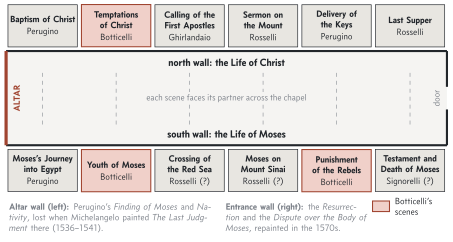
They worked to a plan (Figure 4.2). Along the south wall ran six scenes from the life of Moses, who in the Bible brings God’s law to Israel. Along the north wall, facing them, ran six scenes from the life of Christ, who in Christian teaching brought a new law that fulfilled the old. Each scene answers the one across the room. Moses receives the law on Mount Sinai opposite Jesus’s Sermon on the Mount. The punishment of the rebels who defied Moses faces Perugino’s Delivery of the Keys. In it Jesus hands the keys of heaven to a kneeling Peter, whom Catholics count as the first pope, in a wide square before an eight-sided temple and two triumphal arches (Vol. 5, In the Beginning). Read together, the walls told every visitor that the popes held the authority of Moses and of Peter. Above the scenes stood portraits of the early popes, and below them hung painted curtains. Two more scenes once filled each end wall. Those on the altar wall were destroyed when Michelangelo painted The Last Judgment there (Chapter 14), and those by the entrance were repainted in the 1570s. Michelangelo’s ceiling, begun in 1508, came later still (Chapter 10).

Botticelli painted three scenes. On the north wall he painted the Temptations of Christ, and on the south wall the Punishment of the Rebels, in which the earth swallows Korah and his followers for defying Moses (Vol. 5, In the Beginning). On the same wall, nearer the altar, he painted the Youth of Moses,This artist painted the "Youth of Moses" for the Sistine Chapel. → Sandro Botticelli• a fresco about 11 feet tall and 19 feet wide (Figure 4.3). It tells several stories from the book of Exodus at once, and Moses appears seven times, always in the same yellow robe and green cloak so that the eye can follow him. At the right he kills an Egyptian he has seen beating a Hebrew, and then flees into the desert. In the middle, at a well in the land of Midian, he drives off the shepherds who have kept the daughters of the priest Jethro from their water, and then he draws the water for the girls’ sheep himself. One of the daughters, Zipporah, will become his wife. At the upper left he takes off his shoes before the burning bush, where God sends him back to Egypt, and at the lower left he leads his people out. The Latin on the border above calls the scene the testing of Moses, “the bearer of the written law,” to match the testing of Christ across the room.
Vasari says that the pope made Botticelli the superintendent of the whole work. The records suggest instead that Perugino, who arrived first, was more likely in charge, if anyone was. The pope paid well, but Botticelli, Vasari adds, spent the money as fast as he earned it. In February 1482 his father died, and Sandro went home from Rome to Florence.This artist returned from Rome to his native Florence. → Sandro Botticelli• In Foster’s translation Vasari puts it simply: “Having completed the work assigned to him, he returned at once to Florence.” As far as the records show, he hardly worked outside his native city again.
La Primavera
Back in Florence, Botticelli worked for a younger branch of the Medici. Lorenzo di Pierfrancesco (pyair-frahn-ches-koh) de’ Medici, born in 1463, was a second cousin of Lorenzo the Magnificent. The Magnificent was the grandson of Cosimo de’ Medici; the younger Lorenzo was the grandson of Cosimo’s brother, Lorenzo the Elder. When the boy’s father died in 1476, he and his brother Giovanni became the wards of their famous cousin. The Magnificent gave them the best teachers in Florence, among them the poet Angelo Poliziano and the philosopher Marsilio Ficino (Chapter 1). He also borrowed heavily from their inheritance, and the two branches of the family never quite trusted each other again. In 1477 the brothers bought a country house, the Villa di Castello, outside the city, and in July 1482 Lorenzo di Pierfrancesco married Semiramide Appiani (seh-mee-rah-mee-deh ahp-pyah-nee), the daughter of the lord of Piombino, a small state on the Tuscan coast.
An inventory of the young man’s town house, made in 1499 and published only in 1975, shows where his best pictures hung. In one room, above a lettuccio (let-too-choh), a long wooden bench with a high carved back, hung a great painting on panels; an inventory of 1503 adds that its frame was white. It was Botticelli’s La PrimaveraThis artist painted La Primavera. → Sandro Botticelli••• (pree-mah-vair-ah) (Figure 4.5). The bench raised it so high that its lower edge was about at a visitor’s eye level, higher than it hangs today, which is why the meadow under the figures seems to tilt gently up toward us. No contract or letter says who ordered the picture or why. Paintings and furniture were favorite wedding presents in Florence, and most historians now think that it was painted for Lorenzo di Pierfrancesco’s marriageThis painting was possibly commissioned for the marriage of Lorenzo di Pierfrancesco. → La Primavera• of 1482, perhaps as a gift from Lorenzo the Magnificent to his ward. Others date it a few years earlier, about 1480, before Botticelli went to Rome. The same room held a round painting of the Virgin and Child, valued in the inventory above both of Botticelli’s pictures, and a second large canvas by Botticelli. That was its companion, Pallas and the Centaur,This painting's companion piece is Pallas and the Centaur. → La Primavera• a nearly life-size picture. Pallas Athena, the goddess of wisdom, wears a white dress printed with the three interlocking diamond rings that were a Medici badge, and olive branches wind about her body. She holds a great halberd, a spear with an ax blade, and she has taken a centaur by the hair. The centaur, half man and half horse, a creature of wild appetites, looks back at her with a hangdog face, his bow useless in his hand. Most readers see in it reason taming passion, a fitting lesson for a young husband.

La Primavera itself is painted in tempera, colors ground in egg yolk (Vol. 1, The Toolkit), on wooden panels joined together, and it is nearly 7 feet tall and more than 10 feet wide. It has no title of its own. Vasari saw it at Castello and described, loosely, a Venus “crowned with flowers by the Graces,” and then added, “she is here intended to denote the Spring.” Primavera is Italian for spring,This concept titles a painting by Botticelli. → spring• and the picture has gone by that name ever since. It is an allegory, a picture whose figures stand for ideas, and its subject is the season itself: the coming of spring, told in figures from the myths of Greece and Rome. Almost nothing like it had been painted on this scale since ancient times. Painters had made gods and nymphs before, but most often small, on wedding chests and plates.

Nine figures stand in a dark grove, and the grove is an orange grove:This painting is set in an orange grove. → La Primavera••• golden fruit and white blossoms hang among the leaves above them. The oranges may also be a compliment, since their round golden fruit recalls the balls on the Medici’s coat of arms. Underfoot the meadow is thick with flowers, and botanists have identified about 190 kinds among the 500 or so plants painted there. The figures stand in a line across the front, like actors on a stage, and the picture reads from right to left, the way the season moves (Figure 4.6).

At the far right, bursting in from the trees, comes Zephyrus (zef-ih-rus), the west wind, whose warm breath brings the spring. His skin is a cold blue-green, his cheeks are puffed, and his cloak streams behind him. He seizes the nymph ChlorisThe blue Zephyrus grasps Chloris, from whose mouth flowers spill as she becomes Flora, in this painting. → La Primavera•• (klor-is), who twists away from him in a sheer white shift, and flowers spill from her mouth as he catches her. The story comes from the Roman poet Ovid, in his Fasti, a poem on the festivals of the Roman year. At the feast of the flower goddess, in early May, the goddess herself tells her story. She was once a nymph of the fields; the west wind carried her off and then made her his wife, and he gave her the rule of all flowers. “Chloris eram, quae Flora vocor,” she says: “I who am called Flora was Chloris.” Botticelli painted both stages of her story. Beside the struggling nymph stands what she becomes: Flora, calm and smiling, crowned with flowers, in a dress printed with them, scattering roses from her lap.
In the middle, a little behind the others, is the goddess of love. Venus stands beneath an arch of trees,This figure stands beneath an arch of trees at the center of Botticelli’s Primavera. → Venus••Venus presides at the center of this allegory of spring. → La Primavera•• presiding over the garden as the queen of spring. She is not the naked goddess of ancient statues. She wears a white gown and a red cloak, and her hair is covered with a veil, as a married Florentine lady’s was in public. The dark leaves behind her, myrtle, her sacred plant, open into an arch around her like the niche around a statue of the Madonna, and she raises her right hand in a gesture of welcome. Above her flies her son, Cupid, blindfolded, because love is blind. He draws his bow, and Cupid aims his arrow at the Graces.Cupid hovers above Venus and aims an arrow toward the Three Graces in this painting. → La Primavera••
The Graces were Venus’s companions, three goddesses of beauty and charm (Vol. 4, Classical Myth). Ancient sculptors showed them naked and standing still, arms on one another’s shoulders. Botticelli dressed them in gowns so thin that the light passes through, and set them turning in a slow round dance. The Three Graces dance with interlocked hands,The Three Graces dance with interlocked hands in this painting. → La Primavera•• their fingers laced together high above their heads and low at their sides. Cupid’s arrow points at the middle one, who has turned her back to us and gazes across at the young man at the left. Love is about to strike her.
At the far left stands Mercury, raising his caduceus (kuh-doo-see-us) toward the clouds.Mercury raises his caduceus toward clouds at the left of this painting. → La Primavera•• Mercury was the messenger of the gods (Vol. 4, Classical Myth), and the caduceus is his herald’s staff, wound with two snakes. He wears a red cloak, a sword, and a helmet, and he has turned his back on the others to stir away a few wisps of gray cloud, so that nothing can darken the garden. April was Venus’s month, and May took its name from Maia (may-uh), Mercury’s mother, so the painting runs from the first wind of spring, through Venus’s month, to the last days of the season.
No ancient story brings these nine together. Botticelli was not a scholar, and a learned friend probably helped him plan the picture, most likely Poliziano. Historians have read it as a garden of love for a bride, as a lesson in Ficino’s philosophy of love, and as a pageant of the Medici circle in costume. None of these readings has won.
The Birth of Venus
A few years later, about 1484 to 1486, Botticelli painted a picture even more famous. Botticelli’s The Birth of VenusThis artist painted The Birth of Venus. → Sandro Botticelli••• is nearly 6 feet tall and more than 9 feet wide. It is painted in tempera, but on canvas rather than wood, two pieces sewn together, which was cheaper and lighter and was often used for the pictures in country houses. Nobody knows who ordered it. It is missing from the inventory of 1499, and the first writer to mention it is Vasari, who saw it at Castello beside La Primavera. The two pictures have stayed together ever since. In 1815 they were moved into the city’s public galleries, and since 1919 they have hung in the Uffizi,This painting is housed in the Uffizi gallery. → The Birth of Venus•• the gallery in the government offices that Vasari himself built for the Medici dukes (Chapter 1).
Its subject is not quite a birth. The Greek poet Hesiod told how the goddess Aphrodite, whom the Romans called Venus, rose full-grown from the foam of the sea and came ashore (Vol. 4, Classical Myth). One of the Homeric Hymns, the short Greek poems once credited to Homer, tells what happened next, and Poliziano knew it. In Hugh Evelyn-White’s translation of 1914, “the moist breath of the western wind wafted her over the waves of the loud-moaning sea in soft foam, and there the gold-filleted Hours welcomed her joyously. They clothed her with heavenly garments.” Botticelli painted that landing, and the title The Birth of Venus was given to his picture only in the nineteenth century. The hymn sets the landing on Cyprus, and Hesiod says she passed Cythera (sih-theer-uh), a small island off the southern tip of Greece, on the way. The shore in the painting is probably Cythera or Cyprus,This painting is probably set on the island of Cythera or Cyprus. → The Birth of Venus•• the two islands that the Greeks gave to the goddess, both famous for her temples. Botticelli did not try to paint either place as it looked. His sea is pale green and flat.
The sea’s little waves are a repeated pattern of V’s, more like the decoration on a vase than like water. In the middle of the picture the naked goddess stands on a scallop shellThe nude goddess of love stands on a scallop shell approaching shore in this painting. → The Birth of Venus••• that floats toward the shore. The giant shell is imaginary, though Roman artists had used it for her too. No painter since ancient times had made a naked woman, life-size, the subject of a large picture. Her pose comes from an ancient type of statue called the Venus pudica (poo-dih-kah), “modest Venus.” She covers herself with hands and hair,The goddess covers her nudity with her hands and hair in a Venus pudica pose in this painting. → The Birth of Venus••• one hand at her breast and the other drawing her long golden hair across her body. Her weight rests on her left leg, in the relaxed stance of Greek statues that Italians later called contrapposto (Vol. 6, The Greeks), but it rests so far over that no real woman could stand so. She seems to float rather than stand.
At the left, two winds fly in, wrapped in each other’s arms, their wings spread and their cloaks streaming. Zephyrus blows the goddess toward shore.Zephyrus blows the goddess toward shore beside a female wind figure in this painting. → The Birth of Venus••• His cheeks are puffed, and Botticelli drew the wind itself as fine lines from his mouth. The young woman he holds blows more gently beside him, and her cool breath lifts the goddess’s hair. Vasari called her Aura, the breeze. Many writers since have named her Chloris, and on that reading Zephyrus and Chloris appear in bothZephyrus and Chloris appear in both this artist's La Primavera and The Birth of Venus. → Sandro Botticelli•• of Botticelli’s great mythologies, as a struggling pair in La Primavera and as husband and wife here. They are no longer chasing each other. They fly together as one creature, with four wings and one billowing cloak, and their breath carries more than the goddess. Around them pink roses tumble through the air,In this painting, roses fall from or surround the figures on the left. → The Birth of Venus•• the flowers of Venus, drifting with the wind toward the land.


On the shore at the right a young woman runs down to the water’s edge to meet the goddess. Her long hair flies out behind her, her bare feet hardly touch the grass, and she stretches out both arms with something to give. She is a Hora, offering a flowered cloak:A figure usually identified as a Hora offers the goddess a flowered cloak in this painting. → The Birth of Venus••• one of the Horae (hor-ee), the Hours or Seasons, who welcome the goddess in the hymn. Cornflowers are printed on her white dress and a garland of leaves hangs around her neck, so she is usually taken for the Hora of spring. The cloak she holds out, rose-colored and sprinkled with flowers, billows in the wind as she reaches the water’s edge. Behind her an orange grove runs down to the shore,An orange grove stands behind the cloak-bearing figure in this painting. → The Birth of Venus••• and the dark leaves of its trees are edged with gold (Figure 4.7).
The land itself is barely sketched, a few flat green headlands against a pale sky, and none of the figures casts a shadow. Other details are stranger still. At the lower left cattails grow in the foreground,Cattails appear in the foreground of this painting. → The Birth of Venus•• tall reeds with brown velvet heads that belong beside fresh water, not on a seashore. Botticelli also made his picture glitter with real gold, in the form called shell gold: gold leaf ground to a powder and mixed with gum, which painters kept in a mussel shell and laid on with a brush. Shell gold picks out the ridges of the scallop shellThis material's 'shell' variant was used to accent the shell in Sandro Botticelli's Birth of Venus. → gold• on which Venus rides, and it glints in her hair, on the winds’ wings, and among the trees.
Who sat for the goddess? A tradition names Simonetta (see-moh-net-tah) Vespucci, a beauty from Genoa who had married into Botticelli’s neighbors, the Vespucci. At a tournament in 1475 Giuliano de’ Medici crowned her the queen of beauty. She died on April 26, 1476, at twenty-two, two years to the day before Giuliano was murdered. The idea that Simonetta Vespucci was Venus’s modelSimonetta Vespucci has traditionally been proposed as the model for the goddess in this painting. → The Birth of Venus•• grew up long afterward, and Victorian writers pressed it hardest. Simonetta had been dead for about ten years when the picture was painted, and no document connects her with it.
The American art historian Charles Mack offered another reading. The Roman writer Pliny tells that the most famous picture of ancient Greece was a Venus rising from the sea by Apelles (uh-pel-eez), the court painter of Alexander the Great (Vol. 6, The Greeks). Its model, Pliny says, was Alexander’s mistress, Campaspe, whom the king gave to the painter when he saw that Apelles loved her. Mack argued that Botticelli was presenting himself as a new Apelles and the painting as praise of its Medici patron,Charles Mack interpreted this painting as an allegory praising its Medici patron. → The Birth of Venus•• with Lorenzo the Magnificent, the family’s head, as a new Alexander, generous and great. Many historians doubt it, since the picture is not recorded in Medici hands until the next century.
The subject kept its pull. Four centuries later, in 1879, the French painter William-Adolphe Bouguereau (boo-guh-roh) showed his own Birth of VenusBotticelli and Bouguereau painted the birth of this figure. → Venus••• at the Paris Salon, the goddess again standing on a shell, this time in a crowd of sea nymphs, mermen called tritons, and cupids (Vol. 18, Paris, Capital of the Arts).
The Calumny of Apelles and Venus and Mars
Venus appears once more in Botticelli’s work, in a smaller and funnier picture of about 1485, now in the National Gallery in London. Venus and Mars is about 27 inches tall and 68 inches wide. Its long, low shape suggests a spalliera, a painting set into the wall paneling or the back of a bench, and it was probably made for a bridal bedroom. Venus reclines on the left, fully dressed and wide awake. On the right her lover Mars, the god of war, sprawls asleep, naked but for a cloth. Around him little goat-legged satyrs play with his armor. Two play with his helmet and lance, one has crawled into his breastplate, and a fourth blows a conch into his ear,This artist’s Venus and Mars depicts satyrs disturbing the sleeping god. → Sandro Botticelli••Satyrs blow a conch into the sleeping Mars’s ear while Venus watches in this painting. → Venus and Mars (Botticelli)•• sounding the big seashell like a horn to wake him, without success, while Venus watches. The joke was old. Lucian (loo-shun), a Greek writer born in Syria about AD 125, had described a lost painting of Alexander’s wedding in which little Cupids played with the hero’s weapons. A swarm of wasps buzzes from a hollow tree by Mars’s head. Vespa is Italian for wasp, so the insects may be a badge of the Vespucci, who perhaps ordered the picture.

Most of his work, though, was for churches and for private prayer, and he was famous for the tondo, the round picture or relief (Chapter 1). About 1487 he painted the Madonna of the Pomegranate, with six angels,This artist painted Madonna of the Pomegranate, with the Virgin surrounded by six angels. → Sandro Botticelli•• a tondo almost 5 feet across, for a room in a palace. The Virgin sits with the child on her lap, and three angels crowd in on each side, curly-haired and dressed like young Florentines, holding books, lilies, and garlands of roses. Mother and child together hold a pomegranate, split open to show its red seeds. In Christian art the fruit had long stood for Jesus’s suffering and his resurrection, and both faces are grave, as if they already knew. From above, thin golden rays fall on them.
Botticelli loved Dante, the poet whose Divine Comedy carries its reader through Hell, Purgatory, and Paradise (Vol. 9, Cathedrals and Crusades). In 1481 a German printer working in Florence brought out the poem with engravings made from Botticelli’s designs, but only nineteen plates were ever engraved. Later, perhaps for Lorenzo di Pierfrancesco, Botticelli began a grand copy on sheets of parchment, about 13 by 18 inches, with a drawing for every canto. More than ninety sheets survive, most of them in Berlin and a few in the Vatican Library. Most are drawn in fine lines and never colored. Of all his drawings for the Divine Comedy, the most famous is one of the few he painted in full color, a funnel-shaped map of Hell.This artist illustrated Dante’s Divine Comedy, including a funnel-shaped Map of Hell. → Sandro Botticelli• It shows the whole pit at once, a great cone of terraces narrowing down to Satan at the center of the earth (Figure 4.9).

Vasari tells a story against him. Botticelli, he says, once jokingly reported a friend to the parish priest as a heretic, one who holds beliefs the Church condemns. The friend answered that it was Botticelli who was the heretic: he could barely read, Vasari’s story goes, yet he had dared to write a commentary on Dante. No commentary survives, and Vasari blamed the Dante work for the disorder of Botticelli’s affairs.
About 1494 or 1495 Botticelli tried to bring back a famous picture that nobody had seen for more than a thousand years. Lucian tells that Apelles was once falsely accused by a rival painter of plotting against a king of Egypt named Ptolemy. He was nearly executed before the truth came out, and afterward he painted an allegory of slander, which Lucian describes figure by figure in an essay of his own. A calumny (kal-um-nee) is a false accusation made to ruin someone, and Botticelli’s The Calumny of ApellesThis artist painted The Calumny of Apelles. → Sandro Botticelli•• is named for Apelles’ picture. Leon Battista Alberti had praised Lucian’s description in his book On Painting and urged painters to try it (Chapter 1). Lucian’s Greek had been put into Latin or Italian four times during the century, so a painter who knew no Greek could read it, and Botticelli took up Alberti’s challenge. It recreates the lost picture Lucian described,This painting recreates a lost work by Apelles described by Lucian. → The Calumny of Apelles•• figure by figure, on a small panel about 2 feet tall and 3 feet wide.

Botticelli set the scene in a marble throne room crowded with gilded statues and reliefs, open to a flat sea. It reads like La Primavera, from right to left, and nearly every figure is a personification, a quality shown as a person. On his throne at the right sits a judge with the ears of a donkey,A donkey-eared judge sits between Ignorance and Suspicion in this painting. → The Calumny of Apelles•• the ears that King Midas earned in the old story by preferring the god Pan’s piping to Apollo’s lyre. He sits between Ignorance and Suspicion, two women who hold his long ears and whisper into them, and he stretches out his hand to the accuser, Calumny. In front of him stands Rancor, or bitter spite, a hooded man in rags. He leads in Calumny, a beautiful woman with a blazing torch, who drags her victim across the floor by the hair; the young man, nearly naked, folds his hands in prayer. Two attendants, Fraud and Conspiracy, braid roses into Calumny’s hair. Behind them an old woman in black, Repentance, turns to look at the last figure. Truth stands naked at the far left. Truth has the figure of VenusThis painting's central figure resembles the personification of Truth in its artist's Calumny of Apelles. → The Birth of Venus•• from The Birth of Venus, the same body and much the same modest pose, except that her right hand points up to heaven. According to Vasari, Botticelli gave the little picture to his close friend Antonio Segni. Some have guessed that he had a slander of his own in mind, or a slander against the preacher whose sermons by then steered Florence.
Savonarola
Girolamo Savonarola was born in Ferrara on September 21, 1452, the grandson of a famous physician at the court of Ferrara, and he was meant to be a doctor too. But at twenty he was already writing poems of doom, among them “On the Ruin of the World,” and in April 1475 he slipped away from home and knocked at the door of the Dominican friary in Bologna. The Dominicans, the Order of Preachers, were friars of the order Saint Dominic had founded in the thirteenth century to preach and teach. In 1482 his order sent him to the friary of San Marco in Florence, the house the Medici had rebuilt and Fra Angelico had painted (Chapter 3). There he taught the novices, the young men training to become friars. At first the Florentines found his northern accent ugly and his sermons crude, and he went off to preach in other cities. In 1490 Lorenzo the Magnificent called him back, at the request of the young philosopher Pico della Mirandola (Chapter 3).

This time they listened. Savonarola preached on the Book of Revelation, the last book of the Bible, with its visions of the end of the world. The crowds grew so large that he moved to the cathedral. He thundered against priests who lived like princes, against the rich who neglected the poor, and, without naming names, against tyrants who stole a people’s freedom. Scoffers called his followers the Piagnoni (pyahn-yoh-nee), the “weepers” or “wailers,” and the followers took up the name with pride. When Lorenzo lay dying at his villa at Careggi in April 1492, he sent for the friar. Lives of Savonarola written by his followers decades later say that the friar demanded Lorenzo give Florence back its freedom and that Lorenzo turned his face to the wall. The poet Poliziano, who was at Careggi and wrote about it in a letter six weeks later, tells it differently. In his account the friar urged Lorenzo to keep his faith, to mend his life, and to face death bravely; Lorenzo promised all three, and the friar blessed him. Lorenzo’s son Piero, twenty years old, took his place. Florentines would call him Piero the Unfortunate.
With Lorenzo gone, the friar’s warnings grew darker. God, he said, would soon send a scourge to cleanse Italy. “Ecce gladius Domini super terram cito et velociter,” he cried in Advent 1492, the season of prayer before Christmas: “Behold the sword of the Lord over the earth, swift and soon.” About 1493 he began to foretell a new Cyrus coming over the mountains, a conqueror like the Persian king of the Bible who had freed the Jews from Babylon (Vol. 5, In the Beginning).
The scourge came from France. Charles VIII, king of France since 1483, was twenty-four, sickly, and eager for glory. His family had inherited the claim of the house of Anjou, French princes who had ruled the kingdom of Naples until the king of Aragon took it in 1442. When the old king of Naples, Ferrante, died in January 1494, Charles decided to take the throne. Ludovico Sforza, who ruled Milan and feared Naples, encouraged him (Chapter 9). On September 3, 1494, Charles crossed the Alps with about 25,000 men, Swiss pikemen among them, and bronze cannon on wheeled carriages that could batter down a castle wall in hours (Figure 4.12). This invasion began the Italian Wars, sixty-five years of fighting in which France and Spain struggled for Italy (Chapter 13). In October the French sacked the Florentine fortress town of Fivizzano (fee-veet-tsah-noh) and killed its garrison and many of its people.

Piero panicked. He rode to the French camp and, without asking the city, handed Charles the fortresses that guarded Florence’s coast and the ports of Pisa and Livorno. Florence was furious. On November 9, 1494, the people rose, and Piero and his brothers fled the city. The crowds sacked the Medici palace, and on the same day Pisa threw off Florence’s rule. To many Florentines it looked as if God had kept his word. Charles’s invasion seemed to fulfill Savonarola’s prophecies:Charles VIII’s invasion seemed to fulfill this Dominican friar’s prophecies; he became influential in Florence’s republic after the Medici were expelled. → Savonarola•• the new Cyrus had come over the mountains, and the tyrants had fallen. Savonarola went with the city’s envoys to meet the king at Pisa and hailed him as the instrument of God. On November 17 Charles rode into Florence with his lance on his thigh, as conquerors did. He demanded a huge sum and the return of Piero. When his ministers read out their terms, the Florentine Piero Capponi (kahp-poh-nee), a leading merchant and soldier, tore up the paper. If the French sounded their trumpets, he told the king, Florence would ring its bells, the signal that called every citizen to arms. Charles took the money, dropped Piero, and at the end of the month marched on to Rome and Naples. In the republic that replaced the Medici, the friar would soon be the most powerful voice in Florence.
The Florentines now built a broad republic. Its heart was a Great Council of more than 3,000 citizens, and a new hall was built onto the Palazzo Vecchio to hold it, the hall where Leonardo would later begin his Battle of Anghiari (Chapter 9). Savonarola held no office, but his sermons steered the city. He told Florence that if it repented it would become a new Jerusalem, more glorious, richer, and more powerful than ever before, and he declared that Christ himself was now its king. New laws struck at sodomy, adultery, and public drunkenness. The city split over the friar, and each side had a name. His followers were the Piagnoni, his enemies the ArrabbiatiThis friar’s followers were called Piagnoni, or “weepers,” and his opponents Arrabbiati, or “rabid ones.” → Savonarola•• (ah-rahb-byah-tee): the “weepers,” who wept for their sins and their city’s, against “the rabid ones.” The Arrabbiati were rich men who wanted a narrower republic and hated the friar’s rule. Young nobles who mocked the friar in the streets were called the Compagnacci (kom-pahn-yah-chee), “bad companions,” and the Medici’s secret friends were the Bigi, “the grays.” Botticelli’s own brother Simone was a Piagnone.

Carnival, the days of feasting before the forty-day fast of Lent, had been Florence’s wildest season, with masked dances, bawdy songs, and bonfires. Savonarola turned it inside out. Bands of boys went from door to door collecting “vanities,” things that tempted their owners to sin. On February 7, 1497, the last day of Carnival, the friar’s followers held the Bonfire of the Vanities in Florence,The Bonfire of the Vanities took place in this city. → Florence•••This friar inspired Florence’s Bonfire of the Vanities, in which books and artworks were burned. → Savonarola•• on a great pile built in the Piazza della Signoria, the square before the city hall. Into the flames went mirrors, cosmetics, false hair, perfume, fine dresses, playing cards and dice, musical instruments, books of love poetry and copies of Boccaccio (Vol. 9, Cathedrals and Crusades), and paintings and sculptures. Vasari tells of it in his life of the painter Fra Bartolomeo. Pictures and statues, “many by the most excellent masters,” went into the fire, he says, “a most lamentable destruction,” and the young painter, then still called Baccio (baht-choh) della Porta, threw on all his drawings of nudes. Later writers said that Botticelli burned his own paintings of the gods there, but Vasari does not say so, and his great mythologies survived. Another bonfire followed at Carnival in 1498.
By then the friar had a more dangerous enemy. Pope Alexander VI, the Spaniard Rodrigo Borgia, elected in 1492 (Chapter 7), joined the League of Venice in March 1495 to drive the French out of Italy. Florence refused to join, because it hoped that Charles would give it back Pisa, and the pope blamed the friar. Charles fought his way home at Fornovo (for-noh-voh) in July 1495 and never returned, though his soldiers carried a new disease home from Naples (Chapter 7). Alexander summoned Savonarola to Rome, and the friar refused to go. He was forbidden to preach, and after some months he preached anyway. In May 1497 the pope excommunicated him, cutting him off from the Church and its sacraments.
Then the friar’s own boldness ruined him. In March 1498 a Franciscan preacher challenged Savonarola to prove his prophecies true by walking through fire, an ordeal that both sides expected God to decide. Savonarola’s closest companion, Fra Domenico da Pescia (pesh-ah), accepted, and a Franciscan was named to walk with him. A great pile of wood was built in the Piazza della Signoria for Saturday, April 7. It was to be the first trial by fire in Florence in more than four hundred years, and every window and roof around the square was packed. Then the two orders argued for hours. The Franciscans demanded that Domenico change his robe in case it was bewitched, and Domenico insisted on carrying the consecrated bread of the Mass, the Host, into the flames. A thunderstorm drenched the square. At dusk the government sent everyone home. The ordeal was delayed, then canceled in the rain,This friar lost support after a proposed ordeal by fire involving his follower was delayed and then canceled in the rain. → Savonarola• and the crowd, which had waited all day for a miracle, felt cheated. It blamed the prophet. That same day in France, by the usual account, Charles VIII struck his head on a low doorway at his castle of Amboise (ahm-bwahz) and died.
The next day was Palm Sunday, the Sunday before Easter. A mob stormed San Marco, where the friar’s followers, among them Baccio della Porta, tried to hold the doors. Savonarola surrendered. Under torture he confessed that his prophecies were his own invention, took it back, and confessed again. He was condemned with Domenico and a third friar, Silvestro Maruffi, as a heretic and as a schismatic, one who divides the Church. On May 23, 1498, the three were led along a raised walkway from the platform of the Palazzo Vecchio to a scaffold in the square, the same square where the vanities had burned. They were stripped of their friars’ robes, hanged, and burned, and their ashes were thrown into the Arno so that no one could keep them as relics (Figure 4.13). George Eliot would set her novel Romola in these years (Vol. 17, The Victorians). A month later a young official named Niccolò Machiavelli took office in the government that had burned him (Chapter 8). In The Prince, in W. K. Marriott’s translation, he drew the lesson: “all armed prophets have conquered, and the unarmed ones have been destroyed.” Savonarola, he wrote, “was ruined with his new order of things immediately the multitude believed in him no longer.”
The Mystical Nativity
Vasari says that Botticelli fell under the friar’s spell. In Foster’s translation, Vasari calls Botticelli a follower of the friar, “of whose sect our artist was so zealous a partizan that he totally abandoned painting,” and says that he ended old and poor. Historians doubt that he gave up painting. Botticelli went on painting after 1498, and in 1502 an agent of Isabella d’Este, the marchioness of Mantua and a great collector, reported that he was free to start a picture for her at once. But his late religious paintings reflect Savonarola’s influence.This artist’s late religious paintings reflect the influence of Girolamo Savonarola. → Sandro Botticelli• Their figures grow stiff and passionate, their colors darker, their scale old-fashioned. In a damaged Crucifixion in his style, now at Harvard, an angel beats the marzocco (mar-tsok-koh), the lion that was Florence’s emblem, beside the cross, as if the city were being punished for its sins.

The fullest of these late pictures is Botticelli’s The Mystical Nativity,This artist painted The Mystical Nativity. → Sandro Botticelli•• a small canvas painted about 1500 or 1501 and now in the National Gallery in London. Under the thatched roof of a stable built against a cave, Mary kneels before the child. She is much larger than anyone else, as in paintings of a century earlier. Joseph sits hunched beside them with his face hidden, and the ox and the ass look on. On each side an angel brings worshipers, shepherds on the right and three men in long gowns, perhaps the Magi, on the left, all crowned with olive. On the roof three angels sing from a book. High above, twelve angels dance in a circle,Twelve angels dance in a circle above a stable in this painting. → The Mystical Nativity•• holding olive branches with little crowns hanging from them, against an opening dome of gold. They wear white, green, and red, the colors of faith, hope, and charity. Infrared photographs show that the ribbons they carry once bore twelve titles of the Virgin from one of Savonarola’s sermons. At the bottom, three angels embrace three men, and small devils flee into cracks in the rock, some stabbed by their own spears.
Across the top of the canvas runs a band of Greek capitals, and it explains the picture. The Greek inscription invokes Revelation and Italy’s troubles.A Greek inscription in this painting invokes Revelation and the troubles of Italy. → The Mystical Nativity•• It says, roughly, that he, Alessandro, painted the picture at the end of the year 1500, in the troubles of Italy. He painted it, he adds, in the time described in the eleventh chapter of Revelation, in the second woe, the second of three disasters that Revelation foretells, when the devil is let loose for three and a half years. Then, as the twelfth chapter says, the devil will be chained, and we shall see him crushed, as in this picture. With the words “I, Alessandro” the painter put his name to his work, which he did nowhere else. It is his only signed painting,This is Botticelli’s only signed painting. → The Mystical Nativity•• and also the only one he dated. Botticelli seems to have believed that he was living through the last troubles before the end of the world, and that the peace the angels bring was near.
Botticelli lived another ten years. In January 1504 he sat on the committee of artists that decided where to put Michelangelo’s David (Chapter 10). He painted less and less. Vasari says that he grew so feeble that he walked with two crutches. He died on May 17, 1510, and was buried with his family at his parish church of Ognissanti. For three centuries his name was half forgotten, until Victorian critics, John Ruskin and Walter Pater among them (Vol. 17, The Victorians), made him one of the most loved painters in the world.
What to remember
- Sandro Botticelli (about 1445 to 1510), a tanner’s son of the Ognissanti quarter, trained under Fra Filippo Lippi and painted for the Medici and their friends.
- For Sixtus IV he painted three scenes on the walls of the Sistine Chapel (1481 to 1482), among them the Youth of Moses; the life of Moses on the south wall faces the life of Christ on the north. Then he went home to Florence.
- La Primavera (about 1480 to 1482), probably for Lorenzo di Pierfrancesco’s wedding, has Pallas and the Centaur as its companion. It reads right to left in an orange grove: Zephyrus seizes Chloris, who becomes Flora; Venus beneath an arch of trees; blindfolded Cupid aiming at the Three Graces; Mercury raising his caduceus to the clouds.
- The Birth of Venus (about 1484 to 1486, Uffizi): Venus in the Venus pudica pose on a scallop shell, blown ashore by Zephyrus and a female wind among roses, met by a Hora with a flowered cloak; orange trees, cattails, and shell gold. Simonetta Vespucci as the model is a later tradition.
- Venus and Mars: satyrs blow a conch into the sleeping Mars’s ear. The Calumny of Apelles rebuilds a lost picture from Lucian: a donkey-eared judge between Ignorance and Suspicion, and a naked Truth with Venus’s body.
- Charles VIII’s invasion of 1494 began the Italian Wars, drove out the Medici, and seemed to fulfill Savonarola’s prophecies. His followers were the Piagnoni and his enemies the Arrabbiati.
- The Bonfire of the Vanities burned in Florence on February 7, 1497. The ordeal by fire of April 7, 1498, ended in rain, and Savonarola was hanged and burned on May 23, 1498.
- The Mystical Nativity (1500 to 1501), Botticelli’s only signed painting, shows twelve angels dancing in a circle; its Greek inscription invokes Revelation and the troubles of Italy.
New Worlds and Old Popes, 1469-1513
Chapter 5 · 26 clues
Ferdinand and Isabella
In the first days of October 1469 a few men posing as merchants rode west out of Aragon into Castile, traveling mostly by night. One of them served the others at table and saw to the mules. He was seventeen years old, and he was a king: Ferdinand, heir to the throne of Aragon, whom his father had already made king of Sicily. He went in disguise because the king of Castile’s men were watching the roads. The chronicler Alonso de Palencia (pah-len-thee-ah), who helped to smuggle him across the border, later told the story.
At Valladolid (vah-yah-doh-leed), an eighteen-year-old princess was waiting for him. Her name was Isabella, and her half brother, the king, had forbidden the match. A few days after the two first met, they were married. In the next twenty-three years they would win the throne of Castile in a civil war, conquer the last Muslim kingdom in western Europe, found the Spanish Inquisition, and drive the Jews out of their lands. In the same years they sent Christopher Columbus west across the Atlantic (Chapter 6).
Castile and Aragon
In 1469 the Iberian Peninsula, the great block of land between the Bay of Biscay and the Strait of Gibraltar, held five kingdoms (Figure 5.1). Portugal faced the Atlantic. Navarre was a small mountain kingdom in the western Pyrenees. In the far south lay the emirate of Granada, the last Muslim state in western Europe, all that was left after the long Christian advance called the Reconquista (reh-kon-kees-tah), “reconquest” (Vol. 9, Cathedrals and Crusades). The two great powers were Castile and Aragon.

Castile was much the larger. It filled the center of the peninsula, from the rainy hills of Galicia to the olive groves of Andalusia, and held perhaps four or five times as many people as Aragon. Its riches were wool, shorn from great flocks of merino sheep that walked hundreds of miles every year between their summer and winter pastures. Its nobles were rich, armed, and quarrelsome, and its kings had lately been weak. The Crown of Aragon, in the northeast, was a family of states under one king (Vol. 9, Cathedrals and Crusades): Aragon itself, Catalonia with the port of Barcelona, Valencia, the Balearic Islands, Sicily, and Sardinia. Each kept its own laws and its own Cortes, the assembly that voted the king his taxes (the Stage).
Isabella was born on April 22, 1451, at Madrigal de las Altas Torres (mah-dree-gahl), a walled town of Castile. Her father was King John II of Castile, and her mother was his second wife, Isabella of Portugal. She had a half brother, Henry, twenty-six years older, the son of John’s first marriage. When John died in 1454, Henry became king as Henry IV, and the three-year-old princess grew up with her mother and her younger brother, Alfonso, in the castle of Arévalo (ah-reh-vah-loh), short of money and far from court.
Henry IV gave away royal lands and offices to buy friends, and his enemies called him “the Impotent.” His first marriage had been annulled in 1453 on the ground that he had never been able to consummate it. In 1462 his second wife, Joan of Portugal, gave birth to a daughter, Juana. A faction of great nobles claimed that the girl’s real father was the king’s favorite, Beltrán de la Cueva (bel-trahn day lah kway-vah), and nicknamed her “la Beltraneja” (bel-trah-neh-hah), roughly “Beltrán’s girl.” In 1465, outside the walls of Ávila (ah-vee-lah), they stripped a wooden figure of Henry of its crown and scepter and proclaimed eleven-year-old Alfonso king in his place. Civil war followed, and in July 1468 Alfonso died, at fourteen.


The rebels offered the crown to Isabella. She refused it and bargained instead. In September 1468, at a place called the Bulls of Guisando (gee-sahn-doh), where four ancient stone bulls stand in a field, Henry named her his heir. She promised to marry only with his consent, and he promised not to force a husband on her. He soon tried. He offered her to King Afonso V of Portugal (uh-fon-soo), a widower nineteen years older, and then to the duke of Berry, brother of King Louis XI of France. Isabella refused both and chose for herself.
Her choice was her cousin Ferdinand (Figure 5.2), born on March 10, 1452, at Sos in Aragon, a hill town now called Sos del Rey Católico (sohs del ray kah-toh-lee-koh), “Sos of the Catholic King.” He was the son of King John II of Aragon, a different John II from Isabella’s father, and he had fought in his father’s wars since boyhood. Marrying him would give Isabella’s party an army and give Aragon an ally against France. The two were second cousins, both great-grandchildren of the same king of Castile, and the Church forbade marriage between such close relatives without a dispensation, a pope’s written permission. Their dispensation turned out to be forged, in the name of a pope dead since 1464; a genuine one came later from Pope Sixtus IV.
They were married in a private house in Valladolid on October 19, 1469. It was a marriage that linked two crowns:This ruler of Castile married Ferdinand of Aragon, linking the two crowns. → Isabella I of Castile•••Ferdinand II of this kingdom married Isabella of Castile, linking their crowns. → Aragon••Ferdinand of Aragon’s marriage to Isabella of Castile helped unite the crowns of this country. → Spain•• once each had inherited, Isabella of Castile and Ferdinand II of Aragon would rule most of the peninsula together, the union that became Spain. Henry IV declared that his sister had broken her promise at Guisando, and in 1470 he named his daughter Juana his heir again.
Isabella’s reign
Henry IV died in Madrid on December 11, 1474, and the will he left soon disappeared. The news reached Segovia the next day, and Isabella moved at once. On December 13, in the town square, Isabella succeeded her half brother Henry IV:This ruler succeeded Henry IV. → Isabella I of Castile•• she swore to protect the Church and the kingdom and was proclaimed queen of Castile. She did not wait for Ferdinand, who was away in Aragon, and he was angry when he heard.
They settled the quarrel in writing. By an agreement made at Segovia in January 1475, Isabella alone held Castile in her own right, but Ferdinand would rule beside her as king, and their names, faces, and arms would appear together on documents and coins. Each signed as Yo el Rey and Yo la Reina, “I the King” and “I the Queen.” Each took a badge beginning with the other’s initial: Ferdinand a yoke, yugo, for Ysabel, as her name was then spelled, and Isabella a sheaf of arrows, flechas, for Fernando. Beside the yoke went Ferdinand’s motto, Tanto monta (tahn-toh mon-tah), “it comes to the same.” It recalled Alexander the Great, who cut the knot tying a yoke to an ancient cart at Gordium rather than untie it (Vol. 6, The Greeks): tanto monta cortar como desatar, “it comes to the same, cutting or untying.” The royal banners carried the motto doubled, as the saying “Tanto monta, monta tanto”,Later tradition associated this ruler’s partnership with Ferdinand with the saying “Tanto monta, monta tanto.” → Isabella I of Castile•• and later tradition gave it a new ending, Isabel como Fernando, “Isabella the same as Ferdinand,” making it the motto of their equal partnership.
First they had to win the crown. Juana la Beltraneja, now thirteen, had powerful supporters, and her uncle, Afonso V of Portugal, took her as his bride in May 1475 and invaded Castile to claim it. The war for the succession went on for four years. Its turning point came on March 1, 1476, outside Toro, a walled town on the river Douro. Afonso had failed to trap Ferdinand in nearby Zamora and was falling back when Ferdinand caught him. The battle was a draw. One wing of the Castilians, under Cardinal Pedro González de Mendoza (gon-thah-leth day men-doh-thah) and the duke of Alba (ahl-bah), routed the Portuguese king. Afonso’s son, Prince John, the future John II of Portugal, broke the other wing and held the field.
Ferdinand at once sent letters to every city of Castile announcing a great victory, and the country believed him. The Battle of Toro secured Isabella’s throneThe Battle of Toro helped secure this ruler’s succession against Joanna la Beltraneja. → Isabella I of Castile•• against Juana, whom English books often call Joanna, because her Castilian supporters gave up and came over. Isabella built a monastery in Toledo, San Juan de los Reyes, to give thanks for the victory. That spring she called the Cortes to Madrigal, where her five-year-old daughter, Isabella, was sworn heir to the throne.
The same Cortes turned to the disorder that Henry’s reign had left. There, in 1476, the queen founded the Santa Hermandad (er-mahn-dahd), the “Holy Brotherhood.” Castile’s towns had long joined in sworn brotherhoods to hunt robbers, as the Basque towns did (Vol. 9, Cathedrals and Crusades); Isabella made one royal brotherhood for the whole kingdom. Every hundred households paid for one horseman, and its riders chased highwaymen, rapists, and arsonists across the open country, while its judges tried them on the spot. Its archers wore green sleeves and were feared. Spaniards still say a buenas horas, mangas verdes, “a fine time to come, green sleeves,” of help that arrives too late, and the usual explanation is that the proverb mocked these men for coming late.
In January 1479 Ferdinand’s father died, and Ferdinand became king of Aragon as Ferdinand II. Peace with Portugal followed in the Treaty of Alcáçovas (al-kah-soo-vush), signed on September 4, 1479. Afonso gave up his claim, and Portugal kept the trade of Guinea and the islands of Madeira, the Azores, and Cape Verde, while Castile kept the Canaries (Chapter 6). Juana entered a convent at Coimbra (kweem-bruh) in Portugal, though she signed her letters “the Queen” until she died in Lisbon in 1530. From then on one couple wore both crowns.
The couple had five children who lived to grow up, and they married them into the ruling houses of Europe to win allies (Figure 5.3). The eldest, Isabella, born in 1470, married a Portuguese prince and, after his death, King Manuel I of Portugal. The only son, John, born in 1478, married Margaret of Austria, the daughter of Maximilian of Habsburg, the future emperor. Juana, born at Toledo on November 6, 1479, married Margaret’s brother, Philip the Handsome, duke of Burgundy and ruler of the Low Countries. Maria, born in 1482, married Manuel in her turn after her sister died. The youngest, Catherine, born in 1485, went to England to marry Prince Arthur and then his brother, Henry VIII (Vol. 12, Crown and Parliament).

Death undid the plan, and quickly (Figure 5.4). Prince John died at Salamanca on October 4, 1497, at nineteen, six months after his wedding. The elder Isabella died in childbirth in 1498, and her baby son, heir to Castile, Aragon, and Portugal, died before he was two. The heir was now Juana, and her mother doubted her. In the Low Countries Juana had fallen passionately in love with her handsome, unfaithful husband, and her fits of jealousy and grief alarmed the court. When the queen died at Medina del Campo on November 26, 1504, her will left Castile to Juana, with Ferdinand to govern if Juana could not.
Philip came to Spain to rule beside his wife as Philip I, and Ferdinand withdrew to Aragon. Then Philip died at Burgos in September 1506. Ferdinand returned as regent, and in 1509 he shut his daughter in a palace at Tordesillas, where she lived until 1555, nearly half a century. Historians still argue whether she was truly mad or only inconvenient to her father, and later to her son. The nickname stuck either way: Isabella was the mother of Juana the Mad,This ruler was the mother of Juana the Mad. → Isabella I of Castile•• and Juana’s eldest son, Charles, born at Ghent in 1500, inherited Castile, Aragon, the Low Countries, and the Habsburg lands, and became the emperor Charles V (Chapter 13).
That inheritance nearly failed. In 1506 Ferdinand married Germaine of Foix (fwah), a niece of the king of France, hoping for a son to inherit Aragon; their only son, born in 1509, died within hours, and so the two crowns stayed together. Ferdinand had already won the kingdom of Naples in 1504, and in 1512 he took most of Navarre. He died on January 23, 1516. He and Isabella lie side by side in the Royal Chapel of Granada.

The Spanish Inquisition
Jews had lived in Spain since Roman times. Under Muslim and Christian rulers alike they had been physicians, scholars, tax collectors, and bankers, and kings had protected them because they were useful. In 1391 that protection failed. In June of that year the sermons of an archdeacon in Seville set off riots that spread to Toledo, Valencia, Barcelona, and dozens of other towns. Mobs killed thousands of Jews and offered the rest baptism or death. In that year and the twenty-five years of preaching and pressure that followed, more than half of all the Jews in Spain were baptized; modern estimates of the converts run from 100,000 to 200,000.
A Jew who had become a Christian, or the descendant of one, was called a converso (kon-ver-soh), Spanish for “converted”; Christians of old Christian families called them “New Christians.” The Church taught that baptism could not be undone, even when it had been accepted under threat. A baptized person who went back to Jewish prayers, food laws, or the Sabbath was therefore a heretic, a Christian who held beliefs the Church condemned, and heresy was a crime. Some conversos did keep Jewish customs in secret. Many others became devout Christians, and some rose to be royal secretaries and bishops. Their success made them hated, and riots against conversos broke out in Toledo in 1449 and in Córdoba (kor-doh-bah) in 1473. Their enemies claimed that most New Christians were secret Jews.
Isabella heard those claims at Seville in 1477 and 1478, from Dominican friars and from a report by two churchmen she trusted. One was Cardinal Mendoza, who had fought at Toro and was now archbishop of Seville. The other was Tomás de Torquemada (toh-mahs deh tor-keh-mah-dah), a Dominican friar who had long been her confessor. She and Ferdinand asked Pope Sixtus IV, who was then building the Sistine Chapel in Rome (Chapter 4), for an inquisition of their own. An inquisition was a church court that searched out and tried heretics. Popes had sent such judges against the Cathars of southern France since the thirteenth century, most of them Dominican friars (Vol. 9, Cathedrals and Crusades). This one would be different. By a bull, a solemn letter from the pope named for its lead seal, dated November 1, 1478, Sixtus let the king and queen choose the inquisitors themselves. With that grant Ferdinand and Isabella founded the Spanish Inquisition,This queen and her husband established the Spanish Inquisition. → Isabella I of Castile••Ferdinand and Isabella established this tribunal in 1478. → Spanish Inquisition••Ferdinand and Isabella established a namesake Inquisition in this country. → Spain• the one royal institution with power in both Castile and Aragon.
The first inquisitors reached Seville in 1480. On February 6, 1481, they held their first public ceremony there, and six people were burned. Thousands of conversos fled the city. In 1482 Sixtus IV himself complained, in a bull about the inquisitors of Aragon, that they were moved not by zeal for the faith but by greed for the property they confiscated. Ferdinand protested angrily, and the pope backed down.

Torquemada was the man who built the Inquisition. Born in 1420, the nephew of a famous cardinal, he had been prior of a monastery in Segovia and was known for his austere life. As Isabella’s confessor he was the priest who heard her confessions and advised her conscience. From 1483 Torquemada, Isabella’s adviser, headed the InquisitionTomás de Torquemada led this tribunal. → Spanish Inquisition••This adviser to Isabella of Castile headed the Spanish Inquisition. → Tomás de Torquemada•• as its first inquisitor general, over the courts of both crowns. He wrote its rules, and within fifteen years it grew from one court at Seville to a network of courts in the chief cities of Spain. The opposition was strongest in Aragon, where in 1485 conversos murdered an inquisitor, Pedro de Arbués (ar-bwes), as he knelt in the cathedral of Zaragoza. The murder turned opinion against the conversos and strengthened Torquemada’s hand. The Spanish chronicler Sebastián de Olmedo called him “the hammer of heretics.” To his victims, and to later centuries, his name meant cruelty.
The courts worked in secret. An inquisitor arriving in a town proclaimed a period of grace, usually thirty days, in which people could confess their own heresy and denounce others. The accused were not told who had accused them, their property was seized when they were arrested, and torture could be used to obtain a confession. The inquisitors looked for small signs. Saturday is the Jewish Sabbath, a day of rest on which Jewish law forbids lighting a fire, so a household in clean clothes on a Saturday, with no smoke rising from its chimney, could be denounced. So could a man who would not eat pork. They investigated conversos, and later moriscos,This tribunal investigated conversos and moriscos suspected of secretly practicing their former religions. → Spanish Inquisition•• suspected of secretly practicing their former religions. A morisco (moh-rees-koh) was a Muslim made to accept baptism after the fall of Granada, or the descendant of one. The word is Spanish for “Moorish,” and Moor was the Christians’ name for the Muslims of Spain and North Africa.
Sentences were announced at an auto-da-fé (ow-toh-dah-fay), Portuguese for “act of faith”: a solemn public ceremony with a procession, a sermon, and the reading of each verdict before the crowd. Those who confessed and repented were “reconciled” and given penances. Penitents wore a garment called a sanbenitoThis tribunal staged auto-da-fé ceremonies at which penitents wore garments called sanbenitos. → Spanish Inquisition•• (sahn-beh-nee-toh), a yellow tunic marked with red crosses, often with a tall pointed cap, and some had to wear it for years. Those who would not repent, or who had relapsed, confessing once and then falling back, wore black sanbenitos painted with flames and devils. Because the Church would not shed blood, they were handed over to the royal officers, who burned them outside the town. Afterward the sanbenitos were hung in the parish church with their wearers’ names, so that a family’s shame lasted for generations. Hernando del Pulgar (pool-gar), the queen’s secretary and chronicler, probably himself of converso descent, put the number burned by 1490, the Inquisition’s first decade, at about two thousand.
The Castilian painter Pedro Berruguete (beh-roo-geh-teh) painted such a scene about 1495 (Figure 5.5). Born about 1450 at Paredes de Nava, he had probably worked at Urbino in Italy (Chapter 3), and he painted for the monastery of Santo Tomás at Ávila, which Torquemada had helped to found. His panel, about 5 feet high, shows Saint Dominic, the thirteenth-century founder of the inquisitors’ order, judging heretics of his own day. Yet every figure wears the dress of the 1490s, and the ceremony is the one Torquemada’s courts held in Berruguete’s lifetime. Torquemada himself retired to Santo Tomás and died there in September 1498. The Inquisition he built lasted until 1834.
Granada and the Reconquista
Granada had been a Muslim kingdom since 1238, ruled by the Nasrid family as emirs, princes who survived by paying tribute to Castile. Its capital lay at the foot of the Sierra Nevada, and on the ridge above the city of Granada stood the Alhambra, the Nasrids’ palace-city,The Alhambra is located in this city. → Granada• with its courts and fountains (Vol. 9, Cathedrals and Crusades). By 1480 the emirate stretched about 180 miles, from Ronda in the west to Vera in the east, with the ports of Málaga (mah-lah-gah) and Almería (al-meh-ree-ah). Its royal family was divided. The old emir, Abu al-Hasan Ali, quarreled with his son Muhammad, whom the Spaniards called Boabdil (boh-ahb-deel), from his Arabic name, Abu Abd Allah. Boabdil’s uncle, Muhammad al-Zagal (thah-gahl), “the Valiant,” was the best soldier of the family.
The last emir of Granada was Boabdil,This polity's last ruler was Muhammad XII, also known as Boabdil. → Granada• born about 1460. English books usually number him Muhammad XII; many historians, counting the emirs differently, make him Muhammad XI. In December 1481 Granada’s raiders seized Zahara, a Castilian frontier town, and in February 1482 Castilian raiders answered by taking Alhama (ah-lah-mah), a town about 25 miles from Granada itself. Ferdinand and Isabella took up the fight and turned it into a war of conquest that lasted ten years (Figure 5.6).

In this last war of the Reconquista, each monarch spoke for a kingdom.Ferdinand represented the Kingdom of Aragon and Isabella represented the Kingdom of Castile during this conflict. → Reconquista•• Isabella’s Castile raised most of the men and the money and took the conquered land, while Ferdinand of Aragon commanded in the field and brought Aragon’s ships and guns. The queen herself organized supplies, hospitals, and loans, and she came to the camps to keep the nobles in the field. Their great weapon was artillery. Ferdinand hired gunners from France and Burgundy, and heavy cannon battered down walls that would once have held out for a year. Ronda fell after a two-week bombardment in 1485 and Loja (loh-hah) in 1486.
Ferdinand also used Granada’s civil war. When Boabdil was captured at Lucena in 1483, Ferdinand set him free as his vassal, a ruler sworn to obey him, so that he would go on fighting his father and uncle. Málaga, the emirate’s chief port, held out from May to August 1487, and when it fell Ferdinand sold almost all its people into slavery. Baza resisted for six months in 1489, and Isabella came in person to the siege. In December 1489 al-Zagal surrendered Baza, Guadix (gwah-deeks), and Almería, and later he left for North Africa. Only Boabdil remained, in Granada itself, with the mountains behind it. In April 1491 the monarchs besieged the city. When fire destroyed their camp that summer, they built a town of stone in its place and named it Santa Fe, “Holy Faith,” to show that they would not leave.

Hunger and bribery ended the siege. On November 25, 1491, Boabdil signed terms of surrender with Ferdinand and Isabella. On January 2, 1492, he surrendered Granada, ending the Reconquista:This ruler’s conquest of Granada ended the Reconquista. → Isabella I of Castile••This process ended in 1492 when Boabdil surrendered Granada to Ferdinand and Isabella. → Reconquista••The Reconquista in this country ended in 1492. → Spain•• seven hundred and eighty-one years after the Muslim conquest of 711, no Muslim ruler held any part of Spain. Boabdil handed the keys of the city to Ferdinand outside the walls, while Castilian soldiers took over the Alhambra and raised the royal banners on its towers. Across Christian Europe the news was celebrated as a victory that seemed to balance the loss of Constantinople to the Turks in 1453 (Vol. 9, Cathedrals and Crusades). A Genoese sailor named Christopher Columbus, who had come to Santa Fe to ask for ships, later wrote in the journal of his first voyage that he saw the banners go up (Chapter 6). The Spanish painter Francisco Pradilla (prah-dee-yah) painted the scene for the Spanish Senate in 1882, 390 years later (Figure 5.7).
Boabdil received an estate in the Alpujarras (al-poo-har-rahs), the mountain valleys between the Sierra Nevada and the sea, and in October 1493 he sailed for Morocco. A legend, written down long afterward, tells how he reined in his horse on a pass to look back at the city and wept, and how his mother told him to weep like a woman for what he could not defend like a man. No document of the time records the scene. The pass is still called “the Moor’s Sigh.”
The terms of surrender had promised the Muslims of Granada their mosques, their law, their judges, and their property, and no forced conversions. The first archbishop of Granada, Hernando de Talavera (tah-lah-veh-rah), learned Arabic and tried to win converts by preaching and kindness. In 1499 the archbishop of Toledo, Francisco Jiménez de Cisneros (hee-meh-neth day thees-neh-rohs), the queen’s confessor since 1492 and a man of fierce zeal, arrived in Granada. He pressed Muslims into baptism, boasting to the pope of three thousand in a single day, and had Arabic books burned in a public square. In December 1499 the Muslim quarter of Granada, the Albaicín (al-bye-theen), rose in revolt, and the rising spread to the mountains. Forced conversions set off revolts in the AlpujarrasAfter the conquest of this polity, forced conversions resulted in revolts in the Alpujarras area. → Granada• that lasted into 1501. Ferdinand himself led the assault on Lanjarón (lahn-hah-ron), and at Laujar (low-har) his soldiers killed some three thousand prisoners. In March 1501 the rebels destroyed a royal army in the Sierra Bermeja (ber-meh-hah), near Ronda, and killed its commander, Alonso de Aguilar. Ferdinand then offered the rebels a choice between exile and baptism.
Ferdinand and Isabella now held that the rebels had broken the treaty, so they need not keep it. In February 1502 they ordered every Muslim in Castile to be baptized or to leave. Most stayed and became moriscos, Christians in name who in many cases kept their language, dress, and faith at home. Their grandchildren would rise again in the Alpujarras in 1568 (Chapter 15).
The expulsion of the Jews
Three months after the fall of Granada, the monarchs turned on the Jews who had never been baptized. Inquisitors argued that as long as Jews lived beside the conversos, they would draw them back to Judaism. On March 31, 1492, in the Alhambra palace at Granada, Ferdinand and Isabella signed the Alhambra Decree, expelling the JewsAt Torquemada’s urging, this ruler issued the Alhambra Decree expelling Jews who refused conversion. → Isabella I of Castile•••The Alhambra Decree expelled these people from Spain in 1492. → Jews••The Alhambra Decree in this country expelled Jews who refused to convert to Christianity. → Spain•• from all their kingdoms. They acted at the urging of the Inquisition, and above all of its head, Torquemada. Every Jew who would not be baptized had to leave by the end of July, on pain of death. They might take their goods with them, but no gold, no silver, and no coined money.

A later story tells that the Jewish financier Isaac Abravanel (ah-brah-vah-nel), who had served the crown, offered the monarchs a fortune to cancel the decree. Torquemada, the story goes, burst into the room, threw a crucifix on the table, and asked whether they would sell Christ again for silver, as Judas had sold him for thirty pieces. Whatever was said, the decree stood. Abravanel left for Naples and died in Venice in 1508.
Spain’s Jews had four months to sell what they owned, and buyers knew it. Andrés Bernáldez (ber-nahl-deth), a priest who saw them go, wrote that a house was traded for a donkey and a vineyard for a scrap of cloth. Many chose baptism and stayed. Modern estimates of those who left run from 40,000 to 100,000. They went to Portugal, to North Africa, to Italy, and to the Ottoman Empire, where the Ottoman sultan welcomed them to Constantinople and Salonica. Their descendants are the Sephardim (seh-far-dim), from Sepharad, the Hebrew name for Spain, and some still speak a Spanish dialect, Ladino. Spain formally revoked the decree only in 1968.
On December 19, 1496, Alexander VI rewarded the king and queen in a bull known by its opening words, Si convenit, Latin for “if it is fitting.” It praised the conquest of Granada, the expulsion of the Jews, and the war that had driven Charles VIII of France out of Naples, a kingdom the popes counted as their own fief (Chapter 7). In it he gave Isabella and Ferdinand the title of Catholic Monarchs,This queen and her husband earned the titles of Catholic Monarchs. → Isabella I of Castile•• in Spanish Reyes Católicos (ray-es kah-toh-lee-kohs), by which Spaniards have called them ever since.
Many of the exiles had crossed into Portugal, where King John II let them stay for a fee, and there the story repeated itself. In 1496 King Manuel I wished to marry Ferdinand and Isabella’s widowed eldest daughter, and her parents made the expulsion of Portugal’s Jews a condition of the match. Manuel did not want to lose so many useful subjects, so in 1497 he had nearly all of them forcibly baptized instead, and he forbade the New Christians to leave. Resentment against them grew. In April 1506 Lisbon, Portugal’s capital and greatest port, was suffering from drought and plague. In the Dominican church of São Domingos (sowng doo-meen-goosh), worshipers saw a strange light shining from the face of Christ on a crucifix and cried out that it was a miracle. A New Christian in the crowd said it was only the reflection of a candle burning beside the image. So the royal chronicler Damião de Góis (dah-mee-ow duh goysh) tells it, writing sixty years later. The massacre in Lisbon beganA massacre began in this city after a converted Jew questioned if the illuminated face of Christ was just the reflection of a candle. → Lisbon• when the crowd dragged him out and killed him, on Sunday, April 19, 1506. Urged on by friars, mobs hunted New Christians through the streets for three days and burned the bodies in the squares. Between five hundred and four thousand people died. King Manuel had the ringleaders executed, two of the friars among them, and punished the city, but the New Christians never felt safe in Portugal again.
By 1506 Castile and Portugal had, officially, no Jews and no Muslims left. The Muslims of the Crown of Aragon, whom Ferdinand had sworn at his coronation not to force, kept their faith until his grandson Charles V ordered them baptized in 1525 and 1526. The Inquisition went on watching the descendants of both for three hundred years; its last trial for secret Judaism was held at Córdoba in 1818.
What to remember
- Isabella of Castile married Ferdinand of Aragon at Valladolid on October 19, 1469, linking the two crowns. Isabella became queen in 1474, after her half brother Henry IV, and Ferdinand king of Aragon in 1479. Their kingdoms kept their own laws until 1707 to 1716.
- The Battle of Toro (1476) secured Isabella’s throne against Juana la Beltraneja, Henry’s daughter; the Treaty of Alcáçovas (1479) ended the war with Portugal.
- Isabella founded the Santa Hermandad, a royal police of the roads, in 1476. “Tanto monta” was Ferdinand’s motto; later tradition made it the motto of their equal partnership.
- Their daughter Juana the Mad, confined at Tordesillas from 1509 to 1555, was the mother of Charles V. Their youngest daughter was Catherine of Aragon.
- The Spanish Inquisition, authorized by Sixtus IV in 1478 and led from 1483 by Torquemada, tried conversos, and later moriscos, suspected of secretly keeping their old faiths. Sentences were read at autos-da-fé, where penitents wore the sanbenito.
- Boabdil, the last emir of Granada, surrendered the city on January 2, 1492, ending the Reconquista.
- The Alhambra Decree of March 31, 1492, expelled the Jews who refused baptism. Forced conversions of Granada’s Muslims led to the revolt of the Alpujarras (1499 to 1501) and the decree of 1502.
- Alexander VI named the couple the Catholic Monarchs in 1496. In Portugal, Jews were forcibly baptized in 1497, and the Lisbon massacre of 1506 began when a New Christian said a miraculous light was a candle’s reflection.
Chapter 6 · 48 clues
The Ocean Sea
On Monday, September 8, 1522, a battered ship anchored at the stone quay of Seville and fired all her guns in salute. She was the Victoria, and three years earlier she had gone down the river Guadalquivir (gwahd-ahl-kee-veer) with four other ships and about 270 men. Now she carried eighteen, most of them sick. She had sailed west from Spain, and she had come home from the east. The next morning the survivors walked to two shrines of the Virgin Mary to give thanks that they were alive, “in shirts and barefoot, with a taper in our hands,” a taper being a thin candle. Those are the words of Antonio Pigafetta, one of the eighteen, in Lord Stanley of Alderley’s English translation of 1874.
Thirty-five years before, no European ship had passed the southern tip of Africa, and no European knew that two continents lay across the Atlantic. Medieval maps showed the land of the world as one great island ringed by water, and the water beyond Europe’s shores had an old name, the Ocean Sea. The men who sailed out into it worked for the two crowns on the Atlantic edge of Europe, the king of Portugal and the joint monarchs of Castile and Aragon. They went one after another, and each voyage was made possible by the one before.
Dias and the Cape
Portugal was a small kingdom of perhaps a million people on the Atlantic side of the Iberian Peninsula, with its capital at Lisbon, where the river Tagus meets the sea. Its border with Castile had been fixed since 1297, so it could grow only by sea. The Portuguese took Ceuta, the Moroccan port across the Strait of Gibraltar, in 1415 (Vol. 9, Cathedrals and Crusades), and Prince Henry, called the Navigator, sent small, nimble ships called caravels to Madeira, the Azores, and down the coast of Africa. By Henry’s death in 1460 his captains had passed Cape Verde, and they brought back gold, ivory, and African slaves.
What the Portuguese wanted most lay farther off. Pepper grew on the southwest coast of India, cinnamon in Ceylon, and cloves and nutmeg only on the Spice Islands, a few small islands at the eastern edge of the Indies, the name Europeans gave to southern and eastern Asia. These spices flavored and preserved food, and they reached Europe by a long chain of traders. Indian and Arab ships carried them across the Indian Ocean, caravans and boats carried them on to Alexandria and Beirut, and Venetian merchants bought them there. Every hand along the way added to the price. A ship that could sail around Africa to India would buy pepper at the source.
The king who set Portugal on that course was John II, who ruled from 1481 to 1495 and was remembered as “the Perfect Prince.” He sent his captains south with padrões (puh-droinsh) (the singular is padrão (puh-drowng)), stone pillars carved in Lisbon and topped with a cross and the arms of Portugal. A captain set one up on a headland to mark how far he had come and to claim the coast for his king. In the 1480s Diogo Cão (dee-oh-goo kowng) carried them past the mouth of the Congo River.

In the summer of 1487 John sent Bartolomeu Dias, a knight of his household, with two small caravels and a supply ship. Dias stood out to sea off the coast of what is now Namibia (Vol. 3, Geography: Europe, Asia, and Africa) and ran south and then east for about a month out of sight of land. Early in February 1488 he struck the coast again at a bay, now Mossel Bay, where herdsmen watched their cattle. The shore there ran east. He followed it, and on March 12, 1488, his men set up a padrão on a rocky point called Kwaaihoek (kwy-hook). A little farther on they came to the mouth of a river they named the Rio do Infante, after João Infante, captain of the second caravel. It is now the Great Fish River, in South Africa’s Eastern Cape (Figure 6.1).
There the crews would go no farther. Food was short, the ships were battered, and every officer voted to go home, so Dias turned back. On the voyage home, in May 1488, he saw the great headland he had passed without seeing. Dias had become the first European known to roundThis explorer was the first recorded European to round the Cape of Good Hope. → Bartolomeu Dias•• the Cape of Good Hope. The chronicler João de Barros (bar-roosh), writing some sixty years later, says that Dias named it the Cape of Storms and that John II renamed it the Cape of Good Hope, because the sea road to India now lay open. Dias reached Lisbon in December 1488, after sixteen months away. A note in the margin of one of Christopher Columbus’s books, written by Columbus or perhaps by his brother Bartholomew, says that its writer was in Lisbon to hear Dias report to the king.
No fleet followed Dias for nine years (Figure 6.2). John lost his only legitimate son in 1491, quarreled with his queen over who would succeed him, and fell ill. Dias got little reward. He helped design the ships for the next voyage to India and sailed with it as far as the Cape Verde Islands, and in 1500 he drowned when his ship went down in a storm off the cape he had found.

Columbus
The sailor from Genoa
Christopher Columbus was born in GenoaChristopher Columbus was born in this city. → Genoa••This man was a Genoese explorer. → Christopher Columbus•• in 1451, sometime between late August and the end of October. Genoa was a republic of merchants and sailors on the northwest coast of Italy, the old sea rival of Venice (Vol. 9, Cathedrals and Crusades), and Genoese bankers and shipmasters were at home in every port from the Greek island of Chios to Bristol in England. His father, Domenico, was a wool weaver. His name in Italian was Cristoforo Colombo, in Spanish Cristóbal Colón; “Columbus” is the Latin form.

By his own account he went to sea at fourteen. In 1476 his ship was sunk in a sea fight off the southern coast of Portugal, and his son later wrote that he swam ashore holding an oar. He settled in Lisbon, where his brother Bartholomew drew maps for a living. There he married Filipa Moniz Perestrelo (peh-resh-treh-loo), whose father had governed the island of Porto Santo, near Madeira, for Prince Henry. Their son Diego was born about 1480. Columbus sailed to Madeira for sugar and down the African coast to the Portuguese fort of Elmina (el-mee-nuh), on the Gold Coast, and he read everything he could find about the shape and size of the world.
Every educated European knew that the earth was round. The argument was about its size. Columbus became sure that the ocean between Europe and Asia was narrow, and that a ship sailing west from the Canary Islands would reach Japan in a few weeks. About 1484 he asked King John II for ships.This man asked King John II of Portugal for financial support but was rejected. → Christopher Columbus• The king handed the plan to a committee of experts, who said that Columbus had made the distance far too short. They were right, and John said no. Columbus tried him again in 1488, just as Dias came home with the news that Africa could be rounded. Portugal had its road to India, and it did not need his.
The Capitulations of Santa Fe
In 1485, his wife now dead, Columbus moved to Castile with his son. Its queen, Isabella, and her husband, Ferdinand of Aragon, ruled their two kingdoms together, and together they were the rulers of what was becoming Spain (Chapter 5). Isabella sent his plan to a commission led by her confessor, Hernando de Talavera, which agreed with the Portuguese experts. The monarchs paid Columbus a small allowance to keep him from going elsewhere, and he waited six years while they fought their war for Granada. In Córdoba he took a companion, Beatriz Enríquez de Arana, who bore him a second son, Ferdinand, in 1488. Granada surrendered on January 2, 1492, and Columbus later wrote that he was there to see the royal banners raised on the towers of the Alhambra. He asked again, was refused again, and rode away. Then Luis de Santángel (sahn-tahn-hel), the keeper of Ferdinand’s household accounts, persuaded Isabella that the risk was small and the prize enormous, and offered to help raise the money. A royal messenger rode after Columbus and brought him back.
The contract was drawn up at Santa Fe, the walled camp the Spanish monarchs had built outside Granada during the siege. A royal agreement of this kind, setting out its terms point by point, was called a capitulación, and Ferdinand and Isabella sponsored his voyageFerdinand and Isabella sponsored this explorer’s voyage under the Capitulations of Santa Fe. → Christopher Columbus••This queen and her husband sponsored Christopher Columbus' voyages to the New World. → Isabella I of Castile•••Christopher Columbus was sent by this country's rulers Ferdinand and Isabella. → Spain• under the Capitulations of Santa Fe, sealed on April 17, 1492. The original document is lost; the oldest copy was made at Barcelona the next year, when the monarchs confirmed it. The terms were grand, because the monarchs would pay them only if he succeeded. If he found land, he would become Admiral of the Ocean Sea,This man was granted the title "Admiral of the Ocean Sea." → Christopher Columbus•• and viceroy and governor of whatever he found, ruling it in the monarchs’ name. He would have a tenth of all the wealth that came from it, and his titles would pass to his heirs. “Admiral of the Ocean Sea” meant admiral of the whole Atlantic beyond Europe, a rank to match that of the Admiral of Castile at home.
Across the Ocean Sea
The fleet was fitted out at Palos (pah-lohs), a small port near the Atlantic coast of Andalusia. Its townsmen owed the crown the service of two caravels as a penalty for some offense, and the monarchs turned them over to Columbus. The Niña, the Pinta, and the Santa MaríaThis explorer sailed on the Niña, Pinta and Santa María. → Christopher Columbus••• carried about ninety men. The Niña (neen-yah) and the Pinta were caravels, commanded by two brothers of a leading Palos family: the Niña by Vicente Yáñez Pinzón (yahn-yes peen-sohn), the Pinta by Martín Alonso Pinzón. The Santa María, the flagship, was a carrack, a bigger, rounder ship with square sails, owned by her master, Juan de la Cosa.
Columbus’s journal of the voyage is lost. What survives is a summary made decades later by Bartolomé de las Casas, a friar who knew the Columbus family and later became famous as a defender of the Indians (Chapter 13), and it often quotes the admiral’s own words. Columbus sailed from Palos on August 3, 1492.This explorer sailed to the Americas in 1492. → Christopher Columbus••• He stopped in the Canary Islands to repair the Pinta’s rudder, and on September 6 he sailed due west from the island of La Gomera (goh-may-rah). The trade winds, the steady easterlies of the tropics (Vol. 2, Geography: The Americas and Oceania), carried the ships along. Las Casas’s summary says that Columbus kept two records of the distance sailed, a true one for himself and a shorter one for the crew, so that the men would not take fright at how far from home they were. In the first days of October flocks of birds passed overhead, and on October 10 the men complained that the voyage had gone on too long. On October 11 they fished a carved stick and a green branch out of the water.

At about two in the morning of October 12, a lookout on the Pinta saw a pale shore in the moonlight. The journal gives his name, the sailor Rodrigo de TrianaRodrigo de Triana sailed with this explorer. → Christopher Columbus• (tree-ah-nah), and says he saw the land first. But Ferdinand and Isabella had promised a pension of 10,000 maravedís (mah-rah-veh-dees), the small coins of Castile, every year for life to the first man to sight land, and Columbus claimed it for himself. He said that at ten o’clock the night before he had seen a light, rising and falling like a small candle. Ten thousand maravedís a year was most of a sailor’s yearly pay, and Triana never got it.
In the morning Columbus went ashore with the royal banner and the Pinzón brothers and took possession for the king and queen. He had landed on GuanahaniThis man landed on the island of Guanahani. → Christopher Columbus•• (gwah-nah-hah-nee), a low island of the Bahamas, and he renamed it San Salvador, “Holy Savior.” Nobody knows for certain which island it was, though the one renamed San Salvador in the 1920s is the favorite. Its people were the Lucayans (loo-ky-unz), cousins of the Taíno (tah-ee-noh) of the larger islands to the south. Columbus wrote that they would make good servants and good Christians, and he had several of them seized and taken aboard to learn Spanish. Believing he was among the islands off Asia, he called them indios, Indians.
He went on to look for gold and for the cities of the Great Khan, the emperor of China, whom the Venetian traveler Marco Polo had described two centuries before. He reached Cuba on October 28 and decided it was part of the mainland of Asia. On December 5 he came to a mountainous island he named La Española (es-pahn-yoh-lah), Hispaniola (his-pan-yoh-lah) in English (Vol. 2, Geography: The Americas and Oceania). On Christmas Eve, with a boy at the tiller against orders, the Santa María drifted onto a reef off the island’s north coast and broke open. A local cacique (kah-seek), the Taíno word for a chief, named Guacanagarí (gwah-kah-nah-gah-ree) sent his people to help carry the cargo ashore. From the ship’s timbers Columbus built a fort, La NavidadThis man built a settlement at La Navidad. → Christopher Columbus• (nah-vee-dahd), “the Nativity,” for the day of the wreck, and he left thirty-nine men in it to trade for gold. In January 1493 he sailed for home in the Niña. Storms drove him into the Azores and then into Lisbon, where John II received him and told him that the new islands belonged to Portugal. On March 15, 1493, he came back into Palos, and at Barcelona the monarchs had him sit in their presence while he told his story, an honor few great nobles received. A letter he had written on the voyage was printed within weeks and reprinted across Europe.
Governor of the Indies
That was the first of Columbus’s four voyages to the New World.This man led four voyages to the New World. → Christopher Columbus• The others followed in 1493–1496, with seventeen ships and about 1,200 men to settle Hispaniola; in 1498–1500, when he reached Trinidad and the mainland of South America (Vol. 2, Geography: The Americas and Oceania) and called it otro mundo, another world; and in 1502–1504 (Figure 6.4). On the second voyage he found La Navidad burned and every one of its thirty-nine men dead, killed after quarrels over gold and women (Vol. 44, Gold, God, and Glory). He founded a new town, La Isabela, farther east along the coast.
He was governor now as well as admiral, and he governed badly. The settlers had come for gold and found little. His son Ferdinand writes that in the gold country of the Cibao (see-bow) every Taíno of fourteen or older had to bring in a hawk’s bell full of gold dust. A hawk’s bell was a little round bell of the kind tied to a hunting falcon’s leg. The tribute was due every three months, and those who could not pay were punished. The Taíno of Hispaniola spoke a language of the Arawak (air-uh-wak) family, so writers often call them Arawaks. In February 1495 Columbus and his men rounded up about 1,500 Taíno men, women, and children. They chose about 500 and shipped them to Seville to be sold as slaves,This man enslaved hundreds of Taíno and Arawak people on Hispaniola and other islands. → Christopher Columbus•• and about 200 died on the voyage. Columbus proposed to the monarchs that a trade in slaves could pay for the colony. Isabella, who counted the people of the Indies as her subjects, did not agree, and in 1500 she ordered that Indians sold in Spain be set free and sent home.
The Spaniards turned against the admiral too. When he was away, his brothers Bartholomew and Diego ran the colony, and the three Genoese brothers hanged Spaniards for disobedience. Settlers revolted in 1497. Complaints poured into the court, and in 1500 Ferdinand and Isabella sent out Francisco de Bobadilla (boh-bah-dee-yah), a knight of the Order of Calatrava, one of Castile’s brotherhoods of fighting knights, with full powers to judge and to govern. He reached Santo Domingo, the colony’s new capital, in August 1500, moved into Columbus’s house, took statements from his enemies, and made himself governor in the admiral’s place. Then Bobadilla sent the admiral home in chains,Francisco de Bobadilla replaced this explorer as Governor of the Indies and sent him to Spain in chains. → Christopher Columbus•• with his brothers. His son Ferdinand later wrote that when the captain of the ship offered to take the chains off, Columbus refused, and that he kept them for the rest of his life. The monarchs released him after six weeks and gave back his property, but not his government. In 1502 they sent Nicolás de Ovando (oh-vahn-doh) to replace Bobadilla. Bobadilla drowned that summer, when the fleet carrying him home sailed into a hurricane that Columbus had warned the new governor was coming.
While he fought for his rights at court, Columbus turned to his Bible. Between 1501 and 1502, in Seville, he compiled a Book of PropheciesThis explorer compiled the Book of Prophecies with Gaspar Gorricio, linking his voyages to the Garden of Eden and the Second Coming. → Christopher Columbus•• with Gaspar Gorricio (goh-ree-thyoh), a monk of the Carthusians, an order of monks who lived almost as hermits, and with the help of his son Ferdinand. It is a collection of passages from Scripture and from Christian writers, chosen to show that his voyages were part of God’s plan. In the teaching he drew on, Jesus would come again at the end of the world, an event Christians call the Second Coming, only after the gospel had been preached to every people and Jerusalem had been won back from the Muslims. The gold of the Indies, Columbus hoped, would pay for that last crusade. On his third voyage he had even decided that the great rivers he found on the mainland at Paria flowed down from the Earthly Paradise, the Garden of Eden of Genesis, which medieval maps placed at the far eastern edge of the world.
Jamaica, and a story told later
In May 1502 Columbus sailed on his fourth voyage with four ships, his brother Bartholomew, and his son Ferdinand, then thirteen. He followed the coast of Central America from Honduras to Panama, looking for a strait into the Indian Ocean. Shipworms, wood-boring clams of warm seas, riddled the hulls, and in June 1503 he beached his last two ships at Santa Gloria, on the north coast of Jamaica. One of his officers, Diego Méndez, paddled a canoe across more than a hundred miles of open sea to Hispaniola for help, but Ovando was in no hurry to send it. For a year the castaways lived on the food the Taíno of Jamaica brought them in trade, and as the months passed the Taíno brought less.
Columbus carried an almanac of astronomical tables, and it showed an eclipse of the moon due on the night of February 29, 1504. According to his son Ferdinand, who was there as a boy of fifteen, Columbus predicted the eclipse to the caciques.This man predicted a lunar eclipse to convince the natives of Jamaica to provide him with provisions. → Christopher Columbus• He called them together and told them that God was angry with them for letting the Christians starve and would show his anger by darkening the moon. When the moon began to vanish, the frightened people came running with food and begged him to pray for them. He shut himself in his cabin, timed the eclipse with a sandglass, and came out just before it ended to announce that God had pardoned them. Ferdinand wrote this in his life of his father in the 1530s; the Spanish text is lost, and the book survives in an Italian translation printed at Venice in 1571.
A ship came at last in June 1504. Columbus reached Spain in November, a few weeks before Isabella died. He spent his last months pressing for the rights the Capitulations had promised him, and he died at Valladolid on May 20, 1506, still sure that he had reached the edge of Asia. The name of the new lands went to another Italian. Amerigo Vespucci (Vol. 2, Geography: The Americas and Oceania), a Florentine who worked for a merchant house in Seville, sailed with the Spanish captain Alonso de Ojeda (oh-hay-dah) along the coast of what became Venezuela in 1499. Letters printed under his name called the land a New World, and in 1507 a German mapmaker, Martin Waldseemüller (vahlt-zay-mool-er), wrote “America” across it on his map of the world.
The best-known story about Columbus was first printed after he had been dead for sixty years. Girolamo Benzoni, a Milanese who had traveled in the Spanish colonies, tells it in his History of the New World (1565). At a dinner, Benzoni says, a Spanish gentleman told Columbus that if he had not found the Indies, some other Spaniard would have. Columbus asked for an egg and challenged the company to make it stand on its end. Nobody could. Then Columbus tapped the egg on the table,This man supposedly crushed the tip of an egg to balance it on a table to silence his critics. → Christopher Columbus• crushing its tip a little, and it stood. Any feat is easy, he meant, once someone has shown how. Fifteen years earlier, in 1550, the painter and biographer Giorgio Vasari had told the same trick of the architect Brunelleschi, who used it to win the commission for the dome of Florence’s cathedral (Chapter 1). The same clever answer pinned on two famous men is the mark of a traveling story. In Italian an “egg of Columbus” still means a simple answer that nobody saw until it was shown.
Tordesillas
When John II told Columbus in March 1493 that the new islands were his, he meant it. In 1479 Castile and Portugal had ended a war with the Treaty of Alcáçovas, which gave Castile the Canary Islands and Portugal the Atlantic coast and islands to the south of them. Columbus had sailed west from the Canaries, and the Portuguese said his discoveries lay in their waters. John began to fit out a fleet.
Ferdinand and Isabella turned to Rome. Popes had long claimed the right to grant lands that no Christian ruler held to Christian kings who would convert their peoples, and earlier popes had granted the coast of Africa to Portugal. The pope since August 1492 was Alexander VI, born Rodrigo Borgia in the kingdom of Valencia, one of Ferdinand’s realms (Chapter 7), and he gave the monarchs what they asked. A papal bull, named for its lead seal (Chapter 5), is known by its first words in Latin. In 1493 Alexander issued a series of four, which historians call the Bulls of Donation because they “donated” the new lands. Alexander VI issued the bull Inter caeteraThis pope issued Inter caetera, one of the Bulls of Donation whose division of overseas claims was revised by the Treaty of Tordesillas. → Alexander VI (Rodrigo Borgia)•• (in-ter chay-teh-rah), “Among other works,” dated May 4, 1493. It drew a line from the North Pole to the South Pole a hundred leagues west of the Azores and the Cape Verde Islands. (A league was a sailor’s measure of roughly 3 or 4 miles.) All the lands west of the line that no Christian prince already held went to Ferdinand and Isabella.
John II ignored the pope and dealt with the monarchs directly. He did not much care about Columbus’s islands. He cared about the South Atlantic, where his ships made their wide swing out to sea on the way to the Cape (Figure 6.1), and he wanted the line pushed farther west. The two sides met at Tordesillas, a Castilian town on the river Duero, and on June 7, 1494, Portugal and Spain signed the Treaty of Tordesillas.This country signed the Treaty of Tordesillas with Spain. → Portugal•• It moved the line to 370 leagues west of the Cape Verde Islands, nearly four times as far as the pope had set it. The new line ran down the middle of the Atlantic, about halfway between the Cape Verde Islands and the islands Columbus had found. The lands east of the line went to Portugal,This treaty assigned lands east of its demarcation line to Portugal, placing part of modern Brazil in Portugal’s sphere. → Treaty of Tordesillas•• and the lands west of it to Castile. Nobody in Europe yet knew that South America bulged east across the line. On April 22, 1500, a Portuguese fleet bound for India under Pedro Álvares Cabral (ahl-vuh-rish kuh-brahl) swung so far west, whether by accident or by design, that it struck an unknown coast, and that land, being east of the line, was Portugal’s. It became Brazil, the one Portuguese-speaking country of the Americas (Vol. 2, Geography: The Americas and Oceania).
The line was drawn on Portugal’s secret charts within a few years. In 1502 an Italian agent named Alberto Cantino (kahn-tee-noh), working in Lisbon for Duke Ercole I (air-koh-leh) d’Este of Ferrara, a small state in northern Italy, paid a Portuguese mapmaker twelve gold ducats for a chart of the world. It was probably copied from the royal chart, and Cantino smuggled it to Italy (Figure 6.5).

The treaty divided the Atlantic, but its line had another half on the far side of the globe, and nobody knew where that ran either. When the Portuguese reached the Spice Islands in 1512, Spain claimed that they lay on its side. The quarrel lasted until 1529, when, in the Treaty of Zaragoza, Spain sold its claim to Portugal for 350,000 ducats. Other kings never accepted that the pope or the two Iberian crowns could divide the world. King Francis I of France (Chapter 9) is said to have asked to see the clause in Adam’s will that left the earth to them.
Da Gama and Calicut
John II died in 1495, and his cousin and brother-in-law came to the throne as Manuel I, later called “the Fortunate.” Manuel sent the fleet that John had planned. To command it he chose Vasco da Gama, a hard, quick-tempered nobleman in his late twenties or thirties from Sines (see-nush), a fishing port on the Alentejo (ah-len-tay-zhoo) coast. Da Gama was a knight of the Order of Santiago, a brotherhood of fighting knights that John II had led before he became king. He had four ships: the São Gabriel and the São Rafael, built for the voyage with Dias’s advice, a caravel called the Berrio, and a storeship. His brother Paulo commanded the São Rafael. About 170 men sailed from Lisbon on July 8, 1497.

After the Cape Verde Islands, da Gama did what Dias had learned to do, and swung far out into the South Atlantic to find the westerly winds. His ships sailed some 6,000 miles without sighting land, for about three months, nearly three times as long as Columbus had been at sea in 1492, before they came to the African coast on November 4. His route took him around the CapeThis explorer's route took him around the Cape of Good Hope. → Vasco da Gama• of Good Hope on November 22. At Mossel Bay, where Dias had first touched the southern coast, the Portuguese broke up the storeship and set up a padrão and a cross. As the fleet sailed away, says the anonymous journal of the voyage, herdsmen came down to the shore and knocked them both over. On December 16 he passed the Great Fish River,This explorer passed the Great Fish River. → Vasco da Gama• where Dias had turned back, and sailed into seas no European had crossed. At Christmas he named the coast he was passing Natal, the Portuguese for the Nativity.
North of the Cape the Portuguese came into another world. The cities of the East African coast, Mozambique, Mombasa (mom-bah-sah), and Malindi (mah-lin-dee), were Muslim trading towns of stone houses and mosques, linked by the monsoon winds to Arabia and India. A monsoon is a seasonal wind that reverses: across the Arabian Sea it blows from the southwest from about May to September and from the northeast in winter, so a ship can cross one way in summer and come back in winter. At Mozambique and Mombasa the Portuguese met suspicion and then fighting. At Malindi, a rival of Mombasa, the sultan welcomed them and gave da Gama a pilot who knew the way to India. There da Gama set up a padrão,This explorer erected a padrão, or stone pillar, at Malindi. → Vasco da Gama•• and that stone pillar, rebuilt and strengthened over the centuries, still stands on a headland at Malindi, the only Portuguese pillar on the African coast still in the place where it was set. The chronicles disagree whether it went up in April 1498, on the way out, or in January 1499, on the way home.

With the summer monsoon behind them, the ships crossed the Arabian Sea in twenty-three days. On May 20, 1498, they anchored off Calicut (kal-ih-kut), now called Kozhikode (koh-zhih-kohd), on the Malabar (mal-uh-bar) Coast of southwest India, the busiest pepper port in the world (Figure 6.8). Da Gama had reached India by sea,This explorer became the first European to reach India by sea when he arrived at Calicut in 1498. → Vasco da Gama••Vasco da Gama sailed to India for this country. → Portugal•• the first European to do so, and he had done it for Portugal (Figure 6.9). When the first of his men went ashore, the journal says, he was taken to two Muslim merchants from Tunis who spoke Castilian and asked what had brought the Portuguese so far. They had come, he answered, in search of Christians and spices.

Calicut’s ruler was a Hindu king who bore the title of ZamorinThis explorer made contact with a ruler titled the Zamorin in Calicut. → Vasco da Gama• (zam-oh-rin), and he received da Gama with a procession of thousands of armed men. But da Gama had brought King Manuel’s gifts, which the journal lists: striped cloth, hats, strings of coral, wash basins, sugar, oil, and honey. The king’s officials laughed. The poorest merchant from Mecca, they said, gave more than that. The Muslim merchants of Calicut, who ran the trade to the Red Sea and saw the newcomers as rivals, warned the Zamorin that these were pirates. Da Gama bought what pepper and cinnamon he could and left at the end of August, carrying off several men as hostages.
He sailed too early. The winter monsoon had not begun, and the crossing back to Africa took nearly three months. On the way, scurvy struck: the men’s gums swelled over their teeth, their legs swelled, and dozens died. The disease comes, as doctors learned only centuries later, from a lack of vitamin C, the vitamin in fresh fruit and vegetables. Too few men were left to sail three ships, so da Gama burned the São Rafael. Paulo da Gama died in the Azores on the way home. Vasco reached Lisbon at the end of the summer of 1499, with about fifty-five of the 170 men who had set out. The spices in his two ships were worth many times the cost of the voyage. Manuel added to his titles “Lord of the Conquest, Navigation, and Commerce of Ethiopia, Arabia, Persia, and India.”
The next fleet, under Cabral in 1500, set up a trading post at Calicut. A riot destroyed it and killed dozens of Portuguese, and Cabral bombarded the city. In February 1502 da Gama sailed again with twenty ships to take revenge, and two Portuguese writers recorded what he did. Thomé Lopes (too-may loh-push), a ship’s clerk from Porto in one of the squadrons, kept an eyewitness account, which survives only in an Italian translation printed in 1550. Off the coast north of Calicut, at the end of September 1502, da Gama’s ships caught the Miri (mee-ree), a ship carrying Muslim pilgrims between Mecca and Calicut, with women and children among them. The passengers offered all their gold for their lives. As Lopes tells it, da Gama burned the Miri anyway.Thomé Lopes described this explorer burning the Miri, killing hundreds of Muslim pilgrims. → Vasco da Gama•• He took the gold, shut the passengers below, and on October 3 set the ship on fire, and several hundred men, women, and children died. Lopes describes the women holding up their babies to beg for mercy, and the Portuguese in boats spearing those who swam from the burning ship. He called it cruelty without mercy, and he never forgot the day, he said, as long as he lived.
At Calicut the Zamorin offered peace and sent an envoy, a Brahman (brah-mun), a member of the Hindu priestly class from which kings chose their ambassadors. Gaspar Correia (koo-ray-uh), who came out to India about 1512 and spent decades writing a history of the Portuguese there, the Legends of India, tells what happened next. Da Gama called the envoy a spy. Correia says da Gama cut off the envoy’s lipsGaspar Correia reports that this explorer cut off a Brahman envoy’s lips and sewed dog ears to his head before sending him back to Calicut. → Vasco da Gama•• and ears, sewed a dog’s ears onto his head, and sent him back to the Zamorin. Correia wrote long after the event, and his book was not printed until the 1850s; on this voyage his story often differs from the eyewitnesses’, so his details are less sure than Lopes’s. Da Gama then bombarded the city for two days, loaded spices at Cochin (koh-chin) and Cannanore, Calicut’s rivals to the south and north, and went home in 1503.
He was made Count of Vidigueira in 1519 and sent back to India as viceroy in 1524, and he died at Cochin on Christmas Eve that year. Fifty years later the poet Luís de Camões (loo-eesh duh kuh-moinsh) made him the hero of Portugal’s national epic, The Lusiads (Chapter 17).
Portugal in the East
The spice trade made the king of Portugal a merchant. About 1500 Manuel founded the Casa da Índia (kah-zuh duh een-dee-uh), the India House, beside his riverside palace on the Lisbon waterfront. Lisbon’s trade with the East was run by the India House,This city's overseas trade was managed by the India House. → Lisbon• a royal trading office that fitted out the yearly fleets, kept the accounts, and received every cargo that came home. Pepper and the finer spices were a royal monopoly: the king’s officers bought them in India, the India House sold them in Lisbon, and foreign merchants came there to buy. The fleets left Lisbon in March or April to catch the monsoon in the Indian Ocean and came home a year and a half later. The India House and its records were destroyed in the earthquake of 1755 (Chapter 26).

To hold the trade, the Portuguese needed bases. Francisco de Almeida, the first viceroy, sent out in 1505, built forts on the East African and Indian coasts, and in 1509 he destroyed a combined fleet of Egypt’s sultan and the sultan of Gujarat, in northwest India, off the Indian port of Diu. His successor, Afonso de Albuquerque (al-boo-ker-kuh), governor from 1509 to 1515, had a bolder plan. With a few fortified harbors at the gates of the Indian Ocean, he believed, a small kingdom could control its trade without conquering any large country.
The first gate was Goa (goh-uh), an island port on India’s west coast that belonged to Bijapur (bee-jah-poor), a Muslim kingdom of the Deccan plateau, and a market for the warhorses shipped in from Arabia and Persia. Albuquerque took the city in March 1510, lost it in May to the sultan’s army, and stormed it again on November 25, 1510. Portugal conquered Goa,This country conquered Goa in the 16th century. → Portugal•• and it became the capital of Portuguese India. It stayed Portuguese for 451 years, until India took it in December 1961.
The second gate was Malacca (muh-lak-uh), on the strait between the Malay Peninsula and the island of Sumatra. Every ship carrying goods between India and China, and every cargo of cloves and nutmeg from the Spice Islands, passed through that narrow water, and Malacca’s sultan grew rich on the duties. A Portuguese apothecary, or druggist, who lived there a few years later, Tomé Pires (too-may pee-resh), wrote that whoever was lord of Malacca had his hand on the throat of Venice. Albuquerque’s fleet arrived on July 1, 1511, and after weeks of fighting Portugal conquered MalaccaThis country conquered the Asian port of Malacca. → Portugal• on August 24, 1511. The sultan fled, and Albuquerque built a stone fortress by the harbor. Among the men under his command was a young Portuguese gentleman named Ferdinand Magellan. From Malacca, ships went on in 1512 to the Spice Islands themselves. In 1515 Albuquerque took the third gate, Hormuz (hor-mooz), at the mouth of the Persian Gulf, and he died off Goa that December.
Magellan and the circumnavigation
Fernão de Magalhães, in English Ferdinand Magellan, was born about 1480 into a family of minor nobles in the north of Portugal. He grew up as a page at court, sailed to India with Almeida’s fleet in 1505, and fought in the Indian Ocean for eight years. At Malacca in 1511 he bought a young Malay-speaking captive and had him baptized Enrique (en-ree-kay). Magellan’s slave EnriqueThis explorer owned a slave named Enrique. → Ferdinand Magellan•• went everywhere with him for the next ten years and served as his interpreter. Back in Portugal, Magellan was lamed by a wound in the leg in 1513, fighting the Moroccans at Azemmour (ah-zeh-moor). He asked King Manuel for a small raise in his allowance and was refused.

Magellan had a friend, Francisco Serrão (seh-rowng), who had sailed from Malacca to the Spice Islands and stayed there, and who wrote to him about them. With a Portuguese astronomer, Rui Faleiro (fah-lay-roo), Magellan argued that the Spice Islands lay on Spain’s side of the Tordesillas line, if the line were carried on around the world. A ship could reach them, he said, by sailing west around the bottom of South America. In 1517 he took the plan to Spain. Its new king was Charles, a young man of seventeen raised in the Netherlands. He was the grandson of Ferdinand and Isabella through their daughter Juana (Chapter 5), and in 1519 he was elected Holy Roman Emperor, the overlord of the German lands, so history knows him as Charles V, though he ruled Spain as Charles I (Chapter 13). In March 1518, by a contract signed at Valladolid, Charles commissioned Magellan’s voyage to the Spice Islands,Charles V, ruling Spain as Charles I, commissioned this explorer’s voyage to the Spice Islands. → Ferdinand Magellan•• the Moluccas.
The fleet had five ships and about 270 men from a dozen countries, and three of its captains were Castilians who disliked serving under a Portuguese. Aboard as a gentleman volunteer was Pigafetta, a young man from Vicenza (vee-chen-tsah) in the Venetian Republic. He had come to Spain with the pope’s ambassador and joined, he wrote, to see with his own eyes “the very great and awful things of the ocean.” Pigafetta kept a journal of Magellan’s voyage,Antonio Pigafetta chronicled this explorer’s voyage. → Ferdinand Magellan•• and it is the main account of it. He later wrote it up in Italian for great men in Italy and France, and he drew, on pages of their own, a little map of every group of islands he visited (Figure 6.11). Magellan’s flagship was the Trinidad,The Trinidad was this explorer's flagship. → Ferdinand Magellan•• and he ordered the other ships to follow her and to keep in sight at night the torch that burned on her stern, so that none would lose the fleet in the dark. The largest was the San Antonio, which carried much of the food and spare gear for the voyage. With her sailed the Concepción (kon-sep-syohn), the Santiago, and the Victoria, the ship that came home.The Victoria was one of this explorer's ships. → Ferdinand Magellan•• The fleet sailed from Sanlúcar de Barrameda (sahn-loo-kar day bah-rah-may-dah), at the mouth of the Guadalquivir, on September 20, 1519.
The strait
The fleet crossed to Brazil, rested at the bay of Rio de Janeiro, and worked south along the coast of South America, looking for a passage west. On March 31, 1520, with the southern winter coming on, Magellan put into a bay he named Port Saint Julian, San Julián (sahn hoo-lyahn) in Spanish, where the fleet spent the winter and Pigafetta met his “giant” (Vol. 2, Geography: The Americas and Oceania).
The leader of the Castilian captains was Juan de Cartagena (kar-tah-hay-nah), the fleet’s royal inspector, said to be the son of the bishop who ran the crown’s business in the Indies. In the Atlantic he had refused Magellan’s orders, and Magellan had arrested him, taken away his ship, and kept him prisoner aboard the Victoria. On the night of Palm Sunday, April 1, 1520, at the start of Holy Week, the week before Easter, Cartagena and Gaspar de Quesada (keh-sah-dah), captain of the Concepción, seized the San Antonio with thirty armed men. With the Victoria, whose captain was in the plot, they held three of the five ships. The next day Magellan sent his constable, the officer who kept order in the fleet, Gonzalo Gómez de Espinosa, to the Victoria in a small boat with a letter for her captain. While the captain read it, Espinosa stabbed him, and men from the flagship swarmed aboard. With the Victoria back, Magellan blocked the mouth of the bay, and Cartagena’s mutineers surrendered to Magellan.This explorer suppressed a mutiny at Port Saint Julian in Holy Week of 1520, led by Juan de Cartagena. → Ferdinand Magellan• Quesada was beheaded. Cartagena and a priest who had joined him were left on the shore when the fleet sailed in August, and they were never heard of again. About forty lesser mutineers were pardoned and put to hard labor, among them an officer of the Concepción named Juan Sebastián Elcano (el-kah-noh), a Basque from Spain’s north coast.
The Santiago was wrecked while scouting the coast, though her crew got ashore. On October 21, 1520, the feast of Saint Ursula and the eleven thousand virgins whom legend made her companions, the four remaining ships rounded a headland at 52 degrees south that Magellan named the Cape of the Virgins. Beyond it a channel ran west between snowy mountains. It was the strait that now bears Magellan’s name, though at first nobody could be sure. Magellan sent the San Antonio and the Concepción ahead to explore its branches. The San Antonio, the biggest ship, never came back. Her pilot, a Portuguese named Estêvão Gomes (esh-tay-vowng goh-mesh), who had hoped to lead an expedition of his own, seized her captain, Magellan’s cousin, and turned for home. The San Antonio deserted inside the straitThe San Antonio abandoned this explorer's fleet in the strait now named for him. → Ferdinand Magellan• and reached Seville in May 1521, where her men blamed everything on Magellan.
When his scouts saw open sea at last, Pigafetta writes, Magellan wept for joy, and he named the cape at the western end the Cape of Desire. On November 28, 1520, three ships came out of the strait into a vast, calm ocean. Its first European name was the South Sea, given by the Spaniard Balboa, who saw it from a mountain in Panama in 1513. Magellan named it the Pacific,This explorer named the Pacific Ocean. → Ferdinand Magellan• the “peaceful” sea, and in Stanley’s translation Pigafetta explains why: “This was well named Pacific, for during this same time we met with no storm.”
He had no idea how wide it was. The crossing took more than three months. Pigafetta tells how they ate old biscuit crumbled to powder, full of worms and fouled by rats, and drank yellow, stinking water. At last they ate the strips of oxhide that kept the yards, the long poles that carry the sails, from chafing the ropes, soaked in the sea and grilled, and sawdust, and rats, which sold for half a ducat apiece. By his count, nineteen men died of scurvy. On March 6, 1521, they reached Guam, where they took on food and fought with its people (Vol. 2, Geography: The Americas and Oceania), and ten days later they came to the islands later named the Philippines. At the island of Limasawa (lee-mah-sah-wah), Pigafetta writes, Enrique called out to the men in a boat, and they understood him. If Enrique had been born in these islands, he had been carried all the way around the world to the edge of his own language, and he was the first man to circle the globe. Pigafetta, though, says he came from Sumatra, so the honor remains unproved.
Mactan and Cebu
On April 7 the fleet reached Cebu (seh-boo), a busy port where junks, the big ships of China, came to trade. Its ruler was Humabon (hoo-mah-bohn), who bore the title rajah, “king,” a word that had come to the islands with Indian and Malay traders. Humabon agreed to be the friend of the king of Spain, and on April 14 he and his wife were baptized with hundreds of their people. Magellan gave the queen a little statue of the child Jesus, which is still kept in Cebu. Then Magellan demanded that the other chiefs of the islands obey Humabon and become Christians too.
On the small island of Mactan (mahk-tahn), across a narrow channel from Cebu, a chief named Lapu-Lapu (lah-poo lah-poo) refused. Before dawn on Saturday, April 27, 1521, Magellan crossed with about sixty men, sure that a few Spanish soldiers in armor could beat any number of islanders. Rocks and shallows kept the boats far out, so forty-nine of them waded ashore through water up to their thighs, and there they met some 1,500 warriors. Their armor covered their bodies but not their legs, and the islanders aimed there. An arrow pierced Magellan’s right leg, most of his men ran for the boats, and he stayed with a handful to cover them. A spear struck his face, a javelin wound kept him from drawing his sword, and a great blow on the left leg brought him down. Then Lapu-Lapu’s warriors killed MagellanLapu-Lapu’s forces killed this explorer at Mactan in the Philippines. → Ferdinand Magellan••• in the shallows of Mactan, with spears and swords. Pigafetta, wounded beside him, wrote that they “deprived of life our mirror, light, comfort, and true guide.” Lapu-Lapu refused to give up the body, and nobody knows what became of it. Today the Philippines honors him as the first hero of the islands, a story told from their side in a later volume (Vol. 42, Monsoon and Ocean).

The fleet chose two new commanders, Magellan’s brother-in-law Duarte Barbosa and Juan Serrano. Magellan’s will had freed Enrique, but Barbosa told him that he was still a slave and would be handed over to Magellan’s widow in Spain, and threatened to have him flogged. Enrique went ashore and spoke with Humabon. On May 1 the rajah invited the officers to a feast, where he would give them jewels for the king of Spain. Some two dozen went. Pigafetta stayed aboard, his face swollen from a poisoned arrow. During the meal Humabon’s men massacred the Europeans at the banquet,After this explorer’s death, Rajah Humabon’s men massacred members of his expedition at a banquet. → Ferdinand Magellan•• all of them except Serrano, who was dragged to the beach, bound and bleeding, and begged his shipmates to ransom him. The ships sailed away and left him. Of Enrique nothing more is known.
The Victoria comes home
Only about 115 men were left, too few for three ships, so they burned the Concepción. The Trinidad and the Victoria wandered for six months among the islands, raiding junks for food. On November 8, 1521, they reached Tidore (tee-dor-ay), one of the clove islands of the Moluccas, where they bought cloves until they had nothing left to trade but their clothes. The Trinidad sprang a leak. She stayed behind for repairs and later tried to sail back east across the Pacific, failed, and was taken by the Portuguese. The Victoria, under Elcano, the pardoned mutineer of San Julián, set out west on December 21 with about sixty men, Europeans and Moluccans.
To stay clear of the Portuguese, Elcano crossed the southern Indian Ocean far from land and rounded the Cape of Good Hope in May 1522. More than twenty men died of hunger in the two months that followed. In July he had to stop at the Portuguese Cape Verde Islands for rice. Pigafetta had written down every day of the voyage, and to test his reckoning the men on shore were told to ask what day it was. In Stanley’s translation, Pigafetta writes that the islanders, asked the day of the week, said “it was Thursday, which was a great cause of wondering to us, since with us it was only Wednesday.” The ship had lost a day. Sailing west, she had followed the sun, so that each of her days was a little longer than a day on land, and after a full circle of the earth her crew had counted one sunrise fewer than the people who stayed at home. The Portuguese seized thirteen of the men ashore, and Elcano fled.
On September 6, 1522, the Victoria came into Sanlúcar with eighteen of the men who had left the Moluccas. The first circumnavigation of the globe was complete,This explorer led the first circumnavigation expedition, which Juan Sebastián Elcano completed after his death. → Ferdinand Magellan••Magellan led the first expedition to complete this feat, which Elcano finished after Magellan’s death. → circumnavigation of the globe•• three years after Magellan’s fleet had set out and sixteen months after his death. A circumnavigation is a voyage all the way around the world. Magellan had planned and led the expedition, and Elcano, finishing it, became the first captain to bring a ship around the globe. Charles gave Elcano a coat of arms showing the globe, with the Latin motto Primus circumdedisti me, “You first went around me.” Sixty-seven years later the Flemish mapmaker Abraham Ortelius still drew the Victoria sailing across his map of the Pacific (Figure 6.12).

The first account to be printed came from the emperor’s court. Maximilianus Transylvanus wrote an accountMaximilianus Transylvanus wrote an account of this explorer’s voyage based on interviews with surviving crew. → Ferdinand Magellan•• from interviews with Elcano and the survivors when they came to Valladolid. He was a young secretary of Charles V, and he put it into a Latin letter to the Cardinal-Archbishop of Salzburg, dated October 1522 and printed at Cologne early in 1523. “I have taken care,” he wrote, in Stanley’s translation, “to have everything related to me most exactly by the captain and by the individual sailors who have returned with him.” Pigafetta went to Valladolid too, and he gave Charles “a book written by my hand of all the things that had occurred day by day in our voyage.”
Cortés, Pizarro, and the Columbian exchange
The Spanish crown did not grow rich from spices. It grew rich from what lay inland from Columbus’s islands. In 1519, the year Magellan sailed, Hernán Cortés (kor-tez), a Spanish settler on Cuba, landed on the coast of Mexico with about five hundred men and sixteen horses. He marched inland with thousands of allies from Tlaxcala (tlahs-kah-lah), a city at war with the Aztecs, and on November 8, 1519, he entered Tenochtitlan (teh-nohch-teet-lahn), the Aztec capital. It stood on an island in a lake, and it was larger than any city in Spain. He took the emperor Moctezuma (mok-teh-zoo-mah) prisoner. The Aztecs drove the Spaniards out the next summer, but smallpox, a disease the Spaniards had brought, swept through the city, and after a siege of nearly three months Tenochtitlan fell on August 13, 1521. Mexico City was built on its ruins.
Francisco Pizarro (pih-zar-oh), a soldier from Extremadura (eks-treh-mah-doo-rah), the poor region of western Spain where Cortés too was born, did the same in Peru. The Inca empire of the Andes had just been torn by a civil war between two royal brothers. On November 16, 1532, at the town of Cajamarca (kah-hah-mar-kah), Pizarro’s 168 men ambushed the winner, Atahualpa (ah-tah-wahl-pah), and took him prisoner. Atahualpa filled a room with gold for his ransom. Pizarro had him killed anyway in July 1533, and in November the Spaniards entered the Inca capital, Cuzco (koos-koh). In the 1540s Spaniards found mountains of silver at Potosí (poh-toh-see), in the Andes, and at Zacatecas (sah-kah-tay-kahs) in Mexico, and the silver paid for Spain’s wars in Europe for a century (Chapter 15). The conquests also raised a question of conscience, whether the conquered peoples could rightly be made to serve, which theologians and lawyers summoned by Charles V debated at Valladolid in 1550 (Chapter 13). Both conquests are told in full in a later volume (Vol. 44, Gold, God, and Glory).
The voyages joined two halves of the world that had been apart for more than ten thousand years, and plants, animals, and diseases crossed in both directions. Maize, potatoes, tomatoes, chili peppers, cacao, and tobacco went from the Americas to Europe, Africa, and Asia. Wheat, sugar cane, horses, cattle, and pigs came the other way, and so did smallpox, measles, and influenza, and the peoples of the Americas had no immunity to them, the resistance a body builds up after meeting a disease. Estimates of the Taíno of Hispaniola in 1492 run from about a hundred thousand to more than a million; a Spanish count of 1514 found only some thirty thousand. This whole exchange of foods, diseases, and goodsAn exchange of foods, diseases and goods between the Old and New Worlds is named for this explorer. → Christopher Columbus•• is called the Columbian exchange, after Columbus, but the name is not from his time. The American historian Alfred Crosby coined it as the title of his book The Columbian Exchange in 1972. The journalist Charles C. Mann later wrote two books named for the years on either side of the first landfall. Mann’s 1491 and 1493Charles C. Mann's books titled for years survey the world before and after this man's most famous action. → Christopher Columbus•• (2005 and 2011) describe the Americas before Columbus came and the world his voyages made.
What to remember
- Bartolomeu Dias, sailing for John II of Portugal, was the first European known to round the Cape of Good Hope (1488); his crews made him turn back near the Great Fish River.
- Christopher Columbus, born in Genoa, was refused by John II and sponsored by Ferdinand and Isabella under the Capitulations of Santa Fe (April 1492), which made him Admiral of the Ocean Sea.
- With the Niña, the Pinta, and the Santa María, Columbus sailed from Palos on August 3, 1492; Rodrigo de Triana sighted land, and Columbus landed on Guanahani on October 12 and left a fort at La Navidad.
- Columbus made four voyages, enslaved hundreds of Taíno, was sent home in chains by Bobadilla (1500), compiled the Book of Prophecies, and, as his son Ferdinand tells, used an eclipse to get food on Jamaica (1504). Benzoni first told the story of his egg in 1565.
- Alexander VI’s bull Inter caetera (1493) divided the new lands; the Treaty of Tordesillas (1494) moved the line west, so that Brazil fell to Portugal.
- Vasco da Gama sailed around the Cape, past the Great Fish River, set up a padrão at Malindi, and reached Calicut and its ruler, the Zamorin, in May 1498. On his second voyage (1502) he burned the pilgrim ship Miri.
- Lisbon’s India House ran the spice trade; Albuquerque took Goa (1510) and Malacca (1511).
- Magellan, sailing for Charles V, put down Cartagena’s mutiny at Port Saint Julian in Holy Week of 1520, lost the San Antonio in the strait, named the Pacific, and was killed by Lapu-Lapu’s men at Mactan (1521). Elcano brought the Victoria home in 1522, the first circumnavigation, told by Pigafetta and Maximilianus Transylvanus.
- Cortés conquered the Aztecs (1519–1521) and Pizarro the Incas (1532–1533). Alfred Crosby named the Columbian exchange in 1972.
Chapter 7 · 20 clues
The Borgia Popes
In the Vatican, one floor below the rooms that Raphael would paint for Julius II, lies a suite of six rooms decorated between 1492 and 1494 for an earlier pope. Their vaults glitter with gold. On the walls the painter Pinturicchio (peen-too-reek-yoh), whose nickname means “the little painter,” set prophets, saints, and scenes from the Gospels among the badges of the family that paid him, and one badge comes back again and again: a bull. In one scene the pope himself kneels before the risen Christ. When that pope died in 1503, the next pope but one, his old enemy Julius II, would not live in his rooms. They were little used for almost four centuries, until Pope Leo XIII had them restored and opened in 1889.
The bull belonged to the family of Borgia, which came to Rome from the east coast of Spain. In fifty years it gave the Church two popes, made a pope’s son a French duke and the conqueror of a strip of Italy, and married a pope’s daughter into one of the oldest princely houses in the land. It also left a name that has meant murder and poison ever since. How much of that name the Borgias earned is hard to say, because the most vivid stories about them were written down by enemies, by gossips, or long after the events.
Callixtus III
The family took its name from Borja, a small town in Aragon, and made its home farther south, around Xàtiva (shah-tee-vah) in the kingdom of Valencia (Figure 7.1). Valencia belonged to the Crown of Aragon, the union of kingdoms that Ferdinand of Aragon would inherit in 1479 (Chapter 5). In Italy Borja was spelled and spoken Borgia. On its coat of arms, the shield it painted on banners and carved over doors, the family bore a bull grazing with its head downThis family's coat of arms depicted a grazing bull. → Borgia• (Figure 7.5). Over the next half century that bull would be stamped and carved all over Rome.

The first of the family to reach the top was Alfonso de Borja, born in 1378 near Xàtiva. He was a lawyer who taught law at the university of Lleida (lyay-dah) and then served King Alfonso V of Aragon, called the Magnanimous (the “great-souled”), who won the kingdom of Naples in 1442. The Western Schism, the split between rival popes, had been ended by the Council of Constance in 1417 (Vol. 9, Cathedrals and Crusades). But Benedict XIII, last of the rival popes who had ruled from Avignon, held out in his castle at Peñíscola (pen-yees-koh-lah) on the coast of Valencia. When he died in 1423, a few followers elected a successor, Clement VIII. In 1429 Alfonso de Borja talked him into submitting to Rome. He was made bishop of Valencia that year and a cardinal in 1444, and he went to live in Rome, a grave old jurist with a name for an austere life.

On April 8, 1455, the cardinals, the princes of the Church who elect each pope, chose him as a compromise. He was seventy-six and was not expected to reign for long. He took the name Callixtus III, and he was the first Borgia pope.Pope Callixtus III was a member of this family. → Borgia•• Two years before, on May 29, 1453, the Ottoman sultan Mehmed II had taken Constantinople, and the last emperor of the east had died in its fall (Vol. 9, Cathedrals and Crusades). The Ottoman armies now stood on the Danube, and Christians feared that Hungary and then Italy would be next. The old pope thought of little else. He preached a crusade against the Ottomans:This pope promoted a crusade against the Ottomans after the fall of Constantinople. → Pope Callixtus III• he sent preachers and envoys to every Christian court, stopped the building works his predecessor had begun in Rome and turned the money to war, and had galleys built on the Tiber to send into the Aegean. The kings of Europe answered slowly or not at all.
The Ottomans came first. In July 1456 Mehmed besieged Belgrade, the gate of Hungary, and the Hungarian general John Hunyadi broke the siege (Vol. 9, Cathedrals and Crusades). By then Callixtus had already done the other thing he is remembered for. Joan of Arc had been burned as a heretic at Rouen in 1431, and her family petitioned Rome to clear her name. In 1455 Callixtus authorized the new trial that rehabilitated her,This pope authorized the proceedings that rehabilitated Joan of Arc. → Pope Callixtus III• and on July 7, 1456, its judges declared the first trial null and void (Vol. 9, Cathedrals and Crusades). He also gave the Church a new feast. To give thanks for Belgrade, he ordered the feast of the Transfiguration, which recalls the day the Gospels say Jesus shone with light before three of his disciples, to be kept everywhere on August 6.
The story told most often about him is about the sky. In June 1456 a bright comet hung over Europe for several weeks. It was the comet now named for the English astronomer Edmond Halley, who showed in 1705 that it returns about every seventy-six years; it was the same comet that had blazed over England in 1066 (Vol. 8, The Northern Worlds). On June 29 Callixtus issued a bull, a solemn papal letter (Chapter 5), and ordered that church bells be rung at noon to call Christians to pray for the war against the Turks (Vol. 9, Cathedrals and Crusades). About twenty years later Bartolomeo Platina, a humanist who served Pope Sixtus IV as Vatican librarian, wrote a Lives of the Popes that joined the two events. When the comet appeared, he says, the astrologers foretold plague and disaster, so Callixtus ordered days of prayer that any evil coming to mankind should fall on the Turks instead. The bull itself says not a word about any comet, and no other papal document does either.
Later writers improved Platina’s story. At the end of the eighteenth century the French astronomer Pierre-Simon Laplace wrote that the pope had ordered the comet and the Turks alike to be driven off by prayer, and in 1832 his countryman François Arago turned that into a solemn curse. Ever since, books have repeated that Callixtus excommunicated Halley’s Comet,An apocryphal story claims that this pope excommunicated Halley’s Comet in 1456. → Pope Callixtus III•• that is, cut it off from the Church as if it were a heretic. In fact the comet needed no driving off: it had faded from sight days before the battle at Belgrade.
Callixtus also did what popes of his age did for their families, and he did it without shame. In 1456 he made two young nephews cardinals, Luis Juan de Milà (mee-lah) and Rodrigo, sons of two of his sisters, and he made Rodrigo’s brother, Pedro Luis, captain-general of the Church’s army and duke of Spoleto. This was nepotism, the favoring of relatives that made the fortune of many papal families (the Stage). The Romans resented the Spaniards who filled the old pope’s household. Callixtus died on August 6, 1458, the feast day he had ordered kept for Belgrade.
Alexander VI
Rodrigo de Borja, the future Alexander VI, was born at Xàtiva about 1431. His mother, Isabel, was the pope’s sister, and Rodrigo took her surname. He studied law at Bologna, and his uncle made him a cardinal at about twenty-five and then vice-chancellor, the head of the office that drew up the popes’ letters and bulls. It was one of the richest posts in the Church, and he held it for thirty-five years under five popes, through four elections in which he backed the winner. By the 1480s he was the wealthiest cardinal in Rome, a robust, genial, eloquent man with a fine palace and a gift for business. The scholarly Pope Pius II rebuked him by letter in 1460 for a garden party in Siena at which, Pius had heard, there had been dancing with the women of the town.
Like many cardinals of his day, Rodrigo had a family he was not supposed to have, since a priest was forbidden to marry, and he hid it less than most. From about 1470 his mistress was an Italian woman, Vannozza dei Cattanei (vahn-not-sah day-ee kaht-tah-nay-ee), and she bore him four children whom he acknowledged as his own: Juan, Cesare (chay-zah-ray), Lucrezia, and Jofre (zhoo-fray), born between 1474 and 1482 (Figure 7.3). They grew up in Rome, speaking Valencian, the Catalan of their father’s homeland, in the family and Italian in the street. A Valencian clan had become a family of Spanish and Italian blood,This family was of Spanish-Italian origin. → Borgia•• at home in neither country and grasping at both.

Close to sixty, Rodrigo began a new affair, and it became the gossip of Rome. In 1489 he hosted in his own palace the wedding of a fifteen-year-old girl to a son of the Orsini, one of Rome’s great baronial families. No one knows just when the bride, Giulia (jool-yah) Farnese, had become Rodrigo’s mistress,This pope was Giulia Farnese’s lover. → Alexander VI (Rodrigo Borgia)•• but by 1493 she was living in a palace beside the Vatican, where he could visit her unseen. Romans called her Giulia la Bella, “Giulia the Beautiful.” The affair also made a career. Giulia’s brother Alessandro Farnese was made a cardinal in 1493, and four decades later he would be elected pope himself as Paul III (Chapter 14).
Pope Innocent VIII died on July 25, 1492, in the year Granada fell and Columbus sailed (Chapter 5, Chapter 6). The cardinals shut themselves into the Vatican for a conclave, the election held under lock and key (the Stage), and on August 11 they chose Rodrigo, who took the name Alexander VI.Rodrigo of this family became Pope Alexander VI. → Borgia••• Rumor at once said he had bought the votes, above all those of Cardinal Ascanio Sforza, brother of the ruler of Milan, who was said to have received four mule-loads of silver. Buying a church office was the sin the Church called simony, and the charge followed Alexander all his life, though his rivals had spent freely too. The Romans at first welcomed a pope who knew the business of the Church so well. One of his first acts was the bull Inter caetera of 1493, which divided the newly found lands across the ocean between Spain and Portugal (Chapter 6).

His court was splendid. Pinturicchio and his workshop painted five of the six rooms, now called the Borgia Apartments, in fresco, on wet plaster (Chapter 2). In the scene of the Resurrection the pope kneels at the edge of the scene in profile, bald and heavy-jawed, in a cope, the long cloak a priest wears for great ceremonies, stiff with jewels (Figure 7.4). The papal master of ceremonies, a priest from Alsace named Johann Burchard, ran these ceremonies and wrote them down. His Latin diary, kept from 1483 to 1506, is the closest record of Alexander’s court, and it is dry, exact, and full of things the pope would rather have hidden.
In September 1494 the French king Charles VIII crossed the Alps to claim the kingdom of Naples (Chapter 4). The war he began, which ran until 1498, is called the First Italian War, the opening round of the Italian Wars, in which France and Spain fought over Italy for sixty-five years (Chapter 13). Charles marched into Rome on December 31, 1494, while Alexander shut himself in the Castel Sant’Angelo, the old tomb of the emperor Hadrian that the popes used as a fortress. The pope had to let the French pass and send his son Cesare along with their army as a hostage, though Cesare soon slipped away. On February 22, 1495, Charles entered Naples without a fight. His easy victory frightened everyone else. On March 31, 1495, Alexander joined the League of Venice,This pope joined the League of Venice against Charles VIII during the First Italian War. → Alexander VI (Rodrigo Borgia)• an alliance signed in that city. Its other members were the Venetian republic, Ferdinand of Aragon, the emperor Maximilian I, and Ludovico Sforza, who ruled Milan. It called itself a league against the Turks, but its real aim was to drive Charles VIII out of Italy. On July 6, 1495, the League’s army met the French at Fornovo, in the Apennine foothills near Parma. Charles fought his way through, losing his baggage, and went home.
Two years later the pope’s family was struck. On the night of June 14, 1497, his son Juan, duke of Gandía (gahn-dee-ah) in Spain and captain-general of the Church, rode off after a supper at his mother’s house and did not come back. Two days later his body was pulled out of the Tiber, stabbed many times. Alexander shut himself up for days without eating and swore to reform the Church. The murderer was never found. In February 1498 an ambassador of Ferrara wrote that Cesare had killed his brother, and that charge, never proved, has followed Cesare ever since.
On the evening of October 31, 1501, according to Burchard, Cesare gave a supper in his rooms in the Apostolic Palace, the pope’s palace in the Vatican, that has gone down in history as the Banquet of the Chestnuts.Members of this family allegedly held the Banquet of the Chestnuts, a debauched supper said to involve fifty prostitutes at the Apostolic Palace in Rome. → Borgia•• Fifty courtesans, high-priced prostitutes, danced after the meal and then crawled among the candlesticks on the floor to pick up chestnuts thrown down for them, while the pope, Cesare, and Lucrezia looked on. The night ended, he says, in an orgy. Burchard is the story’s only witness. Two other sources of the time confirm a party in the palace that night, but they give no such details. Historians still argue whether the sober master of ceremonies reported what he saw, believed gossip, or had the passage added to his diary by someone else.

In August 1503 the pope and Cesare dined at the vineyard of a cardinal outside the Vatican, and a few days later both fell ill with fever. Cesare recovered slowly. Alexander, seventy-two, died on August 18, 1503. In the summer heat his body swelled and blackened so quickly that it was covered with an old rug when it lay in state, and all Rome said he had been poisoned. The Florentine historian Francesco Guicciardini (gweet-char-dee-nee), writing in the 1530s, told the version everyone remembers: the pope and his son had meant to poison their host, and a servant poured them the wrong wine. The likelier cause was malaria, the fever of Rome’s summer marshes. It struck many in the city that month, and one official wrote home that no one was surprised that father and son had both fallen ill.
His successor, Pius III, reigned only twenty-six days. On November 1, 1503, the cardinals elected Giuliano della Rovere, nephew of Sixtus IV and Alexander’s rival in the conclaves of 1484 and 1492. He had fled to France and urged Charles VIII to invade and depose the Borgia pope. As Julius II he would rebuild Saint Peter’s and hire Michelangelo and Raphael (Chapter 10, Chapter 11). His first business was the Borgias.
Cesare and Lucrezia
The family’s fame rests on two of Alexander’s children. Alexander’s son Cesare and daughter LucreziaThis Pope was the father of Cesare. → Alexander VI (Rodrigo Borgia)•Cesare and Lucrezia, the children of Pope Alexander VI, belonged to this family. → Borgia•••This daughter of Pope Alexander VI married Alfonso I d’Este. → Lucrezia Borgia•• were Borgias raised in Rome, and their father spent his reign trying to make them great. He meant Cesare to be a prince with a state of his own and Lucrezia to be the wife of a prince. Her third and last husband was Alfonso I d’Este, heir to the duke of Ferrara. Machiavelli, who watched Cesare at work, made him the hero of The Prince. Later centuries made Lucrezia a poisoner.
Cesare was born in 1475. His father destined him for the Church, and he was a bishop at fifteen, archbishop of Valencia at seventeen, and a cardinal at eighteen, though he was never ordained a priest. He wanted to be a soldier, and after Juan’s death he had his way. On August 17, 1498, in a meeting of the cardinals, Cesare became the first man to resignThis man became the first man to resign the cardinalate. → Cesare Borgia•• the cardinalate, the rank of a cardinal.

He needed a patron, and France had a new king. Charles VIII had died in April 1498 after striking his head on a low doorway, and his cousin Louis XII wanted two things from the pope. He wanted the pope to annul his marriage to Jeanne of France, the late king’s sister, that is, to declare that it had never been valid, so that he could marry Charles’s widow, Anne of Brittany, and keep her duchy. He also wanted a cardinal’s hat for his chief minister, Georges d’Amboise (dahm-bwahz). Alexander granted both, and Cesare carried the papers to France. In return, Louis XII made Cesare duke of ValentinoisLouis XII made this man Duke of Valentinois. → Cesare Borgia• (vah-lahn-tee-nwah), a district around Valence on the Rhône. The title was chosen because it sounded like Cesare’s nickname, il Valentino, “the Valencian.” Louis also gave him French troops and a royal bride, Charlotte d’Albret (dahl-bray), sister of the king of Navarre, whom Cesare married in May 1499.
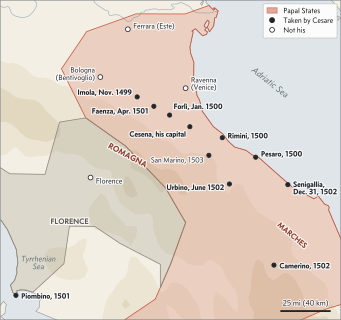
The prize was the Romagna (roh-mahn-yah), the plain between the Apennines and the Adriatic from Imola to Rimini, with the hill country of the Marches to its south. It belonged to the Papal States, the band of central Italy the popes ruled as kings (the Stage), but in practice its cities were held by little dynasties of lords who paid the pope when they felt like it. In 1499 Alexander declared them deposed, and Cesare, with French and Swiss troops and Italian hired captains, the condottieri (Chapter 2), conquered much of the RomagnaThis man conquered much of the Romagna. → Cesare Borgia• in four years (Figure 7.7). Imola opened its gates in November 1499. At Forlì (for-lee) its countess, Caterina Sforza, a duke of Milan’s daughter who ruled for her young son, held her fortress until January 12, 1500, and was taken prisoner still fighting, weapons in hand. Pesaro (pay-zah-roh) and Rimini fell in 1500. Faenza (fah-en-tsah) held out through the winter, until April 1501, and its young lord, Astorre Manfredi, was later found dead in the Tiber. In 1501 his father named Cesare duke of Romagna. In June 1502 he seized Urbino by a surprise march against a duke who thought him a friend, and Camerino soon after.
His own captains turned on him. In October 1502 several of them, including Vitellozzo (vee-tel-lot-soh) Vitelli and Oliverotto (oh-lee-veh-rot-toh) da Fermo, met in secret and rebelled, and for a few weeks Cesare’s state looked lost. He bargained, waited, and made peace with them. Then he invited them to meet him at Senigallia (seh-nee-gahl-yah), on the Adriatic, and on December 31, 1502, he seized them there and had Vitelli and Oliverotto strangled that night. Niccolò Machiavelli, the envoy of Florence, was at his side that winter, and he later held Cesare up as the model of a new prince, who won his state through his father’s fortune and tried by skill to keep it (Chapter 8). Leonardo da Vinci served him in the same months as his military engineer (Chapter 9).
Cesare’s state rested on his father, and his father died in August 1503, while Cesare lay ill himself. Giuliano della Rovere won his support in the conclave with promises of money and of backing in the Romagna, and as Julius II he broke them, demanding the fortresses of the Romagna. Cesare went to Naples, where in 1504 the Spanish general Gonzalo Fernández de Córdoba arrested him on the orders of Ferdinand of Aragon. He was shipped to Spain and imprisoned (Figure 7.1), first at Chinchilla (cheen-chee-yah) and then in the castle of La Mota at Medina del Campo. In 1506 he escaped to Navarre, whose king was his wife’s brother. On March 12, 1507, besieging the rebel-held castle of Viana (vee-ah-nah), he rode alone after a party of enemy knights into an ambush and was killed by a spear. He was thirty-one.
Lucrezia was born in 1480 and educated in Rome. She spoke Spanish, Valencian, Italian, and French and read Latin and Greek. At thirteen she was married to Giovanni Sforza, lord of Pesaro, of a lesser branch of the Sforzas of Milan. When the family no longer needed the Sforzas, her father had the marriage annulled in 1497 on the ground that husband and wife had never slept together, and Giovanni was made to sign a declaration that he was impotent. He took his revenge by accusing the pope of incest with his own daughter. No evidence was ever offered, but the story never died. In 1498 she married Alfonso of Aragon, duke of Bisceglie (bee-shel-yeh), an illegitimate son of the late King Alfonso II of Naples. On July 15, 1500, he was attacked by armed men on the steps of Saint Peter’s, and on August 18, while he lay recovering, he was strangled in his bed, most likely by Cesare’s henchman, Michelotto. Rome blamed Cesare, who had turned against Naples.

Her third marriage lasted. On December 30, 1501, she was married by proxy in the Vatican to Alfonso d’Este, son of Ercole I, duke of Ferrara, with a stand-in taking the absent groom’s place. On February 2, 1502, she entered Ferrara itself. The Este had ruled the city for centuries and had no wish for a Borgia bride, but the pope paid a huge dowry. When the old duke died in 1505 her husband became Alfonso I and she became duchess. She outlived the fall of her family. She governed Ferrara when Alfonso was at war, pawned her jewels to defend it against Julius II in 1510, and kept a court where the poet Ludovico Ariosto (ah-ree-os-toh) (Chapter 8) and the Venetian scholar Pietro Bembo (bem-boh) were welcome. The poet Lord Byron later called her letters to Bembo the prettiest love letters in the world. She died on June 24, 1519, after giving birth to her tenth child, and Ferrara mourned her.
After her death Lucrezia’s name came to stand for something else. Historians such as Guicciardini repeated the worst stories of her enemies, and in 1833 a play by the French writer Victor Hugo, Lucrèce Borgia (Vol. 15, The Age of Revolution), which the Italian composer Gaetano Donizetti set as an opera the same year (Vol. 16, Romantic Europe), made her a poisoner. In later legends she wore a hollow ringThis woman was accused in later legends of using a hollow poison ring to murder rivals. → Lucrezia Borgia•• filled with poison, which she emptied into the cups of rivals. No evidence for the ring has ever been found. Legend also gave the family a secret poison of its own, cantarella, a white powder, which left no trace in the writings of anyone who lived alongside them.
The most famous Italian poison was real, but it came a century after the Borgias. In 1633 a woman of Palermo, Teofania d’Adamo, was executed for poisoning with a clear, tasteless liquid later known as aqua tofana (ah-kwah toh-fah-nah). A poison of the same kind turned up in Rome, where in the 1650s a ring of women sold it in little bottles labeled as the healing “manna” of Saint Nicholas to wives who wanted to be widows; five of them were hanged in 1659. Recipes for it passed from book to book, and few can be trusted. A German book on poisonous plants, printed at Berlin in 1783, said it was made from the froth gathered around the mouth of a man tortured to death. Nicolas Garelli (gah-rel-lee), physician to the Habsburg emperor Charles VI in Vienna, had reported in a letter written not long before 1718 that its recipe was simply arsenic dissolved in water,Nicolas Garelli reported a supposed recipe for this practice that involved dissolving arsenic in water. → poisoning• with a harmless herb added for no clear reason. Most writers since have agreed that arsenic was the poison.
The French disease
Charles VIII’s army brought something else home from Naples. In the winter and spring of 1495, while the French held the city, a new disease broke out among the soldiers and the women who followed them. It began with sores, spread to a rash of pustules that could cover the body from head to knee, ate away flesh and bone, and killed many within months. This first great epidemic of syphilisAn early major European epidemic of this disease struck Charles VIII’s soldiers during the invasion of Naples. → syphilis• struck Charles VIII’s men at Naples, and when the king’s army broke up later that year, its mercenaries from France, Switzerland, Germany, and Spain carried it home. Within five years it had reached most of Europe. Each nation named it after its neighbors: to the Italians it was the “French disease,” to the French the “Neapolitan disease.”
Where it came from was argued at once. A Spanish doctor, Ruy Díaz de Isla, wrote in 1539 that Columbus’s sailors had brought it back from the island of Hispaniola in 1493 (Chapter 6), and many people believed him. Others answered that it had always been in Europe, unrecognized. The question is still debated, though most recent genetic studies point to the Americas. The Borgias knew it at first hand. A Valencian doctor in Alexander’s service, Gaspar Torrella, wrote one of the first books on the disease in 1497, and among his patients was Cesare Borgia.

The disease got its modern name from a poem. Girolamo Fracastoro (frah-kah-stoh-roh), born in Verona in the 1470s, was a physician who had studied and taught at Padua, and he was also a poet, an astronomer, and a friend of Pietro Bembo. In August 1530 he published at Verona Syphilis, or the French Disease, three books of Latin verse that describe the disease and its cures, among them mercury and the wood of the guaiacum tree, brought from the Americas. To explain how it began, he told a myth of his own, and in the poem Fracastoro named the disease for Syphilus,Girolamo Fracastoro named this disease for a shepherd punished by Apollo in his poem. → syphilis•• a shepherd whom the Sun god, Apollo, punished with it. Syphilus kept the flocks of a king. He defied the Sun, refused the god his worship, and built altars to his king instead. Apollo answered with a new sickness, and Syphilus was the first to suffer it. In 1546, in a prose book On Contagion, he suggested that diseases like it spread by tiny “seeds” passed from one person to another, by touch, by clothing, or through the air, an idea that pointed toward the germ theory of the nineteenth century.
What to remember
- The Borgias were a Spanish family from Xàtiva in the kingdom of Valencia who became Roman; their arms showed a grazing bull.
- Callixtus III (Alfonso de Borja, pope 1455–1458) preached a crusade after the fall of Constantinople and authorized the retrial that cleared Joan of Arc. Platina, writing about 1475, linked his prayers to the comet of 1456; later writers turned this into the legend that he excommunicated Halley’s Comet.
- Rodrigo Borgia, the pope’s nephew, was elected Alexander VI in 1492. His mistresses included Giulia Farnese and Vannozza dei Cattanei, the mother of Juan, Cesare, Lucrezia, and Jofre.
- Alexander joined the League of Venice in 1495 against Charles VIII of France in the First Italian War.
- Johann Burchard’s diary is the only source for the Banquet of the Chestnuts of October 31, 1501. Alexander died in August 1503, probably of malaria, and his enemy Giuliano della Rovere became Julius II.
- Cesare Borgia was the first man to resign as a cardinal (1498). Louis XII made him duke of Valentinois, and he conquered much of the Romagna from 1499 to 1503 before his fall and his death at Viana in 1507.
- Lucrezia Borgia married Giovanni Sforza, Alfonso of Aragon, and Alfonso I d’Este of Ferrara. The poison ring is a later legend, and the aqua tofana was a poison of the 1630s to 1650s.
- Syphilis first broke out as a great epidemic among Charles VIII’s soldiers at Naples in 1495. Fracastoro named it in his poem of 1530 after the shepherd Syphilus, punished by Apollo.
Chapter 8 · 37 clues
The Prince and the Paladins
On December 10, 1513, a man who had lost his job wrote a long letter to a friend in Rome. He was forty-four years old and lived on a small farm in the hills south of Florence. His days, he wrote, were spent selling firewood and quarreling with the woodcutters, reading Dante, Petrarch, or Ovid under the trees, and playing cards at the village inn with the innkeeper, a butcher, and a miller. But when evening came he went home to his study. At the door he took off his muddy work clothes and put on regal and courtly robes. Dressed for company, he entered the courts of the ancients, the great men of Greece and Rome, and asked them why they had done what they did, and they answered him. For four hours he felt no boredom, forgot his troubles, and no longer feared poverty or death. Out of these conversations, he told his friend, he had written a little book about principalities.
The writer was Niccolò Machiavelli, and the little book became The Prince. About 75 miles to the north, at the court of Ferrara, a courtier named Ludovico Ariosto was at work on a very long poem about a knight who goes mad for love. Both books were written in the same disaster. Since 1494 the armies of France, Spain, and the German emperor had been marching up and down Italy, sacking its cities and deposing its rulers. One writer answered with the coldest handbook on power ever written. The other answered with Charlemagne’s knights, the paladins, and with sorcerers, a flying horse, and a journey to the Moon.
Machiavelli
Niccolò Machiavelli was born in Florence on May 3, 1469, the first son of Bernardo Machiavelli, a lawyer with more books than money. Bernardo kept a household notebook that still survives, and it shows him earning a printed copy of the Roman historian Livy by making an index of its place names for the printer. The boy learned Latin from a schoolmaster and grew up under the Medici, the banking family whose head, Lorenzo the Magnificent, ruled Florence without holding any office (Chapter 1). He was a Florentine first, but in a land of quarreling cities Italy was his country,This country is home to Niccolò Machiavelli. → Italy•• long before it was one state, and the book that made him famous ends with a cry to free it.

In 1494 the French king Charles VIII marched through Italy to conquer Naples, and the Florentines took the chance to drive out the Medici. For four years the friar Savonarola ruled the city by his sermons, until he was hanged and burned in the main square on May 23, 1498 (Chapter 4). Less than a month later the republic chose Machiavelli, aged twenty-nine and almost unknown, to head its Second Chancery, the office of clerks who wrote the government’s letters about Florence’s own territory. Soon he was also secretary to the Ten of War, the committee of citizens that ran diplomacy and war. From 1502 the head of the republic was Piero Soderini (soh-deh-ree-nee), elected for life as gonfalonier, the republic’s chief magistrate (the word means “standard-bearer”), and Machiavelli became his most trusted servant.
The job made him a traveler. Florence was rich but weak, so it fought with envoys more often than with armies, and Machiavelli was sent to argue, listen, and report. In 1499 he bargained with Caterina Sforza, the fierce countess of Forlì. In 1500 he followed the court of Louis XII of France for months. There, he later wrote, the king’s chief minister, Georges d’Amboise, the Cardinal of Rouen, told him that Italians did not understand war, and he answered that the French did not understand politics. He also met the most frightening man in Italy. Cesare Borgia, the son of Pope Alexander VI, was carving a state for himself out of the Romagna, the small lordships of the northeastern Papal States (Chapter 7). From October 1502 to January 1503 Machiavelli stayed at Cesare’s court, first at Imola and then on the march, and wrote home almost every day.
He saw two of Cesare’s most famous deeds at close range (Figure 8.2). On the morning after Christmas 1502, Cesare’s own governor of the Romagna, Ramiro d’Orco (rah-mee-roh dor-koh), was found in the square at Cesena (cheh-zeh-nah), cut in two. A few days later Cesare’s captains, who had plotted against him and then made peace, came to meet him at the little port of Senigallia, which Machiavelli spelled Sinigaglia (see-nee-gahl-yah). On December 31, 1502, he arrested them as they arrived, and that night two of them, Vitellozzo Vitelli and Oliverotto da Fermo, were strangled. Machiavelli wrote an account of the trap that was later printed with his works. The next year Alexander VI died, Cesare fell gravely ill, and after a pope who reigned only twenty-six days the cardinals elected Julius II, his enemy. Machiavelli was in Rome for the election and watched the Borgia state come apart.

Machiavelli drew a lesson from the soldiers he watched. Florence hired its armies, and hired captains fought slowly and changed sides when it paid. He persuaded the republic to raise a militia, an army of its own citizens and peasants, and in February 1506 its first companies paraded through the main square. In June 1509 the militia helped to starve Pisa, which had broken away from Florence in 1494, into surrender. It was Machiavelli’s proudest day. Three years later it failed him. In August 1512 a Spanish army came to restore the Medici. It was sent by the Holy League, the alliance that Pope Julius II had formed to drive the French out of Italy, and on August 29 it stormed and sacked Prato, 10 miles from Florence. The militia ran. Soderini fled into exile, and the Medici returned (Chapter 13 will tell how often they came and went).
On November 7, 1512, Machiavelli was dismissed. In February 1513 two young men were caught plotting against the Medici, and his name was on a list in their papers. He was arrested and given the strappado: his hands were tied behind his back to a rope, and he was hoisted into the air and dropped. He confessed nothing, because he knew nothing. In March 1513 Cardinal Giovanni de’ Medici, a son of Lorenzo the Magnificent, was elected pope as Leo X (Chapter 11), and in the celebrations the prisoners were set free. Machiavelli went home to his farm at Sant’Andrea in Percussina, about 7 miles south of Florence, and began to write.
He lived fourteen more years, and he never stopped trying to get back into government. He wrote comedies, a book called The Art of War (printed in 1521), and, at the request of Cardinal Giulio de’ Medici, the future Pope Clement VII, the Florentine Histories. In May 1527 the news that the mutinous army of the emperor Charles V had sacked Rome (Chapter 13) brought down the Medici once more. The restored republic remembered that Machiavelli had lately worked for the Medici and gave him nothing. He died on June 21, 1527, and was buried in the church of Santa Croce. In the 1780s a monument was set up over his grave with the Latin words Tanto nomini nullum par elogium, “No praise is equal to so great a name.”
The Prince
Machiavelli wrote The PrinceThis author wrote The Prince. → Niccolò Machiavelli••• in the second half of 1513, the months of the letter to his friend in Rome, Francesco Vettori (vet-toh-ree), who was Florence’s ambassador to the pope. He wrote it to get a job. A prince, in his Italian, meant any man who ruled a state alone, whatever his title: a duke, a king, a pope, or a successful adventurer. He called the book De principatibus, “On Principalities,” and planned to give it to a Medici. His first choice was Giuliano de’ Medici, a son of Lorenzo the Magnificent, but Giuliano died in March 1516.

In the end the book was dedicated to Lorenzo di Piero de’ Medici,This book is dedicated to Lorenzo de Medici. → The Prince••• Giuliano’s nephew. Lorenzo was the son of Piero, who had been driven out of Florence in 1494, and the grandson of Lorenzo the Magnificent. Born in 1492, he ruled Florence for his uncle Leo X, who in 1516 gave him the duchy of Urbino. He died in 1519, aged twenty-six, leaving a baby daughter, Catherine de’ Medici, who would become queen of France. In the dedication Machiavelli explains why a man of low rank may advise a ruler. A painter of landscapes, he says, goes down into the plain to see the mountains and climbs the mountains to see the plain. In W. K. Marriott’s translation of 1908, “even so to understand the nature of the people it needs to be a prince, and to understand that of princes it needs to be of the people.”

The book circulated in handwritten copies for nineteen years. It was first printed in 1532, five years after Machiavelli’s death, in Rome by Antonio Blado and in Florence by the Giunta press, under the title Il Principe, “The Prince.” Its twenty-six chapters are short, and they march in order (Table 8.1). Chapters 1 to 11 sort principalities into kinds and say how each is won and held. Chapters 12 to 14 are about armies. Chapters 15 to 23 are about how a prince should behave, and the last three are about Italy.
| Chapter | ||
|---|---|---|
| 1 | How many kinds of principalities there are | |
| 2 | Hereditary principalities | |
| 3 | Mixed principalities | |
| 4 | Why Darius’s kingdom did not rebel after Alexander | |
| 5 | Cities that lived under their own laws | |
| 6 | Principalities won by one’s own arms and ability | ★ |
| 7 | New principalities won by the arms of others or by good fortune | ★ |
| 8 | Principalities won by wickedness | ★ |
| 9 | The civil principality | |
| 10 | How the strength of principalities is measured | |
| 11 | Ecclesiastical principalities | |
| 12 | Kinds of soldiery, and mercenaries | ★ |
| 13 | Auxiliaries, mixed soldiery, and one’s own | ★ |
| 14 | A prince and the art of war | |
| 15 | What princes are praised or blamed for | ★ |
| 16 | Liberality and meanness | |
| 17 | Cruelty and clemency; whether it is better to be loved or feared | ★ |
| 18 | How princes should keep faith | ★ |
| 19 | Avoiding contempt and hatred | |
| 20 | Fortresses | |
| 21 | How a prince should gain renown | |
| 22 | The secretaries of princes | |
| 23 | How flatterers should be avoided | ★ |
| 24 | Why the princes of Italy have lost their states | |
| 25 | What fortune can do, and how to withstand her | ★ |
| 26 | An exhortation to liberate Italy from the barbarians | ★ |
Virtù and fortune
One word runs through the whole book: virtù (veer-too). It comes from the Latin virtus, the courage of a man (vir), and it does not mean “virtue” in the Christian sense of goodness. For Machiavelli, virtù is the ability of a ruler to act boldly and well: energy, skill, foresight, and nerve. Marriott usually translates it as “ability.” Its opposite is fortune, fortuna, the luck and chance that a man does not control. The prince must have virtù,This book requires the title figure to embody virtù. → The Prince• because fortune can give him a state but cannot keep it for him.
Chapter 6 gives the greatest examples, taken from the Bible and the ancient writers: Moses, who in the Book of Exodus leads Israel out of Egypt; Cyrus, who founded the Persian empire; and Romulus and Theseus (thee-see-us), who in legend founded Rome and united Athens. Fortune, Machiavelli says, gave these founders nothing “beyond opportunity,” the material their ability shaped. They also had weapons. Persuading people is easy, Machiavelli says, but keeping them persuaded is hard, and so armed prophets win and unarmed ones are destroyed. His example of the unarmed prophet was Savonarola, whom he had heard preach in Florence (Chapter 4).
Cesare Borgia and Agathocles
Chapter 7 turns to the princes who rise by fortune, by “the arms of others.” Its hero is the man Machiavelli had watched at Imola. Cesare Borgia got his state through his father, Pope Alexander VI, and with the help of French troops: by fortune, not by his own arms. But once he had it, he did everything a wise man could do to make it last. Machiavelli praised Cesare BorgiaMachiavelli praised this son of Pope Alexander VI in The Prince. → Cesare Borgia••This book praises Cesare Borgia as a ruler who conquered by fortune. → The Prince••• as the model for any prince who has won a state by fortune, and said he knew no better lessons to give a new ruler “than the example of his actions.”
The chapter tells how Cesare tamed the Romagna. It was full of robbery and feuds, so he sent a hard man, Ramiro d’Orco, to restore order, and Ramiro did it quickly and cruelly. Then Cesare decided that the hatred Ramiro had earned should not fall on himself. One morning Ramiro was “left on the piazza at Cesena with the block and a bloody knife at his side,” and “the barbarity of this spectacle caused the people to be at once satisfied and dismayed.” Only bad luck beat Cesare, Machiavelli thought, and one mistake: he let his old enemy Cardinal Giuliano della Rovere become pope as Julius II. On the day of that election, Cesare told Machiavelli that he had planned for everything that could happen at his father’s death, except that he himself would then be close to dying.
Chapter 8 is about men who rise by crime. Its ancient example is Agathocles (uh-gath-uh-kleez), a potter’s son who made himself ruler of Syracuse in Sicily about 317 BC and later took the title of king (Vol. 6, The Greeks). He called the senate and the people of Syracuse together as if to discuss public business, and at a signal his soldiers killed all the senators and the richest citizens. Machiavelli admits his courage and his skill as a general. But Agathocles won power, not glory:This book uses Agathocles to distinguish gaining power through cruelty from winning glory. → The Prince• to kill fellow citizens, betray friends, and live “without faith, without mercy, without religion” are “methods” that “may gain empire, but not glory.” The modern example is Oliverotto da Fermo, who murdered his uncle at a banquet to seize his town, and was strangled at Senigallia a year later.
Arms
Chapters 12 and 13 are the book’s most personal pages, because they argue Machiavelli’s own policy. A prince’s state rests on good laws and good arms, he says, and there can be no good laws without good arms. Italy’s princes had hired their armies from condottieri (the Stage), the captains who sold their companies to whoever paid. Machiavelli warns against two kinds of soldiers a prince does not own: mercenaries, who fight for pay, and auxiliaries, a powerful neighbor’s army lent for a war. Mercenaries and auxiliaries are worthless and dangerous,This book denounces mercenaries and auxiliary soldiers as useless and dangerous. → The Prince•• he wrote, “disunited, ambitious and without discipline, unfaithful, valiant before friends, cowardly before enemies.” In peace they rob their employer, and in war they run. That was why, in a joke told of Pope Alexander VI, the French had taken Italy “with chalk in hand,” the chalk their quartermasters used to mark the houses where soldiers would sleep. Auxiliaries are worse: if they lose, you are ruined, and if they win, you are their prisoner. Machiavelli reached for the Bible, which tells how young David, going out to fight Goliath, refused King Saul’s armor and fought with his own sling (Vol. 5, In the Beginning).
How a prince should behave
Chapter 15 is where the book turns everything upside down. For centuries writers had given rulers “mirrors for princes,” books that showed them the good king they ought to be (Vol. 9, Cathedrals and Crusades). Machiavelli wrote that he would rather “follow up the real truth of a matter than the imagination of it,” for “many have pictured republics and principalities which in fact have never been known or seen.” How men live is so far from how they ought to live that a ruler who always does what he ought will be ruined among so many who are not good. A prince must learn how not to be good, and use that knowledge or not as necessity commands.
It is safer to be feared than loved,This book states that it is safer to be feared than loved if one cannot be both. → The Prince••• chapter 17 says, if a prince cannot be both. “One should wish to be both,” Machiavelli begins, but men are “ungrateful, fickle, false,” and they break the bonds of love whenever it serves them, while fear of punishment never fails. Being feared is not the same as being hated, though. A prince avoids hatred if he keeps his hands off his subjects’ property and their women, “because men more quickly forget the death of their father than the loss of their patrimony.”
Chapter 18 asks whether a prince must keep his word. There are two ways of fighting, Machiavelli says, by law, which is proper to men, and by force, which is proper to beasts. The first is often not enough, so a ruler must know how to use both. The ancient writers taught this in a fable. They told how Achilles and other princes of old were sent to be raised by Chiron (ky-ron), the wise centaur who taught heroes on Mount Pelion (Vol. 4, Classical Myth). Since Achilles had a teacher half man, half beast,This book recalls how Achilles was raised by Chiron so that he understood the nature of both man and beasts. → The Prince•• Machiavelli explains, a prince must “know how to make use of both natures.”
Of the beasts, a prince should choose two. “The lion cannot defend himself against snares and the fox cannot defend himself against wolves. Therefore, it is necessary to be a fox to discover the snares and a lion to terrify the wolves.” The prince must be lion and fox,This book advises rulers to emulate both the lion and the fox. → The Prince••• strong enough to frighten his enemies and cunning enough to see their traps. A wise ruler therefore does not keep his word when keeping it would harm him, and he must be “a great pretender and dissembler,” because men are so simple that a deceiver always finds someone willing to be deceived.
Chapter 23 warns against another danger. Courts are full of flatterers, because men are so pleased with their own affairs that they love to hear them praised, and a prince who lets everyone speak freely loses respect. The prince must guard against flatterers,This political treatise by Niccolò Machiavelli warns rulers against flatterers. → The Prince••• Machiavelli says, by choosing a few wise men and giving them alone “the liberty of speaking the truth to him,” and only about what he asks. Then he must decide for himself. A prince who is not wise himself, he adds, can never be well advised.
Fortune and Italy
Chapter 25 returns to fortune. Machiavelli admits that he has sometimes been tempted to think the world is ruled by fortune and God, so that there is no use in trying. But he concludes that fortune is “the arbiter of one half of our actions,” and leaves the other half to us. He compares fortune to a flooding river,This book compares Fortune to a flooding river. → The Prince•• “one of those raging rivers, which when in flood overflows the plains, sweeping away trees and buildings.” No one can stop the flood once it comes. But in fair weather men can build dikes and channels, so that the next flood runs safely or does less harm. Italy, he adds, is “an open country without barriers and without any defence.”
At the end of the chapter he changes the image, in a passage that has shocked readers ever since. The times change, and a man rarely changes with them, so the cautious man succeeds in cautious times and fails when the times call for boldness. Machiavelli thought it better to be bold. Fortune is a woman,This book personifies Fortune as a woman who must be beaten and subdued. → The Prince••• he wrote, and whoever wants to master her must beat and subdue her; she lets herself be won by the young and daring rather than by the cold and careful. His example was Julius II, the warrior pope, who did everything impetuously and was lucky because his times needed it.
The last chapter is not advice at all. It is a call to arms. Italy, he writes, is “without head, without order, beaten, despoiled, torn, overrun,” and waits for someone to heal her wounds. The house of Medici, which now held both Florence and the papacy, could lead her. “To all of us this barbarous dominion stinks,” he says of the French and Spanish armies. The book ends with an exhortationThis work ends with an exhortation to free Italy from foreign rule. → The Prince• to free Italy from the foreigners, and Machiavelli closes it with four lines from “Italia mia,” “My Italy,” a poem by the fourteenth-century poet Petrarch (Vol. 9, Cathedrals and Crusades).
The book’s afterlife
No Medici ever answered the call, and the book soon had a dark name. In 1559 the Church placed all of Machiavelli’s works on its Index of Forbidden Books. In England the “Machiavel” became a stage villain who boasts of his own wickedness, and the playwright Christopher Marlowe gave one the prologue of The Jew of Malta (Vol. 11, The Age of Shakespeare). Others defended him. The Genevan philosopher Jean-Jacques Rousseau (roo-soh) wrote in The Social Contract (1762) that Machiavelli “professed to teach kings; but it was the people he really taught,” in G. D. H. Cole’s translation of 1913.
Two twentieth-century readers stand at opposite ends. Antonio Gramsci (grahm-shee), a founder of the Communist Party of Italy, was jailed by Mussolini’s government from 1926 until shortly before his death in 1937, and in prison he filled notebooks with reflections on politics (Vol. 22, The Lost Peace). In them he asked who could play Machiavelli’s new prince in the modern world. No single man could, he argued. The modern prince is the revolutionary party,Antonio Gramsci equated a "Modern" form of this book's central figure with revolutionary parties. → The Prince•• an organization that would unite the masses and found a new kind of state. Leo Strauss, a German Jewish philosopher who left Germany in 1932, the year before the Nazis took power, and later taught at the University of Chicago, read Machiavelli as a deliberate and brilliant destroyer of the old morality. In Leo Strauss’s Thoughts on MachiavelliLeo Strauss wrote Thoughts on this philosopher. → Niccolò Machiavelli• (1958) he declared himself inclined to the old-fashioned view that Machiavelli was “a teacher of evil,” and then spent a whole book showing how carefully that teacher had written.
The Discourses on Livy
Machiavelli wrote a second and much longer book about politics, and it is about republics. Livy, the Roman historian of Augustus’s day, had told the story of Rome from its founding in 142 books called Ab Urbe Condita (ahb oor-beh kon-dih-tah), “From the Founding of the City” (Vol. 7, The Romans). Only thirty-five of them survive. Readers divided them into decades, groups of ten, and the first decade runs from Rome’s beginnings to 293 BC. Machiavelli’s Discourses on the First Decade of Titus Livy, written between about 1513 and 1519, comments on Livy’s first ten books.This work comments on the first ten books of Ab Urbe Condita. → Discourses on Livy•• Each chapter takes an episode or a saying from them and draws a lesson for the present.
He wrote it for friends. In these years he joined the young men who met to talk about history and politics in the Orti Oricellari (or-tee oh-ree-chel-lah-ree), the gardens of the Rucellai family in Florence, and he dedicated the book to two of them, Zanobi Buondelmonti (bwon-del-mon-tee) and Cosimo Rucellai. A writer usually dedicates his book to a prince, he told them, but he chose men who deserved to be princes. It was printed in 1531, a year before The Prince.
The Rome he admired was the free Rome of the republic. In the Discourses Machiavelli defended republics against princes.This thinker defended republican government in Discourses on Livy. → Niccolò Machiavelli••• A people that lives under good laws, he argued, is wiser and steadier than a prince, and a republic lasts longer because it has many citizens of different temper, and can choose a bold one for bold times and a careful one for careful times. He even praised the quarrels between Rome’s commoners and its senate, which most writers deplored, because those “tumults” produced the laws that kept Rome free. The two books do not contradict each other as much as they seem to. The Prince is about how one man founds or seizes a state; the Discourses are about how a free people keeps one.
Religion, in the Discourses, is a tool of government. In Livy’s story, Romulus had founded Rome by arms. Numa Pompilius (noo-mah pom-pil-ee-us), the second king, found a fierce people and wanted to tame them with the arts of peace, so he turned to religion, telling the Romans that the nymph Egeria advised him at night (Vol. 7, The Romans). Numa strengthened his rule through religion,This work argues that Numa Pompilius strengthened his rule through religion. → Discourses on Livy• Machiavelli wrote, and Rome owed him more than it owed Romulus, because a people that fears the gods keeps its oaths and obeys its laws. The Church of his own day, he added, had done the opposite: by its bad example it had made Italians irreligious, and by holding a state of its own in the middle of the peninsula it had kept Italy divided.
The Mandrake
The same man wrote the best Italian comedy of his century. La Mandragola (mahn-drah-goh-lah), The Mandrake, was probably written about 1518, and in Machiavelli’s lifetime it was performed with great success as far away as Venice. Its title is a plant. The mandrake has a thick forked root that people thought looked like a little man, and for centuries it was believed to help women conceive children.
The play takes place in Florence in a single day. Callimaco (kahl-lee-mah-koh), a young Florentine who has lived for years in Paris, has fallen in love with the reputation of Lucrezia, the beautiful and virtuous wife of Messer Nicia (nee-chah), a rich old lawyer who is as foolish as he is proud. (She is no relation to Lucrezia Borgia.) Nicia wants a son more than anything. With the help of Ligurio (lee-goo-ree-oh), a clever hanger-on, Callimaco disguises himself as a doctor from Paris. He tells Nicia that a potion of mandrake will make Lucrezia fertile, but warns that the first man to sleep with her afterward will die. They must therefore seize some stranger off the street. In this way Callimaco tricks his way into Lucrezia’s bed,In this author's play The Mandrake, Callimaco uses an extract of the title plant to trick Lucrezia into sleeping with him. → Niccolò Machiavelli• since the “stranger” they capture is Callimaco himself in disguise.
Lucrezia refuses at first. Her mother persuades her, and so does Friar Timoteo, a priest whom Ligurio has bribed and who explains that a sin committed for a good end is no sin. In the morning she has learned the truth and decides to keep Callimaco as her lover, and Nicia, delighted, gives him a key to the house. Everyone gets what he wants by fraud, and the man of the Church is the easiest of all to buy. The comedy is The Prince played for laughs.
Boiardo and Ariosto
The new comedy of Italy was born at Ferrara, on the plain south of the Po River, where the Este family ruled as dukes. Ariosto’s first play was acted there in 1508. The Este court loved theater, music, and above all the old stories of knights. French poets sang of Charlemagne and his twelve peers, the paladins (Vol. 9, Cathedrals and Crusades), and their poems had spread across Europe. In Italy Roland became Orlando, and Renaud de Montauban, the hero of another French poem, became Rinaldo. Street singers chanted their deeds in the town squares, and court poets turned them into long poems for lords and ladies (Figure 8.5).

Matteo Maria Boiardo (boy-ar-doh) (1440–1494) was a nobleman of the Este court, Count of Scandiano (skahn-dyah-noh), and later governor of Reggio for Ercole I d’Este, Duke of Ferrara. His poem took the stern hero of Roncevaux (ron-suh-voh) and made the joke of its title. Boiardo’s Orlando Innamorato (een-nah-moh-rah-toh), “Orlando in Love,” whose first two books were printed in 1483, begins at a tournament at Charlemagne’s court in Paris. Into the hall walks Angelica, the daughter of the king of Cathay, as Europeans then called China, and every knight at the feast falls in love with her, Orlando first of all.
The poem follows her across the world, with its knights behind her. In the Ardennes forest there are two magic fountains, and whoever drinks from one falls in love, while whoever drinks from the other turns to hate. Rinaldo drinks hate and Angelica drinks love, and later they drink again and the other way round, so that she is always running from someone. Orlando and Rinaldo duel for AngelicaThis character duels Rinaldo for Angelica. → Roland (or Orlando)• more than once. At last Charlemagne parts them and hands Angelica to his old counselor, Duke Namo of Bavaria, to keep, as a prize for whichever of them fights best against Agramante (ah-grah-mahn-teh), the Muslim king of Africa, who has invaded France. The poem broke off in 1494. In its last stanza the poet says he cannot go on singing, because he sees all Italy in flames: the French had come. Boiardo died that December.

Ludovico Ariosto took up the story. He was born at Reggio on September 8, 1474, the eldest of ten children of the commander of its citadel. His father made him study law, and he escaped into Latin poetry. From 1503 he served Cardinal Ippolito (ip-pol-ee-toh) d’Este, and later the cardinal’s brother, Duke Alfonso I, the husband of Lucrezia Borgia (Chapter 7). He rode as the duke’s envoy to Pope Julius II, and from 1522 to 1525 governed the Garfagnana (gar-fahn-yah-nah), a wild mountain district full of bandits. He hated it, and longed to be home writing.
Ariosto’s poem began as a sequel to Boiardo’s Orlando Innamorato.This epic is a sequel to Matteo Boiardo’s Orlando Innamorato. → Orlando Furioso••This author wrote Orlando Innamorato. → Matteo Boiardo•This character is called "Innamorato" in a romance by Matteo Boiardo. → Roland (or Orlando)•• He picked up Boiardo’s unfinished stories where they had broken off in 1494, with Orlando still in love, Angelica still running, and Agramante’s army still in France, and he carried every one of them to its end. In 1516 Ferrara saw the first edition of Ariosto’s Orlando FuriosoThis epic poem was written by Ludovico Ariosto. → Orlando Furioso•This author wrote Orlando Furioso. → Ludovico Ariosto•This character’s fury titles a poem by Ludovico Ariosto. → Roland (or Orlando)••• (foo-ree-oh-zoh), “Orlando Mad,” a title taken from its hero’s fury. It had forty cantos, a canto being one of the books into which a long Italian poem is divided. He kept revising it, and the final version of 1532, with forty-six cantos and nearly 39,000 lines, came out the year before he died. A story told after his death says that when he presented it to Cardinal Ippolito, the cardinal’s only thanks was to ask where he had found so much nonsense.
Like Boiardo’s, the poem is written in ottava rima (oh-tah-vah ree-mah), “eighth rhyme,” a stanza of eight lines of eleven syllables rhyming abababcc. The six alternating lines carry the story forward, and the closing couplet snaps it shut, often with a joke. Ariosto plays with his readers. He breaks off a story at its most exciting moment and starts another, comments on his characters, and smiles at the old ideals of chivalry while he tells their adventures with perfect seriousness.
Orlando Furioso
The Furioso has dozens of stories, but three threads hold it together (Figure 8.7). Agramante is besieging Charlemagne in Paris. Angelica escapes from Duke Namo and flees, with half the knights of Europe after her. And two lovers on opposite sides of the war, the Muslim knight Ruggiero (rood-jair-oh) and the Christian warrior maiden Bradamante (brah-dah-mahn-teh), Rinaldo’s sister, keep losing each other. Early in the poem Bradamante visits the tomb of Merlin, King Arthur’s wizard, where the sorceress Melissa shows her the long line of heroes who will descend from her and Ruggiero: the house of Este. The whole poem is, among other things, a compliment to Ariosto’s employers.

The most famous creature of the poem first belongs to the wizard Atlante, Ruggiero’s foster father, who wants to keep him from the war. It is a hippogriff (hip-oh-grif), half griffin and half horse. In Rose’s translation (1823–1831), Ariosto insists that it was “no empty fiction wrought by magic lore, / But natural was the steed”: “for him a filly to a griffin bore.” It has the wings, beak, and forelegs of its father, an eagle-headed lion, and the body of its mother, a mare. When Ruggiero mounts it, the hippogriff flies off with him, out over the sea, to the island of the sorceress Alcina (ahl-chee-nah).
There Ruggiero meets a myrtle bush that speaks. It is Astolfo (ah-stol-foh), an English duke and Orlando’s cousin, whom Alcina loved for a while and then, tired of him, turned into a tree. Ruggiero is warned, but Alcina seems the most beautiful woman he has ever seen, and Alcina bewitches the Muslim knight Ruggiero.In this poem, the Muslim knight Ruggiero is bewitched by Alcina. → Orlando Furioso•• He forgets Bradamante and lives in idle luxury, until the good sorceress Melissa arrives with a magic ring that shows things as they really are. Wearing it, Ruggiero sees that Alcina is a toothless old hag. He escapes to her good sister, Logistilla (loh-jee-stil-lah), whose name means reason, and Astolfo is changed back into a man.

Orlando, meanwhile, has left his post in Paris to search for Angelica. On the way he helps Olimpia, the countess of Holland. Her father and brothers have been killed by Cymosco (chee-mos-koh), king of Frisia, with a weapon no knight had ever seen: “a hollow iron, two yards long,” loaded with powder and a ball and fired by touching a flame to a vent. Orlando kills Cymosco and takes the gun. He sails out into the deepest sea, out of sight of every shore, and there Orlando throws Cymosco’s gun into the sea,This character defeats Cymosco and throws his cannon into the sea as a coward’s weapon. → Roland (or Orlando)• cursing it as a weapon that lets a coward kill a brave man. “O loathed, O cursed piece of enginery,” he cries in Rose’s version. “To hell, from whence thou came, I render thee.” The joke had an edge at Ferrara. Ariosto’s own master, Duke Alfonso, was the most famous gunner in Italy, and his cannon had won the Battle of Ravenna in 1512.
Angelica, the proud princess who had refused every king and paladin, now finds a young soldier named Medoro (meh-doh-roh) lying wounded on a battlefield. He is a poor foot soldier from Agramante’s army, hurt while trying to bury his dead lord. She heals him with herbs, falls in love with him, and marries him in a shepherd’s cottage. Before they leave for Cathay, the lovers carve their names together on the trees and on the walls of a cave.
Orlando finds the names. He tells himself that “Medoro” must be his own nickname, and reads the carved words again and again. That night, in the shepherd’s house, his host tells him the whole story and shows him the jeweled bracelet that Angelica left as a gift. Orlando goes mad when he learnsThis character goes mad after learning that Angelica has chosen Medoro. → Roland (or Orlando)••• that Angelica has chosen Medoro. For three days he neither eats nor sleeps. On the fourth he tears off his armor and his clothes, and with his bare hands he pulls up pine trees and oaks, in Rose’s words “a tall pine uprooted at a pull.” He runs wild across France and Spain, killing shepherds and animals, and swims to Africa.
His cure comes from the sky. Astolfo, freed from the myrtle, has been given a horn whose blast puts every enemy to flight. Later, when he breaks the spell of Atlante’s enchanted palace, Astolfo takes the hippogriff for his own,This character rides a hippogriff. → Astolfo•• bridles it as he had seen Logistilla do, and flies around the world. In Ethiopia he finds a Christian king tormented by harpies, the winged monsters of Greek myth that snatch away food, and drives them down into the mouth of hell with his horn. Then he flies up to the top of a mountain that touches the sky, the Earthly Paradise, the Garden of Eden where Genesis says Adam and Eve had lived. Saint John the Evangelist, whom Christian tradition holds to be the author of the fourth Gospel and of Revelation, welcomes him there. He explains that God has taken Orlando’s wits and kept them on the Moon, to punish him for leaving the Christian army, when it most needed him, for love of Angelica.

That night the two of them climb into a chariot of fire, drawn by four horses “redder far / Than flame.” It is the chariot of fire that, in the Books of Kings, came for the prophet Elijah (ih-ly-juh) before a whirlwind carried him up to heaven (Vol. 5, In the Beginning), and in Elijah’s chariot Astolfo rides to the MoonThis character travels in Elijah’s chariot to the Moon to recover Orlando’s lost wits. → Astolfo••• to find Orlando’s lost wits (Figure 8.9). There he finds a land with rivers, lakes, cities, and castles, and in one long valley Saint John shows him a strange storehouse.
Everything lost on Earth is on the Moon.In this poem, the Moon contains everything that is lost on Earth. → Orlando Furioso• There lie the fame that time destroys, the prayers and vows that sinners made to God, lovers’ tears and sighs, time wasted in play, and empty plans that never came to anything. The crowns of the old Assyrian kings lie there in a heap of swollen bladders. Men’s lost wits are kept in sealed flasks of a thin liquid, each labeled with its owner’s name, and Astolfo is surprised to see how many belong to people who seemed perfectly sane. He finds a flask of his own and sniffs it, and his sense returns to its place. The largest flask of all says “Orlando’s wit.”
Back on earth, Astolfo and his friends trap the naked madman, bind him, and hold the flask to his nose. Orlando breathes in his wits and wakes as himself, and his love for Angelica is gone with his madness. He returns to the war, and on an island off Africa he kills Agramante. The poem ends with the other lovers. Ruggiero is shipwrecked, swims ashore, and is baptized by a hermit. He marries Bradamante, and at the wedding feast the fierce Muslim king Rodomonte rides in to call him a traitor. They fight, Ruggiero kills him, and the last line of the poem sends Rodomonte’s proud soul down to hell.
Sannazaro, Muzio, and Tasso
The Italian courts produced other kinds of books that the rest of Europe copied for a century. The first came from Naples, the kingdom in the south that the Aragonese kings had ruled since 1442. Jacopo Sannazaro (sahn-nahd-dzah-roh) (1458–1530) was a Neapolitan courtier and poet, and when the French and Spanish overthrew the last Aragonese king, Frederick, in 1501, Sannazaro followed him into exile in France until the king died in 1504. That year his Arcadia, written in the 1480s and passed around in handwritten copies, was printed at Naples in an edition the poet approved.

Arcadia is a real region, the mountain country in the middle of the Peloponnese in Greece, home of the shepherd god Pan (Vol. 4, Classical Myth). The Roman poet Virgil had made it the imaginary homeland of singing shepherds, the setting of the pastoral, a poem or story about shepherds in an ideal countryside, where life is simple and the only troubles are love and death. Sannazaro’s pastoral ArcadiaA pastoral work titled for this place was written by Jacopo Sannazaro. → Arcadia•• fixed that land’s place in European literature. The book alternates prose and verse, twelve chapters of prose and twelve songs called eclogues. Its narrator, Sincero, unhappy in love, leaves Naples for Arcadia and lives among the shepherds, hearing their songs, games, and laments, until a bad dream sends him home through a passage under the earth. Spanish, Portuguese, and English writers imitated it, among them the English poet and courtier Sir Philip Sidney in his own Arcadia.
The courts also had rules for fighting. Baldassare Castiglione’s Book of the Courtier (1528), the guide to the manners of the Italian courts (the Stage), made arms the first profession of a gentleman, and a gentleman’s honor was the thing he had to defend at any cost. In the Middle Ages a judicial duel, or trial by combat, had been a way of deciding a lawsuit, on the belief that God would give victory to the side that was right (Vol. 9, Cathedrals and Crusades). The Renaissance duel of honor was a combat between two gentlemen over an insult, fought by agreement on a field that a prince granted.
Girolamo Muzio’s treatise on the duelProper behavior during these events was explained in a treatise by Girolamo Muzio. → duels• set out the rules. Muzio (1496–1576), a courtier from Padua who served the emperor’s governors of Milan, published Il duello, “The Duel,” at Venice in 1550. It explains which insults demand a fight, how a written challenge is sent and answered, which side chooses the weapons, how the field is granted, and when honor has been satisfied. Much of it turns on the “lie,” the moment one gentleman calls another a liar, which decided who must issue the challenge. The Church condemned the custom. Its bishops had been meeting, on and off, in a council at Trent since 1545 (Chapter 14), and in 1563 they decreed that duelists, their seconds, and the princes who granted them a field were to be excommunicated. A man killed in a duel was to be denied burial in consecrated ground.

The greatest poem of the late Renaissance came from Ferrara again. Torquato Tasso (tor-kwah-toh tahs-soh) was born at Sorrento, on the bay of Naples, on March 11, 1544, the son of a court poet, Bernardo Tasso. In 1565 he entered the service of the Este, and by 1575 he had finished his epic. It was printed in 1581 as Gerusalemme liberata (jeh-roo-zah-lem-meh lee-beh-rah-tah), Jerusalem Delivered.
Tasso chose a war that had really happened. Jerusalem Delivered is set in the First Crusade,This war is the setting of Torquato Tasso's epic Jerusalem Delivered. → First Crusade• the expedition that Pope Urban II had called for in 1095 and that took Jerusalem on July 15, 1099 (Vol. 9, Cathedrals and Crusades). The poem opens in the sixth year of the crusade, when God sends the angel Gabriel to choose Godfrey of Bouillon (boo-yawn) as its leader, and it ends with the city taken and Godfrey praying at the tomb of Jesus. Around the siege Tasso wove love stories like Ariosto’s. The Christian knight Tancred loves Clorinda (kloh-rin-dah), a Muslim woman who fights in armor. In a night battle he fights a knight he does not recognize, wounds her mortally, and, when he lifts her helmet, baptizes her as she dies. The young crusader Rinaldo, who only shares his name with Charlemagne’s paladin, is kept from the war by the enchantress Armida (ar-mee-dah) in her magic garden, until two knights bring him back. The composer Claudio Monteverdi (mon-teh-vair-dee) would set Tancred’s duel with Clorinda to music in 1624 (Chapter 21).
The poem made Tasso famous and did not make him happy. He was anxious that its love stories and marvels might offend the Church, and he submitted it to critics and rewrote it endlessly. His fears grew into something worse. In March 1579, after a violent outburst at the wedding celebrations of Duke Alfonso II d’Este, the grandson of Ariosto’s master, the duke had him confined in the hospital of Sant’Anna in Ferrara as a madman. He stayed there for seven years. Freed in 1586, he wandered from city to city. In 1594 a nephew of Pope Clement VIII invited him to Rome to be crowned with laurel on the Capitoline Hill, as Petrarch had been. He died at the monastery of Sant’Onofrio on April 25, 1595, a few days before the ceremony.
What to remember
- Niccolò Machiavelli (1469–1527) served the Florentine republic as head of the Second Chancery from 1498 to 1512, watched Cesare Borgia at work in 1502, and was dismissed, tortured, and retired to his farm when the Medici returned.
- The Prince (written 1513, printed 1532) is dedicated to Lorenzo di Piero de’ Medici, Duke of Urbino. It praises Cesare Borgia, denies Agathocles glory, damns mercenaries, prefers fear to love, and asks a prince to be lion and fox.
- Its key words are virtù, a ruler’s bold ability, and fortune, which Machiavelli compared to a flooding river and to a woman. It ends by calling for Italy’s liberation, with lines from Petrarch.
- Gramsci made the modern prince a revolutionary party; Leo Strauss wrote Thoughts on Machiavelli (1958).
- The Discourses on Livy comment on the first ten books of Livy’s Ab Urbe Condita, defend republics, and praise Numa for ruling through religion. The Mandrake is Machiavelli’s comedy of a trick played with a mandrake potion.
- Boiardo’s Orlando Innamorato (1483) made Orlando fall in love with Angelica and fight Rinaldo for her. Ariosto’s Orlando Furioso (1516, final version 1532), its sequel in ottava rima, makes him mad when she marries Medoro.
- In the Furioso, Alcina bewitches Ruggiero, Orlando throws Cymosco’s gun into the sea, and Astolfo rides the hippogriff and Elijah’s chariot to the Moon, where everything lost on Earth is kept, to bring back Orlando’s wits.
- Sannazaro’s Arcadia (1504) set the pattern for the Renaissance pastoral, Muzio’s Il duello (1550) codified the duel of honor, and Tasso’s Jerusalem Delivered (1581) set an epic in the First Crusade.
The High Renaissance, 1470-1530
Chapter 9 · 63 clues
Leonardo
Some time around 1482, a Florentine of about thirty drafted a letter to the ruler of Milan. He did not ask to be hired as a painter, at least not at first. He offered bridges that were “extremely light and strong,” mortars that could “fling small stones almost resembling a storm,” and “covered chariots, safe and unattackable.” He knew how to drain the water from a besieged town’s ditches and how to dig secret tunnels under rivers. Only after nine numbered paragraphs on war did he turn to peace, to buildings and canals. Then, almost as an afterthought, he came to art: “I can carry out sculpture in marble, bronze or clay, and also in painting whatever may be done, and as well as any other, be he whom he may.” The draft survives among his papers, and these are its words in Jean Paul Richter’s English translation of 1888.
The writer was Leonardo da Vinci. He spent most of his life serving princes who wanted an engineer, and the art he mentioned last made him the most famous painter who ever lived. Yet fewer than twenty-five surviving paintings are accepted as his, and several of those are unfinished. He abandoned commissions, experimented with paints that failed, and carried his favorite pictures with him for years, still touching them up. To understand him, follow him from city to city (Figure 9.1), and look slowly at each picture as he made it.

Verrocchio’s shop
Leonardo was born on April 15, 1452, in or near Vinci, a hill town about 22 miles west of Florence. His full name, Leonardo di ser Piero da Vinci, means “Leonardo, son of Ser Piero, from Vinci.” His father, Ser Piero, was a notary, a lawyer who drew up contracts and wills for a living. His mother, Caterina, was a young country woman whom Piero never married, and within a year each had married someone else. The boy grew up in his grandfather’s house in Vinci, among olive groves and vineyards on the slopes of Monte Albano. He learned to read, write, and do sums. But he never had the schooling in Latin that a gentleman’s son received, and later in life he taught himself what Latin he knew.
Giorgio Vasari, the painter whose Lives of the artists (1550, enlarged in 1568) supplies so many of the stories in this volume (the Stage), says that Ser Piero once showed some of his son’s drawings to a friend. The friend was Andrea del Verrocchio, a sculptor and painter, who “was amazed” and advised that the boy be trained, in the words of Mrs. Jonathan Foster’s translation of 1850. So, in the middle of the 1460s, when he was about fourteen, Leonardo was apprenticed to Andrea del Verrocchio,This artist was apprenticed to Andrea del Verrocchio. → Leonardo da Vinci•• one of the busiest artists in Florence. He stayed in the shop for about ten years. Even after 1472, when he qualified as a master himself in the painters’ guild, he went on living and working beside his teacher.

Verrocchio was born in Florence about 1435, the son of a brickmaker. He trained first as a goldsmith, took his working name from the goldsmith who taught him, and became the favorite sculptor of the Medici, the banking family that ran Florence (Chapter 1). For them he made the tomb of Lorenzo the Magnificent’s father and uncle in the church of San Lorenzo, finished in 1472. His shop also made the great gilded copper ball that was hoisted onto the lantern of Brunelleschi’s dome in 1471, and Leonardo, then a boy of nineteen, very likely helped. A Renaissance shop like his, called a bottega (boh-tay-gah), took any job that paid: altarpieces, portraits, bronze statues, painted banners, costumes for festivals, even bells. Its boys ground pigments, glued and plastered wooden panels, and helped pour molten metal. Vasari says Leonardo also arranged cloth dipped in wet plaster over clay figures and drew the folds, and several of those careful drapery studies survive. Other young painters passed through the shop in the same years, among them Pietro Perugino, later Raphael’s teacher (Chapter 11), and Lorenzo di Credi, who ran it after Verrocchio’s death.
The most famous bronze from the shop is a David, made for the Medici, probably in the early 1470s, though some scholars date it a few years earlier. In 1476 Lorenzo the Magnificent and his brother Giuliano sold it to the city government, which set it up in the Palazzo Vecchio, the town hall. It is about 4 feet tall. A slim boy stands over the cut-off head of the giant Goliath, a short sword hanging from his right hand and his left hand on his hip. He wears a pleased half-smile, like a boy who has just won a game. Donatello’s earlier bronze David had been a nude boy in a hat (Chapter 2). Verrocchio dressed his David in a tunicVerrocchio created a sculpture of this figure. → David••This artist’s bronze David wears a tunic with pseudo-Kufic ornament and floral motifs. → Andrea del Verrocchio•• of leather that clings to his ribs, and its gilded borders are decorated with flowers and with letters that imitate Kufic, the angular Arabic script (Vol. 1, The Toolkit). Italian craftsmen copied such letters from the silks and pottery that came from the Islamic world. They used them as handsome ornament without knowing what they said, so the pattern is called pseudo-Kufic, “false Kufic.” A later story says the young Leonardo was the model for the boy, but no early source says so.
Verrocchio’s bronzes grew bolder as he aged. For the guild church of Orsanmichele he cast the doubting apostle Thomas reaching toward the wound in Christ’s side, two figures squeezed into a niche made for one (Chapter 2). His last great work was a bronze horseman for Venice, a monument to the soldier Bartolomeo Colleoni. The horse strides forward, and the rider sits upright in his stirrups and glares ahead like a man looking for a fight. Verrocchio moved to Venice to finish the model and died there in 1488, before it could be cast, and another sculptor completed it. Leonardo, who had watched his master study horses, would try to outdo that horse in Milan.

The shop also made paintings, and in one of them we can watch the pupil overtake the master. The Baptism of Christ, painted about 1472 to 1475 for a monastery near Florence and now in the Uffizi, the city’s great museum (Chapter 1), shows John the Baptist pouring water over Christ’s head in the river Jordan. The hands of God and a white dove, the Holy Spirit, appear above them (Vol. 5, In the Beginning). Two angels kneel on the bank at the left, holding Christ’s clothes. Leonardo painted the leftmost angel,This artist painted the leftmost angel in his teacher Verrocchio's The Baptism of Christ. → Leonardo da Vinci•• the one seen from behind, who turns his curly head to look up at Christ. Verrocchio and his helpers worked in tempera, colors mixed with egg (Vol. 1, The Toolkit). Leonardo used the new oil paint, and his angel has a softness the rest of the picture lacks; so do the misty river and hills, which critics think he also painted. Vasari, in Foster’s translation, tells what happened next: “the angel of Leonardo was much better than the portion executed by his master, which caused the latter never to touch colours more.” It is a good story, but Vasari was not there, and most historians doubt it. It is true, though, that Verrocchio seems to have painted little afterward, leaving the brush to his assistants while he worked in bronze.
Early Leonardo
The young master looked hard at the world around him. His earliest dated drawing, made in August 1473, is a pen sketch of the valley of the Arno seen from a hill, with a castle, mountains, and fields fading into the distance. He drew plants, animals, and faces in the street, and Vasari says he would follow a man with an unusual face all day to fix it in his memory. In December 1479 Bernardo Baroncelli, one of the murderers in the Pazzi conspiracy against the Medici the year before (Chapter 1), was caught and hanged. Leonardo drew the dangling body and noted the colors of the dead man’s clothes in the margin. Commissions came, too, and he began to show the habit that would follow him all his life. In 1478 the city government asked him for an altarpiece for a chapel in the Palazzo Vecchio, and he never painted it. A Saint Jerome, the hermit saint kneeling in the desert with his lion, also stayed half done, a brown sketch on a panel now in the Vatican.
Leonardo’s first large picture of his own is the Annunciation, painted about 1472 to 1476 and now in the Uffizi. It is a wide panel, about 7 feet across. The Gospel of Luke tells how the angel Gabriel came to a young woman of Nazareth named Mary and told her that she would bear a son, Jesus (Vol. 5, In the Beginning). Leonardo set the scene in the garden of a Florentine villa. At the left, Gabriel kneels on a lawn full of flowers with his right hand raised in greeting, and in his left Gabriel holds a white lily.This artist’s Uffizi Annunciation shows Gabriel holding a white lily. → Leonardo da Vinci•• The lily was the flower of Mary’s purity, and a lily was also the emblem of Florence. Mary sits at the right before a marble stand modeled on the Medici tomb that Verrocchio was making. One of her hands keeps her place in a book, and the other is lifted in surprise.
Behind the two figures, dark cypress trees open onto a hazy harbor and blue mountains. The farther the hills, the paler and bluer Leonardo made them, the aerial perspective (Vol. 1, The Toolkit), and he would use it in every landscape he painted afterward. Fra Angelico had painted the same meeting a generation before, with Mary under a porch of slender columns (Chapter 3); Leonardo gave it air and distance. The picture has a beginner’s oddities, too. Mary’s right arm looks too long, perhaps because the panel was meant to be seen from below and to one side. The wings were later lengthened by another painter. When the panel reached the Uffizi in 1867 it was thought to be by Domenico Ghirlandaio, another young painter of Verrocchio’s circle. Only in 1869 did scholars recognize it as Leonardo’s (Figure 9.4).

His first portrait is much smaller. Ginevra de’ Benci (jih-nev-rah day ben-chee), born about 1457, came from a rich banking family. In 1474, at about sixteen, she married a Florentine named Luigi (loo-ee-jee) Niccolini. Poets of the Medici circle praised her beauty, and she wrote poems herself. Between 1474 and 1478 Leonardo painted Ginevra de’ BenciThis artist painted Ginevra de’ Benci. → Leonardo da Vinci•• on a panel only about 15 inches square. She is pale, unsmiling, and turned three-quarters toward us, with tight copper curls framing her face and a black scarf at her shoulders. Her eyes look past us, cool and a little sad, and nothing in the picture tells us what she is thinking.


Behind her head a juniper bush puns on her name.A juniper bush behind the sitter puns on her name in this portrait. → Ginevra de’ Benci•• The Italian for juniper is ginepro (jih-nep-roh), close to Ginevra, and a juniper was also a symbol of a woman’s virtue. Beyond the dark, spiky bush lies a pale lake with a church spire, the first of Leonardo’s misty landscapes. The bottom of the panel was cut off long ago, probably because it was damaged, and with it went her hands.
The back of the panel is painted too, and it explains the front (Figure 9.5). The reverse bears laurel and palmThe reverse of this portrait bears laurel and palm branches and the motto “Virtutem forma decorat.” → Ginevra de’ Benci•• branches tied into a wreath around a sprig of juniper. Across them winds a scroll with the Latin motto Virtutem forma decorat, “Beauty adorns virtue.” The laurel and palm were the emblem of Bernardo Bembo, the Venetian ambassador to Florence, who admired Ginevra and exchanged poems with her. When the panel was examined under infrared light, his own motto, “Virtue and Honor,” showed up beneath the painted scroll, so Bembo may well have ordered the picture. In 1967 the National Gallery of Art in Washington bought it from the Prince of Liechtenstein for between $5 and $6 million, then the highest price ever paid for a painting. It is still the only Leonardo painting on permanent display in the Americas.This is the only Leonardo painting permanently displayed in the Americas. → Ginevra de’ Benci••

In March 1481 the monks of San Donato a Scopeto, a monastery outside Florence, ordered a large altarpiece of the Adoration of the Magi. The Magi were the wise men from the East who, the Gospel of Matthew says, followed a star to the newborn Jesus and brought him gifts (Vol. 5, In the Beginning). Leonardo drew the scene straight onto a panel about 8 feet square. The drawing is crowded with dozens of figures, kings bowing to the ground and onlookers twisting in wonder around Mary and the child. In the background rise a palm tree and a ruined classical building with a double staircase and workmen on it, ruins taken for the Basilica of MaxentiusThis artist's Adoration of the Magi features the ruins of the Basilica of Maxentius and a palm tree in the background. → Leonardo da Vinci• (mak-sen-shus). The Basilica of Maxentius was a vast hall in the Roman Forum, begun by the emperor Maxentius in AD 308 (Vol. 7, The Romans). A medieval legend said that the Romans had expected it to stand until a virgin gave birth, and that it fell on the night Jesus was born. So the ruin is usually read as the old Roman world of the gods falling before the new faith. The palm, a sign of victory in Roman art and of martyrdom in Christian art, stands for triumph. Leonardo never finished the picture. In 1482 he left Florence, and the monks had to give the job to another painter.
Ludovico Sforza’s Milan
Italy in the 1480s was not one country but a map of rival states, as the stage map of 1454 shows (the Stage). Five were large: the duchy of Milan in the north, the republics of Venice and Florence, the pope’s lands across the middle, and the kingdom of Naples in the south. Milan was the great city of the Lombard plain, in the far north, rich from weaving wool and silk and from making the best armor in Europe. Since 1450 the Sforza family had ruled Milan.The Sforza family ruled this city. → Milan• Francesco Sforza, a soldier of fortune who had taken the city that year, had made himself its duke (Vol. 9, Cathedrals and Crusades). He had married Bianca Maria Visconti, the only child of the last duke of the family that had ruled Milan before him, and the marriage made him look like a rightful heir rather than a conqueror (Figure 9.7). Like every new prince of the Renaissance, he spent money on buildings that showed his greatness, and he hired Florentine artists to design them.

One of them was a sculptor and architect named Antonio Averlino, who called himself Filarete (fee-lah-ray-tay), Greek for “lover of virtue.” Born in Florence about 1400, he had spent twelve years casting bronze doors, finished in 1445, for Old Saint Peter’s, the basilica in Rome that the present Saint Peter’s replaced. He came to Milan about 1451. For Francesco he designed the great hospital of Milan, the Ospedale Maggiore, and worked on the duke’s castle. About 1460 to 1464 he wrote a long book in Italian, in twenty-five parts, that is now called his Treatise on Architecture. It is written as a story in which an architect explains to a prince how to plan and build a city. Filarete’s treatise on architecture describes SforzindaA treatise on this discipline by Filarete describes Sforzinda. → architecture• (sfort-seen-dah), the ideal city named for his patron (Figure 9.8). Its walls form an eight-pointed star made of two overlapping squares, set inside a round moat. Towers stand at the points and gates at the inner angles. From each gate a straight avenue runs through a market square to a great central square with the prince’s palace, the cathedral, and the main market. Every other street was to be a canal for barges. Sforzinda was never built, but it was the first complete plan of an ideal city in the Renaissance, and later architects and military engineers borrowed its star-shaped walls.


Francesco died in 1466, and his son Galeazzo (gah-leh-aht-soh) Maria became duke. He was cruel and hated, and on December 26, 1476, three young noblemen stabbed him to death in a church in Milan. His son, Gian (jahn) Galeazzo, was seven years old. For four years the boy’s mother ruled for him as regent, a person who governs while a ruler is too young. Then, in 1480, his uncle pushed her aside and made himself regent. This uncle was Ludovico Sforza, Francesco’s fourth son, born in 1452, the same year as Leonardo. He had been well educated by a mother who had not expected him to rule, and he loved music, poetry, building, and farming.
From boyhood Ludovico was nicknamed il MoroThis ruler of Milan was nicknamed “il Moro,” or “the Moor.” → Ludovico Sforza•• (eel moh-roh), “the Moor.” Moro was the Italian word for the dark-skinned Muslims of North Africa. The name came from his black hair, dark eyes, and swarthy face, and it stuck for life. Moro is also Italian for the mulberry tree, which Ludovico, a keen farmer, planted to feed the silkworms of Lombardy. Late in his reign Leonardo painted the ceiling of a great hall in the duke’s castle as a grove of mulberry trees, their branches knotted together over the heads of the court.

Ludovico ruled in his nephew’s name for fourteen years, and he made his court the most brilliant in Italy. He hired the architect Donato Bramante, who would later begin the new Saint Peter’s in Rome (Chapter 11), and poets, musicians, and scholars. In 1491 he married Beatrice d’Este, the fifteen-year-old daughter of the duke of Ferrara, who filled the castle with balls and festivals. Still, he was a usurper in all but name, and he knew it. In 1494 King Alfonso II of Naples, whose daughter was married to Gian Galeazzo, threatened him. Ludovico answered by encouraging King Charles VIII of France to march through Italy and seize Naples (Chapter 4). That October the young duke died, and many said that Ludovico had poisoned him. Ludovico was proclaimed duke of Milan. Maximilian I, the elected king of the Germans and head of the Holy Roman Empire, who had just married Ludovico’s niece with a dowry of 400,000 ducats, confirmed the title. Two years later his luck began to turn. In January 1497 Beatrice died in childbirth, at twenty-one. Ludovico, who loved her more than anyone had expected, shut himself in his rooms for days. He had her buried in Santa Maria delle Grazie (graht-syay), “Holy Mary of the Graces,” a new church of the Dominican friars that he meant to be the family’s tomb.
Long before these troubles, Leonardo had come to this court. In 1482, according to an anonymous life written in Florence some decades later, Lorenzo the Magnificent sent him to Ludovico with a gift, and Leonardo left Florence for MilanThis artist left Florence for Milan. → Leonardo da Vinci• (Figure 9.11). It would be his home for the next seventeen years. Vasari says he arrived with an instrument he had made himself, “almost wholly of silver, and in the shape of a horse’s head,” and played it better than any musician at court. Whether he ever sent the letter offering war machines is not known. Ludovico did use him as an engineer, to plan canals and fortifications. Mostly, though, he used him as an artist and a designer of spectacles. Leonardo also wrote riddles, fables, and jokes to amuse the court, and he played the lyre and sang at Ludovico’s feasts. In 1490 he staged a masque, a court show of music, verse, and costume, for Gian Galeazzo’s wedding. It was called the Feast of Paradise, and in it actors dressed as the planets appeared in a glittering model of the heavens.

Milan also gave Leonardo the company of scholars. In the 1490s the mathematician Luca Pacioli came to the court, and Leonardo studied geometry with him. He drew the sixty or so solid shapes (cubes, pyramids, and many-sided stars, shown as see-through skeletons) that illustrate Pacioli’s book On Divine Proportion, written in Milan and printed in Venice in 1509. He filled notebooks with designs for flying machines, studies of the flow of water, and drawings of the human skull and the horse. Milan was where he became a scientist.
His grandest project for Ludovico was a bronze horse and rider in honor of Francesco Sforza, larger than any statue cast since antiquity. Leonardo spent years studying horses, and by November 1493 he had finished a full-size clay model of the horse alone, more than 20 feet high, which was shown to the court at a Sforza wedding. About 70 tons of bronze were set aside to cast it. But in November 1494, with the French army marching south through Italy, Ludovico sent the bronze to be made into cannon. The horse was never cast. When the French returned in 1499 to take Milan for themselves, their archers used the clay model for target practice, and Vasari says they destroyed it.
The Virgin of the Rocks and the Lady with an Ermine
On April 25, 1483, a year after he reached Milan, Leonardo signed a contract with a confraternity, a club of laymen who met for prayer and good works. This one, the Confraternity of the Immaculate Conception, kept a chapel in the church of San Francesco Grande in Milan. It had already ordered a great carved and gilded wooden frame for its altar. Leonardo was to fill it with paintings by December 8, the feast of the Immaculate Conception, working with two brothers, the painter Ambrogio de Predis (day pray-dees) and his brother Evangelista. That feast honors the Catholic belief that Mary was conceived free of original sin. Christians teach that this inherited fault has marked all other people since the fall of Adam and Eve (Vol. 5, In the Beginning).
For the center Leonardo painted The Virgin of the Rocks,This artist painted The Virgin of the Rocks. → Leonardo da Vinci•• a panel more than 6 feet tall with a rounded top. It shows four figures in a cave of strange, weathered rocks, with water and spires of stone beyond, and in the first version every plant in the foreground is drawn so exactly that botanists can name it. The light falls from the upper left, picking out faces and hands against the dark stone. The Virgin of the title is Mary.Da Vinci painted this figure in a painting titled "of the Rocks." → Virgin Mary•• She kneels at the center of the picture in a dark blue mantle, her head bowed, and the other three are arranged around her in a pyramid. She throws one arm around a baby who kneels at the left with his hands joined in prayer.
That baby is the infant John the Baptist, kneeling beside MaryThe infant John the Baptist kneels beside Mary and Jesus in a rocky grotto in this painting. → The Virgin of the Rocks•• and Jesus in the rocky grotto, and Mary’s other hand hovers in blessing over her own son. The baby Jesus sits at the right, on the edge of a pool, raising two fingers to bless his cousin, who is about his own size and age. Behind him kneels an angel commonly identified as Uriel.An angel commonly identified as Uriel accompanies Mary and the children in this painting. → The Virgin of the Rocks• In Jewish and Christian tradition Uriel is one of the archangels. A medieval legend, found in no Gospel, said that he had led the infant John to meet the Holy Family when Mary and Joseph fled with Jesus into Egypt. In the earlier version the angel looks out at us and points to John. So our eye travels around the group: from angel to John, from John to Mary, from Mary down to Jesus, and back. No document says why Leonardo set the scene in a cave. He studied rocks all his life, and he painted every crack and layer of this stone like a geologist.


The confraternity paid slowly, and Leonardo and Ambrogio asked for more money than the contract allowed. The dispute ran on for more than twenty years. What happened in between is not recorded, but the most common explanation is that Leonardo sold the first panel to another buyer and painted a second one for the chapel. That is why there are two versions, one in the Louvre, one in LondonVersions of this painting are held by the Louvre and London’s National Gallery. → The Virgin of the Rocks• (Figure 9.12). The Louvre’s, in Paris, is usually dated about 1483 to 1486 and is entirely Leonardo’s; by 1625 it was in the French royal collection. London’s, in the National Gallery, was finally installed in the chapel in 1508. Its colors are cooler and its rocks sharper, and the angel no longer points. Someone, perhaps not Leonardo, added gold halos and a thin reed cross for John.
The frame held more than the central panel. On either side of it stood two panels of musician angels,Two panels of musician angels flanked this painting in an altarpiece. → The Virgin of the Rocks• also in London today. One, an angel in red playing a lute, is probably by Ambrogio de Predis. The other, an angel in green, plays a kind of fiddle called a vielle. The contract had asked for four musicians on one side and four singers on the other, so even here the painters gave the confraternity less than it had ordered.

At Ludovico’s court Leonardo also painted the duke’s favorites. About 1489 to 1491 he painted Cecilia Gallerani (gah-leh-rah-nee) holding an ermine.This artist painted Cecilia Gallerani holding the title animal in Lady with an Ermine. → Leonardo da Vinci•• She was a girl of about sixteen from a family of Milanese officials, clever and well read, and she was Ludovico’s mistress before his marriage to Beatrice. The picture is now called the Lady with an Ermine. Most portraits of the time showed a sitter in flat profile, like a face on a coin. Cecilia’s body turns one way and her head the other, as if someone off to her left had just spoken. The white animal in her arms twists in the same direction, and her long hand strokes its back. Ludovico’s court poet, Bernardo Bellincioni, wrote that she seems to be listening, and that is exactly how she looks.
An ermine is a stoat, a small weasel, in its white winter coat, and Leonardo chose it for at least three reasons. It was a symbol of purity: in his notebooks, in Richter’s translation, Leonardo copied the old belief that the ermine “will die rather than besmirch itself.” It was also a pun, since the Greek word for a weasel, galê, begins Cecilia’s surname. And it was Ludovico’s own badge, for in 1488 King Ferrante of Naples had made him a knight of the Order of the Ermine. In 1491 Cecilia bore Ludovico a son, and soon afterward he married her to a count. The painting now hangs in the Czartoryski Museum (char-tor-ris-kee) in Kraków (krak-ow), Poland.
The Last Supper
In the 1490s Ludovico chose the church of Santa Maria delle Grazie, where Beatrice would be buried, as his family’s resting place. He had its east end rebuilt, probably to Bramante’s design, as a great domed space for the tombs. He also had the friars’ buildings decorated, and Ludovico commissioned The Last SupperThis ruler of Milan commissioned Leonardo da Vinci’s The Last Supper. → Ludovico Sforza• for their dining hall. The scene was the traditional subject for such a room. The Gospels tell that on the night before he was crucified, Jesus shared a final meal with his twelve chosen followers, the apostles, and gave them bread and wine as his body and blood (Vol. 5, In the Beginning). A painting of Jesus’s last meal with his disciplesThis scene depicts Jesus’s final meal with his disciples. → The Last Supper••• reminded the friars, every time they ate, whose table they were sitting at.
A monastery’s dining hall is called a refectory (rih-fek-tuh-ree), from a Latin word for refreshment. It was a long plain room where the monks or friars ate in silence while one of them read aloud. The refectory of Santa Maria delle GrazieThis mural occupies a wall of the refectory of Santa Maria delle Grazie in Milan. → The Last Supper (Leonardo)••• has a high, bare end wall, and Leonardo covered it with a picture 15 feet high and 29 feet wide. Seen from the far end of the hall, the painted room seems to continue the real one, as if Christ and the apostles were dining at a high table above the friars.
Florentine painters had decorated refectories with Last Suppers for decades, and the older ones show how new Leonardo’s was. In 1447 Andrea del Castagno (kah-stahn-yoh), a Florentine painter who died of the plague ten years later, painted one in the dining hall of the convent of Sant’Apollonia in Florence. His apostles sit calmly in a row along a long table, under a tiled roof. Behind them the walls are wildly patterned marble:Andrea del Castagno's version of this scene has wildly patterned marble walls. → The Last Supper• six great panels, each a different stone, one of them a whirl of red and white veins like flames. Judas sits alone on the near side of the table, so there is no doubt who the traitor is. The nuns of Sant’Apollonia were cloistered, closed off from the world, and the picture was not shown to the public until 1866. Whether Leonardo ever saw it is unknown (Figure 9.14).

Between about 1495 and 1498 Leonardo painted The Last SupperThis artist painted The Last Supper in Santa Maria delle Grazie. → Leonardo da Vinci•• in Santa Maria delle Grazie, and he did everything differently. He put all thirteen figures on the far side of the table, Judas among them, facing us. And instead of a quiet meal he chose a single shocking moment. In the Gospel of Matthew, in the King James Version, Jesus says, “Verily I say unto you, that one of you shall betray me.” Leonardo painted the moment after Jesus announces the betrayal,Jesus announces that one of the twelve disciples will betray him in this mural. → The Last Supper (Leonardo)••• as the words ripple out along the table and each man reacts in his own way. Vasari wrote that the apostles show “love, terror, anger, or grief and bewilderment, unable as they are to fathom the meaning of their Lord.”

The composition is built like a piece of architecture (Figure 9.15). Christ sits alone at the center, his arms spread on the table so that his body makes a triangle. Behind him are three windows, and his head is the vanishing point.Three windows frame Christ, whose head marks the vanishing point, in this mural. → The Last Supper (Leonardo)••• Every edge of the painted ceiling and walls runs straight to it (Vol. 1, The Toolkit), so wherever your eye starts, it ends on his face. The middle window is crowned with a curved molding that frames his head like a halo, though Leonardo painted no halos at all. In the original Jesus wears a red robeJesus's robe is this color in da Vinci's The Last Supper. → red• under a blue mantle. In the usual reading, red, the color of blood, stands for his coming sacrifice, and blue, the color of the sky, for heaven. The apostles fall into four groups of three, two on each side, and each group is a little drama of its own.
At the far left, Bartholomew leaps to his feet at the end of the table, James the Less reaches out to touch Peter, and Andrew throws up both his hands. In the next group John sits beside Christ,John sits beside Christ in this mural by Leonardo. → The Last Supper (Leonardo)• on his right, by tradition the youngest apostle, swaying away from him with his eyes lowered and his hands clasped. The Gospel of John says that “Simon Peter therefore beckoned to him, that he should ask who it should be of whom he spake,” and Leonardo shows exactly that. Peter, white-haired and furious, leans toward John’s ear, and Peter holds a knife behind his back,Peter holds a knife behind his back while leaning toward John in this mural. → The Last Supper (Leonardo)•• pointed outward. A few hours later, the Gospel of John says, in the garden of Gethsemane, Peter would draw a sword and cut off the ear of a servant who came to arrest Jesus. The knife foretells it.
Between them, pushed forward and in shadow, sits Judas. He alone has his elbow on the table, and he leans back from Christ, his face darker and lower than any other. Judas clutches a small bagJudas clutches a bag of silver in this mural. → The Last Supper (Leonardo)•• in his right hand. The Gospels say that he kept the apostles’ common purse, and that he had agreed to betray Jesus for thirty pieces of silver, so the bag stands for both. In Matthew, Jesus says that the traitor is “He that dippeth his hand with me in the dish,” and Leonardo shows Judas and Christ reaching toward the same plate. With his right arm Judas knocks over the salt cellar.Judas knocks over a salt cellar in this mural. → The Last Supper (Leonardo)•••Judas Iscariot knocks over a container of this substance in da Vinci's The Last Supper. → salt• Salt was a sign of the bond between people who share a table, and spilling it came to be thought unlucky. The little accident marks him as the man about to break faith with his host. Leonardo’s own notes for the picture survive, and in Richter’s translation one of them reads: “Another who has turned, holding a knife in his hand, upsets with his hand a glass on the table.” As Richter pointed out, in the finished painting the glass became the salt.
On Christ’s left, Thomas raises his index fingerThomas points his index finger upward in this mural by Leonardo. → The Last Supper (Leonardo)• and points it toward heaven. It is the finger he will later want to put into Jesus’s wounds. In the Gospel of John, the other apostles tell Thomas that they have seen Jesus risen from the dead. Unless he can touch the wounds, he answers, “I will not believe.” That is why he is called doubting Thomas (Vol. 5, In the Beginning). James the Greater flings out his arms, and Philip lays his hands on his heart, as if to ask, in Matthew’s words, “Lord, is it I?” At the far right, Matthew and Thaddeus (thad-ee-us) turn toward Simon,Matthew and Thaddeus turn toward Simon at the right in this mural by Leonardo. → The Last Supper (Leonardo)• gesturing back at Christ. The old man at the end of the table is Simon the Zealot, a different apostle from Simon Peter, and they seem to be asking him to explain what they have just heard. The names come from an early copy on the wall of a village church in Switzerland, which writes each one under its figure.

The painting began to die almost as soon as it was finished. Leonardo would not paint it in true fresco, buon fresco, in which colors are brushed into wet lime plaster and become part of the wall (Chapter 2). That method must be done quickly, a patch a day, before the plaster sets. Leonardo liked to work slowly, to change his mind, and to blend his shadows. So Leonardo painted on dry plasterLeonardo painted this mural on dry plaster rather than using true fresco, causing rapid deterioration. → The Last Supper (Leonardo)•• instead, in tempera with some oil, over a sealed layer on the stone, the method called secco, “dry.” Matteo Bandello, then a young novice of the convent and later the most popular short-story writer of his day, watched him at work. He said that Leonardo would sometimes paint from dawn to dusk without stopping to eat, and then not touch the wall for days. Vasari tells that the prior of the friars complained to Ludovico about the delays. Leonardo answered that he still needed a face for Judas, and if he found no better one, “there would always be the head of that troublesome and impertinent Prior.”
But the wall was damp, and the paint did not grip it. It was flaking by 1517, while Leonardo was still alive, and when Vasari saw it in 1556 it was a muddle of blots. People made it worse. In 1652 the friars wanted a wider door into their kitchen, and a doorway cut away Christ’s feetChrist’s feet were lost when a doorway was cut through the wall bearing this mural. → The Last Supper (Leonardo)•• and the tablecloth beneath him; you can still see its arched outline at the bottom of the wall. The early copies show how the feet were placed, one ahead of the other, a pose often read as a hint of the crucifixion to come. French soldiers stabled horses in the refectory in 1796. An Allied bomb destroyed the roof in 1943, though sandbags saved the wall. Restorers repainted large parts in the 1700s and 1800s. Even so, the picture never lost its fame. Vasari says that a king of France so admired it that he looked for builders who could cut it out of the wall and carry it home, and gave up only because it could not be moved. The king is usually taken to be Louis XII, who conquered Milan in 1499.
Between 1978 and 1999 a team of restorers removed five centuries of dirt and repainting and kept only what was Leonardo’s. Where his paint was gone, they had to decide what had been there. For that, Giampietrino’s (jahm-pyeh-tree-noh) full-size copy guided the restorersGiampietrino’s full-size copy assisted the twentieth-century restoration of this mural. → The Last Supper (Leonardo)•• (Figure 9.16). Giampietrino, probably a painter named Giovanni Pietro Rizzoli, was one of Leonardo’s pupils in Milan. About 1520, while the original was still fairly whole, he painted a copy almost as large, which keeps details, colors, and the feet that the wall has lost. Today the refectory is sealed and kept at a steady temperature, and visitors enter in small groups for fifteen minutes at a time.
The Mona Lisa and the late paintings
Ludovico’s good fortune ran out in 1499. King Louis XII of France, who had succeeded Charles VIII the year before, claimed Milan as the grandson of a Visconti princess. In the summer of 1499 his army crossed the Alps (Chapter 13), and in September Ludovico fled to Maximilian, his niece’s husband, at Innsbruck (inz-bruk). He came back with Swiss soldiers in February 1500. In April, at Novara, his own mercenaries gave him up to the French as he tried to slip away disguised as one of them. He spent the last eight years of his life a prisoner in France and died in the castle of Loches (losh) in 1508.
Leonardo left Milan in December 1499. He stopped at Mantua, where he drew the marchioness Isabella d’Este, Beatrice’s sister, and at Venice, and he was back in Florence by April 1500. Florence was now a republic again, for the Medici had been driven out in 1494 (Chapter 4), and for the next six years it was his home. In 1502 he spent nearly a year as military engineer to Cesare Borgia, son of Pope Alexander VI, mapping towns and fortresses in the Romagna (Chapter 7).
Florence again
The Servites, an order of friars who kept the church of the Santissima Annunziata, gave Leonardo and his household rooms in their convent. There he drew a full-size cartoon, a design on paper for a painting, of the Virgin and Child with Saint Anne, Mary’s mother in Christian tradition. Vasari says that when it was shown, the room was “crowded for two days by men and women, old and young,” as if for a great feast. Leonardo had left Florence a promising young painter, and he came back a celebrity.
Another picture he worked on in these years was small and private, for a secretary of King Louis XII named Florimond Robertet (roh-ber-tay). In April 1501 a friar wrote to Isabella d’Este describing it. He saw a Madonna seated as if about to spin, and a child who had grabbed the yarn-winder and stared at its four spokes, which form a cross. A yarn-winder is a wooden stick with a crossbar at each end, on which freshly spun thread was wound into a skein. In the Madonna of the Yarnwinder, as the picture is now called, the Christ child escapes his mother’s embraceIn this artist’s Madonna of the Yarnwinder, Christ escapes his mother’s embrace while her spinning tool resembles a miniature cross. → Leonardo da Vinci• to stare at the wooden spinning tool. Its crossed arms make a miniature cross, the sign of the death he will die. Mary’s hand hovers, half reaching to stop him, as in The Virgin of the Rocks. Two versions survive, both privately owned, and both seem to have been painted at least partly by Leonardo with help from his shop.

By October 1503 Leonardo had begun the Mona Lisa,This artist painted the Mona Lisa. → Leonardo da Vinci••• a portrait on a panel of poplar wood about 30 inches tall and 21 inches wide. A note that a Florentine official, Agostino Vespucci, wrote that month in the margin of a printed volume of Cicero’s letters says that Leonardo was then painting a portrait of Lisa del Giocondo (joh-kon-doh), and Vasari says the same. So the sitter is generally identified as Lisa Gherardini (geh-rar-dee-nee), wife of Francesco del Giocondo.This painting is generally identified as a portrait of Lisa Gherardini, wife of Francesco del Giocondo. → Mona Lisa••• She was born in Florence in 1479 and married at fifteen to a silk merchant about fourteen years her senior. The couple had several children, and the portrait was probably ordered for the new house they had bought. Mona is short for madonna, “my lady,” so the title means simply “Lady Lisa.” Italians call the painting La Gioconda (joh-kohn-dah), which is both her married name and the word for “the cheerful one.”
She sits in an armchair on a loggia, an open porch, with low walls behind her. Her body is turned partly away, but her head turns toward us and her eyes meet ours. Her dress is plain and dark, without jewels, so that nothing distracts from the face and hands. Above all there is her famous, enigmatic smile,The subject of this painting has an enigmatic smile. → Mona Lisa••• which seems to come and go as you look. Vasari, in Foster’s translation, praised “a smile so sweet, that while looking at it one thinks it rather divine than human.” He claimed that Leonardo had musicians and jesters in the room to keep her cheerful. Part of the secret is the way Leonardo painted the corners of her mouth and eyes. There are no lines there at all, only tones of shadow melting into one another, so the eye cannot fix the exact shape of the expression and keeps reading it again.
This way of painting has a name. This soft blending is called sfumato,This artist is associated with sfumato, the soft blending of tones and outlines. → Leonardo da Vinci••Soft, blurred shading around the subject’s eyes exemplifies sfumato in this painting. → Mona Lisa••• from fumo, the Italian for smoke, and the soft, blurred shading around the Mona Lisa’s eyes and mouth is its most famous example. Leonardo had been working toward it since the angel in The Baptism of Christ, and after him every painter in Italy tried to learn it. It also explains a famous puzzle. Vasari describes her eyebrows “with the separate hairs delineated as they issue from the skin.” Yet she has no visible eyebrows,The subject of this painting lacks visible eyebrows. → Mona Lisa••• and no eyelashes either. Perhaps Leonardo painted them so faintly that early cleanings rubbed them away; in 2007 a French engineer who scanned the painting at high resolution reported traces of both. Or perhaps Vasari, who probably never saw the picture, was describing it from hearsay.
Look closer and other details appear. Over her hair, falling to her shoulders, she wears a fine black veil.This painting's subject wears a delicate black veil. → Mona Lisa•• It is so thin that it shows only as a faint line across her forehead and a darker edge against her cheek. Veils like this were worn by respectable Florentine wives, and it gives her a quiet dignity that jewels would have spoiled. Her right hand lies lightly on her left, and her folded hands rest on the armThe seated woman rests her folded hands on a chair arm in this painting. → Mona Lisa•• of her chair, a curved wooden armrest just above the bottom of the panel. They are among the most admired hands in painting, soft and relaxed, the fingers of the right hand spread over the left wrist. Behind her stretches a landscape like no real place, with jagged blue mountains and a lake high up on the right. A winding road and a riverA winding road and river run through a mountainous imaginary landscape behind the woman in this painting. → Mona Lisa••• curl down out of the hills toward her, the road on the left and the river on the right. The horizon on one side does not line up with the horizon on the other, which helps the face seem to shift as your eye moves across it. People have tried to match the scene to real valleys in Tuscany and Lombardy, but most scholars take it as a landscape of Leonardo’s imagination. At the right, a bridge near her shoulderA bridge is visible in the background near the subject’s shoulder in this painting. → Mona Lisa•• crosses the river on several arches, one of the few signs that people live in this world at all. The far mountains fade to a cold blue-green, and the nearer earth to warm browns, so the land seems to stretch back for miles behind a woman who is only a few feet from us.
The young Raphael (Chapter 11), who came to Florence in 1504, saw the unfinished portrait in Leonardo’s studio and sketched it. He borrowed its seated, half-length pose for his own portraits of Florentine ladies, and through him and many others it became the pattern for European portraits for centuries.
Leonardo never handed the portrait over. He kept it, worked on it for years, and took it with him to France, where King Francis I acquired it after his death. It hung at the royal palaces of Fontainebleau (fon-tin-bloh) and Versailles until the French Revolution turned the Louvre, the old royal palace in Paris, into a public museum. It has hung there since 1797, apart from a spell in Napoleon’s bedroom, wartime evacuations, loans abroad, and more than two years in a thief’s hands after it was stolen in 1911. Today the Mona Lisa hangs in the LouvreThis painting is housed in the Louvre. → Mona Lisa•• behind bulletproof glass, seen by some ten million visitors a year. Its old varnish has turned yellow and cracked, so that the sky looks green and the whole picture seems to be seen through amber, but no restorer has dared to strip it off. For a glimpse of its first colors, people look at a copy in the Prado (prah-doh),A contemporary copy of this painting exists at the Prado. → Mona Lisa•• Madrid’s national museum. For centuries that copy had a flat black background and was thought unimportant. When it was cleaned in 2012, a bright landscape came out from under later black paint. A study of the two panels suggested that one of Leonardo’s pupils had painted the copy beside him in his workshop while the original was still being made.
The Battle of Anghiari
In the autumn of 1503 the Florentine republic gave Leonardo its most public commission. Its elected head, the gonfaloniere Piero Soderini, wanted Florence’s victories painted in the new Hall of the Great Council in the Palazzo Vecchio, the room where the citizens of the republic met. Machiavelli, then a secretary of the government (Chapter 8), signed the contract. Leonardo was to paint the battle at Anghiari, where on June 29, 1440, Florentine and papal troops had beaten the army of Milan under the captain Niccolò Piccinino (Chapter 1). The young Michelangelo, twenty-three years younger and already a rival, was given the opposite wall, to paint another victory, at Cascina (kah-shee-nah), over the Pisans (Chapter 10). In January 1504 Leonardo sat on the committee that chose where to put Michelangelo’s new marble David. Now the two greatest artists in Italy were to face each other across one room (Figure 9.18).

Leonardo drew his design in a hall of the friary of Santa Maria Novella. At its center was a knot of horsemen fighting for a flag. Vasari, in Foster’s translation, describes “a troop of horsemen fighting around a standard, and struggling for the possession thereof.” Men and horses alike, he says, are full of “rage, disdain, and the desire for revenge.” Two horses bite each other with their forelegs locked, and an old soldier in a red cap screams as he swings a curved sword. In 1505 Leonardo began painting it on the wall. He wanted to use oil paint, which does not take to plaster, and he made his own ground for it. The paint would not dry. By an account written down some decades later, Leonardo hung braziers of hot coals near the wall to dry it, and the colors at the top ran down. In 1506 he gave up and went back to Milan.
The unfinished fight for the standard stayed on the wall for decades and was copied many times. But in the 1560s Vasari himself rebuilt and repainted the hall for Duke Cosimo I de’ Medici (Chapter 13), and Leonardo’s work disappeared under the new walls. The best record of it is a drawing in the Louvre: Rubens copied the struggle for the standard.Rubens copied the struggle for a standard in this artist’s lost Battle of Anghiari. → Leonardo da Vinci•• Peter Paul Rubens, the great Flemish painter of the next century (Vol. 13, Valois, Bourbon, and Orange), was working in Italy from 1600 to 1608. About 1603 he took an older copy of the scene, enlarged it with new strips of paper, and redrew it with all his own fury of movement.
The last paintings
Leonardo spent the next years where princes would have him. From 1506 to 1513 he lived mostly in Milan, now ruled by the French, who called him the king’s own painter and left him free for his science. There he took on a new pupil, Francesco Melzi (mel-tsee), a young nobleman from near Milan, who stayed with him to the end. From 1513 to 1516 he lived in Rome, in rooms in the Vatican’s Belvedere, under the protection of Giuliano de’ Medici, a younger son of Lorenzo the Magnificent and brother of the new pope, Leo X (Chapter 11). He was past sixty, and the young Raphael and the middle-aged Michelangelo were the stars of Rome. He painted little.
The last painting he is thought to have made is the Saint John the Baptist in the Louvre, from about 1513 to 1516. Out of a black background a young man emerges in half-length, wrapped in a pelt, with long curling hair and the same smile as the Mona Lisa. He holds a thin reed cross in his left hand, and with his right he points straight up to heaven, as if toward the one whose coming, the Gospels say, John had announced (Vol. 5, In the Beginning). Earlier painters had shown John as a gaunt hermit of the desert; Leonardo made him soft, young, and mysterious. The John was possibly modeled on SalaìThis artist's painting of John the Baptist was possibly modeled on his student Salaì. → Leonardo da Vinci• (sah-lah-ee), Leonardo’s pupil and companion. His real name was Gian Giacomo (jah-koh-moh) Caprotti, and Leonardo wrote in a notebook, in Richter’s translation, “Giacomo came to live with me on St.-Mary Magdalen’s day, 1490, aged 10 years.” On his second day the boy stole money from a purse, and Leonardo listed his faults: “Thief, liar, obstinate, glutton.” His nickname, Salaì, meant “little devil.” He stayed with Leonardo for nearly thirty years, and the curly-haired youth who appears again and again in Leonardo’s drawings is usually taken to be him.

One more painting has caused more argument than any other. The Salvator Mundi (sahl-vah-tor moon-dee), Latin for “Savior of the World,” shows Christ facing straight out at the viewer in a blue robe. In it Christ holds a transparent orb and raises his right handChrist holds a transparent orb and raises his right hand in blessing in this painting. → Salvator Mundi•• in blessing. The orb, a ball of clear crystal, stands for the heavens, or for the world that Christians believe he rules. A real solid crystal ball would bend the light and turn the robe behind it upside down. The painted one does not, and some critics count that against Leonardo’s authorship. Dozens of copies by his pupils show that he painted such a picture about 1500, and two of his own chalk drawings of the folds of a sleeve, now in the British Royal Collection, match the robe. But the original was thought lost.
In 2005 the panel was listed as a copy when it was bought at an auction in New Orleans. A conservator in New York cleaned and restored it for years, and in 2011 London’s National Gallery exhibited it as Leonardo’s own. Christie’s, the auction house founded in London in 1766, then offered it at a sale in New York. On November 15, 2017, it sold for about $450 million.Salvator Mundi, sold for about $450 million in 2017, was attributed to this artist. → Leonardo da Vinci•This painting sold at Christie’s for about $450 million in 2017. → Salvator Mundi• The price, $450.3 million with fees, was the highest ever paid for any painting. The buyer was a Saudi prince, reportedly acting for the crown prince of Saudi Arabia. Many scholars still doubt that Leonardo painted more than parts of it, and since the sale it has not been shown in public.
The notebooks
All through his life Leonardo wrote. He carried small notebooks with him and filled large sheets at his desk, and thousands of pages survive. They hold notes and drawings on painting, anatomy, flight, water, rocks, plants, light, war machines, and canals, mixed with shopping lists, jokes, fables, and debts. He dissected human bodies in the hospitals of Florence, Milan, and Rome, and drew the heart, the skull, and a child in the womb more accurately than anyone before him. He designed flying machines with flapping wings, studied how birds turn in the wind, and filled page after page with the swirls of water flowing past an obstacle. On one page, in Richter’s translation, he dreamed of his flying machine’s first flight: “The great bird will take its first flight … filling the universe with wonders.” No machine of his ever flew. He planned treatises on painting, on anatomy, and on the motion of water, and he finished none of them.
After his death his pupil Francesco Melzi inherited the papers and tried to put the notes on painting in order. They were printed in 1651 as A Treatise on Painting. Most of the rest stayed unread for centuries, so Leonardo’s discoveries in anatomy and mechanics had little effect on the science of his time.

Anyone who opens the notebooks meets a puzzle at once: he wrote in mirror script,This artist's notebooks contain text written in mirror script. → Leonardo da Vinci• from right to left, with every letter reversed. The pages make sense only when held up to a mirror (Figure 9.20). Vasari had seen some of them, and wrote that they were “written backwards and with the left-hand, so that whoever is not practised in reading cannot understand them, since they are only to be read with a mirror.” Leonardo was left-handed, and writing from right to left kept his hand from dragging through wet ink. Whether he also meant to keep his ideas secret is uncertain, since the script is easy to read with a mirror. Letters meant for other eyes he wrote the ordinary way. Richter noted that the draft of the letter offering war machines is one of very few of his manuscripts that runs from left to right.
After Melzi died in 1570 the papers were scattered. Some were sold, some stolen, and some cut up and glued into albums. A codex (koh-deks) is a bound book of manuscript pages, and the largest of these albums are now called codices. The Codex Arundel and the Codex AtlanticusMany of this artist's illustrations are collected in the Codex Arundel and the Codex Atlanticus. → Leonardo da Vinci• hold many of his drawings. The Codex Atlanticus, in the Ambrosian Library in Milan, has 1,119 sheets on everything from flying machines to weapons. The sculptor Pompeo Leoni assembled it in the late 1500s on pages as big as those of an atlas, which gave it its name. The Codex Arundel, in the British Library in London, is named for the English collector Thomas Howard, Earl of Arundel, who bought it in Spain in the 1630s. Only one major notebook is still in private hands: the Codex Leicester, on water and rocks, which Bill Gates bought at Christie’s in 1994 for $30.8 million.
Among the papers from Milan is his most famous drawing. About 1490 Leonardo drew the Vitruvian Man,This artist drew Vitruvian Man. → Leonardo da Vinci•• a study of the proportions of the human body in pen and ink. The sheet is about 13 by 10 inches and is now in the Accademia (ahk-kah-deh-mee-ah) Gallery in Venice, which shows it only rarely, because light fades the ink. It shows a nude man inside a circle and a square,This drawing places a male nude inside both a circle and a square. → Vitruvian Man•• drawn twice over in two positions. With his feet together and his arms straight out to the sides, he fits the square, because his height equals the span of his arms. With his legs spread and his arms raised, he fits the circle, whose center is his navel. Above and below, in mirror script, Leonardo copied the rules.
The drawing is named for Vitruvius (vih-troo-vee-us), author of De architectura.This drawing is named for the Roman author of De architectura. → Vitruvian Man• He was the Roman army engineer who dedicated to the emperor Augustus the only book on architecture to survive from antiquity (Vol. 7, The Romans). Vitruvius had written that a well-made man fits inside both a circle and a square, and many Renaissance architects tried to draw it. Leonardo was the one who made it work, by giving the circle and the square different centers.

One drawing has given the world its picture of Leonardo. In the Royal Library in Turin is a sheet in red chalk of an old man with long flowing hair and beard, deep lines on his brow, and heavy-lidded eyes that look past us. Since the nineteenth century it has been traditionally called his self-portrait,A red-chalk drawing of an elderly bearded man is traditionally identified as a self-portrait of this artist. → Leonardo da Vinci•• drawn about 1510 to 1515, when he was about sixty. Many experts now doubt it, because the man looks older than Leonardo ever lived to be. They wonder whether it shows someone else, perhaps his father or an uncle. No portrait from his lifetime settles the question.
In 1515 a young king, Francis I of France, took Milan back for the French (Chapter 13), and he admired Leonardo above every living artist. In 1516 Leonardo crossed the Alps for the last time, with Melzi and his favorite paintings, among them the Mona Lisa. The king gave him a pension and a manor house, Clos Lucé (kloh loo-say), a few hundred yards from the royal castle at Amboise on the river Loire. There he drew plans for a royal palace and for canals. For the king’s festivals he built a mechanical lion that walked a few steps and then opened its chest to show it was full of lilies, the emblem of France. A visitor in October 1517 found that his right hand was paralyzed, perhaps by a stroke. Leonardo was left-handed, so it is not clear how much this hampered him, but he seems to have painted little afterward, though he still drew and taught. He died at Clos Lucé on May 2, 1519, at the age of sixty-seven. In his will he left Melzi his books, drawings, and instruments, and asked that sixty poor men carrying candles follow his coffin. He was buried in a church at the castle of Amboise.
Vasari told the end as a scene. The king, he wrote, came to visit, and Leonardo was seized by his last attack. Francis raised his head to comfort him, so that “the spirit of Leonardo, which was most divine, conscious that he could attain to no greater honour, departed in the arms of the monarch.” Many historians doubt it. A royal decree issued on May 1 seems to place the king at Saint-Germain-en-Laye, near Paris, well over a day’s ride away. True or not, the story was too good to lose, and in 1818 the French painter Ingres made it a painting, with the king bending over the dying old man (Vol. 15, The Age of Revolution). The king’s admiration, at least, was real. Some twenty years after Leonardo’s death the goldsmith Benvenuto Cellini (Chapter 13) reported hearing Francis say that no man had ever been born who knew as much as Leonardo, and not only about painting, sculpture, and architecture, for he was also a very great philosopher.
What to remember
- Leonardo (1452–1519) trained in Andrea del Verrocchio’s Florentine shop, where Verrocchio cast a bronze David in a tunic with pseudo-Kufic borders, and Leonardo painted the leftmost angel in The Baptism of Christ.
- His early Florentine works are the Uffizi Annunciation (Gabriel with a white lily), Ginevra de’ Benci (the juniper pun; laurel, palm, and Virtutem forma decorat on the back; now in Washington), and the unfinished Adoration of the Magi.
- The Sforza ruled Milan from 1450. Filarete’s treatise on architecture describes the ideal city of Sforzinda. Ludovico “il Moro” ruled as regent from 1480 and as duke from 1494 until Louis XII drove him out in 1499.
- In Milan Leonardo painted The Virgin of the Rocks (Mary, the infant John, Jesus, and the angel Uriel in a grotto; versions in the Louvre and London) and the Lady with an Ermine (Cecilia Gallerani).
- The Last Supper (about 1495–1498), on dry plaster in the refectory of Santa Maria delle Grazie, shows the moment Jesus announces the betrayal: John beside Christ, Peter’s knife, Judas’s bag, the spilled salt, Thomas’s raised finger, and Christ in red at the vanishing point.
- The Mona Lisa (begun about 1503), Lisa Gherardini, is the great example of sfumato: the smile, the missing eyebrows, the black veil, the folded hands, and the winding road and bridge. It hangs in the Louvre; the Prado has a studio copy.
- The lost Battle of Anghiari is known from Rubens’s copy of the fight for the standard; the late works include Saint John the Baptist and the disputed Salvator Mundi, sold for $450 million in 2017.
- The notebooks, in mirror script, survive in codices such as the Arundel and the Atlanticus. The Vitruvian Man fits a man inside a circle and a square. Leonardo died at Amboise in 1519; Vasari’s story that he died in Francis I’s arms is doubted.
Chapter 10 · 52 clues
Michelangelo
In 1550 the painter Giorgio Vasari published his Lives of the Most Excellent Painters, Sculptors, and Architects, the book of artists’ biographies that this volume has quoted since Chapter 1. It began with Cimabue, who painted in Florence around 1280, and it kept one rule: its artists were dead. One living man broke the rule. The last and longest life in the book belonged to a Florentine of seventy-five who was still at work in Rome, and Vasari called him divine.
The man himself did not like everything he read. Three years later his pupil Ascanio Condivi published a Life of Michelangelo, written, as everyone understood, with the master at his elbow. It corrected Vasari and added stories that only Michelangelo could have told. In 1568 Vasari brought out a second edition, enlarged with much of what Condivi had said and with a few documents that proved Condivi wrong. So Michelangelo Buonarroti became the first artist whose life was written while he lived, and written twice, by two men who did not always agree. This chapter follows that life from 1475 to 1534, when he left Florence for Rome and never came back. What he painted in Rome after that, The Last Judgment on the altar wall of the Sistine Chapel, belongs to Chapter 14.
The young Michelangelo
He was born on March 6, 1475, at Caprese (kah-pray-zay), a hill village in the upper valley of the Tiber, northeast of Arezzo. His father, Lodovico Buonarroti, was serving a short term there as podestà (poh-deh-stah), the outside official an Italian town hired to judge its quarrels. The family was Florentine, proud of an old name and short of money; for generations they had been small bankers. Within months they were home in Florence. Michelangelo’s mother was often ill, and she died when he was six. The boy had been put out to nurse with the wife of a stonecutter at Settignano, the quarry village above Florence where the Buonarroti owned a farm. Vasari, who came from Arezzo and knew him in old age, remembered him joking that whatever good was in him came from being born in the pure air of Arezzo’s hills. “And perhaps also,” he went on, in Mrs. Jonathan Foster’s translation of 1850, “from the fact that with the milk of my nurse, I sucked in the chisels and hammers wherewith I make my figures.”
Lodovico sent him to a grammar school to learn Latin, but he wanted only to draw. A friend six years older, Francesco Granacci (grah-naht-chee), was a pupil of the painter Domenico Ghirlandaio and brought him the master’s drawings to copy. Ghirlandaio ran the largest workshop in Florence. He had painted on the walls of Pope Sixtus IV’s new chapel in Rome (Chapter 4). From 1485 to 1490 his team was covering the choir of Santa Maria Novella, the Dominican church that held Masaccio’s Trinity (Chapter 2), with the lives of the Virgin and John the Baptist. Lodovico thought painting beneath the family, but he gave way. On April 1, 1488, he apprenticed his son of thirteenAt the age of 13, this artist was apprenticed to Ghirlandaio. → Michelangelo• to Domenico and his brother Davide for three years. The masters were to teach the boy to paint and to pay him twenty-four florins over the three years, which was rare for a beginner.
Condivi’s book later said that Ghirlandaio, out of envy, had given the boy no help at all. Vasari answered in 1568 by printing the agreement itself, copied from the account book of Ghirlandaio’s shop, in Lodovico’s own words. It is the first of many places where the two biographers disagree, and here a document settles it. In the shop the boy learned to grind colors and to draw from life, and he learned fresco, painting on wet plaster (Chapter 2), the craft he would need twenty years later on a ceiling in Rome. Vasari says that when Ghirlandaio saw a sketch the boy had made of the scaffolding and the assistants in Santa Maria Novella, he exclaimed, “This boy knows more than I do.”
He stayed about a year. In 1489, Vasari says, Lorenzo de’ Medici, called the Magnificent, the banker who ruled Florence without holding office (Chapter 1), asked Ghirlandaio for his best pupils for a garden of ancient statues that he kept near the friary of San Marco. Its keeper was Bertoldo di Giovanni, an old pupil of Donatello. The garden was probably less of a school than Vasari makes it, but there the boy took up the chisel. Both biographers tell how he copied an ancient head of a faun, a goat-legged spirit of the woods, and opened its laughing mouth to show all its teeth. Lorenzo teased him that old folk never keep all their teeth. As soon as Lorenzo had gone, the boy knocked out a tooth and hollowed the gum. Lorenzo laughed and took him into his own house, where for about two years he ate at Lorenzo’s table. Beside him sat the poets and scholars of the family’s circle and Lorenzo’s sons, among them Giovanni, the future Pope Leo X, and their cousin Giulio, the future Clement VII, whose father had been killed in the Pazzi conspiracy (Chapter 1).

His tongue made enemies. One of the other boys, Pietro Torrigiano (tor-ree-jah-noh), later a sculptor in England, told the story years afterward to the young goldsmith Benvenuto Cellini, who put it in his autobiography. In John Addington Symonds’s translation of 1888, Torrigiano says that he and Michelangelo used to go as boys to the church of the Carmine to draw from Masaccio’s frescoes (Chapter 2). One day Michelangelo teased him once too often. Torrigiano clenched his fist and hit him on the nose so hard, he says, “that I felt bone and cartilage go down like biscuit beneath my knuckles; and this mark of mine he will carry with him to the grave.” Every portrait of Michelangelo shows it (Figure 10.1).
Lorenzo died on April 8, 1492, and the boy went home to his father’s house. For the church of Santo Spirito he carved a wooden crucifix. In return its prior, the head of its friars, let him study the bodies of the dead in the church’s hospital, where he cut them open to learn how muscles and bones lie under the skin. In the autumn of 1494, as the French king Charles VIII marched into Italy (Chapter 4), he slipped away to Venice and then to Bologna (Figure 10.2), weeks before the Florentines drove out Lorenzo’s son Piero and the rest of the Medici. In Bologna he carved three small figures for the marble shrine of Saint Dominic.

He was back in Florence by the end of 1495, in the republic of the friar Savonarola (Chapter 4), and there he carved a sleeping Cupid. Condivi tells what happened next. A Medici cousin, Lorenzo di Pierfrancesco (Chapter 4), told him that if he made it look as if it had lain in the ground, it could be sold in Rome as an ancient work for a much better price. Michelangelo did so, and a dealer sold it to a rich cardinal, Raffaele Riario, a great-nephew of Sixtus IV. The cardinal found out that he had bought a new statue. He was angry at the dealer, but he wanted to meet the sculptor, and so Michelangelo arrived in Rome on June 25, 1496, at twenty-one. For Riario he carved a Bacchus larger than life, a drunken, unsteady god of wine. The cardinal did not want it, and it ended in the garden of a banker named Jacopo Galli, who became Michelangelo’s friend and agent in Rome.
The Pietà
Galli found him his first great commission. Jean de Bilhères (bee-lyair) de Lagraulas was a French cardinal, his king’s ambassador to Pope Alexander VI (Chapter 7), and he had chosen a chapel in Saint Peter’s in which to be buried. This was the old Saint Peter’s, the basilica of the emperor Constantine (Vol. 7, The Romans), which Pope Julius II would begin to tear down a few years later (Chapter 11). Against its south side stood a round Roman tomb that had become the chapel of Saint Petronilla (pet-roh-nil-uh), and the French kings used it as their own. In November 1497 the cardinal asked Michelangelo for a marble group, and in August 1498 they signed a contract. The cardinal wanted it for his funeral monument,Jean de Bilhères commissioned this sculpture for his funeral monument. → Pietà (Michelangelo, Saint Peter’s)•• and he agreed to pay 450 gold ducats for a work to be finished within a year. Galli signed the contract as guarantor, promising to make good if the sculptor failed. He promised that it would be the most beautiful work in marble in Rome, one that no living master could better.
The subject was northern. A Pietà (pyay-tah), Italian for “pity,” is an image of Mary cradling the dead body of her sonThis artist sculpted the Pietà. → Michelangelo•••Michelangelo sculpted this figure cradling her dead son in his Pietà. → Virgin Mary••This scene depicts Mary cradling the dead body of Jesus. → Pietà•• on her lap after he has been taken down from the cross. The Gospels say only that Joseph of Arimathea (air-ih-muh-thee-uh) and Nicodemus (nik-uh-dee-mus), two followers of Jesus, took down the body and buried it. The mother holding her son is a picture made for prayer, first carved in Germany about 1300 and called there a Vesperbild (fes-per-bilt), an “evening image,” for the evening of Good Friday, the day of the crucifixion, when the body was taken down. It reached Italy about 1400, and Florentines still found its Italian name, Pietà, new in the 1480s. A French cardinal would have known the subject well.
It is one of three traditional imagesThis scene is, along with the Mater Dolorosa and the Stabat Mater, one of three traditional depictions of a sorrowful Virgin Mary. → Pietà• of the sorrowing Virgin. In the Mater Dolorosa (doh-loh-roh-sah), “sorrowful mother,” Mary weeps alone, often with swords piercing her heart. The swords recall what the old man Simeon told her in the Temple when Jesus was a baby, in the words of the King James Version: “a sword shall pierce through thy own soul also” (Luke 2:35). In the Stabat Mater (stah-baht mah-ter) she stands at the foot of the cross. The name comes from a Latin hymn of the thirteenth century, often credited to the Franciscan poet Jacopone da Todi (yah-koh-poh-neh dah toh-dee), which begins Stabat mater dolorosa, “the sorrowful mother stood.” The Pietà is the third.

Michelangelo carved the group from a single block of white marble from Carrara (kuh-rar-uh), in the mountains above the coast of Tuscany. It is about 5 feet 9 inches high (Figure 10.3). Mary sits on the rock of Golgotha, the hill of the crucifixion, and the body of Jesus lies across her knees. His head falls back over her right arm, and his right arm hangs down. The wounds are small: a nail mark in each hand and foot, a cut in his side. No real woman could hold a grown man this way, and Michelangelo hid the difficulty in her clothes. Mary is far larger than her son, but the great folds of her robe disguise her size, so that the eye accepts the group as natural. The whole makes a pyramid, with her bowed head at its top. Her face is calm, and she looks hardly older than her son.Mary appears unusually youthful in this sculpture of her holding the dead Christ. → Pietà (Michelangelo, Saint Peter’s)••• That puzzled people at once. Condivi reported the answer Michelangelo gave him: that chaste women keep their youth far longer than others, and that the Virgin, who had never felt the least sinful desire, would keep it longest. Vasari made the same point in 1568; in Foster’s translation, “unspotted maidens long preserve the youthfulness of their aspect.”
Vasari tells how the work came to carry its maker’s name. Soon after it was set up, Michelangelo came into the chapel and found a crowd of visitors from Lombardy, the region around Milan, admiring it. One of them asked who had made it and was told, in Foster’s words, “Our Hunchback of Milan,” meaning the Milanese sculptor Cristoforo Solari (soh-lah-ree), called Il Gobbo, “the Hunchback.” Michelangelo said nothing. But that night he came back with a lamp and his chisels and cut his name into Mary’s sash,Michelangelo signed Mary’s sash in this sculpture, his only signed work. → Pietà (Michelangelo, Saint Peter’s)••• the band that runs across her breast. In Latin, with some letters left out to save space, it says MICHAELANGELUS BONAROTUS FLORENTINUS FACIEBAT, “Michelangelo Buonarroti, the Florentine, made this.” It was, Vasari adds, “a thing he never did again for any work.” The Pietà is the only work he ever signed. The cardinal did not live to see it in place; he died in August 1499.
When the old basilica came down, the group was moved, and since the eighteenth century it has stood in the new Saint Peter’s, in the first chapel on the rightThis sculpture stands near the entrance of Saint Peter’s Basilica. → Pietà (Michelangelo, Saint Peter’s)•• as one enters, near the great doors of the basilica. It has traveled only once, in 1964, when the Vatican lent it to the World’s Fair in New York, and afterward Pope Paul VI ordered that it never travel again. On Pentecost Sunday, the Christian feast fifty days after Easter, May 21, 1972, a Hungarian-born Australian geologist named Laszlo (lahs-loh) Toth climbed over the rail, shouting that he was Jesus Christ. He struck it with a geologist’s hammer,Laszlo Toth damaged this sculpture with a geologist’s hammer. → Pietà (Michelangelo, Saint Peter’s)••• the kind with a pointed end for chipping rock. In fifteen blows he knocked off Mary’s left arm at the elbow, broke away a piece of her nose, and chipped an eyelid. Restorers gathered the pieces and put the statue back together, rebuilding the nose with marble taken from the back of the block. Since then the Pietà has stood behind a screen of bulletproof glass.


Fifty years later Michelangelo came back to the subject twice, as an old man in Rome (Figure 10.4). From about 1547 he carved a group of four figures meant for his own tomb. Mary and Mary Magdalene hold the dead Christ, and behind them, under a hood, stands Nicodemus, a Pharisee (a member of a Jewish party devoted to the law of Moses) who in John’s Gospel came to Jesus by night and later helped to bury him. The hooded face is usually taken for Michelangelo’s own. Nicodemus with the sculptor’s own faceMichelangelo portrayed himself as Nicodemus in the damaged Florentine or Bandini version of this scene. → Pietà•• looks down from the top of the Florentine Pietà, also called the Bandini Pietà after a later owner. The stone had flaws, and about 1555 Michelangelo attacked the group with a hammer, breaking Christ’s arm and leg. The broken group went to Francesco Bandini, as Michelangelo’s gift in Vasari’s telling and by way of his servant in other accounts. A young sculptor, Tiberio Calcagni (kahl-kahn-yee), repaired it. It is now in the cathedral museum in Florence.
The other he worked on until six days before his death in February 1564. It is called the Rondanini (ron-dah-nee-nee) Pietà, after the palace in Rome where it stood for centuries, and it is now in the Sforza Castle in Milan. He cut away so much of a first version that only an arm of it is left, hanging loose beside the new body. Both figures stand in the Rondanini:Unusually, both figures stand in the Rondanini version of this scene. → Pietà• Mary, behind and above, holds up her son, who sags in front of her as if the two were one thin, rough column of stone.
David
In the spring of 1501 Michelangelo went home to Florence. The city had changed. The Medici had been gone for six years, and Savonarola had been burned in its main square in 1498 (Chapter 4). Florence was again a republic of merchants and guilds, and from 1502 it was led by Piero Soderini, elected gonfaloniere, its head of state, for life. The wool merchants’ guild ran the building of the cathedral through its works office, the Opera del Duomo (Chapter 1). For nearly a century the guild had planned a row of giant Old Testament figures to stand on the buttresses around the east end of the cathedral, high under Brunelleschi’s dome (Chapter 1), and in 1410 Donatello had made one of them, a Joshua in terracotta.
In 1464 they had ordered a marble David from Agostino di Duccio (ah-goh-stee-noh dee doo-choh), a sculptor of Donatello’s circle, and a huge block was brought from Carrara. Agostino began to rough out the legs and the body and then stopped, for reasons no one knows, about the time his master Donatello died in 1466. In 1476 Antonio Rossellino (ros-sel-lee-noh) was hired to take it up, and he too gave up. For twenty-five years the half-spoiled block lay on its back in the yard of the cathedral’s workshop, out in the weather. By 1501 the block they called the Giant,Agostino di Duccio and Antonio Rossellino worked on the marble block later used for this sculpture, nicknamed "Il Gigante." → David (Michelangelo)•• il Gigante (jee-gahn-tay), had defeated two sculptors, and it was too tall and too thin for an ordinary figure. Soderini, Vasari says, had thought of giving it to Leonardo, and the sculptor Andrea Sansovino wanted it. In the end the officials gave it to Michelangelo as a useless thing, thinking that whatever he made of it would be better than the way it lay. He alone thought he could see a statue inside.
On August 16, 1501, he signed a contract to carve a marble DavidThis artist sculpted a marble David. → Michelangelo•••Michelangelo created a marble sculpture of this figure. → David••• out of the Giant within two years. He was twenty-six. He walled the block in with planks and masonry in the cathedral’s workshop and worked there for nearly three years, letting no one in to see. Vasari says he left a few marks of the earlier chisel where the stone was too damaged to cut away. The figure he freed from it stands 17 feet tall, meant for the cathedral roofline,This seventeen-foot sculpture was originally commissioned for the roof of Florence Cathedral. → David (Michelangelo)••• where it would have been one of the giants on the buttresses, seen from the street far below. That explains its oddest feature. The head and the hands are too large for the body, as if the sculptor had made them big enough to read from a distance.
The statue is a nude, as Greek athletes were. David is the shepherd boy of the Hebrew Bible who killed the Philistine giant Goliath with a stone from his sling (Vol. 5, In the Beginning). Donatello and Verrocchio had shown him small and victorious, standing over Goliath’s severed head (Chapter 2, Chapter 9). Michelangelo left the head out. His David is a young man before the fight, alone, watching. He holds the sling over his shoulder:A youth holds a sling over his shoulder and stands contrapposto in this sculpture. → David (Michelangelo)••• his left hand is raised to it, and the strap runs down his back toward his lowered right hand. He stands contrapposto, “set against,” the easy pose the Greeks had found (Vol. 6, The Greeks): his weight rests on the right leg, the left knee is bent and the left foot forward, so that the hips tilt one way and the shoulders the other. His head turns sharply to his left, and the brows are drawn together over a hard stare (Figure 10.5). A tree stump behind the right leg helps the ankles bear the load of marble.


By January 1504 it was nearly finished, and it was plain that no one could hoist a statue of several tons onto the cathedral. On January 25 a committee of about thirty met to choose a place for it, among them Leonardo, Botticelli, and Perugino. Some wanted it under the open arches of the Loggia dei Lanzi, out of the weather; others wanted the entrance of the town hall. In the end it went to the entrance of the town hall, the Palazzo della Signoria, now the Palazzo Vecchio, where it replaced Donatello’s bronze Judith (Chapter 2). More than forty men took four days to move it half a mile, hanging in a wooden frame and rolled on greased beams. On September 8, 1504, it was unveiled, a giant-killer for a small republic that had driven out the Medici and was ringed by stronger states.
Vasari tells a story of the last days of work. Soderini came to look while Michelangelo was finishing it on the scaffold and said he thought the nose too thick. Michelangelo climbed up with his chisel and a pinch of marble dust from the floor. He tapped lightly without touching the nose, let the dust fall, and said, in Foster’s translation, “Look at it now.” Soderini answered, “I like it better now; you have given it life.”
For 369 years the David stood outside the Palazzo Vecchio.This sculpture stood outside Florence’s Palazzo Vecchio before being moved to the Accademia. → David (Michelangelo)••• In 1527, in a riot, a bench thrown from a window broke its left arm in three pieces, and the fifteen-year-old Vasari, by his own account, helped to gather them. Weather pitted the marble and cracks opened in the legs. In 1873 it was moved to the Galleria dell’Accademia, the gallery of Florence’s academy of art, where a skylit hall was later built to hold it, and in 1910 a marble copy took its place in the square. The David is still in Florence,Michelangelo's David is in this city. → Florence• a few streets from the workshop where it was carved, and nearly a million and a half visitors a year come to see it. In 1991 a man named Piero Cannata, an artist whom the police described as deranged, walked into the gallery with a hammer hidden under his jacket. He struck the toes of the left footPiero Cannata attacked this Michelangelo sculpture with a hammer in 1991. → David (Michelangelo)• and broke off the tip of the second toe before visitors held him for the police.
The David made Michelangelo the most famous sculptor in Italy, and at once the republic set him against the most famous painter. In 1504 Soderini gave him the wall facing Leonardo’s in the council hall of the Palazzo Vecchio, to paint the Florentine victory over the Pisans at Cascina (Chapter 9). Michelangelo drew the cartoon, the full-size drawing for a fresco (Vol. 1, The Toolkit), a scene of soldiers surprised while bathing in the Arno, scrambling for their armor at the alarm. Young artists came to copy it until it was worn to pieces. He never painted it, because in 1505 the pope called him to Rome.
Two paintings
Michelangelo always said he was a sculptor, not a painter, and few panel paintings by him survive. One is unfinished. The Manchester Madonna is attributed to him,The unfinished Manchester Madonna is attributed to this artist. → Michelangelo• and most scholars now accept it: a panel painted in tempera, probably in his first years in Rome, about 1497, and now in the National Gallery in London. It shows Mary seated with the Christ child, the young John the Baptist, and four angels, two of them only blocked in with the green underpaint used for flesh. It is called after the great Art Treasures exhibition held at Manchester, in England, in 1857, where it was first shown to the public. For much of the next century experts argued over whether he had painted it.

The other was finished, and it is still in its carved frame in the Uffizi. Agnolo (ahn-yoh-loh) Doni, a rich Florentine cloth merchant, married Maddalena Strozzi, of one of the city’s great families, in 1504, and he ordered a round painting of the Holy Family for his house. A round picture is a tondo, from the Italian for “round” (Chapter 1). The Doni Tondo was probably painted about 1505–1507, and it looks like sculpture in paint (Figure 10.6). Mary sits on the ground in a pink dress and a blue cloak, turning to lift the child over her shoulder to Joseph, or to take him from him; scholars disagree which. Behind them a boy, John the Baptist, the patron saint of Florence, looks up toward them from beside a low wall. Behind the wall five nude youths lounge in the background,This artist painted nude background figures in the Doni Tondo. → Michelangelo•• leaning on one another as if after a bath. No one knows for certain what they mean. One reading makes them the world before the law of Moses, set behind the family that would bring a new law.
Vasari says Michelangelo sent the finished picture to Doni’s house with a bill for seventy ducats. Doni, a careful man, sent forty. Michelangelo demanded a hundred or the picture back. When Doni offered the seventy first asked, the price went up to a hundred and forty, double the first, and Doni paid it.
The Sistine ceiling
The pope who called Michelangelo to Rome in 1505 was Julius II, born Giuliano della Rovere, a nephew of Sixtus IV and an old enemy of the Borgias (Chapter 7). He was sixty-one, a man of violent temper who rode in armor at the head of his armies to win back the cities of the Papal States, and he meant to make Rome a capital worthy of the ancient emperors. His first order to Michelangelo was a tomb for himself, the largest since antiquity, and it would trouble the sculptor for forty years. Within a year the two men quarreled, and in April 1506 Michelangelo rode off to Florence in a rage. They were reconciled that November in Bologna, which Julius had just taken, and there Michelangelo cast a bronze statue of the pope, larger than life, for the front of the city’s main church. In 1511 the Bolognese pulled it down, and Alfonso d’Este, duke of Ferrara and Lucrezia Borgia’s husband (Chapter 7), melted it, says Vasari, into a cannon that he named La Giulia. In 1508 the pope found him new work.

The Sistine Chapel was the pope’s own chapel. Julius’s uncle, Sixtus IV, had built it from 1473 to 1481 and named it for himself, and in 1481 and 1482 Botticelli, Perugino, Ghirlandaio, and others had painted its walls with the lives of Moses and Christ facing each other (Chapter 4). From the outside it looks like a fort: a high brick box with its windows set high in the walls (Figure 10.7). It stands among the palace buildings beside Saint Peter’s, inside the Vatican, the pope’s palace,This building is located in the Vatican. → Sistine Chapel•• and there the cardinals still meet in conclave to elect a pope (the Stage). Its ceiling is a long, flattened barrel vault, a ceiling shaped like half a barrel lying on its side (Vol. 1, The Toolkit), and in 1508 it was painted blue and sprinkled with gold stars.
Julius wanted it painted again. Vasari says the architect Donato Bramante, who was building the pope a new Saint Peter’s (Chapter 11), urged the idea because he hoped Michelangelo would fail at a kind of painting he had hardly practiced. Michelangelo protested that he was a sculptor and proposed the young painter Raphael instead. The pope would not listen. In May 1508 Michelangelo agreed to paint the ceiling.This artist painted the ceiling of the Sistine Chapel. → Michelangelo••• Julius had imagined the twelve apostles in the curved triangles between the windows and an ornamental pattern in between. Michelangelo, by his own account in a letter of 1523, told the pope the plan would look poor and was allowed to do as he liked.
First he needed a way up. Vasari says Bramante hung a scaffold from ropes let through holes cut in the vault. Michelangelo asked how the holes would be filled when the painting was done, and Bramante said they would think of that later. Michelangelo went to the pope and was told to build his own. He designed his own scaffold,The artist who painted this building designed a custom scaffolding system to paint its ceiling. → Sistine Chapel• and modern study of the walls shows how it worked. Beams set into holes in the walls, just above the cornice where the vault begins, carried a wooden bridge that followed the curve of the ceiling in steps, so that the painters could reach every part. It probably covered half the chapel at a time, and it left the floor clear, so that Mass could go on underneath. Vasari adds that Michelangelo gave Bramante’s ropes to the carpenter who built the scaffold, and the man sold them for enough to pay his daughter’s dowry.
He painted the vault in fresco,Michelangelo used this technique for the Sistine Chapel ceiling and Last Judgment. → frescoes• color brushed into wet plaster one day’s patch at a time (Chapter 2), the method he would use again for The Last Judgment on the altar wall (Chapter 14). At first the plaster grew mold, and the work nearly stopped until an architect friend, Giuliano da Sangallo (sahn-gahl-loh), showed him how to mix it. He sent to Florence for assistants who knew fresco, among them his old friend Granacci, but he soon sent most of them home and did nearly all the painting himself. The first volume (Vol. 1, The Toolkit) told how he worked bent backward on the platform and how he mocked his own aching body in a comic poem. He began at the entrance end and worked toward the altar. The first half was shown in August 1511, and the whole ceiling on October 31, 1512.

The scheme covers more than 5,000 square feet and holds more than three hundred figures (Figure 10.8). Down the middle runs a painted framework of marble ribs and cornices, and between the ribs are nine scenes from Genesis, the first book of the Bible, alternately small and large. Read from the altar, they make three groups of three. God divides light from darkness, makes the sun, the moon, and the plants, and divides the waters from the land. Then he creates Adam and Eve, and the two eat the forbidden fruit and are driven out of Eden. Last come Noah’s sacrifice, the Flood, and Noah’s drunkenness. The best-known panel is the fourth: the ceiling’s Creation of Adam.Michelangelo painted this chapel’s ceiling, including The Creation of Adam. → Sistine Chapel•••
Around the scenes, in the curved triangles of vault between the windows, Michelangelo put the twelve largest figures on the ceiling, each enthroned and named on a painted tablet held up by a child. Julius had wanted apostles there. Michelangelo chose people who, in Christian belief, had foretold the coming of Christ. Seven are prophets and five are sibylsMichelangelo’s ceiling in this chapel includes seven prophets and five sibyls. → Sistine Chapel••• (sib-ilz). The prophets are men of the Hebrew Bible whose books Christians read as foretelling Christ: Jonah over the altar, Zechariah over the door, and Isaiah, Jeremiah, Ezekiel, Daniel, and Joel along the sides. The fifth volume (Vol. 5, In the Beginning) printed his Isaiah, turning from his book as if called. The sibyls were prophetesses of Greek and Roman legend, like the Sibyl of Cumae (kyoo-mee) who led Aeneas (ih-nee-us) to the underworld (Vol. 4, Classical Myth), and Christian writers held that they too had foretold Christ to the Greeks and Romans. Michelangelo painted five: the Delphic, Erythraean (eh-rih-three-un), Cumaean (kyoo-mee-un), Persian, and Libyan sibyls. Their seats alternate with the prophets’, and Jeremiah, his chin sunk in his hand as he broods on the fall of Jerusalem, is traditionally taken for a likeness of the painter himself.
Above the thrones, at the four corners of each of the five smaller scenes, sit young men with no clothes. Michelangelo called them ignudi (een-yoo-dee), “nudes,” singular ignudo, and twenty ignudi sit on the ceiling,Twenty male nudes called ignudi decorate Michelangelo’s ceiling in this chapel. → Sistine Chapel•• each on a painted block of stone, twisting, stretching, or turning away. Pairs of them hold up ribbons tied to ten round medallions painted to look like bronze, and they carry ribbons, cushions, and heavy garlands of oak leaves and acorns. No one knows what Michelangelo meant by them. Some writers call them angels, others the perfect human body before Adam and Eve’s fall, and Pope Adrian VI, who reigned in 1522 and 1523, thought them indecent.
The acorns were a family signature. Rovere is Italian for a kind of oak, and an oak tree was the coat of arms of the della Rovere family. Michelangelo painted acorns in the garlands of the ignudi and in the stone moldings that frame the thrones. The acorns honor the chapel’s patrons:The acorns in this building honor its patron. → Sistine Chapel• Sixtus IV, the della Rovere pope who built the chapel, and his nephew Julius II, who paid for the ceiling. In the four corners of the vault, on larger curved triangles, he painted four rescues of Israel from the Bible. They are David killing Goliath, Judith with the head of Holofernes, the Brazen Serpent that Moses raised to heal the people, and the punishment of Haman, Queen Esther’s enemy. Over the windows he painted the ancestors of Christ.
The walls below changed after his time. On the entrance wall the original fresco of Christ rising from the tomb, by Ghirlandaio, had been badly damaged. In 1571 and 1572 a Flemish painter, Hendrick van den Broeck (brook), called in Italy Arrigo Fiammingo (fyahm-meen-goh), “Henry the Fleming,” painted a new Resurrection of ChristHendrick van den Broeck painted a Resurrection of Christ in this building. → Sistine Chapel• in its place, facing the altar across the length of the chapel. By then the altar wall itself had been covered by Michelangelo’s Last Judgment (Chapter 14).
The Creation of Adam
Michelangelo painted the fourth scene from the altar after the first half of the ceiling had been shown in 1511. God gives life to Adam in a central panel,This artist painted The Creation of Adam. → Michelangelo•••This painting occupies a central panel of the Sistine Chapel ceiling. → The Creation of Adam••This figure appears in The Creation of Adam on the ceiling of the Sistine Chapel, painted by Michelangelo. → God• one of the large panels near the middle of the vault. Genesis says, in the King James Version, that “the LORD God formed man of the dust of the ground, and breathed into his nostrils the breath of life.” Michelangelo replaced the breath with a touch, and the picture he made has been copied more often than any other in the chapel.
On the left, Adam, the first man, nude, reclines on a green hill,In this painting, the title figure rests on a green hill. → The Creation of Adam• a bare slope at the edge of the newly made earth. He leans on his right elbow with his left knee raised, and he lifts his left arm with the wrist drooping, beautiful and not yet quite alive. From the right God flies toward him, a white-bearded old man in a pale pink robe, held up by a crowd of angels inside a billowing red mantle. God stretches out his right arm, and God’s finger nearly touches Adam’s.God’s outstretched finger nearly touches the reclining first man’s hand in this fresco. → The Creation of Adam••• The two fingers are less than an inch apart, and the spark of life is about to cross the gap (Figure 10.9).


The scene beside it, nearer the altar, shows the third day of creation. There God swoops toward us out of the sky above the sea, at the moment when, in the King James words, he said, “Let the waters under the heaven be gathered together unto one place, and let the dry land appear.” In the story’s order, Adam’s creation follows the parting of land and sea,This painting follows a scene depicting the separation of land from sea in its series. → The Creation of Adam• just as the sixth day follows the third in Genesis, although Michelangelo, working from the door toward the altar, painted Adam first.
Who are God’s companions? Most are childlike angels, but under God’s left arm a young woman, wide-eyed, looks across at Adam, and God’s left hand rests on the shoulder of a child beside her. Some have called her Eve, not yet created, and the child one of her descendants. Others say she is Wisdom, or the Virgin Mary. The American art historian Leo Steinberg went through the figures one by one in 1992, in an essay titled “Who’s Who”,Leo Steinberg wrote an essay entitled "Who's Who" about this painting. → The Creation of Adam• after the first words of its long title, “Who’s Who in Michelangelo’s Creation of Adam.”
A doctor saw something else. In 1990 Frank Meshberger, a physician in Anderson, Indiana, pointed out in the Journal of the American Medical Association that the outline of the red mantle, with God and the angels inside it, closely matches a human brain sliced down the middle. Meshberger saw a brain around God,Frank Meshberger likened the drapery and figures surrounding God in this fresco to a human brain. → The Creation of Adam••• with its folds, its stem, and the gland at its base, and he suggested that God was giving Adam not only life but a mind. Michelangelo had dissected bodies since his youth, so the idea is not absurd, but no one in his own time recorded it.
Scholars have also looked for the source of Adam’s pose. Many point to Lorenzo Ghiberti’s Adam on the bronze Gates of Paradise of the Florence Baptistery (Chapter 1). One scholar has proposed instead an ancient cameo, a gem carved in relief (Vol. 9, Cathedrals and Crusades), that in Michelangelo’s day belonged to Cardinal Domenico Grimani (gree-mah-nee), a Venetian collector living in Rome, and is now at Alnwick (an-ik) Castle in England. On it Augustus rides sidesaddle on a Capricorn,This painting's leftmost figure was inspired by a cameo of Augustus riding a Capricorn. → The Creation of Adam• the goat with a fish’s tail of the zodiac (Vol. 4, Classical Myth), which Augustus, the first emperor (Vol. 7, The Romans), took as his own sign. The emperor on the gem and the Adam on the ceiling share a reclining pose. It is an attractive guess, not a documented fact.
The tomb of Julius II
The tomb was the great disappointment of Michelangelo’s life. In the spring of 1505 Julius asked him for a monument to stand in Saint Peter’s, finished in five years, for 10,000 ducats. The design that Condivi and Vasari describe was not a tomb against a wall but a free-standing building of marble, rising in three stages and seen from all four sides, with about forty statues larger than life (Figure 10.10). Around the lowest stage, winged Victories were to stand in niches, flanked by bound captives against the pilasters, the flat columns set into a wall (Chapter 2). On the corners of the stage above sat four great figures, Moses and Saint Paul, and the Active Life and the Contemplative Life. At the top, two figures carried a bier, a stand for a coffin, with the pope himself lying on it. Inside was to be a small oval chamber for the coffin.

Michelangelo rode to the marble quarries above Carrara, in the mountains near the coast north of Pisa (Figure 10.2), and stayed eight months choosing blocks. Vasari says he amused himself there by planning immense figures to be hewn out of the mountains themselves, as some of the ancients had done. He shipped the marble down the coast to Rome, and the blocks filled half the square in front of Saint Peter’s. But by then Julius had turned to a greater project, a new Saint Peter’s, and to wars in the north, and the money stopped. When Michelangelo went to ask for it, he was turned away at the door, and in April 1506 he left Rome in fury. The pope then set him to the ceiling.
Julius died on February 21, 1513, and the tomb passed to his heirs, the della Rovere. Over the next thirty years they signed four new contracts with Michelangelo, each for a smaller monument. By 1513 it was to be a tomb against a wall, and by 1532 it was meant for the church of San Pietro in Vincoli (veen-koh-lee), “Saint Peter in Chains,” on the Esquiline (es-kwih-line) Hill. Every cardinal is given a Roman church as his title, and as a cardinal Julius had held this one. It keeps chains said to have bound Saint Peter. Between 1513 and about 1516 Michelangelo carved the three figures for it that are most famous.

The first is the Moses, now the center of the tomb (Figure 10.11). On the tomb of Julius II in San Pietro in Vincoli the prophet is horned, as the Latin Vulgate described him,This artist sculpted a horned Moses for the tomb of Pope Julius II. → Michelangelo•••The horns on this Michelangelo sculpture reflect the Vulgate’s description of a radiant face as "horned." → Moses (Michelangelo)••This sculpture forms part of Julius II’s tomb in San Pietro in Vincoli. → Moses (Michelangelo)•• two short horns rising from his head. The reason is a translation. When Moses came down from Mount Sinai, Exodus says in Hebrew that the skin of his face shone, but Jerome’s Latin Bible, the Vulgate, says that his face was “horned,” and for centuries artists gave him horns (Vol. 5, In the Beginning). He is a seated giant, nearly twice life size. Moses gathers his long beardA seated prophet holds tablets and gathers his long beard between statues of Rachel and Leah in this sculpture. → Moses (Michelangelo)••• in the fingers of his right hand, while the same arm holds the stone tablets of the law against his side, and his left hand rests in his lap. His head turns sharply to his left, as if he has just seen the people dancing around the golden calf. On either side of him stand Rachel and Leah, the two wives of Jacob in Genesis, whom medieval writers made into the contemplative life, given to prayer and thought, and the active life, given to work in the world. Rachel lifts her face in prayer and Leah holds a mirror and a garland; Michelangelo carved both himself in 1542–1545.
Vasari thought nothing ancient or modern equaled the Moses. The long beard, he wrote in Foster’s translation, is soft and separated hair from hair, “in such sort, as might appear to be impossible, unless the chisel had become a pencil,” meaning a painter’s brush. A later legend, which neither Vasari nor Condivi tells, goes further: he struck its knee and said, “Speak!”According to legend, Michelangelo struck this statue’s knee and commanded it to speak. → Moses (Michelangelo)• The statue looked so alive, the story runs, that only speech was missing, and guides point to a nick on the knee as the mark of his hammer. The same tale was told earlier of Donatello’s Zuccone (Chapter 2).
The other two figures of 1513–1516 never reached the tomb. They are captives, nude young men larger than life, made for the lowest stage. In the one called the Rebellious Slave a man strains and twists against the bands that tie his arms behind his back. In the Dying Slave a youth sinks back with one arm raised over his head and his eyes closed, as if falling asleep or into death. The two Slaves were left outThis artist's Rebellious Slave and Dying Slave were not included in the final tomb of Pope Julius II. → Michelangelo•• when the tomb shrank, and in 1546 Michelangelo gave them to Roberto Strozzi, a Florentine exile in whose house in Rome he had been nursed through an illness. Strozzi took them to France, where they passed to the king and to great nobles, and since the Revolution they have been in the Louvre in Paris.
Four more captives, begun in the 1520s and left half carved, stand today along the hall that leads to the David in the Accademia, struggling out of their blocks. For the same tomb, about 1532 to 1534, Michelangelo carved The Genius of Victory,This artist sculpted The Genius of Victory as part of the commission for the tomb of Julius II. → Michelangelo•• a tall, slender young man who kneels with one knee on the back of a bearded old man crouched beneath him, as if a winner were pinning his prisoner. It never went to Rome. It stayed in his Florence studio when he left in 1534, his nephew gave it to the duke of Florence after his death, and it now stands in the Palazzo Vecchio, in the great council hall now called the Hall of the Five Hundred.
The tomb was finished at last in 1545, mostly by assistants working from Michelangelo’s designs. It is a wall tomb in two stories, a fraction of the monument of 1505, with Moses brought down from his high corner to the center of the lower story, at eye level, where he dominates everything above him. Julius II is not even buried in it. His body lies in Saint Peter’s, beside his uncle Sixtus IV. In Condivi’s book, written with Michelangelo’s help, the long struggle is “the tragedy of the tomb,” and Michelangelo complained in a letter that he had lost his whole youth chained to it.
The Medici commissions
In March 1513 the cardinals elected Lorenzo the Magnificent’s son Giovanni as Pope Leo X, the first Medici pope; a Spanish army had already put the family back in power in Florence the year before. The boy who had eaten at Lorenzo’s table now worked for Lorenzo’s sons and nephew. The Medici were his patronsThis family patronized Michelangelo. → Medici family• from about 1490, when Lorenzo took him into his house, until 1534: Leo X and his cousin Giulio, who became Pope Clement VII in 1523, paid for nearly everything he made in Florence. In 1516 Leo ordered a marble front for San Lorenzo, the Medici parish church in Florence, whose plain brick face was still unfinished. Michelangelo spent four years on it. Leo made him open new quarries at Seravezza (seh-rah-vet-sah), near Pietrasanta, because those hills belonged to Florence while Carrara did not, and he built a road into the mountains to bring the blocks down. In 1520 the pope canceled the project. The front of San Lorenzo is bare brick to this day.
The New Sacristy
Instead the Medici gave him a chapel. Two young men of the family had died, Lorenzo’s son Giuliano, Duke of Nemours (nuh-moor), in 1516, and Lorenzo’s grandson Lorenzo, Duke of Urbino, in 1519, the man to whom Machiavelli dedicated The Prince (Chapter 8). In 1520 Leo X and Cardinal Giulio asked Michelangelo for a burial chapel for them at San Lorenzo, a match for the Old Sacristy that Brunelleschi had built for the family across the church a century before. A sacristy is the room in a church where the clergy keep their robes and vessels. The New Sacristy, also called the Medici Chapel, is a cool, tall, square room of white plaster and gray stone, and Michelangelo designed both the room and its statues. He worked on it, with long interruptions, until 1534.

On two facing walls stand the tombs of the dukes. Each sits in a niche, dressed in the armor of a Roman general and idealized, not a portrait. Giuliano holds a commander’s baton and looks alert, the active life; Lorenzo, his helmet shading his face and his finger at his lips, sinks into thought, the contemplative life, and Italians call him il Pensieroso (pen-see-eh-roh-soh), “the thinker” (Figure 10.12). Below each duke, on the curved lid of his sarcophagus, or stone coffin, lie two figures larger than life, one man and one woman. Reclining nudes of Day, Night, Dusk, and DawnThis artist created reclining nudes depicting Day, Night, Dusk, and Dawn. → Michelangelo• lie on the lids. Night and Day lie on Giuliano’s tomb, and Dusk and Dawn on Lorenzo’s. Night sleeps with her head bowed on her hand, a crescent moon and a star on her brow. An owl crouches under her knee, and a grinning mask lies beneath her shoulder. Day, a powerful man, turns his back and looks over his shoulder with a face only roughed out. Dawn stirs as if waking unwillingly, and Dusk leans back, heavy and slack.
Condivi says the four figures stand for Time, which devours everything, and that Michelangelo meant to carve a mouse, gnawing, as Time gnaws, on a block left for it, though he never did. The Night was the most admired. An epigram, a short pointed poem, went round Florence saying she was carved by an angel, alive though sleeping, and would speak if anyone woke her. In the 1540s, with Florence under Medici dukes again, Michelangelo answered in the voice of the statue:
The Italian is the text Vasari printed in 1568, when he quoted both poems, and the translation is Foster’s. Florentines read the “grief and shame” as the city’s lost liberty.
The Laurentian Library
Clement VII gave him one more building at San Lorenzo. In 1523 he ordered a library above the cloister of the church, the covered walk around its courtyard, for the family’s books, the Greek and Latin manuscripts that Cosimo the Elder and Lorenzo the Magnificent had collected. Michelangelo designed the Laurentian (law-ren-shun) Library, named for San Lorenzo, from 1524. It is in two parts. The reading room is long and calm, lined with windows, and furnished with wooden desks that Michelangelo designed, each with a bench for readers; the manuscripts were chained to the desks. Before it comes the vestibule, or ricetto (ree-chet-toh), a tall, narrow entrance hall, and there Michelangelo did something new.

He broke the rules of classical architecture on purpose. The columns of gray stone are sunk into slots in the walls, as if the walls were holding them prisoner. Pairs of great scroll brackets hang beneath them and support nothing. The windows are blind, with frames but no glass. In the middle of the floor he set a staircase that fills half the room, divided into three flights going up to the door of the reading room (Figure 10.13). The side flights are straight. The central flight has curved, oval steps that seem to spill downward like a slow stream of lava. The stairs were built only in 1559, from a clay model Michelangelo sent from Rome to the architect Bartolomeo Ammannati (ahm-mahn-nah-tee), and the library opened in 1571. Its broken rules mark the style called Mannerism, the restless late Renaissance style that Chapter 13 will teach. Michelangelo’s library for the Medici, with its staircase of three flights, is often called the first Mannerist buildingThis artist designed the Laurentian Library with a staircase divided into three flights. → Michelangelo••Michelangelo designed this Mannerist library for the Medici in Florence. → Laurentian Library•• in Florence, and perhaps anywhere.
The siege and the move to Rome
In May 1527 the unpaid soldiers of the emperor Charles V sacked Rome, and Clement VII hid in the Castel Sant’Angelo, the papal fortress beside the Tiber (Chapter 13). The Florentines took the chance to throw out the Medici once more and restore their republic. Michelangelo, though the Medici had fed and paid him all his life, chose the republic. In 1529 he was put in charge of the city’s fortifications and built earthworks around the hill of San Miniato, south of the Arno. The pope and the emperor made peace and sent an army to restore the Medici in Florence, and after a siege of ten months the city surrendered in August 1530. Michelangelo went into hiding until Clement pardoned him, on condition that he go back to work on the Medici tombs.
He went back, but he no longer wanted to live in Florence. In 1532, in Rome, he met Tommaso de’ Cavalieri (kah-vah-lyair-ee), a handsome young Roman nobleman whose exact age is disputed. Michelangelo, now fifty-seven, fell deeply in love with him. He sent Cavalieri love poems and drawings.Tommaso de’ Cavalieri was the recipient of love poems and drawings by this artist. → Michelangelo• The drawings were finished with great care in black chalk. They showed myths, among them Ganymede (gan-ih-meed) carried up to heaven by Jupiter’s eagle, the giant Tityus (tit-ee-us) with a vulture tearing at his liver, and the fall of Phaethon (fay-uh-thon) from the chariot of the sun (Vol. 4, Classical Myth). A long run of sonnets and madrigals, short songlike poems, followed. When Michelangelo’s grandnephew printed the poems in 1623, he changed the pronouns to make them seem addressed to a woman. Later editors restored the original words, and in 1878 John Addington Symonds translated them into English as Michelangelo wrote them. Cavalieri was with him when he died, more than thirty years later.
In September 1534 Michelangelo left Florence for Rome, and two days after he arrived, Clement VII died. He never returned to Florence alive. When he died in Rome thirty years later, his nephew, Vasari says, smuggled his body home packed like a bale of merchandise. The new pope, Paul III, wanted the altar wall of the Sistine Chapel painted with the Last Judgment, and so the sculptor of the David went back up a scaffold in the chapel of the Creation of Adam (Chapter 14).
What to remember
- Michelangelo Buonarroti (1475–1564) was apprenticed at thirteen to the painter Domenico Ghirlandaio (1488), then lived in the household of Lorenzo de’ Medici; the Medici, including the popes Leo X and Clement VII, were his patrons until 1534.
- His Pietà (1498–1499), made for the French cardinal Jean de Bilhères, shows a youthful Mary holding the dead Christ; it is his only signed work, with his name on her sash, and stands near the entrance of Saint Peter’s. Laszlo Toth attacked it with a hammer in 1972.
- A Pietà is Mary cradling her dead son; with the Mater Dolorosa and the Stabat Mater it is one of three images of the sorrowing Virgin. His late Pietàs are the Florentine or Bandini, with his own face on Nicodemus, and the Rondanini, with both figures standing.
- The David (1501–1504), carved from a block called “the Giant” that Agostino di Duccio and Antonio Rossellino had abandoned, is 17 feet tall, contrapposto, with the sling over his shoulder. Meant for the cathedral’s roofline, it stood outside the Palazzo Vecchio until 1873 and is now in the Accademia, Florence.
- The Doni Tondo shows the Holy Family with nude youths behind them; the unfinished Manchester Madonna is attributed to him.
- He painted the Sistine Chapel ceiling for Julius II in fresco (1508–1512) from a scaffold of his own design: nine scenes from Genesis, seven prophets and five sibyls, twenty ignudi, and the acorns of the della Rovere.
- In The Creation of Adam, God’s finger nearly touches the hand of Adam, who lies on a green hill; Meshberger read God’s mantle as a brain.
- The tomb of Julius II, planned in 1505 with forty statues, was finished small in 1545 in San Pietro in Vincoli, with the horned Moses between Rachel and Leah; the Rebellious and Dying Slaves went to the Louvre.
- For the Medici he made the New Sacristy, with Day, Night, Dusk, and Dawn, and the Laurentian Library, with its staircase in three flights, often called the first Mannerist building.
Chapter 11 · 54 clues
Raphael and the Rome of Julius II and Leo X
On Good Friday, April 6, 1520, a painter died in his house in the Borgo, the quarter of Rome that lies between the Tiber and Saint Peter’s. He had been ill with a fever for fifteen days, and he was thirty-seven years old. Giorgio Vasari, who wrote the lives of the Italian artists a generation later (the Stage), noticed that he had been born on a Good Friday too. His pupils laid his body in the room where he had worked, and at its head they set up the altarpiece he had not quite finished: Christ blazing with light on a mountaintop, above a crowd of men struggling with a boy in a fit. Whoever looked from that living picture to the dead body, Vasari writes in Mrs. Jonathan Foster’s translation of 1850, “felt his heart bursting with grief.”
The painter was Raphael of Urbino, and Rome had never mourned an artist like this. Twelve years earlier he had arrived from Florence, a gifted young man with a few altarpieces to his name. Two popes had then given him their own rooms to paint, the greatest church in Christendom to design, and the ruins of ancient Rome to protect. His story begins in the workshop of his teacher, and the story of that church ends a century after his death.
Perugino
The man who taught Raphael to paint was born Pietro Vannucci (vahn-noot-chee) about 1450 in Città della Pieve (chit-tah del-lah pyeh-veh), a hill town on the border of Umbria and Tuscany. Everyone called him Perugino, “the man from Perugia” (peh-roo-jah), after the chief city of Umbria, where he kept his workshop. Vasari says he learned his trade in Florence in the shop of the sculptor and painter Andrea del Verrocchio, beside the young Leonardo da Vinci (Chapter 9). By his thirties he was one of the most sought-after painters in Italy. His saints stand calm and graceful in a soft, even light, their heads tilted a little to one side, before pale blue hills and thin, feathery trees.
About 1480 Pope Sixtus IV called him to Rome. Sixtus had just built a new chapel in the Vatican palace, the Sistine Chapel, named for himself, where the cardinals still meet to elect each new pope. Chapter 4 tells how he brought painters from Florence and Umbria to cover its side walls in 1481 and 1482. Perugino had arrived first and may have led the team, and the most admired of all the wall frescoes is Perugino’s Delivery of the Keys.This artist painted Delivery of the Keys in the Sistine Chapel. → Perugino••This building contains Perugino's The Delivery of the Keys. → Sistine Chapel•Christ gives keys to a kneeling apostle before an octagonal temple flanked by triumphal arches in this fresco. → Delivery of the Keys•• It shows the moment in the Gospel of Matthew when Jesus promises Peter, the chief of his twelve apostles, “the keys of the kingdom of heaven.” Christ stands among the apostles and holds out two keys, one gold and one silver, to Peter, who kneels before him. Behind them a vast paved square, ruled into bands of colored stone that shrink with distance, runs back to an eight-sided temple with a dome. On either side of the temple stands a triumphal arch like the ancient arches of Rome. Small figures in the middle distance act out two more stories from the Gospels: at the left the tribute money, when Jesus answered a question about paying taxes, and at the right a crowd trying to stone him. The fresco is about 11 feet high and 18 feet wide, and its great empty square gives it unusual depth.
The picture carried a message for the pope who paid for it. Catholics hold that Christ gave Peter authority over his Church and that the popes, as bishops of Rome, inherited it from him (Vol. 5, In the Beginning). The arches carry Latin inscriptions that compare Sixtus to Solomon, the king who built the Temple in Jerusalem. Later, when the cardinals were locked into the chapel to choose a pope and it was divided into cells for them to sleep in, a superstition held that the cardinal whose cell lay under this fresco would be elected. Records show that at least three popes, Julius II among them, slept there before their election.
For twenty years afterward Perugino was rich and famous, with workshops in both Perugia and Florence. He found poses that pleased and repeated them again and again, and some patrons began to grumble. Vasari, who disliked him, calls him a man of very little religion who would not believe in the immortality of the soul. He also tells how Michelangelo once called Perugino a clumsy oaf in art to his face, and how Perugino took him before the magistrates of Florence and came away with very little honor. The old master was still painting when he died of the plague in 1523. By then his most famous pupil had been dead for three years.
Raphael before Rome
Raphael was born on March 28 or April 6, 1483, in Urbino, a town of steep streets in the Apennine mountains east of Florence. Urbino was ruled by dukes who held it from the pope, and Duke Federico da Montefeltro, who had died the year before, had made his court one of the most cultivated in Italy (Chapter 3). Raphael’s father, Giovanni Santi, was the court painter. He also wrote poems, among them a long rhymed chronicle of Federico’s life. The boy learned to grind colors and draw in his father’s shop. His mother, Màgia (mah-jah), died when he was eight, and his father in 1494, when he was eleven.
Vasari tells that Giovanni took his son to Perugia and placed him with Perugino, “though not without many tears from his mother.” The story cannot be quite right, since the mother Vasari has weeping was already dead. Still, his early pictures leave little doubt that Raphael worked as Perugino’s assistantThis artist was a student of Perugino. → Raphael•• from about 1500, when he was seventeen, and he learned the older man’s manner so well that Vasari says no one could tell their work apart. In December 1500 a contract already calls Raphael a master, fully trained and able to sign for his own commissions. His first patrons lived in Città di Castello, a town on the upper Tiber about halfway between Perugia and Urbino (Figure 11.1).


About 1502 a wool merchant of the town, Domenico Gavari, ordered an altarpiece for his family’s chapel in the church of San Domenico. In Raphael’s Mond Crucifixion,This artist’s Mond Crucifixion shows two angels collecting Christ’s blood in chalices beneath the sun and moon. → Raphael•• Christ hangs on the cross against a clear sky over the green hills of Umbria. Above him the sun, in gold leaf, and the moon, in silver leaf, shine at once, as they often do in older paintings of the Crucifixion. Two angels with fluttering ribbons float on either side of the cross and catch the blood from his hands and side in golden chalices, the cups used for the wine at Mass. Below, the Virgin Mary and Saint John stand, and Saint Jerome and Mary Magdalene kneel. The painting takes its name from Ludwig Mond, a German-born chemist in Britain, who bought it and left it to the National Gallery in London. If Raphael had not written his name on the cross, says Vasari, everyone would have taken it for a Perugino.
At the same time Raphael was painting tiny pictures for the connoisseurs of the court at Urbino, panels small enough to hold in two hands. The best known is The Three Graces, now at Chantilly, north of Paris, a square of about 7 inches. The three goddesses of grace and beauty stand nude in a quiet landscape, their arms on each other’s shoulders, the middle one seen from behind. Botticelli had painted the Graces dancing in his Primavera (Chapter 4), but Raphael’s Graces each hold an apple,Each of the three women holds an apple in this artist's Three Graces. → Raphael• a small golden ball, which some scholars take for the golden apples of the Hesperides (heh-spair-ih-deez) from Greek myth (Vol. 4, Classical Myth). He is often said to have copied the pose from an ancient marble group of the Three Graces that stood in the cathedral library at Siena, where he helped his fellow pupil Pinturicchio (Chapter 7) with designs in 1502 and 1503. Vasari says that in Siena he heard painters praising the huge drawings of battles that Leonardo and Michelangelo had made for the council hall in Florence, and that he set off at once to see them.

Raphael’s first masterpiece was a wedding. The Gospels do not describe the marriage of Mary and Joseph, but medieval legend filled the gap. The Golden Legend, a thirteenth-century book of saints’ lives, told how her suitors each brought a rod to the Temple and the one whose rod burst into flower would marry her. Perugino had been painting the scene since about 1500 for the cathedral of Perugia, which kept what it believed to be Mary’s own wedding ring as a relic. Raphael’s Marriage of the Virgin of 1504 (Figure 11.3), for San Francesco in Città di Castello, is modeled closely on his teacher’s picture.This artist based The Marriage of the Virgin on a work by his teacher Perugino. → Raphael•• Both men set the wedding in the foreground, with the high priest between Mary and Joseph, and both set a domed temple behind them on a great paved square, as Perugino had done in the Sistine Chapel.
Put the two side by side, though, and the pupil has already passed the master, as Vasari noticed. Perugino’s figures stand in a straight row like a frieze, and his eight-sided temple looks like a painted backdrop. Raphael’s figures curve in a gentle arc, so the eye follows them into the picture, and his temple has sixteen sides and real depth: the sky shows through its open doors, and the square seems to continue behind it. Vasari admired the temple, “drawn in perspective with so much care that one cannot but feel amazed.” Raphael signed the frieze above its arches RAPHAEL VRBINAS, “Raphael of Urbino,” and dated it MDIIII, 1504. He had painted the year in Roman numerals, with four I’s for four. Perugino’s version is now in Caen (kahn), in France, and Raphael’s in the Brera gallery in Milan.
Vasari’s “at once” is loose, but by the autumn of 1504 Raphael was carrying a letter of introduction to Florence. The city was then a republic, since the Medici had been driven out ten years before (Chapter 4), and Leonardo and Michelangelo were both at work there (Chapter 9, Chapter 10). From Leonardo he learned to group his figures in a pyramid, the shape of a tent, and to model faces with soft shadow. For the next four years he lived on and off in Florence and painted a series of Madonnas, pictures of the Virgin Mary with the infant Jesus, for the city’s merchants. They made him famous, and for four centuries they were among the most loved and copied paintings in the world.

One of the first was a wedding present. Vasari says that Raphael’s friend Lorenzo Nasi (nah-zee), a Florentine merchant, married about 1505, and Raphael painted the Madonna of the GoldfinchThis artist painted Madonna of the Goldfinch. → Raphael•••Raphael painted a version of this figure "of the Goldfinch." → Virgin Mary• for him. Mary sits on a rock in a green meadow, with a river, a bridge, and distant towns behind her. At her knee stand two small boys: the young John the Baptist, the cousin of Jesus, who wears a tunic of camel hair, and the infant Jesus himself. John holds out a goldfinch to Jesus,The young John the Baptist holds out a bird for the infant Jesus beside Mary, who holds a book, in this painting. → Madonna of the Goldfinch••• who reaches out to stroke it, while Mary lifts her eyes from the book in her hand to watch them. Vasari, in Foster’s translation, has John “joyously offering a bird.” The goldfinch feeds on the seeds of thistles, and its face is splashed with red. Christians long saw it as a sign of the crown of thorns and the blood of the Passion, the sufferings and death of Jesus, so the children’s game foretells the Crucifixion.
The painting has its own story. In 1548 a landslide on the hill of San Giorgio, above the river in Florence, buried several houses. Vasari, in Foster’s translation, dates the disaster “the 9th of August, in the year 1548,” though modern accounts give November 17 of that year. Under the rubble of the Nasi house the painting broke into seventeen pieces.This painting broke into seventeen pieces when the Nasi house was destroyed by a landslide in 1548. → Madonna of the Goldfinch• The pieces were found in the ruins, and Lorenzo’s son Battista fitted them together as well as he could. For centuries the cracks showed through. A long restoration in Florence removed the old repairs and darkened varnish, and the picture went back on view in the Uffizi in 2008.
Raphael painted many more Madonnas in Florence, most of them in the same pyramid. In the little Madonna of the Pinks,This artist’s Madonna of the Pinks shows the Virgin and infant Jesus holding carnations. → Raphael• only about 11 inches high, Mary and the infant Jesus hold carnations, the flowers also called pinks, in a dim room with a window onto a ruin on a hilltop. For centuries the panel now in London was thought to be the best of several copies of a lost original. In 1991 the scholar Nicholas Penny argued that it was Raphael’s own, and the National Gallery in London bought it in 2004, though a few critics still doubt that Raphael painted it. In carnations, too, Christians saw a sign of the Passion.
The new Saint Peter’s
The pope who brought Raphael to Rome was a fighter. Giuliano della Rovere, born in 1443, was the nephew of Sixtus IV, who had made him a cardinal at twenty-eight. Throughout the reign of the Borgia pope Alexander VI he had been his bitterest enemy, and when he was elected in 1503 he took the name Julius II, perhaps in memory of Julius Caesar (Chapter 7). He wanted to make the Papal States, the band of central Italy that the popes ruled as kings, obey their master again, and to drive the French and every other foreign army out of Italy. He led his armies in person, and in 1506 he rode at their head to take Bologna back for the Church. Italians called him il papa terribile, the fearsome pope. He also wanted Rome to look like the capital of the world again.
At its heart stood the old basilica of Saint Peter, built by the emperor Constantine about 320 over the place where, by tradition, the apostle Peter was buried (Vol. 5, In the Beginning). After nearly twelve centuries it was falling into disrepair. Pope Nicholas V had planned to rebuild it in the 1450s, but little had been done. Julius had another reason to build. He had ordered from Michelangelo a gigantic tomb for himself (Chapter 10), and the old church had no place grand enough to hold it. In 1505 he decided to pull the basilica down and build a new one.

His architect was Donato Bramante, born in 1444 near Urbino. He had trained as a painter, then worked as an architect in Milan for twenty years, much of that time for Ludovico Sforza, until a French army drove the duke out in 1499 (Chapter 9). In Rome he studied and measured the ancient ruins. His most famous early work there was the Tempietto (tem-pyet-toh), the “little temple,” begun about 1502 for King Ferdinand and Queen Isabella of Spain (Chapter 5) in the cloister of the church of San Pietro in Montorio (mon-tor-ee-oh). It marks the spot on the Janiculum (jah-nik-yoo-lum) hill where, tradition said, Peter had been crucified. A round chapel ringed by sixteen Doric columns and crowned by a dome, it looks like a small ancient temple, and Vasari judged that nothing “more graceful, or more beautiful can be imagined.”
For Saint Peter’s, Bramante designed a church in the shape of a Greek cross, a cross whose four arms are of equal length, with a great dome over the center (Figure 11.6). Each arm ended in a rounded apse, smaller domes rose over the corners between the arms, and a tower stood at each corner of the whole square. The dome was modeled on the dome of the Pantheon, the ancient Roman temple that still stood in the city. On April 18, 1506, Julius II laid the first stone, under the place where one of the four great piers, the masonry pillars that carry the dome, now stands. Bramante worked fast. To make room he tore down half of the old church, with the tombs of popes, its paintings, and its mosaics, and Vasari regretted the many portraits of great men lost with them.

Julius II died on February 21, 1513, and Bramante on April 11, 1514, with the four piers built and the arches between them closed. The new pope, Leo X, gave the building to Raphael, who had little experience as a builder but had learned from Bramante, at first with two older architects beside him. On August 1, 1514, Raphael was confirmed as the architect of Saint Peter’s. He drew a new plan that added a nave of five bays, a long main hall where the people stand, and so turned the Greek cross into a Latin cross, one with a long arm. He also studied the ancient monuments of the city, and in 1515 the pope made him the official in charge of all the antiquities dug up in and around Rome. He wrote to Leo urging him to stop the destruction of the ancient monuments, and he planned a drawn survey of the whole ancient city, which he did not live to finish.
Leo X had been born Giovanni de’ Medici in 1475, the second son of Lorenzo the Magnificent (Chapter 1). His father had persuaded Pope Innocent VIII to make him a cardinal at thirteen, and he was elected in March 1513, at thirty-seven. Leo loved music, hunting, the theater, and the company of poets, and he spent and borrowed without restraint. The building cost far more than the papal treasury could pay, so he turned to an old way of raising money.
An indulgence, in the teaching of the Catholic Church, was a release from the punishment still owed for sins that had already been forgiven. Catholics believed that such punishment had to be paid either in this life or in purgatory, where souls were cleansed after death before they could enter heaven. The Church granted indulgences in return for good works, such as prayers, pilgrimages, and gifts of money to a good cause, and they could be gained for the souls of the dead as well as for oneself. Julius had already granted one for the new church, and Leo renewed it on a grand scale. Indulgences paid for the new Saint Peter’s.This practice was used to finance the rebuilding of St. Peter's Basilica. → indulgences• In Germany the archbishop of Mainz, Albrecht of Brandenburg, had borrowed heavily to pay Rome for his offices, and he was allowed to keep half of what was collected in his lands to repay his debts. His preacher, the Dominican friar Johann Tetzel (tet-sel), sold the indulgence to crowds.
In 1517 an Augustinian friar who taught theology at the university of Wittenberg, Martin Luther, wrote ninety-five theses, or statements for debate, against the way indulgences were preached. One of them attacks the preachers “who say that so soon as the penny jingles into the money-box, the soul flies out,” in the English version published in 1915 by Henry Eyster Jacobs and Adolph Spaeth. Luther’s protest grew into the Reformation, which split the Western Church in two (Chapter 13, Vol. 14, From Luther to Mozart). The church that was meant to show the glory of the papacy had helped divide it.
Raphael died in 1520 with his nave unbuilt. His successors went back to the Greek cross, then forward again, and in 1527 the Sack of Rome stopped work for years (Chapter 13). Late in 1546 Pope Paul III (Chapter 14) gave the building to Michelangelo, then seventy-one, who returned to Bramante’s Greek cross, made it more compact and massive, and designed the great dome. He died in 1564 with the drum, the round wall that carries the dome, complete, and Giacomo della Porta and Domenico Fontana closed the dome itself in 1590. Then Pope Paul V decided that the church must cover all the holy ground of the old basilica. From 1607 his architect, Carlo Maderno (mah-dair-noh), added a nave of three bays, which made it a Latin cross at last, and built the broad facade. Pope Urban VIII consecrated the finished church on November 18, 1626. It was the largest church in the world: its facade is 376 feet wide, and the cross on its dome stands 448 feet above the floor. From Julius II’s first stone to that day took 120 years and the reigns of twenty popes, and the colonnade that embraces the square in front of it was still to come (Chapter 22).
The Stanza della Segnatura
In November 1507 Julius II moved his rooms in the Vatican palace upstairs. The lower floor, the Borgia Apartments, had been painted for Alexander VI, and Julius refused to live among his rival’s portraits and coats of arms. Several painters, Perugino among them, were already decorating the new rooms when Raphael arrived from Florence in 1508. Vasari says Bramante had sent for him, since the two men came from the same district and were distantly related. Julius set the newcomer to work on one room. When he saw the result, says Vasari, he ordered the work of all the others destroyed so that Raphael alone could paint the rest. The rooms are still called the Stanze (stahn-tseh) of Raphael, from the Italian word for “rooms.”
The first, painted from 1508 to 1511, was probably Julius’s private library. It is called the Stanza della Segnatura (sen-yah-too-rah), the Room of the Signature, after the Segnatura, the pope’s highest court, which met there later in the century. Raphael painted its walls in fresco,Raphael used this technique for the paintings in the Stanza della Segnatura, including The School of Athens. → frescoes• The School of Athens among them, laying pigments mixed in water onto fresh, wet plaster so that the color dried into the wall (Chapter 2). Only as much plaster was laid each morning as the painter could finish that day, and the joins between one day’s patch and the next can still be traced on the walls.
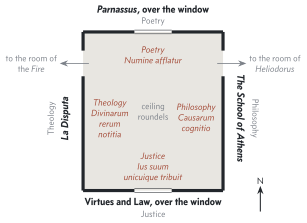
The room was planned as a map of human knowledge (Figure 11.7). In an allegory (Chapter 4) a figure stands for an idea, as a woman with scales stands for Justice. On the ceiling, in four roundels, or round panels, Raphael painted allegories of Theology, Poetry, Law, and Philosophy,This artist decorated the Stanza della Segnatura with allegories of Theology, Poetry, Law, and Philosophy. → Raphael•• four seated women, each with a Latin motto carried by small boys; Law appears as Justice. Under each roundel, the wall below shows the people who served that kind of knowledge. Theology, labeled “knowledge of divine things,” looks down on the Church’s teachers; Philosophy, “knowledge of causes,” on the ancient philosophers; Poetry, “inspired by the divine spirit,” on the poets; and Justice, “she gives each his due,” on the lawgivers.
The first wall Raphael painted, in 1509 and 1510, was Raphael’s La DisputaThis artist painted La Disputa (Disputation of the Holy Sacrament). → Raphael••• (dee-spoo-tah), the Disputation of the Holy Sacrament (Figure 11.8). Its subject is the Eucharist, the rite that repeats the Last Supper (Chapter 2), in which Christians share bread and wine as Jesus commanded. Catholics believe that at the words of the priest the bread and wine become Christ’s body and blood, a teaching called transubstantiation. The fresco is built in two tiers. Above, in heaven, God the Father blesses the world, and below him Christ sits in a golden halo between the Virgin Mary and John the Baptist. Saints and figures of the Old Testament sit on a curving bank of cloud: Peter with his keys, Adam, David with his harp, Moses with the tablets of the Law, and Paul with his sword. Beneath Christ the Holy Spirit descends as a dove, and around it four putti hold open the Gospels.Four putti hold open copies of the Gospels in this fresco. → La Disputa•• They are the plump winged children of Italian painting (Chapter 3), and their four books are the Gospels of Matthew, Mark, Luke, and John.

Below, on earth, an altar stands at the center of a marble pavement, and on it a monstrance (mon-strunss), a gold vessel with a window of glass, displays the consecrated bread, the host. Theologians gather around the monstranceTheologians gather around a monstrance containing the Eucharist in this fresco. → La Disputa•• in groups that argue, point, read, and kneel. Next to the altar sit the four great Latin teachers of the early Church, Gregory the Great, Jerome, Ambrose, and Augustine, their names written in their halos. Behind them stand Thomas Aquinas and other teachers. At the right, a pope in a gold robe is Sixtus IV, and behind him is the poet Dante in red with a crown of laurel (Vol. 9, Cathedrals and Crusades). The title is misleading, since nobody here is really quarreling. Every gaze and gesture leads to the small white host, set at the point toward which the lines of the pavement run.

The north wall, the wall of Poetry, was harder, because a window cuts into its lower half. Raphael turned the window into a hill. Raphael’s ParnassusThis artist painted Parnassus. → Raphael••• shows Mount Parnassus in Greece, the home of the god Apollo and, with Mount Helicon, of the nine Muses, the goddesses of the arts (Vol. 4, Classical Myth). It has laurel trees, a spring that trickles down toward the window, and the poets of many ages gathered on its slopes on either side (Figure 11.9). At the top Apollo plays a lira da braccio,Apollo plays a lira da braccio among the Muses and poets in this painting. → Parnassus (Raphael)•• the “arm lyre,” a bowed instrument like a violin, popular in Raphael’s own day, which no ancient Greek ever saw. The Muses sit and stand around him. Among the poets are Virgil, Dante again, Petrarch, and Sappho, the poet of Lesbos, the only woman, who holds a scroll with her name on it so that no one will take her for a Muse.
The grandest of the poets is Homer, the poet of the Iliad and the Odyssey, whom legend made blind. He stands left of center, in a blue robe, with his face turned up to the sky. Early in 1506 workmen digging in a vineyard on the Esquiline Hill found a marble group of the Trojan priest Laocoön (lay-ok-oh-on) and his sons being crushed by two sea serpents, a work praised by ancient writers (Vol. 4, Classical Myth). Julius II bought it and set it up in the Vatican. For Homer Raphael borrowed the head of the Laocoön,The blind face of Homer in this painting draws on the Laocoön sculpture group. → Parnassus (Raphael)• with its tilted face and open mouth, and the agony of the Trojan priest became the rapture of a blind poet listening to the god.
The last wall, on the south side, also has a window, and Raphael finished it in 1511. In the lunette above the window, the half-moon of wall beneath the curve of the vault, sit three women who stand for the virtues of Fortitude, Prudence, and Temperance, with small boys for Faith, Hope, and Charity. Below, on either side of the window, are two scenes of lawgiving. On one side the lawyer Tribonian hands the emperor Justinian the Pandects, or Digest, the great collection of the opinions of Roman lawyers (Vol. 9, Cathedrals and Crusades). On the other Pope Gregory IX approves the Decretals, a code of the Church’s own law, and Raphael gave the medieval pope the face of Julius II.
The School of Athens
On the wall facing La Disputa is the most famous fresco Raphael ever painted. Raphael’s School of AthensThis artist painted The School of Athens. → Raphael••• fills a lunette about 16 feet high and 25 feet wide, and its title was given to it later, since Raphael wrote none. Vasari, writing forty years later, misread it as a scene of theologians reconciling philosophy and astrology with theology. Like the rest of the room, it was painted for the pope’s own library, and Julius II commissioned it for the StanzaPope Julius II commissioned this painting for the Stanza della Segnatura. → The School of Athens••• della Segnatura as the wall of Philosophy. To Raphael’s age, philosophy meant all the knowledge that human reason can reach without the help of revelation: logic, ethics, mathematics, astronomy, and the study of nature.
Its place in the room is part of its meaning. It faces La DisputaThis painting is located across from the artist's La Disputa. → The School of Athens••• across the room, so that the wisdom of the ancient Greeks, reached by reason, answers the faith of the Church, given by revelation. Raphael painted the two walls as a pair, each with a deep stage, a flight of steps, and a crowd gathered around a center. Around the corner to the left, the fresco meets Parnassus,This painting is adjacent to The Parnassus in the Stanza della Segnatura. → The School of Athens•• where a doorway in the corner leads to the next room (Figure 11.7). A visitor standing in the middle of the room has faith behind him, reason before him, and poetry at his side.
Raphael set more than fifty figures in an enormous hall with coffered barrel vaults (Chapter 2), open to the sky, like a Roman bath or basilica (Figure 11.10). The building is a Greek cross,The building depicted in this painting is shaped like a Greek cross. → The School of Athens• with a dome over the crossing glimpsed beyond the first arch, like the plan that Bramante was then building at Saint Peter’s, a few hundred yards away. Raphael had good help with it. In his life of Bramante, Vasari writes that Bramante taught Raphael the rules of building,Vasari suggested Donato Bramante inspired this painting’s architecture. → The School of Athens• “arranging for him the buildings which he afterwards painted in perspective” in this very room. The painted hall may be the nearest we can come to the church that Bramante dreamed of and never finished. Its floor, its steps, and its arches all lead the eye to one point, where the two greatest philosophers of Greece walk toward us.
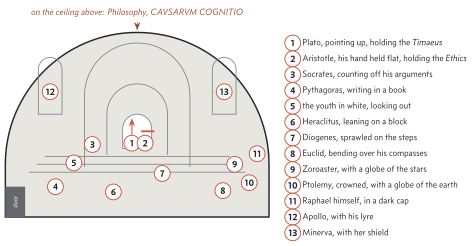
Plato and Aristotle stand at the center,Plato and Aristotle stand at the center of a gathering of ancient philosophers in this painting. → The School of Athens••• framed by the farthest arch, at the point toward which every line of the building runs. Plato is old, gray-bearded, and barefoot, wrapped in red and violet; Aristotle, his pupil for twenty years, is younger, dark-bearded, and dressed in blue and brown. Plato points up; Aristotle holds his hand flat,Plato points upward while Aristotle holds his hand out flat in this painting. → The School of Athens••• palm down, over the earth. The two gestures sum up their teaching as Raphael’s age understood it: Plato looked up to the eternal Forms beyond this world, Aristotle to the world we can see and touch. Each carries a book of his own. Aristotle holds his Ethics, and Plato holds the TimaeusPlato holds the Timaeus in this painting. → The School of Athens••• (ty-mee-us), lettered TIMEO, his dialogue on how the world was made (Vol. 6, The Greeks).
Raphael filled his ancient school with modern people. He gave some of the ancients the faces of artists of his own day, as if to say that the painters and architects of Rome now belonged among the philosophers. Plato is often identified with Leonardo,Plato is often identified with Leonardo da Vinci’s features in this painting. → The School of Athens••• because his long white beard and high forehead resemble a famous red-chalk drawing traditionally taken as Leonardo’s self-portrait. No one of Raphael’s time recorded the likeness, however, and the identification is a later guess. In front, alone, a brooding man in boots and a stonecutter’s smock leans on a block of marble and writes. He is Heraclitus (hair-uh-kly-tus), the gloomy philosopher of Ephesus, and Raphael drew Michelangelo as Heraclitus.This painting's artist drew Michelangelo as Heraclitus. → The School of Athens• The figure is missing from Raphael’s full-size drawing for the fresco, which survives in Milan. Raphael seems to have added it after August 1511, when the first half of Michelangelo’s Sistine ceiling was uncovered, and the massive figure is painted in Michelangelo’s own heavy style. The tribute did not soften the older man. Years later Michelangelo complained in a letter that everything Raphael knew about art he had learned from him.
Around the center, every group is busy. On the left, Socrates, snub-nosed in an olive-green robe, counts off his arguments on his fingers to a young man in armor. Below him Pythagoras writes in a book while a boy holds up a slate of figures. In the middle Diogenes (dy-oj-uh-neez) reclines on the stairs,Diogenes reclines on the stairs in this painting. → The School of Athens•• half dressed, with a bowl beside him. He was the Cynic who lived in a jar and threw away his cup when he saw a boy drink from his hands. Vasari praised the figure, “lying on the steps,” as “wrapt in his own thoughts.”
At the lower right a bald man bends to the floor over a slate, and his pupils crowd around to watch. Euclid bends over a drawing with a compass,Euclid bends over a geometrical drawing with a compass in this painting. → The School of Athens•• demonstrating a figure of geometry, the science he set down in his Elements at Alexandria. Vasari says this is a portrait of Bramante. On the neckline of Euclid’s tunic Raphael painted the letters R.V.S.M., read as Raphael Urbinas sua manu, “Raphael of Urbino, by his own hand.” Behind Euclid Ptolemy and Zoroaster (zor-oh-as-ter) hold globesPtolemy and Zoroaster hold globes on the right side of this painting. → The School of Athens•• on the right side of the fresco. Ptolemy, the astronomer of Alexandria, wears a crown, because he was confused with the Ptolemy kings of Egypt, and turns his back to us with a globe of the earth. Facing him, Zoroaster, the prophet of ancient Persia (Vol. 5, In the Beginning), holds a globe of the stars.
At the right edge, beside the two globes, a young man in a dark cap looks straight out at us. Raphael painted himself beside the globe-bearers,The artist included a self-portrait beside the globe-bearing figures in this painting. → The School of Athens•• and Vasari describes “a youthful head of exceedingly modest expression wearing a black cap.” The older man beside him, in white, is usually taken to be his fellow painter Sodoma, or Perugino. On the far side of the fresco a youth in white also faces the viewer, one of the few figures who look out of the picture, and no one knows who it is. Some see the white-clad figure as La FornarinaA white-clad figure facing the viewer in this painting may have been modeled on La Fornarina. → The School of Athens•• (for-nah-ree-nah), the woman Raphael loved in his last years; others see Julius II’s nephew Francesco Maria della Rovere, or the woman philosopher Hypatia, who taught mathematics in Alexandria about AD 400.
High in the walls of the hall stand two painted marble statues of gods. Apollo and Minerva stand in nichesStatues of Apollo and Minerva stand in niches on either side of this painting. → The School of Athens•• on either side. Apollo, the god of music and poetry, holds his lyre on the left, the side nearest the wall where he plays among the Muses, and Minerva, the Roman name of Athena, the goddess of wisdom, holds her shield on the right. On the ceiling above the whole fresco is the roundel of Philosophy, a woman seated on a throne with two books, one for the study of nature and one for morals. The tondo above reads “Causarum Cognitio”,The allegorical subject of this painting appears with the Latin words "Causarum Cognitio" in a tondo above it. → The School of Athens•• the knowledge of causes. A tondo is a round painting (Chapter 4), and the motto echoes Aristotle, who taught that to know a thing truly is to know why it is so.
The later Roman works
From 1511 to his death Raphael worked at a pace no painter had attempted. He ran the largest workshop in Italy, whose assistants painted from his drawings, and he took commissions from popes, cardinals, bankers, and princes. Vasari says he never went to court without some fifty painters around him. He never made prints himself, but he worked with the engraver Marcantonio Raimondi (ry-mon-dee), whose copies of his designs carried them all over Europe. Leo X made him a groom of the papal chamber, and Vasari says the pope even meant to make him a cardinal. The paintings follow the two popes he served.
The last years of Julius II
The second room, the Stanza di Eliodoro, painted from 1511 to 1514, is named for its most dramatic fresco. Raphael’s Expulsion of HeliodorusThis artist painted The Expulsion of Heliodorus from the Temple. → Raphael• (hee-lee-oh-dor-us) tells a story from the Second Book of Maccabees, one of the books Catholics count in the Old Testament. Heliodorus, minister of the Greek king Seleucus IV of Syria, came to seize the treasure kept in the Temple at Jerusalem for widows and orphans. While the high priest Onias prayed, a rider in golden armor on a rearing horse appeared with two young men carrying rods, and they struck Heliodorus to the ground. In the fresco the horse rears over the fallen thief at the right, while at the left Julius II himself, carried on his chair by bearers, calmly watches. The message was clear in 1512, when Julius had just driven the French out of the Papal States: God protects what belongs to the Church.

On the next wall Raphael painted The Mass at BolsenaThis artist painted The Mass at Bolsena. → Raphael• (bohl-say-nah) (Figure 11.11). According to the legend, in 1263 a priest from Bohemia who doubted transubstantiation was saying Mass at Bolsena, a town on a lake north of Rome. As he spoke the words over the host, it bled onto the corporal, the linen cloth on the altar, and his doubt was gone. The stained cloth was carried to the cathedral of Orvieto (or-vyeh-toh), where it is still kept as a relic, and the next year Pope Urban IV made the feast of Corpus Christi, “the Body of Christ,” a feast of the whole Church. In Raphael’s fresco the priest stares at the host in shame and wonder. Facing him across the altar kneels Julius II with his cardinals, and below them kneel his Swiss Guards, the corps of Swiss soldiers he had founded in 1506. Two other frescoes in the room, The Deliverance of Saint Peter and The Meeting of Leo the Great and Attila, are told in the fifth and seventh volumes (Vol. 5, In the Beginning and Vol. 7, The Romans).

In the same years Raphael painted the pope himself. Earlier popes had been shown in profile, kneeling, or face-on in state. Raphael’s portrait of Julius IIThis artist painted a portrait of Pope Julius II. → Raphael• is close up and private: an old man sitting sideways in his chair, deep in thought, with rings on his fingers and a handkerchief in his hand. He wears a white beard, which he grew in June 1511 as a sign of mourning after his army lost Bologna, and shaved off in March 1512. Vasari says the portrait impressed “on all beholders a sense of awe as if it were indeed the living object,” and for two centuries popes were painted in its pose. For a long time the version in Florence was thought to be the original. In 1970 the cleaning of the one in London revealed the inventory number of a Roman collection under the paint, and it is now generally accepted as Raphael’s own.
Raphael also worked for the richest banker in Rome, Agostino Chigi of Siena, who was the pope’s treasurer. Chigi’s architect Baldassare Peruzzi (peh-root-see) had built him a villa by the Tiber, later named the Villa Farnesina (far-neh-zee-nah) after the family who bought it. There, about 1512, Raphael painted The Triumph of GalateaThis artist painted The Triumph of Galatea. → Raphael• (gal-uh-tee-uh). Galatea is the sea nymph of Ovid’s Metamorphoses who loved the shepherd Acis and was pursued by the Cyclops Polyphemus (Vol. 4, Classical Myth), and the Venetian painter Sebastiano del Piombo (pyom-boh) painted Polyphemus on the wall beside her. Raphael shows her racing over the waves on a scallop shell drawn by two dolphins. Her red cloak streams in the wind and she turns to look back, while sea gods blow conch shells, a sea god carries off a nymph, and three cupids aim their arrows down at her from the sky. When his friend Baldassare Castiglione praised the nymph’s beauty, Raphael answered in a letter printed under his name. To paint one beauty, the letter says, he would need to see many, with Castiglione beside him to choose the best. Since good judges and beautiful women are scarce, he wrote, in the version printed with Foster’s Vasari, “I avail myself of certain ideas which come into my mind.”

Julius II wanted an altarpiece for the Benedictine church of San Sisto in Piacenza (pyah-chen-tsah), a city he had just won for the Papal States, and Raphael painted the Sistine MadonnaThis artist painted the Sistine Madonna. → Raphael•• for it, on canvas (Figure 11.13). Green curtains draw back as if on a stage, and Mary walks toward us on the clouds, carrying her son. Saint Sixtus, an early pope, kneels at the left in a gold cope and points toward the people below, his papal crown set down on a ledge, and Saint Barbara kneels at the right. Along the bottom, two bored-looking cherubs lean on the ledge,Two bored-looking cherubs lean on a ledge at the bottom of this painting. → Sistine Madonna•• chins on their arms, gazing up as if waiting for something to happen. In 1754 Augustus III, elector of Saxony and king of Poland, bought the painting for his gallery at Dresden, at a price no other painting would fetch for decades. Today the two cherubs, reproduced without the rest of the picture, appear on postcards and posters around the world.
The Rome of Leo X
Leo X kept Raphael busy as Julius had. The third room was the new pope’s private dining room, and Raphael chose for it the deeds of earlier popes named Leo. Its first fresco tells a story from the Book of the Popes, an old collection of their lives. In 847 a fire broke out in the Borgo, the crowded quarter in front of old Saint Peter’s, and Pope Leo IV put it out by making the sign of the cross from the loggia, or open balcony, of his palace. In the background of The Fire in the Borgo the small figure of the pope blesses from his window, and the front of the old basilica shines with mosaics. The foreground is all panic. Women carry jars of water and fling up their arms, and a young man carries his old father out of the flames on his back, as Aeneas carried Anchises (an-ky-seez) from burning Troy in Virgil’s Aeneid (ih-nee-id) (Vol. 7, The Romans). At the left a muscular nude lets himself down a wallA muscular nude descends a wall while a kneeling woman in yellow raises her arms in this artist’s Fire in the Borgo. → Raphael•• by his hands, while a woman passes a baby over the top to a man below. In the center a kneeling woman in yellow, seen from behind, flings both arms toward the pope. The design was Raphael’s, but most of the painting was done by his assistants.

Castiglione was one of Raphael’s closest friends, a soldier and diplomat from the court of Urbino who came to Rome as the ambassador of its duke. He was then writing The Book of the Courtier (the Stage), set at Urbino in 1507, which taught that the perfect courtier does everything with sprezzatura, a grace so easy that it hides the effort behind it. About 1514 Raphael painted his friend Baldassare CastiglioneThis artist painted a portrait of Baldassare Castiglione. → Raphael• in exactly that spirit. The picture is almost all gray, black, and white: a fur sleeve, a black beret over a turban, a white shirt, and a pair of calm blue eyes that meet ours. In 1639 Rembrandt sketched it when it came up for sale in Amsterdam and borrowed its pose for his own self-portraits (Vol. 13, Valois, Bourbon, and Orange).
Raphael’s work for Leo reached into the Sistine Chapel itself. For its lower walls Raphael designed ten tapestriesThis artist designed ten tapestries depicting the lives of Peter and Paul for the Sistine Chapel. → Raphael•• of the lives of Peter and Paul, woven in Brussels from the full-size cartoons he painted in 1515 and 1516 (Vol. 1, The Toolkit). Like his father Lorenzo in Florence, Leo also kept a menagerie of rare animals in the Vatican, with leopards, a bear, and a chameleon, and his favorite was an elephant. Portugal’s Manuel I gave Leo X an elephant,Manuel I of Portugal gave one of these animals to Pope Leo X. → elephants• a young Asian elephant from India, said to be white, named Hanno. Manuel, the king who sent Vasco da Gama to India (Chapter 6), wanted the pope’s goodwill for his empire in the East. Hanno arrived in Rome in March 1514 with Manuel’s ambassador, Tristão da Cunha (treesh-town dah koon-yah), and knelt before the pope to the delight of the crowds.

Hanno lived in the Vatican, walked in processions, and was the pope’s delight for two years. In September 1514 Leo had a vain poet, Giacomo Baraballo, who thought himself the equal of Petrarch, crowned with laurel as a joke and paraded through the streets on Hanno’s back, until the cheering frightened the elephant and he threw the poet off. In June 1516 Hanno fell ill, and his doctors gave him a purge laced with gold, which killed him. Leo wrote his epitaph, and Raphael designed a memorial picture of him for a wall of the Vatican, now lost. The writer Pietro Aretino (ah-reh-tee-noh) made his name with a mocking pamphlet called The Last Will and Testament of the Elephant Hanno, in which the dying beast made fun of the cardinals and of the pope himself.


From 1517 to 1519 Raphael’s team decorated the Loggia, a long gallery that Bramante had begun on the second floor of the palace, open in his day on one side to the courtyard (Figure 11.16). In its thirteen small vaults they painted fifty-two scenes from the Bible, which became known as “Raphael’s Bible.” Around them, on every pilaster and arch, ran grotesques, delicate ornament of vines, masks, and fantastic creatures. Painters had copied it from the walls of Nero’s Golden House, the buried palace into whose rooms they were lowered on ropes, and named it after those “grottoes” (Vol. 7, The Romans). The stucco and grotesques were the work of Giovanni da Udine (oo-dee-neh), and the scenes were painted by younger assistants.
The ablest of them was a Roman who had been with Raphael since boyhood. Giulio Pippi, called Giulio Romano, “Julius the Roman,” was born about 1499, and Giulio Romano was Raphael’s studentGiulio Romano was this artist's student. → Raphael•• and his right hand by the time he was twenty. When Raphael died, Giulio and his fellow assistant Gianfrancesco (jahn-frahn-ches-koh) Penni inherited his drawings and his workshop, and they finished the last of the Vatican rooms. In 1524 Giulio moved to Mantua, where he built and painted the Palazzo Te for its ruler, Federico Gonzaga. He is the only artist of the Renaissance whom Shakespeare names: in The Winter’s Tale the statue of Queen Hermione is the work of “that rare Italian master, Julio Romano” (Vol. 11, The Age of Shakespeare).
Raphael never married. In 1514 he was engaged to the niece of his friend Cardinal Bibbiena, but the wedding was put off again and again until she died. Vasari says he was attached to one woman until the day of his death, and that he painted her portrait. Tradition names this mistress Margherita Luti (mar-geh-ree-tah loo-tee), the daughter of a baker, and calls her La Fornarina, “the baker’s girl.” The portrait known by that name, in the Palazzo Barberini in Rome, shows a dark-eyed young woman in a striped turban, bare to the waist but for a thin veil, with an armband lettered RAPHAEL VRBINAS. Her right hand rests at her left breast. In 2002 a doctor, Carlos Hugo Espinel, argued that the hand at her breast hides a tumor,This artist may have showed his mistress clutching her left breast in a portrait to cover a tumor. → Raphael• since he read the swelling and the bluish shadow beside her finger as signs of cancer. Others see only a painter’s pose.
The last picture
In 1516 or 1517 Leo’s cousin, Cardinal Giulio de’ Medici, who would become Pope Clement VII (Chapter 13), ordered two altarpieces for his cathedral at Narbonne (nar-bon), in France, and set two painters against each other. One, The Raising of Lazarus, went to Sebastiano del Piombo, who was helped with drawings by Raphael’s great rival, Michelangelo. The other was Raphael’s last painting, The Transfiguration,This artist painted The Transfiguration. → Raphael••This was Raphael’s last major painting, left unfinished at his death. → The Transfiguration (Raphael)•• which he left unfinished at his death. Its upper half shows the scene the Gospels tell on a mountain, by tradition Mount Tabor (tay-bor): Christ rises into the air, shining with light, between the prophets Moses and Elijah. Peter, James, and John lie dazzled on the ground beneath him.
The lower half tells the story that follows in the Gospel of Matthew. At the foot of the mountain the apostles try to heal a possessed boyApostles try to heal a demon-possessed boy in the lower half of this painting. → The Transfiguration (Raphael)•• whom his father has brought to them, and they cannot. The boy, his eyes rolling, flings out his arms; a woman kneels in front and points to him; the apostles argue and point helplessly up the mountain, toward the only one who can help. Joining the two moments in one picture, Raphael set divine light above against human darkness below. His assistants painted only a few figures in the lower left after his death, and cleaning in the 1970s showed that almost all the rest is his own.
That was the picture set at the head of his body in April 1520. Vasari says he caught his fever coming home from one of his secret visits to the woman he loved, and that his doctors took it for a chill and bled him, weakening him further. No one can now say what illness it was. A week after his death it was shown in the Vatican beside Sebastiano’s Raising of Lazarus. Cardinal Giulio kept it in Rome, and in 1523 it was placed on the high altar of San Pietro in Montorio, the church in whose cloister stands Bramante’s Tempietto. Raphael had asked to be buried in the Pantheon, the ancient domed temple that had become a church, and he lies there still. His friend Pietro Bembo, the poet and scholar, wrote two lines of Latin verse for his tomb: Ille hic est Raphael, timuit quo sospite vinci rerum magna parens et moriente mori. They mean: “Here lies Raphael. While he lived, great Nature, the mother of all things, feared to be outdone, and when he died, she feared that she would die too.”
What to remember
- Perugino, Raphael’s teacher, painted The Delivery of the Keys (1481 and 1482) in the Sistine Chapel: Christ hands two keys to the kneeling Peter before an eight-sided temple between two triumphal arches.
- Raphael (1483 to 1520), from Urbino, trained under Perugino. His early works include the Mond Crucifixion, the small Three Graces, and the Marriage of the Virgin (1504), modeled on Perugino’s.
- In Florence (1504 to 1508) he painted pyramid-shaped Madonnas learned from Leonardo, among them the Madonna of the Goldfinch, broken by a landslide in 1548, and the Madonna of the Pinks.
- Julius II and Bramante began the new Saint Peter’s as a Greek cross in 1506. Raphael, Michelangelo, and Maderno followed, and the church was consecrated in 1626. Leo X’s indulgences for it provoked Luther’s protest of 1517.
- In the Stanza della Segnatura (1508 to 1511) Raphael painted in fresco the four branches of knowledge: La Disputa (Theology), The School of Athens (Philosophy), Parnassus (Poetry), and Justice.
- In The School of Athens Plato points up and Aristotle holds his hand flat; Heraclitus has Michelangelo’s face, Euclid Bramante’s, and Raphael painted himself beside Ptolemy and Zoroaster.
- His later works include The Expulsion of Heliodorus, The Mass at Bolsena, the Sistine Madonna with its two cherubs, The Triumph of Galatea, the portraits of Julius II and Castiglione, and the Loggia with its grotesques.
- The Transfiguration, his last painting, joins Christ shining on the mountain to the apostles failing to heal a possessed boy below. It stood at the head of his body when he died.
Chapter 12 · 48 clues
Venice, Giorgione, and Titian
About the year 1500 a boy of nine or ten came down from the mountains of Cadore (kah-doh-reh), in the Dolomites, the pale, jagged peaks of the eastern Alps, some 70 miles north of Venice. He was going to live with an uncle in the city and learn a trade. His father was a soldier and timber merchant of the little town of Pieve di Cadore. The boy was Tiziano Vecellio, whom English speakers call Titian. Two men who knew him in old age wrote down how he came: the Venetian writer Lodovico Dolce (dohl-cheh), in 1557, says he was nine, and Giorgio Vasari, in 1568, says ten. No record of his birth survives, and he was probably born between 1488 and 1490.
The city he came to was drawn that same year from above, as nearly as anyone could manage before balloons. A publisher from Nuremberg, Anton Kolb, brought out a view of Venice printed from six woodblocks, more than 9 feet wide, which he said had taken three years to make (Figure 12.1). Its artist, Jacopo de’ Barbari (deh bar-bah-ree), drew every church and palace and every ship at its mooring, as if from a tower high above the lagoon. Over the city he set Mercury, the Roman god of merchants, and in its harbor Neptune, the god of the sea. Between them the two gods sum up the place: a republic of traders that lived by the sea, at the height of its wealth. It was about to be attacked by nearly every power in Europe, and it was home to a school of painters who would change the way Europe painted.

The Most Serene Republic
When Titian arrived, Venice had governed itself for some seven hundred years. Its people called it La Serenissima (lah seh-reh-nee-see-mah), the Most Serene Republic. The ninth volume (Vol. 9, Cathedrals and Crusades) told how it rose: refugees on the islands of a lagoon, merchants trading between the Latin west and Constantinople, and a blind doge, Enrico Dandolo, leading the Fourth Crusade to sack Constantinople in 1204. In 828 two Venetian merchants had smuggled out of Alexandria the body believed to be that of Mark, by tradition the writer of the second Gospel. His sign in Christian art is a winged lion. Saint Mark became the city’s patron saint,Saint Mark, represented by a winged lion, is the patron saint of this city and names its basilica. → Venice••• his lion was carved over the gates of Venetian towns from the Alps to Crete, and the domed church built for his relics is still called the Basilica of San Marco, or Saint Mark’s (Figure 12.3).
At the head of the state stood the doge, the republic’s ruler, elected for life (the Stage). He wore a jeweled cap shaped like a horn, the corno, and he presided at every council, but he could do almost nothing alone. Over the centuries the great families had boxed him in with councils, oaths, and inspectors, so that no doge could make himself a king. The real sovereign was the Great Council, the assembly of every grown man of the noble families, more than two thousand of them by 1500. It elected the officers of the state. The doge lived in a palace overlooking Saint Mark’s SquareThis city has a Doge's Palace. → Venice••The rulers of this city resided in a palace overlooking St. Mark's Square. → Venice• and the water beyond it. The Doge’s Palace is a pink-and-white Gothic building set on a ground floor of open arches. It was rebuilt from 1340 on the side facing the lagoon and from 1424 along the Piazzetta, the little square that runs from Saint Mark’s Square down to the water. It held everything at once: the doge’s apartments, the vast hall of the Great Council, the law courts, and the prisons.
The most feared body in the palace was the Council of Ten. It had been created in 1310 to hunt down the plotters of a failed coup, and it was never dissolved. Its ten members were elected by the Great Council for one year at a time, never two from the same family. They sat with the doge and his six councilors and met in secret to guard the state against conspiracy. Any Venetian could accuse another by dropping a written accusation, often unsigned, into one of the stone “lion’s mouths” set into the walls. In 1355 the Ten had beheaded a doge, Marino Faliero, for plotting to make himself a prince. A century later they turned on another. Francesco Foscari (fos-kah-ree) was doge from 1423 to 1457, longer than anyone before or after him, and his wars against the dukes of Milan had won Venice the cities of Brescia (bresh-ah) and Bergamo. His only surviving son, Jacopo, was tried three times before the Ten. He was convicted first of taking bribes and at last of writing to Venice’s enemies, the Ottoman sultan and the duke of Milan, and he died in exile on Crete. The old doge, broken by grief, stopped attending to the business of the state. In October 1457 the Council of Ten forced Foscari to abdicate.This city’s Council of Ten forced Doge Francesco Foscari to abdicate. → Venice•• He left the palace and died a few days later, on November 1. The Venetians, ashamed, gave him a state funeral, and the story of the two Foscari later became a play by the English poet Lord Byron (1821) and an opera by Giuseppe Verdi (1844).

The palace’s prisons were cells under its roof and on its damp ground floor. By the 1560s they were too small, and in the 1580s the republic began the New Prisons across the Rio di Palazzo, the narrow canal along the palace’s eastern side. Soon after 1600 Antonio Contin, a nephew of the architect of the stone Rialto Bridge (Vol. 3, Geography: Europe, Asia, and Africa), joined the two buildings with a covered bridge of white stone. Inside it two passages run side by side, so that prisoners on their way to the courts never met those on their way to the cells. The Bridge of Sighs links the palace to the prisonThe Bridge of Sighs links the Doge’s Palace and a prison in this city. → Venice• across that canal (Figure 12.2). Its name is much younger than the bridge. Visitors in the 1800s imagined the prisoners sighing at their last sight of the lagoon. Lord Byron (Vol. 15, The Age of Revolution) made the name famous in English when he began the fourth canto of Childe Harold’s Pilgrimage (1818): “I stood in Venice, on the ‘Bridge of Sighs;’ / A Palace and a prison on each hand.”

Once a year the doge left his palace in glory. Ascension Day, forty days after Easter, is the day Christians remember Jesus rising into heaven. On that day Venice held the Festa della Sensa (sen-sah), the Feast of the Ascension, with a great fair in Saint Mark’s Square. In the morning the doge boarded the Bucentaur (byoo-sen-tor), the gilded state barge, rowed by men from the Arsenal. It carried him past the eastern end of the city to the Lido (lee-doh), the long sandbar between the lagoon and the Adriatic Sea. At the opening into the sea the patriarch of Venice, the city’s archbishop, blessed the water, and the doge threw a gold ring into the sea.On Ascension Day, this city’s doge threw a ring from the Bucentaur during the “Marriage of the Sea.” → Venice••• As it fell he said, in Latin, Desponsamus te, mare, in signum veri perpetuique dominii: “We wed you, sea, in token of true and lasting dominion.” This Marriage of the Sea probably began about the year 1000, when Doge Pietro II Orseolo set out on Ascension Day to conquer the coast of Dalmatia across the Adriatic. A Venetian legend gave it a grander birth. It said that Pope Alexander III, who made peace with the emperor Frederick Barbarossa at Venice in 1177 (Vol. 9, Cathedrals and Crusades), handed the doge a ring and told him to wed the sea every year. The first great Bucentaur was built in 1311 and a new one in 1526. De’ Barbari’s woodcut holds the oldest known picture of one, moored in the Arsenal.
The Bucentaur lived in the city’s great workshop. Venice’s state shipyard was the Arsenal,This city's shipyard was called the "Arsenal." → Venice•• a word that came into Venetian from the Arabic dar al-sina’a, “house of making.” Begun, by tradition, in 1104 and much enlarged in 1320, it covered about 110 acres behind 2 miles of high brick wall, about a seventh of the city. Inside, thousands of workers called arsenalotti built and repaired the republic’s war galleys from standard parts. One shed made oars, another twisted rope, and another raised the hulls. A new galley could be fitted out, armed, and loaded as it was towed down a canal past the stores. Nothing else in Europe was organized on such a scale before the factories of the Industrial Revolution. Dante knew of it already in the early 1300s. In the Inferno (Vol. 9, Cathedrals and Crusades) he used it to picture the boiling pitch in which the corrupt officials of his eighth circle are sunk.
Venice’s most famous craft was kept on an island of its own. Glass furnaces could set the crowded city on fire, and in 1291 the Great Council ordered nearly all of them out of the city to Murano (moo-rah-noh), a cluster of islands about a mile to the north. There the glassmakers worked under the eye of the Council of Ten. In the 1450s Angelo Barovier (bah-roh-vyehr) of Murano made cristallo, a glass as clear as rock crystal, the clearest in Europe. Venetian goblets, beads, and mirrors sold across Europe and the eastern Mediterranean. Secrets so valuable had to be guarded, so Murano’s glassmakers were forbidden to leaveThis city’s glassmakers worked on Murano and faced restrictions on leaving to protect trade secrets. → Venice•• the republic’s lands. A glassmaker who left without permission was ordered home. If he did not come back, his family could be thrown into prison. Even so, the secrets leaked slowly abroad, carried by craftsmen whom foreign kings tempted away with money.
A merchant republic needed the sea open. For two centuries Venice’s main rival at sea was Genoa,This city's main maritime rival was Genoa. → Venice•• the other great trading republic of Italy, on the far side of the peninsula. They fought four wars, ending with Venice’s narrow victory at Chioggia (kyoj-jah) in 1380 (Vol. 9, Cathedrals and Crusades). With Genoa beaten, Venice turned to the mainland. It took Padua, Vicenza, and Verona in 1404 and 1405, Friuli in 1420, and Brescia and Bergamo under Foscari. Venetians called their mainland state the Terraferma (teh-rah-fehr-mah), the “firm land,” and by 1500 it ran west almost to Milan (Figure 12.4). Mainland farms fed the city, and mainland towns paid its taxes. But land brought land frontiers and land enemies, and the sea was growing harder to hold. The Ottoman Turks, who had taken Constantinople in 1453 (Vol. 9, Cathedrals and Crusades), seized the Venetian island of Negroponte in 1470 and the Greek ports of Modon and Coron in 1500. In 1498 Vasco da Gama reached India by sailing around Africa (Chapter 6). He had opened a road to the spice trade that Venice did not control.

The blow, when it came, was organized by a pope. Julius II, the warrior pope Giuliano della Rovere (Chapter 11), wanted back the towns of the Romagna that Venice had seized in 1503, when Cesare Borgia’s state collapsed after the death of his father, Pope Alexander VI. Venice offered to pay tribute for Faenza and Rimini but refused to give them up. Every great power had a grudge against the republic or an appetite for its land. On December 10, 1508, at Cambrai (kahm-bray), a town now in northern France, envoys of the pope met envoys of Louis XII of France, of the Emperor Maximilian I, and of Ferdinand II of Aragon (Chapter 5). They concluded an alliance to divide Venice’s mainland among them. The next April Julius laid an interdict on Venice (Chapter 1), a ban that forbade priests to say Mass or give the sacraments there. The League of Cambrai that Julius II had formedPope Julius II helped form the League of Cambrai against this city in 1508. → Venice•• then struck. On May 14, 1509, the French army of Louis XII destroyed a Venetian army at Agnadello (ahn-yah-del-loh), east of Milan, and within weeks Venice lost almost its whole mainland. Bergamo, Brescia, and Cremona went to the French. Verona, Vicenza, and Padua opened their gates to the emperor’s envoys, and the Romagna towns went back to the pope. Machiavelli, who served Florence, blamed the hired captains of Venice’s armies. In The Prince (Chapter 8), in W. K. Marriott’s translation, he wrote that “in one battle they lost that which in eight hundred years they had acquired with so much trouble.”
Yet the city itself, safe behind its lagoon, held. In July 1509 Padua rose against its new masters and let the Venetians back in, and Maximilian’s great siege of Padua that September failed. The allies began to quarrel over the spoils. In February 1510 Julius made peace with Venice and lifted the interdict. In 1511 he formed a new Holy League with Venice and Spain to drive the French out of Italy. By the treaties of 1516 Venice had won back nearly all of its mainland, though not the Romagna. It had outlasted an alliance of the pope, the emperor, and the kings of France and Spain, and the boy from Cadore had grown into a painter while the war went on.
The war also changed the lives of Venice’s Jews. Since 1397 the republic had let Jewish merchants and moneylenders stay in the city for no more than fifteen days at a time, wearing a yellow badge on their clothes. Many lived and lent money across the water in Mestre (mes-treh), on the mainland, and in the other towns of the Terraferma. When the League’s armies overran the mainland in 1509, they fled into Venice and settled in several parishes. The government needed their loans and their pawnshops, but many Venetians, and the preachers above all, wanted them out of sight. On March 29, 1516, in the reign of Doge Leonardo Loredan, the Senate, the republic’s main lawmaking council, ordered every Jew in Venice to live on one small island in the district of Cannaregio (kahn-nah-reh-joh) (Figure 12.3). A state foundry for casting cannon had once stood there. Venetians called the place the geto, the casting, from the pouring of molten metal into molds. The word “ghetto” comes from that foundry,The term “ghetto” derives from the foundry district where this city confined Jews. → Venice•• by the usual explanation, though scholars still argue about it. The island’s gates were opened in the morning when the great bell of Saint Mark’s rang, and they were locked at night. Christian guards, paid by the Jews themselves, watched them, and the rents were set a third higher than Christians had paid. The ghetto was enlarged in 1541 and again in 1633, and its gates stood until Napoleon’s army opened them in 1797 (Vol. 16, Romantic Europe). Its name spread to the walled Jewish quarters of other cities, beginning with the ghetto that Pope Paul IV created in Rome in 1555 (Chapter 14).
Aldus and the Venetian press
Printing with movable metal type was invented in Germany about 1450 (Vol. 14, From Luther to Mozart), and it came to Venice in 1469. Johann of Speyer, a goldsmith from the Rhineland, set up a press, and the Senate gave him the sole right to print in the city for five years. He died the next year, and other printers poured in. The Frenchman Nicolas Jenson cut a clear roman type in Venice, upright letters like the ones on this page, that is still admired (Vol. 9, Cathedrals and Crusades). By 1500 Venice had more printers than any other city in Europe, about three in every ten of all the printers in Italy. It had money to invest, paper mills on the mainland, ships to carry books to every port, and rich readers. It also had Greek scholars who had fled the Ottomans. And it had the hundreds of Greek manuscripts that Cardinal Bessarion, a Greek churchman who had joined the Roman church, left to the republic in 1468.
The greatest Venetian printer came to the trade late. Aldus Manutius (al-dus muh-noo-shus), in Italian Aldo Manuzio, was born about 1450 at Bassiano, south of Rome, and spent his first forty years as a scholar and teacher. He tutored the young princes of Carpi, nephews of the philosopher Pico della Mirandola (Chapter 3). Above all he wanted to save Greek literature, which survived in scarce and faulty manuscripts, by printing it correctly in Greek. In 1490 he settled in Venice, the western city richest in Greek books and Greek scholars. With money from his pupils’ family and a partnership with the printer Andrea Torresano, he set up a press about 1494. Aldus Manutius printed books in VeniceThis city was home to the printer Aldus Manutius. → Venice••Aldus Manutius worked in this industry in Venice. → printing•• from 1495, when he issued a Greek grammar, until his death on February 6, 1515. His shop published the first printed editions of Aristotle in Greek, in five volumes (1495 to 1498), and of Aristophanes, Sophocles (sof-uh-kleez), and Plato. Greek scholars from Crete read his proofs, and the household spoke Greek. In 1499 he also printed the most beautiful illustrated book of the age, the Hypnerotomachia Poliphili (hip-neh-roh-toh-mah-kee-ah poh-lif-ih-lee), “Poliphilo’s Strife of Love in a Dream.” It is a strange romance of a lover’s dream journey through ancient ruins.


His most lasting idea was a small book. In April 1501 Aldus published the poems of Virgil in a volume small enough to carry in a coat pocket. It was an octavo, made by folding each printed sheet three times into eight leaves. He printed it in a new kind of type, which his punch-cutter, Francesco Griffo (greef-foh) of Bologna, cut to look like the sloping handwriting of Italian scholars (Figure 12.5). It was the first whole book in italic type, which English still names for Italy. Slanting letters stand close together, so more words fit on a small page. Aldus also left out the bulky commentaries that crowded most editions of the classics. He printed about 1,000 copies of such books, where most printers made 200 to 500, and such a book cost far less than a big folio, a book of sheets folded only once, crowded with commentary. These little books were the ancestors of the paperback. For the small Italian editions of Petrarch (1501) and Dante (1502), Aldus worked with a young Venetian nobleman and scholar, Pietro Bembo. Bembo’s Latin dialogue On Etna (1496) had been the first book set in Aldus’s roman type, and that type is still sold under the name Bembo.
From 1502 Aldine books bore the shop’s mark. A printer’s device was his trademark, printed on the title page or the last page so that buyers could tell his work from a rival’s. Aldus’s device was a dolphin wound around an anchor,This Venetian printer used the emblem of a dolphin entwined around an anchor. → Aldus Manutius• copied from an ancient Roman coin that Bembo had given him. It stood for the Latin motto Festina lente (fes-tee-nah len-teh), “make haste slowly”: the dolphin, swiftest of fish, for speed, and the anchor for steadiness. The Dutch scholar Erasmus (Vol. 13, Valois, Bourbon, and Orange) spent much of 1508 in Aldus’s shop, finishing his great collection of Greek and Latin proverbs, the Adages. In it he praised Aldus for making haste slowly and winning as much gold as fame. Printers in Lyon, in France, soon copied both the italic and the dolphin, and Aldus complained in print of their errors and their bad paper. His heirs kept the press going for most of the century. Venice went on printing what few other cities would. The Christian printer Daniel Bomberg made the first complete printed edition of the Talmud, the great book of Jewish law and commentary (Vol. 5, In the Beginning), in 1520 to 1523, and its page numbers are the ones scholars still cite. The first Quran printed with movable Arabic type came from Venice in 1537 or 1538.
Bellini and Giorgione
Venetian painters worked differently from Florentine ones. In Florence a picture began with drawing: the outline came first, and color filled it in. In Venice it began with color. The city’s damp salt air ruined fresco, painting on wet plaster. So Venetian painters turned early to oil paint, which the Flemish painters of the 1400s had perfected, and by the 1500s to oil on canvas, a cloth like the sails of the city’s ships (Vol. 1, The Toolkit). Oil let them lay thin, see-through glazes of color one over another, until flesh seemed warm and a sky seemed to hold real light. Art historians speak of the Venetian school, the painters who worked in Venice and its mainland from the Bellini family in the 1400s to Titian, Tintoretto, and Veronese (vair-oh-nay-zay) in the 1500s (Chapter 16). Venice gave its name to that school of painters,This city gives its name to a 'school' of painters. → Venice•• and its mark is color, light, and mood more than line.
Painting in Venice in the 1400s was a family business. Jacopo Bellini ran one of the busiest workshops in the city, and his sons Gentile and Giovanni trained in it; a daughter, Nicolosia, married the painter Andrea Mantegna of Mantua (Chapter 3). Gentile, the elder brother, was the republic’s official painter. In 1479 Venice lent him to the Ottoman sultan Mehmed II, whose portrait he painted in Constantinople (Vol. 9, Cathedrals and Crusades). Many Venetian pictures were made for a scuola (skwoh-lah). The word means “school,” but a scuola was a brotherhood of laymen who did works of charity, marched in processions, and decorated their meeting halls. One of the richest, the Scuola Grande di San Giovanni Evangelista, owned a relic believed to be a fragment of the True Cross, the cross on which Jesus died. For its hall Gentile painted Procession in Piazza San Marco (1496), a canvas about 12 by 24 feet, now in the Accademia, Venice’s main picture gallery (Figure 12.6). It shows the brothers, in white robes, carrying the relic under a canopy across Saint Mark’s Square on Saint Mark’s Day, April 25, 1444. In the crowd behind the canopy, a merchant from Brescia in a red robe kneels to pray for his dying son. The brotherhood’s story says the boy was cured that day. The real subject, though, is the square itself.


His younger brother became the greatest Venetian painter of the century. Giovanni Bellini, born in VeniceGiovanni Bellini was an artist from this city. → Venice•• about 1430, began in tempera. He learned the new oil painting about the time Antonello da Messina worked in the city, in 1475 and 1476 (Chapter 3), and he made it his own. His altarpieces set the Virgin and Child on a throne under a golden half-dome like those of Saint Mark’s, with saints standing quietly around her in one shared space. Such a picture is called a sacra conversazione, a “holy conversation” (Chapter 3), and the one he painted for the church of San Zaccaria in 1505 still hangs there. He painted the doges too. His Doge Leonardo Loredan (Figure 12.7) shows the doge who would lead Venice through the war of Cambrai. The doge is a bust behind a stone ledge, against a deep blue sky, with an old man’s patient, watchful face above robes of white and gold. The German painter Albrecht Dürer (dyoor-er) (Vol. 14, From Luther to Mozart) visited Venice in 1506, and he wrote home that Bellini was very old but still the best painter there. In his last years Bellini painted The Feast of the Gods (1514) for Alfonso I d’Este, Duke of Ferrara, the husband of Lucrezia Borgia (Chapter 7). He died in 1516. He had outlived one famous pupil, Giorgione, and he left the field to another, Titian.
Another painter made the city’s streets and canals his subject. Vittore Carpaccio (kar-paht-choh), the son of a Venetian furrier,Vittore Carpaccio was an artist from this city. → Venice• was born in Venice between 1460 and 1465 and probably trained with Gentile Bellini. He told saints’ lives in long rows of canvases for the scuole, the brotherhoods, and he set them in a Venice anyone could recognize. For the Scuola di Sant’Orsola he painted the Legend of Saint Ursula in the 1490s, nine canvases of ships, embassies, and pageants. For the same brotherhood as Gentile’s Procession he painted the Miracle of the Relic of the True Cross at the Rialto Bridge (about 1496). It shows the old wooden Rialto Bridge, with a drawbridge in its middle, crowded with Venetians and lined with gondolas. From 1502 to 1507 he painted Saint George and the dragon and other scenes for the Scuola di San Giorgio degli Schiavoni (skyah-voh-nee). The Schiavoni were the Slavs of Dalmatia, Venice’s subjects across the Adriatic. Carpaccio loved strong reds, and in 1950, by the usual account, Giuseppe Cipriani of Harry’s Bar in Venice named a new dish of thin-sliced raw beef “carpaccio” after him, because its red and white recalled the painter’s colors.
The painter who changed Venetian painting most, in the fewest years, was Giorgio da Castelfranco (kah-stel-frahn-koh), whom everyone called Giorgione, “big George” (the Stage). He was born in the 1470s in Castelfranco, a walled town 25 miles inland. Vasari says he loved music and played the lute and sang so well that he was invited to the parties of the great. Carlo Ridolfi, a Venetian painter who wrote the lives of the Venetian artists in 1648, says he trained with Giovanni Bellini. Giorgione settled in Venice and became its painterGiorgione was an artist from this city. → Venice•• of a new kind of picture. He made small pictures, most of them less than 2 feet across, for the homes of rich collectors, and they often told no clear story but set a mood instead. He also painted an altarpiece for his hometown about 1504. In 1508 he painted frescoes on the outside of the Fondaco dei Tedeschi (fon-dah-koh day teh-des-kee), the hall of the German merchants beside the Rialto, and the young Titian painted the side facing the street. Vasari’s Lives, in Mrs. Jonathan Foster’s translation, tells what followed. Friends congratulated Giorgione on the street side, not knowing it was Titian’s, which “caused Giorgione so much vexation, that he would scarcely permit himself to be seen” until the work was done. After that the two were no longer friends. Giorgione died of the plague on September 17, 1510, in his early thirties, and Vasari says he caught it from a lady he loved. A few weeks later Isabella d’Este, the marchioness of Mantua and the greatest collector of her day, wrote to Venice asking to buy one of his pictures. She was told it could not be had at any price.
Giorgione’s most famous picture is also the most mysterious. The Tempest (about 1506 to 1508) was painted for the nobleman Gabriele Vendramin (ven-drah-meen), and it now hangs in the Accademia. It is small, under 3 feet on each side. On the left a young man stands holding a long staff, dressed like a soldier or a shepherd. On the right, across a little stream, a woman sits nursing a babyA nursing woman sits opposite a standing man beneath a stormy sky in this painter’s The Tempest. → Giorgione•• on a white cloth. She is naked but for a cloth around her shoulders, and she looks out at us. Between them stand two broken columns, a wooden bridge leads to a town, and over everything a dark storm is breaking, with a flash of lightning. No one has ever explained it. Marcantonio Michiel (mee-kyel), a Venetian collector, saw it in Vendramin’s house in 1530. He called it simply a little landscape with a storm, a “gypsy” woman, and a soldier. “Gypsy” is the old English name for the Roma, a wandering people who had reached Italy in the 1400s. Scholars have read the picture as Adam and Eve after the Fall, as a scene from mythology, or as no story at all. X-rays show that Giorgione first painted a second naked woman where the young man now stands, so he seems to have invented the picture as he went. It is often called the first true landscape in European painting, a picture in which the weather and the land matter as much as the people.

Another of the few pictures Michiel recorded as Giorgione’s is just as hard to read. The Three Philosophers (Figure 12.8) shows three men of three ages beside a cave, perhaps the three wise men of the Gospel, perhaps three stages of learning. Giorgione’s last great picture was left unfinished when the plague took him. In the Sleeping Venus (about 1510, now in Dresden), a nude woman sleeps with one arm behind her head.A reclining nude sleeps with one arm behind her head, her body echoing the surrounding hills, in this painting. → Sleeping Venus (Giorgione)•• She lies on a red cushion and a white sheet in the open country, while the low hills behind her repeat the curves of her body. Michiel saw the picture in 1525 in the house of the nobleman Girolamo Marcello (mar-chel-loh). He recorded that it was by Giorgione, but that the landscape and a little Cupid at her feet had been finished by Titian. Titian completed the landscape after Giorgione’s death,This artist worked with Giorgione and completed some of his unfinished paintings. → Titian••Titian is thought to have completed the landscape of this painting after Giorgione’s death. → Sleeping Venus (Giorgione)•This artist began the Sleeping Venus, later completed with work by Titian. → Giorgione• as he completed other pictures his old partner left behind. Some scholars now think he painted much of the sleeping figure as well. The Cupid was painted out in the 1800s. A goddess of love lying alone and asleep in the open air was a new subject for a large painting, and the picture was meant for a private room. The first great reclining nude of the Venetian school,Giorgione’s Sleeping Venus, an influential early reclining nude, belongs to this city’s school of painting. → Venice• she began a long line that runs through Titian to Velázquez (Chapter 23) and Manet (Vol. 18, Paris, Capital of the Arts).
One more picture was argued over for four centuries. In the Pastoral Concert (about 1509, in the Louvre), two young men in Venetian dress sit on the grass making music. One, richly dressed in red, plays a lute; the other is a countryman with tousled hair. Two nude women are with them. One pours water from a glass pitcher into a stone well, the other holds a flute, and behind them a shepherd drives his flock. The picture was long called a Giorgione,Pastoral Concert was long attributed to Giorgione, an artist from this city. → Venice• and the Louvre now gives it to the young Titian, though some scholars still disagree. More than three hundred years later Édouard Manet (ay-dwar ma-nay) painted his scandalous Luncheon on the Grass (1863) with it in mind (Vol. 18, Paris, Capital of the Arts).
Early Titian
The boy from Cadore learned fast. Dolce says his first teacher was a painter from a family of mosaic makers, then Gentile Bellini, then Giovanni Bellini, and last Giorgione, the painter of his own generation whose manner he took up. Vasari says, in Foster’s translation, that Titian “so closely imitated Giorgione that his pictures were sometimes taken for those of that master.” Though he was born on the mainland, Titian became the great painter of Venice,Titian was an artist from this city. → Venice••• and for sixty years no one there could rival him. In 1513 he offered the Council of Ten a battle picture for the hall of the Great Council, in return for a salaried post from the state. After Giovanni Bellini died in 1516 he was the first painter of the city. He outlived Giorgione by sixty-six years, dying in 1576. His work for the emperor Charles V and King Philip II of Spain, and his last decades, wait for Chapter 16.
Titian’s first masterpieces were portraits. The Portrait of a Man of about 1510 (National Gallery, London) is usually called the Man with a Blue Sleeve. A bearded man has turned half away from us and looks back over his shoulder, and his blue quilted sleeve rests on a parapet,This artist portrayed a man resting his blue-quilted sleeve on a parapet. → Titian•• a low stone ledge at the very front of the picture. The huge puffed sleeve seems to push out of the frame into our space, and every fold and gleam of its satin can almost be felt. On the ledge Titian painted the letters T and V, for Tiziano Vecellio. For centuries the sitter was said to be the poet Ludovico Ariosto (Chapter 8). Many scholars now think he is a nobleman of the Barbarigo (bar-bah-ree-goh) family. Vasari describes an early portrait of a Barbarigo in which the hair was so distinct “that each one could be counted, as might also the stitches in a satin doublet.” Others think the man is Titian himself. In 1639 the Dutch painter Rembrandt saw the picture, or a copy of it, in the collection of a dealer in Amsterdam, and he borrowed its pose for his own self-portraits (Vol. 13, Valois, Bourbon, and Orange).


A woman’s portrait of the same years makes a pair with it (Figure 12.9). In La Schiavona (skyah-voh-nah), a plump young woman in a dark red dress with white sleeves stands behind a parapet. One hand rests on a marble slab, and on the slab her own profile is carved in relief, like an ancient cameo. Painted face and carved face invite us to compare them, as if Titian were showing that painting could do everything sculpture could, and color besides. The title means “the Slav woman,” and the portrait is said to show a Dalmatian,This artist painted a portrait allegedly depicting a Dalmatian woman. → Titian• one of the Schiavoni of Venice’s lands across the Adriatic. The name was attached to the picture by about 1600, probably because of her dress and her features. No one knows who she really was.

In 1516 Titian won the commission that made him famous across Italy. The Franciscan friars of Venice (Vol. 9, Cathedrals and Crusades) had a vast brick church, Santa Maria Gloriosa dei Frari (frah-ree), called simply the Frari, Venetian for “the friars.” For its high altar Titian painted a huge Assumption of the VirginThis artist painted a huge Assumption for the Frari. → Titian•• (1516 to 1518). It is nearly 23 feet tall, the largest altarpiece in Venice, and still in its place (Figure 12.10). Venetians call it the Assunta (ahs-soon-tah). Its subject is the Assumption, the Catholic belief that Mary was taken up body and soul into heaven at the end of her life (Vol. 5, In the Beginning). The picture rises in three bands. Below, the apostles crowd together and reach up in wonder, Peter among them and the young John in red. In the middle, Mary rises on a cloud carried by a swarm of baby angels, in a red gown and a blue mantle, her arms spread and her eyes on heaven. Above, God the Father leans down from a golden sky while an angel brings her crown. Titian painted it on cedar planks, with figures larger than life so that they could be seen clearly from the far end of the church. It was unveiled on May 19, 1518, and the diarist Marino Sanudo noted the day. A century later Ridolfi told how the friars complained that the figures were too big, and how Titian answered that they had to be seen from far away.

A few steps away, on a side altar of the same church, is the Pesaro Madonna (1519 to 1526). Titian painted it for Jacopo Pesaro, the bishop of Paphos in Cyprus, who had commanded the pope’s fleet under Alexander VI and beaten the Turks at the island of Santa Maura, off the west coast of Greece, in 1502 (Figure 12.11). Titian broke an old rule here: he set the Virgin off center. She sits with the Child high on a step at the right, in front of two enormous columns. Saint Peter sits on the step below her with his key at his feet, and Jacopo Pesaro kneels at the left. Behind him an armored knight, whom Vasari calls Saint George, leads a turbaned Turkish prisoner. The knight holds up a great red banner with the arms of the Borgia pope and of the Pesaro family, crowned with a branch of laurel for victory. At the right Saint Francis presents the kneeling men of the Pesaro family, and the youngest, a boy, turns to look out at us. Above the papal banner, two cherubs carry a crossThis artist’s Pesaro Madonna includes a papal banner below cherubs carrying a cross. → Titian•• on a cloud between the columns, the sign of the faith the bishop’s fleet had fought for. The diagonal from the banner up to the Virgin replaced the old balanced rows of saints, and it pointed the way to the Baroque, the restless, dramatic style of the next century (Chapter 22).
Titian’s most brilliant picture of these years was painted for a duke’s private study. Alfonso I d’Este of Ferrara wanted a room of pictures of the ancient gods. After Bellini’s Feast of the Gods he turned to Titian, who painted three more. The duke had first asked Raphael, who died in 1520 having made only a drawing. Titian painted Bacchus and AriadneThis artist painted Bacchus and Ariadne. → Titian•• (1520 to 1523, now in the National Gallery, London) from the Roman poets Catullus and Ovid. The fourth volume (Vol. 4, Classical Myth) told the myth and printed part of the picture. The Cretan princess Ariadne had saved Theseus from the Minotaur, and he has abandoned her on the island of Naxos while she slept. Theseus’s ship is a speck of white sail on the horizon at the far left. Ariadne, in blue with a red sash, turns in alarm as a noisy crowd bursts out of the woods at the right. It is the procession of Bacchus, the Roman name of Dionysus, god of wine, and Bacchus leaps from his chariot drawn by cheetahsA god leaps from a chariot drawn by cheetahs toward a woman in this painting. → Bacchus and Ariadne•• toward her, his pink cloak flying. Ovid gave the god tigers, but the duke kept cheetahs in his menagerie, and Titian probably painted his from the duke’s animals. Titian catches him in midair, the instant before he lands.
Behind the god his followers dance and stagger. A man winds snakes around his body,A man entwined by snakes appears in the procession in this painting. → Bacchus and Ariadne•• as Catullus says the god’s followers did, in a pose that recalls the ancient marble Laocoön, dug up in Rome in 1506 (Vol. 4, Classical Myth). A small satyr drags a calf’s head along the ground, and fat old Silenus, the god’s tutor, slumps on a donkey. Half the canvas is sky, painted with costly ultramarine, the blue ground from lapis lazuli (Vol. 1, The Toolkit). In that sky, above Ariadne’s head, a ring of eight stars shines.A ring of eight stars shines above the woman in this painting. → Bacchus and Ariadne•• They are her crown, which Bacchus will throw into the heavens as the constellation of the Northern Crown, so the picture shows the end of the story at its beginning. Alfonso’s study was broken up at the end of the century, and the picture came to London in the 1800s.

In 1527 a new friend arrived in Venice. Pietro Aretino (1492 to 1556), a shoemaker’s son from Arezzo whose name means “the man from Arezzo,” had made his name in Rome with a mock will for Leo X’s dead elephant, Hanno (Chapter 11). His satires, his comedies, and his indecent verses made Rome dangerous for him. After an assassin stabbed him in 1525, he settled for good in Venice, the one Italian state where the pope’s friends could not touch him. There he lived by his pen. He wrote letters praising or threatening princes and published them in volumes from 1538. Both Francis I of France and Charles V paid him at the same time, each hoping he would damage the other, and Ariosto called him the “scourge of princes.” Aretino and Titian were close friendsThis artist had a close and long-lasting friendship with the writer Pietro Aretino. → Titian• for nearly thirty years, with the sculptor and architect Jacopo Sansovino as the third of the trio. Vasari says that the friendship was useful to Titian, who was “made known wherever the pen of the writer had reached.” Aretino introduced him to princes and praised his paintings in his letters, and Titian painted his friend at least three times (Figure 12.12).
Sacred and Profane Love and the Venus of Urbino
Two of Titian’s pictures of women became more famous than any he painted for a church, and both were made for private rooms. The first was a wedding picture. In 1514 Niccolò Aurelio (ow-reh-lyoh), a secretary to the Council of Ten, married Laura Bagarotto (bah-gah-rot-toh), a young widow of Padua. Her father, a Paduan lawyer, had been put to death by Venice as a traitor during the war of Cambrai, so the match was a delicate one. For the marriage Titian painted Sacred and Profane Love,This artist painted Sacred and Profane Love. → Titian•• a canvas about 4 by 9 feet, now in the Galleria Borghese in Rome. The title came much later. An inventory of 1693 is the first record of anything like it, and no one knows what Titian called the picture. In 1608 Cardinal Scipione Borghese (shee-pyoh-neh bor-gay-zeh), the nephew of Pope Paul V, bought it for his collection in Rome, and there it has stayed.

Two women who look like sisters, perhaps painted from one model, sit at the two ends of an ancient marble sarcophagus, or stone coffin, that has been turned into a fountain (Figures 12.13 and 12.14). The woman on the left is dressed as a bride, in white satin with red sleeves, gloves, and a wreath of myrtle, the plant of Venus. One gloved hand rests on a closed metal vessel, and the other holds a few roses. The woman on the right is nude, with only a white cloth across her lap and a red cloak over one arm. Between the clothed woman and the nude, Cupid stirs the waterCupid stirs the water in a sarcophagus between a clothed woman and a nude woman in this painting. → Sacred and Profane Love••• in the sarcophagus. He is a winged child, leaning over the rim to trail his hand in it, his eyes on the water. Above him a dark tree fills the middle of the sky. The nude woman turns toward the bride as if speaking to her, and she holds up a small vessel with a flameThe nude woman holds aloft a vessel with a flame in this painting. → Sacred and Profane Love•• in it, high against the sky. Is the clothed woman the bride, with Venus herself beside her, persuading her to love? Or are the two women the heavenly and the earthly love that a speaker in Plato’s Symposium (Vol. 6, The Greeks) tells apart? The scholar Erwin Panofsky argued for the second reading in the twentieth century. In his view the nude is heavenly, “sacred” love, the reverse of what the title seems to say.

The carved front of the sarcophagus tells a story of its own in white marble. On the left a horse without a bridle is led along by its mane. On the right a man is being whipped,The sarcophagus relief in this painting includes a horse and a man being whipped. → Sacred and Profane Love•• while another figure lies on the ground. The scholar Edgar Wind read these scenes as images of the passions being tamed. Between the two scenes, in the middle of the front, a brass spout lets the water run out of the fountain, and above the spout hangs a carved shield. The coat of arms on it is Niccolò Aurelio’s.Niccolò Aurelio’s coat of arms appears on the sarcophagus in this painting commissioned for his marriage to Laura Bagarotto. → Sacred and Profane Love•• They are the main evidence that the picture was made for his marriage to Laura Bagarotto. Scholars have looked for her arms as well, in the silver bowl on the rim, but cleaning has not shown them there.
The two halves of the landscape differ as much as the two women. Behind the bride the land climbs to a large castle on the left,This painting features a large castle in the distance on the left. → Sacred and Profane Love• a fortified town with a tall round tower. A rider gallops up the road toward its gate, and the hillside around him is green and wooded, with a few slender trees standing against the sky. Lower down the slope, in the shadow at the far left, two rabbits sit in the grass,This painting features two rabbits or hares on its left side. → Sacred and Profane Love•• an old sign of love and of many children. Behind the nude woman the land falls away to a lake and to a village with a church tower, lit by a low sun. Everything on this side is open and wide. In the right background two horsemen with their dogs hunt a hareTwo men on horseback hunt a rabbit with their dogs in the right background of this painting. → Sacred and Profane Love•• across a meadow, and a shepherd watches his flock nearby. Castle and church, climbing road and open meadow: the picture is built of pairs, and the argument over what they mean has never ended.
Titian’s second great picture of a woman was a plainer celebration of beauty. He began it about 1534, perhaps for Cardinal Ippolito de’ Medici, who died in 1535 without seeing it. In 1538 the young Guidobaldo II della Rovere came to Venice to have his portrait painted. He saw the picture in Titian’s studio and pressed his agent to buy it before anyone else could, and in his letters he called it simply “the nude woman.” Later that year he became Duke of Urbino, and so Titian’s Venus of Urbino is named for the duke’s city.This artist painted Venus of Urbino. → Titian•••Titian painted a nude Venus titled for this city. → Urbino•• Urbino is a hill town in the Apennines, in the region now called the Marche, where Federico da Montefeltro had built his palace (Chapter 3). Raphael was born there in 1483 (Chapter 11), and Castiglione set his Book of the Courtier at its court in 1507. In 1508 Federico’s son Guidobaldo, the last Montefeltro duke, died, and the duchy passed to his nephew and adopted heir, Francesco Maria della Rovere, who was also a nephew of Julius II. Francesco Maria named his own son Guidobaldo after the uncle who had left him the duchy. Pope Leo X drove him out in 1516 to make his own nephew, Lorenzo di Piero de’ Medici, Duke of Urbino. That was the Lorenzo to whom Machiavelli dedicated The Prince (Chapter 8). Francesco Maria won his duchy back in 1521 and went on to command the armies of Venice, which is how his family came to know Titian. The painting came to Florence in the 1630s, when the last heiress of the della Rovere married the Medici grand duke, and it has hung in the Uffizi since 1736.

A young woman lies naked on a couch spread with white sheets, propped on pillows, with her head to the left, as Giorgione’s Venus lies. But she is awake, and she looks straight at us, holding rosesThe reclining nude looks toward the viewer and holds flowers in this painting. → Venus of Urbino•• loosely in her right hand. The room behind her is a rich Venetian house, with a dark green curtain behind her head and patterned hangings on the walls beyond. A window opens on the evening sky, and on its sill stands a pot of myrtle, the plant of Venus and of brides. In the far room two maids search a marriage chest, and a dog sleepsTwo maids search a marriage chest behind a reclining nude whose feet lie near a sleeping dog in this painting. → Venus of Urbino••• curled at her feet on the bed (Figure 12.15). A cassone (kahs-soh-neh) was the painted wooden chest that held a bride’s clothes and linens, so the chest, like the myrtle, speaks of marriage. The dog has long been read as a sign of faithfulness. Scholars still argue whether the picture celebrates a marriage, portrays a famous Venetian courtesan, or simply shows a beautiful woman.
Titian drew on Giorgione’s Sleeping VenusTitian drew on Giorgione’s Sleeping Venus for this painting. → Venus of Urbino•• for the pose of the body, which he knew better than anyone, since he had finished the older picture himself. He brought the goddess indoors, woke her, and turned her eyes to the viewer. The change from a dreaming goddess in a landscape to a woman in a bedroom who knows she is seen set the pattern for three centuries of reclining nudes. In 1863 Manet answered it with Olympia, a Parisian woman in the same pose, with a black cat where Titian’s dog had slept (Vol. 18, Paris, Capital of the Arts).
What to remember
- Venice, the Most Serene Republic, took Saint Mark and his winged lion as its patron. Its elected doge lived in the Doge’s Palace on Saint Mark’s Square, watched by the secret Council of Ten, which forced Doge Francesco Foscari to abdicate in 1457.
- On Ascension Day the doge sailed in the Bucentaur to the Lido and wed the sea with a gold ring. The Arsenal built the republic’s galleys, and Murano’s glassmakers were forbidden to leave.
- Julius II’s League of Cambrai (1508) broke Venice’s army at Agnadello in 1509, but the republic recovered its mainland by 1516. That year it confined its Jews to the Ghetto, named for a foundry.
- Aldus Manutius printed Greek classics in Venice from 1495, introduced italic type and pocket-sized octavos in 1501, and marked his books with a dolphin and an anchor.
- The Venetian school put color before drawing: Gentile and Giovanni Bellini, Carpaccio, Giorgione (The Tempest, the Sleeping Venus), and Titian.
- Early Titian: the Man with a Blue Sleeve and La Schiavona, the huge Assumption and the Pesaro Madonna in the Frari, Bacchus and Ariadne for Alfonso d’Este, and a lifelong friendship with Pietro Aretino.
- Sacred and Profane Love (1514) celebrated Niccolò Aurelio’s marriage; the Venus of Urbino (1538) took Giorgione’s sleeping nude indoors and woke her.
Emperor and Pope, 1517-1598
Chapter 13 · 51 clues
Charles V, the Sack of Rome, and Mannerism
On February 24, 1530, his thirtieth birthday, Charles of Habsburg knelt in the great church of San Petronio (sahn peh-troh-nyoh) in Bologna while Pope Clement VII set on his head the crown of the Holy Roman Empire. No pope would ever crown an emperor again. Five years earlier to the day, Charles’s army had destroyed the French at Pavia (pah-vee-ah) and taken the king of France prisoner. Less than three years earlier, his unpaid soldiers had stormed Rome, plundered it for months, and held this same pope a prisoner in his own fortress. Now the two men stood together at the altar, because each needed the other.
Charles ruled more of Europe than anyone since Charlemagne (Vol. 9, Cathedrals and Crusades), and a new empire across the Atlantic besides. He spent his life at war with the king of France, the Ottoman sultan, and the Protestant princes of Germany, and he lost as often as he won. His wars also scattered the painters of Rome, and the style they carried away, strange, elegant, and restless, became the art of the Medici dukes who owed their crown to him.
The inheritance of Charles V
For a generation Italy had been the battlefield of Europe. In 1494 King Charles VIII of France crossed the Alps to claim the kingdom of Naples (Chapter 4), and the Medici, who had ruled Florence for sixty years, were driven out as his army passed. He took Naples, but an alliance of Italian states and Spain forced him home, and at Fornovo, on July 6, 1495, his army had to fight its way back across the mountains. The wars that followed are called the Italian Wars (Chapter 4), and they lasted until 1559. The rich, divided peninsula, with its five great states (the Stage), was a prize that France and Spain, the two strongest kingdoms in Europe, could not leave alone.

The partners changed every few years, like dancers in a reel. Louis XII, who succeeded his cousin Charles VIII as king of France, took Milan in 1499, and in 1504 Spain’s armies won Naples for Ferdinand of Aragon (Chapter 5). In 1508 France, Spain, the emperor, and the pope joined in the League of Cambrai against Venice, and the French routed the Venetians at Agnadello in 1509 (Chapter 12). Pope Julius II (Chapter 11) then turned his allies against France. In 1512 a Spanish army restored the Medici to Florence, and in 1515 the young king Francis I of France won Milan back at Marignano (mah-ree-nyah-noh). Figure 13.1 sets the battles in order. Every change of partners was paid for by some Italian city.
The next round would be fought by a young man who had inherited, by a string of marriages and deaths, nearly every enemy France had. His family, the Habsburgs, came from the Swiss and Austrian Alps and had held the crown of the Holy Roman Empire, the old union of German lands whose seven electors chose the emperor, since 1438 (the Stage). His grandfather the emperor Maximilian I had married Mary of Burgundy, the heiress of the dukes of Burgundy and of their rich Netherlands. Their son, Philip the Handsome, married Juana, the second daughter of Ferdinand of Aragon and Isabella of Castile, the Catholic Monarchs. Nobody expected Juana to inherit anything, since she had an elder brother and sister. Then, as Chapter 5 told, her brother, her sister, and her sister’s baby son all died within three years, and Juana became heiress of both Spanish crowns.

Charles was born in Ghent, in Flanders, on February 24, 1500. He grew up at Mechelen (mekh-eh-len) in the Netherlands, at the court of his father’s sister, Margaret of Austria, and his first language was French. His tutor was Adrian of Utrecht (yoo-trekt), a learned Dutch priest who later became Pope Adrian VI. His father’s death in 1506 made him lord of the Netherlands. His mother grieved so wildly, and behaved so strangely, that in 1509 her father shut her away at Tordesillas, where she lived for forty-six more years. Spaniards called her Juana la Loca, “Joanna the Mad” in English books. Charles was the son of Joanna the Mad,This ruler was the son of Joanna the Mad. → Charles V•• and for most of the next ten years her father ruled Castile in her name, as he ruled Aragon in his own. When Ferdinand died in January 1516, Charles was proclaimed king of Castile and of Aragon together with his captive mother, and so, at sixteen, he became the first Habsburg to ruleThis ruler was the first Habsburg ruler of both Castile and Aragon. → Charles V• both Castile and Aragon. His father had been king of Castile alone, and only for a few months. As king of Spain he was Charles I.
Three years later the emperor Maximilian died. Charles inherited the Habsburg lands in Austria and stood for election as emperor against Francis I of France and Henry VIII of England. Francis bribed the electors lavishly, but Charles bribed more, with money borrowed from the Augsburg banker Jakob Fugger (foog-er) (Vol. 14, From Luther to Mozart). On June 28, 1519, the electors chose him, and as Charles V he became the emperor. Since 1516 his motto had been Plus ultra, Latin for “further beyond,” and his badge the two Pillars of Hercules, which the ancients had placed at the Strait of Gibraltar to mark the end of the world (Vol. 4, Classical Myth). Spain’s ships had already sailed past them, and the motto meant that his empire did not stop there. The pillars and the motto are still on the coat of arms of Spain. His chancellor, the Piedmontese lawyer Mercurino di Gattinara, wrote to him after the election that God had raised him above every king in Christendom and set him on the road to a universal monarchy, the rule of one Christian emperor over the whole Christian world. Charles never ruled that, but for forty years he acted as though he should. Figure 13.3 shows his family, and Figure 13.4 what each grandparent left him.


Spain did not welcome him at first. Charles arrived in 1517, a boy of seventeen with a jutting jaw who spoke no Spanish, surrounded by Flemish courtiers who took the best offices for themselves. In 1520 he sailed away to be crowned king of Germany at Aachen (ah-khen), after squeezing new taxes out of the Castilian parliament. The towns of Castile rose behind him. Toledo, Segovia, Valladolid, and a dozen more formed comunidades, self-governing communes, and their rebels were called the Comuneros (koh-moo-neh-rohs). Their leader, a Toledo nobleman named Juan de Padilla (pah-dee-yah), seized Tordesillas and begged Queen Juana to rule alone in her son’s place, but she would sign nothing. The great nobles, who feared the towns more than the king, raised an army for Charles. On April 23, 1521, in the rain near the village of Villalar (vee-yah-lar), his troops crushed the Comuneros at Villalar,This ruler’s troops defeated the Comuneros at Villalar. → Charles V•• and Padilla and two other leaders were beheaded the next day. Padilla’s widow, María Pacheco (pah-cheh-koh), held Toledo against the king until October, and the next winter she fled to Portugal in disguise. Charles learned the lesson. He learned Spanish, gave Spanish offices to Spaniards, and came to spend more of his reign in Spain than anywhere but the Netherlands of his boyhood.
He also married within the peninsula. In 1526, at Seville, he wed his cousin Isabella of Portugal, and on May 21, 1527, at Valladolid, she gave birth to a son. Charles was the father of Philip II,This ruler was the father of Philip II. → Charles V•• the king who would inherit Spain, Italy, the Netherlands, and the Indies from him (Chapter 15). Castile, with its soldiers and its taxes, became the base of all Charles’s wars.
The Indies made Castile richer every year. In the first years of his reign Hernán Cortés conquered the Aztec empire of Mexico (1519–1521), Magellan’s ships sailed around the world in his name, and in the 1530s Francisco Pizarro conquered the Inca empire of Peru (Chapter 6). In 1545 the Spanish found a mountain of silver at Potosí, in the Andes (Vol. 44, Gold, God, and Glory). Conquest also raised a question that troubled the emperor’s conscience: what right Spain had to rule the people it called Indians, and how it might treat them. Settlers were granted Indian villages to work for them, a grant called an encomienda (en-koh-myen-dah), and in practice many Indians were worked to death. Bartolomé de Las Casas (Chapter 6), born in Seville in 1484, had sailed to Hispaniola as a young man and held such a grant himself. In 1514 he gave up his Indians, later became a Dominican friar, and spent fifty years telling the court of the settlers’ cruelty. In 1542 Charles signed the New Laws, which forbade making Indians slaves.
In 1550 he went further. He ordered all new conquests halted until a junta, or board, of theologians and lawyers could decide whether they were just, and he called that junta to the city of Valladolid. The hearings were held in 1550 and 1551 in the Dominican college of San Gregorio. There Las Casas faced Juan Ginés de Sepúlveda (hwahn hee-nays deh seh-pool-veh-dah), the emperor’s own historian and a translator of Aristotle, whose dialogue defending the conquests had been kept out of print by the universities of Salamanca and Alcalá (ahl-kah-lah). Sepúlveda used Aristotle’s argument that some peoples are slaves by nature (Vol. 6, The Greeks) and said that the Indians’ human sacrifices justified war on them. Las Casas answered that they reasoned as well as any people and could be won to Christianity only by persuasion. The debate at ValladolidThe Valladolid debates about this empire's treatment of Indians were between Juan de Sepulveda and Bartholomew de Las Casas. → Spain• over Spain’s treatment of the Indians was the first time a European empire asked in public whether its own conquests were just. The judges never gave a verdict, and both men claimed to have won. Two years later Las Casas printed his Short Account of the Destruction of the Indies (1552), and Spain’s enemies read it for centuries.
The emperor and the Protestants
In 1517, the year Charles first came to Spain, a friar named Martin Luther, who taught the Bible at the university of Wittenberg in Saxony, attacked the sale of indulgences (Chapter 11). The popes were selling them to pay for the new Saint Peter’s in Rome. Luther went on to teach that a sinner is saved by faith alone, not by good works or by anything the Church can sell, and that the Bible outranks popes and councils. Pope Leo X excommunicated him in January 1521, that is, cut him off from the Church and its sacraments. By the law of the empire, an excommunicated heretic was now the emperor’s problem (Vol. 14, From Luther to Mozart).
The emperor consulted the empire in a diet (from the Latin for “day”), an assembly of its princes, bishops, and free cities. His first diet sat in 1521 at Worms (vorms), on the Rhine, and Charles summoned Luther to WormsThis ruler summoned Martin Luther to defend his views at the Diet of Worms. → Charles V•• under a promise of safe conduct to defend his views. On April 17 Luther was shown a table of his books and asked to take them back. The next day he answered that he could not, unless he were proved wrong by the words of Scripture or by plain reason, for his conscience was captive to the word of God. The printed accounts added the words remembered ever since, “Here I stand,” which he may never have spoken. On April 19 Charles, who was twenty-one, read out his own answer, written in French in his own hand. He would stake his kingdoms, his friends, his body, his blood, his life, and his soul on the faith of his ancestors. The Edict of Worms made Luther an outlaw, but his prince, Frederick the Wise of Saxony, had him carried off and hidden in the castle of the Wartburg, where he translated the New Testament into German.
For twenty-five years Charles could not crush the new faith. He was almost always at war with France or the Turks, and he needed German soldiers and German taxes for both. The Lutheran princes used the time. At a diet in Augsburg in 1530 they gave the emperor a statement of their beliefs, the Augsburg Confession, written by Luther’s friend Philip Melanchthon (meh-lank-thun). Charles had Catholic theologians answer it, ordered the Lutherans to return to the old faith, and promised that a general council of the Church, a meeting of its bishops from every land, would settle the quarrel. He spent the next fifteen years pressing the popes to call one, and it met at last at Trent in 1545 (Chapter 14). Meanwhile, in 1531, at the little town of Schmalkalden (shmahl-kahl-den) in Thuringia (thoo-rin-jee-uh), the Lutheran princes formed a defensive alliance called the Schmalkaldic League. Only in 1544, after a peace with France, were the emperor’s hands free. In April 1547 he caught the League’s army on the river Elbe in Saxony. At dawn on April 24 his Spanish soldiers swam and waded the river through the morning fog, and by evening Charles had broken the Schmalkaldic League at MühlbergThis ruler's armies defeated the Schmalkaldic League at the Battle of Mühlberg. → Charles V•• (mewl-bairk). Its leader, the elector John Frederick of Saxony, was captured with a sword cut across his face. Charles is said to have turned Julius Caesar’s old boast, “I came, I saw, I conquered,” into a prayer: “I came, I saw, and God conquered.” Titian painted the emperor riding out to the battle in armor, the most famous portrait of his life (Chapter 16).
The victory did not last. The next year Charles ordered a temporary settlement of religion, the Interim, which pleased neither side. In 1552 Maurice of Saxony, a Lutheran prince who had fought for Charles at Mühlberg, turned on him with French help, and the gouty emperor had to flee over the Alps from Innsbruck in a litter (Chapter 14). That autumn he tried to win back the city of Metz, which the French had seized, and besieged it through the winter. Cold and sickness killed thousands of his men, and in January 1553 he gave up. He is said to have remarked that Fortune, like a woman, preferred young men. In 1555 his younger brother Ferdinand, who had ruled the family’s Austrian lands since 1522, made the Peace of Augsburg with the princes. Each prince would choose whether his land was Lutheran or Catholic, a rule later summed up in the Latin phrase cuius regio, eius religio, “whose land, his religion.” Charles, who had sworn at Worms to keep Christendom one, would not sign it himself.
He was tired, crippled by gout, and fifty-five. On October 25, 1555, in the great hall of the palace in Brussels where he had been declared of age forty years before, he gave the Netherlands to his son. He leaned on the shoulder of a young nobleman, William of Orange (Vol. 13, Valois, Bourbon, and Orange), and wept as he spoke. In his speech he counted his travels: nine journeys into Germany, six into Spain, seven into Italy, ten into the Netherlands, four into France, two to England, and two to Africa. He had already given Philip Naples and Milan in 1554. In January 1556 he gave him Spain and the Indies, and later that year he gave up the empire to his brother Ferdinand. Free of his crowns, Charles retired to the monastery of YusteAfter abdicating in favor of Philip II in Spain and Ferdinand in the Empire, this ruler retired to the monastery of Yuste. → Charles V•• (yoos-teh), a house of Hieronymite friars, an order named for Saint Jerome, in the hills of Extremadura, in western Spain. He had rooms built against the church wall, with a window through which he could see the high altar from his bed. He died there of malaria on September 21, 1558. From then on there were two Habsburg houses, one ruling Spain and its empire, the other Austria and the imperial crown.
The emperor’s wars
Charles’s lifelong rival was Francis I, born in 1494 and king of France from 1515 to 1547. He was tall, athletic, and charming, a lover of jousts and of painting, who brought the old Leonardo da Vinci to France (Chapter 9). His victory at Marignano made him master of Milan at twenty-one. Then he spent a fortune trying to be elected emperor and lost to a boy nearly six years younger. Look at the map (Figure 13.4) and the quarrel explains itself. Charles’s lands surrounded France on three sides, and the two men claimed the same places: Milan, Naples, Navarre, and the duchy of Burgundy. They fought four wars between 1521 and 1544, and Francis’s son fought a fifth against Charles and Philip.
The first war was decided in a hunting park. In the autumn of 1524 Francis led his army over the Alps, took Milan, and laid siege to the town of Pavia, south of it. The imperial army, under Charles de Lannoy (lahn-wah), the emperor’s viceroy, or governor, in Naples, came to relieve it. At dawn on February 24, 1525, Charles’s twenty-fifth birthday, it broke through the wall of the hunting park of Mirabello outside the town. In the fog the French knights charged, and Spanish soldiers with arquebuses, heavy early guns fired from the shoulder, shot them down from behind hedges and trees. Francis fought on until his horse was killed under him, and within a few hours the king of France was a prisoner.This ruler’s army defeated and captured Francis I at Pavia. → Charles V•• He wrote to his mother that of all he had, only his honor and his life were left, and the letter was later shortened into a proverb: “All is lost save honor.” Charles was in Spain and never saw the battle.
Francis was taken to Madrid. In January 1526, to win his freedom, he signed a treaty giving up Burgundy and all his claims in Italy, and he agreed to send his two young sons to Spain as hostages. Once across the border, he declared that a promise made in prison did not bind him, and his boys stayed in Spanish castles for four years. Peace came only in 1529, at Cambrai, and it was made by two women: Francis’s mother, Louise of Savoy, and Charles’s aunt Margaret of Austria. It was called the Ladies’ Peace. Francis paid a ransom of two million gold crowns for his sons and married Charles’s widowed sister Eleanor.
Charles had a second enemy in the east. Suleiman, sultan of the Ottoman Empire from 1520 to 1566, whom Europeans called “the Magnificent” and his own people “the Lawgiver” (Vol. 37, The House of Islam), took Belgrade in 1521. In the summer of 1522 he brought an army of perhaps a hundred thousand men to the island of Rhodes, off the coast of Asia Minor. Rhodes belonged to the Knights Hospitaller, a Catholic order of soldier-monks that had begun as nurses to pilgrims in Jerusalem and had ruled the island since 1310 (Vol. 9, Cathedrals and Crusades). Seven thousand defenders held out for six months. In December their grand master, Philippe Villiers de L’Isle-Adam (vee-lyay duh leel ah-dahn), surrendered on honorable terms, and on January 1, 1523, the knights sailed away with nowhere to go. For seven years they wandered. Malta, a small island of rock south of Sicily, belonged to the kingdom of Sicily, and so to Charles. On March 23, 1530, Charles granted the Knights Malta,Charles V granted this island to the Knights Hospitaller after their expulsion from Rhodes. → Malta•• with the island of Gozo (goh-zoh) and the North African port of Tripoli. The rent was one falcon a year. In 1565 the knights beat off Suleiman’s great attack on Malta (Chapter 15), and they held the island until Napoleon took it in 1798.
On land the sultan came nearer still. In 1526, at Mohács (moh-hahch) on the Danube, he destroyed the army of Hungary, and its young king, Louis II, drowned in a stream as he fled. Louis’s widow was Charles’s sister Mary, and Louis’s sister Anna was the wife of Charles’s brother Ferdinand, who now claimed the two crowns that Louis had worn, those of Bohemia and of Hungary. In 1529 Suleiman marched up the Danube and laid siege to Vienna itself. Ferdinand’s garrison held out for nearly three weeks until the autumn rains drove the Turks home. Francis I, meanwhile, did something that shocked the rest of Christendom: he made an alliance with the sultan against the emperor. In 1543 the Ottoman fleet attacked Nice beside the French, and that winter the French king turned the people out of the port of Toulon so that the Turkish sailors could spend the winter there.
The sultan’s war at sea was fought by a corsair. Hayreddin (hy-reh-deen), a Muslim sea raider from the Greek island of Lesbos, had made Algiers the base of his ships with his brother, and Christians called him Barbarossa, Italian for “Red Beard,” as they had called the emperor Frederick I (Vol. 9, Cathedrals and Crusades). Algiers placed itself under the sultan, and in 1533 Suleiman made Barbarossa the admiral of the whole Ottoman fleet. In 1534 he took Tunis. The next year Charles himself sailed for Tunis with a great fleet, stormed its harbor fortress, and retook the city, freeing thousands of Christian captives who had been rowing in Barbarossa’s galleys (Figure 13.5). He came home through Sicily, Naples, and Rome in a long triumph, under arches of wood and plaster painted to look like the arches of the Roman emperors. In Rome, in April 1536, before Pope Paul III, who had been elected in 1534 (Chapter 14), and his cardinals, he denounced Francis I in a long speech in Spanish and offered to settle their quarrel by single combat. Francis did not accept.


The fleet that took Tunis was commanded by the greatest sailor of the age, Andrea Doria (dor-ee-ah). Doria was an admiral of Genoa,Andrea Doria was an admiral from this city. → Genoa•• born in 1466 into one of the old noble families of that city, the seafaring republic on the Ligurian coast that had been Venice’s rival at sea for two centuries (Vol. 9, Cathedrals and Crusades). Orphaned young, he became a soldier of fortune, and by the 1520s he owned his own galleys and hired them, with himself, to whoever paid best. In 1528 he was serving Francis I, and his galleys were blockading Naples for the French. But Francis paid him late, favored Genoa’s rival port of Savona, and treated him as a servant. Doria changed sides, the French siege of Naples collapsed, and in September 1528 he sailed into Genoa and drove out its French garrison.
Doria could have made himself lord of Genoa, but he refused. Instead he gave the republic a new constitution. Its nobles were grouped into twenty-eight alberghi (ahl-bair-ghee), “houses” or “lodgings,” clans of families joined under one shared surname, and only men enrolled in them could hold office. The doge was now elected for two years only. For himself Doria took the title of perpetual censor,This Genoese admiral reorganized the republic around the alberghi and became its “perpetual censor.” → Andrea Doria•• a guardian of the laws on the model of the censors of ancient Rome, and he lived in a palace outside the walls from which he steered Genoa for thirty years. His city became the emperor’s banker and its galleys the emperor’s navy.
Ten years later Doria met Barbarossa in battle. In 1538 Pope Paul III, Venice, and Charles joined in a Holy League and gathered under Doria a fleet larger than Barbarossa’s. In September they found Barbarossa’s ships in the Gulf of Arta, on the western coast of Greece, beside the fortress of Preveza (preh-veh-zah). Doria would not attack them in the narrow strait, and when the Ottoman galleys came out on September 28, the wind failed his sailing ships and he drew off. Hayreddin Barbarossa beat Doria at Preveza,Hayreddin Barbarossa defeated this Genoese admiral at Preveza. → Andrea Doria• and the Venetians always said that Doria had held back to save his own galleys. For thirty years after Preveza the Ottoman fleet was the strongest in the Mediterranean, until the battle of Lepanto (leh-pan-toh) (Chapter 15). In October 1541 Charles tried to take Algiers, against Doria’s advice, and an autumn storm wrecked his fleet on the beach. Hernán Cortés, the conqueror of Mexico, was with him as a volunteer.
The Italian Wars outlived Charles. His son Philip and Francis’s son Henry II at last made peace at Cateau-Cambrésis (kah-toh kahm-bray-zee), in northern France, in April 1559. France gave up its claims in Italy, and Spain kept Milan, Naples, Sicily, and Sardinia. For the next century and a half, most of Italy was ruled from Madrid or by princes who could not defy it.
The Sack of Rome
The Medici had lost Florence when Charles VIII’s army passed through in 1494 (Chapter 4). For eighteen years the city was a republic again, first under the preaching of Savonarola and then with Machiavelli as one of its secretaries (Chapter 8). In 1512 a Spanish army sacked the nearby town of Prato, and the terrified Florentines took the Medici back. The next year Lorenzo the Magnificent’s son Giovanni became Pope Leo X (Chapter 11). In 1523 his cousin Giulio, the son of the Giuliano murdered in the Pazzi conspiracy (Chapter 1), was elected Pope Clement VII. Florence was governed for the Medici popes by two Medici boys, Ippolito and Alessandro, and a cardinal (Figure 13.7).

After Pavia, Clement feared an emperor who held Naples in the south and could take Milan in the north, with the Papal States in between. So in May 1526 he joined France, Venice, Florence, and the duke of Milan in an alliance against Charles called the League of Cognac (kohn-yak), after the French town where it was signed. Charles’s army in Lombardy had not been paid for months. Its core was more than ten thousand Landsknechte (lahnts-k'nekh-teh), German foot soldiers who fought for hire with long pikes, and many of them were Lutherans who hated the pope. In November 1526 they killed the best soldier on the pope’s side, Giovanni de’ Medici, a distant cousin of the Medici popes and captain of the Black Bands, with a cannon shot near Mantua. Their own captain, Georg von Frundsberg (froonts-bairk), fell down with a stroke when they mutinied in March 1527. Command passed to Charles de Bourbon, a great French nobleman who had been constable of France, the commander of its royal army, before he turned against Francis and fought for Charles at Pavia. He could not pay the men either, so he led them south toward the richest city they could reach.
They came to the walls of Rome on the night of May 5, and on the morning of May 6, 1527, they attacked through a thick fog. Bourbon, climbing a ladder near the Vatican in a white cloak, was shot dead in the first assault, and his leaderless army broke in. Command fell to a young French prince in the emperor’s service, Philibert of Orange, who made his headquarters in the Vatican library and so saved its books. The Swiss Guard, the pope’s bodyguard of hired Swiss soldiers, 189 men in all, made a stand by Saint Peter’s, and only forty-two lived, but they held the attackers long enough for the pope to escape. Clement ran along the Passetto (pahs-set-toh), a passage on top of a wall that runs from the Vatican palace to a round fortress beside the Tiber. The historian Paolo Giovio (joh-vyoh), who ran with him, says that he threw his own violet cloak over the pope’s white robes so that no one below would know him. The fortress was the Castel Sant’Angelo, and there Clement VII sheltered while Charles’s troops sacked Rome,This ruler’s troops sacked Rome in 1527 while fighting the League of Cognac. → Charles V••Clement VII sheltered in Castel Sant’Angelo during the sack of this city in 1527. → Rome•• an army raised to fight the League of Cognac turned loose on the pope’s own city. The castle had been the tomb of the emperor Hadrian (Vol. 7, The Romans). It took its name from a legend that, in a plague year of the sixth century, Pope Gregory the Great saw the archangel Michael on its top sheathing his sword as a sign that the plague was over (Figure 13.8).

For eight days the soldiers plundered, and for months they stayed. They tortured rich citizens for ransom, robbed churches and tombs, and killed thousands; then plague and hunger did the rest. A city of some 55,000 people was down to about 10,000 when the army left in February 1528. In Raphael’s Stanza della Segnatura (Chapter 11) a soldier scratched the name “Luther” into one of the frescoes, and it can still be read there. Clement surrendered on June 6 and promised a ransom of 400,000 ducats. In December he slipped out of Rome to Orvieto. He lived nearly seven more years, long enough to crown Charles at Bologna and to ask Michelangelo for a Last Judgment on the altar wall of the Sistine Chapel (Chapter 14). Charles had not ordered the Sack, and he said he was ashamed of it, but it left the pope in his power. When Henry VIII of England asked Clement to annul his marriage to Catherine of Aragon, Charles’s aunt, the pope could not afford to say yes (Vol. 12, Crown and Parliament).
The Sack also lost the Medici their city again. When the news reached Florence in May 1527, the Florentines drove out Ippolito and Alessandro and set up a republic. Clement made his peace with the emperor, and Charles’s side of the bargain was to win Florence back for the Medici. Charles’s army besieged the city from October 1529, while Michelangelo built its earthworks (Chapter 10), until it surrendered on August 12, 1530. In 1532 the emperor made Alessandro de’ Medici duke of Florence, and he later married him to his own daughter Margaret. Alessandro was cruel and widely hated, and on January 6, 1537, his cousin Lorenzino (loh-ren-tsee-noh) lured him to a bedroom and stabbed him to death. Lorenzino fled to Venice, where agents of the next duke killed him eleven years later. The city’s council chose a quiet seventeen-year-old from the junior branch of the family, descended from Cosimo the Elder’s brother: another Cosimo de’ Medici. He was the son of that famous soldier, Giovanni delle Bande Nere (del-leh bahn-deh neh-reh), “of the Black Bands,” and through his mother a great-grandson of Lorenzo the Magnificent. The council hoped to rule through him. Instead Cosimo I beat the republican exiles in battle that summer and ruled for thirty-seven years. He conquered Siena in 1555, and in 1569 the pope made him grand duke of Tuscany. His wife bought the Pitti Palace across the Arno, and its hillside became the Boboli Gardens, the model for princely gardens all over Europe. He meant his court to outshine any in Italy, and he hired the artists to prove it: the sculptor Cellini, the painter Bronzino (bron-zee-noh), and the painter, architect, and writer Vasari.
The Sack had scattered the artists of Rome. Raphael had died in 1520 (Chapter 11), and his favorite pupil, Giulio Romano, had already left for Mantua. Now Perino del Vaga, another of Raphael’s assistants, fled to Genoa, where Andrea Doria hired him to paint his new palace. The sculptor Jacopo Sansovino fled to Venice, and two young painters, Rosso Fiorentino (rohs-soh fyor-en-tee-noh) and Parmigianino (par-mee-jah-nee-noh), were robbed and held for ransom before they escaped. Giorgio Vasari, who was fifteen that year, later wrote of the Sack in his Lives. In Mrs. Jonathan Foster’s translation of 1850, he says that “not only did this event cause the arts to be for a time banished from that city, but it also cost the life of many artists.” What these painters carried away was a style already formed in Rome and Florence in the 1520s.
Mannerism
Vasari praised the best artists of his day for their maniera (mahn-yeh-rah), Italian for “manner” or “style.” He meant a cultivated, graceful way of working that came from long study of the great masters, above all Michelangelo and Raphael. Later historians took his word and called the art of about 1520 to 1600, between the High Renaissance and the Baroque (Vol. 1, The Toolkit), Mannerism. Its painters had seen perfection in Raphael and Michelangelo and chose not to repeat it. In their art, figures are stretched long and twisted,This Late Renaissance style favored elongated figures and twisting figura serpentinata poses. → Mannerism•• with small heads, long necks, and tapering fingers. A Mannerist figure often turns in a spiral, its hips one way and its shoulders another, in the pose Italians called the figura serpentinata (fee-goo-rah sair-pen-tee-nah-tah), the “serpentine figure.” The Milanese painter and writer Giovanni Paolo Lomazzo said in 1584 that Michelangelo had advised painters to make a figure twist like a flame or a snake. Space is crowded or uncertain, colors are cool, acid, or shot like silk, and everything is elegant, artificial, and a little unsettling. Michelangelo himself had begun the same game in architecture, with the staircase of his Laurentian Library in Florence (Chapter 10). In Mantua, Raphael’s pupil Giulio Romano built the Palazzo Te (Chapter 11), whose columns break their own rules and in one of whose rooms the walls are painted so that the giants of myth and the mountains seem to be falling on the visitor.
The first great Mannerist was Jacopo Pontormo (pon-tor-moh).Jacopo Pontormo was an artist in this movement. → Mannerism•• He was born Jacopo Carucci in 1494 at Pontorme, a village near Empoli, and took his name from it. Orphaned as a child, he came to Florence, where, Vasari says, he studied briefly with Leonardo and others before settling with Andrea del Sarto, the city’s leading painter. He grew into a shy, nervous man who slept, by Vasari’s account, in a room reached by a ladder that he pulled up after him. In his last years he kept a diary that records mostly what he ate.

His masterpiece hangs in a small chapel in Florence. In 1525 a rich merchant named Ludovico Capponi bought a chapel in the church of Santa Felicita (sahn-tah feh-lee-chee-tah), just across the Arno from the Uffizi, and hired Pontormo to decorate it. Vasari says that Pontormo shut the chapel behind a screen and kept it closed for three years while he worked. When it was opened in 1528, Vasari himself was not pleased: the figures, he complained, had no shadows, and the colors were all of one pale tone. The altarpiece shows Christ’s body, taken down from the cross, about to be carried to the tomb, a scene called the Deposition, from the Latin for “putting down.” But there is no cross anywhere in the picture.This artist’s Deposition in the Capponi Chapel shows figures bearing Christ’s body without depicting a cross. → Jacopo Pontormo•• Two youths carry the body forward as if they were bringing it toward us, the one in front balancing on his toes. Around them eight mourners float in a shallow space without ground or sky, dressed in pale pink and blue, their faces stunned. The Virgin Mary sinks back in a faint at the right. Pontormo’s pupil Bronzino helped him paint the round pictures of the evangelists in the corners of the chapel. Soon afterward, in the Visitation at Carmignano (kar-meen-yah-noh), near Florence, Pontormo painted four tall women in billowing robes of orange and green leaning together in an empty street. He spent his last eleven years on frescoes in the choir of San Lorenzo, which he never finished and which were destroyed in the eighteenth century, and he died in 1557.

Pontormo’s fellow pupil under Andrea del Sarto, Rosso Fiorentino, was the other founder of Mannerism.Rosso Fiorentino was an artist in this movement. → Mannerism• His name means “the Red-Haired Florentine,” and he was born Giovanni Battista di Jacopo in 1495. He was a proud, theatrical man. Vasari tells that he kept a pet monkey in Florence, and that his pupils let it down on a rope into the garden of the friars of Santa Croce to steal their grapes. In 1521 he worked at Volterra, a hill town southwest of Florence. Rosso’s Deposition at Volterra,Rosso Fiorentino painted a Deposition scene in this style. → Mannerism• painted that year and now in the town’s art gallery, is a Mannerist picture as crowded as Pontormo’s but harsher. Three ladders lean against a cross that rises out of the picture, and men in billowing cloaks strain on them in the wind, while Christ’s body, gray-green and stiff, slides down between them. The robes fall in sharp, flat planes as if they had been cut from paper. Rosso was in Rome in 1527 and lost everything in the Sack. In 1530 Francis I invited him to France, where he decorated a long gallery in the king’s palace at Fontainebleau with paintings framed in stucco figures. He and the Italian artists who followed him there made Mannerism the court style of France, and he died there in 1540.
The third great Mannerist painter came from Parma, a city of the Po valley. Parmigianino was born Girolamo Francesco Maria Mazzola (maht-tsoh-lah) in 1503, into a family of painters; his nickname means “the little one from Parma.” Parmigianino was the most refined ManneristParmigianino was an artist in this movement. → Mannerism•• of them all. At twenty-one he set out to prove his skill with a trick. Vasari tells how he painted himself “looking at himself for that purpose in a convex mirror, such as is used by barbers,” in Foster’s translation. He had a woodturner make a wooden ball, cut it in half, and painted on the curved half exactly what he saw. His Self-Portrait in a Convex MirrorParmigianino's Self Portrait in a Convex Mirror exemplifies this movement. → Mannerism• (about 1524), now in Vienna, is less than 10 inches across, and in it the painter’s own hand, nearest the glass, swells larger than his face, while the room behind him bends around the curve. It is Mannerism in a single image: the art lies in the distortion. He took the picture to Rome in 1524 and showed it to Clement VII, and he stayed to work for the pope.

In Rome he painted a tall altarpiece, The Vision of Saint Jerome (1526–1527), now in London. The Virgin sits high in a burst of golden light, with the Christ child standing between her knees. Below, in the wilderness, kneels John the Baptist, the prophet who baptized Jesus and, in the Gospels, the first to point him out to others (Vol. 5, In the Beginning). Here too John the Baptist points to them,John the Baptist points to the Virgin and Child in this artist’s Vision of Saint Jerome. → Parmigianino• his body twisted toward us and his long finger aimed at the Virgin and Child, while Saint Jerome, the scholar who translated the Bible into Latin, lies asleep behind him. Vasari says that Parmigianino was still at work on this picture when the Sack began, and that the German soldiers who burst into his house found him painting and were so struck that they let him go on working. One of them, though, made him pay a ransom in drawings. A second band was less respectful, and he had to buy his freedom with the little money he had.

Back in Parma he began his most famous picture. Of all Mannerist paintings, Parmigianino’s Madonna with the Long NeckParmigianino’s Madonna with the Long Neck exemplifies this art style. → Mannerism•Parmigianino's Madonna with the Long Neck exemplifies this style. → Mannerism••This artist painted Madonna with the Long Neck. → Parmigianino••• is the one that best shows what the style was. He began it in 1534 for a chapel in the church of the Servite friars in Parma and never finished it (Figure 13.12). The Virgin Mary sits on a high seat, much larger than anyone else in the picture, with a neck as long and smooth as a swan’s and fingers that taper like candles. In her lap an oversized Christ child lies asleep,An oversized Christ child lies precariously across the lap of an elongated Virgin Mary in this painting. → Madonna with the Long Neck•• sprawled across her knees so precariously that he seems about to slide off. His limp arm hangs down as it would in a Pietà, a picture of the dead Christ in his mother’s lap. To the left a crowd of beautiful angels presses in, and an angel holds a large urnAn angel at the left holds a large urn beside an elongated Virgin Mary in this painting. → Madonna with the Long Neck• beside the elongated Virgin. Vasari calls it “an urn of crystal, within which there is a glittering cross,” a sign of the death to come, and a faint cross can still be seen in it. On the lower right the space falls away to a row of white columns, of which only one is painted to its full height, and at their foot a tiny Saint Jerome unrolls a scroll,A tiny Saint Jerome unfurls a scroll at the lower right of this painting. → Madonna with the Long Neck••• so small that he barely reaches the Virgin’s knee. An inscription added after the painter’s death says that fate prevented him from finishing it.
Parmigianino had other work he did not finish. In 1531 he had promised to paint the vault of the church of Santa Maria della Steccata in Parma, and years later it was far from finished. Vasari blames alchemy, the attempt to turn base metals into gold, which took up his days. The church’s brotherhood took him to court, and one night he fled to the little town of Casalmaggiore, on the Po. There, Vasari says in Foster’s translation, the elegant young man became “a bearded, long-haired, neglected, and almost savage, or wild man,” and he died there in 1540, at thirty-seven.
Cellini
The Mannerist whose life we know best is the one who wrote it down himself. Benvenuto Cellini was born in Florence in 1500, the son of a musician who wanted him to play the flute. He became a goldsmith instead, the finest of his age, and also a brawler, a boaster, and a killer, who fled one city after another one step ahead of the law. In 1558, when he was fifty-eight, Cellini began to tell his own life,This sculptor wrote an autobiography. → Benvenuto Cellini•• dictating it to a boy in his workshop. His autobiography ran to the 1560s and sat unprinted until 1728. The German poet Goethe (gur-tuh) translated it into German, and the English critic John Addington Symonds into English in 1888, and it remains one of the liveliest books of the century.
Cellini was in Rome on May 6, 1527. He says that he went up on the walls in the fog with two friends, aimed his arquebus at a man who stood taller than the rest, and learned afterward that the shot had killed the constable of Bourbon. Then he ran for the Castel Sant’Angelo and took charge of its cannon, whose gunners were weeping to see their own houses sacked below. “Let it suffice that it was I who saved the castle that morning,” he writes in Symonds’s translation. Symonds, in a note, calls this “an instance of Cellini’s exaggeration.” Cellini also says that the pope had him pry the jewels out of the papal crowns and melt down their gold inside the fortress, out of the soldiers’ reach.
That melting came back to ruin him. In 1538 Pope Paul III (Chapter 14) had him arrested on a charge of stealing jewels from the papal crown during the Sack, and he was locked in the same fortress. His own book tells the rest. He cut his new bedsheets into strips and sewed them into a rope, stole a pair of pincers from a guard, and drew the nails from the hinges of his door, replacing their heads with wax colored with rust. The castellan, the fortress’s commander, was then out of his mind and believed he was a bat. One night Cellini escaped from the Castel Sant’Angelo,This sculptor escaped from the Castel Sant'Angelo. → Benvenuto Cellini•• climbing down the great round tower on his rope of sheets. Lowering himself from the outer wall, he fell, and “my right leg was broken three inches above the heel,” as Symonds’s translation has it. He crawled into the city, dragging the leg, was carried to safety on a water carrier’s back, and was caught again within days. He spent many months in a worse cell before the cardinal of Ferrara won his release so that he could work for the king of France.
From 1540 to 1545 Cellini worked for Francis I in France. The king gave him a small castle in Paris for a workshop and ordered silver gods as tall as a man, and Cellini quarreled with the king’s mistress, the duchess of Étampes (ay-tahmp), who favored his rivals. There he finished the only gold sculpture of his that survives. It is a gold salt cellar for Francis I,This artist made a gold Salt Cellar for Francis I. → Benvenuto Cellini•••Gold nude figures representing sea and earth flank containers for salt and pepper in this table sculpture made for Francis I. → Saliera••Benvenuto Cellini's Salt Cellar is made of this material. → gold•• the Saliera (sahl-yeh-rah), about 10 inches high, made of gold hammered by hand, enameled, and set on an ebony base. On its top two gold nudes face each other with their legs entwined: Neptune, god of the sea, holding his trident beside a little ship that held the salt, and the goddess of the earth beside a tiny temple that held the pepper. Sea and earth were the places salt and pepper came from. Around the base lie figures of the times of day and the winds. Charles IX of France later gave it to a Habsburg archduke, and it ended in a museum in Vienna. In May 2003 a thief climbed the museum’s scaffolding and took it, and in January 2006 the police found it buried in a lead box in a forest north of Vienna.
For the king’s palace at Fontainebleau, Cellini designed a new entrance, the Golden Gate, with tall figures on either side and a great bronze panel over the door. Only that panel, the relief now called the Nymph of Fontainebleau, was ever finished. Cellini made it for the tympanum of the Golden Gate,This relief was designed for the tympanum of the Golden Gate at Fontainebleau. → The Nymph of Fontainebleau•• the half-round space that fills the arch above a doorway, and it was never put up there. The next king, Henry II, gave it to his mistress Diane de Poitiers (pwah-tyay) for her château of Anet, and it is now in the Louvre. Cellini’s Nymph of FontainebleauThis sculptor created the Nymph of Fontainebleau. → Benvenuto Cellini•• (about 1543) is a bronze relief shaped like a half moon, more than 13 feet wide. In it the long-limbed nymph of the forest spring that gave the palace its name lies stretched along the bottom edge, her arm around the neck of a stag. She reclines beneath a stag’s headA reclining nymph lies beneath a stag’s head with projecting antlers in this semicircular relief. → The Nymph of Fontainebleau•• whose great antlers stick out from the bronze into the air, with hunting dogs and wild boars at her sides. Her impossibly long, smooth body is pure Mannerism in bronze.

In 1545 Cellini came home to Florence and the new duke, Cosimo I. His first great work for Cosimo was a bronze bust of the duke, larger than life, in the armor of a Roman emperor, with eyes inlaid in silver. On the shoulder of the armor he put a grotesque mask, a face part man, part lion,This sculptor incorporated a likeness combining human, lion, and satyr features on the shoulder of his bust of Cosimo I de’ Medici. → Benvenuto Cellini• and part satyr, the woodland creature of Greek myth (Vol. 4, Classical Myth), whom artists of Cellini’s day gave a goat’s legs. Cosimo did not like the likeness and sent it to his fortress on the island of Elba. It is now in the Bargello, Florence’s museum of sculpture (Figure 13.13).
Cosimo’s real commission was a statue for the city’s main square. Cellini’s Perseus with the Head of MedusaThis sculptor created Perseus with the Head of Medusa. → Benvenuto Cellini•• (1545–1554) shows the Greek hero who cut off the head of the Gorgon Medusa, the monster with snakes for hair whose look turned men to stone (Vol. 4, Classical Myth). Perseus had crept up on her while she slept, looking only at her reflection in his polished shield, and struck off her head with one blow. Cellini shows the moment after. The hero, larger than life and nude but for his winged sandals and helmet, stands on her headless body,In this bronze sculpture, a hero raises a severed head while standing on its body. → Perseus with the Head of Medusa (Cellini)•• holding her head high in his left hand by its snakes and a curved sword in his right, while bronze blood spills from her neck. Cellini cast the hero in a single pour, throwing his household’s pewter plates into the furnace when the metal began to thicken (Vol. 1, The Toolkit). Below it stands a tall marble base with bronze statuettes of Perseus’s mother, Danaë (dan-ay-ee), and of the gods who helped him, and a relief of his rescue of Andromeda.
The statue was unveiled on April 27, 1554, in the Loggia dei Lanzi,This bronze statue of a decapitation stands in Florence’s Loggia dei Lanzi. → Perseus with the Head of Medusa (Cellini)•• a great open arcade of three arches on the Piazza della Signoria, named for the German lancers of Cosimo’s guard who were quartered there. A few steps away, before the door of the Palazzo Vecchio, stood Michelangelo’s marble David and the marble Hercules and Cacus of the sculptor Baccio Bandinelli (bahn-dee-nel-lee), so that the Gorgon’s face looks out toward men of stone. The meaning was plain to every citizen: a Medici hero holding up the severed head of his enemies. On the back of Perseus’s helmet a bearded face is usually read as Cellini’s own.
At the same time Cellini was given an ancient marble statue of a boy, damaged and missing its arms and legs, and asked to restore it. He gave it a new head, arms, and feet and an eagle at its side, and so he turned it into a Ganymede,This sculptor created a sculpture of Ganymede. → Benvenuto Cellini• the Trojan prince whom Zeus, in the form of an eagle, carried off to be the gods’ cupbearer (Vol. 4, Classical Myth). It too is in the Bargello. Bandinelli was his great rival in Florence, and his autobiography records the insults he threw at Bandinelli’s Hercules in front of the duke. Its muscles, he said, in Symonds’s translation, were modeled “from a big sack full of melons set upright against a wall.” Cellini was the Mannerist among sculptors:This sculptor is a Mannerist sculptor. → Benvenuto Cellini• his figures, like Parmigianino’s, are long, smooth, and twisting, and made to show off the maker’s skill. He died in Florence in 1571. His last great work, a life-size Christ on the cross in white marble, meant for his own tomb, was later sent by the Medici to Philip II of Spain.
Bronzino and Vasari
Cosimo’s court painter was Pontormo’s pupil Agnolo di Cosimo (“son of Cosimo,” though his father was no relation of the duke), called Bronzino, perhaps for the bronze color of his hair or skin. He was born near Florence in 1503, helped his master in the Capponi Chapel, and in 1539 painted the decorations for Cosimo’s wedding. After that he worked for the duke for thirty years, and he wrote comic poems as well. Bronzino carried Mannerism into the portrait.Agnolo Bronzino was a member of this movement's Italian school. → Mannerism•• His sitters are cool and still, their faces smooth as porcelain, their clothes painted thread by thread, and they look at us as if from behind glass. He painted Cosimo in shining armor, one hand resting on his helmet. In his Portrait of a Young Man, now in New York, a pale youth in black rests one hand on a book and the other on his hip, and gives nothing away.

His most famous portrait is of Cosimo’s wife, Eleonora (eh-leh-oh-noh-rah) of Toledo, the daughter of the Spanish viceroy of Naples, whom the duke married in 1539. Bronzino painted her about 1545 with her small son Giovanni at her side, in a brocade gown so stiff with gold that she seems to be wearing a wall (Figure 13.14). She looks out without a smile, a Spanish duchess on display, while the boy leans against her knee.
About the same time he painted a stranger picture, which was sent to the king of France, probably as the duke’s gift. In Foster’s translation, Vasari describes it as showing “a nude figure of Venus embraced by her son Cupid,” with Pleasures and Sports on one side and Fraud and Jealousy on the other. Now in the National Gallery in London, Bronzino’s Venus, Cupid, Folly and TimeThis artist painted Venus, Cupid, Folly and Time. → Bronzino••Bronzino's Venus, Cupid, Folly, and Time is a work in this style. → Mannerism• (about 1545) is the most elegant and puzzling Mannerist allegory, a picture in which every figure stands for an idea. Pale, twisting bodies fill it from edge to edge against a deep blue cloth, and almost nothing in it is what it first seems. In the center, Cupid kisses his mother VenusCupid kisses his mother Venus while touching her breast in this painting. → Venus, Cupid, Folly and Time•• and touches her breast, while she takes an arrow from his quiver behind his back. In her other hand she holds up the golden apple that Paris gave her as the most beautiful of the goddesses (Vol. 4, Classical Myth). To the right a laughing boy, the figure usually called Folly, prepares to scatter rosesThe figure often called Folly prepares to scatter roses in this allegorical painting of Venus and Cupid. → Venus, Cupid, Folly and Time•• over them. He does not notice the thorn in his own foot or the little bells on his ankle. Behind him a sweet-faced girl offers a honeycomb, but her body ends in a serpent’s tail, and she is usually called Fraud. On the left a figure tears its hair in despair. Above them all, Father Time draws back a blue curtain,Father Time handles a blue curtain above Venus and Cupid in this painting. → Venus, Cupid, Folly and Time• a bald old man with an hourglass on his shoulder, as if to show the scene or to hide it. Facing him across the top is a mask-like face without the back of its head. At Venus’s feet two doves, her birds, bill like lovers, and in the corner lie two empty masks. What the picture means, scholars still argue; what it shows is Mannerism’s taste for a cold, clever beauty with something sinister in it.
Giorgio Vasari, the writer of the Lives (the Stage), was also Cosimo’s painter and architect. He was born in 1511 in Arezzo, a Tuscan town, and as a boy was taken to Florence by the cardinal who governed the city for the Medici, to learn painting. He worked for Duke Alessandro and then for Cosimo, and he published the first edition of his Lives of the Most Excellent Painters, Sculptors, and Architects in 1550 and an enlarged one in 1568. That book, with its story of the arts’ rinascita, their “rebirth” (the Stage), is the source of most of the stories this volume tells about artists. Vasari divided the rebirth into three ages: the first of Giotto, the second of Brunelleschi, Donatello, and Masaccio, and the third, the perfect one, of Leonardo, Raphael, and above all Michelangelo, who was still alive when the first edition appeared. In 1563 Vasari persuaded Cosimo to found the Academy of the Arts of Drawing in Florence, the first academy of art in Europe, with the duke and Michelangelo as its heads.
In 1560 Cosimo had him design the Uffizi, a long building of government offices running from the Piazza della Signoria to the Arno; uffizi means “offices.” Its two long wings face each other across a narrow street of stone and meet at the river end in an arched loggia. In 1565 Vasari built an enclosed corridor from it across the river to the Pitti Palace, so that the duke could walk from his offices to his home without meeting his subjects (Figure 13.15). In 1581 Cosimo’s son Francesco turned the top floor of the Uffizi into a gallery for the family’s pictures and statues, and the building has been one of the great museums of the world ever since.

Vasari also rebuilt the inside of the Palazzo Vecchio, Florence’s old town hall, which Cosimo had taken for his residence. In its Hall of the Five Hundred he raised the ceiling and covered the walls with huge frescoes of Florence’s victories over Pisa and Cosimo’s over Siena. One shows the Battle of Marciano (mar-chah-noh), fought on August 2, 1554, when Cosimo’s army destroyed the Sienese and their French allies. High up in it, on a green flag held by a soldier, Vasari painted the words Cerca trovaThe words “Cerca Trova” appear in this artist’s Battle of Marciano. → Giorgio Vasari• (chair-kah troh-vah), “Seek and you will find.” Leonardo had begun a battle painting on that same wall half a century before, the lost Battle of Anghiari (Chapter 9). In the 1970s an Italian engineer, Maurizio Seracini, suggested that the words were a hint that Vasari had hidden Leonardo’s work behind his own instead of destroying it. Holes drilled through Vasari’s fresco in 2011 and 2012 found traces of paint behind it, but the search was stopped before it proved anything.

His last work was the largest. Brunelleschi’s dome over Florence Cathedral (Chapter 1) had stood white inside for more than a century when Cosimo decided to have it painted. In 1572 Vasari began The Last Judgment inside the cathedral’s dome,Vasari and Zuccari painted The Last Judgment inside this cathedral’s dome. → Florence Cathedral• working from scaffolding high above the floor, and painted the top rings, near the lantern, before he died in 1574. The painter Federico Zuccari (tsook-kah-ree) finished the rest by 1579. Their fresco covers about 38,000 square feet, ring upon ring of elders, angels, saints, and virtues around Christ the judge, with the damned at the bottom (Figure 13.16). It is not Michelangelo’s Last Judgment in the Sistine Chapel, painted a generation earlier for Clement VII and Paul III (Chapter 14), though Vasari had that picture in mind. Cosimo had become grand duke of Tuscany by then, and his dynasty would rule Florence until 1737.
What to remember
- The Italian Wars (1494–1559) began with Charles VIII’s invasion and ended with the Peace of Cateau-Cambrésis, which left Spain master of Milan, Naples, Sicily, and Sardinia.
- Charles V, born in Ghent in 1500, was the son of Philip the Handsome and Juana, Joanna the Mad. He inherited the Netherlands (1506), Castile and Aragon (1516), as the first Habsburg to rule both, and Austria and the empire (1519). He crushed the Comuneros at Villalar (1521) and was the father of Philip II.
- He summoned Luther to the Diet of Worms (1521), beat the Schmalkaldic League at Mühlberg (1547), abdicated in 1555–1556 in favor of Philip in Spain and Ferdinand in the empire, and died at the monastery of Yuste (1558). He convened the junta at Valladolid where Las Casas and Sepúlveda debated the treatment of the Indians (1550–1551).
- His army captured Francis I at Pavia (1525). He granted Malta to the Knights Hospitaller (1530) after Suleiman took Rhodes. Andrea Doria of Genoa joined him in 1528, rebuilt Genoa around its alberghi as perpetual censor, and lost to Barbarossa at Preveza (1538).
- On May 6, 1527, Charles’s unpaid troops, fighting the League of Cognac, sacked Rome while Clement VII sheltered in the Castel Sant’Angelo. The Medici came back to Florence as dukes: Alessandro (1532) and Cosimo I (1537).
- Mannerism, the style after Raphael, favored long, twisting figures (the figura serpentinata). Pontormo’s Deposition in the Capponi Chapel has no cross; Rosso’s is in Volterra; Parmigianino painted the Self-Portrait in a Convex Mirror, The Vision of Saint Jerome, and the Madonna with the Long Neck.
- Cellini, whose autobiography tells of his defense of and escape from the Castel Sant’Angelo, made the gold Saliera for Francis I, the Nymph of Fontainebleau, the Perseus in the Loggia dei Lanzi, the bust of Cosimo I, and the Ganymede.
- Bronzino painted Venus, Cupid, Folly and Time and Eleonora of Toledo with Her Son. Vasari wrote the Lives, built the Uffizi, painted “Cerca trova” into the Battle of Marciano, and began The Last Judgment in Florence’s dome, which Zuccari finished.
Chapter 14 · 40 clues
Trent, the Jesuits, and the Sistine Choir
On December 13, 1545, a procession of churchmen in their robes walked through the narrow streets of Trent to its cathedral. Trent, which Italians call Trento (tren-toh), was a small walled city on the Adige (ah-dee-jeh) River, in the valley that climbs north from the plains of Italy toward the Brenner Pass and the German lands beyond. Its people spoke Italian, but it belonged to the Holy Roman Empire, and it was ruled by its own bishop. The men in the procession had come to open a general council, a meeting of bishops from the whole Church called to rule on its teaching and discipline. There were not many of them: four cardinals, twenty-five archbishops and bishops, and five heads of religious orders. Eighteen years later, when the same council closed, 255 members would sign its decrees.
The Church they served had split in two. Twenty-eight years earlier a German friar and professor, Martin Luther, had attacked indulgences, pardons from the punishment due for sins, which Pope Leo X was selling to pay for the new Saint Peter’s (Chapter 11). By now whole kingdoms of the north had followed Luther out of the pope’s obedience (Chapter 13, Vol. 14, From Luther to Mozart). Luther himself was still alive. He would die two months later, on February 18, 1546. The council that met to answer him would sit, on and off, through the reigns of five popes, and the answer it gave shaped the art, the schools, and even the music of Catholic Europe for four hundred years.
The Council of Trent
To understand what the council decided, you need to know what it was answering. Luther (Vol. 14, From Luther to Mozart) and the French reformer John Calvin, who from 1541 led the church of Geneva (Vol. 13, Valois, Bourbon, and Orange), disagreed about much, but they shared a set of teachings that the Catholic Church rejected. The first concerned justification, the act by which God forgives a sinner and accepts him as righteous. The Church taught that God’s grace begins it and that the sinner, freely accepting that grace, grows in faith, hope, and love through the sacraments and good works. Luther taught that a sinner is justified by faith alone, by trusting in Christ’s promise, and that good works follow from that faith but earn nothing. The second teaching was Scripture alone: the Bible, Luther said, was the only final authority, above popes, councils, and the Church’s tradition.
The other differences followed from these. A sacrament is a sacred rite that Christians believe Christ gave as a sign that carries God’s grace. The Church counted seven: baptism, confirmation, the Eucharist, penance, the anointing of the sick, holy orders (the making of priests), and marriage. Luther and Calvin kept only two, baptism and the Lord’s Supper, as the only ones Christ had plainly commanded. The Eucharist, or Lord’s Supper, is the meal of bread and wine that Christians share in memory of Jesus’s last supper with his disciples. Catholics believe in transubstantiation (Chapter 11): at the priest’s words the substance of the bread and wine becomes the body and blood of Christ, while their look and taste remain. Luther believed that Christ was truly present in the bread but rejected the word and the theory behind it, and Calvin taught a spiritual presence. Protestants also accepted as the Old Testament only the books of the Hebrew Bible, while the Catholic Old Testament includes seven more books, among them Tobit, Judith, and the two books of Maccabees. Catholics call them deuterocanonical, “of the second canon,” a canon being the list of books a church accepts as Scripture (Vol. 5, In the Beginning). Luther printed them in his German Bible of 1534 in a separate section called the Apocrypha. And Protestants wanted the Bible and the services in the people’s own languages instead of Latin.

The pope who had to answer was Paul III, born Alessandro Farnese in 1468 and elected on October 13, 1534, at sixty-six. He was a man of the old Renaissance Rome. The Borgia pope Alexander VI (Chapter 7) had made him a cardinal in 1493, when Alessandro’s sister Giulia was the pope’s mistress. He had fathered children before he became a priest, and as pope he made two teenage grandsons cardinals. Yet Paul III also saw that the Church had to change. He named reformers as cardinals, among them the Venetian Gasparo Contarini (kon-tah-ree-nee) and the Englishman Reginald Pole. In fifteen years he gave the Church three of the tools with which it answered the Protestants: a council, a new order of priests, and a court for heresy.
The court came first. You have met the inquisition, a church court that searched out and tried heretics, in Spain (Chapter 5). On July 21, 1542, Paul III issued a bull, a solemn papal letter (Chapter 5), called Licet ab initio (lee-chet ahb ee-nee-tsee-oh). It set up a committee of six cardinals with power to judge heresy, the Roman Inquisition, later called the Holy Office. Unlike the Spanish Inquisition, which answered to the kings of Spain, it answered to the pope, and its tribunals across Italy tried people accused of Protestant beliefs, magic, and other offenses against the faith. Its record was milder than its name: a historian of its archives, Andrea Del Col, counts about 1,250 death sentences in tens of thousands of cases. This was the court that would question the painter Veronese in 1573 (Chapter 16) and try Galileo in 1633 (Chapter 22).
A council was harder. Popes feared councils, because a century before, at Constance, a council had claimed authority over popes (Vol. 9, Cathedrals and Crusades). The emperor Charles V, who ruled Spain, the Netherlands, much of Italy, and the German lands (Chapter 13), wanted one, hoping it would reform the Church and bring the Lutherans back. Paul III summoned a council to Mantua for 1537, but war between Charles and King Francis I of France kept the bishops away. At last the pope settled on Trent, a city inside the Holy Roman Empire, as Charles wished, yet on the Italian side of the Alps, within reach of Rome (Figure 14.2). Paul III convened the council in 1545,Pope Paul III convened this council in 1545. → Council of Trent•• and it opened in the cathedral on December 13.

Three periods
The Council of Trent met in three periods over eighteen years (Figure 14.3). In each it did two kinds of work. It defined doctrine, what the Church teaches, usually in chapters of explanation followed by canons (a second meaning of the word), short rulings that condemn an opposing view. In Theodore Buckley’s English translation of 1851, each canon ends with the words “let him be anathema,” that is, let him be cut off from the Church. And it issued decrees of reform, on the training of priests and the duties of bishops.

The fathers, as the members of a council are called, began with the foundations. In April 1546 they declared that the faith comes from Scripture and from the unwritten traditions handed down from the apostles, taken together, and they listed the books of the Bible. The deuterocanonical books were declared Scripture,This council affirmed the scriptural authority of the deuterocanonical books. → Council of Trent• of the same authority as the rest. These were the books that Luther had set apart, among them Tobit, Judith, and the Maccabees, and the decree named every book of the Bible one by one, so that no Catholic could doubt which books it held. In the same session the council declared the Latin Vulgate authoritative.This council declared the Latin Vulgate authoritative for public readings and theological disputes. → Council of Trent• The Vulgate, the Latin translation that Saint Jerome made about AD 400 (Vol. 5, In the Beginning), was to be “held as authentic” in public lectures, disputations, sermons, and explanations of Scripture, and no one was to reject it. The decree did not forbid study of the Hebrew and Greek originals, but it made the Latin text the Church’s standard.
The hardest decree, on justification, took seven months of debate. Issued on January 13, 1547, it taught that justification begins with God’s grace, which a person is free to accept or refuse, and that the justified grow in holiness through faith shown in works. Its ninth canon rejected justification by faith aloneThis council rejected the doctrine of justification by faith alone. → Council of Trent•• in so many words: “If any one shall say, that by faith alone the impious is justified … let him be anathema.” The canon named no one, but Luther, who had died eleven months before, was the man it answered. Two months later, in March 1547, the council reaffirmed the seven sacraments,This council reaffirmed the seven sacraments. → Council of Trent•• naming each in turn. Its first canon on them condemned anyone who said that they are “more, or less than seven,” and the decree declared that they truly give grace to those who receive them worthily.
Then the council stalled. In March 1547 a few deaths from fever in Trent gave the papal legates, the cardinals who presided in the pope’s name, a reason to move the meeting to Bologna, a city of the Papal States. The emperor’s bishops refused to leave Trent, and the council, split in two, did no more work. Paul III suspended it in 1549 and died in November of that year at eighty-one.
His successor, Julius III, had presided over its first sessions as Cardinal Giovanni Maria del Monte (del mon-teh), and he reopened it at Trent on May 1, 1551. In October 1551 the council reaffirmed transubstantiation:This council reaffirmed transubstantiation. → Council of Trent• by the consecration, it declared in Buckley’s words, “a conversion takes place of the whole substance of the bread into the substance of the body of Christ our Lord.” This time Lutheran envoys from Württemberg (vurt-em-burg) and Saxony actually came to Trent, asking to reopen everything already decided. Then war swept the meeting away. Maurice of Saxony was a Protestant prince who had fought for Charles V against his fellow Protestants and been rewarded in 1547 with the title of elector, one of the seven princes who chose the emperor. In 1552 he turned on Charles, in alliance with the king of France; that spring his army overran southern Germany and marched toward the Tyrol. Maurice’s victory over Charles V broke up the council:Elector Maurice of Saxony's victory over Charles V in 1552 temporarily broke up this council. → Council of Trent• on April 28, 1552, the fathers voted to suspend it and scattered, and a few weeks later the emperor himself fled from Innsbruck over the Alps to Villach.

Ten years passed. The next popes were Marcellus II, who reigned for three weeks, and Paul IV, who distrusted councils and never recalled this one. Then, at the end of 1559, the cardinals elected Pius IV, born Giovanni Angelo Medici, a Milanese lawyer who was no relation of the Medici of Florence, though they let him claim kinship. He reopened the council on January 18, 1562, and its working meetings filled the church of Santa Maria Maggiore at Trent (Figure 14.4). In Rome the pope’s chief helper was his nephew, Charles Borromeo (bor-oh-may-oh), whom he made a cardinal at twenty-one and archbishop of Milan. For months in 1562 and 1563 the bishops quarreled over whether their duties came from God or from the pope, but in the end they passed decree after decree. They declared the Mass, the Catholic service at which the Eucharist is celebrated, a true sacrifice, and ordered every bishop to found a seminary, a school to train priests. On December 3 and 4, 1563, in a final rush, they decreed on purgatory, on the saints and their relics, and on sacred images. Then they signed and went home.
The Counter-Reformation
The council asked the pope to confirm its decrees. On January 26, 1564, Pius IV confirmed them in the bull Benedictus DeusPius IV confirmed this council’s decrees in Benedictus Deus. → Council of Trent•• (beh-neh-dik-toos day-oos), “Blessed be God,” which reserved to the pope alone the right to explain them. Some work the council had left to the pope. One task was a list of forbidden books. The first Roman Index, issued in 1559 under Paul IV, banned the entire works of some 550 authors and was so severe that even Catholic scholars protested. The council named a commission to revise it, and in 1564 the revised Index of forbidden booksA revised Index Librorum Prohibitorum, listing banned books, was published after this council. → Council of Trent•• appeared under Pius IV, with its title in Latin, Index Librorum Prohibitorum (in-deks lee-bror-um proh-hib-ih-tor-um), “Index of Prohibited Books.” Its ten rules governed what Catholics might print and read, and the Index, revised again and again, lasted until 1966.
Another task was a handbook of the faith. A catechism is a book that sets out a religion’s teachings in order, for teaching. In 1562, at Borromeo’s suggestion, the council called for a catechismThis council called for the Roman Catechism, prepared under Charles Borromeo’s oversight. → Council of Trent•• for parish priests, and Borromeo oversaw the drafting of its Italian text, finished in 1564. Translated into Latin, it was published in 1566 under Pope Pius V (Chapter 15) as the Roman Catechism. Borromeo himself went to Milan in 1566 and spent the rest of his life putting the council’s decrees into practice there, founding seminaries and visiting every parish of a huge diocese; the Church made him a saint in 1610.
Historians call the Catholic revival of the century after Luther the Counter-Reformation, the Catholic answer to the Protestant Reformation, or the Catholic Reformation, to stress that it reformed the Church from within as well as fighting the Protestants. The Council of Trent was its center.This council became a central institution of the Catholic Counter-Reformation. → Council of Trent•• Its decrees fixed Catholic teaching and worship for four centuries. The next general council met only in 1869. In 1570 Pius V issued the Roman Missal, the book of the prayers of the Mass, and its Latin Mass, called the Tridentine Mass after Trent’s Latin name, Tridentum, was said almost unchanged until 1970.
The Last Judgment
In 1534, the year Paul III was elected, Michelangelo left Florence for Rome for the last time (Chapter 10). He was fifty-nine, the most famous artist in Europe, and he had a new commission. Pope Clement VII, the Medici pope whose city had been sacked by the emperor’s troops in 1527 (Chapter 13), had asked him to paint the altar wall of the Sistine Chapel. This was the pope’s own chapel in the Vatican, whose ceiling Michelangelo had painted for Julius II a quarter of a century before (Vol. 1, The Toolkit). Clement died that September, days after Michelangelo arrived. Paul III took over the commission at once, and Vasari says the new pope told the artist he had wanted him in his service for thirty years.

The wall had to be cleared first. Painting it meant destroying Perugino’s altarpiece of the Assumption of the Virgin, two of the wall frescoes of the 1480s (Chapter 4), and two of the lunettes above the windows (Chapter 11), from Michelangelo’s own ceiling. Two windows were bricked up, and the wall was rebuilt to lean slightly forward as it rises, by about 11 inches over its height. Then Michelangelo painted in buon fresco, true fresco, into wet plaster one day’s patch at a time (Chapter 2), from 1536 to 1541, almost without help. The fresco was shown to Rome at the end of October 1541, when he was sixty-six.
Michelangelo’s Last Judgment fills the altar wallThis artist painted The Last Judgment on the Sistine Chapel’s altar wall. → Michelangelo•Michelangelo painted this scene of Christ judging souls on the Sistine Chapel’s altar wall. → The Last Judgment (Michelangelo)••This building houses The Last Judgment. → Sistine Chapel•• of the Sistine Chapel, about 45 feet high and 40 feet wide, with more than three hundred figures against a single sky of brilliant blue (Figure 14.5). It shows the end of the world as Christians expect it, when Christ returns to judge the living and the dead. The picture is meant to be read as a great wheel, turning around its center (Figure 14.6). In the two lunettes at the top, angels without wings struggle with the instruments of Christ’s Passion: the cross and the crown of thorns on the left, the column at which he was whipped on the right. Below, at the center, stands Christ himself, beardless and muscled like an ancient statue of Apollo, with his right arm raised as if to stop the wheel or set it turning. The Virgin Mary huddles close at his side and turns her face away, toward the saved.

Around them crowd the saints, many holding up the means of their martyrdom, as if to show them to the judge. Saint Peter holds the two great keys of heaven, Saint Lawrence the gridiron on which he was roasted, Saint Catherine her spiked wheel, and Saint Sebastian his arrows. Just below Christ’s feet, on a cloud, sits Saint Bartholomew, one of the twelve apostles, who, tradition says, was skinned alive in Armenia. In one hand he holds a knife, and in the other his own flayed skin, bearing Michelangelo’s face.Saint Bartholomew holds flayed skin bearing Michelangelo’s likeness in this fresco. → The Last Judgment (Michelangelo)••• The skin hangs empty and twisted, and the face on it, drooping and sad, is the painter’s own. No one in the sixteenth century seems to have noticed the likeness. An Italian doctor, Francesco La Cava, pointed it out in 1925, and most writers now accept it.
In the middle of the wall a band of angels blows long trumpets to wake the dead, as in the Book of Revelation. Two of them hold open the books in which every life is written, a small book for the saved and a huge one for the damned. At the bottom left, graves open and skeletons put on flesh again. Up the left side the risen climb toward heaven, some hauled up by angels, a pair of them pulled by a rosary held out from above. Down the right side the damned fall, fighting, while devils drag them by the legs. One man, gripped by demons, covers half his face with his hand and stares out in horror at what is coming.
At the lower right Michelangelo borrowed from Dante. In the third canto of the Inferno (Vol. 9, Cathedrals and Crusades), Dante meets the ferryman of the dead. In the translation that the American poet Henry Wadsworth Longfellow published in 1867, Dante writes: “Charon the demon, with the eyes of glede, / Beckoning to them, collects them all together, / Beats with his oar whoever lags behind.” A glede is a glowing coal. In the fresco Charon raises his oar to drive the damned out of his boat onto the shore of hell, where they meet Minos, the ancient judge of the dead, wrapped in a snake. Vasari tells the story of his face. When Paul III came to see the unfinished work, his master of ceremonies, Biagio (byah-joh) da Cesena, said that all those naked figures were fit for a public bath or a tavern, not a pope’s chapel. Michelangelo painted Biagio’s face onto Minos, with the ears of a donkey. A later story, which Vasari does not tell and the writer Lodovico Domenichi (doh-meh-nee-kee) first printed, adds that when Biagio complained, the pope answered that his power did not reach into hell.
Biagio was not alone. Some critics objected to Charon and Minos, figures of Greek myth, in a Christian picture, and many to the nudity. In 1563, in its last days, the Council of Trent issued its decree on sacred images, and in Buckley’s translation it ordered that “all lasciviousness be avoided” in churches and that no unusual image be placed in one without the bishop’s approval. Early in 1564 a commission of cardinals in Rome ordered the offending figures in the pope’s chapel covered. Michelangelo died on February 18, 1564, at eighty-eight. The job went to his friend and follower Daniele (dahn-yeh-leh) da Volterra, a painter from the Tuscan hill town of Volterra. Beginning in 1565, he painted loincloths and veils over the most exposed figures, and he repainted Saint Catherine and the saint behind her, Saint Blaise, whose pose had offended. For the added drapery, Daniele was nicknamed “Il Braghettone”Daniele da Volterra earned the nickname “Il Braghettone” by adding drapery to nude figures in this fresco. → The Last Judgment (Michelangelo)•• (brah-get-toh-nay), “the breeches-maker.” Later popes added more cloth, to about forty figures in all. When the fresco was cleaned between 1990 and 1994, the restorers removed about fifteen of the later additions but left Daniele’s, as part of the painting’s own history. Another painter’s offer to repaint the whole wall belongs to the story of El Greco (Chapter 16).
Ignatius and the Jesuits
The pope who employed Michelangelo also approved a new religious order, the Jesuits, and its founder had begun as a soldier. Saint Ignatius of Loyola (loy-oh-luh) was born Íñigo (een-yee-goh) López de Loyola in 1491, in the castle of Loyola, near Azpeitia in the Basque country of northern Spain. He was the youngest of thirteen children in a family of minor nobles. As a young man he lived as a courtier and a soldier, proud of his sword, his clothes, and his love affairs, and he served the duke of Nájera (nah-heh-rah), the viceroy of Navarre. Navarre was the small Pyrenean kingdom that Ferdinand of Aragon had conquered in 1512 (Chapter 5). In 1521 a French and Navarrese army invaded to take it back and besieged its capital, Pamplona (pam-ploh-nuh). The Spanish commanders wanted to surrender, but Íñigo urged them to fight. On May 20, 1521, a cannonball struck his legs, breaking the right one, and wounded at Pamplona, the young soldierThis founder of the Jesuits was wounded at Pamplona. → Ignatius of Loyola• was carried home to Loyola on a litter by the French, who admired his courage.
Ignatius told the rest himself, late in life, to a younger Jesuit, Luís Gonçalves da Câmara (gohn-sahl-vesh dah kah-mah-rah), who wrote it down between 1553 and 1555. The bones were badly set, and he had them broken and reset without anesthetic; when a bit of bone still stuck out below the knee, he had it sawed off, because he wanted to wear tight boots again. During the long months in bed he asked for romances of chivalry, his favorite reading, but the castle had none. Instead he was given a life of Christ by Ludolph of Saxony and a book of the lives of the saints. He found that daydreams of a great lady left him restless and empty afterward, while thoughts of living like Saint Francis of Assisi (uh-see-zee), the rich man’s son who had chosen poverty, left him at peace. He decided to change his life.

In March 1522 he kept an all-night vigil before the image of the Virgin at the mountain monastery of Montserrat (mont-seh-raht), in Catalonia, and hung up his sword and dagger at her altar. He gave his fine clothes to a beggar and spent most of a year in the nearby town of Manresa (mahn-ray-sah), begging for food, praying for hours a day in a cave, and writing notes. The notes grew into the Spiritual Exercises, a four-week course of prayer, led by a director, in which a person imagines the scenes of the Gospels as if present at them and learns to choose his path in life. In 1523 he went on pilgrimage to Jerusalem, hoping to stay, but the Franciscans who looked after the holy places sent him home. He decided he needed learning. At thirty-three he sat in a Barcelona classroom among boys to learn Latin. Then he went on to the universities of Alcalá and Salamanca, where church authorities, suspicious of a layman who taught religion, questioned him and twice jailed him for a few weeks.
In 1528 he walked to Paris, whose university was then the greatest in Europe, and there, now calling himself Ignatius, he gathered his first companions. Two shared his room at the Collège de Sainte-Barbe: Peter Faber, a shepherd’s son from Savoy, and Francis Xavier (zay-vee-er), a nobleman of Navarre. On August 15, 1534, Ignatius and six friends took vows together in a chapel on the hill of Montmartre, outside Paris: to live in poverty and chastity, to go to Jerusalem, and, if they could not, to place themselves at the pope’s service. War closed the sea route to the Holy Land, so they turned to Rome, where Ignatius arrived late in 1537 and the others in 1538 (Figure 14.8).

On September 27, 1540, Paul III approved them as a religious order, an order being a community of men or women who take vows and live under a common rule. They called themselves the Company, or Society, of Jesus, and the order Ignatius foundedThis Catholic order was founded by Ignatius of Loyola. → Jesuits•• is known by the nickname its critics first gave it, the Jesuits, which its members later accepted. The next year the companions elected Ignatius their first superior general, the head of the order. Besides the usual vows of poverty, chastity, and obedience, the fully trained Jesuits took a fourth: to go wherever the pope sent them on mission, at once. They had no fixed hours of prayer together in choir, as monks did, so that they were free to travel, preach, and teach. Their motto was Ad maiorem Dei gloriam, “for the greater glory of God.”
Within a few years the Jesuits were everywhere. Francis Xavier sailed for Portuguese India in 1541 and reached Japan in 1549. Two of the first companions, Diego Laínez (lah-ee-neth) and Alfonso Salmerón (sahl-meh-ron), served at Trent as the pope’s theologians. Above all, the Jesuits became teachers. Ignatius founded the Roman College in 1551, and by the time he died in Rome, on July 31, 1556, his order ran about seventy-four colleges on three continents. The Church declared him a saint in 1622, together with Francis Xavier.
Success made enemies. In 1614 a little book printed at Kraków, in Poland, claimed to reveal the secret orders that the Jesuits’ superior general gave to his men. It was called the Monita Secreta (mon-ih-tah seh-kray-tah), “Secret Instructions.” This forged set of instructionsThe Monita Secreta is a forged set of instructions targeting this organization. → Jesuits• told Jesuits how to court rich widows and keep them from marrying again, how to draw wealthy young men into the order along with their estates, and how to win bishoprics for their friends. Scholars attribute it to Hieronim Zahorowski, a Pole who had been expelled from the order in 1613, and the bishop of Kraków condemned it in 1616. It was reprinted for centuries all the same, and the Jesuits’ enemies in Catholic courts would one day succeed where the forger failed: the story of how the order was suppressed in 1773 belongs to Chapter 26.
The Roman ghetto and the Benandanti
The year 1555 had three popes. Julius III died on March 23. The cardinals then chose Marcello Cervini, a scholar who had presided over the first sessions at Trent and run the Vatican Library, and he kept his own name as Marcellus II. He was a reformer, and Rome hoped much of him, but he died of a stroke on May 1, after a reign of twenty-two days. On May 23 the cardinals elected Gian Pietro Carafa, who took the name Paul IV.

Twice that spring Rome had no pope. Such a time is called a sede vacante (say-day vah-kahn-tay), Latin for “the seat being vacant,” and while it lasts the cardinals govern the Holy See, the pope’s office and government. In those weeks the coat of arms of the Holy See changes. Normally the crossed keys of Saint Peter, which Christians believe Christ gave him, stand under the pope’s tiara, his triple crown. During a vacancy an umbrella stands over the two crossed keysOne of these objects appears with two crossed keys on the coat of arms for the sede vacante Holy See. → umbrella• instead. The striped umbrella, the umbraculum, was an old mark of papal dignity, carried over popes in processions. First used this way on coins in 1521, it says that the Church’s government is held in trust until a new pope is chosen, and it stood for the vacant see twice in the spring of 1555.
Paul IV was seventy-eight, a Neapolitan nobleman of fierce temper and strict life. He had founded, with Saint Cajetan, an order of reforming priests, the Theatines, and he had been one of the six cardinals of Paul III’s Inquisition. As pope he hated Spain, which ruled his native Naples, and he went to war with Philip II (Chapter 15), and lost. He issued the harsh Index of 1559, and he jailed even cardinals he suspected of heresy.
His harshest act fell on the Jews of Rome, a community that had lived in the city since before the birth of Jesus. On July 14, 1555, seven weeks after his election, Paul IV issued the bull Cum nimis absurdum (koom nee-mis ab-sur-dum). Its opening words, “Since it is too absurd,” begin its complaint that Jews, whom the bull calls condemned by their own guilt to perpetual servitude, were living freely among Christians. The bull Cum nimis absurdum created the Roman ghetto.One of these places was established through the papal bull Cum nimis absurdum. → ghettos• The Jews of Rome, about two thousand people, were forced into a few crowded streets on the low bank of the Tiber, near the ruins of the ancient Portico of Octavia, which the river flooded again and again. A wall closed the quarter, and its gates were locked every night. Jewish men had to wear a yellow hat and women a yellow veil outside it. Jews could not own property, and they were barred from nearly every trade except dealing in rags and secondhand goods, small loans, and fish. The word ghetto, a walled quarter where Jews were forced to live, came from Venice, whose government had shut its Jews into a quarter called the Ghetto in 1516 (Chapter 12). Paul IV’s successors spread ghettos through the towns of the Papal States and urged them on other Italian rulers. Rome gave its own verdict on the pope when he died, on August 18, 1559. Crowds set a yellow hat on his new statue on the Capitol, struck off its head, and threw it into the Tiber, and then they broke open the Inquisition’s offices, freed its prisoners, and burned its records.

The Roman ghetto lasted more than three centuries. It ended only in 1870, when the new Kingdom of Italy took Rome from the popes, and in the 1880s its old houses were pulled down and the riverbank walled with new embankments. Ghettos were one of the ways Christian rulers persecuted Jews. The Nazis revived the word from 1939 for the walled quarters where they crowded the Jews of Poland before murdering them (Vol. 23, Revolution and Ruin).
The Roman Inquisition’s records hold stranger stories. In 1575 a village priest in Friuli, the region at the northeastern corner of Italy that Venice had ruled since 1420, heard of a peasant named Paolo Gasparotto who claimed to cure children bewitched by witches. Questioned, Gasparotto explained that he was one of the benandanti (beh-nahn-dahn-tee), the “good walkers.” They were people born with the caul, the thin membrane that sometimes covers a newborn baby’s head. On certain Thursday nights of the Ember Days, the fasts that the Church kept four times a year at the turn of the seasons, their spirits left their sleeping bodies, sometimes in the shape of mice or butterflies. They flew out to the fields to fight the witches, the malandanti, the “bad walkers.” The benandanti fought with stalks of fennel and the witches with stalks of sorghum, a grain whose stalks were used for brooms. If the benandanti won, the harvest would be good. They thought of themselves as good Christians fighting for Christ.
The inquisitors did not know what to make of this, since it fit none of their books. In 1580 the inquisitor of Friuli, Fra Felice da Montefalco, questioned Gasparotto and another benandante, and in 1581 he condemned them as heretics to six months in prison, a sentence soon remitted. Over the next century the questioners kept asking whether the benandanti had met the Devil, and under that pressure the accused slowly began to tell their stories in the shape the inquisitors expected, the witches’ gathering called the sabbath. In the end the inquisitors judged the good walkers to be witches themselves. Across Europe between about 1450 and 1750, witch trials sent tens of thousands of people to their deaths, most of them women and the largest share of them in the German lands, on the charge of harming their neighbors by magic learned from the Devil. The Roman Inquisition, by contrast, sent few people to the stake for witchcraft, and the benandanti it sentenced were given prison terms and penances.
They were forgotten until the early 1960s, when an Italian historian, Carlo Ginzburg (ginz-burg), born in Turin in 1939, found the records of their witch trials in the archive at Udine. Ginzburg’s book The Night Battles,Carlo Ginzburg's microhistory The Night Battles covers a series of these events targeting the Benandanti of Friuli. → witch trials• published in Italian in 1966 and in English in 1983, told their story and argued that the benandanti were the last trace of an old peasant belief about the fertility of the fields. Other historians have doubted that part. But the book became a model of microhistory, the close study of a small place or a few ordinary people, through records such as trial transcripts, to see what larger histories miss. Ginzburg’s later book The Cheese and the Worms (1976) told the ideas of Menocchio (meh-nok-kyoh), a miller of Friuli whom the Inquisition burned in 1599.
The School of Salamanca
Much of the theology argued at Trent had been worked out in Spain, at the oldest of its universities, Salamanca, founded in 1218. There, in the sixteenth century, a line of theologians and lawyers applied the old philosophy of Thomas Aquinas (Vol. 9, Cathedrals and Crusades) to new questions: the conquest of America, the law of war, the morals of money and prices, and the Protestant challenge. They are called the School of Salamanca, in Spain,This country is the home of the School of Salamanca. → Spain•• and they made Salamanca for a century the center of Catholic thought.
Its founder was Francisco de Vitoria (vee-toh-ree-ah), a Dominican friar born at Burgos about 1483. He studied and taught in Paris, and in the 1520s he won the senior chair, or professorship, of theology at Salamanca, which he held until his death in 1546. He taught from the Summa of Aquinas instead of the older textbooks, and his students carried the method across Spain. In lectures of 1539, On the Indians and On the Law of War, he asked by what right Spain ruled the peoples of the Americas. His answer startled his hearers. Before the Spaniards came, he said, the peoples of the Americas had been the true owners of their lands and the true rulers of their peoples, and neither their unbelief nor their sins took that away. Neither the pope nor the emperor was lord of the whole world. Spain could claim only lesser rights, to travel, trade, and preach, and could make war only to right a real wrong. Because he wrote about the law that binds peoples to one another, Vitoria is often called a father of international law. Charles V named him to go to Trent in 1545 as the emperor’s theologian, but Vitoria was too ill to travel. His colleague Domingo de Soto went instead, and in 1550 Soto took part in the debate at Valladolid over whether Spain’s conquests in the Americas were just (Chapter 13).
In the next generation the Jesuits joined the school, and its greatest philosopher was a Jesuit, Francisco Suárez (swahr-ez), author of the Metaphysical Disputations. Suárez was a Spaniard, born in GranadaFrancisco Suárez, author of Metaphysical Disputations, was from this modern-day country. → Spain• in 1548. He entered the Society of Jesus at Salamanca at sixteen and taught in Spain, in Rome, and from 1597 at Coimbra, Portugal’s university. Metaphysics is the branch of philosophy that asks what it means for anything to exist, what kinds of things there are, and how God differs from his creatures. Suárez’s Metaphysical Disputations (1597), fifty-four long discussions in two volumes, laid out the whole subject in order instead of as a commentary on Aristotle, and it became a textbook for a century, in Protestant universities as well as Catholic ones. The French philosopher René Descartes (day-kart) and the German Gottfried Leibniz both knew it. Admirers called him the “Exceptional Doctor.” When James I of England demanded an oath of loyalty from his Catholic subjects, Suárez attacked it in a book of 1613, and the king had it burned by the hangman in London (Vol. 12, Crown and Parliament). Suárez died in Lisbon in 1617.
Palestrina
The council also had views about music. In 1562 it ordered bishops to keep from their churches “all those kinds of music, in which, whether by the organ, or in the singing, there is mixed up anything lascivious or impure,” in Buckley’s translation. It said nothing more, but in Rome a composer was already writing music that later generations would treat as the council’s ideal.
Palestrina (pal-uh-stree-nuh) was an ItalianThis country is home to Palestrina. → Italy•• from the hills east of Rome, and he took his name from his hometown. Giovanni Pierluigi (pyair-loo-ee-jee) was born in 1525 or early 1526 at Palestrina, the ancient Praeneste (pry-nes-tee), about 20 miles from the city. Until his generation the great masters of polyphony, music for several independent voices woven together, had nearly all been northerners from the Low Countries and France, like Josquin (zhos-kan) (Vol. 1, The Toolkit). He sang as a boy in the choir of the basilica of Santa Maria Maggiore in Rome, and in 1544 he became organist of the cathedral of his hometown. Its bishop was Cardinal Giovanni Maria del Monte, the presiding legate at Trent, and when del Monte became Pope Julius III, he remembered his organist. In 1551 Julius III made him director of the Cappella Giulia,This composer was appointed by Julius III to direct the Cappella Giulia. → Palestrina• the choir of Saint Peter’s, named for Pope Julius II, who had reorganized it, and separate from the pope’s private choir in the Sistine Chapel. Palestrina dedicated his first printed book of Masses to Julius in 1554, and early in 1555 the pope put him into the Sistine choir itself. A few months later Paul IV, enforcing the rule that papal singers must be unmarried clerics, dismissed him with two other married singers and a small pension.
He moved on to direct the choirs of Saint John Lateran and then Santa Maria Maggiore, and in 1571 he returned to Saint Peter’s, where he stayed until his death. Plague killed his brother, two of his sons, and his wife between 1572 and 1580, and he thought of becoming a priest. Instead, in 1581, he married a rich widow, Virginia Dormoli, and helped run her late husband’s fur business, which paid better than music. He died on February 2, 1594, and was buried in Saint Peter’s under a lead plate that called him “the prince of music.” He left more than a hundred Masses and some three hundred motets. A Mass, in music, sets the five prayers that are the same at every Mass: the Kyrie (“Lord, have mercy”), the Gloria, the Credo, the Sanctus, and the Agnus Dei (ahn-yoos day-ee). A motet is a sacred piece in Latin for unaccompanied voices, sung outside those fixed prayers.

The most famous of his Masses honors the scholar-pope of 1555. Marcellus II’s reign of twenty-two days had left a mark on the papal singers. The diary of the council’s secretary, Angelo Massarelli, records that on Good Friday the pope called them together. The music for that solemn day, he told them, should be sung so that the words could be heard and understood.
Palestrina’s Pope Marcellus Mass,This composer wrote the Pope Marcellus Mass. → Palestrina•• in Latin Missa Papae Marcelli (pah-pay mar-chel-ee), was probably written about 1562 and was printed in 1567 in his Second Book of Masses, dedicated to King Philip II of Spain (Chapter 15). It borrows no earlier tune, as many Masses of the time did, so it is called freely composed (Vol. 1, The Toolkit). It is a Mass for six voices,Some editions of this six-voice Palestrina mass include a second Agnus Dei for seven voices. → Pope Marcellus Mass•• two of them tenors and two basses, and some editions give the second Agnus Dei, the last movement, which begins “Lamb of God,” a seventh voice for its final prayer. With six voices instead of the usual four, Palestrina could split the choir into changing groups and save the full sound for the climaxes of the text. What holds it together is a rising fourth followed by a stepwise descent:A recurring rising fourth followed by stepwise descent helps unify this freely composed mass. → Pope Marcellus Mass•• a phrase that leaps from one note up to the fourth note of the scale above it, counting both, as from C to F, then walks back down note by note. It opens the Kyrie, passing from voice to voice, and returns in every movement. In the long texts of the Gloria and the Credo the voices often sing in chords, groups of them declaiming the words together, so that every word is clear.
Its fame grew from a story (Vol. 1, The Toolkit). A later legend says the Mass saved polyphony:According to a later legend, this Palestrina work persuaded church authorities to retain polyphonic music. → Pope Marcellus Mass•••According to a later legend, this composer’s Pope Marcellus Mass persuaded church authorities to preserve polyphony. → Palestrina••• the council or the pope was about to ban polyphony from church, because no one could follow the words, until Palestrina’s Mass showed that polyphony could be clear and beautiful. The composer Agostino Agazzari printed a version in 1607, and Giuseppe Baini, Palestrina’s biographer, told it in full in 1828. The council’s decrees never mention such a ban, and the Mass was probably written before the cardinals met to discuss church music in 1565.
Late in life Palestrina turned to the Bible’s great love poem, which some Bibles call the Song of Songs and others the Song of Solomon (Vol. 5, In the Beginning). Christians had long read it as a picture of the love between Christ and the Church, or between God and the soul. In 1584 he published twenty-nine motets on the Song of Songs,This composer wrote a cycle of 29 motets based on excerpts from the Song of Solomon. → Palestrina• for five voices, and dedicated them to Pope Gregory XIII. In the preface he said he regretted having once set love poems to music.
For centuries his music was taught as the model of perfect church polyphony. In 1725 Johann Joseph Fux (fooks), the chief musician of the emperor in Vienna, published Gradus ad Parnassum (grah-doos ahd par-nas-um), “Steps to Parnassus,” a Latin dialogue that teaches counterpoint, the art of combining melodies (Vol. 1, The Toolkit). In it the master Aloysius stands for Palestrina,Aloysius in Fux’s Gradus ad Parnassum represents this composer as a model of contrapuntal style. → Palestrina•• as the model of the contrapuntal style, that is, of writing in counterpoint; Aloysius is the Latin form of Luigi, from Pierluigi. The pupil, Josephus, is Fux himself.
The composers who wrote for Rome’s great churches and the papal chapels in Palestrina’s restrained, mostly unaccompanied style are called the Roman school,This city is the namesake of a school of composers including Giovanni da Palestrina. → Rome• after their city. They included his pupils and followers, such as Giovanni Maria Nanino, who taught the choirboys of several Roman churches, and later Gregorio Allegri, whose Miserere closes this chapter. They kept to his manner long after 1600, when composers elsewhere were writing for voices with instruments (Chapter 21). The greatest of them after Palestrina was Spain’s finest Renaissance composer,This country is home to Tomás Luis de Victoria. → Spain•• Tomás Luis de Victoria (veek-toh-ree-ah). Born about 1548 at Ávila, he sang as a boy in its cathedral and in 1565 went to Rome with a grant from Philip II. He sang and taught at the German College, the school the Jesuits ran to train priests for Germany, may have studied with Palestrina, and was ordained a priest in the mid-1570s. His music for the services of the week before Easter, printed in 1585, is famous for its dark intensity. In 1587 he went home to Madrid as chaplain to Philip II’s sister, the widowed Empress Maria, in a convent of nuns, and for her funeral in 1603 he wrote his Requiem, a Mass for the dead, printed in 1605. He died in 1611.
The Miserere
One more piece belonged to the Sistine Chapel alone. Gregorio Allegri was an ItalianThis country is home to Gregorio Allegri. → Italy• priest and singer, born in Rome in 1582, who learned music as a choirboy in the French church of the city, San Luigi dei Francesi. He wrote church music for years at Fermo, near the Adriatic coast, and in 1629 Pope Urban VIII (Chapter 22) brought him into the Sistine choir as a singer, where he stayed until his death in 1652.
About 1638 he composed the work for which he is remembered, for Holy Week, the week before Easter, when the Church remembers Jesus’s last days. On three evenings of that week the papal choir sang the service of Tenebrae (ten-uh-bray), “darkness,” in which candles are put out one by one until the chapel is dark, and near its end came Psalm 51, a prayer for forgiveness. Its heading in the Bible says that King David sang it after the prophet Nathan rebuked him for taking Bathsheba (Vol. 5, In the Beginning). Allegri’s Miserere set Psalm 51 for Holy WeekThis composer wrote the celebrated Sistine Chapel Miserere. → Gregorio Allegri••This setting of Psalm 51 was composed for Holy Week services in the Sistine Chapel. → Miserere•• in the Sistine Chapel, and it was sung there every year.
The psalm begins, in the King James Version, “Have mercy upon me, O God, according to thy lovingkindness.” In the Latin Bible, where it is numbered Psalm 50, the first words are Miserere mei, Deus, and Miserere means “have mercy,”The Latin title of this Psalm 51 setting means "have mercy." → Miserere•• so the psalm, and any setting of it, is called the Miserere. Allegri set it for two choirs, one of five voices and one of four, singing alternate verses in simple chords over the old chant tune, with verses of plainchant, that tune sung in unison, between them; at the end the two join in nine parts. The singers decorated certain chords with ornaments that were passed on by ear, not written down. The famous high C that a boy soprano sings in modern performances comes not from Allegri but from a version printed in an English dictionary of music in 1880.
The pope’s choir guarded the piece, and it was said that anyone who copied it would be excommunicated. On April 11, 1770, in Holy Week, a fourteen-year-old visitor from Salzburg heard it in the chapel with his father.

The boy was Wolfgang Amadeus Mozart, already famous across Europe as a child prodigy (Vol. 14, From Luther to Mozart). On April 14 his father, Leopold Mozart, wrote home to his wife that their fourteen-year-old son had written it outThe fourteen-year-old Mozart reportedly transcribed this Sistine Chapel work from memory after hearing it during Holy Week. → Miserere•• from memory after hearing it once. That July Pope Clement XIV made the boy a knight of the Order of the Golden Spur. Parts of the story of the Miserere are doubtful: Leopold’s letter is its only source, and copies of the piece were already known outside Rome, in London among other places. Either way, the secret was out: in 1771 the English music historian Charles Burney printed the Miserere in London.
What to remember
- Pope Paul III (1534–1549) approved the Jesuits in 1540, founded the Roman Inquisition in 1542, and convened the Council of Trent in 1545.
- The council sat in three periods (1545–1547, 1551–1552, 1562–1563). It rejected justification by faith alone, reaffirmed the seven sacraments and transubstantiation, accepted the deuterocanonical books, and declared the Vulgate authoritative; Pius IV confirmed it in Benedictus Deus (1564), and the Index (1564) and the Roman Catechism (1566) followed.
- Michelangelo’s Last Judgment (1536–1541) fills the Sistine Chapel’s altar wall; Saint Bartholomew holds a flayed skin with the painter’s face, and Daniele da Volterra, “Il Braghettone,” painted drapery over the nudes after the council’s decree on images.
- Ignatius of Loyola, wounded at Pamplona in 1521, wrote the Spiritual Exercises and founded the Jesuits, an order of teachers and missionaries; the Monita Secreta (1614) was a forgery against them.
- In 1555, the year of three popes, Paul IV’s bull Cum nimis absurdum shut the Jews of Rome into a ghetto that lasted until 1870.
- Carlo Ginzburg’s The Night Battles (1966) told how the Inquisition tried the Benandanti of Friuli, who said they fought witches in their sleep.
- The School of Salamanca, founded by Francisco de Vitoria, carried Catholic theology and law in Spain; Francisco Suárez wrote the Metaphysical Disputations (1597).
- Palestrina wrote the six-voice Pope Marcellus Mass, wrongly said to have saved polyphony, and led the Roman school with Victoria; Allegri’s Miserere, a setting of Psalm 51 for Holy Week in the Sistine Chapel, was written out from memory by the young Mozart in 1770.
Chapter 15 · 32 clues
Philip II, Lepanto, and the Armada
In the summer of 1598 an old king lay dying in a small, plain bedroom in the mountains northwest of Madrid. Gout and fever had crippled him, and he could no longer be moved without pain. Beside his bed a little window opened into the great church next door, so that from his pillow he could watch the priests say Mass at the high altar. He died there before dawn on September 13, 1598, at the age of seventy-one.
The building around him, part monastery, part palace, and part tomb, had been his own idea, and so had almost everything done in his name for forty-two years. From rooms like this one, pen in hand, he had governed Spain, half of Italy, the Netherlands, the Americas, a chain of Pacific islands named after him, and from 1580 Portugal and its empire too. His fleets had won the greatest sea battle of the century and lost the most famous one, and his soldiers were still fighting a war in the Netherlands that would outlast him by fifty years.
The Prudent King
Philip was born at Valladolid, in Castile, on May 21, 1527, the son of the emperor Charles V (Chapter 13) and Isabella of Portugal. His father was nearly always away at war, and the boy grew up in Spain among tutors and churchmen. He was grave, studious, and careful, and Charles trusted him early: at sixteen he was left to govern the Spanish kingdoms as regent, ruling in his father’s name. That same year he married his cousin Maria Manuela of Portugal, who died in 1545, four days after giving birth to their son, Don Carlos. The boy grew up unstable, and in 1568 Philip had him confined; he died that July, still a prisoner.

In 1554 his father found him a greater match. Mary I, queen of England since 1553 (Vol. 12, Crown and Parliament), was the daughter of Henry VIII and his first wife, Catherine of Aragon, the youngest child of Ferdinand and Isabella (Chapter 5). She was thirty-eight, eleven years older than Philip, and a devout Catholic who meant to bring England back to obedience to the pope. Philip landed in England in July, met her for the first time on July 23, and married Mary I of EnglandThis monarch was married to "Bloody" Mary I of England. → Philip II of Spain•• at Winchester Cathedral two days later. While she reigned, almost three hundred English Protestants were burned as heretics, and Protestant writers later named her “Bloody Mary.” Philip spent only about a year and a half in England in all, in two visits. They had no children, and when Mary died in November 1558 her Protestant half-sister, Elizabeth I, took the throne.
By then Philip was a king in his own right. Charles V, worn out, gave away his crowns in 1555 and 1556 (Chapter 13). His brother Ferdinand became emperor in Germany, and Philip received everything else: Castile and Aragon, the Spanish Americas, the Kingdom of Naples, Sicily, Sardinia, the Duchy of Milan, and the Netherlands. In 1559 he came home to Spain, and he never left the peninsula again. Two years later he made Madrid, until then a middling town in the middle of Castile, the seat of his court.
He ruled by paper. Philip asked for everything in writing, read his ministers’ reports late into the night, and covered their margins with notes in his own small hand. He listened, waited, and asked for more reports, and he decided slowly. Spaniards called him Felipe el Prudente, “Philip the Prudent”,This monarch was known as "the Prudent." → Philip II of Spain• and in his day prudence, the wisdom to weigh a matter before acting, was counted the first virtue of a king. His ambassadors and generals, waiting months for an answer, sometimes called the same habit something worse.

The king trusted his family, including two half-siblings born outside his father’s marriage (Figure 15.2). Margaret, his elder half-sister, would govern the Netherlands for him, and Don John, twenty years younger than Philip, would command his fleet. In 1559 Philip made peace with France at Cateau-Cambrésis (Chapter 13) and took as his third wife Elisabeth of Valois (val-wah), the fourteen-year-old daughter of the French king Henry II. To her household Philip added a painter from Italy.
Sofonisba Anguissola (soh-foh-neez-bah ahn-gwees-soh-lah) was born about 1532 at Cremona, in Lombardy, the eldest of six daughters of a nobleman who had all of them educated. She trained with local painters, which was almost unheard of for a girl, and became famous for lively portraits of her own sisters and herself. In Milan in 1558 she painted the Duke of Alba, one of Philip’s generals, and he recommended her to the king. She reached Madrid in the winter of 1559–1560 as a lady-in-waiting and drawing teacher to the young queen. On paper she was a lady of the court, but Philip made Sofonisba his court painterThis man appointed the female painter Sofonisba Anguissola as a court painter. → Philip II of Spain• in all but name. She painted the queen, the king’s sister Joanna, his son Don Carlos, and Philip himself. Her portrait of him in the Prado (Figure 15.1) was long credited to the official court painter, Alonso Sánchez Coello (sahn-chez koh-ay-yoh). It shows a pale, heavy-lidded man in black, a rosary of prayer beads in one hand: the king as he wished to be seen, sober, devout, and in no hurry. She stayed fourteen years, married a Sicilian nobleman in 1571 with a dowry from the king, and lived into her nineties. For grand pictures of gods and heroes Philip turned to Titian in Venice (Chapter 16).
All of this cost money, and the king’s wars cost far more. The difference came from America. In the 1540s Spaniards had found two mountains of silver ore, at Potosí in the Andes and at Zacatecas in Mexico (Chapter 6), and twice a year armed treasure fleets carried the metal to Seville. The crown kept one-fifth of all the silver mined, a tax called the royal fifth. Much of it was struck into coins. Castile’s silver coin was the real (ray-ahl), “royal,” and its largest coin was worth eight of them: the real de a ocho, about an inch and a half across and nearly an ounce of silver. English sailors called it a piece of eight, and because it was the size of the big German silver coin called a thaler, they also called it a dollar. Pieces of eight were struck from silverThis metal was used to make Spanish pieces of eight, also known as Spanish dollars. → silver••• at the mints of Seville, Mexico City, Lima, and Potosí, and they became the first coin the whole world used, carried west across the Pacific to buy Chinese silk and east to pay soldiers in Flanders. Much later the United States based its own dollar on the Spanish one.
Even so, the silver was never enough. Charles V had left his son debts of about 36 million ducats, the gold coins in which great sums were counted, and Philip, like his father, borrowed from bankers in Augsburg and Genoa against silver that had not yet arrived. Four times, in 1557, 1560, 1575, and 1596, he went bankrupt. A king could not be taken to court, so his bankruptcy meant that he stopped paying and forced his lenders to swap what he owed them for long-term loans at lower interest. Each time the bankers stopped lending, and the money for his armies stopped with them.
Philip’s empire reached even the far side of the Pacific. An archipelago is a chain or cluster of islands. In 1543 a Spanish expedition sent from Mexico under Ruy López de Villalobos (vee-yah-loh-bohs) gave two islands of a great archipelago southeast of China the name “Felipinas,” after the young prince, and the name spread to the whole chain. In 1565 Miguel López de Legazpi (leh-gahs-pee) came from Mexico to conquer them, and in 1571 he took Manila, a Muslim trading town on the island of Luzon (Vol. 3, Geography: Europe, Asia, and Africa), and made it his capital. The Philippines, named for Philip, were ruled from ManilaThis ruler's global empire included a namesake archipelago governed from Manila. → Philip II of Spain• for three centuries. The Manila galleons that crossed to Acapulco and back carried Mexican silver west and Chinese goods east (Vol. 2, Geography: The Americas and Oceania).

Philip’s monument began with a battle. On August 10, 1557, the feast of Saint Lawrence, his army crushed the French at Saint-Quentin in northern France. Lawrence was a deacon of Rome put to death in AD 258, and tradition says he was roasted on a gridiron. Philip resolved to build a monastery in the saint’s honor that would also be a palace and a burial place for his father and his own descendants. In 1559 he made Juan Bautista (bow-tees-tah) de Toledo his royal architect. Toledo was a Spaniard who had spent most of his career in Italy, working in Rome on Saint Peter’s and in Naples for the king’s viceroy, and Juan Bautista de Toledo designed El EscorialThis ruler commissioned Juan Bautista de Toledo to design El Escorial. → Philip II of Spain•• (es-kor-yahl) with the king looking over his shoulder. The site was a bare hillside at the foot of the Sierra de Guadarrama, about 28 miles northwest of Madrid. The first stone was laid on April 23, 1563. When Toledo died in 1567 his assistant, Juan de Herrera (eh-rair-ah), took over and finished the whole work in 1584, after twenty-one years. Spaniards still call any endless job la obra del Escorial, “the work of the Escorial.”

The Escorial is a rectangle of gray granite more than 200 yards long, with a square tower at each corner (Figure 15.3). Its outside is almost bare of ornament, as Philip wanted. A visitor enters through the west front into the Courtyard of the Kings, named for the six statues of kings of Judah that stand on the front of the basilica at its far end (Figure 15.4). The basilica is a Greek cross, its four arms of equal length, under a great dome. The southern half of the building held a monastery of Hieronymite monks, the Order of Saint Jerome, around a great cloister, and the northern half held a college and the palace. Philip’s own small rooms lay behind the high altar, with the window through which he watched Mass. Beneath the altar lies the vault where nearly every Spanish king since Charles V is buried. A later tradition says the grid of courtyards was laid out to look like Saint Lawrence’s gridiron. More likely it follows the ancient descriptions of Solomon’s Temple in Jerusalem, as the statues of David and Solomon beside the basilica’s door suggest.
Malta, 1565
The Knights Hospitaller had begun as nurses of pilgrims in Jerusalem and grown into an order of soldier-monks (Vol. 9, Cathedrals and Crusades). For two centuries they held the island of Rhodes, until the Ottoman sultan Suleiman the Magnificent drove them out in 1522, and in 1530 Charles V gave them Malta, a small rocky island about 50 miles south of Sicily (Chapter 13). Their head was the grand master, elected for life. From Malta’s deep harbors their galleys raided Muslim shipping, and in 1564 one of their captains captured a great merchant ship belonging to an official of the sultan’s own palace. Suleiman, now seventy, resolved to destroy the order.

The Ottoman fleet, nearly two hundred ships, appeared off Malta on May 18, 1565. It carried about 30,000 men, by the count of Giacomo Bosio, the order’s own historian, under two commanders who did not get along: Mustafa Pasha for the army and Piyale Pasha (pee-yah-leh) for the fleet. Pasha was the title of the sultan’s highest generals and governors. Against them the grand master, Jean Parisot de Valette (vah-let), a knight from southern France about seventy years old, had some five hundred knights and about six thousand soldiers, many of them Maltese islanders and Spanish companies from Sicily (Figure 15.5). The knights held two fortified points of land inside the Grand Harbor: Birgu (beer-goo), with Fort Saint Angelo at its tip, and Senglea (sen-gleh-ah), with Fort Saint Michael. Across the harbor, on the bare ridge of Mount Sciberras (shee-beh-rahs), stood the small, star-shaped Fort Saint Elmo, which guarded the mouths of the two harbors.
The Ottoman commanders decided to take Saint Elmo first, so that their fleet could shelter in the northern harbor, and they expected it to fall in days. From late May their guns on the ridge battered it to rubble. Then Dragut (drah-goot) arrived with more ships. Turgut Reis, as the Turks called him, was about eighty, a corsair, a sea raider who preyed on enemy ships with his ruler’s blessing. He had learned his trade under the great admiral Barbarossa (Chapter 13), now governed Tripoli for the sultan, and was the most feared corsair of his age. He set up new batteries and tightened the siege. Every night Valette sent boats across the harbor with fresh men and carried the wounded back, and the fort held for a month. On June 18 a cannonball struck near Dragut’s battery and a splinter of rock hit him in the head; the accounts disagree whether the shot came from a Christian gun or one of his own. Dragut was killed attacking Fort Saint Elmo:Dragut was killed while attacking Fort Saint Elmo during a siege of this island. → Malta•• he lingered five days and died on June 23, the day the fort fell. Nearly all of its 1,500 defenders died with it, and the fort had cost the Ottomans perhaps 6,000 men.

All summer the Ottomans turned their guns on Birgu and Senglea. Francisco Balbi di Correggio (koh-rej-oh), an Italian soldier who fought through the siege and printed his account of it soon after, reckoned that 130,000 cannonballs were fired. The great assaults came on July 15, August 7, and August 20, and once, Balbi says, the old grand master ran sword in hand to the threatened point of the wall and stayed there until the Turks drew back. On September 7 the viceroy of Sicily, García de Toledo, at last landed about 8,000 men in the north of the island, and the Ottomans, sick and short of food and powder, gave up. They sailed away in mid-September, having lost perhaps a third of their army. By holding Fort Saint Elmo for a month and the harbor towns all summer, the Knights Hospitaller had beaten Suleiman’s armyThe Knights Hospitaller repelled Suleiman’s Ottoman forces at this island’s Great Siege of 1565, which included fighting at Fort Saint Elmo. → Malta••This group was victorious at the 1565 Ottoman Great Siege of Malta. → Knights Hospitaller•• in what was called at once the Great Siege of Malta. Suleiman died the next year, on campaign in Hungary. Valette laid the first stone of a new fortress city on Mount Sciberras in 1566, and it bears his name, Valletta (Vol. 3, Geography: Europe, Asia, and Africa). About ten years later the order hired the painter Matteo Pérez d’Aleccio (dah-letch-oh) to tell the siege in a row of frescoes in its palace there (Figure 15.6).
Lepanto
Don John and the Alpujarras
The prince who would command at Lepanto had been raised in secret. Don John was born on February 24, 1547, at Regensburg (ray-genz-boork) in Germany, the son of Charles V, by then a widower, and Barbara Blomberg, the daughter of a townsman of the city. The baby was sent to Castile and brought up as a country boy named Jerónimo, from the age of seven in the house of Luis de Quijada (kee-hah-dah), one of the emperor’s household, and his wife. Charles acknowledged him only in his will. In 1559 Philip met the boy at a hunt and told him that they had the same father. He gave him a household and a name, Don Juan de Austria, “Don John of Austria” in English, since the Habsburgs were known as the House of Austria.

Don John grew up tall, fair, brave, and restless for glory and a crown of his own. His first war was in Spain itself. The moriscos of Granada, Muslims forced to accept baptism between 1499 and 1502 and their descendants (Chapter 5), still spoke Arabic, wore their own dress, and kept many of their old customs. A royal decree published on January 1, 1567, forbade their language, their clothes, their names, and their public baths. On Christmas Eve 1568 the moriscos of the Alpujarras, the mountain valleys south of the Sierra Nevada between Granada and the sea, rose in revolt and crowned a young man of morisco birth as their king under the name Aben Humeya (ah-ben oo-may-ah). Rebels murdered priests and burned churches, and royal troops massacred whole villages. In 1569 Philip gave the command to his half-brother, and Don John put down the Morisco revoltThis half-brother of Philip II helped suppress the Morisco revolt. → John of Austria• in two years of hard mountain war. At Galera (gah-lay-rah), which he took by storm in February 1570, he had the town razed and its ground sown with salt, and its people killed or sold as slaves. When the fighting ended in 1571, tens of thousands of moriscos were marched out of Granada and scattered across Castile. Don John wrote that no one could imagine a sadder picture of human misery.
Cyprus and the Holy League
Meanwhile the Ottomans struck at Venice. The great merchant republic (Chapter 12) had held Cyprus since 1489. It was a large island in the far east of the Mediterranean, only about 40 miles from the Ottoman coast, and its cotton and sugar made Venetian merchants rich. Suleiman’s son Selim II, sultan from 1566, demanded the island and was refused. In July 1570 an Ottoman army landed under Lala Mustafa Pasha, not the Mustafa who had besieged Malta. Nicosia, the capital, fell on September 9, and some twenty thousand of its people were killed. Only Famagusta (fam-uh-goo-stuh), the port on the east coast, held out, under its Venetian commander, Marco Antonio Bragadin (brah-gah-deen). For eleven months its walls were pounded and mined. On August 1, 1571, with food and powder gone, Bragadin surrendered on the promise that his men could sail away to Crete. At the handover Lala Mustafa accused him of killing prisoners and had his ears and nose cut off. Twelve days later, on August 17, Bragadin was flayed alive at FamagustaBefore this battle, the Ottomans captured Famagusta and flayed its Venetian commander Marco Antonio Bragadin. → Battle of Lepanto•• in the town square, and his skin, stuffed with straw, was paraded through the streets. Seven weeks after his death the Christian fleet would fight at Lepanto. A Venetian sailor later stole the skin from Constantinople, and it lies today in an urn in the church of Santi Giovanni e Paolo in Venice.
The rescue that came too late was the work of a pope. Pius V, born Antonio Ghislieri (gees-lyeh-ree), was a Dominican friar and former head of the Roman Inquisition (Chapter 14), pope since 1566, who lived as simply as a monk. He spent a year bringing quarreling Catholic states into one alliance, the Holy League, which was sworn in Rome in May 1571. Its members were Spain with Naples and Sicily, Venice, the Papal States, Genoa, Savoy, the Hospitallers (by then also called the Knights of Malta), and several smaller Italian states, each for its own reasons. Venice wanted to save Cyprus, Philip wanted to break the Ottoman corsairs of North Africa, and the pope wanted a crusade. Philip paid the largest share and named the commander.
The battle
The fleets of the League gathered at Messina, in Sicily, in the summer of 1571. Most of their ships were galleys, long, narrow, low warships driven by oars, with sails only for cruising. A galley had twenty-odd benches a side, with three to five rowers to a bench; it carried a few guns in the bow, pointing forward, and a crowd of soldiers who fought by boarding the enemy. Its rowers were mostly free men on the Venetian ships, but on most others they were convicts, prisoners of war, or slaves, chained to their benches. Venice had also turned six of its big merchant galleys into galleasses (gal-ee-as-ez), tall, broad ships with guns along their sides as well as at the ends, like floating forts. The fleet sailed on September 16, up the coast of southern Italy and across to Corfu (kor-foo) and then south along the Greek islands.

The Ottoman fleet lay at Lepanto, a fortress port on the narrows that lead into the Gulf of Corinth. Lepanto was the Venetian name for the ancient Naupactus (naw-pak-tus), which Venice had held until 1499. The fleet’s commander was Ali Pasha, the Ottoman grand admiral,Ali Pasha commanded the opposing fleet at this battle. → Battle of Lepanto•• a son-in-law of Sultan Selim and a former governor of Egypt. He was a palace soldier more than a seaman, and he knew that his master expected him to find the Christians and destroy them. He had about 210 galleys and some sixty smaller galliots, rowed almost entirely by slaves, many of them Christian captives. On the morning of Sunday, October 7, 1571, the two fleets sighted each other at the mouth of the Gulf of Patras (pat-rass), the bay that opens west from the narrows, off a scatter of rocky islets called the Curzolari (koor-tsoh-lah-ree). The battle was fought in the Gulf of Patras,This battle was fought in the Gulf of Patras. → Battle of Lepanto•• but it took its name from the Ottoman base some 35 miles to the east (Figure 15.8).
Don John, twenty-four years old, had the Holy League’s fleet formed into four divisions, three of them in a north-to-south line. The Venetian Agostino Barbarigo led the left wing, close to the northern shore. Don John himself led the center in his flagship, the Real, “the Royal,” with the pope’s admiral, Marcantonio Colonna, and the Venetian commander, Sebastiano Venier (veh-nyair), on either side. The Genoese Gian Andrea Doria, great-nephew of the admiral Andrea Doria (Chapter 13), led the right wing, and Álvaro de Bazán (bah-thahn), Marquis of Santa Cruz, waited behind with the reserve. In all, Don John commanded the Holy League fleetDon Juan of Austria commanded the Holy League forces at this battle. → Battle of Lepanto••This half-brother of Philip II commanded the Holy League fleet at Lepanto. → John of Austria•• of some 206 galleys, with the six galleasses posted out in front. Before the battle his chaplains heard confessions in every ship, and the convicts at the oars were freed from their chains so that they could fight.
Around noon the galleasses opened fire, and their broadsides broke up the Ottoman line as it rowed past them. In the north, the Ottoman right wing under Mehmed Siroco knew the shallow water and slipped galleys between Barbarigo and the shore. Barbarigo was killed by an arrow in the eye, but his Venetians held, and Siroco was killed too. In the center Ali Pasha’s Sultana rammed the Real so hard that her beak drove in as far as the fourth bench of oars, and the two flagships became a single battlefield. Spanish soldiers with arquebuses, the heavy handguns of the day, fought Turkish archers across the decks. Colonna brought his galley alongside to help, the Christians boarded the Sultana, and Ali Pasha was killed on his own deck (Figure 15.9). In the south, Doria drifted away to keep from being outflanked, and Uluç Ali (oo-looch ah-lee), the governor of Algiers, rowed into the gap. He was a Calabrian, a seaman’s son, who had been captured by corsairs at seventeen, become a Muslim, and joined them. He took the flagship of the Knights of Malta before Santa Cruz’s reserve drove him off, and he escaped with the galleys he could gather and the knights’ great banner.

By late afternoon it was over. The League had captured about 117 Ottoman galleys and sunk or burned dozens more. About 30,000 Ottomans were killed and some 10,000 taken prisoner, against about 7,500 dead on the Christian side, and thousands of Christian galley slaves were set free. The Holy League had defeated the Ottoman fleet,The Holy League defeated the Ottoman fleet in this major Mediterranean naval battle of 1571. → Battle of Lepanto•• which had not lost a great battle at sea since the fifteenth century. The League credited the victory to the Virgin Mary, whose help its sailors had asked with the prayers of the rosary. Pius V made October 7 the feast of Our Lady of Victory, which Catholics keep today as the feast of Our Lady of the Rosary. Venice rang its bells and held processions for days. Venice’s galleys had fought beside Spain’sIn 1571, this city's fleet combined with the Spanish to defeat the Ottomans at the Battle of Lepanto. → Venice•• at Lepanto, and its fleet was the largest in the League: 109 of the League’s 206 galleys and all six galleasses were Venetian.
One of the wounded was a Spanish soldier of twenty-four named Miguel de Cervantes (sur-van-teez), who would one day write Don Quixote (Chapter 18). He was sick with fever on the morning of the battle and was told to stay below, but he insisted on taking a post on the deck of his galley, the Marquesa. Two arquebus balls struck him in the chest and a third shattered his left hand, and Cervantes lost the use of his left handMiguel de Cervantes lost the use of his left hand at this battle. → Battle of Lepanto•• for the rest of his life. He was proud of it. More than forty years later a rival writer mocked him as old and one-handed. In the preface to the second part of Don Quixote he answered that he had not lost his hand in a tavern, but, in John Ormsby’s translation, “on the grandest occasion the past or present has seen, or the future can hope to see.”
The Mediterranean Sea is almost enclosed by Europe, Africa, and Asia, and until the Suez Canal was cut it opened to the ocean only at Gibraltar. Its calm summers, short distances, and harbors close together are why oared ships could rule it for so long. Lepanto was fought on the MediterraneanThe Battle of Lepanto was fought on this body of water between Ottoman and Holy League forces. → Mediterranean Sea• between the two great powers of its shores, and it confirmed that the sea would stay divided between them, the east under the sultan and the west under Spain and its Italian allies. The Ottomans rebuilt their fleet within a year, and in March 1573 Venice made a separate peace, gave up Cyprus, and paid the sultan 300,000 ducats. The grand vizier, or chief minister, Sokollu Mehmed Pasha, is reported to have told a Venetian envoy that the sultan had cut off one of Venice’s arms by taking Cyprus, while Venice at Lepanto had only shaved his beard, which would grow back thicker. Lepanto was also the last great battle of galleys, and historians often date from it the coming of the Age of Sail,This major galley battle is often used as a landmark in the transition to the Age of Sail. → Battle of Lepanto• the three centuries in which navies fought under canvas with broadside guns. In the decades that followed, the galleon, a tall sailing ship with rows of guns along its sides, drove the galley from the open sea.
The Dutch revolt
The Netherlands, the “Low Countries” at the mouth of the Rhine, were seventeen provinces with their own laws and assemblies, among them Flanders, Brabant, and Holland. Charles V had been born in Ghent, and these were the richest lands he left his son. Antwerp, on the river Scheldt, was the busiest port and the greatest money market of northern Europe. Spaniards often called the whole country “Flanders,” after its leading county. It was also the part of Philip’s lands where the teaching of the Protestant reformer John Calvin was spreading fastest, and its old laws against heresy, which sent Protestants to the stake, were growing harder to enforce.
When Philip sailed for Spain in August 1559, Philip named his half-sister Margaret of ParmaThis ruler appointed his half-sister Margaret of Parma to govern the Netherlands. → Philip II of Spain•• to govern the Netherlands for him (Figure 15.2). Margaret had been born in the Netherlands in 1522 and raised at Mechelen by the Habsburg women who governed it, her great-aunt and her aunt. At thirteen she had married Alessandro de’ Medici, duke of Florence (Chapter 13), who was murdered within a year, and then Ottavio Farnese, duke of Parma, which gave her the name she is known by. Philip told her to rule with the advice of his minister, Cardinal Granvelle (grahn-vel), and to enforce the heresy laws. The great nobles of the country, led by William, Prince of Orange, and the Counts of Egmont and Horn, resented both. In 1564 Granvelle was recalled. In August 1566 Calvinist crowds broke into hundreds of churches and smashed their statues, paintings, and stained glass (Vol. 13, Valois, Bourbon, and Orange).
Philip answered with force. He appointed the Duke of AlbaThis ruler appointed the Duke of Alba as Governor of the Netherlands to suppress revolt. → Philip II of Spain•• to put down the troubles, and soon to replace Margaret as governor. Fernando Álvarez de Toledo, third Duke of Alba, born in 1507, was the best general in Spain, who had led Charles V’s army to victory over the German Protestants at Mühlberg (Chapter 13). The Dutch would call him the Iron Duke. To bring an army north from Italy, Spain could not risk the sea route through the English Channel, so Alba marched about ten thousand veteran soldiers overland in the summer of 1567.

Alba’s route, which historians call the Spanish Road, ran through Savoy and Lorraine,A military route known as this country's "road" ran through Savoy and Lorraine between Milan and Flanders. → Spain• a chain of friendly or Spanish territory about 620 miles long from the Duchy of Milan to the Netherlands (Figure 15.10). It climbed over the Alps by the Mont Cenis pass into the Duchy of Savoy, crossed Philip’s own Franche-Comté, passed through the Duchy of Lorraine, and came down through Luxembourg into Flanders. For the next fifty years Spain sent most of its soldiers to the Netherlands along it, more than 120,000 men between 1567 and 1620, against fewer than 18,000 by sea.
Alba reached Brussels on August 22, 1567. Margaret resigned and went home to Italy. Alba set up a special court, the Council of Troubles, which the people called the Council of Blood, and in its first years it condemned thousands. He arrested Egmont and Horn at once. Lamoral, Count of Egmont, was a Catholic, a knight of the Golden Fleece, the Habsburgs’ own order of chivalry, and a hero of Philip’s own wars, who had led the cavalry at Saint-Quentin and won another victory over the French at Gravelines (grahv-leen) in 1558. He had protested against the heresy laws, but he had never taken up arms against his king. On June 5, 1568, Egmont was beheaded in Brussels,The Count of Egmont was executed during this ruler's reign. → Philip II of Spain• with Horn, before the town hall on the Grand Place.
The man Alba most wanted had gone. William of Orange, born in 1533, had inherited the little principality of Orange in southern France at eleven, along with great estates in the Netherlands. He grew up at Charles V’s court, and at the emperor’s abdication in Brussels in 1555 the old man leaned on his shoulder. Later he was called William the Silent, for reasons the thirteenth volume tells (Vol. 13, Valois, Bourbon, and Orange). He fled to Germany in April 1567, was summoned before the Council of Troubles, failed to appear, and was outlawed. In 1568 he and his brothers invaded with hired armies, and William the Silent led the revoltWilliam the Silent led a revolt against this ruler in the Netherlands. → Philip II of Spain•Troops from this country fought those under William the Silent in the Eighty Years' War, also known as the Dutch revolt. → Spain•• against Philip for the rest of his life, while Spanish troops of the Army of Flanders fought his rebels town by town. Historians count the war from 1568 and call it the Eighty Years’ War, because it ended only in 1648, when Spain recognized the independence of the Dutch Republic. In 1580 Philip declared William an outlaw whom any man might kill for a reward of 25,000 crowns, and in 1584 a Catholic who had heard of the reward shot him at his house in Delft.
Then the money ran out. Alba was recalled in 1573, and in September 1575 Philip suspended payments to his bankers for the third time. The bankers in Genoa stopped sending money north, and the Army of Flanders, already months behind in its pay, mutinied. The mutineers elected their own leaders and went looking for their wages. On November 4, 1576, Spanish soldiers from the citadel of Antwerp and other mutinous garrisons broke into the city, and for three days Philip’s unpaid troops sacked Antwerp,This king’s unpaid troops sacked Antwerp in the “Spanish Fury” after his bankruptcy. → Philip II of Spain•• killing at least 7,000 people. The Netherlanders called it the Spanish Fury. Four days later the Catholic and Protestant provinces joined in the Pacification of Ghent to drive the Spanish soldiers out. Philip sent Don John to govern, but he died of a fever in 1578, at thirty-one. Margaret’s son, Alessandro Farnese, who had fought at Lepanto, took his place. He won back the southern provinces, Antwerp among them in 1585, and the next year he became Duke of Parma. The northern provinces became the Dutch Republic.
The Armada
England had become Philip’s enemy by stages. Elizabeth I kept England Protestant, and in 1570 Pius V excommunicated her, cutting her off from the Church, and declared her subjects free of obedience to her. English captains, Francis Drake the boldest of them, raided Spanish treasure ships and colonies; Drake sailed around the world from 1577 to 1580, plundering the Pacific coast of Spanish America on the way. In 1585 Elizabeth sent an English army to help the Dutch rebels, and in February 1587 she had her Catholic cousin and heir, Mary, Queen of Scots, beheaded (Vol. 12, Crown and Parliament). Philip had meanwhile become king of Portugal in 1580 (Chapter 17), and with Lisbon and the Portuguese fleet he had the harbor and the ships for what Spaniards called the Enterprise of England.

The plan was the king’s own. A great fleet would sail up the English Channel to Flanders, where the Duke of Parma had an army waiting, and guard his barges as they crossed to land in Kent, in the southeast corner of England. The word armada is simply Spanish for a fleet, and in 1588 Philip sent the Spanish ArmadaThis ruler launched the Spanish Armada. → Philip II of Spain•••This country sent a namesake Armada in 1588 to invade England. → Spain•• against England. Its commander was to have been the Marquis of Santa Cruz, the old admiral who had led the reserve at Lepanto and who had first urged the king to invade England after beating a French fleet in the Azores in 1582. He died in February 1588, with the fleet still unready. In his place the Duke of Medina-Sidonia (meh-dee-nah see-doh-nyah) commanded the Armada.The Duke of Medina-Sidonia commanded this fleet sent to invade England. → Spanish Armada•• Alonso Pérez de Guzmán, seventh Duke of Medina-Sidonia, born in 1550, was one of the richest noblemen in Spain and an able organizer of fleets from the shore. But he had never commanded at sea, and he wrote to the king doubting the whole plan. Philip insisted.
About 130 ships and nearly 30,000 men sailed from Lisbon at the end of May 1588. Storms drove them into Corunna to refit, and they sailed again in July. On July 29 the English sighted them off the Lizard, the southwest tip of Cornwall (Figure 15.11). The English fleet, under Lord Howard of Effingham with Drake as his second, came out of Plymouth behind them. For a week the Armada sailed up the Channel in a great crescent, while the faster English ships kept their distance and fired into it off Plymouth, Portland, and the Isle of Wight. The Spaniards wanted to grapple and board, as at Lepanto, and the English would not let them. On August 6 the Armada anchored off Calais, but Parma’s army was not ready, and Dutch ships held the shallow coast where his barges lay. At midnight on August 7 the English sent eight burning ships drifting down on the wind into the crowded anchorage, and the Spaniards cut their cables and scattered into the dark.
At dawn on August 8, off Gravelines, the small Flemish port where Egmont had beaten the French thirty years before, Medina-Sidonia tried to gather his ships, and the English closed in. They fought all day at close range, and the English, with Drake, beat the Armada at Gravelines:An English fleet including Francis Drake defeated this fleet at Gravelines in 1588. → Spanish Armada••• several Spanish ships were lost or driven aground, and many more were shattered. The next morning the wind pushed the crippled fleet toward the sandbanks of the Dutch coast, then shifted to blow from the south and carried it into the North Sea, away from Parma’s army and beyond any hope of turning back. English and Dutch Protestants took the wind as a sign from God, and medals struck to celebrate the victory said that God had blown and the Spaniards were scattered. The “Protestant Wind” drove the ArmadaThe “Protestant Wind” helped defeat this fleet sent against England. → Spanish Armada•• north around Scotland and out into the Atlantic, where September gales wrecked ship after ship on the rocky west coast of Ireland. Thousands of men drowned there or were killed when they struggled ashore. From late September the battered survivors limped into the ports of northern Spain. Historians’ counts differ, but somewhere between a quarter and a half of the ships never came home.
Philip took the news hard, and then he began to build another fleet. Two more armadas sailed against England, in 1596 and 1597, and both were broken by storms before they arrived. The war with England went on until 1604, after he and Elizabeth were both dead. The king spent his last years in his rooms at the Escorial. When he died there in September 1598, he left his son, Philip III, the largest empire in the world, with its treasury bankrupt for the fourth time and its war in the Netherlands still not won.
What to remember
- Philip II “the Prudent,” son of Charles V, reigned in Spain from 1556 to 1598, ruling by paper. He married Mary I of England (“Bloody Mary”) in 1554, and the Philippines, governed from Manila from 1571, were named for him.
- El Escorial, near Madrid, was designed by Juan Bautista de Toledo and finished by Juan de Herrera (1563–1584): monastery, palace, and royal tomb around a basilica. Sofonisba Anguissola of Cremona painted Philip and his family.
- American silver, struck into pieces of eight (Spanish dollars), paid for his wars, yet he went bankrupt in 1557, 1560, 1575, and 1596.
- In 1565 the Knights Hospitaller under Jean de Valette held Malta against Suleiman’s Great Siege; the corsair Dragut was killed attacking Fort Saint Elmo.
- Don John of Austria, Philip’s half-brother, crushed the Morisco revolt of the Alpujarras (1568–1571), then led Pius V’s Holy League at Lepanto.
- After the Ottomans took Famagusta and flayed Bragadin, the Holy League, with Venice’s galleys beside Spain’s, destroyed Ali Pasha’s fleet in the Gulf of Patras on October 7, 1571, the last great battle of galleys. Cervantes lost the use of his left hand there.
- In the Netherlands Philip’s half-sister Margaret of Parma governed from 1559; the Duke of Alba, sent along the Spanish Road through Savoy and Lorraine, beheaded Egmont in 1568.
- William the Silent led the revolt that began the Eighty Years’ War; Philip’s unpaid troops sacked Antwerp in the Spanish Fury of 1576.
- In 1588 the Armada under the Duke of Medina-Sidonia was broken by English fireships and beaten at Gravelines by an English fleet with Drake, then driven north by the “Protestant Wind” and wrecked on the coasts of Scotland and Ireland.
Chapter 16 · 45 clues
From Venice to Toledo: Tintoretto, Veronese, and El Greco
Some time about 1567 a Greek painter in his middle twenties stepped ashore in Venice from a ship out of Crete. At home he had been trained to paint icons in the old Byzantine way, with saints who gaze out of flat gold backgrounds from another world. In Venice he found the busiest painters’ workshops in Europe. Titian, the city’s great master, was close to eighty and still painting for the king of Spain. Tintoretto was covering whole buildings with storms of figures, so fast that people called him furious. Veronese painted banquets as wide as a house. Across the water from Saint Mark’s Square, the architect Palladio (puh-lah-dee-oh) was raising a great new church for the monks of San Giorgio.
The young Cretan learned from all of them, and then he moved on, first to Rome and then to Spain. Ten years after he reached Venice he settled in Toledo, an old city on a hill in the middle of Castile, and there he turned what Venice had taught him into pictures that nobody in Venice would have painted. The road began with the old master who had painted emperors.
Titian’s last decades
In January 1548 Titian (Chapter 12) crossed the Alps to Augsburg, a rich trading city in southern Germany, where the Emperor Charles V was holding an assembly of the princes of the empire. Titian was about sixty, the most famous painter in Italy, and he had painted the emperor before. Charles, who was also King Charles I of Spain, had just won the greatest victory of his reign. On April 24, 1547, at Mühlberg on the Elbe, his army had crushed the Protestant princes of the Schmalkaldic League (Chapter 13). Now he wanted the victory remembered.

That summer, for the emperor’s sister Mary of Hungary, Titian painted Charles on horseback,This artist painted an Equestrian Portrait of Charles V. → Titian• alone, life-size, riding out of a dark wood into open country with a long lance angled forward. He wears the armor and the red sash he wore at Mühlberg, and his dark horse is draped in red cloth fringed with gold. No battle is shown, no fallen enemy, no crowd: only the man, the horse, and a stormy sky going gold at the horizon (Figure 16.1). In fact Charles suffered so badly from gout that he had been carried to the battlefield in a litter. Titian made him look like a knight of the old stories, tired and unbeatable. Kings copied the pose for two hundred years, from the Flemish painter Anthony van Dyck’s portraits of Charles I of England to the royal portraits of Velázquez (Chapter 23).
Charles liked Titian. Carlo Ridolfi, a Venetian painter who published lives of his city’s artists in 1648, tells a story that later writers loved. When Titian dropped a brush, he says, the emperor stooped and picked it up for him, saying that a Titian deserved to be served by an emperor. Nobody who was there recorded it. What is certain is that Charles kept Titian’s pictures to the end. When he gave up his thrones in 1555 and 1556 and retired to the monastery of Yuste in Spain (Chapter 13), he took with him Titian’s Gloria, a vision of the Trinity in which the emperor and his family kneel among the saved in white shrouds. The monks who nursed him said he asked to see it again in his last days, before he died in September 1558.
At Milan late in 1548, and at Augsburg in 1550 and 1551, Titian also painted the emperor’s son, Prince Philip, then in his early twenties. Philip became king of Spain in 1556 (Chapter 15), and for the next twenty years Titian’s greatest patron was Philip II.This artist's patrons included Spain's Philip II. → Titian•• The king paid slowly, but he wanted everything Titian could send. Besides portraits and altarpieces, Titian painted him a set of large pictures of the old myths, most of them taken from Ovid’s Metamorphoses, the Roman poem of gods and heroes changing shape (Vol. 4, Classical Myth). Titian called them his poesie (poh-eh-zee-eh), “poems,” because they did in paint what Ovid had done in verse. Vasari, who visited Titian in 1566 (the Stage), says in Mrs. Jonathan Foster’s translation (1850) that the pictures, which the king owned, were “held in high esteem.”
The first to reach Philip, in 1553, was a Danaë. Danaë was the princess whom her father shut away so that she could never have a son, and to whom Jupiter came as a shower of gold (Vol. 4, Classical Myth). Titian had first painted her in 1544 to 1546 for a cardinal in Rome, and Titian painted Danaë again and again:This artist painted the Danae series. → Titian•• he and his workshop made at least six versions. In each the princess lies back on her bed, unclothed, gazing up as the gold pours out of a dark cloud. In Philip’s version an old servant holds out her apron to catch the falling coins, the ugliness of the old woman setting off the beauty of the young one.
The most famous of the poesie reached Philip in 1562. Its title, The Rape of Europa, uses “rape” in its old sense of “seizure,” from the Latin rapere, to carry off: Jupiter, disguised as a gentle white bull, has lured the princess Europa onto his back and is swimming away with her to Crete (Vol. 4, Classical Myth). In Titian’s picture the bull is already far out to sea. Europa clings to the bull’s hornIn this artist's The Rape of Europa, the title woman clings to the horn of a wreath-wearing white bull. → Titian•• with one hand and waves a red scarf with the other, sprawled on her back in a thin white dress. The bull wears the wreath of flowers she had hung on his horns while he still seemed tame. Above her fly two little cupids with a bow, and a third rides a fish in the waves, while her friends on the shore are small figures waving in vain (Figure 16.2). The painting is now in the Isabella Stewart Gardner Museum in Boston, and Chapter 23 will meet it again, woven into a tapestry in the background of a painting by Velázquez.

Titian promised Philip a sequel to his Diana and Actaeon, which showed the hunter Actaeon (ak-tee-on) blundering upon the goddess Diana as she bathed. In a letter of 1559 Titian said he had begun the next scene, Actaeon torn by his own dogs, but the picture never went to Spain. It stood in his studio for the rest of his life. In The Death of Actaeon, now in the National Gallery in London, Diana, the Roman name of Artemis, strides along the bank with her bow, having just let fly. Across the stream Actaeon, with a stag’s head,This artist’s The Death of Actaeon shows a stag-headed figure torn apart by dogs as Diana watches. → Titian•• is pulled down by his hounds as the goddess watches (Vol. 4, Classical Myth). The brushwork is loose and smoky, and the figures almost dissolve into the woods. Vasari noticed the change in Titian’s old age. His late pictures, Vasari wrote in Foster’s translation, were “executed in bold strokes and with dashes,” blurred close up, but “if viewed from the proper distance they appear perfect.”
The fiercest of the late pictures was not painted for Philip at all. The Flaying of Marsyas (mar-see-us), from about 1570 to 1576, hangs in the archbishop’s palace at Kroměříž (krom-yer-zheesh), in Moravia, now part of the Czech Republic, where it has been since 1673. Marsyas was a satyr, one of the wild, half-human companions of Bacchus, and Renaissance painters gave satyrs a goat’s legs. He challenged Apollo to a contest of music and lost (Vol. 4, Classical Myth). The god’s prize was to skin him alive. In Titian’s picture Apollo, crowned with laurel, kneels to cut away the skin of the satyr’s chest, while Marsyas hangs upside downThis artist’s The Flaying of Marsyas shows the satyr hanging upside down while a dog laps up his blood. → Titian•• from a tree by his goat’s legs, and a small dog laps at his blood on the ground below his head. Titian took the upside-down pose from a design by Giulio Romano. On the right old King Midas, who in the myths judged a similar contest between Apollo and Pan (Vol. 4, Classical Myth), sits watching with his chin on his hand, and many think he has Titian’s own face. The painting may answer a horror of 1571: when the Ottomans took Famagusta on Cyprus they flayed its Venetian commander, Marco Antonio Bragadin (Chapter 15), and Venice never forgot it.

A quieter picture of his last decades is a puzzle. An allegory is a picture or story whose figures stand for ideas (Chapter 4), and in Titian’s Allegory of Prudence three faces of three agesThis artist’s Allegory of Prudence places three faces of different ages above a wolf, lion, and dog. → Titian•• look out over three animal heads. On the left an old man in a red cap looks back in profile; in the middle a bearded man in his prime faces us; on the right a young man looks forward. Below them are the heads of a wolf, a lion, and a dog (Figure 16.3). A Latin motto, half worn away, says that from the past the present acts prudently, lest it spoil the future. The German-born art historian Erwin Panofsky argued that the three faces are Titian, his son Orazio, and a young relative, Marco Vecellio, and that the picture is about handing on the workshop to the next generation. Others doubt that the faces are portraits at all.

In 1575 plague came to Venice, and in two years it killed perhaps a quarter of the city. Titian, now very old, was painting his last picture, for his own grave. He meant it to hang over his tomb in the Frari, the great Franciscan church that held his Assumption (Chapter 12). When the friars would not hang it where he wished, he took it back and planned to be buried with it at home in Pieve di Cadore. It is a Pietà, Italian for “pity”: the dead Christ in his mother’s arms, a scene Michelangelo had carved in marble (Chapter 10). Titian set it at night, in a rough stone niche lit by a torch, with statues of Moses and a sibyl, a prophetess of Greek and Roman legend, on either side. Mary Magdalene strides out at the left with her arm flung up in grief. On the right an old man kneels as Nicodemus,Titian’s last painting depicts Nicodemus in this scene of mourning for Christ. → Pietà•• the follower who helped bury Jesus in John’s Gospel, and reaches out to touch Christ’s hand. By old tradition the bald old man has Titian’s face; many scholars now call him Saint Jerome instead (Figure 16.4). Propped against the base of the right-hand statue is a tiny picture of two men praying for help, thought to be Titian and Orazio.
Titian died on August 27, 1576, in the worst months of the plague, and Orazio died soon after. Titian was buried in the Frari, but without his painting. The picture passed to the painter Jacopo Palma, called Palma Giovane (joh-vah-neh), “the Younger,” who as a young man had learned from Titian. Palma finished it with as light a hand as he could, adding the angel with the torch, and wrote below Christ, in Latin, that what Titian had left unfinished Palma had reverently completed and dedicated to God. A Venetian writer of the next century, Marco Boschini (bos-kee-nee), passes on Palma’s memory of how the old man worked: in his last years Titian painted more with his fingers than with his brush.
Tintoretto
The painter who wanted to be Titian’s successor was a dyer’s son. Jacopo Robusti (roh-boo-stee) was born in Venice in 1518,Tintoretto was an artist from this city. → Venice•• and his father dyed cloth, tintore in Italian, so the boy was called Tintoretto, “the little dyer.” He spent his whole life in Venice and hardly ever left it. Most of what we know of his youth comes from Ridolfi, who wrote a life of him in 1642, six years before his book of Venetian lives. Ridolfi says that Tintoretto was taken into Titian’s workshop as a boy and sent away within days, perhaps because the master was jealous. Ridolfi also says that he wrote his program on the wall of his studio: the drawing of Michelangelo and the color of Titian.
He worked at a speed that astonished Venice. He painted on huge canvases with broad, slashing strokes, used his assistants freely, and often charged less than his rivals or nothing at all, to win the commission. For the force and haste of his painting, Venetians called Tintoretto “Il Furioso”,This artist was known as "Il Furioso." → Tintoretto• “the Furious.” His figures twist and plunge, his rooms rush away into the distance, and his light falls in sudden flashes, as on a stage.
Much of his work was for the scuole, the “schools” of Venice, which, as Chapter 12 told, were not schools at all but brotherhoods of laymen who did works of charity, each with its own grand meeting house. In 1548 the Scuola Grande di San Marco, the brotherhood of the city’s own saint, gave him the picture that made his name. Its story comes from the Golden Legend, the thirteenth-century book of saints’ lives (Vol. 8, The Northern Worlds). A slave, or servant, of a lord in Provence went on pilgrimage to Saint Mark’s relics against his master’s orders. When he came home the master ordered his eyes put out and his legs broken. The servant called on the saint, and the tools of torture broke in the torturers’ hands.

In The Miracle of the Slave the man lies on his back on the pavement, surrounded by a crowd in turbans, armor, and bright silks. A torturer holds up a broken hammer to the master, who leans forward from his raised seat in amazement. Above them all, Saint Mark plunges head first from the sky,Saint Mark descends from above in this artist’s The Miracle of the Slave. → Tintoretto•• in a red robe, upside down, as if he had dived from heaven to the rescue (Figure 16.5). Titian’s friend Pietro Aretino, the sharp-tongued writer who flattered and threatened the great with his pen (Chapter 12), wrote to congratulate the young painter, and warned him not to work too fast.
He never stopped. For his own parish church, the Madonna dell’Orto, he offered about 1560 to paint two canvases for the cost of the materials alone, and he made them nearly 50 feet tall: a Last Judgment, and the people of Israel worshiping the golden calf. His daughter Marietta learned to paint in his workshop, and his son Domenico became his chief assistant. Vasari, who knew his work, wrote in Foster’s translation that he had “the boldest, most extravagant, and obstinate brain” that painting had ever seen, and he told a story to prove it. In 1564 the Scuola Grande di San Rocco asked four painters for designs for a ceiling. While the others drew, Tintoretto measured the space, painted the whole picture, and had it put up in its place. When the angry brothers said they had asked only for designs, he answered that this was his way of making designs, and that if they would not pay for it he would make them a present of it. The picture stayed. Over the next twenty years he covered the walls and ceilings of San Rocco with some fifty paintings of the life of Christ and the Old Testament; from 1577 the brotherhood paid him 100 ducats a year for three pictures a year. Its Crucifixion of 1565 is more than 40 feet wide, a whole hillside of soldiers, horses, and mourners around three crosses. Visitors still call the building Tintoretto’s Sistine Chapel.
He also painted the old myths, for collectors as far away as Prague. Tintoretto painted The Origin of the Milky WayThis artist painted The Origin of the Milky Way. → Tintoretto• in the 1570s, from a story about the infancy of Hercules, the Greek Heracles (Vol. 4, Classical Myth). In the version Tintoretto painted, Jupiter, to make his baby son Hercules immortal, holds him to the breast of his sleeping wife, Juno, queen of the gods. She wakes, the child is pulled away, and her milk sprays across the sky as the stars of the Milky Way. Tintoretto painted Juno, unclothed, starting up from a bed floating in the clouds, with Jupiter’s eagle and her own peacocks beside her. Its lower part, in which more drops fell to earth and turned into lilies, was cut off long ago. The picture belonged to the Emperor Rudolf II in Prague and now hangs in the National Gallery in London.
The greatest commission in Venice came out of a fire. In December 1577 flames swept through the Doge’s Palace, the seat of the government on Saint Mark’s Square (Chapter 12), and destroyed the paintings of the Hall of the Great Council, where the city’s noblemen met to vote. The end wall needed a new Paradiso, a painting of heaven. After a competition the work went to Veronese and to Francesco Bassano, a painter from the mainland town of Bassano, but Veronese died in 1588 before he began, and the commission passed to Tintoretto, who was nearly seventy. With his son Domenico and his workshop Tintoretto painted ParadisoThis artist painted Paradiso for the Doge’s Palace. → Tintoretto••Hundreds of figures fill this huge painting in the Doge’s Palace in Venice. → Paradiso (Tintoretto)• on one of the largest canvases in the world, about 74 feet long and 30 feet high (22.6 by 9.1 m), nearly the size of a tennis court. Around 500 figures crowd it, Christ and the Virgin at the top and ring after ring of saints, angels, and prophets below them, packed so tightly that the eye cannot count them. Ridolfi says that when it was unveiled, about 1592, the Venetians felt that heaven itself had been shown to them.

His last great work hangs in Palladio’s church of San Giorgio Maggiore, which the section on Palladio will describe. For its monks he painted The Last Supper in 1592 to 1594, on a side wall of the presbytery, the space around the high altar. The monks coming up to the altar rail to receive communion, the bread of the Eucharist (Chapter 14), would see it at an angle. Leonardo, a century earlier, had set the Last Supper at a long table parallel to the picture, with Christ in the middle and the apostles in a row (Chapter 9). Tintoretto turned the table diagonally,This artist arranged the table diagonally in his Last Supper at San Giorgio Maggiore. → Tintoretto•••A table runs diagonally into the room in this painting of Christ’s final meal. → The Last Supper (Tintoretto)••• so that it runs from the lower left deep into a dark room like an inn’s. Servants bustle in the foreground, a woman kneels at a basket, and a cat pokes its head in. Christ stands halfway down the table, giving bread to his disciples, and only Judas sits alone on the near side. Overhead hangs a burning oil lamp, and angels form out of the lamp’s smoke,Angels emerge from a lamp’s smoke above Christ’s radiant halo in this painting. → The Last Supper (Tintoretto)••• a crowd of ghostly bodies swirling across the ceiling. Their glow is dim beside the radiant halo around Christ’s head, which lights the whole room (Figure 16.6). Tintoretto died on May 31, 1594, a few months after he finished it.
Veronese
Tintoretto’s great rival came from the mainland. Paolo Caliari (kah-lyah-ree) was born in 1528 in Verona, one of the largest cities Venice ruled on the mainland, the son of a stonecutter. He trained there, and so in Venice he was called Veronese, “the man from Verona.” He moved to Venice in 1553 to paint ceilings in the Doge’s Palace, and from then on he was a Venetian painter all his working life.Veronese was an artist from this city. → Venice• He was ten years younger than Tintoretto, calmer and more courtly. Where Tintoretto painted storms, Veronese painted festivals: silver and silk, marble colonnades, dogs and dwarfs and servants, all in clear daylight and the coolest, brightest colors in Venice. Late in the 1550s he covered the walls of Palladio’s Villa Barbaro at Maser, on the mainland, with painted doors and windows, servants peeping out of them, and open skies.
In June 1562 the Benedictine monks of San Giorgio Maggiore ordered a painting for the end wall of their new dining hall, which Palladio had just built. The subject was the wedding at Cana in Galilee, where, in John’s Gospel, Jesus turned water into wine (Vol. 5, In the Beginning). The monks’ contract asked for as many figures as would fit, for the best colors, including ultramarine ground from the blue stone lapis lazuli, and for the painter’s meals and a barrel of wine. In September 1563 Veronese delivered The Wedding at Cana,This artist painted The Wedding at Cana. → Paolo Veronese•• about 22 feet high and 33 feet wide (6.8 by 9.9 m), with well over a hundred guests at a Venetian banquet among marble columns. Christ sits at the center of the table with his mother, and musicians play in front of him beside an hourglass. A seventeenth-century tradition says that the musicians are Venice’s painters: Veronese himself in white, Titian in red with a bass viol, and Tintoretto beside them. In 1797 Napoleon’s soldiers took the painting to Paris, and it is now the largest picture in the Louvre.

Ten years later the Dominican friars of Saints John and Paul asked him for a Last Supper for their own dining hall, to replace one by Titian that had burned in 1571. Veronese painted it in 1573, nearly 43 feet wide (13.1 m), the meal set under three great arches open to the sky, with Christ at the center beneath the middle one. All around the table he painted a Venetian party: servants carrying dishes, a jester in red with a parrot, a black page, a man with a nosebleed, German soldiers with halberds (long spears with ax blades) drinking on the stairs, and a dog (Figure 16.7). On July 18, 1573, the Inquisition (Chapter 14) summoned him. The record of his questioning survives. Why, the inquisitor asked, had he put buffoons, drunken Germans, and dwarfs into the Lord’s Supper, when Germany was full of heretics who might mock it? Veronese answered that painters take the same liberties as poets and madmen, and that he had put the extra figures outside the space where Christ sat. The tribunal ordered him to change the painting within three months, at his own expense.
He changed only its name. On the balustrade he painted a reference to the fifth chapter of Luke’s Gospel, which tells how Jesus called the tax collector Levi to follow him. “And Levi made him a great feast in his own house,” says the King James Version, and many tax collectors and other guests sat down with them. A crowd of sinners was exactly what Luke described, and the inquisitors let the matter drop. Under its three great arches the Last Supper became The Feast in the House of Levi,Veronese retitled this painting of a meal beneath three great arches after objections to its treatment of the Last Supper. → The Feast in the House of Levi•• and it has kept that name ever since. After the fire of 1577 Veronese painted the great oval at the end of the Great Council’s ceiling: Venice enthroned in the clouds like a queen, crowned by a winged Victory, above a painted balcony crowded with Venetians looking up. He died in Venice on April 19, 1588, before he could begin the Paradiso on the wall below it.
Palladio
The architect who built for both painters started as a stonecutter. Andrea di Pietro was born in Padua on November 30, 1508, the son of a miller. At thirteen he was apprenticed to a stonemason, and at sixteen he moved to Vicenza, a city of the Venetian mainland about 40 miles west of Venice, where he carved doorways and tombs. About 1538 a rich humanist poet of Vicenza, Gian Giorgio Trissino (trih-see-noh), hired him to rebuild his villa, saw his talent, and educated him. Trissino took him to Rome to measure the ruins of the ancient city and gave him a grand new name, Palladio, after Pallas Athena, the goddess of wisdom. From then on Palladio built for the nobles of Vicenza and Venice: a city hall for Vicenza wrapped in two stories of arches, town palaces, and villas, country houses at the center of farms, with temple porches on the front. The most famous, the Villa Rotonda outside Vicenza, begun in 1567, is a square block with a dome and a columned porch on each of its four sides.
In 1570 Palladio published in Venice The Four Books of Architecture,Andrea Palladio wrote "four books" on this discipline. → architecture•• I quattro libri dell’architettura. The first book sets out the five orders of columns (Vol. 1, The Toolkit) and the materials of building. The second shows his own houses and villas, in plans and elevations cut in wood. The third covers streets, bridges, squares, and basilicas, and the fourth reconstructs the temples of ancient Rome from his own measurements. The books were clear, practical, and full of pictures, and they were translated and copied for three centuries. English country houses and the American Thomas Jefferson’s Monticello drew on his patterns, and a style of building is still called Palladian after him. In the same year Venice named him its chief architect. During the plague that killed Titian, the Senate vowed to build a church to Christ the Redeemer if the city were spared, and in 1577 it chose Palladio to design it. The Redentore (reh-den-toh-reh), on the long island of the Giudecca (joo-dek-kah), is still the goal of a procession every July, across a bridge of boats from the city.

His greatest work in Venice stands on an island of its own. In Venice, the church of San Giorgio MaggioreThis city is home to the church of San Giorgio Maggiore. → Venice•• faces Saint Mark’s Square across a quarter mile of water (Chapter 12 maps the city). Its island had belonged to Benedictine monks since 982. Palladio rebuilt their dining hall first, from 1560, and in 1566 the foundation stone of his new church was laid. Its body was finished by 1575, the monks’ choir behind the altar was built from 1580 to 1589, and the white stone front was completed only in 1610, to his design (Figure 16.8). That front solved a problem that had puzzled architects for a century: how to put the front of a Roman temple on a church whose nave (Chapter 11) is high and whose aisles, the passages along its sides, are low. Palladio set one tall, narrow temple front, with four giant columns, over the nave, and laid a low, wide one behind it across the aisles, so that the two seem to slide through each other. Inside, all is white plaster and gray stone, lit by large windows, with nothing to distract the eye.

His last building was a theater. Vicenza’s Olympic Academy, a society of gentlemen founded in 1555 for learning and plays, with Palladio among its founders, wanted a permanent home. In 1580 he designed it a theater in the shell of an old fortress, the Teatro Olimpico (oh-lim-pee-koh), an indoor theater laid out like an ancient Roman one. Its steep wooden tiers of seats bend in a half circle squeezed into an ellipse, to fit the wide, shallow hall. Above the top tier runs a row of columns with statues of the academy’s members, and across the stage rises a wall of columns, niches, and statues in three stories, like a Roman triumphal arch, with openings for the actors (Figure 16.9). Palladio died on August 19, 1580, six months after building began. His son Silla and the architect Vincenzo Scamozzi (skah-mot-see) finished it, and Scamozzi built behind the arches the painted streets of Thebes (Vol. 4, Classical Myth). On March 3, 1585, the theater opened with Oedipus the King (ed-ih-pus) by Sophocles, the Athenian tragedian, with music by the Venetian composer Andrea Gabrieli (gah-bree-eh-lee).
El Greco in Crete and Italy
Crete is the largest of the Greek islands, long and mountainous, at the southern edge of the Aegean Sea. It had belonged to Venice since 1211, as the Kingdom of Candia, named for its capital, today’s Heraklion (heh-rak-lee-on) (Vol. 9, Cathedrals and Crusades). Its people were Greeks of the Orthodox Church, ruled by Venetian lords who were Catholics. There, in 1541, probably in Candia itself, Domenikos Theotokopoulos was born to a family of merchants; his father collected taxes, and his elder brother became a prosperous merchant too. Because he was born on Crete, a GreekThis artist's nickname derives from his birth on the island of Crete. → El Greco•••El Greco was from this island. → Crete• among Italians, the Venetians called him il Greco, “the Greek.” In Spain the Italian word took a Spanish article, and he became El Greco. He himself usually signed his pictures in Greek letters with his full name, and sometimes added the word for “Cretan.”
Candia was a city of painters. In the sixteenth century some two hundred of them worked there, organized in a guild, and they sold icons, holy pictures painted for prayer, all over the Greek world and to Catholic buyers in Venice. They painted in egg tempera (Vol. 1, The Toolkit) on wooden panels with gold backgrounds, following patterns that had been handed down since Byzantine times. Domenikos learned this trade. A document of 1563 already calls him a master painter, and in June 1566 he signed his name as a witness in Greek, with a short form of his first name: “Master Menegos Theotokopoulos, painter.”

Until 1983 no painting of his Cretan years was known for certain. That year, in the Orthodox church of the Dormition at Ermoupolis, on the Aegean island of Syros (see-ros), an icon of the Virgin’s death turned out to bear his name. The signature on the Dormition of the Virgin,A signature discovered on Dormition of the Virgin in 1983 clarified this artist’s early Cretan career. → El Greco• found that year, runs along the base of the candlestick at the center, his full name in Greek capitals. The Dormition, from the Latin for “falling asleep,” is the name Orthodox Christians give to the death of Mary, and Orthodox painters showed it in a fixed way. Mary lies on her bier, the apostles crowd around her, and Christ stands behind the bier holding her soul as a small child wrapped in white. The Syros icon keeps that pattern but adds Italian touches, buildings drawn in perspective and figures taken from Italian prints (Figure 16.10). The icon had probably been carried to Syros during the Greek War of Independence against the Ottomans in the 1820s, and it proved that El Greco had been a fully trained icon painter before he ever saw Venice.
The find led scholars to accept other signed works of his early years. The best known is a small altarpiece of about 1568, now in the Galleria Estense at Modena. A triptych is a picture in three hinged panels (Chapter 2), and this one is small enough to carry, painted on both sides. On the front of the Modena Triptych,This artist’s Modena Triptych shows a Christian knight’s ascent on the front and pilgrims heading toward Saint Catherine’s Monastery on the back. → El Greco•• between the Adoration of the Shepherds and the Baptism of Christ, a Christian knight is raised up and crowned by Christ in glory. On the back, the central panel shows Mount Sinai, in the desert of Egypt, and pilgrims making their way up toward Saint Catherine’s Monastery at its foot. It was one of the oldest and most famous monasteries of the Orthodox world. The Byzantine emperor Justinian had built it in the sixth century, and it kept the relics of Saint Catherine of Alexandria, a martyr whose body, the legend said, angels had carried to the mountain. It owned a large daughter house in Candia, with a fine collection of icons of its own.

About 1567 he sailed to Venice (Figure 16.11). There he learned to paint in oil on canvas, to model forms with color as Titian did, and to build scenes the way Tintoretto did, with long, twisting figures in deep, stagy spaces. In November 1570 Giulio Clovio (kloh-vee-oh), a Croatian-born painter of tiny pictures in books who lived in Rome, wrote to his patron, a cardinal of the Farnese family, to recommend a young man from Candia, whom he called a pupil of Titian. Whether that meant a real place in Titian’s workshop nobody knows. The cardinal took El Greco into his palace in Rome. Two years later he was turned out after a quarrel, and in September 1572 he joined the painters’ guild of Rome and opened a workshop of his own.
Rome in those years belonged to Pope Pius V, a stern Dominican friar and former inquisitor, pope from 1566 to 1572, who also gathered the Holy League against the Ottomans (Chapter 15). The nudes of Michelangelo’s Last Judgment on the altar wall of the Sistine Chapel had already been given painted loincloths and veils from 1565, after the Council of Trent’s decree on images (Chapter 14), and some churchmen wanted the whole fresco gone. Giulio Mancini, a papal doctor who wrote notes on painting about 1620, fifty years later (the Stage), tells the story that follows. According to Mancini, El Greco offered Pius V a new Last Judgment:This artist reportedly proposed repainting Michelangelo’s Last Judgment for Pope Pius V. → El Greco• if the old one were knocked down, he would paint the wall again, decent and modest and no less well painted. The painters of Rome were so offended, Mancini says, that El Greco had to leave for Spain. Mancini is the only source, and he wrote long after the event, but the boast fits the man. In Rome El Greco also painted Christ driving the traders out of the Temple. In the corner of one version he set four portraits, of Titian, Michelangelo, Clovio, and a young man thought to be Raphael, as if to name the masters he meant to rival.
El Greco in Toledo
He went to Spain hoping for a king. Philip II was building the Escorial, his vast monastery-palace in the hills near Madrid (Chapter 15), and he needed painters to fill it. Titian was dead, and Tintoretto and Veronese would not leave Venice. El Greco reached Madrid in 1576 or 1577, and by July 1577 he was at work in Toledo, 40 miles to the south, on a hill wrapped by a deep bend of the river Tagus. Toledo had been the capital of the Visigoths, the Germanic kings who ruled Spain before the Muslim conquest of 711, and later of Castile. Philip had moved his court to Madrid in 1561, but Toledo’s archbishop was still the head of the Church in Spain and one of the richest men in Europe. It was a city of some sixty thousand people, crowded with churches and convents. The Jews and Muslims who had once lived in its streets had been made to convert or leave (Chapter 5). A friend from Rome, Luis de Castilla, was the son of the dean, the head of the cathedral’s clergy, and father and son found the newcomer his first commissions.

One was for the convent church of Santo Domingo el Antiguo, a house of nuns, where he painted the high altar and two side altars, with a great Assumption of the Virgin at the center. Its tall figures and strong colors made his name in the city within two years. The other first commission was for the sacristy of Toledo Cathedral, the room where priests put on their vestments, and El Greco painted The Disrobing of ChristThis artist painted The Disrobing of Christ. → El Greco•• there from 1577 to 1579. Spaniards call it El Espolio (el es-poh-lee-oh), “the stripping.” The Gospels tell how the soldiers stripped Jesus of his clothes before they crucified him. El Greco packed the scene from top to bottom with helmets, lances, and rough faces. In the middle he set Christ in a brilliant red robe,Christ in a brilliant red robe stands above the Three Marys and a carpenter drilling the cross in this painting. → The Disrobing of Christ•• looking up to heaven with his hand on his breast, while a man in green pulls at the rope around his wrist. In the lower left corner the three Marys watch: his mother, Mary Magdalene, and a third Mary of the Gospels. In the lower right a workman in yellow bends over the cross and bores the holes for the nails (Figure 16.12). The cathedral’s clergy complained that the Gospels do not put the Marys there and that the crowd’s heads stood higher than Christ’s. They also argued over the price. El Greco’s own expert valued the work at 950 ducats, a large sum, and after arbitration he was paid 350. He never repainted the figures, and buyers loved the picture anyway: his workshop made so many copies that more than a dozen versions survive.
From Philip II he did get one great altarpiece to paint, The Martyrdom of Saint Maurice, for the Escorial, which he painted from 1580 to 1582. Maurice, by legend, commanded a Roman legion of Christians who refused to sacrifice to the old gods and were put to death for it. El Greco put the executions small in the distance and filled the front with tall officers calmly debating, in colors of acid yellow and blue. The king disliked it, hung it in the chapter house, the monks’ meeting room, instead of the church, and never asked for another. So, without the court, El Greco made Toledo his home.This artist's adopted hometown was Toledo. → El Greco• From 1585 he rented a set of rooms in an old palace of the Marquis of Villena, kept an assistant and a workshop, and lived well. According to the Aragonese painter Jusepe Martínez (hoo-seh-peh mar-tee-neth), writing decades later, he hired musicians to play while he dined. His partner, Jerónima (heh-roh-nee-mah) de las Cuevas, whom he probably never married, had borne him a son, Jorge (hor-heh) Manuel, in 1578. Toledo’s churches, convents, and scholars kept him busy for the rest of his life, and from 1577 to his death Spain was El Greco’s home.This country is home to El Greco. → Spain• In 1611 Francisco Pacheco, a painter of Seville whose pupil was the young Velázquez (Chapter 23), visited him there. Pacheco saw a room full of small copies of all the pictures El Greco had ever painted, kept as a record. In his book on painting, printed in 1649, he also recorded a man of sharp opinions: Michelangelo, El Greco said, was a good man, but he did not know how to paint.

Toledo’s parish church of Santo Tomé (sahn-toh toh-may) had a legend of its own. Don Gonzalo Ruiz (roo-eeth) de Toledo, lord of the town of Orgaz (or-gahth), was a pious nobleman who paid to rebuild the church and died in 1323. His family later became counts, so he is remembered as the Count of Orgaz. At his funeral, the legend said, Saint Stephen and Saint Augustine came down from heaven and laid him in his tomb with their own hands. In March 1586 the parish priest, Andrés Núñez (noon-yeth), signed a contract with El Greco for a painting of the miracle above the count’s tomb, and the contract spelled out what it must show. El Greco painted The Burial of the Count of OrgazThis artist painted The Burial of the Count of Orgaz. → El Greco•• by the spring of 1588, on a canvas 16 feet high (4.8 m) with a round top, and it hangs there still (Figure 16.13). When it was finished, people came to see it at once, because the mourners were the gentlemen of Toledo, painted from life. A local historian, Francisco de Pisa, wrote in 1612 that the people of Toledo never tired of looking at it. Painter and parish still quarreled over the fee, and El Greco settled for 13,200 reales, less than he had hoped.

Read it from the bottom up (Figure 16.14). In the front, Saints Stephen and Augustine in gold vestmentsSaints Stephen and Augustine in gold vestments lower the armored Don Gonzalo Ruiz into his tomb in this painting. → The Burial of the Count of Orgaz••• bend to lower the dead Don Gonzalo, who wears a suit of armor polished like a mirror. Saint Stephen, on the left, is young: he was the first Christian martyr, a deacon, or helper of the apostles, in the church of Jerusalem, whom a mob stoned to death, as the Acts of the Apostles tells (Vol. 5, In the Beginning). Saint Augustine, on the right, the great North African teacher of the early Church, is an old bishop with a white beard and a miter, the tall pointed hat of a bishop. Both wear vestments stiff with gold embroidery, and on the lower panel of Stephen’s robe, El Greco painted the stoning of Saint Stephen himself,The stoning of St. Stephen is depicted on a golden robe worn by a figure in this painting. → The Burial of the Count of Orgaz•• a tiny scene stitched in gold with the stones flying. The saint carries his own death on his clothes.
At the lower left a small boy in black looks out at us and points to the count. He is El Greco’s son, Jorge Manuel, about eight years old. Out of his pocket sticks a handkerchief signed and dated 1578The artist’s son points toward the burial while carrying a handkerchief signed by his father and dated 1578 in this painting. → The Burial of the Count of Orgaz••• in Greek letters with his father’s name, and 1578 was the year the boy was born. Behind him stands a gray-robed friar, and on the right a priest in a surplice, the white lace over-gown of the clergy, and Andrés Núñez himself, reading the service from a book. Torches flicker, and a tall processional cross rises over the heads.
Behind the saints a row of black-clad noblemen with white ruffsA row of black-clad noblemen with white ruffs divides the earthly and heavenly halves of this painting. → The Burial of the Count of Orgaz••• stands shoulder to shoulder across the whole canvas, dividing the earth below from heaven above. A ruff was the stiff, pleated white collar that Spanish gentlemen wore, and above the solid band of black cloth their pale faces and ruffs make a line like a horizon. They are portraits of real men of Toledo, two and a half centuries too late for the funeral, and the painter himself is thought to be among them, looking straight out.
Above them the clouds split open. In the middle an angel carries the count’s soul upward through a narrow gap in the clouds, in the shape of a small, half-formed child. At the top, Christ, Mary, and John the BaptistAbove the burial of a nobleman, Christ, Mary and John the Baptist appear in a heavenly realm in this painting. → The Burial of the Count of Orgaz•• receive it. Christ sits in shining white; Mary kneels on the left and John the Baptist, the prophet who baptized Jesus, on the right, both pleading for the soul. Orthodox painters called this group of three the Deësis (dee-ee-sis), the “prayer,” and it appears on countless Byzantine icons. Beside Mary, on the left, Saint Peter, in a yellow robe,A yellow-robed Saint Peter holds two keys in the heavenly half of this painting. → The Burial of the Count of Orgaz•• holds the two keys of heaven that, in Matthew’s Gospel, Jesus promised to give him. Behind them crowd King David with his harp, Moses, Noah, the apostles, and the saved, and among the saved stands Philip II, though he was still very much alive.
The pattern seemed familiar to some art historians. As early as 1929 the English writer Robert Byron argued that the Burial was built on the Byzantine pattern of the Dormition, and after 1983 the Greek art historian Marina Lambraki-Plaka (lahm-brah-kee plah-kah) pointed to the Syros icon itself. In both, a body is laid out below among mourners while its soul is carried upward as a small child, and so, on their reading, the Dormition looks forward to the BurialSeveral art historians have suggested the Byzantine-inspired Dormition of the Virgin as a predecessor of this painting. → The Burial of the Count of Orgaz•• across twenty years and the width of the Mediterranean. The American scholar Harold Wethey disagreed, and found its models in Italian Renaissance painting instead.

El Greco seldom painted landscapes, and only two survive, both of them of Toledo, the city he had chosen. About 1596 to 1600 El Greco painted View of Toledo,This artist painted View of Toledo. → El Greco•• now in the Metropolitan Museum of Art in New York. The city climbs its hill on the right, with the tall spire of the cathedral and the square block of the Alcázar (al-kah-thar), the royal fortress, at the top. Below, the old bridge of Alcántara (al-kahn-tah-rah) crosses the Tagus. Across the river, on the hill at the left, stands a medieval fortress that guarded the bridge, the castle of San Servando (sahn sair-vahn-doh). Over the castle and the whole cityA dark stormy sky hangs above the Castle of San Servando and the city in this painting. → View of Toledo•• hangs a storm, the sky black and torn with streaks of cold light, the slopes beneath it a strange bright green (Figure 16.15). It is not a map. El Greco moved the cathedral to where it could be seen, and painted the city as he felt it rather than as a surveyor would.
In his last years he worked on an altarpiece for the hospital church of Saint John the Baptist, outside the walls of Toledo, and left one picture there unfinished. It illustrates the Book of Revelation, the last book of the New Testament, in which John of Patmos sees visions of the end of the world (Vol. 5, In the Beginning). A lamb opens a scroll sealed with seven seals, and each seal brings a new vision. “And when he had opened the fifth seal,” runs the King James Version, “I saw under the altar the souls of them that were slain for the word of God.” The martyrs cry out for justice, and “white robes were given unto every one of them.” In The Opening of the Fifth Seal, the visionary himself, Saint John in a blue robe,Saint John in a blue robe raises his arms before a group of naked martyrs in this painting. → The Opening of the Fifth Seal••• kneels at the left, huge and dark against the light, his face turned up to heaven, and flings up his arms before the naked souls of the martyrs. Men and women, they writhe and twist and reach upward behind him, and the martyrs receive robes from heaven,Nude martyrs receive garments of salvation in this painting inspired by the Book of Revelation. → The Opening of the Fifth Seal•• cloths of yellow, green, and red held out above them. The top of the canvas, which probably showed the Lamb opening the seal, was cut away in a bad restoration in 1880.
Nobody understood the picture for three centuries. Because of its naked figures, it was long known as Profane Love,This painting of Saint John and the martyrs was formerly known as Profane Love. → The Opening of the Fifth Seal• until in 1908 the Spanish scholar Manuel Bartolomé Cossío (koh-see-oh) recognized the vision of the fifth seal. By then it belonged to the Basque painter Ignacio Zuloaga (thoo-loh-ah-gah), who had bought it in 1897 for 1,000 pesetas, about two hundred dollars, and kept it in his studio in Paris. He thought El Greco a prophet of modern painting, and he showed the picture to his friends. There, in 1907, a young Spanish painter came to study it while he was at work on a large canvas of five women with jagged, masklike faces. He was Pablo Picasso, and Picasso drew on the Fifth SealPicasso drew on this artist’s Opening of the Fifth Seal for Les Demoiselles d’Avignon. → El Greco•• for Les Demoiselles d’Avignon (deh-mwah-zel dah-vee-nyohn), the painting that opened the way to Cubism, a new way of painting things as broken, angular shapes (Vol. 19, Wagner and Verdi). His biographer John Richardson argued that its tall, angular nudes owe as much to El Greco as to the French painter Paul Cézanne (say-zan). The Fifth Seal has hung in the Metropolitan Museum since 1956. El Greco died in Toledo on April 7, 1614, and was buried in the convent church of Santo Domingo el Antiguo, which held the first altarpieces he had painted there.
What to remember
- Titian painted Charles V on horseback after Mühlberg (1548) and the poesie for Philip II, among them the Danaë and The Rape of Europa; his late works include The Death of Actaeon, The Flaying of Marsyas, the Allegory of Prudence, and the Pietà finished by Palma Giovane after he died of plague in 1576.
- Tintoretto, “Il Furioso,” a dyer’s son of Venice, painted The Miracle of the Slave (1548), The Origin of the Milky Way, the vast Paradiso in the Doge’s Palace, and the diagonal Last Supper at San Giorgio Maggiore (1592 to 1594).
- Veronese, from Verona, painted Venetian banquets: The Wedding at Cana (1563), now in the Louvre, and a Last Supper renamed The Feast in the House of Levi after the Inquisition questioned him in 1573.
- Palladio published The Four Books of Architecture (1570), built San Giorgio Maggiore in Venice and villas such as the Rotonda, and designed the Teatro Olimpico at Vicenza (opened 1585).
- El Greco, Domenikos Theotokopoulos, was born on Crete in 1541 and trained as an icon painter; his signed Dormition of the Virgin, found in 1983, proved it.
- He studied in Venice and Rome, where Mancini says he offered to repaint Michelangelo’s Last Judgment, and settled in Toledo in 1577.
- In Toledo he painted The Disrobing of Christ, The Burial of the Count of Orgaz (earth below, heaven above, divided by a row of noblemen), View of Toledo, and The Opening of the Fifth Seal, once called Profane Love, which Picasso studied for Les Demoiselles d’Avignon.
Chapter 17 · 27 clues
The Lusiads
Sometime in the 1560s, a Portuguese ship sailing back from the China coast broke up in a storm near the mouth of the Mekong (may-kong), the great river of Southeast Asia. Among the men who reached the shore was a soldier of about forty with one eye, no money, and a record of prison terms in India. What he saved, he later said, was a bundle of wet pages: the long poem he had been writing for years. In the poem itself, when it was finished, a sea goddess points out the Mekong to Vasco da Gama and foretells that the river will take into its gentle lap the poet’s songs, soaked and saved from a miserable shipwreck.

The poem was The Lusiads, printed in Lisbon in 1572 with a dedication to a king of eighteen who had promised great things. Six years later that king led his army into Morocco and never came back. Two years after that, in the year the poet died, Portugal lost its independence to Spain. The poet, his poem, and the king make one story.
Camões
The author of The Lusiads wasThis author wrote The Lusiads. → Luís de Camões••• Luís Vaz de Camões, and much of what is told about his life grew up after his death. A few documents are known: a register of soldiers, a royal pardon, the receipts for a pension. The rest comes from his own poems, from a friend’s memoir, and from biographers of the next century who collected stories. No record of his birth survives. He was born in Portugal,Luís de Camões is from this country. → Portugal•• probably in Lisbon, in 1524 or 1525, into a family of the lesser nobility, gentlemen with a name and little money. The boy was probably educated at Coimbra, Portugal’s university town, where an uncle was the prior of a monastery. His name is not in the university’s records, but his poems show a man who had read Virgil, Ovid, and Petrarch (Vol. 9, Cathedrals and Crusades) closely.

In his twenties he was at the court of King John III in Lisbon, writing love poems. Later legend gave him famous loves, among them a princess and a lady of the queen’s household named Catarina de Ataíde (uh-tuh-ee-duh), though her name first appears in an edition of his poems printed in the 1680s, a century after his death. The English poet Elizabeth Barrett Browning took the legend for her poem “Catarina to Camoens,” using an old English spelling of his name (Vol. 17, The Victorians). What is certain is that he went to Africa as a soldier. Ceuta, the port across the Strait of Gibraltar that Portugal had held since 1415 (Vol. 9, Cathedrals and Crusades), needed a garrison, and Camões served there for two years around 1550. He lost his right eye in a fight at sea in the strait.
On Corpus Christi day, 1552, he quarreled in a Lisbon street with a servant of the royal palace and wounded him with a sword. He spent months in jail. A royal pardon of March 7, 1553, released him on the ground that he was young and poor and was going to serve in India that year. Less than three weeks later he sailed. The fleet met a storm off the Cape of Good Hope, but his ship came through to Goa, the Portuguese capital on the west coast of India (Chapter 6).
He stayed in the East for sixteen years. He fought on expeditions along the Indian coast and sailed to the mouth of the Red Sea. He was jailed in Goa, perhaps for debt or perhaps for a satire on the officials there. Later, perhaps about 1562, he was sent to Macau (muh-kow), the new Portuguese trading post on the coast of China, as trustee for the goods of men who had died abroad; a grotto there is still shown as the place where he wrote. On his way back came the shipwreck at the Mekong. Diogo do Couto (doo koh-too), a historian of Portuguese India and his friend, wrote that a Chinese girl the poet loved drowned in it. The poems call her Dinamene (dee-nuh-meh-nee), and she may be no more than a poetic name.
At the end of 1567 he sailed as far as Mozambique, on the east coast of Africa, and there he was stuck. Couto, passing through in 1569, found him so poor that friends had to feed him. He also found him finishing his poem. The friends paid his debts and found him a berth, and on April 7, 1570, he landed at Cascais (kush-kysh), the port at the mouth of the Tagus below Lisbon. He had been away for seventeen years.
His epic, The Lusiads, came outThis epic poem was written by Luís de Camões. → The Lusiads•• two years later, in 1572, and the young King Sebastian gave its author a pension of fifteen thousand réis (raysh) a year, the réis being Portugal’s small coins. That was more than the queen’s ladies-in-waiting earned, about ten thousand, though it was paid late and irregularly. Camões died in Lisbon on June 10, 1580, perhaps of plague, and was buried in a poor man’s grave. In 1880 bones said to be his were moved to a grand tomb beside Vasco da Gama’s, in the monastery at Belém (beh-laym) on the Tagus just west of Lisbon, but they are probably someone else’s. June 10, the day of his death, is now Portugal’s national day, and Portuguese is sometimes called “the language of Camões.”
The Lusiads
The Lusiads is the national epic of Portugal,This poem is the national epic of Portugal. → The Lusiads••The Lusiads is the national epic of this country. → Portugal•• the poem that does for the Portuguese what Virgil’s Aeneid did for Rome. An epic is a long poem about a hero whose deeds matter to a whole people (Vol. 1, The Toolkit), and the hero of this one is a whole people. The title, in Portuguese Os Lusíadas (oosh loo-zee-uh-dush), means “the Lusitanians,” the sons of Lusus, a legendary founder of the land the Romans called Lusitania (Vol. 7, The Romans). In plain words, it means the Portuguese. Its story is the voyage of Vasco da GamaThis poem fictionalizes the voyage of Vasco da Gama. → The Lusiads•••The Lusiads is based on this explorer's voyages. → Vasco da Gama•• from Lisbon around Africa to India in 1497 and 1498 (Chapter 6), turned into fiction, with gods who quarrel over the fleet and with long stories told on the way.

The poem is divided into ten cantos, the “songs” into which Dante had divided his Comedy (Vol. 9, Cathedrals and Crusades), with 1,102 stanzas in all. Every stanza has eight lines rhymed abababcc: the ottava rima of the Italian romances of chivalry, among them Ariosto’s Orlando Furioso (Chapter 8). Petrarch had written his epic Africa in Latin (Vol. 9, Cathedrals and Crusades), and learned poets of the 1500s still often did. Camões made the opposite choice: he wrote his epic in Portuguese,The Lusiads was written in this language. → Portuguese• the language of the sailors it praised.
Its first line echoes the first line of the Aeneid, which John Dryden translated as “Arms, and the Man I sing.” Richard Burton, the English explorer (Vol. 17, The Victorians), translated the poem in 1880, keeping the eight-line stanza:
The poet then announces that the old heroes may fall silent, “the sage Grecian, and the Man of Troy,” meaning Ulysses and Aeneas, since a greater voyage has been made. He calls on the nymphs of the Tagus, Lisbon’s river, in place of the Muses, and he dedicates the poem to the boy king Sebastian, hailed in Burton’s words as the “new terror to the Moorish spear.” Then, as epics do, the story opens in the middle of things (Vol. 1, The Toolkit). Da Gama’s ships have already rounded the Cape and are sailing north along the east coast of Africa (Figure 17.4). Table 17.1 gives the whole poem canto by canto.

| Canto | Where | What happens |
|---|---|---|
| I | Mozambique | Dedication to Sebastian; the gods meet in council, Bacchus against the Portuguese and Venus for them; a plot at Mozambique |
| II | Mombasa, Melinde | Bacchus at a false altar; Venus and her nymphs save the fleet; welcome at Melinde |
| III | Melinde | Da Gama tells the history of Portugal: Viriathus, Ourique, Inês de Castro |
| IV | Melinde | Aljubarrota, King Manuel’s dream, the fleet’s departure, the Old Man of Restelo |
| V | Melinde | The voyage down Africa; Adamastor at the Cape |
| VI | Indian Ocean | Neptune’s council of the sea gods; the Twelve of England; the storm; Calicut in sight |
| VII | Calicut | Arrival; the Zamorin receives da Gama |
| VIII | Calicut | Paulo da Gama explains the banners; plots; da Gama held and freed |
| IX | The Isle of Love | Venus’s reward: the nymphs, and Tethys for da Gama |
| X | The Isle of Love, Lisbon | The feast and prophecies; the Machine of the World; the voyage home; the poet’s address to Sebastian |
The gods take sides
On Olympus, Jupiter calls the gods to a council and tells them that the Fates have promised the Portuguese the mastery of the East. The gods split into two parties, and Bacchus opposes the sailors.In this poem, Bacchus opposes the sailors. → The Lusiads•• In Greek myth the god of wine had conquered India himself, at the head of an army of satyrs and maenads (Vol. 4, Classical Myth), and he fears that if these newcomers reach it, poets will sing of them and the world will forget his own fame there. Venus takes the sailors’ side.In this poem, Venus supports the sailors. → The Lusiads•• She sees in the Portuguese the courage of her Romans, descendants of her son Aeneas, and their language sounds to her like Latin, “soft bastard Latin” in Burton’s phrase, only a little spoiled. Mars backs Venus, and Jupiter’s decision stands, but Bacchus does not give up. At Mozambique he takes the shape of a local Muslim and stirs the town against the fleet, which gets away only after a skirmish.
At Mombasa, farther north, the town’s Muslim king invites the fleet into his harbor, meaning to destroy it there. Da Gama first sends two convicts ashore to look around, men condemned to dangerous service in place of punishment. Bacchus is waiting for them. Disguised as a Christian priest,In this poem, a god disguised as a Christian priest uses a fake altar to lure sailors into a Muslim ambush. → The Lusiads•• he has set up a false altar and kneels before it in prayer. The two scouts go back to the ships with news that there are Christians in the town, and the fleet makes ready to sail into the trap. Venus and the Nereids, the nymphs of the sea, set their shoulders against the hulls and hold the ships back. The pilots the town had sent think their plot discovered and leap into the sea, and da Gama sees the danger. At Venus’s plea Jupiter promises the Portuguese a great future, and Mercury, the gods’ messenger, appears to da Gama in a dream and sends him on to Melinde (muh-leen-duh), the poem’s name for Malindi. There the king welcomes them.
Da Gama’s story
The king of Melinde asks da GamaIn this poem, the history of Portugal is recounted to the King of Melinde. → The Lusiads• who his people are, and in Cantos III to V the captain answers with the whole history of Portugal. He tells of Lusus and of Viriathus (vir-ee-ay-thus), the herdsman who fought Rome (Vol. 7, The Romans), and of Afonso Henriques (en-ree-kesh), hailed as Portugal’s first king at Ourique (oh-ree-kuh) (Vol. 9, Cathedrals and Crusades). Then comes the story the Portuguese know best. Prince Pedro, the son of King Afonso IV, loved Inês de Castro (ee-nesh duh kash-troo), a Galician lady of his wife’s household, and after his wife died he lived with her and had children by her. The king’s counselors feared her family’s influence, and on January 7, 1355, at Coimbra, she was put to death.

In the poem the executioners drag her before the old king, and she holds up her children. If he can kill a woman, she says, let him at least pity them; let him send her into exile in the cold of Scythia or the sands of Libya, so that she can live to raise her children.In this poem’s "Fair Inez" or "lyric-tragic" episode, a condemned woman laments that she cannot raise her children. → The Lusiads•• The king is moved, but his men strike anyway. The nymphs of the Mondego, Coimbra’s river, weep for her, and the poem says their tears became a spring that still bears the name of the loves of Inês: its water is tears, and its name is love. Her story opens by addressing her as linda Inês, “fair Inês” (“fair Inez” in older English spellings), and readers call the passage the “lyric-tragic” episode, because it stops the march of battles for a lament.
Canto IV brings the story through the battle of Aljubarrota (al-joo-buh-roh-tuh), which kept Portugal free of Castile in 1385 (Vol. 9, Cathedrals and Crusades), to King Manuel I, who sent da Gama out. In a dream the king sees India’s two great rivers, the Indus with the Ganges, rise before him as old men and call him east. The fleet is fitted out, and the sailors spend their last night praying in the chapel on the shore at Belém. In the morning the whole city comes down to the beach of Restelo (resh-teh-loo) to see them go. Then the Old Man of Restelo speaks,Characters in this poem hear a pessimistic speech by the Old Man of Restelo. → The Lusiads• a venerable figure standing among the crowd. “Ó glória de mandar! Ó vã cobiça…” he cries: “O glory of command! O vain greed…” He asks what disasters this hunger for fame will bring, and why the Portuguese sail to the ends of the earth to find enemies when Muslim foes lie next door in Africa. Then he curses the first man who ever put a sail on a ship. Nobody answers him. He is still shouting when the fleet spreads its sails, and the poem lets his warning stand.
Adamastor
Canto V carries the voyage down Africa, under the new stars of the southern sky. At Saint Helena Bay, north of the Cape, one of the sailors, Fernão Veloso (veh-loh-zoo), goes off inland with some local herders and comes running back with them at his heels. Five days later, on a quiet night, a black cloud rises over the ships, the sea begins to roar, and a giant appears, AdamastorAdamastor, a giant personifying the Cape of Good Hope, appears in this poem. → The Lusiads••• (ad-uh-mas-tor), the spirit of the Cape of Good Hope. He has an earthy color, a filthy beard, and yellow teeth, and William Julius Mickle’s English version of 1776 calls him “a hideous Phantom.” In Mickle’s words he hails the sailors as “sons of Lusus,” and he promises them shipwrecks. The next fleet, he says, will be wrecked on his rocks; the first Portuguese viceroy of India, the governor who ruled there in the king’s name, will die on his shore; and a noble husband and wife will wander starving through his wastes.
Da Gama asks him who he is. The giant answers that he is the great hidden cape the Portuguese call the Cape of Storms, the name Bartolomeu Dias is said to have given it (Vol. 3, Geography: Europe, Asia, and Africa). He was one of the Giants, the sons of Earth who made war on the gods (Vol. 4, Classical Myth), and he fell in love with Thetis, the sea nymph who married the hero Peleus (pee-lee-us). One night she seemed to come to him, and he took her in his arms, only to find himself clutching a cliff. The gods punished him by turning his flesh to earth and his bones to rock, and he became the cape itself, with Thetis’s waters forever washing around him. Then he vanishes with a groan. Every prophecy had already come true when Camões wrote: Dias drowned off the cape in 1500, the viceroy Francisco de Almeida was killed near it in 1510, and the starving couple were a real ship’s captain and his wife, wrecked on the coast of southeast Africa in 1552.
The giant has had many lives since. In 1988 the South African novelist André Brink (1935–2015), who wrote in both English and Afrikaans (af-rih-kahns), the language that grew from Dutch in South Africa, retold the story from the land’s side. His short novel is called The First Life of Adamastor in English (1993). In it the giant becomes T’Kama,A villain of this poem is reimagined as the Khoikhoi giant T'Kama in a novel by André Brink. → The Lusiads• a man of the Khoikhoi (koy-koy), the cattle herders of the Cape (Vol. 3, Geography: Europe, Asia, and Africa). He tells how he watched the first ships arrive and fell in love with a white woman among the strangers.
The storm and Calicut
Da Gama’s story ends, and in Canto VI the fleet sails from Melinde with a pilot who knows the way to India. Bacchus tries again. He goes down to Neptune’s palace of crystal under the sea and urges Neptune to call a councilIn this poem, a god urges Neptune to convene a council of sea gods. → The Lusiads• of the sea gods. The god of the sea agrees, the gods of the waters gather, and they decide to loose the winds on the Portuguese.
The sailors know nothing of this. On the night watch, to keep the men awake, Veloso tells a Portuguese legend of chivalry, the story of the Twelve of England. In the legend, set about 1390, twelve ladies of the English court were insulted by twelve English knights, and no knight in England would fight to defend them. The Duke of Lancaster, John of Gaunt, the father of Portugal’s Queen Philippa (Vol. 9, Cathedrals and Crusades), remembered the Portuguese knights he had known in Spain and wrote to them, and twelve Portuguese knights set out for EnglandThis poem’s "Twelve of England" defend twelve ladies’ honor. → The Lusiads• to defend the ladies’ honor. One of them, nicknamed Magriço (muh-gree-soo), “the Lean One,” insisted on riding the whole way through Spain and France and arrived just as the tournament began. The twelve won.
As Veloso begins another tale, the storm breaks. Masts crack, the sea rises, and da Gama prays. Venus sends her nymphs, crowned with roses, to woo the winds until they grow calm. At dawn the pilot points ahead, and the sailors see the mountains of Calicut,The voyage in this poem is to Calicut, India. → The Lusiads•• on the coast of India. In Cantos VII and VIII the Zamorin, the ruler of Calicut (Chapter 6), receives da Gama, and da Gama’s brother Paulo explains to one of the Zamorin’s officials the painted banners on the flagship, which show the heroes of Portugal. Bacchus stirs the Muslim merchants of the city against the newcomers, and da Gama is held ashore until he buys his freedom with his cargo. At last the fleet sails for home.
The Isle of Love
Venus has a reward ready. In Canto IX she moves a floating island into the fleet’s path, the Isle of Love, a garden of fruit trees and springs, and she has her son Cupid shoot his arrows into the Nereids who live there. The sailors land, the nymphs run, though not very fast, and soon each man has caught one. Tethys (tee-this), the queen of the sea, takes da Gama as her loverThe protagonist of this poem becomes the lover of Tethys on the Isle of Love. → The Lusiads•• and leads him by the hand to her palace on a hill. The poet then explains that the scene is an allegory: the nymphs, the island, and its goddess stand for the honors that great deeds earn.
In Canto X the goddess holds a feast for the captains, and a nymph sings of the Portuguese heroes still to come in India, among them Afonso de Albuquerque, who would take Goa and Malacca (Chapter 6). After the feast, Tethys shows da Gama the Machine of the World.The Machine of the World is viewed after a feast on the Isle of Love in this poem. → The Lusiads• From the top of a mountain he sees a globe hanging in the air, made of transparent spheres one inside another, the universe as the ancient astronomer Ptolemy had described it, with the earth at the center and the planets and stars wheeling around it. On the earth she points out the lands the Portuguese will reach, from Africa to Japan, and the Mekong, where the poet’s own songs will be saved from the sea. She also admits, strangely for a goddess, that she, Saturn, Janus, Jupiter, and Juno are inventions, good only for making pleasing verse. The fleet then sails home to Lisbon.
The last stanzas leave the story behind. In them the poet turns to King SebastianThis poem concludes with an apostrophe to King Sebastian. → The Lusiads• and speaks to him directly, a figure of speech called an apostrophe. His lyre is out of tune, he says, and his voice hoarse, not from singing but from seeing that he sings to a people deaf to poetry and sunk in greed and gloom. He urges the king to honor his soldiers and to take counsel from men of experience. And if the king leads an army into Africa, to break the walls of the Moroccan cities, the poet promises to sing his deeds through all the world. The king would be a new Alexander the Great, with no need to envy Achilles, whose good fortune, Alexander had said, was to have Homer to sing of him.
Torquato Tasso, who wrote an Italian epic of the First Crusade (Chapter 8), praised the poem. Richard Fanshawe made the first English version in 1655, but William Julius Mickle’s translation of 1776William Mickle produced a popular English translation of this poem in the 1700s. → The Lusiads• made it famous in Britain. Mickle was a Scottish poet who had worked as a proofreader for the university press at Oxford, and he turned the poem into rhymed couplets, cutting and adding freely.
Sebastian and the union with Spain
The king the poem addressed was born in Lisbon on January 20, 1554, less than three weeks after his father, Prince John Manuel, had died. He was the only heir in the direct line of the royal house of Aviz (Vol. 9, Cathedrals and Crusades), and the country had prayed so hard for him that he was called Sebastian the Desired. At three he became king, when his grandfather John III died in 1557. His grandmother, Catherine of Austria, a sister of the Emperor Charles V (Chapter 13), ruled for him at first, and then his great-uncle, Cardinal Henry. Jesuit teachers brought him up (Chapter 14), and when he took power in 1568, at fourteen, he was devout, brave, stubborn, and unmarried.

His dream was a crusade in Morocco, where Portugal had lost several of its fortified ports in his grandfather’s time. His chance came from a civil war. The Saadi (sah-ah-dee) sultans, a family that claimed descent from the Prophet Muhammad, ruled Morocco from Marrakesh and Fez. In 1576 the sultan Muhammad al-Mutawakkil (al-moo-tuh-wak-kil) was driven out by his uncle, Abd al-Malik (ahb-dul mah-lik), who had the backing of the Ottoman Turks. The fallen sultan asked Sebastian for help. Philip II of Spain, Sebastian’s uncle (Chapter 15), warned him against it. He went anyway.
In late June 1578 a fleet said to number five hundred ships sailed from Lagos, on Portugal’s southern coast, and landed an army of about 23,000 men at Arzila (ar-zee-luh), on the Atlantic coast of Morocco (Figure 17.7). Most were Portuguese, with Castilian volunteers, German and Flemish hired soldiers, and some Italians led by an English adventurer, Thomas Stukley, who was killed by a cannonball early in the battle. Al-Mutawakkil joined with about six thousand men, and the army marched inland through the July heat.

On August 4, 1578, the two armies met near the town of Alcácer Quibir, in Arabic Ksar el-Kebir, on the Loukkos River. Abd al-Malik’s cavalry swung around both wings of the Portuguese army and closed the ring. After about four hours the army no longer existed: some eight thousand were dead, perhaps fifteen thousand were captured, and only about a hundred escaped to the coast. The king was last seen charging into the enemy. Sebastian died at Alcácer Quibir,This country’s ruler Sebastian I died at the Battle of Alcácer Quibir. → Portugal• though his body was never surely found. Abd al-Malik, already gravely ill, died during the battle, and al-Mutawakkil drowned in the river as he fled. Moroccans call it the Battle of the Three Kings.
For Portugal it was the worst defeat of its whole overseas adventure. Most of its nobles were dead or prisoners, and their ransoms nearly emptied the treasury. Because no one had certainly seen the king die, many refused to believe he was dead. Some said he would come back on a foggy morning to save his country, and this hope, called Sebastianism, lived on in Portugal for centuries. Several impostors claimed to be the lost king. Philip II later had remains said to be Sebastian’s brought from Morocco and buried at Belém.
The new king was Sebastian’s great-uncle Henry, a cardinal of sixty-six and the grand inquisitor of Portugal, the head of its church court for heresy. As a priest he had no children. He asked Pope Gregory XIII to release him from his vows so that he could marry, and the pope, who did not want to offend Philip II, refused. Henry died on January 31, 1580, his sixty-eighth birthday, without naming an heir. Camões died that June. His early biographers quote a sentence from a lost letter of his, perhaps not genuine, in which he says he was content to die not only in his country but with it.

Three grandchildren of King Manuel I were the leading claimants to the throne (Figure 17.8). Philip II of Spain was the son of Manuel’s daughter Isabella. Catherine, Duchess of Braganza, was the daughter of Manuel’s son Duarte and the wife of Portugal’s greatest nobleman. By strict descent her claim was better than Philip’s, but Portugal had never had a reigning queen whom all accepted. António, the third, was the son of Manuel’s son Luís, but he had been born outside marriage. He was the Prior of Crato (krah-too), the head of the rich house of the Knights Hospitaller, or Knights of Saint John (Chapter 15), at Crato, in the east of Portugal. He had fought at Alcácer Quibir, been captured, and won his freedom. The nobles and the bishops, many of them paid by Philip, leaned to the king of Spain. The people of the towns wanted a Portuguese king, and in the summer of 1580 they acclaimed António king at Santarém (san-tuh-rayng).
Philip settled the matter by force. In June 1580 the Duke of Alba (Chapter 15) crossed the border with an army that sources put at 20,000 to 40,000 men, and he landed part of it at Cascais, west of Lisbon. On August 25, 1580, at the brook of Alcântara at the western edge of Lisbon, Alba defeated the Prior of Crato,The Prior of Crato was defeated at Alcântara during the succession struggle for this country. → Portugal• whose army was mostly townsmen, peasants, and slaves promised their freedom. Lisbon fell two days later. António fled. The island of Terceira, in the Azores, held out for him until 1583, and he died in exile in Paris in 1595.
In April 1581 the Cortes, Portugal’s parliament of nobles, clergy, and towns, met at Tomar (too-mar) and accepted Philip as King Philip I of Portugal. He promised that Portugal would keep its own laws, its own coinage, and its own empire, and that its offices would go only to Portuguese. The two kingdoms shared a king, an arrangement called a personal union, and the Stage’s map of the peninsula in 1580 shows the result: one ruler for every crown of Iberia. Portugal was united with Spain from 1580 to 1640This country was united with Spain from 1580 to 1640. → Portugal•• under three Spanish kings, Philip II, Philip III, and Philip IV, who counted in Portugal as Philip I, II, and III.
Sixty years later the union broke. Spain’s enemies had become Portugal’s, and the Dutch above all seized Portuguese forts and trading posts in Asia and much of northern Brazil. Philip IV’s government raised Portuguese taxes and gave Portuguese posts to Castilians, and in 1640, when Catalonia rose in revolt, Spain’s armies were busy at the other end of the peninsula. On December 1, 1640, a band of Portuguese nobles, remembered as the Forty Conspirators, burst into the royal palace in Lisbon. They killed Philip’s secretary of state, Miguel de Vasconcelos, and threw his body from a window, and they arrested the vicereine, a royal cousin who governed in Philip’s name. Then they acclaimed as king John, the eighth Duke of Braganza, the grandson of the Catherine who had claimed the throne in 1580. He reigned as John IV, and Spain fought on until the Treaty of Lisbon recognized his family in 1668.
The dukes of Braganza had their palace at Vila Viçosa (vee-luh vee-soh-zuh), a town of the Alentejo, the plain of southern Portugal, about 90 miles (150 km) east of Lisbon. As kings, though, they lived and ruled in the capital, in the Ribeira Palace on the Lisbon waterfront, so that Lisbon was the seat of the Braganza dynasty.This city was the seat of the Braganza dynasty. → Lisbon• The family ruled Portugal until 1910, and Brazil from 1822 to 1889.
What to remember
- Luís de Camões (about 1524–1580), born in Portugal, lost an eye as a soldier at Ceuta, spent sixteen years in the East, and by tradition saved his poem from a shipwreck at the Mekong.
- The Lusiads (1572), the national epic of Portugal, is written in Portuguese, in ten cantos of ottava rima, and turns Vasco da Gama’s voyage to Calicut (1497–1498) into fiction.
- Bacchus opposes the sailors and Venus supports them. Disguised as a priest at a false altar, Bacchus lures them toward an ambush at Mombasa.
- Da Gama tells Portugal’s history to the king of Melinde, with Inês de Castro’s plea for her children and the Old Man of Restelo’s warning.
- Adamastor, a giant, is the spirit of the Cape of Good Hope; André Brink’s novel makes him the Khoikhoi T’Kama.
- Neptune calls a council of the sea gods; Veloso tells of the Twelve of England; on the Isle of Love da Gama becomes Tethys’s lover and sees the Machine of the World. The poem ends with an apostrophe to King Sebastian. Mickle translated it in 1776, Burton in 1880.
- Sebastian died at Alcácer Quibir in Morocco on August 4, 1578. After the Cardinal-King Henry, Philip II’s army beat António, Prior of Crato, at Alcântara (1580), and Portugal shared Spain’s king from 1580 to 1640.
- In 1640 the Duke of Braganza became King John IV, and the Braganza kings ruled from Lisbon.
The Spanish Golden Age, 1554-1681
Chapter 18 · 68 clues
Cervantes and Don Quixote
On September 26, 1575, a Spanish galley called the Sol, the Sun, was sailing home from Naples along the coast of Catalonia when corsairs from North Africa caught her. Corsairs were sea raiders licensed by a ruler to take enemy ships, and these served the Ottoman governors of Algiers. Among the prisoners were two brothers, Miguel and Rodrigo de Cervantes, soldiers going home on leave. In Miguel’s baggage the corsairs found letters of recommendation from Don John of Austria, the half-brother of King Philip II and the victor of Lepanto, and from the Duke of Sessa, one of the great Spanish lords in Italy. A man who carried such letters, they reasoned, must be worth a great deal, and they set his ransom high.
They were wrong about his wealth. The prisoner was a poor gentleman of twenty-seven with a crippled left hand, and his family could not raise the money for five years. They were right about his worth, though in a way no corsair could have guessed. Thirty years later the captive published a book about a madman who thinks he is a knight. Readers in Spain and then across Europe laughed at it, and later critics called it the first modern novel.
Lazarillo de Tormes
The language of that book was Castilian, the speech of the kingdom of Castile in the middle of the Iberian Peninsula. When Isabella of Castile and Ferdinand of Aragon married in 1469 (Chapter 5), Castilian became the language of their court, their laws, and their empire, and the world came to call it simply Spanish. Spaniards call the great age of their writing, roughly from the 1550s to the death of the playwright Calderón (kahl-deh-rohn) in 1681 (Chapter 19), the Golden Age, in Spanish the Siglo de Oro (see-gloh day oh-roh). It began, oddly enough, with a small book whose author never gave his name.
Spaniards of the early 1500s read romances of chivalry the way modern readers watch adventure films. These were long prose tales of knights-errant, wandering knights who rode out to fight giants, break enchantments, and serve their ladies. The romance had begun in medieval France (Vol. 1, The Toolkit). The most famous was Amadis of Gaul, printed at Zaragoza in 1508, and it bred a long line of sequels and imitations. In 1554 four printers, at Burgos, Alcalá de Henares (eh-nah-res), Medina del Campo, and Antwerp, brought out a book that turned the romance upside down. The Life of Lazarillo de Tormes and of His Fortunes and Adversities (lah-thah-ree-yoh day tor-mes) is the life of a hungry boy, told by himself.

Lázaro (lah-thah-roh), called by the pet name Lazarillo, “little Lázaro,” was born in a mill on the river Tormes, near the university city of Salamanca, which is how he got his surname. His father, a miller, was caught stealing grain from the sacks and died soon after on a campaign in North Africa, and his widowed mother handed the boy over to a blind beggar as his guide. At the stone bull that stands on the bridge of Salamanca, the beggar told Lazarillo to put his ear to the stone and listen to the noise inside. Then he smashed the boy’s head against it, to teach him that a blind man’s guide must be sharper than the devil. Lazarillo learned. He sucked the beggar’s wine through a straw, and later through a tiny hole in the bottom of the jug. When the old man ate grapes two at a time, the boy ate three. At last he took his revenge: he stood his master in front of a stone pillar and told him to jump a stream, and the blind man leaped headlong into the stone.
His next master, a priest of the village of Maqueda (mah-kay-dah), was worse. He kept his bread locked in a chest and fed the boy an onion every four days. Lazarillo bought a key from a traveling tinker, nibbled the loaves, and let the priest blame mice, and then a snake. He slept with the key in his mouth, and one night his breath whistled through it, so the priest thought he had found the snake and struck at it with a club. After that came a proud squire in Toledo who had a sword and a fine cloak but no food, so that the servant begged in the streets to feed his master. Later masters included a friar and a pardoner, a man who sold indulgences, the Church’s grants of release from the punishment due for sins (Chapter 13). This one faked a miracle to sell more of them. The book ends with Lazarillo grown up and settled as the town crier of Toledo, married to the servant of an archpriest, and pretending not to hear what the town says about his wife and her employer.
The book was a new kind of fiction. Its hero is a pícaro (pee-kah-roh), a rogue of low birth who lives by his wits. A story told by such a rogue, moving from master to master and from town to town, is called a picaresque (pik-uh-resk) novel. Lazarillo is usually called the first picaresque novel,This anonymous novel, whose protagonist serves a miserly priest and a blind beggar, is often considered the first picaresque work. → Lazarillo de Tormes•• and the blind beggar and the miserly priest are its most famous masters. Where a romance shows a world of perfect knights, the picaresque shows the same world from below, through the eyes of a servant who sees what the master hides. Many of the masters belong to the Church, and the satire on greedy clergy is sharp, which may explain why the author kept his name to himself. Scholars have proposed a long list of candidates, and none has won general agreement.
The anonymous author wrote in the plain Spanish of the street, full of proverbs and jokes, and Lazarillo was written in SpanishThis language was used to write Lazarillo de Tormes. → Spanish• at a time when many learned books were still written in Latin. In 1559 the Spanish Inquisition put it on its list of forbidden books, and from 1573 Spaniards could buy it only in a cut version without the friar and the seller of indulgences. Abroad it was translated into French, English, and Dutch, and this early novel from SpainLazarillo de Tormes is an early novel from this country. → Spain• taught Europe a new kind of storytelling. Its descendants include Spanish rogues of the next century, among them Francisco de Quevedo’s (keh-vay-doh) The Swindler (Chapter 19), and much later Fielding’s Tom Jones and Mark Twain’s Adventures of Huckleberry Finn.
Cervantes
Miguel de Cervantes was born in 1547, probably on September 29, in Alcalá de Henares, the university town about 20 miles northeast of Madrid. Spain’s greatest writerThis country is home to Miguel de Cervantes. → Spain•• was the son of a barber-surgeon, a man who cut hair, pulled teeth, set bones, and let blood, and who was usually in debt. The family moved from town to town, Córdoba, Seville, and Madrid among them, and we know almost nothing of the boy’s schooling. In 1569 a warrant was issued for the arrest of a Miguel de Cervantes who had wounded a man in a duel in Madrid. It was probably he, for that same year he turned up in Rome, in the household of a young churchman about to become a cardinal.
In 1570 he joined a Spanish regiment in Italy, and in September 1571 he sailed with the fleet of the Holy League, the alliance of Spain, Venice, and the pope against the Ottoman Turks (Chapter 15). On the morning of the battle of Lepanto, October 7, 1571, he lay sick with fever below the deck of the galley Marquesa. By his own account he refused to stay below and was given a place in the skiff, a small boat used in boarding enemy galleys, with twelve men under him. He was hit three times by gunshot, twice in the chest and once in the left hand, and the hand never worked again. For the rest of his life people called him el manco de Lepanto (mahn-koh), the one-handed man of Lepanto. He said he had lost the use of the left hand for the greater glory of the right, and he was prouder of that day than of anything he ever wrote.
He went on soldiering in the Mediterranean for four more years, until the corsairs took him in September 1575. Algiers, on the coast of North Africa, was ruled by governors for the Ottoman sultan and lived on the corsairs’ trade in ships, goods, and captives. Christian prisoners were put to work, sold as slaves, or held for ransom, and the letters in his baggage put Cervantes in the last group. His brother Rodrigo was ransomed in 1577, but Miguel stayed five years. He tried to escape four times, once by hiding with other captives in a cave near the city to wait for a ship. Each time he was caught, and each time he took the blame on himself. The governor, who often had prisoners beaten to death, spared him. At last, in September 1580, two friars of the Trinitarians, a religious order that collected money to ransom Christian captives, paid 500 gold escudos and set him free.

He came home to a Spain that had little use for him. The patrons who might have rewarded a hero of Lepanto were dead, and he lived by odd jobs and by writing plays, more than twenty by his own count, for the theaters of Madrid. One of them, The Siege of Numantia, told how the Spanish town held out against Rome until, in his telling, its people chose death over surrender (Vol. 7, The Romans). In 1584 he married Catalina de Salazar (sah-lah-thar), a young woman from the village of Esquivias (es-kee-vyahs) near Toledo; he also had a daughter, Isabel, by another woman. The next year he published his first book, the pastoral romance La Galatea.This author wrote the pastoral book La Galatea. → Miguel de Cervantes• A pastoral (Chapter 8) is a story or poem about shepherds and shepherdesses, who in this kind of book are really poets in disguise, singing of love beside clear streams. The fashion came from Italy, where Jacopo Sannazaro’s Arcadia had made it famous (Chapter 8), and from the Portuguese Jorge de Montemayor’s Diana (about 1559), written in Spanish. In La Galatea two shepherds who are close friends, Elicio and Erastro, both love the shepherdess Galatea, and along the way other shepherds tell their own stories of love and murder. Cervantes promised a second part. He never wrote it, though he was still promising it in the last dedication he signed.
Then he went to work for the king. In 1587 Philip II was gathering the great fleet that sailed against England as the Armada (Chapter 15). Cervantes became one of its commissaries, the officials who bought, or simply seized, wheat and olive oil from the villages of Andalusia to feed the fleet. Later he collected taxes. The accounts never balanced, partly through bad luck and partly through careless bookkeeping, and in 1597 he spent some months in the royal prison of Seville. Years later, in the preface to his novel, he called the book a child of his barren wit, in John Ormsby’s translation of 1885 “just what might be begotten in a prison.” Many readers have taken that as a hint that he first imagined the book in a cell.
In 1604 he was living in Valladolid, where King Philip III had moved his court for a few years. There, in his late fifties, after twenty years without publishing a book, he finished the story of a gentleman of La Mancha (lah mahn-chah). Cervantes’s Don QuixoteThis author wrote Don Quixote. → Miguel de Cervantes••• went on sale in January 1605, printed in Madrid by Juan de la Cuesta and sold by Francisco de Robles, the king’s bookseller. It was a success at once. Within the year it was reprinted in Madrid, Lisbon, and Valencia, and that year masqueraders dressed as Don Quixote and Sancho appeared at the festivities for the birth of the king’s son, the future Philip IV. Cervantes had sold his rights to the publisher, though, and the fame made him little money. In 1606 he followed the court back to Madrid, and he lived there for the rest of his life.

Those last years were the most productive of his life (Figure 18.3). The young Count of Lemos, a nobleman who became viceroy of Naples, gave him a small allowance, and he dedicated his last books to him. In 1613 came the Exemplary Novels, and in 1614 a long poem in Italian-style tercets, the three-line stanzas of Dante’s Comedy (Vol. 9, Cathedrals and Crusades). In the satirical poem Voyage to Parnassus,This author wrote the long satirical poem The Voyage of Parnassus. → Miguel de Cervantes• in Spanish Viaje del Parnaso (vee-ah-heh del par-nah-soh), literally “Voyage of Parnassus,” the god Mercury appears to Cervantes, old and poor, and invites him aboard a ship built entirely of verses. Apollo, the god of poetry, is gathering the good poets of Spain on Parnassus, the mountain of the Muses (Vol. 4, Classical Myth), to drive off an army of bad ones. Cervantes names and judges dozens of his rivals and friends along the way, so playfully that readers still argue about which of his compliments are sincere. At one point he finds no seat for himself among the poets, and when Apollo tells him to fold his cloak and sit on it, he answers that he has no cloak.
In 1615 came the second part of Don Quixote and a volume of eight plays and eight short comic interludes, none of which had ever been staged. In his last weeks he was ill, probably with diabetes, and three days before he died he dedicated his last romance, The Travails of Persiles and Sigismunda, to Lemos, writing that he already had one foot in the stirrup. He died in Madrid on April 22, 1616, and was buried the next day in the convent of the Trinitarian nuns, the order that had ransomed him. For centuries his death was dated to April 23, the day of his burial. That is also the date of Shakespeare’s death, but England was still using the old Julian calendar, ten days behind Spain’s, so the two men died about eleven days apart. His bones were lost when the convent was rebuilt in the 1670s, and in 2015 scientists found fragments in the crypt that they identified as his.
The Exemplary Novels
The Italian novella, the short prose tale of Boccaccio’s Decameron (Vol. 9, Cathedrals and Crusades), had reached Spain only in translation. In 1613 Cervantes published the Exemplary Novels,This author wrote the Exemplary Novels. → Miguel de Cervantes•• in Spanish Novelas ejemplares (noh-veh-lahs eh-hem-plah-res): twelve stories of his own, some of them love stories full of shipwrecks and lost children, others sharp pictures of Spanish life. In his preface, in Walter K. Kelly’s translation of 1881, he boasted that “I am the first who has written novels in the Spanish language,” since all the others “have hitherto appeared among us” in translation. He called them exemplary because each, he said, offered a good example, and he wanted them to work like “a billiard-table, at which every one may amuse himself without hurt to body and soul.” He also described his own face, in place of the engraved portrait a friend had failed to supply: a hooked nose, a silver beard that twenty years before had been gold, and only six teeth.

One of the strangest is “The Glass Lawyer,” in Spanish “El licenciado Vidriera” (vee-dree-air-ah), which Kelly calls “Doctor Glass-case.” Two students find a boy of eleven in laborer’s clothes asleep under a tree on the banks of the Tormes. He is Tomás Rodaja (roh-dah-hah), and he tells them he is going to Salamanca to study. They take him there as their servant, and he becomes famous in the university for his learning. After traveling through Italy and Flanders with a captain, as Cervantes himself had traveled in Italy, he goes back, and Tomás takes his law degree at Salamanca.In this author's story "The Glass Lawyer," the character is a lawyer from the University of Salamanca. → Miguel de Cervantes•• A licentiate, in Spanish licenciado, was a graduate with the degree that allowed him to practice a learned profession such as the law. A woman who loves him and whom he refuses gives him a love charm hidden in a quince. It nearly kills him. He lies in bed for six months, and when he gets up he is convinced that his whole body is made of glass.
The glass man becomes a celebrity. He begs people to speak to him from a distance so that they will not break him, walks down the middle of the street for fear of falling roof tiles, and sleeps buried to the neck in straw. Crowds follow him to hear his answers, which are sharp little satires on lawyers, doctors, muleteers, and poets. A nobleman has him carried to the court at Valladolid packed in straw, in a pannier made for carrying glass. After two years a monk cures him, and the sane graduate, now calling himself Rueda, tries to practice law. Nobody will hire a former madman, and the crowds want only the madman back. He leaves for Flanders, and the story ends, in Kelly’s words, with him finishing “in arms the life which he might have rendered immortal by letters.”
The last two stories are joined. “The Deceitful Marriage” begins with a pale soldier coming out of the Hospital of the Resurrection in Valladolid, leaning on his sword. He is Ensign Campuzano (kahm-poo-thah-noh); an ensign, in Spanish alférez, was the junior officer who carried a company’s flag. He tells his friend, the licentiate Peralta, how he married a lady named Doña Estefanía (es-teh-fah-nee-ah), believing that the fine house she lived in was hers. It belonged to a friend of hers, and soon afterward she vanished with his trunk. She did not get much, for the gold chains he had shown off were fakes. The soldier had meant to deceive and been deceived, and he had caught from her the disease called syphilis, then treated by making the patient sweat for weeks. That is why he was in the hospital. There, the sick soldier overheard two dogs talkingIn this story, a syphilitic man overhears a conversation between two animals at a hospital. → "The Dialogue of the Dogs"•• one night as they lay near his bed, and what they said became “The Dialogue of the Dogs.” He swears that he heard every word with his eyes open, though he knows that Peralta will not believe him, and he admits that he may have been dreaming in his fever. He wrote the conversation down the next day, and he hands the manuscript to Peralta, who reads it while his friend dozes. A narrator whose own tale holds another story is called a framing narrator, and Campuzano is the framing narratorEnsign Campuzano of "The Deceitful Marriage" is also the framing narrator of this short story. → "The Dialogue of the Dogs"• of the dogs’ dialogue.
“The Dialogue of the Dogs,” in Spanish “El coloquio de los perros” (koh-loh-kyoh day lohs peh-rohs), is that manuscript. The two speakers are the dogs of the hospital, who go out at night with lanterns to light the way for the friars collecting alms. The dogs are named Cipión (thee-pee-ohn) and Berganza (bair-gahn-thah).In this story, the two talking animals are named Cipión (Scipio) and Berganza. → "The Dialogue of the Dogs"•• Cipión is the Spanish form of Scipio, the name of the Roman general (Vol. 7, The Romans), and Berganza is the talker of the pair. Amazed to find that they can speak, they agree that Berganza will tell his life that night and Cipión his own the next. Berganza’s story is a picaresque in dog form. He was born in the slaughterhouse of Seville, whose butchers stole meat every night. He guarded sheep for shepherds who killed the lambs themselves and blamed the wolves. Then he served a merchant, a crooked constable, a drummer who taught him tricks, a company of Roma (the people English has long called “Gypsies”), a morisco gardener, a poet, and a troupe of actors. In the town of Montilla an old witch named Cañizares (kah-nyee-thah-res) told him that he and Cipión were not dogs at all. They were the twin sons of another witch, she said, changed into puppies at birth by a rival, and they would take human shape again on a day she described in a riddling prophecy. Apuleius had told a man’s adventures among many masters after his change into a donkey in The Golden Ass (Vol. 7, The Romans), and Cervantes plainly knew it. Cipión, the critic of the pair, interrupts throughout to tell his friend to stick to the point. Dawn comes before he can tell his own story, and Peralta, putting down the pages, admits that the dialogue is well made whether or not dogs can talk. Cervantes wrote “The Dialogue of the Dogs”This author wrote "The Dialogue of the Dogs." → Miguel de Cervantes•• and placed it last of his twelve stories, and it has had admirers ever since. Three centuries later the young Sigmund Freud and his school friend Eduard Silberstein wrote to each other for years under the dogs’ names.
Don Quixote, Part I
The Ingenious Hidalgo Don Quixote of La Mancha is the book that made Cervantes famous. It came out in two parts,This novel was published in two parts ten years apart. → Don Quixote•• ten years apart: Part I in 1605 and Part II, The Ingenious Knight Don Quixote of La Mancha, in 1615 (Figure 18.5). Together they run to about a thousand pages, and each part takes its hero out of his village and brings him home again. Don Quixote, the hero of Cervantes’s novel,This character appears in a novel by Cervantes. → Don Quixote•• has become the most famous character in Spanish literature. Painters and illustrators have drawn him for four centuries, tall and thin on his thin horse beside a short, round squire, and he has given English the word quixotic, meaning “nobly but foolishly idealistic.” Like Lazarillo, Don Quixote is written in SpanishDon Quixote was written in this language. → Spanish•• prose, the everyday Spanish of its time. But its hero speaks an old-fashioned Spanish copied from his books, full of “thou” and “wherefore.” His first readers laughed at the contrast, much as an English reader would laugh at a farmer who talked like a knight of King Arthur.


The hidalgo and his lady
Here is the novel’s first sentence in Ormsby’s translation. “In a village of La Mancha, the name of which I have no desire to call to mind, there lived not long since one of those gentlemen that keep a lance in the lance-rack, an old buckler, a lean hack, and a greyhound for coursing.” La Mancha is a high, dry plain south and southeast of Madrid and Toledo, a land of wheat, vineyards, sheep, and windmills, and to Cervantes’s readers it was the least romantic country in Spain. The hero comes from La Mancha,This character comes from La Mancha. → Don Quixote••• and Cervantes never names his village. A hidalgo (ih-dahl-goh), from hijo de algo, “son of something,” was a member of the lowest rank of the nobility. He was free of certain taxes and proud of his blood, but often had little money. This one is nearly fifty, lean and an early riser. He spends three-quarters of his income on a stew of more beef than mutton, with scraps on Saturdays, lentils on Fridays, and a pigeon on Sundays. He lives with a housekeeper past forty, a niece under twenty, and a farm lad. His name, the narrator says, was Quixada (kee-hah-dah) or Quesada or perhaps Quixana (kee-hah-nah); at the end of the novel it turns out to be Alonso Quixano (kee-hah-noh).

In his idle hours, which were most of the year, the hidalgo read romances of chivalry, and he sold acres of good farmland to buy more of them. He lay awake puzzling over their tangled sentences, such as “the reason of the unreason with which my reason is afflicted.” He argued with the village priest and the barber about which knight was best, Amadis of Gaul or Palmerin of England. In the end, Cervantes writes, “what with little sleep and much reading his brains got so dry that he lost his wits.” Madness from reading romances of chivalryThis character loses his sanity after obsessively reading chivalric romances. → Don Quixote•• is the whole engine of the book. He came to believe that everything in his books was true. He decided to become a knight-errant himself, to ride out righting wrongs and win eternal fame, for his own honor and the service of his country.
He scoured his great-grandfather’s rusty armor and made a visor of pasteboard; the first test with his sword knocked it to pieces in a moment, so he built another and did not test it. His horse was a bony old nag, and he spent four days choosing a name for it. In the end he named the horse RocinanteThis character rides the horse Rocinante. → Don Quixote••• (roh-thee-nahn-teh), from rocín, “nag,” and antes, “before”: a nag before, and now the first of all nags in the world. He took eight days more to name himself Don Quixote of La Mancha, on the model of Amadis of Gaul. A quijote was the piece of armor that covered the thigh.
A knight needs a lady, “for a knight-errant without love was like a tree without leaves or fruit, or a body without a soul.” In a village near his own lived a good-looking farm girl whom he had once admired from a distance; she never knew. He renamed the peasant Aldonza LorenzoThis character renames the village peasant Aldonza Lorenzo. → Don Quixote•• (ahl-dohn-thah loh-ren-thoh) as a princess would be named, and because she came from the village of El Toboso (toh-boh-soh) he called her Dulcinea (dool-thee-nay-ah) del Toboso. The name, he thought, was “musical, uncommon, and significant,” and dulce means “sweet.” For the rest of the novel he loves the peasant girl Dulcinea del TobosoThis character is in love with the peasant girl Dulcinea del Toboso. → Don Quixote••• without ever seeing her. Later a marginal note in the Arabic manuscript will report that she had the best hand of any woman in La Mancha for salting pork. The squire he is about to choose, who knows her, will say she can toss an iron bar as far as the strongest lad in the village.
The first sally and the burned library
On a July morning, before dawn, he rode out alone across the plain called the Campo de Montiel (mon-tyel), in the first of his three sallies, a soldier’s word for a charge out of a besieged town (Figure 18.7). In the evening he came to an inn, and he saw it as a castle with towers, the innkeeper as its governor, and two women of bad reputation at the door as noble damsels. Since he had never been properly knighted, he knelt and begged the innkeeper to dub him. The landlord, a joker who had been a thief himself in his youth, played along. Don Quixote kept a night’s vigil over his armor beside the horse trough, broke the heads of two carriers who moved the armor to water their mules, and was knighted next morning. The innkeeper read from his account book of straw and barley as if it were a prayer book, struck him on the neck, and tapped him on the shoulder with his own sword. On the road home a muleteer traveling with some merchants of Toledo beat him so badly that a neighbor had to carry him back across his donkey.

While he slept off his bruises, his friends attacked the cause. The village priest, a learned man, and Master Nicholas the barber asked the niece for the keys to the library, more than a hundred big volumes and many small ones. The housekeeper brought holy water to sprinkle against the enchanters that lurked in the books. Then the priest and the barber went through the shelves one by one. They spared a few that they admired, such as Amadis of Gaul and the Catalan romance Tirant lo Blanch, and the priest, the barber, and the niece burned the rest,A priest and a barber burn this character's library. → Don Quixote•••This character's niece participates in the burning of his library. → Don Quixote•• or rather had them burned. The niece begged them to spare none, and the housekeeper threw the condemned books from the window into the yard and that night burned them to ashes. Then they walled up the door of the room. When the hidalgo got up and could not find his library, the niece told him that an enchanterThis character is told that a wizard or enchanter destroyed his library. → Don Quixote•• had come on a cloud, riding a serpent, and left the house full of smoke, with no books and no room. He blamed the enchanter Friston, a wizard of the romances whose name, the housekeeper said, ended in “-ton.” From then on every disappointment in his life could be blamed on enchanters.
The squire and the windmills
Next he needed a squire, a knight’s attendant, and he chose a neighbor, Sancho PanzaThis novel includes Sancho Panza. → Don Quixote••This character's squire is Sancho Panza. → Don Quixote•••This character is the squire of Don Quixote. → Sancho Panza•• (san-choh pan-zuh), a farm laborer, “an honest man (if indeed that title can be given to him who is poor), but with very little wit in his pate.” Panza means “belly.” Don Quixote promised to make him governor of an island the first time he conquered one, and Sancho stayed at his side for the rest of the book. He was short, fat, and practical, he could not read, and he spoke in strings of proverbs that drove his master to despair. He loved his food, his sleep, and his family, and he dreamed of the island. Don Quixote hesitated, since he could remember no knight-errant whose squire rode a donkey, but Sancho would not walk, and Sancho rode his donkey, Dapple,This character rides the donkey Dapple. → Sancho Panza••• in Spanish el rucio (roo-thyoh), “the gray.” He left behind a wife who changes her name like an enchanted lady: she is Juana Gutiérrez (goo-tyeh-reth) in one speech of Part I and Mari Gutiérrez in the next, and Juana Panza at its end. In Part II, settled at last, Sancho’s wife is Teresa Panza,This character is married to Teresa Cascajo. → Sancho Panza•• born Teresa Cascajo (kahs-kah-hoh), and she writes him letters. The two men slipped out of the village one night without saying goodbye to anyone.

They had not gone far when they came in sight of thirty or forty windmills on the plain, like those that still stand on the ridges of La Mancha (Figure 18.8). Don Quixote took the windmills for giants,This character attacks windmills that he believes are giants. → Don Quixote••• monsters with arms “nearly two leagues long.” He announced that he would kill them all, “for this is righteous warfare, and it is God’s good service to sweep so evil a breed from off the face of the earth.” The squire’s answer, in Ormsby’s version, is the shortest and most famous line in the book: Sancho asked, “What giants?”This character asks "What giants?" to his companion. → Sancho Panza•• What they saw, he explained, were windmills, and what seemed to be arms were the sails that turned the millstones. Don Quixote charged anyway, commending himself to Dulcinea. His lance pierced a sail just as the wind turned it, and horse and rider went rolling across the plain (Figure 18.9). The sage Friston, he explained when he could speak, had turned the giants into mills to rob him of the glory.

Next day they met two Benedictine friars on mules and, behind them, a coach carrying a lady to Seville, escorted by servants on horseback. Don Quixote decided the friars were enchanters carrying off a princess, charged one of them, who threw himself off his mule to escape the lance, and told the lady that she was free. Her squire, a Basque from Biscay (Ormsby calls him “the Biscayan”), who spoke broken Spanish and had a hot temper, challenged him. Having no shield, the Basque snatched a pillow from the coach,This novel describes a duel with a Basque wielding a pillow. → Don Quixote• one of its seat cushions, and held it up as one, and the two raised their swords. At that moment, the narrator tells us, the story stops. The author he has been following had found no more.
In chapter 9 the narrator went looking for the rest, and he found it by luck. One day in the Alcaná (ahl-kah-nah), a market near the cathedral of Toledo, he saw a boy selling old notebooks written in Arabic to a silk merchant. He found a morisco to read them, a Spaniard of Muslim descent whose family had been forced to become Christian (Chapter 5) and who still knew the language. On the first page was the title: History of Don Quixote of La Mancha, written by Cide Hamete Benengeli (thee-deh ah-meh-teh beh-nen-heh-lee), an Arab historian. The translator worked about six weeks and asked as payment 2 arrobas of raisins, about 50 pounds, and 2 bushels of wheat. From this point on the history is credited to an Arab historian,This novel is attributed to the fictional Arab/Moorish historian Cide Hamete Benengeli. → Don Quixote••• the invented Cide Hamete, whom the novel also calls a “Moor,” the old Spanish word for the Muslims of North Africa and Spain. Cide comes from the Arabic sayyid, “lord,” as in El Cid, and Sancho, hearing the name, turns Benengeli into berenjena, “eggplant.” In the first notebook was a picture of the duel, with the Basque behind his cushion, and the fight resumed. The Basque’s blow cut away half the knight’s helmet and half an ear, and Don Quixote’s answering stroke knocked his enemy off his mule.

Marcela and the Yanguesans
That night the travelers slept among goatherds, who told them of Grisóstomo (gree-sohs-toh-moh), called Chrysostom in English, a rich young man back from his studies at Salamanca. He had put on shepherd’s clothes to follow the shepherdess Marcela (mar-theh-lah), a beautiful orphan heiress who had chosen to live free in the hills with her flock, and he had died of his hopeless love. The next day Don Quixote attended Grisóstomo’s funeralThis character attends the funeral of Grisóstomo/Chrysostom. → Don Quixote•• at the foot of a mountain, where the young man had asked to be buried. His friends read his despairing poems aloud, and they were about to lay him in the grave when Marcela appeared on the rock above. Grisóstomo’s friend Ambrosio called her a basilisk, a monster that killed with a look. She answered with a long speech in her own defense. Heaven had made her beautiful without her asking, she said, and Marcela owed no love to GrisóstomoIn this novel, the shepherdess Marcela delivers a speech at Grisóstomo's funeral, explaining she had no obligation to love him. → Don Quixote•• merely because he loved her. “I was born free,” she said, in Ormsby’s words, “and that I might live in freedom I chose the solitude of the fields.” She had never given him hope, so his death was the work of his own obstinacy. Then she walked away into the wood. When some of the shepherds made to follow her, Don Quixote, hand on sword, forbade anyone to touch her.
Chivalry did less well later that day. The two travelers had stopped to rest in a meadow, leaving Rocinante to graze, near a herd of Galician ponies that belonged to some carriers from Yanguas (yahn-gwahs), resting there at midday. Rocinante, usually the most sluggish of horses, trotted over to court the mares, who answered with hooves and teeth. Their owners came running with stakes. Don Quixote attacked them, two men against a crowd, and the Yanguesan carriers beat knight and squireYanguesans/Galicians beat up this character after his horse attempts to mate with their mares. → Don Quixote•• until both lay flat on the grass. The knight’s excuse was that he had fought men who were not knights, which the rules of chivalry forbade, and next time it would be Sancho’s job.
The balsam and the blanket
Battered, they reached another inn, and Don Quixote again took it for a castle. In the night a muddle over the maid Maritornes (mah-ree-tor-nes), a carrier, and Sancho led to a brawl in the dark. An officer of the Holy Brotherhood, the Santa Hermandad that the Catholic Monarchs had organized to police the roads (Chapter 5), cracked the knight’s head with an oil lamp. Don Quixote remembered the Balsam of Fierabras (fyeh-rah-brahs), a magic ointment of the old romances about Charlemagne’s wars that healed any wound. He asked for oil, wine, salt, and rosemary, boiled them, said the Lord’s Prayer eighty times over the pot, and drank about a quart. He vomited, sweated, slept for three hours, and woke feeling cured. Sancho drank the rest, and since he was not a knight, his master explained, it served him far worse. The Balsam of Fierabras made both men sick:This character becomes ill after consuming the Balsam of Fierabras. → Don Quixote•• for two hours Sancho believed he was dying.
In the morning Don Quixote thanked the governor of the castle, as he still believed, for his hospitality. The innkeeper asked him to pay for the straw, the barley, the supper, and the beds. Knights-errant never paid at inns, said Don Quixote, for he had never read of one who did, and he rode out of the gate. Sancho, as a knight’s squire, refused to pay too. Some lively guests at the inn, wool-carders and needle-makers from Segovia, Córdoba, and Seville, pulled him off his donkey and fetched a blanket from the host’s bed. So Sancho was tossed in a blanketAfter this character refuses to pay an innkeeper, his companion is tossed in a blanket. → Don Quixote•••A group of men toss this character in the air with a blanket at an inn. → Sancho Panza•• in the yard (Figure 18.11), flying up and down like a dog at a carnival, while his master watched over the wall, too stiff to climb it, and shouted insults at the tossers. When they let Sancho go, they kept his saddlebags.

Armies, a dead man, and the goats
On the road a great cloud of dust rose ahead of them, and another behind. To Don Quixote they were two armies about to meet in battle. One was led, he said, by the mighty emperor Alefanfarón (ah-leh-fahn-fah-rohn), whom Ormsby spells Alifanfaron, lord of the great island of Trapobana and a “furious pagan.” The other followed his enemy Pentapolín (pen-tah-poh-leen) of the Naked Arm, king of the Garamantes, who always fought with his right arm bare. He named their knights and their banners, one by one, as Sancho strained his eyes and heard only bleating. Then he charged the sheep of Alefanfarón’s army,This character attacks sheep he mistakes for the army of Alefanfaron. → Don Quixote• two great flocks raising the dust. He killed more than seven of them before the shepherds knocked him down with stones from their slings and broke his ribs and several teeth.
That night they met a procession of men in white robes carrying torches and a litter, a dead gentleman’s body traveling from Baeza (bah-eh-thah) to Segovia for burial. Don Quixote attacked the mourners and broke the leg of one, a young man of the Church. As the injured man asked who had done this to him, Sancho answered for his master, and gave him a new title. He was the Knight of the Rueful Countenance,This character is dubbed the Knight of the Sorrowful/Rueful Countenance. → Don Quixote•• “rueful” meaning sorrowful; Ormsby’s word is “Rueful,” and others translate it “Sorrowful” or “of the Sad Face.” Sancho meant that his master’s face, gaunt with hunger and short of teeth, was the saddest he had ever seen. Don Quixote decided that the sage who would write his history had put the name in Sancho’s mouth, and he adopted it.
Later that night, as they groped through the dark looking for water, a terrible pounding filled the air. The knight would not move until dawn showed what it was, and to pass the time Sancho told a story. A goatherd named Lope Ruiz, fleeing a shepherdess named Torralva, brought his three hundred goats to the river Guadiana (gwah-dee-ah-nah) in flood. A fisherman had a boat that could carry only one man and one goat, and the goatherd hired him to take them across one by one. Keep count of the goats, Sancho warned, for if a single one is missed the story ends. The boat went over, came back, went over again. Sancho asked how many goats had crossed, his master admitted that he did not know, and Sancho’s story ended with the lost count of goats.This character’s story is cut short when listeners lose count of the goats. → Sancho Panza• The tale went no further, Sancho said, because “all I had to say passed away out of my memory.” At daybreak the terrible noise turned out to be six fulling hammers, the great wooden hammers of a mill that beat cloth to thicken it.
Mambrino’s helmet and the galley slaves
It began to rain a little. A barber was riding to a nearby village to bleed a sick man and shave another, and to protect his new hat he put his brass basin on his head, where it shone at half a league’s distance. Don Quixote saw a knight on a dapple-gray steed wearing a helmet of gold. It was, he declared, the Helmet of Mambrino (mahm-bree-noh), a magic golden helmet of the Italian romances, which made its wearer invulnerable (Chapter 8). He charged. The barber dropped off his donkey and ran across the fields, and the barber’s basin became Mambrino’s helmet,This character mistakes a barber's basin for the Helmet of Mambrino. → Don Quixote••• which Don Quixote wore from then on. Its owner must have had a very big head, he admitted, and half of it was missing, which some ignorant person had melted down for the gold. Sancho, trying not to laugh, said it looked exactly like a barber’s basin. Much later, at an inn, the barber turns up and demands his property, and a whole roomful of guests, for the joke, solemnly vote that it is a helmet.
Then came a chain of twelve men walking with iron collars around their necks, guarded by men with muskets: convicts sentenced to row in the king’s galleys. Don Quixote asked each one his crime. The last and worst was Ginés de Pasamonte (pah-sah-mon-teh), who had written his own life story in prison. Asked whether it was good, he answered, “a fig for ‘Lazarillo de Tormes,’ and all of that kind that have been written.” Asked whether it was finished, he replied, “How can it be finished when my life is not yet finished?” Deciding that no man should be forced into slavery, Don Quixote attacked the guards, and the convicts broke their chains. He asked only that they carry their chains to El Toboso and present themselves to Dulcinea. They stoned him instead and ran off, and the convicts stripped the squire of his coat.
Fearing the Holy Brotherhood, knight and squire fled into the Sierra Morena (see-air-uh moh-ray-nuh), the mountains between La Mancha and Andalusia. Ginés had the same idea. While they slept, Ginés de Pasamonte stole Sancho’s donkey,Ginés de Pasamonte steals this character’s donkey. → Sancho Panza• and the squire woke to cry over his lost Dapple, “son of my bowels, born in my very house.” This passage was missing from the first edition, which simply loses the donkey and later has Sancho riding it again; the second edition added the theft to patch the hole. In Part II, Cervantes’s characters tease him about the slip.
Cardenio in the Sierra Morena
In the mountains they found a rotten saddlebag with fine shirts, gold coins, and a notebook of love poems, and then they saw its owner. On a height ahead a ragged man was springing from rock to rockCardenio jumps between rocks in the mountains, mad with love for Luscinda, in this novel. → Don Quixote• “with marvellous agility,” half naked, with a long black beard and wild hair. He was Cardenio (kar-deh-nyoh), a young nobleman of Andalusia, and he had gone mad with love for Luscinda (loo-theen-dah). His friend Don Fernando, a duke’s son, had betrayed him and married her himself, and Cardenio had fled to live like an animal among the rocks. Freeing the galley slaves had driven the knight into these mountains, and here Don Quixote met Cardenio.This character meets Cardenio after freeing some galley slaves. → Don Quixote•• The two madmen embraced. Cardenio told his story, but when he insulted a queen in Amadis of Gaul, Don Quixote defended her, and the madman knocked down knight, squire, and goatherd and walked off.
Sancho never delivered the letter; he had left the notebook it was written in behind. On the road he met the priest and the barber from home, who had come looking for their friend. With the help of Dorotea, a young woman Don Fernando had seduced and abandoned, they invented a princess, Micomicona (mee-koh-mee-koh-nah), whose kingdom had been stolen by a giant, and persuaded the knight to come and win it back. Everyone gathered at the inn of the blanket.
Tales at the inn
At the inn the priest found a manuscript left in a trunk by a guest and read it aloud to the company. Its title was “El curioso impertinente” (koo-ryoh-soh eem-pair-tee-nen-teh), “The Curious Impertinent” in English, and “The Ill-Advised Curiosity” in Ormsby. The story is set in Florence,This novel's Anselmo/Lothario digression is set in Florence. → Don Quixote•• “a rich and famous city of Italy in the province called Tuscany,” where two gentlemen, Anselmo and Lothario (loh-thair-ee-oh), were such close friends that people called them simply the two friends. Anselmo married the lovely Camilla, and then for no reason at all he could not rest until he knew whether her virtue would survive a real temptation. So Anselmo begged Lothario to seduce his wife,This novel contains a story-within-a-story in which Anselmo tests his wife's fidelity by asking his friend Lothario to seduce her. → Don Quixote•• as a test. Lothario refused, then pretended, then fell in love with her in earnest, and Camilla returned his love. Anselmo, deceived by a staged scene in which Camilla stabbed herself lightly to prove her faithfulness, rejoiced in a wife whose virtue had been tested. When the truth came out the lovers fled. Anselmo died of grief while writing down his own folly, Lothario was killed in battle, and Camilla died in a convent.
The reading was nearly over when Sancho burst out of the garret where his master was sleeping. Don Quixote was fighting the giant, he shouted, and had sliced off his head like a turnip. They found the knight in his shirt with his eyes shut, still asleep, slashing at the great leather bags of red wine that the innkeeper stored in the room. He had fought the wineskins in his sleep,This character attacks wineskins while sleepwalking. → Don Quixote•• dreaming that he had reached Micomicona’s kingdom. The room was swimming in wine, which Sancho took for the giant’s blood, and the innkeeper was swearing. In a book that Cervantes knew well, Apuleius’s The Golden Ass (Vol. 7, The Romans), the hero had also stabbed three wineskins, taking them for robbers.
Other stories crowded into the inn. Cardenio found Luscinda again, Don Fernando returned to Dorotea, and a soldier back from captivity in Algiers told how a Muslim girl named Zoraida had helped him escape. In his tale he mentions a Spanish soldier called Saavedra (sah-ah-veh-drah), whose many attempts at escape the cruel ruler of Algiers never punished. It is a glimpse of the author himself, who since 1586 had called himself Miguel de Cervantes Saavedra. At last the priest and the barber, disguised, tied up the sleeping knight and shut him in a wooden cage on an ox-cart, and he rode home in it, persuaded that he was enchanted. His niece and housekeeper put him to bed. The narrator ends Part I with a rumor that he went out a third time and fought in the jousts at Zaragoza, the capital of Aragon.
Don Quixote, Part II
The prologue to Part II answers an enemy. Before he finished it, Cervantes learned that another writer had beaten him to it and published a false second part, with a preface sneering at him as old and one-handed. Cervantes refused to call the man names. In the prologue, in Ormsby’s version, he observes only that he could not “keep time from passing,” and that his hand was lost not in a tavern but “on the grandest occasion the past or present has seen.” Then, for the impostor’s benefit, he tells two stories about madmen and dogs. A madman in Seville blew up dogs with a reed:This novel includes a story of a madman who inflates a dog using a hollow cane or pipe reed. → Don Quixote• he caught a dog in the street, pushed a sharpened reed into it, and blew until the animal was as round as a ball. Then he slapped its belly, let it go, and asked the crowd, “Do your worships think, now, that it is an easy thing to blow up a dog?” Writing a book, the prologue means, is no easier.
A hero who has read his own book
The first chapters of Part II find Don Quixote at home, a month after the cage, apparently recovered. Then Sancho brings news. Samson Carrasco (kah-rahs-koh), the son of a neighbor, has come home from the University of Salamanca with a bachelor’s degree, and he says their history is in print. Carrasco, “somewhere about four-and-twenty,” with a round face and a love of jokes, tells them that more than twelve thousand copies are in circulation. The characters of Part II have read Part I.Characters in this novel's second part claim to have read its first part. → Don Quixote• They argue about its errors, including the missing donkey, and they wonder what the Arab historian made of them. Carrasco quotes the knight’s adventures to him, the sheep and the windmills, the fulling mills and the galley slaves. From now on the people he meets have read about him, and many of them use what they know to play tricks on him.
In chapter 7, against the pleas of his niece and housekeeper, he rides out again, and Part II tells the third sally,This novel's second part opens by depicting the "third sally" of the title character. → Don Quixote•• the longest of the three, all the way to the coast of Catalonia. Carrasco blesses the journey, for reasons of his own. They go first to El Toboso, where Don Quixote demands to see Dulcinea’s palace and Sancho has to invent one. Sancho gets out of the difficulty by pointing to three peasant girls riding donkeys and swearing that one of them is Dulcinea, dazzling as the sun. Don Quixote sees only a flat-nosed country girl who smells of garlic, and concludes that enchanters have transformed her. The squire who began by mocking enchantments has learned to use them.
The Knight of the Mirrors and the lions
One night in a wood they met another knight-errant, who sighed over a lady called Casildea de Vandalia and boasted that he had already defeated Don Quixote of La Mancha. His squire, who carried a monstrous false nose, shared a flask of wine with Sancho. In the morning the stranger’s tunic proved to be covered with little mirrors. The two knights charged, but the stranger’s horse balked, and Don Quixote unhorsed the Knight of the Mirrors.This character also battles Samson Carrasco disguised as the Knight of Mirrors/Knight of the Wood. → Don Quixote•• Lifting his visor, he found the face of Samson Carrasco, and the squire with the nose was Tomé Cecial, Sancho’s own neighbor. The enchanters, Don Quixote decided, had given his enemy his friend’s face to cheat him of his victory. Carrasco limped off, bruised, now wanting revenge as much as a cure.
Not long after, while Sancho was buying fresh curds from shepherds, a cart came along flying the royal flag. It carried two caged lions that the governor of Oran, the Spanish fortress on the coast of Africa, was sending to the king. Don Quixote ordered the keeper to open the cage, so that he could fight. Sancho had put the curds in his master’s helmet, and the knight jammed it on, so that whey ran down his face, which he took for sweat from enchantment. The keeper, terrified, opened the cage of the male lion. The lion stretched, yawned, and looked about him, but he refused to leave his cage:A lion refuses to leave its cage to fight this character. → Don Quixote• he turned his back on the knight and lay down again. Don Quixote counted the victory as his and took a new title, the Knight of the Lions.
The Cave of Montesinos and Master Pedro
The Cave of Montesinos (mon-teh-see-nohs), near the lakes of Ruidera, was named for a hero of the old Spanish ballads about Charlemagne’s knights. Don Quixote had himself tied with a hundred fathoms of rope and let down into it, by Sancho and a young scholar who wrote silly books. After half an hour they pulled him up, and they found him asleep at the rope’s end.This character falls asleep after being lowered into the Cave of Montesinos. → Don Quixote• When he woke he said that he had spent three days below. He described a crystal palace, the old man Montesinos, and the knight Durandarte lying on a marble tomb with his heart cut out, enchanted since the battle of Roncesvalles, the Roncevaux of the Charlemagne legends (Vol. 9, Cathedrals and Crusades). He had also seen Dulcinea, still enchanted as a peasant girl, who sent a maid to ask him to lend her six reals (a real was a silver coin); he had only four. Sancho laughed, and even Don Quixote seemed unsure, and the reader never learns whether he dreamed, lied, or saw.

At an inn they met Master Pedro, a puppeteer with a patch over one eye and an ape that answered questions about the past and present. That evening he put on a show for the guests, with a boy telling the story aloud while Master Pedro worked the figures behind the screen. It showed the knight Don Gaiferos rescuing his wife Melisendra, the captive of the Muslim king Marsilio in the city of Sansueña (sahn-sweh-nyah). When the Muslim horsemen rode out after the fleeing lovers, Don Quixote leaped up and drew his sword. Cutting into the pursuing army, he smashed Master Pedro’s puppet show.This character destroys Master Pedro's puppet show. → Don Quixote• He cut the puppets down right and left, King Marsilio among them, and nearly took off Master Pedro’s head as well. Afterward he blamed enchanters, apologized, and paid for every puppet at a price Master Pedro named. Only later does the history reveal that Master Pedro was Ginés de Pasamonte, the galley slave who had stolen Sancho’s donkey, hiding his face from the law.
The Duke and Duchess
On the banks of the Ebro, in Aragon, the travelers met a hunting party led by a duke and a duchess. They had read Part I, and they invited the knight and his squire to their castle to make sport of them. For weeks they played elaborate jokes on the two men, all in the style of the romances. Servants washed the knight’s beard in a basin of suds, and a weeping countess with a beard begged his help. Knight and squire rode a wooden horse, Clavileño (klah-vee-leh-nyoh), blindfolded, while servants blew wind at them with bellows to make them believe they were flying.
One night, in the forest, the Duke and Duchess staged a procession of devils, enchanters, and music, and on a triumphal car sat a figure of Merlin, the wizard of King Arthur. Merlin announced that Dulcinea could be freed from her enchantment only if Sancho gave himself 3,300 lashes. The Duke and Duchess made Sancho promise 3,300 lashes,In this novel, on instructions from the Duke and Duchess, a character is told to whip himself 3,300 times to dispel an enchantment on Dulcinea. → Don Quixote••This character is told to give himself 3,300 lashes. → Sancho Panza•• laid on by his own hand, and they added that he would get no governorship until he agreed. Sancho protested that he had nothing to do with Dulcinea’s enchantment, but in the end he gave in, provided that he could take his time and choose his own days.
The island of Barataria
At last the Duke made good Don Quixote’s old promise of an island. The Duke owned a town of about a thousand households, and he gave Sancho its governorship and called it the island of Barataria (bah-rah-tah-ryah), from barato, “cheap.” Before he left, Don Quixote gave him advice on governing, partly wise and partly comic. Be proud of your humble birth, he said; let the poor man’s tears move you to more pity, but not to more justice, than the rich man’s pleading; eat little at dinner and less at supper; and do not belch. Sancho became governor of BaratariaThis character becomes governor of the supposed island of Barataria. → Sancho Panza••• and surprised everyone. In court he solved hard cases with plain sense. One old man swore he had repaid a debt, after handing his cane to the creditor to hold while he took the oath; Sancho broke the cane open and found the gold coins inside. But the Duke’s people made his life a misery. A doctor stood at his table and snatched away each dish before he could eat it, as unhealthy. On the seventh night they staged an enemy attack, strapped him between two great shields, and trampled him in the dark. When it was over he went to the stable, embraced his donkey, and gave up his island. He had come into it, he said, without a coin, and he left without one.
On his way back to his master, Sancho met an old neighbor, Ricote the morisco, who was returning in disguise as a German pilgrim to dig up money he had buried. Between 1609 and 1614 King Philip III had expelled the moriscos from Spain, some 300,000 people, on the charge that they still kept their ancestors’ Muslim faith in secret. Ricote praised the king’s decree as just and wept for the country he loved. It is one of the few places where the history of Cervantes’s own Spain breaks openly into the novel.
Avellaneda’s sequel

The false second part had appeared in 1614. It was printed at Tarragona, a port southwest of Barcelona, by a writer who called himself Alonso Fernández de Avellaneda (ah-veh-yah-nay-dah), and nobody has ever proved who he was. Avellaneda wrote the unauthorized sequel,Avellaneda is credited with writing the unauthorized sequel to this novel. → Don Quixote•• and he took the hero to the jousts at Zaragoza that Part I had promised. His preface mocked Cervantes as old and one-handed, which explains the angry dignity of Part II’s prologue. Cervantes was then writing his own Part II, probably around chapter 59, and from that point the other book becomes part of his story. The rest of Part II was written to counter the spurious sequel,This novel's second part was written to counter a spurious unauthorized sequel. → Don Quixote•• and Cervantes makes his characters fight it themselves.
At an inn, Don Quixote overhears two gentlemen in the next room discussing Avellaneda’s book. He is outraged. It says that he no longer loves Dulcinea, it calls Sancho’s wife by the wrong name, and its Sancho is a glutton and a fool. To prove the book a liar, Don Quixote decides not to go to Zaragoza after all, and turns toward Barcelona. In Barcelona he walks into a printing shop and finds Avellaneda’s sequel on the press. On the way home he meets Don Álvaro Tarfe, a character from the false book, who swears before a mayor that he has never seen this Don Quixote or this Sancho before.
The White Moon and the end

Barcelona was the first great city the knight had ever seen, and the first time he saw the sea. One morning, riding on the beach in full armor, he was challenged by a knight with a shining moon painted on his shield. The terms were the usual ones: if Don Quixote lost, he must go home and stay there for a year. They charged, and the Knight of the White Moon unhorsed him;In this novel, the Knight of the White Moon is actually Samson Carrasco. → Don Quixote•••This character is defeated by the Knight of the White Moon. → Don Quixote••• the stranger was Samson Carrasco again, and this time his horse ran true. With the lance at his visor, the fallen knight refused to deny Dulcinea’s beauty. She was the most beautiful woman in the world, he said, and he the most unfortunate knight, and it was not right that his weakness should discredit the truth. Carrasco let him live and claimed only the year at home.
They rode back slowly. Don Quixote talked of becoming a shepherd for the year of his penance, with Sancho as a fellow shepherd, as in the pastorals. Once home, he fell ill with a fever and slept for six hours. He woke with his mind clear. He was no longer Don Quixote of La Mancha, he said, but Alonso Quixano, whom his way of life had earned the name of “the Good,” and he cursed the books of chivalry. He made his will: his niece would inherit, but she would lose everything if she married a man who read books of chivalry. Sancho, weeping, begged him to get up and go out to the fields as shepherds, where they might find Dulcinea disenchanted behind a hedge. Three days later he died, and the priest asked a notary to certify the death, so that no other writer could raise him from the grave and invent more adventures. The last lines belong to Cide Hamete, who hangs up his pen on a wire and gives it a last speech: Don Quixote was born for the pen alone, and the pen for him.
Don Quixote after Cervantes
The book crossed borders at once. Thomas Shelton’s English translation of Part I appeared in 1612, and the next year the King’s Men, Shakespeare’s company in London (Vol. 11, The Age of Shakespeare), performed a play called Cardenio. In 1653 a bookseller registered it as the work of Shakespeare and his younger partner John Fletcher. The play is lost, but the title alone shows where its story came from: Cardenio became a lost Shakespeare play,The character Cardenio from this novel is the basis of a lost Shakespeare play. → Don Quixote•• a tale of the madman of the Sierra Morena, his Luscinda, and the treacherous Don Fernando.

The eighteenth century turned the knight into a type. In 1752 Charlotte Lennox, a writer of Scottish family who made her career in London, published The Female Quixote. Its heroine, Arabella, has grown up with her widowed father in a remote country house, reading long French romances of love, and she believes them as Don Quixote believed his. She takes every man for a lover in disguise and every gardener for a nobleman, and she expects suitors to serve her for years in silence. Lennox’s Arabella is a female Quixote,Charlotte Lennox wrote a novel featuring a protagonist named Arabella inspired by this character. → Don Quixote•• cured in the end by a sensible clergyman. Samuel Johnson, the critic who later wrote the great English Dictionary of 1755, praised the book, and so did Henry Fielding, who said its author excelled Cervantes. It later served Jane Austen as a model for Northanger Abbey, which mocks a girl who reads too many Gothic novels.
The twentieth century made the novel a puzzle about authorship and a Broadway hit. In 1939 the Argentine writer Jorge Luis Borges published the story “Pierre Menard, Author of the Quixote,” about an imaginary French writer of his own time. Pierre Menard set out to rewrite Don Quixote,In a Borges story, Pierre Menard rewrites this novel. → Don Quixote•• not by copying it but by writing, word for word, chapters of it from his own mind. Borges’s narrator then argues that Menard’s identical text is far richer than Cervantes’s (Vol. 45, Magic and Revolution). In 1965 Dale Wasserman, Mitch Leigh, and Joe Darion turned the life and the book together into a musical. The knight inspired Man of La Mancha,This character inspired the Broadway musical Man of La Mancha. → Don Quixote• in which Cervantes, thrown into a prison to await the Inquisition, acts out his hero’s story for his fellow prisoners and sings “The Impossible Dream” (Vol. 35, Stage, Screen, and Verse). Composers came too: Manuel de Falla (fah-yah) made Master Pedro’s puppets into a little opera (Vol. 22, The Lost Peace), and Ludwig Minkus’s ballet Don Quixote still fills theaters (Vol. 20, The North and the East).
Above all the book gave English a phrase. To tilt is to charge with a lance, as knights did at a tournament, and to tilt at windmills is to attack an enemy who exists only in one’s own imagination. “Tilting at windmills” comes from the novel,This novel inspired the phrase "tilting at windmills." → Don Quixote• from the first adventure Sancho saw his master undertake.
What to remember
- Lazarillo de Tormes (1554), anonymous and written in Spanish, is usually called the first picaresque novel: a boy serves a cruel blind beggar, a miserly priest, a starving squire, and other masters, and tells the story himself.
- Miguel de Cervantes (1547–1616), born at Alcalá de Henares, lost the use of his left hand at Lepanto (1571) and spent five years as a captive in Algiers (1575–1580) before the Trinitarians ransomed him.
- His other works include the pastoral La Galatea (1585), the Exemplary Novels (1613), and the satirical poem Voyage to Parnassus (1614). He died in Madrid on April 22, 1616.
- In the Exemplary Novels, “The Glass Lawyer” is a Salamanca graduate who believes he is made of glass; in “The Deceitful Marriage” Ensign Campuzano, sick in a Valladolid hospital, overhears “The Dialogue of the Dogs” between Cipión and Berganza.
- Don Quixote came out in two parts, 1605 and 1615, and pretends to be translated from the Arabic history of Cide Hamete Benengeli. Its hero, a hidalgo of La Mancha maddened by romances of chivalry, rides Rocinante and loves Dulcinea del Toboso, really the peasant Aldonza Lorenzo.
- Part I: the burned library, the windmills (and Sancho’s “What giants?”), the Basque with his cushion, Marcela’s speech at Grisóstomo’s funeral, the Yanguesans, the balsam and the blanket, the sheep, Mambrino’s helmet, the galley slaves and Ginés de Pasamonte, Cardenio, the tale of Anselmo set in Florence, and the wineskins.
- Part II: characters have read Part I; Samson Carrasco is the Knight of the Mirrors and, at Barcelona, the Knight of the White Moon; the lions, the Cave of Montesinos, Master Pedro’s puppets, the Duke and Duchess’s 3,300 lashes, and Sancho’s governorship of Barataria; Avellaneda’s false sequel answered from chapter 59 on.
- Afterlives: Shakespeare’s lost Cardenio, Charlotte Lennox’s The Female Quixote, Borges’s “Pierre Menard,” Man of La Mancha, and the phrase “tilting at windmills.”
Chapter 19 · 38 clues
The Comedia and the Conceit
On a winter afternoon in Madrid in the 1620s, the play began at two o’clock. It had to: the theater had no roof, and the light would be gone soon after five. For a few coins a carter, a student, or an off-duty soldier pushed through a passage from the street into an open yard and stood shoulder to shoulder with several hundred other men. Women climbed a separate stair to a gallery of their own. Noblemen watched from rented rooms in the houses around the yard, through wooden lattices, and a constable kept the peace. Musicians sang, an actor spoke a short prologue begging the audience’s good will, and then came three acts of rhymed verse, full of jealous lovers, proud fathers, wise kings, and cowardly servants, with a comic sketch to fill each interval. By sunset everyone was back in the street.
As often as not, the play was by Lope de Vega (loh-peh deh vay-gah). In the century after the first public theaters opened, he and the playwrights who followed him wrote plays by the thousand, far more than the English stage produced in the age of Shakespeare. In the same streets two poets carried on the bitterest quarrel in Spanish literature. One wrote verse as crowded with ornament as the gilded altarpiece of a Baroque church, in the extravagant style of the 1600s (Vol. 1, The Toolkit); the other packed a whole argument into a pun. The Spanish word for such a witty idea was concepto, and its English cousin, from the same Latin root, is conceit: a surprising comparison that makes a reader stop, puzzle, and then smile.
Lope de Vega
Madrid was a new capital. In 1561 Philip II, the king who later sent the Armada against England (Chapter 15), settled his court in what had been a middling town on the high plain of Castile. Within forty years its population had grown several times over, swollen by courtiers, clerks, soldiers, and servants. They wanted amusement, and the city’s religious brotherhoods, the charities that ran its hospitals, saw a way to pay for the sick. They bought courtyards enclosed by houses and fitted them out for plays: the Corral de la Cruz opened in 1579 and the Corral del Príncipe (preen-thee-peh) in 1583. A corral (koh-rahl) is a yard, and a corral de comedias, a “yard for plays,” was a theater open to the sky. In Spanish every full-length play for the public stage was a comedia (koh-may-dee-ah), whether it ended in a wedding or in a funeral.
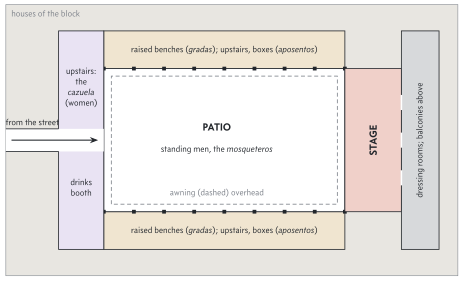
Figure 19.1 shows how a corral worked. The stage stood at the far end, a bare platform backed by a wall with doors for entrances and a balcony above it, which served as a tower, a window, or a city wall as the play required. In front of it lay the patio, the open yard, where the poorest men stood. These were the mosqueteros (mos-keh-teh-rohs), the “musketeers,” whose whistles and jeers could sink a new play in its first act. Along the sides ran raised benches, and above them were the aposentos (ah-poh-sen-tohs), rooms in the surrounding houses that nobles rented by the season and watched from through lattices. At the end facing the stage, upstairs, was the cazuela (kah-thway-lah), the “stewpot,” a gallery for women only, and beneath it a booth sold aloja, a drink of water, honey, and spices. An awning stretched over the yard kept off the sun but not the rain. Unlike the London companies of Shakespeare’s day, where boys played the women (Vol. 11, The Age of Shakespeare), Spanish companies had actresses, and audiences came to see them.
Madrid’s corrales were rebuilt as roofed theaters in the eighteenth century, and the Corral del Príncipe survives only as the site of the Teatro Español. One corral outlived them almost by accident. In 1628 a priest named Leonardo de Oviedo built a theater behind an inn on the main square of Almagro (ahl-mah-groh), a town about a hundred miles south of Madrid. When the plays stopped, it became an inn again, and its galleries disappeared behind brick walls. In 1950 the innkeeper found an old deck of hand-painted playing cards, which set local scholars looking at the building, and in 1953, when the square was being rebuilt, the walls came down and the stage appeared almost whole. The Corral de Comedias of Almagro reopened on May 29, 1954, with a play by Calderón, and every July it holds a festival of the old Spanish plays (Figure 19.2).


Félix Lope de Vega Carpio was born in Madrid on November 25, 1562, the son of an embroiderer. Apart from his exiles and some years in Seville and Toledo, he spent his life there, and no writer was more Spanish,This country is home to Lope de Vega. → Spain•• or more a man of Madrid. His friend and first biographer, the playwright Juan Pérez de Montalbán (mohn-tahl-bahn), wrote that the boy could read Spanish and Latin at five. Before he could write, Montalbán says, he paid older boys with part of his breakfast to copy down the verses he made up. Lope studied at the University of Alcalá, east of Madrid, and in 1583 sailed with a Spanish fleet to the Azores, Portuguese islands far out in the Atlantic, where Terceira still held out against Philip II (Chapter 17). Back home he spent five years in love with Elena Osorio, an actor’s wife and a theater manager’s daughter. When she left him for another suitor, he wrote verses mocking her and her family, and in 1588 a court convicted him of libel. He was banished from Madrid for eight years and from the whole kingdom of Castile for two.
He did not go quietly. He carried off sixteen-year-old Isabel de Urbina, the daughter of one of Philip II’s painters, married her in May 1588 under pressure from her family, and a few weeks later signed on with the Armada. His ship came home. Lope sat out his banishment in Valencia, which belonged to the Crown of Aragon and so lay outside Castile, and then in the household of the Duke of Alba, a grandson of Philip II’s famous general (Chapter 15). Isabel died in childbirth in the 1590s. Back in Madrid, he loved the actress Micaela de Luján (loo-hahn), married Juana de Guardo, a rich butcher’s daughter, in 1598, and kept up both households for years. Grief turned him toward the Church. His son Carlos Félix died of a fever in 1612, still a small boy, and Juana died in childbirth the next year. In 1614 Lope was ordained a priest, and the priest went on falling in love: from 1616 until her death in 1632 he loved Marta de Nevares, who was married when they met. In his last years his son Lope, a young poet, drowned in a shipwreck off Venezuela, and his youngest daughter was carried off by a lover who then abandoned her. Lope died in Madrid on August 27, 1635, at seventy-two.
Admirers called him the Phoenix of Wits, after the bird of legend of which only one lives at a time, and Cervantes (Chapter 18), who envied him, called him a “monster of nature.” He meant the output. By Lope’s own count he had written 230 full-length plays by 1604, 483 by 1609, and 1,500 by 1632. Montalbán, in a memorial printed the year after his death, credited him with 1,800 playsThis writer is credited with thousands of plays. → Lope de Vega• and more than 400 short religious ones, well over two thousand in all. The true total is surely smaller, since Montalbán loved his friend and round numbers, but about 450 of Lope’s full-length plays survive. At 2,500 to 3,500 lines apiece, that is more than a million lines of verse, the length of some seventy Iliads. Lope boasted that more than a hundred of his plays had gone from his head to the stage in twenty-four hours each. He wrote them all in Spanish,Lope de Vega wrote in this language. → Spanish•• and all in verse, most of it the short eight-syllable line of the old Spanish ballads. Figure 19.4 sets his long life beside those of the other writers of this chapter.

In 1609 Lope explained his method, in verse, to a literary academy in Madrid. His New Art of Writing Plays in This Age admits, with a wink, that he knows the classical rules, which Italian critics had drawn from Aristotle (Vol. 6, The Greeks). Kings belong in tragedy and commoners in comedy, the rules said, and a play should keep to one story, one place, and one day. When he has a play to write, he says, encierro los preceptos con seis llaves, “I lock up the rules with six keys.” The paying public wanted something else, and he gave it to them. As he put it, como las paga el vulgo, es justo / hablarle en necio para darle gusto: “as the crowd pays for them, it is only fair / to talk to it like a fool to please it.” So he wrote three acts instead of the five the rules required, mixed the comic with the tragic, and let months or years pass between acts. He matched his verse to the moment, too: ten-line stanzas for complaints, sonnets for a character left alone to wait, and the old ballad meter for telling a story. Plots about honor, he added, were the best of all, because they stirred everyone.
Of all his plays, the most famous outside Spain is Lope’s FuenteovejunaThis playwright wrote Fuenteovejuna. → Lope de Vega•• (fwen-teh-oh-veh-hoo-nah), written about 1612 to 1614 and printed in 1619 in the twelfth volume of his plays. Fuente Obejuna (oh-beh-hoo-nah), as the town now spells itself, lies in the hills about 60 miles from Córdoba, in Andalusia (Figure 19.5). Its name joins fuente, a spring or a well, to ovejuna, “of sheep,” so the title is sometimes translated “The Sheep Well.”The title of this play is sometimes translated as "The Sheep Well." → Fuenteovejuna•• The story is true at its core. In 1476, during the war over the crown of Castile between Isabella and her niece Juana (Chapter 5), the village belonged to the Order of Calatrava, one of the crusading orders of monk-knights that had fought in the Reconquista (Vol. 9, Cathedrals and Crusades). Its commander there, Fernán Gómez de Guzmán, abused the villagers, and one night they rose and killed him.
Lope begins with politics. The Commander urges the order’s young Grand Master to seize the royal town of Ciudad Real for Juana’s side, against Ferdinand and Isabella. Back at Fuenteovejuna he hunts the village girls. In the woods he corners Laurencia, the mayor’s daughter, and puts down his crossbow to seize her, and her sweetheart, Frondoso, snatches it up and aims it at him until she gets away. In the second act the Commander demands Laurencia from her father, Esteban. His men drag off another girl, Jacinta, and flog the comic peasant Mengo for trying to protect her. Then the Commander breaks up the wedding of Laurencia and Frondoso, throws the groom into his dungeon, and carries off the bride.
In the third act Laurencia, beaten and disheveled, bursts in on the village council and shames the men for standing by. Stung, they arm themselves, the women form a company of their own, and together the villagers storm the Commander’s house and kill him. They know what will follow, and they rehearse an answer. When a judge sent by Ferdinand and Isabella arrives and puts some three hundred of them to the torture, old men, women, and a boy, every one gives the same reply: “Fuenteovejuna, señor” (“Fuenteovejuna, sir”). The villagers who killed their lord answer with the name of their village,In this play, villagers kill the Commander and answer interrogators with the name of their village. → Fuenteovejuna•• as if the whole place had struck the blow. Mengo, the coward, howls it in a comic diminutive, “Fuenteovejunica.” The baffled judge reports that he must hang the whole village or pardon it, and the king and queen pardon it and take it under the crown.
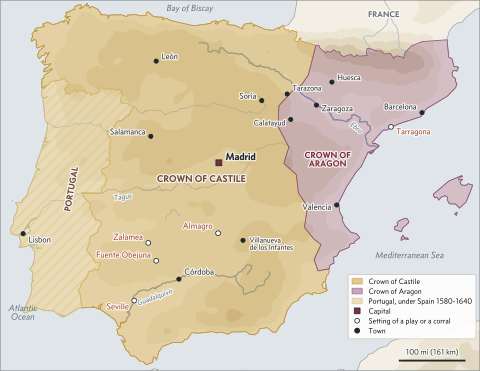
The Dog in the Manger (1618) is Lope’s comedy of a woman who cannot make up her mind. Diana, the young Countess of Belflor in Naples, falls in love with her secretary, Teodoro. He is clever and handsome but not noble, so she will not marry him, and she will not let him marry her maid, Marcela, either. She is like the dog in the old fable that lies in the manger, cannot eat the hay, and growls at the ox that can. In its Spanish title, El perro del hortelano,The Dog in the Manger was written in this language. → Spanish•• she is the gardener’s dog, which will not eat the cabbages and will not let anyone else eat them either. Teodoro’s quick-witted servant, Tristán, solves the problem with a lie. He persuades an old count who lost a son long ago that Teodoro is that son. Teodoro honestly confesses the trick to Diana, and she marries him anyway and keeps the secret.
Tirso and Don Juan
Lope’s most gifted follower wore a friar’s white habit. Gabriel Téllez (tel-yeth) was born in Madrid about 1580 and in 1600 joined the Mercedarians, the Order of Our Lady of Mercy, founded in Barcelona in the 1200s to ransom Christians held captive in Muslim lands. He was ordained a priest, served from 1616 to 1618 in the Spanish colony of Santo Domingo in the Caribbean, and wrote plays under the name Tirso de Molina (teer-soh deh moh-lee-nah). He said he had written three hundred plays by 1624 and four hundred by 1634; about eighty survive. In 1625 rivals complained to the Council of Castile, the king’s chief court of government, that a friar’s plays were corrupting public morals, and his order soon sent him away from Madrid. He became prior of a monastery and the official historian of his order, and the Spanish friar-playwrightThis country is home to Tirso de Molina. → Spain• died in 1648 in the province of Soria, where he had been made prior again.
His name is tied to one play above all, The Trickster of Seville and the Stone Guest, in Spanish El burlador de Sevilla y convidado de piedra (boor-lah-dor). It was first printed about 1630 in Barcelona, in a collection of new plays, and the collection named Tirso as the author of The Trickster.This author wrote The Trickster of Seville and the Stone Guest. → Tirso de Molina•• That attribution is now disputed. Another version of the play, perhaps the older one, survives under a different title, Tan largo me lo fiáis, roughly “You give me such a long time to pay.” Some scholars give the play to Andrés de Claramonte (klah-rah-mohn-teh), an actor and playwright from Murcia who died in 1626. Whoever wrote it, the play of about 1630 introduced Don Juan,This character appears in Tirso de Molina’s circa-1630 play The Trickster of Seville and the Stone Guest. → Don Juan•• the character all later versions descend from. Its two halves come from older tales. One is the story of a young man who mocks the dead and invites a skull or a statue to supper; the other is the story of a heartless seducer. The play joined them into a single man.

Don Juan Tenorio is a young nobleman of Seville who seducesThis character is a Spanish womanizer who relentlessly seduces women. → Don Juan•• one woman after another, by disguise, by trickery, or by a promise of marriage he never means to keep, and then runs. His father is the king’s trusted adviser, and his uncle is the Castilian ambassador in Naples, so for a long time he gets away with it. A burlador is a trickster or mocker, and Don Juan’s pleasure is less in love than in the trick. In Naples he slips in the dark into the room of the Duchess Isabela by pretending to be her fiancé, Duke Octavio, and his uncle helps him escape. Shipwrecked on the beach at Tarragona, he is nursed by Tisbea, a fisher girl, seduces her with a promise of marriage, and rides away. When she sees what has happened, she cries out that her hut is on fire, and so is she.
In Seville he tricks his friend the Marquis of Mota, steals into the house of Doña Ana, whom Mota loves, and is discovered. Her father, Don Gonzalo de Ulloa (oo-yoh-ah), Commander of the Order of Calatrava, comes at him with a sword, and Don Juan kills him. Mota is arrested for the murder. Riding through the village of Dos Hermanas, near Seville, Don Juan comes upon a peasant wedding, tells the groom that the bride, Aminta, is already his, and takes her too. Whenever anyone warns him that God will judge him, his servant Catalinón (kah-tah-lee-nohn) or his own father, he gives the same careless answer: ¡Qué largo me lo fiáis!, “You give me a long time to pay!” He is young, death is far off, and he means to repent at the end.
The end comes sooner. In a Seville church Don Juan finds the tomb of the man he killed. Above it stands a stone statue of the Commander, the Commendatore of later Italian versions, with an inscription saying that here the most loyal of knights waits for God to punish a traitor. Laughing, he invites the statue to supper. That night it comes, walking, to his house and invites him in return to dine in its chapel. Don Juan, who will not be called a coward, goes. The table is laid on a tomb, and the dishes are scorpions and vipers. A song warns him: que no hay plazo que no llegue / ni deuda que no se pague, “for there is no term that does not come due, / nor any debt that is not paid.” When supper is over, the statue takes Don Juan’s hand, and its grip burns like fire. He begs for a priest to confess to, and is refused. The ghost of Don Gonzalo, the Stone Guest of the title, has killed him, and with a crash the statue drags him down to hell.The ghost of Don Gonzalo, the "Stone Guest," kills this character in a Tirso de Molina play. → Don Juan••In some dramatic adaptations, a statue of the Commendatore drags this character to hell after dinner. → Don Juan• Catalinón runs to tell the king, and the women Don Juan deceived are free to marry the men they should have married.
The play is a warning in the language of Catholic belief. Catholics held that a sinner who truly repented, even at the last moment, could be forgiven. Don Juan’s sin is to count on that, to treat God’s mercy as a loan that need never be repaid, and the play shows the loan called in. His name became a word for any man who collects conquests, and his story one of the most retold in Europe. Molière (mohl-yair) made a comedy of it in France in 1665 (Vol. 13, Valois, Bourbon, and Orange). In Mozart’s opera Don Giovanni of 1787, the statue of the Commendatore comes to supper and drags the unrepentant Don away to hell (Vol. 14, From Luther to Mozart). Lord Byron’s Don Juan turned him into a charming victim of women (Vol. 15, The Age of Revolution), José Zorrilla’s (thoh-ree-yah) Don Juan Tenorio of 1844 let a woman’s love save his soul (Vol. 16, Romantic Europe), and Bernard Shaw set a long debate in hell between Don Juan and the Devil (Vol. 17, The Victorians).
Calderón and the zarzuela
When Lope died in 1635, the Madrid stage passed to a man of a different temper, who would be the last great playwrightThis author is a Spanish Golden Age playwright. → Pedro Calderón de la Barca•• of Spain’s Golden Age, its long century of great writing and painting (Chapter 18). Pedro Calderón de la Barca was born in Madrid on January 17, 1600, the son of a secretary in the royal treasury. He was educated by the Jesuits in Madrid and studied law at the University of Salamanca, but he won prizes for poetry instead. His first known play, a drama about King Edward III of England, was staged in the royal palace in June 1623, while Charles, Prince of Wales, the future Charles I of England, was in Madrid trying to win the hand of a Spanish princess (Vol. 12, Crown and Parliament). By the time of Lope’s death, Calderón was Spain’s leading dramatist,This country is home to Pedro Calderón de la Barca. → Spain•• and he held that place for the next forty-six years. Where Lope wrote fast and by instinct, Calderón planned, polished, and revised, building plots that click together like the parts of a lock.

He became the court’s playwright. Philip IV, king from 1621 to 1665, loved the theater, and his new palace on the edge of Madrid, the Buen Retiro, had its own playhouse by 1640, where Italian designers built machines for flying gods and shifting scenery. Calderón wrote spectacles for it, and the king made him a knight of the Order of Santiago, the noblest of the Castilian knightly orders, in 1637. When Catalonia rebelled against Philip IV’s government in 1640, Calderón went to fight there for the king. Then, in 1651, at fifty-one, he became a priest and gave up writing for the public theaters. He wrote instead for the palace and for the feast of Corpus Christi, when the towns of Spain carried the communion bread through the streets in procession, honoring what Catholics believe is the body of Christ. For that feast he wrote some eighty autos sacramentales (ow-tohs sah-krah-men-tah-les), one-act allegories in which characters such as the World, Beauty, and the Poor Man act out Christian teaching. In the most famous, The Great Theater of the World, God is a theater director who hands out the parts of a king, a rich man, and a beggar, and judges each by how well he played it. He was still writing autos when he died in Madrid on May 25, 1681, at eighty-one, and with him the Golden Age is usually said to end.
Calderón’s masterpiece, Life Is a Dream,This author wrote Life is a Dream. → Pedro Calderón de la Barca•• was first staged about 1635 and printed the next year. It is set in a Poland that exists only on the stage. Basilio (bah-see-lee-oh), its king, is a famous astrologer. When his son Segismundo (seh-hees-moon-doh) was born, the queen died in childbirth, and the stars told Basilio that the boy would grow into a cruel tyrant who would trample his own father. So the king announced that the baby had died, and shut his son in a towerIn this play, Segismundo is imprisoned in a tower because his father fears he will become a tyrant. → Life is a Dream•• in the mountains, chained like an animal and dressed in skins, with one old nobleman, Clotaldo (kloh-tahl-doh), as his jailer and teacher. Figure 19.8 sorts out the characters.

The play opens on a dark mountainside with a young man who is really a woman. Rosaura (roh-sow-rah), a lady of Muscovy, the Russian state ruled from Moscow, dressed as a man and followed by her servant Clarín (klah-reen), has come to Poland to take revenge on Duke Astolfo, who promised to marry her and then abandoned her. She stumbles on the tower and hears Segismundo cursing heaven. What crime has he committed, he asks, by being born? Then he answers himself, in two of the best-known lines in Spanish: pues el delito mayor / del hombre es haber nacido, “for man’s greatest crime / is to have been born.” Clotaldo arrests the strangers, but he recognizes the sword Rosaura carries as one he left long ago with a woman in Muscovy, and he begins to suspect that this “young man” is his own child. At court, meanwhile, Basilio’s nephew Astolfo, the same faithless duke, and his niece Estrella hope to marry and inherit the crown. Basilio tells them his secret and announces an experiment: he will bring Segismundo to the palace and see whether the stars were right.
Clotaldo gives the prince a sleeping drug, and he wakes in a palace bed, dressed as a prince, with servants bowing. Within hours he has proved the stars right. He throws a servant off a balcony, insults his father, threatens Clotaldo with a dagger, and tries to force himself on Rosaura. So Basilio has him drugged again and carried back to his chains, and when he wakes, Clotaldo tells him it was all a dream.In this play, a prince briefly freed from captivity is sedated and told it was only a dream. → Life is a Dream• Alone, Segismundo reasons it out. If his day as a prince was a dream, then his life may be one too, and a king only dreams that he is king. What should a man do, then? Act well anyway, Segismundo decides, because good deeds are not lost even in dreams. His speech ends with the lines that give the play its Spanish title, La vida es sueñoLife is a Dream was written in this language. → Spanish•• (swayn-yoh).
In the third act soldiers who have learned that Poland has a true heir break into the tower and set Segismundo free. He leads them, wins the civil war, and finds his father kneeling at his feet, waiting to be trampled as the stars foretold. Instead the prince kneels too and spares him. Basilio’s attempt to cheat fate had nearly caused the disaster it was meant to prevent, and Segismundo’s choice, not the stars, decides the ending. The new heir rewards and punishes like a king. He orders Astolfo to marry Rosaura,In this play, Rosaura marries Astolfo. → Life is a Dream• who turns out to be Clotaldo’s daughter and therefore noble enough, and takes Estrella as his own wife. Then he sends the rebel soldier who freed him to the tower for life, because a man who betrays his king once will do it again. The ending has troubled readers ever since. It is just, and it is cold.
Calderón’s The Mayor of Zalamea,This author wrote The Mayor of Zalamea. → Pedro Calderón de la Barca•• written about 1636, takes the comedia’s favorite subject, honor, down to a village, reworking an older play of the same name credited to Lope. Zalamea (thah-lah-may-ah) is a real town in Extremadura, the region of Spain that borders Portugal, and the play is set in 1580, as Philip II’s army marches west to claim the crown of Portugal (Chapter 17). A company of soldiers is quartered in the town, and its captain, Don Álvaro de Ataide, lodges in the house of Pedro Crespo, a rich farmer with no title. Crespo hides his beautiful daughter Isabel in the attic, but the captain contrives to see her. The army’s crusty general, Don Lope de Figueroa, a real officer of the time, also lodges with Crespo, and the two old men, both stubborn, end up admiring each other. Crespo’s famous lines say that he owes the king his property and his life, but not his honor: el honor / es patrimonio del alma, / y el alma sólo es de Dios, “honor / is the inheritance of the soul, / and the soul belongs to God alone.”
When the company marches out, Don Álvaro slips back with some of his men, carries Isabel off into the woods, and rapes her. Crespo’s son wounds him. That same day the people of Zalamea elect their town officers, and Crespo has been elected mayor,In this play, Pedro Crespo is elected to the title office. → The Mayor of Zalamea•• which makes him the town’s judge. Humbly, as a father and not as a mayor, he begs the captain to marry Isabel and offers his whole fortune as her dowry. The captain sneers that a nobleman cannot be judged by a peasant mayor, only by an army court. Crespo, now as mayor, arrests him, tries him, and has him garroted in the town jail,In this play, Don Alvaro is garotted in jail. → The Mayor of Zalamea• strangled with an iron collar tightened by a screw. The general returns to storm the jail, and at that moment Philip II himself rides into Zalamea. Shown the facts, the king judges that the sentence was just, even if the court was the wrong one, and makes Crespo mayor of Zalamea for life.
One more of Calderón’s gifts to the stage was set to music. Philip IV kept a hunting lodge in the woods outside Madrid, near his palace of El Pardo, called La Zarzuela (thar-thway-lah) for the brambles, zarzas, that grew around it. In the 1650s the court began holding entertainments there in which spoken verse alternated with songs and dances, and in 1657 Calderón wrote two of the first, The Gulf of the Sirens and The Laurel of Apollo, both on stories from classical myth. People called them fiestas de zarzuela, and the name stuck. A zarzuela is a play in which spoken dialogue alternates with songs, choruses, and dances, Spain’s own form of musical theater,This country developed zarzuela, a theatrical form combining spoken dialogue and music. → Spain•• as opera is Italy’s. Calderón also wrote the words for some of the earliest Spanish operas, sung all the way through, but the zarzuela was the form Spain kept. It fell out of fashion in the eighteenth century, came back in the nineteenth as popular theater, and the lodge that gave it its name, rebuilt, is now the home of the king of Spain.
Góngora, Quevedo, and Gracián
Luis de Góngora (gohn-goh-rah) was born in Córdoba on July 11, 1561, into a family of minor nobles. His father was Francisco de Argote, but the boy took his mother’s surname, Góngora, and kept it. The choice mattered in a Spain whose cathedrals, colleges, and offices admitted only men who could prove purity of blood, descent from no converts from Judaism or Islam (Chapter 5). A surname was part of that proof, and his mother’s evidently served him better than his father’s. An uncle passed him a paid post at Córdoba Cathedral, and Góngora took holy orders to hold it. He was not a devout churchman. His bishop complained that he seldom came to services and prayed carelessly when he did, and he loved bullfights and cards, which slowly ruined him. In 1617 he moved to Madrid as an honorary chaplain to Philip III, Philip II’s son and successor, and there in 1622 a young painter from Seville, Diego Velázquez, painted his portrait (Chapter 23). In 1626 an illness clouded his memory, and he went home to Córdoba to die, deep in debt, on May 24, 1627. Spain’s most difficult poetThis country is home to Luis de Góngora. → Spain•• is buried in the great cathedral that had been the city’s mosque (Vol. 9, Cathedrals and Crusades).


Góngora wrote ballads and sonnets that Spaniards sang and learned by heart, but in 1612 and 1613 he did something new. He wrote poems in a Spanish that tried to be Latin. He borrowed Latin words, piled myth on myth, and twisted the order of his sentences until the reader had to untangle them like a knot. His enemies called the style culteranismo (kool-teh-rah-nees-moh), a jeer that crossed culto, “cultivated,” with luteranismo, “Lutheranism,” to brand it a heresy against poetry. It was flowery and crowded with metaphor,This country's culteranismo style championed flowery, metaphor-heavy verse. → Spain•• a poetry in which nothing is called by its name. Góngora did not apologize. Answering a critic in a letter, he said that being obscure to the ignorant had done him honor, since that was what set learned men apart. Poets took sides, and Spain’s two rival Baroque stylesThis poet developed culteranismo and feuded with conceptismo's leading proponent. → Luis de Góngora••This country was home to two rival Baroque poetic styles called culteranismo and conceptismo. → Spain•• grew out of one feud: Góngora’s culteranismo against conceptismo (kon-thep-tees-moh), the poetry of the conceit, led by his bitterest enemy, the Madrid poet Francisco de Quevedo.
The Fable of Polyphemus and Galatea (1612) retold from Ovid the love of the one-eyed giant for the sea nymph Galatea, who loves the young Acis instead. Then came the Soledades, the “Solitudes,” of 1613. A young man, shipwrecked and rejected by the woman he loves, is washed ashore, climbs into the hills, and is taken in by goatherds. In the first Solitude he walks with them to a village wedding, and in the second he sails among fishermen and watches a hunt with falcons. Almost nothing happens. The poem is landscape, feasting, and description, every object turned into a jewel. Góngora planned four Solitudes, of the fields, the riverbanks, the forests, and the wilderness, but he finished only the first, broke off the second partway, and left the Soledades unfinished.This poet wrote the unfinished Solitudes. → Luis de Góngora• He dedicated the poem to the Duke of Béjar (bay-har), the nobleman to whom Cervantes had dedicated the first part of Don Quixote eight years before.

The Soledades went around Madrid in manuscript, since Góngora printed almost nothing, and caused an uproar. They were written in Spanish,Solitudes was written in this language. → Spanish• but in a Spanish so bent toward Latin that many readers could not follow it. The poet Juan de Jáuregui (how-reh-gee) wrote an Antidote against the Pestilent Poetry of the Soledades, and others wrote defenses and line-by-line commentaries, which the poem needed. Yet many of the rare Latin words Góngora used again and again are now ordinary Spanish, among them joven, “young,” which his enemies jeered at, brillante, “brilliant,” and fragmento, “fragment.”
Quevedo (Figure 19.9) was a Spaniard born in MadridThis country is home to Francisco de Quevedo. → Spain•• on September 14, 1580, to a family that served at the royal court. He was born with a clubfoot and was badly nearsighted, and he wore round spectacles so constantly that Spaniards still call that kind of eyeglasses quevedos. He studied at Alcalá and taught himself Greek, Hebrew, Arabic, French, and Italian. As secretary to the Duke of Osuna, the viceroy who governed Naples for the king of Spain, he ran diplomatic errands and secret ones, and in 1618 he was made a knight of Santiago. He was a skilled swordsman and a man of vicious tongue. In 1639 the king’s officers arrested him, for reasons never made public, and held him for four years in the monastery of San Marcos at León (leh-ohn). He came out broken in health and died on September 8, 1645, at Villanueva de los Infantes, a small town in La Mancha.
His style, conceptismo, was the opposite of Góngora’s. Where culteranismo multiplied words, conceptismo squeezed them, using concise wordplay and humorThis country's conceptismo style prioritized concise wordplay and humor. → Spain• to pack the most meaning into the fewest words. A conceptista line is short, plain in vocabulary, and loaded with double meanings. Quevedo described his own life in three lines:
The two poets attacked each other in verse for twenty years. Quevedo wrote a recipe for becoming a culto poet in a day, a sonnet that simply lists Góngora’s favorite words. He called Góngora a gambler, a bad priest, and worse. Góngora answered by spelling his rival’s name Quebebo, “I drink,” and calling him a drunkard. In the end Quevedo bought the house in Madrid where Góngora was living, for the pleasure of turning him out of it.
The cruelest of the attacks is a sonnet usually printed as “To a Nose” and known in English as Quevedo’s “To a Man with a Big Nose.”This poet wrote "To a Man with a Big Nose." → Francisco de Quevedo•• It begins Érase un hombre a una nariz pegado, “Once upon a time there was a man stuck to a nose.” Almost every line after it finds a new thing for the nose to be: a sundial, a still for brewing spirits, an elephant lying on its back, the ram of a war galley, a pyramid of Egypt. In the fourth line it is a bearded swordfish,This poem compares a nose to "a swordfish with an awful beard." → "To a Man with a Big Nose"•• which one modern translator renders “a swordfish with an awful beard.” Readers have long taken the man to be Góngora, and the poem is not only about a nose. It calls the nose “the twelve tribes of noses,” the tribes of Israel. In the version usually printed, it ends by saying that such a nose would be a crime even on the face of Annas, the former high priest before whom Jesus was first brought in the Gospel of John (Vol. 5, In the Beginning). In a country where mockers took a big nose as a sign of Jewish descent, and where Jewish ancestry could close a man’s career, the sonnet has been read as an antisemitic attackThis poem about a nose has been read as an antisemitic attack on its addressee. → "To a Man with a Big Nose"•• on Góngora, a hint that his blood was not “pure.” Quevedo hated the conversos, the Christians of Jewish descent (Chapter 5), and wrote against them openly in prose.
The same man wrote one of the greatest love poems in Spanish. The sonnet “Love Constant Beyond Death”This poet wrote "Love Constant Beyond Death." → Francisco de Quevedo• imagines the poet’s own death. The last shadow may close his eyes, he says, and his soul may cross the river of the dead, but it will not leave its memory behind on the far bank, since his flame knows how to swim the cold water. His body will burn out, and its veins and marrow will be ash, yet the ash will still feel. The final line is the most famous in all his poetry: polvo serán, mas polvo enamorado, “they will be dust, but dust in love.”
Quevedo’s one novel goes the other way, down to the gutter. The Life of the Swindler, called El Buscón (boos-kohn), was printed in 1626 at Zaragoza, without his permission. It belongs to the picaresque, the comic life of a rogue told in his own voice that Lazarillo de Tormes had begun (Chapter 18), and his picaresque novel The SwindlerThis author wrote the picaresque novel The Swindler. → Francisco de Quevedo• is the darkest of the kind. Its hero, Pablos of Segovia, is the son of a thieving barber and a mother suspected of witchcraft, and his uncle is the town hangman. As a servant to a rich boy he nearly starves at the boarding school of a schoolmaster named Cabra, “Goat,” a miser so thin and stingy that Quevedo spends a page of conceits on his skeleton. At the University of Alcalá the other students beat him and spit on him. He sets out to become a gentleman by swindling, cheats and is cheated in Madrid, and ends in Seville among thieves, planning to try his luck in the Indies, Spain’s lands in America. He adds that a man who changes only his place, and not his life, never improves his lot.
The last and most thoughtful of the conceptistas was a priest of the Jesuits, the order founded by Ignatius of Loyola (Chapter 14). Baltasar Gracián (grah-thyahn) was born in 1601 near Calatayud (kah-lah-tah-yood), in Aragon, taught in Jesuit colleges, preached famously, and served as a chaplain with the army in Catalonia. The Jesuits required their members to ask permission before they published, so he printed his books under the name of his brother Lorenzo. In 1647 his friend Vincencio Juan de Lastanosa published at Huesca (wes-kah) the Oráculo manual y arte de prudencia (oh-rah-koo-loh mah-nwahl), the “handy oracle and art of prudence,” known in English as The Art of Worldly Wisdom and also as The Pocket Oracle. Gracián collected three hundred aphorismsThis author collected three hundred aphorisms in The Art of Worldly Wisdom, also known as The Pocket Oracle. → Baltasar Gracián• in it, short sayings each followed by a paragraph of explanation, on how to succeed at court and in the world without losing oneself. One became a Spanish proverb: Lo bueno, si breve, dos veces bueno, “Good things, if brief, are twice as good.” Others advise never to show a plan until it is finished, never to outshine one’s master, and to know when to leave the stage.

Gracián’s long allegorical novel El Criticón (kree-tee-kohn), printed in three parts between 1651 and 1657, follows a man of the world and a natural man raised alone on an island as they travel through the stages of life. He published it, too, without permission, and in 1658 the order punished him, sending him away to a small town. He died that December, at Tarazona in Aragon. Two centuries later the German philosopher Arthur Schopenhauer, who called the Oráculo a companion for life, translated it into German (Vol. 16, Romantic Europe).
What to remember
- Madrid’s open-air theaters, the corrales, opened from 1579 on; men stood in the patio or sat in side galleries and boxes, and women watched from the cazuela. The best-preserved corral is at Almagro (1628).
- Lope de Vega (1562–1635) was credited with about 1,800 plays, of which some 450 survive. His New Art of Writing Plays (1609) set the three-act comedia in verse.
- In Lope’s Fuenteovejuna, “The Sheep Well,” villagers kill their tyrannical Commander and answer the king’s judge only with the name of their village. The Dog in the Manger is his comedy of a countess in love with her secretary.
- The Trickster of Seville and the Stone Guest (about 1630), credited to Tirso de Molina, created Don Juan, the seducer whom the statue of the Commander he killed drags to hell.
- Calderón (1600–1681) wrote Life Is a Dream, in which Prince Segismundo is kept in a tower, freed, drugged, and told his day as a prince was a dream, and The Mayor of Zalamea, in which Pedro Crespo garrotes the captain who raped his daughter.
- The zarzuela, alternating spoken scenes with songs and dances, took its name from a royal hunting lodge, and Calderón wrote its first texts in 1657.
- Góngora’s culteranismo was ornate and Latinate (the unfinished Soledades); Quevedo’s conceptismo was concise and witty. Quevedo mocked Góngora in “To a Man with a Big Nose,” and wrote “Love Constant Beyond Death” and the picaresque Swindler.
- The Jesuit Baltasar Gracián collected three hundred aphorisms in The Art of Worldly Wisdom (1647).
The Baroque, 1590-1682
Chapter 20 · 59 clues
Caravaggio and Artemisia
In the summer of 1600 Rome was crowded with pilgrims. Pope Clement VIII, born Ippolito Aldobrandini (ahl-doh-brahn-dee-nee), had proclaimed a Holy Year, in which Catholics who came to the city and prayed at its great churches could earn an indulgence, which the Church taught would release them from punishment owed for their sins (Chapter 11). Near the Piazza Navona (nah-voh-nah) stood the church of the French community in Rome, San Luigi dei Francesi, “Saint Louis of the French.” One of its side chapels had stood unfinished for fifteen years. That July two enormous canvases were hung on its walls.
Visitors who stepped up to the chapel’s railing saw something they had never seen in a church. On the left wall, men in feathered hats sat counting money at a table in a bare room. On the right, a half-naked killer stood over an old man sprawled at an altar while onlookers ran. The figures were the size of life, dressed like the Romans in the street outside, and struck by a light so hard that half of each picture sank into black.
The painter was twenty-eight. He was a young man from Lombardy, the region around Milan, named Michelangelo Merisi (meh-ree-zee), and Rome called him Caravaggio, after his family’s town (the Stage). He wore a sword, lived in a cardinal’s palace, and already had a police record. Within six years he would kill a man and run. Within ten he would be dead. Yet for a generation young painters from Utrecht to Naples copied his darkness and his models from the street. One of the most gifted of them was a girl of seven in 1600, the daughter of his friend the painter Orazio Gentileschi (oh-raht-syoh jen-tee-less-kee).
Early Caravaggio
Michelangelo Merisi was born in Milan on September 29, 1571. His father, Fermo, managed the household of the marquis of Caravaggio, a small town about 22 miles east of the city, and in 1576, when plague struck Milan, the family moved there. Fermo and his own father died on the same day in 1577. Caravaggio’s mother raised five children in poverty, and in 1584 her son was apprenticed for four years to Simone Peterzano (peh-ter-tsah-noh), a Milanese painter who called himself a pupil of Titian (Chapter 12). In Milan he could study Leonardo’s Last Supper (Chapter 9), and in the churches of Lombardy the plain, devout pictures that its archbishop, Charles Borromeo (Chapter 14), had urged on painters. Lombardy had its own tradition of close, truthful painting of ordinary things, and Caravaggio never lost it.

In 1592 he left for Rome, where an early biographer says he arrived without money or a fixed address. The city was the right place for a young painter. Its popes and cardinals were building churches and palaces as fast as they could, and the Counter-Reformation, the Catholic revival after the Council of Trent (Chapter 14), wanted religious pictures that ordinary believers could understand and feel. Bellori says that he first painted heads for a minor painter at three a day, for a few coins each. Then he joined the workshop of Giuseppe Cesari (chay-zah-ree), Clement VIII’s favorite painter, where he painted flowers and fruit into the master’s large pictures. He fell seriously ill and spent months in a hospital. About 1593, in Young Sick Bacchus (Vol. 1, The Toolkit), he painted himself as the wine god,This artist portrayed himself with jaundiced skin, a leafy crown, and grapes in Young Sick Bacchus. → Caravaggio•• with a crown of ivy leaves, a bunch of pale grapes, gray lips, and the yellow skin of jaundice.
In the same months he painted Boy with a Basket of Fruit, now in the Borghese Gallery in Rome. A dark-haired youth with his shirt slipping off one shoulderThis artist’s Boy with a Basket of Fruit depicts a bare-shouldered figure. → Caravaggio•• holds a wicker basket heaped with grapes, peaches, pears, apples, and figs, and tilts his head toward the light. The fruit is painted so exactly that a modern professor of horticulture could name the varieties, and even a fungus spotting one of the leaves.
The boy was Mario Minniti (meen-nee-tee), a painter from Syracuse in Sicily who had come to Rome in 1593 at about sixteen. The two shared lodgings and plans, and Minniti modeled for CaravaggioMario Minniti modeled for this artist. → Caravaggio•• in picture after picture of these years, with his round face and his mop of dark hair. Fifteen years later, in Sicily, Minniti would repay the favor.
Street scenes for a cardinal
Early in 1594 Caravaggio quarreled with Cesari and left to work on his own. He sold his pictures through a dealer near the Piazza Navona, and a painter friend, Prospero Orsi, showed them to collectors. What he painted now were genre scenes, pictures of everyday life (Vol. 1, The Toolkit), and he painted them as half-length figures, people seen from the waist up, close to the viewer, against a plain wall. He worked straight onto the canvas from live models and seems hardly ever to have made drawings first. Instead he scratched a few guide lines into the still-wet base coat of the canvas with the end of his brush handle, marks that can still be seen in raking light. That was a scandal to painters trained in central Italy, where every picture began with careful studies on paper.
The first of these scenes, about 1594, was his first picture with more than one figure. In Caravaggio’s The Fortune TellerThis artist painted The Fortune Teller. → Caravaggio•• a young dandy in a plumed hat, one hand on his hip and a sword at his side, holds out his palm to a young Romani woman, one of the wandering people whom English speakers called “Gypsies” (Chapter 18). She looks up into his face and smiles. He is so pleased with her attention that he never looks down (Figure 20.2).

Look closer. The woman in the white headscarfA woman in a white headscarf reads a young man’s palm while stealing his ring in this painting. → The Fortune Teller (Caravaggio)•• reads his palm with one hand and with a fingertip of the other is easing the ring off his finger. The picture is a joke about looking, and the joke is on the viewer as well, who also took a moment to notice. A poet of the time, Gaspare Murtola, wrote a madrigal, a short poem, asking who was the greater enchanter, the woman or the man who painted her. In 1672 the biographer Giovan Pietro Bellori (the Stage) told a story that Caravaggio picked the girl out of the passers-by in the street to prove that nature was teacher enough. Bellori was writing sixty years after the painter’s death, and no earlier writer tells the story, so it is probably a legend. The physician Giulio Mancini (the Stage), who knew Caravaggio, says only that he was so poor he sold the picture for eight scudi, very little for a painting.
A second scene of cheating followed, about 1596. Caravaggio painted The CardsharpsThis artist painted The Cardsharps. → Caravaggio•• on a canvas about 3 feet high and 4 feet wide, now in the Kimbell Art Museum in Fort Worth, Texas. A well-dressed, innocent boy in dark velvet studies his cards at a table covered with a Turkish rug. Across from him sits a young cheat no older than himself (Figure 20.3).

The cheat wears a yellow-and-black striped doublet, the close-fitting jacket men wore, and his right hand is behind his back, pulling extra cards from his belt. Behind the victim an older man in a feathered cap peers at his cards and signals to the young cheat with gloved fingers,A gloved man signals to a youth in a striped vest who conceals cards behind his back in this painting. → The Cardsharps•• two of them raised to tell him what to play. The fingertips of the glove are cut away, perhaps so that he can feel the marks on the cards. A dagger hangs at the young cheat’s hip in case the game goes wrong. More than fifty copies of the picture by other painters survive.
The Cardsharps found Caravaggio his first great patron. Cardinal Francesco Maria del Monte, a rich collector who looked after the interests of the Medici grand dukes of Tuscany in Rome, bought it and took the painter into his household in the Palazzo Madama. For the cardinal and his friends, who loved music, Caravaggio painted half-length pictures of young musicians and of boys with fruit and wine: The Musicians, The Lute Player, and Boy Bitten by a Lizard. In the last, a youth jerks back his hand from a lizard hidden among cherries. Another is a Bacchus, about 1596, now in the Uffizi in Florence. The young god reclines like a guest at an ancient banquet, with vine leaves and grapes in his hair,In this artist's Bacchus, the title figure has vine leaves in his hair. → Caravaggio• a loose white robe slipping from his shoulder, and holds out a shallow glass of red wine to the viewer. Some of the fruit in the bowl before him is bruised and rotting.
His first religious pictures were just as plain. In the Penitent Magdalene, now in the Doria Pamphilj GalleryThis artist painted the Penitent Magdalene now in the Doria Pamphilj Gallery. → Caravaggio• (pahm-feel-yee) in Rome, painted about 1594 to 1595, a young woman in a brocade skirt sits on a low chair with her head bowed and a tear on her cheek. Her pearls, her jewels, and a glass jar of oil lie on the floor beside her. Christian tradition held that Mary Magdalene, a follower of Jesus, had been a sinner who became penitent, sorry for her sins, and gave up her old life (Vol. 5, In the Beginning), and painters usually showed her weeping in the wilderness, often half-dressed. Bellori complained that Caravaggio had simply painted a girl drying her hair and added the jar and the jewels to call her the Magdalene.
Two severed heads
About 1597 Cardinal del Monte wanted a present for his master in Florence, Ferdinando I de’ Medici, the grand duke of Tuscany. Caravaggio painted Medusa on a convex shield,This artist painted Medusa on a ceremonial shield. → Caravaggio••This painting of a severed head on a convex ceremonial shield shows blood against a green background. → Medusa (Caravaggio)•• a ceremonial shield never meant for battle. The Gorgon’s head, just cut off, seems to hang in front of a plain green background, its mouth open in a scream and its eyes wide in horror, while the snakes of its hair writhe and jets of blood pour from the neck. The bulge of the shield pushes the face toward the viewer. He had painted a first, smaller version a year or so before, which the poet Gaspare Murtola praised in verse; it now belongs to a private collector.

The story was well known (Vol. 4, Classical Myth). Medusa was a Gorgon whose gaze turned anyone who met it to stone. The hero Perseus cut off her head by looking only at her reflection in his polished shield, and the goddess Athena later wore the head on her aegis, the goatskin cloak over her shoulders. Caravaggio painted the head as if caught on Perseus’s shield at the moment of the cut. Medusa was traditionally a woman, but this face, with its heavy eyebrows, has a man’s features, and it is often read as Caravaggio’s own.The severed head in this painting is often interpreted as a self-portrait of Caravaggio. → Medusa (Caravaggio)• If so, the painter had looked into his mirror and painted himself as the creature no one could look at.
A year or two later, about 1599, Caravaggio painted a beheading in action. The Book of Judith, which Catholic Bibles include and Protestant Bibles place among the Apocrypha, tells how the widow Judith saved her besieged town by going to the camp of the Assyrian general Holofernes (Chapter 2). When he lay drunk in his tent, she cut off his head with his own sword (Vol. 5, In the Beginning). Painters before Caravaggio had nearly always shown Judith before the deed, praying, or after it, holding the head. He painted the cut itself (Figure 20.5).

Judith Beheading Holofernes, painted for the Genoese banker Ottavio Costa and now in the Palazzo Barberini in Rome, sets three figures against blackness. Holofernes, half awake, twists on his bed and screams, while three red jets of blood spurt from his neck onto the white sheet. Judith, young and fair in a white blouse, grips his hair and draws the sword through his neck at arm’s length, frowning with disgust and determination at once. The painter may have studied real executions; in September 1599 all Rome watched the beheading of Beatrice Cenci (chen-chee), a young noblewoman condemned for the murder of her cruel father. Caravaggio put the old servant Abra beside Judith,This artist’s Judith Beheading Holofernes shows the elderly attendant Abra beside Judith. → Caravaggio•• a wrinkled, toothless woman who leans in eagerly and holds the bag that will carry the head home. The Latin Bible calls Judith’s maid abra, an old word for a servant girl, and painters made it her name. The picture vanished for centuries and was found again only in 1950.
The Contarelli Chapel
The chapel that made Caravaggio famous had been waiting for its paintings since 1585. That year a French cardinal, Matthieu Cointerel (mah-tyuh kwan-trel), called Contarelli (kon-tah-rel-lee) in Italian, died in Rome and left money for his chapel in San Luigi dei Francesi, with orders that it show scenes from the life of his name-saint, Matthew. Giuseppe Cesari frescoed the vault by 1593 and then grew too busy with papal work to paint the walls. The money passed to the office that ran the building of Saint Peter’s, and that office was run by Cardinal del Monte. With the Holy Year of 1600 coming, and French pilgrims sure to fill their church, del Monte gave the walls to his own painter. Caravaggio signed the contract on July 23, 1599, and both side pictures were in place a year later. He painted them in oil on canvas, not in fresco.

The plan of the chapel shows how the pictures are seen (Figure 20.6). Paintings of Matthew’s martyrdom and inspirationPaintings of the title saint’s martyrdom and inspiration accompany this painting in the Contarelli Chapel of San Luigi dei Francesi. → The Calling of Saint Matthew••• hang with The Calling of Saint Matthew in the Contarelli Chapel: The Calling on the left wall, The Martyrdom of Saint Matthew facing it on the right, and The Inspiration of Saint Matthew straight ahead over the altar. The side pictures are each about 11 feet square, and because the chapel is narrow a visitor at the railing sees them only at a slant.
The Calling of Saint Matthew
The story is one verse of Matthew’s Gospel, which the King James Version gives as “he saw a man, named Matthew, sitting at the receipt of custom: and he saith unto him, Follow me.” Matthew collected tolls and taxes, a trade the Jews of his time despised, and Christian tradition held that this same tax collector wrote the first Gospel (Vol. 5, In the Beginning). Caravaggio’s Calling of Saint MatthewThis artist painted The Calling of Saint Matthew. → Caravaggio••• sets this moment in a Roman room of 1600, with a dirty window, a bare wall, and a plain table. The figures are life-size, and the whole upper half of the canvas is shadowy wall. Five men sit or stand at the table. At the right, barefoot and in robes, two figures have just come in: Saint Peter, seen from behind, and beside him Jesus, half hidden. Christ beckons to the tax collectorThis painting depicts Christ beckoning to a tax collector seated with four others at a table. → The Calling of Saint Matthew••• with his outstretched right arm, calling one of the five men at the table to leave everything and follow him. Nobody at the table has stood up yet, and only some of them have even looked up.
The men at the table do not belong to the Bible at all. They wear the clothes of Caravaggio’s Italy:Figures seated at a table wear contemporary Italian clothing in this painting. → The Calling of Saint Matthew• feathered velvet caps, striped and slashed sleeves, tight hose, and a sword at one young man’s hip, the outfits of the gamblers in The Cardsharps. Jesus and Peter alone wear the timeless robes of religious painting. Two worlds meet across the table, and the meeting is made by light.
A shaft of it enters diagonally from the upper right,A diagonal beam of light enters from the upper right in this painting. → The Calling of Saint Matthew••• above Christ’s head, and runs along the wall to strike the faces at the table. It falls from the direction of the chapel’s real window, high above the altar, so that the painted light seems to come from the room the visitor stands in. Christ himself is nearly lost in shadow. Only a faint, thin haloA faint halo hints at the divinity of a figure in this painting. → The Calling of Saint Matthew• over his head shows the viewer who he is, and the men at the table cannot see even that.
Look next at his hand. It is not a commanding hand with a pointing finger but a soft one, the wrist slightly limp and the fingers relaxed. It mirrors the limp hand of AdamIn this painting, Jesus's hand mirrors Adam's limp hand in Michelangelo's Creation of Adam. → The Calling of Saint Matthew• in Michelangelo’s Creation of Adam on the Sistine ceiling (Chapter 10), turned the other way. Christian writers since Saint Paul had called Christ the “last Adam,” who gives a new life as the first Adam received life from God. Caravaggio quoted the famous hand of his namesake in a scene of a second creation.
Now look along the table. At the far left, two men count money:Two figures at the far left count money at a table in this painting. → The Calling of Saint Matthew•• a young man hunched over the coins, his face hidden as he gathers them in, and an old man in spectacles leaning over his shoulder to peer at them. They have not noticed anything. In the middle sits a bearded man in a black cap. He points toward himselfA bearded man traditionally identified as the title figure points toward himself in a “Who, me?” gesture in this painting. → The Calling of Saint Matthew••• with his left hand, as if to ask, “Who, me?” Tradition has always made him Matthew, and the same bearded model plays Matthew in the chapel’s other two pictures.
Some scholars read the scene the other way. In their reading the bearded man is pointing not at himself but at the young man beside him, and Matthew is the youth counting coins,Some identify the title figure in this painting as a youth counting coins rather than the pointing bearded man. → The Calling of Saint Matthew•• slumped over his money at the end of the table, who has not yet looked up. The gesture of the bearded man is ambiguous enough to allow either reading, which is one reason the picture still holds people. Either way, the moment shown is the last one before the call is answered. In the next instant someone at the table will get up and walk out after Christ.
The two pictures made Caravaggio the talk of Rome. Bellori, who heard the story from older painters, says that the young painters of the city crowded around him, praised him as the only true imitator of nature, and looked on his works as miracles. Older painters grumbled that he could not compose a picture without models in front of him. From then on he never lacked patrons.
The Martyrdom and the Inspiration
On the opposite wall, The Martyrdom of Saint Matthew follows a story from the Golden Legend, the medieval book of saints’ lives: a king who wanted to marry a nun sent a killer to murder Matthew as he said Mass. A muscular young executioner, nearly naked, stands over the fallen saint at the altar and grips his wrist, while an angel leans down from a cloud to hand Matthew the palm branch of a martyr. Around them bystanders scatter in terror. At the back, among them, Caravaggio painted his own bearded face, turning to look over his shoulder.

The chapel still had no altarpiece. A Flemish sculptor’s marble statue of Matthew had been turned down, and in February 1602 the church gave that job, too, to Caravaggio. His first version showed Matthew as a bald, bare-legged peasant who could barely write, with an angel guiding his hand like a schoolmaster with a slow pupil. It was refused as undignified. That picture went to a collector, ended up in Berlin, and burned in 1945 at the end of the Second World War. Caravaggio quickly painted The Inspiration of Saint MatthewThis artist painted The Inspiration of Saint Matthew for the Contarelli Chapel. → Caravaggio•• instead and was paid for it in September 1602. Now the saint, in an orange robe, has hurried to his desk with one knee on a stool that tips out toward the viewer. He turns to look up at an angel who hovers above him, wrapped in a swirl of white cloth, ticking off on his fingers the points that Matthew must write in his Gospel.
The Roman altarpieces
After the summer of 1600 the commissions came in a rush. In May 1601 a Roman newsletter, reporting on his work in Santa Maria del Popolo (poh-poh-loh), the church inside Rome’s northern gate, called him “the most famous painter.” A chapel in its left transept, the crosswise arm of the church, had been bought on July 8, 1600, by Tiberio Cerasi (cheh-rah-zee), the treasurer-general of Clement VIII. On September 24, 1600, Cerasi signed a contract with Caravaggio for two pictures for the Cerasi Chapel’s side walls.This artist created two works for the Cerasi Chapel. → Caravaggio•• The altarpiece between them went to the other famous painter in Rome, Annibale Carracci (kah-raht-chee). According to Giovanni Baglione (the Stage), a painter who later wrote Caravaggio’s life, Cerasi rejected Caravaggio’s first versions, painted on wooden panels, and he painted both subjects again on canvas, finishing in 1601.
On the left wall hangs Caravaggio’s Conversion of Saint Paul.This artist painted The Conversion of St. Paul. → Caravaggio•• The Acts of the Apostles tells how Saul, a young Jew who persecuted the first Christians, was struck down by a light from heaven on the road to Damascus and heard the voice of Jesus; he became the apostle Paul (Vol. 5, In the Beginning). Caravaggio leaves out Jesus, the heaven, and the crowd. Saul lies flat on his back in the dress of a Roman soldier, his helmet fallen beside him, his eyes closed and his arms raised to a light only he can see. Above him a huge brown-and-white horse fills the picture,A brown-and-white horse dominates this painting above Paul, who lies on his back with his arms raised. → The Conversion of Saint Paul (Caravaggio)•• lifting one hoof carefully so as not to tread on its rider, while an old groom holds its bridle. On the wall opposite, in The Crucifixion of Saint Peter (Vol. 5, In the Beginning), three laborers strain like workmen raising a beam to lift the cross on which Peter is nailed upside down. Their faces are hidden; one crouches under the cross with his dirty soles toward the viewer. Only the old apostle’s face is clear, as he lifts his gray head and looks past the nail in his hand. Peter, tradition held, had asked to die head down because he was not worthy to die as his master had.
Carracci’s way
Annibale Carracci was born in Bologna in 1560. With his brother Agostino and his cousin Ludovico he had run a school for painters there, which taught drawing from life and from the great masters. In 1595 he came to Rome to work for Cardinal Odoardo Farnese in the Farnese Palace, and from 1597 to 1601 he painted the ceiling of its great gallery with the loves of the ancient gods. His Assumption of the Virgin (Chapter 12) on the Cerasi altar shows Mary rising from her tomb in clear daylight and bright colors, her arms open and her face lifted, while the apostles below gesture in wonder.
The two painters were not personal enemies, as far as anyone knows. But they stood for two answers to the same question, and Caravaggio’s light and feeling are contrasted with Carracci’sThis artist's works' lighting and emotions are often contrasted with Annibale Carracci's. → Caravaggio• in nearly every history of the period. Carracci drew constantly, studied Raphael, Michelangelo, and ancient statues, and painted figures more beautiful than life in an even, harmonious light, so that their feelings show warmly and clearly. Caravaggio painted ordinary people exactly as they looked, in a hard light that left most of the picture in darkness. Bellori praised Carracci for restoring painting and faulted Caravaggio for copying nature without choosing what was beautiful in it. In Rome and the rest of Italy, Carracci’s way, carried on by his pupils, won.
Emmaus and Gethsemane
The richest new patrons were the Mattei, a Roman noble family. For Ciriaco Mattei, in 1601, Caravaggio painted his first Supper at Emmaus (eh-may-us), now in the National Gallery in London. Luke’s Gospel tells how two disciples, walking to the village of Emmaus on the day of the resurrection, fell in with a stranger and invited him to eat with them. “He took bread, and blessed it, and brake, and gave to them. And their eyes were opened, and they knew him; and he vanished out of their sight.” Caravaggio painted The Supper at EmmausThis artist painted The Supper at Emmaus. → Caravaggio••• at the moment between those two sentences (Figure 20.8).

The canvas is more than 4 ½ feet high and nearly 6 ½ feet wide, and the figures sit at life size just behind the picture’s edge, as if across the table from the viewer. The table is set with a roast chicken, bread, wine, and a basket of fruit perched so near the edge that it seems about to fall into our space. The risen Jesus reveals himself to two disciplesThis painting depicts the resurrected Jesus revealing himself to two disciples over supper. → The Supper at Emmaus (Caravaggio)•• by blessing the bread, and they react with their whole bodies. The one at the right, a pilgrim’s scallop shell on his coat, flings his arms wide, one hand reaching toward the viewer. The one at the left grips the arms of his chair to spring up, and his coat is torn at the elbow. The innkeeper stands calmly beside them in his white cap and notices nothing.
Jesus himself looks strange to anyone who knows other paintings of him. Christ is beardless in the London version,Christ is depicted without a beard in the London version of this painting. → The Supper at Emmaus (Caravaggio)•• a plump, smooth-cheeked young man. Mark’s Gospel says that on that day he appeared to two disciples “in another form,” and Caravaggio may have taken the words literally: the disciples did not know him until he broke the bread, and the viewer barely knows him either.
A year later, in 1602, Ciriaco Mattei paid for The Taking of Christ, the arrest of Jesus in the garden of Gethsemane. Seven figures, seen from the knees or the waist up, are packed against a black ground. At the left the disciple John flees, screaming, his red cloak snatched by a soldier. Judas, the disciple who betrayed him, plants on Jesus the kiss that tells the soldiers whom to seize, and Jesus folds his hands and lowers his eyes. Soldiers in black, polished armor reach past him. At the far right a man holds up a lantern to see better, and he has Caravaggio’s own face (Figure 20.9).

The picture then disappeared from sight for two centuries. By 1786 it was listed as a work by Gerrit van Honthorst (hont-horst), one of Caravaggio’s Dutch followers. It was sold to Scotland in 1802 under that name, and in the 1930s a doctor in Dublin gave it to the Jesuit priests of Leeson Street. In 1990 Sergio Benedetti, a restorer at the National Gallery of Ireland, was asked to look at the pictures in the Jesuits’ house. He found the supposed Honthorst hanging in their dining room, cleaned away layers of dirt and old varnish, and rediscovered Caravaggio’s lost Taking of ChristThis artist’s The Taking of Christ was rediscovered in a Dublin Jesuit house. → Caravaggio• in a Jesuit house in Dublin. The news was announced in November 1993, and the Jesuits lent the picture to the National Gallery, where it hangs today.
The darkest kind of light
These pictures share one way of lighting a scene. Painters had long used chiaroscuro, the modeling of figures with light and shadow so that they look solid (the Stage). Caravaggio pushed it to an extreme. Bellori says he posed his models in a dark room lit from high above, so that a single raking light picks out faces, hands, and folds of cloth and leaves the rest in near-black. The style is called tenebrism, from the Italian tenebroso, “dark, murky,” and Caravaggio made tenebrism popularThis artist helped popularize tenebrism, an extreme use of light-dark contrast. → Caravaggio•• across Europe. His followers were sometimes called the tenebrosi, “the dark ones.” Their art was one strand of the Baroque, the style that grew up in Rome around 1600 and ruled European art for most of the next century and a half, the same years that give the Baroque its name in music (Vol. 1, The Toolkit). Baroque artists wanted to move the viewer with drama, motion, and light, and Rome, rebuilt by the popes of the Counter-Reformation, was its capital (Chapter 22).
Love victorious, and a lawsuit
The banker and collector Vincenzo Giustiniani (joo-stee-nyah-nee), a friend of Cardinal del Monte, owned more than a dozen Caravaggios. For him, about 1601 to 1602, Caravaggio painted Amor Victorious, also called Amor Vincit Omnia, Latin for “Love conquers all,” a phrase from Virgil. It shows Cupid victorious over every human pursuit.Caravaggio painted this figure in a painting of him "victorious." → Cupid (or Eros)•• Cupid, the Roman Eros, the winged boy-god of love (Vol. 4, Classical Myth), is a grinning, naked Roman boy of about twelve with dark eagle’s wings, climbing down from a table. Under his feet lie the things people work and fight for, all trampled: a violin and a lute with sheet music, armor, a crown, a square and compasses, a pen and a book, and a wreath of laurel for fame. Orazio Gentileschi, the painter who was Caravaggio’s friend, lent him the wings to paint from. Giustiniani is said to have valued it above every other picture he owned. It is now in Berlin.
The picture started a feud. Giustiniani’s brother, a cardinal, ordered from another painter, Giovanni Baglione, a Divine Love in which a heavenly Love in armor parts an earthly Cupid from the Devil, painted in an imitation of Caravaggio’s style. Caravaggio called it plagiarism, and his friends mocked it. Baglione answered with a second version in which, it was said, the Devil had Caravaggio’s face. In Giovanni Baglione, Caravaggio now had an enemy and a lifelong rival.Giovanni Baglione was this artist's rival. → Caravaggio• In 1603 Baglione sued Caravaggio, Orazio Gentileschi, and others for libel over some obscene verses about him that had gone around the studios. Caravaggio was held in the prison of Tor di Nona until the French ambassador had him released into house arrest. The trial record preserves his answers about painting. A good painter, he told the court, is one who knows how to paint well and to imitate natural things well. Forty years later Baglione wrote Caravaggio’s life in his Lives of the Painters (1642), and he made sure the world remembered the brawling.
Altarpieces accepted and refused
For the Chiesa Nuova, the “new church” of the Oratory, a society of priests founded by the Florentine Philip Neri to preach to ordinary Romans, Caravaggio painted the Entombment of ChristThis artist painted the Entombment of Christ. → Caravaggio•• in 1603 and 1604. It is now in the Vatican museums. Nicodemus, a stocky workman who looks straight out at us, and the young John lower the dead Jesus onto a stone slab whose sharp corner juts toward the viewer, like the edge of an altar. Behind them the Virgin Mary stretches out her hands, Mary Magdalene bows her head, and another Mary flings her arms up to the sky. Painters copied it for more than two centuries, from the Flemish painter Peter Paul Rubens to the French painters Fragonard, Géricault (zhay-ree-koh), and Cézanne.
For the church of Sant’Agostino, near the Piazza Navona, Caravaggio painted the Loreto MadonnaThis artist painted the Loreto Madonna. → Caravaggio• between 1604 and 1606. Loreto, near the Adriatic coast, has a shrine that pilgrims believed to be the Virgin’s own house from Nazareth, carried there by angels, according to a legend first written down in the 1400s. Caravaggio shows two of those pilgrims, a poor old man and an old woman, kneeling at a doorway with peeling plaster. The Virgin, barefoot, leans against the doorpost with her heavy child in her arms, and the man’s dirty soles face the viewer at the height of the altar. Baglione says that the common people made a great fuss over it. Not every church was pleased. A Madonna that he painted for an altar in Saint Peter’s in 1606 was taken down within days. In the same year the Carmelite friars of Santa Maria della Scala refused his Death of the Virgin. In that huge canvas Mary lies dead on a bed with her feet bare and her body swollen, mourned by the apostles under a great red curtain. Mancini says that the friars objected because the model was a well-known prostitute; Baglione blames the bare legs. Rubens, then working in Italy, advised the duke of Mantua to buy it, and the picture later passed to King Charles I of England and to the king of France. It is now in the Louvre.
Caravaggio in flight
Rome’s police knew Caravaggio well. He was arrested for carrying a sword without a license and for insulting the city guards, and a waiter took him to court for throwing a plate of artichokes in his face. In 1604 the Dutch writer Karel van Mander wrote that after two weeks of work he would swagger about for a month or two with a sword at his side, looking for a fight. In 1605 he wounded a notary in a quarrel over a woman and fled to Genoa for three weeks until his patrons smoothed it over.
On the evening of May 28, 1606, a Sunday, the quarrels ended in death. Near a court where Romans played pallacorda, an early kind of tennis, Caravaggio and his friends met an old enemy, Ranuccio Tomassoni (rah-noot-choh toh-mahs-soh-nee). He was a young man from a well-connected family of the Campo Marzio district, and he had his brothers and friends with him. Swords came out, and Caravaggio wounded Tomassoni, who bled to death. Rumors gave every cause: a bet on a game, a gambling debt, or a woman named Fillide Melandroni, who had probably modeled for Caravaggio’s Judith. Wounded himself, he fled Rome after killing Tomassoni.This artist fled Rome after killing Ranuccio Tomassoni in a brawl in 1606. → Caravaggio•• A court sentenced him in his absence to the bando capitale, a sentence of death that anyone who recognized him could carry out.

He hid first in the hill towns southeast of Rome that belonged to the Colonna, an old Roman princely family. Their kinswoman Costanza Colonna was the widow of the marquis of Caravaggio, whose household his father had managed. There, according to Mancini and Bellori, he painted a second Supper at Emmaus, now in the Brera gallery in Milan. It is quieter and darker than the first, with an old woman added beside the innkeeper and every gesture held back. The versions in London and MilanCaravaggio painted versions of this work now in London and Milan. → The Supper at Emmaus (Caravaggio)•• hang in two countries now, with five years and a killing between them. Late in September 1606 he went on to Naples (Figure 20.10).
Naples and Malta
Naples belonged to the king of Spain, who ruled it through a viceroy, and the pope’s sentence could not reach Caravaggio there. Within a few months he had painted altarpieces for the city’s churches. The greatest, The Seven Works of Mercy, still hangs above the altar of the charity for which he made it. It shows the seven acts of mercy that Christians were taught to perform, from feeding the hungry and clothing the naked to burying the dead. All seven happen at once on a dark street corner of Naples, while the Virgin and Child look down from above, carried by two angels. A school of Neapolitan painters began copying him at once. Then, in July 1607, he sailed to Malta with the galleys of the Knights of Saint John (the Hospitallers, by then also called the Knights of Malta), the order of soldier-monks that held the island and had beaten off the Ottoman siege of 1565 (Chapter 15). Their general of galleys was Costanza Colonna’s son.
The order’s grand master since 1601, the Frenchman Alof de Wignacourt (veen-yah-koor), wanted a great painter for his island, and Caravaggio wanted a knighthood. A knighthood would give him the rank of a gentleman, and a knight of so powerful an order might win a pope’s pardon. He painted Wignacourt in armor, with a young page holding his helmet, and a Saint Jerome Writing for the knights’ church. Wignacourt asked the pope for permission to admit a man guilty of murder, and on July 14, 1608, Caravaggio was made a knight. For the order’s great church of Saint John in Valletta, now called the Co-Cathedral, he painted The Beheading of Saint John the BaptistThis artist painted The Beheading of St. John the Baptist. → Caravaggio•• as the payment that every new knight owed the order. It is the largest picture he ever made, about 12 feet high and 17 feet wide (Figure 20.11).

The knights met to pray, and their young novices were taught, in the oratory, a hall beside their church. He made the picture for this oratory of the Knights of Malta,Caravaggio painted this work for the oratory of the Knights of Malta. → The Beheading of Saint John the Baptist• and it hangs there still. The scene is a prison yard at dusk, with an arched doorway and a barred window. The Gospels tell how Herod Antipas, the ruler of Galilee, had John the Baptist beheaded (Chapter 2). Here John lies face down on the ground with his hands tied behind him. The executioner, stripped to the waist, has already cut his throat with a sword and now grips his hair and reaches behind his back for a short knife to finish the work. The jailer, keys at his belt, points to the gold basin that a serving girl holds out for the head. An old woman clutches her head in horror, and from behind the bars two prisoners lean out to watch. Much of the vast canvas is empty wall.
Caravaggio almost never signed a picture. Here he wrote his name in the bloodThe artist’s signature appears in a pool of blood in this painting. → The Beheading of Saint John the Baptist• that runs from John’s neck: f. Michelang.o. The f stands for fra, “brother,” the title of a knight of the order. The words lay hidden under dirt until the picture was cleaned in the 1950s.
The brother did not last. On August 18, 1608, he took part in a brawl in which a knight of high rank was badly wounded. He was locked in the order’s prison in Fort Saint Angelo, escaped early in October, and reached Sicily by sea. Late in 1608 the knights expelled him as a rotten and stinking limb of the order, in the Latin formula they used in every such case, at a ceremony held in the oratory itself, before the Beheading.
Sicily, Naples, and the last journey
In Syracuse his old friend Mario Minniti, now married and a painter with a workshop, probably helped him win the commission for The Burial of Saint Lucy, the city’s own martyr. Two huge gravediggers in the foreground and a small crowd of mourners fill only the bottom of the canvas; above them rises a great blank wall. In Messina he painted The Raising of Lazarus, in which the dead man’s body is still stiff but his hand already reaches toward Christ. There, too, he painted The Adoration of the Shepherds, and in Palermo a Nativity that thieves cut from its frame in 1969 and that has never been found. Stories told of him in Sicily, collected a century later, describe a man who slept fully dressed with his dagger beside him and slashed a picture to pieces at a word of criticism. Bellori says fear drove him from city to city. By October 1609 he was back in Naples, where men attacked him at a tavern and cut his face so badly that Rome heard he was dead. To Wignacourt in Malta he sent a Salome with the Head of John the Baptist, showing the dancer who had asked for the prophet’s head (Chapter 2), and gave the head on her platter his own face, as a plea for forgiveness.
He spent his last months trying to buy his way home with pictures. The man who could grant or win a pardon was Cardinal Scipione Borghese, the nephew of Pope Paul V (Chapter 22) and a passionate collector, and for him Caravaggio probably painted David with the Head of Goliath, now in the Borghese Gallery. Scholars date it either to 1605 or to these last months. David, the shepherd boy who killed the giant Goliath (Chapter 10), is here a thin, sad-faced youth who holds the giant’s head out at arm’s length and looks at it with something like pity. The severed head of Goliath is Caravaggio’s own,This artist depicted himself as the severed Goliath in David with the Head of Goliath. → Caravaggio•• with the eyes half open and unfocused, the mouth slack, and the forehead marked by a wound. On David’s sword are letters that may stand for the Latin humilitas occidit superbiam, “humility kills pride.”
In July 1610 Caravaggio sailed north from Naples in a small boat, carrying paintings for the cardinal, with the pardon nearly settled. He never reached Rome. On July 18, 1610, he died of a fever at Porto Ercole, a fortress harbor on the coast of Tuscany held by Spain. He was thirty-eight. Whether the fever came from an infected wound, from malaria, or from something else has been argued ever since. In 2010 Italian researchers announced that they had found his bones in Porto Ercole, a claim that other scholars doubt. His friend Marzio Milesi (mar-tsyoh mee-lay-zee) wrote his epitaph, saying that he had been equal in painting not to a painter but to nature itself.
The Caravaggisti
Caravaggio left no workshop and no pupils, and his reputation fell almost as quickly as it had risen. Baglione’s Lives (1642) remembered him as a violent man who could not draw, and Bellori’s Lives (1672) admired his skill but blamed him for copying nature without choosing what was beautiful, and for misleading the young painters who imitated him. For two centuries his pictures were given to other men or forgotten. Only in the twentieth century, after the Italian critic Roberto Longhi (long-ghee) championed him in the 1920s and an exhibition in Milan in 1951, did he come to be ranked among the greatest painters of Italy.
His style, though, spread at once. The painters who followed him are called the Caravaggisti (kar-uh-vah-jee-stee). In Rome they included Orazio Gentileschi, Carlo Saraceni, and Bartolomeo Manfredi; in Naples, Battistello Caracciolo (bah-tee-stel-loh kah-raht-choh-loh); and through Naples, which Spain ruled, his darkness reached the Spanish painters Jusepe de Ribera (ree-beh-rah) and Francisco de Zurbarán (thoor-bah-rahn) (Chapter 23). Rubens saw his pictures in Rome and copied the Entombment. In France, Simon Vouet, back from Rome, and Georges de La Tour, with his candlelit night scenes, show his influence (Vol. 13, Valois, Bourbon, and Orange), and in Sicily Mario Minniti ran a busy workshop that turned out Caravaggio’s manner for local churches for thirty years.
The most distinct group came from the Netherlands. In Utrecht, an old bishop’s city in the Protestant Dutch Republic (Vol. 13, Valois, Bourbon, and Orange), many families had stayed Catholic, and several of its young Catholic painters went to Rome to study. The Utrecht Caravaggisti included Hendrick ter BrugghenGerrit van Honthorst and Hendrick ter Brugghen belonged to the Utrecht school named after this artist. → Caravaggio•• (ter brookh-en), born in 1588, who spent about ten years in Italy and was home by 1615, and Gerrit van Honthorst, born in 1592, who worked in Rome until 1620. Honthorst loved scenes lit by a single candle, and Italians later called him Gherardo (geh-rar-doh) delle Notti, “Gerard of the Nights.” Back in Utrecht, with a third painter who had worked in Rome, Dirck van Baburen, they painted Caravaggio’s subjects, his half-length figures, and his card players and musicians for Dutch buyers (Figure 20.12).


Their moment was short. After about 1630 Dutch taste moved on, and the painters who came after, Rembrandt and Vermeer among them, took from Utrecht a love of light falling through darkness without ever visiting Italy (Vol. 13, Valois, Bourbon, and Orange). Honthorst became a fashionable portrait painter, and in 1628 he was summoned to London to paint for King Charles I, the same art-loving king who had already taken Orazio Gentileschi into his service.
Artemisia Gentileschi
Orazio Gentileschi was born in Pisa in 1563, the son of a Florentine goldsmith named Lomi, and took the name Gentileschi from an uncle with whom he lived after he came to Rome as a boy. For years he was a modest painter of figures in other men’s decorations. Around 1600, when he was nearly forty, he met the younger Caravaggio, became his friend, lent him the wings for Amor, and changed his own style to paint from life in strong light. His eldest child, Artemisia (ar-teh-mee-zee-ah), was born in Rome on July 8, 1593, and her mother died in 1605. The daughter of the painter OrazioThis artist was the daughter of the painter Orazio. → Artemisia Gentileschi• learned to grind colors and paint in his workshop alongside her younger brothers, and outdid them all. In 1612 her father boasted that after three years of practice she had no equal.
Her earliest known painting, made at seventeen, already shows what she could do. She signed and dated Susanna and the EldersThis female artist painted Susanna and the Elders. → Artemisia Gentileschi•• in 1610; it hangs in the castle of Weissenstein at Pommersfelden in Germany. The story is one of the Greek additions to the Book of Daniel (Vol. 5, In the Beginning). Two elders, who were also judges, spied on a virtuous wife named Susanna as she bathed in her garden. They threatened to accuse her of adultery unless she gave herself to them. Artemisia set the scene against a hard stone wall. Susanna sits naked on its ledge, twisting her body away and raising her hands to fend off the two men who lean over the wall above her, whispering together. Most painters had made the scene an excuse for a pleasing nude. Hers is a picture of fear.
The trial
In 1611 Orazio was painting the vault of a garden pavilion for a cardinal’s palace with Agostino Tassi (tahs-see), a painter of landscapes and of painted architecture, who often came to the house. In May 1611, alone with Artemisia in her house, while the neighbor who was meant to watch over her ignored her cries, Agostino Tassi raped her.Agostino Tassi raped this artist. → Artemisia Gentileschi•• She fought him and even tried to stab him. Afterward he promised to marry her, which by the customs of the time would have restored her honor, and for months she held him to the promise. He was already married. In 1612 Orazio brought charges against him.
The trial lasted seven months, and its record survives. The law treated the crime chiefly as an injury to the honor of her family. To test her word, the court had her questioned under torture with the sibille, cords tightened around the fingers, which could have ruined a painter’s hands. The record says that as the cords tightened she turned to Tassi and called them the ring he had given her and the promises he had made. She did not change her story. Tassi was convicted and sentenced to leave Rome, a sentence that was never carried out, and he spent less than a year in prison. A month after the trial Orazio married his daughter to Pierantonio Stiattesi (stee-at-tay-zee), a minor Florentine artist, and the couple moved to Florence.
Judith
Within a year or two Artemisia painted the subject she would return to again and again. She painted versions of Judith Slaying HolofernesArtemisia Gentileschi's Judith Beheading Holofernes was inspired by this artist's version. → Caravaggio••This female artist painted versions of Judith Slaying Holofernes. → Artemisia Gentileschi•• after Caravaggio’s Judith, which inspired them: the first about 1612 to 1613, now in the Capodimonte Museum in Naples, and a larger one about 1620, now in the Uffizi in Florence (Figure 20.13). She kept his moment, the cut itself, and his darkness. She changed nearly everything else.

In Caravaggio’s picture Judith stands back from the blood and an old woman watches. In Artemisia’s, two strong young women do the job together. The maid, Abra, leans over the bed and pins Holofernes down while he pushes up against her. Judith, her sleeves rolled up and her arms thick with effort, holds his head down by the hair with one hand and saws through his neck with a long sword whose hilt looks like a cross. Blood spurts in arcs and soaks into the sheets. Since the trial became widely known in the twentieth century, some have read Judith as Artemisia and Holofernes as Tassi,This artist’s Judith Slaying Holofernes has sometimes been interpreted as showing herself as Judith and her rapist Agostino Tassi as Holofernes. → Artemisia Gentileschi•• as if the picture were her revenge. Others answer that Judith was one of the most popular subjects of the age, that patrons ordered it, and that she painted it for them as a professional.
She also painted the heroine of a story much like Judith’s, from the Book of Judges in the Hebrew Bible (Vol. 5, In the Beginning). In her Jael and SiseraA woman in yellow drives a tent peg into a sleeping general’s head in this artist’s Jael and Sisera. → Artemisia Gentileschi•• of 1620, now in Budapest, a calm young woman in a yellow dress kneels over the general Sisera, asleep after his defeat, and raises her hammer to drive a tent peg through his head.
Florence
In Florence the young wife found powerful patrons in the grand duke, Cosimo II de’ Medici, son of the Ferdinando who had been given the Medusa, and his mother, the grand duchess Christina of Lorraine. In 1563 his grandfather, Duke Cosimo I, had founded, on the advice of his court painter Giorgio Vasari (Chapter 13), the Academy of the Arts of Drawing, one of the first academies of artists in Europe. In 1616 Artemisia became the first woman admittedThis artist was the first woman admitted to the Florentine Art Academy. → Artemisia Gentileschi• to it. Women were almost never admitted to such bodies, and membership marked her as a professional painter in her own right. She also learned to read and write in these years, and she came to know the astronomer Galileo (Chapter 22), to whom she was still writing for help with patrons in 1635. For the Medici she painted another Judith, Judith and Her Maidservant, now in the Pitti Palace: the two women steal away from the camp with the head in a basket, both glancing to one side as if they had heard someone coming.
One of her first Florentine commissions came from Michelangelo Buonarroti the Younger, the great-nephew of the sculptor, who was turning the family house into a museum to his great-uncle’s memory, the Casa Buonarroti. He asked several painters for ceiling pictures of the virtues that had made Michelangelo great. Artemisia, then pregnant, was given Inclination, the natural talent a person is born with, and was paid three times as much as any of the others. In her Allegory of Inclination (1615 to 1617), a nude young woman holds a compassThis artist painted a nude woman with a compass on a cloud in Allegory of Inclination for the Casa Buonarroti. → Artemisia Gentileschi•• as she sits on a cloud, a star shining above her head; the compass is the navigator’s needle that always points the right way. Her face may be the painter’s own. In 1684 a later Buonarroti, embarrassed by the nudity, had another painter cover her with swirling drapery, and it is still there.

Many of her heroines seem to have her face, and she painted several pictures of herself in costume. About 1615 to 1617 she painted a self-portrait as a lute player in blue,This artist painted a self-portrait in blue clothing as a Lute Player. → Artemisia Gentileschi•• probably for the Medici. She wears a blue dress embroidered with gold over a white chemise, and a white turban, the costume of a musician at court entertainments, and her fingers sit on the strings and frets of the lute as if she knew how to play it.
Another small self-portrait of about the same time, painted on a wooden panel and now in a private collection, shows her as a martyr, one of the saints who died for their faith. Christians had shown martyrs with a palm branch since the Book of Revelation, which pictures the saved in heaven with “palms in their hands.” She holds a palm frond in her right handIn one self-portrait, this artist holds a palm frond in the right hand and wears a blue turban. → Artemisia Gentileschi• and wears a blue turban, and she looks straight out at the viewer.
Naples and London
By 1620 debts and gossip about a love affair drove the family back to Rome. In the 1620s Artemisia worked in Rome, where a visiting French artist, Pierre Dumonstier, drew her right hand in red and black chalk in 1625, and in Venice, where she probably painted Esther before Ahasuerus (Vol. 5, In the Beginning). In 1630 she moved to Naples, the city of Caravaggio’s exile, where she ran a busy workshop for most of the rest of her life and painted for the first time for a cathedral, at Pozzuoli (poht-swoh-lee) near the city. There, in the 1630s, she painted a scene from Il pastor fido (pahs-tor fee-doh), The Faithful Shepherd, a pastoral play by Giovanni Battista Guarini (gwah-ree-nee) published in 1590 and read all over Europe. In it Corisca, a scheming nymph, is seized by the hair by a satyr, one of the wild men of the woods of Greek myth (Vol. 4, Classical Myth), goat-legged in the art of the time. But her hair is a wig, and she escapes. In Artemisia’s Corisca and the Satyr, the nymph in a gold gown runs to the left, glancing back, while the satyr, sprawled on the ground, clutches her false hair.A satyr grabs a woman’s false hair as she escapes in this artist’s Corisca and the Satyr. → Artemisia Gentileschi• The picture was found in Naples only in 1989, and her signature turned up on a tree trunk when it was cleaned.
Her father, meanwhile, had become a court painter. He worked in Genoa from 1621 and then in Paris for the queen mother of France, Marie de’ Medici. In 1626, as most accounts tell it, Charles I invited Orazio to England,Charles I invited this artist, Artemisia’s father, to work at his court. → Orazio Gentileschi• though he lived at first in the household of the king’s favorite, the Duke of Buckingham. Charles, king of England, Scotland, and Ireland from 1625 until he was tried and beheaded in 1649 (Vol. 12, Crown and Parliament), was the greatest collector of paintings of his age. For Charles’s queen, Henrietta Maria, Orazio painted the ceiling of the Queen’s House at Greenwich, and in 1633 he painted The Finding of Moses, one version of which he sent to King Philip IV of Spain. In 1638 Artemisia came to London too, invited by the king, and worked beside her father once more. Orazio died there on February 7, 1639.

The picture most people remember from her London years is the Self-Portrait as the Allegory of Painting, though not everyone agrees that the face is hers. In 1593 Cesare Ripa (ree-pah), a scholar of Perugia, published the Iconologia (ee-koh-noh-loh-jah), a handbook that told artists how to show virtues, arts, and ideas as people. His Painting is a beautiful woman with black, untidy hair, arched eyebrows to show her imagination, a cloth tied over her mouth, a brush and a palette, and a dress of shimmering, changing color. Around her neck hangs a gold chain with a pendant in the shape of a mask, for the art of imitation. At Charles’s court, probably in 1638 or 1639, she painted herself as Ripa’s Painting,This artist likely painted Self-Portrait as the Allegory of Painting while working at Charles I’s court. → Artemisia Gentileschi••The artist depicts herself wearing a gold chain with a mask pendant, following Cesare Ripa’s Iconologia, in this painting. → Self-Portrait as the Allegory of Painting••• wearing the gold chain and its mask pendant just as the Iconologia prescribed. She leans toward a blank canvas with her sleeves pushed up and her hair falling loose, and the only thing she left out is the gag. As the American art historian Mary Garrard has pointed out, a man could paint himself painting, but only a woman could paint herself as Painting itself, since the arts were traditionally shown as women. Parliament sold the picture after the king’s execution, but it was recovered for his son, Charles II, in 1660, and it still belongs to the British crown.
Artemisia had left England by 1642, as the civil war began, and went back to Naples. In 1649 she wrote to a Sicilian collector, Don Antonio Ruffo, that he would find in her the spirit of Caesar in the soul of a woman. Her last known letter dates from 1650 and her last known commission from January 1654, and she may have died in the plague that struck Naples in 1656. For three centuries she was remembered mostly as Orazio’s daughter and as the woman of the trial. In 1916 Roberto Longhi, the critic who later revived Caravaggio, wrote an essay on father and daughter that began to change that. His wife, the novelist Anna Banti, made her the heroine of a novel, Artemisia, in 1947, and today museums show her alongside the best painters of her age.
What to remember
- Caravaggio (Michelangelo Merisi, 1571–1610), from Lombardy, worked in Rome from 1592, painting ordinary people from live models in a hard, dark light called tenebrism.
- Early works: Young Sick Bacchus, Boy with a Basket of Fruit (model Mario Minniti), The Fortune Teller, The Cardsharps, the Bacchus, the Penitent Magdalene, the Medusa shield, and Judith Beheading Holofernes with old Abra.
- In the Contarelli Chapel of San Luigi dei Francesi he painted The Calling of Saint Matthew, The Martyrdom of Saint Matthew, and The Inspiration of Saint Matthew (1599–1602).
- In the Cerasi Chapel he painted The Conversion of Saint Paul and The Crucifixion of Saint Peter beside Annibale Carracci’s altarpiece; Carracci stood for ideal beauty in clear light.
- Other Roman works: two Suppers at Emmaus (London, 1601, beardless Christ; Milan, 1606), The Taking of Christ (found in Dublin in 1990), Amor Victorious, the Entombment, and the Loreto Madonna. Giovanni Baglione was his rival and first biographer.
- After killing Ranuccio Tomassoni in 1606 he fled to Naples, Malta, and Sicily; he signed The Beheading of Saint John the Baptist in Valletta in the blood, painted himself as Goliath’s head, and died at Porto Ercole in 1610.
- The Utrecht Caravaggisti, Hendrick ter Brugghen and Gerrit van Honthorst, carried his style north.
- Artemisia Gentileschi (1593–after 1654), Orazio’s daughter, painted Susanna and the Elders at seventeen, went through the trial of Agostino Tassi in 1612, painted Judith Slaying Holofernes, and joined Florence’s Academy of the Arts of Drawing (1616) as its first woman.
- At Charles I’s court in London she painted Self-Portrait as the Allegory of Painting, with Ripa’s gold chain and mask.
Chapter 21 · 31 clues
Monteverdi and the Birth of Opera
In the winter of 1643, during Carnival, the season of feasts and masked balls before Lent, anyone in Venice with the price of a ticket could watch a Roman emperor fall in love on a stage. The theater had been built for the purpose and was run for profit. At least four such theaters had opened in the city in six years. The music for that season’s most daring opera came largely from the director of music at Saint Mark’s Basilica, a priest of seventy-five who had served the Venetian Republic for thirty years.
When he was born, in 1567, no one had ever heard an opera. The grandest music in Italy was polyphony, several voices weaving separate melodies, so that the words of a Mass or a love poem were often lost in the weave. In the next seventy years music learned to speak. A single voice learned to act a part, a chord could be made to shudder with pain, and a band of instruments could paint a battle. The change came from several directions at once. A murderous prince in the south pushed harmony further than anyone had dared, a church in Venice set choirs to answer each other across its galleries, and a club of Florentine gentlemen tried to bring back Greek tragedy. Above all, one composer from Cremona put all of these new powers to work.
Gesualdo
The most fashionable music at the Italian courts of the late 1500s was the madrigal, a song for several voices, often five, one singer to a part, set to an Italian poem, usually about love. It was sung for pleasure in a nobleman’s rooms, often by the household itself. Composers made the music follow the words closely. A sigh became a rest, a flight climbed quickly, and the word “death” sank to a dark, slow chord. This habit is called word painting. The madrigal was where Italian composers tried their boldest experiments, and the boldest of all were made by a prince.

Carlo Gesualdo (jeh-zwahl-doh) was an Italian noblemanThis country is home to Carlo Gesualdo. → Italy•• of the Kingdom of Naples, which the kings of Spain then ruled through a viceroy, a governor who stood in the king’s place (Figure 21.1). He was born in 1566, probably at Venosa (veh-noh-zah), the town of which his family were princes. His mother was a niece of Pope Pius IV, and her brother was Charles Borromeo, the pope’s right hand in Rome during the Council of Trent and archbishop of Milan, whom the Church later made a saint (Chapter 14). The boy was named Carlo after him. Carlo was a younger son, meant for the Church, but his elder brother died in 1584, and he became heir instead. In 1586 he married his first cousin, Maria d’Avalos (dah-vah-lohs), a famous beauty of a great Neapolitan family. He cared, people said, for nothing but music: he played the lute, the harpsichord, and the guitar, and he kept composers and singers in his household.

Some years into the marriage Maria began an affair with Fabrizio Carafa, the Duke of Andria. On the night of October 16, 1590, Carlo and his servants burst in upon the lovers in his apartments in the Palazzo San Severo in Naples. Gesualdo murdered his wife and her loverThis composer murdered his wife Maria d’Avalos and her lover. → Carlo Gesualdo•• in the bedroom. The next day officials of the court came to inspect the room and question the witnesses, and the high court of Naples ruled that he had committed no crime. Poets wrote verses about the scandal, among them Torquato Tasso, the poet of Jerusalem Delivered (Chapter 8). Gesualdo withdrew to his castle at the town of Gesualdo, in the hills east of Naples, and a year later his father’s death made him Prince of Venosa.
In 1594 he married again, this time Leonora d’Este, a cousin of Duke Alfonso II of Ferrara, the duke who had once locked Tasso away as a madman. At Ferrara he found the most adventurous musicians in Italy: the composer Luzzasco Luzzaschi (loo-tsahs-koh loo-tsahs-kee) and the concerto delle donne, three young women whose singing was famous across the peninsula. He published his first books of madrigals there. Then he went home to his castle and hardly left it again. He kept a printer there, and in 1611 his fifth and sixth books of madrigals came off a press at Gesualdo. Their harmony is chromatic: it uses notes outside the scale of the key, like the black keys of a piano in a piece that “belongs” on the white ones (Vol. 1, The Toolkit). His “Moro, lasso, al mio duolo” (“I die, wretched, in my sorrow”) begins with a C-sharp major chord and moves at once to A minor, two chords that seem to belong to different worlds. Some passages pass through all twelve notes of the octave in one phrase. Nobody wrote such progressions again until the nineteenth century.
He wrote the same way for the Church. Tenebrae, the services of Holy Week in which the candles are put out one by one (Chapter 14), included responsories, short pieces sung in answer to each reading from Scripture. In 1611 Gesualdo printed twenty-seven of them, nine for each of the last three days before Easter, for six unaccompanied voices. His Tenebrae Responsoria are harshly chromatic,This composer’s Tenebrae Responsoria feature striking chromatic harmonies. → Carlo Gesualdo• and the strangest chords fall on the words of Jesus’s suffering and of the apostle Peter’s guilt for denying that he knew him. Gesualdo’s last years were spent in gloom and illness, and he died in his castle on September 8, 1613. Three and a half centuries later the Russian composer Igor Stravinsky arranged three of his madrigals for instruments as Monumentum pro Gesualdo (1960).
Venice and the Gabrielis
Venice did things on a grander scale. Its church of Saint Mark, built to hold the relics of the city’s patron (Chapter 12), was not the city’s cathedral but the doge’s own chapel, where the state worshiped in procession on its great feasts. The church is shaped like a Greek cross, with five domes, and its chancel, the eastern end around the high altar, is raised above the floor and closed by a marble screen (Figure 21.3). On either side of the chancel, high up, a gallery opens toward the other, each with an organ. Singers placed in one gallery could be answered by singers in the other, and the sound seemed to cross the church in the air.

Composers learned to write for that space. In 1527 the doge made a Flemish musician, Adrian Willaert (vil-art), director of music at Saint Mark’s, and Willaert’s psalms for divided choirs made the method famous. Italians called the divided choirs cori spezzati (koh-ree spet-sah-tee), “broken choirs.” Music written for two or more separate choirs is called polychoral. One choir sings a phrase, the other answers, and at the climax they sing together. It works a little like stereo sound, except that the “speakers” are whole choirs and the listener stands between them. The opposed choir galleries of Saint Mark’sOpposed choir galleries at St. Mark’s Basilica encouraged polychoral music in this city. → Venice•• were the reason Venice, more than any other city, made polychoral music its own.
The family that brought the style to its height was the Gabrielis. Andrea Gabrieli (about 1532–1585), organist of Saint Mark’s, wrote the music for the opening of Palladio’s theater at Vicenza (Chapter 16). His nephew Giovanni was born in VeniceGiovanni Gabrieli was a composer from this city. → Venice•• about 1555, probably grew up in his uncle’s house, and went north to Munich to study with Orlande de Lassus (lass-us), the most famous composer of the age, at the court of the dukes of Bavaria. He was back by 1584, and in 1585 he became principal organist of Saint Mark’s. He was also organist of the Scuola Grande di San Rocco, the brotherhood whose meeting house Tintoretto had covered with paintings (Chapter 16), and after Andrea died he edited and published his uncle’s music.

In 1597 Giovanni Gabrieli published his Sacrae SymphoniaeThis Venetian composer published Sacrae Symphoniae. → Giovanni Gabrieli•• (sak-ray sim-foh-nee-ay), “Sacred Symphonies.” The word did not yet mean a work for orchestra; it meant music in which voices and instruments “sound together.” The book holds forty-five motets, sacred songs in Latin, for six to sixteen voices, arranged in two, three, or four choirs, and sixteen pieces for instruments alone. In them Gabrieli did something few composers had done: he named the instruments he wanted, where most composers before him had left that to the players. The first volume (Vol. 1, The Toolkit) told how he set groups of cornetts, curved wooden horns with finger holes, and sackbuts, the ancestors of the trombone, across the church. The book’s Sonata pian’ e forte sets two groups of four instruments against each other: a cornett and three sackbuts in one, a viola and three sackbuts in the other. It is one of the first pieces ever printed with the words piano and forte, soft and loud, to tell the players when to change.
Musicians came from across Europe to hear him, and some stayed to learn. The young German Heinrich Schütz (shoots) studied with him from 1609 to 1612 and carried the Venetian style home to the Lutheran courts (Vol. 14, From Luther to Mozart). Gabrieli had been ill for years, and he died on August 12, 1612. The next year the director of music died too, and Saint Mark’s looked outside the city for his successor.
Monteverdi’s madrigals
Cremona was a prosperous town on the Po in the Duchy of Milan, which the king of Spain ruled; later its workshops would make the finest violins in the world (Chapter 24). Claudio Monteverdi was born in the Italian cityThis country is home to Claudio Monteverdi. → Italy•• of Cremona and baptized on May 15, 1567, the eldest son of Baldassare Monteverdi, an apothecary, who made and sold medicines. He learned music from Marc’Antonio Ingegneri (in-jen-yair-ee), the director of music at the cathedral, and he was a quick pupil. A book of his little sacred songs was printed in Venice when he was fifteen, and his first book of madrigals in 1587, when he was twenty.

About 1590 he went to Mantua, the small, rich state east of Cremona ruled by the Gonzaga family from their great palace (Chapter 3; Figure 21.6). Its duke, Vincenzo I Gonzaga (ruled 1587–1612), was extravagant, restless, and devoted to the arts. As a prince he had persuaded the duke of Ferrara to release Tasso from his asylum, and as duke he hired the young Flemish painter Peter Paul Rubens (Vol. 13, Valois, Bourbon, and Orange). Monteverdi joined his household as a string player. He followed the duke to war against the Turks in Hungary in 1595 and to Flanders in 1599, and that year he married Claudia Cattaneo, a singer of the court. In 1601 he became the duke’s director of music.

His madrigal books mark his road. Monteverdi wrote nine books of madrigalsThis composer wrote nine books of madrigals. → Claudio Monteverdi• in all. He published eight of them himself, from 1587 to 1638, and a Venetian publisher printed the ninth in 1651, after his death. The early books are for five unaccompanied voices, in the polished style of the day. By the fifth book (1605), several madrigals need a basso continuo: a bass line, with chords filled in by a keyboard or a lute, under the singers. The later books hold duets, songs for one voice, and pieces that are almost little operas.
The new style did not please everyone. Giovanni Maria Artusi (ar-too-zee), a priest of the religious community of San Salvatore in Bologna, had studied with Gioseffo Zarlino (joh-zef-foh zar-lee-noh), the great teacher of the rules of counterpoint, the art of combining melodies. Those rules said that a dissonance, a clashing pair of notes (Vol. 1, The Toolkit), must be prepared: one voice holds a note from a sweet chord, the harmony moves under it so that it clashes, and then it steps down to a sweet note again. In 1600 Artusi published a dialogue called L’Artusi, overo delle imperfettioni della moderna musica, “Artusi, or The Imperfections of Modern Music.” In it two gentlemen examine passages from some of Monteverdi’s madrigals, not yet printed, though Artusi did not name him. Artusi condemned Monteverdi’s treatment of dissonance:Giovanni Artusi criticized this composer’s treatment of dissonance in The Imperfections of Modern Music. → Claudio Monteverdi• voices leaped straight onto clashing notes, with no preparation at all, and Artusi called the result harsh to the ear and against all reason.
Monteverdi answered in a short note printed in his fifth book of madrigals in 1605. He wrote that there were two ways of composing. The first was the old rule that Zarlino had taught, in which the harmony ruled. The second, which he called the seconda pratica (seh-kon-dah prah-tee-kah), “second practice,” put the words first. In 1607 his brother, Giulio Cesare, explained it more fully: in the new style the words were the mistress of the harmony, not its servant. The seconda pratica let words override musical rules:This composer defended a "seconda pratica" that subordinated musical rules to the expression of the words. → Claudio Monteverdi•• if a poem cried out in pain, the music might break a rule of counterpoint to cry out with it. Monteverdi promised a whole book on the subject. He never finished it.
The Camerata and L’Orfeo
The second practice put the words first. Years before, a group of Florentines had wanted to go further and give the words to a single voice. In the 1570s and 1580s Count Giovanni de’ Bardi, a Florentine nobleman who had fought the Turks at Malta in 1565 (Chapter 15) and wrote a treatise on Florentine football, gathered musicians, poets, and learned men in his house to talk about music. One of them later called the group the Camerata (kah-meh-rah-tah), from camera, “room.” Among them were the lutenist Vincenzo Galilei, father of the astronomer Galileo (Chapter 22), and the singer Giulio Caccini (kah-chee-nee). A scholar in Rome, Girolamo Mei, had read the ancient writers on Greek music, and he told them that the Greeks had sung their tragedies from beginning to end. The Florentines decided that the music of their own day, with five voices singing different words at once, could never move hearers as the Greeks had. What they wanted was one voice, singing in the natural rhythms of speech over a few plain chords. Galilei argued the case in a book in 1581, and Caccini printed a collection of such songs, Le nuove musiche, “The New Music,” in 1602. This singing speech grew into recitative, the half-sung, half-spoken style of opera (Vol. 1, The Toolkit).

In the 1590s another nobleman, Jacopo Corsi, took over as patron, and a singer and composer of his circle, Jacopo Peri (peh-ree), put the idea on the stage. With the poet Ottavio Rinuccini (ree-noo-chee-nee) he wrote Dafne (1598), a whole drama sung from beginning to end, whose music is almost all lost. Their second, Euridice (eh-oo-ree-dee-cheh), was sung at the Pitti Palace on October 6, 1600, among the festivities for the marriage of Marie de’ Medici to King Henry IV of France (Chapter 1), and it is the earliest opera whose music survives. It told the story of the singer whose music could charm beasts, trees, and the gods of the dead (Vol. 4, Classical Myth). Peri’s hero was OrpheusThis character is the protagonist of an opera by Jacopo Peri. → Orpheus• (or-fee-us), and Peri sang the part himself. For a wedding, Rinuccini gave the myth a happy ending: Orpheus wins back his wife, Eurydice (yoo-rid-ih-see), and the lovers return to the light rejoicing. Caccini, who had supplied some of the music, rushed his own setting of Rinuccini’s words into print before Peri’s.
In the audience that night, it seems, were Duke Vincenzo of Mantua and a young diplomat of his court, Alessandro Striggio (stree-joh). In 1606 the duke’s heir, Francesco Gonzaga, commissioned an opera of his own for the next Carnival. Striggio wrote the words on the same story, and Monteverdi wrote L’OrfeoThis composer wrote L’Orfeo. → Claudio Monteverdi••• (lor-fay-oh), named for its hero, whom Italians call Orfeo. It was first performed on February 24, 1607, in a room of the Gonzaga palace (Vol. 1, The Toolkit). In 1609 Monteverdi had the score printed in Venice, with a list of about forty instruments at its head. Where Peri had used a few lutes and a harpsichord, Monteverdi used his forty instruments to tell the story.

The opera begins with a toccata, here a short fanfare of trumpets played three times over, the flourish that announced the duke at his court. Then Music herself sings a prologue. The first act is a wedding in Thrace, the wild country north of Greece where Orpheus was born. Nymphs and shepherds dance, and Orpheus sings “Rosa del ciel”This character sings the aria "Rosa del ciel" in a Claudio Monteverdi opera. → Orpheus•• (roh-zah del chel), “Rose of heaven,” a song to the sun in which he asks whether it has ever seen a happier lover. In the second act, while he is singing, a messenger runs in: Eurydice, gathering flowers, has been bitten by a snake and is dead. The shepherds’ songs turn to dissonance. Orpheus will not live without her, and he descends into the underworld to recover Eurydice,The title character descends into the underworld to recover Eurydice in this Monteverdi opera. → L’Orfeo (Monteverdi)•• or to stay there with her.
Here Monteverdi changes the sound of the whole orchestra. At the end of the second act his score tells the violins, the organ, and the harpsichords to fall silent, and the sackbuts, the cornetts, and the regal, a small organ with a buzzing reed tone, take over. Brass and reeds sound the underworld,In this opera, brass evokes the underworld, contrasting with strings, harpsichords, harp, and recorders for Thrace. → L’Orfeo (Monteverdi)• while the strings, harpsichords, harp, and recorders belong to the green fields of Thrace. A listener with eyes closed would know where the story stood.
In the third act Hope leads Orpheus to the gate of the dead, over which Striggio wrote the line Dante had put over the gate of Hell, in Longfellow’s translation “All hope abandon, ye who enter in” (Vol. 9, Cathedrals and Crusades). There Hope must leave him. The ferryman of the dead, Charon, in Italian Caronte, refuses to carry a living man across the river Styx. Orpheus sings “Possente spirto”This character sings "Possente spirto" to persuade the underworld’s ferryman. → Orpheus••• (pos-sen-teh speer-toh), “Mighty spirit,” to persuade him, with every art a singer had: long runs of ornaments on single syllables, echoed by violins, then cornetts, then the harp. Charon admits he is charmed but will not yield. So Orpheus plays on, Charon falls asleep, and the singer takes the boat and rows himself across.
In the fourth act Proserpina (proh-sur-pih-nuh), queen of the dead, begs her husband, Pluto, to free Eurydice, and he agrees, on the old condition that Orpheus must not look back as he leads her out. Orpheus sets off singing in triumph, but doubt creeps in, a noise behind him startles him, and he turns. Eurydice fades back into the dark. In the fifth act he is alone in Thrace, lamenting, and only an echo answers him. In Striggio’s printed words of 1607, a band of drunken Bacchantes, women who worshiped Bacchus, the god of wine, then burst in to threaten him. In Monteverdi’s score of 1609 the god Apollo, who in some tellings of the myth is Orpheus’s father, comes down instead, rebukes him for his grief, and carries him up to heaven, where he will see Eurydice’s likeness in the sun and the stars. The shepherds end the opera with a lively dance.
After a few revivals L’Orfeo was forgotten for more than two centuries, until scholars printed the score again in the 1880s and it was staged in Paris in 1911. Since then, and above all since singers and players took up the old instruments in the 1960s and 1970s, it has returned to the stage again and again, and today it stands among the earliest operas still regularly performed.This Monteverdi opera is among the earliest operas still regularly performed. → L’Orfeo (Monteverdi)•• Peri’s Euridice is older, but it is a historical curiosity; L’Orfeo fills theaters.
Monteverdi’s wife died in September 1607, seven months after the first night of L’Orfeo, and he had no time to grieve. The duke’s heir was to marry Margherita of Savoy in the spring of 1608, and the wedding needed an opera. Rinuccini came from Florence to write it, on the story of Ariadne, the princess of Crete who helped Theseus escape the Labyrinth and was abandoned by him on the island of Naxos (Vol. 4, Classical Myth). Monteverdi composed L’Arianna (lah-ree-ahn-nah) at furious speed. In March the young singer who was to play Ariadne died of smallpox, and Virginia Ramponi-Andreini, a famous actress and singer, took her place. On May 28, 1608, the opera was sung in a huge temporary theater built for the wedding. The ambassador of the Este court reported that Ariadne’s lament made many in the audience weep, and the composer Marco da Gagliano (gahl-yah-noh) wrote that Monteverdi’s music moved the whole audience to tears.
L’Arianna survives only in Ariadne’s lament,This composer’s largely lost opera L’Arianna survives principally through a lament beginning "Lasciatemi morire." → Claudio Monteverdi•• which begins “Lasciatemi morire” (lah-shah-teh-mee moh-ree-reh), “Let me die.” The rest of the score is lost, but Monteverdi saved this one scene by printing it on its own: as a madrigal for five voices in 1614, as a solo song in 1623, and as a lament of the Virgin Mary with sacred words in 1641. Ariadne, waking alone on the shore, says that nothing can comfort her in so hard a fate and so great a torment, begs to die, rages at Theseus, takes back her curses, and falls into despair. Every musical household in Italy, the Florentine monk and musician Severo Bonini wrote about 1650, owned a copy, and the operatic lament became a scene that Venetian audiences expected in every opera.
In 1610 Monteverdi printed something larger. The Vespers is the Church’s evening service of prayer, sung at sunset, made of psalms, a hymn, and Mary’s song of praise from Luke’s Gospel, the Magnificat (mag-nif-ih-kat). Monteverdi’s Vespers of 1610,This composer wrote the Vespers of 1610 (Vespro della Beata Vergine). → Claudio Monteverdi•• the Vespro della Beata Vergine (ves-proh del-lah beh-ah-tah vair-jee-neh), are music for Vespers on the feasts of the Virgin Mary, published in Venice together with a Mass in the old style. They hold every manner of music he knew. Old chant tunes are held in long notes while voices and instruments race around them. There are love songs on words from the Song of Songs, an echo song, and a sonata in which a single soprano sings “Holy Mary, pray for us” over eight instruments. The service opens with the words of Psalm 70, which the King James Version renders “Make haste, O God, to deliver me.” A tenor sings the Latin, Deus in adjutorium meum intende (ad-yoo-tor-ee-um), and the choir answers on a single chord, while under them the instruments play the trumpet toccata that opens L’Orfeo.A trumpet toccata opens this Monteverdi opera. → L’Orfeo (Monteverdi)•This composer reused the toccata from L'Orfeo as the opening Deus in adjutorium meum intende from his Vespers of 1610. → Claudio Monteverdi• Monteverdi dedicated the book to Pope Paul V, the pope who was then finishing Saint Peter’s (Chapter 11), and in the autumn of 1610 he took it to Rome, hoping for a post there. He came home without one.
He had reason to look for work. Duke Vincenzo paid badly and late, and in 1608 Monteverdi had begged to be released. When the duke died in February 1612, his son Francesco dismissed Monteverdi and his brother, and they went home almost penniless to Cremona.
Monteverdi in Venice
In August 1613, after an audition with a Mass of his own, Monteverdi was appointed director of music at Saint Mark’sClaudio Monteverdi worked in this city. → Venice•• in Venice, a post he held for the rest of his life. On the road between Venice and Cremona, highwaymen robbed him of his belongings and of the fifty ducats that the procurators of Saint Mark, the nobles who ran the church, had given him for his expenses. He found the choir neglected after his ailing predecessor, and he hired singers and players, trained them, and wrote music for every great feast. Within three years his salary rose from 300 to 400 ducats. When Mantua tried to lure him back in 1620, he refused: the Republic paid him well and on time, and he was free of a court’s intrigues.
Venice also let him write for private patrons. During Carnival in 1624 a nobleman, Girolamo Mocenigo (moh-cheh-nee-goh), had a new piece by Monteverdi performed in his palace. It set an episode of Tasso’s Jerusalem Delivered, the night duel in which the crusader Tancred kills Clorinda, the Muslim woman warrior he loves, without knowing who she is (Chapter 8). The Combattimento di Tancredi e Clorinda (kom-bah-tee-men-toh), “The Combat of Tancred and Clorinda,” is a dramatic scene for three singers and strings. It is sometimes called a dramatic cantata: a piece in several sections for voices and instruments that tells a story, acted out but without full scenery. A narrator sings most of Tasso’s stanzas while Tancred and Clorinda act out the fight in mime and sing their own lines. The strings imitate the trot of Tancred’s horse, the clash of swords, and the blows of the fighters.
To paint anger and battle, Monteverdi invented what he called the genere concitato (jeh-neh-reh kon-chee-tah-toh), the “agitated manner,” now usually called the stile concitato (stee-leh), the “agitated style.” Its sound is a single note repeated rapidly, a long note broken into sixteen quick strokes, a measured form of the trembling tremolo (Vol. 1, The Toolkit). In the Combattimento his stile concitato brought the tremolo into orchestral music,This composer's dramatic cantata based on Tasso's Jerusalem Delivered features one of the earliest uses of tremolo and pizzicato in orchestral music. → Claudio Monteverdi••This composer pioneered the use of tremolos as part of his stile concitato. → Claudio Monteverdi•• and there too he asked for one of the first pizzicatos (pit-sih-kah-toh), telling the players to put down the bow and pluck the strings with two fingers. At first the players resisted the repeated notes, and he had trouble getting them to play what he wrote. At the end Clorinda, dying, asks her enemy for baptism. Tancred fetches water from a stream, lifts her helmet, recognizes her, and baptizes her. Her last words are Tasso’s: S’apre il Cielo: io vado in pace, “Heaven opens; I go in peace.”
In 1630 plague reached Venice, carried from Mantua, and in sixteen months it killed more than 45,000 people, about a third of the city. Monteverdi lived through it, and in 1632 he became a priest. In 1638 he gathered his madrigals for the stage into an eighth book, dedicated to the Holy Roman Emperor, Ferdinand III. Its title is Madrigali guerrieri, et amorosi (gweh-ryeh-ree et ah-moh-roh-zee), and the eighth book divides into madrigals “of War” and “of Love,”This composer's eighth book of madrigals is divided into sections "of War" and "of Love." → Claudio Monteverdi•• each half opening with a large piece for six voices and closing with pieces for the stage. In its preface he explained the agitated style. He had found, he wrote, that the passions of the mind are three: anger, moderation, and humility, and that earlier composers had expressed the last two but never the first. He had taken the hint from a passage of Plato’s Republic on the music that imitates a brave man going into battle, and he printed the Combattimento in the book as his first example.
Opera for the public
In 1637 the Teatro San Cassiano opened in Venice, the first theater in the world built for opera that anyone could pay to see. Before then operas had been the gifts of princes, sung once or twice for a wedding or a Carnival. Within four years Venice had four opera houses, built by noble families and paid for by selling boxes and tickets. Monteverdi was over seventy, but he was soon writing for them. Monteverdi wrote The Return of Ulysses to His Homeland,This composer wrote The Return of Ulysses to His Homeland (Il ritorno d'Ulisse in patria). → Claudio Monteverdi•• Il ritorno d’Ulisse in patria (eel ree-tor-noh doo-lees-seh in pah-tree-ah), for the Carnival of 1639–1640, to words by Giacomo Badoaro, a Venetian poet. It sets the second half of Homer’s Odyssey (Vol. 4, Classical Myth), whose hero is Odysseus (oh-dis-ee-us); Latin writers called him Ulysses, and Italians Ulisse. Penelope laments her absent husband, Ulysses comes home to Ithaca disguised as an old beggar, he wins the contest of the bow, and he kills the suitors to music in the agitated style. In its prologue the gods of Time, Fortune, and Love mock the weakness of mankind. The only score, an incomplete manuscript, was found in Vienna in the nineteenth century.
Three years later came his last opera. Monteverdi wrote The Coronation of Poppea,This composer wrote The Coronation of Poppea. → Claudio Monteverdi• L’incoronazione di Poppea (leen-koh-roh-nah-tsyoh-neh dee pop-pay-ah), for the Carnival of 1643, to words by Giovanni Francesco Busenello (boo-zeh-nel-loh), a Venetian lawyer and poet. It was one of the first operas to tell a story from history instead of myth. The history is the Roman historians’ account of the emperor Nero; his first wife, Octavia; his mistress, Poppaea (pop-ee-uh); her husband, Otho; and Nero’s old tutor, the philosopher Seneca (Vol. 7, The Romans). Busenello squeezed seven years, AD 58 to 65, into a single day, and the opera calls them by their Italian names: Nerone (neh-roh-neh), Ottavia (ot-tah-vyah), Poppea, and Ottone (ot-toh-neh).
It opens in heaven. In the prologue Fortune and Virtue argueFortune and Virtue argue over power in this opera’s prologue. → The Coronation of Poppea• over which of them has more power over men, until the god of Love interrupts and claims that he rules them both, and that the story will prove it. Ottone comes home at dawn to find soldiers guarding his wife’s door: Poppea has become the emperor’s mistress, and Nerone is inside. In the palace Ottavia mourns that she is a queen despised. Nerone tells Seneca that he means to put away his wife and marry Poppea, and when the old man warns him that Rome will be outraged, Poppea persuades Nerone to send him an order to kill himself. Seneca opens his veins among his friends. Nerone casts aside Ottavia to make Poppea empress,Nerone casts aside Ottavia to make his mistress empress in this opera. → The Coronation of Poppea•• and the rest of the opera clears his path. Ottavia orders Ottone to murder Poppea; he creeps into her garden disguised in the clothes of Drusilla, a lady who loves him, but Love himself strikes the sword from his hand. Drusilla is arrested, Ottone confesses, and Nerone banishes them both, and Ottavia with them.
Ottavia sings “Addio Roma”Ottavia sings "Addio Roma" in this opera. → The Coronation of Poppea•• (ad-dee-oh roh-mah), “Farewell, Rome,” as she leaves for exile, a quiet, broken lament in which she can barely get the words out. The part was first sung by Anna Renzi, a singer in her early twenties, whom the Italian music historian Claudio Sartori, in a study of 1968, called the first diva of Italian opera, its first female star. Then the consuls and tribunes crown Poppea while the gods look on. The opera ends with the duet “Pur ti miro”This opera ends with the duet "Pur ti miro." → The Coronation of Poppea• (poor tee mee-roh), “I gaze at you.” Nerone and Poppea sing of their love in two high voices that wind around each other over a bass of four notes repeated again and again. Nerone was written for a castrato, a male soprano whose boyhood voice had been preserved by an operation. As the Roman historian Tacitus records, the real Nero killed Poppaea with a kick three years after the wedding. No original score survives, only two copies made in the 1650s, and parts of them, among them the final duet, may be the work of younger composers, perhaps Francesco Sacrati (sah-krah-tee) or Benedetto Ferrari.
Monteverdi died in Venice on November 29, 1643, months after the premiere, and was buried in the Frari, the great Franciscan church where Titian also lies (Chapter 16). A witness of the funeral wrote that the catafalque, the platform for the coffin, stood among so many candles that the church looked like a night sky full of stars. Within a few decades his music was forgotten, all but Ariadne’s lament, and his operas returned to the stage only in the twentieth century.
What to remember
- Carlo Gesualdo, Prince of Venosa, killed his wife, Maria d’Avalos, and her lover in Naples in 1590; his madrigals and Tenebrae Responsoria (1611) are the most chromatic music of the age.
- Saint Mark’s in Venice has two choir galleries facing each other across the chancel, which encouraged polychoral music for divided choirs. Giovanni Gabrieli, a Venetian, published the Sacrae Symphoniae (1597), with the Sonata pian’ e forte.
- Claudio Monteverdi (1567–1643), born in Cremona, served the Gonzaga at Mantua and from 1613 directed the music of Saint Mark’s in Venice. He wrote nine books of madrigals.
- Giovanni Artusi attacked Monteverdi’s dissonances in The Imperfections of Modern Music (1600); Monteverdi answered with the seconda pratica, in which the words rule the music.
- Bardi’s Camerata in Florence wanted to revive Greek drama in sung speech; Peri’s Euridice (1600), with Orpheus as its hero, is the earliest surviving opera.
- L’Orfeo (Mantua, 1607) opens with a trumpet toccata, later reused in the Vespers of 1610; Orpheus sings “Rosa del ciel” and, to the ferryman Charon, “Possente spirto”; brass sound the underworld. Only the lament “Lasciatemi morire” survives of L’Arianna (1608).
- In Venice Monteverdi invented the agitated style, with tremolo and pizzicato, for the Combattimento di Tancredi e Clorinda (1624), and divided his eighth book into madrigals of war and of love (1638).
- His last operas were for Venice’s public theaters: The Return of Ulysses (1640) and The Coronation of Poppea (1643), which ends with “Pur ti miro.”
Chapter 22 · 51 clues
Galileo, Bernini, and Urban VIII’s Rome
On June 22, 1633, an old man knelt in a hall of the Dominican convent beside the church of Santa Maria sopra Minerva, in the middle of Rome. He was sixty-nine, sick, and the most famous scientist in Europe. Before the cardinals of the Inquisition he read aloud the words he had been given. He abandoned, cursed, and detested the opinion that the sun stands still at the center of the world and that the earth moves, and he promised never again to say or write anything that could bring the same suspicion on him.
A little more than a mile to the west, across the Tiber, workmen in Saint Peter’s were finishing a bronze canopy almost as tall as a ten-story building, wound with laurel and crawling with bronze bees. Its designer was a sculptor of thirty-four. The old man on his knees and the young man on his scaffold had the same patron. Pope Urban VIII, born Maffeo Barberini (the Stage), had praised the scientist’s books and had told the sculptor that he was made for Rome. In the end he put the one on trial and gave the other almost everything he asked for. The scientist’s road to that hall began in Pisa seventy years earlier.
Galileo
Galileo Galilei was born in Pisa on February 15,Galileo Galilei was born in this city. → Pisa• 1564. Pisa was an old sea republic on the Arno that Florence had conquered in 1406, and it now belonged to the Medici dukes of Florence, soon to be grand dukes of Tuscany (Chapter 13). Its leaning bell tower had been famous for centuries (Vol. 9, Cathedrals and Crusades). Galileo’s father, Vincenzo, was a lute player and a writer on music, one of the circle of Florentines called the Camerata who argued about how the ancient Greeks had sung (Chapter 21). The family moved to Florence, and the boy joined them there at ten. In 1580 he went back to Pisa to study medicine, but a lecture on geometry turned him to mathematics, and in 1589 the University of Pisa made him its professor of the subject. His last pupil and first biographer, Vincenzo Viviani, wrote in 1654 that the young professor dropped balls of different weights from the leaning tower to show that they fell together. Galileo’s own writings never describe the experiment, and it may never have happened.
In 1592 Galileo moved to the University of Padua, which belonged to the Republic of Venice, and stayed eighteen years. There, in 1609, he heard that a Dutch spectacle maker had put two lenses in a tube and made distant things look near. He worked out how such a spyglass must be built and made a better one. That August, as he boasted in a letter a few days later, he showed Venice’s senators ships at sea two hours before anyone could see them with the naked eye. Soon he had an instrument that magnified twenty times, and he turned it on the sky. The moon was not a perfect polished globe, as the philosophers taught, but rough, with mountains whose shadows he could measure. The pale band of the Milky Way broke up into countless stars. On January 7, 1610, he saw three small points of light in a line beside the planet Jupiter, and within a week he understood that four little moons were circling it. They were later named for four lovers of Zeus, whom the Romans called Jupiter (Vol. 4, Classical Myth).

He hurried his discoveries into print. In March 1610 Galileo published The Starry Messenger,This scientist wrote the pamphlet The Starry Messenger (Sidereus Nuncius). → Galileo Galilei•• in Latin Sidereus Nuncius (sih-deer-ee-us nun-shee-us), a thin book of a few dozen pages, little more than a pamphlet, with his drawings of the moon. In Edward Stafford Carlos’s translation (1880), Galileo announced four planets, as he called the moons, “never seen from the very beginning of the world up to our own times.” He named them the Medicean Stars and dedicated the book to the young grand duke of Tuscany, Cosimo II de’ Medici, a grandson of Duke Cosimo I (Chapter 13), whom he had once tutored in mathematics. The flattery worked. That summer Cosimo made him his chief mathematician and philosopher, with a large salary and no duty to teach, and Galileo went home to Florence. In the spring of 1611 he took a telescope to Rome. The Jesuit astronomers of the Roman College, the best in the city, checked his moons and welcomed him as a hero. A young prince, Federico Cesi, made him a member of the scientific society he had founded in 1603, the Academy of the Lynxes, or Lincei (lin-chay-ee), named for the sharp-eyed cat.
The moons mattered because of an old argument. The astronomy taught in every university was geocentric: the earth stood still at the center of the universe, and the moon, sun, planets, and stars all circled it, as Aristotle and the Greek astronomer Ptolemy had taught. In 1543 the Polish astronomer Nicolaus Copernicus had proposed a heliocentric system, with the sun at the center and the earth one of the planets, spinning once a day and circling the sun once a year (Vol. 56, Astronomy and Earth Science). Jupiter’s moons proved that not everything in the sky went round the earth. Late in 1610 Galileo saw Venus show phases like the moon’s, from a nearly full disk to a thin crescent, which only made sense if Venus circled the sun. He became sure that Copernicus was right.
A warning in the Campo de’ Fiori
His certainty made enemies. He quarreled with a German Jesuit, Christoph Scheiner, over who had first seen dark spots moving across the face of the sun, and with Florentine professors who held to Aristotle. In December 1614 a Dominican friar, Tommaso Caccini, preached against him in a Florentine church. His text was a verse from the Acts of the Apostles that made a pun on Galileo’s name, which the King James Version renders “Ye men of Galilee, why stand ye gazing up into heaven?” Some churchmen objected that the Bible spoke of a moving sun, as when Joshua commanded it to stand still over Gibeon. Galileo answered in letters that were copied and passed around, one in 1615 to the grand duke’s mother, Christina of Lorraine. Scripture, he argued, could not err, but its readers could; the Bible taught how to go to heaven, not how the heavens go, a saying he borrowed from a cardinal. To many theologians, a mathematician telling them how to read Scripture sounded like the Protestants, whom the Council of Trent had condemned for exactly that (Chapter 14). Early in 1615 another Dominican, Niccolò Lorini, sent the Inquisition a copy of one of the letters, and Caccini went to Rome to denounce Galileo in person.
Rome had already burned a man who taught a stranger universe. Giordano Bruno (jor-dah-noh broo-noh), an Italian born at NolaThis country is home to Giordano Bruno. → Italy• (noh-lah), near Naples, in 1548, became a Dominican friar, fled his order, and wandered for fifteen years through Geneva, Paris, London, and the cities of Germany. He taught that the universe is infinite, that the stars are suns, and that other worlds circle them. He was also accused of denying the Trinity and the divinity of Christ, and he taught that souls pass into new bodies. In 1592 a Venetian nobleman, Giovanni Mocenigo, who had hired him to teach the art of memory, denounced him to the Inquisition. Venice handed him over to Rome, and after seven years of questioning he refused to recant. On February 17, 1600, he was burned alive in the Campo de’ Fiori (kahm-poh deh fyor-ee), a market square, with his tongue gagged. Most of the charges were about doctrine, so how much his astronomy counted against him is still disputed. Among his judges were the Jesuit theologian Cardinal Robert Bellarmine (bel-ar-min) and Cardinal Camillo Borghese, who in 1605 became Pope Paul V.
In February 1616 the Roman Inquisition, the church court that Paul III had founded in 1542 (Chapter 14), asked its experts about the earth’s motion. They called the sun-centered universe foolish and absurd as philosophy and heretical, because it contradicted Scripture. On Paul V’s orders Bellarmine summoned Galileo on February 26 and told him to abandon the opinion and not to hold or defend it. A week later Copernicus’s book was put on the Index of Forbidden Books (Chapter 14) until it could be corrected. Galileo obeyed, and for seven years he kept quiet.
Comets and a new pope
In 1618 three comets crossed the autumn sky. The next year Orazio Grassi (grahs-ee), the Jesuit professor of mathematics at the Roman College that Ignatius had founded (Chapter 14), published a lecture arguing from careful measurements that the comets lay far beyond the moon. Galileo, through a pupil, attacked it, and Grassi answered under a false name, Lothario Sarsi, with a book he called The Astronomical and Philosophical Balance. In October 1623 Galileo replied with Il Saggiatore (sahd-jah-toh-reh), The Assayer, his answer in the dispute over comets.This scientist wrote The Assayer during a dispute over comets. → Galileo Galilei• An assayer tests the purity of gold on a delicate scale, so the title promised to weigh Sarsi’s arguments on a finer balance than his own. On comets Galileo was wrong. He argued that they might be tricks of sunlight on rising vapors, and Grassi was nearer the truth. But the book was brilliant and cutting. In it Galileo made his most famous claim about science. The book of nature lies open before us, he wrote, and it is written in the language of mathematics, in triangles, circles, and other figures; without them we wander in a dark labyrinth.
The Lincei printed The Assayer, and its timing looked perfect. That August the cardinals had elected Maffeo Barberini pope as Urban VIII. He was a Florentine of fifty-five, educated by the Jesuits, a lawyer, and a writer of Latin verses, one of which had praised Galileo’s discoveries. The Lincei dedicated the book to him, and he had it read aloud to him at meals. In 1624 Galileo came to Rome and was received by the pope six times. He came away believing that he might write about Copernicus after all. He must treat the motion of the earth only as a hypothesis and give both sides fairly. He must also include the pope’s own favorite argument: God, being all-powerful, could produce what we see by means we cannot imagine, so no astronomer could claim certainty.
The Dialogue and the trial
The book took six years. Galileo wrote it in Italian, so that any educated reader could follow it, as a conversation over four days in a palace in Venice. The censors licensed it, and the grand duke received the first printed copy in Florence on February 22, 1632. In Dialogue Concerning the Two Chief World Systems, Salviati, Sagredo (sah-gray-doh), and Simplicio (sim-plee-choh) debateThis scientist’s Dialogue Concerning the Two Chief World Systems uses Salviati, Sagredo and Simplicio to debate geocentrism and heliocentrism. → Galileo Galilei••• the earth’s motion. Salviati, named for a Florentine nobleman who had been Galileo’s friend, argues for Copernicus and speaks for Galileo, whom he calls “the Academician.” Sagredo, named for another friend, a Venetian nobleman, is the clever outsider whom both sides must persuade. Simplicio defends Aristotle and the motionless earth. His name recalls Simplicius, an ancient commentator on Aristotle, but in Italian it also sounds like “simpleton.”
The conversation ranges widely. Salviati asks his friends to imagine themselves shut in the cabin below the deck of a large ship, with flies, butterflies, a bowl of fish, and a bottle dripping into a jug. If the ship moves smoothly, he says, nothing in the cabin behaves differently from when it is at anchor, so we should not expect to feel the earth’s motion either (Vol. 48, Physics: Motion and Matter). On the fourth day Galileo offered what he thought was his proof, a theory that the tides are water sloshing as the earth spins and circles; it was wrong. Near the very end, the pope’s own argument about God’s power is put into the mouth of Simplicio. Urban read it as mockery of himself, and Galileo’s enemies made sure he did.
The pope stopped the sale and sent the book to the Inquisition. Galileo, sixty-eight and ill, was summoned to Rome in the autumn of 1632 and arrived in February 1633. His judges produced a paper from 1616 saying that he had been ordered not to teach the earth’s motion in any way at all, and the Dialogue plainly did. In April he was questioned and kept for some weeks in rooms of the Inquisition’s own palace beside Saint Peter’s. Then the court’s chief investigator, a Dominican named Vincenzo Maculani, talked with him privately, and Galileo agreed to admit that a reader might take his book for a defense of Copernicus, which he said he had never intended. At his last questioning, on June 21, he was threatened with torture and held to his answer that he had not believed in Copernicus since 1616. The next day the Roman Inquisition forced him to recant.The Roman Inquisition forced this scientist to recant his heliocentric beliefs and placed him under house arrest. → Galileo Galilei•• It found him vehemently suspect of heresy, one step short of a heretic, made him abjure the earth’s motion on his knees, banned the Dialogue, and sentenced him to prison at the Inquisition’s pleasure. The prison became house arrest for the rest of his life. After some months with a friendly archbishop in Siena, he was allowed to go home to his villa at Arcetri (ar-cheh-tree), in the hills above Florence, near the convent where his elder daughter, Sister Maria Celeste, was a nun. He was to recite the seven penitential psalms every week for three years, and she obtained permission to say them for him. She died the following April.
According to a story that grew up after his death, Galileo rose from his knees, stamped on the floor, and muttered “And yet it moves.” Viviani’s life of him does not have it, and neither do the records of the trial. The words “And yet it moves”Tradition attributes “And yet it moves” to this scientist after his trial. → Galileo Galilei• first appeared in print in 1757, in The Italian Library, written in English and published in London by the Italian critic Giuseppe Baretti (the Stage). Baretti tells that the moment Galileo was set at liberty he looked at the sky and the ground and, stamping his foot, said “Eppur si muove” (ep-poor see mwoh-vay), “that is, still it moves, meaning the Earth.”
At Arcetri, going blind, Galileo finished the book he had been working toward all his life. The Inquisition had forbidden him to print anything, so in 1638 the manuscript went to Louis Elzevir (el-zeh-veer), a printer at Leiden in the Dutch Republic, where the pope’s writ did not run. Two New Sciences brings back Salviati, Sagredo, and Simplicio for four more days of talk. The two sciences are the strength of materials and the motion of falling and thrown bodies. The first explains, for example, why a giant could not simply be a man made larger. Double a man’s height, width, and depth, and the cross section of his bones, which gives their strength, grows four times, but his weight grows eight times, so his bones would have to be thicker in proportion or break. The third day opens its account of falling with the mean speed theorem that scholars at Oxford had stated three centuries earlier (Vol. 8, The Northern Worlds). Then it proves that the distances a body falls from rest are as the squares of the times, and it describes the experiments with balls on a sloping board, “repeated a full hundred times,” in Henry Crew and Alfonso de Salvio’s translation (1914). On the fourth day Salviati shows that a thrown ball, if the air did not slow it, would fly along the curve called a parabola. In 1638 a young English poet, John Milton, visited him at Arcetri, and six years later he wrote of finding “the famous Galileo grown old, a prisner to the Inquisition” (Vol. 11, The Age of Shakespeare).
Galileo died on January 8, 1642, at seventy-seven. The grand duke wanted a marble tomb for him in Santa Croce, the great Franciscan church of Florence, but Urban VIII and his nephew Cardinal Francesco Barberini objected, and he was buried in a small side room. In 1737 he was moved into the church under a monument. The Dialogue stayed on the Index until 1835.
The young Bernini
Gian Lorenzo Bernini (ber-nee-nee) was born in Naples on December 7, 1598. His father, Pietro, was a Florentine sculptor working in Naples, and his mother, Angelica Galante, was Neapolitan; he was the sixth of their thirteen children. In 1606 Pietro won a commission at the church of Santa Maria Maggiore in Rome and moved the family there, and the boy learned to carve in his father’s workshop. Once in Rome, Bernini hardly ever left it. Our two early lives of him come from Filippo Baldinucci, who published one in Florence in 1682 (the Stage), and from his own son Domenico, who published another in 1713. Domenico tells that the boy was brought before Pope Paul V, drew him a head of Saint Paul on the spot, and heard the pope say that this child would be the Michelangelo of his age.

The style that Bernini did more than anyone to create is the Baroque (Chapter 20). The same word names the music of about 1600 to 1750 (Vol. 1, The Toolkit), and in art it means works full of movement, strong feeling, dramatic light, and theatrical effects, made to overwhelm the viewer rather than to calm him. Bernini’s first great patron was Cardinal Scipione Borghese, the nephew of Paul V, who was Caravaggio’s patron too (Chapter 20). A pope who wanted to rule through someone he trusted made a nephew a cardinal and gave him the business of government. Rome called such a man the cardinal-nephew, and Scipione used the post to become one of the richest men in Rome. On the Pincian Hill, just outside the city walls, he built a villa to hold his collection of ancient statues and modern paintings (Figure 22.3). It still holds them, and the Galleria Borghese in RomeThe Galleria Borghese is located in this city. → Rome• is one of the great museums of the world. Most of what Bernini carved for the cardinal is still there.

Bernini’s earliest dated works are small. A bust, a portrait of the head and shoulders (Chapter 2), usually shows a real person, someone the viewer is meant to recognize. About 1619, though, he carved a pair of bustsThis artist sculpted paired busts of a serene Blessed Soul and a screaming Damned Soul. → Gian Lorenzo Bernini•• that show states of the soul after death, the Blessed Soul and the Damned Soul. The blessed soul is a serene young woman with a wreath of flowers in her hair, gazing upward in quiet joy. The damned soul is a man with wild hair, his brows knotted and his mouth wide open in a scream. The two busts now belong to the Spanish embassy to the pope in Rome. Some scholars have recently argued that they first showed a nymph and a satyr, a pair common in ancient art, and were renamed later.
In the same years Bernini carved four marble statues for Scipione, life-size or larger, each from a story the reader has met before, and each catching it at its most violent instant. The first, of 1618 and 1619, shows the Trojan hero Aeneas escaping from his burning city, as the Roman poet Virgil tells it in the Aeneid (Vol. 4, Classical Myth). Aeneas carries his father, Anchises,This artist sculpted Aeneas carrying Anchises, who holds household gods, with Ascanius at his feet. → Gian Lorenzo Bernini•• on his shoulder, and the old man holds the little statues of the household gods, which Aeneas would carry to Italy; the boy Ascanius (as-kay-nee-us), Aeneas’s son, follows at his feet. Bernini carved three ages of skin: Aeneas’s firm muscles, Anchises’s sagging flesh, and the child’s soft plumpness. The group was so accomplished for a sculptor of twenty that for a long time scholars gave it to his father.
The second group, made in 1621 and 1622, is The Rape of Proserpina. The title uses “rape” in its old sense, “carrying off,” from the Latin rapere, to seize. Pluto, the god of the dead, bursts out of the earth and carries off Proserpina, the daughter of Ceres, while she is picking flowers (Vol. 4, Classical Myth). Bernini’s The Rape of ProserpinaThis artist sculpted The Rape of Proserpina. → Gian Lorenzo Bernini• shows both figures nearly nude and larger than life. Pluto strides forward with his crown on his head and his beard flying, lifting the girl off the ground. She twists away, flinging one arm to the sky, and pushes against his faceCerberus watches Pluto abduct a woman who pushes against his face in this sculpture. → The Rape of Proserpina•• with her other hand, while a tear runs down her cheek. At their feet Cerberus, the three-headed dog who guards the entrance to the underworld, barks in three directions and marks the border she is being carried across. Most famous is a small detail. Where the god grips her thigh, his fingers seem to sinkPluto’s fingers seem to indent the woman’s flesh in this sculpture. → The Rape of Proserpina• into her flesh, as if the marble were soft. Scipione gave the group to Cardinal Ludovico Ludovisi, the nephew of the next pope, Gregory XV (1621–1623), to win his favor, and it came back to the Borghese collection only in 1908, when the Italian state bought it.

The third group, begun in 1622 and finished in 1625, is the most astonishing. In Ovid’s Metamorphoses, Apollo, struck by Cupid’s arrow, chases the nymph Daphne, who has sworn never to love. As he catches her, she prays to her father, a river god, and is turned into a laurel tree (Vol. 4, Classical Myth). Bernini carved Apollo and DaphneThis artist sculpted Apollo and Daphne. → Gian Lorenzo Bernini•• at the instant of change. The god runs in with his cloak streaming behind him and his face still eager, and he lays his hand on her hip. He has not yet understood what is happening. Bark is already closing over her legs, and her toes are rooting in the ground. Her hands turn into laurelA fleeing nymph’s hands turn into laurel branches as Apollo catches her in this sculpture. → Apollo and Daphne•• twigs and leaves that seem as thin as real ones (Figure 22.4). The leaves were carved by Bernini’s assistant Giuliano Finelli, from his design. A love story from the old myths needed an excuse in a cardinal’s house, so Maffeo Barberini wrote a Latin couplet for the base. It reads Quisquis amans sequitur fugitivae gaudia formae / fronde manus implet baccas seu carpit amaras, “Whoever, loving, chases the joys of fleeting beauty fills his hands with leaves, or picks bitter berries.”

Bernini set Daphne aside in 1623 to carve the fourth statue, a David, and Baldinucci says he finished it in seven months. The shepherd boy who killed the giant Goliath with a stone from his sling (Vol. 5, In the Beginning) had been carved by Donatello and by Michelangelo (Chapter 2, Chapter 10). Their Davids stand still, before or after the fight. Bernini’s David twists to sling the stone:A youth twists his torso and bites his lip as he prepares to sling a stone in this sculpture. → David (Bernini)••This artist sculpted David depicting him in the process of using a sling. → Gian Lorenzo Bernini•This artist sculpted a David twisting to sling a stone. → Gian Lorenzo Bernini•• he swings his whole body around, his torso turned back on itself, his brow knotted, and he bites his lower lip with the effort, about to let fly. Anyone standing in front of the statue stands where Goliath must be. On the ground lies the armor that King Saul lent him and he refused, and a harp lies at his feet,A harp lies at the feet of the biblical hero in this Bernini sculpture. → David (Bernini)• the instrument David played for Saul and with which he was said to have sung the Psalms. Both Baldinucci and Domenico say that Cardinal Maffeo Barberini held up a mirror while Bernini carved the face from his own. Before the statue was finished, Maffeo was pope.
Bernini under Urban VIII
Urban VIII was elected on August 6, 1623. Baldinucci says that almost at once he called Bernini in and told him that it was the sculptor’s great fortune to see Cardinal Maffeo Barberini pope, but a far greater fortune for the pope that Bernini lived in his reign. For twenty-one years he gave the sculptor nearly every great commission in the city. The pope was a prince as well as a priest. Rome was the capital of the Papal States,This city was the capital of the Papal States. → Rome• the band of territory across central Italy that he ruled with his own soldiers, judges, and tax collectors (the Stage). Urban made his brother and two nephews cardinals and a third nephew, Taddeo, prince of Palestrina, a hill town east of Rome, and commander of the papal army, and they grew immensely rich. He fortified Castel Sant’Angelo, built a palace for the family on the Quirinal (kwir-ih-nul) Hill, and stamped the Barberini coat of arms, the family’s badge of three bees, on everything he paid for. Table 22.1 gives the badges of the popes of this chapter, which still mark their buildings.
| Pope | Reigned | Family | Badge |
|---|---|---|---|
| Paul V | 1605–1621 | Borghese | a dragon and an eagle |
| Urban VIII | 1623–1644 | Barberini | three bees; also the sun and laurel |
| Innocent X | 1644–1655 | Pamphili | a dove with an olive branch |
| Alexander VII | 1655–1667 | Chigi | six hills under a star |
| Clement X | 1670–1676 | Altieri | six stars |
The pope’s first wish was for Saint Peter’s. The great church begun by Julius II had just been finished, and Urban consecrated it on November 18, 1626 (Chapter 11). It was the largest church in the world, and its high altar, set over the place where tradition puts Saint Peter’s tomb, looked lost under a dome whose cross stands 448 feet above the floor. A baldacchino (bahl-dah-kee-noh) is a canopy, originally of cloth, held over a sacred place or carried over the pope in procession. From 1623 to 1634 Bernini built the baldacchino for Saint Peter’sThis artist designed a baldacchino for St. Peter's Basilica. → Gian Lorenzo Bernini•• in bronze (Figure 22.6). Its four twisted columns are 66 feet tall, copies on a giant scale of the spiral marble columns from the old basilica, which were believed to have come from Solomon’s Temple in Jerusalem. Bronze laurel branches climb them, with bronze bees in the leaves. On top, instead of a roof, Bernini set a bronze imitation of a cloth canopy with tassels and scalloped edges, four angels, and four great curved brackets carrying a globe and cross. The whole stands nearly 100 feet high. The young Francesco Borromini (bor-oh-mee-nee), later Bernini’s bitter rival, worked on the drawings.

Romans believed that the bronze came from the ancient Pantheon, whose porch had kept its bronze beams until Urban had them stripped and melted down. In Rome, satire was pinned to an old battered statue near Piazza Navona called Pasquino (pahs-kwee-noh), and a Latin joke soon appeared there: Quod non fecerunt barbari, fecerunt Barberini, “What the barbarians did not do, the Barberini did.” Urban’s accounts show that about nine-tenths of the Pantheon’s bronze in fact went to cast cannon for Castel Sant’Angelo, and that the canopy’s bronze came from Venice. Saint Peter’s in RomeSt. Peter's Basilica is located in this city. → Rome• now had a center, and in 1629, when Carlo Maderno, who had built its nave and facade, died, Urban made Bernini architect of the church. He carved niches in the four great piers that hold up the dome, for colossal statues of the saints whose relics the church kept, and carved one of them himself, Saint Longinus (lon-jy-nus), the Roman soldier who, tradition says, pierced Jesus’s side with a lance. Figure 22.7 shows how the canopy, the piers, and the apse beyond fit together.

Bernini’s portrait busts of these years made him famous across Europe. In 1632 he carved his old patron Scipione Borghese, plump and genial, his lips parted as if he were in the middle of a sentence. When a flaw showed in the marble across the forehead, Bernini quickly carved a second bust, and both survive. Another bust was not for a patron at all. Costanza Bonarelli (koh-stahn-tsah boh-nah-rel-ee), carved about 1636 to 1638, shows a young Roman woman in a loose chemise open at the throat, her hair tied back carelessly, her lips parted as if she were about to speak (Figure 22.8). She was the wife of one of his assistants, Matteo Bonarelli, and Bernini was in love with her. Then he discovered that she was also the lover of his younger brother Luigi, his right hand in the workshop. Bernini chased Luigi through the streets and into Santa Maria Maggiore, meaning to kill him, and he had Costanza’s face slashedThis artist had Costanza Bonarelli’s face slashed after discovering her affair with his brother. → Gian Lorenzo Bernini• with a razor by a servant. The servant went to prison and Costanza was confined for adultery, but the pope excused Bernini, and in May 1639 Urban had him marry a young Roman woman, Caterina Tezio. They had eleven children. The bust is now in the Bargello in Florence.

Urban’s last works were for the street. The family’s new palace on the Quirinal had been begun by Maderno in 1627, and after his death Bernini finished it in 1633, working at first beside Borromini. In front of the palace lay a square, and in 1642 and 1643 Bernini made the pope a fountain for it in travertine, the creamy stone of the Roman countryside (Figure 22.9). A triton was a sea god of Greek and Roman myth, a man to the waist with a fish’s tail. In Ovid’s Metamorphoses the sea god Neptune orders his son Triton to blow his conch shell, and the waters of the great flood draw back. On the Triton Fountain four dolphins stand on their heads in the basin and hold up a great open scallop shell, their tails twined around the papal crown and keys and the Barberini bees. On the shell kneels Triton, his head thrown back, blowing a jet of water high out of his conch. Most earlier public fountains in Rome had been plain basins with spouts, and Urban and Bernini brought the sculpted fountain of the villa gardens out into a public square.

A year later he added a little partner at the corner of the square. The pope wanted water for the people’s horses, so Bernini made a horse-watering fountain,This artist designed a horse-watering fountain with three bees on an open shell. → Gian Lorenzo Bernini•• finished in April 1644: a low trough under an open shell of white marble, with three marble bees resting on it. A Latin inscription says that Urban, having built a fountain to adorn the city, built this little one for the use of private citizens. The Fountain of the Bees was taken apart in 1880 because it blocked traffic, and the one standing today at the foot of the Via Veneto is a copy made in 1915. Urban did not see many more months. His war against the duke of Parma over the little town of Castro had emptied the treasury and made him hated, and when he died on July 29, 1644, a crowd smashed his bust on the Capitol.
Disgrace and The Ecstasy of Saint Teresa
The next pope was Giovanni Battista Pamphili, a cautious, suspicious lawyer of seventy who took the name Innocent X. He had no love for the Barberini. He began proceedings against Urban’s nephews for misusing public money, and they fled to Paris. For his own works he preferred Bernini’s rival, the sculptor Alessandro Algardi (ahl-gar-dee). Bernini kept his post as architect of Saint Peter’s, but a disaster now caught up with him.
Maderno’s front of Saint Peter’s had been built with a bell tower planned for each end, and in 1636 Urban had told Bernini to build them. By 1641 the first tower was finished, and cracks had opened in the facade below it. Work stopped in 1642, when the money ran out. Under the new pope, Bernini’s enemies, Borromini among them, warned that the towers might bring the whole front down, and in February 1646 Innocent ordered them demolished. After the failure of his towers,This artist failed to complete an addition of two towers to St. Peter's Basilica. → Gian Lorenzo Bernini••This artist made Truth Unveiled by Time after criticism of his failed bell towers at Saint Peter’s. → Gian Lorenzo Bernini•• which cost him a heavy fine and his reputation, Bernini began a large marble statue for himself, a reply to his critics: Truth Unveiled by Time. Later inquiries blamed Maderno’s foundations, not Bernini’s towers.
He carved most of it between 1646 and 1652. A nude young woman, Truth,A nude woman holds a sun disk and rests a foot on the globe in this sculpture. → Truth Unveiled by Time•• sits on a rock, smiling and looking up, and holds a blazing sun in her right hand, with her left foot resting on a globe of the world. The sun and the globe come from the handbook of such figures that Cesare Ripa had published, the Iconologia (Chapter 20): truth is light, and it stands above the world. Above her Bernini meant to carve Time, an old man with wings, flying in to pull away the cloth that still lies behind her. Time reveals the truth, as the saying goes, and Bernini trusted it would reveal his. But he never carved the figure of Time.Bernini never completed the figure of Time intended to unveil the woman in this sculpture. → Truth Unveiled by Time•• His fortunes turned within a few years, and the half-finished group stayed in his house; he even tried to sell it to Cardinal Mazarin, the chief minister of France. In his will he left it to his eldest descendants forever. It has been in the Galleria Borghese since the 1920s.
While he was out of favor with the pope, Bernini was free to work for others, and a Venetian cardinal, Federico Cornaro (kor-nah-roh), the son of a doge, wanted a burial chapel. He chose the left arm of a small church on the Quirinal Hill belonging to the Carmelite friars. The church had been rededicated to Our Lady of Victory after the emperor’s Catholic army, carrying an image of the Virgin, beat the Protestant rebels of Bohemia at the Battle of the White Mountain, near Prague, in 1620. Santa Maria della Vittoria (vee-tor-yah) in RomeThe Ecstasy of Saint Teresa is located in this city. → Rome•This sculpture is in Santa Maria della Vittoria. → The Ecstasy of Saint Teresa••• is still theirs, and from 1647 to 1652 Bernini filled its left arm with the most famous chapel of the Baroque, built around The Ecstasy of Saint Teresa, at the price of 12,000 scudi.
Its subject was a Spanish nun. Teresa of Ávila (1515–1582) entered the Carmelite convent of her city at twenty. The Carmelites were an order named for Mount Carmel in the Holy Land, where they said their first hermits had lived. In 1562 she founded a small, poor convent with a stricter rule, and by her death her reform counted seventeen convents of nuns. Her nuns and friars were called Discalced, “unshod,” because they wore sandals or went barefoot. At her confessors’ order she wrote her Life, describing the visions she said she had received. In one, she tells, a small and very beautiful angel with a face aflame appeared beside her, holding a long spear of gold with a little fire at its iron tip, and seemed to plunge it several times into her heart. The pain made her moan, she wrote, and yet its sweetness was so great that she could not wish it gone; the pain was not of the body but of the soul. In 1622 the Church declared her a saint, in the same ceremony as Ignatius of Loyola (Chapter 14).

Bernini carved The Ecstasy of Saint TeresaThis artist sculpted The Ecstasy of Saint Teresa. → Gian Lorenzo Bernini• as that moment, in white marble, life size, above the altar, inside a frame of colored marble columns like a small stage. The nun lies swooning on a cloud that floats in the air, her eyes closed and her mouth open, one hand and one bare foot hanging limp, her heavy habit tumbling in deep folds. Above her stands the angel. With his left hand he lifts the edge of her habit, and with his right the angel aims a golden arrow,An angel aims a golden arrow at a Carmelite nun reclining on a cloud in this sculpture. → The Ecstasy of Saint Teresa••• Bernini’s version of her golden spear, at her heart. Bernini made him a boy with soft wings and a sweet, untroubled face, smiling as he looks down at her. Behind them a shower of gilded rays streams down from above, as if heaven were pouring out light. The light that falls on the figures comes from a hidden windowA hidden window illuminates golden rays behind this sculpture. → The Ecstasy of Saint Teresa••• behind the top of the frame, so that real daylight seems to pour out of heaven onto the gold. Visitors standing in the church cannot see the window, only its light.
On the side walls of the Cornaro Chapel Bernini carved the patrons, the family that paid for it and meant to be buried in it. Members of the Cornaro family sit in theater boxes,This sculpture occupies the Cornaro Chapel, where members of that family appear in theater-like boxes. → The Ecstasy of Saint Teresa••• the private balconies of a playhouse, one on the left wall and one on the right, carved in relief. Cardinal Federico, his father the doge Giovanni Cornaro, and other cardinals of the family lean on the railings. They turn to one another, read, and argue, like an audience at the opera. Over the whole chapel a painted sky opens with angels and the dove of the Holy Spirit. Sculpture, painting, architecture, and real light are joined into one scene, which Baldinucci called a bel composto, “a beautiful whole.”
The Four Rivers and the Chair of Saint Peter
The Pamphili family palace faced onto a long oval square. Its shape comes from the stadium that the emperor Domitian built there for athletic games in the first century AD, and its name may come from the Latin for those contests, in agone. In the 1640s Piazza Navona in RomePiazza Navona is located in this city. → Rome• was a busy market square. Innocent X decided to make it the forecourt of his family. He rebuilt the Pamphili palace and the church of Sant’Agnese (sahn-tahn-yay-zeh) beside it. In the middle of the square he planned a fountain under an ancient obelisk, a tall stone shaft that had been found in pieces near the Appian Way (Vol. 5, In the Beginning taught obelisks).
The pope asked other architects for designs. Baldinucci tells how Bernini got the work anyway. A prince married to the pope’s niece persuaded Bernini to make a model and had it put in a room of the Pamphili palace that Innocent would pass after dinner. The pope stopped in front of it, amazed, and said that this was a trick, and that whoever did not want to use Bernini’s designs had better not look at them. Other accounts give the credit to the pope’s powerful sister-in-law, Olimpia Maidalchini (my-dahl-kee-nee). Rome was hungry in those years, and someone fixed notes to the blocks of the obelisk complaining that the people wanted bread, not obelisks and fountains. The pope had the authors hunted down. On June 12, 1651, Bernini’s Fountain of the Four RiversThis artist designed the Fountain of the Four Rivers. → Gian Lorenzo Bernini•••Bernini designed this fountain in Piazza Navona. → Fountain of the Four Rivers••• in Piazza Navona was unveiled.

In the middle of the basin rises a mountain of rough travertine, split by a cave so that the heavy obelisk seems to stand on nothing. On the rocks sit four colossal marble river gods, each a great river in human form, carved by assistants from Bernini’s models; one of them is South America’s Río de la Plata (ree-oh deh lah plah-tah), the “River of Silver.” In 1651 the pope’s missionaries and bishops reached four continents, and the Nile, Danube, Río de la Plata, and GangesThe Nile, Danube, Río de la Plata, and Ganges are personified in this fountain. → Fountain of the Four Rivers••• stand for them: Africa, Europe, the Americas, and Asia. The Nile hides his head under a cloth, because no European knew where his source was. The Danube reaches up toward the papal arms. The Ganges holds a long oar, for a river that ships could sail. The Río de la Plata sits beside a heap of coins and draws back in alarm. A lion, a horse, a sea monster, a palm tree, and an armadillo-like beast shelter among the rocks. Roman guides like to say that the Nile covers his eyes so as not to see the church of Sant’Agnese, which Borromini designed. It is a legend: the fountain was finished before Borromini began work on the church. At the very top the obelisk is topped by the Pamphili dove,An obelisk topped by the Pamphili family’s dove rises from this fountain. → Fountain of the Four Rivers••• in bronze, with an olive branch in its beak. The pope who paid for it sat for his portrait to Velázquez the year before it was unveiled (Chapter 23).
Innocent died in January 1655, and that April the cardinals elected Fabio Chigi of Siena, who took the name Alexander VII. He had been Innocent’s secretary of state, and he loved building. Bernini became his architect for everything. From 1656 to 1667 he laid out the square in front of Saint Peter’s as a huge oval, closed on two sides by colonnades four columns deep. He said they were the arms of the mother Church, reaching out to embrace the faithful (Figure 22.3). For the Jesuits he built a small oval church on the Quirinal, Sant’Andrea al Quirinale, one of the few works that his son Domenico says truly pleased him. Inside the Vatican he rebuilt the Scala Regia, the grand stair between the pope’s palace and the church, using tricks of perspective to make a cramped, crooked passage look stately. Under the next pope, Clement IX (1667–1669), he lined the Ponte Sant’Angelo, the old bridge toward the Vatican, with ten marble angels carrying the instruments of the Passion, the objects of Jesus’s suffering and death, most of them carved by his pupils from his designs.

Inside, Alexander gave him the apse, the far end of the church beyond the baldacchino. In it was kept a relic, an object venerated because a saint had owned or touched it: an old wooden chair that tradition said Peter himself had used as bishop of Rome. Scholars who examined it from 1968 to 1974 found it far later, probably a throne that the emperor Charles the Bald, Charlemagne’s grandson, gave a pope in 875. From 1657 to 1666 Bernini enclosed it in a reliquary, a case made to hold a relic. His reliquary for the Chair of Saint PeterThis artist’s reliquary for the Chair of Saint Peter is surrounded by angels below a window depicting a dove. → Gian Lorenzo Bernini•• is itself a throne of gilded bronze, empty, lifted high on curling supports by four bronze giants. They are four Doctors of the Church, the title the Church gives its greatest teachers: Ambrose and Augustine of the Latin church, in miters, and Athanasius and John Chrysostom of the Greek church, bareheaded. Above the throne, gilded clouds and angels swirl around an oval window of yellow alabaster, in which a dove, the Holy Spirit, spreads its wings, and the afternoon sun turns the whole wall gold. Bernini made the four Doctors far larger than life, so that they can be read from the doors. Seen from there, more than six hundred feet away, the Chair is framed between the columns of the baldacchino, so that the visitor walking up the nave sees Peter’s tomb and Peter’s throne at once (Figure 22.7).
The late Bernini
In 1665 the most powerful king in Europe asked for Bernini. Louis XIV of France, twenty-six, wanted a new east front for his palace in Paris, the Louvre (Vol. 13, Valois, Bourbon, and Orange), and the pope, anxious to please France, pressed the sculptor to go. Bernini, sixty-six, crossed the Alps and reached Paris in June. Crowds lined the streets to see him, and he joked that he was being shown off like an elephant. A French courtier, Paul Fréart de Chantelou (fray-ar duh shahnt-loo), was assigned to look after him and kept a diary of nearly every day. In it Bernini praises Italian art and disparages French, saying of one Italian altarpiece in a Paris convent that it alone was worth half the city. Bernini made three designs for the Louvre, and the king laid a foundation stone for the last, but French architects disliked them, and after he left in October they were quietly dropped. One work did succeed. Bernini carved a bust of Louis XIV,This artist created a bust of Louis XIV. → Gian Lorenzo Bernini• in marble, in about three months, from thirteen sittings, and he also studied the king at tennis, at rest after dinner, and walking about the court. The young king wears armor and a lace cravat, his long curled wig tossed back, his chin lifted, and a great drapery swirls around his chest as if caught in a wind. It stands today at Versailles, in the Salon of Diana.

Back in Rome he started a second work for the king, an equestrian statue of Louis XIV,This artist designed an equestrian statue of Louis XIV. → Gian Lorenzo Bernini• larger than life, in marble: the king on a rearing horse at the top of a rocky slope. It was not finished until 1684 and reached France in 1685, five years after Bernini’s death. When Louis saw it at Versailles in November, he disliked it so much that he wanted it destroyed. Instead the sculptor François Girardon (zhee-rar-dohn) recarved the head and turned the rider into Marcus Curtius, a hero of early Rome who rode his horse into a chasm to save the city. The statue was then put at the far end of a pond in the palace gardens.
In 1665 the Dominicans of the Minerva, the convent where Galileo had knelt, dug up a small Egyptian obelisk in their garden. It had been cut for the pharaoh Apries in the sixth century BC and brought to Rome for a temple of the goddess Isis that once stood on the spot. At about 18 feet, it is the smallest of Rome’s ancient obelisks. Alexander VII asked Bernini for a monument, and Bernini went back to an idea he had sketched in the 1630s, probably taken from a Venetian book of 1499, a strange illustrated romance with a woodcut of an elephant carrying an obelisk. In 1667, in front of the church, an elephant carrying an obeliskBernini depicted one of these animals carrying an obelisk in the Piazza della Minerva. → elephants• was set up in the Piazza della Minerva (Figure 22.14). The marble animal, probably carved by Bernini’s assistant Ercole Ferrata (feh-rah-tah), wears a long embroidered saddlecloth and turns its trunk back toward us, and on top of the obelisk sit the Chigi hills and star. A Latin inscription explains the idea: the elephant is the strongest of beasts, and it takes a strong mind to carry solid wisdom. Alexander died that May. Romans nicknamed the little elephant the “Chick of the Minerva.”

His last great sculptures were about death. Ludovica Albertoni (loo-doh-vee-kah ahl-ber-toh-nee) (1473–1533) was a Roman noblewoman who after her husband’s death gave her fortune and her strength to the poor of Trastevere (trah-stay-veh-reh), the crowded district across the Tiber, and was remembered for her ecstasies in prayer. Pope Clement X, born Emilio Altieri, declared her Blessed, the step before sainthood (Chapter 3), in 1671. The pope’s adopted nephew, Cardinal Paluzzo Altieri, was her descendant, and he had her burial chapel in the Franciscan church of San Francesco a Ripa rebuilt as the Altieri Chapel, named for his family. Bernini, past seventy, worked without pay, and Bernini carved Blessed Ludovica AlbertoniThis artist sculpted Blessed Ludovica Albertoni. → Gian Lorenzo Bernini•• by 1674. She lies on a mattress above the altar, her head thrown back on an embroidered pillow, her eyes half closed and her lips parted. Her face is that of a woman in pain, or in prayer, or both. In the final moment of her life, as Bernini imagined it, she clutches at her breastA reclining woman clutches her breast beneath putti heads, above red marble, in this sculpture. → Blessed Ludovica Albertoni•• with both hands. Her habit is thrown into deep, restless folds, and beneath the mattress a crumpled cloth of red marble spills down over the front of her tomb. Above her, winged heads of putti, the baby angels of Renaissance art, look down, and hidden windows at the sides of the Altieri ChapelBernini made this sculpture for the Altieri Chapel. → Blessed Ludovica Albertoni•• light her as the window lights Teresa. Bernini seems to have meant two things at once: her death, and the ecstasies of prayer for which Rome remembered her. The painting over the statue is by Bernini’s young friend Gaulli (gow-lee), whose ceiling ends this chapter.

Alexander VII had ordered his tomb early in his reign, and Bernini built it, with his assistants, from 1671 to 1678, when he was nearly eighty. It stands in Saint Peter’s in a niche over a doorway that could not be moved, and Bernini turned the door into part of the drama. At the top the white marble pope kneels in prayer, with four marble virtues around him: Charity with a child, Truth with her foot on a globe, Prudence, and Justice. Truth’s foot rests on England, the Protestant kingdom the pope had hoped to win back. Below them a great cloth of red Sicilian jasper billows down over the door, and out from under it climbs a gilded bronze skeleton, Death. In the tomb of Alexander VII a skeleton holds an hourglassThis artist’s Tomb of Alexander VII includes a skeleton holding an hourglass beneath a billowing stone drapery. → Gian Lorenzo Bernini•• up toward the praying pope: his time has run out. Pope Innocent XI (1676–1689) found Truth and Charity too bare, and Bernini had to cover them with added drapery.
Bernini went on working until a stroke two weeks before his death, on November 28, 1680. He was buried simply in the family vault in Santa Maria Maggiore, the church his father had come to Rome to decorate. Alexander VII had once joked that if everything Bernini made were taken out of Saint Peter’s, the church would be bare.
The great ceilings
The Rome of Urban VIII and his successors also painted its ceilings, and the painters faced the problem that the first volume described (Vol. 1, The Toolkit). A picture overhead is seen from far below and at a slant. The answer was sotto in sù, Italian for “from below, upward,” which that volume called di sotto in sù. It is the ceiling painters’ form of perspective:Ceiling painters used the sotto in sù form of this technique to create the illusion of looking upward. → perspective• figures are drawn as they would look from directly beneath, so that we see the soles of their feet and the undersides of the clouds. Done well, it makes the ceiling seem to open into the sky. Three Roman ceilings of the seventeenth century show how far it could go.
The first is in the Barberini palace. Pietro da Cortona was born Pietro Berrettini in the Tuscan town of Cortona (Chapter 3) about 1597 and became the Barberini family’s favorite painter. Between 1633 and 1639 he covered the vault of the palace’s great hall with one fresco. In Pietro da Cortona’s Allegory of Divine Providence and Barberini Power, Divine Providence sits enthroned in golden light at one end of the sky. Looking back toward her, a flying woman holds out a crown of immortality,This artist’s Allegory of Divine Providence and Barberini Power presents a crown of immortality to three bees. → Pietro da Cortona• a ring of twelve stars, to three enormous golden bees, the Barberini bees, which fly in formation inside a laurel wreath held up by other flying women. Above the wreath, other figures carry the papal crown and the keys of Saint Peter. Around the edges a painted frame of stone and stucco holds smaller scenes of the pope’s virtues, with giants hurled down and a forge at work, and figures spill over the frame into the room. It is the Barberini claim made in paint: Heaven itself had chosen their family to rule (Figure 22.16). In another room of the same palace Andrea Sacchi (sahk-kee) painted a calmer ceiling of Divine Wisdom with only a few figures, and the two painters came to stand for opposite ideas, Sacchi for a few clear figures and Cortona for crowded splendor.

The second ceiling belongs to the Jesuits (Chapter 14). Their mother church in Rome, Il Gesù (eel jeh-zoo), “the Jesus,” was built from 1568 to 1584 with money from Cardinal Alessandro Farnese, Paul III’s grandson, but for nearly a century its vault stayed bare. In 1672 the Jesuits’ general, Gian Paolo Oliva, gave the work, on Bernini’s advice, to a painter from Genoa. Giovanni Battista Gaulli (1639–1709) was called Baciccio (bah-chee-choh), a Genoese pet form of his name, and in Rome Bernini had befriended and promoted him. On Christmas Eve 1679 the Jesuits unveiled Gaulli’s Triumph of the Name of JesusThis artist painted Triumph of the Name of Jesus on the ceiling of Il Gesù. → Giovanni Battista Gaulli•• on the ceiling of the nave, and he went on painting the rest of the church until 1685. In the center, in a blaze of golden light, are the letters IHS, the first three letters of Jesus’s name in Greek and the emblem of the Jesuits. The saints and the saved rise toward them through clouds. The damned, heretics and vices, are thrown out of heaven and seem to tumble right out of the gilded frame, over the real stucco of the vault, toward the people below. Bernini’s pupil Antonio Raggi modeled stucco angels around the frame, and from the floor painted and modeled figures are hard to tell apart. A ribbon at the edge carries Saint Paul’s words, which the King James Version renders “That at the name of Jesus every knee should bow, of things in heaven, and things in earth, and things under the earth.”

The third ceiling is the one that the first volume described and pictured (Vol. 1, The Toolkit), in the Jesuits’ other great church, Sant’Ignazio (sahn-teen-yaht-syoh), named for their founder. It was built from 1626 to a design by Orazio Grassi, the same Jesuit mathematician whom Galileo had mocked as “Sarsi.” Andrea Pozzo (poht-soh) (1642–1709), born at Trento, was a lay brother of the order, a Jesuit under vows who was not a priest. He painted its vault between 1685 and 1694, with false architecture so convincing that from a marble disk in the nave floor the columns seem to rise straight into the sky. The subject is the Jesuits’ mission. In the open heaven God the Father sends light to the Son. Then light passes from Christ through Ignatius,This artist painted the ceiling of Sant’Ignazio with light passing from Christ through Ignatius to the four continents. → Andrea Pozzo•• who floats on a cloud. From the saint it breaks into four beams, which strike four women seated at the edges of the vault with their animals, the four continents: Europe, Asia, Africa, and America. Pozzo explained that he had painted Jesus’s words in the Gospel of Luke, “I am come to send fire on the earth,” and the order’s charge to set the world aflame. By 1694 the city of churches, fountains, squares, and painted heavens that the popes of this chapter had paid for was largely the Rome that visitors see today.
What to remember
- Galileo (1564–1642), born in Pisa, used the telescope to find Jupiter’s moons and published them in The Starry Messenger (1610); The Assayer (1623) came out of a quarrel over comets with the Jesuit Orazio Grassi.
- The Roman Inquisition condemned the sun-centered universe in 1616, sixteen years after it burned Giordano Bruno in the Campo de’ Fiori.
- Galileo’s Dialogue (1632), with Salviati, Sagredo, and Simplicio, led to his trial in 1633, his forced recantation, and house arrest at Arcetri; “And yet it moves” was first printed by Baretti in 1757. Two New Sciences appeared at Leiden in 1638.
- For Cardinal Scipione Borghese, Bernini carved Aeneas, Anchises, and Ascanius, The Rape of Proserpina, Apollo and Daphne, and a twisting David, all now in the Galleria Borghese.
- For Urban VIII (Barberini, bees) he made the baldacchino in Saint Peter’s, the Triton Fountain, and the Fountain of the Bees; his failed bell towers led to Truth Unveiled by Time, whose Time he never carved.
- The Ecstasy of Saint Teresa (1647–1652), in the Cornaro Chapel of Santa Maria della Vittoria, shows an angel with a golden arrow, gilded rays lit by a hidden window, and the Cornaro family in theater boxes.
- For Innocent X (Pamphili, dove) he made the Fountain of the Four Rivers in Piazza Navona; for Alexander VII (Chigi) the colonnade, the Chair of Saint Peter, the elephant of the Minerva, and a tomb with a skeleton holding an hourglass.
- Late works include the bust and equestrian statue of Louis XIV and Blessed Ludovica Albertoni in the Altieri Chapel.
- Seen sotto in sù: Pietro da Cortona’s Barberini ceiling, Gaulli’s Triumph of the Name of Jesus at Il Gesù, and Pozzo’s Sant’Ignazio.
Chapter 23 · 51 clues
Velázquez and the Painters of Spain
Francisco Pacheco, a painter of Seville who wrote a long book about his art, was proud of his son-in-law. In it he boasted that King Philip IV of Spain kept a key to the young man’s workroom in the palace in Madrid, and a chair of his own there, so that he could come and watch him paint almost every day. The king ruled Castile and Aragon, Portugal until 1640, Naples, Sicily, and Milan, the Spanish Netherlands, and an empire across the Atlantic. The painter was Diego Velázquez, a notary’s son from Seville.
Philip IV reigned from 1621 to 1665, and for most of those years Spain was losing. It fought the Dutch, the French, and rebels in Catalonia and Portugal, and its treasury went bankrupt again and again. Yet the same decades gave Spain its greatest painters. This chapter follows them in the order they worked. First comes a painter of vegetables in Toledo who became a monk, then painters and a sculptor of the Church in Seville, Naples, and Valladolid. Then comes Velázquez himself, from his kitchen scenes to Las Meninas, and last Murillo (moo-ree-yoh), the painter of Seville’s Virgins and its street boys.
Sánchez Cotán and the bodegón
A still life is a painting of things that do not move: fruit, flowers, dishes, dead birds. In the late 1500s painters in Flanders and Italy began to make such things the whole subject of a picture instead of a corner of a larger scene. Spaniards called their own kind a bodegón (boh-deh-gohn), a word that first meant a humble eating house, from bodega, a cellar or storeroom. A Spanish bodegón shows food and kitchen things, often with the cooks or the eaters beside them, in a plain room lit from one side. Other countries painted kitchens too, but the kitchen bodegón grew up in SpainA style of still-life set in the kitchen called bodegón evolved in this country. → Spain• as a kind of its own in the first years of the 1600s, and its first master was a painter in Toledo.
Juan Sánchez Cotán (koh-tahn) was born on June 25, 1560, in Orgaz, a town near Toledo, the old city of Castile where El Greco was then painting (Chapter 16). For about twenty years he worked in Toledo, painting altarpieces, portraits, and still lifes for the city’s churches and its educated gentlemen. Then, on August 10, 1603, in his forties, he closed his workshop and entered the Carthusian monastery of El Paular (el pow-lar), in the mountains north of Madrid, as a lay brother. The Carthusians were an order of monks founded by Saint Bruno in 1084, who lived in silence, each in a cell of his own, wore white, and ate no meat. A lay brother was a monk who did the house’s manual work and was not a priest. In 1612 Sánchez Cotán was sent to the Carthusian house at Granada, where he painted religious pictures for the monks until he died on September 8, 1627, so loved that his brothers called him a saint.

Only a handful of his still lifes survive, and his masterpiece was painted just before he entered the monastery. About 1602 Sánchez Cotán painted Quince, Cabbage, Melon, and CucumberThis painter created Quince, Cabbage, Melon, and Cucumber. → Juan Sánchez Cotán• (Figure 23.1). A gray stone frame, like a window or the opening of a cool larder, surrounds a space of pure black. A quince, a hard yellow fruit that Spaniards cook into a sweet paste, hangs on a string at the top left. Below it, on a second string, hangs a cabbage. On the ledge sits a cantaloupe with a wedge cut out, the slice beside it, and a cucumber whose end juts out over the edge into our space. People of the time hung food on strings to keep it from rotting, so nothing here is invented. Yet the light picks out each object as if it were the only thing in the world, and the black around them seems to have no back to it. The picture now hangs in the San Diego Museum of Art.
Nothing in it is cooked or set out for a meal, and no one is coming to eat. The quince, the cabbage, the melon, and the cucumber are placed by size and shape, from the hanging fruit down to the vegetable on the edge, as carefully as notes on a staff. For a man about to join an order that ate no meat and kept long fasts, plain vegetables in a dark cell may have meant something more than food. Later Spanish painters of still life, Zurbarán among them, learned from that bare stage and its single light.
Zurbarán, Ribera, and Fernández
Spain had only two great patrons of art in the 1600s, the king and the Church, and the Church ordered far more. The Council of Trent had told Catholic artists to make images that ordinary believers could understand and feel (Chapter 14). In Spain the religious orders, the Dominicans, Franciscans, Carthusians, and the rest, filled their cloisters with series of large paintings of their own saints. Many painters met those demands with the method Caravaggio had made famous in Rome: real models from the street, and a hard light from one side against deep shadow, the extreme chiaroscuro called tenebrism (Chapter 20). The three artists of this section worked in three cities of the Spanish king.
Zurbarán in Seville
Francisco de Zurbarán was baptized on November 7, 1598, at Fuente de Cantos (fwen-teh deh kahn-tohs), a small town of Extremadura, the poor, dry region of western Spain that sent so many soldiers to America. His father was a haberdasher, a seller of cloth and sewing goods. In 1614 the boy was sent to Seville to learn painting, and the city made his career. Seville was the richest city in Spain, because the treasure fleets brought the silver of the Americas up the river Guadalquivir to its docks (Chapter 15), and its monasteries were rich too.

In August 1628 the Mercedarians of Seville, the friars of the Order of Mercy, hired Zurbarán to paint twenty-two pictures for the cloister of their monastery. Their order had been founded in Barcelona in 1218 to ransom Christians held captive by Muslim rulers, and its friars vowed to give themselves up as hostages if the money ran short. Its proudest martyr was Serapion (seh-ray-pee-un), said in the order’s tradition to have been an English or Scottish crusader. In 1240, the story goes, he stayed behind in Algiers as a hostage for a ransom that never came, and his captors tied him to two posts and tortured him to death. For the room where the friars prayed for their dead, Zurbarán painted The Martyrdom of Saint SerapionThis painter created The Martyrdom of St. Serapion. → Francisco de Zurbarán•• (Figure 23.2). There is almost no blood and no torturer. The young friar hangs by his wrists from ropes, his head fallen on his shoulder, his eyes closed. Nearly the whole canvas is his white habit, painted fold by fold in a light so strong that the cloth seems carved, against a background of black. A small paper pinned at the right gives his name.
Three years later Zurbarán painted his largest picture, for the Dominican college of Saint Thomas in Seville. In the Apotheosis of Saint Thomas Aquinas (1631), an apotheosis being a raising up into glory, the great Dominican teacher of the 1200s (Vol. 9, Cathedrals and Crusades) rises on clouds into the light, and the dove of the Holy Spirit shines above him. Christ, Mary, Saint Paul, and Saint Dominic watch from heaven, and the four great Latin teachers of the early Church sit on the clouds beside him. On the ground below kneel the college’s founder, Archbishop Diego de Deza (deh-thah), with his friars on the left, and the Emperor Charles V with his courtiers on the right. The painting is now in the Museum of Fine Arts of Seville. For his stark lighting, his figures carved out of darkness, and his saints painted from living models, Zurbarán has long been called the “Spanish Caravaggio,”This painter of the Apotheosis of Thomas Aquinas was called the "Spanish Caravaggio." → Francisco de Zurbarán•Francisco de Zurbarán was known as the "Spanish" version of this artist. → Caravaggio•• though no one knows whether he ever saw a picture by Caravaggio himself. He could have learned the manner from copies, from pictures by Ribera, a Spanish painter in Naples, brought home to Spain, or from Seville’s painted wooden statues of saints, carved and colored for the same hard, close effect.
Zurbarán’s gift for white cloth suited one order above all. The Carthusians wore white, and in the 1630s and 1650s Zurbarán painted Carthusian monksThis tenebrist painter depicted many Carthusian monks. → Francisco de Zurbarán• for their houses at Jerez (heh-reth) and at Seville. A Carthusian monastery is called a charterhouse, and Seville’s, Santa María de las Cuevas, stood across the river from the city. In one of these pictures, Saint Hugh in the Refectory, seven white-robed monks sit at a long table before dishes of meat. The order’s legend says that the meat turned to ash before the eyes of their bishop, Hugh, as a sign that monks should not eat it. He could paint things as well as saints. His only still life that is both signed and dated, Still Life with Lemons, Oranges, and a Rose (1633), is now in Pasadena, California. A plate of lemons, a basket of oranges, and a cup of water on a saucer with a rose stand in a row on a table against the dark, as gravely as gifts on an altar. In 1634 Zurbarán went to Madrid to paint the labors of Hercules for the king’s new palace. A story told later says that Philip IV laid a hand on his shoulder and called him painter to the king and king of painters. Afterward he sold many pictures to the Spanish colonies across the ocean, but after 1640 the people of Seville came to prefer the softer, sweeter pictures of the young Murillo, and his orders dwindled. In 1658 he moved to Madrid to look for work. He never went to Italy or studied abroad, and Spain was Zurbarán’s whole world,This country is home to Francisco de Zurbarán. → Spain•• from his birth in Extremadura to his death in Madrid in 1664.
Ribera in Naples
Naples belonged to the king of Spain, who ruled it through a viceroy, a nobleman sent from Spain to govern in his name (the Stage). Its best painter in these years was a Spaniard. Jusepe de Ribera was born in Spain,This country is home to Jose de Ribera. → Spain• at Xàtiva near Valencia, and baptized on February 17, 1591, the son of a shoemaker. Jusepe is an old spelling of José, and books in Spanish call him José de Ribera. By 1611 he was in Italy, by 1613 in Rome, and in 1616 he settled in Naples, married a painter’s daughter, and stayed for the rest of his life. Italians called him Lo Spagnoletto (span-yoh-let-toh), “the little Spaniard,” and he signed his pictures “Jusepe de Ribera, Spaniard.” He painted saints and martyrs in the dark manner of Caravaggio, often using old beggars and dockworkers of Naples as his models, with every wrinkle and every dirty fingernail in place. His martyrdoms are among the cruelest pictures of the age, saints stretched on ropes and pulleys while their executioners work, and his etchings, prints made from a copper plate that the artist scratches and bathes in acid, carried his name to collectors all over Europe. In 1626 Pope Urban VIII made him a knight of the Portuguese Order of Christ. Spanish viceroys and nobles took his paintings home with them, so his manner was known in Seville and Madrid though he never returned, and when the young Velázquez visited Naples in 1630 he very probably met him.
In 1631 the viceroy, the Duke of Alcalá, heard of a woman in the Abruzzi (ah-broot-see), the mountains northeast of Naples, who had grown a full beard, and asked Ribera to paint her. In Magdalena Ventura with Her Husband and Son, also called The Bearded Woman, Ribera portrayed a bearded woman breastfeedingThis painter portrayed a bearded woman breastfeeding. → Jusepe de Ribera•• her baby. She stands in the center with a long black beard, nursing the child, while her husband stands in shadow behind her. A carved stone at the right gives her story in Latin and calls her a great wonder of nature: she was fifty-two, it says, and had begun to grow her beard at thirty-seven. The duke collected portraits of such “wonders,” and the picture is now on loan to the Prado museum in Madrid.

Eleven years later, for a Flemish art dealer, Ribera painted a poor boy of Naples. In The Clubfoot a boy with a clubfoot holds a paperThis painter depicted a boy with a clubfoot holding a paper asking for alms. → Jusepe de Ribera•• that begs for him (Figure 23.3). A clubfoot is a foot twisted inward from birth, and the boy’s right foot turns in under him. He stands against a wide, bright sky and grins at us with broken teeth, a crutch over his shoulder and his cap tucked under his arm. In his hand is a paper with the Latin words Da mihi elimosinam propter amorem Dei, “Give me alms, for the love of God.” The paper may mean that the boy could not speak and had to beg in writing. The painting is now in the Louvre in Paris.
Nearly a century after his death, Ribera’s name was blackened by a story. Bernardo De Dominici, the historian of Naples’s artists (the Stage), wrote in the 1740s that three painters had ruled the city’s art like gangsters. Their leader was Ribera, and with him were Battistello Caracciolo, a Neapolitan who had been one of the first to copy Caravaggio, and Belisario Corenzio (koh-ren-tsee-oh), a Greek-born painter of frescoes. A cabal is a small secret group that plots together. In De Dominici’s telling, this “Cabal of Naples”This painter was reputedly part of the "Cabal of Naples" with Battistello Caracciolo and Belisario Corenzio. → Jusepe de Ribera• frightened away the outside painters who were invited to Naples, among them two famous painters from Bologna, Guido Reni (gwee-doh ray-nee) and Domenichino (doh-meh-nee-kee-noh), with threats, spoiled work, and even poison. Domenichino did die in Naples in 1641, before finishing his frescoes in the cathedral’s chapel of Saint Januarius, the city’s patron saint, and rumor said he was poisoned. No document has ever been found that proves the cabal existed, and historians treat it as De Dominici’s tale.
Fernández in Valladolid
Spain’s churches also wanted sculpture, and in Castile they wanted it carved in wood and painted to look alive. Gregorio Fernández was born in April 1576 at Sarria (sar-ree-ah) in Galicia, in the far northwest, and came as a young man to Valladolid, which was briefly Philip III’s capital, from 1601 to 1606. He stayed there for the rest of his life and ran the busiest workshop of sculptors in Castile. He carved his figures in wood, and painters then gave them skin, clothes, and blood. To make them more real, his workshop set in eyes of glass, teeth and nails of ivory, tears and drops of sweat of resin, and clots of blood made of cork.

Much of his work was made to move. In Holy Week, the week before Easter, the confraternities of Castilian towns, clubs of laymen who met for prayer and good works (Chapter 9), marched through the streets. Each carried a paso (pah-soh), a platform bearing a carved scene from Christ’s suffering and death, followed by penitents in tall pointed hoods. For the Confraternity of Our Lady of Anguish in Valladolid, in 1616 and 1617, Fernández carved a whole float called the Sexta Angustia, the “Sixth Sorrow,” the moment when Mary received her son’s body from the cross. At its center is a Pietà, Italian for “pity,” the image of Mary holding the dead Christ (Chapter 10). Mary sits on a rock with her son stretched across her lap on a white shroud. She lifts her face and one open hand to heaven, as if asking why, while his body, gray and bloodied, slides toward the ground (Figure 23.4). Fernández and his workshop made several such groups, and Castile’s best-loved Pietàs came from Fernández.Gregorio Fernández made Castilian sculptures of this scene of Mary holding the dead Christ. → Pietà•• This one is now in the National Museum of Sculpture in Valladolid.
Velázquez in Seville
Diego Velázquez was baptized on June 6, 1599, in the church of Saint Peter in Seville, the eldest child of Juan Rodríguez de Silva and Jerónima Velázquez. His father was a notary, an official who drew up and witnessed contracts and wills, and his father’s parents had come from Portugal. Following a common Spanish custom, he used his mother’s name (the Stage). He was a Spaniard of SevilleThis country is home to Diego Velázquez. → Spain•• by birth. After 1623 he worked almost only for the king of Spain, at the court in Madrid for almost forty years, and left Spain only for two long stays in Italy. Figure 23.5 sets out his life and the works this chapter names.

The boy showed a gift early. Antonio Palomino, the court painter who wrote his life in 1724 (the Stage), says he studied briefly with Francisco de Herrera, a painter of famously bad temper. What is certain is that on September 17, 1611, his father signed a contract binding him for six years to Francisco Pacheco (Chapter 16). Pacheco was a dull painter but a learned man, a friend of poets and scholars, and the official who checked new religious pictures in Seville for the Inquisition, to make sure they showed nothing contrary to the Church’s teaching. He taught his pupil drawing, perspective, and the classics. On April 23, 1618, Velázquez married Pacheco’s daughter, Juana. In his book, The Art of Painting, printed in 1649, Pacheco wrote that he had given her to the young man for his virtue, his honesty, and his great talent. In the same years Velázquez painted religious pictures for Seville’s convents. His Immaculate Conception of about 1618 follows his father-in-law’s rules for painting that subject, the rules Murillo would also obey, but the Virgin has the plain face of a Seville girl, not the smooth ideal face Pacheco gave her. In his Adoration of the Magi of 1619, now in the Prado, the Virgin and the child may be portraits of his young wife and their first baby, born that year, though no document says so.
The kitchen pictures
Velázquez made his name in Seville with bodegones, kitchen and tavern scenes with life-size figures and still lifes. Two of his earliest are The Lunch and The Farmer’s Lunch,This artist's The Lunch and The Farmer's Lunch are nearly identical paintings. → Diego Velázquez• painted about 1617 and 1618. Each shows humble people at a meal of bread and wine, and the second repeats the first so closely that the two are nearly the same picture. The first is now in the Hermitage Museum in Saint Petersburg, the second in Budapest. Young painters repeated a successful picture to sell it twice, and these are the kind of pictures that taught Velázquez his trade: the weight of a loaf, the glint of a glass, the creases of a tablecloth.


His most famous bodegón is from 1618. Velázquez painted Old Woman Frying Eggs,This artist painted the bodegón Old Woman Frying Eggs. → Diego Velázquez••• also called An Old Woman Cooking Eggs, while still in his teens, and it is now in the Scottish National Gallery in Edinburgh (Figure 23.6). An old woman in a white headcloth sits by a small clay stove. In a glazed earthenware dish two eggs are cooking in oil, their whites just turning from clear to white, and she holds a wooden spoon in one hand and another egg in the other. A boy holds a glass flask of wine and a melon tied with string. Around them stand a brass mortar and pestle, a copper pan, a knife on a white dish, an onion, and dried red peppers. Each object is painted with the same care as the faces, and the light falls hard on them from the left, as in Caravaggio’s pictures.
The same year he painted a kitchen with a story in it. In Luke’s Gospel, Jesus visits two sisters, Martha and Mary. Martha bustles about serving, while Mary sits at his feet and listens, and when Martha complains, Jesus answers, in the King James Version, that “Mary hath chosen that good part.” In Velázquez’s picture, now in the National Gallery in London, the Gospel scene is small and far off. A kitchen still life fills the frontThis artist’s Christ in the House of Martha and Mary places a kitchen still life in front of a view of the biblical scene. → Diego Velázquez•• of Christ in the House of Martha and Mary: fish on a plate, eggs, garlic cloves, a red pepper, and a jug. Behind them a young cook pounds garlic in a brass mortar and looks out at us, red-faced and resentful. Behind her an old woman lays a finger on her arm as if to say “look.” Through an opening at the upper right we see Christ seated, Mary at his feet, and Martha standing behind. No one is sure whether the opening is a window, a mirror, or a picture on the wall. The old woman’s face is familiar: Velázquez used the same modelThis painter used the same model in Christ in the House of Martha and Mary and An Old Woman Cooking Eggs. → Diego Velázquez• in this picture and in Old Woman Frying Eggs, with the same white headcloth and the same deep lines around her mouth.

About 1620 he painted the last and finest of his Seville bodegones. Water sellers walked the hot streets of Seville with clay jugs, selling drinks by the glass. In The Waterseller of Seville, the old man rests a handIn this painter’s The Waterseller of Seville, a man rests a hand on a large jug while passing a glass to a boy. → Diego Velázquez•• on a huge clay jug beaded with drops, and with the other hand passes a tall glass of water to a boy. A fig sits in the bottom of the glass to sweeten the water. The old man’s brown cloak, torn at the sleeve, and his furrowed face are as solemn as a priest’s at an altar, and behind the two a younger man drinks in the shadows (Figure 23.7). Pacheco defended such pictures in his book. Should bodegones be valued, he asked? Of course they should, he answered, if they were painted as his son-in-law painted them.
Velázquez at court
Philip IV became king in March 1621, a week before his sixteenth birthday, when his father, Philip III, died. The real ruler for the next twenty years was his chief minister, Gaspar de Guzmán, Count-Duke of Olivares (oh-lee-vah-res), a proud, tireless nobleman who had lived for years in Seville and favored Sevillians. In April 1622 Velázquez went to Madrid hoping to paint the young king, and failed, though he painted the poet Góngora (Chapter 19). The next summer Olivares sent for him. On August 30, 1623, Philip sat for his portrait, and he liked it so much that Olivares promised that from then on no other painter would paint the king. Velázquez moved his family to Madrid, and for the rest of his life he was Philip’s painter. He painted him, by one count, thirty-four times. He also painted the jesters and dwarfs who amused the court, as gravely as he painted princes. One of them, Pablo de Valladolid (about 1635), stands alone in a gray space with no floor or wall, held up only by his shadow. More than two hundred years later the French painter Édouard Manet called it perhaps the most astonishing piece of painting ever made.
The 1620s opened well for the new reign. In 1625 alone the king’s armies took the Dutch fortress of Breda (bray-dah), a fleet of Spaniards and Portuguese won back the port of Bahia in Brazil from the Dutch, and the city of Cádiz (kah-diz) drove off an English attack. Olivares dreamed of restoring the power of Philip II, and he made every kingdom of the monarchy pay and fight for it. The bills, the wars, and the resentment kept growing, and Velázquez’s best years would be spent painting victories for a king whose fortunes were turning.
In 1628 the most famous painter in Europe came to Madrid. Peter Paul Rubens, the great Flemish painter of Antwerp (Vol. 13, Valois, Bourbon, and Orange), was also a diplomat, and he spent more than half a year at the Spanish court on a mission for peace with England. The two men went together to the Escorial, Philip II’s palace-monastery (Chapter 15), to see the Titians there, and Rubens urged the younger man to go and study in Italy. That year Velázquez painted his first picture from the myths of the ancient gods. In The Triumph of Bacchus, for which the king paid him 100 ducats in 1629, the god crowns a kneeling manThis artist’s The Triumph of Bacchus shows the god crowning a kneeling man at an outdoor feast. → Diego Velázquez•• with a wreath of leaves at a feast in the open air. Bacchus, the Roman god of wine (Vol. 4, Classical Myth), is a pale, plump young man, bare to the waist and sitting on a wine barrel. The man he crowns kneels before him with a sword at his belt, and around them a crowd of sunburned Spanish peasants and beggars grin at us with their cups. Spaniards nicknamed it Los Borrachos, “The Drunks.”
In August 1629 Velázquez sailed for Italy on the same ship as Ambrogio Spinola (spee-noh-lah), Ambrosio to the Spaniards, the king’s general who had taken Breda, and spent a year and a half studying the old masters in Venice and Rome. In Rome in 1630 he painted Apollo in the Forge of Vulcan,This artist painted Apollo in the Forge of Vulcan. → Diego Velázquez• the moment when the shining god tells the smith that his wife is deceiving him with Mars (Vol. 4, Classical Myth). He also learned to prepare his canvases with a light gray ground instead of a dark red one, and his colors grew cooler and more silvery from then on.
Back in Madrid, in 1632, he painted the most famous religious picture in Spain for a convent of Benedictine nuns, San Plácido (plah-thee-doh). Christ Crucified is life-size: Christ hangs alone and dead against a dark background, his head fallen forward and half his face hidden by his hair. Velázquez followed Pacheco’s rule that Christ was nailed with four nails, one for each hand and each foot, so the feet stand side by side on a little wooden block. John’s Gospel says that Pilate put a title on the cross, and that, in the King James Version, “it was written in Hebrew, and Greek, and Latin.” Velázquez painted it so: the sign above the headThis artist’s Christ Crucified bears a sign in Hebrew, Latin, and Greek. → Diego Velázquez• carries the words “Jesus of Nazareth, King of the Jews” in all three languages. The painting is now in the Prado.
The Hall of Realms
In the early 1630s Olivares built the king a new palace on the eastern edge of Madrid, the Buen Retiro. Its throne room was called the Hall of Realms, after the shields of the twenty-four kingdoms of Philip’s monarchy painted around its ceiling. Along its walls hung twelve huge paintings of victories won in the first years of the reign, by several painters, with ten labors of Hercules by Zurbarán between them and royal portraits on horseback by Velázquez at the ends. Velázquez’s riders included the king, the queen, and Prince Baltasar Carlos, the heir, about six years old, galloping on a fat pony against the mountains outside Madrid. For the Hall of Realms,This history painting was made for the Hall of Realms at the Buen Retiro Palace. → The Surrender of Breda•• between 1634 and 1635, Velázquez also painted the finest of the victories, the surrender of the Dutch fortress of Breda ten years before.
Breda was a walled town in the province of Brabant, now in the southern Netherlands, held by the Dutch rebels in the long war that had begun against Philip II (Chapter 15). Spinola, a Genoese nobleman who had raised an army with his own money and become Spain’s best general, besieged it from August 1624. On June 5, 1625, after more than nine months, the town gave up. Its commander was Justin of Nassau (nas-aw), an illegitimate son of the Dutch leader William of Orange. Velázquez painted The Surrender of BredaThis artist painted The Surrender of Breda. → Diego Velázquez•• as a meeting of gentlemen, ten years after the event and some years after Spinola’s death. It is about 10 feet high and 12 wide and hangs in the Prado (Figure 23.8).

In the center, Justin bows and holds out the key of the town. Spinola lays a hand on his shoulderAmbrosio Spinola receives the keys from Justin of Nassau while placing a hand on his shoulder in this painting. → The Surrender of Breda•• as if to stop him from kneeling, his hat and his general’s baton in his other hand, and his face is kind. The playwright Calderón (Chapter 19), in a play about the siege written in 1625, had put a generous answer in Spinola’s mouth: the courage of the beaten, he says, is what makes the victor famous. Behind the two men, the smoke of the siege drifts over a wide, flooded plain. On the left the Dutch soldiers stand loosely with a few pikes. On the right the Spanish infantry stand in close ranks, and a forest of upright lancesAn array of upright lances fills the right background of this painting. → The Surrender of Breda•• rises above their heads against the sky, so many and so straight that Spaniards call the picture Las Lanzas, “The Lances.” A big horse, seen from behind, fills the right foreground.
The victory did not last. In October 1637, two years after the picture went up, the Dutch took Breda back for good. In 1640 Catalonia and Portugal rose against the king, and Portugal never returned. Olivares fell from power in 1643, and in 1648 Spain recognized the independence of the Dutch Republic (Chapter 15). In the Hall of Realms the painted lances stood straight while the real ones fell back.
A few years later Velázquez painted for another of the king’s houses. The Torre de la Parada (tor-reh deh lah pah-rah-dah) was a hunting lodge in the royal woods of El Pardo outside Madrid, and in the late 1630s it was filled with dozens of scenes from Ovid that Rubens and his workshop painted for it. Velázquez added hunting portraits of the royal family, two ancient writers painted as ragged beggars, and, about 1639 to 1640, Mars Resting.This artist painted Mars Resting. → Diego Velázquez• The god of war sits on the edge of a bed, naked except for his helmet and a cloth across his lap, with his armor heaped at his feet and his chin propped on his hand. He has a drooping mustache and a tired, middle-aged face, more like a weary soldier off duty than a god. It may be a joke at the expense of the old gods. The Spanish art historian Alfonso Pérez Sánchez notes that it has also been read as something sadder, a weary comment on the armies of a Spain in decline.
Velázquez’s second Italian journey
By the 1640s Velázquez was also the keeper of the king’s pictures, choosing, hanging, and listing the masterpieces of the royal collection. In 1649 Philip sent him back to Italy to buy paintings and copies of ancient statues for the rooms of the Alcázar, the old royal palace of Madrid, and to hire painters of ceiling frescoes. He sailed from Málaga in January 1649, landed at Genoa, bought pictures by Tintoretto and Veronese in Venice (Chapter 16), and reached Rome. He stayed two and a half years, so long that the king wrote again and again to call him home. In Rome, probably on this journey, he also painted two small views of the gardens of the Villa Medici, sketched in the open air in a way almost no painter of the time tried. In 1650 the painters’ academy of Rome, the Academy of Saint Luke, elected him a member.

With him went his assistant, Juan de Pareja (pah-reh-hah). Pareja was born a slave in southern Spain, probably at Antequera near Málaga, about 1610. Palomino describes him as a man of mixed parentage and an unusual color. Slavery was legal in Spain, and households of the rich and the middling kept slaves as servants, many of them captured North Africans and Africans bought from Portuguese traders. Pareja ground colors and prepared canvases in Velázquez’s workshop and learned to paint himself. In Rome, in 1650, Velázquez painted his enslaved assistantThis artist painted his enslaved assistant Juan de Pareja, whom he later freed. → Diego Velázquez•• as a gentleman, half-length, in a dark coat with a lace collar, turning to look straight at us with dignity and some pride (Figure 23.9). On March 19, 1650, the feast of Saint Joseph, the portrait was shown with other pictures under the portico of the Pantheon, the great ancient temple of Rome. Palomino says that the painters of every nation who saw it agreed that the other pictures were painting, and this one alone was truth. On November 23 of that year, still in Rome, Velázquez signed a paper granting Pareja his freedom, to take effect after four more years of service. Pareja became a painter in his own right, and his Calling of Saint Matthew (1661) hangs in the Prado.
The portrait of Pareja was practice for a greater sitter. Pope Innocent X, born Giovanni Battista Pamphili in Rome in 1574, had been pope since 1644. He was a shrewd, suspicious lawyer, the pope who had Bernini build the Fountain of the Four Rivers in Piazza Navona (Chapter 22), and he was seventy-six. In the summer of 1650 Velázquez painted Portrait of Pope Innocent X,This artist painted Portrait of Pope Innocent X. → Diego Velázquez•• now in the gallery of the Pamphili family’s palace in Rome, the Doria Pamphilj (Figure 23.10). The pope had been wary of sitting for him, and he agreed only after Velázquez had painted members of his own household.

The pope sits in an armchair, seen to the knees, and looks at us sideways with narrow, wary eyes. Red fills the whole picture:Red dominates the sitter’s clothing, chair, and surroundings in this papal portrait. → Portrait of Pope Innocent X (Velázquez)•• the red cap on his head, the shining red silk cape over his shoulders, the red velvet chair with its gold knobs, and the dark red curtain behind. Only his white linen robe below and his white collar break it. The red is not one color but a dozen, glossy where the light strikes the silk, deep and dull in the velvet, almost brown in the shadows of the curtain, and his red face belongs to it too. In his left hand he holds a folded letter, addressed to him. Velázquez almost never signed his paintings, but here the paper bears the painter’s name,The sitter holds a paper bearing Velázquez’s signature in this papal portrait. → Portrait of Pope Innocent X (Velázquez)• written as the sender of a petition to His Holiness. A story told much later says that when the pope saw the portrait he called it troppo vero, “too true,” but no witness recorded it. Innocent gave Velázquez a gold chain and a medal, and the picture stayed with his family.
Some time in these years, probably in Italy, Velázquez painted the one female nude of his that survives. Nudes were rare in Spanish painting, where the Church frowned on them, though Spanish nobles collected Titian’s. The picture is called The Rokeby Venus (rohk-bee) because from 1813 to 1906 it hung at Rokeby Park, a country house in Yorkshire, before it went to the National Gallery in London. Velázquez painted the Rokeby VenusThis artist painted the Rokeby Venus. → Diego Velázquez•• as the Roman goddess of love seen from behind. She lies on her side on a gray sheet, her head propped on her arm, and the only other colors are the red curtain above her and the pink ribbon on the mirror’s frame. The little winged god Cupid kneels at the end of the bed and holds up a mirror, and the mirror shows Venus’s face,Cupid holds a mirror reflecting the face of Venus, who reclines with her back to the viewer, in this painting. → The Rokeby Venus••• soft and blurred, looking out at us. She seems to be admiring herself. Yet if we can see her face in the glass, she can see us, and so she is looking at us, not at herself.
Las Meninas and Las Hilanderas
Velázquez came home in 1651 to a changed court. Philip’s first queen, Elisabeth of Bourbon, had died in 1644, and his only legitimate son, Baltasar Carlos, in 1646, at sixteen. In 1649 Philip married his own niece, Mariana of Austria, a girl of fourteen, the daughter of his sister and of the Emperor Ferdinand III. Their first child, Margarita Teresa, was born on July 12, 1651. Velázquez became the king’s chief chamberlain of the palace, in charge of its rooms, its furniture, and its ceremonies, a high post that left him little time to paint. For a workroom the king gave him the main room of the dead prince’s apartment in the Alcázar.
The Alcázar had begun as a Muslim fortress in the 800s and had been rebuilt by the Habsburg kings into a long, dark palace on the bluff above the river Manzanares, with the king’s paintings hung through its rooms. Velázquez’s Las Meninas (lahs meh-nee-nahs) was painted in the Royal AlcázarThis artist's Las Meninas was painted at the Royal Alcázar. → Diego Velázquez• in 1656, in the very room it shows. The old inventories called it simply “The Family”; its present name, “The Maids of Honor,” was first printed in the Prado’s catalog in 1843. It is the one picture in which we can be sure Velázquez painted himself at work.
Reading Las Meninas

Velázquez painted Las MeninasThis artist painted Las Meninas. → Diego Velázquez••• on a canvas more than 10 feet tall, and its figures stand life-size in the lower half, under a high, dark ceiling with two empty hooks for lamps (Figure 23.11). Light falls from windows on the right, catching the front figures and leaving the middle of the room in shadow, and a second light glows through the open door at the back.
In the center, in a wide gray dress with red bows, the Infanta Margarita stands between maids of honor.The Infanta Margarita stands between maids of honor in this painting. → Las Meninas••• Infanta was the title of a Spanish king’s daughter, and menina was the Portuguese word for a young lady who served the royal children. Margarita was five, and light falls full on her pale hair and her stiff, hooped skirt. On her right, María Agustina Sarmiento (sar-mee-en-toh) kneels and offers her a drink in a red cup,A maid offers the Infanta a drink in a red cup in this painting. → Las Meninas•• a little clay búcaro (boo-kah-roh) on a gold tray; Spaniards liked the taste these cups gave to water. On her left, Isabel de Velasco bends forward in a curtsy.
At the right stand two of the court’s dwarfs, whom the royal family kept as companions and entertainers. Mari Bárbola (mah-ree bar-boh-lah), broad and solemn in dark blue, faces us. Beside her, the Italian dwarf Nicolás Pertusato (per-too-sah-toh) places a foot on a mastiff,A dwarf places a foot on a mastiff lying beside another dwarf in this painting. → Las Meninas••• the family’s big dog, which lies sleepily across the front of the picture and pays no attention. Behind them a lady in a nun-like widow’s veil, Marcela de Ulloa, who watched over the princess, talks to a guard.
At the left, half hidden behind a huge canvas whose back is turned to us, stands the painter himself, brush in one hand and palette in the other. Velázquez portrays himself at a large canvasThe artist portrays himself at a large canvas on the left, looking toward the viewer in this painting. → Las Meninas••• and pauses to look out of the picture, straight at us. No one can see what he is painting. On his black doublet, the close-fitting jacket men wore, is a red cross shaped like a sword, the badge of the Order of Santiago, the noblest of the knightly orders of Castile (Chapter 19). That cross was not there in 1656. Velázquez longed to be a knight, and the order demanded proof that a candidate’s ancestors were noble and had never been Jews, Muslims, or tradesmen. After a long inquiry into his family and a dispensation from the pope, he was made a knight on November 28, 1659. The red cross was added later,A later-added red cross of the Order of Santiago appears on the artist’s chest in this painting. → Las Meninas••• over the finished painting.
On the far wall, below two large dark paintings, hangs a small mirror, and in it, faint and glowing, are two faces. The mirror reflects Philip IV and Mariana,A rear mirror reflects Philip IV and Mariana of Austria in this painting. → Las Meninas•••King Philip IV and Queen Mariana appear in one of these objects in Las Meninas. → mirrors• the king and queen, side by side under a red curtain. The two paintings above it are copies that Juan Bautista Martínez del Mazo (mah-thoh), Velázquez’s son-in-law and assistant, made of works by Rubens and by his fellow Fleming Jacob Jordaens (yor-dahns). Mazo’s copies of Ovidian mythsJuan del Mazo’s copies after Rubens and Jordaens, illustrating Ovidian myths, hang in the background of this painting. → Las Meninas••• show Minerva, the Roman Athena, punishing the weaver Arachne and Apollo’s victory in a contest of music, two stories in which a mortal challenged a god and paid for it (Vol. 4, Classical Myth).
To the right of the mirror a door stands open onto a bright stairway, and a man pauses on the stepsA man pauses on steps in a brightly lit rear doorway in this painting. → Las Meninas•• in the light. He is José Nieto (nyeh-toh), the queen’s chamberlain, holding back a curtain, one foot higher than the other, so that no one can tell whether he is coming in or going out. The lines of the ceiling and the windows meet near him: he stands at the picture’s vanishing point, the place where all its lines of depth come together (Vol. 1, The Toolkit).

Where, then, are the king and queen? The usual answer, which goes back to Palomino, is that they stand where we stand, in front of the picture, posing for the portrait Velázquez is painting (Figure 23.12). The princess and her ladies have come in to watch, the dwarfs to amuse her, and the mirror shows us the two people at whom everyone is looking. Two modern scholars, H. W. Janson and Joel Snyder, argued instead that the mirror reflects the front of the hidden canvas, on which the royal couple is being painted. Either way, the most important people in the room are the ones the picture does not show, and every visitor who stands before it takes their place.
The painting stayed in the palace. In 1734 the Alcázar burned down, and Las Meninas was dragged out damaged; the princess’s left cheek had to be repainted. In 1819 the royal pictures went to the new museum in Madrid, the Prado, Spain’s great museum of painting,This country is home to the Prado Museum. → Spain• and Las Meninas has hung there ever since. It is too large and too precious to lend. Painters admired it from the start. Luca Giordano, the Neapolitan painter who worked for the Spanish court in the 1690s, called it the theology of painting, meaning the highest knowledge his art could reach.
Later artists and thinkers kept returning to it (Vol. 25, Europe Remade). Picasso painted a long series of variations on it in 1957. The French philosopher Michel Foucault (foo-koh) opened The Order of ThingsFoucault opens The Order of Things with an analysis of this painting. → Las Meninas••• (1966), a book about how the sciences of man arose, with a long reading of it. For him Las Meninas was a picture about how pictures represent the world, in which everyone looks toward a place where the real subject should be, and finds it empty except for a dim reflection. In 2004 the American artist Eve Sussman showed a video at the Whitney Museum in New York called 89 Seconds at Alcázar. It is one unbroken take of about ten minutes, with actors in costume, and imagines the moments around the scene:Eve Sussman’s 89 Seconds at Alcázar imagines the moments around the scene in this painting. → Las Meninas•• the courtiers move about the room, fall for an instant into Velázquez’s arrangement, and drift apart again. The little princess at the center of it all married her uncle, the Emperor Leopold I, in 1666 and died in Vienna in 1673, at twenty-one.
Las Hilanderas
Velázquez had one more picture about art and artists in him, and this time the artists were women at work. About 1657 Velázquez painted Las HilanderasThis artist painted Las Hilanderas, also known as The Spinners or The Fable of Arachne. → Diego Velázquez•• (lahs ee-lahn-deh-rahs), “The Spinners,” also called The Fable of Arachne, his last great picture of a myth. It hangs in the Prado, and the fourth volume (Vol. 4, Classical Myth) tells the myth and shows the picture. In the front, in a dim workshop, women spin and wind wool. An older woman in a white headscarf at the spinning wheel may be the goddess Athena in disguise. The young woman winding yarn at the right, her bare neck toward us, may be Arachne, the weaver who boasted that she was better than the goddess. In a bright room behind them, raised up a step, the weaving contest between Athena and ArachneThis painting depicts the weaving contest between Athena and Arachne. → Las Hilanderas•• reaches its end. Athena, in her helmet, raises her arm to strike, Arachne stands before her finished tapestry, and elegant ladies look on. The ladies wear the silks of Velázquez’s own day, so that the old myth seems to be happening at the court of Madrid.
The tapestry on the back wall repeats a painting Velázquez knew well. In Las Hilanderas, Titian’s Rape of Europa appears as a tapestry,Titian’s Rape of Europa appears as a tapestry in the background of this painting. → Las Hilanderas• with the bull swimming out to sea and Europa on his back. Titian had sent the painting to Philip II in 1562 (Chapter 16), it hung in the royal palace, and Rubens had copied it in Madrid. In Ovid, Arachne’s tapestry showed the gods’ deceptions, and the first was Jupiter carrying off Europa in the shape of a bull. Velázquez was paying a debt to the Venetian master he admired most, and making the contest a contest of painters too.
In the spring of 1660 Velázquez traveled to the Spanish border with France to decorate the pavilion on the Isle of Pheasants, in the river Bidassoa, where Philip’s daughter Maria Theresa was handed over to marry the young Louis XIV of France (the Stage). He came home tired and fell ill with a fever at the end of July. He died on August 6, 1660, at sixty-one, and his wife, Juana, died a few days later. On a paper about choosing a new chief chamberlain, the king wrote in the margin that he was crushed.
Murillo
When Velázquez left Seville, another boy of the city was five. Bartolomé Esteban Murillo was born late in December 1617, probably in Seville, and baptized there on January 1, 1618, the youngest of fourteen children of a barber-surgeon. His parents died when he was ten, and he grew up in the house of a married sister. He learned to paint from a relative, Juan del Castillo, and spent almost his whole life in Seville, painting for its monasteries, its churches, and its charities. In 1660 he helped found an academy of painting in the city. He fell from a scaffold while painting for the Capuchin friars of Cádiz, and he died in Seville a few months later, on April 3, 1682. Before the 1800s his pictures were better known across Europe than those of any other Spanish painter.
His Seville was poorer and sadder than Velázquez’s. Plague struck the city in 1649 and killed a quarter or more of its people, and the silver fleets that had made it rich were shrinking. Murillo’s answer was a softer kind of religious painting, warm and tender, and his favorite subject was a belief that Spaniards, and Sevillians above all, held with passion. The Immaculate Conception is the Catholic belief, met in Chapter 9, that Mary was conceived free of original sin, the inherited fault that, Christians teach, mankind has carried since Adam and Eve. In the 1600s the kings of Spain begged the popes to make it a binding doctrine of the Church, though Rome did so only in 1854. Pacheco set out in his book how to paint it: Mary as a girl of twelve or thirteen in a white robe and a blue cloak, the sun behind her, the moon under her feet, and stars about her head.


Murillo painted the subject some two dozen times. In the late ones, like the Immaculate Conception of Los Venerables of about 1678, now in the Prado, Mary floats upward in white and blue with her hands crossed on her breast and her eyes raised. A crescent moon lies at her feet, and swarms of plump child angels tumble around her in golden clouds (Figure 23.13). Spaniards call the manner of these last years his estilo vaporoso, his “vaporous style.” In Murillo’s luminous, “vaporous” Immaculate ConceptionsThis painter made many luminous, "vaporous" depictions of the Immaculate Conception. → Bartolomé Esteban Murillo•• the edges melt and the air itself seems to glow, and copies of them filled holy cards and church walls for centuries.
His tenderness reached even the Holy Family. In The Holy Family with a Little Bird of about 1650, now in the Prado, Joseph sits in a carpenter’s workshop and holds the child Jesus, who lifts a small bird out of reach of a little white dog, while Mary looks up from her spinning. He also painted the beggar children of Seville’s streets, and made them a subject of their own. In The Young Beggar, now in the Louvre, a ragged boy sits in a sunlit corner picking lice from his shirt, with a jug and a few shrimp heads on the floor beside him. In Boys Eating Grapes and Melon, now in Munich, two barefoot boys in torn clothes sit on a step. One holds a bunch of grapes over his face and lowers it into his open mouth, and the other, his cheeks stuffed, watches him with a slice of melon in his hand. Both pictures date from about 1645 to 1650, and Murillo painted The Young BeggarThis painter created Boys Eating Grapes and Melon and The Young Beggar. → Bartolomé Esteban Murillo• and the grape eaters mostly for Flemish merchants in Seville and collectors in the north. They are not sad pictures. The boys are hungry and dirty, and they are also enjoying themselves enormously.
What to remember
- The bodegón, the kitchen still life, grew up in Spain about 1600; Sánchez Cotán painted Quince, Cabbage, Melon, and Cucumber in Toledo before becoming a Carthusian lay brother in 1603.
- Zurbarán, the “Spanish Caravaggio,” painted white-robed monks and saints in Seville: Saint Serapion (1628) for the Mercedarians and the Apotheosis of Saint Thomas Aquinas (1631).
- Ribera, a Spaniard who spent his career in Spanish Naples, painted The Bearded Woman (1631) and The Clubfoot (1642); De Dominici’s “Cabal of Naples” story is unproved.
- Gregorio Fernández carved painted wooden Pietàs and other figures for the Holy Week processions of Valladolid.
- In Seville Velázquez painted bodegones: Old Woman Frying Eggs, Christ in the House of Martha and Mary, and The Waterseller of Seville.
- As Philip IV’s painter from 1623 he made The Triumph of Bacchus, Christ Crucified, The Surrender of Breda for the Hall of Realms, and Mars Resting; in Italy (1649–1651), Juan de Pareja, Innocent X, and probably the Rokeby Venus.
- Las Meninas (1656), painted in the Alcázar and now in the Prado, shows the Infanta Margarita, her maids, the dwarfs with the mastiff, the painter with his later cross of Santiago, and the king and queen in a mirror.
- Las Hilanderas tells the contest of Athena and Arachne, with Titian’s Rape of Europa as the tapestry.
- Murillo of Seville painted glowing, “vaporous” Immaculate Conceptions and the city’s street children.
The Eighteenth Century, 1680-1788
Chapter 24 · 21 clues
Corelli and the Violin Makers’ Italy
On January 8, 1713, a violinist died in Rome, and Rome buried him in the Pantheon. The ancient temple of all the gods had been a church for more than a thousand years, and it already held the tomb of Raphael (Chapter 11). It was not a place for fiddlers. Cardinal Pietro Ottoboni (ot-toh-boh-nee), in whose palace the violinist had lived for more than twenty years, paid for a marble monument over the grave. For many years afterward a service was held there on the anniversary of the death, and one of the dead man’s pupils led a performance of his music.
He had left behind only six books of music, seventy-two pieces in all, every one of them for strings over a bass. Yet those books were printed and reprinted from Amsterdam to London, studied by Bach, imitated by Handel, and learned by nearly every violinist who wanted to master his trade. He invented none of his forms. He fixed them, so that for the next half century a sonata or a concerto had a shape that musicians all over Europe knew. And he wrote them for an instrument that the craftsmen of a few Italian towns had spent a century and a half perfecting.
Corelli
Arcangelo (ar-kahn-jeh-loh) Corelli was born on February 17, 1653, at Fusignano (foo-zeen-yah-noh), a small town of the Romagna, the flat farming country east of Bologna that belonged to the pope (Figure 24.1). His father, from a family of prosperous landowners, had died five weeks before he was born, and his mother raised him with four older children. According to the poet Giovanni Mario Crescimbeni (kreh-sheem-beh-nee), who knew him, he had his first lessons from priests in nearby towns. In 1666, at thirteen, he went to Bologna, a university city of some 60,000 people with a famous school of violin playing. Its new Accademia Filarmonica, a society of professional musicians, seems to have enrolled him by 1670, at seventeen. He was proud of his training, and the title pages of his first three books call him “il Bolognese,” the Bolognese. By 1675 he was in Rome, one of the violinists hired to play in oratorios, sacred stories sung in concert during Lent, the forty days before Easter (Vol. 1, The Toolkit). Later writers sent him on journeys to Paris and Germany, but no record of his own time puts him outside the peninsula: Corelli lived and worked in ItalyThis country is home to Arcangelo Corelli. → Italy• all his life, and from his early twenties in Rome.

Rome had no court orchestra and no public concerts. Its music was paid for by great patrons who competed to give the most splendid entertainments, and Corelli served three of them in turn. The first was Christina, the former queen of Sweden, not to be confused with the Florentine grand duchess Christina of Lorraine (Chapter 22). She had given up her throne in 1654, become a Catholic, and lived in Rome from 1655 until her death in 1689. Corelli dedicated his first book of sonatas to her in 1681. The second was Cardinal Benedetto Pamphili, a grandnephew of Pope Innocent X, whose portrait Velázquez painted (Chapter 23), and himself a writer of words for oratorios and operas. The third and greatest was Cardinal Pietro Ottoboni, born in 1667. His great-uncle became Pope Alexander VIII in 1689 and made him a cardinal at twenty-two. Ottoboni lived in the Palazzo della Cancelleria (kahn-cheh-leh-ree-ah), the palace of the papal chancery, the office that drew up the pope’s documents. He headed the chancery as vice-chancellor, as Rodrigo Borgia once had (Chapter 7). From 1690 Corelli lived there too and led the cardinal’s music, including a concert every Monday.

For great occasions Corelli gathered orchestras of a size Rome had never seen, often more than a hundred players and once, for Christina, about 150. His pupil Francesco Geminiani (jeh-mee-nyah-nee) remembered that he wanted every bow in the band to move together, all up or all down at the same moment, and that he would stop a rehearsal if he saw one out of line. He was slow and careful with his own music. In a letter of 1708 he wrote that after so many revisions he had rarely felt confident enough to give his few compositions to the public.
Church sonatas and chamber sonatas
Between 1681 and 1694 Corelli published four books of twelve trio sonatas each, Opus 1 to Opus 4. An opus number (Vol. 1, The Toolkit) counts a composer’s published works in order. A trio sonata is written in three lines, two violins over the basso continuo of a cello and a keyboard. Opus 1 and Opus 3 hold church sonatas, and Opus 2 and Opus 4 chamber sonatas, so the two kinds take turns, book by book. A church sonata, sonata da chiesa (dah kyay-zah), was solemn enough to be played during a church service, and its movements carry no dance names, only Italian words for their speed. Corelli is credited with establishing its usual plan of four movements, slow, fast, slow, fastThis composer is credited with establishing the slow-fast-slow-fast four-movement form for church sonatas. → Arcangelo Corelli•• (Figure 24.3). A Grave (grah-veh), “heavy,” opens it with slow chords that rub and resolve. An Allegro follows in which the two violins enter one after the other, as in a fugue. Then comes a slow, singing Adagio (uh-dah-jee-oh) or Largo, often in a related key, and last a quick movement with the bounce of a dance.

A chamber sonata, sonata da camera (dah kah-meh-rah), was music for the rooms of a palace. It opens with a prelude and then strings together two or three dances in the same key: an allemanda, moderate and in four beats; a corrente, quick and in three; a giga, fast and skipping; a gavotta; and the slow sarabanda. They are the dances of the Baroque suite (Vol. 1, The Toolkit), and the sarabande (sair-uh-band) had traveled farthest of them all. A dance called the zarabanda (thah-rah-bahn-dah) is first mentioned in 1539, in a poem written in Panama. It grew up in Spanish America, the lands across the Atlantic that Spain had conquered (Chapter 6), and then became popular in SpainThe sarabande became popular in this country after developing in Spanish America. → Spain•• itself, where it was danced fast, with castanets, by lines of couples. It was so wild that Spain banned it in 1583, and in 1609 the Jesuit historian Juan de Mariana, in a treatise against public amusements, called its words and movements indecent. In France it slowed and grew solemn. In Corelli’s chamber sonatas the sarabanda is usually stately, in three beats, often with its weight on the second.
Corelli’s harmony had a sound of its own, and one habit of his cadences carries his name. A cadence (Vol. 1, The Toolkit) is the pair of chords that ends a phrase, most often the dominant chord (V) resolving to the tonic (I). In C major the dominant chord is G–B–D, and its B is the leading tone, the note a half step below the tonic, C, toward which it pulls. In Corelli’s cadences the two violins often arrive at different moments. One reaches the tonic a little early, an anticipation; the other, held back by a suspension (Vol. 1, The Toolkit), reaches the leading tone a little late. For an instant the two sound together, B against C, a half step apart, and that rub is the “Corelli clash”,A dissonant cadence created by simultaneously playing a delayed leading tone and an anticipated tonic is called this composer's "cadence" or "clash." → Arcangelo Corelli•• or Corelli cadence (Figure 24.4). He did not invent it. It can be heard in an opera by Stefano Landi printed in Rome in 1634, before Corelli was born, but his school used it so often that it took his name.
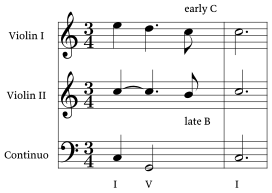
Opus 5 and “La Folia”
On January 1, 1700, Corelli published his Opus 5, and it was reprinted again and again for the rest of the century. Opus 5 holds twelve violin sonatas,This composer's Opus 5 is a set of 12 violin sonatas. → Arcangelo Corelli• each for one violin with continuo. Corelli dedicated it to Sophia Charlotte, Electress of Brandenburg, the wife of an elector, one of the German princes who chose the Holy Roman Emperor (Chapter 14). The first six are church sonatas and the last six chamber sonatas, and the twelfth is a set of variationsThis composer's twelfth violin sonata, the last of Opus 5, is a set of variations on the dance tune "La Folia." → Arcangelo Corelli•• on a tune called “La Folia” (foh-lee-ah). Variations (Vol. 1, The Toolkit) state a theme and then reshape it again and again. Corelli’s theme is a slow, stately tune in D minor, in three beats like a sarabande. Over its sixteen bars of chords he builds twenty-three variations, with running notes, chords played on two strings at once, and leaps across the strings.
The dance was two centuries older than Corelli’s sonata. Folia means “madness” or “wild fun” in Portuguese, and in the plays of Gil Vicente, the court dramatist of Portugal in the early 1500s, the folia is a noisy dance of shepherds and peasants. Spain knew it too, and one of the oldest known folias survives in a Spanish songbook compiled in the reign of the Catholic Monarchs (Chapter 5). By the later 1600s it had settled into a fixed pattern of chords with a stock tune above it, and that pattern spread across Europe as a Spanish dance. The French called it Folies d’Espagne, the “Follies of Spain”."La Folia" was also called this country's "Follies." → Spain• More than 150 composers have used it, from Vivaldi (vih-vahl-dee) and Handel to the Russian pianist Sergei Rachmaninoff, whose Variations on a Theme of Corelli (1931) take as their theme the Folia that Corelli had varied.
In 1707 a young German composer came to Rome. George Frideric Handel, then twenty-one, would later make his fortune in London with Italian operas and English oratorios (Vol. 12, Crown and Parliament), and in Italy he was learning the Italian style. Corelli led the violins in performances of his oratorios, among them The Resurrection at Easter 1708. Handel’s first biographer, John Mainwaring (man-er-ing), told a story of these rehearsals in 1760. Handel, impatient with the way Corelli played a fiery passage in the overture to his oratorio The Triumph of Time and Disillusion, snatched the violin from his hands and played it himself. Corelli only answered mildly that the music was in the French style, which he did not understand, and called Handel caro Sassone, “dear Saxon.” In a later version of the story Corelli refused to play a high AThis composer apocryphally refused to play a high A in a Handel oratorio, calling it too showy. → Arcangelo Corelli• in that overture, calling it too showy. That version is apocryphal, a story handed down with no trustworthy witness behind it. Still, it fits his music: Corelli’s own violin parts rarely climb above a D high on the instrument’s top string, and that A lay a fifth higher still.
The Christmas Concerto
Corelli spent years on his last book. He seems to have written most of its concertos in the 1680s and kept revising them. They were printed only in 1714, the year after his death, by Estienne Roger (ay-tyen roh-zhay), a publisher in Amsterdam whose engraved editions were sold all over Europe. The book’s title page dedicates it to Johann Wilhelm (yoh-hahn vil-helm), Elector Palatine, the prince who ruled the Palatinate of the Rhine (Figure 24.5). Opus 6 holds twelve concerti grossiThis composer's Opus 6 consists of 12 concerti grossi. → Arcangelo Corelli• (groh-see), “big concertos.” A concerto grosso (Vol. 1, The Toolkit) sets a small group of soloists, the concertino (kon-cher-tee-noh), against the full string band, the ripieno (rip-yay-noh). Corelli’s concertino is the trio sonata’s own team of two violins and a cello, so each concerto is a trio sonata with an orchestra around it. The orchestra now plays with the soloists and now falls silent to let them play alone. The concertos come in both of his kinds: the first eight are church concertos, the last four chamber concertos.

The most famous of them is Corelli’s Christmas Concerto, the eighth of Opus 6, in G minor.This composer wrote the Christmas Concerto, Op. 6, No. 8. → Arcangelo Corelli••This G-minor concerto grosso is the eighth in Corelli’s Opus 6. → Christmas Concerto (Corelli)•• Cardinal Ottoboni commissioned it. No one knows exactly when Corelli wrote it, but a record survives of Corelli playing a Christmas concerto for his new patron in 1690, the year he moved into the cardinal’s palace. The concerto bears a heading in Italian, Fatto per la notte di NataleThis concerto bears the inscription "Fatto per la notte di Natale." → Christmas Concerto (Corelli)• (faht-toh pair lah not-teh dee nah-tah-leh), “made for the night of Christmas,” that is, for Christmas Eve, the night that ends with Midnight Mass.
It is a church concerto, stretched from four movements to six. A few bars of Vivace (vee-vah-cheh), “lively,” open it, and then the orchestra settles into a Grave whose long chords lean on one another, each dissonance resolving only into the next. Over the Grave Corelli wrote arcate sostenute e come staA Grave passage in this concerto is marked "arcate sostenute e come sta." → Christmas Concerto (Corelli)• (ar-kah-teh sos-teh-noo-teh eh koh-meh stah), “sustained bow strokes, and as it stands.” Players of his day were expected to decorate slow movements with ornaments of their own. Here he asked them to hold every note its full length and to play exactly what he wrote. Fast and slow movements follow in turn, among them an Adagio that breaks into an Allegro and slows again.
Then comes the movement listeners wait for. A pastorale in G major, in 12/8,A G-major pastorale in 12/8 ends this concerto grosso. → Christmas Concerto (Corelli)••• ends the concerto. The key turns from minor to major, and the music begins to rock. In 12/8 each bar holds twelve eighth notes in four groups of three, a compound meter (Vol. 1, The Toolkit), so the beat swings long-short, long-short, like a cradle. The two solo violins play the tune in thirds while the bass holds long, unchanging notes, a drone like a bagpipe’s. A pastorale imitates the music of shepherds, and in Rome everyone knew whose music this was: the pifferari (pif-feh-rah-ree), shepherds from the hills who came into the city at Christmas to play bagpipes and reed pipes before images of the Virgin. They recalled the shepherds who, in the Gospel of Luke, came to the manger at Bethlehem. Corelli marked the movement ad libitum, “at pleasure”: players could leave it out.
Corelli’s death did not end his reign. His concertos were reprinted for a century, and Handel himself, in London in 1739, wrote twelve concerti grossi on Corelli’s model and published them as his own Opus 6 (Vol. 12, Crown and Parliament). In Paris, François Couperin (koo-puh-ran), organist to King Louis XIV of France, paid a stranger compliment. In 1724 he published a trio sonata called Le Parnasse, ou l’Apothéose de Corelli (ah-poh-tay-ohz), “Parnassus, or the Apotheosis of Corelli.” An apotheosis is the raising of a mortal to the rank of a god (Chapter 23), and Parnassus was the Greek mountain of Apollo and the Muses that Raphael painted (Chapter 11). Couperin’s Apotheosis of CorelliOne of François Couperin's trio sonatas is known as the Apotheosis of this composer. → Arcangelo Corelli• tells its story in the titles of its movements: Corelli asks the Muses to receive him, drinks from their spring, falls asleep, and is woken and led to a seat beside Apollo. A year later Couperin gave the same honor to Jean-Baptiste Lully (loo-lee), the Florentine-born master of music at Louis XIV’s court. Both men are taught in the thirteenth volume (Vol. 13, Valois, Bourbon, and Orange).
The violin family
Corelli’s music needed a particular instrument. In the 1500s Italians called almost any bowed instrument a viola, and they sorted their violas into two families by how a player held them (Figure 24.6). The viole da gamba (gahm-bah), “leg violas,” the viols (Vol. 1, The Toolkit), rested on or between the player’s legs. They had six strings, frets like a guitar’s, and sloping shoulders, and the player held the bow palm upward. The viole da braccio, “arm violas,”The words "da braccio" distinguish one instrument family sharing this instrument's name from "da gamba." → viola•• were held up against the shoulder or chest; braccio is the same “arm” that Florentines used as a measure of length (Chapter 1). These had four strings tuned in fifths and no frets. From the arm family came the violin, the cello, and the one member that kept the old family name, the viola, a little larger than the violin and lower in pitch. The cello is too big to hold up, but it is built on the arm family’s plan, with four strings tuned in fifths and no frets. German still calls the viola Bratsche (braht-sheh), from braccio.


The two families lived side by side for more than a century. Gentlemen who played for pleasure liked the soft, even voice of the viols, while the louder, nimbler violins belonged at first to professionals who played for dancing. In Italy the violins had largely won by the time Corelli was born, and his books made the violin the leading instrument of serious music. The best instruments came from Cremona, in Lombardy. There Andrea Amati (ah-mah-tee) founded a workshop in the mid-1500s that passed through four generations of his family (Vol. 1, The Toolkit), and Antonio Stradivari (strad-ih-var-ee) (about 1644–1737) and Giuseppe Guarneri (gwar-nair-ee) later made the violins that soloists still prize above all others. Corelli owned several fine violins, and they and a large collection of paintings were the only luxuries he allowed himself.
Tartini
Giuseppe Tartini was born on April 8, 1692, at Piran (pee-rahn), a little port on the coast of Istria, across the Adriatic from Venice; Venice ruled it, and Italians called it Pirano. His parents meant him for the Franciscans, the order of friars founded by Saint Francis of Assisi, so he learned some music as a boy, but he went instead to study law at the University of Padua, where he also became a skilled fencer. In 1710, at eighteen, he married Elisabetta Premazore, a poor girl two years older whom his family disliked. She was a favorite of Cardinal Giorgio Cornaro, the bishop of Padua, who charged Tartini with carrying her off, and the young husband fled to the great friary at Assisi, the saint’s own town, where the friars hid him and he studied music.

How the charge ended is not known, but by 1721 the runaway husband was back in the cardinal’s own city. That year he became the leader of the violins at the Basilica of Saint Anthony in Padua, the great pilgrimage church whose high altar Donatello had cast in bronze (Chapter 2), and he stayed nearly fifty years. From 1726 his school of violin playing drew pupils from all over Europe. He also studied the science of sound. He noticed that when two notes are played loudly together on a violin, a faint third note can be heard below them. He called it the terzo suono (tair-tsoh swoh-noh), the “third sound,” and a violinist can listen for it to check whether two notes are in tune.
His fame today rests mostly on one sonata and the story he told about it. In 1765 and 1766 the French astronomer Jérôme Lalande traveled through Italy, and in his Voyage of a Frenchman in Italy (1769) he set down what Tartini had told him. One night in 1713, Tartini said, he dreamed that he had made a pact with the devil, who became his servant and granted his every wish. On a whim he handed the devil his violinIts composer said a dream of the devil playing his violin inspired this sonata’s demanding trills. → Devil’s Trill Sonata••Tartini reportedly dreamed of the devil playing this instrument, inspiring his "Devil’s Trill" Sonata. → violin•• to see whether he could play it. The devil played a sonata so beautiful, and with such art, that Tartini was enchanted and could not breathe, and he woke. He seized the violin to keep some of what he had heard, and the piece he wrote, he said, was the best he ever composed, and he named it after the devil. But it fell so far below the music of the dream that he would have smashed his violin and given up music for good, if he could have lived without it. The piece is known today as the “Devil’s Trill” Sonata. The first volume (Vol. 1, The Toolkit) told the dream and printed Boilly’s picture of it.
The Devil’s Trill Sonata, in G minor, is for violin and continuo. A trill (Vol. 1, The Toolkit) is the rapid alternation of a note with its neighbor. In the last movement the violinist must keep a trill going with one finger while the other fingers play a melody beneath it on another string, and these passages give the sonata its name. Lalande’s date makes it the work of a twenty-one-year-old. Its graceful style, though, points to the 1740s or later, and it was first printed in 1798 or 1799, nearly thirty years after Tartini died at Padua on February 26, 1770. He told the story half a century after the night it describes.
Torelli, Marcello, and the “Albinoni” Adagio
Bologna, where Corelli learned to play, had a church big enough for loud music. The Basilica of San Petronio, where Charles V had been crowned emperor in 1530 (Chapter 13), is 132 meters long and 47 meters high, 433 by 154 feet. Its music director from 1657, Maurizio Cazzati (kaht-sah-tee), published in 1665 the earliest known sonata for trumpet, and for the next half century San Petronio was famous for music with trumpets. Giuseppe Torelli (toh-rel-ee), born at Verona on April 22, 1658, joined Bologna’s Accademia Filarmonica in 1684 and played the viola in San Petronio’s orchestra from 1686. He wrote some of the earliest concertos for one solo violin, worked at the German court of Ansbach, spent some time in Vienna, and came home to Bologna, where he died on February 8, 1709. For the trumpet Torelli wrote more than thirty concertos,Giuseppe Torelli wrote over thirty concertos for this instrument. → trumpet•• for one to four trumpets with strings, and the manuscripts survive in San Petronio’s archive. The trumpets of his day had no valves (Vol. 1, The Toolkit), so they could play only the natural notes of their tube, and only high in their range did those notes lie close enough together to make a tune. Torelli’s soloists had mastered that high register.
Venice, in the same years, had a nobleman who composed for pleasure. Alessandro Marcello, born in 1673, was the son of a senator of the Republic. He held concerts in his house and published most of his music under the name Eterio Stinfalico, the name he used as a member of the Arcadian Academy, the society of poets and artists in Rome to which Corelli also belonged. His best-known work is a concerto for oboe in D minor.Alessandro Marcello’s D-minor concerto for this instrument begins Andante spiccato and was transcribed by Bach as BWV 974. → oboe•• Its first movement is marked Andante spiccato (spee-kah-toh): at a walking pace, with the strings’ notes short and clearly separated. Over that crisp accompaniment sings the oboe (Vol. 1, The Toolkit), a woodwind whose reedy voice comes from a double reed, two thin blades of cane that vibrate against each other. The concerto was printed in Amsterdam in 1717, but Johann Sebastian Bach had met it in manuscript a few years earlier. At Weimar (vy-mar), where he was organist to the duke, Bach arranged Italian concertos for keyboard alone in about 1713 and 1714 to learn their style. His version of Marcello’s concerto is BWV 974, its number in the catalog of Bach’s works (Vol. 1, The Toolkit).
The best-known slow movement of the Venetian Baroque was written in 1958. Tomaso Albinoni (toh-mah-zoh al-bih-noh-nee), born in Venice in 1671, was the son of a rich paper merchant and needed no salary. He composed as he pleased: at least fifty operas, now mostly lost, and concertos and sonatas that his contemporaries compared with Corelli’s and Vivaldi’s. Bach wrote fugues on his themes. He died in Venice in 1751, forgotten. Two centuries later Remo Giazotto (jah-tsot-toh) (1910–1998), a Roman musicologist who wrote Albinoni’s biography and cataloged his works, published an “Adagio in G minor for strings and organ, on two thematic ideas and a figured bass by Tomaso Albinoni.” Giazotto said that soon after the Second World War he had received from the state library in Dresden, whose buildings were destroyed by bombing in 1945, a fragment of an Albinoni trio sonata: a bass line and a few bars of melody. He never showed anyone the fragment, and the library has no record of it. After his death his last assistant found among his papers a modern copy of such a bass, which keeps the question open, but the rest of the piece is certainly Giazotto’s. Slow and solemn, it has been used in films from Orson Welles’s The Trial (1962) to Peter Weir’s Gallipoli (1981). Named simply for its tempo marking, adagio, “at ease,” the G-minor Adagio is often attributedThe G minor piece named for this tempo marking is often attributed to Tomaso Albinoni. → Adagio•• to a composer who wrote, at most, its bass line and a few bars of its tune.
What to remember
- Arcangelo Corelli (1653–1713), born at Fusignano and trained in Bologna, made his career in Rome under Queen Christina and Cardinals Pamphili and Ottoboni, and was buried in the Pantheon.
- His four books of trio sonatas (Opp. 1–4, 1681–1694) alternate church sonatas (slow, fast, slow, fast) and chamber sonatas (a prelude and dances, among them the sarabande, which came to Spain from Spanish America).
- The “Corelli clash” is a cadence in which an anticipated tonic sounds against a delayed leading tone.
- Opus 5 (1700) is twelve violin sonatas; the last is twenty-three variations on “La Folia,” the “Follies of Spain.” Opus 6 (1714) is twelve concerti grossi.
- The Christmas Concerto, Op. 6, No. 8, in G minor, was “made for the night of Christmas”; its Grave is marked “arcate sostenute e come sta,” and it ends with a 12/8 pastorale in G major. Couperin honored Corelli in his Apotheosis of Corelli (1724).
- The violin family descends from the viole da braccio, the “arm violas”; the viol family is the viole da gamba. The viola kept the family name.
- Tartini told Lalande that the devil played his violin in a dream, which inspired the “Devil’s Trill” Sonata in G minor.
- Torelli wrote more than thirty trumpet concertos in Bologna; Alessandro Marcello’s D-minor oboe concerto, which Bach arranged as BWV 974, opens Andante spiccato; the “Albinoni” Adagio in G minor is Remo Giazotto’s work of 1958.
Chapter 25 · 57 clues
Vivaldi and the Last Venice
On the waterfront of Venice, a few minutes’ walk east of the Doge’s Palace, stood a charitable house with a small opening in its wall. The opening was just large enough for a baby. A mother who could not keep her child could leave it there, unseen, and the house would take it in, feed it, and bring it up at the republic’s expense. Most of the children who came through that hole in the wall grew up and vanished from history. Some of the girls became the most famous musicians in Europe.
Travelers from London, Paris, and Dresden crowded the house’s little church on Sunday afternoons to hear them. The players and singers sat high in a gallery behind an iron grille, so that the audience heard an orchestra and choir of young women without seeing more than their shadows. For most of thirty-seven years their teacher, and the composer of much of what they played, was a red-haired priest who boasted that he could compose faster than a copyist could copy. His city was living through its last century as a free republic. It had lost its wars and most of its trade, and it had become the place all Europe came to for music, masks, and pictures of itself.
The Red Priest
Antonio Vivaldi was born in Venice on March 4, 1678, so sickly that the midwife baptized him at home the same day, in case he died. The full ceremony followed two months later at San Giovanni in Bragora (brah-goh-rah), the parish church a few steps behind the waterfront (Figure 25.1). His father, Giovanni Battista Vivaldi, had been a barber before he became a professional violinist, and he taught his son the instrument and took him along to play. The red hair ran in the family.

The boy was also meant for the Church. At fifteen, in 1693, he began to study for the priesthood, and in 1703, at twenty-five, he was ordained a Catholic priest, a man who could say Mass. Venetians soon nicknamed him il Prete Rosso (preh-teh rohs-soh), “the Red Priest”,This composer was nicknamed the "Red Priest." → Antonio Vivaldi•• for his hair. Before long he stopped saying Mass at all. He suffered all his life from what he called strettezza di petto, “tightness of the chest,” perhaps asthma, and he was excused from the duty. He kept the title, the priest’s long black cassock, and the nickname, and he gave his time to music.
In September 1703 Vivaldi became master of the violin at the Ospedale della Pietà, a Venetian orphanage for girls.This composer worked at the Ospedale della Pietà, an orphanage for girls in Venice. → Antonio Vivaldi••This city contained the Ospedale della Pietà, an orphanage for girls. → Venice•• The word ospedale meant a charitable house rather than a hospital, and Venice had four great ones, the Pietà, the Mendicanti, the Incurabili, and the Ospedaletto, paid for in part by the state. The Pietà, “the house of mercy,” took in foundlings through that small window in its wall, which Venetians called the scaffetta (skahf-fet-tah). Boys learned a trade and left at fifteen. Girls stayed, and the house gave each a dowry when she married or entered a convent. The most gifted were trained in music as the figlie di coro (feel-yeh dee koh-roh), “daughters of the choir.” Having no family names of their own, they were known by their first names and the house’s: the violinist Anna Maria della Pietà, the most famous of Vivaldi’s pupils, was simply “Anna Maria of the Pietà.”

The girls played behind grilles, as nuns would, and their concerts became one of the sights of Venice. Visitors came for the strangeness of an orchestra of women as much as for the music, and they stayed for the music. In 1715 a German architect heard Vivaldi himself play in Venice and wrote in his diary of a cadenza, a showy passage for the soloist alone, that astonished him (Vol. 1, The Toolkit). A generation later Jean-Jacques Rousseau (1712–1778), the writer from Geneva whose ideas about society the thirteenth volume teaches (Vol. 13, Valois, Bourbon, and Orange), worked in Venice in 1743 and 1744 as secretary to the French ambassador. He heard the girls of the Mendicanti, another of the four houses, and complained in his Confessions, in S. W. Orson’s translation, of “the iron grate, which suffered nothing to escape but sounds.” When a friend at last took him in to meet the singers, he found that one had lost an eye and another was scarred by smallpox. He decided their singing was beautiful all the same. The concerts went on long after Vivaldi. In January 1782 eighty orphan girls of the ospedali performed for a Russian heir to the throne and his wife, traveling through Europe as the “Counts of the North,” and the Venetian painter Francesco Guardi painted the scene.
Vivaldi’s place in the house was never quite secure. The Pietà’s governors, a board of Venetian noblemen, voted every year on whether to keep each teacher, and in 1709 they voted seven to six to let Vivaldi go. They called him back in 1711, unanimously. In 1716 he was made maestro de’ concerti, director of instrumental music. In the 1720s, when he was often away, the house paid him to send two new concertos a month, and its account books record payment for at least 140 concertos in the years after 1723. All the while he toured, staged operas, and sold music to princes. In 1730 he took his old father with him to Vienna and Prague, where his operas were played. Yet the city he came back to was always the same. Although he worked for a time in Mantua and Rome and died in Vienna, Vivaldi lived and worked in VeniceAntonio Vivaldi lived and worked in this city. → Venice•• for nearly all of his sixty-three years (Figure 25.3).

He wrote at astonishing speed. Charles de Brosses, a French magistrate, toured Italy in 1739 and 1740 and sent letters home to his friends. He wrote that the old man had a prodigious fury for composing and boasted that he could write a concerto, with all its parts, faster than a copyist could copy it out.
Vivaldi was an Italian composer,This country is home to Antonio Vivaldi. → Italy•• in the only sense the word then had. Italy was a peninsula of many states, not a country (the Stage). A Venetian was a citizen of the Most Serene Republic (Chapter 12), and the Venetian dialect was not the Tuscan of Florence. Vivaldi wrote his title pages in Italian, set Italian words in his operas, and sent his music to German, French, and Bohemian patrons who wanted, above all, the newest Italian style.

For his time he was famous above all as a violinist. He played high up the string, near the bridge, in passages so fast that listeners could hardly follow. Only two or three likenesses of him are known, and the surest is the engraving made for his eighth published collection (Figure 25.4). The caricature a Roman artist drew of him in 1723, with his big nose and chin, appears in the first volume (Vol. 1, The Toolkit).
L’estro armonico
A composer of 1700 became known in print. Vivaldi’s first two books, twelve trio sonatas (1705) and twelve sonatas for violin and keyboard (1709), came out from printers in Venice. Each book was an opus, Latin for “work,” and its number counts the composer’s publications in order. For his Opus 3 Vivaldi went to Amsterdam. There Estienne Roger, who also printed Corelli, engraved music on copper plates and sold his editions all over Europe (Chapter 24). In 1711 Roger published Vivaldi’s L’estro armonicoThis composer wrote L'estro Armonico. → Antonio Vivaldi••• (les-troh ar-moh-nee-koh), “The Harmonic Inspiration.” Estro is the fire of inspiration, the frenzy that seizes a poet.

The title page tells where the music was made (Figure 25.5). It calls the composer “Don Antonio Vivaldi,” with the title of a priest, “violinist and master of concerts of the Pietà of Venice.” Vivaldi published L’estro armonico while he workedVivaldi published L’estro armonico while working at the Ospedale della Pietà in this city. → Venice• at the Pietà, and its concertos were very likely first played there by his pupils. He dedicated the book to Ferdinando de’ Medici, the Grand Prince of Tuscany and heir of Grand Duke Cosimo III, a descendant of the Cosimo I of Chapter 13. Ferdinando was a fine musician himself, drew the best players and composers in Italy to Florence, and paid Bartolomeo Cristofori (kris-tof-oh-ree), the instrument maker who invented the piano (Vol. 1, The Toolkit). He died in 1713, before he could inherit.
A concerto (Vol. 1, The Toolkit) sets soloists against an orchestra. Corelli’s kind, the concerto grosso, had a small group of soloists (Chapter 24). Vivaldi’s book mixes the old kind with a new one for a single soloist, in a pattern any reader of the table of contents could see. It holds twelve concertos for one, two, or four solo violins,This collection comprises twelve concertos for one, two, or four solo violins. → L’estro armonico••• in four rounds of three: a concerto for four soloists, then one for two, then one for a single violin, and the round begins again. The strings were printed in eight separate partbooks, four for violins, two for violas, one for cello, and one for the continuo (the Stage), the bass line that a harpsichord and a violone, a large bass string instrument, played throughout. At the Pietà such a set would have let the best girls play solos while the others learned to play together.
The book swept Europe. Roger’s edition was reprinted some twenty times by 1743, and a London publisher brought out the whole set in 1715 and 1717. In England its fifth concerto was known simply as “Vivaldi’s Fifth,” and violin teachers used it to train their pupils. Among those who studied it was Johann Sebastian Bach (1685–1750), the German organist and composer (Vol. 14, From Luther to Mozart). At Weimar, where Bach was organist to the duke, a young prince of the ducal family came home from the Netherlands in 1713, probably with Italian music in his luggage. Bach arranged six of Vivaldi’s twelve concertos to learn their style, as he arranged Alessandro Marcello’s oboe concerto (Chapter 24). He set three of the solo concertos for harpsichord alone and two of the double concertos for organ. Years later in Leipzig, about 1730, he took the tenth, in B minor, for four violins, and made of it his A-minor Concerto for Four HarpsichordsBach’s A-minor Concerto for Four Harpsichords adapts a concerto from this Vivaldi collection. → L’estro armonico•• and strings. Four keyboard players, each at his own instrument, take over the four violins’ parts, and Bach moved the whole piece down a step, from B minor to A minor.
Vivaldi’s next collection pushed further. La stravaganza (strah-vah-gahn-tsah), Opus 4, “Extravagance,” was written in 1712 and 1713 and printed in Amsterdam about 1716. It holds twelve concertos for a single solo violin,This composer wrote La stravaganza, a set of twelve violin concertos. → Antonio Vivaldi• with strings and continuo. The title promised what the music delivers: strange turns of harmony, sudden changes of mood, and solo parts that leap and race beyond anything in Corelli. Vivaldi dedicated it to Vettor Dolfin, a young Venetian nobleman who had been his violin pupil. By now the solo concerto in three movements, fast, slow, fast, with its returning ritornello (the Stage), was his, and every composer in Europe was copying it.
The Four Seasons
In 1718 Vivaldi left Venice for Mantua. The Gonzaga dukes who had ruled it for four centuries had been driven out in 1708, and the city now belonged to the Austrian Habsburgs, who governed it through a prince of their choosing, Philip of Hesse-Darmstadt (darm-shtaht). Philip made Vivaldi his maestro di cappella, director of music, from 1718 to 1720. Then came Rome, where Vivaldi played for Pope Benedict XIII, and by 1725 he was home in Venice. Somewhere in these years, or perhaps as early as 1716, he wrote four concertos about the year.

In 1725 the Amsterdam publisher Michel-Charles Le Cène (luh sen) published Vivaldi’s Opus 8 under a challenging title, Il cimento dell’armonia e dell’inventione (chee-men-toh), The Contest Between Harmony and Invention. “Harmony” meant the rules of composition and “invention” the composer’s imagination, and the set promised to put both to the test (Vol. 1, The Toolkit). It holds twelve concertos for the violin,Vivaldi composed twelve concerti for this instrument called The Contest Between Harmony and Invention. → violin•• each for one solo violin with strings and continuo (Table 25.1). Vivaldi dedicated the set to Count Wenzel von Morzin (mor-tsin), a Bohemian nobleman who advised the emperor, and in the dedication he hinted that the count already knew the first four. They were the Seasons, and in the printed book they open the set, with “Spring,” in E major, first.These four concertos open the twelve-concerto collection The Contest Between Harmony and Invention. → The Four Seasons•••This E-major concerto opens both The Four Seasons and The Contest Between Harmony and Invention. → Spring Concerto (Vivaldi)•••
| No. | Title | Key | RV |
|---|---|---|---|
| 1 | “Spring” (La primavera) | E major | 269 |
| 2 | “Summer” (L’estate) | G minor | 315 |
| 3 | “Autumn” (L’autunno) | F major | 293 |
| 4 | “Winter” (L’inverno) | F minor | 297 |
| 5 | “The Sea Storm” (La tempesta di mare) | E-flat major | 253 |
| 6 | “Pleasure” (Il piacere) | C major | 180 |
| 7 | “For Pisendel” | D minor | 242 |
| 8 | — | G minor | 332 |
| 9 | — (also for oboe) | D minor | 236 |
| 10 | “The Hunt” (La caccia) | B-flat major | 362 |
| 11 | — | D major | 210 |
| 12 | — (also for oboe) | C major | 178 |
The set sold well across Europe, though never quite as well as L’estro armonico, which went on selling for thirty years. The other eight concertos are less famous than the first four, but several carry pictures of their own, named in their titles though without poems. The fifth, sixth, and tenth are “The Sea Storm,” “Pleasure,” and “The Hunt”.This composer’s The Contest Between Harmony and Invention includes "Pleasure," "The Sea Storm," and "The Hunt." → Antonio Vivaldi•• The seventh is inscribed to Johann Georg Pisendel, the leading violinist of the court orchestra at Dresden, who had come to Venice in 1716 to study with Vivaldi and took copies of much of his music home to Dresden. Two others could be played on the oboe instead of the violin.
The fame belongs to the first four. The Four Seasons are four violin concertos,These four violin concertos depict the changing seasons. → The Four Seasons•••Vivaldi's The Four Seasons are concerti for this instrument. → violin••• one for each season of the year, spring, summer, autumn, and winter. They are short: each takes ten or eleven minutes to play, and “Winter,” the shortest, about nine, so that all four together last about forty minutes. In each a solo violin plays against the strings and continuo, and the soloist’s part was written for a player as brilliant as the composer himself. Vivaldi wrote The Four SeasonsThis composer wrote The Four Seasons. → Antonio Vivaldi••• to be heard as music and also as pictures. The solos climb high, race through runs and repeated notes, and imitate birds, dogs, and storms, and the orchestra joins in the pictures with rustling leaves, buzzing flies, thunder, and rain. Each concerto has the usual three movements, fast, slow, fast, and each paints what a season brings to the countryside (Figure 25.7).

The pictures come with words. Each concerto was printed with a sonnet,These concertos were published with accompanying sonnets, possibly written by their composer. → The Four Seasons••• the fourteen-line poem (Vol. 1, The Toolkit), and no author is named; the poems may well be Vivaldi’s own. The edition calls each one a sonetto dimostrativo, an “explanatory sonnet.” Its lines are lettered in the margin, A, B, C, and the same letters are printed over the bars of the score where the music paints them (Figure 25.6). Phrases from the poems and from Vivaldi’s own notes are written into the parts as well, such as “the barking dog” and “the drunkards asleep.” A listener could follow the poem bar by bar. Music like this, which tells a story or paints a scene, is called program music, and the idea grew after Vivaldi (Vol. 1, The Toolkit). Here are the first eight lines of the sonnet for “Spring,” in the Italian of the first edition, with a plain translation; the other sonnet lines quoted are translated the same way, in prose.
“Spring”
The first concerto is “La primavera,”The first concerto in this set is "La primavera." → The Four Seasons••• Italian for “Spring,” in E major. It is the same word that names Botticelli’s garden of Venus (Chapter 4), painted in Florence more than two centuries before, where Zephyrus, the west wind, seizes a nymph and Flora scatters roses. E major is a bright key on the violin, whose highest string is an E. Vivaldi wrote “Spring”This composer wrote the "Spring" concerto in The Four Seasons. → Antonio Vivaldi••• as the gayest of the four, full of sunshine from its first bar to its last, with hardly a cloud except the storm the sonnet calls for. Its first movement, an Allegro, “cheerful,” the usual Italian word for a fast tempo, opens with a ritornello that nearly everyone knows (Figure 25.8). After a single upbeat, the first violins play E, G-sharp, G-sharp, G-sharp, F-sharp, E, B,The first concerto in this set opens E–G-sharp–G-sharp–G-sharp–F-sharp–E–B. → The Four Seasons•• three quick repeated G-sharps, a quick run down to E, and a leap up to the B above. The whole phrase comes again at once. This ritornello returns between the solos all through the movement, in new keys and cut short, as the line “Spring has come” returns in the reader’s mind.

Then the birds arrive. The solo violin and two violins from the orchestra climb high and sing alone, and the solo violin imitates birdsong with trillsThe solo violin imitates birdsong with repeated notes and trills in this concerto’s first movement. → Spring Concerto (Vivaldi)•• and quick repeated notes, the chirps and warbles of three birds at once. A trill (Chapter 24) is two neighboring notes alternated as fast as the fingers can move, and a whole flock of them sounds like a hedge full of sparrows. When the birds stop, the ritornello returns, and then come the springs of the sonnet’s third and fourth lines. There breezes blow over murmuring streams:Its accompanying sonnet describes breezes that "caress a murmuring stream" in this concerto. → Spring Concerto (Vivaldi)• the violins play soft, rippling figures, and the sonnet’s zeffiretti, “little zephyrs,” Botticelli’s west wind made small, breathe across water that flows “with a sweet murmur.” The orchestra plays this passage gently, with no soloist, as if the listener had stepped away from the birds to the water’s edge. Then the weather turns. Thunder and lightning interrupt the birdsong:Birdsong interrupted by thunder and lightning appears in the "Spring" concerto of this set. → The Four Seasons••• the orchestra rumbles on fast repeated notes for the thunder, and the solo violin throws up quick rising scales for the lightning. When the storm passes, the sonnet says, the birds take up their song again, and so they do.
The slow movement, a Largo, “broad,” in C-sharp minor, is one long, still picture. A goatherd sleeps on a flowery meadow, with his faithful dog beside him. The solo violin plays a quiet, wide melody above the sleeper. Under it the violins rustle softly in dotted rhythms, like leaves and branches stirring overhead. The violas, the violin family’s alto voice, a little larger and deeper than the violin (Chapter 24), get the comic part. The violas imitate a dog barking,Violas imitate a dog barking beside a sleeping goatherd in this concerto’s slow movement. → Spring Concerto (Vivaldi)••• playing two loud, rough notes over and over, marked in the score “the barking dog,” while the goatherd sleeps through the noise. Vivaldi marked them to play loudly while everyone else plays softly, so the dog can never be missed.
The finale is a country dance. A Danza pastorale in 12/8 ends “Spring”:A 12/8 Danza pastorale with bagpipe-like drones ends this concerto. → Spring Concerto (Vivaldi)•• each bar holds twelve eighth notes in four swinging groups of three, the lilting compound meter of shepherds’ music (Chapter 24). The sonnet hears nymphs and shepherds dancing to “the festive sound of the pastoral zampogna (tsahm-pohn-yah),” the Italian bagpipe, and the lower strings imitate its drones, long held notes that never move while the tune dances above them.
The concerto had a life apart from the others. Rousseau, who had heard the Venetian orchestras as a young man, loved it, and late in life, in 1775, he published “Spring” arranged for solo flute,Jean-Jacques Rousseau transcribed the first of these pieces for solo flute. → The Four Seasons•• the whole concerto squeezed into a single unaccompanied line. In Paris, ten years earlier, the organist Michel Corrette had set the words of Psalm 148, “Praise ye the LORD from the heavens,” to the music of “Spring,” and Vivaldi himself reused it in an opera.
“Summer” and “Autumn”
Summer’s concerto is the secondThis season's concerto is the second work of Antonio Vivaldi's Four Seasons. → summer• of the set, and it is the darkest, in G minor, a minor key after the bright E major of “Spring.” Its sonnet begins not with joy but with exhaustion: “under the hard season, kindled by the sun, man languishes, the flock languishes, and the pine tree burns.” The first movement depicts languor caused by the heat,The "Summer" concerto in this set depicts languor caused by heat. → The Four Seasons•• the words Vivaldi wrote over its opening. The music stops and starts in short, drooping phrases with silences between them, as if too tired to go on. Then birds call, a cuckoo, a turtledove, and a goldfinch, and a gentle breeze blows until the north wind sweeps it away. The shepherd weeps, afraid of the storm he sees coming.
In the slow movement the shepherd tries to rest and cannot. The solo violin plays a weary, sighing line, and the slow movement depicts buzzing flies:The slow movement of the "Summer" concerto in this set depicts buzzing flies. → The Four Seasons• the violins play soft, quick, repeated notes for the flies that swarm about his tired limbs. Every few bars the whole orchestra breaks in, loud and fast, with distant thunder, and then falls back to a whisper. Vivaldi wrote over the slow music “adagio and soft” and over the thunder “presto and loud,” so that the contrast is part of the score.

“Summer” ends with a violent storm,The "Summer" concerto in this set ends with a violent storm depicted by rapid string passages. → The Four Seasons••• a Presto in which the strings race in fast scales and repeated notes from beginning to end (Figure 25.9). Presto means “very fast,” faster than allegro, and the soloist and the orchestra hardly stop for breath. Its opening shows how simply Vivaldi could make a storm. The violins strike G, F, E-flat, and D,The storm finale of the "Summer" concerto in this set opens with G–F–E-flat–D, each separated by repeated low Gs. → The Four Seasons• one high note at the start of each bar, and after each one they hammer eleven repeated low Gs on their lowest string, as fast as the bow can move. The sonnet says the shepherd’s fears were justified: “the sky thunders and lightens, and the hail cuts off the heads of the proud ears of grain.”
“Autumn,” the third concerto, in F major, is a harvest feast. Its sonnet begins: “the peasant celebrates with dances and songs the pleasure of the happy harvest,” and many, “kindled by the liquor of Bacchus,” the Roman god of wine, end their fun in sleep. “Autumn” depicts peasants dancing and drunkards falling asleep:The "Autumn" concerto in this set depicts peasants dancing and drunkards falling asleep. → The Four Seasons••• the ritornello stamps like country dancers, the solo violin reels about in wild runs and stumbling rhythms, and near the end of the movement the music slows and droops as the drinkers drop off. The slow movement, marked “the drunkards asleep,” is hushed throughout. The finale goes out at dawn with the hunters. The sonnet describes a hunt:The accompanying sonnets for these works describe a stag hunt. → The Four Seasons• with horns, guns, and dogs they follow the trail; the beast, an animal the sonnet never names, flees, terrified and tired by the noise, is wounded, tries feebly to escape, and dies.
“Winter”
The fourth concerto, “Winter,” in F minor, is the shortest and the most daring. Its sonnet begins “to tremble, frozen, amid the icy snow, in the harsh breath of a horrid wind.” The orchestra builds its opening chord one note at a time, every voice repeating short, quiet notes, until all the strings shiver together. A dissonance is a clash of notes that sound harsh together and seem to need to move on, and Vivaldi piles one on another. Dissonant violin intervals chatter like teeth:The last of these works uses dissonant violin intervals to represent teeth chattering. → The Four Seasons•• the violins grind on harsh, clashing intervals, and the solo violin races through the wind, stamping its feet, as the sonnet says, “and with the excessive cold, the teeth chatter.”
The slow movement moves indoors. The sonnet wishes to “pass quiet and contented days by the fire, while the rain outside soaks everyone.” In “Winter,” the last concerto, pizzicato strings depict rain.The last of these works uses pizzicato strings to depict rain. → The Four Seasons••This season is depicted in the last concerto of Antonio Vivaldi's The Four Seasons. → winter• The violins pluck their strings with a finger instead of bowing, a playing style called pizzicato (Vol. 1, The Toolkit), and their notes fall like a steady patter of drops outside the window. Above them the solo violin sings a warm melody by the hearth. The finale goes out onto the ice, walking slowly for fear of falling, then running, slipping, and crashing down, until the ice cracks and all the winds of the sonnet break loose “at war.” Its last line sums up the whole cycle: “This is winter, but such that it brings joy.”
The other concertos
The Seasons are four concertos out of more than five hundred. About 350 of Vivaldi’s concertos are for a single soloist and strings, some 230 of them for the violin; the rest are for the cello, bassoon, oboe, flute, recorder, viola d’amore, lute, and mandolin. About forty are for two soloists and thirty for three or more. The Pietà’s girls played nearly all of these instruments, and princes in Dresden and Bohemia asked for more. Most of this music was never printed in his lifetime. It survived in manuscript, and for two centuries hardly anyone knew where.
In 1926 a boarding school in Piedmont, in northwest Italy, run by the Salesians, a Catholic religious order devoted to teaching boys, needed money for repairs and had its old music manuscripts valued. The scholars who examined them found bound volumes of Vivaldi’s music, hundreds of concertos, operas, and sacred works that had been thought lost. A Turin stockbroker, Roberto Foà (foh-ah), bought them for the city’s National University Library in memory of his young son, who had died a few months before. The volumes proved to be half of a set. In 1930 the other half was traced to a nobleman in Genoa, and another Turin businessman, Filippo Giordano, bought it for the same library, also in memory of a son who had died. A catalog was needed to keep order among so many works. The Danish musicologist Peter Ryom (born 1937) published one in 1973 and 1974, and Vivaldi’s works use RV numbersThis composer’s works use RV numbers in the Ryom-Verzeichnis catalogue. → Antonio Vivaldi•• from it today. RV stands for Ryom-Verzeichnis (fehr-tsykh-nis), German for “Ryom catalog.” Ryom sorted the instrumental works by kind, then by instruments, then by key, starting from C major. So the four Seasons, all for violin but in four different keys, are scattered among the other violin concertos as RV 269, 315, 293, and 297.
The flute concertos were printed. About 1728 Le Cène published Vivaldi’s Opus 10, six concertos for the transverse flute, the flute held sideways (Vol. 1, The Toolkit), made in Vivaldi’s day of wood. The third, in D major, is Il gardellino (gar-del-lee-noh), RV 428, and Il gardellino, “The Goldfinch,” is for the flute.Antonio Vivaldi's concerto Il gardellino ('The Goldfinch') is for this instrument. → flute•• The solo flute twitters and trills like the little songbird of the title.
The recorder had concertos too. A recorder is a wooden flute blown at the end through a whistle mouthpiece and held straight out in front, the instrument many children now learn first. Vivaldi wrote three concertos for the flautino (flow-tee-noh), “little flute,” a small, high recorder, probably a soprano or sopranino recorder. The flautino concertos are RV 443, 444, and 445,This composer's RV 443-445 are concertos for the flautino, or soprano recorder. → Antonio Vivaldi• numbered side by side because Ryom’s catalog groups the instrument’s works: two in C major and one in A minor. Their solos skip and whistle so fast that they test the best players today.
The mandolin is a small plucked instrument with a round, pear-shaped back like a lute’s and its strings in pairs, played with a quill or with the fingers. Its sound is bright and dry, and it dies away almost at once. Vivaldi wrote a Mandolin Concerto in C major, RV 425,This composer wrote a Mandolin Concerto in C major, RV 425. → Antonio Vivaldi•• about 1725, and kept the orchestra light so that the little instrument could be heard. In its slow movement the mandolin plays a gentle melody over a hushed accompaniment of strings.
The cello, the violin family’s bass (Vol. 1, The Toolkit), was usually the bottom line of the continuo. Vivaldi was one of the first to make it a soloist: he wrote twenty-seven concertos for one cello and a G-minor concerto for two cellos,Antonio Vivaldi composed a G minor concerto for two of these instruments. → cello•• RV 531, his only one for the pair. It begins in an unusual way. Instead of the orchestra’s ritornello, the two cellos start alone, the second imitating the first a bar later, before the strings join them. The slow movement is a dark trio for the two soloists and the continuo cello, and the finale sends them racing in turn.
Last comes the trumpet. Vivaldi wrote a C-major concerto for two trumpets,Vivaldi wrote a C-major concerto for two of these instruments. → trumpet•• RV 537, his only trumpet concerto, probably in the 1720s; no one knows for whom. The trumpets of his day had no valves, as Torelli’s had none (Chapter 24). They could play only the natural notes of their tube, so the music stays close to its home key of C. The two soloists usually play together, in fanfares and quick passages. The slow movement, only six bars long, is for strings alone, because its harmonies wander where a valveless trumpet cannot follow.
Vocal works
In Vivaldi’s Venice opera was the great entertainment. The city had built the world’s first public opera house in 1637 (Chapter 21), and by 1700 several theaters competed for its audiences every season. Vivaldi’s first opera was staged in Vicenza, on the mainland, in 1713. By 1714 he and his father had taken on the Teatro Sant’Angelo, a small theater on the Grand Canal (Figure 25.1), as its impresarios: businessmen who rented the theater, hired the singers and the scene painters, sold the tickets, and kept the profit or swallowed the loss. In a letter of 1737 Vivaldi claimed to have written ninety-four operas. About fifty can be traced.
His first season there turned on the stories of Orlando, the paladin of Charlemagne who goes mad for love of the princess Angelica in Ariosto’s poem Orlando Furioso (Chapter 8). In November 1714 he staged Orlando finto pazzo (feen-toh paht-tsoh), “Orlando Pretending to Be Mad,” on a story taken from Boiardo’s Orlando Innamorato. The audience did not like it, and within weeks it was replaced with an Orlando furioso that the theater had staged the year before, with music by Giovanni Alberto Ristori (ree-stoh-ree), which Vivaldi now largely rewrote. In the autumn of 1727 he returned to the poem with a second opera on Ariosto’s Orlando Furioso,This composer wrote two operas based on Ariosto's Orlando Furioso. → Antonio Vivaldi•• again called by the poem’s name, and it became his most admired. The opera of 1727 is set on the island of the sorceress Alcina, who holds the knights under her spells. Angelica and Medoro marry and carve their vows on a tree, and Orlando, finding the words, tears up the trees in his fury. In his madness he smashes the statues of a temple, which breaks Alcina’s power. Orlando was sung by a contralto, a woman’s low voice.
Not everyone admired him. Alessandro Marcello’s younger brother Benedetto (Chapter 24), the Venetian nobleman and composer whose family claimed to own the Sant’Angelo, published at the end of 1720 a satire on the opera business, Il teatro alla moda, “The Fashionable Theater.” It never names Vivaldi, but its frontispiece shows a little angel in a priest’s hat, playing the violin at one end of a boat. The angel is a joke on the theater’s name, Sant’Angelo, “Holy Angel,” and one of the invented names printed beneath it, “Aldiviva,” is an anagram of “A. Vivaldi.”
Mythology filled the stage as well. Vivaldi wrote Dorilla in TempeThis composer wrote Dorilla in Tempe. → Antonio Vivaldi• (doh-ril-lah) for the Sant’Angelo, where it opened on November 9, 1726. Tempe (tem-pee) is a green valley in Thessaly, in northern Greece. The god Apollo, disguised as the shepherd Nomio, loves Dorilla, daughter of King Admetus of Thessaly; Greek myth had sent Apollo to serve Admetus as a herdsman (Vol. 4, Classical Myth). An oracle demands that Dorilla be fed to the serpent Python, Nomio saves her from the monster, and at last he reveals that he is a god and lets her marry the shepherd she loves. The opera opens with nymphs and shepherds praising spring, and Vivaldi gave them the music of his “Spring” concerto, its first movement turned into a chorus. It was also the first of his operas to star Anna Girò (jee-roh), a young singer he had met in Mantua, who became his pupil and often traveled with him. Gossip called her his mistress. In a letter of 1737 Vivaldi denied it, and no evidence says otherwise.

For the girls of the Pietà he wrote sacred music. Venice’s old enemy was the Ottoman Empire, the empire of the Turkish sultans in Constantinople, which had fought the republic on and off for nearly three centuries and taken Crete from it in 1669. In 1714 the Ottomans went to war with Venice again, and in 1715 the sultan’s armies overran the Morea (moh-ree-uh), the southern peninsula of Greece, which Venice had held for thirty years. In July 1716 an Ottoman army landed on Corfu, the island guarding the mouth of the Adriatic Sea. The Venetian garrison, under a German soldier in Venice’s pay, Count Johann Matthias von der Schulenburg (shoo-len-boorg), held out until the besiegers gave up and sailed away in August. It was the republic’s last great victory. Soon afterward the Pietà sang Juditha triumphans (yoo-dee-tah tree-um-fahns), “Judith Triumphant,” an oratorio, a sacred story sung without staging (Vol. 1, The Toolkit), with a Latin text by Iacopo Cassetti (Figure 25.10). It tells the story of the Book of Judith (Chapter 2): the Assyrian general Holofernes besieges a Jewish town, and the widow Judith goes to his camp, wins his trust, and cuts off his head as he lies drunk. The story was an allegory of the war: Judith stood for Venice, and Holofernes for the Ottoman enemy. Juditha triumphans celebrates the Venetian victory at Corfu,This composer’s only surviving oratorio, Juditha triumphans, celebrates a Venetian victory at Corfu. → Antonio Vivaldi•• and it is Vivaldi’s only surviving oratorio; an earlier one, on Moses, is lost. Every role, Holofernes included, was sung by a girl of the Pietà, and the orchestra showed off every instrument the house could play, from mandolin and four theorbos, large lutes, to recorders, trumpets, and drums. Two years later, in the peace of 1718, Venice kept Corfu but gave up the Morea for good.
The Pietà’s chapel also needed music for the Mass. Vivaldi wrote a Gloria in D major,This composer wrote a Gloria in D major. → Antonio Vivaldi•• the better known of two that survive, probably about 1715. The Gloria (Vol. 1, The Toolkit) is the song that the Gospel of Luke gives the angels on the night Jesus was born, “Glory to God in the highest,” sung in Latin as the second part of the Mass. Vivaldi divided the text into twelve movements for chorus, soloists, and orchestra. The first opens with the strings leaping up and down in bright octaves on D, with a trumpet and an oboe above them, before the choir enters on the word “Gloria.”
Vivaldi’s last years went badly. In 1728 he met the emperor Charles VI, the Habsburg ruler in Vienna, who admired his music, gave him a gold medal, and invited him to his court. Venice’s taste moved on to younger composers, and in 1740 Vivaldi sold off his manuscripts cheaply and left for Vienna. That October the emperor died, and with him the hope of a post. Vivaldi died in Vienna, poor, on July 28, 1741, and was buried in a cemetery kept for the city’s hospital; the house where he lodged stood where the Hotel Sacher stands now. His music was forgotten for nearly two hundred years, though Bach’s arrangements kept his name alive. Then came the manuscripts in Turin. In September 1939 the Italian composer and pianist Alfredo Casella (kah-zel-lah) (1883–1947) held a festival of the newly found works in Siena, and Casella’s Vivaldi Week of 1939 revived the Gloria,In 1939, Alfredo Casella organized a week honoring this composer that helped revive his Gloria. → Antonio Vivaldi•• which had not been heard for two centuries. After the Second World War the long-playing record carried The Four Seasons into homes all over the world.
Canaletto, Longhi, and Tiepolo
The visitors who came for the Pietà’s concerts wanted something to take home. Young English noblemen finished their schooling with the Grand Tour, a journey of a year or two through France and Italy with a tutor, and Venice was a stop no one missed. They bought pictures of the city as later tourists would buy postcards, and Venetian painters learned to make them. Three of the best show three different Venices: the view from outside, the rooms inside, and the dream on the ceiling.
Giovanni Antonio Canal was born in Venice on October 18, 1697, the son of Bernardo Canal, a painter of theater scenery, so he was called Canaletto (kan-uh-let-oh), “little Canal.” Canaletto was a Venetian artistCanaletto was an artist from this city. → Venice••• born and trained, and he began in his father’s trade, painting scenery for operas, among them Vivaldi’s. About 1719 he went to Rome, saw the painters who made views of the ancient city, and came home to paint Venice. Such pictures were called vedute (veh-doo-teh), “views,” and Canaletto’s were in demand from his first years. In 1725 an agent advised a collector to prefer him to an older view painter because in Canaletto’s pictures, he wrote, you could see the sun shining.

His favorite subject was the city’s main street. The Grand Canal winds through Venice in a great backward S, about 2½ miles long, from the city’s western edge to the Basin of Saint Mark (Figure 25.1), lined with the palaces of the nobility. Canaletto painted many views of the Grand Canal,Canaletto painted many views of this city’s Grand Canal. → Venice•• from the Rialto, from the palaces at its bend, and from its mouth by the church of the Salute. One of the earliest looks up the canal from Palazzo Balbi, where it turns toward the Rialto (Figure 25.11). He owned a camera obscura, a box with a lens that throws an image of a scene onto paper, and he may have used it to sketch, but the finished pictures are his own arrangements. He moved buildings and widened canals when the picture needed it.

The best of all his Venetian pictures shows no famous building. The Stonemason’s Yard shows a Venetian worksite:Canaletto’s The Stonemason’s Yard depicts a worksite in this city. → Venice•• a square beside the Grand Canal, the Campo San Vidal (vee-dahl), turned into a yard where masons were cutting stone, probably for the new front of the church of San Vidal behind the painter’s back (Figure 25.12). It is early morning. A rooster crows on a windowsill, a woman spins thread on a balcony, another draws water from the well, and in the corner a small child has fallen over while his mother rushes to pick him up. Across the canal stands the old church of Santa Maria della Carità (kah-ree-tah). The view is gone: the Carità’s bell tower fell in 1744, the church and its neighbors became the Accademia, Venice’s art school and picture gallery, and a bridge now blocks the line of sight. The painting went to England, and in 1823 Sir George Beaumont (boh-mont), an English collector and amateur painter, gave it to the nation to help found the National Gallery in London.
Most of Canaletto’s buyers were English, and a merchant named Joseph Smith, who lived in Venice and became British consul there in 1744, acted as his agent and bought dozens of pictures for himself. In 1762 Smith sold his collection, with some fifty paintings by Canaletto and many of his drawings, to King George III for £20,000, and it is still in the British Royal Collection. When war in the 1740s kept the English away, Canaletto followed them and worked in London from 1746 to 1755, painting the Thames and the new Westminster Bridge. His nephew and pupil Bernardo Bellotto, who also signed himself Canaletto, carried the same kind of view painting to Dresden, Vienna, and Warsaw. Canaletto himself died in Venice on April 19, 1768.

Canaletto painted the city from outside; Pietro Longhi painted it from within. Longhi was a Venetian artist,Pietro Longhi was an artist from this city. → Venice• born in the city on November 5, 1701, the son of a silversmith. He trained in Bologna with the painter Giuseppe Maria Crespi and came home to paint altarpieces. In the late 1730s he found his subject: small pictures, a couple of feet high, of Venetians at their pastimes. Ladies take chocolate in the morning, a dancing master gives a lesson, masked gamblers crowd the tables of the Ridotto (ree-dot-toh), and in The Concert three violinists in dressing gowns play to a room that is not listening (Figure 25.13). In 1751 a rhinoceros named Clara was shown at the carnival, and Longhi painted the Venetians, several of them masked, staring at her. Later critics called him the Venetian Hogarth, after the English painter of modern life (Vol. 12, Crown and Parliament), though Longhi never mocked his patrons as Hogarth did. He died in Venice on May 8, 1785.
The third painter worked on ceilings. Giovanni Battista Tiepolo (tee-ep-uh-loh), called Giambattista (jahm-baht-tees-tah), was born in Venice on March 5, 1696, the son of a small shipping merchant, and he married a sister of the view painter Francesco Guardi. He painted the sky. In ceiling frescoes, painted into wet plaster (Chapter 2), Tiepolo filled vaults with figures seen from below, sotto in sù (Chapter 22), floating in clouds of pale gold, pink, and blue. His frescoes of Cleopatra fill a ballroom in Venice’s Palazzo Labia, and in the 1750s he painted the ceiling of the new church of the Pietà, where Vivaldi’s successors played.

His most famous ceiling is in Germany. Würzburg (vurts-burk), on the river Main, was ruled by its bishop, a churchman who was also a prince of the Holy Roman Empire. The prince-bishops had built a new palace, the Residence, designed by their architect Balthasar Neumann (noy-mahn), and in 1750 Prince-Bishop Karl Philipp von Greiffenclau sent for the most famous fresco painter in Europe. Tiepolo arrived that winter with two of his sons and stayed three years. He painted the great hall first, and then the vault over the main staircase, about 59 by 105 feet and held up by no columns at all. As a visitor climbs the stairs the picture opens above him. Tiepolo painted Apollo and the four continentsThis artist painted Apollo and the four continents across the ceiling of the Würzburg Residence. → Giovanni Battista Tiepolo•• there in 1752 and 1753 (Figure 25.14). In the middle of the sky Apollo, god of the sun, sets out on his daily course, with the gods of the planets around him. Along the four edges sit the four continents the Europeans knew. Europe, with a bull, receives the portrait of the prince-bishop, and among her courtiers Tiepolo painted himself and Neumann, leaning on a cannon. Asia has an elephant and a tiger, Africa a camel, and America, a woman in a feathered headdress, rides on a crocodile. Tiepolo had never left Europe; the other three continents came from his imagination and from pictures. When British bombs burned the Residence in March 1945, Neumann’s vault held and the fresco survived.
Tiepolo went on to Madrid in 1762 to paint ceilings for King Charles III of Spain (Chapter 26), and he died there on March 27, 1770. By then younger critics wanted the cool, plain Neoclassical style of ancient models, and his floating heavens looked old-fashioned. They were the last great ceilings of the Venetian tradition.
Casanova’s Venice
The peace of 1718 ended Venice’s last war against the Ottomans, and the republic never fought another. It kept its mainland cities, the coast of Dalmatia, and the Ionian islands, but its trade had moved to the Atlantic ports and its nobles were growing poorer (Figure 25.15). It survived by staying neutral, and it made a business of pleasure. Carnival, the season of feasting before the fast of Lent, ran from the day after Christmas, and for those weeks much of the city went masked. Men wore the bauta (bow-tah), a white mask that covered the whole face, with a black hood, cape, and three-cornered hat, so that no one could tell who was inside. The state itself ran a gambling house, the Ridotto, where masked players lost fortunes from 1638 until the Great Council closed it in 1774.

No one lived that Venice more fully than Giacomo Casanova (kaz-uh-noh-vuh). Casanova was a Venetian,Giacomo Casanova was from this city. → Venice• born in the city on April 2, 1725, to a family of actors. He studied law at the University of Padua and took minor orders, the first steps toward the priesthood, but he had no taste for either career. He became in turn a gambler, a soldier, a violinist in the orchestra of the San Samuele theater, and a confidence man, who lived off rich patrons by pretending to secret knowledge of magic and alchemy. His name became a byword for a seducer of women, like the Don Juan of the Spanish stage (Chapter 19), and he later wrote about his love affairs at length.

On July 26, 1755, the Inquisitors of State, a secret committee of the Council of Ten (Chapter 12), had him arrested for offenses against religion and decency. Without a trial, he was sentenced to five years in the Leads, the Piombi (pyom-bee), cells under the lead-covered roof of the Doge’s Palace (Figure 25.1). He sharpened an iron bar into a spike and dug through the floor, only to be moved to another cell three days before he meant to escape. Then he passed the spike, hidden in a Bible under a dish of pasta, to the prisoner next door, a disgraced priest named Balbi, who cut through the ceilings to reach him. On a foggy night at the end of October 1756 the two men climbed out onto the roof, got down into the palace through a window, and at dawn talked their way past a guard and escaped by gondola. Behind him, Casanova wrote, he left a note with a verse of the Psalms, which reads in the King James Version: “I shall not die, but live, and declare the works of the LORD.”
He reached Paris on January 5, 1757, and talked the French government into setting up a state lottery, which made him rich for a while. For eighteen years he wandered Europe, meeting the French writer Voltaire (vohl-tair), Frederick the Great of Prussia, and Catherine the Great of Russia, until the Inquisitors let him come home in 1774; he paid for his welcome by sending them reports as a spy. In 1783 he was banished again for a satire on the nobility. He spent his last years as librarian to a nobleman, Count Waldstein (vahlt-shtyne), at the castle of Dux in Bohemia. There he wrote his memoirs in French, Histoire de ma vie, “The Story of My Life,” the fullest picture anyone left of eighteenth-century Europe from its gaming tables and back stairs. He died there on June 4, 1798. A year before, on May 12, 1797, the Great Council had voted the Republic of Venice out of existence under the guns of Napoleon’s army (Vol. 16, Romantic Europe).
Casanova’s Venice moved by water. Its eight to ten thousand gondolas, painted black by law, carried everyone who could pay, and their oarsmen sang. Venetian gondoliers developed songs of their own, called barcarollesBarcarolles were developed by gondoliers in this city. → Venice•• (bar-kuh-rohlz), from barca, “boat.” They rock in a gentle six beats to the bar, two groups of three, like the stroke of an oar and the swing of the boat that follows it. Rousseau heard them in 1743 and wrote in his Confessions, in Orson’s translation, “In listening to barcaroles, I found I had not yet known what singing was.” Composers took the rhythm into the concert hall and the opera house in the next century. Chopin wrote a barcarolle for piano (Vol. 16, Romantic Europe), and Jacques Offenbach wrote the most famous of all, a duet for two women’s voices set on a Venetian canal in his opera The Tales of Hoffmann (Vol. 18, Paris, Capital of the Arts).
La Scala
Opera’s future lay westward across the plain of the Po, in Milan. Milan had belonged to the Austrian Habsburgs since the War of the Spanish Succession, fought from 1701 to 1714 over who would inherit Spain and its empire after the last Habsburg king of Spain died without children (Chapter 26). By the 1770s it was ruled from Vienna by the Empress Maria Theresa and governed in her name by her son, Archduke Ferdinand. Its opera house was the court theater, the Teatro Regio Ducale (reh-joh doo-kah-leh), a wing of the old ducal palace, where the teenage Mozart (Vol. 14, From Luther to Mozart) had seen three of his operas performed between 1770 and 1772. The English music historian Charles Burney, who toured Italy in 1770 to gather material for a history of music, described it as huge and splendid, with five rows of boxes on each side. Behind each box was a little room with a fireplace, where its owners took refreshments and played cards, and on the fourth row stood a table for the card game faro, in use during the opera. On February 25, 1776, after a carnival gala, it burned.

The ninety rich families who had owned boxes in the old theater asked for a new one, and Maria Theresa agreed. Her architect in Milan, Giuseppe Piermarini (pyehr-mah-ree-nee) (1734–1808), designed it, and builders raised it in two years on the site of a demolished church, Santa Maria alla Scala. The church had been founded in the 1300s by Beatrice Regina della Scala, wife of the lord of Milan, Bernabò (bair-nah-boh) Visconti, and a daughter of the della Scala family, the lords of Verona who had sheltered Dante (Vol. 9, Cathedrals and Crusades). On August 3, 1778, the Teatro alla Scala, “the theater at the Scala,” opened with Europa riconosciuta, an opera by Antonio Salieri (sahl-yeh-ree), an Italian composer who worked at the Vienna court.
An opera house is a theater built for opera, and La Scala became the model for the Italian kind (Figure 25.17). Behind the arch lies a stage deep enough for whole palaces of painted scenery. In front of it is the floor of the hall, where in 1778 the poorer audience stood, and around that floor rise tiers of private boxes in a horseshoe, with a gallery, the loggione (loj-joh-neh), at the top for the cheapest seats. The boxes belonged to Milanese families, who decorated them as they liked, received friends in them, and ate, talked, and played cards through the performance. Milan’s opera house, the Teatro alla Scala,This city is home to the Teatro alla Scala opera house. → Milan••La Scala in Milan is one of these buildings. → opera houses•• held about three thousand people, and in its foyer there were gaming tables.
La Scala opened thirty-seven years after Vivaldi’s death, in a city ruled from Vienna, to the music of a composer who worked for the emperor. It outlived the Venetian Republic, the Austrian empire in Italy, and the bombs that hit it in 1943. Operas by Rossini (Vol. 16, Romantic Europe) and Verdi (Vol. 19, Wagner and Verdi) had their first nights there, and its name became the name of Italian opera itself.
What to remember
- Antonio Vivaldi (1678–1741), the “Red Priest,” taught at the Ospedale della Pietà, Venice’s home for foundling girls, whose orchestra played behind grilles; he died poor in Vienna.
- L’estro armonico, Opus 3 (Amsterdam, 1711), holds twelve concertos for one, two, or four violins; Bach turned No. 10 into his Concerto for Four Harpsichords. La stravaganza, Opus 4, holds twelve violin concertos.
- The Four Seasons are the first four of the twelve violin concertos of Opus 8, The Contest Between Harmony and Invention (1725), which also holds “The Sea Storm,” “Pleasure,” and “The Hunt.” Each was printed with a sonnet.
- “Spring” (E major): birds, streams, thunder; the violas’ barking dog; a 12/8 Danza pastorale with drones. “Summer” (G minor): heat, flies, a storm. “Autumn”: dancing and sleeping drunkards, a hunt. “Winter” (F minor): chattering teeth, pizzicato rain, ice.
- RV numbers come from Peter Ryom’s catalog. Other concertos: Il gardellino for flute, RV 443–445 for flautino, RV 425 for mandolin, a G-minor concerto for two cellos, and a C-major concerto for two trumpets.
- Vocal works: the Gloria in D, revived by Casella in 1939; Juditha triumphans (1716), for the victory at Corfu; two Orlando furioso operas; Dorilla in Tempe.
- Canaletto painted the Grand Canal and The Stonemason’s Yard; Longhi painted Venetian interiors; Tiepolo painted Apollo and the four continents over the staircase at Würzburg (1752–1753).
- Casanova escaped from the Leads in 1756; gondoliers sang barcarolles; the republic ended in 1797. La Scala opened in Milan on August 3, 1778.
Chapter 26 · 48 clues
Bourbon Spain and Pombal’s Lisbon
On November 1, 1700, in the royal palace at Madrid, the king of Spain died a few days before his thirty-ninth birthday. He had been sick for most of his life, and all of Europe had been waiting for this moment for thirty years. He left no children. A month earlier he had signed a will that left his whole empire, from the Netherlands to the Philippines, to a sixteen-year-old French prince, the grandson of Spain’s old enemy, the king of France. Within months the great powers of Europe were at war over it.
Fifty-five years later to the day, on another November 1, the ground under Lisbon began to shake. Between those two mornings Spain got a new royal family, which still reigns there, and Portugal got a minister who rebuilt its capital and ruled it like a king. This chapter follows both kingdoms through the eighteenth century, with the philosopher, the composers, and the people who lived under their kings.
The last Habsburg and the succession war
The dying king was Charles II, the last of the Spanish Habsburgs. The family tree of the crowns in the Stage shows how his family had held Spain since his great-great-grandfather, the emperor Charles V. To keep their lands and claims together, the Habsburgs married their cousins, again and again. Charles’s own father, Philip IV, the king Velázquez painted (Chapter 23), had married his niece, Mariana of Austria. Their son was born in 1661, and he was not yet four when his father died in 1665 and left him the throne.

Generations of marriages within one family had their price. Many of the Habsburgs had a long lower jaw that jutted out past the upper one, a feature so common among them that it is still called the Habsburg jaw. Charles II had the Habsburg jawCharles II of Spain exemplified this dynasty’s namesake jaw, associated with its inbreeding. → Habsburg•• in its worst form, and a study of the family’s portraits in 2019 traced it to the family’s inbreeding. A visitor wrote that he could not chew his food properly and swallowed it almost whole, which gave him stomach troubles all his life. He could not walk without help until he was four. His court painter, Juan Carreño de Miranda (kah-rayn-yoh deh mee-rahn-dah), painted him many times, always pale, in black, and grave (Figure 26.1).
Charles married twice, first a French princess and then a German one, and had no children by either. As his health failed, people at court came to believe that his troubles were the work of witchcraft. In his last years churchmen tried exorcisms on him, prayers and rites meant to drive out evil spirits. From that belief comes his nickname in Spanish, el Hechizado (el eh-chee-thah-doh), “the Bewitched.”
The question was who would inherit. Spain still owned one of the largest empires in the world: Castile and Aragon, the Spanish Netherlands, Milan, Naples, Sicily, and Sardinia, and all of Spanish America and the Philippines. Two families had a claim, because for generations the kings of France and the emperors in Vienna had married Spanish princesses. Louis XIV of France, the most powerful king in Europe, was the son of one and had married Charles’s elder half-sister, so his grandson Philip, duke of Anjou, had one claim (Vol. 13, Valois, Bourbon, and Orange). The Austrian Habsburg emperor, Leopold I, was also the son of a Spanish princess and had married Charles’s elder full sister, Margaret Theresa. He put forward his own younger son, the archduke Charles; archduke was the title of the princes of the Austrian Habsburg house. Either way, one family would hold too much.
For a time a way out seemed to have been found. In 1698 England, the Dutch Republic, and France agreed to give most of the empire to a third claimant, Joseph Ferdinand, a great-grandson of Philip IV. He was the little son of the elector of Bavaria, one of the German princes who elected the emperor, and Charles named the boy his heir. In February 1699 Joseph Ferdinand died of smallpox, aged six. The three powers then agreed to divide the empire between the archduke and France, but Spain’s ministers refused to see it divided at all. In October 1700 the dying king signed a will that left everything, undivided, to Philip of Anjou.
Louis XIV accepted the will for his grandson. On November 16, 1700, at Versailles, Philip was proclaimed king of Spain as Philip V. He reached Madrid early in 1701. But the other powers feared that France and Spain, joined under one family, would swallow Europe. In 1701 England, the Dutch Republic, and the emperor renewed the Grand Alliance they had formed against Louis in 1689, and fighting began in Italy that year. So the death of Charles II, “the Bewitched,” set offThe death of this Spanish king, nicknamed “the Bewitched,” triggered the War of the Spanish Succession. → Charles II of Spain•After Charles II’s death, this war contested Philip V’s accession to the Spanish throne. → War of the Spanish Succession•• the War of the Spanish Succession, a war over whether Philip V should keep the throne he had just been given. It lasted thirteen years, from 1701 to 1714. The allies backed the archduke Charles as “Charles III” of Spain, a title that the war would take away from him.
The war came to Spain’s own coasts in its second year. Every year Spanish ships brought the silver of Mexico and Peru home across the Atlantic in a guarded convoy called the treasure fleet. In the autumn of 1702 the fleet found Cádiz, its usual port, blockaded and took shelter far to the north, in the long, narrow bay of Vigo (vee-goh) in Galicia, the northwest corner of Spain, behind a floating barrier of chained timbers. On October 23, 1702, an English and Dutch fleet attackedAnglo-Dutch forces attacked a Spanish treasure fleet at Vigo Bay during this war. → War of the Spanish Succession• the treasure fleet in Vigo Bay. Their ships broke the boom, marines stormed the forts, and the French warships of the escort were taken or burned (Figure 26.2).

Most of the silver, though, had already been carried ashore. Isaac Newton, then master of the English mint, recorded that the captured metal came to about 4,500 pounds of silver and a little gold, worth some £14,000. The coins struck from it carried the word VIGO under Queen Anne’s portrait. A legend grew that the rest of the treasure still lay on the bottom of the bay, and in 1870 Jules Verne made Captain Nemo of Twenty Thousand Leagues Under the Sea draw his fortune from it, sending divers down to gather the gold and silver.
The battle had a second result. Portugal had begun the war on the French side, but it now saw an English fleet master of its coasts. King Peter II of Portugal (the Stage) changed sides in 1703 in two treaties negotiated by the English envoy John Methuen. The first made Portugal an ally and a base for the war in Spain. The second, signed on December 27, 1703, was about trade, and it is the one called the Methuen Treaty. English woolen cloth would enter Portugal,This agreement provided favorable trade terms for English woolens and Portuguese wine. → Methuen Treaty•• which had shut it out, and Portuguese wine would pay a third less duty in England than French wine. With English drinkers cut off from France by the war, the strong red wine shipped from Porto, the city at the mouth of the Douro, became the Englishman’s drink, and the trade in port wine grew from it. A century later the economist David Ricardo used English cloth and Portuguese wine to explain why nations gain by trading (Vol. 58, Social Science).
The war spread wherever the two sides had colonies. In 1704 an English and Dutch fleet took Gibraltar, the rock at the gate of the Mediterranean, in the archduke’s name; the English kept it for themselves. That same year, in Bavaria, the duke of Marlborough won the battle of Blenheim, the most famous victory of the war (Vol. 12, Crown and Parliament, Vol. 14, From Luther to Mozart). Across the Atlantic, English colonists fought the French and Spanish and their Native American allies from Carolina to Newfoundland, raiding and burning one another’s towns. Anne was queen of England from 1702, and English colonists named this fighting after her, so the war in North America was Queen Anne’s WarThe North American theater of this war was known as Queen Anne's War. → War of the Spanish Succession•• (Vol. 27, New Worlds).
Inside Spain, the war became a civil war. Castile stood by Philip, but the lands of the Crown of Aragon, which feared losing their own laws to Castile, declared for the archduke. Barcelona became his capital. In April 1707, at Almansa (al-mahn-sah) in eastern Spain, a Bourbon army beat the allies in one of the war’s odd battles. The Franco-Spanish army was led by an Englishman, the duke of Berwick, a son of King James II of England. The allied army was led by a Frenchman, the earl of Galway, a Protestant exile. After Almansa Philip abolished the separate institutions of Aragon and Valencia by the Nueva Planta (nway-vah plahn-tah) decrees, the “new plan,” and governed them like Castile. Barcelona held out longest. It fell to Philip’s army on September 11, 1714, and Catalonia lost its own institutions too. Catalans still keep September 11 as their national day.
Abroad, the war turned on a death. In 1711 the archduke’s elder brother died, and the archduke became emperor as Charles VI. If he had won Spain as well, he would have ruled almost the whole empire of Charles V, which no one wanted either. Britain, as England and Scotland had been called since their union of 1707, now made peace on its own with France. The talks were held in the Dutch city of Utrecht, and the treaties signed at UtrechtThis war was ended by the Treaty of Utrecht. → War of the Spanish Succession••• in 1713 ended the war for most of the powers. The emperor fought on for a year and made peace with France at Rastatt in 1714. The treaties were signed one pair of powers at a time, and the last of them not until 1715.
The peace rested on one bargain. Utrecht recognized Philip V as kingThe Peace of Utrecht recognized Philip V of this dynasty as king of Spain. → House of Bourbon•• of Spain and of its empire in the Americas and Asia, so a member of the House of Bourbon (the Stage), the family that had ruled France since 1589, now sat on the Spanish throne. The Spanish Bourbons have reigned there for most of the years since. In return Philip gave up, for himself and his heirs, any claim to the throne of France, so that the two crowns could never be joined. But Spain paid in Europe (Figure 26.3). The Spanish Netherlands, Milan, Naples, and Sardinia went to the emperor Charles VI. Sicily went to the duke of Savoy, Victor Amadeus II, who became a king. Britain kept Gibraltar and the island of Minorca, two naval bases inside the Mediterranean.

Britain’s greatest gain was a contract. Since the 1500s Spain had bought the slaves its American colonies used from foreign merchants, who held a license from the king called the asiento (ah-syen-toh), Spanish for “agreement.” At Utrecht Britain received the asiento,Britain received the asiento contract to supply enslaved people to Spanish America after this war. → War of the Spanish Succession•• the right to supply Spanish America with African slaves, and the government passed it to a new British trading firm, the South Sea Company. Thousands of men, women, and children were to be carried across the Atlantic every year under its terms, and the company was also allowed to send one ship of goods a year to the Spanish fairs.
The Dutch wanted something else: never again to be nearly overrun by a French army, as they had been in 1672. So the British and the Dutch, and at the end the emperor, signed the Barrier TreatiesBarrier Treaties were signed at the conclusion of this war. → War of the Spanish Succession•• of 1709, 1713, and 1715. Under them Dutch troops held a line of fortresses inside what were now the Austrian Netherlands, among them Namur, Tournai, and Ypres (ee-pruh), and the emperor helped pay for them. The barrier lasted until 1781. In North America, France gave Britain Newfoundland, Hudson Bay, and Acadia, the future Nova Scotia. The map of Europe that Utrecht drew lasted, with changes in Italy, until the French Revolution.
The Spanish Bourbons
Philip V had been born at Versailles in 1683, the second son of Louis XIV’s eldest son. No one had expected him to rule anything. He arrived in Spain at seventeen, speaking French and knowing nothing of the country, and he grew into a pious, brave, and deeply melancholy king. In his dark moods he would shut himself away for weeks at a time. In January 1724 he gave up the throne to his eldest son, who reigned as Luis I; seven months later the young king died of smallpox, and his father came back. From 1737 the castrato Farinelli (fah-rih-nel-ee), a male singer with a soprano’s range and the most famous singer in Europe, was brought to Madrid to soothe him, and sang to him every night until the king died in 1746 (Vol. 1, The Toolkit). Philip and his sons were Bourbons,Charles III and Philip V were members of this dynasty. → House of Bourbon• and every king of Spain in the rest of this volume, down to Charles III, was one of those sons.
Philip married twice, and the two marriages shaped the century (Figure 26.4). His first wife, Maria Luisa of Savoy, gave him Luis I and Ferdinand. After her death in 1714 he married Elisabeth Farnese of Parma, heiress of the Farnese family of Pope Paul III (Chapter 14). She was clever and determined, and she ruled her husband. Her sons stood behind their half-brothers in the line for Spain, so she set out to win them thrones in Italy, where her family had lands and claims. Her first attempt failed. In 1717 and 1718 Spanish troops landed in Sardinia and Sicily to win back what Utrecht had taken, and Britain, France, Austria, and Savoy joined against Spain. A British fleet destroyed the Spanish one off Cape Passaro, at the tip of Sicily, in August 1718, and in 1720 Spain gave up. In the settlement Savoy traded Sicily to Austria for Sardinia, and its dukes were kings of Sardinia from then on, a kingdom that would one day unite Italy (Vol. 19, Wagner and Verdi). Elisabeth’s second attempt went better. Her eldest son, Charles, became duke of Parma at fifteen in 1731.

The chance came with another succession war. When the king of Poland died in 1733, France backed one candidate and Austria and Russia another, and Spain joined France. In the War of the Polish Succession the Bourbon courts attacked Austria wherever they could reach it. Charles, eighteen years old, led a Spanish army south through Italy into the Kingdom of Naples, which Austria had held since Utrecht. He rode into the city of Naples on May 10, 1734, and on May 25 his army beat the Austrians at Bitonto (bee-ton-toh) in Apulia. Sicily followed. The peace confirmed him as king of Naples and Sicily, and in return he gave Parma to the emperor. So the war won Naples for the Bourbons,After the War of the Polish Succession, this dynasty gained control of Naples. → House of Bourbon• and a branch of the family reigned in the south of Italy until 1861.
Charles was the first king in more than two centuries to live in Naples instead of ruling it through a viceroy, a governor who ruled in a distant king’s name. He built the great opera house of San Carlo (1737), began a palace at Caserta to rival Versailles, and sent workmen to dig at Herculaneum (1738) and Pompeii (pom-pay) (1748), the Roman towns buried by Vesuvius in AD 79 (Vol. 7, The Romans). He brought with him the Farnese collection of paintings and ancient statues, which is still in Naples.

Meanwhile Philip’s son Ferdinand VI reigned in Spain from 1746 to 1759. In 1729 he had married Maria Barbara of Portugal, daughter of King John V, while her brother Joseph married Ferdinand’s half-sister Mariana Victoria. The two brides were handed over at the river Caia (ky-uh), on the border, in a ceremony called the Exchange of the Princesses (Figure 26.5). Ferdinand was shy and gentle, and he kept Spain out of the wars of his time. His minister, the marquis of Ensenada (en-seh-nah-dah), rebuilt the navy and surveyed every household in Castile for a fairer tax, and in 1752 the king founded the Royal Academy of Fine Arts of San Fernando in Madrid to train painters, sculptors, and architects. Ferdinand loved his wife, and their court was full of music: Farinelli stayed on to run the court’s operas at Aranjuez (ah-rahn-hweth) and at the Buen Retiro palace in Madrid. When she died in August 1758 he sank into grief, and he died a year later, on August 10, 1759, leaving no child.
His half-brother came from Naples to succeed him as Charles III of Spain (1759–1788). He left Naples to his third son, Ferdinand, a boy of eight. Charles was forty-three, a widower soon after his arrival, thin, fond of hunting, and plain-living. Anton Raphael Mengs, a German painter whom he called to Madrid in 1761, painted him in armor with the long Bourbon nose and a shrewd half-smile (Figure 26.6). Charles meant to make Spain modern, as he had made Naples. He brought Italian ministers with him, and the first and most trusted was a Sicilian, Leopoldo de Gregorio, marquis of Esquilache (es-kee-lah-chay).

Esquilache began in Madrid, a dirty, dark, and dangerous capital. He had streets paved and cleaned and some five thousand lamps put up to light them at night. He freed the trade in grain, and when the harvests failed the price of bread climbed. Then, in March 1766, he went after the city’s clothes. Men in Madrid wore a long cloak that reached the ankles and a broad, round hat called a chambergo (cham-bair-goh), and the government said that robbers could hide weapons under the one and their faces under the other. So the minister ordered short capes and three-cornered hats instead, and soldiers on the streets began trimming cloaks and pinning up hats by force (Figure 26.7). Esquilache’s ban on cloaks and hatsRestrictions on hats and capes imposed by this ruler’s minister Esquilache provoked riots. → Charles III of Spain• set off riots. On Palm Sunday, March 23, a crowd attacked the soldiers, sacked Esquilache’s house, and smashed the new lamps.

The next day the crowd marched on the royal palace. Charles came out on the balcony and granted the rioters’ demands: Esquilache would go, bread would be cheaper, and Madrid could keep its cloaks and hats. Esquilache was dismissed and later sailed home to Italy. That same night the king left for his palace at Aranjuez, south of the city, and stayed away for months. His ministers told him that the Jesuits had stirred up the crowd. In 1767 he expelled the whole Society of Jesus from Spain and its empire, by orders sent out sealed and opened everywhere at once. Portugal had already done the same, and the end of the order’s story belongs to Pombal as much as to Charles.
Charles was not driven from his reforms. He built roads and canals, founded a royal porcelain factory in Madrid, and opened the trade of the American ports, which had been tied to Cádiz alone. Madrid got sewers, a botanical garden, the triumphal gate called the Puerta de Alcalá (1778), and a long building for a museum of natural science, begun in 1785, which became the Prado. Spaniards still call him “the best mayor of Madrid.” In 1764 he moved into the new Royal Palace, which his father had begun in 1738 after the old Alcázar, where Velázquez had painted Las Meninas, burned on Christmas Eve 1734 (Chapter 23); the Venetian Giambattista Tiepolo came to paint its ceilings (Chapter 25).
Abroad, Charles fought Britain twice. In the Seven Years’ War, the great war of 1756 to 1763 between Britain and France and their allies, which he joined in 1762, Spain lost Havana and Manila and had to give up Florida to get Havana back. In 1779 he joined France on the side of Britain’s rebel American colonies (Vol. 27, New Worlds). Spanish forces won back Minorca in 1782, and Florida returned to Spain at the peace of 1783, but a siege of Gibraltar by land and sea, which lasted from June 1779 to February 1783, failed. Charles died on December 14, 1788, and his son, Charles IV, inherited a kingdom that Goya would paint (Vol. 16, Romantic Europe).
The Basques
At the western end of the Pyrenees, where the mountains come down to the Bay of Biscay, live the Basques. Their land is split today between Spain and France: the Spanish provinces of Gipuzkoa (ghee-poos-koh-ah), Biscay, and Álava (ah-lah-vah), with much of Navarre, and three small provinces on the French side. Their towns were fishing ports, iron foundries, and shipyards, and their sons went to sea, to the wars, and to the Church; Ignatius of Loyola was one of them (Chapter 14). In the wars of the eighteenth century they mostly stood with Philip V, and the Nueva Planta decrees left the Basque provinces and Navarre their own old laws, the fueros (fway-rohs).
What sets them apart is their language. Every other language of western Europe belongs to one great family, the Indo-European, and Spanish and French are both daughters of Latin. Basque belongs to no family at all: no one has shown it to be related to any other living language. It is probably the last survivor of the languages spoken in western Europe before the Indo-European languages arrived. Its speakers call it by its own name: the Basque language is EuskaraThis people's language is called Euskara. → Basques• (eh-oos-kah-rah), and a Basque speaker is a euskaldun, “one who has Euskara.” Its words look like no others: gizon is “man,” zer “what,” and zenbat “how many.” The first book printed in Basque, a little volume of poems by Bernard Etxepare (eh-cheh-pah-reh), appeared in 1545 with a Latin title that calls it the first fruits of the Basque language.
The Basques were among the first people anywhere to hunt whales for trade. By about the year 1000 they were rowing out from their ports after the right whale that came into the Bay of Biscay each winter, and several of their towns put a whale on their seals. Whale oil lit lamps across Europe, and baleen, the springy plates that some whales have instead of teeth, stiffened clothes. When the whales grew scarce at home, the Basques followed them across the ocean. In the 1500s their ships crossed the Atlantic every summer to Red Bay in Labrador. There, at stations on the shore, they cut up hundreds of whales a year and boiled the blubber down to oil in great copper pots, and shipped it home in barrels (Figure 26.8). One of their ships, the San Juan, sank in Red Bay in 1565, and divers have found and studied her timbers. Other nations learned the trade from them; Dutch and English whaling ships long hired Basque harpooners. By about 1600 the Basques had reached Iceland.

Iceland then belonged to the king of Denmark, who forbade its people to trade with foreigners, but in the remote Westfjords of the northwest the Icelanders and the whalers did business all the same. In the summer of 1615 three Basque ships came to hunt in a fjord there. In late September, as they were about to sail home, a gale drove all three onto the rocks. Most of the eighty-odd men got ashore, but they were stranded for the winter in a poor country after a hungry year. Some of them stole dried fish, and on the night of October 5 a band of Icelanders killed fourteen of them as they slept. Three days later the local sheriff, Ari Magnússon (mahg-noos-son), had the Basques declared outlaws, and on October 13 his men killed eighteen more. In these two attacks the stranded Basque whalers were massacred,Whalers of this ethnicity were massacred in Iceland in 1615. → Basques•• about thirty-two of them, and their bodies were mutilated and sunk in the sea. The other crews wintered farther west and sailed home the next year. A scholar of the region, Jón Guðmundsson (yohn gvooth-moonds-son) “the Learned,” wrote an account that called them innocent Christians unjustly slain, and fled south rather than take part. To the Icelanders the whalers were simply Spaniards, and they called the event the Slaying of the Spaniards. In 2015, at a ceremony with a descendant of one of the victims, the district’s commissioner formally repealed the sheriff’s order.
The Basques kept coming back to Iceland, and the two peoples needed a way to talk. In the 1920s a scholar found, in Copenhagen among an eighteenth-century Icelandic scholar’s papers, two glossaries of words and phrases copied in Iceland. One of them records a pidgin built on Basque.A pidgin based on this people's language was spoken in Iceland. → Basques• A pidgin is a simple trading language that grows up between people with no language in common, using words from several. This one mixed Basque words with Dutch, English, French, German, and Spanish ones, and the Icelanders who copied it wrote Icelandic beside them. Its phrases are the talk of the shore. One, sumbatt galsardia for, puts the Basque zenbat, “how many,” and galtzerdia, “the stocking,” beside a Germanic for: a trader asking the price of stockings.

A century later the Basques found a richer trade. Since 1503, every ship sailing between Spain and its American colonies had had to leave from Seville, and from 1717 from Cádiz, so the Basque ports had no lawful share in that trade. The province of Caracas, in what is now Venezuela, grew cacao, the beans from which chocolate is made, and Dutch smugglers bought most of it. In 1728 Philip V gave a charter to a company of Gipuzkoan (gih-poos-koh-un) merchants, in which the king himself took shares. The Gipuzkoan Company held the monopolyThese people operated the Gipuzkoan Company, which monopolized trade with Venezuela. → Basques•• of Venezuela’s trade, the sole right to sell European goods there and to carry its cacao to Spain. Its first four ships sailed from San Sebastián in 1730. They also carried guns, to chase away the smugglers.
The company made Basque merchants rich, but the planters of Venezuela hated a single buyer who set the price. In 1749 a planter of Canary Island birth, Juan Francisco de León, led a revolt against it, and Spanish troops put the revolt down. In Venezuela an important person is still jokingly called un gran cacao, “a big cacao.” The company lost ships to the British navy in the American Revolutionary War, and in 1785 it was merged into a new company for the trade with the Philippines.
Vico
Giambattista Vico (vee-koh) was the son of a poor bookseller, and his first name is a short form of Giovanni Battista, John the Baptist. Vico was born in Naples,Giambattista Vico was from this country. → Italy• in southern Italy, on June 23, 1668. At seven he had a bad fall and fractured his skull, and for three years he could not go to school, so he taught himself. For nine years he worked as a tutor to a noble family’s sons in a castle south of Salerno, reading through their library. In 1699 he won the chair of rhetoric, the art of persuasive speaking and writing, at the University of Naples, a poorly paid post that he held until 1741. He spent his life hoping for the better-paid chair of law, and in 1723 the university passed him over for it. He was never rich, he had a family to feed, and he wrote his greatest book in the years after that defeat.

Naples was then one of the largest cities in Europe, governed from 1707 to 1734 by Austrian viceroys under the emperor Charles VI, the Habsburg who had lost Spain. The fashionable philosophy there, as everywhere, was that of René Descartes, the Frenchman who had taught that true knowledge must start from ideas so clear and distinct that no one could doubt them, and must proceed step by step, like geometry (Vol. 13, Valois, Bourbon, and Orange). Vico thought this left out most of what people need to know: law, language, poetry, and history, where certainty is never so clean.
His answer, first stated in 1710 in a Latin book On the Most Ancient Wisdom of the Italians, became the most famous idea he had, the verum factum principle. In Latin the words were verum esse ipsum factum (vay-room es-seh ip-soom fahk-toom): the true is the made itself.This thinker expressed the verum factum principle: truth is something made. → Giambattista Vico• To know a thing truly, Vico argued, is to know how it was put together, and only the maker knows that. God made nature, so only God knows nature fully; people can study it only from the outside. But people make mathematics themselves, from definitions they choose, and that is why its proofs are certain.
That conclusion became his great book. Vico published it in Naples in 1725, still under Austrian rule, and paid for the printing himself when a cardinal who had promised to pay withdrew. Its title began Principles of a New Science, and it is known as The New Science (in Italian La Scienza Nuova (lah shen-tsah nwoh-vah)). He wrote it in Italian, not Latin, and rewrote it in 1730 and again for an edition of 1744, which appeared just after his death. From the edition of 1730 the book opened with an engraved picture, and its first pages explain every object in it (Figure 26.11).

The book’s central claim is that history moves in a cycleThis thinker proposed a cyclical model of history in The New Science. → Giambattista Vico••Vico proposed a cyclical model of this process through ages of gods, heroes, and men. → history•• through three ages, the same in every nation. In the first, the age of gods, men lived in terror of thunder and nature, believed that gods ruled everything, and governed themselves by priests and omens. In the second, the age of heroes, strong families ruled as noble lords over their dependents, as in the world of Homer’s poems. In the third, the age of men, all recognized that they shared the same human nature, and they set up free republics and then monarchies under law. Each age had its own kind of speech, from sacred signs to heroic poetry to the plain prose of everyday life. At the end of the third age, Vico warned, reason grows so clever and selfish that a people falls into what he called a “barbarism of reflection,” and collapses. Then the cycle begins again, as Europe had fallen back after Rome into a new age of heroes, the Middle Ages, with its castles and its lords. He called this return a ricorso (ree-kor-soh).
Vico also imagined how the first age began. After the Flood, he wrote, the ancestors of every people but the Hebrews, whose history the Bible tells, wandered the great forest of the earth like beasts, huge and wild. Then the sky thundered for the first time. In their terror they took the thunder for a god speaking, the god the Romans would call Jove, and the fear of him tamed them. Each man took one woman into a cave and kept her there, which was the beginning of marriage, and they began to bury their dead instead of leaving them to rot. Religion, marriage, and burial, Vico said, are found among every people, and all the rest of law and government grew from them.
Vico found evidence for the early ages in words, myths, and old laws, read as fossils of the minds that made them. One of his boldest claims was that Homer was not one poet but the voice of the whole Greek people in their age of heroes. He also wrote an account of his own life and of how his ideas had grown, printed in Venice in 1728. Few outside Naples read him in his lifetime. In 1734 Charles of Bourbon, the new king of Naples, made Vico his royal historian, with a salary better than his professor’s pay. He died in 1744. A century later the French historian Jules Michelet translated him and made him famous, and in 1939 James Joyce built his last novel, Finnegans Wake, on Vico’s cycle of ages, with a first sentence that runs on from the book’s last (Vol. 21, Trenches and Modernists).
Scarlatti
The music of the Spanish court in these years came from Italy, and much of it from Naples. Domenico Scarlatti was born there on October 26, 1685, the same year as Bach and Handel, the sixth of ten children of Alessandro Scarlatti, the most famous opera composer in Naples. He became one of the finest players of his time on the harpsichord, the keyboard instrument that plucks its strings with small quills (Vol. 1, The Toolkit). In Rome, about 1709, the cardinal Pietro Ottoboni is said to have set him to compete with the young Handel; Handel’s first biographer, John Mainwaring, wrote in 1760 that the judges could not choose between them at the harpsichord, but gave the organ to Handel (Vol. 12, Crown and Parliament). For some years Scarlatti directed the choir of the Julian Chapel at Saint Peter’s. Then, in 1719, he left Rome for Lisbon.

The king of Portugal, John V, was rich with the gold of Brazil and spent it on churches, on music, and on the vast palace and monastery of Mafra (mah-fruh), begun in 1717 to keep a vow he had made for the birth of a child. His first, the princess Maria Barbara, had been born in 1711. He made Scarlatti master of his royal chapel and music teacher to her. She was nine or ten and talented, and she stayed his pupil for the rest of his life. When she married Ferdinand of Spain in 1729, Scarlatti went with her, first to Seville and then to Madrid, and he never lived in Italy again. In 1738 John V made him a knight of the Order of Santiago, an old order of Iberian knighthood, and soon afterward Scarlatti dedicated his first published music to the king. In Madrid his fellow Neapolitan Farinelli became his friend, and Farinelli’s letters give most of what is known directly about Scarlatti’s life.
That first music was printed in London, and its title was Essercizi per gravicembalo (es-sair-chee-tsee pair grah-vee-chem-bah-loh), “Exercises for the harpsichord” (Figure 26.13). In it he published thirty sonatas as Essercizi,This composer published thirty keyboard sonatas as Essercizi. → Domenico Scarlatti• each a single movement. In a short preface he told the reader not to look for deep learning in them, but for an ingenious joke on the art that would train the hands. He marked the right hand with a D, for destra, and the left with an M, for manca. They were hard: hands cross over each other, fly in leaps, and hammer repeated notes. They sold well in England, where the music historian Charles Burney called the circle of his admirers “the Scarlatti sect.”

The last of the thirty is a fugue in G minor. A fugue is a piece in which one short tune enters again and again in different voices, one after another, and weaves them together (Vol. 1, The Toolkit). This one opens with a theme of strange, wide leaps that seem to wander up the keyboard at random. In the 1800s players began calling it the “Cat’s Fugue,” and a story grew to explain the name. Scarlatti, it said, had a cat named Pulcinella (pool-chee-nel-lah) that liked to walk on the harpsichord, and a cat walking across the keysA cat walking over a keyboard supposedly inspired this composer’s "Cat’s Fugue." → Domenico Scarlatti• gave him his theme. Scarlatti himself never used the name, and nothing written in his lifetime tells the story.
The Essercizi were only the beginning. In Spain he wrote for his royal pupil keyboard pieces that were copied, mostly in his last years, into handsome volumes for her use, and fifteen of these are now in Venice. In all he wrote 555 sonatas, chiefly for harpsichord,Domenico Scarlatti wrote 555 sonatas for this instrument. → harpsichord••Domenico Scarlatti’s 555 keyboard sonatas were written chiefly for this instrument. → harpsichord•This composer wrote more than 500 keyboard sonatas. → Domenico Scarlatti• and they are numbered by the catalog that the harpsichordist Ralph Kirkpatrick made in 1953. Each is one movement of a few minutes, in two halves, each half repeated, the plan called binary form (Vol. 1, The Toolkit). In the queen’s volumes many stand in pairs in the same key, and players often perform them that way. In the sonatas can be heard the guitars, castanets, and street songs of Spain: chords strummed and crushed together, the same note struck again and again, sudden silences, and wild changes of key. Scarlatti died in Madrid on July 23, 1757, a year before the queen.
Because the harpsichord plucks its strings, pressing a key harder makes no difference to how loud it sounds. When Scarlatti was a young man, Bartolomeo Cristofori, keeper of instruments to Prince Ferdinando de’ Medici in Florence, found a way around that. By 1700 Cristofori had turned the harpsichordCristofori developed the hammer-action fortepiano from this earlier plucked-string keyboard instrument. → harpsichord•• into a new instrument: he kept its wing-shaped case and strings but made each key throw a small hammer up against the string. An early description calls it the arpicimbalo del piano e forte, the harpsichord “of soft and loud.” John V of Portugal bought at least one of Cristofori’s instruments, so the newcomer reached Scarlatti’s court, but harpsichords still ruled for another fifty years. The fortepiano, as the early piano is called, did not drive them out until the end of the century.
Boccherini
The second musician who made his career at the Spanish court was also a foreigner. Luigi Boccherini (bok-uh-ree-nee), born on February 19, 1743, was the son of a cellist and double-bass player. Boccherini was an Italian from Lucca,This country is home to Luigi Boccherini. → Italy•• in Tuscany, trained by his father and then in Rome, and his life’s work was done abroad. He played in the court theater at Vienna as a teenager and went to Paris in 1767, where his music was printed and admired. In 1768 he went to Madrid, and he stayed in Spain for the rest of his life.

Like his father, Boccherini played the cello,Luigi Boccherini played this instrument. → cello••• the large bowed instrument of the violin family that the player holds upright between the knees (Vol. 1, The Toolkit). In his day the cello’s usual job was to play the bass line, but Boccherini played it like a violin, high on its strings, in passages that other cellists found almost impossible. In 1770 Charles III’s youngest brother, the Infante Luis, took him into his household as composer and cellist. An infante (een-fahn-tay) was a son of a king of Spain who was not the heir, a prince of the royal house, so for fifteen years, until the Infante’s death, Boccherini served the Spanish royal court.In the eighteenth century, this country's royal court hosted Luigi Boccherini. → Spain• Luis had been made a cardinal at the age of eight and gave up the Church at twenty-seven. In 1776 he married a lady of a minor noble family, a match so unequal that its children could never inherit the throne, and Charles III kept him far from court. Boccherini followed him to the small town of Arenas de San Pedro, in the mountains west of Madrid, and wrote much of his best music there. In 1783 the painter Francisco Goya came there to paint the Infante’s family (Vol. 16, Romantic Europe).
He wrote for the combinations he could play in. He wrote more than a hundred string quintets, and he chose the unusual group of two violins, a viola, and two cellos, so that he could take one of the cello parts and still leave the bass to the other. One of them, the String Quintet in E major, Op. 11, No. 5, written in 1771, has a minuet that is his best-known piece.This composer’s best-known minuet comes from his E-major String Quintet, Op. 11, No. 5. → Luigi Boccherini••A "celebrated" work in this form is the best-known piece by Luigi Boccherini. → minuet• A minuet is the graceful court dance in three beats that the Toolkit taught (Vol. 1, The Toolkit), and in this one the first violin sings a dainty, elegant tune while the viola and cello pluck the strings, and the second violin runs quietly beneath. It has been played in countless films, often to show a drawing room of the rich.
Boccherini also wrote for his own instrument as a soloist, and he wrote twelve concertos for the cello.Luigi Boccherini wrote twelve concertos for this instrument. → cello•• The best known, in B-flat major, was long played in a heavily altered version made by the German cellist Friedrich Grützmacher (groots-mahkh-er) in the late 1800s, and only recently have cellists gone back to what Boccherini wrote. His most Spanish piece is a string quintet he wrote about 1780 and called Night Music of the Streets of Madrid.This composer wrote Night Music of the Streets of Madrid for string quintet. → Luigi Boccherini•Boccherini’s Night Music of the Streets of this city depicts the Ave Maria bell and a military night watch’s retreat. → Madrid•• It is a walk through the capital at night in seven short sections. It opens with the bell that calls the faithful to the evening prayer, the Ave Maria. Then comes the drum of the soldiers, a minuet of blind beggars, for which the cellists lay their instruments across their knees and strum them like guitars, the prayers of the rosary, and the songs of the street singers. It ends with the Ritirata, the retreat of the military night watch, marching through the streets to call the curfew; the march grows louder as the patrol comes near and fades as it passes. Boccherini told his publisher that the piece would mean nothing outside Spain, and it was printed only after his death.
His last years were hard. The Infante Luis died in 1785, and though the cellist king of Prussia, Frederick William II, paid him to send new works and Napoleon’s brother Lucien, ambassador in Madrid, became a patron, his wives and four of his daughters died one after another. He died poor in Madrid in 1805. In 1927 his remains were taken home to Lucca.

Boccherini had found Spain a country of plucked strings. In the 1500s the court instrument of Spain had been the vihuela (vee-way-lah), a plucked instrument with a flat back and a waisted body shaped like a guitar’s, strung with six pairs of gut strings and tuned like the lute. The vihuela was a Spanish instrument,Instruments created in this country include the vihuela. → Spain• developed in the kingdom of Aragon in the 1400s, and Spaniards played it where the rest of Europe played the lute. Luis de Milán (mee-lahn) printed the first book of music for it in 1536, written in tablature (Vol. 1, The Toolkit). By 1600 the guitar, at first with five pairs of strings, had taken its place, and Europeans called it the Spanish guitar. Boccherini, who lived among guitarists, wrote quintets with a guitar part for a nobleman who played, and one of them ends with a fandango, a quick Spanish dance. That music belongs to Spain’s strong tradition of the classical guitar,This country has a strong classical guitar tradition. → Spain• which runs on through Fernando Sor and Francisco Tárrega (tar-reh-gah) to the twentieth century (Vol. 16, Romantic Europe, Vol. 19, Wagner and Verdi).

Spain had its bagpipes, too. In rainy, green Galicia, north of Portugal, the old instrument of village feasts is the gaita (gy-tah), the bagpipe of Spain’s northwest.The gaita is a bagpipe used in this country's northwest. → Spain• The player blows into a bag, once made from a whole goatskin, and squeezes it under his arm. The air sounds a chanter that plays the tune and a long bass drone over his shoulder, which holds one note beneath it, like the Scottish pipes the Toolkit described (Vol. 1, The Toolkit).
The Lisbon earthquake
Lisbon in 1755 was one of the richest cities in Europe. Gold and diamonds from Brazil had paid for John V’s palaces and churches, and his son Joseph I, king since 1750, loved hunting and opera. Some two hundred thousand people lived on the hills above the Tagus, and the royal palace stood on the river’s edge with a library of seventy thousand books and pictures by Titian and Rubens. That spring a splendid new opera house had opened beside it.
That autumn the ground opened. On All Saints’ Day, November 1, 1755,This disaster struck Portugal on All Saints’ Day in 1755. → Lisbon earthquake of 1755•• about twenty minutes before ten in the morning, when most of the city was at Mass, an earthquake shook southern Portugal. By the accounts of survivors it lasted between three and a half and six minutes, in three separate shocks. Churches crowded with worshipers fell on them, and cracks 16 feet (5 meters) wide opened in the streets. Seismologists today think the earthquake started under the sea, with its epicenter, the point on the surface above where an earthquake begins, about 120 miles (200 kilometers) west-southwest of Cape Saint Vincent, the southwest corner of Portugal, though its exact place is still argued. It was one of the strongest earthquakes known in the history of Europe (Figure 26.17).

Survivors ran from the falling houses to the open ground by the river. There they saw the sea draw back and bare the bottom of the harbor, littered with wrecks and lost cargo. The sudden movement of the seabed had raised a tsunami, a series of great waves that race across the ocean and rear up as they reach the shore (Vol. 3, Geography: Europe, Asia, and Africa). About forty minutes after the shaking, a great wave surged up the TagusThis disaster generated a tsunami that swept into the Tagus estuary. → Lisbon earthquake of 1755•• from the sea into its estuary, the broad tidal mouth on which Lisbon stands, and two more followed. They swept the quays and the people on them, and riders on the waterfront had to gallop for the hills. Then fire broke out from the candles lit in houses and churches for the holy day, and burned for days (Figure 26.18). Between thirty and forty thousand people died in Lisbon, by the estimate of the Portuguese economic historian Álvaro Pereira, who in 2009 put the cost to Portugal at between a third and a half of everything the country produced in a year. The earthquake destroyed most of Lisbon:This city suffered a devastating earthquake in 1755. → Lisbon••• perhaps 85 percent of its buildings. The royal palace, its library, its pictures, and the archives with the records of Vasco da Gama’s voyages were lost. So was the new opera house (Figure 26.19). The roofless Gothic church of the Carmo convent, on its hill above the lower town, was never rebuilt, and its bare arches still stand open to the sky in memory of the day.

The shaking was felt as far away as Finland. The waves were as much as 66 feet (20 meters) high on parts of the African coast and broke over the city walls of Lagos in the Algarve. Morocco may have lost ten thousand people. In Spain they reached Cádiz, and hours later a wave about 10 feet (3 meters) high came ashore in Cornwall, and another tore down part of the town wall of Galway in Ireland. The tsunami crossed the whole Atlantic to Martinique and Barbados.
The king had escaped. One of his daughters had wanted to spend the holiday out of town, so after an early Mass the royal family had gone out to Belém, west of the city. But Joseph I never again trusted stone walls over his head. Above Belém rise the hills of Ajuda (uh-zhoo-duh), and Joseph I lived in tents on those hills,After the 1755 earthquake in this city, Joseph I lived in a tent complex in the Ajuda hills. → Lisbon• in a great camp of tents and pavilions, and later in a wooden palace built there and called the Real Barraca, the “Royal Tent.” The court lived in it until his death in 1777. When it burned down in 1794, his daughter’s government began the stone palace of Ajuda on the spot.

Europe argued about what the disaster meant. It had struck on a holy day and thrown down the churches with their congregations, and preachers in Lisbon called it God’s punishment of a sinful city. Philosophers asked a different question. Many educated people of the time held a belief called optimism: with the German philosopher Leibniz, that God had made the best of all possible worlds, and with the English poet Alexander Pope, that “Whatever is, is right” (Vol. 11, The Age of Shakespeare). The French writer Voltaire answered them in a poem on the Lisbon disaster, written within weeks and subtitled an examination of the axiom Tout est bien, “All is well.” Then he wrote Candide (1759), his comic attack on optimism,This disaster inspired Voltaire’s critique of optimism in Candide. → Lisbon earthquake of 1755•• in which a naive young man and his tutor, who believes that all is for the best, land at Lisbon just as the earthquake strikes (Vol. 13, Valois, Bourbon, and Orange). Jean-Jacques Rousseau wrote back to Voltaire that nature had not crowded so many tall houses together in Lisbon; people had, and people had paid for it. The young German philosopher Immanuel Kant wrote three essays on the causes of earthquakes, looking for natural explanations instead of divine ones (Vol. 14, From Luther to Mozart).
Pombal
The man who took charge in Lisbon was Joseph I’s minister, Sebastião José de Carvalho e Melo (seh-bahsh-tee-owng zhoo-zeh duh kur-vahl-yoo ee meh-loo), who would be made Count of Oeiras (oh-ay-rush) in 1759 and Marquis of Pombal in 1769. History knows him by the last title, as Pombal. He was born in 1699 into a family of minor gentry. The great nobles looked down on him as an upstart, and he hated them in return. As a diplomat in London from 1738 he had studied how Britain had grown rich on trade and sea power, and in Vienna he married a countess of the Austrian Daun family. Joseph I made him a secretary of state when he came to the throne in 1750. After the earthquake he became master of the kingdom.
A famous answer is put in his mouth for the morning after: “Bury the dead and heal the living.” Whether or not he said it, it was his program. Gangs cleared the corpses, many of them loaded on barges and sunk at sea, before disease could spread. Soldiers kept order, and gallows went up on the hills, where more than thirty looters were hanged. The army stopped able-bodied men from fleeing and set them to work clearing the ruins. Pombal directed the rebuilding of Lisbon.This minister directed Lisbon’s rebuilding after the 1755 earthquake. → Marquis of Pombal•• In December 1755 the kingdom’s chief engineer, Manuel da Maia, then nearly eighty, offered him plans. They ranged from patching the old city to building a new one elsewhere, and Pombal chose the boldest: to clear the whole flattened lower town and lay it out again (Figure 26.20). The third volume (Vol. 3, Geography: Europe, Asia, and Africa) described what his engineers built in the Baixa (by-shuh): a grid of straight streets, buildings to a single plan, and a wooden frame inside the walls that bends instead of breaking. Models of the frame were tested by marching soldiers around them to shake the ground.

Pombal also sent a set of questions to every parish priest in the country. When did the shaking start, and how long did it last? Did the sea rise or fall first, and how far? How many died? The answers are still kept in the national archive, and because he collected them, Pombal is counted among the founders of seismology, the science of earthquakes. Where the palace had stood, his architect Eugénio dos Santos (ay-oo-zhen-yoo doosh sahn-toosh) laid out a great square open to the river, about 575 feet (175 meters) on each side. It had arcades on three sides and a bronze statue of Joseph I on horseback in the middle. It was named the Praça do Comércio (prah-suh doo koo-mair-syoo), the “Square of Commerce” (Figure 26.21).

The disaster made Pombal stronger, and he used the strength. On the night of September 3, 1758, someone fired on the king’s carriage on a lonely road outside the city; Joseph I was hit in the arm. He had been coming back from visiting his mistress, a young wife of the great Távora (tah-voo-ruh) family, and Pombal’s investigators blamed the Távoras and their kinsman the Duke of Aveiro (uh-vay-roo), the greatest nobles of the kingdom. Confessions were taken under torture, even from witnesses. In what is called the Távora affair, Pombal used the plot to destroy the TávorasThis minister used the attempted assassination of Joseph I to purge opponents in the Távora affair. → Marquis of Pombal• and the other nobles who opposed him. On January 13, 1759, on a scaffold at Belém, the old Marchioness of Távora was beheaded, and her husband, her sons, the duke, and several servants were broken with hammers and strangled, while the king and court looked on. The duke’s palace was pulled down and its ground sown with salt; an alley in Belém is still called the Alley of the Salted Ground. In 1781, after Pombal’s fall, a new inquiry cleared the Távoras.
Pombal also had the Jesuits to settle with. He blamed them for opposing his rule in Brazil and for preaching against him at home, and the most famous of them, the Italian missionary Gabriel Malagrida (mah-lah-gree-dah), had published a tract saying that the earthquake was God’s punishment. Malagrida had been the Marchioness of Távora’s confessor. Pombal seized the Society’s property in January 1759, and that September he had about a thousand Portuguese Jesuits shipped off to the Papal States. Malagrida was handed to the Inquisition, which Pombal’s own brother now headed, and in 1761 he was strangled and burned in Lisbon’s central square as a heretic.
Portugal set an example that the Catholic kings followed. France dissolved the Jesuits in 1764, and after the Esquilache riots Spain expelled them in 1767, as did Bourbon Naples and Parma. The Bourbon courts then demanded that the pope abolish the order everywhere. Clement XIII refused, and died in 1769. The cardinals chose a Franciscan friar, Lorenzo Ganganelli (gahn-gah-nel-lee), who became Clement XIV. For four years he delayed. Then, on July 21, 1773, by a papal letter called from its first words Dominus ac Redemptor (dom-ih-noos ahk reh-demp-tor), “Lord and Redeemer,” Clement XIV suppressed the Society of Jesus,This organization was formally suppressed in 1773 by Clement XIV's bull Dominus ac Redemptor. → Jesuits•• which Ignatius had founded in 1540 (Chapter 14). Drafts had circulated as a bull, the most solemn kind of papal letter, but he issued it in the plainer form of a brief. Catholics who loved the Jesuits mourned it as a surrender to the kings, and their enemies rejoiced. The order lived on only where the ruler refused to publish the pope’s letter, in Frederick the Great’s Prussia and Catherine the Great’s Russia, until Pius VII restored it in 1814.
Pombal had one more war to fight. In the Seven Years’ War (1756–1763), Britain and Prussia fought France, Austria, and Russia in Europe, America, and India (Vol. 12, Crown and Parliament, Vol. 14, From Luther to Mozart). Spain joined France in 1762 under a pact between the two Bourbon kings. They ordered Portugal, Britain’s old ally, to close its ports to British ships, and when Joseph I refused, Spanish armies, later joined by French troops, invaded Portugal that spring. The Portuguese army was tiny and ill equipped, but the peasants of the northern mountains rose against the invaders, and the people burned or carried off their crops, so that the invaders starved. Britain sent about seven thousand soldiers and a German general, Count Wilhelm of Schaumburg-Lippe (showm-boorg lip-uh), who rebuilt the Portuguese army. The invaders took a few frontier fortresses; at Miranda do Douro an accidental explosion in the powder store blew open the walls. In August a small British force under John Burgoyne crossed into Spain and stormed the town of Valencia de Alcántara. The invaders lost men by thousands to hunger, sickness, and ambush, and went home in November without a great battle. Portuguese historians call the failed invasion the Fantastic War,A disastrous invasion of Portugal during this war was termed 'The Fantastic War.' → Seven Years' War•• the “phantom war,” because the armies marched and suffered but almost never fought. The peace of 1763 gave everything back.
Pombal ruled for twenty-seven years. He founded trading companies with royal monopolies, among them one, in 1756, for the port wine of the Douro valley, which marked off the valley’s vineyards by law: it was one of the first wine regions in Europe to have legal borders. He reformed the University of Coimbra, adding mathematics and natural science, and in 1763 he moved the capital of Brazil south from Salvador to Rio de Janeiro, nearer the gold mines. In 1761 he banned the bringing of black slaves into Portugal itself, not out of pity but so that Brazil’s plantations would get them all. In 1773 he abolished the old legal line between “Old Christians” and New Christians, the descendants of Jews forced to convert (Chapter 5). Some two thousand four hundred of his political prisoners died in his jails. When Joseph I died in February 1777, his daughter Maria I, who loathed the minister, dismissed him at once. He was put on trial and sent to his estate at Pombal, where he died in 1782.
Maria I, called “the Pious,” undid much of his work, but not all of it, and she added some of her own. In 1780 the head of her police, Diogo Inácio de Pina Manique (pee-nuh muh-neek), opened Casa Pia, a school in LisbonCasa Pia was founded to educate needy children in this city. → Lisbon• for the orphans and poor children who still crowded the streets of the rebuilt city. In rooms in the old castle on the hill it fed and housed them, taught them to read and to work at a trade, and sent its best pupils abroad to study medicine and art. Its name means “house of piety,” and it still educates needy children today. Late in her reign Maria lost her reason, and in 1807, with Napoleon’s army marching on Lisbon, she and her court sailed for Brazil (Vol. 44, Gold, God, and Glory). By then Charles III was long dead, and seven months after his death the French Revolution had begun a new age (Vol. 15, The Age of Revolution and Vol. 16, Romantic Europe).
What to remember
- Charles II “the Bewitched” (reigned 1665–1700), last of the Spanish Habsburgs, showed the Habsburg jaw of a much-inbred family. His death without children in 1700, and his will for Louis XIV’s grandson, set off the War of the Spanish Succession (1701–1714) over Philip V’s accession.
- In that war an Anglo-Dutch fleet attacked the Spanish treasure fleet at Vigo Bay (1702); the Methuen Treaty (1703) let English woolens into Portugal and gave Portuguese wine low duties in England; the fighting in North America was Queen Anne’s War.
- The Peace of Utrecht (1713) recognized Philip V of Bourbon as king of Spain, gave Spain’s Italian lands and Netherlands to Austria and Sicily to Savoy, and gave Britain Gibraltar, Minorca, and the asiento for supplying slaves to Spanish America; the Barrier Treaties let the Dutch garrison fortresses in the Austrian Netherlands.
- The Bourbons won Naples for Philip’s son Charles in the War of the Polish Succession (1734). When he reigned as Charles III of Spain (1759–1788), his minister Esquilache’s ban on long cloaks and broad hats set off the riots of 1766.
- The Basques speak Euskara, a language related to no other. Basque whalers were massacred in Iceland in 1615, a Basque-based pidgin was spoken there, and the Gipuzkoan Company (1728) held the monopoly of trade with Venezuela.
- Giambattista Vico of Naples held that the true is what is made (verum factum, 1710), and in The New Science (1725) traced every nation through ages of gods, heroes, and men, and round again.
- Domenico Scarlatti followed his pupil Maria Barbara of Portugal to Spain and wrote 555 sonatas, chiefly for harpsichord, among them the thirty Essercizi and the “Cat’s Fugue”; Cristofori built the first piano from a harpsichord.
- Luigi Boccherini of Lucca, a cellist at the Spanish court, wrote twelve cello concertos, the minuet of the String Quintet Op. 11, No. 5, and Night Music of the Streets of Madrid. Spain gave the world the vihuela and a great guitar tradition; the gaita is the bagpipe of Galicia.
- The Lisbon earthquake of All Saints’ Day, 1755, with its tsunami up the Tagus and its fires, killed tens of thousands, sent Joseph I to live in tents at Ajuda, and gave Voltaire his answer to optimism in Candide.
- The Marquis of Pombal rebuilt Lisbon, crushed the Távoras after the attempt on the king (1758), expelled the Jesuits (1759), whom Clement XIV suppressed in 1773, and saw off the Spanish invasion of 1762, the Fantastic War of the Seven Years’ War. Maria I’s Casa Pia (1780) taught Lisbon’s poor children.
Back matter
Answers by Type
Every question asks for one kind of thing, and its first words usually say which: “this pope,” “this painter,” “this fresco,” “this opera,” “this city.” That kind of thing is the question’s answer type. The chapters of this volume told the story of Italy, Spain, and Portugal in order, from Brunelleschi’s dome to Pombal’s Lisbon. This section takes the volume’s 264 answers out of that story and sorts them by type into twenty-four groups. The rulers, popes, voyages, and wars come first, then the Church and the thinkers, then the writers of Italy, Spain, and Portugal. The artists and their works fill the middle, sorted by city and by subject, and the composers, their works, and their instruments follow. The cities and countries come last.
Each group opens with a table for comparing its answers at a glance and then gives a short entry for each answer, with the chapter that teaches it. The entries reprint only the clues that tell an answer from its look-alikes, and boxes at the end of a group take apart the pairs that players confuse most. This volume’s look-alikes come in two kinds. Some are different people with one name: three Lorenzo de’ Medicis, five Charleses, two Pope Juliuses, and the Bellinis of the Venetian school and of nineteenth-century opera. Others are different works with one subject, because Renaissance artists painted and carved the same stories again and again: there are six Davids, five Pietàs, and four Last Suppers in these pages.
Florence, the Medici, and the Italian courts
Nine answers come from the governments of Renaissance Italy (Table A.1). They are Florence’s banking family, its greatest member, its trade, and the plot against it. Then come the friar whose sermons steered the city after the Medici fell, the lords of Urbino and Milan, the admiral who steered Genoa, and the duel of honor that the courts turned into a set of rules. The Medici are the hardest family in the volume, because they reused a few first names for three centuries (Figure A.1). Three Lorenzos, two Cosimos, and two Pieros appear in the clues, and the second Piero, the painter Piero della Francesca, was no Medici at all. A clue that says “this family” wants the Medici even when it names one of them by a nickname, “the Gouty” or “Father of His Country.” Only the clue that says “this ruler” and “the Magnificent” wants Lorenzo himself.
| Answer | When | Who or what | Known for | Ch. |
|---|---|---|---|---|
| banks | From 1397 | The Medici’s trade | Giovanni di Bicci’s bank; the pope’s bankers; double-entry books | 1 |
| Medici family | Ruled Florence 1434–1494, 1512–1737 | Florentine bankers | Cosimo, Pater Patriae; Piero the Gouty; Lorenzo; the alum of Tolfa; Leo X and Clement VII; two queens of France | 1 |
| Lorenzo de’ Medici | Ruled 1469–1492 | “The Magnificent” | Patron of Botticelli and the young Michelangelo; wounded in the Pazzi plot | 1 |
| Federico da Montefeltro | Duke from 1474 | Duke of Urbino | Piero’s double portrait, with the notch in his nose; kneels in the Brera Madonna | 3 |
| the Pazzi conspiracy | April 26, 1478 | A plot | Giuliano killed and Lorenzo wounded at Mass in the cathedral; Sixtus IV; the interdict | 1 |
| Ludovico Sforza | Ruled Milan 1480–1499 | “Il Moro,” the Moor | Commissioned The Last Supper | 9 |
| Savonarola | Burned 1498 | Dominican friar | Charles VIII’s invasion; the Piagnoni; the Bonfire of the Vanities; the ordeal by fire | 4 |
| Andrea Doria | Censor from 1528 | Genoese admiral | “Perpetual censor”; the alberghi; beaten by Barbarossa at Preveza, 1538 | 13 |
| duels | 1550 | Fights of honor | Girolamo Muzio’s treatise, Il duello | 8 |
banks. The trade that made the Medici rich. Giovanni di Bicci founded the family bank in Florence in 1397, and the Rome branch became the pope’s own banker, so a clue asking how the Medici made their fortuneThe Medici family made their fortune in this industry. → banks•• wants this answer, not the family. Taught in Chapter 1.
Medici family. The bankers who ruled Florence from 1434 to 1494, and with breaks from 1512 until 1737. Cosimo the Elder, the founder of their power, died in 1464. After his death the city honored Cosimo as Pater Patriae,Cosimo of this family was posthumously honored as “Pater Patriae.” → Medici family• “Father of His Country”; he is not the later Duke Cosimo I. His son, Piero “the Gouty,”Piero of this Florentine banking family was known as “the Gouty.” → Medici family•• ruled for five years and often governed from his bed. The family also gave the Church two popes, Leo X and Clement VII.Popes Leo X and Clement VII belonged to this Florentine family. → Medici family•• Taught in Chapter 1.
Lorenzo de’ Medici. Lorenzo “the Magnificent,” Piero’s son, head of the family and the city from 1469 to 1492. He built less than his grandfather and spent more on books and ancient gems, and Lorenzo the Magnificent patronized BotticelliThis Florentine ruler known as “the Magnificent” patronized Michelangelo and Sandro Botticelli. → Lorenzo de’ Medici•• and took the teenage Michelangelo into his house. When a clue names a Lorenzo de’ Medici who is not “the Magnificent,” it means one of his relatives. Taught in Chapter 1.
the Pazzi conspiracy. The plot of a rival banking family, the Pazzi, to murder Lorenzo and his brother Giuliano. On April 26, 1478, at a signal during Mass in the cathedral, Giuliano was killed and Lorenzo wounded.Giuliano de’ Medici was killed and Lorenzo wounded during Mass in Florence’s Duomo in this conspiracy. → the Pazzi conspiracy••• Pope Sixtus IV had backed the overthrow, and when it failed he laid Florence under interdict. Taught in Chapter 1.
Savonarola. Girolamo Savonarola, a Dominican friar from Ferrara who preached at San Marco that God would punish Florence. When the French king crossed the Alps in 1494, Charles VIII’s invasion seemed to fulfill his prophecies,Charles VIII’s invasion seemed to fulfill this Dominican friar’s prophecies; he became influential in Florence’s republic after the Medici were expelled. → Savonarola•• and the Medici were driven out. In 1497 his followers held the Bonfire of the Vanities,This friar inspired Florence’s Bonfire of the Vanities, in which books and artworks were burned. → Savonarola•• burning books and paintings. He was hanged and burned on May 23, 1498. Taught in Chapter 4.
Federico da Montefeltro. The soldier who became Duke of Urbino in 1474, Piero della Francesca’s greatest patron. A lance in a tournament took his right eye, and in Piero della Francesca’s double portrait, painted from the left, the bridge of his nose is missing.Piero della Francesca’s double portrait shows this Duke of Urbino with a missing nasal bridge. → Federico da Montefeltro•• He kneels in armor in Piero’s Brera Madonna. Taught in Chapter 3.
Ludovico Sforza. The ruler of Milan, regent from 1480 and duke from 1494 until Louis XII drove him out in 1499. From boyhood Ludovico was nicknamed il Moro,This ruler of Milan was nicknamed “il Moro,” or “the Moor.” → Ludovico Sforza•• “the Moor,” and he commissioned Leonardo’s Last Supper for the friars of Santa Maria delle Grazie. The poet Ludovico Ariosto is another man. Taught in Chapter 9.
Andrea Doria. The Genoese admiral who changed sides from France to Charles V in 1528 and steered Genoa for thirty years. He rebuilt its government around the clans called alberghi, and Doria took the title of perpetual censor.This Genoese admiral reorganized the republic around the alberghi and became its “perpetual censor.” → Andrea Doria•• In 1538 Barbarossa’s Ottoman fleet beat him at Preveza. His great-nephew Gian Andrea Doria fought at Lepanto. Taught in Chapter 13.
duels. Fights between two men to settle a point of honor, fought by rules. The courtier Girolamo Muzio of Padua published those rules at Venice in 1550, so a clue about Muzio’s treatise on the duelProper behavior during these events was explained in a treatise by Girolamo Muzio. → duels• wants this answer. Taught in Chapter 8.
Popes and the Borgias
Nine answers come from the papal court (Table A.2). Two are popes, both Borgias, and three are their family and the two children the second pope made great. Two more are the poison that legend charged them with and syphilis, which first struck Europe in Alexander’s reign. The last two are an elephant and an umbrella. The trap here is the number after a pope’s name. Seventeen popes appear in the chapters, and five names repeat among them (Table A.3), so a clue’s “Julius” or “Clement” settles nothing until the number and the date are heard. A clue about the Borgias asks for “this family” (the bull on their arms), “this pope” (Callixtus or Alexander), “this man” (Cesare), or “this woman” (Lucrezia).
| Answer | When | Who or what | Known for | Ch. |
|---|---|---|---|---|
| Borgia | Popes 1455–1458, 1492–1503 | A family from Valencia | Two popes; a grazing bull on the arms; the Banquet of the Chestnuts | 7 |
| Pope Callixtus III | Pope 1455–1458 | Alfonso de Borja | The first Borgia pope; a crusade; Joan of Arc’s retrial; the comet legend | 7 |
| Alexander VI (Rodrigo Borgia) | Pope 1492–1503 | Callixtus’s nephew | Inter caetera; Giulia Farnese; the League of Venice; Cesare’s father | 6, 7 |
| Cesare Borgia | 1475–1507 | Alexander’s son | First man to resign as cardinal; Duke of Valentinois; the Romagna; praised in The Prince | 7, 8 |
| Lucrezia Borgia | Born 1480 | Alexander’s daughter | Three husbands, the last Alfonso I d’Este; the legend of the poison ring | 7 |
| syphilis | 1495 | A disease | Charles VIII’s soldiers at Naples; Fracastoro’s shepherd Syphilus | 7 |
| elephants | 1514; 1667 | Animals | Hanno, Manuel I’s gift to Leo X; Bernini’s obelisk-bearer | 11, 22 |
| poisoning | 1630s–1650s | A way to kill | The aqua tofana; Garelli’s arsenic recipe | 7 |
| umbrella | An emblem | Over the crossed keys in a sede vacante | 14 |
Borgia. A family from Xàtiva in the kingdom of Valencia that became Roman, with a bull grazing with its head downThis family's coat of arms depicted a grazing bull. → Borgia• on its arms. Alfonso de Borja was the first Borgia pope,Pope Callixtus III was a member of this family. → Borgia•• Callixtus III, and his nephew Rodrigo became Alexander VI. Burchard’s diary alone tells of the Banquet of the Chestnuts in 1501. Taught in Chapter 7.
Pope Callixtus III. The first Borgia pope, from 1455 to 1458, elected two years after the Turks took Constantinople. He preached a crusade against the OttomansThis pope promoted a crusade against the Ottomans after the fall of Constantinople. → Pope Callixtus III• and authorized the new trial that cleared Joan of Arc. Platina, writing about 1475, first linked his prayers to the comet of 1456; the story that Callixtus excommunicated Halley’s CometAn apocryphal story claims that this pope excommunicated Halley’s Comet in 1456. → Pope Callixtus III•• grew from Platina’s account. Taught in Chapter 7.
Alexander VI (Rodrigo Borgia). Callixtus’s nephew, elected in 1492, the father of Juan, Cesare, Lucrezia, and Jofre. In 1493 Alexander VI issued the bull Inter caetera,This pope issued Inter caetera, one of the Bulls of Donation whose division of overseas claims was revised by the Treaty of Tordesillas. → Alexander VI (Rodrigo Borgia)•• dividing the new lands between Spain and Portugal, and in 1495 he joined the League of Venice against Charles VIII. He is not Alexander VII, the Chigi pope of Bernini’s colonnade. Taught in Chapter 6 and Chapter 7.
Cesare Borgia. Alexander’s son, born in 1475, who in 1498 became the first man to resignThis man became the first man to resign the cardinalate. → Cesare Borgia•• the cardinalate. Louis XII made him Duke of Valentinois, and from 1499 to 1503 he conquered the Romagna, so that Machiavelli praised Cesare BorgiaMachiavelli praised this son of Pope Alexander VI in The Prince. → Cesare Borgia•• in The Prince as the model new prince. He died at Viana in 1507. Taught in Chapter 7 and Chapter 8.
Lucrezia Borgia. Alexander’s daughter, married three times for her father’s politics: to Giovanni Sforza, to Alfonso of Aragon, and lastly to Alfonso I d’Este of Ferrara.This daughter of Pope Alexander VI married Alfonso I d’Este. → Lucrezia Borgia•• Only in later legends did she wear a hollow ringThis woman was accused in later legends of using a hollow poison ring to murder rivals. → Lucrezia Borgia•• of poison. Machiavelli’s Lucrezia, the wife tricked in his comedy The Mandrake, is another woman. Taught in Chapter 7.
poisoning. The crime the Borgias’ enemies charged them with, and the answer when a clue names the aqua tofana, a poison sold in Italy in the 1630s to 1650s, a century after them. The physician Nicolas Garelli reported that its recipe was simply arsenic dissolved in water.Nicolas Garelli reported a supposed recipe for this practice that involved dissolving arsenic in water. → poisoning• Taught in Chapter 7.
syphilis. The disease that first struck Europe as a great epidemic in 1495, when it struck Charles VIII’s men at Naples.An early major European epidemic of this disease struck Charles VIII’s soldiers during the invasion of Naples. → syphilis• In a Latin poem of 1530 the Veronese doctor Girolamo Fracastoro named it after Syphilus, a shepherd whom Apollo punished with it. Taught in Chapter 7.
elephants. Two elephants are answers. The live one was Hanno, a young Asian elephant that Manuel I gave Leo XManuel I of Portugal gave one of these animals to Pope Leo X. → elephants• in 1514. The marble one, which Bernini designed, has carried an Egyptian obelisk since 1667 in front of Santa Maria sopra Minerva,Bernini depicted one of these animals carrying an obelisk in the Piazza della Minerva. → elephants• the church beside the convent where Galileo recanted. Taught in Chapter 11 and Chapter 22.
umbrella. The striped canopy that replaces the pope’s tiara on the Church’s arms while the throne is empty. In a sede vacante, an umbrella stands over the two crossed keysOne of these objects appears with two crossed keys on the coat of arms for the sede vacante Holy See. → umbrella• of Saint Peter. Taught in Chapter 14.
| Pope | Reigned | Born as | In the clues | Ch. |
|---|---|---|---|---|
| Alexander VI | 1492–1503 | Rodrigo Borgia | Inter caetera; Cesare’s and Lucrezia’s father | 6, 7 |
| Alexander VII | 1655–1667 | Fabio Chigi | Bernini’s tomb with the skeleton and the hourglass | 22 |
| Julius II | 1503–1513 | Giuliano della Rovere | The Sistine ceiling; The School of Athens; the tomb with Moses; the League of Cambrai | 10–12 |
| Julius III | 1550–1555 | Giovanni Maria del Monte | Made Palestrina choirmaster of the Cappella Giulia | 14 |
| Clement VII | 1523–1534 | Giulio de’ Medici | Sheltered in the Castel Sant’Angelo during the Sack of Rome | 1, 13 |
| Clement XIV | 1769–1774 | Vincenzo Ganganelli, a Franciscan | Suppressed the Jesuits, 1773 | 26 |
| Paul III | 1534–1549 | Alessandro Farnese | Approved the Jesuits; convened the Council of Trent, 1545 | 14 |
| Paul IV | 1555–1559 | Gian Pietro Carafa | Cum nimis absurdum: the ghetto of Rome | 14 |
| Pius IV | 1559–1565 | Giovanni Angelo Medici | Confirmed Trent in Benedictus Deus | 14 |
| Pius V | 1566–1572 | Antonio Ghislieri | Formed the Holy League for Lepanto; El Greco’s offer | 15, 16 |
Kings and queens of Spain
Nine answers come from the thrones of Spain and the men who served them (Table A.4). There are Isabella of Castile, who with Ferdinand of Aragon made one Spain out of two crowns, and five kings or would-be kings after her: three Habsburgs, a Habsburg half-brother, and a Bourbon. The two families that ruled after her are answers too, and so is the Portuguese minister who rebuilt Lisbon. The names repeat worse than the popes’ (Figure A.2). Five Charleses appear in the clues, three Philips, three Ferdinands, and two Juanas, and a clue that says “Charles” may mean a king of France, of England, or of Spain. The safest key is the number: Charles V was also Charles I of Spain, but Charles II and Charles III of Spain were a Habsburg and a Bourbon who never met.
| Answer | Reigned | Who | Known for | Ch. |
|---|---|---|---|---|
| Isabella I of Castile | 1474–1504 | Queen of Castile | Married Ferdinand of Aragon (1469); Toro; the Inquisition; Granada; the Alhambra Decree; Columbus; mother of Juana the Mad | 5 |
| Habsburg | Spain 1516–1700 | A dynasty | Charles V to Charles II; the Habsburg jaw | 26 |
| Charles V | Spain 1516–1556; emperor 1519–1556 | Charles I of Spain | Juana’s son; Villalar; Worms; Pavia; the Sack of Rome; Mühlberg; Yuste | 13 |
| Philip II of Spain | 1556–1598 | “The Prudent” | Mary I; El Escorial; the Netherlands revolt; the Armada; the Philippines | 15 |
| John of Austria | Died 1578 | Philip’s half-brother | Crushed the Morisco revolt (1568–1571); commanded at Lepanto | 15 |
| Charles II of Spain | 1665–1700 | “The Bewitched” | The last Spanish Habsburg; his death began the War of the Spanish Succession | 26 |
| House of Bourbon | Spain from 1700 | A dynasty | Philip V recognized at Utrecht; Naples won in 1734; Charles III | 26 |
| Marquis of Pombal | Minister 1750–1777 | Joseph I’s minister | Rebuilt Lisbon after 1755; the Távoras; expelled the Jesuits | 26 |
| Charles III of Spain | 1759–1788 | Bourbon reformer | King of Naples first; Esquilache’s ban on cloaks and hats | 26 |
Isabella I of Castile. Queen of Castile from 1474, after her half brother Henry IV, and wife of Ferdinand of Aragon from 1469. Her rival was Henry’s daughter, Juana la Beltraneja, until the Battle of Toro secured Isabella’s throneThe Battle of Toro helped secure this ruler’s succession against Joanna la Beltraneja. → Isabella I of Castile•• in 1476. Her own daughter is the other Juana: Isabella was the mother of Juana the Mad,This ruler was the mother of Juana the Mad. → Isabella I of Castile•• and so the grandmother of Charles V. With Ferdinand she founded the Inquisition, took Granada, and sent Columbus west. Taught in Chapter 5.
Habsburg. The Austrian family that ruled Spain from Charles V’s accession in 1516 to 1700 and held the title of emperor almost without a break. Generations of marriages between cousins left their mark, and Charles II had the Habsburg jawCharles II of Spain exemplified this dynasty’s namesake jaw, associated with its inbreeding. → Habsburg•• in its worst form. Taught in Chapter 26.
Charles V. Born at Ghent in 1500, king of Spain as Charles I from 1516 and emperor as Charles V from 1519. Charles was the son of Joanna the MadThis ruler was the son of Joanna the Mad. → Charles V•• and Philip the Handsome, and the first Habsburg to rule both Castile and Aragon. His troops beat the Comuneros, captured Francis I at Pavia, sacked Rome, and broke the Protestants at Mühlberg. In 1555 and 1556 he gave Spain to his son Philip and the empire to his brother Ferdinand, and Charles retired to the monastery of Yuste.After abdicating in favor of Philip II in Spain and Ferdinand in the Empire, this ruler retired to the monastery of Yuste. → Charles V•• Taught in Chapter 13.
Philip II of Spain. Charles V’s son, king from 1556 to 1598, who ruled by paper from his desk at El Escorial. Spaniards called him “Philip the Prudent.”This monarch was known as "the Prudent." → Philip II of Spain• He married Mary I of England in 1554, sent the Duke of Alba against the Dutch, launched the Armada in 1588, and gave his name to the islands ruled from Manila.This ruler's global empire included a namesake archipelago governed from Manila. → Philip II of Spain• He is not Philip IV, the king in the mirror of Las Meninas. Taught in Chapter 15.
John of Austria. Don John, or Don Juan, of Austria, Charles V’s younger son and Philip II’s half-brother. In 1569 Philip sent him to Granada, and Don John put down the Morisco revoltThis half-brother of Philip II helped suppress the Morisco revolt. → John of Austria• in two years of mountain war. In 1571 Don John commanded the Holy League fleetThis half-brother of Philip II commanded the Holy League fleet at Lepanto. → John of Austria•• at Lepanto. He is no kin to Don Juan the seducer. Taught in Chapter 15.
Charles II of Spain. The last Habsburg king of Spain, from 1665 to 1700, sickly and childless. His will left Spain to Louis XIV’s grandson, so that the death of Charles II, “the Bewitched,” set offThe death of this Spanish king, nicknamed “the Bewitched,” triggered the War of the Spanish Succession. → Charles II of Spain• the War of the Spanish Succession. Taught in Chapter 26.
House of Bourbon. The French royal family, which has given Spain its kings for most of the years since 1700. Louis XIV’s grandson won the throne in war, and Utrecht recognized Philip V as kingThe Peace of Utrecht recognized Philip V of this dynasty as king of Spain. → House of Bourbon•• in 1713. In 1734 the family won Naples for Philip’s son Charles, later Charles III of Spain. Taught in Chapter 26.
Marquis of Pombal. Sebastião de Carvalho e Melo, Joseph I of Portugal’s chief minister, made a marquis in 1769. After the earthquake of 1755 Pombal directed the rebuilding of LisbonThis minister directed Lisbon’s rebuilding after the 1755 earthquake. → Marquis of Pombal•• on a grid of straight streets. He used an attempt on the king’s life in 1758 to destroy the noble Távora family, and in 1759 he expelled the Jesuits. Taught in Chapter 26.
Charles III of Spain. Philip V’s son, king of Naples first and king of Spain from 1759 to 1788, the reformer among the Bourbons. In 1766 his minister Esquilache tried to make Madrid’s men give up their long cloaks and broad hats, and Esquilache’s ban on cloaks and hatsRestrictions on hats and capes imposed by this ruler’s minister Esquilache provoked riots. → Charles III of Spain• set off riots. Taught in Chapter 26.
Explorers and voyages
Seven answers come from the ocean voyages of Portugal and Spain (Table A.5). Four are captains, and the others are the feat one of them began, the treaty that divided their discoveries, and the silver that the new empire sent home. The clues tell the captains apart by their king and their sea (Figure A.3). Dias and da Gama sailed for Portugal around Africa; Columbus sailed for Spain across the Atlantic; Magellan, a Portuguese, led Spain’s voyage around the world but died on the way. Columbus asked Portugal first and was refused. Dias and da Gama are the easiest pair to cross, since both reached the Great Fish River, but only da Gama went past it, on his way to India.
| Answer | When | For | Known for | Ch. |
|---|---|---|---|---|
| Bartolomeu Dias | 1487–1488 | John II of Portugal | First European known to round the Cape of Good Hope; turned back near the Great Fish River | 6 |
| Christopher Columbus | 1492–1504 | Ferdinand and Isabella | Born in Genoa; refused by John II; four voyages; Guanahani; La Navidad; Admiral of the Ocean Sea | 6 |
| Treaty of Tordesillas | 1494 | Spain and Portugal | Moved the pope’s line west, so that Brazil fell to Portugal | 6 |
| Vasco da Gama | 1497–1499; 1502 | Manuel I of Portugal | Past the Great Fish River to Calicut and the Zamorin (1498); the padrão at Malindi; the Miri | 6, 17 |
| Ferdinand Magellan | 1519–1521 | Charles V | Port Saint Julian; the strait; named the Pacific; killed at Mactan | 6 |
| circumnavigation of the globe | 1519–1522 | Spain | Finished by Elcano in the Victoria | 6 |
| silver | From the 1540s | Spain’s mints | Pieces of eight, struck at Seville, Mexico City, Lima, and Potosí | 15 |
Bartolomeu Dias. The Portuguese captain whom John II sent south in 1487. Standing far out to sea and running south and then east, he became the first European known to roundThis explorer was the first recorded European to round the Cape of Good Hope. → Bartolomeu Dias•• the Cape of Good Hope, in 1488. His frightened crews made him turn back near the Great Fish River. Taught in Chapter 6.
Christopher Columbus. The Genoese sailor who sought Asia by sailing west. About 1484 he asked King John II for shipsThis man asked King John II of Portugal for financial support but was rejected. → Christopher Columbus• and was refused; Ferdinand and Isabella agreed in April 1492 and made him Admiral of the Ocean Sea.This man was granted the title "Admiral of the Ocean Sea." → Christopher Columbus•• He landed on Guanahani on October 12, 1492, made four voyages in all, and was sent home in chains by Bobadilla in 1500. Taught in Chapter 6.
Treaty of Tordesillas. The treaty of 1494 in which Spain and Portugal moved the line of Alexander VI’s bull Inter caetera to 370 leagues west of the Cape Verde Islands. The lands east of the line went to Portugal,This treaty assigned lands east of its demarcation line to Portugal, placing part of modern Brazil in Portugal’s sphere. → Treaty of Tordesillas•• which is why Brazil speaks Portuguese. Taught in Chapter 6.
Vasco da Gama. The Portuguese captain whom Manuel I sent to India in 1497. On December 16 he passed the Great Fish River,This explorer passed the Great Fish River. → Vasco da Gama• where Dias had turned back, and in May 1498 he reached Calicut, whose king bore the title of Zamorin.This explorer made contact with a ruler titled the Zamorin in Calicut. → Vasco da Gama• On his second voyage in 1502 he burned the pilgrim ship Miri. Camões made his first voyage the story of The Lusiads. Taught in Chapter 6 and Chapter 17.
Ferdinand Magellan. A Portuguese captain who sailed for Spain, since Charles commissioned Magellan’s voyageCharles V, ruling Spain as Charles I, commissioned this explorer’s voyage to the Spice Islands. → Ferdinand Magellan•• in 1518 to reach the Spice Islands by the west. He put down a mutiny at Port Saint Julian, found the strait that bears his name, and named the Pacific, but at Mactan in 1521 Lapu-Lapu’s warriors killed Magellan.Lapu-Lapu’s forces killed this explorer at Mactan in the Philippines. → Ferdinand Magellan••• Taught in Chapter 6.
circumnavigation of the globe. The first voyage around the world, begun by Magellan in 1519. After his death, Juan Sebastián Elcano brought the Victoria home to Spain in 1522 with eighteen men aboard, and so the first circumnavigation of the globeMagellan led the first expedition to complete this feat, which Elcano finished after Magellan’s death. → circumnavigation of the globe•• was complete. Taught in Chapter 6.
silver. The metal that paid for Spain’s wars, mined in Mexico and Peru. Pieces of eight were struck from silverThis metal was used to make Spanish pieces of eight, also known as Spanish dollars. → silver••• at four mints and became the first coin the whole world used. Taught in Chapter 15.
Wars, battles, treaties, and a disaster
Nine answers come from the wars of Spain and Portugal and the peace that ended them (Table A.6). Three are wars, one is a battle at sea, one is a fleet, and one is a military order that won a siege. The rest are a trade treaty, an earthquake, and a people, the Basques. The clues usually give a commander, a place, or a treaty, and the date does the rest. Lepanto in 1571 and the Armada in 1588 are both Philip II’s, but one was a victory over the Turks in the Mediterranean and the other a defeat by the English in the Channel. The War of the Spanish Succession was fought over Spain’s empire; the Seven Years’ War, half a century later, was fought between Britain and France, and Spain joined it only in 1762.
| Answer | When | Who against whom | Known for | Ch. |
|---|---|---|---|---|
| Reconquista | To 1492 | Christian kingdoms against Muslim Iberia | Ended when Boabdil surrendered Granada to Ferdinand and Isabella | 5 |
| Knights Hospitaller | 1565 | The knights against Suleiman | Given Malta by Charles V (1530); held it in the Great Siege | 15 |
| Battle of Lepanto | October 7, 1571 | Holy League against the Ottomans | Don John against Ali Pasha in the Gulf of Patras; Famagusta and Bragadin; Cervantes’s hand | 15 |
| Spanish Armada | 1588 | Spain against England | Medina-Sidonia; beaten at Gravelines; the “Protestant Wind” | 15 |
| Basques | 1615; 1728 | A people of northern Spain | Whalers massacred in Iceland; the Gipuzkoan Company; Euskara | 26 |
| War of the Spanish Succession | 1701–1714 | Bourbons against Habsburgs | Charles II’s death; Vigo Bay; Queen Anne’s War; Utrecht; the asiento; the Barrier Treaties | 26 |
| Methuen Treaty | 1703 | England and Portugal | English woolens into Portugal, Portuguese wine into England | 26 |
| Lisbon earthquake of 1755 | November 1, 1755 | All Saints’ Day; the tsunami up the Tagus; Voltaire’s Candide | 26 | |
| Seven Years’ War | 1756–1763 | Spain against Portugal, 1762 | The “Fantastic War,” an invasion that almost never fought | 26 |
Reconquista. The Christian “reconquest” of Iberia from its Muslim rulers, which took nearly eight centuries. The war for Granada was its last, and it ended on January 2, 1492, when Boabdil surrendered GranadaThis process ended in 1492 when Boabdil surrendered Granada to Ferdinand and Isabella. → Reconquista•• to Ferdinand and Isabella. Taught in Chapter 5.
Knights Hospitaller. The order of soldier-monks that Suleiman drove out of Rhodes in 1522 and Charles V settled on Malta. In 1565, holding Fort Saint Elmo for a month and the harbor towns all summer, the Knights Hospitaller had beaten Suleiman’s army.This group was victorious at the 1565 Ottoman Great Siege of Malta. → Knights Hospitaller•• A clue that asks for “this island” wants Malta instead. Taught in Chapter 15.
Battle of Lepanto. The last great battle of galleys, fought on October 7, 1571, in the Gulf of Patras off western Greece. Don John of Austria commandedDon Juan of Austria commanded the Holy League forces at this battle. → Battle of Lepanto•• the Holy League of Spain, Venice, and the pope, and destroyed Ali Pasha’s Ottoman fleet. A young Spanish soldier fought there, and Cervantes lost the use of his left hand.Miguel de Cervantes lost the use of his left hand at this battle. → Battle of Lepanto•• Taught in Chapter 15.
Spanish Armada. The fleet Philip II sent in 1588 to guard an army’s crossing from Flanders to England, under the Duke of Medina-Sidonia. After fireships broke its formation, the English, with Drake, beat the Armada at Gravelines,An English fleet including Francis Drake defeated this fleet at Gravelines in 1588. → Spanish Armada••• and the “Protestant Wind” drove the rest around Scotland and Ireland. Taught in Chapter 15.
Basques. The people of the western Pyrenees and the Bay of Biscay, famous as whalers and seamen. The Basque language is Euskara,This people's language is called Euskara. → Basques• related to no other language on earth. In 1615 Basque whalers stranded in Iceland were massacred, and from 1728 the Gipuzkoan Company of the Basque country held the trade of Venezuela. Taught in Chapter 26.
War of the Spanish Succession. The war of 1701 to 1714 over whether Louis XIV’s grandson, Philip V, should keep the throne Charles II had left him. Its fighting in North America was Queen Anne’s War,The North American theater of this war was known as Queen Anne's War. → War of the Spanish Succession•• and the treaties signed at UtrechtThis war was ended by the Treaty of Utrecht. → War of the Spanish Succession••• in 1713 ended it, giving Britain Gibraltar and the asiento. Taught in Chapter 26.
Methuen Treaty. The trade treaty of 1703 between England and Portugal. English woolen cloth would enter Portugal,This agreement provided favorable trade terms for English woolens and Portuguese wine. → Methuen Treaty•• and Portuguese wine would pay a third less duty in England than French wine. Taught in Chapter 26.
Lisbon earthquake of 1755. The earthquake that struck on All Saints’ Day, November 1, 1755,This disaster struck Portugal on All Saints’ Day in 1755. → Lisbon earthquake of 1755•• while most of Lisbon was at Mass, followed by a tsunami up the Tagus and days of fire. Tens of thousands died, and Candide, his comic attack on optimism,This disaster inspired Voltaire’s critique of optimism in Candide. → Lisbon earthquake of 1755•• was Voltaire’s answer. Taught in Chapter 26.
Seven Years’ War. The great war of 1756 to 1763 between Britain and France and their allies. Spain joined France in 1762 and invaded Portugal, Britain’s ally, but the armies marched and suffered almost without fighting, so that Portuguese historians call the failed invasion the Fantastic War.A disastrous invasion of Portugal during this war was termed 'The Fantastic War.' → Seven Years' War•• Taught in Chapter 26.
The Church: councils, orders, and the Inquisition
Nine answers come from the Church and the people it ruled, protected, or persecuted (Table A.7). There are a council, an order and its founder, a church court and its first chief, a practice that paid for Saint Peter’s, and a kind of trial. The last two are the Jews whom Spain expelled and the walled quarters where Venice and Rome confined them. The clue’s noun decides most of these: “this council,” “this order,” “this tribunal.” Two pairs need care. This volume has two Inquisitions, the Spanish one of the Catholic Monarchs and the Roman one of the popes, and there were two famous ghettos, Venice’s and Rome’s, nearly forty years apart.
| Answer | When | What | Known for | Ch. |
|---|---|---|---|---|
| Spanish Inquisition | From 1478 | The monarchs’ church court | Torquemada; conversos and moriscos; autos-da-fé and the sanbenito | 5 |
| Tomás de Torquemada | Chief from 1483 | Dominican friar | Isabella’s confessor and adviser; the first inquisitor general | 5 |
| Jews | 1492 | A people | Expelled from Spain by the Alhambra Decree; baptized by force in Portugal, 1497 | 5 |
| indulgences | 1500s | Pardons of punishment for sin | Sold to pay for the new Saint Peter’s; Luther’s protest of 1517 | 11 |
| ghettos | 1516; 1555 | Walled Jewish quarters | Venice’s, named for a foundry; Rome’s, by Paul IV’s Cum nimis absurdum | 12, 14 |
| Ignatius of Loyola | Wounded 1521 | A Basque soldier | Wounded at Pamplona (1521); the Spiritual Exercises; founded the Jesuits | 14 |
| Jesuits | 1540–1773 | The Society of Jesus | Teachers and missionaries; the forged Monita Secreta; suppressed by Clement XIV | 14, 26 |
| Council of Trent | 1545–1563 | A council of the Church | Paul III; faith alone rejected; seven sacraments; the Vulgate; Pius IV’s Benedictus Deus | 14 |
| witch trials | Friuli, from 1575 | Trials for sorcery | Ginzburg’s The Night Battles: the benandanti of Friuli | 14 |
Spanish Inquisition. The church court of the Catholic Monarchs. Under a bull of Sixtus IV, in 1478, Ferdinand and Isabella established the tribunalFerdinand and Isabella established this tribunal in 1478. → Spanish Inquisition•• under royal control. It tried conversos, Jews who had become Christians, and later moriscos, converted Muslims, suspected of keeping their old faiths, and at its autos-da-fé penitents wore a garment called a sanbenito.This tribunal staged auto-da-fé ceremonies at which penitents wore garments called sanbenitos. → Spanish Inquisition•• Taught in Chapter 5.
Tomás de Torquemada. A Dominican friar who had long been Isabella’s confessor. From 1483 Torquemada, Isabella’s adviser, headed the InquisitionThis adviser to Isabella of Castile headed the Spanish Inquisition. → Tomás de Torquemada•• as its first inquisitor general, and he urged the monarchs to expel the Jews. Taught in Chapter 5.
Jews. The people whom the Alhambra Decree of March 31, 1492, ordered to accept baptism or leave Spain, and so the Alhambra Decree expelled the JewsThe Alhambra Decree expelled these people from Spain in 1492. → Jews•• who refused. Many fled to Portugal, where they were forcibly baptized in 1497. Taught in Chapter 5.
indulgences. Grants by the Church that Catholics believed lifted part of the punishment still owed for sins already forgiven. Leo X’s preachers offered them for gifts of money, and so indulgences paid for the new Saint Peter’s,This practice was used to finance the rebuilding of St. Peter's Basilica. → indulgences• until Luther’s protest of 1517. Taught in Chapter 11.
ghettos. Walled quarters where Jews were made to live. Venice confined its Jews in 1516 on an island where a foundry had stood, and, by the usual explanation, the word “ghetto” comes from that foundry.The term “ghetto” derives from the foundry district where this city confined Jews. → Venice•• In 1555 the bull Cum nimis absurdum created the Roman ghetto,One of these places was established through the papal bull Cum nimis absurdum. → ghettos• which Paul IV issued and which lasted until 1870. Taught in Chapter 12 and Chapter 14.
Ignatius of Loyola. A Basque nobleman and soldier, born in the castle of Loyola in 1491. In 1521 wounded at Pamplona, the young soldierThis founder of the Jesuits was wounded at Pamplona. → Ignatius of Loyola• was carried home to Loyola on a litter. He gave up soldiering for the Church, wrote the Spiritual Exercises, and founded the Jesuits. Taught in Chapter 14.
Jesuits. The Society of Jesus, the order Ignatius foundedThis Catholic order was founded by Ignatius of Loyola. → Jesuits•• and Paul III approved in 1540, which became the Church’s great order of teachers and missionaries. Its enemies forged the Monita Secreta against it in 1614, Portugal expelled it in 1759, and in 1773 Clement XIV suppressed the Society of Jesus;This organization was formally suppressed in 1773 by Clement XIV's bull Dominus ac Redemptor. → Jesuits•• he is not Clement VII, the Medici pope of the Sack. Taught in Chapter 14 and Chapter 26.
Council of Trent. The council of bishops that answered the Protestants, meeting at Trent in three periods from 1545 to 1563. Paul III convened the council in 1545.Pope Paul III convened this council in 1545. → Council of Trent•• It rejected justification by faith alone, kept the seven sacraments and the Vulgate, and in 1564 Pius IV confirmed them in the bull Benedictus Deus.Pius IV confirmed this council’s decrees in Benedictus Deus. → Council of Trent•• The Index of forbidden books and the Roman Catechism followed. Taught in Chapter 14.
witch trials. Trials of men and women accused of sorcery. In Friuli, which Venice ruled, the Inquisition questioned the benandanti, “good walkers” who said they fought witches in their sleep for the harvest, and Ginzburg’s book The Night BattlesCarlo Ginzburg's microhistory The Night Battles covers a series of these events targeting the Benandanti of Friuli. → witch trials• (1966) told their story. Taught in Chapter 14.
Humanists, political thinkers, and Galileo
Nine answers come from the thinkers of the volume and the ideas they named (Table A.8). There are the age itself, the Renaissance, a young philosopher with nine hundred theses, and the Roman emperor whose gift a humanist proved a forgery. Then come Machiavelli and his two great books, Galileo, and Vico of Naples with the subject of his book, history. The commonest confusion is between Machiavelli’s two books. The Prince is short, written for one ruler, and full of lions, foxes, and fortune; the Discourses on Livy is long and defends republics with Roman examples. The clue that asks “this thinker” or “this author” wants the man.
| Answer | When | Who or what | Known for | Ch. |
|---|---|---|---|---|
| the Renaissance | 1300s–1500s | A period | Vasari’s rinascita; Burckhardt (1860); Joan Kelly’s essay (1977) | 3 |
| Constantine I | Forged gift; exposed 1440 | Roman emperor | The “Donation” that Lorenzo Valla proved a forgery | 3 |
| Giovanni Pico della Mirandola | 1486 | Philosopher | Nine hundred theses for a public debate; the Oration on the Dignity of Man | 3 |
| Niccolò Machiavelli | In office 1498–1512 | Florentine official | The Prince; the Discourses; The Mandrake; Strauss’s Thoughts on Machiavelli | 8 |
| The Prince | Written 1513 | A book of advice to rulers | Dedicated to Lorenzo, Duke of Urbino; Cesare Borgia; lion and fox; feared or loved; fortune; Gramsci | 8 |
| Discourses on Livy | About 1513–1519 | A book on republics | Livy’s first ten books; Numa’s use of religion | 8 |
| Galileo Galilei | 1564–1642 | Scientist | The Starry Messenger; The Assayer; the Dialogue; the Roman Inquisition; “And yet it moves” | 22 |
| Giambattista Vico | 1710; 1725 | Neapolitan thinker | Verum factum; The New Science | 26 |
| history | 1725 | A process | Vico’s cycle of the ages of gods, heroes, and men | 26 |
Constantine I. The Roman emperor who, a forged document claimed, gave the pope Rome and the western empire, the “Donation of Constantine.” In 1440 the humanist Lorenzo Valla tested its Latin and its history against the sources, and Valla proved the Donation a forgery.Lorenzo Valla exposed the forged “Donation” attributed to this ruler. → Constantine I•• Taught in Chapter 3.
Giovanni Pico della Mirandola. The youngest son of the lord of Mirandola, a philosopher who in December 1486 printed nine hundred theses in Rome and proposed a public debate on them.This philosopher proposed a public debate on his 900 theses. → Giovanni Pico della Mirandola• The pope stopped the debate and condemned the theses. Pico’s Oration on the Dignity of Man, written to open it, says that man alone can choose his place in creation. Taught in Chapter 3.
the Renaissance. The “rebirth” of ancient learning and art, a name built on Vasari’s word rinascita, given to a whole age by Jules Michelet in 1855, and fixed by Jacob Burckhardt in 1860. A clue that asks for the age that followed the Middle AgesThis period followed the Middle Ages. → the Renaissance• wants it, and so does one naming Pico’s Oration or Joan Kelly’s question, “Did Women Have a Renaissance?” Taught in Chapter 3.
Niccolò Machiavelli. The Florentine official who ran the republic’s Second Chancery from 1498 to 1512 and lost everything when the Medici came back. In retirement he wrote The Prince, and in the Discourses Machiavelli defended republics against princes.This thinker defended republican government in Discourses on Livy. → Niccolò Machiavelli••• In his comedy The Mandrake, Callimaco tricks his way into Lucrezia’s bed.In this author's play The Mandrake, Callimaco uses an extract of the title plant to trick Lucrezia into sleeping with him. → Niccolò Machiavelli• Taught in Chapter 8.
The Prince. Machiavelli’s short book of advice to a new ruler, written in 1513 and printed in 1532. It says that it is safer to be feared than loved,This book states that it is safer to be feared than loved if one cannot be both. → The Prince••• that a prince must be lion and fox, and that fortune is a flooding river. In the end the book was dedicated to Lorenzo di Piero de’ Medici,This book is dedicated to Lorenzo de Medici. → The Prince••• Duke of Urbino, not to Lorenzo the Magnificent. Taught in Chapter 8.
Discourses on Livy. Machiavelli’s long commentary, written about 1513 to 1519, which comments on Livy’s first ten booksThis work comments on the first ten books of Ab Urbe Condita. → Discourses on Livy•• of Roman history and argues for republics. It argues that Numa strengthened his rule through religion,This work argues that Numa Pompilius strengthened his rule through religion. → Discourses on Livy• so that Rome owed more to him than to Romulus. Taught in Chapter 8.
Galileo Galilei. The scientist from Pisa who turned a telescope on the sky and in 1610 published what he saw in The Starry Messenger. His Dialogue of 1632, in which Salviati, Sagredo, and Simplicio debateThis scientist’s Dialogue Concerning the Two Chief World Systems uses Salviati, Sagredo and Simplicio to debate geocentrism and heliocentrism. → Galileo Galilei••• the earth’s motion, brought him to trial in 1633, and the Roman Inquisition forced him to recant.The Roman Inquisition forced this scientist to recant his heliocentric beliefs and placed him under house arrest. → Galileo Galilei•• “And yet it moves” was first printed in 1757. Taught in Chapter 22.
Giambattista Vico. A professor at Naples who in 1710 held that we can truly know only what we have made: the true is the made itself.This thinker expressed the verum factum principle: truth is something made. → Giambattista Vico• His New Science of 1725 traced every nation through the same ages. Taught in Chapter 26.
history. The answer when a clue asks what Vico’s New Science describes: history moves in a cycleVico proposed a cyclical model of this process through ages of gods, heroes, and men. → history•• through an age of gods, an age of heroes, and an age of men, and then begins again. Taught in Chapter 26.
Italian epics, pastorals, and printers
Nine answers come from the poems of the Italian courts and the presses of Venice (Table A.9). Two poets of Ferrara wrote one story in two halves: Boiardo’s Orlando Innamorato, “Orlando in Love,” and Ariosto’s sequel, Orlando Furioso, “Orlando Mad.” Their hero, Orlando, is the Roland of the old French epics (Vol. 9, Cathedrals and Crusades), and the knight Astolfo flies to the Moon to save him. Sannazaro’s Arcadia and Tasso’s Jerusalem Delivered give two more answers, a land and a war, and the printer who made the books small enough to carry gives two more. The key is the clue’s noun. “This character” who goes mad is Orlando; the one who rides Elijah’s chariot to the Moon is Astolfo; “this poem” is the Furioso; “this author” is Ariosto or Boiardo by the title.
| Answer | When | Who or what | Known for | Ch. |
|---|---|---|---|---|
| Matteo Boiardo | 1440–1494 | Poet of the Este court | Orlando Innamorato (1483) | 8 |
| Roland (or Orlando) | 1483; 1516 | The hero of both poems | In love with Angelica; duels Rinaldo; mad when she marries Medoro; throws Cymosco’s gun into the sea | 8 |
| printing | Aldus from 1495 | An industry | Aldus Manutius’s press in Venice | 12 |
| Aldus Manutius | 1495–1515 | Venetian printer | Greek classics; italic type; pocket octavos; the dolphin and anchor | 12 |
| Arcadia | 1504 | A land of shepherds | Sannazaro’s pastoral romance | 8 |
| Orlando Furioso | 1516; 1532 | Ariosto’s epic | Sequel to Boiardo; Alcina bewitches Ruggiero; everything lost on Earth is on the Moon | 8 |
| Ludovico Ariosto | Poem 1516–1532 | Poet of Ferrara | Orlando Furioso | 8 |
| Astolfo | 1516 | An English duke | Rides the hippogriff; goes to the Moon in Elijah’s chariot for Orlando’s wits | 8 |
| First Crusade | Poem 1581 | A war | The setting of Tasso’s Jerusalem Delivered | 8 |
Matteo Boiardo. Count of Scandiano and a nobleman of the Este court at Ferrara. He took the old hero of Charlemagne’s wars, made him fall in love, and so Boiardo wrote Orlando Innamorato,This author wrote Orlando Innamorato. → Matteo Boiardo• printed in 1483 and left unfinished at his death in 1494. Taught in Chapter 8.
Roland (or Orlando). Charlemagne’s paladin, called Orlando in Italian. In Boiardo’s poem he is Orlando Innamorato,This character is called "Innamorato" in a romance by Matteo Boiardo. → Roland (or Orlando)•• “in love” with the princess Angelica, and duels his cousin Rinaldo for her. In Ariosto’s sequel Orlando goes mad when he learnsThis character goes mad after learning that Angelica has chosen Medoro. → Roland (or Orlando)••• that she has married the young soldier Medoro, and for three days he neither eats nor sleeps. Taught in Chapter 8.
printing. The trade of Aldus Manutius, who in 1495 began printing Greek classics in Venice, Europe’s capital of the press. A clue that asks the industry in which Aldus Manutius printed books in VeniceAldus Manutius worked in this industry in Venice. → printing•• wants this answer, not the man. Taught in Chapter 12.
Aldus Manutius. The Venetian printer who issued the Greek classics in their own language and in 1501 introduced italic type and pocket-sized books. Aldus’s device was a dolphin wound around an anchor,This Venetian printer used the emblem of a dolphin entwined around an anchor. → Aldus Manutius• copied from an ancient coin. Taught in Chapter 12.
Arcadia. A real mountain region of the Peloponnese in Greece, home of the shepherd god Pan. Sannazaro’s pastoral Arcadia,A pastoral work titled for this place was written by Jacopo Sannazaro. → Arcadia•• published at Naples in 1504, fixed it as the land of pastoral in European literature. Taught in Chapter 8.
Orlando Furioso. Ariosto’s comic epic in ottava rima, first printed at Ferrara in 1516 and finished in 1532. It began as a sequel to Boiardo’s Orlando Innamorato.This epic is a sequel to Matteo Boiardo’s Orlando Innamorato. → Orlando Furioso•• In it the sorceress Alcina bewitches the Muslim knight Ruggiero, and everything lost on Earth is on the Moon,In this poem, the Moon contains everything that is lost on Earth. → Orlando Furioso• Orlando’s wits among it. Vivaldi set it as an opera twice. Taught in Chapter 8.
Ludovico Ariosto. A courtier of the Este at Ferrara, who served as governor of the mountain district of the Garfagnana. Ariosto’s Orlando FuriosoThis author wrote Orlando Furioso. → Ludovico Ariosto• was his life’s work. He is not Ludovico Sforza, the ruler of Milan. Taught in Chapter 8.
Astolfo. An English duke of Ariosto’s poem, Orlando’s cousin. He takes the winged horse called the hippogriff for his own, and later in Elijah’s chariot Astolfo rides to the MoonThis character travels in Elijah’s chariot to the Moon to recover Orlando’s lost wits. → Astolfo••• with Saint John the Evangelist, who had welcomed him in the Earthly Paradise, to bring back Orlando’s lost wits. Calderón’s Life Is a Dream has a different Astolfo, a duke. Taught in Chapter 8.
First Crusade. The crusade that took Jerusalem in 1099. Torquato Tasso of Sorrento published his epic about it in 1581, and so Jerusalem Delivered is set in the First Crusade.This war is the setting of Torquato Tasso's epic Jerusalem Delivered. → First Crusade• Monteverdi set an episode from it, the duel of Tancredi and Clorinda. Taught in Chapter 8.
Cervantes and Camões
Nine answers come from the two great books of Spain and Portugal in the sixteenth and early seventeenth centuries and the men who wrote them (Table A.10). Cervantes wrote Don Quixote, whose title is both a novel and a man, so “this novel” and “this character” are different answers with the same name, and the squire is a third. The rest are a story of his, an earlier novel he learned from, and Camões with his epic and his language. A clue about the novel’s making (its parts, its pretended author, its false sequel) wants the book; a clue about the windmills, Rocinante, or Dulcinea wants the knight. Sancho is the answer whenever the clue’s figure is tossed in a blanket, governs Barataria, or rides a donkey.
| Answer | When | What | Known for | Ch. |
|---|---|---|---|---|
| Luís de Camões | About 1524–1580 | Portuguese poet | The Lusiads; an eye lost at Ceuta; the shipwreck at the Mekong | 17 |
| Miguel de Cervantes | 1547–1616 | Spanish writer | Lepanto; Algiers; La Galatea; Don Quixote; Exemplary Novels; Voyage to Parnassus | 18 |
| Lazarillo de Tormes | 1554 | Anonymous novel | The first picaresque; the blind beggar and the miserly priest | 18 |
| The Lusiads | 1572 | Portuguese epic | Da Gama’s voyage; Bacchus against, Venus for; Adamastor; Inês de Castro; the Isle of Love | 17 |
| Portuguese | A language | The language of The Lusiads | 17 | |
| Don Quixote | 1605; 1615 | Cervantes’s novel | Cide Hamete Benengeli; Anselmo and Lothario; Avellaneda’s false sequel; Pierre Menard | 18 |
| Don Quixote | The knight | Windmills; Rocinante; Dulcinea; Mambrino’s helmet; the Knight of the Rueful Countenance | 18 | |
| Sancho Panza | The squire | “What giants?”; the blanket; Dapple; Barataria; the 3,300 lashes | 18 | |
| “The Dialogue of the Dogs” | 1613 | Exemplary novel | Cipión and Berganza; Campuzano in the hospital | 18 |
Lazarillo de Tormes. The short anonymous novel of 1554 in which a boy tells how he served a cruel blind beggar, a miserly priest, a starving squire, and other masters. Lazarillo is usually called the first picaresque novel,This anonymous novel, whose protagonist serves a miserly priest and a blind beggar, is often considered the first picaresque work. → Lazarillo de Tormes•• the comic life of a rogue in his own words. Taught in Chapter 18.
Miguel de Cervantes. Born at Alcalá de Henares in 1547, a soldier who lost the use of his left hand at Lepanto and spent five years as a captive in Algiers. His first book was the pastoral romance La GalateaThis author wrote the pastoral book La Galatea. → Miguel de Cervantes• (1585), not to be confused with Raphael’s sea nymph. Near the end of his life he wrote the satirical poem Voyage to ParnassusThis author wrote the long satirical poem The Voyage of Parnassus. → Miguel de Cervantes• (1614), in which Mercury invites him aboard a ship built of verses. Taught in Chapter 18.
The Lusiads. Camões’s epic of 1572, the national epic of Portugal, in ten cantos of ottava rima. It turns da Gama’s voyage to Calicut into fiction: the gods take sides, and Bacchus opposes the sailorsIn this poem, Bacchus opposes the sailors. → The Lusiads•• while Venus helps them. Off the Cape, on a quiet night, a giant appears, Adamastor,Adamastor, a giant personifying the Cape of Good Hope, appears in this poem. → The Lusiads••• the spirit of the Cape of Good Hope. Taught in Chapter 17.
Luís de Camões. Portugal’s national poet, a soldier who lost an eye at Ceuta and spent sixteen years in the East, where by tradition he saved his poem from a shipwreck in the Mekong. The author of The Lusiads wasThis author wrote The Lusiads. → Luís de Camões••• Camões. Taught in Chapter 17.
Portuguese. The language of Portugal and Brazil. Learned poets still wrote epics in Latin, but Camões chose his own tongue: he wrote his epic in Portuguese.The Lusiads was written in this language. → Portuguese• Taught in Chapter 17.
Don Quixote (novel). Cervantes’s novel in two parts, 1605 and 1615. It pretends to be a translation, since the history is credited to an Arab historian,This novel is attributed to the fictional Arab/Moorish historian Cide Hamete Benengeli. → Don Quixote••• Cide Hamete Benengeli. In 1614, before Part II appeared, Avellaneda wrote the unauthorized sequel,Avellaneda is credited with writing the unauthorized sequel to this novel. → Don Quixote•• and Cervantes answered it in his own. Taught in Chapter 18.
Don Quixote (character). Alonso Quixano, a gentleman of La Mancha maddened by romances of chivalry, who rides out on Rocinante for love of Dulcinea. Out on the plain Don Quixote took the windmills for giants.This character attacks windmills that he believes are giants. → Don Quixote••• Later he takes a knightly name, the Knight of the Rueful Countenance.This character is dubbed the Knight of the Sorrowful/Rueful Countenance. → Don Quixote•• Taught in Chapter 18.
Sancho Panza. The peasant who serves as Don Quixote’s squire for the promise of an island to govern. At the windmills Sancho asked, “What giants?”This character asks "What giants?" to his companion. → Sancho Panza•• He is tossed in a blanket at an inn, and in Part II Sancho became governor of Barataria,This character becomes governor of the supposed island of Barataria. → Sancho Panza••• a sham island the Duke and Duchess gave him. Taught in Chapter 18.
The Dialogue of the Dogs. The last of Cervantes’s twelve Exemplary Novels (1613). A sick soldier in a Valladolid hospital overhears two dogs talking all night, and the dogs are named Cipión and Berganza.In this story, the two talking animals are named Cipión (Scipio) and Berganza. → "The Dialogue of the Dogs"•• Taught in Chapter 18.
The comedia and the poets of the Golden Age
Twelve answers come from the Spanish stage and the Spanish poets of the seventeenth century (Table A.11). Three are playwrights and three their plays, and one is the most famous character they made. The other five are two poets, a poem, a writer of maxims, and the language they all wrote in. A clue names a playwright by a play, so the plays are the key. Lope wrote Fuenteovejuna; Calderón wrote Life Is a Dream and The Mayor of Zalamea; the play credited to Tirso gave the world Don Juan. Calderón’s Mayor reworks an older play credited to Lope, but the clues give it only to Calderón. Among the poets, Góngora’s style was ornate and Quevedo’s was sharp, and they hated each other.
| Answer | When | Who or what | Known for | Ch. |
|---|---|---|---|---|
| Luis de Góngora | Born 1561 | Poet | Culteranismo; the unfinished Soledades | 19 |
| Lope de Vega | 1562–1635 | Playwright | Credited with 1,800 plays; Fuenteovejuna; The Dog in the Manger | 19 |
| Francisco de Quevedo | Born 1580 | Poet | Conceptismo; “Love Constant Beyond Death”; The Swindler | 19 |
| “To a Man with a Big Nose” | Quevedo’s sonnet | Mocks Góngora’s nose; a bearded swordfish | 19 | |
| Pedro Calderón de la Barca | 1600–1681 | Playwright | The last great playwright of the Golden Age | 19 |
| Fuenteovejuna | About 1612–1614 | Lope’s play | “The Sheep Well”; the village kills its Commander | 19 |
| Tirso de Molina | About 1630 | Playwright | The Trickster of Seville and the Stone Guest | 19 |
| Don Juan | About 1630 | A character | The seducer of Seville, dragged to hell by the Stone Guest | 19 |
| Life Is a Dream | About 1635 | Calderón’s play | Segismundo in the tower; drugged and told it was a dream | 19 |
| The Mayor of Zalamea | About 1636 | Calderón’s play | Pedro Crespo, elected mayor, garrotes the captain | 19 |
| Baltasar Gracián | 1647 | Jesuit writer | The Art of Worldly Wisdom: three hundred aphorisms | 19 |
| Spanish | A language | Lazarillo, Don Quixote, Lope, Calderón, Góngora | 18, 19 |
Lope de Vega. The most prolific of Spanish playwrights, who set the rules of the three-act Spanish comedia in verse. His friend Montalbán credited him with 1,800 plays,This writer is credited with thousands of plays. → Lope de Vega• of which about 450 survive. The most famous outside Spain is Lope’s Fuenteovejuna.This playwright wrote Fuenteovejuna. → Lope de Vega•• Taught in Chapter 19.
Luis de Góngora. The poet of Córdoba who led culteranismo, an ornate style full of Latin words, twisted word order, and far-fetched metaphors. Quevedo led the opposite style, and Góngora feuded with conceptismo’s championThis poet developed culteranismo and feuded with conceptismo's leading proponent. → Luis de Góngora•• for years. He left the Soledades unfinished.This poet wrote the unfinished Solitudes. → Luis de Góngora• Taught in Chapter 19.
Fuenteovejuna. Lope’s play of about 1612 to 1614, named for a real village. When the king’s judge tortures the villagers to learn who killed their tyrannical Commander, they answer with the name of their village,In this play, villagers kill the Commander and answer interrogators with the name of their village. → Fuenteovejuna•• as if the whole place had struck the blow. Taught in Chapter 19.
Francisco de Quevedo. The great satirist of the age and the master of conceptismo, a style of compressed wit and wordplay. He wrote “Love Constant Beyond Death,” the mocking sonnet on Góngora’s nose, and his picaresque novel The Swindler,This author wrote the picaresque novel The Swindler. → Francisco de Quevedo• the darkest rogue’s tale after Lazarillo. Taught in Chapter 19.
To a Man with a Big Nose. Quevedo’s sonnet that turns a nose into a string of comparisons, among them a bearded swordfish. Its target was Góngora, and the sonnet has been read as an antisemitic attack,This poem about a nose has been read as an antisemitic attack on its addressee. → "To a Man with a Big Nose"•• since mockers took a big nose as a sign of Jewish descent. Taught in Chapter 19.
Tirso de Molina. The pen name of Gabriel Téllez, a friar of the Mercedarian order. The play that created Don Juan was first printed about 1630 in a collection that named Tirso as the author of The Trickster,This author wrote The Trickster of Seville and the Stone Guest. → Tirso de Molina•• though scholars still argue who wrote it. Taught in Chapter 19.
Don Juan. Don Juan Tenorio, a young nobleman of Seville who seducesThis character is a Spanish womanizer who relentlessly seduces women. → Don Juan•• one woman after another and runs. He kills the Commander Don Gonzalo and mockingly invites his statue to supper, and at the end the statue drags him down to hell.In some dramatic adaptations, a statue of the Commendatore drags this character to hell after dinner. → Don Juan• Mozart’s Don Giovanni descends from him. He is not Don John of Austria. Taught in Chapter 19.
Life Is a Dream. Calderón’s masterpiece, staged about 1635. A king of Poland, fearing the stars’ prophecy that his son will be a tyrant, shut his son in a tower;In this play, Segismundo is imprisoned in a tower because his father fears he will become a tyrant. → Life is a Dream•• freed for a day, drugged, and told it was all a dream, Segismundo learns to rule himself. At the end he orders Astolfo to marry Rosaura.In this play, Rosaura marries Astolfo. → Life is a Dream• Taught in Chapter 19.
The Mayor of Zalamea. Calderón’s honor play of about 1636, set in the town of Zalamea in Extremadura. A captain billeted on a rich farmer rapes his daughter, and when Crespo has been elected mayorIn this play, Pedro Crespo is elected to the title office. → The Mayor of Zalamea•• he tries the captain and has him garroted. Taught in Chapter 19.
Pedro Calderón de la Barca. The playwright who took over the Madrid stage after Lope died in 1635, the last great playwrightThis author is a Spanish Golden Age playwright. → Pedro Calderón de la Barca•• of the Golden Age. He wrote Life Is a Dream and The Mayor of Zalamea, and later the first texts of the zarzuela for the court. Taught in Chapter 19.
Baltasar Gracián. A Jesuit from Aragon who in 1647 collected three hundred aphorismsThis author collected three hundred aphorisms in The Art of Worldly Wisdom, also known as The Pocket Oracle. → Baltasar Gracián• on how to succeed at court and in the world in The Art of Worldly Wisdom. Taught in Chapter 19.
Spanish. The language of Castile, which became Spain’s. A clue that names Lazarillo, a play by Lope or Calderón, or Góngora’s Soledades and asks for the language wants it, as when Don Quixote is written in Spanish.Don Quixote was written in this language. → Spanish•• Taught in Chapter 18 and Chapter 19.
Painters and sculptors of the Quattrocento
Ten answers are the artists of the 1400s, the Quattrocento (Table A.12). Seven worked chiefly in Florence; the others came from Padua, Messina, and Borgo San Sepolcro, and two of them worked for the small courts. A clue names an artist by his works, so the works decide, and many works in this volume are answers in their own right in the groups that follow. The look-alikes here are pairs who worked side by side: Masaccio and his partner Masolino, both named Tommaso; Brunelleschi and Ghiberti, who competed for the Baptistery doors; and Verrocchio and his pupil Leonardo. Piero della Francesca was no relation of the Medici Piero.
| Answer | Lived | Where | Known for | Ch. |
|---|---|---|---|---|
| Filippo Brunelleschi | 1377–1446 | Florence | Lost the Baptistery competition (1401); the dome; the Hospital of the Innocents; the mirror; the Badalone | 1 |
| Donatello | About 1386–1466 | Florence, Padua, Siena | Marble and bronze Davids; Saint Mark; stiacciato; the Zuccone; the Gattamelata; the Magdalene; Judith | 2 |
| Fra Angelico | Born about 1395 | Florence, Cortona | A Dominican friar; the Cortona and San Marco Annunciations | 3 |
| Paolo Uccello | 1397–1475 | Florence | The Battle of San Romano; The Hunt in the Forest; perspective | 3 |
| Masaccio | 1401–1428 | Florence, Pisa | With Masolino in the Brancacci Chapel; The Tribute Money; The Holy Trinity; the Pisa Altarpiece | 2 |
| Piero della Francesca | About 1415–1492 | Borgo San Sepolcro, Arezzo, Urbino | The double portrait of Federico and Battista; the Brera Madonna | 3 |
| Antonello da Messina | Born about 1430 | Messina, Venice | Saint Jerome in His Study; Vasari’s story of oil paint from Flanders | 3 |
| Andrea Mantegna | Born about 1431 | Padua, Mantua | The Camera degli Sposi and its oculus; the Lamentation | 3 |
| Andrea del Verrocchio | About 1435–1488 | Florence, Venice | Bronze David in a tunic; Leonardo’s master | 9 |
| Sandro Botticelli | About 1445–1510 | Florence, Rome | La Primavera; The Birth of Venus; the Sistine walls; Calumny; Mystical Nativity; Dante drawings | 4 |
Filippo Brunelleschi. The goldsmith who became the first architect of the Renaissance. In 1401 Brunelleschi lost the Baptistery competition to GhibertiThis artist lost the Florence Baptistery door competition to Lorenzo Ghiberti. → Filippo Brunelleschi•• and gave up sculpture. He raised the cathedral’s dome, built the Hospital of the Innocents, and showed Florentines the rules of perspective, since he used a mirror in his demonstrationsThis artist used a mirror in early demonstrations of mathematically constructed linear perspective. → Filippo Brunelleschi•• with a painted panel of the Baptistery. Taught in Chapter 1.
Donatello. The great sculptor of early Renaissance Florence, a friend of Brunelleschi, who worked in marble, bronze, terracotta, and wood. His clothed marble David came decades beforeThis artist made a marble David decades before his better-known bronze version. → Donatello•• his famous bronze one. He cast the Gattamelata in Padua, and on the cushion of a late bronze for the Medici Donatello signed his Judith and Holofernes.This artist sculpted Judith and Holofernes. → Donatello•• Taught in Chapter 2.
Fra Angelico. Guido di Pietro, a Dominican friar of Fiesole, whom later ages called “the angelic brother.” He painted the Cortona Annunciation with Adam and Eve driven from Eden in its corner, and at the top of the stairs of San Marco, about 1440, Fra Angelico painted another AnnunciationThis artist painted the Annunciation at the monastery of San Marco. → Fra Angelico•• in fresco. Taught in Chapter 3.
Masaccio. Tommaso, a notary’s son, nicknamed “Clumsy Tom,” who died at twenty-six. With an older Tommaso, Masolino, the two Toms painted the Brancacci ChapelThis artist collaborated with Masolino on the Brancacci Chapel frescoes. → Masaccio•• from about 1425. Vasari says that Brunelleschi had taught him the rules of perspective,This artist learned perspective from his friend Filippo Brunelleschi. → Masaccio• and his Holy Trinity is one of the first great paintings drawn by them. Taught in Chapter 2.
Paolo Uccello. “Paul of the Birds,” the Florentine who painted the three panels of The Battle of San Romano. To Vasari he was a man obsessed with the problems of perspective,Vasari described this painter of The Hunt in the Forest as obsessed with perspective. → Paolo Uccello• who shut himself away for weeks with his drawings. His last known work is The Hunt in the Forest, about 1470. Taught in Chapter 3.
Piero della Francesca. A painter and mathematician from Borgo San Sepolcro, who painted the frescoes at Arezzo and worked for the lords of Rimini and Urbino. Piero’s double portrait of Federico and BattistaThis artist painted the double portrait of Federico da Montefeltro and Battista Sforza. → Piero della Francesca•• shows the Duke of Urbino and his wife in strict profile, facing each other. Taught in Chapter 3.
Antonello da Messina. A Sicilian painter in oils who traveled to Naples and to Venice. In his Saint Jerome in His Study, a partridge and a peacock standA partridge and peacock stand before an arched opening in this artist’s Saint Jerome in His Study. → Antonello da Messina•• on the ledge inside the arch. Vasari’s story that he learned oil painting from van Eyck in Flanders is rejected. Taught in Chapter 3.
Andrea Mantegna. A carpenter’s son from near Padua who became court painter to the Gonzaga at Mantua. On the ceiling of the Camera degli Sposi he painted a round opening to the sky, from which Mantegna’s putti peer downThis artist painted an illusionistic oculus with peering putti in the Camera degli Sposi. → Andrea Mantegna• at the room. Taught in Chapter 3.
Andrea del Verrocchio. A Florentine painter, sculptor, and goldsmith, in whose shop Leonardo trained. Verrocchio dressed his David in a tunicThis artist’s bronze David wears a tunic with pseudo-Kufic ornament and floral motifs. → Andrea del Verrocchio•• with gilded borders of flowers and imitation Arabic letters, unlike Donatello’s naked boy. Leonardo painted one angel in his Baptism of Christ. Taught in Chapter 9.
Sandro Botticelli. A tanner’s son from Florence, Filippo Lippi’s pupil, who painted for the Medici and their friends. For Sixtus IV he painted the Youth of MosesThis artist painted the "Youth of Moses" for the Sistine Chapel. → Sandro Botticelli• on the Sistine Chapel’s wall in 1481 and 1482. On a reading many writers follow, Zephyrus and Chloris appear in bothZephyrus and Chloris appear in both this artist's La Primavera and The Birth of Venus. → Sandro Botticelli•• of his great mythologies. Vasari says that late in life he fell under Savonarola’s spell. Taught in Chapter 4.
Painters and sculptors of the High Renaissance and Mannerism
Twelve answers come from the generation of Leonardo, Michelangelo, and Raphael and the generation after them (Table A.13). Three are the great masters, one is Raphael’s teacher, and two are the Venetians Giorgione and Titian. The rest are the Mannerist style, the four Mannerists who are answers, and Vasari, who wrote all their lives. The great three overlap in subjects, cities, and patrons, so the commonest trap is a famous work given to the wrong one. Leonardo is the painter of Milan and the Mona Lisa; Michelangelo of the Sistine ceiling, the David, and the Pietà; Raphael of the Vatican rooms and the gentle Madonnas. “Michelangelo” alone is Buonarroti; Caravaggio’s own first name was also Michelangelo.
| Answer | Lived | Where | Known for | Ch. |
|---|---|---|---|---|
| Perugino | About 1450–1523 | Perugia, Rome | The Delivery of the Keys; Raphael’s teacher | 11 |
| Leonardo da Vinci | 1452–1519 | Florence, Milan, France | Verrocchio’s angel; Ginevra; Last Supper; Virgin of the Rocks; Mona Lisa; Anghiari; mirror script | 9 |
| Michelangelo | 1475–1564 | Florence, Rome | Pietà; David; the Sistine ceiling; Moses; the Medici tombs; the Laurentian Library; The Last Judgment | 10, 14 |
| Giorgione | Died 1510 | Venice | The Tempest; the Sleeping Venus, finished by Titian | 12 |
| Raphael | 1483–1520 | Urbino, Florence, Rome | Perugino’s pupil; Madonnas; the Stanza della Segnatura; Galatea; the tapestries; The Transfiguration | 11 |
| Titian | Died 1576 | Venice | Sacred and Profane Love; the Frari Assumption; Bacchus and Ariadne; Venus of Urbino; painter to Charles V and Philip II | 12, 16 |
| Mannerism | From the 1520s | Florence, Rome, Parma | Long, twisting figures; the figura serpentinata | 13 |
| Jacopo Pontormo | Born 1494 | Florence | The Deposition with no cross | 13 |
| Benvenuto Cellini | 1500–1571 | Rome, France, Florence | The Saliera; the Nymph of Fontainebleau; the Perseus; his autobiography | 13 |
| Parmigianino | Born 1503 | Parma, Rome | Self-Portrait in a Convex Mirror; Vision of Saint Jerome; Madonna with the Long Neck | 13 |
| Bronzino | Born 1503 | Florence | Venus, Cupid, Folly and Time; Eleonora of Toledo with Her Son | 13 |
| Giorgio Vasari | 1511–1574 | Florence | The Lives; the Uffizi; “Cerca trova”; the dome’s Last Judgment | 13 |
Perugino. Pietro Vannucci, called “the man from Perugia,” where he kept his workshop. In the Sistine Chapel in 1481 and 1482 Perugino painted The Delivery of the Keys,This artist painted Delivery of the Keys in the Sistine Chapel. → Perugino•• the most admired of the wall frescoes. The young Raphael was his assistant. Taught in Chapter 11.
Leonardo da Vinci. Painter, engineer, and student of everything, born at Vinci in 1452, who worked in Florence, Milan, Rome, and France. About fourteen, Leonardo was apprenticed to Verrocchio.This artist was apprenticed to Andrea del Verrocchio. → Leonardo da Vinci•• His Uffizi Annunciation is the one where Gabriel holds a white lily.This artist’s Uffizi Annunciation shows Gabriel holding a white lily. → Leonardo da Vinci•• Of his lost Battle of Anghiari, commissioned for the Palazzo Vecchio, Rubens copied the struggle for the standard.Rubens copied the struggle for a standard in this artist’s lost Battle of Anghiari. → Leonardo da Vinci•• Taught in Chapter 9.
Michelangelo. Michelangelo Buonarroti, sculptor, painter, architect, and poet, who lived to eighty-eight. In 1488 his father apprenticed his son of thirteenAt the age of 13, this artist was apprenticed to Ghirlandaio. → Michelangelo• to the painter Domenico Ghirlandaio. His tomb for Julius II shrank from forty statues to a few, and the two Slaves were left outThis artist's Rebellious Slave and Dying Slave were not included in the final tomb of Pope Julius II. → Michelangelo•• and went to the Louvre. Taught in Chapter 10 and Chapter 14.
Giorgione. The Venetian painter of small, mysterious pictures who died of the plague in 1510, in his early thirties. In The Tempest, under a stormy sky, a woman sits nursing a babyA nursing woman sits opposite a standing man beneath a stormy sky in this painter’s The Tempest. → Giorgione•• while a man watches from across a stream. He began the Sleeping Venus, and Titian completed the landscape after Giorgione’s death.This artist began the Sleeping Venus, later completed with work by Titian. → Giorgione• Taught in Chapter 12.
Raphael. Raffaello Santi of Urbino, who died at thirty-seven. From about 1500 Raphael worked as Perugino’s assistant.This artist was a student of Perugino. → Raphael•• His small early Three Graces differ from Botticelli’s dancers, since Raphael’s Graces each hold an apple.Each of the three women holds an apple in this artist's Three Graces. → Raphael• In Agostino Chigi’s villa Raphael painted The Triumph of Galatea,This artist painted The Triumph of Galatea. → Raphael• the sea nymph; Cervantes’s La Galatea is a book. Taught in Chapter 11.
Titian. Tiziano Vecellio, the master of Venetian color, who died of the plague in 1576. His early mythology for Alfonso d’Este is the one where Titian painted Bacchus and Ariadne,This artist painted Bacchus and Ariadne. → Titian•• a god leaping from his chariot. Late in life Titian’s greatest patron was Philip II,This artist's patrons included Spain's Philip II. → Titian•• for whom he painted the poesie from Ovid. Taught in Chapter 12 and Chapter 16.
Mannerism. The style that followed Raphael’s death, named from Vasari’s word of praise, maniera, “manner” or “style.” In it figures are stretched long and twisted,This Late Renaissance style favored elongated figures and twisting figura serpentinata poses. → Mannerism•• with small heads and long necks, in the spiral pose called the figura serpentinata. Pontormo and Rosso Fiorentino founded it, and Parmigianino and Bronzino carried it on. Taught in Chapter 13.
Jacopo Pontormo. The first great Mannerist, a pupil of Andrea del Sarto. In his Deposition in the Capponi Chapel, figures in pale pinks and blues carry Christ’s body, and there is no cross anywhere in the picture.This artist’s Deposition in the Capponi Chapel shows figures bearing Christ’s body without depicting a cross. → Jacopo Pontormo•• Taught in Chapter 13.
Benvenuto Cellini. The Florentine goldsmith and sculptor who made the Saliera for Francis I. Back home, he cast the Perseus for Duke Cosimo I, and his bronze bust of that duke has on its shoulder a face part man, part lion,This sculptor incorporated a likeness combining human, lion, and satyr features on the shoulder of his bust of Cosimo I de’ Medici. → Benvenuto Cellini• and part satyr. This Cosimo is the duke, not Cosimo the Elder. His autobiography tells how Cellini escaped from the Castel Sant’AngeloThis sculptor escaped from the Castel Sant'Angelo. → Benvenuto Cellini•• on a rope of sheets. Taught in Chapter 13.
Parmigianino. Girolamo Mazzola, “the little one from Parma,” the most refined Mannerist. Besides the Madonna with the Long Neck he painted a Saint Jerome unlike Antonello’s scholar at his desk: in the Vision of Saint Jerome John the Baptist points to them,John the Baptist points to the Virgin and Child in this artist’s Vision of Saint Jerome. → Parmigianino• the Virgin and Child above, while Jerome sleeps. Taught in Chapter 13.
Giorgio Vasari. Painter, architect, and historian of Italian art, whose Lives (1550 and 1568) tell most of the stories in this volume. He built the Uffizi for Cosimo I, and in his Battle of Marciano, Cosimo’s victory over Siena, Vasari painted the words Cerca trova,The words “Cerca Trova” appear in this artist’s Battle of Marciano. → Giorgio Vasari• “Seek and you will find.” Taught in Chapter 13.
Bronzino. Agnolo Bronzino, who painted Duke Cosimo I’s wife, Eleonora of Toledo, and carried Mannerism into the cool, polished portrait. His London allegory is the one where Bronzino’s Venus, Cupid, Folly and TimeThis artist painted Venus, Cupid, Folly and Time. → Bronzino•• hides an idea in every figure. Taught in Chapter 13.
Painters and sculptors from Tintoretto to Tiepolo
Sixteen answers are the artists of the late Renaissance and the Baroque, from the 1540s to the 1750s (Table A.14). They fall into four schools: the Venetians Tintoretto, Veronese, and Tiepolo, with El Greco, who trained among them; Caravaggio, Orazio Gentileschi, and his daughter Artemisia in Rome; Bernini and the painters of Rome’s great ceilings; and the Spaniards, from Sánchez Cotán to Murillo. Caravaggio is the hub. Clues name his followers by him, among them the Utrecht painters, Artemisia, and Zurbarán, “the Spanish Caravaggio,” and his Judith, David, and Bacchus each have look-alikes by other hands. The ceilings seen from below are the other trap, since four painters in this group and Mantegna before them all opened a ceiling to the sky.
| Answer | Lived | Where | Known for | Ch. |
|---|---|---|---|---|
| Tintoretto | 1518–1594 | Venice | “Il Furioso”; The Miracle of the Slave; The Origin of the Milky Way; Paradiso; the diagonal Last Supper | 16 |
| Paolo Veronese | Died 1588 | Verona, Venice | The Wedding at Cana; The Feast in the House of Levi | 16 |
| El Greco | 1541–1614 | Crete, Venice, Rome, Toledo | The Dormition; The Disrobing of Christ; Orgaz; View of Toledo; The Fifth Seal | 16 |
| Juan Sánchez Cotán | 1560–1627 | Toledo, Granada | Quince, Cabbage, Melon, and Cucumber | 23 |
| Orazio Gentileschi | Born 1563 | Pisa, Rome, London | Artemisia’s father; Charles I’s guest in England | 20 |
| Caravaggio | 1571–1610 | Rome, Naples, Malta | Tenebrism; the Contarelli and Cerasi chapels; Emmaus; killed Tomassoni; The Beheading of Saint John | 20 |
| Jusepe de Ribera | Baptized 1591 | Xàtiva, Naples | The Clubfoot; The Bearded Woman; the “Cabal of Naples” | 23 |
| Artemisia Gentileschi | 1593–after 1654 | Rome, Florence, Naples, London | Susanna; Judith Slaying Holofernes; Tassi’s trial; the Florentine Academy; the Allegory of Painting | 20 |
| Pietro da Cortona | Born about 1597 | Rome | The Barberini ceiling, with its giant bees | 22 |
| Francisco de Zurbarán | Baptized 1598 | Seville | “The Spanish Caravaggio”; Saint Serapion; Carthusian monks | 23 |
| Gian Lorenzo Bernini | Born 1598 | Rome, Paris | The Borghese marbles; the baldacchino; the fountains; Saint Teresa; the Chair; two papal tombs | 22 |
| Diego Velázquez | Baptized 1599 | Seville, Madrid, Rome | Bodegones; Breda; Juan de Pareja; Innocent X; Las Meninas; Las Hilanderas | 23 |
| Bartolomé Esteban Murillo | Born 1617 | Seville | “Vaporous” Immaculate Conceptions; street children | 23 |
| Giovanni Battista Gaulli | 1639–1709 | Rome | Triumph of the Name of Jesus, at Il Gesù | 22 |
| Andrea Pozzo | 1642–1709 | Rome | The ceiling of Sant’Ignazio | 22 |
| Giovanni Battista Tiepolo | Born 1696 | Venice, Würzburg | Apollo and the four continents | 25 |
Tintoretto. Jacopo Robusti, “the little dyer,” born in Venice in 1518, who painted fast and huge, so that Venetians called Tintoretto “Il Furioso.”This artist was known as "Il Furioso." → Tintoretto• His first great success shows a slave saved from torture as Saint Mark plunges head first from the sky.Saint Mark descends from above in this artist’s The Miracle of the Slave. → Tintoretto•• He painted the vast Paradiso and, in his last years, the diagonal Last Supper. Taught in Chapter 16.
Paolo Veronese. “The man from Verona,” the painter of Venetian feasts in marble arcades. In September 1563 Veronese delivered The Wedding at Cana,This artist painted The Wedding at Cana. → Paolo Veronese•• some 22 feet high and 33 feet wide; it is now in the Louvre. Taught in Chapter 16.
El Greco. Domenikos Theotokopoulos, trained as an icon painter, whom the Venetians called “the Greek,” since his nickname derives from his birth on Crete.This artist's nickname derives from his birth on the island of Crete. → El Greco••• He studied in Venice and Rome, where, Mancini says, El Greco offered Pius V a new Last Judgment.This artist reportedly proposed repainting Michelangelo’s Last Judgment for Pope Pius V. → El Greco• He settled in Toledo in 1577 and died there in 1614. Taught in Chapter 16.
Juan Sánchez Cotán. A painter of Toledo who became a Carthusian lay brother in 1603. About 1602 he painted Quince, Cabbage, Melon, and Cucumber,This painter created Quince, Cabbage, Melon, and Cucumber. → Juan Sánchez Cotán• four foods set in a gray stone frame, like a window, against darkness. Taught in Chapter 23.
Orazio Gentileschi. A Pisan painter in Rome, Caravaggio’s friend, and Artemisia’s father and teacher. In 1626 Charles I invited Orazio to England,Charles I invited this artist, Artemisia’s father, to work at his court. → Orazio Gentileschi• and he died in London in 1639. Taught in Chapter 20.
Caravaggio. Michelangelo Merisi, from the Lombard town of Caravaggio, who painted saints from street models in a hard light out of darkness. Three of his pictures have famous look-alikes by other hands. His Judith has the old servant Abra beside Judith,This artist’s Judith Beheading Holofernes shows the elderly attendant Abra beside Judith. → Caravaggio•• holding the bag for the head. In his David with the Head of Goliath, painted in 1605 or in his last months, the severed head of Goliath is Caravaggio’s own.This artist depicted himself as the severed Goliath in David with the Head of Goliath. → Caravaggio•• His young Bacchus, a guest at an ancient banquet, reclines with vine leaves and grapes in his hair.In this artist's Bacchus, the title figure has vine leaves in his hair. → Caravaggio• Taught in Chapter 20.
Jusepe de Ribera. A Spaniard from Xàtiva who spent his career in Spanish Naples. In The Clubfoot a boy with a clubfoot holds a paperThis painter depicted a boy with a clubfoot holding a paper asking for alms. → Jusepe de Ribera•• that begs for him. De Dominici’s story makes him the leader of a “Cabal of Naples” that drove rival painters away. Taught in Chapter 23.
Artemisia Gentileschi. The daughter of the painter Orazio,This artist was the daughter of the painter Orazio. → Artemisia Gentileschi• who outdid her brothers in his workshop and became the first woman in Florence’s academy of artists. She painted versions of Judith Slaying HolofernesThis female artist painted versions of Judith Slaying Holofernes. → Artemisia Gentileschi•• after Caravaggio’s. In 1638 she joined her father in London, and she likely painted her Allegory of PaintingThis artist likely painted Self-Portrait as the Allegory of Painting while working at Charles I’s court. → Artemisia Gentileschi•• at Charles I’s court. Taught in Chapter 20.
Pietro da Cortona. Pietro Berrettini of Cortona, the Barberini family’s favorite painter. On the ceiling of their palace, in his Allegory of Divine Providence, a flying woman offers a crown of immortalityThis artist’s Allegory of Divine Providence and Barberini Power presents a crown of immortality to three bees. → Pietro da Cortona• to three giant Barberini bees. Taught in Chapter 22.
Gian Lorenzo Bernini. Sculptor and architect, born in Naples in 1598, who made Baroque Rome. Bernini built the baldacchino for Saint Peter’sThis artist designed a baldacchino for St. Peter's Basilica. → Gian Lorenzo Bernini•• for Urban VIII, and in the tomb of the Chigi pope Alexander VII a skeleton holds an hourglass.This artist’s Tomb of Alexander VII includes a skeleton holding an hourglass beneath a billowing stone drapery. → Gian Lorenzo Bernini•• Taught in Chapter 22.
Francisco de Zurbarán. A painter from Extremadura who worked for the monks and friars of Seville. For his dark backgrounds and saints from living models, Zurbarán has long been called the “Spanish Caravaggio.”Francisco de Zurbarán was known as the "Spanish" version of this artist. → Caravaggio•• For the Mercedarian friars Zurbarán painted The Martyrdom of Saint Serapion,This painter created The Martyrdom of St. Serapion. → Francisco de Zurbarán•• the order’s proudest martyr. Taught in Chapter 23.
Diego Velázquez. The painter of Seville who became Philip IV’s court painter in 1623. His Triumph of Bacchus differs from Titian’s and Caravaggio’s: the god crowns a kneeling manThis artist’s The Triumph of Bacchus shows the god crowning a kneeling man at an outdoor feast. → Diego Velázquez•• at a feast in the open air. In Rome in 1650 Velázquez painted his slave and assistant,This artist painted his enslaved assistant Juan de Pareja, whom he later freed. → Diego Velázquez•• Juan de Pareja, whom he later freed. Taught in Chapter 23.
Bartolomé Esteban Murillo. The painter of Seville whose soft, glowing pictures filled Spain’s churches. In Murillo’s luminous, “vaporous” Immaculate ConceptionsThis painter made many luminous, "vaporous" depictions of the Immaculate Conception. → Bartolomé Esteban Murillo•• the edges melt into golden air. Taught in Chapter 23.
Giovanni Battista Gaulli. A Genoese painter in Rome, Bernini’s protégé. On Christmas Eve 1679 the Jesuits unveiled Gaulli’s Triumph of the Name of JesusThis artist painted Triumph of the Name of Jesus on the ceiling of Il Gesù. → Giovanni Battista Gaulli•• on the ceiling of Il Gesù, the Jesuits’ mother church in Rome. Taught in Chapter 22.
Andrea Pozzo. A Jesuit lay brother who painted the ceiling of Sant’Ignazio in Rome, where light passes from Christ through IgnatiusThis artist painted the ceiling of Sant’Ignazio with light passing from Christ through Ignatius to the four continents. → Andrea Pozzo•• to the four continents. Taught in Chapter 22.
Giovanni Battista Tiepolo. The last great Venetian painter of ceilings, born in 1696. Over the staircase of the prince-bishop’s palace at Würzburg Tiepolo painted Apollo and the four continents.This artist painted Apollo and the four continents across the ceiling of the Würzburg Residence. → Giovanni Battista Tiepolo•• Taught in Chapter 25.
Sculptures: Davids, Pietàs, and Bernini’s marbles
Nineteen answers are sculptures or the subjects sculptors carved (Table A.15). Six Davids and five Pietàs make this the group where the subject decides least and the maker decides everything (Figure A.4). A clue that says “this figure” wants the subject, David or the Pietà; a clue that describes a pose, a material, or a place wants one statue. The Davids are easy to sort once the pose is heard: Donatello’s bronze boy stands on the giant’s head, Verrocchio’s wears a tunic, Michelangelo’s holds the sling over his shoulder, and Bernini’s twists to throw. Caravaggio painted himself as Goliath’s head. The rest are the horsemen, prophets, saints, myths, and fountains of Donatello, Michelangelo, Cellini, and Bernini, and Bernini’s two reclining women in ecstasy are the last pair to watch.
| Answer | When | Maker; where | Known for | Ch. |
|---|---|---|---|---|
| David | 1408–1624 | Many | Donatello (marble and bronze), Verrocchio, Michelangelo, Bernini | 2, 9, 10, 22 |
| Zuccone | 1420s or early 1430s | Donatello; bell tower, Florence | The bald Habakkuk, “pumpkin head”; “Speak!” | 2 |
| David (Donatello, bronze) | Usually dated 1440s | Donatello; for the Medici | Stands on Goliath’s head; boots and a laurel-crowned hat; the feather | 2 |
| Penitent Magdalene (Donatello) | Perhaps about 1440 | Donatello; Florence | Carved in poplar wood; emaciated, hands raised in prayer | 2 |
| Gattamelata | 1453 | Donatello; Padua | Erasmo da Narni on horseback; a hoof on a ball; false doors | 2 |
| Pietà | 1498–1617 | Many | Mary holding her dead son: Michelangelo (three), Titian, Fernández | 10, 16, 23 |
| Pietà (Michelangelo, Saint Peter’s) | 1498–1499 | Michelangelo; Saint Peter’s | A youthful Mary; his only signed work; Jean de Bilhères; Toth’s hammer, 1972 | 10 |
| David (Michelangelo) | 1501–1504 | Michelangelo; the Accademia | “The Giant”; sling over the shoulder; contrapposto; the hammer, 1991 | 10 |
| Moses (Michelangelo) | About 1513–1516 | Michelangelo; San Pietro in Vincoli | Horns from the Vulgate; Julius II’s tomb; Rachel and Leah | 10 |
| Saliera | 1540s | Cellini; for Francis I | Gold salt cellar with the sea and the earth | 13 |
| The Nymph of Fontainebleau | About 1543 | Cellini; the Louvre | Bronze half-moon relief; a nymph under a stag’s head | 13 |
| Perseus with the Head of Medusa (Cellini) | 1545–1554 | Cellini; Loggia dei Lanzi | Raises Medusa’s head, standing on her body | 13 |
| The Rape of Proserpina | 1621–1622 | Bernini; Galleria Borghese | Pluto’s fingers in her thigh; Cerberus | 22 |
| Apollo and Daphne | 1622–1625 | Bernini; Galleria Borghese | Daphne’s hands turning to laurel | 22 |
| David (Bernini) | 1623–1624 | Bernini; Galleria Borghese | Twists and bites his lip; a harp at his feet | 22 |
| Truth Unveiled by Time | 1646–1652 | Bernini; for himself | A woman with a sun; Time never carved | 22 |
| The Ecstasy of Saint Teresa | 1647–1652 | Bernini; Santa Maria della Vittoria | The angel’s golden arrow; the Cornaro boxes; hidden window | 22 |
| Fountain of the Four Rivers | 1648–1651 | Bernini; Piazza Navona | Nile, Danube, Río de la Plata, Ganges; the Pamphili dove | 22 |
| Blessed Ludovica Albertoni | By 1674 | Bernini; Altieri Chapel | A dying woman clutching her breast; red marble | 22 |
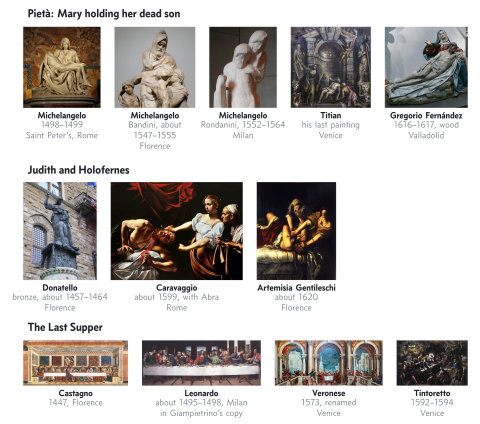
David. The shepherd boy of the Hebrew Bible who killed the giant Goliath with a stone from his sling, the hero of the Florentine republic. “This figure” wants him when a clue lists sculptors: Verrocchio created a sculpture of DavidVerrocchio created a sculpture of this figure. → David•• in bronze, as Donatello did before him and Michelangelo after. Taught in Chapter 2, Chapter 9, Chapter 10, and Chapter 22.
Zuccone. Donatello’s prophet, usually identified as Habakkuk, for the cathedral’s bell tower, carved in the 1420s or early 1430s. Florentines nicknamed the bald Habakkuk the Zuccone,Donatello’s bald statue of Habakkuk is known by this nickname meaning “pumpkin head.” → Zuccone••• “the pumpkin head.” Vasari tells that Donatello ordered it to speak. Taught in Chapter 2.
David (Donatello, bronze). The bronze David Donatello made for the Medici, usually dated to the 1440s, among the first freestanding male nudes since antiquity. He stands on Goliath’s severed headA boy stands on Goliath’s severed head while holding a sword in this bronze statue. → David (Donatello, bronze)••• with the giant’s sword, wearing nothing but boots and a laurel-crowned hat.The youth wears only boots and a laurel-crowned hat in this bronze statue. → David (Donatello, bronze)••• His marble David of 1408 is clothed. Taught in Chapter 2.
Penitent Magdalene (Donatello). Donatello’s Mary Magdalene, carved in white poplar and painted. Emaciated and ragged, she raises her hands in prayerThis wooden sculpture shows an emaciated, ragged Mary Magdalene with her hands raised in prayer. → Penitent Magdalene (Donatello)••• after years in the desert. Caravaggio’s Penitent Magdalene, now in the Doria Pamphilj Gallery,This artist painted the Penitent Magdalene now in the Doria Pamphilj Gallery. → Caravaggio• is a painting of a young woman with her head bowed. Taught in Chapter 2.
Gattamelata. Donatello’s bronze equestrian statue in Padua, set up in 1453, of a bronze horseman of Erasmo da Narni,This equestrian monument in Padua portrays Erasmo da Narni. → Gattamelata••• the mercenary captain called “Gattamelata.” Modeled on the ancient Marcus Aurelius, it revived the bronze horseman; the horse rests one hoof on a ball. Taught in Chapter 2.
Pietà. Italian for “pity”: an image of Mary holding her dead son on her lap after he was taken down from the cross. Michelangelo carved three. In the Florentine or Bandini Pietà, Nicodemus with the sculptor’s own faceMichelangelo portrayed himself as Nicodemus in the damaged Florentine or Bandini version of this scene. → Pietà•• looks down on the group. In the last, left rough when he died, both figures stand in the Rondanini.Unusually, both figures stand in the Rondanini version of this scene. → Pietà• Titian painted one as his last picture, and there an old man kneels as NicodemusTitian’s last painting depicts Nicodemus in this scene of mourning for Christ. → Pietà•• to touch Christ’s hand. In Spain Castile’s best-loved Pietàs came from Fernández,Gregorio Fernández made Castilian sculptures of this scene of Mary holding the dead Christ. → Pietà•• carved in painted wood for Valladolid’s processions. Taught in Chapter 10, Chapter 16, and Chapter 23.
Pietà (Michelangelo, Saint Peter’s). Michelangelo’s marble group of 1498 and 1499, carved for a French cardinal’s tomb. Mary is calm, and she looks hardly older than her son.Mary appears unusually youthful in this sculpture of her holding the dead Christ. → Pietà (Michelangelo, Saint Peter’s)••• His only signed work, it stands near the entrance of Saint Peter’s. In 1972 a man struck it with a geologist’s hammer.Laszlo Toth damaged this sculpture with a geologist’s hammer. → Pietà (Michelangelo, Saint Peter’s)••• Taught in Chapter 10.
David (Michelangelo). The seventeen-foot marble of 1501 to 1504, cut from a block called “the Giant.” In contrapposto, he holds the sling over his shoulder,A youth holds a sling over his shoulder and stands contrapposto in this sculpture. → David (Michelangelo)••• before the fight. It stood outside the Palazzo Vecchio until 1873. In 1991 an attacker with a hammer struck the toes of the left foot.Piero Cannata attacked this Michelangelo sculpture with a hammer in 1991. → David (Michelangelo)• Taught in Chapter 10.
Moses (Michelangelo). The seated prophet at the center of Julius II’s tomb in San Pietro in Vincoli,This sculpture forms part of Julius II’s tomb in San Pietro in Vincoli. → Moses (Michelangelo)•• finished in 1545, between Rachel and Leah. He is horned, as the Latin Vulgate described him: where the Hebrew of Exodus says his face shone, Jerome’s Latin says it was “horned.” A legend says Michelangelo struck its knee and told it to speak. Taught in Chapter 10.
Saliera. Cellini’s gold salt cellar for Francis I of France, about ten inches high, on which two gold figures, the sea and the earth,Gold nude figures representing sea and earth flank containers for salt and pepper in this table sculpture made for Francis I. → Saliera•• sit beside a little ship for the salt and a tiny temple for the pepper. A clue that asks for its material wants gold. Taught in Chapter 13.
The Nymph of Fontainebleau. Cellini’s bronze relief of about 1543 for a gate of Francis I’s palace, shaped like a half moon. The nymph reclines beneath a stag’s headA reclining nymph lies beneath a stag’s head with projecting antlers in this semicircular relief. → The Nymph of Fontainebleau•• whose antlers stick out into the air. Taught in Chapter 13.
Perseus with the Head of Medusa (Cellini). Cellini’s bronze for Duke Cosimo I, unveiled on April 27, 1554, in the Loggia dei LanziThis bronze statue of a decapitation stands in Florence’s Loggia dei Lanzi. → Perseus with the Head of Medusa (Cellini)•• on the Piazza della Signoria. The hero holds up the Gorgon’s head and stands on her body. Caravaggio’s Medusa is a painted head on a shield. Taught in Chapter 13.
The Rape of Proserpina. Bernini’s marble of 1621 and 1622 for Cardinal Scipione Borghese: Pluto carries off the daughter of Ceres, three-headed Cerberus at his feet, and she pushes against his faceCerberus watches Pluto abduct a woman who pushes against his face in this sculpture. → The Rape of Proserpina•• while his fingers press into her thigh. “Rape” here keeps its old sense, “carrying off.” Taught in Chapter 22.
Apollo and Daphne. Bernini’s marble of 1622 to 1625 in the Galleria Borghese, showing the nymph at the instant Apollo catches her: her hands turn into laurelA fleeing nymph’s hands turn into laurel branches as Apollo catches her in this sculpture. → Apollo and Daphne•• twigs and leaves. Taught in Chapter 22.
David (Bernini). Bernini’s marble of 1623 and 1624, the fourth of his statues for Scipione Borghese, finished, Baldinucci says, in seven months. Unlike Michelangelo’s calm youth, Bernini’s David twists to sling the stone,A youth twists his torso and bites his lip as he prepares to sling a stone in this sculpture. → David (Bernini)•• biting his lip, with a harp at his feet. Taught in Chapter 22.
Truth Unveiled by Time. The statue Bernini began for himself after the failure of his bell towers at Saint Peter’s. Truth sits smiling, a blazing sun in her hand and a foot on the globe, but he never carved the figure of TimeBernini never completed the figure of Time intended to unveil the woman in this sculpture. → Truth Unveiled by Time•• who was to unveil her. Taught in Chapter 22.
The Ecstasy of Saint Teresa. Bernini’s marble of 1647 to 1652 in the Cornaro Chapel of Santa Maria della Vittoria in Rome.This sculpture is in Santa Maria della Vittoria. → The Ecstasy of Saint Teresa••• An angel aims a golden arrow at the Carmelite nun on her cloud, gilded rays fall from a hidden window, and members of the Cornaro family sit in theater boxesThis sculpture occupies the Cornaro Chapel, where members of that family appear in theater-like boxes. → The Ecstasy of Saint Teresa••• on the side walls. Taught in Chapter 22.
Fountain of the Four Rivers. Bernini’s fountain in Piazza Navona for Innocent X, unveiled on June 12, 1651, with an ancient obelisk topped by the Pamphili dove. The Nile, Danube, Río de la Plata, and GangesThe Nile, Danube, Río de la Plata, and Ganges are personified in this fountain. → Fountain of the Four Rivers••• stand for four continents. Taught in Chapter 22.
Blessed Ludovica Albertoni. One of Bernini’s last great marbles, finished by 1674 in the Altieri ChapelBernini made this sculpture for the Altieri Chapel. → Blessed Ludovica Albertoni•• of San Francesco a Ripa. Ludovica, a Roman noblewoman who gave her fortune to the poor, lies dying on a bed above red marble, and she clutches at her breast.A reclining woman clutches her breast beneath putti heads, above red marble, in this sculpture. → Blessed Ludovica Albertoni•• Taught in Chapter 22.
Frescoes, the Sistine Chapel, and the Last Suppers
Sixteen answers are wall paintings and the things in them (Table A.16). Most are frescoes, painted into wet plaster, in three places: Masaccio’s in Florence, the Sistine Chapel’s walls and ceiling, and Raphael’s rooms in the Vatican. The Last Suppers are a group of their own, on dining-hall walls and on canvas. A clue usually names a detail, and the detail tells the room. Christ under a coffered vault is Masaccio’s Trinity; God’s finger is the Sistine ceiling; Plato and Aristotle are Raphael’s. The Last Supper is the subject painted most often in this volume, and four versions are answers or clues here (Figure A.4). Even the color of Christ’s robe and the salt Judas spills are answers.
| Answer | When | Painter; where | Known for | Ch. |
|---|---|---|---|---|
| The Tribute Money | From about 1425 | Masaccio; Brancacci Chapel | Peter three times; atmospheric perspective | 2 |
| Expulsion from the Garden of Eden (Masaccio) | From about 1425 | Masaccio; Brancacci Chapel | Adam and Eve in anguish under a sword-bearing angel | 2 |
| The Holy Trinity (Masaccio) | About 1427 | Masaccio; Santa Maria Novella | God holds up the cross under a coffered vault; the skeleton’s warning; hidden by Vasari | 2 |
| The Last Supper | 1447–1594 | Many | Jesus’s last meal: Castagno, Leonardo, Veronese, Tintoretto | 9 |
| Delivery of the Keys | 1481–1482 | Perugino; Sistine Chapel | Christ gives Peter the keys before an eight-sided temple | 11 |
| The Last Supper (Leonardo) | About 1495–1498 | Leonardo; Santa Maria delle Grazie | Dry plaster; the vanishing point; Judas’s salt and silver; Peter’s knife | 9 |
| red | A color | Christ’s robe in Leonardo’s Last Supper | 9 | |
| salt | A substance | Judas spills it in Leonardo’s Last Supper | 9 | |
| La Disputa | 1509–1510 | Raphael; Stanza della Segnatura | Theologians around the monstrance; Theology’s wall | 11 |
| The School of Athens | 1509–1511 | Raphael; Stanza della Segnatura | Plato and Aristotle; Euclid; Heraclitus; Ptolemy and Zoroaster; Philosophy’s wall | 11 |
| Parnassus (Raphael) | About 1510 | Raphael; Stanza della Segnatura | Apollo with a lira da braccio; Homer with the Laocoön’s head | 11 |
| The Creation of Adam | 1511–1512 | Michelangelo; Sistine ceiling | God’s finger; Adam on a green hill; the brain; the cameo | 10 |
| God | A figure | The Creator in The Creation of Adam | 10 | |
| The Last Judgment (Michelangelo) | 1536–1541 | Michelangelo; Sistine altar wall | Bartholomew’s skin with the painter’s face; “Il Braghettone” | 14 |
| The Feast in the House of Levi | 1573 | Veronese; Venice | A Last Supper renamed after the Inquisition questioned him | 16 |
| The Last Supper (Tintoretto) | 1592–1594 | Tintoretto; San Giorgio Maggiore | The diagonal table; angels from the lamp’s smoke | 16 |
The Tribute Money. Masaccio’s fresco in the Brancacci Chapel, which tells one story in three moments: Peter appears three times,Saint Peter appears three times, including taking a coin from a fish and paying a tax collector, in this Brancacci Chapel fresco. → The Tribute Money••• as Christ sends him to find a coin in a fish’s mouth, as he takes it out, and as he pays the tax collector. Its hazy mountains show atmospheric perspective. Taught in Chapter 2.
Expulsion from the Garden of Eden (Masaccio). Masaccio’s fresco on the narrow pier at the chapel’s entrance, in which a sword-bearing angel drives out an anguished Adam and Eve;An anguished Adam and Eve are driven out by a sword-bearing angel in this Brancacci Chapel fresco. → Expulsion from the Garden of Eden (Masaccio)•• Eve throws back her head and howls. Fra Angelico put the same scene in the corner of his Cortona Annunciation. Taught in Chapter 2.
The Holy Trinity (Masaccio). Masaccio’s fresco of about 1427 on a wall of Santa Maria Novella, the Dominican churchThis Masaccio fresco is in Santa Maria Novella. → The Holy Trinity (Masaccio)•• of western Florence. Under a coffered vault God the Father holds up the cross, and below, above a painted tomb, the skeleton’s inscription tells every passerbyThe skeleton’s Italian inscription in this fresco says, “I once was what you are and what I am you also will be.” → The Holy Trinity (Masaccio)•• that it was once what we are. Vasari hid it behind an altar about 1570. Taught in Chapter 2.
The Last Supper. The scene of Jesus’s last meal with his disciples, painted on the walls of the dining halls of friars and nuns so that they ate in its company. In the nuns’ convent of Sant’Apollonia in Florence, in Castagno’s version of 1447, the walls are wildly patterned marble,Andrea del Castagno's version of this scene has wildly patterned marble walls. → The Last Supper• and Judas sits alone on the near side of the table. Taught in Chapter 9.
Delivery of the Keys. Perugino’s fresco of 1481 and 1482 on the north wall of the Sistine Chapel, in which Christ, before an eight-sided temple between two triumphal arches, gives the keys to the kneeling Peter.Christ gives keys to a kneeling apostle before an octagonal temple flanked by triumphal arches in this fresco. → Delivery of the Keys•• Taught in Chapter 11.
The Last Supper (Leonardo). Leonardo’s mural of about 1495 to 1498 on the end wall of the refectory of Santa Maria delle GrazieThis mural occupies a wall of the refectory of Santa Maria delle Grazie in Milan. → The Last Supper (Leonardo)••• in Milan, showing the moment Jesus says one of them will betray him. Behind Christ are three windows, and his head is the vanishing point.Three windows frame Christ, whose head marks the vanishing point, in this mural. → The Last Supper (Leonardo)••• Painted on dry plaster, it was flaking by 1517, while Leonardo was still alive. Taught in Chapter 9.
red. The color Leonardo gave Christ in The Last Supper: in the original Jesus wears a red robeJesus's robe is this color in da Vinci's The Last Supper. → red• under a blue mantle. Taught in Chapter 9.
salt. The substance Judas spills in Leonardo’s Last Supper, an old sign of bad luck: with his right arm Judas knocks over the salt cellar.Judas Iscariot knocks over a container of this substance in da Vinci's The Last Supper. → salt• Taught in Chapter 9.
The Creation of Adam. One of the central panels of Michelangelo’s Sistine ceiling, painted after the first half was shown in 1511, where God’s finger nearly touches Adam’sGod’s outstretched finger nearly touches the reclining first man’s hand in this fresco. → The Creation of Adam••• as the first man lies on a green hill. One scholar has proposed that Adam’s pose comes from an ancient cameo in which Augustus rides sidesaddle on a Capricorn.This painting's leftmost figure was inspired by a cameo of Augustus riding a Capricorn. → The Creation of Adam• Taught in Chapter 10.
God. The figure in the Sistine Chapel’s Creation of Adam, a white-bearded old man who flies toward Adam wrapped in a great mantle, so that God gives life to Adam in a central panel.This figure appears in The Creation of Adam on the ceiling of the Sistine Chapel, painted by Michelangelo. → God• Taught in Chapter 10.
La Disputa. Raphael’s first wall in the Stanza della Segnatura, painted in 1509 and 1510, the wall of Theology. Saints sit in heaven above, and below, on earth, theologians gather around the monstranceTheologians gather around a monstrance containing the Eucharist in this fresco. → La Disputa•• that holds the Eucharist. It faces The School of Athens. Taught in Chapter 11.
The School of Athens. Raphael’s wall of Philosophy, which Julius II commissioned for the StanzaPope Julius II commissioned this painting for the Stanza della Segnatura. → The School of Athens••• della Segnatura. Plato and Aristotle stand together at the center, and since his face resembles a drawing taken for Leonardo’s self-portrait, Plato is often identified with Leonardo.Plato is often identified with Leonardo da Vinci’s features in this painting. → The School of Athens••• Heraclitus has Michelangelo’s face, and Raphael painted himself beside Ptolemy and Zoroaster. Taught in Chapter 11.
Parnassus (Raphael). Raphael’s wall of Poetry, painted around a window: Mount Parnassus, home of Apollo and the Muses, crowded with poets old and new. Apollo plays a lira da braccio,Apollo plays a lira da braccio among the Muses and poets in this painting. → Parnassus (Raphael)•• a bowed instrument of Raphael’s own day, and blind Homer has the head of the ancient Laocoön. Taught in Chapter 11.
The Last Judgment (Michelangelo). The fresco of 1536 to 1541 that fills the Sistine Chapel’s altar wall, with Christ judging the risen dead. The apostle Bartholomew holds his own flayed skin, bearing Michelangelo’s face.Saint Bartholomew holds flayed skin bearing Michelangelo’s likeness in this fresco. → The Last Judgment (Michelangelo)••• After Trent, Daniele da Volterra painted cloths over the nudes, and Daniele was nicknamed “Il Braghettone”,Daniele da Volterra earned the nickname “Il Braghettone” by adding drapery to nude figures in this fresco. → The Last Judgment (Michelangelo)•• “the breeches-maker.” Taught in Chapter 14.
The Feast in the House of Levi. Veronese’s banquet of 1573, nearly 43 feet wide, painted as a Last Supper under three great arches and crowded with a jester, a parrot, halberdiers, and a dog. Questioned by the Inquisition, he named it for another feast in Luke’s Gospel, and the Last Supper became The Feast in the House of Levi.Veronese retitled this painting of a meal beneath three great arches after objections to its treatment of the Last Supper. → The Feast in the House of Levi•• Taught in Chapter 16.
The Last Supper (Tintoretto). Tintoretto’s last great work, of 1592 to 1594, at San Giorgio Maggiore in Venice. Tintoretto turned the table diagonally,A table runs diagonally into the room in this painting of Christ’s final meal. → The Last Supper (Tintoretto)••• running deep into a dark room, and angels form out of the smoke of a hanging lamp. Taught in Chapter 16.
Madonnas, saints, and visions
Sixteen answers are paintings of Christ, the Virgin, and the saints, with the Virgin herself (Table A.17). They come from six painters’ hands above all: Leonardo and Raphael’s Madonnas; Parmigianino’s Mannerist one; Botticelli’s late vision; El Greco’s Toledo altarpieces; and Caravaggio’s chapels in Rome and his last great canvas in Malta. A clue usually names a figure and an odd detail. A goldfinch, a ledge of bored cherubs, a long neck, or a grotto of rocks marks a Madonna; a horse marks Paul, a beckoning arm Matthew, a beardless Christ the London Emmaus. Two titles are traps of their own: the Sistine Madonna hangs in Dresden, not the Sistine Chapel, and El Greco’s Fifth Seal was once called Profane Love.
| Answer | When | Painter; where | Known for | Ch. |
|---|---|---|---|---|
| Virgin Mary | A figure | Leonardo’s of the Rocks; Michelangelo’s Pietà; Raphael’s of the Goldfinch | 9–11 | |
| The Virgin of the Rocks | From 1483 | Leonardo; Louvre and London | Mary, Jesus, the infant John in a grotto; the angel Uriel | 9 |
| Salvator Mundi | About 1499–1510 | Leonardo (disputed) | Christ with a clear orb; $450 million in 2017 | 9 |
| The Mystical Nativity | 1500–1501 | Botticelli; London | Twelve angels in a ring; a Greek inscription; his only signed painting | 4 |
| Madonna of the Goldfinch | About 1505 | Raphael; Florence | John offers Jesus a goldfinch; broken in seventeen pieces in 1548 | 11 |
| Sistine Madonna | 1512 | Raphael; for Piacenza | Two bored cherubs on the ledge | 11 |
| The Transfiguration (Raphael) | To 1520 | Raphael; Vatican | Christ shining above; the apostles fail to heal a boy below; his last | 11 |
| Madonna with the Long Neck | 1534–1540 | Parmigianino; Uffizi | An elongated Mary; a huge sleeping Child; a tiny Saint Jerome | 13 |
| The Disrobing of Christ | 1577–1579 | El Greco; Toledo Cathedral | Christ in a brilliant red robe; the Three Marys | 16 |
| The Burial of the Count of Orgaz | By 1588 | El Greco; Santo Tomé, Toledo | Stephen and Augustine bury the count; a row of noblemen; heaven above | 16 |
| Paradiso (Tintoretto) | After 1588 | Tintoretto; Doge’s Palace | One of the largest canvases in the world, full of figures | 16 |
| The Calling of Saint Matthew | 1599–1600 | Caravaggio; Contarelli Chapel | Christ beckons; “Who, me?”; a beam of light | 20 |
| The Conversion of Saint Paul (Caravaggio) | 1600–1601 | Caravaggio; Cerasi Chapel | Paul on his back under a great brown-and-white horse | 20 |
| The Supper at Emmaus (Caravaggio) | 1601; 1606 | Caravaggio; London and Milan | The risen Christ blesses the bread; beardless in London | 20 |
| The Beheading of Saint John the Baptist | 1608 | Caravaggio; Valletta | Signed in the blood; for the Knights of Malta | 20 |
| The Opening of the Fifth Seal | Last years, to 1614 | El Greco; New York | Saint John in blue before the naked martyrs; once Profane Love; Picasso | 16 |
Virgin Mary. The mother of Jesus, “this figure” in clues that name a famous Madonna. Leonardo painted her among rocks, and the Virgin of the title is Mary.Da Vinci painted this figure in a painting titled "of the Rocks." → Virgin Mary•• Raphael painted her with a book and the two boys when Raphael painted the Madonna of the GoldfinchRaphael painted a version of this figure "of the Goldfinch." → Virgin Mary• for a Florentine friend. Taught in Chapter 9, Chapter 10, and Chapter 11.
The Virgin of the Rocks. Leonardo’s altarpiece for a Milanese confraternity, begun in 1483: Mary, the infant Jesus, and the infant John the Baptist in a grotto, with an angel commonly identified as Uriel.An angel commonly identified as Uriel accompanies Mary and the children in this painting. → The Virgin of the Rocks• The usual explanation is that Leonardo sold the first panel to another buyer and painted a second, and so there are two versions, one in the Louvre, one in London.Versions of this painting are held by the Louvre and London’s National Gallery. → The Virgin of the Rocks• Taught in Chapter 9.
Salvator Mundi. “Savior of the World,” a half-length Christ holding a transparent orb, attributed to Leonardo after its restoration, though scholars still dispute it. On November 15, 2017, it sold for about $450 million,This painting sold at Christie’s for about $450 million in 2017. → Salvator Mundi• the highest price ever paid for a painting. Taught in Chapter 9.
The Mystical Nativity. Botticelli’s small canvas of 1500 or 1501 in London, painted in the years after Savonarola’s death, with twelve angels dancing in a ring above the stable. It is his only signed painting,This is Botticelli’s only signed painting. → The Mystical Nativity•• and its Greek inscription speaks of Revelation and Italy’s troubles. Taught in Chapter 4.
Madonna of the Goldfinch. Raphael’s Florentine Madonna of about 1505, a pyramid of three figures in a meadow. John holds out a goldfinch to Jesus,The young John the Baptist holds out a bird for the infant Jesus beside Mary, who holds a book, in this painting. → Madonna of the Goldfinch••• a bird that stood for Christ’s Passion. When a landslide brought down its owner’s house in 1548, the painting broke into seventeen pieces.This painting broke into seventeen pieces when the Nasi house was destroyed by a landslide in 1548. → Madonna of the Goldfinch• Vivaldi’s Goldfinch is a flute concerto. Taught in Chapter 11.
Sistine Madonna. Raphael’s altarpiece of 1512 for the church of San Sisto in Piacenza, named for the saint, Sixtus, who kneels in it; it is now in Dresden. Mary walks forward on the clouds, and below two bored-looking cherubs lean on the ledge.Two bored-looking cherubs lean on a ledge at the bottom of this painting. → Sistine Madonna•• Taught in Chapter 11.
The Transfiguration (Raphael). Raphael’s last painting, The Transfiguration,This was Raphael’s last major painting, left unfinished at his death. → The Transfiguration (Raphael)•• left unfinished when he died in 1520. Above, Christ shines on the mountain; below, the apostles try to heal a possessed boyApostles try to heal a demon-possessed boy in the lower half of this painting. → The Transfiguration (Raphael)•• and cannot. Taught in Chapter 11.
Madonna with the Long Neck. Parmigianino’s unfinished altarpiece of 1534 to 1540, the picture that best shows Mannerism. An elongated Mary holds a huge sleeping Child, and at the foot of a row of columns a tiny Saint Jerome unrolls a scroll.A tiny Saint Jerome unfurls a scroll at the lower right of this painting. → Madonna with the Long Neck••• Taught in Chapter 13.
The Disrobing of Christ. One of El Greco’s two first Toledo commissions, painted from 1577 to 1579 for the cathedral’s sacristy. In the middle stands Christ in a brilliant red robe,Christ in a brilliant red robe stands above the Three Marys and a carpenter drilling the cross in this painting. → The Disrobing of Christ•• while a carpenter bores holes in the cross below. Taught in Chapter 16.
The Burial of the Count of Orgaz. El Greco’s canvas of 1586 to 1588, sixteen feet high, in Santo Tomé, Toledo. Saints Stephen and Augustine lower the armored count into his tomb, and a row of black-clad noblemen with white ruffsA row of black-clad noblemen with white ruffs divides the earthly and heavenly halves of this painting. → The Burial of the Count of Orgaz••• divides earth from heaven. His son, at the front, carries a handkerchief signed and dated 1578.The artist’s son points toward the burial while carrying a handkerchief signed by his father and dated 1578 in this painting. → The Burial of the Count of Orgaz••• Taught in Chapter 16.
Paradiso (Tintoretto). Tintoretto’s vision of heaven for the Great Council hall of the Doge’s Palace, painted with his son Domenico, on one of the largest canvases in the world.Hundreds of figures fill this huge painting in the Doge’s Palace in Venice. → Paradiso (Tintoretto)• It is not Dante’s Paradiso (Vol. 9, Cathedrals and Crusades). Taught in Chapter 16.
The Opening of the Fifth Seal. El Greco’s vision from the Book of Revelation, in which Saint John in a blue robeSaint John in a blue robe raises his arms before a group of naked martyrs in this painting. → The Opening of the Fifth Seal••• raises his arms before the naked souls of the martyrs. For its nudes it was long called Profane Love,This painting of Saint John and the martyrs was formerly known as Profane Love. → The Opening of the Fifth Seal• which a clue may set beside Titian’s Sacred and Profane Love. Picasso studied it. Taught in Chapter 16.
The Calling of Saint Matthew. Caravaggio’s painting of 1599 and 1600 for the Contarelli Chapel, in which Christ calls the tax collector Matthew from a table of five men. A bearded man points toward himself,A bearded man traditionally identified as the title figure points toward himself in a “Who, me?” gesture in this painting. → The Calling of Saint Matthew••• as if to ask, “Who, me?” Paintings of Matthew’s martyrdom and inspirationPaintings of the title saint’s martyrdom and inspiration accompany this painting in the Contarelli Chapel of San Luigi dei Francesi. → The Calling of Saint Matthew••• complete the chapel. Taught in Chapter 20.
The Conversion of Saint Paul (Caravaggio). Caravaggio’s painting of 1600 and 1601 for the Cerasi Chapel. Paul lies on his back with his arms raised, struck blind, and above him a huge brown-and-white horse fills the picture.A brown-and-white horse dominates this painting above Paul, who lies on his back with his arms raised. → The Conversion of Saint Paul (Caravaggio)•• Taught in Chapter 20.
The Supper at Emmaus (Caravaggio). Two paintings of the risen Jesus revealing himself to two disciples over supper. Christ is beardless in the London versionChrist is depicted without a beard in the London version of this painting. → The Supper at Emmaus (Caravaggio)•• of 1601; the Milan version followed in 1606, after he fled Rome. Taught in Chapter 20.
The Beheading of Saint John the Baptist. Caravaggio’s largest canvas, painted in 1608 for the oratory of the Knights of MaltaCaravaggio painted this work for the oratory of the Knights of Malta. → The Beheading of Saint John the Baptist• in Valletta when they made him a knight. He wrote his name in the bloodThe artist’s signature appears in a pool of blood in this painting. → The Beheading of Saint John the Baptist• that runs from John’s neck, though he almost never signed a picture. Taught in Chapter 20.
Venuses and other myths
Fifteen answers are paintings of the gods and myths of Greece and Rome, with the goddess of love herself, her son Cupid, and the season she rules (Table A.18). They come from Botticelli in Florence, Giorgione and Titian in Venice, Bronzino in Florence, Caravaggio in Rome, and Velázquez in Madrid. Six Venuses are answers, and a clue tells them apart by her pose. Botticelli’s stands on a shell, or reclines dressed beside the sleeping Mars; Giorgione’s sleeps outdoors; Titian’s lies awake indoors with a dog at her feet; Bronzino’s is kissed by Cupid; Velázquez’s lies with her back to us and looks into a mirror. Venus is the answer when the clue says “this figure” or “this goddess.” A Bacchus or a Medusa clue must also say whose, since this volume has four of the one and two of the other.
| Answer | When | Painter; where | Known for | Ch. |
|---|---|---|---|---|
| Venus | A goddess | Born from the sea (Botticelli, Bouguereau); at the center of La Primavera | 4 | |
| spring | A season | Primavera is Italian for spring | 4 | |
| La Primavera | About 1480–1482 | Botticelli; Uffizi | Venus in an orange grove; Zephyrus and Chloris; the dancing Graces; Mercury; Cupid | 4 |
| The Birth of Venus | About 1484–1486 | Botticelli; Uffizi | Venus on a shell, pudica; Zephyrus; the Hora with the cloak; the Simonetta legend | 4 |
| Venus and Mars (Botticelli) | About 1485 | Botticelli; London | Satyrs blow a conch into the sleeping Mars’s ear | 4 |
| The Calumny of Apelles | About 1494–1495 | Botticelli; Uffizi | Lucian’s lost picture; a donkey-eared judge; Truth with Venus’s body | 4 |
| Sleeping Venus (Giorgione) | About 1510 | Giorgione and Titian; Dresden | A nude asleep outdoors, arm behind her head | 12 |
| Sacred and Profane Love | 1514 | Titian; Galleria Borghese | A clothed and a nude woman at a sarcophagus; Cupid stirs the water; Aurelio’s marriage | 12 |
| Bacchus and Ariadne | 1520–1523 | Titian; London | Bacchus leaps from a cheetah-drawn chariot; the snake-man; eight stars | 12 |
| Venus of Urbino | 1538 | Titian; Uffizi | Awake indoors; two maids at a chest; a sleeping dog | 12 |
| Venus, Cupid, Folly and Time | About 1545 | Bronzino; London | Cupid kisses Venus; Folly with roses; Time with a blue curtain | 13 |
| Medusa (Caravaggio) | About 1597–1598 | Caravaggio; Uffizi | A severed head on a convex shield; often read as the painter’s face | 20 |
| Cupid (or Eros) | A god | Caravaggio’s Amor Victorious | 20 | |
| The Rokeby Venus | 1649–1651 | Velázquez; London | Seen from behind; Cupid holds the mirror | 23 |
| Las Hilanderas | About 1657 | Velázquez; Prado | Athena and Arachne’s weaving contest; Titian’s Europa as the tapestry | 23 |
Venus. The Roman goddess of love, Aphrodite to the Greeks, born from the sea. A clue that names two painters of her birth wants her: Botticelli, and Bouguereau, who in 1879 showed his own Birth of Venus.Botticelli and Bouguereau painted the birth of this figure. → Venus••• In La Primavera Venus stands beneath an arch of treesThis figure stands beneath an arch of trees at the center of Botticelli’s Primavera. → Venus•• at the center. Taught in Chapter 4.
spring. The season of La Primavera, since Primavera is Italian for spring.This concept titles a painting by Botticelli. → spring• Vivaldi’s first concerto of The Four Seasons is also “La primavera,” and is a different answer. Taught in Chapter 4.
La Primavera. Botticelli’s allegory of spring, about 1480 to 1482, probably painted for Lorenzo di Pierfrancesco’s marriage.This painting was possibly commissioned for the marriage of Lorenzo di Pierfrancesco. → La Primavera• It reads from right to left in an orange grove: Zephyrus seizes Chloris, who becomes Flora; Venus stands at the center; and the Three Graces dance with interlocked handsThe Three Graces dance with interlocked hands in this painting. → La Primavera•• before Mercury. Taught in Chapter 4.
Venus and Mars (Botticelli). Botticelli’s long panel in London of the god of war asleep after love while Venus watches, awake. Three little satyrs play with his armor, and a fourth blows a conch into his earSatyrs blow a conch into the sleeping Mars’s ear while Venus watches in this painting. → Venus and Mars (Botticelli)•• without waking him. Taught in Chapter 4.
The Birth of Venus. Botticelli’s canvas of about 1484 to 1486 in the Uffizi. Venus stands on a scallop shell, blown ashore by Zephyrus, and she covers herself with hands and hairThe goddess covers her nudity with her hands and hair in a Venus pudica pose in this painting. → The Birth of Venus••• in the pose called the Venus pudica. The same body appears in his Calumny, where Truth has the figure of Venus.This painting's central figure resembles the personification of Truth in its artist's Calumny of Apelles. → The Birth of Venus•• Taught in Chapter 4.
The Calumny of Apelles. Botticelli’s small panel of about 1494 to 1495; it recreates the lost picture Lucian described,This painting recreates a lost work by Apelles described by Lucian. → The Calumny of Apelles•• the Greek painter Apelles’ answer to a false charge. A donkey-eared judge sits between Ignorance and Suspicion, and naked Truth points to heaven. Taught in Chapter 4.
Sleeping Venus (Giorgione). Giorgione’s canvas of about 1510 in Dresden, the first of the great Venetian nudes, in which a nude woman sleeps with one arm behind her headA reclining nude sleeps with one arm behind her head, her body echoing the surrounding hills, in this painting. → Sleeping Venus (Giorgione)•• in an open landscape. Titian finished it after Giorgione died. Taught in Chapter 12.
Sacred and Profane Love. Titian’s canvas of 1514 for the marriage of the Venetian official Niccolò Aurelio. A richly dressed woman and a nude sit at either end of an ancient sarcophagus, and between the clothed woman and the nude, Cupid stirs the water.Cupid stirs the water in a sarcophagus between a clothed woman and a nude woman in this painting. → Sacred and Profane Love••• The front of the sarcophagus is carved with a horse and a man being whipped, and the coat of arms on it is Niccolò Aurelio’s.Niccolò Aurelio’s coat of arms appears on the sarcophagus in this painting commissioned for his marriage to Laura Bagarotto. → Sacred and Profane Love•• Taught in Chapter 12.
Bacchus and Ariadne. Titian’s canvas of 1520 to 1523 for Alfonso d’Este, from Catullus and Ovid. Bacchus leaps from his chariot drawn by cheetahsA god leaps from a chariot drawn by cheetahs toward a woman in this painting. → Bacchus and Ariadne•• toward Ariadne, abandoned on Naxos, and her crown of stars shines above. It is not Caravaggio’s lone Bacchus or Velázquez’s Triumph of Bacchus. Taught in Chapter 12.
Venus of Urbino. Titian’s canvas of 1538, bought by the future Duke of Urbino. It took Giorgione’s sleeping goddess indoors and woke her, since Titian drew on Giorgione’s Sleeping Venus.Titian drew on Giorgione’s Sleeping Venus for this painting. → Venus of Urbino•• She looks straight at us, and behind her two maids search a marriage chest, and a dog sleepsTwo maids search a marriage chest behind a reclining nude whose feet lie near a sleeping dog in this painting. → Venus of Urbino••• at her feet. Taught in Chapter 12.
Venus, Cupid, Folly and Time. Bronzino’s puzzling Mannerist allegory of about 1545, in London, sent to the king of France, probably as Duke Cosimo’s gift. Cupid kisses his mother, Time draws back a blue curtain, and a laughing boy called Folly prepares to scatter rosesThe figure often called Folly prepares to scatter roses in this allegorical painting of Venus and Cupid. → Venus, Cupid, Folly and Time•• over them. Taught in Chapter 13.
Medusa (Caravaggio). Caravaggio’s painting of about 1597 to 1598, a gift for the Grand Duke of Tuscany: the Gorgon’s screaming head, just cut off, painted on a convex shield.This painting of a severed head on a convex ceremonial shield shows blood against a green background. → Medusa (Caravaggio)•• It is often read as the painter’s own face. Cellini’s bronze Perseus holds up a Medusa’s head in Florence. Taught in Chapter 20.
Cupid (or Eros). The winged boy-god of love, Venus’s son. Caravaggio painted him as a grinning, naked boy with eagle’s wings, trampling a violin, armor, a crown, and books, so that his picture shows Cupid victorious over every human pursuit.Caravaggio painted this figure in a painting of him "victorious." → Cupid (or Eros)•• Taught in Chapter 20.
The Rokeby Venus. Velázquez’s only surviving female nude, probably painted in Italy about 1650, named for the English house where it hung. Venus lies with her back to us, Cupid holds up a mirror, and the mirror shows Venus’s face,Cupid holds a mirror reflecting the face of Venus, who reclines with her back to the viewer, in this painting. → The Rokeby Venus••• soft and blurred. Taught in Chapter 23.
Las Hilanderas. “The Spinners,” Velázquez’s late myth of about 1657. Women spin and wind wool in the front of a workshop, and in a bright room behind, the weaving contest between Athena and ArachneThis painting depicts the weaving contest between Athena and Arachne. → Las Hilanderas•• reaches its end, before a tapestry showing Titian’s Rape of Europa. Taught in Chapter 23.
Portraits, cheats, battles, and a city
Twelve answers are paintings and a drawing of people and places of this world rather than heaven or myth (Table A.19). There are four portraits, two scenes of cheating, two battles, a view of a city, a famous drawing, and Velázquez’s Las Meninas with the mirror in it. The portraits are easy to cross because three of them are of women. Leonardo’s Ginevra has a juniper behind her and is in Washington; his Mona Lisa has a landscape behind her and is in Paris; Artemisia’s woman is a painter at work, usually taken as herself. Two battle pictures are answers too. Uccello’s is a Florentine victory of 1432 in three panels, and Velázquez’s is the Dutch surrender of Breda to Spain in 1625, with a forest of lances.
| Answer | When | Painter; where now | Known for | Ch. |
|---|---|---|---|---|
| The Battle of San Romano | Battle 1432 | Uccello; London, Florence, Paris | Three panels; Niccolò da Tolentino on a white horse in a red-and-gold hat | 3 |
| Ginevra de’ Benci | 1474–1478 | Leonardo; Washington | The juniper pun; laurel, palm, and a motto on the back; the only Leonardo on permanent display in the Americas | 9 |
| Vitruvian Man | About 1490 | Leonardo; Venice, Accademia | A man in a circle and a square; named for Vitruvius | 9 |
| Mona Lisa | Begun about 1503 | Leonardo; Louvre | Lisa Gherardini; the smile; no eyebrows; sfumato; the road and bridge; the Prado copy | 9 |
| The Fortune Teller (Caravaggio) | About 1594 | Caravaggio; Rome, Louvre | A woman reads a youth’s palm and slips off his ring | 20 |
| The Cardsharps | About 1596 | Caravaggio; Fort Worth | A gloved man signals to a young cheat | 20 |
| View of Toledo | About 1596–1600 | El Greco; New York | A storm over the city and the castle of San Servando | 16 |
| The Surrender of Breda | 1634–1635 | Velázquez; Prado | Spinola’s hand on Justin of Nassau’s shoulder; the lances; the Hall of Realms | 23 |
| Self-Portrait as the Allegory of Painting | 1638–1639 | Artemisia; Royal Collection | Ripa’s gold chain and mask; painted at Charles I’s court | 20 |
| Portrait of Pope Innocent X (Velázquez) | 1650 | Velázquez; Doria Pamphilj | Red everywhere; a paper with the painter’s name | 23 |
| Las Meninas | 1656 | Velázquez; Prado | The Infanta; the maids; the painter at his canvas; the king and queen in the mirror | 23 |
| mirrors | Objects | The king and queen in Las Meninas | 23 |
The Battle of San Romano. Uccello’s three panels, now split among London, Florence, and Paris, of Florence’s victory over Siena in 1432. In the London panel Niccolò rides a white horseNiccolò da Tolentino rides a white horse wearing a red-and-gold hat in one panel of this three-part painting. → The Battle of San Romano•• into the fight wearing a huge red-and-gold hat instead of a helmet. Taught in Chapter 3.
Ginevra de’ Benci. Leonardo’s small portrait of 1474 to 1478 of a young Florentine woman, the only Leonardo painting on permanent display in the Americas,This is the only Leonardo painting permanently displayed in the Americas. → Ginevra de’ Benci•• in Washington. Behind her head a juniper bush puns on her name,A juniper bush behind the sitter puns on her name in this portrait. → Ginevra de’ Benci•• ginepro in Italian; the back has a wreath of laurel and palm and the motto Virtutem forma decorat, “Beauty adorns virtue.” Taught in Chapter 9.
Vitruvian Man. Leonardo’s pen-and-ink drawing of about 1490 of the proportions of the body, named for Vitruvius, author of De architectura,This drawing is named for the Roman author of De architectura. → Vitruvian Man• the Roman who wrote that a well-made man fits a circle and a square. Taught in Chapter 9.
Mona Lisa. Leonardo’s portrait, begun about 1503, of a Florentine merchant’s wife: the sitter is generally identified as Lisa Gherardini, wife of Francesco del Giocondo.This painting is generally identified as a portrait of Lisa Gherardini, wife of Francesco del Giocondo. → Mona Lisa••• It is the great example of sfumato, and it hangs in the Louvre. For a glimpse of its first colors, people look at a copy in the Prado.A contemporary copy of this painting exists at the Prado. → Mona Lisa•• Taught in Chapter 9.
The Fortune Teller (Caravaggio). Caravaggio’s early scene of a young dandy having his palm read by a Romani woman: the woman in the white headscarfA woman in a white headscarf reads a young man’s palm while stealing his ring in this painting. → The Fortune Teller (Caravaggio)•• slips the ring from his finger as she reads. Taught in Chapter 20.
The Cardsharps. Caravaggio’s other cheating scene, in Fort Worth, Texas. A young dupe studies his cards, while behind him an older man signals to the young cheat with gloved fingers,A gloved man signals to a youth in a striped vest who conceals cards behind his back in this painting. → The Cardsharps•• who hides a card behind his back. Taught in Chapter 20.
View of Toledo. El Greco’s landscape of about 1596 to 1600 in New York, a portrait of his adopted city, with the castle of San Servando on the hill at the left. Over the castle and the whole cityA dark stormy sky hangs above the Castle of San Servando and the city in this painting. → View of Toledo•• hangs a black storm torn with cold light. Taught in Chapter 16.
The Surrender of Breda. Velázquez’s history painting of 1634 and 1635 for the Hall of Realms, of the Dutch fortress that surrendered to Spain in 1625. As Justin of Nassau hands over the keys, Spinola lays a hand on his shoulder,Ambrosio Spinola receives the keys from Justin of Nassau while placing a hand on his shoulder in this painting. → The Surrender of Breda•• and on the right a forest of upright lancesAn array of upright lances fills the right background of this painting. → The Surrender of Breda•• gives the picture its Spanish nickname, Las Lanzas. Taught in Chapter 23.
Self-Portrait as the Allegory of Painting. Artemisia’s picture of a woman painter at work, usually taken as herself, leaning to the canvas, brush in hand, painted at Charles I’s court about 1638. Following Ripa’s book of symbols, she painted herself as Ripa’s Painting,The artist depicts herself wearing a gold chain with a mask pendant, following Cesare Ripa’s Iconologia, in this painting. → Self-Portrait as the Allegory of Painting••• with a gold chain and a mask pendant. Taught in Chapter 20.
Portrait of Pope Innocent X (Velázquez). Velázquez’s portrait of the Pamphili pope, painted in Rome in the summer of 1650. Red fills the whole picture:Red dominates the sitter’s clothing, chair, and surroundings in this papal portrait. → Portrait of Pope Innocent X (Velázquez)•• cap, cape, chair, and curtain. Unusually, a paper in his hand bears the painter’s name. Taught in Chapter 23.
Las Meninas. “The Maids of Honor,” Velázquez’s great picture of 1656, painted in the Royal Alcázar of Madrid. The Infanta Margarita stands between maids of honor,The Infanta Margarita stands between maids of honor in this painting. → Las Meninas••• the painter works at his canvas, and in a mirror on the far wall the king and queen are reflected,A rear mirror reflects Philip IV and Mariana of Austria in this painting. → Las Meninas••• Philip IV and Mariana. Foucault opened The Order of Things with it. Taught in Chapter 23.
mirrors. The answer when a clue asks what object in Las Meninas holds the royal couple: the mirror reflects Philip IV and MarianaKing Philip IV and Queen Mariana appear in one of these objects in Las Meninas. → mirrors• on the back wall. Velázquez used a mirror again for Venus’s face in the Rokeby Venus. Taught in Chapter 23.
Buildings, techniques, and materials
Nine answers are buildings, the arts of making them, and what the artists worked in (Table A.20). Three are buildings: the cathedral of Florence, the pope’s chapel, and the Medici’s library. The others are the art of architecture, the two great techniques of the age, perspective and fresco, and three materials, bronze, wood, and gold. Here the answer is often a word, not a work, so the clue’s noun decides: “this technique,” “this discipline,” “this material.” A clue that names a book about building, by Filarete or Palladio, wants architecture; a clue about a vanishing point, a mirror, or a ceiling seen from below wants perspective.
| Answer | When | What | Known for | Ch. |
|---|---|---|---|---|
| Florence Cathedral | Dome 1420–1436 | Florence’s Duomo | Brunelleschi’s octagonal double dome, herringbone brick, no full centering; the Porta della Mandorla; Vasari and Zuccari’s Last Judgment | 1, 13 |
| Sistine Chapel | Built 1473–1481 | Sixtus IV’s chapel, Vatican | The wall frescoes; the ceiling; the ignudi; the acorns; The Last Judgment | 10, 14 |
| Laurentian Library | From 1524 | Michelangelo’s library, Florence | The staircase in three flights; often called the first Mannerist building | 10 |
| perspective | From the 1410s | A technique | Brunelleschi’s mirror; Alberti’s “legitimate construction”; atmospheric perspective; sotto in sù | 1, 22 |
| frescoes | A technique | Buon on wet plaster, secco on dry; the Sistine ceiling; Raphael’s Stanza | 2 | |
| architecture | To 1570 | A discipline | Filarete’s treatise and Sforzinda; Palladio’s Four Books | 9, 16 |
| bronze | A material | Ghiberti’s Baptistery doors; Donatello’s David | 1, 2 | |
| wood | A material | Donatello’s Penitent Magdalene | 2 | |
| gold | A material | Shell gold in The Birth of Venus; Cellini’s Saliera | 4, 13 |
Florence Cathedral. Santa Maria del Fiore, the Duomo of Florence. Between 1420 and 1436 Brunelleschi raised the cathedral’s octagonal, double-shelled domeBrunelleschi designed this cathedral’s octagonal, double-shelled dome, built without flying buttresses. → Florence Cathedral••• of herringbone brick, without flying buttresses or full centering. A century later Vasari began, and Federico Zuccari finished, The Last Judgment inside the cathedral’s dome.Vasari and Zuccari painted The Last Judgment inside this cathedral’s dome. → Florence Cathedral• Taught in Chapter 1 and Chapter 13.
Sistine Chapel. The pope’s chapel that Sixtus IV built from 1473 to 1481 inside the Vatican, the pope’s palace,This building is located in the Vatican. → Sistine Chapel•• where the cardinals still elect the pope. Botticelli and Perugino painted its walls, and Michelangelo its ceiling and altar wall. Painted garlands of oak leaves and acorns run across the ceiling, since the acorns honor the chapel’s patrons,The acorns in this building honor its patron. → Sistine Chapel• the della Rovere popes, whose name means “oak.” Taught in Chapter 10 and Chapter 14.
Laurentian Library. The library Michelangelo designed for the Medici at San Lorenzo in Florence, with its staircase of three flights. It is often called the first Mannerist buildingMichelangelo designed this Mannerist library for the Medici in Florence. → Laurentian Library•• in Florence, and perhaps anywhere. Taught in Chapter 10.
perspective. The geometry that makes a flat picture look deep. Brunelleschi first showed it with a mirror, and in On Painting (1435) Alberti explained it as a method later called “legitimate construction”.Leon Battista Alberti explained this technique in On Painting using a method later called “legitimate construction.” → perspective• Distant hills fade in atmospheric perspective, and the Baroque ceilings used the ceiling painters’ form of perspective,Ceiling painters used the sotto in sù form of this technique to create the illusion of looking upward. → perspective• sotto in sù, “from below upward.” Taught in Chapter 1 and Chapter 22.
frescoes. Wall paintings made in plaster. In buon fresco the painter brushes colors onto wet plaster,This technique has buon and secco types. → frescoes• which locks them in as it dries; in fresco secco the paint goes onto dry plaster and flakes, as Leonardo’s Last Supper did. Taught in Chapter 2.
architecture. The art of building, an answer when a clue names a treatise on it. Filarete’s treatise on architecture describes Sforzinda,A treatise on this discipline by Filarete describes Sforzinda. → architecture• an ideal city for the Sforza, and in 1570 Palladio published The Four Books of Architecture.Andrea Palladio wrote "four books" on this discipline. → architecture•• Taught in Chapter 9 and Chapter 16.
bronze. The metal of Renaissance sculpture, cast in molds. It is the answer for the doors of Florence’s Baptistery, since Ghiberti’s gilded bronze Gates of ParadiseThis material was used to cast the doors of the Florence Baptistery. → bronze• were cast in it, and for Donatello’s David for the Medici. Taught in Chapter 1 and Chapter 2.
wood. The material of Donatello’s most startling statue: he carved the Penitent Magdalene from wood,Donatello used this material to sculpt his Penitent Magdalene. → wood•• a block of white poplar, and painted her skin. Taught in Chapter 2.
gold. The precious metal of altarpieces and goldsmiths. Botticelli made his pictures glitter with shell gold, gold leaf ground to powder and mixed with gum, and in The Birth of Venus shell gold picks out the ridges of the scallop shell.This material's 'shell' variant was used to accent the shell in Sandro Botticelli's Birth of Venus. → gold• Cellini’s Saliera is a gold salt cellar for Francis I,Benvenuto Cellini's Salt Cellar is made of this material. → gold•• hammered by hand. Taught in Chapter 4 and Chapter 13.
Composers
Nine answers are composers, from Palestrina in the Rome of Trent to Boccherini in the Madrid of Charles III (Table A.21). They fall into three groups. The first wrote for the Church’s choirs: Palestrina and Allegri in Rome, and Gabrieli at Saint Mark’s in Venice. The second, Monteverdi and Gesualdo, wrote madrigals, and Monteverdi some of the first operas. The third, Corelli, Vivaldi, Scarlatti, and Boccherini, wrote for strings and keyboards. Clues name a composer by a work, a nickname, or an employer, and two of the nine have relatives who were famous composers too. Domenico Scarlatti’s father, Alessandro, wrote operas in Naples, and Giovanni Gabrieli’s uncle, Andrea, was organist of Saint Mark’s before him.
| Answer | Lived | Where | Known for | Ch. |
|---|---|---|---|---|
| Palestrina | Born 1525 or 1526 | Rome | The Pope Marcellus Mass; the Cappella Giulia; Song of Songs motets; Fux’s model | 14 |
| Giovanni Gabrieli | About 1555–1612 | Venice | Sacrae Symphoniae (1597); the Sonata pian’ e forte; Saint Mark’s | 21 |
| Carlo Gesualdo | 1566–1613 | Naples, Gesualdo | Prince of Venosa; killed his wife and her lover; chromatic Tenebrae Responsoria | 21 |
| Claudio Monteverdi | 1567–1643 | Mantua, Venice | Nine books of madrigals; seconda pratica; L’Orfeo; the Vespers; Poppea | 21 |
| Gregorio Allegri | Born 1582 | Rome | The Sistine Miserere | 14 |
| Arcangelo Corelli | 1653–1713 | Rome | Opp. 1–6; the church sonata; the “Corelli clash”; the Christmas Concerto; “La Folia” | 24 |
| Antonio Vivaldi | 1678–1741 | Venice | “The Red Priest”; the Pietà; L’estro armonico; The Four Seasons; the Gloria; RV numbers | 25 |
| Domenico Scarlatti | 1685–1757 | Naples, Lisbon, Madrid | 555 sonatas; the Essercizi; the “Cat’s Fugue”; Maria Barbara’s teacher | 26 |
| Luigi Boccherini | Born 1743 | Lucca, Madrid | Cellist; the famous minuet; Night Music of the Streets of Madrid | 26 |
Palestrina. Giovanni Pierluigi, called after his birthplace, Palestrina, outside Rome, the master of Catholic church music in the age of Trent. In 1551 Julius III made him director of the Cappella Giulia,This composer was appointed by Julius III to direct the Cappella Giulia. → Palestrina• the choir of Saint Peter’s, named for Julius II, who had reorganized it. In Fux’s textbook of 1725 the master Aloysius stands for Palestrina.Aloysius in Fux’s Gradus ad Parnassum represents this composer as a model of contrapuntal style. → Palestrina•• Taught in Chapter 14.
Giovanni Gabrieli. The Venetian organist and composer who wrote for the facing choir galleries of Saint Mark’s. In 1597 Giovanni Gabrieli published his Sacrae Symphoniae,This Venetian composer published Sacrae Symphoniae. → Giovanni Gabrieli•• with the Sonata pian’ e forte, which sets two groups of instruments against each other. His uncle Andrea wrote the choruses for the Teatro Olimpico. Taught in Chapter 21.
Carlo Gesualdo. Prince of Venosa, a nobleman of Naples, and the most chromatic composer of his age. In 1590 Gesualdo murdered his wife and her loverThis composer murdered his wife Maria d’Avalos and her lover. → Carlo Gesualdo•• in the bedroom, then withdrew to his castle at Gesualdo to write madrigals full of strange harmonies. Taught in Chapter 21.
Claudio Monteverdi. Born in Cremona in 1567, he served the Gonzaga at Mantua and from 1613 led the music of Saint Mark’s. Against Artusi’s charge of breaking the rules, he argued that in his seconda pratica the words override musical rules.This composer defended a "seconda pratica" that subordinated musical rules to the expression of the words. → Claudio Monteverdi•• Monteverdi wrote nine books of madrigals,This composer wrote nine books of madrigals. → Claudio Monteverdi• the last printed after his death. Taught in Chapter 21.
Gregorio Allegri. A Roman priest and singer, born in 1582. Allegri’s Miserere,This composer wrote the celebrated Sistine Chapel Miserere. → Gregorio Allegri•• sung each Holy Week in the Sistine Chapel, was a piece the pope’s choir guarded closely. Taught in Chapter 14.
Arcangelo Corelli. The violinist of Rome, born at Fusignano in 1653, who published only six books of music and made each a model. He is credited with making four movements, slow, fast, slow, fastThis composer is credited with establishing the slow-fast-slow-fast four-movement form for church sonatas. → Arcangelo Corelli•• the plan of the church sonata, and a cadence with a sharp half-step rub is called the “Corelli clash”.A dissonant cadence created by simultaneously playing a delayed leading tone and an anticipated tonic is called this composer's "cadence" or "clash." → Arcangelo Corelli•• Taught in Chapter 24.
Antonio Vivaldi. The Venetian priest-violinist who taught at the Pietà, Venice’s home for foundling girls. Venetians nicknamed him “the Red Priest”This composer was nicknamed the "Red Priest." → Antonio Vivaldi•• for his hair. He wrote more than five hundred concertos, the Gloria, an oratorio for the victory at Corfu, and two operas on Ariosto’s Orlando Furioso.This composer wrote two operas based on Ariosto's Orlando Furioso. → Antonio Vivaldi•• Taught in Chapter 25.
Domenico Scarlatti. Son of the Neapolitan opera composer Alessandro Scarlatti, born in 1685, the year of Bach and Handel. He taught the Portuguese princess Maria Barbara and followed her to Spain when she married the future Ferdinand VI, and there he wrote 555 sonatas, chiefly for harpsichord.This composer wrote more than 500 keyboard sonatas. → Domenico Scarlatti• Taught in Chapter 26.
Luigi Boccherini. A cellist from Lucca who served a Spanish prince and lived in Spain from 1768 until his death. For string quintet he wrote Night Music of the Streets of Madrid,This composer wrote Night Music of the Streets of Madrid for string quintet. → Luigi Boccherini• with the evening bell and the soldiers’ retreat. Taught in Chapter 26.
Masses, operas, concertos, and seasons
Fourteen answers are works of music, the characters and seasons in them, and one dance form (Table A.22). They run from Palestrina’s Mass of about 1562 to Boccherini’s minuet of 1771, apart from one piece of 1958. A clue names a movement, a tune, a tempo, or a dedication, so these titles must be kept straight. The four concertos of The Four Seasons are an answer together and one at a time (Figure A.5), and “spring” as a word belongs to Botticelli. Two pieces end with a pastorale in 12/8, the swinging meter of shepherds’ music: Corelli’s Christmas Concerto and Vivaldi’s “Spring.” The Albinoni Adagio was written by its editor, and the Pope Marcellus Mass did not save polyphony.
| Answer | When | Composer | Known for | Ch. |
|---|---|---|---|---|
| Pope Marcellus Mass | About 1562 | Palestrina | Six voices; the rising fourth; the legend that it saved polyphony | 14 |
| Orpheus | 1600; 1607 | The hero of Peri’s Euridice and Monteverdi’s L’Orfeo | 21 | |
| L’Orfeo (Monteverdi) | 1607 | Monteverdi | Mantua; the trumpet toccata; “Rosa del ciel”; “Possente spirto”; brass for the underworld | 21 |
| Miserere | About 1638 | Allegri | Psalm 51 for Holy Week in the Sistine Chapel; Mozart wrote it out in 1770 | 14 |
| The Coronation of Poppea | 1643 | Monteverdi | Nerone and Poppea; Ottavia’s “Addio Roma”; “Pur ti miro” | 21 |
| L’estro armonico | 1711 | Vivaldi | Opus 3: twelve concertos for one, two, or four violins; Bach’s arrangement | 25 |
| Christmas Concerto (Corelli) | 1714 | Corelli | Op. 6, No. 8, in G minor; “made for the night of Christmas”; the pastorale | 24 |
| The Four Seasons | 1725 | Vivaldi | The first four of Opus 8; sonnets; storms, flies, drunkards, ice | 25 |
| Spring Concerto (Vivaldi) | 1725 | Vivaldi | E major; birdsong and thunder; the violas’ dog; the Danza pastorale | 25 |
| summer | 1725 | Vivaldi | The second concerto, G minor: heat, flies, a storm | 25 |
| winter | 1725 | Vivaldi | The last concerto, F minor: chattering teeth, pizzicato rain | 25 |
| Devil’s Trill Sonata | 1740s or later | Tartini | The devil played his violin in a dream | 24 |
| minuet | 1771 | Boccherini | The minuet of his String Quintet, Op. 11, No. 5 | 26 |
| Adagio | 1958 | Giazotto | The “Albinoni” Adagio in G minor | 24 |
Pope Marcellus Mass. Palestrina’s Mass of about 1562, named for Marcellus II, who reigned for three weeks in 1555. It is a Mass for six voices,Some editions of this six-voice Palestrina mass include a second Agnus Dei for seven voices. → Pope Marcellus Mass•• and a later legend says it persuaded the Church not to ban polyphony. It has nothing to do with Alessandro Marcello’s oboe concerto. Taught in Chapter 14.
Miserere. Allegri’s setting of Psalm 51, whose Latin title means “have mercy,” sung in the Sistine Chapel in Holy Week. In 1770, Leopold Mozart wrote home, their fourteen-year-old son had written it outThe fourteen-year-old Mozart reportedly transcribed this Sistine Chapel work from memory after hearing it during Holy Week. → Miserere•• from memory after one hearing. Taught in Chapter 14.
Orpheus. The singer of Greek myth who went down to the underworld for his wife, Eurydice, and the hero of the first operas. Peri’s hero was OrpheusThis character is the protagonist of an opera by Jacopo Peri. → Orpheus• in Euridice of 1600; in Monteverdi’s L’Orfeo, to win over the ferryman Charon, Orpheus sings “Possente spirto.”This character sings "Possente spirto" to persuade the underworld’s ferryman. → Orpheus••• Taught in Chapter 21.
L’Orfeo (Monteverdi). Monteverdi’s first opera, staged at Mantua in 1607, and today among the earliest operas still regularly performed.This Monteverdi opera is among the earliest operas still regularly performed. → L’Orfeo (Monteverdi)•• A trumpet toccata opens it, and in the later acts brass and reeds sound the underworldIn this opera, brass evokes the underworld, contrasting with strings, harpsichords, harp, and recorders for Thrace. → L’Orfeo (Monteverdi)• against the strings of Thrace. Taught in Chapter 21.
The Coronation of Poppea. Monteverdi’s last opera, for the Venetian Carnival of 1643, a story of Nero’s Rome in which Nerone casts aside Ottavia to make Poppea empress.Nerone casts aside Ottavia to make his mistress empress in this opera. → The Coronation of Poppea•• The empress’s farewell is “Addio Roma,” and the opera ends with the duet “Pur ti miro,”This opera ends with the duet "Pur ti miro." → The Coronation of Poppea• perhaps by a younger composer. Taught in Chapter 21.
Christmas Concerto (Corelli). Corelli’s concerto grosso, the eighth of Opus 6, in G minor,This G-minor concerto grosso is the eighth in Corelli’s Opus 6. → Christmas Concerto (Corelli)•• printed in 1714. Its heading says it was Fatto per la notte di Natale,This concerto bears the inscription "Fatto per la notte di Natale." → Christmas Concerto (Corelli)• “made for the night of Christmas,” and it ends with a pastorale in G major. Taught in Chapter 24.
Devil’s Trill Sonata. Giuseppe Tartini’s violin sonata in G minor. Tartini told the French astronomer Lalande that the devil played his violin in a dream,Its composer said a dream of the devil playing his violin inspired this sonata’s demanding trills. → Devil’s Trill Sonata•• and he named the sonata he wrote afterward for the devil. Taught in Chapter 24.
L’estro armonico. “The Harmonic Inspiration,” Vivaldi’s Opus 3, printed in Amsterdam in 1711. It holds twelve concertos for one, two, or four solo violins,This collection comprises twelve concertos for one, two, or four solo violins. → L’estro armonico••• and Bach turned the tenth into his A-minor Concerto for Four Harpsichords.Bach’s A-minor Concerto for Four Harpsichords adapts a concerto from this Vivaldi collection. → L’estro armonico•• Taught in Chapter 25.
The Four Seasons. Vivaldi’s four violin concertos, published in 1725 as the first four of the twelve in his Opus 8, The Contest Between Harmony and Invention. Each concerto was printed with a sonnetThese concertos were published with accompanying sonnets, possibly written by their composer. → The Four Seasons••• that the music paints line by line. Taught in Chapter 25.
Spring Concerto (Vivaldi). The first of The Four Seasons, in E major. In its slow movement the violas imitate a dog barkingViolas imitate a dog barking beside a sleeping goatherd in this concerto’s slow movement. → Spring Concerto (Vivaldi)••• beside a sleeping goatherd, and a Danza pastorale in 12/8 ends “Spring.”A 12/8 Danza pastorale with bagpipe-like drones ends this concerto. → Spring Concerto (Vivaldi)•• Taught in Chapter 25.
summer. A season, and the answer when a clue asks which of Vivaldi’s seasons comes second: Summer’s concerto is the secondThis season's concerto is the second work of Antonio Vivaldi's Four Seasons. → summer• of the set, in G minor, with the heat, the flies, and a storm that flattens the grain. Taught in Chapter 25.
winter. A season, and the subject of the last concerto of The Four Seasons,This season is depicted in the last concerto of Antonio Vivaldi's The Four Seasons. → winter• in F minor: chattering teeth, ice, and pizzicato strings for the rain outside while the listener sits by the fire. Taught in Chapter 25.
minuet. A graceful court dance in three beats. Boccherini’s String Quintet, Op. 11, No. 5, written in 1771, has a minuet that is his best-known piece.A "celebrated" work in this form is the best-known piece by Luigi Boccherini. → minuet• Taught in Chapter 26.
Adagio. A tempo marking, “at ease,” and the name of a G-minor piece for strings and organ. The G-minor Adagio is often attributedThe G minor piece named for this tempo marking is often attributed to Tomaso Albinoni. → Adagio•• to Tomaso Albinoni, but Remo Giazotto published it in 1958 and wrote nearly all of it. Taught in Chapter 24.
Instruments and opera houses
Eight answers are instruments and the buildings where music was heard (Table A.23). Italy in these centuries made the violin family and wrote its first great music: Cremona built the violins, Corelli and Vivaldi wrote for them, and Bologna’s trumpeters had their own concertos. The clue usually says “this instrument” and names a concerto, so the question is which instrument the soloist played. Vivaldi wrote double concertos for two cellos and for two trumpets; his Goldfinch is for flute; Marcello’s famous concerto is for oboe. Boccherini played the cello and Scarlatti wrote for the harpsichord, which Cristofori turned into the piano.
| Answer | What | In the clues | Ch. |
|---|---|---|---|
| violin | Bowed string | Tartini’s dream; The Four Seasons; The Contest Between Harmony and Invention | 24, 25 |
| viola | Bowed string | The “arm violas,” da braccio, against the viols da gamba | 24 |
| cello | Bowed string | Vivaldi’s concerto for two cellos; Boccherini’s instrument and his twelve concertos | 25, 26 |
| oboe | Double-reed wind | Alessandro Marcello’s D-minor concerto, arranged by Bach | 24 |
| trumpet | Brass | Torelli’s thirty concertos at Bologna; Vivaldi’s concerto for two | 24, 25 |
| flute | Wind | Vivaldi’s Il gardellino, “The Goldfinch” | 25 |
| harpsichord | Plucked keyboard | Scarlatti’s 555 sonatas; Cristofori’s piano grew from it | 26 |
| opera houses | Buildings | La Scala, opened in Milan in 1778 | 25 |
violin. The soprano of the bowed strings and the instrument of the age. The Seasons are concertos for the violin,Vivaldi's The Four Seasons are concerti for this instrument. → violin••• and in Tartini’s dream he handed the devil his violinTartini reportedly dreamed of the devil playing this instrument, inspiring his "Devil’s Trill" Sonata. → violin•• to see whether he could play it. Taught in Chapter 24 and Chapter 25.
viola. The alto of the violin family, which kept the family’s old name. The words da braccio and da gamba separate two families: the viole da braccio, “arm violas,”The words "da braccio" distinguish one instrument family sharing this instrument's name from "da gamba." → viola•• held at the shoulder, from which the violins came, and the viols, held at the legs. Taught in Chapter 24.
cello. The large bowed instrument of the violin family, held upright between the knees. Vivaldi wrote a G-minor concerto for two cellos,Antonio Vivaldi composed a G minor concerto for two of these instruments. → cello•• and Boccherini played the celloLuigi Boccherini played this instrument. → cello••• at the Spanish court. Taught in Chapter 25 and Chapter 26.
oboe. The double-reed wind instrument of the Baroque orchestra. Alessandro Marcello’s best-known work is a concerto for oboe in D minor,Alessandro Marcello’s D-minor concerto for this instrument begins Andante spiccato and was transcribed by Bach as BWV 974. → oboe•• which opens Andante spiccato and which Bach arranged for keyboard. Taught in Chapter 24.
trumpet. The brass instrument of the Baroque, played at Bologna’s great church of San Petronio. There Torelli wrote more than thirty concertosGiuseppe Torelli wrote over thirty concertos for this instrument. → trumpet•• for it, and Vivaldi wrote a C-major concerto for two trumpets,Vivaldi wrote a C-major concerto for two of these instruments. → trumpet•• his only one. Taught in Chapter 24 and Chapter 25.
flute. The wind instrument of Vivaldi’s Goldfinch concerto, the third of his Opus 10: Il gardellino, “The Goldfinch,” is for the flute.Antonio Vivaldi's concerto Il gardellino ('The Goldfinch') is for this instrument. → flute•• Raphael’s goldfinch is in a painting. Taught in Chapter 25.
harpsichord. The keyboard whose strings are plucked by quills, the instrument of Domenico Scarlatti’s 555 sonatas. By 1700 Cristofori had turned the harpsichordCristofori developed the hammer-action fortepiano from this earlier plucked-string keyboard instrument. → harpsichord•• into the piano, whose keys strike the strings with hammers. Taught in Chapter 26.
opera houses. The public theaters built for opera, which began in Venice in 1637. Milan’s opera house, the Teatro alla Scala,La Scala in Milan is one of these buildings. → opera houses•• opened on August 3, 1778. Taught in Chapter 25.
Cities
Ten answers are cities: seven in Italy, two in Spain, and Portugal’s capital (Table A.24; Figure A.6). A city clue usually names a building, a ruling family, a native son, or a disaster, and the trick is to hear which. Florence is the Medici, the Uffizi, and the Pazzi; Venice is the doge, Saint Mark, the Arsenal, and Giorgione, Titian, and Tintoretto; Rome is the popes, the Sack, and Bernini’s squares. Venice and Spain have more clues than any other answers in the volume, thirty-five each, and many of Venice’s say only that someone worked there, so the list of its painters and composers is worth knowing whole. Genoa and Venice were rivals, and Lisbon and Madrid became capitals of the same king from 1580 to 1640.
| Answer | Ruled by | Known for in the clues | Ch. |
|---|---|---|---|
| Milan | The Sforza dukes from 1450 | Ludovico il Moro; The Last Supper; La Scala | 9, 25 |
| Venice | Its doge and councils | Saint Mark; the Council of Ten; the Marriage of the Sea; the Arsenal; Murano; the Ghetto; Aldus; Bellini, Giorgione, Titian, Tintoretto, Veronese, Carpaccio, Canaletto, Longhi; Gabrieli, Monteverdi, Vivaldi; Casanova | 12, 25 |
| Genoa | Its nobles’ clans | Columbus’s birthplace; Andrea Doria; Venice’s rival at sea | 6, 13 |
| Florence | The Medici | The Officers of the Night; Anghiari; the Uffizi; the Pazzi; the Bonfire of the Vanities; Brancacci Chapel; David | 1–4, 10 |
| Pisa | Florence | Galileo’s birthplace | 22 |
| Urbino | The Montefeltro | Titian’s Venus of Urbino, named for the duke’s city | 12 |
| Rome | The popes | The Sack of 1527; the Roman school; Saint Peter’s; the Galleria Borghese; Piazza Navona | 13, 14, 22 |
| Madrid | The Spanish kings | Boccherini’s Night Music of the Streets of Madrid | 26 |
| Lisbon | The kings of Portugal | The India House; the massacre of 1506; the Braganzas; the earthquake of 1755; Casa Pia | 5, 6, 17, 26 |
| Granada | The Nasrid emirs to 1492 | Boabdil; the Alhambra; the revolt of the Alpujarras | 5 |
Milan. The great city of Lombardy, ruled first by the Visconti. From 1450 the Sforza family ruled Milan,The Sforza family ruled this city. → Milan• and Ludovico il Moro had Leonardo paint The Last Supper there. Its opera house, La Scala, opened in 1778. Taught in Chapter 9 and Chapter 25.
Venice. The “Most Serene Republic” of the lagoon, ruled by an elected doge. On Ascension Day the doge threw a gold ring into the seaOn Ascension Day, this city’s doge threw a ring from the Bucentaur during the “Marriage of the Sea.” → Venice••• to wed it, and in 1457 the Council of Ten forced Foscari to abdicate.This city’s Council of Ten forced Doge Francesco Foscari to abdicate. → Venice•• Its school of painters began with the Bellinis, and Giovanni Bellini, born in Venice,Giovanni Bellini was an artist from this city. → Venice•• was its first master. Taught in Chapter 12 and Chapter 25.
Genoa. The seafaring republic of the Ligurian coast, Venice’s old rival at sea. Columbus was born in GenoaChristopher Columbus was born in this city. → Genoa•• in 1451, and Andrea Doria rebuilt its government in 1528. Taught in Chapter 6 and Chapter 13.
Florence. The republic of the Medici, where the Renaissance began. In 1440 Florence won the Battle of AnghiariThis city won the Battle of Anghiari. → Florence• over Milan, a battle Leonardo later painted. In 1560 Duke Cosimo I had Vasari begin a range of offices, and the Uffizi became Florence’s great gallery.This city is home to the Uffizi Gallery. → Florence•• Taught in Chapter 1, Chapter 2, Chapter 4, and Chapter 10.
Pisa. The old port city on the Arno, ruled by Florence, home of the Leaning Tower. Galileo Galilei was born in Pisa on February 15,Galileo Galilei was born in this city. → Pisa• 1564. Taught in Chapter 22.
Urbino. The hill town of the Montefeltro dukes, where Federico built his palace and Raphael was born. A later duke bought a Titian nude, and so Titian’s Venus of Urbino is named for the duke’s city.Titian painted a nude Venus titled for this city. → Urbino•• Taught in Chapter 12.
Rome. The city of the popes and capital of the Papal States. In 1527 Charles’s troops sacked RomeClement VII sheltered in Castel Sant’Angelo during the sack of this city in 1527. → Rome•• while Clement VII sheltered in the Castel Sant’Angelo. The composers of its churches in Palestrina’s style are called the Roman school.This city is the namesake of a school of composers including Giovanni da Palestrina. → Rome• Taught in Chapter 13, Chapter 14, and Chapter 22.
Granada. The last Muslim state in Spain, ruled from the Alhambra. Its last emir, Boabdil, surrendered it to Ferdinand and Isabella in 1492. The terms of surrender promised its Muslims their mosques and no forced conversions, and when the promise was broken, forced conversions set off revolts in the AlpujarrasAfter the conquest of this polity, forced conversions resulted in revolts in the Alpujarras area. → Granada• that lasted into 1501. Taught in Chapter 5.
Madrid. The new capital of Spain under the Habsburgs, the city of the corrales and the court. Boccherini named a quintet for its night sounds, Night Music of the Streets of Madrid.Boccherini’s Night Music of the Streets of this city depicts the Ave Maria bell and a military night watch’s retreat. → Madrid•• Taught in Chapter 26.
Lisbon. Portugal’s capital on the Tagus. In April 1506 the massacre in Lisbon beganA massacre began in this city after a converted Jew questioned if the illuminated face of Christ was just the reflection of a candle. → Lisbon• when a New Christian said that a miraculous light was only a candle’s reflection. After 1640 Lisbon was the seat of the Braganza dynasty.This city was the seat of the Braganza dynasty. → Lisbon• The earthquake of 1755 destroyed most of it. Taught in Chapter 5, Chapter 6, Chapter 17, and Chapter 26.
Countries, kingdoms, islands, and seas
Seven answers are countries, a kingdom, two islands, and a sea (Table A.25). Most of their clues say only that someone came from them, “this country is home to,” so the answer is settled by the person: Machiavelli, Palestrina, and Vivaldi make Italy; Cervantes, Lope, and Velázquez make Spain; Camões makes Portugal. The countries also have clues of their own (Figure A.7). Portugal shared Spain’s king from 1580 to 1640, and Aragon is the answer whenever a clue asks which kingdom Ferdinand II ruled. Malta is the island of the Knights, and Crete the island of El Greco.
| Answer | What | Known for in the clues | Ch. |
|---|---|---|---|
| Italy | A country | Home of Pico, Machiavelli, Palestrina, Allegri, Gesualdo, Monteverdi, Bruno, Corelli, Vivaldi, Boccherini, and Vico | 3–26 |
| Spain | A country | The union of the crowns; the Inquisition; the Armada; the Spanish Road; culteranismo and conceptismo; the “Follies of Spain”; the guitar and the gaita | 5–26 |
| Aragon | A kingdom | Ferdinand II’s kingdom, joined to Castile by his marriage | 5 |
| Portugal | A country | Tordesillas; da Gama; Goa and Malacca; The Lusiads; Sebastian; united with Spain 1580–1640 | 6, 17 |
| Mediterranean Sea | A sea | Where Lepanto was fought | 15 |
| Malta | An island | Granted to the Knights in 1530; the Great Siege of 1565; Dragut’s death | 13, 15 |
| Crete | An island | El Greco’s birthplace | 16 |
Italy. The peninsula of many states, united as a country only in the nineteenth century, but a homeland in language and culture long before. A clue asks where a writer or composer was from: Palestrina was an Italian,This country is home to Palestrina. → Italy•• and so were Machiavelli, Monteverdi, Corelli, and Vivaldi. Taught across the volume, most of all in Chapter 14.
Spain. The kingdom made by the union of Castile and Aragon, master of an empire in Europe and the Americas. Its armies marched to the Netherlands by the Spanish Road, through Savoy and Lorraine,A military route known as this country's "road" ran through Savoy and Lorraine between Milan and Flanders. → Spain• and its dances crossed Europe, among them “La Folia,” the “Follies of Spain.”"La Folia" was also called this country's "Follies." → Spain• Taught across the volume, most of all in Chapter 19.
Aragon. The kingdom of northeastern Spain, with Catalonia, Valencia, and lands in Italy. Ferdinand II of Aragon married IsabellaFerdinand II of this kingdom married Isabella of Castile, linking their crowns. → Aragon•• of Castile in 1469, and their two crowns, joined but never merged, became Spain. Taught in Chapter 5.
Portugal. The kingdom of the Atlantic coast, which sent Dias and da Gama around Africa. After King Sebastian was lost in Morocco in 1578, Portugal was united with Spain from 1580 to 1640,This country was united with Spain from 1580 to 1640. → Portugal•• until the Duke of Braganza was crowned John IV. Taught in Chapter 6 and Chapter 17.
Mediterranean Sea. The sea between Europe and Africa, divided in these centuries between the Ottoman east and the Spanish west. Lepanto was fought on the Mediterranean,The Battle of Lepanto was fought on this body of water between Ottoman and Holy League forces. → Mediterranean Sea• in the Gulf of Patras. Taught in Chapter 15.
Malta. The small island between Sicily and Africa. In 1530 Charles granted the Knights Malta,Charles V granted this island to the Knights Hospitaller after their expulsion from Rhodes. → Malta•• and in the Great Siege of 1565 the corsair Dragut was killed attacking Fort Saint Elmo.Dragut was killed while attacking Fort Saint Elmo during a siege of this island. → Malta•• Taught in Chapter 13 and Chapter 15.
Crete. The Greek island that Venice ruled, where El Greco trained as an icon painter, and the reason for his nickname: he was born on Crete, a GreekEl Greco was from this island. → Crete• among Italians. Taught in Chapter 16.