A Complete Course in Quiz Bowl · Volume 11
The Age of Shakespeare
English drama and poetry, 1485-1788
23 chapters · 174 answers · 900 clues · 310 pages in print
Contents
The Elizabethans, 1485-1599
Shakespeare, 1590-1613
Jacobean and Caroline, 1598-1674
Restoration and the Augustans, 1660-1788
Back matter
The Stage: England and Its Poets, 1485 to 1788
On the night of December 28, 1598, a carpenter named Peter Street and ten or twelve workmen pulled down a playhouse in Shoreditch, a suburb just north of the walls of London. It was the Theatre, built in 1576 by James Burbage (bur-bij), a joiner, or furniture maker, who had become an actor, and it stood on land he had leased for twenty-one years. The lease had run out, and the landlord, Giles Allen, meant to keep the building. Burbage had died the year before, and his sons, Cuthbert and Richard, held that the timbers were theirs. Richard was the leading actor of the company that had played there. The workmen carried the timbers to Street’s yard by the river. In January Allen sued Street for trespass, but the timbers were gone. In the spring of 1599 the old oak went into a new and larger playhouse across the Thames (temz), on Bankside: the Globe. Among the actors who owned a share of the new playhouse was a thirty-four-year-old playwright from Stratford-upon-Avon (ay-vun), William Shakespeare.
This volume tells the story of English poetry and drama in the three centuries around that night. It begins in 1485, when Henry Tudor won the crown at the Battle of Bosworth and became Henry VII (Vol. 8, The Northern Worlds), and ends in the 1780s, on the eve of the French Revolution. Its four Parts follow the writers in the order they wrote. Part I is the Elizabethans, from the poets of Henry VIII’s court to Edmund Spenser and Christopher Marlowe (mar-loh). Part II belongs to Shakespeare alone. Part III is the poets of James I and Charles I, from Ben Jonson and John Donne (dun) to John Milton. Part IV is the Restoration and the eighteenth century, from John Dryden and Alexander Pope to Thomas Gray, Oliver Goldsmith, and Richard Brinsley Sheridan.
The stage gives the chapters what they share. Here are the kings and queens the poets served and flattered, the London where the plays were acted and the books were sold, the playhouses, and the long road from an actor’s script to a printed book. The history of the period, from the Reformation and the Armada to the Civil War and the revolution of 1688, is told in its own volume (Vol. 12, Crown and Parliament); this one gives each poem only the history it needs.
Kings and queens, 1485 to 1788
Figure S.1 sets out the volume’s three centuries, with time running down the page from 1480 to 1800. On the left are the monarchs, with their families in the narrow strip beside them: the Tudors to 1603, then the Stuarts, and from 1714 the house of Hanover. The gray blocks in the middle of the seventeenth century are the eleven years without a king. Next come the names of the literary eras, then a bar for the life of each chief poet and playwright, then the main events, and on the right the years each Part of the book covers. Read across at any year to see who reigned, who was writing, and what had just happened.

The king or queen, the monarch, inherited the crown and wore it for life, and the years of each monarch’s rule are the reign. The monarch governed with the royal advisers of the Privy Council, but could raise most taxes only with the consent of Parliament. This was an assembly of two houses: the House of Lords, where the great nobles and the bishops sat, and the House of Commons, elected by landowners in the counties and by citizens of the towns. Around the monarch moved the court, the royal household and the nobles and gentlemen who came to seek favor. A poet at court needed a patron, a rich or powerful person who paid for his work, found him a post, or simply accepted his dedication. Most of the poems in Part I were written by courtiers or for them.
Readers name the literature of these years by its rulers, and the poems written before Elizabeth’s reign are simply early Tudor. Elizabethan means of the reign of Elizabeth I (1558–1603). Jacobean (jak-uh-bee-un) comes from Jacobus, the Latin for James, and means of the reign of James I (1603–1625). Caroline (kar-uh-lyne), from Carolus, the Latin for Charles, means of the reign of Charles I (1625–1649), though for the theater it ends in 1642, when the playhouses closed. After that the names come from events and writers. Restoration literature is the writing of the four decades after 1660, when the monarchy was restored after eleven years without a king. Augustan (aw-gus-tun) names the first half of the eighteenth century, the age of Pope. Its poets compared their time to the reign of Augustus, the first Roman emperor, under whom Virgil and Horace wrote (Vol. 7, The Romans), and they took those poets as their models. The decades after it, when the critic Samuel Johnson was the master of London’s literary world, are often called the Age of Johnson.
Why did a king of Scotland inherit England? Figure S.2 gives the answer. Henry VII’s son Henry VIII had three children who reigned, Edward VI, Mary I, and Elizabeth I, and none of them had children. The crown therefore passed to the line of Henry VIII’s elder sister, Margaret, whom their father had married to James IV, king of Scots. Her great-grandson James VI had been king of Scotland since 1567, when he was a baby of one. When Elizabeth died on March 24, 1603, her council proclaimed him King James I of England, and he rode south to London. His family was the Scottish royal house of Stewart, a name his mother, Mary, Queen of Scots, who had grown up in France, spelled in the French way, Stuart. The Stewarts were said to descend from Banquo (bang-kwoh), a Scottish lord of the eleventh century. Banquo first appears in the Latin history of Scotland that Hector Boece (boyss) printed in 1527, and scholars such as David Bevington think Boece invented him. The chronicler Raphael Holinshed (hol-inz-hed) repeated the story, and Shakespeare’s Macbeth flatters James with it in a show of eight kings (Chapter 13).

In 1642, after years of quarrels over taxes and religion, Charles I and Parliament went to war, and Parliament won. On January 30, 1649, it had the king beheaded outside his own Banqueting House at Whitehall. For eleven years England had no monarch, and these years are called the Interregnum (in-ter-reg-num), Latin for “between reigns.” From 1649 England was a republic, which its rulers called the Commonwealth. In 1653 Oliver Cromwell, the general who had won the war, took the title of Lord Protector and ruled until his death in 1658, and his rule is called the Protectorate. His son Richard could not hold power, and in May 1660 Parliament invited back the dead king’s eldest surviving son, who returned as Charles II. That return is the Restoration.
Charles II had no legitimate children, and his brother, who followed him in 1685 as James II, was a Catholic. When James’s second wife bore him a son in 1688, the boy came before his Protestant daughters as heir, and he would be raised a Catholic. Seven leading men of the kingdom then invited the Dutch husband of James’s elder daughter, Mary, William of Orange, to come with an army. William landed, James fled to France, and Parliament gave the crown to William and Mary together. This change of rulers, made almost without bloodshed in England, is called the Glorious Revolution. William and Mary reigned together, then William alone, then Mary’s sister Anne. Under Anne, in 1707, England and Scotland, which had shared a monarch since 1603, became one kingdom, Great Britain. Anne outlived all her children. The Act of Settlement of 1701, which barred Catholics from the throne, had already passed the crown to her nearest Protestant kin, Sophia of Hanover, a granddaughter of James I, and to her son. Hanover was a German state whose ruler was an elector, one of the princes who chose the Holy Roman Emperor (Vol. 14, From Luther to Mozart). Sophia died eight weeks before Anne, so in 1714 her son came from Hanover to reign as George I. Four kings named George followed one another until 1830, and their age is called the Georgian era.
London about 1600
About 1600 London was by far the largest city in England, with some two hundred thousand people, twice as many as at Elizabeth’s accession in 1558. Figure S.3 shows it from Westminster in the west to the Tower of London, the royal fortress, in the east. Its heart was the City of London, the old town inside the walls and a fringe of streets just outside them, a little over a square mile in all. It was governed by its own Lord Mayor and aldermen, who were chosen from the merchants of its guilds. Over its roofs rose St. Paul’s Cathedral, which had lost its spire to fire in 1561, and in St. Paul’s Churchyard, around it, stood the shops of the booksellers, where most new books were sold. The only bridge over the Thames was London Bridge, crowded with houses and shops. The river was London’s main street, and boatmen called watermen rowed passengers across it, among them playgoers bound for Bankside.
West of the City, the road called the Strand ran past the riverside houses of the great nobles to the court. The monarch’s chief London home was the Palace of Whitehall, where the court watched plays and other shows in the winter. Beyond it lay Westminster, with its abbey and Westminster Hall, home of the royal law courts, beside the chambers where Parliament met. Between the City and Westminster stood the four Inns of Court: Gray’s Inn, Lincoln’s Inn, the Inner Temple, and the Middle Temple. They were the colleges where young gentlemen learned the law, and they were full of would-be poets and eager playgoers, among them John Donne (Chapter 16).
The rulers of the City disliked plays. Crowds spread the plague, they said, and lured apprentices away from their work. So the first playhouses were built just outside the City’s reach. The Theatre (1576) and the Curtain (1577) stood in Shoreditch, by the open fields beyond the northern gates. The Rose (1587), the Swan (1595), and the Globe (1599) stood on Bankside, in Southwark (suth-urk), across the river, beside the brothels and the bear-baiting rings, where crowds paid to watch dogs attack a chained bear. The Fortune (1600) went up in the fields just north of the walls. The Blackfriars, inside the walls, was a special case. It had been the house of the Dominican friars, the Black Friars, until Henry VIII closed the monasteries, and its grounds still lay outside the Lord Mayor’s control. James Burbage bought part of it in 1596 and made its hall an indoor theater, but his rich new neighbors persuaded the Privy Council to stop adult actors from playing there. For years it was leased to companies of boy actors. Only in 1609 did Shakespeare’s company, by then the King’s Men, begin to use it as their winter house, lit by candles, with a seat for every playgoer and higher prices.
Downriver, at Deptford (det-ferd), stood the royal dockyard, where the queen’s warships were built and repaired, and there, in a house by the river, Marlowe was killed in 1593 (Chapter 2). Just beyond lay Greenwich (gren-ich), whose palace was the birthplace of Henry VIII and of Elizabeth I.

The places of the poets
Beyond London the chapters travel to a handful of towns and great houses (Figure S.4). England and Wales were one kingdom, joined by Acts of Parliament of 1536 and 1543. England had two universities, Oxford and Cambridge, and most of this volume’s poets studied at one of them: Marlowe, Milton, Andrew Marvell (mar-vul), and Gray at Cambridge, and Johnson at Oxford.
Shakespeare was born at Stratford-upon-Avon, in Warwickshire (wor-ik-sher), and a story first printed long after his death places his youthful poaching at Charlecote (charl-koht), a gentleman’s deer park 4 miles away (Chapter 3). Marlowe was born at Canterbury and studied at Cambridge (Chapter 2), and the young Elizabeth was held under guard at Woodstock, near Oxford, by her half-sister, Queen Mary I, who suspected her of treason (Chapter 1). In Shakespeare’s King Lear the blinded Earl of Gloucester (glos-ter) asks to be led to the cliffs of Dover (Chapter 12). Jonson wrote a poem in praise of Penshurst (penz-hurst), in Kent, the house of the poet Philip Sidney’s family (Chapter 15). Ludlow Castle, on the Welsh border, saw the first performance of Milton’s Comus in 1634 (Chapter 18). Marvell was a tutor at Nun Appleton, the Yorkshire house of Thomas Fairfax, Parliament’s general in the war (Chapter 19). Up the Thames from London lay the royal palace of Hampton Court (Chapter 21) and Eton College, with the village churchyard of Stoke Poges (stohk poh-jiz) close by (Chapter 22).

The playhouses
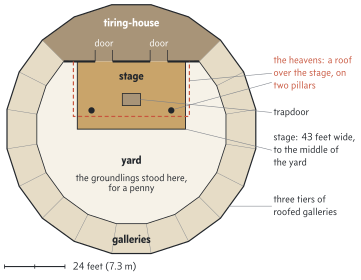
Before 1576 English actors played wherever they could gather a crowd: in the yards of inns, in the great halls of noble houses and colleges, and in town halls on tour. James Burbage’s Theatre was the first lasting home built for plays in England since Roman times, and its shape set the pattern for the open-air playhouses that followed. Most were round or many-sided frames of timber, three stories high, built around an open yard. The poorest playgoers stood in the yard around the stage and were called groundlings, and the roofed tiers of benches that ringed the yard were the galleries. A Swiss traveler, Thomas Platter, who saw Shakespeare’s Julius Caesar, probably at the Globe, in September 1599, set down what the London playhouses charged. One penny let a playgoer stand, a second penny bought a seat, and a third bought a cushioned seat in the best place, where he could see everything and be seen by everyone. Plays began in the afternoon, by daylight, and a flag flew from the roof on playing days.
The stage was a raised platform that ran out into the yard, so that the audience stood around three sides of it; it is called a thrust stage. A trapdoor in its floor opened onto the space beneath, through which ghosts and devils rose and graves were dug. Over the back of the stage, on two tall pillars, stood a roof called the heavens, painted on its underside. Behind the stage stood the tiring-house (from “attiring”), where the actors dressed. Its front wall had two doors for the actors’ entrances and exits, and above them ran a gallery, which could hold musicians, spectators, or a scene played “above,” on a city wall or at a window. There was no painted scenery. The words told the audience where they were, and a few properties, a throne, a bed, or a table, did the rest.
Only one picture of the inside of a playhouse of Shakespeare’s time survives (Figure S.5). About 1596 a Dutch traveler, Johannes de Witt (yoh-hah-nes duh vit), sketched the Swan, and his friend Arend van Buchel (vahn boo-khel) copied the sketch into a notebook, which is now in the library of the University of Utrecht. De Witt labeled the parts in Latin, as if the Swan were a Roman theater. No such picture of the Globe exists. Scholars rebuild it on paper from de Witt’s Swan, from the builder’s contract for a rival playhouse, the Fortune of 1600, whose owners copied the Globe in many details, and from a small part of the Globe’s foundations dug up in 1989. A full-size reconstruction, Shakespeare’s Globe, opened near the old site in 1997.

Companies, quartos, and the Folio
A company of players was a partnership. Its leading actors, the sharers, put up the money, bought the plays and the costumes, and divided the profits. They hired other men for small parts at a wage, and each trained boys as apprentices. The boys played the women’s parts, for no woman acted on the public stage in England until 1660, though the companies of Spain had actresses (Vol. 10, Rebirth). By a law of 1572, players who had no great lord as their protector could be punished as vagabonds, so every company wore the badge and the name of a noble patron. Before a play could be acted, the Master of the Revels, an officer of the royal household, read it, cut whatever offended, and licensed it.
Two companies led the London stage in the 1590s. The Admiral’s Men, named for their patron, the Lord Admiral Charles Howard, played at the Rose. Their star was Edward Alleyn (al-in) (1566–1626), who made his name in Marlowe’s great roles (Chapter 2). Their landlord and banker was the Rose’s owner, Philip Henslowe (henz-loh) (about 1550–1616), whose account book, known as his diary, is the best record of an Elizabethan theater’s business. The Lord Chamberlain’s Men were formed in 1594 under Henry Carey, Lord Hunsdon, the queen’s Lord Chamberlain, who was in charge of the court’s entertainments. They played at the Theatre, then for two years at the Curtain, and from 1599 at the Globe. Their leading actor was Richard Burbage (1567–1619), the first Hamlet, Othello, and Lear, and their poet was Shakespeare, himself a sharer. On May 19, 1603, two months after he came to the throne, James I took them under his own name, and they became the King’s Men.
A play belonged to the company that had bought it, and printing a popular play gave it away to rivals. So most plays were never printed. Those that were appeared, often years after they were first acted, as small, cheap books called quartos. The names of book sizes come from the way a printer folded a sheet of paper, on which he had printed several pages on each side (Figure S.6). Folded once, a sheet made two leaves, or four pages, of a large book called a folio, from the Latin for “leaf.” Folded twice, it made the four leaves of a quarto, from the Latin for “a fourth”; folded three times, the eight leaves of a small octavo. Before printing a book, a London printer or bookseller entered its title in the register of the Stationers’ Company, the guild of the book trade, which gave him the sole right to print it.

Several of Shakespeare’s plays were printed more than once in quarto, and the printings differ. Scholars number them: the first quarto of a play is called Q1, the second Q2, and the text in the Folio F. Hamlet, for instance, survives in three early texts, Q1 (1603), Q2 (1604), and F, which differ in hundreds of readings and in whole speeches (Chapter 10). Seven years after Shakespeare’s death in 1616, two of his fellow sharers, John Heminges (hem-ingz) and Henry Condell, gathered his plays into one large volume, Mr. William Shakespeares Comedies, Histories, & Tragedies (1623), known as the First Folio. It holds thirty-six plays in those three groups. Eighteen of them, among them Macbeth, Twelfth Night, Julius Caesar, and The Tempest, had never been printed before, and without the Folio they would be lost. Perhaps 750 copies were printed, and 235 are known today. Where a quarto and the Folio disagree, the chapters say which text a line comes from.
At court, a costlier kind of show reached its height under James I and Charles I. The masque (mask) was an entertainment of verse, music, dance, and lavish scenery in which courtiers, and even James’s queen, Anne of Denmark, danced in disguise. Its great makers were Ben Jonson, who wrote the words, and the architect Inigo Jones (in-ih-goh johnz), who designed the scenes and costumes, from The Masque of Blackness at Whitehall in 1605 onward (Chapter 15).
In September 1642, as the war began, Parliament ordered the playhouses closed, and for eighteen years acting a play was against the law, though some were still acted in secret. When Charles II returned in 1660, he gave two courtiers, Thomas Killigrew and Sir William Davenant (dav-uh-nunt), the sole right to stage plays in London. Killigrew led the King’s Company, and Davenant the Duke’s Company, named for its patron, the king’s brother James, Duke of York. Their theaters were roofed and lit by candles, and in 1661 Davenant’s opened with painted scenery on flat panels that slid in grooves, so that a scene could change before the audience’s eyes. Women now acted, too. On December 8, 1660, Killigrew’s company played Othello with a woman as Desdemona (dez-deh-moh-nuh), the first professional actress known on the English stage; she is usually said to have been Margaret Hughes. The heirs of the two companies, at the theaters in Drury Lane and Covent Garden (kuv-unt gar-dun), kept their hold on London’s spoken drama until 1843 (Chapter 23).
How to read the old texts
The chapters quote poems and plays from texts named at first use, most of them in modern spelling and a few as they were first printed, when spelling was not yet fixed. Printers treated u and v as one letter, writing loue for “love” and vp for “up,” and used i where we write j, as in Iohn. They printed a long s that looks like an f without its crossbar (Vol. 1, The Toolkit), and they often spelled a word as it sounded to them, so that “sugred” is “sugared.” Where the old spelling hides the sense, the chapters say so.
Money was counted in pounds, shillings, and pence: twelve pennies made a shilling, and twenty shillings made a pound, written £1. Dates follow a rule of their own. Until 1752 the English began the new year on March 25, so a letter written in what we call February 1599 was dated February 1598. The chapters give such dates with the year beginning on January 1, as it does now.
Words for verse
Earlier volumes taught the words for verse and drama that the chapters use, and each is recalled here in brief. Words that carry a fact of their own in this volume, such as the blazon (blay-zun), the aubade (oh-bahd), or the mock-epic, are taught in the chapters where they appear.
- Iambic pentameter: a line of five feet, each an iamb, an unstressed syllable and then a stressed one: da-DUM five times over, ten syllables in all. Marking the stresses to find the meter is scansion (Vol. 1, The Toolkit).
- Blank verse: unrhymed iambic pentameter, the verse of most of Shakespeare’s plays and of Paradise Lost. In the Folio’s Romeo and Juliet, “But soft, what light through yonder window breaks?” scans but SOFT, what LIGHT through YON-der WIN-dow BREAKS (Vol. 1, The Toolkit).
- Rhyme scheme: the pattern of a poem’s rhymes, marked with letters, the same letter for lines that rhyme, so that abab rhymes the first line with the third and the second with the fourth (Vol. 1, The Toolkit).
- Stanza: a group of lines set apart like a paragraph. A couplet is a pair of lines, usually rhymed aa, and a quatrain a group of four (Vol. 1, The Toolkit).
- Heroic couplet: a rhyming pair of iambic pentameters, the line of Chaucer’s Legend of Good Women and, in this volume, of Dryden and Pope (Vol. 8, The Northern Worlds).
- Sonnet: fourteen lines, in English usually of iambic pentameter, with a turn of thought, the volta. The Petrarchan sonnet is an octave of eight lines rhymed abbaabba and a sestet of six, rhymed cdecde or cdcdcd, with the turn between them. The English or Shakespearean sonnet is three quatrains and a couplet, abab cdcd efef gg. The Spenserian links its quatrains by rhyme, abab bcbc cdcd ee (Vol. 1, The Toolkit).
- Elegy, a poem of mourning, above all a lament for the dead; and ode, a poem of praise addressed to its subject in a lofty style (Vol. 1, The Toolkit).
- Epic: a long poem about a hero whose deeds decide the fate of a people, opening with an invocation of the Muse, the poet’s call on the goddess of poetry (Vol. 1, The Toolkit).
- Metaphor, which says that one thing is another; simile, which says that it is like another; and allegory, a whole story whose people and events stand for ideas (Vol. 1, The Toolkit).
- Conceit: a surprising comparison that makes a reader stop, puzzle, and then smile, taught beside the Spanish concepto (Vol. 10, Rebirth).
- Pastoral: a poem about shepherds in an ideal countryside, from the Greek poet Theocritus (thee-ock-rih-tus) and Virgil’s Eclogues (Vol. 6, The Greeks; Vol. 7, The Romans) to the Italian Sannazaro (sahn-nahd-dzah-roh) (Vol. 10, Rebirth).
- Comedy, the play that ends better than it began, usually in a wedding; and tragedy, the play of suffering in which a great person falls to ruin, usually death (Vol. 1, The Toolkit).
- Satire, which mocks people or customs to show them up; and irony, saying the opposite of what you mean and trusting the reader to see it (Vol. 1, The Toolkit).
- Soliloquy (suh-lil-uh-kwee): a speech made alone, to oneself, as Hamlet speaks when he thinks no one can hear (Vol. 17, The Victorians).
Who tells the story
Most of what is known about these writers’ lives comes from a few kinds of evidence: records such as baptisms, leases, and lawsuits; the writers’ own books; and a handful of later witnesses, each with reasons of his own. The chapters name the witness each time a story’s source matters (“Rowe says,” “Walton tells”). Here are the chief witnesses, in about the order they wrote.
- Robert Greene (1558–1592), a Cambridge-educated playwright and pamphleteer, died poor in London in September 1592. Weeks later came Greene’s Groats-worth of Wit, printed as his deathbed repentance, though Henry Chettle, who prepared it for the press, soon had to deny that he had written it himself; a groat (groht) was a coin worth four pence. It warns other playwrights against “an upstart Crow, beautified with our feathers,” who thinks himself “the only Shake-scene in a country,” the first sign of Shakespeare as a London playwright (Chapter 3).
- Francis Meres (meerz) (1565–1647), a clergyman, published Palladis Tamia (pal-uh-dis tay-mee-uh) (1598), a book comparing English writers with ancient ones. It names twelve of Shakespeare’s plays and his “sugred Sonnets among his priuate friends,” so all twelve plays, and some of the sonnets, were written by 1598 (Chapter 3 to Chapter 7).
- John Heminges (1566–1630) and Henry Condell (1576–1627), of the King’s Men, gathered the First Folio (1623). It opens with Martin Droeshout’s (droos-howt) engraving of Shakespeare, Jonson’s lines on that picture, and Jonson’s poem “To the Memory of My Beloved, the Author Mr. William Shakespeare” (Chapter 3).
- Simon Forman (1552–1611), an astrologer and physician, wrote notes on plays he saw in 1611, most of them at the Globe. They describe Macbeth, Cymbeline (sim-bih-leen), and The Winter’s Tale, the earliest accounts of them by anyone who saw them (Chapter 13, Chapter 14). Three and a half centuries later the historian A. L. Rowse (rowss) searched Forman’s casebooks for Shakespeare’s Dark Lady (Chapter 3).
- Izaak Walton (eye-zuk wawl-tun) (1593–1683), a London linen draper and a friend of Donne’s, wrote the first full lives of Donne (1640) and of George Herbert (1670) (Chapter 16, Chapter 17). His Compleat Angler (1653), a book about fishing, is the earliest dated book to name the courtier and explorer Sir Walter Raleigh (raw-lee) as the author of “The Nymph’s Reply to the Shepherd” (Chapter 2).
- John Aubrey (aw-bree) (1626–1697), an antiquary, or collector of old records and old stories, gathered gossip about famous Englishmen from the 1660s on, in notes he called Brief Lives, first printed in part in 1813. They keep stories of Shakespeare, Jonson, and Milton that no earlier writer records, and the chapters tell each as Aubrey’s (Chapter 3, Chapter 15, Chapter 18).
- Nicholas Rowe (roh) (1674–1718), a playwright, published the first edition of Shakespeare’s plays by a named editor (1709), with the first printed life of him. Rowe was the first to print the story that Shakespeare fled Stratford after poaching deer in Sir Thomas Lucy’s park at Charlecote (Chapter 3). Building on a story the critic John Dennis printed in 1702, he also tells that Queen Elizabeth wished to see Shakespeare’s fat knight, Falstaff, in love (Chapter 7).
- Alexander Pope published his own edition of Shakespeare in 1725. Lewis Theobald (tib-uld) (1688–1744), a scholar whose name Pope spelled “Tibbald,” exposed its errors in Shakespeare Restored (1726) and published a better edition in 1733. Pope took his revenge by crowning him king of the dunces in The Dunciad (Chapter 21).
- Samuel Johnson (1709–1784), the critic who made the Dictionary (1755), published an edition of Shakespeare in 1765 whose Preface, weighing Shakespeare’s faults against his genius, became the starting point for the critics who followed (Chapter 3). His Lives of the Poets (1779–1781), fifty-two short lives, judged Milton, Dryden, Pope, and Gray, and its life of the poet Abraham Cowley (koo-lee) gave Donne and his followers their name, the “metaphysical poets” (Chapter 16).
- David Garrick (1717–1779), the greatest English actor of his century (Chapter 4), held a Shakespeare Jubilee at Stratford on September 6 to 8, 1769, which made the town a place of pilgrimage (Chapter 3).
- Samuel Taylor Coleridge (kohl-rij) (1772–1834), the Romantic poet (Vol. 15, The Age of Revolution), lectured on Shakespeare between 1808 and 1819, and his notes and lectures were printed after his death. One of his notes calls a soliloquy of Iago (ee-ah-goh), the villain of Othello, “the motive-hunting of a motiveless malignity” (Chapter 11).
- William Hazlitt (1778–1830), an essayist, wrote Characters of Shakespear’s Plays (1817), a book of essays on the plays and their people.
- Thomas De Quincey (duh kwin-see) (1785–1859) wrote the essay “On the Knocking at the Gate in Macbeth” (1823), on why the knocking that follows the murder of King Duncan fills an audience with dread (Chapter 13).
- A. C. Bradley (1851–1935), a professor of poetry at Oxford, published Shakespearean Tragedy (1904), lectures on Hamlet, Othello, King Lear, and Macbeth that treat their heroes almost as living people. It set the questions later critics answered (Chapter 10 to Chapter 13), among them L. C. Knights, whose reply comes later in the Course (Vol. 21, Trenches and Modernists).
The books the poets read
The playwrights took most of their plots from books, and a few books served for many plays. The chapters name them where a plot came from.
- Arthur Golding’s translation of Ovid’s Metamorphoses (met-uh-mor-fuh-seez) (1567), in rhyming lines of fourteen syllables, was the Elizabethans’ own Ovid (Vol. 4, Classical Myth). From it Shakespeare took Philomela (fil-oh-mee-luh) (Chapter 4) and Pyramus (pir-uh-mus) and Thisbe (thiz-bee) (Chapter 5).
- Sir Thomas North’s translation of Plutarch’s (ploo-tark) Lives (1579), made from a French version, gave Shakespeare his Roman plays (Vol. 7, The Romans; Chapter 9).
- Raphael Holinshed’s Chronicles of England, Scotland, and Ireland, in their second edition (1587), gave him the history plays and the stories of King Lear, Macbeth, and Cymbeline (Chapter 4, Chapter 7, Chapter 12, Chapter 13, Chapter 14).
- François de Belleforest’s (frahn-swah duh bel-for-eh) Histoires tragiques (ees-twahr trah-zheek), “tragic stories,” retold in French, in a volume of 1570, the tale of the Danish prince Amleth. The chronicler Saxo had written it down about 1200, and Belleforest’s French brought it to the stage (Vol. 8, The Northern Worlds; Chapter 10).
- Giovanni Battista Giraldi (jee-rahl-dee), called Cinthio (chin-tee-oh), told in his Hecatommithi (hek-uh-tom-ih-thee) (1565), “a hundred stories,” the tale of a Venetian captain whom Cinthio calls only “the Moor,” the Europeans’ word for a North African, and of his wife. It became Othello (Chapter 11).
- The Italian poet Ludovico Ariosto (ah-ree-os-toh) (Vol. 10, Rebirth) and the storyteller Matteo Bandello (ban-del-oh) each told a tale of a young woman slandered by a trick played at night beneath her window, which became the plot of Much Ado About Nothing (Chapter 6).
- Plautus (plaw-tus) and Seneca (sen-ih-kuh), the Roman playwrights of comedy and tragedy (Vol. 7, The Romans), gave The Comedy of Errors its twins and the revenge tragedy its ghosts and its blood (Chapter 4).
Meanwhile elsewhere
In the years when Shakespeare was writing for the Globe, Miguel de Cervantes (sur-van-teez) was writing his novel Don Quixote in Spain. In Kyoto the first dancers of kabuki, a new popular theater of song and dance, were performing on a dry riverbed. Table S.1 sets the volume’s years beside the rest of the world and names the volumes of the Course that teach them.
| Region | In these years | Taught in |
|---|---|---|
| Britain and Ireland | The Reformation under Henry VIII; the Armada (1588); the Civil War, Cromwell, and the Glorious Revolution (1688); Swift, Hogarth, Purcell, and Handel. | Vol. 12, Crown and Parliament |
| Italy, Spain, and Portugal | Michelangelo’s Sistine ceiling (1508–1512); Don Quixote (1605); the plays of Lope de Vega; Velázquez; Vivaldi. | Vol. 10, Rebirth |
| France and the Low Countries | The Wars of Religion; Montaigne’s Essays (1580); Louis XIV (reigned 1643–1715) and Molière; Rembrandt; Voltaire. | Vol. 13, Valois, Bourbon, and Orange |
| Germany and the East | Luther’s protest (1517); the Thirty Years’ War (1618–1648); Peter the Great of Russia; Bach and Mozart. | Vol. 14, From Luther to Mozart |
| The Ottomans and Persia | Suleiman the Magnificent (reigned 1520–1566); Shah Abbas of Persia (reigned 1588–1629). | Vol. 37, The House of Islam |
| India | The Mughal emperors, from Akbar (reigned 1556–1605) to Shah Jahan, who built the Taj Mahal. | Vol. 39, India |
| China | The last Ming emperors; the Qing dynasty from 1644, and the long reign of the Kangxi emperor. | Vol. 40, The Middle Kingdom |
| Japan and Korea | Japan’s three unifiers; the Tokugawa shoguns from 1603; the kabuki theater. | Vol. 41, Islands of the Rising Sun |
| North America | Jamestown (1607) and the English colonies; the American Revolution (1775–1783). | Vol. 27, New Worlds |
| Latin America | The conquests of the Aztecs (1521) and the Inca (1532); the Spanish viceroyalties and Portuguese Brazil. | Vol. 44, Gold, God, and Glory |
The Elizabethans, 1485-1599
Chapter 1 · 48 clues
From Everyman to Spenser
On May 17, 1536, five men were beheaded on Tower Hill, the open ground outside the walls of the Tower of London. All five had been accused of being lovers of King Henry VIII’s queen, Anne Boleyn (buh-lin), and one of them was her own brother. Two days later, inside the walls, the queen herself was beheaded with a sword. That month a tall, bearded diplomat in his early thirties named Thomas Wyatt was also a prisoner in the Tower. He had been arrested in the same days as the others, and he had known the queen since she first came to court. He was never charged, and after some weeks he was let go.
A poem that survives among copies of Wyatt’s verse, and is usually taken to be his, remembers what he saw. “These bloody days have broken my heart,” it says, and then: “The Bell Tower showed me such sight / That in my head sticks day and night.” Every stanza ends with the same three words of Latin, circa regna tonat, “it thunders around thrones.” The dead queen left a daughter, Elizabeth, who was two years and eight months old.
This chapter follows the poets of two courts: the court of Henry VIII, and the court of that daughter when she became queen. In about sixty years they brought the sonnet from Italy, invented new stanzas, and wrote love poems, wedding songs, and an allegory of more than thirty thousand lines. The last and greatest of them made the little girl, grown into a queen, the heroine of his poem.
Wyatt, Surrey, and Sidney
The English verse of Wyatt’s boyhood sounded very different. Take Everyman (Vol. 8, The Northern Worlds), a play in verse written about 1500 and printed about 1530, whose story runs from Death’s summons to the friends who will not go with him. In its last scene Everyman walks to his grave with the companions who have agreed to come. Beauty, Strength, Discretion, and Five Wits (his five senses) turn back at the edge, and Knowledge stays only until he dies. Only Good Deeds goes with EverymanIn this play, the title character ascends to Heaven with only Good Deeds. → Everyman• into the grave, and when he has died an Angel welcomes his soul into heaven. The play is a sermon in verse. Its hero is any soul at all, its love is the love of God, and its author left no name.

The poets of Henry VIII’s court wrote about something else: love, and themselves. Henry was seventeen when he became king in 1509, and he meant his court to be the most splendid in Europe. He jousted, hunted, composed songs, and spoke French and Latin. Around him crowded young men who wanted his favor, which meant offices, lands, rich marriages, and missions abroad. A courtier was expected to fight, dance, play the lute, and turn a graceful poem. The court was also a school of diplomacy. Henry’s envoys rode to Paris, Rome, Venice, and the court of the emperor Charles V (Vol. 10, Rebirth) in Spain and came home with new books and new fashions. Italy above all was admired, for its painters, its poets, and its scholars, who had revived the learning of ancient Greece and Rome. Courtiers’ poems were rarely printed. They were copied by hand into albums that passed among friends, so a poem was a move in a game played by people who knew one another, and a reader who knew the court could guess whom it meant.
Wyatt and the white hind

Thomas Wyatt was born in 1503 at Allington Castle in Kent, the son of one of the king’s trusted councilors. After St. John’s College, Cambridge, he entered the king’s service and was used above all as a diplomat, a man sent to speak for the king at foreign courts. In 1527 he traveled to Italy on a mission to the pope, and he came home with the poems of Petrarch (pee-trark) in his head. Petrarch, an Italian poet of the fourteenth century (Vol. 9, Cathedrals and Crusades), loved a woman he called Laura from 1327 until long after her death in 1348, and gathered his poems about her into a book of 366 poems, Il Canzoniere (kahn-tsoh-nyeh-reh), “the songbook.” Wyatt translated poems from the CanzoniereThomas Wyatt translated poems from this collection into English. → Il Canzoniere• into English, ten of its sonnets among them, and imitated many more. They were the first sonnets in English (Vol. 1, The Toolkit). Most are Petrarch’s love poems made into English love poems, with the Italian’s sighs turned blunter and more bitter.
A hind is a female deer, and poem 190 of the Canzoniere is Petrarch’s vision of a pure white hind,A poem in this collection about 'a pure white hind' was adapted as 'Whoso List to Hunt.' → Il Canzoniere• the poem Wyatt made into “Whoso List to Hunt.” In Petrarch’s sonnet a white hind with two golden horns appears to the poet on green grass, between two rivers, in the shade of a laurel, as the sun rises in spring. Around her neck, set in diamonds and topazes, are words in Italian that forbid anyone to touch her, and the poem adds that it has pleased her Caesar to set her free. The poet gazes at her until he falls into the water, and she is gone. Petrarch’s readers took the hind for Laura, and her Caesar for God, who had freed her soul by her death.
Wyatt’s “Whoso List to Hunt”This author wrote "Whoso List to Hunt". → Thomas Wyatt• keeps Petrarch’s deer and changes what she means. “List” is an old word for “wish,” so the first line says, “Whoever wants to hunt, I know where there is a hind.” Petrarch’s poet stood still and gazed. Wyatt’s speaker is a tired hunter at the back of the field, who has chased so long that he is “of them that furthest come behind.” He cannot take his mind off the deer, yet he gives up, because hunting her is like trying to “hold the wind” in a net. Petrarch rhymed his sonnet in an octave and a sestet. Wyatt keeps the octave, rhymed abba abba, but ends with a couplet of his own, a pair of rhyming lines, and that closing couplet became the mark of the English sonnet.
In the sestet the speaker warns every other hunter off, and tells why. The hunt is hopeless, and in any case her fair neck is graven with diamonds,In this sonnet, a deer’s "fair neck" is "graven with diamonds." → "Whoso List to Hunt"• engraved in jewels as a king’s possessions were. In Petrarch the words were set in diamonds and topazes; in Wyatt they are cut “in letters plain,” like the name on the collar an owner puts on a hound or a tame deer to show whose it is. The collar bears the poem’s most famous words: “Noli me tangere, for Caesar’s I am.”In this sonnet, a deer bears the message "Noli me tangere, for Caesar’s I am." → "Whoso List to Hunt"• Noli me tangere (noh-lee may tan-jeh-ray) is the Latin Bible’s wording of “Touch me not,” as the King James Version gives the words that, in the Gospel of John, the risen Jesus says to Mary Magdalene (John 20:17), and every reader knew them. Caesar is the ruler, as in the Gospels’ “Render therefore unto Caesar the things which are Caesar’s.” In Petrarch the hind belongs to God. In a poem passed around Henry VIII’s court, the Caesar who owned the deer could only be the king, and the last line, in the deer’s own voice, adds a warning: she seems tame, but she is “wild for to hold.”
Wyatt came back to the image of a wild creature that will not stay. His most admired poem begins, “They flee from me that sometime did me seek, / With naked foot stalking in my chamber,” as Arthur Quiller-Couch (kwil-er kooch) printed it in his Oxford Book of English Verse. The women who once came to him as gently as tame deer, taking “bread at my hand,” now “range, / Busily seeking with a continual change.” It is the hunter’s complaint again, told from the other side: the deer have learned to run.
Anne Boleyn

Readers have long asked who the hind was, and the most famous answer is Anne Boleyn. She was the daughter of Sir Thomas Boleyn, a diplomat, and had been educated at the court of the Netherlands and then at the French court. She came home in 1522, dark-haired, witty, and fluent in French, to serve Henry’s queen, Catherine of Aragon. About 1526 the king fell in love with her. She refused to become his mistress, and Henry, who had a daughter, Mary, by Catherine but no living son to succeed him, set out to end his marriage. When the pope refused, Henry broke with the Church of Rome and made himself head of the Church in England (Vol. 12, Crown and Parliament). He married Anne in January 1533, and on September 7 of that year she bore him a daughter, Elizabeth. Anne gave him no living son, and in May 1536 she was arrested on charges of adultery and treason that were almost certainly false.
Wyatt, his family remembered, had known her before the king did. According to a story told by his grandson George Wyatt, in a life of Anne written more than fifty years after her death, Thomas Wyatt was infatuated with AnneThomas Wyatt is traditionally said to have been infatuated with this person. → Anne Boleyn• when she first came to court. George Wyatt says that the poet took a small jeweled ornament hanging from her pocket and wore it around his neck. When Henry saw it during a game of bowls, he recognized it as hers. Wyatt wrote of a lady named Anna in other poems, and in one late sonnet he remembered a dark-haired woman who had set the whole country in an uproar. From such hints came the tradition that the fleeing deer is Anne Boleyn,This person is commonly identified with the fleeing deer in Thomas Wyatt’s "Whoso List to Hunt." → Anne Boleyn• a woman Wyatt had loved and lost to a king, now wearing a collar that announced she was the king’s. The poem itself never names her, and the identification is a guess that no record proves.
Wyatt survived Anne by six years. He served as Henry’s ambassador to the emperor Charles V in Spain from 1537 to 1539. In 1541, after the fall of his patron, the king’s minister Thomas Cromwell, he was sent back to the Tower, and again he was pardoned. He died of a fever in October 1542, aged thirty-nine, after a hard ride to meet a foreign envoy, and was buried at Sherborne in Dorset.
Surrey

Henry Howard, Earl of Surrey, was about fourteen years younger than Wyatt and far grander. He was the eldest son of the Duke of Norfolk, the most powerful nobleman in England, and a first cousin of Anne Boleyn. He grew up at Windsor Castle as the companion of the king’s son by a mistress, fought for Henry in France, and was proud, brave, and quarrelsome. He admired Wyatt, and when Wyatt died he wrote him an elegy that begins, “Wyatt resteth here, that quick could never rest” (“quick” meant alive). It was the only poem of Surrey’s printed in his lifetime.
Poem 140 of Petrarch’s Canzoniere went into English twice. Wyatt made it “The long love that in my thought doth harbour,” and Surrey translated the same sonnetThe Earl of Surrey translated one of this collection's poems as 'Love, that doth reign and live within my thought.' → Il Canzoniere•• as “Love, that doth reign and live within my thought.” The two versions show two poets at work on one model. In Surrey’s, Love is a warlord who lives in the poet’s thoughts and has “built his seat within my captive breast.” Love rides out into the poet’s face, “Clad in the arms wherein with me he fought,” and plants his banner there, so that the poet blushes for all to see. But the lady who taught him to love wants his “hot desire” hidden, and her “smiling grace converteth straight to ire.” At her frown, “coward Love” runs back to the heart to hide, “His purpose lost, and dare not show his face.” The loyal poet will not desert his lord, and the sonnet ends on a line of sweet defeat: “Sweet is the death that taketh end by love.” Its rhymes fall into three quatrains and a couplet, abab cdcd efef gg, the English form (Vol. 1, The Toolkit) that Shakespeare made famous.
Surrey made one more gift to English poetry. He translated two books of Virgil’s Aeneid (ih-nee-id), the second and fourth, into lines of iambic pentameter that do not rhyme. They are the first blank verse in English, the unrhymed pentameter (the Stage) in which Marlowe (Chapter 2) and Shakespeare would write their plays. Surrey did not live to see it used. In December 1546 the old king, sick and suspicious, learned that Surrey had added to his coat of arms the arms of Edward the Confessor, the English king and saint of the eleventh century, and took it as a claim to the throne. Surrey was beheaded on January 19, 1547. Henry VIII died nine days later.
Ten years after that, in 1557, the London printer Richard Tottel published the court’s handwritten poems as Songes and Sonettes (Vol. 1, The Toolkit), with ninety-six poems by Wyatt and forty by Surrey; Surrey’s sonnet above is quoted from it, in modern spelling. The book was reprinted again and again. A fashion of a few dozen courtiers became the poetry any reader in England could buy.
Sidney and the Moon
The next great courtier-poet was born in 1554 at Penshurst in Kent, a house that Ben Jonson would later praise (Chapter 15). Philip Sidney grew up under Queen Elizabeth, Anne Boleyn’s daughter, who had come to the throne in 1558. His father governed Ireland for her, and his mother was the sister of Robert Dudley, Earl of Leicester (les-ter), the queen’s favorite. Sidney was educated at Shrewsbury (shrohz-bree) School and Oxford, toured Europe for three years, and came home the model of what a young gentleman ought to be: learned, brave, courteous, and a Protestant who wanted England to fight Spain. About 1580, when he had angered the queen by opposing her plan to marry a French prince, he wrote a romance in prose, the Arcadia (Vol. 12, Crown and Parliament), and soon afterward the first great sonnet sequence in English. In the same years he wrote The Defence of Poesy (poh-ih-zee), printed in 1595, the first great essay of English criticism. It is usually read as a reply to a pamphlet of 1579 that attacked plays and poems, and it argues that poetry teaches virtue better than philosophy or history, because it shows goodness in action.

A sonnet sequence is a series of sonnets meant to be read in order, telling the story of one love. Sidney’s is Astrophil and Stella (as-truh-fil and stel-uh), 108 sonnets and eleven songs. The names are a code. Astrophil joins two Greek words and means “star-lover,” and its phil is also the first syllable of Philip; Stella is Latin for “star.” Stella was Penelope Devereux (dev-uh-roo), a nobleman’s daughter once spoken of as Sidney’s bride, who in 1581 was married to Lord Rich, and several sonnets pun on her married name. The book was printed in 1591, five years after Sidney’s death and without his family’s leave, and its title page called the lover “Astrophel,” the spelling most editions used until modern scholars restored Sidney’s own. The first sonnet tells how Astrophil tried to win Stella with borrowed cleverness, “Oft turning others’ leaves,” reading other poets’ books, and how the words came out halting and lame. It ends with advice that poets have quoted ever since: “Fool,” said my Muse to me, “look in thy heart and write.” Its lines have twelve syllables, not ten, so the sequence opens in the long line that Spenser would later use to close every stanza of his great poem. (Sidney’s poems are quoted here in modern spelling from an edition of Astrophel and Stella printed in 1888.)
The thirty-first sonnet is the gentlest. On a quiet night the lover watches the Moon rise, and he begins by marveling at her slow climb: “With how sad steps, O Moon, thou climb’st the skies,In this poet’s Astrophil and Stella 31, the speaker observes "With how sad steps, O Moon, thou climb’st the skies." → Philip Sidney•• / How silently, and with how wan a face.” He wonders whether “That busy archer,” Cupid with his bow, shoots his arrows even in heaven. “Sure,” he says, if eyes that have long known love can judge, the Moon feels a lover’s pain: “I read it in thy looks.” The octave rhymes abba abba, as Petrarch’s did. In the sestet the lover claims the Moon as a fellow sufferer, “Then ev’n of fellowship, O Moon, tell me,” and asks four questions about life up there. Is faithful love thought foolish in heaven? Are the beauties there as proud as here? Do they love to be loved and yet scorn their lovers? The last question is twisted round, as Sidney meant it to be: “Do they call virtue there ungratefulness?” Untwisted, it means, do proud ladies in heaven call their ungratefulness a virtue, as Stella does? The sonnet closes, in the English manner, on a rhyming couplet.
Sidney’s ending was the kind his age loved to retell. In 1585 the queen sent an English army to help the Dutch, who were fighting to free themselves from Spain (Vol. 13, Valois, Bourbon, and Orange), and Sidney went as governor of the port of Flushing. On September 22, 1586, near the town of Zutphen (zut-fen), a musket ball smashed his thigh. He died of the infected wound at Arnhem on October 17, aged thirty-one. His friend Fulke Greville (grev-il) wrote a life of Sidney that was printed only in 1652. Greville says that Sidney had taken off his thigh armor that morning because an older officer had come without his. As he was carried from the field, thirsty and bleeding, he handed his water to a dying soldier, saying that the man’s need was greater than his own. London gave him a funeral at St. Paul’s Cathedral in February 1587 that was remembered for generations, and the poets wrote elegies for him by the dozen. One was by a friend who had dedicated his first book to Sidney: Edmund Spenser (Figure 1.6).

Spenser’s pastorals and sonnets
Edmund Spenser was born in London about 1552, the son, probably, of a journeyman clothmaker, a craftsman who worked for wages. He went to the new Merchant Taylors’ School and then, in 1569, to Pembroke Hall, Cambridge, as a sizar, a poor student who paid for his place by waiting on richer ones. At Cambridge he became the friend of Gabriel Harvey, a clever, prickly young scholar who wanted English poets to write in the meters of Latin. By 1579 Spenser was in London in the household of the Earl of Leicester, and there he met Leicester’s nephew Philip Sidney. That December the London printer Hugh Singleton brought out Spenser’s first book, The Shepheardes CalenderThis poet wrote The Shepheardes Calender. → Edmund Spenser•• (shep-erdz). It had no author’s name. The poet signed himself Immerito (im-meh-ree-toh), Latin for “the unworthy one,” and dedicated the book to Sidney, “most worthy of all titles both of learning and chevalrie.”

Spenser chose old spellings on purpose, to make his English sound like Chaucer’s. His poems are quoted here as he spelled them, The Faerie Queene (fair-ee kween) and the rest from their first editions, except the two wedding songs, which come from an edition of his Works printed in 1857. Only u and v, and i and j, are printed as we print them. Two sonnets of Amoretti are quoted from modern-spelling texts.
The Shepheardes Calender
The title page promised “twelve Æglogues proportionable to the twelve monethes.” An eclogue (ek-log) is a short pastoral poem, usually a conversation or a singing match between shepherds; the word comes from a Greek word for a “selection.” Its twelve eclogues follow the twelve months,This work contains twelve eclogues corresponding to months of the year. → The Shepheardes Calender•• from January to December, so that the book is a calendar of a shepherd’s year, and each eclogue opens with a woodcut that shows the month’s sign of the zodiac in the sky (Figure 1.8). The shepherds fall in love, mourn, gossip, quarrel about the Church, and complain that nobody pays poets.
The model was Roman. Virgil had begun his career with ten short pastoral poems, the Eclogues (Vol. 7, The Romans), before he wrote the Aeneid, and a poet who meant to become England’s Virgil began where Virgil began. The Shepheardes Calender emulates Virgil’s EcloguesThis work emulates Virgil’s Eclogues. → The Shepheardes Calender• in its singing shepherds, its disguised poet, and its plain style, and it says so. The book came with a full commentary signed “E.K.,” with an introduction, a short argument before each eclogue, and after each a gloss, notes that explain hard words and hidden meanings. Nobody knows for certain who E.K. was: perhaps a Cambridge friend named Edward Kirke, perhaps Harvey, perhaps Spenser himself in a second mask. E.K. even gives the word eclogue a false history, deriving it from Greek words that he says mean goatherds’ tales.
In “Januarye,” the first eclogue, a shepherd boy leads his thin flock out into the winter fields and complains of his love for Rosalind, a country girl who laughs at his songs. At the end he breaks his pipe and throws himself on the ground. His name is Colin Clout, Spenser’s own mask,This work introduces the shepherd Colin Clout. → The Shepheardes Calender••The shepherd Colin Clout appears in several works by this poet. → Edmund Spenser•• and he entered English poetry in this book, the first of several in which Spenser used him. E.K. explains that the name was used before by John Skelton, who had been Henry VIII’s tutor, and that “Under which name this Poete secretly shadoweth himself, as sometime did Virgil under the name of Tityrus,” a shepherd of the Eclogues. Colin came back. In Colin Clouts Come Home Againe (1595) he tells his fellow shepherds of a voyage to the queen’s court, and in the sixth book of The Faerie Queene he is seen piping on a hilltop while the Graces dance.
Colin’s best friend is the shepherd HobbinolThis work features the character Hobbinol. → The Shepheardes Calender• (hob-ih-nol), who loves him dearly and grieves that Colin loves Rosalind more than him. E.K. says outright, in his gloss on “September,” that Hobbinol is “Mayster Gabriel Harvey.” In “Aprill,” Hobbinol tells another shepherd, Thenot (thee-not), that Colin has given up singing, and to prove what has been lost he sings a song Colin once made, the lay of “fayre Elisa, Queene of shepheardes all.”

Elisa is Elizabeth, and the lay is the first great poem in Spenser’s lifelong praise of her. She sits on the green grass “Yclad in Scarlot like a mayden Queene, / And Ermines white.” Scarlet cloth and white ermine fur were the robes of royalty. In her cheeks “The Redde rose medled with the White yfere,” red and white roses mingled together: the red rose of Lancaster and the white rose of York, which her grandfather Henry VII had joined when he married Elizabeth of York (Vol. 12, Crown and Parliament). The sun god himself, Phoebus (fee-bus), looks down on her and blushes “to see another Sunne belowe.”
The other eclogues turn darker. In “October” a shepherd named Cuddie complains that poetry earns nothing, and his friend Piers cannot console him. People today, Cuddie says bitterly, prefer the rhymes of a village piper. E.K.’s gloss on that jeer calls it an ironic sarcasmus, a taunt “spoken in derision,” and this note holds the first recorded use of “sarcasm”The first recorded use of the word "sarcasm" in English appears in a work by this poet. → Edmund Spenser• in English. The word comes from the Greek sarkazein, “to tear flesh,” as a dog does.
Three eclogues, “Maye,” “Julye,” and “September,” are about the Church. In “Maye” two shepherds argue while the village goes maying, and E.K.’s argument says that they stand for “two formes of pastoures or Ministers, or the protestant and the Catholique.” Piers, the Protestant, warns his friend with a fable. A fox dressed as a poor peddler, with “bells, and babes, and glasses in hys packe,” talked his way into a goat’s house and carried off her trusting kid, and E.K. explains the bells and dolls as relics of Catholic worship. A deceiver in disguise who wins a good creature’s trust will be the plot of The Faerie Queene too. The year ends in “December,” where Colin, grown old before his time, compares his life to the four seasons, from the spring of his youth to the winter now coming, and says, “Here will I hang my pype upon this tree.”
Ireland and Amoretti
In 1580 Spenser went to Ireland as secretary to Lord Grey, the queen’s new Lord Deputy, or governor, there, and he spent most of the rest of his life there. Ireland had been ruled by English kings for four centuries, but most of it was still held by Irish lords who resented the English, and in the south the Earl of Desmond was in rebellion. Grey crushed the rebels without mercy. At Smerwick, on the far southwest coast, in November 1580, his army besieged a fort held by about six hundred Italian and Spanish soldiers whom the pope had sent to help the rebels, and when they surrendered, Grey had nearly all of them killed. Spenser was his secretary and later defended him. When the rebellion was over, the earl’s lands were divided among English settlers. Spenser’s share was Kilcolman (kil-kohl-mun) Castle in County Cork, a tower with some three thousand acres. There he wrote most of his great poem. There, too, he came to share the settlers’ harsh view of the Irish, and in a prose dialogue of 1596, A View of the Present State of Ireland, he called for war and famine to break Irish resistance.
By 1594 he was famous as the author of the first three books of The Faerie Queene, and he was a widower in his early forties. He courted a young woman named Elizabeth Boyle, a kinswoman of an English settler who later became the Earl of Cork, and married her on June 11, 1594. In 1595 Spenser published his sonnet sequence, AmorettiThis poet wrote the sonnet cycle Amoretti. → Edmund Spenser•• (am-oh-ret-ee), Italian for “little loves” or “little Cupids.” Its sonnets have numbers, not titles, and readers know them by their numbers or their first lines. Its eighty-nine sonnets link their quatrains by rhyme (Vol. 1, The Toolkit). Unlike Petrarch’s and Sidney’s, Spenser’s love story ends in marriage, because it tells of his courtship of Elizabeth Boyle,This sonnet cycle celebrates the poet's courtship of Elizabeth Boyle. → Amoretti•• a woman he won. The sonnets follow the church year through one winter and spring, with a sonnet for New Year’s Day and one for Easter, and the lady is proud and hard to please until, near the end, she yields.
The sequence opens by blessing the book’s own pages.This sonnet cycle opens "Happy ye leaves when as those lily hands." → Amoretti•• “Happy ye leaves,” its first line begins: happy are you, pages, Spenser tells them, because her lily-white hands will hold you; happy the lines, because her eyes will read them; happy the rhymes, if she looks on them. It is a lover envying his own book.
Sonnet 67 answers the hunting poems of Petrarch and Wyatt. “Like as a huntsman after weary chase,” it begins, the poet has given up and sits down in the shade with his panting hounds. Then the deer comes back of her own accord to drink at the brook, looks at him “with milder look,” and lets him take her, trembling, in his hand, and he ties her “with her own good will.” The couplet marvels at it: “Strange thing, me seemed, to see a beast so wild, / so goodly won, with her own will beguiled.” Wyatt’s hind belonged to Caesar and could never be held. Spenser’s chooses her hunter. Sonnet 68, which follows it, is an Easter prayer to the “Most glorious Lord of life.” It ends by turning the lesson of Easter into a lover’s plea: “So let us love, deare love, lyke as we ought, / love is the lesson which the Lord us taught.”
The most famous sonnet of the sequence is a scene on a beach. A strand is a shore, and in Sonnet 75 Spenser tells how he wrote her name upon the strand,This poet wrote the sonnet "One day I wrote her name upon the strand." → Edmund Spenser••This sonnet begins "One day I wrote her name upon the strand." → Sonnet 75 (Amoretti)•• twice, and twice the waves and the tide washed it out. The tide, he says, “made my pains his prey,” as though the sea were a beast that devoured his work. In the second quatrain the lady answers him: “Vain man,” she says, “that dost in vain assay, / a mortal thing so to immortalize.”In this sonnet, the beloved says "dost in vain assay, / A mortal thing so to immortalize." → Sonnet 75 (Amoretti)• To assay is to try, and he is trying uselessly to make a mortal thing immortal. She will decay like the letters in the sand, and “eke,” also, her name will be wiped out. The rhymes are Spenser’s own pattern, abab bcbc cdcd ee, in which each quatrain picks up the last rhyme of the one before, so that the argument runs on without a break.
The third quatrain is his reply, and it turns on two words, “Not so.” Let baser things die in the dust, he says, but she shall live by fame, because his verse will “eternize” her virtues,This sonnet promises "My verse your virtues rare shall eternize, / And in the heavens write your glorious name." → Sonnet 75 (Amoretti)•• make them last forever, and “in the heavens write your glorious name.” The sand could not keep her name; the poem will. It is the boast that Horace had made in Rome (Vol. 7, The Romans) and that Shakespeare would make in his sonnets (Chapter 3). Then the couplet goes one step further. When death conquers the whole world at the end of time, “our love shall live, and later life renew,” living again in the life after death that Spenser, as a Christian, believed in.
Two wedding songs
The book of 1595 ended with one more poem. An epithalamion (ep-ih-thuh-lay-mee-on) is a wedding song, from Greek words meaning “at the bridal chamber,” because in ancient Greece it was sung outside the door on the wedding night. Spenser wrote one for himself, and his Epithalamion, the song of his own marriage,This poet's Epithalamion was published with Amoretti. → Edmund Spenser••Edmund Spenser wrote about these events in a poem titled "Epithalamion." → marriage•• was printed with Amoretti as its happy ending. The poet calls on the Muses to help him sing, since no one else will sing for him. Then he follows the wedding day from before dawn to deep night: the bride woken, the streets strewn with flowers, the procession to the church, and the vows at the altar. The feast, the bells, and the bonfires follow, and at last the bedroom and the stars. Every stanza ends with a refrain, a line repeated with small changes, “The woods shall to me answer, and my eccho ring.”
The day was St. Barnabas’s Day, “Barnaby the bright,” June 11, which under the old calendar England still kept, by then ten days behind the sun, was “the longest day in all the yeare.” Spenser built the day into the poem’s shape. It has twenty-four stanzas, one for each hour. In the seventeenth, when night falls, the refrain turns around and becomes “The woods no more shal answere, nor your eccho ring.” In 1960 the American scholar A. Kent Hieatt counted the poem’s long lines and found 365 of them, one for each day of the year. The poem ends by calling itself a gift to the bride that is only a day long and yet “for a short time an endless moniment,” a monument.
A year later, in 1596, Spenser coined a word for a second wedding poem. A prothalamion (proh-thuh-lay-mee-on) is a song before the wedding, and his “Prothalamion” honors two sisters, the Ladies Elizabeth and Katherine Somerset, daughters of the Earl of Worcester (wuus-ter), at their double betrothal. The poet walks along the Thames, sour from his “long fruitlesse stay / In princes court,” and sees two white swans floating down the river: the two brides. Nymphs strew flowers on the water, and the swans swim down past the Temple, where the lawyers lived, to Essex House, where the brides’ husbands wait. The house belonged to Robert Devereux, Earl of Essex, the brother of Sidney’s Stella and the queen’s favorite, just home from sacking the Spanish port of Cádiz (kah-diz), and Spenser hails him as “Great Englands glory, and the worlds wide wonder.” Each of its ten stanzas ends with the refrain “Sweete Themmes! runne softly, till I end my song,”This poet used the refrain "Sweet Thames run softly till I end my song" in his poem "Prothalamion." → Edmund Spenser• a plea to the river to flow gently while he sings. In 1922 the poet T. S. Eliot borrowed the line for the polluted modern river of The Waste Land (Vol. 21, Trenches and Modernists).
The Faerie Queene, Book I
In 1589 a visitor came to Kilcolman. Walter Raleigh, soldier, sea captain, and poet, and lately the queen’s favorite, owned huge estates nearby, and Spenser read him the poem he had been writing for ten years. Raleigh took Spenser to London to present it to the queen. Spenser told the story in Colin Clouts Come Home Againe, in which Raleigh is the Shepherd of the Ocean, who hears Colin pipe and carries him over the sea to the court of “Cynthia,” the queen. (Raleigh’s answer to Marlowe’s shepherd comes in Chapter 2.) Early in 1590 Spenser published The Faerie Queene,This poet wrote The Faerie Queene. → Edmund Spenser••• or the first three books of it. The next year Elizabeth granted him a pension of £50 a year for life.

Spenser printed with the poem a letter to Raleigh that explains his plan. The poem would teach a gentleman to be good by showing him good knights in action, “clowdily enwrapped in Allegoricall devises.” Its hero would be King Arthur as a young prince, before he became king. Arthur has seen the Faerie Queene in a dream and rides through Faerie Land to find her. Each book would follow a different knight, the patron of a different moral virtue, and twelve books would show the twelve virtues of a private man that the Greek philosopher Aristotle had described. Book I would tell the Knight of the Red Cross, “in whome I expresse Holynes”; Book II, Sir Guyon (gy-un), Temperance; and Book III, “Britomartis a Lady knight, in whome I picture Chastity.” Each knight sets out from the Faerie Queene’s court, where she keeps an annual feast of twelve days, and on each day a stranger arrives with a plea for help.
Spenser lived to finish only six of the twelve books:This poem has six completed books. → The Faerie Queene• Books I to III in 1590, and Books IV to VI, the books of Friendship, Justice, and Courtesy, in 1596. Two cantos of a seventh book, about Mutability, the goddess of change, were printed after his death, in 1609. Each book has twelve cantos, or chapters, of about fifty stanzas each, so that the six books run to more than thirty thousand lines. The story draws on the romances of King Arthur (Vol. 8, The Northern Worlds) and above all on Ariosto’s Orlando Furioso (Vol. 10, Rebirth), with its knights who wander through enchanted forests and its tales broken off and taken up again.
Gloriana and her knights
At the center of the plan is a queen who never appears in the poem. Gloriana (glor-ee-ah-nuh), the Faerie Queene, holds the feast and sends out the knights. Spenser told Raleigh what she meant: “In that Faery Queene I meane glory in my generall intention, but in my particular I conceive the most excellent and glorious person of our soveraine the Queene.” Gloriana stands for Elizabeth I,This poem's title figure Gloriana represents Elizabeth I. → The Faerie Queene••This person inspired Gloriana in Spenser’s The Faerie Queene. → Elizabeth I••This knight serves Gloriana. → the Redcrosse Knight• and the Redcrosse Knight of Book I, like every hero of the poem, rides out in her service, hoping above all for her favor. In the prologue to Book III Spenser asks the queen to see herself “In mirrours more then one,” in Gloriana or in another lady of the poem. He returned to her in every book, for Elizabeth was the poem’s patron, its audience, and its subject (Figure 1.10). Her courtiers and poets had made a cult of the unmarried queen. They called her Cynthia and Diana, names of the virgin goddess of the moon, and the Virgin Queen, and in tournaments every year on the anniversary of the day she came to the throne they rode against one another in her honor.

To give Elizabeth a worthy poem, Spenser also invented a new stanza. The Spenserian stanza has nine lines:This poet invented an ABABBCBCC stanza with eight lines of iambic pentameter followed by an alexandrine. → Edmund Spenser•• eight of iambic pentameter, five iambic feet apiece (Vol. 1, The Toolkit), and a ninth of six feet, rhymed ababbcbcc. A line of six iambic feet, twelve syllables in all, is called an alexandrine (al-ig-zan-drin), after medieval French poems about Alexander the Great that used a twelve-syllable line. The rhymes interlock. The b rhyme joins the first four lines to the next four, the c rhyme joins those to the last, and the long last line slows the stanza down and lets it settle, like a wave running up the sand (Figure 1.11).

Later poets borrowed the stanza for their own long poems. The Scottish poet James Thomson used it for The Castle of Indolence in 1748. The young English poet Lord Byron wrote Childe Harold’s PilgrimageLord Byron's Childe Harold's Pilgrimage employs this poet's namesake stanza form. → Edmund Spenser• (chyld) in Spenserian stanzas, a poem about a gloomy young lord touring Europe whose first two cantos made him famous overnight in 1812 (Vol. 15, The Age of Revolution).
Una and the Church
The Faerie Queene is a Protestant poem, and its first book cannot be read without a little history. Henry VIII had broken with the pope in the 1530s, and under his son Edward VI the English Church became Protestant. Edward’s half-sister Mary I brought England back to the pope, and under her nearly three hundred Protestants were burned for heresy. When Elizabeth came to the throne in 1558, Parliament passed in the next year the laws known as the settlement of 1559. The Act of Supremacy made the queen the Supreme Governor of the Church of England, and the Act of Uniformity required every parish to use the Protestant Book of Common Prayer. In 1570 the pope declared Elizabeth a heretic and released her Catholic subjects from obedience to her, and in 1588 Catholic Spain sent a great fleet, the Armada, to invade England. To Spenser and his readers the Church of Rome was not a rival opinion but a deadly enemy of the queen and the realm (Vol. 12, Crown and Parliament).
The book’s first stanza shows a knight riding across a plain in battered armor, and the second explains his name. He wears a bloody cross on his breast, “The deare remembrance of his dying Lord,” Jesus, who died on a cross, and “Upon his shield the like was also scor’d.” From the red cross on his shieldThis knight takes his name from the red cross on his shield. → the Redcrosse Knight• he is called the Redcrosse Knight. The Letter to Raleigh tells how he set out. At the Faerie Queene’s feast a clownish young man begged for the first adventure that came. Then a lady arrived riding a white ass, with a dwarf behind her leading a warhorse. A dragon, she said, had shut her father and mother, an ancient king and queen, in a brass castle for years. The young man put on the armor she brought, “the armour of a Christian man” that St. Paul describes (Vol. 5, In the Beginning), and it fitted him. Book I is titled “The Legend of the Knight of the Red Crosse, or of Holinesse,” because Redcrosse stands for Holiness,This knight represents Holiness. → the Redcrosse Knight• the virtue of a soul that belongs to God. Late in the book a hermit tells him who he really is: “Saint George of mery England,” the country’s patron saint. The legend of St. George, the soldier saint who killed a dragon to free a king’s daughter, is the plot of Book I.
The lady is Una (yoo-nuh), and Una rides beside RedcrosseThis knight is accompanied by Una. → the Redcrosse Knight• through the book’s first cantos. Her name is Latin for “one,” because she stands for Truth, which is one, and for the one true Church, as Spenser saw it. She is whiter than her white ass, but she hides her face under a veil and wears a black stole, “As one that inly mournd,” and she leads a milk-white lamb. When the knight deserts her, a lion rushes out of the wood to devour her. At the sight of her beauty its rage melts away, and it follows her as her guard, for even the king of beasts, Spenser says, gives way to innocence and truth. Spenser fills Book I with such names, and Figure 1.12 follows the knight’s road through them. A reader who knows that Una means one and Duessa (doo-es-uh), the name of a witch still to come, means two, or that Orgoglio (or-gohl-yoh), the name of a giant, is the Italian word for pride, can see the allegory under the story.

Error, Archimago, and Duessa
A storm drives Redcrosse, Una, and the dwarf into the Wandering Wood, and there, against Una’s warning, he enters a cave, “this Errours den.” Error is a monster, “Halfe like a serpent horribly displaide” and half a woman, with a thousand ugly young. She wraps her tail around him until he cannot move, and Spenser comments, “God helpe the man so wrapt in Errours endlesse traine.” Una cries out to him, “Add faith unto your force,” and he seizes Error by the throat. She vomits a flood of poison full of books and papers, which Spenser’s readers took for the false teachings of Catholic books and pamphlets, and then Redcrosse slays Error,This knight slays Error. → the Redcrosse Knight•• cutting off her head. The young she leaves behind drink their mother’s blood and burst.

Strength alone cannot save him from the next enemy (Figure 1.13). The travelers meet an old man in a long black gown who seems a holy hermit and invites them to his cell. He is Archimago (ar-kih-mah-goh), the arch-magician, whom the four-line summary at the head of the canto calls Hypocrisy. While the knight sleeps, Archimago sends a spirit down to the house of Morpheus (mor-fee-us), the god of dreams, to bring back “A fit false dreame,” and makes a second spirit in the shape of Una. Archimago tricks Redcrosse with a false dreamArchimago tricks this knight with a false dream into believing his companion is unchaste. → the Redcrosse Knight•• of love, in which Una seems to come to him wantonly, and when the knight still holds firm, the magician wakes him before dawn to show him the false Una in bed with a young squire. Redcrosse believes that his lady is unchaste, and at first light he rides away and leaves the real Una alone.
Now the knight rides into worse company. He kills a knight named Sansfoy (sanz-foy), “faithless,” and takes his lady, a beauty in scarlet who calls herself Fidessa, “faithful.” Her true name is Duessa, “double,” because she is two-faced and a witch. They rest under two trees, and when Redcrosse breaks off a bough to make her a garland, it bleeds and speaks. “But once a man Fradubio, now a tree,” the voice says, “Wretched man, wretched tree.” Fradubio (frah-doo-bee-oh), whose name means Brother Doubt, tells how he loved a lady and met Duessa, and how Duessa turned Fradubio into a treeThis sorceress turns Fradubio into a tree. → Duessa• after he glimpsed her real shape, a filthy old hag, bathing; his lady stands beside him, a tree too. Ariosto had given his enchantress Alcina a knight turned into a myrtle (Vol. 10, Rebirth), and Spenser borrowed the idea. Redcrosse hears the warning and does not understand it, for Duessa is at his side.
The House of Pride and the giant
Duessa leads him to a splendid palace on a hill. The House of Pride is built on sand, “a sandie hill, that still did flitt,” and its back walls are ruinous but “painted cunningly.” On a throne in its hall sits “A mayden Queene, that shone as Titans ray,” holding a mirror in which she admires her own face, with a dragon under her feet. She is Lucifera (loo-sif-er-uh), named after Lucifer, whom Christian writers took for the angel cast out of heaven for his pride (Vol. 5, In the Beginning), and she rules not by law but by “pollicie,” with the advice of six old wizards. Her coach is drawn by six beasts ridden by her counselors, who are Idleness, Gluttony, Lechery, Avarice, Envy, and Wrath, with Satan driving: with Pride herself, the Seven Deadly Sins. The words “mayden Queene” were dangerous ones in a poem for Elizabeth, the Virgin Queen, and some readers see Elizabeth reflected in Lucifera,Some critics see this person reflected in Lucifera, ruler of the Court of Pride in The Faerie Queene. → Elizabeth I• a dark mirror of the queen’s own glittering court and the flattery around it. Spenser never says so. When the dwarf discovers the dungeon beneath the palace, crammed with the proud who have fallen, the knight and the dwarf slip away.
They do not escape Duessa. She finds Redcrosse resting beside a fountain with his armor off, and he lingers there courting her while his strength drains away, for he drinks from the fountain and its nymph lies under a curse. Then the ground shakes, and the giant Orgoglio comes stalking through the trees, son of Earth and of the wind god Aeolus (ee-oh-lus), “Puft up with emptie wynd.” Redcrosse cannot even arm himself, and the giant’s club knocks him senseless. Now Duessa shows her double face: she hands the helpless Redcrosse over to Orgoglio,This knight is captured by the giant Orgoglio through Duessa's trickery. → the Redcrosse Knight• begging the giant to spare the knight and make him a slave, and to take her as his lover. Orgoglio throws him into a dungeon in his castle.
The giant rewards his new lady. He gives her “gold and purple pall to weare,” sets a “triple crowne” on her head, and gives her a monster to ride, a beast with seven heads. Every Protestant reader knew this picture. In Revelation, the last book of the Bible, the prophet sees a woman “arrayed in purple and scarlet colour” riding a scarlet beast with seven heads, Babylon the Great (Vol. 5, In the Beginning). Protestant preachers said that she was the Church of Rome, and the triple crown is the pope’s. In Spenser’s Protestant allegory, Duessa stands for the Catholic Church,This sorceress represents the Catholic Church. → Duessa• false and two-faced, as Una stands for the one he held true. The allegory is Spenser’s, the view of a Protestant of the 1580s, and Catholics of his day would have drawn the picture the other way round. Duessa returns in Book V, published in 1596, where she is tried before a merciful queen named Mercilla and condemned. Every reader saw in the scene the trial of Mary, Queen of Scots, the Catholic cousin whom Elizabeth had executed in 1587, and Mary’s son, King James VI of Scotland, protested against the poem.
The rest of Book I is rescue and repair. Una, guarded by a lion and then by a band of satyrs, meets Prince Arthur, who storms Orgoglio’s castle, kills the giant, frees Redcrosse, and strips Duessa to show the hag beneath the finery. The knight, ashamed, comes to the cave of Despair, a ragged old man who talks travelers into killing themselves. His argument ends in two of the most beautiful lines in the poem: “Sleepe after toyle, port after stormie seas, / Ease after warre, death after life does greatly please.” Redcrosse has the dagger in his hand when Una snatches it away and reminds him of God’s mercy. In the House of Holiness he is taught and healed, and from a mountain he sees the heavenly Jerusalem and learns that he is St. George. At last he fights the dragon for three days. Twice he falls, and twice he is saved, first by the Well of Life, whose water heals him overnight, and then by the balm of the Tree of Life. On the third morning he kills the dragon, frees Una’s parents, and is betrothed to Una. At the betrothal feast Archimago tries one last trick, a letter in which Duessa claims that the knight had promised to marry her, and the lie is exposed. Even so he cannot stay, for he has promised to return to the Faerie Queene and serve her for six years. The quest belongs to Gloriana.
Britomart, Belphoebe, and the queen
The hero of Book III is a woman in armor. Britomart (brit-oh-mart), a princess of ancient Britain, once looked into a magic mirror that the wizard Merlin had made for her father, King Ryence, and saw the face of a knight she had never met, Artegall. She fell in love at once. In his cave Merlin told her that she and Artegall would found a line of British kings, and he prophesied their descendants down the centuries. At the end of the line, he said, “shall a royall Virgin raine,” who would “Stretch her white rod over the Belgicke shore,” that is, send help to the Netherlands. Every reader knew who that was, and knew that Sidney had died doing it. So Britomart, with her old nurse Glauce (glaw-see), takes armor from a church, an enchanted spear that unhorses every knight it touches, and rides out disguised as a knight to find him. Spenser took her name from Britomartis, a nymph of Greek myth, but in English it sounds like Briton joined to Mars, the Roman god of war, and Spenser modeled her on Ariosto’s warrior maiden Bradamante (Vol. 10, Rebirth).
Britomart is the knight of Chastity.This female knight embodies chastity. → Britomart•• To Spenser, chastity did not mean refusing love. It meant love that is faithful and pure, the kind that leads to marriage, and Britomart is chaste precisely because she has given her heart to one man and travels the world to find him. In Book IV she does find him, and they fight before they know each other; when her helmet is struck off and her golden hair falls loose, Artegall drops his sword. In Walter Crane’s painting (Figure 1.14) she is still searching. In the queen’s own life, though, chastity meant something else, and Spenser gave it a separate heroine.

The twins of the sunbeams
In the sixth canto of Book III Spenser stops to tell how two sisters were born, the twins Belphoebe (bel-fee-bee) and Amoret (am-oh-ret). Their mother was “the faire Chrysogonee” (krih-sog-uh-nee), a fairy’s daughter. On a hot summer day she bathed in a forest fountain, lay down on the grass, and fell asleep, and the sunbeams played upon her body and pierced into her womb. Belphoebe’s mother conceived her from the sun’s rays,In this poem, Belphoebe's mother is impregnated by rays of sunshine. → The Faerie Queene• and her sister with her, and Spenser says that this need not seem strange, since the sun breeds life in the mud of the Nile. Chrysogonee woke ashamed, fled into the wilderness, and gave birth in her sleep. Two goddesses found the babies there. Diana, the virgin huntress, took one and named her Belphoebe, to be brought up “in perfect Maydenhed.” Venus, the goddess of love, took the other, named her Amoret, and carried her to the Garden of Adonis (uh-don-is), the paradise where every living thing is born. There Psyche (sy-kee), the bride of Cupid, raised her beside her own daughter, Pleasure, to be “th’ensample of true love.”
So the twins split chastity in two. Belphoebe grows up a huntress of the woods, beautiful, proud, and untouchable, who wants no husband. She first appears in Book II, where a boastful coward who tries to court her is sent running. Amoret grows up for love and marriage. Spenser told Raleigh who Belphoebe was. The queen, he wrote, “beareth two persons, the one of a most royall Queene or Empresse, the other of a most vertuous and beautifull Lady,” and “this latter part in some places I doe expresse in Belphœbe.” In the prologue to Book III he asks Elizabeth to see herself in Gloriana or in Belphoebe, “In th’one her rule, in th’other her rare chastitee.” Belphoebe is modeled on Elizabeth’s virginity:This person is the model for the virginal Belphoebe in The Faerie Queene. → Elizabeth I• the unmarried queen as the chaste huntress, the Diana of her poets, whose very name, Phoebe, was another name of Diana. Timias (tim-ee-us), the squire whose wounds she heals in Book III and who falls hopelessly in love with her, is usually taken for Raleigh.
The House of Busirane
Amoret’s story ends Book III. On her wedding day to the knight Scudamour (skoo-duh-moor), the enchanter Busirane (boo-sih-rayn) carried her off to his house and kept her there for months, tormenting her because she would not love him. Scudamour cannot pass the wall of fire before its porch. Britomart walks through it. For two nights she watches the enchanted rooms, hung with tapestries of the loves of the gods, and sees a masque, a procession of masked figures, of Cupid and his train of Fear, Hope, Suspicion, and Cruelty. Then the brass door opens, and she finds Amoret chained to a brass pillar, her heart pierced by a dart, while Busirane writes spells in her blood. To rescue Amoret, Britomart springs on himThis female knight rescues Amoret. → Britomart• and forces him at sword’s point to read his spells backward. The chain falls off, the pillar breaks, and the wound closes. In the first edition of 1590 the book ends with Amoret in Scudamour’s arms. Six years later Spenser changed the ending so that the lovers missed each other, to keep the story going into Book IV.
Books IV to VI followed in 1596, and then Spenser’s luck ran out. In October 1598 an Irish rebellion reached Munster, and rebels burned Kilcolman. Spenser escaped with his family, carried dispatches to London, and died there on January 13, 1599, aged about forty-six. Ben Jonson (Chapter 15) told a friend twenty years later that Spenser had died in want, for lack of food, which seems unlikely, since money was owed him and his pension was due. He was buried in Westminster Abbey near Chaucer (Vol. 8, The Northern Worlds), and the historian William Camden wrote that poets threw their elegies into his grave, with the pens that wrote them.
The prisoner of Woodstock
The queen whom all these poems praised wrote verse herself, and the most famous lines said to be hers come from the worst year of her life. When her father died, the crown went to her half-brother Edward VI and then, in 1553, to her Catholic half-sister Mary I. Early in 1554 a rebellion broke out against Mary’s plan to marry Philip of Spain. Its leader was another Thomas Wyatt, the son of the poet of the white hind. The rebels were crushed, and Elizabeth, the Protestant heir whom some of them had hoped to crown, was sent to the Tower on March 18, 1554, the prison where her mother had died. Nothing was proved against her. In May she was moved to the old royal palace of Woodstock in Oxfordshire, and she spent almost a year there under house arrest, guarded by Sir Henry Bedingfeld. The Protestant writer John Foxe later told how she envied a milkmaid she heard singing in the park.

Visitors to Woodstock after she became queen were shown words she was said to have scratched there. On a window, Elizabeth etched a couplet with a diamond,This person etched "Much suspected by me, / Nothing proved can be" into a window at Woodstock with a diamond. → Elizabeth I• a sharp jewel that could cut glass: “Much suspected by me, / Nothing proved can be,” and below it, “Quoth Elizabeth the prisoner” (quoth means “said”). It is a tradition, recorded by travelers in her old age, and the glass is long gone. But the couplet sounds like her: proud, short, and impossible to answer. Four years later she was queen, and Spenser made her Gloriana.
What to remember
- In Everyman (about 1500) only Good Deeds goes into the grave with Everyman; an Angel welcomes his soul.
- Wyatt translated Petrarch’s Canzoniere. His “Whoso List to Hunt” ends “Noli me tangere, for Caesar’s I am”; tradition makes the deer Anne Boleyn.
- Surrey translated “Love, that doth reign and live within my thought,” wrote the first English blank verse, and was beheaded in 1547. Tottel printed both poets in 1557.
- Sidney wrote Astrophil and Stella (Sonnet 31: “With how sad steps, O Moon”) and died after Zutphen in 1586.
- Spenser’s Shepheardes Calender (1579): twelve eclogues for twelve months, after Virgil, with Colin Clout, Hobbinol, Elisa, and E.K.’s gloss, the first record of “sarcasm.”
- Amoretti (1595) tells his courtship of Elizabeth Boyle (Sonnet 75: her name on the strand); the Epithalamion celebrates their wedding; “Prothalamion” (1596) sings “Sweet Thames, run softly.”
- The Faerie Queene finished six of twelve books, in the Spenserian stanza (ababbcbcc, closing on an alexandrine), later used for Childe Harold. Gloriana is Elizabeth.
- Book I: Redcrosse (Holiness) rides with Una; Duessa is the Catholic Church. Book III: Britomart (Chastity) rescues Amoret; Belphoebe is the queen’s virginity.
Chapter 2 · 48 clues
Marlowe and the Mighty Line
In 1587 a young actor named Edward Alleyn walked onto a London stage dressed as a conqueror. A list of his company’s costumes, made some years later, describes the outfit: a coat trimmed with copper lace and breeches of crimson velvet. Alleyn was about twenty-one. He was playing a shepherd from the wild north of Asia who would make himself master of half the world, and before he spoke, an actor called the Prologue came forward with a promise. “From jigging veins of rhyming mother wits, / And such conceits as clownage keeps in pay, / We’ll lead you to the stately tent of war.” The old plays, he meant, jigged along in rhyme, written by men with nothing but native wit (“mother-wit”) and padded with clowning. This one would be different: “you shall hear the Scythian Tamburlaine / Threatening the world with high astounding terms.”
The audience heard something they had hardly met before on a public stage. The high astounding terms came in blank verse, lines of ten syllables and five beats that do not rhyme (Vol. 1, The Toolkit). A few plays written for the queen’s court and for London’s law schools, the Inns of Court, had used it, but the playhouses mostly spoke in rhyme or in prose. Now the long lines rolled out one after another, loud, gorgeous, and easy to follow. The play was such a success that its author wrote a second part within a year, and other playwrights imitated it for the rest of the decade. He was Christopher Marlowe, a shoemaker’s son from Canterbury, twenty-three years old and fresh from Cambridge. In the next six years he wrote the plays that taught London how a tragedy should sound, and before he was thirty he was dead. Thirty years after his death Ben Jonson, writing a poem in praise of Shakespeare (Chapter 3), still remembered “Marlowe’s mighty line.”
Marlowe’s life and death
Christopher Marlowe was baptized at St. George’s Church in Canterbury on February 26, 1564, two months before William Shakespeare was baptized at Stratford. His father, John, was a shoemaker. Canterbury was the seat of the archbishop who led the Church of England, and the cathedral kept a grammar school, the King’s School, which gave places to clever boys whatever their families could pay. Marlowe won one of its scholarships at fourteen. In 1580 a second scholarship took him to Corpus Christi College, Cambridge. It had been founded by Matthew Parker, a former archbishop of Canterbury, and its holders were expected to become clergymen. He took his first degree, the Bachelor of Arts, in 1584.
At Cambridge he read the Roman poets and turned them into English verse. He translated Ovid’s love poems, the Amores (uh-mor-eez), which he called the Elegies, and the first book of Lucan’s poem on Rome’s civil wars. The Ovid was printed after his death, and in 1599 the archbishop of Canterbury and the bishop of London ordered the copies burned, along with a pile of satires they thought indecent.

In 1587 the university hesitated to give him his next degree, the Master of Arts. A rumor said he meant to go to Reims (reemz), in France, where English Catholics trained to become priests. Under Elizabeth a priest trained abroad could be hanged as a traitor, so the rumor was dangerous. The queen’s Privy Council (the Stage) stepped in. Its minutes say that he had done the queen good service “in matters touching the benefit of his country,” and that he should not be slandered by people who did not know what he had been doing. The degree was granted. The minutes do not say what the service was. Many modern writers, among them Charles Nicholl in The Reckoning (1992), think Marlowe had carried messages or watched English Catholics for Sir Francis Walsingham, the queen’s secretary, who ran her network of spies (Vol. 12, Crown and Parliament). That is likely, but it is a guess.
The Rose and the Admiral’s Men
London’s first great playhouses stood outside the City walls, out of reach of the mayor and aldermen who governed it and thought plays bred idleness and plague (the Stage). In 1587 a businessman named Philip Henslowe built a new one on Bankside, the south bank of the Thames in Southwark, among inns, gardens, and the rings where crowds watched dogs attack a chained bear, the sport called bear-baiting. He called it the Rose. It was a timber building with fourteen sides, about 72 feet (22 meters) across and roofed with thatch, smaller than the Theatre of 1576. Its foundations were found in 1989, when an office block was going up on the site.
Henslowe was a practical man who had come to London young and married his employer’s widow, and he made money from lending it, from property, and later from bear-baiting. He also kept his accounts. His diary, as it is called, is really an account book, kept from 1592 on the blank backs of an old ironworks ledger. In it he wrote down the plays given at the Rose day by day, his share of the money taken at the door, and the sums he lent to actors and paid to writers. It is the best record of an Elizabethan theater that survives, and it is how we know which of Marlowe’s plays were still drawing crowds after his death. Lists of the company’s costumes and properties, or props, copied in the 1700s from papers since lost, add the details: Tamburlaine’s coat and breeches, “Tamburlaine’s bridle,” and “a cauldron for the Jew.”

The star of Henslowe’s stage was Edward Alleyn, born in 1566, the son of a London innkeeper. In 1592 he married Henslowe’s stepdaughter, Joan Woodward, and the two men became partners for life. Alleyn led the Admiral’s Men, the company whose patron was Charles Howard, the Lord Admiral, who commanded the English fleet against the Spanish Armada in 1588 (Vol. 12, Crown and Parliament); without a great lord’s name, players could be punished as vagabonds (the Stage). Alleyn played Marlowe’s three great heroes, Tamburlaine, Faustus (fow-stus), and Barabas (barr-uh-bus), the Jew of Malta. Forty years later, when The Jew of Malta was revived, a new prologue called its author “the best of poets in that age” and its first Barabas “the best of actors,” and a note in the margin named them: “Marlo” and “Allin.” Alleyn grew rich, bought an estate at Dulwich (dul-itch), south of London, and in 1619 founded a school there, the College of God’s Gift, where his and Henslowe’s papers are kept to this day.
The reckoning at Deptford
In May 1593 Marlowe’s luck ran out. Someone had posted threatening verses around London against the Protestant refugees from France and the Netherlands, and one of them was signed “Tamburlaine.” The Privy Council ordered a search. On May 12 they arrested Thomas Kyd, the author of The Spanish Tragedy (Chapter 4), and in his room they found papers that denied that Jesus was God, which was a crime. Kyd, probably under torture, said the papers were Marlowe’s and had got mixed up with his own two years before, when the two men had shared a room while writing for the same lord. On May 20 Marlowe answered a summons to the Council and was ordered to report to it every day. Around the same time an informer named Richard Baines drew up a list of shocking things Marlowe was supposed to have said about God and the Bible.
Ten days later he was dead. For three centuries the story was told in many versions, each more lurid than the last. In 1597 a preacher named Thomas Beard told it as God’s judgment on an atheist: Marlowe had drawn his dagger on a man in a London street and the man had turned it back into his head. In 1598 Francis Meres wrote that he was stabbed by a serving-man who was his rival in love. Later writers made it a drunken brawl in a tavern.
Then, in 1925, a young scholar named Leslie Hotson found the coroner’s report in the Public Record Office, the national archive in London, and published its Latin with an English translation. A coroner was an officer who held an inquest, an inquiry with a jury, into any sudden death. The report tells a quieter and stranger story: Marlowe was killed in a quarrel at Eleanor Bull’s house.This author was killed in a dispute at Eleanor Bull's house. → Christopher Marlowe• On May 30, 1593, Marlowe spent the day at Deptford, a town on the Thames a few miles below London where the queen’s ships were built, in the house of a widow named Eleanor Bull. Hotson called it a tavern, but later research showed it was a respectable house where guests could hire a room and meals. With him were three men: Ingram Frizer (fry-zer), Nicholas Skeres, and Robert Poley. They walked in the garden and ate dinner and supper together. After supper Marlowe lay on a bed while Frizer sat at the table with his back to him, between the other two. They quarreled about “le recknynge,” the reckoning or bill, an English word the Latin report kept. The witnesses swore that Marlowe snatched Frizer’s dagger from his belt and wounded him twice on the head. Frizer, pinned between his friends, fought for the dagger and struck Marlowe above the right eye, a wound 2 inches deep, of which he died at once.
The jury found that Frizer had acted in self-defense. A month later the queen pardoned him. Marlowe was buried the same day as the inquest, June 1, in an unmarked grave in the churchyard of St. Nicholas, Deptford. He was twenty-nine. Most of his work reached print only after his death, some of it decades later (Figure 2.3). Nobody can be sure the witnesses told the truth. All three men worked for the Walsinghams. Frizer was the business agent of Thomas Walsingham, Marlowe’s patron and a younger kinsman of Sir Francis; Skeres was a swindler; and Poley was a government agent who had helped trap the plotters against the queen in 1586. Some biographers think the quarrel was a cover for murder, others that it happened as the jury heard. The record cannot settle it.

Tamburlaine the Great
The real conqueror was Timur, a Turkic warlord who ruled from Samarkand, in Central Asia, and built an empire from the borders of India to Syria. In 1402 he defeated the Ottoman sultan Bayezid I (by-uh-zid) near Ankara and took him prisoner (Vol. 9, Cathedrals and Crusades), and in 1405 he died on the march to China. Europeans called him Tamerlane, from the Persian Timur-i Lang, “Timur the Lame.” Marlowe read about him in an English version of a Spanish book of curious histories by Pedro Mexía (meh-hee-uh) and in a Latin life by Petrus Perondinus. The two parts of Marlowe’s Tamburlaine the GreatThis author wrote Tamburlaine the Great. → Christopher Marlowe••• were printed together in 1590 without the author’s name, and no document of his lifetime names him as their author, but scholars accept them as his almost without exception. They are quoted here, as at the start of this chapter, from Alexander Dyce’s edition of Marlowe’s works (1859). In 1588 the playwright Robert Greene (the Stage) sneered at a rival for “daring God out of heaven with that atheist Tamburlan,” a jab most scholars read as aimed at Marlowe.

The play’s hero differs from the real Timur in one great way. The real Timur came from the ruling class of his people. Marlowe’s hero is a nobody, and the title page boasts of it. Scythia (sith-ee-uh) was the Greeks’ old name for the grasslands north of the Black Sea, home of horse-riding nomads, and Elizabethans used it loosely for the wild north of Asia. Tamburlaine begins as a Scythian shepherdThis character begins as a Scythian shepherd. → Tamburlaine (Marlowe)•• who has turned bandit and robs the merchants passing through. The whole play is the story of how far such a man can climb, and how fast.
Part One: the shepherd who became a king
The play opens at Persepolis (per-sep-uh-lis), the old royal city of Persia, at the court of its king, Mycetes (my-see-teez). Mycetes is a fool and knows it. “Brother Cosroe, I find myself agriev’d; / Yet insufficient to express the same,” he begins, and asks his brother to make the speech for him. His brother, Cosroe (koz-roh), has other plans: he means to take the crown himself, and the Persian lords are ready to help him. Meanwhile Mycetes sends a captain named Theridamas (theh-rid-uh-mus) with a thousand horsemen to catch “that sturdy Scythian thief,” Tamburlaine, who has been robbing Persian merchants.
Out in Scythia, Tamburlaine’s men have captured a caravan carrying Zenocrate (zeh-nock-ruh-tee), the daughter of the Soldan, or sultan, of Egypt, on her way home to Memphis. She begs him, “Ah, shepherd, pity my distressed plight!” He answers that he is “a lord, for so my deeds shall prove; / And yet a shepherd by my parentage.” Then he throws off his shepherd’s clothes, “Lie here, ye weeds, that I disdain to wear!” (“weeds” meant garments), and puts on armor. When she and her lords ask to go on their way, he answers, “Disdains Zenocrate to live with me?” and offers her silks, jewels, and a sledge drawn by milk-white harts, or stags, over the frozen pools of Scythia. Zenocrate is engaged to an Arabian king, but she comes to love her captor. When Theridamas rides up with his thousand horsemen, Tamburlaine does not fight him. He talks him over: “I hold the Fates bound fast in iron chains, / And with my hand turn Fortune’s wheel about.” Theridamas joins him.
Now Cosroe needs an army, and Tamburlaine has one. In the second act Tamburlaine helps Cosroe overthrow Mycetes,This character overthrows the Persian ruler Mycetes. → Tamburlaine (Marlowe)• joining his men to the rebels and beating the king’s forces in battle. In the battle the frightened king tries to hide his crown in a hole in the ground. Tamburlaine finds him, takes the crown, and hands it back with a sneer, as a thing he can pick up whenever he likes.
He does like. No sooner is Cosroe crowned than Tamburlaine turns his army on him. Tamburlaine explains himself in one of the play’s most famous speeches: nature, which made men with restless minds, teaches all of us to aspire, and the sweetest thing to aspire to is an earthly crown. Cosroe dies of his wounds, cursing the friend who betrayed him, and Tamburlaine overthrows CosroeThis character overthrows the Persian ruler Cosroe. → Tamburlaine (Marlowe)• and crowns himself king of Persia. In one act a shepherd has unmade two kings and made himself a third.

Next comes the greatest prince of the West. Bajazeth (baj-uh-zeth), Marlowe’s name for the Ottoman sultan Bayezid, is besieging Constantinople when Tamburlaine marches into Bithynia (bih-thin-ee-uh), in the northwest of what is now Turkey (Figure 2.5). The two armies fight while their women, Zenocrate and Bajazeth’s wife, Zabina (zuh-by-nuh), sit on thrones at the edge of the field and trade insults. Tamburlaine wins. In the next act Bajazeth is dragged on in a cage, like a beast in a traveling show. When the conqueror calls for his footstool, his men take Bajazeth out of the cage, and Tamburlaine uses the caged Bajazeth as a footstool,This character uses the caged Bajazeth as a footstool. → Tamburlaine (Marlowe)•• climbing on his back to reach the throne. At a banquet he feeds him scraps from the point of his sword. Europe had told this story of Bayezid for a century and more before Marlowe put it on the stage (Figure 2.6). The historians of Timur’s own court say he treated his prisoner well.

Tamburlaine marches on to Damascus, which belongs to Zenocrate’s father, the Soldan of Egypt. He camps before its walls with a terrible signal. On the first day his tents are white, and a city that surrenders will be spared. On the second day they are red, and every fighting man will die. On the third they are black, and no one will be spared. Damascus waits too long. When four young women come out on the third day to beg for mercy, he has them killed and their bodies hung on the walls.
While the city is sacked, the play turns to the cage. Bajazeth and Zabina, starved and mocked, are left alone, and Bajazeth has had enough. In the play’s most famous cruelty, Bajazeth and Zabina dash out their brainsIn this play, Bajazeth and his wife kill themselves by bashing their heads against cage bars. → Tamburlaine the Great•• against the bars of the cage, first he and then she, after she has found his body and gone mad with grief. Zenocrate finds them and grieves, frightened at last by what her lover does. Then Tamburlaine defeats her father and her Arabian suitor, who dies at her feet. At her plea he spares the Soldan. In the last scene Tamburlaine marries Zenocrate,This character woos and marries Zenocrate. → Tamburlaine (Marlowe)•• the princess he has wooed since the first act: he crowns her queen of Persia and calls for their wedding rites. The shepherd ends Part One as the emperor of the East, with no punishment in sight.
Part Two: the scourge of God
The sequel follows him to his death. Its title page promised “the death of his lady and love, fair Zenocrate” and “the manner of his own death.” Zenocrate falls sick and dies, and Tamburlaine, mad with grief, burns the town where she died. He has three sons, and he cannot bear that the eldest, Calyphas, would rather play cards in his tent than fight. When Calyphas hides from a battle, his father stabs him to death.
Elsewhere his captains besiege a town called Balsera, and its captain is killed. His widow, Olympia, kills her own young son so that he will not fall to the enemy, and is about to burn herself when Theridamas, now one of Tamburlaine’s kings, takes her prisoner and falls in love with her. She has only one way out, and it is a trick. She tells him she knows the recipe for an ointment that makes flesh proof against any weapon,In this play, a captain's widow tricks her captor into stabbing her in the throat by claiming she has an ointment that protects flesh from wounds. → Tamburlaine the Great• and offers to prove it on herself. She smears her throat and tells him to strike. He does, and she dies, and Theridamas is left with his grief and his folly.
In Part Two Tamburlaine harnesses two captured kings to his chariot like horses, with bits in their mouths, and drives them across the stage, crying, “Holla, ye pamper’d jades of Asia!” A jade was a worn-out horse. The line became so famous that other writers mocked it for fifty years; Shakespeare gave a version of it to the swaggering Pistol in Henry IV, Part Two (Chapter 7). The violence on stage could be real enough. A letter of November 1587 reports that at a play by the Admiral’s Men an actor’s gun, aimed at a man tied to a post, was loaded with a real bullet. The actor’s hand swerved, and the shot missed its mark and killed a child and a pregnant woman in the crowd. The scene sounds like Part Two’s shooting of the governor of Babylon.
Babylon is his last conquest. He has its governor hanged in chains on the walls and shot, and its people bound and thrown into a lake. Then Tamburlaine burns the Qur’anThis character burns the Qur’an. → Tamburlaine (Marlowe)•• (kuh-rahn), the holy book of Islam, with the other religious books found in the city’s temples, and dares Muhammad to come down and stop him. Almost at once he feels sick. Marlowe leaves it to the audience to decide whether this is a judgment. Dying, Tamburlaine calls for a map, traces the conquests he has made and the lands still left to take, and orders his sons to finish the work. The man the title page called “the Scourge of God” dies of his sickness, undefeated by anyone but death.
The Jew of Malta
About 1589 Marlowe wrote The Jew of Malta,This author wrote The Jew of Malta. → Christopher Marlowe••• a play that opens with a ghost. Its speaker is “Machevil” (Machiavel), the spirit of Machiavelli (mak-ee-uh-vel-ee), the Florentine who wrote The Prince (1513), the handbook that taught rulers to use fear and fraud when they had to. To the Elizabethans he stood for cunning wickedness itself, and the stage Machiavel, a villain who boasts of his own cleverness, came from his name (Vol. 10, Rebirth). Machevil says that his soul had flown beyond the Alps, and “now the Guise is dead, is come from France / To view this land.” The Duke of Guise (geez), leader of the Catholic party in France, had been murdered in December 1588, so the play is later than that. It was played at the Rose from 1592 and often after, but it reached print only in 1633, forty years after Marlowe’s death, and the first edition of that year is the text quoted here, in modern spelling. Its full title is The Famous Tragedy of the Rich Jew of Malta, and it was Marlowe’s second great success.
Machevil admits that some people speak against his books, but they read them anyway. Then he sums up his creed in two lines. In the prologue Machevil saysIn this play’s prologue, Machiavel says "I count religion but a childish toy / And hold there is no sin but ignorance." → The Jew of Malta•• “I count religion but a childish toy, / And hold there is no sin but ignorance.” Might first made kings, he goes on, and laws written in blood are the surest. He has come, he says, not to lecture the British, but “to present the tragedy of a Jew, / Who smiles to see how full his bags are cramm’d.”
The rich Jew
The play’s hero is the merchant and villain Barabas,This play features the villain Barabas. → The Jew of Malta•• discovered in his counting-house with heaps of gold before him. Marlowe named him after Barabbas, the robber whom the crowd in the Gospels chose to set free instead of Jesus (Vol. 5, In the Beginning). England had expelled its Jews in 1290 (Vol. 8, The Northern Worlds), and few people in Marlowe’s audience had ever knowingly met one. They knew Jews from sermons, ballads, and old plays, and Barabas is built from those stories. He is a moneyman and a poisoner, and the play’s hostility is plain. Yet the play gives him the best lines and the sharpest eyes. Barabas finds counting silver a bore, “what a trouble ’tis to count this trash.” A wise merchant, he says, should keep his wealth in a few precious stones, and so “enclose / Infinite riches in a little room.”
Malta belongs to the Knights of St. John, the order of soldier-monks who held it against a real Turkish siege in 1565 (Vol. 10, Rebirth). In the play the island owes the Turks ten years of unpaid tribute, money a weaker state pays a stronger one to be left in peace, and Calymath (kal-ih-math), son of the Turkish emperor, has come to collect it. The governor, Ferneze (fer-nee-zee), has a plan: the Jews will pay. Each must give half his wealth, or become a Christian, or lose everything. Barabas protests, and Ferneze answers that the Jews are taxed “like infidels,” as men accursed. Barabas replies with a line the play never answers: “Some Jews are wicked, as all Christians are.” Because he refused at first, Ferneze seizes his whole fortuneThis merchant character’s wealth is confiscated to pay tribute to the Turks. → Barabas•• to pay the Turks, not half but all, and turns his house into a nunnery.
Barabas has hidden a fortune under the floor of that house, and he has a clever daughter, Abigail. He sends her to the nuns pretending she wants to join them. At night she finds the bags and throws them down to him from a window, and he hugs them, crying, “O girl, O gold, O beauty, O my bliss!” Then he goes to the slave market and buys a slave named Ithamore (ith-uh-mor), who is as wicked as his master and twice as merry. Barabas tells him what kind of man he serves: “As for myself, I walk abroad a-nights, / And kill sick people groaning under walls: / Sometimes I go about and poison wells.”

Rice and the cauldron
Revenge is his business now (Figure 2.7). Two young men love Abigail: Lodowick (lod-oh-wick), the governor’s son, and Mathias, whom she loves in return. Barabas makes her encourage both. Then Barabas forges a challenge to LodowickThis character forges a letter challenging Lodowick to a duel. → Barabas• and Mathias, a letter daring a man to fight a duel, and Ithamore carries it to each of them, so that each thinks the other sent it. The two young men meet and kill each other while Barabas watches from above: “So, now they have show’d themselves to be tall fellows.” Tall meant brave. Their parents, Ferneze and Mathias’s mother, Katherine, find them dead together and swear to find whoever set them on.
Abigail learns from Ithamore what her father has done, and goes back to the nunnery, this time as a true nun. Barabas disowns her. He cooks a pot of rice porridge, stirs in a poison, and has Ithamore leave it at the convent door as a gift. Barabas poisons his daughter AbigailThis character kills his daughter Abigail by sending poisoned rice to her convent. → Barabas•• and every nun in the house with that rice. Dying, Abigail confesses her father’s crimes to a friar. Barabas strangles that friar, props the body up against a wall, and lets a second friar knock it down and be hanged for the murder.
Ithamore is his undoing. A courtesan, a woman who sells herself to rich men, falls in with him, and he with her. The courtesan Bellamira (bel-uh-my-ruh) and the slave Ithamore,In this play, the prostitute Bellamira conspires with the slave Ithamore against the title character. → The Jew of Malta•• with her accomplice, a thief called Pilia-Borza (pee-lee-uh bor-zuh), plot against Barabas. Ithamore writes him letters demanding hundreds of crowns and threatening to tell all. Barabas comes to Bellamira’s house disguised as a French musician with a lute, gives them poisoned flowers to smell, and kills all three, but not before they have told the governor everything.
Barabas still has a trick left. He drinks a sleeping potion of “poppy and cold mandrake juice,” is taken for dead, and is thrown over the city walls. He wakes, goes to the Turks, and leads their soldiers into Malta through the city’s sewers. Calymath makes him governor of the island he hates. But Malta hates him too, and a hated governor’s life is in danger, so he offers to betray the Turks to Ferneze, for a price of a hundred thousand pounds. He invites Calymath to a feast in a gallery whose floor, held up by a cable, will drop his guest into a cauldron boiling below, and he gives Ferneze a knife to cut the cable at a signal. Ferneze, who has learned from Barabas, stops Calymath at the foot of the stairs and cuts the cable while Barabas stands above alone, and Barabas falls into the boiling cauldronThis character dies in a boiling cauldron. → Barabas•• himself. He dies boasting that he forged the challenge that killed Ferneze’s son, and cursing Christians and Turks alike: “Die life, fly soul, tongue curse thy fill and die.” Ferneze keeps the Turkish prince prisoner, and the Knights hold Malta.
A few years later Shakespeare’s Merchant of Venice gave London another rich Jew with a daughter who leaves him for a Christian, but his Shylock is a man with grievances, not a cartoon (Chapter 6).
Doctor Faustus
There really was a Doctor Faust: Johann Georg Faust, a wandering astrologer and fortune-teller who boasted of magic powers and died in Germany about 1540. Stories gathered around his name, and in 1587 a German printer published them as a little book that ended with the devil carrying him off. An English translation, The English Faust Book, was in print by 1592. Marlowe followed it scene by scene. His play may have been written as early as 1588 or as late as 1592; scholars still disagree.
Its title was The Tragical History of Doctor Faustus, and the play is a “Tragical History”This play is subtitled a "Tragical History." → Doctor Faustus (Marlowe)• in two senses: it is a “history,” a true story of a man’s life, and it is tragic. It was printed in 1604 as “Written by Ch. Marl.” and “acted by the Right Honorable the Earl of Nottingham his servants,” which was the Admiral’s Men again, for Lord Admiral Howard had become earl of Nottingham. Marlowe wrote Doctor Faustus,This author wrote the play Doctor Faustus. → Christopher Marlowe••• probably for the same actor and company as Tamburlaine, and Alleyn played the hero. Its devils frightened audiences. William Prynne was a Puritan, one of the Protestants who wanted the Church of England cleansed of Catholic ways, and an enemy of the theater. In 1632 he printed a story that during one performance a real devil appeared on the stage among the players, to the great amazement of actors and audience alike.
The bargain
The play opens with a Chorus, a single actor who speaks to the audience between scenes. He tells who Marlowe’s hero, Faustus,This character appears in a play by Christopher Marlowe. → Faustus•• is: a German of humble birth who studied at Wittenberg (wit-en-burg), the university where Martin Luther had begun the Protestant Reformation in 1517 (Vol. 14, From Luther to Mozart), and where Shakespeare would later send Hamlet (Chapter 10). He became a doctor of divinity, the highest degree in theology, but “swoln with cunning,” puffed up with knowledge, he flew too high, like Icarus, the boy whose “waxen wings” melted near the sun (Vol. 4, Classical Myth). Then the Chorus goes out, and Faustus is shown alone in his study, probably behind a curtain drawn back at the rear of the stage, speaking a soliloquy, a speech made alone, as if thinking aloud (the Stage). He reviews every subject he has mastered and throws each away. Logic only teaches him to argue well. Medicine cannot make men live forever. Law is fit for a “mercenary drudge.”
Then he picks up “Jerome’s Bible,” the Latin Bible that St. Jerome translated about AD 400, and reads two verses. In his opening soliloquy Faustus reads “the reward of sin is death”In his opening soliloquy, this character reads in the Bible that "the reward of sin is death." → Faustus• (Paul’s letter to the Romans, chapter 6), and then, “If we say that we have no sin, we deceive ourselves, and there’s no truth in us” (the First Letter of John, chapter 1). So, he reasons, we must all sin, and so we must all die forever: “What doctrine call you this, Che sera, sera, / What will be, shall be? Divinity, adieu!” Readers have noticed what he leaves out. Each verse goes on. In the King James Version, Romans says “the wages of sin is death; but the gift of God is eternal life,” and John promises that “if we confess our sins, he is faithful and just to forgive us.” Faustus stops reading just before the mercy.

He turns to magic, “Lines, circles, scenes, letters, and characters,” and imagines what spirits could do for him: fly to India for gold, wall all Germany with brass, and chase the Prince of Parma, Spain’s general in the Netherlands, out of the land. A Good Angel begs him to put the damned book aside; an Evil Angel urges him on. Two learned friends who already practice the dark arts come to teach him. Valdes (val-deez) and Cornelius,In this play, the scholars Valdes and Cornelius assist the title character. → Doctor Faustus (Marlowe)• “German Valdes and Cornelius,” as he greets them, tell him which books to bring and how to begin, and he goes off to a lonely grove to conjure.
He draws his circle and calls up a devil. Mephistophilis (mef-is-toff-ih-lis) appears, so ugly that Faustus sends him away to return in the shape of an old Franciscan friar, a joke for a Protestant audience: “That holy shape becomes a devil best.” Faustus thinks his spells have forced the devil to come, but Mephistophilis tells him otherwise. He serves Lucifer, the prince of devils, who he says was once an angel thrown out of heaven for his pride. Devils come whenever they hear a man curse God, hoping to catch his soul. Faustus asks how he can be out of hell, and Mephistophilis gives the play’s most frightening answer: “Why, this is hell, nor am I out of it.” A spirit that has seen the face of God, he explains, is in hell wherever it goes.
Faustus is not frightened. He sends Mephistophilis to Lucifer with an offer: his soul for twenty-four years of power, with Mephistophilis as his servant. Lucifer accepts, but he wants it in writing, signed in blood. Faustus cuts his arm, and Faustus pledges his soul to MephistophilisThis character pledges his soul in a bargain with Mephistophilis. → Faustus•• in a deed of gift, the legal form for giving away property. When the twenty-four years are up, it says, Lucifer and his minister may “fetch or carry the said John Faustus, body and soul, flesh, blood, or goods.”
The body itself seems to object. As he writes, Faustus cries, “My blood congeals, and I can write no more.” Mephistophilis hurries off and comes back with “a chafer of coals,” a small pan or grate of burning coals, and Mephistophilis melts the congealed bloodAnother character melts this character’s instantly congealed blood with a grate of coals. → Faustus• so that the bond can be finished. “Consummatum est,” Faustus says, “It is finished,” the last words of Jesus on the cross in John’s Gospel, spoken now over a bargain with hell. At once he sees writing on his arm. The words “Homo, fuge!” appear,The Latin words "Homo, fuge!" appear on this character’s arm. → Faustus•• Latin for “Man, flee!” He wonders where he could flee: “If unto God, he’ll throw me down to hell.” The writing comes and goes before his eyes, and Mephistophilis brings devils with crowns and rich clothes to take his mind off it.
Twenty-four years of tricks
What does Faustus do with all that power? Very little (Figure 2.9). He asks for a wife and is refused. He asks questions about the heavens and gets answers any student knew. Lucifer shows him the Seven Deadly Sins in a parade: Pride, Covetousness, Wrath, Envy, Gluttony, Sloth, and Lechery, each telling who its parents were, or boasting that it had none. Then he travels. In Rome he makes himself invisible and goes to the Pope’s banquet, where he snatches the dishes and the wine from the Pope’s own hands. When the Pope crosses himself, Faustus warns him not to do it again, and the third time Faustus boxes the Pope’s earThis character punches the Pope while invisible. → Faustus• while invisible, striking him on the side of the head, so that everyone flees. The friars come back to curse the unseen thief with “bell, book, and candle,” the ceremony of excommunication, by which the Church cut a sinner off from its holy rites. In the A-text the Pope has no name; the B-text calls him Adrian.
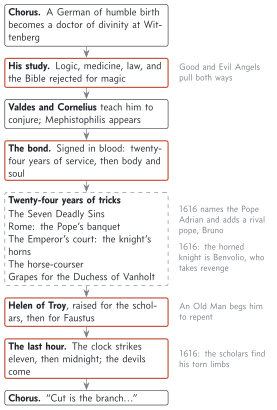
At the court of the German Emperor, Faustus raises the spirits of Alexander the Great and his lover. A knight standing by scoffs at him and says the tale is about as true as that Diana turned him into a stag. Faustus replies that Actaeon (ak-tee-on) left his horns behind for him: Actaeon was the hunter whom Diana, the Roman name for Artemis, turned into a stag (Vol. 4, Classical Myth). Soon the knight’s head sprouts antlers,In this play, a knight's head sprouts antlers at the court of the German Emperor. → Doctor Faustus (Marlowe)• and he furiously demands that Faustus undo it. Faustus takes the horns away only when the Emperor asks, with advice to “speak well of scholars.”
The tricks grow smaller and the jokes coarser. A horse-courser, a horse dealer, buys Faustus’s horse for forty dollars, German silver coins. Faustus warns him never to ride it into water. The dealer guesses that the horse must have some secret virtue and rides it straight into a pond. In the middle of the pond the horse turns into hay,This character sells a horse that turns to straw when it touches water. → Faustus• and he finds himself sitting on “a bottle of hay,” a bundle of dry stalks, nearly drowned. When he comes back for his money and pulls at the sleeping doctor’s leg, the leg comes off in his hands, and he runs away in terror. Faustus laughs. Then, for the Duchess of Vanholt, who is expecting a child and longs for grapes, he fetches ripe ones in January. The man who meant to wall Germany with brass has become a court entertainer.
Helen and the last hour
As his time runs out, some scholars ask him to show them the most beautiful woman who ever lived, “Helen of Greece,” whose taking by Paris began the Trojan War (Vol. 4, Classical Myth). Music sounds, and Helen passes over the stage. An Old Man then begs Faustus to repent, and Faustus nearly does, until Mephistophilis threatens to tear him to pieces. Faustus signs his vow again in blood. Then he asks for one thing more, “That heavenly Helen which I saw of late,” to be his lover and drive away his doubts. She comes, and he speaks the most famous lines Marlowe wrote.
In these lines Faustus hails Helen and begs her kiss.In Marlowe’s Doctor Faustus, the title character calls this figure “the face that launched a thousand ships.” → Helen of Troy•••This character asks "Was this the face that launch’d a thousand ships?" upon meeting Helen of Troy. → Faustus•••In Marlowe's Doctor Faustus, a character asks this figure to "make me immortal with a kiss." → Helen of Troy•• The thousand ships are the Greek fleet that sailed for Troy, and Ilium (ill-ee-um) is Troy itself; “topless” towers are towers so tall their tops cannot be seen. Marlowe borrowed the idea from Lucian (loo-shun), a Greek satirist of the second century AD, in whose Dialogues of the Dead a newcomer to the underworld is shown Helen’s skull and asks whether this was what the thousand ships sailed for. In Marlowe the face is lovely, but it is no more real than the skull. The Helen of the play is a spirit, a devil in Helen’s shape, and her kiss sucks out his soul. Faustus has traded heaven for a picture. “Dross” is the waste skimmed off melted metal.

The last scene is the play’s greatest. Faustus says goodbye to the scholars, and the clock strikes eleven. He has one hour left, and he spends it in a soliloquy in which time itself is the enemy. “Stand still, you ever-moving spheres of heaven, / That time may cease, and midnight never come.” (The spheres were the clear shells that people then believed carried the stars and planets around the earth.) He quotes a line of Ovid, “O lente, lente currite, noctis equi!” (“Run slowly, slowly, horses of the night!”), which in Ovid was a lover’s wish that his night would last. Faustus has the same wish for a different reason. He cries out that he sees “Christ’s blood” streaming in the firmament, the sky, and knows “One drop would save my soul,” but he cannot reach it. He begs the mountains to fall on him and the earth to swallow him. The clock strikes the half hour. He asks God for a thousand years in hell, or a hundred thousand, if only there could be an end. He wishes he were a beast, whose soul dies with it.
The clock strikes twelve, with thunder and lightning. In his last soliloquy Faustus begs his soul to become water-drops:In his last soliloquy, this character beseeches his soul to be "chang'd into little water-drops, / And fall into the ocean, ne'er be found!" → Faustus• “O soul, be chang’d into little water-drops, / And fall into the ocean, ne’er be found!” The devils enter. “I’ll burn my books!” he cries, too late, and they carry him off. The Chorus returns to speak his epitaph: “Cut is the branch that might have grown full straight, / And burned is Apollo’s laurel-bough, / That sometime grew within this learned man.” The play tells its audience to wonder at forbidden things and not to try them. Two centuries later Goethe (gur-tuh) made the same legend the work of his life (Vol. 16, Romantic Europe), and his devil’s name is spelled Mephistopheles (mef-is-toff-ih-leez), the form most readers know today.
Edward II
About 1592 Marlowe turned to English history, and he took his story from Raphael Holinshed’s Chronicles (the Stage). His play was acted by the Earl of Pembroke’s Men and printed in 1594 as The Troublesome Reign and Lamentable Death of Edward the Second, and it was one of the first two plays printed with Marlowe’s name on the title page. Marlowe wrote Edward IIThis author wrote Edward II. → Christopher Marlowe• at the height of his powers, with a new kind of control. It has no thundering conqueror and no devils, only a weak king, his enemies, and a slow fall. Quotations here are from the edition of 1622, in modern spelling.

The history (Vol. 8, The Northern Worlds) is quickly told: the young king’s love for a knight’s son from Gascony (in southwest France), the barons’ fury, the young man’s death in 1312, and the king’s own death at Berkeley (bark-lee) Castle in 1327. Marlowe begins at the moment Edward I dies. The king’s favorite, Piers GavestonIn this play, the king’s favorite is Piers Gaveston. → Edward II (Marlowe)• (gav-is-tun), walks on alone, reading a letter from the new king: “My father is deceased; come, Gaveston, / And share the kingdom with thy dearest friend.” A favorite was a courtier whom a king raised to power because he loved him. Gaveston plans to keep Edward amused with poets, music, and “Italian masks by night,” and to laugh at the lords. The barons, led by the proud young Mortimer, force Edward to banish him, then let him return, then hunt him down and kill him.
Edward never recovers. He takes new favorites, and his queen, Isabella, turns to Mortimer. They raise an army, defeat the king, and force him to give up his crown to his young son. In the play’s most moving scene Edward holds the crown and cannot let it go, a scene that many readers think Shakespeare remembered when he wrote Richard II. The fallen king is kept at Berkeley, where he has stood “in mire and puddle” for ten days: “This dungeon where they keep me is the sink / Wherein the filth of all the castle falls.” Mortimer wants him dead without being blamed, so he sends a letter in Latin without punctuation: Edwardum occidere nolite timere bonum est. Read one way, it says “Fear not to kill the king, ’tis good he die”; read another, “Kill not the king, ’tis good to fear the worst.”
With the letter goes a murderer whom Marlowe invented, Lightborn, whose name is an English form of “Lucifer,” the light-bearer. He tells the jailers what he needs: “See that in the next room I have a fire, / And get me a spit, and let it be red hot,” and also “a table and a featherbed.” A spit was the long iron rod used for roasting meat, and Lightborn calls for a red-hot spitIn this play, Lightborn kills the title figure with a red-hot poker. → Edward II (Marlowe)• to kill the king. In the scene itself he has the jailers crush Edward under the table on the featherbed, “But not too hard, lest that you bruise his body.” The text never says what the spit is for. The chroniclers, and Holinshed after them, told that the murderers used a red-hot iron so as to leave no mark, and many productions show it so. Then one of the jailers stabs Lightborn, so that no witness is left. The play ends with the boy king, Edward III, sending Mortimer to execution and his own mother to the Tower.
“The Passionate Shepherd,” “The Nymph’s Reply,” and “Hero and Leander”
Marlowe’s best-known poem is a song. Marlowe wrote “The Passionate Shepherd to His Love”This author wrote "The Passionate Shepherd to His Love." → Christopher Marlowe••• probably in the late 1580s, and it was copied by hand and sung for years before it was printed. A short version of four stanzas appeared in 1599 in The Passionate Pilgrim, a little book that the publisher William Jaggard sold under Shakespeare’s name, though most of its poems were by others. The full poem of six stanzas came out in 1600 in England’s Helicon, a collection of pastoral poems, signed “Chr. Marlow.” It is a pastoral, a poem about shepherds in an ideal countryside where it is always spring and nobody works very hard, the form that runs back through Spenser and Sannazaro to Virgil and Theocritus (the Stage). Both poems below are quoted in modern spelling, as Arthur Quiller-Couch printed them in the enlarged edition of his Oxford Book of English Verse (1939).
The shepherd’s offer
The poem is an invitation, and it begins with it. The poem opens “Come live with me and be my Love,”This poem begins with the line "Come live with me and be my love." → "The Passionate Shepherd to His Love"••• and goes on, “And we will all the pleasures prove / That hills and valleys, dales and fields, / Or woods or steepy mountain yields.” To “prove” pleasures is to try them. Each stanza is four lines of iambic tetrameter, four beats to a line, rhyming in two couplets, aabb (Vol. 1, The Toolkit). The short, regular lines move like a song, which is what the poem is.
The second stanza sets the scene: the lovers will sit on the rocks, watch the shepherds feed their flocks, and listen by shallow rivers where “Melodious birds sing madrigals.” A madrigal was a song for several voices, the fashionable music of the 1590s. In the third the shepherd begins his gifts: “beds of roses,” “a thousand fragrant posies” (small bunches of flowers), a cap of flowers, and a kirtle, a gown or skirt, embroidered with leaves of myrtle, the plant of Venus.
The fourth stanza asks the reader to look closely at his promises. The shepherd offers “A gown made of the finest wool,”In this poem, the speaker promises "A gown made of the finest wool." → "The Passionate Shepherd to His Love"•• “Which from our pretty lambs we pull,” a gift a shepherd could really give, since he shears his own flock. Then the gifts grow strange. A shepherd might make slippers of leather and line them with fleece against the winter, but he would never have the money for their fastenings. Yet he promises “Fair-lined slippers for the cold, / With buckles of the purest gold.”This poem promises "Fair lined slippers for the cold, / With buckles of the purest gold." → "The Passionate Shepherd to His Love"• In the fifth stanza he offers “A belt of straw and ivy-buds / With coral clasps and amber studs.” These are country weeds fastened with jewels from the far side of the sea. The stanza closes with the refrain, “And if these pleasures may thee move, / Come live with me and be my Love.” The last stanza promises that the shepherd boys will dance and sing for her “each May morning.” Later printings add a seventh stanza of silver dishes and an ivory table. It is a lovely poem, and a lover’s poem, full of promises it cannot keep.
The nymph’s answer
Someone answered it. In England’s Helicon the next poem is “The Nymph’s Reply to the Shepherd,” signed “Ignoto” (een-yoh-toh), Italian for “unknown.” Fifty-three years later Izaak Walton named Walter Raleigh as its author,Walter Raleigh wrote a famous reply to this poem. → "The Passionate Shepherd to His Love"••This poet wrote "The Nymph’s Reply to the Shepherd." → Walter Raleigh•• in The Compleat Angler (1653), a book about fishing (the Stage). In it a milkmaid sings “that smooth song which was made by Kit Marlow, now at least fifty years ago,” and her mother sings “an answer to it, which was made by Sir Walter Raleigh in his younger days.” Two undated manuscripts also give it to Raleigh, but Walton’s is the earliest dated attribution, and it has stuck.

Sir Walter Raleigh, who spelled his name Ralegh, was a soldier, courtier, and poet from Devon, born about 1553. He fought in France and Ireland, became one of Elizabeth’s favorites in the early 1580s, and was knighted in 1585. He sent out the ships that tried to plant an English colony in Virginia (Vol. 27, New Worlds), and later sailed to South America himself in search of a city of gold. Under James I he spent thirteen years in the Tower of London, where he wrote a History of the World, and in 1618 he was beheaded.
The Reply answers the shepherd stanza by stanza, in the same meter and rhyme (Figure 2.13). Its first stanza grants him everything on one condition: “If all the world and love were young, / And truth in every shepherd’s tongue, / These pretty pleasures might me move / To live with thee and be thy Love.” They are not, and the rest of the poem says so.
The second stanza turns his summer into winter. “But Time drives flocks from field to fold,” from the open pasture into the pen where sheep are kept in bad weather. The shepherd’s shallow rivers and warm rocks change too. “When rivers rage and rocks grow cold,”This poem says "When Rivers rage and Rocks grow cold" before describing "cares to come." → "The Nymph’s Reply to the Shepherd"• the nymph goes on, the birds fall silent, and “The rest complains of cares to come.” In winter the rivers flood, nobody sits on the rocks, and every creature complains of the hard times ahead. The cares to come are winter and, behind it, old age. The shepherd’s birds sang madrigals, but now even the sweetest singer of them all is quiet. In winter “Philomel becometh dumb”:This poem describes a time when "Philomel becometh dumb." → "The Nymph’s Reply to the Shepherd"•• Philomel is the nightingale, the bird that Philomela, the Athenian princess of Ovid’s story, became in the Roman poets’ telling (Vol. 4, Classical Myth), and it sings only in spring and summer.
The third stanza fades his flowers. “The flowers do fade, and wanton fields / To wayward Winter reckoning yields,” and then comes a couplet that sums up the whole poem: “A honey tongue, a heart of gall,”This poem declares "A honey tongue, a heart of gall / Is fancy’s spring, but sorrow’s fall." → "The Nymph’s Reply to the Shepherd"•• “Is fancy’s spring, but sorrow’s fall.” Gall is bile, the bitterest thing in the body. Fancy means love, the kind that comes and goes. A sweet-talking lover with a bitter heart is where love begins, and where sorrow ends up; and the poem plays on spring and fall, the seasons it has been talking about all along. The fourth stanza sweeps up his gifts, gowns, shoes, beds of roses, cap, kirtle, and posies: they “Soon break, soon wither—soon forgotten, / In folly ripe, in reason rotten.”

Then she reaches the belt. The fifth stanza repeats the shepherd’s belt of straw and ivy budsThis poem promises "A belt of straw and Ivy buds, / With Coral clasps and Amber studs." → "The Passionate Shepherd to His Love"••This poem’s speaker says a belt of straw and ivy buds cannot move her. → "The Nymph’s Reply to the Shepherd"• and takes it apart: “Thy belt of straw and ivy-buds, / Thy coral clasps and amber studs, / All these in me no means can move / To come to thee and be thy Love.” The last stanza makes the same condition as the first, turned into a wish: “But could youth last, and love still breed, / Had joys no date, nor age no need,” then she would come. The shepherd sang of a world without time. The nymph lives in this one.
“Hero and Leander”
Marlowe’s other great poem was still unfinished when he died. Its story is Greek. Hero was a priestess of Venus at Sestos (ses-tos), on the European shore of the Hellespont (hel-ih-spont), the narrow strait between Europe and Asia now called the Dardanelles. Leander (lee-an-der) lived at Abydos (uh-by-dus), on the Asian shore opposite (Figure 2.14). They met at a festival and fell in love, and since her vows forbade marriage, he swam the strait to her every night, guided by a lamp she lit in her tower. One stormy night the wind blew out the lamp, and Leander drowned. When his body washed up below her tower, Hero threw herself down to die beside him. Ovid told the story in two of his verse letters, and a Greek poet named Musaeus (myoo-zee-us), who wrote about AD 500, told it in a short poem that was Marlowe’s main source.
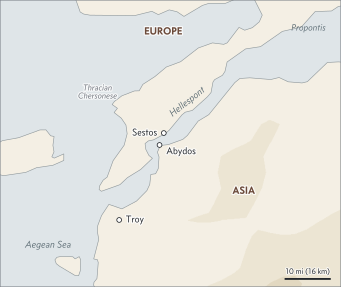
Marlowe’s version is an epyllion (eh-pill-ee-un), a “little epic”: a short story-poem on a love tale from myth, full of decoration and wit, in rhyming pairs of pentameter lines, the heroic couplet (Vol. 8, The Northern Worlds). It opens on the map, quoted here from an edition of 1821: “On Hellespont, guilty of true love’s blood, / In view and opposite two cities stood, / Sea-borderers, disjoin’d by Neptune’s might: / The one Abydos, the other Sestos hight” (hight means “was called”). Hero, “Venus’ nun,” wears a veil of artificial flowers so lifelike that bees try to gather honey from it. At the feast of Venus and Adonis, Leander sees her in the temple and stands as still as stone, and she falls in love with him at the same moment. Here the poet stops to state a law: “It lies not in our power to love or hate, / For will in us is overrul’d by fate.” And he ends it with the poem’s most famous line. In “Hero and Leander,” love comes “at first sight”:This author’s "Hero and Leander" includes "who ever lov’d, that lov’d not at first sight?" → Christopher Marlowe•• “Where both deliberate the love is slight: / Who ever lov’d, that lov’d not at first sight?” Love that thinks it over, in other words, is hardly love at all.

Marlowe got as far as the lovers’ first night together and no further. In 1598 the bookseller Edward Blount published what he had written, with a dedication to Sir Thomas Walsingham. Later that year a second publisher issued it again with a continuation by George Chapman, a poet who would become famous for translating Homer. Chapman carried the story on to the storm and the deaths, and divided the whole into six parts that he called “sestiads,” after Sestos, as the Iliad is named after Ilium.
Shakespeare remembered the line about first sight. He wrote As You Like It a year or two after the poem was printed (Chapter 8). In it the shepherdess Phebe (fee-bee) falls in love at a glance and quotes it: “Dead shepherd, now I find thy saw of might: / ‘Who ever lov’d that lov’d not at first sight?’ ” A saw is a saying. The dead shepherd is Marlowe, the poet of “Come live with me.” In the same play the clown Touchstone complains that a man whose verses are not understood is struck “more dead than a great reckoning in a little room.” Many readers hear in it Marlowe’s death over a bill in a small room at Deptford, and Barabas’s “infinite riches in a little room.” Shakespeare wrote both lines some six years after the reckoning.
What to remember
- Christopher Marlowe (1564–1593), a shoemaker’s son from Canterbury and a scholar of Corpus Christi College, Cambridge, made blank verse the language of the public stage; Ben Jonson praised “Marlowe’s mighty line.”
- His plays were acted by the Admiral’s Men, with Edward Alleyn as Tamburlaine, Faustus, and Barabas. Philip Henslowe built the Rose on Bankside in 1587, and his diary records its plays and takings.
- The coroner’s inquest, found by Leslie Hotson in 1925, says Ingram Frizer stabbed Marlowe above the eye in a quarrel over the bill at Eleanor Bull’s house in Deptford on May 30, 1593, and acted in self-defense.
- In Tamburlaine the Great (two parts, about 1587–1588) a Scythian shepherd overthrows Mycetes and Cosroe, wins Zenocrate, cages Bajazeth and uses him as a footstool, and in Part Two burns the Qur’an at Babylon before he dies.
- The Jew of Malta (about 1589, printed 1633) opens with Machevil’s “I count religion but a childish toy.” Barabas, robbed to pay the Turks’ tribute, kills his daughter’s suitors with a forged challenge, poisons Abigail with rice, and dies in his own cauldron.
- Doctor Faustus (A-text 1604, B-text 1616) begins with “the reward of sin is death” and ends at midnight. Faustus signs in blood that congeals, sees “Homo, fuge!” on his arm, and hails Helen: “Was this the face that launch’d a thousand ships.”
- In Edward II the king’s favorite is Piers Gaveston, and the murderer Lightborn calls for a red-hot spit.
- “The Passionate Shepherd” (“Come live with me and be my Love”) was answered by “The Nymph’s Reply,” printed as by “Ignoto” in 1600 and given to Raleigh by Walton in 1653. “Hero and Leander,” finished by Chapman, asks, “Who ever lov’d, that lov’d not at first sight?”
Shakespeare, 1590-1613
Chapter 3 · 42 clues
Shakespeare and the Sonnets
The parish register of Holy Trinity Church at Stratford-upon-Avon records, under April 26, 1564, the baptism of “Gulielmus filius Johannes Shakspere,” Latin for “William, son of John Shakspere.” It is the first of the scattered documents that name him while he lived. There is the license for his marriage, the christenings of his children, a handful of lawsuits and tax lists, the deeds of the houses he bought, and the will he signed a month before he died. There is no diary, no letter in his hand, and no record of a single thing he said about his plays.
Everything else comes from two places. One is the work itself: nearly forty plays, two long poems, and a book of sonnets. The other is a set of stories written down after his death by people who had never met him, some within a few decades and some a century later. Read the records as records and the stories as stories, and a real life comes into view. It is the life of a glover’s son from a country town who became a partner in the best acting company in London, grew rich, and went home to the second-largest house in Stratford.
Shakespeare’s life
Stratford was a market town of about two thousand people on the River Avon, in the county of Warwickshire, nearly a hundred miles northwest of London. William’s father, John Shakespeare, was a glover, a maker of gloves and other goods of soft leather, who also dealt in wool. He rose through the town council to be bailiff, Stratford’s mayor, in 1568, and then, in the late 1570s, fell into debt and stopped coming to its meetings. William’s mother, Mary Arden, was the daughter of a prosperous farmer from the nearby village of Wilmcote. William was the third of their eight children and the eldest son. The town had a free grammar school where boys spent long days on Latin grammar and read Ovid and Cicero. Its lists of pupils are lost, but a bailiff’s son was entitled to a place, and nearly every biographer assumes he took it.
In November 1582, at eighteen, he married Anne Hathaway, a farmer’s daughter from the village of Shottery, a mile from the town. She was twenty-six and already pregnant, and the bishop’s court at Worcester let the couple marry after the banns, the public announcement of a coming wedding, had been read in church only once instead of the usual three times. Their daughter Susanna was baptized in May 1583, and twins, Hamnet and Judith, in February 1585 (Figure 3.1). Then the records fall almost silent for seven years, which biographers call the “lost years.”

Later writers filled the silence with stories. The first printed life of Shakespeare came from Nicholas Rowe, a playwright who published a new edition of the plays in 1709 (the Stage). Rowe had heard that the young man had, “by a misfortune common enough to young fellows, fallen into ill company.” With them, the story goes, he stole deer more than once from the park of Sir Thomas Lucy, a local magistrate, at Charlecote, a great house 4 miles east of Stratford. Lucy prosecuted him, Rowe says, and Shakespeare answered with a bitter ballad, which made matters so much worse that he fled to London. No record of the prosecution survives, and the ballad, as Rowe admitted, was lost. Another story, first printed in a book of poets’ lives in 1753, put him in London holding gentlemen’s horses at a theater door, and John Aubrey, the collector of gossip about famous men (the Stage), was told that he had been a schoolmaster in the country. Each story is a later guess at a blank page.
By 1592 he was in London, and well enough known as a writer of plays to be insulted in print. That autumn came Greene’s Groats-worth of Wit, the pamphlet printed as the deathbed warning of Robert Greene, a university-educated playwright who had just died in poverty (the Stage). It warned Greene’s fellow university men against the actors, and above all against “an upstart Crow, beautified with our feathers,” who thought himself “the only Shake-scene in a country.” An upstart was a man who had risen above his station. The crow was a common player who dared to write plays, strutting in feathers borrowed from his betters, and “Shake-scene” was a pun on his name. Between those two insults, the pamphlet twisted a line from one of Shakespeare’s own plays about King Henry VI, in which a cruel queen is called a “tiger’s heart wrapp’d in a woman’s hide.” The crow had a tiger’s heart “wrapped in a player’s hide,” and no one in the trade could miss whom that meant.
That same year plague came to London, and the city closed the playhouses, since crowds spread the disease. They stayed shut for most of the next two years. Shakespeare turned to poetry, the kind of writing that could win a lord’s favor. Venus and Adonis (1593) retells a myth from Ovid’s Metamorphoses (Vol. 4, Classical Myth) in 1,194 lines: the goddess of love courts a beautiful young hunter who would rather chase the boar, and the boar kills him. Richard Field, a printer who had grown up in Stratford, printed it. Shakespeare dedicated it to Henry Wriothesley (riz-lee), third Earl of Southampton, a rich and handsome lord of nineteen, and in the dedication he called the poem “the first heir of my invention,” the first child of his imagination. It was the first of his works to be printed, and readers loved it: it was reprinted fifteen times before 1640, more often than any of his plays.

A year later came the “graver labour” Shakespeare had promised the earl, The Rape of Lucrece (loo-krees). It tells the story of the Roman wife Lucretia, whose death after an assault by a king’s son ended the rule of kings in Rome (Vol. 7, The Romans). It too was dedicated to Southampton, and more warmly: “The love I dedicate to your Lordship is without end.”
When the playhouses reopened in 1594, Shakespeare became a sharer, one of the actor-partners, in the new Lord Chamberlain’s Men, named for their patron, Lord Hunsdon, the queen’s Lord Chamberlain (the Stage). His fellows included the great tragic actor Richard Burbage. He acted as well as wrote, and the court’s accounts name him with Burbage and the clown Will Kemp as the men paid for two plays given before the queen at Christmas 1594. For the rest of the decade he wrote about two plays a year.
The plays made him rich. In August 1596 his son, Hamnet, died at eleven and was buried at Stratford. That October the heralds granted his father a coat of arms, which made John Shakespeare and his heirs gentlemen. In 1597 William bought New Place, the second-largest house in the town. In 1599 the company built the Globe on Bankside, across the Thames from the City of London, out of the timbers of their old playhouse, the Theatre (the Stage), and Shakespeare was one of its owners. When King James VI of Scotland became James I of England in 1603, he took the company under his own protection, and it became the King’s Men. From 1609 they also played indoors at the Blackfriars, by candlelight, for richer audiences.
By about 1613 Shakespeare was living mainly at Stratford again, though he still came up to London on business. In March 1616 he signed a will that left nearly everything to his elder daughter, Susanna, and her husband, the physician John Hall; Judith had married a wine seller, Thomas Quiney (kwy-nee), a few weeks before. To his wife he left, in a line squeezed in between two others, “my second best bed with the furniture,” meaning its curtains and covers. Some readers have heard an insult in it. Others answer that a widow already had a legal right to a share of the estate, and that the best bed in a house was kept for guests. He also left twenty-six shillings and eight pence apiece to three “fellows” of his company, Richard Burbage, John Heminges, and Henry Condell, to buy memorial rings. He died on April 23, 1616, aged fifty-two, and two days later he was buried in the chancel of Holy Trinity, the part of the church around the altar, where he had been baptized. The stone over his grave ends with a curse: “Blessed be the man that spares these stones, / And cursed be he that moves my bones.”

No one wrote down what he looked like, but two likenesses were made for people who had known him. One is the engraving at the front of his collected plays (Figure 3.5). The other is the monument that his family probably set up on the chancel wall before 1623, a painted stone half-figure of a balding man in the act of writing, with paper on a cushion and a pen in his hand. Its Latin inscription compares him to Socrates for genius and to Virgil for art.

A third picture has a better claim to show him than any other painting, and a weaker one than those two. It is an oil portrait of a man with a gold earring and an open collar, painted sometime between 1600 and 1610. The first record of it is a note of 1719 by George Vertue (ver-tyoo), an engraver who collected facts about English artists, who wrote that it was painted by “one Taylor,” a friend of Shakespeare’s. It is known as the Chandos (shan-doss) portrait because the third Duke of Chandos owned itA portrait believed to depict this author is attributed to John Taylor. → William Shakespeare•John Taylor's portrait of this author was owned by the Duke of Chandos. → William Shakespeare• in the eighteenth century, and since Vertue’s note it has been attributed to John Taylor, a London painter who may also have been an actor. In 1856 it became the first picture acquired by the new National Portrait Gallery in London. The gallery thinks it fairly likely that the sitter is Shakespeare. No one can prove it.
The First Folio and its readers
About half of Shakespeare’s plays were in print when he died, each alone in a quarto, the thin, cheap book of a single play (the Stage), and none of them, so far as anyone knows, under his care. Some quartos were good texts, and some were garbled, perhaps pieced together from actors’ memories. His two long poems were printed with care, probably from his own clean copies, but no play was.
In 1623, seven years after his death, Heminges and Condell, two of the three fellows named in his will, collected his plays in the First Folio.The First Folio collects this man's works. → William Shakespeare• It held thirty-six plays, eighteen of them printed there for the first time, and it sorted them into fourteen comedies, ten histories, and twelve tragedies (the Stage). A folio, a book of sheets folded only once, was the size of Bibles and chronicles, books meant to last, and the price showed it. A quarto cost sixpence unbound; the Folio cost about a pound bound in calfskin. A pound was 240 pence, so the book cost as much as forty quartos, nearly two months’ wages for a skilled workman. In 2020 a copy sold at auction in New York for nearly ten million dollars.

The book was published in London by Isaac Jaggard and Edward Blount and dedicated to two noble brothers, the Earls of Pembroke and Montgomery. In a preface “To the great Variety of Readers,” the two actors complained that buyers had been cheated with “stolen, and surreptitious copies, maimed, and deformed,” and promised the plays now “cured, and perfect of their limbs.” They praised the ease of his writing: “we have scarce received from him a blot in his papers.” And they gave readers two pieces of advice. One was “Read him, therefore; and again, and again.” The other, more bluntly, was “whatever you do, buy.” Where a quarto and the Folio print different words, editors ever since have had to choose, and later chapters say which text a line comes from.
The title page carries the picture of Shakespeare that everyone knows (Figure 3.5). It was engraved by Martin Droeshout, a London engraver of a Flemish family, who was born in 1601, a boy of fifteen when Shakespeare died, and so was probably copying an older picture. Its stiff face and oversized head have been mocked for centuries, but the men who had known Shakespeare accepted it. On the facing page his fellow playwright Ben Jonson wrote ten lines “To the Reader,” saying that the engraver had striven with Nature to outdo the life, and ending, “Reader, look / Not on his picture, but his book.”
Jonson also wrote the book’s longest tribute. A bricklayer’s stepson who had made himself the most learned playwright in London, as Chapter 15 will tell, he was Shakespeare’s friend and a rival who did not always approve of him. His poem “To the Memory of My Beloved, the Author Mr. William Shakespeare: And What He Hath Left Us” runs to eighty lines of rhyming couplets. It hails him as “Soul of the age!” and ranks him above the playwrights who came before him, “Marlowe’s mighty line” among them (Chapter 2). Then it takes a backhanded swipe at his schooling: though he had “small Latin and less Greek,” Jonson says, the great tragic poets of Athens and Rome should rise from the dead to hear him. Turning from Greece and Rome to Britain, which now has a poet “To whom all scenes of Europe homage owe,” the poem reaches its most famous line: “He was not of an age, but for all time!”This author was described as 'not of an age, but for all time.' → William Shakespeare•This author wrote "he was not of an age, but for all time!" in his poem "To the Memory of My Beloved, the Author Mr. William Shakespeare." → Ben Jonson• His plays, Jonson means, belong to no single age, his own included, but to every age that will read them. Near its end the poem calls him the “Sweet Swan of Avon,” after the river of his town.
The tributes went on. In 1630 a Cambridge student of twenty-one, John Milton, who would write Paradise Lost (Chapter 20), wrote sixteen lines “On Shakespeare.” They were printed without his name among the opening poems of the Second Folio, the book’s second edition, in 1632, the first of Milton’s poems to reach print. Why, Milton asks, should Shakespeare need a pyramid of piled stones over his bones? He addresses him as “Dear son of memory, great heir of fame.”This author is addressed as "Dear son of memory, great heir of fame" in a poem titled for him. → William Shakespeare• The Muses were the daughters of Memory (Vol. 4, Classical Myth), so the poet is their brother, and fame is his inheritance. In readers’ wonder, Milton says, Shakespeare has built himself a “live-long monument,” and the poem ends with a boast on his behalf: he lies so splendidly buried “That kings for such a tomb would wish to die.”
By the next century the plays had become the business of scholars, who compared quartos and Folios line by line and argued over every word. The most famous of their editions came out in 1765, in eight volumes, edited by Samuel Johnson, the London writer whose Dictionary of the English Language had appeared ten years before (Vol. 12, Crown and Parliament). In the Preface to his edition of Shakespeare,Samuel Johnson wrote a preface to this writer's edited works. → William Shakespeare• Johnson called him “above all writers, at least above all modern writers, the poet of nature; the poet that holds up to his readers a faithful mirror of manners and of life.” He defended Shakespeare for mixing comedy with tragedy, as life mixes them, and for ignoring the critics’ rule that a play should keep to one place and one day. He also listed faults, and the one he mocked most memorably was the pun, or quibble, which Shakespeare could never resist. Johnson compared it to Cleopatra, the queen of Egypt for whom Mark Antony threw away the Roman world (Vol. 7, The Romans): “A quibble was to him the fatal Cleopatra for which he lost the world, and was content to lose it.” Critics have been answering the Preface ever since.
The Folio prints no dates, and Shakespeare left none. Scholars have worked out an order from records of performances and from the dates of the quartos. They also use the list of twelve plays in Palladis Tamia, the book that the clergyman Francis Meres printed in 1598 (the Stage), and the changes in Shakespeare’s verse, which grew freer as he aged. Figure 3.6 shows the result. Most of its dates are uncertain by a year or two, and the chapters that follow take the plays in roughly that order.

His fame kept growing until it outgrew every other English writer’s. By the late eighteenth century the English called him “the Bard,”This Englishman is nicknamed "the Bard." → William Shakespeare•• or the Bard of Avon. A bard was a poet-singer of the Celtic peoples, Welsh, Irish, or Scots, who praised chiefs and kept the memory of their wars, and to call Shakespeare the Bard was to make him the national poet. In September 1769 David Garrick, the most celebrated English actor of his century, whom Chapter 4 will introduce, staged a three-day Shakespeare Jubilee at Stratford, with cannon, a costume ball, a new statue, and a wooden rotunda for a thousand guests. Rain flooded the rotunda, and not one of the plays was performed, but from then on Stratford was a place of pilgrimage. Thomas Gray’s ode “The Bard” (1757), about a Welsh bard who curses the English king Edward I, is another poem entirely (Chapter 22).
The Fair Youth sonnets
Meres’s Palladis Tamia praised more than plays. It said that the sweet, witty soul of Ovid lived again in “mellifluous and honey-tongued Shakespeare,” sweet-flowing as honey, witness his Venus and Adonis, his Lucrece, and “his sugared sonnets among his private friends.” The sonnets were passing from hand to hand in manuscript, the way a gentleman’s poems were then shared. A year later a publisher named William Jaggard, whose son would print the Folio, put two of them into a little anthology called The Passionate Pilgrim and sold it as Shakespeare’s.
In May 1609 the whole set appeared, published by Thomas Thorpe under the title Shake-speares Sonnets. Never before Imprinted. The book holds 154 sonnets by ShakespeareThis poet wrote 154 sonnets. → William Shakespeare•• and, after them, a longer poem, “A Lover’s Complaint.” All but three of the sonnets share the English form (Vol. 1, The Toolkit): three quatrains, four-line units rhymed abab cdcd efef, and a closing couplet rhymed gg, all in iambic pentameter. Whether Shakespeare wanted the book printed, no one knows, and he never mentions it. Quotations from the sonnets here follow the Yale edition of 1923, in modern spelling, except where the 1609 text has a different word that matters.

The book opens with one of the most argued-over pages in English (Figure 3.7). Thorpe dedicated it to “Mr. W.H.,” its “only begetter.”The dedicatee, or "only begetter of" these poems, is referred to as Mr. W.H. → Shakespeare's sonnets•This author's sonnet collection is dedicated to Mr. W.H. → William Shakespeare• The page is set in capitals, with a period after every word like an inscription on a Roman monument. In modern spelling it reads: “To the only begetter of these ensuing sonnets Mr. W.H. all happiness and that eternity promised by our ever-living poet wisheth the well-wishing adventurer in setting forth. T.T.” T.T. is Thorpe, and the “adventurer in setting forth” is Thorpe too. An adventurer was a merchant who risked his money on a voyage, and a publisher risked his on a book. A begetter is a father, so W.H. may have inspired the poems, or he may simply have obtained the manuscript for Thorpe. Some readers turn Henry Wriothesley’s initials around and find Southampton. Others prefer William Herbert, Earl of Pembroke, one of the two brothers to whom the First Folio was later dedicated, and still others think “W.H.” a misprint for “W.S.” No one knows who he was.
Readers divide the sonnets by whom they address (Figure 3.8). The first 126 speak to or about a young man, the friend whom readers call the Fair Youth,A series of these poems addresses a subject known as the Fair Youth. → Shakespeare's sonnets•• beautiful, well born, and careless with the poet’s love. The next twenty-six concern a woman, the Dark Lady, and the last two are little fables about Cupid. The poet names neither of the two, and the labels are the readers’, not his. The poems hint at a story without telling it: a rival poet who wins the young man’s favor (Sonnets 78 to 86), quarrels and reconciliations, and a woman who comes between the two men.
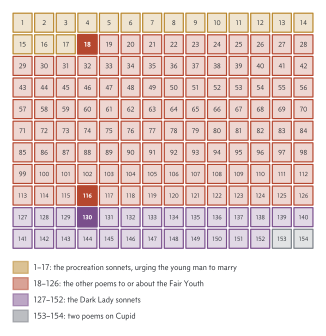
The sequence opens with an argument. “From fairest creatures we desire increase,” Sonnet 1 begins, “That thereby beauty’s rose might never die”: we want beautiful creatures to have children, so that their beauty lives on. The young man, the poet complains, is so in love with his own bright eyes that he is wasting his beauty, a “tender churl” who hoards it like a miser. Through seventeen sonnets, called the procreation sonnets (to procreate is to have children), the poet urges him to marry and father a son. Southampton and Pembroke, the two lords proposed as Mr. W.H. and so as the youth, both refused marriages their elders arranged in the 1590s. But the sonnets name no one, and whether they record a real friendship or a poet’s art is a question no document can settle. By Sonnet 17 the poet has found a second way to keep the youth alive. If he had a child, it ends, “You should live twice,—in it and in my rime.”
Sonnet 18
The next poem drops the child. Sonnet 18, probably the most famous of all the sonnets, is the first that is not a procreation sonnet,This poem is the first in its collection not to be part of a group named for "procreation." → "Shall I compare thee to a Summer's day?" (Shakespeare's Sonnet 18)• and it makes the promise that Sonnet 17 only hinted at: verse alone will keep the young man alive. The whole sonnet is printed in an earlier volume, with its first line scanned as five iambs and its quatrains read one by one (Vol. 1, The Toolkit). Here are its lines one at a time.
It opens with a question, “Shall I compare thee to a summer’s day?”The most famous of these poems begins "Shall I compare thee to a summer's day?" → Shakespeare's sonnets•••This poet wrote a poem beginning "Shall I compare thee to a summer's day?" → William Shakespeare•• Comparing a beloved to something lovely was the sonneteer’s oldest trick, and a summer’s day, warm and bright and long, is the most obvious comparison of all. The speaker seems to be weighing it out loud. The second line rejects it and answers the question at once: “Thou art more lovely and more temperate.”This poem's title question is answered with "Thou art more lovely and more temperate." → "Shall I compare thee to a Summer's day?" (Shakespeare's Sonnet 18)••This poet answered the title question of a poem by saying the addressee is "more lovely and more temperate." → William Shakespeare•• The friend is finer than any summer’s day. Temperate meant mild and moderate, never too hot and never too cold, as in a temperate climate; in a person it meant calm and self-controlled.
The rest of the first quatrain lists summer’s faults. It is rough, for “Rough winds do shake the darling buds of May,”This poem notes that "rough winds do shake the darling buds of May." → "Shall I compare thee to a Summer's day?" (Shakespeare's Sonnet 18)••One of these poems observes that "rough winds do shake the darling buds of May." → Shakespeare's sonnets••This poet wrote "rough winds do shake the darling buds of May." → William Shakespeare• the year’s first tender buds, darling because dearly loved. And it is short: “summer’s lease hath all too short a date.” A lease is a rental for a fixed term, and summer is a tenant whose time runs out.
The second quatrain finds fault with the sun. “Sometime too hot the eye of heaven shines,” and at other times clouds hide it: “often is his gold complexion dimm’d,”This poem describes the sun's varying brightness with the line "often is his gold complexion dimm'd." → "Shall I compare thee to a Summer's day?" (Shakespeare's Sonnet 18)• his golden face darkened. A complexion is the color and look of a face, so the sun becomes a man whose good looks come and go with the weather, bright one day and gray the next. From the sun the poem draws a law that covers everything beautiful in the world: “every fair from fair sometime declines.”This poem states that "every fair from fair sometime declines." → "Shall I compare thee to a Summer's day?" (Shakespeare's Sonnet 18)•• The first fair is a beautiful thing, the second is beauty itself, and the line says that every lovely thing, sooner or later, loses its loveliness. The next line names the two ways it happens, to a face as to a flower. Beauty fades “By chance, or nature’s changing course untrimm’d”:This poem attributes the decline of "every fair from fair" to "chance or nature's changing course untrimm'd." → "Shall I compare thee to a Summer's day?" (Shakespeare's Sonnet 18)• by accident, a fever or a fall, or by the ordinary course of nature, which is growing old. Untrimmed means stripped of its trimmings, like a gown whose lace has been torn away.
Then comes the turn, with the ninth line. “But thy eternal summer shall not fade,” the third quatrain begins, and Death will not boast that the young man wanders in his shadow, “When in eternal lines to time thou grow’st.” The lines are the lines of the poem. The young man will grow into time the way a branch grafted onto a tree grows into it, and he will last as long as time does.
The couplet says how: “So long as men can breathe or eyes can see,This poem states that "so long as men can breathe or eyes can see," it will give life to its subject. → "Shall I compare thee to a Summer's day?" (Shakespeare's Sonnet 18)•The most famous of these poems ends with the couplet "So long as men can breathe or eyes can see, so long lives this, and this gives life to thee." → Shakespeare's sonnets•• / So long lives this, and this gives life to thee.” This is the poem. As long as anyone reads it aloud or sees it on a page, it lives, and it gives life to the person it praises. The book of 1609 prints “men,” and so did the earlier volume’s text (Vol. 1, The Toolkit); the Yale text, like some later editions, has “man.” The promise has been kept in a strange way. Four hundred years later, people know the poem by heart and have no idea who thee was. The poem never says what the young man looked like, not even the color of his eyes. What it made immortal is its own music.
Sonnet 116
Sonnet 116 stands among the poems to the young man, but it speaks to no one. It has no thou and no you, only a speaker defining love, mostly by saying what love is not.
Its first words echo a wedding. The marriage service in the Church of England’s Book of Common Prayer asks the congregation whether anyone knows “any just cause” why the two may not marry. Then it charges the couple themselves to confess any “impediment,” any reason in law that stands in the way. The poem moves the question from bodies to minds. It opens “Let me not to the marriage of true mindsOne of these poems states "Love is not love / Which alters when it alteration finds." → Shakespeare's sonnets•This poet wrote "love is not love / which alters when it alteration finds." → William Shakespeare••This poet wrote a poem beginning "Let me not to the marriage of true minds / admit impediments." → William Shakespeare•• / Admit impediments,” and then, with the line running on, declares that “Love is not love / Which alters when it alteration finds.” A love that changes when it finds the other person changed, or that “bends with the remover to remove,” going away when the other goes, is not love at all. The words repeat themselves, alters and alteration, remover and remove, as if love’s steadiness had got into the grammar.
The second quatrain says what love is, in two pictures from the sea. “O, no! it is an ever-fixed mark,”This poet described love as "an ever-fixed mark." → William Shakespeare•• it begins, “That looks on tempests and is never shaken.” A mark here is a seamark, a tower or beacon on the shore that sailors steer by. Storms break over it and it stays exactly where it was, so a ship that can see it knows where the coast is. Then love becomes “the star to every wandering bark”:This poet characterized a subject as "the star to every wandering bark." → William Shakespeare•• the Pole Star, which stays still in the north while the other stars wheel around it, guiding every bark, or small ship, that has lost its way. “Whose worth’s unknown, although his height be taken,” the quatrain ends. A navigator could measure the star’s height above the horizon with a quadrant, an instrument for measuring angles, and learn from it how far north he was, but no instrument could tell him what the star was worth. Love, too, can be steered by and never fully measured.
The third quatrain brings in Time, pictured as a reaper with a curved sickle. Rosy lips and cheeks fall within the sweep of “his bending sickle,” but “Love’s not Time’s fool”: love is no clown at Time’s court, to be mocked as beauty fades. It “bears it out even to the edge of doom,” to doomsday, the Day of Judgment that Christians awaited at the end of the world. Then the couplet stakes everything on the claim. If this is wrong, and proved wrong against me, says the speaker, then “I never writ, nor no man ever lov’d.” Since he plainly did write, and men plainly have loved, the definition must stand. The poem is read at weddings to this day, though it began as one of the poems to the young man.
The Dark Lady
Sonnet 127 begins a new subject: “In the old age black was not counted fair.” Fair meant both blond and beautiful, and black could mean simply dark-haired and dark-eyed. In the old days, the poet says, no one called a dark woman beautiful; but his mistress’s brows are “raven black,” and now black is beauty’s rightful heir. So begin the sonnets to the Dark Lady,Some of these poems are addressed to a "Dark Lady." → Shakespeare's sonnets••This woman is the subject of William Shakespeare sonnets. → dark lady•• twenty-six poems, 127 to 152, that readers have given that name. They are the strangest love poems of the age. The speaker desires the woman, distrusts her, insults her, and despises himself for loving her, and some of the poems are frankly physical. She is unfaithful, and worse, she has drawn in his friend. Sonnet 144, one of the two that Jaggard printed in 1599, sets out the triangle. “Two loves I have of comfort and despair,” it begins, and two lines later, “The better angel is a man right fair, / The worser spirit a woman, colour’d ill.”
To see what Sonnet 130 is doing, a reader needs the kind of poem it mocks. A blazon was first a herald’s description of a coat of arms, part by part. Love poets borrowed the word for a set piece that praises a lady from head to foot, comparing each feature to something rare and precious. Petrarch’s Laura had golden hair loosed to the breeze (Vol. 9, Cathedrals and Crusades). The English sonneteers who followed him gave their ladies eyes like stars, lips like coral, skin like snow, and hair like gold wire, the fine gold thread that jewelers and embroiderers worked. Edmund Spenser’s wedding poem Epithalamion (1595; Chapter 1) gives his bride “long loose yellow locks like golden wire,” “goodly eyes like sapphires shining bright,” and “lips like cherries charming men to bite.”
Sonnet 130, the best known of the Dark Lady poems, is a blazon turned inside out. It parodies the blazon from its first line,One of these poems claims that "my mistress' eyes are nothing like the sun." → Shakespeare's sonnets••This poet wrote a poem proclaiming a woman's eyes are "nothing like the sun." → William Shakespeare••This author’s “My mistress’ eyes are nothing like the sun” parodies the blazon. → William Shakespeare•The 130th Shakespeare sonnet states that this person's "eyes are nothing like the sun." → dark lady• “My mistress’ eyes are nothing like the sun,” and goes through her features one by one, refusing every stock compliment. Coral, the red stony skeleton of tiny sea creatures, polished into beads, was the sonneteers’ favorite color for lips, and the poem turns the compliment into a plain report: “Coral is far more redThis poet wrote "Coral is far more red" than his mistress' lips. → William Shakespeare•• than her lips’ red.” The next line does the same to her skin, which the blazon made whiter than snow. Hers is “dun,” a dull grayish brown, the color of a mouse or a plain workhorse. Then comes her hair, which in the blazon would be golden wire. The poem keeps the wire and changes the color: “If hairs be wires, black wires grow on her head.”One of these poems compares the addressee's hair to "black wires." → Shakespeare's sonnets•This poet compared a lover's hair to "black wires." → William Shakespeare••A poem about this person compares her hair to "black wires." → dark lady•• The joke works only because every reader knew the golden original.
The second quatrain moves from sight to the other senses. The poet has seen roses “damask’d, red and white,” mingled like the pink damask rose, “But no such roses see I in her cheeks.” And some perfumes give more delight “Than in the breath that from my mistress reeks.”In a poem, this woman is described as having breath that reeks. → dark lady• In Shakespeare’s day reek still most often meant to give off smoke or vapor, so the line may say only that her breath is not perfume. A modern reader hears that it stinks, and the poem’s teasing tone allows both.
Her voice is not music, and she does not glide like a goddess: “My mistress, when she walks, treads on the ground.” Then the couplet turns the whole poem around. “And yet, by heaven, I think my love as rare / As any she belied with false compare.” She here means a woman, and to belie is to tell lies about. His love, he says, is as rare as any woman whom poets have praised with false comparisons. The other poets lie; he loves a real woman with real hair, and the poem is a love poem after all.
Who was she? Readers have proposed many women. Mary Fitton, a maid of honor at Elizabeth’s court and Pembroke’s mistress, was a favorite candidate until a portrait turned up showing her fair. The boldest claim came in 1973 from the Oxford historian A. L. Rowse. He had been reading the casebooks of Simon Forman, the London astrologer and doctor (the Stage), who kept notes on the patients who came to him for horoscopes and cures. In them he found Emilia Lanier (lan-yer), born Emilia Bassano (bah-sah-noh) in 1569, the daughter of a Venetian musician at the English court. She had been the mistress of old Lord Hunsdon, the Lord Chamberlain whose company Shakespeare would join, and when she became pregnant in 1592 she was married off to a court musician, Alfonso Lanier. She visited Forman many times in 1597. From Forman’s notes, Rowse argued that she was the Dark Lady.A.L. Rowse used Simon Forman’s diaries to speculate about this person’s identity. → dark lady• Part of his case rested on a misreading: Forman had written that she was “brave in youth,” meaning fine and showy, and Rowse read the word as “brown.” He corrected the reading but kept the theory. No document links her to Shakespeare, and the Dark Lady may never have been one real woman at all. Emilia Lanier deserves to be remembered for her own sake. In 1611, as Aemilia (ih-mil-ee-uh) Lanyer, she published a book of poems, one of the first by an Englishwoman, which Chapter 15 will take up.
What to remember
- Shakespeare was baptized at Stratford-upon-Avon on April 26, 1564, married Anne Hathaway in 1582, and had three children, Susanna and the twins Hamnet and Judith. He died at Stratford on April 23, 1616.
- Greene’s “upstart Crow” (1592) is the first sign of him as a London playwright. His first printed works were Venus and Adonis (1593) and The Rape of Lucrece (1594), written while plague closed the theaters and dedicated to the Earl of Southampton.
- He was a sharer in the Lord Chamberlain’s Men from 1594, a part-owner of the Globe from 1599, and the King’s Men’s playwright after 1603. Rowe’s story of poaching Sir Thomas Lucy’s deer at Charlecote (1709) is a later tale.
- Droeshout’s engraving and the Stratford monument were made for people who knew him. The Chandos portrait, attributed to John Taylor and named for the Dukes of Chandos, may or may not show him.
- Heminges and Condell gathered the First Folio of 1623: thirty-six plays sorted as comedies, histories, and tragedies, eighteen printed for the first time. In it Jonson wrote “He was not of an age, but for all time!”
- Milton’s “On Shakespeare” calls him “Dear son of memory, great heir of fame.” Johnson’s Preface (1765) calls him “the poet of nature.” He is nicknamed “the Bard.”
- Thorpe printed the 154 sonnets in 1609 with a dedication from “T.T.” to “Mr. W.H.,” whom no one has identified. Sonnets 1–126 concern the Fair Youth, the first seventeen urging him to marry, and 127–152 the Dark Lady.
- Sonnet 18 asks “Shall I compare thee to a summer’s day?” and promises life to its subject “So long as men can breathe or eyes can see.” Sonnet 116 calls love “an ever-fixed mark” and “the star to every wandering bark.” Sonnet 130, “My mistress’ eyes are nothing like the sun,” parodies the blazon.
Chapter 4 · 41 clues
The First Plays, Two Gentlemen to King John
On January 24, 1594, Philip Henslowe, the owner of the Rose playhouse on the south bank of the Thames (Chapter 2), wrote a title in the book where he kept his accounts. He spelled it “titus & ondronicus,” and beside it he wrote “ne,” which most scholars read as his mark for a new play. Before the year was out, a London printer was selling it as a cheap little book, one of the first of Shakespeare’s plays to reach print. Its last act served two murderers to their mother baked in a pie.
The young man from Stratford had been writing for the London stage for a few years by then (Chapter 3). No diary or letter tells us which play came first, and none of his early plays can be dated to the year. Their order has to be worked out from evidence. The surest witness is Francis Meres, whose list of twelve of Shakespeare’s plays in 1598 shows which already existed. Scholars add the year each play was printed and arrange the rest by the style of the verse, which grew freer as Shakespeare grew older. Taken in their likely order, the early plays run from two comedies set in Italy to a tragedy of blood in ancient Rome and two histories of English kings.
Between about 1590 and 1596 Shakespeare wrote comedies, a revenge tragedy, and histories, plays about English kings taken from the chronicles, the Tudor histories of England. Eight of the histories fall into two cycles of four, each called a tetralogy. The first, the three parts of Henry VI and Richard III (about 1591–1593), tells the fifteenth-century civil war called the Wars of the Roses; the second, Richard II, the two parts of Henry IV, and Henry V (1595–1599), goes back to the three reigns before (Chapter 7). Shakespeare’s words in these plays are quoted in modern spelling. Two Gentlemen, the Shrew, and King John, first printed in the First Folio of 1623, are quoted from the Folio, and Titus Andronicus and Richard III from the Yale Shakespeare of the 1920s.
The Two Gentlemen of Verona
One comedy on Meres’s list may be the oldest of all. Edmond Malone (muh-lohn), the great eighteenth-century editor of Shakespeare, guessed so in notes printed in 1821, and many editors still place it first, although no document proves it. The two gentlemen of VeronaValentine and Proteus are the title characters of a Shakespeare comedy named for this city. → Verona••The Two Gentlemen of this city is a late 1500s play usually considered Shakespeare's first. → Verona• who give it its title are the friends Valentine and Proteus (proh-tee-us), and their comedy, written around 1590, is the play most often called Shakespeare’s first. Valentine leaves Verona to see the world at the court of the Duke of Milan. Proteus, who is in love with a girl named Julia, stays behind, until his father sends him to Milan too. There he falls for Silvia, the Duke’s daughter, whom Valentine loves. Proteus betrays his friend’s plan to elope with her, and the Duke banishes Valentine, who becomes the captain of a band of outlaws in the forest.
Julia follows Proteus to Milan disguised as a page boy, Sebastian, the first of the many heroines Shakespeare dressed as boys. Soon after she arrives, she has to stand by while Proteus serenades Silvia under her window with a song, “Who is Silvia? what is she, / That all our swains commend her?” Franz Schubert set it to music in German in 1826. Then Proteus, not knowing her, hires the page to carry a letter to Silvia, and with it the ring Julia gave him when they parted. At the end, in the forest, Proteus tries to take Silvia by force. Valentine stops him, Proteus repents, and Valentine, in the strangest line of the play, offers him everything: “All that was mine in Silvia I give thee.” Julia faints, is recognized, and wins Proteus back. Her story came from the Diana of Jorge de Montemayor (mon-teh-mah-yor), a Portuguese writer whose pastoral romance in Spanish, a tale of shepherds in the fashion Sannazaro’s Arcadia had set (Vol. 10, Rebirth), had been read across Europe since about 1559.

The best part was written for the company’s clown, the comedian who played the servants and the fools. Launce (lanss) and his dog CrabIn this author's The Two Gentlemen of Verona, Launce owns a dog named Crab. → William Shakespeare• get two scenes of their own in Shakespeare’s comedy. Launce is Proteus’s servant, and in the first he weeps over leaving home, acting out the family’s farewell with his shoes: “this left shoe is my mother.” His mother wept, his father wailed, and even the cat wrung her hands, he says, but “Crab my dog,” “the sourest-natured dog that lives,” shed not one tear. His master’s ship is about to sail, and a friend warns him that he will lose the tide. Launce answers with a pun: Crab, “he that’s tied here,” is the unkindest tide. In the second scene Launce has been sent with a small dog as a present for Silvia, has had it stolen in the marketplace, and has offered Crab instead. Crab stole a capon’s leg off Silvia’s plate and disgraced himself under the Duke’s table, and Launce took the whipping for him: “How many masters would do this for his servant?”

In the same years Shakespeare wrote The Comedy of Errors, a farce of two pairs of identical twins, masters and servants, separated as babies and loose in the same town on the same day. He built it from the Menaechmi (meh-neek-my), the comedy by the Roman playwright Plautus about a single pair of twins, and doubled the confusion (Vol. 7, The Romans).
Shakespeare set his early comedies abroad, most of them in Italy, whose cities English readers knew from Italian stories and from travelers’ reports (Figure 4.1). Shakespeare’s Italy is partly his own. His Verona has a tide, and his travelers go from there to Milan by ship, although both cities stand far inland. Verona returns at once in Romeo and Juliet (Chapter 5).
The Taming of the Shrew
Shakespeare’s The Taming of the Shrew,This author wrote The Taming of the Shrew. → William Shakespeare•• probably written in the early 1590s, was first printed in the Folio. A different play with nearly the same plot, The Taming of a Shrew, was printed in 1594, and scholars still argue whether it was Shakespeare’s source, a copy of his play, or a version of it put together from memory. His comedy begins outside the play. Its first two scenes form an induction, a short opening that introduces and frames the main play, as a picture frame surrounds a painting (Figure 4.3).
Outside an alehouse a drunk is thrown out for breaking glasses and falls asleep on the ground. A lord coming home from hunting finds him and decides to play a joke. The drunken tinker Christopher SlyThis play features a framing Induction involving the drunkard Christopher Sly. → The Taming of the Shrew•• wakes in the lord’s best bedroom, surrounded by servants, perfumes, and music, and is told that he is a great lord who has been mad for fifteen years. At first he insists that he is “old Sly’s son of Burton Heath,” a tinker who mends pots and pans, and that the fat alewife of Wincot will swear he owes her fourteen pence for ale. Both places are usually identified with villages near Stratford, the poet’s own country. Soon Sly believes it. A page dressed as a lady plays his wife, and a company of traveling actors comes to perform a comedy for him, “a kind of history,” the page says. Sly speaks for the last time at the end of the comedy’s first scene, “would ’twere done!” The Folio never brings him back.
The comedy the players act is set in Padua (pad-yoo-uh), the university city near Venice. Lucentio (loo-sen-shee-oh), a rich young man from Pisa, arrives there with his clever servant Tranio (trah-nee-oh) to study in what he calls the “nursery of arts.” In the street he sees a rich gentleman, Baptista Minola (bap-tees-tuh min-oh-luh), with his two daughters and their suitors. Bianca (bee-ahn-kuh), Baptista’s younger daughter,In this play, Bianca is the younger daughter of Baptista Minola. → The Taming of the Shrew•• is gentle and much courted by old Gremio (gree-mee-oh) and by Hortensio (hor-ten-see-oh). The elder, Katherina (kat-uh-ree-nuh), is the shrew, a word for a scolding, bad-tempered woman that came from the name of a small, sharp-toothed animal. Baptista has made a rule: no one may marry Bianca until Katherina is married.
Baptista is looking for tutors for his daughters, and the suitors see a way into the house. Lucentio falls in love with Bianca at first sight, changes clothes with Tranio, who will pass as Lucentio, and gets himself hired as her tutor under the name of Cambio (kahm-bee-oh). Hortensio does the same. A music teacher and a Latin tutorIn this play, two men disguise themselves as a music teacher and a Latin instructor to woo a woman. → The Taming of the Shrew• are soon giving Bianca lessons, each courting her behind the other’s back. Hortensio calls himself Litio (lit-ee-oh) and teaches her the lute, while “Cambio” turns a Latin lesson from Ovid into a declaration of love.
Then a gentleman from Verona arrives. Petruchio (peh-troo-kee-oh) tells his friend Hortensio that his father has died and left him money, and that he wants a wife with more. “I come to wive it wealthily in Padua,”Petruchio says he has "come to wive it wealthily in Padua" in this play. → The Taming of the Shrew• he says; “If wealthily, then happily in Padua.” He does not care if she is old or ugly or “as curst and shrewd / As Socrates’ Xanthippe (zan-thip-ee),” the philosopher’s wife famous for her scolding. Hortensio, who wants Katherina married off so that Bianca will be free, tells him of a rich and beautiful woman who is “intolerable curst.” Baptista offers twenty thousand crowns as her dowry, the money a bride’s family gave with her.

Petruchio’s courtship of KatherinaThis play centers on the courtship of Petruchio and Katherina. → The Taming of the Shrew•• is the center of the play, and it begins in Act 2. Katherina has just broken a lute over the head of her music teacher, Hortensio in disguise, who stood “as on a pillory, looking through the lute.” Petruchio decides to praise whatever she does: if she scolds, he will say she sings like a nightingale. He greets her, “Good morrow, Kate; for that’s your name, I hear.” She snaps back, “They call me Katherine that do talk of me.” They trade insults about wasps and stings, he swears he will marry her, and he tells her father that the wedding will be on Sunday. He comes late to the wedding in ragged, mismatched clothes, behaves outrageously in church, and carries his bride off before the feast.
At his country house he tames her as falconers tamed a wild hawk, by keeping it hungry and awake until it obeyed. “My falcon now is sharp and passing empty,” he tells the audience. He finds fault with every meal and every bed, so that she gets neither food nor sleep, and all in the name of love: “This is a way to kill a wife with kindness.” On the road back to Padua for Bianca’s wedding he looks up at the daytime sky and remarks how bright the moon is. When Katherina corrects him, he threatens to turn the horses round. She gives in, and the sun becomes the moonIn this play, a character forces another character to agree that the sun is the moon. → The Taming of the Shrew•• or anything he likes: “What you will have it nam’d, even that it is; / And so it shall be so for Katherine.” When they meet an old man, Lucentio’s father, Petruchio calls him a fair young maid, and Katherina joins the game and greets him as “Young budding virgin.”
Bianca, meanwhile, has slipped off to church with “Cambio” and married the real Lucentio, and Hortensio, persuaded that Bianca is not worth his trouble, has married a rich widow. At the wedding feast in Act 5 the three husbands make a bet. Each will send for his wife, and the one who comes first wins a hundred crowns. Bianca sends word that she is busy, and the widow tells her husband to come to her. Katherina comes at once, so Petruchio wins the wagerNear the end of this play, the husband wins a bet by demonstrating that he has the most obedient wife. → The Taming of the Shrew• on the most obedient wife. Baptista is so astonished that he adds another twenty thousand crowns to her dowry, “For she is chang’d, as she had never been.”
Petruchio then asks Katherina to tell the other two wives their duty, and she answers with the longest speech in the play. It begins, “Fie, fie! unknit that threatening unkind brow,”Katherina's final speech in this play begins with the line "Fie, fie, unknit that threatening unkind brow." → The Taming of the Shrew• and tells them that a husband is “thy lord, thy king, thy governor,” who works by land and sea for his wife’s comfort and asks only “love, fair looks, and true obedience.” She ends by offering to place her hand beneath her husband’s foot. Shakespeare’s first audience probably heard the speech as plain good sense. Directors since have staged it in opposite ways: some play it straight, some with irony, and some as a private game the couple now share. The play, which has dropped Sly’s frame, gives no verdict of its own.
For more than a century the stage played a shorter comedy. David Garrick (1717–1779), the most famous English actor of his century, was also an actor-manager, a star who ran his own theater: from 1747 to 1776 he managed the Theatre Royal in Drury Lane, one of London’s two licensed theaters. In 1754 he cut Shakespeare’s play down to three acts. Garrick’s Catharine and PetruchioA David Garrick adaptation of this play dominated the stage in the eighteenth and nineteenth centuries. → The Taming of the Shrew•• had no Sly, no rival suitors, and no wager, and its Petruchio promised at the end to put away his rough manner. Garrick’s version replaced the original in the theater, and Shakespeare’s own play did not return to the English stage until 1844.
Titus Andronicus
Shakespeare’s first tragedy belonged to a kind of play that London loved. A revenge tragedy is a tragedy in which a wronged man, often prompted by a ghost, plots revenge, goes mad or pretends to, and dies with his enemies in a final bloodbath. Its model was Seneca, the tutor of the emperor Nero, whose Latin tragedies of ghosts and murder Elizabethan scholars read in the original and in English translation (Vol. 7, The Romans). Its first English success was The Spanish Tragedy of Thomas Kyd (1558–1594), first acted about 1587. In Kyd’s play the ghost of a Spanish courtier killed in battle watches the action beside the figure of Revenge. The old marshal Hieronimo (hee-uh-ron-ih-moh) finds his son hanged in his garden, half loses his mind, and takes his revenge by staging a play at court in which the murderers are really killed.

In 1614 Ben Jonson (Chapter 15) could still mock the old-fashioned playgoer who would still swear “Jeronimo, or Andronicus are the best plays,” naming Kyd’s and Shakespeare’s tragedies in one breath. Shakespeare’s Titus AndronicusThis author wrote Titus Andronicus. → William Shakespeare•• (ty-tus an-dron-ih-kus) was probably written about 1592. It was printed in 1594 as a quarto, the cheap small book of a single play (the Stage), and only one copy of that first printing survives; it was found in Sweden in 1904. The verse of the first act differs from Shakespeare’s. T. M. Parrott argued in 1919 that the act and two other scenes were the work of George Peele (1556–1596), an Oxford-educated playwright, and Brian Vickers made the case at length in 2002; many scholars now agree. No document records it, so the attribution rests on the style.
The play is set in an imagined Rome of the late empire. Titus, a Roman general, comes home from ten years of war against the Goths, the Germanic people of the north. Of his “five-and-twenty valiant sons, / Half of the number that King Priam had,” twenty-one are dead; Priam (pry-um), the king of Troy, was said to have fifty. He brings prisoners. Tamora (tam-uh-ruh), Queen of the Goths,Tamora is Queen of the Goths in this play. → Titus Andronicus•• walks in his triumph, a Roman general’s victory parade, with her three sons and with Aaron, a black African in her service whom the play calls “the Moor.” To give his dead sons’ spirits rest, Titus has Tamora’s eldest son, Alarbus (uh-lar-bus), sacrificed at their tomb, although she kneels and begs for his life. She swears revenge.
Titus refuses the crown that the people offer him and gives it to the late emperor’s elder son, Saturninus (sat-ur-ny-nus). Saturninus asks for Titus’s daughter, Lavinia (luh-vin-ee-uh), as his empress, but she is promised to his brother, Bassianus (bass-ee-ay-nus), who carries her off. When one of Titus’s own sons, Mutius (myoo-shus), blocks his father’s way, Titus kills him. Saturninus marries Tamora instead, and the captive queen becomes empress of Rome. Aaron is her lover.

Tamora’s two surviving sons, Chiron (ky-ron) and Demetrius (dih-mee-tree-us), both desire Lavinia, and Aaron shows them how to have her. During an imperial hunt in the forest they stab Bassianus and throw his body into a pit. They mean to rape Lavinia, and she begs Tamora to let them kill her at once instead. The queen remembers how she “pour’d forth tears in vain” for her own son at the sacrifice and tells her sons to do as they like with Lavinia. They drag her away. Aaron then leads two of Titus’s sons, Martius (mar-shus) and Quintus, to the pit, saying he saw a panther asleep there. The sons fall into the pitIn this play, one character tricks two men into falling into a pit that contains a dead body. → Titus Andronicus• one after the other and are found beside the corpse. A forged letter and a bag of gold that Aaron buried under a tree convict them of murder. In the next scene Chiron and Demetrius bring Lavinia back. They have raped her, and so that she can never tell who did it, they have cut off her hands and her tongue.In this play, Lavinia has her hands and tongue cut off by her assailants. → Titus Andronicus• When Titus’s brother Marcus finds her wandering in the woods, he compares her with Philomela, the girl in Ovid whose tongue was cut out.
Titus loses more. Aaron comes to say that the emperor will spare his sons if Titus, or his brother, or his son Lucius, will cut off a hand and send it. Titus lets Aaron cut off his own hand, and a messenger brings it back with his two sons’ heads. Lucius, his last son, already banished for trying to rescue his brothers, goes to the Goths to raise an army. Then comes a quiet scene at the family table, Act 3, scene 2, which appears only in the Folio text, not in the quartos. Marcus kills a flyIn this play, a man admonishes his brother for killing a fly but takes back his rebuke when the latter calls it a "black, ill-favored fly." → Titus Andronicus• with his knife, and Titus rebukes him for murdering an innocent creature: “How, if that fly had a father and mother?” Marcus answers that it was “a black ill-favour’d fly, / Like to the empress’ Moor.” At once Titus takes back his rebuke, “For thou hast done a charitable deed,” and stabs at the dead fly himself. Grief has made the old general half mad.
Lavinia’s young nephew has a book of stories from his mother, and Lavinia begins to toss its pages with her stumps. It is Ovid’s Metamorphoses, the Latin poem of transformations that Shakespeare knew in the original and in Arthur Golding’s English of 1567. She stops at the story of Tereus (teer-ee-us), and Titus reads it out: “This is the tragic tale of Philomel, / And treats of Tereus’ treason.” Ovid’s Tereus, king of Thrace, raped Philomela, his wife’s sister, and cut out her tongue, and she told the crime by weaving it into cloth (Vol. 4, Classical Myth). By pointing to Philomela’s storyIn this play, a character communicates by pointing to the story of Philomela and Tereus in Ovid's Metamorphoses. → Titus Andronicus•• Lavinia tells her father what was done to her. Marcus then smooths the sand of the ground and writes his name with a staff he guides with his mouth and feet. “This sandy plot is plain,” he tells her; “guide, if thou canst, / This after me.” She takes the staff in her mouth,In this play, a woman uses a staff in her mouth to write the names of her attackers in a "sandy plot." → Titus Andronicus•• guides it with her stumps, and writes three words: Stuprum (stoo-prum), the Latin for “rape,” then “Chiron,” then “Demetrius.” Titus cries out in a Latin line from Seneca, asking the ruler of the heavens why he is so slow to hear and see crimes.
Tamora has borne Aaron a child, and the baby is black. Her sons want it killed before the emperor sees it, but Aaron, sword in hand, defends his son and his color: “Coal-black is better than another hue, / In that it scorns to bear another hue.” To keep the secret, he kills the nurse who brought the child, and he flees with it. Lucius’s Goths capture him, and to save the child he confesses everything, as proudly as a villain can. His list of crimes ends with a boast: “Tut! I have done a thousand dreadful things / As willingly as one would kill a fly, / And nothing grieves me heartily indeed / But that I cannot do ten thousand more.”In this play, Aaron's final speech laments that he committed only a thousand wrongs rather than an additional ten thousand. → Titus Andronicus• The same words close the lines copied on the Peacham drawing (Figure 4.5). His last speech, in the play’s final scene, says it again: he would do “Ten thousand worse than ever yet I did” if he could, and repents only of any good deed he ever did. Lucius orders him buried to his chest in the earth and left to starve.
The revenge comes at a banquet. Tamora, thinking Titus mad, visits him disguised as Revenge, with her sons dressed as Rape and Murder, to persuade him to hold back Lucius’s attack on Rome. He keeps the sons, cuts their throats while Lavinia holds a basin for the blood, grinds their bones, and bakes them into a pie. Shakespeare took the dish from Ovid, where Philomela’s sister, Procne (prok-nee), fed her son to Tereus, and from Seneca’s Thyestes, where a king feeds his brother his own children. At the feast, dressed as a cook, Titus kills Lavinia to end her shame and then tells the empress where her sons are: “Why, there they are both, baked in that pie;In this play, Chiron and Demetrius are baked into a pie and served to their mother. → Titus Andronicus•• / Whereof their mother daintily hath fed.” Titus stabs Tamora, Saturninus kills Titus, and Lucius kills Saturninus and becomes emperor.
Richard III
The first tetralogy tells England’s civil war of the fifteenth century, and Richard III ends it. The war began with the weak and gentle Henry VI, of the house of Lancaster, the grandson of Henry IV, whose mind failed in 1453 (Vol. 8, The Northern Worlds). His kinsman Richard, Duke of York, governed for him and then claimed the crown, because York descended from an older son of Edward III than Henry did (Figure 4.6). York was killed in battle in 1460, but his son was crowned as Edward IV the next year, and in 1471, at Tewkesbury (tyooks-buh-ree), he destroyed the last Lancastrian army. Henry VI’s only son, Edward, died in that battle, and Henry himself died soon afterward in the Tower of London, almost certainly murdered. Shakespeare told all of this in the three plays of Henry VI. In one of them, lords quarrel in the Temple Garden by picking white roses for York and red for Lancaster, and that invented scene gave the wars their later name, the Wars of the Roses, made popular by the novelist Walter Scott in 1829. Another volume tells the wars in full (Vol. 12, Crown and Parliament).

Shakespeare’s Richard III,This author wrote Richard III. → William Shakespeare•• written about 1593, is the story of Edward IV’s youngest brother, Richard, Duke of Gloucester, who murdered his way to the throne in 1483 and lost it two years later. Shakespeare took the story from the Tudor chroniclers Edward Hall and Raphael Holinshed, who had taken it from the unfinished History of King Richard III by Thomas More, later Henry VIII’s Lord Chancellor (Vol. 12, Crown and Parliament). The play was printed in quarto in 1597 and five more times before the Folio, more often than almost any other play of its day.
It opens with Richard alone on the stage, speaking a soliloquy, a speech in which a character thinks aloud with no one else there (the Stage). The war is over and his brother is king, as the play’s famous first linesThis play opens with the line "Now is the winter of our discontent." → Richard III••This play’s opening speech continues “made glorious summer by this son of York.” → Richard III•• declare: “Now is the winter of our discontent / Made glorious summer by this sun of York.” The “winter” is the war, and the “sun of York” is Edward IV, the Duke of York’s son, whose badge was a blazing sun; the pun on “son” is meant, and the Folio spells the word “Son.” Peace bores Richard. He was born, he says, “Deform’d, unfinish’d, sent before my time / Into this breathing world, scarce half made up,” so ugly that dogs bark at him. “And therefore, since I cannot prove a lover”The title character of this play resolves "since I cannot prove a lover...I am determined to prove a villain." → Richard III•• in these idle days, he goes on, “I am determined to prove a villain.” He has already plotted to turn the king against their brother George, Duke of Clarence.
Shakespeare’s hunchbacked kingThe title character of this play is depicted as a hunchbacked king. → Richard III•• came from Tudor writers, who served the dynasty that had overthrown him. More described Richard as small and crook-backed, with his left shoulder much higher than his right, and Shakespeare’s characters call him “this poisonous bunch-back’d toad” and a “bottled spider.” In August 2012, archaeologists digging under a parking lot in Leicester, on the site of the friary church where Richard was buried, found his skeleton. Its spine had a severe sideways curve, which would have made one shoulder higher than the other, but he was not a hunchback. He was reburied in Leicester Cathedral on March 26, 2015.

The second scene shows what Richard can do. A funeral procession carries the body of Henry VI through the streets, followed by Lady Anne, the widow of Henry’s son Edward, mourning her father-in-law. Richard killed both men, and she curses their murderer. Richard stops the coffin and woos her over it. She spits at him. He kneels, hands her his sword, bares his chest, and admits the killings, but says her beauty drove him to them. She lets the sword fall, and he says, “Take up the sword again, or take up me.”After seducing a woman whose husband he killed, this character crows "Was ever woman in this humour won?" → Richard III•This character says "Take up the sword again, or take up me" when proposing to a woman over her father-in-law's corpse. → Richard III• She will not kill him, and before she leaves she has taken his ring. Alone, he gloats: “Was ever woman in this humour woo’d? / Was ever woman in this humour won?” He adds, “I’ll have her; but I will not keep her long.”
Richard married Anne Neville,This character marries Lady Anne Neville. → Richard III• the play’s Lady Anne, in history as well as on the stage. She was a daughter of Richard Neville, Earl of Warwick (wor-ik), the great lord called “the Kingmaker,” and they married in 1472, the year after Tewkesbury. In the play she becomes his queen and then dies, put out of the way, the play implies, by the husband who has tired of her. In history she died in March 1485, probably of tuberculosis, and rumor blamed him then too.
In the third scene the old queen, Margaret of Anjou (ahn-zhoo), Henry VI’s widow, appears at court like a ghost of the lost war. Shakespeare kept her in England for the sake of the drama; the real Margaret had been ransomed by the king of France in 1475 and sent home. She curses them all: Edward IV’s queen, Elizabeth Woodville, the queen’s kin, and the lords who watched her son die. For Richard she saves the worst: “Thou elvish-mark’d, abortive, rooting hog!”A character in this play calls the title character an "elvish-marked, abortive, rooting hog." → Richard III• He was marked at birth by evil fairies, she means, born early and unfinished, and a hog because his badge was a white boar. Her curses come true, one by one, as the play goes on.
Clarence, meanwhile, is a prisoner in the Tower, and he tells his keeper a dream. He had escaped and taken ship for Burgundy with his brother Gloucester. As they walked the deck, “Methought that Gloucester stumbled; and, in falling, / Struck me, that thought to stay him, overboard.” In Clarence’s dream of drowningIn this play, a character has a dream anticipating his death in which his brother pushes him off a ship into the sea. → Richard III• he sees gold and jewels scattered on the seabed, gems lying in dead men’s skulls where their eyes had been, and then the ghosts of the men he betrayed. The dream tells the truth. Two murderers sent by Richard arrive, stab Clarence, and drown him in a barrel of malmsey (mahm-zee), a sweet wine. The real Clarence was put to death in the Tower in 1478 on his brother Edward’s orders, and a rumor soon spread that he had been drowned in malmsey.
Edward IV dies in Act 2, and his twelve-year-old son is to be crowned as Edward V in his place. Richard becomes Lord Protector, the regent who governs for a king too young to rule, and he lodges the boy and his younger brother, Richard, who bore their grandfather’s title of Duke of York, in the Tower. He has the queen’s brother and son put to death, with their friend Vaughan. At a council in Act 3 he bares a withered arm, blames it on witchcraft by the queen, and turns on Lord Hastings, who will not support his claim: “Off with his head!” With the help of his cousin, the Duke of Buckingham, he spreads the rumor that Edward’s sons are bastards with no right to the throne, and he has himself offered the crown. Once he is king, in Act 4, he tests Buckingham: “Shall I be plain? I wish the bastards dead.” Buckingham hedges, and Richard snaps, “thou art all ice, thy kindness freezes.” Buckingham’s refusal to murder the princesIn this play, Buckingham refuses to murder two princes who are the sons of Edward IV and are locked in a tower. → Richard III• is a refusal in all but name: he asks for time to think and leaves, and the partnership is over. Richard finds a hired killer, James Tyrrell, and the boys are smothered in their beds. Buckingham flees and raises a rebellion, and he is caught and beheaded. Henry Tudor, Earl of Richmond, a Lancastrian heir in exile in France, lands in Wales with an army.

On the night before the battle near Bosworth, in Leicestershire, the two leaders sleep in their tents on opposite sides of the stage. The ghosts of Richard’s victimsThe title character of this play is visited by ghosts of his victims. → Richard III••The ghosts visiting this character include his brother Clarence and the two young princes. → Richard III• come one by one: Henry VI’s son, Henry VI, Clarence, the queen’s brother and son and their friend Vaughan, Lord Hastings, the two little princes, Anne, and last Buckingham. Each tells Richard to “despair, and die!” and each wishes Richmond victory. Richard starts awake: “Give me another horse! bind up my wounds! / Have mercy, Jesu! Soft! I did but dream. / O coward conscience, how dost thou afflict me!” For the first time he is afraid, and he finds that he hates himself.
He fights bravely all the same. In the battle his horse is killed under him, and he fights on foot, looking for Richmond. When a follower begs him to escape, he will not run; he cries, “A horse! a horse! my kingdom for a horse!”This character cries "A horse! A horse! My kingdom for a horse!" → Richard III•• and wants it only to keep fighting. He has “set my life upon a cast,” he says, like a gambler who has staked everything on one throw of the dice, and he thinks there are “six Richmonds in the field,” for he has already killed five men he took for Richmond. Richard dies at Bosworth FieldThe title character of this play dies at the Battle of Bosworth Field. → Richard III•• in single combat with Richmond, who announces, “The day is ours, the bloody dog is dead.” The real battle was fought on August 22, 1485. Richmond becomes Henry VII, the first Tudor king, and promises to “unite the white rose and the red” by marrying Edward IV’s daughter, Elizabeth of York. The last words of the play belong to the grandfather of Elizabeth I, the queen for whom Shakespeare wrote.
For most of two centuries, audiences who came to see Richard III heard a different play. Colley Cibber (sib-er) (1671–1757) was an actor and playwright who later ran Drury Lane, was made Poet Laureate, the royal poet, in 1730, and became the king of the dunces in a satire by the poet Alexander Pope (Chapter 21). In 1699 he cut Shakespeare’s play heavily, added speeches from other plays and lines of his own, and made Richard a part for a star. When news comes that Buckingham has been taken, Cibber’s Richard snaps, “Off with his head! So much for Buckingham!”The line "Off with his head! So much for Buckingham" was added in an adaptation of this play by Colley Cibber. → Richard III•• Shakespeare’s Richard had said “Off with his head!” of Hastings, but the second half of the line is Cibber’s own. Cibber’s version held the stage until late in the nineteenth century, and actors kept some of his lines even later.

David Garrick made his name in that version. On October 19, 1741, an unknown young man from Lichfield, he played Richard at Goodman’s Fields, a small theater in the east of London, and his natural, quick-changing style made him famous overnight. Four years later the painter William Hogarth (Vol. 12, Crown and Parliament) painted him in the role, waking from the dream of the ghosts (Figure 4.9).
King John
Shakespeare’s King John,This author wrote King John. → William Shakespeare• written about 1596 and first printed in the Folio, goes back more than two centuries before the Wars of the Roses. Its source was an older play in two parts, The Troublesome Reign of John, King of England, printed in 1591. John, the youngest son of Henry II, became king in 1199, although many lords preferred his nephew Arthur, the son of John’s dead elder brother, Geoffrey. John captured Arthur in 1202, and the boy vanished the next year (Vol. 8, The Northern Worlds).
Shakespeare makes Arthur a small child and puts him at the heart of the play. His mother, Constance, and the king of France take up his claim, and Arthur, the king’s young nephew,In this play, Arthur is the nephew of the title king. → King John• becomes a pawn in their war. When John captures him, he secretly orders his servant Hubert to kill the boy. Hubert comes first with hot irons to burn out his eyes, and Arthur pleads with him, “Must you with hot irons burn out both mine eyes?” until Hubert cannot do it.

At the start of Act 4, scene 2, John sits on his throne newly crowned for the second time. John’s second coronationIn this play, the title character orders a second coronation. → King John• is meant to make his title look secure while his rival lives, but his lords think it a needless show. “You were crown’d before,” says the Earl of Pembroke, and the Earl of Salisbury (sawlz-bree) calls it as foolish as trying “To gild refined gold, to paint the lily, / To throw a perfume on the violet.” People who say “to gild the lily” are misquoting him.
Soon the lords hear that Arthur is dead, and they leave the court in anger. Hubert had in fact spared him, but the boy, trying to escape in a ship-boy’s clothes, jumps from the castle walls: “The wall is high, and yet will I leap down.” He dies on the stones, “O me! my uncle’s spirit is in these stones,” and the lords who find his body go over to the French. At the end of the play a monk poisons the king. The last word goes to the liveliest character in the play, the Bastard, Philip Faulconbridge, an illegitimate son of John’s brother Richard the Lionheart. He speaks for the whole country: “This England never did, nor never shall, / Lie at the proud foot of a conqueror, / But when it first did help to wound itself.”
What to remember
- No record dates Shakespeare’s first plays exactly. The Two Gentlemen of Verona (Valentine and Proteus, with the clown Launce and his dog Crab) is often called his first; The Comedy of Errors doubles the twins of Plautus’s Menaechmi.
- His histories form two tetralogies: the three parts of Henry VI with Richard III, and Richard II, the two parts of Henry IV, and Henry V.
- The Taming of the Shrew begins with an Induction in which the drunken tinker Christopher Sly is persuaded he is a lord. In Padua, Bianca’s suitors pose as tutors, Petruchio woos and tames Katherina, she calls the sun the moon, he wins the wager, and she gives the “Fie, fie!” speech.
- David Garrick (1717–1779), the actor-manager of Drury Lane, replaced the Shrew on the stage with Catharine and Petruchio (1754).
- Titus Andronicus is a revenge tragedy after Seneca and Kyd’s Spanish Tragedy. Tamora, Queen of the Goths, and Aaron plot; Lavinia, mutilated, points to Philomela in Ovid and writes her attackers’ names in the sand; Titus bakes Chiron and Demetrius in a pie.
- Richard III opens with “Now is the winter of our discontent” and follows Richard’s crimes: the wooing of Anne Neville, Clarence’s drowning, and the princes in the Tower. Ghosts visit him before Bosworth (1485), where he cries “A horse! a horse!” and dies.
- Colley Cibber’s version (1699) added “Off with his head! So much for Buckingham!” and held the stage for most of two centuries; Garrick first conquered London in it in 1741.
- In King John, the king’s nephew Arthur dies leaping from a castle wall, and his lords call John’s second coronation as needless as trying “To gild refined gold, to paint the lily.”
Chapter 5 · 51 clues
Verona and the Wood near Athens
The Roman poet Ovid tells of two young lovers in Babylon whose fathers forbid them to marry. They whisper through a crack in the wall between their houses, plan to meet by night at a tomb outside the city, and die by the same sword after a lioness, a bloody veil, and a mistake (Vol. 4, Classical Myth). In the middle of the 1590s William Shakespeare told that story twice. Once he told it with real tears, as the tragedy of two young people of Verona who die in a tomb because a message arrives too late. And once, in the same years, he gave it to six Athenian workmen (a carpenter, a weaver, a bellows-mender, a tinker, a tailor, and a joiner), who act it so badly at a duke’s wedding that the guests laugh at every death.
The two plays share more than a plot. Both are full of rhyme and song, both are set in southern lands that Shakespeare, as far as anyone knows, never saw, and both are about the speed and the folly of young love. One ends with three weddings, the other with two families weeping over their children. This chapter reads them in order, scene by scene: first Romeo and Juliet, then A Midsummer Night’s Dream.
The feud and the feast
No one knows the exact year Shakespeare wrote Romeo and Juliet,This author wrote Romeo and Juliet. → William Shakespeare•• but most scholars place it about 1595, when he was about thirty-one and a sharer in the Lord Chamberlain’s Men (the Stage). The play was printed in 1597 as a small, short quarto, now called the first quarto or Q1, and again in 1599 in a much fuller text, Q2, which is the basis of every modern edition. This chapter quotes the Yale Shakespeare edition of 1917, which follows Q2 and modernizes the spelling.

Shakespeare did not invent the story. An Italian soldier and writer, Luigi da Porto (loo-ee-jee dah por-toh), wrote it down about 1524. He was the first to give the lovers the names Romeo and Giulietta (jool-yet-uh) and their feuding families the names Montecchi (mon-tek-ee) and Cappelletti (kap-uh-let-ee), and he made the city of Verona,This city is the setting of Romeo and Juliet. → Verona•• in northern Italy, its setting. Another Italian, the friar and storyteller Matteo Bandello, retold it in 1554, a French writer translated Bandello, and in 1562 an Englishman named Arthur Brooke turned the French into a long poem, The Tragicall Historye of Romeus and Juliet (roh-mee-us and joo-lee-et). Brooke’s poem is the book Shakespeare read. He followed its plot closely and changed its pace. Brooke’s lovers take about nine months to meet, marry, and die; Shakespeare’s take less than five days. Brooke’s Juliet is not quite sixteen, and Shakespeare made her thirteen.
Verona, which appears on the map of Shakespeare’s Mediterranean in Chapter 4, belonged in Shakespeare’s day to the Republic of Venice. Da Porto set his tale centuries earlier, when the city had its own lords, the della Scala (del-uh skah-luh) family, and from their name came the Prince of Verona whom Brooke and Shakespeare call Escalus (ess-kuh-lus).
Before a single character appears, an actor called the Chorus comes out alone and speaks the Prologue, an opening speech of fourteen lines. They make a sonnet of the English kind, three quatrains rhyming ABAB CDCD EFEF and a closing couplet (Vol. 1, The Toolkit). In them the Chorus sets the scene in “fair Verona”The prologue of a play set in this city says "We lay our scene" in this "fair" place. → Verona•This play is about "star-cross'd lovers." → Romeo and Juliet•• and names its subject, “A pair of star-cross’d lovers,” two children of feuding houses whose deaths will end their parents’ quarrel:
“Alike in dignity” means equal in rank, so neither house can give way to the other, and “star-cross’d” means thwarted by the stars, which in Shakespeare’s time many people believed ruled a person’s fate. The Chorus also promises “the two hours’ traffic of our stage,” a play of about two hours. From its first minute, then, the audience knows how the story will end, and it watches every hopeful scene knowing what the lovers cannot.
The first scene shows the grudge. On a Sunday morning two servants of old Capulet (kap-yoo-let), Sampson and Gregory, swagger through a public square and meet two servants of old Montague (mon-tuh-gyoo). Sampson bites his thumb at them, a rude gesture of the day, and then, when Gregory whispers that the law would not be on their side, swears that he does not bite his thumb at them, “but I bite my thumb, sir.” Swords come out, and the feud of Montagues and CapuletsThe Montague and Capulet families feud in this play. → Romeo and Juliet•• spills into the street. The play never says what began it; the quarrel is simply “ancient,” and by now even the servants fight it.

Benvolio (ben-voh-lee-oh), Montague’s nephew and Romeo’s cousin, comes upon the brawl and tries to stop it. “Part, fools!” he cries, and beats down their swords. At that moment Tybalt (tib-ult), Lady Capulet’s nephew and the fiercest of the Capulets, arrives and sees a Montague with his sword drawn. “What! drawn, and talk of peace? I hate the word, / As I hate hell, all Montagues, and thee.” So Benvolio has to fight Tybalt,Benvolio fights in this play. → Romeo and Juliet• the peacemaker forced to defend himself (Figure 5.2). Citizens with clubs pour in, and old Capulet and old Montague call for their swords while their wives hold them back. Then Prince Escalus comes in with his men and stops the fight. Three street brawls, he says, have now disturbed Verona’s peace, and he gives a warning: “If ever you disturb our streets again / Your lives shall pay the forfeit of the peace.”
When the square is empty, Romeo’s mother asks where her son was. Romeo is the only son of Montague,This character is a son of the Montague family. → Romeo•• and he has stayed away from the fighting because he is in love. Many mornings, his father says, Romeo has walked alone before dawn and then shut himself in his darkened room all day. Montague compares him to a bud bitten by a worm before it can open its leaves to the sun, and he cannot find out the cause. Romeo tells Benvolio: he loves a girl, Rosaline,A main character in this play initially loves Rosaline. → Romeo and Juliet•• who has sworn never to love anyone. Romeo never speaks her name; the audience first hears it in the next scene, on Capulet’s guest list, which calls her “my fair niece Rosaline.” Romeo talks about her in strings of clever contradictions, “O brawling love! O loving hate! … Feather of lead, bright smoke, cold fire, sick health!” These are the stock phrases of the sonnet-writers who imitated Petrarch, the Italian poet who sighed for a distant Laura (Vol. 9, Cathedrals and Crusades). The words are pretty and empty, and the audience is meant to notice. Romeo is in love with being in love.
In the next scene a young count named Paris, a kinsman of the Prince, asks Capulet for his daughter’s hand. Capulet tells him to wait. Juliet “hath not seen the change of fourteen years,” he says, but Paris may woo her at the feast he holds that night. Capulet’s servant, sent out with a list of guests he cannot read, asks Romeo to read it for him. Rosaline’s name is on it. Benvolio urges his cousin to go to the feast and compare her with the other beauties of Verona.
At the Capulets’ house Lady Capulet and Juliet’s old Nurse are discussing the girl’s age. The Nurse, who has looked after Juliet since she was a baby, cannot answer anything in fewer than thirty lines. Juliet will be fourteen on Lammas Eve, the night before the feast of Lammas on August 1, a little over two weeks away. Her mother asks whether she could love Paris. Juliet, polite and still a child, answers that marriage “is an honour that I dream not of.”
Queen Mab
That night Romeo, Benvolio, and their friend Mercutio (mer-kyoo-shee-oh) walk toward the feast in masks, with torchbearers. Mercutio is a kinsman of the Prince, so he belongs to neither house and can go anywhere. He is the quickest talker in the play. In da Porto’s tale he was a youth whose hands were cold “in July as in January,” which made Juliet glad of Romeo’s warm one, and in Brooke’s poem he was hardly more than a name. Shakespeare made him the wittiest man in Verona. Romeo, gloomy, says he will not dance. He has had a dream that makes him uneasy about going. Dreamers often lie, Mercutio answers, and Mercutio teases Romeo about dreamsThis character is the subject of a speech that Mercutio gives Romeo in Romeo and Juliet. → Queen Mab•Mercutio teases Romeo about this activity in his Queen Mab speech. → dreams• in a speech of more than forty lines about the fairy who brings them: “O! then, I see, Queen Mab hath been with you.”

No one is sure where the name Mab came from; Mercutio’s speech made her famous. Benvolio asks who she is, and Mercutio begins with her job. In the first line of his answer he calls her “the fairies’ midwife”:Queen Mab is described as "the fairies' midwife" in this play. → Romeo and Juliet••This character is called the "fairies' midwife." → Queen Mab• she delivers dreams the way a midwife delivers babies, and the dreams are, as he will say at the end, “the children of an idle brain.” Then, in a run of lines that grows more delicate as it goes, he describes how small she is. She comes “In shape no bigger than an agate-stone,”This character comes "in shape no bigger than an agate-stone." → Queen Mab• the little carved stone set in a seal ring, “On the fore-finger of an alderman,” a member of a town council. An alderman would press such a ring into hot wax to seal his letters, so the stone might be the size of a fingernail.
Her coach is just as small. It is drawn by “a team of little atomies,”This character is said to have a "team of little atomies." → Queen Mab• creatures so tiny they are like the atoms that some ancient philosophers said all things were made of, and it is made of the smallest things in nature. Mercutio lists every part. The spokes of the wheels are the legs of long-legged spiders, and the cover is grasshoppers’ wings. The traces, the straps by which the team pulls the coach, are spiderweb, and the collars are moonbeams. The whip is a cricket’s bone, and the driver is a gray-coated gnat. Her chariot is an empty hazelnut, “Made by the joiner squirrel or old grub, / Time out o’ mind the fairies’ coach-makers.”
In this tiny coach Mab gallops at night over sleepers, and each dreams of what he wants most. She gallops through lovers’ brains, and they dream of love. She drives over courtiers’ knees, and they dream of bowing; she drives over lawyers’ fingers, and they “dream on fees.”This character causes lawyers to dream of fees. → Queen Mab• A soldier dreams of cutting throats and drinking healths until drums wake him in fright. The joke is that every dream is greed or vanity, and Mercutio means Romeo’s love-dreams to look as silly as the lawyer’s.
Then the speech turns darker. Mab is also a hag of country folklore, “That plats the manes of horses in the night,” tying a sleeping horse’s mane into knots. To “plat” the manes of horsesThis character is said to plait "the manes of horses in the night." → Queen Mab• is to plait or braid them, and country people blamed tangled manes on fairies. She bakes knots into people’s hair too, and they bring bad luck if combed out. Mercutio’s words race faster and grow coarser until Romeo stops him: “Peace, peace! Mercutio, peace! / Thou talk’st of nothing.” “True, I talk of dreams,” Mercutio says, and dreams are as thin as air and as changeable as the wind. Romeo goes in with a feeling that some consequence “yet hanging in the stars” will begin with this night’s revels and end in his own untimely death. Two centuries later the poet Shelley named his first long poem Queen Mab after Mercutio’s fairy (Vol. 15, The Age of Revolution).
The sonnet at the feast
The Capulets’ hall is full of music and dancing. Romeo forgets Rosaline in a single glance at a girl across the room: “O! she doth teach the torches to burn bright.” He does not know her name. She is Juliet, Capulet’s only child, the girl who will be his love,This character is the lover of Juliet. → Romeo•• and he says that he never saw true beauty until this night. Tybalt recognizes Romeo’s voice behind the mask and sends for his rapier, but old Capulet forbids a fight at his feast, and Tybalt leaves swearing that this intrusion “shall / Now seeming sweet convert to bitter gall.”
Romeo makes his way to Juliet and takes her hand. What they say next is another sonnet, shared between them (Figure 5.4). Romeo begins it by comparing his lipsThis character begins a sonnet by comparing his lips to "two blushing pilgrims." → Romeo• to “two blushing pilgrims,” travelers to a holy place, who stand ready to kiss away the roughness of his touch. He has called her hand a “holy shrine,” so he plays the pilgrim and she the saint. Juliet answers in the same figure. Pilgrims touch the hands of saints’ statues, she says, “And palm to palm is holy palmers’ kiss,” for a palmer was a pilgrim who carried a palm leaf home from the Holy Land. The two take turns through the third quatrain, and at the couplet she lets him kiss her. Then they begin a second sonnet, and he kisses her again before the Nurse calls Juliet away.

Only then does each learn who the other is. Romeo asks the Nurse, who tells him that Juliet’s mother is the lady of the house: “Is she a Capulet? / O dear account! my life is my foe’s debt.” Juliet sends the Nurse to ask the masked young man’s name, and the answer comes back: “His name is Romeo, and a Montague; / The only son of your great enemy.” Juliet already knows he is her love,This character is Romeo's love interest. → Juliet•• and she sees at once what that means: “My only love sprung from my only hate! / Too early seen unknown, and known too late!”
The balcony
After the feast Romeo cannot go home. He climbs the high wall of the Capulets’ orchard and hides among the trees, while Mercutio outside calls mocking spells to raise him by Rosaline’s eyes and lips. Inside the orchard a light appears in a window above, and Romeo speaks the lines that are the classic example of metaphor (Vol. 1, The Toolkit): “But, soft! what light through yonder window breaks? / It is the east, and Juliet is the sun!”

Look closely at those lines, because they settle where Juliet stands when she speaks the most famous line in the play, “wherefore art thou Romeo?” The play speaks of a window, and in Shakespeare’s playhouse Juliet would have appeared above, in the gallery over the back of the stage (the Stage). When the lovers part at dawn in Act 3, the stage direction of the 1599 quarto brings them on “aloft.” The word “balcony” never occurs in the play; it is not known in English at all until about 1618, two years after Shakespeare’s death. In 1679 the playwright Thomas Otway borrowed the story for a play about ancient Rome, The History and Fall of Caius Marius, and put his lovers in a balcony, and the theaters kept it. In the scene as nearly every audience since has seen it, Juliet speaks from a balcony,In a familiar staging of Romeo and Juliet, Juliet delivers her "Wherefore art thou Romeo?" speech from this structure. → balcony• although Shakespeare wrote none (Figure 5.5).
Juliet does not know Romeo is there; she thinks she is alone with the night. She leans her cheek on her hand and speaks her thoughts aloud: “O Romeo, Romeo! wherefore art thou Romeo?” The next line shows what she means. She wishes he would “Deny thy father”In this play, a character asks her lover to "deny [his] father and refuse [his] name." → Romeo and Juliet• and refuse his name, or else, if he will not, swear to love her, and she will no longer be a Capulet. His name is the only thing about him that is her enemy, and a name is no part of the man:
The flower is the center of her argument. Juliet asks “What’s in a name?”A character in this play states "that which we call a rose / By any other name would smell as sweet." → Romeo and Juliet••This character observes that a "rose… would smell as sweet" after lamenting, "What's in a name?" → Juliet• and answers herself: a rose would smell as sweet if people called it something else, and Romeo would be just as dear without the name of Montague. Here the Yale text leaves the 1599 quarto for the 1597 one, which supplies “nor any other part” and “name”; the 1599 quarto reads “By any other word.” Romeo steps out and takes her at her word: “Call me but love, and I’ll be new baptiz’d.” She is startled, then embarrassed, since he has heard everything, and then, because pretending is useless, honest. She warns him that her kinsmen will murder him if they find him in the orchard. She asks whether he loves her and begs him not to think her “too quickly won.”
When Romeo begins a vow, “Lady, by yonder blessed moon I vow,” she stops him. She tells him not to swear “by the moon, the inconstant moon,”This character asks another to "swear not by the moon, the inconstant moon." → Juliet•• which changes its shape every month, “Lest that thy love prove likewise variable.” The whole contract, she fears, is “too rash, too unadvis’d, too sudden; / Too like the lightning, which doth cease to be / Ere one can say it lightens.” Yet before the Nurse calls her in for the last time she has proposed marriage herself: if his love is honorable, let him send word tomorrow of where and when. “Parting is such sweet sorrow,” she says, “That I shall say good-night till it be morrow.”
At dawn Romeo is at the cell, or small room, of Friar Laurence, a Franciscan friar who hears his confessions. The friar is out early gathering herbs, and he is musing on their double power: “Within the infant rind of this weak flower / Poison hath residence and medicine power.” A plant that heals can kill, and the play will prove it. When Romeo tells him of his new love, the friar is amazed: “Is Rosaline, that thou didst love so dear, / So soon forsaken?” But he agrees to marry the two, because “this alliance may so happy prove, / To turn your households’ rancour to pure love.” The Nurse carries messages between the lovers, and that afternoon, Monday, Juliet goes to the friar’s cell, supposedly to confess, and is married to Romeo in secret. Even as he waits to marry them, the friar has his doubts: “These violent delights have violent ends.”
Two deaths and a banishment
The violence is already on its way. On Monday morning Benvolio tells Mercutio that Tybalt has sent a letter to the Montagues’ house, a challenge to a duel with Romeo. Mercutio is scornful of Tybalt, who fights by the newest fashion of the Italian fencing schools, by the book and with all the foreign terms. He is “More than prince of cats,”Tybalt is called the "Prince of Cats" in this play. → Romeo and Juliet•• Mercutio says, and the joke is in the name. In the old tales of Reynard the Fox, which William Caxton, who brought printing to England, had printed in English in 1481, the cat is called Tybert, and Tybalt is the same name. So Mercutio makes Tybalt the king of all cats, quick and vain and dangerous.
On a hot afternoon, an hour after the wedding, Tybalt finds Romeo in the square and calls him a villain. Romeo will not fight. He has just become Tybalt’s cousin by marriage, though he cannot say so, and he answers that he loves the name of Capulet as dearly as his own. Mercutio, who knows nothing of the wedding, is disgusted: “O calm, dishonourable, vile submission!” He draws on Tybalt himself, calling him “Good king of cats” and asking for one of his nine lives. Romeo steps between them to part them, and Tybalt thrusts under his arm and wounds Mercutio.
The wound seems small. “Ay, ay, a scratch, a scratch,” Mercutio says. When Romeo tells him the hurt cannot be much, he answers, “’tis not so deep as a well, nor so wide as a church door; but ’tis enough, ’twill serve: ask for me to-morrow, and you shall find me a grave man.” Even dying he makes a pun, since “grave” means both serious and in his grave. Again and again he curses both families: “A plague o’ both your houses!” He asks Romeo why he came between them: “I was hurt under your arm.” He is carried off, and Benvolio returns to report Mercutio dead.Mercutio dies in this play. → Romeo and Juliet•• Mercutio, the wittiest man in the play, dies early in Act 3, and the play stops being a comedy.
Romeo blames himself. Love, he says, has made him soft. When Tybalt comes back, Romeo throws away the patience he showed a moment before. One of them, he says, must go with Mercutio, and they fight. Romeo kills Tybalt,This character kills Tybalt. → Romeo•• Juliet’s cousin, within an hour of marrying her. Tybalt’s body lies in the square where the Prince forbade any more fighting. Benvolio tells him to run, because the Prince will sentence him to death if he is caught. Romeo stands over the body and sees what he has done to himself: “O! I am Fortune’s fool.”This character declares "I am fortune's fool!" → Romeo• Fortune, the goddess of luck, has made a plaything of him.

The citizens, the Prince, and both families gather. Benvolio tells the Prince what happened, fairly and in detail. Lady Capulet calls him a liar because he is a Montague and demands Romeo’s life for Tybalt’s. Montague answers that Romeo only did what the law would have done, since Tybalt had killed Mercutio first. The Prince has lost a kinsman of his own, and he no longer trusts either house. It is the same Prince Escalus, who broke up the first brawl,A character is banished from this city by Prince Escalus. → Verona•Prince Escalus breaks up a brawl in this city. → Verona• who now gives judgment: Romeo is banished from Verona, “Immediately we do exile him hence,” and if he is found in the city after that, “that hour is his last.” Banishment instead of death is the Prince’s mercy, and he warns that “Mercy but murders, pardoning those that kill.” Romeo will go to Mantua (man-choo-uh), a city some 20 miles to the southwest (Figure 5.6).
The lark and the tomb
Juliet knows nothing of this. Alone in the orchard she is waiting for night, when Romeo will climb to her room by a rope ladder: “Gallop apace, you fiery-footed steeds,” she begins, calling on the sun’s horses to hurry west. The Nurse comes in wringing her hands with the news that Tybalt is dead and Romeo banished. Juliet curses Romeo for a moment and then takes it back, for he is her husband; it is the word “banished” that kills her. At the friar’s cell Romeo hears the same word and throws himself on the floor: “There is no world without Verona walls.” The friar and the Nurse calm him. He is to spend the night with Juliet and leave at dawn for Mantua, and the friar will find a time to announce the marriage and win the Prince’s pardon.
That same Monday night old Capulet, wanting to cheer his grieving family, promises Juliet to Paris. “What day is this?” he asks. “Monday, my lord,” Paris says, and Capulet decides that Wednesday is too soon and fixes the wedding for Thursday. Juliet, in her room with Romeo, does not know.
At first light the lovers are at her window. Juliet does not want him to go, and she pretends that the bird they hear is the one that sings at night. “It was the nightingale, and not the lark,”This character claims "it is not yet near day / It was the nightingale, and not the lark." → Juliet• she says; it is not yet near day, and the nightingale sings every night on the pomegranate tree outside. Romeo answers that it was the lark, “the herald of the morn,” and that “Night’s candles are burnt out, and jocund day / Stands tiptoe on the misty mountain tops: / I must be gone and live, or stay and die.” When he offers to stay and die, she gives in at once: “It is, it is; hie hence, be gone away!” He climbs down. As he looks up from the ground she sees him “As one dead in the bottom of a tomb.”
Then the blows fall one after another. Juliet’s mother tells her she will marry Paris on Thursday. When Juliet refuses, her father rages that she can “hang, beg, starve, die in the streets” before he will own her again. The Nurse, her friend since birth, advises her to forget Romeo and marry Paris, and from that moment Juliet is alone. She goes to Friar Laurence with a knife and says she will kill herself before she marries Paris.
The friar has a desperate plan. Juliet is to agree to the wedding, go to bed alone the night before, and drink a liquid from a little bottle. For forty-two hours she will lie cold and stiff, with no breath or pulse, as if dead. Her family will carry her “uncover’d on the bier,” in her best clothes, to the Capulets’ ancient burial vault. Meanwhile the friar will write to Romeo, and Romeo will come back to the tomb, be there when she wakes, and take her to Mantua. Her father, delighted by her obedience, moves the wedding to Wednesday, one day sooner, so she must drink the potion that very night. She drinks it, after a long, frightened speech about waking alone among the bones of her ancestors and Tybalt’s body. In the morning the Nurse finds her “dead,” and the wedding music turns to a funeral.
The friar’s plan depends on a letter, and the letter never arrives. Romeo’s servant Balthasar (bal-thuh-zar), who saw Juliet laid in the vault, rides from Verona to Mantua to tell him that she is dead. Romeo does not wait. “Is it even so? then I defy you, stars!” He buys poison from a poor apothecary, a seller of medicines, who is so hungry that he breaks Mantua’s law against selling it. Back in Verona, the friar learns what has gone wrong. His messenger, Friar John, went to find another friar to travel with him, but the town’s health officers thought the two had been in a house where the plague was, and sealed them in. Friar Laurence’s letter never reached Romeo,A letter from Friar Laurence fails to reach this character. → Romeo• because no one dared carry it from a plague house.

At night Paris comes to strew flowers at Juliet’s tomb, and finds Romeo breaking it open. Paris thinks he has come to dishonor the dead Capulets and tries to arrest him, and Romeo, who does not want another death on his soul, kills him. He lays Paris in the tomb as Paris asked. Then he looks at Juliet, who seems still beautiful, “beauty’s ensign yet / Is crimson in thy lips and in thy cheeks,” and he drinks the poison: “Thus with a kiss I die.” The friar arrives a moment later with a crowbar, and Juliet wakes (Figure 5.7). The friar hears the watchmen coming and runs, begging her to come with him. She stays. She kisses Romeo’s lips, hoping some poison is left on them. When she hears the watch she takes his dagger, “O happy dagger! / This is thy sheath,” and stabs herself.
The watch wakes the town. The Prince arrives at dawn, and so do Capulet and his wife; Montague says his own wife died in the night of grief at Romeo’s exile. The friar tells the whole story, and Romeo’s letter to his father, carried by Balthasar, proves it. The Prince speaks to the two old men: “See what a scourge is laid upon your hate, / That heaven finds means to kill your joys with love!” He has lost Mercutio and Paris, both his kinsmen, for “winking at your discords.” Capulet takes Montague’s hand. Montague promises a statue of Juliet in pure gold, and Capulet one of Romeo to lie beside it. The Prince closes the play: “For never was a story of more woe / Than this of Juliet and her Romeo.”
Athens and the wood
Shakespeare wrote A Midsummer Night’s DreamThis author wrote A Midsummer Night's Dream. → William Shakespeare•• in about the same years as the tragedy, most likely 1595 or 1596, for the same company of players. Like the tragedy, it is about young lovers who defy a father and run into the night, and it is just as full of moonlight and rhyme. This chapter quotes it, too, from the Yale edition, of 1918. Its title names a night and promises a dream.These things title a Shakespeare play set on a midsummer's night. → dreams•• Midsummer Eve, June 23, is one of the shortest nights of the year. In old English custom it was a night when fairies were abroad and a girl might dream of her future husband. The play itself is vague about its season. Its Duke supposes that the lovers rose early “to observe / The rite of May,” the old May-morning custom of going out to the woods. What the title sets is a mood rather than a date: the kind of night in which anything can happen.

The play was printed in a quarto in 1600, and it had no single source. Its Duke of Athens is Theseus (thee-see-us), the hero of Athenian legend who carried off an Amazon, whom some writers called Antiope and others Hippolyta (hih-pol-ih-tuh), queen of the Amazons (Vol. 4, Classical Myth). Shakespeare, like Chaucer in his “Knight’s Tale” (Vol. 8, The Northern Worlds), makes Hippolyta Theseus’s bride, and the play begins four days before their wedding. “Now, fair Hippolyta, our nuptial hour / Draws on apace,” Theseus says; at the next new moon they will be married. “I woo’d thee with my sword,” he reminds her, “But I will wed thee in another key.”
Into this happy scene comes Egeus (ee-jee-us), an angry father with his daughter Hermia (hur-mee-uh) and two young men. He wants Hermia to marry Demetrius. She loves Lysander (ly-san-der), who, Egeus says, has bewitched her with songs at her window and love tokens. Egeus asks for the “ancient privilege of Athens”: a daughter who will not marry the man her father chooses may be put to death. Theseus gives Hermia until his wedding day to choose among Demetrius, death, or life as a nun, “Chanting faint hymns to the cold fruitless moon.” Lysander points out that Demetrius once courted Hermia’s friend Helena, who still loves him. Alone with Hermia, Lysander sighs that “The course of true love never did run smooth” and proposes that they run away. His widowed aunt lives 7 leagues from Athens, beyond the reach of its law, and they will meet the next night in the wood a league outside the town. Hermia tells Helena the plan. Helena, hoping to win a little gratitude, tells Demetrius.
Meanwhile, in a house in the town, a carpenter named Peter Quince has gathered five other working men. Each has a trade: Nick Bottom is a weaver, Francis Flute a bellows-mender, Tom Snout a tinker, Robin Starveling a tailor, and Snug a joiner, a maker of furniture. They hope to be paid for a play at the Duke’s wedding. Their choice is “The most lamentable comedy, and most cruel death of Pyramus and Thisby,” the story of Pyramus and Thisbe from Ovid, which the English read in Arthur Golding’s translation of 1567 (the Stage). Peter Quince leads these “rude mechanicals,”The "rude mechanicals" in this play are led by Peter Quince. → A Midsummer Night's Dream•• the name the fairy Puck will give them: “mechanicals” meaning men who work with their hands, and “rude” meaning rough and unlearned. Quince hands out the parts, and Bottom wants them all. He will play the lover Pyramus, though his “chief humour is for a tyrant”; he will play Thisbe in “a monstrous little voice”; and as the Lion he will roar “as gently as any sucking dove,” so as not to frighten the ladies. Flute must play Thisbe, though he protests, “let not me play a woman; I have a beard coming.” In Shakespeare’s own company, boys played every woman’s part. They agree to rehearse in the palace wood.
Each of the play’s four groups has its own way of speaking, and the ear can tell them apart. Theseus and his court speak blank verse, unrhymed iambic pentameter (Vol. 1, The Toolkit). The young lovers, when they are most in love or most foolish, speak in rhymed couplets, pairs of rhyming lines that make them sound a little like a song. The workmen speak plain prose, except when they act, and then their verse is terrible. The fairy king and queen quarrel in blank verse, but the fairies’ songs and charms run in short, quick, rhyming lines.
Puck
The wood belongs to the fairies, and their king and queen have quarreled. A fairy in the service of Titania (tih-tah-nee-uh), the queen, meets a mischievous sprite and knows him at once. Isn’t he, the fairy asks, “that shrewd and knavish sprite / Call’d Robin Goodfellow”? In English country belief Robin Goodfellow was a household spirit who did good work for those who treated him well and played tricks on everyone else, and “puck” was an old word for such a goblin. In Shakespeare’s play Puck is also called Robin Goodfellow,This character is also known as Robin Goodfellow. → Puck• and the early texts use both names. The fairy lists his pranks. He skims the milk, makes the butter refuse to come in the churn, and keeps the ale from foaming, and he misleads travelers at night, “laughing at their harm.” “Thou speak’st aright,” he says: “I am that merry wanderer of the night.”

The fairy king is Oberon (oh-buh-ron), and Puck’s work is to make him laugh. Puck serves Oberon as jesterThis character is a servant of Oberon. → Puck•• and messenger, as he says himself: “I jest to Oberon, and make him smile.” To amuse the king he neighs like a young mare and fools a fat, bean-fed horse. Then he boasts of his tricks on human beings. Sometimes he lurks in an old woman’s bowl of ale “In very likeness of a roasted crab,”This character describes himself as being "in very likeness of a roasted crab." → Puck• a hot crab apple of the kind people floated in warm ale as a treat. When she lifts the bowl to drink, he bobs against her lips and spills the ale down her withered neck. Old women are his favorite victims. And he passes for a “three-foot stool”,This character is sometimes mistaken for a "three-foot stool." → Puck• a stool with three legs: “The wisest aunt, telling the saddest tale, / Sometime for three-foot stool mistaketh me.” When she sits, he slips away, and down she goes, crying out and falling into a cough, while the whole company holds its sides and laughs.
Oberon and Titania meet, and the quarrel is out. Titania is keeping a little boy, a changeling, the son of a mortal friend who died giving birth to him, and Oberon wants the child as a page in his train. Their fighting has upset nature itself, Titania says: the winds have sucked up fogs from the sea, the rivers have flooded, the corn has rotted green in the fields, and the seasons have changed places. She will not give up the boy, and she leaves.
Oberon plans his revenge. Once, he tells Puck, he saw Cupid shoot an arrow at “a fair vestal throned by the west,” an unmarried queen of the West, but the arrow missed her, and she “passed on, / In maiden meditation, fancy-free.” Most readers take her as a compliment to Queen Elizabeth, the unmarried queen of England. The arrow fell instead on a little white flower and turned it purple, “And maidens call it Love-in-idleness.” This is the wild pansy. Its juice, laid on sleeping eyelids, makes anyone dote on the next living creature he or she sees. So Oberon sends Puck for love-in-idlenessThis character was tasked with procuring the flower "love-in-idleness." → Puck•• and orders him to be back “Ere the leviathan can swim a league.” The leviathan is the great sea beast of the Book of Job, and a league is about 3 miles, so Oberon wants the flower almost at once.
Puck answers with the fairies’ boast of speed: “I’ll put a girdle round about the earthThis character promises "I'll put a girdle round about the earth / in forty minutes." → Puck•• / In forty minutes.” A girdle is a belt, so he means he will circle the whole world, about 25,000 miles, in forty minutes. Francis Drake, the first Englishman to sail around the world, had needed nearly three years for the voyage, from 1577 to 1580.

While Puck is gone, Demetrius comes into the wood looking for Hermia, with Helena following him. He threatens her; she answers that she is his spaniel, and the more he beats her the more she will fawn on him. Oberon, invisible, takes pity on her. When Puck returns with the flower, Oberon knows where to find his queen: “I know a bank where the wild thyme blows.” He squeezes the juice into Titania’s eyes as she sleeps there. He also tells Puck to anoint the eyes of a young man in Athenian clothes, so that he will love the lady who loves him. But Demetrius is not the only young Athenian in the wood. Lysander and Hermia have lost their way and lain down to rest, a little apart, because Hermia asks him to. Puck finds a youth in Athenian clothes sleeping far from his lady, takes him for the scornful lover, and squeezes the juice on Lysander’s eyes. Helena, wandering alone, wakes him, and he falls instantly in love with her: “Not Hermia, but Helena I love: / Who will not change a raven for a dove?”
The ass’s head
The workmen arrive in the wood to rehearse, near the place where the fairy queen is sleeping. Puck watches them, and when Bottom steps into a thicket between his speeches, Puck plays his best trick. Puck gives Bottom an ass’s head,Titania falls in love with the donkey-headed Nick Bottom in this play. → A Midsummer Night's Dream••This character transforms Nick Bottom's head into that of a donkey. → Puck••• and it is this donkey-headed weaver whom Titania, waking with the flower’s juice in her eyes, will love. When Bottom walks back on to say his next line, the others run away screaming. “Bless thee, Bottom! bless thee! thou art translated,” Quince cries, meaning changed into something else. Bottom thinks they are trying to frighten him, so to show he is not afraid he walks up and down singing. His song wakes Titania, who opens her enchanted eyes on him and falls in love with the first creature she sees: “What angel wakes me from my flowery bed?” (Figure 5.10). She calls her fairies, Peaseblossom, Cobweb, Moth, and Mustardseed, to wait on him. Later, in her bower, Bottom, perfectly at ease, has them scratch his head, and when the queen offers him anything he likes, he finds that he has “a great desire to a bottle of hay,” a bundle of hay, as any donkey would.
Puck reports to Oberon with delight: “My mistress with a monster is in love.” But when Demetrius comes by, still chasing Hermia, Oberon sees that Puck enchanted the wrong man. Now the fairies play tricks on the Athenian lovers,Athenian lovers are tricked by fairies in this play. → A Midsummer Night's Dream•• half by mistake and half for fun. Oberon anoints the sleeping Demetrius, who wakes to see Helena, and now both young men love Helena (Figure 5.11). Helena is sure they are all mocking her. Puck is delighted with the confusion: “Lord, what fools these mortals be!”

The quarrel turns from the men to the two girls, old school friends. Hermia thinks Helena has stolen Lysander, and she notices that Helena keeps mentioning her own height and Hermia’s shortness. Hermia calls her a “painted maypole,” and Helena begs the men to protect her: Hermia is short but dangerous. Helena warns that “she is fierce”:A character in this play says "She was a vixen when she went to school / And though she be but little, she is fierce." → A Midsummer Night's Dream• “O! when she’s angry, she is keen and shrewd. / She was a vixen when she went to school: / And though she be but little, she is fierce.” The two young men go off into the dark to fight a duel over Helena.
Oberon orders Puck to cover the night with fog and lead the rivals astray. Puck chants as he sets off, “I will lead them up and down,”This character states he will lead characters "up and down, up and down." → Puck• and does: he imitates each man’s voice to the other, calling insults from the dark, until they wander in circles and fall asleep exhausted. Helena and Hermia, one after the other, lie down near them. Then Puck squeezes the antidote, an herb that undoes the flower’s work, into Lysander’s eyes. When they wake, all will be well, he promises: “Jack shall have Jill; / Nought shall go ill.”
The mechanicals’ play and Puck’s epilogue
Before dawn Oberon finds Titania asleep with Bottom. While she doted on the weaver, Oberon taunted her and asked again for the changeling boy, and she gave him up at once. Now that he has the boy, he takes pity on her and releases her eyes. She wakes: “My Oberon! what visions have I seen! / Methought I was enamour’d of an ass.” Puck takes off Bottom’s head, and the king and queen dance together, reconciled.

At sunrise Theseus and Hippolyta come out to hunt with their hounds and find the four lovers asleep on the ground. Woken by the huntsmen’s horns, Lysander begins to explain, and Egeus demands the law on his head. But Demetrius tells the Duke that his love for Hermia has “melted as the snow” and that he loves only Helena, to whom he had been engaged before. Theseus overrules the angry father, “Egeus, I will overbear your will,” and declares that the two couples will be married in the temple with him and Hippolyta that day. Demetrius marries HelenaDemetrius marries Helena in this play. → A Midsummer Night's Dream•• with the love-juice still on his eyes; no one ever removes it.
Lysander, his eyes cleared, loves Hermia again. The four stand blinking in the morning, not quite sure what has happened. “Are you sure / That we are awake?” Demetrius asks. “It seems to me / That yet we sleep, we dream.” They walk back toward Athens telling one another their dreams, and Lysander marries HermiaLysander marries Hermia in this play. → A Midsummer Night's Dream• that same day, with her father’s consent no longer needed, in the triple wedding with which, by the old rule, a comedy ends (Vol. 1, The Toolkit). Then Bottom wakes alone in the wood. He has had “a most rare vision,” and when he tries to describe it he mixes up the senses: “The eye of man hath not heard, the ear of man hath not seen” what his dream was. He will have Quince make a ballad of it, called “Bottom’s Dream, because it hath no bottom.”
That evening, in the palace, Hippolyta wonders at the lovers’ strange story. Theseus believes none of it. “The lunatic, the lover, and the poet,” he says, “Are of imagination all compact,” all made of fancy, and the poet’s pen “gives to airy nothing / A local habitation and a name.” His master of the revels, Philostrate (fil-uh-strayt), offers a list of entertainments for the three hours before bedtime. Theseus chooses the oddest: “A tedious brief scene of young Pyramus / And his love Thisbe; very tragical mirth.” “Merry and tragical! tedious and brief!” he laughs. “That is, hot ice and wondrous strange snow.”
So the workmen perform before the court, and the audience on stage watches the actors while the audience in the theater watches both. A play that the characters of another play put on and watch is called a play-within-a-play. The workmen’s Pyramus and Thisbe is one,The performance of Pyramus and Thisbe in this play is a play-within-a-play. → A Midsummer Night's Dream•• and Shakespeare would use the device again for a darker purpose in Hamlet (Chapter 10). Quince speaks the prologue and stops in all the wrong places: “If we offend, it is with our good will. / That you should think, we come not to offend, / But with good will.” With the stops moved, it would say that the actors hope the audience will think they come with good will and not to offend; as Quince speaks it, it says they mean to offend. “His speech was like a tangled chain,” says Theseus; “nothing impaired, but all disordered.” Then Quince tells the whole plot in advance, in verse so packed with alliteration that it falls over itself: “Whereat, with blade, with bloody blameful blade, / He bravely broach’d his boiling bloody breast.” Snout plays the Wall, and holds up his fingers to make the crack the lovers whisper through. Starveling plays Moonshine with a lantern, a thornbush, and a dog, and Snug the Lion kindly explains to the ladies that he is only Snug the joiner. Bottom dies at length, stabbing himself, “Thus die I, thus, thus, thus,” and then, “Now die, die, die, die, die.” Flute’s Thisbe finds him and kills herself with his sword. The noble audience heckles throughout. When Hippolyta calls it “the silliest stuff that ever I heard,” Theseus answers kindly: “The best in this kind are but shadows, and the worst are no worse, if imagination amend them.”
The workmen end with a Bergomask (bur-guh-mask), a clumsy country dance, and at midnight the newlyweds go to bed. Then the fairies come into the sleeping palace. Puck sweeps the floor, and Oberon and Titania bless the three marriages, so that their children will be born without any blemish.
The last word goes to Puck. Puck speaks the epilogue alone,This play ends with Puck's monologue addressed to the audience. → A Midsummer Night's Dream••This character delivers an epilogue beginning "If we shadows have offended, Think but this, and all is mended." → Puck• a closing speech straight to the audience in the theater, and it begins “If we shadows have offended, / Think but this, and all is mended.” “Shadows” is the word Theseus used for actors a few minutes before, so Puck is speaking both as a fairy and as one of the company. If the play has displeased anyone, he says, let them think “That you have but slumber’d here / While these visions did appear,” and the whole play was only a dream.
Notice the meter. The court of Athens speaks iambic pentameter, five beats to the line. The fairies’ charms run on four beats, with the stress first: IF we SHAD-ows HAVE of-FEND-ed. These feet are trochees, iambs turned around, and many lines drop the last weak syllable, as “That you have but slumber’d here” does. They make the lines sound like a spell or a nursery rhyme. Puck ends by asking for the audience’s hands, that is, for applause: “Give me your hands, if we be friends, / And Robin shall restore amends.” Robin is Puck himself, by his other name. The comedy that began with an angry father and a death sentence ends with the audience clapping. In 1842 the German composer Felix Mendelssohn (men-dl-sun) wrote music for the play, and its “Wedding March” is still played at weddings (Vol. 16, Romantic Europe).
What to remember
- Romeo and Juliet (about 1595, printed 1597 and 1599) is set in Verona and comes from Arthur Brooke’s poem of 1562. Its Chorus calls the lovers “star-cross’d,” and the Montague–Capulet feud kills them.
- Romeo, Montague’s son, first loves Rosaline; Mercutio mocks him with the Queen Mab speech; Romeo and Juliet share a sonnet at the Capulets’ feast.
- In Shakespeare’s text the “balcony scene” happens at a window: “Wherefore art thou Romeo?” means “why,” and “What’s in a name?” leads to the rose.
- Tybalt, the “Prince of Cats,” kills Mercutio; Romeo kills Tybalt, calls himself “Fortune’s fool,” and is banished from Verona by Prince Escalus; he goes to Mantua.
- The lovers part at dawn (“the nightingale, and not the lark”); Friar Laurence’s letter never reaches Romeo, and both lovers die in the Capulets’ tomb.
- A Midsummer Night’s Dream (about 1595, printed 1600) weaves four plots: Theseus and Hippolyta’s wedding, four Athenian lovers, Quince’s workmen, and the quarreling fairies Oberon and Titania.
- Puck, or Robin Goodfellow, fetches love-in-idleness, puts the ass’s head on Bottom, and confuses the lovers until Demetrius marries Helena and Lysander marries Hermia.
- The workmen’s Pyramus and Thisbe is a play-within-a-play, Ovid’s story told as farce, and Puck’s epilogue, “If we shadows have offended,” ends the comedy.
Chapter 6 · 42 clues
Venice and Messina
A man stands in a court of law in Venice, sharpening a knife on the sole of his shoe. Across the room another man has bared his chest. Beside them stands a pair of scales, ready to weigh a pound of human flesh, and the law of the city, as everyone in the room agrees, is on the side of the man with the knife. When a London printer entered this play in July 1598 in the Stationers’ Register, the book in which printers claimed the sole right to print a title, he gave it two names: “the Marchaunt of Venyce or otherwise called the Jewe of Venyce.”
A year or two later Shakespeare’s company played a second comedy that comes even closer to death. A bride is shamed at the altar by the man she came to marry, falls down as if dead, and is mourned as dead for most of two acts. Both plays end, as comedies do (Vol. 1, The Toolkit), in marriage: three newly married couples at the close of the first, a double wedding at the close of the second. Their cities, Venice and Messina, are on the map of Shakespeare’s Mediterranean (Chapter 4).
The bond and Jessica’s flight
Shakespeare wrote The Merchant of VeniceThis author wrote The Merchant of Venice. → William Shakespeare•• about 1596 or 1597 for his company, the Lord Chamberlain’s Men (the Stage). Francis Meres listed it among Shakespeare’s comedies in his book of 1598, and in 1600 it was printed in a quarto whose title page promised “the extreame crueltie of Shylocke the Iewe” and “the obtayning of Portia by the choyse of three chests” (Figure 6.1). Those are the play’s two stories, a bond in Venice and a lottery for a bride in Belmont. Shakespeare found both in old books. Giovanni Fiorentino (fyor-en-tee-noh) wrote Il Pecorone (peh-koh-roh-neh), “The Simpleton,” a book of tales modeled on Boccaccio’s (boh-kah-chee-oh) Decameron (Vol. 9, Cathedrals and Crusades), about 1380, and it was printed in Milan in 1558. One of its tales already had the pound of flesh, the rich lady of Belmont who disguises herself as a lawyer, and the ring she takes as her fee. The test of three caskets came from the Gesta Romanorum, “Deeds of the Romans,” a Latin book of moral tales gathered about 1300. The play is quoted here from the Yale Shakespeare edition of 1923.

Few people in Shakespeare’s audience had ever knowingly met a Jew. Edward I had expelled England’s Jews in 1290 (Vol. 8, The Northern Worlds), and they would not be allowed back openly until 1656. A few families of Portuguese “New Christians” lived in London, Jews by descent whose parents had been forced to become Christians, and some kept their old faith in secret. The best known of them, Roderigo Lopez, the queen’s own physician, was accused of plotting to poison her and was hanged in June 1594. Londoners knew Jews mostly from sermons, from the Bible, and from the stage, where Marlowe’s Barabas, the poisoner of The Jew of Malta (Chapter 2), had been one of the favorite villains of the Rose theater. Shakespeare wrote for that audience, and the Christians of his play talk about Jews the way it did.
His Venice is the real trading republic (Vol. 10, Rebirth). Its government let Jews lend money at interest, which the Church forbade Christians to charge one another and called usury (Vol. 8, The Northern Worlds), and since 1516 it had locked them at night into the Ghetto, the quarter where they were forced to live. The play never mentions the Ghetto. Its Venice is a city of ships and contracts, and its business center is the Rialto (ree-al-toh), the quarter around the bridge of that name where merchants met to trade. Its courts must enforce every bargain, even a cruel one, because, as the play’s merchant himself admits, “the trade and profit of the city / Consisteth of all nations.”
A bond in Venice
The play opens on a street in Venice,This city is the setting of a Shakespeare play about a title "merchant." → Venice• and the merchant of its title is Antonio of that city, a rich trader whose ships are all at sea. He is sad and cannot say why: “In sooth, I know not why I am so sad.” His sadness, he says, gives him “much ado to know myself.” His young friend Bassanio (buh-sah-nee-oh), a lord who has spent his fortune on fine living, needs money again. At Belmont, a country estate on the mainland, lives “a lady richly left,” an heiress named Portia (por-shuh). Suitors come to her from every coast, Bassanio says, as Jason’s Argonauts sailed for the Golden Fleece (Vol. 4, Classical Myth): “many Jasons come in quest of her.” To compete with them he needs three thousand ducats (duk-uts), the gold coins of Venice. Antonio has no cash, because all his money is in his cargoes, so he tells Bassanio to borrow on his credit.
At Belmont, Portia is weary of suitors and of her dead father’s will: “By my troth, Nerissa, my little body is aweary of this great world.” Her father has left three caskets, small chests of gold, of silver, and of lead. One holds her portrait, and the suitor who chooses that one wins her. Every suitor must first swear that if he chooses wrong he will never court a woman again. With her waiting woman Nerissa (nuh-ris-uh), Portia mocks the suitors one by one, and when Nerissa recalls a young Venetian, “a scholar and a soldier,” who once visited her father, Portia remembers him warmly. It was Bassanio.
In Venice, Bassanio goes to Shylock, a Jewish moneylender,This play features the Jewish moneylender Shylock. → The Merchant of Venice••This Shakespeare character is a Jewish moneylender. → Shylock••Shylock belongs to this religious group. → Jews• and Shylock turns the terms over slowly, as if tasting them: “Three thousand ducats; well?” When Antonio arrives, Shylock speaks an aside, a speech the other characters on stage are not supposed to hear. “How like a fawning publican he looks!” he says. Fawning means groveling, and a publican, in the English Bible, is a tax collector, like the humble one in a parable of Jesus. “I hate him for he is a Christian; / But more for that in low simplicity / He lends out money gratis, and brings down / The rate of usance here with us in Venice.” Gratis means free, and usance is interest. Shylock hates Antonio twice over, for his religion and for spoiling his trade, and he means to catch him “once upon the hip,” a wrestler’s hold.
Antonio says that he never lends or borrows at interest. Shylock answers with the story of Jacob and Laban’s sheepThis character defends himself by citing the story of Jacob grazing the sheep of Laban. → Shylock• from Genesis (Vol. 5, In the Beginning). When Jacob “graz’d his uncle Laban’s sheep,” his wages were to be the streaked and spotted lambs, so he peeled stripes into rods and set them before the ewes at breeding time, and the ewes bore “parti-colour’d lambs.” “This was a way to thrive, and he was blest,” Shylock says: making a flock breed was no sin, and neither is making money breed. Antonio replies that Jacob’s luck was the work of heaven, and asks scornfully whether gold and silver are ewes and rams. “I cannot tell; I make it breed as fast,” says Shylock. Antonio turns to Bassanio: “The devil can cite Scripture for his purpose.”
Then Shylock gives the account of their past dealings. For years, on the Rialto, Antonio has insulted him: “You call me misbeliever, cut-throat dog, / And spit upon my Jewish gaberdine.” A gaberdine is a long loose coat. Now, just before he names his price, a pound of flesh, Shylock reminds Antonio that he spatA Shakespeare character recalls being spat on before demanding this object. → a pound of flesh• on him and kicked him “as you spurn a stranger cur.” Should he bow, he asks, and say, “Fair sir, you spet on me on Wednesday last ... and for these courtesies / I’ll lend you thus much moneys?” Antonio does not apologize. He is as likely, he says, “to spet on thee again, to spurn thee too.” The scene shows both men plainly, and neither of them well.
Shylock then turns friendly. He will lend the money without interest, he says, and seal a bond, a signed promise to repay by a fixed day, with a forfeit, a penalty that falls due if the day is missed. As a joke, “in a merry sport,” Shylock asks a pound of Antonio’s fleshThis character demands a pound of flesh from Antonio. → Shylock•••Shylock demands this object from Antonio in The Merchant of Venice. → a pound of flesh• as the forfeit: “an equal pound / Of your fair flesh, to be cut off and taken / In what part of your body pleaseth me.” Bassanio begs his friend not to sign. Antonio laughs. His ships are due home a month before the bond expires, carrying “thrice three times the value of this bond.”
Jessica’s flight and the golden casket
Suitors who mean to choose arrive at Belmont. The first is the Prince of Morocco, a North African, who begins, “Mislike me not for my complexion,” that is, do not dislike me for my dark skin. In Venice, Shylock’s clownish servant Launcelot Gobbo (gob-oh) leaves him to serve Bassanio. In Shylock’s house Launcelot says goodbye to Shylock’s only child, his daughter Jessica,This Shakespeare character is the father of Jessica. → Shylock• who is miserable at home. “Our house is hell,” she tells Launcelot, and she gives him a letter for Lorenzo, a young Christian friend of Bassanio’s. Alone, she confesses that she is ashamed to be her father’s child, and she makes a promise: “O Lorenzo! / If thou keep promise, I shall end this strife, / Become a Christian, and thy loving wife.”

That night Shylock is invited to supper with the Christians, and he goes, though he hates them. He gives Jessica his keys and tells her to lock up the house against the masked revelers in the street: “Lock up my doors.” The painter Maurycy (mow-rih-tsih) Gottlieb, a young Polish Jew who painted the scene in 1876, gave it a tenderness the play leaves unspoken (Figure 6.2). As soon as Shylock leaves, Jessica elopes with Lorenzo.Jessica elopes with Lorenzo in this play. → The Merchant of Venice•• She comes to her window dressed as a boy, throws down a box of her father’s ducats and jewels, “Here, catch this casket; it is worth the pains,” and runs back for more gold before she goes. Afterward Shylock’s grief is reported by two young Venetians who find it funny. They say he ran through the streets crying, “My daughter! O my ducats! O my daughter! / Fled with a Christian! O my Christian ducats!” while the boys of Venice followed, mocking him.
At Belmont, meanwhile, the Prince of Morocco makes his choice (Figure 6.3). The gold casket says, “Who chooseth me shall gain what many men desire,” and what many men desire, he reasons, must be Portia. So the Prince of Morocco chooses gold,The Prince of Morocco picks a gold casket, losing his chance to marry this character. → Portia• and he loses her. Inside lies “a carrion Death,” a skull, with a scroll in its empty eye: “All that glisters is not gold.” Glisters means glitters. Morocco leaves with “too griev’d a heart / To take a tedious leave,” and Portia, who had been courteous to his face, says behind his back: “Let all of his complexion choose me so.” The Prince of Arragon, a proud Spaniard, chooses silver, which promises “as much as he deserves,” and finds “the portrait of a blinking idiot.”

“Hath not a Jew eyes?” and the lead casket
News spreads on the Rialto that one of Antonio’s ships has been wrecked on the Goodwins, the sandbanks off the coast of Kent where many ships were lost. Shylock, still raging at his daughter’s flight, meets two of Antonio’s friends, and he repeats one sentence like a drumbeat: “let him look to his bond.” One of them is sure he will not really take Antonio’s pound of flesh: “what’s that good for?” Shylock’s answer is ferocious: “To bait fish withal: if it feed nothing else, it will feed my revenge.”The character demanding this object says he will use it to "feed my revenge." → a pound of flesh• Then he lists what Antonio has done to him. He has laughed at his losses, mocked his gains, scorned his nation, cooled his friends, and heated his enemies, “and what’s his reason? I am a Jew.”
What follows is Shylock’s most famous speech, and it is in prose, not verse. “Hath not a Jew eyes?”This character asks, "Hath not a Jew eyes?" → Shylock• Shylock asks. “Hath not a Jew hands, organs, dimensions, senses, affections, passions?” A Jew, he says, is “fed with the same food, hurt with the same weapons, subject to the same diseases, healed by the same means, warmed and cooled by the same winter and summer, as a Christian is.” The list climbs from the body to the feelings and then out to the seasons, which treat every human being alike.
Then the questions come faster, each one short and each one with the same shape. “If you prick us, do we not bleed?”This character asks, "If you prick us, do we not bleed?" → Shylock••• he asks. “If you tickle us, do we not laugh? if you poison us, do we not die?” The fourth question turns the speech around: “and if you wrong us, shall we not revenge?” Shylock argues that Jews are human like Christians, and he draws from it a terrible conclusion: that he will take revenge as a Christian would, because Christians have taught him how. “The villainy you teach me I will execute,” he ends, “and it shall go hard but I will better the instruction.” The speech pleads for a shared humanity and threatens murder in the same breath.
Shylock’s friend Tubal (too-bul), “a wealthy Hebrew of my tribe,” as Shylock calls him, brings news from Genoa, good and bad by turns. Jessica spent eighty ducats there in one night, and she traded a ring for a monkey. “It was my turquoise,” Shylock cries; “I had it of Leah when I was a bachelor: I would not have given it for a wilderness of monkeys.” Leah was evidently his wife, Jessica’s mother, who never appears in the play, and the ring is the only moment when the play lets us see what he has lost besides money. Then Tubal says that Antonio’s ventures have failed, and Shylock decides: “I will have the heart of him, if he forfeit.”
At Belmont, Bassanio has arrived, and Portia, already in love with him, begs him to wait a day or two before he chooses, in case he chooses wrong. He insists. While he studies the caskets, musicians play a song that asks where fancy is bred:A song in this play asks "Tell me where is fancy bred / Or in the heart, or in the head?" → The Merchant of Venice• “Tell me where is fancy bred, / Or in the heart or in the head?” Fancy here means love that begins with looking, and the song answers that it is “engender’d in the eyes, / With gazing fed; and fancy dies / In the cradle where it lies.” Love born of the eye dies young. Notice that the song’s first two rhymes, bred and head, both rhyme with lead. Whether Portia meant the song as a hint, the play never says.
Bassanio’s thoughts follow the song: “The world is still deceiv’d with ornament.” He rejects the gold as “hard food for Midas,” the king whose food turned to gold (Vol. 4, Classical Myth), and the silver as the “pale and common drudge / ’Tween man and man,” since silver was the coin of everyday wages. Bassanio chooses the leaden casket,Bassanio selects the lead casket to marry this character. → Portia•• the one that says “Who chooseth me must give and hazard all he hath,” and finds inside “Fair Portia’s counterfeit,” her portrait. Portia gives him herself, her house, and her servants, and seals the gift: “I give them with this ring; / Which when you part from, lose, or give away, / Let it presage the ruin of your love.” Bassanio swears that he will part with the ring only when he parts with life. His friend Gratiano (grah-shee-ah-noh), a talker, announces that he and Nerissa will marry too.
Then Lorenzo and Jessica arrive with one of Antonio’s friends from Venice, who brings a letter. All of Antonio’s ships have miscarried and his bond is forfeit, and “since, in paying it, it is impossible I should live,” he asks only to see Bassanio at his death. Portia acts at once. They will marry that day, and Bassanio will take gold “to pay the petty debt twenty times over.” In Venice, Shylock has Antonio arrested. “I’ll have my bond,” he tells him; “speak not against my bond.” At Belmont, Portia leaves her house in the care of Lorenzo and Jessica and sends her servant Balthazar to Padua, to her cousin Doctor Bellario (beh-lar-ee-oh), a famous lawyer, for “notes and garments.” To Nerissa she reveals the plan: “When we are both accoutred like young men, / I’ll prove the prettier fellow of the two.” Accoutred means dressed and equipped.


The trial and the rings
The court of Venice meets with the Duke on the bench; the play’s Duke is the doge, Venice’s elected ruler (Vol. 10, Rebirth). The Duke begs Shylock to show mercy. Shylock refuses to give a reason for wanting “a weight of carrion flesh” rather than three thousand ducats: “say it is my humour,” that is, his whim. Some men cannot bear the sight of a cat, he says, and he cannot bear Antonio. Then he turns the Venetians’ own customs against them. They own slaves, “many a purchas’d slave,” and would laugh at anyone who told them to set them free: “so do I answer you: / The pound of flesh which I demand of him, / Is dearly bought; ’tis mine and I will have it.” Bassanio offers six thousand ducats. Shylock would not take them if every ducat were six: “I would have my bond.” The Duke has sent to Padua for the learned Bellario to judge the case.
A young man comes in from Padua with a letter. It is Nerissa, disguised as a lawyer’s clerk,Nerissa disguises herself as a law clerk in this play. → The Merchant of Venice• though no one in the court knows her. While the letter is read, Shylock sharpens his knife on the sole of his shoe, and Gratiano turns the word into a pun: “Not on thy sole, but on thy soul, harsh Jew.” Bellario writes that he is sick, and that he sends instead “a young doctor of Rome” whose name is Balthazar: “I never knew so young a body with so old a head.” A doctor of laws was a man with the highest degree in law, as a doctor of medicine has the highest degree in medicine.
Portia enters disguised as the lawyer Balthazar,This character disguises herself as a lawyer in The Merchant of Venice. → Portia••This Shakespeare character adopts the false name Balthazar. → Portia•• “dressed like a doctor of laws.” She begins as if she knew neither man: “Which is the merchant here, and which the Jew?” She asks Antonio whether he admits the bond, and he does. “Then must the Jew be merciful,” she says. Shylock fires back: “On what compulsion must I? tell me that.” No law can force mercy, and her answer, Portia’s speech on the quality of mercy,A speech addressed to this character begins "The quality of mercy is not strain'd / It droppeth as the gentle rain from heaven." → Shylock•This character delivers the "quality of mercy" speech. → Portia••During a trial over this object, a character delivers the "quality of mercy" speech. → a pound of flesh• spoken to Shylock in the middle of the trial for the pound of flesh, begins by agreeing with him.
Strain’d means constrained, or forced. Mercy cannot be forced out of anyone; it falls freely, like rain, on whoever is beneath it. It blesses twice, the one who gives it and the one who receives it. It suits a king better than his crown, because a scepter shows only “the force of temporal power,” and mercy “is an attribute to God himself.” The lines are blank verse (Vol. 1, The Toolkit), and the speech ends on Christian teaching: “in the course of justice none of us / Should see salvation: we do pray for mercy.” Christians believed that no one could be saved by deserving it, only by God’s mercy, and in the Lord’s Prayer they asked to be forgiven as they forgave others. Shylock is not moved. “My deeds upon my head!” he answers. “I crave the law.”
Bassanio begs the young judge to bend the law, just once, to save his friend. Portia refuses: “There is no power in Venice / Can alter a decree established.” Shylock is delighted. “A Daniel come to judgment!” he cries, naming the young Daniel who, in a story added to the Book of Daniel (Vol. 5, In the Beginning), saves Susanna from two lying judges. Portia reads the bond and agrees that it is forfeit. She asks once more for mercy and is refused, and tells Antonio to prepare his bosom for the knife. The scales are ready. She asks whether Shylock will pay a surgeon to stop the bleeding. “I cannot find it,” says Shylock; “’tis not in the bond.” Antonio says goodbye to Bassanio, and Bassanio cries that he would sacrifice his life, his wife, and all the world to save him. The young lawyer remarks dryly that his wife “would give you little thanks for that.” Shylock, listening, thinks of Jessica: he would rather any Jew, any “of the stock of Barabbas,” the robber whom, the Gospels say, the crowd chose to free instead of Jesus (Vol. 5, In the Beginning), had married his daughter than a Christian.
Shylock raises his knife. Portia stops him: “Tarry a little: there is something else. / This bond doth give thee here no jot of blood.” The words of the bond, she says, “expressly are ‘a pound of flesh.’ ” The bond grants flesh but no blood,This object is denied by the disguised Portia because obtaining it would require drawing blood. → a pound of flesh• and if Shylock sheds one drop of Christian blood, his lands and goods go to the state. He must cut exactly a pound, too, no more and no less “in the estimation of a hair,” or die. It is the trick by which Loki saved his head (Vol. 8, The Northern Worlds): a bargain read more exactly than its maker meant. “Is that the law?” asks Shylock. He will take the money after all, three times the sum. But he refused it in open court, says Portia, and “He shall have merely justice, and his bond.” Gratiano jeers at him with his own words: “A second Daniel, a Daniel, Jew!”
Shylock asks only for the money he lent, and is refused even that. As he turns to leave, Portia stops him again. A law of Venice says that if an alien, a person who is not a citizen, seeks the life of a citizen, half his goods go to his intended victim and half to the state, and his life lies at the mercy of the Duke. In law, Shylock the Jew counts as an alien. In a few minutes Portia has rescued AntonioThis character helps rescue Antonio from Shylock. → Portia• and turned the whole court against his enemy, and Shylock, who came to take a life, must now beg for his own.
The Duke spares his life before he asks. Antonio then names his terms. He will hold half of Shylock’s goods “in use,” managing it in trust, and give it at Shylock’s death to Lorenzo, “the gentleman / That lately stole his daughter.” Shylock must “presently become a Christian,” that is, at once. And he must sign a deed of gift, a written promise giving property away, so that all he leaves at death goes to Lorenzo and Jessica.This character is forced to bequeath his estate to Lorenzo and Jessica. → Shylock• Many in Shakespeare’s audience believed that baptism could save a soul, and could call the sentence a kind of mercy. To Shylock it takes his faith as well as his fortune. “I am content,” he says, and then, “I pray you give me leave to go from hence: / I am not well.” Gratiano mocks him on his way out. The play’s punishment of Shylock is complete, and he is never seen again.
Shylock is the play’s antagonist,This character is the antagonist of The Merchant of Venice. → Shylock•• the character who opposes its heroes and drives the danger they must overcome. He appears in only five scenes and leaves before the last act, but he became its most famous figure, and in time the play’s whole meaning came to turn on him. The Irish actor Charles Macklin, at Drury Lane in 1741, played him as a terrifying villain. The fiery Edmund Kean, in 1814, made audiences pity him. Henry Irving (1838–1905), the great actor-manager of the Lyceum Theatre in London, played him from November 1879 as a proud and dignified old man, wronged by everyone, opposite Ellen Terry, the best-loved actress of her day, as Portia (Figure 6.4). Their production ran for seven months.
The victors try to pay the young lawyer. Bassanio offers the three thousand ducats, and the lawyer refuses money. Instead the disguised wives ask their husbands for their ringsThe two disguised women in this play ask their husbands for their wedding rings in exchange for their services. → The Merchant of Venice•• as their fee. Portia asks Antonio for his gloves and Bassanio for the ring she gave him. Bassanio refuses, explaining that it was his wife’s gift, and Portia leaves, pretending to be hurt. Antonio persuades him that the lawyer deserves it, so he sends Gratiano running after her with the ring, and Nerissa, still in disguise as the clerk, gets Gratiano’s ring the same way. Out of gratitude, both husbands have given away what they swore to keep.
The last act returns to Belmont at night, in moonlight and music. Lorenzo and Jessica, waiting outside the house, compare their night to the nights of famous lovers: “in such a night as this.” Lorenzo speaks of the music of the stars and says that “the man that hath no music in himself” cannot be trusted. Portia comes home, sees a candle burning in her hall, and says, “How far that little candle throws his beams! / So shines a good deed in a naughty world.” Naughty then meant wicked. Then the husbands arrive and the wives ask for the rings. Bassanio and Gratiano stammer that they gave them to a judge and his clerk, and the wives pretend to be furious. At last Portia hands over a letter from Bellario: “Portia was the doctor, / Nerissa, there, her clerk.” She has better news still: three of Antonio’s ships have come safe into harbor. Nerissa gives Lorenzo the deed of gift from “the rich Jew,” and Lorenzo says she drops “manna in the way / Of starved people,” like the food that, the Bible says, God sent the Israelites in the desert (Vol. 5, In the Beginning). The comedy ends with three married couples: Bassanio and Portia, Gratiano and Nerissa, and Lorenzo and Jessica (Figure 6.5).

Much Ado About Nothing
Shakespeare wrote Much Ado About NothingThis author wrote Much Ado About Nothing. → William Shakespeare•• in 1598 or 1599, and it was printed in a quarto in 1600, “As it hath been sundrie times publikely acted” by the Lord Chamberlain’s servants (Figure 6.6). It is quoted here from the First Folio of 1623, in modern spelling. Its title is a joke. In Shakespeare’s English, nothing was pronounced almost like noting, which meant noticing, overhearing, and also setting music to notes. Nearly every turn of the plot depends on someone overhearing something, true or false. When a singer modestly says that his notes are not worth noting, the prince answers with the pun: “Note notes, forsooth, and nothing.”

The play’s dark plot is old. In the Orlando Furioso of Ludovico Ariosto (Vol. 10, Rebirth), the princess Ginevra (jih-nev-rah) of Scotland is loved by the knight Ariodante (ah-ree-oh-dahn-teh). A jealous duke persuades her maid, Dalinda, who loves him, to dress in her mistress’s clothes and let him in at Ginevra’s window by night, while Ariodante watches from hiding and believes his lady false. Sir John Harington, Queen Elizabeth’s godson, had put the poem into English verse in 1591. The other source was a story by Matteo Bandello, the friar who as a novice had watched Leonardo paint The Last Supper (Vol. 10, Rebirth), and who later wrote more than two hundred tales. In his story the lovers Timbreo and Fenicia (feh-nee-chah) live at Messina in the 1280s, just after Peter III of Aragon took Sicily from the French (Vol. 9, Cathedrals and Crusades). The bride’s father there is named Lionato, and Shakespeare kept the name as Leonato (lee-oh-nah-toh).

The merry war
The play is set in Messina,This play takes place in Messina. → Much Ado About Nothing•• the port of northeastern Sicily on the narrow strait that faces the toe of Italy (Vol. 3, Geography: Europe, Asia, and Africa), in the house and garden of its governor, Leonato. Don Pedro, Prince of Aragon, is coming to stay after winning a war, with two young officers: Claudio, a count from Florence, and Benedick (ben-ih-dik) of Padua. With them comes Don Pedro’s bastard brother, Don John, a son born to their father outside marriage, who had fought against Pedro and has just been forgiven. Leonato has a daughter, Hero, and a niece, Beatrice (bee-uh-tris), who has a sharp tongue and no interest in marriage (Figure 6.7).
Before the soldiers arrive, Beatrice asks the messenger about Benedick and makes fun of him. Leonato explains to the puzzled messenger: “There is a kind of merry war betwixt Signior Benedick and her: they never meet but there’s a skirmish of wit between them.” Benedick arrives, and within minutes the war resumes. Beatrice says she wonders that he is still talking, since nobody marks him. “What, my dear Lady Disdain!A character in this play is addressed as "Lady Disdain." → Much Ado About Nothing•• are you yet living?” he answers, and the greeting turns her own scorn into her name. Her reply is quicker still: “Is it possible Disdain should die while she hath such meet food to feed it as Signior Benedick?” Both swear they will never marry.
Claudio, meanwhile, has come back from the war in love with Hero. He is shy, and Don Pedro offers to woo her for him that night at Leonato’s masked ball, in disguise, and then win her father’s consent. Don John hears of the plan through his follower Borachio (bor-ah-chee-oh), a name that suggests the Spanish borracho, “drunkard.” Don John hates Claudio, who won glory in the war in which Don John was beaten, and he calls himself “a plain-dealing villain.”
At the masked ball everyone pretends not to know everyone. Benedick, in a mask, dances with Beatrice. When she mentions Benedick, he asks innocently who that is, and she answers that he is “the prince’s jester: a very dull fool,”A character in this play is called "the prince's jester: a very dull fool" while disguised at a masked ball. → Much Ado About Nothing•• whose only gift is inventing impossible slanders. Benedick can only promise to pass her words on to the gentleman, and complains bitterly afterward that “she speaks poniards, and every word stabs.” Poniards are daggers. Whether Beatrice knew him behind his mask, the play leaves us to guess. Nearby, Hero’s waiting gentlewoman Margaret is dancing with a masked man who says he wishes she liked him. She hopes not, for his own sake, “for I have many ill qualities.” He asks which, and Margaret answers, “I say my prayers aloud,”One character in this play says one of her "ill-qualities" is that she "says her prayers aloud." → Much Ado About Nothing• a fault that is no fault at all. “I love you the better,” he says; “the hearers may cry Amen.”
Don John makes his first move that same night. He pretends to mistake the masked Claudio for Benedick and tells him that the prince is wooing Hero for himself. Claudio believes it at once, until Don Pedro hands him Hero, with her father’s blessing, and the wedding is set for a week later. To pass the week, Don Pedro proposes “one of Hercules’ labours,” a task as hard as the hero’s twelve (Vol. 4, Classical Myth): to make Benedick and Beatrice fall in love with each other.
The trap for Benedick is laid in Leonato’s orchard. While Benedick hides in the bushes, Don Pedro has his musician Balthasar sing. The song begins “Sigh no more, ladies,”A song in this play begins "Sigh no more, ladies." → Much Ado About Nothing•• and it gives women cheerful advice about men: “Sigh no more, ladies, sigh no more, / Men were deceivers ever, / One foot in sea, and one on shore, / To one thing constant never.” Let men go, it says, and turn your sighs into “hey nonny nonny.” Then the prince, Claudio, and Leonato, knowing that Benedick can hear, tell each other that Beatrice is dying of love for him but would rather die than show it. Benedick falls for it completely. “No,” he decides, “the world must be peopled. When I said I would die a bachelor, I did not think I should live till I were married.” Soon afterward Hero and her other gentlewoman, Ursula, play the same trick on Beatrice in the garden, and Beatrice, alone, turns into a poet: “Contempt, farewell! and maiden pride, adieu!”
The window and the church
The dark plot runs beside the comic one, and it uses the same weapon of overhearing. Borachio explains his plan to Don John. He has a lover in Leonato’s house, Hero’s gentlewoman Margaret. On the night before the wedding he will have Margaret come to Hero’s chamber window, and he will court her there while Claudio and the prince watch from the garden below and take her for Hero. Margaret, who knows nothing of any plot, does what her lover asks, and Margaret’s night with BorachioIn this play, Margaret has a liaison with Borachio. → Much Ado About Nothing•• at the window convinces both watchers that Hero is false. Claudio vows to shame her in front of everyone, at the altar.
That same night the town watch is on duty, the men who patrolled the streets after dark. They are a few honest, sleepy townsmen led by the constable, the officer who kept the peace, Dogberry, and his old partner, Verges (vur-jeez). Dogberry loves long words and gets them wrong. He orders his men to “comprehend all vagrom men,” meaning apprehend all vagrants, and to have as little to do with thieves as an honest man can. From the church bench where they sit, the watchmen overhear Borachio, who has stepped under the eaves of a house out of the drizzle with his friend Conrade. Talking, as he says himself, “like a true drunkard,” he boasts of how he wooed Margaret at the window by Hero’s name and fooled the prince. They arrest both men. In the morning Dogberry and Verges try to tell Leonato, but they talk in such circles (“Comparisons are odorous,” says Dogberry, mangling the old saying that comparisons are odious, or hateful) that Leonato, hurrying to his daughter’s wedding, tells them to question the prisoners themselves.

In the church, before the friar, Leonato, and the whole wedding party, Claudio refuses his bride (Figure 6.8). He hands her back to her father: “Give not this rotten orange to your friend.” The prince confirms the story, and Don John adds his own. Hero faints, and her father, believing them, wishes her dead. Only Beatrice and the friar believe her, and Benedick stays behind with them. Friar Francis has a plan. Leonato must announce that Hero has died of the shock, and keep her hidden until the truth comes out, so that Claudio may learn to miss her.
Beatrice is left weeping, and Benedick, with nothing else to offer, tells her that he loves her. She admits that she loves him. “Come, bid me do anything for thee,” Benedick says, and Beatrice orders him to “Kill Claudio.”A character in this play orders her lover to "Kill Claudio." → Much Ado About Nothing• “Ha! not for the wide world,” he answers, and she turns to go. Claudio is his friend, and Benedick cannot believe what she asks. Beatrice cannot believe that any man would stand by while her cousin is destroyed. She breaks out in fury against a world where only a man can fight a duel: “O God, that I were a man! I would eat his heart in the market-place.”A character in this play says if she were a man, she would "eat his heart in the marketplace." → Much Ado About Nothing• She would kill Claudio herself, in public, if she could. Benedick asks whether she truly thinks Hero was wronged, and when she says yes, he gives his word to challenge Claudio.
Dogberry and the double wedding
Meanwhile, in the town jail, Dogberry holds his examination, while the sexton, the town clerk, writes it all down (Figure 6.9). The early printings of this scene show who first played these parts. Instead of the characters’ names, they head Dogberry’s speeches “Kemp” and Verges’s “Cowley,” after Will Kemp, the company’s famous clown, and the actor Richard Cowley. The sexton hears the watchmen’s story, tells the constables that Don John has secretly fled Messina that morning, and leaves to carry the report to Leonato. Conrade, left with Dogberry, is so disgusted with his questioner that he calls him an ass. Dogberry is shocked to the bottom of his dignity, and he wishes the sexton were still there to put the insult in the record. “O that he were here to write me down an ass!” he cries. “But, masters, remember that I am an ass;The constable Dogberry in this play says to "remember that I am an ass." → Much Ado About Nothing•• though it be not written down, yet forget not that I am an ass.” He reminds the room that he is “a wise fellow,” an officer, a householder, and “as pretty a piece of flesh as any in Messina.”

Dogberry and his men march Borachio to Leonato’s house, where they meet the prince and Claudio, who have just been challenged by Benedick. Borachio confesses everything to the prince: “what your wisdoms could not discover, these shallow fools have brought to light.” Don John’s scheme to ruin Claudio and HeroDon John's scheme in this play aims to ruin Claudio and Hero's relationship. → Much Ado About Nothing•••Don John's scheme in this play is inadvertently foiled by Dogberry. → Much Ado About Nothing•• has been undone by Dogberry’s watch, who stumbled on it in the dark and never fully understood what they had found. Borachio adds that Margaret did not know what she was doing. Claudio, who believes Hero is dead, begs Leonato to name his punishment. Leonato tells him to hang an epitaph, verses in memory of the dead, on Hero’s tomb that night and to marry, the next morning, a niece of his who is “almost the copy” of his dead daughter. Claudio agrees without seeing her.
In the last scene, the ladies come in masked. Claudio takes his new bride’s hand before the friar and swears to marry her, and she unmasks. It is Hero. “One Hero died,” she says, “but I do live.” Then Benedick asks for Beatrice, and in front of everyone the two of them deny that they love each other at all. But Claudio produces a “halting sonnet” in Benedick’s hand addressed to Beatrice, and Hero a paper in Beatrice’s hand “containing her affection” for Benedick. “A miracle!” says Benedick. “Here’s our own hands against our hearts. Come, I will have thee; but, by this light, I take thee for pity.” Beatrice yields, she says, “upon great persuasion, and partly to save your life, for I was told you were in a consumption,” a wasting disease. The merry war ends in the marriage of Beatrice and Benedick,This play features a "merry war" between Beatrice and Benedick. → Much Ado About Nothing••This play ends with the marriage of Beatrice and Benedick. → Much Ado About Nothing•• beside Claudio and Hero. Benedick tells the prince, the only man left single, “Prince, thou art sad; get thee a wife, get thee a wife.” A messenger brings word that Don John has been captured, and the play ends in a dance.
What to remember
- The Merchant of Venice (about 1596–1597, quarto 1600) joins a bond in Venice to a lottery for a bride at Belmont. Its main source is a tale in Il Pecorone; the caskets come from the Gesta Romanorum.
- Antonio, the merchant, borrows three thousand ducats from Shylock, a Jewish moneylender, for his friend Bassanio. Shylock recalls being spat on, cites Jacob and Laban’s sheep, and asks a pound of flesh as the forfeit.
- Shylock’s daughter Jessica elopes with Lorenzo, taking his money. At Belmont Morocco chooses gold, Arragon silver, and Bassanio lead, which holds Portia’s portrait.
- Shylock’s prose speech asks “Hath not a Jew eyes?” and “If you prick us, do we not bleed?” and ends in revenge. He wants the flesh to “feed my revenge.”
- Portia, disguised as the lawyer Balthazar, with Nerissa as her clerk, speaks of “the quality of mercy,” then finds that the bond allows no blood. Shylock must become a Christian and leave his estate to Lorenzo and Jessica.
- The disguised wives take their husbands’ rings as their fee; the play ends at Belmont with three couples. Henry Irving played Shylock with Ellen Terry’s Portia in 1879.
- Much Ado About Nothing (1598–1599, quarto 1600) is set in Messina. Its sources are Ariosto’s tale of the maid at the window and Bandello’s story of Messina.
- Beatrice and Benedick’s “merry war” (“Lady Disdain,” “the prince’s jester”) ends in marriage; Don John’s plot, carried out by Borachio with Margaret at Hero’s window, shames Hero at the altar.
- Beatrice orders “Kill Claudio.” Dogberry, the constable who begs his hearers to “remember that I am an ass,” and his watch uncover the plot, and the play ends in a double wedding.
Chapter 7 · 26 clues
Falstaff and Prince Hal
In 1598 Andrew Wise, a London bookseller who kept his shop at the sign of the Angel in St. Paul’s Churchyard, brought out a new play, the one we call Henry IV, Part 1. It was a quarto, the small paper book in which single plays were sold (the Stage). Its title page promised “the battell at Shrewsburie, betweene the King and Lord Henry Percy, surnamed Henrie Hotspur of the North.” Then, in a line of its own, it promised “the humorous conceits of Sir Iohn Falstalffe,” the comic inventions of a fat old knight. It did not mention the king’s son, though he kills Hotspur in the last act and grows up to be the most famous king in English drama.

Buyers knew what they wanted. New editions followed in 1599, 1604, 1608, 1613, 1622, 1632, and 1639, more than of any other play by Shakespeare. The fat knight was Shakespeare’s own invention, set down among real kings, rebels, and battles. He fills two plays, has a comedy of his own, and dies offstage in a fourth. The history plays turn on one question. What will Prince Hal do with his friend Falstaff when he becomes king? (The lines quoted in this chapter follow the Yale Shakespeare, edited from 1917 to 1921; The Merry Wives of Windsor follows the First Folio of 1623, in modern spelling.)
The Henry IV plays
Shakespeare had already written a tetralogy, a cycle of four history plays, about the Wars of the Roses (Chapter 4). In the second half of the 1590s he went back to where those wars began and wrote a second one. It runs down one line of the family tree of Lancaster and York, from Richard II to his cousin Henry IV and on to Henry’s son, Henry V (Chapter 4 drew John of Gaunt’s branch of the tree; Figure 7.2 dates the plays). For the history he used Raphael Holinshed’s Chronicles of 1587 (the Stage), as he did for all his histories, and an older play by an unknown author, The Famous Victories of Henry the Fifth, printed in 1598.

The first of the four, Richard II (about 1595), is written in verse from its first line to its last. Its king speaks beautifully and rules badly. When Richard seizes the lands of his dead uncle, John of Gaunt, Gaunt’s son, Henry Bolingbroke (bol-ing-bruk), whom Richard had banished, comes home with an army and takes the crown as Henry IV in 1399 (Vol. 8, The Northern Worlds). In the play, Richard is murdered in Pontefract Castle by a knight who believes the new king wants him dead. The play ends with Henry vowing to sail to the Holy Land, to wash the blood from his hands.
He never sails. The man who took a crown cannot rest under it. The Percys, the great family of Northumberland who had helped him to the throne, rise against him in 1403, led by the earl’s son, Henry Percy, called Hotspur for his speed in attack. The king’s army crushes them at Shrewsbury on July 21, 1403 (Vol. 8, The Northern Worlds). More risings follow, and the king grows sick, sleepless, and ashamed of his eldest son. Chroniclers such as Thomas Walsingham of St. Albans wrote that on becoming king this son was changed into a new man, and by Tudor times the change had grown into a legend of a wild prince who kept company with thieves (Vol. 8, The Northern Worlds). Shakespeare found the legend in The Famous Victories and made the wild prince the hero of the cycle.
Part 1: the tavern
Henry IV, Part 1 (about 1597) opens at court. The king learns that Hotspur has beaten the Scots at Holmedon and taken their lords prisoner, and Hotspur will soon refuse to hand the prisoners over. The king wishes aloud that some “night-tripping fairy” had swapped the two babies in their cradles, so that Hotspur were his son. His own Harry is in Eastcheap, a street of taverns and butchers’ stalls in the City of London (Figure 7.3).

Prince Harry, Hal to his friends, spends his days with Sir John Falstaff. Falstaff is old, white-bearded, and enormously fat, a knight whose belly is a jokeThis character is described as a fat knight. → Sir John Falstaff•• to everyone, himself included. Hal calls him “that huge bombard of sack,” a leather jug of the Spanish white wine he drinks all day, and “that roasted Manningtree ox with the pudding in his belly,” like the oxen roasted whole at the fairs of Manningtree, in Essex. He lies, steals, borrows, and never pays. He is also the quickest wit on the stage, and the witty old rogue of both Henry IV playsThis witty rogue appears in Shakespeare's two Henry IV plays. → Sir John Falstaff•• gets the best lines in each, as the 1598 title page knew.
The gang meets in a tavern in Eastcheap. The early texts give few places, but in Part 2 Hal asks whether “the old boar” still feeds “in the old frank,” an old sty, and Bardolph answers “At the old place, my lord, in Eastcheap.” Editors since the eighteenth century have named it after a real tavern in that street, and so Falstaff’s haunt is the Boar’s Head,This character frequents the Boar's Head Inn. → Sir John Falstaff•• kept by the Hostess, Mistress Quickly, who muddles her long words and lends Falstaff money that he never repays. Around her fire sit Ned Poins, the prince’s friend, who invents the jokes, and Peto and Gadshill, two thieves. The most faithful of the company is Bardolph, Falstaff’s red-nosed drinking companion,Bardolph is one of this character's drinking companions. → Sir John Falstaff• whose face is so fiery that Falstaff calls him “the Knight of the Burning Lamp” and says he could light the way at night.
Yet the first time Hal is alone on the stage, he tells the audience he is only pretending. In a soliloquy, a speech made alone to the audience (Vol. 17, The Victorians), he says of the friends who have just gone out, “I know you all, and will awhile uphold / The unyok’d humour of your idleness.” For a while, that is, he will go along with their lawless fun. Like the sun hiding behind clouds, he will be wondered at all the more when he breaks through, “Redeeming time when men think least I will.” Notice the change of language. In the tavern Hal and Falstaff speak prose, sentences without a regular beat. Alone, Hal speaks blank verse, the unrhymed iambic pentameter of kings and rebels (Vol. 1, The Toolkit; Figure 7.4).

Poins plans a joke. At four in the morning, on Gad’s Hill, on the high road through Kent near Rochester, pilgrims will pass on their way to Canterbury “with rich offerings, and traders riding to London with fat purses.” Falstaff, Bardolph, Peto, and Gadshill rob them. Then Hal and Poins, in disguise, rob the robbers, and Falstaff runs off roaring. The fun, Poins promised, would be “the incomprehensible lies that this same fat rogue will tell us when we meet at supper.”

He does not disappoint them (Figure 7.5). Back at the Boar’s Head, he describes the fight. In his story the two disguised robbers, Hal and Poins, become four men in buckram, a coarse cloth, then seven, then nine, then eleven. Then, he says, “three misbegotten knaves in Kendal-green” came at his back, though it was so dark “that thou couldst not see thy hand.” How, Hal asks, could he tell that their coats were green? Then Hal tells him what really happened and waits. Falstaff does not blink: “By the Lord, I knew ye as well as he that made ye.” A lion, he explains, will not touch a true prince, so “I was a coward on instinct.”
Hal must face his angry father the next day, so Falstaff proposes a rehearsal. He plays the king, with a chair for a throne, a dagger for a scepter, and a cushion for a crown. Then they change parts, and Hal, now playing his father, calls Falstaff “that villainous abominable misleader of youth.” Falstaff, now playing Hal, pleads against his own banishment.This character pleads that to banish him would "banish all the world." → Sir John Falstaff• Let the prince banish Peto, Bardolph, and Poins, “but for sweet Jack Falstaff, kind Jack Falstaff, true Jack Falstaff, valiant Jack Falstaff,” he begs, “banish not him thy Harry’s company: banish plump Jack, and banish all the world.” Hal, still playing the king, answers in four words: “I do, I will.” At that moment the sheriff knocks at the door.
Part 1: honor and Shrewsbury
Hotspur is everything Hal seems not to be: brave, honest, impatient, and so hungry for glory that he would “pluck bright honour from the pale-fac’d moon.” The real Hotspur was twenty-two years older than the prince, but Shakespeare made them the same age, so that the audience would weigh one young Harry against the other. In Wales, Hotspur, his uncle the Earl of Worcester, the Welsh rebel Owen Glendower (glen-dow-er), leader of a rising against the English (Vol. 8, The Northern Worlds), and Glendower’s son-in-law, Mortimer, spread out a map. Mortimer is also Hotspur’s brother-in-law, and the play, merging two Edmund Mortimers whom history kept apart (Vol. 8, The Northern Worlds), makes him the heir Richard II had named. They divide England in three, along the rivers Trent and Severn, before they have won any of it. Glendower boasts, “I can call spirits from the vasty deep,” and Hotspur answers, “Why, so can I, or so can any man; / But will they come when you do call for them?”
The king summons his son and shames him with the comparison, and Hal swears to win back his name from Hotspur on the battlefield. Falstaff, given a company of foot soldiers to raise with the king’s warrant, takes bribes from every man who can pay to stay home and marches the rest, so ragged that he will not lead them through Coventry. On the morning of the battle Hal reminds him that “thou owest God a death,” and goes. Alone, Falstaff examines honor in a catechism, the list of questions and answers in which children learned the teaching of their church. Can honor set a broken leg? No. What is it? “A word.” Who has it? “He that died o’ Wednesday.” At the end Falstaff dismisses honorThis character gives a speech dismissing honor as a "mere scutcheon." → Sir John Falstaff• as “a mere scutcheon.” A scutcheon was a painted shield of a dead man’s coat of arms, carried at his funeral and hung up in the church. Honor, in other words, is a decoration for corpses.
At Shrewsbury the rebels’ reinforcements fail to come. The Scottish lord Douglas, beaten at Holmedon and now fighting on Hotspur’s side, kills Sir Walter Blunt, who is dressed as the king, and then nearly kills the king himself before Hal drives him off. At last the two Harrys meet. “Two stars keep not their motion in one sphere,” Hal tells Hotspur, and they fight. While they fight, Douglas attacks Falstaff, and Falstaff falls down and plays dead.This character plays dead at the Battle of Shrewsbury. → Sir John Falstaff•• Hal kills Hotspur, who dies in the middle of a sentence, “No, Percy, thou art dust, / And food for—” and Hal finishes it for him: “For worms, brave Percy.” No one knows who really killed Hotspur; the play gives the deed to Hal.
Then Hal sees Falstaff lying still. “Poor Jack, farewell!” he says. “I could have better spar’d a better man.” When he has gone, Falstaff gets up: “The better part of valour is discretion; in the which better part, I have saved my life.” Afraid that Hotspur may be shamming too, he stabs the corpse in the thigh and heaves it onto his back. When the princes return, Falstaff claims he killed HotspurThis character falsely claims to have killed Hotspur. → Sir John Falstaff•• himself, in a fight that lasted “a long hour by Shrewsbury clock.” He tells Hal, “There is Percy: if your father will do me any honour, so; if not, let him kill the next Percy himself.” Hal, who knows better, lets the lie stand: “if a lie may do thee grace, / I’ll gild it with the happiest terms I have.”
Part 2: the rejection
Henry IV, Part 2 (about 1598) begins with a figure called Rumour, “painted full of tongues,” who brings false news of victory to Hotspur’s father at Warkworth Castle. The true news follows, and the rebellion limps on without its hero. Part 2 is a slower, sadder play. Falstaff is older and ill, chased by the Lord Chief Justice, the king’s chief judge, over the robbery at Gad’s Hill. At the Boar’s Head Falstaff has a new companion, Pistol,Pistol is one of this character's companions. → Sir John Falstaff• a swaggering soldier whose name was a joke on the newest firearm. Pistol talks in scraps of old plays. He roars about “hollow pamper’d jades of Asia,” garbling Tamburlaine’s “Holla, ye pamper’d jades of Asia!” (Chapter 2), until Falstaff draws his sword and drives him downstairs.
In his palace the king cannot sleep. He envies the poorest of his subjects, who sleep in smoky huts, and ends, “Uneasy lies the head that wears a crown.” His younger son, Prince John of Lancaster, ends the rebellion by a trick in Gaultree Forest, near York, promising its leaders peace and then arresting them. Meanwhile Falstaff, on his way north, stops at the Gloucestershire house of Justice Shallow, a foolish old country magistrate who had known him in London fifty-five years before, when Shallow was a young law student and Falstaff a boy, page to the Duke of Norfolk. Shallow’s memories of their nights in London are mostly invented. “We have heard the chimes at midnight, Master Shallow,” Falstaff agrees. The American actor and director Orson Welles took the line as the title of Chimes at Midnight (1965; Vol. 35, Stage, Screen, and Verse), a film drawn mainly from the two plays, with himself as Falstaff. Falstaff borrows a thousand pounds from Shallow and takes bribes from the farm boys brought to him as recruits.
The dying king falls asleep with his crown on his pillow. Hal, thinking him dead, takes it up and goes out, and the king wakes and accuses him: “Thy wish was father, Harry, to that thought.” Hal answers so movingly that they are reconciled. A prophecy had told the king that he would die “in Jerusalem,” and he had taken it to mean the Holy Land of his vow. Now he learns that the room where he had fainted is called Jerusalem, and he has himself carried there to die (Vol. 8, The Northern Worlds). Pistol gallops to Gloucestershire with the news, and Falstaff calls for horses. “The laws of England are at my commandment,” he cries.
Outside Westminster Abbey, after the coronation, Falstaff pushes to the front of the crowd. “God save thee, my sweet boy!” he calls. The new king does not look at him. “I know thee not, old man: fall to thy prayers,” he says, and so Henry V rejects his old drinking companionThis character is a friend and drinking companion of Prince Hal. → Sir John Falstaff•After ascending to the throne, this character denounces his former friend Falstaff. → Henry V• in front of all London. “I banish thee, on pain of death,” he goes on, “Not to come near our person by ten mile.” Falstaff will be given enough to live on, and promotion if he reforms. The Lord Chief Justice sends him to the Fleet, a London prison. Hal has kept the promise of his first soliloquy and the answer of the tavern play: he has banished plump Jack.
The same Epilogue makes a promise. “Our humble author will continue the story, with Sir John in it, and make you merry with fair Katharine of France,” where Falstaff may “die of a sweat.” Shakespeare kept the second half of that promise and broke the first.
The Merry Wives of Windsor
Meanwhile he had given Falstaff a comedy of his own. Shakespeare wrote The Merry Wives of WindsorThis author wrote The Merry Wives of Windsor. → William Shakespeare• probably about 1597. It may have been written for the feast of the Order of the Garter, England’s highest order of knighthood, in April 1597, when his company’s patron, the second Lord Hunsdon, son of the first, joined the order. It was printed in a short, garbled quarto in 1602 and in full in the First Folio. A century later two writers told a story about it. The critic John Dennis said in 1702 that Queen Elizabeth had commanded the play and wanted it finished in fourteen days. Nicholas Rowe, Shakespeare’s first biographer, added in 1709 that the queen had so enjoyed Falstaff in the Henry IV plays that she asked to see him in love. No one before them tells the story, and it may have grown from the quarto’s title page, which boasts that the play had been acted before the queen.

Whatever its origin, it is the only comedy Shakespeare set in England, among the townspeople of his own day in Windsor, the town below the royal castle, west of London. Falstaff woos Mistress Ford and Mistress Page,This knight appears in The Merry Wives of Windsor. → Sir John Falstaff•In this play, Mistress Ford and Mistress Page are wooed by Falstaff. → The Merry Wives of Windsor• two prosperous married women, not for love but because, he believes, each of them controls her husband’s purse. He sends each of them the same love letter. The wives compare them: “Letter for letter; but that the name of Page and Ford differs!” cries Mistress Page, and they plan revenge. Pistol and Bardolph have followed their knight to Windsor, along with a third rogue, Nym, but Falstaff is short of money, and when Pistol asks for a loan he answers, “I will not lend thee a penny.” Pistol boasts that the world is his oyster,Pistol says "the world's mine oyster, which I with sword will open" in this play. → The Merry Wives of Windsor• which he will pry open with his sword for the pearl inside: “Why, then the world’s mine oyster, which I with sword will open.” The phrase is still in use.
Mistress Ford’s jealous husband disguises himself as “Master Brook” (in the Folio, “Broome”) and pays Falstaff to woo her for him, so that Falstaff tells him every plan and he can catch them in the act. Each time, the wives are a step ahead. When Ford storms in, they hide Falstaff in a basket of dirty laundry, which their servants tip into the Thames at Datchet Mead. The second time, they dress him as a fat old woman from Brentford, and Ford beats him out of the house with a stick. At last they send him at midnight to Herne’s Oak in Windsor Park, disguised as Herne the Hunter, a ghost said to haunt the oak, with a stag’s horns on his head. There children dressed as fairies pinch him and burn him with candles until he begs for mercy.
Around the knight runs a second plot, the courtship of the Pages’ daughter, Anne. Her father favors a rich fool named Slender. Her mother favors Doctor Caius (keez), a French physicianThis play features a French doctor named Caius. → The Merry Wives of Windsor• whose English is so mangled that his housekeeper, Mistress Quickly, here a Windsor servant rather than the Hostess of Eastcheap, warns of “an old abusing of God’s patience, and the King’s English.” Caius challenges the Welsh parson, Sir Hugh Evans, who has taken Slender’s side, to a duel; “Sir” was then a courtesy title for a priest, not a sign of knighthood. The Host of the Garter Inn sends each man to a different meeting place. In the confusion of the fairy night Slender and Caius each run off with a boy dressed as Anne, and she marries Fenton, the young man she loves. Nearly three centuries later Giuseppe Verdi made the play, with some of Falstaff’s speeches from the Henry IV plays, into his last opera, Falstaff (Vol. 19, Wagner and Verdi).
Henry V
Shakespeare wrote Henry VThis author wrote Henry V. → William Shakespeare•• in 1599. Its Chorus, a single speaker who introduces each act, praises in Act 5 “the general of our gracious empress,” almost certainly Elizabeth’s favorite, the Earl of Essex, who was then fighting a rebellion in Ireland. Essex left London at the end of March 1599 and came home in disgrace in September, and the Chorus still expects him to return in triumph, so the play was probably first acted in the spring or summer of 1599. Henry V is the play of Agincourt (aj-in-kort):This Shakespeare play focuses on the lead-up to and aftermath of the Battle of Agincourt. → Henry V•• it follows the king from his decision to claim France, through the battle of October 25, 1415, to the peace and the marriage that followed in 1420 (Vol. 8, The Northern Worlds; Vol. 9, Cathedrals and Crusades). The quarto of 1600 is a short version without the Chorus. The full play appeared in the First Folio.
The Chorus opens the play by apologizing for the theater itself. It prays for a Muse of fire:This play's opening prologue invokes "a Muse of fire, that would ascend the brightest heaven of invention." → Henry V• “O! for a Muse of fire, that would ascend / The brightest heaven of invention,” it begins, calling on a Muse, one of the goddesses of poetry (Vol. 1, The Toolkit), for an inspiration bright enough to show the real thing. With such a Muse, a kingdom would be the stage and princes the actors. Instead, can “this cockpit,” a pit for cockfighting, hold “the vasty fields of France,” or “this wooden O,” a round wooden playhouse, the helmets of Agincourt? It asks the audience to “Piece out our imperfections with your thoughts” and to see horses whenever it speaks of them. The new Globe, opened in 1599, may be the “wooden O” (the Stage), though the company may still have been at the Curtain that spring.
Tennis balls and the breach
In Act 1 the Archbishop of Canterbury argues at length that Henry is the rightful heir of France through his great-great-grandmother, and Henry resolves to claim it. Then an ambassador arrives from the Dauphin (doh-fan), the French king’s eldest son and heir. Remembering the prince’s wild youth, the Dauphin mocks him with a barrel of “treasure,” which Henry’s uncle Exeter opens: “Tennis-balls, my liege.” The king answers the gift of tennis ballsThis character receives a gift of tennis balls. → Henry V•• with a threat. “When we have match’d our rackets to these balls,” he says, he will play a game in France that will “strike his father’s crown into the hazard,” the opening in the wall of a tennis court that wins the point. English chroniclers told the story of this insult; whether any balls were really sent is uncertain.
In Act 2 Henry uncovers the Southampton Plot (Vol. 8, The Northern Worlds): three of his lords have taken French gold to kill him before he sails, and he sends them to their deaths. In Eastcheap the old gang is sad. Pistol has married Mistress Quickly, Bardolph and Nym are enlisting, and their old captain lies upstairs, dying. “The king has killed his heart,” says the Hostess. Then Falstaff dies offstage,Sir John Falstaff dies offstage in this play. → Henry V• and she tells the others how: he “made a finer end” and went as peacefully as a newly christened baby, fumbling with the sheets and playing with flowers, his nose “as sharp as a pen,” and “a’ babbled of green fields.” Those last words are a guess. The Folio prints the garbled “a Table of greene fields,” and the editor Lewis Theobald printed “babbled” in his edition of 1733. Nearly every edition since has printed his reading.

In Act 3 the army lands in France and besieges Harfleur (ar-flur), a port at the mouth of the Seine. When his men are driven back from a gap the guns have smashed in the walls, Henry rallies them at Harfleur:This character commands "Once more unto the breach, dear friends" at Harfleur. → Henry V•• “Once more unto the breach, dear friends, once more; / Or close the wall up with our English dead!” In peace, he tells them, nothing becomes a man like quiet humility, “But when the blast of war blows in our ears, / Then imitate the action of the tiger.” He ends with the battle cry “God for Harry, England, and Saint George!” The town surrenders. Soon afterward Bardolph is hanged for stealing from a church, and the king, told of it, says only, “We would have all such offenders so cut off.”
The night before Agincourt
The English, sick and outnumbered, march for Calais, and the French block their road near Agincourt. On the night before the battle the king borrows a cloak from an old knight, Sir Thomas Erpingham, and walks through the camp unrecognized, “A little touch of Harry in the night,” as the Chorus calls it. He finds three common soldiers, John Bates, Alexander Court, and Michael Williams, waiting for a dawn they do not expect to survive. Williams says that if the king’s cause is not good, “the king himself hath a heavy reckoning to make” on Judgment Day for every soldier killed in it. The disguised king defends the king, they quarrel, and Williams challenges the king to fightThis character is challenged to a duel by Michael Williams. → Henry V• him after the battle. They swap gloves to wear in their caps as tokens of the quarrel. Alone again, Henry speaks of the burden of being king.
In the morning the Earl of Westmoreland wishes they had with them “one ten thousand of those men in England / That do no work to-day.” Henry will not have one man more. October 25 is the feast of Saint Crispin and Saint Crispinian, two shoemaker brothers martyred, by tradition, in Roman Gaul, and Henry’s St. Crispin’s Day speechThis character calls his men "we happy few, we band of brothers." → Henry V••This character delivers the St. Crispin's Day speech. → Henry V••• turns the date into a promise. Every man who fights will show his scars each year on that day, Crispin’s day will never pass “But we in it shall be remembered,” and the small, outnumbered army becomes, in the speech’s most famous line, a “band of brothers.”
The battle is fought mostly offstage, in a few skirmishes, and the English win. Afterward Henry gives Williams’s glove to a fiery Welsh captain, Fluellen (floo-el-in), to wear in his cap, and Williams strikes him for it. When the king reveals that he was the man Williams quarreled with, Williams answers that the fault was the king’s for coming disguised, and Henry orders his glove filled with coins called crowns.
Kate
In Act 5 the French king gives Henry his daughter, Catherine of Valois (val-wah), Katharine in the play, as part of the peace. Earlier she had taken a comic English lesson from her lady-in-waiting, Alice, learning the words for hand, fingers, and nails. Now Henry woos Katharine in English and broken French,This character woos Catherine of Valois in a mixture of English and French. → Henry V•• and the scene is played in both languages. “Do you like me, Kate?” he asks, and she replies, “Pardonnez-moi, I cannot tell wat is ‘like me.’ ” He calls himself a plain soldier who knows “no ways to mince it in love.” His French is so bad, he admits, that “I shall never move thee in French, unless it be to laugh at me.” She agrees, and he kisses her.
The Chorus returns for an Epilogue. This “star of England,” it says, lived only a short time, and his son, Henry VI, who became king as a baby, lost France and set England bleeding, “Which oft our stage hath shown.” The cycle ends where Shakespeare’s first tetralogy had begun.
What to remember
- Shakespeare’s second tetralogy is Richard II (about 1595, all in verse), Henry IV, Part 1 (about 1597), Henry IV, Part 2 (about 1598), and Henry V (1599), mostly from Holinshed’s Chronicles.
- Sir John Falstaff, the fat, witty old knight of the Boar’s Head in Eastcheap, drinks with Prince Hal, Bardolph, Poins, and Mistress Quickly, and later with Pistol.
- In Part 1 Falstaff lies about the Gad’s Hill robbery, begs Hal not to “banish plump Jack,” calls honor “a mere scutcheon,” plays dead at Shrewsbury, and claims to have killed Hotspur.
- In Part 2 King Henry V rejects Falstaff after his coronation: “I know thee not, old man.”
- Falstaff was first called Oldcastle, after a real Lollard executed in 1417, and was probably renamed because the Cobham family objected.
- In The Merry Wives of Windsor Falstaff woos Mistress Ford and Mistress Page, ending in a laundry basket and at Herne’s Oak; Doctor Caius is the French physician, and Pistol says “the world’s mine oyster.”
- Henry V follows the king from the Dauphin’s tennis balls and “Once more unto the breach” at Harfleur to the St. Crispin’s Day speech, Agincourt, and the wooing of Katharine; Falstaff dies offstage.
- On the night before Agincourt, Henry, in disguise, quarrels with the soldier Michael Williams, who challenges him to fight.
Chapter 8 · 30 clues
Arden and Illyria
On February 2, 1602, the lawyers of the Middle Temple held their Candlemas feast. The Middle Temple was one of the Inns of Court, where young gentlemen trained for the law, and Candlemas closed their long Christmas season. Their feast included a play. A law student named John Manningham wrote in his diary that they had seen “a play called Twelve Night, or What You Will,” “much like the Comedy of Errors.” What he liked best was a trick played on a servant, “a good practice in it to make the steward believe his lady-widow was in love with him.”
That entry is the earliest record of Twelfth Night, which was not printed until the First Folio of 1623. A year or two earlier, Shakespeare’s company had staged a comedy built from many of the same pieces. It too has a duke and his court, a young woman disguised as a boy, lovers tangled up and sorted out in the last act, and a professional fool wiser than his masters. That play was As You Like It. The two are the happiest of Shakespeare’s comedies, and each carries its people out of ordinary life into a world of its own: a forest called Arden, and a country by the sea called Illyria (ih-lir-ee-uh).
As You Like It
Shakespeare wrote As You Like ItThis author wrote As You Like It. → William Shakespeare• about 1599, the year his company, the Lord Chamberlain’s Men, moved into their new playhouse on Bankside, the Globe (the Stage). It was first printed in the First Folio. Shakespeare took his story from Rosalynde (1590), a prose romance by the English poet Thomas Lodge, and added a gloomy traveler, a court fool, and a great deal of wit. Quotations from both plays in this chapter follow the Yale Shakespeare (1919 and 1922), modern-spelling texts based on the First Folio, the only early text of either play.
The play begins with two pairs of brothers at odds. The first pair are dukes. The younger, Duke Frederick, has usurped his elder brother’s throne:Duke Frederick usurps the throne from his brother in this play. → As You Like It•• he has seized the dukedom that belonged to his brother and driven him into exile. The elder is never given a name; the play calls him Duke Senior, the elder duke. The second pair are two of the three sons of a dead knight, Sir Rowland de Boys. The eldest, Oliver, has inherited nearly everything and keeps the youngest, Orlando, at home like a farm boy, without the education of a gentleman. “He lets me feed with his hinds,” Orlando complains to Adam, his father’s old servant; hinds were farm laborers.
In the first scene the court wrestler, Charles, brings Oliver “the old news.” The old duke has gone to the Forest of Arden, where he and his followers “live like the old Robin Hood of England” (Vol. 8, The Northern Worlds). Frederick has kept only his brother’s daughter, Rosalind, at court, because his own daughter, Celia, loves her too much to part with her. Orlando means to fight Charles the next day, and Oliver urges the wrestler to break his neck.

Orlando throws Charles, who is carried out unable to speak (Figure 8.1). Rosalind takes a chain from her neck and gives it to the winner: “Wear this for me.” He is too dazed to thank her, and she has fallen in love as quickly as he has. But when Frederick learns that the young man is Sir Rowland’s son, an old enemy’s son, his mood turns, and within a day he banishes his niece, as he banished her father. When Rosalind protests that she has done nothing, he answers, “Thou art thy father’s daughter; there’s enough.”
Celia refuses to stay behind, and the cousins decide to look for Rosalind’s father in Arden. Two young women traveling alone would tempt robbers, and Rosalind is “more than common tall,” so she will dress as a young man, with a short sword at her thigh and a boar-spear in her hand. Rosalind disguises herself as a youth named GanymedeThis play's protagonist disguises herself as Ganymede. → As You Like It• (gan-ih-meed): “I’ll have no worse a name than Jove’s own page.” Ganymede was the Trojan prince whom Jove, the Roman Jupiter, carried up to heaven to be his cupbearer (Vol. 4, Classical Myth). Celia, in poor clothes, becomes Aliena (ay-lee-ee-nuh), Latin for “the stranger,” and they persuade Touchstone, the court’s professional fool, to come with them. They go, as Celia says, “To liberty and not to banishment.”
The forest
Arden is not the dark, trackless wood of a fairy tale. In Shakespeare’s England a forest was a large stretch of country set aside for hunting deer, partly woodland and partly open ground, with pastures, sheepfolds, cottages, and whole villages inside it. The cousins buy a shepherd’s cottage and its flock, and their neighbors are an old shepherd, Corin, a lovesick young shepherd, Silvius, the scornful shepherdess Phebe, and a goatherd, Audrey. Most of the play happens in the Forest of Arden,This play is mainly set in the Forest of Arden. → As You Like It••Shakespeare's As You Like It takes place largely in a forest of this name. → Arden•One of these locations in Arden serves as the main setting for Shakespeare's As You Like It. → forests• and to its first audience that name meant two places. A real Forest of Arden covered much of Warwickshire north of the River Avon, close to Shakespeare’s birthplace at Stratford, and his mother, Mary Arden, came from a family named after it. Lodge, though, had set his story in the Ardennes (ar-den), the wooded hills where France meets the Low Countries, which the English also called Arden (Figure 8.2). Shakespeare’s forest belongs to neither. It has palm trees and olives, a green and gilded snake, and a lioness.

The banished duke has made a home there. Duke Senior keeps a makeshift court in the forestThe exiled Duke Senior sets up a makeshift court in this forest. → Arden• with the lords who followed him, his “co-mates and brothers in exile.” They dress as foresters, shoot deer for their dinner, and shelter in a cave. In his first speech the duke tells them their life is better than the court’s “painted pomp,” because the winter wind, unlike a courtier, does not flatter. “Sweet are the uses of adversity,” he says, and their life, “exempt from public haunt, / Finds tongues in trees, books in the running brooks, / Sermons in stones, and good in every thing.” Misfortune, in other words, teaches anyone willing to learn from it.
Not every exile agrees. When the duke proposes a hunt, a lord tells him of the melancholy Jaques (jay-kweez) weeping over a wounded stag.A character called a "melancholy fellow" in this play is described lamenting a wounded deer abandoned by the herd. → As You Like It• Jaques is a lord who has traveled abroad and come home sour, and melancholy, a settled gloom that doctors then blamed on too much black bile, one of the body’s four “humors” or fluids, is his pose and his pleasure. The lord had found him lying under an oak beside a brook, where a deer shot by hunters had come to die (Figure 8.3). Its tears ran down into the stream, and its companions ran past without stopping. “Sweep on, you fat and greasy citizens,” Jaques cried, as if the healthy deer were rich men hurrying past a bankrupt friend. Then he swore that the duke and his lords were “mere usurpers, tyrants,” worse than Frederick, for killing animals in their own home. Later, when Rosalind meets him, she tells him to his face, “They say you are a melancholy fellow,” and he agrees: “I do love it better than laughing.”

Lovers in the forest
Rosalind, Celia, and Touchstone reach the forest worn out. “Ay, now am I in Arden,” says Touchstone; “the more fool I: when I was at home, I was in a better place.” Orlando is there too, warned by Adam that Oliver meant to burn his lodging with him inside. Now he spends his days carving Rosalind’s name on the trees and hanging bad poems on their branches: “O Rosalind! these trees shall be my books.”
Rosalind meets him in her disguise, and he does not know her. Love, she tells him, “is merely a madness, and, I tell you, deserves as well a dark house and a whip as madmen do,” but she can cure it. He must call her Rosalind and come every day to woo her, and she will be so changeable that he will give love up. So the cure becomes a series of wooing lessons, and the audience at the Globe watched a boy actor playing a girl who is playing a boy who is playing a girl. When Orlando swears he will die for love, she corrects him: “men have died from time to time, and worms have eaten them, but not for love.”
Meanwhile Silvius begs the proud Phebe to pity him, and she mocks him. Ganymede scolds her and tells her to take Silvius while she can: “Sell when you can; you are not for all markets.” Phebe falls in love with the scolding youth on the spot. When Ganymede has gone, she quotes Christopher Marlowe, killed in 1593: “Dead shepherd, now I find thy saw of might: / ‘Who ever lov’d that lov’d not at first sight?’ ” A saw is a saying. The line comes from Marlowe’s “Hero and Leander,” and she calls him a shepherd because he wrote “The Passionate Shepherd to His Love” (Chapter 2).
The knots loosen when Oliver comes into the forest, sent by Frederick to bring back Orlando, dead or alive. Orlando finds him asleep under an oak, with a snake at his mouth and a hungry lioness crouched nearby. Twice Orlando turns away; then he kills the lioness, though she tears his arm, and saves the brother who wanted him dead. Oliver wakes a changed man and brings Ganymede a handkerchief soaked in Orlando’s blood, and Rosalind faints, though she insists it was only “counterfeited,” pretended. Oliver and Celia fall in love at first sight.
In the last scene Rosalind, still Ganymede, makes everyone promise to marry as she says, then returns in a woman’s dress, led by Hymen, the god of marriage. Her father knows her at once, and so does Orlando: “If there be truth in sight, you are my Rosalind.” The play ends with Orlando’s marriage to Rosalind,This play culminates with the marriage of Orlando and Rosalind. → As You Like It• one of four weddings that Hymen blesses at once: Orlando and Rosalind, Oliver and Celia, Silvius and Phebe, and Touchstone and Audrey. Phebe had promised to marry Silvius if she refused Ganymede, and once Ganymede proves to be a woman, she keeps her word. Then Sir Rowland’s middle son, also named Jaques, arrives with news. Frederick, he reports, marched on the forest with an army, met “an old religious man” at its edge, and was converted “Both from his enterprise and from the world.” He has given the dukedom back to his brother. Jaques the traveler decides to go and learn from the convert, and leaves the dancing to the rest.
Last of all Rosalind speaks the epilogue, though it is “not the fashion,” she admits, “to see the lady the epilogue.” Then the boy who played her teases the audience: “If I were a woman I would kiss as many of you as had beards that pleased me.”
“All the world’s a stage”
The most famous speech in the play comes near the end of the second act, at Duke Senior’s table in the forest. Orlando bursts in with his sword drawn, half starved, demanding food for himself and for Adam, who at nearly eighty has followed him on foot and collapsed. The duke answers him gently, and Orlando, ashamed, goes to fetch the old man. While he is gone, the duke turns to his lords. They are not the only unhappy ones, he says: “This wide and universal theatre / Presents more woful pageants than the scene / Wherein we play in.”
Jaques opens with a metaphor, “All the world’s a stage,”Jaques' monologue in this play includes the line "All the world's a stage." → As You Like It••Shakespeare's "all the world's a stage" from As You Like It is an example of this literary device. → metaphor• and keeps it going through the whole speech. A metaphor, as Vol. 1 explained, names one thing as another, with no “like” or “as” between them. Here the world is a theater, every man and woman is an actor, and birth and death are an actor’s entrance and exit. Each life is one play in seven acts, the seven ages of man, an old idea that Shakespeare’s audience knew from sermons, books, and pictures. A metaphor that runs on like this, picking up new parts as it goes, is called an extended metaphor (Chapter 16).
Each age is a sharp portrait (Figure 8.4), and every one is a little ridiculous. The baby mewls like a kitten, and the schoolboy creeps to school with his face scrubbed shining. The lover writes a sad ballad to his girl’s eyebrow, a small thing for a poem. The soldier is “bearded like the pard,” the leopard, and will risk the cannon for reputation, which is only a bubble. The justice’s belly is lined with capon, a fattened chicken, perhaps a gift from someone who wanted his favor, and he is full of wise “saws,” sayings, and “modern instances,” which then meant everyday examples.
The sixth age is the pantaloon (pan-tuh-loon), named after Pantalone, the skinny, foolish old merchant of the Italian comedies that traveling troupes performed all over Europe. The stockings he saved from his youth are now too wide for his shrunken legs, and his voice slides back into a child’s treble. The last scene of all is “second childishness and mere oblivion”:The "seven ages of man" speech in this play describes a "second childishness and mere oblivion, sans teeth, sans eyes, sans taste, sans everything." → As You Like It•• a second infancy, with the memory gone, “Sans teeth, sans eyes, sans taste, sans everything.” Sans (sanz), borrowed from French, means “without,” and the word falls four times like a bell. The speech ends in nothing.
Then the stage answers Jaques. As he finishes, Orlando walks back in carrying old Adam, too weak to stand, a man in the very age Jaques has just mocked. Yet Adam is the most faithful person in the play. He gave Orlando his savings, five hundred crowns, and followed him into exile. The speech is brilliant, and the play disagrees with it.

Twelfth Night
Shakespeare wrote Twelfth NightThis author wrote Twelfth Night. → William Shakespeare••• about 1601. Its title names the twelfth night after Christmas, early in January, the last and wildest night of the holidays, when households feasted and turned order upside down. Nothing in the play happens on that night; the title promises a holiday mood, and the subtitle, What You Will, means “whatever you like.” The girl who serves the man she loves in a page’s clothes came from an Italian comedy, The Deceived, written by a club of gentlemen at Siena in 1531, and from an English tale by Barnabe Rich (1581). The twins mistaken for each other go back to Plautus, as Manningham saw, by way of Shakespeare’s own Comedy of Errors (Chapter 4).
The play opens on music. Orsino (or-see-noh), Duke of Illyria, listens to his musicians, sick with love for a countess who will not see him. “If music be the food of love, play on,”This play opens with the line "If music be the food of love, play on!" → Twelfth Night•• he begins, and goes on, “Give me excess of it, that, surfeiting, / The appetite may sicken, and so die.” He wants so much music that his hunger for love will die of overeating, and six lines later he has had enough. Orsino is in love with being in love. The lady is Olivia, a countess whose father and brother have both died within the year. She has vowed to stay veiled for seven years, mourning her brother, and to see no man.
In the second scene a young woman comes ashore with a ship’s captain and a few sailors. “What country, friends, is this?” she asks, and the captain answers, “This is Illyria, lady.” Shakespeare set the play in Illyria,This play is set in Illyria. → Twelfth Night•• the ancient name for the eastern shore of the Adriatic Sea, whose pirates had once troubled Rome (Vol. 7, The Romans). In Shakespeare’s day much of that coast, with its islands, belonged to Venice, as the map in Chapter 4 shows. But his Illyria is a country of the imagination. Its countess has a hard-drinking English uncle, and the best place for a stranger to lodge is an inn called the Elephant, “in the south suburbs,” which sounds very like London. The young woman answers the captain with a sad pun: “And what should I do in Illyria? / My brother he is in Elysium,” the fields of the blessed dead (Vol. 4, Classical Myth).
Her name is Viola (vy-uh-luh), though no one speaks it until the last scene. She and her brother Sebastian are twins,This play features the twins Viola and Sebastian. → Twelfth Night••• from Messaline, a town that exists only in the play. They were born in the same hour, and they are so alike that, dressed the same, they cannot be told apart. They lost their father when they were thirteen. They were at sea together when the twins were shipwrecked,The twins in this play are shipwrecked. → Twelfth Night••• their ship split apart. The captain saw Sebastian tie himself to a mast and ride the waves “like Arion on the dolphin’s back,” the singer whom a dolphin carried to safety (Vol. 6, The Greeks). Viola fears he has drowned. In fact a sea captain named Antonio has saved him, and Sebastian sets out for Orsino’s court with Antonio behind him, though Antonio once fought Orsino’s ships and is a wanted man there.
Alone in a strange country, Viola asks the captain to keep her secret and help her pass as a young man in the duke’s service, and he keeps her own clothes for her. Three days later Viola, disguised as a youth called CesarioThe protagonist of this play disguises herself as a man named Cesario. → Twelfth Night•• (seh-zah-ree-oh), is already Orsino’s favorite. He sends Cesario to woo Olivia for him, sure that she will listen to so young a messenger, whose lips are as smooth as a girl’s. Viola agrees, and then says aside to the audience, “Whoe’er I woo, myself would be his wife.” She has fallen in love with Orsino.
Olivia’s house is in disorder. Her uncle, Sir Toby Belch, drinks all night, and to pay for it he has brought in a rich, foolish knight as a suitor for her, Sir Andrew AguecheekThis play features a character named Andrew Aguecheek. → Twelfth Night•• (ayg-yoo-cheek), whose money he spends as fast as he can. An ague is a fever with shaking fits, and the name suggests a thin, pale face. “I am a great eater of beef,” Sir Andrew admits, “and I believe that does harm to my wit.” Her waiting-gentlewoman, Maria, is quick and clever. Her steward, Malvolio (mal-voh-lee-oh), the servant who manages her household, disapproves of all of them; his name sounds like the Italian for “ill will.” “O! you are sick of self-love, Malvolio,” Olivia tells him.
Cesario reaches Olivia’s house and talks his way in. Asked what he would do if he loved her as his master does, he says he would build “a willow cabin at your gate” and call her name to the hills until the echo cried out “Olivia!” Olivia falls in love, but with the messenger. She sends Malvolio after him with a ring, pretending that Cesario left it behind, and Viola understands at once. “My master loves her dearly; / And I, poor monster, fond as much on him; / And she, mistaken, seems to dote on me.” Each of the three loves someone who loves someone else (Figure 8.5). “O time!” Viola says, “thou must untangle this, not I; / It is too hard a knot for me to untie.”

Late one night Sir Toby, Sir Andrew, and Olivia’s jester, Feste (fes-tee), are bawling drinking songs when Malvolio comes in to silence them. “My masters, are you mad?” he asks. “Do ye make an alehouse of my lady’s house?” Toby turns on him: “Art any more than a steward? Dost thou think, because thou art virtuous, there shall be no more cakes and ale?” Sir Toby asks the steward about cakes and ale,Sir Toby Belch asks whether “there shall be no more cakes and ale” in this play. → Twelfth Night•• the food and drink of holidays and parish feasts, and he means that one servant’s virtue cannot cancel everyone else’s fun. Malvolio blames Maria for helping the revelers, warns that her lady “shall know of it,” and stalks out. Maria says that Malvolio is “a kind of puritan.” The Puritans were the strictest English Protestants, who wanted the Church of England stripped of its old ceremonies and who frowned on plays, holiday games, and drunkenness. Then she corrects herself: he is only a “time-pleaser,” a timeserver who changes his views to suit the times, so in love with himself that he believes everyone who sees him loves him. On that vanity she will build her revenge: a love letter dropped in his path, in a hand like Olivia’s. “I can write very like my lady your niece,” she tells Toby.
Maria’s letter and the dark room
In Olivia’s garden Sir Toby, Sir Andrew, and another servant, Fabian, hide in a box-tree, a clipped evergreen shrub. Malvolio strolls down the walk, daydreaming aloud. “To be Count Malvolio!” He pictures himself three months married to Olivia, in a velvet gown, sending for “my kinsman Toby” and ordering him to “amend your drunkenness.” Then Malvolio sees a letter on the path, picks it up, and knows the handwriting at once, or thinks he does.

It is addressed “To the unknown beloved,” and it begins with two little poems. The second runs: “I may command where I adore; / But silence, like a Lucrece knife, / With bloodless stroke my heart doth gore: / M, O, A, I, doth sway my life.” Lucrece was the Roman wife of legend who killed herself with a knife (Chapter 3). The letter’s pretended writer, a lady, loves a man she may command but dares not tell. The riddling letters “M, O, A, I”A fake love letter in this play contains the initials "M, O, A, I." → Twelfth Night•• are meant to name him. Malvolio works at them aloud while the eavesdroppers squirm. M begins his own name, he notices, but in his name the next letter is A, and here it is O. Still, “every one of these letters are in my name.” Maria built the riddle so that a vain man could make it fit himself, and he does.
Then comes the prose part of the letter: “In my stars I am above thee; but be not afraid of greatness: some are born great, some achieve greatness,This play includes the line "some are born great, some achieve greatness, and some have greatness thrust upon 'em." → Twelfth Night•• and some have greatness thrust upon them.” Some people are born to high rank, as Olivia was; some earn it by their deeds; and some have it handed to them by luck, which is how Malvolio sees himself. Here the First Folio reads “Some are become great,” a slip that editors correct from the two later repetitions. It also ends the sentence “thrust upon ’em,” as many editions still print it; the Yale text has “them,” as Malvolio says when he repeats it later.
The letter goes on to give orders. He is to be rude to Toby, haughty with the servants, and full of talk about affairs of state. “Remember who commended thy yellow stockings, and wished to see thee ever cross-gartered.” The letter tells him to wear yellow stockingsThe forged letter in this play instructs its recipient to wear yellow cross-gartered stockings. → Twelfth Night••• with cross-garters, ribbons wound around the leg below the knee, crossed behind it, and tied above, an old-fashioned way to hold up stockings. A postscript adds that he must smile. Maria tells the plotters what Malvolio does not know: yellow is “a colour she abhors,” cross-gartering is “a fashion she detests,” and smiling will hardly suit a lady in mourning.
The trick works. Malvolio comes before Olivia smiling, kissing his hand, in yellow stockings and tight crossed garters, which he admits “does make some obstruction in the blood.” He quotes the letter at her, “Some are born great,” and she has no idea what he means. “Why, this is very midsummer madness,” she says, and leaves him in Toby’s care (Figure 8.6). Fabian, watching, makes a joke about the play itself: “If this were played upon a stage now, I could condemn it as an improbable fiction.”
Now the plotters pretend to believe that Malvolio has gone mad. “Come, we’ll have him in a dark room, and bound,” says Toby, and they lock Malvolio in a dark room,Malvolio is locked in a dark room in this play. → Twelfth Night••• as madmen were then treated. In Arden, Rosalind had said that lovers deserved “a dark house and a whip as madmen do.” Olivia’s jester puts on a gown and a beard and visits the prisoner as “Sir Topas the curate,” a parish priest come to cure the lunatic. “They have laid me here in hideous darkness,” Malvolio pleads, and the fool answers, “there is no darkness but ignorance.” Malvolio insists that he is “no more mad than you are.” The scene is funny, and it is also cruel, and the joke has begun to run on too long.
Meanwhile the mistakes multiply. Sir Toby goads the terrified Sir Andrew and the equally terrified Cesario into a duel. Antonio, passing by, takes Viola for Sebastian and draws his sword to defend her, and he is arrested by Orsino’s officers. Then Olivia meets the real Sebastian, takes him for Cesario, and carries him off to a priest, and Sebastian, dazed by his luck, marries her.
In the last scene everyone gathers outside Olivia’s house. Orsino is enraged to hear the countess call his page “husband,” and Cesario denies everything. Then Sebastian walks in. “One face, one voice, one habit, and two persons,” says Orsino, staring, for Viola has dressed in her brother’s fashion. The twins question each other. Their father had a mole on his brow, they agree, and he died on the day Viola turned thirteen. Orsino turns to the page who has said a thousand times that she would never love a woman as she loved him. “Give me thy hand; / And let me see thee in thy woman’s weeds,” he says, and weeds here means clothes. Orsino promises to marry Viola:This play ends with the planned marriage of Duke Orsino and Viola. → Twelfth Night•• “you shall from this time be / Your master’s mistress.” Yet the wedding cannot happen on stage, because the captain who has Viola’s dress is in prison on a lawsuit brought by Malvolio. The play ends with a marriage planned, not performed.
Malvolio is freed, letter in hand. “Madam, you have done me wrong, / Notorious wrong,” he tells Olivia, who sees at once that the writing is Maria’s. Fabian confesses the plot and reveals that Sir Toby has married Maria as her reward. The jester mocks Malvolio with his own words, “some are born great,” and adds, “thus the whirligig of time brings in his revenges.” Malvolio’s answer is the play’s last angry line: “I’ll be reveng’d on the whole pack of you.” He storms out. “He hath been most notoriously abus’d,” says Olivia, and Orsino sends someone to “entreat him to a peace.”
The fools
Kings and great households had long kept a fool, also called a jester. Some fools were “naturals,” simple-minded people kept for amusement. Others were clever entertainers who played the fool for a living. A professional fool wore motley, a coat of mixed colors, and was licensed, or allowed, to mock his masters in a way no other servant could. “There is no slander in an allowed fool,” Olivia says, “though he do nothing but rail.” Jaques, meeting one in Arden, wants the same freedom, “as large a charter as the wind, / To blow on whom I please; for so fools have.”

In 1599 Shakespeare’s company changed its comedian. Will Kemp, the great clown of the 1590s, whose name the first printing of Much Ado About Nothing prints in place of Dogberry’s (Chapter 6), left the company. In 1600 he danced a morris, an English folk dance with bells strapped to the legs, all the way from London to Norwich, more than a hundred miles. His place went to Robert Armin, a goldsmith’s apprentice turned actor and writer, who published a book about real fools, Foole upon Foole, in 1600. Armin was a singer and a wit rather than a knockabout clown, and the parts of Touchstone and Feste were very likely written for him, as was the Fool in King Lear later.
Touchstone, the fool who weds the goatherd Audrey,Touchstone in As You Like It is a character of this type. → Shakespearean fools••A character of this profession secures the hand of the goatherd Audrey. → Shakespearean fools• is the court fool in Arden. A touchstone was a dark stone for testing gold: you rubbed the metal on it, and the color of the streak showed how pure it was. Touchstone tests everyone he meets. He tells old Corin that since he has never been to court he is “damned, like an ill-roasted egg, all on one side.” Jaques, who met him in the forest, came back crowing, “A fool, a fool! I met a fool i’ the forest.” Touchstone courts Audrey, who has never heard the word “poetical,” and very nearly marries her under a bush with a country priest, Sir Oliver Martext, until Jaques stops him.
Audrey has another admirer, a slow country youth of twenty-five named William, “born i’ the forest.” Touchstone dazzles him with long words, translating each into plain English: he must “abandon,—which is in the vulgar, leave,—the society,—which in the boorish is, company,—of this female.” If not, Touchstone will kill William “a hundred and fifty ways”:One character with this profession threatens to kill William "a hundred and fifty ways." → Shakespearean fools• with poison, with a beating, or with steel. “Therefore tremble, and depart,” he ends, and William does. At the last, Touchstone and Audrey are the fourth couple before Hymen, and Jaques gives their marriage two months. The duke sums Touchstone up: “He uses his folly like a stalking-horse,” the horse behind which a hunter crept up on his game, “and under the presentation of that he shoots his wit.”
Feste, Olivia’s jester,Feste in Twelfth Night is a character of this type. → Shakespearean fools••Feste is a jester in this play. → Twelfth Night•• was, as one of Orsino’s attendants says, “a fool that the Lady Olivia’s father took much delight in.” He is the only person in Twelfth Night who is paid to be a fool, and very nearly the wisest. In the first act he offers to prove his mistress a fool. “Good madonna, why mournest thou?” he asks, using the Italian for “my lady.” “Good fool, for my brother’s death,” she says. He says he thinks the brother’s soul is in hell; she answers that she knows it is in heaven. “The more fool, madonna,” he replies, “to mourn for your brother’s soul being in heaven.” “Better a witty fool than a foolish wit,” he says, and Viola sees what his trade demands: “This fellow’s wise enough to play the fool, / And to do that well craves a kind of wit.”
Feste sings most of the play’s songs, among them “O mistress mine” and “Come away, death,” and he has the stage to himself at the end. When the lovers have gone in, he sings “When that I was and a little tiny boy, / With hey, ho, the wind and the rain.” Its stanzas run through a man’s life from boyhood to manhood, marriage, and drunken old age, a shorter and rainier version of Jaques’s seven ages, the first four each ending “the rain it raineth every day.” The last stanza steps out of the story: “our play is done, / And we’ll strive to please you every day.” The holiday is over, and the fool sends the audience home. The volume’s third great fool, the one who follows King Lear into the storm, waits for Chapter 12.
What to remember
- In As You Like It (about 1599), from Lodge’s Rosalynde, Duke Frederick has usurped his brother, Duke Senior, who keeps a makeshift court in the Forest of Arden, the play’s main setting.
- Rosalind, banished, goes to Arden disguised as Ganymede, “cures” Orlando of love by letting him woo her, and marries him in the last scene, one of four couples.
- The melancholy Jaques weeps over a wounded deer left by its herd and speaks “All the world’s a stage,” a metaphor carried through the seven ages of man down to “second childishness and mere oblivion.”
- Twelfth Night (about 1601; seen at the Middle Temple on February 2, 1602) opens with Orsino’s “If music be the food of love, play on” and is set in Illyria, where the twins Viola and Sebastian are shipwrecked.
- Viola, disguised as Cesario, loves Orsino, who loves Olivia, who loves Cesario; Sebastian’s arrival untangles the knot, and the play ends with Orsino’s promise to marry Viola.
- Sir Toby Belch asks the steward Malvolio whether “there shall be no more cakes and ale”; Sir Andrew Aguecheek is Toby’s rich, foolish companion.
- Maria’s forged letter, with its riddle “M, O, A, I” and “some are born great,” sends Malvolio out in yellow stockings, cross-gartered; he is then locked in a dark room as a madman.
- The licensed fool may mock his masters: Touchstone marries the goatherd Audrey and threatens to kill William “a hundred and fifty ways”; Feste is Olivia’s jester. Robert Armin probably played both.
Chapter 9 · 36 clues
The Roman Plays
On September 21, 1599, a young Swiss traveler named Thomas Platter, who had been studying medicine at Montpellier in France, finished his midday meal in London. At about two o’clock he crossed the Thames with his companions to a playhouse with a thatched roof on the south bank. There he watched a tragedy about Julius Caesar, whom he called the first of the Roman emperors. It had about fifteen characters. When it was over, the actors danced, as English players did at the end of a play, two of them dressed as men and two as women. Platter wrote it all down in his diary. His few lines are the first record of a performance of Shakespeare’s Julius Caesar, probably at the Globe, the playhouse his company had built on Bankside that same year (the Stage).
Shakespeare was thirty-five. He had written comedies and English history plays (Chapter 7), and now he turned to a story every schoolboy in his audience knew: the murder of the most famous man of the ancient world. Twice more in the next nine years he went back to the Romans, for the love of Antony and Cleopatra and for the pride of Coriolanus (kor-ee-oh-lay-nus). Each time he opened the same book.
Julius Caesar
The book was a set of lives. About AD 100 the Greek writer Plutarch had written biographies of famous Greeks and Romans in pairs. The French scholar Jacques Amyot (ah-mee-oh) translated them into French in 1559, and in 1579 Thomas North, an English gentleman and soldier, put Amyot’s French into vigorous English as The Lives of the Noble Grecians and Romanes (Vol. 7, The Romans). For his first play from Plutarch Shakespeare read three of North’s lives, those of Caesar, Brutus, and Antony, and borrowed from them his plot, his people, and sometimes their very words.

Shakespeare wrote Julius CaesarThis author wrote Julius Caesar. → William Shakespeare• in 1599 for his company, the Lord Chamberlain’s Men, in blank verse, the unrhymed lines of ten syllables, five beats each (the Stage). He never printed it. Like the other two plays in this chapter, it first appeared in the First Folio of 1623, the collection of his plays that two of his fellow actors published after his death (the Stage). The Folio is the only early text of all three, so there are no rival versions to choose between. The lines quoted here come from the Yale Shakespeare (1919 to 1924), a modern-spelling edition based on the Folio, which keeps the old spelling “honourable.”
The play is set in RomeThis city is the setting of William Shakespeare's Julius Caesar. → Rome• for its first three acts and the opening scene of the fourth, in the streets, a garden, Caesar’s house, the Senate, the Forum, the city’s great public square, and Antony’s house. Then it moves east, to a camp at Sardis (sar-dis) in Asia Minor and the battlefield of Philippi (fih-lip-eye) in Macedonia. The first scene is a holiday in February 44 BC. Workmen in their best clothes crowd the streets to cheer Caesar, who has come home in triumph, the victory parade Rome granted its generals, after beating the sons of his old rival Pompey. Caesar had already defeated Pompey himself in a civil war, and that month he was made dictator for life, which to many Romans meant a king in all but name (Vol. 7, The Romans). Two tribunes, officers elected to protect the common people, scold the workmen. A cobbler jokes that he is “a mender of bad soles,” punning on souls, and the tribunes remind the crowd that they once cheered Pompey just as loudly.
The holiday is the Lupercalia (loo-pur-kay-lee-uh), which the play calls “the feast of Lupercal” (loo-pur-kal), an ancient festival at which young nobles ran through the city striking the women they met with strips of goatskin (Vol. 7, The Romans). The blow was thought to help a woman bear children. Caesar enters in a procession and calls for his wife, CalpurniaThis character's wife is Calpurnia. → Julius Caesar• (kal-pur-nee-uh). She has borne him no child, and he tells her to stand in the path of his friend Mark Antony, who is one of the runners, so that he can touch her as he passes. “The barren, touched in this holy chase,” says Caesar, “Shake off their sterile curse.” It is a small human moment: the master of the world wants an heir.
Then a shrill voice cuts through the music. It belongs to a soothsayer, a teller of fortunes, and its warning names a day. The Romans named three days in each month and counted toward them: the Kalends on the first, the Nones on the fifth or seventh, and the Ides on the thirteenth or the fifteenth. In March the Ides fell on the fifteenth. Caesar has the man brought before him and hears the soothsayer’s “Beware the ides of March”In this play, a soothsayer warns the title character to "beware the Ides of March." → Julius Caesar••This character ignores a warning to "Beware the Ides of March." → Julius Caesar•• a second time. He looks him in the face and waves him away: “He is a dreamer; let us leave him: pass.” Everyone in Shakespeare’s audience knew what would happen on that day.
The procession moves on and leaves two men behind. Caius Cassius (ky-us kass-ee-us) is a hard, clever soldier who resents Caesar’s greatness. Marcus Brutus is Caesar’s friend, a serious man who loves the Republic, Rome’s old government by the Senate and elected officers, and is proud of his ancestor, the Brutus who drove out Rome’s last king centuries before (Vol. 7, The Romans). A shout comes from offstage, and Brutus says he fears that the people are choosing Caesar for their king. Cassius seizes on the word and works on him. He tells how he once saved Caesar from drowning in the Tiber, and how Caesar shook with fever in Spain and cried for water “as a sick girl.” Now this man “doth bestride the narrow world / Like a Colossus,” the giant statue said to straddle the harbor of Rhodes. “The fault, dear Brutus, is not in our stars,” Cassius says, “But in ourselves, that we are underlings.” Another shout comes, and Brutus guesses that new honors are being heaped on Caesar.
Caesar returns with an angry spot glowing on his brow and calls Antony to his side. He wants fat men around him, he says, men who sleep at night. Then he looks across at Cassius: “Yond Cassius has a lean and hungry look;This character describes another as having a "lean and hungry look." → Julius Caesar•• / He thinks too much: such men are dangerous.” The idea comes from North’s Plutarch, where Caesar says he does not fear sleek, well-fed men but the pale, lean ones, meaning Brutus and Cassius. Shakespeare adds touches of his own. His Caesar speaks of himself as “Caesar,” as if he were a monument, and in the same speech asks Antony to come to his right side, “for this ear is deaf.”
Casca, a sour-tongued Roman who will soon join the plot, tells Brutus and Cassius what the shouting was about. Antony offered Caesar a crown three times, and three times Caesar pushed it away, “every time gentler than other.” Casca thinks he wanted it. When the crowd cheered his refusal, Caesar fell down in a fit of the “falling-sickness,” which we call epilepsy. The orator Cicero said something in Greek, and Casca did not understand it: “it was Greek to me.” In Plutarch (Vol. 7, The Romans), Antony offered the crown twice. Shakespeare’s three refusals will come back in Antony’s mouth.
The orchard and the dream
A wild storm breaks over Rome that night. Before dawn Brutus walks alone in his orchard, as the play calls his garden, and decides: “It must be by his death.” Caesar has done no tyranny yet, he admits, so he must be judged by what he may become. Brutus compares him to “a serpent’s egg,” which must be killed in the shell before it hatches. The plotters arrive with their faces muffled. Cassius wants to kill Antony too, and Brutus refuses: “Let us be sacrificers, but not butchers, Caius.” His wife Portia (Plutarch’s Porcia), who can see that he is hiding something, proves that she can be trusted with it by a wound to her own thigh, a story from Plutarch (Vol. 7, The Romans).
At Caesar’s house that same night, Calpurnia cries out three times in her sleep, “Help, ho! They murder Caesar!” She has dreamed that his statue ran with blood like a fountain, and that smiling Romans bathed their hands in it. The watchmen have seen ghosts and a lioness giving birth in the streets. “When beggars die there are no comets seen,” she warns; “The heavens themselves blaze forth the death of princes.” Caesar answers her fears with a soldier’s creed: “Cowards die many times before their deaths;In this play, a character scoffs "cowards die many times before their deaths." → Julius Caesar• / The valiant never taste of death but once.” Death will come when it will come, he says, so it is foolish to fear it. Then he gives way to her and agrees to stay home.
One of the plotters, Decius Brutus, a kinsman of Marcus Brutus and a man Caesar trusts, arrives to escort him. (North calls him Decius, and so does Shakespeare; the real man was Decimus.) Decius explains the dream away: the blood means that Rome will draw new life from Caesar. He adds that the Senate means to give Caesar a crown that very day, and that men will laugh if he stays home because of his wife’s dreams. “How foolish do your fears seem now, Calpurnia!” says Caesar, and calls for his robe.
The Capitol
Shakespeare sets the murder at the Capitol, the hill of Rome’s chief temple, as Chaucer’s Monk had done in The Canterbury Tales two centuries before, though the real Senate met that day in a hall beside the theater of Pompey (Vol. 7, The Romans). On the way, Caesar meets the soothsayer and taunts him: “The ides of March are come.” “Ay, Caesar; but not gone,” comes the reply. A teacher named Artemidorus (ar-teh-mih-dor-us) presses a paper into Caesar’s hand that names the plotters, and Caesar sets it aside. Inside, one conspirator draws Antony out of the way, and the rest close in around the great man’s chair.
The plotters have planned a scene of begging. Metellus Cimber (sim-ber) kneels to ask that his brother, Publius Cimber, be called home from banishment, and Brutus and Cassius kneel beside him. North and the play call him Metellus; the historical man was Lucius Tillius Cimber (Vol. 7, The Romans). Caesar refuses them all. Other men can be moved by prayers, he says, “But I am constant as the northern star,”In this play, a character describes himself as "constant as the northern star" after being asked to repeal Cimber's banishment. → Julius Caesar•This character describes himself as "constant as the Northern Star." → Julius Caesar• the one star that holds its place while all the rest wheel across the sky. He means the Pole Star, which sits almost exactly above the North Pole, so it seems to stand still all night. Of its “true-fix’d and resting quality,” Caesar boasts, “There is no fellow in the firmament.” He banished Cimber, and he will keep him banished. He has only a few more lines to speak.
“Speak, hands, for me!” cries Casca, and strikes first. Then the conspirators, Brutus among them, stab Caesar,This play's title character is killed by assassins who included Brutus. → Julius Caesar•• as North’s Plutarch describes, until he falls at the base of the statue of Pompey, his old enemy. In North, Caesar fights back until he sees Brutus with his sword drawn, then covers his head and gives up. Shakespeare turns that moment into words. As the last blow lands, Caesar speaks in Latin and then in English.
His last words are “Et tu, Brute? Then fall, Caesar!”In this play, the title character says "Et tu, Brute?" while being killed. → Julius Caesar••This character says "Et tu, Brute?" → Julius Caesar•• The Latin Et tu, Brute (et too broo-tay) means “And you, Brutus?” (Brute is the form of Brutus used to address him). No ancient writer gives the words. The Roman biographer Suetonius (swee-toh-nee-us) reports (Vol. 7, The Romans) that some said Caesar spoke a few words in Greek, “You too, child?” But the Latin was already a stage line in England. An early version of Shakespeare’s own Henry VI, Part 3, printed in 1595 as The True Tragedy of Richard Duke of York, uses it, and by 1599 it was the line everyone expected Caesar to speak.
The killers stoop and bathe their hands in Caesar’s blood, just as Calpurnia dreamed. Cassius looks ahead: “How many ages hence / Shall this our lofty scene be acted over, / In states unborn and accents yet unknown!” The people at the Globe in 1599 were watching one of those states, in one of those accents.
Now Mark Antony, Marcus Antonius, comes to the front. He was Caesar’s fellow consul that year, one of the two officers elected to lead Rome, and his most loyal follower. He is an athlete and a lover of plays and parties, and the plotters have underrated him. He sends a servant ahead to promise friendship, then comes and shakes each bloody hand in turn. He asks only to speak at Caesar’s funeral. Cassius whispers to Brutus, “You know not what you do,” but Brutus agrees, on two conditions: Antony will speak after him, and he will blame no one. Left alone with the body, Antony begs its pardon for being “meek and gentle with these butchers.” Then he vows revenge and foretells civil war across Italy, with Caesar’s spirit, “ranging for revenge,” and Ate (ay-tee), the Greek goddess of ruin, at his side. With a king’s voice, the spirit will “Cry ‘Havoc!’ and let slip the dogs of war.”This character vows revenge in a speech including the line "Cry 'Havoc!' and let slip the dogs of war." → Mark Antony•• “Havoc” was the old order that told an army to kill and plunder without mercy, and to “let slip” a hound was to let it off the leash. Antony’s revenge has begun.
Antony’s oration
The people of Rome crowd into the Forum, demanding reasons. Brutus gives them reasons. He speaks in prose, in short, balanced sentences that set one idea against another: he killed Caesar “Not that I loved Caesar less, but that I loved Rome more.” He grieves for Caesar’s love, rejoices in his fortune, and honors his courage, “but, as he was ambitious, I slew him.” It is the speech of a man who trusts argument, what Aristotle called logos (Vol. 1, The Toolkit). The crowd cheers, and one man shouts, “Let him be Caesar.” They have not understood him at all. Then Brutus makes his great mistake. He leaves, and asks the people to stay and listen to Antony.
Antony climbs into the pulpit, the speakers’ platform of the Forum, with Caesar’s body below him. The crowd is hostile: “This Caesar was a tyrant,” one man says. A Roman funeral oration was a speech in praise of the dead, given in the Forum by a kinsman or a friend, the kind of ceremonial speech called epideictic (Vol. 1, The Toolkit). Brutus had opened with “Romans, countrymen, and lovers.” Antony begins his funeral speech with “Friends, Romans, countrymen, lend me your ears,”A funeral speech in this play begins "Friends, Romans, countrymen, lend me your ears." → Julius Caesar••Marc Antony delivers a funeral speech in this play. → Julius Caesar••This character delivers a funeral oration beginning "Friends, Romans, countrymen, lend me your ears" in Shakespeare's Julius Caesar. → Mark Antony•• and puts the warmest word first. He is speaking not to senators but to shopkeepers and laborers, and he asks them, as one friend asks a favor of another, only to listen.
His next line seems to keep the promise Brutus forced on him, that he would blame no one: “I come to bury Caesar, not to praise him.”A speech is delivered to "bury" this character, "not to praise him." → Julius Caesar•In his funeral oration, this character says he comes to "bury" Caesar, "not to praise him." → Mark Antony• To bury the dead was a duty no one could deny a friend, and Antony claims nothing more than that duty. He does not even defend the dead man. Instead he seems to grant that Caesar did wrong, with a saying that sounds like a proverb: “The evil that men do lives after them”;In his funeral oration, this character says "The evil that men do lives after them." → Mark Antony• “The good is oft interred with their bones; / So let it be with Caesar.” To inter is to bury. If Caesar was ambitious, says Antony, “it was a grievous fault, / And grievously hath Caesar answer’d it.”
Then he finds the words he will turn into a weapon. He speaks, he says, “under leave of Brutus and the rest,” and in the Forum of Rome he calls Brutus “an honourable man”A funeral speech in this play sarcastically calls Brutus "an honorable man." → Julius Caesar•In his funeral oration, this character repeatedly calls Brutus "an honorable man." → Mark Antony••In this city, a character repeatedly uses the phrase "an honorable man." → Rome• again and again. Before he is done he has called Brutus and the rest “honourable” ten times (Figure 9.2). The first time it sounds sincere. Each time after, it is followed by something that proves Brutus wrong, and by the fourth time the crowd hears the opposite of what he says. That is irony, saying one thing and trusting the hearer to understand another (the Stage). Antony never once calls Brutus a liar. He lets the crowd say it.

The proofs come one by one. Caesar “was my friend, faithful and just to me.” He brought home captives whose ransoms filled the public treasury. “When that the poor have cried, Caesar hath wept,” and “Ambition should be made of sterner stuff”:In his funeral oration, this character declares "ambition should be made of sterner stuff." → Mark Antony• an ambitious man, Antony means, would have a harder heart. “Yet Brutus says he was ambitious; / And Brutus is an honourable man.” The crowd has heard the refrain three times now, and it is beginning to sound like a joke at Brutus’s expense.
Next comes the crown. “You all did see,” Antony reminds the people, “that on the Lupercal / I thrice presented him a kingly crown,In this play, a speech recounts how the title character was presented with "a kingly crown" which he "did thrice refuse." → Julius Caesar••In his funeral oration, this character claims a man thrice refused a crown on the Lupercal. → Mark Antony• / Which he did thrice refuse: was this ambition?” This is Casca’s story from the first act, told by the man who held the crown, and Antony leaves out what Casca noticed, that Caesar seemed sorry to let it go. Then he stops, as if he cannot go on: “My heart is in the coffin there with Caesar, / And I must pause till it come back to me.” While he weeps, the crowd talks itself round. “Methinks there is much reason in his sayings,” one man says, and another, “Poor soul, his eyes are red as fire with weeping.”

Antony now holds up a parchment: Caesar’s will. He will not read it, he says, for if the people knew how Caesar loved them they would go mad. “You are not wood, you are not stones, but men.” Of course they demand it. First he comes down from the pulpit and has them stand in a ring around the body. He holds up Caesar’s cloak, which Caesar first wore on the summer evening “That day he overcame the Nervii” (nur-vee-eye), a fierce people of northern Gaul, in 57 BC. He shows them the holes. “Look, in this place ran Cassius’ dagger through: / See what a rent the envious Casca made.” Antony was not there, so he cannot know which hole is whose, but no one asks. The worst wound is Brutus’s, “the most unkindest cut of all,” because Caesar loved him. Then he pulls the cloak away and shows them the body itself. “Revenge!” the crowd screams, and a moment later, “Slay! Let not a traitor live!”
Even now he holds them back, to give them the last blow. “I am no orator, as Brutus is,” he says, “But, as you know me all, a plain blunt man.” It is a lie, and a brilliant one: Antony wins the crowd’s trust, the quality Aristotle called ethos (Vol. 1, The Toolkit), by denying the very skill he is using. Then he reads the will. Caesar has left every citizen seventy-five drachmas (drak-muz), the Greek silver coin that North’s Plutarch names (the same sum as three hundred Roman sesterces; Vol. 7, The Romans), and has given the people his gardens beside the Tiber. The crowd seizes the body to burn it in the holy place and runs off with burning brands to set fire to the conspirators’ houses. “Now let it work,” says Antony, alone; “mischief, thou art afoot; / Take thou what course thou wilt!” In the next scene the mob meets a poet named Cinna, who has the same name as one of the plotters. “Tear him for his bad verses,” a man cries, and they kill him.
In 1898 the actor and manager Herbert Beerbohm (beer-bohm) Tree staged the play in London, playing Antony himself (Figure 9.3). It was the first commercial success of his new theater, Her Majesty’s: it ran for 165 performances in a row and sold 242,000 tickets.
To Philippi
The fourth act opens with three men at a table in Rome, choosing their enemies for death: Antony, Lepidus (lep-ih-dus), and Octavius, Caesar’s great-nephew and adopted heir, a cool young man of twenty who has inherited Caesar’s name. They have formed a three-man government, the triumvirate, and they mark each name on a list of men to be killed, as in the real proscriptions of 43 BC (Vol. 7, The Romans). When Lepidus, once Caesar’s deputy, leaves the room, Antony sneers that he is “a slight unmeritable man,” fit only to run errands. History took more than a year and a half to reach this point; Shakespeare’s stage takes one scene change (Figure 9.4).

Brutus and Cassius fled Rome when the mob rose, and they have raised armies in the East. At Sardis they quarrel in Brutus’s tent. Brutus accuses his friend of having “an itching palm,” of selling offices for gold, and Cassius, stung, offers Brutus his dagger and his bare breast. They make peace. Then Brutus tells him that Portia is dead: despairing of his cause, she “swallow’d fire”: Plutarch says she put hot coals in her mouth. Brutus urges an attack at once, before the enemy grows stronger. “There is a tide in the affairs of men,” he says, “Which, taken at the flood, leads on to fortune.” That night, while his servant sleeps, Caesar’s ghost appears in the tent. “Thy evil spirit, Brutus,” it calls itself, and it promises, “thou shalt see me at Philippi.”
The last act takes the play to Philippi, in eastern Macedonia, scene of the two battles of October 42 BC (Vol. 7, The Romans). Shakespeare fights both in a single day. Cassius, who is nearsighted, sends his friend Titinius (tih-tin-ee-us) to see whether some distant horsemen are friends or enemies, and he wrongly believes that Titinius has been captured. He orders his servant Pindarus, a prisoner of war, to kill him with his own sword, and gives him his freedom for the deed: “Caesar, thou art reveng’d, / Even with the sword that kill’d thee.” At nightfall the beaten Brutus asks his servant Strato to hold his sword and runs onto it. His last words are “Caesar, now be still; / I kill’d not thee with half so good a will.” Antony, standing over the body, gives him the play’s epitaph: “This was the noblest Roman of them all,” the only one of the plotters who acted not from envy of Caesar but for the good of Rome.
Antony and Cleopatra
About 1606, seven years later, Shakespeare went back to North’s life of Antony and wrote a sequel to Julius Caesar. By then Queen Elizabeth was dead, King James ruled England, and Shakespeare’s company had become the King’s Men (the Stage). The new play was entered for printing in May 1608 but did not reach print until the First Folio. Its hero is the Mark Antony of the funeral oration, now in his forties, and its heroine is the most famous woman of the ancient world. Antony shares the play’s title with Cleopatra,This character titles a Shakespeare play with Cleopatra. → Mark Antony•• as Romeo shares one with Juliet (Chapter 5), and the play gives the two lovers equal weight. It moves between Egypt, Rome, and the Greek coast (Figure 9.5).

Cleopatra was the queen of Egypt, the last of the Greek family of Ptolemies (tol-uh-meez) that had ruled it since the death of Alexander the Great (Vol. 5, In the Beginning), and Julius Caesar had been her lover (Vol. 7, The Romans). Antony became her lover in 41 BC. The play begins about a year later, in her palace at Alexandria, where Antony, one of the three rulers of the Roman world, is neglecting it. A Roman officer calls him “The triple pillar of the world” turned into a fool. Antony does not care. “There’s beggary in the love that can be reckon’d,” he tells Cleopatra, meaning that a love that can be counted is a poor one, and “Let Rome in Tiber melt.” Then the news arrives. His wife Fulvia is dead, after making war on Octavius, and Sextus Pompey, a son of Pompey the Great, is raiding Italy by sea. Antony tears himself away and sails for Rome.
Cleopatra, bored and lonely, spends a scene longing for him and sending him a message every day. She asks her maid Charmian (kar-mee-un) whether she ever loved Caesar so much. Charmian teases her by praising “brave Caesar,” and Cleopatra threatens to give her bloody teeth if she says it again. Charmian says she only repeats her mistress’s own words. Cleopatra answers that she said those words in her “salad days”:This character refers to a time when she was "green in judgment: cold in blood" as her "salad days." → Cleopatra•• “My salad days, / When I was green in judgment, cold in blood, / To say as I said then!” Salad is green, and so is anything unripe. To be “green in judgment” is to be young and inexperienced, and to be “cold in blood” is not yet to feel passion. The phrase passed into English, and people still call their young, foolish years their salad days.
In Rome, Antony and Octavius quarrel and are reconciled, and Octavius’s general Agrippa proposes a way to bind them “in perpetual amity”: Antony should marry Octavius’s sister, Octavia, a woman of beauty, wisdom, and modesty, as one of Octavius’s friends describes her. Antony agrees. When the great men leave, the soldiers begin to talk. Antony’s officer Domitius Enobarbus (ee-noh-bar-bus) is a blunt old campaigner who jokes, drinks, and tells the truth, and the play often lets him comment on the action as a chorus might. In Plutarch he is little more than a name. Enobarbus is Antony’s friend,This character is a friend of Enobarbus. → Mark Antony• and he alone dares to tell Antony when he is being a fool. Octavius’s friend Maecenas (my-see-nus) asks whether it is true that in Egypt they roasted eight wild boars whole for a breakfast of twelve. That was nothing, says Enobarbus.
Then he tells them how Antony first met Cleopatra. In 41 BC Antony had summoned her to Tarsus, a city on the river Cydnus (sid-nus) in what is now southern Turkey, to answer a charge, as North tells it, that she had helped Brutus and Cassius in their war against him. She came, but in her own way.
His speech is a monologue, a long speech by one character while the others listen. In it Enobarbus describes Cleopatra’s barge, which, “like a burnish’d throne,”A monologue compares this character's barge to "a burnish'd throne" that "Burn'd on the water." → Cleopatra• “Burn’d on the water.” Burnished means polished until it shines, and the next word plays on it, so that the polished boat seems to blaze. The poop, the raised deck at the stern, is beaten gold, the sails are purple, and the silver oars keep time to flutes. Cleopatra lies under a canopy of gold cloth, lovelier than any painting of Venus, the goddess of love, with boys dressed as Cupids fanning her and her women dressed as Nereids (neer-ee-idz), the sea nymphs, steering the boat and working its silken ropes. The whole city runs to the river, and Antony is left sitting alone in the marketplace, “Whistling to the air.”
Almost everything in the speech is in North. North’s prose names the gold stern, the purple sails, the silver oars, the flutes, Venus, the Cupids, and the women dressed as nymphs, “some steering the helm, others tending the tackle and ropes of the barge.” Shakespeare kept the list and its order and broke it into lines of blank verse (Figure 9.6 shows a Victorian painting long taken for this scene). Then he added the life: the winds lovesick for the perfumed sails, the water following the oars as if in love with them, and the air itself almost leaving its place to gaze at the queen.

Maecenas thinks that Antony must now leave Cleopatra for good, since he is to marry Octavia. “Never,” says Enobarbus of Cleopatra; “he will not: / Age cannot wither her,Enobarbus says "Age cannot wither her, nor custom stale / Her infinite variety" about this character. → Cleopatra•• nor custom stale / Her infinite variety.” To wither is to dry up and fade, like a cut flower. Custom means habit, and to stale a thing is to make it dull and flat, like old bread. Other women satisfy a man until he is tired of them, Enobarbus goes on, “but she makes hungry / Where most she satisfies.” The marriage to Octavia is doomed before it begins.
The rest of the play bears him out. The triumvirs feast with Sextus Pompey on his galley off Misenum (my-see-num), near Naples, after making peace with him in 39 BC. In the middle of the drinking, a pirate captain named Menas whispers to Pompey that he could cut the cable and make him “lord of the whole world” by murdering his guests. Pompey refuses, but wishes Menas had done it without asking. Antony goes back to Egypt and Cleopatra, and Octavius makes war on them. Against Enobarbus’s advice Antony fights by sea at Actium (ak-tee-um), off the west coast of Greece, in 31 BC. In the middle of the battle Cleopatra’s ships turn and flee, and Antony follows her, an officer says, “like a doting mallard,” a drake chasing its mate.
Enobarbus, who has watched his master throw away his judgment, deserts to Octavius. Antony sends all of Enobarbus’s treasure after him, with gifts of his own. Overwhelmed by this generosity, Enobarbus lies down alone, ashamed, and dies of a broken heart with “O Antony! O Antony!” on his lips. Then Antony’s fleet goes over to Octavius, and Antony rages that Cleopatra has betrayed him. Afraid of his anger, Cleopatra shuts herself in her monument, the great tomb she has built, and sends a servant to tell him she is dead.
Antony believes it. “Unarm, Eros,” he says to his servant; “the long day’s task is done, / And we must sleep.” Eros (eer-oss) had sworn long before, as Plutarch tells (Vol. 7, The Romans), to kill his master if asked, and now Antony asks. Eros draws his sword and turns it on himself: “thus do I escape the sorrow / Of Antony’s death.” “Thou teachest me, O valiant Eros, what / I should, and thou couldst not,” says Antony. He will be “A bridegroom in my death, and run into ’t / As to a lover’s bed.” Taught by his servant, Antony falls on his sword.After Eros's death, this character falls on his sword. → Mark Antony• The wound does not kill him at once. He learns that Cleopatra is alive, has himself carried to her monument, and is hauled up into it by her women, and he dies in her arms. Rather than be led through Rome in Octavius’s triumph, she dresses in her royal robes. “Give me my robe, put on my crown; I have / Immortal longings in me,” she says, and she sets a poisonous snake, an asp, to her breast. Octavius finds her dead, “As she would catch another Antony / In her strong toil of grace.”
Seventy years later, John Dryden retold the last day of the story in a tidier play, All for Love, first acted in 1677, which Chapter 21 will describe.
Coriolanus
Shakespeare’s last Roman tragedy goes back four and a half centuries before Caesar. Its story belongs to the young Republic of the 490s BC, when Rome was a small city fighting its neighbors. In about 1608 Shakespeare wrote Coriolanus,This author wrote Coriolanus. → William Shakespeare•• and once more he worked from North, this time from the life of Caius Martius (Livy calls him Gnaeus (nee-us)), the soldier the Romans called Coriolanus. His story is told by the Roman historian Livy and by Plutarch (Vol. 7, The Romans). The play was first printed in the First Folio. In 1607 the Midlands of England, not far from Shakespeare’s Stratford, had seen riots over the high price of grain and the fencing of common land, and his play opens with a riot over grain.
A crowd of starving citizens marches through Rome with clubs and staves. They mean to kill Caius Martius, “chief enemy to the people,” so that they can have corn at their own price. (In Shakespeare’s English corn means any grain, especially wheat.) An old patrician, a member of the noble families who filled the Senate, meets them. Menenius Agrippa (meh-nee-nee-us uh-grip-uh) is a witty friend of Martius’s family whom the common people like (Livy says that was because he was of plebeian birth, but the play makes him a patrician), and he calms them with a story. Once, he says, all the body’s members rebelled against the belly,In this play, Menenius Agrippa tries to stop a grain riot with a fable about the body's members rebelling against the belly. → Coriolanus•• because it lay idle in the middle and took all the food, while the eyes, the hands, and the legs did the work.

The belly answered, with a sort of smile, that it was “the store-house and the shop / Of the whole body.” It received the food first, but it sent it out “through the rivers of your blood” to the heart, the brain, and the smallest veins, keeping for itself only the bran and giving them “the flour of all.” The senators, says Menenius, are the belly, and the rioters are the rebellious limbs. One citizen who keeps interrupting he calls “the great toe of this assembly,” the lowest and basest member, who goes first. In Livy, Menenius was himself born a plebeian, one of the common people (Vol. 7, The Romans). He told the fable to soldiers who had marched out of the city, and it brought them home. Shakespeare gives it to a hungry crowd, and before they can answer, Martius strides in and calls them “curs.”
He brings news. The Senate has given the people five tribunes to speak for them, among them Junius Brutus and Sicinius Velutus (sih-sin-ee-us veh-loo-tus), and he despises them. War has broken out with the Volscians (vol-shunz), a people of the hills and coast south of Rome, led by Tullus Aufidius (aw-fid-ee-us), Martius’s great rival. At home, his mother is waiting. Volumnia (voh-lum-nee-uh) raised her son for war, and she tells his gentle wife, Virgilia (vur-jil-ee-uh), that if she had a dozen sons she would rather eleven died nobly for their country than one lived softly at home. At the Volscian town of Corioli (kuh-ry-oh-ly), Martius fights his way through the gates alone, takes the town, and wins the surname Coriolanus.
The tribunes and the exile
The Senate wants to make him consul, the highest office in Rome. By custom a candidate had to stand in the marketplace in a plain “gown of humility,” show the citizens his wounds, and ask for their “voices,” their votes. Coriolanus hates it. He asks for the voices with open contempt, and the citizens, confused, give them anyway. Then the tribunes Brutus and SiciniusThis character's exile is engineered by the schemes of Brutus and Sicinius. → Coriolanus• set the people against him, and they work for his exile. They persuade the citizens to take back their votes. They plan to charge him with wanting to make himself a tyrant, and to provoke his temper until he says something unforgivable. “Put him to choler straight,” says Brutus, using an old word for anger. Sicinius calls him a traitor to the people, and Coriolanus explodes. The tribunes have their crowd shout “It shall be so,” and they banish him, on pain of being thrown from the Tarpeian (tar-pee-un) rock, the cliff from which Rome hurled traitors. Coriolanus turns on the people. “You common cry of curs!” he says. “I banish you,” and, turning his back on them and on the city, “There is a world elsewhere.”
Banished, Coriolanus goes in disguise, in poor clothes with his face muffled, to Antium (an-tee-um), the Volscian city where his enemy lives. He walks into Aufidius’s house and stands by the hearth. When Aufidius asks his name, he gives it: “My name is Caius Martius, who hath done / To thee particularly, and to all the Volsces, / Great hurt and mischief.” He offers Aufidius a choice: cut his throat, or use him to fight against his “canker’d country,” a country rotten like a cankered plant. Aufidius takes him in his arms. Twelve times, he says, Coriolanus has beaten him, and he has dreamed of fighting him every night since. The exile and Tullus Aufidius become allies,After his exile, this character allies with the Volscian general Tullus Aufidius. → Coriolanus• sharing command of the Volscian army, and town after town falls to them on the road to Rome. Within a few scenes Aufidius is jealous of the soldiers’ love for his new partner.

The Volscian army camps outside Rome, and the city is helpless. The tribunes are terrified. Rome sends Cominius, Coriolanus’s old general, and he is turned away. It sends Menenius, who had loved him like a son, and he too is sent back. Then the women come: his mother, his wife, a noble lady named Valeria, and his little son. Coriolanus tells himself to be hard. Volumnia kneels and pleads, first for Rome and then for him. If he conquers Rome, she warns, his name will be cursed forever, and the history books will say, “The man was noble, / But with his last attempt he wip’d it out.” He turns away. “Down, ladies; let us shame him with our knees,” she says, and all of them kneel.
Shakespeare’s stage direction gives the turn in six words: “Holds her by the hand silent.” Then Coriolanus speaks. “O, mother, mother! / What have you done?” Volumnia’s plea turns her son from his revenge.This character's mother Volumnia convinces him to abandon his plans for revenge against Rome. → Coriolanus•• He makes a peace between Rome and the Volscians, and he knows what it will cost him. She has saved Rome, he tells her, but “Most dangerously you have with him prevail’d, / If not most mortal to him.”
He goes back with the Volscians. Before their lords, Aufidius calls him a traitor and a “boy of tears,” and the old pride flares up. “Boy!” he cries, and reminds them that “like an eagle in a dove-cote, I / Flutter’d your Volscians in Corioli: / Alone I did it. Boy!” Aufidius’s men kill him on the spot. Aufidius stands on the body. Then, his anger spent, he orders a soldier’s funeral, with drums beating “mournfully” and pikes trailing on the ground. “Yet he shall have a noble memory,” he says, and so ends the last of Shakespeare’s Roman tragedies.
What to remember
- Shakespeare took three Roman tragedies, Julius Caesar (1599), Antony and Cleopatra (about 1606), and Coriolanus (about 1608), from Thomas North’s English translation (1579) of Plutarch’s Lives. All three were first printed in the First Folio of 1623.
- Julius Caesar is set in Rome and ends at Philippi. Caesar ignores the soothsayer’s “Beware the ides of March,” distrusts Cassius’s “lean and hungry look,” tells Calpurnia that “Cowards die many times before their deaths,” and calls himself “constant as the northern star” before the conspirators, Brutus among them, kill him: “Et tu, Brute? Then fall, Caesar!”
- Over Caesar’s body Antony vows “Cry ‘Havoc!’ and let slip the dogs of war.” His funeral oration, “Friends, Romans, countrymen, lend me your ears; / I come to bury Caesar, not to praise him,” repeats “Brutus is an honourable man” until it means the opposite. It turns the crowd with the crown thrice refused on the Lupercal, the wounds, and the will.
- Brutus and Cassius die at Philippi; Antony calls Brutus “the noblest Roman of them all.”
- In Antony and Cleopatra, Cleopatra calls her youth her “salad days,” and Antony’s friend Enobarbus describes her barge “like a burnish’d throne” and says “Age cannot wither her, nor custom stale / Her infinite variety.” After Eros kills himself, Antony falls on his sword.
- In Coriolanus, Menenius Agrippa calms a grain riot with the fable of the belly. The tribunes Brutus and Sicinius have Coriolanus banished; he allies with the Volscian Tullus Aufidius, and his mother Volumnia’s plea turns him back from Rome.
Chapter 10 · 44 clues
Hamlet
In 1596 Thomas Lodge, whose Rosalynde gave Shakespeare the story of As You Like It (Chapter 8), published a pamphlet that mocked the vices of London as a crowd of devils. One looked as pale as the mask of a ghost the city knew well, the ghost “which cried so miserably at the Theatre, like an oyster-wife, ‘Hamlet, revenge.’ ” An oyster-wife was a woman who sold oysters in the street, shouting her wares. The Theatre was the playhouse in Shoreditch where Shakespeare’s company was then acting (the Stage). The play Lodge meant was an old one, and it was already a joke. Its author is unknown, and not a line of it survives.
About four years later William Shakespeare took the same story and made it into his longest play and the most quoted play in English. His ghost does not shriek. It speaks quietly, in the dark, and asks for one thing. His prince spends four acts thinking, joking, pretending to be mad, and blaming himself for not acting, and when at last he acts, it is usually at the wrong moment.
Denmark and the ghost
Shakespeare wrote HamletThis author wrote Hamlet. → William Shakespeare•• about 1600 or 1601 for the Lord Chamberlain’s Men, the company in which he was an actor and a sharer, and it was played at their new Globe on Bankside. On July 26, 1602, when the printer James Roberts entered it in the Stationers’ register, it had been “lately acted.” Richard Burbage, the company’s leading tragic actor, was almost certainly the first Hamlet. Nicholas Rowe, who wrote the first life of Shakespeare in 1709, says that the poet acted in it himself, and that “the top of his performance” was the Ghost. It is a late story, and nobody knows where Rowe heard it.
The tale was old. The Danish chronicler Saxo Grammaticus (sak-soh gruh-mat-ih-kus) wrote down the story of Amleth about 1200, and it came to the stage through a French retelling by François de Belleforest (1570) and a lost English play (Vol. 8, The Northern Worlds). That lost play was the one with the shrieking ghost. Its author may have been Thomas Kyd, whose Spanish Tragedy had made the revenge tragedy the fashion in London (Chapter 4). Such a play had a secret crime, a ghost who demands vengeance, a revenger who hides his purpose behind madness, a play performed inside the play, and a stage covered with bodies at the end. Behind Kyd stood the Roman tragedies of Seneca, with their ghosts and their long speeches of rage (Vol. 7, The Romans). Shakespeare kept every one of these parts. What he added was a hero who cannot stop thinking about what revenge means.
The play survives in three early printings, and they do not agree (Figure 10.1). A cheap, small book of one play was called a quarto, and the first and second quartos of a play are called Q1 and Q2 (the Stage). Q1, printed in 1603, is little more than half as long as the play we read; it may have been pieced together from memory by actors, or cut for touring, and its wording is often garbled. Q2 came out in 1604, printed by Roberts for the bookseller Nicholas Ling, “newly imprinted and enlarged to almost as much again as it was, according to the true and perfect copy.” The third text is the First Folio of 1623, the collected plays gathered by Shakespeare’s fellow actors (Chapter 3). Q2 and the Folio are both good texts, but each has lines the other lacks. Since Rowe, editors have joined them into one play, longer than either. This chapter quotes the Yale Shakespeare of 1917, which does just that, and says so whenever a line belongs to only one text.
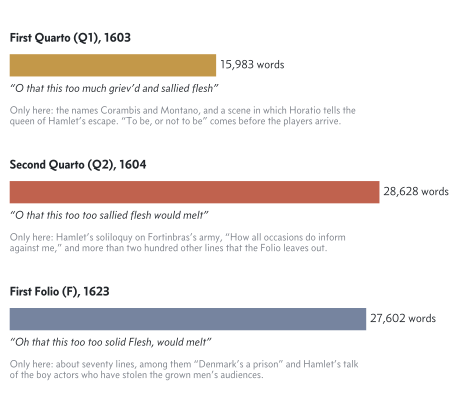
The play opens at midnight on the walls of Elsinore (el-sih-nor), the king of Denmark’s castle on the Sound, the narrow sea at the gateway to the Baltic (Figure 10.2). The first words are a question shouted in the dark: “Who’s there?” A sentry, Bernardo, has come to relieve another, who answers that it is “bitter cold, / And I am sick at heart.” The officer Marcellus arrives with Horatio (huh-ray-shee-oh), a scholar and the closest friend of Prince Hamlet, whose father, the king, has lately died. For two nights the sentries have seen a ghost, and Horatio has come to prove them wrong. Then it appears again, “in the same figure like the king that’s dead,” in full armor, and walks away without a word.

Marcellus asks why Denmark is casting cannon and building warships day and night, and Horatio explains. Years ago the dead king, also named Hamlet, killed King Fortinbras (for-tin-brahs) of Norway in single combat and won his lands. Now young Fortinbras, the dead man’s son, has gathered “a list of lawless resolutes,” a band of desperate men, to take them back. Horatio fears that the ghost foretells trouble for the kingdom, and he decides to tell young Hamlet what they have seen.
The next scene is a blaze of light: the court. Claudius (klaw-dee-us), the dead king’s brother, is now king of Denmark, and he has married Gertrude, the dead king’s widow and Hamlet’s mother (Figure 10.3). The crown of Denmark went by election, so the son did not inherit it as a matter of course; Hamlet later says that Claudius “Popp’d in between the election and my hopes.” Claudius is smooth and capable. In his first speech he speaks of marrying “With mirth in funeral and with dirge in marriage,” sends two ambassadors, Voltimand and Cornelius, to ask the old king of Norway to stop Fortinbras, and grants a courtier’s son leave to go back to France.
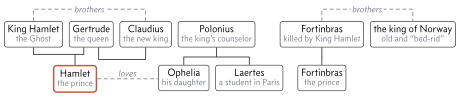
Only one person at court is still in mourning black. Claudius calls Hamlet “my cousin Hamlet, and my son,” and the prince mutters, “A little more than kin, and less than kind.” Kind meant both “natural” and “loving.” Claudius has made his nephew his stepson as well, so Hamlet is more than kin to him, but the tie is neither natural nor loving. His mother begs him to stop seeking his “noble father in the dust.” Hamlet wants to go back to his university at Wittenberg, in Saxony, where Martin Luther had begun the Protestant Reformation in 1517. The king and queen ask him to stay, and he agrees.
Then the court leaves, and Hamlet is alone. His first soliloquy (the Stage) begins with a wish to vanish: “O! that this too too solid flesh would melt,A soliloquy in this play begins "O that this too too solid flesh would melt." → Hamlet• / Thaw and resolve itself into a dew.” He wishes that his body would dissolve, or that God, “the Everlasting,” had not forbidden suicide. That is the Folio’s line. Q2 prints “sallied,” which many editors read as “sullied,” dirtied, and Q1 has “too much griev’d and sallied flesh.” All the doings of the world now seem to him “weary, stale, flat, and unprofitable,” a garden gone to weeds.
The cause pours out in broken sentences. His father was “So excellent a king; that was, to this, / Hyperion to a satyr”: the Titan father of the Sun, whose name poets gave to the sun itself, beside a goat-legged creature of the woods (Vol. 4, Classical Myth). His mother hung on her husband as if she could never have enough of him, and yet she married again within a month. Hamlet can hardly bear to think it, and he condemns his mother, Gertrude: “Frailty, thy name is woman!”This character is denounced with the phrase "Frailty, thy name is woman!" → Queen Gertrude• Frailty means moral weakness. She followed the coffin “Like Niobe, all tears,” like the mother in Greek myth whose grief turned her to a stone that still weeps, and then hurried “to incestuous sheets.” The Church of Shakespeare’s day counted marriage to a dead husband’s brother as incest, the same rule Henry VIII used to cast off his first queen, Catherine of Aragon, the widow of his elder brother (Vol. 12, Crown and Parliament). “But break, my heart,” Hamlet ends, “for I must hold my tongue!”
Horatio comes with his news. That night Hamlet keeps watch on the walls while the king feasts below, and the ghost appears. “Angels and ministers of grace defend us!” Hamlet cries. It beckons, and when his friends try to hold him back, he breaks free with a threat to make a ghost of anyone who stops him: “Unhand me, gentlemen” (Figure 10.4). Marcellus, left behind, says what everyone feels: “Something is rotten in the state of Denmark.”

Alone with his son, the ghost tells its story. It is “thy father’s spirit,” condemned for a time to walk by night and burn by day “Till the foul crimes done in my days of nature / Are burnt and purg’d away.” Catholics called such a place purgatory, and they believed that souls were cleansed there of their sins before they could enter heaven. Denmark has been told that a snake bit the king as he slept in his orchard. But “The serpent that did sting thy father’s life / Now wears his crown.” Claudius crept up on the sleeping king and poured a poison into his ears that curdled his blood. He died without a priest or the last rites of the Church, “Unhousel’d,” with all his sins still on his head. The ghost asks Hamlet to revenge “his foul and most unnatural murder,” and to leave his mother to heaven and her own conscience. As dawn comes it must go, and it bids him farewell in the French word adieu (uh-dyoo): “Adieu, adieu! Hamlet, remember me.”
Hamlet writes in his notebook that “one may smile, and smile, and be a villain.” He makes Horatio and Marcellus swear never to speak of the night, while the ghost’s voice cries “Swear” from under the stage. He warns them that he may choose “To put an antic disposition on”: to act strangely, as if mad. Then the weight of the task sinks in. “The time is out of joint; O cursed spite, / That ever I was born to set it right!”
Polonius and his children
Between the court and the ghost, Shakespeare sets a quieter scene in another family. Its head is Polonius (puh-loh-nee-us), an old courtier. Polonius is Claudius’s chief counselor,This character is an adviser to King Claudius. → Polonius• his adviser on everything, and the king has just told the old man’s son that the head is not more closely joined to the heart “Than is the throne of Denmark to thy father.” He is a man of many words and few doubts. He has two children, Laertes (lay-ur-teez) and Ophelia (oh-feel-yuh):This character is the father of Laertes and Ophelia. → Polonius•This character is the daughter of Polonius. → Ophelia•• his son Laertes, a student in Paris who came home for the coronation, and his daughter Ophelia, still a girl, who lives at home with him.
Laertes is about to sail back to France, and the scene opens with his goodbye to his sister. Ophelia’s brother, Laertes, warns herThis character is the sister of Laertes. → Ophelia•• about the prince. Hamlet’s love, he says, is “A violet in the youth of primy nature, / Forward, not permanent, sweet, not lasting.” And even if it is real, a prince cannot choose his own wife, because “his will is not his own.” Ophelia promises to remember the lesson, then teases him back: he must not be like a bad preacher who shows others “the steep and thorny way to heaven” while he walks “the primrose path of dalliance” himself.
Their father arrives and gives Laertes his blessing, with a list of rules for life abroad. Keep your thoughts to yourself; hold on to tested friends “with hoops of steel”; avoid quarrels, but once in one, make your enemy fear you; listen to everyone, but speak to few. Then comes advice on dress: “Costly thy habit as thy purse can buy,”This character advises spending a lot on fine but unfancy clothes, saying "costly thy habit as thy purse can buy." → Polonius• “But not express’d in fancy; rich, not gaudy; / For the apparel oft proclaims the man.” A habit is a suit of clothes. Polonius means: buy the best you can afford, but nothing showy. Then “Neither a borrower, nor a lender be,” and at the end the line people still quote as wisdom: “This above all: to thine own self be true.”
The moment Laertes is gone, Polonius questions his daughter. What has Hamlet said to her? Hamlet has courted Ophelia,This character loves Ophelia. → Hamlet•This character is Hamlet's love interest. → Ophelia•• she answers; he “hath, my lord, of late made many tenders / Of his affection to me,” and backed his speech “With almost all the holy vows of heaven.” Her father laughs at her for a “green girl,” green meaning inexperienced. Such vows, he says, are “springes to catch woodcocks,” snares for foolish birds. He orders her not to speak with the prince again. “I shall obey, my lord,” she says. She always does, and her obedience will help to destroy her.
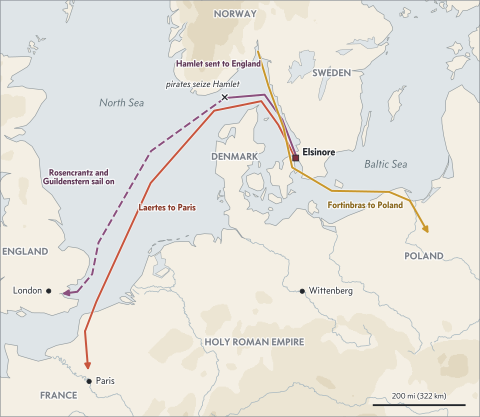
Some weeks later (the play never says exactly how many), Polonius is sending his servant Reynaldo (ray-nal-doh) to Paris with money and letters for Laertes (Figure 10.5). But Polonius also has Reynaldo spy on Laertes.This character has Reynaldo spy on his son. → Polonius• The servant is to find Danes in Paris who know his son and drop hints of small sins, “gaming,” “drinking, fencing, swearing, quarrelling,” to see whether anyone agrees. “Your bait of falsehood takes this carp of truth,” says Polonius, pleased with his cunning, and then loses his own thread: “what was I about to say? By the mass I was about to say something: where did I leave?” Many productions cut this scene to save time, though it shows that the comic old father is also sly.

In the First Quarto these two men have other names. Q1 calls Polonius “Corambis,”This character is named "Corambis" in the first quarto of Hamlet. → Polonius• and his servant is Montano. Nobody knows why the names changed, or which came first. One guess is that Corambis comes from the Latin proverb crambe repetita, “cabbage served again,” said of a stale story told once too often, which would suit the old man.
Ophelia rushes in, frightened. As she sat sewing in her room, Hamlet came to her with his jacket unbuttoned, his stockings fallen round his ankles, “Pale as his shirt,” with a look “As if he had been loosed out of hell.” He held her wrist, stared at her face for a long time, sighed, and went out with his head turned back toward her. Polonius is sure he understands: “This is the very ecstasy of love,” ecstasy meaning madness. Because Ophelia has refused Hamlet’s letters, “That hath made him mad.” He hurries off to tell the king.
Rosencrantz, Guildenstern, and the players
Claudius has already sent for help. Two young courtiers arrive at Elsinore, Rosencrantz (roh-zen-krants) and Guildenstern (gil-den-stern), Hamlet’s boyhood friends and fellow students,These characters are friends of Hamlet. → Rosencrantz and Guildenstern• “of so young days brought up with him.” Their names were real Danish noble names, meaning “rose wreath” and “golden star”; at the coronation of King Christian IV in 1596, one Danish nobleman in ten bore one or the other. The king asks them to spend time with the prince and find out what is troubling him. They are so alike that the king and queen thank them in mirror image: “Thanks, Rosencrantz and gentle Guildenstern,” says the king; “Thanks, Guildenstern and gentle Rosencrantz,” says the queen.
Polonius has news. Since “brevity is the soul of wit,” he announces, he will be brief, and then he is not. “More matter, with less art,” the queen tells him. He reads out a love letter Hamlet wrote to Ophelia, with its little poem, “Doubt thou the stars are fire,” and proposes a test. He will “loose” his daughter where Hamlet walks, while he and the king hide behind a hanging to watch.
Hamlet enters, reading a book, and Polonius tries to talk to him. The prince calls him a fishmonger, a fish seller, as if he did not know him, and talks about his daughter in riddles. Polonius asks, “What do you read, my lord?” and gets the reply, “Words, words, words.”When asked "What do you read my lord," this character replies "words, words, words." → Hamlet• The book, Hamlet says, is a satire that slanders old men: they have gray beards, wrinkled faces, and “a plentiful lack of wit.” Polonius misses the joke at his own expense but sees that there is sense in the nonsense: “Though this be madness, yet there is method in ’t.”
With his old friends Rosencrantz and Guildenstern, Hamlet is warmer, and sharper. He gets them to confess that they “were sent for,” and then tells them, in prose, what melancholy, a deep and causeless sadness, feels like. He has lost all his mirth. The earth seems to him “a sterile promontory,” the sky “a foul and pestilent congregation of vapours.” Then he turns to man, and he exclaims, “What a piece of work is a man!”This character proclaims "what a piece of work is a man!" to Rosencrantz and Guildenstern. → Hamlet• “How noble in reason! how infinite in faculty!” Man is “the beauty of the world! the paragon of animals!” Yet to Hamlet he is only a “quintessence of dust,” the purest essence of nothing. “Man delights not me,” he says.
The talk turns to a company of traveling actors on its way to the castle. In the Folio only, the friends explain that these grown men have lost their London audience to companies of boy actors who are now in fashion, a joke about Shakespeare’s own rivals in 1600. The players arrive, and Hamlet asks their leader for a speech he loves, from a play about the fall of Troy (Vol. 4, Classical Myth), in which the Trojan prince Aeneas (ih-nee-us) tells Dido (dy-doh), queen of Carthage, how his city fell. The speech tells how Pyrrhus (pir-us), the son of Achilles, found old King Priam inside the city and killed him. Then it turns to Priam’s wife, Hecuba (hek-yoo-buh), queen of Troy, running barefoot with a rag on her head where her crown had been, screaming as Pyrrhus hacks her husband’s body. Polonius had grumbled, “This is too long,” before Hecuba’s part began; now it is he who notices that the actor’s face has gone white and tears stand in his eyes. Hamlet asks the players to perform a play called The Murder of Gonzago (gon-zah-goh) the next night, with “some dozen or sixteen lines” that he will write and add.
Then he is alone again, and he turns on himself in a second soliloquy: “O! what a rogue and peasant slave am I.” The actor wept real tears for a story, “all for nothing! / For Hecuba!” “What’s Hecuba to him or he to Hecuba,”This character exclaims "what's Hecuba to him, or he to Hecuba?" after seeing an actor's moving performance. → Hamlet•• Hamlet asks, “That he should weep for her?” If the actor had Hamlet’s reason for grief, he would “drown the stage with tears.” Hamlet, who has the reason, has done nothing at all. He calls himself a coward, “pigeon-liver’d,” and then stops, ashamed that all he can do is “unpack my heart with words.” A new thought gives him a plan. Guilty people watching a play have been known to confess. And the ghost may not be his father at all: “the devil hath power / To assume a pleasing shape.” He will have the players act something like his father’s murder and watch his uncle’s face. “The play’s the thing / Wherein I’ll catch the conscience of the king.”
“To be, or not to be”
The next day Rosencrantz and Guildenstern report that they have learned nothing. Polonius gives Ophelia a prayer book to read, so that she seems to be at her devotions. He remarks that people often cover the devil himself with “pious action,” and Claudius, aside, flinches: “How smart a lash that speech doth give my conscience!” It is the audience’s first proof that the ghost told the truth. The two men hide, and Hamlet enters, not seeing Ophelia, and speaks the most famous lines in all of English drama.
“To be, or not to be”This play contains a soliloquy beginning "To be, or not to be." → Hamlet•••This character's "to be or not to be" soliloquy meditates on suicide. → Hamlet• begins a soliloquy that weighs whether to go on living at all. To be is to go on existing; not to be is to die, perhaps by one’s own hand. The second line sets out the choice. Is it nobler, Hamlet asks, “in the mind to suffer / The slings and arrows of outrageous fortune,”This character ponders "Whether 'tis nobler in the mind to suffer / The slings and arrows of outrageous fortune." → Hamlet• or “to take arms against a sea of troubles, / And by opposing end them?” A sling is a strap for hurling stones. Fortune, the goddess of luck, is pictured as an enemy archer, and the only way to beat her may be to take arms against an ocean, a fight that would drown the fighter.
Dying, he goes on, is only sleeping, and sleep would end “The heart-ache and the thousand natural shocks / That flesh is heir to.” That end, he says, is “a consummation / Devoutly to be wish’d.”This character describes death as "a consummation devoutly to be wished." → Hamlet• A consummation is a completion, a final ending, and to wish for something devoutly is to want it as earnestly as one prays. For a moment death looks like rest, the end of every pain. Then the comparison turns on him, because sleep has a danger of its own.
“To die, to sleep; / To sleep: perchance to dream.”This character muses "to die, to sleep; / To sleep, perchance to dream." → Hamlet• Perchance means perhaps, and dreams can be nightmares. “Ay, there’s the rub,” he says: in the game of bowls, a rub was a bump in the ground that turned the ball aside. No one knows “what dreams may come / When we have shuffled off this mortal coil,” the turmoil of mortal life. That fear alone keeps men alive through every misery Hamlet lists: the oppressor’s wrong, the proud man’s insults, “the law’s delay,” “The insolence of office.” Anyone could end them, he says, with “a bare bodkin,” a mere dagger.
What stops us is “the dread of something after death, / The undiscover’d country from whose bournThis character calls death "the undiscovered country." → Hamlet• / No traveller returns.” A bourn is a boundary. Death is a land no explorer has mapped, because nobody comes back to describe it. Yet a traveler has just returned from that country to speak to Hamlet himself. Readers have argued for centuries over whether Hamlet has forgotten his father’s ghost or has begun to doubt it.
The speech closes with its judgment on thought itself. “Thus conscience does make cowards of us all”:This character remarks that "conscience does make cowards of us all." → Hamlet• here conscience means both the fear of being judged after death and the habit of thinking too much. Resolution, which ought to be ruddy and healthy, is “sicklied o’er with the pale cast of thought,” and great plans “lose the name of action.” It is a description of Hamlet. The soliloquy never mentions his father, the ghost, or revenge.
In Q1 this whole scene comes earlier, before the players have even arrived. In Q2 and the Folio, Hamlet speaks it after he has already planned the play, which makes it a pause in his plotting.
Ophelia comes forward, as her father told her, and offers to give back Hamlet’s gifts. “Rich gifts wax poor when givers prove unkind,” she says. Hamlet turns on her with fierce questions. Is she honest, meaning chaste? Is she fair? “I did love you once,” he says; when she answers that he made her believe so, he takes it back: “You should not have believed me … I loved you not.” Ophelia answers, “I was the more deceived,”This character says the line "I was the more deceived." → Ophelia• meaning that she was all the more deceived, since she had believed him. She says it simply, without a word of reproach, and her quietness makes what he says next all the worse.
Hamlet’s answer is the cruelest line in the play. He tells her, “Get thee to a nunnery,”This character tells Ophelia to "get thee to a nunnery." → Hamlet••This character is told to "get thee to a nunnery." → Ophelia•• a convent of nuns, for why would she want to be “a breeder of sinners”? All men are “arrant knaves”; she should believe none of them. Suddenly he asks, “Where’s your father?” and she says that he is at home, though he is hiding a few steps away. Many actors play this as the moment Hamlet guesses he is being watched, though the text does not say so. He orders her to the nunnery four more times and storms out.
Ophelia is left alone with her grief: “O! what a noble mind is here o’erthrown.” She remembers him as “The courtier’s, soldier’s, scholar’s, eye, tongue, sword,” “The observ’d of all observers,” and now “quite, quite down.” The king is not fooled. “Love! his affections do not that way tend,” he says, and he decides to send Hamlet to England. Polonius has one more idea. After the play, let the queen talk to her son alone, and he will hide and listen.
The Mousetrap and the closet
Before the performance, Hamlet gives the players a lesson in acting. They should speak “trippingly on the tongue,” not shout or saw the air with their hands, and they must not “tear a passion to tatters” to impress the groundlings, the cheapest spectators, who stood in the yard around the stage (the Stage). The purpose of playing, he says, is “to hold, as ’twere, the mirror up to nature.” He asks Horatio to keep his eyes on the king.
The court files in. Hamlet lies down at Ophelia’s feet, tormenting her with jokes, and the play begins. A play performed by characters inside another play is a play-within-a-play, the device Shakespeare had already used for the workmen’s Pyramus and Thisbe (Chapter 5). This one begins with a dumb show, a scene in mime without words. A king and queen embrace; he lies down to sleep among flowers; a man creeps in, pours poison in the king’s ears, and wins the widow with gifts. Then the actors speak. The player queen swears that she will never marry again if her husband dies. Hamlet asks his mother how she likes the play. “The lady doth protest too much, methinks,” says Gertrude. To protest meant to vow, and Gertrude means only that the lady promises too much.

Claudius is uneasy. “What do you call the play?” he asks. “The Mouse-trap,” Hamlet answers: a trap, and the creature it is set for is sitting in the royal chair. Hamlet’s “Mouse-trap” is The Murder of Gonzago,This character refers to The Murder of Gonzago as the "mouse-trap." → Hamlet••This character puts on The Murder of Gonzago. → Hamlet••The Murder of Gonzago is a play-within-a-play in this play. → Hamlet•• the old play he asked the players to perform. He explains its plot cheerfully: it is “the image of a murder done in Vienna: Gonzago is the duke’s name; his wife, Baptista.” Q1 calls the players’ couple a duke and duchess, but Q2 and the Folio make them a king and queen everywhere except in this line. A new character enters, and Hamlet names him: “This is one Lucianus (loo-shee-ay-nus), nephew to the king.” Lucianus pours poison into the sleeping Gonzago’s ears in his garden (Figures 10.7 and 10.8). “You shall see anon,” Hamlet tells the court, “how the murderer gets the love of Gonzago’s wife.”
The king rises. “Give me some light: away!” The court scatters, crying “Lights, lights, lights!” Hamlet is wild with triumph. “I’ll take the ghost’s word for a thousand pound,” he tells Horatio. When Rosencrantz and Guildenstern come to fetch him to his mother, he hands Guildenstern a recorder, a kind of wooden flute, and asks him to play it. Guildenstern cannot. Then how, Hamlet asks, does he think he can play upon Hamlet?

On his way, Hamlet passes the king alone, kneeling. Claudius is trying to pray: “O! my offence is rank, it smells to heaven; / It hath the primal eldest curse upon ’t; / A brother’s murder.” The first murder in the Bible, Cain’s, was a brother’s (Vol. 5, In the Beginning). He cannot truly repent, he admits, while he keeps what the murder won him: “My crown, mine own ambition, and my queen.” Hamlet draws his sword: “Now might I do it pat, now he is praying.” Then he stops. To kill Claudius at prayer, he reasons, would send his soul to heaven, while his own father died unconfessed. He will wait until he can catch the king drunk, or gambling, or in some sin. He leaves, and the king rises: “My words fly up, my thoughts remain below: / Words without thoughts never to heaven go.” His prayer never rose, and Hamlet has spared him for nothing.
The queen’s closet was not a cupboard. It was her private room, where she could speak with her son alone. Polonius goes there first and hides behind the arras, a large tapestry hung on the wall (the town of Arras, now in northern France, was famous for weaving them). Hamlet comes in, and the two exchange lines like blows: “Hamlet, thou hast thy father much offended.” “Mother, you have my father much offended.” He forces her to sit and says he will show her a mirror of her own soul. She is terrified. “Thou wilt not murder me? Help, help, ho!” From behind the arras comes another cry for help.
Hamlet draws, crying “How now! a rat? Dead, for a ducat, dead!” as if betting a gold coin on the kill, and he stabs through the arras, killing Polonius.This character stabs Polonius through a curtain. → Hamlet••This character is stabbed while hiding behind an arras. → Polonius• “Is it the king?” he asks. It is not. He lifts the hanging, sees the old man, and gives him a cold farewell: “Thou wretched, rash, intruding fool, farewell! / I took thee for thy better.” Then, with the body at their feet, he turns on his mother. He shows her two portraits, “The counterfeit presentment of two brothers,” her first husband and her second, and asks how she could leave the one for the other. “These words like daggers enter in mine ears,” she cries.
The ghost appears again (the First Quarto’s stage direction puts him in his nightgown), come “to whet thy almost blunted purpose.” Gertrude sees nothing and is sure her son is mad. Hamlet begs her not to go to her husband’s bed, and she promises to keep his secret, that he is not truly mad but only “mad in craft,” by cunning. “I must be cruel only to be kind,” he says, and he drags the body out of the room.
What did Gertrude know? The play never says that she knew of the murder, and the ghost accuses only Claudius of it, though he grieves at her “falling-off.” The First Quarto is plainer: there the queen swears, “as I have a soul,” that she “never knew of this most horrid murder,” and she promises to help her son. Later critics judged her harshly, and A. C. Bradley (the Stage) found her “very dull and very shallow.” In 1957 Carolyn Heilbrun (hile-brun) answered them in “The Character of Hamlet’s Mother”,Carolyn Heilbrun wrote an essay attacking critics who deem this play's secondary character feminine "in the pejorative sense of the word." → Hamlet• an essay against critics who called Gertrude feminine in the belittling, or pejorative, sense of the word. She argued that the queen speaks briefly and shrewdly and that her fault lay in her passions, not in her mind. Heilbrun was a professor at Columbia University in New York who also wrote detective novels as Amanda Cross.
Fortinbras and Ophelia’s madness
The killing of Polonius gives Claudius his excuse. Hamlet, who has hidden the body, tells the king that Polonius is “At supper”: “Not where he eats, but where he is eaten,” by worms. Claudius sends him to England at once with Rosencrantz and Guildenstern. Alone, the king reveals what the sealed letters they carry say. England owes Denmark tribute after a recent war, and the letters command the English king to put Hamlet to death.
Fortinbras’s army is marching across Denmark, with the king’s leave, to attack Poland (Figure 10.5). In Q2 only, Hamlet meets it on his way to the ship. A captain tells him the prize: “a little patch of ground / That hath in it no profit but the name.” Thousands of men will die for it. The sight brings Hamlet’s last soliloquy: “How all occasions do inform against me, / And spur my dull revenge!” Here is a prince risking everything “Even for an egg-shell,” while Hamlet, with “a father kill’d, a mother stain’d,” does nothing. The Folio leaves out the meeting and the speech. In Q2 he ends, “My thoughts be bloody, or be nothing worth!”This character exclaims "my thoughts be bloody, or be nothing worth" after being inspired by a passing army. → Hamlet• It is a fierce resolution, and he makes it as he is being carried away from Denmark.
Back at Elsinore, Ophelia has gone mad. Her father is dead, killed by the man she loved, and he lies in a hurried grave. A gentleman describes her: she speaks of her father, beats her heart, and says things that “carry but half sense.” She comes before the queen singing scraps of ballads. One is about a pilgrim, “How should I your true love know / From another one?” One is about a dead man: “He is dead and gone, lady, / He is dead and gone.” Some of her songs are bawdy, which shocks the court more than her grief does. “When sorrows come,” says Claudius, “they come not single spies, / But in battalions.”
The next sorrow is Laertes. He has come home from France, raised a mob that shouts “Laertes shall be king!” and broken down the palace doors. “O thou vile king! / Give me my father.” Claudius meets him calmly. “There’s such divinity doth hedge a king,” he says, that treason cannot touch him, and he promises to show that he is innocent of Polonius’s death. Then a voice outside cries, “Let her come in.”

Ophelia enters again, and Laertes sees what has become of his sister. A scene that shows a character’s madness on the stage is called a mad scene, and this is the most famous in English. Ophelia sings of a man carried to his grave, “They bore him barefac’d on the bier,” and her song’s refrain is “Hey non nonny,”This character sings "hey non nonny" during a mad scene. → Ophelia•• the kind of meaningless sound old ballads used to fill out a tune. The First Folio prints it “Hey non nony, nony, hey nony.” Then she hands out flowers that she imagines, or has gathered, each to the person it suits, for in the lore of the time every flower had a meaning (Figure 10.9).
“There’s rosemary, that’s for remembrance,”This character distributes flowers, declaring "there’s rosemary, that’s for remembrance" and keeping rue for herself. → Ophelia•• she says, and pansies, “that’s for thoughts,” from the French pensées. She probably gives these to Laertes, who calls her speech “A document in madness,” a lesson taught by a madwoman. Then come fennel and columbines, which stood for flattery and ingratitude, perhaps for the king. Rue is the bitter herb of sorrow and regret, “herb of grace o’ Sundays.” “There’s rue for you; and here’s some for me,” she says, probably to the queen, keeping some for herself, and she tells her to wear it “with a difference.” She would give violets, the flowers of faithfulness, “but they withered all when my father died.” She sings once more of the dead old man with the white beard, “And will he not come again?” and leaves.
Then a sailor brings Horatio a letter from Hamlet. Two days out, a pirate ship gave chase. In the fight Hamlet boarded the pirates’ ship alone, and when the ships broke apart he was left as their prisoner. They treated him “like thieves of mercy,” thieves who showed mercy, and are bringing him home, while “Rosencrantz and Guildenstern hold their course for England.”
Meanwhile Claudius has told Laertes who killed his father. When a letter from Hamlet announces that he is back in Denmark, the king has an avenger ready. A Norman gentleman named Lamond once praised Laertes’s swordsmanship so highly that Hamlet, from envy, has longed ever since to fence with him, and the king will arrange a friendly fencing match between Laertes and Hamlet, with bets on it. In practice fencing, the swords were blunted with a button on the point. Laertes will choose one “unbated,” with a sharp point, and he adds a poison he bought from a traveling quack, so strong that one scratch will kill. As a second trap, Claudius will have a poisoned cup ready for Hamlet when he grows hot and thirsty.
The queen interrupts with the last sorrow of the act: “your sister’s drown’d, Laertes.” The speech that follows is the one Millais (mil-ay) painted in his Ophelia (Vol. 17, The Victorians). It sets the scene precisely: “There is a willow grows aslant a brook, / That shows his hoar leaves in the glassy stream.” Ophelia came there with garlands of wildflowers. She climbed the willow tree to hang themOphelia falls from a willow tree before suffering this manner of death in Hamlet. → drowning•• on its drooping branches, and “an envious sliver broke”; she fell “in the weeping brook.” For a while her clothes spread out and held her up “mermaid-like,” and she sang “snatches of old tunes,” unaware of her danger. But soon her garments, “heavy with their drink,” pulled her down “To muddy death,”This character's "muddy death" is revealed by Gertrude. → Ophelia•Ophelia dies by this manner of death in Shakespeare's Hamlet. → drowning•• and she drowned. The queen tells it beautifully, and nobody asks how she knows so much. “Too much of water hast thou, poor Ophelia,” says Laertes, “And therefore I forbid my tears.”
The graveyard and the duel
The last act opens in a churchyard, with two gravediggers, played as clowns, digging Ophelia’s grave. They argue in comic legal jargon over whether she should have Christian burial. In Shakespeare’s day the Church denied it to suicides, but the coroner’s inquest, “crowner’s quest law,” has allowed it. One digger grumbles that she has it only because she was a gentlewoman. The other sings as he digs and tosses up bones.
Hamlet and Horatio come by, Hamlet back from the sea. He asks the gravedigger how long he has worked there. Since the day old King Hamlet overcame Fortinbras, the man says, “the very day that young Hamlet was born; he that is mad, and sent into England.” Then he holds up a skull that has lain in the earth twenty-three years. It belonged, he says, to Yorick (yor-ik), the old king’s jester, the clown a court kept to make it laugh.
Hamlet takes it. “Alas! poor Yorick. I knew him, Horatio,”Hamlet says "Alas, poor Yorick! I knew him, Horatio" while holding one of these objects. → skulls• he says, holding the skull in his hand, and he remembers a man, not a bone (Figure 10.10). He had known the jester as a small boy at his father’s court, long before he had heard of ghosts or murders. A jest is a joke, and Yorick was “a fellow of infinite jest”This character calls Yorick "a fellow of infinite jest" while holding his skull. → Hamlet••While holding one of these objects, a character calls its owner "a fellow of infinite jest." → skulls• and “of most excellent fancy,” who carried the little prince on his back a thousand times. Hamlet remembers kissing his lips more often than he can count. The face that set the whole royal table roaring with laughter is now a grin without lips. “Where be your gibes now? your gambols?”While holding one of these objects, a character asks "Where be your gibes now? Your gambols." → skulls• Hamlet asks the skull: gibes are teasing remarks, and gambols are leaps and capers. He tells it to go to a lady’s room and say that however thick she paints her face, “to this favour she must come.” Even Alexander the Great, he tells Horatio, turned to dust that might now be stopping a beer barrel.

A funeral procession approaches with “maimed rites,” the shortened service of a doubtful death. Hamlet hides. Laertes rages at the priest: “A ministering angel shall my sister be, / When thou liest howling.” The queen scatters flowers on the coffin, “Sweets to the sweet: farewell!” She had hoped Ophelia would be “my Hamlet’s wife.” Laertes leaps into the grave to hold his sister once more. Hamlet springs out, “This is I, / Hamlet the Dane,” and leaps in after him, and the two men grapple until they are pulled apart. “I lov’d Ophelia,” Hamlet cries: “forty thousand brothers / Could not, with all their quantity of love, / Make up my sum.”
Back in the castle, Hamlet tells Horatio what happened at sea. Unable to sleep, he groped his way in the dark to the cabin of Rosencrantz and Guildenstern, took their packet, and broke the seal of the king’s letter. It ordered that Hamlet’s head be struck off at once, “No, not to stay the grinding of the axe.” He wrote a new commission in his best hand, asking the English king to put “the bearers” to sudden death, with no time even to confess. He sealed it with his father’s signet ring, a ring cut with a design for stamping wax seals, which matched the royal seal of Denmark, and put it back. It is an old trick, the Bellerophontic letter, a message that orders the death of the man who carries it (Vol. 4, Classical Myth), and Hamlet has turned it back on its senders. “There’s a divinity that shapes our ends, / Rough-hew them how we will,” Hamlet says: we may rough out our plans, but a higher power gives them their final shape. Of his two friends he says only, “They are not near my conscience.”
A foppish young courtier named Osric, overdressed and full of fancy words, brings the challenge. The king has bet six Barbary horses, fine horses from North Africa, against six French rapiers, the long, slender thrusting swords of the day, on Hamlet in a fencing match with Laertes. Horatio sees that Hamlet is uneasy and offers to call it off. Hamlet refuses: “there’s a special providence in the fall of a sparrow,” he says, recalling the Gospel saying that not a sparrow falls without God’s will. Death will come now or later: “the readiness is all.”
The court gathers. Hamlet asks Laertes’s pardon, and Laertes accepts his love while keeping his revenge. They take up their rapiers, and Laertes takes the sharp, poisoned one. Hamlet scores the first touch, “a very palpable hit,” as Osric judges it. The king drops a pearl into a cup of wine, drinks to Hamlet, and offers it to him, but Hamlet plays on and wins the second hit. Then the queen takes the cup to drink to her son. “Gertrude, do not drink,” says Claudius. “I will, my lord; I pray you, pardon me.” She drinks. “It is the poison’d cup!” the king says to himself. “It is too late.”
Laertes wounds Hamlet. In the scuffle that follows they drop their swords and each picks up the other’s, and Hamlet wounds Laertes with the poisoned point. The queen falls: “the drink, the drink; I am poison’d.” Laertes, dying, confesses everything, and he tells Hamlet that the poisoned rapier has killed him:This character is fatally wounded by a poisoned rapier during a fencing match. → Hamlet•• “Hamlet, thou art slain; / No medicine in the world can do thee good,” for “The treacherous instrument is in thy hand, / Unbated and envenom’d.” The plot was the king’s: “The king, the king’s to blame.”
At last Hamlet acts without thinking. “The point envenom’d too!” he cries, and Hamlet kills his uncle Claudius,This character kills his uncle Claudius. → Hamlet•• first wounding him with the poisoned sword and then forcing the poisoned wine down his throat: “Here, thou incestuous, murderous, damned Dane, / Drink off this potion;—is thy union here? / Follow my mother.” A union was a fine pearl, and the word also means a marriage. Laertes asks Hamlet’s forgiveness and dies.
Hamlet has only a few minutes. Horatio, “more an antique Roman than a Dane,” reaches for the poisoned cup to die with his friend, as Brutus killed himself at Philippi rather than outlive his cause (Chapter 9). Hamlet wrestles it from him. Horatio must live, “To tell my story.” A march is heard: Fortinbras is returning in triumph from Poland. Hamlet gives him his “dying voice” for the crown of Denmark. “The rest is silence,” he says, and dies. “Now cracks a noble heart,” says Horatio. “Good-night, sweet prince, / And flights of angels sing thee to thy rest!”
Fortinbras marches in with ambassadors from England, who find the hall full of royal corpses. They have come to report that the English king obeyed the letter: “Rosencrantz and Guildenstern are dead.” Horatio promises to tell the world “How these things came about.” Fortinbras, who wanted only his father’s lands, finds himself king of Denmark. He orders four captains to “Bear Hamlet, like a soldier, to the stage,” and the play ends with the sound of cannon.
The play has never stopped being argued over. In 1919 the poet T. S. Eliot called it an artistic failure in an essay, “Hamlet and His Problems” (Vol. 21, Trenches and Modernists). In 1966 the playwright Tom Stoppard took the ambassador’s line for the title of a comedy that follows Hamlet’s two school friends through the play, Rosencrantz and Guildenstern Are Dead (Vol. 24, After Empire). The Russian poet Boris Pasternak gave the doctor-poet of his novel Doctor Zhivago (zhih-vah-goh) a poem called “Hamlet,” and the East German playwright Heiner Müller (mew-ler) wrote Hamletmachine (Vol. 26, Behind the Curtain).
What to remember
- Shakespeare wrote Hamlet about 1600–1601 for the Lord Chamberlain’s Men. It came from Saxo’s Amleth by way of Belleforest and a lost English revenge play, the kind Kyd’s Spanish Tragedy made popular.
- The play survives in three texts: the short First Quarto (1603), the full Second Quarto (1604), and the First Folio (1623). Q1 calls Polonius Corambis and puts “To be, or not to be” early; “How all occasions do inform against me” is in Q2 only.
- Claudius murdered his brother, King Hamlet, by pouring poison in his ear, then took the crown and married the widow, Gertrude. The ghost tells Prince Hamlet to take revenge.
- Polonius, the king’s counselor, is the father of Laertes and Ophelia. He gives Laertes his rules for life, sends Reynaldo to spy on him, forbids Ophelia to see Hamlet, and is stabbed through the arras in the queen’s closet.
- Hamlet’s great soliloquies are “O! that this too too solid flesh would melt,” “O! what a rogue and peasant slave am I” (with Hecuba), “To be, or not to be,” and “How all occasions do inform against me.”
- Hamlet tests the king with The Murder of Gonzago, which he calls “The Mouse-trap.” Claudius stops it when Lucianus, the king’s nephew in the play, poisons the sleeping king.
- Ophelia, told to “get thee to a nunnery,” goes mad after her father’s death, sings “Hey non nonny,” gives out rosemary and rue, and drowns when a willow branch breaks.
- In the graveyard Hamlet holds the skull of Yorick, the king’s jester, “a fellow of infinite jest.”
- Hamlet rewrites the king’s letter so that Rosencrantz and Guildenstern are killed in England. In the duel, Laertes’s poisoned rapier kills Hamlet, the poisoned cup kills Gertrude, and Hamlet kills Claudius. Fortinbras takes the crown.
Chapter 11 · 40 clues
Othello and the Problem Plays
On November 1, 1604, the feast of All Saints, the King’s Men acted a tragedy before King James at his palace of Whitehall. The clerk who kept the accounts of the court’s entertainments wrote its name down as “The Moor of Venis.” It begins in the dark, in a street in Venice, where two men stand under a senator’s window. One of them, a soldier named Iago, cups his hands and bellows that there are thieves in the house.
Nothing has been stolen. The senator’s daughter has slipped out that night to marry the republic’s best general, an African whom the play calls “the Moor.” Iago knows it, and he has decided to make the marriage his weapon. Before the play is over the general will have killed his wife and then himself, two more people will be dead, and the man who arranged it all will refuse to say why.
Venice and the Senate
In 1604 William Shakespeare was forty, an actor and a sharer in the King’s Men, the company that King James had taken under his own name the year before (the Stage). In about 1603 or 1604, two or three years after Hamlet (Chapter 10), Shakespeare wrote Othello,This author wrote Othello. → William Shakespeare••• though a few scholars date it as early as 1601 or 1602. It is the most tightly built of his tragedies, with one marriage, one villain, and almost no subplot. It was not printed in his lifetime. The bookseller Thomas Walkley published it as a quarto in 1622, and a year later it appeared in the First Folio (Chapter 3). The two texts differ. The Folio has about 160 lines that the quarto lacks, among them the willow song of the heroine, Desdemona, while the quarto has more than sixty oaths, such as “Zounds” (“God’s wounds”), that the Folio leaves out. An act of Parliament of 1606 had forbidden actors to take God’s name in vain on the stage, and the Folio may have been set from a copy cleaned to obey it. This chapter quotes the Folio, in modern spelling, from the transcription of its 1910 facsimile on Wikisource.

The story came from Italy. Giovanni Battista Giraldi, who signed himself Cinthio, was a professor at the university of Ferrara, in northern Italy, and a writer of tragedies. In 1565 he published the Hecatommithi, the “hundred stories” (the Stage), and the seventh tale of its third group tells of a captain in Venice whom he calls only “the Moor,” of the captain’s wife, and of an ensign who destroys them. No English translation of the tale existed in Shakespeare’s day, so he must have read it in Italian or in French. In John Edward Taylor’s English version of 1855 the ensign is “a man of handsome figure, but of the most depraved nature in the world.” Only the wife has a name, Disdemona; the rest are “the Moor,” “the Ensign,” and “the Captain.” Shakespeare kept the bones of the plot: the trusted villain, the stolen handkerchief, the jealous husband who kills his wife. He named everyone else, squeezed months of story into a few days, and wrote a new ending. In Cinthio the Ensign beats Disdemona to death with a stocking full of sand, and the two men pull down the ceiling to make it look like an accident.
The play opens in a real republic (Vol. 10, Rebirth). Venice was ruled by its doge, a prince elected for life, whom the English called the Duke, and by its Senate, the council of noblemen that made its laws and ran its wars. The Venetians did not trust their own nobles with an army, for fear that one of them would seize the state, so they hired foreign soldiers to command it. The Venetian statesman Gasparo Contarini explained the custom in a book on his city’s government, translated into English in 1599, and Shakespeare seems to have read it. That is how a stranger could be the city’s general. Venice also ruled an empire at sea, a chain of islands and ports stretching east. The farthest was Cyprus, a large island at the eastern end of the Mediterranean (see the map in Chapter 4). Venice held it from 1489 until the Ottoman Turks took it in 1570 and 1571 (Vol. 10, Rebirth), so a play about defending Cyprus from a Turkish fleet is set at least a generation before Shakespeare wrote it.

The play’s word for its hero, “the Moor,” was the English name for the Muslim peoples of North Africa. It came from the Latin Mauri, the people of ancient Mauretania in northwest Africa, and the Elizabethans also used it loosely for any African. The coast of North Africa was called Barbary, and in 1600 Londoners had stared at an embassy from the sultan of Morocco; its leader stayed half a year and was painted as “ambassador of the King of Barbary” (Figure 11.2). Othello is not a Muslim. He has been baptized, and he fights the Turks as a Christian general. He calls himself black. He tells Iago that he is descended “from men of royal siege,” that is, from kings, and he tells the Senate that he was once taken prisoner in war “and sold to slavery.” The play never says where he was born. He is “the Moor of Venice,”This character is the "Moor of Venice." → Othello•••Othello is the Moor of this city. → Venice• the title the Folio gives him, a man the city needs and does not quite accept.
Figure 11.3 sets out the people of the play. The Folio prints a list of them at the end, and it is blunt. It calls Cassio “an honourable lieutenant,” Roderigo “a gulled gentleman,” meaning a fool who has been cheated, and Iago simply “a villain.”This character is the villain of Shakespeare's Othello. → Iago•• He is the villain of the play and its busiest speaker. Only Hamlet and Richard III have more lines than Iago in all of Shakespeare, and Iago has more than Othello.

The play opens with Iago talking to Roderigo, a rich young Venetian whom Desdemona’s father has turned away as a suitor. Roderigo has been paying Iago to help him win her, and Iago has kept the money. Iago has a grievance of his own. Every company in an army of the time had a chain of officers: under the commander came his lieutenant, his second, and under the lieutenant the ensign, or “ancient,” who carried the company’s flag. Iago has fought beside Othello “at Rhodes, at Cyprus,” and he expected to be made lieutenant. Instead Othello chose Michael Cassio, a young man from Florence whom Iago sneers at as “a great arithmetician,” a man of books and numbers “that never set a squadron in the field.” Since then Iago has burned with jealousy of Cassio,This character is motivated by jealousy of Cassio. → Iago•• who holds the place Iago thinks his own, and he stays on as “his Moorship’s ancient,” a sneer built on “his worship,” only to use the post for his own ends.
He explains himself to Roderigo with frightening frankness. Some servants, he says, are honest drudges who wear out their lives for their masters, and others only seem to serve while they serve themselves, and he is one of these: “In following him, I follow but myself.” His outward acts will never show his real heart. If they did, he would “wear my heart upon my sleeve,”This character utters "I will wear my heart upon my sleeve / for daws to peck at." → Iago•• pinned outside where anyone could see it, “for daws to peck at.” A daw is a jackdaw, a small crow that steals bright things, and the phrase is still used today for a person who shows every feeling. Then comes a sentence that sums up the play: “I am not what I am.”This Shakespeare character declares "I am not what I am." → Iago•• In the Book of Exodus, in the King James Version, God names himself to Moses as “I am that I am” (Vol. 5, In the Beginning). Iago seems to turn those words inside out, and he means that his whole self is a mask, with nothing behind it that anyone will ever see.

Then the two men rouse the house of Brabantio (bruh-ban-shee-oh), a senator, and the father of Desdemona.This character's father is named Brabantio. → Desdemona•• Iago shouts from the shadows, where he cannot be seen, and he chooses his words to shock an old man out of bed (Figure 11.4). “Even now, now, very now, an old black ram / Is tupping your white ewe,” he cries; to tup is what a ram does to a ewe in the breeding season. Desdemona is the “white ewe”This character is compared to a "white ewe." → Desdemona• of Iago’s picture, and Othello the ram. When Brabantio threatens them, Iago tries another animal. Brabantio, he says, will have his daughter “covered with a Barbary horse,” a stallion from North Africa, and grandsons who neigh. Brabantio demands to know what “profane wretch” is speaking. Iago answers with the crudest picture of all: “your daughter and the Moor are making the beast with two backs,”In this play, Brabantio is told that his daughter is "making the beast with two backs" with the title character. → Othello•••This character tells Brabantio that his daughter and a Moor are "making the beast with two backs." → Iago•• a picture of a couple in bed. Brabantio calls for lights and goes to find her. Iago slips away first, since it would not do for Othello’s own officer to be seen among his accusers.
Othello meets the crowd of torches in the street, and at once he is nothing like the brute of Iago’s words. Iago tells him to hide; he refuses. “My parts, my title, and my perfect soul / Shall manifest me rightly,” he says, and when Brabantio’s men draw on him he stops the fight with one calm line: “Keep up your bright swords, for the dew will rust them.” That night Desdemona had become Othello’s wifeThis character is Othello's wife. → Desdemona•• in a secret wedding. Her father cannot believe it. A girl who had refused “the wealthy curled darling of our nation,” he says, meaning the rich young men of Venice, must have been bewitched with charms and drugs. He arrests Othello, only to learn that the Duke has already sent for him. A Turkish fleet is at sea.
In the council chamber the Duke and the senators sit late into the night over the news. Their letters disagree, one saying 107 galleys, or oared warships, another 140, another 200, but all report a Turkish fleet “bearing up to Cyprus.” A sailor brings word that it is steering for Rhodes instead. A senator sees through the trick: Cyprus matters far more to the Turks than Rhodes, so the turn must be “a pageant / To keep us in false gaze,” a show to make Venice look the wrong way. He is right. A messenger reports that the fleet has met thirty more ships at Rhodes and turned back toward Cyprus. “Valiant Othello,” says the Duke, “we must straight employ you / Against the general enemy Ottoman.”
Brabantio repeats his charge, and Othello answers it. “Rude am I in my speech,” he begins, meaning that he is a plain soldier with no gift for words, and then he speaks some of the finest verse in the play. Brabantio, he says, often invited him and asked for the story of his life: battles and sieges, “hair-breadth ’scapes,” his capture and sale into slavery, his travels among cannibals and “men whose heads / Grew beneath their shoulders.” Desdemona would hurry through the housework to come back and listen. “She loved me for the dangers I had passed,” he says, “And I loved her that she did pity them. / This only is the witchcraft I have used.” The Duke admits, “I think this tale would win my daughter too.”
Desdemona is sent for. In front of the Senate she says that she sees “a divided duty”: she owes her father her life and her upbringing, but she owes her husband more, just as her mother put Brabantio before her own father. The old man gives her up with a warning. “Look to her, Moor, if thou hast eyes to see: / She has deceived her father, and may thee.” “My life upon her faith!” says Othello. The Senate orders him to Cyprus that very night, and Desdemona begs to go too. He leaves her in the care of “honest Iago” and Iago’s wife, Emilia, to follow him by the next ship. The whole first act is set in Venice;The opening act of Shakespeare’s Othello is set in this city. → Venice• the other four acts all take place on Cyprus, where Othello is far from the Senate and alone with his officers.
Roderigo is left in despair and says he will drown himself. Iago laughs at him. He has looked on the world, he says, “for four times seven years,” which makes him twenty-eight, and has never met a man who knew how to love himself. Love is only lust, and lust can be governed. “Our bodies are our gardens,”A character compares the body to a garden and the will to a gardener in this play. → Othello• Iago tells him, “to the which our wills are gardeners,” so that whether we plant nettles or lettuce, the choice lies in our will. It is a wise thought in the mouth of the worst man in the play, and he uses it only to keep Roderigo’s money coming. “Put money in thy purse,” he says, over and over in one speech: sell your land, follow the army to Cyprus, and Desdemona will soon tire of her husband.
Left alone, Iago speaks his first soliloquy. “Thus do I ever make my fool my purse,” he begins. “I hate the Moor,” he says. He has heard a rumor that Othello has slept with his wife; he does not know if it is true, but he will act as if it were. He will take Cassio’s place and tell Othello that Cassio is too familiar with Desdemona, for “the Moor is of a free and open nature, / That thinks men honest that but seem to be so.” The poet Samuel Taylor Coleridge (1772–1834), who lectured on Shakespeare and wrote notes in the margins of his plays, found these reasons too many and too thin. Iago, he thought, was trying one excuse after another, hunting for a reason to do what he already wanted to do. Coleridge called the speech “the motive-hunting of a motiveless malignity,”Coleridge called this character's soliloquy "the motive-hunting of a motiveless malignity." → Iago• a malignity being a wish to do harm. Iago ends the act with a rhyme: “Hell and night / Must bring this monstrous birth to the world’s light.”
Cassio’s fall and the handkerchief
A storm settles the war. On a headland of Cyprus, Montano, the island’s governor, and his men watch waves that seem to “pelt the clouds,” and a gentleman arrives with news that the tempest has scattered and wrecked the Turkish fleet. “Our wars are done,” he cries. Cassio lands first, then the ship with Desdemona, Iago, and Emilia, and at last Othello, who greets his wife as “my fair warrior.” His joy is so complete that it frightens him: “If it were now to die, / ’Twere now to be most happy.” Everyone in the audience knows that it would have been. Iago watches Cassio take Desdemona by the hand, as a courteous man would, and decides to use even that.
That night Othello proclaims a feast for the Turks’ ruin and for his own wedding, and he leaves Cassio to command the watch. Cassio confesses that he has “very poor and unhappy brains for drinking,” so Iago presses one cup on him, then another, and sings a drinking song he claims to have learned in England, “where indeed they are most potent in potting.” Cassio, very drunk, insists that he is sober: “this is my right hand, and this is my left.” Then Roderigo, set on by Iago, insults him. Cassio chases him with his sword, and when Montano tries to hold him back, Cassio wounds him. Iago sends Roderigo off to raise the alarm, and soon the town bell is ringing. Cassio, made drunk and drawn into a brawl,In this play, Cassio gives his reputation speech after being coerced into a drunken fight. → Othello•• stands speechless when Othello arrives, and Iago tells the story with a show of being sorry to harm his friend. “Cassio, I love thee,” says Othello, “But never more be officer of mine.”
Left with Iago, Cassio grieves not for his rank but for his name. “Reputation, reputation, reputation! O, I have lost my reputation! I have lost the immortal part of myself,In this play, Cassio laments losing reputation as the "immortal part" of himself, leaving the rest "bestial." → Othello•• and what remains is bestial.” His good name, he means, was the part of him that would outlive him, and without it he is only an animal. Iago, who will soon preach the opposite to Othello, tells him that reputation is “an idle and most false imposition; oft got without merit, and lost without deserving.” Cassio curses drink: “O thou invisible spirit of wine, if thou hast no name to be known by, let us call thee devil!” Iago gives him what sounds like good advice. Desdemona has her husband’s heart, so let Cassio ask her to plead for him. Alone, Iago asks the audience who could call that a villain’s counsel, and then explains: the more she pleads for Cassio, the more Othello will suspect her. “So will I turn her virtue into pitch.”
The next day, in the long scene at the center of the play, Desdemona promises Cassio to plead for him “to the last article.” Othello and Iago come in as Cassio slips away, and Iago says softly, “Ha! I like not that.” Desdemona pleads, and Othello gives way at once: “I will deny thee nothing.” When she has gone he says, “Perdition catch my soul / But I do love thee! and when I love thee not, / Chaos is come again.” May he be damned, he means, if he does not love her, and if he ever stops, the world will fall apart. Then Iago begins. He asks small questions, echoes Othello’s words (“Honest, my lord?”), hints, and refuses to say more. “Thou echo’st me,” Othello cries, “As if there were some monster in thy thought / Too hideous to be shown.”
Pressed to speak, Iago talks about the worth of a good name. “Good name in man and woman, dear my lord, / Is the immediate jewel of their souls,” he says. “Who steals my purse steals trash”;A character says “who steals my purse steals trash” in this play. → Othello• money is “something, nothing,” passed from hand to hand, but he who “filches from me my good name / Robs me of that which not enriches him, / And makes me poor indeed.” Every word is a lie in his mouth. He has been stealing Roderigo’s purse since the first scene, and he is stealing Desdemona’s good name as he speaks.
Then, warning Othello against jealousy, he plants it. “O, beware, my lord, of jealousy,” he says; “It is the green-ey’d monsterThis character refers to jealousy as "the green-ey'd monster." → Iago••• which doth mock / The meat it feeds on.” Jealousy, he means, toys with the very thing it devours, as a cat plays with a mouse; green was the color of envy and of sickness, and the phrase “green-eyed monster” entered the language from this line. Othello answers that he will “see before I doubt; when I doubt, prove.” So Iago turns to proof of a kind. Venetian wives, he says, hide their sins from their husbands, and he reminds Othello, “She did deceive her father, marrying you.” Brabantio’s parting warning has come back to work against her.
Alone, Othello thinks aloud: “Haply, for I am black / And have not those soft parts of conversation / That chamberers have, or for I am declined / Into the vale of years—yet that’s not much— / She’s gone.” Haply means “perhaps.” He is a foreigner, a soldier with no courtly graces, and no longer young, and Iago has made each of these seem a reason for her to stray. Desdemona comes to call him to dinner. He says his head aches, and she offers to bind it with her handkerchief, a small square of silk embroidered with strawberries. “Your napkin is too little,” he says, pushing it away, and it falls. When they have gone, Iago’s wife picks it up. Emilia is now Desdemona’s waiting woman. “This was her first remembrance from the Moor,” she says. Iago had begged her to steal it:This character asks his wife to steal a strawberry-embroidered handkerchief. → Iago•• “My wayward husband hath a hundred times / Wooed me to steal it.” She means to have the embroidery copied for him. Iago comes in, snatches it, and sends her away without telling her why he wants it.
He tells the audience instead. He will drop Desdemona’s handkerchief in Cassio’s lodgingThis character's handkerchief is planted in Cassio's lodgings by Iago to frame him. → Desdemona• and let Cassio find it there, so that it will seem she gave it to him. “Trifles light as air / Are to the jealous confirmations strong / As proofs of holy writ,” as sure as the words of the Bible. He has already seen his poison work. When Othello returns, his peace is gone, and he says farewell to everything that made his life, in the speech in the box below. The composer Edward Elgar took the title of his Pomp and Circumstance marches from one of its lines (Vol. 17, The Victorians).
Then he turns on Iago and seizes him by the throat. “Villain, be sure thou prove my love a whore,” he says; “give me the ocular proof,” proof he can see with his own eyes. Iago cannot give him that, so he gives him stories. He says that one night he shared a bed with Cassio and heard him murmur Desdemona’s name in his sleep. Then he asks whether Othello has ever seen a handkerchief “spotted with strawberries” in his wife’s hand. “I gave her such a one; ’twas my first gift,” Othello says. Iago says he saw Cassio wipe his beard with it that very day. That is enough. Othello kneels and vows revenge by “yond marble heaven,” and Iago kneels beside him and vows to serve it. Othello orders Cassio dead within three days and gives Iago his reward: “Now art thou my lieutenant.” “I am your own for ever,” says Iago. He has the place he wanted.
Othello goes straight to Desdemona and asks for the handkerchief. She does not have it, and he tells her what it is. An Egyptian gave it to his mother,This character's mother gave him a magic cloth received from an Egyptian sorceress. → Othello• a “charmer,” or enchantress, who “could almost read / The thoughts of people.” While his mother kept it, the charmer said, it would make her lovely and keep her husband’s love; if she lost it or gave it away, he would loathe her. Dying, she gave it to Othello to give to his wife. “There’s magic in the web of it,” he says. A two-hundred-year-old sibyl, a prophetess, sewed it, the silk came from sacred worms, and it was dyed in “mummy,” a medicine usually made from embalmed bodies, though this was made from maidens’ hearts. Frightened, Desdemona says it is not lost and tries to talk of Cassio, and Othello can only repeat “The handkerchief!” before he storms out. Emilia, who knows exactly where it went, says nothing. In the last scene Othello will call it “an antique token / My father gave my mother,” so the play leaves us two histories of it.

Cassio finds the handkerchief in his room. He likes the embroidery and gives it to Bianca, a courtesan (a woman whom men keep and pay for her company) who loves him, asking her to copy the pattern before its owner asks for it. Meanwhile Iago works Othello into such a rage that he falls down in a fit. When Othello comes to, Iago hides him where he can watch Cassio’s face and gets Cassio to talk and laugh about Bianca, and the hidden husband, hearing only the laughter, believes they are joking about Desdemona. Then Bianca herself sweeps in, furious, sure that the handkerchief is a gift from some other woman. Othello, hidden, watches Bianca fling it backThis character sees Bianca return a handkerchief. → Othello•• at Cassio: “There, give it your hobby-horse,” she says, meaning his other mistress. “By heaven,” Othello whispers, “that should be my handkerchief!” Figure 11.5 follows its whole journey.
Even now he cannot stop loving her. “But yet the pity of it, Iago! O Iago, the pity of it, Iago!” Iago steers him toward murder: “Do it not with poison; strangle her in her bed, even the bed she hath contaminated.” “Good, good,” says Othello; “the justice of it pleases.” Then a trumpet sounds. Lodovico (loh-doh-vee-koh), Desdemona’s kinsman, has come from Venice with letters recalling Othello home and making Cassio governor in his place. When Desdemona says she is glad of it, Othello strikes her in front of everyone. Lodovico can hardly believe his eyes: “Is this the noble Moor whom our full Senate / Call all in all sufficient?”
The willow song and the bed
Othello questions Emilia, who swears her mistress is honest, and then treats his wife to her face as if she were a woman for sale in a brothel. Desdemona does not even understand what she is accused of. Emilia, guessing at the truth without guessing its author, says in front of her husband that she will be hanged “if some eternal villain, / Some busy and insinuating rogue,” has not invented the slander to get himself some office. “Fie, there is no such man,” says Iago; “it is impossible.”


That night Othello orders her to bed and tells her to send Emilia away. While Emilia unpins her gown, Desdemona remembers something from her childhood. “My mother had a maid called Barbary. / She was in love, and he she loved proved mad, / And did forsake her. She had a song of ‘willow’; / An old thing ’twas, but it expressed her fortune, / And she died singing it.” The Folio spells the maid’s name “Barbarie,” the same word as the coast of North Africa, and some later editions and stagings call her Barbara. The willow was the tree of lovers who had been abandoned, and to “wear the willow” meant to mourn a lost love. Tonight the song will not leave Desdemona’s head, and she sings the willow song Barbary sangThis character sings the "willow song," which describes a poor soul who "sat sighing by a sycamore tree." → Desdemona•This character's mother had a maid named Barbara who taught her a song. → Desdemona•• while Emilia readies her for bed (Figure 11.6). The song was an old ballad before Shakespeare used it. The quarto of 1622 has neither the song nor the talk about Barbary, so the whole passage comes from the Folio.
The Folio prints “singing” in the first line, but most editions print “sat sighing by a sycamore tree,” and that is how the line is usually quoted. Either way the song tells Desdemona’s own story before it happens. She breaks off to ask Emilia whether there really are women who betray their husbands. “Wouldst thou do such a deed for all the world?” Emilia, practical and tough, answers that the world is “a huge thing,” and that if wives go wrong, husbands are usually to blame. Desdemona cannot believe that any woman would.
In a dark street Roderigo, pushed on by Iago, ambushes Cassio. Cassio’s coat stops the thrust, he wounds Roderigo, and in the confusion Cassio is wounded in the leg. Iago comes running with a light and stabs Roderigo to silence him. “O damned Iago!” Roderigo cries, “O inhuman dog!” Cassio lives.
Othello comes into the bedroom with a candle while Desdemona sleeps. “It is the cause, it is the cause, my soul,” he says, refusing to name her supposed crime even to the stars. He will not shed her blood or scar her skin. “Put out the light, and then put out the light”: a candle can be lit again, but not a life. He kisses her, and she wakes. “Have you prayed tonight, Desdemon?” he asks, using his pet name for her, because he would not “kill thy soul” before she has confessed. He accuses her of giving Cassio the handkerchief; she begs him to send for Cassio and ask; he says that Iago has already stopped Cassio’s mouth. She weeps for Cassio, and that seals it. “Kill me tomorrow; let me live tonight!” she pleads, then “But half an hour!” and “But while I say one prayer!” “It is too late,” he says, and Othello smothers his wife in her bed,This character is smothered with a pillow by her husband. → Desdemona••This character smothers Desdemona with a pillow. → Othello••• the bed Iago told him to use. The Folio’s stage direction says only “Smothers her,” and actors have long done it with a pillow.
Emilia knocks with news of the fight in the street. As she comes in, Desdemona revives for a moment. “A guiltless death I die,” she says, and when Emilia asks who has done it, she protects her husband with her last breath: “Nobody; I myself. Farewell. / Commend me to my kind lord.” Othello will not hide behind her lie. “’Twas I that killed her,” he says, and tells Emilia that her own husband proved Desdemona false. “My husband?” Emilia asks, three times over. Then she turns on Othello—“O gull! O dolt! / As ignorant as dirt!”—and shouts murder until Montano, Iago, and Gratiano, Desdemona’s uncle, who had come with Lodovico, come running. When Othello mentions the handkerchief, she understands everything, and she tells them: she found it, and gave it to her husband, who had begged her to steal it. Iago orders her home, calls her a liar, and draws his sword. Iago stabs his own wife, Emilia,This character murders his wife after she reveals his schemes. → Iago•This character is the husband of Emilia. → Iago•• for telling the truth, and runs from the room. Dying, she remembers the song. Swans were believed to sing only once, just before death, and she says, “I will play the swan, / And die in music. Willow, willow, willow.” Her last words defend her mistress: “Moor, she was chaste; she loved thee, cruel Moor.”
Iago is caught and brought back. Othello wounds him, and asks Cassio’s pardon, and then asks why Iago has destroyed him. Iago’s answer is the last thing he says in the play: “Demand me nothing; what you know, you know: / From this time forth I never will speak word.” Letters found on Roderigo’s body expose the rest. Lodovico tells Othello that he is under arrest and that Cassio now rules Cyprus. Othello stops them. “Soft you; a word or two before you go. / I have done the state some service, and they know’t.” When they write home, he asks, let them “speak of me as I am; nothing extenuate, / Nor set down aught in malice,” neither softening the story nor blackening it. Then they must speak “of one that loved not wisely, but too well,”This character says he "loved not wisely but too well." → Othello•• of one “not easily jealous, but being wrought, / Perplexed in the extreme.” His hand, he says, “like the base Judean, threw a pearl away / Richer than all his tribe,” like a fool who throws away a jewel without knowing its worth. (The quarto reads “Indian” for the Folio’s “Judean.”)
His last lines turn into a story. Aleppo, in Syria, was a great Ottoman trading city where Venetian merchants did business. Once there, Othello says, he saw “a malignant and a turbaned Turk” beat a Venetian and insult the republic. Turks, as Muslims, were circumcised, and Othello’s words for that enemy are a soldier’s insult: “I took by th’ throat the circumcised dog,”This character's dying lines include "I took by the throat the circumcised dog and smote him thus." → Othello• he says, “And smote him, thus,” and on “thus” he stabs himself. He has made himself, at the end, both Venice’s loyal soldier and the enemy of Venice whom that soldier kills. Falling on the bed, he says, “I kissed thee ere I killed thee: no way but this, / Killing myself, to die upon a kiss.” Lodovico calls Iago a “Spartan dog,” after the fierce hunting hounds of ancient Sparta, and leaves him to the new governor for torture.

A play this strong has had a long life on the stage. When the theaters reopened after the Civil War, it was as Desdemona, on December 8, 1660, that the first known professional actress appeared on the English stage (the Stage). In 1825 the New York-born actor Ira Aldridge (1807–1867), who had left America because a black actor had little chance there, began playing Othello in London. The great Shakespearean actor Edmund Kean praised him, and he played Othello across Britain and then all over Europe until he died on tour in Poland in 1867 (Figure 11.7). Verdi made the play an opera, Otello (1887), with a “Willow Song” for Desdemona (Vol. 19, Wagner and Verdi), and in Tayeb Salih’s Sudanese novel Season of Migration to the North (1966) a character insists that he is no Othello (Vol. 38, The Modern Middle East).
Measure for Measure
In the same years Shakespeare wrote two comedies so dark that critics have never been comfortable calling them comedies. In the 1890s the plays of the Norwegian Henrik Ibsen and his followers, which debated the social questions of the day, were known as “problem plays.” In 1896 the English scholar F. S. Boas borrowed the name for Measure for Measure, All’s Well That Ends Well, and Troilus and Cressida, and they are still called Shakespeare’s problem plays. The two comedies end, as comedies do, in marriages. But the marriages are forced, the heroes are hard to like, and the happy ending leaves the audience uneasy.
Shakespeare wrote Measure for MeasureThis author wrote Measure for Measure. → William Shakespeare•• in about 1603 or 1604, and the King’s Men played it at court on December 26, 1604, eight weeks after Othello. It was first printed in the Folio. Its plot came, like Othello’s, from Cinthio’s Hecatommithi, and also from Promos and Cassandra (1578), George Whetstone’s English play on the same tale. The scene is Vienna. Its ruler, Duke Vincentio (vin-chen-shee-oh), has let the city’s harsh laws against immorality sleep for fourteen years. The fault is his own, he says, and it would be tyranny for him to punish what he allowed, so he hands his power to his strict deputy Angelo (an-jeh-loh) and lets it be known that he has gone to Poland. In fact he stays, to watch in secret what Angelo does and to see “If power change purpose.” The Duke disguises himself as a friar,In this play, Duke Vincentio disguises himself as Friar Lodowick. → Measure for Measure•• in a borrowed robe and hood, and in the last act the people who have met him in it call him Friar Lodowick.
Angelo revives the old law at once. Its first victim is a young gentleman, Claudio, who is condemned to death because the woman he is pledged to marry, a Juliet who has nothing to do with Romeo’s, is expecting their child before their wedding. His sister Isabella is about to take her vows as a nun. Claudio’s friend Lucio fetches her from the convent, and Isabella pleads with Angelo to save her brother Claudio.In this play, Isabella fights to save her brother Claudio. → Measure for Measure•• At first she is so cold that Lucio has to keep urging her on, but then she warms to her argument and speaks some of the play’s most famous lines. Angelo has power, and he is using it without mercy.

Isabella means that great power is a fine thing to have, but tyranny is using a giant’s strength “like a giant,”In this play, a character responds with "it is excellent to have a giant's strength, but it is tyrannous to use it like a giant." → Measure for Measure• crushing whoever is in the way. Her words do move Angelo, but not to mercy. He finds that he desires her, the first woman who has ever tempted him, and the next day he offers her a bargain: her brother’s life if she will give herself to him. She refuses and goes to the prison to tell Claudio to prepare for death (Figure 11.8). Claudio is brave for a moment and then breaks. “Ay, but to die, and go we know not where; / To lie in cold obstruction, and to rot,” he says, and he begs her to save him. She answers him in fury: “O you beast! / O faithless coward!”
The disguised Duke has overheard, and he offers a plan. Five years before, Angelo was engaged to a lady named Mariana. Then her brother was drowned at sea, and with him went her dowry, the money her family was to bring to the marriage. Angelo broke off the match and left her “in her tears,” and she has lived alone ever since “at the moated grange,” a farmhouse ringed by a ditch of water. (Tennyson’s poem “Mariana” and Millais’s painting of it took their heroine from this line; Vol. 17, The Victorians.) Isabella will agree to Angelo’s bargain and name a dark, silent place and a short hour. Then Mariana will go to Angelo in her place,In this play, Mariana impersonates another woman to sleep with the villain. → Measure for Measure• and since she was his promised wife, the meeting will bind him to her. This trick of swapping one woman for another in the dark is called a bed trick, and Shakespeare uses it in both problem comedies (Figure 11.9). It works, but Angelo breaks his promise and orders Claudio’s head sent to him anyway. The Duke saves Claudio by sending the head of a pirate who has just died of fever in the prison.
In the last act the Duke “returns” to Vienna. Isabella and Mariana accuse Angelo in public, and he denies everything until Lucio pulls the hood off the friar and reveals the Duke. Angelo is ordered to marry Mariana at once and then to die for Claudio’s death. The Duke gives the play its title: “An Angelo for Claudio, death for death! / … Like doth quit like, and Measure still for Measure.” He is quoting the Sermon on the Mount, where Jesus warns, in the words of the King James Bible, that “with what measure ye mete, it shall be measured to you again” (Vol. 5, In the Beginning). Mariana begs for her new husband’s life, and Isabella, still believing her brother dead, kneels to plead for the man who killed him. Then Claudio is brought in alive, Angelo is pardoned, and the Duke asks Isabella to marry him. Shakespeare gives her no answer at all, and every production must decide what her silence means.
All’s Well That Ends Well
No record of All’s Well That Ends Well survives from Shakespeare’s lifetime, and it too was first printed in the Folio of 1623. Judging by its style, Shakespeare wrote All’s Well That Ends WellThis author wrote All's Well That Ends Well. → William Shakespeare• in about 1605, but the date is only a guess. In 2012 the scholars Laurie Maguire and Emma Smith argued that the younger playwright Thomas Middleton helped to write it, and that it belongs to 1606 or 1607. Its story comes from the Decameron of Giovanni Boccaccio (Vol. 9, Cathedrals and Crusades), which Shakespeare could read in William Painter’s English collection of tales, The Palace of Pleasure (1566–1567).
Helena is the orphaned daughter of a famous physician, Gerard de Narbon, and she has grown up in the household of the Countess of Rossillion (roh-sil-yun), a lady of the south of France. She is in love with the Countess’s son, Bertram, the young Count of Rossillion,This play features the Count of Rossillion. → All's Well That Ends Well• who is far above her in rank and hardly knows she exists. When Bertram goes to the court in Paris, she follows with a plan. The King of France is dying of a fistula (fis-chuh-luh), an infected wound that has eaten a channel into his flesh and will not heal, and his doctors have given him up. Helena brings a remedy from her father’s notebooks and stakes her life on it, promising to cure him within two days. In return the King must let her choose a husband from among his lords. Helena cures the King’s fistula,In this play, Helena cures the King of France's fistula. → All's Well That Ends Well• and she chooses Bertram.
Bertram refuses her to the King’s face. “I cannot love her, nor will strive to do’t.” She is a poor physician’s daughter, and he is a count. The King, angry, forces the wedding through, and Bertram runs away on the wedding day to fight in the wars of Florence. With him goes his friend Parolles (puh-rol-ez), a cowardly braggart whose name is French for “words.” From Florence Bertram sends Helena a cruel letter. “When thou canst get the ring upon my finger, which never shall come off,” it says, “and show me a child begotten of thy body that I am father to, then call me husband.” Then comes the sting: “but in such a ‘then’ I write a ‘never.’ ”
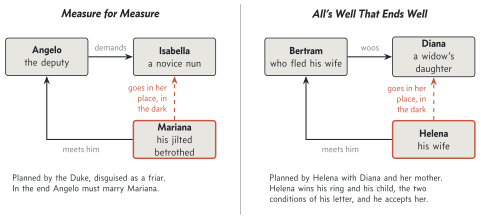
Helena sets out as a pilgrim and comes to Florence, where she finds that Bertram is trying to seduce Diana, the daughter of the widow she lodges with. Helena tells them who she is, and the three women plan a bed trick. Diana agrees to meet Bertram at night if he will give her his family ring, and Helena goes in her place. In the dark Helena gives him a ring that the King had given her, and she conceives his child, so that she has met both conditions of his “never.” Meanwhile Bertram’s fellow officers expose Parolles: they blindfold him, pretend to be enemy soldiers, and listen while he betrays every secret of the army to save his skin. Helena lets a rumor of her death go home ahead of her.

The last scene untangles it all at the French court. Bertram, thinking himself a widower, is ready to marry a lord’s daughter when the King sees on his finger the ring he gave Helena, and Bertram’s lies about it begin to choke him. Diana arrives to claim him and talks in riddles about a husband who does not know he has made her pregnant. Then Helena walks in, alive and expecting his child, with his ring and his letter. “’Tis but the shadow of a wife you see, / The name and not the thing,” she says. “Both, both. O, pardon!” Bertram cries, and so, at the very end, as the title promised, the marriage he ran from is mended.In this play, Bertram and Helena's fractious marriage is repaired by its end. → All's Well That Ends Well• He promises, “I’ll love her dearly, ever, ever dearly.” The King closes the play with a careful couplet: “All yet seems well; and if it end so meet, / The bitter past, more welcome is the sweet.” The word to notice is seems, and it is why this comedy is a problem play.
What to remember
- Shakespeare wrote Othello in about 1603–1604 from a tale in Cinthio’s Hecatommithi (1565). It was printed in a quarto in 1622 and in the Folio in 1623; the willow song is in the Folio only.
- Iago, Othello’s ensign, hates Cassio for winning the lieutenancy. “I am not what I am,” he says, and he will not wear his “heart upon my sleeve / For daws to peck at.”
- Act 1 is set in Venice. Iago tells Brabantio that his daughter Desdemona and Othello are “making the beast with two backs,” and Othello wins over the Senate: “She loved me for the dangers I had passed.”
- On Cyprus Iago makes Cassio drunk; disgraced, Cassio mourns his reputation, “the immortal part of myself.” Iago warns Othello of jealousy, “the green-ey’d monster.”
- The strawberry-spotted handkerchief, given to Othello’s mother by an Egyptian charmer, passes from Desdemona to Emilia, Iago, Cassio, and Bianca, who throws it back while Othello watches.
- Desdemona sings the willow song of her mother’s maid Barbary. Othello smothers her; Iago stabs Emilia, his wife, for revealing the plot; Othello dies as one “that loved not wisely, but too well.”
- The “problem plays” are dark comedies with forced marriages. In Measure for Measure Duke Vincentio, disguised as Friar Lodowick, traps Angelo with a bed trick in which Mariana takes Isabella’s place, and saves Isabella’s brother Claudio.
- In All’s Well That Ends Well Helena cures the King of France’s fistula, marries the unwilling Bertram, Count of Rossillion, and wins him back with a bed trick of her own.
Chapter 12 · 44 clues
King Lear
On the night after Christmas in 1606, the feast of St. Stephen, the King’s Men acted a new tragedy at Whitehall, the royal palace beside the Thames, before King James and his court. James had been king of Scotland since he was a baby, and in 1603 he had become king of England as well (the Stage). In October 1604 he proclaimed himself King of Great Britain, a single name in his title for the whole island. His elder son, Prince Henry, was Duke of Cornwall, and his younger son, Charles, was Duke of Albany (awl-buh-nee), an old title that meant Scotland.
The play that night showed an ancient king of Britain doing the opposite of what James had done. He splits his island into shares, and two of them go to the husbands of his elder daughters, a Duke of Cornwall and a Duke of Albany. Nobody in the hall could have missed the names, and nobody could have guessed what followed. Within five acts the old king is mad, his old friend has had his eyes torn out, and the one daughter who loved him lies dead in his arms. And from 1681, for more than a century and a half, the London stage refused to play that ending.
The love test
Shakespeare wrote King LearThis author wrote King Lear. → William Shakespeare••• in late 1605 or early 1606, between Othello (Chapter 11) and Macbeth (Chapter 13). Two facts set the earliest date. In the second scene the Earl of Gloucester blames “These late eclipses in the sun and moon” for the troubles of the kingdom, and Londoners saw an eclipse of the moon in September 1605 and of the sun in October. And an older play on the same story, King Leir, was printed in 1605, and Shakespeare seems to have read it in print. The title part was probably written for Richard Burbage, the company’s leading tragic actor (the Stage).
The story was already very old. Geoffrey of Monmouth (mon-muth), the twelfth-century writer whose History of the Kings of Britain filled the centuries before the Romans with a long line of British kings (Vol. 8, The Northern Worlds), told of Leir (leer). By Geoffrey’s reckoning he reigned about 800 BC and founded the city of Leicester. Leir asked his three daughters how much they loved him. In Shakespeare’s spelling they are Goneril (gon-uh-ril), Regan (ree-gun), and Cordelia (kor-deel-yuh). The two elder flattered him, and the youngest told him she loved him as much as he was worth. Raphael Holinshed retold the tale in his Chronicles (second edition, 1587), the book Shakespeare used for his history plays, and there her answer runs “so much as you haue, so much you are worth, and so much I loue you, and no more.”
In Geoffrey and Holinshed the story ends well for the king. Cast off by his elder daughters, Leir sails to his youngest in France, her husband’s army wins back his kingdom, and he reigns again until he dies. Only then does Cordelia’s luck turn: she rules Britain for five years, until her sisters’ sons rebel, and she kills herself in prison. The old play King Leir, acted at the Rose theater in April 1594, also ends with the king restored. Shakespeare made two great changes. He let Cordelia die before her father, so that the happy ending never comes, and he added a second family. The Earl of Gloucester and his two sons come from Sir Philip Sidney’s prose romance Arcadia (1590; Vol. 12, Crown and Parliament). There a blind king of Paphlagonia (paf-luh-goh-nee-uh), in Asia Minor, tells how his son born outside marriage turned him against his true son, so that he ordered that son killed. Now that true son leads him by the hand, and will not take him to the top of a rock from which the old man wants to throw himself.

A second story running beside the main one, with its own characters, is a subplot, and a play built on two stories that mirror each other has a double plot. In King Lear the mirror is exact (Figure 12.1). Each father believes the child who lies to him and drives out the child who loves him. Each loses what made him himself, the king his reason and the earl his eyes. Each is cared for at last by the child he wronged.
The play opens on a conversation between two old lords. The Earl of Kent, Lear’s most faithful counselor, remarks that the king seemed to prefer the Duke of Albany to the Duke of Cornwall. Gloucester, an earl like Kent, answers that the shares of the kingdom are now so equal that neither duke can complain. Then he introduces his younger son, Edmund, and jokes, in the young man’s hearing, about the pleasure he had in fathering him outside marriage. Edmund is a bastard, a son whose parents were not married. By English law he could inherit nothing, and his father has kept him abroad for nine years.

Lear enters, over eighty years old and King of Britain, with his three daughters, Goneril, Regan, and Cordelia.These characters are Goneril, Regan, and Cordelia. → daughters of King Lear••This character's sisters are Regan and Goneril. → Cordelia•• Goneril is married to the Duke of Albany, whose lands lie in the north, and Regan to the Duke of Cornwall in the southwest. Cordelia is unmarried, and two princes are waiting at court to ask for her: the King of France and the Duke of Burgundy. “Give me the map there,” Lear says. He means to “shake all cares and business from our age,” handing them to younger strengths, “while we / Unburden’d crawl toward death.” First, though, he stages a contest. Lear divides his kingdom among his daughters,This character divides his kingdom between his daughters. → King Lear•••This play opens with Regan and Goneril flattering the title character to gain shares of his land. → King Lear•• and the largest share is to go to the one who says she loves him most. Goneril and Regan understand at once and flatter him for their shares.
Goneril swears she loves him “more than words can wield the matter; / Dearer than eye-sight, space, and liberty.” Regan outbids her. She is “made of that self metal,” the very same stuff, as her sister, she says, but Goneril “comes too short,” for Regan is an enemy to every other joy and happy only in his love. Between the two speeches Cordelia speaks an aside, a line meant for the audience alone that the other characters do not hear: “What shall Cordelia do? Love, and be silent.” Each sister is rewarded with a third of Britain, and Lear points out Goneril’s share on the map, with its “shadowy forests” and “plenteous rivers.”
Two daughters have now been tested, and the third share, “more opulent” than the others, is still unclaimed. So Lear turns to Cordelia, his youngest daughterThis character is the youngest daughter of Lear. → Cordelia• and his favorite. She is “our last, not least,” he says, the girl for whose love “The vines of France and milk of Burgundy” are competing. He asks her what she can say to win the richest share. “Nothing, my lord,” she answers. “Nothing?” “Nothing.” The king’s reply is a warning and a threat: “Nothing will come of nothing: speak again.”This character says "Nothing will come of nothing; speak again!" → King Lear••This character answers "Nothing, my lord" and is told "Nothing will come of nothing; speak again!" → Cordelia•• He means that she will get nothing unless she says something, and the word will haunt him for the rest of the play. Her “nothing” is not rudeness. She will not put a price on her love in front of the court, as her sisters have just done.
Cordelia tries to explain. “Unhappy that I am, I cannot heave / My heart into my mouth,”A character in this play insists "I cannot heave my heart into my mouth." → King Lear•This character laments "Unhappy that I am, I cannot heave my heart into my mouth." → Cordelia•• she says: she cannot lift her love out of her heart and turn it into a speech. “I love your majesty / According to my bond; nor more nor less.” Her bond is the duty a daughter owes a father. Then she points at her sisters’ lie. Why do they have husbands, she asks, if they love their father with all their hearts? When she marries, half her love and care will go with her husband. “So young, and so untender?” asks Lear. “So young, my lord, and true,” she answers.
Enraged that she will not say how much she loves him, Lear disowns Cordelia.The youngest of these characters is disowned after refusing to declare how much she loves her father. → daughters of King Lear•This character casts out his daughter Cordelia. → King Lear•• “Let it be so; thy truth then be thy dower,” he says; a dower or dowry was the money or land a father gave with a daughter when she married. He swears by the sun and the night that he disclaims all a father’s care for her and will hold her “as a stranger to my heart and me.” Her third is split between the two dukes. Lear keeps only a hundred knights and “The name and all th’ addition to a king,” the title and its honors, and he will live a month at a time with each elder daughter. Kent protests, “be Kent unmannerly / When Lear is mad,” and begs him, “See better, Lear.” For his honesty Kent is banished. He has five days to prepare, and if he is found in Britain on the tenth, he dies.

Lear offers Cordelia to the suitors without a dowry (Figure 12.3). The Duke of Burgundy will not take herThe Duke of Burgundy declines to take this character. → Cordelia• on such terms: “Election makes not up on such conditions,” he says, meaning that no one would choose a bride that way. Cordelia lets him go. “Since that respects of fortune are his love, / I shall not be his wife.” The King of France sees more clearly. “She is herself a dowry,” he says, and the King of France takes CordeliaThis Shakespeare character is betrothed to the King of France. → Cordelia• to be his queen: “Fairest Cordelia, that art most rich, being poor; / Most choice, forsaken; and most lov’d, despis’d!” Before she leaves, Cordelia tells her sisters she knows what they are and commits her father to their care. As soon as they are alone, the sisters agree that he “always loved our sister most” and “hath ever but slenderly known himself.” “We must do something,” Goneril says, “and i’ the heat.”
The second scene moves to Gloucester’s castle, and Edmund has the stage to himself. He speaks a soliloquy, the speech of a character alone on the stage, thinking aloud (Vol. 17, The Victorians). “Thou, Nature, art my goddess,” he begins. He scorns “the plague of custom” that cuts him out because he was born a year or so after his brother, and the world that brands him “base” because his parents never married. He sets his sights on that brother’s inheritance: “Legitimate Edgar, I must have your land.” He ends with a cheer, “Now, gods, stand up for bastards!” He has forged a letter in Edgar’s hand proposing that the brothers share their father’s wealth if the old man were dead. He lets Gloucester catch him hiding it, and Gloucester believes it at once. When the earl blames the eclipses, Edmund, left alone, mocks him: men blame the stars for their own vices, an “excellent foppery,” or folly.
The daughters
Lear’s first month with Goneril goes badly. His hundred knights eat, drink, and quarrel in her house, and he strikes one of her gentlemen for scolding his fool. Goneril tells Oswald, her steward, the servant who runs her household, to treat the old man coldly and let the other servants do the same. She wants a quarrel, and she will soon have one.
Meanwhile Kent comes back in disguise,In this play, Kent returns from exile disguised as Caius. → King Lear• under a name, Caius, that the play reveals only in its last scene. He has changed his accent and “raz’d my likeness,” perhaps shaving his beard, and he offers himself to Lear as a plain servingman. “I do profess to be no less than I seem,” he says, and when the king asks whom he wants to serve, he answers that Lear has in his face something he would call master: “Authority.” Lear takes him on, and Kent earns his place by tripping up the insolent Oswald.
Then Lear’s Fool comes in, for the first time. A fool, as Touchstone and Feste showed (Chapter 8), was a jester kept by a great household and licensed to say what others dared not. This one, a knight tells Lear, “hath much pined him away” since Cordelia left for France. He offers Kent his coxcomb, the fool’s cap with its red crest like a rooster’s comb, because anyone who takes the side of a man out of favor must be a fool. Then he turns to Lear, and from then on the king’s Fool calls his master “nuncle”.The Fool in this play refers to the title character as "nuncle." → King Lear•This character addresses his master as "nuncle." → King Lear's Fool•King Lear is served by a member of this profession. → Shakespearean fools• The word is a fool’s pet name, short for “mine uncle,” and only a jester could speak so familiarly to a king. “Would I had two coxcombs and two daughters!” he says. Every joke he makes says one thing: Lear was the fool to give his kingdom away. The part was very likely written for Robert Armin, the company’s witty, singing clown (Chapter 8). “Can you make no use of nothing, nuncle?” he asks, and Lear, not yet seeing the echo, replies that “nothing can be made out of nothing.”
Goneril arrives and scolds her father for his rowdy knights. Lear cannot believe it. “Does any here know me? This is not Lear,” he says, and asks, “Who is it that can tell me who I am?” “Lear’s shadow,” answers the Fool. When Goneril tells him to cut his train, the king calls for his horses, and her husband, Albany, says he does not know what has happened. Lear turns on his daughter with a curse. He begs Nature to make her barren, or else to give her a child of spite who will torment her, “that she may feel / How sharper than a serpent’s tooth it isThis character cries "How sharper than a serpent's tooth it is to have a thankless child!" → King Lear• / To have a thankless child!” The bite of an ungrateful child, he means, is sharper than the snake’s.
He sets out for Regan’s, sure of a warmer welcome, and as he leaves his fear breaks out: “O! let me not be mad, not mad, sweet heaven; / Keep me in temper; I would not be mad!” But Regan and Cornwall have left home so as not to receive him. They go to Gloucester’s castle, where Kent, carrying Lear’s letters, meets Oswald again and beats him. Cornwall has Kent put in the stocks, a wooden frame that locked a man’s ankles in public, a punishment for vagrants and unruly servants. To set the king’s own messenger in the stocks was an insult to the king.
The subplot moves on in the same castle. Edmund warns Edgar to run, pretends to fight him, cuts his own arm, and tells his father that Edgar attacked him for refusing to join a plot. Gloucester has Edgar proclaimed an outlaw, orders every port barred, and promises Edmund his lands, calling him “Loyal and natural boy.” Cornwall takes Edmund into his own service. Edgar escapes the hunt by hiding in a hollow tree, and alone he decides to disguise himself as Tom o’ Bedlam.In this play, Edgar disguises himself as Tom O'Bedlam. → King Lear••• Bedlam was Bethlem Hospital, the London madhouse (Vol. 17, The Victorians), and “Tom o’ Bedlam” was the name for the half-naked madmen, real or pretended, who wandered the roads and begged. Edgar will grime his face, wear only a blanket, and tie his hair in knots. “Poor Turlygood! poor Tom!” he says. “That’s something yet: Edgar I nothing am.”
Lear reaches the castle and finds his servant in the stocks. Goneril arrives too, and Regan takes her sister by the hand. Then the daughters bargain him down. Regan tells him to go back to Goneril with fifty knights, and says that if he comes to her he may bring only twenty-five. “I gave you all—” Lear begins. “And in good time you gave it,” Regan answers. Lear turns to Goneril, for “Thy fifty yet doth double five-and-twenty, / And thou art twice her love.” But Goneril asks what need he has of twenty-five, or ten, or five, and Regan finishes it: “What need one?”
“O! reason not the need,”This character despairingly declares "O, reason not the need." → King Lear• Lear cries. Even the poorest beggars, he says, own some small thing they do not strictly need, and if nature is allowed no more than it needs, “Man’s life is cheap as beast’s.” Regan herself wears fine clothes that do not even keep her warm. He tries to threaten them and cannot find the threat: “I will do such things,— / What they are yet I know not,—but they shall be / The terrors of the earth.” He will not weep, he says, though his heart breaks into a hundred thousand pieces. “O fool! I shall go mad.” He rushes out as a storm begins. Gloucester warns that “for many miles about / There’s scarce a bush,” and Regan and Cornwall tell him to shut up his doors.
The storm and the Fool
The third act takes place in the open, where Lear wanders in a stormKing Lear wanders on a heath during one of these events. → storms• of wind, rain, thunder, and lightning. Editors place it on a heath, a stretch of open, treeless country covered with heather and coarse grass, where there is no shelter. The word is not in Shakespeare’s text: Nicholas Rowe wrote “A Heath” into his scene headings in 1709, and nearly every editor and director has kept it. A Gentleman tells Kent that the king is out there “Contending with the fretful elements,” tearing his white hair, with “None but the fool” beside him, trying to jest away his grief. Kent sends the Gentleman to Dover, on the southeast coast of England, where Cordelia is coming with an army from France.
Then we see the king. “Blow, winds, and crack your cheeks!”This character cries "Blow, winds, and crack your cheeks!" during a storm. → King Lear•• he shouts, as if the storm were his to command. He is speaking to the wind, as the old maps drew it, a face with puffed cheeks blowing. A speech addressed to something that cannot hear or answer, a wind or a god or an absent person, is an apostrophe. Lear calls on the waterspouts to drown the church steeples and on the lightning to singe his white head. He wants the thunder to flatten the round world and to break the molds in which nature makes men, so that no more ungrateful humans can be born.
He is not alone. The Fool and Kent wander the storm with him,This character accompanies the King of Britain into a raging storm. → King Lear's Fool•This character wanders the countryside with Kent and his Fool. → King Lear•A character of this type follows Lear onto the heath with Kent during a thunderstorm. → Shakespearean fools• the jester who followed his master out of the gates and the disguised earl who comes looking for him. The Fool begs him to go back and ask his daughters’ blessing: “here’s a night pities neither wise man nor fool.” Lear will not. “I tax not you, you elements, with unkindness,” he tells the storm; “I never gave you kingdom, call’d you children.” When Kent finds them, Lear calls on the gods to find out their real enemies: the hidden murderer, the perjurer, and the secret sinner who has never been whipped by justice. As for himself, “I am a man / More sinn’d against than sinning.”This character calls himself "more sinned against than sinning" during a storm. → King Lear•• Others, he means, have done him far more wrong than he has done.
Kent finds a hovel, a rough shed, to shelter them. “My wits begin to turn,” Lear says, and in the same breath he thinks for the first time of someone else’s suffering: “Come on, my boy. How dost, my boy? Art cold? / I am cold myself.” The Fool sings a scrap of song with the refrain “the rain it raineth every day,” the same refrain as the song Feste sings to end Twelfth Night (Chapter 8). Then, in the Folio only, the Fool speaks a mock prophecy of a world turned upside down and adds, “This prophecy Merlin shall make; for I live before his time.” The joke is that the play is set in Britain long before King Arthur’s wizard (Vol. 8, The Northern Worlds).

At the hovel, Lear sends the Fool in first and prays for all the poor he never thought of as king: “Poor naked wretches, wheresoe’er you are, / That bide the pelting of this pitiless storm.” “O! I have ta’en / Too little care of this,” he admits. Then a voice cries from inside, “Poor Tom!” and the Fool runs out terrified. Out of the straw comes Edgar in his rags, and Lear meets the disguised Edgar,This character encounters the disguised Edgar while wandering. → King Lear• Gloucester’s outlawed son, as a raving beggar. The king can think of only one reason a man could fall so low: “Didst thou give all to thy two daughters? / And art thou come to this?” Kent says the man has no daughters, but Lear will not hear it. Nothing but unkind daughters, he insists, could bring a man to such misery.
Poor Tom babbles of devils, cold, and the foul fiend that follows him. Shakespeare took many of the devils’ names, Flibbertigibbet and Modo and Mahu among them, from a pamphlet of 1603 by Samuel Harsnett, a churchman who denounced the exorcisms of Catholic priests, their casting of devils out of people, as frauds. Lear stares at the shivering figure and finds in him the truth about all men. “Thou art the thing itself,” he says; “unaccommodated man is no more but such a poor, bare, forked animal as thou art. Off, off, you lendings!” He begins to tear off his own borrowed clothes (Figure 12.4). Then Gloucester arrives with a torch, defying Regan’s orders to bring the king to shelter, and he does not know his own son. As they go, Edgar chants “Child Rowland to the dark tower came,” the line Browning made into a poem (Vol. 17, The Victorians).
Gloucester brings them to a farmhouse beside his castle, and there, in the quarto only, comes the mad scene the Folio leaves out. Lear puts his absent daughters on trial,This character pretends to put two characters on trial, attended by Mad Tom and his Fool. → King Lear• with a madman and a fool on the bench. “I will arraign them straight,” he says; to arraign is to bring someone to trial. He seats Poor Tom as “most learned justicer” and the Fool, a “sapient sir,” or wise man, beside him, with Kent as a third judge. “Arraign her first; ’tis Goneril,” he cries; “she kicked the poor king her father.” The Fool addresses a stool: “Cry you mercy, I took you for a joint-stool.” Regan, says Lear, has escaped, and he raves at the false justice that let her go.
“Then let them anatomize Regan,” Lear says, cut her open like a body in an anatomy lesson, to see “what breeds about her heart. Is there any cause in nature that makes these hard hearts?” Exhausted, he lies down at last and murmurs that they will go to supper in the morning, and the Fool answers, in the Folio’s text, “And I’ll go to bed at noon.” It is his last line. He never appears again, and the play never says what became of him. He is the third of the volume’s great fools, after Touchstone and Feste (Chapter 8), and the only one who follows his master into ruin. Gloucester hurries back. He has overheard a plot against the king’s life, and he tells Kent to lay Lear in a litter and “drive toward Dover.”
Gloucester and his sons
Gloucester’s kindness costs him everything. Earlier that night he had told Edmund, in secret, that he had received a letter: a French army was coming to help the king, and he meant to help too. Edmund carried the letter straight to the Duke of Cornwall. “True, or false,” Cornwall told him, “it hath made thee Earl of Gloucester.” The bastard has his father’s title, and his father is now a traitor in his own house.
Cornwall, Regan, and Goneril have the letter, and Goneril says what is to be done: “Pluck out his eyes.” She leaves with Edmund for her husband’s castle, and Gloucester is dragged in, bound to a chair, and questioned by his own guests. Regan pulls the hairs of his white beard, a deep insult to an old man. Why did he send the king to Dover? “Because I would not see thy cruel nails / Pluck out his poor old eyes,” he answers, and he swears he will see heaven’s vengeance overtake such children. “See ’t shalt thou never,” says Cornwall. Then, on the open stage, Gloucester is blinded.Gloucester is blinded in this play. → King Lear••• Cornwall puts out one eye with his foot while servants hold the chair.
Regan urges him to take the other eye too, for “One side will mock another.” At this a servant who has served Cornwall since childhood draws his sword to stop him and wounds him, before Regan seizes a sword and kills the servant. The dying man tells Gloucester he still has one eye left to see some vengeance on his tormentor. Cornwall turns back to the chair. “Out, vile jelly!”"Out, vile jelly!" is exclaimed during the blinding scene in this play. → King Lear•• he cries as he crushes the second eye, and then, “Where is thy lustre now?” Blind, Gloucester calls on Edmund to avenge him, and Regan tells him it was Edmund who betrayed him. In one moment he understands everything: “O my follies! Then Edgar was abus’d.” Regan has him thrust out of the gates to “smell / His way to Dover.”
On the heath next morning, Edgar is telling himself that at least he has reached the bottom, when an old tenant comes by leading his bleeding father. “The worst is not,” Edgar thinks, “So long as we can say, ‘This is the worst.’ ” Gloucester tells the old man he needs no guide, for “I have no way, and therefore want no eyes; / I stumbled when I saw.” He thinks of the naked madman he met in the storm, who made him think a man a worm, and of his son. Then he speaks the bleakest lines in the play. “As flies to wanton boys,”This play includes the line "As flies to wanton boys are we to the gods; they kill us for their sport." → King Lear•• he says, “are we to the gods; / They kill us for their sport.” Wanton means playful and careless; the gods kill men as idly as children kill flies. Gloucester asks the old man to bring clothes for the naked beggar, and asks Poor Tom to lead him to the edge of a cliff he knows at Dover, from which he means to throw himself. Edgar, still in disguise, takes his father’s arm.
Edmund, meanwhile, has escorted Goneril home, and the two have become lovers. At her gate Goneril, though married to Albany, kisses Edmund,Though married to Albany, a character in this play has an affair with Edmund. → King Lear• gives him a token to wear, and hints that he may soon hear a mistress’s command. When he leaves she says to herself, “To thee a woman’s services are due: / My fool usurps my bed.” The fool in her bed is her husband. But Albany has changed. He has heard what was done to Lear and Gloucester, and he turns on his wife: “O Goneril! / You are not worth the dust which the rude wind / Blows in your face.” A messenger brings word that Cornwall has died of his wound. Regan is now a widow, free to marry Edmund, and Goneril is not.
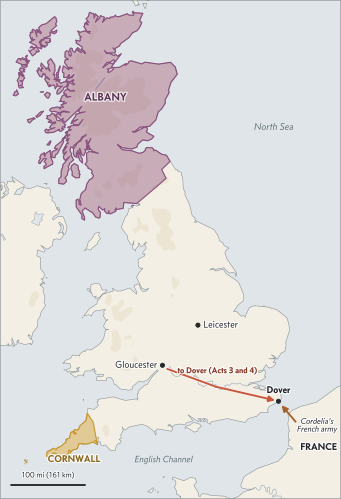
Near Dover Edgar plays the strangest trick in Shakespeare. He leads his blind father across flat fields and tells him they are climbing a steep hill. Then he halts and describes the view from a cliff top so vividly that the audience can almost see it, though on Shakespeare’s bare stage there was no cliff to see. “How fearful / And dizzy ’tis to cast one’s eyes so low!” The crows below look as small as beetles, and the fishermen on the beach like mice. “Half way down / Hangs one that gathers samphire, dreadful trade!” Samphire (sam-fire) is a plant of the sea cliffs that men gathered on ropes for pickling. Edgar is trying to cure his father’s despair: “Why I do trifle thus with his despair / Is done to cure it.”
To save him from killing himself, Edgar leads his blind father off a cliff that is not there.In this play, Edgar leads his blinded father Gloucester off an imaginary cliff to prevent his suicide. → King Lear••• Gloucester gives the beggar a purse, prays, and falls forward onto level ground. Edgar changes his voice and plays a stranger at the foot of the cliff. He tells the old man that he has fallen from a dizzy height, so far that “Thy life’s a miracle,” and that the beggar at the top was a fiend with a thousand noses. Gloucester accepts the miracle. From now on, he says, he will bear his suffering until it cries “Enough, enough” and dies. The chalk cliff just west of Dover is now called Shakespeare Cliff (Figure 12.5).
Then Lear wanders in, mad, and crowned with weeds and wild flowers. “Ay, every inch a king,” he says, and imagines that a man is brought before him charged with adultery. He pardons him. Even the wren and the little gilded fly mate in his sight, he says, so “Let copulation thrive”,This character says "Let copulation thrive!" in a misogynistic speech. → King Lear• for Gloucester’s bastard son was kinder to his father than Lear’s daughters, born in lawful marriage. It is the mad king’s bitter joke, and it is wrong, as the audience knows: Edmund has just betrayed his father to be blinded.
His disgust with his daughters now spreads into misogyny, a hatred of all women and of the lust he believes they hide under their modest faces. The centaurs of Greek myth were half man and half horse (Vol. 4, Classical Myth), and he turns them into a picture of women: “Down from the waist they are Centaurs,”This character declares women "Down from the waist...are centaurs." → King Lear• he says, “Though women all above.” Below the waist, he means, they are beasts, and the devils own them. He asks an imagined apothecary for perfume “to sweeten my imagination.” When Gloucester begs to kiss his hand, he answers, “Let me wipe it first; it smells of mortality.”
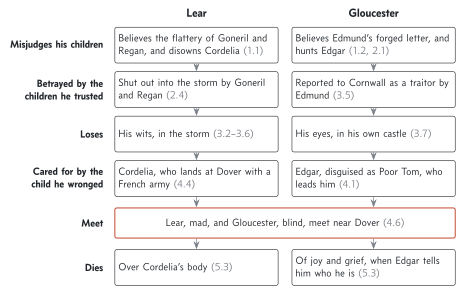
The meeting of the madman and the blind man is the heart of the play (Figure 12.6). Lear mocks Gloucester’s empty eyes, then tells him, “A man may see how this world goes with no eyes. Look with thine ears.” He sees through the justice he once dealt out. The magistrate is as guilty as the thief, and “a dog’s obey’d in office”; rags show every small vice, while “Robes and furr’d gowns hide all.” Listening, Edgar calls it “Reason in madness!” At last Lear knows his friend: “I know thee well enough; thy name is Gloucester.” He preaches him a sermon on patience: “When we are born, we cry that we are come / To this great stage of fools.” Then he runs off from Cordelia’s men, who have come to fetch him. Oswald arrives, hoping for a reward for killing the old traitor, and Edgar kills him with a cudgel. In the dead man’s pocket is a letter from Goneril urging Edmund to murder her husband.
The ending and its rewriting
Cordelia has landed at Dover with the French army. Her husband has had to go home, and she has come with it herself, not for conquest, she says, “But love, dear love, and our ag’d father’s right.” Her soldiers find Lear and bring him to her tent, and a doctor lets him sleep and then wakes him to music. When he wakes in fresh clothes and sees her, he thinks he has died: “You do me wrong to take me out o’ the grave; / Thou art a soul in bliss; but I am bound / Upon a wheel of fire.” Slowly he understands.
“I am a very foolish fond old man, / Fourscore and upward,” he says, and he fears he is not in his perfect mind. Yet he thinks “this lady / To be my child Cordelia.” “And so I am, I am.” He tells her that if she has poison for him he will drink it, for her sisters wronged him and she has some cause to hate him; they have none. “No cause, no cause,” she answers. It is the play’s great recognition, the moment Aristotle named, when a character learns the truth (Vol. 1, The Toolkit). “Pray you now, forget and forgive,” Lear says; “I am old and foolish.”
Then the play turns against them. Edmund, who has sworn his love to both sisters, leads the British army with Albany, and before the battle Edgar gives Albany Goneril’s letter. The French lose, and Lear and Cordelia are taken. Leading his father away from the battle, Edgar tells him that men must endure their going out of the world as they endured their coming in: “Ripeness is all.” Lear does not mind prison as long as he has Cordelia. “Come, let’s away to prison; / We two alone will sing like birds i’ the cage,” he tells her. Edmund sends a captain after them with a secret written order.
Albany now arrests Edmund for treason, with the letter in his hand. A herald’s trumpet sounds three times for a champion, and at the third an armed knight appears who will not give his name. It is Edgar. He calls his brother a “most toad-spotted traitor,” and Edgar kills Edmund in a duel,In this play, Edgar kills his brother Edmund in a duel. → King Lear•• single combat under the laws of knighthood. Dying, Edmund admits all, “The wheel is come full circle; I am here,” and Edgar tells his story. He revealed himself to his father only half an hour before the fight, and the old man’s heart, torn between joy and grief, “Burst smilingly.” Then a gentleman runs in with a bloody knife. Goneril has poisoned Regan and stabbed herself. “Yet Edmund was belov’d,” says Edmund, and he tries to do one good deed. He confesses that his order is for the deaths of Lear and Cordelia, but the reprieve comes too late.
In the last scene of Act 5, Lear enters carrying Cordelia’s body (Figure 12.7). “Howl, howl, howl, howl! O! you are men of stones,”This character exclaims "Howl, howl, howl, howl! O, you are men of stones" while lamenting his daughter's death. → King Lear• he cries at the silent men around him. The Yale text gives four howls, the quarto’s number; the Folio prints three. To Lear, the men who stand by and say nothing seem as speechless as statues, and he would gladly borrow their voices and their eyes for his grief. “Had I your tongues and eyes,”This character exclaims "Had I your tongues and eyes, I'd use them so / That heaven's vault should crack" in Act Five. → King Lear• he says, “I’d use them so / That heaven’s vault should crack.” The vault is the arched roof of the sky. He asks for a mirror to see whether her breath will mist it, and thinks a feather stirs. “Her voice was ever soft, / Gentle and low, an excellent thing in woman,” he remembers, and he boasts that he killed the man who was hanging her. Kent comes forward at last and asks, “Where is your servant Caius?” “He’s dead and rotten,” Lear answers. He cannot take in that Kent and Caius were the same man.

When word comes that Edmund is dead, Albany calls it “but a trifle here.” Lear speaks his last lines over Cordelia. “And my poor fool is hang’d!” he begins, using “fool,” as most readers take it, as a word of love for his daughter. “Why should a dog, a horse, a rat, have life,”While holding Cordelia's corpse, this character asks "Why should a dog, a horse, a rat, have life, And thou no breath at all?" → King Lear• he asks, “And thou no breath at all?” The question has no answer. The lowest animals live, and the best of his children does not, and there is no justice in it that he can see. Then comes the line that ends the question: “Thou’lt come no more, / Never, never, never, never, never!”While holding his daughter's corpse, this character exclaims "never, never, never, never, never" before dying. → King Lear•
The Folio follows the five nevers with “Pray you, undo this button: thank you, sir. / Do you see this? Look on her, look, her lips, / Look there, look there!” and Lear dies, perhaps believing she breathes. In the quarto he dies with a groan and the words “Break, heart; I prithee, break,” which the Folio gives to Kent. “Vex not his ghost,” Kent begs those who try to revive him; “he hates him / That would upon the rack of this tough world / Stretch him out longer.” The last speech, Albany’s in the quarto and Edgar’s in the Folio, ends: “The oldest hath borne most: we that are young, / Shall never see so much, nor live so long.”
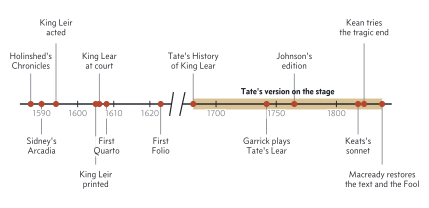
Later audiences found that ending too cruel. The theaters were closed during the Civil War and reopened when Charles II returned in 1660 (the Stage). Nahum (nay-um) Tate (1652–1715), an Irish-born poet who would become Poet Laureate in 1692 (Chapter 21) and write the words of the composer Henry Purcell’s opera Dido and Aeneas (Vol. 12, Crown and Parliament), rewrote the play for the Duke’s Theatre. In 1681 Tate’s History of King LearNahum Tate wrote a version of this play with a happy ending. → King Lear••This character is served by the confidant Arante in Nahum Tate's revision of a play. → Cordelia• gave it a happy ending and gave Cordelia a confidant, a lady named Arante. Tate called Shakespeare’s play “a Heap of Jewels, unstrung and unpolisht,” and set out to string them. He cut the Fool entirely. Arante follows her mistress onto the heath, where Edgar rescues them both from ruffians sent by Edmund. Edgar and Cordelia, who never speak to each other in Shakespeare, are in love from the first scene. In the end Lear wins back his throne and gives it to them, and Lear, Gloucester, and Kent retire to “some cool Cell” to grow old together. Edgar speaks the last line: “Truth and Vertue shall at last succeed.”

Tate’s version ruled the stage for more than 150 years (Figure 12.8). David Garrick (Chapter 4) played Lear in it from 1742, his first season in London, and from 1756 put back many of Shakespeare’s lines but kept the happy ending (Figure 12.9). Samuel Johnson, in his edition of Shakespeare (1765), sided with Tate’s audiences. He wrote that Cordelia’s death had shocked him so much, years before, that he could not bring himself to reread the last scenes until he had to edit them. The actor Edmund Kean tried the tragic ending in 1823 and gave it up after a few nights. Only in 1838 did the actor William Macready, who had taken over Covent Garden the year before, restore Shakespeare’s text and the Fool there, with the Fool played by a young actress, Priscilla Horton.
Meanwhile the Romantic poets of the early nineteenth century (Vol. 15, The Age of Revolution) had come to read the play as Shakespeare’s greatest. In January 1818 John Keats, one of the youngest of them, sat down to reread it and first wrote a sonnet, which he copied into a letter to his brothers. In Keats’s “On Sitting Down to Read King Lear Once Again”,Keats wrote "On Sitting Down to Read [this play] Once Again," a sonnet ending with a wish for "new Phoenix wings" after being "consumed in the fire." → King Lear•• quoted here from Horace Scudder’s edition of 1899, he says goodbye to “golden-tongued Romance,” for he must once more “burn through” Shakespeare’s “fierce dispute / Betwixt damnation and impassion’d clay.” He ends asking that when the reading has burned him up he may rise again, like the phoenix (fee-niks) of legend, the bird reborn from its own ashes: “But when I am consumèd in the Fire, / Give me new Phœnix-wings to fly at my desire.” In 1985 the Japanese director Akira Kurosawa (koo-roh-sah-wah) set it among warring lords of the sixteenth century, with three sons in place of the daughters, as the film Ran (Vol. 41, Islands of the Rising Sun).
What to remember
- Shakespeare wrote King Lear in 1605–1606; it was played before King James at Whitehall on December 26, 1606. It survives in the quarto of 1608 and the First Folio of 1623, which differ by hundreds of lines.
- The main story comes from Geoffrey of Monmouth through Holinshed and the old play King Leir, all with happy endings; the Gloucester subplot comes from Sidney’s Arcadia.
- Lear divides Britain among his daughters by a love test. Goneril and Regan flatter; Cordelia, the youngest, says “Nothing, my lord,” and is told “Nothing will come of nothing.” Burgundy refuses her and the King of France marries her.
- Kent, banished, returns disguised (as Caius); the Fool calls Lear “nuncle.” Lear curses Goneril (“How sharper than a serpent’s tooth”) and answers Regan with “O! reason not the need.”
- In the storm on the heath Lear cries “Blow, winds, and crack your cheeks!” and calls himself “More sinn’d against than sinning.” He meets Edgar, disguised as Poor Tom o’ Bedlam, and in the quarto alone holds a mock trial of his daughters.
- Cornwall blinds Gloucester (“Out, vile jelly!”). Gloucester says “As flies to wanton boys are we to the gods,” and Edgar leads him off an imaginary cliff at Dover.
- At the end Edgar kills Edmund in a duel, Goneril poisons Regan and kills herself, and Lear dies over the hanged Cordelia: “Howl, howl, howl, howl!” and the Folio’s five “Never”s.
- Nahum Tate’s History of King Lear (1681) cut the Fool, gave Cordelia a confidant, Arante, and married her to Edgar; it held the stage until 1838. Keats wrote a sonnet on rereading the play (1818).
Chapter 13 · 40 clues
Macbeth
In the late summer of 1040 a young king of the Scots led an army north into Moray (mur-ee), the great province on the southern shore of the Moray Firth, an arm of the North Sea, to bring its lord to heel. The king was Duncan, a grandson of the old king Malcolm II, and he had reigned for less than six years. His raid into England the year before had ended in disaster at Durham, and this campaign went no better. Near Elgin (el-gin) the men of Moray met him in battle, and on or about August 14 he was killed. The lord who led them took the crown. His name was Macbeth.
Macbeth ruled Scotland for seventeen years. No writer of his own century calls him cruel. In 1050 he made the long journey to Rome as a pilgrim, and Marianus Scotus, an Irish monk of his day who wrote a chronicle of the world, says that there he scattered money among the poor as if he were sowing seed. Five and a half centuries later an English playwright made him the most famous murderer on the stage.
The real Macbeth and the Scottish play
The real reign ended as it had begun. In 1054 Siward (see-wurd), the English earl of Northumbria, invaded Scotland for the English king, Edward the Confessor, and three years later Duncan’s son Malcolm hunted Macbeth down north of the Mounth, the wall of hills that crosses Scotland. On August 15, 1057, Macbeth was killed at Lumphanan (lum-fan-un) by the man who became King Malcolm III (Vol. 8, The Northern Worlds). He was buried on Iona (eye-oh-nuh), the holy island off the west coast where the Scottish kings were laid. His wife, the real Lady Macbeth, was named Gruoch (groo-okh), and she came of royal blood herself. Nothing is known of her character.
Malcolm’s descendants kept the throne for more than two centuries, and the chroniclers who wrote under them blackened their enemy’s name. The worst blow came from Hector Boece (1465–1536), the first head of King’s College at Aberdeen. In his Latin History of the Scots, printed in 1527, Boece gave Macbeth a fellow general, Banquo, a lord of Lochaber (lokh-ah-ber) in the western Highlands, and gave Banquo a son, Fleance (flay-ahns). No earlier record mentions either man, and scholars such as David Bevington think that Boece made them up. He had a reason. Fleance, Boece wrote, fled from Macbeth into Wales, and his son Walter came back to Scotland and was made the king’s Steward, the officer who ran the royal household. From that office his descendants took the name Stewart, and in Boece’s day the Stewarts were the kings of Scotland (Figure 13.1). The real Stewarts came from a Breton knight’s family that crossed to Scotland in the twelfth century, and one of them married Robert the Bruce’s daughter Marjorie and founded the royal line (Vol. 8, The Northern Worlds).

Raphael Holinshed’s Chronicles of England, Scotland, and Ireland (1577, enlarged in 1587), the book Shakespeare mined for all his plays of English kings (the Stage), retold Boece’s history in English. In Holinshed, Banquo is Macbeth’s chief partner in killing Duncan, and Macbeth’s wife drives him on, “burning in unquenchable desire to bear the name of a queen.” Shakespeare kept the wife and cleared Banquo. The reason sat on the English throne. In 1603 James VI of Scotland, a Stewart, had become James I of England (the Stage), and he had taken Shakespeare’s company into his own service as the King’s Men. James believed that Banquo was his ancestor. He also feared witches. After the North Berwick witch trials of 1590, in which accused witches confessed under torture to raising storms against the ship that brought his Danish bride home, he wrote a book on witchcraft, Daemonologie (dee-muh-nol-uh-jee) (1597).
Shakespeare wrote MacbethThis author wrote Macbeth. → William Shakespeare• for that king’s company, probably in 1606. Some months earlier, on November 5, 1605, Catholic conspirators had been caught trying to blow up King James and his Parliament with barrels of gunpowder hidden in a cellar beneath the House of Lords, the Gunpowder Plot (Vol. 12, Crown and Parliament). A play about witches, broken oaths, and a murdered king had an audience ready for it. It was never printed in Shakespeare’s lifetime. It survives only in the First Folio of 1623 (the Stage), where it is the shortest of his tragedies. This chapter quotes it from the Yale Shakespeare edition of 1918, edited by Charlton M. Lewis, checked against the Folio.

The Folio text seems to have been changed after Shakespeare finished it. Two scenes bring on Hecate (hek-it), the goddess of witches, who speaks in neat rhymed couplets of a lighter kind than the witches’ chants, and the stage directions call for two songs, “Come away” and “Black spirits,” without printing their words. Both songs appear in full in The Witch, a play by Thomas Middleton (1580–1627), a younger playwright who also wrote for the King’s Men. Most scholars therefore think that Middleton added the Hecate scenes for a revival, though no document proves it. The earliest eyewitness account of the play comes from Simon Forman, the astrologer whose notes on plays survive (the Stage). He dated his visit to the Globe Saturday, April 20, 1610, but April 20 fell on a Saturday in 1611, not 1610, so he almost certainly saw the play in the spring of 1611. He wrote down the story.
The play has a superstition of its own. Many actors believe that saying its name inside a theater, except in speaking its lines, brings disaster on the production. Actors call it “the Scottish play”A superstition about speaking the name of this play leads actors to call it the "Scottish play." → Macbeth•• instead, and an actor who slips is supposed to go outside, turn around three times, spit, and knock to be let back in. Old theater people tell stories of fires and accidents during its runs as proof. The superstition is modern: nobody in Shakespeare’s century recorded any fear of the play. Its favorite tale tells of a curse from the very first performance: the boy who was to play Lady Macbeth fell ill and died, and Shakespeare himself had to take the part. That story comes from a satire by the English humorist Max Beerbohm (1872–1956), who invented it.
The prophecies
The play begins in thunder and lightning, with three witches on a bare stretch of country. They agree to meet again “When the battle’s lost and won,” and to meet there “with Macbeth,” and they vanish on a riddle: “Fair is foul, and foul is fair.” Their lines are short, rhymed, and chanted, unlike the speech of anyone else in the play. Shakespeare calls them the “weird sisters,” which the Folio spells “weyward.” In 1606 weird did not yet mean “strange.” It came from the Old English word wyrd, fate, and the weird sisters were the sisters of fate. Holinshed had written that they were thought to be “the weird sisters, that is (as ye would say) the goddesses of destiny.”

Then the scene moves to a camp near Forres (for-iss), in Moray (Figure 13.3). King Duncan has been fighting two wars at once, against a rebel named Macdonwald and against a king of Norway, who was secretly helped by one of Duncan’s own lords, the Thane of Cawdor. A thane was a Scottish lord who held his lands from the king, and his title named his lands. A bleeding sergeant tells how the king’s two captains, Macbeth and Banquo, stood firm. “Brave Macbeth,” the king’s kinsman, cut his way through the rebels, slit Macdonwald open “from the nave to the chops,” that is, from navel to jaws, “And fix’d his head upon our battlements.” Duncan orders Cawdor’s execution and gives his title to the hero: “What he hath lost noble Macbeth hath won.”

Macbeth and Banquo, riding home from the battle, meet the witches on a heath. Macbeth’s first words echo theirs: “So foul and fair a day I have not seen.” Banquo stares at the strangers, so withered and wild that they hardly look like “th’ inhabitants o’ the earth,” and adds that “you should be women, / And yet your beards forbid me to interpret / That you are so.” Macbeth asks what they are. In answer, the witches give Macbeth three prophecies,This character receives prophecies from three witches. → Macbeth•• one from each.
“All hail, Macbeth! hail to thee, Thane of Glamis!” cries the first, and Glamis (glahmz) is a title he already holds: “By Sinel’s death,” he says, “I know I am Thane of Glamis.” Sinel was his father. Then the second witch hails the Thane of Glamis as Thane of Cawdor,This character is the Thane of Glamis. → Macbeth••These characters hail the Thane of Glamis as the Thane of Cawdor. → the Weird Sisters• a title that, as far as Macbeth knows, belongs to a living man. The third goes furthest: “All hail, Macbeth! that shalt be king hereafter.” Macbeth starts as if struck. Banquo asks what they have for him, and they answer in riddles. He will be “Lesser than Macbeth, and greater,” “Not so happy, yet much happier.” Then the plainest word of all: “Thou shalt get kings, though thou be none.” Banquo’s descendants will be kings,These characters prophesy that Banquo's descendants will be kings. → the Weird Sisters• though he will never wear a crown himself. Then the witches (Figure 13.5) melt “Into the air,” and the two men are left repeating the words to each other.

At once two more lords arrive, Ross and Angus, with thanks from the king, and Ross brings “an earnest of a greater honour.” The king has made Macbeth Thane of Cawdor,This character is the Thane of Cawdor. → Macbeth• for the old thane is condemned to die as a traitor, and the second prophecy has come true within minutes of being spoken. “What! can the devil speak true?” asks Banquo. He sees the danger. “Oftentimes, to win us to our harm, / The instruments of darkness tell us truths, / Win us with honest trifles, to betray’s / In deepest consequence.” Macbeth hears only that two prophecies have come true and that “The greatest is behind,” still to come. Already, in an aside, a speech the others on stage do not hear, he feels a “horrid image” that makes his hair stand up and his heart knock at his ribs: the thought of murder. For a moment he hopes to avoid it: “If chance will have me king, why, chance may crown me, / Without my stir.”
At the palace in Forres, Duncan learns that Cawdor died bravely: “Nothing in his life / Became him like the leaving it.” The king says sadly that “There’s no art / To find the mind’s construction in the face,” that a man’s thoughts cannot be read in his features, and at that moment the new Thane of Cawdor walks in. Duncan greets him with love, and then names his own elder son, Malcolm, “The Prince of Cumberland,” heir to the throne. Chance is not going to crown Macbeth. “Stars, hide your fires!” he says aside. “Let not light see my black and deep desires.” The king announces that he will spend the night at Macbeth’s castle at Inverness, about 25 miles to the west.
The letter scene
At Inverness, Macbeth’s wife walks on alone, reading a letter. The play never gives her a first name: the Folio calls her “Macbeths Wife” and then simply “Lady,” and readers have always called her Lady Macbeth. Macbeth has written to her about the witches and called her “my dearest partner of greatness,” and she knows at once what the third prophecy means. “Glamis thou art, and Cawdor; and shalt be / What thou art promis’d.” Then she weighs her husband, and she fears his nature is too gentle:This character fears that her husband is "too full o' th' milk of human kindness." → Lady Macbeth•• “It is too full o’ the milk of human kindness / To catch the nearest way.” Human kindness, which the Folio spells “humane,” is the tenderness natural to human beings, and the nearest way to the crown is murder. He wants greatness, she says, but not “The illness should attend it,” the wickedness that goes with it.
A messenger brings astonishing news: the king will sleep in the castle that very night. Alone again, she sees her chance and prepares herself for it. “The raven himself is hoarse,” she says, “That croaks the fatal entrance of Duncan / Under my battlements”: the raven, a bird of ill omen, has croaked itself hoarse at the news. Then she calls on the spirits to “unsex” her:This character invokes the spirits that "tend on mortal thoughts" to "unsex me here." → Lady Macbeth••• “Come, you spirits / That tend on mortal thoughts! unsex me here.” Mortal here means deadly, and the spirits she means are the devils who wait on thoughts of murder. To be unsexed is to be stripped of everything soft in her that her age thought natural to a woman, the pity, the scruples, the mother’s tenderness. She asks them, too, to fill her with cruelty “from the crown to the toe,”In a monologue, this character calls for spirits to "fill [her] from the crown to the toe top-full / Of direst cruelty." → Lady Macbeth• from the top of her head to her feet, “top-full / Of direst cruelty,” and to thicken her blood so that no remorse can reach her heart. “Come to my woman’s breasts,” she says, “And take my milk for gall.” Last she calls on night to hide the deed, “That my keen knife see not the wound it makes.” She means to strike the blow herself.
Macbeth arrives and tells her that Duncan comes tonight. “And when goes hence?” she asks. “To-morrow, as he purposes.” Her answer is a verdict: “O! never / Shall sun that morrow see.” His face, she warns him, “is as a book where men / May read strange matters,” so he must learn to hide. She tells him to “look like the innocent flower,”This character advises "look like the innocent flower / But be the serpent under't." → Lady Macbeth• “But be the serpent under ’t,” welcoming in his eyes, his hand, and his tongue while the murder waits beneath, like the serpent hidden among the flowers of a garden. “Leave all the rest to me.”
Duncan rides up to the castle by torchlight and admires it: “This castle hath a pleasant seat; the air / Nimbly and sweetly recommends itself.” Banquo notices the martlets, small birds like swallows, nesting on every ledge, a sign that the air is sweet. The guests are praising the house where the king will die that night.
During the feast Macbeth slips out and argues with himself in a soliloquy, a speech spoken alone that lets the audience hear a character’s thoughts (Vol. 17, The Victorians). “If it were done when ’tis done, then ’twere well / It were done quickly.” Every reason he finds is against the murder. Duncan is in his house “in double trust,” because Macbeth is his kinsman and subject, and because a host “should against his murderer shut the door, / Not bear the knife myself.” Duncan is so good a king that “his virtues / Will plead like angels, trumpet-tongu’d,” against the deed. The only spur Macbeth has is “Vaulting ambition, which o’er-leaps itself,” like a rider who jumps so hard into the saddle that he falls off the other side. When his wife comes out to find him, he has decided: “We will proceed no further in this business.”
She attacks him where he is proudest, in his courage. Was his hope drunk, she asks, and has it woken up “green and pale”? “Art thou afeard / To be the same in thine own act and valour / As thou art in desire?” He answers like a soldier: “I dare do all that may become a man; / Who dares do more is none.” Then she shows him what keeping one’s word means to her. She has nursed a baby, she says, and knows “How tender ’tis to love the babe that milks me.” Yet she would have “dash’d the brains out”This character claims she would have "dash'd the brains out" of her own child to keep a promise. → Lady Macbeth•• of that smiling child at her breast if she had sworn to do it, as he has sworn to kill the king. No child of the Macbeths ever appears in the play. Critics who, like A. C. Bradley (the Stage), asked such questions about characters’ lives offstage were mocked by L. C. Knights in the title of an essay of 1933, “How Many Children Had Lady Macbeth?” (Vol. 21, Trenches and Modernists).
Macbeth has one doubt left. “If we should fail,—” he begins. “We fail!” she answers, as if failure were simply impossible. “But screw your courage to the sticking-place,This character advises her husband to "screw your courage to the sticking place." → Lady Macbeth••This character is told by his wife to "screw [his] courage to the sticking-place." → Macbeth• / And we’ll not fail.” The sticking-place was probably the notch where a crossbow’s string catches when it is wound back tight, or the hold of a tuning peg on a lute: tighten your courage until it stays. Then she gives him the plan. Duncan’s two chamberlains, the servants who sleep in his room, will be drunk on her wine, and they will bear the guilt. Macbeth catches fire and finishes the plan himself: the Macbeths will kill the king with the chamberlains’ own daggers and smear the sleepers with blood, and everyone will blame the drunken servants. She has talked her husband into the murderThis character convinces her husband to murder Duncan. → Lady Macbeth•• he had refused minutes before. “Bring forth men-children only,” he tells her in admiration, “For thy undaunted mettle should compose / Nothing but males.” He goes back to the feast with his face arranged: “False face must hide what the false heart doth know.”
The dagger and the knocking
After midnight, in the courtyard, Banquo walks with his son Fleance, who carries a torch. There is no moon and no star, and Banquo makes a joke of it: “There’s husbandry in heaven; / Their candles are all out.” Heaven is saving on candles. He cannot sleep, he dreamed last night of the weird sisters, and he prays to be kept from “the cursed thoughts that nature / Gives way to in repose.” Macbeth comes by and claims that he never thinks of the witches.
Left alone, Macbeth sees a dagger hanging in the airThis character has a hallucination of a bloody dagger. → Macbeth• before him. “Is this a dagger which I see before me, / The handle toward my hand? Come, let me clutch thee: / I have thee not, and yet I see thee still.” He wonders whether it is “A dagger of the mind, a false creation, / Proceeding from the heat-oppressed brain,” a fever of his own imagining. As he watches, drops of blood appear on its blade and handle, “gouts of blood, / Which was not so before,” and he tells himself that it is only “the bloody business” he is planning, taking shape in front of his eyes. Then a bell rings, his wife’s signal that all is ready. “Hear it not, Duncan; for it is a knell / That summons thee to heaven or to hell.”
His wife waits below. She has drugged the chamberlains’ possets, bedtime drinks of hot milk and wine, and laid their daggers ready. She had meant to kill the king herself, but she stopped: “Had he not resembled / My father as he slept,”This character observes that a man "resembled my father as he slept." → Lady Macbeth• she says, “I had done ’t.” It is the only weakness she ever shows while she is awake: the old king, asleep on his pillow, looked too like her own father. So the deed must be her husband’s. Macbeth comes back with bloody hands. “I have done the deed.” Macbeth has murdered King Duncan,This character murders King Duncan. → Macbeth••• and the audience never sees it: the murder happens offstage, behind a door, while his wife waits and listens.


He is shaking. Two sleepers in the next room woke as he passed, and one cried “God bless us!” and the other “Amen,” but Macbeth “could not say ‘Amen.’ ” He heard a voice cry “Sleep no more! / Macbeth does murder sleep.” Worst of all, he has carried the daggers away with him, and he will not go back. “Infirm of purpose!” says his wife. “Give me the daggers.” She goes in herself and smears the sleeping chamberlains with the king’s blood (Figure 13.6). Alone, Macbeth stares at his hands and asks whether “all great Neptune’s ocean” could wash them clean. No, he says, his hand would rather turn “The multitudinous seas” red. She comes back with red hands of her own and a practical answer: “A little water clears us of this deed.”
Someone is knocking at the castle gate, again and again. The Macbeths hurry to their bedroom to wash and put on their nightgowns, and Macbeth’s last words in the scene are “Wake Duncan with thy knocking! I would thou couldst!” The knocking goes on, and a porter, the servant who keeps the gate, comes stumbling in, still drunk from the night’s feast. He pretends to be the porter of the gate of hell and lets in imaginary sinners. There is a farmer who hanged himself because he expected a good harvest, which would bring prices down. There is an “equivocator,” a man who gives answers that are true in one sense and false in another, “who committed treason enough for God’s sake, yet could not equivocate to heaven.” An audience of 1606 would have thought of Henry Garnet, the leader in England of the Jesuits, a Catholic order of priests. He had defended such answers at his trial for the Gunpowder Plot in March 1606 and was hanged on May 3. Last comes an English tailor, a thief of his customers’ cloth. Then the porter opens the gate.
In come two lords. One is Macduff, the Thane of Fife, who has orders to wake the king early. He goes into the king’s room and comes out crying “O horror! horror! horror!” The house is roused. Macbeth rushes into the chamber and kills the two chamberlains, and he explains that he was too full of love for Duncan to wait. Lady Macbeth faints, or seems to. Duncan’s sons, Malcolm and Donalbain (don-ul-bayn), decide they are not safe: “There’s daggers in men’s smiles.” Malcolm flees to England and Donalbain to Ireland, and their flight makes them look guilty.
The knocking that wakes the castle has been more admired than almost anything in the play. In 1823 Thomas De Quincey wrote an essay, “On the Knocking at the Gate in Macbeth,”Thomas De Quincey wrote an essay about "The Knocking at the Gate" in this play. → Macbeth•• about why that sound had always moved him. De Quincey (1785–1859) was an English essayist, best known for his Confessions of an English Opium-Eater (1821). He decided that the knocking marks the moment when the ordinary world of daylight and breakfasts comes back, so that the audience suddenly feels how far outside it the murderers have gone.
Outside the castle, Ross talks with an old man about the night’s wonders. The sky stayed dark after the clock struck day, a falcon was killed by a mouse-hunting owl, and Duncan’s horses broke from their stalls and ate each other, as if nature itself had been murdered with the king. Macduff brings the news that Macbeth has been named king and has gone to Scone (skoon), near Perth, to be crowned. Duncan’s body has been carried to Colmekill, the old name of Iona, to lie with his ancestors. Macduff will not go to the crowning. He goes home to Fife.
Banquo’s ghost and the cauldron
Banquo has guessed. Alone in the palace at Forres, he speaks to the absent Macbeth: “Thou hast it now: King, Cawdor, Glamis, all, / As the weird women promis’d; and, I fear, / Thou play’dst most foully for ’t.” Then trumpets sound, and the new court enters. The Folio’s stage direction says “Enter Macbeth as King.” Macbeth is now King of Scotland,This character becomes King of Scotland. → Macbeth•• crowned at Scone, and everything the witches promised him has come true. Banquo says nothing of his suspicions, and Macbeth invites him to a great supper that night, asking as if in passing whether he rides out this afternoon and whether Fleance goes with him.
Beside him walks his wife. Lady Macbeth is Queen of ScotlandThis character becomes Queen of Scotland. → Lady Macbeth•• now, the title she burned for in Holinshed, and in 1889 the painter John Singer Sargent showed the actress Ellen Terry in the part, lifting a crown above her head (Vol. 30, Whitman to Wharton). But the crowns give the couple no rest. Left alone, Macbeth broods on the other half of the prophecy. The witches “plac’d a fruitless crown” on his head and “a barren sceptre” in his hand, and no son of his will follow him. He has murdered Duncan and handed his own soul to “the common enemy of man,” the devil, only “To make them kings, the seed of Banquo kings!” He sends for two desperate men, persuades them that Banquo ruined their lives, and hires them to kill Banquo and Fleance that evening, on the road back to the palace.
He no longer tells his wife his plans. When she asks what he means to do, he answers, “Be innocent of the knowledge, dearest chuck, / Till thou applaud the deed.” “O! full of scorpions is my mind, dear wife,” he says, and his mind is beyond her reach. At dusk the two murderers wait in a park near the palace, joined by a third whom Macbeth has sent after them. Banquo and Fleance ride up with a torch. “It will be rain to-night,” says Banquo. “Let it come down,” says the first murderer, and they strike. Banquo dies crying “Fly, good Fleance, fly, fly, fly!” Someone knocks out the torch, and in the dark Fleance escapes.
At the feast one of the murderers comes to the door with blood on his face. Banquo lies dead in a ditch “With twenty trenched gashes on his head,” but Fleance has fled, and Macbeth feels the old terror again, “cabin’d, cribb’d, confin’d, bound in / To saucy doubts and fears.” He turns back to his guests and wishes, aloud, that Banquo were there. When he goes to sit down, there is no place for him. The Folio’s stage direction says “Enter the Ghost of Banquo, and sits in Macbeth’s place,” and the bloody ghost of Banquo takes Macbeth’s seatIn this play, a blood-covered ghost takes the protagonist’s seat at a feast. → Macbeth• at the feast. Only Macbeth can see it (Figure 13.7). “Thou canst not say I did it,” he cries at it. “Never shake / Thy gory locks at me.”

The lords rise in alarm. Lady Macbeth tells them that her husband has had such fits since he was young and that they should keep eating. Then she hisses at him, “Are you a man?” This, she says, is “the air-drawn dagger” over again, a picture painted by his fear. The ghost leaves and comes back as Macbeth drinks to “our dear friend Banquo, whom we miss,” and this time he breaks down in front of everyone. His wife sends the guests away: “Stand not upon the order of your going, / But go at once.” Left with her, Macbeth sees where he is: “It will have blood, they say; blood will have blood.” He has waded so far into a river of blood, he says, that going back would be as hard as going on. He notices too that Macduff did not come to the feast, and he decides to visit the weird sisters again.
A short scene follows in which Hecate scolds the witches for dealing with Macbeth without her. It is one of the scenes most scholars give to Middleton. Then two lords tell each other, in careful ironies, what they now think of their “tyrant.” Malcolm is in England, at the court of the saintly King Edward the Confessor, and Macduff has gone to join him, to raise an army against Macbeth.
The fourth act opens in a cavern, where the witches, the Weird Sisters, chantThe three witches in this play are also called the "Weird Sisters." → Macbeth•These characters chant "Double, double toil and trouble." → the Weird Sisters•The Weird Sisters are examples of these beings. → witches• as they circle a boiling cauldron: “Double, double, toil and trouble; / Fire burn, and cauldron bubble.” Into the pot go a toad, “Eye of newt, and toe of frog, / Wool of bat, and tongue of dog,” and worse things. The spell is in a different rhythm from the rest of the play. Macbeth and his lords speak blank verse, unrhymed lines of five iambs, each foot a soft syllable and then a loud one (Vol. 1, The Toolkit). The witches speak in rhymed lines of four beats that fall the other way, loud then soft: DOU-ble DOU-ble TOIL and TROU-ble. A foot of a stressed and an unstressed syllable is a trochee, the foot of the fairies’ charms in A Midsummer Night’s Dream (Chapter 5), and the falling beat makes the spell sound like a chant and not like speech. “By the pricking of my thumbs,” says the second witch, “Something wicked this way comes.” It is Macbeth.
He demands answers, and the witches call up their masters. Three apparitions rise from the cauldron. An armed head warns, “beware Macduff; / Beware the Thane of Fife.” A bloody child promises that “none of woman born / Shall harm Macbeth.” A child wearing a crown, with a tree in his hand, says that he “shall never vanquish’d be until / Great Birnam wood to high Dunsinane hill / Shall come against him.” Birnam (bur-num) Wood stood about 13 miles from the hill of Dunsinane (dun-sih-nayn). That is the play’s way of saying the name, which it rhymes with “bane”; Scots today stress the second syllable. Macbeth laughs at the idea of a forest walking. No man is born except of a woman, and no wood pulls up its roots. He feels safe for life. Figure 13.8 sets each prophecy beside the way it comes true.

He has one more question: will Banquo’s children ever reign in Scotland? The cauldron sinks, music plays, and a procession of eight kingsThis character sees a procession of eight kings. → Macbeth• passes before him, “A show of eight kings, and Banquo last,” as the stage direction says, and the eighth king “bears a glass,” a mirror. The first king is “too like the spirit of Banquo,” and each of the others is like the one before. The mirror shows still more kings beyond the eighth, some carrying “two-fold balls and treble sceptres.” “What! will the line stretch out to the crack of doom?” Macbeth cries. Behind them comes “the blood-bolter’d Banquo,” his hair matted with blood, smiling and pointing at the kings as his own.
Macbeth turns his rage on the one name the witches gave him. Hearing that Macduff has fled to England, he sends murderers to Macduff’s castle in Fife to kill “His wife, his babes, and all unfortunate souls / That trace him in his line.” Lady Macduff, left behind without a word of explanation, talks with her small son about what a traitor is. Then the murderers come in. “What! you egg,” one says as he stabs the boy, and the mother runs out screaming, pursued.
In England Malcolm tests Macduff before he trusts him. He pretends to be a monster of lust and greed, worse than Macbeth, and only when Macduff despairs of Scotland does Malcolm take it all back. Then Ross arrives with the news he cannot bring himself to say: “Your castle is surpris’d; your wife and babes / Savagely slaughter’d.” Macduff can hardly take it in. “All my pretty ones? / Did you say all? … At one fell swoop?” Malcolm urges him to “Dispute it like a man,” to fight his grief like a man. “I shall do so,” says Macduff, “But I must also feel it as a man.” Malcolm has an army now, ten thousand soldiers lent by the English king under Siward, and Macduff will march home with it.
The sleepwalking scene
The last act opens at night in Dunsinane, the castle where Macbeth will make his stand. A doctor watches the sleepwalking queenA character with this profession discusses another character's sleepwalking in Macbeth. → doctors• with a gentlewoman, one of the ladies who serve her. The doctor has already sat up two nights waiting for her to walk, and the gentlewoman has told him strange things. Since the king went off to war she has seen her mistress rise from bed, take out paper, write on it, seal it, and go back to bed, “all this while in a most fast sleep.” She will not repeat what she has heard her say.
Then the queen comes in with a candle. “She has light by her continually; ’tis her command,” the gentlewoman explains. The woman who called on “thick night” to hide her knife now cannot bear the dark. Her eyes are open, but she sees nothing (Figure 13.9). She rubs her hands together, as if washing them, and the gentlewoman says that she sometimes does it for a quarter of an hour. Then she speaks, and the doctor says he will write down what comes from her. She is trying to wash off blood that only she can see, and she cries “Out, damned spot! out, I say!”While sleepwalking, this character tries to wash imagined blood from her hands and cries "Out, damned spot!" → Lady Macbeth••• Her words come out in broken pieces of that night and the nights since. “One; two: why, then, ’tis time to do ’t,” she says, as if counting the strokes of the bell. “Hell is murky!” Then she scolds her husband again, “Fie, my lord, fie! a soldier, and afeard?” and wonders, “who would have thought the old man to have had so much blood in him?”

She speaks of Macduff’s murdered wife: “The Thane of Fife had a wife: where is she now? What! will these hands ne’er be clean?” “Here’s the smell of the blood still,” she says, and “all the perfumes of Arabia”This character laments that "all the perfumes of Arabia will not sweeten this little hand." → Lady Macbeth•• “will not sweeten this little hand.” Arabia was the land of incense and spices, the richest perfumes known. On the night of the murder she told her husband that “A little water clears us of this deed”; now all the perfumes in the world cannot cover the smell of one small hand. Like her husband’s “all great Neptune’s ocean,” the words make a huge thing fail against a little one.
She speaks in broken prose, not in the verse of her waking speeches, and she is the only one in the room who does not know she is speaking. The woman who planned everything now repeats herself, “To bed, to bed,” and echoes what she told her husband in the third act, “What’s done is done,” in a darker key: “What’s done cannot be undone.” The doctor knows that the trouble is not one he can cure. “This disease is beyond my practice,” he says, and “More needs she the divine than the physician.” She needs a priest, not a doctor. Simon Forman’s notes of 1611 remember the scene as the play’s audience saw it, with the queen confessing everything in her sleep while the doctor wrote down her words.
A few scenes later Macbeth asks the same doctor how his patient is. Not ill, says the doctor, but troubled by “thick-coming fancies.” “Canst thou not minister to a mind diseas’d,” Macbeth demands, “Pluck from the memory a rooted sorrow”? “Therein the patient / Must minister to himself,” the doctor answers, and Macbeth explodes: “Throw physic to the dogs; I’ll none of it.” He is not asking only about his wife.
“Tomorrow, and tomorrow”
The Scottish lords have deserted Macbeth and march to join Malcolm’s army near Birnam. His title, one of them says, now hangs loose on him “like a giant’s robe / Upon a dwarfish thief.” In Dunsinane, Macbeth repeats the prophecies to himself like charms: “Till Birnam wood remove to Dunsinane / I cannot taint with fear,” and Malcolm, after all, was “born of woman.” Yet in the same scene he feels that “I have liv’d long enough: my way of life / Is fall’n into the sear, the yellow leaf.” He will never have what should come with old age, “honour, love, obedience, troops of friends,” only curses.
At Birnam Wood, Malcolm gives an order. Every soldier is to cut down a bough and carry it in front of him as he marches, so that the enemy’s lookouts cannot count the army’s numbers. Inside the castle Macbeth is boasting that its walls “Will laugh a siege to scorn” when a cry of women rises within. Seyton, his officer, goes to learn the cause and returns: “The queen, my lord, is dead.” Malcolm will later say that she is thought to have killed herself.
He takes the news almost without feeling, for, as he said a moment before, he has “supp’d full with horrors.” Instead, Macbeth speaks the “to-morrow, and to-morrow” soliloquy,This character delivers the "tomorrow, and tomorrow, and tomorrow" soliloquy. → Macbeth•• on what his life now seems to him. She should have died “hereafter,” some later day when there would have been time to mourn her. But every tomorrow is the same as the last. Each crawls toward the end of time at a “petty pace,” and all the yesterdays have only lit fools on their way to the grave. Her candle has gone out, and he tells all candles to go out: “Out, out, brief candle!”
Then he says what life is. First life is “but a walking shadow,”This character describes life as "but a walking shadow." → Macbeth•• a thing with no body of its own, cast by something else and gone when the light goes. In Shakespeare’s English a shadow could also mean an actor, a mere image of the man he plays, and the next words take up that meaning. Next, life is “a poor player,”This character compares life to "a poor player that struts and frets his hour upon the stage and then is heard no more." → Macbeth• a bad actor who “struts and frets his hour upon the stage, / And then is heard no more.” The man playing Macbeth said those words on a stage, in the Globe, to an audience who would soon go home and forget him. Last of all, life is a story, and a worthless one, because life is “a tale / Told by an idiot,”This character describes life as "a tale told by an idiot, full of sound and fury, signifying nothing." → Macbeth•• “full of sound and fury, / Signifying nothing,” loud, violent, and empty of meaning.
A messenger comes in, frightened, and stammers out what he saw while he stood his watch upon the hill: “I look’d toward Birnam, and anon, methought, / The wood began to move.” Birnam Wood is coming to Dunsinane,This character is told that he will not be defeated until Birnam Wood comes to Dunsinane. → Macbeth•In this play, soldiers carrying tree branches as camouflage fulfill a prophecy that Birnam Wood will come to Dunsinane. → Macbeth•• carried as branches by Malcolm’s soldiers to hide their numbers, and the prophecy Macbeth trusted has come true in a way he never imagined. He begins “To doubt the equivocation of the fiend / That lies like truth,” and he goes out to fight: “At least we’ll die with harness on our back,” in armor.
On the battlefield Macbeth kills young Siward, the English general’s son, and sneers over him, “Thou wast born of woman.” Then Macduff finds him. “Turn, hell-hound, turn!” Macbeth has avoided him all day, and he warns him off: “I bear a charmed life, which must not yield / To one of woman born.” Macduff answers that the charm is worthless. “Despair thy charm,” he says, and let the devil Macbeth has served “Tell thee, Macduff was from his mother’s womb / Untimely ripp’d.” Macduff was not “of woman born”This character is told that "none of woman born" shall harm him. → Macbeth••A character in this play was not "of woman born." → Macbeth••This character was "from his mother's womb untimely ripp'd." → Macduff• in the ordinary way. He was cut from his mother’s body before his time, by the operation now called a Caesarean (sih-zair-ee-un) section, which in Shakespeare’s day was done only when the mother had died or was dying. The bloody child of the cauldron looks, in hindsight, like Macduff at his birth (Figure 13.8).
Macbeth knows now what the witches have done to him. He says he will not fight. Then yield, says Macduff, and live to be shown like a rare monster at a fair, under a picture painted on a pole and the words “Here may you see the tyrant.” That Macbeth will not bear. He will not kneel to “young Malcolm” or be “baited with the rabble’s curse,” like a bear tied to a stake for dogs to tear. “Though Birnam wood be come to Dunsinane,” he says, he will fight to the end: “Lay on, Macduff, / And damn’d be him that first cries, ‘Hold, enough!’ ” They go off fighting and come back still fighting. There, before the audience’s eyes, Macduff kills Macbeth in single combat,This character is killed by Macduff. → Macbeth••This character defeats Macbeth in single combat. → Macduff• one man against one; the stage direction reads “Enter fighting, and Macbeth slain.”
Macduff comes back carrying Macbeth’s head. “Behold, where stands / The usurper’s cursed head,” he says, and hails Malcolm King of Scotland. Malcolm thanks his supporters and makes his thanes earls, “the first that ever Scotland / In such an honour nam’d.” He calls the dead pair “this dead butcher and his fiend-like queen” and invites everyone to see him crowned at Scone. Banquo’s line is not on the stage at the end, but it did not need to be, since its eighth king sat on the throne when the play was new. The story has kept moving since. In 1957 the Japanese director Akira Kurosawa set it among the warlords of medieval Japan in his film Throne of Blood (Vol. 41, Islands of the Rising Sun).
What to remember
- The real Macbeth killed King Duncan in battle near Elgin in 1040, reigned seventeen years, and was killed at Lumphanan in 1057 by the future Malcolm III. Hector Boece (1527) invented Banquo and Fleance as ancestors of the Stewart kings, and Holinshed’s Chronicles passed them to Shakespeare.
- Shakespeare wrote Macbeth about 1606 for the King’s Men, the company of King James I, who believed he descended from Banquo. The play survives only in the First Folio (1623); the Hecate scenes and two songs are probably Thomas Middleton’s additions.
- Actors call it “the Scottish play” out of a modern superstition; the tale of a cursed first performance comes from a satire by Max Beerbohm.
- The three witches, the Weird Sisters, hail Macbeth, Thane of Glamis, as Thane of Cawdor and future king, and tell Banquo that his descendants will be kings.
- Lady Macbeth fears her husband is “too full o’ the milk of human kindness,” calls on spirits to “unsex” her, tells him to “screw your courage to the sticking-place,” and persuades him to murder Duncan in their castle at Inverness.
- Macbeth sees a bloody dagger, murders Duncan, and becomes king; the Porter answers the knocking at the gate, the subject of De Quincey’s essay of 1823. Banquo is murdered, Fleance escapes, and Banquo’s bloody ghost takes Macbeth’s seat at the feast.
- At the cauldron (“Double, double, toil and trouble”) the apparitions warn of Macduff and promise that no man “of woman born” can harm Macbeth until Birnam Wood comes to Dunsinane; the show of eight kings flatters James.
- Lady Macbeth sleepwalks before a doctor and a gentlewoman (“Out, damned spot!”; “all the perfumes of Arabia”). After her death Macbeth speaks “To-morrow, and to-morrow, and to-morrow.” Malcolm’s soldiers carry Birnam’s boughs, and Macduff, “from his mother’s womb / Untimely ripp’d,” kills Macbeth in single combat.
Chapter 14 · 44 clues
The Last Plays
On May 15, 1611, Simon Forman went to the Globe to see a play. Forman was an astrologer and doctor who cast horoscopes for anxious Londoners, and he kept notes on the plays he saw (the Stage). Afterward he wrote down the story of a king of Sicily who grew jealous of his wife and his friend, the King of Bohemia, plotted his friend’s death, and lost his newborn daughter, who was carried away and left in a forest. He noted how an oracle of Apollo proved the queen innocent, how a shepherd raised the lost princess, and how she was found again when she was grown. Then, like the practical man he was, he drew a lesson for himself from a rogue in the play who cheated country people: never trust a beggar who pretends or a stranger who flatters.
The play was The Winter’s Tale, and it was one of a new kind that Shakespeare wrote in his last years in London. Four plays of these years tell one kind of story: Pericles (per-ih-kleez) (about 1608), which he wrote with a partner, probably the pamphleteer George Wilkins; Cymbeline; The Winter’s Tale; and The Tempest. A family breaks apart. A child is lost at sea or left in the wilderness, a wife is wrongly accused and believed dead, and years go by. Then storms, oracles, and gods take a hand, the lost are found, the dead return, and the wronged forgive. The First Folio of 1623 hardly knew what to call such plays: it left out Pericles, printed Cymbeline among the tragedies, and put the other two among the comedies. In 1877 the critic Edward Dowden named them romances, after the old tales of wandering and wonder, in which people are separated by fortune and reunited at the end. In this chapter The Tempest is quoted from the Yale Shakespeare edition of 1918, and Cymbeline and The Winter’s Tale from the First Folio, in modern spelling.
Cymbeline
Shakespeare wrote CymbelineThis author wrote Cymbeline. → William Shakespeare•• about 1609 or 1610. Forman saw it too, before he died in September 1611, though he did not write down the day or the theater. The Folio printed it as the last play in the book, as The Tragedy of Cymbeline, but many editions since have titled it Cymbeline, King of Britain,This play is subtitled "King of Britain." → Cymbeline• and the subtitle tells you where you are. Its king was real. Cunobelinus (koo-noh-beh-ly-nus), the real Cymbeline, ruled much of southeastern Britain in the years before the Roman conquest of AD 43, and one of his banished sons fled to the emperor Caligula (Vol. 7, The Romans). Raphael Holinshed’s Chronicles, Shakespeare’s history book (the Stage), took him from Geoffrey of Monmouth’s legendary British kings (Vol. 8, The Northern Worlds) and made him “Kymbeline,” a king who paid tribute to Rome in the days of Augustus. The plot, though, comes from elsewhere: a husband’s wager on his wife’s faithfulness is a story in Giovanni Boccaccio’s Decameron (Vol. 9, Cathedrals and Crusades).
The play opens with a court in uproar. The king’s daughter, the princess ImogenThis play features the title character's daughter Imogen. → Cymbeline• (im-oh-jen), as the Folio names her (the Oxford and Norton editors think it a misprint for Innogen), has secretly married Posthumus Leonatus (pos-tyoo-mus lee-oh-nay-tus), an orphan whom Cymbeline raised at his own court. His name means “born after,” because his father died before he was born. The king had meant her for Cloten (kloh-ten), the boorish son of his second wife, the Queen, who wants the crown for her son. Imogen is the heir because her two brothers were stolen as small children twenty years before, as Figure 14.1 shows. Cymbeline banishes Posthumus to Italy. As the lovers part, Imogen gives him a diamond ring that was her mother’s, and he clasps a bracelet on her arm: “It is a manacle of love, I’ll place it / Upon this fairest prisoner.”

In Rome, at the house of a man named Philario, Posthumus boasts that his wife is the most faithful woman alive. An Italian gentleman, Iachimo (yah-kih-moh), laughs at him and offers a bet: ten thousand ducats against Posthumus’s diamond that he can go to Britain and seduce her. A ducat was a gold coin, so this was a fortune. Posthumus takes the bet, and Iachimo sails at once.

At Cymbeline’s court Iachimo tries flattery first. Then he tells Imogen that her husband is unfaithful to her in Rome and offers himself as her revenge, and she sends him off with scorn. He at once pretends it was all a test of her virtue. As a parting favor he asks her to keep a trunk of silver and jewels safe in her own bedchamber for one night, a gift, he says, for the emperor. That night Imogen reads until midnight and falls asleep with a candle burning. The lid of the trunk opens, and Iachimo climbs out. He notes the pictures on the walls and the tapestry, so that he can describe the room in Rome. Then, gently, he slips the bracelet off her arm,In this play, Iachimo steals a bracelet from a sleeping woman. → Cymbeline• and he spies a mole on her left breast. Beside the bed lies the book she was reading, Ovid’s story of Philomela, whom Tereus wronged and silenced (Vol. 4, Classical Myth): “She hath been reading late / The tale of Tereus; here the leaf’s turn’d down / Where Philomel gave up.” The trunk shuts again with Iachimo inside it as the clock strikes three.
Back in Rome, Iachimo describes the bedchamber in detail, but Posthumus answers that he could have heard of all that from others, since the room is much talked of. Then Iachimo produces the bracelet and describes the mole, and Posthumus believes his wife unfaithful.In this play, Posthumus is convinced of his wife's infidelity. → Cymbeline•• “O, above measure false!” he cries. He hands over his ring, curses all women, and writes to his servant Pisanio (pih-zah-nee-oh), who stayed in Britain with Imogen, ordering him to kill her at Milford Haven, a harbor in Wales. Pisanio cannot do it. He dresses her as a boy instead, and as the page “Fidele” she wanders into the Welsh mountains, where she is taken in by an old exile, Belarius (beh-lair-ee-us), and his two “sons,” who are really her lost brothers.
The rest of the play piles wonder on wonder. Imogen swallows a drug that the Queen meant as poison but that only brings a sleep like death, and her brothers, thinking the boy Fidele dead, speak over her the dirge, or funeral song, “Fear no more the heat o’ th’ sun.” Its best-known lines say that “Golden lads, and girls all must, / As chimney-sweepers come to dust.” Cloten, who has followed Imogen to Wales in Posthumus’s clothes, meaning to kill her husband and force himself on her, has been killed in a fight by the elder brother, and Imogen wakes beside his headless body and mourns it as her husband’s. A Roman army lands to collect the tribute Cymbeline refuses to pay. Posthumus, who has crossed with it and now repents, fights for Britain instead beside Belarius and the two princes, and the Britons win. Then he lets himself be taken as a Roman prisoner, and in his cell he dreams that Jupiter comes down in thunder on an eagle. In the last scene one discovery follows another: Iachimo confesses, husband and wife are reunited, and the princes are restored. “Pardon’s the word to all,” the king says, and although his army has won, he agrees to pay Rome its tribute after all.
The Winter’s Tale
Shakespeare wrote The Winter’s TaleThis author wrote The Winter’s Tale. → William Shakespeare• about 1610 or 1611, and the Folio of 1623 was its first printing. He took the story from Pandosto (pan-dos-toh), a prose romance of 1588 by Robert Greene, the same Greene who had sneered at him as an “upstart Crow” (Chapter 3). He changed it boldly. In Greene the jealous king rules Bohemia and the lost princess grows up in Sicily; Shakespeare swapped the kingdoms. In Greene the queen dies of grief and the king at last kills himself; Shakespeare let both live. A “winter’s tale” was an old phrase for an idle fireside story, and the play itself uses it when the little prince Mamillius (muh-mil-ee-us) tells his mother that “A sad tale’s best for winter.”
The first three acts are a tragedy. Polixenes (poh-lik-sih-neez), King of Bohemia, has spent nine months at the court of his boyhood friend Leontes (lee-on-teez), King of Sicily, and wants to go home. Leontes’s queen, Hermione (hur-my-uh-nee), who is expecting a baby, persuades him to stay a little longer. Watching her take his friend’s hand, Leontes is seized by a sudden, total jealousy: “Too hot, too hot!” He decides that Polixenes is his wife’s lover and orders his counselor Camillo (kuh-mil-oh) to poison him. Camillo warns Polixenes instead, and the two flee to Bohemia. Leontes throws Hermione into prison, where she gives birth to a daughter. When Paulina, a brave lady of the court, brings the baby to him, he orders her husband, Antigonus (an-tig-uh-nus), to leave it in some wild place far away.
Leontes has also sent to the oracle of Apollo. The play calls its home Delphos and makes it a fertile island, running together Apollo’s shrine at Delphi and his holy island of Delos (Figure 14.4). At Hermione’s trial the oracle’s sealed answer is read aloud: “Hermione is chaste, Polixenes blameless, Camillo a true subject, Leontes a jealous tyrant, his innocent babe truly begotten, and the king shall live without an heir, if that which is lost be not found.” Leontes answers, “There is no truth at all i’ th’ oracle.” At that moment a servant brings word that the little prince Mamillius, who has sickened since his mother’s arrest, has died. Hermione faints and is carried out, and Paulina returns to say that the queen is dead too. Leontes, broken at last, vows to visit their grave every day.

Antigonus has sailed with the baby to the coast of Bohemia. In a dream Hermione’s ghost told him to name the child Perdita (pur-dih-tuh), Latin for “the lost one,” and he lays her down with a bundle of gold and papers. A storm is rising, and something roars. “This is the chase; / I am gone for ever,” he says, and then comes the most famous stage direction in English: “Exit pursued by a bear.” No record says whether the bear was an actor in a bearskin or a tame bear from the bear-baiting rings near the Globe. A shepherd finds the baby, and his son tells how he has just watched the bear eat Antigonus and the sea swallow his ship. From here the play turns into a comedy. The real Bohemia has no coast, and Ben Jonson mocked the slip, telling the Scottish poet William Drummond in the winter of 1618–1619 that there was no sea within a hundred miles of it. Shakespeare had simply kept Greene’s seacoast while swapping his kingdoms.

Then Time himself enters as the Chorus, a single speaker who tells the audience what the stage does not show, and announces that he will “slide / O’er sixteen years.” Act 4 moves to the Bohemian countryside. A peddler and pickpocket named Autolycus (aw-tol-ih-kus), “a snapper-up of unconsidered trifles,” works the crowd at a shepherds’ sheep-shearing feast; he is the rogue who taught Forman his lesson. Perdita, now sixteen and believed to be the shepherd’s daughter, is queen of the feast and hands out flowers to the guests. She is loved by a young man dressed as a shepherd, who is really Florizel (flor-ih-zel), the son of Polixenes. Robert Louis Stevenson named his Prince Florizel of Bohemia after him (Vol. 17, The Victorians). Polixenes, in disguise, watches his son pledge himself to marry a shepherd girl, throws off his disguise, and forbids the match. Camillo, who longs to see Sicily again, sends the lovers there, knowing that Polixenes will follow them and take him along.
In Sicily, Leontes has mourned for sixteen years and promised Paulina never to marry again without her leave. Then Florizel and Perdita land in Sicily, and the papers left with the baby prove who she is. The joyful recognition is not acted; three gentlemen report it. One of them adds that Perdita has gone to see a statue of her mother in Paulina’s keeping, made by “that rare Italian master, Julio Romano” (joo-lee-oh roh-mah-noh), Raphael’s pupil and the only artist Shakespeare ever names (Vol. 10, Rebirth). In the last scene Paulina draws back a curtain (Figure 14.5), and there stands Hermione in stone, more wrinkled than Leontes remembers her. “It is requir’d / You do awake your faith,” Paulina tells them. Music plays, and she calls out, “be stone no more.” Then the statue of Hermione steps downIn this play, a statue of Hermione apparently comes to life. → The Winter’s Tale• and seems to come to life. Paulina tells Leontes to give her his hand, and he takes it: “Oh, she’s warm! / If this be magic, let it be an art / Lawful as eating.” Hermione speaks only to her daughter. Paulina had told her that the oracle gave hope the child lived, and so she has “preserv’d / Myself to see the issue.” Her words suggest that she has lived hidden in Paulina’s care all this time, but the play leaves the wonder unexplained. Leontes ends it by giving Paulina, a widow since the bear, to Camillo as a husband.

The storm and the island
On November 1, 1611, the feast of All Saints that the English called Hallowmas, the King’s Men performed a play called The Tempest before King James at the palace of Whitehall. Shakespeare wrote The TempestThis author wrote The Tempest. → William Shakespeare•• in 1610 or 1611, and it seems to be the last play he wrote alone. It was performed again at court in the winter of 1612–1613, among the plays for the wedding of the king’s daughter Elizabeth to Frederick, Elector Palatine, a German prince. When Heminges and Condell made the First Folio in 1623, they put it first in the book.

The play’s storm had a real one behind it. In 1609 the Sea Venture, flagship of a fleet carrying settlers to Virginia, was driven onto the reefs of Bermuda in a hurricane. Everyone aboard got ashore alive, wintered on the islands, and built boats to sail on to Jamestown. A survivor, William Strachey (stray-chee), wrote a long letter about the wreck in 1610 that circulated in London before it was printed, and another, Silvester Jourdain, published a pamphlet. Shakespeare’s island is not Bermuda. Ariel (air-ee-el), a spirit of the air, once flew from it to fetch dew “From the still-vex’d Bermoothes,” the ever-stormy Bermudas, so they lie somewhere else. The play also keeps almost exactly to its own playing time. Its story fills three or four hours of a single afternoon on the island, not much more than the time it takes to perform.
It opens in the storm (Figure 14.7). On a ship at sea the Boatswain, the officer in charge of the sailors on deck, shouts orders, and the noblemen on board get in his way. “What cares these roarers for the name of king?” he snaps at them; the roaring waves care nothing for a king. Voices below cry “We split, we split!” and the king’s old counselor Gonzalo (gon-zah-loh) gives the scene’s last words. “Now would I give a thousand furlongs of sea for an acre of barren ground,” he says, “long heath, brown furze, anything.”In this play, Gonzalo requests "an acre of barren ground: long heath, brown furze." → The Tempest• A furlong is an eighth of a mile, and heath and furze are the scrubby plants of the poorest moorland. Gonzalo would trade more than a hundred miles of ocean for any dry land at all.

The second scene is on the island, before a rough dwelling called Prospero’s cell. Prospero’s daughter, Miranda, has watched the storm wreck a ship on the island’s shore,In this play, the title storm causes a shipwreck on an island. → The Tempest•• “Dash’d all to pieces,” and she begs her father to calm the sea: “If by your art, my dearest father, you have / Put the wild waters in this roar, allay them.” Prospero tells her there is “no harm done.” He lays aside his cloak with the words “Lie there, my art,” for Prospero is a magician,Prospero is a sorcerer or magician in this play. → The Tempest••This sorcerer appears in Shakespeare's The Tempest. → Prospero•• and his robe, his staff, and his books are the tools of his power. To Shakespeare’s audience such a man was not pure fantasy. Queen Elizabeth’s adviser John Dee, a mathematician and astrologer, had claimed to talk with angels through a helper who gazed into a crystal. Then Prospero tells Miranda who she is.
Twelve years ago, Prospero says, he was the Duke of Milan,This play centers on the exiled Duke of Milan. → The Tempest•• a great prince in Italy, and Miranda was not yet three. He loved study more than ruling (“my library / Was dukedom large enough”), so he left the government to his brother Antonio. Antonio grew used to power and wanted the title too. He made a bargain with Prospero’s old enemy, Alonso (uh-lon-zoh), King of Naples: Antonio would pay Naples tribute and do homage, and Alonso would help him seize Milan. One midnight Antonio opened the city gates to an army raised for the purpose. The conspirators did not dare to kill a duke his people loved. Instead they put him to sea in “a rotten carcass of a butt,” a rotting hulk with no rigging, sail, or mast, and with him his daughter Miranda.This character is exiled to an island with his daughter Miranda. → Prospero• Gonzalo, the same kind old lord of Naples who prays for dry land in the storm, had been put in charge of the deed, and out of charity he stocked the boat with food, water, clothes, and the books “I prize above my dukedom.” The boat drifted to this island, where Prospero has raised and taught his daughter ever since.
Now, Prospero says, “bountiful Fortune” has brought his enemies close to the island. The ship he has wrecked is carrying the King of Naples and his court home from a royal wedding, and the storm was aimed at Antonio,In this play, the shipwreck targets Antonio. → The Tempest• his false brother, and at Alonso, Antonio’s partner in the crime. He puts Miranda to sleep with his magic and calls his servant.
The servant is Ariel, and he is not human. The Folio’s list of the play’s people calls him “an airy spirit,” and Ariel is a spiritThis character is a spirit in Shakespeare's The Tempest. → Ariel•• of the air, quick and light, invisible when he wishes, and able to take any shape his master needs. He greets Prospero with a promise of anything at all: “All hail, great master! grave sir, hail! I come / To answer thy best pleasure; be ’t to fly, / To swim, to dive into the fire, to ride / On the curl’d clouds.” Ariel serves ProsperoThis character serves the magician Prospero. → Ariel•• as a bound servant, and he will soon be reminded why.
First Ariel reports on his work. He boarded the king’s ship and “flam’d amazement,” flickering as fire on the bow, the decks, and the tops of the masts, like the glow that sailors call St. Elmo’s fire. Prospero had conjured the storm, and Ariel made it.Prospero conjures the title storm in this play. → The Tempest•••This spirit helps cause the title storm in The Tempest. → Ariel• Every soul aboard, Ariel says, “felt a fever of the mad,” and all but the sailors plunged into the foaming sea and left the ship burning with him. The first to leap was the king’s son, Ferdinand. Ariel describes him “With hair up-staring,—then like reeds”,In this play, a frightened character whose hair is standing up like "reeds" shouts "Hell is empty and all the devils are here!" → The Tempest• his hair standing on end, as he cried, “Hell is empty, / And all the devils are here.” Yet not one person has drowned. Ariel has scattered them about the island in groups, hidden the ship in a harbor with its crew asleep, and sent the rest of the fleet home to Naples to mourn a king they believe drowned.
When Ariel reminds Prospero that he was promised his freedom, his master turns on him angrily and makes him remember what he was freed from. A witch named Sycorax (sik-uh-raks), banished from Algiers, which the play calls “Argier,” was left on the island by sailors, pregnant. Ariel was then her servant, but he was “a spirit too delicate” to obey her “earthy and abhorr’d commands.” So Sycorax shut Ariel in a cloven pine,This character was imprisoned for twelve years in a cloven pine by the witch Sycorax. → Ariel•• a tree split down the middle, and there he stayed, groaning, for “A dozen years.” Sycorax died in that time and left him in the tree, until Prospero arrived, heard him, and opened it. If Ariel complains again, Prospero threatens, he will peg him inside an oak “till / Thou hast howl’d away twelve winters.” Ariel begs pardon and is promised his freedom in two days.
Prospero wakes Miranda and calls his other servant: “What ho! slave! Caliban!” The Folio’s list calls Caliban (kal-ih-ban) “a savage and deformed slave,” and Caliban is Prospero’s slave,This character is a slave of Prospero in Shakespeare's The Tempest. → Caliban•• who fetches the wood, makes the fire, and serves in “offices / That profit us,” as Prospero coolly puts it. When he is slow, he is punished with cramps and with pinches from invisible spirits. He was born on the island, “A freckled whelp hag-born” in Prospero’s words, for Caliban is the son of Sycorax,In this play, Caliban is the child of Sycorax. → The Tempest•This character is the son of Sycorax. → Caliban•• and before Prospero came he was the island’s only human inhabitant. “This island’s mine, by Sycorax my mother, / Which thou tak’st from me,” he says. When Prospero first came he was kind to Caliban, taught him to name the sun and moon, and kept him in his own cell, and Caliban in return showed him the island’s fresh springs and fertile places. All that ended when Caliban tried to rape Miranda.This character attempts to rape Miranda. → Caliban•• Caliban does not deny it, and he says he wishes he had succeeded. Since then he has been kept penned in a rock and made to fetch wood. Reminded that his masters taught him to speak, he gives an answer that has become famous: “You taught me language; and my profit on ’t / Is, I know how to curse.”
Prospero drives him off with a curse of his own: “Hag-seed, hence!”This character is called a "hag-seed." → Caliban• A hag is a witch, and seed means offspring, so Prospero is calling him a witch’s brat. Caliban’s curses are as rich as his master’s, from “the red plague rid you” to “All the charms / Of Sycorax, toads, beetles, bats, light on you!” Yet he goes, muttering that he must obey, for Prospero’s magic could master even Setebos (set-eh-bos), the god Caliban’s mother worshiped:This character's mother worships the god Setebos. → Caliban• “It would control my dam’s god, Setebos, / And make a vassal of him.” A dam is a mother, the word farmers used for the mother of a lamb or a foal, and a vassal is a lord’s sworn servant, bound to obey him. Setebos never appears on stage;Setebos is an unseen god worshipped in this play. → The Tempest• he is only named, twice, by Caliban. Shakespeare probably found the name in Richard Eden’s English accounts of Magellan’s voyage around the world, which tell how the giants of Patagonia, at the tip of South America, called on a great devil named Setebos. Robert Browning later made the god the subject of a whole poem, “Caliban upon Setebos” (1864).
Prospero’s two servants, Ariel and Caliban,Caliban and Ariel are servants in this play. → The Tempest•• are opposites. Ariel is of the air and fire, eager, quick, and loyal, but he longs for his freedom. Caliban is of the earth, heavy and resentful, and Prospero calls him “Thou earth, thou!” Both serve against their will, and both were on the island before him.
Prospero sends Ariel, invisible, to sing Ferdinand to the cell. Ferdinand has been sitting on the shore, “Weeping again the king my father’s wrack,” when music creeps past him over the waters. He follows it, and Ariel sings:
A fathom is 6 feet, a sailor’s measure of depth. In “Full fathom five” Ariel singsThis character sings "Full fathom five thy father lies." → Ariel••A song in this play describes "of his bones are coral made." → The Tempest•• that the drowned king has become a treasure of the sea, his bones turned to coral and his eyes to pearls. It is a lie, since Alonso is alive on the other side of the island, but it is a beautiful one, and its phrase “a sea-change” has passed into the language for any complete transformation. The song leads Ferdinand to Miranda (Figure 14.8). She has seen only two men in her life, her father and Caliban, and she thinks Ferdinand is a spirit: “I might call him / A thing divine.” Ferdinand thinks she must be a goddess. “At the first sight / They have changed eyes,” says Prospero, delighted that they have exchanged looks of love. But he pretends to be angry, lest “too light winning / Make the prize light”: a prize won too easily is valued too little. He calls Ferdinand a spy, freezes his drawn sword with a spell, and leads him off as a prisoner. Ferdinand does not mind, if he may see Miranda once a day from his prison.

The plots on the island
Ariel has divided the people of the wreck into four groups (Figure 14.9). Act 2 opens in another part of the island, where the shipwrecked court has come ashore: Alonso, King of Naples; his brother Sebastian; Antonio, who rules Milan in his brother’s place; Gonzalo; and two more lords. Alonso is sure his son has drowned. They were sailing home, Gonzalo reminds them, from Tunis, in North Africa, where Alonso’s daughter Claribel had married the King of Tunis (Figure 14.4). When a lord says that Tunis never had such a queen, Gonzalo adds, “Not since widow Dido’s time,” and insists that “This Tunis, sir, was Carthage,” the city of Virgil’s Queen Dido (Vol. 4, Classical Myth). Antonio and Sebastian mock every word the old man says.
Gonzalo, trying to cheer the king, imagines how he would rule the island if he were its lord. In his commonwealth, an ideal state, “no kind of traffic / Would I admit; no name of magistrate; / Letters should not be known.” In plain words, there would be no trade, no judges, and no books. There would be no rich or poor, no work, and no weapons, and nature would feed everyone. Shakespeare took this almost word for word from the essay “Of Cannibals” by the French writer Michel de Montaigne (mon-tayn), in John Florio’s English translation of 1603. Montaigne had praised a tribe of Brazil for having “no kinde of traffike, no knowledge of Letters, … no name of magistrate” (Vol. 13, Valois, Bourbon, and Orange). The mockers find the hole in Gonzalo’s dream at once. He would allow “No sovereignty,” yet he imagines himself in charge: “Yet he would be king on ’t,” says Sebastian, and Antonio adds, “The latter end of his commonwealth forgets the beginning.”
Ariel’s music puts everyone to sleep except the two mockers. Antonio sees his chance. He reminds Sebastian how he himself took Milan from a brother, and urges him to take Naples the same way. With Ferdinand drowned, the next heir is Claribel, far off in Tunis, and the other lords, Antonio says, will take any story they are told “as a cat laps milk.” They draw their swords to kill the sleeping king and Gonzalo. But Ariel sings in Gonzalo’s ear, “Open-ey’d Conspiracy / His time doth take,” and the sleepers wake just in time. The plotters say they drew their swords because they heard lions roaring.
Elsewhere, Caliban is carrying wood when he hears someone coming. He throws himself down under his cloak, thinking it is one of Prospero’s spirits sent to torment him. It is Trinculo (tring-kyoo-loh), the king’s jester, who has survived the wreck. Trinculo takes the shape under the cloak for “a strange fish” and thinks how much money he could make showing it in England. When thunder rolls again he crawls under the cloak beside it, observing that “misery acquaints a man with strange bedfellows.” Then the king’s drunken butler, Stephano (stef-uh-noh), comes staggering along, singing, with a bottle in his hand; he floated ashore on a cask of wine. He pours some into the four-legged “monster” to calm it, and Caliban, who has never tasted wine, decides that Stephano must be a god: “That’s a brave god and bears celestial liquor.” He swears to serve this new master, and he leads the two away singing “Freedom, high-day!” He has only changed masters.
In Act 3, Ferdinand has been set to carry thousands of logs. Miranda finds him at work and offers to carry them for him, and in this scene she, who has never been taught to be coy, proposes to him herself: “I am your wife, if you will marry me.” Ferdinand takes her hand, while Prospero, unseen, watches with joy.
The servants hatch a plot of their own. In the next scene Caliban tells Stephano of the tyrant who rules the island and of his beautiful daughter, and Caliban, Stephano, and Trinculo plotIn this play, Stephano, Trinculo, and Caliban conspire to overthrow the protagonist. → The Tempest••This character plots with Stephano and Trinculo to kill his master. → Caliban•• to kill Prospero during his afternoon nap. Caliban suggests ways: “knock a nail into his head,” or batter his skull with a log. “Remember / First to possess his books; for without them / He’s but a sot, as I am.” Stephano will be king of the island, with Miranda as his queen. But Ariel is listening, invisible, and he makes mischief with cries of “Thou liest!” and then with music from nowhere, which frightens Stephano and Trinculo. Caliban comforts them in the loveliest speech of the play:
The creature the others call a “monster” knows the island’s music better than anyone. In his speech Caliban says the isle is full of noisesThis character describes his island as "full of noises, / Sounds, and sweet airs, that give delight and hurt not." → Caliban• that do no harm, and his dream of riches falling from the clouds is the dream of a prisoner who has nothing.
Then Prospero turns on the three “men of sin” in the court party. Strange shapes bring a banquet to the hungry lords, bow, and vanish, and Alonso and his companions sit down to eat. Thunder crashes, and Ariel appears as a harpy, the winged monster with a woman’s face that once snatched the food of Aeneas’s men in Virgil (Vol. 4, Classical Myth). The stage direction in the Folio says that he “claps his wings upon the table; and, with a quaint device, the banquet vanishes.”This character uses a "quaint device" to make a banquet vanish. → Ariel• A device was a piece of stage machinery and “quaint” meant clever; the trick was perhaps a table with a top that turned over. Then Ariel accuses Alonso, Sebastian, and Antonio of driving Prospero and his innocent child out of Milan, and tells Alonso that the sea has taken his son in punishment. Alonso rushes off to drown himself where his son lies. Antonio and Sebastian draw their swords to fight the spirits, and Gonzalo sends younger men after all three before they come to harm.

The masque and the farewell
When Act 4 opens, Prospero’s trials of Ferdinand are over. “All thy vexations / Were but my trials of thy love,” he tells him, and Ferdinand is betrothed to Miranda:Ferdinand becomes engaged to Miranda in this play. → The Tempest•• “take my daughter.” He warns the young man sternly not to sleep with her before the wedding, and Ferdinand swears he will not. Then, to celebrate, Prospero has his spirits perform a masque for the couple, the court entertainment of verse, music, and dance described in the Stage. It is a small version of the masques that Ben Jonson and the architect Inigo Jones were staging for King James’s court in these same years (Chapter 15).
The spirits appear as goddesses. Iris, the rainbow and messenger of the gods, calls Ceres (seer-eez), goddess of harvests, to bless the couple. When Ceres comes, she asks whether Venus and her son Cupid are present, since they helped “dusky Dis” carry off her daughter Proserpina (proh-sur-pih-nuh) to the underworld (Vol. 4, Classical Myth). Iris assures her that they have flown off toward Paphos (pay-fos), Venus’s city on Cyprus. Juno, queen of the gods and goddess of marriage, arrives, and the two goddesses sing blessings of riches and harvests. Nymphs and reapers in straw hats dance together. The masque’s rhymed verse and its stately goddesses stop the story dead, and many productions cut this masque of Iris and CeresThis play's masque features Iris and Ceres. → The Tempest••Many productions of this play cut out its Act IV masque. → The Tempest• or shorten it to a few lines.
Suddenly, as the dance ends, Prospero starts. “I had forgot that foul conspiracy / Of the beast Caliban, and his confederates / Against my life,” he says, and the spirits vanish in confusion. Seeing Ferdinand alarmed, he speaks the most famous lines of the play:
Revels are entertainments, and a rack is a wisp of cloud. Prospero begins with the masque and widens out: the actors are spirits and have melted away, and in time the towers and palaces of the real world will melt the same way, leaving nothing behind. “The great globe” is the whole earth, and it is also the playhouse where the King’s Men acted. Breaking off the masque, Prospero tells Ferdinand that “We are such stuff / As dreams are made on”:A character in this play declares "we are such stuff as dreams are made on." → The Tempest••This character muses "we are such stuff as dreams are made on" while interrupting an Act IV wedding masque. → Prospero•Prospero states "we are such stuff as [these things] are made on." → dreams•• a human life is as brief and unreal as a dream, and it is ringed round with sleep, the sleep before birth and the sleep of death. “Sir, I am vex’d,” he adds; “Bear with my weakness; my old brain is troubled.”
He deals easily with the plot. Ariel hangs a line of “glistering apparel,” fine clothes, outside the cell. Stephano and Trinculo cannot resist trying them on, though Caliban begs them to leave the “trash” alone and get on with the murder. Then spirits in the shape of hounds chase all three away.
In Act 5 Ariel reports that the king and his lords are spellbound in a grove, with good Gonzalo weeping. “If you now beheld them,” he says, “your affections / Would become tender.” “Dost thou think so, spirit?” asks Prospero, and Ariel answers, “Mine would, sir, were I human.” That decides it. If a spirit can pity them, Prospero, who is human, must do more, for “the rarer action is / In virtue than in vengeance.” He draws a magic circle and gives his farewell to his art. Its opening, “Ye elves of hills, brooks, standing lakes, and groves,” borrows the spell of the witch Medea (mih-dee-uh) in Ovid’s Metamorphoses, which Arthur Golding’s translation of 1567 renders “ye Elves of Hilles, of Brookes, of Woods alone, / Of standing Lakes.” Prospero lists his marvels, how he dimmed the noon sun, called up storms, and opened graves. Then he gives it all up:
To abjure is to swear off something forever, and a plummet is the lead weight a sailor drops on a line to sound, or measure, the depth of the sea. Prospero vows to break his staffA character in this play vows to "break my staff" and "drown my book." → The Tempest• and sink his book of spells deeper than anyone has ever measured.
The spellbound lords stand in the circle, and Prospero, dressed now as the Duke of Milan, reveals himself. He forgives them all, even Antonio, “whom to call brother / Would even infect my mouth.” Antonio never answers him. Alonso gives back the dukedom and grieves for his son, and Prospero draws a curtain to show Ferdinand and Miranda playing chess. Miranda, who has never seen so many people in her life, is dazzled by the crowd of noblemen, though they include two would-be murderers. Seeing them, Miranda cries, “O brave new world”:In this play, Miranda exclaims "O brave new world, / That has such people in it!" → The Tempest••
Prospero’s dry answer, “’Tis new to thee,” says what a long life has taught him about people. In 1932 Aldous Huxley borrowed Miranda’s words, with their irony, for the title of his novel Brave New World (Vol. 21, Trenches and Modernists). The Boatswain arrives to report that the ship is whole again. Caliban, Stephano, and Trinculo are driven in, still in their stolen finery. Prospero tells the king that Stephano and Trinculo are his men, and then says of Caliban, “this thing of darkness I / Acknowledge mine.” Caliban, ashamed of having taken a drunkard for a god, promises to “be wise hereafter, / And seek for grace.” Prospero will tell the court his story that night and sail for Naples in the morning, to see the young couple married and then retire to Milan, “where / Every third thought shall be my grave.” His last order to Ariel is to give them calm seas: “then to the elements / Be free, and fare thou well!”
Alone on the stage, Prospero speaks the epilogue, a short speech addressed to the audience after the play is over. His charms are “all o’erthrown,” and he is only a man. He asks the audience to free him from the island with “the help of your good hands,” that is, by clapping, and to fill his sails with their “Gentle breath,” their cheers. He ends by begging the audience’s pardon:In this play's epilogue, the protagonist beseeches the audience "as you from crimes would pardoned be / Let your indulgence set me free." → The Tempest•• “As you from crimes would pardon’d be, / Let your indulgence set me free.” In 1838 the poet Thomas Campbell suggested that Prospero, breaking his staff and drowning his book, stood for Shakespeare saying farewell to the stage, and many readers have heard the play that way since.
In fact Shakespeare did not quite stop. With John Fletcher, the younger dramatist who succeeded him as the King’s Men’s chief playwright, he wrote Henry VIII, which its first audiences knew as All Is True. On June 29, 1613, during a performance at the Globe, a cannon fired for a royal entrance set the thatched roof alight, and the theater burned to the ground in about an hour. A letter of the diplomat Sir Henry Wotton (wuut-un) says that nothing perished but wood, straw, and a few cloaks, and that one man’s burning breeches were put out with a bottle of ale. The Globe was rebuilt with a tiled roof by 1614. The two playwrights also wrote The Two Noble Kinsmen, from Chaucer’s “Knight’s Tale” (Vol. 8, The Northern Worlds), printed in 1634 under both their names, and the lost Cardenio, taken from Don Quixote (Vol. 10, Rebirth). Shakespeare went home to Stratford, where he died in 1616 (Chapter 3). Later centuries have kept returning to The Tempest: the Martinique poet Aimé Césaire (em-ay say-zair) rewrote it from Caliban’s side (Vol. 45, Magic and Revolution), and astronomers named the moons of Uranus after Miranda, Ariel, Caliban, Prospero, and their companions (Vol. 56, Astronomy and Earth Science).
What to remember
- The romances (Pericles, Cymbeline, The Winter’s Tale, and The Tempest, about 1608–1611) break a family apart and mend it: lost children are found, the dead return, and wrongs are forgiven. Edward Dowden named them in 1877.
- Cymbeline, King of Britain: Posthumus bets on his wife Imogen’s faithfulness; Iachimo hides in a trunk in her bedchamber, steals her bracelet as she sleeps, and convinces Posthumus she was false.
- The Winter’s Tale, from Greene’s Pandosto: Leontes’s jealousy of Polixenes, Hermione’s trial and the oracle, Perdita left on the coast of Bohemia (“Exit pursued by a bear”), sixteen years, Florizel’s love for Perdita, and Hermione’s statue, by “Julio Romano,” coming to life.
- The Tempest (1611): Prospero, the exiled Duke of Milan and a magician, has lived twelve years on an island with his daughter Miranda; with his spirit Ariel he raises a storm that wrecks the ship carrying his brother Antonio and Alonso, King of Naples, home from Tunis.
- Ariel was shut in a cloven pine by the witch Sycorax for twelve years and sings “Full fathom five”; Caliban, Sycorax’s son and Prospero’s slave, fears her god Setebos, says “the isle is full of noises,” and plots with Stephano and Trinculo to kill Prospero.
- Gonzalo’s ideal commonwealth comes from Montaigne’s “Of Cannibals” in Florio’s translation; Ariel as a harpy makes a banquet vanish “with a quaint device.”
- Act 4’s masque of Iris, Ceres, and Juno ends with “We are such stuff / As dreams are made on”; in Act 5 Prospero vows to “break my staff” and “drown my book,” Miranda cries “O brave new world,” and the epilogue asks the audience to “set me free.”
- Shakespeare’s last work was written with John Fletcher: Henry VIII, during which the Globe burned on June 29, 1613, The Two Noble Kinsmen, and the lost Cardenio.
Jacobean and Caroline, 1598-1674
Chapter 15 · 34 clues
Ben Jonson
On September 22, 1598, two actors fought with swords in Hogsden Fields, the open pasture north of London’s walls where the district of Hoxton stands today. One was Gabriel Spenser, a young player in the company that Philip Henslowe ran at the Rose (Chapter 2), and a different man from the poet Edmund Spenser of Chapter 1. Two years before, he had killed a goldsmith’s son in a fight and, it seems, gone unpunished. The other was a quarrelsome young writer of twenty-six named Ben Jonson. Spenser died of his wound. Jonson was tried for manslaughter, pleaded guilty, and by law should have hanged.
He saved his neck by reading. An old privilege called benefit of clergy spared a first offender who could read, because reading had once been the mark of a clergyman, and the court tested him with a verse of the Latin Bible, nicknamed the “neck-verse.” Jonson read it. He lost his goods, and his thumb was branded with a T, for Tyburn, the gallows he had escaped, so that he could never claim the privilege again. In prison that autumn he became a Catholic, and he stayed one for twelve years.
The man in the dock already had a hit comedy running, with Shakespeare in its cast. In the next eighteen years he would write the sharpest comedies of the age, create the shows of King James’s court with the architect Inigo Jones, and publish his own plays and poems in a great volume, as no English playwright had done before. He outlived Shakespeare by twenty-one years, and for most of them many readers counted him the first poet of England.
Jonson’s career
Jonson was born in or near London in June 1572, a month after his father died. By Jonson’s own account his father had been a gentleman who lost his lands under the Catholic Queen Mary and later became a Protestant minister. Two years later Jonson’s mother married a master bricklayer. A friend of the family paid for the boy to attend Westminster School, where his teacher was William Camden, the antiquary who wrote Britannia, a great survey of Britain’s history and places, and who stayed his friend for life. At about seventeen Jonson was taken from his books and set to laying bricks beside his stepfather. Thomas Fuller, a clergyman, gathered lives of famous Englishmen in his Worthies of England, which came out in 1662. He says the young man worked on a new building at Lincoln’s Inn, one of the colleges of lawyers, with a trowel in his hand and a book in his pocket.

He escaped the trade by going to war. In the early 1590s English regiments were fighting in Flanders beside the Dutch, in their long revolt against Spain, and Jonson volunteered. Years later he told the Scottish poet William Drummond of Hawthornden, who wrote down his talk in 1619, that he had killed an enemy soldier in single combat between the two armies and carried off his weapons. Back in London he went on the stage. By 1597 he was acting and writing for Henslowe, and that summer a satire he wrote with the pamphleteer Thomas Nashe, The Isle of Dogs, so offended the government that Jonson was jailed in the Marshalsea prison with two of the actors. One of them was Gabriel Spenser. The duel came the next year.
The comedy that made his name rested on an old idea. Greek doctors had taught that the body holds four fluids, or humors, blood, phlegm, yellow bile, and black bile, and that a person’s temper depends on how they are mixed (Vol. 6, The Greeks). By the 1590s “humour” had come to mean something more, a fixed whim, a craze, a one-track obsession. Jonson pioneered the comedy of humors,This author pioneered the comedy of humours. → Ben Jonson• comedy whose people are each ruled by one such humor: the jealous man sees betrayal everywhere, the boasting soldier boasts, and the gull, a fool born to be cheated, is cheated. The poet George Chapman (Chapter 2) had caught the fashion in 1597 with An Humorous Day’s Mirth, but Jonson turned it into a method. In Every Man out of His Humour (1599) his spokesman explains that a humor is a single quality so strong in a man that it draws all his spirits and powers to run one way. The fun lies in watching each humor drive its owner into a trap.
Every Man in His Humour was acted in 1598 by the Lord Chamberlain’s Men, probably at the Curtain in Shoreditch, and when Jonson printed it in 1616 he listed the original actors with “Will. Shakespeare” at their head. Nicholas Rowe told a story in 1709 that Shakespeare had persuaded the company to take the play when they were about to turn it down, but no earlier writer records it. In the 1616 version, the play is set in London. A father spies on his son, a young man about town, and is fooled at every turn by his own servant, Brainworm. In the second plot the merchant Kitely fears his wife’s unfaithfulnessIn this author’s Every Man in His Humour, Kitely fears his wife’s infidelity. → Ben Jonson• so badly that he can hardly leave the house on business; every idle young gentleman his brother-in-law brings home looks to him like a rival. At the end a merry old judge, Justice Clement, hears all the complaints and shows that each one rests on a humor or a trick. In the first printing, of 1601, the play was set in Florence, and Kitely was an Italian called Thorello.
Success made Jonson enemies. Between 1599 and 1601 he fought a war of plays with John Marston, a satirist trained as a lawyer, and Thomas Dekker, a hard-working writer of popular comedies. Much of it was acted by the companies of boy players who had become the fashion, the Children of the Chapel at the Blackfriars and the Children of Paul’s. Marston, Jonson believed, had mocked him first, and Jonson struck back at both men. In Poetaster (poh-it-as-ter) (1601) he set the scene in Augustus’s Rome, cast himself as the wise poet Horace (Vol. 7, The Romans), and had a bad poet who stood for Marston given pills that made him vomit up his long words. Dekker answered the same year with Satiromastix (sat-ih-roh-mas-tiks), “the scourge of the satirist,” subtitled “The Untrussing of the Humorous Poet,” which put Horace on the stage again as a vain and envious hack. Dekker gave the whole affair a Greek name meaning the “poets’ war,” and later writers named it the War of the Theatres.This author feuded with John Marston and Thomas Dekker in the "War of the Theatres." → Ben Jonson• It ended in peace. By 1605 Jonson and Marston were writing a comedy together with Chapman, Eastward Ho, and its jokes about the Scots at King James’s court sent Jonson and Chapman to prison once more.
The court masques
In March 1603 Queen Elizabeth died, and James VI of Scotland came south to be James I of England (the Stage; Vol. 12, Crown and Parliament). James and his wife, Anne of Denmark, loved a kind of court show that Jonson was about to make his own. A masque (the Stage) was an evening of disguise and dancing at court. Courtiers, sometimes the queen herself, appeared in costume as gods, nymphs, or heroes and danced set dances, while professional actors and singers spoke and sang the verse that explained who they were. At the end the masquers came down from the stage and took partners from the audience for the revels, the dancing that went on late into the night. A masque was usually performed once or twice, before the king, and it was built to astonish.

From 1605 to 1631 Jonson wrote the words and Jones made the pictures. Inigo Jones, born in London in 1573, the son of a cloth worker, had studied drawing in Italy before 1603 and brought back the newest Italian ideas about stage design. A later journey, in 1613 and 1614, taught him Italy’s buildings, and he went on to design the Banqueting House at Whitehall (Vol. 12, Crown and Parliament). Their first masque together, The Masque of Blackness, was danced at Whitehall Palace on Twelfth Night, January 6, 1605. Queen Anne had asked to appear as an African, and she and eleven ladies painted their faces and arms black to play the twelve daughters of Niger (ny-jer), the god of an African river. In Jonson’s fable the daughters had been told that their color was not beautiful, and the moon sent them to seek a land whose name ended in “-tania.” It proved to be Britannia, whose king’s light could make them fair. “Britannia” was the name James wanted for his two kingdoms, now joined under one crown. Jones built a stage 40 feet square and 4 feet high, filled it with machines, opened the show on a sea of rolling cloth, and floated the ladies in on a great scallop shell. The evening is said to have cost about £3,000; Jonson later told Drummond that all his plays together had earned him less than £200.
The two men kept improving the form. For The Masque of Queens (1609) Queen Anne asked for something to come before her dance as a foil, a contrast to set it off, and Jonson invented the antimasque, a comic or grotesque show that the masque proper drives away. Twelve witches danced a wild dance and boasted of their crimes, until music dispersed them and revealed the queen and her ladies as twelve famous queens in the House of Fame, which probably turned on the first revolving machine in an English show. In Oberon, the Faery Prince (fair-ee) (1611), danced by the king’s elder son, Prince Henry, Jones first used painted side wings and back shutters that slid apart to show a new scene. That system of movable scenery reached the public theaters only after 1660 (the Stage). Figure 15.3 shows how such a stage stood in a hall at Whitehall, with the king’s chair placed where the painted perspective looked true.

Jonson held that the poet’s words were the soul of a masque and the scenery only its body; Jones held that the spectacle was what the court came to see. The quarrel smoldered for years and broke into the open in 1631. Jonson mocked Jones in bitter verses, the court took the architect’s side, and Jonson wrote no more masques for Whitehall. Shakespeare had put a masque of goddesses inside The Tempest (Chapter 14), and the young John Milton will write Comus, a masque for a castle on the Welsh border (Chapter 18).
Volpone
Jonson wrote his greatest comedies for the King’s Men, Shakespeare’s company. The first, Jonson’s Volpone,This author wrote Volpone. → Ben Jonson••• was acted at the Globe in 1606 and printed in 1607, with a dedication to the universities of Oxford and Cambridge, where the company had also played it. Its Prologue boasts that the author wrote it in five weeks, “From his own hand, without a co-adjutor,” that is, with no partner, in a theater where many plays had two or three authors. (Jonson’s plays are quoted in this chapter from William Gifford’s edition of his works, 1816.)

The full title, Volpone, or The Fox,This play is subtitled "The Fox." → Volpone•• gives away the joke. Like an old beast fable, the play is a world of animals with Italian names (Figure 15.4). Volpone (vol-poh-nee) is Italian for a big, cunning fox. His servant, Mosca (mos-kuh), is “the fly,” a parasite, the hanger-on of ancient comedy who flatters a rich man for his dinners. The three visitors are the vulture, the raven, and the crow: Voltore (vol-tor-ay), a lawyer; Corbaccio (kor-bah-choh), a deaf old gentleman; and Corvino (kor-vee-noh), a merchant. The scene is Venice, the rich merchant republic (Vol. 10, Rebirth), and Jonson made his Venetians the greediest people on any stage.

The play opens at dawn in Volpone’s bedroom, where he greets his gold as if it were the sun and a holy relic at once: “Good morning to the day; and next, my gold! / Open the shrine, that I may see my saint.” He does not trade, farm, or lend money at interest. Instead he lets the rich of Venice know that he has no wife, no child, and no heir. For three years he has pretended to be dyingThis character pretends to be on his deathbed to receive gifts. → Volpone•• so that men who hope to be named in his will bring him presents, each trying to outbid the rest. When a knock comes, he puts on his furs and nightcaps, has Mosca smear ointment on his eyes, and starts to cough.
The visitors arrive in turn, and Mosca tells each one privately that he alone will be the heir. Voltore brings a piece of antique silver plate; Corbaccio brings a bag of gold coins and a “medicine” that, Mosca later reminds him, was meant to poison the invalid; Corvino brings a pearl and a diamond. As Voltore, Corbaccio, and Corvino competeIn this play, Corvino, Corbaccio, and Voltore vie for the title character's inheritance. → Volpone••• for the fortune, Volpone names them himself: “Vulture, kite, / Raven, and gorcrow, all my birds of prey, / That think me turning carcase.” A gorcrow is a carrion crow. Mosca even talks the old, half-deaf Corbaccio into making a will that names Volpone his heir in place of his own son, Bonario (boh-nar-ee-oh), on the promise that the grateful invalid will then leave everything to him. At the end of the act Mosca mentions the most beautiful woman in Venice, Corvino’s young wife, Celia, whom her jealous husband keeps shut indoors.
In the second act two Englishmen meet in the great square of Saint Mark’s. Sir Politic Would-Be, “Sir Pol” for short, is a knight who longs to be a man of state secrets; politic meant “shrewd in the affairs of state.” Peregrine is a young gentleman just arrived, whose name means “traveler” and is also the name of a falcon. Sir Pol sees plots everywhere. A London jester called Stone has just died, and Sir Pol assures Peregrine that the fool was really a dangerous spy. He received secret messages in cabbages,In this play, two characters discuss a legend about secret messages smuggled in cabbages out of the Netherlands. → Volpone• says Sir Pol, sent weekly “out of the Low Countries,” the Netherlands, and passed on the answers hidden in oranges, melons, and apricots.
Under Celia’s window a mountebank sets up his bench. A mountebank was a traveling quack who sold his medicines from a platform, and the name comes from the Italian for one who “climbs on a bench.” This one is Volpone in disguise as Scoto (skoh-toh) of Mantua, named after a real Italian juggler who had performed in England, and he calls himself, in the Italian way, “Scoto Mantuano.” He praises his “Oglio del Scoto,” his oil, in a long speech, and when he offers a magic powder to whoever throws him a token, Celia drops her handkerchief from the window. Corvino storms in and beats the quack away, then drags his wife home with his sword drawn. Because she threw her handkerchief to the disguised mountebank, Scoto of Mantua,This character disguises himself as a mountebank named Scoto Mantua. → Volpone••In this play, Celia is ordered to do everything backwards after throwing her handkerchief at a disguised medicine seller. → Volpone•• he passes sentence on her: her window will be bricked up, a chalk line will be drawn that she may not cross, and from now on everything will be backwards. “Thy lodging shall be backwards; thy walks backwards,” he tells her, meaning the back rooms of the house, away from the street.
The third act springs Mosca’s trap. He tells Corvino that the doctors have prescribed a young woman to lie beside the dying man and warm him back to life, and Corvino, sure that the old wreck can do nothing and eager to win the will, offers his own wife. At the same hour Mosca brings young Bonario to overhear his father disinherit him, and hides him in a side room. Corvino forces the weeping Celia into Volpone’s chamber and leaves her there. The invalid leaps from his couch and sings to her, “Come, my Celia, let us prove, / While we can, the sports of love” (prove means “try”), and offers her jewels. When she refuses him, he tries to take her by force. Bonario bursts from his hiding place,This character’s attempted rape is foiled by Bonario. → Volpone•• rescues Celia, and wounds Mosca on his way out, and Volpone cries out that he is “unmask’d, unspirited, undone.”
The fourth act brings the subplot back. Sir Pol tells Peregrine his schemes for serving Venice. One is a test for the plague. Ships from Syria and the rest of the eastern Mediterranean had to wait forty or fifty days at the lazaretto, the quarantine island, before they could land. Sir Pol would bring each ship between two brick walls and hang cut onions on a sheet of canvas along one of them. From the other wall he would blow air onto the onions with bellows,A plan in this play involves using bellows to blow air onto cut onions to test sailors for the plague. → Volpone• and the onion, which “doth naturally / Attract the infection,” would change color if the ship carried plague. Then his wife arrives. Lady Would-Be, or Lady Pol, is a tireless talker who has already worn out the “dying” Volpone with chatter about poets and fashions. Mosca has told her that her husband is with a courtesan, one of the costly mistresses for which Venice was famous. Finding Sir Pol with Peregrine, she decides that the young man must be the courtesan dressed as a man, “A female devil, in a male out-side.” Mosca soon corrects her mistake, and she turns sweetly to Peregrine with an invitation, but Peregrine has had enough of the Would-Bes.
Meanwhile Bonario and Celia have gone to the magistrates of Venice to accuse Volpone, and Mosca drills his liars. Voltore, as advocate, tells the court that Bonario is Celia’s lover and meant to kill his own father. Corvino swears his wife is unfaithful, and Lady Would-Be, brought in by Mosca, swears that Celia is the courtesan she saw. Volpone is carried into court on a couch, groaning, the picture of a man too weak to harm anyone. The judges believe the lie, and the two innocent people are led away.
In the fifth act Volpone, drunk with success, overreaches. He has Mosca spread word that he is dead, writes a will naming Mosca his heir, and hides behind a curtain to watch the faces of the legacy hunters while Mosca, ignoring them, reads out the inventory: “Eight chests of linen. . . Six chests of diaper, four of damask” (diaper was patterned linen). Mosca sends each one away with an insult. Elsewhere Peregrine plays a trick of his own. Because Lady Pol took him for a courtesan,In this play, Lady Politic Would-Be mistakes a man for a courtesan in disguise. → Volpone•In this play, Peregrine tricks Sir Politic Would-Be into hiding inside a tortoise shell. → Volpone•• he blames Sir Pol, and he tricks the knight into hiding inside a tortoise shell. Disguised as a merchant, he warns Sir Pol that the Senate has heard of his plot to sell Venice to the Turks and that officers are coming to search his papers. Sir Pol crawls into a giant shell that he has kept for such emergencies, and Peregrine’s friends, playing the officers, poke the “tortoise,” threaten to tread on it, and pull it off, so that the would-be statesman becomes the laughingstock of Venice.
Volpone now puts on the uniform of a court officer to jeer at the losers in the street. But the will is real, and in law the servant is now the master. Mosca, Volpone’s servant, keeps the fortuneMosca is a servant to this character. → Volpone••In this play, Mosca tries to claim his master’s fortune. → Volpone•• and refuses to give it back. At a second hearing Voltore confesses the truth, and the disguised Volpone begs Mosca, now dressed as a Venetian gentleman, to tell the court that his master is alive. Mosca whispers his price: “Will you give me half?” By the time Volpone agrees, the price has gone up, and Mosca tells the judges he has never seen this drunken officer before. The officer is ordered to be whipped, and one judge is already thinking of rich Mosca as a husband for his daughter. Seeing that he will lose everything either way, Volpone throws off his disguise, “The Fox shall here uncase,” and brings the whole house down. Mosca is whipped and sent to row in the galleys for life. Volpone’s wealth goes to the city’s hospital for incurables, and since he won it by feigning sickness, he must lie in prison in irons, the court tells him, “Till thou be’st sick and lame indeed.” “This is call’d mortifying of a Fox,” he says; to mortify meant both to humble and to kill. Voltore is banished, Corbaccio’s estate passes to Bonario, and Corvino is rowed around the Grand Canal wearing a cap with ass’s ears. Celia is sent home to her father with her dowry trebled.
The Alchemist
Four years later Jonson brought the confidence trick home to London. Jonson’s The AlchemistThis author wrote the play The Alchemist. → Ben Jonson••• was written for the King’s Men in 1610 and set in Blackfriars, the very district where the company’s indoor theater stood, so that the audience could walk out of the playhouse into the neighborhood where the play takes place. Plague closed the London theaters that summer, and the company first acted it on tour, at Oxford.
An alchemist practiced alchemy, an art half chemistry and half magic, which sought to change one substance into another. Its great prize was the philosopher’s stone, a substance said to turn lead or copper into gold and to cure every disease. Greek-speaking alchemists in Roman Egypt had already sought it (Vol. 5, In the Beginning), and in Jonson’s London plenty of men with furnaces and Latin words were selling the hope of it to the greedy. The play’s Argument, a summary in twelve lines whose first letters spell THE ALCHEMIST, begins: “The sickness hot, a master quit, for fear, / His house in town, and left one servant there.” The sickness is the plague. The master, Lovewit, has fled London,In this play, the master of the house leaves London to avoid a plague. → The Alchemist (Jonson)•• and as long as only one person a week dies of the plague, his servant says, he is “safe, from thinking toward London.”

The servant he left in charge is his butler, Jeremy, and Jeremy has turned the empty house into a shop for fraud. Under a new name and in a soldier’s coat, the butler Jeremy has become “Captain Face,”In this play, the butler Jeremy disguises himself as "Captain Face." → The Alchemist (Jonson)•• who finds customers in the taverns and brings them home (Figure 15.6). His first partner is Subtle, a con man whom Face found starving in rags at Pie Corner, near the cooks’ stalls of Smithfield, and who now plays a learned doctor with a laboratory. Subtle runs his tricks during the plagueIn this play, Subtle runs a con during a plague. → The Alchemist (Jonson)•• from Lovewit’s empty house, safe from interruption. The second partner is Dol Common, a prostitute whose surname is a joke on her trade. The three call their partnership “the venture tripartite,” and the play opens with Face and Subtle quarreling so loudly over their shares that Dol has to hiss, “will you have / The neighbours hear you?”
The first customer is Dapper, a lawyer’s clerk, who wants a familiar, a small spirit that serves a magician, to make him win at cards and dice. Subtle and Face tell him he is a favorite nephew of the Queen of Fairy, who will grant him luck if he obeys her rules. When he comes back for his reward, they blindfold and rob him.In this play, the clerk Dapper is blindfolded, robbed, gagged, and shoved into a bathroom. → The Alchemist (Jonson)•• They tie a rag over his eyes, which they say is a piece of the queen’s own smock, her linen underdress, and make him throw away his purse. Then the “fairies” pinch him until he gives up even the half-crown his sweetheart gave him. At that moment Sir Epicure Mammon knocks at the door. There is nowhere to put Dapper, so the cheats push a gag of gingerbread into his mouth, which they say is a gift from the queen’s own table, and shut him in the privy, the household toilet, as “Fortune’s privy lodgings.” He stays there until the fifth act.
The second customer is Abel Drugger, an honest, simple tobacco seller who is setting up a new shop. He wants to know “Which way I should make my door, by necromancy, / And where my shelves,” and Subtle, reading his face, his palm, and his stars, tells him to face his door south (Figure 15.7). Drugger pays happily and keeps coming back.

Sir Epicure is the richest customer. His first name means a lover of pleasure, after the Greek philosopher Epicurus (ep-ih-kyoor-us), and his last is the old word for wealth that Jesus, in the Gospels, sets against God (Vol. 5, In the Beginning); Milton will give it to a devil in Chapter 20. Mammon believes the stone is nearly made.In this play, Sir Epicure Mammon is tricked into believing that the con artists possess the philosopher's stone. → The Alchemist (Jonson)••• He arrives crying, “Now, you set your foot on shore / In Novo Orbe; here’s the rich Peru,” as if Subtle’s laboratory were the New World and its silver mines. “This night,” he promises, “I’ll change / All that is metal, in my house, to gold.” He means to buy up every pound of lead and copper in London, cure the plague, and live like an emperor, with “all my beds blown up, not stuft: / Down is too hard.” His friend Pertinax Surly, a gambler, thinks it is all a cheat and says so, while Face plays “Lungs,” the boy who works the furnace bellows. Mammon glimpses Dol, who is passed off as a lord’s sister gone mad, and courts her. In the middle of his courtship the furnace in the next room seems to explode. Face runs in crying that all the works “Are flown in fumo,” in smoke, and Subtle blames Mammon’s wicked thoughts for the loss.

Then come two Puritans from Amsterdam, where some English Protestants who had broken with the Church of England had gone to worship as they chose: Tribulation Wholesome, a pastor, and Ananias (an-uh-ny-us), a hot-tempered deacon of his flock. They want the stone to enrich their brethren, and Subtle tempts them further. He will melt down their pewter and, with a tincture, turn it into Dutch dollars as good as any coined in Holland. Tribulation hesitates. “This act of coining, is it lawful?” he asks, and Subtle answers, “It is no coining, sir. / It is but casting.” Real coins were struck between engraved dies; a cast coin is poured into a mold. Casting, they decide, is not counterfeiting,In this play, Tribulation Wholesome and Ananias claim that casting coins does not count as illegal counterfeiting. → The Alchemist (Jonson)•• and Tribulation concludes, “Casting of money may be lawful.” Jonson’s audience, who had heard Puritan preachers call the theaters sinful, enjoyed watching two of the godly split hairs over forgery.
Drugger brings news of a rich young widow, Dame Pliant, who has come to town with her brother Kastril, an “angry boy” who wants to learn to quarrel like a gentleman. Face and Subtle both mean to marry her. Then Surly comes back in disguise. Surly returns as a Spanish count,In this play, a character disguises himself as a Spanish nobleman. → The Alchemist (Jonson)• in Spanish clothes, pretending to speak no English, and the two cheats mock him to his face. They take it that he has come for a woman, and since Dol is busy with Mammon, they hand him the widow instead. Alone with her, Surly reveals who he is and promises to save her fortune. When he denounces the cheats, Face turns their own customers against him: Kastril wants to fight him, and Ananias drives him out of the house with “Depart, proud Spanish fiend!”
Then the master comes home. Lovewit’s neighbors tell him that crowds of strange visitors have been coming and going while he was away. Face shaves off his captain’s beard, becomes plain Jeremy again, and swears that the house has been shut up for fear of the plague, but a cry from the privy, where Dapper has chewed through his gingerbread, gives him away. Face confesses, and to win his master’s pardon he offers him the widow. Dapper gets his audience at last: Dol Common, dressed as the Queen of Fairy,In this play, the prostitute Doll Common poses as the "Queen of Fairy." → The Alchemist (Jonson)•• receives her “nephew,” and he goes away happy. Face then frightens his partners with news that the officers are coming, and Subtle and Dol flee over the back wall with nothing. When Surly, Mammon, and the others come back, they find the master of the house in the Spanish suit, for the widow had been promised a Spanish count. Lovewit has married Dame Pliant,At the end of this play, Dame Pliant marries Lovewit. → The Alchemist (Jonson)• and he means to keep the goods left in his house. Face ends the play alone, asking the audience to judge him: “My part a little fell in this last scene, / Yet ’twas decorum.”
Bartholomew Fair
Every year on August 24, Saint Bartholomew’s Day, a fair opened at Smithfield, the open ground just outside London’s northwest wall where the city’s cattle were sold. It was a market for cloth, but by Jonson’s day it was also London’s great summer holiday, with booths of roast pig and gingerbread, toys and hobby-horses, ballad singers, puppet shows, and pickpockets. Jonson’s Bartholomew FairThis author wrote Bartholomew Fair. → Ben Jonson•• puts the whole fair on the stage. It was first acted on October 31, 1614, at the Hope on Bankside, a new playhouse that doubled as a ring for bear-baiting, and before King James at court the next day. Its Induction, a comic scene before the play begins (Chapter 4), jokes about the place; it is quoted here from the first printing of 1631 in modern spelling. A mock contract between the author and the audience admits that the theater is “as dirty as Smithfield, and as stinking every whit.” It also warns that the play has no servant-monster, since the author does not care to be “like those that beget Tales, Tempests, and such like Drolleries.” That was a dig at Shakespeare’s late plays, with their Caliban (Chapter 14).
The play follows several parties of Londoners through one day at the fair. John Littlewit, a proctor, or lawyer, of the church courts, wants to see a puppet play he has written, and his wife, Win, pretends to long for roast pig so that the family must take her. Her mother, Dame Purecraft, is a rich widow and a Puritan, and the family’s spiritual guide is Zeal-of-the-Land Busy, who courts Dame PurecraftIn this play, Zeal-of-the-Land Busy pursues Dame Purecraft. → Bartholomew Fair• and her money. He is a Puritan from Banbury, a town famous for its godly preachers. Busy allows the trip only after a long sermon proving that pig may be eaten at a fair if it is eaten in a godly manner, and then he eats two whole pigs. Purecraft, for her part, has been told by fortune-tellers that she will never be happy unless she marries within the week, and that her husband must be a madman.
Adam Overdo is a justice of the peace, a gentleman appointed to judge petty crimes, and he believes a wise judge should see wrongdoing with his own eyes. So Justice Overdo disguises himself as a ranting foolIn this play, Justice Overdo disguises himself as a fool to investigate the title event. → Bartholomew Fair• and goes into the fair to discover what he calls its “enormities.” Everything he sees, he sees wrong. He takes a pickpocket for a promising young man, is himself accused of the pickpocket’s theft, is beaten, and ends in the stocks. Beside him sits Busy, arrested for preaching against the fair’s toys and gingerbread as idols.
The day ends at the puppet booth, where Littlewit’s play, a comic version of the old stories of the lovers Hero and Leander (Chapter 2) and the friends Damon and Pythias, is acted by puppets. Busy bursts in to stop it. Puritan preachers had long attacked the players because boys dressed as women. That, they said, broke a command of Deuteronomy, in the words of the King James Bible: “neither shall a man put on a woman’s garment: for all that do so are abomination unto the LORD thy God.” Busy brings the same charge against the puppets. A puppet named Dionysius (dy-uh-nish-us) answers it in the simplest way possible: the puppet lifts up its clothesIn this play, a puppet lifts its clothes to refute accusations of cross-dressing, since the puppets have no genitalia. → Bartholomew Fair• and shows that there is nothing beneath them, neither male nor female, so it cannot be a male dressed as a female. Busy, beaten in argument by a doll, declares himself converted and sits down to watch. Then Overdo throws off his disguise to judge everyone, until a masked woman being sick in the crowd turns out to be his own wife, drunk. The justice, shamed, forgives them all and invites the whole company home to supper. Quarlous, a gentleman who has disguised himself as the fair’s madman, Trouble-All, wins the widow Purecraft, who was looking for a madman to marry, and Busy loses her.
Jonson’s poems
In 1616, the year Shakespeare died, King James gave Jonson a pension of a hundred marks a year, about £67, and Jonson published a book that no English playwright had attempted before: a large folio volume, The Workes of Benjamin Jonson. A folio (the Stage) was the size for Bibles, laws, and histories, and “works” was the word for the writings of the ancient authors. Into it went nine of his plays, his masques, a book of epigrams, and a group of fifteen poems he called The Forest. Seven years later Shakespeare’s fellow actors followed his example with the First Folio (Chapter 3).
“To Penshurst,” in The Forest, praises Penshurst Place, the house of the Sidney family in Kent, 32 miles southeast of London. Its great hall had stood since the 1340s. The poet Sir Philip Sidney, killed fighting the Spanish in the Netherlands in 1586, had been born there, and in Jonson’s day it belonged to his younger brother Robert, a courtier of King James. Jonson was a guest there, and he wrote the poem in heroic couplets, rhyming pairs of five-beat lines (Vol. 8, The Northern Worlds), as a portrait of an estate where everything is as it should be (Figure 15.9). It begins with what the house is not. It was not built to be envied, he says, and it has no marble, no rows of polished pillars, no golden roof, only old walls that are honored all the more. Then he walks the grounds. In the woods stands the oak planted at Sir Philip’s birth; in the ponds the fish all but leap into the net; the pheasants and partridges are glad to be served at the lord’s table. On the orchard walls apricots and peaches hang low enough for any child to reach. Tenants come with gifts though they have no favors to ask. At table the guest eats what his host eats, and no servant grudges him his bread or wine. When King James and his son Prince Henry came by unannounced from hunting, they found fires on every hearth and everything ready, though the lady of the house was away. The poem speaks of Henry as living, and he died in 1612, so it was probably written before then. It ends by setting the lords who build proud houses against the lord of Penshurst, who lives in his.

A poem that praises a patron through his country house and the life lived in it is called a country-house poem. “To Penshurst” is usually called the firstThis author's "To Penshurst" is considered the earliest major English country house poem. → Ben Jonson• great one in English, and it became the model for many later poems, among them Andrew Marvell’s “Upon Appleton House” (Chapter 19). A woman had gotten there first. Emilia Lanier, whom A. L. Rowse guessed to be Shakespeare’s Dark Lady (Chapter 3), printed in 1611 “The Description of Cooke-ham,” her farewell to the house where she had lived with the Countess of Cumberland, five years before Jonson’s poem appeared.
Jonson’s “To Celia”This author wrote "To Celia." → Ben Jonson•• is also in The Forest, a song of two stanzas, each of eight short lines. It is quoted here from Arthur Quiller-Couch’s Oxford Book of English Verse, which modernizes the spelling. The lines alternate four beats and three, like the ballad stanza (Vol. 1, The Toolkit), but Jonson rhymes more richly than a ballad does. The even lines of each stanza all rhyme on one sound, mine, wine, divine, thine, and each odd line rhymes with the one four lines on, eyes with rise and cup with sup.
The first stanza is a toast. It opens, “Drink to me only with thine eyes”:This poem opens with "Drink to me only with thine eyes." → "To Celia"•• the lover asks his lady to drink his health with a look, and he will answer with his own eyes. Or let her leave a kiss on the rim of the cup, and he will not want wine. The thirst of the soul asks for a heavenly drink, but even if he could drink the nectar of Jove, king of the gods, he would not trade hers for it. The first printing spelled the god “IOVE,” with the old capital I for J, and later singers often misread it as “love’s nectar.”
The second stanza tells a small story. He sent her a wreath of roses, less to honor her than in the hope that, near her, it could never wither. She only breathed on it and sent it back, and since then the rosy wreath “grows, and smells,”This poem’s speaker describes a rosy wreath that "grows and smells" "not of itself" but of his lover. → "To Celia"• he swears, “Not of itself but thee!” The compliment is a conceit (Vol. 10, Rebirth): the lady is so sweet that her breath brought cut flowers back to life and gave them her own perfume. Many of the poem’s images come from the love letters of Philostratus (fih-los-truh-tus), a Greek writer of the third century AD, which Jonson gathered phrase by phrase into one song. In the late eighteenth century the words were set to a tune whose composer is unknown, and “Drink to Me Only with Thine Eyes” became one of the best-loved songs in English.
Jonson’s last twenty years were full but harder. In 1618, at forty-six, he walked from London to Edinburgh and stayed with Drummond, whose notes record his blunt opinions of everyone, Shakespeare included. In 1623 he wrote the poem for Shakespeare’s First Folio that calls his old rival “not of an age, but for all time” (Chapter 3). Younger poets who gathered around him in London taverns called themselves his sons, and literary history calls them the Sons of Ben (Chapter 17). A stroke in 1628 left him paralyzed and short of money. He died in August 1637 and was buried in Westminster Abbey. John Aubrey (the Stage) says that a passer-by paid a workman eighteen pence to cut four words on the stone over his grave: “O rare Ben Johnson,” misspelling his name.
What to remember
- Ben Jonson (1572–1637), the bricklayer’s stepson who soldiered in Flanders and killed the actor Gabriel Spenser in a duel in 1598, was the leading English playwright and poet after Shakespeare.
- He pioneered the comedy of humors, in which each character is ruled by one obsession; in Every Man in His Humour (1598), with Shakespeare in the cast, the merchant Kitely fears his wife is unfaithful.
- He fought the War of the Theatres (1599–1601) against John Marston and Thomas Dekker, and wrote court masques with the designer Inigo Jones from The Masque of Blackness (1605) to 1631.
- In Volpone, or The Fox (1606), set in Venice, Volpone feigns a deathbed to draw gifts from Voltore, Corbaccio, and Corvino; he courts Celia disguised as the mountebank Scoto of Mantua, Bonario foils his attack on her, and his servant Mosca tries to keep his fortune.
- In Volpone’s second plot Sir Politic Would-Be tells of messages in cabbages and plague tests with onions and bellows; his wife takes Peregrine for a courtesan, and Peregrine tricks Sir Pol into a tortoise shell.
- In The Alchemist (1610), while Lovewit flees the plague, his butler Jeremy as “Captain Face,” the con man Subtle, and Dol Common as the Queen of Fairy cheat Dapper, Sir Epicure Mammon, and the Puritans Tribulation Wholesome and Ananias; Surly comes disguised as a Spanish count, and Lovewit marries Dame Pliant.
- In Bartholomew Fair (1614), Justice Overdo spies on the fair in disguise, Zeal-of-the-Land Busy courts Dame Purecraft, and a puppet answers Busy’s charge of cross-dressing by lifting its clothes.
- “To Penshurst,” on the Sidneys’ house in Kent, is called the first great English country-house poem; “To Celia” begins “Drink to me only with thine eyes” and ends with the rosy wreath; both appeared in Jonson’s Works of 1616.
Chapter 16 · 58 clues
John Donne
Early in 1631 the dean of St. Paul’s Cathedral in London knew that he was dying. His friend Izaak Walton, who wrote the story down nine years later, says that he sent for a carver to make a wooden urn and for a board the height of a man. Then he had fires lit in his study, took off his clothes, and wrapped himself in a winding sheet, the long cloth in which the dead were buried, knotted at the head and the feet. He stood on the urn with his eyes shut and his pale face turned toward the east, from which, Christians believed, Jesus would come again at the end of the world to raise the dead. A painter drew him so. The drawing stood beside his bed until he died.

Some thirty-five years before, the same man had sat for a very different picture (Figure 16.1). In it he wears a hat as wide as a cartwheel, his collar falls open, and his arms are folded in the pose of a lover too sad to care how he looks. Around the top runs a Latin prayer with one letter changed. The Church of England’s evening service asked, “Lighten our darkness, we beseech thee, O Lord”; the young man in the picture says domina, “lady,” where the prayer says Domine, “Lord.” He is praying to a woman.
Both men were John Donne. In 1619 he sent a friend a handwritten copy of one of his early books, with the warning that it had been written “by Jack Donne,” not by Doctor Donne. Jack was the young man of the portrait, who wrote the most daring love poems in English. Dr. Donne was the dean in the winding sheet, who wrote sonnets that wrestle with God and sermons that filled the largest church in England. They were one man, and the poems show it.

Jack Donne and Dr. Donne
Donne was born in London in 1572, under Queen Elizabeth, the son of a rich ironmonger, a merchant in iron goods, who died when the boy was four (Figure 16.2). His mother, Elizabeth, came from a Catholic family that had suffered for its faith. Her great-uncle was Sir Thomas More, beheaded in 1535 for refusing to accept Henry VIII as head of the English Church. Her brother Jasper Heywood was a Jesuit priest (Chapter 13), who spent more than a year in English prisons before he was banished in 1585 (Vol. 12, Crown and Parliament). In Elizabeth’s England the Church of England was the law. Catholics who stayed away from its services paid heavy fines, and a Catholic priest caught in the country could be hanged as a traitor.
The boy went to Oxford at about eleven, and later to Cambridge, but he took no degree, because a graduate had to swear the Oath of Supremacy, which named the queen the supreme governor of the Church. In 1592 he entered Lincoln’s Inn, one of the Inns of Court, the societies near the City of London where young gentlemen trained as lawyers and wrote verses for one another. The next year the danger came home. In May 1593 the authorities arrested a priest named William Harrington in the rooms of Donne’s younger brother, Henry. Harrington was executed, and Henry, held in Newgate prison, caught the plague there and died. Donne was about twenty-one.
Donne had to decide what he believed. In his third satire, a verse essay written in the 1590s, he asks how a man can choose among the churches that claim to be true: Rome; Geneva, the Swiss city of the Protestant reformer John Calvin; or the Church of England. His answer is that he must seek the truth for himself, however long it takes. He pictures Truth standing on a huge, steep hill, which the seeker can climb only by going round and round it. He took some twenty years to make the climb.
He also did what restless young gentlemen did. In 1596 he sailed with the Earl of Essex, the queen’s favorite, on the raid that took and sacked Cádiz, the Spanish port. In 1597 he went on a second voyage, to the Azores, and wrote verse letters to his friends about the storm that scattered the fleet and the dead calm that stranded it. Back in London he became secretary to Sir Thomas Egerton (ej-er-tun), the Lord Keeper of the Great Seal, the officer whose seal made the queen’s documents law. He lived in Egerton’s great house, York House on the Strand, close to the court. He was clever, handsome, and well connected, and a career at court lay open before him.

Then he fell in love with Anne More, the niece of Egerton’s wife and the daughter of Sir George More, a rich landowner in Surrey from a different family of Mores than Sir Thomas More’s. In December 1601, when she was seventeen, they married in secret, against the wishes of her father and of Egerton, with a friend’s brother as the priest. When Donne confessed by letter in February 1602, Sir George had him dismissed and thrown into the Fleet prison. A church court ruled the marriage valid, and Donne was soon released, but his career was finished. Walton tells that Donne signed a letter to his wife “John Donne, Anne Donne, Un-done.”
For the next ten years the Donnes lived on the kindness of relatives and patrons, first in a cousin’s house at Pyrford in Surrey and then in a small house at Mitcham, south of London. Anne had a child almost every year, twelve in sixteen years, two of them stillborn. Donne helped a churchman write books against the Catholics, begged great men for posts, and fell into sickness and despair. In these years he wrote Biathanatos (by-uh-than-uh-tos), a defense of suicide.This poet wrote Biathanatos, a defense of suicide. → John Donne• Its title is Greek for “violent death,” and it argues that killing oneself is not always a sin. It was the book he later blamed on Jack Donne. He would neither print it nor burn it, and his son published it in 1647.
Help came from Sir Robert Drury of Hawstead in Suffolk, one of the richest men in England. His only daughter, Elizabeth, died in December 1610, at fourteen. Donne, who seems never to have met her, wrote a funeral elegy for the family. Then, for the first anniversary of her death, he wrote An Anatomy of the World,This poet wrote An Anatomy of the World on the first anniversary of the death of Elizabeth Drury. → John Donne• printed in 1611, and a year later a Second Anniversary. They were the first of his poems he allowed into print. An anatomy was a dissection, and the poem cuts open the whole world as if it had died with the girl. The new astronomy, it says, has shaken everything, even the old belief in a sphere of fire around the earth (Figure 16.9):
Ben Jonson told his Scottish friend William Drummond (Chapter 15) that the poem was “profane and full of blasphemies,” and that if it had been written of the Virgin Mary “it had been something.” Donne answered that he had described “the Idea of a Woman, and not as she was.” Drury gave the Donnes rooms in his great house in Drury Lane, and in November 1611 he took the poet with him to France.
A year before the Anatomy, Donne’s prose book Pseudo-Martyr (soo-doh-mar-ter) (1610), had argued that English Catholics could swear loyalty to the king without betraying their faith, and it pleased King James I, who had followed Elizabeth on the throne in 1603. The king would not give him a post at court; he wanted him in the Church. Donne held out for years, unsure that he was fit for it, and gave way in January 1615, when he was ordained a priest of the Church of England. His Catholic family had suffered for one Church; he chose to serve the other. He became a royal chaplain and preacher to the lawyers of Lincoln’s Inn. In August 1617 Anne died, five days after giving birth to a stillborn child. She was thirty-three. In 1619 Donne went as chaplain with an English embassy to the princes of Germany, half expecting not to come home.

In November 1621 King James made him dean of St. Paul’s.This poet was Dean of St. Paul's Cathedral. → John Donne•• A dean is the priest who heads the clergy of a cathedral and runs its business, and St. Paul’s was the largest church in England, a Gothic cathedral on the hill at the center of the City of London (Figure 16.4). The post brought a great house and a good income. Donne preached in the cathedral, at court, and at Paul’s Cross, the open-air pulpit in the churchyard where crowds of thousands stood to listen, and about 160 of his sermons survive. Walton, who heard many of them, says that he preached as a man in earnest, sometimes weeping for his hearers and sometimes with them. In 1622 he preached to the Virginia Company, the merchants who ran England’s young colony in America, and told them that their true business there was to spread the Gospel. The lover who had once called his mistress “my America” now preached to the men who governed the real one. In 1624 he also became vicar, the priest in charge, of St. Dunstan-in-the-West, a parish church in Fleet Street.

One of the parishioners there was a linen draper, a dealer in cloth, named Izaak Walton (1593–1683), who became Donne’s friend. Donne’s friend Sir Henry Wotton, the diplomat, had meant to write the dean’s life, but he died in 1639 before he could. So Izaak Walton wrote Donne’s lifeIzaak Walton wrote a biography of this poet. → John Donne• instead, and it was printed in 1640 at the front of a volume of eighty of Donne’s sermons. It was one of the first true biographies in English, the work of a man who had known his subject. Walton later wrote The Compleat Angler (1653), a book on fishing (Chapter 2), and lives of other churchmen, among them the poet George Herbert (Chapter 17). He loved his subjects and told their lives as lessons. Donne’s, in his telling, is a conversion story, a wild youth turned to holiness, like Saul, the persecutor who became the apostle Paul after the road to Damascus (Vol. 5, In the Beginning). Most of the tales in this chapter come from him, and each is told as his.
The love poems
Poems passed from hand to hand
Donne printed almost none of his poems. He wrote them for friends at the Inns of Court and the court, who copied them by hand and passed them on, and hundreds of these handwritten copies survive. Two years after his death a London bookseller printed them as Poems, by J. D. (1633). The second edition of 1635 sorted them, putting the love lyrics under the heading “Songs and Sonnets” and the religious poems under “Divine Poems.” Nobody knows when most of the love poems were written. A few mention King James and must be later than 1603, but most are thought to belong to Donne’s twenties and thirties. They are quoted here in modern spelling from E. K. Chambers’s edition of 1896.

English love poetry before Donne mostly followed Petrarch (Vol. 9, Cathedrals and Crusades). A lover praised a cold, fair lady, compared her eyes to stars and her cheeks to roses, and sighed. Donne’s poems sound like a man talking. They begin in the middle of a scene, often with a rude or startling first line, and the speaker argues. He argues with the woman, with a friend, with the sun, and with God, and he wins his arguments with conceits, the surprising comparisons that make a reader stop and puzzle (the Stage). Donne’s conceits come from law, medicine, alchemy, astronomy, theology, and the maps of the new voyages, and he pushes each one further than anyone thought it could go.
“The Flea”
Take Donne’s “The Flea.”This poet wrote The Flea. → John Donne••• A young man is trying to persuade a young woman to become his lover, and she has refused. A flea has just bitten them both. He points at it, and the whole poem is his speech about that flea, in three stanzas of nine lines each (Figure 16.7). The lines go short and long by turns, four beats and then five, and each stanza ends with three lines on the same rhyme, so that the argument snaps shut like a trap.
People of Donne’s time believed that the blood of lovers mingled when they lay together. So the flea that “suck’d me first, and now sucks thee”In this poem, a creature "sucked me first, and now sucks thee," mingling the lovers’ blood. → "The Flea"••• has done already, in its tiny body, what she will not do, and nobody calls it a sin. The flea did not even “woo,” or court her, first. Her refusal, he says, is a fuss about nothing as small as a flea.

Between the stanzas she raises her hand to crush it, and he cries, “O stay, three lives in one flea spare.” The flea holds his blood, hers, and its own, so it is “our marriage bed, and marriage temple.” To kill it would be murder, suicide (since her own blood is inside it), and sacrilege, the crime of destroying a holy thing: “three sins in killing three.” She kills it anyway. In the last stanza he scolds her: “Cruel and sudden, hast thou since / Purpled thy nail in blood of innocence?”In this poem, the speaker asks "hast thou since purpled thy nail in blood of innocence?" → "The Flea"•• Her fingernail is stained purple with the flea’s blood, and the flea was innocent of everything except the drop it took from her.
She has the better of him, or seems to. She says that neither of them is “the weaker now” for the flea’s death. He seizes the point at once and turns it around: if killing the flea cost her nothing, then giving herself to him will cost her just as little honor. The poem never tells us what she answered. Its comedy lies in the outrageous logic, worked out with the care of a lawyer and the cheek of a schoolboy.
“The Sun Rising” and “The Good-Morrow”
Poets since the Middle Ages had written the aubade, from the French aube, “dawn”: a song of lovers who must part at daybreak. Shakespeare put one on the stage in Romeo and Juliet, where the lovers argue at dawn over whether they hear the nightingale or the lark (Chapter 5). In Donne’s “The Sun Rising”This poet wrote "The Sun Rising." → John Donne• the lover refuses to part at all. He shouts at the sun instead:
Must lovers keep the sun’s timetable, he asks, like laborers who rise and rest by daylight? The sun, in this aubade turned upside down, is a meddling schoolmaster, a “saucy pedantic wretch.” The lover tells it to “go chide,” or scold, the people who must keep hours: “Late school-boys and sour prentices,”This aubade asks its addressee to chide "Late school boys and sour prentices." → "The Sun Rising"• the apprentices bound for years to a master to learn a trade, who hate getting up. It can also go and tell the “court-huntsmen that the king will ride,” a joke at the expense of King James, who loved to hunt. Love, the lover says, knows no seasons, climates, or “hours, days, months, which are the rags of time.”
In the second stanza he boasts that he could blot out the sun’s “reverend” beams just by shutting his eyes, “But that I would not lose her sight so long.” Then he lets the sun in after all. Everything worth having is in this room: the “Indias of spice and mine,” the East Indies of spices and the West Indies of gold mines, are lying in bed beside him. The third stanza begins, “She’s all states, and all princes I,” and real princes only act the part. The sun, he says, is only “half as happy as we,” because the whole world has shrunk into this one bed. The sun is old and should rest, and since its duty is to warm the world, it can warm the two of them and be done. The last line turns the room into a universe: “This bed thy center is, these walls thy sphere.”

“The Good-Morrow,” an old way of saying “good morning,” is a morning poem too. It has three stanzas of seven lines, each ending on three lines that share one rhyme. It opens with the lovers waking, and the speaker wonders what they did before they loved. Were they babies not yet weaned, or did they snore in the cave of the Seven Sleepers, the youths of Christian legend who slept for nearly two hundred years (Vol. 5, In the Beginning)? Every beauty he ever wanted and won, he tells her, was only “a dream of thee.” Now he says good morning to their “waking souls,” for love “makes one little room an everywhere.”
It was the age of the great voyages, and he lets the explorers keep their discoveries: “Let sea-discoverers to new worlds have gone; / Let maps to other, worlds on worlds have shown; / Let us possess one world.” The map makers of the day drew the globe as two round hemispheres side by side (Figure 16.8). In the last stanza, looking into each other’s eyes, each lover sees his or her own face reflected, and the two faces become a better map. “Where can we find two better hemispheres / Without sharp north,”In this poet’s "The Good Morrow," a relationship is compared to two hemispheres "without sharp north" or "declining west." → John Donne• he asks, “without declining west?” The north is cold, and the west is where the sun sinks; their world has no coldness and no decline. The poem ends with a theory from the medicine of the day, that things die when their elements are badly mixed: “Whatever dies, was not mix’d equally.” If their two loves are perfectly alike, neither can die.
“The Canonization”
To canonize someone is to declare him a saint; the Catholic Church does it, after a long inquiry, for people whose lives were holy and who are believed to be in heaven. In Donne’s “The Canonization”This poet wrote "The Canonization". → John Donne•• two lovers become saints, the saints of love. The poem is spoken to a friend who has been lecturing the speaker about his love affair, telling him to give it up and think of his future. Each of the five stanzas has nine lines, and in each the first line and the last end on the word “love.”
The poem opens with an outburst: “For God’s sake hold your tongue,”This poem opens "For God's sake hold your tongue, and let me love." → "The Canonization"•• and let me love. Mock my shaking palsy or my gout, the speaker goes on, laugh at my “five gray hairs, or ruin’d fortune,” go and make your own career, study the king’s “real, or his stamp’d face,” his face at court or on his coins. He sounds a good deal like Donne after his ruinous marriage.
The second stanza mocks the old Petrarchan lover, who claimed that his sighs raised storms and his tears flooded the fields. Taken literally, the claims are absurd, and the speaker takes them literally: “What merchant’s ships have my sighs drown’d?”This poem asks "What merchant's ships have my sighs drowned?" → "The Canonization"•• Who says his tears overflowed anyone’s land? When did his fever add one more name to “the plaguy bill,” the list of plague deaths that London’s parishes printed every week? Nobody has been hurt, and the world’s business goes on without him. “Soldiers find wars,”This poem states that "soldiers find wars, and lawyers find out still litigious men." → "The Canonization"• the speaker goes on, “and lawyers find out still / Litigious men,” quarrelsome men who will go to court, whatever he and his lady do.
The third stanza piles up comparisons. Call us what you like, the speaker says. Call us flies, the moths that circle a flame and die in it. Call us “tapers,” candles that burn themselves away “at our own cost.” Call us the eagle and the dove, strength and gentleness joined in one pair. Then comes the strangest: “The phoenix riddle hath more wit / By us.”This poem describes a "phoenix riddle." → "The Canonization"• The phoenix was the bird of legend of which only one lived at a time; it burned itself up and rose young again from its own ashes (Vol. 5, In the Beginning). Nobody understood how a bird with no mate could be both its own parent and its own child. The lovers, “we two being one,” are the answer to the riddle: two who are one creature, who “die and rise the same.”
In the fourth stanza the speaker admits that their story may never be grand enough for a chronicle or a tomb. No matter: “We’ll build in sonnets pretty rooms.”This poem proposes "We'll build in sonnets pretty rooms." → "The Canonization"• He means love poems in general, and there is a pun hidden in the line, since the Italian word stanza means “room.” A small poem can hold them as well as a monument could: “As well a well-wrought urn becomes / The greatest ashes, as half-acre tombs.” In the last stanza lovers of the future pray to the pair as saints. To each other, they say, you were a “hermitage,” the cell of a hermit who has left the world, and in each other’s eyes you saw the whole world in small. They beg the two saints to send down “a pattern of your love,” a model for every country, town, and court to copy. The poem has done what its title says.
A paradox is a statement that seems to contradict itself and yet turns out to be true. In 1947 the American critic Cleanth Brooks (klee-anth bruuks) (1906–1994), a leader of the “New Critics,” who taught readers to study a poem’s own words closely, made this poem the first example in a book of essays. He called its opening chapter “The Language of Paradox,” arguing that poets must speak in paradoxes, as Donne’s lovers die and live and are two and one. From the urn of the fourth stanza Brooks named his book The Well Wrought Urn,Cleanth Brooks uses this poem to discuss "the language of paradox" in The Well-Wrought Urn, titled from it. → "The Canonization"•• and it taught a generation of American students how to read a poem.
“The Triple Fool” and the elegies
Donne could laugh at himself as a love poet too, and some of his poems are as gloomy about love as others are joyful. “The Triple Fool” begins with a confession: “I am two fools, I know,”In this poet’s "The Triple Fool," the speaker laments "I am two fools, I know, for loving, and for saying so in whining poetry." → John Donne•• he says, “For loving, and for saying so / In whining poetry.” He had hoped that putting his pain into verse would tame it: “Grief brought to numbers cannot be so fierce, / For he tames it, that fetters it in verse.” Numbers was an old word for verses. But then some singer, “his art and voice to show,” sets the poem to music and sings it to a crowd, and the grief runs free again. So he becomes a third fool. The joke was true to life. Composers set Donne’s lyrics in his own day; Alfonso Ferrabosco, a court musician, printed a setting of one of them in a book of songs in 1609. The songs were sung by people who had never seen the poems on paper.
Donne also wrote love elegies in the Roman manner. For the Romans an elegy was a poem in a particular meter, and Ovid had used it for poems about a love affair, one of which tells of a mistress who visits him on a hot afternoon (Vol. 7, The Romans). Donne’s elegies are poems of the same kind, in English couplets. The most notorious is “To His Mistress Going to Bed,”This poet wrote "To His Mistress Going to Bed". → John Donne•• in which the speaker urges his mistress to undress. It was too frank for the censor who licensed books for the press, and it was left out of the first edition of 1633; it was printed in an anthology in 1654, and in Donne’s poems in 1669.
The poem is famous for one passage, in which the lover sees himself as an explorer. Donne was young in the decades of Sir Walter Raleigh (Chapter 2), when English ships sailed to Newfoundland, to the colony Raleigh named Virginia, and up the rivers of South America in search of gold. In the text of 1654 the lover hails his mistress as “my America, my new found land.”This poem calls a lover’s body "my America! My new-found-land." → "To His Mistress Going to Bed"•• She is a new world, and he is its discoverer, the first man to see her as she is. In the next line she becomes a kingdom, and a kingdom, like a fort or a ship, is manned by those who hold it. She is “My kingdom, safeliest when with one man manned,”This poem describes its addressee as "my kingdom, safeliest when with one man manned." → "To His Mistress Going to Bed"• safest when one man alone holds it, that is, when she is faithful to one lover. Then she is his “mine of precious stones” and his “empery,” his empire, and he cries, “How blessed am I in this discovering thee.”
“A Valediction: Forbidding Mourning”
In November 1611 Donne left with Sir Robert Drury for France, and Anne, who was pregnant, stayed behind with the children. For a parting like that one Donne wrote “A Valediction: Forbidding Mourning,”This poet wrote "A Valediction: Forbidding Mourning". → John Donne••• a husband’s farewell to his wife. A valediction (val-ih-dik-shun) is a saying of farewell, so the title means a farewell that forbids mourning. The story that links the poem to this journey is Walton’s, told in a later edition of his life, decades after the parting, and it cannot be checked against any letter of Donne’s. He says that Donne wrote it for AnneThis poem was written for its author's wife Anne. → "A Valediction: Forbidding Mourning"• as he left her. He adds that in Paris Donne saw a vision of her pass through his room with a dead child in her arms, and that she had given birth to a stillborn child that very day. Whatever the truth of the vision, the poem is a husband’s argument that a love like theirs cannot be hurt by distance.
It has nine stanzas of four lines, each line with four beats, rhymed abab, and it moves calmly, as its argument requires. It begins with a deathbed:
A good man dies so quietly that his friends cannot agree whether he has stopped breathing. The poem opens with “As virtuous men pass mildly away”This poem opens by describing how "virtuous men pass mildly away." → "A Valediction: Forbidding Mourning"•• because the lovers’ parting should be just as quiet. They are to “melt” apart, with no floods of tears and no storms of sighs. The laity are ordinary people, as opposed to priests. To weep in public would be to tell the secrets of a religion to those not ordained in it, as if the lovers were the priests of their own love.

The third stanza compares two kinds of motion. An earthquake, the “moving of th’ earth,” frightens people, and they reckon up its damage. The “trepidation of the spheres,” a slow trembling that some astronomers believed the outermost heavens made, is far greater and harms no one (Figure 16.9). “Moving of th’ earth” may also glance slyly at the new astronomy of Copernicus, who taught that the earth itself moves around the sun, an idea that frightened many people in Donne’s day. Either way, the quarrels of ordinary lovers are like earthquakes. A great love moves on the scale of the heavens, and moves silently.
Ordinary lovers belong to the world below the Moon. In the old picture of the universe the Earth stood at the center, and everything beneath the sphere of the Moon was made of the four elements, earth, water, air, and fire, and was always changing, decaying, and dying. That world was called sublunary (sub-loo-nuh-ree), “under the moon.” So Donne writes of “Dull sublunary lovers’ love,”This poem declares that "dull sublunary lovers' love… cannot admit of absence." → "A Valediction: Forbidding Mourning"•• whose “soul is sense”: it lives only in seeing and touching, and therefore it “cannot admit / Of absence,” since absence takes away the body that made it. In Chambers’s text, which follows the edition of 1669, the line reads “Of absence”; the first edition of 1633 has simply “Absence.”
The speaker’s love is different. It is “so far refined,” purified the way gold is refined in a furnace, that the lovers themselves cannot say what it is. Being “Inter-assurèd of the mind,” each sure of the other’s mind, they “care less eyes, lips and hands to miss.” Then he says what will happen to their two souls, which are one, when he goes. “Though I must go,” they will “endure not yet / A breach, but an expansion, / Like gold to airy thinness beat.”This poem compares a parting to "not yet a breach, but an expansion, like gold to airy thinness beat." → "A Valediction: Forbidding Mourning"•• Gold can be hammered thinner than any other metal. A goldbeater can hammer it into leaf so thin that light shines green through it, and still it does not tear. Their love, stretched across the sea to France, will grow thinner and wider, but it will not break.
The last three stanzas hold Donne’s most famous comparison. If their souls really are two, the speaker says, “they are two so / As stiff twin compasses are two.” A pair of compasses is the instrument for drawing circles, two legs joined by a hinge. One leg ends in a point fixed at the center, and the other carries the pen or the scriber round the edge (Figure 16.10).

The woman’s soul is the fixed foot. It stays at home in the center and seems not to move, yet it does move. As the other foot travels out, the fixed leg tilts toward it, “leans, and hearkens after it,” as a wife listens for news of an absent husband, and it straightens again when the traveler comes home. His soul is the moving foot, which must “obliquely run,” at a slant, on its long way round. “Just” meant exact, so “Thy firmness makes my circle just” says that her steadiness keeps his journey true. A circle drawn with compasses ends exactly where it began, and so will he: his path, however far it goes, leads home.
A metaphor names one thing as another (Vol. 1, The Toolkit). When a poet carries one metaphor through many lines, matching it point by point to the thing it describes, the figure is an extended metaphor. Donne’s “stiff twin compasses”This poem compares two souls to "stiff twin compasses," whose "firmness makes my circle just." → "A Valediction: Forbidding Mourning"•••An example of the extended form of this concept uses two twin compasses in John Donne's "A Valediction Forbidding Mourning." → metaphor• are the most famous extended metaphor in English. The fixed foot and the moving foot, the leaning and the standing upright, the firmness that makes the circle just: each part of the instrument answers to a part of a marriage. The compasses are also the model of what readers came to call the metaphysical conceit. That is a comparison between two things that seem to have nothing in common, here a pair of lovers and a draftsman’s tool, worked out with such logic that by the end it seems exact.
“Death, be not proud”
Donne’s Holy SonnetsThis poet wrote the Holy Sonnets. → John Donne••• turn the lover’s pleading on God (Vol. 1, The Toolkit): the speaker begs, bargains, and argues with God as fiercely as Jack Donne argued with a mistress. Most of them were probably written in 1609 and 1610, the years of Donne’s despair at Mitcham, when he was moving from his family’s Catholic faith to the Church of England. Walton believed that they came after his ordination. They circulated in handwritten copies. Twelve were printed in 1633 and four more in 1635. Three others survive only in a manuscript copied by Donne’s friend Rowland Woodward about 1620, and they were first printed in 1899. Modern editions count nineteen. In 1954 the American scholar Louis Martz argued that they follow the method of meditation taught by Ignatius Loyola, the founder of the Jesuits, the order of Donne’s uncle. The one meditating first pictures a scene, such as a deathbed or the Last Judgment, then reasons about it, then speaks to God. Whatever their method, each sonnet is a little drama in which the speaker talks his way from fear toward faith. The early printings arranged them in different orders, and most editions now follow the order set in 1912 by the Scottish scholar Herbert Grierson (greer-sun). The sonnets are quoted here in modern spelling from their first printings.
The best known of them is “Death, be not proud.”This collection includes a poem titled "Death, Be Not Proud." → Holy Sonnets•••This poet wrote "Death, be not proud." → John Donne••• It is spoken to Death as if Death were a person standing in the room. Speaking to someone absent, or to a thing, as if it could hear is apostrophe (Chapter 12), and treating a thing or an idea as a person is personification. The speaker uses both to pick a fight. The early printings placed the poem in different positions, but it is the tenth in Grierson’s numbering,This poem is the tenth of its author's Holy Sonnets. → "Death, be not proud"• which is the one most readers know, and so it is often called Holy Sonnet X.
The first eight lines take away Death’s reputation. Some have called it “Mighty and dreadful,”This poem denies that its addressee is "mighty and dreadful." → "Death, be not proud"•• the speaker says, but it is not, because the people it thinks it kills do not really die. He even pities it, “poor Death,” since it cannot kill him either. Sleep and rest are only Death’s “pictures,” its likenesses, and they give us pleasure; so Death itself must give still more. The best men go with Death soonest, to rest their bones and free their souls. Behind the argument stands the Christian belief that the dead will rise again at the end of time.
The next four lines turn from argument to insult. Death is not a king but a servant, a “slave to Fate, chance, kings, and desperate men,”This poem’s addressee is a "slave to Fate, chance, kings, and desperate men." → "Death, be not proud"••• since it comes only when fate or accident sends it, or when a king orders an execution or a desperate man takes a life. It keeps low company, living with “poison, war, and sickness.” It cannot even do its one job well. Opium, which is made from the poppy, puts people to sleep, and so do the spells of a witch, and the speaker says that “poppy or charms can make us sleep”This poem states that "poppy or charms can make us sleep as well" as its personified addressee. → "Death, be not proud"• as well as Death’s blow, and better. Why, then, does Death swell with pride? A proud man was said to be swollen, puffed up with himself, and the speaker means to let the air out.

The sonnet’s form follows its argument (Figure 16.11). Then comes the couplet, which settles the matter. “One short sleep past, we wake eternally,”This poem ends "One short sleep past, we wake eternally" and "death, thou shalt die." → "Death, be not proud"•• the speaker says, “And death shall be no more; Death, thou shalt die.” For the speaker, death is only a short sleep before the Resurrection, which Christians expect at the end of the world. The words echo the Book of Revelation in the King James Bible, where in the new heaven and earth “there shall be no more death,” and Saint Paul, who called death “the last enemy that shall be destroyed.” The last line is a paradox. Death, which kills everyone, will itself be killed, and the sonnet that began by telling Death not to be proud ends by announcing its funeral.
“Batter my heart” and the little world
The most violent of the Holy Sonnets begins “Batter my heart, three-person’d God.”This collection includes a poem beginning "Batter my heart, three-person'd God." → Holy Sonnets••This poet wrote "Batter my heart, three-person'd God." → John Donne•• The “three-person’d God” is the Trinity, the Christian teaching that God is one God in three persons, the Father, the Son, and the Holy Spirit (Vol. 5, In the Beginning). To batter is to beat down, as an army batters a town’s gate with a ram, and the speaker asks God to do it to him.

The speaker complains that God has so far been gentle with him. God “knocks,” “breathes,” “shines,” and tries to “mend” him, as a craftsman mends a pot. That is not enough. The speaker wants each gentle verb turned violent, so that knocking becomes breaking, breathing becomes blowing, and shining becomes burning: “break, blow, burn, and make me new.”This poem asks its addressee to "break, blow, burn, and make me new." → "Batter my heart, three-person'd God"•• A pot that cannot be mended must be smashed and remade. There is a paradox here too, since he can only “rise, and stand” if God first “o’erthrow” him.
The second quatrain is a siege, seen from inside the walls. The speaker is “like an usurp’d town,”This poem compares the speaker to "an usurp’d town to another due." → "Batter my heart, three-person'd God"•• a town seized by a lord with no right to it, “to another due,” owed to its true lord, God. He labors to open the gates to God and cannot. A viceroy was a governor who ruled a province in the king’s name, as Spain’s viceroys ruled Naples and Peru (Vol. 10, Rebirth). The governor God left in charge of this town was reason, the power that should judge between right and wrong. “Reason, your viceroy in me,”This poem describes reason as a "viceroy" that "is captiv'd, and proves weak or untrue." → "Batter my heart, three-person'd God"• should have defended the town for God, but it “is captived, and proves weak or untrue,” either too weak to resist or a traitor. Nobody inside the town can tell which.
Then the figure changes from war to marriage, and the speaker’s tone changes from command to plea. “Yet dearly I love you,”In this poem, the speaker declares "Yet dearly I love you, and would be lov'd fain." → "Batter my heart, three-person'd God"• he says, “and would be loved fain”: he would gladly be loved in return. But there is an obstacle. He is “betroth’d unto your enemy,” engaged to marry the Devil. A betrothal in Donne’s day was a solemn contract, nearly as binding as a marriage, and only an authority could undo it. So he begs God, who has that authority, to break it: “Divorce me, untie, or break that knot”This poem’s speaker, "betrothed unto your enemy," asks "Divorce me, untie or break that knot again." → "Batter my heart, three-person'd God"•• again, take me, imprison me. He cannot cut the knot himself, any more than the captured town could free itself.
The last two lines are two paradoxes, each sharper than the one before. He will never be free unless God enthralls him, making him a thrall, a captive. The sonnet ends on the second: “Nor ever chaste, except you ravish me.”This poem concludes "Nor ever chaste, except you ravish me." → "Batter my heart, three-person'd God"•• To be chaste is to be pure, and to ravish was to seize and carry off by force. Only by being taken captive can the soul be free, and only by being carried off by God can it be pure. Christians had long spoken of the soul as the bride of God, but no one had put it as fiercely as this. The physicist J. Robert Oppenheimer, who led the building of the first atomic bomb, gave its first test in 1945 the name “Trinity,” and he later wrote that this sonnet had been in his mind (Vol. 32, Jazz, Depression, and War).
“I am a little world”
Another sonnet starts from an idea that every educated reader knew. Man was a microcosm, a “little world,” made of the same parts as the great world around him, which was the macrocosm, the “great world.” The idea went back to the Greek philosophers. His body was built of the four elements, earth, water, air, and fire, like everything below the Moon, and his soul was a spirit like an angel, so that each man joined the lowest things in creation to the highest. So the speaker begins, “I am a little world made cunningly,”This collection includes a poem in which the speaker calls himself "a little world made cunningly." → Holy Sonnets••This poet wrote a Holy Sonnet beginning "I am a little world made cunningly." → John Donne• with all the skill of a master craftsman, “Of elements, and an angelic sprite.” A sprite is a spirit. The first two lines are a boast about God’s workmanship; the next two take it back.
But this little world is in danger, because “black sin hath betray’d to endless night”This poem laments that "black sin" has "betrayed to endless night my worlds both parts." → "I Am a Little World Made Cunningly"• what he calls “My world’s both parts,” his body and his soul, “and, O, both parts must die.” The speaker turns for help to the astronomers and explorers of his age. They had found “new spheres” in the heavens and new lands on earth, and he asks them for a new sea as well. “Pour new seas in mine eyes,”This poem asks for "new seas in mine eyes" to "Drown my world with my weeping earnestly." → "I Am a Little World Made Cunningly"• he begs, so that he might “Drown my world with my weeping earnestly.” He is asking for a flood of tears, like the Flood of Genesis that drowned the sinful world (Vol. 5, In the Beginning). Then he remembers that God promised Noah never to drown the world again, so the tears may only “wash it.”
The Bible says that the world will end by fire, and his little world has already burned with the fires “Of lust and envy,” which only made it fouler. The sonnet ends by asking God for a better fire, to “burn me, O Lord, with a fiery zeal / Of thee and thy house, which doth in eating heal.” The last words echo the Psalm in which zeal for God’s house “hath eaten me up.” This fire heals as it eats.
In another of the sonnets, “Spit in my face, you Jews,”This poet wrote a Holy Sonnet with the first line "Spit in my face you Jews, and pierce my side." → John Donne• the speaker sets himself inside the Passion, the Gospels’ account of Jesus’s arrest and death (Vol. 5, In the Beginning). The Gospels tell that Jesus was spat on, struck, mocked, whipped, and crucified, and that a soldier pierced his side with a spear. The speaker calls on those the poem names as Jesus’s tormentors to do all of it to him instead, “For I have sinn’d,” while Jesus, who “could do no iniquity,” died. Then he judges himself harder still: “They kill’d once an inglorious man, but I / Crucify him daily, being now glorified.” By sinning every day, he says, he does worse than they did. The sestet ends in wonder at God’s love. In Genesis, Jacob dressed in rough goatskins to trick his blind father into blessing him (Vol. 5, In the Beginning). God, the speaker says, clothed himself in “vile man’s flesh” for the opposite reason, not to win a blessing but “that so / He might be weak enough to suffer woe.”
The saddest of the sonnets is about Anne. Donne’s wife, Anne More, died in August 1617, after sixteen years of marriage and twelve children, and the sonnet beginning “Since she whom I loved”This collection’s "Since she whom I loved hath paid her last debt" is read as an elegy for its author’s wife Anne More. → Holy Sonnets••This poet’s "Since she whom I loved hath paid her last debt" laments his wife Ann More’s death. → John Donne•• is his elegy for her. Everyone owes Nature a death, the saying went, and Anne has paid that debt early.
Loving her, he says, led him to look for God, as a stream leads a traveler to its source. Now he has found God, and still he is thirsty, with “a holy thirsty dropsy,” a disease that swells the body with water and yet makes the sufferer crave drink. In the sestet God becomes a jealous lover who has taken Anne away so that nothing, not saints or angels or the world, may come between him and Donne’s soul. The poem survives only in the Westmoreland manuscript.
The Devotions
In late November 1623 Donne fell dangerously ill with a fever, perhaps typhus. For days the doctors did not expect him to live. He lay in bed listening to the bells of the city churches, and he wrote as he recovered. The book that came of it was printed in 1624 as Devotions upon Emergent Occasions, which means prayers on events as they arose. It is prose, and it moves through his illness in twenty-three sections, one for eachThis poet's Devotions upon Emergent Occasions is divided into 23 sections, one for each day of an illness he suffered. → John Donne• day or step of the sickness. He takes to his bed, the physician comes, the physician is afraid, and the king sends his own doctor. They apply pigeons to his body to draw the vapors from his head, and at last he begins to recover. Each section has three parts: a Meditation on the human condition, an Expostulation, or argument with God, and a Prayer. Donne dedicated the book to Prince Charles, the king’s son, and it was popular at once, running through five editions by 1638. It is quoted here from an edition of 1840 that modernized the spelling.

Each section opens with a Latin heading and its English, and the heading of the seventeenth reads, “Now, this Bell tolling softly for another, says to me, Thou must die.” From his bed Donne could hear a passing bell, the bell a parish church tolled, one slow stroke after another, when one of its people lay dying, so that all who heard it would pray for the passing soul. The meditation of that seventeenth section, Donne’s “Meditation XVII,”This poet wrote "Meditation XVII." → John Donne•• begins with that bell: “Perchance he for whom this bell tolls may be so ill, as that he knows not it tolls for him.” Perhaps, Donne thinks, the bell is for him, and his friends have rung it without telling him.
The church, he goes on, is “Catholic, universal,” and all its actions concern all its members. When it baptizes a child, the child joins the same body that he belongs to. “All mankind is of one author, and is one volume,” he writes, and when one man dies, his chapter “is not torn out of the book, but translated into a better language.” God has many translators, he says: age, sickness, war, and justice. A bell that rings for a sermon calls the whole congregation, not just the preacher, and so this bell calls everyone who hears it. Then he reaches the sentences that have outlived everything else he wrote, in a passage that turns from the church to the map:
The passage is one long sentence built from a single picture. “No man is an island”:This meditation says "no man is an island" and every man is "a piece of the continent." → "Meditation XVII"•• every person is joined to every other, as a piece of land is part of the main, the mainland. Wash away a clod of earth, a headland, or a great estate, and Europe is that much smaller. The loss of a stranger’s land and the loss of your own are losses of the same kind.
In the same way, Donne writes, “any man’s death diminishes me,”This meditation says "any man’s death diminishes me, because I am involved in mankind." → "Meditation XVII"•• or makes me less, “because I am involved in mankind.” The stranger in the next street who is dying is a piece of the same continent, and when he goes, something of every neighbor goes with him. So there is no need to send a servant into the street to ask who has died. Never send to know “for whom the bell tolls,”This meditation says "for whom the bell tolls." → "Meditation XVII"••One of these objects 'tolls for thee' in a John Donne prose meditation. → bells• Donne tells his reader: “it tolls for thee,” because every death is partly your own, and because one day the bell will ring for you.
In the Expostulation that follows, Donne asks God whether the dying man, who cannot even stir in his bed, has been made “an overseer, a bishop,” to everyone within the sound of his bell. In the Prayer, he prays for the stranger, that God will receive his soul even as the bell rings.
Walton tells that in the same illness Donne wrote “A Hymn to God the Father,” had it set to music, and liked to hear it sung by the choir of St. Paul’s. Its first two stanzas ask God’s forgiveness for sins, and each of its three stanzas ends with a pun on the poet’s name: “When thou hast done, thou hast not done, / For I have more.” Done is Donne, and more may be his wife’s family name as well. The last stanza confesses his fear that he will die unforgiven, asks God to swear that his Son will shine on him, and ends, “And, having done that, thou hast done; / I fear no more.”
Another sickbed poem, “Hymn to God, my God, in my Sickness,” turns the maps of the love poems toward death. Walton dates it to eight days before Donne died; some modern scholars put it in the illness of 1623. The dying man’s doctors, bending over him, have become “Cosmographers,” map makers, “and I their map, who lie / Flat on this bed.” His fever is a strait, a narrow sea passage like the Strait of Magellan, carrying him southwest toward death. He is not afraid. On a flat map of the world in two hemispheres, the far west and the far east touch at the edge (Figure 16.8): “As west and east / In all flat maps (and I am one) are one, / So death doth touch the resurrection.”

After the fever of 1623 Donne lived seven more years. In February 1631, very ill, he preached at Whitehall before King Charles I, the prince of the Devotions and king since 1625, a sermon on death that was printed as Death’s Duel. It describes a life that runs from the womb to the grave as one long dying. Walton says that those who heard it thought he had preached his own funeral sermon. Then came the drawing in the winding sheet. Donne died on March 31, 1631, and was buried in St. Paul’s. His friends paid the sculptor Nicholas Stone to carve his effigy in marble from the drawing: Donne wrapped in his shroud, standing on the urn, eyes closed, waiting to rise. In September 1666 the Great Fire of London burned Old St. Paul’s to the ground (Vol. 12, Crown and Parliament). Nearly every tomb in the cathedral was destroyed, but Donne’s effigy survived, with scorch marks on the urn, and it stands in the cathedral that rose in its place.
The metaphysical poets
Donne’s poems found imitators while he lived and admirers long after, and the group of poets who wrote like him needed a name. They got it from two critics who did not much like them. The first was John Dryden (Chapter 21), the leading English poet of the later seventeenth century. In 1693 he complained that Donne “affects the metaphysics, not only in his satires, but in his amorous verses, where nature only should reign.” Metaphysics is the part of philosophy that asks what things fundamentally are, and Dryden meant that Donne filled his love poems with philosophy, perplexing “the minds of the fair sex with nice speculations” when he ought to be winning their hearts.
Samuel Johnson, the critic and dictionary maker of the next century (Vol. 12, Crown and Parliament), took up Dryden’s word. In his life of the poet Abraham Cowley (1779), one of his Lives of the Poets, he wrote: “About the beginning of the seventeenth century appeared a race of writers that may be termed the metaphysical poets.” Building on Dryden’s remark, Johnson named them “the metaphysical poets,”Samuel Johnson coined the phrase "Metaphysical Poets" after a description by John Dryden of this poet's work. → John Donne• and the name stuck. He granted that they were learned and witty. Their wit, he wrote, was a kind of discordia concors (dis-kor-dee-uh kon-kors), Latin for “harmonious discord”: “a combination of dissimilar images, or discovery of occult resemblances, in things apparently unlike.” Occult here means hidden. But he thought their wit violent. “The most heterogeneous ideas are yoked by violence together,” he wrote: things that do not belong together are forced into one comparison. Among his examples were Donne’s compasses, of which “it may be doubted whether absurdity or ingenuity has the better claim.”
Ben Jonson had already said of Donne’s rough rhythms that he “for not keeping of accent, deserved hanging,” and readers of the eighteenth century agreed. The Romantic poet Samuel Taylor Coleridge admired him more than most, and summed him up in a quatrain that is itself a string of conceits:
In Coleridge’s picture, Donne’s muse rides an awkward camel, a dromedary, and the poet bends hard iron into knots of love. His rhymes limp, but they are sturdy. His fancy, or imagination, is both a maze and its clue, the old word for the ball of thread that leads a traveler out of a maze. His wit is a blacksmith’s forge, and he squeezes meaning out of words as a press squeezes a grape.
Johnson took his examples from Donne, Cowley, and John Cleveland, a Royalist satirist, one who took the king’s side in the war of 1642. The other poets now grouped with them, among them George Herbert (Chapter 17), Richard Crashaw, Henry Vaughan, and Andrew Marvell (Chapter 19), were gathered in by later critics, above all by Grierson in his anthology of their lyrics. They never formed a school or called themselves by any name, and “metaphysical” does not mean that they wrote about ghosts or magic. What they shared was a way of thinking in verse: a speaking voice, an argument, and the far-fetched comparison worked out with logic. In the twentieth century the tide turned. Grierson’s anthology came out in 1921, and the poet T. S. Eliot, reviewing it, wrote an essay called “The Metaphysical Poets” that praised them for thinking and feeling at the same time (Vol. 21, Trenches and Modernists). For many twentieth-century readers Donne became the most modern of the old poets, and his compasses, his flea, and his bell were taught in every school.
What to remember
- John Donne (1572–1631) was born into a Catholic family; his brother died in prison in 1593 for sheltering a priest. His secret marriage to Anne More in 1601 cost him his post with Sir Thomas Egerton.
- In the poor years he wrote Biathanatos, a defense of suicide, and An Anatomy of the World (1611) for the first anniversary of Elizabeth Drury’s death. He was ordained in the Church of England in 1615 and was dean of St. Paul’s from 1621 to his death.
- Izaak Walton wrote the first life of Donne (1640). Nicholas Stone’s effigy of Donne in his shroud survived the Great Fire of 1666.
- The love poems, printed in 1633, include “The Flea,” “The Sun Rising” (an aubade), “The Good-Morrow” (“two better hemispheres”), “The Canonization” (“For God’s sake hold your tongue”; the phoenix riddle; “We’ll build in sonnets pretty rooms”), “The Triple Fool,” and the elegy “To His Mistress Going to Bed” (“my America”).
- “A Valediction: Forbidding Mourning,” by Walton’s account written for Anne in 1611, compares the lovers’ souls to beaten gold and to “stiff twin compasses,” the model extended metaphor and metaphysical conceit.
- The nineteen Holy Sonnets include “Death, be not proud” (the tenth: “Death, thou shalt die”), “Batter my heart, three-person’d God” (the usurped town, “Divorce me”), “I am a little world made cunningly,” “Spit in my face, you Jews,” and “Since she whom I loved,” the elegy for Anne.
- The Devotions upon Emergent Occasions (1624) follow a near-fatal fever in twenty-three sections; Meditation XVII says “No man is an island” and “never send to know for whom the bell tolls; it tolls for thee.”
- Dryden said Donne “affects the metaphysics”; Samuel Johnson named Donne and the poets like him “the metaphysical poets” in his life of Cowley.
Chapter 17 · 23 clues
Herbert, Herrick, and the Cavaliers
Early in 1633 a country parson lay dying at Bemerton (bem-er-tun), a hamlet beside a little river outside Salisbury, in the south of England. He was George Herbert, not yet forty, and his lungs were failing. Among his papers was a small manuscript book of English poems that hardly anyone had read. Izaak Walton, who wrote Herbert’s life thirty-seven years later, says that Herbert sent it, with a message, to his friend Nicholas Ferrar, who led a small household of prayer at Little Gidding, in Huntingdonshire. If Ferrar thought it might “turn to the advantage of any dejected poor soul,” he should print it, and if not, he should burn it. Ferrar printed it that same year.
Nine years later England was at war with itself. Charles I, the king who had made Herbert a parson, was fighting his own Parliament, and the poets who took his side were called Cavaliers. One of them, a Devon vicar named Robert Herrick, was thrown out of his parish and published more than a thousand little poems in London. Another, a young soldier named Richard Lovelace (luv-liss), was jailed for carrying a petition in the king’s favor and came out with the most famous lines ever written about a prison. A third royalist, Edmund Waller, sent a rose to a girl with a message of its own.
George Herbert
Herbert was born on April 3, 1593, at Montgomery, in Wales, into one of the great noble families of the Welsh border; his cousins were the Earls of Pembroke. His father died when he was three, and his mother, Magdalen Herbert, brought up ten children with care and a firm hand. In 1609 she married a much younger man, Sir John Danvers. She was a friend of John Donne, the poet and preacher (Chapter 16), who preached the sermon at her funeral in 1627.
At sixteen George went to Trinity College, Cambridge, and he stayed there for most of the next eighteen years. In 1620 he became the university’s Public Orator, the officer who wrote its letters to the king and his ministers and greeted great visitors with speeches in Latin. He called it “the finest place in the university.” King James I liked the young orator’s graceful flattery, and Herbert was often at court. In 1624 he sat in Parliament. Everything pointed to a career in the king’s service, but two great lords who might have helped Herbert rise died in 1624 and 1625, and so did James, in March 1625.
He turned to the Church of England instead. In March 1629 he married Jane Danvers, a kinswoman of his stepfather, and in April 1630 King Charles I made him rector of Bemerton and the neighboring village of Fugglestone. A rector was the priest in charge of a parish, who lived on its income. Bemerton’s church was a tiny stone chapel. Across the water meadows, about a mile and a half away, rose Salisbury Cathedral, whose spire is the tallest in England (Figure 17.1).
Most of what we know about Herbert as a parson comes from Izaak Walton’s Life of Mr. George Herbert (1670), the first full biography of him. Walton, who had already written Donne’s life (Chapter 16), wrote long after Herbert’s death, and he wrote to show a saint. He tells us that Herbert walked into Salisbury twice a week to hear the cathedral’s music and to play his lute and viol with friends. On one such walk, Walton says, Herbert found a poor man whose overloaded horse had fallen in the road, took off his coat, and helped him unload and reload it. He came to the music meeting soiled and untidy, and told his surprised friends that the memory would be music to him at midnight.

Herbert had been sickly all his life. He died of consumption, as tuberculosis of the lungs was then called, on March 1, 1633, a month before his fortieth birthday, and he was buried in his own church. Before the year was out Ferrar had the manuscript printed at Cambridge as The Temple: Sacred Poems and Private Ejaculations. An ejaculation, in the English of the time, was a short prayer darted up to God, from a Latin word for throwing. The book is laid out like a church you walk into: first a long poem of advice called “The Church-porch,” then the poems of “The Church” itself, which open with a poem printed in the shape of an altar. Walton says that more than twenty thousand copies had been sold by 1670. Herbert is usually counted among the metaphysical poets, the name Samuel Johnson later gave to Donne and the poets like him, who built their poems on surprising comparisons (Chapter 16).
“Easter Wings”
The altar is not the only shape in the book. A shaped poem, or pattern poem, is one whose lines are set on the page so that the whole poem makes a picture of its subject. The idea was ancient. About 300 BC a Greek poet, Simmias (sim-ee-us) of Rhodes, had written a poem called “Wings” in the shape of wings, and scholars of Herbert’s day had rediscovered it. The most famous English example is Herbert’s “Easter Wings,”This poet wrote "Easter Wings." → George Herbert• which comes in The Temple just after poems on the death and tomb of Jesus and a poem called “Easter.” Easter is the feast at which Christians celebrate their belief that Jesus rose from the dead, and the poem asks to rise with him.
Each of its two stanzas was printed sideways on a page of its own, so that a reader holding the book open saw two pairs of spread wings (Figure 17.2). Turn the book to read it, and the wings become lines that shrink and grow. In the first stanza each line loses a foot, a beat of the rhythm, from five feet down to one, and then gains them back again (Vol. 1, The Toolkit). The poem is quoted here from the 1633 printing, in modern spelling.
The first five lines tell the story of Adam in Genesis (Vol. 5, In the Beginning). God made man rich in Eden, “in wealth and store,” and man foolishly lost it, decaying until he became “Most poor.” The line itself has dwindled to two syllables. Then the speaker turns to God, “With thee,” and the lines widen as he asks to rise like larks, the birds that sing as they climb high into the sky. The last line is a paradox, a statement that seems to contradict itself and turns out to be true: the fall will “further the flight,” help it on. Christians taught that because Adam fell, Christ came to raise mankind higher than before, and the speaker asks that his own fall should do the same.

The second stanza turns from mankind to the speaker himself. His “tender age in sorrow did begin,” with sickness and shame, until he too “became / Most thin.” Then he asks to “combine” with God, and borrows a word from falconry. To imp a falcon’s wing was to graft new feathers onto a damaged one so that the bird could fly again. “For, if I imp my wing on thine,” the poem ends, “Affliction shall advance the flight in me.” His suffering, he trusts, joined to Christ’s rising, will carry him higher.
Some fifty years later the taste for such games had passed. In Mac Flecknoe, a satire by John Dryden (Chapter 21), the old king of dullness tells his heir to give up writing plays and rule “Some peaceful province in Acrostic Land,” the country of poems whose first letters spell out words. “There thou may’st wings display and altars raise,” he adds, “And torture one poor word ten thousand ways.” For more than a century Herbert’s readers prized his poems for their piety; only later did critics, beginning with Coleridge in 1817, admire their craft as well.
Herrick, Waller, and carpe diem
Robert Herrick was a Londoner, the son of a goldsmith in Cheapside, the City’s richest shopping street, and he was baptized on August 24, 1591. When he was a little over a year old his father fell from an upper window of the family house and died. People suspected that he had jumped, which no one has ever settled. At sixteen Robert was apprenticed to his uncle, Sir William Herrick, goldsmith and jeweler to King James, but after six years he left the workshop for Cambridge. From there he wrote his uncle a stream of letters asking for money.
A son of Ben
Back in London in the 1620s, Herrick fell in with Ben Jonson, the great playwright and poet (Chapter 15), who held court among younger writers in the city’s taverns. They called themselves his sons, and literary history calls them the Sons of Ben, or the Tribe of Ben. Herrick was one of the most devoted of them, and he never forgot those evenings. “Ah Ben!” he begins an ode to his master, asking when his friends will meet again “at those lyric feasts, / Made at the Sun, / The Dog, the Triple Tun,” three London taverns. There the wine “made us nobly wild, not mad,” and yet each verse of Jonson’s outdid the food and the wine.
Herrick became a priest of the Church of England, and in 1629 he was made vicar of Dean Prior, a village on the edge of Dartmoor in Devon, some 175 miles west of London. He was a city man, and he grumbled in verse about life “In this dull Devonshire.” Yet he admitted in the same poem that he had never written better than “where I loathed so much.” He never married. His house was kept by a maid named Prudence Baldwin, whose epitaph he wrote, and a story printed in 1810 says that he had a pet pig that he taught to drink from a tankard.
Herrick was a royalist. In 1647, after Charles I had lost the war with Parliament (Vol. 12, Crown and Parliament), Parliament threw Herrick out of his parish for refusing its oath. This was the Solemn League and Covenant, by which Parliament and the Scots had promised to remake the Church of England without bishops, on the Scottish pattern. He went back to London gladly. In 1648 he published nearly everything he had written in one volume, Hesperides (hes-perr-ih-deez), with a second part of religious poems called His Noble Numbers. In Greek myth the Hesperides were the nymphs of evening who kept a garden of golden apples at the western edge of the world (Vol. 4, Classical Myth). Herrick’s book was a garden of more than eleven hundred short poems, many of them written in the far west of England. He dedicated it to the king’s son and heir, Prince Charles.

The book did not sell well, and for nearly 150 years Herrick was almost forgotten. Readers rediscovered him in the 1790s, and since then his songs have never been out of print. He lived long enough to see the king’s son come home as Charles II. In August 1662 he was given back his parish, and he was buried at Dean Prior on October 15, 1674, at the age of eighty-three. His long life, set beside the lives of the other poets in this chapter, is drawn in Figure 17.4.

Julia and the careless shoestring
Herrick’s poems name a whole crowd of women: Anthea, Electra, Perilla, Corinna, and above all Julia. More than forty of his poems are about Julia:This poet wrote a series of poems about Julia. → Robert Herrick•• her hair, her lips, her voice, her petticoat, the bracelet he gives her, and the night walk he lights for her with glowworms and shooting stars. Roman love poets had hidden real women under such names (Vol. 7, The Romans), but no one knows whether Herrick’s Julia was real. The best known of the Julia poems, “Upon Julia’s Clothes,” is six lines long. “Whenas in silks my Julia goes,” it begins, and the poet watches the silk ripple as she walks, a flowing he calls a “liquefaction,” a turning into liquid.
Clothes are also the subject of Herrick’s “Delight in Disorder,”This poet wrote "Delight in Disorder". → Robert Herrick•• fourteen lines of four-beat couplets that make a single sentence. Herrick’s poems are quoted here from Alfred Pollard’s edition of Hesperides (revised in 1898), which modernizes the spelling.
A wantonness, here, is a playful liveliness. Then come the little disorders, one to a couplet. A lawn was a scarf of fine linen, and this one has been thrown about the shoulders anyhow. An “erring,” wandering, lace has come loose across the stomacher, the stiff embroidered panel at the front of a woman’s bodice. A cuff is undone, ribbons float, and the petticoat swings in a “tempestuous” wave. Last of all the poet sees a wild civility in a careless shoestring:This poem describes seeing "a wild civility" in a "careless shoe-string." → "Delight in Disorder"•• a bow tied loosely enough to look wild and neatly enough to look civil, which means well-mannered.
“Wild civility” is an oxymoron, two words of opposite meaning yoked together, from the Greek for “sharp-dull.” The poem is full of them: sweet disorder, fine distraction, a neglectful cuff that wins notice. After this long list of subjects comes their verb at last, “Do more bewitch me.” Such disorder bewitches him more than artThis poem says disorder can "do more bewitch me, than when art / is too precise in every part." → "Delight in Disorder"•• that is “too precise in every part”: a beauty that looks a little careless charms him more than one arranged to perfection.
Herrick was answering his master. A song in Jonson’s comedy Epicoene (ep-ih-seen) (1609) addresses a lady who is always perfectly dressed and powdered. “Give me a look, give me a face / That makes simplicity a grace,” it asks, because “Such sweet neglect more taketh me” than all the tricks of art. Herrick took Jonson’s “sweet neglect” and made it “sweet disorder.” There may be a joke in “too precise” as well. Strict Puritans, who frowned on finery and play, were mocked in Herrick’s day as “precisians.”
“Gather ye rosebuds”
Herrick’s most famous poemThis poet wrote "To the Virgins, to Make Much of Time". → Robert Herrick•• is “To the Virgins, to Make Much of Time.” A virgin, in his English, was simply a young unmarried woman, and to make much of time is to use it well. Composers of the king’s music set many of Herrick’s poems as songs, and this one is a song in four short stanzas.
The poem opens “Gather ye rosebuds while ye may,”This poem begins "Gather ye Rose-buds while ye may." → "To the Virgins, to Make Much of Time"••• an order with its reason folded inside: pick the flowers now, while they are still buds and while you still can. The picture was already old. In the Wisdom of Solomon, one of the books of the Apocrypha that the King James Bible of 1611 printed between the Old and New Testaments, men who believe that death ends everything say, “Let us crown ourselves with rosebuds, before they be withered.” Herrick gives the advice a happier purpose, and a reason anyone can see: “this same flower that smiles to-day”This poem contains the line "this same flower that smiles today / Tomorrow will be dying." → "To the Virgins, to Make Much of Time"• will be dying tomorrow, and a girl is a flower too.
The second stanza says the same thing with the sun, “The glorious lamp of heaven”: the higher it climbs, the sooner it sets. The third says that the first age of life is the best, “When youth and blood are warmer,” and that each age after it is worse. The last gives the practical advice. “Be not coy,” do not be shy and hold back, but marry while you may, for once your prime is lost “You may for ever tarry.” To tarry is to wait, here forever.
A poem that urges its listener to enjoy life now, because youth and life are short, is called a carpe diem (kar-peh dee-em) poem. The name comes from two words in an ode by the Roman poet Horace, usually translated “seize the day” (Vol. 7, The Romans). The Latin really says “pluck the day,” as you pluck a ripe fruit, and that is exactly what Herrick’s girls are told to do with their roses.
May morning
May Day, the first of May, was the great spring holiday of the English countryside. Before dawn young people went out into the woods and fields to “fetch in May,” boughs of new leaves and of hawthorn, whose white blossom was itself called may. They decked the doors and porches of the village with branches, danced round a maypole, and paired off for the day. Puritans condemned the festival as idolatry and an excuse for disorder, and in 1644 Parliament ordered the maypoles taken down.
Herrick’s “Corinna’s Going a-Maying”This poet wrote "Corinna's Going a-Maying." → Robert Herrick•• is a lover’s call to a girl named Corinna who has slept late on May morning. It has five long stanzas of fourteen lines, rhymed in couplets. The first stanza ends on “May” and the other four on the word “a-Maying,” so that the call comes round again and again like a refrain (Vol. 1, The Toolkit). Its first lines are an alarm: “Get up, get up for shame, the blooming mornThis poem begins "Get up, get up for shame, the Blooming Morn." → "Corinna's Going a-Maying"•• / Upon her wings presents the god unshorn.” The unshorn god is Apollo, the god of the sun, whose long hair was never cut (Vol. 4, Classical Myth), and the winged morning is bringing him up the sky. Aurora, goddess of the dawn, is already throwing her “Fresh-quilted colours through the air.”
The speaker scolds Corinna with church words turned upside down. The birds have already said their matins, their morning prayers, so “’tis sin, / Nay, profanation to keep in,” to stay indoors, while a thousand girls are out fetching in May. She needs no jewels, for the leaves will strew gems of dew on her, and she should be brief in her prayers: “Few beads are best when once we go a-Maying,” beads being the prayers counted on a rosary. Every street has turned into a park, every porch is roofed with white-thorn, which is hawthorn, and the young people who rose early are already coming home with their arms full.
The last stanza drops the fun. “Come, let us go while we are in our prime,” it says, for “We shall grow old apace, and die / Before we know our liberty.” Our days run off as fast as the sun, and when we are dead, “All love, all liking, all delight / Lies drowned with us in endless night.” The endless night echoes the Roman poet Catullus (kuh-tul-us), who told his Lesbia that after our brief day we must sleep one night that never ends (Vol. 7, The Romans). The poem closes on its refrain, now urgent: “Then while time serves, and we are but decaying,This poem says "then while time serves, and we are but decaying." → "Corinna's Going a-Maying"• / Come, my Corinna, come, let’s go a-Maying.” While time serves means while time still allows it, and the decay has already begun.
The daffodils
Daffodils are among the first flowers of an English spring, and among the first to fade: by the time the trees are in full leaf, their yellow trumpets have shriveled on their stalks. Herrick’s “To Daffodils”This poet wrote "To Daffodils." → Robert Herrick•• speaks to the flowers themselves, which is the figure of speech called an apostrophe, an address to someone absent or to a thing that cannot hear (Chapter 12).
Each stanza swings between long lines and very short ones of two syllables, as if the voice caught in the throat. In the first, the speakers weep to see the daffodils hurry away before the sun has even reached noon, and they beg them to stay until evening:This poem asks short-lived flowers to "Stay, stay / Until the hasting day / Has run." → "To Daffodils"•• “Stay, stay, / Until the hasting day / Has run / But to the evensong.” Evensong is the evening service of the Church of England, said or sung toward the end of the day, and a vicar asks his flowers to wait for it. Then, “having prayed together,” the people will go with them.
The second stanza turns the comparison round. We, too, have “as short a spring,” and “As quick a growth to meet decay.” We die as the flowers’ hours do, and dry away like summer rain, or like “the pearls of morning’s dewThis poem compares human life to "the pearls of morning's dew, / Ne'er to be found again." → "To Daffodils"•• / Ne’er to be found again.” The daffodils began as the poem’s subject. By its last line they have become a mirror, and the same sun that hurried them toward noon dries the dew.
“Go, lovely Rose”
Edmund Waller (1606–1687) sent the same lesson with a flower. He was a rich young squire from Buckinghamshire who sat in Parliament before he was twenty and lived to eighty-one, and he changed sides with a skill that shocked his contemporaries. In 1643, in the middle of the civil war, he was caught in a plot to open London to the king’s army. He confessed and named others. Two of his fellow plotters were hanged, while Waller paid a fine of £10,000 and was sent into exile in France. He came home in 1652, and in 1655 he wrote a poem in praise of Oliver Cromwell, who then ruled England as Lord Protector in place of a king (Vol. 12, Crown and Parliament), and in 1660 another to welcome Charles II back. In a story that Samuel Johnson repeated in 1779 as hearsay, the king remarked that the Cromwell poem was the better one, and Waller answered that poets succeed better in fiction than in truth.
Waller’s “Go, lovely Rose”This poet wrote "Go, Lovely Rose." → Edmund Waller• was printed in 1645, in a book of his poems that came out while he was in exile. The speaker sends a rose to a young woman who will not let herself be courted, one “that wastes her time and me.” The rose is to tell her that she is as sweet and fair as it is. Had it grown in a desert where no one could see it, it would have died “uncommended,” unpraised, and beauty kept out of sight is worth as little: “Bid her come forth, / Suffer herself to be desired, / And not blush so to be admired.” Then the rose gets its last order, “Then die!” Its death will teach her “How small a part of time they share / That are so wondrous sweet and fair.”
Each stanza has five lines, two short and three long, rhymed ababb, and the short lines fall like quiet commands: “Go, lovely Rose!” Later poets prized Waller for the smoothness of his verse. Dryden wrote that Waller “first made writing easily an art,” and the even, balanced couplets that Dryden and Pope perfected (Chapter 21) owe something to him.
Lovelace
Charles I became king in 1625, at twenty-four. He was a shy, stiff, devout man who loved paintings and brought the Flemish painter Anthony van Dyck (van dike) to his court. He believed, as his father James had taught, that kings received their power from God and answered to God alone. He quarreled with Parliament over taxes and religion, and from 1629 to 1640 he ruled without calling it at all. His archbishop, William Laud, brought altars, altar rails, and ceremony back into the churches, which the Puritans, the strictest Protestants, took for a slide back toward the Catholic Church of Rome.

When Charles forced a new prayer book on Scotland in 1637, the Scots rebelled. Two short wars against them, in 1639 and 1640, left him so short of money that he had to call Parliament again, and that Parliament attacked his ministers and his bishops. In January 1642 he tried to arrest five of its members in the House of Commons and failed. On August 22, 1642, at Nottingham, he raised his royal standard, the flag that called his subjects to arms, and the civil war began.
Each side gave the other a nickname. The king’s men were Cavaliers, a name that Parliament’s side first used in 1642 to brand them as swaggering, lawless gallants; the word meant horsemen, like the Spanish caballero. Parliament’s men were Roundheads, for the cropped hair of the London apprentices who had rioted against the bishops. The royalists took up their nickname with pride, and later critics called Herrick, Lovelace, and the courtly poets like them, with their polished songs of love, wine, and loyalty, the Cavalier poets. The war went badly for the king. He was captured, tried by a court that Parliament set up, and beheaded on January 30, 1649, outside his palace at Whitehall (Chapter 19; Vol. 12, Crown and Parliament). For eleven years England had no king.
Lucasta
Richard Lovelace was the eldest son of a soldier from an old family of Kent, in southeastern England. He was born in 1617, and his father was killed fighting in the Netherlands when the boy was nine. Anthony Wood, an Oxford historian writing half a century later, says that at Oxford Lovelace was “the most amiable and beautiful person that ever eye beheld.” When the king and queen visited the university in 1636, he was made a master of arts at eighteen, at the request of one of the queen’s ladies. In the wars against the Scots in 1639 and 1640 he served as an officer under George Goring, later one of the king’s generals in the civil war.
Many of the poems he wrote in these years are to a woman he called Lucasta (loo-kas-tuh), a name probably made from the Latin lux casta, “chaste light.” Wood says that she was a Lucy Sacheverell (suh-shev-er-ul), who married another man when she heard a false report of Lovelace’s death, but nobody has proved it. In “To Lucasta, Going to the Wars” a soldier answers his sweetheart’s complaint that he is leaving her. The poem was probably written in the Scottish wars, and it is quoted here, like his other poems, from his book Lucasta (1649), in modern spelling.
He tells her not to call him unkind for leaving “the nunnery / Of thy chaste breast and quiet mind” for war. He has a new mistress now, the first enemy he meets in battle, and he embraces his sword, horse, and shield with a stronger faith than he gave her. The last stanza turns the charge of unfaithfulness into a compliment. She will adore this inconstancy, because a man who would give up his honor for love would not be worth her love. Lovelace’s poem endsThis poet's "To Lucasta, Going to the Wars" ends "I could not love thee, Dear, so much, / Loved I not honour more." → Richard Lovelace•• on the two lines he is best remembered for, “I could not love thee, Dear, so much, / Loved I not honour more,” where “Loved I not” means “if I did not love.”
“To Althea, from Prison”
In 1640 Lovelace came home to his estates in Kent and served as a justice of the peace. In April 1642 the royalist gentlemen of Kent chose him to carry their petition to Parliament. It took the king’s side and asked Parliament to keep the bishops and the Book of Common Prayer, the Church of England’s book of services. Parliament had already ordered an earlier petition from Kent, much like it, to be burned by the common hangman. Lovelace presented his anyway, on April 30, 1642, and the House of Commons sent him to the Gatehouse, a prison in the old gateway of Westminster Abbey. He was let out on bail about seven weeks later, on condition that he not leave London without a pass, and so he missed the first battles of the war.
According to Wood, it was in the Gatehouse that Lovelace wrote “To Althea, from Prison,”This poet wrote "To Althea, from Prison." → Richard Lovelace•• a song of four eight-line stanzas that the composer John Wilson set to music. Nobody knows who Althea (al-thee-uh) was. Each stanza sets one pleasure the prisoner still has against one free thing in the world outside, and each ends with a refrain (Figure 17.6). “Know no such liberty”This poem repeats "Know no such Liberty" of fishes, gods, and winds. → "To Althea, from Prison"••This poem’s speaker compares himself to "Angels alone, that soar above." → "To Althea, from Prison"••This poem’s speaker compares himself to "Fishes that tipple in the Deep." → "To Althea, from Prison"•• is said in turn of the gods “that wanton in the air,” of the “Fishes that tipple in the deep,” drinking all day in the sea, and of the winds. In the last stanza, “Angels alone, that soar above,” enjoy as much.

The poem opens on Love’s unconfined wings:This poem begins "When Love with unconfined wings / Hovers within my gates." → "To Althea, from Prison"• “When Love with unconfined wings / Hovers within my gates.” Love is Cupid, the winged boy of the old love poems, who can fly in where no jailer can stop him, and he brings Althea to whisper through the bars. The prisoner lies “tangled in her hair” and “fettered to her eye,” chained in a way he likes. To wanton is to play freely. The first edition of 1649 says “gods” that wanton in the air, while a manuscript copy has “birds,” and some editors print that instead.
The second stanza is a party. Cups of wine go round “With no allaying Thames,” not watered down with river water, while the prisoners’ heads are crowned with roses and their hearts burn “with loyal flames.” They drink healths, toasts to the king, and not even the tippling fishes are so free. In the third stanza the prisoner compares himself to a caged songbird. “Like committed linnets,” imprisoned finches, he will sing, “with shriller throat,” “The sweetness, mercy, majesty, / And glories of my King,”This poem praises the "sweetness, mercy, majesty and glories" of the speaker's King. → "To Althea, from Prison"• and tell aloud “how good / He is, how great should be.” The winds let loose to “curl the flood,” to ruffle the sea, know no such liberty either.
Those lines hold an irony that Lovelace could not have planned. By the time Lucasta was published, in 1649, the king whose glories the song praises had been beheaded a few months before. Then comes the stanza everyone knows: “Stone walls do not a prison make, / Nor iron bars a cage.”This poem contains the line "Stone walls do not a prison make, nor iron bars a cage." → "To Althea, from Prison"•• A mind that is innocent and quiet takes such a cell for a hermitage, the hut of a hermit who has chosen to live alone. If the prisoner is free in his love and free in his soul, only the angels have so much freedom. At the very end the refrain changes from “Know no such liberty” to “Enjoy such liberty,” and the poem rises from air, sea, and wind to heaven.
The cost of loyalty
Lovelace spent his fortune on the king’s cause. He fought for the king of France against Spain and was wounded at Dunkirk in 1646, and in 1648 he was jailed again, this time for most of a year. In prison he prepared Lucasta, the only book of his poems printed in his lifetime, and soon after his release he sold the last of his family’s lands in Kent.

A portrait now at Dulwich Picture Gallery, in south London, shows him as a young officer in armor. Wood paints a darker picture of his end. He says that Lovelace grew melancholy and “very poor in body and purse,” went about in rags though he had once worn “cloth of gold and silver,” and died in 1657 in a shabby lodging in an alley off Shoe Lane, in London. Later editors argued over whether Wood exaggerated. Lovelace’s brother Dudley gathered his remaining poems and published them in 1659.
In 1660, three years after Lovelace’s death, Charles I’s son came home as Charles II, and the theaters, closed by Parliament in 1642, opened again (Chapter 21). On the other side of the war stood a poet who had hurried home from Italy in 1639 when the troubles began, and who became Parliament’s most fiery pamphleteer: John Milton (Chapter 18).
What to remember
- George Herbert (1593–1633), the Cambridge orator who became rector of Bemerton near Salisbury, left his poems to be printed after his death as The Temple (1633); Izaak Walton wrote his Life (1670).
- “Easter Wings” is a shaped poem. Its two stanzas were printed sideways as two pairs of wings, the lines shrinking to “Most poor” and “Most thin” and growing again as the speaker asks to rise with Christ.
- Robert Herrick (1591–1674), one of the Sons of Ben and vicar of Dean Prior in Devon, published Hesperides (1648), with dozens of poems to Julia.
- “Delight in Disorder” prefers “A careless shoe-string, in whose tie / I see a wild civility” to art “too precise in every part.”
- A carpe diem poem urges enjoyment now because life is short: Herrick’s “To the Virgins, to Make Much of Time” (“Gather ye rosebuds while ye may”), “Corinna’s Going a-Maying” (“Get up, get up for shame”), and “To Daffodils” (“Stay, stay”; “the pearls of morning’s dew”), and Edmund Waller’s “Go, lovely Rose.”
- Charles I’s war with Parliament began in 1642. The king’s men were Cavaliers, Parliament’s Roundheads, and the king was beheaded in 1649.
- Richard Lovelace (1617–1657), jailed in 1642 for presenting the Kentish petition, wrote “To Althea, from Prison”: “Stone walls do not a prison make, / Nor iron bars a cage.” Its refrain “Know no such liberty” passes from gods to fishes to winds, until only “Angels alone, that soar above,” enjoy as much.
- “To Lucasta, Going to the Wars” ends “I could not love thee, Dear, so much, / Loved I not honour more.”
Chapter 18 · 35 clues
Milton before Paradise
Some time in 1638 or 1639, a young Englishman traveling in Italy was taken to a house at Arcetri (ar-cheh-tree), in the hills just south of Florence, to meet the most famous prisoner in Europe. Galileo Galilei was in his middle seventies, confined there by order of the Inquisition, and blind (Vol. 10, Rebirth). His visitor was about thirty, rich enough to spend fifteen months abroad, and certain that he had been born to write a great poem. He had already written some of the finest short poems in English, but most of them had appeared without his name or not at all.
Fourteen years later the visitor was blind himself. In between he had spent his eyes on prose, writing pamphlets for Parliament in the war against King Charles I and then letters for the republic that executed the king. The great poem was still unwritten. The visitor was John Milton. What he wrote while the great poem waited—two companion poems, a masque for three children, a lament for a drowned Cambridge friend, a pamphlet against censorship, and a handful of sonnets—is among the most quoted writing in English.
The young Milton
John Milton was born on December 9, 1608, in Bread Street, a lane off Cheapside in the City of London, a few hundred yards east of St. Paul’s Cathedral. His father, also John Milton, had been disinherited by his own Catholic father for turning Protestant, and had come to London and grown rich as a scrivener, a professional writer of contracts and wills who also arranged loans. The elder Milton was a gifted composer as well, and his son grew up in a house full of music. A Scottish tutor, Thomas Young, a strict Protestant of the kind called Puritans (Chapter 8), taught him at home. Then the boy went to St. Paul’s School, beside the cathedral, where the lessons were Latin and Greek.
He worked ferociously. His younger brother Christopher told the gossip John Aubrey, many years later, that as a boy John “studied very hard and sat up very late, commonly till twelve or one o’clock at night.” In 1625 he went up to Christ’s College, Cambridge, meaning to become a clergyman. He quarreled with his tutor and spent a term at home; Aubrey heard that the tutor whipped him, but the whipping is only Aubrey’s story. He was slight and fair-skinned, with long auburn hair, and Aubrey records that the students called him “the Lady of Christ’s.” He took his degree in 1629 and his master’s degree in 1632. That same year the second edition of Shakespeare’s collected plays, the Second Folio, printed an unsigned poem of sixteen lines by him, “On Shakespeare,” his first poem in print (Chapter 3 tells of the first edition).

By then he had begun to worry that he had nothing to show for his gifts. Around his birthday in December 1631 or 1632 (scholars disagree which), he wrote a sonnet about it. A sonnet (Vol. 1, The Toolkit) is a poem of fourteen lines; the Italian or Petrarchan kind divides them into an eight-line octave and a six-line sestet, with a turn of thought, the volta, between. Milton’s sonnet “How soon hath Time”This author wrote "How soon hath Time." → John Milton• follows that plan exactly. He quoted it to an unnamed friend in a letter, still in draft among his papers, answering the charge that he was wasting his life in study. Here it is as printed in his Poems of 1645. (Milton’s poems in this chapter are quoted from the Cambridge University Press edition of 1906, which reprints his own early texts, with the spelling modernized.)
The octave is a complaint. Time is a “subtle thief”,This sonnet calls time a "subtle thief." → "How soon hath Time"• a sly robber who has flown off with the poet’s twenty-third year, and the poet’s “late spring,” his slow-ripening youth, has put out “no bud or blossom.” His boyish face, he says, makes him look younger than he is, and he has none of the ripeness that other, “more timely-happy” young men show. Then comes the volta, “Yet,” and the sestet answers the fear. Whether his share in life turns out small or great, it will match exactly the lot toward which Time and Heaven lead:In this sonnet, time and "the will of Heav’n" lead the speaker to the same lot. → "How soon hath Time"• time and “the will of Heav’n” are steering him to the same place. All that matters is to use his gifts well under the eye of God, his “great Task-master.” Twenty years later, blind, he would face the same fear and give it the same answer.
For the next six years he waited and read. He lived with his father, first at Hammersmith, then a village west of London, and from about 1636 at Horton, a village near Windsor about a dozen miles farther west. He read the Greek and Latin classics, history, and Italian poetry, and he wrote most of the poems that follow. Few were printed, and they were not gathered into a book until the Poems of Mr. John Milton, Both English and Latin, printed in London and dated 1645 (Figure 18.2). The timeline in Figure 18.3 sets these poems beside the events of his life.

The book needed a portrait for its front, and William Marshall, a busy London engraver of frontispieces, made one. The Latin around the oval says it shows Milton at twenty-one; the face inside it looks a sour forty. Milton was thirty-six and still handsome, and he did not like it. So he played a trick. He gave Marshall four lines of verse in Greek to engrave under the picture. Marshall evidently could not read Greek, for he cut the lines carefully into his own plate. In them Milton tells the reader that anyone who looked at the living face would say an ignorant hand had drawn this one, and since his friends cannot recognize him, they should laugh at “the wretched picture of a wretched artist.”This poet wrote a Greek verse calling William Marshall's unflattering portrait of him "the wretched picture of a wretched artist." → John Milton• Every copy of the book carried the insult, and the engraver had signed it.

“L’Allegro” and “Il Penseroso”
The two poems printed one after the other in the 1645 book were probably written in the early 1630s, while Milton was still at Cambridge or soon after. Their titles are Italian. L’allegro means “the cheerful man” and il penseroso “the thoughtful man,” and Milton meant them to be read together: each describes a whole day spent in one mood, and each is built like a mirror of the other (Figure 18.4).

Both begin the same way. A ten-line prelude, in which short lines of three beats alternate with long lines of five, drives away the mood the poem does not want. In Milton’s “L’Allegro”This poet wrote L'Allegro. → John Milton•• (lah-lay-groh) the unwanted mood is melancholy. In the medicine of the time, melancholy was the humor of black bile, one of the four fluids thought to rule a person’s temperament (Chapter 15). Too much of it made a man gloomy, solitary, and studious. The poem opens “Hence, loathed Melancholy,”This poem opens "Hence, loathed Melancholy." → "L’Allegro"• and orders her back to the darkness she came from: she was born of Cerberus, the three-headed dog of the underworld, and blackest midnight, and she is to go and live forever in a dark desert. Then the meter changes to the quick couplets of the rest of the poem, and the poet calls in the goddess he wants, Mirth. In heaven she is called Euphrosyne (yoo-fros-ih-nee), one of the three Graces, the goddesses of beauty and charm, and a daughter of Venus and of Bacchus, the god of wine.
The poet’s invitation to her is the poem’s most famous phrase: “Come, and trip it as ye go / On the light fantastic toe,” and to “trip the light fantastic” still means to dance. She brings “The mountain nymph, sweet Liberty,” and the poet asks to live with them both. What follows is a perfect day in the English countryside. The lark sings up the dawn, and hounds and horn rouse the morning. The plowman whistles, the milkmaid sings, the mower sharpens his scythe, and “every shepherd tells his tale / Under the hawthorn in the dale,” which probably means that he counts, or tallies, his sheep. Shepherds named Corydon (kor-ih-dun) and Thyrsis (thur-sis), out of the old pastoral poems of Theocritus and Virgil (Vol. 6, The Greeks, Vol. 7, The Romans), sit down to a country dinner. In the afternoon there is dancing on a holiday, and in the evening, over nut-brown ale, the villagers tell stories of the fairy queen Mab (Chapter 5) and of a hairy goblin who threshes a farmer’s corn in one night for a bowl of cream.
Then the poem goes to town, to tournaments, weddings, and masques, and to the theater:
The sock was the low slipper of the comic actor in ancient Rome, so the lines mean a comedy by Ben Jonson, full of book learning (Chapter 15), or one by Shakespeare, the child of imagination, singing by nature like a bird. Soft music in the Lydian mode, the gentlest of the scales of Greek music, ends the day, music sweet enough to wake Orpheus (or-fee-us) and to win back his wife, Eurydice (yoo-rid-ih-see), whom he had only “half-regained” from the underworld (Vol. 4, Classical Myth). Then the last couplet makes its offer: “These delights if thou canst give, / Mirth, with thee I mean to live.”This poem ends "These delights if thou canst give / Mirth, with thee I mean to live." → "L’Allegro"•• The “if” matters. The cheerful man will live with Mirth only so long as she keeps paying.
Turn the page of the 1645 book and the mirror appears. The second poem has the same ten-line prelude and the same quick couplets, but everything Mirth loved is now refused. Milton called it “Il Penseroso”This poet wrote "Il Penseroso". → John Milton•• (eel pen-seh-roh-soh), after the thoughtful man who speaks it. Where “L’Allegro” spent a day of laughter in the fields and the town, this poem spends a night of study, music, and prayer, the life of a scholar who hopes to become a sage. Its prelude throws out the cheerful poem’s whole household. It opens “Hence, vain deluding Joys,”This poem opens "Hence, vain deluding Joys." → "Il Penseroso"• the empty pleasures that are the children of folly, and sends them to swarm in “some idle brain” like the countless specks of dust that dance in a sunbeam. Then the poet turns to the goddess he wants, and he says outright what “L’Allegro” denied. “Hail divinest Melancholy,”This poem welcomes "divinest Melancholy." → "Il Penseroso"•• he cries, a goddess whose face is so bright that it must be veiled in black for human eyes to bear it. She is the daughter of Vesta and Saturn, the old god of the golden age, who met in the woods of Mount Ida before Jove ruled. The poet calls her a “pensive nun, devout and pure,” and asks her to bring Peace, Quiet, Fast, Leisure, and above all “the Cherub Contemplation.”
Where the cheerful man had the lark at dawn, the thoughtful man has the nightingale at night, “Most musical, most melancholy!” He walks under the moon and hears a curfew bell across the water. Then he climbs to his lamp “in some high lonely tower,” to “outwatch the Bear”: the Great Bear never sets in an English sky, so outwatching it means reading until dawn. There he studies Plato and the mystical books then credited to “thrice-great Hermes.” He reads tragedy too, the “Gorgeous Tragedy” that shows Thebes, the family of Pelops, and the fall of Troy, which are the subjects of the Greek tragedians (Vol. 6, The Greeks). He wishes he could call back Chaucer to finish the story he left half told in the Squire’s Tale, one of his Canterbury Tales (Vol. 8, The Northern Worlds). He loves the great poets who sang of forests and enchantments, “Where more is meant than meets the ear,” as Spenser did (Chapter 1).
Morning comes gray and drizzling, and he sleeps by a brook in the woods. When he wakes he goes to church, to a cloister with “storied windows richly dight, / Casting a dim religious light,” where an organ peals and a choir sings until he dissolves into ecstasy and sees heaven. In old age he hopes for a hermit’s cell, where he will study every star and every herb “Till old experience do attain / To something like prophetic strain.” The last couplet echoes the first poem’s, with a difference: “These pleasures Melancholy give, / And I with thee will choose to live.” This time there is no “if.” The thoughtful man is surely the closer to Milton himself, for his night ends in the scholar’s tower and the prophet’s cell, where Milton was heading.
Comus and the masque
A masque, as the stage explained (the Stage), was a court entertainment of verse, music, dancing, and costly scenery, in which noble men and women danced in disguise. Ben Jonson and the architect Inigo Jones made the greatest of them for James I and Charles I (Chapter 15), and Shakespeare set a small one inside The Tempest, a betrothal masque of goddesses that Prospero conjures for his daughter (Chapter 14). Milton, the young scholar who loved music, wrote two of them, both for the same family and both through the same friend.

The friend was Henry Lawes (1596–1662), one of Charles I’s musicians and the most admired English songwriter of his day. Lawes taught music to the daughters of John Egerton, Earl of Bridgewater, and Milton later praised him in a sonnet as the man who “First taught our English music how to span / Words with just note and accent.” The first commission was a short entertainment for the earl’s mother-in-law, Alice Spencer, the Dowager Countess of Derby (dar-bee) (a dowager is a widow who keeps her late husband’s title). Spenser (Chapter 1) had praised her in verse forty years before. Milton’s ArcadesThis poet wrote Arcades. → John Milton• (ar-kuh-deez), Latin for “the Arcadians,” was performed at her house at Harefield, west of London, perhaps in 1632 or perhaps on her seventy-fifth birthday in May 1634; the date is uncertain. Members of her family came on in the dress of shepherds from Arcadia, the dream country of pastoral poetry, and sang “Look, nymphs and shepherds, look” as they found her enthroned like a goddess.

The second commission was grander, and it came from the earl himself, who was Alice Spencer’s son-in-law and also her stepson. Her second husband had been his father, Sir Thomas Egerton, the Lord Keeper whom John Donne once served as secretary (Chapter 16; Figure 18.6). Since the fifteenth century the kings of England had governed Wales and the English counties along its border through a council, the Council in the Marches of Wales, which sat at Ludlow Castle in Shropshire, on a hill above the River Teme (teem). Its head was the Lord President, in effect the king’s viceroy in the west. In 1631 Charles I appointed the Earl of Bridgewater, and in 1634 the earl came to Ludlow to take up his office. On the night of September 29, 1634, the feast of Michaelmas (mik-ul-mus), his family put on a masque at the castle to celebrate (Figure 18.7). The chief performers were his children: Lady Alice Egerton, who was fifteen, and her younger brothers John, the earl’s eleven-year-old heir, and Thomas, about nine. Henry Lawes wrote the music and played the spirit who guards them.
Lawes had Milton’s ComusThis poet wrote Comus, also known as A Masque Presented at Ludlow Castle. → John Milton•• (koh-mus) printed in 1637, with Milton’s name left off, as A Masque Presented at Ludlow Castle, 1634. The name it is known by, the name of its villain, was given it later; a popular stage version of 1738 called Comus, with music by Thomas Arne, made the name stick. The masque opens in “a wild wood.” An Attendant Spirit descends from the threshold of Jove’s court. The noble lord who governs “all this tract that fronts the falling sun,” he explains, meaning the west, has children traveling through this dark forest to their father, and Jove has sent him to protect them. The forest has a dangerous lord of its own. The god of wine, Bacchus, once sailed along the coast of Italy after turning the pirates who kidnapped him into dolphins (Vol. 4, Classical Myth), and he landed on the island of Circe (sur-see), the witch whose cup turned the men of Odysseus (oh-dis-ee-us) into pigs. Their son, Comus, born of Bacchus and Circe,The title character of this masque is a son of Bacchus and Circe. → Comus• was “Much like his father, but his mother more.” He has roamed through France and Spain and now haunts this wood with a crystal glass. Any thirsty traveler who drinks from it has his face changed to the head of a wolf, a bear, a tiger, a hog, or a goat, and never notices. His name is the Greek komos, a band of drunken revelers.

The Spirit disguises himself as a shepherd, and Comus bursts in by torchlight with his rout of beast-headed followers, crying “What hath night to do with sleep?” Then he senses “some chaste footing” near. The Lady, the part Alice Egerton played, has lost her way. Her brothers left her resting while they went to find her berries, night fell, and they have not come back. Alone in the dark she keeps her courage, and in a famous image she sees hope break through the gloom: “Was I deceived, or did a sable cloud / Turn forth her silver lining on the night?” Instead of shouting for her brothers, she does what a fifteen-year-old who had studied singing with Henry Lawes could do best. She sings “Sweet Echo,”In this masque, a character sings a song to "Sweet Echo." → Comus• a song to the nymph Echo, who lives unseen in the air and can only repeat what others say (Vol. 4, Classical Myth). The Lady asks Echo whether she has hidden two brothers as fair as Echo’s own lost love, Narcissus. Lawes’s music for the song survives.
Comus overhears and is enchanted himself: “I’ll speak to her / And she shall be my queen.” He comes forward dressed as a harmless villager, says he has seen two fine young men picking grapes nearby, and offers to lead her to a “low but loyal cottage” for the night. She trusts him. “Shepherd, lead on.”
The brothers, meanwhile, argue in the dark. The younger fears the worst; the elder answers with a speech on the power of chastity, so beautiful that his brother cries, “How charming is divine philosophy!” Then the Attendant Spirit arrives, dressed as a shepherd. The younger boy recognizes their father’s shepherd, and the elder greets him as Thyrsis, whose songs could make a hurrying brook pause to listen. (Lawes, who played him, was the family’s real music master.) The Spirit tells them that their sister is in the power of Comus, and that their swords alone cannot beat his magic. He has a better weapon, an ugly little root with dark prickly leaves, given him by a shepherd boy who knew all herbs. It is stronger, he says, than the moly that Hermes gave Odysseus against Circe herself (Vol. 4, Classical Myth). He gives the brothers the plant haemonyIn this masque, two brothers are given the magical plant haemony by a spirit in the guise of the shepherd Thyrsis. → Comus• (hee-muh-nee), which protects against every enchantment, and tells them to rush the sorcerer’s hall, smash his glass, and seize his wand.
The scene changes to a palace laid with every delicacy. The Lady sits fixed in an enchanted chair, and Comus holds out his glass: if he waves his wand, he warns, her nerves will be “chained up in alabaster” like a statue’s. “Thou canst not touch the freedom of my mind,” she answers. The two argue over what nature’s gifts are for. Comus says that nature poured out her riches to be enjoyed, and that beauty is “nature’s coin” and must not be hoarded. The Lady answers that nature meant her gifts for those who use them with temperance, and that if the rich shared their excess, every poor man would have enough. Comus begins to fear her. Just then the brothers rush in, break the glass, and drive the monsters off. But they forget to seize the wand, Comus escapes with it, and the Lady is still frozen in the chair.

Only one power can free her, the Spirit says: the goddess of a river nearby. Sabrina is the nymph of the River Severn, the great river that rises in the Welsh mountains and flows past Shrewsbury toward the sea, not far from Ludlow (Figure 18.8). Long ago she was a princess, the daughter of Locrine (loh-kryn), son of Brute, the Trojan founder of Britain in Geoffrey of Monmouth’s history (Vol. 8, The Northern Worlds). In Geoffrey, Locrine’s queen Gwendolen, whom he had put aside for the girl’s mother, has the girl drowned in the river and names it after her; Sabrina is the Severn’s old Latin name. In Milton the girl, fleeing her “enraged stepdam Guendolen,” gives herself to the river, and the nymphs of the sea make her a goddess. The Spirit sings to her, “Sabrina fair, / Listen where thou art sitting / Under the glassy, cool, translucent wave.” She rises from the water. Sabrina frees the Lady,In this masque, the Lady is rescued with the help of the nymph Sabrina. → Comus• sprinkling drops from her pure fountain on the girl’s breast, fingertip, and lip, and touching the chair, “Smeared with gums of glutinous heat,” until the spell lets go.
Then the scene changed to show Ludlow town and the President’s castle, the very place in which the audience was sitting. Country dancers came on, and the Spirit led the three children in and presented them to their parents: “Noble Lord, and Lady bright, / I have brought ye new delight.” Then the Spirit flew away to the gardens of the west with a last lesson: “Mortals that would follow me, / Love virtue, she alone is free.” A court masque usually ended by praising the great man in the room; this one ended by praising virtue.
“Lycidas”
In August 1637 Edward King set out to visit his brother and sisters in Ireland, where their father, Sir John King, had held high office in the government until his death that January. King, about twenty-five, was a fellow of Christ’s College, one of the scholars who lived and taught there. He was gentle and well liked, wrote Latin verses, and was about to become a clergyman. On August 10 his ship, bound from Chester for Dublin, struck a rock near the coast of Wales and sank, and King was drowned. His Cambridge friends gathered a book of poems in his memory, Justa Edouardo King naufrago, Latin for “Funeral rites for Edward King, shipwrecked,” printed in 1638. Its second part, in English, held thirteen poems. The last of them, signed only “J.M.,” was “Lycidas” (lis-ih-dus), an elegy for the drowned Edward King.This pastoral elegy mourns its author’s drowned friend Edward King. → "Lycidas"••
The poem, written in November 1637, is a pastoral elegy: an elegy, a poem of mourning (Vol. 1, The Toolkit), set in the imagined world of shepherds that the Greek poet Theocritus invented and Virgil carried into Latin (Vol. 6, The Greeks, Vol. 7, The Romans). In a pastoral elegy the poet and the friend he mourns are shepherds who once tended their flocks and piped together, and the fields and streams grieve with the survivor. Lycidas is an old shepherd’s name, found in the seventh of Theocritus’s poems and the ninth of Virgil’s Eclogues. Milton’s poem runs to 193 lines, most of ten syllables, with shorter lines of six mixed in. The lines rhyme irregularly, and ten of them do not rhyme at all, so that the verse moves like music rather than like a stanza. When Milton reprinted “Lycidas”This poet wrote "Lycidas." → John Milton•• in 1645, he added a heading: “In this Monody the Author bewails a learned Friend, unfortunately drowned in his Passage from Chester on the Irish Seas, 1637.” A monody is a song for a single voice.
The poem begins with an apology. “Yet once more, O ye laurels, and once more / Ye myrtles brown, with ivy never sere”: the poet must pluck the berries of the plants of poetry before they are ripe, because a young man has died before his time and must not go unmourned. “For Lycidas is dead, dead ere his prime.” He calls on the Muses, remembers the shepherds’ life the two friends shared, Cambridge as a hillside of flocks and songs, and hears all nature mourn. Then he asks where the nymphs were when the sea closed over his friend’s head. They were not on Mona, the island of Anglesey, nor where “Deva spreads her wizard stream,” the River Dee down which King’s ship had sailed from Chester. Then he stops himself, for what could they have done? Even the Muse Calliope (kuh-lye-uh-pee) could not save her own son Orpheus, whose head was flung into the river Hebrus (hee-brus) by the women who tore him apart (Vol. 4, Classical Myth).
That thought turns the poem toward a harder question. Why labor at poetry at all, the poet asks, when death can cut a man off before his work is done? “Fame is the spur that the clear spirit doth raise / (That last infirmity of noble mind) / To scorn delights, and live laborious days.” But just as the prize seems near, “Comes the blind Fury with th’abhorred shears, / And slits the thin-spun life.” The Fury is Milton’s name here for the Fate who cuts each life’s thread. The god Phoebus Apollo answers that true fame does not grow on earth: it is given in heaven, by the judgment of Jove. A procession of mourners follows. Triton, the herald of the sea, questions the waves and the winds, and Aeolus, their keeper, sends word that not a breath had strayed from his cave that day. It was the ship, “Built in th’eclipse, and rigged with curses dark,” that sank. Camus (kay-mus), the god of the River Cam and so of Cambridge, comes slowly past, asking who has taken his dearest son.
Last comes “The Pilot of the Galilean lake,” Saint Peter, the fisherman of the Sea of Galilee, carrying the two keys of heaven that, Matthew’s Gospel says, Jesus gave him: “The golden opes, the iron shuts amain.” He speaks in fury against the greedy clergymen of the Church of England. He could have spared plenty of them, he says, to keep this one young man who meant to serve. They are “Blind mouths” who cannot hold a shepherd’s crook; “The hungry sheep look up, and are not fed,” while a “grim wolf with privy paw,” usually read as the Catholic Church winning converts in secret, quietly carries off the flock. This was the voice of the Puritans, who believed that the bishops under William Laud, archbishop of Canterbury, were leading the church back toward Rome (Vol. 12, Crown and Parliament). Milton’s heading of 1645 says that the poem “by occasion foretells the ruin of our corrupted clergy then in their height.” Peter ends with a threat: “But that two-handed engine at the door,This poem features a "two-handed engine" that stands ready to "smite once, and smite no more." → "Lycidas"• / Stands ready to smite once, and smite no more.” An engine meant any device, and nobody has ever settled what this one is: the axe that John the Baptist said was laid to the root of the trees, the two-handed sword of the archangel Michael, or the two Houses of Parliament. As it happened, Laud’s own head was cut off with an axe in 1645.
After the dread voice, the poem asks every valley to throw its flowers on Lycidas’s hearse, daffodils filling their cups with tears. But the hearse is an empty, comforting fiction, since the body is lost at sea. It may have been swept north beyond the Hebrides (heb-rih-deez), or south toward Land’s End, where on St. Michael’s Mount, legend said, the archangel Michael once appeared. There the angel stands guard and “Looks toward Namancos and Bayona’s hold,” that is, toward the district of Namancos near Cape Finisterre (fin-ih-stair) and the castle of Bayona (bah-yoh-nah), on the coast of Spain, England’s old enemy (Figure 18.8). The poet asks the angel to turn and pity the drowned man instead. “Look homeward, Angel, now, and melt with ruth”:This poem contains the command "look homeward, Angel, now, and melt with ruth." → "Lycidas"•• ruth is pity, the root of our word ruthless. The American novelist Thomas Wolfe took the line for the title of his first novel, Look Homeward, Angel (1929). Then the poem turns, as an elegy should, from grief to comfort.
The sun sinks into the sea each night and rises again, and so Lycidas, “sunk low, but mounted high, / Through the dear might of him that walked the waves,” Jesus, lives in heaven, where the saints “wipe the tears for ever from his eyes.” On earth he will be the guardian spirit of the shore, and keep other travelers safe in “that perilous flood.” Only now does the reader learn who has been singing. A new voice takes over for the last eight lines, which rhyme abababcc, like a stanza of Italian epic. “Thus sang the uncouth swain”:In this poem, an "uncouth swain" tells shepherds to "weep no more" for the title figure. → "Lycidas"•• the whole poem, “weep no more” and all, was the song of a shepherd, uncouth in its old sense of “unknown” and “unpolished,” singing alone to the oaks and streams from dawn until sunset. Then he gets up and goes. “At last he rose, and twitched his mantle blue: / Tomorrow to fresh woods, and pastures new.”This poem ends "Tomorrow to fresh woods, and Pastures new." → "Lycidas"•• The line is often misquoted as “fresh fields,” but its meaning is plain: grief has had its day, and tomorrow there is new work.
Not everyone has loved it. Samuel Johnson, in his Lives of the Poets of 1779 (the Stage), thought the shepherds and the gods of Greece and Rome too artificial for real sorrow: “Where there is leisure for fiction there is little grief.” The Victorians disagreed. Matthew Arnold’s own pastoral elegy, “Thyrsis,” is often ranked beside it (Vol. 17, The Victorians), and in 1879 the Oxford scholar Mark Pattison called “Lycidas” the high-water mark of English poetry.
Areopagitica
In May 1638 Milton left England for France and Italy. He went by Paris, Nice, and Genoa to Florence, Rome, and Naples, and he read his Latin poems to the literary academies of Florence, which praised them. He had planned to go on to Sicily and Greece, but news of trouble between Charles I and his Scottish subjects turned him home, by Venice and Geneva, in the summer of 1639. During one of his two stays in Florence he met Galileo.
The trouble he had heard about grew into war. In 1640 Charles I was forced to call a Parliament, which turned on his ministers and his bishops, and in August 1642 king and Parliament went to war (Vol. 12, Crown and Parliament). Milton, now teaching his nephews in London, sided with Parliament and the Puritans, and from 1641 he wrote polemics, pamphlets of argument and attack, against the bishops. In 1642, aged thirty-three, he married Mary Powell, a girl of seventeen from a family that supported the king. Within weeks she went home to her parents and did not come back. Milton answered with a pamphlet, The Doctrine and Discipline of Divorce (1643), arguing that a marriage of minds that do not agree may rightly be ended. Preachers denounced it as a license for loose living.
Before the war, printing in England had been controlled through the king’s court of Star Chamber, whose decree required every book to be licensed and which punished the printers of forbidden ones. Parliament abolished Star Chamber in 1641, and for two years pamphlets poured from the presses. Then Parliament began to censor in its turn. On June 14, 1643, it passed the ordinance that Milton’s Areopagitica (ar-ee-op-uh-jit-ih-kuh) would attack, the Licensing Order of 1643.This polemic against censorship attacks the Licensing Order of 1643. → Areopagitica•• It required every book to be read and approved by an official licenser before printing. Each book was also to be entered, with the names of its author and printer, in the register of the Stationers’ Company, the guild of London printers and booksellers. Officers could search printing shops, seize unlicensed books, and arrest the men who made them. Milton’s divorce pamphlet had appeared unlicensed. Now the Stationers complained to Parliament about unlicensed books, and in August 1644 the House of Commons ordered a search for the author and printers of his pamphlet on divorce.

In November 1644 Milton published his answer, Areopagitica,This poet wrote Areopagitica. → John Milton•• or A Speech of Mr. John Milton for the Liberty of Unlicensed Printing, to the Parliament of England. It was a speech that was never spoken, a polemic in the form of an oration, and it was printed without a license or the printer’s name, in open defiance of the order. Its title came from IsocratesThis work takes its title from a speech by Isocrates. → Areopagitica• (eye-sok-ruh-teez), an Athenian orator who lived from 436 to 338 BC. He had a weak voice and stage fright, so he wrote his speeches to be read instead of delivered. In one of them, the Areopagiticus, he urged the Assembly of Athens to give back its old powers to the Council of the Areopagus (ar-ee-op-uh-gus), the court that met on the Hill of Ares (Vol. 4, Classical Myth). Milton borrowed the idea of a private citizen advising a free parliament in writing. He did not borrow the argument, since Isocrates had wanted that council to watch over the citizens’ conduct, the very kind of supervision Milton was attacking.
Milton argues like a lawyer; he is quoted here from the first edition of 1644, in modern spelling. First, history: the Greeks and Romans punished books after they appeared, if they were blasphemous or libelous, but they never licensed books before printing. Licensing, he says, was invented by the popes and the Inquisition, and its fruit could be seen in Italy, where he had found learned men lamenting their servitude. “There it was that I found and visited the famous Galileo grown old,” he writes, a prisoner of the Inquisition “for thinking in astronomy otherwise than the Franciscan and Dominican licensers thought.” Second, reading: good and evil grow up together in this world, and a person learns virtue only by knowing what vice offers and choosing against it. “I cannot praise a fugitive and cloistered virtue, unexercised and unbreathed, that never sallies out and sees her adversary.” Third, licensing cannot work: books are not the only source of evil ideas, and no licenser could read everything or be trusted to judge it.
The most famous passage weighs a book against a life. Books are not dead things, Milton says; they hold the living mind of the writer who made them. Unless care is taken, he warns, it is “as good almost kill a man as kill a good book.” Then he explains why: “who kills a man kills a reasonable creature, God’s image; but he who destroys a good book, kills reason itself,This work asserts "he who destroys a good book, kills reason itself." → Areopagitica•• kills the image of God, as it were in the eye.” A man may live as a burden on the earth, “but a good book is the precious life-blood of a master spirit, embalmed and treasured up on purpose to a life beyond life.” Truth, he says near the end, does not need protecting: “Let her and Falsehood grapple; who ever knew Truth put to the worse, in a free and open encounter?” And he asks for himself the freedom he thinks every citizen deserves: “Give me the liberty to know, to utter, and to argue freely according to conscience, above all liberties.”
The freedom had limits. Milton would not tolerate “popery,” meaning the Catholic Church, which, he argued, would root out every other faith if it could, nor anything openly impious. Parliament ignored him, and the Licensing Order stayed. But Areopagitica outlived its occasion, and it is still the most quoted argument in English for a free press. His marriage, too, was mended: in 1645 Mary Powell came back to him, begging forgiveness, and they had four children.
The sonnets and blindness
On January 30, 1649, Charles I was beheaded in Whitehall, outside his own banqueting house (Vol. 12, Crown and Parliament); Chapter 19 will show how Andrew Marvell pictured the scene. Two weeks later Milton published The Tenure of Kings and Magistrates, defending the right of a people to judge and depose a tyrant, and in March the new republic’s Council of State made him its Secretary for Foreign Tongues. Latin was still the language in which governments wrote to each other, and his job was to write the republic’s letters to the kings and states of Europe. He was also its pamphleteer, and when one of the most famous scholars in Europe, Claudius Salmasius (sal-may-zhus), published a Latin defense of the dead king, the Council ordered Milton to reply.
His eyes had been failing for years, the left one first. His doctors warned him, he wrote later, that the work would cost him what sight he had left, and he chose to go on. His Defence of the English People, in Latin, came out in 1651 and made him famous across Europe. By early 1652, at forty-three, Milton was totally blind.John Milton was affected by this condition. → blindness• The cause is still guessed at; glaucoma and a detached retina are the likeliest. The same spring his wife Mary died, three days after the birth of their daughter Deborah, and in June their only son, John, died too. Milton kept his post. He worked by dictating to secretaries and assistants, and in 1657 one of them was the poet Andrew Marvell (Chapter 19). In these years he wrote few poems, and nearly all of them were sonnets.
The most famous of them is about the blindness. Milton gave it no title. Thomas Newton titled it “On His Blindness”This poem about its author’s blindness is also titled "On His Blindness." → "When I consider how my light is spent"••• in his edition of Milton’s poems of 1761, and many anthologies still use the name, but Milton’s own readers knew the poem only by its first line. It may have been written as early as 1652, or as late as 1655, and it was printed only in 1673, a year before he died, in the second edition of his shorter poems. Milton’s “When I consider how my light is spent”This poet wrote the sonnet "When I consider how my light is spent." → John Milton••• is printed in full in Figure 18.10.

The poem rests on a parable of Jesus in Matthew’s Gospel (Vol. 5, In the Beginning). A master going on a journey trusted his servants with talents, a talent being a great weight of silver. Two servants traded with theirs and doubled them. When the master came home, the third told him, in the King James Version, “I was afraid, and went and hid thy talent in the earth,” and the master ordered the “unprofitable servant” cast “into outer darkness.” The parable gave English the word talent for a gift. Milton’s speaker considers how his light, his sight, has been used up before half his life is over. He has “that one Talent which is death to hide”This poem laments "that one Talent which is death to hide." → "When I consider how my light is spent"•• lodged uselessly in him. It is usually taken to be his gift for writing, which he longs to use in his Maker’s service. Like the frightened servant in the parable, he seems to have buried it, though darkness buried it for him, not fear. So he asks a bitter question. “Doth God exact day-labour, light denied?”This poem asks "Doth God exact day-labour, light denied?" → "When I consider how my light is spent"•• A day laborer works only while it is light; would God demand a full day’s work from a man to whom he has given no light at all?
“I fondly ask,” the speaker adds, fondly meaning “foolishly.” Then Patience, the virtue itself speaking like a person, interrupts before the octave is finished, to stop the grumble before it is spoken. God, Patience says, needs neither man’s work nor his own gifts back; those who best bear his “mild yoke” serve him best; and God is like a king. “Thousands at his bidding speed / And post o’er land and ocean without rest”: his angels race like royal messengers across the world. But a king also has servants who never leave the palace, who wait in his presence ready for orders. Patience answers, “They also serve who only stand and wait.”In this poem, Patience answers "They also serve who only stand and wait." → "When I consider how my light is spent"••• Waiting, if it is ready and willing, is service too.
The sonnet that opens “Avenge, O Lord” was written for a public horror. In the Alpine valleys of Piedmont (peed-mont), southwest of Turin, lived the Waldensians (wawl-den-shunz), called in French the Vaudois (voh-dwah). Their faith went back to Valdes of Lyon, often called Peter Waldo, a merchant of the twelfth century who gave away his wealth to preach and had the Bible put into the language of the people. The church condemned his followers as heretics, but they survived in the mountains, and in 1532 they joined the Protestant churches of the Reformation. Their valleys belonged to the Catholic Duke of Savoy (suh-voy). In April 1655 the duke’s troops, quartered in their villages, turned on them. In the massacre called the Piedmont Easter, beginning on April 24, at least a thousand men, women, and children were killed, several thousand by some counts, and many more were driven over the mountains. Oliver Cromwell, now Lord Protector of England, protested to the duke and to the king of France, collections for the survivors were taken up in English churches, and Milton wrote the Latin letters of protest.
Milton’s “On the Late Massacre in Piedmont”This poet’s "On the Late Massacre in Piedmont" opens "Avenge, O Lord, thy slaughtered saints." → John Milton• begins with a cry for vengeance: “Avenge, O Lord, thy slaughtered saints, whose bones / Lie scattered on the Alpine mountains cold.” The sonnet speaks the Protestant belief of his time, that the Waldensians had kept the pure faith of the first Christians all through the centuries. They had kept it “When all our fathers worshipped stocks and stones,” when the English, under Rome, had prayed before images of wood and stone. It tells how the “bloody Piemontese” rolled “Mother with infant down the rocks.” Listen to the rhymes of the octave: bones, cold, old, stones, groans, fold, rolled, moans. Every one carries a long, low o, so that the whole octave seems to moan. The sestet prays that the martyrs’ blood, sown over Italy, where “the triple tyrant,” the pope in his three-tiered crown, still rules, will raise a hundredfold harvest of believers, who will flee “the Babylonian woe.” Babylon was the city of evil in the Book of Revelation, which Protestants of Milton’s day read as Rome.
Two sonnets went to a friend. Cyriack Skinner (seer-ee-ak skin-er), born in 1627, was a grandson of Sir Edward Coke (kook), the great judge of James I’s reign, and a former pupil of Milton’s who lived near him in the 1650s and helped him in his blindness. In the first sonnet Milton invites him to put away his geometry and politics for one cheerful day. The second, written about 1655, describes the blind man’s eyes: clear to look at, without a blemish, yet “Bereft of light,” they have not seen sun, moon, star, man, or woman for three years. He will not argue with heaven, and he steers right on. What keeps him going? The knowledge, he tells Skinner, that he lost them “overplied / In liberty’s defence, my noble task, / Of which all Europe talksThis poet addressed two poems to Cyriack Skinner, in one describing a "noble task, / Of which all Europe talks from side to side." → John Milton•• from side to side.” The task was his Defence of the English People. The sonnet was too political to print when the king came back, and it appeared only in 1694, twenty years after Milton’s death.
In November 1656 Milton married again. His second wife, Katherine Woodcock, gave birth to a daughter in October 1657, and in February 1658 she died; the baby died a few weeks later. One of his last sonnets is a dream of a dead wife. “Methought I saw my late espoused saint,” it begins, that is, “I dreamed I saw my wife, now a saint in heaven.” She comes back to him “like Alcestis from the grave.” Alcestis (al-ses-tis) was the queen whom Hercules wrestled from Death and brought back, veiled, to her husband (Vol. 4, Classical Myth). She is “washed from spot of child-bed taint,” purified, as the law of Moses required of every mother after childbirth (Vol. 5, In the Beginning). She comes dressed all in white, her face veiled, and yet he can see love and goodness shining from her. Then, as she leans to embrace him, “I waked, she fled, and day brought back my night.”This poet’s "Methought I Saw My Late Espoused Saint" ends with waking from a dream: its subject "fled, and day brought back my night." → John Milton•• For a blind man, waking is the return of darkness. Which wife is disputed. Katherine was the wife whose face he had never seen, since he married her after he went blind; Mary had also died after giving birth. Johnson thought it was Katherine, and called it “a poor sonnet.”
That September, Oliver Cromwell died, and in 1660 the republic collapsed and Charles II came home. Milton went into hiding, his books were burned, and for a time he was in prison. Friends, Marvell among them, saved him. Blind, poor, and on the losing side, he returned to the great poem he had promised himself in his youth (Chapter 20). A century and a half later, in 1802, the poet William Wordsworth looked at an England he thought had grown selfish and wrote a sonnet that begins, “Milton! thou should’st be living at this hour” (Vol. 15, The Age of Revolution).
What to remember
- John Milton (1608–1674), a London scrivener’s son, studied at St. Paul’s School and Christ’s College, Cambridge, where students called him “the Lady of Christ’s.”
- His sonnet “How soon hath Time” complains that time, “the subtle thief of youth,” has stolen his twenty-third year, and trusts that time and “the will of Heav’n” lead to the same lot.
- In the Poems of 1645, Milton had William Marshall engrave Greek verses, which Marshall could not read, mocking his own portrait as “the wretched picture of a wretched artist.”
- “L’Allegro” (“Hence, loathed Melancholy”) and “Il Penseroso” (“Hence, vain deluding Joys,” “divinest Melancholy”) are mirror poems of a cheerful day and a thoughtful night.
- Arcades honored the Countess of Derby; Comus, A Masque Presented at Ludlow Castle (1634), has the son of Bacchus and Circe trap the Lady, who sings “Sweet Echo”; the Spirit, as Thyrsis, gives her brothers haemony, and Sabrina of the Severn frees her.
- “Lycidas” (1637) is a pastoral elegy for Edward King, drowned in the Irish Sea: Saint Peter’s “two-handed engine,” “Look homeward, Angel,” the “uncouth swain” who says “weep no more,” and “Tomorrow to fresh woods, and pastures new.”
- Areopagitica (1644), titled after a speech by Isocrates, attacked Parliament’s Licensing Order of 1643: “he who destroys a good book, kills reason itself.”
- Milton went blind by 1652 while serving the republic; his sonnets include “On the Late Massacre in Piedmont” (“Avenge, O Lord”), two to Cyriack Skinner, and “Methought I saw my late espoused saint.”
- “When I consider how my light is spent,” titled “On His Blindness” by Thomas Newton in 1761, mourns “that one Talent which is death to hide” and ends “They also serve who only stand and wait.”
Chapter 19 · 30 clues
Andrew Marvell
On October 15, 1680, a woman in London signed a short notice for the front of a book. “These are to certify every ingenious reader,” it began, that the poems inside were printed “according to the exact copies of my late dear husband, under his own hand-writing,” found among his papers after his death. She signed it Mary Marvell. The next year a bookseller in Cornhill, in the City of London, brought out the book as Miscellaneous Poems by Andrew Marvell, “Late Member of the Honourable House of Commons.”
Londoners who knew the name knew a member of Parliament for the town of Hull, a sharp writer of prose pamphlets against bishops and courtiers, and a loyal friend of the poet John Milton (Chapter 18). Hardly any of them had read his poems, and nobody had known he had a wife. Mary was his housekeeper, Mary Palmer. She seems to have claimed the marriage in a lawsuit over money held in his name, and her story of a secret wedding has never been proved. And in almost every copy, before it was sold, someone had cut out the pages that held three poems about Oliver Cromwell. One of them was the finest political poem of its century. Among the poems that were left was one of its most famous love poems.
“To His Coy Mistress”
Andrew Marvell was born on March 31, 1621, at Winestead, a village in the East Riding, the eastern of the three districts into which Yorkshire was divided. His father, also named Andrew, was a clergyman of the Church of England. When the boy was three the family moved to Kingston upon Hull, usually called Hull, a busy port on the Humber. The Humber is an estuary, the wide tidal mouth of a river, where the rivers Ouse (ooz) and Trent flow together into the North Sea; it is muddy, and its tides run fast. In Hull the elder Marvell was the lecturer, or paid preacher, at Holy Trinity Church, and his son went to the town’s grammar school. In 1633, at twelve, the boy went up to Trinity College, Cambridge, and took his degree in 1639. In January 1641 his father drowned while crossing the Humber.

In 1642 the quarrel between King Charles I and his Parliament broke into civil war (Vol. 12, Crown and Parliament). Marvell was abroad by then, and he stayed away while most of the fighting was done. Milton, recommending him for a government post in 1653, wrote that he had spent four years in Holland, France, Italy, and Spain and learned the languages of all four. He came home about 1647, a learned, witty, and very private man. He never married, as far as anyone could prove, and he left almost no letters about his own feelings.
Nobody knows when Marvell wrote “To His Coy Mistress”This poet wrote "To His Coy Mistress." → Andrew Marvell••• or whether its lady was real. Scholars guess at dates from the late 1640s to the 1650s, and he never printed it. Its title needs two glosses. Coy meant shy and holding back, as a girl might be with a suitor she has not yet accepted. A mistress, in the love poems of the time, meant simply the woman a man was courting, the lady of his heart. The speaker, then, is a lover pleading with a lady who keeps saying “not yet.” It is a carpe diem poem, one that tells its hearer to seize the day while youth lasts, like Robert Herrick’s “Gather ye rosebuds while ye may” (Chapter 17).
Marvell wrote it in forty-six lines of rhyming couplets (Vol. 1, The Toolkit), each line of four iambic feet. That is iambic tetrameter: eight syllables that go da-DUM four times. Read the first line aloud and the beat is plain: “Had WE but WORLD e-NOUGH, and TIME.” The four-beat line moves faster than the five-beat line of Shakespeare’s plays, and Marvell uses its speed. The poem is also a piece of logic. Its three movements begin with signal words, “Had we” (meaning “if we had”), “But,” and “Now therefore,” and together they make an argument in three steps (Figure 19.2). Marvell’s poems are quoted in this chapter from the first printing of 1681, in modern spelling.

“Had we but world enough”
The poem opens with a wish dressed as a condition. “Had we but world enough, and time,”This poem opens with "Had we but world enough, and time." → "To His Coy Mistress"••• the speaker tells the lady, “This coyness, lady, were no crime.” If they had all the space in the world and all the time in it, her slowness would do no harm. They could sit down and decide which way to walk, and spend “our long love’s day” at their ease. Then he shows her what such a courtship would look like, and he makes it absurdly large.
First he spreads it across the map. She would be on the far side of the earth, finding rubies by the GangesThis poem mentions the addressee finding rubies by the Indian Ganges. → "To His Coy Mistress"•• (gan-jeez), the great river of northern India. To an Englishman of the 1650s India was a land of spices and jewels, where the ships of the East India Company, a company of London merchants, went to trade. He would stay at home, the poem goes on, “by the tide / Of Humber,”This poem's speaker imagines being by the river Humber. → "To His Coy Mistress"•• the gray estuary at Hull where Marvell grew up, and there he would “complain.” To complain, in the love poems of the time, was to sing a lover’s lament, which was called a complaint. He would sigh beside a muddy English river while she picked up treasure beside a famous one. The two of them would be some 4,500 miles apart (Figure 19.3), and the distance would not matter, for they would have all the time in the world.

Then he spreads the courtship across history. He would love her, he says, from “ten years before the Flood,”This poem's speaker declares "I would / Love you ten years before the Flood." → "To His Coy Mistress"• the flood of Noah, which Genesis puts near the beginning of the world (Vol. 5, In the Beginning). In 1650 James Ussher, an Irish archbishop, published a famous reckoning of the Bible’s dates that put the Creation in 4004 BC and the Flood about 2350 BC. And she, for her part, could say no for as long as she pleased: “And you should, if you please, refuse / Till the conversion of the Jews.”This poem mentions that the addressee can refuse the speaker "till the conversion of the Jews." → "To His Coy Mistress"••• Many Christians of Marvell’s day believed, from a passage in Saint Paul’s Letter to the Romans, that the Jews would become Christians just before the end of the world. In the poem the phrase simply means the end of time. Her refusal could last from near the beginning of history to its close.
His love would grow slowly to fill all that time. Philosophers since Aristotle had taught that every living thing has a soul, and that the lowest kind, the soul of plants, can do nothing but feed, grow, and reproduce. They called it the vegetable soul. So the speaker’s love is a plant, and his “vegetable love” would growThis poem describes "vegetable love" growing "vaster than empires, and more slow." → "To His Coy Mistress"••• “Vaster than empires, and more slow.” The picture is comic and a little alarming, a love like a vast creeping vine spreading over the centuries. His praise of her would take as long. A hundred years would go to her eyes and forehead, then “Two hundred to adore each breast”This poem assigns centuries to praising the addressee’s body, including "Two hundred to adore each breast." → "To His Coy Mistress"•• and thirty thousand “to the rest,” with “An age at least to every part.” She deserves no less, he says gallantly: “Nor would I love at lower rate.”
“Time’s wingèd chariot”
Then the poem turns on a single word: “But at my back I always hear / Time’s wingèd chariot hurrying near.”This poem's speaker hears "time's wingèd chariot hurrying near." → "To His Coy Mistress"••• Time is a charioteer, like the Sun, who in Greek myth drove his chariot across the sky once every day (Vol. 4, Classical Myth), and he is coming up fast behind them. The accent on wingèd is a modern editor’s mark: it shows that the word is said in two syllables, WING-ed, so that the line keeps its four beats. The speaker does not see Time coming. He hears it at his back, the way a traveler hears hoofbeats on the road behind him.
Ahead of them lies nothing at all: “And yonder all before us lie / Deserts of vast eternity.”This poem mentions "Deserts of vast eternity." → "To His Coy Mistress"•• A desert, in the English of the time, was any empty place where nobody lived, and eternity is pictured as an endless waste without a soul in it. After the lazy centuries of the first movement, these twelve lines are short and cold, and the next of them speaks straight to the lady’s pride.
The beauty he has just spent thirty thousand years praising will be gone, for he warns her that “Thy beauty shall no more be found”This poem states that the addressee's beauty "shall no more be found." → "To His Coy Mistress"• once she is dead. She will lie in a vault, the stone burial chamber where a rich family laid its dead, and it will be silent there. The love songs he sings to her now, under her window or in her parlor, will not follow her down into the dark: “Nor, in thy marble vault, shall sound / My echoing song.”This poem's speaker notes that his "echoing song" will not sound in a "marble vault." → "To His Coy Mistress"• A stone room makes every sound echo, but there will be no song in hers. Worms will be the only ones to court her then; her honor will turn to dust, and his desire to ashes.
He ends the movement with its most quoted couplet, a joke so dry that it chills. “The grave’s a fine and private place,”This poem calls the grave "a fine and private place, / But none, I think, do there embrace." → "To His Coy Mistress"••• he admits, “But none, I think, do there embrace.” Lovers want privacy, and the grave is the most private place there is, but nobody in it can love. The understatement, “I think,” makes the line both funnier and worse.
“Now therefore”
The third movement draws the conclusion. “Now therefore,” while her skin still has the color of youth “like morning dew,” and her eager soul glows through it “At every pore with instant fires,” they must act. The first printing has “morning glew,” a word nobody can explain for certain; many editors since the eighteenth century have printed “dew.” “Now let us sport us while we may,” the speaker says, very nearly in Herrick’s words.
Then the lovers become hunters. “And now, like amorous birds of prey,”This poem urges devouring time "like amorous birds of prey." → "To His Coy Mistress"• they should “Rather at once our time devour / Than languish in his slow-chapt power.” Chaps are jaws, and Time is pictured as a beast with slow, grinding jaws that chew its victims a little at a time. Hawks and falcons kill quickly. Better to seize their time in one swoop, the speaker says, than to be eaten slowly by it.
Next he gathers everything into a single image: “Let us roll all our strength and all / Our sweetness up into one ball.”This poem describes rolling "our sweetness up into one ball." → "To His Coy Mistress"••• The ball may be a cannonball, for the next lines send it tearing “with rough strife / Thorough the iron gates of life,” as a shot smashes the gates of a besieged town (thorough is the old form of through). Marvell’s England had seen many sieges in the war. The sweetness of the first movement, spread thin over centuries, is now packed hard and fired.
The last couplet answers the chariot. In the Book of Joshua the sun stood still over Gibeon (gib-ee-un) so that Israel could finish a battle (Vol. 5, In the Beginning). The lovers can work no such miracle: “Thus, though we cannot make our sun / Stand still, yet we will make him run.”This poem declares "Though we cannot make our sun stand still, yet we will make him run." → "To His Coy Mistress"•• They will live so fast that the sun must race to keep up. The poem that began in endless leisure ends at a run, and the hunted have become the hunters. Three centuries later the American poet Archibald MacLeish called a poem about the coming of night “You, Andrew Marvell” (Vol. 31, The Lost Generation).
The garden poems
In June 1650 the commander of Parliament’s army resigned. Thomas Fairfax, Lord Fairfax, was a Yorkshireman of thirty-eight whom his soldiers called “Black Tom” for his dark hair. He had led the New Model Army, the professional army that Parliament formed in 1645, to its decisive victory over the king at Naseby that June. But he would not sit in judgment on his king. When his name was called at the king’s trial in January 1649, a lady in the gallery, said to be his wife, Anne, called out that he had more wit than to be there. Then Parliament resolved to invade Scotland, which had taken the beheaded king’s son for its own king, and Fairfax refused to lead the attack. Oliver Cromwell, his second-in-command, took his place, and Fairfax went home to Yorkshire.

His house was Nun Appleton, south of York, near where the river Wharfe joins the Ouse. It stood on the land of a convent of nuns that Henry VIII had closed with the other monasteries a century before. Marvell went there as tutor to Fairfax’s daughter, Mary, a girl of twelve, to teach her languages, and he stayed until about 1652. His poems of gardens, meadows, and mowers are traditionally dated to those years. Only one of them is certainly about the place; the others are placed there by guesswork.
That one is the long poem Marvell called “Upon Appleton House”This poet wrote "Upon Appleton House." → Andrew Marvell• and addressed “To my Lord Fairfax,” ninety-seven stanzas of eight lines each. It walks the reader through the estate: the modest house, the old story of the nunnery, the gardens, the meadows where the mowers cut the hay, the wood, and the river. Retired but still a soldier, Fairfax had laid out his flower beds “In the just figure of a fort,” with five bastions, one for each of the senses. A bastion is a corner of a fort built out from the walls, so that its guns can fire along them. Marvell plays the joke out. The bee beats a drum at dawn, the flowers stand in regiments under their colors, and they salute their general “In fragrant volleys.” A poem in praise of a great house and its owner is called a country-house poem, and its model was Ben Jonson’s “To Penshurst” (Chapter 15).
“The Garden”
Marvell’s “The Garden”This poet wrote "The Garden." → Andrew Marvell••• is nine stanzas of eight lines, in the same four-beat couplets as “To His Coy Mistress,” and it argues the opposite case: that the best life is lived alone, among plants. It opens by laughing at ambition. Men wear themselves out “To win the palm, the oak, or bays,” the wreaths of leaves that crowned a victorious soldier, a public man, and a poet. Each of them wins a crown cut from one plant, while in a garden all the flowers and trees together weave “garlands of repose.” Here the speaker has found “Fair Quiet” and her sister Innocence, whom he looked for in vain “In busy companies of men.”
Love poets praise a lady in two colors, the white of the lily and the red of the rose, for a fair skin and a blushing cheek. The speaker prefers a third: “No white nor red was ever seen / So am’rous as this lovely green.”This poem includes the lines "No white nor red was ever seen / So am'rous as this lovely green." → "The Garden"•• Am’rous here means lovable as well as loving. The green of the leaves, he says, is lovelier than any lady’s complexion. So lovers who carve their ladies’ names in the bark are fools, and if he ever cuts a tree, he will carve only the tree’s own name.
Even the gods, he says, chased women only to get plants. In Ovid’s stories (Vol. 4, Classical Myth) Apollo pursued the nymph Daphne (daf-nee) until she turned into a laurel, and the god Pan chased Syrinx (seer-inks) until she became the reeds from which he made his pipes. Marvell turns the stories inside out: “Apollo hunted Daphne so, / Only that she might laurel grow.” Then the garden feeds him without any work at all. Apples drop about his head, grapes crush their wine against his mouth, peaches reach into his hands, and “Stumbling on melons, as I pass, / Ensnared with flowers, I fall on grass.” It is a fall, in a garden, among fruit, and every reader knew of the other garden, Eden, where, as Genesis tells, the first man and woman fell by eating a forbidden fruit. This fall is only a happy tumble.
While the body lies in the grass, the mind withdraws into its own happiness. People of the time believed that every creature on land had its likeness in the sea, a sea horse for the horse and a sea lion for the lion. The mind, the poem says, is such an ocean, where every kind of thing finds its own image, and it can also make “Far other worlds, and other seas.” Then comes the most famous couplet Marvell ever wrote. The mind goes on “Annihilating all that’s made / To a green thought in a green shade.”This poem describes the mind as "annihilating all that's made / to a green thought in a green shade." → "The Garden"•• To annihilate is to reduce to nothing, from the Latin nihil, “nothing.” The whole made world dissolves, and one thing is left, a green thought in the green shadow of the trees: a mind grown as calm and simple as a leaf.
The soul then slips out of the body like a bird into the branches, where it sings and preens its silver wings. And the speaker allows himself a joke about the first garden of all. In Genesis God made Adam alone in Eden, and then, saying that it was not good for the man to be alone, made Eve as “an help meet,” in the King James Version’s words, a fit helper (Vol. 5, In the Beginning). Marvell’s speaker is not so sure that Adam needed her. “Such was that happy garden-state, / While man there walked without a mate”;This poem describes a state "While man there walked without a mate." → "The Garden"• in a place so pure and sweet, what other help could he want? “Two paradises ’twere in one / To live in paradise alone.” The poem closes with a sundial planted in flowers and herbs, where the bee keeps time as well as we do.
The mowers
In June and July the hay meadows around a house like Nun Appleton filled with mowers, laborers who cut the long grass with scythes so that it could dry for the winter’s hay. Marvell wrote four poems about a mower, printed one after another in 1681. In one, the mower attacks the whole art of gardening. Marvell’s “The Mower against Gardens”This author wrote "The Mower Against Gardens". → Andrew Marvell• is written in couplets whose lines are alternately long and short, five beats and then four, and it begins like a sermon on the Fall: “Luxurious man, to bring his vice in use, / Did after him the world seduce.” Luxurious here means greedy for luxury. Man fell, the Mower says, and dragged the innocent plants down with him.
He shut the flowers inside square walls, in “A dead and standing pool of air,” fed them on rich soil, bred pinks with double rows of petals, and taught flowers to paint their faces. He went mad for tulips. In the Dutch tulip craze of the 1630s some single bulbs sold for more than ten times a skilled workman’s yearly pay, and the Mower sneers that “one was for a meadow sold.” He even sent ships across the world for new plants: “Another world was searched, through oceans new, / To find the Marvel of Peru.”This poem says a maker "searched, through oceans new, / To find the Marvel of Peru." → "The Mower Against Gardens"• The marvel of Peru is a real flower from the Americas, brought to Europe in the 1500s and prized because one bush bears flowers of several colors at once (Figure 19.5). Its name makes a pun on the poet’s own. Against all this “The Mower against Gardens” sets the open meadows, where Nature gives “A wild and fragrant innocence.”

A gentler poem sets the Mower in the meadow at night. Marvell calls glow-worms “country comets”This poet calls glow-worms "country comets" in "The Mower to the Glow-Worms." → Andrew Marvell•• in “The Mower to the Glow-worms,” four short stanzas of four lines each. Its whole argument is one sentence long.
The glow-worm is really a beetle, and on summer nights the female, which has no wings, glows from the tip of her body to call a mate. She shines in June and July, the season of the mowing, so the Mower is right that the glow-worms foretell “the grass’s fall.” People believed that real comets foretold wars and the deaths of kings. “When beggars die there are no comets seen,” Calpurnia warns her husband in Shakespeare’s Julius Caesar; “The heavens themselves blaze forth the death of princes” (Chapter 9). The glow-worms are humble comets of the countryside, prophets of nothing worse than haymaking. They guide mowers who have followed “foolish fires,” the will-o’-the-wisps, faint lights over marshy ground that were thought to lead travelers astray. But their kindness is wasted. A girl named Juliana has come, and the Mower’s mind is so “displaced” that he will never find his way home.
“The Definition of Love”
Marvell’s “The Definition of Love” is a love poem with no lady in it, only lessons in geometry and astronomy. A definition, in logic, says exactly what a thing is, and the poem defines one particular love in eight stanzas of four lines. That love, the speaker says, “was begotten by Despair / Upon Impossibility”: it is the child of hopelessness. Hope, flapping its “tinsel wing,” could never have flown so high. He could easily reach the one he loves, “But Fate does iron wedges drive, / And always crowds itself betwixt.” Fate keeps them apart on purpose, because two perfect lovers joined would overthrow her tyranny.
So Fate has set them as far apart as the North and South Poles, which the whole world turns between and which can never touch. They could meet only if the heavens fell and the world were “cramped into a planisphere.” A planisphere is a map of a globe, or of the sky, drawn on a flat sheet, and if you could squash a globe flat, its poles would meet in the middle. Then the poem borrows from Euclid, the Greek mathematician whose Elements defines parallel lines as lines that never meet, however far they are drawn. “As lines, so loves oblique may well / Themselves in every angle greet,” the speaker says: oblique means slanting, and slanting lines must cross somewhere. “But ours so truly parallel, / Though infinite, can never meet.”
The last stanza borrows from astronomy. When two planets appear at the same point in the sky, astronomers and astrologers say they are in conjunction; when they stand on opposite sides of the sky, they are in opposition. Astrologers read both as signs of fate. So the love that binds the two, and that Fate forbids, is “the conjunction of the mind,”This poet’s "The Definition of Love" ends with "the conjunction of the mind, and opposition of the stars." → Andrew Marvell•• the poem ends, “And opposition of the stars.” Their minds are joined, while their stars, and so their fortunes, are set against each other. A comparison worked out this far and this cleverly is a conceit, the elaborate figure of speech that the Spanish called concepto (Vol. 10, Rebirth). John Donne’s conceits were the boldest of the century (Chapter 16), and Marvell is usually counted among the “metaphysical poets,” the name Samuel Johnson later gave to Donne and his followers.
“An Horatian Ode”
The war that Marvell spent abroad ended in the king’s defeat (Vol. 12, Crown and Parliament). Charles I would not accept the terms the winners offered. In November 1647 he slipped away from Hampton Court, where the army was holding him, only to be locked up in Carisbrooke (kar-iz-brook) Castle on the Isle of Wight. A second war in 1648 convinced Cromwell and the army that there could be no peace while Charles lived. Parliament, purged by the army of the members who still wanted a treaty with him, had the king tried for treason against his own people. On January 30, 1649, he was beheaded on a scaffold outside the Banqueting House in Whitehall, London (Figure 19.6). England became a republic, the Commonwealth, with no king and no House of Lords.

Ireland was still against the new republic, and its Catholic lords had joined the king’s party there. In August 1649 Cromwell landed at Dublin with an army. In September his soldiers stormed the walled town of Drogheda (draw-heh-duh) and killed about 3,500 people, nearly the whole garrison, with some townsmen and Catholic priests; in October another massacre followed at Wexford. In May 1650 Cromwell sailed home, called back because the Scots had proclaimed the dead king’s son as Charles II. He was back in London within a week, and on July 22, in Fairfax’s place, he led the army into Scotland; on September 3 he crushed the Scots at Dunbar.
Between those two campaigns, in June or July 1650, Marvell wrote “An Horatian Ode upon Cromwell’s Return from Ireland.” Marvell’s ode is “Horatian”This poet wrote "An Horatian Ode Upon Cromwell's Return from Ireland." → Andrew Marvell••Andrew Marvell wrote an ode upon Cromwell’s return from Ireland in a form named for this poet. → Horace•• (huh-ray-shun) because it is written in the manner of Horace, the Roman poet of the Odes, who wrote in the time of the emperor Augustus (Vol. 7, The Romans). An ode (Vol. 1, The Toolkit) is a lofty poem addressed to someone or something. The Greek poet Pindar’s victory odes, for winners at the games, were sung by dancing choruses, in long, elaborate stanzas of three kinds. Horace wrote for one voice, in a cool and thoughtful tone, mostly in four-line stanzas that kept one shape all through a poem, and several of his odes weigh the politics of Rome. An Horatian ode in English copies those habits: a calm public poem in a regular stanza, repeated to the end. Marvell’s stanza has two lines of four beats and two of three, rhyming in pairs (Figure 19.7).

The ode begins not with Cromwell but with a young man, who may be the poet himself. “The forward youth that would appear / Must now forsake his Muses dear,”This poem opens with "the forward youth that would appear / Must now forsake his Muses dear." → "An Horatian Ode Upon Cromwell's Return from Ireland"•• it says. Forward means eager, and appear means make a name for himself. The Muses were the nine goddesses of poetry and the arts (Vol. 4, Classical Myth), and the young man must leave them, no longer to “sing / His numbers languishing” in the shade (numbers are verses). In wartime, the next stanza says, it is time to leave the books in the dust and oil the rust off the armor hanging on the wall.

In the same way, Cromwell left his quiet life. “So restless Cromwell could not cease / In the inglorious arts of peace.”This poem describes its subject as one who "could not cease / In the inglorious arts of peace." → "An Horatian Ode Upon Cromwell's Return from Ireland"•• The arts of peace, farming and managing an estate, win no glory. Cromwell, born in 1599, had been a country gentleman and farmer around Huntingdon, near the Fens, the flat marshland of eastern England, and he was forty-three when the war began.
In the next lines he bursts out of that quiet “like the three-fork’d lightning,”This poem compares its subject to "three-fork’d lightning" that blasts Caesar’s head. → "An Horatian Ode Upon Cromwell's Return from Ireland"•• the thunderbolt that Jupiter hurls in Roman pictures, drawn with three prongs. First the lightning breaks through the very cloud that nursed it, as Cromwell broke through his rivals on his own side. Then it burns through the air, tearing palaces and temples, “And Caesar’s head at last / Did through his laurels blast.” The Caesar is King Charles. The Romans believed, as the naturalist Pliny the Elder wrote, that lightning never strikes the laurel, so a bolt that blasts a crowned head through its laurels is a wonder beyond nature. The Roman poet Lucan had compared Julius Caesar to a thunderbolt; Marvell gives the lightning to Cromwell and makes the king the Caesar it strikes. “’Tis madness to resist or blame / The force of angry heaven’s flame,” the ode says, drawing the lesson. Much is owed, it goes on, to a man who rose from “his private gardens,” where he lived “reserved and austere,” “As if his highest plot / To plant the bergamot,” a choice kind of pear. Plot is a pun: a garden plot, and a plan.
Then it turns to the king’s last day. The ode repeats a rumor of the time, that Cromwell let Charles escape from Hampton Court on purpose, weaving a “net” of hopes and fears that chased him into Carisbrooke’s “narrow case.” Parliament had closed the theaters in 1642 (the Stage), and in these stanzas the only tragedy London could see was played by a king. The words come from the playhouse. Charles is “the royal actor,” the scaffold is “tragic,” the execution a “memorable scene,” and the soldiers around it “clap their bloody hands” as an audience claps.
The poem praises Cromwell, yet it gives the dead king its noblest lines. Charles did nothing “common,” meaning vulgar, or “mean,” meaning low. He tested the axe’s edge with his eye, did not call on heaven in spite to defend his rights, and lay down to the block as if he were going to bed. Then the ode reaches for an omen from Rome. When the Romans dug the foundations of Jupiter’s temple on the Capitol, the historian Livy tells, they found a human head, and the seers said that Rome would become the head of the world. In the ode that Roman head is “bleeding,” like the king’s, and the poem hints that this beheading, too, foretold a “happy fate” for the new state.
The rest of the ode praises and warns. It claims that the Irish themselves now confess how good and just Cromwell is; in Ireland his name would be remembered for Drogheda. He lays his victories at Parliament’s feet as a falcon, after the kill, perches on the nearest bough, where the falconer can call her back: “How fit he is to sway / That can so well obey.” The ode foretells conquests across Europe, “A Caesar he ere long to Gaul, / To Italy an Hannibal,” and next the Scots, whom it calls “the Pict,” the name of an early people of Scotland. It ends with advice. March on, it says, “And for the last effect / Still keep thy sword erect.” The upright sword, whose hilt makes a cross, will frighten the spirits of the night, and “The same arts that did gain / A power must it maintain.” A power won by the sword must be kept by the sword. The poem does not say whether that is a salute or a warning, and it may be both.
Milton’s colleague
Marvell went on serving the Commonwealth. In 1653 he became tutor to William Dutton, a boy whose guardian was Cromwell, and lived with him at Eton. That year Milton, now blind, recommended him as his assistant. Milton served the Council of State as its Secretary for Foreign Tongues (Chapter 18), a post usually called the Latin Secretaryship. The appointment came only in 1657, when Marvell joined Milton in writing the government’s letters to foreign rulers, in Latin, then the common language of diplomacy, at a salary of £200 a year. Cromwell, by then Lord Protector, died in September 1658. In 1659 the town of Hull elected Marvell to Parliament, and he sat for it for the rest of his life, nearly twenty years, sending its leaders a steady stream of letters with the news from Westminster.
When Charles II came back as king in 1660 (Vol. 12, Crown and Parliament), Marvell kept his seat and his head. Milton, who had written books defending the execution of Charles I, was arrested, and Marvell was among the friends who worked for his release; when the poet was freed, Marvell protested in the Commons at the fees Milton had been charged in jail. In the 1670s Marvell wrote anonymous prose satires against the bishops and the court. For the second edition of Paradise Lost in 1674 he wrote a poem in its praise, “On Mr. Milton’s Paradise Lost” (Chapter 20 will tell the epic).
Marvell died in London in August 1678 after a fever, and some said, without proof, that his enemies had poisoned him. When his poems came out three years later, the pages on Cromwell were cut out of almost every copy. By then Cromwell’s body had been dug up from Westminster Abbey and hanged as a traitor, and praise of him was dangerous to print. A few copies escaped the knife. The “Horatian Ode” reached the general reader only in an edition of Marvell’s works printed in 1776, more than a century after he wrote it.
What to remember
- Andrew Marvell (1621–1678), a clergyman’s son from Hull on the Humber, was tutor at Nun Appleton to the daughter of Lord Fairfax (1650–1652), Milton’s assistant in the Latin Secretaryship from 1657, and member of Parliament for Hull from 1659 until his death.
- His lyrics were printed only in 1681, three years after he died, as Miscellaneous Poems, with the Cromwell poems cut from almost every copy.
- “To His Coy Mistress” is a carpe diem argument in three movements: if (“Had we but world enough, and time”), but (“Time’s wingèd chariot”), and therefore (“like amorous birds of prey”).
- Its first movement spans the Ganges and the Humber, “ten years before the Flood” to “the conversion of the Jews”; its second finds the grave “a fine and private place”; its last will make the sun “run.”
- The garden poems: “Upon Appleton House” for Fairfax; “The Garden,” with “a green thought in a green shade”; “The Mower against Gardens,” with the marvel of Peru; and the Mower’s glow-worms, “country comets.”
- “The Definition of Love” ends with lovers kept apart as “the conjunction of the mind, / And opposition of the stars.”
- “An Horatian Ode upon Cromwell’s Return from Ireland” (1650) is written in Horace’s manner, in a fixed four-line stanza. It casts Cromwell as “three-fork’d lightning” and gives the king on the scaffold its noblest lines.
Chapter 20 · 40 clues
Paradise Lost
In the summer of 1665 the plague came back to London. By September it was killing thousands of people a week, and anyone who could leave the city left. One of those who left was a blind man of fifty-six whose books the government had ordered burned five years before. A young friend, Thomas Ellwood, rented him a cottage at Chalfont St. Giles, a Buckinghamshire village some 20 miles west-northwest of London, and called it “a pretty box.” Ellwood was a Quaker, a member of the Society of Friends, a new Protestant sect, and he had once read Latin aloud to the poet. Late that summer Ellwood came to visit, fresh from a month in Aylesbury jail for attending a Quaker funeral, and the poet handed him a manuscript to read.
The poet was John Milton (Chapter 18), and the manuscript was a poem of more than ten thousand lines about the rebellion of the angels, the making of the world, and the fall of the first man and woman. Ellwood, by his own account, gave it back with a question: “what hast thou to say of Paradise found?” Milton made no answer then. Two years later the poem was printed, and four years after that he answered Ellwood with another.
The invocation
Milton had meant to write a great poem since he was a student at Cambridge. As a young man he planned an epic about King Arthur (Vol. 8, The Northern Worlds). By about 1641 his notebooks show him sketching instead a tragedy on the fall of man. His nephew Edward Phillips, whom he taught as a boy, remembered being shown a speech of Satan, written to open that tragedy, which now stands near the start of the poem’s fourth book. Then came twenty years of pamphlets and government letters. Milton went blind by 1652, the republic he served fell apart after Cromwell’s death, and when Charles II came home in 1660 (the Stage) Milton hid, was arrested, and was freed through friends, among them Andrew Marvell (Chapter 19). John Aubrey, who gathered stories of him from his widow and his nephew, says that he wrote the poem between 1658 and 1663 (Figure 20.1).

He wrote it without seeing a word. Phillips says that he composed best between the autumn and the spring. His early biographers say that he made up verses lying awake at night and dictated them in the morning to whoever happened to be in the house. One of them, the painter Jonathan Richardson, who wrote in 1734 from what older people had told him, adds that he would pour out forty lines at a breath and then cut them down to twenty. His scribes were his nephews, paid assistants, friends, and sometimes a daughter. The nineteenth century liked a simpler and sadder picture, the blind father and his daughters, and the Hungarian painter Mihály Munkácsy (mee-hy moon-kah-chee) made it famous.


The result was Milton’s Paradise Lost,This poet wrote Paradise Lost. → John Milton••• an epic in blank verse, which is unrhymed iambic pentameter. An epic (Vol. 1, The Toolkit) is a long story poem about deeds that decide the fate of a people, and Milton chose the largest people of all: mankind. His story is the one Genesis tells in two short chapters (Vol. 5, In the Beginning). God makes Adam and Eve and sets them in the garden of Eden, forbids them the fruit of one tree, and expels them when a serpent persuades them to eat it. Around it Milton built a whole universe, with a war in Heaven, a council in Hell, and a journey across the dark between them. The God of the poem, its angels, and its theology are Milton’s own, built from the Bible as a learned Protestant of his day read it.
“Sing Heav’nly Muse”
Epics open by calling on the Muse, the goddess of poetry, to sing through the poet (Vol. 1, The Toolkit), and Milton’s opening is one sentence sixteen lines long (Figure 20.2). It begins “Of Man’s first disobedience, and the fruit”This poem opens by describing "Man's First Disobedience, and the Fruit of that Forbidden Tree." → Paradise Lost•• and runs on: “Of that forbidden tree, whose mortal taste / Brought death into the World, and all our woe.” Here fruit means both the thing Eve picked and what came of it, and mortal means deadly. The lines go on to promise “one greater Man” who will “Restore us, and regain the blissful seat”: the Son of God, in Christian belief a second Adam who undoes the first one’s fall. Only in the sixth line does the verb arrive: “Sing Heav’nly Muse.” Milton’s Muse is not one of the nine Greek Muses but the spirit who inspired Moses on Mount Sinai (sy-ny); Milton calls Moses “That shepherd,” and by tradition he wrote Genesis. His song, he says, will soar above the Greeks’ mountain of poetry to “Things unattempted yet in prose or rhyme.” Milton’s lines are quoted here from the second edition of 1674, in modern spelling, keeping his apostrophes where a syllable is dropped to keep the meter, as in Heav’n.
A second, shorter invocation follows, to the Holy Spirit, and it ends by stating what the poem is for: to “assert Eternal Providence, / And justify the ways of God to men.”This poem aims "to justify the ways of God to men." → Paradise Lost•••In A.E. Housman's "Terence, this is stupid stuff," Housman writes "malt does more than [this poet] can / To justify God's ways to man." → John Milton•• To justify something is to show that it is just, and Providence is God’s care for the world. Why, a reader might ask, does a good and all-powerful God allow evil and suffering? Milton’s answer, given by God himself in the third book, is freedom: God made man “Sufficient to have stood, though free to fall,” and the fall was man’s own choice. Two centuries later the poet A. E. Housman made a joke of the line. In “Terence, This Is Stupid Stuff” (1896; Vol. 17, The Victorians), his speaker, Terence, tells a friend who wants cheerful songs that beer brewed from malt “does more than Milton can / To justify God’s ways to man.” Housman wrote “man,” where Milton had written “men.”
“The Verse”
The poem does not rhyme, and that, its printer admitted, “stumbled many” of its first readers. In 1668 the printer, Samuel Simmons, added to the unsold copies Milton’s prose summaries of the books, called the Arguments, and a short preface by Milton headed “The Verse.” Its measure, Milton explains, is “English heroic verse without rhyme, as that of Homer in Greek, and of Virgil in Latin.” Rhyme is no true ornament of good verse, he goes on, “but the invention of a barbarous age,This poem's preface calls rhyme "the invention of a barbarous age." → Paradise Lost• to set off wretched matter.” He meant the Middle Ages, when rhyme first came into European poetry; the Greek and Roman poets had done without it. The note was a quarrel with his own time, for in the 1660s rhyme was the fashion of the London stage, where John Dryden (Chapter 21) wrote grand tragedies in rhyming couplets. Milton called his poem “the first in English” of its kind, an epic that recovered “ancient liberty” from “the troublesome and modern bondage of rhyming.” Instead of rhyme, his music lies in “the sense variously drawn out from one verse into another,” sentences that sweep over the ends of the lines.
Satan in Hell
An epic begins in the middle of things (Vol. 1, The Toolkit), and Paradise Lost begins after a war. Its first scene is a burning lake in Hell, where an army of angels lies stunned. Their leader is Satan, the antagonist of the poem,This character is the antagonist of Milton's Paradise Lost. → Satan•• the character who works against its heroes, Adam and Eve, and against God. He was once among the greatest angels in Heaven. His name is Hebrew for “the adversary,” and Christians had long called him Lucifer as well, reading Isaiah’s “son of the morning” (the King James Version’s words) as a fallen angel (Vol. 5, In the Beginning). Milton says only that his old name “Is heard no more in Heav’n,” and calls him Lucifer just a few times, always explaining the name.
What happened is told in a few lines. Moved by pride, Satan wanted to set himself above his peers and equal God, and he “Raised impious war in Heav’n.” He lost. For that rebellion he was cast out of Heaven:This character is cast out of heaven after rebelling against God. → Satan•• “Him the Almighty Power / Hurled headlong flaming from th’ ethereal sky, / With hideous ruin and combustion, down / To bottomless perdition.” Perdition means utter ruin, and damnation. The rebels fell for nine days, and for nine more they lay on the fiery lake where they landed.
Then Satan lifts his eyes and looks around. Hell is “A dungeon horrible, on all sides round / As one great furnace flamed, yet from those flames No light, but rather darkness visible.”A setting in this poem has flames that produce "No light, but rather darkness visible." → Paradise Lost• The flames burn but do not shine. The only light they give is enough to show how dark the place is, and to “discover,” that is, reveal, “sights of woe.” Milton puts Hell not at the center of the earth, as Dante had (Vol. 9, Cathedrals and Crusades), but in a great pit outside the created world altogether. It lies as far from Heaven “As from the centre thrice to th’ utmost pole,” three times the distance from the earth to the farthest sphere of stars.
Beside him, “weltering,” or tossing, in the fire, lies his second-in-command, Beelzebub (bee-el-zih-bub), whose name the Gospels give to the prince of devils. “If thou beest he; but O how fall’n! how changed,” Satan begins. Then he gathers his strength and declares that he will never repent. He heaves himself off the lake, so huge that he is compared to a whale which sailors mistake for an island, and flies to a burning plain. Looking about him, he asks, “Is this the region, this the soil, the clime,” that they must take in exchange for Heaven? If so, “Farewell, happy fields, / Where joy for ever dwells!”This character laments "farewell, happy fields, where joy forever dwells". → Satan• He says goodbye to Heaven as an exile says goodbye to home, and in the next breath he turns and greets the new place: “Hail, horrors! hail, / Infernal world! and thou, profoundest Hell, / Receive thy new possessor.”
The new possessor brings, he says, “A mind not to be changed by place or time.” And he claims that where a being lives matters less than what it thinks: “The mind is its own place”,This character claims "the mind is its own place". → Satan• “and in itself / Can make a Heav’n of Hell, a Hell of Heav’n.” It sounds brave and even wise, and readers have quoted it ever since. But the poem will test it, and it will turn out to be true in a way Satan does not intend.
He goes on to the line everyone remembers. Hell, at least, is free of God: “Here at least / We shall be free,” and “Here we may reign secure; and, in my choice, / To reign is worth ambition, though in Hell: / Better to reign in Hell than serve in Heav’n.”This character declares that it is "better to reign in Hell than serve in Heaven." → Satan••• To serve God was the angels’ happiness, as Milton’s Heaven describes it, and to reign was what Satan wanted. The narrator has already told us that Satan is less free than he thinks. He could not have lifted his head from the lake, the poem says, except by “the will / And high permission of all-ruling Heaven,” which left him loose so that all his malice would end by bringing good.

Satan walks down to the shore to call his army. His great round shield hangs on his shoulders like the moon seen through Galileo’s telescope.This character's shield is compared to the moon as seen by Galileo. → Satan• It hangs “like the moon, whose orb / Through optic glass the Tuscan artist views / At ev’ning from the top of Fesole, / Or in Valdarno, to descry new lands, / Rivers or mountains in her spotty globe.” The “optic glass” is a telescope, and the “Tuscan artist” (artist once meant a man of learned skill) is Galileo, who had seen mountains on the moon in 1609 (Vol. 10, Rebirth). Fesole is Fiesole (fee-ay-zoh-leh), the hill town above Florence, and Valdarno (vahl-dar-noh) the valley of the Arno. Milton had visited Galileo near Florence as a young man (Chapter 18), and the astronomer is the only man of Milton’s own century whom the poem names.
His fallen legions still lie on the lake, “Thick as autumnal leaves that strow the brooks / In Vallombrosa” (vahl-lohm-broh-zah), a wooded valley near Florence, in an epic simile, a comparison drawn out at length (Vol. 1, The Toolkit). They rise at his call. The poem lists their leaders by the names they would later bear on earth, most of them as the gods of Israel’s neighbors, such as Moloch (moh-lok), to whom, the Bible says, children were sacrificed. Belial (bee-lee-ul) comes last, a spirit of vice who, the poem says, had no temple of his own. Satan speaks to them. Since God has shown that force cannot beat him, the war must go on by other means: “our better part remains / To work in close design, by fraud or guile, / What force effected not.” God shall learn, he says, that “who overcomes / By force hath overcome but half his foe”:This character argues that "who overcomes by force hath overcome but half his foe." → Satan• a beaten enemy whose will is unbroken is only half beaten. There is a rumor in Heaven, Satan adds, of a new world and a new creature that God means to make. Millions of flaming swords flash out to approve him.
Next they build. On a nearby hill that “Belched fire and rolling smoke,” a crew of angels digs for gold, and their leader is Mammon, “the least erected Spirit that fell / From Heav’n.” Even in Heaven he walked with his eyes on the golden pavement, “admiring more / The riches of Heav’n’s pavement, trod’n gold,” than anything holy. The word mammon, Aramaic for wealth, had become the name of a demon of greed (Vol. 5, In the Beginning); Milton made him a fallen angel. “Let none admire,” meaning wonder, “That riches grow in Hell,” the poem says. The architect is Mulciber (mul-sih-ber), the smith-god whom the Greeks called Hephaestus (hih-fes-tus) and the Romans Vulcan, and whom, they said, Zeus threw out of heaven to fall all day and land on the island of Lemnos (Vol. 4, Classical Myth). Milton says they told the story wrong: he fell long before, with Satan.

Out of the ground rises a palace like a temple, with columns and a golden roof, built in an hour. Then, at Satan’s command, heralds summon the chiefs to a council at Pandemonium, the capital of HellThis character convenes a council at Pandemonium. → Satan••This poem includes Pandemonium, the capital of Hell. → Paradise Lost•• (Figure 20.5). Milton made up the name Pandemonium (pan-duh-moh-nee-um) from the Greek pan, “all,” and daimon, “spirit” or “demon”: the place of all the demons. Since his time the word has come to mean any wild uproar.
The council in Pandemonium
The second book opens on Satan “High on a throne of royal state.” He invites advice, and the devils speak in turn, like members of a parliament. Moloch, the fiercest, votes for war again: “My sentence is for open war.” Belial, graceful and clever, argues for lying still in the hope that God’s anger will cool; the narrator calls this “ignoble ease and peaceful sloth.” Then Mammon rises. He does not want to go back and beg. To return to Heaven would mean “Forced hallelujahs” sung to an enemy forever. Better to make the best of Hell, “preferring / Hard liberty before the easy yoke / Of servile pomp.” Hell has gems and gold, he says, and their skill can raise magnificence from it; in time even the fires may grow mild to them. The hall roars its approval.
But Beelzebub, speaking for Satan, proposes the plan Satan had devised beforehand: to find the new world and its creature, Man, and ruin him. The council agrees, and Satan alone volunteers for the dangerous journey. At Hell’s gate he meets two terrible figures. Sin, a woman to the waist and a serpent below, sprang full-grown from his head in Heaven, as Athena sprang from the head of Zeus (Vol. 4, Classical Myth), and Death is their son. She opens the gate. Satan flies up through Chaos, a dark, wild ocean of warring elements with no up or down, ruled by its king, also named Chaos, and his queen, ancient Night. At last he sees the light of Heaven, and, “hanging in a golden chain,” “This pendent World, in bigness as a star / Of smallest magnitude close by the moon” (Figure 20.6). That small star is the whole created universe, and it is where he is going.

Eden and the war in Heaven
The third book turns to light. Milton opens it with another invocation, “Hail, holy Light,” and mourns his own blindness: the seasons return, “but not to me returns / Day.” Then the scene is Heaven. God sees Satan flying toward the world and foretells that man will fall. He made man free, he says, and the fault will be man’s own. The Son offers to die for mankind, as Christians believe Jesus did, and the angels sing. Satan, meanwhile, lands on the bare outer shell of the world and finds an opening at its top. To learn the way to the new creature he disguises himself as a young angel, a “stripling cherub,” and asks Uriel (yoor-ee-el), the archangel who keeps the sun. Uriel, who cannot see through the disguise, points to the earth and to Paradise. Satan dives down through the air, and at the end of the book he alights on Mount NiphatesThis character climbs to the top of Mount Niphates. → Satan• (ny-fay-teez), a peak of the mountains of Armenia, north of the lands where Milton places Eden.
On the mountain top, at the start of the fourth book, he looks at the sun and the garden below and despairs. This is the speech Phillips saw first, and here Satan learns what “The mind is its own place” really means: “Which way I fly is Hell; myself am Hell.” He carries Hell inside him wherever he goes. He knows that repentance would only lead to a worse fall, so he chooses evil on purpose: “Evil, be thou my good.”
Adam and Eve
Eden is a garden on a high hill, walled with trees. Satan leaps the wall like “a prowling wolf” into a sheepfold, sits on the Tree of Life “like a cormorant,” and looks down on “Two of far nobler shape, erect and tall.” They are Adam, the first man, and Eve, the first woman,This character appears in John Milton's Paradise Lost. → Eve• and like the pair in Genesis they wear no clothes and feel no shame. Milton describes them with his own idea of how a husband and wife should differ: “He for God only, she for God in him.”
He describes them down to their hair. Adam has a broad forehead and a commanding eye, and his “hyacinthine locks”This character has shoulder-length "hyacinthine locks" in Paradise Lost. → Adam• (hy-uh-sin-thin) hang in clusters from his parted forelock, “but not beneath his shoulders broad,” so that his curls reach just to his shoulders. The comparison goes back to Homer, whose goddess Athena makes Odysseus’s hair fall in curls like hyacinth flowers. Eve’s hair is longer, and loose. It falls to her slender waist like a veil: “Her unadorned golden tresses”This character's "unadorned golden tresses" wave "in wanton ringlets…as the vine curls her tendrils". → Eve• she wore “Dishevelled, but in wanton ringlets waved / As the vine curls her tendrils.” Wanton here means free and unrestrained, as a vine grows where it likes, and unadorned means without combs, pins, or jewels.
That evening Eve tells Adam her earliest memory. She woke on a bed of flowers in the shade and wandered to a smooth lake, “that to me seemed another sky,” and lay down on the bank to look in. A shape in the water bent toward her; she started back, and it started back; she came back pleased, and it came back pleased, “with answering looks / Of sympathy and love.” She would have stayed there pining, as Narcissus did over his reflection in Ovid’s tale (Vol. 4, Classical Myth), if a voice had not told her that the shape was herself and led her to Adam. She found him “fair indeed and tall,” but, she admits, “less fair, / Less winning soft, less amiably mild,” “Than that smooth wat’ry image”This character prefers her "smooth wat’ry image" in a lake to a figure "less winning soft, less amiably mild." → Eve• in the lake, and she turned to go back to it. Adam called after her, “Return, fair Eve,” and claimed her as part of himself, and she yielded.
Night falls. Gabriel, the archangel who guards the gate of Eden, has heard from Uriel that a spirit has escaped from Hell, and he sends two angels, Ithuriel (ih-thyoor-ee-el) and Zephon (zee-fon), to search the garden. In the bower where the pair are sleeping they find Satan “Squat like a toad, close at the ear of Eve”,This character shapeshifts into a toad to whisper to a sleeping woman. → Satan••While asleep in a bower, this character hears the whispers of a shapeshifted toad. → Eve• whispering to her sleeping mind to forge “Illusions,” “phantasms and dreams.” Ithuriel touches him lightly with his spear, for no falsehood can bear the touch of heavenly metal, and the toad bursts up into Satan’s own shape, as a heap of gunpowder flares when a spark falls on it.
They bring him before Gabriel, and the two great angels square up to fight, with Paradise, and perhaps the whole universe, at risk. Then God hangs out his golden scales in the sky,This character flees after a pair of golden scales appear in the sky. → Satan• “Betwixt Astrea and the Scorpion sign,” that is, between the constellations of Virgo, the maiden Astraea (as-tree-uh), and Scorpio, where the constellation Libra, the Scales, really lies. In one pan he puts the outcome of parting, in the other the outcome of fighting, and the fight “quick up flew, and kicked the beam,” as the lighter side of a balance does. So in Homer’s Iliad Zeus had weighed the fates of Hector and Achilles in golden scales. “Read thy lot in yon celestial sign,” Gabriel tells Satan, and Satan looks up, sees his side of the balance high and light, and flees, “and with him fled the shades of night.”
Raphael’s story
In the morning Eve wakes troubled from a dream in which a figure like an angel offered her the forbidden fruit. God, who wants Adam to have no excuse, sends the archangel Raphael as his messenger (the Greek word angelos means “messenger”) to warn him, and over a meal of fruit in the garden Raphael tells the story the poem began in the middle of. Long ago, he says, God proclaimed his Son the head of all the angels. Satan, jealous, led his legions away to the north of Heaven and urged them to revolt. One angel only, a seraph named Abdiel (ab-dee-el), stood up in that assembly and told Satan he was wrong. Abdiel defied Satan to his face,This character is defied by Abdiel. → Satan• warned him of God’s anger, and walked out alone through the scornful crowd: “faithful found / Among the faithless, faithful only he.”

The sixth book is the war. On the first day Abdiel strikes the first blow, and Satan reels back ten paces; then the archangel Michael’s sword cuts through Satan’s side, “Then Satan first knew pain,” though an angel’s body soon closes again. On the second day the rebels unveil a new weapon, cannon charged with gunpowder, and knock the loyal angels flat. The loyal angels answer by tearing up the hills of Heaven and hurling them down on the guns. On the third day God sends his Son alone in a chariot of fire, and the Son drives the rebels to the wall of Heaven. They throw themselves over it and fall, nine days, into the pit prepared for them. Raphael has brought his story round to the first page of the poem (Figure 20.8).

Then Milton calls on his Muse again, now by a name. “Descend from Heav’n, Urania, by that nameThis poem invokes the muse Urania. → Paradise Lost• / If rightly thou art called,” the seventh book begins. Urania (yoo-ray-nee-uh), “the heavenly one,” was the Greek Muse of astronomy, but Milton says, “The meaning, not the name I call”: his Muse is not one of the nine but a heavenly power. Half the poem, he says, remains, and he will sing it “though fall’n on evil days, / On evil days though fall’n, and evil tongues; / In darkness, and with dangers compassed round.” A blind republican under Charles II could have written no truer line about himself. He asks Urania to “fit audience find, though few.” Then Raphael tells how God made the world in six days, following the first chapter of Genesis.
In the eighth book Adam asks Raphael a scientist’s question. When he looks up and compares the size of the sky with “this Earth a spot, a grain, / An atom, with the firmament compared,” he wonders why so many huge stars should wheel around this tiny earth every day merely to give it light. The firmament is the sky with its stars. Eve sees the talk turning to “studious thoughts abstruse,” and she goes out to tend her flowers:This character leaves to tend to flowers after a messenger is asked why the Earth is so small compared to the Firmament. → Eve• she “Rose, and went forth among her fruits and flowers, / To visit how they prospered, bud and bloom.” Milton adds that she could have followed perfectly well; she simply preferred to hear it later from Adam, who would mix his answers with caresses. Raphael replies that God has hidden such things. Perhaps the sun is the center and the earth moves, perhaps not (Vol. 10, Rebirth): “be lowly wise.” Adam tells in turn how he was made and how he asked God for a companion, and Raphael warns him not to let his love for Eve rule his reason. Then the angel goes back to Heaven.
The Fall and the expulsion
“I now must change / Those notes to tragic,” the ninth book begins. Satan has circled the earth for seven nights to hide from the angels. He slips back into the garden as a mist and enters a serpent lying asleep. In the morning Eve suggests that she and Adam work apart for a while, since together they talk more than they garden. Adam reminds her that an enemy is near; she answers that their goodness is worth little if it cannot stand alone; and at last he lets her go.
The serpent finds her alone among the roses. It rises on its coils, flatters her beauty, and speaks, and Eve is astonished. “What may this mean? Language of man pronounced / By tongue of brute,A creature offering to lead this character to a tree whose fruit gave him speech makes her wonder at the "language of man pronounced by tongue of brute." → Eve• and human sense expressed?” She had thought animals were made unable to speak. The serpent explains: it was once a dumb beast, it says, until it ate the fruit of a certain tree, which gave it reason and speech. Eve asks to be led there, and when they arrive it is the one tree God forbade. The serpent argues that the fruit did not kill it but raised it higher, and that God cannot mean to punish a wish for knowledge.
She reaches out, and “she plucked, she ate.” The world feels it at once: “Earth felt the wound, and NatureThis character causes Nature to "[sigh] through all her works" by taking forbidden fruit. → Eve• from her seat / Sighing through all her works gave signs of woe, / That all was lost.” Nature is pictured as a person who sits on a throne, and her sigh passes through everything she has made. Eve, flushed with the fruit, wonders whether to keep it to herself. Then she imagines dying and Adam “wedded to another Eve,” and goes to share it. Adam is horrified, but he will not lose her: “Flesh of flesh, / Bone of my bone thou art,” he says, echoing Genesis. He eats “not deceived, / But fondly,” that is, foolishly, “overcome with female charm,” and Nature groans a second time. The rest of the day the two of them quarrel, each blaming the other.
In the tenth book the Son comes down to judge them. Far off at Hell’s gate, Sin and Death feel the change and build a causeway across Chaos, a bridge “Of length prodigious” from Hell to the outside of the world, so that devils may pass to and fro (Figure 20.9). Satan meets them on it, and travels home in triumph to Pandemonium.

He tells the assembled devils everything: the voyage, the new world, and man seduced “with an apple.” Then he waits for their shout of applause. What he hears instead is “A dismal universal hiss, the sound / Of public scorn.” His companions have turned into snakes,At the end of one of this character's speeches, all of his companions and then he himself are turned into snakes. → Satan• and he has hardly begun to wonder at them when he feels his own face grow narrow and his arms cling to his ribs, until he falls “A monstrous serpent on his belly prone.” He is “punished in the shape he sinned,” and every devil in the hall writhes and hisses with him.
On earth, Adam and Eve forgive each other and pray. In the last two books God sends the archangel Michael to lead them out of Paradise. First, from a high hill, Michael shows Adam the future: the murder of Abel, the Flood, and then, told in words, Abraham, Moses, and the coming of the Son who will at last defeat the serpent. Adam hears it and rejoices that so much good will come out of evil.
While they talked, Eve slept, and her last speech is the answer of her waking. She knows where Adam has been, she tells him: “For God is also in sleep, and dreams advise, / Which he hath sent propitious,” “some great good / Presaging.”This character speaks of dreams "some great good presaging." → Eve• Propitious means kindly, and presaging means foretelling. She is ready to go, and she says so in a line that turns back on itself: “with thee to go, / Is to stay here; without thee here to stay, / Is to go hence unwilling.” With him the world will be Eden enough, for “thou to me / Art all things under Heav’n,This character declares, "thou to me art all things under heaven," in an embedded sonnet. → Eve• all places thou.” She takes the blame on herself, “Who for my wilful crime art banished hence,” and ends with a promise: “By me the Promised Seed shall all restore.” Genesis says that the woman’s offspring will bruise the serpent’s head, and Christians read that as a promise of Jesus. Her speech runs exactly fourteen lines, the length of a sonnet, and some critics read it as a sonnet set inside the poem, though it does not rhyme.
Adam does not answer, for the archangel is near. The cherubim come down behind them with the flaming sword of God, “Fierce as a comet” (Vol. 5, In the Beginning), and Michael takes the two of them by the hand and leads them out of the eastern gate and down to the plain below. Looking back, they see the gate “With dreadful faces thronged and fiery arms.” The poem ends with their expulsion from Eden:At the end of this poem, two characters take "their solitary way" with "wandering steps and slow." → Paradise Lost••This poem tells the story of Adam and Eve's expulsion from the Garden of Eden. → Paradise Lost••• “Some natural tears they dropped, but wiped them soon; / The world was all before them, where to choose / Their place of rest, and Providence their guide: / They hand in hand with wand’ring steps and slow, / Through Eden took their solitary way.” The ending is sad and hopeful at once. The two are alone now, without the angels who walked and talked with them, and they are banished; but they go hand in hand, and the whole world lies before them to choose from.
Editions and afterlives
On April 27, 1667, Milton sold the poem to Samuel Simmons, a young London printer, for £5 down and another £5 once the first printing had sold 1,300 copies. He received the second £5 two years later, and his widow sold all her rights for £8 in 1680. John Toland, whose life of Milton appeared in 1698, tells that the official licenser, a chaplain of the Archbishop of Canterbury, nearly refused the book because of a simile in the first book. Satan’s dimmed brightness is there compared to an eclipse that “with fear of change / Perplexes monarchs,” and the licenser read it as a threat to kings. The poem came out that summer as Paradise Lost: A Poem Written in Ten Books, with a title page that changed several times as the printer issued new batches.

Seven years later Milton prepared a second edition, “Revised and Augmented,” in twelve books.This poem was revised into twelve books in a "Revised and Augmented" edition. → Paradise Lost• He divided the long seventh book of 1667 into two and the long tenth book into two, adding a few lines to begin each new book, so that the poem now had twelve books, as Virgil’s Aeneid has (Vol. 7, The Romans; Figure 20.8). The second edition carried a poem by Marvell, headed there “On Paradise Lost” and in his collected poems of 1681 “On Mr. Milton’s Paradise Lost,” which begins “When I beheld the poet blind, yet bold.” Marvell confesses that he feared at first that Milton would “ruin ... / The sacred truths to fable and old song,” as blind Samson pulled down the temple in spite. He scorns the thought that some “less skilful hand” might “change in scenes, and show it in a play.” It was probably a dig at Dryden, who had asked Milton’s leave to turn the epic into a rhymed opera. Milton, as Aubrey tells it, said that Dryden might “tag his verses,” fixing rhymes to the ends of his lines like the metal tips on laces. Milton died in November 1674, a few months after the second edition appeared.
The poem had its critics as well as its admirers. Samuel Johnson, in his Life of Milton (1779), called it a book that the reader “admires and lays down, and forgets to take up again,” and added, “None ever wished it longer than it is.” Other readers loved the devils best. The engraver and poet William Blake (1757–1827), in his Marriage of Heaven and Hell (about 1790; Vol. 15, The Age of Revolution), explained why Milton’s God and angels seem stiff while his Satan and Hell are alive. Milton wrote “in fetters” of God and “at liberty” of devils, Blake said, because he was a true poet and “of the Devil’s partyWilliam Blake wrote that this poem's author was "of the Devil's party without knowing it." → Paradise Lost• without knowing it.” Blake painted three sets of watercolors for the poem, the last left unfinished, and the Swiss-born painter Henry Fuseli (fyoo-zuh-lee) filled a whole Milton Gallery in London with his paintings of scenes from Milton’s poems in 1799. Both drew Adam, Eve, and Satan as heroic nudes, like classical statues, and so the pictures in this chapter come from other hands. In 1818 Mary Shelley’s Frankenstein would give its creature a copy of Paradise Lost to learn from, and he would see himself both as Adam and as Satan (Vol. 15, The Age of Revolution).
Samson Agonistes
In 1671 Milton answered Ellwood’s question with a small volume of two works: Paradise Regained, a short epic in four books on the temptation of Jesus in the wilderness, printed together with a play, Samson AgonistesThis play was published alongside a four-book epic about the temptation of Christ. → Samson Agonistes• (Figure 20.11). The Gospels tell the temptation (Vol. 5, In the Beginning). In Milton’s version Satan offers Jesus bread, then the kingdoms of the world, then the wisdom of Athens, and at last sets him on a pinnacle of the Temple; Jesus refuses everything, and Satan falls. In Christian belief Jesus is the Christ, the “anointed one,” and in Milton’s poem he passes the test that Adam failed and so wins back Paradise for mankind. Ellwood says that Milton gave him credit for the idea. Both works are quoted here from that volume of 1671, in modern spelling.

Milton wrote Samson AgonistesThis poet wrote Samson Agonistes. → John Milton•• (ag-uh-nis-teez) as a “dramatic poem,” and in his preface he says it was never intended for the stage. Agonistes is Greek for a contestant in the games, a champion. The play is built like a Greek tragedy (Vol. 6, The Greeks). There is a chorus, here of men from Samson’s tribe; it happens in one place, before the prison at Gaza (gah-zuh), within a single day; and the violence happens offstage and is reported by a messenger. In the Book of Judges (Vol. 5, In the Beginning), Samson, the strongest man of Israel, was betrayed by Delilah, blinded, and set to grind grain for the Philistines.
The play opens on a feast day, when the prisoners rest. Samson comes out into the air to sit, and he laments the promise that he would deliver Israel from the Philistines: “Ask for this great deliverer now, and find him / Eyeless in Gaza at the millThis character laments being "eyeless in Gaza." → Samson•• with slaves.” Readers have always heard the blind Milton in the blind Samson, though Milton never said so.
Visitors come one by one. His old father, Manoa (muh-noh-uh), hopes to buy his freedom. Dalila (dal-ih-luh), whom Milton makes Samson’s wife, comes to ask his pardon, and he sends her away. Then the giant Harapha (har-uh-fuh) of Gath strolls up to look at the famous strongman; he is sorry, he says, that he never had the chance to fight him. Samson, in chains, challenges Harapha to fight.This character challenges the giant Harapha to a fight despite being in chains. → Samson•• Let them be shut in a narrow space, he says, and let Harapha put on all his armor. “My heels are fettered, but my fist is free,” he says, and he defies him “thrice to single fight.” The giant goes off blustering.
A Philistine officer then orders Samson to come and show his strength at the feast of their god, Dagon (day-gon). He refuses, then feels a stirring within him that he takes for God’s will, and goes. While Manoa talks hopefully of ransom, a great noise is heard, and a messenger runs in to tell how Samson pulled down the two great pillars of the building, a theater in Milton’s telling, on the lords of the Philistines and himself. The chorus has the last word. God, it sings, has sent his servants home “With peace and consolation,” and the play ends on the line “And calm of mind all passion spent.”The last words of this play are "calm of mind all passion spent." → Samson Agonistes• Aristotle had said that tragedy uses pity and fear to purge those feelings (Vol. 6, The Greeks), and Milton printed that very idea on the play’s title page. Three years later Milton was dead, and these were among the last lines he published.
What to remember
- John Milton, blind, dictated Paradise Lost, a blank-verse epic retelling the Fall in Genesis: ten books in 1667, and twelve, “Revised and Augmented,” in 1674.
- It opens “Of Man’s first disobedience,” calls on the “Heav’nly Muse,” and aims to “justify the ways of God to men,” which Housman’s malt does better. Milton’s note “The Verse” (1668) calls rhyme “the invention of a barbarous age.”
- Satan, cast out of Heaven, wakes in a Hell of “darkness visible” and says “Farewell, happy fields,” “The mind is its own place,” and “Better to reign in Hell than serve in Heav’n”; his shield is like the moon in Galileo’s telescope.
- Mammon digs the gold for Pandemonium, the capital of Hell, where the devils hold their council.
- Satan alights on Mount Niphates, crouches “like a toad” at Eve’s ear, and flees the golden scales; Raphael tells of Abdiel, the war in Heaven, and the Creation; Book VII invokes Urania.
- Eve loves her “wat’ry image” before Adam, leaves to tend her flowers, eats the fruit (“Earth felt the wound”), and tells Adam “thou to me / Art all things under Heav’n”; the pair leave Eden on “their solitary way.”
- In Book X Satan’s speech of triumph ends in a hiss as the devils turn into serpents. Blake said Milton was “of the Devil’s party without knowing it.”
- Paradise Regained was printed in 1671 with Samson Agonistes, whose Samson, “Eyeless in Gaza,” challenges Harapha in chains; it ends “calm of mind all passion spent.”
Restoration and the Augustans, 1660-1788
Chapter 21 · 56 clues
Dryden and Pope
On the evening of December 18, 1679, a stout man of forty-eight was walking home through Covent Garden, in London, from Will’s Coffee House, where writers met over coffee to trade gossip and quarrel about books. In a narrow passage called Rose Alley, men stepped out of the dark and beat him with clubs. He was John Dryden, the king’s Poet Laureate and the most famous writer in England. Dryden offered a reward of £50 in the government’s newspaper for the names of the attackers, and nobody ever claimed it. Gossip blamed the Earl of Rochester, a witty, dissolute courtier who was said to believe that Dryden had mocked him in a satire then going about in manuscript. Nothing was proved. It was a dangerous time to write satire, and Dryden wrote the best in the language.
He and the poet who came after him, Alexander Pope, made the rhyming couplet the voice of English poetry for a hundred years. They wrote about kings and plots, churches and coffeehouses, card games and quarrels, and between them they made enemies of half the writers in London. This chapter takes them in turn: first Dryden, and the reopened theaters he wrote for, and then Pope, who saw Dryden once as a boy and spent his life trying to outdo him.
Dryden’s satires
John Dryden was born in August 1631 in Northamptonshire, the eldest of fourteen children in a family of country gentry who took Parliament’s side against the king. He was sent to Westminster School in London. There, on January 30, 1649, the headmaster, Richard Busby, prayed for Charles I and then locked his boys in, so that they could not go to watch the king beheaded a few hundred yards away. Dryden went on to Trinity College, Cambridge. In 1658 he walked in Oliver Cromwell’s funeral procession beside Milton (Chapter 18) and Marvell (Chapter 19), and he wrote a poem of praise for the dead Protector. Two years later, when Charles II came home, he wrote a longer poem welcoming the king, Astraea Redux, “Justice Returned,” named for the goddess of justice who, in Ovid’s myth, had left the earth when men grew wicked (Vol. 4, Classical Myth). Many Englishmen changed sides in 1660, but Dryden’s enemies never let him forget it.

In the 1660s Dryden became the leading poet of the Restoration,This author was a Restoration-era poet. → John Dryden• the age that began when the monarchy was restored in 1660 (the Stage). In 1667 he published Annus Mirabilis, Latin for “the year of wonders,” a long poem on the naval war against the Dutch and the Great Fire that burned the City of London in September 1666 (Vol. 12, Crown and Parliament). The king noticed. A Poet Laureate is a poet appointed by the monarch to write verses for royal birthdays, weddings, and victories; the name comes from the laurel, the leaves that crowned poets and victors in Greece and Rome, which were also called bays. Ben Jonson had drawn a royal pension from James I since 1616 (Chapter 15) and is sometimes called the first laureate, but no one had yet been given the title as an office. In 1668 Charles II made Dryden the first officially appointed Poet Laureate,This author was the first officially appointed Poet Laureate of England. → John Dryden•• and in 1670 he added the post of Historiographer Royal, the king’s official historian.
Mac Flecknoe
The laureate made enemies of his own. The worst was Thomas Shadwell, a stout, loud playwright who worshipped Ben Jonson and wrote comedies in his manner (Chapter 15). The two men had argued for years in their prefaces about Jonson, about rhyme, and about what comedy was for. About 1676 Dryden wrote Mac FlecknoeThis author wrote Mac Flecknoe. → John Dryden•• (mak flek-noh) to settle the argument. Copies passed from hand to hand in manuscript for six years until a bookseller printed it in 1682, without Dryden’s leave. Its hero’s imaginary father is Richard Flecknoe, a minor poet and priest who died about 1678 and whose verse had become a byword for bad writing. Mac is Gaelic for “son of,” and the poem treats Flecknoe as an Irish king of nonsense who must choose an heir. Dryden’s poems are quoted here from early printings on Wikisource, in modern spelling: Mac Flecknoe from an edition of 1709, Absalom and Achitophel from the third edition of 1682, and The Hind and the Panther from the second edition of 1687.
The poem opens like an elegy for a great king:This poem begins "all human things are subject to decay, and, when Fate summons, monarchs must obey." → Mac Flecknoe• “All human things are subject to decay, / And, when Fate summons, monarchs must obey.” A reader of 1682 expected a lament for Charles II or some foreign prince. The third line deflates it: “This Flecknoe found, who, like Augustus, young / Was call’d to empire, and had govern’d long.” Augustus, the first Roman emperor, came to power at nineteen and ruled for more than forty years (Vol. 7, The Romans), and Flecknoe’s empire is just as large, “Through all the realms of Nonsense, absolute.” The method of the whole poem is in those lines. Dryden tells a squabble among playwrights in the solemn language of emperors, prophets, and Roman heroes, and the grander the language, the smaller its subject looks. A poem that does this is called mock-heroic.
Old Flecknoe, “worn out with business,” considers which of his sons is fit to reign, and he chooses the one who most resembles himself. The early printings give the heir’s name only as “Sh—,” but every reader knew it. Dryden’s target was Thomas Shadwell,This poem satirizes Thomas Shadwell. → Mac Flecknoe•• crowned in the poem as heir to the throne of dullness: “Sh— alone my perfect image bears, / Mature in dullness from his tender years.” The other sons sometimes stumble into meaning, the old king says, “But Sh— never deviates into sense.” The joke turns praise inside out. Shadwell is perfect at being dull, as a great king is perfect at ruling.
The coronation takes place in the Barbican, an old watchtower near the City wall, beside a “Nursery,” a school where children were trained as actors. Instead of carpets the streets are strewn with “scatter’d limbs of mangled poets,” the pages of unsold books that grocers used to wrap pies. Shadwell swears to wage war on wit, as the young Hannibal swore at the altar to be Rome’s enemy (Vol. 5, In the Beginning). He holds a mug of ale for the royal orb and Flecknoe’s own play Love’s Kingdom for a scepter, and poppies, the flowers of sleep, are spread on his brows. Twelve owls fly past on his left, as twelve vultures once foretold Romulus’s kingdom (Vol. 4, Classical Myth). Then Flecknoe gives his son advice: give up plays and rule “Some peaceful province in Acrostic Land,” among the puzzle poems (Chapter 17). Before he can finish, two characters from Shadwell’s own comedy The Virtuoso open a trapdoor, and the old king drops through the stage. His cloak floats upward and settles on his son, “With double portion of his father’s art,” as the Book of Kings tells that the prophet Elijah’s mantle fell to his disciple Elisha (Vol. 5, In the Beginning).
Absalom and Achitophel
Within three years of that mock coronation in the Barbican, England was in an uproar. In the autumn of 1678 a disgraced clergyman named Titus Oates told the government of a Popish Plot, “popish” being a hostile word for Catholic. He swore that the Jesuit priests meant to murder Charles II and put his Catholic brother James on the throne. Then a London magistrate who had taken Oates’s sworn statement was found dead in a ditch, and the country believed every word. Before Oates’s lies were exposed, at least twenty-two innocent men had been executed (Vol. 12, Crown and Parliament).
The plot made a question urgent. Charles had many children by his mistresses but none by his queen, Catherine of Braganza, so the heir to the throne was his brother James, Duke of York, who was openly Catholic. From 1679 to 1681 the Earl of Shaftesbury (shafts-buh-ree), a brilliant, restless politician who had once been the king’s minister, led the campaign in Parliament for a bill to exclude James from the throne. This struggle is called the Exclusion Crisis, and out of it came England’s first two parties, the Whigs and the Tories (Vol. 12, Crown and Parliament). Many of the excluders wanted the crown for the king’s eldest son, James Scott, Duke of Monmouth. He was handsome, Protestant, and popular, but his mother, Lucy Walter, had never been married to the king. Charles would not exclude his brother or legitimize his son (Figure 21.2). In March 1681 he dissolved Parliament, and in July Shaftesbury was arrested for treason.

That November, while the government prepared to try Shaftesbury, Dryden published Absalom and Achitophel (ab-suh-lum, uh-kit-uh-fel). He took his story from the Second Book of Samuel (Vol. 5, In the Beginning). There King David’s beautiful son Absalom rebels against his father, advised by the crafty counselor Ahithophel (uh-hith-oh-fel), whom some older Bibles spell Achitophel. The rebellion fails. Ahithophel goes home and hangs himself, and Absalom, riding under an oak, is caught in its branches and killed. Dryden turned the story into an allegory (the Stage), a story whose characters stand for real people. King David is Charles II, Jerusalem is London, and the Jebusites (jeb-yoo-syts), the ancient people of Jerusalem, are the English Catholics. In Absalom and Achitophel, Monmouth is Absalom and Shaftesbury Achitophel,In this author's Absalom and Achitophel, the title figures represent the Duke of Monmouth and Earl of Shaftesbury. → John Dryden•• the favorite son and the clever tempter who leads him astray.
The poem begins with a sly joke about the king’s love life. “In pious times, ere priestcraft did begin, / Before polygamy was made a sin,” David scattered his children through the land, though his queen, Michal (my-kul), was barren. Of all his sons none was “So beautiful, so brave” as Absalom, and Dryden is gentle with him. The poem blames Achitophel, and its portrait of him is its most famous passage. He is “Sagacious, bold, and turbulent of wit,” a fiery soul that wears out the “pigmy body” it lives in, a pilot who goes looking for storms. “Great wits are sure to madness near allied,” Dryden writes, “And thin partitions do their bounds divide.” Other enemies get portraits too. Zimri (zim-ry), “A man so various, that he seemed to be / Not one, but all mankind’s epitome,” is the Duke of Buckingham, who had mocked Dryden on the stage, and Corah is Titus Oates. At the end King David speaks with calm authority, and the poem stops with the king restored to power. It does not tell what happened next. On November 24 a London grand jury, the panel that decided whether a case should go to trial at all, threw out the charge against Shaftesbury. Its members had been chosen by sheriffs who were his political friends. A year later he fled to Holland, and he died there in 1683. Monmouth rose in rebellion against his uncle, by then King James II, in 1685, lost the battle of Sedgemoor, and was beheaded.
The Hind and the Panther
Charles II died in February 1685, and his Catholic brother became James II. Within a year Dryden too had become a Catholic. His enemies said that he had turned for the king’s favor, but he kept the faith for the rest of his life, when it brought him nothing but loss. Then he defended his new church in verse. In 1687 Dryden published The Hind and the Panther,This author wrote The Hind and the Panther. → John Dryden•• a poem of about 2,600 lines in three parts. It is a beast fable, a story with animals for characters, like the tale of the rooster and the fox that Chaucer’s Nun’s Priest tells (Vol. 8, The Northern Worlds). Dryden’s animals stand for whole communities of believers, and their talk is theology. The milk-white Hind is the Catholic Church,This poem represents the Catholic and Anglican churches as its title animals. → The Hind and the Panther• and the spotted Panther is the Church of England, or Anglican Church, “the noblest, next the Hind, / And fairest creature of the spotted kind,” beautiful but stained. The poem opens with the Hind:
Around them prowl the other sects, the Protestant groups that worshipped outside the Church of England, each a beast. The Independents are a bloody Bear, the Quakers a quaking Hare, the Baptists a bristling Boar, and the Presbyterians a Wolf, while a Lion keeps the peace among them; the Lion is King James. In Parts 2 and 3 the Hind and the Panther walk home together and argue at length about which church has the right to teach the truth. Early in Part 1 the poet breaks off with a prayer of his own. Reason cannot see God, he says, for God’s throne is hidden by its own brightness: “Thy throne is darkness in th’ abyss of light, / A blaze of glory that forbids the sight.”This poem contains the phrase "blaze of glory." → The Hind and the Panther• Dryden meant a light too strong for human eyes. The phrase “a blaze of glory” has come loose from the poem since, and people now go out in one when they end a career in a burst of triumph.
Readers laughed at the talking animals, and two young wits answered within months with a parody about a country mouse and a city mouse. Then the ground went from under Dryden. In 1688 James II fled to France and William and Mary took the throne (the Stage). Dryden, a Catholic, would not swear the oaths of loyalty to them, and he lost both his posts. The new Poet Laureate was Thomas Shadwell.
The Restoration stage
The theaters where Dryden earned his living had reopened in 1660, after eighteen years of silence. Charles II licensed only two companies, the King’s Company of Thomas Killigrew and the Duke’s Company of Sir William Davenant, and women at last played the women’s parts (the Stage). The new playhouses were small, roofed, and lit by candles. The front of the stage still ran out into the audience, but behind it a great arch, the proscenium arch, framed a deeper stage where painted scenery slid in grooves (Figure 21.3). A Restoration audience sat in a sloping pit before the stage, in boxes along the walls, and in galleries above. It was smaller and richer than the crowds at the Globe, and it often included the king.

In 1668 Dryden signed a contract to write three plays a year for the King’s Company in return for a share of its profits. He made his name with heroic plays, tragedies of love and honor written in rhymed heroic couplets, with heroes of superhuman courage and pride. The greatest was The Conquest of Granada (1670–1671), whose hero, Almanzor, is a warrior so proud that he fights for whichever side he pleases. In 1671 the Duke of Buckingham’s comedy The Rehearsal mocked these plays, and their author with them, in the character of a pompous playwright named Bayes. The name comes from the bays of the laureate’s crown, and Dryden’s enemies called him Bayes for the rest of his life.
In the epilogue to The Conquest of Granada Dryden boasted that the wit and language of his own age were more refined than those of the Elizabethans. Critics objected, and in 1672 he printed a “Defence of the Epilogue” with the play, listing faults of grammar in Shakespeare, Fletcher, and Jonson. One example comes from Jonson’s tragedy Catiline (1611): “The bodies that those souls were frighted from.” Dryden complained that the sentence ends with a preposition, from, and he called it a fault he had only lately noticed in his own writing. Latin does not allow a sentence to end that way, and Dryden, who sometimes put his English into Latin to test it, seems to have thought English should not either. He gave no other reason. An earlier grammarian, Joshua Poole, had grumbled about such sentences too, but it was Dryden’s fame that carried the complaint. Later grammarians repeated the objection, and teachers enforced it for two hundred years. Dryden’s complaint about Jonson’s lineThis poet's complaint about Ben Jonson's phrase "the bodies that those souls were frighted from" is probably the source of the prescription against ending sentences with prepositions. → John Dryden• is probably where the schoolroom rule against ending a sentence with a preposition began. English speakers have always done it, and good writers still do.
His comedies were lighter. Like most comedies of the Restoration they laughed at the love affairs and marriages of fashionable Londoners, and much of their talk was in prose. Dryden’s comedy Marriage à la Mode,This author wrote Marriage a la Mode. → John Dryden• first acted in 1672 or 1673, takes its title from the French for “in the fashion.” It has a double plot, two stories woven together, as King Lear has (Chapter 12). One, in verse, is a romance of a lost prince in Sicily; the other, in prose, is a comedy of two fashionable couples. Rhodophil (roh-duh-fil), a captain who is bored with his wife, Doralice (dor-uh-lees), courts Melantha (muh-lan-thuh), a silly lady who sprinkles her talk with French words. Meanwhile his friend Palamede (pal-uh-meed), who is engaged to Melantha, courts Doralice. The four keep choosing the same secret meeting places, and in the end each man decides that his own lady is worth keeping.
All for Love
A few years later Dryden tried something new. In December 1677 the King’s Company acted his tragedy All for Love; or, The World Well Lost, about Antony and Cleopatra. Its title page, printed in 1678, says that it was “Written in Imitation of Shakespeare’s Stile” (Figure 21.4). “In my style I have professed to imitate the divine Shakespeare,” Dryden wrote in his preface, “which that I might perform more freely, I have disencumbered myself from rhyme.” So this tragedy is in blank verse, not the rhymed couplets of his heroic plays. Shakespeare’s Antony and Cleopatra had ranged over ten years and the whole Roman world (Chapter 9). Dryden kept the rules that French critics had built on Aristotle (Vol. 6, The Greeks): one place, one day, and one story. His play is set in Alexandria on the last day of Antony’s life. It is quoted here from its first edition of 1678, on Wikisource, in modern spelling.

The play opens in the temple of Isis, the Egyptian goddess, where her priest, Serapion (seh-ray-pee-un), reports terrible omens. The Nile has flooded out of season, and at midnight the vault where the Ptolemies lie buried burst open while a voice cried, “Egypt is no more.” Antony has sulked in Alexandria since his defeat at Actium (Chapter 9). His old general Ventidius (ven-tid-ee-us) arrives from the East with loyal legions and shames him into fighting Octavius once more. In Act 2 Cleopatra sends her servant, Alexas (uh-lek-sus), with jewels for Antony’s officers and a gift for Antony himself. Alexas offers Cleopatra’s “ruby bracelet, set with bleeding hearts”,This character is given a "ruby bracelet, set with bleeding hearts" by his lover's servant Alexas. → Mark Antony• which, he says, are the emblems of her own heart. Ventidius begs his master not to touch “these poison’d gifts.” Antony laughs, tries to tie it on, and fumbles; “fair hands alone / Are fit to tie it,” says Alexas, and Cleopatra comes in and wins him back.
The next three acts pull Antony this way and that. In Act 3 his Roman wife, Octavia, arrives with their two small daughters, and he agrees to go home with her. In Act 4 he sends his young friend Dolabella to say goodbye to Cleopatra for him. Alexas advises the queen to make Antony jealous with Dolabella, and Octavia and Ventidius see the two together. Antony’s jealous fury shows Octavia that his heart is still with Cleopatra, so she leaves for good, and he drives out both the queen and his friend.
In Act 5 the Egyptian fleet goes over to Octavius. Alexas, to save himself, tells Antony that Cleopatra has killed herself. Antony asks Ventidius to kill him; Ventidius kills himself instead, and Antony falls on his own sword. Cleopatra comes too late, and he dies in her arms. She dresses in her robes, sits down beside his body, and sets an asp to her arm. Her maids Iras (eye-rus) and Charmion die with her; “’tis well done, and like a queen, the last / Of her great race,” Charmion says, as Charmian does in Shakespeare. Then Serapion comes in and praises the two dead lovers, enthroned side by side:
Serapion’s eulogy closes Dryden’s tragedyIn this play, Serapion delivers a eulogy for Antony and Cleopatra. → All for Love••This author wrote All for Love. → John Dryden•This character's last days are the focus of John Dryden's All for Love. → Mark Antony•• of Antony’s last day, and Dryden later said it was the only play he had written to please himself. For most of the next century, theaters acted All for Love far more often than Shakespeare’s Antony and Cleopatra.
Congreve and the comedy of manners
The best comic writer of the next generation was Dryden’s young friend William Congreve (kon-greev). He was born in Yorkshire in 1670 but grew up in Ireland, where his father was an army officer, and he went to school and college in Kilkenny and Dublin with Jonathan Swift (Vol. 12, Crown and Parliament). He came to London to study law and wrote comedies instead. Dryden hailed him in a poem of 1694 as the true heir to his own laurel, which had gone to lesser men: “For Tom the Second reigns like Tom the first.” The first Tom was Shadwell, who had died in 1692; the second was the critic Thomas Rymer, who took Dryden’s other post.

Congreve wrote comedies of manners, comedies about the fashionable people of London, their love affairs, debts, and marriages, told in quick, glittering talk. In 1695 the best actors of London, led by Thomas Betterton, the leading actor of the age, broke away from the United Company, into which the two companies of 1660 had merged in 1682, and opened their own theater in Lincoln’s Inn Fields. On April 30 their first play was Congreve’s Love for Love.This author wrote Love for Love. → William Congreve• Its hero, Valentine Legend, is deep in debt. His father, Sir Sampson, offers him £4,000 if he will sign away his inheritance to his younger brother, Ben, a rough sailor home from sea. To escape signing, Valentine pretends to be mad. The rich and witty Angelica, whom he loves, tricks Sir Sampson into proposing to her, gets the bond into her hands, tears it up, and marries Valentine. In 1698 a clergyman, Jeremy Collier, attacked Congreve’s comedies and Dryden’s for their immorality, and after The Way of the World (1700) Congreve wrote no more comedies.
Two men from earlier chapters ruled the stage of these years. Nahum Tate, whose King Lear with a happy ending (1681) held the stage for a century and a half, became Poet Laureate after Shadwell’s death in 1692 (Chapter 12). Colley Cibber, an actor at Drury Lane, made his version of Richard III in 1699 (Chapter 4). Both rewrote Shakespeare to suit a new taste, and Cibber will come back at the end of this chapter, wearing a crown he did not want.
Dryden spent his last years translating. His Virgil of 1697 is the version earlier volumes of this course have quoted (Vol. 4, Classical Myth). He died in London on May 1, 1700, and was buried in Poets’ Corner in Westminster Abbey, beside Chaucer (Vol. 8, The Northern Worlds). Years later Alexander Pope told a friend, the scholar Joseph Spence, that at about twelve he had seen Dryden and watched him closely, and Samuel Johnson heard that the boy had persuaded friends to take him to Will’s Coffee House to do it. In a letter to the old playwright William Wycherley (wich-er-lee), Pope summed up the meeting in words borrowed from Ovid, who had said them of the great poet of his own boyhood: Virgilium tantum vidi, “Virgil I only saw.”
“An Essay on Criticism”
Alexander Pope was born in London on May 21, 1688, the only child of a linen merchant and his second wife. Both parents were Catholics, and that year, the year of the Glorious Revolution, sealed their place in English life. Catholics could not attend a university, hold public office, or vote, and a law of the new reign forbade them to live within 10 miles of London. So about 1700 the family moved to Binfield, a village in Windsor Forest, west of the city. The boy went to school for only a few years and taught himself the rest: Latin, Greek, French, and Italian, and every English poet from Chaucer to Dryden.

At about twelve he fell ill with tuberculosis of the spine, a disease that bent his back and stopped his growth. He grew to 4 feet 6 inches, about the height of a ten-year-old today, and all his life he suffered from headaches, fevers, and pain. Samuel Johnson was told that he could hardly stand upright until his servants laced him into a bodice of stiff canvas. He made up for his body with his pen. His first poems, four pastorals, were printed in 1709, when he was about twenty-one, and soon he was the most talked-about young poet in London.
Pope wrote almost all his poems in heroic couplets, rhyming pairs of lines of five iambs each, the line of Chaucer and Dryden (the Stage). He made the couplet tighter and more exact than anyone before him. Most of his couplets are closed: the sense ends with the second line, so that each pair can stand alone, like a proverb. Within the line he moved the caesura (sih-zhoor-uh), the pause in the middle of a line, to balance one half against the other. He loved antithesis, the setting of two opposed ideas side by side in balanced words, so that the very shape of a line makes an argument. Figure 21.7 scans two of his couplets.

Pope’s “An Essay on Criticism”This author wrote "An Essay on Criticism." → Alexander Pope•• came out without his name on May 15, 1711, a few days before he turned twenty-three; he said he had written it two years earlier. An essay, in the old sense of the word, was a trial or attempt, and this one tries to say in verse what a good critic of poetry should know and how he should behave. It is a poem of 744 lines. Pope modeled the poem on Horace,This poem is inspired by Horace. → "An Essay on Criticism"• whose verse letter on writing, the Ars Poetica (ars poh-et-ih-kuh) or “Art of Poetry,” gave advice to young poets in easy, joking lines (Vol. 7, The Romans), and he set a sentence of Horace on the title page. Pope’s poems are quoted here from his collected Works of 1717 on Wikisource, in modern spelling, keeping the apostrophes that mark a syllable squeezed out for the meter.
The poem starts by weighing two kinds of failure. It opens with “’Tis hard to say, if greater want of skill”This poem opens with "'Tis hard to say, if greater want of skill / Appear in writing or in judging ill." → "An Essay on Criticism"• and finishes the couplet “Appear in writing or in judging ill.” Which is worse, a bad poem or a bad review? Pope decides that the bad critic does more harm, because a dull poet bores only his readers, while “Ten censure wrong for one who writes amiss.” The first part of the poem tells the critic to “follow Nature,” meaning the truth about people and the world, and to learn it from the ancient poets, who copied Nature best. The young Virgil, Pope says, meant to write without rules until he looked closely and found that “Nature and Homer were … the same.”
The second part lists the causes of bad judgment, and the first is pride. The next is half-knowledge, and it gave the language one of its proverbs. “A little learning is a dang’rous thing,”This poem coined the phrase "A little learning is a dang'rous thing." → "An Essay on Criticism"•• Pope warns; “Drink deep, or taste not the Pierian (py-eer-ee-un) spring.” The Pierian spring flowed in Pieria, the region below Mount Olympus where the Muses were born (Vol. 4, Classical Myth), and to drink from it was to learn. A sip, Pope says, goes to the head like wine; only deep drinking sobers us again. Then he gives the feeling of learning a picture. A young climber thinks the first ridge of the Alps is the top, until he reaches it and sees the mountains still ahead: “Hills peep o’er hills, and Alps on Alps arise!”
Bad critics also prize clever ornament over truth. Pope’s answer is a definition of wit that later writers never stopped quoting: “True wit is nature to advantage dress’d, / What oft was thought, but ne’er so well express’d.” Then he turns to sound. In good verse, he says, “The sound must seem an echo to the sense,” and he makes his own lines do what they describe. When the hero Ajax heaves a rock, “The line too labours, and the words move slow”; when the swift huntress Camilla runs, her line “Flies o’er th’ unbending corn, and skims along the main.”
Near the end of the second part Pope comes to the critic’s worst fault, envy. Critics and poets, he says, should be generous with one another: “Good-nature and good-sense must ever join; / To err is human, to forgive, divine.”This poem coined the phrase "To err is human, to forgive divine." → "An Essay on Criticism"•• The early printings spell the word “humane,” which then meant simply “human.” A slip is only human, Pope means, while forgiveness is a gift from heaven, and the line has been the saying of forgivers ever since.
The third part gives rules of manners for critics, and it has a portrait of the critic who has read everything and understood nothing. This “bookful blockhead” attacks every new play, accuses every author of stealing, and talks you to death wherever you hide: “Nor is Paul’s church more safe than Paul’s churchyard,” where the booksellers kept their shops (the Stage). He will follow you even to the altar, “For fools rush in where angels fear to tread.”This poem coined the phrase "Fools rush in where angels fear to tread." → "An Essay on Criticism"•• The poem ends with a short history of criticism, from Aristotle and Horace to the French poet Boileau (bwah-loh) and Pope’s own late friend William Walsh, who, Pope later said, had told him to make correctness his aim.
The Essay made friends for Pope and one bitter enemy. The critic John Dennis, the first to print the story of Queen Elizabeth and Falstaff (the Stage), recognized himself in “Appius,” who “reddens at each word you speak” and glares with a threatening eye. Dennis answered with a pamphlet that mocked Pope’s crooked body, and the two fought in print for the rest of Dennis’s life.
Belinda’s morning
In 1711 a small scandal divided two old Catholic families. A young peer of about twenty, Robert, Lord Petre (pee-ter), cut off a lock of hair from the head of Arabella Fermor (fer-mer), a much-admired beauty from another Catholic family, without her leave. She was furious, her family took it as an insult, and the two houses stopped speaking. A friend of both, John Caryll (kair-ul), a Catholic squire from Sussex who was also Pope’s friend, asked Pope to write a poem that would turn the quarrel into a joke and so make peace. In the poem Belinda is Arabella Fermor,This poem was inspired by a real event between Arabella Fermor and Lord Petre. → The Rape of the Lock••This character is based on Arabella Fermor. → Belinda• the real lady behind the heroine, and the Baron who cuts her hair is Lord Petre. The title uses the word rape in its old sense, from the Latin rapere, “to seize and carry off”: the poem is about the theft of a lock of hair. Whether the joke made peace nobody knows. Lord Petre married another heiress the next year and died of smallpox in 1713.
Pope wrote The Rape of the LockThis author wrote The Rape of the Lock. → Alexander Pope••• three times (Figure 21.8). The first version, printed without his name in a bookseller’s miscellany in May 1712, has two cantos and 334 lines; a canto, as in Spenser’s Faerie Queene, is one of the main divisions of a long poem (Chapter 1). In 1714 he rebuilt it in five cantos and 794 lines. He added a whole world of tiny spirits, the morning at Belinda’s dressing table, the game of cards, and a journey to the Cave of Spleen, and he boasted that the new version sold more than three thousand copies in four days. In 1717, when he gathered his poems into a book of Works, he added one more speech, for a sensible young woman named Clarissa. The poem is quoted here from that 1717 text, which has every part; where the 1714 edition reads differently in a famous line, the difference is named.

Pope called the poem “An Heroi-Comical Poem,” and it is the most famous mock-epic in English: a poem that tells a trivial event in the grand manner of an epic, with all the epic’s machinery. The comedy comes from the gap between the high style and the low subject. A girl’s lock of hair is treated with the gravity that Homer gave to Helen, and a card game is fought like a war. Pope’s mock-epicThis mock-heroic / mock-epic poem was written by Alexander Pope. → The Rape of the Lock••• takes the method of Mac Flecknoe and turns it from an attack into a game, half teasing and half admiring. In his letter of dedication to Arabella Fermor, printed with the poem in 1714, Pope explained the epic’s gods with a straight face. “The Machinery,” he told her, is “a term invented by the critics, to signify that part which the deities, angels, or daemons are made to act in a poem.”
Canto I: the dream and the toilet
The poem begins, as the Aeneid begins, by stating its subject and then calling on a goddess to explain it. It opens with “What dire offence from am’rous causes springs”This poem opens with the lines "What dire offence from am'rous causes springs, / What mighty contests rise from trivial things." → The Rape of the Lock••• and ends the couplet with “What mighty contests rise from trivial things.” Am’rous causes are love affairs, and the second line states the poem’s whole plan: great quarrels from small things. The 1714 edition reads “mighty Quarrels”; in 1717 Pope changed it to “contests,” the reading everyone now quotes. Then come the questions an epic poet asks his Muse: “Say what strange motive, Goddess! could compel / A well-bred Lord t’ assault a gentle Belle?” A belle was a fashionable young beauty, and the poem promises a war between a lord and a belle.
It is noon, and Belinda is still asleep. The sun peeps “through white curtains,” the lapdogs shake themselves awake, and “sleepless lovers, just at twelve, awake.” While she sleeps, her guardian spirit sends her a dream. A dazzling youth whispers to her that she is surrounded by “unnumber’d spirits.” Pope took them from Le Comte de Gabalis (gab-uh-lis), a French book of 1670 about the Rosicrucians (roh-zih-kroo-shunz), a secret brotherhood said to know the hidden spirits of the four elements. When a woman dies, the youth explains, her soul returns to its element. Scolds rise as salamanders, the spirits of fire, and gentle souls glide down to water as nymphs. Prudes sink into the earth as gnomes, who love mischief, and light-hearted flirts float up as sylphs (silfs), the spirits of the air, who guard the honor of living girls. “Of these am I,” the youth says at last, “A watchful sprite, and Ariel is my name.” Ariel leads the sylphs who guard Belinda,This character is protected by sylphs led by Ariel. → Belinda••• and this Ariel is a sylph, not Prospero’s spirit in The Tempest (Chapter 14). He has seen in the stars that “some dread event” threatens her that day, but heaven will not tell him what. He can only warn her: “Beware of all, but most beware of man!”
Then Shock, her lapdog, decides she has slept long enough and licks her awake. Her eyes fall on a billet-doux (bil-ay-doo), a love letter, and she forgets the dream at once. Now comes a ceremony. Her toilet, in Pope’s English, is both her dressing table and the long business of dressing and painting her face there, and Pope describes it as a religious rite. Belinda, “rob’d in white,” bows before “the cosmetic pow’rs” in the mirror, where “A heav’nly image” appears; she is the goddess and its worshipper at once. Her maid, Betty, is “Th’ inferior priestess,” and the whole world sends its offerings: gems from India, perfumes from Arabia, combs of tortoiseshell and ivory. Pope lists the clutter on the table in one famous line: “Puffs, powders, patches, Bibles, billet-doux.” Patches were tiny beauty spots of silk or velvet stuck on the face, and here Bibles and love letters lie in one heap with them and the powder puffs. Then “awful Beauty puts on all its arms,” as Achilles arms for battle, and the busy sylphs set her hair and fold her sleeves, “And Betty’s prais’d for labours not her own” (Figure 21.9).

Canto II: the voyage and the altar
Belinda sets out for Hampton Court by water, “Launch’d on the bosom of the silver Thames,” outshining the sun itself. On her white breast she wears a sparkling cross, “Which Jews might kiss, and infidels adore”: it is so pretty, Pope jokes, that even those who do not share her faith might worship it. Down her neck hang two shining curls. “This nymph, to the destruction of mankind, / Nourish’d two locks, which graceful hung behind,” and as a bird is snared with a horsehair loop, “Beauty draws us with a single hair.”
The Baron has already made up his mind to have one. Before dawn he built an altar to Love out of “twelve vast French romances, neatly gilt,” the long love novels that fashionable people read. On it lay “three garters, half a pair of gloves”In this poem, "trophies of his former loves," including "three garters, half a pair of gloves," burn on an altar. → The Rape of the Lock•• “And all the trophies of his former loves,” the keepsakes of girls he had courted. The 1714 edition has “A fan, a garter, half a pair of gloves”; Pope sharpened the list for 1717. The Baron lights the pile with old love letters, fans it with three sighs, and prays that he may “Soon to obtain, and long possess” the lock. The gods grant half his prayer.
On the river all is calm, “Belinda smil’d, and all the world was gay,” except Ariel, who senses the danger. He calls his sylphs to the gilded mast and addresses them like a general. Some spirits guide the planets, he says, but their humbler duty is to tend the fair: to keep the powder on, curl the hair, and invent new fashions. Today some disaster threatens, though he cannot say what: “Whether the nymph shall break Diana’s law, / Or some frail China jar receive a flaw, / Or stain her honour, or her new brocade.” The list is a joke, because it puts a broken vow of chastity beside a cracked vase, and Belinda’s honor beside her dress. Making one verb serve two objects in different senses, as “stain” serves both honor and a silk gown, is called zeugma (zoog-muh), and Pope loved it.
Ariel gives each sylph a post. Zephyretta guards the fan, Brillante the earrings, and Momentilla the watch; Crispissa must tend the favorite lock, and Ariel himself will guard Shock. Fifty sylphs are to stand in a line around Belinda’s petticoat, stiffened with whalebone hoops. Any sylph who leaves his post will be stopped in a vial, stuck with pins, or wedged “whole ages in a bodkin’s eye,” a bodkin being a long blunt needle. The spirits take their places, some in the curls and some hanging from her earrings, and the boat glides upstream toward the palace (Figure 21.10).
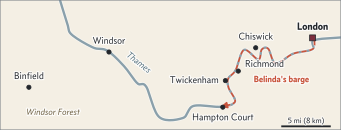
The game and the lock
Canto III opens on the palace. The theft takes place at Hampton Court,In this poem, the title event occurs at Hampton Court. → The Rape of the Lock•• the great royal palace on the Thames above London, which Cardinal Wolsey had built in the 1510s and Henry VIII had taken from him. Christopher Wren had rebuilt half of it for William and Mary in the 1690s (Vol. 12, Crown and Parliament), and its gardens stretched out to a long canal (Figure 21.11). Pope sets the scene with a mock-solemn description: “Close by those meads, for ever crown’d with flow’rs, / Where Thames with pride surveys his rising tow’rs, / There stands a structure of majestic frame, / Which from the neighb’ring Hampton takes its name.”

The court came here, and so did the queen. “Here thou, great Anna! whom three realms obey, / Dost sometimes counsel take—and sometimes tea.” Queen Anne ruled England, Scotland, and Ireland, the three realms, and in Pope’s day tea was pronounced “tay,” so it rhymes with obey. The zeugma puts the business of state on the same level as a cup of tea. The guests gossip about balls and visits, and “At ev’ry word a reputation dies.” Then Pope lets the outside world in for one cold moment. It is afternoon, and in the courts of London “The hungry judges soon the sentence sign, / And wretches hang that jury-men may dine.” In the city real people are dying, and nobody at Hampton Court hears of it.
Canto III: ombre
Belinda “Burns to encounter two adventrous knights” at cards. The third canto’s game of ombreIn this poem’s third canto, a game of ombre is played. → The Rape of the Lock•• (om-ber) is the poem’s battle scene. Ombre was the most fashionable card game of the day, played by three people with a pack of forty cards, nine to each player. It is played in nine rounds called tricks. In each, every player lays down one card, and the highest card of the suit led takes all three, unless someone plays a trump, a card of the suit chosen to beat all the others. One player, called the ombre, from the Spanish hombre, “the man,” names the trump suit and must take more tricks than either opponent alone. The top three trumps, called matadores, were the ace of spades (Spadillio (spuh-dil-ee-oh)), the lowest card of the trump suit (Manillio), which in spades is the two, and the ace of clubs (Basto). If an opponent wins more tricks than the ombre, the ombre has lost by codille (koh-deel) and must pay him.
Belinda is the ombre, and the Baron is her chief opponent. The sylphs perch on her cards, each on a card of his own rank. She studies her hand and speaks: “Let spades be trumps, she said, and trumps they were.” The line echoes Genesis, where God says, in the King James Version, “Let there be light: and there was light” (Vol. 5, In the Beginning). Then the cards march to war as armies. The kings have “hoary whiskers and a forky beard,” the queens hold flowers, and the knaves carry halberds, axes on long poles. Belinda’s three matadores sweep the first three tricks, and her king of spades takes a fourth. Then the Baron’s queen of spades kills the king of clubs, and his diamonds pour in. He wins four tricks in a row, the last with the knave of diamonds, which captures Belinda’s queen of hearts. Belinda turns pale, “Just in the jaws of ruin, and codille.” Everything hangs on the ninth trick. The Baron leads the ace of hearts, and Belinda’s hidden king of hearts “falls like thunder on the prostrate ace” (Figure 21.12).

Belinda’s shouts echo through the gardens, “The walls, the woods, and long canals reply,” and Pope warns her that the triumph will soon be snatched away. Coffee is served. The beans crackle as they roast and “the mill turns round” to grind them at the table, and coffee “Sent up in vapours to the Baron’s brain / New stratagems, the radiant lock to gain.” Pope reminds him of Scylla (sil-uh), the princess in Ovid who cut her father’s purple lock to betray him and was turned into a bird (Vol. 4, Classical Myth). The warning does no good. Clarissa hands the Baron a “two-edg’d weapon”,In this poem, Clarissa supplies scissors called a "two-edged weapon." → The Rape of the Lock•• drawing it “with tempting grace” from her case: a pair of scissors, of course, though Pope never stoops to the word. “So ladies in romance assist their knight, / Present the spear, and arm him for the fight.” Clarissa is one of the ladies at the table, the one who will plead for good sense in Canto V, and why she helps him the poem does not say.
Belinda bends over her coffee, and the Baron spreads the scissors behind her neck. The sylphs fight back. A thousand wings blow the hair out of the way, and three times the sprites twitch the diamond in her earA thousand sprites use their wings to "twitch" the diamond in this character’s ear. → Belinda• to make her look round: “Thrice she look’d back, and thrice the foe drew near.” Then Ariel looks into her heart to warn her and finds “An earthly lover lurking at her heart.” A sylph can guard only a girl who loves no man, so his power fails, and he withdraws with a sigh. The Baron closes the shears. One faithful sylph flies between the blades and is cut in two, “But airy substance soon unites again.” Pope’s note points to Milton’s war in heaven, where Satan’s body closes again after Michael’s sword cuts through it (Chapter 20). Then the Baron cuts the lock:The Baron cuts a lock of this character’s hair. → Belinda••• “The meeting points the sacred hair dissever / From the fair head, for ever, and for ever!”
Belinda screams, louder than women scream “When husbands, or when lapdogs breathe their last,” and Pope lets the husbands and the lapdogs share the line without comment. The Baron crows over his prize. As long as fish swim and ladies ride in coaches, he cries, “So long my honour, name, and praise shall live!” Steel, he adds, cut down the towers of Troy; no wonder it could cut a curl.
Canto IV: the Cave of Spleen
Ariel has fled, and a creature of the opposite kind takes his place. Umbriel (um-bree-el), “a dusky, melancholy sprite,” is a gnome, one of the earth spirits who delight in mischief, and he flies down to the center of the earth to the cave of the goddess Spleen. The spleen is an organ near the stomach, and the medicine of Pope’s day blamed it for gloom, ill temper, and imagined illness. Fashionable people, women especially, were said to suffer from “the spleen” or “the vapours,” and the Queen of Spleen rules them all. No breeze reaches her grotto but the east wind, which was thought to bring low spirits. She lies sighing on her bed, with Pain at her side and Megrim (mee-grim), the old word for migraine, at her head.
Two handmaids wait beside her throne. The queen’s handmaids are Ill-nature and Affectation.In this poem, a queen is served by handmaids named "Ill-Nature" and "Affectation." → The Rape of the Lock• Ill-nature is “like an ancient maid,” dressed in black and white, her hands full of prayer books and her bosom full of lampoons, the spiteful little poems that gossips passed around. Affectation, with a sickly look, shows “the roses of eighteen” in her painted cheeks; she lisps, hangs her head to one side, faints into airs, and lies on her quilt in a gown worn “for sickness, and for show.”
Mists rise around the palace full of phantoms, and the bodies of the splenetic have been changed into strange shapes. “Here living teapots stand, one arm held out, / One bent; the handle this, and that the spout: / A pipkin there like Homer’s tripod walks; / Here sighs a jar, and there a goose-pie talks.” A pipkin is a little earthenware cooking pot, and in the Iliad the smith god Hephaestus (Vol. 4, Classical Myth) makes tripods that walk by themselves. Women imagine they have turned into bottles and “call aloud for corks.” Umbriel passes safely through the Cave of SpleenIn this poem, the gnome Umbriel visits the Cave of Spleen. → The Rape of the Lock••In this poem, an underworld cave contains living teapots, jars, bottles, and a solitary pipkin. → The Rape of the Lock• and all its living pots, as Aeneas passed through the underworld with the golden bough (Vol. 4, Classical Myth), holding a sprig of spleenwort, a fern that was thought to cure the spleen.
He bows to the queen and asks her to “touch Belinda with chagrin,” and she grants his prayer. She fills a bag like the one in which the wind god Aeolus once tied up the winds for Ulysses (Vol. 4, Classical Myth), packing into it “the force of female lungs, / Sighs, sobs, and passions, and the war of tongues.” Then she fills a vial with tears. Umbriel flies back with both. Belinda’s friend Thalestris (thuh-les-tris) is named after an Amazon queen who was said to have visited Alexander the Great (Vol. 6, The Greeks), and Umbriel finds Belinda weeping in Thalestris’s arms.In this poem, a bag contains "sighs, sobs, and passions," the "Force of Female Lungs," and the "War of Tongues." → The Rape of the Lock••This character weeps in Thalestris’s arms as a bag of sighs is poured over them. → Belinda•• He rips the bag of sighs and sobs open over the two of them, and “all the furies issued at the vent.”
Belinda now “burns with more than mortal ire,” and Thalestris fans the fire. Think of what people will say, she cries; think of the lock shown off in a ring on the Baron’s finger! She sends Sir Plume, her beau or admirer, to demand the hair back. Sir Plume, proud of his amber snuffbox and his clouded cane, can only splutter a few oaths and “Give her the hair!” The Baron swears by the lock itself, as Achilles swears by his scepter in the first book of the Iliad, that he will wear it “for ever.”
Then Umbriel breaks the vial. It holds “fainting fears, / Soft sorrows, melting griefs, and flowing tears,”In this poem, a vial contains "fainting fears," "soft sorrows," "melting griefs," and "flowing tears." → The Rape of the Lock•• and as they pour out, Belinda’s anger turns to grief. She lifts her head and laments like a heroine of tragedy: “For ever curs’d be this detested day, / Which snatch’d my best, my fav’rite curl away! / Happy! ah ten times happy had I been, / If Hampton-Court these eyes had never seen!” She wishes she had stayed at home and said her prayers. She remembers the omens of the morning. Her patch box fell three times, the china shook without a wind, and Shock was unkind.
Canto V: the battle and the star
Everyone weeps, but the Baron will not give way. In 1717 Pope added a speech here, and it is the poem’s moral. “Then grave Clarissa graceful wav’d her fan,” and asks why beauties are praised and courted, unless “good sense preserve what beauty gains.” Dancing all night and dressing all day cannot cure the smallpox or stop old age, and “Curl’d or uncurl’d, since locks will turn to grey,” what remains is to “keep good humour still whate’er we lose.” “Charms strike the sight,” she ends, “but merit wins the soul.” The speech is a parody of one in the Iliad in which the Trojan ally Sarpedon (sar-pee-dun) asks why heroes are honored above other men. Nobody listens. “Belinda frown’d, Thalestris call’d her prude.”
“To arms, to arms!” cries Thalestris, and the battle of the beaux and the belles begins. Fans clap, silks rustle, “and tough whalebones crack,” and Pope compares the fight to Homer’s gods at war. The weapons are glances, frowns, and sighs. “A beau and witling perish’d in the throng, / One died in metaphor, and one in song.” Jupiter weighs “the men’s wits against the lady’s hair” in his golden scales, and the wits fly up: the hair is heavier.
Belinda flies at the Baron, and he does not mind, for he wants nothing more than to die at her feet. She beats him “with one finger and a thumb.” At the moment “Just where the breath of life his nostrils drew,” Belinda throws a pinch of snuffThis character throws snuff into an adversary’s nose. → Belinda• into his nose. Snuff was powdered tobacco that fashionable men and women sniffed from little boxes. The gnomes guide every grain, the Baron’s eyes stream, and “the high dome re-echoes to his nose” as he sneezes. Then she draws a bodkin, here a long ornamental hairpin, and Pope gives it a mock family history, as Homer gives the history of Agamemnon’s scepter. It began as her great-great-grandfather’s three seal rings, was melted into a buckle for his widow’s gown, then became a whistle with bells for her grandmother as a baby, then her mother’s hairpin, and now hers. “Restore the lock!” she cries, and the roof echoes. “Not fierce Othello in so loud a strain / Roar’d for the handkerchief that caus’d his pain” (Chapter 11).
But the lock cannot be found. “The lock, obtain’d with guilt, and kept with pain, / In ev’ry place is sought, but sought in vain.” Some think it has gone to the sphere of the moon, where, as Ariosto told, everything lost on earth is stored: broken promises, deathbed charities, the wits of fops kept in snuffboxes (Vol. 10, Rebirth). The Muse knows better. She saw it rise, as Rome’s founder Romulus, carried off in a storm, was seen afterward in glory by one witness alone (Vol. 4, Classical Myth). In the end the stolen lock becomes a star:In this poem, stolen hair becomes a star at the end. → The Rape of the Lock••• “A sudden star, it shot through liquid air, / And drew behind a radiant trail of hair.” A comet takes its name from the Greek word for “long-haired,” and the lock blazes across the sky brighter than the lock of Queen Berenice (bair-uh-ny-see), which an astronomer of ancient Alexandria had claimed to see among the stars (Vol. 7, The Romans).

Lovers walking in St. James’s Park in London will mistake it for the evening star, Pope says. John Partridge, a famous maker of almanacs, will spy it through “Galileo’s eyes,” the telescope (Vol. 10, Rebirth), and read the future in it. So Belinda should stop grieving. Her own hair will one day lie in the dust, “When those fair suns shall set, as set they must,” but “This lock, the Muse shall consecrate to fame, / And ’midst the stars inscribe Belinda’s name!” Pope’s prophecy came true in a way he could not have imagined. Two moons of Uranus found in 1851 were named Ariel and Umbriel after his spirits the next year, and a third, found by the spacecraft Voyager 2 in 1986, was named Belinda (Vol. 56, Astronomy and Earth Science).
Pope’s middle years
Pope was rich by his early thirties, and Homer made him so (Vol. 6, The Greeks). In 1713 he announced a translation of the Iliad in heroic couplets, to be sold by subscription: buyers paid in advance and saw their names printed in the book. Six volumes came out between 1715 and 1720. Whig and Tory lords alike subscribed, and the bookseller Bernard Lintot paid him besides for the right to sell copies to everyone else. The translation was a triumph. Samuel Johnson later called it “a performance which no age or nation can pretend to equal,” though the great classical scholar Richard Bentley is said to have told Pope, “It is a pretty poem, Mr. Pope, but you must not call it Homer.”
Catholics could not buy land, so in 1719 Pope leased a house with 5 acres at Twickenham (twik-uh-num), on the Thames between London and Hampton Court. He spent twenty-five years improving it. He laid out a garden with winding paths and a shell temple, and under the road that divided his land he dug a tunnel that he made into a grotto, an artificial cave lined with shells, mirrors, and glittering stones, where a spring trickled (Figure 21.14). His mother lived with him there until she died in 1733, past the age of ninety.

In 1717 Pope published his collected Works in a handsome volume, and among the new poems in it were two about women who loved and suffered. The first is “Eloisa to Abelard” (el-oh-ee-zuh, ab-uh-lard). Abelard was the great teacher of Paris in the twelfth century, and Héloïse (ay-loh-eez) was his brilliant pupil (Vol. 9, Cathedrals and Crusades). Their story ran from love and a secret child through the vengeance of her uncle to their parting into a monastery and a convent. Years later Héloïse read Abelard’s account of his misfortunes, and their famous letters followed. Pope’s poem is an imagined letter from her, written in heroic couplets from her convent, the Paraclete. Eloisa, as Pope calls her, has given her life to God and still cannot stop loving Abelard. She envies the nun who has forgotten the world and every earthly love:
A vestal was one of the virgin priestesses of ancient Rome, and Pope uses the word for a nun. In those lines Pope coined “Eternal sunshine of the spotless mind”This author coined "Eternal sunshine of the spotless mind" in "Eloisa to Abelard." → Alexander Pope• for the peace of a mind with no memories to trouble it, the peace that Eloisa cannot have. In 2004 the line gave its title to a film about a man who has the memory of a lost love erased from his brain. Pope’s poem ends with Eloisa imagining a future poet who will tell their story because he too has loved and lost: “He best can paint ’em, who shall feel ’em most.”
The second poem, Pope’s “Elegy to the Memory of an Unfortunate Lady”,This author wrote "Elegy to the Memory of an Unfortunate Lady." → Alexander Pope• was printed in 1717 as “Verses to the Memory of an Unfortunate Lady”; the title “Elegy” came in later editions. A ghost appears to the poet in the moonlight: “’Tis she!—but why that bleeding bosom gor’d, / Why dimly gleams the visionary sword?” The lady has killed herself with a sword for love, and the poet asks, “Is it, in heav’n, a crime to love too well?” He curses the guardian, her father’s own brother, who drove her to it. Because she took her own life she was buried abroad by strangers, without the rites of the church, and “no sacred earth” would receive her. Still, the poet says, the morning will weep on her grave and “the green turf lie lightly on thy breast.” Who she was, Pope never said, and the guesses of his friends and editors have never been proved.
An Essay on Man
In the 1720s one of Pope’s closest friends was Henry St. John (sin-jun), Viscount Bolingbroke (not the Henry Bolingbroke who became Henry IV, Chapter 7). He was a Tory statesman who had fled to France when George I came to the throne and was allowed home in 1723. Bolingbroke was a freethinker, interested in what reason alone could tell about God, and his talk set Pope writing a philosophical poem. Pope’s An Essay on ManThis author wrote An Essay on Man. → Alexander Pope• appeared in four parts, called epistles, from February 1733 to January 1734, without the author’s name. Critics who disliked Pope praised it before they learned who had written it. It is quoted here from an edition printed at Edinburgh in 1751.
The first epistle begins, “Awake, my St. John! leave all meaner things / To low ambition and the pride of kings.” The world, Pope says, is “A mighty maze! but not without a plan.” His aim is to “vindicate the ways of God to man,” an echo of the opening of Milton’s Paradise Lost, which set out to “justify the ways of God to men” (Chapter 20). His argument rests on the Great Chain of Being, an old idea that every creature has its fixed place in a single ladder of creation, from God and the angels down through man to the beasts, plants, and stones. Man sees only his own small link, so what looks to him like evil may be part of a good he cannot see. The first epistle ends with a string of paradoxes and a famous conclusion:
With that line the poem declares that “Whatever is, is right”,This poem declares that "whatever IS, is RIGHT." → An Essay on Man• a view that was soon called optimism, the belief that this is the best world God could have made. Many readers found it comforting. Twenty years later the earthquake that destroyed Lisbon in 1755 made it look cruel, and Voltaire answered it in a poem on the disaster and then in Candide (Vol. 10, Rebirth).
The second epistle turns from the universe to the creature looking at it. “Know then thyself, presume not God to scan; / The proper study of mankind is man.”This poem contains the line "the proper study of mankind is man." → An Essay on Man• Scan here means “examine closely,” and Pope’s advice is the old Greek command carved at Delphi, “Know thyself” (Vol. 6, The Greeks). Man stands on “this isthmus of a middle state,” unsure whether to think himself a god or a beast, “The glory, jest, and riddle of the world!” Then Pope mocks human pride with a string of commands. Go, he tells man, measure the earth, weigh the air, explain the tides, correct the calendar, and rise with Plato to the highest heaven. Then comes the sting: “Go, teach Eternal Wisdom how to ruleThis poem contains the lines "go, teach Eternal Wisdom how to rule— / then drop into thyself, and be a fool!" → An Essay on Man•— / Then drop into thyself, and be a fool!” A man clever enough to instruct God need only look into his own mind to see how foolish he is. Even the greatest of men are small beside the angels, Pope adds. When superior beings saw a mortal unfold all the laws of nature, they “showed a Newton as we show an ape,” the way people at a fair show off a clever monkey.
Pope’s satires
In 1725 Pope published an edition of Shakespeare in six large volumes. He was a poet, not a scholar, and he edited like one. He smoothed lines whose meter he disliked and moved passages he thought unworthy of Shakespeare to the foot of the page. The next year Lewis Theobald answered him (the Stage). Theobald was a lawyer who wrote plays and pantomimes, and his book’s title says what it did: Shakespeare Restored: or, a Specimen of the Many Errors, as well Committed, as Unamended, by Mr. Pope in his Late Edition of this Poet. Theobald knew the old texts far better than Pope, and his own edition of 1733 was among the best of the century; he gave Falstaff’s deathbed its “babbled of green fields” (Chapter 7). Pope never forgave him.
The Dunciad
Pope’s revenge came in May 1728. Pope’s The DunciadThis author wrote The Dunciad. → Alexander Pope•• (dun-see-ad) is a mock-epic in three books whose title means “the epic of the dunces,” as the Iliad is the epic of Ilium, or Troy. It appeared without his name, as if printed in Dublin, but nobody doubted who had written it. Its true heroine is the goddess Dulness,This poem celebrates the goddess Dulness. → The Dunciad•• “Daughter of Chaos and eternal Night,” and the poem sings of the spread of her empire as Virgil sang of the founding of Rome. Dulness, a note to the poem explains, is not mere stupidity. She is “Laborious, heavy, busy, bold, and blind,” the energy of all the hack writers, bad poets, and pedantic critics of London. Many of them lived in Grub Street, a lane of cheap lodgings near the City wall whose name came to mean writing for money without talent. She chooses a king to rule her empire, and in 1728 the king was Theobald, whom Pope spelled “Tibbald” to show how his name was said. The dunces celebrate his coronation with epic games. Booksellers race each other, and in the last game two dull authors are read aloud to see who can stay awake.

A year later Pope brought out The Dunciad Variorum, named after the kind of edition that prints the notes of many scholars. The poem was buried under a mountain of mock-learned notes signed “Martinus Scriblerus,” a pedant invented years before by Pope and his friends, among them Jonathan Swift (Vol. 12, Crown and Parliament). The notes parody exactly the kind of scholarship that Theobald practiced, arguing over single letters while missing the sense.
“Epistle to Dr. Arbuthnot”
John Arbuthnot (ar-buth-nut) was a Scottish doctor, physician to Queen Anne, and one of the wittiest men in London, a member with Pope and Swift of the Scriblerus (skrib-leer-us) Club. In July 1734 he wrote to tell Pope that he was dying. Pope answered by addressing a poem to him. Pope’s “Epistle to Dr. Arbuthnot”This author wrote "Epistle to Dr. Arbuthnot." → Alexander Pope•• was published on January 2, 1735, and Arbuthnot died eight weeks later. It is Pope’s defense of his own life as a satirist, quoted here from a reprint of the first edition made at Dublin in 1735. It opens with Pope besieged at home by bad poets who want his praise: “Shut, shut the door, good John! fatigu’d I said, / Tie up the knocker, say I’m sick, I’m dead.” John is his servant. Pope explains why he writes at all: “As yet a child, nor yet a fool to fame, / I lisp’d in numbers, for the numbers came,” that is, he spoke in verse before he could speak plainly. His verse has helped him “through this long disease, my life,” with Arbuthnot’s medicine.
Then come portraits of his enemies, the sharpest he ever drew. The first is “Atticus,” meaning Joseph Addison, the admired essayist of The Spectator (Vol. 12, Crown and Parliament), who had died in 1719. Pope believed that Addison had encouraged, and perhaps even written, a rival translation of the first book of the Iliad that a friend of his published in 1715. Atticus, the poem says, is a great writer too jealous to let any rival near his throne. He would “Damn with faint praise,This poem coined the phrase "damn with faint praise." → "Epistle to Dr. Arbuthnot"•• assent with civil leer, / And without sneering, teach the rest to sneer.” To damn with faint praise is to praise a man so coldly that the praise condemns him, and the phrase has been an idiom ever since. “Who but must laugh, if such a man there be? / Who would not weep, if Atticus were he!”
The next portrait is “Sporus” (spor-us), Pope’s name for Lord Hervey (har-vee) (the first printing calls him “Paris”), a pale, elegant courtier who was a favorite of George II’s queen, Caroline, and had attacked Pope in verse. Here Pope lets Arbuthnot interrupt him. Why waste such fury on so slight a creature? “Who breaks a butterfly upon a wheel?”This poem asks "Who breaks a butterfly upon a wheel?" → "Epistle to Dr. Arbuthnot"•• he asks. Breaking on the wheel was a cruel execution in which a criminal’s limbs were smashed as he lay bound to a cartwheel. Using it on a butterfly would be absurd. Pope pays no attention and goes on: “Yet let me flap this bug with gilded wings, / This painted child of dirt that stinks and stings.”
Lady Mary Wortley Montagu, whose name sounds like Romeo’s Montague, was a poet and letter writer of brilliant wit. She had lived in Constantinople as the wife of the British ambassador in 1717 and 1718, and brought home the Turkish practice of inoculation against smallpox (Vol. 12, Crown and Parliament). For a time she lived near Pope at Twickenham, and he wrote her extravagant letters of admiration. About 1722 they quarreled, for reasons neither ever explained, and his admiration turned to hatred. In his poems Pope’s “Sappho” was Lady Mary Wortley Montagu,This author used "Sappho" as a stand-in to attack Lady Mary Wortley Montagu in poems. → Alexander Pope• named in mockery after the Greek poet of love (Vol. 6, The Greeks). A couplet against “Sappho” in one of Pope’s imitations of Horace in 1733 was so insulting that she and Hervey answered with verses mocking his crooked body. In the “Epistle to Dr. Arbuthnot” Pope claims that she had made a fool of him: “Yet soft by nature, more a dupe than wit, / Sappho can tell you how this man was bit.”
The last Dunciad
In December 1730 Colley Cibber, actor, playwright, and manager of Drury Lane (Chapter 4), was made Poet Laureate. Everyone understood that he got the post for his loyalty to the Whig government of Sir Robert Walpole (wawl-pohl), the king’s chief minister, not for his verses. His odes for royal birthdays became a standing joke, and in 1740 he published a cheerful, boastful autobiography, An Apology for the Life of Colley Cibber. To Pope he was the perfect dunce, and in 1742 Cibber made matters worse by printing a humiliating story about Pope in a pamphlet. Pope had already written a fourth book for his satire, the New Dunciad, published that year, in which Dulness takes over the schools, the universities, and the arts. In October 1743 he brought out the whole poem in four books with a new king. Theobald, author of Shakespeare Restored and its list of Pope’s “many errors,” was dethroned, and Cibber replaced Theobald as king of the dunces.In a revision of this poem, Colley Cibber replaced Lewis Theobald as the chief dunce. → The Dunciad••Shakespeare Restored attacked the "many errors" in this author’s edition of Shakespeare. → Alexander Pope• Pope called his new hero Bays, the old nickname of the laureate since The Rehearsal.
The poem ends with the triumph of Dulness. She yawns, and the yawn spreads through the land. The arts go out one by one, like stars fading at dawn, until science, philosophy, religion, and morality have all expired. The last lines reverse the first chapter of Genesis, where God speaks and light appears (Vol. 5, In the Beginning):
Seven months later, on May 30, 1744, Pope died at Twickenham, aged fifty-six, and was buried in the parish church there beside his parents. Lewis Theobald, the first king of the dunces, died the same year. Pope’s couplets went on ruling English verse for another generation, until younger poets left the town, its card tables and its quarrels, for the quiet of a country churchyard (Chapter 22).
What to remember
- John Dryden (1631–1700), the leading poet of the Restoration, was made the first official Poet Laureate in 1668 and lost the post after the revolution of 1688, when as a Catholic he would not swear loyalty to William and Mary.
- Mac Flecknoe (about 1676) crowns Thomas Shadwell king of dullness; Absalom and Achitophel (1681) makes Monmouth Absalom and Shaftesbury Achitophel in the Exclusion Crisis; The Hind and the Panther (1687) makes the Catholic Church a milk-white Hind and the Church of England a Panther.
- Dryden’s All for Love (1677) retells Antony’s last day in blank verse “in imitation of Shakespeare’s style,” ending with Serapion’s eulogy; Congreve’s Love for Love (1695) is a comedy of manners.
- Alexander Pope (1688–1744), a Catholic crippled by illness, perfected the closed heroic couplet. “An Essay on Criticism” (1711), modeled on Horace, gave the language “A little learning is a dang’rous thing” and “To err is human, to forgive, divine.”
- The Rape of the Lock (1712, 1714, 1717), a mock-epic about Lord Petre’s theft of Arabella Fermor’s hair, has the sylph Ariel, ombre at Hampton Court, the gnome Umbriel in the Cave of Spleen, Clarissa’s scissors, Belinda’s snuff, and the lock turned into a star.
- Pope’s Iliad (1715–1720) made him rich; “Eloisa to Abelard” (1717) has “Eternal sunshine of the spotless mind”; An Essay on Man (1733–1734) says “The proper study of mankind is man” and “Whatever is, is right.”
- The Dunciad (1728) crowned Theobald, who had attacked Pope’s Shakespeare, king of the dunces under the goddess Dulness; in 1743 Colley Cibber replaced him. The “Epistle to Dr. Arbuthnot” (1735) has “Damn with faint praise” and “Who breaks a butterfly upon a wheel?”
Chapter 22 · 29 clues
Gray and the Graveyard
On the night of September 12, 1759, British boats slipped down the St. Lawrence River in the dark, toward the cliffs upstream of Quebec (kwih-bek), the capital of France’s colony in Canada, which Britain was at war to conquer. In one of them sat James Wolfe, a general of thirty-two, who meant to land his army at the foot of the cliffs and climb them before dawn. John Robison, a young man who sailed with the expedition, told the story many years later. On the eve of the battle, he said, Wolfe recited a poem to the officers around him and declared that he would rather have written it than take Quebec the next day. The next morning his men won the battle on the Plains of Abraham above the city, and Wolfe was shot dead in it (Vol. 27, New Worlds). The poem had a line that his death made famous: “The paths of glory lead but to the grave.” Wolfe’s own copy of it survives in a library in Toronto.
The poem was eight years old. Its author, a shy scholar who lived quietly at Cambridge University, had published it without his name, and in his whole lifetime he printed only about a thousand lines of English verse. The poem is set in a country churchyard at nightfall, in a fashion that poets had followed for a generation: verse about death, spoken among the graves.
The graveyard poets
The great English poet of the early eighteenth century was Alexander Pope, a poet of daylight, wit, and the town (Chapter 21). Beside his satires a quieter kind of poem grew up. Its speaker walks out at night to a churchyard, the burial ground around a parish church, and thinks about the dead under his feet and about his own death to come. The mood had an ancestor in Milton’s “Il Penseroso” (Chapter 18), whose thoughtful man walks by moonlight, hears the curfew, the evening bell, across the water, and hails “divinest Melancholy.” Most of the new poets were clergymen, and their poems end in Christian hope: the grave, they say, is a door to heaven.
The first of them was a friend of Pope’s. Thomas Parnell (par-nul) (1679–1718) was born in Dublin and became a clergyman of the Church of Ireland, the Protestant church established there, and in 1705 an archdeacon, the bishop’s chief helper in a district. He spent long stretches in London, where he joined Pope and Jonathan Swift, the Irish satirist who would write Gulliver’s Travels (Vol. 12, Crown and Parliament), in the Scriblerus Club, a circle of wits who mocked bad learning, and he helped Pope with his translation of the Iliad. After his young wife died he drank heavily, and in October 1718 he died at Chester, on his way home to Ireland. Pope gathered his best verse into Poems on Several Occasions, dated 1722, and in it was “A Night-Piece on Death.”
“By the blue taper’s trembling light,” the poem begins (a taper is a thin candle), and the speaker gives up his books for the night. The philosophers, he says, “point at best the longest way” to wisdom, and he will take a shorter path, to the graves. He walks out under the stars to a churchyard beside a lake and reads it like a map of society. The poor lie under nameless mounds bound with willow twigs, “Where toil and poverty repose.” The middle sort have flat stones with a name, soon worn away by feet. The rich have marble tombs carved with “Arms, angels, epitaphs, and bones,” praise the dead cannot feel. Then the dead rise in their shrouds and cry, “Think, mortal, what it is to die.” Death himself speaks from a yew tree, the dark evergreen of English churchyards. Men fear him, he says, only because they dress him in black plumes and funeral pomp, and the poem gives him its best couplet: “Death’s but a path that must be trod, / If man would ever pass to God.”
Robert Blair (1699–1746), the son of a royal chaplain in Edinburgh, was the minister of a country parish east of the city from 1731. His only famous poem, The Grave (1743), runs to 767 lines of blank verse, the unrhymed pentameter of Shakespeare and Milton (Vol. 1, The Toolkit). Where Parnell is calm, Blair means to frighten: “The task be mine / To paint the gloomy horrors of the Tomb.” He hails the yew, “Cheerless, unsocial plant,” that loves to dwell among skulls and coffins. In one scene a schoolboy crosses a lonely churchyard by moonlight, “Whistling aloud to bear his courage up,” until he hears, or thinks he hears, something at his heels and runs. An English clergyman, Edward Young (1683–1765), had a longer success with Night Thoughts (1742–1745), nine books of blank verse on death and immortality. Quotations in this section follow Parnell’s collected poems of 1833 and a Falkirk printing of Blair’s of 1788, in modern spelling.
These poets never called themselves a school, and the name was fixed only in 1898, by the critic William Macneile Dixon. Readers now call Parnell, Blair, Young, and those who followed them the graveyard or churchyard poets,A school of poetry named after one of these locations included Thomas Parnell. → a churchyard••A school of poetry named after one of these locations included Robert Blair. → a churchyard•• after the burial grounds where their poems are set. Samuel Johnson, the great critic of the age, recorded that his friend Oliver Goldsmith, whom Chapter 23 will meet as a playwright, quietly preferred Parnell’s “Night-Piece” to the most famous churchyard poem of all, and Johnson disagreed. That poem was Thomas Gray’s (Figure 22.1).

Gray’s odes
Thomas Gray was born in Cornhill, in the City of London, on December 26, 1716. He was the fifth of twelve children and the only one to live past infancy. His father, Philip, a scrivener who drew up legal papers and lent money, was a violent man, and it was his mother, Dorothy, who kept a hat shop with her sister and paid for his schooling. One of her brothers taught at Eton College, the school for boys beside the Thames that King Henry VI had founded in 1440 (Vol. 8, The Northern Worlds), and Gray went there. At Eton he made three close friends: Richard West, a delicate and gifted boy; Thomas Ashton; and Horace Walpole, the son of Sir Robert Walpole, Britain’s first prime minister (Vol. 12, Crown and Parliament). The four called themselves the Quadruple Alliance.

In 1734 Gray went up to Peterhouse, a college of Cambridge University. In 1739 Walpole took him along on the Grand Tour, the long journey through France and Italy that rich young Englishmen made to finish their education. Walpole wanted parties and Gray wanted ruins, and in 1741 they quarreled in Italy; Gray came home alone. His father died that November. On June 1, 1742, Richard West died at twenty-five. That summer, grieving, Gray wrote his first important English poems. For the rest of his life he lived as a scholar at Cambridge, reading Greek, botany, and old Welsh and Norse poetry. In 1756, according to a story told at Cambridge, students who knew he was afraid of fire raised a false alarm at night; Gray climbed down the rope he kept at his window and landed in a tub of water they had set beneath it. That spring he moved across the street to Pembroke College, and college tradition says the joke drove him there.
A distant prospect
In the late summer of 1742 Gray was staying with his mother and her sisters in the village of Stoke Poges, a few miles north of Eton (the Stage), and from the hills nearby he could see the school’s chapel above the Thames. There he wrote his “Ode on a Distant Prospect of Eton College,”This poet wrote "Ode on a Distant Prospect of Eton College." → Thomas Gray•• the poem of a man of twenty-five looking back at his school. A prospect is a view. The ode was printed in 1747 by the bookseller Robert Dodsley, without the author’s name, the first English poem of Gray’s to appear in print. Gray’s poems are quoted here in modern spelling. The “Elegy” follows the text he revised after its first printing, as a Verona edition of 1776 gives it, with the capitals of the first edition for the qualities it treats as persons. The other poems follow a London edition of 1790 and John Mitford’s edition of 1876.
The ode has ten stanzas of ten lines, mostly of four beats, and its first stanza is one long greeting to the buildings in the distance. “Ye distant spires, ye antique towers,”This poem describes "Ye distant spires, ye antique towers" of the titular institution. → "Ode on a Distant Prospect of Eton College"• it begins, speaking to the towers and spires of Eton College, “That crown the wat’ry glade.” The college still honors “Her Henry’s holy shade,” the ghost of its founder, whom many English people had revered as almost a saint. The poem greets as well the towers of the royal castle that look down from “Windsor’s heights” across the river, on groves, lawns, and meadows, among which “Wanders the hoary Thames along / His silver-winding way.”This poem is set by the "hoary Thames." → "Ode on a Distant Prospect of Eton College"• Hoary means gray or white with age, and the river is an old man, Father Thames, as Roman poets made a god of their Tiber (Figure 22.3).

The second stanza turns from the view to the man: “Ah, happy hills! ah, pleasing shade! / Ah, fields belov’d in vain!” Here his “careless childhood” strayed, “A stranger yet to pain.” Then he asks Father Thames who now swims in his waters, who chases the rolling hoop, and who throws the flying ball. The boys play on, some at their lessons, some sneaking out of bounds, and “Still as they run they look behind, / They hear a voice in every wind, / And snatch a fearful joy.” Johnson found the question to the river silly: “Father Thames has no better means of knowing than himself.”
At the sixth stanza the poem darkens: “Alas! regardless of their doom / The little victims play.” Around the boys, Gray says, wait the pains of grown-up life, drawn as figures in a procession: Anger, Fear, Shame, Jealousy “with rankling tooth,” Envy, Despair, Ambition, and “moody Madness laughing wild.” Behind them come diseases, Poverty, and slow Age, “The painful family of Death.” Giving a quality a body and a name, as if it were a person, is called personification (Chapter 16), and Gray’s odes are full of it. All men suffer, the last stanza says, so why should boys learn too soon what is coming? The ode ends “where ignorance is bliss, / ’Tis folly to be wise.”This poem concludes "where ignorance is bliss, 'tis folly to be wise." → "Ode on a Distant Prospect of Eton College"•• Gray meant something narrower than the proverb people now take from him: for children, not knowing their future is a kind of happiness, and it would be cruel to tell them.
Selima and the goldfish
Gray and Walpole made up their quarrel in 1745. Early in 1747 Horace Walpole’s cat drowned:This poem describes the drowning of Horace Walpole's cat. → "Ode on the Death of a Favourite Cat"•• his tabby, Selima (sel-ih-muh), toppled into a large china tub of goldfish at his house in London, and Walpole asked his friend for an epitaph. Gray answered in a letter of March 1747, joking that he could not remember which of Walpole’s two cats had died. The letter carried a mock lament, his “Ode on the Death of a Favourite Cat,”This poet wrote "Ode on the Death of a Favourite Cat." → Thomas Gray•• whose full title adds “Drowned in a Tub of Gold Fishes.” Dodsley printed it in 1748 in a collection of poems by several hands, and Walpole later set the fatal tub on a pedestal in his Gothic house at Strawberry Hill, by the Thames at Twickenham.
The joke is the style. Gray tells a cat’s accident in the grand language of epic and tragedy. Pope had done the same for a stolen lock of hair in his mock-epic The Rape of the Lock (Chapter 21). “’Twas on a lofty vase’s side, / Where China’s gayest art had dy’d / The azure flowers” that the pensive Selima reclined, gazing on “the lake below.” She admires her own reflection: her snowy beard, her ears of jet, her emerald eyes, “She saw; and purred applause.” Then two goldfish glide by, which the poem calls angel forms in “scaly armour,” purple and gold. A whisker, then a claw, stretches out in vain: “What female heart can gold despise? / What cat’s averse to fish?” Leaning again, she slips. “(Malignant Fate sat by, and smil’d)” and “She tumbled headlong in.”

Here the poem’s arithmetic does its work: “Eight times emerging from the flood / She mew’d to ev’ry wat’ry God.” A cat has nine lives, and she uses up eight of them coming up for air. No dolphin came, as one had come for the singer Arion in the old story, and no Nereid, no sea nymph, stirred. Neither of the servants, “cruel Tom” or Susan, heard her, for “A fav’rite has no friend!” The last stanza draws a moral for “ye beauties”: one false step is never retrieved, and not everything that tempts the eye is a lawful prize. The ode concludes “Nor all, that glisters, gold,”This poem concludes "Nor all that glisters gold." → "Ode on the Death of a Favourite Cat"• the old proverb that the Prince of Morocco reads on his scroll in Shakespeare’s The Merchant of Venice (Chapter 6). Johnson complained that the moral missed its mark: the cat wanted fish, not gold, and gold would not have kept her from drowning (Figure 22.4).
A curse from Snowdon
The two odes that Gray thought his best came out in 1757, and they were made to astonish. They are Pindaric odes, built in sets of three stanzas, the strophe, the antistrophe, and the epode, in the manner of the Greek poet Pindar (Vol. 1, The Toolkit). “The Progress of Poesy” traces poetry from Greece to England. The other is set in Wales in the 1280s, when Edward I of England conquered the last Welsh princes and ringed Snowdonia, the mountain country around Snowdon (snoh-dun), the highest peak in Wales, with castles (Vol. 8, The Northern Worlds). Gray had read a story, which historians no longer believe, that Edward had every Welsh bard he captured put to death, because the bards’ songs kept the people in revolt. A bard was a poet-singer of the Celtic peoples (Chapter 3).

“Ruin seize thee, ruthless King!” the poem begins. Edward’s army is winding down “Snowdon’s shaggy side” when the voice rings out above them. Gray’s ode shows a Welsh bard cursing Edward IThis poet's "The Bard" depicts a Welsh bard cursing Edward I as his army marches through Snowdonia. → Thomas Gray• from a rock above the foaming river Conway, now spelled Conwy, “With haggard eyes,” his white hair streaming “like a meteor” in the wind (Figure 22.5). Gloucester, one of the king’s barons, stands aghast, and Mortimer, another lord, cries “To arms!” On the cliffs around him the bard sees the ghosts of the poets Edward has killed, and together they weave the winding sheet, the shroud, of Edward’s family: “Weave the warp, and weave the woof,” the threads that run along and across a cloth. As they weave they foretell its doom. Edward II will die at Berkeley Castle, as Marlowe showed (Chapter 2), betrayed by his queen, Isabella, the “She-wolf of France” (Vol. 9, Cathedrals and Crusades); Richard II will starve; the Wars of the Roses will follow. Then the vision brightens. A Welsh line, the Tudors, will take the throne, and poets will rise: Spenser and Shakespeare under Elizabeth, and at last Milton. The prophecy spoken, the bard flings himself “headlong from the mountain’s height / Deep in the roaring tide” and drowns.
Gray began the poem in 1755 and stalled for two years, until he heard John Parry, a blind Welsh harper, play in Cambridge and finished it. Walpole had just set up a printing press at Strawberry Hill, and on August 8, 1757, the first book it issued was Odes by Mr. Gray. Johnson wrote that readers were at first content to gaze at them “in mute amazement.” Four months later Gray was offered the post of Poet Laureate, the official court poet, left empty by the death of Colley Cibber, the actor who had rewritten Richard III (Chapter 4). Gray refused it.
The “Elegy”
Gray’s “Elegy” grew slowly. Some lines may date from the grief of 1742; others came in the 1740s, when his visits to Stoke Poges took him into its churchyard. In November 1749 his mother’s sister Mary died, and the next summer, at Stoke, Gray finished the poem. On June 12, 1750, he sent it to Walpole as “a thing with an end to it,” a merit, he said, that most of his writing lacked. Walpole passed copies around London. In February 1751 Gray heard that a magazine meant to print it without asking him, so he had Dodsley rush it out first. On February 15 Gray’s “Elegy Written in a Country Churchyard”This poet wrote "Elegy Written in a Country Churchyard." → Thomas Gray•• appeared as a sixpenny pamphlet with no author’s name, under the title An Elegy Wrote in a Country Church Yard (wrote for written was still common). By 1753 it had gone through eight editions.
An elegy (the Stage) is a poem of mourning, most often a lament for one person who has died. Gray’s mourns no single friend. The “Elegy” is set in a country churchyard,This Thomas Gray elegy is set in the title cemetery. → "Elegy Written in a Country Churchyard"••• a village burial ground at dusk, and it mourns all the plain people buried there. The churchyard is traditionally that of St. Giles at Stoke Poges, where Gray’s aunt had just been buried, though the poem never names it. Its stanza is the heroic quatrain: four lines of iambic pentameter rhyming abab (Figure 22.6). Its thirty-two stanzas move from the landscape, to the dead, to the poet himself.

Evening
The poem begins “The curfew tolls the knell of parting day.”This poem begins with "The curfew tolls the knell of parting day." → "Elegy Written in a Country Churchyard"••• The curfew was a bell rung each evening in many English parishes, an old custom whose name comes from the French couvre-feu, “cover the fire.” A knell is the slow bell rung for a death, so the curfew sounds like a funeral for the day that is departing. Cattle wind home over the lea, the meadow, and “The plowman homeward plods his weary way”This poem describes a ploughman who "plods his weary way." → "Elegy Written in a Country Churchyard"• after a day behind his team in the field. He “leaves the world to darkness and to me”: the speaker is alone. The landscape fades. A beetle drones past, sheep bells tinkle in the distant folds, and an owl in the ivy-covered church tower complains to the moon about intruders.
Then he looks down at the graves, under the elms and “that yew-tree’s shade,” where the turf heaves in mounds. Here, each in his narrow cell, “The rude Forefathers of the hamlet sleep.”This poem mentions the "rude forefathers of the hamlet" who sleep in the title location. → "Elegy Written in a Country Churchyard"• Rude means plain and unlearned, not ill-mannered, and a hamlet is a small village. Nothing will wake them now: not the swallow, nor the rooster, nor the hunting horn. No wife will tend the fire for them, and no children will run to climb on their knees. Gray remembers them at work, bringing in the harvest and felling trees: “How jocund did they drive their team afield!” Jocund means merry.
The proud and the poor
The next stanzas speak to the proud. Let not Ambition mock these useful lives, nor Grandeur smile at “The short and simple annals of the poor,” for noble families, power, beauty, and wealth all come to the same hour. “The paths of glory lead but to the grave.”This poem includes the line "The paths of glory lead but to the grave." → "Elegy Written in a Country Churchyard"•• The great have their monuments inside the church, in the “long-drawn aisle and fretted vault” where anthems swell, but what good are they? A storied urn, carved with the dead man’s history, or an animated bust, a lifelike sculpture of his head, cannot call his breath back into his body. “Can Honour’s voice provoke the silent dust,”This poem asks if "Honour's voice [can] provoke the silent dust." → "Elegy Written in a Country Churchyard"• Gray asks, “Or Flatt’ry soothe the dull cold ear of Death?” To provoke here is to call forth, as the Latin provocare means. Honor shouted at a corpse wakes nothing.
Perhaps, then, in this neglected spot lies someone who might have been great. Gray imagines “Some heart once pregnant with celestial fire,”This poem's speaker wonders if "some heart once pregnant with celestial fire" is laid nearby. → "Elegy Written in a Country Churchyard"•• a heart filled with the heavenly fire of genius, now laid in a village grave and forgotten by everyone but the poem. Here may lie hands that could have held “the rod of empire” and ruled a nation, or hands that might have “wak’d to ecstasy the living lyre,”This poem describes hands that might have "wak'd to ecstasy the living lyre." → "Elegy Written in a Country Churchyard"• playing music or poetry to rapture. The lyre was the harp of the Greek poets, who sang their verse to it, and so it stands for poetry itself. But these villagers never learned to read. Knowledge never unrolled her book for them, rich with “the spoils of time,” the learning of past ages. “Chill Penury repress’d their noble rage.”This poem pictures "Chill Penury" repressing individuals' "noble rage." → "Elegy Written in a Country Churchyard"•• Penury (pen-yuh-ree) is poverty, imagined as a cold hand, and rage is the passion of genius; poverty froze “the genial current of the soul” before it could flow. “Full many a flower is born to blush unseen,” the next stanza says, “And waste its sweetness on the desert air.”
Then Gray names three Englishmen of the century before. John Hampden (hamp-dun) was a squire of Buckinghamshire, the county of Stoke Poges, who was tried in 1637 for refusing to pay a tax Charles I had laid without Parliament, and who died fighting the king in 1643 (Vol. 12, Crown and Parliament). Gray’s village may hold “Some village-Hampden,” who stood up to the little tyrant of his own fields. “Some mute inglorious Milton here may rest”:This poem imagines "some mute inglorious Milton" in the title location. → "Elegy Written in a Country Churchyard"•••Thomas Gray's "Elegy Written in a Country Churchyard" imagines "some mute inglorious" version of this poet. → John Milton•• a man born with the genius of John Milton, the poet of Paradise Lost (Chapter 20), who never wrote a line and so never won fame. He is mute because he never spoke in verse, and inglorious because no glory came to him. And there may lie “Some Cromwell guiltless of his country’s blood,”This poem imagines "some Cromwell guiltless of his country's blood" in the title location. → "Elegy Written in a Country Churchyard"••• a man with Oliver Cromwell’s force who never had the chance to win a civil war and send a king to the block (Chapter 19). In an early draft the three were Romans (Vol. 7, The Romans): Cato, the stern defender of the Roman Republic; Tully, that is, the orator Cicero; and Julius Caesar. Gray made them English.
What the poor were spared
Poverty took away more than fame, the next stanzas argue. It also forbade them great crimes. They were never able “to wade through slaughter to a throne, / And shut the gates of mercy on mankind,” or to hide the truth, or to flatter the rich with their poems. “Far from the madding crowd’s ignoble strife,”This poem includes the phrase "far from the madding crowd's ignoble strife." → "Elegy Written in a Country Churchyard"••• they kept quietly on “the noiseless tenor of their way.” Madding means frenzied: the crowd is the scramble for wealth and power in the cities. Thomas Hardy took the line for the title of his novel Far from the Madding Crowd in 1874 (Vol. 17, The Victorians).
Even these humble bones, Gray goes on, have some frail memorial to protect them from insult, “With uncouth rhymes and shapeless sculpture deck’d,”This poem's speaker describes how "uncouth rhymes" and "shapeless sculpture" bedeck objects bearing names and years "spelt by the unlettered muse." → "Elegy Written in a Country Churchyard"• and on it are carved their name and years, “spelt by th’ unletter’d Muse.” Uncouth means clumsy, and unletter’d means uneducated. The Muse, the goddess of poetry, is here a village stonecutter who cannot spell, adding a few lines of verse and a text from the Bible. Even so, these poor stones plead for “the passing tribute of a sigh.” Johnson, who disliked most of Gray, said of the four stanzas beginning “Yet ev’n these bones” that he had never met the thoughts anywhere else, “yet he that reads them here, persuades himself that he has always felt them.” For no one, the next stanza says, ever left “the warm precincts of the cheerful day” without “one longing ling’ring look behind.”
The poet’s own grave
Now the poem turns. “For thee,” it says, the one “who mindful of th’ unhonour’d dead / Dost in these lines their artless tale relate”: the speaker is addressing himself, the poet who has been writing about the villagers. Perhaps, some day, a stranger who shares his feelings will come by and ask what became of him. If “Some kindred spirit shall inquire thy fate,” then “some hoary-headed swain may say”In this poem, a "hoary-headed swain" describes the speaker's fate to a "kindred spirit." → "Elegy Written in a Country Churchyard"•• what the poet was like. A swain is a country laborer, and this one is white-haired. In the rest of that stanza and the four after it, the old man tells it in his own words.
“Oft have we seen him at the peep of dawn,” the swain says, brushing the dew from the grass on his way to meet the sunrise. At noon he would stretch out at the foot of a beech tree and stare at the brook. By the wood he would wander, muttering his “wayward fancies,” and the villager remembers him, as a farmer might remember an odd young gentleman, as “Now drooping, woeful wan, like one forlorn,In this poem, the speaker imagines being described as "drooping, woeful wan, like one forlorn, or crazed with care, or crossed in hopeless love." → "Elegy Written in a Country Churchyard"• / Or craz’d with care, or cross’d in hopeless love.” Wan means pale, and forlorn means abandoned. Then one morning he was missing from his usual hill, and the next, and on the third they saw him carried along the church path to his grave. “Approach and read (for thou canst read) the lay,” the swain says to the kindred spirit: the stranger can read, and the old man cannot. The lay, or poem, is carved on the poet’s stone beneath an old thorn tree.
The poem ends with the EpitaphThis poem concludes with an epitaph to "A youth to Fortune and to Fame unknown." → "Elegy Written in a Country Churchyard"••• of three stanzas carved on that stone, for “A Youth to Fortune and to Fame unknown.” Science in Gray’s English means learning: the young man was humbly born but well read, and sadness claimed him as her own. He gave the only thing he had, a tear, and gained the only thing he wanted, a friend. Readers have long argued whether this youth is Gray himself, or a village poet, or his dead friend West. Most take him to be the speaker of the poem, who has imagined his own obscure death among the obscure dead he pitied. The Epitaph leaves him, in the poem’s Christian close, “in trembling hope” in the bosom of God.

The “Elegy” made Gray famous at once. In 1753 Dodsley printed it with five of his other poems in a handsome book, Designs by Mr. R. Bentley, for Six Poems by Mr. T. Gray, illustrated by Richard Bentley, the son of a great classical scholar and a friend of Walpole’s. Gray’s mother died that March. On her tomb in the churchyard at Stoke Poges, Gray called her “the careful tender Mother / Of many Children; one of whom alone / Had the Misfortune to survive her.”
Samuel Johnson, writing Gray’s life in his Lives of the Poets (the Stage), mocked the odes but bowed to the “Elegy.” “In the character of his Elegy,” he wrote, “I rejoice to concur with the common reader,” for the poem “abounds with images which find a mirrour in every mind, and with sentiments to which every bosom returns an echo.” Gray died at Cambridge on July 30, 1771, at fifty-four, and he was buried in his mother’s tomb at Stoke Poges, in the churchyard of his poem (Figure 22.8).

Christopher Smart
In the 1740s Pembroke College, where Gray had friends and would later live, had a brilliant, reckless young scholar named Christopher Smart. Smart was born on April 11, 1722, at Shipbourne in Kent, the son of an estate steward, and a pension from the Duchess of Cleveland sent him to Pembroke in 1739. He won a university scholarship for his Latin, became a fellow of the college in 1745, and spent far more than he had. In 1747 Gray wrote that Smart would soon be ruined by his debts. By 1750 he had gone to London to live by his pen. He wrote comic verse and filled a magazine called The Midwife in the character of an old woman, “Mrs. Mary Midnight.” He married the stepdaughter of John Newbery, a bookseller famous for his books for children, and he wrote poem after poem for a Cambridge prize on the attributes of God, winning it five times.

Then, about 1756, after a serious illness, Smart began to pray aloud wherever he was, kneeling in the street and in the park, and to insist that others pray with him. In May 1757 his father-in-law had him admitted to St. Luke’s Hospital for Lunatics in London, and after that he was kept in a private madhouse in Bethnal Green until January 1763. His friend Samuel Johnson did not think he should have been shut up. “His infirmities were not noxious to society,” Johnson said, as James Boswell recorded in his Life of Johnson (1791), and added, “I’d as lief pray with Kit Smart” as with anyone else. Lief means gladly, and Kit is short for Christopher.
In the madhouse, between about 1759 and 1763, Smart wrote a strange and joyful poem in long lines without rhyme or meter. He called it Jubilate Agno (yoo-bih-lah-tay ahg-noh), Latin for “Rejoice in the Lamb”: for Christians, Jesus is the Lamb of God. Some of its lines begin “Let,” pairing people from the Bible with animals and plants in praise of God, and others begin “For,” like the verses of a psalm answering each other in turn. Over 1,200 lines survive, on loose sheets (Figure 22.10), and no one printed them for 176 years. W. F. Stead, a clergyman and poet, found the manuscript in a private library, and in 1939 he published it as Rejoice in the Lamb: A Song from Bedlam, using the nickname of London’s best-known madhouse (Chapter 12) for the places where Smart was kept.

Its most famous passage is seventy-four lines about Smart’s companion in confinement. Smart wrote about his cat, JeoffryThis poet wrote about his cat Jeoffry. → Christopher Smart• (jef-ree), beginning “For I will consider my Cat Jeoffry.” In line after line he watches the cat: worshiping God at sunrise by wreathing his body seven times round, washing, stretching, keeping the Lord’s watch at night against the Devil, and leaping and creeping. Smart even counts him one of the tribe of the tiger. For him the cat’s ordinary life was a prayer, and every creature, rightly seen, was praising God.
Smart left the madhouse in January 1763 and that April published A Song to David, a long hymn of praise to the poet-king of the Psalms, which the Victorian poets Robert Browning and Dante Gabriel Rossetti would call a masterpiece (Vol. 17, The Victorians). But his debts caught up with him. He was arrested in 1770 and died on May 20, 1771, in the debtors’ prison of the King’s Bench, ten weeks before Gray. The two poets of Pembroke College died in the same year, one the most admired poet in England, the other a man whose greatest poem no one would read for another 168 years.
What to remember
- The graveyard or churchyard poets wrote about death among the tombs at night: Thomas Parnell’s “A Night-Piece on Death” (1722), Robert Blair’s The Grave (1743), and Edward Young’s Night Thoughts (1742–1745).
- Thomas Gray (1716–1771), a Cambridge scholar and Horace Walpole’s school friend, published only a handful of poems, among them the most famous English poem of his century.
- “Ode on a Distant Prospect of Eton College” (written 1742, printed 1747) greets the “distant spires” and the “hoary Thames” and ends “where ignorance is bliss, / ’Tis folly to be wise.”
- “Ode on the Death of a Favourite Cat” (1748) mourns Walpole’s cat Selima, drowned in a tub of goldfish, in mock-epic style, and ends “Nor all, that glisters, gold.”
- “The Bard” (1757), a Pindaric ode, shows a Welsh bard cursing Edward I’s army on Snowdon, foretelling the fall of his line, and leaping to his death.
- “Elegy Written in a Country Churchyard” (1751), set traditionally at Stoke Poges, opens with the curfew and the plowman and mourns the “rude Forefathers of the hamlet”: “The paths of glory lead but to the grave.”
- The “Elegy” imagines “Some mute inglorious Milton” and “Some Cromwell guiltless of his country’s blood,” lives “Far from the madding crowd’s ignoble strife,” and ends with a swain’s account and an Epitaph for “A Youth to Fortune and to Fame unknown.”
- Christopher Smart (1722–1771), confined for madness from 1757 to 1763, wrote Jubilate Agno, printed only in 1939, with its lines on his cat Jeoffry.
Chapter 23 · 19 clues
Goldsmith and Sheridan
On the afternoon of March 15, 1773, Samuel Johnson took the chair at a long table in the Shakespeare Tavern, at an early dinner before the first performance of a new comedy. Around him sat friends of the playwright, Oliver Goldsmith, who had agreed to applaud together that evening. Goldsmith himself could hardly speak or swallow. When the party left for the theater he slipped away and walked up and down the Mall in St. James’s Park, until a friend found him and brought him to the playhouse. He came in as the fifth act began, just in time to hear a hiss. “What’s that?” he asked the theater’s manager, George Colman (kohl-mun), who had predicted failure. “Pshaw! doctor,” Colman answered, “don’t be frightened at a squib, when we’ve been sitting these two hours on a barrel of gunpowder!” A squib is a small firecracker. So the American writer Washington Irving told the story in his life of Goldsmith, published in 1849.
The squib fizzled, and She Stoops to Conquer has been acted ever since. Goldsmith was Irish, and two years later a much younger Irishman brought out his first comedy at the same theater. Between 1773 and 1779 these two writers brought laughter back to the London stage, and their plays close this book.
She Stoops to Conquer
In the London of George III only two theaters could lawfully act plays all year round. When Charles II returned in 1660, he gave two courtiers the sole right to stage plays in London (the Stage). Their royal grants, called letters patent, passed by sale and inheritance to the Theatre Royal in Drury Lane and the Theatre Royal in Covent Garden, opened in 1732. These two patent theaters stood barely two hundred yards apart, beside the fruit and vegetable market of Covent Garden (Figure 23.1). In 1737 Parliament’s Licensing Act confirmed their monopoly and made the Lord Chamberlain, an officer of the royal household, license every new play (Vol. 12, Crown and Parliament). From 1766 a third house, the Little Theatre in the Haymarket, held a patent for the summer months only, when the two great houses were closed. The monopoly lasted until the Theatres Act of 1843. David Garrick, the great actor (Chapter 4), ran Drury Lane from 1747 to 1776; from 1767 Colman managed Covent Garden.

What these theaters played as comedy had changed since the days of Congreve (Chapter 21). Ever since the essayist Richard Steele’s The Conscious Lovers (1722), the fashion had been sentimental comedy: plays in which good people suffer, virtue is rewarded, and the audience is meant to weep more than to laugh. Its hero was a man of sentiment, who spoke noble moral maxims, called “sentiments,” on every occasion. In Goldsmith’s day its leading writers were Hugh Kelly and Richard Cumberland. Goldsmith’s first comedy, The Good-Natur’d Man, opened at Covent Garden in January 1768 and lost the season to Kelly’s False Delicacy at Drury Lane. Its best scene showed a young man’s bailiffs, the officers sent to arrest him for debt, passed off in court dress as his friends. The audience hissed it off the stage as “low,” the historian Thomas Babington Macaulay wrote in a life of Goldsmith in 1856.

Goldsmith had come a long way to Covent Garden. He was born in Ireland, probably on November 10, 1728, the son of a poor Protestant clergyman; even the place is uncertain, either near Ballymahon in County Longford or at his grandparents’ house in Roscommon. He finished near the bottom of his class at Trinity College, Dublin, studied medicine at Edinburgh and at Leiden (ly-dun) in Holland, and then, by his own later account, walked through France, Switzerland, and Italy, playing the flute for his supper. He landed in England in 1756 without a shilling. He worked as a druggist’s helper and a schoolmaster’s assistant, then wrote at so much a page for booksellers, who were also the publishers of the day. He called himself Doctor, on the strength of a medical degree he said he had taken abroad. His essays as an imaginary Chinese traveler, The Citizen of the World (1760–1762), made his name. He became a friend of Johnson and one of the first members of the Club, which Johnson and the painter Joshua Reynolds (Vol. 12, Crown and Parliament) founded in 1764: a dining club of writers and talkers that met weekly at the Turk’s Head tavern in Soho. A long poem, The Traveller (1764), a novel, The Vicar of Wakefield (1766; Vol. 12, Crown and Parliament), and another long poem, The Deserted Village (1770), followed. He talked foolishly and knew it. The writer Horace Walpole (Vol. 12, Crown and Parliament) called him an “inspired idiot,” and Garrick said, as Macaulay told it, that Noll, short for Oliver, “wrote like an angel, and talked like poor Poll,” a common name for a parrot.
Goldsmith wrote She Stoops to ConquerThis author wrote She Stoops to Conquer. → Oliver Goldsmith•• in 1771, his second and last comedy. He offered it to Colman in 1772, and Colman kept it for months before he would stage it. Its title came last. Irving says that the friends considered The Old House a New Inn before Goldsmith fixed on The Mistakes of a Night and set She Stoops to Conquer in front of it. The first edition (1773), quoted here as Wikisource transcribes it, is dedicated to Johnson.
The house that looks like an inn
The whole play takes place in one night, at Mr. Hardcastle’s old house in the country. Hardcastle is a squire who loves “every thing that’s old: old friends, old times, old manners, old books, old wine,” and an old wife. His wife longs for trips to London. Tony Lumpkin is her son by her first husband: an idle, practical-joking young squire who prefers the alehouse to books, and who will inherit fifteen hundred pounds a year when he comes of age at twenty-one. Hardcastle’s daughter, Kate, has spent a year or two in town and come back fond of silk and French finery. Father and daughter have made a bargain. She dresses as she pleases in the morning,In this play, the heroine wears modern clothing in the morning and old-fashioned clothing at night. → She Stoops to Conquer• and, as she reminds him, “in the evening, I put on my housewife’s dress to please you,” a plain dress in the old style he loves.
That evening Hardcastle has news. The son of his old friend Sir Charles Marlow is coming to court Kate: young Charles Marlow, handsome and well educated, but “one of the most bashful and reserved young fellows in all the world.” Kate’s cousin Constance Neville knows him. He is the closest friend of her own admirer, George Hastings, and he is as bold with barmaids as he is tongue-tied with ladies. Constance’s fortune is a box of jewels left to her by an uncle, a director of the East India Company, which traded with India, and her aunt, Mrs. Hardcastle, keeps it. Mrs. Hardcastle means her to marry Tony, so that the jewels stay in the family. Tony would rather marry anyone else.
The second scene is the alehouse called the Three Pigeons, where Tony sits at the head of a table of shabby drinkers and sings a song of his own. One drinker says he loves to hear the squire sing “bekeays he never gives us nothing that’s low.” “O damn any thing that’s low,” says another, “I cannot bear it.” Goldsmith’s first audience knew the joke against the critics who had hissed his bailiffs. Then two travelers arrive, lost. They are Marlow and Hastings, looking for Mr. Hardcastle’s. Tony sees a chance to pay back his stepfather, who calls him whelp and hound. He describes a road through Squash Lane and over Crackskull Common, a heath notorious for robbers, so hopeless that they give up. Then he sends them to “the old Buck’s Head on the hill, one of the best inns in the whole county.” The house he means is Hardcastle’s.In this play, Tony Lumpkin tricks a visitor at the Three Pigeons into believing a private home is an inn. → She Stoops to Conquer•• The landlord, Tony warns them, “wants to be thought a Gentleman.”
Liberty Hall
Hardcastle has been drilling his farmhands to wait at table. The guests arrive, and since they think they are at an inn, they treat their host as a landlord who will not leave them alone. Hardcastle, a hospitable man, tells them, “This is Liberty-hall, gentlemen. You may do just as you please here.” The young men talk over their clothes as if planning a campaign, and Marlow means to keep his embroidered clothes in reserve “to secure a retreat.” The word sets Hardcastle off on his favorite old soldier’s tale, of the Duke of Marlborough (mawl-bruh), the general who won Queen Anne’s great battles against the French king Louis XIV (Vol. 12, Crown and Parliament), and a garrison “of about five thousand men.” Three times the young men interrupt him to discuss their clothes. Then, as he reaches the Duke’s promise to take the garrison “without spilling a drop of blood,” Marlow asks for a glass of punch,In this play, requests for punch interrupt an anecdote about the Duke of Marlborough. → She Stoops to Conquer•• a hot drink of spirits, sugar, and lemon. Hardcastle, who was promised a bashful young man, mutters that this is “the most unaccountable kind of modesty I ever met with,” and the story is never finished.
Hastings meets Constance, who sees at once that the inn is Tony’s trick. They keep it from Marlow, who would leave the house if he knew. Hastings wants to elope with her to France, but she will not leave her fortune behind. Marlow, meanwhile, is presented to Miss Hardcastle, just back from a walk in her bonnet, and is so frightened that he never once looks at her face.
In Act 3 Tony runs in with a casket. He has a key to every drawer of his mother’s bureau, and he gives Hastings the stolen jewels,In this play, stolen jewels are intended to finance Constance Neville and George Hastings's elopement. → She Stoops to Conquer•• “Your sweetheart’s jewels,” to “bear your charges,” that is, to pay the lovers’ way when they elope. Asked how he got them, he answers, “Ask me no questions, and I’ll tell you no fibs.” Mrs. Hardcastle finds her bureau broken open, and Tony, who had advised her to tell Constance that the jewels were lost, enjoys her real despair.
Kate now comes in wearing her plain evening dress. Kate’s maid, Pimple,The heroine of this play has a servant named Pimple. → She Stoops to Conquer• reports that the young gentleman, seeing her mistress pass in that dress, asked whether she was the barmaid. Kate resolves to keep up the mistake. If Marlow talks freely only to women of lower rank, she will be one. She practices the “bar cant,” the shouts of a busy inn whose rooms have names: “Attend the Lion there.—Pipes and tobacco for the Angel.—The Lamb has been outrageous this half hour.” The trick works at once. Kate plays a barmaid to Marlow,In this play, Kate Hardcastle pretends to be a barmaid to overcome Charles Marlow's shyness. → She Stoops to Conquer••• who looks her full in the face for the first time and finds his tongue: “I vow, child, you are vastly handsome.” He grows bold enough to try to kiss her, just as her father walks in. Hardcastle, who already thinks his guest impudent, decides to turn him out.

The trick runs on through Act 4 (Figure 23.3). Hastings sends the jewels to Marlow for safekeeping, and Marlow, thinking he is being careful, hands them to “the landlady,” who is Mrs. Hardcastle. Hardcastle orders his guest out of “my house,” and Marlow at last learns where he is. Kate still hides her name and lets him think her a poor relation of the family. “I’ll still preserve the character in which I stoop’d to conquer,” she says, and the line gives the play its title. Then a letter from Hastings to Tony arrives while Mrs. Hardcastle is in the room. Tony cannot make out the handwriting, so he hands it to his mother, who reads it and finds the plan. She decides to carry her niece off that night, with Tony to guide them, to old Aunt Pedigree, who will keep the girl “secure.”
Crackskull Common
The squire who began the night by sending two travelers from the Three Pigeons to a private house as if it were an inn ends it with a trick on his own mother. For two and a half hours Tony drives his mother round in circles,In this play, a man drives his mother in circles, pretending they have reached Crackskull Common. → She Stoops to Conquer•• down Feather-bed Lane, “over the stones of Up-and-down Hill,” past the gibbet on Heavy-tree Heath, and at last into the horse-pond at the bottom of the garden. Then he tells her that they must be on Crackskull Common, “about forty miles from home,” and she cries out that it is “the most notorious spot in all the country.” When Hardcastle comes out on a night walk, she takes him for a highwayman and kneels to beg her husband for her life. It was this scene, Irving says, that drew the first night’s only hiss.
The rest is a comedy’s clearing-up. Marlow’s father arrives. Kate places both fathers behind a screen, and they watch Marlow, who believes her a poor relation, kneel and offer her his hand. Constance’s fortune is saved by Tony’s age, for it passes into her own hands if Tony, once of age, refuses to marry her. His mother has hidden that he is of age already, and once he learns it he formally refuses his cousin, so that she may marry Hastings and keep her jewels: “Tony Lumpkin is his own man again.” Johnson said, as Boswell recorded, that he knew of no comedy for many years “that has so much exhilarated an audience.” Goldsmith had little time to enjoy it. He died in his rooms in the Temple, the old lawyers’ quarter off Fleet Street, on April 4, 1774, aged forty-five, and was buried in its churchyard. His friends put up a monument to him in Westminster Abbey, carved by the sculptor Joseph Nollekens (nol-uh-kenz), with a Latin inscription by Johnson that praises him as a writer who touched nothing that he did not adorn.
The Rivals
Richard Brinsley Sheridan was born in Dublin on October 30, 1751, into a family of the stage. His father, Thomas Sheridan, was an actor and a teacher of elocution, the art of speaking well, and his mother, Frances, wrote novels and plays. He was sent to school at Harrow, near London, and in 1770 his family settled in Bath. Bath, a hundred miles west of London, was England’s most fashionable spa, where the rich came for the “season” to drink its hot spring waters in the Pump Room, stroll on the paved walks called parades, and dance at night. There Sheridan fell in love with Elizabeth Linley, a famous young singer. In 1772 he escorted her to France to escape an unwanted suitor, fought that suitor in two duels, and in 1773 married her.
Sheridan wrote The Rivals,This author wrote The Rivals. → Richard Brinsley Sheridan•• his first play, when he was twenty-three, and set it in the Bath he knew. It opened at Covent Garden on January 17, 1775, and failed. It was too long and too coarse, and the actor who played its Irishman, Sir Lucius O’Trigger, did not know his lines. Sheridan revised it in eleven days, and on January 28 it began a run that has never really ended. It is quoted here in the revised text printed in 1775, as Wikisource gives it.
The heroine, Lydia Languish, is seventeen, an heiress of thirty thousand pounds, and a devoted reader of romantic novels from the town’s circulating libraries, the shops that lent books for a fee. She wants a love affair like a novel’s, an elopement with a poor man. If she marries without her aunt’s consent before she comes of age, she loses two-thirds of her fortune, and that is exactly what she means to do. Jack Absolute courts her as Ensign Beverley.In this play, Jack Absolute disguises himself as the penniless Ensign Beverley to pursue Lydia Languish. → The Rivals•• An ensign was the lowest rank of officer in the infantry, and Beverley is a penniless one on half pay, the reduced pay of an officer without a post. In truth Jack is a captain, the son of Sir Anthony Absolute, a baronet, the holder of a title, “Sir,” that passes from father to son. Sir Anthony has “three thousand a year,” and Jack keeps his own name hidden because Lydia would despise so comfortable a match. Then Sir Anthony arrives in Bath and orders his son to marry a girl of his own choosing. Jack refuses, until he learns that the girl is Lydia.
Lydia’s aunt and guardian is Mrs. Malaprop (mal-uh-prop), a widow who loves long words and always picks the wrong one. Jack, who flatters her as Captain Absolute, is, she says, “the very pine-apple of politeness”; she means the pinnacle, the highest point. She prides herself on her “nice derangement of epitaphs,” a fine arrangement of epithets, or describing words. Her stubborn niece, she complains, is “as headstrong as an allegory on the banks of Nile,” meaning an alligator. Sheridan made her name from the French mal à propos, “out of place.” Mrs. Malaprop’s misused words gave English malapropism:In this play, Mrs. Malaprop says "pineapple of politeness" and "allegory on the banks of the Nile." → The Rivals••The word "malapropism" comes from Mrs. Malaprop, a character created by this author. → Richard Brinsley Sheridan•• a malapropism is the comic misuse of a word for another that sounds like it. Shakespeare’s constable Dogberry, who orders his watchmen to “comprehend all vagrom men,” had made the same kind of mistake long before (Chapter 6).
The best of the misused words come in Act 3, in a scene of double disguise. Jack visits Mrs. Malaprop as himself, Captain Absolute, the suitor she approves. She shows him an intercepted letter from “Beverley” that calls her “the old weather-beaten she-dragon,” and he must read his own insults aloud to her. Lydia comes downstairs and finds her Beverley, who whispers that he has fooled her aunt by pretending to be Captain Absolute, which is to say, by pretending to be himself. Mrs. Malaprop creeps back in to listen and hears her niece tell the young man she takes for Captain Absolute, to his face, that Beverley is hers.

Lydia has two other suitors (Figure 23.4). Bob Acres is a country squire who has come to Bath in fine clothes to win her. Sir Lucius O’Trigger is a poor Irish baronet, proud and always ready for a duel. Lydia’s maid, Lucy, plays the simpleton and takes money from everyone. She carries love letters to Sir Lucius, signed with the romantic name “Delia,” which he believes come from Lydia. In fact the “Delia” letters to Sir LuciusIn this play, a character uses the pseudonym "Delia" to write love letters to Sir Lucius O'Trigger. → The Rivals• are written by Mrs. Malaprop, who has fallen for him. Her style should have given her away, for she picks the wrong word on paper too: “Female punctuation forbids me to say more.”
In Act 4 Sir Anthony brings his son to meet Lydia in her aunt’s presence, and she recognizes her Beverley. She is not glad. “So!—there will be no elopement after all!” she says, and she throws back the little portrait of Beverley that she has worn night and day, in a rage at being made a fool. In Act 5 everyone heads for a duel in King’s-Mead Fields. Acres, egged on by Sir Lucius, has challenged his rival “Beverley,” and Sir Lucius has challenged Captain Absolute, whom he takes for his own rival in love. Acres, whose courage has been draining away ever since he wrote his challenge, gladly withdraws when he learns that Beverley is his friend Jack. The family rushes in to stop the fight, and Lydia, who has been “terrified to death” for Jack, offers him her hand. Sir Lucius produces his letters and asks Lydia if she is his Delia, and Lydia says she is not. Mrs. Malaprop steps forward: “I own the soft impeachment—pardon my blushes, I am Delia.” “You Delia—pho! pho! be easy,” says Sir Lucius.
Sheridan’s later comedies
In 1776 Garrick retired, and Sheridan, aged twenty-four, bought Garrick’s half of Drury Lane with his father-in-law, the composer Thomas Linley, and a physician, James Ford. The price was thirty-five thousand pounds, raised mostly on loans. His first new comedy for his own theater, The School for Scandal, opened on May 8, 1777. It is set among Lady Sneerwell’s circle of gossips, who murder reputations over tea. Sir Peter Teazle (tee-zul), an old bachelor until six months ago, has married a young country girl who now spends his money as a lady of fashion. Maria, a young heiress in his care as her guardian, is courted by two brothers. Joseph Surface is a man of sentiment, admired by all for his moral maxims, and a hypocrite. Charles Surface is a spendthrift with a generous heart. Their rich uncle, Sir Oliver, comes home from India and tests both in disguise. The comedy is quoted here in the text the biographer William Fraser Rae printed in 1902 from Sheridan’s own manuscript, as Wikisource gives it.


Sheridan’s most famous scene comes in Act 4, in Joseph’s library (Figure 23.5). Joseph is courting Lady Teazle, and she has come to visit him in secret when Sir Peter is announced. She hides behind a folding screen hung with maps. Sir Peter tells Joseph that he suspects Charles of an affair with his wife, and that he means to give her money of her own, while she listens. Then he spies a petticoat behind the screen, and Joseph explains that it is “a little French milliner,” a hat-maker. When Charles arrives, Sir Peter hides in a closet, and Charles drags him out of it. Joseph is called away, and Sir Peter, now laughing, tells Charles about the milliner. At that moment Charles throws down the screen.In this author's The School for Scandal, Charles Surface throws down a screen to reveal Lady Teazle. → Richard Brinsley Sheridan•• “Lady Teazle! by all that’s wonderful!” says Charles; “Lady Teazle! by all that’s horrible!” says Sir Peter. Lady Teazle, moved by what she overheard, refuses to back up Joseph’s lies and calls him “Mr. Hypocrite.” By the end of the play the man of sentiment has lost both Sir Peter’s trust and Maria, and Charles, the spendthrift with the generous heart, has won her.
Sheridan’s The CriticThis author wrote The Critic. → Richard Brinsley Sheridan•• opened at Drury Lane in October 1779. Its full title is The Critic; or, A Tragedy Rehearsed, and it is a comedy about the theater itself, about authors, critics, actors, and the men who wrote advertisements for them. Its model was The Rehearsal, by George VilliersThis play was based on George Villiers's The Rehearsal. → The Critic• (vil-erz), second Duke of Buckingham, a wit at the court of Charles II, first acted in 1671 (Chapter 21). In it Bayes, a pompous playwright who stands for Dryden, rehearses an absurd heroic play while two gentlemen watch and comment. Sheridan kept the plan of a play being rehearsed before onlookers and turned it on the stage of his own day.
The first act takes place at the house of Mr. Dangle, a gentleman mad about the theater, where he and his friend Sneer, a critic, receive visitors. One is Sir Fretful Plagiary (play-juh-ree), a vain playwright who cannot bear criticism, a caricature of Richard Cumberland, the sentimental dramatist. Then a party of Italian singers arrives with an interpreter who speaks no English. He turns their Italian into FrenchIn this play, an interpreter translates Italian singers into French, which their hosts do not understand. → The Critic• for the Dangles, who understand French no better than Italian. Last comes Mr. Puff. He makes his living by puffs, paid notices praising books, plays, and goods, dressed up as news or as letters from the public, and he explains every kind with pride.

Puff has written a tragedy too, and in Acts 2 and 3 he takes Dangle and Sneer to watch the rehearsal of his Spanish ArmadaIn this play, Mr. Puff presents a rehearsal of The Spanish Armada. → The Critic•• on the stage at Drury Lane. It is a play within the play, a play put on by the characters of another play, and it is set at Tilbury Fort on the Thames in 1588, when England waited for the fleet of Philip II of Spain (Vol. 12, Crown and Parliament). The subject was topical. In the summer of 1779 a French and Spanish fleet had sailed into the English Channel to cover an invasion that never came. Lord Burleigh (bur-lee), Elizabeth’s chief minister, enters, shakes his head once, and leaves without a word, and Puff explains how much that shake was meant to say. The fort’s governor has a daughter, Tilburina (til-buh-ree-nuh), who loves Don Ferolo WhiskerandosIn this play, Don Ferolo Whiskerandos appears in a play-within-a-play. → The Critic• (wis-kuh-ran-dohs), a Spanish prisoner, and in time goes mad in white satin. Whiskerandos dies in a sword fight with a Beefeater, a yeoman of the royal guard, in the middle of the word “eternity,” and the Beefeater finishes it for him. The rehearsal ends in a grand spectacle, a sea fight in which the Armada is destroyed, followed by a procession of England’s rivers.
The Critic was Sheridan’s last comedy. In 1780 he entered Parliament as a member for Stafford, and he became one of its great speakers. On February 7, 1787, he spoke for five hours and forty minutes against Warren Hastings, the former governor-general of British India, accused of plundering the princesses of Oudh (owd), in northern India, and the House broke into applause. He rebuilt Drury Lane, larger, in 1794, and on February 24, 1809, it burned to the ground. He died on July 7, 1816, and was buried in Poets’ Corner in Westminster Abbey. The line of Irish comic writers in London ran on from Goldsmith and Sheridan to Oscar Wilde and George Bernard Shaw (Vol. 17, The Victorians).
What to remember
- From 1660 until 1843 only the two companies licensed by Charles II, at Drury Lane and (from 1732) Covent Garden, could act plays in London all year; the sentimental comedy of tearful virtue ruled them when Goldsmith began.
- Oliver Goldsmith (about 1728–1774), an Irishman and a friend of Johnson, wrote She Stoops to Conquer (Covent Garden, 1773), subtitled The Mistakes of a Night.
- Tony Lumpkin sends Marlow and Hastings from the Three Pigeons to his stepfather’s house as an inn, and later drives his mother in circles until she thinks she is on Crackskull Common.
- Kate Hardcastle, in her plain evening dress, plays a barmaid so that the bashful Marlow can talk to her; Constance Neville’s jewels are to pay for her elopement with Hastings.
- Richard Brinsley Sheridan (1751–1816), born in Dublin, wrote The Rivals (1775), set in Bath, in which Jack Absolute courts Lydia Languish as Ensign Beverley.
- Mrs. Malaprop’s misused words (“pine-apple of politeness,” “allegory on the banks of Nile”) gave English the malapropism; she is also Sir Lucius O’Trigger’s “Delia.”
- In The School for Scandal (Drury Lane, 1777), Charles Surface throws down the screen and reveals Lady Teazle hiding in his brother Joseph’s library.
- The Critic (1779), modeled on Buckingham’s The Rehearsal (1671), shows Mr. Puff’s tragedy The Spanish Armada, with Don Ferolo Whiskerandos, in rehearsal.
Back matter
Answers by Type
Every question asks for one kind of thing, and its first words usually say which: “this poet,” “this play,” “this character,” “this poem.” That kind of thing is the question’s answer type. The chapters of this volume followed English poetry and drama in the order it was written, from Everyman to Sheridan. This section takes the volume’s 174 answers out of that story and sorts them by type into fifteen groups. The poets and playwrights come first, then Shakespeare’s plays and the plays of his rivals and heirs, then the characters, then the poems by kind, and last the people, places, and things that a clue reaches through a play or a poem.
Each group opens with a table for comparing its answers at a glance and then gives a short entry for each answer, with the chapter that teaches it. The entries reprint only the clues that tell an answer from its look-alikes, and boxes at the end of a group take apart the pairs that players confuse most. This volume’s look-alikes come in three kinds. The commonest is a play and its title character: Hamlet, Macbeth, Othello, King Lear, and eight more are answers twice over, once as “this play” and once as “this character.” The second is one famous line asked several ways, so that a line of Sonnet 18 may want the sonnet, the sonnets as a book, or Shakespeare, and only the first words of the question tell which. The third is a name that more than one writer used: two Ariels, three Antonios, two Claudios, two Biancas, and three Kates. Lines are quoted here in modern spelling, even where a chapter printed them as their poet spelled them.
Poets and playwrights from Wyatt to Jonson
Seven writers of the Tudor and early Stuart years are answers as “this poet,” “this author,” or “this playwright” (Table A.1). A clue for a writer nearly always names or quotes a work, so the skill is matching works to authors, and Figure A.1 shows how the lives of the volume’s chief poets overlapped with one another and with the reigns. Two traps run through the group. A clue that quotes a famous line may want the line’s poem rather than its poet, and only the question’s first words decide it. And a clue may name one writer in order to ask for another: Jonson’s most famous line is a Jonson clue when it asks who wrote it, and a Shakespeare clue when it asks whom it describes.
| Writer | Dates | Who he was | His works in this volume | Ch. |
|---|---|---|---|---|
| Thomas Wyatt | 1503–1542 | Henry VIII’s courtier and ambassador | Sonnets from Petrarch, “Whoso List to Hunt” among them; poems printed by Tottel (1557) | 1 |
| Edmund Spenser | About 1552–1599 | Poet, secretary in Ireland | The Shepheardes Calender (1579); The Faerie Queene (1590, 1596); Amoretti and Epithalamion (1595); “Prothalamion” (1596) | 1 |
| Walter Raleigh | About 1553–1618 | Soldier, courtier, explorer | “The Nymph’s Reply to the Shepherd” (printed as by “Ignoto,” 1600) | 2 |
| Philip Sidney | 1554–1586 | Courtier and soldier | Astrophil and Stella (written early 1580s, printed 1591) | 1 |
| Christopher Marlowe | 1564–1593 | Playwright of the Admiral’s Men | Tamburlaine; The Jew of Malta; Doctor Faustus; Edward II; “The Passionate Shepherd”; “Hero and Leander” | 2 |
| William Shakespeare | 1564–1616 | Actor-sharer and playwright of the Lord Chamberlain’s Men, later the King’s Men | Twenty-three plays in this volume; the 154 sonnets (1609); the First Folio (1623) | 3–14 |
| Ben Jonson | 1572–1637 | Playwright, poet, maker of masques | Volpone (1606); The Alchemist (1610); Bartholomew Fair (1614); “To Celia”; “To Penshurst”; the Folio poem on Shakespeare | 15 |
Thomas Wyatt. Henry VIII’s courtier and ambassador, who brought the sonnet into English by translating and imitating Petrarch’s Canzoniere; his poems waited for Tottel’s book of 1557, fifteen years after his death. His most famous is Wyatt’s “Whoso List to Hunt,”This author wrote "Whoso List to Hunt". → Thomas Wyatt• in which a deer’s jeweled collar warns other hunters off. Tradition makes the deer Anne Boleyn. Taught in Chapter 1.
Edmund Spenser. The London-born poet who set out to be England’s Virgil, with pastorals first and an epic after, and who died in London in 1599 after rebels burned his house in Ireland. A clue that describes a nine-line stanza wants him, because he invented the Spenserian stanza:This poet invented an ABABBCBCC stanza with eight lines of iambic pentameter followed by an alexandrine. → Edmund Spenser•• eight lines of iambic pentameter closed by an alexandrine, rhymed ababbcbcc. His wedding poem for two other brides, “Prothalamion,” has the refrain “Sweet Thames, run softly, till I end my song.”This poet used the refrain "Sweet Thames run softly till I end my song" in his poem "Prothalamion." → Edmund Spenser• Taught in Chapter 1.
Walter Raleigh. A soldier and courtier from Devon, Elizabeth’s favorite in the 1580s, who spent thirteen years in the Tower under James I and was beheaded in 1618. His one answer here is the answer to Marlowe. The nymph’s reply was printed as by “Ignoto,” and Izaak Walton named Raleigh as its authorThis poet wrote "The Nymph’s Reply to the Shepherd." → Walter Raleigh•• in 1653. A clue that quotes the shepherd’s promises wants Marlowe; one that quotes the nymph’s refusals wants Raleigh. Taught in Chapter 2.
Philip Sidney. The courtier born at Penshurst in 1554, the model of what a young gentleman ought to be, who died of a wound taken near Zutphen in 1586. Astrophil and Stella, the first great sonnet sequence in English, was printed only after his death. In its thirty-first sonnet the lover watches the Moon climb the skies with sad steps,In this poet’s Astrophil and Stella 31, the speaker observes "With how sad steps, O Moon, thou climb’st the skies." → Philip Sidney•• “How silently, and with how wan a face.” Taught in Chapter 1.
Christopher Marlowe. The Canterbury shoemaker’s son who made blank verse the voice of the public stage in six years of plays, with Edward Alleyn as his heroes. His death is the fact no other writer shares: the coroner’s inquest says he was killed at Eleanor Bull’s houseThis author was killed in a dispute at Eleanor Bull's house. → Christopher Marlowe• in Deptford, stabbed in a quarrel over the bill. His poem “Hero and Leander” declares that true love comes “at first sight”;This author’s "Hero and Leander" includes "who ever lov’d, that lov’d not at first sight?" → Christopher Marlowe•• its Hero is not the Hero of Much Ado. He is not Marlow, the bashful hero of She Stoops to Conquer. Taught in Chapter 2.
William Shakespeare. Born at Stratford in 1564, an actor and sharer in the Lord Chamberlain’s Men and then the King’s Men, he died at Stratford in 1616; Heminges and Condell gathered thirty-six of his plays in the First Folio of 1623. Clues for him name any of the volume’s twenty-three plays or quote the sonnets, since he wrote 154 sonnets.This poet wrote 154 sonnets. → William Shakespeare•• By the late eighteenth century the English called him “the Bard,”This Englishman is nicknamed "the Bard." → William Shakespeare•• which is not Gray’s ode “The Bard.” Jonson’s line belongs to him when the clue asks whom it praises: he was “not of an age”This author was described as 'not of an age, but for all time.' → William Shakespeare• but for all time. Taught in Chapter 3 and the other chapters of Part II.
Ben Jonson. The bricklayer’s stepson who soldiered in Flanders, killed an actor in a duel, and became the leading playwright and poet after Shakespeare and the maker of the court masques with Inigo Jones. He pioneered the comedy of humors,This author pioneered the comedy of humours. → Ben Jonson• whose people are each ruled by one obsession. The line “not of an age, but for all time” wants him when the clue asks who wrote it, since Jonson wrote it of ShakespeareThis author wrote "he was not of an age, but for all time!" in his poem "To the Memory of My Beloved, the Author Mr. William Shakespeare." → Ben Jonson• in a poem printed at the front of the First Folio. Taught in Chapter 15 and Chapter 3.
Poets and playwrights from Donne to Sheridan
Fifteen writers come from the century and a half after Shakespeare (Table A.2). Donne wrote poems of love and of God, Herbert poems of God, and Herrick, Lovelace, and Waller the songs of the king’s side in the war of the 1640s. Milton and Marvell served the other side, and Dryden and Pope wrote the satires of the Restoration and after. Gray and Smart were poets of Cambridge, Congreve, Goldsmith, and Sheridan writers of comedy, and Horace, a Roman, is here only because Marvell borrowed his form. Again the work named in a clue is the surest guide. The traps are pairs of writers who did the same thing: two satirists, both Catholics in the end, who crowned a king of dunces, two Irishmen who mocked sentimental comedy in the 1770s, and two poets who wrote about a cat.
| Writer | Dates | Who he was | His works in this volume | Ch. |
|---|---|---|---|---|
| Horace | First century BC | Roman poet under Augustus | The Odes; the Art of Poetry; the model for Marvell’s ode | 19 |
| John Donne | 1572–1631 | Dean of St. Paul’s from 1621 | Love poems and Holy Sonnets (first printed 1633); Devotions (1624) | 16 |
| Robert Herrick | 1591–1674 | One of the Sons of Ben; vicar of Dean Prior | Hesperides (1648): the Julia poems, “To the Virgins,” “Corinna,” “To Daffodils” | 17 |
| George Herbert | 1593–1633 | Rector of Bemerton | The Temple (1633): “Easter Wings” | 17 |
| Edmund Waller | 1606–1687 | Poet and politician | “Go, lovely Rose” (1645) | 17 |
| John Milton | 1608–1674 | Latin Secretary to the republic; blind by 1652 | Early poems (1645); Areopagitica (1644); sonnets; Paradise Lost (1667, 1674); Samson Agonistes (1671) | 18, 20 |
| Richard Lovelace | 1617–1657 | Cavalier soldier | “To Althea, from Prison”; “To Lucasta, Going to the Wars” | 17 |
| Andrew Marvell | 1621–1678 | Tutor at Nun Appleton; Milton’s assistant; member for Hull | Miscellaneous Poems (1681): “To His Coy Mistress,” “The Garden,” the Horatian Ode | 19 |
| John Dryden | 1631–1700 | First Poet Laureate (1668) | Mac Flecknoe; Absalom and Achitophel (1681); The Hind and the Panther (1687); All for Love (1677) | 21 |
| William Congreve | 1670–1729 | Writer of comedies of manners | Love for Love (1695); The Way of the World (1700) | 21 |
| Alexander Pope | 1688–1744 | Catholic poet of the closed couplet | “An Essay on Criticism”; The Rape of the Lock; The Dunciad; An Essay on Man; “Epistle to Dr. Arbuthnot” | 21 |
| Thomas Gray | 1716–1771 | Cambridge scholar | The Elegy (1751); the Eton ode; the cat ode; “The Bard” (1757) | 22 |
| Christopher Smart | 1722–1771 | Poet confined for madness, 1757–1763 | Jubilate Agno (printed 1939) | 22 |
| Oliver Goldsmith | About 1728–1774 | Irish writer, Johnson’s friend | She Stoops to Conquer (1773) | 23 |
| Richard Brinsley Sheridan | 1751–1816 | Irish playwright; part-owner of Drury Lane | The Rivals (1775); The School for Scandal (1777); The Critic (1779) | 23 |
Horace. The Roman poet of the Odes, who wrote under Augustus in short stanzas that keep one shape through a poem, in a cool tone that weighs politics (Vol. 7, The Romans). He is an answer here as the model for a form: Marvell’s ode is “Horatian”Andrew Marvell wrote an ode upon Cromwell’s return from Ireland in a form named for this poet. → Horace•• because it is written in his manner, about Cromwell. Pope’s “Essay on Criticism” follows his Art of Poetry. Taught in Chapter 19.
John Donne. Born into a Catholic family, he wrecked his career by marrying Anne More in secret, took orders in the Church of England in 1615, and was dean of St. Paul’sThis poet was Dean of St. Paul's Cathedral. → John Donne•• from 1621 until he died. His love poems and most of his Holy Sonnets were first printed in 1633. For the first anniversary of a dead girl he wrote An Anatomy of the World:This poet wrote An Anatomy of the World on the first anniversary of the death of Elizabeth Drury. → John Donne• she was Elizabeth Drury, fourteen, not the queen. Building on a remark of Dryden’s, Samuel Johnson named the “metaphysical poets”Samuel Johnson coined the phrase "Metaphysical Poets" after a description by John Dryden of this poet's work. → John Donne• with Donne at their head. Taught in Chapter 16.
Robert Herrick. One of the Sons of Ben, Jonson’s young followers, and vicar of Dean Prior in Devon, whose Hesperides (1648) is full of flowers, festivals, and girls’ names. A clue that names a mistress usually wants him, because more than forty of his poems are about Julia.This poet wrote a series of poems about Julia. → Robert Herrick•• His most famous poem is the carpe diem song “To the Virgins, to Make Much of Time.”This poet wrote "To the Virgins, to Make Much of Time". → Robert Herrick•• Taught in Chapter 17.
George Herbert. The Cambridge orator who became a country parson at Bemerton and left his poems of faith to be printed after his death as The Temple (1633); Walton wrote his Life. His best-known poem is a picture in words: Herbert’s “Easter Wings”This poet wrote "Easter Wings." → George Herbert• was printed sideways so that its two stanzas look like two pairs of wings. Taught in Chapter 17.
Edmund Waller. A poet and politician who lived through the war and saw the king’s son come home in 1660. His one answer is a carpe diem poem that sends a flower as its messenger, Waller’s “Go, lovely Rose,”This poet wrote "Go, Lovely Rose." → Edmund Waller• printed in 1645 while he was in exile. Herrick’s flowers are rosebuds and daffodils. Taught in Chapter 17.
John Milton. The London scrivener’s son who wrote “Lycidas,” the twin poems of mirth and melancholy, Comus, Areopagitica, and the sonnets, and then, blind, Paradise Lost. A sonnet that cries “Avenge, O Lord” is his “On the Late Massacre in Piedmont,”This poet’s "On the Late Massacre in Piedmont" opens "Avenge, O Lord, thy slaughtered saints." → John Milton• on the slaughter of the Vaudois in 1655. Later poets use his name as a byword for genius. Gray’s Elegy wonders whether “Some mute inglorious Milton”Thomas Gray's "Elegy Written in a Country Churchyard" imagines "some mute inglorious" version of this poet. → John Milton•• lies in a village grave, one who never wrote a line. In Housman’s poem, beer brewed from malt “does more than Milton can”In A.E. Housman's "Terence, this is stupid stuff," Housman writes "malt does more than [this poet] can / To justify God's ways to man." → John Milton•• to justify God’s ways. Taught in Chapter 18, Chapter 20, and Chapter 22.
Richard Lovelace. A Cavalier soldier and courtier, jailed in 1642 for presenting a petition from Kent to Parliament. According to the Oxford historian Anthony Wood, he wrote “To Althea, from Prison”This poet wrote "To Althea, from Prison." → Richard Lovelace•• in the Gatehouse jail, a song whose stone walls do not make a prison. His other famous song is a soldier’s farewell, and its last lines put honor before love:This poet's "To Lucasta, Going to the Wars" ends "I could not love thee, Dear, so much, / Loved I not honour more." → Richard Lovelace•• “To Lucasta, Going to the Wars.” Taught in Chapter 17.
Andrew Marvell. A clergyman’s son from Hull who tutored Lord Fairfax’s daughter at Nun Appleton, became Milton’s assistant in 1657, and sat in Parliament for Hull until his death. His lyrics were printed only in 1681. In a Mower poem he calls glow-worms “country comets,”This poet calls glow-worms "country comets" in "The Mower to the Glow-Worms." → Andrew Marvell•• and his “Definition of Love” ends with “the conjunction of the mind”This poet’s "The Definition of Love" ends with "the conjunction of the mind, and opposition of the stars." → Andrew Marvell•• against the opposition of the stars. Taught in Chapter 19.
John Dryden. The leading poet of the Restoration, playwright, critic, and satirist, who became a Catholic under James II and lost his post after 1688. In 1668 Charles II made him the first officially appointed Poet Laureate.This author was the first officially appointed Poet Laureate of England. → John Dryden•• His great political satire tells the Exclusion Crisis as a Bible story, and in Absalom and Achitophel Monmouth is Absalom and Shaftesbury Achitophel.In this author's Absalom and Achitophel, the title figures represent the Duke of Monmouth and Earl of Shaftesbury. → John Dryden•• Taught in Chapter 21.
William Congreve. Dryden’s young friend and the best writer of comedies of manners, comedies of fashionable London told in quick, glittering talk. When the best actors broke away and opened their own theater in Lincoln’s Inn Fields in 1695, their first play was Congreve’s Love for Love.This author wrote Love for Love. → William Congreve• Taught in Chapter 21.
Alexander Pope. A Catholic crippled by illness, who perfected the closed heroic couplet and grew rich on his Iliad. A line about a mind with no memories is his: Pope coined “Eternal sunshine of the spotless mind”This author coined "Eternal sunshine of the spotless mind" in "Eloisa to Abelard." → Alexander Pope• in “Eloisa to Abelard.” His edition of Shakespeare (1725) drew Lewis Theobald’s attack, Shakespeare Restored,Shakespeare Restored attacked the "many errors" in this author’s edition of Shakespeare. → Alexander Pope• and Pope made Theobald the first king of his dunces. Taught in Chapter 21.
Thomas Gray. The Cambridge scholar and Horace Walpole’s school friend who published only a handful of poems, among them the most famous English poem of his century, the Elegy. His Pindaric ode “The Bard” shows a Welsh bard cursing Edward I,This poet's "The Bard" depicts a Welsh bard cursing Edward I as his army marches through Snowdonia. → Thomas Gray• and has nothing to do with Shakespeare’s nickname. A cat clue wants Gray when the cat drowns, because Gray wrote the “Favourite Cat” odeThis poet wrote "Ode on the Death of a Favourite Cat." → Thomas Gray•• on Walpole’s Selima. Taught in Chapter 22.
Christopher Smart. A Cambridge poet confined for madness from 1757 to 1763, who wrote there Jubilate Agno, a long poem printed only in 1939. A cat clue wants Smart when the cat is alive and praising God at sunrise: Smart wrote of his cat Jeoffry.This poet wrote about his cat Jeoffry. → Christopher Smart• Taught in Chapter 22.
Oliver Goldsmith. An Irishman, a friend of Samuel Johnson, and a writer of every kind, from poems and essays to a novel. Goldsmith wrote She Stoops to ConquerThis author wrote She Stoops to Conquer. → Oliver Goldsmith•• (1773), his second and last comedy, a laughing answer to the tearful sentimental comedy of the day. Taught in Chapter 23.
Richard Brinsley Sheridan. Born in Dublin, the son of an actor, he wrote The Rivals at twenty-three, bought a share of Drury Lane, and later sat in Parliament. Mrs. Malaprop is his, so the word “malapropism” comes from Sheridan.The word "malapropism" comes from Mrs. Malaprop, a character created by this author. → Richard Brinsley Sheridan•• In The School for Scandal (1777) Charles throws down the screenIn this author's The School for Scandal, Charles Surface throws down a screen to reveal Lady Teazle. → Richard Brinsley Sheridan•• and finds Lady Teazle hiding in his brother’s library. Taught in Chapter 23.
Shakespeare’s comedies and romances
Twelve of the volume’s twenty-three Shakespeare plays end in marriage or reunion (Table A.3). The First Folio of 1623 sorted his plays into comedies, histories, and tragedies, and Figure A.2 shows when each was written and first printed. Later critics split off two more groups. The problem plays, so named by F. S. Boas in 1896, are two dark comedies, Measure for Measure and All’s Well That Ends Well, and Troilus and Cressida. The romances, so named by Edward Dowden in 1877, are the late plays of loss and recovery. The comedies share their devices, so a disguise or a pair of twins proves little. A heroine dresses as a man in four of them, and the problem plays both turn on a bed trick. The surest key is the setting, which is different in every play: Padua, Athens, Venice and Belmont, Windsor, Messina, Arden, Illyria, Vienna, Rossillion and Florence, Britain, Sicily and Bohemia, and an island.
| Play | Written | Setting | The plot in a phrase | People to know | Ch. |
|---|---|---|---|---|---|
| The Taming of the Shrew | Early 1590s | Padua | A fortune hunter tames a scolding wife | Katherina, Petruchio, Bianca, Christopher Sly | 4 |
| A Midsummer Night’s Dream | About 1595 | Athens and a wood | Four lovers, six workmen, and quarreling fairies on one night | Hermia, Lysander, Helena, Demetrius, Bottom, Puck | 5 |
| The Merchant of Venice | About 1596–1597 | Venice and Belmont | A bond for a pound of flesh; three caskets for a bride | Antonio, Bassanio, Shylock, Portia, Jessica | 6 |
| The Merry Wives of Windsor | About 1597 | Windsor | Falstaff woos two wives, who trick him | Mistress Ford, Mistress Page, Doctor Caius | 7 |
| Much Ado About Nothing | 1598–1599 | Messina | A “merry war” of wits; a bride shamed by a trick | Beatrice, Benedick, Hero, Claudio, Don John, Dogberry | 6 |
| As You Like It | About 1599 | Forest of Arden | A banished girl, disguised, teaches her lover to woo | Rosalind (“Ganymede”), Orlando, Jaques, Touchstone | 8 |
| Twelfth Night | About 1601 | Illyria | Shipwrecked twins and a triangle of lovers | Viola (“Cesario”), Sebastian, Orsino, Olivia, Malvolio, Feste | 8 |
| Measure for Measure | About 1603–1604 | Vienna | A disguised duke watches his deputy abuse the law | Vincentio, Angelo, Isabella, Claudio, Mariana | 11 |
| All’s Well That Ends Well | About 1605 | Rossillion, Paris, Florence | A physician’s daughter wins an unwilling count | Helena, Bertram, the King of France, Diana | 11 |
| Cymbeline | About 1609–1610 | Britain and Rome | A husband bets on his wife’s faithfulness | Imogen (“Fidele”), Posthumus, Iachimo | 14 |
| The Winter’s Tale | About 1610–1611 | Sicily and Bohemia | A jealous king loses his wife and daughter for sixteen years | Leontes, Hermione, Perdita, Florizel | 14 |
| The Tempest | 1610–1611 | An island | A magician duke wrecks his enemies, then forgives them | Prospero, Miranda, Ariel, Caliban | 14 |
The Taming of the Shrew. An early comedy, first printed in the Folio, set in Padua, where Petruchio comes “to wive it wealthily” and tames Katherina, the scolding elder daughter of Baptista Minola. It opens with a frame story about the drunken tinker Christopher Sly,This play features a framing Induction involving the drunkard Christopher Sly. → The Taming of the Shrew•• who is persuaded that he is a lord. Its sweet-tempered Bianca is Baptista’s younger daughter,In this play, Bianca is the younger daughter of Baptista Minola. → The Taming of the Shrew•• not the Bianca of Othello. Taught in Chapter 4.
A Midsummer Night’s Dream. A comedy of about 1595 in which the wedding of Theseus and Hippolyta, four young Athenians, a company of workmen, and the quarreling fairy king and queen all meet in one wood near Athens. The workmen’s Pyramus and Thisbe is a play-within-a-play,The performance of Pyramus and Thisbe in this play is a play-within-a-play. → A Midsummer Night's Dream•• like the one Hamlet calls “The Mouse-trap.” At dawn the lovers pair off, and Demetrius marries HelenaDemetrius marries Helena in this play. → A Midsummer Night's Dream•• with the love-juice still on his eyes. Taught in Chapter 5.
The Merchant of Venice. A comedy of about 1596–1597 that joins a loan in Venice to a lottery for a bride at Belmont. Shylock’s own house breaks apart when Jessica elopes with Lorenzo,Jessica elopes with Lorenzo in this play. → The Merchant of Venice•• taking his ducats and jewels. After the trial the disguised wives ask for their husbands’ ringsThe two disguised women in this play ask their husbands for their wedding rings in exchange for their services. → The Merchant of Venice•• as their fee, and the last act laughs over them. Taught in Chapter 6.
The Merry Wives of Windsor. Shakespeare’s only comedy set in England among townspeople of his own day, written about 1597. Its plot is Falstaff’s: he woos Mistress Ford and Mistress PageIn this play, Mistress Ford and Mistress Page are wooed by Falstaff. → The Merry Wives of Windsor• for their husbands’ money, and they repay him with a laundry basket and a night at Herne’s Oak. A side plot gives Anne Page a suitor in Doctor Caius, the French physician.This play features a French doctor named Caius. → The Merry Wives of Windsor• Taught in Chapter 7.
Much Ado About Nothing. A comedy of 1598–1599 in which two plots run side by side: the “merry war” of Beatrice and Benedick, and a slander that shames a bride at the altar. The play is set in Messina,This play takes place in Messina. → Much Ado About Nothing•• in Sicily. Its villain is the prince’s bastard brother, and Don John’s scheme to ruin Claudio and HeroDon John's scheme in this play aims to ruin Claudio and Hero's relationship. → Much Ado About Nothing••• is uncovered by Dogberry’s watch. This Claudio and this Hero are not the Claudio of Measure for Measure or Marlowe’s Hero. Taught in Chapter 6.
As You Like It. A comedy of about 1599 from Thomas Lodge’s Rosalynde. Most of it is set in the Forest of Arden, and a clue that asks for “this play” and names the forest wants the play. Rosalind disguises herself as Ganymede,This play's protagonist disguises herself as Ganymede. → As You Like It• after Jove’s page, and Jaques gives the speech that begins “All the world’s a stage.”Jaques' monologue in this play includes the line "All the world's a stage." → As You Like It•• Taught in Chapter 8.
Twelfth Night. A comedy of about 1601 that opens with Orsino’s “If music be the food of love” and is set in Illyria,This play is set in Illyria. → Twelfth Night•• the old name of the eastern Adriatic shore. Shipwrecked, Viola survives disguised as a youth called Cesario;The protagonist of this play disguises herself as a man named Cesario. → Twelfth Night•• she loves Orsino, Orsino loves Olivia, and Olivia loves Cesario. Below stairs Sir Toby asks about cakes and aleSir Toby Belch asks whether “there shall be no more cakes and ale” in this play. → Twelfth Night•• and Maria’s forged letter makes a fool of Malvolio. Taught in Chapter 8.
Measure for Measure. A problem play of about 1603–1604, set in Vienna, where the duke’s deputy, Angelo, revives harsh laws against immorality that have slept for fourteen years. The heroine is about to become a nun, and Isabella pleads to save her brother Claudio,In this play, Isabella fights to save her brother Claudio. → Measure for Measure•• sentenced to death under those laws. The man behind the scenes is the ruler, since the Duke disguises himself as a friar,In this play, Duke Vincentio disguises himself as Friar Lodowick. → Measure for Measure•• Friar Lodowick, and arranges the bed trick that traps his deputy Angelo. Taught in Chapter 11.
All’s Well That Ends Well. A problem play of about 1605, a guess from its style, in which a poor physician’s daughter cures a king and claims a husband who refuses her. Helena cures the King’s fistulaIn this play, Helena cures the King of France's fistula. → All's Well That Ends Well• and chooses Bertram, the young Count of Rossillion,This play features the Count of Rossillion. → All's Well That Ends Well• who runs off to the wars. She is not the Helena of the Dream. Taught in Chapter 11.
Cymbeline. A romance of about 1609–1610, set in Britain before the Romans conquered it, whose king was real. Many editions have titled it Cymbeline, King of Britain.This play is subtitled "King of Britain." → Cymbeline• Its plot turns on a wager: hidden in a trunk in Imogen’s bedroom, Iachimo slips the bracelet off her armIn this play, Iachimo steals a bracelet from a sleeping woman. → Cymbeline• as she sleeps and convinces her husband, Posthumus, that she was false. Taught in Chapter 14.
The Winter’s Tale. A romance of about 1610–1611, from Robert Greene’s Pandosto, in which Leontes of Sicily’s jealousy costs him his wife and his baby daughter for sixteen years. It ends with a wonder: the statue of Hermione steps downIn this play, a statue of Hermione apparently comes to life. → The Winter’s Tale• and seems to come to life. Taught in Chapter 14.
The Tempest. Probably the last play Shakespeare wrote alone (1610–1611), set on an island where Prospero has lived twelve years with his daughter, Miranda. He was the Duke of MilanThis play centers on the exiled Duke of Milan. → The Tempest•• until his brother took his dukedom, and the storm was aimed at Antonio,In this play, the shipwreck targets Antonio. → The Tempest• that brother, who is not the merchant of Venice. In the storm that opens the play, the old counselor Gonzalo, not Hamlet’s Gonzago, would trade the sea for “long heath, brown furze, anything.”In this play, Gonzalo requests "an acre of barren ground: long heath, brown furze." → The Tempest• Taught in Chapter 14.
Shakespeare’s histories and tragedies
Eleven plays are histories or tragedies (Table A.4). Two of the three histories come from the Tudor chronicles of Edward Hall and Raphael Holinshed, and King John from an older play. The tragedies run from the revenge play Titus Andronicus and the love story Romeo and Juliet through two Roman plays taken from North’s Plutarch to the four that A. C. Bradley lectured on in 1904: Hamlet, Othello, King Lear, and Macbeth. Eight of the eleven share their names with a character who is also an answer, and Romeo and Juliet with two, so the section on title characters takes that trap apart. A clue that wants the play usually tells the whole action, a scene the hero is not in, or what happened to the play afterward: an adapter who rewrote it, a critic who wrote on it, or a superstition about it.
| Play | Written | Setting | Source | The story in a phrase | Ch. |
|---|---|---|---|---|---|
| Titus Andronicus | About 1592 | Rome | Ovid’s Philomela; Seneca | A Roman general avenges his mutilated daughter on the Queen of the Goths | 4 |
| Richard III | About 1593 | England, to Bosworth (1485) | Hall and Holinshed, after Thomas More | Gloucester murders his way to the crown and dies at Bosworth | 4 |
| Romeo and Juliet | About 1595 | Verona and Mantua | Arthur Brooke’s poem (1562) | “Star-cross’d lovers” of two feuding houses | 5 |
| King John | About 1596 | England and France | The Troublesome Reign (1591) | A king who fears his young nephew Arthur’s claim | 4 |
| Henry V | 1599 | England and France | Holinshed | From the tennis balls to Agincourt and a royal wooing | 7 |
| Julius Caesar | 1599 | Rome and Philippi | North’s Plutarch | Caesar’s murder, Antony’s oration, and the conspirators’ fall | 9 |
| Hamlet | About 1600–1601 | Elsinore, Denmark | Saxo, by way of Belleforest | A prince ordered by a ghost to avenge his father | 10 |
| Othello | About 1603–1604 | Venice and Cyprus | Cinthio’s Hecatommithi | A general’s ensign makes him murder his innocent wife | 11 |
| King Lear | 1605–1606 | Ancient Britain | Holinshed and the old play King Leir; Sidney’s Arcadia | A king divides his realm by a love test and loses everything | 12 |
| Macbeth | About 1606 | Scotland | Holinshed | Three witches’ prophecies lead a thane to murder his king | 13 |
| Coriolanus | About 1608 | Rome, Corioli, and Antium | North’s Plutarch | A proud general, banished, marches on his own city | 9 |
Titus Andronicus. Shakespeare’s first tragedy, about 1592, a revenge play in the manner of Seneca and Kyd. Titus comes home from ten years of war with prisoners, and Tamora is Queen of the GothsTamora is Queen of the Goths in this play. → Titus Andronicus•• among them. Her sons rape and mutilate his daughter Lavinia, and at the end Chiron and Demetrius are baked in a pieIn this play, Chiron and Demetrius are baked into a pie and served to their mother. → Titus Andronicus•• and served to their mother. This Demetrius is not the lover of the Dream. Taught in Chapter 4.
Richard III. The history of about 1593 that ends the Wars of the Roses at Bosworth in 1485. A clue that quotes the opening wants the play, because Richard speaks the play’s famous first lines,This play opens with the line "Now is the winter of our discontent." → Richard III•• “Now is the winter of our discontent.” So does a clue about its most famous rewriting: in 1699 Cibber’s Richard snaps, “Off with his head!”The line "Off with his head! So much for Buckingham" was added in an adaptation of this play by Colley Cibber. → Richard III•• and adds “So much for Buckingham,” a line Shakespeare never wrote. Taught in Chapter 4.
Romeo and Juliet. The tragedy of about 1595, set in Verona, whose Chorus calls its lovers “star-cross’d” and whose feud of Montagues and Capulets kills them. Its other answers are its people, so the play’s own clues name the rest of the cast: Tybalt, whom Mercutio mocks as “More than prince of cats,”Tybalt is called the "Prince of Cats" in this play. → Romeo and Juliet•• and Queen Mab, whom Mercutio calls “the fairies’ midwife”Queen Mab is described as "the fairies' midwife" in this play. → Romeo and Juliet•• in a speech of this play. Taught in Chapter 5.
King John. A history of about 1596, first printed in the Folio, that goes back more than two centuries before the Wars of the Roses. Its heart is a child: Arthur, the king’s young nephew,In this play, Arthur is the nephew of the title king. → King John• whose claim to the throne makes John order his death; the boy dies leaping from a castle wall. Taught in Chapter 4.
Henry V. The last play of the second tetralogy, of 1599, with a Chorus who opens by calling for “a Muse of fire.” A clue that names the battle wants the play: Henry V is the play of Agincourt,This Shakespeare play focuses on the lead-up to and aftermath of the Battle of Agincourt. → Henry V•• fought on October 25, 1415. A clue about the old knight wants it too, because in this play Falstaff dies offstage,Sir John Falstaff dies offstage in this play. → Henry V• and the Hostess tells how. Taught in Chapter 7.
Julius Caesar. The first of the three Roman tragedies, of 1599, from North’s Plutarch, set in Rome and at Philippi. When a clue quotes Caesar’s dying words and asks for “this play,” it wants the play: “Et tu, Brute? Then fall, Caesar!”In this play, the title character says "Et tu, Brute?" while being killed. → Julius Caesar•• is in no ancient writer. Antony’s oration recalls how on the Lupercal he thrice presented Caesar a kingly crown,In this play, a speech recounts how the title character was presented with "a kingly crown" which he "did thrice refuse." → Julius Caesar•• which Caesar did thrice refuse. Taught in Chapter 9.
Hamlet. The revenge tragedy of about 1600–1601, set at Elsinore, which survives in three early texts (1603, 1604, and 1623). A clue that asks which play holds a speech wants this one: it contains the soliloquy “To be, or not to be.”This play contains a soliloquy beginning "To be, or not to be." → Hamlet••• The prince tests his uncle with an old play: Hamlet’s “Mouse-trap” is The Murder of Gonzago,The Murder of Gonzago is a play-within-a-play in this play. → Hamlet•• a murder done in Vienna, whose Gonzago is not the Gonzalo of The Tempest. Taught in Chapter 10.
Othello. The tragedy of about 1603–1604, from a tale by Cinthio, whose first act is set in Venice and the rest on Cyprus. Iago’s crudest line belongs to the play when the clue says “in this play”: he shouts to Brabantio that Desdemona and Othello are “making the beast with two backs.”In this play, Brabantio is told that his daughter is "making the beast with two backs" with the title character. → Othello••• Disgraced, Cassio mourns that he has lost the immortal part of himself,In this play, Cassio laments losing reputation as the "immortal part" of himself, leaving the rest "bestial." → Othello•• his reputation. Cassio, the young lieutenant from Florence, is not Cassius, the Roman conspirator. Taught in Chapter 11.
King Lear. The tragedy of 1605–1606, played before King James at Whitehall in December 1606, which survives in the quarto of 1608 and the Folio, differing by hundreds of lines. It opens with a love test, as Lear divides his kingdom among his daughtersThis play opens with Regan and Goneril flattering the title character to gain shares of his land. → King Lear•• and Goneril and Regan flatter him for their shares. Its most famous rewriting reversed the ending, since Tate’s History of King LearNahum Tate wrote a version of this play with a happy ending. → King Lear•• (1681) let Cordelia live and marry Edgar, and held the stage until 1838. Taught in Chapter 12.
Macbeth. The Scottish tragedy of about 1606, written for the King’s Men, the company of James I, and printed only in the Folio. A clue about its name wants the play: actors call it “the Scottish play”A superstition about speaking the name of this play leads actors to call it the "Scottish play." → Macbeth•• out of a modern superstition. A clue about the Porter’s scene wants it too, since in 1823 Thomas De Quincey wrote “On the Knocking at the Gate in Macbeth.”Thomas De Quincey wrote an essay about "The Knocking at the Gate" in this play. → Macbeth•• Taught in Chapter 13.
Coriolanus. The last of the Roman tragedies, about 1608, from North’s Plutarch, about a proud general who takes Corioli single-handed and cannot stoop to court the people’s votes. It opens in a grain riot, which old Menenius Agrippa calms with a fable in which the body’s members rebel against the belly.In this play, Menenius Agrippa tries to stop a grain riot with a fable about the body's members rebelling against the belly. → Coriolanus•• Taught in Chapter 9.
Plays by Shakespeare’s rivals and heirs
Fourteen plays by other hands span nearly three centuries, from the play in verse Everyman to Sheridan’s last comedy (Table A.5). Four are Marlowe’s tragedies, three of them written for the Admiral’s Men, three are Jonson’s comedies of cheats and fools, two are Milton’s, one a masque and one a tragedy in the Greek manner, and the last four come from the reopened theaters after 1660. Marlowe’s three heroes and Jonson’s Volpone are answers as characters too, so read whether the clue says “this play” or “this character.” The commonest confusion inside the group is between Jonson’s two great cons, and the commonest outside it is between Marlowe the poet and Marlow the bashful lover of She Stoops to Conquer.
| Play | Author | Date | Setting | Remember | Ch. |
|---|---|---|---|---|---|
| Everyman | Unknown | About 1500 | Everyman’s road to the grave | Only Good Deeds goes into the grave with him | 1 |
| Tamburlaine the Great | Marlowe | About 1587–1588 | From Scythia to Babylon | A shepherd conquers Asia; Bajazeth in his cage; Zenocrate | 2 |
| The Jew of Malta | Marlowe | About 1589 | Malta | Machevil’s prologue; Barabas; Abigail; the cauldron | 2 |
| Doctor Faustus | Marlowe | 1588 to 1592 (printed 1604) | Wittenberg, Rome, the Emperor’s court | A scholar sells his soul to Lucifer for twenty-four years | 2 |
| Edward II | Marlowe | About 1592 | England | Piers Gaveston; Mortimer; Lightborn’s red-hot spit | 2 |
| Volpone, or The Fox | Jonson | 1606 | Venice | A rich man feigns dying to milk his would-be heirs | 15 |
| The Alchemist | Jonson | 1610 | Blackfriars, London | Face, Subtle, and Dol run cons in an empty house during the plague | 15 |
| Bartholomew Fair | Jonson | 1614 | Smithfield, London | Justice Overdo in disguise; Zeal-of-the-Land Busy; the puppets | 15 |
| Comus | Milton | 1634 | A wood on the Welsh border | A masque: the Lady in Comus’s chair, freed by Sabrina | 18 |
| Samson Agonistes | Milton | Printed 1671 | Before the prison at Gaza | Blind Samson in chains pulls down the building on the Philistine lords | 20 |
| All for Love | Dryden | 1677 | Alexandria | Antony’s last day, in blank verse; Serapion’s eulogy | 21 |
| She Stoops to Conquer | Goldsmith | 1773 | A country house taken for an inn | Tony Lumpkin’s trick; Kate plays a barmaid | 23 |
| The Rivals | Sheridan | 1775 | Bath | Mrs. Malaprop; Jack Absolute as Ensign Beverley | 23 |
| The Critic | Sheridan | 1779 | London | Mr. Puff rehearses The Spanish Armada | 23 |
Everyman. A play in verse written about 1500 and printed about 1530, a sermon whose characters are Death, Everyman, and his friends and powers. One by one they abandon him on his road to the grave, and in the last scene only Good Deeds goes with EverymanIn this play, the title character ascends to Heaven with only Good Deeds. → Everyman• into it; an Angel then welcomes his soul. Taught in Chapter 1.
Tamburlaine the Great. Marlowe’s two-part tragedy of about 1587–1588, his first great success, about the Scythian shepherd who conquers Asia. A clue about the caged emperor’s end wants the play: starved and mocked, Bajazeth and Zabina dash out their brainsIn this play, Bajazeth and his wife kill themselves by bashing their heads against cage bars. → Tamburlaine the Great•• against the bars of the cage, first he and then his wife. Taught in Chapter 2.
The Jew of Malta. Marlowe’s tragedy of about 1589, printed only in 1633, set on the island ruled by the Knights of St. John. It opens with a ghost: in the prologue Machevil saysIn this play’s prologue, Machiavel says "I count religion but a childish toy / And hold there is no sin but ignorance." → The Jew of Malta•• that religion is “but a childish toy.” Late in the play Bellamira and the slave IthamoreIn this play, the prostitute Bellamira conspires with the slave Ithamore against the title character. → The Jew of Malta•• plot to blackmail Barabas. Taught in Chapter 2.
Doctor Faustus. Marlowe’s tragedy of a Wittenberg scholar who sells his soul, written between 1588 and 1592 and printed in two texts, 1604 and 1616. A clue about its genre wants the play: the play is a “Tragical History,”This play is subtitled a "Tragical History." → Doctor Faustus (Marlowe)• a true story of a man’s life that ends in damnation. The two friends who first teach him conjuring, Valdes and Cornelius,In this play, the scholars Valdes and Cornelius assist the title character. → Doctor Faustus (Marlowe)• are minor characters, so a clue that names them asks for the play. Taught in Chapter 2.
Edward II. Marlowe’s English history of about 1592, from Holinshed, about a weak king and his slow fall. It opens as the king’s favorite, Piers Gaveston,In this play, the king’s favorite is Piers Gaveston. → Edward II (Marlowe)• reads Edward’s letter calling him home. It ends at Berkeley Castle, where Lightborn calls for a red-hot spitIn this play, Lightborn kills the title figure with a red-hot poker. → Edward II (Marlowe)• to kill the king. Taught in Chapter 2.
Volpone. Jonson’s comedy of 1606, set in Venice, a beast fable whose cheats are named in Italian for a fox, a fly, a vulture, a raven, and a crow. Its subtitle is the joke: Volpone, or The Fox.This play is subtitled "The Fox." → Volpone•• A rich man feigns a deathbed while Voltore, Corbaccio, and Corvino competeIn this play, Corvino, Corbaccio, and Voltore vie for the title character's inheritance. → Volpone••• with gifts to be his heir. Corvino’s wife, Celia, throws her handkerchief to the disguised mountebank, Scoto of Mantua,In this play, Celia is ordered to do everything backwards after throwing her handkerchief at a disguised medicine seller. → Volpone•• and her husband sentences her to do everything backwards from then on; she is not the Celia of Jonson’s song. Taught in Chapter 15.
The Alchemist. Jonson’s comedy of 1610, set in Blackfriars, which brings the confidence trick home to London. While the master flees the plague, the butler Jeremy has become “Captain Face,”In this play, the butler Jeremy disguises himself as "Captain Face." → The Alchemist (Jonson)•• and with him Subtle runs his tricks during the plagueIn this play, Subtle runs a con during a plague. → The Alchemist (Jonson)•• from the empty house. Their greatest gull is Sir Epicure Mammon, who believes the philosopher’s stone is nearly made.In this play, Sir Epicure Mammon is tricked into believing that the con artists possess the philosopher's stone. → The Alchemist (Jonson)••• Taught in Chapter 15.
Bartholomew Fair. Jonson’s comedy of 1614, set among the booths of the great summer fair at Smithfield. A magistrate turns spy: Justice Overdo disguises himself as a ranting foolIn this play, Justice Overdo disguises himself as a fool to investigate the title event. → Bartholomew Fair• to find the fair’s “enormities.” A Puritan from Banbury, Zeal-of-the-Land Busy, courts Dame PurecraftIn this play, Zeal-of-the-Land Busy pursues Dame Purecraft. → Bartholomew Fair• and her money. Taught in Chapter 15.
Comus. Milton’s masque, acted at Ludlow Castle in 1634 for the Earl of Bridgewater’s family, and printed as A Masque Presented at Ludlow Castle. Its villain is Comus, born of Bacchus and Circe,The title character of this masque is a son of Bacchus and Circe. → Comus• who traps the Lady in an enchanted chair. Her brothers cannot free her, and at last Sabrina frees the Lady,In this masque, the Lady is rescued with the help of the nymph Sabrina. → Comus• the nymph of the river Severn. Taught in Chapter 18.
Samson Agonistes. Milton’s tragedy in the Greek manner, never meant for the stage, set before the prison at Gaza on Samson’s last day. It was printed together with Paradise RegainedThis play was published alongside a four-book epic about the temptation of Christ. → Samson Agonistes• in 1671, and its chorus ends it on the line “And calm of mind all passion spent.”The last words of this play are "calm of mind all passion spent." → Samson Agonistes• Samson himself is a separate answer. Taught in Chapter 20.
All for Love. Dryden’s tragedy of 1677, set in Alexandria on the last day of Antony’s life, written in blank verse in imitation of Shakespeare. It is Antony and Cleopatra’s story with Shakespeare’s ten years cut to one day, and Serapion’s eulogy closes Dryden’s tragedy.In this play, Serapion delivers a eulogy for Antony and Cleopatra. → All for Love•• Taught in Chapter 21.
She Stoops to Conquer. Goldsmith’s comedy of 1773, subtitled The Mistakes of a Night. At the Three Pigeons, Tony Lumpkin sends two travelers to his stepfather’s houseIn this play, Tony Lumpkin tricks a visitor at the Three Pigeons into believing a private home is an inn. → She Stoops to Conquer•• as if it were an inn, and later he drives his mother round in circles. To cure the bashful young man who cannot talk to ladies, Kate plays a barmaid to Marlow;In this play, Kate Hardcastle pretends to be a barmaid to overcome Charles Marlow's shyness. → She Stoops to Conquer••• he is not the poet Marlowe. Taught in Chapter 23.
The Rivals. Sheridan’s first comedy (1775), set in Bath, where Lydia Languish wants a poor lover, so Jack Absolute courts her as Ensign Beverley.In this play, Jack Absolute disguises himself as the penniless Ensign Beverley to pursue Lydia Languish. → The Rivals•• Her aunt gave the language a word: Mrs. Malaprop’s misused wordsIn this play, Mrs. Malaprop says "pineapple of politeness" and "allegory on the banks of the Nile." → The Rivals•• include “the very pine-apple of politeness” and “an allegory on the banks of Nile.” Taught in Chapter 23.
The Critic. Sheridan’s last comedy (1779), a play about the theater itself, in which Mr. Puff takes two friends to watch the rehearsal of his Spanish ArmadaIn this play, Mr. Puff presents a rehearsal of The Spanish Armada. → The Critic•• at Drury Lane. Its model was The Rehearsal,This play was based on George Villiers's The Rehearsal. → The Critic• a burlesque of 1671 by George Villiers, Duke of Buckingham, that mocked Dryden. Taught in Chapter 23.
Shakespeare’s title characters
Twelve of Shakespeare’s people are answers whose names stand in the titles of plays (Table A.6). Eight of them have exactly the name of a play that is also an answer, so the first words of the clue matter more here than anywhere else in the volume: “this character” wants the person, “this play” wants the play. Clues for the person quote what he says, describe what he does, or name his family; clues for the play tell the opening, the other characters, or the play’s afterlife. Three people in this group belong to more than one work. Mark Antony appears in two plays of Shakespeare’s and one of Dryden’s, Henry V is the Prince Hal of the two Henry IV plays, and Cleopatra is Antony’s partner in two of the three. Table A.7 gathers the lines that clues ask in more than one way.
| Character | Play | Who | A line to know | End | Ch. |
|---|---|---|---|---|---|
| Richard III | Richard III | Duke of Gloucester, then king | “A horse! a horse! my kingdom for a horse!” | Killed at Bosworth | 4 |
| Romeo | Romeo and Juliet | Montague’s son | “O! I am Fortune’s fool” | Poison, in the tomb | 5 |
| Juliet | Romeo and Juliet | Capulet’s daughter | “What’s in a name?” | Stabs herself | 5 |
| Henry V | Henry V; Prince Hal of the Henry IV plays | King of England from 1413 | “Once more unto the breach”; “We few, we happy few” | Wins Katharine of France | 7 |
| Julius Caesar | Julius Caesar | Dictator of Rome | “Et tu, Brute? Then fall, Caesar!” | Stabbed in the Capitol | 9 |
| Mark Antony | Julius Caesar; Antony and Cleopatra; Dryden’s All for Love | Caesar’s follower; Cleopatra’s lover | “Friends, Romans, countrymen, lend me your ears” | Falls on his sword | 9, 21 |
| Cleopatra | Antony and Cleopatra (and All for Love) | Queen of Egypt | “My salad days, / When I was green in judgment” | The asp | 9 |
| Coriolanus | Coriolanus | Roman general, first called Martius | “O, mother, mother! / What have you done?” | Killed by the Volscians | 9 |
| Hamlet | Hamlet | Prince of Denmark | “To be, or not to be” | Poisoned rapier | 10 |
| Othello | Othello | “The Moor of Venice,” a general | “One that loved not wisely, but too well” | Stabs himself | 11 |
| King Lear | King Lear | King of Britain | “Nothing will come of nothing” | Dies over Cordelia | 12 |
| Macbeth | Macbeth | Thane of Glamis, then king | “To-morrow, and to-morrow, and to-morrow” | Killed by Macduff | 13 |
Richard III. Edward IV’s youngest brother, Duke of Gloucester, who murders his way to the throne in 1483. His wooing is the boldest in Shakespeare: Richard married Anne Neville,This character marries Lady Anne Neville. → Richard III• the widow of a prince he had killed, and she is the play’s Lady Anne. At Bosworth, unhorsed and still fighting, he cries “A horse! a horse! my kingdom for a horse!”This character cries "A horse! A horse! My kingdom for a horse!" → Richard III•• Taught in Chapter 4.
Romeo. The son of old Montague, who loves Rosaline until he sees Juliet at the Capulets’ feast. A clue about the fight in the square wants him: Romeo kills Tybalt,This character kills Tybalt. → Romeo•• Juliet’s cousin, within an hour of marrying her. Standing over the body, he cries “O! I am Fortune’s fool,”This character declares "I am fortune's fool!" → Romeo• and is banished to Mantua. Taught in Chapter 5.
Juliet. Capulet’s daughter, not yet fourteen, who asks “What’s in a name?” at her window. In the same scene she tells Romeo not to swear “by the moon,”This character asks another to "swear not by the moon, the inconstant moon." → Juliet•• which changes every month. At dawn after their wedding night she pretends that “It was the nightingale, and not the lark”This character claims "it is not yet near day / It was the nightingale, and not the lark." → Juliet• so that he will stay. Taught in Chapter 5.
Henry V. The king who was Prince Hal, Falstaff’s drinking companion, in the two Henry IV plays. At his coronation Henry V rejects his old drinking companion:After ascending to the throne, this character denounces his former friend Falstaff. → Henry V• “I know thee not, old man.” In his own play he gives Henry’s St. Crispin’s Day speechThis character delivers the St. Crispin's Day speech. → Henry V••• before Agincourt, and at the end he woos Katharine in English and broken French;This character woos Catherine of Valois in a mixture of English and French. → Henry V•• she is Catherine of Valois, not the Katherina of the Shrew. Taught in Chapter 7.
Julius Caesar. The dictator of Rome, killed on the Ides of March, 44 BC, in the middle of the play that bears his name. When the clue says “this character,” his dying “Et tu, Brute? Then fall, Caesar!”This character says "Et tu, Brute?" → Julius Caesar•• wants him. He distrusts a thin conspirator: “Yond Cassius has a lean and hungry look,”This character describes another as having a "lean and hungry look." → Julius Caesar•• and Cassius, not Cassio, is the man he means. Taught in Chapter 9.
Mark Antony. Caesar’s loyal follower, who turns Rome against the conspirators in Julius Caesar and loses the world for Cleopatra in two later plays. In the first he opens his funeral oration with “Friends, Romans, countrymen, lend me your ears.”This character delivers a funeral oration beginning "Friends, Romans, countrymen, lend me your ears" in Shakespeare's Julius Caesar. → Mark Antony•• In Antony and Cleopatra, after his servant Eros kills himself, Antony falls on his sword.After Eros's death, this character falls on his sword. → Mark Antony• Dryden’s All for Love gives his last day, and in it Cleopatra’s servant Alexas offers him Cleopatra’s “ruby bracelet, set with bleeding hearts.”This character is given a "ruby bracelet, set with bleeding hearts" by his lover's servant Alexas. → Mark Antony• Taught in Chapter 9 and Chapter 21.
Cleopatra. The queen of Egypt in Antony and Cleopatra (about 1606), the play itself not an answer here. Teased by her maid for once praising Julius Caesar, she says she spoke so in her “salad days,”This character refers to a time when she was "green in judgment: cold in blood" as her "salad days." → Cleopatra•• when she was “green in judgment.” Antony’s friend Enobarbus says of her, “Age cannot wither her,”Enobarbus says "Age cannot wither her, nor custom stale / Her infinite variety" about this character. → Cleopatra•• nor custom stale her infinite variety. Taught in Chapter 9.
Coriolanus. Martius, the proud Roman general who takes the Volscian town of Corioli alone and wins his surname there. He will not flatter the people for their votes, and the tribunes Brutus and SiciniusThis character's exile is engineered by the schemes of Brutus and Sicinius. → Coriolanus• have him banished; this Brutus is not Caesar’s assassin. He leads the Volscians against Rome until Volumnia’s plea turns her son from his revenge.This character's mother Volumnia convinces him to abandon his plans for revenge against Rome. → Coriolanus•• Taught in Chapter 9.
Hamlet. The Prince of Denmark, ordered by his father’s ghost to avenge a murder. When the clue says “this character,” “To be, or not to be”This character's "to be or not to be" soliloquy meditates on suicide. → Hamlet• wants the prince who speaks it. To Rosencrantz and Guildenstern he exclaims, “What a piece of work is a man!”This character proclaims "what a piece of work is a man!" to Rosencrantz and Guildenstern. → Hamlet• And it is the prince who stages the old play and names it, since for him The Murder of Gonzago is “The Mouse-trap.”This character puts on The Murder of Gonzago. → Hamlet•• Taught in Chapter 10.
Othello. A stranger whom Venice has hired as its general, a soldier who calls himself black and wins Desdemona with the story of his life. The Folio calls him “the Moor of Venice,”This character is the "Moor of Venice." → Othello••• which is also the clue to the city. Hidden, Othello watches Bianca fling back the handkerchiefThis character sees Bianca return a handkerchief. → Othello•• at Cassio and takes it for proof. Before he stabs himself he asks to be remembered as one “that loved not wisely, but too well.”This character says he "loved not wisely but too well." → Othello•• Taught in Chapter 11.
King Lear. The old king of Britain who stages a love test to divide his realm and goes mad when his elder daughters turn him out. To Cordelia’s silence he answers “Nothing will come of nothing: speak again,”This character says "Nothing will come of nothing; speak again!" → King Lear•• and on the heath he cries “Blow, winds, and crack your cheeks!”This character cries "Blow, winds, and crack your cheeks!" during a storm. → King Lear•• He dies holding her body. Taught in Chapter 12.
Macbeth. The Thane of Glamis, a general of King Duncan’s, to whom the witches give three propheciesThis character receives prophecies from three witches. → Macbeth•• on the heath. He murders his way to the crown, and when his wife dies he speaks the “To-morrow” soliloquy,This character delivers the "tomorrow, and tomorrow, and tomorrow" soliloquy. → Macbeth•• which calls life a tale told by an idiot. At Dunsinane Macduff kills Macbeth in single combat.This character is killed by Macduff. → Macbeth•• Taught in Chapter 13.
| Line | Speaker | To or about | Answers it can have |
|---|---|---|---|
| “Et tu, Brute? Then fall, Caesar!” | Caesar | Brutus | Julius Caesar; Julius Caesar |
| “Friends, Romans, countrymen, lend me your ears” | Mark Antony | The Roman crowd | Mark Antony; Julius Caesar |
| “I come to bury Caesar, not to praise him” | Mark Antony | Caesar | Mark Antony; Julius Caesar |
| “Brutus is an honourable man” | Mark Antony | Brutus | Mark Antony; Julius Caesar; Rome |
| “The quality of mercy is not strain’d” | Portia | Shylock, at the trial | Portia; Shylock; a pound of flesh |
| “Get thee to a nunnery” | Hamlet | Ophelia | Hamlet; Ophelia |
| “To be, or not to be” | Hamlet | Himself | Hamlet; Hamlet |
| “Alas, poor Yorick” | Hamlet | Yorick’s skull | Hamlet; skulls |
| “Making the beast with two backs” | Iago | Brabantio | Iago; Othello |
| “Nothing will come of nothing” | Lear | Cordelia | King Lear; Cordelia |
| “Screw your courage to the sticking-place” | Lady Macbeth | Macbeth | Lady Macbeth; Macbeth |
| “We are such stuff / As dreams are made on” | Prospero | Ferdinand and Miranda | Prospero; The Tempest; dreams |
| “The fairies’ midwife” | Mercutio | Queen Mab | Queen Mab; Romeo and Juliet |
| “Nuncle” | The Fool | Lear | King Lear’s Fool; King Lear |
| “Was this the face that launch’d a thousand ships” | Faustus | Helen | Faustus; Helen of Troy |
More of Shakespeare’s people
Thirteen more of Shakespeare’s characters are answers: lovers and wives, daughters and fathers, a villain, a moneylender, a counselor, two friends, an avenger, and a fat old knight (Table A.8). Most of the clues quote a speech or name a relative, so knowing who is whose daughter, wife, or servant settles many of them. Two traps belong to this group. The first is the line spoken by one character to another, which may want either of them, as Table A.7 shows. The second is the name that Shakespeare used twice, or that another writer used too (Table A.9): a clue that says Antonio or Claudio has not yet told you which play it means.
| Character | Play | Who | Remember | Ch. |
|---|---|---|---|---|
| Portia | The Merchant of Venice | Heiress of Belmont | The caskets; the lawyer Balthazar; “the quality of mercy” | 6 |
| Shylock | The Merchant of Venice | Jewish moneylender of Venice | The pound of flesh; “Hath not a Jew eyes?”; Jessica’s father | 6 |
| Sir John Falstaff | The two Henry IV plays; The Merry Wives of Windsor | Fat old knight of the Boar’s Head | Plays dead at Shrewsbury; “banish plump Jack”; dies offstage in Henry V | 7 |
| Ophelia | Hamlet | Polonius’s daughter | “Get thee to a nunnery”; the flowers; drowns | 10 |
| Polonius | Hamlet | The king’s counselor | Advice to Laertes; stabbed through the arras; “Corambis” in Q1 | 10 |
| Queen Gertrude | Hamlet | Hamlet’s mother, Claudius’s wife | “Frailty, thy name is woman!”; tells of Ophelia’s drowning | 10 |
| Rosencrantz and Guildenstern | Hamlet | Hamlet’s school friends | Sent to England with the king’s letter, and killed there | 10 |
| Desdemona | Othello | Brabantio’s daughter, Othello’s wife | The handkerchief; the willow song; smothered | 11 |
| Iago | Othello | Othello’s ensign | “I am not what I am”; “the green-ey’d monster”; Emilia’s husband | 11 |
| Cordelia | King Lear | Lear’s youngest daughter | “Nothing, my lord”; Queen of France; hanged | 12 |
| Daughters of King Lear | King Lear | Goneril, Regan, and Cordelia | The love test; the elder two flatter | 12 |
| Lady Macbeth | Macbeth | Macbeth’s wife, later queen | “Unsex me here”; “Out, damned spot!” | 13 |
| Macduff | Macbeth | Thane of Fife | “Untimely ripp’d”; kills Macbeth | 13 |
| Name | One | Another | A third |
|---|---|---|---|
| Antonio | The merchant of Venice (Ch. 6) | Prospero’s usurping brother, The Tempest (Ch. 14) | Sebastian’s sea captain, Twelfth Night (Ch. 8) |
| Ariel | Prospero’s spirit, The Tempest (Ch. 14) | Belinda’s chief sylph, The Rape of the Lock (Ch. 21) | |
| Bianca | Katherina’s gentle sister, The Taming of the Shrew (Ch. 4) | Cassio’s mistress, Othello (Ch. 11) | |
| Brutus | Caesar’s assassin, Julius Caesar (Ch. 9) | A tribune who banishes Coriolanus (Ch. 9) | |
| Cassio, Cassius | Othello’s lieutenant (Ch. 11) | Caesar’s “lean and hungry” conspirator (Ch. 9) | |
| Celia | Corvino’s wife, Volpone (Ch. 15) | The lady of Jonson’s song “To Celia” (Ch. 15) | Rosalind’s cousin, As You Like It (Ch. 8) |
| Claudio | Hero’s young lover, Much Ado (Ch. 6) | Isabella’s condemned brother, Measure for Measure (Ch. 11) | |
| Demetrius | The Athenian who marries Helena, the Dream (Ch. 5) | Tamora’s son, baked in a pie, Titus Andronicus (Ch. 4) | |
| Elizabeth | Elizabeth I (Ch. 1) | Elizabeth Boyle, Spenser’s bride (Ch. 1) | Elizabeth Drury, of Donne’s Anatomy (Ch. 16) |
| Anne | Anne Boleyn (Ch. 1) | Lady Anne Neville, Richard III (Ch. 4) | Anne More, Donne’s wife (Ch. 16) |
| Helen, Helena | Helen of Troy, Doctor Faustus (Ch. 2) | Helena of the Dream (Ch. 5) | Helena of All’s Well (Ch. 11) |
| Hero | Leonato’s daughter, Much Ado (Ch. 6) | Leander’s love, Marlowe’s “Hero and Leander” (Ch. 2) | |
| Juliet | Romeo’s love (Ch. 5) | Claudio’s promised bride, Measure for Measure (Ch. 11) | |
| Kate | Katherina, the shrew (Ch. 4) | Katharine of France, Henry V (Ch. 7) | Kate Hardcastle, She Stoops to Conquer (Ch. 23) |
| Portia | The heiress of Belmont, The Merchant of Venice (Ch. 6) | Brutus’s wife, Julius Caesar (Ch. 9) | |
| Sebastian | Viola’s twin, Twelfth Night (Ch. 8) | The King of Naples’s brother, The Tempest (Ch. 14) | |
| Gonzago, Gonzalo | The duke murdered in Hamlet’s play (Ch. 10) | The old counselor of The Tempest (Ch. 14) | |
| Marlowe, Marlow | The poet and playwright (Ch. 2) | Charles Marlow, She Stoops to Conquer (Ch. 23) |
Portia. The rich heiress of Belmont, won by the suitor who chooses the right casket of three: Bassanio chooses the leaden casket.Bassanio selects the lead casket to marry this character. → Portia•• To save his friend Antonio she goes to Venice, where Portia enters disguised as the lawyer Balthazar.This Shakespeare character adopts the false name Balthazar. → Portia•• Her speech on the quality of mercyThis character delivers the "quality of mercy" speech. → Portia•• is spoken to Shylock, so “this character delivers” wants her. She is not Brutus’s wife, also Portia. Taught in Chapter 6.
Shylock. The Jewish moneylender of Venice, the play’s villain, whose own speeches give his grievances their full weight. As the forfeit for a loan of three thousand ducats Shylock asks a pound of Antonio’s flesh.This character demands a pound of flesh from Antonio. → Shylock••• His great prose speech asks “If you prick us, do we not bleed?”This character asks, "If you prick us, do we not bleed?" → Shylock••• and ends in revenge. Antonio here is the merchant, not Prospero’s brother. Taught in Chapter 6.
Sir John Falstaff. The fat, witty old knight of the Boar’s Head tavern, a liar and a coward whom audiences have always loved. He is Prince Hal’s friend and drinking companionThis character is a friend and drinking companion of Prince Hal. → Sir John Falstaff• in the two Henry IV plays, and the friend whom Hal rejects when he is crowned Henry V. At Shrewsbury Falstaff falls down and plays dead,This character plays dead at the Battle of Shrewsbury. → Sir John Falstaff•• then claims to have killed Hotspur. In The Merry Wives of Windsor the comedy is his, since Falstaff woos Mistress Ford and Mistress Page.This knight appears in The Merry Wives of Windsor. → Sir John Falstaff• Taught in Chapter 7.
Ophelia. Polonius’s daughter and Laertes’s sister, whom Hamlet loved. “This character is told” wants her, as when Hamlet tells her, “Get thee to a nunnery.”This character is told to "get thee to a nunnery." → Ophelia•• Mad after her father’s death, she gives out flowers: “There’s rosemary, that’s for remembrance.”This character distributes flowers, declaring "there’s rosemary, that’s for remembrance" and keeping rue for herself. → Ophelia•• She drowns when a willow branch breaks. Taught in Chapter 10.
Polonius. The old counselor of King Claudius, father of Laertes and Ophelia, who gives his son rules for life and spies on everyone. A clue about the killing wants him when it says who was killed: hidden in the queen’s room, he dies when Hamlet stabs through the arras.This character is stabbed while hiding behind an arras. → Polonius• In the First Quarto of 1603, called Q1, Polonius is named “Corambis.”This character is named "Corambis" in the first quarto of Hamlet. → Polonius• Taught in Chapter 10.
Queen Gertrude. Hamlet’s mother, who married her husband’s brother Claudius within a month of his death. Her son judges her in his first soliloquy: “Frailty, thy name is woman!”This character is denounced with the phrase "Frailty, thy name is woman!" → Queen Gertrude• She tells the court how Ophelia drowned, and dies of the poisoned cup meant for her son. Taught in Chapter 10.
Rosencrantz and Guildenstern. Two courtiers who are Hamlet’s boyhood friends and fellow students,These characters are friends of Hamlet. → Rosencrantz and Guildenstern• sent for by the king to find out what troubles him. They carry Claudius’s letter ordering Hamlet’s death to England, and Hamlet rewrites it so that they are killed instead. Taught in Chapter 10.
Desdemona. Brabantio’s daughter, who marries Othello against her father’s will and is murdered for an infidelity she never committed. At the end Othello smothers his wife in her bed,This character is smothered with a pillow by her husband. → Desdemona•• so “this character is smothered” wants her. The night before, she sings the willow song that her mother’s maid, Barbary, used to sing; some editions print the maid as Barbara.This character's mother had a maid named Barbara who taught her a song. → Desdemona•• Taught in Chapter 11.
Iago. Othello’s ensign, passed over for Cassio, the volume’s greatest villain. He tells Roderigo at once, “I am not what I am,”This Shakespeare character declares "I am not what I am." → Iago•• a mask over his whole self. In the same scene he wakes Brabantio by shouting that Desdemona and Othello are “making the beast with two backs.”This character tells Brabantio that his daughter and a Moor are "making the beast with two backs." → Iago•• Coleridge called his soliloquy “the motive-hunting of a motiveless malignity.”Coleridge called this character's soliloquy "the motive-hunting of a motiveless malignity." → Iago• Taught in Chapter 11.
Cordelia. Lear’s youngest daughter, who will not flatter him and is disinherited. Asked what she can say to win the richest share, she answers “Nothing, my lord,”This character answers "Nothing, my lord" and is told "Nothing will come of nothing; speak again!" → Cordelia•• and is told that nothing will come of nothing; “this character answers” wants her, “this character says” wants Lear. In Nahum Tate’s version of 1681 she survives, with a confidant, a lady named Arante.This character is served by the confidant Arante in Nahum Tate's revision of a play. → Cordelia• Taught in Chapter 12.
Daughters of King Lear. The answer when a clue asks for all three at once: his three daughters, Goneril, Regan, and Cordelia.These characters are Goneril, Regan, and Cordelia. → daughters of King Lear•• Goneril is married to Albany and Regan to Cornwall; the youngest is disowned after the love test. Taught in Chapter 12.
Lady Macbeth. Macbeth’s wife, who fears he is too full of the milk of human kindness and drives him to murder Duncan in their castle at Inverness. Before he arrives, she calls on the spirits to “unsex” her.This character invokes the spirits that "tend on mortal thoughts" to "unsex me here." → Lady Macbeth••• When he falters, she tells him to “screw your courage to the sticking-place,”This character advises her husband to "screw your courage to the sticking place." → Lady Macbeth•• and the same words want Macbeth when the clue says he is told them. Long after the murder, sleepwalking before a doctor and a gentlewoman, she cries “Out, damned spot!”While sleepwalking, this character tries to wash imagined blood from her hands and cries "Out, damned spot!" → Lady Macbeth••• Taught in Chapter 13.
Macduff. The Thane of Fife, whose wife and children Macbeth has murdered. The witches’ promise fails because Macduff was not “of woman born”This character was "from his mother's womb untimely ripp'd." → Macduff• in the ordinary way, but “from his mother’s womb / Untimely ripp’d.” At Dunsinane Macduff kills Macbeth in single combat,This character defeats Macbeth in single combat. → Macduff• so the killer is the answer when the clue says “this character defeats.” Taught in Chapter 13.
Spirits, magicians, fools, and witches
Nine answers are the magical and the licensed: fairies and spirits, a magician, his monstrous slave, the witches of Macbeth, and the fools (Table A.10). Two of them are kinds rather than persons. “Witches” is the answer when a clue asks what the Weird Sisters are, and “Shakespearean fools” when it asks what Touchstone, Feste, and Lear’s companion have in common. The spirits are easy to confuse because Shakespeare gave both his fairy king and his magician a quick servant who flies on errands: Puck serves Oberon in the wood near Athens, Ariel serves Prospero on the island. And Pope borrowed the name Ariel a century later for a sylph.
| Answer | Play | What | Remember | Ch. |
|---|---|---|---|---|
| Puck | A Midsummer Night’s Dream | Oberon’s jester and messenger | Robin Goodfellow; love-in-idleness; Bottom’s ass’s head; the epilogue | 5 |
| Queen Mab | Romeo and Juliet | The fairy who brings dreams | Mercutio’s speech: “the fairies’ midwife,” “a team of little atomies” | 5 |
| Shakespearean fools | As You Like It; Twelfth Night; King Lear | The licensed jesters | Touchstone weds Audrey; Feste is Olivia’s jester; Lear’s Fool | 8 |
| King Lear’s Fool | King Lear | Lear’s jester | Calls him “nuncle”; follows him into the storm | 12 |
| The Weird Sisters | Macbeth | The three witches | Prophecies on the heath; “Double, double, toil and trouble” | 13 |
| Witches | Macbeth | What the Weird Sisters are | The cauldron and the apparitions | 13 |
| Prospero | The Tempest | The exiled Duke of Milan, a magician | Miranda’s father; “such stuff / As dreams are made on”; vows to break his staff | 14 |
| Ariel | The Tempest | Prospero’s spirit | Freed from the cloven pine; “Full fathom five”; the vanishing banquet | 14 |
| Caliban | The Tempest | Sycorax’s son, Prospero’s slave | “The isle is full of noises”; plots with Stephano and Trinculo | 14 |
Puck. The prankster of country lore, whose name was an old word for a goblin. In the Dream he serves Oberon as jesterThis character is a servant of Oberon. → Puck•• and messenger, neighing like a young mare to make the fairy king laugh, and the early texts give him a second name: Puck is also called Robin Goodfellow.This character is also known as Robin Goodfellow. → Puck• Sent to fetch the flower love-in-idleness, he boasts, “I’ll put a girdle round about the earth”This character promises "I'll put a girdle round about the earth / in forty minutes." → Puck•• in forty minutes. His mistakes tangle the lovers, and his epilogue ends the play. Taught in Chapter 5.
Queen Mab. The tiny fairy whose coach gallops at night over sleepers and brings their dreams, made famous by a speech in Romeo and Juliet: when Romeo says he has dreamed, Mercutio teases Romeo about dreams.This character is the subject of a speech that Mercutio gives Romeo in Romeo and Juliet. → Queen Mab• He calls her “the fairies’ midwife”;This character is called the "fairies' midwife." → Queen Mab• a clue with those words wants Mab when it says “this character” and the play when it says “in this play.” Taught in Chapter 5.
Shakespearean fools. The licensed jesters of great households, allowed to mock their masters; Touchstone, Feste, and Lear’s Fool were very likely written for the actor Robert Armin. Touchstone, the fool who weds the goatherd Audrey,Touchstone in As You Like It is a character of this type. → Shakespearean fools•• is the court fool who goes with Rosalind and Celia to Arden. In Twelfth Night, Feste, Olivia’s jester,Feste in Twelfth Night is a character of this type. → Shakespearean fools•• sings most of the play’s songs and has the stage to himself at the end. The answer is the kind, so a clue that names one of them and asks “this type” wants it. Taught in Chapter 8 and Chapter 12.
King Lear’s Fool. The jester who follows Lear out of his daughters’ gates and into the storm, and is never seen again after the night on the heath. Only a fool could speak so to a king: the king’s Fool calls his master “nuncle,”This character addresses his master as "nuncle." → King Lear's Fool• short for “mine uncle.” On the heath the Fool and Kent wander the storm with him.This character accompanies the King of Britain into a raging storm. → King Lear's Fool• Tate cut him from his version of 1681. Taught in Chapter 12.
The Weird Sisters. The three witches of Macbeth, who hail Macbeth, Thane of Glamis, as Thane of Cawdor and future king. They tell his companion that Banquo’s descendants will be kings,These characters prophesy that Banquo's descendants will be kings. → the Weird Sisters• and they chant over their cauldron, “Double, double, toil and trouble.”These characters chant "Double, double toil and trouble." → the Weird Sisters• Taught in Chapter 13.
Witches. The answer when a clue asks what the Weird Sisters are: the witches, the Weird SistersThe Weird Sisters are examples of these beings. → witches• of Macbeth, with their cauldron and their apparitions. King James I, for whose company Shakespeare wrote the play, had written a book on witchcraft himself. Taught in Chapter 13.
Prospero. The Duke of Milan, deposed by his brother and set adrift in a rotten boat with his daughter Miranda,This character is exiled to an island with his daughter Miranda. → Prospero• who has ruled an island for twelve years by his magic. Breaking off the masque he has staged for her wedding, he says that “We are such stuff / As dreams are made on”;This character muses "we are such stuff as dreams are made on" while interrupting an Act IV wedding masque. → Prospero• “this character muses” wants Prospero, “in this play” wants The Tempest. Taught in Chapter 14.
Ariel. Prospero’s spirit, freed by him after Sycorax shut Ariel in a cloven pineThis character was imprisoned for twelve years in a cloven pine by the witch Sycorax. → Ariel•• for twelve years, and now bound to serve until the play’s end. To Ferdinand, who thinks his father drowned, Ariel sings “Full fathom five.”This character sings "Full fathom five thy father lies." → Ariel•• He is not the Ariel of The Rape of the Lock, who leads Belinda’s sylphs. Taught in Chapter 14.
Caliban. The island’s only human inhabitant before Prospero came, the son of Sycorax,This character is the son of Sycorax. → Caliban•• the witch, and now Prospero’s slave, who fetches his wood and is punished with cramps. Drunk on the shipwrecked butler’s wine, Caliban, Stephano, and Trinculo plotThis character plots with Stephano and Trinculo to kill his master. → Caliban•• to kill his master. Yet he knows the island’s music best: Caliban says the isle is full of noisesThis character describes his island as "full of noises, / Sounds, and sweet airs, that give delight and hurt not." → Caliban• that give delight and hurt not. Taught in Chapter 14.
Characters of Spenser, Marlowe, Jonson, Milton, and Pope
Thirteen characters come from the long poems and from the plays of Shakespeare’s rivals (Table A.11). Spenser’s three are figures of allegory, each standing for a virtue, a vice, or a church, so their clues often name what they represent. Marlowe’s three heroes overreach: a shepherd who wants the world, a merchant who wants revenge, a scholar who wants all knowledge and power. Milton’s four are the first man and woman, the fallen angel who tempts them, and the blind Samson. Pope’s Belinda closes the group with a lock of hair. Four of them need care: Faustus and Tamburlaine share their names with the plays, Volpone with Jonson’s comedy, and Helen of Troy with Shakespeare’s two Helenas.
| Character | Work | Who | Remember | Ch. |
|---|---|---|---|---|
| The Redcrosse Knight | Spenser, The Faerie Queene, Book I | The knight of Holiness, St. George | Rides with Una; slays Error; Archimago’s false dream; Orgoglio’s dungeon | 1 |
| Duessa | The Faerie Queene, Book I | A two-faced witch | The Catholic Church in Spenser’s allegory; turns Fradubio into a tree | 1 |
| Britomart | The Faerie Queene, Book III | A lady knight | Chastity; rescues Amoret from Busirane | 1 |
| Tamburlaine | Marlowe, Tamburlaine the Great | A Scythian shepherd turned conqueror | Overthrows Mycetes and Cosroe; Bajazeth as footstool; Zenocrate; burns the Qur’an | 2 |
| Barabas | Marlowe, The Jew of Malta | A rich Jewish merchant of Malta | Fortune seized for the Turks’ tribute; poisons Abigail; dies in a cauldron | 2 |
| Faustus | Marlowe, Doctor Faustus | A scholar of Wittenberg | Signs in blood; “Homo, fuge!”; Mephistophilis; Helen | 2 |
| Helen of Troy | Doctor Faustus | The Greek beauty, raised as a spirit | “The face that launch’d a thousand ships”; “immortal with a kiss” | 2 |
| Volpone | Jonson, Volpone | A rich Venetian, “the Fox” | Feigns dying; Mosca his servant; Scoto of Mantua | 15 |
| Satan | Milton, Paradise Lost | The fallen archangel | “Better to reign in Hell”; Pandemonium; the toad; Abdiel | 20 |
| Adam | Paradise Lost | The first man | “Hyacinthine locks” | 20 |
| Eve | Paradise Lost | The first woman | Her “wat’ry image”; Satan at her ear; “thou to me / Art all things” | 20 |
| Samson | Milton, Samson Agonistes | The blind hero of Judges | “Eyeless in Gaza”; challenges Harapha | 20 |
| Belinda | Pope, The Rape of the Lock | A young beauty of fashion | Her lock cut by the Baron; guarded by sylphs; Arabella Fermor | 21 |
The Redcrosse Knight. The hero of Book I of The Faerie Queene, a young knight named for the red cross on his shield, who turns out to be St. George. Redcrosse stands for Holiness,This knight represents Holiness. → the Redcrosse Knight• and the lady Una, who stands for Truth, rides beside him through the first cantos. His first victory is the one clues remember: Redcrosse slays Error,This knight slays Error. → the Redcrosse Knight•• half serpent and half woman, in her den in a wood. Taught in Chapter 1.
Duessa. The witch of Book I, whose name means “double”: fair to look at and foul beneath, she takes Una’s place at Redcrosse’s side after Archimago parts them. Duessa stands for the Catholic ChurchThis sorceress represents the Catholic Church. → Duessa• in Spenser’s Protestant allegory, as Una stands for the church he held true. Her cruelty shows in a talking tree, since Duessa turned Fradubio into a tree.This sorceress turns Fradubio into a tree. → Duessa• Taught in Chapter 1.
Britomart. The lady knight of Book III, a princess of ancient Britain who rides in armor to find Artegall, the knight she saw in a magic mirror. Britomart is the knight of Chastity,This female knight embodies chastity. → Britomart•• which to Spenser meant faithful love that leads to marriage. In the house of the enchanter Busirane Britomart rescues Amoret.This female knight rescues Amoret. → Britomart• She is not Belphoebe, the huntress, who stands for the queen’s virginity. Taught in Chapter 1.
Tamburlaine. Marlowe’s conqueror, drawn from the real Timur. Tamburlaine begins as a Scythian shepherdThis character begins as a Scythian shepherd. → Tamburlaine (Marlowe)•• turned bandit and ends with kings harnessed to his chariot. “This character” wants him when he uses the caged Bajazeth as a footstool,This character uses the caged Bajazeth as a footstool. → Tamburlaine (Marlowe)•• or when Tamburlaine marries Zenocrate,This character woos and marries Zenocrate. → Tamburlaine (Marlowe)•• the princess he has wooed since the first act. Taught in Chapter 2.
Barabas. Marlowe’s Jew of Malta, a merchant first seen in his counting-house with heaps of gold before him. When the governor seizes his whole fortune to pay the Turks,This merchant character’s wealth is confiscated to pay tribute to the Turks. → Barabas•• he turns to revenge. He poisons his daughter AbigailThis character kills his daughter Abigail by sending poisoned rice to her convent. → Barabas•• and her fellow nuns with a pot of rice, and at the end Barabas falls into the boiling cauldronThis character dies in a boiling cauldron. → Barabas•• he had made for others. Taught in Chapter 2.
Faustus. Marlowe’s scholar of Wittenberg, who turns from divinity to magic and signs away his soul for twenty-four years of power. He pledges his soul to MephistophilisThis character pledges his soul in a bargain with Mephistophilis. → Faustus•• in a deed written in his own blood, which congeals as he writes. At once the words “Homo, fuge!” appearThe Latin words "Homo, fuge!" appear on this character’s arm. → Faustus•• on his arm: “Man, flee!” “This character asks” wants him when he hails Helen. Taught in Chapter 2.
Helen of Troy. The most beautiful woman of Greek myth (Vol. 4, Classical Myth), who appears to Faustus as a spirit, a devil in Helen’s shape. She is the answer when the clue asks who was called “the face that launch’d a thousand ships”In Marlowe’s Doctor Faustus, the title character calls this figure “the face that launched a thousand ships.” → Helen of Troy••• and to whom Faustus says “make me immortal with a kiss.”In Marlowe's Doctor Faustus, a character asks this figure to "make me immortal with a kiss." → Helen of Troy•• She is not the Helena of the Dream or of All’s Well. Taught in Chapter 2.
Volpone. Jonson’s “fox,” a rich Venetian who has pretended to be dyingThis character pretends to be on his deathbed to receive gifts. → Volpone•• for three years so that would-be heirs will bring him presents. His servant is Mosca, the fly, who manages the fraud. Named heir in a will that Volpone wrote to tease the legacy hunters, the servant Mosca keeps the fortuneMosca is a servant to this character. → Volpone•• until his master throws off his disguise and ruins them both. To see Celia, Volpone disguises himself as the mountebank Scoto of Mantua,This character disguises himself as a mountebank named Scoto Mantua. → Volpone•• a quack doctor. Taught in Chapter 15.
Satan. The fallen archangel of Paradise Lost, cast out of Heaven after his rebellion, who wakes in Hell and holds his council at Pandemonium. His most famous line is “Better to reign in Hell than serve in Heav’n.”This character declares that it is "better to reign in Hell than serve in Heaven." → Satan••• In Eden he is found “Squat like a toad”This character shapeshifts into a toad to whisper to a sleeping woman. → Satan•• at Eve’s ear, so “this character shapeshifts” wants him. Before the war in Heaven, one seraph stood up in Satan’s assembly: Abdiel defied Satan to his faceThis character is defied by Abdiel. → Satan• and walked out alone. Taught in Chapter 20.
Adam. The first man of Paradise Lost, who chooses to fall with Eve rather than live without her. Milton describes him down to his hair: his “hyacinthine locks”This character has shoulder-length "hyacinthine locks" in Paradise Lost. → Adam• hang in clusters to his shoulders. Taught in Chapter 20.
Eve. The first woman of Paradise Lost, who tells how, newly made, she preferred her own “smooth wat’ry image”This character prefers her "smooth wat’ry image" in a lake to a figure "less winning soft, less amiably mild." → Eve• in a lake to Adam, “less winning soft.” “This character hears” wants her when she sleeps with Satan at her ear.While asleep in a bower, this character hears the whispers of a shapeshifted toad. → Eve• At the end she tells Adam “thou to me / Art all things under Heav’n.”This character declares, "thou to me art all things under heaven," in an embedded sonnet. → Eve• Taught in Chapter 20.
Samson. The blind hero of Milton’s tragedy, taken from the Book of Judges (Vol. 5, In the Beginning). He laments that he is “Eyeless in Gaza at the mill”This character laments being "eyeless in Gaza." → Samson•• with slaves, and though fettered he challenges the giant Harapha to fight.This character challenges the giant Harapha to a fight despite being in chains. → Samson•• “This character” wants Samson; “this play” wants Samson Agonistes. Taught in Chapter 20.
Belinda. Pope’s heroine, a beauty of fashionable London, guarded by an army of sylphs, whose curl is cut at Hampton Court. Ariel leads the sylphs who guard BelindaThis character is protected by sylphs led by Ariel. → Belinda••• through her toilet, her boat ride, and the game of ombre, but they cannot stop the Baron’s scissors. Behind the poem was a real quarrel, and in life Belinda is Arabella Fermor,This character is based on Arabella Fermor. → Belinda• the Baron Lord Petre. Taught in Chapter 21.
Sonnets and sonnet sequences
Twelve answers are sonnets or books of sonnets (Table A.12). A sonnet, as Vol. 1, The Toolkit taught, has fourteen lines; a sonnet sequence is a series meant to be read in order. The answers come in families: Petrarch’s book and Wyatt’s sonnet from it, Spenser’s sequence and its seventy-fifth sonnet, Shakespeare’s book and its eighteenth, Donne’s Holy Sonnets and three of them, and two of Milton’s. That is the trap. A clue that quotes one line may want the single sonnet, the book it belongs to, or the poet, and the same line is often asked all three ways. “This sonnet” or “this poem” wants the single poem; “this collection,” “this sonnet cycle,” or “one of these poems” wants the book; “this poet” wants the writer.
| Answer | Poet | Date | Kind | Opening or famous line | Ch. |
|---|---|---|---|---|---|
| Il Canzoniere | Petrarch | Fourteenth century | A book of 366 poems to Laura | Poem 190, the white hind; poem 140, “Love, that doth reign” (Surrey) | 1 |
| “Whoso List to Hunt” | Wyatt | Written before 1542 | One sonnet, from Petrarch’s 190 | “Noli me tangere, for Caesar’s I am” | 1 |
| Amoretti | Spenser | 1595 | Sequence of 89 sonnets | “Happy ye leaves when as those lily hands”; Elizabeth Boyle | 1 |
| Sonnet 75 (Amoretti) | Spenser | 1595 | One sonnet | “One day I wrote her name upon the strand” | 1 |
| Shakespeare’s sonnets | Shakespeare | Printed 1609 | Sequence of 154 | The Fair Youth (1–126); the Dark Lady (127–152); Mr. W.H. | 3 |
| Sonnet 18 | Shakespeare | Printed 1609 | One sonnet | “Shall I compare thee to a summer’s day?” | 3 |
| Holy Sonnets | Donne | Printed 1633, 1635, 1899 | Nineteen religious sonnets | “Since she whom I loved,” the elegy for Anne | 16 |
| “Death, be not proud” | Donne | Printed 1633 | Holy Sonnet X | “Death, thou shalt die” | 16 |
| “Batter my heart, three-person’d God” | Donne | Printed 1633 | Holy Sonnet | “break, blow, burn, and make me new” | 16 |
| “I am a little world made cunningly” | Donne | Printed 1635 | Holy Sonnet | “Pour new seas in mine eyes” | 16 |
| “How soon hath Time” | Milton | 1631 or 1632 | Sonnet | Time, “the subtle thief of youth” | 18 |
| “When I consider how my light is spent” | Milton | 1652 to 1655 | Sonnet | “They also serve who only stand and wait” | 18 |
Il Canzoniere. Petrarch’s “songbook” of 366 poems to Laura (Vol. 9, Cathedrals and Crusades), the book from which Wyatt and Surrey brought the sonnet into English. A clue that names a translation and asks for “this collection” wants it. Wyatt and Surrey translated the same sonnet,The Earl of Surrey translated one of this collection's poems as 'Love, that doth reign and live within my thought.' → Il Canzoniere•• poem 140, and Surrey’s version begins “Love, that doth reign and live within my thought.” Another of its poems, Petrarch’s vision of a pure white hind,A poem in this collection about 'a pure white hind' was adapted as 'Whoso List to Hunt.' → Il Canzoniere• became Wyatt’s “Whoso List to Hunt.” Taught in Chapter 1.
Whoso List to Hunt. Wyatt’s sonnet from Petrarch’s poem 190, in which a hunter gives up the chase of a deer he cannot catch. Petrarch’s deer belongs to God, who has set her free; Wyatt’s belongs to an earthly Caesar, for her fair neck is graven with diamonds,In this sonnet, a deer’s "fair neck" is "graven with diamonds." → "Whoso List to Hunt"• and the collar reads “Noli me tangere, for Caesar’s I am.”In this sonnet, a deer bears the message "Noli me tangere, for Caesar’s I am." → "Whoso List to Hunt"• Tradition, which no record proves, makes the deer Anne Boleyn and Caesar Henry VIII. Taught in Chapter 1.
Amoretti. Spenser’s sequence of eighty-nine sonnets (1595), printed with his Epithalamion. Unlike Petrarch’s and Sidney’s, it ends in marriage, because it tells of his courtship of Elizabeth Boyle.This sonnet cycle celebrates the poet's courtship of Elizabeth Boyle. → Amoretti•• It opens by blessing the book’s own pages,This sonnet cycle opens "Happy ye leaves when as those lily hands." → Amoretti•• “Happy ye leaves,” because her lily hands will hold them. Taught in Chapter 1.
Sonnet 75 (Amoretti). The best-known sonnet of Amoretti, a scene on a beach: “this sonnet begins” wants it, because he wrote her name upon the strand,This sonnet begins "One day I wrote her name upon the strand." → Sonnet 75 (Amoretti)•• twice, and the tide washed it out. She calls him vain, and he replies that his verse will “eternize” her virtuesThis sonnet promises "My verse your virtues rare shall eternize, / And in the heavens write your glorious name." → Sonnet 75 (Amoretti)•• and write her name in the heavens. Taught in Chapter 1.
Shakespeare’s sonnets. The 154 sonnets printed by Thomas Thorpe in 1609, with a dedication to an unknown “Mr. W.H.,” its “only begetter.”The dedicatee, or "only begetter of" these poems, is referred to as Mr. W.H. → Shakespeare's sonnets• Readers divide them by whom they address: the first 126 speak to the friend whom readers call the Fair Youth,A series of these poems addresses a subject known as the Fair Youth. → Shakespeare's sonnets•• and the next twenty-six concern the Dark Lady. “One of these poems” wants the book, even when the line quoted is Sonnet 18’s. Taught in Chapter 3.
Shall I compare thee to a Summer’s day? (Sonnet 18). Probably the most famous of the sonnets, and the first that is not a procreation sonnet,This poem is the first in its collection not to be part of a group named for "procreation." → "Shall I compare thee to a Summer's day?" (Shakespeare's Sonnet 18)• since the seventeen before it urge the young man to marry. Its second line answers its first: “Thou art more lovely and more temperate.”This poem's title question is answered with "Thou art more lovely and more temperate." → "Shall I compare thee to a Summer's day?" (Shakespeare's Sonnet 18)•• Its couplet promises the friend life “So long as men can breathe or eyes can see.” Taught in Chapter 3.
Holy Sonnets. Donne’s nineteen religious sonnets: twelve printed in 1633, two years after his death, four more in 1635, and the last three only in 1899. “This collection includes” wants the book: “Death, be not proud”This collection includes a poem titled "Death, Be Not Proud." → Holy Sonnets••• is the best known of them. A late one, “Since she whom I loved,”This collection’s "Since she whom I loved hath paid her last debt" is read as an elegy for its author’s wife Anne More. → Holy Sonnets•• is his elegy for his wife, Anne More, who died in 1617 after twelve children; asked as “this poet’s,” the same line wants Donne. Taught in Chapter 16.
I Am a Little World Made Cunningly. A Holy Sonnet in which the speaker, a little world of body and soul, finds that “black sin hath betray’d to endless night”This poem laments that "black sin" has "betrayed to endless night my worlds both parts." → "I Am a Little World Made Cunningly"• both its parts. He asks the astronomers who have found new spheres and new lands to “Pour new seas in mine eyes”This poem asks for "new seas in mine eyes" to "Drown my world with my weeping earnestly." → "I Am a Little World Made Cunningly"• so that he may drown his world in tears. Taught in Chapter 16.
Death, be not proud. The tenth Holy Sonnet, the tenth in Grierson’s numbering,This poem is the tenth of its author's Holy Sonnets. → "Death, be not proud"• spoken to Death as if he stood in the room. It strips Death of his terrors and ends with the Resurrection: “One short sleep past, we wake eternally,”This poem ends "One short sleep past, we wake eternally" and "death, thou shalt die." → "Death, be not proud"•• and “Death, thou shalt die.” Taught in Chapter 16.
Batter my heart, three-person’d God. The most violent Holy Sonnet, a prayer to the Trinity to break the speaker and remake him: “break, blow, burn, and make me new.”This poem asks its addressee to "break, blow, burn, and make me new." → "Batter my heart, three-person'd God"•• In its second quatrain he is “like an usurp’d town”This poem compares the speaker to "an usurp’d town to another due." → "Batter my heart, three-person'd God"•• that cannot open its gates to its true lord. It ends in a paradox, never chaste unless God ravish him. Taught in Chapter 16.
How soon hath Time. Milton’s sonnet on reaching his twenty-third year with nothing to show for it. Time is a “subtle thief”This sonnet calls time a "subtle thief." → "How soon hath Time"• who has stolen his youth. The sestet trusts that his lot, small or great, is the one toward which Time and Heaven lead.In this sonnet, time and "the will of Heav’n" lead the speaker to the same lot. → "How soon hath Time"• Taught in Chapter 18.
When I consider how my light is spent. Milton’s sonnet on his blindness, which he left untitled: Thomas Newton titled it “On His Blindness”This poem about its author’s blindness is also titled "On His Blindness." → "When I consider how my light is spent"••• in 1761. The poet fears he wastes “that one Talent which is death to hide,” and Patience answers, “They also serve who only stand and wait.”In this poem, Patience answers "They also serve who only stand and wait." → "When I consider how my light is spent"••• Taught in Chapter 18.
Love poems and carpe diem
Sixteen answers are short poems of love, wooing, and the passing of time (Table A.13). Several of them belong to a kind with a Latin name, carpe diem, “seize the day”: poems that urge a young woman to love now, because beauty and life are short. Herrick wrote three of those here, Marvell the greatest, and Waller one more, “Go, lovely Rose.” Others are invitations and replies, like Marlowe’s shepherd and Raleigh’s nymph, or Donne’s arguments in bed and at parting. A clue for one of these poems almost always quotes it, so the opening lines in the table are the quickest way to tell them apart. Where two poems share an image, as the shepherd’s belt does, the clue’s verb tells who speaks: the shepherd promises, the nymph refuses (Figure A.3).
| Poem | Poet | Printed | Kind | Opening or famous line | Ch. |
|---|---|---|---|---|---|
| “The Passionate Shepherd to His Love” | Marlowe | 1599, 1600 | Invitation | “Come live with me and be my Love” | 2 |
| “The Nymph’s Reply to the Shepherd” | Raleigh | 1600 | Reply | “If all the world and love were young”; “Philomel becometh dumb” | 2 |
| “To Celia” | Jonson | 1616 | Song | “Drink to me only with thine eyes” | 15 |
| “The Flea” | Donne | 1633 | Seduction by argument | A flea that “suck’d me first, and now sucks thee” | 16 |
| “The Sun Rising” | Donne | 1633 | Aubade | The sun, a “saucy pedantic wretch”; “Late school-boys and sour prentices” | 16 |
| “The Canonization” | Donne | 1633 | Lovers as saints | “For God’s sake hold your tongue, and let me love” | 16 |
| “A Valediction: Forbidding Mourning” | Donne | 1633 | Farewell | “As virtuous men pass mildly away”; the compasses | 16 |
| “To His Mistress Going to Bed” | Donne | 1654 | Elegy | “my America, my new found land” | 16 |
| “Delight in Disorder” | Herrick | 1648 | Praise of untidy dress | “A careless shoe-string, in whose tie / I see a wild civility” | 17 |
| “Corinna’s Going a-Maying” | Herrick | 1648 | Carpe diem | “Get up, get up for shame, the blooming morn” | 17 |
| “To the Virgins, to Make Much of Time” | Herrick | 1648 | Carpe diem | “Gather ye rosebuds while ye may” | 17 |
| “To Daffodils” | Herrick | 1648 | Carpe diem | “Stay, stay, / Until the hasting day / Has run” | 17 |
| “To Althea, from Prison” | Lovelace | 1649 | Prison song | “Stone walls do not a prison make” | 17 |
| “To His Coy Mistress” | Marvell | 1681 | Carpe diem | “Had we but world enough, and time” | 19 |
| “The Garden” | Marvell | 1681 | Garden poem | “a green thought in a green shade” | 19 |
| “The Mower Against Gardens” | Marvell | 1681 | Garden poem | “Luxurious man, to bring his vice in use” | 19 |
The Passionate Shepherd to His Love. Marlowe’s song of the late 1580s, copied and sung for years before it was printed. The poem opens “Come live with me and be my Love”This poem begins with the line "Come live with me and be my love." → "The Passionate Shepherd to His Love"••• and goes on to promise a shepherd’s gifts: beds of roses, a gown of finest wool, and a belt of straw and ivy budsThis poem promises "A belt of straw and Ivy buds, / With Coral clasps and Amber studs." → "The Passionate Shepherd to His Love"•• with coral clasps. Taught in Chapter 2.
The Nymph’s Reply to the Shepherd. The answer to Marlowe, printed as by “Ignoto” in 1600 and given to Raleigh by Walton in 1653. Its nymph says the shepherd’s promises fail with the seasons: in winter “Philomel becometh dumb,”This poem describes a time when "Philomel becometh dumb." → "The Nymph’s Reply to the Shepherd"•• the nightingale silent. She repeats his gifts to refuse them, the shepherd’s belt of straw and ivy budsThis poem’s speaker says a belt of straw and ivy buds cannot move her. → "The Nymph’s Reply to the Shepherd"• among them, so a speaker the belt cannot move is the nymph. Taught in Chapter 2.
To Celia. Jonson’s song in two stanzas, printed in his Works of 1616, which every later singer knows by its first line: “Drink to me only with thine eyes.”This poem opens with "Drink to me only with thine eyes." → "To Celia"•• In the second stanza the lady breathes on a wreath he sent her, and now the rosy wreath “grows, and smells”This poem’s speaker describes a rosy wreath that "grows and smells" "not of itself" but of his lover. → "To Celia"• of her. This Celia is not Corvino’s wife in Volpone. Taught in Chapter 15.
The Flea. Donne’s poem of seduction by logic: the flea that “suck’d me first, and now sucks thee”In this poem, a creature "sucked me first, and now sucks thee," mingling the lovers’ blood. → "The Flea"••• has already mingled their blood, so why refuse? When the lady kills it, he asks whether she has “purpled thy nail in blood of innocence.”In this poem, the speaker asks "hast thou since purpled thy nail in blood of innocence?" → "The Flea"•• Taught in Chapter 16.
The Sun Rising. Donne’s aubade, a dawn song of lovers, turned upside down: the speaker scolds the sun as a “saucy pedantic wretch” and sends it to chide “Late school-boys and sour prentices”This aubade asks its addressee to chide "Late school boys and sour prentices." → "The Sun Rising"• instead of lovers. Taught in Chapter 16.
The Canonization. Donne’s poem in which two lovers become saints of love. It opens with an outburst: “For God’s sake hold your tongue,”This poem opens "For God's sake hold your tongue, and let me love." → "The Canonization"•• and let me love. Its fourth stanza gave the critic Cleanth Brooks his title: Brooks named his book The Well Wrought Urn,Cleanth Brooks uses this poem to discuss "the language of paradox" in The Well-Wrought Urn, titled from it. → "The Canonization"•• on the language of paradox. Taught in Chapter 16.
A Valediction: Forbidding Mourning. Donne’s farewell before a journey, which Walton says he wrote for Anne,This poem was written for its author's wife Anne. → "A Valediction: Forbidding Mourning"• his wife, in 1611. It opens on a deathbed, “As virtuous men pass mildly away”:This poem opens by describing how "virtuous men pass mildly away." → "A Valediction: Forbidding Mourning"•• the lovers should part as quietly as a good man dies. It ends by comparing their two souls to “stiff twin compasses,”This poem compares two souls to "stiff twin compasses," whose "firmness makes my circle just." → "A Valediction: Forbidding Mourning"••• the most famous extended metaphor in English. Taught in Chapter 16.
To His Mistress Going to Bed. Donne’s Roman-style love elegy, too frank for the censor of 1633 and printed only in 1654. Undressing his mistress, the speaker hails her as “my America, my new found land.”This poem calls a lover’s body "my America! My new-found-land." → "To His Mistress Going to Bed"•• Taught in Chapter 16.
Delight in Disorder. Herrick’s praise of a little untidiness in dress, which bewitches more than art too precise in every part. Its most quoted phrase is an oxymoron: he sees a wild civility in a careless shoestring.This poem describes seeing "a wild civility" in a "careless shoe-string." → "Delight in Disorder"•• Taught in Chapter 17.
Corinna’s Going a-Maying. Herrick’s carpe diem poem for May Day, a lover’s call to his sleeping girl. It opens like an alarm: “Get up, get up for shame, the blooming morn.”This poem begins "Get up, get up for shame, the Blooming Morn." → "Corinna's Going a-Maying"•• It ends by urging her to go a-Maying while they are young. Taught in Chapter 17.
To the Virgins, to Make Much of Time. Herrick’s most famous poem, advice to young women to marry while they can. It opens “Gather ye rosebuds while ye may,”This poem begins "Gather ye Rose-buds while ye may." → "To the Virgins, to Make Much of Time"••• because the flower that smiles today tomorrow will be dying. Taught in Chapter 17.
To Daffodils. Herrick’s carpe diem poem addressed to flowers, which hurry away before noon. The speakers beg them to stay until evening,This poem asks short-lived flowers to "Stay, stay / Until the hasting day / Has run." → "To Daffodils"•• “Stay, stay,” for human lives are as short, and vanish like the pearls of morning dew. Taught in Chapter 17.
To Althea, from Prison. Lovelace’s song from the Gatehouse in 1642, printed in Lucasta (1649). Each stanza ends with a refrain: gods, fishes, and winds “Know no such liberty”This poem repeats "Know no such Liberty" of fishes, gods, and winds. → "To Althea, from Prison"•• as the prisoner. Its last stanza holds the famous lines “Stone walls do not a prison make, / Nor iron bars a cage.”This poem contains the line "Stone walls do not a prison make, nor iron bars a cage." → "To Althea, from Prison"•• Taught in Chapter 17.
To His Coy Mistress. Marvell’s carpe diem argument in three movements, if, but, and therefore. It opens “Had we but world enough, and time”:This poem opens with "Had we but world enough, and time." → "To His Coy Mistress"••• with all of space and time he would woo slowly, and she might refuse him to the end of the world, “Till the conversion of the Jews.”This poem mentions that the addressee can refuse the speaker "till the conversion of the Jews." → "To His Coy Mistress"••• Then the poem turns on “But,” and the speaker hears “Time’s wingèd chariot hurrying near.”This poem's speaker hears "time's wingèd chariot hurrying near." → "To His Coy Mistress"••• Taught in Chapter 19.
The Garden. Marvell’s poem of the bliss of a garden without love or company, where the mind withdraws into itself, “To a green thought in a green shade.”This poem describes the mind as "annihilating all that's made / to a green thought in a green shade." → "The Garden"•• Eden was happiest, it jokes, “While man there walked without a mate.”This poem describes a state "While man there walked without a mate." → "The Garden"• Taught in Chapter 19.
The Mower Against Gardens. Marvell’s Mower complains that luxurious man has corrupted the flowers, shutting them inside walls and teaching them to paint their faces, and has even sent ships across the ocean “To find the Marvel of Peru,”This poem says a maker "searched, through oceans new, / To find the Marvel of Peru." → "The Mower Against Gardens"• a flower of the Americas. Taught in Chapter 19.
Pastorals, elegies, odes, and two works of prose
Ten answers are longer poems of country life, mourning, and praise, with two works of prose (Table A.14). A pastoral sets its speakers among shepherds, as Spenser’s Calender does; a pastoral elegy mourns a dead friend in that dress, as “Lycidas” does; and an ode is a formal poem of praise or thought, as Vol. 1, The Toolkit explained. The two prose works are Donne’s meditation on the passing bell and Milton’s speech in print against the censor. Two pairs are the hard part. Milton’s “L’Allegro” and “Il Penseroso” mirror each other line for line (Figure A.4), and Gray printed three odes and the century’s most famous elegy within ten years.
| Answer | Writer | Date | Kind | Opening or famous line | Ch. |
|---|---|---|---|---|---|
| The Shepheardes Calender | Spenser | 1579 | Twelve eclogues | Colin Clout; Hobbinol; E.K.’s gloss | 1 |
| “Meditation XVII” | Donne | 1624 | Prose, from the Devotions | “No man is an island”; “for whom the bell tolls” | 16 |
| “L’Allegro” | Milton | Early 1630s | Poem of the cheerful man | “Hence, loathed Melancholy”; “Mirth, with thee I mean to live” | 18 |
| “Il Penseroso” | Milton | Early 1630s | Poem of the thoughtful man | “Hence, vain deluding Joys”; “Hail divinest Melancholy” | 18 |
| “Lycidas” | Milton | 1637 | Pastoral elegy | “Tomorrow to fresh woods, and pastures new” | 18 |
| Areopagitica | Milton | 1644 | Prose, against licensing | “he who destroys a good book, kills reason itself” | 18 |
| “An Horatian Ode upon Cromwell’s Return from Ireland” | Marvell | 1650 | Horatian ode | “The forward youth that would appear”; “three-fork’d lightning” | 19 |
| “Ode on a Distant Prospect of Eton College” | Gray | Written 1742, printed 1747 | Ode | “where ignorance is bliss, / ’Tis folly to be wise” | 22 |
| “Ode on the Death of a Favourite Cat” | Gray | 1748 | Mock-heroic ode | “Nor all, that glisters, gold” | 22 |
| “Elegy Written in a Country Churchyard” | Gray | 1751 | Elegy | “The curfew tolls the knell of parting day” | 22 |
The Shepheardes Calender. Spenser’s first book (1579), printed without his name and dedicated to Sidney. Its twelve eclogues follow the twelve months,This work contains twelve eclogues corresponding to months of the year. → The Shepheardes Calender•• January to December, after Virgil’s Eclogues. Its lovesick young shepherd is Colin Clout, Spenser’s own mask,This work introduces the shepherd Colin Clout. → The Shepheardes Calender•• who returns in later poems of his. Taught in Chapter 1.
Meditation XVII. The most famous section of Donne’s Devotions upon Emergent Occasions (1624), written as he recovered from a near-fatal fever, listening to the passing bell that a parish tolled for the dying. It says that “No man is an island,”This meditation says "no man is an island" and every man is "a piece of the continent." → "Meditation XVII"•• and so we need never send to know “for whom the bell tolls”:This meditation says "for whom the bell tolls." → "Meditation XVII"•• it tolls for thee. Taught in Chapter 16.
L’Allegro. Milton’s poem of the cheerful man, from the early 1630s, printed in 1645 beside its twin. The poem opens “Hence, loathed Melancholy”This poem opens "Hence, loathed Melancholy." → "L’Allegro"• and spends a country day with Mirth. Its couplet ends “Mirth, with thee I mean to live,”This poem ends "These delights if thou canst give / Mirth, with thee I mean to live." → "L’Allegro"•• if she keeps her promises. Taught in Chapter 18.
Il Penseroso. The mirror of “L’Allegro,” Milton’s poem of the thoughtful man, who spends the night in study. It opens “Hence, vain deluding Joys”This poem opens "Hence, vain deluding Joys." → "Il Penseroso"• and sends the empty pleasures of folly off to swarm in some idle brain. Then it welcomes the goddess that the other poem banished, so bright that her face must be veiled in black: “Hail divinest Melancholy.”This poem welcomes "divinest Melancholy." → "Il Penseroso"•• Taught in Chapter 18.
Lycidas. Milton’s pastoral elegy of 1637, an elegy for the drowned Edward King,This pastoral elegy mourns its author’s drowned friend Edward King. → "Lycidas"•• a Cambridge friend lost in the Irish Sea, who appears as the shepherd Lycidas. It asks the archangel of St. Michael’s Mount, near Land’s End, to “Look homeward, Angel, now, and melt with ruth.”This poem contains the command "look homeward, Angel, now, and melt with ruth." → "Lycidas"•• The whole song belongs to an “uncouth swain,” who rises at sunset to go: “Tomorrow to fresh woods, and pastures new.”This poem ends "Tomorrow to fresh woods, and Pastures new." → "Lycidas"•• Taught in Chapter 18.
Areopagitica. Milton’s prose speech in print of 1644, against Parliament’s Licensing Order of 1643,This polemic against censorship attacks the Licensing Order of 1643. → Areopagitica•• which required every book to be approved before printing. Its title came from Isocrates,This work takes its title from a speech by Isocrates. → Areopagitica• whose Areopagiticus urged Athens to restore its old council. Its most famous sentence: “he who destroys a good book, kills reason itself.”This work asserts "he who destroys a good book, kills reason itself." → Areopagitica•• Taught in Chapter 18.
An Horatian Ode upon Cromwell’s Return from Ireland. Marvell’s poem of 1650 in Horace’s manner, cool and weighing both sides, cut from nearly every copy of his poems in 1681. It opens with the forward youthThis poem opens with "the forward youth that would appear / Must now forsake his Muses dear." → "An Horatian Ode Upon Cromwell's Return from Ireland"•• who must “forsake his Muses dear” for war. Cromwell bursts out “like the three-fork’d lightning,”This poem compares its subject to "three-fork’d lightning" that blasts Caesar’s head. → "An Horatian Ode Upon Cromwell's Return from Ireland"•• and yet the poem gives the beheaded king its noblest lines. Taught in Chapter 19.
Ode on a Distant Prospect of Eton College. Gray’s ode of 1742, on the school he had left, seen across the “hoary Thames”This poem is set by the "hoary Thames." → "Ode on a Distant Prospect of Eton College"• from the hills near Stoke Poges. Its ending became a proverb: “where ignorance is bliss, / ’Tis folly to be wise.”This poem concludes "where ignorance is bliss, 'tis folly to be wise." → "Ode on a Distant Prospect of Eton College"•• Taught in Chapter 22.
Ode on the Death of a Favourite Cat. Gray’s mock-heroic ode of 1748 on Selima, Horace Walpole’s cat,This poem describes the drowning of Horace Walpole's cat. → "Ode on the Death of a Favourite Cat"•• drowned in a tub of goldfish, with a moral for young ladies. The ode concludes “Nor all, that glisters, gold,”This poem concludes "Nor all that glisters gold." → "Ode on the Death of a Favourite Cat"• the old proverb that the Prince of Morocco reads in The Merchant of Venice. Taught in Chapter 22.
Elegy Written in a Country Churchyard. Gray’s elegy of 1751 for the unknown villagers in their graves, traditionally set at Stoke Poges, the most famous English poem of its century. The poem begins “The curfew tolls the knell of parting day.”This poem begins with "The curfew tolls the knell of parting day." → "Elegy Written in a Country Churchyard"••• A plowman plods home, and the speaker turns to the rude forefathers of the village asleep in their graves. Among them may lie “Some mute inglorious Milton,”This poem imagines "some mute inglorious Milton" in the title location. → "Elegy Written in a Country Churchyard"••• a genius who never wrote a line, or some Cromwell guiltless of his country’s blood. At the end a swain tells the speaker’s own fate, and the poem ends with the EpitaphThis poem concludes with an epitaph to "A youth to Fortune and to Fame unknown." → "Elegy Written in a Country Churchyard"••• of a youth “to Fortune and to Fame unknown.” Taught in Chapter 22.
Epics, mock-epics, and satires
Nine answers are long poems: two epics, three mock-epics, a religious fable, and three essays and letters in verse (Table A.15). Spenser’s allegory and Milton’s epic are the serious ones, each written to stand beside Virgil. A mock-epic, as Chapter 21 taught, tells a small affair in the grand style of Homer and Virgil, so that a card game is fought like a war. Dryden’s mock-heroic Mac Flecknoe showed the way, Pope’s Rape of the Lock is the most famous mock-epic in English, and his Dunciad turns the method into a satire on bad writers. Pope wrote five of the nine, and their lines are proverbs now, so the commonest task is matching a proverb to its poem. The commonest trap is the king of the dunces, crowned once by Dryden and twice by Pope.
| Poem | Poet | Date | Kind | Remember | Ch. |
|---|---|---|---|---|---|
| The Faerie Queene | Spenser | 1590, 1596 | Allegorical epic | Gloriana is Elizabeth; six books of twelve; the Spenserian stanza | 1 |
| Paradise Lost | Milton | 1667; twelve books 1674 | Epic in blank verse | “Of Man’s first disobedience”; “justify the ways of God to men”; Pandemonium | 20 |
| Mac Flecknoe | Dryden | About 1676 | Mock-heroic satire | Shadwell crowned king of dullness | 21 |
| The Hind and the Panther | Dryden | 1687 | Religious fable | The Catholic Hind and the Anglican Panther | 21 |
| “An Essay on Criticism” | Pope | 1711 | Verse essay, after Horace | “A little learning”; “To err is human”; “Fools rush in” | 21 |
| The Rape of the Lock | Pope | 1712, 1714, 1717 | Mock-epic | Belinda’s lock; ombre at Hampton Court; the sylphs; the Cave of Spleen | 21 |
| The Dunciad | Pope | 1728; 1743 | Mock-epic satire | The goddess Dulness; Theobald, then Cibber, king of the dunces | 21 |
| An Essay on Man | Pope | 1733–1734 | Verse essay | “The proper study of mankind is man”; “Whatever is, is right” | 21 |
| “Epistle to Dr. Arbuthnot” | Pope | 1735 | Verse satire | Atticus and Sporus; “Damn with faint praise”; a butterfly on a wheel | 21 |
The Faerie Queene. Spenser’s allegory of more than thirty thousand lines, in which each book’s knight stands for a virtue and every adventure means something more. Gloriana stands for Elizabeth I,This poem's title figure Gloriana represents Elizabeth I. → The Faerie Queene•• the queen who never appears and sends the knights out; “this poem’s title figure” wants the poem, “this person inspired” wants the queen. Spenser lived to finish only six of the twelve books.This poem has six completed books. → The Faerie Queene• Taught in Chapter 1.
Paradise Lost. Milton’s epic in blank verse, dictated after he went blind, which retells the Fall of Genesis: ten books in 1667, and then, “Revised and Augmented,” in twelve booksThis poem was revised into twelve books in a "Revised and Augmented" edition. → Paradise Lost• (1674). Its opening invocation states its aim, to “justify the ways of God to men”;This poem aims "to justify the ways of God to men." → Paradise Lost••• “this poem aims” wants the epic, while Housman’s joke about the same line wants Milton. Taught in Chapter 20.
Mac Flecknoe. Dryden’s mock-heroic satire of about 1676, in which the old king of dullness, Flecknoe, chooses an heir. Dryden’s target was Thomas Shadwell,This poem satirizes Thomas Shadwell. → Mac Flecknoe•• a rival playwright. It opens like an elegy for a great king:This poem begins "all human things are subject to decay, and, when Fate summons, monarchs must obey." → Mac Flecknoe• “All human things are subject to decay.” Taught in Chapter 21.
The Hind and the Panther. Dryden’s long fable of 1687, written after he had become a Catholic under James II, in which animals debate theology. The milk-white Hind is the Catholic Church,This poem represents the Catholic and Anglican churches as its title animals. → The Hind and the Panther• and the spotted Panther the Church of England. Taught in Chapter 21.
An Essay on Criticism. Pope’s verse essay of 1711, on the rules of good writing and judging, modeled on Horace’s Art of Poetry. It gave English three proverbs: “A little learning is a dang’rous thing,”This poem coined the phrase "A little learning is a dang'rous thing." → "An Essay on Criticism"•• “Fools rush in where angels fear to tread,” and “To err is human, to forgive, divine.”This poem coined the phrase "To err is human, to forgive divine." → "An Essay on Criticism"•• Taught in Chapter 21.
The Rape of the Lock. Pope’s mock-epic, two cantos in 1712 and five in 1714, about a real quarrel: Belinda is Arabella Fermor,This poem was inspired by a real event between Arabella Fermor and Lord Petre. → The Rape of the Lock•• and the Baron who cut her hair is Lord Petre. “This poem was inspired by” wants the poem; “this character is based on” wants Belinda. The theft takes place at Hampton Court,In this poem, the title event occurs at Hampton Court. → The Rape of the Lock•• after a game of ombre. Taught in Chapter 21.
The Dunciad. Pope’s mock-epic satire on dull writers (1728), whose true heroine is the goddess Dulness.This poem celebrates the goddess Dulness. → The Dunciad•• Its first king of the dunces was Lewis Theobald, who had attacked Pope’s Shakespeare; in the complete version of 1743 Cibber replaced Theobald as king of the dunces.In a revision of this poem, Colley Cibber replaced Lewis Theobald as the chief dunce. → The Dunciad•• Taught in Chapter 21.
An Essay on Man. Pope’s philosophical poem in four epistles (1733–1734), on man’s place in God’s order. Its best-known couplet ends “The proper study of mankind is man,”This poem contains the line "the proper study of mankind is man." → An Essay on Man• and in its first epistle the poem declares that “Whatever is, is right,”This poem declares that "whatever IS, is RIGHT." → An Essay on Man• the creed that Voltaire answered after the Lisbon earthquake of 1755. Taught in Chapter 21.
Epistle to Dr. Arbuthnot. Pope’s verse satire of 1735, a conversation with his friend the doctor, in which he draws his enemies. Addison, as “Atticus,” would “Damn with faint praise”This poem coined the phrase "damn with faint praise." → "Epistle to Dr. Arbuthnot"•• any rival. When Pope turns on Lord Hervey, Arbuthnot asks, “Who breaks a butterfly upon a wheel?”This poem asks "Who breaks a butterfly upon a wheel?" → "Epistle to Dr. Arbuthnot"•• Taught in Chapter 21.
People and places of the poems and plays
Ten answers are real people and places that a clue reaches through a work (Table A.16). Four are people: a queen, a queen who lost her head, a woman whom no one has identified, and a people, the Jews of The Merchant of Venice. Six are places: three Italian cities where Shakespeare set his plays (Figure A.5), a forest whose name meant two places, the kind of place that forest is, and the churchyard that named a school of poets. The people are easy to confuse with the other Elizabeths and Annes of the volume, and the cities with one another, because Shakespeare set so many plays in Italy.
| Answer | What | The works that name it | Ch. |
|---|---|---|---|
| Anne Boleyn | Henry VIII’s second queen, arrested 1536 | Wyatt’s “Whoso List to Hunt,” by tradition | 1 |
| Elizabeth I | Queen of England, 1558–1603 | Gloriana, Belphoebe, and perhaps Lucifera in The Faerie Queene; the Woodstock couplet | 1 |
| Dark Lady | The woman of Shakespeare’s Sonnets 127–152 | Sonnet 130, “My mistress’ eyes”; Rowse’s guess, Emilia Lanier | 3 |
| Jews | A people and a faith | Shylock and Jessica in The Merchant of Venice | 6 |
| Verona | City of northern Italy | The Two Gentlemen of Verona; Romeo and Juliet | 5 |
| Venice | Republic and city on its lagoon | The Merchant of Venice; Act 1 of Othello; Volpone | 6, 11 |
| Rome | Capital of the ancient world | Titus Andronicus; Julius Caesar; Coriolanus | 9 |
| Arden | A forest in Warwickshire, and Lodge’s Ardennes | As You Like It | 8 |
| Forests | The kind of place | The Forest of Arden in As You Like It | 8 |
| A churchyard | A burial ground beside a church | Gray’s Elegy; the “graveyard” or “churchyard” poets | 22 |
Anne Boleyn. Henry VIII’s second queen and Elizabeth’s mother, arrested in May 1536 on charges of adultery and treason that were almost certainly false. A story told by the poet’s grandson, more than fifty years later, says that Thomas Wyatt was infatuated with AnneThomas Wyatt is traditionally said to have been infatuated with this person. → Anne Boleyn• when she first came to court. From such hints came the tradition that in “Whoso List to Hunt” the fleeing deer is Anne Boleyn,This person is commonly identified with the fleeing deer in Thomas Wyatt’s "Whoso List to Hunt." → Anne Boleyn• though the poem never names her and no record proves it. She is not Lady Anne of Richard III or Anne More, Donne’s wife. Taught in Chapter 1.
Elizabeth I. Anne Boleyn’s daughter, queen from 1558 to 1603, the Virgin Queen of the poets. Spenser drew her twice in The Faerie Queene: as Gloriana, the queen of the poem, and as Belphoebe, since Belphoebe is modeled on Elizabeth’s virginity.This person is the model for the virginal Belphoebe in The Faerie Queene. → Elizabeth I• Under house arrest at Woodstock as a princess, tradition says, Elizabeth etched a couplet with a diamondThis person etched "Much suspected by me, / Nothing proved can be" into a window at Woodstock with a diamond. → Elizabeth I• on a window: “Much suspected by me, / Nothing proved can be.” She is not Elizabeth Boyle, Spenser’s bride, or Elizabeth Drury, Donne’s subject. Taught in Chapter 1.
Dark Lady. The dark-haired woman of Shakespeare’s Sonnets 127 to 152, whom the speaker desires and distrusts. Sonnet 130 refuses every compliment, down to the breath that from my mistress reeks.In a poem, this woman is described as having breath that reeks. → dark lady• No one knows who she was, though in 1973 A. L. Rowse read Simon Forman’s casebooks, and from his notes Rowse argued that she was the Dark Lady:A.L. Rowse used Simon Forman’s diaries to speculate about this person’s identity. → dark lady• Emilia Lanier, a musician’s daughter. Taught in Chapter 3.
Jews. The people and faith of Shylock, the moneylender of The Merchant of Venice; England had expelled its Jews in 1290 (Vol. 8, The Northern Worlds), so few in Shakespeare’s audience had ever knowingly met one, and the Christians of the play talk about Jews as that audience did. In Venice Bassanio goes to Shylock, a Jewish moneylender,Shylock belongs to this religious group. → Jews• for three thousand ducats. Marlowe’s Barabas, the Jew of Malta, is the other Jewish character of the volume. Taught in Chapter 6.
Verona. The city of northern Italy where Shakespeare set two plays. Its two friends Valentine and Proteus are the two gentlemen of VeronaValentine and Proteus are the title characters of a Shakespeare comedy named for this city. → Verona•• of the early comedy. Its feuding houses are the Montagues and Capulets, and for killing Tybalt Romeo is banished from it by Prince Escalus, who broke up the first brawl.A character is banished from this city by Prince Escalus. → Verona• Taught in Chapter 5 and Chapter 4.
Venice. The rich trading republic on its lagoon, which hired foreign soldiers to lead its armies and let foreign merchants trade in its markets. The Merchant of Venice opens on a street in Venice,This city is the setting of a Shakespeare play about a title "merchant." → Venice• and Othello is “the Moor of Venice,”Othello is the Moor of this city. → Venice• whose first act is set there. Jonson’s Volpone is set in Venice too. Taught in Chapter 6 and Chapter 11.
Rome. The city of three of the volume’s tragedies. Julius Caesar is set in RomeThis city is the setting of William Shakespeare's Julius Caesar. → Rome• for its first three acts, before the war moves to Philippi, and in its Forum Antony calls Brutus “an honourable man”In this city, a character repeatedly uses the phrase "an honorable man." → Rome• again and again. Titus Andronicus and Coriolanus are set there too. Taught in Chapter 9.
Arden. The forest of As You Like It, which meant two places to its first audience: a real Forest of Arden near Stratford, which gave Shakespeare’s mother, Mary Arden, her name, and the Ardennes, where Lodge set his story. There Duke Senior keeps a makeshift court in the forest.The exiled Duke Senior sets up a makeshift court in this forest. → Arden• Taught in Chapter 8.
Forests. The answer when a clue asks for the kind of place: most of the play happens in a forest,One of these locations in Arden serves as the main setting for Shakespeare's As You Like It. → forests• the Forest of Arden, where the banished duke and his lords live as foresters and shoot deer for their dinner. Taught in Chapter 8.
A churchyard. The burial ground beside a parish church, where Gray’s Elegy is set. A clue that asks what a school of poets was named after wants it, because readers call Thomas Parnell, Robert Blair, and Edward Young the graveyard or churchyard poets.A school of poetry named after one of these locations included Thomas Parnell. → a churchyard•• Taught in Chapter 22.
Things, ideas, and events
Eleven answers are not people, places, or works but things the works are about: a wedding, dreams, a figure of speech, blindness, a storm, a drowning, a skull, a bell, a forfeit, a balcony, and a doctor (Table A.17). Each is asked through one famous scene, so the scene in the table is the answer’s whole story. The trap is the object held by a character who is also an answer. Yorick’s skull is in Hamlet’s hand, the pound of flesh is Shylock’s demand, and the bell tolls in Donne’s meditation, so a clue may ask for the thing or for the one who holds it. “This object” wants the thing, and “this character” or “this meditation” the holder.
| Answer | Where | The scene | Ch. |
|---|---|---|---|
| Marriage | Spenser’s Epithalamion (1595) | The song of his own wedding, printed with Amoretti | 1 |
| Dreams | A Midsummer Night’s Dream; Romeo and Juliet; The Tempest | The title; Mercutio’s Queen Mab; “such stuff / As dreams are made on” | 5 |
| Balcony | Romeo and Juliet | Juliet’s window, which the theaters made a balcony | 5 |
| A pound of flesh | The Merchant of Venice | Shylock’s forfeit, denied because the bond allows no blood | 6 |
| Metaphor | As You Like It; Donne’s “Valediction” | “All the world’s a stage”; the twin compasses, an extended metaphor | 8 |
| Skulls | Hamlet | “Alas! poor Yorick” in the graveyard | 10 |
| Drowning | Hamlet | Ophelia’s death in the brook, told by Gertrude | 10 |
| Storms | King Lear | Lear on the heath | 12 |
| Doctors | Macbeth | The doctor who watches Lady Macbeth sleepwalk | 13 |
| Bells | Donne’s “Meditation XVII” | “for whom the bell tolls” | 16 |
| Blindness | Milton | Totally blind by early 1652 | 18 |
Marriage. The answer when a clue asks what an epithalamion celebrates: Spenser wrote his Epithalamion,Edmund Spenser wrote about these events in a poem titled "Epithalamion." → marriage•• the song of his own wedding to Elizabeth Boyle in 1594, as the happy ending of Amoretti. Taught in Chapter 1.
Dreams. Three plays give dreams a famous place. The title of A Midsummer Night’s Dream promises a dreamThese things title a Shakespeare play set on a midsummer's night. → dreams•• on Midsummer Eve, when fairies were abroad. In another Mercutio mocks Romeo’s dream with the speech on Queen Mab. In The Tempest Prospero says “We are such stuff / As dreams are made on,”Prospero states "we are such stuff as [these things] are made on." → dreams•• and a clue that asks for “these things” wants dreams. Taught in Chapter 5 and Chapter 14.
Balcony. The place from which, in a familiar staging, Juliet speaks from a balcony:In a familiar staging of Romeo and Juliet, Juliet delivers her "Wherefore art thou Romeo?" speech from this structure. → balcony• “Wherefore art thou Romeo?” Shakespeare’s text speaks only of a window; Thomas Otway put his lovers in a balcony in 1679, and the theaters kept it. Taught in Chapter 5.
A pound of flesh. The forfeit of Shylock’s bond with Antonio, which he means to collect at the trial: if it feeds nothing else, it will feed my revenge.The character demanding this object says he will use it to "feed my revenge." → a pound of flesh• Portia defeats it on a word, since the bond grants flesh but no blood.This object is denied by the disguised Portia because obtaining it would require drawing blood. → a pound of flesh• “This object” wants the forfeit; “this character demands” wants Shylock. Taught in Chapter 6.
Metaphor. The figure that names one thing as another, without “like” or “as,” which Vol. 1, The Toolkit taught. Jaques’s “All the world’s a stage”Shakespeare's "all the world's a stage" from As You Like It is an example of this literary device. → metaphor• is the volume’s most famous metaphor. Worked out point by point, it becomes an extended metaphor, and Donne’s lovers’ souls as “stiff twin compasses”An example of the extended form of this concept uses two twin compasses in John Donne's "A Valediction Forbidding Mourning." → metaphor• are the most famous in English. Taught in Chapter 8 and Chapter 16.
Skulls. The answer when a clue asks what Hamlet holds in the graveyard. It was Yorick’s, the old king’s jester: “Alas! poor Yorick. I knew him, Horatio.”Hamlet says "Alas, poor Yorick! I knew him, Horatio" while holding one of these objects. → skulls• Hamlet asks it, “Where be your gibes now?”While holding one of these objects, a character asks "Where be your gibes now? Your gambols." → skulls• The same lines want Hamlet when the clue asks who speaks them. Taught in Chapter 10.
Drowning. The manner of Ophelia’s death, told by Gertrude. She climbed the willow tree to hangOphelia falls from a willow tree before suffering this manner of death in Hamlet. → drowning•• her garlands, a branch broke, and her clothes, heavy with water, pulled her down “To muddy death.”Ophelia dies by this manner of death in Shakespeare's Hamlet. → drowning•• Taught in Chapter 10.
Storms. The answer when a clue asks what Lear wanders in: in the third act Lear wanders in a stormKing Lear wanders on a heath during one of these events. → storms• on the heath with his Fool and the disguised Kent. Shakespeare’s other great storm opens The Tempest. Taught in Chapter 12.
Doctors. The answer when a clue asks the profession of the man who, with a gentlewoman, sees Lady Macbeth sleepwalk: a doctor watches the sleepwalking queen.A character with this profession discusses another character's sleepwalking in Macbeth. → doctors• Doctor Caius in The Merry Wives of Windsor is another, a French physician. Taught in Chapter 13.
Bells. The object of Donne’s most famous sentence in “Meditation XVII”: never send to know “for whom the bell tolls,”One of these objects 'tolls for thee' in a John Donne prose meditation. → bells• for it tolls for thee. “This object” wants bells; “this meditation” wants the meditation. Taught in Chapter 16.
Blindness. The condition of Milton’s last twenty-two years: Milton was totally blindJohn Milton was affected by this condition. → blindness• by early 1652, at forty-three, and he dictated Paradise Lost. His sonnet “When I consider how my light is spent” is about it, and readers have always heard the blind poet in his blind Samson. Taught in Chapter 18.