A Complete Course in Quiz Bowl · Volume 13
Valois, Bourbon, and Orange
France and the Low Countries, 1453-1788, with Flemish painting from about 1420
22 chapters · 198 answers · 750 clues · 297 pages in print
Contents
The Burgundian Netherlands, c. 1420-1516
Humanists, Reformers, and Rebels, 1500-1609
The Two Golden Ages, 1600-1715
The Enlightenment, 1715-1788
Back matter
The Stage: France and the Low Countries, 1420 to 1788
On January 7, 1477, searchers came out of the town of Nancy (nahn-see), in the duchy of Lorraine (luh-rayn), to look for a body. Two days before, in the snow outside its walls, the duke of Lorraine and his Swiss allies had routed the army of Charles, duke of Burgundy, called Charles the Bold, and no one had seen Charles since. They found him lying on a frozen stream, stripped by looters, with half his head frozen into the ice. His valet, his physician, his chaplain, and two of his half-brothers were brought to identify him. Charles had been the richest prince in western Europe, the lord of a string of lands from the North Sea almost to the Alps, and he had dreamed of making them a kingdom. He left them instead to his only child, Mary, who was nineteen.
Two powers moved at once. Within weeks King Louis XI of France had seized the duchy of Burgundy itself, the old French land around Dijon (dee-zhohn) that had given the dukes their title. In August, Mary married Maximilian, the son of the Holy Roman Emperor, of the house of Habsburg (haps-burg), and through her the rich towns of the Low Countries passed to the Habsburgs. The quarrel between the French kings and the Habsburgs over her inheritance lasted nearly three hundred years. Spain fought the Dutch for eighty of them, and France fought Spain and Austria in the same fields of Flanders again and again.
This volume tells the story of France and the Low Countries in those three centuries, from the Flemish painters of the 1420s to the eve of the French Revolution. Part I (Chapter 1 to Chapter 3) is the Burgundian Netherlands and its painters, from Jan van Eyck (yahn van ike) to Hieronymus Bosch (heer-on-ih-mus bosh). Part II (Chapter 4 to Chapter 7) is the sixteenth century. It has the scholar Erasmus (ih-raz-mus), the comic giants of François (frahn-swah) Rabelais (rab-uh-lay), John Calvin and the French Wars of Religion, the essays of Michel de Montaigne (mon-tayn), and the painter Pieter Bruegel (broy-gul) with the revolt that split the Netherlands in two. Part III (Chapter 8 to Chapter 17) is the seventeenth century, when France and the new Dutch Republic had golden ages side by side. In France it has Cardinal Richelieu (rish-uh-loo), the painter Nicolas Poussin (poo-san), the philosopher René (ruh-nay) Descartes (day-kart), Blaise (blez) Pascal, and Louis XIV, with the playwright Molière (mohl-yair) and the composers Jean-Baptiste Lully (zhahn bah-teest loo-lee) and Jean-Philippe Rameau (rah-moh). In the Low Countries it has the painters Peter Paul Rubens (roo-benz) of Antwerp, Rembrandt, and Johannes Vermeer (ver-meer), and the philosopher Baruch Spinoza (buh-rook spih-noh-zuh). Part IV (Chapter 18 to Chapter 22) runs from 1715 to 1788. It is the age of Louis XV, of the painters Antoine (ahn-twahn) Watteau (wah-toh), François Boucher (boo-shay), and Jean-Honoré (zhahn oh-noh-ray) Fragonard (frag-oh-nar), and of the writers Montesquieu (mon-tes-kyoo), Denis Diderot (dee-duh-roh), Voltaire (vohl-tair), and Jean-Jacques Rousseau (roo-soh). The stage that follows sets out what every chapter shares: the maps, the kings and the princes of Orange, their families, the institutions and words of the two countries, and the writers on whom much of the story rests.
The lands of the dukes of Burgundy
The Low Countries are the flat, wet lands where three rivers reach the North Sea: the Rhine, the Meuse (myooz), and the Scheldt (skelt). Much of the land lies at or below the level of the sea and is kept dry by dikes and pumps (Vol. 3, Geography: Europe, Asia, and Africa). The people called it the Nederlanden, the “low lands,” and English still calls the country of the north the Netherlands. In the 1400s it was not one country but a patchwork of duchies, counties, and church lordships, and its great wealth was in its towns, which wove the finest cloth in Europe, traded with all of it, and governed themselves almost as small republics.
The dukes of Burgundy were French princes. Philip the Bold, a younger son of King John II, received the duchy of Burgundy, around Dijon in eastern France, from his father in 1363. By marrying the heiress of Flanders he gained Flanders, Artois (ar-twah), and the Free County of Burgundy, or Franche-Comté (frahnsh kohn-tay), east of the duchy (Vol. 9, Cathedrals and Crusades). His grandson Philip the Good added most of the rest by purchase, inheritance, and war: Namur (na-moor), Brabant (bruh-bant) with Brussels and Antwerp, Hainaut (ay-noh), Holland, Zeeland (zay-lunt), and Luxembourg. Their court moved among Dijon, Brussels, Bruges (broozh), Ghent (gent), and Lille (leel), and it was the most splendid in Europe.

Figure S.1 shows these lands about 1470, under Charles the Bold, the fourth and last of the Valois (val-wah) dukes. They lay in two blocks: the Low Countries in the north, with Bruges, Ghent, Brussels, Antwerp, ’s-Hertogenbosch (sair-toh-gun-boss), Haarlem (har-lem), Delft, and Amsterdam, and the two Burgundies in the south. Between them lay Lorraine, which Charles tried to conquer and died fighting for. Charles also served two lords at once. For the duchy of Burgundy, Flanders, and Artois he was a vassal of the king of France; for the Franche-Comté and nearly all the Low Countries he was a vassal of the Holy Roman Emperor. The French tie mattered after 1477, when the king of France claimed that the duchy, which King John II had given to his son, must return to the crown now that no son was left to inherit it. Inside the Burgundian lands, the town of Tournai (toor-nay) on the Scheldt belonged to the French king, and it stayed French, apart from six years under Henry VIII of England, until 1521, when Mary’s grandson, the emperor Charles V, took it.
The Burgundian inheritance
Figure S.2 draws the four dukes and their heirs. Each married for land or allies, and Mary of Burgundy’s marriage gained the most for the man she married. Louis XI kept the duchy of Burgundy, which became a French province for good. Mary and Maximilian kept the Low Countries, which the French could not take. When Mary died after a fall from her horse in 1482, her lands passed to their three-year-old son, Philip the Handsome. Two treaties settled the rest. At Arras (ar-us) in 1482 Maximilian gave Artois and the Franche-Comté to France as the dowry of his little daughter, promised to the French king’s son. That son, now King Charles VIII, jilted her to marry the heiress of Brittany, and at Senlis (sahn-lees) in 1493 France kept the duchy but gave Artois and the Franche-Comté back to Philip.

Philip the Handsome married Joanna, the heiress of Castile and Aragon in Spain, and their son Charles, born at Ghent in 1500, inherited everything: the Low Countries from his father in 1506, Spain from his mother’s parents, and Austria from Maximilian. As the emperor Charles V, he ruled more of Europe than anyone since Charlemagne (Vol. 10, Rebirth). He rounded out the Low Countries by taking Tournai, Friesland (freez-lund), Utrecht (yoo-trekt), Groningen (groh-ning-un), and Guelders (gel-derz), and in 1549 he declared them one inheritance, never to be divided. These were the Seventeen Provinces. In 1555, in the great hall of the palace at Brussels, he gave them to his son, Philip II of Spain (Vol. 10, Rebirth). So a Spanish king, who ruled from Spain after 1559 and spoke no Dutch, came to rule the Netherlands, and that is why Spain fought the Dutch for eighty years.
The Seventeen Provinces divided
Philip II meant to rule the Seventeen Provinces as a Catholic king and to stamp out the Protestants among them. In 1566 Calvinist crowds stripped the churches of their images, and in 1568 the war began that the Dutch call the Eighty Years’ War (Chapter 7). Its turning point came in January 1579, when the rebels split. On January 6 the southern, French-speaking provinces of Artois and Hainaut and the town of Douai (doo-ay) formed the Union of Arras to defend the Catholic faith, and they soon made peace with the king. On January 23 Holland, Zeeland, Utrecht, and the countryside around Groningen formed the Union of Utrecht, a league to fight on together. Guelders, Friesland, Overijssel (oh-ver-eye-sul), Drenthe (dren-tuh), and rebel towns of Flanders and Brabant joined it in the next fifteen months, and in 1581 its members declared that Philip was no longer their lord (Chapter 7).
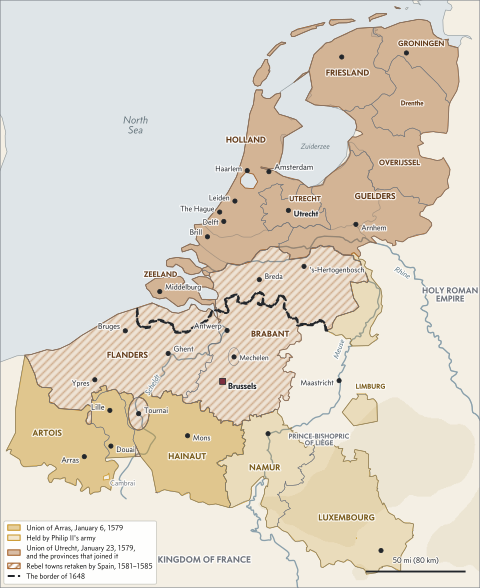
Figure S.3 shows the split. Spanish armies under Philip’s nephew, the duke of Parma, won back the south in the 1580s, and the line between the two halves settled, after many sieges, where the Peace of Münster (mun-ster) fixed it in 1648. The north became the Dutch Republic, officially the United Provinces. It had seven provinces with a vote each: Holland, Zeeland, Utrecht, Guelders, Overijssel, Friesland, and Groningen. Beside them lay the poorer district of Drenthe, which had no vote, and the conquered strip of Brabant and Flanders along the southern border, ruled from The Hague. The south became the Spanish Netherlands, with its capital at Brussels. In 1714, after the War of the Spanish Succession, it passed to the Austrian branch of the Habsburgs and became the Austrian Netherlands. Only in 1830 would it become Belgium (Vol. 15, The Age of Revolution).
Some names need care. Holland is one province, the richest, with Amsterdam, Haarlem, Leiden (ly-dun), Delft, and The Hague, but English often uses it for the whole Dutch Republic. Flanders is one county, but Flemish came to mean everything from the southern Netherlands, as in “Flemish painting.” The two languages did not follow the split. Dutch was spoken in the north and in most of Flanders and Brabant, and French in Artois, Hainaut, Namur, and the southern edges of Flanders and Brabant. In this volume, “the Netherlands” before 1579 means all seventeen provinces, and after it the Dutch Republic.
France in 1600 and in 1715
France was the largest and most populous kingdom in western Europe, with some eighteen million people in 1600 and more than twenty million by 1715. Figure S.4 shows it twice, at the end of the Wars of Religion and at the death of Louis XIV.

The capital was Paris, by far the largest city in the kingdom, with its royal palace of the Louvre and the law courts on the island in the Seine. The kings did not stay there. The Valois kings of the 1500s lived much of the year in the castles of the valley of the Loire (lwahr), at Amboise (ahm-bwahz), Blois (blwah), and Chambord (shahm-bor). They also lived at Fontainebleau (fon-tin-bloh), which Francis I rebuilt, and later kings lived there and at Saint-Germain (san-zhair-man). In 1682 Louis XIV made Versailles (ver-sy), 12 miles west of Paris, the seat of his court and government (Chapter 15). On the Atlantic coast lay the port of La Rochelle (lah roh-shel), the chief stronghold of the French Protestants until 1628 (Chapter 8). In the far southwest, under the Pyrenees, lay Navarre (nuh-vahr), an old kingdom whose larger, southern part Spain had seized in 1512. Its kings kept only the small part north of the mountains and the land of Béarn (bay-arn) beside it, and their heir became King Henry IV of France (Chapter 5).
Beyond the eastern border lay Geneva, a self-governing city allied to the Swiss, where the French reformer John Calvin taught from 1536 (Vol. 3, Geography: Europe, Asia, and Africa; Chapter 5). To the north and east the border ran through lands that France and the Habsburgs fought over for two centuries. By 1715 Louis XIV had pushed it out to the Rhine in Alsace (al-sass), to Lille in Flanders, and to the Jura mountains in the Franche-Comté, the frontier France still keeps in most places. Between Champagne and Alsace lay the duchy of Lorraine, ruled by its own dukes and occupied by French armies again and again. It became French only in 1766, on the death of Louis XV’s father-in-law, a dethroned king of Poland who had been given it for life (Chapter 18). Two foreign enclaves lay inside France in the south. Avignon (ah-veen-yohn) and the land around it, the Comtat Venaissin (kohn-tah veh-neh-san), belonged to the pope. The little principality of Orange, near the Rhône (rohn) north of Avignon, belonged to the princes of Orange, the same family that led the Dutch. Louis XIV’s armies seized it in 1672 and again in 1682, and the peace of 1713 gave it to France for good. That is why a Dutch royal house still bears the name of a town in Provence (proh-vahnss).
Kings and stadtholders
Figure S.5 sets out the volume’s years with time running down the page, from 1415 to 1795. On the left are the kings of France, with their house in the narrow strip beside them. Next come the lords of the Low Countries: the Valois dukes of Burgundy, then the Habsburgs, who after 1581 ruled only the south; from 1598 to 1621 it belonged to Philip II’s daughter Isabella and her husband, the archduke Albert. Next come the princes of Orange who served the Dutch Republic as stadtholders of Holland, with the two long gaps when it had none. Then come the main events, each with the number of the chapter that tells it, and on the right a gray bar for the years each chapter covers and the four Parts of the book. Read across at any year to see who ruled in Paris, in Brussels, and in The Hague.

The French kings of the volume belong to two branches of one family, the Capetians (kuh-pee-shunz), who had held the crown since 987 (Vol. 9, Cathedrals and Crusades). The Valois reigned from 1328 to 1589. When the main line died out in 1498, the crown passed to a cousin of the Orléans (or-lay-ahn) branch, Louis XII, and in 1515 to a cousin of the Angoulême (ahn-goo-lem) branch, Francis I, whose son and three grandsons were the last Valois kings. The Bourbons (boor-bunz) took their name from a lordship in central France, and they reigned from Henry IV in 1589 to Louis XVI, who was deposed in 1792 and beheaded the next year (Vol. 15, The Age of Revolution). Many kings came to the throne young. Charles IX was ten, Louis XIII eight, Louis XIV four, and Louis XV five, and during their childhood a regent governed in their name: the king’s mother for the first three, and for Louis XV his cousin the duke of Orléans.
A stadtholder (stat-hohl-der), Dutch stadhouder, “place-holder,” was at first the lieutenant who governed a province for its absent lord, the duke or the king. Philip II made William, prince of Orange, later called William the Silent, his stadtholder of Holland, Zeeland, and Utrecht in 1559. When William led the revolt, the rebel provinces chose him again, and after 1581 the office belonged to the provinces themselves. Each chose its own stadtholder and could leave the office empty. The princes of Orange held it in Holland for most of two centuries and commanded the republic’s army, while Friesland chose their cousins from another branch of the Nassaus. Twice Holland did without a prince. William II died in 1650, eight days before his only son, William III, was born, and Holland and most of the provinces left the office empty until the French invasion of 1672 made the young prince stadtholder (Chapter 11). William III died childless in 1702, and the office stayed empty until another French invasion, in 1747, brought in William IV, already stadtholder of Friesland. His son William V, the last, whom a party of reformers called the Patriots fought in the 1780s (Chapter 18), fled to England in 1795 (Vol. 15, The Age of Revolution).
The family trees
The French crown passed only to men and only through men, a rule that royal lawyers defended from the old law of the Franks, the Salic Law (Vol. 9, Cathedrals and Crusades). Figure S.6 shows what that rule meant in 1589. Henry II’s four grown sons all died without legitimate sons, and when the youngest, Francis, duke of Anjou (ahn-zhoo), died in 1584, the next heir in the male line was a distant cousin, Henry, king of Navarre. Through his father, Antoine de Bourbon, Henry descended from King Louis IX (Vol. 9, Cathedrals and Crusades) in an unbroken line of fathers and sons ten generations long. His mother, Jeanne d’Albret (zhahn dal-bray), queen of Navarre, was the niece of Francis I. Henry’s claim came through his father, Navarre through his mother. He was a Protestant, and the fear of a Protestant king set off the last and worst of the religious wars (Chapter 5).

Figure S.7 carries the Bourbons on to Louis XVI. Two facts on it matter most. Louis XIV outlived his son and his grandson, so in 1715 the crown passed to his five-year-old great-grandson, Louis XV, while his nephew Philip, duke of Orléans, governed as regent (Chapter 18). And in 1700 the last Habsburg king of Spain died childless and left his crown to Louis XIV’s grandson Philip, whose grandmother, Louis XIV’s queen Maria Theresa, had been the dead king’s half-sister. That was the cause of the War of the Spanish Succession (Vol. 10, Rebirth; Chapter 15).
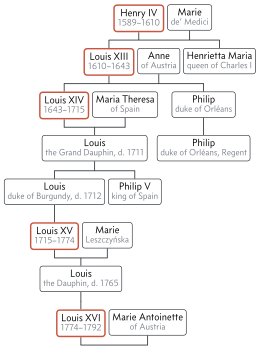
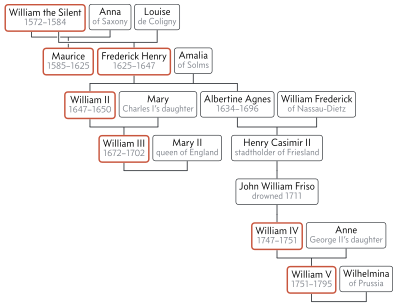
Figure S.8 draws the House of Orange-Nassau (nas-aw). William the Silent was born a German count of Nassau, and in 1544, at eleven, he inherited from a cousin the principality of Orange and great estates in the Netherlands. His eldest son, Philip William, was carried off to Spain as a boy in 1568 and was never stadtholder. His younger sons Maurice and Frederick Henry followed him in the office, then Frederick Henry’s son William II, and William II’s son William III became king of England as well, beside his wife and cousin, Mary II (Vol. 12, Crown and Parliament). When William III died childless in 1702, the title of prince of Orange passed, after a long dispute with the king of Prussia, to a cousin of the Frisian branch of the family, descended from Frederick Henry’s daughter Albertine Agnes. That branch gave the republic its last two stadtholders, William IV and William V.
The old regime in France
The French Revolution called the France it destroyed the old regime, the ancien régime (ahn-syan ray-zheem), and the name has stuck. It was a kingdom of ranks and privileges, and its people were divided by law into three estates, or orders. The First Estate was the clergy, the bishops, priests, monks, and nuns of the Catholic Church. The Second Estate was the nobility. The Third Estate was everyone else, from rich merchants and lawyers to the peasants who made up most of the kingdom, and by 1789 the first two estates together were fewer than one French person in fifty. Nobles and clergy paid little of the main direct tax, the taille (ty), which fell on the commoners. Each estate sent deputies to the Estates-General, a great assembly of the kingdom that the king could call, but it met in 1614 and then not again until 1789 (Vol. 15, The Age of Revolution).
The king governed through his council and a few ministers, and from the 1630s through intendants (an-tahn-dahnz), royal officials sent out to run the provinces. Three cardinals governed for many years each as chief minister: Richelieu (Chapter 8), Jules Mazarin (maz-uh-rin) (Chapter 8, Chapter 15), and André-Hercule de Fleury (ahn-dray air-kool duh flur-ee) (Chapter 18). A fourth cardinal held the office for a single year before he died in 1723. The parlements (par-luh-mahn) were not parliaments. They were the high courts of law, the Parlement of Paris and a dozen in the provinces. A new royal law took effect in each region only when its parlement had registered it, and a parlement could send the king a remonstrance (rih-mon-strunss), a formal protest, instead. The king could then come in person and order the law registered, in a ceremony called a lit de justice (lee duh zhoo-stees), “bed of justice,” after the cushioned seat he sat on. The judges had bought their offices, which they could sell or pass to their sons, and many were ennobled by them. They were the nobility of the robe, as against the old warrior families, the nobility of the sword.
The heir to the throne was the Dauphin (doh-fan) (Vol. 9, Cathedrals and Crusades). The eldest of the king’s younger brothers was called simply Monsieur (muh-syur), “my lord,” as Louis XIV’s brother Philip was. The king’s relations in the male line, who could inherit the crown if his own line died out, were the princes of the blood. Money was counted in livres (lee-vruh): twenty sous (soo) made a livre and twelve deniers (duh-nyay) a sou, as twenty shillings made a pound and twelve pence a shilling (Vol. 12, Crown and Parliament). The gold louis, first struck in 1640, was worth twenty-four livres for most of the eighteenth century.
Two royal academies set the standards of language and art. The Académie française (ah-kah-day-mee frahn-sez), founded by Richelieu in 1635, has forty members, called the “immortals,” who judge good French and make its dictionary, first printed in 1694 (Chapter 8). An academy of art was a society of artists under the king’s protection that trained students, held exhibitions, and gave prizes (Vol. 1, The Toolkit). The Royal Academy of Painting and Sculpture, founded in 1648, taught drawing from the human figure and ranked history painting, the painting of stories from the Bible, ancient myth, and the past, first among the kinds of painting (Vol. 1, The Toolkit; Chapter 15). From 1667 it showed its members’ work, and from 1725 in the Louvre’s Salon Carré (sa-lohn kah-ray), the “square drawing room,” which gave the exhibition its name, the Salon. Diderot’s reviews of it are told in Chapter 19 and Chapter 20.
Faiths
France was a Catholic kingdom. Its kings were nearly all anointed at Reims (reemz) with oil that tradition said had come down from heaven for the baptism of Clovis (Vol. 9, Cathedrals and Crusades), and the king named its bishops. From the 1540s a large minority became Protestants who followed the teaching of John Calvin, and the French called them Huguenots (hyoo-guh-nots). Catholics and Huguenots fought eight civil wars from 1562 to 1598, which ended in the Edict of Nantes (nahnt), a grant of limited toleration (Chapter 5); Louis XIV revoked it in 1685 (Chapter 15). Within the Catholic Church, two parties quarreled in the 1600s and 1700s over free will and grace, which Christians believe is God’s free gift of help to the soul. One was the Jesuits, the Society of Jesus, the great teaching order founded in 1540 (Vol. 10, Rebirth). The other was the Jansenists, followers of Cornelius Jansen (yahn-sun), bishop of Ypres (ee-pruh) in Flanders, and Chapter 14 tells each side as it saw itself.
In the Dutch Republic the public church was the Reformed Church, Calvinist like the Huguenots. Its members alone could hold most public offices. Catholics, Lutherans, Mennonites, and others could worship in private, in house churches that everyone knew about, and Amsterdam had large communities of Jews, Portuguese and German (Chapter 14). The south, under Spain and Austria, stayed Catholic.
The Dutch Republic
The republic was a league of seven sovereign provinces, and it governed itself by assemblies. Each province had its States, an assembly of its nobles and the deputies of its towns, and the States of Holland, which paid more than half the republic’s bills, counted for most. The States General at The Hague was the assembly of the whole league: each province sent a delegation and had one vote, and on war, peace, and taxes the provinces had to agree. It made treaties, ran the army and the navy, and ruled the Generality Lands, the conquered strips of Brabant, Flanders, and Limburg along the southern border, as subject lands with no votes.
The stadtholder commanded the army as captain-general and named many town officials, but he was the servant of the provinces, not their king. The civilian leader was the Grand Pensionary of Holland, the chief legal officer of its States, who spoke for them and ran their business. Under Johan van Oldenbarnevelt (ol-den-bar-nuh-velt), who held the office from 1586 under its older name, Land’s Advocate, and Johan de Witt (duh vit), who held it from 1653 to 1672, the Grand Pensionary was the real head of the republic. Both men died violent deaths when they fell (Chapter 11). The towns were run by regents, a word that here means not a stand-in for a child king but the merchant families who sat on the town councils for generations. Politics turned on the rivalry between the regents, who wanted a republic without a stadtholder, and the Orangists, who wanted the prince. Money was counted in guilders (gil-derz), each of twenty stuivers (sty-verz).
Words for painters and sculptors
The chapters on art use words that earlier volumes taught. Each is given here in a line, with the volume that teaches it, so that the chapters can use them without stopping. Words new to the Course have no volume beside them.
- Oil paint and glazes: color ground in linseed oil, which dries slowly, so that the painter can blend tones and lay thin, see-through layers that glow (Vol. 1, The Toolkit). The Flemish painters did not invent it, but they made it the normal way to paint (Chapter 1).
- Panel and canvas: the wooden board on which the Flemish painters worked, and the woven cloth that took its place from the 1500s on (Vol. 1, The Toolkit).
- Altarpiece, triptych, and wings: a painting that stands behind an altar; one made in three panels; and its hinged side panels, painted on both faces, which were closed on ordinary days and opened on feasts (Vol. 1, The Toolkit).
- Grisaille (grih-zy): painting in shades of gray, often made to look like stone statues, as on the outside of many altarpieces’ wings (Vol. 9, Cathedrals and Crusades).
- Donor: the person who paid for a religious picture and is often painted kneeling in it.
- Guild of Saint Luke: the painters’ guild of a town, named for the evangelist whom tradition made a painter. Only its masters could keep a workshop and train apprentices, and many works came out of a master’s workshop with assistants’ hands in them.
- The hierarchy of genres: the academies’ ranking of the kinds of painting, from history painting at the top through portrait, genre painting (scenes of everyday life), and landscape to still life, with the vanitas, a still life about death (Vol. 1, The Toolkit).
- Engraving and etching: prints from lines cut into a copper plate with a steel tool, or bitten into it by acid (Vol. 1, The Toolkit). In a drypoint the artist scratches the plate with a needle, which throws up a rough edge that prints a soft, velvety line (Chapter 12).
- Chiaroscuro (kee-ar-uh-skoor-oh): Italian for “light-dark,” strong light and shadow used to make figures look solid (Vol. 10, Rebirth).
- Baroque: the grand, dramatic style of about 1600 to 1750 in art and music (Vol. 1, The Toolkit). The lighter, playful style that followed it in France, the Rococo (ruh-koh-koh), is taught in Chapter 19.
- Pastel: sticks of powdered color pressed with a little gum, drawn straight onto paper.
- Tapestry: a picture woven in colored wool and silk on a loom (Vol. 1, The Toolkit).
Painters of the same family are told apart as the Elder and the Younger, as with Pieter Bruegel the Elder and his son Pieter the Younger. A painter whose name is lost is known by a name made up from his best-known work, a “Master of” name, and Chapter 2 meets one.
Words for musicians
The music of this volume runs from the choirs of the 1400s to the opera houses of the 1700s, and it uses words taught in the first volume (Vol. 1, The Toolkit).
- Polyphony: music in which several independent melodies sound at once.
- Mass and cantus firmus: the main Catholic service, whose fixed texts composers set to music, and the borrowed tune on which a composer built a Mass.
- Canon: a piece in which one voice copies another note for note at a fixed distance.
- Mode: a scale defined by its own order of whole and half steps; four of them were the scales of church chant.
- Opera, recitative, aria, and overture: a drama sung throughout; its speech-like singing that carries the plot; a song for one voice that holds one feeling; and the instrumental piece before the curtain rises.
- Suite: a set of instrumental dances in one key, such as the allemande, courante, sarabande, gigue, and minuet.
- Harpsichord and continuo: the keyboard whose strings are plucked, called the clavecin (klav-san) in French, and the bass line played by a keyboard and a low instrument under the other parts.
Two words are new. A chanson (shahn-sohn), French for “song,” is a song for several voices to French words, and a motet (moh-tet) is a piece for several voices to a sacred Latin text other than the Mass. The composers of the Low Countries, who served courts and churches all over Europe from about 1420 to 1550, are called the Franco-Flemish composers (Chapter 2). In France the king had his own musicians: the singers of his chapel and, from 1626, the string band called the Twenty-Four Violins of the King, beside which Lully later trained a smaller band, the Little Violins (Chapter 17).
How to read the names
The names of this volume are French, Dutch, and Latin, and English books spell many of them in English. A few rules help.
Rulers. The Course gives kings, queens, and ruling princes their English names, so Henri (ahn-ree) is Henry, François Francis, Philippe Philip, and the Dutch Willem (vil-um) William, while Louis and Charles stay as they are. Most other people keep their own names, as Antoine de Bourbon does, and so do two queens of Navarre best known by theirs: his wife, Jeanne d’Albret, and her mother, Marguerite of Angoulême, Francis I’s sister. A ruler’s number counts the rulers of that name in that realm, so Henry III of Navarre became Henry IV of France, and Charles I of Spain was the emperor Charles V.
French names. The French de means “of,” and before a vowel it becomes d’. A name with de usually comes from an estate and often, though not always, marks a noble. People are called by the last part: Michel de Montaigne is Montaigne. Many great men are known by a title instead of a surname. Armand-Jean du Plessis (ar-mahn-zhahn dew pleh-see), cardinal and duke of Richelieu, is Richelieu, and Maximilien de Béthune (bay-toon), duke of Sully (soo-lee), is Sully. Some chose a name of their own: Jean-Baptiste Poquelin (pohk-lan) acted as Molière, and François-Marie Arouet (ah-rway) wrote as Voltaire. Women at court were known by their husbands’ titles, or by one the king gave them, as Madame de Sévigné (say-veen-yay) and Madame de Pompadour (pom-puh-door). A hyphen joins two first names into one, so Jean-Jacques Rousseau has a single first name.
Dutch names. The Dutch van means “from,” van der “from the,” and de “the,” and none of them marks a noble. The Course writes them in small letters, as in van Eyck and de Witt. Many Dutch people were known by their first name and their father’s: Rembrandt Harmenszoon (har-mun-sohn) van Rijn (vahn rine) was “Rembrandt, son of Harmen, from the Rhine.” Scholars wrote in Latin and took Latin names. Desiderius (dez-ih-deer-ee-us) Erasmus called himself “of Rotterdam,” Hugo de Groot (duh khroht) is known as Grotius (groh-shee-us), and Cornelius Jansen as Jansenius (jan-see-nee-us). Baruch Spinoza’s first name was Hebrew, Bento (ben-too) to his Portuguese family, and Benedictus in Latin, and all three mean “blessed.” Flemish is the Dutch spoken in Flanders, not a separate language.
Letters. Table S.1 shows how the French and the Dutch sound the letters that trip English readers. English speakers say many of these names the English way, and the pronunciations given at the first appearance of each hard name are the usual English ones. Table S.2 gives the modern names of places the volume calls by older or English ones.
| Language | Letters and their sounds | Examples |
|---|---|---|
| French | A final consonant is usually silent; oi = wah; au and eau = oh; ou = oo; ch = sh; j, and g before e or i, = zh; gn = ny; é = ay; an, en, in, and on are said through the nose | Descartes; Valois; Rameau; Rousseau; Dijon; Avignon |
| Dutch | g and ch = a throaty kh; ij and ei = nearly eye; oe = oo; aa = ah; ee = ay; j = y; w = nearly v | de Groot; Rijn; Haarlem; Zeeland; Johan |
| In this volume | Today | In this volume | Today |
|---|---|---|---|
| Bruges | Brugge, Belgium | Brill | Brielle, Netherlands |
| Ghent | Gent, Belgium | The Hague | Den Haag, Netherlands |
| Antwerp | Antwerpen, Belgium | ’s-Hertogenbosch | also Den Bosch |
| Brussels | Brussel or Bruxelles | Ryswick | Rijswijk, Netherlands |
| Louvain | Leuven, Belgium | Aix-la-Chapelle | Aachen, Germany |
| Ypres | Ieper, Belgium | Ratisbon | Regensburg, Germany |
| Malines | Mechelen, Belgium | Danzig | Gdańsk, Poland |
| Marseilles | Marseille, France | Batavia | Jakarta, Indonesia |
Who wrote it down
Much of what this volume tells comes from a few writers who wrote long after the events, or who had reasons of their own, or both. So the chapters name the writer and the date whenever a story’s source matters (“van Mander says,” “Baillet tells”), above all for a story written long after the event or never shown to have happened. Where versions disagree, they say whose they follow. Here are the chief writers, in the order in which they wrote, with what each preserves.
- Giorgio Vasari (jor-joh vuh-sar-ee) (1511–1574), an Italian painter, wrote the Lives of the Artists (1550, enlarged in 1568), quoted in an earlier volume (Vol. 10, Rebirth). It made Jan van Eyck the inventor of oil painting, a story the first volume corrected (Vol. 1, The Toolkit; Chapter 1).
- William the Silent’s Apology, his answer to the ban by which Philip II outlawed him, was read to the States General in December 1580 and printed in 1581; his chaplain drafted it. It tells how King Henry II of France let slip a plan against the Protestants to William on a hunt in 1559 (Chapter 7).
- Karel van Mander (kah-rul vahn mahn-der) (1548–1606), a Flemish painter who settled in Haarlem, wrote the Schilder-boeck (skhil-der-book), the Book of Painters (1604), which gave the Low Countries their own Vasari. It has the first lives of the van Eycks, Bosch, and Bruegel, and the story of Bruegel going in disguise to peasant weddings (Chapter 3, Chapter 7).
- Les Caquets de l’accouchée (lay kah-kay duh lah-koo-shay), “the gossip at the childbed,” is an anonymous satire of 1622. It printed an early version of “Paris is well worth a Mass,” spoken there by the duke of Sully as “the crown is well worth a Mass.” A Paris diarist had written down a joke of the same kind in 1594, but it was Voltaire’s use of the modern form, in 1766, that made the saying famous (Chapter 5).
- Hardouin de Péréfixe (ar-dwan duh pay-ray-feeks) (1606–1671), Louis XIV’s tutor and later archbishop of Paris, wrote the History of King Henry the Great (1661). It gave Henry IV the wish that every peasant might have a chicken in his pot on Sundays (Chapter 5).
- Gilberte Périer (zheel-bairt pay-ryay) (1620–1687), Pascal’s elder sister, wrote the Life of Monsieur Pascal after his death in 1662. It is the family’s account of the boy who worked out geometry by himself and of the man’s last illness (Chapter 14).
- Madame de Sévigné (1626–1696) wrote hundreds of letters to her daughter from 1671 to 1696, printed from 1725. They report the court of Louis XIV and the news of Paris, among it the burning of the poisoner La Voisin (lah vwah-zan) in 1680 (Chapter 15).
- Adrien Baillet (ah-dree-an bah-yay) (1649–1706), a priest and scholar, wrote the Life of Monsieur Descartes (1691). It preserves the three dreams of November 1619 from Descartes’s lost notebook and the five o’clock lessons for Queen Christina of Sweden (Chapter 10).
- Arnold Houbraken (how-brah-kun) (1660–1719), a Dutch painter, wrote the Great Theater of Netherlandish Painters (1718–1721). It gathered the stories told of Hals (hahls), Rembrandt, and their pupils half a century after their deaths (Chapter 12).
- The duke of Saint-Simon (san-see-mohn) (1675–1755), a courtier, wrote his memoirs from 1739 out of notes he had kept at court since the 1690s. Printed in full only from 1829, they are the inside view of Versailles in Louis XIV’s last years and of the Regency (Chapter 15, Chapter 18).
- Charles Collé (koh-lay) (1709–1783), a playwright and songwriter, kept a journal from 1748 to 1772, printed early in the 1800s. It records the painter Gabriel-François Doyen (dwah-yan) telling him of a courtier who wanted his mistress painted on a swing pushed by a bishop (Chapter 19).
- Voltaire (1694–1778) wrote The Age of Louis XIV (1751), the first history of a reign as an age of the arts, which fixed the picture of the king that Chapter 15 weighs (Chapter 21).
- Nicolas Contat (kohn-tah), a printer’s journeyman, wrote the Anecdotes typographiques (1762), which tell of the apprentices’ massacre of cats in a Paris printing shop in the 1730s. The American historian Robert Darnton made it famous in 1984 (Chapter 18).
- Jean-Jacques Rousseau (1712–1778) wrote his own life in the Confessions, written from 1765 to 1770 and printed in 1782 and 1789. It tells of the stolen ribbon and, in Book VI, of the “great princess” who said that peasants without bread should eat brioche (bree-osh), the root of “Let them eat cake” (Chapter 22).
- Pierre-Édouard Lémontey (pyair ay-dwar lay-mohn-tay) (1762–1826) wrote an essay on the monarchy of Louis XIV (1818), the first to print “L’État, c’est moi” (lay-tah say mwah), “I am the state,” as words the king once spoke. The story that grew around them sets them in the Parlement of Paris in 1655 (Chapter 15).
- Charles Mackay (muh-ky) (1814–1889), a Scottish journalist, made tulip mania a byword for a nation’s folly in Extraordinary Popular Delusions and the Madness of Crowds (1841). The historian Anne Goldgar’s Tulipmania (2007) read the notaries’ records of 1636 and 1637 and found the crash small and the ruined few (Chapter 11).
Later critics and scholars are named where their readings matter. Diderot’s reviews of the Salons, written from 1759, made the judging of new paintings a kind of literature (Chapter 19). The French critic Théophile Thoré-Bürger (tay-oh-feel toh-ray) brought Vermeer back from near oblivion in articles of 1866 (Chapter 13), and the art historian Erwin Panofsky (puh-nof-skee) read The Arnolfini Portrait (ar-nol-fee-nee) as a record of a marriage in 1934 (Chapter 1).
Meanwhile elsewhere
The Ottoman Turks took Constantinople in 1453, as the Hundred Years’ War ended, and while Rembrandt painted The Night Watch the Mughal emperor Shah Jahan was building the Taj Mahal in India. Table S.3 sets the rest of the world beside France and the Low Countries and names the volumes of the Course that teach it.
| Region | In these years | Taught in |
|---|---|---|
| Britain and Ireland | The Wars of the Roses; Henry VIII and Elizabeth I; the civil wars and the revolution of 1688, which made the Dutch prince William III king; the Hanoverian kings. | Vol. 12, Crown and Parliament |
| Italy, Spain, and Portugal | The Renaissance painters and popes; Charles V and Philip II; the Armada (1588); the Bourbon kings of Spain from 1700. | Vol. 10, Rebirth |
| Germany and the East | Luther’s protest (1517); the Thirty Years’ War (1618–1648); Peter the Great; Frederick the Great; Bach and Mozart. | Vol. 14, From Luther to Mozart |
| North America | Jamestown (1607) and Quebec (1608); New Amsterdam; the French and Indian War; the American Revolution (1775–1783). | Vol. 27, New Worlds |
| Latin America | Columbus (1492); the conquests of the Aztecs (1521) and the Inca (1532); the sugar islands of the Caribbean. | Vol. 44, Gold, God, and Glory |
| Africa | The Songhai empire; the kingdoms of Kongo, Benin, and Asante; the Atlantic slave trade at its height in the 1700s. | Vol. 43, Africa |
| The Ottomans and Persia | The fall of Constantinople (1453); Suleiman the Magnificent (reigned 1520–1566); Shah Abbas of Persia (reigned 1588–1629). | Vol. 37, The House of Islam |
| India | The Mughal emperors from Babur (1526) to Aurangzeb; the Taj Mahal; the British victory at Plassey (1757). | Vol. 39, India |
| China | The last Ming emperors; the Qing dynasty from 1644 and its Kangxi and Qianlong emperors. | Vol. 40, The Middle Kingdom |
| Japan and Korea | The Tokugawa shoguns from 1603; Japan closed to most foreigners from the 1630s, with the Dutch allowed one trading post at Nagasaki. | Vol. 41, Islands of the Rising Sun |
The Burgundian Netherlands, c. 1420-1516
Chapter 1 · 36 clues
Jan van Eyck
In October 1428 a party of Burgundian lords set sail from Flanders on a delicate errand. Their master, Philip the Good, duke of Burgundy, hoped to marry Isabella, the daughter of King John I of Portugal, and they were to settle the terms. Storms drove their ships into English harbors for four weeks, and they reached Lisbon only in December. In January 1429 the king received them at his castle of Aviz (ah-veesh), and one member of the embassy set to work on a task no lord could do. He was the duke’s painter, sent to paint the princess so that Philip could see the bride he had never met. On February 12 two groups of envoys set out for home, one by sea and one by land, each probably carrying one of his portraits, so that if one were lost the other might arrive. Both portraits are lost now.
The painter was Jan van Eyck. In the twelve years he had left, he painted the pictures that made the towns of Flanders a second center of European painting, beside the cities of Italy.
Van Eyck and oil paint
No one wrote down when Jan van Eyck was born, but it was probably about 1390. His name means “from Eyck,” and he probably came from Maaseik (mah-sike), a small town on the river Meuse in what is now Belgium. He had two brothers who were also painters: Hubert, probably the eldest, who died in 1426, and Lambert, who outlived Jan. The first record of Jan comes from The Hague, in Holland. There, between 1422 and 1424, the count of Holland paid “Master Jan the painter” and his assistants to decorate his palace. The count, John of Bavaria, also ruled Hainaut and Zeeland, and he made Jan his valet de chambre (val-ay duh shahm-bruh), a “servant of the chamber.” It was a title, not a job of making beds. It made a painter a salaried member of a prince’s household rather than a craftsman paid by the piece.
John of Bavaria died in January 1425, and that spring van Eyck entered the service of a far greater prince. Philip the Good had been duke of Burgundy since 1419, when his father, John the Fearless, was struck down by the men of the future King Charles VII of France on the bridge at Montereau (mon-tuh-roh) (Vol. 9, Cathedrals and Crusades). Philip ruled the duchy of Burgundy around Dijon and, far to the north, the rich counties of Flanders and Artois. Between 1421 and 1443 he added most of the rest of the Low Countries: Namur, Brabant, Holland, Hainaut, Zeeland, and Luxembourg (the Stage maps them). Van Eyck lived first at Lille, a French-speaking town of Flanders where the duke kept his accountants. From about 1430 he lived at Bruges, the great trading city of Flanders, where Italian, Spanish, and German merchants kept houses and banks.
The duke paid him a yearly salary and sent him on journeys that the court’s accounts call secret, which seem to have been errands of diplomacy. The voyage to Portugal was one. In January 1430 Philip married Isabella in Flanders, and at the feasts in Bruges he founded the Order of the Golden Fleece, the brotherhood of knights of the dukes of Burgundy (Vol. 10, Rebirth). Philip valued his painter. In 1435, when his accountants at Lille refused to approve a life pension he had granted van Eyck, the duke ordered them to pay it at once. He would never find another painter, he wrote, so much to his liking or so excellent in his art. About 1432 van Eyck bought a house in Bruges and married a woman named Margaret, some fifteen years younger, whose family name no record gives. Their first child was born in 1434, and the duke sent six silver cups for the christening.
Other painters honored him too. Painters, like bakers and goldsmiths, belonged to a guild, a sworn association of the masters of one trade in one town. It trained apprentices, set standards of work, and kept outsiders from selling in the town. The painters’ guilds took as their patron Saint Luke, who, by tradition, had painted a portrait of the Virgin Mary. On Saint Luke’s Day, October 18, 1427, the painters’ guild of Tournai, a French town on the river Scheldt (the Stage), gave a banquet in van Eyck’s honor. Among the guests were Robert Campin (kahm-pan), the leading painter of Tournai, and his apprentice Rogier van der Weyden (roh-zhay van der vy-den), whose work Chapter 2 follows.
The thing nearly everyone knows about van Eyck is a story told more than a century after his death. In 1550 the Italian painter Giorgio Vasari published his Lives of the artists, the first great history of Italian art (the Stage). In his life of Antonello da Messina (an-toh-nel-oh dah meh-see-nah), a Sicilian painter who worked in oil (Vol. 10, Rebirth), he explained where the new paint came from. A Flemish painter whom he calls Giovanni da Bruggia (brood-jah), John of Bruges, was, in Mrs. Jonathan Foster’s translation of the 1850s, “a man who delighted in alchemy.” One day he varnished a picture and set it in the sun to dry, and the heat split the panel “at the joinings.” Vexed, he searched for a varnish that would dry in the shade, and he found that linseed oil and walnut oil dried best. He ground his colors in these oils, and so, in Vasari’s telling, oil painting was invented.
The story is wrong in its main point. A German monk named Theophilus (thee-off-ih-lus) had written down how to grind colors in linseed oil about three hundred years earlier (Vol. 1, The Toolkit). What van Eyck did was to make oil do what no one had made it do. Oil dries slowly, by taking oxygen from the air, so he could blend one tone into the next while the paint was wet. Thinned with more oil, a color becomes see-through, so he could lay one thin layer, a glaze, over another once it had dried. Light passes down through the glazes, bounces off the white ground beneath, a coat of chalk and glue on the oak, and comes back colored, so that his rubies and velvets seem to glow from inside. Under a magnifying glass, single hairs of a fur collar stand apart, and tiny windows shine in a painted pearl.

Van Eyck was almost the only painter of the Low Countries in his time who signed and dated his panels, and he signed them with a joke. His motto, painted on the frames of several of his pictures, was Als ich can, Flemish for “as I can,” meaning “as well as I am able.” Writers used such modest words to apologize for their work. But ich, “I,” sounds like Eyck, so the words also say “as Eyck can,” as only van Eyck can. He usually spelled it in Greek letters. Its first appearance is on a small portrait of 1433 in the National Gallery in London (Figure 1.1). The sitter is a man past forty, with gray stubble, wrinkles fanning out from his eyes, and slightly bloodshot eyes. He looks straight at us, as almost no sitter of the time did. His headdress is a chaperon (shap-uh-ron), the everyday hat of the time: a padded ring with a long cloth hanging from it. Here the cloth is wound up around his head, so the picture is called Man in a Red Turban. Its frame is the original. Along the bottom, painted to look carved, runs “Jan van Eyck made me in the year 1433 on October 21.” Across the top, larger than on any other picture, is his motto, “As I can.”This artist’s Man in a Red Turban, often considered a self-portrait, bears his motto “As I can.” → Jan van Eyck•• A man who stares out at us from under the painter’s own boast is very likely the painter, and the picture is often considered a self-portrait, though nothing on it says so.
Before any of his surviving panels, van Eyck may have painted in a book. A book of hours was a prayer book for a layman, with prayers for set hours of the day, and the finest were illuminated with small paintings called miniatures (Vol. 1, The Toolkit). The one now called the Turin-Milan Hours was begun about 1380 for a great lord of the French court, and by 1413 it belonged to the duke of Berry (beh-ree), the patron of the Limbourg brothers (Vol. 9, Cathedrals and Crusades). Still unfinished, it passed to John of Bavaria in The Hague, and painters went on adding to it for decades. In 1911 the Belgian scholar Georges Hulin de Loo (oo-lan duh loh) sorted its pictures among eleven unknown artists. He called them Hands A to K. The pages by the painter called Hand G, from about 1420, were the most astonishing. One shows the birth of John the Baptist, the prophet who baptized Jesus, in a bedroom lit by real daylight, and another a prince praying on a seashore under a wide gray sky. Hulin de Loo gave Hand G’s pages to Hubert. Since then the commonest view has been that Hand G was Jan van EyckAn artist with this surname is thought to be the "Hand G" who worked on the Turin-Milan Hours. → Jan van Eyck• himself, working for the count of Holland, though some think Hand G a different artist close to the brothers. The part of the book kept in the national library at Turin burned in a fire in 1904, and its pages, the prince on the seashore among them, survive only in photographs. The part once kept in Milan, with the birth of John the Baptist, is now in Turin’s city museum.
The Ghent Altarpiece
Ghent, one of the largest cities north of the Alps, lived by weaving cloth from English wool. Its rich citizens built chapels in its churches, to be remembered and prayed for after they died. One of the richest was Joos Vijd (yohs vayt), a merchant and alderman, or member of the city council, who was also the lord of a village outside the walls. When other aldermen quarreled with Duke Philip over taxes, he stayed loyal to the duke. He and his wife, Elisabeth Borluut (bor-loot), had no children. They built a chapel in the parish church of Saint John the Baptist and paid for masses to be said in it for their souls forever. For its altar they ordered an altarpiece, a painting that stands on or behind the altar, where every worshipper faces it (Vol. 1, The Toolkit).
That painting is the Ghent Altarpiece, also called The Adoration of the Mystic Lamb. Joos Vijd commissioned it,Jodocus Vijd commissioned this altarpiece, which portrays him and his wife Elisabeth Borluut. → Ghent Altarpiece•• and he and Elisabeth Borluut kneel in prayer on its outer wings. In the Latin of his documents he is Jodocus (yoh-doh-kus) Vijd, which is why books give his name both ways. The church changed its name a century later. After Ghent rebelled in 1539 against Emperor Charles V, Philip the Good’s great-great-grandson and heir, Charles had the old abbey of Saint Bavo (bah-voh), named for a hermit of seventh-century Ghent, pulled down to make room for a fortress. Its monks moved to Saint John’s, which took their saint’s name, and when Ghent was made a bishop’s seat in 1559, the church became its cathedral. Moved for safety to another chapel, the altarpiece is still in Saint Bavo’s Cathedral in Ghent,This altarpiece is housed in Saint Bavo’s Cathedral in Belgium. → Ghent Altarpiece•• Belgium.
Two brothers made it. Hubert van Eyck began it, perhaps in the early 1420s, and died in 1426. Almost nothing else by him survives, so no one can say for certain which parts are his. Jan finished it. A Latin verse painted along the bottom of the frame of the outer wings tells the story. It calls Hubert the painter “greater than whom no one was found,” and it says that Jan, “second in art,” completedThis artist completed the Ghent Altarpiece, begun with his brother Hubert. → Jan van Eyck•••An inscription on this work claimed that the completing artist was "second in art" to his deceased brother. → Ghent Altarpiece• what his dead brother had begun, at the request of Jodocus Vijd. Its last line gives the day the work was shown to the people: May 6, 1432. On that same day, in the same church, the baby son of Philip the Good and Isabella was baptized.
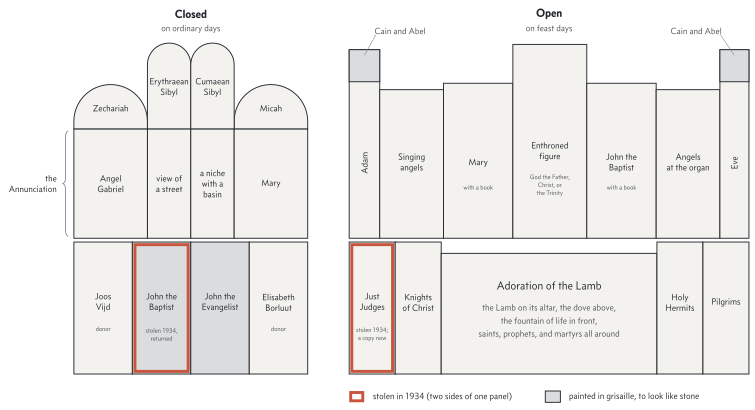
Like many altarpieces of its time, it is a polyptych, a picture of many hinged panels (Vol. 1, The Toolkit). It is huge: about 12 feet (3.75 m) high and, with its wings spread, about 17 feet (5.2 m) wide. The wings are painted on both sides. On ordinary days they stayed closed and showed a quiet picture, much of it in gray. On feast days they swung open on a blaze of red, green, and gold. Figure 1.2 names every panel both ways.
The altarpiece closed
Closed, the altarpiece shows a room and a promise (Figure 1.3). Across its middle runs a single room with a tiled floor, divided by the frames into four panels. At the left kneels the angel Gabriel in white, with many-colored wings and a stalk of lilies, the flower of purity. At the right kneels Mary, also in white, her hands crossed on her breast, with a dove, the Holy Spirit, hovering over her head. Between them two narrow panels show the empty room: a window opening on a street, and a niche with a basin and a towel. This is the Annunciation, on the closed altarpiece.This work's closed view shows an Annunciation scene. → Ghent Altarpiece•This scene appears on the closed view of the Ghent Altarpiece. → the Annunciation• In the Gospel of Luke, the angel Gabriel announces to the Virgin Mary that she will bear the Son of God (Vol. 5, In the Beginning). His greeting runs in gold letters beside him, Ave gratia plena Dominus tecum, “Hail, full of grace, the Lord is with you.” Mary’s answer, Ecce ancilla Domini, “Behold the handmaid of the Lord,” is painted upside down, so that God can read it from heaven.

Above the room, in the arched tops, four figures who were believed to have foretold the scene look down on it. At the ends are Zechariah and Micah, prophets of the Hebrew Bible, with their prophecies on floating scrolls. In the middle are two sibyls (sib-ilz), prophetesses of the ancient Greeks and Romans who, Christians believed, had also foretold the coming of Jesus, whom Christians call Christ, from the Greek for “anointed” (Vol. 10, Rebirth). They are the Erythraean (eh-rih-three-un) Sibyl and the Cumaean (kyoo-mee-un) Sibyl. Some scholars, among them the art historian Volker Herzner (hairts-ner), see Isabella of Portugal, whom van Eyck had painted at Aviz, in both: her Portuguese dress on the Erythraean Sibyl and her face on the Cumaean.
Below, in four arched niches, kneel the donors and stand two saints. Joos Vijd, at the left, is an old man in a red gown, bald, with gray stubble, warts, and watering eyes, painted without flattery. Elisabeth Borluut, at the right, wears a white linen headdress and a gown of green and rose. Between them stand John the Baptist, holding a lamb and pointing to it, and John the Evangelist, the apostle whom tradition makes the writer of the Gospel of John, holding the cup from which, in a legend, he drank poison without harm. They are painted in grisaille, shades of gray alone (Vol. 9, Cathedrals and Crusades), so that the two Saint Johns look like statuesGrisaille depictions of John the Baptist and John the Evangelist appear in this work. → Ghent Altarpiece• of pale stone on carved pedestals, casting real shadows. The living couple kneel in warm color beside saints of stone. The Baptist was the patron of the church, and the lamb he holds points the way to what waits inside.
The altarpiece open
On feast days the wings swung back, and the congregation saw the inside, twice as wide and glowing with color. The upper row is heaven. In the middle sits an enthroned figure in a red robe, with a triple crown like a pope’s on his head and another crown at his feet, raising his right hand in blessing. Art historians have long disagreed about who he is. He may be God the Father, or Christ as the king of heaven, or the whole Trinity in one person: the Father, Son, and Holy Spirit, whom Christians believe to be one God. On our left sits the Virgin Mary, crowned with flowers and stars, reading a book wrapped in green cloth. On our right sits John the Baptist in a camel-hair shirt and a green cloak. A ruler of heaven between Mary and John makes a Deësis (day-ee-sis), from the Greek for “prayer,” the old Byzantine picture of the two saints pleading with Christ for mankind (Vol. 9, Cathedrals and Crusades). Here, unusually, Mary and John both hold books.The Virgin Mary and John the Baptist hold books beside the enthroned central figure in this altarpiece. → Ghent Altarpiece•• A book was a usual sign of Mary, whom Christians called the Seat of Wisdom, but a rare one for John, who is more often shown with a lamb or a cross.
Beside them are the angels, who have no wings and wear the rich robes of priests at Mass. On the left, eight crowned angels sing around a carved wooden music stand,Angels sing around a carved music stand and play instruments beside a pipe organ in this altarpiece. → Ghent Altarpiece•• a lectern that turns on its post, with a book of music open on it. Van Eyck painted their mouths and brows so exactly that the Belgian art historian Elisabeth Dhanens (dah-nens) said one could tell from their faces which sang soprano, alto, tenor, and bass. On the right, angels play a harp and a viol, a bowed string instrument, around a pipe organ played by a seated angel. The organ is painted so precisely, down to the light on its metal pipes, that modern organ builders have made a working copy of it.
At the two ends of the upper row, in narrow niches of gray stone, stand Adam and Eve, the first man and woman of the Book of Genesis (Vol. 5, In the Beginning). They are nearly life size and naked except for the leaves they hold, the first large nudes in the painting of northern Europe. There is no garden, serpent, or tree. They stand at the edge of heaven with downcast eyes, as if just after the Fall, when they disobeyed God by eating the forbidden fruit. The niches are painted so that, seen from below at the altar, Adam’s foot steps out beyond his niche,Nude Adam and Eve occupy the outer upper panels of this altarpiece, with Adam’s foot projecting beyond his niche. → Ghent Altarpiece••• its toes projecting into the worshipper’s space. Eve, at the other end of the row, stands turned a little toward the center, and the painter has given her the long, high, rounded belly that his century admired in a woman. In her right hand, instead of an apple, Eve holds a small citrus fruit,Eve holds a citrus fruit and has a rounded belly in this altarpiece. → Ghent Altarpiece•• for Genesis names no kind of fruit, and painters chose as they pleased. In 1781 Emperor Joseph II, who then ruled the southern Netherlands, found the couple so improper that he had them taken down. In 1861 the two panels were sold to the Belgian state’s museum in Brussels, and painted copies in which Adam and Eve wear animal skins took their place; the copies now hang elsewhere in the cathedral.
Above each of them, in a small half-moon of painted stone, is a grisaille scene of the next generation. Above Adam, their sons Cain and AbelGrisaille scenes of Cain and Abel appear above Adam and Eve in this altarpiece. → Ghent Altarpiece•• bring their offerings to God, Abel a lamb from his flock and Cain the fruits of his field. Above Eve, Cain kills his brother, the first murder in the Bible (Vol. 5, In the Beginning). So the first parents stand under the first sacrifice and the first death, at the two ends of a picture whose center is the sacrifice that Christians believe undid their Fall.

The lower row is one continuous landscape, a flowering meadow that runs behind all five panels (Figure 1.4). In the middle of the great central panel stands an altar draped in red, and on it a white lamb. The lamb stands for Christ. When John the Baptist saw Jesus coming toward him, he said, in the words of the King James Bible, “Behold the Lamb of God, which taketh away the sin of the world” (John 1:29). The words in Latin are painted on the altar’s front. The Lamb bleeds into a golden chalice,Worshippers and kneeling angels surround a lamb bleeding into a chalice beside an octagonal fountain in this altarpiece’s central panel. → Ghent Altarpiece••• the cup that holds the wine at Mass, from a wound in its breast, yet it stands upright and calm, alive. Fourteen angels with many-colored wings kneel around the altar. Some hold the cross, the crown of thorns, and other instruments of Christ’s Passion, his suffering and death (Vol. 5, In the Beginning), and two swing censers, metal pots of burning incense on chains. Above, the dove of the Holy Spirit shines in a halo of golden rays. In front of the altar, water spouts from a bronze column into an octagonal, or eight-sided, stone fountain and runs off through the grass toward us. Its rim is lettered in Latin, after the Book of Revelation: “This is the fountain of the water of life, proceeding from the throne of God and of the Lamb.”
Crowds come from every side to worship. At the left kneel the prophets of the Hebrew Bible, reading from open books. Behind them stand writers and philosophers of the ancient world. One of them, in white with a laurel wreath, is the Roman poet Virgil, whose Fourth Eclogue, a short poem about a child who would bring back the golden age, Christians read as a prophecy of Christ (Vol. 7, The Romans). At the right kneel the twelve apostles in plain robes, and behind them stand popes, bishops, and martyrs in red. Farther back, men in blue come out of a grove on the left, and holy women carrying palms, the sign of martyrdom, come out of one on the right. Among them, Saint Agnes carries her lamb and Saint Barbara her tower. On the horizon rise the spires of the heavenly Jerusalem. Botanists have named more than forty kinds of plants in the meadow, including orange trees and date palms that no one in Flanders could have seen growing at home.
On the four lower wings, more crowds ride and walk toward the Lamb. At the far right come the pilgrims, led by the giant Saint Christopher, the patron of travelers, and beside them the holy hermits. At the left ride the Knights of Christ in armor, and at the far left the panel called the Just Judges: a company of riders on fine horses, in fur-trimmed robes and tall hats. None of them is a saint, and they may stand for Vijd’s own office as a magistrate of the city. Their faces have long been taken for portraits, and Philip the Good has been identifiedPhilip the Good has been identified among the mounted figures in this altarpiece’s Just Judges panel. → Ghent Altarpiece•• among the riders. Two others, one of whom resembles the Man in a Red Turban, may be Jan and Hubert themselves.
Hidden, stolen, and restored
Few paintings have had such adventures (Figure 1.5). In August 1566 crowds of Calvinists, Protestants who followed the French reformer John Calvin (Chapter 5), swept through the churches of the Low Countries. They smashed the statues and pictures that they believed God’s law forbade (Chapter 7). The clergy of the new cathedral took the panels down and hid them in the tower, and the iconoclasts, or image-breakers, passed them by. In 1794 the armies of revolutionary France carried the central panels to the Louvre in Paris, and they came home in 1815, after Napoleon’s defeat at Waterloo. But the diocese had pawned most of the wings, and when it could not buy them back, a dealer sold them in 1816. In 1821 the king of Prussia bought them for his museum in Berlin. After the First World War, the Treaty of Versailles made Germany give them back. In 1920 the altarpiece stood whole in Ghent for the first time in more than a century.


On the night of April 10, 1934, a thief lifted one panel out of its frame. He took the Just Judges together with the grisaille Saint John the Baptist on its back, which in Berlin had been sawn away into a separate thin panel. Letters soon demanded a ransom of a million Belgian francs, and the bishop of Ghent and the government bargained with the writer for months. As a sign of good faith he gave back one of the two pieces, and the Saint John the Baptist came home. In November 1934 a man named Arsène Goedertier (ar-sen khoo-der-teer), on his deathbed, told his lawyer that he alone knew where the panel was, and in his desk the lawyer found copies of the ransom letters. He took the secret to his grave, and the Just Judges has never been found. The Belgian restorer Jef Vanderveken (van-der-vay-ken) painted a copy of the panel,The Just Judges panel of this altarpiece was stolen in 1934 and replaced by Jef Vanderveken’s copy; a stolen Saint John the Baptist panel was returned. → Ghent Altarpiece••• working from an earlier copy made for King Philip II of Spain. In 1945 his copy took the empty place in the altarpiece (Figure 1.6).
Six years after the theft, Belgium was at war again. In 1940 the government sent the altarpiece south toward the Vatican for safety. Italy entered the war while it was still in France, so it was stored in the museum at Pau (poh), under the Pyrenees. In 1942, on Hitler’s orders, German officials took it to the castle of Neuschwanstein (noy-shvahn-shtine) in Bavaria. As Allied bombing came closer, it was moved deep into the salt mine of AltausseeThis work spent much of World War II in the Altaussee salt mine. → Ghent Altarpiece•• (ahlt-ows-zay) in the Austrian Alps, where the Nazis had hidden thousands of works of art seized across Europe, and there it stayed until the war ended. In 1945 the Allied officers who hunted for stolen art, known as the Monuments Men, brought it out, and it came home to Belgium.

Restorers have worked on it many times since. The most thorough cleaning began in 2012, in a glass-walled workshop at Ghent’s Museum of Fine Arts where visitors could watch. The restorers of Belgium’s Royal Institute for Cultural Heritage found that about 70 percent of the outer panels had been painted over in the sixteenth century, and they removed the later paint. When they reached the Lamb, in work completed in January 2020, the overpainting came off a face that no one had seen for more than four hundred years. The Lamb’s original face looks straight outThis work's 2020 restoration revealed that the lamb has humanoid frontal eyes. → Ghent Altarpiece•• with large, close-set, humanlike eyes. Its stare startled the public, and newspapers around the world printed it beside the meek sheep that had stood in its place since the sixteenth century.
The Arnolfini Portrait
Two years after the altarpiece was unveiled, van Eyck turned from heaven to a bedroom. In 1434 van Eyck painted The Arnolfini Portrait,This artist painted the Arnolfini Portrait. → Jan van Eyck••• a picture of two people in a room in Bruges. It is small, about 32 by 24 inches (82 by 60 cm), oil on an oak panel, and it hangs in the National Gallery in London, which bought it in 1842. The man is Giovanni Arnolfini, a merchant from Lucca (loo-kah), a silk-weaving city in Tuscany. Two cousins of that name lived in Bruges, where Italians sold silks to the duke’s court, and the man is most likely Giovanni di Nicolao Arnolfini. For more than a century the woman was taken to be Giovanna Cenami (cheh-nah-mee), the wife of the other cousin. Then a document published in 1997 showed that she married him in 1447, thirteen years after the picture was painted. The woman beside Giovanni di Nicolao cannot be named for certain.

The couple stand in an upstairs room with a window on the left and a great bed hung with red on the right (Figure 1.8). The man, pale and long-faced, wears a broad black hat of plaited straw and a fur-lined tunic of purple velvet that has darkened almost to black. He raises his right hand as if to swear an oath or to bless, and with his left the Italian merchant holds the woman’s hand.An Italian merchant holds the hand of a woman in a voluminous green gown beside a small dog and discarded wooden shoes in this painting. → The Arnolfini Portrait••• She wears a huge gown of green wool trimmed with fur over a blue dress, with a white linen headdress. She gathers its heavy folds in front of her, and many viewers take her for pregnant, though she probably is not; the fashion was to bunch a full skirt that way, and virgin saints are painted the same. At their feet a small shaggy dog looks out at us, and near the man lie the wooden shoes he has stepped out of.
Everything in the room speaks of money. Oranges, a costly fruit shipped north from Spain or Portugal, lie on the sill and on the chest beneath it, and through the window a cherry treeOranges lie beside a window through which a cherry tree can be seen in this painting. → The Arnolfini Portrait•• is heavy with fruit. So it is early summer, though both people wear furs. Only the top of the window has glass, set in little round panes; below it the openings have only wooden shutters, which stand open. A small carpet from the East lies by the bed. From the ceiling hangs a brass chandelier with six branches, a costly piece of metalwork, and in broad daylight a single candle burnsOnly one candle burns in the brass chandelier in this painting. → The Arnolfini Portrait•• in it, in the holder above the man. In the holder above the woman there is only the stub of a candle that has burned out.
On top of the post at the head of the bed stands a small carved wooden figure with a dragon at her feet. She is probably Saint Margaret, carved on the bedpost.A figure of Saint Margaret is carved on a bedpost in this painting. → The Arnolfini Portrait•• Her legend says that she was swallowed by a dragon and burst out of it unharmed, so women in childbirth prayed to her for a safe delivery. From the same post hangs a little whisk broom.

On the back wall, between the couple, hangs a round convex mirror, one that bulges outward like the back of a spoon and so shows a whole room in a small space (Figure 1.9). Ten tiny scenes of Christ’s PassionScenes of Christ’s Passion decorate the frame of the convex mirror in this painting. → The Arnolfini Portrait••• are set around its frame, each in a roundel smaller than a fingernail, from the night of his arrest to his Resurrection. In the glass the room appears again, curved and shrunk, with its window, its bed, and its chandelier, as if seen from the wall behind the couple. The mirror shows the couple from behind,A convex mirror reflects the backs of the couple and two people in the doorway in this painting. → The Arnolfini Portrait•• and beyond them, in the doorway, two more people facing us: one in blue, and one in red who is often taken to be the painter himself.
Above the mirror, in the looping script that clerks used for legal documents, is written on the wall in Latin Johannes de eyck fuit hic 1434, “Jan van Eyck was here, 1434.” Painters did not usually sign the wall of a room they painted, and the words began a long argument. In 1934 the German art historian Erwin Panofsky, who soon left Nazi Germany to teach at Princeton, argued that the picture records a marriage. In his reading the two people in the mirror are the two witnesses a marriage required. The words “Jan van Eyck was here”The artist wrote that he “was here” above a convex mirror in this painting. → The Arnolfini Portrait•••Erwin Panofsky argued that this painting served as a legal document based on its signature. → The Arnolfini Portrait• are a witness’s signature, and the painting itself is a kind of legal document, a marriage certificate in paint. Panofsky also read nearly every object in the room as a hidden religious symbol, the candle as the eye of God and the dog as faithfulness.
For most of the twentieth century this was the accepted meaning, and the picture has been traditionally interpreted as a wedding scene;This Jan van Eyck double portrait was traditionally interpreted as a wedding scene. → The Arnolfini Portrait•• in English it was long called The Arnolfini Marriage. Many scholars now doubt it. The woman’s headdress is a married woman’s, not a bride’s, and a marriage of the time needed no painting to be valid. Some think the picture records a betrothal. Others think it shows a husband giving his wife the legal power to do business for him, or simply a prosperous couple at home. Even the shoes have been argued over. A pair of wooden clogs liesThis painting features a pair of clogs on the floor. → The Arnolfini Portrait•• on the floor at the lower left. They are pattens, overshoes that a man wore over his soft leather shoes to keep them out of the mud of the street, and a pair of red shoes stands by the bench at the back. Panofsky thought the man had taken his off because the place of a marriage was holy ground, as in Exodus God told Moses to take off his shoes before the burning bush (Vol. 5, In the Beginning).
In 2003 the art historian Margaret Koster offered a sadder reading. If the man is Giovanni di Nicolao Arnolfini and the woman his first wife, Costanza Trenta, then she had died by February 1433, more than a year before the date on the wall. In Koster’s reading the picture is a memorial to a dead wife.Margaret Koster argued that this painting posthumously depicts its female subject. → The Arnolfini Portrait• The candle still burns above the husband, while above the wife there is only a burnt-out stub, and the little Passion scenes on her side of the mirror show Christ’s death and Resurrection.
Portraits and Madonnas
Van Eyck’s earliest dated portrait is a small panel, about 13 by 7½ inches (33 by 19 cm), in the National Gallery in London. A young man in a red robe and a green chaperon, its long cloth hanging beside his face, holds a rolled paper and gazes past us with moist blue eyes. He sits behind a gray stone parapet, chipped and cracked like an old tomb, on which three inscriptions are painted to look cut into the stone. The top one, in Greek letters, seems to spell Tymotheos, Timotheus (tih-moh-thee-us), perhaps a nickname taken from a famous musician of ancient Greece. In the middle, in French, are the words Leal Souvenir, “Loyal Memory,”The phrase "Loyal Memory" is inscribed beneath a man wearing a green chaperon in this artist's Leal Souvenir. → Jan van Eyck• set beneath the man in green, as if the picture were made so that someone would be remembered. The bottom line, in the language of a legal deed, says that Jan van Eyck made it on October 10, 1432. The picture is called Léal Souvenir (lay-ahl soo-vuh-neer) after its middle line. Panofsky guessed that the sitter was Gilles (zheel) Binchois (ban-shwah), a composer at Philip’s court, but no one knows.
Most of van Eyck’s religious pictures are of the Virgin Mary, the mother of Jesus, whom Christians honor above all other saints and whom Italians called the Madonna, “my Lady.” A rich man who paid for a picture of her could have himself painted kneeling in prayer before her, as its donor, so that his prayer would go on in paint after he died. The richest of van Eyck’s donors was Nicolas Rolin (roh-lan), the son of a townsman of Autun (oh-tun) in Burgundy. Philip the Good made him chancellor of Burgundy, the head of the duke’s government, in 1422, and he held the office for forty years, until his death. He grew enormously rich in the duke’s service. He helped make the Peace of Arras of 1435, by which Philip left the English side and made peace with Charles VII (Vol. 9, Cathedrals and Crusades), and he later founded the great hospital at Beaune (bohn). About 1435 Rolin commissioned van Eyck to paint MaryThis artist painted the Madonna of Chancellor Rolin. → Jan van Eyck••Chancellor Rolin commissioned Jan van Eyck to depict this figure. → Virgin Mary• for his parish church in Autun, Notre-Dame-du-Châtel (noh-truh dahm dew shah-tel). The picture, The Madonna of Chancellor Rolin, hung there until the church burned in 1793, and it has been in the Louvre in Paris since 1805.

In The Madonna of Chancellor Rolin (Figure 1.10), Rolin kneels at the left at a prayer desk, his hands joined over an open book of hours, in a fur-trimmed robe of brocade woven with gold. He is painted as large as Mary, which earlier painters would hardly have dared. She sits facing him at the right, wrapped in a great red mantle, with the Christ Child on her knee. The Child raises his right hand to bless the chancellor and holds in his left a crystal orb topped by a cross, the sign of rule over the world. Above Mary an angel with rainbow wingsA rainbow-winged angel crowns Mary as a kneeling chancellor faces her and the Christ Child in this painting. → The Madonna of Chancellor Rolin•• hovers, holding a jeweled gold crown over her head to crown her queen of heaven. Behind them, through three arches, lies a little garden of lilies, roses, and irises. Beyond it, at a battlement, two small men look out, one in a red chaperon who may be the painter. Beyond them a river winds past a city of churches and an island, under a bridge with a tower, toward blue mountains. It is painted so finely that a magnifying glass shows the people crossing the bridge.

In the same years van Eyck painted his second-largest surviving picture for another old man. Joris van der Paele (yor-is van der pah-luh) had made a fortune as a clerk at the papal court in Rome. He came home to Bruges as a canon of the church of Saint Donatian (doh-nay-shun), one of a body of priests who served a large church together and lived on its income. By about 1431 he was too ill to carry out his duties, and he paid for masses for his soul and for this picture. In Virgin and Child with Canon van der Paele (1434–1436), now in the Groeningemuseum (groo-ning-uh-moo-zay-um) in Bruges, Mary sits enthroned in a round church with the Child on her lap. At the left stands Saint Donatian, a bishop, in a robe of blue and gold. At the right Saint George, in shining armor, lifts his helmet and presents the old man to the Virgin; Joris is the Flemish form of George, so George was the canon’s own saint. The white-robed canon holds spectaclesThis artist’s Virgin and Child with Canon van der Paele depicts the white-robed canon holding spectacles. → Jan van Eyck• over the prayer book in his hands. Van Eyck painted his heavy, sagging face, its veins and stubble, with the same care as the gold threads of the bishop’s robe. Spectacles had been invented in Italy only about 150 years before, and they say, as plainly as the face, that this man’s eyes were failing.
Van Eyck died in Bruges on July 9, 1441, and was buried at Saint Donatian’s, the church of Canon van der Paele. The duke paid his widow a sum equal to a year of his salary, and his brother Lambert and the workshop finished the pictures he had left half done. His fame did not fade. In the 1450s the Italian scholar Bartolomeo Facio (fah-choh), writing at the court of Naples, called him the leading painter of his age. In Flanders the painters who came after him, Rogier van der Weyden and Hans Memling among them, took up his oil glazes and his exact eye, as Chapter 2 tells.
What to remember
- Jan van Eyck (died 1441) served the count of Holland and then, from 1425, Philip the Good of Burgundy, living at Lille and then Bruges; in 1428–1429 he went to Portugal to paint Isabella, Philip’s bride.
- Vasari (1550) told the story that van Eyck invented oil painting; he did not, but he perfected thin oil glazes. His motto “As I can” (Als ich can) first appears on the Man in a Red Turban (1433), often thought a self-portrait. He may be “Hand G” of the Turin-Milan Hours.
- The Ghent Altarpiece, begun by Hubert and finished by Jan, “second in art,” in 1432, was paid for by Joos (Jodocus) Vijd and Elisabeth Borluut and stands in Saint Bavo’s Cathedral, Ghent.
- Closed, it shows the Annunciation, prophets and sibyls, the donors, and grisaille statues of the two Saint Johns. Open, it shows an enthroned figure between Mary and John the Baptist, who hold books; singing angels at a lectern and angels at an organ; Adam (his foot stepping out of his niche) and Eve (with a citrus fruit), with Cain and Abel above; and the Lamb bleeding into a chalice above an eight-sided fountain.
- The Just Judges, where Philip the Good has been identified, was stolen in 1934 with its back, Saint John the Baptist, which was returned; Jef Vanderveken’s copy replaced it. The altarpiece spent the end of World War II in the Altaussee salt mine, and the 2020 restoration revealed the Lamb’s humanlike face.
- The Arnolfini Portrait (1434) shows a merchant from Lucca holding a woman’s hand, with a dog, clogs, oranges, a cherry tree, one lit candle, Saint Margaret on the bedpost, and a convex mirror framed with Passion scenes that shows two figures in the doorway, under “Jan van Eyck was here.”
- Panofsky (1934) read it as a legal record of a wedding, witnessed by the painter; Margaret Koster read it as a memorial to a dead wife.
- Léal Souvenir (1432) bears the words “Loyal Memory”; The Madonna of Chancellor Rolin (about 1435) shows a rainbow-winged angel crowning Mary before the kneeling chancellor; Canon van der Paele holds his spectacles.
Chapter 2 · 18 clues
Campin, Rogier, Memling, and Josquin
At the northern tip of Manhattan, on a wooded hill above the Hudson River, stands a museum that looks like a medieval monastery. It is the Cloisters, where New York’s Metropolitan Museum of Art, the Met, shows medieval art, and it was built in the 1930s around parts of medieval cloisters brought from France. Two of its treasures were made in the Low Countries between the 1420s and the first years of the 1500s: a small altarpiece of an angel’s visit to the Virgin Mary, painted in a workshop at Tournai, and seven tapestries of a unicorn hunt. Neither was made for New York, and neither came by a straight road.
The paintings, tapestries, and music of the Burgundian Netherlands traveled across Europe in their makers’ own lifetimes. Italian bankers shipped home altarpieces, princes from Paris to Rome hired singers trained in the choir schools of Flemish towns, and Brussels looms wove hangings for castles. One great altarpiece, meant for a chapel near Florence, was seized at sea before it got there, and it still hangs on the coast of the Baltic.
Campin and Rogier
Tournai was an odd city. It stood on the river Scheldt among the lands of the duke of Burgundy, but it belonged to the king of France, an island of royal France inside the duke’s Low Countries (the Stage). Robert Campin was born about 1378, perhaps at Valenciennes (vah-lahn-syen), and by 1406 he was a free master of Tournai’s guild of goldsmiths and painters, the trade association that every painter in the town had to join. He became a citizen in 1410 and for thirty years was the town’s leading painter. He painted altarpieces, colored and gilded carved statues, designed banners, and ran a large workshop with several apprentices at a time. While the craft guilds governed Tournai, from 1423 to 1429, he served as an officer of his guild and sat on the town council. When the old ruling families came back, they punished the guild leaders, and Campin was ordered to go on a pilgrimage and pay a fine. In 1432 a court also sentenced him to a year of banishment for living with a woman who was not his wife. Margaret of Burgundy, a sister of Duke John the Fearless, asked for mercy, and the sentence was reduced to a fine. He died in Tournai in 1444.
The Master of Flémalle
Not one painting is signed by Campin or named as his in any document of his time. In the nineteenth century, art historians noticed a group of unsigned panels that plainly came from one hand. They named its unknown painter the Master of Flémalle (flay-mahl), after three large panels in Frankfurt that were said to have come from an abbey at Flémalle, near Liège (lee-ezh). No such abbey ever existed, but the name stuck. Then the records offered a lead. The guild register of Tournai shows two apprentices entering Campin’s workshop in 1427, the year the guild feasted Jan van Eyck (Chapter 1): Rogelet de le Pasture (rozh-lay duh luh pahs-toor), who would become famous as Rogier van der Weyden, and Jacquelotte Daret (zhak-lot dah-ray). Daret later painted an altarpiece for the abbot of Saint-Vaast (san-vahst) at Arras between 1433 and 1435, and the abbot’s accounts prove it is his. Its figures look so much like the Flémalle panels that Daret must have learned from their painter. Daret had trained with Campin, and on that chain of reasoning most scholars now conclude that the Master of Flémalle was Robert Campin.This artist is commonly identified with the Master of Flémalle. → Robert Campin• A few still give the panels to the young Rogier instead, and the argument has never been settled.
The most famous picture of the group is a small triptych now in New York. A triptych is a painting on three hinged panels whose two side wings can fold over the center (Vol. 1, The Toolkit). This one is small: its center panel is about 25 inches square, the size of a large window pane, so it was made for prayer in a private house, not for a church. It is called the Mérode Altarpiece (may-rohd), after the Mérode family, Belgian nobles who owned it in the nineteenth century (Figure 2.1).

Its center is an Annunciation. The Gospel of Luke tells how the angel Gabriel came to Mary in Nazareth and told her that she would bear a son, Jesus, conceived by the Holy Spirit; Christians call the moment the Annunciation, the announcement. Earlier painters set the scene in a church or a palace. Here it happens in a Flemish living room of the 1420s, with wooden beams, shutters, and a long bench before the fireplace. Mary, in a red gown, sits on the floor in humility, absorbed in a book, and has not yet looked up at the angel kneeling in white beside her. On the table lie another book and a jug of lilies, the white flower of her purity. A candle has just gone out, and its smoke still curls. A brass basin hangs in a niche, with a towel on a rod beside it. Through the round window at the left a tiny child carrying a cross slides down on rays of light toward Mary, the painter’s sign that God’s son is coming to her.
The wings flank this Annunciation with the donors and Joseph’s workshop.An Annunciation in a domestic room is flanked by donors and Joseph’s mousetrap workshop in this triptych. → Mérode Altarpiece•• On the left, outside the open door, a man and his wife kneel on the grass of a walled garden. They are the donors, the people who paid for the picture and had themselves painted into it, probably a merchant couple named Engelbrecht (eng-el-brekht) from Malines (mah-leen), a town near Brussels, whose coat of arms appears in the room’s window. On the right, in his own shop, sits Joseph, Mary’s husband, who was a carpenter. He is drilling holes in a board, and a finished mousetrap stands on his bench while another is set out on the window ledge for sale. The mousetraps are more than a homely touch. Saint Augustine, the great bishop and teacher of the early church, had called the cross of Christ muscipula diaboli, “the devil’s mousetrap,” baited with Christ’s death. In 1945 the American art historian Meyer Schapiro argued that Joseph is building the trap that will catch the devil. In 1966 a museum in Liverpool made a copy of the painted trap and caught a real mouse with it.
How much of this did Campin paint himself? Technical study shows that the wood of the center panel is older than the wood of the wings, which were hinged on later, and that a slightly earlier, damaged version of the same Annunciation survives in Brussels. Lorne Campbell, a British expert on these painters, cautiously gave the Brussels panel to the Master of Flémalle himself and called the New York wings the work of lesser hands. A master’s workshop was a team of assistants and apprentices who painted under his direction and often repeated his designs, and buyers paid for the master’s name and pattern, not for every stroke of his brush. The museum’s own label gives the safest answer: the altarpiece is attributed to Campin’s workshop.The Mérode Altarpiece is attributed to this artist’s workshop. → Robert Campin•• The Met bought it in 1956 with money from John D. Rockefeller Jr., the son and heir of the oil magnate John D. Rockefeller. It hangs in the Cloisters.
Rogier van der Weyden
The apprentice of 1427 outshone his master. Rogier van der Weyden was born in Tournai about 1400, the son of a cutler, a maker of knives, and became a master of the guild in 1432. By 1435 he had moved to Brussels, the favorite residence of the dukes of Burgundy, and in 1436 the city made him its official painter. There he translated his French name into Flemish: de le Pasture, “of the pasture,” became van der Weyden, “of the meadow.” His most famous work, The Descent from the Cross of about 1435, painted for the crossbowmen’s guild of Louvain (loo-van) and now in Madrid, sets ten life-size figures in a shallow gold box like painted statues. Mary faints in the same curve as her dead son’s body. No Netherlandish painter showed grief so strongly.

One of his first masterpieces survives only as a piece. Mary Magdalene was a follower of Jesus who, the Gospels say, stood by his cross, went to his tomb with spices to anoint his body, and was the first to see him risen. Medieval preachers merged her with two other women of the Gospels, Mary of Bethany and an unnamed sinner, who each poured precious ointment on Jesus’ feet. So painters gave her a jar of ointment as her sign. Rogier’s Magdalen ReadingThis artist’s Magdalen Reading depicts a woman reading beside an alabaster ointment jar. → Rogier van der Weyden• shows her seated on a red cushion on the floor, her back against a wooden cupboard, in a green gown with a white headcloth, reading a book wrapped in a white cloth cover. At her feet stands the white jar, carved from alabaster, a soft, milky stone that was used for jars of perfume.
The picture was once the lower right corner of an altarpiece of the Virgin and Child with saints. At some time before 1811 the altarpiece was sawn apart, and everything behind the Magdalen was painted over in plain brown, so that the fragment looked like a picture of a quiet young woman at home. The National Gallery in London bought it in 1860. When its restorers cleaned it between 1955 and 1956, the hidden background came back. Saint Joseph stands behind her, cut off at the chest, with his walking stick and crystal rosary, and the red robe of a kneeling apostle spills in from the left. Through a window lies a canal, with a tiny archer on the garden wall. Joseph’s head and the head of a female saint, cut from the same altarpiece, are now in Lisbon.
Rogier’s fame spread across Europe. Duke Philip the Good employed him, and so did the duke’s chancellor, Nicolas Rolin, whom van Eyck painted kneeling before the Virgin (Chapter 1). For the hospital that Rolin founded at Beaune in Burgundy, Rogier painted a huge Last Judgment in the late 1440s. Its plan, with Christ on a rainbow above and the archangel Michael weighing souls below, was copied by the next generation. Rogier died in Brussels on June 18, 1464.
Memling
Hans Memling was a German. He was born between 1430 and 1440 at Seligenstadt (zay-likh-en-shtaht), a small town on the river Main near Frankfurt, and he probably finished his training in Rogier’s workshop in Brussels. On January 30, 1465, he bought citizenship in Bruges, the great port and market of the Burgundian Netherlands, where merchants from Italy, Spain, England, and the German towns kept their offices. Memling painted altarpieces for the town’s churches and hospital and portraits of its foreign merchants, and by 1480 the tax records counted him among the richest men in the city. He died there on August 11, 1494. His pictures are calmer than Rogier’s, with clear light, gentle faces, and quiet green landscapes behind them.
Among the Italians in Bruges was Angelo Tani, a Florentine who managed the Bruges branch of the Medici (med-ih-chee) bank, the firm of the family that ruled Florence (Vol. 10, Rebirth). In 1465 Tommaso Portinari (por-tee-nah-ree) replaced him as manager, and about then Tani married Caterina Tanagli. Soon after, he ordered from Memling a large triptych of the Last Judgment for a chapel of Saint Michael in the Badia Fiesolana (bah-dee-ah fyay-zoh-lah-nah), an abbey church just below the hill town of Fiesole outside Florence. Memling worked on it from about 1467 to 1471.

Its subject was the end of the world. Christians believe that at the end of time Christ will come again to judge the living and the dead, a day they call the Last Judgment. Matthew’s Gospel says that he will divide all people as a shepherd divides the sheep from the goats, setting the blessed on his right hand and the damned on his left. Painters added a scene the Bible never describes, which medieval tradition gave to the archangel Michael, leader of the armies of heaven. Michael holds a balance and weighs each soul: the good soul sinks, and the wicked one rises, light as air.
Closed, Tani’s triptych shows only quiet devotion (Figure 2.3). On the outer wings, two statues painted in grisaille, shades of gray that imitate carved stone, stand in their niches: the Virgin and Child, and Saint Michael raising his sword over the devil. Below them, in full color, kneel the donors, Angelo Tani in black and Caterina in red, each beside the family’s coat of arms.

Opened, the triptych is nearly 8 feet tall and about 12 feet wide with its frames, and it fills with color and bodies. At the top Christ sits on a rainbow with his feet on a golden globe; a lily of mercy and a sword of justice float on either side of his head. Mary and John the Baptist kneel on the clouds to plead for mankind, and the twelve apostles sit around them. Below, on a bare plain, the dead climb naked out of the earth. In the middle stands Saint Michael in shining golden armor with his scales (Figure 2.4). The kneeling soul in the heavy pan, hands joined in prayer, has been identified as Tommaso Portinari, Tani’s successor at the bank. On the left wing Saint Peter waits at the foot of a crystal stair to greet the saved, and angels hand them clothes before they climb to a Gothic gateway into heaven. On the right wing devils drive the damned down into the fire.
In 1473 Tani shipped the finished triptych to Italy on the San Matteo, a galley sailing under the flag of Charles the Bold, duke of Burgundy. England and the Hanse, the league of German trading towns (Vol. 9, Cathedrals and Crusades), had been at war since 1469, and Hanseatic captains were seizing English cargoes wherever they found them. Paul Benecke (bay-neh-keh), a sea captain of the Baltic port of Danzig (dahn-tsikh), the city now called Gdańsk (guh-dahnsk) in Poland, commanded a large three-masted warship, the Peter von Danzig. He carried a letter of marque, a license from his government to capture enemy ships. A captain who fights at sea under such a license is a privateer. In April 1473, in the waters between England and Flanders, Benecke attacked the galley, claimed that its cargo belonged to the English, and took it as his prize. Among the bales in its hold were the crates of Memling’s painting, and Benecke brought Tani’s Last Judgment to Danzig,Hans Memling’s triptych in Gdańsk depicts this scene of Christ judging souls. → The Last Judgment••Paul Benecke captured this triptych at sea and brought it to Danzig. → The Last Judgment (Memling)••Saint Michael wears golden armor and weighs souls in this triptych commissioned by Angelo Tani. → The Last Judgment (Memling)•• with its golden Saint Michael still weighing souls.
The Medici and the duke protested, and the case went to the pope’s court, but Danzig answered that a prize taken in war was lawful and kept the picture. It ended up in the city’s great brick Church of Saint Mary. Rulers from Charles himself to the art-loving emperor Rudolf II and Tsar Peter the Great tried to acquire it. Napoleon’s armies carried it to Paris in 1807, where the Louvre showed it as a van Eyck; after Napoleon’s fall it went first to Berlin and was back in Danzig at the end of 1816. At the end of the Second World War the Red Army found it in hiding and took it to the Hermitage, the great art museum of Leningrad, as Saint Petersburg was then called; it was returned in 1956. Today it hangs in the National Museum in Gdańsk.
Ockeghem and Josquin
The same towns that bred painters bred singers. The cathedrals and great churches of the Low Countries and northern France, at Cambrai (kahm-bray), Antwerp, and a dozen other cities, kept schools for choirboys. There the boys learned to read music and sing the new polyphony, music for several voices each singing its own line (Vol. 1, The Toolkit). As men, the best of them went wherever the pay was highest: to the chapels of the kings of France, the dukes of Burgundy, the Sforza (sfort-sah) dukes of Milan, the Este (es-tay) dukes of Ferrara, and the pope. Historians call them the Franco-Flemish composers. Guillaume Dufay (ghee-yohm dew-fy), the choirboy of Cambrai (Vol. 1, The Toolkit), was the first of them to win fame across Europe (Figure 2.5).
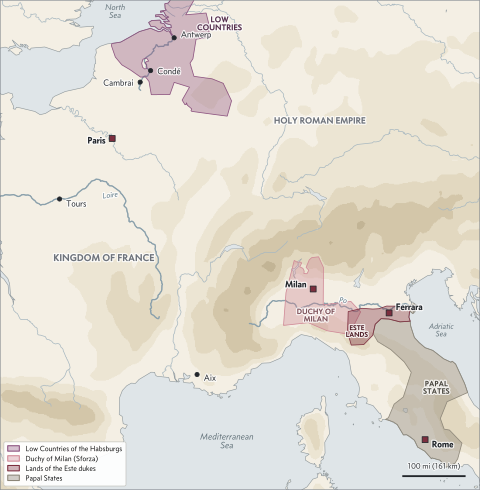
Ockeghem
Johannes Ockeghem (ock-eh-gem) was born at Saint-Ghislain (san-zhee-lan), a small town of Hainaut, sometime between about 1410 and 1430. In 1443 he was singing in the choir of the great church of Our Lady at Antwerp, and from 1446 to 1448 in the chapel of the duke of Bourbon at Moulins (moo-lan), in central France. By 1451 he had joined the chapel of the king of France, and he stayed in royal service for the rest of his life. He served three kings. Charles VII had driven the English out of France (Vol. 9, Cathedrals and Crusades); his son Louis XI ruled from 1461 to 1483; and Louis’s son Charles VIII, who invaded Italy in 1494 (Vol. 10, Rebirth), was the last. Ockeghem became master of the chapel, and in 1459 Charles VII gave him the post of treasurer of the great church of Saint-Martin at Tours, one of the richest offices in the king’s gift. He sang bass, and his music often gives the lowest voice an unusually wide range. He died, probably at Tours, on February 6, 1497. Poets and composers mourned him, among them the Dutch scholar Erasmus (Chapter 4) and Josquin (zhos-kan), who set a lament by the poet Jean Molinet (moh-lee-nay), “Nymphes des bois” (nanf day bwah), “Nymphs of the woods.”
Ockeghem loved musical puzzles, and the most famous of them is a Mass. Singers of his time read rhythms by signs at the start of each line. A full circle meant that each long note divided into three shorter ones, a rhythm called “perfect,” and a broken circle, like a C, meant that it divided into two (Vol. 1, The Toolkit). A dot inside the sign did the same for the next smaller note: with a dot, each of those split into three. The Latin for such a measuring of notes is mensura, and so these signs are called mensuration signs.
Ockeghem made a whole Mass of such puzzles, the Missa prolationum (proh-lah-tsee-oh-num), “Mass of the prolations,” from the Latin name for the ways a note could be divided. Each of its movements is built from canons, music in which one voice copies another note for note (Vol. 1, The Toolkit). In each canon only one line is written, with two mensuration signs at its start, and the two singers read it at two different speeds. Such a canon is a mensuration canon, and Ockeghem’s Missa prolationum pairs mensuration canonsThis composer wrote the canonic Missa prolationum. → Johannes Ockeghem••Pairs of mensuration canons, using different simultaneous meters, structure this Ockeghem mass. → Missa prolationum•• in most movements, two pairs of voices singing two canons at once. In modern notes, the first Kyrie, the opening prayer “Lord, have mercy,” sets its pairs in the meters 2/2 and 3/2, and 6/4 and 9/4 (Figure 2.6). As the Mass goes on, the distance in pitch between the two voices of a canon grows step by step, from none at all, the unison, in the first Kyrie to a full octave in the Osanna, a shout of praise near the end. One of the two manuscripts that preserve it is a great choirbook, the Chigi (kee-ghee) Codex, made about 1500 for Philip the Handsome, the young Habsburg lord of the Netherlands (Figure 2.7).


Ockeghem set another puzzle in pitch. Medieval singers sang in modes, scales that use the same seven notes but start on different ones, so that the half steps fall in different places (Vol. 1, The Toolkit). His Missa cuiusvis toni (koo-yoos-vis toh-nee), the “Mass in any mode,” is written without clefs, the signs that tell a singer which line of the staff is which note. The singers choose the clefs themselves, and each choice moves the half steps, so that the same Mass can be sung in several modes:This composer wrote Missa cuiusvis toni, which can be performed in several different modes. → Johannes Ockeghem• the Dorian, the Phrygian, the Lydian, or the Mixolydian. A composer had to make every cadence, every resting place, work in all four.
Josquin and the duke of Ferrara
Josquin des Prez (day pray) was the greatest composer of the next generation, and he wrote two Masses on the song “L’homme armé,” “The Armed Man” (Vol. 1, The Toolkit). He was born about 1450 in northern France or Hainaut. In 1477 he was singing at Aix (eks) for René of Anjou, a prince who held Provence. In the 1480s he served Cardinal Ascanio Sforza, a son of one duke of Milan and the uncle of another, and from 1489 to at least 1494 he sang in the pope’s choir in Rome. When the Sistine Chapel was restored in 1997 and 1998, workers found the name “JOSQUINJ” carved into the wall of the singers’ gallery. Around 1500 he was probably in the service of Louis XII, who had succeeded Charles VIII as king of France in 1498.
Ercole I d’Este (air-koh-leh), duke of Ferrara from 1471 to 1505, loved music and spent heavily on it. His chapel was one of the largest in Europe, and he hunted singers across the Alps. In 1502 two of his agents sent him rival advice about a new master for his chapel. One urged him to send for Josquin. The other recommended Heinrich Isaac, a composer from Flanders, because Isaac got on better with his colleagues and wrote new pieces faster. Josquin composed better, this agent admitted, but only when he felt like it and not when he was asked, and he wanted 200 ducats a year where Isaac would take 120. Ercole hired Josquin, who arrived in Ferrara in 1503 at the highest salary the chapel had ever paid. In 1504 plague came to the city, and Josquin left for home.
The Mass that carries the duke’s name may come from that year in Ferrara or from twenty years before; scholars disagree. Its title, Missa Hercules dux Ferrariae (feh-rah-ree-eye), is Latin for “Mass for Hercules, Duke of Ferrara,” Hercules being the Latin form of Ercole. Singers of the time learned melodies by six syllables, ut, re, mi, fa, sol, la, sung to the notes C, D, E, F, G, and A (Vol. 1, The Toolkit). Josquin matched each vowel of the title to the syllable with the same vowel and turned the syllables into notes, so that the vowels of the duke’s name became the themeThis composer used the vowels of the Duke of Ferrara’s name to derive the theme of Missa Hercules dux Ferrariae. → Josquin des Prez•• of the whole Mass.
In the Mass the tenor sings these eight notes in long values while the other voices weave around them, usually three times in each section: starting on D, then a fifth higher on A, then on D an octave above the first. The Italian theorist Gioseffo Zarlino (tsar-lee-noh) named the trick in 1558 a soggetto cavato (sod-jet-toh kah-vah-toh), a “subject carved out” of the vowels of the words. Josquin spent his last years as provost, the head of the clergy, of the church of Notre-Dame at Condé (kon-day), near his birthplace, and died there on August 27, 1521.
A quarter of a century after his death, a Swiss scholar made Josquin the hero of a book. Heinrich Glarean (glar-ee-un) (1488–1563) was born Heinrich Loriti at Mollis, in the Swiss canton, or state, of Glarus, and took his Latin name from it. He taught Greek and Latin at Basel (bah-zul), where he became the friend of Erasmus. In 1547 he published at Basel the Dodecachordon (doh-dek-ah-kor-don), the “twelve-stringed” book, which argued that there were twelve modes, not eight. The church’s eight were the Dorian, Phrygian, Lydian, and Mixolydian, each sung in a higher and a lower range. Glarean added two more pairs, on C and on A, the Ionian and the Aeolian (ee-oh-lee-un), which are our major and minor scales (Vol. 1, The Toolkit). To prove his theory Glarean printed about 120 complete pieces by composers of the generation before him, Josquin’s more than anyone’s. He held up the two “L’homme armé” Masses as proof of Josquin’s skill (Vol. 1, The Toolkit). He also told stories about him, among them that Josquin wrote a motet on the psalm verse that the King James Version gives as “Remember the word unto thy servant” to remind Louis XII of a church income the king had promised him. Josquin had become the first composer whose music went on being sung, printed, and studied long after his death.
The unicorn tapestries
A tapestry is a picture woven into the cloth on a loom, from a full-size painted design called a cartoon, by weavers who worked from the back (Vol. 1, The Toolkit). Princes often paid more for tapestries than for paintings. A set of hangings could be rolled up and carried from castle to castle, it kept the cold off stone walls, and its wool, silk, and gold thread cost more than any panel picture. The best weavers worked in the towns of the Low Countries, at Arras, Tournai, and above all Brussels. In the decades around 1500 they favored a style called millefleurs (meel-flur), French for “a thousand flowers.” Millefleurs tapestries set their figures against groundsThe millefleurs ("thousand flowers") style in this medium sets central figures against densely flowered backgrounds. → tapestry•• thick with hundreds of small flowering plants, each drawn separately, so that the people and animals seem to stand in an endless spring meadow.
Two sets of such tapestries tell of the unicorn. Medieval people knew the animal from the Physiologus (fiz-ee-ol-oh-gus), a Greek book of animal lore of the early Christian centuries, and from the bestiaries, the illustrated animal books that copied it. The unicorn was a small, fierce, white beast with one horn on its forehead, which no hunter could catch. Only a young virgin could tame it: it would come to her and lay its head in her lap, and then the hunters could take it. Christian writers read the story as Christ, who came into the world through the Virgin Mary. People also believed that the horn could make poisoned water pure, and princes paid fortunes for “unicorn horns,” which were really the tusks of the narwhal, an Arctic whale.
The Lady and the Unicorn
The first set hangs in Paris, in the Musée de Cluny (myoo-zay duh kloo-nee), the national museum of the Middle Ages. It was designed in Paris and woven in the Low Countries about 1500. In every piece a richly dressed lady appears on an island of dark-blue flowers set on a red millefleurs ground, with a lion at her right and a unicorn at her left. They hold banners, red with a blue diagonal band and three silver crescents, the arms of the Le Viste (luh veest) family, lawyers from Lyon (lee-ohn) who rose high in the service of the French kings. Jean Le Viste, who died in 1500, or a younger relative, Antoine, probably ordered them. The Lady and the Unicorn is a set of six tapestries: five show the senses, and the sixth bears a motto,The Lady and the Unicorn series was created in this medium. → tapestry••The sixth tapestry in this series bears the motto “À mon seul désir.” → The Lady and the Unicorn•Five tapestries in this series depict the senses. → The Lady and the Unicorn• “À mon seul désir” (ah mohn sul day-zeer), “To my only desire.” In Touch the lady holds the unicorn’s horn. In Taste she takes a sweet from a dish while a monkey eats one at her feet, and in Smell she weaves a wreath of flowers while the monkey sniffs a stolen blossom. In Hearing she plays a small organ as her maid works the bellows. In Sight the unicorn rests its forelegs in her lap and gazes at itself in the mirror she holds.

The sixth is the widest and the strangest (Figure 2.8). The lady stands before a blue tent, and the motto runs across its top; it may also mean “By my will alone.” She lays the necklace she wears in the other five into a casket that her maid holds, or takes it out; scholars cannot agree which. Some read the scene as a farewell to the pleasures of the senses, others as a sixth sense of the mind or heart, and the motto as a lover’s. Prosper Mérimée (may-ree-may), the inspector of France’s historic monuments, found the set in 1841 in the damp castle of Boussac (boo-sak) in central France, and the novelist George Sand made it famous. The Cluny bought it in 1882.
The Hunt of the Unicorn

The second set hangs in New York, at the Cloisters, the same museum that holds the Mérode Altarpiece. The Hunt of the Unicorn is seven tapestries of the unicorn hunt at the Cloisters,This series of seven tapestries depicting the pursuit of a mythical animal is housed at the Met Cloisters. → The Hunt of the Unicorn•• woven of wool, silk, and silver and gilt thread about 1495 to 1505, probably in Brussels from designs made in Paris. No one knows who ordered them. They were first recorded in 1680 in the Paris house of the La Rochefoucauld (lah rohsh-foo-koh) family. During the French Revolution they were looted from the family’s castle and, according to a story told later, used to cover potatoes. John D. Rockefeller Jr. bought them in 1922 for about a million dollars and gave them to the Cloisters, which opened in 1938.
Read in the museum’s order, they tell a story. Hunters and their hounds enter a wood. The unicorn kneels at a fountain and dips its horn into the stream to purify the water, while a lion, a stag, and other beasts wait to drink. Chased, it leaps into a stream; cornered, it fights, goring a hound with its horn. Of the fifth tapestry only two fragments survive, in which a maiden’s hand rests on its mane and a hunter blows his horn: the virgin has tamed it. In the sixth the hunters spear the unicorn, and it is carried dead across a horse’s back to a castle, where the lord and lady come out to meet it.
The seventh does not fit the story, and it may belong to a different set (Figure 2.9). The unicorn is alive, lying in a small round fence of wooden rails in a meadow of millefleurs, and the unicorn is chained to a pomegranate treeThe final tapestry in this series shows a mythical animal chained to a pomegranate tree inside a circular fence. → The Hunt of the Unicorn•• by its jeweled collar. Red drops stain its white coat, which may be juice falling from the ripe fruit above it or the marks of its wounds. Read one way, the scene is Christ risen after his death. Read another, it is a lover held captive by love, and the pomegranate, crowded with seeds, is a sign of marriage and children.
Each of the seven also carries a riddle. The letters A and E appearThe unexplained letters A and E recur in this tapestry series. → The Hunt of the Unicorn• in each, joined by a knotted cord, hanging from the trees or set in the sky. In 1942 the curator James Rorimer proposed that they were the first and last letters of Anne, for Anne of Brittany, who married King Louis XII in 1499. The Cloisters’ expert Margaret Freeman rejected the idea in 1976, and other readings point to a member of the La Rochefoucauld family. The letters have never been explained.
What to remember
- Robert Campin of Tournai (died 1444) is usually identified with the Master of Flémalle. The Mérode Altarpiece in the Cloisters, from his workshop, sets the Annunciation in a Flemish room, with the donors at the left and Joseph making mousetraps at the right.
- Rogier van der Weyden, Campin’s pupil, became city painter of Brussels; his Magdalen Reading in London shows Mary Magdalene reading beside her alabaster jar of ointment.
- Hans Memling, German-born, worked in Bruges. His Last Judgment, ordered by the Medici banker Angelo Tani, shows Saint Michael in golden armor weighing souls; the privateer Paul Benecke seized it at sea in 1473 and took it to Danzig, now Gdańsk.
- Johannes Ockeghem served Charles VII, Louis XI, and Charles VIII of France. His Missa prolationum is built from mensuration canons, one line sung at two speeds, and his Missa cuiusvis toni can be sung in any of four modes.
- Josquin des Prez served the Sforza, the pope, and Ercole d’Este; his Missa Hercules dux Ferrariae takes its theme from the vowels of the duke’s name. Glarean’s Dodecachordon (1547) made him the model composer.
- Millefleurs tapestries set figures against grounds of countless flowers. The Lady and the Unicorn (Paris) is six tapestries, five senses and “À mon seul désir”; The Hunt of the Unicorn (New York) is seven, ending with the unicorn chained to a pomegranate tree, marked with an unexplained A and E.
Chapter 3 · 20 clues
Hieronymus Bosch
In the summer of 1517 an Italian cardinal, Luigi of Aragon, was touring the lands of the north for his own pleasure. His secretary, a churchman named Antonio de Beatis (bay-ah-tees), kept a diary of everything they saw. That July they met the young Charles of Habsburg, the future emperor Charles V, at Middelburg in Zeeland; in the autumn they would call on the aged Leonardo da Vinci in France (Vol. 10, Rebirth). At Brussels they were shown the palace of the counts of Nassau, one of the great noble families of the Netherlands. There de Beatis noticed some painted panels full of what he called bizarre things. He listed seas, skies, woods, and meadows, people crawling out of shells and others giving birth to birds, and men and women, white and black, doing every kind of thing in every kind of pose.
The man who had painted them had died the summer before in his own town in Brabant. He left no letter, no diary, and not one word about what his pictures meant. Five hundred years later people still argue about them, and in Madrid they still draw crowds.
Bosch’s moral pictures
He was born Jheronimus van Aken (yay-roh-nee-mus fahn ah-ken) about 1450, and the world knows him as Hieronymus Bosch. Jheronimus and Hieronymus are both Latin spellings of the name Jerome, which comes from the Greek for “holy name.” His town was ’s-Hertogenbosch, “the Duke’s Wood,” a busy market town in the duchy of Brabant. Brabant was one of the provinces that had passed to the Valois dukes of Burgundy (the Stage). The townspeople called it simply Den Bosch, “the Wood,” and the painter signed some of his pictures “Jheronimus Bosch,” naming himself after his town. His forefathers had come from Aix-la-Chapelle (eks lah shah-pel) (in German Aachen (ah-khen)), Charlemagne’s old capital, which is what van Aken means. They were painters: his grandfather Jan, his father Anthonius, and several uncles. He probably learned his trade in the family workshop. In 1463, when he was about thirteen, a fire destroyed some four thousand houses in the town. It may have been the first burning city he ever saw, and he painted many afterward.

About 1480 he married Aleid van de Meervenne (ah-late fahn duh mair-ven-uh), a woman a few years older than he was, from a rich family of the town, and the marriage made him a man of property. In 1486 or 1487 he joined the Illustrious Brotherhood of Our Lady, a society of leading townsmen and churchmen devoted to the Virgin Mary, which kept its chapel in the great church of Saint John. Its sworn members were nicknamed “swan brothers,” because each in turn gave a swan for the yearly feast. His fame spread far beyond Brabant. In 1504 Philip the Handsome, ruler of the Netherlands and son of Mary of Burgundy and the emperor Maximilian I (the Stage), ordered from him a large triptych of the Last Judgment. Bosch died in the summer of 1516, and on August 9 the Brotherhood sang a mass for his soul in Saint John’s.
Nearly all of this comes from entries in the records of the town and of the Brotherhood. The first account of his life was written by the Flemish painter Karel van Mander in his Book of Painters of 1604 (the Stage), almost ninety years after Bosch died, and van Mander could tell nothing about the man. He described the pictures instead: wonderful and strange fantasies of devils and of hell, which he found more often gruesome than pleasant to look at. He also admired the painter’s firm, quick hand, which often finished a passage at the first attempt, without changes. Modern study of the panels bears him out: where most Netherlandish painters hid their brushwork under layer after layer of transparent glaze, Bosch often painted more sketchily. Bosch belongs to what art historians call the Early Netherlandish school, the painters of the Low Countries from Jan van Eyck in the 1420s to the early 1500s (Chapter 1). He was the strangest of them all.
His pictures are strange for a reason. The church he belonged to taught that every soul would be judged after death and sent to heaven or to hell, and that the road to hell was made of small daily choices. Preachers listed the worst of them as the seven deadly sins: pride, greed, lust, envy, gluttony, anger, and sloth. They liked to show the sinner as a fool, a man who trades eternity for a mouthful, and Bosch painted that fool again and again. His largest pictures are triptychs, three panels joined by hinges, with two wings that fold shut over the center (Vol. 1, The Toolkit). Bosch used the form to tell a story from left to right: Paradise on the left wing, the sinful world in the middle, and Hell on the right. The beginning, the present, and the end could be taken in at a glance.
The Haywain
Bosch painted The HaywainThis artist painted The Haywain triptych. → Hieronymus Bosch•• late in his life, perhaps between 1510 and 1516. Its left wing tells the beginning of the world in four scenes, read from top to bottom. At the top God sits enthroned in heaven. Christian tradition held that before the first man and woman were made, a great angel, Lucifer, rebelled against God with his followers, and that they were thrown out of heaven and became devils. In Bosch’s picture, as they tumble through the clouds, the rebel angels turn into insects,Falling rebel angels become insects in the left wing of this triptych. → The Haywain Triptych (Bosch)•• a buzzing swarm of winged demons spilling down the sky. Below them God makes Eve from the side of the sleeping Adam; then the serpent offers the forbidden fruit; and at the bottom an angel with a sword drives the couple out of Eden.
The center panel is the world. A towering cart heaped with hay rolls across it, and everybody wants some. A Netherlandish saying held that the world is a haystack, from which each man plucks what he can. Preachers also knew the words of the prophet Isaiah, which the King James Version of 1611 renders “All flesh is grass.” Hay is grass cut and dried, worth little and soon gone. Men set ladders against the load and tear at it with hooks; two of them fight with knives, and one is stabbed. Behind the cart ride a pope, an emperor, and a king, following it as eagerly as the crowd. On top of the hay a pair of lovers make music, with an angel praying on one side of them and a blue demon piping on the other. High above everything, in a golden cloud, God looks down on the crowd:God looks down on the sinners crowding around a cartload of hay in this triptych. → The Haywain Triptych (Bosch)• it is Christ, whom Christians worship as God the Son, raising his wounded hands. Only the praying angel looks up. Monsters pull the cart toward the right-hand wing (Figure 3.2).

The ground in front is full of small cheats and sins. At a little table under a banner on a pole, a tooth-puller works on a woman.A tooth-puller works beneath a sign showing vermin inside a heart in this triptych. → The Haywain Triptych (Bosch)• He is a quack, one of the traveling cheats who pulled teeth and sold cures at fairs, and his banner is painted with a red heart that has vermin crawling inside it. Nearby, a bagpiper plays, and nuns stuff hay into a sack for a fat monk who sits drinking in a chair. The right wing shows where the cart is going. Under a sky red with fire, devils lay bricks for a new round tower, as if Hell needed more room for all who are coming, while below them demons spear and devour the damned. When the wings are closed, they show a single picture in full color: a peddler with a basket on his back, walking through a dangerous countryside past a robbery and a gallows, fending off a snapping dog with his stick. Scholars read him as the Christian on the road of life. Philip II of Spain, the son of Charles V, bought the triptych in 1570 (Vol. 10, Rebirth), and it hangs today in the Prado (prah-doh), Madrid’s great museum of the old Spanish royal collection.
A ship and a deathbed


In 1494 Sebastian Brant, a lawyer of Basel, published Das Narrenschiff (nar-en-shif), The Ship of Fools, a long poem in German in which more than a hundred fools, each guilty of a different folly, sail off together for the land of fools. With its woodcuts it became one of the most popular books in Europe. In the same years Bosch painted a Ship of FoolsThis artist painted Ship of Fools. → Hieronymus Bosch•• of his own, a small panel now in the Louvre in Paris, about 23 by 13 inches. His fools are a whole boatload of gluttons, drifting nowhere on a calm sea (Figure 3.3).
In the middle of the boat sits a table with a plate of cherries. On one side of it a nun plays a lute;A nun plays a lute aboard a boat whose mast is a tree, while a man reaches toward a roast bird in this painting. → Ship of Fools (Bosch)•• on the other side sits a friar, and a flat cake hangs on a string between them, which both of them, mouths wide open, try to bite. Others sing around them. The boat has no sail, and its mast is a living tree, with an owl hidden in its leaves and a long pink pennant flying from it. A man climbs it with a knife and reaches up toward a roast bird tied to the trunk. A jester in a fool’s costume sits apart on a branch, drinking alone; a man leans over the side to be sick; and two swimmers paddle alongside, one holding up a bowl for more wine. Nobody steers, and a big kitchen ladle serves as an oar. The panel is the upper part of the left wing of a triptych that was later sawn apart. A strip from the bottom of the same wing, with more gluttons, is at Yale University.
The right wing hangs in the National Gallery of Art in Washington, and tree-ring dating shows that its oak and the Ship’s came from the same tree. On it Bosch painted Death and the Miser,This artist painted Death and the Miser. → Hieronymus Bosch•• a tall, narrow picture about 3 feet high and only a foot wide. A miser is a person who hoards money for its own sake. The scene comes from the little printed handbooks of the 1400s called the Ars moriendi (mor-ee-en-dee), “The Art of Dying,” which taught Christians how to die well. Their woodcuts showed angels and devils fighting over a dying man’s soul in his last hour, while he chose between them.
In a narrow vaulted room a dying man sits up in bed. Through a door at the left, Death, a skeleton holding an arrow,A skeleton with an arrow approaches a bedridden man while a green-clad figure puts coins in a chest in this painting. → Death and the Miser•• steps toward him. An angel puts a hand on the man’s shoulder and points him to a small crucifix in the window, where a ray of light falls. But the man’s eyes and hand turn the other way, toward a bag of money that a demon holds out from under the bed curtains. In front of the bed, an old man in a green robe, perhaps the miser himself in better days, drops coins into a chest while he holds a rosary, a string of prayer beads, in his other hand. Little demons lurk under the lid and beneath the chest. In the foreground lie a helmet, a sword, and a lance; scholars still argue over them, and many read them as the gear of a worldly life, of no use now. Bosch does not show which way the man will choose.
The Garden of Earthly Delights
The panels de Beatis saw in Brussels in 1517 make up Bosch’s masterpiece, his largest triptych, about 7 feet high and almost 13 feet wide when open. Bosch gave titles to none of his pictures. In Spain it was called the painting of the madroño (mah-droh-nyoh), the strawberry tree, after a fruit in its center, and the Dutch call it “the garden of lusts.” Painters had long set two kinds of scene in a garden: Eden, the first garden of the Bible, and the walled garden where lovers met. The title by which the world now knows it holds both, and Bosch’s Garden of Earthly DelightsThis Early Netherlandish artist painted The Garden of Earthly Delights. → Hieronymus Bosch•••A Hieronymus Bosch painting depicts one of these places "of Earthly Delights." → gardens• is one of the most famous paintings of the Early Netherlandish school.
It was probably not made for a church, since it has no saint and no kneeling donor. Its first known home was the Nassau palace, and it was most likely painted for Count Henry of Nassau, who governed several provinces for the Habsburgs, or for his uncle Engelbrecht, who died in 1504. In time the palace and its pictures passed to Henry’s nephew William of Orange, later known as William the Silent, who would lead the revolt of the Netherlands against Spain (Chapter 7). In 1568 the Duke of Alba, the general Philip II sent to crush that revolt, seized it and took it to Spain, where it passed to the duke’s son Fernando. Philip bought it at auction in 1591 and sent it two years later to the Escorial (es-kor-yahl), his monastery-palace outside Madrid (Vol. 10, Rebirth). It stayed there until 1939, when it moved to the Prado.
The Garden is read in three acts, like the Haywain, but it also has a prologue on the outside (Figure 3.4). Closed, the wings make one picture painted in grisaille, shades of gray alone (Chapter 1): the earth floating inside a transparent sphere in a dark void, with a verse of Psalm 33 written above it. It is the third day of Creation.The closed exterior of this triptych shows the third day of Creation as a world inside a transparent sphere, painted in grisaille. → The Garden of Earthly Delights•••The exterior of this triptych quotes Psalm 33: “For he spoke, and it came to be; he commanded, and it stood firm.” → The Garden of Earthly Delights•• Genesis tells that on that day God gathered the waters together, made the dry land appear, and had the earth bring forth grass, plants, and fruit trees. There are no animals yet, no people, and no sun or moon, which come on the fourth day; perhaps that is why the light is gray. Strange plants sprout on a flat disk of land ringed by sea, under clouds pierced by beams of light. In the upper left corner, very small, God sits crowned, with a book on his knees (Figure 3.5). Across the tops of the two shutters runs the psalm’s ninth verse in the words of the Latin Bible, which counts this psalm as the thirty-second: Ipse dixit, et facta sunt; ipse mandavit, et creata sunt. The King James Version renders it “For he spake, and it was done; he commanded, and it stood fast,” and modern English Bibles “For he spoke, and it came to be.”
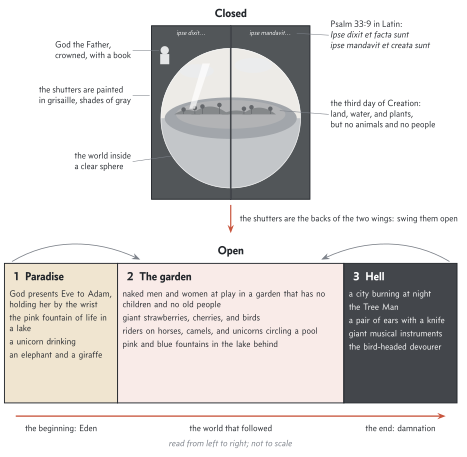

Open the wings, and color floods out. The left wing is Eden. In the foreground meadow God holds Eve by the wristGod presents Eve to Adam by holding her wrist in the Paradise wing of this triptych. → The Garden of Earthly Delights••• and presents her to Adam, who has just woken and sits on the grass with his foot touching God’s. God here is young and golden-haired, dressed in a long pink robe. He looks like Christ, perhaps because Christians held that the Son, whom John’s Gospel calls the Word of God, was present at the Creation. Adam gazes at Eve, and she lowers her eyes. Behind them a tall pink fountain, like a jeweled plant, rises from a lake, with an owl peering out of a hole in its base. Around it graze animals that Bosch probably knew only from travelers’ books, an elephant and a giraffe, and at the left, by a stream, a white unicorn bends to drink.A unicorn drinks from a pool in the left section of this work. → The Garden of Earthly Delights• Unicorns, the beasts of the great woven hangings of Paris and New York (Chapter 2), were believed to make poisoned water pure by dipping their horns in it. Yet even here, in the foreground, a cat carries off a small creature in its jaws, and odd beasts crawl out of a dark pool. Death has already found its way into Paradise.
The center panel, twice as wide, is the garden itself. Hundreds of naked men and womenNude people mingle with giant fruit, exotic animals, and pink and blue fountains in the central panel of this triptych. → The Garden of Earthly Delights••• play in a bright, endless park, among giant strawberries and cherries, giant birds, and animals from every corner of the world. Some hide inside shells, bubbles, and hollow fruit; some feed one another berries. A ring of riders on horses, camels, boars, and unicorns circles a pool full of bathing women. In the lake behind stand five tall fountains, pink and blue, half rock and half flower. There are no children in the garden and no old people, and nobody works. The first to write at length about the picture was José de Sigüenza (hoh-say day see-gwen-thah), a monk and the librarian of the Escorial. In 1605 he argued that it was neither heretical nor merely absurd. Other painters, he wrote, showed men as they look from the outside, while Bosch dared to paint them as they are inside. Most scholars now read the center panel as the world given over to lust, the pleasures of the senses that lead straight into the right wing; the strawberry, sweet and quick to rot, was a common image of pleasure that does not last. Others have read it differently. The German scholar Wilhelm Fraenger (freng-er) argued in 1947 that Bosch painted it for a secret sect, the Brethren of the Free Spirit, who believed in innocent love, so that it shows a paradise; few now agree. The German art historian Hans Belting suggested in 2002 that it shows the world as it might have been if Adam and Eve had never sinned.
The right wing is Hell, and it is night. A city burns on the horizon, its fires reflected red in the water, and sinners skate and drown on a frozen lake. In the middle of the panel stands the pale Tree Man.The pale “Tree Man” with a hollow, cracked-eggshell torso in this triptych’s Hell panel has been proposed as the artist’s self-portrait. → The Garden of Earthly Delights••• His legs are dead tree trunks planted in two boats on the ice, and his body is a hollow, cracked eggshell, open at the back, with a little tavern inside where sinners sit drinking. On his head a round disk carries demons and souls in a circle dance around a giant pink bagpipe. His face, turned back over his shoulder toward us, wears a sad half-smile. Belting also proposed that this face is Bosch’s self-portrait, the painter signing the world he had invented.
Close by, at the upper left, a giant pair of ears,A large pair of ears carrying a knife appears near the "Tree Man" in this work. → The Garden of Earthly Delights•• pierced by an arrow, carries a great knife blade between them and rolls over the damned like an engine of war. Each punishment below seems fitted to a sin. Gamblers are cut down beside their overturned table, and a pig wearing a nun’s veil presses a frightened man to sign a document. The lower left corner is a hell for music. Giant musical instruments torture the sinners:Oversized musical instruments torture sinners in this triptych’s Hell panel, where notes written on a person’s body were transcribed by Amelia Hamrick. → The Garden of Earthly Delights•• a man is stretched across the strings of a harp, another is trapped inside a hurdy-gurdy, a stringed instrument played by turning a crank, and a third lies pinned face down under a huge lute. On his bare backside a few lines of music are painted, and a choir of the damned sings from them, led by a demon. In 2014 Amelia Hamrick, a college student in Oklahoma, copied the notes into modern notation and posted the tune online, where it was soon sung and played in many versions.
At the lower right, a bird-headed monster sits on a high chair,In the Hell wing of this triptych, a bird-headed monster devours and excretes human sinners. → The Garden of Earthly Delights••• with a cooking pot for a crown and jugs on his feet. He devours sinners whole and passes them out the other end, in a clear bubble, into a pit below, where another of the damned is being sick. Writers on the painting have nicknamed him the Prince of Hell, and his throne is a privy, an old word for a toilet.
The Garden was copied again and again, in paint and in woven hangings, often by far lesser artists. Bosch’s monsters passed to Pieter Bruegel the Elder, the greatest Flemish painter of the next generation. One of his early drawings was engraved and sold under Bosch’s name, since Bosch’s was then the better known (Chapter 7). In the twentieth century the Surrealist painters Salvador Dalí (dah-lee) and Joan Miró (zhoo-ahn mee-roh), who painted dreams, knew the Garden at first hand and looked on Bosch as a forerunner (Vol. 22, The Lost Peace).
Patinir
One of the painters who borrowed from Bosch’s hells was Joachim Patinir (yoh-ah-kim pat-ih-neer), who was born about 1480 at or near Dinant (dee-nahn), on the Meuse in what is now southern Belgium. The Meuse runs there between cliffs of gray limestone and tall free-standing crags, and those rocks rise in nearly every picture he painted. He signed himself “Joachim D. Patinier,” the D standing for the Latin Dionantensis, “of Dinant.” In 1515 he became a master of the painters’ guild of Antwerp, then the richest trading city of the Netherlands, and he worked there until his death on October 5, 1524. When the German painter Albrecht Dürer (dyoor-er) was in Antwerp in 1521, he attended Patinir’s second wedding and called him “the good landscape painter” (Vol. 1, The Toolkit).
Patinir shrank the saints and the stories to a few small figures and made the land the subject. In the kind of panoramic picture he invented, now called the world landscape, we look down from a great height over rocks, rivers, towns, and sea to a horizon high in the picture, as if the whole world could be seen at once (Vol. 1, The Toolkit). His most famous picture borrows a scene from Greek myth, in which Charon, the ferryman of the dead, rowed souls across the river Styx into the underworld. In this panel, now in the Prado, Patinir painted Charon crossing the StyxThis artist painted Charon crossing the Styx in a panoramic landscape. → Joachim Patinir• with a soul in his boat, on a river as wide as a sea between a green paradise and a burning hell. It is called Landscape with Charon Crossing the Styx, and its hell, with fiery towers, owes much to Bosch (Vol. 1, The Toolkit, Vol. 4, Classical Myth).

The Prado also has his Landscape with Saint Jerome, painted about 1515 to 1517. Jerome, the saint whose name Bosch bore, was the scholar who translated the Bible into Latin, the version Bosch quoted on the Garden’s shutters. He lived for some years as a hermit in the Syrian desert and later in a monastery at Bethlehem (Vol. 7, The Romans). The Golden Legend, a popular book of saints’ lives written in the thirteenth century, says that a lion limped into his monastery one day with thorns in its paw, and that Jerome welcomed it and had the wound tended. The lion stayed on to guard the monks’ donkey, lost it to passing merchants, and later found the donkey in their caravan and drove the whole caravan home. Patinir tells the whole story (Figure 3.6). In the foreground Jerome, in a thatched shelter against a rock, draws out the thorn himself, as painters liked to show him, with a crucifix and a skull beside him. On a hill at the left stands the monastery, and at the far right the lion bounds after the merchants and the stolen donkey. Behind them all the country opens: farms, a walled town, a broad river winding to the sea, and blue mountains under a storm.
The saint is still there, but he takes up a small corner of the panel. A generation later Pieter Bruegel the Elder built his own wide views of the Low Countries on Patinir’s high, wide way of seeing (Chapter 7), and by the next century Dutch painters would sell landscapes with no saint in them at all.
What to remember
- Hieronymus Bosch (Jheronimus van Aken, about 1450–1516) worked all his life in ’s-Hertogenbosch in Brabant; Karel van Mander’s Book of Painters (1604) gives the first account of him.
- His triptychs read from left to right: Paradise, the sinful world, and Hell.
- The Haywain: the rebel angels fall as insects, the world grabs at a cart of hay while Christ looks down unseen, and a tooth-puller works under a banner with a heart.
- Ship of Fools (Louvre), with the nun’s lute and the tree for a mast, and Death and the Miser (Washington), with Death’s arrow and the old man in green at his chest, come from the two wings of one triptych that was sawn apart.
- The Garden of Earthly Delights (Prado): closed, the third day of Creation in grisaille under Psalm 33; open, God presenting Eve to Adam and the unicorn drinking in Eden, and the naked crowd among giant fruit and pink and blue fountains in the center.
- The Garden’s Hell has the bird-headed devourer, the ears with their knife, the musicians’ hell, whose painted notes Amelia Hamrick transcribed in 2014, and the Tree Man, whose face has been proposed as Bosch’s self-portrait.
- Joachim Patinir of Dinant, in Antwerp from 1515, made the world landscape: Charon Crossing the Styx and Landscape with Saint Jerome.
Humanists, Reformers, and Rebels, 1500-1609
Chapter 4 · 25 clues
Erasmus, Rabelais, and the Pléiade
In the summer of 1509 a thin, sickly priest of about forty rode north over the Alps, out of Italy and toward England. A man on horseback cannot read, and the journey took weeks. So, as he later told his friend Thomas More in a letter that John Wilson put into English in 1668, rather than waste the hours “in foolish and illiterate Fables,” he made up a book in his head. It would be a speech by Folly herself, the goddess of silliness, in praise of her own power over mankind. When he reached More’s house in London he fell ill, and in about a week in bed he wrote it down.
The rider was Erasmus, and within twenty-five years the questions his little book laughed at were being argued with fire. What did a Christian owe to the ceremonies of the church? What were monks and theologians for? Why did Christian princes make war on one another? Between 1500 and 1560 two writers answered them with laughter, Erasmus in learned satire and the Frenchman François Rabelais in tales of giants. Then a poet, Pierre de Ronsard (rohn-sar), set out to make French as great a language for verse as Latin. Between them stands a young king of France who won a great battle and then, after a night of posters, turned on the Protestants of his kingdom.
Erasmus
Desiderius Erasmus was born in Rotterdam, a port town in the county of Holland, probably on October 27 or 28, 1466, though some of his own remarks about his age point to 1469. His father, Gerard, was a priest, and so could not marry his mother, Margaret, a doctor’s daughter. The boy was sent to one of the best Latin schools north of the Alps, at Deventer (day-ven-ter), where he began to learn Greek. Then plague struck the town about 1483 and killed both his parents. His guardians pushed him into a house of Augustinian canons, priests who lived together under a rule like monks, at Steyn (stine) near Gouda, and he took his vows there in 1488. He hated it. The rule seemed to him to put fasting and chanting where the love of God should be, and for the rest of his life he found reasons to stay away.
Erasmus got out by being useful. His Latin was so good that in 1493 the bishop of Cambrai, in the south of the Low Countries, took him on as his secretary, and from there he went to study theology at the University of Paris. He was poor, often ill, and always moving: to England in 1499, where he met More (Vol. 12, Crown and Parliament) and the preacher John Colet; back to Paris and the Low Countries; to Italy in 1506; to England again; later to Louvain and Basel. Wherever he went he joined the movement called humanism. It had begun in Italy with Petrarch in the 1300s (Vol. 9, Cathedrals and Crusades), among scholars who studied the “humanities,” the grammar, rhetoric, poetry, history, and moral philosophy of the Greek and Roman classics, and a humanist was such a scholar. Humanists went back to the oldest texts in their original languages. North of the Alps they turned the same tools on Christianity. A man who could read the New Testament in Greek could find out what it really said and correct the Latin Bible the church used, the Vulgate.
He called himself Erasmus Roterodamus, “Erasmus of Rotterdam,” after the town in Holland where he was born. Holland was one of the provinces of the Low Countries, ruled in his day by the dukes of Burgundy and then their Habsburg heirs (the Stage); the northern provinces of the Low Countries became the Dutch Republic and are now the kingdom of the Netherlands. Although he had lived in Rotterdam only as a small child, this Dutch humanist from what is now the NetherlandsThis person was a Dutch humanist. → Desiderius Erasmus•Desiderius Erasmus of Rotterdam was from this country. → the Netherlands•• became the most famous scholar in Europe, and kings, popes, and printers wanted him.

His first success was a book of proverbs. In Paris in 1500 he published about eight hundred Greek and Latin sayings with short notes, to help students write elegant Latin, under the title Adagia (uh-day-jee-uh), “Adages.” In 1508 he spent most of a year in Venice, in the printing house of the great Venetian printer Aldus Manutius (muh-noo-shee-us) (Vol. 10, Rebirth), and enlarged the book to more than three thousand. Many notes grew into essays. Under “Make haste slowly” he praised Aldus himself, and in later editions he wrote a long attack on war between Christian princes under the saying “War is sweet to those who have not tried it.” By his death the Adages held 4,151 sayings. Phrases now in every European language passed through them: “to leave no stone unturned,” “in the land of the blind the one-eyed man is king,” and “Pandora’s box,” where his Latin pyxis, box, replaced the jar of the Greek poet Hesiod (hee-see-ud) (Vol. 4, Classical Myth).
In 1501, staying near Saint-Omer in Artois, Erasmus was asked by a friend to write something for a rough soldier whose pious wife despaired of him. The result, printed at Antwerp in 1503, was the Enchiridion militis Christiani (en-ky-rid-ee-on). The Greek word means something held in the hand, either a small book or a short sword, so the title is both “handbook” and “dagger” of the Christian soldier; in English it is usually called the Manual of a Christian Knight. Its argument was simple and, for its time, daring. A man may fast, go on pilgrimages, kiss the relics of saints (their bones or belongings), and hear Mass, the church’s chief service, every day, Erasmus wrote, and still be no Christian if he does not love his neighbor. He urged his readers to look beyond the rites of religion,This thinker wrote Manual of a Christian Knight urging people to look beyond the rites of religion. → Desiderius Erasmus• its outward ceremonies, to the spirit they were meant to express, and to imitate the life of Christ. It became one of the most widely read books of its age, and in 1533 the English reformer William Tyndale published it in English.
The same lesson became comedy in the book Erasmus planned on horseback. Written at More’s house and printed at Paris in 1511, his humanist satire The Praise of FollyThis author wrote In Praise of Folly. → Desiderius Erasmus••Erasmus’s Praise of Folly is associated with this intellectual movement. → humanism• has a Greek title, Moriae Encomium (mor-ee-ee en-koh-mee-um), that puns on More’s name (Vol. 12, Crown and Parliament). Folly, a goddess, climbs up before an audience and gives a speech in her own honor. She is the daughter of Plutus, the god of wealth, and was nursed by Drunkenness and Ignorance. Nobody, she proves, would marry, have children, flatter a prince, or go to war without her, and life without her would be unbearably dull. Then her laughter turns on the foolish. She mocks people who believe, in Wilson’s translation of the book, “that if they can but see a Wodden or painted Polypheme Christopher, they shall not die that day.” Saint Christopher was the giant who in legend carried the Christ child across a river, and his pictures made him as huge as Polyphemus (pol-ih-fee-mus), the one-eyed giant of Homer’s Odyssey. Such people trusted his picture to keep them alive. She mocks those who pray to Saint Erasmus with wax candles to grow rich, a joke on the author’s own name. She mocks theologians who split hairs, monks who count the knots in their shoelaces, and popes who lead armies. At the end she turns serious. Saint Paul himself wrote that Christians are “fools for Christ’s sake,” and the highest folly, she ends, is the Christian love that the worldly wise call madness.
Erasmus’s greatest work as a scholar came in 1516, when the Basel printer Johann Froben (froh-ben) brought out his New Testament: the first Greek New Testament ever published, beside his own Latin translation and notes. Martin Luther, a German friar, used it, and when Luther began to challenge the pope’s authority in 1517 (Vol. 14, From Luther to Mozart), his enemies among the monks said that Erasmus had laid the egg that Luther hatched. Erasmus answered that he had laid a hen’s egg and Luther had hatched a very different bird. He never left the Catholic Church, and in 1524, in On Free Will, he wrote against Luther’s teaching that the human will is not free; Luther answered him the next year in The Bondage of the Will. When Basel turned Protestant in 1529, Erasmus moved to the Catholic town of Freiburg. He came back to Basel to see a book through the press and died there on July 12, 1536, still trusted fully by neither side.
Francis I
Francis of Angoulême was born on September 12, 1494, at Cognac, the son of Charles, count of Angoulême, and Louise of Savoy. He was the cousin of King Louis XII, who had no son, and in 1514 he married the king’s daughter Claude. On January 1, 1515, Louis died and Francis I became king of France at twenty (the Stage draws the Valois family). He was over 6 feet tall, a hunter and jouster with a long nose and great charm. He brought the old Leonardo da Vinci to France (Vol. 10, Rebirth), and he met Henry VIII at the Field of the Cloth of Gold in 1520 (Vol. 12, Crown and Parliament).

Francis wanted glory first, and glory meant Italy. The Italian Wars (Vol. 10, Rebirth) were twenty years old. Louis XII claimed the duchy of Milan as the heir of his grandmother Valentina Visconti (vis-kon-tee). He had taken it in 1499 and lost it in 1512 and 1513 to an alliance whose sharpest weapon was the Swiss infantry. A pike was a spear about 18 feet long. The Swiss fought in squares thousands strong, pikes leveled, and charged at a run, so that no cavalry could break them; they had beaten the French at Novara in 1513 and now held Milan for its young duke, Maximilian Sforza. In the summer of 1515 Francis crossed the Alps to win it back. Instead of the usual passes, his engineers cut a road over the Col de l’Argentière (ar-zhahn-tyair), a high pass far to the south, and dragged seventy-two great guns across it (Figure 4.3).

The battle came on September 13, 1515, at Marignano (mah-ree-nyah-noh), now Melegnano (meh-leh-nyah-noh), about 10 miles southeast of Milan. Late in the afternoon the Swiss columns, about 22,000 men, came out of Milan and charged the French guns. The fighting went on by moonlight until the middle of the night, and the king led charge after charge of his armored horsemen; he later boasted to his mother of thirty. At dawn the French cannon, set up again in the center, tore lanes through the Swiss squares, and at midmorning the cavalry of Venice, France’s ally, arrived to help. The Swiss withdrew in good order, in one great square. Francis had beaten the Swiss pikemen,At the Battle of Marignano, Francis I of France defeated this country's pikemen. → Switzerland•• the soldiers whom all Europe had feared for forty years. The old marshal Gian Giacomo Trivulzio (tree-vool-tsee-oh), an Italian in French service then about seventy-five, called it a battle of giants and said that every battle before it had been children’s games.
A famous story says that Francis asked to be knighted on the battlefield by the Chevalier Bayard (bah-yar), the most famous knight in France. It first appears in a life of the knight that his cousin Symphorien Champier (san-foh-ryan shahm-pyay) printed soon after Bayard’s death in 1524. The French historian Didier Le Fur argued in 2004 that the scene was invented. What is certain is that Francis struck a medal that boasted, “I have vanquished those whom only Caesar vanquished.” Milan was French again. At Fribourg (free-boor) in November 1516 the Swiss made a “Perpetual Peace” with France, and they kept it: Swiss regiments served the kings of France until the Revolution. One Swiss priest at Marignano, Huldrych Zwingli (huuld-rikh zwing-lee), came home hating the trade of hired soldiers; he admired Erasmus, whom he visited at Basel, and he would lead the Reformation in Zurich (Vol. 14, From Luther to Mozart). The composer Clément (klay-mahn) Janequin (zhah-nuh-kan) turned the battle into a song for four voices, “La guerre,” in which the singers imitate trumpets, drums, and cannon. Ten years later the luck turned. At Pavia in 1525 Charles V’s army captured Francis, and he spent a year as a prisoner in Spain (Vol. 10, Rebirth).
At home Francis liked to be seen as a patron of learning. In 1530, urged by the great Greek scholar Guillaume Budé (bew-day), he paid royal lecturers to teach Greek and Hebrew in Paris, the start of what became the Collège de France (koh-lezh duh frahnss). His sister Marguerite, queen of Navarre from 1527, wrote poems and stories and sheltered men who wanted to reform the church. Their enemies sat in the Sorbonne (sor-bun), the faculty of theology of the University of Paris, which judged books for heresy, and in the Parlement of Paris, the kingdom’s highest court (the Stage). For years the king stood between the two.

The quarrel was about the Mass, the central service of Catholic worship. Catholics believed that in it the priest’s words changed the bread and wine into the body and blood of Christ, which were offered to God as a sacrifice. The Protestants, as the followers of Luther and the other reformers who broke with the pope came to be called (Vol. 14, From Luther to Mozart), denied it, and the Swiss reformers taught that the bread was only a sign. On the night of October 17–18, 1534, printed posters attacking the Mass appeared on walls in Paris and in four other towns, Blois, Rouen (roo-ahn), Tours, and Orléans. They were the work of Antoine Marcourt (mar-koor), a French pastor at Neuchâtel (nur-shah-tel), and they called the Mass an insult to Christ’s one sacrifice on the cross. A story often told since says that one was fixed to the king’s own bedchamber door,Anti-Mass posters appeared during this incident, reportedly including one on Francis I’s bedchamber door. → Affair of the Placards•• in the château of Amboise on the Loire.
This was the Affair of the Placards, and it ended the king’s patience. To Catholics the posters were blasphemy against what they held most holy, and an attack on the king’s own person. Arrests began within days, and on November 13, 1534, the first of the accused, a crippled young man named Barthélemy Milon, was burned alive in Paris. In January 1535 Francis walked through Paris in a great procession behind the consecrated bread, the Host, to make amends to God, while more Protestants went to the fire; to their fellow believers they died as martyrs. Many fled, among them the court poet Clément Marot (mah-roh) and a young lawyer named John Calvin, who would make Geneva a Protestant city (Chapter 5). From then on the crown treated heresy as treason, and France was set on the road to the Wars of Religion.
Gargantua and Pantagruel
François Rabelais was born on a farm called La Devinière (duh-veen-yair), in the parish of Seuilly (suh-yee) near Chinon (shee-nohn), in the province of Touraine (too-ren), the son of a lawyer named Antoine Rabelais. The year is unknown; scholars guess anything from 1483 to 1494. This sixteenth-century French writerThis author is a 16th-century French writer. → François Rabelais•• lived several lives in one. He became a Franciscan friar at Fontenay-le-Comte (fohn-tuh-nay luh kohnt) in Poitou (pwah-too), learned Greek, and wrote to Budé. In 1523, when the theologians of Paris had grown suspicious of Greek, which scholars were using to correct the church’s Latin Bible, his superiors seized his Greek books, and a friendly bishop, Geoffroy d’Estissac (zhoh-frwah des-tee-sak), had him moved to a Benedictine abbey as his secretary. About 1527 Rabelais left the cloister without permission, studied medicine at Montpellier (mon-pel-yay), and in 1532 became physician at the great hospital of Lyon, the Hôtel-Dieu (oh-tel-dyuh). That year he wrote Erasmus a famous letter of admiration, the younger humanist saluting the older.

That year, too, a cheap little book was selling at the fairs of Lyon, The Great and Inestimable Chronicles of the Great and Enormous Giant Gargantua (gar-gan-choo-uh). It was a folk tale. In the stories of Europe a giant is a man of enormous size and strength, like Goliath in the Bible or the Cyclops in Homer, and Gargantua was a giant of French folk tales. Rabelais, who needed money, wrote a sequel about the giant’s son, Pantagruel (pan-tag-roo-el), and over the next twenty years added more books. Both title characters are giants,The title characters of François Rabelais' Gargantua et Pantagruel are these creatures. → giants• and the jokes about the size of father and son never stop: each of Gargantua’s shirts takes nine hundred ells of linen, more than a thousand yards, and Pantagruel shelters an army from the rain under his tongue.
The whole cycle is now called Rabelais’s Gargantua and Pantagruel.This author wrote Gargantua and Pantagruel. → François Rabelais•• It is a comic history full of Greek and Latin learning, puns, lists of insults, and jokes about eating, drinking, and the body. In French its sentences are among the liveliest ever written, and Rabelais added hundreds of words to the language. The English quoted here is that of Sir Thomas Urquhart (ur-kurt), a Scottish knight who translated the first books in the 1650s; Peter Anthony Motteux (maw-tuh), a Protestant refugee from Rouen, finished the work in the 1690s. Rabelais did not plan it all at once, and the books did not appear in the order of the story. It is a pentalogy, a work in five parts: five books published over thirty-two years,This work is a pentalogy. → Gargantua and Pantagruel• from Pantagruel in 1532 to a Fifth Book printed in 1564, eleven years after his death.
Pantagruel
The first book came out at Lyon in 1532 under the name Alcofribas Nasier (al-koh-free-bahs nah-zyay), an anagram of François Rabelais. Pantagruel, it says, was born in a year so dry that the whole earth thirsted, and his father named him from the Greek panta, “all,” and a word Rabelais claims meant “thirsty.” His mother was Badebec (bad-bek), daughter of the king of the Amaurots (ah-moh-roh), the people of Amaurot, chief city of Thomas More’s imaginary island of Utopia (Vol. 12, Crown and Parliament), and she died giving birth to so huge a baby. Pantagruel grows up, and by the end of the book he has conquered the Dipsodes (dip-sohd), the “Thirsty People,” and become their king. Before that he goes from university to university. In Paris he receives a letter from Gargantua that is a humanist’s program of education: Greek, Latin, Hebrew, and Arabic, law, medicine, and the natural world, so that his son becomes, in Urquhart’s words, “an abyss and bottomless pit of knowledge.” The letter warns him that “knowledge without conscience is but the ruin of the soul.”

Then Pantagruel meets the book’s other hero. A tall, ragged young man stops him in Paris and begs for food in more than a dozen languages, some of them invented, before he admits that he speaks French. He is Panurge (pah-nurzh), whose name comes from a Greek word meaning “ready to do anything,” a rogue. Panurge is clever, cowardly, boastful, and a thief, and Pantagruel loves him all his life. His tricks fill the rest of the book. When a great lady of Paris refused his love, he strewed pieces of a bitch in heat,This character strews pieces of a bitch in heat on a woman, causing dogs to attack and urinate on her. → Panurge• a female dog ready to mate, over her gown. All the dogs of the city ran after her, attacked her, and soaked her dress with their urine.
The book’s prologue claims that sufferers from “the pox and the gout,” smeared with ointment, found their only comfort in reading the tales of Gargantua. The pox was syphilis, the “French disease”This disease is also known as the "French disease." → syphilis• of the age, which had swept Europe since 1495. The Italians named it for the French, after the army that King Charles VIII of France led to Naples, and the French called it the Neapolitan disease (Vol. 10, Rebirth).
Gargantua
In 1534, as the posters went up against the Mass, Rabelais brought out the father’s story, Gargantua. Its prologue opens “Most noble and illustrious drinkers, and you thrice precious pockified blades.” Then it compares the book to Socrates, who was ugly outside and wise within, like the little painted boxes called Sileni that held precious drugs; Erasmus had used the same image in one of his Adages. Readers must “break the bone, and suck out the marrow,” Rabelais says, as a dog does. Gargantua grows up under old-fashioned tutors who make him a fool, until a humanist tutor, Ponocrates (poh-nok-ruh-teez), teaches him to use every hour of the day.
Gargantua is sent to Paris on a mare as big as six elephants, and the crowd of curious Parisians presses so hard on him that he climbs onto the towers of the cathedral of Notre-Dame to rest. To pay them his welcome, he unbuttons and urinates on the crowd from Notre-Dame.In this work, a giant drowns Parisians by urinating from Notre-Dame. → Gargantua and Pantagruel•• He drowns, Rabelais says, “two hundred and sixty thousand, four hundred and eighteen, besides the women and little children.” The survivors swear that they have been soaked par ris, “for a laugh,” and so, the book claims, the city got its name of Paris. Then Gargantua takes the cathedral’s great bells to hang around his mare’s neck, and the university has to send its most pompous scholar to beg them back.
The heart of the book is a war. One autumn day, at the grape harvest, some shepherds of Gargantua’s father, the good old king Grandgousier (grahn-goo-zyay), ask the cake-bakers of the next town, Lerné (lair-nay), to sell them some cakes. The bakers answer with a stream of insults and the lash of a whip, the shepherds fight back, and the bakers go home to complain to their king. He is Picrochole (pee-kroh-kohl), whose name is Greek for “bitter bile.” Doctors then taught that the body held four fluids called humors, and that too much bile made a man quick to anger. Without asking a single question, Picrochole calls out his army and makes warThis work depicts a war against Picrochole. → Gargantua and Pantagruel• on Grandgousier, invading his land, burning and looting. Grandgousier, a peace-loving prince of the kind Erasmus admired, sends an envoy to ask why, and even returns the cakes, with more besides and money for the injury. Picrochole’s flattering counselors answer by planning his conquest of the world, from Spain to the Euphrates.

When the looters reach the abbey of Seuilly, the monks can only pray. One of them will not. Friar John of the FunnelsThis work features the character Friar John. → Gargantua and Pantagruel•• and Gobbets, as Urquhart calls him, a young monk “tall, lean, wide-mouthed, long-nosed,” sees the soldiers cutting the abbey’s vines and the next year’s wine with them. He throws off his habit, seizes the long staff of the abbey’s processional cross, and beats the plunderers out of the vineyard. Gargantua comes home from Paris and destroys Picrochole’s army, and Picrochole runs away; he was last heard of, the story says, as a porter in Lyon, still waiting for the imaginary birds that a witch had told him would bring back his kingdom. Gargantua’s speech to the beaten enemy is a humanist’s lesson in mercy. He sends the soldiers home free, and the only punishment for the bakers and counselors who started the war is to work the presses of his new printing house.
The war is fought over real ground. Lerné, Seuilly, and La Roche-Clermault (lah rawsh-klair-moh), where Picrochole makes his stand, are villages a mile or two from La Devinière, and the abbey of Seuilly is the one near which Rabelais grew up (Figure 4.8). Modern scholars have connected the war with a long quarrel between the Rabelais family and a neighbor, Gaucher de Sainte-Marthe (goh-shay duh sant-mart), the lord of Lerné, over fishing rights on the Loire. Rabelais made an epic out of his own backyard.

After the victory Gargantua offers Friar John the abbey of Bourgueil (boor-guy), but the monk refuses to rule other monks when he cannot rule himself. He asks instead to found an abbey unlike any other, and Gargantua builds him the Abbey of Thélème (tay-lem) (Figure 4.9), from the Greek thelēma, “will.” It has no walls and no clocks. Men and women live in it together, may leave whenever they like, and may marry, be rich, and live in freedom, instead of taking vows of chastity, poverty, and obedience. It is a hexagon on the bank of the Loire, with a round tower at each corner, libraries in six languages, and 9,332 rooms. In Urquhart’s words, “In all their rule and strictest tie of their order there was but this one clause to be observed,” and its only rule was “Do What Thou Wilt”.In this work, the Abbey of Thélème follows the sole rule "Do what thou wilt." → Gargantua and Pantagruel••• Rabelais explains why: free, well-born, and well-taught people have a natural instinct called honor that spurs them to virtue, while constraint only makes men long for what is forbidden. Four centuries later the English occultist Aleister Crowley took both the name and the rule for his own religion (Vol. 17, The Victorians).

The Third and Fourth Books
Twelve years passed before the Third Book appeared in 1546, for the first time under Rabelais’s own name and with the king’s permission to print. Its plot is one question. Panurge wants to marry, but he is terrified that his wife will be unfaithful. He asks everyone for advice. He opens Virgil’s poems at random and takes the first lines he sees as an answer. He studies his dreams and consults a sibyl, or prophetess, a deaf-mute, a dying poet, an astrologer, a theologian, a physician, a philosopher whose every answer is no answer, and at last a fool. Each reply is plain to everyone except Panurge, who twists it into whatever he wants to hear.
In the middle of the book Pantagruel attends a trial. An old judge named Bridoye (bree-dwah), “Bridlegoose” in Urquhart’s English, has been summoned to explain an unjust sentence, and he confesses that he has always decided cases by dice.In this work, Judge Bridoye reveals that he rules by rolling dice. → Gargantua and Pantagruel• He studies every paper, sets the bags of documents of each side on his table, and then throws the dice. His one mistake, he pleads, came because his eyes are now too weak to see the spots on his small dice, so that he took “a quatre for a cinque,” a four for a five. Pantagruel, moved by the honest old man, begs the court to pardon him. Since no counselor on land can settle his question, Panurge decides to sail with Pantagruel to the Oracle of the Holy Bottle.
The Fourth Book, finished in 1552, is that voyage, an odyssey of strange islands partly inspired by the voyages of Jacques Cartier, the French captain who had explored the St. Lawrence River in Canada in the 1530s. Early on the ship meets a sheep merchant, Dindenault (dan-duh-noh), “Dingdong” in Motteux’s English, who jeers at Panurge as a cuckold, a man whose wife is unfaithful, though Panurge has no wife yet. The two nearly come to blows. Then Panurge pretends to make peace, pays a high price for one ram, and throws it into the sea. In Motteux’s words, “all the other sheep in the ship, crying and bleating in the same tone, made all the haste they could to leap nimbly into the sea, one after another.” Dindenault seizes the biggest by the fleece, and the merchant drowns with his flock,This character throws Dindenault's sheep overboard, causing the flock and merchant to drown. → Panurge•• while Panurge stands at the rail with an oar to keep the shepherds from climbing back. In French a person who blindly follows the crowd is still called a mouton de Panurge, one of Panurge’s sheep.
Farther north the voyagers sail into a stranger wonder. Pantagruel hears voices in the empty air, of men, women, and horses, and Panurge wants to flee. The pilot explains that they are near the Frozen Sea, where a battle was fought the winter before; its shouts and the clash of its weapons froze in the cold air, and now the spring is thawing them. Pantagruel throws handfuls of frozen words onto the deck,In this work, characters encounter a sea of frozen words that unfreeze on the deck of a ship. → Gargantua and Pantagruel• which look, Motteux writes, “like your rough sugar-plums, of many colours.” Warmed in the travelers’ hands, they melt and are heard. The Sorbonne had condemned the earlier books. The Parlement of Paris suspended the sale of the Fourth Book, though Henry II, Francis’s son and king since 1547, had granted Rabelais a royal privilege, the sole right to print it. Rabelais died in Paris in 1553.
The Fifth Book and after
The Fifth Book was printed in 1564, and scholars have doubted ever since how much of it Rabelais wrote; it may have been built from his papers by another hand. In it the travelers pass islands of birds who live like the clergy and cats who live like lawyers, and come at last, underground, to the temple of the Bottle. Its priestess is Bacbuc (bak-buk), the Hebrew word for “bottle.” She leads Panurge to a fountain, and from the crystal Bottle in it comes a humming like bees, and then one word. Panurge has sailed half the world to ask the Oracle whether he should marry, and the Holy Bottle answers him “Trinc”.This character seeks the Oracle of the Holy Bottle to resolve whether he should marry. → Panurge••In this work, the Oracle of the Holy Bottle says "trinc!" or "drink!" → Gargantua and Pantagruel•• “Trinc is a panomphean word,” Bacbuc explains in Motteux’s English, “that is, a word understood, used and celebrated by all nations, and signifies drink.” Panurge drinks, takes it as a yes, and resolves to marry.
The books have never stopped being read and quarreled over. They gave English the words gargantuan, enormous, and Rabelaisian, coarsely and joyously funny. Calvin attacked Rabelais as a scoffer, and Catholic theologians as a heretic, while modern scholars such as Lucien Febvre (loo-syan fev-ruh) and Michael Screech have read him as a Christian humanist in the line of Erasmus. In 1940 the Russian critic Mikhail Bakhtin (bahkh-teen), a poor teacher whom Stalin’s government had once sent into exile, finished a long study of the books. It could be printed in the Soviet Union only in 1965, and in English three years later, as Rabelais and His World. Bakhtin read Rabelais through carnival,Mikhail Bakhtin discusses the "grotesque body" and "carnivalesque" in his book about this author. → François Rabelais•• the festival held just before Lent, the forty days of fasting before Easter. At carnival the common people turned the order of society upside down, crowned fools, and mocked kings and priests. He read him, too, through what he called the “grotesque body”: the body that eats, drinks, digests, and gives birth, never closed off from the world, like the giants who swallow pilgrims in a salad and drown a city.
Ronsard and the Pléiade
Pierre de Ronsard was born on September 11, 1524, at the manor of La Possonnière (lah poh-soh-nyair) near Vendôme (vahn-dohm), on the Loir, a smaller river north of the Loire. His father, Louis de Ronsard, was steward of the household of King Francis I, and Pierre was his youngest son. He was sent to court as a page, and in 1537 he went to Scotland in the train of the king’s daughter Madeleine, who married King James V and died there within months. A young nobleman of the court could hope for a career as a diplomat or soldier, but about 1540 an illness left Ronsard half deaf. He turned instead to books.
In Paris he studied Greek at the Collège de Coqueret (kok-ray) under the scholar Jean Dorat (doh-rah), with Jean-Antoine de Baïf (bah-eef) and then Joachim du Bellay (dew beh-lay). In 1549 du Bellay published their manifesto, The Defense and Illustration of the French Language, where “illustration” means making a thing illustrious, or glorious. French, he argued, could be as great a language for poetry as Latin, Greek, or Petrarch’s Italian, if French poets imitated the ancients and the Italians, wrote odes, sonnets, and epics instead of the old medieval forms, and enriched the language with new words. The friends first called themselves the Brigade. Later Ronsard named them the Pléiade (play-yahd), after seven poets of ancient Alexandria who had been named for the Pleiades, the seven daughters of Atlas who became a cluster of stars (Vol. 4, Classical Myth). Ronsard’s Odes of 1550, modeled on the Greek poet Pindar and the Roman poet Horace, made him famous at a stroke.

His heart had been caught five years earlier. In April 1545, at a ball of the court at Blois, the twenty-year-old Ronsard met Cassandre Salviati (kah-sahn-druh sahl-vee-ah-tee), the young daughter of a Florentine banker settled in France. She married another man the next year. Ronsard made her what Laura had been for Petrarch (Vol. 9, Cathedrals and Crusades), the unreachable lady of a book of sonnets, The Loves of Cassandre (1552), whose early editions printed portraits of poet and lady on facing pages.
The most famous poem he wrote for her is an ode of three stanzas, printed in 1553 and usually called “Mignonne, allons voir si la rose” (meen-yon), from its first line, or “Ode à Cassandre.” Here are its first two stanzas, in the spelling of Ronsard’s time, as the 1923 edition of Hugues Vaganay (oog vah-gah-nay) prints them.
The speaker invites his “Mignonne,” his darling, to visit a rose that opened at dawn, and by evening its petals lie on the ground. In the second stanza of Ronsard’s “Ode à Cassandre,” the speaker curses Nature as a stepmother,This author wrote "Ode à Cassandre." → Pierre de Ronsard•This poem’s speaker curses "un-motherly Nature." → "Ode à Cassandre"• a marâtre, the cruel stepmother of the fairy tales who feels nothing of a mother’s love, because she lets so lovely a flower live only a single day. The last stanza draws the moral. While her youth is in flower she must “gather, gather” it, for old age will dim her beauty as it did the rose’s. It is the Roman poet Horace’s carpe diem, “pluck the day” (Vol. 7, The Romans), and a century later the English poet Robert Herrick put the same flower into “Gather ye rosebuds while ye may” (Vol. 11, The Age of Shakespeare).
Ronsard lived to be called the prince of poets. Henry II’s son Charles IX, who became king as a boy in 1560, gave him rooms in the palace and called him his master in poetry. Mary, Queen of Scots, wrote to him from her English prison. When the Wars of Religion began in 1562 (Chapter 5), he wrote poems for the Catholic side, so that Protestant writers attacked him as a libertine, a man of loose life, and as an atheist. In old age he wrote the Sonnets for Hélène (1578), to a maid of honor of the queen mother, Catherine de’ Medici (Chapter 5), telling her that one evening, old and spinning by candlelight, she would remember that Ronsard had praised her when she was beautiful. He died on December 27, 1585, at the priory of Saint-Cosme near Tours.
What to remember
- Erasmus of Rotterdam (about 1466–1536), the great Dutch humanist, published the Adages (1500, enlarged at Aldus’s press in 1508), the Manual of a Christian Knight (1503), The Praise of Folly (1511), in which Folly praises herself, and the Greek New Testament (1516).
- Humanists studied the Greek and Latin classics and the Bible in their original languages; Erasmus urged Christians to look past ceremonies to the spirit of Christ.
- Francis I (king 1515–1547) beat the Swiss pikemen at Marignano, September 13–14, 1515, after hauling his guns over the Col de l’Argentière; the Swiss made a Perpetual Peace with France in 1516.
- The Affair of the Placards (October 17–18, 1534): posters against the Mass, one said to be on the king’s bedchamber door at Amboise, turned Francis against the Protestants; Calvin fled.
- Rabelais (died 1553), friar, doctor, and humanist, wrote Gargantua and Pantagruel, five books about two giants, father and son: Pantagruel (1532), Gargantua (1534), the Third Book (1546), the Fourth Book (1552), and the doubtful Fifth Book (1564).
- Gargantua drowns Parisians from Notre-Dame, beats Picrochole, and builds the Abbey of Thélème, whose only rule is “Do What Thou Wilt”; Friar John defends the abbey’s vineyard.
- Panurge throws Dindenault’s sheep overboard, hears the frozen words thaw, and asks the Oracle of the Holy Bottle whether to marry; it answers “Trinc,” drink. Judge Bridoye decides cases by dice.
- Bakhtin’s Rabelais and His World (printed 1965) read the books through carnival and the grotesque body.
- Ronsard (1524–1585) led the Pléiade, whose manifesto was du Bellay’s Defense (1549); in “Ode à Cassandre” the rose withers in a day and the speaker curses stepmother Nature.
Chapter 5 · 42 clues
Calvin and the Wars of Religion
In the summer of 1536 a thin young Frenchman rode into Geneva meaning to stay one night. He was twenty-seven, he had just published a book, and he was on his way to the free city of Strasbourg, where he hoped to live quietly among books. Word of his arrival reached William Farel (fa-rel), a fiery preacher who had spent four years turning Geneva Protestant and needed help to hold it. Farel sought him out and begged him to stay. When the young man refused, Farel told him that God would curse his studies if he ran from the work God had put in front of him. The young man was so shaken by the curse that he gave up his journey.
So the story is told by the man himself, John Calvin, in the preface to his commentary on the Psalms, which he wrote in 1557. He stayed, with one interruption, for the rest of his life, and from Geneva his teaching ran back into France. Within thirty years his French followers were strong enough to fight their king, and France tore itself apart in eight civil wars over religion that lasted, with pauses, from 1562 to 1598.
Calvin and Geneva
Jean Cauvin (koh-van), who wrote his name in Latin as Calvinus, was born on July 10, 1509, at Noyon (nwah-yawn), a cathedral town in Picardy, north of Paris. His father worked for the bishop as a lawyer and secretary, and he meant his clever son for the Church, then changed his mind and sent him to study law at Orléans and Bourges (boorzh), because lawyers earned more than priests. In those schools Calvin became a humanist, one of the scholars who went back to the ancient texts in their own languages (Chapter 4); his first book, in 1532, was a commentary on a Latin essay by the Roman philosopher Seneca. About 1533, as he later wrote, God turned him subita conversione, “by a sudden conversion,” and he left the pope’s Church for the teaching of Martin Luther and the other reformers (Vol. 14, From Luther to Mozart). In October 1534, in the Affair of the Placards, Protestant posters attacking the Mass appeared in Paris and other towns, one of them, it was said, on the door of the king’s own bedchamber at Amboise. King Francis I turned against the reformers, Protestants were burned in Paris, and Calvin left France for Protestant Basel, in Switzerland (Chapter 4).

At Basel, in March 1536, Calvin published the Institutes of the Christian Religion,This reformer wrote Institutes of the Christian Religion. → John Calvin••• a short handbook of Protestant belief in Latin. An institutio was a book of instruction, and Calvin’s taught a reader what the Bible said about God, sin, faith, and the Church. He opened it with a letter to Francis I, defending the French Protestants against the charge that they were rebels. Calvin rewrote the book for the rest of his life. He translated it into French in 1541, and its French became a model of clear prose. The last Latin edition, of 1559, had grown from six chapters to eighty, in four books. Its first sentence, in Henry Beveridge’s English translation of 1845, says that “our wisdom, in so far as it ought to be deemed true and solid wisdom, consists almost entirely of two parts: the knowledge of God and of ourselves.”
The teaching for which Calvin is best known follows from his idea of God. God, Calvin taught, is sovereign: nothing happens that he has not willed, and no human act can earn his favor. Every person, he held, deserves damnation for sin, and God would be just to condemn all. Yet before the world began, Calvin taught, God predestined the electThis reformer emphasized God’s predestination of the elect to salvation. → John Calvin•• to salvation: he chose some people to be saved, freely and for reasons known only to himself, and passed over the rest, who would be justly condemned. The chosen ones are called the elect, and God’s choice made in advance is called predestination, from the Latin for “deciding beforehand.” Calvin did not invent the idea. He drew it from the apostle Paul and from Augustine, the great African bishop of about AD 400 (Vol. 7, The Romans), and he admitted in the Institutes that the decree was a dreadful one. But he held it to be a comfort to believers. A Christian who trusted in Christ could take that trust as a sign of election and need not fear that his salvation hung on his own weak efforts. Critics then and since have asked why anyone should try to live well if the outcome is already fixed. Calvin’s answer was that the elect live well because God has changed them, not in order to be chosen.
Geneva was a small, rich trading city of about 10,000 people at the western end of Lake Geneva, where the Rhône flows out (Vol. 3, Geography: Europe, Asia, and Africa). For centuries its prince had been its bishop, and the neighboring dukes of Savoy, who wanted to rule the city, had their own relatives made bishop. In 1526 the citizens made an alliance with two Swiss cantons, Bern and Fribourg; in 1533 the bishop left for good; and on May 21, 1536, the citizens in their General Council voted to “live according to the Gospel,” meaning the Protestant faith. Geneva was now a small independent republic, allied to the Swiss but not one of their cantons. It joined the Swiss Confederation only in 1815.
Calvin’s first stay lasted less than two years. He and Farel demanded that the city council let the church refuse communion, the bread and wine of the Lord’s Supper, to sinners, and in April 1538 the council expelled them both. Calvin spent three happy years as pastor of the French refugees in Strasbourg, where he married a widow, Idelette de Bure (ee-duh-let duh bewr). Then Geneva, in disorder, begged him back. He returned in September 1541 and never left again. That November the council passed his Ecclesiastical Ordinances, a constitution for the church. They set up four kinds of officers: pastors to preach, doctors (teachers) to teach, elders to watch over the people’s lives, and deacons to care for the poor and the sick. The pastors and the twelve elders met every Thursday as the Consistory, a church court that summoned Genevans for drunkenness, dancing, swearing, missing sermons, quarreling with their wives, and keeping saints’ images in their homes. The Consistory could only scold and refuse communion; punishment belonged to the city council, which often obeyed it. Many old Genevan families hated the discipline, and they fought Calvin for fourteen years. He won in 1555, after the council had filled with French refugees who had become citizens.
Calvin changed the look and sound of worship too. The churches of Geneva were stripped of their altars, statues, and pictures, and the organ fell silent. A service was a long sermon on a passage of the Bible, prayers, and psalms sung by the whole congregation in French, in unison, to plain, sturdy tunes. The poet Clément Marot, who had fled Francis I’s court (Chapter 4), put many of the psalms into French verse, and Calvin’s friend Theodore Beza (bee-zuh), a French scholar who would succeed Calvin as leader of Geneva’s church, finished the work. The complete Genevan Psalter of 1562 gave the French Protestants a small book of songs they could carry anywhere, and singing the psalms became the mark of a French Protestant.
Calvin’s reforms made Geneva,John Calvin led religious reforms in this city. → Geneva•••John Calvin based his namesake religion in Geneva in this country. → Switzerland• a city that today lies in Switzerland, the capital of the faith that took his name, Calvinism. The churches that follow it are called Reformed, or, in Scotland and America, Presbyterian (Vol. 12, Crown and Parliament). Refugees poured in from France, Italy, England, and the Netherlands. The Scottish reformer John Knox, who preached there in the 1550s, called it “the most perfect school of Christ” since the days of the apostles (Vol. 12, Crown and Parliament). In 1559 Calvin founded the Academy of Geneva to train pastors, with Beza as its first rector. Its students went home to France, often secretly, to found churches. Calvin died on May 27, 1564, and at his own wish he was buried in an unmarked grave.
One man showed how far Calvin’s Geneva would go to defend its faith. Michael Servetus (sur-vee-tus) was a Spanish physician and scholar, born in Aragon in 1509 or 1511. As a young man he had published a book, On the Errors of the Trinity (1531), denying that God is three persons, Father, Son, and Holy Spirit, in one God. Catholics and Protestants alike held the Trinity to be the heart of Christian faith, and both condemned the book. Servetus lived for twenty years in France under a false name, first as an editor of books and then as a doctor. He corresponded with Calvin and sent him a draft of a new book, and the letters grew angry. In 1553 he printed it secretly at Vienne (vyen), near Lyon, as The Restoration of Christianity. In its pages, in a passage on how the breath of life enters the blood, he became the first European to describe how blood passes from the heart through the lungs and back. The Catholic authorities at Vienne arrested him, with help from letters Calvin had sent; Servetus escaped, and the Catholics burned him in effigy, a dummy in his place.
Then, for reasons no one has explained, he went to Geneva. On August 13, 1553, he was recognized at a sermon and arrested. At his trial the city charged him with denying the Trinity and with rejecting the baptism of infants. Baptism is the rite of washing with water by which a person enters the Church, and almost all Christians gave it to babies; Servetus taught that it belonged to grown men and women who chose it. Calvin led the prosecution; he believed that a man who spread such teaching killed souls, which was worse than killing bodies, and that a Christian magistrate must stop him. The other Swiss Protestant cities, asked for their advice, agreed. Calvin asked that Servetus be beheaded, the quicker death, but the council refused, and on October 27, 1553, on the hill of Champel (shahn-pel) outside the walls, Servetus was burned for denying the TrinityThis thinker was burned in Geneva for heresy after rejecting the Trinity and infant baptism. → Michael Servetus•• and infant baptism. He died praying to Jesus as “Son of the eternal God,” still refusing to call him the eternal Son: to Servetus, Jesus became God’s Son in Mary’s womb and had not been the Son forever. Sebastian Castellio (ka-stel-ee-oh), a scholar from Savoy who had taught in Calvin’s Geneva and now lived in Basel, answered Calvin that heretics should not be put to death: to kill a man, he wrote, is not to defend a doctrine, but to kill a man. In 1903, on the 350th anniversary, Calvin’s own followers in Geneva set up a stone at Champel that they called an “expiatory monument,” a monument of atonement. Its inscription, while honoring Calvin, condemns the burning as an error that belonged to his age.
The Huguenots
By 1562 perhaps one Frenchman in ten had become a Calvinist, and in some towns of the south and west, such as La Rochelle, Nîmes (neem), and Montauban (mon-toh-bahn), Protestants were the majority (Figure 5.2). Their enemies called them Huguenots, as the volume’s opening pages said (the Stage), a nickname whose origin no one knows; one guess traces it to the Swiss word for “confederates,” another to Besançon (buh-zahn-sawn) Hugues, a leader of Geneva’s party of independence. Calvin’s French followers were not only artisans and merchants. Hundreds of noble families joined them, men who owned castles and commanded soldiers, and that made the new faith a danger to the crown as well as to the old Church. Geneva’s printers turned out French Bibles, psalters, and copies of the Institutes, and peddlers carried them over the mountains hidden in their packs. Small congregations met secretly in houses and barns, each with its pastor, often trained in Geneva, and its consistory of elders, as in Calvin’s city. In May 1559 the French Reformed churches held their first national meeting, or synod, in secret in Paris, and adopted a confession of faith drafted in Geneva. By 1562 there were more than a thousand of them.


The king who might have crushed them died by accident. Henry II, the son of Francis I (Figure 5.3), had ruled since 1547. He believed Protestants to be heretics who must be stopped, and in 1559 he made peace with Spain at Cateau-Cambrésis (ka-toh kahm-bray-zee), ending more than sixty years of war over Italy, with the heretics at home next in his mind. To celebrate the peace and two royal weddings he held a tournament in Paris (Figure 5.4). On June 30, 1559, the king rode against a young captain of his Scottish guard, Gabriel, Count of Montgomery. Montgomery’s lance shattered on the king’s helmet, and a splinter went through the visor into his eye. Henry died on July 10, aged forty, and the crown passed in thirty years to three of his sons, none of them strong.
Her sons were the last kings of the house of Valois, the branch of the royal family that had ruled France since 1328 (Vol. 9, Cathedrals and Crusades). Francis II, aged fifteen, reigned from July 1559 to December 1560 and died of an infection of the ear. Charles IX, born in June 1550, came to the throne at ten, and his mother governed for him as regent, ruling in the name of a king too young to rule. He reigned from 1560 until his death in 1574. Henry III, the cleverest, reigned from 1574 to 1589. The family tree in Figure 5.3 shows them, and their sister Margaret, who will matter later.
Around the weak young kings stood the great noble houses, each with its lands, its soldiers, and its faith. The Guises (geez) were a younger branch of the dukes of Lorraine who had settled in France. Their head, Francis, Duke of Guise, was the most famous soldier in France, the general who had taken Calais from the English in 1558 (Vol. 12, Crown and Parliament), and his brother Charles was the Cardinal of Lorraine, the richest churchman in the kingdom. Their niece was Mary Stuart, queen of Scots, the wife of Francis II (Figure 5.5). Under Francis II the Guises ruled France, and they were the champions of the Catholic cause.

On the other side stood the Bourbons, the branch of the royal family named for a lordship in central France (the Stage). They were princes of the blood, men descended in the male line from a king of France and so in line for the throne. Their head, Antoine de Bourbon, had married Jeanne d’Albret, the heiress of the little kingdom of Navarre in the Pyrenees, and from 1555 he called himself king of Navarre by right of his wife. Jeanne became a firm Calvinist and raised their son, Henry, born in 1553, in her faith. Antoine wavered between the churches and in the end fought for the Catholics. His younger brother Louis, Prince of Condé, a small, quick, brave man, became the Huguenots’ military leader. A third great family, the Montmorencys (mon-muh-ren-seez), stood with the crown, led by the old Constable of France, its highest soldier, Anne de Montmorency, a man despite his name. His nephew Gaspard de Coligny (koh-leen-yee) became the Huguenots’ other leader.
The first blow came from the Huguenot side. Early in 1560 a group of Protestant gentlemen led by a nobleman from Périgord (pay-ree-gor), La Renaudie (lah ruh-noh-dee), planned to ride on the château of Amboise, on the Loire, where the court was staying. Huguenot plotters planned to seize Francis IISome of these people plotted to kidnap Francis II in the Amboise conspiracy. → Huguenots• from the Guises, arrest the Guise brothers, and rule through the boy king themselves. The plot was betrayed. In March 1560 the conspirators were cut down in the woods as they gathered, and many of the prisoners were hanged from the balconies and battlements of the château while the court looked on. The Guises suspected that Condé was behind it, and they had him condemned to death; only the death of Francis II in December 1560 saved him. It was in the months after the Amboise conspiracy that the nickname “Huguenot” came into general use.
Catherine, regent for the ten-year-old Charles IX, tried compromise. In September 1561 she brought Catholic bishops and Protestant pastors, led by Beza, together at Poissy (pwah-see), near Paris, hoping that they could agree. They could not: the two sides differed above all on the Mass, which Catholics held to be Christ’s sacrifice and the Calvinists called idolatry. In January 1562 she issued an edict allowing Protestants to worship openly outside the walls of towns. On March 1, 1562, the Duke of Guise was riding with his armed retainers through Vassy (va-see), a small royal town in Champagne near his family’s seat, where the Guises owned the quarter around the castle. There he found several hundred Protestants holding a service in a barn inside the walls, which the edict did not allow. His men tried to force their way in, the worshippers held the door, and the soldiers broke in, cutting down those nearest and shooting at those who fled over the roof. In an hour about fifty Protestants were killed, among them five women and a child, and many more were wounded (Figure 5.6). Guise said that the Protestants had attacked his men first and that he had not ordered the killing; Protestants called it a massacre and a declaration of war.

Within weeks the country was at war. Condé seized Orléans in April and called on Protestants everywhere to arm, declaring that he fought to free the young king and his mother from the Guises. The Huguenots took up arms against the crownThis group fought against the French crown during the Wars of Religion. → Huguenots• in town after town along the Loire and in the south. Catholics answered with killing of their own: at Toulouse (too-looz) in May some 3,000 people died in street fighting, most of them Protestants. Each side feared the other meant to destroy it. To the Catholics, the old French maxim “one king, one faith, one law” meant that a kingdom with two religions must fall apart, and that heresy, left alone, would bring God’s anger on everyone. To the Huguenots, Vassy proved that the Guises meant to wipe them out, and they marched to battle singing the Sixty-eighth Psalm, which in the King James Version begins “Let God arise, let his enemies be scattered.” In the next eight months Antoine of Navarre died of a wound at the siege of Rouen, Condé was captured at the battle of Dreux (druh), and in February 1563 the Duke of Guise was shot from behind outside Orléans by a Protestant gentleman. Questioned under torture, the assassin named Coligny. Coligny swore he had not ordered the murder, but the Guises never believed him, and Francis’s twelve-year-old son, Henry, grew up wanting revenge. A peace signed at Amboise in March 1563 ended the first war, the first of eight (Figure 5.7).


Their mother now mattered most. Catherine de’ Medici was born in Florence in 1519, the great-granddaughter of Lorenzo the Magnificent (Vol. 10, Rebirth). Orphaned within a month, she was married at fourteen to Henry, then a younger son of Francis I, and she bore him no child for ten years, while he loved an older woman, Diane de Poitiers (pwah-tyay), all his life. Then came ten children. As a widow Catherine took a broken lance for her emblem and wore black for the rest of her life. She was clever, patient, and tireless. She wanted above all to keep the crown safe for her sons, and for that she was willing to bargain with either side.
The peace lasted four years. In 1564 Catherine set out with the young king on a journey around his kingdom that lasted more than two years, to show him to his people and to see the peace kept. In June 1565, at Bayonne on the Spanish border, she met her daughter Elisabeth, Philip II’s queen, and Philip’s general, the Duke of Alba. No one knows what was said, but the Huguenots, who were left out, believed that the two Catholic courts had agreed to destroy them. In 1567 Alba marched a Spanish army north along the French border to punish the Protestants of the Netherlands (Chapter 7), and the Huguenots, seeing the court hire Swiss soldiers, believed that the next blow would fall on them. In late September 1567 Huguenot nobles tried to seize the king at MeauxMembers of this group attempted to kidnap the royal family in the Surprise of Meaux. → Huguenots• (moh), east of Paris, where Charles IX and his mother were staying, meaning to take the royal family into their own hands; the attempt is remembered as the Surprise of Meaux. The court set out for Paris at three in the morning and marched all day among a square of Swiss pikemen while Condé’s horsemen charged and fell back. Catherine never trusted the Huguenots again. In the same days, on Michaelmas (mik-ul-mus), the feast of Saint Michael, September 29, Protestants seized the town of Nîmes, in the south. On the night of September 30 they killed at least thirty-seven of the Catholics they had arrested, eighteen of them priests and monks, in the courtyard of the bishop’s palace, and threw some of the bodies down its well. Nîmes remembered the killing as the Michelade (meesh-lahd), after the saint’s day. That November, at the battle of Saint-Denis, just north of Paris, the old Constable of Montmorency was mortally wounded; peace was patched up in March 1568 and broke down again that summer.
The third war was the bloodiest yet. Condé was killed at Jarnac (zhar-nak), near Cognac, in March 1569, shot in the head after he had surrendered. Henry of Navarre, aged fifteen, and Condé’s young son were now the nominal heads of the Protestant cause, and its real commander was Coligny. Gaspard de Coligny was born in 1519 into an old noble family of Burgundy. His uncle the Constable had made his fortune, and at thirty-three he was appointed Admiral of France, an office of great dignity that had little to do with ships. By about 1560 he had become a Calvinist, grave, upright, and stubborn. He had long dreamed of a French empire across the sea, where Protestants could also live in peace. Coligny backed French colonies in the Americas.This Huguenot admiral promoted French colonies in the Americas. → Gaspard de Coligny•• In 1555 an expedition he supported built a fort on an island in the bay of Rio de Janeiro, in Brazil. In 1562 and 1564 Huguenot captains sailed under his patronage to Florida, where the Spanish destroyed their Fort Caroline in 1565 (Vol. 27, New Worlds). Both colonies failed. Coligny was beaten again at Moncontour (mohn-kohn-toor) in October 1569, but he led what was left of his army on a long march around the south and up toward Paris, and the crown, out of money, gave way.
Saint Bartholomew’s Day
The Peace of Saint-Germain-en-Laye (san-zhair-man ahn lay), signed on August 8, 1570, gave the Huguenots freedom of conscience, worship in named places, and four fortified towns, La Rochelle among them, to hold for two years as a guarantee. Coligny came back to court in September 1571, and the young king, now twenty-one, came to like and admire him. Coligny urged Charles to unite his kingdom by fighting its old enemy, Spain, in the Netherlands, where William of Orange was leading the Dutch rebels (Chapter 7). Catherine and most of the council thought such a war madness. The Guises, out of favor, watched and waited.

Catherine meant to seal the peace with a marriage. Her daughter Margaret of Valois, aged nineteen, would marry the Protestant Henry of Navarre, who had just become king of Navarre on his mother’s death in June 1572. The pope refused his permission for a Catholic princess to marry a heretic, but Catherine went ahead. On August 18, 1572, the couple were married on a platform before the great door of the cathedral of Notre-Dame in Paris; the groom waited outside while the bride heard Mass. Hundreds of Protestant gentlemen had come to Paris for the wedding, and the city, fiercely Catholic and stirred by its preachers, watched them with hatred. The marriage was meant to end the wars. Instead the Saint Bartholomew’s Day Massacre followed the weddingThis massacre followed the wedding of Margaret of Valois and Henry of Navarre. → Saint Bartholomew's Day Massacre•• within a week, and many of the Protestant guests never left Paris alive.
On August 22, as Coligny walked home from the Louvre, a gunman fired at him from an upper window of a house with ties to the Guises. The admiral had bent down to fix his shoe, and the shot only tore off a finger and smashed his elbow. The king sent his own doctor and promised justice, and the Huguenot nobles, furious, talked loudly of revenge. On the night of August 23 the king met his mother and a few advisers in the Louvre, and they decided to kill the Huguenot leaders before the Huguenots could strike. No record of that meeting survives. Catherine has traditionally been blamedCatherine de’ Medici has traditionally been blamed for organizing this massacre of Huguenots. → Saint Bartholomew's Day Massacre••• for the order, and the massacre became her black legend: Protestant writers of the 1570s painted her as an Italian poisoner who had planned it all along. Modern historians disagree. Some think she did push her son to strike. Denis Crouzet (kroo-zay) puts the decision on Charles himself, who feared a Protestant rising. Mack Holt names her younger son Henry, Duke of Anjou, the future Henry III, among the ringleaders. Others blame the Guises, who may have arranged the first shot, and Jean-Louis Bourgeon (boor-zhohn) blames the fiercely Catholic city of Paris itself.
In the small hours of August 24, the feast of Saint Bartholomew, Huguenot admiral Coligny was murderedThis Huguenot admiral was murdered during the St. Bartholomew’s Day Massacre. → Gaspard de Coligny•• by the Duke of Guise’s men. They broke into his house, killed the fifty-three-year-old admiral in his room, and threw his body down from the window into the courtyard, where Henry of Guise was waiting below to see that his father was avenged. The Swiss guards then killed the Protestant gentlemen lodged in the Louvre. A bell rang for the early service at Saint-Germain-l’Auxerrois (oh-sair-wah), the royal parish church beside the Louvre, and the massacre began in ParisThe St. Bartholomew’s Day Massacre began in this city. → Paris, France•• as the city’s militia and the crowd took the killing into their own hands. It spread from street to street (Figure 5.10).

For three days and more, Catholic Parisians hunted Protestant men, women, and children through the city, killed them, looted their houses, and threw the bodies into the Seine. On the first day a hawthorn bush that had seemed dead burst into flower in the Cemetery of the Holy Innocents, and the crowd took it as a sign that God approved. The only hard number that survives is a payment by the city to workmen who buried 1,100 bodies washed up on the river banks downstream; historians reckon that about 2,000 to 3,000 died in Paris. The young Henry of Navarre and his cousin, the new Prince of Condé, were spared because they agreed to become Catholics, and Navarre was kept at court, half a prisoner, for more than three years. The English ambassador, Francis Walsingham, witnessed the massacreAmbassador Francis Walsingham witnessed this event. → Saint Bartholomew's Day Massacre• from his house, where English and French Protestants took shelter, among them Philip Sidney, a young Englishman of seventeen who would become a famous poet (Vol. 12, Crown and Parliament). He never trusted a Catholic power again.
From Paris the killing spread to the provinces, as news arrived and as local leaders claimed, falsely or not, that the king willed it. Between late August and October, Protestants were massacred in a dozen towns, among them Orléans, Meaux, Lyon, Rouen, Bordeaux (bor-doh), and Toulouse. In Rouen the Protestant community shrank from about 16,500 to fewer than 3,000, as many fled and many more turned Catholic out of fear. Across France, the 1572 massacre targeted the Huguenots,These French Protestants were targeted in the St. Bartholomew’s Day Massacre of 1572. → Huguenots•••This 1572 massacre targeted French Huguenots. → Saint Bartholomew's Day Massacre•• and modern estimates of the dead run from 5,000 to 30,000. At Rome, Pope Gregory XIII, told that a Huguenot plot against the king had been crushed, had a hymn of thanksgiving sung and a medal struck, and the painter Giorgio Vasari painted the admiral’s death on the wall of a hall in the Vatican. In Protestant Europe the news was received with horror. In the southwest a Catholic nobleman, Michel de Montaigne, who had retired the year before to the tower of his château near Bordeaux to read and think, began writing the first of his Essays while his neighbors killed one another (Chapter 6). The massacre has haunted France ever since: Giacomo Meyerbeer’s (my-er-bair) grand opera Les Huguenots (1836) ends with it (Vol. 1, The Toolkit). Ninety years later English Puritan ministers driven from their pulpits on August 24, 1662, named that day Black Bartholomew’s Day after it (Vol. 12, Crown and Parliament).
The massacre ended two years of peaceThis event ended a two-year period of peace following the Treaty of Saint-Germain-en-Laye. → Saint Bartholomew's Day Massacre•• that had begun with the Treaty of Saint-Germain, and it changed what the Huguenots believed about kings. Until 1572 they had claimed to fight only the king’s evil advisers. Now some of their writers asked whether subjects might resist the king himself. In 1573 the lawyer François Hotman (ot-mahn) published Francogallia, arguing from old chronicles that the French had once elected their kings and could judge them in their assemblies. In 1574 Beza argued in The Right of Magistrates that the lesser rulers of a kingdom, its nobles and town councils, might lawfully resist a tyrant. The Vindiciae contra tyrannos (vin-dish-ee-ee) (Defenses against Tyrants), printed in 1579 under a false name, said that a king was bound by a contract with his people and with God, and that a king who broke it could be resisted. These writers, whom the massacre had turned against monarchy,This event led to the rise of the anti-monarchical Monarchomach movement. → Saint Bartholomew's Day Massacre• were mocked in 1600 by a Scottish Catholic lawyer, William Barclay, as Monarchomachs (mon-ar-kuh-maks), Greek for “fighters against monarchs,” and the name stuck. Their arguments about contracts between rulers and ruled would echo for two centuries. Within fifteen years Catholic writers were using the same arguments against a king they believed was betraying their faith.
The fourth war began at once, as Protestant towns refused to open their gates. The king’s brother Henry of Anjou besieged La Rochelle through the spring of 1573 and failed to take it. He left the siege because the nobles of Poland had elected him their king. In July 1573 a new peace let the Huguenots worship in La Rochelle, Montauban, and Nîmes.
The War of the Three Henrys
Charles IX died of tuberculosis in May 1574, aged twenty-three. His brother Henry slipped out of Poland by night in June and rode home to become Henry III. He was twenty-two, intelligent, well read, and a fine speaker, and as Duke of Anjou he had won the battles of Jarnac and Moncontour. As king he hated war. He was deeply devout and walked in processions of penitents in hooded robes, but he also loved splendid clothes, earrings, and the company of young favorites, the mignons (meen-yawn), whom his enemies mocked without mercy. In 1578 he founded the Order of the Holy Spirit, a knighthood that bound its members to the king and to the Catholic faith. He married but had no children, and he was a politique, one of the Catholics who put the peace of the kingdom before the victory of either church.

Three more short wars came and went between 1574 and 1580. In 1575 the king’s youngest brother, Francis, then Duke of Alençon (a-lahn-sawn), joined the Huguenots. In 1576 his alliance forced on the crown a peace so generous to them that it was called the Peace of Monsieur, the title of the king’s brother; it made him Duke of Anjou. Catholic nobles and townsmen answered by swearing oaths to a Catholic League, an alliance to defend their faith and fight the heretics, and its natural leader was Henry, Duke of Guise, the son of the duke killed in 1563. Born in 1550, tall, fair, and handsome, he had been wounded in the face in battle in 1575 and was called, like his father, le Balafré (luh ba-la-fray), “Scarface.” Paris adored him.
The Huguenots’ leader was now Henry of Navarre. In February 1576, while out hunting near Senlis, he slipped away from the court that had held him since the massacre, rode south, and returned to the Protestant faith. For the next thirteen years he led the Huguenots from his little court at Nérac (nay-rak), in his family’s lands south of the Garonne (gah-ron), and from La Rochelle. Montaigne, a Catholic and from 1581 the mayor of Bordeaux, sometimes carried messages between him and the king, and in 1584 Navarre stayed at Montaigne’s château (Chapter 6).
Then, on June 10, 1584, Francis of Anjou died. Henry III had no son, and the next heir to the throne was the Protestant Henry of Navarre. Why he was heir takes a little working out, and the worked example sets it out step by step. To the Catholics this was the danger they feared most: a heretic king of France, crowned at Reims with a holy oil, would be bound to defend a Church he did not believe in, or would destroy it. The Catholic League revived. On the last day of 1584 its leaders signed a secret treaty with Philip II of Spain, who promised them money, and they named as heir Navarre’s elderly uncle, Charles, Cardinal of Bourbon. In Paris the most passionate Leaguers set up a secret committee of the city’s sixteen districts, the Sixteen, made up of lawyers, priests, and merchants, which organized the city’s militia. The Sixteen of Paris supported Henry of Guise,This leader of the Catholic League was supported by the Council of Sixteen in Paris. → Henry, Duke of Guise• the League’s leader, and looked to him rather than the king. In July 1585 Henry III gave in to the League, outlawed Protestant worship, and declared Navarre unfit to inherit. The pope excommunicated Navarre that September.
The eighth war began in 1585, and because it was fought among three men named Henry, the king, the Duke of Guise, and the king of Navarre, it was called the War of the Three Henrys. Its first great battle was fought on October 20, 1587, at Coutras (koo-trah), northeast of Bordeaux. The king had sent a royal army under his favorite, Anne, Duke of Joyeuse (zhwah-yuhz), a dashing courtier of about twenty-seven. There Henry of Navarre defeated the Duke of Joyeuse,This man defeated Anne, Duke of Joyeuse at the Battle of Coutras. → Henry IV of France• whose army of richly dressed gentlemen broke against Navarre’s Protestant cavalry. Joyeuse was shot while trying to surrender. It was the greatest victory in the open field that the Huguenots had yet won. That same autumn Guise routed a German Protestant army coming to help Navarre, and Paris hailed him as the savior of the faith, while it jeered at the king who had sent his favorite to lose.
In May 1588 Guise came to Paris, though the king had forbidden it. Henry III brought Swiss and French guards into the city to hold it. On May 12, as the soldiers took up their posts, the people of Paris, led by the Sixteen, blocked the streets with chains, carts, paving stones, and barrels filled with earth; the barrels, barriques (ba-reek), gave the barricade its name. The king’s soldiers were trapped, some were killed, and Guise himself walked through the streets to calm the crowd and lead the trapped soldiers out. It was called the Day of the Barricades, and the next day the Barricades forced Henry III to flee Paris:The Day of the Barricades forced this ruler to flee Paris. → Henry III of France•• he slipped out through the gardens of the Tuileries (twee-luh-reez), the palace beside the Louvre, and rode for Chartres (shar-truh), and he never entered his capital again. That summer he had to sign the League’s terms and name Guise lieutenant-general of the kingdom. Spain’s ambassador in Paris, Bernardino de Mendoza, had worked closely with the Sixteen, and Philip II was glad to keep the French king busy while his great Armada sailed against England that July (Vol. 12, Crown and Parliament).

The king called the Estates-General, France’s assembly of the three orders of clergy, nobles, and commons, to the château of Blois, on the Loire, and found it packed with Leaguers. He decided to strike first. To guard him he had a band of forty-five gentlemen, most of them poor nobles from Gascony, recruited in 1585 by his favorite the Duke of Épernon (ay-pair-nawn); they were called the Forty-Five, and fifteen of them were always on duty. Early on the morning of December 23, 1588, Guise was summoned from the council to the king’s private rooms at Blois. As he crossed the king’s bedchamber the Forty-Five, Henry III’s bodyguards, killed GuiseThe Forty-Five Guards assassinated this leader of the Catholic League at Blois. → Henry, Duke of Guise••The Forty-Five were this ruler’s bodyguards. → Henry III of France• with daggers and swords, and he fell at the foot of the king’s bed (Figure 5.12). The next day the king’s soldiers killed Guise’s younger brother Louis, the Cardinal of Guise, as well. The story goes that the king looked down at the body and said the duke seemed even taller dead than alive.
Catherine de’ Medici, sick in the same château, died on January 5, 1589. The League now declared war on the king. Preachers in Paris called him “Henry of Valois” and a murderer. The theologians of the Sorbonne, the University of Paris’s faculty of theology, declared that his subjects were freed from obeying him, and Guise’s younger brother, Charles, Duke of Mayenne (mah-yen), took command of the League’s armies. Henry III had only one ally left. In April 1589 he made peace with Navarre, and their two armies marched together on Paris. By late July they were camped at Saint-Cloud, just west of the city, ready to attack.
On August 1, 1589, a young Dominican friar named Jacques Clément, carrying letters he claimed were from royalists inside the city, asked to see the king alone. He said he had a secret message. Henry received him early in the morning, and as he leaned close Jacques Clément stabbed Henry IIIJacques Clément assassinated this ruler. → Henry III of France• in the belly with a knife hidden under his habit. The guards killed the friar on the spot. The king lived through the day. He called Navarre to his bed, named him his heir, ordered his officers to swear loyalty to him, and begged him to become a Catholic, for he would never rule France otherwise. Henry III died early on August 2, and the house of Valois died with him. In Paris the League celebrated, and some preachers praised Clément as a martyr.
Of the three men who had given their name to the eighth war, two were dead within eight months, each killed by the other’s side, and the third held the claim to the throne. Because the crown of France was what all three had fought over, and the last one standing was the Protestant, the Huguenot Navarre won the Three Henrys’ war.Henry III of France, Henry of Guise and Henry of Navarre contested this phase of the French Wars of Religion. → War of the Three Henries•The eighth French War of Religion is alternatively named after three men with this name, including ones from Guise and Navarre. → Henry••This country's throne was contested in the War of the Three Henrys. → France•This Huguenot leader emerged victorious from the War of the Three Henries. → Henry IV of France•• Winning the kingdom itself would take him nine more years.
Henry IV
Henry of Navarre was born at Pau, in the foothills of the Pyrenees, on December 13, 1553. Tradition says that his grandfather rubbed the newborn’s lips with garlic and gave him a drop of the strong local wine, to make him a hardy man of the mountains. He grew up running barefoot with the village boys, and his mother raised him a strict Calvinist. In his portraits he is a lean man with a long nose and a short beard (Figure 5.13). He was short, quick, cheerful, brave to the point of rashness, and so fond of women that he was called the Vert Galant, the “evergreen gallant.” He was also a shrewd politician, and quick to forgive an enemy who came over to him.

Henry IV was France’s first Bourbon king.This ruler was the first Bourbon ruler of France. → Henry IV of France•••Henry IV of Navarre was the first French king of this dynasty. → House of Bourbon•• The house of Bourbon was the branch of the royal family descended from Louis IX’s son Robert of Clermont (klair-mohn), who married the heiress of the lordship of Bourbon in central France. His descendants ruled France until the monarchy fell in 1792, and again from 1814 to 1848 (Vol. 15, The Age of Revolution). The house went on to a second throne: the Bourbons succeeded the Valois and the Habsburgs,This dynasty succeeded the Valois in France and the Habsburgs in Spain. → House of Bourbon•• the Valois in France in 1589 and the Habsburgs in Spain in 1700. In that year Philip, a great-great-grandson of Henry IV and grandson of Louis XIV, inherited the throne of Spain when its last Habsburg king died (Vol. 10, Rebirth), and a Bourbon king reigns in Spain today.

Henry was a king twice over. Navarre had once been a kingdom on both sides of the western Pyrenees, with its capital at Pamplona. In 1512 King Ferdinand II of Aragon (Vol. 10, Rebirth) conquered the part south of the mountains, which became Spanish. Henry’s family, the Albrets, kept only the small part to the north, Lower Navarre, together with their principality of Béarn next door (Figure 5.14). Henry ruled what remained of NavarreThis ruler ruled Navarre before becoming king of France. → Henry IV of France••Henry IV held the French crown in personal union with the surviving independent part of this Pyrenean kingdom. → Navarre•• from his mother’s death in 1572, and from 1589 he held it together with the crown of France. When one man wears two separate crowns, the kingdoms are joined in a personal union: each keeps its own laws, and they are united only in his person. His son Louis XIII merged Navarre and Béarn into France in 1620, and French kings went on calling themselves “king of France and Navarre” to the end of the monarchy.
In August 1589 the new king held only part of his kingdom, chiefly the south and west. Many Catholic nobles of Henry III’s army went home rather than serve a Protestant, the League held Paris and most of the great cities, and it proclaimed the old Cardinal of Bourbon king as “Charles X,” though Henry held him prisoner. Henry retreated to Normandy, where Mayenne attacked him with a much larger army at Arques (ark) in September 1589, and lost.
On March 14, 1590, the two armies met again near Ivry (ee-vree), west of Paris. Mayenne’s League army had been joined by cavalry from the Spanish Netherlands under Philip, Count of Egmont, the son of the Count of Egmont whom the Duke of Alba had beheaded at Brussels in 1568 (Vol. 10, Rebirth). Before the battle, the story goes, Henry fixed a white plume to his helmet and told his men that if they lost their standards, they should rally to his white plume, which they would always find on the road to honor and victory. His charge broke the League’s horsemen. Henry IV defeated Mayenne’s League army at Ivry,This king defeated Mayenne’s Catholic League army at Ivry, where the Count of Egmont was killed. → Henry IV of France•• and the Count of Egmont was killed in the battle. The white plume became part of Henry’s legend; in 1824 the English poet Thomas Babington Macaulay made it the heart of a ballad, “Ivry,” sung by an imagined Huguenot soldier.
The oriflamme was the red battle banner of the old kings of France, kept at the abbey of Saint-Denis. Even after Ivry, Paris held out. Henry besieged it from May to August 1590, and the city starved; thousands died of hunger and disease. At the end of August an army from the Spanish Netherlands under the Duke of Parma marched to its relief, and Henry had to withdraw. Elizabeth I of England, glad of any enemy of Spain, sent Henry money and several thousand soldiers. Spain now sent money and soldiers to the League, and Philip II proposed that his daughter, the Infanta Isabella, a granddaughter of Henry II through her mother, should be made queen of France.
Henry IV had been a HuguenotHenry IV was a member of this group before converting to Catholicism. → Huguenots•• since boyhood, apart from the forced conversion of 1572, which he had thrown off when he escaped from court in 1576. Now he decided to become a Catholic. He took instruction from Catholic bishops, and on July 25, 1593, at the abbey church of Saint-Denis, north of Paris, he knelt at the door, renounced his Protestant faith, and heard Mass. It was both faith and policy. Henry seems to have believed sincerely that both churches were Christian and that he could save his soul in either, and he saw clearly that France would never accept a Protestant king. His Protestant friends were bitter, and Queen Elizabeth of England wrote to rebuke him.
A famous line sums up the bargain. Henry is credited with “Paris is well worth a Mass,”This ruler is credited with saying “Paris is well worth a mass” when converting to Catholicism. → Henry IV of France•••Henry IV is credited with saying this city was “well worth a mass” when converting to Catholicism. → Paris, France•• as if he had said that the capital was worth the price of attending Catholic worship. No record shows that he said it. Jokes of the kind went around in his own day, and the Paris diarist Pierre de L’Estoile (lay-twahl) wrote one down in 1594. An early version of the saying itself is printed in an anonymous satire of 1622, Les Caquets de l’accouchée, “The Gossip at the Childbed,” and there the speaker is not the king. Asked why he does not go to Mass himself, Henry’s Protestant minister, the Duke of Sully, answers: “Sire, sire, la couronne vaut bien une messe,” the crown is well worth a Mass. It was Voltaire’s use of the modern form, with “Paris” in it, in 1766 that made the saying famous as the king’s.
The conversion worked. Henry was crowned at Chartres Cathedral on February 27, 1594, since the League still held Reims. On March 22 Paris opened its gates to him; he rode in to hear a Te Deum (tay day-oom), the Latin hymn of thanksgiving, at Notre-Dame, and let the Spanish garrison march out unharmed. Town after town, and League noble after League noble, made peace, most of them paid well to do so. Mayenne submitted in 1596. Henry declared war on Spain in 1595 to unite Frenchmen against a foreign enemy, and after hard fighting in the north the two kings made peace at Vervins (vair-van) on May 2, 1598.
That same spring, in April 1598, Henry had settled the religious question in an edict signed at Nantes, in Brittany. Henry IV’s Edict of Nantes protected France’s Huguenots.This ruler promulgated religious toleration for the Huguenots in the Edict of Nantes. → Henry IV of France••Henry IV issued this decree granting protections to French Huguenots. → Edict of Nantes•••The Edict of Nantes gave religious protection to this country's Protestant Huguenots. → France• It gave every Protestant freedom of conscience: no one could be questioned or punished for his beliefs. It allowed Protestant worship in the towns where it had been held in 1596 and 1597, in two more towns in each district, and in the houses of Protestant nobles, though not in Paris or near it. Protestants could hold any office and enter any school, university, or hospital, and special courts with Protestant judges heard their lawsuits. In separate grants the king left them dozens of fortified towns, La Rochelle and Montauban among them, with garrisons that he paid for. Catholicism remained the religion of the state, and its worship was to be restored wherever it had lapsed; a separate edict of 1599 restored it even in Henry’s own Béarn. The Parlement of Paris, the kingdom’s highest court, refused to register the edict for ten months, until Henry summoned its judges and told them he would be obeyed.
With peace, Henry and his minister Sully set out to rebuild a ruined country. Maximilien de Béthune, Duke of Sully, a Protestant who had served him since the age of twelve, put the royal finances in order, paid off debts, and built roads, bridges, and canals lined with trees. Henry finished the Pont Neuf (pohn nuf), the first bridge across the Seine in Paris without houses on it, and laid out the square now called the Place des Vosges (vohzh). He had mulberry trees planted to feed silkworms, so that France could make its own silk, and in 1608 a French captain, Samuel de Champlain, founded Quebec, on the Saint Lawrence River, with the king’s support. In 1661 Hardouin de Péréfixe, tutor to Henry’s grandson, the young Louis XIV, published a life of Henry the Great to show the boy how a good king behaved. In it he tells that Henry wished that no peasant in his kingdom should be so poor that he could not have a chicken in his pot on Sundays, the wish by which Henry IV is credited with “a chicken in every pot.”This ruler is credited with promising “a chicken in every pot.” → Henry IV of France• The saying was a lesson for a prince, written down half a century after the king’s death.
Henry’s first marriage, to Margaret of Valois, had long been empty and childless, and in 1599 the pope annulled it. In 1600 Henry married Marie de’ Medici, the daughter of the Grand Duke of Tuscany (Vol. 10, Rebirth), and in September 1601 she bore him a son, the future Louis XIII. In the spring of 1610 Henry was preparing an army to fight the Habsburgs over a disputed duchy in Germany, and many Catholics feared that he meant war on the Catholic powers.

On May 14, 1610, the day after Marie was crowned queen, Henry rode across Paris in his carriage to visit Sully, who was ill. In the narrow Rue de la Ferronnerie (feh-ron-ree) the carriage was stopped by a jam of carts. A man who had come to Paris to kill the king, François Ravaillac (ra-vy-yak), saw his chance. He was a former schoolmaster from Angoulême who had been turned away by a strict order of monks for his visions, and he had convinced himself that the king meant to make war on the pope. He climbed onto the wheel and stabbed the king twice, and Ravaillac’s knife killed Henry IVThis ruler was assassinated by François Ravaillac. → Henry IV of France•• within minutes (Figure 5.15). He was seized on the spot and swore that no one had sent him, and on May 27, after torture, he was torn apart by horses in the square before the Paris city hall. Henry had survived at least a dozen attempts on his life. His son was eight, and the regency passed to Marie de’ Medici (Chapter 8). The Edict of Nantes survived the man who made it by seventy-five years.
What to remember
- John Calvin (1509–1564), born at Noyon, published the Institutes of the Christian Religion at Basel in 1536 and taught God’s sovereignty and the predestination of the elect.
- From 1541 Calvin led the church of Geneva, an independent city allied to the Swiss that joined Switzerland in 1815; it burned Michael Servetus in 1553 for denying the Trinity and infant baptism.
- The Huguenots, the French Calvinists, fought eight Wars of Religion against the crown and the Catholics from 1562 to 1598, beginning after the killings at Vassy.
- The last Valois kings were Henry II’s sons Francis II, Charles IX, and Henry III, with their mother, Catherine de’ Medici; the Catholic Guises and the Protestant Bourbons led the two sides.
- On Saint Bartholomew’s Day, August 24, 1572, six days after Margaret of Valois married Henry of Navarre, Admiral Coligny and thousands of Huguenots were killed in Paris and the provinces.
- In the War of the Three Henrys (1585–1589) Henry III had the Duke of Guise killed at Blois and was himself killed by Jacques Clément, leaving Henry of Navarre the heir.
- Henry IV, king of Navarre and the first Bourbon king of France, beat the League at Ivry (1590), became a Catholic in 1593, issued the Edict of Nantes in 1598, and was stabbed by Ravaillac in 1610.
Chapter 6 · 14 clues
Montaigne’s Essays
In the autumn of 1562 the royal army took back the Norman city of Rouen from the Protestants who had seized it that spring, in the first of the Wars of Religion (Chapter 5). The king who came to the recaptured city, Charles IX, was twelve years old. Probably in those weeks, three men from Brazil were brought before him. One man who saw them thought they had been lured across the ocean by a wish to see new things. The French showed them the court in all its pomp and the streets of a fine city, and then asked what they had found most remarkable.
A young judge from Bordeaux who had come with the king’s court heard their answers. He talked with one of the strangers himself, through an interpreter so slow-witted, he complained, that he learned little. His name was Michel de Montaigne, and he kept the strangers’ answers in his head for nearly twenty years. Then he made them the ending of an essay about the word “barbarian,” and turned the word back on the people who used it.
The Essays
Montaigne was born on February 28, 1533, at his family’s château in Périgord, about 30 miles east of Bordeaux, in the southwest of France. He lived from 1533 to 1592,This philosopher lived in the sixteenth century. → Michel de Montaigne•• so his whole life fell inside the sixteenth century, the century of the Reformation and of France’s civil wars. His great-grandfather, Ramon Eyquem (ay-kem), a Bordeaux merchant grown rich on salted herring, had bought the estate in 1477, and with it the right to call himself lord of Montaigne. Michel’s father, Pierre Eyquem, had fought in the French wars in Italy and served as mayor of Bordeaux. His mother, Antoinette de Louppes, came from a family of merchants from Aragon in Spain, descended from Jews who had become Christians.
Pierre Eyquem had his own ideas about education. He sent the baby to be nursed by a peasant family in the village, so that the boy would know the poor. When Michel came home, his tutor was a German doctor who spoke no French, and the whole household, servants included, was ordered to speak to him only in Latin. A musician woke him each morning, so that he would never start the day with a fright. He was past six, he later wrote, before he understood any French. He went to school in Bordeaux, studied law, and in 1557 became a councilor of the Parlement of Bordeaux, one of the parlements, the high law courts of the provinces (the Stage).

In the Parlement he met Étienne de La Boétie (ay-tyen duh lah boh-ay-see), a colleague three years older who wrote poems and an essay against tyranny. They became the closest of friends. La Boétie fell ill and died in August 1563, with Montaigne at his bedside. Years later, in the essay “Of Friendship,” Montaigne tried to say why he had loved him, and found only one answer. In the English of John Florio, a London teacher of Italian whose translation of 1603 this chapter quotes, it reads: “Because it was he, because it was myself” (Figure 6.4).
His father died in 1568 and left him the estate. In 1570 Montaigne sold his seat in the Parlement, and on his thirty-eighth birthday, February 28, 1571, he withdrew into a round tower at the corner of his courtyard (Vol. 1, The Toolkit). He had a Latin inscription painted on the wall of his study. Long weary of serving the court and holding public office, it says, he had retired to the bosom of the learned Virgins, the Muses, to spend in calm and freedom what remained of a life more than half run out. The chapel was on the ground floor of the tower, his bedroom above it, and on the third story his library, a round room with about 1,500 books on shelves around the walls (Figure 6.2).

He did not leave the world. The Wars of Religion went on around the tower, and the massacre of Saint Bartholomew’s Day came eighteen months after he shut the door (Chapter 5). Montaigne stayed a Catholic, yet leaders on both sides trusted him. Charles IX made him a knight of the Order of Saint Michael, the royal order of chivalry, in 1571, and the Protestant Henry of Navarre named him a gentleman of his household in 1577 and stayed at his château in 1584. In 1580 a Bordeaux printer brought out the first two books of what Montaigne had been writing. Its preface, dated March 1, 1580, warned the reader in Florio’s words that “myselfe am the groundworke of my booke.”
The title was new. The French verb essayer means “to try,” to test or to taste, and an essai (eh-say) is a trial or an attempt. Montaigne called his chapters Essais, “attempts”This author’s Essays popularized a genre named for the French word for "attempts." → Michel de Montaigne•••Montaigne popularized this literary form, whose name derives from the French verb “to try.” → essay• because each one tried out his judgment on a subject without promising to settle it. They range from “Of Sleeping” and “Of Smells” to “Of Cruelty,” and they wander wherever his thought went, piling up stories and quotations from Plutarch, Seneca, and Lucretius. In 1597 the Englishman Francis Bacon borrowed the word for his own shorter, harder pieces (Vol. 12, Crown and Parliament), and the essay became a form of its own: a short piece of prose in which a writer thinks out one subject in his own voice.

Montaigne went on writing for the rest of his life (Figure 6.3). From June 1580 he traveled through Switzerland and Germany to Italy, partly to find relief at the spas from the kidney stones that tormented him. At the baths near Lucca, in 1581, Montaigne learned that he had been elected mayor of Bordeaux, as his father had been, and he served two terms, until 1585. In July 1588 he was in Paris for a new edition. The Catholic League, which held the city after the Day of the Barricades, put him in the Bastille, the fortress-prison of Paris, for a few hours, until the queen mother, Catherine de’ Medici, had him freed (Chapter 5). That edition of 1588 added a third book and hundreds of new passages to the first two.

He kept adding. In his own copy of the 1588 edition he crowded the margins with corrections and new sentences, and that copy survives in the city library of Bordeaux (Figure 6.4). Montaigne died at his château on September 13, 1592, of a swelling in the throat that took away his speech. A young admirer, Marie de Gournay (goor-nay), whom he had met in Paris in 1588 and called his adopted daughter, published the final text in 1595, with all his later additions. Florio translated that text into English.
One of the earliest essays, written about 1572, is about death. Its French title, Que philosopher c’est apprendre à mourir, means “That to Philosophize Is to Learn to Die”;This thinker wrote an essay titled "That to Study Philosophy is to Learn to Die." → Michel de Montaigne••Michel de Montaigne wrote an essay arguing "That to Study Philosophy is to Learn to" undergo this process. → death•• some translators write “to study philosophy.” The saying comes from the Roman orator Cicero. Cicero took the idea from Plato’s Phaedo (fee-doh), where Socrates, on his last day in prison, tells his friends that a philosopher spends his life practicing for death (Vol. 6, The Greeks). Montaigne makes it practical. Death may come anywhere, so a man should think of it every day, until it holds no surprises. In Florio’s version, “the premeditation of death, is a fore-thinking of libertie.” Then comes the reason: “He who hath learned to die, hath unlearned to serve,” for a man who does not fear death cannot be made a slave by anyone. That does not mean waiting for the end with folded hands. He wished death to find him busy, “whilest I am setting my cabiges,” as Florio puts it, caring little for death, and still less that his garden was unfinished.
“Of Cannibals”
Shortly before 1580, while the Wars of Religion went on, Montaigne wrote “Of Cannibals”This author wrote "Of Cannibals." → Michel de Montaigne• for the first book of the Essays. It opens in ancient Italy. In 280 BC Pyrrhus (pir-us), the warrior king of Epirus in northwestern Greece, crossed the sea to fight the Romans (Vol. 6, The Greeks). The Greeks called every foreign people “barbarians,” and Pyrrhus called the Romans so too. But when he looked over the Roman army drawn up against him, Montaigne tells, he said that the army’s order was nothing barbarous:This essay opens with Pyrrhus observing a Roman army had "nothing of barbarism in it." → "Of Cannibals"• “the disposition of this Armie, which I see, is nothing barbarous,” in Florio’s words. Disposition here means arrangement, the order of the ranks. The lesson, Montaigne says, is to judge by reason, not by common report.
Then he turns to the New World. In 1555 a French knight, Nicolas Durand de Villegaignon (veel-gen-yon), had planted a colony called Antarctic France, “Antarctic” meaning only far to the south, on the great bay where Rio de Janeiro now stands, a venture that Admiral Coligny backed (Chapter 5). The Portuguese, who claimed Brazil, soon destroyed it. Montaigne kept in his house a servant who had lived in that country “for the space of ten or twelve yeares,” a plain, simple man, which made him a better witness, Montaigne thought, than clever travelers who dress up their stories. Montaigne never names the people his servant lived among, but the coast around the bay belonged to the Tupinambá (too-pee-nahm-bah), who lived in villages of great bark-roofed longhouses and slept in cotton hammocks hung from the roof.
What Montaigne learned from his servant made him turn the usual judgment around. He finds, he says, “nothing in that nation that is either barbarous or savage, unless men call that barbarisme which is not common to them.” Each people takes its own customs for the measure of truth and reason. French has one word, sauvage, for both “wild” and “savage,” and Montaigne plays on it. These men are “savage,” he says, only in the way wild fruits are wild, grown by nature without man’s tampering, and the fruits that Europeans have bred and spoiled by art are the ones “we should rather terme savage.” So the essay sets the Tupinambá beside the Europeans,This essay unfavorably compares Europeans with Brazil's Tupinambá people. → "Of Cannibals"•• point by point, and the Europeans lose. The Tupinambá are healthy, brave, and content with what nature gives them. They fight their neighbors only for honor, never to take land or plunder. The Europeans, Montaigne writes, “exceed them in all kindes of barbarisme.”
He even thinks them better than the ideal state that Plato had imagined. Theirs is a nation, he says, with “no kinde of traffike, no knowledge of Letters, no intelligence of numbers, no name of magistrate”: no trade, no writing, no arithmetic, no officials, no rich and no poor, and no words for lying or treason. Florio’s English of this passage reached William Shakespeare, and in The Tempest (about 1611) Shakespeare gave this passage to Gonzalo,A speech in Shakespeare's The Tempest draws on this essay. → "Of Cannibals"• the kindly old counselor who imagines how he would rule the enchanted island, almost word for word (Vol. 11, The Age of Shakespeare).
Montaigne does not hide what made Europeans call the Tupinambá cannibals. They kept their prisoners of war for months, treated them well, and then killed them with swords before an assembly, roasted the bodies, and ate them together, sending pieces to absent friends. They did it, he says, not for food but as the utmost revenge. Then he looks at his own country. In Florio’s words, “I thinke there is more barbarisme in eating men alive, than to feed upon them being dead.” In plainer modern English, it is more barbarous to eat a man alive,This essay argues it is "more barbaric to eat a man alive than to eat him dead." → "Of Cannibals"•• tearing and roasting a living body under torture, than to eat him once he is dead. He had seen such tortures, he says, not among ancient enemies but among “our neighbours and fellow-citizens,” and “under pretence of pietie and religion.” Every reader knew he meant the Wars of Religion.
The prisoners themselves, Montaigne says, mocked their captors to the end. He had a song made by one of them, telling his enemies that in eating him they would taste the flesh of their own fathers and grandfathers, whom he had eaten before. In the essay’s last pages come the three men at Rouen. They had seen, they said, tall bearded men under arms around the king obeying “a beardlesse childe” instead of choosing one of themselves to command. They had seen men gorged with every good thing while others starved and begged at their gates, and they wondered that the hungry “tooke not the others by the throate, or set fire on their houses.” The third answer Montaigne had forgotten. When he asked their captain what his rank gave him, the man said that he marched first into battle, and that when he visited his villages, paths were cut through the woods so that he could pass at ease.
The essay ends with a single dry line: “All this is not verie ill; but what of that? They weare no kinde of breeches nor hosen.” Montaigne is mocking his own readers. He has shown them men who are brave, generous, and wiser about justice than the French court, and he knows that many of them will dismiss it all because the Tupinambá wear no breeches.This essay ends by joking "but hold! They do not wear trousers." → "Of Cannibals"• Florio’s “breeches,” short trousers, and “hosen,” stockings, are the trousers of modern translations. In every version the joke falls on the reader who would sneer at men for going without them.
The “Apology” and skepticism
The longest of Montaigne’s essays began as a family duty. About a century before his birth, a Catalan doctor and theologian named Raymond Sebond (seh-bond) taught at Toulouse, where he died in 1436. There he wrote a Latin book known as Natural Theology, or the Book of Creatures, because he read the created world as a second book written by God. Natural theology is knowledge of God reached by reason from the world, without the help of the Bible. Sebond claimed more than most: Montaigne says that he set out “by humane and naturall reasons, to establish and verifie all the articles of Christian religion against Atheists.” A scholar visiting the château had given the book to Montaigne’s father, who shortly before his death in 1568 told his son to translate it into French. Montaigne obeyed, and his translation was printed in Paris in 1569.
Some readers raised two objections against Sebond, Montaigne reports, and about 1576 he took up his pen to answer them. That answer, “An Apology for Raymond Sebond,”This philosopher wrote "An Apology for Raymond Sebond". → Michel de Montaigne•• became the twelfth chapter of his second book, as long as a short book in itself. An apology, in its old sense, is a defense, as in Plato’s Apology of Socrates, not a confession of wrong. The first objection was that Christians should not rest their faith on human reasoning, since faith comes from God. Montaigne agrees that faith must come first, but argues that reason may serve it, as a help and an ornament. The second objection was that Sebond’s arguments were weak. Here the essay takes its strange turn. Montaigne sets out to defend Sebond’s Natural TheologyThis essay defends Raymond Sebond's Natural Theology. → "An Apology for Raymond Sebond"•• by showing that every other human argument is just as weak.

So he attacks man’s pride. Man thinks himself master of the animals, yet he cannot know what passes in their minds. “When I am playing with my cat,” Montaigne asks, “who knowes whether she have more sport in dallying with me than I have in gaming with her?” Philosophers have disagreed about everything for two thousand years. The senses deceive, customs contradict one another from country to country, and what seems true today is overturned tomorrow. Montaigne had read the ancient skeptics, the Greek philosophers who held that nothing can be known for certain and so suspended judgment. He recalls how Pyrrho (peer-oh), the first of them, pointed in a storm at sea to a pig on board that looked on at the tempest undismayed, as the model of a wise man’s calm. Sextus Empiricus (em-pirr-ih-kus), a Greek doctor of about AD 200, had collected the skeptics’ arguments against every claim to knowledge, and his Outlines of Pyrrhonism had been printed in a Latin translation in 1562, the rest of his works in 1569 (Vol. 6, The Greeks). He had their sayings painted on the beams of his library ceiling, where he could read them from his chair (Figure 6.5).
Even the skeptic, Montaigne saw, has a difficulty. If he says “I know nothing,” he claims to know at least that, and so contradicts himself. The old skeptics answered that their doubt carried itself away with everything else, as rhubarb, a medicine taken to purge the body, passes out of it along with the illness. Montaigne found a neater way. The doubt is “more certainly conceived,” he writes, “by an interrogation,” a question, which asserts nothing at all. So in the “Apology” he asks a question and takes it as his motto: Que sais-je? (kuh say zhuh), “What do I know?”This essay asks "What do I know?" → "An Apology for Raymond Sebond"•• Florio put it as “What can I tell?” Montaigne bore it, he says, as his emblem with a pair of scales, the picture of a judgment held in balance.
The “Apology” thus defends Sebond’s book by tearing down the reason that Sebond trusted. If man can prove nothing by his own powers, Montaigne concludes, then he can know God only by faith and by God’s grace. A man so unsure of his own reasoning, he argues elsewhere in the Essays, should be slow to overturn the religion and laws he was born under. Readers have argued ever since about whether this is a Catholic’s defense of faith or a doubter’s attack on it. Within a century, the French mathematician Blaise Pascal would read Montaigne closely and turn his doubts toward faith (Chapter 14), while the philosopher Descartes would set out to find one thing that no doubt could touch (Chapter 10).
What to remember
- Michel de Montaigne (1533–1592), a nobleman of Périgord near Bordeaux and a judge of its Parlement, retired to his tower in 1571, in the middle of the Wars of Religion, and was later mayor of Bordeaux (1581–1585).
- He called his book Essais, “attempts,” from essayer, “to try,” and gave the essay its name. It appeared in 1580, grew in 1588, and was completed in 1595 from his own annotated copy. Shakespeare read it in John Florio’s English (1603).
- “That to Philosophize Is to Learn to Die” takes its title from Cicero: a man who has learned not to fear death cannot be made a slave.
- “Of Cannibals” opens with Pyrrhus finding nothing barbarous in the Roman army, compares the Tupinambá of Brazil with Europeans to the Europeans’ cost, judges it worse to torture men alive than to eat them dead, supplies Gonzalo’s commonwealth in The Tempest, and ends with the joke that they wear no breeches.
- “An Apology for Raymond Sebond” defends Sebond’s Natural Theology by arguing that all human reason is weak, and gives Montaigne’s motto, “What do I know?”
Chapter 7 · 32 clues
Bruegel and the Revolt of the Netherlands
On August 20, 1566, a crowd broke into the great Church of Our Lady in Antwerp, the richest city in northern Europe. Through the night they tore down the statues of the saints, smashed the altars and the stained glass, and hacked the carved woodwork to pieces. Richard Clough, a Welsh merchant who watched, wrote that the church “looked like a hell, with above 10,000 torches burning,” and that he could not describe what he saw in ten sheets of paper. Within days the same thing was happening in Ghent, in Amsterdam, and in hundreds of villages between them.
About 30 miles away, in Brussels, lived the painter who had spent the last fifteen years showing these provinces to themselves: their villages and fields, their proverbs and fools, their weddings and their winters. Pieter Bruegel the Elder had three years left to live. The country he painted had less time than that before it rose against its king, and the war that followed lasted eighty years.
Prints and proverbs
Nobody wrote down when Bruegel was born. He became a master painter in Antwerp in 1551, which a young man usually did between twenty and twenty-five, so he was probably born between 1525 and 1530. The Florentine Lodovico Guicciardini (gwee-char-dee-nee), who described the Low Countries in a book of 1567, said he came from Breda (bray-dah), a town in the north of Brabant. Karel van Mander, whose Book of Painters (1604) gives the first life of him (the Stage), placed his birth in a village near Breda called “Brueghel,” which no one has ever found. Van Mander also seems to have taken him for a peasant’s son, because he painted so many peasants. Modern scholars doubt it. Bruegel’s friends were mapmakers, merchants, and scholars, and his pictures are full of books and learned jokes.
According to van Mander, he trained under Pieter Coecke van Aelst (koo-kuh fahn ahlst), an Antwerp painter who also designed tapestries. In 1551 he joined the city’s Guild of Saint Luke, the association that licensed painters to work and sell in Antwerp, named for the evangelist who was said to have painted the Virgin. Then he went to Italy, as ambitious northern painters did. By 1552 he had reached Rome and gone on to the very toe of the peninsula, where he drew the town of Reggio Calabria burning after a Turkish raid. Unlike most northern visitors, he came home with drawings of landscapes, not of Roman ruins and buildings.
Back in Antwerp in 1555, he worked for Hieronymus Cock, the most successful print publisher in northern Europe, whose shop was called At the Four Winds. A print is a picture inked and pressed onto paper from a carved block or an engraved copper plate (Vol. 1, The Toolkit), so that hundreds of copies can be sold. Bruegel made the drawings, and Cock’s engravers cut them into copper. For a long time after his death Bruegel was better known by these cheap prints than by his paintings, which hung in a few rich men’s houses.

The proverb “big fish eat little fish” was already old in Bruegel’s day, and in 1556 he drew it as a scene on a beach, Big Fish Eat Little Fish. A gigantic fish lies stranded on the shore, and a man cuts it openThis artist’s Big Fish Eat Little Fish shows a man cutting open a giant fish with an enormous knife. → Pieter Bruegel the Elder• with a knife almost as big as himself. Out of the slit belly pours a mass of smaller fish, and many of them have a still smaller fish in their mouths. A fish with human legs walks away carrying another, and fish hang from a tree like fruit. In a boat in front a father points the whole thing out to his son. Under the picture runs the moral in Latin, Grandibus exigui sunt pisces piscibus esca (“Little fish are food for big fish”). The Dutch line below it is the father’s: Siet sone dit hebbe ick zeer langhe gheweten dat die groote vissen de cleyne eten (“Look, son, I have known for a very long time that the big fish eat the small”). Pieter van der Heyden (hy-den) engraved the drawing, and Cock published it in 1557 under another man’s name, as Figure 7.1 shows: “Hieronymus Bos inventor.” Bosch had been dead for forty years (Chapter 3), but his monsters still sold, and Bruegel’s name meant nothing yet. The original drawing, signed by Bruegel, survives in the Albertina in Vienna.
In 1559 he changed the spelling of his name from Brueghel to Bruegel and began to sign in Roman capitals, like an Italian. That year he painted a whole village acting out the proverbs of the Dutch language, word for word (Figure 7.2). The panel, about 4 feet high and 5 feet wide, now hangs in Berlin and is called Netherlandish Proverbs. Scholars have identified well over a hundred sayings in it. In the center a woman hangs a blue cloakIn this artist’s Netherlandish Proverbs, a woman puts a blue cloak on her husband. → Pieter Bruegel the Elder• over her husband’s shoulders. To put the blue cloak on a man meant that his wife was deceiving him with another man, and the painting’s old title was The Blue Cloak. A print of 1558 by the Flemish engraver Frans Hogenberg showed many of the same sayings. Its title says that such a picture is often called The Blue Cloak but could better be called “the world’s follies.”

Once you know the trick, every corner of the picture becomes a joke. A man bangs his head against a brick wall. Another fills in the well after the calf has drowned, which means taking precautions too late. A roof is tiled with tarts, the sign of a house with more than it needs, and a globe hangs upside down as an inn sign, for a world turned upside down. Nearly every figure is a fool of some kind, and no one in the village is looking at anyone else. It is a portrait of human folly in which the follies are words.
One of the paintings that made Bruegel famous in the twentieth century is one he may not have painted with his own hand. It tells a story from Greek myth that Ovid retold in the Metamorphoses. The craftsman Daedalus (ded-uh-lus) made wings of feathers and wax for himself and his son Icarus to escape from Crete, and Icarus flew too close to the sun, which melted the wax, and fell into the sea (Vol. 4, Classical Myth). Ovid says that a fisherman, a shepherd, and a plowman looked up at the flying pair in wonder and took them for gods. In Landscape with the Fall of Icarus, all three are there and none of them notices anything. The plowman goes on plowing,A ploughman, shepherd and fisherman ignore a drowning figure whose legs stick out of the sea in this painting. → Landscape with the Fall of Icarus (painting)••• the shepherd leans on his staff gazing the other way, and the fisherman attends to his line. Just off the shore, below a ship in full sail, a pair of pale legs kicks above the water where the boy has gone under. There was a Flemish saying, “And the farmer went on plowing,” about people who carry on while their neighbor suffers. It is the only story from Greek or Roman myth among his known works.
The picture in the Royal Museums of Fine Arts in Brussels was unknown until the museum bought it in 1912, and for most of the century after that it was thought to be by Bruegel. Yet it is painted in oil on canvas, while all of Bruegel’s other oil paintings are on wooden panels. Technical studies in the 1990s, including a radiocarbon test of the canvas, persuaded most scholars that it is a good early copy, perhaps from the 1560s, of a lost original by Bruegel from about 1558. Others answer that it was painted on a panel and later moved onto canvas, as was once common. The museum’s own verdict is careful: the composition is certainly Bruegel’s,Landscape with the Fall of Icarus is traditionally associated with this artist, though the surviving painting may be a copy. → Pieter Bruegel the Elder••A painting titled after this figure's "fall" is attributed to Pieter Bruegel the Elder. → Icarus• but it is doubtful that he painted it. Daedalus is missing from this picture, which may be why its shepherd gazes up at an empty sky; a second, weaker version, in a smaller museum in Brussels, still has him flying there.
Seasons and peasants
In 1563 Bruegel married Mayken (my-ken) Coecke, the daughter of his old teacher, and moved to Brussels, the seat of the government. His paintings were now in demand. Among the men who collected them were Cardinal Granvelle (grahn-vel), Philip II’s chief minister in the Netherlands, and the Antwerp banker Niclaes Jonghelinck (yong-uh-link), who came to own sixteen.
His first pictures in Brussels were crowded and fantastic. Dulle Griet (dul-uh greet), or Mad Meg, dated 1563 and now in the Museum Mayer van den Bergh in Antwerp, takes its heroine from a Flemish saying that one could plunder in front of Hell and come back unharmed. Meg is a big, grim peasant woman in a soldier’s breastplate, a mailed glove, and a metal cap. Already loaded down with loot, she strides with drawn swordIn this artist's Mad Meg, the title sword-wielding woman leads an army of women into the mouth of Hell. → Pieter Bruegel the Elder• toward the gaping mouth of Hell at the left, while behind her an army of smaller women plunders a house. Van Mander describes it as Dulle Griet gazing at the mouth of Hell. Its monsters come straight from Bosch. The same year Bruegel painted The Tower of Babel, the unfinished tower rising in tiers of arches like the Colosseum he had seen in Rome (Vol. 5, In the Beginning).
In 1565 Jonghelinck asked him for a set of paintings of the year for his house outside Antwerp. Pictures of the months were an old tradition: the calendar pages of books of hours, such as the Très Riches Heures of the Duke of Berry, showed each month’s work in the fields (Vol. 9, Cathedrals and Crusades). This set is called the Labors of the Months, or The Seasons. Bruegel painted the year on a grand scale, each panel about 4 by 5 feet and each covering two months. The inventories of the Habsburgs, who owned the set from 1594, count six paintings, though some art historians have argued for twelve. Five of the six survive, including The Hunters in the SnowThis artist's Labors of the Months originally consisted of six paintings, of which five survive. → Pieter Bruegel the Elder••This artist painted The Hunters in the Snow for his seasonal cycle. → Pieter Bruegel the Elder• for December and January. Three of the five, The Gloomy Day, The Return of the Herd, and The Hunters, hang in the Kunsthistorisches Museum (koonst-hiss-tor-ish-es) (the Museum of Art History) in Vienna. Haymaking is in Prague, and The Harvesters in New York. The panel for spring is lost.
The Hunters in the Snow is the one most people know (Vol. 3, Geography: Europe, Asia, and Africa). On a hill at the left, three hunters trudge home with their dogs,Three hunters and their dogs return with a single fox while people skate on distant ponds in this winter landscape. → The Hunters in the Snow••• heads down, and one of them carries their whole catch, a single thin fox, slung on his back. Beside them, outside an inn whose sign hangs loose from one hook, a family has built a fire in the snow to singe the bristles off a pig. Below, the valley is frozen, and on its ponds tiny dark figures skate, play a game like hockey with sticks, and slide stones across the ice as in curling. A water mill is frozen still, crows sit in the bare trees, and a single magpie glides across the gray-green sky toward a range of jagged peaks that exist nowhere in the flat Low Countries. The winter of 1564–1565 had been an unusually harsh one.

The summer panel, The Harvesters, is golden where The Hunters is white (Figure 7.3). Men mow a field of wheat taller than themselves with scythes, a woman binds sheaves, and a path cut through the standing grain leads the eye down into the valley. Under a pear tree, several workers have stopped for their midday meal of bread, cheese, porridge, and pears, while one of their number sleeps on his back in the stubble with his legs flung apart. Beyond them the land falls away to a church, a pond where people bathe, and a bay with ships. The Metropolitan Museum calls it a watershed in the history of Western art and the first modern landscape.
Bruegel’s peasants made his name, and van Mander has a story to explain them. Bruegel and an Antwerp merchant friend, Hans Franckert, he says, used to dress as peasants and go to country fairs and weddings. They brought presents like the other guests and claimed to be relatives of the bride or the groom, and Bruegel watched how the peasants ate, drank, and danced. Van Mander was writing thirty-five years after the painter’s death, and no one else tells the story, but it explains how “Peasant Bruegel,” as he came to be called, could paint a village feast from the inside.

About 1567 he painted The Peasant Wedding,This artist painted The Peasant Wedding. → Pieter Bruegel the Elder•• the feast seen from the end of a long table in a barn (Figure 7.4). Two sheaves of grain and a rake hang on the back wall, so the harvest is in. The bride sits against a green cloth hung on the wall, with a paper crown above her head, her hands folded and her eyes half closed, the only still person in the room. Nobody is sure which man is the groom. Two pipers play bagpipes, a man at the left pours beer into jugs, and at the far right a friar talks with a gentleman in black. In the foreground two men carry bowls on a doorMen carry food on a door, with an apparently extra foot beneath it, in this painting. → The Peasant Wedding•• taken off its hinges, the simplest tray in the house. Beneath the door there seems to be a third foot, as if the carrier in red had three. Bruegel’s son Pieter, copying the picture, simply left it out; the art historian Claudine Majzels has argued that it belongs to the man in brown who crouches to pass the bowls to the table. On the floor below them, a child in a peacock-feathered capA child in a peacock-feathered cap licks a finger in this painting. → The Peasant Wedding• far too big for him sits licking the last of the porridge from his fingers.

In 1568, the year after the Duke of Alba, Philip II’s general, came to Brussels to punish heresy and rebellion, Bruegel painted his darkest pictures. Two of them are parables painted in distemper on linen: the pigment is bound with glue instead of the egg of tempera or the oil of oil paint (Vol. 1, The Toolkit), and it dries fast and thin. Both are now in the Museo di Capodimonte (kah-poh-dee-mon-tay) in Naples. In The Misanthrope, a round picture, an old man with a white beard walks along with his head bowed inside a black hood. He has turned his back on the world, and the words below him say so in Dutch: Om dat de werelt is soe ongetru, daer om gha ic in den ru (“Because the world is so faithless, I go in mourning”). But the world is not done with him. Behind him a thief inside a glass globeIn this artist's The Misanthrope, a thief is partially encased in a transparent sphere with a cross at the top. → Pieter Bruegel the Elder• topped by a cross, the orb that kings held as a sign of the world, cuts the strings of his purse. Ahead of him on the path lie caltrops, spiked bits of iron scattered to lame horses, and in the distance a shepherd quietly minds his sheep.

Jesus, according to Matthew’s Gospel, said of the Pharisees, the strict teachers of the law who opposed him, “And if the blind lead the blind, both shall fall into the ditch” (Matthew 15:14, in the King James Version). Bruegel’s The Blind Leading the Blind doubles the two men of the parable into six (Figure 7.6). The six blind men stumble diagonallyThis artist’s The Blind Leading the Blind shows six blind men stumbling diagonally across the canvas. → Pieter Bruegel the Elder• down the picture from upper left to lower right, each holding the staff or the shoulder of the man in front. The leader has already fallen on his back into the ditch, the second is toppling after him, and the last three walk on calmly, not yet knowing. Their faces are turned up, as blind people’s often are, and doctors have since named the different eye diseases Bruegel painted. Behind them stands the church of a real village near Brussels. Whether he meant the church as a rebuke to Catholics, to Protestants, or to no one, he did not say.
The same year, on a wooden panel now in Vienna, Bruegel painted The Peasant and the Birdnester. A big peasant strides toward us, pointing back over his shoulder, while behind him a boy climbs a tree to robIn this artist's The Peasant and the Birdnester, a boy climbs a tree to rob eggs from a bird's nest. → Pieter Bruegel the Elder• a bird’s nest. A Dutch saying of the time ran that the man who knows where the nest is has the knowledge, and the man who robs it has the nest. The peasant is so pleased with his knowledge that he does not see that his next step will take him into the brook.
Bruegel died in Brussels on September 9, 1569, probably in his early forties, and was buried in the Church of Our Lady of the Chapel there. Van Mander says that on his deathbed he told his wife to burn certain drawings whose inscriptions were too sharp, for fear that she might be blamed for them. Nobody knows what they said. In 1569 Alba’s courts were sending men to the scaffold for less.
Iconoclasm and Alba
The Netherlands that Bruegel painted were seventeen provinces, Flanders, Brabant, Holland, Zeeland, and the rest, each with its own laws and assemblies, gathered under one prince by the dukes of Burgundy and the Habsburgs (the Stage). Since 1555 that prince had been Philip II, king of Spain, who from 1559 governed them from Spain through his half-sister Margaret of Parma. This chapter tells the revolt from the Netherlands, not from Madrid’s side (Vol. 10, Rebirth). Philip was a devout Catholic, and the laws against heresy made by his father, the emperor Charles V, sent Protestants to the stake. More than 1,300 people had been put to death under them since 1523. Yet the teaching of the French reformer John Calvin (Chapter 5) was spreading fastest in exactly these provinces, carried by preachers from France and Geneva. In 1566 thousands gathered in the fields outside the towns, where the town magistrates had no authority, to hear Protestant sermons in the open air. These were called hedge sermons.
The great nobles of the country, Catholics among them, thought the heresy laws cruel and impossible to enforce. On April 5, 1566, about 250 of the lesser nobles marched into Margaret’s palace in Brussels with a petition asking her to suspend them. One of her councilors, the Count of Berlaymont (bair-lay-mohn), is said to have told her not to be afraid: Ce ne sont que des gueux (“They are only beggars”). The petitioners took up the insult as a badge. They called themselves the Beggars, in French Gueux (gur) and in Dutch Geuzen (gur-zen), and wore beggars’ bowls and wallets on their hats. Margaret softened the persecution a little, and the hedge preachers grew bolder.
The Calvinists believed that the statues, paintings, and relics in the churches broke the Second Commandment, “Thou shalt not make unto thee any graven image,” and that praying before them was idolatry. To cleanse a church was, to them, an act of obedience to God. Catholics believed that images of Christ and the saints were aids to prayer, honored for the holy persons they showed and not worshipped for themselves, and that the altars where the Mass was said were the holiest places on earth. The breaking of religious images for such reasons is called iconoclasm (from the Greek for “image breaking”), and the men who do it are iconoclasts.
On August 10, 1566, the feast of Saint Lawrence, a crowd that had just heard a hedge sermon broke into the chapel of a monastery at Steenvoorde (stayn-vor-duh), in western Flanders, and smashed its images. From there the destruction spread north, town by town, for two months. It reached Antwerp on August 20 and Ghent on August 22. In Ghent the town’s most famous picture, the van Eycks’ Ghent Altarpiece (Chapter 1), had been taken apart and hidden in the church tower, and it survived. Elsewhere the work of a century was lost: more than four hundred churches were attacked in Flanders alone, and the chief altarpieces of several Antwerp painters were destroyed. Few people were killed. The Dutch called it the BeeldenstormOutbreaks of this practice in the Netherlands were called the Beeldenstorm. → iconoclasm••The iconoclast Beeldenstorm took place in this country in 1566. → the Netherlands• (bayl-den-storm), the “storm against the images,” and most histories of the revolt begin with that summer. To Calvinists it was the purifying of God’s houses. To Catholics it was sacrilege, the wrecking of everything their parents had given to their churches.
Philip heard the news as an attack on God and on himself, and he sent the best general in Spain to punish it. Fernando Álvarez de Toledo, third Duke of Alba, born in 1507, had won Charles V’s great victory over the German Protestants at Mühlberg (muul-bairk) in 1547. He marched ten thousand Spanish veterans from Italy along the Spanish Road (Vol. 10, Rebirth) and reached Brussels in August 1567. Margaret resigned, and Alba governed in her place. In September Alba set up the Council of Troubles,While governing the Netherlands for Philip II, this duke established the Council of Troubles, nicknamed the Council of Blood. → Duke of Alba••• a special court to try everyone involved in the troubles of 1566, the image breakers, their protectors, and the nobles of the petition. The people called it the Council of Blood. By the count of the historian Jonathan Israel, it convicted almost nine thousand people of heresy or treason. Most had fled and were condemned in their absence, with their goods confiscated, but about a thousand were executed. On June 5, 1568, the Counts of Egmont and Horn, two Catholic knights of the Golden Fleece, the Burgundian order of chivalry (Chapter 1), were beheaded in the Grand Place of Brussels. Neither had taken up arms against the king, and Egmont had won Philip’s victories over the French at Saint-Quentin (san-kahn-tan) and Gravelines (grahv-leen).
Alba then tried to make the Netherlands pay for their own occupation. He demanded a permanent tax of a tenth on every sale of goods, the Tenth Penny. Even loyal Catholic provinces and towns refused, and the outcry was so loud that Alba had to settle for a lump sum; the tax itself was hardly ever collected. By 1572 the provinces that had watched the Council of Blood in silence were ready to listen to anyone who would fight it.
William the Silent
The man Alba most wanted to try had left the country in April 1567. William of Nassau had been born on April 24, 1533, at Dillenburg, his family’s castle in a small German county, the eldest son of a Lutheran count. When he was eleven a cousin died and left him the little principality of Orange, a sovereign state in southern France near Avignon, along with great estates in the Netherlands, on condition that he be raised a Catholic. So he grew up at the court in Brussels, a favorite of Charles V, who leaned on his shoulder at his abdication in 1555 (Vol. 10, Rebirth). As Prince of Orange he was a sovereign in his own right, and the founder of the House of Orange-Nassau. In 1559 Philip made him stadtholder, the king’s governor and military commander, of Holland, Zeeland, and Utrecht (the Stage).
That summer, after France and Spain made peace at Cateau-Cambrésis, William and Alba went to Paris as hostages for the treaty. One day William went hunting with the French king, Henry II (Chapter 5), in the forest of Vincennes (van-sen). William’s own account, written in his name twenty years later, is the only one. Henry, thinking that William already knew, began to talk of a secret planApocryphally, this figure learned of a plan to suppress Protestants when Henry II of France revealed it during a hunting trip. → William the Silent• between himself and Philip to root out the Protestants of France, of the Netherlands, and of all Christendom. William listened and said nothing, and he resolved then, he wrote, to drive the Spaniards out of the Netherlands. Tradition says that this silence earned him his name, William the Silent. But the nickname and that explanation of it are first found in a writer of the early 1600s, and another tradition says that Philip’s minister Cardinal Granvelle had called him “the silent one” in 1567. In fact William was a charming and talkative man; what he could keep was a secret.
As Alba’s army approached, William withdrew to his family in Germany. The Council of Troubles summoned him, and when he did not appear it declared him an outlaw and seized his lands. In the spring of 1568 he and his brothers invaded the Netherlands with hired German soldiers. His brother Louis won a small battle in the north in May, and historians count the war from that year. It was called the Eighty Years’ War because it ended only in 1648. Alba beat William’s armies in the field, but the prince and stadtholder led the revoltThis Prince of Orange served as stadtholder and led the Dutch revolt against Spain. → William the Silent••William the Silent of the House of Orange led this country’s revolt against Spain. → the Netherlands•• against Spain for the rest of his life, and nobody else could have held it together.


On land the rebels were beaten, but at sea they had a weapon. A privateer, licensed by a government’s letter of marque to plunder an enemy’s ships (Chapter 2), was a lawful combatant who kept part of the prize, where a pirate was hanged. Because Orange was a sovereign principality, William could issue such letters himself, and in 1569 he gave them to eighteen ships. Their crews were exiles, Calvinists, and adventurers, and they called themselves the Sea Beggars, in Dutch the Watergeuzen. William’s Sea Beggars, privateers licensed against Spain,William of Orange’s Sea Beggars operated as these licensed sea raiders. → privateers•The Sea Beggars fought Spain during this struggle for Dutch independence. → Eighty Years' War••This leader supported the Sea Beggars in the Dutch revolt. → William the Silent• fought the Eighty Years’ War from the sea, raiding the coasts of the Netherlands and Spanish shipping and selling their prizes in English ports.
Early in 1572 Queen Elizabeth I, who did not yet want open war with Spain, closed her harbors to them. Homeless, about twenty-five ships under William de la Marck, Lord of Lumey (loo-my), sailed across to Brill, in Dutch Den Briel (den breel), a small port on an island at the mouth of the Maas (mahss), the Dutch name of the Meuse. Its Spanish garrison had gone away. On April 1, 1572, six hundred Sea Beggars took the town, and this time, instead of plundering it and sailing off, they stayed and raised William’s flag. Dutch schoolchildren still learn a rhyme about it, Op 1 april verloor Alva zijn bril: “On April 1, Alba lost his glasses,” for bril is Dutch for spectacles. Within weeks Flushing, the port that guarded the mouth of the Scheldt, had risen too, and most of the towns of Holland and Zeeland followed (Figure 7.7). In July the States of Holland met and recognized William as their stadtholder again, in the king’s name, against the king’s own general.
Alba answered with terror. When the town of Haarlem surrendered in July 1573 after a seven-month siege, most of its garrison was put to death. But Alkmaar (alk-mar) held out that autumn behind flooded fields, and in October 1573 Spanish troops began the siege of Leiden. Thousands of its people died of hunger and plague. William’s answer was the oldest weapon of the Dutch: he had the dikes cut and let the sea in over the farmland, and a fleet of flat-bottomed boats under the Sea Beggar admiral Louis de Boisot (bwah-zoh) sailed across the drowned fields toward the city. When an autumn gale drove the water higher, the Spaniards fled their siege works, and on October 3, 1574, the rescuers sailed in with herring and white bread. Leiden still celebrates the day. As a reward, William, who had joined the Calvinist church himself in 1573, founded the University of Leiden in 1575, and it soon became one of the great universities of Europe.
Alba had gone home in 1573, a failure. In 1576 Philip’s unpaid troops mutinied and sacked Antwerp in the Spanish Fury (Vol. 10, Rebirth), and in horror sixteen of the seventeen provinces, Catholic and Protestant, signed the Pacification of Ghent, an alliance to drive the Spanish soldiers out. The unity did not last. In January 1579 the Catholic provinces of the south, led by Artois and Hainaut, formed the Union of Arras to defend the Catholic faith and soon made peace with Philip. The northern provinces answered with the Union of Utrecht, a league for their common defense that became the constitution of the Dutch Republic (the Stage).
In 1580 Philip declared William an outlaw whom any man might kill, for a reward of 25,000 crowns. William replied with his Apology, read to the States General in December 1580 and printed the next year, in which he defended everything he had done and told the story of the hunt at Vincennes. Then the rebels took the last step. On July 26, 1581, at The Hague, the States General, the assembly of the provinces’ delegates, signed the Act of Abjuration. A prince, it said, is set over his people like a shepherd over his sheep, to protect them; a prince who oppresses them instead is a tyrant. Philip had oppressed them, and so he had forfeited his rule over the provinces. Its long list of the king’s wrongs reminds American readers of the Declaration of Independence, written two centuries later. The provinces did not yet mean to be a republic: they offered their crown to Francis, Duke of Anjou, the youngest brother of Henry III of France, and after he failed them, to Elizabeth, who refused.
The reward found takers. In 1582 a young Spaniard shot William in the face in Antwerp, and he barely survived. Two years later Balthasar Gérard (zhay-rar), a Catholic in his twenties from the Franche-Comté, Philip’s county east of Burgundy, came to William at Delft pretending to be a French Protestant messenger. Sent off on an errand, he came back in July with a pair of pistols. On July 10, 1584, at the foot of the stairs in the Prinsenhof (prin-sen-hof), a former convent where William lived, Gérard shot William with a pistolBalthasar Gérard assassinated this Dutch revolt leader with a pistol. → William the Silent••• in the chest at close range. According to the official account, William’s last words were Mon Dieu, ayez pitié de mon âme; mon Dieu, ayez pitié de ce pauvre peuple (“My God, have pity on my soul; my God, have pity on this poor people”). He is often called the first head of state killed with a handgun. Gérard was caught before he left the town and put to death with terrible tortures. Philip rewarded his family with land and a title.
William was buried in the New Church at Delft, where most of his house, and every Dutch monarch, have been buried since. His sons Maurice and Frederick Henry, his grandson William II, and his great-grandson William III, who became king of England in 1688 (Vol. 12, Crown and Parliament), all served as stadtholders, and so, later, did two more Williams of the Frisian branch of the family, descended from Frederick Henry’s daughter. In 1815 the son of the last stadtholder became King William I, and every Dutch ruler since has been an Orange-Nassau,Many of this country's rulers originated from the House of Orange-Nassau. → the Netherlands•• down to King Willem-Alexander today (the Stage draws the family). The Dutch national anthem, the “Wilhelmus,” is a song written in William’s own voice during the revolt, and Dutch teams still wear his family’s color, orange.
The Eighty Years’ War

While William’s enemies were hunting him, his greatest opponent was winning back the south. Alessandro Farnese (far-nay-zay), Margaret’s son, had fought in the great sea battle of Lepanto (Vol. 10, Rebirth) and governed the Netherlands for Philip from 1578. He was a patient soldier and a careful diplomat, who offered Catholic towns pardon and kept his troops from sacking them. In the six years after the Union of Arras he took back Maastricht (mahs-trikht), Tournai, Breda, Bruges, Ghent, and Brussels. Antwerp was the prize (Figure 7.9).

Antwerp lay 50 miles up the Scheldt from the sea, and as long as Dutch ships could sail up the river from Zeeland, the city could not be starved. So Farnese, soon to be Duke of Parma and known to history by that title, closed the river (Figure 7.10). Between Kallo (kah-loh) on the Flemish bank and a fort on the Brabant bank, he built a bridge about 2,400 feet long, of timber piers near the shores and, in the deep channel, of thirty-two barges chained side by side and armed with cannon. It was finished on February 25, 1585. The defenders’ answer was the most terrible weapon of the war. An Italian engineer in their service, Federigo Giambelli (jahm-bel-ee), built two explosive ships, “hellburners,”Federigo Giambelli designed explosive “hellburner” ships for the siege of Antwerp during this war. → Eighty Years' War• whose holds were lined with brick and packed with gunpowder, then heaped with gravestones, scrap iron, and stone shot. One was fired by a slow match, the other by a clockwork. On the night of April 4, 1585, they drifted down on the current. One ran aground and exploded harmlessly. The other struck the bridge and blew a gap in it. The blast threw stones a mile, shook the ground in Antwerp, and is said to have killed eight hundred Spaniards. But the relief fleet waiting in Zeeland never came, Parma mended the bridge, and on August 17, 1585, Antwerp surrendered.
Parma kept his word and did not sack it. The Protestants were given four years to sell their property and leave, and they left by the thousand, for Amsterdam, Leiden, and Middelburg. Antwerp had held about 100,000 people before the siege and 40,000 after. The rebels kept the mouth of the Scheldt and closed it to Antwerp’s trade for two centuries, and the wealth and skill of the southern city went north to make Amsterdam the richest city in Europe (Chapter 11).
With Antwerp falling and William dead, the rebels needed an ally. In August 1585, at Nonsuch Palace in Surrey, they signed a treaty with Elizabeth, and the Treaty of Nonsuch made EnglandThe Treaty of Nonsuch allied this country with England. → the Netherlands• their ally: she would send 6,400 foot soldiers and 1,000 horsemen, and the Dutch would hand over Flushing and Brill as security for the cost (Vol. 12, Crown and Parliament). Her favorite, the Earl of Leicester, landed in December and took the title of governor-general without her leave. He quarreled with the Dutch leaders, his campaigns failed, his nephew Philip Sidney, the poet and soldier, died of a wound taken at Zutphen (zut-fen) in 1586 (Vol. 11, The Age of Shakespeare), and he went home at the end of 1587. England’s war with Spain went on, and in 1588 Dutch ships held the shallow coast where Parma’s barges waited for the Armada (Vol. 10, Rebirth).
The Dutch found their leaders at home. Johan van Oldenbarnevelt, the Advocate of Holland, the lawyer who spoke for its States, ran the politics and the money. William’s son Maurice of Nassau, born in 1567 and educated at Leiden, ran the war. He had become stadtholder of Holland and Zeeland in 1585, while still in his teens, and later of every other province but Friesland. In the republic the office the Dutch kept from the king’s day changed its meaning: each province’s stadtholder governed it and commandedStadtholders governed provinces of this country’s republic and often held its senior military commands. → the Netherlands•• its troops, and the princes of Orange were usually also captain-general of the army of the whole union. Maurice was the best general of his age. With his cousin William Louis, stadtholder of Friesland, he drilled his soldiers to march, reload, and fire by ranks, one row after another, and paid them on time, and his armies took fortresses by digging and engineering as much as by assault.
His most famous capture was a trick. Breda, his family’s own town in northern Brabant, had been taken by the Spanish in 1581. In February 1590 a barge that regularly carried peat into the town, for the garrison’s fires, was loaded with sixty-eight soldiers hidden under the turf. They lay in the freezing hold for days while ice delayed the boat, and early on March 4 they climbed out inside the walls, overpowered the guard, and let in Maurice’s army. Breda changed hands again and againThe city of Breda changed hands between Spain and the Dutch during this war. → Eighty Years' War• in the war. Spain’s general Ambrogio Spinola (spee-noh-lah), a Genoese nobleman, took it in 1625 after a siege of more than nine months, the surrender that Spain’s court painter Velázquez (vuh-lahs-kez) painted (Vol. 10, Rebirth), and Maurice’s half-brother Frederick Henry took it back for good in 1637.
In the 1590s Maurice cleared the Spanish out of the northern provinces, and on July 2, 1600, he beat a Spanish army on the dunes at Nieuwpoort (neew-port), on the Flemish coast. Then Spinola took Ostend in 1604 after a siege of three years. Both sides were exhausted and Spain was bankrupt. In 1598, just before he died, Philip II had given the southern provinces to his daughter Isabella and her future husband, Archduke Albert of Austria, and the two archdukes wanted peace. On April 9, 1609, at Antwerp, the two sides signed the Twelve Years’ Truce. Spain agreed to treat the United Provinces as if they were free, without quite saying they were, and the line between the armies became, nearly, the line between two countries (Figure 7.7).

The war began again in 1621, and it became part of the Thirty Years’ War that was tearing Germany apart (Chapter 8, Vol. 14, From Luther to Mozart). Maurice died in 1625, and Frederick Henry, stadtholder until 1647, took ’s-Hertogenbosch in 1629, Maastricht in 1632, and Breda in 1637, so many fortresses that the Dutch called him the “Tamer of Cities.” In the 1640s envoys from all over Europe met at Münster and Osnabrück (oz-nuh-bruuk), in northwestern Germany, to make a general peace. Spain, losing to France and facing revolts at home, settled with the Dutch first. On January 30, 1648, Philip IV’s envoys signed the Peace of Münster, and on May 15 the two sides swore to it in Münster’s town hall (Figure 7.11). The Peace of Münster recognized Dutch independenceThis country gained independence from Spain after the Eighty Years’ War. → the Netherlands•••The Peace of Münster recognized this country’s independence. → the Netherlands•• and ended the Eighty Years’ War. The seven United Provinces, today’s Netherlands, were a free republic; the ten southern provinces, roughly today’s Belgium, stayed with Spain until 1714 and then passed to Austria. Eighty years after Bruegel painted six blind men walking into a ditch, the country he painted had become two.
What to remember
- Pieter Bruegel the Elder (about 1525–1569) worked in Antwerp and, from 1563, Brussels; Cock sold his Big Fish Eat Little Fish under Bosch’s name.
- His works include Netherlandish Proverbs (1559) with its blue cloak, Landscape with the Fall of Icarus (perhaps an early copy of his lost original), Mad Meg, and The Tower of Babel (1563).
- For Niclaes Jonghelinck he painted the Labors of the Months (1565), five of six surviving, among them The Hunters in the Snow and The Harvesters. Then came The Peasant Wedding (about 1567), and in 1568 The Misanthrope, The Blind Leading the Blind, and The Peasant and the Birdnester.
- The iconoclasm of August 1566, the Beeldenstorm, brought the Duke of Alba and his Council of Troubles, or Council of Blood (1567).
- William the Silent, Prince of Orange and stadtholder, led the revolt from 1568. His Sea Beggars, privateers, took Brill on April 1, 1572; Leiden was relieved by flooding in 1574.
- The Unions of Arras and Utrecht (1579) split south from north; the Act of Abjuration (1581) deposed Philip II; Balthasar Gérard shot William at Delft in 1584.
- Parma took Antwerp in 1585 despite Giambelli’s hellburners; the Treaty of Nonsuch (1585) brought Leicester and an English army.
- Maurice of Nassau took Breda by the peat barge (1590) and won at Nieuwpoort (1600); the Twelve Years’ Truce (1609–1621) and the Peace of Münster (1648) made the Dutch Republic independent.
The Two Golden Ages, 1600-1715
Chapter 8 · 17 clues
Richelieu and the Fronde
On the morning of April 24, 1617, Concino Concini (kon-chee-nee), the richest and most hated man in France, walked toward the Louvre, the king’s palace in Paris, with a crowd of followers at his back. As he stepped onto the bridge over the moat, the captain of the royal guards blocked his way and told him that he was under arrest in the king’s name. Concini called out for help. Several shots rang out, and he fell dead on the bridge. Inside the palace waited the one who had ordered the arrest, a pale, stammering boy of fifteen who had been king of France for seven years and had never yet been allowed to rule.
Among those ruined that morning was a thin, sickly bishop of thirty-one who had served Concini as a minister. Seven years later he was back, and for eighteen years he governed France in the king’s name. He was Armand-Jean du Plessis, Cardinal Richelieu.
Louis XIII and Richelieu
The boy in the palace was Louis XIII. He was born at Fontainebleau on September 27, 1601, the eldest son of Henry IV, the first Bourbon king, and he became king at eight, when a Catholic fanatic stabbed his father in his coach on May 14, 1610 (Chapter 5). A child cannot govern, so France had a regency, rule in a child king’s name by a grown relative, the regent. The regent was his mother, Marie de’ Medici, the Florentine princess Henry had married in 1600 (Vol. 10, Rebirth). Marie trusted her Italians most. Her closest friend was her foster-sister, Leonora Galigaï (gah-lee-gah-ee), and Leonora’s husband was Concini, a Florentine adventurer who had come to France among the queen’s attendants. Marie made him a marquis, a noble ranked above a count and below a duke, and, in 1613, a marshal of France, one of the kingdom’s highest military ranks, though he had never fought a battle. The great nobles hated the foreign upstart and twice took up arms against the regency.
Richelieu belonged to a family of the lesser nobility of Poitou, in western France. He was born in Paris on September 9, 1585. Henry III had given his father, an officer of the royal household, the right to name the bishop of Luçon (loo-sohn), a poor diocese among the marshes near the Atlantic coast. When Armand’s elder brother refused the post to become a monk, the family made Armand, who had been training as a soldier, a bishop at twenty-one. At the Estates-General of 1614, the assembly of the three estates (the Stage), he made the closing speech for the clergy, and the regent noticed him. He became chaplain to the young queen, Anne of Austria, whom Louis had married in 1615. She was a Spanish princess, called “of Austria” because Spain’s kings were Habsburgs, the House of Austria. In November 1616 Concini made him a secretary of state, one of the four ministers who ran the departments of government, in charge of war and foreign affairs.
Louis hated Concini for keeping him from power. His one close friend was Charles d’Albert de Luynes (lween), a gentleman who trained the king’s hunting falcons, and the two planned the arrest on the bridge. A Paris crowd dug up Concini’s body and tore it apart, and in July Leonora was beheaded as a sorceress. The king sent his mother to the château of Blois on the Loire. Richelieu fell with his patron, and in 1618 he was exiled to Avignon, a city that belonged to the pope. He came back because only he could manage Marie. In 1619 she escaped from Blois down a rope ladder and raised a rebellion, and Luynes recalled Richelieu to make peace between mother and son. Luynes died in 1621, and with the king’s favorite out of the way, Richelieu’s career moved fast. At the king’s request Pope Gregory XV made Richelieu a cardinal in September 1622: one of the princes of the Catholic Church, the clergy who elect the pope. On April 29, 1624, Louis called him to his royal council, and in August he became its leading minister. The bishop who had fallen with Concini rose to power after Concini’s death,This man rose to power after the death of Concino Concini. → Cardinal Richelieu• by the long road of exile and the queen mother’s quarrels.

It was a strange partnership. The English ambassador, Sir Edward Herbert, later Lord Herbert of Cherbury, wrote in his autobiography that the king stuttered so badly that he would sometimes hold his tongue out of his mouth a long while before he could speak a word. Louis was shy, pious, and suspicious, a lover of hunting, soldiering, and music, and his people called him Louis the Just. He never much liked the cardinal, but he trusted his judgment. From 1624 until his death in 1642 Richelieu was the chief minister of Louis XIII,This man was the chief minister of Louis XIII. → Cardinal Richelieu••Cardinal Richelieu served as this ruler’s chief minister. → Louis XIII• kept in power against the king’s mother, his wife, and his younger brother, Gaston, Duke of Orléans, who joined nearly every plot of the reign (Figure 8.1).

Cardinals wore scarlet, and Pope Urban VIII gave them the title “Eminence” in 1630, so Richelieu was called the “Red Eminence,” for his robes.This man was nicknamed the "Red Eminence" for the red shade of his clerical clothing. → Cardinal Richelieu•• His closest adviser was a Capuchin friar, Father Joseph, whose robe was the friars’ gray-brown wool. People called him the Gray Eminence, and an éminence grise still means a quiet power behind a ruler. Only one painter was allowed to show him in his robes: Philippe de Champaigne (shahm-pain), a Fleming born in Brussels in 1602, who painted him about eleven times. In the full-length portrait in London (Figure 8.2) the cardinal stands like a king, his long scarlet cape spilling across the floor, his narrow face tired and watchful under its small red skullcap.
Near the end of his life Richelieu wrote, for the king, the book now called his Political Testament. In it he recalled what he had promised Louis in 1624: to ruin the Huguenot party, to humble the pride of the great nobles, and to raise the king’s name among foreign nations. The nobles’ pride showed most in their duels. Dueling had long been forbidden, and an edict of 1626 kept death as the penalty for a duel in which a man was killed. The next year François de Montmorency-Bouteville (boot-veel), a famous duelist of one of France’s greatest families, fought one in a Paris square, where his second killed a man, and both were beheaded. The cardinal wanted order in words too. A circle of writers had been meeting in the house of Valentin Conrart (kohn-rar), a royal secretary, and Richelieu made himself their protector. In 1635 Richelieu founded the Académie française,This man founded the Académie Française. → Cardinal Richelieu• whose forty members (the Stage) were to give the French language exact rules and a dictionary. The dictionary took them until 1694.
La Rochelle
The Edict of Nantes of 1598 (Chapter 5) had given the Huguenots, the French Calvinists, two things. They could worship in their own way, and they held fortified towns, garrisoned at the king’s expense, where they governed themselves and sent deputies to their own political assemblies. To Richelieu this was a state within the state. The greatest of the towns was La Rochelle, a walled Atlantic port of about 27,000 people, rich from salt and the sea trade. In the 1620s the Huguenot nobles rose twice under their leader, Henri, Duke of Rohan, and the king built Fort Louis just outside La Rochelle’s walls to watch the town.
The danger came by sea. In 1625 Louis’s sister Henrietta Maria had married Charles I of England, but the alliance soon soured. Charles’s favorite, George Villiers, Duke of Buckingham, who had dominated King James I’s court and then his son’s (Vol. 12, Crown and Parliament), led an English fleet to help the Huguenots. In July 1627 he landed about 6,000 men on the Île de Ré (eel duh ray), the island that guards the approach to La Rochelle, and besieged its citadel at Saint-Martin (Figure 8.3). The royal governor, the Marquis of Toiras (twah-rahs), held out for three months while small French boats slipped supplies past the English ships. In early November Buckingham’s last assault failed, partly because his scaling ladders were too short, and he took what was left of his army home. La Rochelle, which had opened fire on the royal troops in September, was now alone.

Richelieu commanded the siege of La RochelleThis man commanded the siege of the Huguenot stronghold at La Rochelle. → Cardinal Richelieu••The Duke of Buckingham failed to relieve the Huguenot defenders during this 1627–1628 siege. → Siege of La Rochelle•• that Buckingham’s fleets failed to relieve, and he ran it himself whenever the king was away. His engineers ringed the town on the land side with trenches about 7 miles long, but the sea stayed open. From November 1627 some 4,000 workmen under the royal architect Clément Métezeau (may-tuh-zoh) built a sea wall about 1,400 meters long, nearly a mile, across the mouth of the harbor. It was laid on old ships sunk and filled with rubble, and cannon stood along its top. The mayor, a shipowner named Jean Guiton (ghee-tohn), swore to fight on; the town still shows a marble table in its town hall that he is said to have struck with his dagger, vowing to use it on anyone who spoke of surrender. An English fleet came in May 1628 and sailed home without a fight. Buckingham was preparing another when an officer stabbed him to death in August (Vol. 12, Crown and Parliament), and the fleet that came in September could not break the wall. For fourteen months the town held out. It ate its horses, then its dogs, cats, and leather. When it surrendered on October 28, 1628, only about 5,000 people were left in a town of 27,000; thousands had starved, and others had fled.
The Duke of Rohan fought on in the south until the next summer. Then Richelieu offered terms, and on June 28, 1629, the king signed them at Alais (ah-less) (now spelled Alès), in Languedoc (lahng-dok). The Peace of Alais took the Huguenots’ fortressesThis minister’s Peace of Alais removed Huguenot political and military privileges while preserving religious toleration. → Cardinal Richelieu•• and forbade their political assemblies, but it kept the Edict of Nantes’s freedom of worship and the Protestants’ right to hold public office. La Rochelle’s walls were pulled down. The Huguenots never again took up arms as a party, and their worship was tolerated until Louis XIV revoked the edict in 1685 (Chapter 15).
Richelieu’s France abroad
The cardinal looked across the ocean as well. Samuel de Champlain had founded Quebec on the Saint Lawrence River in 1608, but twenty years later New France was still a fur-trading post of fewer than a hundred French people. In 1627 Richelieu set up the Company of One Hundred Associates,This man set up the Company of One Hundred Associates. → Cardinal Richelieu• named for its hundred investors, each of whom put in 3,000 livres, the French pound (the Stage). The company received a monopoly of the fur trade in return for a promise to send out several thousand settlers, every one of them Catholic. The war with England wrecked its start: English privateers, private warships licensed by the king, captured its first fleet in 1628, and Champlain had to surrender Quebec in 1629. England gave it back by treaty in 1632.

The great danger lay in Germany. The Holy Roman Empire was a loose union of several hundred German states under an elected emperor, and for nearly two centuries the emperors had come from the Austrian branch of the House of Habsburg. The other branch ruled Spain, the southern Netherlands, Milan, and the Franche-Comté. On May 23, 1618, Protestant nobles in Prague, the capital of Bohemia, threw two of the emperor’s regents and their secretary out of a castle window, and the next year they chose a Protestant king. Their revolt was crushed at the White Mountain in 1620, but the war it began, the Thirty Years’ War, spread across Germany and lasted until 1648 (Vol. 14, From Luther to Mozart). By 1629 the emperor’s armies had won almost everywhere (Figure 8.4).
Two parties at the French court read these events in opposite ways. The dévots (day-voh), the “devout,” led by Marie de’ Medici and the keeper of the seals, one of the chief officers of justice, Michel de Marillac (mah-ree-yak), wanted peace with Catholic Spain and the Catholic emperor and an end to heresy at home. Richelieu wanted to break Habsburg power, even with Protestant help. On November 10, 1630, in her Luxembourg Palace, Marie told her son, in front of the cardinal, that he must choose between them. Louis rode off to his hunting lodge at Versailles without a word, and the courtiers hurried to congratulate the queen mother. Then the king called Richelieu to Versailles and gave him his full confidence. Marie de’ Medici had failed to remove him,Marie de' Medici unsuccessfully attempted to remove this man from power on the Day of the Dupes. → Cardinal Richelieu••• and the day was named the Day of the Dupes, for the courtiers who had been fooled into celebrating too soon. Marillac was arrested, and in 1631 Marie fled to the Spanish Netherlands. She never saw France again, and she died poor in Cologne in 1642.
Now Richelieu could make the alliance the dévots had feared. Gustavus Adolphus, the Lutheran king of Sweden, had landed in northern Germany in 1630 to save the Protestant cause and win the coasts of the Baltic. On January 23, 1631, at his camp at Bärwalde (bair-vahl-duh), near the Oder River in Brandenburg (now Mieszkowice (myesh-koh-vee-tseh) in Poland), Richelieu’s envoy and Gustavus’s negotiators signed the Treaty of Bärwalde to subsidize Sweden.This man signed the Treaty of Bärwalde to subsidize Sweden during the Thirty Years' War. → Cardinal Richelieu• France would pay 400,000 thalers, the big silver coins of Germany and Sweden, every year for five years, and Gustavus would keep an army of 36,000 men in Germany, leave Catholic worship alone wherever he conquered, and spare Catholic Bavaria. That September he crushed the emperor’s army at Breitenfeld (bry-ten-felt), near Leipzig, and swept across Germany until he was killed in the fog at Lützen (loot-sen) in November 1632.
Catholics across Europe were shocked that a cardinal paid Protestants, heretics in their eyes, to fight Catholics. In 1635 Cornelius Jansen, a theologian of Louvain whose teaching on grace Chapter 14 will explain, attacked France in a book called Mars Gallicus, “the French Mars,” for allying with heretics. Richelieu’s defenders, many of them writers he paid, answered that the king’s first duty was to his kingdom, and that Spain was the real threat to Catholic peace. After the Swedes were beaten at Nördlingen (nurd-ling-un) in 1634, Richelieu could no longer fight with other people’s armies. In May 1635 France declared war on Spain, and soon on the emperor. In August 1636 a Spanish army took the town of Corbie (kor-bee), about 75 miles from Paris, and Parisians fled in panic until the French retook it in November. The war meant crushing taxes, and peasants rose against them in 1636 and 1639.

The war’s victims were drawn by a man whose own country it overran. Jacques Callot (kah-loh) was a printmaker from Nancy, the capital of the Duchy of Lorraine, then an independent state between France and the Empire. Louis XIII’s army invaded Lorraine in 1633, and that year Callot published a set of eighteen small etchings, The Miseries and Misfortunes of War (Figure 8.5). In them soldiers enlist, fight, and loot farms and a convent; then they are caught and punished, peasants take revenge on stragglers with their flails, and in the last plate a king on his throne rewards his victorious generals. In the eleventh plate some twenty looters hang from one great tree “comme fruits malheureux,” “like wretched fruit,” in the words of the French verses below.
At home the last and most dangerous plot came from a young man Richelieu had chosen himself. Henri d’Effiat (deh-fyah), Marquis of Cinq-Mars (sank-mar), was the handsome son of one of the cardinal’s friends. Richelieu placed him at court in 1638 to amuse the lonely king, and Louis made him Grand Squire of France, master of the royal stables, at nineteen. The favorite soon wanted the cardinal gone. In 1642, Richelieu’s former protégé Cinq-Mars conspired against himThis minister’s former protégé, the Marquis of Cinq-Mars, conspired against him. → Cardinal Richelieu•• with Gaston of Orléans and made a secret treaty with Spain, the enemy in the war. Richelieu’s agents found a copy of the treaty. Cinq-Mars was arrested in June and beheaded at Lyon on September 12, 1642, aged twenty-two, with his friend François de Thou, who had known of the plot and kept silent.
Richelieu outlived him by less than three months. Worn out by years of fevers and abscesses, he died in his Paris palace, the Palais-Cardinal, on December 4, 1642, aged fifty-seven. He left the palace to the king, and when the widowed queen moved in with her sons the next year, it became the Palais-Royal (pah-lay rwah-yahl). On his deathbed he recommended his Italian follower Jules Mazarin to the king, and Cardinal Mazarin succeeded himThis man was succeeded by Cardinal Mazarin. → Cardinal Richelieu•• as chief minister. Louis XIII died on May 14, 1643, thirty-three years to the day after his father, and left the throne to a son of four.
Rocroi, the Fronde, and the Pyrenees
Five days later, on May 19, 1643, a Spanish army of about 27,000 men from the Spanish Netherlands was besieging Rocroi (rok-rwah), a small fortress in the Ardennes forest on France’s northern border. Against it marched a French army under Louis de Bourbon, Duke of Enghien (ahn-gan), aged twenty-one, the son of the Prince of Condé and the husband of Richelieu’s niece. He led his cavalry around behind the Spanish lines and broke the Spanish infantry, the tercios, dense squares of pikemen and musketeers that had been the most feared foot soldiers in Europe for more than a century. Francisco de Melo, the Spanish general, reported 6,000 men killed or wounded and 4,000 captured. As Duke of Enghien he won Rocroi,As the Duc d’Enghien, this French commander won the Battle of Rocroi. → Louis II, Prince of Condé•• and when his father died in 1646 he became Louis II, Prince of Condé, known ever after as the Great Condé.

Mazarin was born Giulio Mazzarino (joo-lee-oh maht-sah-ree-noh) in the Abruzzo (ah-broot-soh), in central Italy, on July 14, 1602. As a diplomat for the pope he made his name at Casale (kah-sah-leh), in northern Italy, in October 1630, when, as the story is told, he galloped between a French and a Spanish army about to fight, crying “Pace! Pace!” (“Peace! Peace!”). Richelieu took him into French service, and in 1641, at the king’s request, the pope made him a cardinal, though he had never been ordained a priest; in those days a cardinal did not have to be one. When Louis XIII died, his widow, Anne of Austria, the sister of King Philip IV of Spain, had his will, which limited her powers, set aside and became sole regent for Louis XIV, with Mazarin as her chief minister (Figure 8.6). He was charming, patient, greedy for money, and very close to the queen.
In 1648 the Peace of Westphalia, signed at Münster and Osnabrück on October 24, ended the war in Germany (Vol. 14, From Luther to Mozart). France kept the bishoprics of Metz, Toul, and Verdun and took the Habsburg lands in Alsace. The war with Spain went on, and the bill for thirteen years of fighting came due at home. The Parlement of Paris was not a parliament but the kingdom’s highest court of law, which had to record a royal law before it took effect (the Stage). In 1648 it refused Mazarin’s new taxes. In August, after Condé had won another victory at Lens, Mazarin arrested a popular old judge of the Parlement, Pierre Broussel (broo-sel). Paris threw up barricades overnight, and the queen had to set him free. On the night of January 5, 1649, she took the ten-year-old king secretly out of Paris to the château of Saint-Germain-en-Laye. Condé’s troops blockaded the capital until both sides made peace in March.
The rising got its name from a joke. Cardinal de Retz (ress), one of its leaders, tells in his memoirs that a judge named Bachaumont (bah-shoh-mohn) compared the Parlement to the schoolboys who fought with slings in the dry moats of Paris. They scattered when the police came and gathered again as soon as they had gone. A sling, in French, is a fronde (frohnd), and so the rebellion against Mazarin that the boy king Louis XIV lived through, from 1648 to 1653, is called the Fronde, after the slingshot.This rebellion against Cardinal Mazarin during Louis XIV’s minority took its name from slingshots. → Fronde•••This ruler survived the Fronde rebellion during his childhood. → Louis XIV••• It filled the last years of his minority, the years before the law counted a king old enough to rule. French kings came of age at thirteen, and Louis was declared of age in September 1651.
That first Fronde was the Parlement’s; the second was the princes’ own. Condé, swollen with victories, treated the queen and her minister with contempt, and in January 1650 Mazarin had him arrested. Nobles, judges, and Parisians joined against the cardinal, and in February 1651 he released Condé and fled to Brühl (brool), near Cologne. On the night of February 9, a Paris crowd, afraid that the queen would carry the king away again, forced its way into the Palais-Royal, Richelieu’s old palace, and demanded to see him. As the queen’s lady-in-waiting, Madame de Motteville (mot-veel), tells it in her memoirs, Anne let them file past the bed where Louis lay pretending to sleep. Soon the Parlement sided with the crown against Condé’s party of great nobles, and Condé went over to Spain. On July 2, 1652, the royal army of Marshal Turenne (too-ren), a rebel himself until 1651, trapped his men against the walls of Paris. The king’s own cousin, the Duchess of Montpensier (mohn-pahn-syay), saved them: she had the gates opened and the cannon of the Bastille fired on the king’s troops. But Paris grew tired of princes. Louis rode back into his capital on October 21, 1652, Mazarin returned in February 1653, and the last rebels, at Bordeaux, gave in that summer. Thousands of pamphlets and songs, the Mazarinades (mah-zah-ree-nahd), had mocked the cardinal. Louis never forgot the night flight and the crowd at his bedside.
Condé fought for Spain for six years. In 1658 Turenne, helped by English soldiers sent by Oliver Cromwell (Vol. 12, Crown and Parliament), beat him near Dunkirk, and Spain asked for peace. Mazarin and the Spanish minister, Luis de Haro (ah-roh), met on Pheasant Island in the river Bidassoa (bee-dah-soh-ah), which marks the border at the western end of the Pyrenees, and on November 7, 1659, they signed the Peace of the Pyrenees. France gained Roussillon, on the Mediterranean side of the mountains, and Artois in the north, and Condé was pardoned. The treaty also arranged a marriage. The bride was Maria Theresa, daughter of Philip IV of Spain and Louis’s double first cousin, since her father was his mother’s brother and her mother was his father’s sister. She gave up her rights to the Spanish throne in return for a dowry of 500,000 gold crowns, which bankrupt Spain never paid, and so Louis later held her renunciation void. On the island in June 1660 she passed into French hands, and on June 9 she married Louis at Saint-Jean-de-Luz. That marriage would one day give their grandson his claim to the throne of Spain (Vol. 10, Rebirth). Mazarin died at the château of Vincennes, outside Paris, on March 9, 1661, and the young king’s personal rule began (Chapter 15).
Cyrano de Bergerac
Savinien de Cyrano de Bergerac (seer-uh-noh duh bair-zhuh-rak) was born in Paris and baptized on March 6, 1619. Bergerac was not the Gascon town of that name but a small country estate of his family near Paris. At nineteen he joined a company of the king’s guards and was wounded twice in the war with Spain, the second time at the siege of Arras in 1640. Then he left the army for the life of a Paris writer, famous for duels and boasting. He was a freethinker, what the seventeenth century called a libertin: a man who questioned what the Church taught about God, the soul, and the world. Molière (Chapter 16) later borrowed a scene from his comedy The Pedant Tricked (1654). In 1654 a wooden beam fell on his head, by accident or in an attack no one can now prove, and he died on July 28, 1655, at thirty-six.
His friend Henri Le Bret printed his best book in 1657, after cutting the passages most likely to offend the Church. Cyrano wrote The Comical HistoryThis author wrote The Comical History of the States and Empires of the Moon. → Cyrano de Bergerac (author)•• of the States and Empires of the Moon as the story of a voyage told by a narrator named Cyrano. He first tries to reach the Moon by tying bottles of dew around his body, since the sun draws up dew; he rises, but comes down in New France, where the governor of Quebec talks philosophy with him. Next he builds a flying machine, which crashes, and soldiers there tie rockets to it for the fireworks of Saint John’s Eve, the midsummer feast. The rockets carry him up into space, one of the first rocket flights in fiction. He keeps rising after they burn out, because he had rubbed his bruises with beef marrow, and the Moon, he explains, sucks up marrow. On the Moon the people walk on four legs and take him for an animal. They keep him with another traveler, Domingo Gonsales, the hero of Bishop Francis Godwin’s English tale The Man in the Moone (1638), who had flown there pulled by geese, and they argue with him about God and the soul. The Moon folk eat by smelling their food, pay with poems, and honor large noses as a sign of wit, courtesy, and generosity. Two and a half centuries later Edmond Rostand (rohs-tahn) made Cyrano the long-nosed hero of his play of 1897, Cyrano de Bergerac (Vol. 18, Paris, Capital of the Arts).
What to remember
- Louis XIII became king at eight in 1610 under his mother Marie de’ Medici’s regency. In April 1617 he had her favorite, Concino Concini, killed and took power.
- Richelieu, bishop of Luçon, rose as Concini’s protégé, fell with him in 1617, came back as Marie’s peacemaker, and was Louis XIII’s chief minister from 1624 to 1642. His scarlet robes made him the “Red Eminence.”
- Richelieu besieged the Huguenot port of La Rochelle (1627–1628), closing its harbor with a sea wall while Buckingham’s English expeditions failed. The Peace of Alais (1629) took the Huguenots’ fortresses and kept their freedom of worship.
- On the Day of the Dupes (November 1630) Marie de’ Medici failed to have Richelieu dismissed.
- Richelieu founded the Company of One Hundred Associates (1627) for New France and the Académie française (1635).
- By the Treaty of Bärwalde (1631) Catholic France paid Lutheran Sweden to fight the Habsburgs; France openly entered the Thirty Years’ War in 1635. Richelieu justified it by reason of state.
- Cinq-Mars plotted against Richelieu with Spain and was beheaded in 1642. Mazarin succeeded Richelieu in 1642.
- The Duke of Enghien, later the Great Condé, won Rocroi in 1643. The Fronde (1648–1653), named for the sling, was the rising against Mazarin during Louis XIV’s minority.
- The Peace of the Pyrenees (1659) and Louis XIV’s marriage to Maria Theresa (1660) ended the war with Spain. Mazarin died in March 1661.
- Cyrano de Bergerac (1619–1655), soldier and freethinker, wrote The Comical History of the States and Empires of the Moon, printed in 1657.
Chapter 9 · 30 clues
Rubens and Poussin
Early in 1622 a painter from Antwerp came to Paris to settle a contract with a queen. Peter Paul Rubens was forty-four, the busiest artist in northern Europe, and he wrote his letters in five languages. Marie de’ Medici, the widow of King Henry IV and mother of King Louis XIII, wanted the story of her life on the walls of her new palace, painted by the most famous painter alive. That winter a Norman painter of twenty-seven was scraping a living in the same city. Nicolas Poussin had no place in the painters’ guild and owed money he could not pay. He too found work on the queen’s palace, and by the spring of 1624 he was in Rome, where he spent almost all the rest of his life.
Nothing shows that the two men ever met, and they never quarreled. Yet they became the two poles of their century’s painting. Rubens painted flesh, color, and movement, on canvases so large that a workshop of assistants helped to fill them. Poussin painted modest pictures, slowly and alone, and built each one like an argument, with every figure set in its place by reason. After both were dead, the painters of the Royal Academy in Paris fought over which of them was the better guide, a quarrel that Chapter 19 will tell.
Rubens in Italy and Antwerp
Rubens was born on June 28, 1577, at Siegen (zee-gen), a small German town in the county of Nassau, because his parents were in exile. His father, Jan Rubens, a lawyer and alderman of Antwerp, had become a Calvinist. When the Duke of Alba came to the Netherlands in 1567 to punish heretics and rebels for King Philip II of Spain (Vol. 10, Rebirth), the family fled to Cologne. There Jan became the legal adviser, and then the lover, of Anna of Saxony, the wife of William the Silent, Prince of Orange, who led the Dutch revolt (Chapter 7). The prince’s family jailed him and later made him live under watch at Siegen, where his son was born. The Rubens family returned to the Catholic Church in Cologne, and Jan died there in 1587. About 1590 his widow took the children home to Antwerp.
Antwerp stands on the river Scheldt in the duchy of Brabant. In the 1550s it had been the busiest port in northern Europe, but the revolt had broken it. In November 1576 Spain’s unpaid soldiers sacked the city and killed at least 7,000 people, the Spanish Fury (Vol. 10, Rebirth). In 1585 Philip’s general, the Duke of Parma, took it back for Spain after a long siege and gave its Protestants four years to leave, and the Dutch rebels closed the mouth of the Scheldt to its ships (Chapter 7). The city that remained was smaller, poorer, and firmly Catholic. Its churches had been stripped of their images by Calvinists, and they needed new altarpieces.
The boy went to a Latin school, where he made a lifelong friend of Balthasar Moretus, grandson of the great printer Christophe Plantin (plahn-tan), and at thirteen he became a page in a countess’s household. But he wanted to paint. In 1592 he began his apprenticeship, the years a boy spent in a master’s shop learning a trade. His last and best teacher was Otto van Veen, a learned painter who had studied for five years in Italy. In 1598 he became a master of the Guild of Saint Luke. A guild was the association of the men of one craft in a city. Only its masters could sign contracts, keep a shop, and train pupils. Saint Luke, said to have painted the Virgin, was the painters’ patron. Apart from eight years in Italy and his journeys as a diplomat, Rubens lived in Antwerp for the restThis artist lived in Antwerp for much of his life. → Peter Paul Rubens• of his life (Figure 9.1).

Italy, 1600–1608
In 1600 Rubens went to Italy to see the ancient statues and the Renaissance masters. There he entered the service of Vincenzo I Gonzaga (gon-zah-gah), duke of Mantua, a small, rich state in northern Italy. The duke was an extravagant prince who also employed the composer Monteverdi (Vol. 10, Rebirth). For eight years Rubens painted the duke’s family and traveled on his business. In Rome he drew the ancient sculpture and the works of Michelangelo and Raphael, and admired the new pictures of Caravaggio (kar-uh-vah-joh). About 1603 he also took an older copy of the central fight in Leonardo’s lost Battle of Anghiari and redrew it in his own manner (Vol. 10, Rebirth). In 1603 the duke sent him to Spain with presents for King Philip III, Philip II’s son, the first of many journeys on which he was painter and envoy at once.
In Rome, about 1604 or 1605, he painted The Fall of Phaeton (fay-uh-tun), reworking it a few years later; it is now in the National Gallery of Art in Washington. Phaeton was the son of the Sun (Vol. 4, Classical Myth). He begged his father to let him drive the chariot of the sun for one day, lost control of the horses, and set the earth on fire until Jupiter, the king of the gods, struck him down with a thunderbolt. Rubens painted the moment of the bolt. The boy tumbles backward out of the chariot, the horses rear and twist, and the lightning cracks down from the right. Around the chariot fly the Hours, the goddesses who keep the turns of day and night and the seasons, and Rubens gave them the wings of butterflies. As the order they keep breaks apart, the butterfly-winged Hours recoil in terror,This artist’s The Fall of Phaeton shows butterfly-winged figures recoiling as the title figure falls. → Peter Paul Rubens• throwing up their arms against the glare. Above them arches the band of the zodiac, the twelve star signs that mark the sun’s yearly road, bent out of shape by the disaster.
In 1608 word came that his mother was ill. Rubens set out for home at once, but she died before he arrived.
Antwerp, 1609–1620
He came home to a country at peace. In April 1609 Spain and the Dutch rebels signed the Twelve Years’ Truce, and Antwerp hoped to trade again. The southern Netherlands were then governed for Spain by Archduke Albert of Austria and his wife Isabella, a daughter of Philip II (Chapter 7). In September 1609 the archdukes made Rubens their court painter, let him keep his studio in Antwerp instead of following them to Brussels, and allowed him to work for anyone he liked. On October 3, 1609, he married Isabella Brant, then about eighteen, the daughter of Jan Brant, a leading citizen and scholar of the city. He was thirty-two.

About the time of the wedding he painted himself with IsabellaThis artist painted himself with his first wife Isabella Brant in The Honeysuckle Bower. → Peter Paul Rubens•• in The Honeysuckle Bower, now in the Alte Pinakothek (ahl-teh pin-ah-koh-take), Munich’s old picture gallery (Figure 9.2). It is a full-length portrait of a husband and wife, nearly life-size. Rubens sits on a bench under an arbor, in a doublet of gold-brown silk, a lace collar, and orange stockings, with his left hand on the hilt of a sword, the mark of a gentleman. Isabella sits on the grass beside him in a tall straw hat and a great lace ruff, and her right hand rests in his. Joined right hands were the old Roman sign of marriage, and the honeysuckle that clings and flowers around them stood for faithful love.
His friend Nicolaas Rockox (nee-koh-lahs rok-oks), the burgomaster, or mayor, of Antwerp, wanted a picture to hang over the great fireplace in his house, and about 1609 or 1610 Rubens painted Samson and DelilahThis artist painted Samson and Delilah. → Peter Paul Rubens• for it. The Book of Judges tells how the Philistines, Israel’s enemies on the coast, bribed Delilah to find the secret of the hero’s strength, which lay in his uncut hair (Vol. 5, In the Beginning). In Rubens’s picture it is night. Samson, a giant with a bare, heaving back, sleeps face down across Delilah’s lap. She wears a red silk dress slipping from her shoulders, and she watches with one hand on his back while a young man snips his hair. An old woman holds up a candle beside her, and at the door Philistine soldiers wait to seize him. In a niche on the wall stands a statue of Venus, the goddess of love, with her son Cupid. It is now in the National Gallery in London. A few critics have doubted that the London picture is Rubens’s own, but most scholars accept it.
Then came the commission that made Rubens the first painter of the Spanish Netherlands. Saint Walburga’s, an old church by the river, wanted a new picture for its high altar, and one of its churchwardens, the spice merchant Cornelis van der Geest, paid most of the cost. In 1610 and 1611 Rubens painted the triptych The Raising of the Cross.This artist painted The Raising of the Cross triptych. → Peter Paul Rubens•• A triptych is an altarpiece of three panels, the two side wings hinged so that they can close over the center (Vol. 1, The Toolkit). In the central panel nine straining men, some of them stripped to the waist, heave upright the cross to which Jesus is already nailed, and the cross cuts across the picture in a great diagonal. An agitated dog pants in the lower left corner. On the left wing Mary and the apostle John stand above a group of weeping women and children. On the right, Roman officers on horseback give orders while soldiers bring up the two thieves who will die with him.
The next was even grander. On September 7, 1611, the Arquebusiers, the guild of Antwerp’s citizen soldiers who drilled with the arquebus, an early handgun, ordered a triptych for their altar in the Cathedral of Our Lady, the city’s enormous Gothic church. Between 1612 and 1614 Rubens painted The Descent from the CrossThis artist painted The Descent from the Cross for the Cathedral of Our Lady in Antwerp. → Peter Paul Rubens•• for that cathedral, and it still hangs there (Figure 9.3). In the central panel, at evening, Jesus’s friends lower his body from the cross on a long white sheet. A man at the top holds a corner of the sheet in his teeth to free his hands. John, in a scarlet cloak, braces one foot on the ladder and takes the weight. Joseph of Arimathea and Nicodemus, who buried Jesus in the Gospels, help from the ladders, and the Virgin reaches up to her son. Mary Magdalene kneels at his feet. On the ground lie the crown of thorns and the nails in a copper basin.

The guild’s patron was Saint Christopher, whose Greek name means “Christ-bearer,” and Rubens made every scene a picture of Christ being carried. On the left wing the pregnant Virgin visits her cousin Elizabeth. On the right wing the old man Simeon holds the infant Jesus in the Temple. In the center his friends carry his body. When the wings are closed, the outside shows Christopher himself, a giant wading through a river with the child on his shoulders.
Not every story he painted ended in comfort. Matthew’s Gospel tells how King Herod, hearing of a newborn king of the Jews, ordered every boy of two and under in Bethlehem killed (Vol. 5, In the Beginning). About 1611 or 1612 Rubens painted the Massacre of the Innocents. Soldiers, some naked to the waist like ancient statues, tear babies from their mothers, and the mothers fight back with their bare hands. One woman claws at a soldier’s face, another clutches her child, and small bodies lie on the stone pavement. Antwerp’s people had seen such a scene. In the Spanish Fury of 1576, the year before Rubens was born, soldiers had cut down thousands of them in their own streets, and the picture’s fury seems bound up with the memory of Antwerp’s own violence.This artist’s Massacre of the Innocents has been linked to memories of the violence in Antwerp. → Peter Paul Rubens• For two centuries it passed as the work of lesser painters, until an expert recognized it in 2001; it now hangs in the Art Gallery of Ontario in Toronto.
The workshop
In 1610 Rubens bought a house in Antwerp and rebuilt it in the Italian style, with a great studio; it is now a museum, the Rubenshuis (roo-benz-house). Orders poured in, and he met them with a workshop. He drew the design and painted a small oil sketch; his assistants enlarged it onto the big canvas; and he finished it with his own brush, taking care to tell buyers how much of each picture was his own work. For the things he did not care to paint, he called in Antwerp’s specialists. Frans Snyders (sny-ders) painted animals, dead game, fruit, and still lifes; Jan Brueghel the Elder, a son of the great Pieter Bruegel (Chapter 7), painted flowers. Jacob Jordaens (yor-dahns), a younger painter of Antwerp, often worked with him as an independent partner and sometimes enlarged his designs into big canvases. In Prometheus Bound (pruh-mee-thee-us), which Rubens began about 1611 and finished by 1618, Frans Snyders painted the eagle.This artist collaborated with Frans Snyders on Prometheus Bound, in which an eagle tears at the Titan. → Peter Paul Rubens••This artist's contemporaries, including Frans Snyders and Jacob Jordaens, contributed animals and still-lifes to his large paintings. → Peter Paul Rubens• The Titan Prometheus, who stole fire for mankind (Vol. 4, Classical Myth), hangs head down on a rock, chained, while the huge bird tears at his body, its talons in his face and thigh. In 1618 Rubens traded the picture to the English ambassador at The Hague for a collection of ancient statues. It is now in the Philadelphia Museum of Art.
The ablest of all his helpers was Anthony van Dyck (van dike), the son of an Antwerp silk merchant, born in 1599. While still a teenager van Dyck worked in Rubens’s studio,Anthony van Dyck studied at this artist's studio in Antwerp. → Peter Paul Rubens• and by about 1618 he was the master’s chief assistant; Rubens called him the best of his pupils. In 1620 he left for England and then Italy, and in 1632 he settled in London as the court painter of Charles I (Vol. 12, Crown and Parliament).

Princes wanted hunting scenes, full of horses and wild beasts, and Rubens made them the most violent pictures of his time. In 1615 Duke Maximilian I of Bavaria ordered four great hunts, of a lion, a wolf, a boar, and a hippopotamus, for his summer palace at Schleissheim (shlice-hime) near Munich. The Hippopotamus and Crocodile Hunt hangs today in the Alte Pinakothek (Figure 9.4). On the bank of the Nile, with a palm tree in the distance, three riders in turbansThis artist’s The Hippopotamus and Crocodile Hunt shows three turbaned riders attacking the animals. → Peter Paul Rubens•• and Eastern robes attack from rearing horses with lance, spear, and sword. The hippopotamus rears up among them with its jaws wide, trampling a crocodile, while hounds leap at its throat. One huntsman lies dead across the foreground, and another, on the ground, stabs at the crocodile with a dagger.
The Marie de’ Medici cycle
Marie de’ Medici, born in Florence in 1575, was a daughter of Francesco I de’ Medici, grand duke of Tuscany. In 1600 she became the second wife of Henry IV, the first Bourbon king of France (Chapter 5). That October she was married in Florence by proxy, with a French nobleman standing in for the absent king, and Rubens was in the crowd with the duke of Mantua’s court, for the duke’s wife was her sister (Vol. 10, Rebirth). She bore Henry six children, among them Louis XIII, and after Henry’s murder in 1610 she ruled as regent. In 1617 the young king had her favorite, Concino Concini, killed and sent her to the château of Blois. She escaped, fought her son, and made peace with him with Richelieu’s help (Chapter 8).
In Paris she was building a palace, the Luxembourg, begun in 1615 and modeled on the Pitti Palace of her Florentine childhood. In the autumn of 1621 she asked Rubens to fill two long galleries in it, one with her own life and one with her husband’s. The contract was signed early in 1622. For the queen’s gallery Rubens painted twenty-four huge canvasesThis artist painted the Marie de' Medici cycle. → Peter Paul Rubens•••This cycle of twenty-four paintings celebrates the life of Henry IV’s wife. → Marie de’ Medici cycle••• celebrating the life of Henry IV’s widow, the series known as the Marie de’ Medici cycle. There are twenty-one scenes of her life from birth to her reconciliation with her son, and portraits of the queen and of her father and mother. Most are about 13 feet high. He painted them in Antwerp with his workshop, though the contract required the figures to be by his own hand. He hung them himself in 1625, in time for the marriage of Marie’s daughter Henrietta Maria to Charles I of England that May (Vol. 12, Crown and Parliament). They still hang together, in the same order, in the Louvre (Figure 9.5).

Rubens had a hard subject. Marie had won no battles, her marriage had been unhappy, and her greatest quarrel was with the king who now ruled. He solved it with allegory, in which figures stand for ideas, and with personifications, ideas shown as people (Vol. 1, The Toolkit). Gods, virtues, and figures of France and Fame crowd around her in every scene, so that a queen’s ordinary life becomes a story told on Olympus.

The fourth canvas, The Presentation of the Portrait, tells of the courtship. The couple had exchanged portraits before they met, and here the king falls in love with a picture (Figure 9.6). On a cloud at the top sit Jupiter and Juno, the king and queen of the gods, holding hands, the heavenly couple the royal pair are meant to copy. Jupiter’s eagle perches behind him, and beside Juno stand her peacocks,A portrait of the queen is presented to Henry IV beside Juno’s peacocks in this cycle. → Marie de’ Medici cycle•• the birds sacred to her. Below them Henry stands in armor, gazing at a portrait of Marie held up before him by Cupid and by Hymen, the winged Greek god of weddings. France, a woman in a plumed helmet and a blue cloak sewn with gold lilies, leans at his shoulder and urges him on. At his feet two small cupids play with his helmet and shield, for love has disarmed the warrior.
Two canvases later the bride reaches France. On November 3, 1600, Marie landed at Marseilles after a voyage from Italy, and the sixth canvas, The Disembarkation at Marseilles, shows her ceremonial landing at MarseillesThis cycle includes a ceremonial disembarkation at Marseilles. → Marie de’ Medici cycle•• as a heavenly pageant. The queen, in white satin, steps down a gangplank from her gilded galley. France opens her arms to her, a Knight of Malta, a member of the old crusading order, stands in armor on the deck under the Medici arms, and a winged figure of Fame blows two trumpets at once. In the water below, the sea god Neptune and his fish-tailed Tritons rise beside the hull, and with them three plump sea nymphs, the Nereids (neer-ee-idz), naked and gleaming, who have escorted the ship from Italy. They are the most famous figures in the cycle, so splendid that the queen at the top of the gangplank is easy to miss.
The cycle runs on through her coronation at Saint-Denis on May 13, 1610, the day before Henry’s murder, and his welcome among the gods. In the later scenes Rubens had to tread carefully. A canvas of the queen’s departure from Paris into exile in 1617 offended the court, and in 1625 he painted a new one in Paris to replace it, showing her regency as a golden age of peace and the arts. The second gallery, for Henry IV, was never finished. On the Day of the Dupes in November 1630, Marie failed to bring Richelieu down (Chapter 8), and in 1631 she fled abroad for good. She died in Cologne in 1642, in the house where the Rubens family had once lived.
Helena Fourment and the last years
Isabella Brant died in the summer of 1626, probably of the plague, after seventeen years of marriage. Rubens took refuge in work and in travel. In 1628 and 1629 he spent eight months in Madrid on a mission for King Philip IV of Spain, where he befriended the king’s young painter, Diego Velázquez (Vol. 10, Rebirth), and then went on to London to help make peace between Spain and England. Charles I knighted him in 1630 and later had him paint the ceiling of the Banqueting House in Whitehall (Vol. 12, Crown and Parliament).
In December 1630 Rubens, aged fifty-three, married Helena Fourment (foor-mahn), the sixteen-year-old daughter of an Antwerp silk merchant; her brother had married a sister of Isabella’s. For the last ten years of his life Rubens used Helena as his modelThis artist frequently used his second wife Helena Fourment as a model. → Peter Paul Rubens•• again and again, for saints, goddesses, and portraits, and her round face and fair hair appear in picture after picture. In a later letter to a friend he explained that he had chosen a girl of a good merchant family rather than a lady of the court, a wife who would not blush to see him take up his brushes. They had five children.
About 1633 Rubens painted The Garden of Love,This artist painted The Garden of Love. → Peter Paul Rubens•• now in the Prado in Madrid. Couples in silks and satins gather at the edge of a garden before a heavy stone portico that recalls the one Rubens built in the garden of his own house. Little cupids fly overhead and push the shy ones together, a fountain plays, and a peacock, the bird of Juno, goddess of marriage, walks among them. At the far left a gentleman, often taken to be Rubens himself, leads a young woman into the party, and many have seen the whole picture as a celebration of his second marriage.
The most private of all his pictures he kept for himself. In Het Pelsken (het pels-ken), Flemish for “the little fur,” painted between about 1636 and 1638 and now in Vienna, Helena wraps herself in a fur cloak.This artist’s Het Pelsken portrays a nearly nude woman wrapping herself in a fur pelt. → Peter Paul Rubens•• She stands life-size against a dark background, as if just out of her bath, nearly nude, holding the black fur around her. Rubens left the picture to her in his will. In 1635 he bought a country house, the Steen (stayn), and painted the fields around it, but gout was crippling his hands. He died on May 30, 1640, and was buried in Saint James’s Church in Antwerp.
Painters in Rome and Lorraine
Rubens went home from Italy, but many northerners stayed. In the 1620s Rome was the capital of painting. Pope Urban VIII, elected in 1623, and his nephews, cardinals of his own Barberini family, spent lavishly on churches and palaces, and the sculptor Bernini was carving his first great statues (Vol. 10, Rebirth). Painters came from all over Europe to study the ancient ruins and the pictures of Raphael, Caravaggio, and the Carracci (kuh-rah-chee), a family of painters from Bologna. Karel van Mander, whose Schilder-boeck of 1604 told the lives of the Netherlandish painters (the Stage), had urged young artists to make the journey, and for a Dutch or Flemish painter it had become a rite of passage.
Around 1620 the Dutch and Flemish painters living in RomeThe Bentvueghels were a group of Dutch and Flemish artists active in this city. → Rome• formed a club of their own, the Bentvueghels (bent-vuh-gulz). The name means “birds of a feather,” and the city knew them for their noisy parties. A newcomer was admitted at a feast he paid for himself, which could last all night. He was given a “bent name,” a nickname: Pieter van Laer (lahr), a painter of Roman street life, became Bamboccio (bam-boh-choh), “the big doll,” and the small scenes of beggars and peddlers he made fashionable were later called bambocciate after him. The night ended with a march to the old church of Santa Costanza, whose ancient stone coffin, carved with grapes, the painters called the tomb of Bacchus, the god of wine, and there they poured him a drink. Pope Clement XI banned the ceremony in 1720.
The leading French painter in Rome was Simon Vouet (vweh). Born in Paris in 1590, the son of a painter, he had painted portraits as far away as Constantinople before he reached Italy in 1612. He worked in Venice, Genoa, and Naples, and spent most of his Italian years in Rome,Simon Vouet spent most of his time in Italy in this city. → Rome• where he learned from Caravaggio’s light and the Venetians’ color. In 1624 the painters of Rome elected him head of their academy, the Accademia di San Luca. In 1627 Louis XIII called him home to be his first painter, the head of the royal painters. Vouet brought the grand Italian manner to Paris, decorated the king’s palaces and Richelieu’s, and trained the next generation in his studio, among them Charles Le Brun (luh bruhn), who would rule the arts at Versailles (Chapter 15).

In the same years a very different French painter worked far from Rome and Paris. Georges de La Tour (lah toor), a baker’s son, was born in 1593 at Vic-sur-Seille (veek-sur-say). In 1620 he settled at Lunéville (loo-nay-veel), a small town in the duchy of Lorraine, then an independent state between France and the Holy Roman Empire (the Stage). Whether he ever saw Rome is unknown; he may have learned Caravaggio’s lessons from the Dutch painters who brought them home to Utrecht (Vol. 10, Rebirth). He is famous for night scenes lit by a single candle, in which a saint or a child sits in perfect stillness. By 1639 Louis XIII had given him the title of painter to the king. His most famous daytime picture, The Cheat with the Ace of Diamonds, takes up the cardsharps Caravaggio had painted (Vol. 10, Rebirth); a well-dressed young man is being robbed at cards by a cheat, a richly dressed woman, and her servant, all three in silent league (Figure 9.7). La Tour died in an epidemic at Lunéville in 1652 and was so completely forgotten that his pictures passed under other painters’ names until a German scholar, Hermann Voss, began to sort them out in 1915. He should not be confused with Maurice-Quentin de La Tour, the pastel portraitist of Louis XV’s court (Chapter 18).
Poussin
Nicolas Poussin was born in June 1594 near Les Andelys (layz ahn-duh-lee), a small town on the Seine in Normandy. Most of what we know of his youth comes from two friends who wrote his life after his death, the Roman scholar Giovanni Pietro Bellori (bel-lor-ee) and the French writer André Félibien (fay-lee-byan). They say that he learned some Latin, filled sketchbooks with figures, and, about 1612, against his parents’ wishes, ran away to Paris. There he fell into debt and studied the king’s collections, where he first saw engravings copied from Raphael’s pictures, the painter he would admire above all others. In the spring of 1624, a few months before his thirtieth birthday, he reached Rome.

The first years were hard. His patron, the poet Giambattista Marino, left Rome and died, and Poussin fell so ill that he could not paint for months. A French cook in Rome, Jacques Dughet (doo-gay), took him in, and in 1630 Poussin married his daughter, Anne-Marie. Two learned men then made his career: Cardinal Francesco Barberini, the pope’s nephew, and the cardinal’s secretary, Cassiano dal Pozzo (kahs-syah-noh dahl pot-soh), a collector of drawings of everything ancient. For the cardinal Poussin painted The Death of Germanicus (1627), a Roman general dying among his weeping friends. After a large altarpiece for Saint Peter’s was coolly received, he gave up public work and painted for private collectors. He worked slowly and alone, without assistants, and he planned each picture by setting little wax figures on a stage in a box and lighting them.
Et in Arcadia Ego
Arcadia (ar-kay-dee-uh) was a real region of mountains in Greece that Virgil’s poems turned into a shepherds’ paradise (Vol. 7, The Romans). About 1618 to 1622 the Italian painter Giovanni Francesco Barbieri, called Guercino (gwair-chee-noh), “the squinter,” had painted two young shepherds coming upon a skull on a stone, with a mouse and a fly beside it. On the stone below the skull are cut the Latin words Et in Arcadia ego (eh-goh), “Even in Arcadia, I am.” The speaker was Death, warning that he reaches even paradise. Poussin painted the theme about 1627, in a picture now at Chatsworth, a great country house in England, with a skull still on the tomb.

Ten years later, about 1637 to 1638, taking up Guercino’s subject a second time, Poussin painted three shepherds and a womanThis artist painted Et in Arcadia Ego, taking up a theme also painted by Guercino. → Nicolas Poussin••Three shepherds and a woman inspect an inscription on a tomb in this painting. → Et in Arcadia Ego (Poussin)•• reading the inscription on a plain stone tomb in a quiet landscape (Figure 9.9). This is the Louvre’s Et in Arcadia Ego. One bearded shepherd kneels and traces the letters with his finger, and the shadow of his arm falls across them. A young shepherd on the left leans on the tomb, and another, on the right, turns to ask the woman what the words mean. She stands calm and upright in a yellow cloak and a blue dress, with her hand on his shoulder. There is no skull now. Bellori read the words as Death’s, as in Guercino. Félibien thought the “I” was the dead man in the tomb, who had also lived in Arcadia, and later readers took it so, as a gentle sadness rather than a threat.
A Dance to the Music of Time
A third patron, Cardinal Giulio Rospigliosi (ross-peel-yoh-zee), who wrote plays and the words of operas and later became Pope Clement IX, gave Poussin the subject of another famous picture, Bellori says. About 1634 to 1636 Poussin painted A Dance to the Music of Time,This artist painted A Dance to the Music of Time. → Nicolas Poussin••Poverty, Labor, Wealth, and Pleasure dance in a circle while winged Time plays a lyre in this painting. → A Dance to the Music of Time•• now in the Wallace Collection in London (Figure 9.10). Four figures, whom Bellori names as Poverty, Labor, Wealth, and Pleasure, dance in a ring, holding hands and facing outward, while Father Time, an old man with gray wings, sits at the right and plays a lyre. Their dance is the turning wheel of human fortune. Poverty leads to Labor, Labor to Wealth, Wealth to Pleasure, and Pleasure, if it is not careful, back to Poverty.

The sky shows time on a grander scale. Above the dancers Aurora leads Apollo’s chariotAurora leads Apollo’s chariot across the sky above the allegorical dancers in this painting. → A Dance to the Music of Time•• across the clouds at dawn. The goddess of the dawn flies ahead scattering flowers, and Apollo, the sun god, rides in his chariot holding up a great golden ring that stands for the zodiac. The Hours dance along behind him. At the left of the dancers rises a herm, a stone post topped with a carved head, and this one has two faces, one young and one old. It is usually read as Janus (jay-nus), the Roman god of doorways and beginnings, who looks forward and back (Vol. 4, Classical Myth). At its foot a child blows soap bubbles,A putto blows bubbles beneath a two-faced statue of Janus in this painting. → A Dance to the Music of Time• which burst as soon as they are made, and at Time’s feet on the right another child holds up an hourglass. Both are putti (poo-tee) (one is a putto), the chubby winged or wingless children of Italian painting (Vol. 10, Rebirth).
Paris, and the great landscapes
By 1640 Poussin was famous in France, and Louis XIII and Richelieu wanted him home. After long refusals he came to Paris in December 1640, with the title of first painter to the king and a house in the Tuileries garden. He was asked for altarpieces, book designs, tapestry patterns, and the decoration of the Louvre’s long gallery, all at once, and the followers of Vouet, who had held the same title since 1627, attacked his work. In the autumn of 1642 he went back to Rome on a pretext and never returned.
Earlier in 1640, still in Rome, he had painted Landscape with Saint John on Patmos, now in the Art Institute of Chicago. The Book of Revelation tells of visions that came to a man named John on the island of Patmos, where he was for the sake of his faith. Early tradition said the Romans had banished him there and took him to be the apostle John (Vol. 5, In the Beginning). Poussin shows him as a gray-bearded old man with a halo, reclining in the foreground and writing, with his eagle, the bird that stands for him, at his side. Behind the saint stand an obelisk and ancient ruins,An obelisk and ancient ruins appear behind the saint in this artist’s Landscape with Saint John on Patmos. → Nicolas Poussin• the broken columns of a fallen temple of the old gods. Beyond them calm blue hills run back to the sky.

In his later years the landscape grew until it filled his pictures. In 1648 he painted two scenes from the life of Phocion (foh-shee-on), an Athenian general and statesman of the fourth century BC whom Plutarch wrote about in his Lives (Vol. 7, The Romans). Phocion, called “the Good,” was elected general forty-five times, but in old age the Athenians condemned him to death and forbade his burial in their land. In The Funeral of Phocion two hired men carry his body, wrapped in a sheet, out of Athens along a quiet road. Behind them the life of the city goes on under a clear sky, with a temple, people at their business, a cart, and a shepherd with his flock (Figure 9.11). Its companion, now in Liverpool, shows his widow secretly gathering his ashes. Three centuries later the American architect Philip Johnson placed a version of the Funeral, probably a copy by a follower, in his Glass House, the all-glass home he built in 1949 at New Canaan (kay-nun), Connecticut. The painting shaped the landscape around the Glass House,This artist's Funeral of Phocion inspired the landscape around Philip Johnson's Glass House. → Nicolas Poussin•• whose lawns, slopes, and groups of trees Johnson laid out to echo its view. Seen through the clear walls, his grounds became a living picture, and Johnson joked that he had “very expensive wallpaper.”
In 1649 he painted The Judgment of Solomon, in which the king orders the living child cut in two to find its true mother (Vol. 5, In the Beginning). In 1658 Poussin painted Blind Orion Searching for the Rising Sun,This artist painted Blind Orion Searching for the Rising Sun. → Nicolas Poussin• now in the Metropolitan Museum of Art in New York (Vol. 4, Classical Myth). The blinded giant strides east through a wide landscape toward the sun that will heal his eyes, with the boy Cedalion (seh-day-lee-on) on his shoulders to guide him, while the moon goddess Diana watches from a cloud.
His last great work was a set of four landscapes, The Four Seasons, painted between 1660 and 1664 for the Duke of Richelieu, the great cardinal’s grandnephew; they are now in the Louvre. His hand shook so badly by then that every stroke was hard. Each season is a story from the Old Testament and a time of day: Spring is Adam and Eve in the garden of Eden in the morning, Summer is Ruth meeting Boaz in his wheat field at noon, and Winter is the Flood by night. Autumn, at evening, shows the spies whom Moses sent into Canaan coming back with proof of its riches (Vol. 5, In the Beginning). In the foreground two men carry an enormous bunch of grapesTwo men carry an enormous bunch of grapes in Autumn from this artist’s Four Seasons. → Nicolas Poussin•• slung from a pole between their shoulders, while a woman picks fruit from a ladder behind them. Poussin’s wife died in 1664, and he died in Rome on November 19, 1665.
What to remember
- Peter Paul Rubens (1577–1640), born in exile at Siegen, lived in Antwerp from about 1590, except for 1600–1608 in Italy in the service of the duke of Mantua, where he painted The Fall of Phaeton with its butterfly-winged Hours.
- In Antwerp he painted The Honeysuckle Bower with his first wife, Isabella Brant (1609), Samson and Delilah, the triptychs The Raising of the Cross (1610–1611) and The Descent from the Cross (1612–1614, for the Cathedral of Our Lady), and the Massacre of the Innocents.
- His workshop used specialists: Frans Snyders painted the eagle in Prometheus Bound, and Anthony van Dyck was his chief assistant. The Hippopotamus and Crocodile Hunt (1615–1616) has three turbaned riders.
- For Marie de’ Medici’s Luxembourg Palace he painted twenty-four canvases of her life (1622–1625), now in the Louvre, among them The Presentation of the Portrait, with Juno’s peacocks, and her landing at Marseilles.
- His second wife, Helena Fourment, married in 1630, was his model in the 1630s, as in Het Pelsken; The Garden of Love is often seen as a celebration of their marriage.
- In Rome the Bentvueghels were a club of Dutch and Flemish painters, and Simon Vouet spent most of his Italian years there before becoming Louis XIII’s first painter in 1627. Georges de La Tour of Lorraine painted candlelit scenes and The Cheat with the Ace of Diamonds.
- Nicolas Poussin (1594–1665) lived in Rome from 1624, except for 1640–1642 in Paris. His Et in Arcadia Ego, after Guercino’s, shows three shepherds and a woman at a tomb; A Dance to the Music of Time shows Poverty, Labor, Wealth, and Pleasure dancing to Time’s lyre.
- His landscapes include Saint John on Patmos (1640), The Funeral of Phocion (1648), which inspired the setting of Philip Johnson’s Glass House, Blind Orion (1658), and The Four Seasons (1660–1664), whose Autumn shows the spies carrying the grapes.
Chapter 10 · 49 clues
Descartes
In the autumn of 1619 a young French gentleman was riding across Germany to rejoin an army. He had been at Frankfurt to watch the crowning of the new Holy Roman Emperor, Ferdinand II, and the army was that of Maximilian, Duke of Bavaria, the leading Catholic prince of the Empire, who was gathering troops against the Protestant rebels of Bohemia. It was the second year of what would become the Thirty Years’ War (Chapter 8). Winter stopped the traveler on the road, in a town he never named, probably Neuburg (noy-boork) on the Danube. Nobody there interested him, he wrote eighteen years later, and no cares or passions troubled him. “Je demeurois tout le jour enfermé seul dans un poêle,” he said: I stayed the whole day shut up alone in a stove-heated room, with all the leisure in the world to talk with my own thoughts.
On the night of November 10 he had three dreams. In the first, a whirlwind spun him around in a street while he struggled toward the chapel of a college. In the second, a crash like thunder woke him, and he saw sparks of fire scattered all over the room. In the third he found two books on his table, a dictionary and a collection of Latin poems, and he opened the poems at a line of the Roman poet Ausonius: Quod vitae sectabor iter?, “What road in life shall I follow?” He decided, still half asleep, that the dreams were a message. The thunder, he thought, was the Spirit of Truth coming down on him, the dictionary stood for all the sciences gathered together, and the poems for wisdom. His road was to rebuild all of human knowledge, by himself, from the foundations.
We know the dreams only because Adrien Baillet, a priest and librarian, told them in his Life of Monsieur Descartes (1691), forty-one years after the dreamer’s death, from a private notebook that is now lost. The stove-heated room is the dreamer’s own account; the dreams are Baillet’s report of the notebook. The young soldier was René Descartes. Two centuries later the German philosopher Hegel (hay-gul) called him the true founder of modern philosophy.
The method and the cogito
René Descartes was born on March 31, 1596, at La Haye (lah ay), a small town on the river Creuse (kruhz) in Touraine, in the west of France.René Descartes is from this country. → France•• In 1967 the town renamed itself Descartes. His father, Joachim, was a judge in the Parlement of Brittany at Rennes, one of the royal law courts that the French called parlements (the Stage), a post that went with the rank of a minor noble. His mother died in May 1597, when René was a year old, and he was brought up by his grandmother. He was a pale child with a dry cough, and nobody expected him to live long.

In 1604 King Henry IV (Chapter 5) gave a château that had belonged to his family at La Flèche (lah flesh), in Anjou, to the Jesuits, the Society of Jesus, the Catholic order of priests that Ignatius of Loyola had founded in 1540 (Vol. 10, Rebirth). The Jesuits ran the best schools in Europe, and they made the house a boarding college for the sons of the nobility. Descartes studied at the Jesuit college of La FlècheThis philosopher studied at the Jesuit college of La Flèche. → René Descartes• for about eight years, from 1607 until 1614 or 1615. He spent five or six years on Latin and Greek, poetry, and rhetoric, and then three on philosophy. That meant logic, physics, and metaphysics, the study of what really exists, all taught from Aristotle as the schoolmen, the teachers of the medieval universities, had read him (Vol. 9, Cathedrals and Crusades). In May 1610 Henry IV was murdered in Paris, and on June 4, as he had asked, his heart was carried in procession to the college, to be kept in its new church (Figure 10.2). Baillet says that the rector, a kinsman, let the sickly boy lie in bed in the mornings, a habit of lying late and thinking that Descartes kept for the rest of his life.

He was a brilliant pupil, and he left unsatisfied. “And yet I was studying in one of the most celebrated Schools in Europe,” he wrote in the Discourse on the Method, quoted here in John Veitch’s Victorian translation, but he came away feeling that he had learned only how much he did not know. The philosophers disagreed about everything. Only mathematics pleased him, “on account of the certitude and evidence of their reasonings.” He took a degree in law at the University of Poitiers in 1616, to please his father, and then resolved to seek no other science “than the knowledge of myself, or of the great book of the world.”
The great book of the world meant travel and soldiering. In 1618 he went to Breda, a fortress town in Brabant, and joined the Dutch army of Maurice of Nassau, the Prince of Orange who commanded the forces of the Dutch Republic (Chapter 7). He served as a gentleman volunteer, unpaid, and since the Dutch and Spanish were then keeping a truce there was no fighting. At Breda, on November 10, 1618, exactly a year before his dreams, he met Isaac Beeckman (bayk-mahn), a Dutch scholar seven years older than himself who was trying to explain the world as tiny particles in motion and to work out physics with mathematics. Descartes wrote a short treatise on music for him as a New Year’s present, and a few months later told him in a letter that Beeckman alone had woken him from idleness. Then came Germany, the Emperor’s coronation, and the winter of the stove-heated room.
For the next nine years Descartes traveled, in Germany, in Italy, and in France, and lived for long stretches in Paris. He sold the lands he had inherited and lived for the rest of his life on the income. In Paris his closest friend was Marin Mersenne (mer-sen), a friar of the strict Order of Minims. Mersenne’s cell near the Place Royale, the new square of Henry IV’s Paris, became the post office of European science, for he wrote to every mathematician and philosopher he could find and passed their letters on. In 1628 Descartes moved to the Dutch Republic, and he stayed there for twenty years. He lived in more than a dozen places, among them Franeker (frah-nuh-ker) in Friesland, Amsterdam, Leiden, Deventer, Utrecht, and Egmond (ekh-mont) near the North Sea coast, and he gave his address to almost no one but Mersenne (Figures 10.3 and 10.4). In a letter of 1631 he explained what he liked about Amsterdam: everyone in that great city was so busy with trade that nobody noticed him (Chapter 11).

In Amsterdam he met Helena Jans, a servant in the house where he lodged, and when he moved to Deventer she went with him. Their daughter, Francine, was born there in 1635 and died of scarlet fever in 1640, when she was five, and Descartes wept for her openly. All the while he was writing. From 1629 to 1633 he worked on a book called The World. It explained everything in nature, the sun and the planets, light, the tides, and the human body, as particles of matter moving according to a few laws, and like the Polish astronomer Copernicus a century before, it made the earth go around the sun. In November 1633, when it was nearly ready, he heard that the Roman Inquisition had condemned Galileo for teaching that the earth moves (Vol. 10, Rebirth). He wrote to Mersenne that he had almost decided to burn all his papers. He was a sincere Catholic, and he had no wish to quarrel with the Church. Descartes withheld The World from the printer,This philosopher withheld The World after learning of Galileo’s condemnation. → René Descartes• and it appeared only in 1664, fourteen years after his death.

The Discourse on the Method
Instead of the whole system, Descartes published samples. In June 1637 a printer at Leiden, Jan Maire, brought out a volume with no author’s name on it, containing three essays in science. The first, Dioptrics, was about light and lenses, and gave the law by which a ray of light bends when it passes from air into water or glass. The second, Meteors, explained clouds, winds, and the rainbow, and the third, Geometry, joined algebra to geometry by fixing points with numbers, the coordinates that every student now draws on graph paper (Vol. 47, Mathematics). In front of the three essays stood a preface of nearly eighty pages, the Discourse on the Method of Rightly Conducting the Reason, and Seeking Truth in the Sciences. He wrote it in French, not in the Latin of the universities, because he hoped that people who used only their natural reason would judge him better than those who believed only old books.

The Discourse tells the story of a mind, and it is divided into six parts. It begins with a joke: “Good Sense is, of all things among men, the most equally distributed; for every one thinks himself so abundantly provided with it,” that even those hardest to please never want more. Part 1 is his schooling and his travels. Part 2 returns to the stove-heated room and the thoughts he had there. Buildings planned by a single architect, he reflected, are handsomer than those patched together by many hands, and a town laid out by one engineer on an open plain is better ordered than an old city that grew from a village. Perhaps knowledge, too, should be rebuilt by one mind. He made himself four rules, a method, meaning a fixed way of going about an inquiry. “The first was never to accept anything for true which I did not clearly know to be such.” The second was to divide every difficulty into as many parts as possible, and the third to think in order, from the simplest things up to the most complex, step by step. The fourth was to make reviews so complete that nothing was left out.
A man who pulls down his house to rebuild it, Part 3 continues, needs somewhere to live while he works. So Descartes gave himself a temporary code of conduct. He would obey the laws and customs of his country and keep the Catholic faith he had been raised in. He would act firmly once he had decided, like travelers who have “lost their way in a forest,” and should walk straight in one direction, since that way they will at least come out somewhere. He would try to master himself rather than fortune, and to change his desires rather than the order of the world. And he would spend his life on cultivating his reason.
Part 4 is the heart of the book. Descartes resolved to reject as false everything that admitted the least doubt. The senses sometimes deceive us, so he supposed that nothing was such as they showed it. Men make mistakes in reasoning, even in geometry, so he rejected all the proofs he had once accepted. Every thought we have awake can also come to us in a dream, so he supposed that none of his waking thoughts was truer than a dream. But while he was thinking that everything was false, he noticed that he, who was thinking it, had to be something. “I think, hence I am,” in Veitch’s words, was so certain that no argument of the skeptics, the philosophers who doubted that anything could be known, could shake it. The sentence first appeared in print in French, in Part 4 of the Discourse on the Method, as “Je pense, donc je suis”.This philosopher wrote Discourse on the Method. → René Descartes•••This work first presents “Je pense, donc je suis” (“I think, therefore I am”). → Discourse on the Method••This statement was first formulated in Discourse on the Method. → the Cogito•
He called it the first principle of the philosophy he was looking for. Everything else might be false, the senses, the proofs of geometry, and the world itself, but the thinker could not be wrong that he existed while he was thinking. In English the words are usually given as “I think, therefore I am”,This philosopher declared "I think, therefore I am" (cogito ergo sum). → René Descartes•••Descartes used this statement, “I think, therefore I am,” as a foundation for certainty. → the Cogito•• and Descartes made them the foundation of every other certainty. The Latin form, cogito, ergo sum (koh-gih-toh air-goh soom), appeared first in his Principles of Philosophy, a Latin textbook of 1644, and philosophers call the argument simply the cogito, Latin for “I think.” The rest of Part 4 runs quickly through ideas that the Meditations would work out slowly: that the thinker is a thing whose whole nature is to think, that whatever we perceive very clearly and distinctly is true, and that God exists. Part 5 summarizes the physics of The World. It accepts the circulation of the blood, which the English doctor William Harvey had announced in 1628, though it explains the heartbeat differently, and it argues that animals are machines. Part 6 explains why The World had not been printed, and what such a science could do. In place of the speculative philosophy of the schools there could be a practical one. If we knew fire, water, air, and the stars as well as craftsmen know their trades, we could put them to use, “and thus render ourselves the lords and possessors of nature.”
The Meditations
The Discourse had told the argument in a few pages, in French, for anyone. Its next telling was in Latin, for the learned, and long. Descartes wrote it in 1639 and 1640 and sent it to Mersenne in Paris, and in August 1641 it was printed there as Meditations on First Philosophy,This philosopher wrote Meditations on First Philosophy. → René Descartes••• whose title page promised to demonstrate the existence of God and the immortality of the soul. First philosophy was Aristotle’s name for metaphysics, the study of what exists and of the first causes of things. Descartes dedicated the book to the theologians of the Sorbonne, the faculty of theology of the University of Paris, in the hope that their approval would protect it. It has six meditations, and Descartes wrote them as if he had spent six days on them: the First sets to work “To-day,” and the Second and Third look back to what he did “yesterday.” The quotations below are from John Veitch’s translation, first published in 1853 (Figure 10.6).

The First Meditation: doubt
The First Meditation is called “Of the things of which we may doubt,” and it begins: “Several years have now elapsed since I first became aware that I had accepted, even from my youth, many false opinions for true.” Everything built on them was doubtful, so he must begin again “from the foundation.” He would not need to prove each old belief false, which would be endless. It would be enough to find some reason to doubt each, and he could attack them all at once by attacking the foundations they rested on, since, as he put it, the removal of a foundation brings down the whole building. To treat whatever is open to the slightest doubt as if it were false is the method of systematic doubt. The Meditations open with this method of systematic doubt,This philosopher employed a method of systematic doubt. → René Descartes••This work opens by setting aside doubtful beliefs to seek a secure foundation for knowledge. → Meditations on First Philosophy••• setting aside every belief that can be doubted, in search of one certainty firm enough to build on.
Nearly everything he believed had come through his senses, and the senses sometimes mislead, about very small things or things far away. But surely, he objects to himself, he cannot doubt that he is sitting by the fire in a winter dressing gown with a paper in his hands. Only madmen doubt such things, people whose brains are so disordered that they think they are kings when they are paupers, or that their heads are made of clay or their bodies of glass. “I should certainly be not less insane than they,” he says, if he took them as his model. Then he remembers that he is a man who sleeps. How often has he dreamed that he was sitting by the fire, dressed, when he was lying undressed in bed? He sees, with amazement, “that there exist no certain marks by which the state of waking can ever be distinguishedThis work asks how we can distinguish waking experience from dreams. → Meditations on First Philosophy•• from sleep.”
Even a dream, though, must be made of something, as Descartes now notices. He compares dream images to pictures. Painters who try to invent the strangest creatures, “sirens and satyrs,” cannot give them natures that are wholly new; they mix the limbs of real animals,This book notes that painters depict imaginary sirens and satyrs as composites of real things. → Meditations on First Philosophy• and if they did invent something never seen before, at least the colors they paint it in are real. In the same way the parts our dreams are made of, eyes, heads, and hands, or at least the simplest things of all, shape, size, number, place, and time, must be real. Sciences about complicated objects, such as physics, astronomy, and medicine, are therefore doubtful. Arithmetic and geometry, which deal only with the simplest things and do not care whether those things exist, seem safe: “for whether I am awake or dreaming, it remains true that two and three make five,”This philosopher argued that 2+3=5 is true whether one is dreaming or awake. → René Descartes• and that a square has four sides.
Yet he has long believed in an all-powerful God who made him. Could such a God have made him so that he goes wrong every time he adds two and three? To keep himself doubting, since old opinions creep back like old habits, he invents a test. “I will suppose, then,” he writes, that instead of a good God “some malignant demon”,This work imagines an evil demon deceiving its author’s senses. → Meditations on First Philosophy••• as clever as he is powerful, “has employed all his artifice to deceive me,” so that the sky, the earth, colors, and sounds are only the illusions of dreams. He will treat himself as having no hands, no eyes, no flesh, and no senses. The evil demon is a device for doubting, not a belief: if any belief could survive even a deceiver who controls everything, it would be certain.
The Second Meditation: the thinking thing and the wax
The Second Meditation opens with the doubter out of his depth, like a man who has fallen into deep water and can neither stand on the bottom nor swim. He recalls that Archimedes, the Greek mathematician, asked for only one fixed point from which to move the whole earth; Descartes asks for only one certain truth. He finds it in the doubting itself. If the demon deceives him, then he exists, for he must exist to be deceived. “Let him deceive me as he may, he can never bring it about that I am nothing, so long as I shall be conscious that I am something.” So “this proposition (pronunciatum) I am, I exist, is necessarily true each time it is expressed by me, or conceived in my mind.”
But what is this “I”? Not the body, which he has doubted away, and not breath or flame or any thin stuff spread through the limbs. Only thinking cannot be separated from him. He is “a thinking thing,” and he explains what that means: “a thing that doubts, understands, [conceives], affirms, denies, wills, refuses; that imagines also, and perceives.” Even if he is dreaming, it is certain that he seems to see light and hear noise, and seeming is a kind of thinking.
Still, bodies seem easier to know than this invisible self, so he examines one. “Take, for example, this piece of wax.” It has just come from the honeycomb. It still tastes of honey and smells of the flowers it was gathered from, it has a color, a shape, and a size, it is hard and cold, and it makes a sound if you rap it with your finger. He puts it by the fire. The taste goes, the smell fades, the color changes, the shape is lost, it grows larger, turns liquid and hot, and no longer rings when struck. “Does the same wax still remain after this change? It must be admitted that it does remain.” Then what he knew in the wax was nothing that came through taste, smell, sight, touch, or hearing, since all of that changed. It was not his imagination either, which can picture only a few shapes, when the wax can take endlessly many. The wax, he concludes, is known by the mind alone,This work uses melting wax to argue that intellect, rather than the senses alone, recognizes an object. → Meditations on First Philosophy••• not by the senses.
He gives a second example from the window of his room. Looking down at the street, we say that we see men passing, just as we say we see the wax. “And yet what do I see from the window beyond hats and cloaks that might cover artificial machines, whose motions might be determinedThis work notes that when we "see" men through a window, they could be machines in hats and coats. → Meditations on First Philosophy• by springs?” We judge that they are men, and that judgment is the work of the mind, not of the eyes. And if the mind knows the wax and the men better than the senses do, it knows itself better still, because every act of knowing them is also an act of its own thinking.
The Third Meditation: God
The Third Meditation is called “Of God: that he exists.” Descartes begins by asking what made him certain that he existed. Nothing, he answers, except that he perceived it clearly and distinctly. He explained the two words later, in the Principles. A perception is clear, he wrote, when it is “present and manifest to the mind giving attention to it,” as objects are clear when they stand before our eyes in good light. It is distinct when it is so sharply marked off from everything else that it contains nothing but what is clear. The cogito is the model of such a perception, so “I may now take as a general rule, that all that is very clearly and distinctlyThis philosopher held that clear and distinct perceptions are true. → René Descartes•••This statement is presented as a paradigm example of an idea that is both "clear and distinct." → the Cogito• apprehended (conceived) is true.”
Next he sorts the ideas in his mind by where they seem to come from. “Some appear to me to be innate, others adventitious, and others to be made by myself (factitious).” An innate idea is inborn, such as his idea of a thing, of truth, or of thought, which he seems to have from his own nature. An adventitious idea seems to arrive from outside, as when he hears a noise, sees the sun, or feels heat. A factitious idea is one he has made up himself, such as sirens or hippogriffs, the winged horses with eagles’ heads of the old romances. So, for the moment, every idea is innate, adventitious, or factitious,According to this philosopher, ideas may be either factitious, innate, or adventitious. → René Descartes•• though he cannot yet be sure which ideas belong to which kind.
Then comes the proof. Descartes takes one principle as evident “by the natural light,” his name for reason’s power to see a truth at once. A cause must contain at least as much reality as its effect: something cannot come from nothing, and the more perfect cannot come from the less perfect. The same holds for what an idea represents: the idea of something great must come from a cause at least as great. Among his ideas is the idea of God, “a substance infinite, [eternal, immutable], independent, all-knowing, all-powerful.” He is finite, so he could not have produced that idea himself. “I should not, however, have the idea of an infinite substance, seeing I am a finite being, unless it were given me by some substance in reality infinite.” Only God could cause the idea of God,This philosopher argued that the idea of an infinite, perfect being must have an adequate cause in God. → René Descartes•• he concludes, so God exists. The idea, he adds, was set in him as “the mark of the workman impressed on his work.”
The Fourth, Fifth, and Sixth Meditations
If God is perfect and no deceiver, why do we make mistakes? The Fourth Meditation answers that error comes from ourselves. The understanding sees only a little, but the will can say yes to anything, and we err when the will rushes to judge what the understanding does not see clearly. The cure is to hold back judgment until we see clearly.
The Fifth Meditation proves God’s existence a second way, from the idea alone. Every triangle has angles that add up to two right angles; that belongs to the essence of a triangle, what makes it a triangle, whether or not any triangle exists. In the same way existence belongs to the essence of God, a being with every perfection, because a being without existence would lack a perfection. So “the existence can no more be separated from the essence of God, than the idea of a mountain from that of a valley.” The Fifth Meditation’s proof, from the idea of God alone, is a version of the ontological argument,A version of this argument appears in the fifth section of Descartes's Meditations on First Philosophy. → ontological argument• a name the German philosopher Immanuel Kant gave such proofs some 140 years later. Anselm of Canterbury had made a version of it about 1078 (Vol. 9, Cathedrals and Crusades).
The Sixth Meditation brings back the body and the world. First it separates two powers of the mind. When he imagines a triangle, Descartes says, he sees its three sides as if present before his mind’s eye. He can also understand a chiliagon (kil-ee-uh-gon), a figure of a thousand sides, as easily as a triangle, and prove things about it. But he cannot picture its thousand sides; whatever blurred many-sided shape he imagines would serve just as well for a polygon of ten thousand sides. The chiliagon shows that understanding reaches further than imagination,This work uses a chiliagon to distinguish intellectual understanding from imagination. → Meditations on First Philosophy•• and that imagining takes a special effort which pure understanding does not need. Then, he argues, since God is no deceiver, the strong natural belief that bodies cause our sensations must be true, and the bodies exist. Last, Descartes argues that the mind is “entirely and truly distinct” from the body and could exist without it. In this life, though, the two are joined so closely that he is not lodged in his body “as a pilot in a vessel.” He feels its hunger and its pain as his own.
The Objections and Replies
Descartes wanted the strongest objections he could get. Before the Meditations went to press, Mersenne sent copies of the manuscript to philosophers and theologians, and Descartes wrote answers to what they sent back. Six sets of Objections, each followed by his Replies, were printed with the book in 1641, and the second edition, printed at Amsterdam in 1642, added a seventh. Five and a half centuries earlier Anselm had asked that the monk Gaunilo’s (gaw-nih-loh) attack on his argument be copied with every copy of his book (Vol. 9, Cathedrals and Crusades). Descartes did the same on a far larger scale, and the Objections and Replies are several times as long as the six meditations themselves.
The objectors were a strong company. The First Objections came from Johannes Caterus (kat-er-us), a Catholic priest at Alkmaar in Holland. The Second and the Sixth were sets that Mersenne gathered from several theologians and philosophers. The Third were by Thomas Hobbes, the English philosopher, then in exile in Paris (Vol. 12, Crown and Parliament), who thought that thinking might be done by a body. The Fourth were by Antoine Arnauld (ar-noh), a theologian not yet thirty who would become the leader of the Jansenists (Chapter 14). The Fifth were by Pierre Gassendi (gah-sahn-dee), and the Seventh by Pierre Bourdin (boor-dan), a Jesuit who taught mathematics at the Jesuits’ college in Paris.

Gassendi was a Catholic priest from Provence, four years older than Descartes, an astronomer who was the first to observe Mercury pass across the face of the sun, in 1631. His great project was to revive the atoms of the ancient Greek philosopher Epicurus in a form a Christian could accept. Everything we know, he held, comes through the senses. Gassendi wrote the Fifth Objections,Pierre Gassendi had a long-standing clash with this philosopher. → René Descartes••Pierre Gassendi authored one of seven sets of objections appended to this work. → Meditations on First Philosophy•• the longest of the seven, and with them began a quarrel of years. They mocked as much as they argued. He asked how Descartes knew that his thinking thing was not some fine kind of body, a wind or a vapor, as many ancient philosophers had thought the soul to be, and he held that even the melted wax is known through the senses. He addressed Descartes as “O Mind,” and Descartes answered him as “O Flesh.” Gassendi then replied to the Replies with a whole book, Metaphysical Disquisition (1644), and the two men were cold enemies for years, until a friend, the young churchman César d’Estrées (es-tray), later a cardinal, reconciled them in Paris about 1648.
The most famous objection came from Arnauld, and Mersenne’s theologians had touched on it too. Descartes proves that God exists by trusting what he perceives clearly and distinctly. Then he says that we can trust our clear and distinct perceptions because God, who is no deceiver, guarantees them. Each step leans on the other, so the argument seems to run in a ring. This is the Cartesian circle,This philosopher was accused of circular reasoning because he used clear and distinct perceptions to prove God, then invoked God to guarantee them. → René Descartes••• the charge that Descartes used clear and distinct perceptions to prove God and then used God to guarantee those same perceptions (Figure 10.8). (Cartesian means “of Descartes,” from Cartesius, the Latin form of his name.) Descartes answered that there is no circle. While we are actually perceiving something clearly, we cannot doubt it, and we need no God to make us sure. We need God only for the conclusions we remember having proved, when we are no longer attending to the proof. Philosophers have argued ever since about whether that reply works.

Bourdin’s objections, the Seventh, mocked the method of doubt itself. Throwing away all one’s beliefs at once, he said, was like throwing away the good with the bad. Descartes answered with an image. Suppose, he wrote, a man had a basket of apples and was afraid that some of them were rotten. To keep the rot from spreading, he would tip the whole basket out and then put back only the apples he had looked at one by one and found sound. In the same way a philosopher sorting false beliefs from trueThis philosopher compared separating knowledge from false belief to sorting rotten apples from good apples in a basket. → René Descartes•• throws out all his opinions together, and takes back only those he finds to be certain.
The Sixth Replies used another familiar sight. Push a straight stick halfway into a pond and it looks bent at the surface, because the water bends the light that comes from it. Someone might say that touch corrects sight here, since the stick feels straight. Descartes answered that touch only gives another sensation. The stick that looks bent in waterThis philosopher used a stick appearing bent in water to question the senses. → René Descartes• shows, he argued, that the senses cannot settle such questions by themselves: it is the understanding that decides which sensation to believe, and so the understanding, not the senses, corrects the error. Neither the apples nor the stick is in the Meditations themselves; both are in the Replies.
Mind and body
In 1644 Descartes gathered his whole philosophy into a Latin textbook, the Principles of Philosophy, printed at Amsterdam in four parts and more than five hundred short articles. He hoped that the colleges would teach it in place of Aristotle. When a French translation appeared in 1647, he added a preface that pictures the whole system: “all Philosophy is like a tree, of which Metaphysics is the root, Physics the trunk, and all the other sciences the branches.” The chief branches, he said, are medicine, mechanics, and ethics. In the root lie the cogito, God, and the two kinds of thing that God created.
Those two kinds of thing are the center of his philosophy. A substance, in the definition of the Principles, is “a thing which exists in such a way as to stand in need of nothing beyond itself in order to its existence.” Strictly that is only God; among created things, a substance is whatever needs only God’s help to go on existing. Each substance has one chief property that makes it what it is. The mind is a thinking thing, in Latin res cogitans (rays koh-gih-tahnz), whose whole nature is to think, and which has no size, shape, or parts. Matter is an extended thing, res extensa (rays ek-sten-sah), whose whole nature is extension, length, breadth, and depth, and which cannot think. The belief that mind and body are two different kinds of thing is called dualism, and Descartes’s is substance dualism: the mind and the body are distinct substances,This philosopher proposed mind-body dualism, arguing that the mind and body are distinct substances. → René Descartes•••Descartes defended the substance form of this position, separating thinking mind from extended body. → dualism••This philosopher contrasted thinking substance, res cogitans, with extended substance, res extensa. → René Descartes••Cartesian dualism contrasts this thing with the body. → the mind•• and either could exist without the other.
That division handed the whole of nature, apart from minds, to mechanics. Descartes believed that the human body works like a machine, and in the Treatise of Man, written in the early 1630s as part of The World and printed only in 1662 and 1664, he described how. He compared it to the moving statues in the grottoes of the royal gardens, probably those at Saint-Germain-en-Laye near Paris, statues of gods and musicians that moved and played when water ran through hidden pipes. The body, he said, is a statue of the same kind made by God. Its nerves are tubes, and its muscles move when a very fine fluid flows into them from the brain. A foot set too near a fire pulls back by the same kind of mechanism, with no thought needed.
Animals, he argued in Part 5 of the Discourse, are nothing more than such machines. If someone built a machine that looked and moved exactly like a monkey, we could not tell it from a real one. A machine shaped like a man would still fail two tests. It could never arrange words to answer sensibly whatever was said to it, as even the dullest man can. Nor could it act fittingly in every situation of life, because a machine needs a special arrangement of parts for each action, while reason is “an universal instrument.” Animals fail the same tests, so animals are machines without souls,According to Descartes, since animals do not have souls, they are essentially these things. → machines• “a machine made by the hands of God,” and they have no thoughts. Descartes drew a comfort from this. If animals had souls like ours, we would have no more to hope or fear after this life “than flies and ants”; since they do not, the human soul is of another nature and does not die with the body.
The new philosophy was already causing trouble in the Dutch universities. At Utrecht a professor of medicine, Henricus Regius (ray-ghee-us), taught Descartes’s physics with more zeal than caution, and in December 1641 he had a student argue in public that a human being is only an accidental union of a mind and a body. Gisbertus Voetius (voo-tsee-us), the rector of the university and a strict Calvinist theologian, attacked him, and in March 1642 the university’s senate condemned the new philosophy as dangerous to sound theology. Descartes told Regius to say instead that a human being is a true unity, a single being made of mind and body, and he spent years in a war of pamphlets with Voetius. How two such different substances could make one human being was becoming the hardest question his philosophy faced.

A human being has a mind as well as a machine, and Descartes held that they meet somewhere. He chose the pineal gland (pin-ee-ul), a small body about the size of a grain of rice deep in the middle of the brain, as the place. His reason was that it is single. Almost every other part of the brain is double, like our eyes, ears, and hands, yet we have one thought of one thing at a time, so the two impressions must come together somewhere before they reach the soul (Figure 10.9). He gave his reasons most fully in his last book, The Passions of the Soul (1649), which made the pineal gland the principal seatThis philosopher described the pineal gland as the principal seat of the soul. → René Descartes•••This work assigns the pineal gland a central role in interactions between soul and body. → The Passions of the Soul• of the soul, the place where soul and body act on each other. When the soul wills to move an arm, it makes the gland lean a little one way, and the gland drives the fluid down the right nerves.

Years before that book appeared, the cleverest reader he ever had asked a question that no gland could answer. Elisabeth of Bohemia, born in 1618, was the eldest daughter of Frederick V, the Elector Palatine, whose single winter as king of Bohemia had ended in defeat at the White Mountain in 1620, and of Elizabeth Stuart, King James I’s daughter, the “Winter Queen” (Vol. 12, Crown and Parliament). Prince Rupert of the Rhine, the cavalry general of the English Civil War, was her younger brother. The family lived in exile at The Hague, where Elisabeth read mathematics and philosophy. In May 1643 she put her question to Descartes in a letter. A body is moved only by being pushed, and pushing needs contact, which needs extension. How then can a mind, a thinking thing with no extension at all, move the body to act as it wills?
Descartes answered that the union of soul and body is a basic notion of its own, which we know best not by philosophy but by ordinary life and the senses. Elisabeth replied that it would be easier for her to grant the soul matter and extension than to grant a thing without matter the power to move a body. Elisabeth’s objection, now called the interaction problem,Elisabeth of Bohemia critiqued this philosopher's mind-body dualism by articulating the "interaction problem." → René Descartes••Princess Elizabeth of Bohemia raised the interaction problem for this position. → dualism••This work grew out of correspondence with Princess Elisabeth of Bohemia. → The Passions of the Soul•• has dogged dualism ever since, and it began a correspondence that lasted until Descartes’s death and grew into his last book. In 1644 he dedicated the Principles of Philosophy to her. In 1645, when she was ill and unhappy, he wrote to her about how to govern sad passions, and her questions led him to write a treatise on the passions themselves. Elisabeth never married. In 1667 she became abbess of Herford, a Lutheran convent in Westphalia, though she was herself a Calvinist, and she died there in 1680.
That treatise was The Passions of the Soul. It was printed in November 1649 at Amsterdam and Paris, after Descartes had already left for Sweden, and it was the last book he publishedThis philosopher wrote The Passions of the Soul. → René Descartes••This work was Descartes’s final publication during his lifetime. → The Passions of the Soul• in his lifetime. A passion, in the old sense of the word, was something the soul undergoes rather than does, what we would call an emotion. Descartes set out, as he wrote in a letter printed at the front of the book, to explain the passions not as an orator, nor even as a moral philosopher, but only as a physicist. Their bodily cause is the movement of the animal spirits, the finest and most lively parts of the blood, which he said are heated in the heart, rise to the brain, and flow out through the nerves into the muscles, like a very fine wind. The animal spirits stir the passionsThis work explains bodily passions through movements of “animal spirits.” → The Passions of the Soul•• by moving the pineal gland, and the soul feels the motion as fear, love, or anger. There are six basic passions, wonder, love, hatred, desire, joy, and sadness, and all the others are mixtures or kinds of them. The passions are all good by nature, he concluded, and only their misuse or excess is bad; the soul learns to govern them by habit, as a dog is trained to come running at the sound of a gun instead of running away.

The book had another reader (Figure 10.11). Christina, Queen of Sweden, the daughter of the warrior king Gustavus Adolphus, had come to the throne in 1632 at the age of five and ruled for herself from 1644 (Vol. 14, From Luther to Mozart). She was clever, restless, and eager to gather famous scholars to her court. Through Pierre Chanut (shah-noo), the French envoy in Stockholm, she invited Descartes, and after months of hesitation he sailed in September 1649 and reached Stockholm in October. He lodged with Chanut. According to Baillet, the queen wanted her lessons in philosophy at five o’clock in the morning, in her library. For a man who had lain late in bed all his life it was a hard schedule in the coldest weeks of a Swedish winter. In January 1650, Baillet goes on, Chanut fell ill with a fever of the lungs, and Descartes, who nursed him, caught it himself. Descartes died in Stockholm on February 11, 1650,This philosopher tutored Queen Christina of Sweden and died shortly after arriving at her court. → René Descartes•• aged fifty-three, four months after he had arrived to teach the queen. Four years later Christina gave up her crown and became a Catholic. In 1667 his bones were buried in Paris.
Afterlives
Descartes changed the questions philosophers asked. The great thinkers of the next generation all started from him, whether they agreed or not (Chapter 14). Baruch Spinoza made thought and extension two sides of one substance, and Nicolas Malebranche (mal-brahnsh) made God the only true cause of anything. Blaise Pascal, the mathematician and Catholic writer, thought the philosophers’ proofs of God beside the point. Hobbes and Gassendi had already answered him, and John Locke, who first read him at Oxford, began his great Essay with an attack on innate ideas (Vol. 12, Crown and Parliament). David Hume wrote his first book at La Flèche, in the quiet town where Descartes had been a schoolboy (Vol. 12, Crown and Parliament). Critics have kept coming back to the cogito and to the split between mind and body for nearly four hundred years.
The Danish philosopher Søren Kierkegaard (sur-en keer-kuh-gard) made one of the sharpest attacks on the cogito, in Concluding Unscientific Postscript (1846), a book he published under the invented name Johannes Climacus. If the “I” in “I think” is already an existing person, he argued, then the conclusion “I am” adds nothing that was not assumed at the start: Kierkegaard called the cogito a tautology,Kierkegaard called this statement tautological in Concluding Unscientific Postscript because it presupposes its subject’s existence. → the Cogito• a statement that only repeats itself. For Kierkegaard, existence was not something to be proved by thinking but something a person lives.
In 1949 the Oxford philosopher Gilbert Ryle attacked the dualism. In The Concept of Mind he called the Cartesian picture of a mind lodged in a body “the dogma of the Ghost in the Machine,” and he said that he used the phrase with deliberate abusiveness. Ryle’s “ghost in the machine”Gilbert Ryle criticized this philosopher’s dualism as the “ghost in the machine.” → René Descartes••• was, he argued, a category mistake, treating a thing of one kind as if it belonged to another. His example was a visitor to Oxford who is shown the colleges, the libraries, the playing fields, and the offices, and then asks, “But where is the University?” The university is not one more building beside the others; it is the way they are organized. In the same way, Ryle said, the mind is not a second thing hidden inside the body but the way a person behaves and is disposed to behave.
French philosophers fought over a single page of the First Meditation. In The History of Madness (1961) Michel Foucault (foo-koh) argued that the seventeenth century shut madness away, both in the great hospitals Paris opened in 1656 to confine beggars and the mad, and in philosophy. In the First Meditation, he pointed out, Descartes takes the dreamer seriously as a reason for doubt. But he dismisses the madmen who think their heads are made of clay with a single sentence: to follow them, he would have to be as insane as they. On this reading, the cogito is the voice of a reason that excludes madness before it begins. Jacques Derrida (deh-ree-dah), who had been Foucault’s student, answered Foucault’s reading in a lecture of 1963, “Cogito and the History of Madness”,Jacques Derrida wrote a paper criticizing Michel Foucault, titled for a concept this philosopher created and The History of Madness. → René Descartes•Foucault’s The History of Madness argues that this statement excludes madness. → the Cogito••Jacques Derrida critiqued Foucault's analysis of this statement in an essay that pairs its common name with "the history of madness." → the Cogito•• with Foucault in the audience. Derrida argued that the madman passage is only a passing step, and that the evil demon brings back a doubt wilder than any madness, so that the cogito holds even for a man who might be mad. Foucault replied in 1972, and both men are taught elsewhere in the course (Vol. 25, Europe Remade).
The sciences of the mind brought their own complaints. In Consciousness Explained (1991) the American philosopher Daniel Dennett criticized what he called the Cartesian theater.Dennett criticizes this philosopher’s namesake “theater” in Consciousness Explained. → René Descartes•• This is the picture of a single place in the brain where everything comes together and is shown to an inner spectator, and Dennett thought it survives even among scientists who do not believe in souls. There is no such place and no such spectator, Dennett argued; the brain works on many drafts at once, in many places. Three years later the Portuguese-born neurologist Antonio Damasio (duh-mah-see-oh) published Descartes’ ErrorAntonio Damasio wrote a book titled for this philosopher's "Error." → René Descartes•• (1994). He studied patients whose brains had been damaged in a part that handles emotion. They could still reason perfectly well on tests, but they made ruinous decisions in their own lives. Descartes’s error, Damasio wrote, was to separate the mind from the body, since reasoning itself depends on feelings that come from the body.
What to remember
- René Descartes (1596–1650), born in Touraine in France and schooled by the Jesuits at La Flèche, served in Maurice of Nassau’s army at Breda (1618) and spent the winter of 1619 in a stove-heated room in Germany; Baillet’s Life (1691) tells his three dreams of November 10.
- He lived in the Dutch Republic from 1628 to 1649, and withheld The World after Galileo’s condemnation in 1633.
- The Discourse on the Method (1637), a preface to three essays including the Geometry, gives four rules of method and, in Part 4, “Je pense, donc je suis”; the Latin cogito, ergo sum was first printed in the Principles (1644).
- The Meditations on First Philosophy (1641): the First doubts the senses, dreams, and arithmetic, and imagines an evil demon; the Second finds “I am, I exist” and the melting wax; the Third makes clear and distinct perception the rule of truth, sorts ideas into innate, adventitious, and factitious, and proves God from the idea of the infinite; the Fifth gives the ontological argument; the Sixth has the chiliagon and the real distinction of mind and body.
- Seven sets of Objections and Replies were printed with the Meditations: Hobbes wrote the Third, Arnauld the Fourth with the Cartesian circle, Gassendi the Fifth, and Bourdin the Seventh, answered with the basket of apples.
- Descartes’s substance dualism divides the thinking mind (res cogitans) from extended body (res extensa); animals are machines, and the pineal gland is the principal seat of the soul.
- Princess Elisabeth of Bohemia asked in 1643 how an unextended mind can move a body, the interaction problem; their letters led to The Passions of the Soul (1649), on the animal spirits and six basic passions, his last book.
- He died in Stockholm in February 1650 after teaching Queen Christina at five in the morning.
- Later critics: Kierkegaard (the cogito a tautology), Ryle (the “ghost in the machine”), Foucault and Derrida (“Cogito and the History of Madness”), Dennett (the Cartesian theater), and Damasio (Descartes’ Error).
Chapter 11 · 30 clues
The Dutch Republic
In the spring of 1631 René Descartes, the French philosopher (Chapter 10), was living in Amsterdam, and he wrote to a friend in France to explain why. In this great city, he said, everyone except himself was in trade, and each man was so busy with his own profit that a stranger could live there all his life without being noticed. He walked every day through the bustle of the crowds as quietly as his friend walked the paths of his garden. The ships coming into the harbor, he added, brought everything the Indies grew and everything rare in Europe. Where else on earth, he asked, could a man be so free?
Descartes stayed in the Dutch Republic, today’s Netherlands, for twenty years, one of thousands of foreigners who came there to trade, to work, or to worship as they pleased. The country was small and new. Its seven northern provinces had rebelled against their lord, Philip II, king of Spain, from 1568, and in 1609 Spain agreed to a truce of twelve years (Chapter 7). The Republic had fewer than two million people, a tenth as many as France. Yet for most of the seventeenth century it was the richest country in Europe. How did a patch of marsh at the mouths of the Rhine grow so rich, and what did it cost to stay free?
Trade and money
Amsterdam began as a dam across the little Amstel River, and its ring of canals was dug from 1613 (Vol. 3, Geography: Europe, Asia, and Africa). In 1570 it was a fishing and shipping town of about 30,000. Then the war with Spain made its fortune. When the Spanish general, the Duke of Parma, took Antwerp in 1585, the rebels closed the river Scheldt below it, and the merchants of Antwerp, many of them Calvinists, moved north with their money and their skills. Amsterdam held about 105,000 people by 1622 and about 200,000 by the 1670s.
The city’s coat of arms is a red shield with a black band running down the middle, and on the band stand three silver St. Andrew’s crosses.This city's coat of arms includes three St. Andrew's crosses. → Amsterdam• A St. Andrew’s cross is shaped like an X, after the cross on which, Christian tradition says, the apostle Andrew was put to death. The crosses probably came from the Persijn (per-sine) family, who were lords of the town in the 1280s. Above the shield sits an imperial crown, granted in 1489 by Maximilian of Habsburg, later the emperor Maximilian I, in thanks for the city’s loans.
The city’s wealth did not begin with spices. It began with grain. Rye and wheat grown in Poland floated down the Vistula River to Danzig, now Gdańsk, on the Baltic Sea. Dutch ships loaded it there and carried it home through the Sound, the narrow strait between Denmark and Sweden, where the Danish king took a toll from every passing ship. Going east, the same ships carried salted herring, salt, and French wine. Amsterdam stored the grain in its warehouses, so that Holland never went hungry and could sell bread grain to the rest of Europe whenever a harvest failed there. The Dutch called the Baltic grain tradeThis country’s Baltic grain trade was called the “mother trade.” → the Netherlands• the moedernegotie (moo-der-nay-goh-see), “the mother trade,” because every other trade had grown out of it.
The ship that carried it was a Dutch invention. About 1595 the shipwrights of Hoorn, a port on the Zuiderzee (zy-der-zay), built the first fluyt (flite), a long cargo ship with a round, pear-shaped belly and a narrow deck. It had a shallow draft, the depth of water a ship needs to float, so that it could reach small harbors and rivers. It carried few guns or none, and its sails were worked by pulleys and blocks, so that a small crew could sail it. Built quickly in specialized shipyards, it cost about half as much as a rival ship and carried about twice the cargo. Dutch shipping came to rely on the fluyt,This country’s shipping relied on a vessel called the fluyt. → the Netherlands•• and on the cheap freight it offered. By 1670 the Dutch merchant fleet could carry 568,000 tons of cargo, about half of all the shipping in Europe.
Money was a harder problem than ships. About five hundred kinds of coin passed through Amsterdam, Dutch and foreign, good and bad. Many had been clipped at the edges or melted down and remade with less silver, and a merchant paid in a sackful of them could not tell what he had been paid. On January 31, 1609, the city founded the WisselbankThis city founded the Wisselbank in 1609, an influential early public bank. → Amsterdam• (vis-ul-bahnk), the “exchange bank,” in its town hall. A merchant brought in his coins, and the bank weighed and tested them, kept them in its vaults, and credited his account in “bank guilders” of a fixed weight of silver. After that he could pay a debt with a written order, and the bank moved the sum from his account to the other man’s in its books, while the coins never left the vault. The city guaranteed the deposits, and for a century and a half the bank guilder was the money European merchants trusted most.

A new kind of business had been born seven years earlier. The East India Company, founded in 1602 to trade with Asia, was a joint-stock company: hundreds of investors put money into one business, and each owned shares, equal slices of it, which entitled him to a slice of its profits. Earlier companies had paid their investors back after each voyage and closed. This one kept its capital, 6,440,200 guilders, more than half of it from 1,143 subscribers in Amsterdam alone, and the investors could not take it out. They could only sell their shares to someone else, and so they did, daily, on the open street and then in a building of their own. The Exchange (Dutch Beurs), built by the architect Hendrick de Keyser (duh ky-zer) and opened in 1611, was an arcaded courtyard where merchants met at midday to trade goods, bills, and shares (Figure 11.1). Shares in the East India Company, the first company whose shares were openly bought and sold by the public, changed hands so often that Amsterdam’s Exchange became one of the world’s first modern stock exchanges.Amsterdam in this country developed one of the world’s earliest modern stock exchanges. → the Netherlands••This company was an early publicly traded joint-stock enterprise whose shares traded in Amsterdam. → Dutch East India Company•• Every trick of a modern market soon appeared there, including short selling, selling shares one does not yet own in the hope that the price will fall before they must be delivered; a decree of 1610 banned it.
Money also went into land, where the Dutch made more of it. A polder is a low field ringed by dikes, with the water pumped out over the top (Vol. 3, Geography: Europe, Asia, and Africa). Now merchants paid to drain whole lakes. A windmill turned a scoop wheel that lifted water a few feet into a ditch, and a row of mills, each lifting it a little higher, could raise it over the dike into a canal that carried it away. In 1607 a company of Amsterdam investors won the right to drain the Beemster (baym-ster), a lake of about 28 square miles north of the city, and by 1609 their mills were pumping. A storm broke the sea dike in 1610 and filled it again, but by 1612 dozens of windmills had pumped the lake dry,This country created polders by draining water, using windmills. → the Netherlands•• and its floor became a polder of square fields and straight roads. Other lakes followed, and the investors grew rich on rents from farmland that had been the bottom of a lake.
Some Dutch were uneasy with so much wealth. Calvinist preachers warned that God punished pride, and painters set skulls and guttering candles among the silver cups and lemons of their still lifes, to remind the buyer that riches do not last. When the historian Simon Schama (shah-muh) wrote a study of Dutch culture in this age in 1987, he called it The Embarrassment of Riches.Simon Schama’s The Embarrassment of Riches examines this country’s Golden Age. → the Netherlands•• His Dutch were proud of their prosperity and anxious about it at once, and the anxiety, he argued, shaped how they lived, worked, and painted. By 1650 Amsterdam was the warehouse of the world, and its bank, its Exchange, and its fleet were the reasons.
Empire
The spices came from the other side of the world. From 1595 rival Dutch companies sent fleets around Africa to the East Indies, the islands that are now Indonesia, and bid against each other for pepper and cloves. On March 20, 1602, the States General, the Republic’s assembly, merged them into the United East India Company, known by its Dutch initials, VOC. Its charter gave it the Dutch monopoly of trade east of the Cape of Good Hope for twenty-one years. It could also build forts, raise soldiers, make treaties, and wage war. It was a company that behaved like a state, run by seventeen directors called the Heeren (hair-un) XVII, the “Seventeen Gentlemen.”

Its headquarters was the work of one hard man. Jan Pieterszoon Coen (yahn pee-ter-sohn koon), a strict Calvinist from Hoorn, was named the company’s governor-general in Asia in 1617. On May 30, 1619, his men stormed the Javanese port of Jayakarta and burned it, and on its ruins he built Batavia, now Jakarta, the capital of the company’s empire for the next 180 years (Figure 11.2). Nutmeg and mace, which the company could sell in Europe for many times what it paid, grew only on the tiny Banda Islands. When the islanders went on selling to English traders, Coen’s forces conquered the islands in 1621. Of about 15,000 Bandanese, most were killed, enslaved, or driven away, and the nutmeg groves were given to Dutch planters worked by slaves. The company took Malacca (1641) and the cinnamon coast of Ceylon (1658), now Sri Lanka, from the Portuguese. It fed its ships at a station on the Cape of Good Hope (1652), and from 1641 it was the only European trader allowed into Japan, on the little island of Deshima (deh-shee-mah) at Nagasaki. Over two centuries the company turned trading posts into territory on Java and the Spice Islands, and the company’s conquests became the Dutch East Indies.This country's East India Company colonized Indonesia. → the Netherlands••• The company itself went bankrupt and was dissolved in 1799, but the Dutch state took over its lands, extended its rule across the rest of the islands, and held them until Indonesia won its independence in 1949 (Vol. 42, Monsoon and Ocean).
The company also wanted to know what lay south. Its captains had touched the west coast of a great southern land, Australia, which the Dutch would soon call New Holland, without learning how far it ran. On August 14, 1642, the governor-general Anthony van Diemen (vahn dee-mun) sent the company’s captain Abel Tasman,This company employed the explorer Abel Tasman. → Dutch East India Company• a sailor from the province of Groningen, out of Batavia with two small ships to find out. He sailed west to Mauritius, then far south into the “Roaring Forties,” the belt of strong westerly winds below 40 degrees south, and ran east before them. On November 24 he sighted an island he named Van Diemen’s Land, after his patron; we call it Tasmania. On December 13 he became the first European to see New Zealand, which he named Staten Landt. Its Māori (mow-ree) people attacked a boat in what is now Golden Bay and killed four of his men, and he sailed on, past Tonga and Fiji, and home around the north of New Guinea in June 1643. He had sailed around the Australian mainland without once seeing it, which proved it was not joined to a larger southern continent, but he found no trade, and the company thought the voyage a failure (Vol. 42, Monsoon and Ocean).
A second company looked west. The West India Company, founded in 1621 when the truce with Spain ran out, held the Dutch monopoly of trade with the Americas and West Africa and was meant to fight Spain at sea. In 1628 its admiral Piet Heyn (peet hine) captured the Spanish silver fleet from Mexico off Cuba, and the shareholders were paid a dividend, a payout from the profits, of 50 percent. It also took up the Atlantic slave trade, carrying captives from forts on the African coast such as Elmina, taken from the Portuguese in 1637, to the plantations of the Americas. In 1609 Henry Hudson, an Englishman sailing for the East India Company, had explored the great river of North America now named for him. The West India Company sent the first settlers of its colony, New Netherland, there in 1624, and in 1625 it built a fort at the southern tip of the island of Manhattan, the beginning of the colony’s town, New Amsterdam.This country founded the American colony of New Amsterdam. → the Netherlands•• A company official’s letter of 1626 says that the settlers bought the island from its Native American owners for goods worth sixty guilders. The colony grew slowly, and in 1664 an English squadron took it and renamed its town New York (Vol. 27, New Worlds).
The Dutch got something back. In February 1667, during the Second Anglo-Dutch War (1665–1667), a fleet from Zeeland under Abraham Crijnssen (krine-sun) took the English sugar colony on the Suriname (soor-ih-nah-muh) River on the northern coast of South America. At the Peace of Breda that July each side kept what it held: the English kept New York, and the Dutch kept Suriname. Suriname’s plantations were worked by slaves whom the West India Company brought from Africa, and their treatment was notoriously cruel. The Netherlands ruled SurinameThis country formerly ruled Suriname and remains linked to Aruba within its kingdom. → the Netherlands• until 1975, when it became independent. Off the coast of Venezuela, Aruba (uh-roo-buh), Curaçao (kyoor-uh-sow), and Bonaire had been Dutch since the 1630s, and Aruba is still one of the four countries that make up the Kingdom of the Netherlands.
Between Suriname and the Orinoco lay more rivers and more plantations. Traders from Zeeland built a post on the Essequibo (ess-uh-kwee-boh) River about 1616 that grew into the colony of Essequibo, and in 1745 Dutch settlers founded the colony of DemeraraSettlers from this country founded the colonies of Demerara and Essequibo. → the Netherlands• (dem-uh-rair-uh) on the next river to the east. Its sugar plantations grew so fast that thirty-five years later it had almost two hundred of them, many owned by English and Scottish planters. The brown sugar still sold as Demerara sugar is named after it. Britain took both colonies in the wars with Napoleon, joined them as British Guiana in 1831, and they are now part of Guyana.
Tulips
The flower that made the Dutch famous for folly came from the east. Tulips grow wild from Central Asia to Turkey, and Persian and Turkish gardeners had bred them for centuries; in the gardens of the Ottoman sultans they were the favorite flower, called lale (lah-leh). The English word probably comes from a Turkish word for the cloth of a turban: someone compared the flower to a turban, and the comparison was taken for its name. Ogier Ghiselin de Busbecq (booz-bek), a Flemish diplomat, was ambassador of Ferdinand of Habsburg, later the emperor Ferdinand I, to Sultan Suleiman the Magnificent at Constantinople from 1554. In his Turkish Letters he tells of seeing the flowers in midwinter, and he is credited with sending bulbs and seeds back to Vienna. In 1593 the botanist Carolus Clusius (kloo-zee-us), who had planted tulips in the imperial garden at Vienna, came to the new botanical garden of Leiden University and planted his tulips there, and in the spring of 1594 they flowered. The tulip reached the Netherlands from the Ottoman EmpireThese goods were brought to the Netherlands from the Ottoman Empire. → tulips• by this road, through the gardens of scholars.

A tulip of one solid color, red or yellow or white, was cheap. The prized tulips were “broken”: their petals were variegated, feathered and flamed with a second color, in patterns so delicate that no two flowers were quite alike. Growers sorted them into Rosen, red or pink on white; Violetten, purple or lilac on white; and the rarest, the Bizarden (bee-zar-dun), or “bizarres,” red, brown, or purple on yellow. The most famous of all was the Semper Augustus (sem-per aw-gus-tus), “always Augustus,” named for the title of the Roman emperors: white, flamed with carmine red (Figure 11.3). Only a handful of bulbs existed. Nobody in the seventeenth century knew why a tulip broke. In 1928 Dorothy Cayley, a plant scientist in England, began the experiments that found the answer. The flames of the bizarres and Semper Augustus came from a virus,Semper Augustus and “bizarres” were prized varieties of these flowers, whose variegated colors could be caused by a breaking virus. → tulips•• which “broke” the petal’s single color into two, and others soon showed that aphids carried it from plant to plant. The virus also weakened the bulb, so that it made fewer offsets, the small daughter bulbs from which new plants are grown. The disease that made a tulip beautiful also kept it rare.
The tulip’s year shaped its market. Tulips bloom for about a week in April or May. In June the bulbs can be lifted from the ground, and from June to September they can be sold and moved. The finest bulbs were priced by weight, and they were weighed in azenThese goods were sold by units of weight equal to 1/568 ounce called asen. → tulips• (ah-zun). An aas (ahss), a goldsmith’s weight, was about a twentieth of a gram, or 1/568 of an ounce, so a bulb of 200 azen weighed about a third of an ounce. A bulb grows heavier in the ground, and a heavier bulb would make a better flower and more offsets, so its weight at planting time was written on the contract.
The trouble began with speculation: people bought bulbs to sell again at a higher price, not to plant. From about 1634 dealers poured in, and in the winter of 1636–1637 they traded even while the bulbs lay frozen in the ground. They signed contracts before a notary, an official who drew up and witnessed agreements, to buy a named bulb at the end of the season, then sold the contracts on, some of them five times over. The trading happened in the back rooms of taverns, in clubs called “colleges” with their own rules, where the buyer paid a little “wine money” on each deal. Nobody paid in advance, and no bulb changed hands. The Dutch called it windhandelSpeculation in contracts for these flower bulbs was called windhandel, or “wind trade.” → tulips• (vint-hahn-dul), “wind trade,” because the goods being traded were air. Edicts against short selling had already made such contracts hard to enforce in court, so a buyer could hope to walk away if prices fell.
In the first week of February 1637 they fell. A pamphlet of the time says that at a sale in Haarlem on February 3 nobody would bid, even when the price was lowered again and again. Within days buyers in Haarlem, Amsterdam, and every other bulb market refused to honor their contracts, and prices that had soared for three years collapsed. Growers met in Amsterdam to work out a settlement, and Haarlem’s council at last let buyers cancel a contract by paying the seller 3.5 percent of its price. Two centuries later the Scottish journalist Charles Mackay put the Dutch tulip mania of 1637This country experienced the speculative bubble known as tulip mania, famously described by Charles Mackay. → the Netherlands•••The Dutch experienced a "mania" for these flowers. → tulips••Prices of flower bulbs soared and then collapsed in the Dutch Republic during this 1630s speculative bubble. → Tulip mania••This speculative craze affected Amsterdam’s flower-bulb market in 1637. → Tulip mania•• in his Memoirs of Extraordinary Popular Delusions (1841) and made it a byword for a nation gone mad. He set it beside the Mississippi and South Sea bubbles, the speculative booms and crashes of 1720 in Paris and London. He wrote that “the population, even to its lowest dregs, embarked in the tulip trade,” that one man offered 12 acres of land for a single bulb, and that Dutch commerce suffered a shock that lasted for years.
The historian Anne Goldgar went back to the notaries’ records of 1636 and 1637 and told a smaller story in her book Tulipmania (2007). The trade, she found, was in the hands of a fairly small group of merchants and craftsmen, not chimney sweeps and maidservants. Among the many buyers and sellers she identified, fewer than half a dozen got into money trouble in those years, and even for these it is not clear that tulips were to blame. Since most contracts were never paid, few people actually lost money; what vanished was profit on paper. Mackay’s sources went back to a few pamphlets by moralists who saw the craze as a sin. The shock, Goldgar argues, was to the Dutch sense of value, not to Dutch purses.
Grotius
The Republic’s greatest scholar was born in Delft on April 10, 1583, the son of a learned father who served as one of the town’s burgomasters, or mayors. Hugo de Groot, better known by the Latin form of his name, Grotius, entered Leiden University at eleven. At fifteen he went with Johan van Oldenbarnevelt, the Land’s Advocate of Holland, the province’s chief minister, on an embassy to Henry IV of France, who, according to a story Grotius’s admirers told, introduced the boy to his court as “the miracle of Holland.” Grotius became a lawyer, a poet, the official historian of Holland, and Oldenbarnevelt’s right-hand man.

His first great book came out of a lawsuit. In 1603 his cousin Jacob van Heemskerck (hayms-kerk), sailing for one of the Dutch companies, captured the Santa Catarina, a huge Portuguese merchant ship, in the strait off Singapore, and her cargo of silk and porcelain was sold in Amsterdam for a fortune. Portugal was then ruled by the king of Spain, but it was not formally at war with the Dutch, and some shareholders asked whether the prize was simply theft. The East India Company hired Grotius to defend it. He wrote a long treatise on the law of capture, and in 1609, as the truce with Spain was signed, one chapter of it appeared without his name as Mare Liberum (mah-ray lee-beh-room), “The Free Sea.” It was a Dutchman’s defense of the freedom of the seas,Hugo Grotius is from this country. → the Netherlands••This thinker defended freedom of the seas in Mare Liberum. → Hugo Grotius• and its argument runs in steps. A thing becomes property by being occupied and fenced, as a field is. The open sea cannot be occupied or fenced; like the air, it is boundless and serves everyone. Therefore no nation owns it, and every nation may sail across it to any other and trade there. The Portuguese claimed the trade of the Indies by discovery, by the pope’s grant, and by long use, and Grotius rejected each claim in turn. The English, who wanted to keep the Dutch from fishing herring off their coasts, answered him, and the English lawyer John Selden’s Mare Clausum, “The Closed Sea” (1635), claimed the seas around Britain for the English king.
Then religion swept him into prison. At Leiden two professors of theology quarreled over predestination, the Calvinist teaching that God chose before the creation of the world who would be saved. Franciscus Gomarus (goh-mar-us) taught, with Calvin, that God’s choice depended on nothing a person did. Jacobus Arminius (ar-min-ee-us) taught that God chose those whom he foresaw would freely believe. In 1610 the Arminians set out their views in a formal protest, a Remonstrance, and were called Remonstrants. Oldenbarnevelt and the States of Holland wanted the two parties to tolerate each other, and Grotius drafted Holland’s decree saying so. The strict Calvinists wanted a national synod, a church council, to decide. So did Maurice of Nassau, Prince of Orange, the Republic’s commander and stadtholder (Chapter 7), who had quarreled with Oldenbarnevelt over the truce. In August 1618 Maurice had Oldenbarnevelt and Grotius arrested. A synod at Dordrecht (dor-drekht), called Dort in English, condemned the Remonstrants, and on May 13, 1619, Oldenbarnevelt, at seventy-one, was beheaded at The Hague. Grotius was sentenced to prison for life in the castle of Loevestein (loo-vuh-stine), where two rivers meet. His wife, Maria van Reigersberch (ry-gers-berkh), was allowed to send him books in a large chest, which went back and forth with his laundry. On March 22, 1621, he climbed into the chest, and his maid saw it carried by boat to the town of Gorinchem (khor-in-khem). There he climbed out, put on the clothes of a mason, and walked toward the border and on to Paris. The Rijksmuseum (rikes-myoo-zay-um) in Amsterdam and a museum in Delft each claim to own the chest.
In Paris, with a pension from Louis XIII, he wrote the book that made him famous. On the Law of War and Peace (De jure belli ac pacis, 1625) was dedicated to the French king. In its preface Grotius says he had watched Christian nations rush to war for trivial reasons or none, and then, once at war, fight as if all law, human and divine, had been suspended. The Thirty Years’ War was then seven years old (Vol. 14, From Luther to Mozart). His answer was natural law, rules that reason can discover from human nature, which is social: people need to live together, and whatever such a life requires is right. Book I asks when war can be lawful; Book II names its just causes, chiefly defense, the recovery of what is owed, and punishment; Book III sets rules for fighting that bind both sides, whether their cause is just or not. In the preface comes his most famous sentence. What he has said, he writes, would still have weight etiamsi daremus (et-ee-ahm-see dah-ray-moos), “even if we should grant” what cannot be granted without the greatest wickedness, that there is no God, or that he cares nothing for human affairs. Grotius believed in God firmly, and in 1627 he published a defense of Christianity. But he argued that natural law would bind even without God,This thinker wrote On the Law of War and Peace, whose “etiamsi daremus” passage considers natural law even if God did not exist. → Hugo Grotius•• as surely as two times two make four, a sum that, he said in Book I, not even God could change. Catholics and Protestants, Christians and Turks, could argue from it as equals. Later lawyers called Grotius the father of international law.
He never came home to stay. He tried in 1631, but Holland would not pardon him, and he left again the next year. From 1634 he served Sweden as its ambassador in Paris. In 1645, sailing from Stockholm, Grotius was shipwrecked on the Baltic coast and died at Rostock on August 28. His body was brought back to Delft and buried in its New Church.
Wars, the de Witts, and decline
The Republic had no king (the Stage). Each province chose a stadtholder to command its troops, and Holland and most of the others had chosen the princes of Orange since William the Silent. Holland paid more than half of the Republic’s taxes, and its chief official was the Grand Pensionary, in Dutch the raadpensionaris (raht-pen-shoh-nah-ris). He was a salaried lawyer, removable by the States of Holland, who ran their business and led their delegates at the States General. The Orangists, the party of the princes, the army, and the strict Calvinist preachers, looked to the stadtholder; the regents, the families who ran the towns, looked to the Grand Pensionary.
In 1650 the young stadtholder William II, Frederick Henry’s son, quarreled with Holland over cutting the army after the peace with Spain of 1648, and he sent troops to seize Amsterdam. The surprise attack failed, though the city then gave in to his demands, and in November he died of smallpox at twenty-four. His only son, William III, was born eight days later (Vol. 12, Crown and Parliament). Holland and four other provinces left the office empty, and the years from 1650 to 1672 are called the First Stadtholderless Period. During it the Grand Pensionary of Holland led the Republic.During one period, this country was led by its Grand Pensionary. → the Netherlands• From 1653 the Grand Pensionary was Johan de Witt, the son of a regent of Dordrecht. Born in 1625, he had studied law and mathematics at Leiden. He wrote one of the first textbooks of the new coordinate geometry of Descartes, and in 1671 he showed the States how to price a pension for life by the laws of chance. He was twenty-seven when he took office, and he governed for nineteen years (Figure 11.5).

His first task was to end the war with England that had begun in 1652 over trade. Oliver Cromwell, England’s ruler, agreed to peace in 1654 on a secret condition. The little Prince of Orange was a grandson of Charles I, the king the English had beheaded in 1649, and Cromwell feared that he might one day bring the Stuarts back. So the States of Holland passed the Act of Seclusion, barring the boy from ever becoming their stadtholder (Vol. 12, Crown and Parliament). De Witt then rebuilt the navy, with bigger ships carrying heavier guns. Its commander from 1665 was Michiel de Ruyter (duh roy-ter), born in 1607 at Vlissingen (vlis-ing-un), the port the English called Flushing, in Zeeland, the son of a beer porter. He had gone to sea at eleven and risen to merchant captain and admiral, and his sailors called him “Grandfather.” In 1664 the English seized New Amsterdam and Dutch trading posts in West Africa, and the Second Anglo-Dutch War that followed began in 1665 with a Dutch defeat off Lowestoft (lohs-toft). Then, from June 11 to 14, 1666, about eighty-five Dutch ships fought the English fleet of George Monck, Duke of Albemarle, in the southern North Sea, and on the third day Prince Rupert’s squadron came up to join the English. The Dutch fleet won the Four Days’ Battle,This country’s fleet won the Four Days’ Battle against England. → the Netherlands• one of the longest sea fights in history (Figure 11.6). The English lost about twenty ships and more than a thousand men killed, and nearly two thousand were taken prisoner, among them an admiral whose great ship, the Prince Royal, ran aground on a sandbank and surrendered.

The next summer de Witt struck at England itself. Short of money, the English had laid up their biggest ships at Chatham (chat-um), the royal dockyard on the river Medway, east of London. In June 1667 a Dutch fleet under de Ruyter, with Johan’s elder brother Cornelis de Witt aboard to speak for the States (Figure 11.7), sailed into the Thames estuary, broke the chain stretched across the Medway, and burned English warships at their moorings. Then the Dutch towed away the Royal Charles,This country’s navy raided the Medway and captured the Royal Charles at Chatham. → the Netherlands•• the flagship that had carried Charles II home in 1660 (Vol. 12, Crown and Parliament). Her carved stern, with the royal arms, is in the Rijksmuseum. Peace was signed at Breda that July. In the same year de Witt’s party passed the Perpetual Edict, which abolished the stadtholdership of Holland for good. They called their government “True Freedom.”


“True Freedom” lasted five more years. Louis XIV of France, angry that the Dutch had joined England and Sweden in 1668 to check his conquests in the Spanish Netherlands, made his own plans (Chapter 15). In 1670 he paid Charles II to join him, in the secret Treaty of Dover (Vol. 12, Crown and Parliament). In the spring of 1672 England, then France, declared war, and two German princes who were also churchmen, the Bishop of Münster and the Archbishop-Elector of Cologne, who had a vote in choosing the emperor, joined them. Dutch writers call 1672 the Rampjaar (rahmp-yar), the “Disaster Year,” and a Dutch saying sums it up: het volk redeloos, de regering radeloos, het land reddeloos, “the people senseless, the government helpless, the country beyond saving.” On June 12 the French army crossed the Rhine at Tolhuis (tol-house), near the Dutch border, and swept on to Arnhem and Utrecht, while the bishop’s troops took Overijssel and besieged Groningen. To save Holland the Dutch opened the sluice gates and cut the dikes along a line from Muiden (mow-dun) on the Zuiderzee to Gorinchem on the river Waal (vahl) (Figure 11.8). This was the Water Line, a belt of meadows flooded knee-deep: too deep for an army to march through with its guns, and too shallow for boats. At sea de Ruyter fought the English and French fleets off Solebay, on the coast of Suffolk, in early June, and kept them from landing.

Panic turned on the men in charge, whose cuts in spending had left the army in poor condition. Crowds in town after town demanded the Prince of Orange, now twenty-one. In early July the States of Holland repealed the Perpetual Edict and made William III stadtholder. Johan de Witt had already been stabbed by young men in the street in June, and he resigned in August. Cornelis was arrested on a barber-surgeon’s charge that he had plotted to murder the prince; he was tortured, confessed nothing, and was sentenced to banishment. On August 20, 1672, Johan went to the Gevangenpoort (khuh-vahng-un-port), the prison gate at The Hague, to fetch his brother. There, in the Disaster Year, the de Witt brothers were lynched.During this country’s “Disaster Year” of 1672, Johan and Cornelis de Witt were lynched and, according to contemporary accounts, partly cannibalized. → the Netherlands•• Members of the town militia and a crowd dragged them out, shot and beat them to death, and hanged their bodies by the feet from a scaffold, a few steps from the hall where Johan had governed. According to contemporary accounts, pieces of the bodies were cut off and sold, and some were eaten. William punished none of the ringleaders and rewarded some of them. Whether he had a hand in the murder has never been proved.
The new stadtholder saved the Republic. The Water Line held, though in December 1672 the frost froze the floods and French troops almost crossed the ice. William found allies in the emperor Leopold I, Spain, and Brandenburg; England made peace in 1674, and by the end of that year the French held only Maastricht. The Peace of Nijmegen (ny-may-gun) in 1678 ended the war. The Republic lost nothing and got Maastricht back, while France took the Franche-Comté from Spain (Chapter 15). In 1677 William married his cousin Mary, the daughter of the future James II, and in 1688 he crossed to England and took his father-in-law’s throne (Vol. 12, Crown and Parliament). As king of England and stadtholder of Holland he fought Louis again in the Nine Years’ War, which began when Louis sent an army across the Rhine in 1688. At the Peace of Ryswick (riz-wik) in 1697 Louis recognized William as king of England (Chapter 15). His closest partner was Anthonie Heinsius (hine-see-us), Grand Pensionary from 1689 to 1720, who after William’s death led the Republic through the War of the Spanish Succession (1701–1714). When William died childless in 1702, Holland and four other provinces again left the office of stadtholder empty, this time for forty-five years.
The Republic came out of the wars exhausted and deeply in debt, and Britain overtook it at sea and in trade. Its cloth towns, such as Leiden, and its shipyards and herring fleets declined, because Dutch wages and taxes were high and foreign rivals undercut them. Rich families lived on the interest of loans to foreign governments and dressed in the powdered wigs of the age. Nineteenth-century Dutch writers mocked this time as the pruikentijd (prow-kun-tite), the “Periwig Era”,The decline of this country's industrial sector in the mid-18th century is derisively known as the "Periwig Era." → the Netherlands• an age of wigs and idleness when the country’s industry withered. Yet the Dutch stayed rich; others simply grew richer. In 1747 a French army invaded the Republic during the War of the Austrian Succession (Chapter 18), and in panic, as in 1672, the provinces turned to Orange. William IV, stadtholder of Friesland, became stadtholder of all seven provinces, and the office was made hereditary in his family. His son William V would face the Patriots of the 1780s (Chapter 18).
The British historian Jonathan Israel told the whole story in The Dutch Republic: Its Rise, Greatness, and FallJonathan Israel wrote The Dutch Republic: Its Rise, Greatness, and Fall about this country. → the Netherlands•• (1995), a history of more than 1,200 pages. It begins in 1477, when the Burgundian Netherlands passed by marriage to the Habsburgs (the Stage), and it ends in 1806, when Napoleon made his brother king of Holland (Vol. 15, The Age of Revolution).
What to remember
- Amsterdam, whose arms carry three St. Andrew’s crosses, grew rich on the Baltic grain trade, the “mother trade,” carried in cheap Dutch fluyts.
- The city founded the Wisselbank in 1609. Shares of the East India Company (VOC, 1602), an early joint-stock company, made Amsterdam’s Exchange one of the first modern stock exchanges.
- Investors drained lakes with windmills to make polders, such as the Beemster (1612). Simon Schama called his study of the age The Embarrassment of Riches (1987).
- The VOC ruled from Batavia (1619) and built the Dutch East Indies, now Indonesia; it sent Abel Tasman to Tasmania and New Zealand in 1642–1643. The West India Company (1621) founded New Amsterdam, lost to England in 1664; the Dutch kept Suriname at Breda (1667) and later founded Demerara beside Essequibo. Aruba is still in the Kingdom of the Netherlands.
- Tulips came from the Ottoman Empire. Broken tulips such as the Semper Augustus and the bizarres owed their flames to a virus; bulbs were sold by the aas and traded as contracts, windhandel. The bubble burst in February 1637; Mackay (1841) made it a national madness, and Goldgar (2007) found it small.
- Hugo Grotius defended the freedom of the seas in Mare Liberum (1609), escaped from Loevestein in a book chest (1621), and in On the Law of War and Peace (1625) argued that natural law would bind “even if we should grant” that there is no God.
- With no stadtholder (1650–1672), the Grand Pensionary Johan de Witt led the Republic. De Ruyter won the Four Days’ Battle (1666) and took the Royal Charles on the Medway (1667).
- In the Disaster Year of 1672 France, England, Münster, and Cologne attacked; the Water Line saved Holland, William III became stadtholder, and the de Witts were lynched at The Hague. The eighteenth-century decline was mocked as the “Periwig Era”; Jonathan Israel told the whole story in The Dutch Republic (1995).
Chapter 12 · 58 clues
Hals, Leyster, and Rembrandt
In the 1670s a young man from Dordrecht named Arnold Houbraken spent four years learning to paint in the workshop of Samuel van Hoogstraten (hohkh-strah-tun). His master had once been a pupil of Rembrandt in Amsterdam, and he had stories to tell. Houbraken kept them. In 1718, at the age of fifty-eight, he began to publish The Great Theater of Netherlandish Painters, three volumes of lives of the painters of the Low Countries, the last of which came out in 1721, after his death (the Stage). Most of the anecdotes still told about Frans Hals and Rembrandt are printed there for the first time.
Houbraken was born in 1660. Hals died when he was six and Rembrandt when he was nine, so everything he wrote about them came to him at second hand, half a century late. For some of his stories there is no other evidence at all. This chapter follows three painters of the Dutch Republic in the decades when it was the richest country in Europe (Chapter 11). The first is Frans Hals of Haarlem, whose brush seemed to catch a face in the middle of a laugh. The second is Judith Leyster (ly-ster), his neighbor and rival, whose pictures were sold under his name for two hundred years. The third is Rembrandt van Rijn of Leiden and Amsterdam. Where the record survives, it comes from contracts, inventories, and lawsuits. Where it does not, the story is Houbraken’s, and the chapter says so.
Frans Hals
Frans Hals was born in Antwerp about 1582, the son of a cloth merchant. Antwerp was then the greatest port of the southern Netherlands, the provinces that stayed under the king of Spain when the north rebelled (Chapter 7). In 1585 the Spanish army took the city after a long siege, and thousands of its people moved north to the rebel provinces. The Hals family was among them. They settled in Haarlem, a town of weavers, linen bleachers, and brewers in the province of Holland, about a dozen miles west of Amsterdam. Frans Hals lived there for the next eighty years.
The rebel provinces became an independent country, the Dutch Republic, which is the Netherlands of today. Although he was born in what is now Belgium, Hals is counted a painter of the Netherlands,Frans Hals was an artist from this country. → the Netherlands•• and of its greatest age. The seventeenth century, when the little republic grew rich on trade and its painters sold pictures by the thousands to merchants and shopkeepers, is called the Dutch Golden Age. Its painters specialized: one painted almost nothing but cows, another church interiors, another ships at sea. Hals became a great painter of the Dutch Golden AgeThis artist was a Dutch Golden Age painter. → Frans Hals•• in the kind of picture the Dutch ordered more than any other, the portrait. A life of the painter Karel van Mander, author of the Book of Painters (the Stage), printed in 1618, names Hals among van Mander’s pupils in Haarlem. In 1610 Hals joined the town’s Guild of Saint Luke, the painters’ guild, named for the evangelist who, tradition said, had painted the Virgin Mary. Only a member of the guild could sell pictures in Haarlem or take pupils. He also earned money from the town council by cleaning and repairing the old altarpieces it had taken out of Haarlem’s churches when the town became Protestant.
Hals made his customers come to him. He worked in Haarlem all his life,This artist was based in Haarlem. → Frans Hals• and he would not even keep going to nearby Amsterdam to paint. When a company of Amsterdam’s citizen guard ordered a group portrait from him in 1633, he began it there, but in 1636 he refused to come back to finish it and offered to paint the sitters in Haarlem instead. They refused in turn, and another painter, Pieter Codde (kod-uh), completed the canvas. Every Dutch town kept such companies. A civic guard, or militia, was a body of citizens, drilled with the bow, the crossbow, or the gun, who guarded the walls and kept order in the streets. Each company met at a doelen (doo-lun), a target range with a hall beside it for meetings and feasts. Its officers came from rich families and served terms of three years, and at the end of a term they liked to be painted together, for the walls of their hall. Hals himself had served in Haarlem’s company of Saint George from 1612 to 1615.

In 1616 the officers of that company ordered their picture, and it made Hals’s name (Figure 12.1). Earlier Haarlem painters had set the guardsmen in stiff rows like heads on a shelf. Hals gathered eleven officers and a servant around a banquet table. White ruffs and sashes of red and white cut across their black coats, a damask cloth covers the table, and a window at the back opens on trees. Each man is a separate portrait, yet all of them seem to be in the middle of one conversation. The picture won Hals commissions from the sitters and their families for years. Between 1616 and 1639 he painted five huge group portraits of militia companiesThis artist painted many group portraits of militia companies. → Frans Hals•• for Haarlem’s two guard halls, and all five hang today in the Frans Hals Museum in the town.
In the same years Hals painted Haarlem enjoying itself. Shrovetide is the last few days before Lent, the forty days of fasting before Easter, and people spent it feasting, drinking, and dressing up; in other countries it is called Carnival. About 1616 Hals painted Shrovetide Revelers,This artist painted Shrovetide Revelers. → Frans Hals•• now in the Metropolitan Museum of Art in New York. A young woman in a bright dress raises one finger to make a point. One man leans over her shoulder, hung with a necklace of herrings, eggs, and mussels, a pig’s foot, and a fox tail, and another has a sausage stuck in his cap. They seem to be two comic characters of the Dutch stage, Pickled Herring and Hans Sausage. Not everyone agrees that the canvas is Hals’s own: the German scholar Claus Grimm argued in 1989 that it copies a lost original.

His most famous portrait was painted in 1624. Hals painted The Laughing Cavalier,This artist painted The Laughing Cavalier. → Frans Hals•• a half-length portrait of a young man in a broad black hat, with one hand on his hip and his elbow thrust toward us. A huge lace collar spreads over his shoulders. His sleeve is embroidered with bees, arrows, flaming horns of plenty, and lovers’ knots, the emblems of love’s pleasures and pains. In the corner Hals wrote “AETA SVAE 26 / Aº 1624,” Latin for “his age 26, in the year 1624.” No one knows who the man was. The Dutch scholar Pieter Biesboer (bees-boor) has suggested a cloth merchant, Tieleman Roosterman. The title is Victorian. When the picture was shown at a London exhibition in 1872 it was called simply A Cavalier, and by 1888 the public had renamed it. In fact he does not laugh. He smiles, and his upturned mustache makes the smile look broader than it is.
The picture’s most famous trick is a simple one. The sitter’s eyes seem to follow the viewerThe smiling sitter with an upturned moustache seems to follow the viewer with his eyes in this portrait. → The Laughing Cavalier•• from one side of the room to the other, because Hals painted him looking straight out of the canvas, at the painter. A flat picture of a face that looks straight ahead looks straight at us from every angle. The portrait belonged to a collector in Paris until 1865. At the auction that year the buyer was Richard Seymour-Conway, the fourth Marquess of Hertford, an English nobleman who spent his life in France collecting art. He outbid the banker Baron James de Rothschild and paid more than six times the expected price. His son, Sir Richard Wallace, inherited the collection, and Wallace’s widow left it to the British nation. It hangs in the Wallace Collection in London.

A very different face fills a picture of about 1633 to 1635. An old woman in a white cap and a crumpled ruff sits at the corner of a table, turning to grin or shout at someone outside the picture. Hals painted Malle Babbe,This artist painted Malle Babbe. → Frans Hals•• “Mad Babbe” (mah-luh bah-buh), Babbe being short for Barbara. The words “Malle Babbe van Haerlem” are written on the back of the frame. Researchers in the Haarlem archives found a real Barbara Claes, known by that nickname, among the inmates of the town’s house for the insane. Hals’s own son Pieter was confined in the same house about 1642. Her right hand grips a tall pewter beer mug, and an owl perches on her shoulder.A woman holding a pewter beer mug has an owl perched on her shoulder in this painting. → Malle Babbe••• The Dutch said “as drunk as an owl,” and the owl, a bird of the night, also stood for folly. For a long time the picture was called The Witch of Haarlem, as if the owl were her familiar spirit. In 1869 the French painter Gustave Courbet (koor-bay) copied it when it was on show in Munich.
Hals painted the great and the obscure alike. The French philosopher René Descartes (Chapter 10) had lived in the Dutch Republic for twenty years when, in 1649, Hals painted René DescartesThis artist painted a portrait of René Descartes. → Frans Hals• on a small panel, shortly before the philosopher sailed for Sweden, where he died the next winter. The small original is in Copenhagen, and a larger copy in the Louvre is the face that most books print.
Hals worked fast and let his brushstrokes show, and in the end that cost him customers. Houbraken wrote that Hals was drunk most evenings. His modern biographer, the American scholar Seymour Slive, found no document to support it, and showed that older stories of Hals beating his first wife belonged to another Haarlem man of the same name. Fashion did turn against him. Buyers came to prefer smooth, polished portraits, and his debts grew. In 1652 a baker seized his goods for an unpaid bill, and the list of what was taken was short: three mattresses and bolsters, a cupboard, a table, and five pictures. In 1664 the town granted him a yearly pension of 200 guilders, an unusual honor. That same year he painted the governors of Haarlem’s old men’s almshouse, and the women who governed it with them, in two group portraits almost without color: black clothes and white collars against brown walls. Hals died on August 26, 1666, and was buried in the town’s great church. His fame then faded for two centuries, until Courbet, Édouard Manet (mah-nay), and the Impressionists, who also let the brush show, made him a hero (Vol. 18, Paris, Capital of the Arts).
Judith Leyster
Judith Leyster was baptized in Haarlem on July 28, 1609, the eighth child of a cloth maker who later bought a brewery. The brewery was called the Leystar, the “lodestar,” the Dutch name for the Pole Star by which sailors steered, and the family took it as their name. Leyster was a Dutch painterJudith Leyster was an artist from this country. → the Netherlands•• through and through: a citizen’s daughter of Haarlem, trained in Haarlem, and admitted to its painters’ guild. No one knows who taught her. In 1628, when she was about nineteen, the Haarlem poet Samuel Ampzing praised her in a book on the glories of his town, and her first signed and dated pictures appear the next year.
Her signature was itself a small picture. She signed with the initials JL and a star:This painter signed works with her initials JL and a star. → Judith Leyster• a J and an L joined together, with a small star shooting off them, a pun on the lodestar of her name. In 1648 a Haarlem writer, Theodorus Schrevelius, called her the true leading star of art. By 1633 she was a member of the Guild of Saint Luke, one of the first women admitted, and within two years she had three boys in her workshop as apprentices. In 1635 she took Frans Hals to the guild’s court. One of her pupils had left her for Hals’s workshop without the guild’s permission. The boy’s mother was made to pay her four guilders, half what she asked; Hals paid a fine of three guilders and kept the pupil; and Leyster herself was fined for never having registered the boy. The quarrel shows how close the two workshops were, in the same small town and painting the same kinds of picture.

Her finest picture is a portrait of herself, painted about 1630 (Figure 12.4). She sits sideways on a wooden chair, a brush in her right hand and a palette in her left. She turns from an easel bearing a laughing fiddlerThis artist’s self-portrait shows her turning from an easel bearing a laughing fiddler. → Judith Leyster• to look at us, her lips parted as if she were about to speak. The fiddler is a figure from her own pictures of merry company, a young man in a blue cap playing and laughing at once. The self-portrait shows two things she could do: catch a likeness, and paint a scene of everyday life. It may have been her masterpiece, the work that proved her skill when she joined the guild in 1633. Dressed in lace and silk, she presents herself as a lady and an artist, never as a craftsman with paint on her sleeves.
In 1636 she married Jan Miense Molenaer (moh-luh-nar), another painter of merry companies, and they moved to Amsterdam for eleven years before returning to Heemstede, just outside Haarlem. They had five children, of whom two grew up. Almost all her dated pictures come from before the marriage. After it there are only a few: two pictures for a book of tulips in 1643, a portrait of 1652, and a still life of 1654. She died on February 10, 1660, at fifty.
Then she disappeared. The inventory of her estate listed her pictures as the work of “the wife of Molenaer,” and dealers sold her merry companies and laughing children as the work of the most famous painter in Haarlem. For two hundred years her paintings were sold as Hals’s work.Works by Judith Leyster were misattributed to this artist before her rediscovery in 1893. → Frans Hals••Many paintings by this female Dutch artist were misattributed to Frans Hals. → Judith Leyster•• One of them, a merry company, passed through the London art trade as one of Hals’s best pictures and was sold on to a buyer in Paris. In 1893 experts at the Louvre found her monogram, the JL and the star, under a false signature of Hals, and the buyers took the sellers to court. That same year the Dutch art historian Cornelis Hofstede de Groot (hof-stay-duh duh khroht) published the first article on her, giving her seven pictures, six of them signed with the monogram. Since then her name has slowly come back, and her pictures hang in the great museums of Amsterdam, The Hague, London, Paris, and Washington.
Amsterdam in the 1630s
Rembrandt Harmenszoon van Rijn was born in Leiden on July 15, 1606, the ninth child of a miller and a baker’s daughter. Leiden was a university town and a center of the cloth trade. His middle name, Harmenszoon, means “Harmen’s son,” after his father, and the father’s mill stood by the Old Rhine, which gave the family its name, “of the Rhine.” The boy went to the Latin school, which prepared boys for the university, and was enrolled at the university in 1620, but he wanted to paint. He spent three years as apprentice to a Leiden painter, Jacob van Swanenburgh, and then six months in Amsterdam with Pieter Lastman, a painter of Bible stories who had studied in Italy. In 1625, at nineteen, he set up a studio in Leiden with his friend Jan Lievens (lee-vuns), another young painter of the town, a year younger than he. About 1629 Constantijn Huygens (kon-stahn-tine hoy-gunz), secretary to Prince Frederick Henry of Orange, the stadtholder who commanded the republic’s armies (the Stage), visited the two young men and praised them both, and through Huygens the prince bought Rembrandt’s paintings. Unlike Rubens, who worked in Mantua, Rome, Madrid, and London (Chapter 9), Rembrandt never left the Netherlands.Rembrandt was a painter from this country. → the Netherlands•• He learned what Italy had to teach from prints, from pictures in Amsterdam’s sale rooms, and from Lastman. His whole life, from Leiden to his death in Amsterdam, is laid out in Figure 12.5.

At the end of 1631 he moved to Amsterdam, the republic’s largest city and the warehouse of Europe (Chapter 11). He lodged with an art dealer, Hendrick van Uylenburgh (oy-lun-burkh), who sold his pictures and found him portrait commissions among the merchants. He also changed his signature. In Leiden he had signed with a monogram, RHL, for Rembrandt Harmenszoon of Leiden. From 1632 he signed with his first name alone, as Raphael and Titian were known by theirs (Vol. 10, Rebirth); in 1633 he added a d, and Rembrant became Rembrandt.

His first great Amsterdam commission came from the city’s Guild of Surgeons. Surgeons in the 1600s were craftsmen, not university men: they set bones, dressed wounds, drew blood, and cut, and like painters they had a guild. Each winter the guild was allowed one public dissection, a cutting open of a human body to show its parts, and the body had to be that of an executed criminal. Townsfolk paid to watch. The lecturer was Dr. Nicolaes Tulp, a physician who served as the city’s anatomist. On January 31, 1632, the body was that of Aris Kindt, a thief hanged that day for armed robbery. Every few years the guild ordered a group portrait for its hall, and that winter Rembrandt painted The Anatomy Lesson of Dr. Nicolaes Tulp,This artist painted The Anatomy Lesson of Dr. Nicolaes Tulp. → Rembrandt van Rijn•• at the age of twenty-six (Figure 12.6).
The corpse lies across the picture, pale, with a white cloth over its loins. Tulp sits at the right in black, the only man with his hat on, and with a pair of forceps the doctor lifts the tendons of the forearm,The title doctor demonstrates forearm tendons with forceps before seven onlookers in this painting. → The Anatomy Lesson of Dr. Nicolaes Tulp••• the cords that run from the muscles to the fingers. With his own left hand he curls his fingers to show what those muscles do. Rembrandt seems to have studied the arm with care, for doctors today still admire the muscles and tendons he painted. Seven surgeons lean in to watchSeven physicians watch a dissection of Aris Kindt’s body, whose navel resembles an R, in this painting. → The Anatomy Lesson of Dr. Nicolaes Tulp••• the dissection of Aris Kindt’s body, whose navel, the French art historian Jean-Marie Clarke has noticed, has the shape of a capital R. One of them holds a sheet of paper that now carries a list of their names. Some stare at the arm, some at the book, and some at us. There are no knives in the picture. A real dissection began with the belly, whose organs rot first, so the scene is not a record but a portrait arranged as a drama. At the dead man’s feet, an open anatomical bookAn open anatomical book, commonly identified with Vesalius, lies near the corpse’s feet in this painting. → The Anatomy Lesson of Dr. Nicolaes Tulp•• leans against the end of the table. It is usually identified as On the Fabric of the Human Body (1543) by Andreas Vesalius (vih-say-lee-us), a professor at the University of Padua in Italy, born in Brussels, who had built the first great modern book of anatomy from his own dissections. The guild kept the painting for two centuries. In 1828, when the surgeons’ widows’ fund wanted to sell it, King William I, the first king of the Netherlands, stopped the sale, and the state bought it for 32,000 guilders for the Mauritshuis (mow-rits-house), the royal picture gallery in The Hague.


Success brought a wife. Hendrick van Uylenburgh’s cousin Saskia van Uylenburgh was an orphan. Her father, a lawyer and a man of property, had been burgomaster, or mayor, of Leeuwarden (lay-war-dun) in Friesland, the northern province. She and Rembrandt married in 1634. In the first year of the marriage Rembrandt painted Saskia as Flora,This artist used his wife Saskia as a model, including for a depiction of Flora. → Rembrandt van Rijn•• the Roman goddess of flowers and the spring, in a picture now in Saint Petersburg (Figure 12.7). She wears a crown of flowers and an embroidered gown, and she holds a staff wound with leaves and blossoms like a shepherdess. Among the flowers of her crown is a striped tulip, the flower that Dutch buyers were about to go mad for (Chapter 11). He painted her as Flora again the next year, in a picture now in London. In 1636 he made a small etching (Vol. 1, The Toolkit) of the two of them. Rembrandt etched himself in a beret beside Saskia,This artist wears a beret and sits with his wife Saskia in one of his etched self-portraits. → Rembrandt van Rijn• holding the needle as if he had just looked up from drawing, while she sits behind him at the table, quiet and watchful.
Rembrandt also put the two of them into a Bible story. Jesus’s parable of the Prodigal Son, in the Gospel of Luke, tells of a younger son who took his share of his father’s money to a far country, “and there wasted his substance with riotous living” (Vol. 5, In the Beginning). In The Prodigal Son in the Brothel, painted about 1635, Rembrandt cast himself and SaskiaThis artist portrays himself with Saskia in The Prodigal Son in the Brothel. → Rembrandt van Rijn•• as the son and a woman of the tavern. The young man, with a plumed hat and a sword, turns to grin at us over his shoulder and raises a tall glass of beer, with Saskia on his knee. A peacock pie, a dish for the rich, stands on the table, and on the wall at the left hangs a tavern board where the reckoning is chalked up. The painting is in Dresden. Its left side was cut away, perhaps by Rembrandt himself, and with it whatever other figures once stood there.
The 1630s were the years when Rembrandt tried to be a painter of great dramatic scenes in the manner of Rubens. History painting, the painting of stories from the Bible, myth, and history, ranked highest among the kinds of painting (Vol. 1, The Toolkit), and he wanted the highest rank. One of the largest of these pictures, Belshazzar’s Feast, was painted between about 1635 and 1638 and is now in the National Gallery in London. Its story comes from the Book of Daniel, and the picture is printed with it (Vol. 5, In the Beginning): the Babylonian king Belshazzar drinks from the gold vessels taken from the Temple in Jerusalem, and a hand appears and writes his doom on the wall. In Rembrandt’s picture a hand writes glowing Hebrew letters verticallyThis artist’s Belshazzar’s Feast shows glowing Hebrew letters on a wall. → Rembrandt van Rijn••A disembodied hand writes glowing Hebrew letters vertically on a wall as a king recoils in this painting. → Belshazzar’s Feast (Rembrandt)•• on the wall, out of a burst of light, and the king recoils from it. The letters run from top to bottom in five columns, not from right to left in rows as Hebrew is written. Rembrandt probably took them from his friend Menasseh ben Israel, a rabbi and printer of Amsterdam, and he copied one letter wrong. The columns may be meant to explain why none of the king’s wise men could read the words. The guests are thrown into confusion, and a woman in red spills her drinkA red-clad woman spills a drink beside a king wearing a crown over a turban in this painting. → Belshazzar’s Feast (Rembrandt)•• at the right, leaning back as wine pours from her cup, beside the king, whose turban is topped by a small golden crown.

In 1633 he tried the sea. The Gospels tell how a storm came down on the Sea of Galilee while Jesus slept in a fishing boat. His terrified disciples woke him, crying, in the words of Luke, “Master, master, we perish,” and he rebuked the wind and the waves and there was calm. In The Storm on the Sea of Galilee Rembrandt painted the moment before the calm. The boat climbs the side of a huge wave, its sail half torn away, as men haul on ropes. One disciple is sick over the side. One man in the middle of the boat looks straight out at us, and he is usually taken for Rembrandt himself. Jesus sits at the stern, the only calm face. In 1898 the picture was bought for Isabella Stewart Gardner, a rich collector of Boston, and it hung in the museum she built. In the early hours of March 18, 1990, two men dressed as police officers talked their way in, tied up the guards, and took thirteen works, among them a Vermeer (Chapter 13) and Rembrandt’s only seascape.This artist’s only seascape, The Storm on the Sea of Galilee, was stolen from the Gardner Museum in 1990. → Rembrandt van Rijn•• None has been found. The museum offers a reward of ten million dollars, and the empty frame still hangs in its place.
In January 1639 Rembrandt bought a large house on the Breestraat (bray-straht), Amsterdam’s “broad street,” among painters and art dealers. The street was becoming the Jewish quarter of the city, and Rembrandt drew and painted his neighbors and used them as models for figures in his Bible scenes. The price was 13,000 guilders, and he paid only part of it down. The rest was a debt that would follow him for twenty years. The house still stands and is now the Rembrandt House Museum.

The same year brought a lesson from Italy. In April 1639 Raphael’s portrait of his friend Baldassare Castiglione (kahs-teel-yoh-neh) came up for sale in Amsterdam, and Rembrandt sketched it, noting the price. A dealer in the city, Alfonso Lopez, owned Titian’s portrait of a bearded man leaning on a stone ledge, the picture called the Man with a Blue Sleeve (Vol. 10, Rebirth) and also known as the Man with a Quilted Sleeve. Rembrandt tried the pose first in an etching of 1639 and then in a painting dated 1640, now in the National Gallery in London. In his self-portrait at the age of thirty-four he borrowed the pose of Titian’s portrait:This artist's self-portrait at the age of 34 was inspired by Titian's Man With a Quilted Sleeve. → Rembrandt van Rijn• he leans on a stone ledge, his arm and its full sleeve spread across it toward us, in a velvet beret and a fur-trimmed coat a century out of date. It is the picture of a man at the height of his success who has placed himself, in his own mind, beside the masters of Italy. He was rich, admired, married, and the owner of the finest house he would ever have.
The Night Watch
In 1638 the musketeers of Amsterdam’s civic guard finished a fine new hall. Their companies took their name, the Kloveniers, from the klover, an old Dutch word for a hand gun, and their range and hall were called the Kloveniersdoelen (kloh-vuh-neers-doo-lun). The great hall upstairs, some 60 feet long, was to be hung with group portraits of the companies by six different painters, among them Rembrandt’s former pupil Govert Flinck, the portrait painter Bartholomeus van der Helst (bar-toh-loh-may-us vahn der helst), and Rembrandt himself. The most famous of all Dutch paintings began as one of a set of pictures painted for the Kloveniersdoelen’s great hall.This painting was originally made for the Kloveniersdoelen, or Amsterdam Musketeers' Meeting Hall. → The Night Watch•• The guardsmen dined there under their own painted faces, and the city used the hall for receptions and dinners for important visitors.

Frans Banninck Cocq (bah-nink kok), whose name is often spelled Banning Cocq, was a rich young lawyer, later burgomaster of Amsterdam. About 1639 the militia company of Captain Frans Banninck CocqThis painting depicts the militia company of Captain Frans Banning Cocq. → The Night Watch••• ordered Rembrandt’s picture, and seventeen men of his company paid with him, about a hundred guilders each on average, some 1,600 guilders in all. Its proper title is The Militia Company of District II under the Command of Captain Frans Banninck Cocq. The work took about three years, and Rembrandt finished The Night Watch in 1642.This artist painted The Night Watch. → Rembrandt van Rijn••• The canvas, even after it was cut down, is about 12 feet high and 14.5 feet wide, and its figures are as large as life.

Rembrandt did not line the men up, and he did not sit them at a table. He set them in motion, at the moment the company steps out of a dark gateway into the light (Figure 12.11). In the center the captain in black with a red sashA captain in black with a red sash gestures beside his yellow-clad lieutenant in this painting. → The Night Watch••• gestures beside his lieutenant in yellow. The captain’s left hand reaches forward as he gives the order to march, and its shadow falls across the yellow coat of his lieutenant, Willem van Ruytenburch (roy-tun-burkh), who carries a short ceremonial lance. Behind them the company pours out of the gate with muskets, lances, and pikes, pointing in every direction.
Just to the left of the captain, lit as if by a spotlight, a girl in gold carries a dead chickenAn illuminated girl in gold carries a dead chicken at her belt and a drinking horn in this painting. → The Night Watch••• at her belt, hung by its feet, and the company’s drinking horn as well (Figure 12.10). She is small enough to slip between the men, and whoever posed for her, she is a living emblem. The claws of the chicken stand for the company’s badge, a claw, whose Dutch name sounded like the klover of the company’s name, and the horn is the cup it drank from at its banquets. Higher up, a blue-and-yellow flag rises behind her,A blue-and-yellow flag rises behind a girl dressed in yellow in this painting. → The Night Watch••• held high as the company moves out. Its bearer, Jan Visscher (viss-er) Cornelissen, was the company’s ensign, the officer whose post was to carry its flag on parade and in battle, and he is dressed almost as richly as the captain. At the far left, a man in red reloads his musket,A man in red in this painting is shown reloading his musket. → The Night Watch•• pouring powder into the barrel. He is one of three musketeers whom Rembrandt used to show the drill. One loads, a small figure behind the captain fires, and a third, behind the lieutenant, blows the leftover powder from the pan, the little dish beside the barrel that held the priming powder.
At the right edge a drummer beats his drum, and a dog barks beside the drummerA dog barks beside the drummer at the right edge of this painting. → The Night Watch••• at his feet. The drummer was hired and was not a member of the company. Rembrandt added him without charge, and in the study of the painting that began in 2019 a curator at the museum, Anne Lenders, noticed that the dog was copied from a print by the Dutch artist Adriaen van de Venne (ah-dree-ahn vahn duh ven-uh). High up, a shield above the archway lists eighteen names,A shield above an archway lists eighteen names in this painting. → The Night Watch•• those of the men who had paid. It was painted on later. There are thirty-four figures in all, and the eighteen who paid are not always the easiest to see. One face, though, has been looked for ever since. Between the ensign and a guardsman in a helmet, a face peering out behind a helmeted manA face peering out behind a helmeted man has been identified as the artist’s self-portrait in this painting. → The Night Watch• shows only an eye and part of a beret, and it has been identified as the painter’s self-portrait.
Samuel van Hoogstraten, Rembrandt’s pupil and Houbraken’s master, wrote in a book on painting in 1678 that the picture would outlast all its rivals in the hall. It was so powerful, he said, that in the eyes of some the others hanging beside it looked like playing cards, though he wished Rembrandt had let more light into it. That is the earliest written judgment of the painting that survives, and it is mostly praise. The company did not reject the picture. It hung in their hall for more than seventy years.
In 1715 it was moved to the town hall of Amsterdam on the Dam, the building that is now the Royal Palace. It was too big for its new wall, so it was cut down on all sides in 1715This painting was cut down on all sides in 1715 to fit its new location in Amsterdam’s town hall. → The Night Watch•• to fit between two columns in a council chamber. Two men at the far left were cut away, with the top of the arch and the edge of the step at the bottom. A small copy made in the 1600s by Gerrit Lundens, owned by the National Gallery in London and lent to the Rijksmuseum, shows the picture as Rembrandt left it, with the company marching toward an empty space at the left.
By then the painting had a new problem. Over the years its varnish, the clear protective coat on the surface, yellowed and darkened, and grime settled on it. The darkened varnish turned the daylight scene to night,Darkened varnish helped give this daylight scene its misleading nocturnal title. → The Night Watch•• and late in the 1700s it acquired the name by which everyone knows it, The Night Watch. The varnish was cleaned off only in the 1940s, after the Second World War, during which the canvas was taken off its frame, rolled around a cylinder, and hidden in caves near Maastricht. The scene is daylight, or at least the light of a dark gateway opening on a sunny street.
The picture has been attacked three times. In 1911 an unemployed shoemaker struck it with a knife, but the thick varnish protected it. On September 14, 1975, an unemployed schoolteacher attacked the painting with a bread knifeThis painting was attacked with a bread knife. → The Night Watch•• and cut a dozen zigzag slashes into the canvas, some of them a foot long. The restorers mended it, though the scars can still be seen up close. In 1990 another man sprayed it with acid, which reached only the varnish. Then in July 2019 the museum began the largest study and restoration the picture had ever had. It built a glass room around the painting in the gallery itself, so that visitors could watch the restorers at work, and the museum livestreamed the restorationThe museum holding this painting livestreamed a restoration of it beginning in 2019. → The Night Watch• so that anyone could follow it online. In 2020 it published a photograph of the painting made of 44.8 billion pixels, sharp enough to show single grains of paint.
Today the painting hangs in Amsterdam in the Rijksmuseum, which opened its present building in 1885 (Vol. 3, Geography: Europe, Asia, and Africa). A long hall of honor leads through its galleries of the Golden Age to a room at the far end built for one picture. The Night Watch is the Rijksmuseum’s centerpiece,This painting is the centerpiece of Amsterdam’s Rijksmuseum. → The Night Watch••This country contains the Rijksmuseum. → the Netherlands•• the chief treasure of the national museum of the Netherlands, though the city of Amsterdam, not the state, still owns it.
Prints and late Rembrandt
The year of The Night Watch was the year of Rembrandt’s worst grief. Three of his children with Saskia had died within weeks of birth. Only their son Titus, born in September 1641, lived, and on June 14, 1642, Saskia died, probably of tuberculosis, at twenty-nine. A widow named Geertje Dircx (khair-tyuh dirks) came to nurse the baby and became Rembrandt’s lover. About 1649 he turned to a young servant, Hendrickje Stoffels (hen-drik-yuh), who became his companion for the rest of her life. That year Geertje sued him for breaking a promise to marry her, and in 1650 he and her own relatives had her shut up in a house of correction at Gouda. He and Hendrickje never married. Saskia’s will had left her money in trust for Titus, and Rembrandt could use it only as long as he did not take another wife. In 1654 the elders of the Reformed Church, the country’s official Calvinist church, summoned Hendrickje for living with him unmarried, and that autumn their daughter Cornelia was born.
In these years he painted fewer pictures and made more prints. The most ambitious of them, finished about 1649, is known as the Hundred Guilder Print. In a single crowded scene it gathers several moments from the nineteenth chapter of the Gospel of Matthew. Jesus stands at the center, light streaming from him. At the left, learned men argue among themselves, and mothers bring their children to him while one disciple tries to keep them back. Near them a rich young man sits apart, lost in thought: he has just been told to sell what he has and give to the poor. On the right the sick are brought for Jesus to heal,This artist’s Hundred Guilder Print depicts Christ healing the sick, with a camel in the shadows. → Rembrandt van Rijn•• one lying on straw and one in a wheelbarrow, and in the shadows of a dark gateway beyond them stands a camel. It recalls the saying in the same chapter: “It is easier for a camel to go through the eye of a needle, than for a rich man to enter into the kingdom of God.” The print’s nickname comes from its price. A letter of 1654 to the bishop of Bruges reported that in Holland impressions had sold several times for a hundred guilders and more, many times the price of an ordinary print.


He was also exploring another way of working a plate. In a drypoint the artist scratches the copper directly with a sharp steel needle, with no wax and no acid. The needle throws up a ridge of copper beside each line, called the burr, like the soil heaped beside the furrow of a plow. The burr catches the ink and prints a rich, velvety black that no engraving or etching can match (Vol. 1, The Toolkit). But it is soon crushed by the press, and after a few dozen impressions the velvet is gone. In 1653 Rembrandt made the drypoint The Three CrossesThis artist created the drypoint The Three Crosses. → Rembrandt van Rijn•• (Figure 12.12). Jesus hangs on the cross between the two thieves, at the moment of his death as Matthew tells it, while a beam of light pours down from above onto Golgotha, the hill of the crucifixion. Soldiers and their horses crowd the left, and on the right the mourners gather around Jesus’s mother, Mary, who has fainted. Each version of a reworked plate is called a state, and Rembrandt took this one through several. In a later state he scraped away and redrew much of the plate, dropping darkness over the whole hill so that only Jesus remains in full light, and adding a rider in a tall hat.
Meanwhile his money was running out. He still owed much of the price of his house. He had bought freely at auctions, and his rooms were full of a collection that Amsterdam talked about. Trade was bad in the city during the war with England of 1652 to 1654 (Chapter 11), and buyers were few. In July 1656 he applied to the High Court for a cessio bonorum (sess-ee-oh boh-nor-um), a “surrender of goods”: instead of being declared bankrupt by his creditors, a debtor handed over everything he owned to be sold for them. The inventory taken that summer lists 363 lots, among them busts of Roman emperors, armor, two globes, lion skins, a bird of paradise, corals, Asian porcelain, and albums of drawings and prints by Raphael, Mantegna (man-ten-yuh), and other masters. The sales of 1657 and 1658 brought little. The house was sold at auction in February 1658, and the family moved to rented rooms on the Rozengracht (roh-zun-khrahkht) in the Jordaan (yor-dahn), the workers’ quarter west of the canals (Vol. 3, Geography: Europe, Asia, and Africa). To protect him from his creditors, Titus and Hendrickje together set up a firm of art dealers in 1660 that employed Rembrandt and sold his work.
A different story was told in the nineteenth century. It said that The Night Watch had ruined him: the guardsmen, angry at being left in the shadows, refused the picture, and Amsterdam turned its back on the painter. Films and novels repeated it. The records tell against it. The picture was paid for and hung for seventy years where it was meant to hang. Rembrandt’s troubles came from the debt on the house he had bought in 1639 and from his own spending, and the city went on giving him commissions for the rest of his life.
One came in the very year of his insolvency. Dr. Jan Deijman (day-mahn), Tulp’s successor as the city’s anatomist, gave a public dissection in January 1656, on the body of Joris Fonteijn (fon-tine), called Black Jan, a Flemish tailor hanged for burglary. Rembrandt painted The Anatomy Lesson of Dr. Jan DeijmanThis artist painted The Anatomy Lesson of Dr. Jan Deijman. → Rembrandt van Rijn•• for the surgeons’ hall, to hang beside Tulp’s. This time he set the corpse straight toward us, its feet nearest the viewer, so that it shrinks into the depth of the picture. That is foreshortening, the trick Andrea Mantegna had used in his Lamentation over the Dead Christ (Vol. 1, The Toolkit). The belly has already been emptied. The top of the skull has been lifted off, and Deijman, standing behind, parts the brain, while his assistant, the surgeon Gijsbert Calkoen (khice-bert kahl-koon), holds the bowl of bone in his hand. In 1723 a fire in the guild’s hall destroyed most of the canvas. What survives, now in the Amsterdam Museum, is a central fragment, in which a foreshortened cadaver lies before a dissected brain,A foreshortened cadaver lies before a dissected brain in this fire-damaged painting. → The Anatomy Lesson of Dr. Jan Deijman• with Deijman’s hands, his body below the shoulders, and his assistant. A drawing by Rembrandt shows the whole group as it was.
His family went on sitting for him. In 1660 he painted his son Titus as a Franciscan monk,This artist painted his son Titus as a Franciscan monk. → Rembrandt van Rijn•• or more exactly a friar, in the brown habit and hood worn by the followers of Saint Francis of Assisi (Vol. 9, Cathedrals and Crusades). Titus, about nineteen, was no friar but a painter’s son in a Calvinist city, and he posed in the habit with his eyes cast down, as if lost in prayer. The picture is now in the Rijksmuseum.

The biggest commission of his last years came from the city itself. In 1655 Amsterdam had opened its new town hall on the Dam, a stone palace built to show the republic’s wealth. Its gallery was to be painted with the revolt of the Batavians, a Germanic tribe of the Rhine delta, against Rome in AD 69, as the Roman historian Tacitus told it in his Histories (Vol. 7, The Romans). The Dutch thought of the Batavians as their ancestors, and of their revolt as a forerunner of their own against Spain. The commission went first to Govert Flinck, a former pupil of Rembrandt’s, who died in 1660 before finishing any of it, and the work was shared out among several painters. Rembrandt’s subject was the start of the revolt. Tacitus says that the Batavian leader, Civilis (sih-vy-lis), invited the chiefs of his people to a feast in a sacred grove and there bound them to rebel with strange rites and oaths. Tacitus names him Julius Civilis in one book of the Histories and Claudius Civilis in another, and the second form is the name that has stuck in the history of art. Tacitus also says that Civilis liked to compare himself to Hannibal, the Carthaginian general who fought Rome (Vol. 7, The Romans), because his face bore the same disfigurement: like Hannibal, he had lost an eye. Rubens’s teacher Otto van Veen (Chapter 9) had shown him in profile, with his good eye toward us, but Rembrandt showed the blind eye full face (Figure 12.13).
In The Conspiracy of Claudius Civilis the chiefs crowd around a table lit from below, and the chiefs swear on the one-eyed Civilis’s sword,This artist’s Conspiracy of Claudius Civilis depicts a sword oath led by a one-eyed Batavian chief. → Rembrandt van Rijn•• laying their own blades across his. Rembrandt invented the sword oath; earlier pictures of the scene show the chiefs shaking hands. The picture was in place by July 1662, and within weeks it came down again. No document says why. It may have been too rough, too dark, or too little heroic for the city fathers, and Rembrandt’s Civilis wears a headdress like a crown, which may have looked wrong in the hall of a republic. Rembrandt cut the huge canvas down to its central group, perhaps a quarter of its old size, to sell it. That fragment is now in the Nationalmuseum in Stockholm. The whole canvas, an arch about 16 feet high and as wide, had been the largest picture he ever painted.

The same year he finished his last great group portrait. Amsterdam’s guild of cloth-makers chose five men each year to inspect the dyed cloth that its members sold. They compared each length with samples, and stamped it with lead seals to mark its grade. The Dutch called them the staalmeesters (stahl-may-sturs), the “masters of the samples,” and in English the picture is The Syndics of the Drapers’ Guild: a syndic is an official chosen to act for a body, and a draper is a man in the cloth trade. These five served from Good Friday 1661 to Good Friday 1662, and Rembrandt painted them with their servant, Frans Bel, standing hatless behind them (Figure 12.14). The picture probably hung high on the wall of their hall, the Staalhof (stahl-hof), and Rembrandt painted the men as if seen from below. It hung there until 1771 and is now in the Rijksmuseum. Its five sober faces in black hats became a picture of Dutch respectability itself, and for decades the Syndics has appeared on the boxes of Dutch Masters cigarsThis artist’s Syndics of the Drapers’ Guild has often appeared on cigar boxes. → Rembrandt van Rijn•• sold in the United States.
Money was still short, and Rembrandt sold what he could. Saskia had been buried in the Oude Kerk (ow-duh kerk), Amsterdam’s Old Church, twenty years before. Graves in Dutch churches were property that could be bought and sold, and in 1662 Rembrandt sold Saskia’s grave.This artist was forced to sell his wife Saskia's grave. → Rembrandt van Rijn• Hendrickje died the next year, and Titus, now grown, took charge of the family’s affairs.

In his last years Rembrandt laid on paint more thickly than ever, sometimes with a palette knife. The richest example is a picture of a man and a woman painted about 1665 to 1669 (Figure 12.15). He stands beside her with an arm around her shoulders and lays his hand gently on her breast, and she rests her own hand on his. She wears a red dress and pearls. His sleeve is a mass of golden paint, ridged and crusted like the bark of a tree. The picture gained its title, The Jewish Bride, in the early 1800s, when an Amsterdam collector decided that it showed a Jewish father giving his daughter a necklace on her wedding day. No one believes that now. The Jewish Bride is often read as Isaac and Rebekah,This artist’s The Jewish Bride is often interpreted as depicting Isaac and Rebekah. → Rembrandt van Rijn•• the son of Abraham and his wife in the Book of Genesis (Vol. 5, In the Beginning). In one story Isaac, living among the Philistines, tells them that Rebekah is his sister, until their king looks out of a window and sees that “Isaac was sporting with Rebekah his wife.” A drawing by Rembrandt shows that scene, with the couple in much the same pose. In 1885, at the newly opened Rijksmuseum, the young Vincent van Gogh sat before this picture and said he would give ten years of his life to sit in front of it for a fortnight with only a crust of bread to eat (Vol. 18, Paris, Capital of the Arts).
The last of his great Bible pictures returned to the parable he had once acted himself. The Return of the Prodigal Son, painted about 1668, is now in the Hermitage in Saint Petersburg (Vol. 5, In the Beginning). The son has come home in rags, his head shaved, one shoe lost. He kneels and presses his face against his father, and the father, in a red cloak, lays both hands on his son’s back.In this artist's The Return of the Prodigal Son, the red-cloaked father places his hands on his kneeling son's back. → Rembrandt van Rijn•• The elder brother stands at the right and watches. Titus married in February 1668 and died that September, at twenty-six, before the birth of his daughter. Rembrandt died on October 4, 1669, at sixty-three, and was buried four days later in a rented grave in the Westerkerk (ves-ter-kerk), the West Church. No one knows exactly where in the church he lies.
The self-portraits
No painter before Rembrandt painted, drew, and etched himself so often. Scholars once counted about ninety painted self-portraits, until they learned that he set his pupils to copy them as an exercise and that some of the “Rembrandts” were theirs. The count today is more than forty paintings, thirty-one etchings, and a handful of drawings, so that about eighty self-portraits surviveAbout eighty self-portraits by this artist survive across paintings, drawings, and prints. → Rembrandt van Rijn•• in all three kinds. Only about forty of them are paintings (Vol. 1, The Toolkit). Rubens, by comparison, painted himself only a handful of times. Collectors bought Rembrandt’s self-portraits as they bought his other pictures, so they were not private diaries. But because they run from the age of about twenty to the year of his death, they read like one.
The young Rembrandt etched himself pulling faces, frowning, gaping, and laughing, using his own face to study expressions. The successful man of the 1630s painted himself in rich costumes, and the man of thirty-four leaned on Titian’s ledge. After the ruin the mood changes. In 1659, the year after his house was sold, Rembrandt painted Self-Portrait with Beret and Turned-Up Collar,This artist painted Self-Portrait with Beret and Turned-Up Collar. → Rembrandt van Rijn•• now in the National Gallery of Art in Washington. He sits with his hands clasped, in a dark coat with its collar turned up and a beret on his gray curls. The light falls on a heavy, lined face, and the eyes, under drawn brows, look steadily back at us.


Two years later he cast himself in a Bible part once more. Saint Paul was the apostle who carried Christianity to the Gentiles, the peoples who were not Jews, and wrote the letters that fill much of the New Testament, and Christian tradition says he was beheaded with a sword at Rome (Vol. 5, In the Beginning). In 1661 Rembrandt painted himself as the Apostle Paul,This artist painted a self-portrait as the Apostle Paul. → Rembrandt van Rijn• in a picture now in the Rijksmuseum. A white cloth is wound about his head, a bundle of manuscript pages, Paul’s letters, is in his hands, and the hilt of a sword, the sign of Paul’s martyrdom, pokes out of his coat. He looks out with raised eyebrows and a rueful half smile.
About 1665 he painted one of the grandest of the late self-portraits, now in Kenwood House, in London (Figure 12.16). He stands in a white cap and a fur-lined robe, his left hand holding his palette, his brushes, and a maulstick, a stick with a padded end on which a painter steadies the hand that holds the brush. He shows himself holding his painting tools before two large circles:This artist portrayed himself holding painting tools before two large circles. → Rembrandt van Rijn•• on the wall behind him two great arcs are drawn, each a part of a circle too big for the canvas. No one knows what they mean. Some see the two halves of a map of the world. Others recall the story Vasari told of the Florentine painter Giotto (jot-oh), who proved his skill to a messenger from the pope by drawing a perfect circle freehand (Vol. 9, Cathedrals and Crusades). Others again think the circles stand for the theory of art, as the tools stand for its practice. Rembrandt left no explanation.
He painted himself twice more in the year he died, in pictures now in London and The Hague. In the London picture the old man sits with his hands folded, his face sagging and patient. Houbraken, who had his stories second hand, says Rembrandt told people not to put their noses close to his paintings, because the smell of the paint would bother them. Whether or not he said it, the late self-portraits are best seen from a few steps away. Close up they are ridges and smears of paint. From across the room they are a face, and the face is alive.
What to remember
- Arnold Houbraken’s Great Theater of Netherlandish Painters (1718–1721) is the source of most stories about Hals and Rembrandt, written half a century after their deaths.
- Frans Hals (about 1582–1666) worked all his life in Haarlem: five militia group portraits, beginning with the St. George banquet of 1616; The Laughing Cavalier (1624, Wallace Collection), whose eyes follow you; Malle Babbe, with her pewter tankard and owl; and the portrait of Descartes (1649).
- Judith Leyster (1609–1660) signed with a JL and a star; her self-portrait shows her turning from a laughing fiddler on her easel. Her pictures were sold as Hals’s until 1893.
- Rembrandt (1606–1669) moved from Leiden to Amsterdam in 1631, painted The Anatomy Lesson of Dr. Nicolaes Tulp (1632), married Saskia (1634), and bought a house on the Breestraat for 13,000 guilders in 1639.
- The Night Watch (1642) shows Captain Frans Banninck Cocq’s company of musketeers stepping out; it was cut down in 1715, named for its darkened varnish, slashed in 1975, and restored on a livestream from 2019. It is the centerpiece of the Rijksmuseum.
- Rembrandt’s insolvency of 1656 came from the debts on his house and his spending, not, as a nineteenth-century story claims, from The Night Watch.
- Late works: the Hundred Guilder Print with its camel, the drypoint Three Crosses (1653), the Deijman anatomy lesson (1656), Claudius Civilis (sent back in 1662), the Syndics (1662), The Jewish Bride, and The Return of the Prodigal Son.
- About eighty self-portraits survive, among them the self-portrait at thirty-four after Titian (1640), the one with beret and turned-up collar (1659), the one as Saint Paul (1661), and the one before two circles.
Chapter 13 · 57 clues
Vermeer and Delft
In the summer of 1663 a French traveler named Balthasar de Monconys (mohn-koh-nee) came to the Dutch town of Delft. He was a royal official from Lyon with a passion for science, and he toured Europe to look at telescopes, gardens, churches, and the workshops of famous craftsmen, writing everything down in a journal that his son printed after his death. In Delft he asked to see the painter Vermeer. The painter had not a single picture in his house to show him. Instead Monconys was sent to a baker who owned one. He recorded his surprise: the baker had paid six hundred livres, French pounds, for a picture with only one figure in it, and Monconys thought six pistoles would have been too much. A pistole was a gold coin worth about ten livres, so the Frenchman thought the picture worth less than a tenth of what the baker had paid.
The baker had the better eye. Fewer than forty paintings by Johannes Vermeer survive, and in 2023 more than 650,000 people stood in line at the Rijksmuseum in Amsterdam to see twenty-eight of them hung together. Almost all of them show two or three rooms of his own house and the town around it. To see them properly we have to begin with the town.
Delft and its potters
Delft lies in the province of Holland, about 6 miles southeast of The Hague and 9 miles northwest of Rotterdam. Its name comes from delf, a dug canal, and it grew up in the Middle Ages beside one; the count of Holland, the lord who then ruled the province, gave it a town charter in 1246. In 1389 the townsmen carried the Schie (skhee), the canal that ran south from the town, through to the river Maas, the Dutch name for the Meuse, and from then on boats could sail from the town to the sea. By the 1600s Delft was a town of brick houses along tree-lined canals, ringed by a wall and a moat. Horse-drawn passenger barges left on a timetable for The Hague, Rotterdam, and Leiden. At the heart of the town lay the Markt, a long market square with the town hall at its western end and the Nieuwe Kerk (nee-wuh kerk), the New Church, at its eastern end. A few streets to the west stood the Oude Kerk, the Old Church, founded in 1246, whose brick tower leans about 6 feet out of true (Figure 13.1).

The town had a famous dead man. William the Silent, the prince of Orange who led the revolt of the Netherlands against Philip II of Spain, made his headquarters in Delft in the 1570s, in a former convent called the Prinsenhof, the Princes’ Court. There, on July 10, 1584, a young Catholic named Balthasar Gérard shot him at the foot of the stairs (Chapter 7). His family’s old burial place at Breda was in Spanish hands, so he was buried in the Nieuwe Kerk, and the States General later paid for a grand marble tomb there by the Amsterdam sculptor Hendrick de Keyser. Nearly every prince of Orange since has been buried in the same church. When the Dutch East India Company was founded in 1602 (Chapter 11), Delft became one of its six “chambers,” the towns whose merchants put up its money and sent out its ships.
Those ships brought home a great deal of tea, pepper, and silk, and something the Dutch prized above all of them: porcelain. Porcelain is made from a fine white clay called kaolin and fired so hot that it turns white, hard, and so thin that light glows through it (Vol. 1, The Toolkit). In the 1600s most of it came from the kilns of Jingdezhen (jing-duh-jen) in southern China, and no European knew how to make it. The Dutch first tasted it as plunder. In 1602 and 1603 their ships captured two Portuguese carracks, the great merchant ships of the age, laden with Chinese porcelain; the second was the Santa Catarina (Chapter 11), whose cargo was auctioned in Amsterdam. Ever since, the Dutch have called that blue-and-white export ware kraak (krahk) porcelain, probably after the carracks that carried it. The East India Company then imported millions of pieces, but only the rich could afford them.


Then the supply failed. The Wanli (wahn-lee) emperor of China died in 1620, his dynasty, the Ming, sank into rebellion and war, and the stream of porcelain from Jingdezhen slowed to a trickle. The potters of the Netherlands saw their chance. They could not make porcelain, but they knew how to make something that looked like it. Since about 1500 potters in Antwerp had made maiolica (my-ol-ih-kuh), the Italian kind of pottery covered with a white glaze, and after Spain retook Antwerp in 1585 many of them fled north. Their method began with ordinary earthenware, clay fired at a lower heat into a soft, buff-colored body that is not white at all. The potter dipped each pot in a glaze whitened with tin, which hides the clay underneath, and painted on it with cobalt, a dark mineral that the kiln turns a brilliant blue; a coat of clear glaze on top made it shine. Pottery made this way is also called faience (fay-ahns), after the Italian town of Faenza (fah-ent-sah); archaeologists later borrowed the same word for the glazed quartz paste of ancient Egypt, which is a different thing (Vol. 5, In the Beginning). Delft’s potters imitated Chinese porcelain in faience,A variety of faience produced in Delft imitated this material. → porcelain••Craftsmen in Delft imitated Asian pieces in this material. → pottery•This city names a type of blue earthenware imitating Chinese porcelain. → Delft•• copying its shapes, its panels, and even its Chinese figures, and their blue-and-white pottery has been called Delftware, or Delft blue, ever since (Figure 13.2).
The trade boomed. Delft’s guild of craftsmen admitted ten new master potters in the thirty years from 1610 to 1640, and twenty in the nine years from 1651 to 1660. Many potters moved into empty breweries, for Delft’s brewing trade was failing, and kept the old brewery names, so that Delftware came from factories called the Double Tankard and the Three Bells. One factory founded in 1653, the Porcelain Bottle, is still making Delftware today. Besides plates and vases the potters made thousands of square tiles, painted with a child at play, a ship, a soldier, or a flower. Dutch housewives set them in rows along the bottom of their kitchen walls to keep off the damp and the mop. Some of them appear in Vermeer’s own pictures. For the rich the potters made showpieces: tall tulip vases with a spout for every flower, and great blue-and-white jars and dishes for the mantelpiece. The boom lasted into the 1700s, until Chinese porcelain came back in quantity and Europeans at last learned to make their own, first at Meissen (my-sun) in Saxony. By then the name of a small Dutch town had become the name of a kind of pottery.
Fabritius and de Hooch
The same guild held the town’s painters. Like Antwerp and most Dutch towns, Delft had a Guild of Saint Luke, the association that licensed painters to work and sell, named for the evangelist who was said to have painted the Virgin Mary (Chapter 7). In Delft it took in painters, potters, glassmakers, embroiderers, and printers alike, and no one could sell pictures in the town without joining it. In the 1650s a handful of its painters made Delft famous for new kinds of pictures. Gerard Houckgeest (howk-khayst) and Emanuel de Witte (duh vit-uh) painted white church interiors full of light. Others painted scenes of everyday life in quiet rooms and courtyards, or experimented with perspective, the art of making a flat picture look deep. Art historians call them the Delft school, meaning not a building but a group of artists in one place who shared subjects and ways of painting.
The most original of them was a carpenter turned painter. Carel Fabritius (fah-bree-tsee-us) was baptized on February 27, 1622, in a village in the Beemster, a lake north of Amsterdam that had been drained ten years before to make farmland. His father was a schoolmaster who also painted, and Carel worked first as a carpenter. In the early 1640s he studied with Rembrandt in Amsterdam (Chapter 12), and he was the only one of Rembrandt’s many pupils to find a style of his own. Rembrandt set a lit face against deep darkness; Fabritius set his figures against pale walls full of daylight. His first wife died in childbirth in 1643, and their children died too. In 1650 he married a widow, Agatha van Pruyssen (proy-sen), and moved to Delft, and in 1652 he joined its guild and became one of the Delft school of painters.Carel Fabritius was a member of a school of genre painters based in this city. → Delft••

His most surprising picture is tiny. A View of Delft, painted in 1652, is only about a foot wide (Figure 13.3). At the left a man in black, with a broad black hat, sits beside a stall where musical instruments are sold, and a lute and a viol lie in front of him. To the right the street sweeps away around a canal to the east end of the Nieuwe Kerk, but the whole view is strangely bent: the road curves, the church leans, and the distances stretch and shrink. Fabritius was mentioned in his lifetime as a maker of perspective boxes, wooden peep-shows with a picture painted on their inside walls, which looked like a real room or street when seen through a small hole. The National Gallery, which owns it, thinks that this instrument seller’s stall, warped in perspective,A musical-instrument seller’s stall appears with distorted perspective in this small painting by Carel Fabritius. → A View of Delft (Fabritius)•• was probably painted for such a box, on a canvas bent around a curved wall, where the warping would have vanished.
Two years later he painted The Goldfinch, now in the Mauritshuis in The Hague. It is a picture of a small bird the size of life, on a panel about 13 inches high. Goldfinches were popular pets in Holland, and owners taught them a trick: to pull up a thimble-sized bucket of water on a chain, which is why the Dutch nickname for the bird, puttertje (put-er-tyuh), means something like “little drawer of water.” Fabritius painted a chained goldfinchThis artist painted a chained goldfinch perched above two wall-mounted rings. → Carel Fabritius• sitting on top of its feeding box, on the upper of two curved rings fixed to a pale plaster wall. Look closely and you can see the fine chain looping down from the bird’s leg. A picture like this, painted to fool the eye into taking it for the real thing, is called a trompe l’oeil (trawmp loy), French for “deceive the eye.” He signed it in capitals, “C FABRITIVS 1654.” It was the last year of his life.

Delft kept its gunpowder for the defense of Holland in the middle of the town. About 30 tons of it lay in barrels in a former convent of the Poor Clares, an order of nuns, in the quarter called the Doelen, after the shooting ranges of the town’s militia. On the morning of October 12, 1654, the keeper of the magazine, Cornelis Soetens (soo-tens), went in to take out a sample. The store blew up. The blast was heard on the island of Texel (tes-sel), off the northern tip of Holland, 70 miles away; it flattened a whole quarter of the town, blew in the windows of the Nieuwe Kerk, and started fires. Many people were away that day at a market in Schiedam (skhee-dahm) or a fair in The Hague, which kept the toll down, but more than a hundred were killed and thousands injured.
Fabritius lived on the Doelenstraat (doo-lun-straht), just across the lane from the magazine, and his house fell in on him. He was dug out of the rubble alive after hours of searching, but he died soon afterward and was buried in the Oude Kerk. He was thirty-two. Arnold Houbraken, the painters’ biographer of the 1710s (Chapter 12), tells that he was at his easel that morning, painting a portrait of a church deacon named Simon Decker, and that the deacon and his pupil Mattias Spoors were killed with him. The explosion killed Carel Fabritius and destroyedA gunpowder explosion in this city killed Carel Fabritius and destroyed many of his paintings. → Delft•• most of his paintings with him: barely a dozen survive, and The Goldfinch, which was perhaps in his house that morning, may carry tiny dents from the blast in its paint. A printer of the town, Arnold Bon, mourned him in a poem printed in the late 1660s in a book describing Delft. The phoenix was the bird of legend that dies in flames and is born again from its own ashes. In Bon’s lines the phoenix of Delft perished in the fire, but out of its flames there happily rose Vermeer, who trod the same path like a master.

A painter of the town, Egbert van der Poel (pool), painted the ruins in a picture dated to the very day of the blast, and then painted them again and again for years (Figure 13.5). Delft’s preachers argued about what the disaster meant. Some called it God’s punishment for the town’s sins, among them its tolerance of Catholics. The minister Petrus de Witte called it a mercy and a warning to live better, and Joost van den Vondel (yohst vahn den von-dul) of Amsterdam, the leading Dutch poet of the age, concluded that God’s purposes could not be known. A new powder house went up outside the walls, a cannon shot away from the town, and the wasteland of the Doelen quarter became the town’s horse market. The disaster also changed the potters’ trade. The breweries it wrecked, and others that the falling beer trade had already emptied, became pottery workshops in the years that followed.
A painter who arrived in Delft just before the blast made the town’s courtyards famous. Pieter de Hooch (hoakh) was baptized in Rotterdam on December 20, 1629, the son of a bricklayer and a midwife. He worked first as a servant and painter for a linen merchant, who took him on his travels, and he was living in Delft by 1652. He married there in 1654, and in 1655 he joined the Guild of Saint Luke, which made de Hooch part of the Delft school.Pieter de Hooch was part of the school of artists based in this city. → Delft• In Delft he found his subject: the quiet world of the Dutch home, with its swept brick courtyards, its open doors, and its views through one space into another. By about 1660 he had moved on to Amsterdam, where richer buyers lived, and his later pictures are grander and duller.

The Courtyard of a House in Delft of 1658 is his best-known picture. On the left a brick archway, striped with white stone and with a red shutter beside it, leads through a dark passage. At its far end a woman in a black jacket and red skirt stands with her back to us, looking out of the open front door at the street. On the right, under a wooden trellis grown over with vines, a young maid in a white collar and blue skirt carries a shallow dish and holds the hand of a little girl, who looks up at her as they come down the steps. A bucket and a broom lie on the brick pavement. Above the archway is set a stone tablet with a Dutch inscription dated 1614. It came from the gate of a former convent in Delft named after Saint Jerome, the hermit scholar of the early church, and the tablet speaks of Saint Jerome’s vale.An inscription above an archway mentions “St. Jerome’s vale” and descending before being raised in this painting. → The Courtyard of a House in Delft•• Its verse tells the passer-by that this is Saint Jerome’s vale, a place to come for patience and meekness, for we must first go down if we wish to be raised up. The Dutch words make a pun, because dal is a valley and dalen means to go down. De Hooch painted the same tablet in a second courtyard picture the same year, more thickly hidden by leaves. The real tablet survives in the Prinsenhof, which is now a museum.
Vermeer’s rooms
The painter whom Bon saw rising from Fabritius’s fire was a Dutchman born in Delft,This city is the birthplace and hometown of Jan Vermeer. → Delft••This artist lived in Delft and painted views of that city. → Vermeer•••Johannes Vermeer was an artist from this country. → the Netherlands•• who lived there all his life and painted its streets and its skyline. Johannes Vermeer was baptized in the Nieuwe Kerk on October 31, 1632. His father, Reynier Jansz (ry-neer yahns), was a weaver of a fine silk cloth who also kept an inn and dealt in pictures. He joined the Guild of Saint Luke as an art dealer in 1631, and in 1641 he bought a larger inn called Mechelen (mekh-uh-len) on the Markt, a few steps from the Nieuwe Kerk. When he died in 1652, his son took over the picture business. Where Johannes learned to paint, and from whom, no document says. Some have guessed Fabritius, from Bon’s poem; others the older Delft painter Leonaert Bramer (lay-oh-nart brah-mer), who was a family friend.
In April 1653 Vermeer married Catharina Bolnes (bol-nuhs), a Catholic. The Dutch Republic’s public church was the Reformed, or Calvinist, church; Catholics were tolerated but allowed to worship only in hidden churches, inside houses whose fronts showed nothing. Catharina’s mother, Maria Thins (tins), was much richer than the Vermeers and at first opposed the match, and Bramer helped to win her over. Vermeer probably became a Catholic himself. At some point the couple moved into Maria Thins’s large house on the Oude Langendijk (ow-duh lahng-en-dike), in the part of town called the Papists’ Corner, next door to a hidden church of the Jesuits, the Catholic order of teaching priests (Chapter 10). There they raised a crowd of children: Catharina bore fifteen, and eleven were living when their father died. Vermeer painted in a front room upstairs. On December 29, 1653, he joined the guild as a master painter, and he was elected one of its headmen, the officers who ran it, in 1662, 1663, 1670, and 1671.
He worked very slowly, finishing perhaps two or three pictures a year, and he used the costliest blue there was, ultramarine, ground from the stone lapis lazuli (Vol. 1, The Toolkit). Much of his work went to a single patron, a rich townsman named Pieter van Ruijven (roy-ven), and his wife, Maria de Knuijt (knoyt); their heirs owned twenty-one of his pictures. His first large paintings were stories from the Bible and from myth. In Diana and Her Companions, now in the Mauritshuis, a nymph kneels to wash the feet of the goddess of the hunt while her companions sit quietly around her. In Christ in the House of Martha and Mary, of about 1655, Martha brings bread while her sister Mary listens to Jesus (Vol. 5, In the Beginning). Then, quite suddenly, he turned to the scenes of ordinary life that art historians call genre painting (Vol. 1, The Toolkit).

His first such scene is large and loud. The Procuress, signed and dated 1656, is one of only three pictures that Vermeer ever dated. A procuress was an old woman who, for a fee, arranged for men to meet the young women she kept, and Vermeer shows such a meeting. A thick Turkish carpet fills the lower half of the canvas. Behind it a smiling young woman in a lemon-yellow jacket holds out her palm, and a soldier in a red coat and plumed hat, his arm around her, drops a gold coin into it. Beside them the procuress, an old woman in a black hood, watches the deal. At the far left a young man in a black beret and a doublet with slashed sleeves holds a glass in one hand and a cittern (sit-ern), a small wire-strung relative of the lute, in the other. He looks straight out at us with a grin. Because he is dressed like the painter seen from behind in a later picture of Vermeer’s, many think the man in the black beretThis artist included a possible self-portrait wearing a black beret in The Procuress. → Vermeer•• may be the artist himself, the only self-portrait he left. The canvas is nearly 5 feet high, the largest of all his scenes of everyday life, and it has hung in Dresden since the elector of Saxony, the prince who ruled that German state, bought it in 1741.
A year or so later Vermeer painted Officer and Laughing Girl,This artist painted Officer and Laughing Girl. → Vermeer• now in the Frick Collection in New York, and in it his manner is suddenly complete. We look past a soldier who sits with his back half turned to us, a dark shape in a red coat and a huge black beaver hat, at a young woman across a small table. She wears a yellow bodice and a white headscarf, holds a glass of wine, and laughs. Light pours in through an open window at the left and falls across her face. On the back wall hangs a large printed map of Holland, with west at the top, which Vermeer must have owned, for it appears in two more of his pictures.
The window at the left is the key to his rooms. Most of Vermeer’s pictures are lit by a window on the left.Most of this artist's paintings are illuminated by a window on the left. → Vermeer•• The light comes in from the side and slants across the room, modeling every face and fold, warming a plaster wall here and leaving a corner in cool shadow there. Right-handed painters usually liked their light from the left, because then the shadow of the hand holding the brush did not fall on the canvas. Vermeer seems to have painted the corner of his own studio as he saw it while he worked. The same few props come back again and again: a table under a heavy carpet, chairs whose backs are topped with carved lions’ heads, a wall map, and a woman’s jacket of yellow satin trimmed with white fur.

Vermeer painted The MilkmaidThis artist painted The Milkmaid. → Vermeer••• about 1658, and it rewards a slow look, one object at a time (Figure 13.8). It is small, only 18 by 16 inches, and it hangs today in the Rijksmuseum, which bought it in 1908. The milkmaid is really a kitchen maid, a sturdy young woman in a white linen cap. A servant in yellow and blue pours milk:A servant in yellow and blue pours milk into a container in this painting. → The Milkmaid••• she wears a yellow bodice, with sleeves of green and blue pushed up from strong forearms, a long apron of ultramarine blue, and a red skirt. With great care she tilts a red earthenware jug, and a thin white stream of milk runs into a squat red-brown pot with two handles. Light from the window at the left falls on her and on the table in front of her. Bread and a blue jugBread and a blue jug rest on the table in this painting. → The Milkmaid•• rest on the table, which is covered with a green cloth: a wicker basket of bread, a heap of broken rolls whose crusts glitter with small dots of light, and a jug of gray stoneware painted with blue. On the wall hang a wicker basket and a brass bucket, and a nail sticks out of the plaster beside its own tiny shadow. One pane of the window is cracked. X-rays show that Vermeer first painted a large map on the wall behind her and a big basket of clothes on the floor, and then painted both out, leaving the wall almost bare.
At the right, almost lost in the shadow at the foot of the bare wall, are two of the things that make the picture famous among those who look closely. A foot warmer stands beside the Delft tiles.A foot warmer stands beside wall tiles, including one depicting Cupid, in this painting. → The Milkmaid•• It is a wooden box with holes in its lid, holding a pot of hot coals, on which a woman rested her feet in a cold Dutch house. Behind it, the wall is skirted with a row of blue-and-white Delft tiles, one of them showing Cupid, the little winged god of love, and another a man carrying a pole. In other Dutch pictures of the time, Cupid and the foot warmer were hints that a woman was thinking about love. Here they sit quietly at the edge of a scene of plain hard work, and most viewers never see them at all.
A lens in the dark?
How did he make his pictures look so like what the eye sees? One answer, first suggested long after his death, is a lens. A camera obscura, Latin for “dark room,” is a darkened room or box with a lens or a small hole in one wall. Light from the scene outside passes through the hole and throws a picture of that scene, upside down and in full color, on the opposite wall (Vol. 1, The Toolkit). By the 1600s artists used small portable boxes with a lens at the front to trace views (Figure 13.9).

The American artist Joseph Pennell, in 1891, was among the first to suggest that Vermeer had looked through one. Pennell pointed to Officer and Laughing Girl, in which the soldier close to us looms enormous beside the girl only a few feet away, as he would in a photograph taken close up. Others noticed the soft glittering dots of light on Vermeer’s bread and boats, which look like the blurred highlights a simple lens makes when it is slightly out of focus. In 2001 two books pressed the case. Philip Steadman, a British professor of architecture, rebuilt Vermeer’s studio on paper in Vermeer’s Camera and found that six of his pictures were exactly the size of the image that a lens in a booth at the back of the room would throw. The English painter David Hockney, in his book Secret Knowledge, went much further, working with the American physicist Charles Falco. The Hockney–Falco thesisThe Hockney–Falco thesis proposes that this artist used optical devices such as a camera obscura. → Vermeer•• holds that painters across Europe, from the 1400s onward, used lenses and curved mirrors to project their subjects, and that Vermeer was one of many. The case remains unproven. No letter or record says that Vermeer owned such a device, and the list of his belongings drawn up after his death names no lens and no camera obscura.
There is a simpler tool that he certainly used. In the 1990s Jørgen Wadum (yur-gen vah-dum), the chief restorer of the Mauritshuis, found a tiny hole in the paint at the vanishing point of many of Vermeer’s interiors, the point where all the lines running back into the picture meet. Vermeer had stuck a pin there and tied a string to it. Stretched across the canvas and rubbed with chalk, the string could be snapped against it to print each edge of a floor tile or a window frame in exactly the right direction.
View of Delft and The Little Street
Only twice did Vermeer take his easel out of the house, or at least only two such pictures survive. A third, a view of a house in Delft, was listed in 1696, when the heirs of his patron van Ruijven sold his pictures at auction in Amsterdam, and is now lost. Both of the survivors were probably painted for van Ruijven.

The first, painted about 1658, is a little street. Vermeer’s The Little Street shows Delft:This city is depicted in Jan Vermeer's painting The Little Street. → Delft••This artist painted The Little Street. → Vermeer•• the front of an old brick house with a stepped gable, its lower walls whitewashed, its windows shuttered in green and red. In the open doorway at the right an old woman sits bent over her sewing. On the pavement in front of the house two children kneel, absorbed in some game. To the left two doorways open off the street: one is a dark arch, and through the other we see down a narrow passage to a maid bent over a washtub in a yard. A vine climbs the wall at the left, and above the roofs the sky is full of moving cloud. Nothing happens, and yet the picture holds the eye like a story. In 2015 a historian worked through the town’s old register of the dues paid for the upkeep of its canal quays, which records the width of every house and passage. He argued that the house stood on the Vlamingstraat (vlah-ming-straht) and belonged to Vermeer’s aunt, who sold tripe there, and that the passage beside it was called the Tripe Gate.
The second is the most famous townscape ever painted in the Netherlands (Figure 13.11). Vermeer painted the View of DelftJan Vermeer painted a "View of" this city. → Delft••This artist painted View of Delft. → Vermeer••• about 1660 or 1661, and at about 38 by 46 inches it is among the largest of his pictures. He stood outside the town on its south side, probably at an upper window, and looked north across the Kolk, the harbor where the Schie canal widened as it reached the town walls. Clouds fill more than half the canvas. Beneath them the town stretches across the picture in one long band of red roofs and walls. In the middle stands the Schiedam Gate, with a clock on its face; to the right, beyond a bridge, the Rotterdam Gate, with its two pointed towers, and herring boats moored before it. A dark cloud throws the near walls into shadow, while beyond them the sunlight falls full on the roofs of the town. The water is so still that the gates and boats are mirrored in it, and the walls are painted with thick, grainy strokes that make the old bricks look rough to the touch.

The life of the picture is on the near shore. Figures and boats appear beside the SchieFigures and boats appear beside the Schie in the foreground of this Vermeer cityscape. → View of Delft (Vermeer)••• in the foreground. On a strip of sandy bank at the lower left, a little group in black waits beside a barge, perhaps the passenger boat to Rotterdam or Schiedam. Two women in white caps stand talking a few steps to the right. More boats lie along the far quay. Above the Rotterdam Gate rises the slim tower of the Nieuwe Kerk, lit by the sun, and if you look at its open top you will find it empty. The Nieuwe Kerk’s tower has no bells,The Nieuwe Kerk’s bell tower lacks bells in this Vermeer cityscape. → View of Delft (Vermeer)•• because a new set of tuned bells, cast by the famous bell founder François Hemony from 1659, had not yet been hung in it. That empty belfry is one piece of the evidence by which the picture is dated.
Vermeer did not copy his view exactly. He moved the Nieuwe Kerk a little to the left, nearer the middle of the picture, so that its sunlit tower would stand out. The church he chose to light up was the church of his baptism, and it held the tomb of William the Silent. After the painter’s death the picture brought the highest price at the sale of 1696, 200 guilders. In 1822 the Dutch government bought it for its new royal picture gallery, where it still hangs.
Letters, maps, and music
In the 1660s Vermeer painted his rooms again and again, and the people in them grew quieter. Letters were a favorite subject. The Dutch Republic had good roads and canals and a regular post, its merchants and sailors were scattered across the world, and Dutch painters loved to show a woman reading or writing a letter while the viewer wonders whom it is from.
His first letter picture came early. In Girl Reading a Letter at an Open Window, of about 1657 to 1659, now in Dresden, a young woman stands in profile at an open window on the left, reading, and her face is reflected faintly in its leaded glass. A green curtain hangs across the right side of the picture as if drawn back for us, and a carpet covers the table in front, with a bowl of fruit tipped over on it. For centuries the wall behind her was bare. Tests in 2017 showed that a picture within the picture had been painted over after Vermeer’s death. Restorers in Dresden worked from 2018 to 2021 with scalpels under a microscope to remove the overpaint, and a large painting of Cupid appeared on the wall above her head, as Vermeer had left it.

In Woman in Blue Reading a Letter, of about 1663, a woman in blue reads before a map.In one painting by this artist, a blue-clad, ambiguously pregnant woman stands in front of a wall map while reading a letter. → Vermeer• She stands in profile, holding a letter close in both hands, her lips a little parted as if she were reading it under her breath. She wears a loose jacket of blue satin, and some viewers think she is expecting a child, though others reply that loose jackets were simply in fashion; the picture does not say. Pearls and more papers lie on the table, and two chairs with brass nails stand against the wall. The map is the same printed map of Holland as in Officer and Laughing Girl. This is the only interior of his in which no corner, floor, or ceiling shows at all.
Woman Holding a Balance, of the same years and now in Washington, is a quieter riddle. A woman in a blue jacket trimmed with fur stands at a table by a curtained window, holding up a small pair of scales so delicately that she seems to hold her breath. Strings of pearls and a few gold coins lie on the table, and for a long time the picture was called Woman Weighing Gold. Close study has shown that the pans of her balance are empty. On the wall behind her hangs a painting of the Last Judgment, when, Christians believe, every soul will be judged, a day painters often showed as a weighing of souls. The picture seems to set her small weighing beside that great one.
In A Lady Writing, painted about 1665 and now in the National Gallery of Art in Washington, the room closes in even further. A woman in a lemon-yellow jacket trimmed with white fur sits at a table with a quill in her hand. No window shows in the picture, and the lady turns toward us while writing:An exception to this artist's left-window motif is his depiction of a lady who turns towards the viewer while writing a letter. → Vermeer• she has looked up from her letter and gazes straight out at the viewer, pearl earrings catching the light. In most of his rooms the window itself shows at the left, and his women are lost in what they are doing. Here neither is true, though the light still falls from the left.

Music was another favorite. The Music Lesson shows a woman at a virginal,This artist’s The Music Lesson shows a woman at a virginal with a viola da gamba on the floor. → Vermeer•• a small harpsichord whose strings, set in a rectangular box, are plucked by quills when the keys are pressed (Vol. 12, Crown and Parliament). She stands at it with her back to us, at the far end of a room lit by tall windows on the left. A gentleman in black with a sash stands beside the instrument, listening; perhaps he is her teacher, perhaps her suitor. In the mirror above the virginal we see her face, turned a little toward him, and also the foot of the painter’s easel. The mirror shows us, very quietly, where Vermeer himself stood. On the open lid is painted a Latin motto, partly hidden by her head: Musica letitiae comes medicina dolorum, “Music is the companion of joy and the medicine of sorrow.” A viola da gamba (vee-oh-lah dah gahm-bah) lies on the floor beside her, the six-stringed bass viol that was held between the knees (Vol. 1, The Toolkit), and a white jug stands on a table covered with a heavy carpet in the foreground. King George III of Britain bought the picture in 1762, believing it to be by another Dutch painter, and it still belongs to the British royal family.
Underfoot in that room, as in many of his pictures, lies a floor of black and white marble squares. A checkerboard floor appears in many Vermeers,A checkerboard-patterned floor can be seen in many of this artist's indoor scenes, such as The Art of Painting and The Music Lesson. → Vermeer•• among them The Music Lesson and, a few years later, The Art of Painting. The squares do more than decorate. Their lines, running back into the room and growing smaller, tell the eye exactly how deep the space is and where the viewer stands. Such floors were a luxury in real Dutch houses.
The Concert, of about 1664, has the same floor. Three musicians play in a room: a young woman sits at a harpsichord whose open lid is painted with a landscape; a man with his back to us plays the lute; and a second woman stands and sings from a sheet of music. A viola da gamba lies on the floor. On the wall hang two paintings, a wild landscape and a coarse tavern scene of a procuress by the Utrecht painter Dirck van Baburen (vahn bah-bur-un), which Maria Thins owned. The Boston collector Isabella Stewart Gardner bought The Concert at an auction in Paris in 1892 and hung it in the museum she built. On the night of March 18, 1990, two thieves dressed as police officers took thirteen works from that museum, among them Rembrandt’s only seascape (Chapter 12). Thieves stole The Concert from the Gardner MuseumThis artist's painting The Concert was stolen from the Isabella Stewart Gardner Museum in 1990. → Vermeer•• with them, and it has never been found. It is thought to be the most valuable stolen painting in the world, and its empty frame still hangs where it was.
The Love Letter, painted about 1669 or 1670 and now in the Rijksmuseum, is seen as if through a doorway. We stand in a dark room, with a curtain pulled aside, and look through the open door into a brighter one. There a lady in a gold satin jacket sits with a cittern in her lap; she has just been handed a letter and looks up, a little anxiously, at her maid, who stands behind her smiling as if she knows what it says. The cittern player and the maidThis artist’s The Love Letter shows a cittern player conversing with a maid. → Vermeer•• are caught in the middle of their exchange. A pair of slippers lies on the checkered floor, a broom leans by the door, and on the wall hangs a painting of a ship on a stormy sea, which Dutch viewers knew as an old symbol of the dangers of love.
Girl with a Pearl Earring
About 1665 Vermeer painted a picture unlike any of his rooms (Figure 13.14). Vermeer painted Girl with a Pearl EarringThis artist painted Girl with a Pearl Earring. → Vermeer••• on a canvas about 18 by 15 inches. There is no room in it, no window, no table, no map: only a girl against a dark background, seen from the chest up, her lips parted and her eyes wide. A big pearl hangs from her ear. It has no outline and no hook to hang it by: Vermeer made it from a few strokes of paint, a bright spot of light at the top and a dim gray reflection of her white collar below. Research in 2018 found that the dark ground behind her was once a green curtain, whose glaze has faded to near black.

She is not a portrait of anyone. The painting is a tronieThis painting of a girl wearing an exotic turban is a tronie rather than a commissioned portrait. → Girl with a Pearl Earring••Tronies flourished in this country’s Golden Age painting. → the Netherlands•• (troh-nee), the Dutch name for a study of a head, often in costume or with a strong expression, painted not for a sitter who paid for a likeness but to be sold to anyone who liked it. Tronies were a favorite of Dutch painters in their golden age; Rembrandt and his pupils painted dozens of old men in turbans and young men in plumed caps. In the inventory taken after Vermeer’s death, two tronies painted in the Turkish fashion are listed, and this may be one of them. Who the girl was, if she was anyone, no one knows.
What makes her Turkish is her headdress. She wears a blue and yellow turban:The title figure in this painting wears a blue and yellow turban. → Girl with a Pearl Earring•••The headband of Vermeer's Girl with a Pearl Earring is of this color. → blue• a band of brilliant ultramarine wrapped around her head, and from its top a long strip of yellow cloth hanging down behind. Europeans of the 1600s, who fought the Ottoman Turks and traded with them, loved such exotic costume. Her pose is the other thing everyone remembers. She turns over her left shoulderThe title figure turns over her left shoulder toward the viewer in this painting. → Girl with a Pearl Earring••• toward the viewer, as if someone had just spoken her name, so that we see her back and shoulder in shadow and her face full in the light.
The picture was nearly lost. In 1881 a collector in The Hague, Arnoldus des Tombe, bought it at an auction for two guilders and thirty cents, a trifling sum, when it was dirty and flaking. He left it to the Mauritshuis when he died in 1902. For most of its life in the museum it was called simply Girl with a Turban, and its present title became usual only in the 1990s. Since then it has become one of the most famous faces in the world, and it is often called “the Mona Lisa of the North,”This painting is nicknamed “The Mona Lisa of the North.” → Girl with a Pearl Earring•• after Leonardo da Vinci’s portrait in the Louvre (Vol. 10, Rebirth), which has the same quiet, unanswerable gaze.
In 1999 the American novelist Tracy Chevalier, who had kept a poster of the picture on her walls since she was nineteen, published a novel about it. Chevalier’s novel Girl with a Pearl EarringThis painting names a Tracy Chevalier novel. → Girl with a Pearl Earring•• invents a story for the girl: Griet, a poor sixteen-year-old who goes to work as a maid in Vermeer’s crowded house in 1664, learns to grind his colors, and is painted by him wearing his wife’s pearl. Its events are fiction from start to finish. It sold millions of copies, and in 2003 it was made into a film, with Scarlett Johansson as Griet and Colin Firth as Vermeer.
The Art of Painting and the allegories
In the late 1660s Vermeer painted his most ambitious picture of a room, and he never sold it. Vermeer painted The Art of PaintingThis artist painted The Art of Painting. → Vermeer•• on a canvas nearly 4 feet high; it now hangs in the Kunsthistorisches Museum in Vienna. It is an allegory, a picture in which figures and objects stand for ideas (Vol. 1, The Toolkit), and its subject is painting itself (Figure 13.15).

We see the scene as if a curtain had been lifted for us. A tapestry frames a painter seen from behind:A tapestry frames a painter seen from behind at his easel in this painting. → The Art of Painting•• at the left, a heavy woven hanging is drawn back, and beyond it, in the middle of a room with a black-and-white floor, a painter sits at his easel with his back to us. He wears a black beret and an elegant black doublet slashed to show his white shirt, and red stockings. He has just begun his picture, and so far he has painted only a few blue leaves of a wreath at the top of his canvas. On the table near the model lie a plaster mask, a large open book, and a heap of cloth, the tools and models of a painter’s trade. His model stands by the window. She is a young woman dressed in blue, eyes lowered, and she is playing a part. The model is dressed as Clio,A model representing Clio holds a book and trumpet and wears a laurel wreath in this painting. → The Art of Painting••• the Muse of history (Vol. 4, Classical Myth): she wears a crown of laurel leaves for glory, holds a long brass trumpet for fame, and carries a thick yellow book, the record of what people have done. Vermeer took her from a famous handbook of symbols, the Iconologia of the Italian writer Cesare Ripa (ree-pah), which had been translated into Dutch in 1644.
On the wall behind them hangs a huge map. It is a map of the Seventeen Provinces,A map of the Seventeen Provinces hangs in the background of this painting. → The Art of Painting•• the whole of the Low Countries as they had been before the revolt split them into the Spanish south and the Dutch north (the Stage). It was published by the Amsterdam mapmaker Claes Jansz Visscher, with views of twenty cities in narrow strips down its sides, and a deep crease runs across it from top to bottom, roughly where the line between north and south fell. Over the painter’s head hangs a gleaming brass chandelier. The chandelier is topped with a double-headed eagle,A chandelier topped with a double-headed eagle hangs in this painting. → The Art of Painting• the badge of the Habsburgs, the family of emperors and kings of Spain who had ruled all seventeen provinces until the revolt. Some think the cracked map and the old eagle together recall the lost unity of the Netherlands; others think they are simply things Vermeer liked to paint. After his death his widow tried to save the picture from his creditors by handing it over to her mother.
Two of his pictures of men show a different kind of study (Figure 13.16). In 1668 Vermeer signed and dated The Astronomer, now in the Louvre, and in 1669 The Geographer, now in the Städel (shtay-del) Museum in Frankfurt. Both show a long-haired young scholar in a loose Japanese-style robe, at a table by a window, in the same room with the same furniture moved about. The astronomer touches a celestial globe,This artist’s The Astronomer shows a man touching a celestial globe. → Vermeer••• a globe that shows the constellations of the stars rather than the countries of the earth, reaching out to turn it while a book of astronomy lies open on the table. On the wall behind him hangs a painting of the finding of Moses, the baby who grew up, in the words of the King James Bible, “learned in all the wisdom of the Egyptians” (Vol. 5, In the Beginning). The geographer stands at a table spread with a chart. The geographer holds a pair of dividers,This artist’s The Geographer depicts a man holding dividers. → Vermeer•• the two-pointed instrument for measuring distances on a map, and he has looked up from his work toward the window, as if an idea had just struck him. A terrestrial globe stands on the cupboard behind him, and a sea chart hangs on the wall.


Who was the model? The likeliest scholar in Delft was Antonie van Leeuwenhoek (lay-ven-hook), born in the town on October 24, 1632, a week before Vermeer was baptized. He was a cloth merchant who ground his own tiny, powerful lenses and built microscopes with them. From the 1670s on he became the first person to see bacteria and the other single-celled creatures he called “little animals,” and he reported them in letters to the Royal Society in London. He also qualified as a land surveyor in 1669, the year of The Geographer. Leeuwenhoek has been proposed as the modelAntonie van Leeuwenhoek has been proposed as the model for this artist’s The Astronomer and The Geographer. → Vermeer•• for both pictures, because the man looks something like a later portrait of him. But there is no document that Vermeer and Leeuwenhoek even knew each other while the painter lived. The only proven link came after Vermeer’s death, when the town’s magistrates appointed Leeuwenhoek to settle the painter’s tangled estate.
Vermeer painted The LacemakerThis artist painted The Lacemaker. → Vermeer•• about 1669 or 1670, and it is the smallest of all his pictures, under 10 inches high, now in the Louvre. A young woman in a yellow bodice bends close over her work, holding bobbins in one hand as she pushes a pin into the cushion on which she is making lace. Bobbin lace was a famous craft of the Low Countries. Its maker wound dozens of threads on little wooden bobbins and crossed and twisted them, one pair at a time, around pins set in a pattern on her cushion. In the foreground, out of focus, loose red and white threads spill from a sewing cushion like trickles of paint.

His last allegory is the strangest of his pictures. Vermeer painted The Allegory of FaithThis artist painted The Allegory of Faith. → Vermeer•• about 1670 to 1672, and it is now in the Metropolitan Museum of Art in New York. Its subject is the Catholic faith, and it was probably made for a Catholic patron, perhaps for one of Delft’s hidden churches. Again a tapestry is pulled back at the left, and again the floor is black and white. A woman in a white satin dress with a blue bodice sits on a low platform, her right hand pressed to her heart, her eyes raised. She gazes at a glass sphereA woman gazes at a reflective glass sphere suspended from the ceiling in this painting. → The Allegory of Faith•• that hangs from the beamed ceiling on a blue ribbon and reflects the room. An emblem was a small picture printed with a motto and a short text that drew a lesson from it. Vermeer took the sphere from a Jesuit book of emblems printed in 1636, whose author compared a small glass ball that mirrors the whole world around it to the believer’s mind, which can hold faith in God.
The rest comes mostly from Ripa’s handbook, which said that Faith should have the world under her feet, and Vermeer obeyed him to the letter. Her foot rests on a globeA woman rests her foot on a globe in front of a crucifixion picture in this painting. → The Allegory of Faith•• of the earth, and on the wall behind her hangs a large painting of the Crucifixion, after a picture by the Flemish painter Jacob Jordaens. It may be the large picture of Christ on the cross listed in Vermeer’s own house after his death. On the table beside her stand a large book, a small crucifix, and a golden chalice, the cup used at Mass, the Catholic service of the bread and wine. On the floor in the foreground lies an apple, the fruit that Christian tradition gave to Adam and Eve’s sin in the Bible. Beside it a snake, the old serpent of the Garden of Eden, writhes with blood running from its mouth, because a cornerstone crushes the snake.A cornerstone crushes a snake in this painting. → The Allegory of Faith• The stone stands for Christ, whom the New Testament calls the cornerstone, the stone “which the builders rejected.” The meanings are clear, and the picture is less alive than his quiet rooms.
These were the last years of his life. He was still respected as a judge of pictures. In 1672 he went to The Hague with another painter to examine some Italian paintings that a dealer had offered to the elector of Brandenburg, a German prince, and the two declared that they were not the masterpieces claimed but poor pictures. In the same year, the Disaster Year, the armies of Louis XIV invaded the Dutch Republic (Chapter 11), and the market for pictures collapsed. Vermeer could sell neither his own paintings nor the ones he dealt in, and he fell deep into debt. His widow later wrote that the strain drove him into such a frenzy that within a day and a half he went from being healthy to being dead. He was buried in the Oude Kerk on December 15, 1675, at forty-three, leaving eleven children, many debts, and a house full of pictures. The list of his belongings made after his death shows his studio: two easels, three palettes, ten canvases, a desk, an oak table, a small cupboard with drawers, and odds and ends not worth listing. Catharina had to ask the court for relief from her debts. Two of the pictures went to the baker Hendrick van Buyten (vahn boy-ten) as security for a large bill for bread, and he was very likely the same baker to whom Monconys had been sent in 1663.
Rediscovery
After Vermeer died his paintings scattered, and his name went with them. He had painted few pictures, most of them stayed in one collection in Delft, and he left no pupils to spread his manner. In 1696 twenty-one of them, the collection of van Ruijven’s heirs, were auctioned in Amsterdam; View of Delft fetched 200 guilders and The Milkmaid 175. Then he was forgotten. Arnold Houbraken’s great book of the painters’ lives, printed in 1718 to 1721, barely mentions him (Chapter 12), and for a century and a half his pictures were sold under other names, as works of de Hooch or of more fashionable Dutch painters. A dealer even forged de Hooch’s signature on The Art of Painting.
The man who brought him back was a French radical. Théophile Thoré was born in 1807, became a journalist and art critic, and took the republican side in the revolution of February 1848, which drove out King Louis-Philippe and made France a republic. After a failed rising in 1849 he was driven into exile, and for years he wandered the museums of Belgium, Holland, Germany, and England. He wrote under the name of William Bürger, from the German word for “citizen,” which is why he is remembered as Thoré-Bürger. He had first been struck by View of Delft in the Mauritshuis in 1842, and he spent the next two decades hunting through sales and private houses for more pictures by the same hand. In 1866 he published three long articles in the Gazette des Beaux-Arts (boh-zar), the leading French magazine of art. Thoré-Bürger rediscovered and cataloged Vermeer’s worksThéophile Thoré-Bürger rediscovered and cataloged this artist's works, restoring his prominence. → Vermeer•• in them, listing more than sixty pictures. He had traced many of them through old sale catalogs, among them the list of the Amsterdam sale of 1696. Scholars have since cut his list in half, but the painter had his name back. Thoré called him “the sphinx of Delft,” because the man behind the pictures was as silent and mysterious as the great stone Sphinx of Egypt. The Concert was among the pictures he owned himself, and it was at the sale of his collection that Isabella Stewart Gardner bought it.
Two of the greatest Vermeers belong to the Mauritshuis in The Hague. The house was built between 1636 and 1641 for John Maurice of Nassau-Siegen, a cousin of the stadtholder Frederick Henry and the Dutch governor of Brazil, beside the Binnenhof (bin-en-hof), the old palace where the States General met. In 1822 it opened as the Royal Cabinet of Paintings, a museum built around the collection of the last stadtholder, William V, which his son, King William I, had given to the nation. The Mauritshuis holds many Dutch Golden Age masterpieces,Many of this country's Golden Age works are held at the Mauritshuis. → the Netherlands• from the century of the republic’s wealth and power. Among them are View of Delft, Girl with a Pearl Earring, The Goldfinch, and Rembrandt’s Anatomy Lesson of Dr. Nicolaes Tulp (Chapter 12), all in a house small enough to walk through in an afternoon.
Beside them hang the other masters of that age. Jan Steen was a Dutch painter of everyday lifeJan Steen is from this country. → the Netherlands• with a very different temper from Vermeer’s. He was born about 1626 in Leiden, the son of a Catholic brewer, and in the 1650s he even ran a brewery called the Snake in Delft, without success. His pictures are crowded with laughing, drinking, quarreling families, spilled jugs, and children and dogs running wild, and to this day the Dutch call an untidy house “a Jan Steen household.” In his Feast of Saint Nicholas, in the Rijksmuseum, a little girl hugs her presents while her elder brother weeps, because Saint Nicholas has left nothing good in his shoe. Jacob van Ruisdael (roys-dahl) was the greatest Dutch landscape painter.Jacob van Ruisdael was a landscape painter from this country. → the Netherlands• Born in Haarlem about 1629 into a family of landscape painters, he painted dunes and windmills, forests, waterfalls, and the flat country around his town, where linen was laid out to bleach in the fields, beneath huge skies that often fill two-thirds of the canvas. In The Jewish Cemetery, which he painted twice, broken tombs and a ruined church lie under a storm and a rainbow, a landscape turned into a meditation on death. Their pictures, with Vermeer’s quiet rooms, are what most people now mean by Dutch painting.
What to remember
- Delft, in Holland, was the town of the Nieuwe Kerk, where William the Silent is buried, and of Delftware, tin-glazed earthenware painted in blue to imitate Chinese porcelain after the supply from China failed in the 1620s.
- Carel Fabritius, Rembrandt’s most original pupil, painted the tiny, warped A View of Delft with an instrument seller’s stall (1652) and The Goldfinch (1654), and was killed when the town’s powder magazine exploded on October 12, 1654.
- Pieter de Hooch of the Delft school painted The Courtyard of a House in Delft (1658), with its tablet about Saint Jerome’s vale.
- Johannes Vermeer (1632–1675) spent his whole life in Delft; most of his small rooms are lit by a window on the left, and many have black-and-white floors, maps, and ultramarine blue. That he used a camera obscura is a theory, proposed in 1891 and argued again in 2001, not a fact.
- His pictures include The Procuress (1656), The Milkmaid, The Little Street, View of Delft with the bell-less tower of the Nieuwe Kerk, The Music Lesson, The Concert (stolen in Boston in 1990), and The Love Letter.
- Girl with a Pearl Earring is a tronie, not a portrait: a girl in a blue and yellow turban glancing over her left shoulder, the subject of Tracy Chevalier’s novel of 1999.
- The Art of Painting shows a painter from behind painting a model dressed as Clio, under a Habsburg chandelier and before a map of the Seventeen Provinces; The Allegory of Faith shows Faith with her foot on a globe and a cornerstone crushing a snake.
- Forgotten for nearly two centuries, Vermeer was rediscovered by Théophile Thoré-Bürger in 1866; the Mauritshuis in The Hague holds View of Delft and Girl with a Pearl Earring.
Chapter 14 · 37 clues
God after Descartes: Pascal and Spinoza
On the night of Monday, November 23, 1654, a sickly man of thirty-one sat in his room in Paris from about half past ten until after midnight. Blaise Pascal was famous already, as the young inventor of an adding machine and the man who had weighed the air. What happened to him in those two hours he never told anyone. He wrote it down in broken lines on a sheet of paper, copied it onto parchment, and kept both on his body for the rest of his life. Below the date, one word stands alone on its line: “FIRE.”
Twenty months later and some 270 miles to the north, the elders of Amsterdam’s Portuguese Jewish community laid a ban on a young merchant of twenty-three, Baruch Spinoza, and forbade every member to speak to him. The two men never met, and Pascal died before Spinoza had published a word. Yet both had read René Descartes, who rebuilt philosophy on the certainty of his own thinking and then proved from his ideas that God exists (Chapter 10). Pascal answered that the God of the philosophers was not the God he had met that night. Spinoza answered that God is not a person at all but the whole of Nature. Between them stood a French priest, Nicolas Malebranche, who tried to join Descartes to Saint Augustine. Pascal and Malebranche wrote in the shadow of a quarrel about grace, and the quarrel comes first.
Jansenism
The quarrel was twelve centuries old. Early in the fifth century, Augustine, bishop of Hippo in North Africa, had fought the British monk Pelagius (puh-lay-jee-us) over one question: can a man be good by his own effort, or only by God’s help (Vol. 7, The Romans)? Augustine answered that Adam’s sin had so damaged human nature that the will, left to itself, chooses evil. Only grace, God’s free gift of help, can turn it toward good, and God gives that gift to whom he chooses. The Church sided with Augustine against Pelagius but never settled exactly how grace and free will fit together. In the sixteenth century, John Calvin pressed Augustine’s teaching to its hardest form, predestination, the doctrine that God chose before time began who would be saved (Chapter 5), and any Catholic who leaned the same way risked being called a Calvinist in disguise.
Cornelius Jansen was such a Catholic. He was born in 1585 to a blacksmith’s family in a village of Holland and studied at Louvain, the great Catholic university of the Spanish Netherlands. There he made a lifelong friend of a French student, Jean Duvergier de Hauranne (dew-vair-zhay duh oh-rahn), later abbot of Saint-Cyran (san-see-rahn), and the two spent years reading together the Fathers of the Church, the great Christian writers of the first centuries. Jansen became professor of Scripture at Louvain and in 1636 bishop of Ypres in Flanders. He died there in May 1638, at fifty-two, leaving the work of twenty years in manuscript. His friends printed it at Louvain in 1640 as the Augustinus, three huge Latin volumes on what Augustine had taught about grace.
The book’s teaching was severe. Since Adam’s fall, Jansen held, no one can keep God’s commandments without a grace that God gives only to some. That grace is efficacious: it never fails, and the will cannot resist it, though the will moves freely and gladly when it is moved. Nothing a man does can earn it. Those who receive it are saved, and the rest are justly lost. Jansen insisted that he was only repeating Augustine, and his followers, the Jansenists, as their enemies named them, said the same to the end.
Their chief opponents were the Jesuits, the order of teaching priests founded by Ignatius of Loyola (Vol. 10, Rebirth). The Jesuits taught, after the Spanish Jesuit Luis de Molina (moh-lee-nah), that God offers every person grace enough to be saved, and that the free will works with that grace, accepting or refusing it. God’s plans never fail, Molina argued, because God foresees what each person would freely do with any grace he might be given. To the Jesuits, Jansen made God a tyrant and man a puppet, and his doctrine sounded like Calvin’s. To the Jansenists, the Jesuits made salvation a human achievement, the very error of Pelagius.
The quarrel reached the altar and the confessional. In 1643 a young doctor of theology, Antoine Arnauld, who had written the Fourth Objections to Descartes’s Meditations (Chapter 10), published On Frequent Communion. He taught that a Catholic should receive the Eucharist, the bread that Catholics believe becomes Christ’s body, rarely and only with true contrition, a sorrow for sin that springs from love of God and not merely from fear of hell. The Jesuits answered that frequent communion strengthens the weak, as medicine is given to the sick and not to the healthy. They also trained confessors in casuistry, the study of hard moral cases one at a time, since no rule fits every life. A confessor might follow a probable opinion, one that a respected theologian had defended, even if a stricter view seemed more likely. The Jesuits saw mercy and good sense in this, a way to keep weak sinners inside the Church. The Jansenists called it laxity, an excuse for every sin.
Arnauld was the youngest of twenty children of a famous Paris lawyer, and his family ran a convent. Port-Royal (por-rwah-yal) was an old abbey of Cistercian nuns, the strict order of Saint Bernard (Vol. 9, Cathedrals and Crusades), in a damp valley southwest of Paris. His sister Angélique (ahn-zhay-leek) had been made its abbess, the head of the community, as a child, on papers that falsified her age, and while still in her teens she turned it into one of the strictest houses in France. In 1625 most of the nuns moved to a new house in Paris, while the old one became Port-Royal des Champs (day shahn), “of the fields.” Saint-Cyran became their spiritual director, the priest who guided their prayers and consciences, in the 1630s. Around the country house gathered laymen and priests who gave up careers to pray, study, and teach in its little schools, where one pupil was the boy Jean Racine (ra-seen), later the great writer of French tragedy. Cardinal Richelieu, who distrusted any party that put conscience before the king, imprisoned Saint-Cyran in 1638 (Chapter 8). He was freed only after the cardinal’s death and died within the year.
Then the opponents moved against the book. In 1649 an officer of the theology faculty of the Sorbonne, the University of Paris, drew up a list of propositions that he said were in the Augustinus. On May 31, 1653, Pope Innocent X, whose portrait Velázquez had painted (Vol. 10, Rebirth), condemned five of them as heresy, among them that grace is never resisted and that Christ did not die for all men. Arnauld replied with a distinction a lawyer might admire. The pope was right, he said, that the five propositions were heretical; that was a question of right. But they were not in Jansen’s book in the sense condemned, and that was a question of fact, on which even a pope could be misinformed. In January 1656 the Sorbonne censured him for this and for a further claim about grace, and in February it expelled him.
The painter closest to Port-Royal was Philippe de Champaigne, the Brussels-born artist who had painted Richelieu in his cardinal’s red (Chapter 8). His only surviving child, Catherine, was a nun at Port-Royal. For fourteen months she suffered from a fever, and half her body was paralyzed; the doctors tried potions, baths, and bleedings in vain. Mother Agnès (ahn-yes), Angélique’s sister and herself an abbess of Port-Royal, prayed for her through a novena, nine days of prayer for one request. Early in January 1662 Catherine stood up and walked. Her father thanked God as Catholics of his day did for a cure, with an ex-voto, an offering made in fulfillment of a vow, and his is the most famous ever painted (Figure 14.1). It has no angel and no saint in the clouds: only two women in a gray room, one kneeling with joined hands and one seated, looking up, and between them a beam of light falling from above.

To Port-Royal’s friends the cure was a sign, and they needed one. In 1661 the young Louis XIV (Chapter 15) ordered every priest and nun to sign a formulary, a set form of words, accepting that the five propositions were in Jansen’s book and were heretical. Many of the nuns refused and were forbidden the sacraments for years. A truce in 1669 brought peace for a decade, but the king never forgave a party that obeyed its conscience before him. In 1709 his police removed the last old nuns from Port-Royal des Champs, and from 1710 the buildings were pulled down and the graves in the cemetery dug up.
Pascal
Blaise Pascal was born at Clermont, now Clermont-Ferrand (klair-mohn feh-rahn), in Auvergne (oh-vairn), in the mountains of central France, on June 19, 1623. His mother died when he was three, and his father, Étienne, a judge of the royal tax court with a gift for mathematics, moved the family to Paris in 1631 and taught his son himself. Most of what we know of Pascal’s childhood comes from his elder sister, Gilberte Périer, who wrote a Life of her brother after his death (the Stage). She tells that their father kept geometry from the boy so that he would learn Latin first. At twelve, she says, he worked out by himself the first propositions of Euclid, the ancient Greek master of geometry, drawing in charcoal and calling lines “bars” and circles “rounds.” At eighteen, in Rouen, the capital of Normandy, he began building a calculating machine to help his father add up the province’s taxes. His experiments on the weight of the air belong to physics (Vol. 48, Physics: Motion and Matter), and his letters with the mathematician Pierre de Fermat (fair-mah) on games of chance, which founded the mathematics of probability, to mathematics (Vol. 47, Mathematics).

In January 1646 his father slipped on the ice at Rouen and broke his hip. The two gentlemen who set the bone and nursed him for three months were followers of Saint-Cyran, and they lent the household Jansenist books. The whole family turned to a stricter piety, which biographers call Pascal’s first conversion. For Blaise it faded. His father died in 1651, and in January 1652 his younger sister Jacqueline, against his wishes, entered Port-Royal as a nun. Pascal spent the next years among gamblers, wits, and a young duke, in what is remembered as his worldly period. Then came the night of November 23, 1654.
The night of fire
What he wrote that night is called the Memorial (Figure 14.3). It is not an argument. It is a cry of certainty and joy, dated to the hour and made largely of verses from the Bible. Its most famous line sets the God of Abraham, Isaac, and Jacob, the God of the Bible who speaks to people, against the God “of the philosophers and the learned,” who is the conclusion of a proof. Pascal accuses himself of having fled Christ, renounced him, even crucified him. He ends with “Renunciation, total and sweet.”


After his death, as his family told the story, a servant noticed something stiff in the lining of his coat, unpicked it, and found both sheets folded together. He had sewn the Memorial into his coat,This thinker sewed a memorial of his “night of fire” into his coat. → Blaise Pascal•• and for eight years he had unpicked it and sewn it into each new coat he wore. In January 1655 he went on a retreat at Port-Royal des Champs, and from then on he belonged to its circle.
The Provincial Letters
A year later Arnauld’s friends needed a writer. Arnauld’s own defenses were learned and long, and the public would not read them. On January 23, 1656, a pamphlet of eight pages appeared in Paris without an author’s or a printer’s name: a letter “written to a provincial by one of his friends” on the disputes at the Sorbonne. Its narrator is a sensible gentleman who visits the theologians and reports to a friend in the country. He finds that the doctors judging Arnauld all agree that every righteous man has the “proximate power” to keep God’s commands, and that no two of them agree on what the phrase means. They agree on a word only to outvote Arnauld. Seventeen more letters followed until March 1657, signed in the end with an invented name, Louis de Montalte (mon-talt), while the police hunted the printers.
The Provincial Letters defended Arnauld and Jansenism,This thinker defended Jansenism and Antoine Arnauld in the Provincial Letters. → Blaise Pascal•• but their fame came from comedy. From the fourth letter on, the narrator interviews a friendly, talkative Jesuit father, eager to show how easy his order has made the Christian life, who explains its moral teaching out of its own books. In Thomas M’Crie’s translation (1847), the father lays down the doctrine of probable opinions: “The opinion of a single grave doctor is all that is requisite,” even when the opposite opinion is the safer one. In the seventh letter he unveils the “grand method of directing the intention.” A gentleman may not kill for revenge, but he may kill to defend his honor, so long as he turns his mind from the first motive to the second. “By permitting the action, they gratify the world; and by purifying the intention, they give satisfaction to the Gospel.” The narrator’s polite astonishment does the rest.
The Jesuits replied that Pascal quoted their writers out of context, mocked hard cases that confessors really faced, and made a whole order answer for a few authors, and there was some justice in the charge. But the laughter won, and “Jesuitical” became a word for slippery reasoning. In the middle of the series, on March 24, 1656, Pascal’s niece Marguerite Périer, not yet ten, a pupil at Port-Royal de Paris, was cured of an ulcer beside her eye. It had been touched with a relic believed to be a thorn from Christ’s crown of thorns, and Port-Royal took the cure as heaven’s verdict. Pascal apologized to the Jesuits for the length of his sixteenth letter: “The present letter is a very long one, simply because I had no leisure to make it shorter.” In 1657 Rome placed the letters on its list of forbidden books, and in 1660 a royal council ordered them torn up and burned.
The Pensées
Pascal planned a larger book, a defense of Christianity for the unbeliever, the kind of book then called an apology. From about 1657 he wrote notes for it on large sheets, which he cut into slips and threaded into bundles by subject. Illness stopped him. In his last years he gave much of what he had to the poor, and in 1662 he helped start a line of public coaches in Paris, among the first anywhere, at five sous a seat. He died on August 19, 1662, at thirty-nine, in Gilberte’s house. His family and friends at Port-Royal copied the slips, chose and smoothed a selection, and printed it in 1670 under the title Thoughts of M. Pascal on Religion and on Some Other Subjects. The Pensées (pahn-say), published posthumously,This thinker wrote Pensées. → Blaise Pascal•This collection of Pascal’s notes was published posthumously. → Pensées• that is, after their author’s death, take their short name from the French for “thoughts,” and they have never stopped being rearranged, because no one knows the order he meant. English readers long knew them in W. F. Trotter’s translation, quoted here.
Pascal’s argument starts from man’s place in the universe. Copernicus and Galileo had set the earth spinning around the sun, and the telescope had shown stars beyond counting. “For in fact what is man in nature?” Pascal asks. “A Nothing in comparison with the Infinite, an All in comparison with the Nothing.” One note is a single line with nothing around it: “The eternal silence of these infinite spacesThis work declares, “The eternal silence of these infinite spaces frightens me.” → Pensées•• frightens me.” Yet Pascal has an answer. “Man is but a reed, the most feeble thing in nature; but he is a thinking reed.” The universe could crush him, and he would still be nobler than what killed him, because he knows that he dies.
Reason, in Pascal’s view, cannot carry a man all the way to God. “I cannot forgive Descartes,” runs one note; Descartes would have liked to do without God, “but he had to make Him give a fillip,” a flick of the finger, “to set the world in motion.” Faith comes another way. “The heart has its reasons,This work says that “the heart has its reasons, which reason does not know.” → Pensées•• which reason does not know,” Pascal writes, and the next note explains what he means by the heart: “It is the heart which experiences God, and not the reason. This, then, is faith: God felt by the heart, not by the reason.”
For the reader whose heart is still closed, Pascal offers a bet. “God is, or He is not,” he begins. “Reason can decide nothing here.” Yet “you must wager. It is not optional. You are embarked,” since every life is lived either as if God exists or as if he does not. So weigh the stakes. “Let us weigh the gain and the loss in wagering that God is. Let us estimate these two chances. If you gain, you gain all; if you lose, you lose nothing. Wager, then, without hesitation that He is.” The believer risks a few earthly pleasures, “glory and luxury,” and stands to win “an infinity of an infinitely happy life.” The wager sets finite costs against infinite gains,This thinker’s wager weighs finite costs of religious belief against infinite possible gains. → Blaise Pascal•••Pascal’s wager favors belief in this proposition by weighing possible infinite rewards. → existence of God•• and Pascal concludes that any reasonable gambler must bet that God exists (Figure 14.5).

Pascal saw the last objection coming. His imagined listener says that he is “so made that I cannot believe.” Then act as believers did, Pascal answers, “taking the holy water, having masses said,” and quiet the passions that stand in the way; belief will follow. The argument ends, as the Memorial did, far from the God of the philosophers.
Malebranche
Nicolas Malebranche was born in Paris on August 6, 1638, the youngest of the many children of a royal secretary. A twisted spine kept him at home with a tutor as a boy. He studied philosophy at a college in Paris and theology at the Sorbonne, found the old philosophy of Aristotle taught there dry, and in 1660 joined the Oratory, a society of priests founded in Paris in 1611 for prayer and study, whose members revered Augustine. In 1664 he picked up at a bookstall a book just printed, Descartes’s Treatise on Man. According to the writer Bernard de Fontenelle (fon-tuh-nel), who wrote a eulogy of him after his death, Malebranche read it with such delight that his heart pounded and he had to stop. He spent the next ten years on Descartes, and in 1674 and 1675 he published the two volumes of The Search after Truth, a study of the mistakes of the senses, the imagination, and the passions, and of how the mind may avoid them.

Descartes had left his followers a puzzle. Mind and body, in his system, are two substances with nothing in common: a mind thinks and has no size, and a body has size and does not think (Chapter 10). How, then, can my wish move my arm? Malebranche pushed the puzzle further. When one ball strikes another, he observed, we see the first ball move, then the touch, then the second ball move, but we never see any power pass from one to the other. A true cause, he argued, is one whose effect follows from it necessarily, and the mind finds such a link only between the will of an all-powerful God and what God wills. A thing is the efficient cause of something when it makes it happen, as a sculptor makes a statue; it is the kind of cause Aristotle called the maker (Vol. 6, The Greeks).
From there Malebranche drew a startling conclusion, and the doctrine it made is called occasionalism. No created thing is a true efficient cause:Occasionalists argued that unlike God, created substances cannot be agents of the efficient type of this phenomenon. → causation• not the ball, not fire, not my will. God alone causes. A ball’s striking, a fire’s heat, or a wish of mine is only the occasional cause, the occasion on which God acts. God does not act at random but by general laws he has chosen, so the world runs in the steady order that natural science studies. A few Cartesians had said something like this before him, but Malebranche made it famous. He also taught that we know things by seeing their ideas in God, in his phrase “we see all things in God.” Arnauld, the Jansenist, attacked him in a quarrel that filled volumes, and Rome put The Search after Truth on its list of forbidden books in 1709. Malebranche died in Paris in 1715. A generation later the Scottish philosopher David Hume, who had read him, kept his billiard balls and dropped his God: we see only one event followed by another, Hume said, and the necessity is a habit of our minds (Vol. 12, Crown and Parliament).
Spinoza’s life
Spinoza’s people had come to Amsterdam by a hard road. In 1492 Ferdinand and Isabella expelled from Spain every Jew who would not be baptized (Vol. 10, Rebirth), and many crossed into Portugal. In 1497 King Manuel I of Portugal had nearly all the Jews of his kingdom baptized by force, so that whole families became Christians at once. These New Christians were Christians in law; some came to believe what they were taught, and some kept Jewish customs in secret. The Portuguese Inquisition, set up in 1536, hunted the second kind with prison, torture, and burning. From the 1590s merchant families of New Christians escaped to Amsterdam. The young Dutch Republic, whose Union of Utrecht of 1579 had promised that no one would be persecuted for his religion (Chapter 7), wanted their trade and their ships, and let them be.
In Amsterdam these families returned openly to Judaism, the faith their grandparents had been forced to leave, and they had to learn it again. Men were circumcised as adults, and rabbis came from Venice and elsewhere to teach. Their three congregations united in 1639 as Talmud Torah, “the study of the Torah,” whose great synagogue of the 1670s still stands (Figure 14.7). They spoke Portuguese at home and Spanish in school, and their leaders, a board of elders called the ma’amad (mah-ah-mahd), kept order in a community whose older members had been raised as Catholics. The city’s rulers had told them to keep strictly to their own law, and the elders knew that their welcome depended on giving the Calvinist city no offense. Their strongest tool was the cherem (kheh-rem), the Jewish form of excommunication, a ban that cut a member off from the community: no one might speak to him, do business with him, or help him. Most bans were short and were lifted when the offender repented. In 1640 a member named Uriel da Costa, who had denied that the soul outlives the body and that the law of Moses came from God, was readmitted only after lying across the synagogue’s threshold while the congregation stepped over him. He shot himself soon afterward.

Baruch Spinoza was born in Amsterdam on November 24, 1632, in a house on the Houtgracht (howt-khrahkht), a canal in the Jewish quarter, a short walk from the house Rembrandt would buy (Chapter 12). His Hebrew name, Baruch, his Portuguese name, Bento, and the Latin one he later used, Benedictus, all mean “blessed.” His father, Michael, had been a New Christian in Portugal and became a merchant and an officer of the synagogue in Amsterdam. Baruch studied Hebrew, the Torah, and its commentaries at the community’s school, then went to work in the family firm. His mother died when he was six, his elder brother in 1649, and his father in 1654, leaving Baruch and his younger brother Gabriel a business crippled by English seizures of Dutch ships in the war with England of 1652–1654 (Chapter 11). In March 1656 he went to the city court to be declared an orphan under age, so that he need not pay his father’s debts; at twenty-three he was still a minor in law. In these years he began learning Latin from Franciscus van den Enden (vahn den en-den), a former Jesuit and freethinker who ran a school in Amsterdam, and through Latin he found Descartes.
On July 27, 1656, the elders read out a ban against him, in Portuguese, in the synagogue. Amsterdam’s Jewish community laid its cherem on SpinozaThis philosopher received a cherem, or ban, from Amsterdam’s Jewish community. → Baruch Spinoza•••Baruch Spinoza was excommunicated from this religion. → Judaism• for horrible heresies, the text says, that he practiced and taught, and for monstrous deeds, attested by witnesses in his presence. It curses him by day and by night, and it forbids anyone to speak or write to him, to do him any favor, to stay under the same roof, to come within 4 cubits of him, about 6 feet, or to read anything he wrote. It was the harshest ban the community ever pronounced, and it was never lifted. The text names no heresy. A Spanish friar who met Spinoza in Amsterdam in 1658 later reported to the Inquisition in Madrid what Spinoza and a friend had told him. They had been expelled, they said, for holding that the law of Moses was not true, that the soul dies with the body, and that God exists only in a philosophical sense. For the elders, such teaching attacked the faith their families had paid so dearly to recover, and it put their place in a Christian city at risk. Spinoza did not ask to come back, and he never joined another faith or became a Christian. Pierre Bayle (bel), the French Protestant writer (Chapter 20), printed in 1697 a story that a man had once attacked Spinoza with a knife as he left a theater; later biographers added that Spinoza kept the slashed coat.

He earned his living by grinding lenses for microscopes and telescopes, a craft that needed patience and a steady hand. His lenses were good enough for the Dutch scientist Christiaan Huygens, son of the poet and statesman Constantijn Huygens (Chapter 12), to praise them. In the years after the ban he began a short work in Latin, which he never finished, the Treatise on the Emendation of the Intellect.This philosopher wrote Treatise on the Emendation of the Intellect. → Baruch Spinoza• “Emendation” means correction, and the treatise is a guide to curing the mind of error. It opens with a choice. “After experience had taught me that all the usual surroundings of social life are vain and futile,” it begins in R. H. M. Elwes’s translation, he resolved to look for a true good that would bring “continuous, supreme, and unending happiness.” Riches, fame, and the pleasures of the senses, he found, all fail those who chase them.

Spinoza lived his whole life in the Netherlands,Baruch Spinoza is from this country. → the Netherlands•• the Dutch Republic of the seventeenth century, and never far from Amsterdam (Figure 14.9). About 1661 he moved to Rijnsburg (rines-burkh), a village near Leiden that was the center of the Collegiants, Protestants who met to pray and talk without clergy. In 1663 he published The Principles of Descartes’s Philosophy, the only book that ever carried his name in his lifetime. That year he moved to Voorburg (vor-burkh), near The Hague, and in 1670 to The Hague itself, where from 1671 he lodged with a painter’s family. He wrote to Henry Oldenburg, secretary of the Royal Society in London (Vol. 12, Crown and Parliament), and in 1676 the German philosopher and mathematician Gottfried Wilhelm Leibniz (libe-nits) came to talk with him (Vol. 14, From Luther to Mozart). Leibniz later wrote down a story Spinoza told him. In August 1672 a mob at The Hague murdered Johan de Witt, who had led the republic for nearly twenty years as Grand Pensionary, and his brother (Chapter 11). Spinoza wanted to post a placard at the scene calling the killers “the lowest of barbarians,” and his landlord locked him in to save his life. In 1673 the Elector Palatine, ruler of a German state on the Rhine, offered him a professorship at his university of Heidelberg, and he declined, unsure how free a professor would be to philosophize. His seal bore a rose and the Latin word Caute, “carefully.” He died of a lung disease, perhaps made worse by the glass dust of his trade, on February 21, 1677, at forty-four. Before the year was out his friends had printed his unpublished works in Latin, signed only with his initials, B.D.S.
The Tractatus Theologico-Politicus
In 1665 Spinoza put aside the book he had been writing for years to answer a danger. He told Oldenburg that he wanted to expose the prejudices of the theologians, to clear himself of the charge of atheism, and to defend the freedom to philosophize, which the preachers were trying to crush. The danger was real. In 1669 his friend Adriaan Koerbagh (koor-bahkh), who had published in Dutch a book mocking the churches and denying that the Bible came from God, died in an Amsterdam prison. Spinoza wrote in Latin, for scholars only, and he published the Tractatus Theologico-PoliticusThis philosopher wrote the Tractatus Theologico-Politicus. → Baruch Spinoza••• in 1670 without his name. The title means “Theological-Political Treatise,” and the title page gives a false place and publisher, in Hamburg. The real publisher worked in Amsterdam.

Its subtitle states the thesis in a single Latin sentence. The book contains, it says, several essays showing that “freedom to philosophize” (libertas philosophandi) can be granted without harm to piety and to the peace of the commonwealth, and indeed cannot be taken away without destroying that peace and piety too. It argues for freedom to philosophizeThis work argues for freedom to philosophize without endangering piety or public peace. → Tractatus Theologico-Politicus•• on the ground that true religion and a peaceful state both need it, and that a government that tries to rule men’s thoughts only breeds hypocrisy and revolt.
Spinoza begins with the Bible, because the preachers claimed its authority. The prophets, he argues, were men of vivid imagination and great goodness, not of special knowledge, and God spoke through them in words suited to their hearers. Then he takes up the election of the Hebrews, the belief that God chose them above all peoples. In Elwes’s translation, the Hebrews were not chosen for wisdom or virtue, in which “they were on a par with their fellows.” Instead, their election “consisted only in the temporal happiness”This work interprets the Hebrews’ election in terms of political prosperity rather than spiritual superiority. → Tractatus Theologico-Politicus• and advantages of independent rule, the worldly good fortune that let them found a state and keep it for centuries. Jewish tradition holds that God chose Israel to receive the Torah at Sinai and to keep its commandments (Vol. 5, In the Beginning); Spinoza read the choice as a story about politics.
Scripture, he went on, must be read the way a naturalist reads nature: from the text itself, its language, its history, and who wrote each book and when. He applied the method to the first five books of the Bible, the Pentateuch, which Jewish and Christian tradition credited to Moses (Vol. 5, In the Beginning). Hints dropped five centuries earlier by the Spanish rabbi Abraham ibn Ezra had already suggested that Moses could not have written every word. Spinoza listed the reasons plainly. The books speak of Moses in the third person, call him “the meekest of men,” and describe his death and burial. In Robert Willis’s translation of 1862, “it is as clear as the noonday light that the Pentateuch was not written by Moses, but by one who lived many ages after him.” Moses did not write the whole Pentateuch,This work denies that Moses wrote the entire Pentateuch. → Tractatus Theologico-Politicus•• Spinoza concluded, and he suggested that Ezra, the scribe of the Hebrew Bible and no relation of the rabbi, had gathered it from older writings long after.
Then Spinoza turned to politics. Every creature, he argued, has by nature the right to do whatever it has the power to do. Fish are made to live in water and the great to eat the small, and, as Willis puts it, “the right of nature is as extensive as its power.” Natural right is the same as power,This philosopher argued, contra Hobbes, that the "right of nature" is the same as what one has the power to do. → Baruch Spinoza• so a man’s rights reach exactly as far as his strength. Thomas Hobbes had begun from a similar state of nature, the condition of men before any government (Vol. 12, Crown and Parliament), and Hobbes’s biographer John Aubrey reports that Hobbes, reading the Tractatus, said its author had gone further than he himself dared to write. But Spinoza parted from him at the end. Hobbes’s subjects hand nearly all their right to the sovereign; Spinoza told a friend in 1674 that he, unlike Hobbes, kept natural right intact, so that a ruler has right over subjects only so far as his power exceeds theirs. No ruler has the power to make men stop thinking, and so no ruler has the right. “The end and aim of the state, in fact, is Liberty,” Spinoza wrote in his last chapter, in Willis’s words. The Reformed Church’s synods condemned the book, and in 1674 the authorities of Holland banned it, together with Hobbes’s Leviathan.
The Ethics
The book Spinoza had put aside was his masterpiece, his magnum opus, Latin for “great work.” He worked on it from the early 1660s, and in 1675 he went to Amsterdam to publish it, then drew back when rumors spread that a godless book was coming. It appeared only in the posthumous works of 1677. Spinoza’s great work is the Ethics,This philosopher wrote Ethics. → Baruch Spinoza•••This book is the magnum opus of Baruch Spinoza. → Ethics••Baruch Spinoza's magnum opus is titled after this field. → ethics••• named for ethics, the branch of philosophy that asks how we ought to live and what makes a life good. Its answer, though, begins with God and the universe, and reaches the good life only at the end.
Its full title is Ethics, Demonstrated in Geometrical Order. Euclid’s Elements, the Greek textbook of geometry that had dazzled Hobbes (Vol. 12, Crown and Parliament), begins with definitions, which fix the meaning of words, and axioms, truths taken as obvious, and then proves propositions one by one, each from what came before. Spinoza built the Ethics on Euclid’s model,This work presents its arguments in geometrical order through definitions, axioms, and propositions modeled on Euclid. → Ethics••• with definitions, axioms, propositions, and demonstrations, each proof citing the earlier steps it uses, and many ending with Q.E.D., “which was to be demonstrated.” He did it to leave no gap where wishful thinking could slip in, and in his preface to Part III he says he will treat human desires “as though I were concerned with lines, planes, and solids.”

Part I is titled “Of God”The first part of this book is titled “Of God.” → Ethics•• (in Latin De Deo), and its first pages show the method at work. It opens with eight definitions: of a thing that causes itself, of a thing finite in its kind, of substance, attribute, mode, and God, and of freedom and eternity. Everything later rests on three of them. The definitions fix substance, attribute, and mode.This book defines terms like substance, "mode," and "attribute" in its opening definitions. → Ethics• A substance is “that which is in itself, and is conceived through itself,” something that needs nothing else in order to exist or to be understood. An attribute is “that which the intellect perceives as constituting the essence of substance,” one basic way of being it, as thinking or being extended in space. A mode is a “modification” of substance, something that exists in something else and is understood through it, as a ripple exists in a pond. Then come seven axioms, and then the first proposition: “Substance is by nature prior to its modifications,”This book's first proposition states that "substance is, by nature, prior to its modifications." → Ethics• proved in a single line by pointing to the definitions of substance and mode (Figure 14.12).

From these few steps the argument moves fast. A substance cannot be produced by anything else, so it must cause itself, and it must be infinite. God, defined as the being with infinite attributes, must exist. Since God has every attribute, and two substances cannot share an attribute, there is no room for a second substance. “Besides God no substance can be granted or conceived,” says Proposition 14, and Proposition 15: “Whatsoever is, is in God.” Mountains, stars, people, and thoughts are all modes of the one substance. In Part IV Spinoza calls that substance “God or Nature”,This philosopher identified God with Nature as the sole substance. → Baruch Spinoza••• remembered in Latin as Deus sive Natura (day-us see-vay nah-too-rah), for God and Nature are two names for the same thing. This God has no plans and no favorites. In the appendix to Part I, Spinoza mocks those who explain a stone that falls from a roof and kills a passer-by as God’s purpose. They ask why, and why again, until the one who answers must “take refuge in the will of God—in other words, the sanctuary of ignorance.” Many readers called this pantheism, the belief that God and the universe are one, and many called it atheism. Spinoza himself protested to Oldenburg that he did not mean that God is a lump of matter.
Part II, “Of the Nature and Origin of the Mind,” takes up Descartes’s two substances. Its first propositions read: “Thought is an attribute of God,” and “Extension is an attribute of God.” Thought and extension are two attributesThis philosopher treated thought and extension as attributes of one substance rather than separate Cartesian substances. → Baruch Spinoza••• of one substance, not two substances, as Descartes had held. A mind and its body are one thing seen two ways, so neither needs to push the other, and the puzzle that troubled Descartes and Malebranche vanishes. Proposition 7 states the principle in one sentence: “The order and connection of ideasThis book claims that "the order and connection of ideas is the same as the order and connection of things." → Ethics•• is the same as the order and connection of things.” Every event in the body has its idea in the mind, and every chain of causes among bodies runs parallel to a chain of ideas.
Spinoza then sorts what we know into three kinds: imagination, reason, and intuition.This book distinguishes imagination, reason, and intuition as three kinds of knowledge. → Ethics•• Imagination, or opinion, is what we pick up from the senses and from hearsay, confused and in no order. Reason grasps the general properties of things through “notions common to all men.” Intuition sees a thing’s essence directly, as part of God. His example is a small problem in arithmetic. Given one, two, and three, find a fourth number that is to three as two is to one. A shopkeeper multiplies and divides by a rule he was taught without proof, which is knowledge of the first kind. A mathematician uses Euclid’s proof about proportions, which is reason. But with numbers this simple anyone can see at a glance that the answer is six, and that is intuition.
At the end of Part II Spinoza argues against Descartes that believing is not a separate act of the will. To imagine a thing is already to affirm it. “What is the perception of a winged horse,” he asks in Elwes’s version, “save affirming that a horse has wings?” A mind that pictured nothing else “would regard the same as present to itself.” A few lines later he makes the point with a child: “let us suppose a boy imagining a horse, and perceive nothing else”; the boy “will necessarily regard the horse as present.” Readers often join the two examples into one, the boy and his winged horse. The boy believes in the winged horseThis book uses a child's image of a winged horse to argue that we assent to "inadequate" ideas if we don't have contradicting "adequate" ones. → Ethics•• until some other idea, one that rules the horse out, enters his mind. The picture is an inadequate idea, a partial and confused one, and we assent to, or accept, such ideas whenever no adequate idea, one that is clear and complete, contradicts them. Error, for Spinoza, is not a wrong choice but a lack of knowledge.
The affects
Part III treats the affects, Spinoza’s word for the emotions, the changes in body and mind that increase or lessen our power to act. It rests on one proposition: “Everything, in so far as it is in itself, endeavours to persist in its own being.” Spinoza called this striving conatusThis philosopher called each thing’s striving to persevere in its being conatus. → Baruch Spinoza••• (koh-nah-tus), Latin for “effort” or “endeavor,” and he made it the very essence of each thing. A stone resists breaking, a plant grows toward light, and a man seeks whatever helps him live. Desire is conatus aware of itself, joy is the feeling of our power growing, and sadness the feeling of it shrinking; every other emotion, from love and hope to envy and pity, is built from these three.
The key distinction of the book comes next: some affects are active and some passive.This work distinguishes active from passive affects. → Ethics• When something happens of which we are the full, or adequate, cause, Spinoza says we act; when we are only a partial cause, pushed by things outside us, we suffer. An active affect, or action, springs from our own understanding, and a passive one, a passion, is something that happens to us, as when a stranger’s insult throws us into a rage. The name “passion” comes from the Latin for suffering. A man ruled by passions is carried along like a leaf on a stream, by causes he does not understand.
Bondage and freedom
The last two parts are titled “Of Human Bondage” and “Of Human Freedom”,This book contrasts “Human Bondage” with “Human Freedom” in the titles of its final two parts. → Ethics••• and the two titles hold the moral of the book. “Human infirmity in moderating and checking the emotions I name bondage,” Part IV begins, “for, when a man is a prey to his emotions, he is not his own master.” The English novelist W. Somerset Maugham (mawm) took the title of Part IV for a novel of 1915 (Vol. 21, Trenches and Modernists). Good and bad, Spinoza argues, mean only what helps or hinders our power to live. And nothing helps a man more than other men who share his nature. Two individuals of the same natureThis work argues that two individuals of the same nature can unite into a more powerful composite individual. → Ethics• can unite into a single, stronger individual: “they form a combination twice as powerful as either of them singly,” and so, in Elwes’s English, “to man there is nothing more useful than man.” From this the Ethics derives friendship, honesty, and the state.
Part V shows the way out of bondage. A passion “ceases to be a passion, as soon as we form a clear and distinct idea thereof”: to understand why we rage is already to rage less, because understanding is our own activity. The highest knowledge, intuition, brings what Spinoza calls the intellectual love of God, a calm joy in understanding the whole. Reason, he says in Part II, perceives things “under a certain form of eternity.” Part V returns to the idea in the Latin phrase remembered as sub specie aeternitatis (sub speh-kee-ay eye-ter-nih-tah-tis). The wise see things “under the aspect of eternity”This book says objects must be viewed "under the aspect of eternity." → Ethics• (Elwes has “under the form of eternity”), as necessary parts of the eternal order, not as accidents of a passing day. Seen that way, even a loss can be borne. The book ends with a warning and a promise: “all things excellent are as difficult as they are rare.”
Afterlives
For a century after his death Spinoza was a name to frighten with, and few admitted to reading him. Then in 1785 the German writer Friedrich Heinrich Jacobi (yah-koh-bee), a champion of faith against cold reason (Vol. 16, Romantic Europe), published a startling report in a book of letters. The dramatist Gotthold Ephraim Lessing (Vol. 14, From Luther to Mozart), the most admired man of letters in Germany, who had died in 1781, had told him that he knew no philosophy but Spinoza’s. Jacobi’s report that Lessing was a SpinozistJacobi’s report that Lessing had embraced this philosopher’s ideas sparked the pantheism controversy. → Baruch Spinoza•• set off the pantheism controversy, a public quarrel among Germany’s thinkers over whether reason leads to Spinoza, and so to a God who is not a person. Lessing’s friend the Jewish philosopher Moses Mendelssohn (Vol. 14, From Luther to Mozart) defended his memory and died during the dispute, early in 1786. The German poets and philosophers who came after read Spinoza with new eyes, as a man drunk with God rather than an atheist. In the twentieth century the French philosopher Gilles Deleuze (duh-lurz), who wrote two books about him (Vol. 25, Europe Remade), called Spinoza the “prince of philosophers”Gilles Deleuze called this thinker the “prince of philosophers.” → Baruch Spinoza•• for building a philosophy of joy with no judge standing above the world.
What to remember
- Cornelius Jansen’s Augustinus (1640) taught, after Augustine, that fallen men are saved only by a grace they cannot earn or resist; the Jesuits taught that grace works with free will. Innocent X condemned five propositions in 1653, and the Sorbonne expelled Antoine Arnauld in 1656.
- Port-Royal, the Arnaulds’ abbey, was the Jansenists’ center; Champaigne’s Ex-Voto of 1662 gives thanks for his daughter’s cure there, and Louis XIV destroyed the abbey in 1709–1711.
- Pascal’s night of fire (November 23, 1654) produced the Memorial, which he sewed into his coat; his Provincial Letters (1656–1657) defended Arnauld and mocked Jesuit casuistry.
- The Pensées, notes for a defense of Christianity printed in 1670, hold the wager (finite stakes against infinite gain), “the heart has its reasons,” the “eternal silence of these infinite spaces,” and the thinking reed.
- Malebranche’s Search after Truth (1674–1675) taught occasionalism: God is the only true cause, and created things are only the occasions of his acting.
- Spinoza, of Amsterdam’s Portuguese Jewish community, received its cherem on July 27, 1656, ground lenses in Rijnsburg, Voorburg, and The Hague, and left the Treatise on the Emendation of the Intellect unfinished.
- The Tractatus Theologico-Politicus (1670) defends the freedom to philosophize, denies that Moses wrote the whole Pentateuch, reads the Hebrews’ election as political good fortune, and equates natural right with power.
- The Ethics (1677), in Euclid’s geometrical order, makes God or Nature the one substance with thought and extension as attributes, sorts knowledge into imagination, reason, and intuition, makes conatus the essence of each thing, and leads from human bondage to human freedom under the aspect of eternity.
Chapter 15 · 43 clues
The Sun King
Cardinal Mazarin died before dawn on March 9, 1661, at the château of Vincennes outside Paris. For eighteen years he had governed France in the name of a boy king, and the boy was now twenty-two. The next morning Louis XIV called his ministers and secretaries of state together and told them that from now on he would be his own first minister. They were to give him their advice when he asked for it, and nothing was to be signed or sealed without his order. One of the secretaries, Louis-Henri de Loménie de Brienne (loh-may-nee duh bree-en), set the scene down in his memoirs. The king himself, writing a few years later for his son, said he could think of nothing more shameful than a king who kept the title while another man did the work. Few of the men in the room expected it to last. It lasted fifty-four years.
We see that reign above all through three writers, and each had an interest of his or her own. Madame de Sévigné, a widowed noblewoman of Paris, wrote to her married daughter in Provence from 1671 until her death in 1696, and her letters, printed from 1725, are the court’s daily news. The Duke of Saint-Simon, a proud and touchy nobleman at court from the 1690s, filled his memoirs with portraits of the old king’s last twenty years and with contempt for the commoners the king made his ministers. Voltaire, in The Age of Louis XIV (1751), wrote the first history of a reign as an age of the arts, and he set it beside the ages of Pericles, Augustus, and the Medici. What did one man, ruling alone, make of France, and what did it cost?
The king and Colbert
Louis was born at Saint-Germain-en-Laye on September 5, 1638, after twenty-three childless years of his parents’ marriage, so the court called him Louis-Dieudonné (dyuh-doh-nay), “given by God.” His grandfather was Henry IV, the Protestant king of Navarre who had become a Catholic to win the throne (Chapter 5), and his father was Louis XIII. That made Louis the third king of the House of Bourbon,Louis XIV was a member of this dynasty. → House of Bourbon•• the family that had ruled France since 1589. He became king at four, on May 14, 1643, with his mother, Anne of Austria, as regent, and as a boy he lived through the Fronde, the revolt of judges and princes that twice drove the court out of Paris (Chapter 8). He never forgave Paris for it. Under the Peace of the Pyrenees he married the Spanish infanta Maria TheresaThis ruler was married to Maria Theresa of Spain. → Louis XIV•• in June 1660. She was the daughter of King Philip IV of Spain and Louis’s double first cousin. The marriage gave Louis a claim on Spain’s lands that he would use twice.

Mazarin had been his teacher in statecraft as well as his mother’s minister. He showed the young king the dispatches, brought him into the council, and explained the business of Europe. Only when the cardinal died did Louis begin his personal ruleCardinal Mazarin advised this ruler, who began his personal rule after Mazarin’s death. → Louis XIV••• (Figure 15.1), and he never named another first minister. Instead he worked several hours a day with a few chosen men in his council, and his secretaries of state and ministers reported to him alone. He took the great nobles out of the council altogether. Some of his ministers were the sons of merchants and lawyers, which Saint-Simon never forgave.
The Sun King
Louis had danced the rising sun at fourteen, in the Ballet de la Nuit of 1653 (Vol. 1, The Toolkit). In June 1662, at a great show of horsemanship in front of the Tuileries palace in Paris, he rode as a Roman emperor carrying a shield that bore a sun, with the motto Nec pluribus impar, “not unequal to many.” The sun became his emblem on medals, gates, ceilings, and fountains. In the memoirs he wrote for his son, he explained the choice: the sun is the noblest of all bodies, it gives light to the others, and it does good everywhere without ever resting or turning aside. In time he was called le Roi Soleil, and Louis XIV became the Sun King,This ruler was nicknamed the "Sun King." → Louis XIV••• the center around which his court revolved as the planets do around the sun.
His kind of rule is called absolute monarchy: the king, its defenders taught, held his power from God and answered to God alone, and no assembly could make laws or grant taxes over his head. The Estates-General, France’s assembly of the three estates, did not meet once in his reign, and from 1673 the parlements, the high courts (the Stage), could object to a royal law only after they had recorded it. A famous story sums this up. On April 13, 1655, the sixteen-year-old king walked into the Parlement of Paris and forbade the judges to debate his laws; Voltaire, in The Age of Louis XIV, has him come in hunting clothes, a whip in his hand. A later legend has him silence them with four syllables, “L’État, c’est moi”:This ruler is apocryphally credited with declaring “L’État, c’est moi”—“I am the state.” → Louis XIV•• “I am the state.” The register of the Parlement records no such words. They were first printed in 1818, by the historian Pierre-Édouard Lémontey, in an essay on Louis’s monarchy, more than a century and a half after the day they are supposed to describe.
Colbert
The first great stroke of the personal rule was an arrest. Nicolas Fouquet (foo-kay), superintendent of finances since 1653, had grown enormously rich while the treasury ran empty. He had built himself the château of Vaux-le-Vicomte (voh luh vee-kohnt), south of Paris, with the architect Louis Le Vau (luh voh), the painter Charles Le Brun, and the garden designer André Le Nôtre (luh noh-truh). On August 17, 1661, he gave the king a feast there, with fireworks and the first performance of a comedy by Molière (Chapter 16). Three weeks later, on September 5, at Nantes, the officer who commanded the king’s musketeers, Charles d’Artagnan (dar-tan-yahn), arrested him. His trial lasted three years, and Madame de Sévigné, his friend, reported its last weeks, day by day, in her letters. The judges voted to banish him, and the king changed the sentence to prison for life. Fouquet died in 1680 in the fortress of Pignerol (peen-rol), in the Alps. Louis kept his three artists.

The man who had found the holes in Fouquet’s accounts was Jean-Baptiste Colbert (kol-bair). Born at Reims in 1619 into a family of cloth merchants, he had managed Mazarin’s private fortune, and the dying cardinal recommended him to the king. Colbert worked from early morning into the night, wore black, and spoke little; Madame de Sévigné nicknamed him “the North” for his coldness. Louis made Colbert his minister of finance,This ruler's finance minister was Jean-Baptiste Colbert. → Louis XIV•• from 1665 with the new title of controller-general. He also put him in charge of the royal buildings (1664) and the navy (1669), so that Colbert ran most of France except its army (Figure 15.2). Within a few years he had brought the deficit of 1661 under control, chiefly by forcing the financiers who collected the taxes to hand over more of what they took.
Colbert believed in what is now called mercantilism, the idea that a country grows rich by selling more to foreigners than it buys from them, so that gold and silver flow in and stay. So he taxed foreign goods at the border, founded trading companies, built roads and canals, and set up royal workshops to make at home what France had bought abroad. At the Gobelins (goh-buh-lan) in Paris, under Le Brun, the king’s weavers made tapestries and furniture for the palaces. Mirrors were among the costliest luxuries France imported. They were made at Murano, the glassmakers’ island of Venice, whose government guarded its secrets and forbade its craftsmen to leave. Colbert hired some away anyway and in 1665 founded a royal mirror works in Paris. In 1672, once it could supply the market, the king banned imports of Venetian glassThis monarch banned imports of Venetian glass into France. → Louis XIV• into France. The company still exists, as Saint-Gobain (san-goh-ban).
Colbert’s tool was the privilege, a royal grant that gave one maker or company the sole right to make or sell a thing for a set number of years, so that the king’s favor did the work of a patent. The system outlived him: he died on September 6, 1683, and the privileges went on. In 1710 a Paris purse-maker named Jean Marius, with a shop by the Saint-Honoré gate, made an umbrella whose ribs folded, so that it could be carried shut. It weighed less than a kilogram. Marius received a five-year monopoly on folding umbrellas,Jean Marius received a royal monopoly in 1710 for a folding design of these objects. → umbrella• and in 1712 the king’s sister-in-law, the Princess Palatine, bought one and praised it to her friends, and every fashionable Parisian wanted one.
New France and the Code Noir
As secretary of the navy, Colbert also ran the colonies. In Canada, New France had only about 3,200 French settlers in 1663, most of them men, along the St. Lawrence River. The king’s intendant there from 1665, Jean Talon, asked for more wives. Between 1663 and 1673 the crown paid the passage of about 800 young women, many of them orphans from Paris, and gave each a dowry. Louis sent the King’s Daughters to New France,This ruler sent the “King’s Daughters” to New France to bolster its population. → Louis XIV• the filles du roi, and most of them married within months of landing. By 1672 the colony counted about 6,700 people, and millions of French Canadians descend from those families (Vol. 27, New Worlds).
The richer colonies were the sugar islands of the Caribbean: Martinique, Guadeloupe (gwah-duh-loop), and the western part of Hispaniola, which the French called Saint-Domingue (san-doh-mang). Sugar was grown on plantations by Africans who had been bought on the coast of West Africa and shipped across the Atlantic as slaves. In 1681 the king asked Colbert for a law to govern them, and Colbert’s son finished it after his death. In March 1685 the king issued the Code Noir,This ruler issued the Code Noir regulating slavery in French colonies. → Louis XIV•• the “Black Code,” sixty articles on slavery in the French islands. The name came later; the law called itself an edict on the discipline of the slaves of the American islands, and the island councils registered it at Martinique that August and in Saint-Domingue in 1687. Its first article repeated an order of 1683 that expelled the Jews from the colonies.This French colonial slave code ordered the expulsion of Jews from the colonies. → Code Noir• Most were families of Portuguese descent who had come from the Dutch colony in Brazil, and the law called them declared enemies of the Christian name and gave them three months to leave, on pain of losing their goods and their freedom. The second article ordered every slave baptized and taught the Catholic faith.
The rest of the Code treated people as property and set out how they could be owned, sold, and punished. Masters had to feed and clothe their slaves and could not torture them, though they might beat them with rods or whips. A runaway gone a month lost his ears and was branded with a fleur-de-lis on the shoulder, and a third flight was punished with death. Article 47 said that a slave husband and wife, and their children who had not yet reached puberty, could not be sold separatelyThis French colonial slave code prohibited selling enslaved spouses and their young children separately. → Code Noir• when they belonged to the same master. A master could free a slave, and a freed slave then had the rights of any free subject of the king. The Code Noir remained the law of the French islands until the Revolution, and again from 1802 to 1848, and in Saint-Domingue, the richest of them, the slaves rose in revolt in 1791 (Vol. 44, Gold, God, and Glory).
The Affair of the Poisons
The king’s private life was no secret. He kept a succession of mistresses, and from 1667 the chief of them was Françoise-Athénaïs (frahn-swahz ah-tay-nah-ees), Marquise de Montespan (mohn-tes-pahn), a clever and sharp-tongued beauty who bore him seven children. Then Paris discovered poison. In 1676 a noblewoman, the Marquise de Brinvilliers (bran-vee-lyay), was beheaded and burned for poisoning her father and two brothers to inherit their money. The next year Paris’s first chief of police, Gabriel Nicolas de La Reynie (lah ray-nee), began arresting fortune-tellers who sold “inheritance powders.” In 1679 the king set up a special court, the Chambre ardente, the “burning chamber,” an old name for such special courts, said to come from rooms draped in black and lit by torches. Its most famous prisoner was Catherine Monvoisin (mohn-vwah-zan), called La Voisin, a midwife and fortune-teller with rich clients. She was burned alive on the Place de Grève (grev) in Paris on February 22, 1680. Madame de Sévigné wrote to her daughter the next day that La Voisin had pushed away the straw heaped around her five or six times, and that her ashes were now in the air.
After her death the inquiry reached the king’s own household, for the Affair of the Poisons implicated Montespan,Madame de Montespan was implicated in an "affair" concerning this practice. → poisoning• the mother of seven of his children. La Voisin’s daughter and others told the judges that she had bought love powders to slip into the king’s food and had attended black masses, said by a renegade priest, to keep his love. Nothing was ever proved against her, and Louis never let her be questioned. He closed the court in 1682, after thirty-six people had been executed, and he later burned the papers that named her. She stayed at court until 1691, but the king’s love had passed to the governess of her children, Madame de Maintenon (man-tuh-nohn), a pious widow. After Queen Maria Theresa died in July 1683, he married Madame de Maintenon in secret, probably that October. By then the court had moved to Versailles.
The wars to Nijmegen
For a king of the 1600s the surest road to glory was war, and Louis XIV took it for most of his reign. His secretary of state for war, the Marquis of Louvois (loo-vwah), gave him the largest standing army in Europe, with uniforms, barracks, and supply depots. His engineer, Sébastien de Vauban (say-bahs-tyan duh voh-bahn), could take almost any fortress by digging trenches toward it in zigzags, and he ringed the new frontiers with star-shaped forts of his own. Two great generals of the Fronde led the armies. The first was Henri de La Tour d’Auvergne, Vicomte de Turenne, a grandson of William the Silent through his mother, a Protestant until 1668, and the man who had beaten the rebels at the gates of Paris (Chapter 8). He had learned war as a boy in the Dutch army of his uncles, Maurice and Frederick Henry of Orange, and had won his first fame by taking the Rhine fortress of Breisach (bry-zahkh) for France in 1638. In 1660 Louis made Turenne marshal-generalThis monarch employed the Vicomte de Turenne as one of his field marshals. → Louis XIV• of his armies, the highest rank a French soldier could hold. The other was Louis II de Bourbon, Prince of Condé, the victor of Rocroi, who had led the princes’ party in the Fronde, fought for Spain in the 1650s, and been pardoned in 1659. From 1668 the Great Condé commanded the king’s armiesThe Prince of Condé was a general for this ruler. → Louis XIV• again.
The first war came from the Spanish marriage. Philip IV died in September 1665 and left his crown to his only surviving son, Charles II, a sickly boy not yet four (Vol. 10, Rebirth). Maria Theresa had given up her rights to the Spanish throne in return for a dowry of 500,000 gold crowns, and Spain had never paid it. Louis’s lawyers therefore found an old custom of Brabant, one of the provinces of the Spanish Netherlands, under which property devolved, or passed down, to the children of a first marriage before those of a second. Maria Theresa was Philip’s daughter by his first wife, Charles his son by the second, so, they argued, the Spanish Netherlands belonged to the queen of France. In May 1667 Louis fought the War of DevolutionThis ruler fought the War of Devolution. → Louis XIV•• to take them. Turenne marched in with about 50,000 men, and town after town opened its gates. Lille surrendered on August 28, 1667, after a siege of eighteen days. In February 1668, in the middle of winter, Condé overran the Franche-Comté, Spain’s other province on the French border, in about two weeks.
The speed frightened France’s neighbors. In the first months of 1668 England and the Dutch Republic, which had just finished a war with each other, agreed with Sweden to force a peace on France and Spain. Their Triple Alliance opposed France,The Triple Alliance of England, the Dutch Republic and Sweden opposed France during this war. → War of Devolution• and Louis, who also had a secret agreement with the emperor to share Spain’s empire when Charles II died, chose to stop. His armies had shown what they could do, and he expected the rest of the Spanish Netherlands to come to him anyway before long. The Treaty of Aix-la-Chapelle,The Treaty of Aix-la-Chapelle of 1668 ended this war. → War of Devolution• signed on May 2, 1668, in the German city of Aachen, which the French call Aix-la-Chapelle, ended the war. Louis gave back the Franche-Comté but kept Lille, Douai, Tournai, Charleroi (shar-luh-rwah), and seven other towns in Flanders and Hainaut. He blamed the Dutch, his old allies, and resolved to punish them.
First he bought England. In May 1670 Henrietta Anne, the sister of King Charles II of England and the first wife of Louis’s brother Philippe, Duke of Orléans, crossed to Dover to see her brother. There, on June 1, the secret Treaty of DoverThis ruler signed the secret Treaty of Dover with England. → Louis XIV•• bound England to join France against the Dutch and promised Charles French money, and a hidden clause in which he promised to become a Catholic stayed secret for a century (Vol. 12, Crown and Parliament). In April 1672 France declared war, and the Dutch War began. An army of about 120,000 men marched down the Meuse, past the Dutch fortress of Maastricht, and on June 12 crossed the Rhine at Tolhuis, a ford near the Dutch border, while the king watched from the bank. Utrecht fell, and the French came within 20 miles of Amsterdam. Then the Dutch opened their dikes and flooded the land in front of Holland, made the young William III of Orange their stadtholder, and held (Chapter 11).
The war spread. The emperor, Spain, and the elector of Brandenburg joined the Dutch, and in 1674 England made a separate peace. In June 1673 Vauban’s trenches took Maastricht in thirteen days, and d’Artagnan, the musketeer who had arrested Fouquet, was killed in the assault. In 1674 the king retook the Franche-Comté in person, and on August 11 Condé fought William at Seneffe (seh-nef), south of Brussels, one of the bloodiest battles of the century, which both sides claimed to have won. It was Condé’s last great battle; after one more campaign, on the Rhine in 1675, he retired to his château at Chantilly and died in 1686. In the winter after Seneffe, Turenne, outnumbered in Alsace, marched his army behind the Vosges mountains and fell on the Germans from the south, beating them at Turckheim (turk-hime) on January 5, 1675. In July, across the Rhine at Sasbach, a cannonball killed him as he rode out to look at the enemy. The king had him buried among the kings at Saint-Denis, and Madame de Sévigné filled letter after letter with his death.

Peace was made in the Dutch city of Nijmegen. In August 1678 Louis made peace with the Dutch at Nijmegen,This ruler made peace with the Dutch Republic in the Treaties of Nijmegen. → Louis XIV•• giving them back every town he had taken and even lowering the duties on their goods, and in September Spain signed too. Spain paid for everyone. It gave up the Franche-Comté for good, and with it a line of fortress towns in Flanders and Hainaut: Valenciennes, Cambrai, Saint-Omer, Ypres, Maubeuge (moh-buhzh), and others (Figure 15.3). Vauban fortified the new border with a double row of strongholds. In 1680 the city of Paris gave the king the title by which his medals called him for the rest of his life, Louis the Great.
Even in peace he kept advancing. From 1679 French courts called Chambers of Reunion searched old charters for any village, castle, or town that had ever “depended” on the lands France had won since the Peace of Westphalia in 1648, and the king’s troops then occupied whatever they found. In this way the free city of Strasbourg on the Rhine was seized on September 30, 1681. When Spain resisted, the short War of the Reunions (1683–1684) followed, and Vauban took the great fortress of Luxembourg in June 1684. The emperor, whose capital Vienna had just been besieged by the Ottoman Turks (Vol. 14, From Luther to Mozart), could not fight in the west as well. So Louis agreed to the Truce of RatisbonThis ruler agreed to the Truce of Ratisbon ending the War of the Reunions. → Louis XIV•• on August 15, 1684, at Regensburg on the Danube, which the French and English called Ratisbon. For twenty years, it said, France would keep Strasbourg, Luxembourg, and the other places it had reunited. It kept the peace for four.
The revocation of the Edict of Nantes
In 1598 Henry IV, Louis’s grandfather, had ended the Wars of Religion with the Edict of Nantes, which let the Huguenots, the French Protestants who followed Calvin’s teaching, worship in their own churches in named places and hold public offices (Chapter 5). Richelieu had taken away their fortresses in 1629 but left them their worship (Chapter 8). In the 1660s there were perhaps 800,000 of them, many of them merchants, craftsmen, and bankers. To Louis XIV, as to most Catholics of his day, a kingdom with two religions was a kingdom divided, and the old saying “one king, one law, one faith” was a rule of good government. He believed, as the Catholic Church taught, that heresy was a danger to souls, and that a Christian king owed God the conversion of his subjects. The Huguenots believed, as Calvin had taught, that the Mass was idolatry and that they could not attend it without betraying God.
From the 1660s the king squeezed them. Their churches were pulled down on legal pretexts, they were shut out of one trade and office after another, and from 1676 a royal fund paid cash to converts. Then soldiers were used. In 1681 the king’s intendant in the province of Poitou, René de Marillac, began lodging dragoons, mounted soldiers who fought on foot, in the houses of Protestants who refused to convert. Converts were spared the soldiers. These dragonnades (drag-uh-naydz) spread through the south in 1685, and the troops quartered on a family ate its food, broke its furniture, beat its men, and kept its people awake for nights on end until they signed. Troops were billeted on Protestant familiesThis monarch instituted the policy of dragonnades, ordering troops to billet with non-conformist families. → Louis XIV••Under the dragonnades, disorderly troops were forcibly quartered with these French Protestants. → Huguenots•• by the king’s order until whole towns gave in, and intendants sent Versailles lists of conversions by the thousand. The reports that reached the king spoke of souls won, not of how they were won.

With so many converted, it could be said that the Edict of Nantes had no one left to protect. At Fontainebleau, his palace in the forest south of Paris, the king signed a new edict on October 18, 1685, and it was published on October 22. The Edict of Fontainebleau revoked the Edict of Nantes.This ruler revoked the Edict of Nantes by issuing the Edict of Fontainebleau. → Louis XIV•••Louis XIV issued this decree revoking the Edict of Nantes. → Edict of Fontainebleau•• Every Protestant church was to be destroyed and every Protestant school closed. Pastors who would not convert had fifteen days to leave France. Ordinary Protestants were forbidden to leave, on pain of the galleys for men, the oared warships whose rowers were convicts, and of prison for women, and their children were to be baptized and raised as Catholics (Figure 15.4).
Most Catholics cheered. Madame de Sévigné wrote that no king had done or would ever do anything more memorable, and the court preacher, Bishop Bossuet (boss-way), praised the king as a new Constantine, after the first Roman emperor to become a Christian. Saint-Simon, writing half a century later, condemned the revocation for emptying the kingdom of useful subjects and enriching its enemies with their skills, and Voltaire agreed. The Huguenots fled by the tens of thousands in spite of the ban, at night, disguised, over the mountains or hidden in ships’ cargoes. At least 200,000 got away over the next twenty years, to the Dutch Republic, England, Switzerland, and Germany. Those caught were sent to the galleys.

They arrived as a new kind of people in Europe’s eyes (Figure 15.5). The French called them réfugiés, people who had taken refuge, and the English word “refugee”The English word "refugee" was first used to refer to these people. → Huguenots• was first used, in the 1680s, of the Huguenots. The Dutch Republic, the nearest Protestant country by sea, took in the most, and its towns competed to attract them with privileges and years free of taxes. Perhaps 40,000 settled in London (Vol. 12, Crown and Parliament), where Huguenot weavers built a thriving silk industry in Spitalfields,These people established a thriving silk industry in Spitalfields. → Huguenots• then a district just outside the walls of the City of London. Their silks, damasks, and velvets were sold across England. In Germany the ruler of Brandenburg and Prussia, Frederick William, the Great Elector, saw a chance to fill lands that war had emptied. Within three weeks of the revocation he issued the Edict of Potsdam, which offered the refugees free land, materials for building, and years without taxes. It is dated October 29, 1685, by the old calendar Brandenburg still used, November 8 by France’s. The Edict of Potsdam welcomed the Huguenots,These people were welcomed into Brandenburg-Prussia via the Edict of Potsdam. → Huguenots•• and some 20,000 came to Brandenburg (Vol. 14, From Luther to Mozart). By 1700 one person in five in Berlin was French. In France itself, Protestants met in secret in woods and ravines, “in the desert,” as they said, and, from 1702, rose in open revolt in the Cévennes (say-ven) mountains, where they were called Camisards (kah-mee-zar).
Versailles
The court that heard the news of the revocation was at Versailles, about 12 miles west of Paris. In 1623 Louis XIII had built a small hunting lodge there, on a low hill in a favorite hunting ground, and in 1631–1634 he rebuilt it as a little château of red brick and white stone around a court. His son had hunted there as a boy. In 1661, the year Fouquet fell, Louis XIV sent Le Vau, Le Brun, and Le Nôtre, the three men who had made Vaux-le-Vicomte, to work on his father’s lodge. Louis XIV expanded the palaceThis ruler expanded the Palace of Versailles. → Louis XIV•••Louis XIV expanded this palace outside Paris. → Versailles•• for the rest of his life, in stages, until it was one of the largest palaces in Europe and the hunting lodge was hidden inside it. In 1668 Le Vau began to wrap the old château on three sides in new stone buildings, the “envelope,” and after 1678 Jules Hardouin-Mansart (ar-dwan mahn-sar) added the long wings to the north and south. On May 6, 1682, the king, the court, and the government moved there for good (Figure 15.6).

Why build in such a place? Saint-Simon thought it the gloomiest and most barren spot the king could have chosen, with no view, no woods, no water, and no good soil, and he believed Louis built there because he liked to force nature and could not bear Paris. The palace had a political job. Nobles who wanted favors, offices, and pensions had to be there, in the king’s sight, living at great expense in cramped rooms, waiting on a ceremony that ran from the king’s rising in the morning to his going to bed at night. Nobles who spent their days at Versailles could not plot in their provinces, as their fathers had in the Fronde. Plays, operas, and fireworks filled the evenings. During the first great festival in the gardens, in May 1664, Molière’s company played the first version of Tartuffe (tar-toof) (Chapter 16).

The center of the palace is the garden front of the main block, and its most famous room runs along it (Figure 15.7). Hardouin-Mansart built it from 1678 to 1684, on a terrace that had joined the king’s and the queen’s apartments. Le Brun decorated the Hall of Mirrors,This location's main building includes a Hall of Mirrors. → Versailles••Louis XIV employed this painter to decorate the Hall of Mirrors at Versailles. → Charles Le Brun•• which is 240 feet long and 40 feet high. Seventeen tall arched windows look west over the gardens, and facing them on the inner wall are seventeen arches filled with mirrors, more than 350 pieces of glass in all, every one made by Colbert’s royal mirror works to show that France no longer needed Venice. In the evening the mirrors doubled the light of thousands of candles. The original silver furniture of the hall was melted down in 1689 to pay for the next war.

Le Brun and his assistants spent five years on the vault, about thirty painted scenes set in gilded frames (Figure 15.8). The first plan was to tell the labors of Hercules or the deeds of Apollo, but the king chose his own story instead, from the start of his personal rule to the Peace of Nijmegen. In the center is The King Governs by Himself, 1661, the young Louis in Roman armor on his throne, turning away from the pleasures around him while the gods point him toward glory. Around it are the crossing of the Rhine, Maastricht taken in thirteen days, the Franche-Comté conquered, and the Peace of Aix-la-Chapelle, with the Dutch, the Spanish, and the Germans shown as the king’s beaten enemies. A visitor walking the length of the hall could read the reign overhead.
André Le Nôtre laid out the gardens along the line of the palace’s center, so that one straight axis runs from the king’s bedroom west for more than 2 miles. Below the terraces lie the Latona (luh-toh-nuh) Fountain, which shows the mother of Apollo and Diana (Vol. 4, Classical Myth) turning the peasants who insulted her into frogs, as Ovid tells, and a long lawn, the Royal Avenue. At its end is the Apollo Fountain, where the sun god drives his chariot up out of the water. Beyond it lies the Grand Canal, dug from 1668, about a mile long and crossed by a second arm, on which the king kept Venetian gondolas and small warships for parties on the water. All of it repeated the king’s emblem: the sun’s path ran east to west, as the axis does.
The most admired sculpture of the gardens was made for a building that no longer stands. The Grotto of Thetis (thee-tis), built just north of the old château from 1664, was a cave faced with shells that stood for the sea palace of the sea nymph Thetis, where Apollo rested at night after driving the sun across the sky. Inside, the sculptors François Girardon (zhee-rar-dohn) and Thomas Regnaudin (ruh-nyoh-dan) carved the god seated on a rock while the nymphs bathed his feet, dried them, and brought him perfume; the figure of Apollo was modeled on the famous ancient statue of the Apollo Belvedere. Everyone understood that the sun god was the king, resting at Versailles after the labors of governing. In 1684 the grotto was pulled down to make room for the north wing, and the statues moved about the gardens until, in the 1770s, a rocky cliff with a waterfall was built for them in a grove of its own. Today Apollo Tended by the Nymphs of ThetisThis place is home to a sculpture of Apollo Tended by the Nymphs of Thetis. → Versailles• stands there, in the grove called the Baths of Apollo (Figure 15.9).

Even the Sun King wanted to escape his own court. In the 1660s he bought the village of Trianon (tree-ah-nohn), at the end of the canal’s northern arm, pulled it down, and in 1670 built there a little pavilion faced with blue and white tiles, the Porcelain Trianon, for himself and Madame de Montespan. The tiles cracked in the frost, and in 1687 Hardouin-Mansart replaced it with a low palace of pink marble with an open colonnade. This Grand Trianon was Louis XIV’s own retreat, where he dined with a few friends away from the etiquette of the great palace. Seventy-five years later his great-grandson Louis XV had the architect Ange-Jacques Gabriel build a small square house nearby, the Petit Trianon, from 1762 to 1768, and since then the gardens have held two Trianons.This place's gardens include two smaller palaces known as "Trianons." → Versailles• Louis XVI later gave the Petit Trianon to his queen, Marie Antoinette (Vol. 15, The Age of Revolution).
Painting the king
The king chose his painter as carefully as his ministers. Charles Le Brun was born in Paris in 1619, the son of a sculptor. He trained with Simon Vouet, Louis XIII’s first painter (Chapter 9), and in 1642 went to Rome with Nicolas Poussin, and there he learned to build pictures the way Poussin did, with clear drawing and every figure placed by reason. Back in Paris he helped found the Royal Academy of Painting and Sculpture in 1648 (the Stage) and painted the ceilings of Vaux-le-Vicomte for Fouquet. In 1660 and 1661, at Fontainebleau, with the young king coming to watch him work, he painted The Queens of Persia at the Feet of Alexander (Figure 15.10). Louis was so pleased that he ennobled him in 1662 and soon named him First Painter to the King.

For thirty years Le Brun ran the arts of France as Colbert ran its money. He directed the Gobelins workshops, where he designed whole sets of tapestries on the history of the king, and from 1663 he led the Academy, first as its chancellor for life and from 1683 as its director. In 1667 the Academy began its lectures, at which members discussed a single famous painting before the students, and Le Brun gave one of the first, on Poussin’s The Israelites Gathering Manna. The Academy taught that a painter’s first task was drawing, the line that fixes a figure’s shape and gesture, and that color was a pleasing finish laid over it. Its members would later quarrel over that doctrine for forty years, naming the two sides after Poussin and Rubens (Chapter 19). The grand, ordered manner that served the king in buildings, gardens, and furniture as well as in painting is called the Louis XIV style, or French classicism. Poussin’s example shaped the Louis XIV styleNicolas Poussin influenced the namesake artistic style of this ruler. → Louis XIV• more than any other painter’s, though Poussin himself had died in Rome in 1665.
The Academy also chose and trained the painters who would carry on the style. From 1663 it held a yearly competition for its best students, the Prix de Rome (pree duh rohm), the Rome Prize. In 1666 Colbert and Le Brun founded a house for them in Rome. There the winners studied at the French Academy,Winners of a prestigious French fine arts prize studied at the French Academy in this city. → Rome•• three to five years at a time, copying the ancient statues and the paintings of Raphael at the king’s expense. The French Academy in Rome moved in 1803 to the Villa Medici on the Pincian hill, where it still is, and the prize lasted until 1968.

One prize winner never went. Hyacinthe Rigaud (ee-ah-sant ree-goh), a tailor’s son, was born in 1659 in Perpignan (pair-peen-yahn), a Catalan town that the Peace of the Pyrenees made French a few months later. He won the Prix de Rome in 1682, but Le Brun advised him to stay in Paris and paint portraits, and he became the portrait painter of the court. In 1700, as the king’s grandson Philip left to become king of Spain, Philip asked for a portrait of his grandfather to take with him. Rigaud began it in March 1701, painting the king’s face on a separate small canvas while Louis, kept indoors by gout, sat for him in Madame de Maintenon’s rooms. The finished picture pleased the king so much that he kept it and sent Philip a copy (Figure 15.11).
Rigaud’s Louis is sixty-two, in a great wig, standing under a red curtain beside a marble column and his throne. At his hip hangs the sword of state, said to have been Charlemagne’s, and his feet, in white silk stockings and red-heeled shoes, stand turned out like a dancer’s. Rigaud painted him in a blue robeThis ruler holds a scepter in a portrait by Hyacinthe Rigaud. → Louis XIV••This artist portrayed Louis XIV wearing a blue robe embroidered with gold fleurs-de-lis. → Hyacinthe Rigaud• sewn with gold fleurs-de-lis, the coronation mantle, its ermine lining thrown back over one shoulder, and holding the scepter of his grandfather Henry IV, point down, resting on a cushion like a cane. A tailor’s son had painted the robe of France, and the picture became the image of the absolute king for every court in Europe. The young Louis, in armor and a lace cravat, survives in the marble bust Bernini carved in 1665 (Vol. 10, Rebirth).
The Spanish succession
The Truce of Ratisbon did not hold. In 1685 the Elector Palatine, who ruled the Palatinate, a German state on the middle Rhine around Heidelberg, died without children. He was the brother of Louis’s sister-in-law, the Princess Palatine, Philippe of Orléans’s second wife, and in her name Louis claimed part of his lands. In September 1688 the French army invaded. The emperor, Spain, Sweden, and several German princes had already joined against him in the League of Augsburg of 1686, and that same autumn of 1688 William III of Orange sailed to England and took the crown of his father-in-law, James II (Vol. 12, Crown and Parliament). So began the Nine Years’ War (1688–1697), France against nearly all of Europe. To deny the enemy food and shelter, Louvois had the Palatinate burned in 1689: the castle of Heidelberg, the cathedral city of Speyer (shpy-er), and dozens of towns and villages, and the Germans never forgot it. The French general the Duke of Luxembourg, Condé’s pupil, won battles in the Netherlands, at Fleurus (flur-ews) in 1690 and Neerwinden (nair-vin-dun) in 1693, but nobody could win the war. Then the bad harvests of 1692 and 1693 brought a famine that, by the end of 1694, had killed more than a million French people. At the Peace of Ryswick, near The Hague, in 1697, Louis recognized William as king of England and gave back Lorraine and most of the Reunions. He kept Strasbourg, and Spain recognized French Saint-Domingue.

What everyone waited for was the death of Charles II of Spain, the last Spanish Habsburg, who had no children. His nearest relatives were the children and grandchildren of his two sisters, one married to Louis XIV and the other to the emperor Leopold I (Figure 15.12). Charles died on November 1, 1700, and he left his whole empire, undivided, to Louis’s second grandson, Philip, Duke of Anjou, aged sixteen (Vol. 10, Rebirth). If Philip and his younger brother refused it, the will passed everything to Leopold’s younger son, the Archduke Charles, and France would again be ringed by Habsburg lands. Accepting meant war, but so did refusing. On November 16, at Versailles, Louis presented the young man to his court as the king of Spain. He backed his grandson as Philip V,This ruler backed his grandson Philip, Duke of Anjou, as Philip V of Spain in the War of the Spanish Succession. → Louis XIV•• and when he also refused to strike Philip from the French line of succession, sent troops into the Spanish Netherlands, and recognized the exiled James II’s son as king of England, the old alliance rose against him again.
The War of the Spanish Succession (1701–1714) went worse for France than any war of the reign. The English general the Duke of Marlborough (mawl-bruh) and the emperor’s general Prince Eugene of Savoy, a Paris-born prince to whom Louis had refused a commission, destroyed a French and Bavarian army at Blenheim (blen-um) in 1704 (Vol. 12, Crown and Parliament). Marlborough won again at Ramillies (ram-ih-leez) in 1706 and at Oudenaarde (ow-duh-nar-duh) in 1708, and that winter the allies took Lille. Then came the coldest winter in living memory: in January 1709 the frost killed the vines and the seed wheat, and the poor died by the hundreds of thousands. Louis offered to give up almost everything, but when the allies demanded that he help drive his own grandson out of Spain, he refused and appealed to his people in a letter read from every pulpit. At Malplaquet (mahl-plah-kay) that September the French lost the field but killed so many allies that the invasion stalled, and in 1712 Marshal Villars (vee-lar) beat Eugene at Denain (duh-nan). The peace treaties of Utrecht (1713) and Rastatt (1714) left Philip king of Spain, on condition that the two crowns never be joined, and France kept Lille and Strasbourg (Vol. 10, Rebirth).
Death came to the royal family faster than to the armies. In April 1711 the king’s only surviving legitimate son, the Grand Dauphin (Dauphin was the title of the heir to the French throne), died of smallpox at forty-nine. In February 1712 measles killed the new heir, the Duke of Burgundy, six days after his young wife, and in March their elder son. The new heir was a two-year-old great-grandson. In August 1715 gangrene spread up Louis’s leg. Those at his bedside wrote down that he told the little boy not to copy his love of war, and that he said, at the end, “I am going away, but the State will always remain.” He died at Versailles on September 1, 1715, four days before his seventy-seventh birthday, and the five-year-old became Louis XV (Chapter 18). The king who had come to the throne at four reigned for seventy-two years,This ruler reigned for 72 years, longer than any other French monarch. → Louis XIV•• longer than any other king of France.
Perrault’s “Cinderella”
One of Colbert’s clerks became the most read French writer of the reign. Charles Perrault (peh-roh) was born in Paris in 1628, the youngest son of a lawyer. From 1663 he worked for Colbert in the office of the king’s buildings and as secretary of the small committee of scholars that wrote the inscriptions for the king’s medals and monuments. His brother Claude, a doctor turned architect, was one of the three men who designed the great colonnade of the Louvre that was built instead of Bernini’s plans (Vol. 10, Rebirth). In 1682 Colbert retired Charles to make room for his own son, and after Colbert’s death in 1683 the new minister, Louvois, took away his other posts. In January 1687 he read to the Académie française a poem, The Age of Louis the Great, which claimed that the writers and artists of Louis’s reign were the equals of the ancient Greeks and Romans. The poet Nicolas Boileau (bwah-loh), who revered the ancients, was furious, and the long Quarrel of the Ancients and the Moderns began, with Perrault leading the Moderns.

In January 1697, as he turned sixty-nine, Perrault published a small book of eight fairy tales under the title Stories or Tales of Past Times, known from its frontispiece as the Tales of Mother Goose (Vol. 1, The Toolkit). It held “Sleeping Beauty,” “Little Red Riding Hood,” “Bluebeard,” “Puss in Boots,” and “Cinderella,” and it carried the name of his teenage son, Pierre. The tales were old stories told by nurses to children, but Perrault wrote them in the polished French of the court, with a short moral in verse at the end of each, and he gave them details from the world of Versailles.
Cinderella is a gentleman’s daughter whose stepmother makes her a servant. She sits among the cinders and ashes by the hearth, and so the elder stepsister calls her by a rude name, and the younger, who is kinder, calls her Cendrillon (sahn-dree-yohn), from cendres, “ashes,” the Cinderella of the English translations. The stepsisters own the most fashionable luxury of the 1690s, looking-glasses “so large, that they might see themselves at their full length, from head to foot,” in the words of Robert Samber’s English translation of 1729. When the king’s son gives a ball, they go and she stays home crying. Then her godmother appears, and she is a fairy. Her fairy godmother sends her to the ball.In this fairy tale, a servant girl's fairy godmother helps her go to a ball. → "Cinderella"• She turns a pumpkin into a gilded coach, six mice into six dapple-gray horses, a rat into a fat coachman with fine whiskers, and six lizards from behind the watering pot into footmen. Then she touches Cinderella’s rags with her wand and turns them into cloth of gold and silver. Last of all she gives her “a pair of glass slippers, the prettiest in the whole world,” and warns her that at midnight everything will turn back into what it was.
At the first ball Cinderella leaves at a quarter to twelve. At the second she forgets the time and runs off only when the clock begins to strike midnight, and in her flight she drops one slipper, which the prince picks up. He has it proclaimed that he will marry the woman whose foot it fits. A gentleman carries it to princesses, duchesses, and every lady of the court, and at last to the two stepsisters, who cannot force their feet into it. Cinderella asks to try. The prince’s glass slipper finds her:The title character of this story loses the glass slipper that the prince uses to find her. → "Cinderella"•• it slides on as if it had been made of wax, and she takes the other one out of her pocket. She forgives her sisters, marries the prince, and marries the sisters to two great lords of the court (Figure 15.13).
Why should a slipper be made of glass? In 1841 the French novelist Honoré de Balzac (Vol. 15, The Age of Revolution) suggested an answer. In older French, vair was the gray and white fur of a squirrel, worn only by the rich, and it sounds exactly like verre, “glass.” Perhaps, he said, the story had once had a fur slipper, and Perrault or the storytellers he heard it from confused vair, fur, with verreA disputed theory claims that Charles Perrault confused words meaning "fur" and "glass" in this story. → "Cinderella"• and turned it into glass. The theory is still repeated, but most scholars reject it. Perrault’s own subtitle calls it la petite pantoufle de verre, “the little glass slipper.” The fairy’s other gifts are just as impossible, and a slipper that fits only one foot and cannot stretch is exactly what the story needs.
What to remember
- Louis XIV, the third Bourbon king, reigned from 1643 to 1715, seventy-two years, the longest reign in French history. He married Maria Theresa of Spain in 1660 and ruled without a first minister after Mazarin’s death in 1661.
- He took the sun as his emblem and was called the Sun King. “L’État, c’est moi” is a legend, first printed by Lémontey in 1818.
- Colbert, his finance minister, built up French manufactures (the Gobelins, the royal mirror works) and banned imports of Venetian glass in 1672; Louis sent the King’s Daughters to New France and issued the Code Noir (1685), which expelled the Jews from the colonies and forbade selling slave spouses and young children apart.
- The Affair of the Poisons (1677–1682), in which La Voisin was burned in 1680, implicated Madame de Montespan.
- With Turenne and Condé as his generals he fought the War of Devolution (ended at Aix-la-Chapelle, 1668, after the Triple Alliance of England, the Dutch, and Sweden), allied with England by the secret Treaty of Dover (1670), made peace with the Dutch at Nijmegen (1678), and kept the Reunions at the Truce of Ratisbon (1684).
- The dragonnades and the Edict of Fontainebleau (1685) revoked the Edict of Nantes; about 200,000 Huguenots fled, giving English the word “refugee,” weaving silk in Spitalfields, and settling in Brandenburg under the Edict of Potsdam.
- Louis expanded his father’s hunting lodge into the palace of Versailles, where Le Brun decorated the Hall of Mirrors; the gardens hold Girardon and Regnaudin’s Apollo Tended by the Nymphs of Thetis, the Grand Trianon (1687), and Louis XV’s Petit Trianon (1762–1768).
- Le Brun ran the Academy, whose Prix de Rome sent winners to the French Academy in Rome; Poussin shaped the Louis XIV style; Rigaud painted the king (1701) in a blue robe of gold fleurs-de-lis, holding the scepter.
- Louis made his grandson Philip of Anjou Philip V of Spain and defended him in the War of the Spanish Succession (1701–1714).
- Perrault’s “Cinderella” (1697) has the fairy godmother, the ball, and the glass slipper; the theory that glass (verre) was a mistake for fur (vair) is disputed.
Chapter 16 · 55 clues
Molière
On the evening of October 24, 1658, a company of actors fresh from the provinces played before Louis XIV in the guardroom of the old Louvre, the royal palace in Paris. The king was twenty, and the best actors in France played for him often. The newcomers chose a tragedy by Pierre Corneille (kor-nay), the most admired playwright of the day, and they played it respectably. When it was over, the head of the company stepped forward. He was thirty-six, and he asked the king’s leave to perform one of the little farces, short knockabout comedies, with which his company used to entertain the provinces.
The farce was called The Doctor in Love, and its text is lost. The preface to the first collected edition of his plays, printed in 1682 under the care of one of his actors, says that it amused the court as much as it surprised it, and that the king told the company to settle in Paris. The man who had asked was Jean-Baptiste Poquelin, who called himself Molière. In the fourteen years left to him he wrote the comedies, Tartuffe the most famous among them, that every French schoolchild still reads, and he played the leading part in nearly all of them, down to the night he was carried home from the last.
Molière’s company
Molière was a Frenchman born in Paris,Molière, the author of Tartuffe, is from this country. → France•• baptized on January 15, 1622, in the church of Saint-Eustache, in the crowded market quarter of the city. His father, Jean Poquelin, was a prosperous upholsterer who in 1631 bought a post at court as upholsterer and valet of the king’s bedchamber. For three months of every year he made up the royal beds and arranged the royal furniture, and the post could be handed down to a son. Molière’s mother died when he was ten. The boy was sent to the Collège de Clermont, the great Jesuit school of Paris, where the sons of dukes learned Latin and acted in Latin plays, and afterward he studied law. Everything was ready for a comfortable career at court.
In 1643, at twenty-one, he threw it away to become an actor. This was a fall in the world. The Church in France treated actors as public sinners, and a priest could refuse an actor the last sacraments, the rites Catholics receive at the point of death, unless he first gave up the stage. Poquelin joined a family of players named Béjart (bay-zhar). Its leader, Madeleine Béjart (1618–1672), was a gifted actress four years older than he, and for the rest of her life she was his partner in the business of the theater. In June 1643 they founded a company with the grand name of the Illustrious Theater and rented an indoor tennis court in Paris to play in. Within two years the company was bankrupt, and in August 1645 its young manager spent time in prison for its debts. By then he had begun to sign himself “Molière.” No one knows why he chose the name.
For the next thirteen years the company toured the provinces, from Bordeaux and Toulouse in the southwest to Lyon on the Rhône and Rouen in Normandy. Molière became its head. Touring players needed a great lord’s protection, and for four years theirs was Armand, Prince of Conti (kohn-tee), the younger brother of the Great Condé (Chapter 8), who kept court in Languedoc, the province around Toulouse and Montpellier, and later became its governor. In 1657 Conti turned devout, dropped the actors, and later wrote a treatise against the theater. On the road Molière learned his trade from Italian players of the commedia dell’arte (koh-may-dee-ah del-ar-teh), the improvised comedy of Italy. Its actors worked from a plot outline rather than a script and played the same masked characters all their lives: Harlequin the acrobatic servant, Pantalone the miserly old merchant, the pompous Doctor, the boastful Captain, and Scaramouche, a bragging coward dressed in black. Molière’s first full-length comedies, The Blunderer (Lyon, 1655) and The Lovers’ Quarrel (Béziers (bay-zyay), 1656), were borrowed from Italian plays.

When the company reached Paris in 1658, it was taken under the protection of the king’s only brother, Philippe, then Duke of Anjou and from 1660 Duke of Orléans, who was known at court simply as “Monsieur,” so the players became the Troupe de Monsieur. They were given a theater in the great hall of the Petit-Bourbon (puh-tee boor-bohn), an old mansion beside the Louvre. They shared it with the Italian company of Tiberio Fiorilli (fyoh-reel-lee), the most famous Scaramouche of the age, who played there on Sundays, Tuesdays, and Fridays while Molière’s actors had the other days. Figure 16.1 shows the two traditions side by side, in a painting of 1670 that now belongs to the Comédie-Française (koh-may-dee frahn-sez), the national theater of France, which descends from Molière’s company. The company was a partnership. Each actor held a share, or half a share, of the profits, and after every performance the takings were counted and divided. Its young lead actor, Charles Varlet de La Grange, kept a register of every play given and every sum received, from 1659 until long after Molière’s death, and most of the dates in this chapter come from it.

Molière’s first great success in Paris was a one-act comedy in prose that opened on November 18, 1659. In the salons of Paris, the drawing rooms where well-born men and women met to talk, there were ladies who prized refined conversation so highly that they invented roundabout phrases for ordinary things. They were called précieuses (pray-syuhz), “precious ones.” Molière’s The Affected Young Ladies,This author wrote The Affected Young Ladies. → Molière• in French Les Précieuses ridicules, mocks two foolish imitators of them. Magdelon (mag-duh-lohn) and her cousin Cathos (kah-tohs) have come up from the provinces to Paris and reject the sensible suitors chosen by Magdelon’s father, Gorgibus (gor-zhee-bews), because the young men proposed marriage straight away instead of courting them slowly, as the heroes of novels do. The cousins speak the fashionable jargon: they call for “the counselor of the graces” when they want a mirror, and for “the conveniences of conversation” when they want chairs. The rejected suitors take revenge. They send their valets dressed as a marquis and a viscount, Mascarille (mahs-kah-ree) and Jodelet (zhoh-duh-lay), who dazzle the girls with nonsense until their masters arrive, beat them, and strip off their borrowed finery. Molière played Mascarille, and the story goes that his wig was so enormous it swept the floor every time he bowed.
Next came Sganarelle, or The Imaginary Cuckold (zgah-nah-rel) (May 1660), a one-act comedy in rhymed verse whose hero is a jealous husband. A cuckold is a man whose wife is unfaithful to him, and in the comedy of the time he was always a figure of fun. Molière played Sganarelle himself, and he gave the same name to a string of later characters. The plot is a chain of mistakes that begins in the street. A girl named Célie (say-lee), told by her father to marry a rich man she does not love, faints from distress, and Sganarelle, passing by, catches her in his arms. As he carries her indoors, she drops a miniature portrait of Lélie (lay-lee), the young man she loves. Sganarelle’s wife, who has seen her husband holding a fainting girl, picks up the little painting and gazes at the handsome face. Sganarelle catches her at it, and he takes the miniature portraitIn this author's Sganarelle, the title character obtains a miniature portrait after helping the fainting Célie. → Molière• as proof that she has a lover. Everyone now suspects everyone else, until a servant untangles the knots. Sganarelle’s last speech warns the audience that even when you see everything, you should believe nothing. It was the play Molière’s company performed most often in his lifetime.

In October 1660 the Petit-Bourbon was pulled down without warning to make room for new building at the Louvre. The king gave the company the theater of the Palais-Royal, the palace Cardinal Richelieu had built across the street, and they opened there on January 20, 1661. It was their home for the rest of Molière’s life. That summer Molière invented a new kind of entertainment almost by accident. Nicolas Fouquet, the king’s superintendent of finances, gave a great feast for Louis XIV at his new château of Vaux-le-Vicomte (Chapter 15). On August 17, 1661, Molière’s company played a new comedy there, The Bores, about a lover kept from his lady by one pest after another. Molière had too few actors and dancers to stage a play and a ballet separately, so he joined them, with dancers coming on between the acts. Three weeks later the king had Fouquet arrested for living too grandly on the king’s money. The form outlived the host. A comedy-ballet, in French comédie-ballet (koh-may-dee bah-lay), is a play whose acts are framed and interrupted by songs and dances that belong to the story. Molière made a dozen of them, with dances by Pierre Beauchamp (boh-shahn), the king’s dancing master (Vol. 1, The Toolkit), and music, from 1664, by Jean-Baptiste Lully, the Florentine-born composer who ran the music of the court (Chapter 17).
Molière wrote to be performed, and he wrote every play in French.Molière wrote in this language. → French•• Scholars of his day still wrote Latin, but a comedy had to be understood by the whole house, from the courtiers on stools at the edge of the stage to the shopkeepers and lackeys standing in the pit below. Some of his plays are in prose; the greatest are in rhymed couplets of alexandrines, the twelve-syllable line of French poetry, named after medieval poems about Alexander the Great (Vol. 11, The Age of Shakespeare). The French still call their language “the language of Molière,” as the English call theirs Shakespeare’s.

On February 20, 1662, Molière married Armande (ar-mahnd) Béjart, about twenty years his junior, who was soon acting in the company. Officially she was Madeleine’s youngest sister; some said she was Madeleine’s daughter, and the question has never been settled. Molière’s enemies went further. In 1663 a rival actor, Montfleury (mohn-fluh-ree), presented a petition to the king accusing Molière of having married his own daughter, a charge for which there was never any evidence. Louis XIV answered it by standing godfather to the couple’s first son, baptized Louis in February 1664. Figure 16.4 shows the plays that followed.
The School for Wives
On December 26, 1662, the Palais-Royal opened Molière’s The School for Wives,This author wrote The School for Wives. → Molière•• five acts in rhymed alexandrines and his first full-length masterpiece. Molière played Arnolphe (ar-nolf), a well-off bachelor of forty-two who has watched his neighbors’ wives deceive them and is terrified of becoming a cuckold himself. He has a plan. Years ago he saw a little girl of four in the house of a poor peasant woman, liked her looks, and asked for her, and the woman was glad to be rid of a mouth she could not feed. He had the child raised in a convent and gave orders that she be taught nothing, so that she would be too ignorant to deceive him. Now she is grown, and he has brought her to a house he keeps in town under a grand false name, Monsieur de la Souche (duh lah soosh), “Mister Stump.” Agnès lives there with two simple-minded servants, Alain and Georgette, who are ordered to let no one in.
The plan collapses because Arnolphe cannot keep from boasting. Into the town comes Horace, the son of his old friend Oronte (oh-rohnt). He has never heard of Arnolphe’s other name, and he cheerfully tells Arnolphe all about the lovely girl he has met, who is kept shut up by some old fool called Monsieur de la Souche. Arnolphe must listen, smile, and plot. He questions Agnès, who has only one piece of news of her own: the little cat is dead. Then she innocently tells him everything else. She has been seeing Horace every day, and she has no idea that she ought to hide it. He makes her read aloud ten “Maxims of Marriage,” rules for a wife’s obedience; he orders her to throw a stone at Horace if he comes again, and she obeys, with a love letter tied to the stone. Each time Arnolphe tightens the trap, Horace runs to tell him how it has failed. At the end Horace, who has carried Agnès off, entrusts her for safekeeping to his good friend Arnolphe, not knowing who he is.

Then Horace’s father, Oronte, arrives with a friend, Enrique, who has come home rich from America. Oronte has arranged for his son Horace to marry Enrique’s long-lost daughter. That daughter turns out to be Agnès, left as a baby with the peasant woman who gave her up to Arnolphe. Arnolphe had raised Agnès in seclusion to be an innocent wife for himself, and in the end it is Horace who marries her.In this play, Arnolphe raises Agnès in seclusion to make her an innocent wife. → The School for Wives••In this play, Horace marries a woman whose guardian had raised her to marry him. → The School for Wives•• The guardian who planned everything stalks off with a single cry of rage.
The play was a triumph, and it started a quarrel that ran for a year and a half. Rival actors and their friends called it indecent, because of a scene in which Agnès stammers over what Horace took from her (it was a ribbon). They called it impious, because Arnolphe’s maxims sounded like a parody of the rules of the Church, and because he warns Agnès that unfaithful wives boil forever in the cauldrons of hell. Molière answered in two short plays. In The Critique of The School for Wives (June 1663) he put his critics on the stage at a dinner party and let them make fools of themselves. In The Versailles Impromptu (October 1663) he showed his own company rehearsing and mocked the actors of the rival theater by name. He won the argument. The more dangerous critics were not playwrights, and they were watching to see what he would dare next.
Tartuffe: Orgon’s household
The critics Molière feared were the devout party, in French the dévots, heirs of the party that had opposed Richelieu a generation before (Chapter 8). They were courtiers, magistrates, and great ladies who believed that France must be made truly Catholic, in private life as well as in public. Many of them followed a director of conscience, a priest or pious layman who guided a person’s prayers, reading, and conduct in detail. The most active belonged to the Company of the Blessed Sacrament, a secret society of devout Catholics founded in Paris in 1630. Its members founded hospitals and paid for missions to country parishes. They visited prisoners, even the convicts who rowed the king’s warships in the galleys. They also kept watch over public morals, reporting gamblers, blasphemers, and Protestants. To them the theater was a school of vice, and a playwright who joked about hell was a danger to souls.
In May 1664 Louis XIV gave a week of festivities at Versailles, still a small country house, called The Pleasures of the Enchanted Island. On the evening of May 12, Molière’s company played a new comedy there in three acts, Tartuffe. The king enjoyed it. Within days he forbade it to be played in public. The court’s official account of the festival gave his reason. The king was so sensitive in matters of religion, it said, that he could not allow vice to look so like virtue that one might be taken for the other, though he did not doubt the author’s good intentions. Five years of struggle followed, which the next section tells. No text of the three-act play of 1664 survives. The play we read is the version in five acts that was finally allowed in 1669.
Molière’s Tartuffe, or The ImpostorThis author wrote Tartuffe. → Molière••• is set in the Paris house of Orgon (or-gohn), a rich man who once served the king loyally in the civil wars of the Fronde (Chapter 8). Orgon has taken into his home a penniless stranger whom he met at church, where the man prayed louder, sighed deeper, and kissed the floor more often than anyone else, and then ran ahead to offer Orgon holy water at the door. When Orgon gave him money, he handed part of it back and gave the rest to the poor before his benefactor’s eyes. That stranger is Tartuffe, a religious hypocriteThis character is a religious hypocrite. → Tartuffe••• who uses the language of devotion to reach for everything Orgon has: his daughter, his wife, his house, and very nearly his freedom. Molière cast the play in the grandest form French comedy had, the one he kept for his most ambitious work. It is written in French verse,Tartuffe was written in this language. → French•• 1,962 lines of rhymed alexandrines. It is quoted here in the translation of Curtis Hidden Page, an American scholar, published in 1909.

Figure 16.6 shows who is who. The first act opens on a family quarrel, and its first voice belongs to Orgon’s mother. Madame Pernelle (pair-nel) is as charmed by TartuffeIn this play, Madame Pernelle is beguiled by a religious hypocrite. → Tartuffe• as her son is. She is leaving the house in a fury, and she scolds everyone on her way out. The maid talks too much; her grandson Damis (dah-mee) is a fool; her granddaughter Mariane (mah-ree-ahn) is too quiet; and Orgon’s second wife, Elmire (el-meer), spends too much on clothes and receives too many visitors. Tartuffe, she says, is “a holy man, and must be heeded.” Dorine (doh-reen), Mariane’s maid, replies that the fellow arrived without shoes to his feet and now rules the house. Tartuffe has not yet appeared, and he will not for two whole acts. Molière said later that he kept him offstage so that the audience would know him for a hypocrite before he spoke a word.
Elmire’s brother Cléante (klay-ahnt), a calm, sensible man, stays behind to talk to the master of the house. Orgon, Elmire’s husband,This character is Elmire's husband. → Orgon•• has been away for two days at his country house. He comes in and, before he will say more than good morning to Cléante, asks Dorine for the news of the family. Elmire, Dorine tells him, has had a fever and a splitting headache. Orgon asks how Tartuffe is. “He’s well; / He’s mighty well; stout, fat, fair, rosy-lipped,” says Dorine, and Orgon answers, “Poor man!” She tells him that Elmire could eat nothing at supper, while Tartuffe “unctuously ate up two partridges, / As well as half a leg o’ mutton, deviled.” “Poor man!” She lay awake all night with fever while Tartuffe slept soundly; she had to be bled, while Tartuffe drank four great glasses of wine at breakfast. Each time, Orgon gives the same answer.
In French the line is Le pauvre homme!, and it is the most famous refrain in French comedy: Orgon pities the healthy, greedy guestThis character repeats "Poor fellow!" about a healthy guest while ignoring news of his own wife's illness. → Orgon•• four times while his own wife lies ill. In Page’s English it is “Poor man!” Cléante tries to reason with him, and Orgon replies with the praises of his hero. Tartuffe, he says, has taught him to love nothing on earth, so that he could watch his brother, children, mother, and wife all die “and never care.” The man is so scrupulous that he reproached himself for killing a fleaThis character is said to have reproached himself for killing a flea with too much anger. → Tartuffe• too angrily. In Page’s words, Orgon heard him “Accuse himself for having, while at prayer, / In too much anger caught and killed a flea.”
Orgon offers the flea as proof of a saint; to Cléante it sounds like an actor overplaying his part. Cléante is Orgon’s brother-in-law,This character is Cléante's brother-in-law. → Orgon• the brother of his second wife, and the only man in the house whom Orgon will argue with. He answers with a long speech that is the moral center of the play. There are false heroes and false devotees, he says. The truly devout do not make a show of their piety or judge their neighbors, and nothing is more hateful than the “barefaced charlatans” who “make trade and merchandise of godliness.” Orgon thanks him for the sermon and changes the subject.
The second act shows what Orgon’s admiration will cost his children. Mariane is engaged to a young man named Valère (vah-lair), and Damis loves Valère’s sister, so a double marriage is in the air. Orgon calls Mariane in and checks that no one is listening in the little room next door. Then Orgon orders his daughter MarianeIn this play, the maid Dorine protests a forced marriage. → Tartuffe••This character orders his daughter Mariane to marry a religious hypocrite instead of Valère. → Orgon•• to marry Tartuffe instead of Valère, and the maid Dorine protests against the forced match to his face. She tells Orgon that a man with “that expanse of beard” should know better, that a hypocrite will make a husband no girl could love, and that a daughter forced into such a marriage will be tempted to deceive him. Each time Orgon turns to answer her, she falls silent; each time he turns back to Mariane, she starts again, until he tries to box her ears and she slips out of reach. Then she has to mend a quarrel between Mariane and Valère, who have each decided, out of pride, that the other does not care.

In the third act, at last, Tartuffe enters (Figure 16.7). He sees Dorine and at once speaks back over his shoulder to his manservant, offstage, for her to hear; in Page’s English the servant is called Lawrence: “Lawrence, put up my hair-cloth shirt and scourge, / And pray that Heaven may shed its light upon you.” A hair shirt is a garment of coarse animal hair worn next to the skin, and a scourge is a small whip; the very devout used both as penance, a hardship taken on in repentance for sin. Tartuffe’s servant LaurentThis character has a servant named Laurent. → Tartuffe• (loh-rahn) is told to put them away loudly enough for the house to hear. Laurent never speaks a line, but Dorine has already warned the family that she would not trust Tartuffe, “Nor yet his Lawrence, without bonds and surety.” Then Tartuffe turns to Dorine. He pulls out a handkerchief and tells the maid to cover her bosom,This character tells a maid to cover her bosom with a handkerchief to avoid provoking sinful thoughts. → Tartuffe•• which, he says, he cannot endure to look on, because such things fill our minds with sinful thoughts. In French the line is Couvrez ce sein que je ne saurais voir, “Cover that bosom which I could not bear to see,” and the French still quote it at anyone who is shocked by what he secretly enjoys. Dorine answers that she could see him stripped from head to foot without being tempted in the least.
Dorine has come to say that Elmire wants a private word with him. Elmire hopes to persuade Tartuffe to refuse the marriage with Mariane. Damis, who means to catch the hypocrite out, has already hidden in a closet,In this play, Damis overhears an attempted seduction while hiding in a closet. → Tartuffe•• a small room off the main one, to overhear. Tartuffe sits close to Elmire, takes her hand, and admires the lace on her dress. Then he declares his love for her in the language of the pulpit. When she reminds him that he is a pious man, he answers, in Page’s words, “Though pious, I am none the less a man.” Elmire offers to say nothing to her husband if Tartuffe will help Valère marry Mariane. At that Damis bursts out of the closet, refuses the bargain, and tells his father everything.
What Tartuffe does next is the cleverest stroke in the play. He does not deny a word. He calls himself “a miserable sinner, steeped in evil, / The greatest criminal that ever lived,” and begs Orgon to believe the worst of him. Turning to Damis, he cries: “Yes, my dear son, say on, and call me traitor, / Abandoned scoundrel, thief, and murderer.” By calling himself a scoundrel and a thief,This character calls himself "a wretch, a murderer, a thief" after being accused, winning his benefactor's sympathy. → Tartuffe•• he wins Orgon over completely, since to Orgon a man so humble must be innocent. Orgon raises him up, calls Damis a liar and a monster, and orders him to kneel and ask Tartuffe’s pardon, while Tartuffe himself kneels and begs Orgon to spare the boy. When Damis refuses, Orgon disinherits his son DamisThis character disinherits his son Damis and gives his property to a religious hypocrite. → Orgon••• and drives him from the house: “You reprobate, I disinherit you.” To defy his family, he decides that Tartuffe shall be his only heir. He will go at once and draw up a deed of gift, a legal document handing Tartuffe all his property. Tartuffe answers humbly, “Heaven’s will be done in everything!” and Orgon, delighted, says it one more time: “Poor man!”
Tartuffe: the unmasking
In the fourth act everyone tries to save the family. Cléante tells Tartuffe that a Christian should forgive Damis rather than see a son driven from his father’s house, and Tartuffe slips away, saying it is time for his prayers. Mariane falls on her knees and begs her father not to force the marriage on her; Orgon only tells her to mortify herself, denying her own wishes for her soul’s sake, by marrying a man she dislikes. Then Elmire, who has been patient for three acts, takes charge. If her husband will not believe his son, she says, he must see for himself. She sends for Tartuffe, has a table brought, and tells Orgon to get under it, with its cloth hanging to the floor to hide him. Whatever she says, he must stay there until he has seen enough.

Tartuffe comes in suspicious. Elmire tells him that her refusal had been a woman’s modesty and that she wants him for herself. He will not believe her, he says, without “some little favour” as proof. She coughs, a signal for Orgon to come out, but Orgon stays under the table (Figure 16.8). The more she objects that heaven forbids what he asks, the more Tartuffe explains that there are ways of making things right with heaven. She coughs again. “Your cough is very bad,” says Tartuffe, and he offers her licorice while Orgon hidesThis character hides under a table to hear a hypocrite attempt to seduce his wife. → Orgon•••This character offers licorice to a woman coughing to signal to her hiding husband. → Tartuffe• under the table, listening to the hypocrite court his wife: “Would you accept this bit of licorice?” Elmire answers that all the licorice in the world will do no good. Tartuffe then gives the rule by which he lives: in Page’s words, “there’s no harm unless a thing is known. / The public scandal is what brings offence, / And secret sinning is not sin at all.”This character declares that "secret sinning is no sin at all." → Tartuffe•• Elmire coughs once more, and asks him to look outside the door to be sure her husband is not near. “He is a man to lead round by the nose,” Tartuffe answers, but he goes.
Orgon crawls out at last, convinced. When Tartuffe comes back, Orgon stops him and orders him out of the house. Tartuffe turns on him: “You’re the one / To leave it, you who play the master here! / This house belongs to me.” The deed of gift has made it his. And Orgon has another reason to be afraid, which he tells Cléante at the start of the fifth act. Argas, a friend now in exile as an enemy of the state, left him a strongbox of papers in secret, papers on which Argas’s life and property depend. To hide them was a crime against the king. Orgon, troubled in his conscience, confided in Tartuffe, and Tartuffe persuaded him to hand the box over, so that Orgon could swear he did not have it. Now the box is gone, and Tartuffe has it.
The blows fall quickly. A bailiff arrives, a court officer who serves legal papers, and he is so polite that the family does not grasp at first why he has come. Monsieur Loyal, from Normandy, brings a writ:In this play, Monsieur Loyal delivers an eviction writ. → Tartuffe••• an order to Orgon and his family to leave the house, which now belongs to Monsieur Tartuffe, and to move out their furniture without delay. Dorine remarks that this Monsieur Loyal’s looks are most disloyal. Then Valère hurries in with worse news. A friend at court has told him that Tartuffe has taken Argas’s papers to the kingThis character uses incriminating documents left by Argas to denounce his benefactor to the king. → Tartuffe••• and denounced his benefactor for treason, and that a warrant for Orgon’s arrest is on its way. Valère has a carriage and a thousand gold louis at the door. Before Orgon can escape, Tartuffe arrives with an officer. “By order of the prince, we here arrest you,” he says to Orgon.
The officer, on the king’s order, arrests TartuffeThis play ends with the title hypocrite being arrested by order of the king. → Tartuffe••• instead. The king, he explains in a long speech, sees into men’s hearts, and when Tartuffe came to accuse his benefactor, the king recognized him as a swindler wanted for many crimes under other names. The king has canceled the deed of gift, returned Orgon’s papers, and pardoned him for keeping Argas’s box, in memory of his loyal service in the civil wars. Tartuffe is led off to prison, and the play ends with Orgon’s promise that Valère shall marry Mariane. In Molière’s French, as in Page’s English, the officer speaks only of “the prince” and “our monarch” and never names him, and every spectator knew he meant Louis XIV. An ending of this kind, in which a power from outside sets everything right at the last moment, is called a deus ex machina, “a god from the machine,” after the gods who were lowered by crane onto the Greek stage (Vol. 6, The Greeks). Here the god was sitting in the audience.
It took Molière five years to reach that ending in public. The devout had good reasons of their own to be offended. They saw on stage a scoundrel using the very words and habits of devotion: the hair shirt and the scourge, the director of conscience, and the “heaven” always on his lips. They feared that audiences would learn to laugh at all of these, the genuine with the false. They did not believe that a comedy, written for a theater the Church condemned, was the place to tell true piety from false. A parish priest of Paris, Pierre Roullé (roo-lay), printed a pamphlet in August 1664 calling Molière a demon in human flesh who deserved to be burned at the stake as a foretaste of the fires of hell. The king suppressed the pamphlet, but he did not lift the ban.
Molière answered with the same seriousness. He wrote three petitions to the king, in 1664, 1667, and 1669, and a preface for the printed play. In them he argued that a comedy’s duty was to correct men’s vices by making them laugh, and that no vice was more dangerous than hypocrisy, because it hid behind what everyone respected. His target, he said, was the counterfeiters of devotion, not the devout. He pointed to Cléante’s speeches, which praise true piety, and to the two acts he had spent making Tartuffe’s character plain before he appeared. The people most offended, he suggested, were the hypocrites who recognized themselves. Meanwhile he read the play aloud in great houses and gave private performances for the king’s brother and other princes.
In August 1667, while the king was with his army in Flanders, fighting the War of Devolution (Chapter 15), Molière tried again. He renamed the play The Impostor and renamed the hypocrite PanulpheA revised version of this play had the title character renamed Panulphe. → Tartuffe• (pah-noolf). He dressed him not in the plain dark clothes and small collar of a churchman but as a man of the world, with a sword and lace, and he cut the lines that sounded most like religious teaching. It was played once, on August 5. The next day Guillaume de Lamoignon (lah-mwahn-yohn), the first president, or chief judge, of the Parlement of Paris, the city’s high court (the Stage), forbade any further performance. Lamoignon was himself a member of the Company of the Blessed Sacrament. Five days later the archbishop of Paris spoke. He was Hardouin de Péréfixe, once the king’s tutor and the author of a life of Henry IV (Chapter 5). On August 11 he forbade anyone in his diocese to perform the play, read it, or hear it read. The penalty was excommunication, being cut off from the sacraments of the Church. Two of Molière’s actors rode to the king’s camp in Flanders with a petition, and came back with a promise.
The promise was kept on February 5, 1669, when Tartuffe was played at the Palais-Royal under its own name, with Molière as Orgon. It drew the largest audiences the company had ever known, and it is still the play most often performed at the Comédie-Française. Its title character gave a word to two languages: in French and in English a tartuffe is a religious hypocrite. English readers know the play best in rhymed verse, in which Richard Wilbur translated TartuffeRichard Wilbur translated this play into English verse. → Tartuffe•• in 1963; Wilbur, an American poet who later served as Poet Laureate of the United States, also translated The Misanthrope (1955) and most of Molière’s other verse comedies.
Don Juan and The Misanthrope
With Tartuffe banned, Molière needed a new play quickly, and on February 15, 1665, he gave the public Don Juan, or The Stone Feast, five acts in prose. The story came from Spain, from The Trickster of Seville and the Stone Guest of about 1630, credited to the Spanish friar and playwright Tirso de Molina, which had reached Paris through Italian and French versions (Vol. 10, Rebirth). Molière kept the seducer; the statue of the Commander, a man Don Juan has killed; and the supper to which Don Juan mockingly invites the statue. He played Don Juan’s valet Sganarelle himself. But he changed the hero. Tirso’s Don Juan believes in God and means to repent before he dies. Molière made Don Juan an atheist,This character was controversially depicted as an atheist in a play by Molière. → Don Juan• a man who believes in nothing, and that shocked his audience more than any of the seductions. When Sganarelle asks his master what he believes, Don Juan answers that he believes two and two make four, and four and four make eight.
The play moves from one test of Don Juan to the next. He abandons his wife, Elvira, whom he took from a convent, and courts two peasant girls at once. Lost in a forest, he and Sganarelle meet a beggar who prays all day for his benefactors. Don Juan offers him a gold coin if he will swear an oath against God, and when the poor man refuses, he gives it to him anyway, pour l’amour de l’humanité, “for the love of humanity.” The scene was cut after the first performance. At home he charms his creditor, a tradesman named Monsieur Dimanche (dee-mahnsh), with so many compliments and questions about his family that the poor man is shown out without ever asking for his money. In the fifth act Don Juan pretends to his father that he has repented, then explains to Sganarelle that hypocrisy is the fashionable vice, the one that protects a man from everything. The statue of the Commander he killed has nodded at his invitation to supper; now it takes his hand, and the earth opens. As his master goes down to the flames, Sganarelle wails about the wages he will never be paid.

Don Juan filled the theater for fifteen performances and was then withdrawn, almost certainly under pressure from the authorities, and Molière never played it again. A pamphlet of 1665 accused him of keeping a school of unbelief. The king’s answer was to take the company for his own. In August 1665 it became the King’s Troupe, with a royal pension, and Louis XIV became Molière’s patronKing Louis XIV was this author's real-life patron. → Molière• in name as well as in fact. He protected Molière for the rest of the playwright’s life, though even he would not lift the ban on Tartuffe until 1669.
The subtlest of Molière’s comedies opened on June 4, 1666. Molière’s The MisanthropeThis author wrote The Misanthrope. → Molière••• is a comedy without disguises, beatings, or long-lost fathers, five acts of conversation set in the drawing room of a young widow in Paris. Its people are not servants and old fools but courtiers and fashionable ladies, the kind of audience that watched it, and they speak as such people spoke, in polished French alexandrines.The Misanthrope was written in this language. → French• A misanthrope is a hater of mankind, and Alceste (al-sest), played by Molière, has come to hate the polite lies of society. In the first scene his friend Philinte (fee-lant) has just embraced a man whose name he cannot even remember. Alceste is disgusted, and in Page’s translation he demands, “Be genuine; and like a man of honour / Let no word pass unless it’s from the heart.” Philinte replies that one must pay a polite man back in his own coin. Alceste answers that sometimes he longs “To flee from all mankind, and live in deserts.” Alceste is honest to the point of rudeness,This character is brutally honest and criticizes everything. → Alceste• and he criticizes everyone and everything, even the woman he loves.
The test comes at once. Oronte, a gentleman who writes verse, insists on reading Alceste his new sonnet, called “Hope,” and demands his honest opinion. Philinte praises every line. Alceste tries hard to be tactful, and three times he begins, “I don’t say that,” while making it plainer and plainer that he does. At last he tells Oronte that the sonnet is “good … good closet-verse,” in French bon à mettre au cabinet, good for putting in a drawer, and instead recites an old folk song that, he says, is worth a thousand such sonnets. Oronte is insulted. Quarrels between gentlemen were judged by the Marshals of France, the kingdom’s highest generals, who sat as a court of honor to settle disputes before they turned into duels. In the second act an officer of the Marshals summons Alceste, so that Alceste faces legal action over Oronte’s sonnet.This character faces legal action for criticizing Oronte's sonnet. → Alceste••• Even before the marshals he will only say that he wishes the sonnet were better.

The woman Alceste loves is Célimène (say-lee-men), a witty widow of twenty who keeps a salon full of admirers. She flirts with all of them and mocks every absent acquaintance with a malicious wit, which is exactly what Alceste most hates. Her gentle cousin Éliante (ay-lee-ahnt) loves Alceste quietly, and a jealous prude named Arsinoé (ar-see-noh-ay) lectures Célimène on her reputation, and is repaid in the same coin, compliment for poisoned compliment. In the second act two young noblemen call, the marquis Acaste (ah-kast) and the marquis Clitandre (klee-tahn-druh). Célimène entertains them by sketching their absent acquaintances one by one: the bore who never stops talking, the man who makes a mystery of nothing, the host who is admired only for his cook. Alceste rounds on the men who laugh, since their flattery encourages her. In the fifth act Alceste loses a different lawsuit, one he has had on his hands since the first act and has refused to win by flattering the judges, as was the custom. Then the two noblemen arrive with letters she has written to each of them. They read them aloud, and each letter mocks the other suitors: one is a “great gawk of a viscount,” another, Alceste himself, is “the man with the green ribbons.” One by one Célimène’s letters drive off her suitors,In this play, Célimène's letters to several suitors cause all but one to desert her. → The Misanthrope• the two noblemen and Oronte, until only Alceste is left.
He still loves her. He offers to forgive everything if she will leave the world with him and live in the solitude he has vowed to seek. Célimène will marry him, but she refuses to live in seclusion:This character loves Célimène, who refuses his proposal to live in seclusion. → Alceste•• “solitude has terrors for a soul / Of twenty,” she says. Alceste rejects her. He leaves the stage to find a corner of the earth where a man may be honest, and Philinte and Éliante, who will marry each other, go after him to change his mind. Audiences of 1666 found the play too quiet and the ending too sad, and it made less money than the farces. Two months later Molière put a short farce on the same bill.
The late comedies
In his last seven years Molière was ill, probably with a disease of the lungs, and he wrote faster than ever. He wrote comedy-ballets for the court’s festivals, a comedy taken from the Roman playwright Plautus, Amphitryon (1668), and The Learned Ladies (1672), about women who neglect their households for philosophy. Four of his late plays have outlived the rest. In all four, Molière played the man at the center.
The Doctor in Spite of Himself
The farce of August 1666 that kept The Misanthrope company is Molière’s The Doctor in Spite of Himself,This author wrote The Doctor in Spite of Himself. → Molière• three short acts in prose. Its hero is another Sganarelle, a woodcutter who makes bundles of firewood, drinks what he earns, and beats his wife, Martine. When a neighbor tries to stop the beating, both husband and wife turn on him. Martine wants revenge, and she finds it when two servants of a rich man, Géronte (zhay-rohnt), pass by looking for a doctor. Géronte’s daughter Lucinde (loo-sand) has suddenly lost the power of speech, and no physician can cure her. Martine tells them that her husband is a marvelous doctor who has one peculiarity: he will never admit what he is until he has been well beaten. The servants find Sganarelle in the woods singing to his bottle. He swears he is a woodcutter, and they beat the woodcutter until he admitsIn this play, a woman has her woodcutter husband beaten until he admits to being a doctor. → The Doctor in Spite of Himself•• he is a doctor. Martine has her revenge.

Once he has seen how well doctors are paid, Sganarelle takes to the work. He examines the mute girl and pours out a string of Latin and Greek words, mostly invented. Then he ends with a triumphant conclusion that her father cannot argue with: Voilà justement ce qui fait que votre fille est muette, “That is exactly what makes your daughter mute.” The French remember the line in a shorter form, Et voilà pourquoi votre fille est muette, “And that is why your daughter is mute.” When Géronte objects that the heart is on the left and the liver on the right, Sganarelle tells him that the doctors have changed all that. In fact Lucinde is pretending, to escape a marriage her father has arranged with a rich man. Sganarelle helps her lover, Léandre (lay-ahn-druh), into the house disguised as an apothecary, a druggist who mixed and sold medicines; the lovers run off, and Sganarelle is about to be hanged when Léandre returns, rich from an uncle’s will, and is accepted as a son-in-law. Molière mocked doctors again and again, in this play, in Love Is the Doctor (1665), and at last in The Imaginary Invalid. The physicians of his day still treated almost everything by bleeding the patient and purging his bowels, and they defended ancient textbooks against new discoveries.
The Miser
On September 9, 1668, the Palais-Royal opened Molière’s The Miser,This author wrote The Miser. → Molière•• five acts in prose. Its plot began with the Pot of Gold of Plautus, a Roman comedy about a miser who hides a buried treasure (Vol. 7, The Romans). Molière played Harpagon (ar-pah-gohn), a widower of over sixty whose name comes from a Greek word for a grappling hook. He starves his horses, dresses his servants in rags, and lends money at outrageous interest. He has buried ten thousand crowns in gold in a cash box in his garden, and he cannot stop worrying about it. He means to marry a poor young girl, Mariane, and to marry his daughter Élise (ay-leez) to a rich old man, Anselme (ahn-selm), who has offered to take her “without dowry.” When anyone objects, Harpagon repeats those two words, “without dowry,” as if they answered everything. Élise loves Valère, a young man who has taken a job as Harpagon’s steward to be near her; and Harpagon’s son, Cléante, loves Mariane.

Cléante needs money, and his valet, La Flèche, finds him a lender through a broker, Master Simon. The lender will not give his name. He offers fifteen thousand francs, but only twelve thousand in cash; the rest Cléante must take in old goods at the lender’s own prices, from a four-poster bed to a lute with nearly all its strings and a lizard’s skin stuffed with hay. Cléante agrees, because he must. Then the broker brings the two parties face to face, and Cléante’s secret lender is his father.In this play, Cléante discovers that his secret lender is his father Harpagon. → The Miser•• In Charles Heron Wall’s translation, Harpagon cries, “What! miscreant! is it you who abandon yourself to such excesses?” and Cléante answers, “What! father! is it you who stoop to such shameful deeds?” Father and son go on accusing each other, line for line, until Harpagon drives him out.
Worse follows when Harpagon discovers that his son loves Mariane. While Harpagon is busy quarreling with Cléante, the valet La Flèche steals the cash boxIn this play, a valet steals the title character's hidden cash box. → The Miser•• from its hiding place in the garden. Harpagon’s discovery of the theft is the play’s great speech. “Thieves! thieves! assassins! murder!” he cries in Wall’s version. He seizes the arm of the thief, and it is his own; he begs the audience to tell him if the thief is hiding among them, and threatens to hang everyone in the city, and then himself. The ending is a pile of coincidences. Anselme turns out to be a nobleman of Naples, believed drowned long ago, and the long-lost father of both Valère and Mariane. Cléante gives back the cash box on condition that he may marry Mariane, and Harpagon agrees, so long as Anselme pays for both weddings and buys him a new suit for them. Everyone else goes off to celebrate, and Harpagon goes off to see his dear cash box.
The Bourgeois Gentleman
In 1669 an envoy of the Ottoman sultan, Süleyman Ağa (soo-lay-mahn ah-ah), visited the court of Louis XIV, and according to the French he was not impressed by its splendor. The king, who wanted the Turks laughed at, asked Molière and Lully for a comedy-ballet with a Turkish ceremony in it. The result was first played for the court at the royal château of Chambord, in the Loire valley, on October 14, 1670: Molière’s The Bourgeois Gentleman,This author wrote The Bourgeois Gentleman. → Molière•• a comedy in five acts of prose with music and dances by Lully. Its French title, Le Bourgeois gentilhomme, is a joke. A bourgeois (boor-zhwah) was a townsman of the middle class, neither peasant nor noble, and a gentilhomme was by definition a man born noble, so a “bourgeois gentleman” could not exist.
Monsieur Jourdain (zhoor-dan), played by Molière in bright colors trimmed with silver lace and feathers, is the son of a rich cloth merchant, and he is ashamed of it. Jourdain is a bourgeois social climberThis character is a bourgeois social climber. → Jourdain• who means to learn to be a nobleman by paying for it. He hires a music master, a dancing master, a fencing master, and a philosophy master; he orders a splendid new suit and is delighted when the tailor’s boys flatter him as “my lord.” Though married, he dreams of winning a marquise, Dorimène (doh-ree-men). A penniless count, Dorante (doh-rahnt), flatters him too, borrows his money, and offers to carry his presents to her, a diamond among them. Then Dorante courts her with them himself, letting her think they are his own. The masters despise their pupil and one another. The music master says that if all men learned music, the world would live in peace; the dancing master says that every misfortune of history began with a false step. The fencing master declares his art above them both, and the philosophy master, sent for to make peace, ends up brawling with all three.

The philosophy lesson is the most famous scene in French comedy. The philosopher begins with the vowels, and Jourdain is thrilled to learn that to say O he must round his mouth. Then he wants help writing a love note to the marquise, and the philosopher asks whether he wants it in verse or in prose. Neither, says Jourdain. The philosopher explains that there is no third choice: everything that is not prose is verse, and everything that is not verse is prose. Then what is ordinary talk, asks Jourdain, like calling to his maid for his slippers? Prose, says the philosopher. Jourdain is overjoyed: Par ma foi, il y a plus de quarante ans que je dis de la prose sans que j’en susse rien, “Good heavens! For more than forty years I have been speaking prose without knowing it.”This character is thrilled to learn that he has been speaking prose his entire life. → Jourdain• His sensible wife and their laughing maid, Nicole, cannot make him stop. When he fences with Nicole to show off his lessons, she lands a hit on him again and again.
Jourdain’s daughter, Lucile (loo-seel), loves a young man named Cléonte (klay-ohnt), who is honest, well off, and not noble. When Cléonte asks for her hand, Jourdain refuses him: his daughter will marry a marquis. So Cléonte’s valet, Covielle (koh-vyel), invents a deception as absurd as the old man’s dreams. He announces that the son of the Grand Turk, the Ottoman sultan, has fallen in love with Lucile. Cléonte disguises himself as a Turkish princeIn this play, a suitor disguises himself as a Turkish prince to marry Lucille. → The Bourgeois Gentleman• and asks for her hand in nonsense words that Covielle “translates.” Before the wedding, Jourdain must be raised to a Turkish noble rank. The comedy ends in a ceremony of song and dance in which a Mufti, a Muslim judge, and his dervishes, Muslim holy men, make Jourdain a “Mamamouchi” (mah-mah-moo-shee), beat him with sticks, and set a turban on his head. Lully himself played the Mufti. Jourdain gladly gives his daughter to the prince, and Lucile, who refuses at first, agrees as soon as she sees who the prince is.
The Imaginary Invalid
Molière’s partnership with Lully ended in 1672, when Lully bought a royal privilege for opera in France and persuaded the king to limit the music other theaters could use (Chapter 17). For his last comedy-ballet Molière turned to a younger composer, Marc-Antoine Charpentier (shar-pahn-tyay). On February 10, 1673, the Palais-Royal opened Molière’s The Imaginary Invalid,This author wrote The Imaginary Invalid. → Molière••• a comedy in three acts of prose with musical interludes. Its sung prologue praised the king’s victories in the Dutch War of 1672 (Chapter 15), and the songs and dances came between the acts, as in the comedy-ballets of the court. Its hero is Argan (ar-gahn), and Argan is a hypochondriac,This Molière character is a hypochondriac. → Argan•• a healthy man who believes he is always ill. The play opens with him alone, checking his apothecary’s bill item by item: so many purges, so many enemas, and a sleeping dose, each at a price he beats down. His doctor, Monsieur Purgon (poor-gohn), has him taking a purge or an enema almost every day. His second wife, Béline (bay-leen), coddles him and is waiting for him to die so that she can have his money.
Argan has two daughters, the little Louison (loo-ee-zohn) and Angélique, who is old enough to marry, and he has chosen her husband. He is Thomas Diafoirus (dee-ah-fwah-roos), a clumsy young man who will be made a doctor in three days, the son of a doctor and the nephew of Purgon himself. In Wall’s translation, Argan explains his reason: “seeing myself infirm and sick, I wish to have a son-in-law and relatives who are doctors,” so that their remedies and consultations will always be at hand, for nothing. Argan promises Angélique to Thomas Diafoirus,This character wants his daughter to marry Thomas Diafoirus so he can get free medical treatment. → Argan••In this play, Angélique is promised to a doctor although she would rather marry Cléante. → The Imaginary Invalid•• though she would rather marry a young man named Cléante whom she met at the theater. When the Diafoiruses call, Thomas greets everyone with speeches he has learned by heart. He gives Angélique a present: his thesis, the argument he has defended on the way to becoming a doctor, against the circulation of the blood, which the English physician William Harvey had demonstrated in 1628. Little Louison, questioned by her father about a young man seen at her sister’s window, escapes a whipping by falling down and pretending to be dead, a trick her father will soon borrow. Cléante gets into the house disguised as a substitute music master and courts Angélique in front of her father, by singing an “opera” with her that he claims to be making up on the spot.
The maid, Toinette (twah-net), runs the household and its rescue. She tells Argan to his face that his daughter will never marry Thomas, and Toinette helps Angélique escape the marriageIn this play, the maid Toinette helps the protagonist's daughter avoid an unwanted marriage. → The Imaginary Invalid• by one trick after another. When Purgon, offended because Argan’s brother Béralde (bay-rahld) has kept Argan from taking a remedy, storms out predicting that Argan will die of a series of horrible diseases, Toinette comes back disguised as a traveling doctor who contradicts Purgon at every point. She advises Argan to have one arm cut off so that the other will grow stronger. In the third act Béralde argues that doctors know nothing of the body and that nature cures most illness by itself, and he urges his brother to see one of Molière’s comedies on the subject. Argan answers that if he were a doctor he would let Molière die without help. Within a week of the first performance that joke was no longer funny.

Toinette’s last trick proves who loves Argan. She persuades him to lie in his chair and pretend to be deadThis character pretends to be dead, revealing that his wife Béline only wants his money. → Argan•• while she tells his wife. Béline comes in and, far from weeping, cries, in Wall’s translation, “Heaven be praised. I am delivered from a most grievous burden,” and calls her husband a nauseous, sniveling wretch. She asks Toinette to help her keep the death secret until she has seized his money and papers. Argan sits up. “Ah! the dead man is not dead,” says Toinette, and Béline flees. Then they try the same test on Angélique, who weeps for her father and swears to give up Cléante, since her father had opposed the match. Argan sits up again and embraces her, and he agrees that she may marry Cléante, if Cléante will become a doctor.
Béralde has a better idea: Argan should become a doctor himself, since no disease would dare attack a doctor. He needs no study, says Béralde; once a man has a doctor’s gown and cap, any nonsense he talks becomes learned. Some doctors of Béralde’s acquaintance will perform the ceremony in the house that very night. The play ends as a mock-Latin ceremony makes Argan a doctor,This play ends with a mock-Latin ceremony making the protagonist a doctor. → The Imaginary Invalid• sung and danced, in a dog Latin stuffed with French words. The candidate is asked why opium makes people sleep, and he answers that it has a virtus dormitiva, a “sleep-making power.” For every disease he prescribes an enema, a bleeding, and a purge, and each time the chorus sings that he is worthy to enter the learned body. Argan, solemnly, takes the oath of a doctor, answering Juro, “I swear.” The king saw the play only after its author’s death, at Versailles in the summer of 1674 (Figure 16.15).

Molière played Argan in a chair onstage; the chair is still kept at the Comédie-Française. He was sicker than Argan pretended to be. On February 17, 1673, at the fourth performance, playing Argan,This author died after becoming ill while performing the role of Argan. → Molière••• he was seized by a violent fit of coughing, and he finished the play in pain. La Grange wrote in his register that Molière died that night at about ten, in his house in the rue de Richelieu. A blood vessel had burst in his chest in the violence of the cough, and he lived less than an hour afterward. The first full biography, published in 1705 by a Paris man of letters named Grimarest (gree-mah-rest), adds that the fit seized him during the closing ceremony as he spoke the word Juro, and that he hid it from the audience with a forced laugh. Grimarest wrote more than thirty years after the event, from what actors remembered. Molière, then, did not die on the stage, as the legend says, but he did die after playing the hypochondriac to the end.
Two priests refused to come to him, and a third came too late. Since he had not renounced the stage, the Church could deny him Christian burial. His widow, Armande, appealed to the king, and the archbishop of Paris allowed a burial without ceremony after dark. On the evening of February 21, 1673, Molière was buried in the cemetery of Saint-Joseph, in the parish of Saint-Eustache, where he had been baptized fifty-one years before. Seven years later the king joined his company to the rival troupe Molière had mocked in The Versailles Impromptu, forming the Comédie-Française, which the French still call the House of Molière. In 1817 the remains believed to be his were moved to the new cemetery of Père-Lachaise (pair lah-shez), beside those of his friend the poet Jean de La Fontaine (lah fohn-ten).
What to remember
- Molière (Jean-Baptiste Poquelin, 1622–1673), a Parisian, became an actor in 1643, toured the provinces for thirteen years, and from 1658 led a company in Paris, at the Petit-Bourbon and then the Palais-Royal. Louis XIV was his patron, and from 1665 the company was the King’s Troupe.
- His early successes were The Affected Young Ladies (1659) and Sganarelle (1660); with The Bores (1661) he invented the comedy-ballet, later made with Lully.
- In The School for Wives (1662), Arnolphe raises Agnès in ignorance to be his wife, and she marries young Horace instead.
- In Tartuffe, the religious hypocrite takes over the house of Orgon, Elmire’s husband, who disinherits his son Damis and orders his daughter Mariane to marry Tartuffe. Orgon hides under the table, Tartuffe uses Argas’s papers to denounce him, and the king’s officer arrests Tartuffe.
- Tartuffe was banned from 1664 to 1669; the version of 1667, The Impostor, renamed the hero Panulphe. Richard Wilbur’s English verse translation is the best known.
- Don Juan (1665) made the seducer an atheist. In The Misanthrope (1666), honest Alceste is summoned for scorning Oronte’s sonnet and loses Célimène, who will not retire from the world with him.
- In The Doctor in Spite of Himself (1666) a woodcutter is beaten until he admits to being a doctor; in The Miser (1668) Harpagon is Cléante’s secret lender, and La Flèche steals his cash box.
- In The Bourgeois Gentleman (1670), the social climber Jourdain learns he has spoken prose all his life and gives his daughter to a sham Turkish prince.
- In The Imaginary Invalid (1673), the hypochondriac Argan plays dead and is made a doctor in a mock-Latin ceremony; Molière fell ill while playing Argan at the fourth performance and died that night.
Chapter 17 · 25 clues
From Lully to Rameau
On the night of February 23, 1653, the court of France sat through the thirteen hours of the Ballet de la Nuit, and at dawn the fourteen-year-old Louis XIV appeared in a costume of golden rays as the rising sun (Vol. 1, The Toolkit). Among the dancers who leaped and capered around him was a twenty-year-old Italian, a miller’s son from Florence who had come to Paris seven years before as a servant. Three weeks later the king made him his composer of instrumental music. His name was Giovanni Battista Lulli, and the French would soon call him Jean-Baptiste Lully.
For thirty-four years Lully ruled music in France as firmly as his master ruled the kingdom. He gave the French their overture, their opera, their orchestra, and their way of playing. The musicians who came after him, a family of organists named Couperin (koo-puh-ran) and a stubborn theorist from Burgundy named Rameau, wrote in the language he had made, and in the end they argued with it.
Lully and the French style
Lully was born in Florence in November 1632. A Franciscan friar, he later said, gave him his first music lessons, and he learned the guitar and the violin. At carnival time in 1646 a French nobleman, the Chevalier de Guise, saw the boy clowning in a Harlequin costume with his violin and took him to Paris. Guise wanted someone to speak Italian with his niece, the Duchess of Montpensier, the king’s cousin, whom the court called la Grande Mademoiselle. Lully served in her household for six years and learned from her musicians. In July 1652 she had the Bastille’s cannon fired on the king’s troops in the Fronde, the civil war against the young king’s government (Chapter 8), and she was sent away from court. Lully asked to leave her service rather than live in the country, and within months he was dancing beside the king.
Louis liked him, and Lully knew how to be liked. He was a brilliant violinist, a comic dancer, and a quick wit. In 1653 he took charge of a band of the king’s own string players, the Little Violins, and drilled them until they played together with a discipline Paris had not heard before. When Louis began to rule for himself in 1661, he made Lully superintendent of the music of the king’s chamber, master of the court’s ballets, concerts, and chamber music, though not of the music of the chapel. That December the Florentine became a French subjectThis country is the home of Jean-Baptiste Lully. → France•• by the king’s letters of naturalization. Marrying the daughter of the court singer Michel Lambert the next year, he signed himself “Jean-Baptiste Lully, squire, son of Laurent de Lully, Florentine gentleman.” His father had been a miller.

For the next ten years Lully wrote the music for the court’s ballets and, from 1664, for the comedies of Molière (Chapter 16). The plays they made for the king had songs and dances woven into the acts, a kind of show they called the comedy-ballet, and its high point was The Bourgeois Gentleman (1670), in which a social-climbing Parisian is fooled by a mock-Turkish ceremony. Lully’s ballets usually began with the same kind of piece. A French overture, as musicians all over Europe came to call it, is slow and dotted, then fast and fugal.A type of overture named for this country features a slow section in dotted rhythms followed by a faster fugal section. → France•• The first part moves in stately, jerking dotted rhythms, in which a long note is snapped onto a short one, like the steps of a procession; players often held the long note even longer than written (Figure 17.2). It stops on an unfinished chord that asks for more. The second part answers it quickly, in the manner of a fugue (Vol. 1, The Toolkit): one group of players starts a tune alone, and the others come in with the same tune one after another. A few slow bars often return at the end.

Lully was so taken with the form that he wrote four overtures for a single ballet, Alcidiane, in 1658. From the court ballets it spread across Europe. Henry Purcell’s theater music in London used it, Handel opened Messiah with one (Vol. 12, Crown and Parliament), and Johann Sebastian Bach began each of his four orchestral suites with one (Vol. 14, From Luther to Mozart).
Lully wanted more than ballets. In 1669 the king had given a poet, Pierre Perrin (peh-ran), a privilege, in the old sense of the word: a right granted by the king to one person and forbidden to everyone else. Perrin’s privilege let him found an academy of opera, drama sung from beginning to end, in French. Pomone (1671), with Perrin’s words and music by Robert Cambert (kahm-bair), was the first French opera, and it was a hit, but Perrin was a poor manager and was jailed for debt. In 1672 Lully bought his privilege. The king’s new letters made it the Royal Academy of Music, with Lully at its head, and forbade anyone in France to stage a work sung throughout without his permission. The Paris Opera of today descends from Lully’s academy.
His partner was Philippe Quinault (kee-noh), a Paris playwright who had seen his first comedy staged at eighteen and had been elected to the Académie française in 1670. Together they invented the tragédie en musique (trah-zhay-dee ahn mew-zeek), “tragedy in music,” a sung tragedy in five acts whose stories came from Greek myth, from Ovid’s Metamorphoses, and from Italian and Spanish tales of chivalry. Each opened with a prologue praising the king, and each act mixed solo singing with choruses, dances, and stage machines that lowered gods from painted clouds. Italian opera of the day stopped the story for long showpiece arias. Lully would not let music bury the words, and he shaped his recitative, the singing that follows speech (Vol. 1, The Toolkit), on the way the best actors of Paris declaimed the twelve-syllable lines of French tragedy. The first of these operas, Cadmus et Hermione, opened on April 27, 1673, in a converted indoor tennis court near the Luxembourg Palace. Its prologue showed the king as Apollo killing the serpent Python.
After that came nearly one opera a year. Isis, first sung before the court at Saint-Germain-en-Laye on January 5, 1677, tells from Ovid how Jupiter loved the nymph Io, and how his jealous wife Juno tormented her until she was made a goddess, the Egyptian Isis (Vol. 4, Classical Myth). In the fourth act Juno’s Fury drags Io to the frozen edge of the world, in Scythia, where a chorus of people stiff with cold sing in shivering, broken notes. Henry Purcell probably took the effect for the Frost Scene of his King Arthur in 1691 (Vol. 12, Crown and Parliament). Isis also caused a scandal. The court took Io for Madame de Ludres (lew-druh), a lady the king had lately admired, and Juno for his jealous mistress Madame de Montespan (Chapter 15). Montespan was furious, the scandal broke up the partnership for a time, and for Lully’s next two operas other poets took Quinault’s place.
Their last tragedy together, Armide (ar-meed) (1686), takes its story from Tasso’s epic of the First Crusade, Jerusalem Delivered (Vol. 10, Rebirth). The enchantress Armide finds the Christian knight Renaud (ruh-noh) asleep under her spell and raises a dagger over him. “Enfin il est en ma puissance” (“At last he is in my power”), she sings, and then she cannot strike, because she has fallen in love with him. Critics of the next century thought Armide Lully’s masterpiece. The king had chosen its subject, but he did not come to see it. He had grown devout, and he was tired of the stories told about Lully’s private life.
Lully’s end came from his own beat. On January 8, 1687, he led a performance of his Te Deum, the Latin hymn of thanksgiving that begins “We praise thee, O God,” to celebrate the king’s recovery from an operation. Conductors in France then kept time by pounding a tall staff on the floor, and Lully, beating hard, struck his own foot with the staff.This composer died after injuring his foot with a staff while conducting his Te Deum. → Jean-Baptiste Lully•• The wound turned to gangrene. He would not let the surgeons cut off his toe, and he died on March 22, 1687 (Vol. 1, The Toolkit).
Lully’s players shared one more habit that no score recorded. In French Baroque music, the music of the 1600s and early 1700s, eighth notes running smoothly up or down a scale were not played evenly, as written. Players stretched the first of each pair and shortened the second, so that the eighth notes were swung, long-short,In Baroque music from this country, eighth notes were often 'swung' with a long-short rhythm. → France•• much as a jazz drummer swings them (Vol. 32, Jazz, Depression, and War), and the line seemed to lilt. French writers called this notes inégales (ee-nay-gahl), “unequal notes,” and more than eighty French books about music printed between 1550 and 1810 mention it. How unequal was left to the player’s taste, from a gentle lilt to a sharp dotted rhythm (Figure 17.3). Musical clocks of the period, which play their tunes from pins on a turning barrel, preserve both. Composers rarely wrote the unevenness down, because every French player knew to add it. When they wanted even notes, they wrote notes égales, “equal notes,” over the music.

Flute and harpsichord
In Lully’s orchestra “flute” usually meant the recorder, the flute blown from its end through a beak-shaped mouthpiece, which the French called the flûte à bec, “flute with a beak,” or the flûte douce, “sweet flute.” The flute held sideways, the transverse flute, was an old instrument too, a plain tube in a single piece, played by soldiers on the march and in Renaissance ensembles. In the last decades of the 1600s the woodwind makers of Paris remade it, and tradition gives the chief credit to the Hotteterre (ot-tair) family. Their flute was a wooden tube, usually of boxwood, in three pieces that fitted together. Its bore narrowed toward the foot, and it had six finger holes and a single key, on the foot, for one of its lowest notes. Its tone was soft, sweet, and a little veiled, and some notes, made by awkward fingerings, sounded weaker than others.
The French called this new instrument the flûte traversière (trah-vair-syair), the “crosswise flute,” or the “German flute,” and the Italians called it the traverso (trah-vair-soh). Over the next half century it took the recorder’s place in most music. It is the ancestor of the metal flute of the modern orchestra (Vol. 1, The Toolkit), which got its keywork from the Bavarian flutist Theobald Boehm (burm) in 1847. Players today still call the Baroque form of the flute, and the wooden copies of it they play, by its old names, the traverso or the traversière.This instrument’s transverse Baroque form was called the traverso or traversière. → flute•••

Jacques-Martin Hotteterre was the most famous of the family. He was born in Paris in 1674, the son of the woodwind maker Martin Hotteterre, and spent two years in Rome, which gave him his nickname, le Romain, “the Roman.” He played in the king’s music and taught the flute to the nobility. In 1707 he published Principles of the Transverse Flute, or German Flute, which also taught the recorder and the oboe. Its first chapter tells the player how to stand: body straight, head held high and turned a little toward the left shoulder, hands raised without lifting the elbows or shoulders, and no nodding in time to the music, as many players did. Then come fingering charts, the shaping of the lips, and the trills. It was the first widely used flute manual,Jacques-Martin Hotteterre wrote the first widely-used manual for this instrument. → flute•• and players learned from it for a generation. In 1719 he added a second book, The Art of Preluding, on making up preludes on the flute.
The traverso soon had its virtuosos, players of dazzling skill. Michel Blavet (blah-vay) was born in 1700 in Besançon, in eastern France, the son of a wood turner. He worked at his father’s lathe, picked up a flute by chance, and taught himself, holding it to the left, the opposite of nearly everyone else. He became the finest flutist in France and one of the flute’s first great virtuosos.Michel Blavet was an early virtuoso on this instrument. → flute•• In 1726 he played at the Concert Spirituel (kohn-sair spee-ree-twel), one of the first public concert series in Europe, given in a hall of the Tuileries palace on religious holidays when the opera was closed. Listeners praised his perfect tuning and the beauty of his tone, and Voltaire admired him. The German flutist Johann Joachim Quantz (kvahnts) became his friend. Blavet turned down a post at the court of Frederick the Great of Prussia, the king who played the flute every evening (Vol. 14, From Luther to Mozart); Quantz took it instead. Blavet became first flute of the king’s chamber music and, in 1740, of the Paris Opera.

The keyboard instrument of French chamber music was the harpsichord, in French the clavecin. Each key lifts a jack whose quill plucks a string, so a player cannot make a note louder by striking harder (Vol. 1, The Toolkit). Paris makers built large instruments with two keyboards, one louder than the other, and they usually made the natural keys black and the sharps white (Figure 17.5). A plucked note dies away quickly. French harpsichordists filled the silence with ornaments, quick decorations such as trills that keep a note alive, and with chords spread out one note at a time.
The first great French master of the instrument was Jacques Champion de Chambonnières (shahn-bon-yair), born about 1601, harpsichordist to Louis XIII and to the young Louis XIV. He wrote dances for the harpsichord grouped by key, which later players gathered into suites, sets of dances in one key (Vol. 1, The Toolkit). His most important discovery was a family from the countryside.
The Couperins
The story of that discovery was printed in 1732 by Évrard Titon du Tillet (ay-vrar tee-ton dew tee-yay), a royal official and patron of the arts. His book Le Parnasse françois (par-nahs), “The French Parnassus,” gave the lives of French poets and musicians. The Couperins were farmers and part-time musicians at Chaumes-en-Brie (shohm-ahn-bree), a small town east of Paris. About 1650, Titon says, three Couperin brothers, Louis, François, and Charles, went to call on Chambonnières, who had an estate nearby, on the feast of Saint James, Saint Jacques in French, his name day, the feast of the saint he was named for. They played him a concert of pieces Louis had written. Chambonnières was so impressed that he took Louis to Paris, and by 1651 Louis Couperin was living there.
Louis was then about twenty-five. In April 1653 he became organist of the church of Saint-Gervais (zhair-vay), one of the best posts in Paris, and he also played the treble viol, a bowed string instrument held upright on the knees, in the king’s music. He died in August 1661, at thirty-five, and never published a note. His music survives in manuscript copies, and one great collection of his organ pieces was found only in 1957. His fame rests above all on his preludes for the harpsichord. A prelude is a piece played before something else (Vol. 1, The Toolkit), and lute players of the time warmed up with free, wandering preludes that tested their tuning. Louis Couperin wrote such pieces for the harpsichord, and he invented a way to write them down. They have no bar lines marking off measures and no written rhythm, only whole notes, joined by long curving lines that show which notes to hold. The player decides how long each note lasts, as if improvising. Louis pioneered this unmeasured prelude,This composer pioneered unmeasured preludes for the harpsichord. → Louis Couperin•• and one of his is headed “in imitation of Monsieur Froberger,” the German keyboard player who settled the order of the suite (Vol. 1, The Toolkit).
Louis was followed at Saint-Gervais by his youngest brother, Charles, and the organ stayed in the family for 173 years, until 1826. Charles’s only child, another François, was born in Paris on November 10, 1668. He was the greatest musician of them all, and to tell him apart from his uncles and his many cousins he was called François Couperin le Grand,François "le Grand" and his uncle Louis shared this musical family name. → Couperin•This composer was known as "Le Grand" to distinguish him from his musical relatives. → François Couperin• “the Great.” His father died in 1679, when the boy was ten, and the churchwardens kept the organ for him; the court composer Michel-Richard Delalande (duh-lah-lahnd) played it until François was old enough. In 1690 he published two organ Masses, and in 1693 he became one of the organists of the king’s chapel at Versailles. He also taught the harpsichord to princes of the royal family.

Couperin’s life was spent between the church, the court, and his rooms in Paris. Born in Paris and organist to the king of France, Couperin was French in everything,This country is the home of François Couperin. → France•• and he set down the French way of playing the harpsichord more fully than anyone. In 1713 he received a royal privilege to print his music, and he published four books of harpsichord pieces, in 1713, 1717, 1722, and 1730. They hold more than 230 pieces arranged in twenty-seven sets he called ordres,This composer divided his harpsichord pieces into 27 orders. → François Couperin• his word for suites. An ordre (or-druh) keeps all its pieces in one key or near it, but Couperin did not hold to the four dances of the suite (Vol. 1, The Toolkit). Most of his pieces have titles: portraits of people he knew, scenes like “The Harvesters” and “The Little Windmills,” moods, and riddles.
To teach his way of playing them, Couperin wrote The Art of Playing the Harpsichord,This composer wrote The Art of Playing the Harpsichord. → François Couperin•••François Couperin wrote a treatise on the art of playing this instrument. → harpsichord•• in French L’Art de toucher le clavecin (too-shay), published in 1716 and revised the next year. It tells the player how to sit so that elbows, wrists, and fingers are level with the keys, and which finger should play each note of a passage. It explains every ornament, adds eight preludes for practice, and warns against pulling faces at the keyboard, which can be cured, Couperin says, by setting a mirror on the music stand. It also says plainly what every French player knew: the French write their music one way and play it another, while the Italians write it exactly as they mean it to sound.
Couperin’s harpsichord pieces borrowed a manner from the lute. A lute’s note dies almost as soon as it is plucked, so French lutenists of the early 1600s rarely struck a chord all at once. They broke it into its notes, sounding them one after another and letting them ring together. A chord played this way is an arpeggio, from the Italian word for playing on the harp. The lutenists also scattered the notes of a tune among the voices, so that the ear had to piece the melody together. Harpsichordists, whose plucked strings also fade fast, took over the manner. Couperin called it the lute style; scholars of the 1900s named it the style brisé (bree-zay), the “broken style.”
The most famous example is the fifth piece of the Sixth Ordre, published in 1717: Couperin’s harpsichord piece “The Mysterious Barricades”,This composer wrote The Mysterious Barricades. → François Couperin••Couperin's The Mysterious Barricades was written for this instrument. → harpsichord••This country's Baroque 'broken style' of arpeggiated playing features in harpsichord pieces like Mysterious Barricades. → France• printed as “Les Baricades Mistérieuses” (lay bah-ree-kahd mees-tay-ryuhz). It is a rondeau, a piece in which a refrain returns after each of several contrasting sections, which the French called couplets. It is in B-flat major and marked Vivement, “lively.” In the refrain the hands keep up a steady stream of eighth notes, yet no single voice runs along by itself. Each new note enters an eighth note after the last and is held while the next one comes in, so the harmony seems to shimmer and the tune is hidden among the voices (Figure 17.7). Nobody knows what the barricades are, because Couperin never said. Guesses range from the barrels of a wine harvest to the masks of a court entertainment of 1714, and some players hear a joke in the music itself, whose held notes keep blocking the way of the next chord.

Other titles say plainly what they paint. The Fourteenth Ordre, published in 1722, is mostly an aviary. It opens with “The Nightingale in Love”,This composer wrote The Nightingale in Love. → François Couperin• “Le Rossignol en amour” (ross-een-yol), a slow piece in which trills and little sighing figures stand for the bird’s song, and it goes on to a frightened linnet, plaintive warblers, and “The Nightingale Victorious.” Couperin noted that his nightingale also sounds very well on the transverse flute.
Couperin admired the Italians as much as he revered Lully, and he wanted the two tastes to meet. He brought to France the trio sonata of the Italian violinist Arcangelo Corelli, a piece for two melody instruments over a bass line and keyboard (Vol. 1, The Toolkit). In 1724 he published a grand trio sonata, Le Parnasse,This composer wrote a grand trio sonata called Le Parnasse, or the Apotheosis of Corelli. → François Couperin•• subtitled “the Apotheosis of Corelli.” An apotheosis is the raising of a mortal to the rank of a god, and its movements carry Corelli up Mount Parnassus to the Muses (Vol. 10, Rebirth). A year later Couperin wrote a companion piece for the French master. Its movements tell the story in their titles. Lully plays among the shades of the dead in the Elysian Fields; Mercury flies down to warn that Apollo is coming; Apollo offers Lully his violin and a seat on Parnassus; and the jealous composers of Lully’s own day rumble underground. On Parnassus Corelli and the Italian Muses greet him, and for their music Couperin writes Italian words and asks for even notes, notes égales. Apollo persuades the two masters that music will be perfect only when the French and Italian tastes are united, and the work ends with “The Peace of Parnassus,” in which the two styles play together. Couperin published it in 1725 as The Apotheosis of Lully,This composer wrote The Apotheosis of Lully. → François Couperin• and its engraver suggested that two harpsichords could play it when four musicians were hard to gather.
In 1717 Couperin had become harpsichordist to the young Louis XV, one of the highest posts a court musician could hold. His health failed in the 1720s, and in 1730 his daughter Marguerite-Antoinette took the post over. He died in Paris on September 11, 1733. His music outlived the harpsichord itself. The German composer Johannes Brahms (Vol. 19, Wagner and Verdi), who played Couperin’s pieces in his own concerts, helped edit Couperin’s harpsichord piecesBrahms contributed to an edition of this composer's keyboard works. → François Couperin• for a complete edition published in the 1880s by the scholar Friedrich Chrysander (kree-zahn-der). Couperin’s keyboard music left its mark on Brahms’s own piano pieces, and Richard Strauss later arranged some of the pieces for orchestra. Between 1914 and 1917 the French composer Maurice Ravel wrote a piano suite in the old dance forms, Le Tombeau de CouperinRavel’s Le Tombeau de Couperin invokes this composer’s name and the French Baroque tradition. → François Couperin•• (tom-boh), “Couperin’s Tomb,” a tombeau being a Baroque piece written in someone’s memory. It honors Couperin by name and, through him, the whole French Baroque, and each of its movements remembers a friend of Ravel’s killed in the First World War (Vol. 1, The Toolkit; Vol. 22, The Lost Peace).
Rameau
Jean-Philippe Rameau was fifteen years younger than Couperin, and the two seem never to have met. Couperin belonged to Paris and the court, but Rameau was a Frenchman of the provinces.This country is the home of Jean-Philippe Rameau. → France•• He was born in Dijon, the old capital of the dukes of Burgundy, on September 25, 1683, the seventh of eleven children of a church organist. He later said his love of opera began when he was twelve. His father sent him to Italy, where he stayed only briefly in Milan, and he worked as a violinist with traveling companies and as organist in Dijon, in Lyon, and at the cathedral of Clermont-Ferrand. He was a secretive man, and his wife and children knew almost nothing of his early life. In 1706, on a first stay in Paris, he published a book of harpsichord pieces. Two more books followed in the 1720s, with pieces such as “The Hen,” whose quick repeated notes cluck and peck, and “The Cyclopes,” named for the one-eyed giants who forged thunderbolts.

In 1722 he settled in Paris and published the book that made him famous before his music did, the Treatise on Harmony,This composer wrote Treatise on Harmony. → Jean-Philippe Rameau••This composer wrote the Treatise on Harmony. → Jean-Philippe Rameau• whose full title promises Harmony Reduced to Its Natural Principles. Rameau wanted to make music a science, as certain as mathematics. Its rules, he argued, came from nature, from the simple ratios of vibrating strings: a string half as long sounds an octave higher, and one two-thirds as long sounds a fifth higher. Every chord, he said, is built by stacking thirds on a single note, its root, and it keeps that root however its notes are rearranged. A chord with its root at the bottom is in root position; a chord with another of its notes at the bottom is an inversion of it. The figured-bass players of the day named chords from the lowest note up (Vol. 1, The Toolkit). For Rameau, E–G–C and G–C–E were simply the C-major chord turned over. Beneath the bass line of any piece, he said, runs a fundamental bass, the line of the chords’ roots, and it moves most naturally by fifths. Rameau’s way of naming chords by their roots is the way music students learn harmony today.
Rameau had just turned fifty when his first opera reached the stage. Hippolyte et Aricie (ee-poh-leet ay ah-ree-see) opened at Lully’s old Royal Academy of Music on October 1, 1733. Its story came from Jean Racine’s tragedy Phèdre (fed-ruh) (1677) and from the Greek myth behind it: Phaedra (fee-druh), wife of the hero Theseus (thee-see-us), loves her stepson Hippolytus, and her passion destroys him (Vol. 4, Classical Myth). In Racine’s play Hippolytus loves Aricie, a princess of the royal blood of Athens; the play ends in death, but Rameau’s opera gives the two lovers a happy ending. Rameau’s music was richer and stranger than anything Paris had heard, full of bold harmonies and brilliant writing for the orchestra. One trio for the three Fates moved through chords so strange that the performers could not manage it, and Rameau had to cut it during the rehearsals. The public split. The Lullistes (loo-leest), admirers of the dead master, called Rameau noisy and learned and accused him of betraying French music; his supporters, nicknamed the Rameauneurs (rah-moh-nur), a pun on ramoneurs, chimney sweeps, answered them. The quarrel filled pamphlets for the rest of the decade.
Rameau won it with the operas that followed: Les Indes galantes (layz and gah-lahnt) (1735), a ballet-opera of loves in Turkey, Peru, Persia, and North America; Castor et Pollux (1737); and Dardanus (1739). In 1745 the court ordered works from him to celebrate the wedding of the Dauphin, the heir to the throne, and the victory at Fontenoy (fohn-tuh-nwah) (Chapter 18). Two had words by Voltaire (Chapter 21), and one, Platée (plah-tay), was a comedy about an ugly marsh nymph who believes that Jupiter loves her. Louis XV named him composer of the king’s chamber, with a pension. Nearly twenty years after Hippolyte, the quarrel turned around. In the War of the Buffoons, when an Italian comic opera delighted Paris, Rameau found himself the champion of the old French tradition against the Italians, with Jean-Jacques Rousseau among his enemies (Chapter 20; Chapter 22). Denis Diderot made his idle nephew the hero of a famous dialogue, Rameau’s Nephew (Chapter 20).
Rameau was ennobled a few months before he died, in Paris, on September 12, 1764, just short of his eighty-first birthday. A story told of his last hours has him complaining from his deathbed that the priest singing beside him was out of tune. Among his belongings were one worn harpsichord with a single keyboard and a bag holding 1,691 gold coins. He had outlived Couperin by thirty-one years and Lully by seventy-seven, and for three decades French opera had been his.
What to remember
- Jean-Baptiste Lully, born in Florence in 1632, danced in the Ballet de la Nuit (1653), became a French subject in 1661, and ruled French music under Louis XIV.
- The French overture, Lully’s opening piece, is slow with dotted rhythms, then fast and fugal; Handel and Bach used it.
- With Philippe Quinault, Lully created the tragédie en musique, from Cadmus et Hermione (1673) to Armide (1686); Isis (1677) has the shivering chorus Purcell probably imitated.
- Lully struck his foot with his staff while conducting his Te Deum in January 1687 and died of gangrene.
- French players swung their eighth notes long-short: notes inégales.
- The Baroque transverse flute is the traverso; Hotteterre wrote its first widely used manual (1707), and Michel Blavet was one of its first great virtuosos.
- Louis Couperin pioneered the unmeasured prelude; his nephew François Couperin le Grand wrote twenty-seven ordres, The Art of Playing the Harpsichord (1716), “The Mysterious Barricades” in the broken style, and the Apotheoses of Corelli and Lully.
- Jean-Philippe Rameau’s Treatise on Harmony (1722) named chords by their roots; his first opera, Hippolyte et Aricie (1733), set his admirers against Lully’s.
The Enlightenment, 1715-1788
Chapter 18 · 21 clues
Louis XV and the Old Regime
In March 1712 measles went through the royal nursery at Versailles. It had already killed a young mother on February 12 and her husband six days later, and now it had their two little sons. On March 8 the elder, a boy of five and the heir to the throne, died after the doctors had bled him, the usual medicine of the day. The younger boy, just two, was sick too. His governess, the Duchess of Ventadour (vahn-tah-door), would not let the doctors bleed him. She shut herself away with the child and nursed him herself, and he lived.
Three and a half years later the boy she had saved became King Louis XV of France, and he reigned for nearly fifty-nine years. In that time France fought three great wars, took Lorraine, and lost an empire in America and India. A French captain sailed around the world with a woman disguised as a servant aboard, and nine years after the king’s death two brothers from a paper mill sent a sheep, a duck, and a rooster into the sky above Versailles.
The Regency and Fleury
The old king who died on September 1, 1715, was Louis XIV, the Sun King, whose seventy-two-year reign Chapter 15 told. His son, the Dauphin (the Stage), had died of smallpox in 1711, and his grandson was the father whom measles had killed. So the boy who succeeded the Sun KingThis ruler succeeded the "Sun King." → Louis XV•• was his great-grandson, a child of five (Figure 18.1). The courtier the Marquis de Dangeau (dahn-zhoh), who kept a daily journal, wrote that the dying king told the boy not to imitate his love of war, but to be a peaceful prince and lighten his people’s burdens.

A child cannot govern, so France needed a regent, a prince who rules in a child king’s name. By birth the post belonged to Philippe, Duke of Orléans, the dead king’s nephew, a man of forty-one. He was clever, brave in battle, a gifted amateur painter and composer, and notorious for his drinking and his late suppers. Louis XIV had not trusted him. His will put the boy and the household troops under the Duke of Maine, a son he had had with his mistress Madame de Montespan and had made legitimate (Chapter 15). On September 2 Philippe went to the Parlement of Paris, the highest of the law courts (the Stage), and had the will set aside. In return he gave the judges back their right of remonstrance, to protest against a new law before registering it, which Louis XIV had taken from them.
The best witness to the Regency is the Duke of Saint-Simon (the Stage), the regent’s friend since boyhood and a member of his council. His memoirs are proud, prejudiced, and wonderfully alive. He hated the sons Louis XIV had legitimized, and he describes with open delight the day in August 1718 when the regent stripped the Duke of Maine of his rank. The regent moved the government back from Versailles to Paris, to his own Palais-Royal. New Orleans, founded on the Mississippi in 1718 and soon the capital of Louisiana, the French colony there, was named after the regent himself.
The regent’s most dangerous enemy was a king. Philip V of Spain was Louis XIV’s grandson and the little king’s uncle (Vol. 10, Rebirth). In the peace signed at Utrecht in 1713 he had given up his right to the French throne, but many believed he would claim it if the boy died, and his queen, Elisabeth Farnese, was starting wars in Italy that France meant to stop. In 1718 the Spanish ambassador in Paris, Antonio del Giudice, Prince of Cellamare (chel-lah-mah-reh), plotted with the Duchess of Maine, the duke’s wife, to overthrow Philippe and make Philip V regent of France in his place. The police seized her letters to Spain. In December the ambassador was sent home under guard, and the Duke and Duchess of Maine were locked up in fortresses. The Cellamare conspiracy targeted the regent,The Cellamare conspiracy targeted this ruler's regent Philippe of Orléans. → Louis XV• Philippe of Orléans, and it failed. In January 1719 France went to war with Spain beside Britain and Austria (Vol. 10, Rebirth).

The boy grew up handsome, shy, and silent with strangers. He came of age at thirteen, in February 1723, and in December the regent died. The new chief minister, the Duke of Bourbon, a cousin of the Condé branch, wanted an heir for the throne quickly. So in 1725 he sent home to Madrid the king’s intended bride, a Spanish princess of seven, and married Louis, fifteen, to Marie Leszczyńska (lesh-chin-skah), a gentle and pious woman of twenty-two. She was the daughter of Stanisław (stah-nee-swahf) Leszczyński (lesh-chin-skee), a Polish nobleman whom Sweden had made king of Poland, as Stanisław I, in 1704 and who had lost his throne in 1709. He lived in exile in Alsace on a French pension.
The man who governed France for the next seventeen years was the king’s old tutor. André-Hercule de Fleury, born in 1653, had been a bishop in a small town on the Mediterranean coast, and Louis XIV had made him the boy’s tutor in 1715. The boy loved him. In June 1726 the king sent the Duke of Bourbon away and put Fleury, then seventy-two, in charge, and that year the pope made him a cardinal. He never took the title of first minister, but Cardinal Fleury served as chief ministerCardinal Fleury served as this ruler's chief minister. → Louis XV• until his death in January 1743, at eighty-nine. He was patient, frugal, and cautious. He fixed the value of the currency in 1726 and paid the interest on the king’s debts on time, so that by 1738 the usual deficit had become a surplus. Abroad he kept the peace with Britain, whose chief minister, Sir Robert Walpole, wanted peace as much as he did (Vol. 12, Crown and Parliament).
The wars of Louis XV
Fleury could not keep the peace forever. Three wars filled the middle of the reign (Figure 18.3). The first two began when a ruler died and his neighbors fought over his crown; the third began when France changed sides.

In February 1733 Augustus II, king of Poland and ruler of the German state of Saxony, died. Poland’s nobles elected their kings, and in the War of the Polish Succession that followed, Louis XV supported his father-in-law, Stanisław,This ruler supported his father-in-law Stanisław I during the War of the Polish Succession. → Louis XV• who crossed Germany disguised as a coachman, reached Warsaw, and was elected king a second time. But Russia and Austria wanted Augustus’s son, and a Russian army drove Stanisław into the Baltic port of Danzig, now Gdańsk. France sent too few men, too late. The Russians besieged Danzig from February to June 1734, and two days before it surrendered Stanisław slipped out disguised as a peasant. France had lost Poland. Elsewhere the war went well for France, and for Spain, which won Naples (Vol. 10, Rebirth). By the peace, agreed in 1735 and signed at Vienna in 1738, Stanisław received for life the duchy of Lorraine, on France’s eastern border, which would then pass to France. In February 1766, at eighty-eight, his silk dressing gown caught fire while he dozed by the hearth, he died of the burns, and Lorraine became French.
In 1733 Fleury’s government also signed the first of three treaties with Spain called the Family Pacts, because the House of Bourbon now had two branches, one in France and one in Spain (Figure 18.1). The second came in 1743, during the next war.
That war began in October 1740, when the emperor Charles VI died. He had made Europe promise, in a law called the Pragmatic Sanction, that all his lands would go to his daughter, Maria Theresa. Within two months the young king of Prussia, Frederick II, later called the Great (Vol. 14, From Luther to Mozart), seized her rich province of Silesia. In 1741 France, against Fleury’s advice, joined the attack, hoping to break the Habsburgs, its rivals since Francis I fought Charles V (Vol. 10, Rebirth). Britain, afraid for George II’s lands in Hanover, took Maria Theresa’s side (Vol. 12, Crown and Parliament). This War of the Austrian Succession lasted until 1748. When Fleury died, Louis announced that, like his great-grandfather, he would rule without a chief minister. In August 1744, with his army at Metz, he fell so ill that he seemed about to die. All France prayed for him, and when he recovered his people called him le Bien-Aimé (byan-neh-may), “the Well-Beloved.”
France’s best general in that war was not French. Maurice de Saxe (saks), born in 1696 at Goslar in Germany, was a son of Augustus II by one of his mistresses, which made him a half-brother of Augustus III, the son who had beaten Stanisław to the Polish crown. He went to war at twelve, under the emperor’s general Prince Eugene, at the siege of Tournai. He was enormous, could bend a horseshoe in his hands, and was a Lutheran in a Catholic army. He had served France since 1720, and in the spring of 1745, now a marshal of France, he came back to Tournai and besieged it. The town lay in the Austrian Netherlands, the southern provinces that Spain had given up at Utrecht. An allied army of about 50,000 British, Hanoverian, Dutch, and Austrian soldiers marched to save it under George II’s son, the Duke of Cumberland (Vol. 12, Crown and Parliament).
Saxe met them on May 11, 1745, near the village of Fontenoy, with about 50,000 men behind earthworks and fortified villages. He was so ill that he was carried about the field in a wicker carriage. Louis XV and the Dauphin watched the battle. A column of about 15,000 British and Hanoverian infantry marched up the slope into the French center and held it for hours, until French cavalry and cannon broke it. The writer Voltaire (Chapter 21) later told how the British officers politely invited the French Guards to fire first, but the story was first printed in 1768, and no one knows whether anyone said it. Maurice de Saxe won at Fontenoy,This commander won at Fontenoy during the War of the Austrian Succession. → Maurice de Saxe•• and Tournai fell, then Brussels. In 1747 his armies crossed into the Dutch Republic, whose frightened provinces made William IV of Orange stadtholder of all seven (Chapter 11). Louis was the first French king since Saint Louis, Louis IX, five hundred years before, to win a battle against the English in person (Figure 18.4).

The victory won France nothing. At the Peace of Aix-la-Chapelle in October 1748 Louis handed back all his conquests in the Netherlands, wishing, as French tradition has it, to make peace as a king and not as a merchant, and Prussia kept Silesia. Parisians called a foolish thing bête comme la paix, “as stupid as the peace,” and said that to work for nothing was to work for the king of Prussia.
The year of Fontenoy was also the year of the king’s great love. Jeanne-Antoinette Poisson (pwah-sohn) was born in Paris in 1721, the daughter of an agent of the city’s great financiers. She was beautiful, witty, and well read, she acted and sang, and at nineteen she married a rich young man. On February 25, 1745, at a masked ball at Versailles for the Dauphin’s wedding, the king and seven courtiers came dressed as yew trees, and the king made his choice plain. That summer he made her Marquise de Pompadour. Madame de Pompadour was the king’s mistressMadame de Pompadour was this ruler's long-time mistress. → Louis XV•• from 1745, his maîtresse-en-titre (meh-tress ahn tee-truh), or official mistress, a recognized post at court with rooms in the palace.

She was a commoner, and the old nobility never forgave her for it. After about 1751 she was no longer the king’s lover, but she stayed his closest friend and adviser until she died in 1764, at forty-two. She planned his pleasures, helped choose his ministers and generals, and spent freely on houses and the arts. She brought the royal porcelain works to Sèvres (sev-ruh), near Paris, in 1756. She protected the writers of the Encyclopédie (ahn-see-kloh-pay-dee), a great new encyclopedia that a royal edict had suspended in 1752 (Chapter 20), and François Boucher painted her again and again (Chapter 19). Maurice-Quentin de La Tour drew her life-size in pastel, sticks of powdered color bound with a little gum and rubbed straight onto paper, among the books she wished to be seen reading (Figure 18.5).
She had a hand in the greatest change of alliances of the century. For two hundred years France’s enemy had been the Habsburgs of Austria. But in January 1756 France’s partner in the last war, Prussia, agreed with Britain to keep foreign armies out of Germany, which meant guarding Hanover against France. Maria Theresa’s chancellor, Count Wenzel von Kaunitz (kow-nits), had long argued that Austria’s real enemy was Prussia, and he made his approaches to France through Madame de Pompadour. On May 1, 1756, by the first Treaty of Versailles, the two old enemies became allies. Historians call this the Diplomatic Revolution. In August Frederick the Great invaded Saxony, and the Seven Years’ War began: France, Austria, and Russia against Prussia and Britain (Vol. 12, Crown and Parliament, Vol. 14, From Luther to Mozart).
On January 5, 1757, as the king was stepping into his carriage at Versailles, a man pushed past the guards and stabbed him in the side. Robert-François Damiens (dah-myan) was a servant of forty-one from near Arras who had been dismissed from one household after another. His weapon was a penknife, and the king’s thick winter coat let it in only about a centimeter, but Louis, bleeding, thought he was dying and called for a priest. Under questioning Damiens seemed to have been stirred up by the quarrel over priests who refused the sacraments to Jansenists (Chapter 14), and to have blamed the king for it. No accomplice was ever found, and he had barely scratched the king, but Damiens had attempted to kill the king,Robert-François Damiens attempted to kill this ruler. → Louis XV• and that was enough. The Parlement of Paris condemned him as a regicide, a king-killer. On March 28, 1757, before an enormous crowd in front of the Paris city hall, he was tortured and torn apart by horses, as Ravaillac had been for killing Henry IV in 1610 (Chapter 5). He was the last man in France to die that way.
That autumn Louis sent armies into Germany for his new ally. About 30,000 French under the Prince of Soubise (soo-beez), a friend of Madame de Pompadour, joined about 11,000 soldiers of the Holy Roman Empire. On November 5, 1757, near the Saxon village of Rossbach (ross-bahk), they set out to march around Frederick’s flank. Frederick, with 22,000 men, shifted his army behind a low ridge, and his cavalry came over it into their marching columns. In about ninety minutes Louis’s army and its allies were defeated by the Prussians at RossbachThis king's forces were defeated by the Prussians at the Battle of Rossbach. → Louis XV• and fled. They lost about 10,000 men, half of them taken prisoner, while the Prussians lost about 500, and all Europe laughed at the French army.
A famous saying is tied to that defeat. Tradition says that Madame de Pompadour comforted the king after Rossbach with the words Après nous, le déluge, “After us, the deluge,” meaning the Flood of Noah’s story in Genesis: let ruin come once we are gone. Other versions give the saying to Louis XV himself,This ruler apocryphally said "after us, the deluge." → Louis XV• as it stands or as Après moi, “after me.” No one wrote the words down at the time, so they are the king’s in legend, not in any record. One of his modern biographers, Michel Antoine, thought that if they were said at all they referred to Halley’s comet, due back in 1759, which some expected to bring a real flood.


The war across the oceans went worse (Figure 18.6). In September 1759 a British army took Quebec, the capital of New France; the French commander, the Marquis de Montcalm, was mortally wounded in the battle (Vol. 12, Crown and Parliament; for the war in America, Vol. 27, New Worlds). Montreal surrendered in September 1760. In India, Joseph-François Dupleix (doo-pleks), the governor at Pondicherry (pon-dih-cher-ee) from 1742 to 1754, had made France the patron of princes across the south. But in January 1760 the British beat the French general, the Count of Lally, at Wandiwash, and a year later Lally surrendered Pondicherry. He came home to stand trial and was beheaded in 1766.
Louis’s foreign minister since 1758 was Étienne-François, Duke of Choiseul (shwah-zul), a clever, confident nobleman from Nancy who owed his rise to Madame de Pompadour. He tried to turn the war by bringing in Spain, whose new king, Charles III, was Louis’s first cousin. On August 15, 1761, Choiseul signed the third Family Pact, between the Bourbon kingsThis ruler’s foreign minister Choiseul negotiated the third Family Pact with Spain. → Louis XV••The Family Pacts were a set of agreements between various branches of this dynasty. → House of Bourbon• of France and Spain, the last of the three agreements between the two branches of the family. It brought Spain only disaster: in 1762 the British took Havana and Manila (Vol. 10, Rebirth). To repay Spain, the secret Treaty of Fontainebleau of November 1762 gave it Louisiana west of the Mississippi, with New Orleans. Then, by the Peace of Paris of February 10, 1763, France gave Britain Canada and every acre it held east of the Mississippi. France lost its North American territoriesThis ruler's country lost its North American territories during the Seven Years' War. → Louis XV•• in a single winter. It kept two small islands off Newfoundland, where its cod fishermen dried their catch, and it got back its rich sugar islands in the Caribbean and its five posts in India.
Many in France shrugged. In his novel Candide (kahn-deed) (1759) Voltaire had a character say that Britain and France were at war over quelques arpents de neige vers le Canada, “a few acres of snow somewhere near Canada.” France acquired Corsica from the Republic of Genoa in 1768, the year before Napoleon Bonaparte was born there (Vol. 15, The Age of Revolution). In 1769 the king, nearly sixty, had a new official mistress of twenty-five presented at court, Madame du Barry (doo bah-ree), a seamstress’s daughter who had worked in a fashionable Paris hat shop; Chapter 19 tells her taste in painters. Choiseul despised her, and her friends helped bring him down in December 1770. Louis XV died of smallpox on May 10, 1774, no longer the Well-Beloved.
Bougainville and Baret
France had lost Canada, and some of the officers who had fought for it went looking for new lands. One of them was Louis-Antoine de Bougainville (boo-gun-vil), born in Paris in 1729, the son of a notary. He trained as a lawyer, studied mathematics with Jean d’Alembert (dah-lahm-bair) (Chapter 20), and at twenty-five published the first volume of a treatise on the integral calculus, a branch of advanced mathematics. By then he was also a soldier, and in 1756 he went to Canada on the staff of the Marquis de Montcalm, and he was outside Quebec with his men when it fell. After the peace he carried Acadian families, French colonists whom the British had driven out of Nova Scotia, to the empty Falkland Islands in the South Atlantic, and founded a settlement there in 1764 at his own expense. Spain claimed the islands, and Louis XV ordered him to hand them over to his Bourbon ally.
In 1766 the king gave Bougainville leave to sail on around the world (Figure 18.7). He left Nantes in November in a fast warship, the frigate La Boudeuse (boo-duhz), and the supply ship L’Étoile (ay-twahl), carrying most of the stores, followed from Rochefort in February 1767. Between them they had about 330 men, with an astronomer, a mapmaker, and a naturalist, Philibert Commerson (kom-er-sawn). Bougainville handed the Falklands to the Spanish, met the Étoile at Rio de Janeiro, and from December 1767 to late January 1768 worked his way west through the Strait of Magellan. Commerson and his servant collected a climbing plant with bright purple flowers at Rio, and he named it Bougainvillea.

In April 1768 the ships anchored at Tahiti (tuh-hee-tee). A British captain, Samuel Wallis, had found the island ten months before, but Bougainville did not know it. He stayed nine days, claimed the island for France, and named it New Cythera (sih-theer-uh), after the Greek island sacred to Aphrodite, the goddess of love. His book about the voyage, published in 1771, painted the Tahitians as a free, generous, and happy people in a paradise, and it made Tahiti famous across Europe. From Tahiti the ships sailed west past Samoa and the New Hebrides (heb-rih-deez), now Vanuatu, turned north when breakers warned of reefs off Australia, and passed through the Solomon Islands, where the largest island still bears Bougainville’s name. Short of food and sick with scurvy, they reached the Dutch post on the island of Buru, in the Moluccas (muh-luk-uz), at the start of September, and the governor there fed them. At the end of the month they came to Batavia, now Jakarta. They came home by way of the Île de France, now Mauritius, and the Cape of Good Hope, and the Boudeuse anchored at Saint-Malo on March 16, 1769. Only seven men had died.
Commerson’s servant was not what he seemed. Jeanne Baret (bah-ray) was born in 1740 in a village in Burgundy, the daughter of a day laborer. She had become the housekeeper of Commerson, a widowed doctor and botanist, and had borne his child. Women were forbidden on French navy ships, so she came aboard the Étoile dressed as a young man, calling herself Jean Baret, Commerson’s valet. She shared his cabin, nursed him through seasickness and a bad leg, and carried his plants and stones over the rocks of Patagonia; he called her his “beast of burden.” The journals of the voyage disagree about when she was found out. Bougainville wrote that when she went ashore at Tahiti the islanders crowded around her and cried out that she was a woman, but other journals place the discovery months later, in New Ireland. Bougainville did not punish her, and he praised her courage and her conduct. At Mauritius, though, Commerson stayed behind as the guest of the island’s governor, his old friend the botanist Pierre Poivre (pwah-vruh), and Baret with him, which Bougainville probably welcomed.
Commerson died on Mauritius in 1773. Baret ran a tavern in the port, married a French soldier in 1774, and came home to France with him about 1775, eight years after she had sailed. Bougainville had led the first French voyage around the world,This explorer led the first French circumnavigation of the globe. → Louis Antoine de Bougainville••Disguised as a man on Bougainville’s expedition, this woman became the first woman to circumnavigate the globe. → Jeanne Baret•• and Jeanne Baret, who joined it disguised as a man, became the first woman to circumnavigate the globe. In 1785 the navy granted her a pension of 200 livres a year and called her an extraordinary woman.
Life under the old regime
Under the old regime, the France of three estates that the Stage describes, some people paid far more tax than others. Clergy and nobles paid little of the taille, the main direct tax, so its weight fell on the commoners, most of them peasants. The crown also taxed goods, and it did not collect these taxes itself. Every six years it leased them to the General Farm, a company of a few dozen rich financiers, the farmers-general, who paid the king a fixed sum in advance and kept whatever more they could collect. They had their own armed guards, their own courts, and the right to search houses.
The most hated of these taxes fell on something no one could do without. Salt kept meat and fish through the winter, made butter and cheese keep, and was fed to cattle. Since 1341 the king had held a monopoly of it: all salt went to royal storehouses and was sold at a price the crown fixed. The French tax on salt was the gabelleThe French tax on this commodity was known as the gabelle. → salt•• (gah-bel), and in the provinces of the north and center everyone over eight years old had to buy a fixed yearly ration of salt at that price, whether he needed it or not. Provinces that had joined the kingdom on their own terms paid far less or nothing. In 1784 Jacques Necker, a Swiss banker who had been Louis XVI’s finance minister, reported that a measure of salt weighing about 49 kilograms cost 31 sous in Brittany and 591 sous in Anjou, its neighbor up the Loire, nineteen times as much for the same salt.
Such a gap was an invitation to smugglers, the faux-sauniers (foh-soh-nyay), or “false salters,” who bought salt where it was cheap and sold it where it was dear; women hid it under their skirts. In 1773 more than 3,000 soldiers guarded the Loire against them, and by the 1780s about 3,000 men, women, and children a year were jailed, sent to row in the galleys, or put to death for crimes against the gabelle. The revolutionaries abolished it in 1790 (Vol. 15, The Age of Revolution).
Printing was one of the trades of Paris, and the most closely watched, because books could carry ideas that the king and the Church forbade (Chapter 20). A master printer owned the shop and its wooden hand presses. Journeymen, skilled workers paid by the day or the job, set the type letter by letter and pulled the presses. Apprentices, boys bound for years to learn the trade, lived in the master’s house, did the dirtiest work, and earned nothing. In 1762 a journeyman named Nicolas Contat wrote down the customs of his trade in a little book, the Anecdotes typographiques, which stayed in manuscript for two centuries. In it he told what had happened in the late 1730s, when he was an apprentice in the shop of Jacques Vincent in the rue Saint-Séverin (san-say-vran), in the Latin Quarter, the university district. He calls himself Jerome.
Jerome and the other apprentice, Léveillé (lay-vay-yay), slept in a filthy, freezing room, were woken before dawn, and were fed scraps that the master’s cats would not eat. The cats lived better. The master’s wife loved them, above all her gray cat, la grise, while the alley cats yowled on the roof above the boys all night. Léveillé was a gifted mimic. He crept across the roof to the master’s bedroom and howled like a cat, night after night, until the master and his wife believed they were bewitched. The master ordered the apprentices to get rid of the cats, and his wife told them only not to frighten la grise. The apprentices and journeymen set to work with joy. They killed every cat they could catch, the gray cat first, then held a mock trial, with guards, a confessor, and an executioner, and hanged the cats on a gallows. The mistress came out and shrieked. The men thought it the funniest thing that had ever happened in the shop, and they acted it out again in mime for years.
To us the story is cruel and not funny at all, and that is why the American historian Robert Darnton chose it. In 1984 Darnton described apprentices in the printing tradeRobert Darnton described apprentices in this trade staging the Great Cat Massacre. → printing•• staging the “Great Cat Massacre” in the title essay of his book The Great Cat Massacre and Other Episodes in French Cultural History, and he asked why men of the 1730s found it funny. His answer was that the joke attacked the master and mistress through their cats. Cats stood for witchcraft and for the comfort of a master’s household, and a mock trial was a carnival game everyone knew, so the workers could insult their masters without saying a word against them. Other historians, the Frenchman Roger Chartier among them, replied that he had read too much into one man’s story, written a quarter of a century after the event.
The 1780s
Louis XV’s son, the Dauphin, died in 1765, so the heir was his grandson, another Louis, born at Versailles in 1754. In 1770, at fifteen, the boy married Marie Antoinette, the youngest daughter of Maria Theresa, and the marriage sealed the alliance of 1756. When his grandfather died in 1774 he became king at nineteen. Louis XVI was a member of the House of Bourbon,Louis XVI was a member of this dynasty. → House of Bourbon• the fifth king of the family that had ruled France since Henry IV took the throne in 1589. He was shy, heavy, honest, and devout, fond of hunting, of geography, and of making locks with his own hands. In 1778 he took France into the American War of Independence on the rebels’ side (Vol. 27, New Worlds). The war avenged 1763, but it piled up debts the crown could not pay. His reign, and the Revolution that ended it, have a volume of their own (Vol. 15, The Age of Revolution).
The same years tested France’s friendships abroad. In the Dutch Republic the stadtholder (the Stage) was William IV’s son, William V, prince of Orange, who had held the office since 1751, when he was three. When the Republic lost ships and trade in a war against Britain from 1780 to 1784, many Dutch blamed him as commander-in-chief of the navy. In September 1781 a nobleman from Overijssel, Joan Derk van der Capellen (kah-pel-un), secretly published a pamphlet, To the People of the Netherlands, telling the citizens that the country belonged to them and that they should arm themselves. His followers called themselves Patriots, against the prince’s party, the Orangists. From 1783 they formed armed clubs called Free Corps, which elected their own officers, and by 1786 they controlled Utrecht and many towns of Holland, and the States of Holland took command of their troops away from William. France made an alliance with the Dutch in 1785 and promised to protect them.
In June 1787 William’s wife, Wilhelmina, sister of the new king of Prussia, Frederick William II, set out for The Hague to rally the Orangists. A patrol of the Free Corps stopped her carriage and sent her back. Her brother demanded an apology, and in September a Prussian army of about 20,000 men under the Duke of Brunswick marched in. France gathered soldiers at Givet, on its northern border, but its chief minister, Loménie de Brienne, said the treasury could not pay for a war, and not one French soldier came. Utrecht fell without a fight, Amsterdam gave in in October, and William V was restored. For six years the Patriots had fought their own stadtholderIn the 1780s, this country's Patriot Movement fought its own leadership with the backing of France. → the Netherlands• with France’s backing, and France had left them to their fate. Thousands fled to France, and in 1795 they came back behind a French revolutionary army (Vol. 15, The Age of Revolution).
At home there was better news, from a pharmacist and from a paper mill. The potato had come to Europe from South America in the sixteenth century, and by the 1700s it fed the Irish and many Germans, but most French people thought it fit only for pigs. Antoine-Augustin Parmentier (par-mahn-tyay), born in 1737 in Picardy, was an army pharmacist in the Seven Years’ War when the Prussians took him prisoner. In prison he lived on potatoes, which Frederick the Great made his own peasants grow (Vol. 14, From Luther to Mozart), and he came home convinced. In 1772 the Paris Faculty of Medicine, persuaded by his work, declared potatoes good to eat, and at about the same time his essay on foods for times of famine won the prize of the Academy of Besançon. He gave dinners where every dish was made of potatoes, for guests who included Benjamin Franklin and the chemist Antoine Lavoisier (lah-vwah-zyay). He gave the king and queen bouquets of potato flowers, and the king gave him 54 arpents, each a little smaller than an acre, of poor, sandy ground near Neuilly (nuh-yee), west of Paris, to show that potatoes would grow anywhere.
Two stories grew up around him. The first says that France had banned the growing of potatoes, and that Parmentier’s efforts overturned the French ban;Antoine Parmentier's efforts helped overturn the French ban on this food. → potatoes• no such law has ever been found. In the bad harvest of 1785, at any rate, potatoes saved much of northern France from famine, and the French still call shepherd’s pie hachis Parmentier. The second story was told after his death by another pharmacist, Julien-Joseph Virey. Parmentier, he said, had soldiers guard his potato field by dayAccording to a story, Antoine Parmentier guarded this crop by day but let peasants steal it at night. → potatoes• and let peasants steal it at night. The guards went home at dusk, and the peasants, sure that anything so well guarded must be precious, crept in, dug up the plants, and grew them at home. The same trick is told of other men, and the story is almost certainly a legend.

Joseph-Michel and Jacques-Étienne Montgolfier (mon-gol-fee-ay) were two of the sixteen children of a paper manufacturer at Annonay (ah-noh-nay), a town in the hills west of the Rhône. Joseph said years later that the idea came to him in November 1782, as he sat by a fire thinking about the great siege of Gibraltar (Vol. 10, Rebirth). If the force that lifted the smoke could be caught in a bag, it might lift soldiers over the walls. He believed the smoke carried a special gas. In fact the air in the bag rises because it is hot, and hot air is lighter than the cold air around it. On June 4, 1783, at Annonay, the brothers sent up a balloon of cloth lined with paper and held together by buttons. It rose about a mile and came down ten minutes later, more than a mile away.
On September 19, 1783, in the courtyard of Versailles, before Louis XVI, Marie Antoinette, and a huge crowd, a sky-blue balloon painted with the king’s monogram in gold carried the first passengers any balloon had lifted: a sheep, a duck, and a rooster (Figure 18.8). On November 21 a young scientist, Jean-François Pilâtre de Rozier (pee-lah-truh duh roh-zyay), and an army officer, the Marquis d’Arlandes (dar-lahnd), made the first free flight by men, twenty-five minutes over Paris in a Montgolfier balloon. Ten days later the physicist Jacques Charles went up in a balloon filled with hydrogen. The balloon was pioneered in France by the Montgolfier brothers,This technology was pioneered in France by the Montgolfier brothers. → balloons• and the French still call a hot-air balloon a montgolfière. Six years after the sheep went up, the Bastille fell.
What to remember
- Louis XV (reigned 1715–1774) succeeded his great-grandfather Louis XIV, the Sun King, at five. Philippe, Duke of Orléans, was regent until 1723 and defeated the Cellamare conspiracy of 1718, a Spanish plot to make Philip V regent; the Duke of Saint-Simon is the Regency’s great witness.
- Cardinal Fleury, the king’s old tutor, was chief minister from 1726 to 1743 and kept France at peace and solvent for most of those years.
- In the War of the Polish Succession (1733–1735) Louis backed his father-in-law, Stanisław Leszczyński, who lost Poland but got Lorraine for life; it became French at his death in 1766.
- The three Family Pacts (1733, 1743, and 1761) bound the Bourbon kings of France and Spain; Choiseul made the third. Maurice de Saxe won at Fontenoy (1745) in the War of the Austrian Succession.
- Madame de Pompadour was the king’s official mistress from 1745 and his adviser until 1764; Madame du Barry followed in 1769. In the Diplomatic Revolution of 1756 France allied with Austria.
- In the Seven Years’ War (1756–1763) Damiens stabbed the king (1757), Frederick the Great routed the French at Rossbach (1757), and by the treaties of 1762 and 1763 France lost Canada and Louisiana. “After us, the deluge” is a legend.
- Bougainville led the first French voyage around the world (1766–1769); Jeanne Baret, aboard disguised as a man, became the first woman to circumnavigate the globe.
- The gabelle was the salt tax of the old regime. Nicolas Contat’s printing apprentices staged the Great Cat Massacre, as Robert Darnton retold it in 1984.
- Louis XVI, a Bourbon, became king in 1774. France backed the Dutch Patriots against the stadtholder William V and abandoned them to Prussia in 1787. Parmentier promoted the potato, and in 1783 the Montgolfier brothers’ hot-air balloons carried first animals and then men into the sky.
Chapter 19 · 36 clues
Watteau, Boucher, and Fragonard
On August 28, 1717, a thin, sickly painter of thirty-two brought a large canvas to the Louvre in Paris, where the Royal Academy of Painting and Sculpture held its meetings (the Stage). He was Jean-Antoine Watteau, and the Academy had been waiting five years for the picture that would make him a full member. It showed elegant young couples on a wooded hillside, strolling down toward a golden boat. The Academy’s secretary began to write its subject in the minutes as a pilgrimage to the island of Cythera. Then he crossed the words out and wrote instead “une feste galante,” an elegant party.
The Academy had no rank for such a picture, so it made one up. That it took the picture at all was the end of a quarrel forty-six years long, over whether a painting lives by its drawing or by its color. Color won. With it came the style that three painters, Watteau, François Boucher, and Jean-Honoré Fragonard, made for the drawing rooms of France until the eve of the Revolution.
Color wins
The art of the 1600s had been the Baroque, the style of drama, motion, and strong light that grew up in Rome around 1600 and spread across Catholic Europe (Vol. 10, Rebirth). At Versailles it served one man. Charles Le Brun’s ceilings in the Hall of Mirrors told the victories of Louis XIV in gold, marble, and allegory, at a scale meant to overwhelm (Chapter 15). When the old king died in 1715, the regent, Philippe of Orléans, moved the government back to Paris (Chapter 18). The nobles followed him into town houses whose rooms were smaller and warmer, made for conversation and cards rather than for processions. Their decorators filled them with curving gilt frames, tall mirrors, carved shells and flowers, and walls of white, cream, and pale green. This lighter style, the Rococo, followed straight after the BaroqueThis style immediately followed the Baroque. → Rococo•• and grew out of it, with the weight taken out and the scale brought down to a lady’s sitting room.
The name came later. Designers of the 1730s spoke of rocaille (roh-ky), from the rockwork of shells and pebbles that lined the grottoes of old gardens, and of the “modern taste.” About 1800 a young painter in the studio of Jacques-Louis David, the stern painter of the Revolution (Vol. 15, The Age of Revolution), twisted rocaille into “rococo,” as a joke at the expense of everything the eighteenth century had liked. Like “Gothic,” the name began as an insult and ended as a label.
In painting the change began as an argument inside the Academy. Le Brun, Louis XIV’s first painter and the head of the Academy, taught that drawing came first. Drawing, in French dessin, meant line: the outline that fixes a figure’s shape, its proportions, and its gesture. Color meant the paint itself, the glow of flesh and silk and sky. For Le Brun a painting was an argument addressed to the mind, and its noblest kind was history painting, the top of the academies’ hierarchy of genres (Vol. 1, The Toolkit). Drawing could be taught by rule, and it built such pictures; color was the finish laid over them.
In 1671 the members fell to arguing about this at their lectures, the talks on single pictures that the Academy gave for its students, when some of them praised the color of Titian, the great Venetian (Vol. 10, Rebirth). In 1672 Le Brun tried to settle the matter. Color, he ruled, pleases the eyes, but drawing satisfies the mind. The argument went on for more than forty years anyway, and each side took the name of a dead painter. The party of drawing were the Poussinistes, after Nicolas Poussin, the French painter of grave, carefully composed scenes from the Bible and the classics, who had died in Rome in 1665 (Chapter 9). The party of color were the Rubénistes,A faction in the French Academy named for this artist emphasized color over drawing and feuded with the Poussinistes. → Peter Paul Rubens• after Peter Paul Rubens of Antwerp, whose warm flesh, shining silks, and storms of movement filled the gallery of the Luxembourg Palace in Paris. Rubens had died in 1640. The two men had never quarreled with each other.
The Rubénistes’ champion was not a painter by trade. Roger de Piles (duh peel) (1635–1709) was a scholar who painted as an amateur, the tutor and then the secretary of a French diplomat, and at times a secret agent for the king. His Dialogue on Color (1673) argued that the purpose of painting is to fool the eye with a likeness of nature, and that color does this better than line. The Rubénistes added that drawing pleased only the experts who knew its rules, while color could delight anyone who looked. In 1676 de Piles described the Rubens paintings collected by the Duke of Richelieu, the great cardinal’s grandnephew (Chapter 8), and in 1681 he wrote a life of Rubens. In 1692, in the middle of the Nine Years’ War (Chapter 15), the Dutch arrested him at The Hague with a false passport, and he spent five years in prison writing lives of the painters.
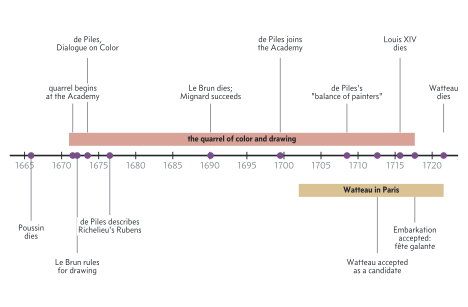
The balance shifted when the old masters of the reign died (Figure 19.1). Le Brun died in 1690, and his old rival Pierre Mignard (meen-yar), a portrait painter who had refused to join the Academy while Le Brun ran it, took both of his offices. In 1699 the Academy admitted de Piles himself as an honorary counselor, an amateur member. In 1708, the year before he died, he published a table, his “balance of painters,” that gave fifty-six painters marks of up to eighteen points each for composition, drawing, color, and expression. Raphael and Rubens came out on top, Raphael ahead in drawing and Rubens in color.
The last step was Watteau’s. When he presented his Embarkation for Cythera in 1717, the Academy found no place for it in the hierarchy and created one. It received him as a painter of the fête galante (fet gah-lahnt), an “elegant party”: a picture of people in silks and theater costumes courting, talking, and making music in a park. The new rank was a compliment and a limit. It honored Watteau as the inventor of a new kind of painting, but it kept him out of history painting, the only rank from which the Academy chose its professors. Charles-Antoine Coypel (kwah-pel), the son of the Academy’s director, later remarked that Watteau’s charming pictures would make a poor guide for anyone who had to paint scenes from the Bible’s Acts of the Apostles. Still, a canvas whose only subject was pleasure, painted in feathery strokes of color in the manner of Rubens, now belonged to the king’s Academy. The Embarkation for Cythera was the Rococo’sThe Embarkation for Cythera exemplifies this style. → Rococo•• first great painting, and the party of color had won.
Watteau
Watteau was baptized on October 10, 1684, in Valenciennes, a town of the county of Hainaut, the son of a roofer. The town had belonged to the Spanish Netherlands until Louis XIV’s army took it in 1677, and the Peace of Nijmegen gave it to France the next year (Chapter 15). The roofer’s son was born a subject of the French king, in a town that spoke a dialect of French, and France was Watteau’s countryThis country is the home of Jean-Antoine Watteau. → France• for the whole of his short life, apart from one winter in London. About 1702 he went to Paris with almost nothing. His first steady work was in a shop on the Pont Notre-Dame, one of the Paris bridges still lined with houses and shops, turning out copies of popular Dutch and Flemish pictures by the dozen.
By 1705 he was the assistant of Claude Gillot (zhee-yoh), a painter of the theater. Gillot’s favorite subject was the commedia dell’arte, the Italian comedy of stock characters, who wore the same masks and costumes in every play and made up much of their dialogue as they went. There were Harlequin in his patchwork, the pompous Doctor, the boastful Captain, and Pierrot (peer-oh), the simple servant in loose white. Louis XIV had expelled the Italian actors from Paris in 1697, after they announced a play, The False Prude, that mocked his pious second wife, Madame de Maintenon (Chapter 15). Their characters lived on in the theaters of the city’s fairs, and Watteau drew them all his life.
Next he worked for Claude Audran (oh-drahn), a decorator who designed wall panels of vines, monkeys, and scrolls, and who was the keeper of the Luxembourg Palace. There Watteau could study the twenty-four huge canvases that Rubens had painted for Queen Marie de’ Medici (Chapter 9), and Rubens became his master in all but name. In 1709 he tried for the Prix de Rome, the Academy’s prize of years of study in Rome (Chapter 15), and came second. In 1712 the Academy accepted him as a candidate and asked for the reception piece that would make him a full member. He let five years go by. In these years, or soon after, he also lodged for a time with the banker Pierre Crozat (kroh-zah), whose collection of drawings by the old masters would number some 19,000 sheets at his death, and he copied Rubens and the Venetians there.

Watteau painted The Embarkation for CytheraThis artist painted The Embarkation for Cythera. → Jean-Antoine Watteau•• in the eight months before he delivered it in August 1717, after the Academy had scolded him for his delay (Figure 19.2). It hangs in the Louvre. On the right, under tall trees, stands a stone herm of Venus, a pillar topped with the goddess’s bust, wound with roses, with a quiver of arrows hung beneath it. At its foot a young man in a pilgrim’s cape whispers to a woman in pink silk who looks down at her fan, while a little Cupid tugs at her skirt. Next, a man helps a second woman to her feet. A third couple walks off down the slope, and the woman turns back for a last look at the shrine. Below them more couples gather at the water’s edge, the men with pilgrims’ staffs. A golden boat with a rose-colored canopy waits for them. Over the water fly putti, the winged baby boys of Renaissance and Baroque painting (Vol. 10, Rebirth), and in a long curl of smoke the flying putti circle the golden boat,Flying putti accompany a golden boat in this painting. → The Embarkation for Cythera•• one of them holding up a torch, the fire of love. The picture reads from right to left like a scene in a play, from the shrine at the top of the hill down to the shore.
Venus was the Roman name of Aphrodite, the Greek goddess of love. In Hesiod’s story of her birth (Vol. 4, Classical Myth), she rose from the foam of the sea and drifted first to Cythera, an island off the southern tip of Greece, before she came ashore on Cyprus. Cythera claimed her as its own and kept her temple, and poets called her Cytherea. Watteau’s pilgrims are courting couples on Cythera, the island of Venus,This painting depicts courting couples on an island sacred to Aphrodite. → The Embarkation for Cythera••The Embarkation for Cythera by Jean-Antoine Watteau depicts the island where this figure was born. → Venus• sacred to her and to love. Watteau took the idea from the stage: in a comedy by Florent Dancourt (dahn-koor), a girl dressed as a pilgrim steps out of the chorus and invites the audience to sail with her to Cythera, where everyone will find a partner. He never said whether his couples are setting out or going home. Because they have already paired off, and because the woman looks back, the British art historian Michael Levey argued in 1961 that they are leaving the island at the end of the day, and many have agreed.
Watteau painted a second version, probably for his friend and collector Jean de Jullienne (zhool-yen), with more putti and a grander boat. Frederick the Great of Prussia (Vol. 14, From Luther to Mozart) later bought it, and it hangs in Charlottenburg Palace in Berlin. The first version had a rougher time. In the years after the Revolution, when the Rococo stood for everything the old court had been, students in the Louvre threw pellets of bread at it, as the painter Pierre-Nolasque Bergeret (bair-zhuh-ray) remembered. Long before then, Watteau’s followers, Nicolas Lancret (lahn-kray) and Jean-Baptiste Pater (pah-tair), had painted fêtes galantes by the hundred for collectors all over Europe.

About 1718 or 1719 Watteau painted a single clown, life-size, the only life-size figure he ever painted. Pierrot stands at the front of a grassy bank in a suit of white satin that does not fit him: the sleeves hang past his wrists, the trousers stop short of his ankles, and a stiff ruff circles his neck. His arms hang straight down, and he looks out at us with an expression no one has agreed on, foolish, sad, patient, or simply waiting for his cue. Below the bank, the Doctor in black rides a donkey that stares out of the picture, and three more actors, one of them a man in red with a plumed hat, chat among themselves. No one knows why it was painted. One guess is that it was the sign of a café kept by a retired actor who had played Pierrot.
For more than a century it was called Gilles, after another white-clad clown of the fairground theaters, and the Louvre now calls it Watteau’s Pierrot, long called Gilles.This artist painted Pierrot, formerly known as Gilles. → Jean-Antoine Watteau• Early in the 1800s a dealer who could not sell it chalked a rhyme across the bottom, saying how happy Pierrot would be if only he could please you. Vivant Denon (duh-non), Napoleon’s director of museums, bought it for 150 francs, and a doctor and collector, Louis La Caze, left it to the Louvre in 1869.
Watteau had been frail since childhood, and by now he had tuberculosis. In 1719 he crossed to London to consult Richard Mead, a fashionable doctor who admired his paintings, but the damp and the coal smoke made him worse. In 1720 he came back to Paris and lodged with a young friend, the art dealer Edme-François Gersaint (zhair-san), whose shop stood on the Pont Notre-Dame, where Watteau had once copied pictures by the dozen. Gersaint wrote, years later, that the painter asked to make him a sign for the shop to take the stiffness out of his fingers. Watteau finished it in eight days, working only in the mornings.

Watteau painted Gersaint’s Shop SignThis artist painted Gersaint’s Shop Sign. → Jean-Antoine Watteau•• as if the front wall of the shop had been lifted away, so that the street and the shop are one stage (Figure 19.4). Pictures in gilt frames cover the walls to the ceiling. At the left two porters are packing up stock: one lowers a mirror, and the other bends over a wooden crate half filled with straw. Into it goes a portrait of Louis XIV, packed in a crate,A portrait of Louis XIV is packed into a crate as a woman in pink enters an art dealer’s shop in this painting. → Gersaint’s Shop Sign•• as a woman in pink satin, her back to us, steps up from the cobbles into the shop and a young man in brown holds out his hand to her. At the right, a gentleman kneels to peer at a large oval painting while an older couple look on, and behind the counter a shopgirl shows her wares to a group of customers. The shop’s name was Au Grand Monarque, “At the Great King,” and so the great king, five years dead, is boxed up like any unsold picture while the young walk in.
The sign stayed at the shop for only fifteen days before a collector bought it. Later it was cut in two, and Frederick the Great bought both halves in the 1740s; they hang in Charlottenburg Palace. Watteau died on July 18, 1721, at Nogent-sur-Marne (noh-zhahn-sur-marn), a village east of Paris, aged thirty-six. He had painted for barely fifteen years. Jullienne then had nearly all his paintings and drawings engraved, hundreds of prints published between 1726 and 1735, and the prints carried Watteau’s couples and clowns across Europe, onto fans, snuffboxes, and wall panels. Through them Watteau became the first master of the Rococo,Jean-Antoine Watteau practiced this style. → Rococo•• though his pictures have a sadness that his followers lost, as if every party in a park were already ending.
Boucher
François Boucher was born in Paris on September 29, 1703, the son of Nicolas Boucher, a minor painter who gave the boy his first lessons. He studied briefly with François Lemoyne (luh-mwahn), a painter of grand ceilings, and then worked for an engraver. In his early twenties he was one of the young engravers whom Jullienne hired to copy Watteau’s drawings, and he etched scores of them, which taught him Watteau’s graceful figures line by line. He won the Prix de Rome, but the Academy had no money to send him, so in 1728 he went to Italy at his own expense. Back in Paris, the Academy accepted him as a candidate in 1731. In 1733 he married Marie-Jeanne Buzeau (bew-zoh), a girl of about seventeen, and in 1734 he became a full member.
No painter worked harder for the eighteenth century’s rooms. Boucher painted ceilings, panels to go over doors, and folding screens. He designed scenery and costumes for the Paris Opera, and pastorals of shepherds and shepherdesses courting among their sheep in silk for the royal tapestry works at Beauvais (boh-vay). From 1755 he was the inspector of the Gobelins, the king’s tapestry factory in Paris, and the porcelain makers copied his figures. Boucher was the Rococo painterFrançois Boucher was an artist in this movement. → Rococo•• the court loved best, and in 1765 Louis XV made him First Painter to the King and director of the Academy, the two offices Le Brun had held.
His mythologies were made for pleasure. In The Triumph of Venus (1740), now in the Nationalmuseum in Stockholm, the goddess of love sits at ease among the waves, attended by sea nymphs. Around her Tritons blow on conch shells,In this artist’s Triumph of Venus, sea figures blow conch shells beneath putti carrying striped drapery. → François Boucher•• sea gods with the bodies of men and the tails of fish, and above them putti carry a long striped cloth across the sky like a sail. Count Carl Gustaf Tessin (teh-seen), the Swedish ambassador in Paris, bought it soon after it was painted, and when he ran short of money he sold it, with much of his collection, to the Swedish crown.
Boucher’s greatest patron was Madame de Pompadour, Louis XV’s mistress from 1745 and his closest friend and adviser until her death in 1764 (Chapter 18). Born Jeanne-Antoinette Poisson, the daughter of a financier’s agent, she had no rank of her own, and she used the arts to make her place at court secure. She ordered houses, gardens, furniture, porcelain, plays, and pictures, acted on her own private stage, and made engravings herself from Boucher’s drawings.
Her château of Bellevue (bel-voo), built for her in 1748–1750 on a hill above the Seine between Paris and Versailles, had an apartment for bathing. In February 1750 she had played Venus herself on her private stage, in a ballet scene called “The Toilette of Venus.” For Madame de Pompadour’s Bellevue, Boucher painted The Toilette of VenusMadame de Pompadour commissioned this painting of the goddess preparing herself after bathing for her château of Bellevue. → The Toilette of Venus (Boucher)••This artist painted The Toilette of Venus for Madame de Pompadour. → François Boucher•• in 1751, the goddess at her toilette, dressing and doing her hair after her bath. She sits unclothed on a daybed draped in pink velvet, between drawn curtains of blue silk, as Venus always sat in such pictures, while three putti fuss over her: one arranges her hair, one hands her a ribbon, and one lifts a tangle of pearls. She ties a ribbon around the neck of a dove, the bird of Venus, while a second dove waits at her feet among scattered flowers. A perfume burner stands at the right. The picture is now in the Metropolitan Museum of Art in New York; its companion for the same room, The Bath of Venus, is now in another museum.

Boucher painted Madame de PompadourThis artist painted portraits of Madame de Pompadour. → François Boucher•• several times, and the grandest of his portraits of her, painted in 1756, is now in the Alte Pinakothek in Munich. She reclines on a daybed in a gown of sea-green silk trimmed with pink roses and pink bows, a book open in her hand. Around her lie the signs of a busy mind: a writing table with a quill, an inkstand, a letter, and a stick of sealing wax; sheets of music and rolled drawings on the floor; a bookcase, and a clock topped with a little Cupid. A small dark spaniel lies half hidden at the lower left, and the mirror behind her shows the back of her head. A king’s mistress could have been painted as a goddess. Pompadour chose to be painted as a reader and a patron.
By then a new critic was watching. Denis Diderot was the editor of the great Encyclopédie, the encyclopedia of the Enlightenment, the movement of writers who put reason above tradition and authority (Chapter 20). In 1759 he began to review the Academy’s Salon, the exhibition it held in the Louvre every other year (the Stage). He wrote for a handwritten newsletter that went to subscribers among the princes of Europe. Diderot wanted painting to make people better, and Boucher’s pink nymphs infuriated him. He wrote that Boucher had everything except truth, and that his taste had decayed step by step with his morals. Boucher, for his part, is said to have complained that nature was “trop verte et mal éclairée,” too green and badly lit.
His sharpest charge concerned Boucher’s Odalisques. An odalisque (oh-duh-lisk), from a Turkish word for a chambermaid, was a woman of a sultan’s household, and painters gave the name to any picture of a woman lying unclothed on cushions in a Turkish setting. Boucher painted a blonde one and a dark-haired one. Tradition says that his young wife was the model for the dark-haired Brunette Odalisque of the 1740s, now in the Louvre, and Diderot accused Boucher of prostituting his own wife,A contemporary critic accused this artist of "prostituting his own wife." → François Boucher• of selling her to the public in paint. Whether she posed is not known. He died in Paris on May 30, 1770. Among the young painters who had come to him for advice was Jacques-Louis David, who would lead the next generation against everything Boucher stood for (Vol. 15, The Age of Revolution).
Fragonard and The Swing
Jean-Honoré Fragonard was born on April 5, 1732, at Grasse (grahs), a town of perfumers and glove makers in the hills of Provence, the only child of a glover. When he was six his family moved to Paris. Apart from two long stays in Italy, France was Fragonard’s homeThis country is the home of Jean-Honoré Fragonard. → France• all his life. As a teenager he showed his drawings to Boucher, who sent him first to Chardin (shar-dan), a painter of quiet still lifes and kitchen scenes, and then, about 1749, took him into his own studio. Fragonard learned Boucher’s manner so completely that the master let him paint copies of his pictures.

One of his first known pictures, Blind Man’s Bluff, painted about 1750 to 1752 while he was still Boucher’s pupil, is now in the Toledo Museum of Art in Ohio. In the game of blind man’s bluff one player is blindfolded and gropes for the others. Here a girl in a pink skirt and a straw hat stands blindfolded on the steps of a garden with her arms spread wide, and a young man behind her reaches up to her blindfold. On the step below her, a little boy holds up a stickIn this artist's Blind Man's Bluff, a child holds a stick tied to a rock up to the hand of a blindfolded woman. → Fragonard• to her groping fingers to tease her, and from a string at its tip hangs a small white object. A second child peeps from behind the roses. The garden, the clean pastel clothes, and the girl who may be peeping under her blindfold are all Boucher’s world.
Fragonard won the Prix de Rome in 1752 with Jeroboam Offering Sacrifice to the Idols, the picture of a king’s altar splitting apart (Vol. 5, In the Beginning). From 1756 to 1761 he studied at the French Academy in Rome (Chapter 15). With his friend the painter Hubert Robert (oo-bair roh-bair) he drew the ruins of Rome and the cypresses and fountains of the Villa d’Este at Tivoli. Back in Paris, in 1765, he won acceptance by the Academy as a candidate with a huge history painting, Coresus Sacrificing Himself to Save Callirhoe (kuh-lir-oh-ee), the Greek story of a priest who kills himself at the altar rather than sacrifice the girl he loves. Like Watteau, he was slow with his reception piece, and unlike Watteau he never delivered one. Diderot praised Coresus at length, and the king bought it to be woven as a tapestry. Then Fragonard turned his back on history painting. He left the official commissions that followed unfinished and painted small, quick pictures of love for the rich private collectors who wanted them, and with them Fragonard became the last great painter of the Rococo.Jean-Honoré Fragonard was an artist of this movement. → Rococo••
The most famous of them, The Swing, began as a joke. Charles Collé (1709–1783), a writer of comedies and songs, kept a journal of literary gossip that was printed after the Revolution. In October 1767 he wrote down a story that the painter Gabriel-François Doyen had told him. Doyen, a painter of large church pictures, had just shown a great altarpiece at the Salon when a gentleman of the court asked him for a picture. The man wanted a picture of his mistress on a swing being pushed by a bishop, with himself placed where he could see her legs. Doyen, astonished, refused the commission with its bishop,Doyen refused the commission for this painting, whose patron initially wanted a bishop to push the woman. → The Swing•• and sent the man on to Fragonard, who put a smiling older man in the bishop’s place. Later writers named the patron as the Baron de Saint-Julien, an official who collected the clergy’s taxes, but nothing in Collé’s journal names him.

Fragonard painted The SwingThis artist painted The Swing. → Fragonard••• in 1767, and it hangs in the Wallace Collection in London (Figure 19.7). Its first title was Les Hasards heureux de l’escarpolette (es-kar-poh-let), “The Happy Accidents of the Swing.” It is a small picture, about 32 by 25 inches. Old trees close over a dim green grove, their branches twisting like the curves of a gilt frame, and a single shaft of light falls on one figure in the middle. A young woman in a gown of rose-pink silk and a straw shepherdess’s hat is flying upward on a swing hung from a branch. As the woman in pink rises, she kicks off her slipper,A pink-dressed woman kicks off a slipper as she rises through the air in this painting. → The Swing••• and the little pink shoe sails away through the air toward the statue at the left. Her skirts and petticoats billow out around her like the petals of a rose, and she smiles down at someone below.
That someone is her lover, who, if Collé’s story is right, stands for the patron himself. A young man hidden in the rosebushesA hidden lover looks up the central woman’s skirt from the bushes in this painting. → The Swing••• lies back among the flowers at the lower left, holding out his hat as if to catch the shoe and looking up under her flying skirts. His face is pink with delight, and his arm is flung out in surprise. Above him, at the left, stands a statue on a stone pedestal, a little winged Cupid who looks toward the swing and holds a finger to his lips,A statue after Falconet’s Cupid holds a finger to its lips at the left of this painting. → The Swing••• asking for silence. Fragonard copied him from Menacing Love, a marble Cupid by the sculptor Étienne-Maurice Falconet (fal-koh-nay). Madame de Pompadour had ordered that statue for her garden, and Falconet showed it at the Salon of 1757.
Lower down, under the swing, two more stone puttiTwo additional stone cherubs or putti appear in this painting. → The Swing•• cling to a dolphin on another pedestal, half lost in the leaves. They look up at the flying woman as if they too were in on the secret. Statues in this garden see everything and can tell nothing, and Fragonard makes a joke of it. At the right, in deep shadow, an older man pulls the ropes beside a little white dog.An older man pulls ropes beside a small white dog at the right of this painting. → The Swing•• He smiles, sees nothing of the young man in the bushes, and pushes the swing, while the dog yaps. Fragonard never said who he is; he has often been taken for the woman’s husband.
Everything in the picture belongs to its style: the pastel silk against feathery green, the curving ropes and branches, a garden made for flirting, a secret, and a joke on the man who pays. The Swing is now the Rococo’s most famous picture.The Swing exemplifies this style. → Rococo•• The Wallace Collection cleaned it in 2021, removing a century of yellowed varnish, and the sky and silk came back bright.
About 1769 Fragonard tried something new. He painted a series of half-length figures of men and women in fancy dress, with ruffs and slashed sleeves in the old Spanish style, each turning toward us as if interrupted in the middle of a thought. The paint is laid on in quick, slashing strokes, and a label on the back of one says it was painted in an hour. They are known as Fragonard’s Fantasy Figures, the portraits de fantaisie,This artist painted a series of portraits de fantaisie, also known as Fantasy Figures. → Fragonard• “imagined portraits,” because for two centuries no one knew who sat for most of them. In 2012 a sheet of small sketches of the series turned up at auction, with names written under them, and showed that the sitters were real people of Fragonard’s circle.

Fragonard’s largest commission came from the woman who followed Pompadour. Madame du Barry, Louis XV’s mistress from 1769 (Chapter 18), had a pavilion for music and parties built in 1771 on the hillside of her estate at Louveciennes (loov-syen), above the Seine west of Paris, by the young architect Claude-Nicolas Ledoux (luh-doo). For its salon Madame du Barry commissioned The Progress of LoveMadame du Barry commissioned this artist’s Progress of Love paintings, now in the Frick Collection. → Fragonard•• from Fragonard, four tall canvases, now in the Frick Collection in New York, that tell a courtship in a garden. In The Pursuit a young man offers a rose to a girl who runs from him; in The Meeting he climbs over the garden wall to her; then come The Lover Crowned and Love Letters, in which the two read over their old letters together.
In The Lover Crowned, a young woman crowns her lover with a wreathIn this artist's The Lover Crowned, a young woman crowns her fiancé with a laurel wreath of flowers. → Fragonard• of flowers as he kneels beside her in a red suit. Sheet music and a tambourine lie on the grass, and at the lower right a young artist sits with a portfolio on his knee, sketching the couple. Above them a stone Cupid sleeps on his pedestal, his work done. Madame du Barry sent the canvases back. Perhaps they looked old-fashioned beside Ledoux’s severe columns. In their place she hung a set by Joseph-Marie Vien (vyan), whose cool figures in ancient dress belonged to the coming taste for the classical.
Fragonard kept the four paintings in his studio for almost twenty years. In 1790, with the Revolution under way, he thought it prudent to leave Paris. He took the paintings to Grasse, hung them in his cousin’s house, and painted ten more panels to fill the room. In 1915 the American steel and coal magnate Henry Clay Frick bought all fourteen for his house on Fifth Avenue, now the Frick Collection, where they fill a room of their own.
The last of his great scenes of love is set indoors. Fragonard’s The BoltThis artist painted The Bolt. → Fragonard•• (Le Verrou (veh-roo)), painted about 1777 and bought by the Louvre in 1974, shows a bedroom in disorder lit as if by a spotlight. A young man in his shirt reaches up to slide the bolt of the door shut. The young woman in golden satin in his arms leans away and stretches her own hand toward the bolt, and whether she means to stop him the painting does not say. A red canopy fills half the canvas, and on the table lies an apple, the fruit that painters had long given to Eve in the garden of Eden (Vol. 5, In the Beginning).
In 1769 Fragonard married Marie-Anne Gérard, a painter of miniatures from Grasse. Their son, Alexandre-Évariste (ay-vah-reest), born in 1780, became a painter too; one of his pictures is Don Juan and the Statue of the Commander (Vol. 10, Rebirth). The Revolution ruined the elder Fragonard’s patrons, who were guillotined or fled, and the new taste had no place for his kind of picture. David, who admired him, found him a post on the committee that was turning the Louvre into a public museum, but he painted little more. He died in Paris on August 22, 1806, so thoroughly forgotten that a German history of art published in 1873 did not mention his name.
Sculpture and Sèvres
The Rococo was an art of small precious things as much as of pictures, and its most precious material was porcelain, the hard, white, translucent ceramic made from the clay called kaolin (Vol. 1, The Toolkit). Chinese potters had made it for centuries, and Europeans had long tried to copy it, as Delft’s potters did in glazed earthenware (Chapter 13). The first true porcelain made in Europe came from Meissen in Saxony, from 1710 (Vol. 14, From Luther to Mozart). France’s answer began about 1740 in a workshop in the old royal château of Vincennes, east of Paris. Madame de Pompadour took it up. In 1756 it moved into a vast new building at Sèvres, on the road from Paris to Versailles and close to her château of Bellevue, and in 1759 the king bought it outright.

For the rest of the century the porcelain made at SèvresWorks in this medium were produced at Sèvres in France. → porcelain• was the luxury of Europe, given by Louis XV and Louis XVI to kings and ambassadors (Figure 19.9). Since no kaolin had yet been found in France, Sèvres made soft-paste porcelain, a mixture of fine clay and ground glass fired at a lower heat, which took color beautifully but cracked easily. After kaolin was found near Limoges (lee-mohzh) in 1768, the factory made true hard-paste porcelain too. Its painters laid grounds, solid background colors, of a sky blue invented in 1753 and of a pink introduced in 1757, later called rose Pompadour, and they painted Boucher’s shepherds and putti in panels framed in gold. The painted pieces were marked with the king’s two crossed Ls and a letter for the year.
From 1757 to 1766 Falconet, the sculptor of Menacing Love, ran the factory’s sculpture workshop. He designed small figures, children at play, nymphs, and Cupids, that Sèvres made in biscuit, porcelain fired but left without a glaze, so that it stays matte and white like a tiny marble statue. Then Catherine the Great, the empress of Russia, called him to Saint Petersburg to make the Bronze Horseman, a statue of Peter the Great on horseback (Vol. 14, From Luther to Mozart).
Terracotta, Italian for “baked earth,” is clay fired without a glaze, the reddish brown of a flowerpot. It let a sculptor work as fast as a painter sketches, and the Rococo loved it. Claude Michel (1738–1814), who signed himself Clodion (kloh-dyon), was born at Nancy, in Lorraine, then still a duchy of its own (the Stage), into a family of sculptors: his mother’s brothers, the Adams, worked for kings in Paris and Berlin. He spent nine years in Rome, from 1762 to 1771, and came home to make small sculptures for collectors’ cabinets. Clodion worked in the RococoThe sculptor Clodion worked in this style. → Rococo• spirit on a small scale. His terracotta statuettes, a foot or two high, show nymphs and satyrs, the goat-legged companions of Bacchus, the god of wine, dancing, tumbling, and carrying baskets of grapes. They were modeled with quick pinches and strokes that still show the marks of his fingers.
The greatest French sculptor of the century began in the same world and moved beyond it. Jean-Antoine Houdon (oo-don) was born at Versailles on March 20, 1741. His father was the caretaker of the school where the Academy’s prizewinners trained, so he grew up among sculptors. He won the Prix de Rome in 1761, and in Rome he made a life-size flayed man, a statue showing the muscles beneath the skin, which art students copied for a century. Back in Paris he became the portrait sculptor of the Enlightenment, carving busts of Diderot, Benjamin Franklin, Molière, Rousseau, and Thomas Jefferson. His faces are alive in a way that the Rococo’s dimpled nymphs are not, down to the wrinkles and the glint of an eye. To make that glint, he cut the pupil deep and left a tiny ridge of marble to catch the light.


In February 1778 Voltaire, the writer famous across Europe for his wit, came back to Paris at eighty-three after twenty-eight years away, to a hero’s welcome. Houdon modeled him from life that spring, weeks before his death on May 30 (Chapter 21). From those sittings came the seated statue that Voltaire’s niece, Madame Denis, gave to the Comédie-Française, the national theater of France, in 1781 (Figure 19.10). The old man sits in an armchair wrapped in a long robe like a philosopher’s toga, a ribbon around his hair, leaning forward with his bony hands on the chair’s arms and a thin smile on his lips, as if about to say something unforgivable.
In 1784 the General Assembly of Virginia voted a statue of George Washington, the general who had won the American War of Independence (Vol. 27, New Worlds), “to be of the finest marble and the best workmanship.” Thomas Jefferson and Benjamin Franklin, then in Paris as the new republic’s envoys, chose Houdon. He would not work from a drawing, so in July 1785 he sailed for America with Franklin, and that October he stayed at Mount Vernon, Washington’s plantation in Virginia, to measure him and take a plaster mask of his face. The marble, signed in 1788, was set up in the new Virginia State Capitol in Richmond in 1796. It shows Washington standing, life-size, in the uniform he had worn, not in a toga, because Washington himself wished it.
Houdon’s George Washington holds a caneThis sculptor’s standing George Washington holds a cane beside a fasces and a plow. → Jean-Antoine Houdon•• in his right hand. His left rests on a fasces, the bundle of rods carried before Roman magistrates as the sign of their power (Vol. 7, The Romans), here made of thirteen rods for the thirteen states, with his cloak and sword hung on it. Behind him stands a plow. It is the story of Cincinnatus, the Roman who left his plow to save the republic and went back to it when the danger was past (Vol. 7, The Romans): Washington had given up his command in 1783 and gone home to his farm. There are no Cupids here, and no clouds of pink silk. A soldier in his own clothes, carved to the inch from life and surrounded by Roman symbols, belongs already to the age of revolution and of David, which swept the Rococo away (Vol. 15, The Age of Revolution).
What to remember
- The Rococo followed the Baroque in France after Louis XIV’s death in 1715: a lighter, more intimate style of curves, shells, pastel colors, and pleasure, named later from rocaille, rockwork.
- In the Academy’s quarrel of drawing and color (1671–1717), the Poussinistes, after Poussin, put drawing first; the Rubénistes, after Rubens, led by Roger de Piles, put color first. Color won.
- Watteau, a Frenchman from Valenciennes, became a member of the Academy in 1717 with The Embarkation for Cythera, couples with flying putti and a golden boat on the island of Venus, and the Academy created the rank of painter of fêtes galantes for him.
- Watteau also painted Pierrot, long called Gilles, and Gersaint’s Shop Sign (1720), in which a portrait of Louis XIV is packed into a crate as a woman in pink steps into the shop.
- Boucher was Madame de Pompadour’s painter: her portraits, The Toilette of Venus for her château of Bellevue, and The Triumph of Venus, with Tritons blowing conch shells. Diderot accused him of prostituting his own wife, said to be the model for his Brunette Odalisque.
- Fragonard’s The Swing (1767), a commission Doyen refused, shows a woman in pink kicking off her slipper, a hidden lover in the bushes, a Cupid with a finger to his lips, two stone putti, and an older man pulling the ropes beside a little white dog.
- Fragonard also painted Blind Man’s Bluff, the Fantasy Figures, The Progress of Love for Madame du Barry (now in the Frick Collection), with The Lover Crowned, and The Bolt.
- Sèvres made the luxury porcelain of Europe under royal ownership; Clodion modeled small Rococo terracottas; Houdon carved the seated Voltaire and the standing George Washington with his cane, fasces, and plow.
Chapter 20 · 24 clues
Bayle, Montesquieu, and the Encyclopédie
In 1712 a young Persian named Rica (ree-kah) went walking in the Tuileries, the royal gardens of Paris, and was at once surrounded by a ring of gazers. The women formed a rainbow of a thousand colors around him, opera glasses were leveled at him wherever he went sightseeing, and his portrait hung in every shop. Tired of being stared at, Rica put on French clothes, and at once nobody noticed him at all. Only when someone told a company that the quiet stranger was a Persian did the murmur go around the room: “Comment peut-on être Persan?” In John Davidson’s translation of 1899, it is “However can anybody be a Persian?”
Rica never lived. He is a character in a book of letters published in 1721 by a judge from Bordeaux, and the joke is on the Parisians, who cannot imagine that their own ways might look as odd to a visitor as his look to them. To see one’s own country through a stranger’s eyes, and to ask of every custom and every law whether it made sense, became the favorite exercise of the French writers of the eighteenth century. Rica’s creator was one of them. Before him came a Protestant exile who wrote a dictionary of doubts, and after him a knife-maker’s son who gave twenty-five years to the biggest book of the age.
The philosophes
Historians give a name to the movement of the late seventeenth and eighteenth centuries in Europe that put reason above tradition and authority:This movement was an intellectual phenomenon in 17th and 18th century Europe that emphasized reason. → the Enlightenment•• the Enlightenment. Its writers tested religion, government, trade, and morals by reason and evidence, and they believed that knowledge, spread widely enough, would make people freer and happier. The French spoke of les Lumières (lay loo-myair), “the lights.” The movement had a Scottish side in Edinburgh (Vol. 12, Crown and Parliament), and in 1784 the Prussian philosopher Immanuel Kant gave it a motto from the Roman poet Horace, Sapere aude, “Dare to know” (Vol. 14, From Luther to Mozart).
Its roots ran back into the seventeenth century. René Descartes had resolved to doubt everything he could not prove (Chapter 10). Isaac Newton had shown that the same few laws governed the falling apple and the circling moon, and John Locke had argued that all our ideas come from experience (Vol. 12, Crown and Parliament). And a century of religious war had left many people tired of being told what to believe on pain of death (Chapter 5). If nature obeyed laws that reason could discover, the new writers asked, why should laws, churches, and kings not be judged by reason too?
The French writers of the Enlightenment called themselves philosophesThinkers called philosophes were active during this movement. → the Enlightenment• (fee-loh-zoff), the French word for philosophers, but they did not mean professors building systems in Latin. A philosophe wrote in French for the general reading public, and he wrote about anything: physics, history, music, farming, the slave trade, or the price of bread. He was usually witty and often in trouble. In the Encyclopédie, the great reference work of the philosophes, an article called “Philosophe” compared reason to grace, the gift that Christians believe God gives to move the soul toward good (Chapter 14). As grace moves the Christian to act, the article said, reason moves the philosopher.
They met in the salons, the drawing rooms of hostesses such as Madame Geoffrin (zhoh-fran), who gave weekly dinners for writers and artists in her house in Paris, and in the new coffeehouses. They could not print whatever they liked. In France every book needed a censor’s approval and a royal privilege, the king’s license to print and sell it. A book that attacked the Church or the king could be burned in public by the executioner, and its author could be locked in the Bastille without trial. Many of their books were therefore printed abroad, in the Dutch Republic or in Geneva, under false names and invented imprints, and smuggled back into France in bales of other goods. The first great book of the Enlightenment came from a Dutch port.
Bayle
Pierre Bayle was born on November 18, 1647, at Le Carla (kar-lah), a village in the county of Foix (fwah) in the foothills of the Pyrenees. His father was a pastor of the Huguenots, France’s Calvinists, whom the Edict of Nantes had protected since 1598 and whom Louis XIV pressed harder every year (Chapter 5). At twenty-one Bayle went to study at the Jesuit college in Toulouse, and his teachers’ arguments made him a Catholic. Seventeen months later he went back to his father’s church. A Protestant who had turned Catholic and then returned was a relaps, a relapsed heretic, and French law punished him with banishment, so Bayle fled to Geneva. In 1675 he became professor of philosophy at the Protestant Academy of Sedan (seh-dahn), near the northeastern frontier. In 1681 the king closed it. The city of Rotterdam gave Bayle a chair of philosophy and history at its Illustrious School, a college for older students, and he never saw France again.
In December 1680 a great comet blazed over Europe, and preachers called it a warning from God. Bayle answered with Various Thoughts on the Comet (1682). Comets, he wrote, are natural bodies that obey natural laws, and the fact that everyone believes a thing proves nothing. Then, turning from comets to belief itself, he went further than anyone had dared. Most people, he said, act from passion, habit, and the fear of shame, not from what they profess to believe. A society of atheists, people who deny that God exists, could therefore live by good laws as well as a society of Christians. From 1684 to 1687 he edited a monthly journal of book reviews, the News of the Republic of Letters. The Republic of Letters was an old name for the scholars of every country, who wrote to one another across borders and wars.
Then the persecution reached his family. In 1685 Louis XIV revoked the Edict of Nantes and ordered every Huguenot to become a Catholic (Chapter 15). Bayle’s elder brother Jacob, a pastor, was arrested in Pierre’s place and died in prison that November. Bayle’s reply was a Philosophical Commentary (1686) on a verse of the Gospel of Luke. In a parable Jesus tells of a man whose guests refused his feast, so he sent his servant out to the highways and hedges: “compel them to come in, that my house may be filled” (Luke 14:23, in the King James Version). Saint Augustine had read the verse as leave to force heretics back into the Church, and Louis’s bishops quoted it now. Against it Bayle set a rule of reason. Any reading of Scripture that commands a crime must be a false reading, and to force a man’s conscience is a crime. Even a conscience in error has the rights of conscience, he argued, because no one can do better than follow what he sincerely believes to be true. At about the same time, in Amsterdam, the English exile John Locke was writing his own letter for toleration (Vol. 12, Crown and Parliament).


Bayle lost his chair in 1693, after a long quarrel with another refugee, the minister Pierre Jurieu (zhoo-ryuh), who thought him a secret unbeliever. Free of teaching, he finished the book he had been gathering for years. It began as a list of the mistakes in an older reference book, Louis Moréri’s (moh-ray-ree) Great Historical Dictionary (1674). In 1697 the Rotterdam bookseller Reinier Leers brought out Bayle’s Historical and Critical DictionaryPierre Bayle wrote a “Historical and Critical” one of these works. → dictionary• in two huge volumes. Most of its articles are lives of people, from biblical kings and Greek philosophers to the scholars of Bayle’s own century. The life itself often takes only a few lines at the top of the page. Below it run the remarks, Bayle’s long notes, lettered A, B, C, and in the margins stand his references to his sources (Figure 20.1). The remarks are where the book lives. There Bayle piles up evidence, weighs witnesses, catches historians contradicting one another, and follows an argument wherever it leads.
Where it led alarmed his church. In the article on King David, Bayle set out the cruelties and the adultery with Bathsheba that the Books of Samuel tell of David (Vol. 5, In the Beginning), and asked how such a man could be a model for Christians. In the articles on the Manichaeans (man-ih-kee-unz), ancient believers in two gods, one good and one evil (Vol. 5, In the Beginning), he argued that reason cannot explain why a God who is all-good and all-powerful permits sin and suffering. Christians, he concluded, must rest on faith alone. The article on Pyrrho, the Greek skeptic, showed how doubt could dissolve every certainty (Vol. 6, The Greeks), and a long article called Spinoza an atheist and praised his blameless life (Chapter 14). The elders of the French church in Rotterdam demanded changes, and the second edition of 1702 softened the article on David. Jurieu thought Bayle a skeptic who used faith as a cover. His great modern biographer, Elisabeth Labrousse, argued that he was a sincere Calvinist who believed that faith must go where reason cannot follow.
Bayle died in Rotterdam on December 28, 1706. His Dictionary became the storehouse of the century that followed, and every philosophe took arguments from it. The German philosopher Leibniz wrote his Theodicy (1710) to answer its pages on evil (Vol. 14, From Luther to Mozart). In 1756, introducing his poem on the Lisbon earthquake (Vol. 10, Rebirth), Voltaire called Bayle “le plus grand dialecticien qui ait jamais écrit,” the greatest master of argument who ever wrote.
Montesquieu
Charles-Louis de Secondat (seh-kon-dah), later Baron de Montesquieu, was born on January 18, 1689, at the château of La Brède (lah bred), a moated castle among vineyards about 16 miles south of Bordeaux. He was a Frenchman of the southwestBaron de Montesquieu is from this country. → France• and of the nobility of the robe, the families who had risen through the law and held seats in the parlements, the high courts of the provinces (the Stage).

The Oratorian priests of Juilly (zhwee-yee), near Paris, taught him, and he studied law at Bordeaux. In 1715 he married Jeanne de Lartigue, a Protestant. A year later his uncle died and left him a fortune, the title of Baron de Montesquieu, and the office of a presiding judge in the Parlement of Bordeaux. He judged cases for ten years, found them dull, and spent his free hours on science and history.
The Persian Letters
In 1721 a little book appeared with no author’s name and the imprint “Cologne, Pierre Marteau,” a publisher invented decades earlier for books too risky to print openly. Paris soon learned the author’s name, and Montesquieu’s Persian LettersThis author wrote Persian Letters. → Baron de Montesquieu•• made him famous. It is an epistolary novel (ih-pis-tuh-lair-ee), a story told in letters (Vol. 1, The Toolkit). The first edition has 150 of them, written by many different people, and the reader pieces the story together from what each one chooses to tell. Its two Persian noblemen, Usbek (ooz-bek) and Rica, write home to friends, servants, and wives. Usbek and Rica travel from Persia to France:This novel follows Usbek and Rica on a journey from Persia to France. → Persian Letters•• they leave Isfahan (is-fah-hahn), the Persian capital, in March 1711, cross Persia and Turkey, sail from Smyrna to Livorno in Italy, and reach Paris in May 1712, fourteen months after they set out. Usbek, the elder, is grave and curious and writes about religion, law, and why some nations grow while others shrink. Rica, young and quick, writes about what he sees.
What he sees is Paris. Its houses are so high, Rica tells a friend in Davidson’s translation, “that you would swear they must be inhabited by astrologers.” Everyone runs, and no one walks. The king is “a great magician,” who can persuade his subjects that one coin is worth two, and that “a piece of paper is coin of the realm.” Above him stands a greater magician still, the pope, who makes the king believe “that three are no more than one; that the bread which he eats is not bread.” That is a Persian’s view of the Trinity and of the Mass. The king was Louis XIV, dead since 1715, and the jokes were safer to print about a dead king than a living one.
Usbek’s best-known letters are four to his friend Mirza, who has asked whether men are made happy by pleasure or by virtue. Usbek answers with a fable, the story of the TroglodytesThis novel contains the "Story of the Troglodytes." → Persian Letters• (trog-loh-dyts), an imaginary tribe of Arabia. The first Troglodytes are so wicked that each one thinks only of himself. They kill their king, and then the magistrates they elect in his place. When a drought ruins the hill farms, the valley farmers let the hill people starve, and when floods ruin the valleys the next year, the hill people return the favor. A doctor from a neighboring country cures them of a plague and is refused his fee, and when the plague returns he will not come back. The tribe perishes, except for two just families who raise their children to know that each one’s good is bound up with everyone’s. Their descendants live in peace and plenty. At last, grown numerous, they ask the most venerable among them to be their king, and the old man weeps. A king’s laws would be easier than their customs, he tells them: “uprightness becomes a burden to you.” Without a ruler they must be virtuous; under one they need only avoid the worst crimes.
Meanwhile Usbek’s household in Isfahan is coming apart. He has left five wives in his seraglio (seh-ral-yoh), the closed women’s quarters of a Persian house, under guard, and his orders arrive months late. The book ends with a letter from his favorite wife, Roxane (rok-sahn), who has deceived him and taken poison. “I have lived in slavery,” she writes, “and yet always retained my freedom.” The man who reasons so freely about the French is a tyrant at home, and he does not see it.
Rome
Montesquieu sold his judge’s seat in 1726 and was elected to the Académie française (the Stage) in 1728. Then he traveled for three years, through Austria, Hungary, Italy, Germany, and the Dutch Republic, and spent the last eighteen months in England (1729–1731). He watched Parliament debate, read the opposition newspapers, and was elected to the Royal Society, London’s academy of science. Back at La Brède he wrote a short book with a long title, Considerations on the Causes of the Greatness of the Romans and Their Decline (1734). Chance does not rule the world, he wrote; ask the Romans. General causes, moral and physical, raise a state up, keep it standing, or throw it down.
Rome grew great, Montesquieu argued, because its citizens loved liberty and their city, fought as citizen-soldiers under a hard discipline, and were always at war. Its success undid it. Wealth, conquest, and expansion corrupted Roman virtue.This philosopher's "Considerations" on Roman greatness and decline argues that the wealth, military prowess, and expansionism of the Romans weakened their civic virtue. → Baron de Montesquieu• Armies posted far from the city for years became loyal to their generals, men like Sulla and Julius Caesar, rather than to the Republic (Vol. 7, The Romans). When citizenship was given to all of Italy, a city of neighbors became a crowd that no longer shared one spirit. The riches of conquered lands brought luxury, and luxury ate away the citizens’ readiness to sacrifice for the common good. Too large to be ruled as a republic, Rome became a despotism, and Montesquieu followed its decline all the way to the fall of Constantinople in 1453.
The Spirit of the Laws
He spent the next fourteen years on a far larger book. In 1748 a printer in Geneva brought out, with no author’s name, Montesquieu’s The Spirit of the Laws,This philosopher wrote The Spirit of the Laws. → Baron de Montesquieu•• in two volumes and thirty-one “books.” Thomas Nugent’s English translation followed in 1750, and this chapter quotes it. Its first sentence says what Montesquieu meant by law: “Laws in their most general signification, are the necessary relations resulting from the nature of things.” The laws of a people are not arbitrary, in other words. They fit, or ought to fit, its kind of government, its climate and soil, its religion, its trade, and its customs. The “spirit” of its laws is the sum of all those relations.
Books II and III sort governments into three kinds (Figure 20.3). In a republic the people as a body hold the sovereign power, which makes it a democracy, or some of its families do, which makes it an aristocracy. In a monarchy one person rules, but by fixed and established laws. In a despotism one person rules “according to his own will and caprice.” Each kind also has a principle, the passion that keeps it going: republics run on virtue, monarchies on honor, and despotisms on fear.This philosopher associated republics with virtue, monarchies with honor, and despotisms with fear. → Baron de Montesquieu• One sentence of Book III gives all three: “As virtue is necessary in a republic, and in a monarchy honor, so fear is necessary in a despotic government.” Virtue here means “the love of the laws and of our country,” a citizen putting the public good before his own, as the good Troglodytes did. Honor is a noble’s wish for rank, titles, and distinction, which drives him to serve the king for glory. Fear is what a despot rules by. Montesquieu found an image for it in a report from French Louisiana: “When the savages of Louisiana are desirous of fruit, they cut the tree to the root, and gather the fruit. This is an emblem of despotic government.”

His examples of despotism were Turkey, Persia, and Japan, but readers in France understood the warning closer to home. A monarchy whose king ignored the laws and the nobles could slide toward despotism. The most famous chapter of the book, the sixth of Book XI, is called “Of the Constitution of England.” In every government, Montesquieu wrote, there are three sorts of power: the legislative, which makes laws; the executive, which carries them out; and what Nugent calls “the power of judging,” the judicial. Liberty survives only where different hands hold them. “When the legislative and executive powers are united in the same person, or in the same body of magistrates, there can be no liberty,” and “there is no liberty, if the power of judging be not separated from the legislative and executive powers.” This is the separation of powers, which Montesquieu championed.This philosopher advocated the separation of powers. → Baron de Montesquieu•• He saw it in England, where Parliament made the laws, the king carried them out, and juries drawn from the people judged. Each power could stop the others, for, as Book XI also says, “power should be a check to power.”
Later books turn to climate. People in cold countries, Montesquieu argued, are vigorous and brave, while “the inhabitants of warm countries are, like old men, timorous,” and wise lawmakers must work against what climate encourages. Rousseau would take up the idea in The Social Contract (Chapter 22). In 1751 the Catholic Church placed the book on its Index of forbidden books, but readers loved it. A volume of it lies on the table in Maurice-Quentin de La Tour’s pastel of Madame de Pompadour (Chapter 18). Catherine the Great of Russia copied whole pages into her instructions for a new law code in 1767 (Vol. 14, From Luther to Mozart). And in 1788, defending the new Constitution of the United States, James Madison wrote in The Federalist, No. 47: “The oracle who is always consulted and cited on this subject, is the celebrated Montesquieu” (Vol. 27, New Worlds). Montesquieu did not live to see it. Nearly blind, he died of a fever in Paris on February 10, 1755.
The Encyclopédie
Denis Diderot was born on October 5, 1713, at Langres (lahn-gruh), a walled hill town in Champagne, the son of a master cutler who made knives and surgical instruments. The Jesuits schooled him, and his father hoped he would become a priest or a lawyer. He became neither. After taking his degree in Paris in 1732, he lived for ten years by his wits, tutoring and translating English books for the booksellers, and in 1743 he married a linen seamstress, Antoinette Champion, against his father’s will. He could talk brilliantly about anything, and he wanted to know everything.

His own books soon got him into trouble. The Parlement of Paris had his Philosophical Thoughts (1746) burned. His Letter on the Blind (1749) told of a blind English mathematician, Nicholas Saunderson, who on his deathbed would not accept that the order of a world he could not see proved there was a God. On July 24, 1749, the police took Diderot to the castle of Vincennes, east of Paris, and held him there until November 3. Jean-Jacques Rousseau, then his closest friend, walked out to visit him, and on one of those walks, Rousseau said later, his own life changed (Chapter 22). Diderot won his release by promising to publish no more such books. In a sense he kept the promise: his boldest writings stayed in his desk.
He had a great book to finish. In 1745 the Paris bookseller André Le Breton (luh bruh-tawn) had planned a French translation of the Cyclopaedia (sy-kloh-pee-dee-uh) (1728), a two-volume English dictionary of the arts and sciences by Ephraim Chambers. In 1747 he gave the work to two editors, Diderot and the mathematician Jean le Rond d’Alembert, and under their editing the translation grew into the Encyclopédie,This author edited the Encyclopédie with Jean d'Alembert. → Denis Diderot•• or Reasoned Dictionary of the Sciences, Arts, and Trades. D’Alembert had been left as a newborn on the steps of the Paris church of Saint-Jean-le-Rond, which gave him his first name, and by thirty he was one of the best mathematicians in Europe. The first volume, A to Azymites, appeared in 1751. D’Alembert’s Preliminary Discourse at its head traced all knowledge back to the senses and printed a tree of knowledge after Francis Bacon’s, with memory, reason, and imagination as its three trunks (Vol. 12, Crown and Parliament).
The work’s aim, Diderot wrote in his article “Encyclopédie,” was to change the common way of thinking. It did that less by open attack than by method. Its articles on religion were often orthodox, many of them written by priests, but they sat beside articles that judged every belief by evidence. It gave as much room to the trades as to theology. Diderot visited workshops and questioned craftsmen so that he could describe their tools and machines, and the volumes of engraved plates showed each trade the same way: the workshop in a scene at the top, then each tool and part drawn separately below (Figure 20.5).

Enemies came quickly (Figure 20.6). In January 1752 the theologians of the Sorbonne condemned a thesis by a young priest, the abbé de Prades (prahd), who had written for the Encyclopédie, and in February the king’s council suppressed its first two volumes. But the official in charge of the book trade and its censors, Malesherbes (mal-zairb), admired the work, and Madame de Pompadour, the king’s mistress, protected it (Chapter 18). The third volume came out in 1753, and one followed each year. The second storm was worse. In January 1757 a servant named Damiens stabbed Louis XV (Chapter 18), and the government grew afraid of every attack on authority. D’Alembert’s article on Geneva in the seventh volume (1757) praised its pastors as reasonable men who hardly believed in the divinity of Christ, which enraged them. It also urged the city to allow a theater, and Rousseau answered it with a book (Chapter 22). D’Alembert gave up the editorship in 1758. In March 1759 the king’s council revoked the Encyclopédie’s privilege, and later that year Pope Clement XIII condemned it.

Diderot went on in secret, and the government looked the other way. His chief helper was a nobleman, the chevalier Louis de Jaucourt (zhoh-koor), who wrote some 17,000 articles, about a quarter of the whole, for almost no pay. In 1764 Diderot discovered that Le Breton, afraid of the police, had been cutting the boldest passages from the proofs after Diderot had passed them, and had burned the originals. Diderot raged, and went on. The last ten volumes of text appeared together in 1765, with a false imprint, “Neufchastel,” a town in a small principality beyond the French border, now part of Switzerland. The eleventh and last volume of plates followed in 1772.
Diderot never grew rich from it. Besides the Encyclopédie, he reviewed the Salon exhibitions of painting for a handwritten newsletter (Chapter 19) and wrote plays. In 1765 Catherine the Great bought his library for 15,000 livres, left it in his house, and named him its librarian; a year later she paid his salary fifty years in advance. In 1773 he traveled to St. Petersburg to thank her, and for five months he talked with her almost every day. He died in Paris on July 31, 1784.
The War of the Buffoons
On August 1, 1752, a troupe of Italian comic singers led by Eustachio Bambini gave its first performance on the stage of the Paris Opera, the Royal Academy of Music that Lully had once ruled (Chapter 17). They sang La serva padrona (lah sair-vah pah-droh-nah), “The Maid Turned Mistress,” by Giovanni Battista Pergolesi (pair-goh-lay-zee) (Figure 20.7), a composer who worked in Naples and had died in 1736 at twenty-six. It is an intermezzo, a short comic opera first played in Naples in 1733 in two parts, between the acts of a serious opera. It has two singers and a mute: the old bachelor Uberto, his bossy maid Serpina (sair-pee-nah), and the silent servant Vespone (ves-poh-neh). Serpina means to marry her master. She tells him she is to marry a fierce soldier, Captain Tempesta, and has Vespone dress up as the captain and demand a huge dowry. The frightened Uberto marries her himself.


The Italians called comic opera about everyday people opera buffa (Vol. 1, The Toolkit), and its singers buffi, comedians, a word the French turned into Bouffons (boo-fawn). French opera meant something grander, the tragédie en musique of Lully and Rameau: gods and heroes in five acts, with choruses, ballets, and stage machines (Chapter 17). Beside it the little Italian piece seemed to some Parisians natural, quick, and full of tunes, and to others a vulgar farce. The audience itself took sides. The friends of French music gathered in the King’s Corner, under Louis XV’s box, and the friends of Italian music in the Queen’s Corner, under the box of Queen Marie Leszczyńska. The War of the Buffoons, the Querelle des Bouffons (keh-rel), was fought for two years in dozens of pamphlets.
The philosophes took the Italian side: d’Alembert, Diderot, the German critic Friedrich Melchior Grimm, and above all Rousseau. Rousseau’s own little opera, The Village Soothsayer, was sung before the king at Fontainebleau in October 1752, and his Letter on French Music (1753) declared that the French had no music and could have none (Chapter 22). Rameau, whom Lully’s admirers had attacked twenty years before as noisy and learned, a betrayer of French music, now found himself the champion of the French side (Chapter 17). The Bouffons were sent home in 1754, but they had changed French taste. The light French comic opera, the opéra comique, with spoken dialogue and simple songs, flourished in the years that followed. About ten years later Diderot made the quarrel one of the chief subjects of a dialogue, Rameau’s Nephew, in which a ruined musician in a Paris café argues for the Italians and acts out the debate of French music against Italian opera buffa.This country's music was pitted against Italian opera buffa in the War of the Buffoons. → France••This work centers on the Querelle des Bouffons, debating the merits of French and Italian music. → Rameau's Nephew•
Diderot’s fiction
The Indiscreet Jewels
Diderot’s first novel was written fast and for money. According to the memoir that his daughter, Madame de Vandeul (vahn-duhl), wrote after his death, he told his mistress of those years, Madeleine de Puisieux (pwee-zyur), that a novel was easy to write, and she dared him to do it. So Diderot wrote The Indiscreet JewelsThis author wrote The Indiscreet Jewels. → Denis Diderot• (1748) and published it without his name. It is set in an imaginary kingdom of the Congo, and readers saw through the disguise at once. The bored sultan Mangogul (mahn-goh-gool) is Louis XV, and his clever favorite, Mirzoza (meer-zoh-zah), is Madame de Pompadour. A genie gives the sultan a silver ring. Turned toward a woman, Mangogul’s magic ring makes her “jewel” speak,In this novel, Mangogul uses a magic ring that makes women's genitalia speak. → The Indiscreet Jewels•• and “jewel” is the book’s coy word for her private parts. They tell aloud, at dinners and receptions, the love affairs their owners have hidden, and the joke is the hypocrisy of the court.
Not all of the book is a joke. In one chapter Mangogul dreams that a winged beast carries him to the land of Hypothesis, to a temple that stands on nothing. Under its portico feeble old men, the builders of systems, blow soap bubbles, and Plato tells him that the temple once belonged to philosophy. A child walks toward them, growing at every step, and as he grows he is seen at work with a telescope, a pendulum, a tube of mercury, and a prism, the tools of the new science. By the time he reaches the temple he is a colossus named Experience, and at his approach the giant Experience destroys the temple.In this novel, a giant named Experience destroys the Temple of the System-Builders in the land of Hypothesis. → The Indiscreet Jewels• It is the creed of the philosophes in a single picture: observation and experiment knock down systems built on guesses.
Rameau’s Nephew
Diderot never published his masterpiece of fiction. He began it in the early 1760s and was still revising it in the 1770s. Diderot wrote Rameau’s NephewThis author wrote Rameau's Nephew. → Denis Diderot•• as a dialogue between two speakers named only Moi and Lui, “Me” and “Him.” Whatever the weather, the narrator tells us, at five in the evening he walks in the gardens of the Palais-Royal, and when it is too cold or too wet he shelters in a café to watch the chess. Paris, he says, is the place in the world, and this café the place in Paris, where chess is played best. The dialogue is set in the Café de la RégenceThis work is set in the Café de la Régence. → Rameau's Nephew•• (ray-zhahnss), among the tables of masters like François-André Philidor (fee-lee-dor), who was also a composer of the new French comic operas.
“Him” is a real man, Jean-François Rameau, nephew of the composer Jean-Philippe Rameau (Chapter 17): a failed composer, a music teacher, and a professional sponger who lives by flattering the rich at their tables. The narrator argues with the composer’s eccentric nephewThe narrator of this work argues with the eccentric relative of a famous French composer. → Rameau's Nephew•• for a whole afternoon, and he does not always win. The nephew has just been thrown out of a rich man’s house for one truthful remark at dinner. He cheerfully admits that he is a parasite and a flatterer, since the world rewards nothing else, and he calls his famous uncle a great composer who cares for no one. When words fail him, he mimes. He plays an imaginary violin and an imaginary harpsichord, sings all the parts of an opera at once, and acts out its orchestra and dancers, until the chess players leave their boards to watch. Much of the talk is the War of the Buffoons again. The nephew argues, as the Italian party did, that true melody imitates the accents of a person speaking in passion, and he praises Pergolesi above the old French masters, his uncle among them.
Diderot showed the dialogue to almost no one. After his death a copy went to Russia with his papers, and one reached the German poet Friedrich Schiller, who gave it to his friend and fellow poet Johann Wolfgang von Goethe (gur-tuh). Goethe’s German translation of 1805 was the first printing, and the French first read the book in 1821 in a translation back from Goethe’s German. Diderot’s own manuscript turned up in 1890, in a Paris bookstall.
Jacques the Fatalist
Diderot’s last novel keeps refusing to be a novel. It opens by asking how its two travelers met, and answers: by chance, like everybody. Where were they going? Does anyone know where he is going? Diderot wrote Jacques the Fatalist and His MasterThis author wrote Jacques the Fatalist. → Denis Diderot•• between 1765 and 1780, about a valet and his nameless master riding across France toward a place the narrator will not name. Jacques has a philosophy he learned from his old army captain. In the novel’s own words, “tout ce qui nous arrive de bien et de mal ici-bas était écrit là-haut,” everything good or bad that happens to us down here was written up above. Jacques says everything is written on the “great scroll,”In this novel, the title character insists that everything is written on a "great scroll" in the sky. → Jacques the Fatalist•• le grand rouleau, which unrolls a little at a time. Such a man, one might think, would be glad or sorry about nothing. Yet Jacques, the narrator says, behaves much as you and I do: he thanks his benefactors and loses his temper with the unjust.
To pass the time, the master asks Jacques to tell the story of his loves. It begins with a bullet in Jacques’s knee at the battle of Fontenoy (Chapter 18), and the book interrupts it again and again with other stories, accidents on the road, and the narrator teasing the reader, who wants to know what happens next. Diderot borrowed the trick from Laurence Sterne’s Tristram Shandy (Vol. 12, Crown and Parliament).
The longest interruption is told by the landlady of an inn, between her shouts to the servants. Madame de La Pommeraye (pom-ray), a widow, has given her heart to the Marquis des Arcis (ar-see), and she senses that his love has cooled. She pretends that hers has cooled too, and he confesses his own with relief. Then she takes her revenge. She finds a mother and daughter who have been living by prostitution, dresses them as pious women of good family, and lets the marquis meet them as if by chance. He falls in love with the daughter, who will not see him alone, and so Madame de La Pommeraye tricks the marquis into marryingIn this novel, Madame de la Pommeraye tricks the Marquis des Arcis into marrying a prostitute. → Jacques the Fatalist• the girl. The day after the wedding, Madame de La Pommeraye summons him and tells him whom he has married. But her revenge fails. The young wife is truly sorry for her past, the marquis forgives her, and they live happily. Schiller put the episode into German in 1785, eleven years before the whole novel was printed in French in 1796.
D’Holbach
The bluntest book of the French Enlightenment came from its friendliest house. Paul Thiry (tee-ree), Baron d’Holbach (dol-bahk), was born in 1723 in the Palatinate, in western Germany, and raised in Paris by a rich uncle, who left him a fortune and the title of baron. He studied at Leiden in the Dutch Republic, translated German books on chemistry and mining, and wrote about four hundred articles for the Encyclopédie, most of them on those sciences. Twice a week, on Sundays and Thursdays, he gave dinners at his house in the rue Royale in Paris. There Diderot, Grimm, and visitors such as David Hume and Benjamin Franklin talked about philosophy, religion, and government over excellent food.
In 1770 d’Holbach published The System of Nature under the name of Jean-Baptiste de Mirabaud (mee-rah-boh), a secretary of the Académie française who had died ten years before. Men are unhappy, it begins, only because they misunderstand nature. Nature is all there is: matter in motion, obeying fixed and necessary laws. The belief that nothing exists but matter is called materialism, and d’Holbach was a materialist who made no exception for man. His mind is the working of his brain, so no soul survives his body, and his will is moved by causes like everything else, so free will is an illusion. The idea of God, d’Holbach argued, was born of ignorance and fear, when early men trembled before storms and plagues they could not explain, and theologians since had made it ever more obscure. So The System of Nature laid out atheism,This belief was laid out in The System of Nature by the materialist Baron d'Holbach. → atheism•• the belief that there is no God, as the conclusion of reason. Nor did a man need religion to be good, d’Holbach argued, because a reasonable man sees that his own happiness depends on the happiness of others. Bayle’s society of virtuous atheists had become a system.
The Parlement of Paris ordered the book burned in August 1770. Christian writers answered it, and so did some philosophes. Voltaire, who believed in a God who made the world (Chapter 21), wrote against it, and so did King Frederick the Great of Prussia (Vol. 14, From Luther to Mozart). Diderot admired its frankness. D’Holbach kept his authorship a secret among friends, and he died in Paris on January 21, 1789, six months before a crowd stormed the Bastille (Vol. 15, The Age of Revolution).
What to remember
- The Enlightenment was the movement of the late seventeenth and eighteenth centuries that tested religion, government, and morals by reason; its French writers called themselves philosophes.
- Pierre Bayle, a Huguenot exile in Rotterdam, argued for toleration in his Philosophical Commentary (1686) and wrote the Historical and Critical Dictionary (1697), whose long remarks hold its boldest arguments.
- Montesquieu’s Persian Letters (1721) follows Usbek and Rica from Isfahan to Paris; Usbek’s letters tell the story of the Troglodytes.
- His Considerations (1734) argued that wealth, conquest, and expansion corrupted Roman civic virtue.
- The Spirit of the Laws (1748) gives republics virtue, monarchies honor, and despotisms fear as their principles, and argues for separating the legislative, executive, and judicial powers.
- Denis Diderot edited the Encyclopédie (1751–1772) with d’Alembert; it was banned in 1752 and 1759, and its last ten volumes of text came out together in 1765.
- The War of the Buffoons (1752–1754), set off by Pergolesi’s La serva padrona, pitted French opera against Italian opera buffa.
- Diderot’s fiction: The Indiscreet Jewels (1748), with Mangogul’s ring and the giant Experience; Rameau’s Nephew, set in the Café de la Régence; and Jacques the Fatalist, with its great scroll and Madame de La Pommeraye’s revenge.
- Baron d’Holbach’s System of Nature (1770) argued for materialism and atheism.
Chapter 21 · 49 clues
Voltaire and Candide
In January 1759 a small book appeared almost at once in Geneva, Paris, Amsterdam, and London. Its title page called it Candide, or Optimism, “translated from the German of Doctor Ralph,” and no Doctor Ralph had ever lived. By the end of February the Grand Council of Geneva and the authorities of Paris had banned it. By the end of the year it had sold between twenty and thirty thousand copies in more than twenty editions, and the Duke de La Vallière (lah vahl-yair), a great collector of books, wondered whether any book had ever sold so fast. Readers laughed at a young man who is kicked, flogged, shipwrecked, robbed, and nearly eaten, and who goes on believing, because his tutor taught him so, that all is for the best.
Everyone knew who Doctor Ralph was. He was sixty-four years old and the most famous writer in Europe. He lived in a villa outside Geneva, with a printer in the town and the French border a few miles away, so that he could slip from one country into the other if either sent its police. Forty years earlier he had come out of the Bastille with a new name. He did not admit to writing Candide until 1768.
Voltaire’s life
François-Marie Arouet was born in Paris on November 21, 1694, the youngest of five children of a lawyer who held a post in the royal treasury. From 1704 to 1711 he studied with the Jesuits (Chapter 10) at the college of Louis-le-Grand, the best school in Paris, where the fathers taught him Latin, rhetoric, and a lifelong love of the stage. His father wanted a lawyer. The son wanted to write verses, and he wrote sharp ones about the powerful. When Louis XIV died in 1715, his nephew Philippe of Orléans ruled as regent for the five-year-old Louis XV (Chapter 18), and verses accusing the Regent of incest with his own daughter went around Paris with Arouet’s name attached. In May 1717 he was locked in the Bastille, the royal fortress-prison of Paris, and kept there eleven months without a trial.

He came out in April 1718 with a new name, Voltaire. It may be an anagram of AROVET L I, his surname in Latin capitals with the initials of le jeune, “the younger,” but no one knows for certain. That November his tragedy Œdipe (uh-deep), on the Greek story of Oedipus (ed-ih-pus), opened at the Comédie-Française, the royal theater (Chapter 16), and made him famous at twenty-three. Nicolas de Largillière (lar-zheel-yair), the most fashionable portrait painter in Paris, painted the new star (Figure 21.1). For the rest of his life Voltaire wrote tragedies in verse, which his age ranked above everything else he did, and in 1723 he published the Henriade, an epic poem on Henry IV, the king who ended the Wars of Religion (Chapter 5).
In 1726 a nobleman of one of the proudest families in France, the Chevalier de Rohan, sneered at the commoner who had given himself a name. Voltaire answered that he would make his name famous, while Rohan could only disgrace his own. A few days later Rohan’s servants beat him in the street. When Voltaire challenged Rohan to a duel, the Rohan family had him put back in the Bastille, on April 17, 1726. Afraid that he might stay there for years, he asked to be sent abroad instead, and on May 2 he was taken under guard to Calais and put on a ship for England.
He stayed in England two and a half years. He learned English and met the poet Alexander Pope (Vol. 11, The Age of Shakespeare) and Jonathan Swift, the author of Gulliver’s Travels (Vol. 12, Crown and Parliament). He went to a meeting of the Quakers and watched a country where men of many churches lived side by side and a merchant could be as honored as a lord. In 1727 the English buried Isaac Newton in Westminster Abbey, and Voltaire, who may have been at the funeral, wrote that they “interr’d him as tho’ he had been a King who had made his People happy,” as the English edition of 1733 put it. Back in France at the end of 1728, he wrote up what he had seen as the Letters on the English.This thinker wrote Letters on the English after his exile to London. → Voltaire•• There are twenty-four of them, on the Quakers, the Church of England, Parliament, trade, inoculation against smallpox, Bacon, Locke, Newton, Shakespeare, and Pope. The most famous lines come from the letter on the Presbyterians, the Calvinists of Scotland: “If one religion only were allowed in England, the government would very possibly become arbitrary; if there were but two, the people wou’d cut one another’s throats.” With dozens of sects, Voltaire went on, the English all lived happily and in peace.
The book appeared in English in London in 1733, and in French at Rouen in 1734 as the Philosophical Letters. Every page that praised England was a reproach to France, and in June 1734 the Parlement of Paris, the high law court (the Stage), had the book burned by the public executioner. Voltaire fled to the château of Cirey (see-ray), in Champagne near the border of Lorraine, then still an independent duchy. It belonged to the husband of Émilie du Châtelet (ay-mee-lee doo shaht-lay), a marquise of twenty-seven and a gifted mathematician, who later translated Newton’s great book on motion and gravity into French. For fifteen years she and Voltaire lived and worked together, at Cirey above all, with her husband’s consent, among books and scientific instruments. In 1745 he wrote the words for a court entertainment for the wedding of the Dauphin, the heir to the throne, set to music by Rameau (Chapter 17), and became royal historian. In 1746 the Académie française elected him. Émilie died in September 1749, a few days after giving birth to a daughter.

Frederick II, king of Prussia since 1740 and later called Frederick the Great (Vol. 14, From Luther to Mozart), had written to Voltaire since 1736, when he was still crown prince. French was the language of his court and of his own poems, and he wanted the greatest French writer at his table. In 1750 Voltaire went. He became a chamberlain of the king’s household with a salary of 20,000 livres, French pounds, a year, and he lived at Potsdam, a constant guest at Sanssouci (sahn-soo-see), “without care,” the king’s summer palace there (Figure 21.2). There he finished The Age of Louis XIV (1751), the history that first treated a king’s reign as an age of the arts (Chapter 15). Then he quarreled with Pierre-Louis de Maupertuis (moh-pair-twee), the French mathematician who presided over Frederick’s Academy of Sciences, and mocked him in a pamphlet, the Diatribe of Doctor Akakia (1752). Frederick had it burned. Voltaire left in March 1753, and at Frankfurt the king’s agents held him for more than three weeks until he gave back a book of the king’s own poems. The two men never met again, but they went on writing to each other for the rest of their lives.
Louis XV forbade him to live in Paris, and in 1755 Voltaire bought a house just outside Geneva, which he named Les Délices (lay day-lees), “the Delights.” But Geneva was a Calvinist republic whose laws forbade the theater (Chapter 5), and Voltaire could not live without one. In late 1758 he bought the estate of Ferney (fair-nay), on French soil about 4 miles from Geneva, with the border of that republic close by if France came after him. He rebuilt the château, built a theater beside it, and made the poor village into a small town. He built houses, brought in watchmakers, lent money without interest, and saw the population pass a thousand. Over the door of the church he rebuilt he put the words Deo erexit Voltaire, “Voltaire built this for God,” with his own name in larger letters than God’s (Figure 21.3).

Visitors came to Ferney from all over Europe, among them the Scottish lawyer James Boswell, the English historian Edward Gibbon, and the Venetian adventurer Casanova (Vol. 10, Rebirth). Voltaire wrote more than twenty thousand letters in his life, to kings, scholars, actresses, and booksellers. Catherine II, a German princess who had seized the throne of Russia in 1762 and would be called the Great, admired him, and from October 1763 until his death he and Catherine the Great corresponded,This writer was a long-time pen pal of Catherine the Great. → Voltaire• she as eager pupil and he as admiring teacher (Vol. 14, From Luther to Mozart). After he died she bought his whole library, nearly seven thousand books, and it is still in Saint Petersburg.
In February 1778, at eighty-three, Voltaire came back to Paris for the first time in twenty-eight years, to see his last tragedy, Irène (ee-ren), on the stage. On March 30, after its sixth performance, the actors set his bust on the stage of the Comédie-Française and crowned it with laurel while the audience cheered him in his box (Figure 21.4). That spring the sculptor Jean-Antoine Houdon modeled his head from life, and from those sittings made the statue of him seated in an armchair, finished in 1781 (Chapter 19). He died in Paris on May 30, 1778 (Figure 21.5). Because he had never taken back his attacks on the Church, he was refused a Christian burial in Paris, and his nephew, an abbot, buried him quietly at the abbey of Scellières (sel-yair) in Champagne. Thirteen years later the Revolution carried his remains in triumph to the Panthéon (pahn-tay-awn) in Paris (Vol. 15, The Age of Revolution).

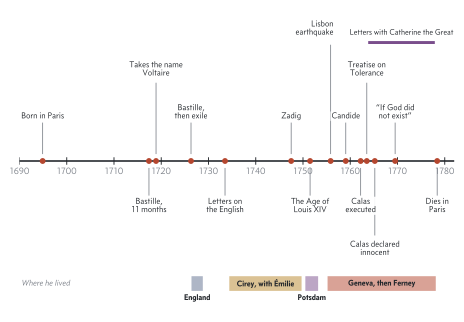
Zadig
In 1747 a little novel called Memnon came out in Amsterdam, and a year later it reappeared as Zadig, or Destiny (zah-deeg). Voltaire wrote ZadigThis author wrote Zadig. → Voltaire•• as an “Oriental tale,” a story set in the ancient East, a fashion in France since Antoine Galland (gah-lahn) had translated The Thousand and One Nights into French between 1704 and 1717 (Vol. 37, The House of Islam). It was also the first of his philosophical tales: short, fast, comic stories in which a hero’s adventures put an idea to the test. Its hero, Zadig, is a young man of Babylon in the reign of King Moabdar (moh-ab-dar). He is rich, handsome, learned, and modest, and he is sure that a wise man can be happy.
He is to marry Sémire (say-meer), the most desirable young woman in Babylon. One day, as they walk under the palm trees by the Euphrates, the guards of a rival, Orcan, the spoiled nephew of a minister, try to carry her off. Zadig drives them away, but an arrow wounds him beside the eye. The famous doctor Hermes comes from Memphis and announces that the eye will be lost, on a day and hour he names. Two days later the wound heals by itself, and Hermes writes a book proving that it should not have. By then Sémire has left Zadig for Orcan.Sémire leaves this character after his rival Orcan injures his eye. → Zadig• In the anonymous English translation of 1749, which calls her Semira, she had “conceived an implacable Aversion to a one-ey’d Man,” and married his rival that very night.

Zadig’s next bride, Azora, sneers at a widow who swore to stay by her husband’s tomb as long as a stream flowed beside it and then tried to turn the stream aside. Zadig pretends to die to test her, and within a day Azora comes to the tomb with a razor to cut off his nose, which, a new admirer has told her, is the only cure for his pain (Figure 21.6). Zadig gives up on women and studies nature. He learns to read tracks so well that he can describe the queen’s lost dog and the king’s runaway horse without having seen either, and is fined for knowing too much. In 1880 the English biologist T. H. Huxley called reasoning from tracks and traces back to their causes “the method of Zadig.”
Zadig rises to be chief minister, and Queen Astarté (ah-star-tay) falls in love with him, as he with her. He flees the king’s jealousy, is sold as a slave to an Arab merchant, and wins his freedom. When he comes back, the king is dead, and the queen is to marry the man who wins a tournament and answers the riddles of the magi, Babylon’s priests and wise men. Zadig wins the tournament in white armor, but a rival steals the armor and the prize. Wandering by the Euphrates, he joins a hermit who steals a golden basin from a generous host, burns down the house of another, and drowns a boy. Then the hermit sheds his beard, grows four shining wings, and reveals himself as the angel Jesrad. The boy, he says, would have murdered his aunt within a year; “there is no Evil under the Sun, but some Good proceeds from it,” as the English of 1749 has it. Zadig begins one last objection and gets no further than its first word: “But, said Zadig—whilst the Sound of the Word But dwelt upon his Tongue, the Angel took his Flight towards the tenth Sphere.”
Zadig solves the riddles, fights his rival without armor, and wins. His friend Cador proves that the white armor was his, and Zadig is proclaimed king of BabylonThis character becomes king of Babylon. → Zadig• by the whole court. He rules justly. He makes the bandit chief Arbogad an officer, puts the Arab merchant who once owned him in charge of Babylon’s trade, and forces Orcan to pay damages to a poor fisherman he had wronged. Then Zadig marries Queen Astarté,This character marries Queen Astarté. → Zadig•• and Babylon has a golden age. The angel’s lesson, that every evil serves some good, is the doctrine Voltaire would mock in Candide. In 1747 he let an angel defend it and gave his hero a single doubtful “But.” Eleven years later, after Lisbon, he gave the doubt the whole book.
Voltaire and tolerance
Voltaire was a deist: he believed that a wise and powerful God had made the universe and its laws, but he rejected miracles, revelation, and the claim of any church to speak for God. What he hated was what he called l’infâme (lan-fahm), “the infamous thing”: superstition, and the churches that persecuted people for what they believed. From about 1760 his letters often ended with the same command, Écrasez l’infâme (ay-krah-zay), “Crush the infamous thing.” In 1762 he found the case that would show all Europe what he meant.
Toulouse, the great city of Languedoc in southern France, had been fiercely Catholic since the Wars of Religion. Since Louis XIV revoked the Edict of Nantes in 1685 (Chapter 15), Protestant worship had been illegal everywhere in France, and a Protestant could not become a lawyer or hold office without a certificate that he was a Catholic. Jean Calas (kah-lahss) was a Protestant merchant who had lived in Toulouse for forty years. One of his sons, Louis, had become a Catholic in 1756 and lived on a small allowance from his father, who, Voltaire later insisted, had approved. Marc-Antoine, the eldest, was in his late twenties, gloomy, and in debt from gambling; he had studied law but could not practice it as a Protestant. On the evening of October 13, 1761, the family ate supper with a guest, Gaubert Lavaysse (lah-vice), a lawyer’s son of nineteen. Afterward Marc-Antoine was found dead in the shop below; the family later said they had found him hanging there. Suicide was then a crime, and the law dragged a suicide’s body through the streets on a hurdle, a rough wooden frame. At first, to spare his body that disgrace, the family told the magistrates that he had been murdered.
To the crowd that gathered outside, the case was plain. Someone cried that the father had killed his son to stop him from becoming a Catholic, and the cry ran through the city. Had not the family already lost one son to the Church? A city magistrate arrested the whole household: the parents, their son Pierre, Lavaysse, and their Catholic servant of thirty years, Jeanne Viguière (vee-gyair). The White Penitents, a brotherhood of Catholic laymen in white hoods, held a magnificent funeral for Marc-Antoine as a martyr, and people prayed at his tomb. Every May the city celebrated its “Deliverance” of 1562, when Catholics had driven out the Huguenots in street fighting that killed some 3,000 people (Chapter 5), and 1762 was the two-hundredth anniversary. On March 9, 1762, the Parlement of Toulouse, by eight votes to five, condemned Jean Calas to be broken on the wheel. On March 10 he was tortured to make him name accomplices. Then he was broken on the wheel: the executioner tied him to a wooden cross in a square of the city and shattered his arms and legs with an iron bar, and at last strangled him and burned the body. Even the Catholic Encyclopedia of 1913, which doubted his innocence, says that “until his last breath” he “never ceased to protest his innocence.”

At Ferney, Voltaire first thought the family fanatics who had killed their son. Then he met young Donat Calas, who had fled to Geneva, and questioned everyone he could reach. He became convinced that Marc-Antoine had killed himself and that Jean Calas had died for his religion. For three years he wrote letters to ministers, dukes, and kings, paid lawyers in Paris, and persuaded the widow to go to Paris and plead her case. In 1763 he published the Treatise on Tolerance,This philosopher wrote the Treatise on Tolerance. → Voltaire• “on the occasion of the death of Jean Calas.” In 1764 the king’s council quashed the Toulouse verdict. On March 9, 1765, three years to the day after the sentence, a court of royal judges in Paris declared Jean Calas innocent, and Louis XV gave the family 36,000 livres (Figure 21.7). The Parlement of Toulouse never withdrew its sentence.
The Treatise opens with the case and then asks a larger question. Either the judges broke an innocent man on the wheel, or a father and mother strangled their son. “In either case,” in Joseph McCabe’s translation of 1912, “the abuse of religion has led to a great crime.” Voltaire then surveys how the Greeks, the Romans, the Jews of the Bible, the Chinese, and the Turks had lived with many religions, and finds Christian Europe the least tolerant of all. In its chapter “Of Universal Toleration,” he shrinks the earth to a point lost among the stars and its people to insects 5 feet high. Then he imagines one ant preaching to its neighbors:In one essay, this thinker used an ant metaphor in which a character claims their "ant-hole" is the only one dear to God. → Voltaire• “There are nine hundred million little ants like us on the earth, but my ant-hole alone is dear to God. All the others are eternally reprobated by him.” Every sect that damns all the others, he means, is that ant.
Not everyone was convinced, then or later. In 1913 the Catholic Encyclopedia still found “weighty reasons to doubt the father’s innocence.” It said that Voltaire “cannot be considered an impartial historian of the case,” since he wanted a weapon against the Church. It added that the Church had not judged Calas: a secular court had, for murder, not heresy. Voltaire went on to defend other victims of the courts, among them the Protestant Pierre-Paul Sirven (seer-van), accused of killing his daughter to stop her conversion, and the young Chevalier de La Barre, beheaded in 1766 for blasphemy.
He fought the atheists as well. In 1769 he answered an old anonymous book called The Three Impostors, which called Moses, Jesus, and Muhammad frauds, in a verse letter to its unknown author. In it Voltaire wrote “If God did not exist”This thinker wrote "if God did not exist, it would be necessary to invent him." → Voltaire• and finished the line: Si Dieu n’existait pas, il faudrait l’inventer, “if God did not exist, it would be necessary to invent him.” He did not mean that God was an invention. He meant that people need to believe in a God who rewards and punishes, or nothing holds back the powerful and the cruel, and he aimed the verse at atheists such as Baron d’Holbach (Chapter 20).
Candide: Westphalia to Lisbon
On November 1, 1755, an earthquake, a tsunami, and fire destroyed Lisbon, and tens of thousands died (Vol. 10, Rebirth). Many educated Europeans then held a belief called optimism. The German philosopher Leibniz had argued that a perfectly good and wise God must have chosen to create the best of all possible worlds, so that every evil in it is part of a greater good (Vol. 14, From Luther to Mozart). The English poet Alexander Pope had put it in a line, “Whatever is, is right” (Vol. 11, The Age of Shakespeare). Within weeks Voltaire wrote a poem on the Lisbon disaster asking how anyone could call such a world good. The next year the Seven Years’ War began, and Prussian, Austrian, and French armies burned their way across Germany (Chapter 18). In 1758 Voltaire wrote Candide,This author wrote Candide. → Voltaire••• his answer to optimism in the form of a comic novel of thirty short chapters. This chapter quotes the English translation from the edition of Voltaire’s works that the Scottish novelist Tobias Smollett directed in the 1760s, in the revised text of 1901.

The story begins in Westphalia, a region of northwestern Germany, in the castle of the Baron of Thunder-ten-Tronckh (thun-der-ten-tronk), “one of the most powerful lords in Westphalia; for his castle had not only a gate, but even windows.” His wife weighs 350 pounds. Their daughter Cunégonde (koo-nay-gond), “fresh colored, comely, plump, and desirable,” is seventeen, and their son is just like his father. The household also keeps a gentle, simple young man called Candide, whose name means “candid” or “innocent.” The old servants suspect he is the son of the baron’s sister by a gentleman she refused to marry because he could show only seventy-one quarterings. Quarterings were the divisions of a noble coat of arms, one for each noble ancestor, and the baron’s family counted seventy-two.

The family’s tutor is Doctor Pangloss (pan-glos), whose name is Greek for “all tongue.” Pangloss taught Candide “metaphysico-theologo-cosmolo-nigology”,Pangloss teaches this character "metaphysico-theologo-cosmolo-nigology." → Candide••• a mock science named from metaphysics, theology, and cosmology, with nigaud, French for a ninny, stuck on the end. He could prove that every effect has a cause, and that “in this best of all possible worlds, the baron’s castle was the most magnificent of all castles, and my lady the best of all possible baronesses.” Everything, he reasons, was made for the best end: “the nose is formed for spectacles, therefore we wear spectacles” (Figure 21.9). Leibniz had taught that nothing happens without a “sufficient reason,” and that God’s reason for creating this world was that it was the best; Pangloss repeats Leibniz’s words at every disaster. Pangloss’s “best of all possible worlds” parodies Leibniz:This character’s claim that this is "the best of all possible worlds" parodies Leibniz. → Pangloss••• the philosopher’s careful argument becomes a tutor’s chatter, and every calamity in the book is aimed at it.
One day Cunégonde, walking in the little wood, sees through the bushes Doctor Pangloss “giving a lecture in experimental philosophy,” as Smollett puts it, to her mother’s chambermaid, Paquette (pah-ket). Experimental philosophy was the period’s name for physics, and the lesson is not about physics. Cunégonde goes home full of the desire for knowledge. The next day she and Candide slip behind a screen after dinner, she drops her handkerchief, he picks it up, and their lips meet. The baron comes by, sees “the cause and effect,” and kicks Candide out of the castleThis character is expelled from Baron Thunder-ten-Tronckh’s castle for kissing Cunegonde. → Candide•••This work opens at Baron Thunder-ten-Tronckh’s castle in Westphalia. → Candide••This character is the daughter of Baron Thunder-ten-Tronckh. → Cunégonde•• with “some notable kicks on the breech” for kissing his daughter Cunégonde. So the book that opens in the castle of Thunder-ten-Tronckh in Westphalia sends its hero out of it in its first chapter.
Candide wanders through the snow to the next town. Two men in blue coats admire his height, 5 feet 5 inches, buy him dinner, and ask him to drink the health of the king of the Bulgarians. He drinks, and they handcuff him and march him off to the regiment. Voltaire’s “Bulgarians” are the Prussians of Frederick II, thinly disguised, and their enemies the “Abares.” One spring morning Candide takes a walk, believing that legs are made for walking, and is arrested as a deserter. A court-martial lets him choose between running the gauntlet thirty-six times through the whole regiment of two thousand men and taking twelve bullets in the brain. He insists that the human will is free and that he chooses neither, but he must choose. He chose the 72,000 lashes over twelve bullets,In the Bulgarian army, this character chooses 72,000 lashes over twelve bullets but endures only 4,000. → Candide•• and after two runs, 4,000 blows, he begs to be shot instead. At that moment the king rides by and pardons him as a young philosopher who knows nothing of the world.
Then comes a battle, which Voltaire calls “this heroic butchery.” Candide hides, crosses villages that each army has burned “agreeably to the laws of war,” and reaches Holland, where he has heard that everyone is rich and Christian. Reduced to begging for bread, he turns to a preacher who has just spoken for an hour on charity. The preacher asks him whether he holds the pope to be the Antichrist, the great enemy of Christ that Christians read of in the Bible; many Protestants then held that the pope was he. “Truly, I never heard anything about it,” Candide says, “but whether he is or not, I am in want of something to eat.”This character asserts that his need for bread is independent of whether the Pope is the Antichrist. → Candide• For that answer the preacher’s wife empties a chamber pot on his head. Then a man named Jacques, whom Smollett calls James, takes him home. Jacques is an Anabaptist, one of the Protestants who baptize only adults who can profess their faith, a maker of Persian silks, and kind.
The next day Candide meets a beggar covered with sores, his nose half eaten away, who turns out to be Pangloss. Cunégonde is dead, he says, and the castle is destroyed by the Bulgarians. His own state comes from love: Pangloss caught syphilis from Paquette,This character contracts syphilis from the maid Paquette, to whom he teaches "experimental physics." → Pangloss•• his pupil in “experimental philosophy.” She had it from a Franciscan friar, and Pangloss traces its descent from lover to lover back to a companion of Christopher Columbus. Even this disease, he argues, was needed in the best of worlds, for without it “we should have had neither chocolate nor cochineal,” the red dye made from Mexican insects. Jacques pays for his cure, which costs Pangloss an eye and an ear, and makes him his bookkeeper. On the voyage to Lisbon, where Jacques has business, Jacques doubts the philosophy: men “were not born wolves, and yet they worry one another like those beasts of prey.”
Within sight of Lisbon a storm wrecks the ship. A brutal sailor knocks Jacques down and falls overboard himself. Jacques, the Anabaptist who had taken Candide in, hauls the man back, is thrown into the sea by a lurch of the ship, and drowns for having saved the sailor,This character is taken in by the generous Anabaptist Jacques after being evicted from the castle. → Candide•In this work, Jacques the Anabaptist drowns while trying to save a sailor. → Candide•••This character prevents a rescue by arguing that Lisbon’s bay was made for Jacques the Anabaptist to drown in. → Pangloss•• who does not even look at him. When Candide tries to jump in after him, Pangloss stops him. He “demonstrated to him that the roadstead of Lisbon,” the bay where the ships lay at anchor, “had been made on purpose for the anabaptist to be drowned there.” The ship sinks, and only Pangloss, Candide, and the sailor reach the shore.
They walk into the city on November 1, 1755, and the ground begins to shake. Houses fall, the harbor smashes the ships at anchor, fire runs through the streets, and thirty thousand people die under the ruins. Candide survives the Lisbon earthquake,This character survives the 1755 Lisbon earthquake. → Candide•• wounded by falling stones, while the sailor goes looting and Pangloss wonders what the “sufficing reason” of it might be. The next day the two search the ruins for food, help to tend the wounded, and share a mournful dinner with survivors who have lost everything. Pangloss stays an optimist even among the ruins,This character maintains his optimism despite the Lisbon earthquake. → Pangloss• assuring the mourners that “all this is for the very best end, for if there is a volcano at Lisbon it could be in no other spot.” A little man in black beside him, an informer of the Inquisition, asks whether he believes in original sin.
After the earthquake, Voltaire writes, the wise men of Lisbon decided that the best way to prevent another was an auto-da-fé (ow-toh-dah-fay), Portuguese for “act of faith.” This was a public ceremony at which the Inquisition, the Church’s court for heresy, read its sentences and handed the condemned over to be punished (Vol. 10, Rebirth). They seize a man from the Basque country who had married his godmother, a match the Church forbade, and two Portuguese who took the bacon off a chicken they were eating, a sign that they secretly kept the Jewish law. Then they take Pangloss for speaking his mind and Candide for listening with approval. Dressed in paper miters and the painted gowns of the condemned, they march in procession, and the Basque and the two Portuguese are burned. Pangloss is hanged and Candide flogged,This character narrowly escapes death at an auto-da-fé in Lisbon. → Candide••This character survives being hanged at an auto-da-fé. → Pangloss•• in time to the music of an anthem. Candide barely escapes with his life, and Pangloss, as he reveals twenty-two chapters later, survived the rope. “If this is the best of all possible worlds,” Candide asks himself, “what are the others?”
An old woman leads the bleeding Candide away, nurses him, and brings him to a house outside the city, where a veiled lady is unveiled: Cunégonde, alive. The Bulgarians had killed her family and wounded her, she says. A Bulgarian captain kept her and then sold her to Don Issachar (iss-uh-kar), a rich Jewish banker of the court, “who traded in Holland and Portugal.” The Grand Inquisitor, the head of the Inquisition in Portugal, saw her at Mass and wanted her, and he threatened Issachar with an auto-da-fé until the banker agreed to share the house and its lady. Issachar was to have Monday, Wednesday, and the Sabbath, and the Inquisitor the other four days. Voltaire mocks the Jew and the Inquisitor alike here, and his scorn for Jews, which runs through many of his writings, shows in the portrait.
That night is the Sabbath, and Issachar arrives, finds Candide with Cunégonde, and attacks him with a dagger. Candide runs him through with the sword the old woman gave him. At one in the morning, when Sunday begins and the house belongs to the Inquisitor, the Inquisitor arrives, and Candide kills him too. Candide has killed both men who shared Cunégonde,This character kills Don Issachar and the Grand Inquisitor. → Candide••Don Issachar and the Grand Inquisitor share this character as a mistress. → Cunégonde•• and she asks him, “But how could you, who are of so mild a temper, despatch a Jew and an inquisitor in two minutes’ time?” “When a man is in love, is jealous, and has been flogged by the Inquisition,” he answers, “he becomes lost to all reflection.” On the old woman’s advice Candide saddles three Andalusian horses, and they ride for Cádiz (kuh-diz). A fleet is gathering there to put down the Jesuits of Paraguay, accused of stirring up the Guaraní (gwah-rah-nee) people of their missions against Spain and Portugal. Candide, who knows the Bulgarian drill, is made a captain, and the three sail for South America.
The old woman’s story
On the voyage Cunégonde complains that no one has ever suffered as she has, and the old woman answers that she has suffered far worse. She had appeared after the earthquakeThis character is introduced in the aftermath of an earthquake. → the old woman (Candide)• as a nameless servant who led Candide away from the auto-da-fé. Now, to pass the time at sea, she tells her own story in two chapters, the eleventh and the twelfth, and it is worse than anything that has happened so far (Figure 21.10).
She is, she says, the daughter of Pope Urban XThis character is the illegitimate daughter of Pope Urban X and the Princess of Palestrina. → the old woman (Candide)•••The author of this work praised himself in a footnote for creating the fictitious pope Urban X. → Candide• and of the Princess of Palestrina (pah-leh-stree-nah), a town near Rome. Popes, as Catholic priests, are forbidden to marry, so a pope’s daughter is a scandal, and the last real pope of that name was Urban VIII, who died in 1644. Smollett’s English adds a plain footnote: “There never was a tenth pope of that name; so that this number is mentioned to avoid scandal.” Voltaire’s own note, first printed only after his death, praises the author’s extreme discretion in not giving a bastard daughter to a real pope, and ends, Quelle circonspection! quelle délicatesse de conscience!, “What circumspection! What delicacy of conscience!” The author is congratulating himself on his own tact.
She grew up a princess, the most beautiful girl in Italy, and was engaged to the prince of Massa-Carrara, who died in convulsions two hours after drinking chocolate with an old marchioness who had been his mistress. Her mother took her by galley toward their estate near Gaeta (gah-ay-tah), and on the way they were boarded by corsairs from Salé (sah-lay). Corsairs were pirates licensed by a ruler, and those of Salé, on the Atlantic coast of Morocco, seized ships and sold their crews as slaves. The pope’s soldiers, she says, fell to their knees and begged the pirates for absolution, as dying men beg a priest to forgive their sins. Then she was carried as a slave to Morocco.This character is kidnapped by pirates and enslaved in Morocco. → the old woman (Candide)• The kingdom was in civil war among the fifty sons of the late sultan, Moulay Ismail (moo-lay iss-mah-eel), who had died in 1727. Two parties fought over the captives on the beach, her mother was torn to pieces, and she was left alone among the dead.
She came to her senses beside a stream, with a young man bending over her. He was an Italian, born at Naples, a eunuch, a man castrated as a boy; such boys were trained as singers, and he had sung in her mother’s chapel (Vol. 10, Rebirth). The eunuch lamented his condition,An Italian eunuch laments being unable to rape this character. → the old woman (Candide)•• crying out in Italian that, being a eunuch, he could not rape her. Then he nursed her, promised to take her home to Italy, and sold her instead to the ruler of Algiers. Plague swept the city and killed the eunuch and her master. She was sold at Tunis, then Tripoli, Alexandria, Smyrna, and Constantinople, and at last to an aga, a commander, of the janissaries, the Ottoman sultan’s elite infantry, who took his women with him when he was sent to defend Azov (ah-zof).
Azov was the Turkish fortress at the mouth of the river Don, and the Russians besieged it more than once; Peter the Great took it in 1696, and his successors again in 1736. Voltaire does not say which siege he means. The Russians took the town, and twenty janissaries held out in a small fort, sworn never to surrender. When their food ran out they ate the two eunuchs who guarded the women. Then an imam, a Muslim preacher, advised them not to kill the women but to take one buttock from each. So the starving janissaries cut off her buttockTurkish soldiers cut off and eat this character’s buttock during the siege of Azov. → the old woman (Candide)••• and ate it, and soon afterward the Russians stormed the fort and killed them all. A French surgeon healed the women. She was given to a Russian noble, worked in his garden under twenty lashes a day, escaped when he was broken on the wheel, and served at inns from Riga to Rotterdam before she came to Don Issachar’s house.

She had wanted to kill herself a hundred times, she says, but still loved life, and she calls that love absurd: “to caress the serpent that devours us.” She has a wager to propose. Let every passenger on the ship tell his story, and if one of them has never cursed his life, “I give you leave to throw me head-foremost into the sea.” Nobody throws her in. The old woman is the most sensible person in the book: she has suffered more than anyone, she philosophizes least, and she always knows what to do next.
Candide: the New World
At Buenos Aires the governor, Don Fernando d’Ibaraa y Figueora y Mascarenes y Lampourdos y Souza, whose pride is as long as his name, wants Cunégonde. A ship arrives from Cádiz with officers looking for the Inquisitor’s killer, and the old woman tells Candide to run and Cunégonde to stay. Candide flees with his valet Cacambo (kah-kahm-boh), “the fourth part of a Spaniard,” born in Tucumán (too-koo-mahn), who has been a choirboy, sexton, sailor, monk, peddler, soldier, and lackey. Cacambo leads him to the Jesuits of Paraguay. These were real: since the early 1600s the Jesuits had gathered the Guaraní people into some thirty mission towns, which they ran almost as a state of their own. In Cacambo’s sarcastic words, “the fathers there are masters of everything, and the people have no money at all.”
The Jesuit commandant who receives them turns out to be Cunégonde’s brother, the young baron. The Bulgarians had left him for dead, a Jesuit had seen his eyelids flutter, and the order had sent him to Paraguay, where he is now a priest and a colonel. The two embrace as brothers until Candide says he means to marry Cunégonde. The baron, proud of his seventy-two quarterings, strikes him with the flat of his sword. Candide draws and runs Cunégonde’s Jesuit brother through.This character nearly kills his lover's brother, whom he discovers to be a Jesuit. → Candide• “I have killed my old master, my friend, my brother-in-law,” he weeps, though the baron, it turns out later, survived. Cacambo dresses Candide in the dead man’s Jesuit robe and gallops him past the guards.
In a strange country they hear cries from a meadow, where two young women are running with two monkeys snapping at them. Candide, a good shot since his Bulgarian days, kills both monkeys, and the women throw themselves weeping on the bodies. The monkeys Candide shot were the women’s lovers,This character shoots monkeys that turn out to be the lovers of the women they are chasing. → Candide•• Cacambo explains. That night the two travelers are tied up by the Oreillons (oh-ray-yawn), a people whose name means “Big Ears,” who build a fire under a cauldron and get spits ready, shouting, “Let us eat this Jesuit.” Candide, still in the robe, wonders whether he will be boiled or roasted. The Oreillons nearly cook Candide for a Jesuit,This character is nearly cooked by the Oreillons, who mistake him for a Jesuit. → Candide•• until Cacambo persuades them that his master has just killed one. They let the travelers go with every kindness, crying “He is no Jesuit.”
Lost, starving, and trying to reach the French colony of Cayenne, the two drift in a canoe down a river that runs under a mountain and come out in a green valley ringed by cliffs. Candide and Cacambo reach El Dorado,This character visits El Dorado with his valet Cacambo. → Candide••• the land of gold that Spanish explorers had sought in vain. Village children play quoits with gold, emeralds, and rubies, and the schoolmaster throws them on the ground. The inns are free. An old man of 172 explains that this was the ancient homeland of the Incas; the princes who stayed when the rest went off to conquer forbade anyone ever to leave it. Its people worship one God, thank him all day, and never pray, since they want nothing. “We are all of us priests,” he says; there are no monks “to burn people who are not of the same opinion.” There are no law courts and no prisons, but there is a palace of sciences. The custom at court is to embrace the king and kiss him on both cheeks.

After a month Candide misses Cunégonde, and Cacambo wants to be rich at home. The king thinks them foolish but will not keep anyone against his will, and his engineers build a machine to hoist them over the cliffs. They leave with 102 red sheep, the llamas of Peru, laden with gold and jewels, though the king cannot imagine “what pleasure you Europeans find in our yellow clay” (Figure 21.11). In a hundred days of marsh, desert, and precipice they lose all but two.

In the Dutch colony of Suriname, which Voltaire spells Surinam, sugar was grown by slaves brought from Africa (Chapter 11). Near its chief town the travelers find a black man lying by the road, with only half his clothing, a kind of linen frock, and without his left leg and his right hand. When a finger is caught in the sugar mill, he tells them, the hand is cut off; when a slave runs away, a leg. “It is at this expense that you eat sugar in Europe” (Figure 21.12). His master is Mynheer Vanderdendur (vahn-der-den-dur), “the famous trader.” Candide weeps and renounces optimism at Suriname.This character rejects optimism after meeting a mutilated enslaved man in Surinam. → Candide• “Optimism,” says Cacambo, “what is that?” “Alas!” says Candide, “it is the obstinacy of maintaining that everything is best when it is worst.”
In the town a Spanish captain tells him that Cunégonde is now the governor’s mistress. Candide sends Cacambo to Buenos Aires with millions in diamonds to buy her back, and to meet him in Venice. Then he bargains with a Dutch skipper to carry him and his two sheep to Venice, and the skipper is Vanderdendur himself, the master of the maimed slave. He asks 10,000 piastres, the big silver coins of Spain and its colonies, sees Candide agree, asks 20,000, then 30,000, and Candide agrees each time. Sure that the sheep carry a fortune, Vanderdendur takes the money, loads them, and sails off with Candide’s red sheepMynheer Vanderdendur steals this character’s red sheep laden with gold and jewels. → Candide••• before their owner is aboard, carrying what would have made the fortune of twenty kings. When Candide complains to the Dutch magistrate, the magistrate fines him 10,000 piastres for talking too loudly and 10,000 more for the costs of the court.
Candide: the return and the garden
Candide hires a cabin on a French ship for Bordeaux and offers to pay the passage of the most unhappy man in the colony as his companion. A crowd applies. He chooses Martin, a poor scholar who had worked ten years for the booksellers of Amsterdam. Martin’s wife had robbed him, his son had beaten him, and his daughter had deserted him. The preachers of Suriname had persecuted him too, taking him for a Socinian, one who denied that God is three persons in one. “The real truth is,” Martin says, “I am a Manichæan.” The Manichaeans had believed in two gods, one good and one evil (Vol. 5, In the Beginning), and Pierre Bayle had argued that reason alone could not answer their case against an all-good God (Chapter 20). In Martin Candide has chosen a pessimistThis character chooses the pessimistic Manichaean Martin as his companion. → Candide•• for his companion, a man who looks at the world and thinks “that God has abandoned it to some malignant being.” On the way a Spanish ship sinks Vanderdendur’s, and one red sheep swims to Candide. “God has punished the knave,” says Martin, “and the devil has drowned the rest.”
At Bordeaux Candide leaves his sheep to the Academy, which offers a prize for explaining why its wool is red. In Paris he falls ill, is surrounded by doctors and false friends, loses at cards, is fooled by a woman who pretends to be Cunégonde, and is arrested as a suspicious foreigner. He buys his way out, and an officer takes him and Martin to Dieppe, where a Dutch ship is sailing for England. On board, Martin explains that England and France are at war over “a few acres of barren land in the neighborhood of Canada,” Smollett’s English for Voltaire’s “a few acres of snow” (Chapter 18).
At Portsmouth a crowd lines the harbor. On the deck of a warship a stout man kneels blindfolded, and four soldiers shoot him in the head. He was an admiral, Candide is told, and he was killed for not getting close enough to the French admiral. “But,” says Candide, “the French admiral must have been as far from him.” The answer is that “in this country it is found requisite, now and then, to put an admiral to death, in order to encourage the others to fight.” In French it is pour encourager les autres, and it became a proverb. The admiral whom Candide sees dieThis character witnesses an admiral executed to encourage the other admirals to fight. → Candide••The execution of an admiral in this work was inspired by the death of Admiral John Byng. → Candide• “to encourage the others” was modeled on Admiral John Byng, shot on his quarterdeck at Portsmouth on March 14, 1757, for failing to relieve Minorca (Vol. 12, Crown and Parliament). Candide will not set foot on shore and sails on to Venice.
In Venice he waits months for Cacambo. In the Piazza San Marco he sees a plump young friar with a laughing girl on his arm and bets Martin that they at least are happy. The girl is Paquette, the baroness’s old chambermaid, who has become a prostitute. “Yesterday I was stripped and beaten by an officer,” she says; “yet to-day I must appear good humored and gay to please a friar.” Her friar, Brother Giroflée (zhee-roh-flay), a Theatine, a member of an order of priests, says that his parents forced him into the order at fifteen to enrich his elder brother. He wishes all the Theatines at the bottom of the sea. Paquette and Friar Giroflée are both miserable,A prostitute named Paquette is associated with Friar Giroflée in this work. → Candide• and Martin wins his bet. Candide gives her two thousand piastres and him one thousand, and Martin predicts the money will only make them more wretched.
Next Candide and Martin go by gondola up the river Brenta to the palace of Signor Pococurante (poh-koh-koo-rahn-tay), a rich Venetian senator whose name is Italian for “caring little.” He has everything and enjoys nothing. His two Raphaels are dark and the drapery is bad. Music is “the art of executing what is difficult,” and opera a monster. He finds Homer’s battles all alike and his gods always busy doing nothing. He admires only four books of Virgil, and he calls Milton “that barbarian who writes a tedious commentary in ten books of rumbling verse, on the first chapter of Genesis.” Of his garden he says that he will have another laid out tomorrow. Pococurante despises everything he owns,This character meets Signor Pococurante, an art collector who hates everything he owns. → Candide•• and Candide thinks him a genius. Martin replies that “there is a pleasure in having no pleasure.”
One night in the season of Carnival, the great festival before Lent, the two friends sup at their inn with six strangers. Cacambo, now a slave, is waiting on one of them. One by one the servants murmur “Your majesty,” and the strangers turn out to be kings who have lost their thrones. Candide dines with six deposed kings in Venice.This character dines in Venice with six deposed monarchs, including Charles Edward and Theodore of Corsica. → Candide•• Achmet III (ahk-met) is the Ottoman sultan overthrown in 1730, and Ivan VI the emperor of Russia dethroned as a baby in 1741. Charles Edward Stuart is the Young Pretender of 1745 (Vol. 12, Crown and Parliament). Two are kings of Poland: Augustus III, driven from his own Saxony by Frederick II, and Stanisław, twice elected and twice dethroned (Chapter 18). The last is Theodore, a German adventurer elected king of Corsica in 1736, who had lain in a London debtors’ prison. Theodore had in fact died in London in December 1756, “in extreme misery,” as Smollett’s footnote says. The five other kings give him twenty sequins, Venetian gold coins, each, and Candide gives him a diamond worth a hundred times as much.
Cacambo has news: Cunégonde is a slave on the shores of the Propontis (proh-pon-tis), the Sea of Marmara, washing dishes for an exiled prince of Transylvania, and she has grown ugly. Candide sails on to ConstantinopleThis character journeys to Constantinople. → Candide• on the ship carrying Sultan Achmet home. On a galley in the Bosporus he notices two rowers being whipped, and they are Pangloss and the baron. He buys their freedom. The baron had been sent to the galleys for bathing with a young Turk. Pangloss had been hanged by an executioner used to burning, not hanging, so that the wet rope did not tighten. A surgeon bought his body to dissect it, and fled when it screamed at the first cut. Pangloss still holds that all is for the best: he is a philosopher, he says, and it would not become him to change his mind, since Leibniz cannot be wrong.
At the house on the Propontis they find Cunégonde and the old woman hanging out tablecloths to dry. Cunégonde has become ugly,This character becomes ugly. → Cunégonde•• sunburned, bleary-eyed, and wrinkled, and Candide starts back in horror. But he is a man of honor, and she reminds him of his promise. When her brother still forbids the marriage of a baron’s daughter to a man with no quarterings, the others hand him back to the galleys, and Candide marries her.
Candide spends what is left of his money on a little farm nearby, and there everyone is bored. The old woman asks which is worse, all the horrors they have each been through or sitting here doing nothing. Paquette and Brother Giroflée turn up, penniless, their money spent as Martin foretold. A famous dervish, a Muslim holy man, refuses to discuss the origin of evil. When the sultan sends a ship to Egypt, he asks, does he care whether the mice aboard are comfortable? Then he shuts the door in their faces. On the way home they meet an old Turk who has never heard of the ministers just strangled in Constantinople. He has 20 acres, which he works with his children, and their work, he says, keeps away three great evils, boredom, vice, and want. Candide thinks him happier than the six kings. Candide concludes that they must cultivate their garden,This character concludes "we must cultivate our garden." → Candide•••This work ends with the characters cultivating a small farm in Turkey. → Candide•• and the book ends on the little farm in Turkey. In Voltaire’s French the words are il faut cultiver notre jardin, “we must cultivate our garden.”
So they all go to work. Cunégonde, ugly as she is, makes excellent pastry, Paquette embroiders, the old woman keeps the linen, and Brother Giroflée turns out a good carpenter. Pangloss sometimes tells Candide that every event was linked in the best of possible worlds: if he had not been kicked out of the castle, flogged by the Inquisition, and robbed of his sheep, he would not be eating candied citrons and pistachios here. Candide’s reply, in Smollett’s English, closes the book: “Excellently observed,” answered Candide; “but let us take care of our garden.” In 1956 the American composer Leonard Bernstein turned the book into a comic operetta, which ends with the chorus “Make Our Garden Grow” (Vol. 35, Stage, Screen, and Verse).
What to remember
- Voltaire (François-Marie Arouet, 1694–1778) was twice sent to the Bastille; his English exile (1726–1728) produced the Letters on the English (1733–1734), burned in Paris. He lived at Cirey with Émilie du Châtelet, at Potsdam with Frederick II (1750–1753), and from 1758 at Ferney near Geneva, and he corresponded with Catherine the Great.
- Zadig (1748): Sémire leaves Zadig for Orcan after he is wounded beside the eye; the angel Jesrad teaches that every evil serves some good; Zadig wins the tournament, becomes king of Babylon, and marries Queen Astarté.
- The Calas affair: Jean Calas, a Protestant of Toulouse, was broken on the wheel in March 1762 for supposedly killing his son to stop his conversion. Voltaire’s campaign and his Treatise on Tolerance (1763), with its ant that thinks its own ant-hole alone dear to God, cleared his name in 1765.
- Voltaire was a deist who attacked persecution (“Crush the infamous thing”) but wrote that if God did not exist, it would be necessary to invent him.
- Candide (1759) mocks the optimism of Leibniz through Pangloss’s “best of all possible worlds.” Candide is kicked out of the castle of Thunder-ten-Tronckh for kissing Cunégonde, flogged by the Bulgarians, taken in by Jacques the Anabaptist, and caught in the Lisbon earthquake and an auto-da-fé, where Pangloss is hanged and survives.
- The old woman, daughter of Pope Urban X and the Princess of Palestrina, was enslaved in Morocco and lost a buttock at the siege of Azov.
- In the New World Candide stabs Cunégonde’s Jesuit brother, escapes the Oreillons, visits El Dorado with Cacambo, meets the mutilated slave at Suriname, and is robbed by Vanderdendur.
- Back in Europe he chooses the Manichaean Martin, sees an admiral shot at Portsmouth “to encourage the others” (Byng), meets Paquette, Friar Giroflée, and Pococurante, dines with six dethroned kings in Venice, and ends on a farm near Constantinople: “we must cultivate our garden.”
Chapter 22 · 32 clues
Rousseau
In the summer of 1749, which he remembered as fiercely hot, a thirty-seven-year-old secretary from Geneva walked out of Paris every other afternoon toward the castle of Vincennes. His closest friend, Denis Diderot, the editor of the Encyclopédie, was held there for a book the police thought dangerous (Chapter 20). The walker could not afford a cab. The trees along the road had been lopped and gave little shade, and to make himself go more slowly he read as he walked. One day that autumn he carried the Mercure de France (mair-koor), a Paris monthly of news and letters. In it he found the question that the Academy of Dijon, a learned society in the old capital of Burgundy, had set for its essay prize: had the revival of the sciences and the arts helped to purify morals?
“The moment I had read this,” he wrote twenty years later in his Confessions, in the English of S. W. Orson’s translation of 1903, “I seemed to behold another world, and became a different man.” He reached Vincennes, he says, in an agitation close to delirium, and Diderot urged him to enter the contest. The walker was Jean-Jacques Rousseau, and his answer to the academy was no. In the thirteen years that followed he wrote two essays for the Dijon academy, a novel, a book on politics, and a book on education, and they made him the most loved and the most hunted writer in Europe.
The two Discourses
Rousseau was born in Geneva on June 28, 1712. Geneva was then a small independent republic beyond France’s eastern border, the Protestant city where John Calvin had taught (the Stage; Chapter 5). Only a minority of its men were full citizens, with a vote in its General Council, the assembly of all the citizens, and Rousseau was proud all his life that he was born one of them; he signed his books “Citizen of Geneva.” His mother died nine days after his birth. His father, Isaac, a watchmaker, sat up whole nights reading old romances with the boy, and then the Lives of Plutarch, the Greek biographer of the heroes of Greece and Rome, which Jean-Jacques read aloud at the workbench. When he was ten, his father fled the city after a quarrel and left him with relatives. At thirteen he was apprenticed to an engraver who beat him. On March 14, 1728, coming back from a walk in the country, he found the city gates already shut for the night, and rather than face another beating he ran away for good.
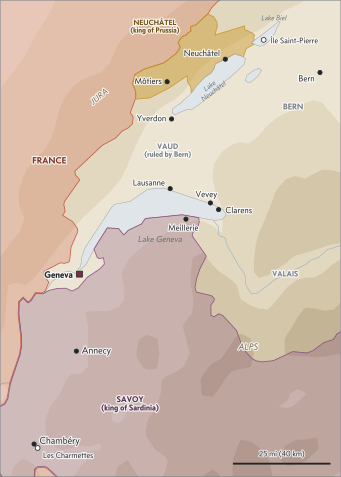
He crossed into Savoy, the duchy south of the lake, whose duke was also king of Sardinia and ruled Piedmont from Turin (Figure 22.1). A Catholic priest sent him to Annecy (ahn-see), to Madame de Warens (vah-rahn), a twenty-eight-year-old convert from Protestantism whom the king paid to bring Protestants into the Catholic Church. She sent him over the Alps to Turin, where he became a Catholic, and so lost his citizenship, since a Catholic could not be a citizen of Calvin’s city. For most of the next twelve years he lived with her, at Annecy and then at Chambéry (shahm-bay-ree) and her farmhouse of Les Charmettes (lay shar-met) just outside it. He called her “Maman,” remembered those years as the happiest of his life, and taught himself philosophy, mathematics, and music from her books. In 1740 he became a tutor in Lyon. In 1742 he went to Paris with a new way of writing music in numbers, which the Academy of Sciences politely turned down. In 1743 and 1744 he served the French ambassador in Venice as his secretary and fell in love with Italian music (Vol. 10, Rebirth). Back in Paris he lived with Thérèse Levasseur (tay-rez luh-vah-sur), a young seamstress at his inn. He earned his bread as secretary to Madame Dupin (dew-pan), the wife of a rich financier, and wrote the articles on music for Diderot’s Encyclopédie (Figure 22.2).

The essay he sent to Dijon argued that every advance of learning had cost a loss of virtue. Sparta, which drove the arts and the scholars from its walls, had been a republic of virtue, while Athens, the city of philosophers and sculptors, left models for every corrupt age. The sciences were born of vices, he wrote: astronomy of superstition, geometry of greed, physics of idle curiosity. At the heart of the essay he gave a speech to Fabricius (fuh-brish-ee-us), a Roman consul of the third century BC famous for his poverty, who had refused the bribes of King Pyrrhus of Epirus (Chapter 6). Rousseau calls him back from the dead to see Rome full of marble, paintings, and flute players, and Fabricius cries out against them all. On the title page Rousseau put a line by the Roman poet Ovid, written in exile on the Black Sea: Barbarus hic ego sum, quia non intelligor illis, “Here I am the barbarian, because they do not understand me.” The academy gave the Discourse on the Sciences and Arts its prize in July 1750, and it made him famous at once. Dozens of writers answered it, among them Stanisław, the former king of Poland, who now ruled Lorraine (Chapter 18).

Famous now, he resolved to live by his own principles. He left the Dupins’ service to copy music at so much a page, gave up his gold-laced clothes and his sword, and sold his watch, saying to himself, as he tells it, “Thank Heaven! I shall no longer want to know the hour!” He also wrote the words and music of a one-act opera, The Village Soothsayer (Le Devin du village (luh duh-van doo vee-lahzh)). In it a shepherdess, Colette, asks the village fortuneteller how to win back her shepherd, Colin, and his advice brings Colin home. Its simple tunes in the Italian manner charmed Louis XV and the court at Fontainebleau in October 1752. Rousseau came unshaven and in his everyday clothes, and he left the next morning rather than be presented to the king and offered a pension. His Letter on French Music (1753) then told the French that their language could not be sung and that they had no music and could have none, the loudest shot in the War of the Buffoons, the Paris quarrel over French and Italian opera (Chapter 20).
In 1753 the Academy of Dijon set a harder question: what is the origin of inequality among men, and is it authorized by natural law, the rules that reason can find in human nature (Chapter 11)? Rousseau took it for a week into the forest of Saint-Germain, west of Paris, and there, he says, “I sought for and found there the image of the primitive ages.” This time he did not win. In 1755 Rousseau published his Discourse on InequalityThis thinker wrote Discourse on Inequality. → Rousseau••• anyway, with a long dedication to the Republic of Geneva. Its full title is the Discourse on the Origin and Foundations of Inequality among Men, and it is also called the Second Discourse. This chapter quotes it in the English of G. D. H. Cole, an Oxford teacher of politics, whose translation of 1913 also gives us The Social Contract.
The Discourse begins by separating natural from moral or political inequality,This work distinguishes natural inequality from moral or political inequality. → Discourse on Inequality• two things its readers ran together. “I conceive that there are two kinds of inequality among the human species,” Rousseau writes. One he calls “natural or physical,” a difference of “age, health, bodily strength, and the qualities of the mind or of the soul.” The other, “moral or political,” “depends on a kind of convention” and consists of the privileges some people enjoy at the expense of others, such as being richer, more honored, or more powerful. Nature makes one man taller than another; only society makes one a duke and another his tenant. Rousseau’s question was how the second kind came about, and whether the first could justify it.
To answer, he imagined people as they would be with no society at all, in what philosophers called the state of nature. The English philosopher Thomas Hobbes had pictured it as a war of every man against every man (Vol. 12, Crown and Parliament). Rousseau’s natural man is no warrior. He wanders the forest alone, eats what he finds, sleeps under a tree, meets a woman by chance and leaves her, and has no language, no property, and no reason to fight. Two feelings move him: the wish to keep himself alive, and pity, “an innate repugnance at seeing a fellow-creature suffer,” which keeps him from hurting others when he need not. One more thing sets him apart from the animals. “A brute is, at the end of a few months, all he will ever be during his whole life,” Rousseau writes, “and his species, at the end of a thousand years, exactly what it was the first year of that thousand.” Man alone can change himself and his kind, and Rousseau named this power perfectibility,This thinker defined "perfectibility" as the capacity for self-improvement that differentiates humans from animals. → Rousseau•• the capacity for self-improvement. It was not a compliment. The same power, he warned, draws man out of his peaceful first state and “makes him at length a tyrant both over himself and over nature.”
The trouble begins, in the Discourse’s second part, when people settle down together. Families build huts, neighbors meet, and in the evenings they gather before their huts around a great tree to sing and dance. Then each begins to watch the others and to want to be watched. “Whoever sang or danced best, whoever was the handsomest, the strongest, the most dexterous, or the most eloquent, came to be of most consideration,” and that, Rousseau says, “was the first step towards inequality, and at the same time towards vice.” In a long note he distinguished amour de soi (ah-moor duh swah) from amour propreThis thinker distinguished amour de soi from amour propre, a form of self-regard shaped by others’ opinions. → Rousseau••• (ah-moor proh-pruh), two kinds of self-love (Cole calls them “self-respect” and “egoism”). Amour de soi, love of oneself, is natural: every animal looks after its own life, and in man, guided by reason and softened by pity, it produces humanity and virtue. Amour propre, pride or vanity, is born only in society. It measures a person against others, lives on their opinion, and leads each of us “to make more of himself than of any other.” A child who eats when he is hungry acts from the first; a child who sulks because his brother got the bigger slice acts from the second.
That second part opens with the first man who fenced a fieldThis work traces civil society to the first person who fenced land and declared, “This is mine.” → Discourse on Inequality••• and called it his. “The first man who, having enclosed a piece of ground, bethought himself of saying ‘This is mine,’ and found people simple enough to believe him, was the real founder of civil society.” Anyone who had pulled up the stakes, Rousseau goes on, and told his fellows that “the fruits of the earth belong to us all, and the earth itself to nobody,” would have spared mankind its crimes, wars, and murders. After the age of huts came farming and metalworking; “it was iron and corn which first civilised men, and ruined humanity.” Land was divided, and with it rich and poor. At last the rich, afraid for what they held, proposed laws to protect everyone, and the poor agreed: “All ran headlong to their chains, in hopes of securing their liberty.” Government and law, on this account, began as a clever trick of the rich that fixed inequality forever.
Readers have long summed the book up as praise of the “noble savage,” the good and happy man of the woods, but the phrase is wrongly credited to Rousseau.The term "noble savage" is often incorrectly attributed to this thinker. → Rousseau• He never used it. The English poet John Dryden (Vol. 12, Crown and Parliament) had written it in a play of 1672, The Conquest of Granada, and in the 1860s the Scottish physician and colonial official John Crawfurd, arguing about the races of mankind, pinned it on Rousseau, where it stuck. Rousseau’s natural man is not noble, since he has no morals at all, and Rousseau did not ask anyone to go back to the forest. The best age, he thought, was the middle one of huts and families, “the happiest and most stable of epochs,” before property. Voltaire, to whom he sent the book, answered with a joke. No one had ever spent so much wit trying to turn us into animals, he wrote; reading it made one want to walk on all fours, but he had lost the habit more than sixty years before.
One question outgrew the Discourse: how could people without language have invented it? Rousseau worked on it in a separate essay, begun about 1754 and printed only after his death, in 1781. In his Essay on the Origin of Languages,This thinker wrote Essay on the Origin of Languages. → Rousseau•This thinker argued that human language began in warm climates and became less expressive as it spread to colder, northern settings. → Rousseau•• speech is born of passion, not of need, and it is born in the warm south. There, where water was scarce, young people met at the wells, and the first words were half sung, and they said “love me,” aimez-moi. In the cold north, where life was a struggle, the first words were “help me,” aidez-moi, and the languages that grew there were loud, harsh, and clear, made for work and not for feeling. As speech spread north it lost its music and its power to move. The same idea armed his attack on French music: the French, a northern people, spoke a language too cold to sing.
Julie and the Letter to d’Alembert
In 1754 Rousseau visited Geneva, returned to the Calvinist church, and became a citizen again. He did not stay. In April 1756 Madame d’Épinay (day-pee-nay), a rich friend of the philosophes, lent him a cottage she had fitted up for him at the edge of the forest of Montmorency, north of Paris, and called the Hermitage. There, with Thérèse and her mother, he daydreamed his way into a novel and fell in love with Madame d’Épinay’s sister-in-law, Sophie d’Houdetot (ood-toh), who already had a husband and a lover. Within two years he had quarreled with Madame d’Épinay, with her friend the critic Friedrich Melchior Grimm, and with Diderot. In December 1757 he moved to a small house in the village of Montmorency, where the Duke and Duchess of Luxembourg, a marshal of France and his wife, became his protectors. In these two houses he wrote his greatest books.
In 1757 the seventh volume of the Encyclopédie printed an article on Geneva by Diderot’s fellow editor, the mathematician d’Alembert (Chapter 20). D’Alembert praised the city’s pastors as reasonable men who hardly believed in the divinity of Christ, and he urged Geneva to allow a theater, which it had long forbidden. Voltaire, who since 1755 had lived at Les Délices, just outside the walls, and put on plays in his house (Chapter 21), was thought to be behind the suggestion. Rousseau took it as an attack on his city’s virtue, and in 1758 he answered with a Letter to d’AlembertThis thinker wrote a letter to D'Alembert opposing the opening of a theater in Geneva. → Rousseau• that argued against any theater in Geneva.
A play, the Letter argues, can please its audience only by flattering the passions it already has. Even Molière, the greatest comic writer of all, teaches us to laugh at the wrong man: in The Misanthrope the honest Alceste is ridiculous, and his smooth friend Philinte, who flatters everyone, is admired (Chapter 16). Actors live by pretending to be what they are not. A small, thrifty city of watchmakers, whose men met in their clubs and whose families visited one another, would learn to waste its evenings and its money. Instead, Rousseau proposed festivals in the open air, where the people themselves would be the show. In a note he remembered one from his childhood: the citizen militia of the quarter of Saint-Gervais, after its drill, dancing around a fountain by torchlight, and his father holding him and saying, “Jean-Jacques, love your country.”

His novel appeared in 1761. Rousseau’s Julie, or the New HeloiseThis thinker wrote Julie, or the New Heloise. → Rousseau• is an epistolary novel, a story told entirely in letters (Chapter 20). Its title recalls Héloïse (ay-loh-eez), the learned young woman of twelfth-century Paris whose love for her tutor, Peter Abelard, ended in a convent (Vol. 9, Cathedrals and Crusades). Rousseau’s Héloïse is Julie d’Étange (day-tahnzh), the daughter of a baron at Vevey (vuh-vay) on Lake Geneva. Her tutor is a young commoner whose real name we never learn; her cousin Claire calls him Saint-Preux (san-pruh). They fall in love and become lovers (Figure 22.4). Her father, proud of his rank, will not let her marry a commoner, and Saint-Preux is sent away to Paris. Julie obeys her father and marries his friend Monsieur de Wolmar (vol-mar), a calm, wise man much older than she, and Saint-Preux sails around the world on the voyage of the English admiral George Anson.
Years later Wolmar, who knows the whole story, invites Saint-Preux to live with them on their estate at Clarens (klah-rahn), trusting both of them to master their old love, and for a time they seem to. Julie’s household is a little model society, with its vineyard, its contented servants, and a wild garden she calls her Elysium. It has one sorrow. Wolmar is an atheist:Wolmar represents this belief in Rousseau’s Julie (or La nouvelle Héloïse). → atheism• he does not believe that God exists, and yet he is the most honest and generous man in the book, and readers have long seen in him the atheist Baron d’Holbach (Chapter 20). Pierre Bayle had argued that an unbeliever could live a good life (Chapter 20), and Wolmar shows it; but the devout Julie grieves for him and hopes to the end that he will come to believe. Her end comes suddenly. Her young son falls into the lake, she plunges in after him and saves him, and the chill brings on a fever that kills her. In her last letter, given to Saint-Preux after her death, she confesses that she never stopped loving him.
Julie may have been the best-selling novel of the century. Readers wept over it, wrote to Rousseau by the hundreds, and asked him whether Julie had really lived and where Saint-Preux could be found. Its long pages on the lake, the vineyards, and the mountains above Meillerie (may-yuh-ree) taught readers to love wild Alpine scenery, which most travelers before them had thought merely frightening.
The Social Contract
In April 1762 Marc-Michel Rey, the Amsterdam bookseller who had printed his Discourse on Inequality and Julie, published Rousseau’s The Social Contract,This thinker wrote The Social Contract. → Rousseau•••A work titled for this concept is by Jean-Jacques Rousseau. → social contract•••Jean-Jacques Rousseau proposed the "social" form of these constructs. → contracts• in French Du Contrat social. A contract is a binding agreement in which each side promises something, as a tenant promises rent and a landlord a sound roof. Rousseau’s contract is the “social” kind: not a bargain between two people, but the agreement by which a whole people becomes a society. Philosophers had long told such stories. Thomas Hobbes’s covenant and John Locke’s “compact” were versions of the social contract (Vol. 12, Crown and Parliament), the agreement that founds civil societyThis concept explains political authority through an agreement establishing civil society. → social contract•• and gives a government its right to rule. Rousseau’s book gave the idea its name.

Under his name on the title page Rousseau put words from Virgil’s Aeneid (ih-nee-id), where King Latinus proposes peace to the Trojans: foederis aequas dicamus leges, “let us set out fair terms for a treaty” (Vol. 7, The Romans). The first chapter then opens with the most famous sentence he ever wrote, in Cole’s English: “Man is born free; and everywhere he is in chains.”This work opens, “Man is born free, and everywhere he is in chains.” → The Social Contract••• It goes on: “One thinks himself the master of others, and still remains a greater slave than they. How did this change come about? I do not know. What can make it legitimate? That question I think I can answer.” The Discourse on Inequality had told how the chains were made. This book asks what kind of bonds, if any, a free man could rightly accept.
Force cannot be the answer. A robber who stops you at the edge of a wood with a pistol has power over your purse, but no right to it, and “force does not create right.” Nor can a people simply give itself away. The Dutch jurist Hugo Grotius, in On the Law of War and Peace (1625), had argued that a man may sell himself into slavery, so a whole people may hand itself over to a king (Chapter 11). Rousseau rejected Grotius’s argumentThis work rejects Grotius’s argument that people may willingly alienate their freedom. → The Social Contract• point by point. “To alienate is to give or to sell,” he writes. A slave at least sells himself for his keep, but what does a people get from a king, who gets his own keep from them? To give oneself away for nothing is the act of a madman, “and madness creates no right.” “To renounce liberty is to renounce being a man.”
The problem, then, is “to find a form of association … in which each, while uniting himself with all, may still obey himself alone, and remain as free as before.” Rousseau’s answer is that each person gives himself and all his rights wholly to the community. Because everyone gives everything, the terms are the same for all, and no one has a reason to make them hard for others; “each man, in giving himself to all, gives himself to nobody.” The act creates a new public person. When it acts, it is called the Sovereign, and its members citizens; when it is acted upon, it is called the State, and its members subjects.

This new body has a will of its own, the general will, which always aims at the common good. It is not the same as what everyone happens to want, and Rousseau distinguished the general will from the will of all.This thinker theorized the concept of the "general will." → Rousseau•••This thinker distinguished the general will from the will of all. → Rousseau•• “There is often a great deal of difference between the will of all and the general will,” he writes: “the latter considers only the common interest, while the former takes private interest into account, and is no more than a sum of particular wills.” Imagine a town voting on where to put a new road. If every voter asks what is best for himself, the count is the will of all; if every voter asks what is best for the town, the count shows the general will. Parties and factions spoil it, because each votes as a bloc for its own interest, so Rousseau wanted none. And whoever refuses to obey the general will “shall be compelled to do so by the whole body. This means nothing less than that he will be forced to be free.” To Rousseau, obeying a law you have made yourself is freedom; his critics have found the phrase chilling ever since.
Only the people as a whole may make laws, and a law must be general: it may create ranks and privileges but may not name the persons who get them. Applying laws to particular people and cases is a different job, and the sovereign people and the governmentThis work distinguishes the sovereign body of citizens from the government that administers its laws. → The Social Contract• are different bodies (Figure 22.6). “What then is government?” Rousseau asks. “An intermediate body set up between the subjects and the Sovereign, to secure their mutual correspondence, charged with the execution of the laws and the maintenance of liberty.” Kings and magistrates are “mere officials of the Sovereign,” and the people may “limit, modify or recover at pleasure” the power it lends them. A government by the whole people or most of it is a democracy, by a few an aristocracy, by one a monarchy; but in every legitimate state the sovereign is the whole people.
Sovereignty, he argued, cannot be handed to representatives either. “The people of England regards itself as free; but it is grossly mistaken; it is free only during the election of members of parliament. As soon as they are elected, slavery overtakes it, and it is nothing.” Nor does every form of government suit every land, and here Rousseau cited Montesquieu on climate.This work cites Montesquieu when relating climate to forms of government. → The Social Contract• “Liberty, not being a fruit of all climates, is not within the reach of all peoples,” he writes, a principle “laid down by Montesquieu,” whose Spirit of the Laws (1748) had tied a people’s laws to its climate (Chapter 20). Rousseau gave the idea a twist of his own. A government lives on what its people produce beyond their needs. Rich, hot lands that yield much for little work can feed a luxurious monarch; middling lands suit free peoples; barren ones can support no state at all.
The fourth book asks how a sovereign people actually votes, and it studies the Roman comitia (koh-mish-ee-uh) and Servius’s reforms.This work’s fourth book discusses Servius’s reforms and the Roman comitia. → The Social Contract• The comitia were the assemblies of the Roman people, which met in the Forum or on the Field of Mars, and no law was passed and no magistrate elected without them. Servius Tullius, Rome’s sixth king, had held its first census and sorted the citizens by wealth (Vol. 7, The Romans). Rousseau explains how his six classes were divided into 193 voting groups, called centuries, so that the first class, the richest, held more than half of them by itself. The division by centuries, he wrote, “was so favourable to the aristocracy” that one wonders how the senate ever lost a vote there.
The last chapter but one proposes a civil religion of a few simple articles.This work proposes a civil religion with basic tenets citizens should affirm. → The Social Contract• A state needs citizens who love their duties, Rousseau argued, so the Sovereign may fix a short profession of faith, “not exactly as religious dogmas, but as social sentiments.” Its articles are “the existence of a mighty, intelligent and beneficent Divinity, possessed of foresight and providence, the life to come, the happiness of the just, the punishment of the wicked, the sanctity of the social contract and the laws,” and one forbidden belief, intolerance. The state could force no one to believe them, but it could banish an unbeliever “as an anti-social being,” and it could punish with death a man who professed them and then acted as if he did not believe. Every religion that tolerated others was to be tolerated. The same chapter argued that the Christianity of the Gospels, a religion of the heart turned toward heaven, made men careless of their earthly country, and Catholics and Protestants alike were deeply offended.
Emile
A month later, in May 1762, came the book Rousseau thought his best. Emile, or On Education follows an imagined boy,This thinker wrote Emile, or On Education. → Rousseau•••Jean-Jacques Rousseau wrote about this subject in Émile. → education••This work presents the education of an imagined boy from childhood onward. → Emile•• Emile (ay-meel), from birth to marriage, raised by a tutor who is Rousseau himself. It is a treatise on education told as a story, in five books. Its first sentence states its creed: Tout est bien, sortant des mains de l’Auteur des choses: tout dégénère entre les mains de l’homme, “Everything is good as it leaves the hands of the Author of things; everything degenerates in the hands of man.” Education must protect the child’s nature from the corruption of society, not stuff him with its opinions.

Book I is about infancy. Rousseau told mothers to nurse their own babies and to free them from tight swaddling bands, and fashionable Paris obeyed. Book II takes the child to twelve, and here Rousseau argued with John Locke, whose Some Thoughts Concerning Education (1693) had told parents to reason with children as soon as they could understand (Vol. 12, Crown and Parliament). Reasoning with children, Rousseau replied, was Locke’s great maxim and the height of fashion, and the children he saw reasoned with were the silliest he knew. Reason is the last faculty to ripen, and to begin with it is to begin at the end. A child should learn from things, not words, by meeting the consequences of what he does. So Emile plants beans in a corner of the garden, waters them every day, and one morning finds them torn up. The gardener, Robert, had sown melons from Malta there first, and the plot was his. From the man who first worked the ground, Emile learns what property is. In Book III, from twelve to fifteen, he may read one book, Daniel Defoe’s Robinson Crusoe (Vol. 12, Crown and Parliament), the story of a man alone on an island who makes everything he needs, and he learns a trade, carpentry, which Locke had also recommended.
Book IV brings feeling and, later still, religion: at fifteen, Rousseau writes, Emile did not yet know whether he had a soul. Here Rousseau set a story within his story, the “Profession of Faith of the Savoyard Vicar”This work contains the “Profession of Faith of the Savoyard Vicar.” → Emile•• (suh-voy-erd). A young Calvinist runaway in Turin, much like the young Rousseau, is taken at sunrise to a hill above the river Po by a poor Catholic priest from Savoy, a vicar, or assistant parish priest, who tells him what he believes and why. Like Descartes, the vicar began by doubting everything (Chapter 10). Matter does not move itself, he reasons, so a will moves the world, and its order shows that this will is wise: there is a God. Man is free, and so the evil in the world comes from man. The soul is not matter and will outlive the body. Conscience is a divine instinct, a sure guide to right and wrong. But the vicar doubts that God needs books, prophets, and miracles to speak to us. He asks who saw the miracles, and why he should trust men who say they report God’s words when God could have spoken to him directly. Yet he reveres the Gospels. He compares the calm death of Socrates, the Greek philosopher who drank hemlock among his friends, with the death of Jesus. Si la vie et la mort de Socrate sont d’un sage, la vie et la mort de Jésus sont d’un Dieu, “If the life and death of Socrates are those of a sage, the life and death of Jesus are those of a God.” He tells the young man to go home to the religion of his fathers and to serve God simply. This is natural religion: belief in God, in the soul, and in conscience, found by reason and feeling without the teachings of any church.
Rousseau meant the vicar’s creed as his own, and both churches heard it as an attack. To Catholics it denied the authority of the Church and the need for revelation; to Geneva’s Calvinist pastors its doubts about miracles struck at the Bible itself. On June 9, 1762, the Parlement of Paris, the high court (the Stage), condemned Emile, ordered it torn and burned at the foot of the great staircase of its palace, and ordered its author’s arrest. Warned in the night by his protectors, Rousseau fled that same day. On June 19 the Small Council, the twenty-five men who ruled Geneva, had both Emile and The Social Contract burned and ordered him arrested if he entered the city. The archbishop of Paris, Christophe de Beaumont (boh-mohn), condemned the book in a pastoral letter, and Rousseau answered him in print.
Book V gives Emile a wife. Sophie, the girl meant for Emile,This work introduces Sophie as the intended companion of its title pupil. → Emile• is introduced as the ideal companion his tutor has looked for, and her education is planned entirely around him. A woman’s education, Rousseau wrote, should be relative to men: to please them, to be useful to them, to win their love and respect, to raise them when young and care for them when grown. Sophie sews, embroiders, keeps house, and reads little; her religion is her mother’s and will be her husband’s. She and Emile fall in love, and the tutor sends him away to travel for two years and study the governments of Europe before the wedding. Thirty years later, in A Vindication of the Rights of Woman (1792), the English writer Mary Wollstonecraft (wuul-stun-kraft) attacked Sophie’s educationMary Wollstonecraft criticized this work’s account of Sophie’s education. → Emile• (Vol. 15, The Age of Revolution). She quoted Rousseau’s own words, “Educate women like men, and the more they resemble our sex the less power will they have over us,” and answered: “This is the very point I aim at. I do not wish them to have power over men; but over themselves.”
There was a harder irony behind the book. Rousseau and Thérèse had five children, and he had left each one as a newborn at the Paris foundling hospital, a home for abandoned babies, where most infants died. Voltaire told the world in an anonymous pamphlet of 1764, and Rousseau admitted it in the Confessions; his enemies never let the author of Emile forget it.
From Paris he fled to Yverdon (ee-vair-dohn), in lands ruled by Bern, and when Bern expelled him he moved in July 1762 to Môtiers (moh-tyay), a village in the Jura mountains in the principality of Neuchâtel (Figure 22.1). Its prince was Frederick the Great of Prussia (Vol. 14, From Luther to Mozart), and its governor, the exiled Scottish lord George Keith, the Earl Marischal (mar-shul), became his friend. There Rousseau began to wear an Armenian costume, a long robe and a fur cap, which was easy to wear with an illness of the bladder that tormented him. In 1763 he gave up his citizenship of Geneva, and in 1764 his Letters Written from the Mountain attacked its rulers. The local pastor preached against him, and on the night of September 6, 1765, villagers stoned his house. He fled to the little Île Saint-Pierre in Lake Biel, which he remembered ever after as paradise, until Bern expelled him again seven weeks later.
The Confessions
He was now the most famous fugitive in Europe, and the Scottish philosopher David Hume, who had served at the British embassy in Paris and was the darling of its drawing rooms, offered him a home in England (Vol. 12, Crown and Parliament). They crossed together in January 1766. London crowded to see him, and in March he settled at Wootton Hall in Staffordshire, a house lent by a rich gentleman named Richard Davenport. Within weeks the friendship broke. The English writer Horace Walpole had written a joke letter, supposedly from Frederick the Great, which offered Rousseau any persecution he liked, since he enjoyed them so much. It went around Paris, and in April a London paper printed it. Rousseau decided that Hume, who had laughed at the joke, was part of a plot to dishonor him, and in July he sent Hume a long letter of accusation. Hume, hurt and afraid for his good name, published his side in French that October and in English in November as A Concise and Genuine Account of the Dispute between Mr. Hume and Mr. Rousseau. He printed Rousseau’s letter inside it, so all Europe could read both sides at once. In May 1767 Rousseau went back to France.

At Wootton he wrote most of the first six books of the story of his life, which he had begun at Môtiers, and he called it the Confessions, after Augustine’s.This thinker wrote Confessions. → Rousseau••This autobiography takes its title from Augustine’s earlier work. → Rousseau’s Confessions• Augustine, bishop of Hippo in North Africa, had written his Confessions about AD 397, a prayer to God that tells his life and his sins and is often called the first autobiography (Vol. 7, The Romans). Rousseau confesses not to God but to his readers, and he promises to hide nothing. “I have entered upon a performance which is without example,” Orson’s version begins, “whose accomplishment will have no imitator. I mean to present my fellow-mortals with a man in all the integrity of nature; and this man shall be myself.” When the last trumpet sounds, he says, he will stand before the sovereign judge with this book in his hand.
Augustine had confessed to stealing pears he did not want. In Book II Rousseau confesses a worse theft. In 1728, at sixteen, he was a footman in Turin in the house of the Countess of Vercellis (vair-chel-lis), and when she died and the household was broken up, a pink and silver ribbon was missing. Rousseau had stolen the ribbon,This autobiography recounts stealing a ribbon and blaming the servant Marion. → Rousseau’s Confessions•• and when it was found among his things he said that Marion, the young cook, had given it to him. Marion came from the Maurienne (moh-ryen), a valley of the Alps, and was pretty, modest, and honest. Before a crowd of people he accused her to her face. She denied it without anger and burst into tears: “Ah, Rousseau! I thought you a good disposition—you render me very unhappy, but I would not be in your situation.” The countess’s nephew and heir, the Count de la Roque, dismissed them both, saying only that “the conscience of the guilty would revenge the innocent.” He never learned what became of her. He meant to give her the ribbon, he explains, and her name was simply the first that came into his head; he feared shame more than death. The memory haunted his dreams, and he says that the wish to be rid of it was one reason he wrote the book.
Book VI holds a smaller theft and a famous sentence. In 1740, as a tutor in Lyon in the house of Monsieur de Mably (mah-blee), Rousseau secretly took bottles of his employer’s white wine to drink in his room. He could not drink without eating, and he was too shy, with a sword at his side, to walk into a baker’s shop for a loaf. Then he remembered “the thoughtless saying of a great princess, who, on being informed that the country people had no bread, replied, ‘Then let them eat pastry!’ ” In French she said brioche, a soft, rich bread made with butter and eggs. Rousseau went to the pastry cooks instead.
The later books carry the story through Paris, the Hermitage, and the quarrels with his friends, and they end with his expulsion from the Île Saint-Pierre in 1765. He finished them in 1770. That winter he read the book aloud to small gatherings in Paris drawing rooms, one reading lasting seventeen hours, until Madame d’Épinay, who appeared in it, asked the police to stop him in May 1771. He spent his last years in a small flat in the rue Plâtrière (plah-tree-air), copying music for a living and gathering plants. There he wrote the Reveries of the Solitary Walker, ten “walks” of memory and thought; the last was left unfinished, and the fifth remembers the Île Saint-Pierre.

In May 1778 the Marquis René de Girardin (zhee-rar-dan), an admirer who had laid out a landscape garden in Rousseau’s spirit, invited him to a cottage on his estate at Ermenonville (air-muh-nawn-veel), north of Paris. Rousseau died there of a stroke on July 2, 1778, thirty-three days after Voltaire (Chapter 21). Girardin buried him on a little island of poplars in the estate’s lake, the Île des Peupliers (eel day puh-plee-ay), and it became a place of pilgrimage at once (Figure 22.9). In 1780 a stone tomb designed by the painter Hubert Robert replaced the first one (Chapter 19). The Confessions were printed in two parts, Books I–VI in 1782 and Books VII–XII in 1789, the year the Revolution began. In October 1794 the revolutionaries, who had made The Social Contract their scripture, carried his remains to the Panthéon, a Paris church they had made into a tomb for great Frenchmen, and laid them near Voltaire’s (Vol. 15, The Age of Revolution).
What to remember
- Jean-Jacques Rousseau (1712–1778), “Citizen of Geneva,” ran away at fifteen, lived with Madame de Warens in Savoy, and won fame in 1750 with the First Discourse, which argued that the arts and sciences had corrupted morals.
- The Discourse on Inequality (1755) separates natural from political inequality, calls man’s power to change himself perfectibility, contrasts amour de soi with amour propre, and traces civil society to the first man who fenced land and said “This is mine.” Rousseau never wrote “noble savage.”
- The Essay on the Origin of Languages has speech born in the warm south (“love me”) and growing harsher in the north (“help me”).
- The Letter to d’Alembert (1758) opposed a theater in Geneva. Julie, or the New Heloise (1761), a novel in letters, has the tutor Saint-Preux, the devout Julie, and her husband Wolmar, an honest atheist.
- The Social Contract (1762) opens “Man is born free; and everywhere he is in chains.” It answers Grotius, sets the general will against the will of all, separates the sovereign people from the government, cites Montesquieu on climate, studies the Roman comitia, and ends with a civil religion.
- Emile (1762) educates an imagined boy against Locke’s maxim of reasoning with children, gives him Sophie as his intended (whose education Mary Wollstonecraft attacked), and contains the “Profession of Faith of the Savoyard Vicar,” for which it was burned in Paris and Geneva.
- Rousseau fled to Môtiers, then to England with Hume in 1766, where they quarreled in public.
- The Confessions, named after Augustine’s, tell of the stolen ribbon and the servant Marion, and in Book VI of the princess who said the poor should eat brioche. Rousseau was buried on the Île des Peupliers at Ermenonville and moved to the Panthéon in 1794.
Back matter
Answers by Type
Every question asks for one kind of thing, and its first words usually say which: “this king,” “this painting,” “this philosopher,” “this play.” That kind of thing is the question’s answer type. The chapters of this volume followed France and the Low Countries from the 1420s to the 1780s in the order things happened. This section takes the volume’s 198 answers out of that story and sorts them by type into nineteen groups. History comes first: the kings, their ministers and generals, their wars and edicts, and the trades and things of the old regime. Then come the churches; the philosophers, their books, and their ideas; the writers, their plays and tales, and their characters; the composers; the painters and their pictures; and last the places.
Each group opens with a table for comparing its answers at a glance and then gives a short entry for each answer, with the chapter that teaches it. The entries reprint only the clues that tell an answer from its look-alikes, and boxes at the end of a group take apart the pairs that players confuse most. This volume’s look-alikes are of four kinds. The commonest is a name or a title that several men bore: four Henrys, four Louis, five Williams of Orange, three cardinals, and three Rameaus. The second is a work and its hero, Tartuffe and Tartuffe or Candide and Candide, where only the question’s first words decide. The third is two works of one kind, such as two views of Delft, two anatomy lessons, and three Discourses. The fourth is one thing asked both as an object and as an event or an idea: tulips and tulip mania, the Ethics and ethics, The Social Contract and the social contract.
Kings and the House of Bourbon
Five kings of France are answers, from Henry III, the last Valois, to Louis XV, and two more answers are a royal name and a royal house (Table A.1). A clue for a king says “this king,” “this ruler,” or “this monarch,” and it usually names his minister, his mistress, his killer, or his war. The trap is the number after the name. The surest key to the Louis is the minister: Richelieu means Louis XIII, Mazarin and Colbert mean Louis XIV, and Fleury and Choiseul mean Louis XV. Figure A.1 draws the Bourbon kings.
| Answer | Reigned | Minister or rival | To remember | Ch. |
|---|---|---|---|---|
| Henry III | 1574–1589 | the Guises and the League | Last Valois king; fled Paris after the Barricades (1588); had Guise killed at Blois; stabbed by Jacques Clément | 5 |
| Henry IV | France 1589–1610; Navarre from 1572 | Sully | First Bourbon king; won at Ivry (1590); a Catholic from 1593; Edict of Nantes (1598); stabbed by Ravaillac | 5 |
| Louis XIII | 1610–1643 | Richelieu, 1624–1642 | King at eight; Concini killed (1617); La Rochelle; the Day of the Dupes | 8 |
| Louis XIV | 1643–1715 | Mazarin to 1661; Colbert for finance | The Fronde; the Sun King; Versailles; Fontainebleau (1685); the longest reign | 15 |
| Louis XV | 1715–1774 | the regent Orléans; Fleury, 1726–1743; Choiseul | King at five; Pompadour; Damiens (1757); Canada lost (1763) | 18 |
| Henry | — | — | The name of the three Henrys of 1585–1589: Henry III, Guise, and Navarre | 5 |
| House of Bourbon | France from 1589; Spain from 1700 | — | Descended from Robert of Clermont, Louis IX’s son; the Family Pacts | 5 |
Henry III of France. Henry II’s son, Duke of Anjou before he was king, and the last Valois, who reigned from 1574 to 1589. When Paris rose for the Catholic League in May 1588, the Barricades forced him to fleeThe Day of the Barricades forced this ruler to flee Paris. → Henry III of France•• his capital. He had the Duke of Guise killed that December, and the next summer a Dominican friar, Jacques Clément, stabbed himJacques Clément assassinated this ruler. → Henry III of France• to death. Taught in Chapter 5.
Henry IV of France. Henry of Navarre, the Protestant prince who ruled Navarre before France,This ruler ruled Navarre before becoming king of France. → Henry IV of France•• from his mother’s death in 1572. When Henry III died in 1589, he became the first Bourbon kingThis ruler was the first Bourbon ruler of France. → Henry IV of France••• of France. He won at Ivry, turned Catholic in 1593, and gave the Huguenots the Edict of Nantes, and in 1610 Ravaillac stabbed himThis ruler was assassinated by François Ravaillac. → Henry IV of France•• in his carriage in a Paris street. Taught in Chapter 5.
Louis XIII. Henry IV’s son, king at eight in 1610 under the regency of his mother, Marie de’ Medici. In 1617 he took power himself by having her favorite, Concini, killed. From 1624 to 1642 Richelieu was his chief minister,Cardinal Richelieu served as this ruler’s chief minister. → Louis XIII• and the king kept him against his mother, his wife, and his brother. Taught in Chapter 8.
Louis XIV. The third Bourbon, king at four in 1643, who lived through the Fronde as a boy. He took the sun for his emblem, and in time he became the “Sun King,”This ruler was nicknamed the "Sun King." → Louis XIV••• the center of a court that circled him like the planets. His personal rule began at Mazarin’s death,Cardinal Mazarin advised this ruler, who began his personal rule after Mazarin’s death. → Louis XIV••• in 1661, and he never named another first minister. He reigned for seventy-two years,This ruler reigned for 72 years, longer than any other French monarch. → Louis XIV•• the longest of any French king. Taught in Chapter 15.
Louis XV. Louis XIV’s great-grandson, a child of five when he succeeded the Sun KingThis ruler succeeded the "Sun King." → Louis XV•• in 1715. Philippe of Orléans governed as regent until 1723, and from 1726 Cardinal Fleury served as chief minister,Cardinal Fleury served as this ruler's chief minister. → Louis XV• keeping France at peace and solvent for most of his years in office, until his death in 1743. In 1745 Madame de Pompadour became his mistress,Madame de Pompadour was this ruler's long-time mistress. → Louis XV•• and in the Seven Years’ War France lost Canada. Taught in Chapter 18.
Henry. The first name that gave the eighth and last War of Religion its other name. Its first four years, 1585 to 1589, are called the War of the Three Henrys, since three men named Henry fought it:The eighth French War of Religion is alternatively named after three men with this name, including ones from Guise and Navarre. → Henry•• Henry III, Henry of Guise, and Henry of Navarre. A fourth Henry, of the generation before, was Henry III’s father, Henry II. Taught in Chapter 5.
House of Bourbon. The branch of the French royal family descended from Robert of Clermont, Louis IX’s son. It took the throne with Henry IV in 1589, and the Bourbons succeeded the Valois and the Habsburgs,This dynasty succeeded the Valois in France and the Habsburgs in Spain. → House of Bourbon•• in France and, in 1700, in Spain. Louis XVI was a BourbonLouis XVI was a member of this dynasty. → House of Bourbon• too, the fifth king of the house. Taught in Chapter 5 and Chapter 18.
Princes, ministers, and commanders
Nine answers served a king, fought one, or sailed for one (Table A.2). Clues call them “this leader,” “this man,” “this admiral,” or “this commander,” and they nearly always name the event that made or killed the man. The traps are names and titles that came down in families: two Dukes of Guise, two Princes of Condé, two men called Maurice, three cardinal ministers, and five princes of Orange named William, whose tree is Figure A.2.
| Answer | Dates | Served or led | Known for | Ch. |
|---|---|---|---|---|
| Gaspard de Coligny | 1519–1572 | the Huguenots | Admiral; backed French colonies in the Americas; murdered on Saint Bartholomew’s Day | 5 |
| Henry, Duke of Guise | 1550–1588 | the Catholic League | Backed by the Sixteen of Paris; killed at Blois by Henry III’s Forty-Five | 5 |
| William the Silent | 1533–1584 | the Dutch revolt | Prince of Orange and stadtholder; the Sea Beggars; shot by Balthasar Gérard at Delft | 7 |
| Duke of Alba | born 1507 | Philip II of Spain | Came to Brussels in 1567; set up the Council of Troubles, the “Council of Blood” | 7 |
| Cardinal Richelieu | 1585–1642 | Louis XIII | Chief minister 1624–1642; La Rochelle; the Day of the Dupes; the Académie française | 8 |
| Louis II, Prince of Condé | 1621–1686 | Louis XIV, after the Fronde | The Great Condé; won Rocroi (1643) as Duke of Enghien | 8 |
| Maurice de Saxe | born 1696 | Louis XV | Son of Augustus II of Saxony; won Fontenoy (1745) | 18 |
| Louis Antoine de Bougainville | born 1729 | Louis XV | Led the first French voyage around the world, 1766–1769 | 18 |
| Jeanne Baret | born 1740 | Bougainville’s voyage | Sailed disguised as a man; the first woman to go around the globe | 18 |
Gaspard de Coligny. The Huguenot admiral, born in 1519 to an old noble family of Burgundy, who backed French colonies in the Americas.This Huguenot admiral promoted French colonies in the Americas. → Gaspard de Coligny•• The Guises blamed him for the murder of Francis of Guise in 1563, and in the small hours of August 24, 1572, Coligny was murdered by Guise’s menThis Huguenot admiral was murdered during the St. Bartholomew’s Day Massacre. → Gaspard de Coligny•• before the general killing began. Taught in Chapter 5.
Henry, Duke of Guise. The leader of the Catholic League, whom the Sixteen of Paris supportedThis leader of the Catholic League was supported by the Council of Sixteen in Paris. → Henry, Duke of Guise• against their own king. After the Barricades the court went to the château of Blois for the Estates-General, and on December 23, 1588, Henry III summoned him from the council. As he crossed the king’s bedchamber, the Forty-Five killed Guise.The Forty-Five Guards assassinated this leader of the Catholic League at Blois. → Henry, Duke of Guise•• His father Francis’s men had fired at Vassy, and his brother Mayenne led the League after him. Taught in Chapter 5.
William the Silent. William of Nassau, Prince of Orange, born in 1533, who led the Dutch revolt as stadtholderThis Prince of Orange served as stadtholder and led the Dutch revolt against Spain. → William the Silent•• against Philip II from 1568. In his Apology of 1580, the only account of it, he told how Henry II let slip a planApocryphally, this figure learned of a plan to suppress Protestants when Henry II of France revealed it during a hunting trip. → William the Silent• against the Protestants on a hunt in 1559. In 1584 Balthasar Gérard shot himBalthasar Gérard assassinated this Dutch revolt leader with a pistol. → William the Silent••• at Delft. Taught in Chapter 7.
Duke of Alba. Fernando Álvarez de Toledo, the victor of Mühlberg, whom Philip II sent to Brussels in 1567 to punish heresy and rebellion. Alba set up the Council of Troubles,While governing the Netherlands for Philip II, this duke established the Council of Troubles, nicknamed the Council of Blood. → Duke of Alba••• which the Dutch called the Council of Blood, and he beheaded the Counts of Egmont and Horn. Taught in Chapter 7.
Cardinal Richelieu. Armand-Jean du Plessis, bishop of Luçon, chief minister of Louis XIII from 1624 to 1642. His scarlet robes made him the “Red Eminence”,This man was nicknamed the "Red Eminence" for the red shade of his clerical clothing. → Cardinal Richelieu•• and on the Day of the Dupes in 1630 Marie de’ Medici failed to remove him.Marie de' Medici unsuccessfully attempted to remove this man from power on the Day of the Dupes. → Cardinal Richelieu••• He took La Rochelle and founded the Académie française. On his deathbed he recommended Mazarin to the king, and Cardinal Mazarin succeeded himThis man was succeeded by Cardinal Mazarin. → Cardinal Richelieu•• as chief minister. Taught in Chapter 8.
Louis II, Prince of Condé. The Great Condé, a prince of the blood, who won Rocroi as Duke of EnghienAs the Duc d’Enghien, this French commander won the Battle of Rocroi. → Louis II, Prince of Condé•• in May 1643, at twenty-one. He rebelled in the Fronde and fought for Spain for six years, and after his pardon in 1659 he served Louis XIV, commanding the king’s armies again from 1668. His great-grandfather Louis I led the Huguenots in the 1560s. Taught in Chapter 8 and Chapter 15.
Maurice de Saxe. A son of Augustus II of Saxony by one of his mistresses, born at Goslar in 1696, a Lutheran who served France from 1720 and rose to marshal. In the War of the Austrian Succession Saxe won at FontenoyThis commander won at Fontenoy during the War of the Austrian Succession. → Maurice de Saxe•• on May 11, 1745, and Tournai and Brussels fell. Taught in Chapter 18.
Louis Antoine de Bougainville. A notary’s son of Paris, born in 1729, who had fought for Canada. From 1766 to 1769 Bougainville led the first French voyageThis explorer led the first French circumnavigation of the globe. → Louis Antoine de Bougainville•• around the world, and the flowering vine bougainvillea is named for him. Taught in Chapter 18.
Jeanne Baret. The servant of Bougainville’s naturalist, Commerson, who sailed with him disguised as a manDisguised as a man on Bougainville’s expedition, this woman became the first woman to circumnavigate the globe. → Jeanne Baret•• and so became the first woman to go around the world. Taught in Chapter 18.
Wars, massacres, rebellions, and edicts
Ten answers are events or the laws that ended or began them (Table A.3). Clues say “this war,” “this massacre,” “this rebellion,” “this siege,” “this decree,” or “this incident,” and they give a date, a treaty, or a victim. Most of the events are one long quarrel between the French crown and its Protestants, from the posters of 1534 to the revocation of 1685, so the date is the surest key. The Dutch war against Spain lasted eighty years and ended in 1648, the same year as the Thirty Years’ War in Germany, which it had joined when it began again in 1621.
| Answer | Date | Who against whom | What came of it | Ch. |
|---|---|---|---|---|
| Affair of the Placards | October 17–18, 1534 | Protestant posters against the Mass | Francis I turned on the Protestants; Calvin fled | 4 |
| Eighty Years’ War | 1568–1648 | the Dutch against Spain | Independence at the Peace of Münster | 7 |
| Saint Bartholomew’s Day Massacre | August 24, 1572, and after | Catholics of Paris and the provinces against the Huguenots | Coligny and thousands killed; the Monarchomachs | 5 |
| War of the Three Henrys | 1585–1589 | Henry III, Guise, and Navarre | Guise and Henry III killed; Navarre the heir | 5 |
| Edict of Nantes | 1598 | Henry IV’s grant to the Huguenots | Freedom of worship in named places; the wars ended | 5 |
| Siege of La Rochelle | 1627–1628 | Richelieu against the Huguenot port | Surrender; the Peace of Alais (1629) | 8 |
| Fronde | 1648–1653 | judges and princes against Mazarin | The crown won; Louis XIV never forgot | 8 |
| War of Devolution | 1667–1668 | Louis XIV against Spain; the Triple Alliance | Peace of Aix-la-Chapelle (1668) | 15 |
| Code Noir | March 1685 | Louis XIV’s law for the French islands | Rules for slaves; the Jews expelled | 15 |
| Edict of Fontainebleau | October 1685 | Louis XIV against the Huguenots | Nantes revoked; at least 200,000 fled | 15 |
Affair of the Placards. The night of October 17–18, 1534, when Protestants put up printed posters against the Mass in Paris and other towns. A story often told says that one was fixed to the king’s bedchamber doorAnti-Mass posters appeared during this incident, reportedly including one on Francis I’s bedchamber door. → Affair of the Placards•• at Amboise. Francis I turned on the Protestants, and Calvin fled. Taught in Chapter 4.
Eighty Years’ War. The Dutch war against Spain, from 1568 to the Peace of Münster in 1648. At sea the Sea Beggars fought Spain;The Sea Beggars fought Spain during this struggle for Dutch independence. → Eighty Years' War•• on land Breda changed hands again and again.The city of Breda changed hands between Spain and the Dutch during this war. → Eighty Years' War• At the siege of Antwerp in 1585, Giambelli’s explosive “hellburners” failed to save the city. Taught in Chapter 7.
Saint Bartholomew’s Day Massacre. The killing of the Huguenots that began in Paris on August 24, 1572, and spread to the provinces. It followed the royal weddingThis massacre followed the wedding of Margaret of Valois and Henry of Navarre. → Saint Bartholomew's Day Massacre•• of Margaret of Valois and Henry of Navarre within a week, and it ended two years of peaceThis event ended a two-year period of peace following the Treaty of Saint-Germain-en-Laye. → Saint Bartholomew's Day Massacre•• that had begun with the Treaty of Saint-Germain. Modern estimates of the dead run from 5,000 to 30,000, and Catherine de’ Medici has traditionally been blamedCatherine de’ Medici has traditionally been blamed for organizing this massacre of Huguenots. → Saint Bartholomew's Day Massacre••• for the order. Taught in Chapter 5.
War of the Three Henrys. The first four years, 1585 to 1589, of the eighth and last War of Religion, named for the three Henrys who contested it:Henry III of France, Henry of Guise and Henry of Navarre contested this phase of the French Wars of Religion. → War of the Three Henries• King Henry III, Henry of Guise for the Catholic League, and Henry of Navarre for the Huguenots. The king had Guise killed and was killed himself, and the Protestant Navarre was left the heir. Taught in Chapter 5.
Edict of Nantes. The law of 1598 by which Henry IV protected the Huguenots,Henry IV issued this decree granting protections to French Huguenots. → Edict of Nantes••• giving them freedom of worship in named places and ending the Wars of Religion. Louis XIV revoked it in 1685. Taught in Chapter 5.
Siege of La Rochelle. Richelieu’s siege of the great Huguenot port, 1627 to 1628, which he closed with a sea wall nearly a mile long. Buckingham’s fleets failed to relieve it,The Duke of Buckingham failed to relieve the Huguenot defenders during this 1627–1628 siege. → Siege of La Rochelle•• and the starving town surrendered. The Peace of Alais followed in 1629. Taught in Chapter 8.
Fronde. The rising of 1648 to 1653 against Mazarin, while Louis XIV was a boy. A sling, in French, is a fronde, and it took its name from the slingshot.This rebellion against Cardinal Mazarin during Louis XIV’s minority took its name from slingshots. → Fronde••• The first Fronde was the Parlement’s, the second the princes’, and the Great Condé led the second. Taught in Chapter 8.
War of Devolution. Louis XIV’s first war, begun in May 1667 to claim towns of the Spanish Netherlands in his Spanish wife’s name. When the Triple Alliance opposed France,The Triple Alliance of England, the Dutch Republic and Sweden opposed France during this war. → War of Devolution• Louis made peace, and the Treaty of Aix-la-ChapelleThe Treaty of Aix-la-Chapelle of 1668 ended this war. → War of Devolution• ended the war in 1668. Taught in Chapter 15.
Code Noir. The “Black Code” of March 1685, sixty articles on slavery in the French islands. Its first article expelled the Jews from the colonies.This French colonial slave code ordered the expulsion of Jews from the colonies. → Code Noir• Article 47 said that a slave husband and wife and their young children, if they had one master, could not be sold separately.This French colonial slave code prohibited selling enslaved spouses and their young children separately. → Code Noir• Taught in Chapter 15.
Edict of Fontainebleau. The law of October 1685 by which Louis XIV revoked the Edict of Nantes,Louis XIV issued this decree revoking the Edict of Nantes. → Edict of Fontainebleau•• after the dragonnades had forced conversions by the thousand. At least 200,000 Huguenots fled abroad. Taught in Chapter 15.
Trades, crops, and inventions
Ten answers are things, trades, and institutions: a company, a flower and its bubble, sea raiders, a taxed commodity, a crop, a trade, an invention, an umbrella, and a crime (Table A.4). Their clues say “this company,” “this commodity,” “this technology,” or “these objects,” and the one real trap is a thing and the event named after it. Tulips are flowers and bulbs; tulip mania is the bubble of 1637.
| Answer | Date | To remember | Ch. |
|---|---|---|---|
| privateers | from 1569 | William of Orange’s Sea Beggars, licensed raiders; they took Brill in 1572 | 7 |
| tulips | 1590s on | From the Ottoman Empire; “broken” by a virus into the Semper Augustus and the bizarres; weighed in azen; traded as contracts, the windhandel | 11 |
| Dutch East India Company | from 1602 | Shares traded at Amsterdam; Batavia (1619); Abel Tasman’s voyage (1642) | 11 |
| Tulip mania | 1636–1637 | The bubble in bulb contracts, which burst in February 1637; Mackay (1841) against Goldgar (2007) | 11 |
| poisoning | 1677–1682 | The Affair of the Poisons; La Voisin burned; Madame de Montespan implicated | 15 |
| umbrella | 1710 | Jean Marius’s royal monopoly for a folding design | 15 |
| printing | 1730s | The Great Cat Massacre of a Paris shop’s apprentices, as Robert Darnton told it in 1984 | 18 |
| salt | old regime | The gabelle, the salt tax, with a yearly ration everyone had to buy | 18 |
| potatoes | 1770s–1780s | Parmentier’s crop; the story of the field guarded by day | 18 |
| balloons | 1783 | The Montgolfier brothers; the French call a hot-air balloon a montgolfière | 18 |
Privateers. Licensed sea raiders, private captains who carried a government’s permission to seize enemy ships. William’s Sea Beggars were privateersWilliam of Orange’s Sea Beggars operated as these licensed sea raiders. → privateers• against Spain, selling their prizes in English ports until Elizabeth closed them, and on April 1, 1572, they took Brill. Taught in Chapter 7.
Tulips. The flowers that reached the Netherlands from the Ottoman Empire through the gardens of scholars, and for which the Dutch had a “mania”.The Dutch experienced a "mania" for these flowers. → tulips•• Their most prized flames, as in the Semper Augustus, came from a virusSemper Augustus and “bizarres” were prized varieties of these flowers, whose variegated colors could be caused by a breaking virus. → tulips•• that broke a petal’s color into two. Taught in Chapter 11.
Dutch East India Company. The VOC, founded in 1602, the first company whose shares were openly bought and sold,This company was an early publicly traded joint-stock enterprise whose shares traded in Amsterdam. → Dutch East India Company•• at Amsterdam’s Exchange. It ruled from Batavia and built the Dutch East Indies, and in 1642 it sent its captain Abel TasmanThis company employed the explorer Abel Tasman. → Dutch East India Company• to find out how far the great southern land ran. Taught in Chapter 11.
Tulip mania. The speculative bubble in tulip bulbs, in which prices soared and then collapsedPrices of flower bulbs soared and then collapsed in the Dutch Republic during this 1630s speculative bubble. → Tulip mania•• in February 1637. Charles Mackay made it a nation’s madness in 1841; Anne Goldgar, who went back to the notaries’ records, found the crash small and the ruined few in her book of 2007. Taught in Chapter 11.
Poisoning. The crime of the Affair of the Poisons (1677 to 1682), in which the fortune-teller La Voisin was burned and the inquiry implicated Madame de Montespan,Madame de Montespan was implicated in an "affair" concerning this practice. → poisoning• the mother of seven of Louis XIV’s children. Taught in Chapter 15.
Umbrella. The object for which, in 1710, Jean Marius received a royal monopoly:Jean Marius received a royal monopoly in 1710 for a folding design of these objects. → umbrella• the Paris purse-maker’s umbrella had ribs that folded, so that it could be carried shut. Taught in Chapter 15.
Printing. The trade of the apprentices who held a mock trial and hanged their master’s cats in the 1730s. Robert Darnton told their “Great Cat Massacre”Robert Darnton described apprentices in this trade staging the Great Cat Massacre. → printing•• in 1984, from Nicolas Contat’s account of 1762. Taught in Chapter 18.
Salt. The commodity taxed by the gabelle, the hated taxThe French tax on this commodity was known as the gabelle. → salt•• of the old regime. In the north and center everyone over eight had to buy a yearly ration at the king’s price. Taught in Chapter 18.
Potatoes. The crop that Antoine Parmentier pressed on the French in the 1770s and 1780s. A story told after his deathAccording to a story, Antoine Parmentier guarded this crop by day but let peasants steal it at night. → potatoes• has soldiers guard his field by day and peasants steal from it at night; no French law banning potatoes, which popular books describe, has ever been found. Taught in Chapter 18.
Balloons. The technology that the Montgolfier brothers pioneered in France,This technology was pioneered in France by the Montgolfier brothers. → balloons• with the first flights in 1783, under Louis XVI. Taught in Chapter 18.
Reformers, heretics, and unbelievers
Six answers belong to religion: a reformer, the heretic his city burned, the French Protestants, the breaking of images, a faith, and the belief that there is no God (Table A.5). Clues say “this reformer,” “this group,” “this practice,” “this religion,” or “this belief.” The French Protestants were Calvinists, followers of a Frenchman, John Calvin, and their enemies called them Huguenots, so a clue about Geneva’s teaching wants Calvin and a clue about French Protestants as a people wants the Huguenots. The clues for Judaism and atheism are about single books and single men, Spinoza, d’Holbach, and a character of Rousseau’s.
| Answer | Dates | To remember | Ch. |
|---|---|---|---|
| John Calvin | 1509–1564 | Born at Noyon; the Institutes (Basel, 1536); predestination; led Geneva’s church from 1541 | 5 |
| Michael Servetus | burned 1553 | Spanish physician; denied the Trinity and infant baptism; burned at Geneva | 5 |
| Huguenots | 1560s–1685 | The French Calvinists: Amboise, Meaux, Saint Bartholomew’s Day, Nantes, the dragonnades, and flight abroad | 5, 15 |
| iconoclasm | August 1566 | The Beeldenstorm, the “storm against the images,” in the Netherlands | 7 |
| Judaism | 1656 | Amsterdam’s Portuguese Jewish community laid its cherem on Spinoza | 14 |
| atheism | 1761, 1770 | D’Holbach’s System of Nature; Wolmar, the honest atheist of Rousseau’s Julie | 20, 22 |
John Calvin. The French reformer (1509–1564), born at Noyon, who left France after the Placards. At Basel in 1536 he published the Institutes of the Christian Religion,This reformer wrote Institutes of the Christian Religion. → John Calvin••• and he taught that God predestined the electThis reformer emphasized God’s predestination of the elect to salvation. → John Calvin•• to salvation before the world began. From 1541 he led the church of Geneva. Taught in Chapter 5.
Michael Servetus. A Spanish physician and scholar, born in Aragon, who lived twenty years in France under a false name. Calvin’s Geneva tried him, and on October 27, 1553, he was burned for denying the TrinityThis thinker was burned in Geneva for heresy after rejecting the Trinity and infant baptism. → Michael Servetus•• and infant baptism, after the council refused Calvin’s request that he be beheaded. Taught in Chapter 5.
Huguenots. The French Calvinists, who fought eight wars against the crown from 1562 to 1598. Henry IV had been oneHenry IV was a member of this group before converting to Catholicism. → Huguenots•• before he turned Catholic. Under Louis XIV, in the dragonnades, troops were quartered on Protestant families,Under the dragonnades, disorderly troops were forcibly quartered with these French Protestants. → Huguenots•• and those who fled after 1685 gave English the word “refugee.”The English word "refugee" was first used to refer to these people. → Huguenots• Taught in Chapter 5 and Chapter 15.
Iconoclasm. The breaking of images, the statues, paintings, and stained glass of churches. In August 1566 Calvinist crowds stripped the churches of the Netherlands, and the Dutch called it the Beeldenstorm.Outbreaks of this practice in the Netherlands were called the Beeldenstorm. → iconoclasm•• It brought the Duke of Alba to Brussels. Taught in Chapter 7.
Judaism. The religion of Amsterdam’s Portuguese Jews, many of whose families had been forced to become Christians in Portugal and returned to their faith in the Dutch Republic. On July 27, 1656, its community banned SpinozaBaruch Spinoza was excommunicated from this religion. → Judaism• with a cherem. Taught in Chapter 14.
Atheism. The belief that there is no God. In 1770 d’Holbach’s System of Nature laid it outThis belief was laid out in The System of Nature by the materialist Baron d'Holbach. → atheism•• as the conclusion of reason. In Rousseau’s novel Julie (1761), Wolmar is an atheist,Wolmar represents this belief in Rousseau’s Julie (or La nouvelle Héloïse). → atheism• yet the most honest man in the book. Molière’s Don Juan is a third atheist. Taught in Chapter 20 and Chapter 22.
Philosophers
Seven philosophers are answers, from Montaigne, who died in 1592, to Rousseau (Table A.6). A clue for one of them says “this philosopher,” “this thinker,” or “this author,” and it usually names a book, a doctrine, or a critic. The commonest confusions are between Descartes and the two who built on him and against him, Pascal and Spinoza, who never met; between Grotius and Voltaire, who both wrote of a world without God; and among the three Discourses of Descartes and Rousseau. Voltaire and Diderot, who wrote fiction, are with the novels below, and Figure A.3 sets all the writers and philosophers in order.
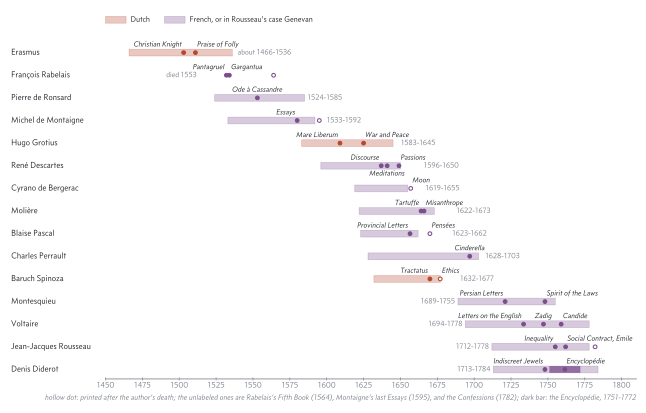
| Philosopher | Dates | Books in this volume | Ideas to remember | Ch. |
|---|---|---|---|---|
| Michel de Montaigne | 1533–1592 | Essays (1580, 1588, 1595): “Of Cannibals,” “Apology for Raymond Sebond” | “What do I know?”; the essay | 6 |
| Hugo Grotius | 1583–1645 | Mare Liberum (1609); On the Law of War and Peace (1625) | Freedom of the seas; natural law without God | 11 |
| René Descartes | 1596–1650 | Discourse on the Method (1637); Meditations (1641); Passions of the Soul (1649) | The cogito; doubt; dualism; the pineal gland | 10 |
| Blaise Pascal | 1623–1662 | Provincial Letters (1656–1657); Pensées (1670) | The wager; the Memorial; Jansenism | 14 |
| Baruch Spinoza | 1632–1677 | Tractatus Theologico-Politicus (1670); Ethics (1677) | God or Nature; conatus; the cherem | 14 |
| Montesquieu | 1689–1755 | Persian Letters (1721); The Spirit of the Laws (1748) | Separation of powers; virtue, honor, and fear | 20 |
| Jean-Jacques Rousseau | 1712–1778 | Two Discourses (1750, 1755); Social Contract and Emile (1762); Confessions | The general will; perfectibility; amour propre | 22 |
Michel de Montaigne. The nobleman of Périgord (1533–1592), a judge of Bordeaux’s Parlement, who retired to his tower in 1571 and was later mayor of Bordeaux. Montaigne called his chapters Essais, “attempts”,This author’s Essays popularized a genre named for the French word for "attempts." → Michel de Montaigne••• and gave the essay its name. The longest of them is his “Apology for Raymond Sebond”,This philosopher wrote "An Apology for Raymond Sebond". → Michel de Montaigne•• with his motto, “What do I know?” Taught in Chapter 6.
Hugo Grotius. The Dutch lawyer of Delft (1583–1645), who escaped from the castle of Loevestein in a book chest in 1621. Writing for the Dutch East India Company, in Mare Liberum of 1609 he defended the freedom of the seas.This thinker defended freedom of the seas in Mare Liberum. → Hugo Grotius• In On the Law of War and Peace (1625) natural law would bind even without God,This thinker wrote On the Law of War and Peace, whose “etiamsi daremus” passage considers natural law even if God did not exist. → Hugo Grotius•• “even if we should grant” that there is none. Taught in Chapter 11.
René Descartes. The Frenchman (1596–1650), schooled by the Jesuits at La Flèche, who lived in the Dutch Republic for twenty years. He wrote the Discourse on the MethodThis philosopher wrote Discourse on the Method. → René Descartes••• in 1637, the earliest of this volume’s three Discourses. He divided the world into thinking substance and extended substance.This philosopher contrasted thinking substance, res cogitans, with extended substance, res extensa. → René Descartes•• Called to teach Queen Christina at five in the morning, he died in StockholmThis philosopher tutored Queen Christina of Sweden and died shortly after arriving at her court. → René Descartes•• in February 1650. Taught in Chapter 10.
Blaise Pascal. The mathematician of Clermont (1623–1662), whose “night of fire” in 1654 left a Memorial that he sewed into his coat. His Provincial Letters defended JansenismThis thinker defended Jansenism and Antoine Arnauld in the Provincial Letters. → Blaise Pascal•• and Antoine Arnauld and mocked the Jesuits. In the notes printed as the Pensées, his wager sets finite costsThis thinker’s wager weighs finite costs of religious belief against infinite possible gains. → Blaise Pascal••• against an infinite gain. Taught in Chapter 14.
Baruch Spinoza. The lens grinder (1632–1677), born into Amsterdam’s Portuguese Jewish community, which laid its cherem on himThis philosopher received a cherem, or ban, from Amsterdam’s Jewish community. → Baruch Spinoza••• in 1656. Against Descartes’s two substances he made thought and extension attributesThis philosopher treated thought and extension as attributes of one substance rather than separate Cartesian substances. → Baruch Spinoza••• of one substance, God or Nature. His Ethics was printed after his death. Taught in Chapter 14.
Baron de Montesquieu. Charles-Louis de Secondat (1689–1755), born near Bordeaux, who inherited the title and a judge’s seat in its Parlement. His Persian Letters made him famousThis author wrote Persian Letters. → Baron de Montesquieu•• in 1721, and The Spirit of the Laws (1748) argued for the separation of powersThis philosopher advocated the separation of powers. → Baron de Montesquieu•• into legislative, executive, and judicial. Taught in Chapter 20.
Rousseau. Jean-Jacques Rousseau (1712–1778), who signed his books “Citizen of Geneva.” In 1755 he published the Discourse on Inequality,This thinker wrote Discourse on Inequality. → Rousseau••• the second of his two Discourses for the Academy of Dijon. In The Social Contract the general will is not the will of all,This thinker distinguished the general will from the will of all. → Rousseau•• the mere sum of private wants. Readers have long summed up the Second Discourse as praise of the “noble savage,” but the phrase is wrongly credited to Rousseau.The term "noble savage" is often incorrectly attributed to this thinker. → Rousseau• Taught in Chapter 22.
Books of philosophy
Twelve books and essays are answers (Table A.7). Their clues say “this work,” “this book,” “this essay,” or “this autobiography,” and they usually quote a famous sentence or describe a thought experiment: a demon, a piece of wax, a fenced field. Descartes has three books here and Rousseau four, so the surest keys are the quotation and the date. Montaigne’s two essays are both chapters of one book, the Essays.
| Book | Author | Date | To remember | Ch. |
|---|---|---|---|---|
| “Of Cannibals” | Montaigne | before 1580 | The Tupinambá of Brazil; Pyrrhus; Gonzalo’s speech in The Tempest; the joke that they wear no breeches | 6 |
| “An Apology for Raymond Sebond” | Montaigne | 1580 | Defends Sebond’s Natural Theology by doubting all reason; “What do I know?” | 6 |
| Discourse on the Method | Descartes | 1637 | Four rules; “Je pense, donc je suis,” in French | 10 |
| Meditations on First Philosophy | Descartes | 1641 | Dreams, the evil demon, the wax, the chiliagon; seven sets of objections | 10 |
| The Passions of the Soul | Descartes | 1649 | Animal spirits; the pineal gland; letters with Elisabeth; his last book | 10 |
| Pensées | Pascal | 1670 | Notes printed after his death: the wager; “the heart has its reasons” | 14 |
| Tractatus Theologico-Politicus | Spinoza | 1670 | Freedom to philosophize; Moses did not write all the Pentateuch | 14 |
| Ethics | Spinoza | 1677 | Geometrical order; “Of God”; “Of Human Bondage” and “Of Human Freedom” | 14 |
| Discourse on Inequality | Rousseau | 1755 | Natural against political inequality; the first man who fenced a field | 22 |
| The Social Contract | Rousseau | 1762 | “Man is born free”; the general will; the civil religion | 22 |
| Emile | Rousseau | 1762 | An imagined boy’s education; Sophie; the Savoyard Vicar | 22 |
| Rousseau’s Confessions | Rousseau | 1782, 1789 | Named after Augustine’s; the stolen ribbon and Marion | 22 |
“Of Cannibals”. Montaigne’s essay on the Tupinambá of Brazil, written shortly before 1580. It sets the Tupinambá beside the Europeans,This essay unfavorably compares Europeans with Brazil's Tupinambá people. → "Of Cannibals"•• point by point, and the Europeans lose. In John Florio’s English it reached Shakespeare, and he gave a passage of it to GonzaloA speech in Shakespeare's The Tempest draws on this essay. → "Of Cannibals"• in The Tempest. Taught in Chapter 6.
“An Apology for Raymond Sebond”. The twelfth chapter of Montaigne’s second book, as long as a short book. He sets out to defend Sebond’s Natural TheologyThis essay defends Raymond Sebond's Natural Theology. → "An Apology for Raymond Sebond"•• by showing that every other human argument is just as weak. Its doubt leaves room only for faith, and it gives his motto, “What do I know?”This essay asks "What do I know?" → "An Apology for Raymond Sebond"•• Taught in Chapter 6.
Discourse on the Method. Descartes’s first book, printed in French in 1637 as the preface to three essays, among them his Geometry. It gives four rules of method, and its Part 4 first prints “Je pense, donc je suis.”This work first presents “Je pense, donc je suis” (“I think, therefore I am”). → Discourse on the Method•• It is not either of Rousseau’s Discourses. Taught in Chapter 10.
Meditations on First Philosophy. Descartes’s six meditations, printed in Latin at Paris in 1641. The First doubts the senses and dreams and imagines “some malignant demon”;This work imagines an evil demon deceiving its author’s senses. → Meditations on First Philosophy••• the Second melts a piece of wax. Six sets of objections were printed with them, and a seventh in 1642; Gassendi wrote the Fifth,Pierre Gassendi authored one of seven sets of objections appended to this work. → Meditations on First Philosophy•• the longest. Taught in Chapter 10.
The Passions of the Soul. Descartes’s last book, printed in November 1649 after he had left for Sweden. It grew out of his lettersThis work grew out of correspondence with Princess Elisabeth of Bohemia. → The Passions of the Soul•• with Princess Elisabeth of Bohemia, and it makes the pineal gland the principal seatThis work assigns the pineal gland a central role in interactions between soul and body. → The Passions of the Soul• where soul and body act on each other. Taught in Chapter 10.
Pensées. Pascal’s notes for a defense of Christianity, printed after his death, in 1670, in an order no one is sure he meant. They hold the wager and “the eternal silence of these infinite spaces”,This work declares, “The eternal silence of these infinite spaces frightens me.” → Pensées•• which frightened him. One line says “the heart has its reasons,”This work says that “the heart has its reasons, which reason does not know.” → Pensées•• which reason does not know. Taught in Chapter 14.
Tractatus Theologico-Politicus. Spinoza’s treatise of 1670, printed without his name. It argues for the freedom to philosophize,This work argues for freedom to philosophize without endangering piety or public peace. → Tractatus Theologico-Politicus•• since true religion and a peaceful state both need it. Reading Scripture as a naturalist reads nature, from its language and its history, it denies that Moses wroteThis work denies that Moses wrote the entire Pentateuch. → Tractatus Theologico-Politicus•• the whole Pentateuch. Taught in Chapter 14.
Ethics. Spinoza’s great work, printed in 1677, after his death. He built it on Euclid’s model,This work presents its arguments in geometrical order through definitions, axioms, and propositions modeled on Euclid. → Ethics••• with definitions, axioms, and proofs; Part I is “Of God,” and the last two parts are “Of Human Bondage”This book contrasts “Human Bondage” with “Human Freedom” in the titles of its final two parts. → Ethics••• and “Of Human Freedom.” Taught in Chapter 14.
Discourse on Inequality. Rousseau’s Second Discourse (1755), which lost the Academy of Dijon’s prize. It separates natural inequality from political inequality, and its second part begins with the first man who fenced a fieldThis work traces civil society to the first person who fenced land and declared, “This is mine.” → Discourse on Inequality••• and said “This is mine.” Taught in Chapter 22.
The Social Contract. Rousseau’s book of April 1762, whose first chapter opens “Man is born free”This work opens, “Man is born free, and everywhere he is in chains.” → The Social Contract••• and goes on, in G. D. H. Cole’s English, “and everywhere he is in chains.” It sets the general will against the will of all and separates the sovereign people from the government.This work distinguishes the sovereign body of citizens from the government that administers its laws. → The Social Contract• Taught in Chapter 22.
Emile. Rousseau’s book of May 1762 on the education of an imagined boy, from birth to marriage. It contains the Savoyard Vicar’s “Profession of Faith,”This work contains the “Profession of Faith of the Savoyard Vicar.” → Emile•• for which it was burned in Paris and Geneva, and in it Sophie is introduced as Emile’s intended.This work introduces Sophie as the intended companion of its title pupil. → Emile• Taught in Chapter 22.
Rousseau’s Confessions. The story of his own life, written from 1765 to 1770 and printed in 1782 and 1789. He named it after Augustine’s,This autobiography takes its title from Augustine’s earlier work. → Rousseau’s Confessions• and it tells how he stole a ribbon and blamedThis autobiography recounts stealing a ribbon and blaming the servant Marion. → Rousseau’s Confessions•• Marion, the young cook. Taught in Chapter 22.
Ideas, arguments, and movements
Fifteen answers are ideas, kinds of writing, and movements (Table A.8). Their clues say “this concept,” “this position,” “this statement,” “this field,” “this movement,” or “these things,” and many share a word with a book. The question’s first words decide: “this book” wants the Ethics, “this field” wants ethics; “this work” wants The Social Contract, “this concept” the social contract. Most come from Descartes and Rousseau.
| Answer | What it is | In this volume | Ch. |
|---|---|---|---|
| essay | a short prose form | Montaigne’s Essais, “attempts” | 6 |
| death | the subject of an essay | “That to Philosophize Is to Learn to Die” | 6 |
| the Cogito | “I think, therefore I am” | First in the Discourse (1637); Kierkegaard, Foucault, Derrida | 10 |
| dualism | mind and body two kinds of thing | Descartes’s substance dualism; Elisabeth’s interaction problem | 10 |
| the mind | the thinking substance | Set against the body; Ryle’s “ghost in the machine” | 10 |
| ontological argument | God proved from the idea of God | The Fifth Meditation; named by Kant | 10 |
| machines | what Descartes called animals | “A machine made by the hands of God” | 10 |
| causation | cause and effect | Malebranche’s occasionalism: God the only true cause | 14 |
| existence of God | a proposition | What Pascal’s wager bets on | 14 |
| ethics | how we ought to live | The field that names Spinoza’s book | 14 |
| dictionary | a reference book | Bayle’s Historical and Critical Dictionary (1697) | 20 |
| the Enlightenment | a movement of the 1600s and 1700s | Reason above tradition; the philosophes | 20 |
| social contract | an agreement that founds a state | Hobbes, Locke, and Rousseau’s title | 22 |
| contracts | agreements | Rousseau’s “social” kind | 22 |
| education | a subject | Emile, or On Education | 22 |
Essay. The short prose form that Montaigne named, for he took the word from essayer, “to try”:Montaigne popularized this literary form, whose name derives from the French verb “to try.” → essay• each chapter tried out his judgment on a subject without promising to settle it. Taught in Chapter 6.
Death. The subject of Montaigne’s essay “That to Philosophize Is to Learn to Die,”Michel de Montaigne wrote an essay arguing "That to Study Philosophy is to Learn to" undergo this process. → death•• whose title comes from Cicero: a man who has learned not to fear death cannot be made a slave. Taught in Chapter 6.
The Cogito. Descartes’s “I think, therefore I am,” the first certainty his doubt could not shake. It first appeared in the Discourse,This statement was first formulated in Discourse on the Method. → the Cogito• in French, in 1637. Later critics took it apart: Kierkegaard called it a tautology,Kierkegaard called this statement tautological in Concluding Unscientific Postscript because it presupposes its subject’s existence. → the Cogito• and Foucault and Derrida argued over whether it shut out madness. Taught in Chapter 10.
Dualism. The view that mind and body are two different kinds of thing. Descartes defended substance dualism,Descartes defended the substance form of this position, separating thinking mind from extended body. → dualism•• in which either could exist without the other, and Elisabeth of Bohemia asked how an unextended mind could move a body. Taught in Chapter 10.
The mind. The thinking thing that Cartesian dualism sets against the body.Cartesian dualism contrasts this thing with the body. → the mind•• Gilbert Ryle mocked it as “the ghost in the machine.” Taught in Chapter 10.
Ontological argument. The proof of God from the idea of God alone. The Fifth Meditation gives a version;A version of this argument appears in the fifth section of Descartes's Meditations on First Philosophy. → ontological argument• Kant named the argument some 140 years later. Descartes’s other proof, in the Third Meditation, argues from the cause of the idea. Taught in Chapter 10.
Machines. What Descartes thought animals were: animals are machines without souls,According to Descartes, since animals do not have souls, they are essentially these things. → machines• “a machine made by the hands of God,” with no thoughts. Taught in Chapter 10.
Causation. The relation that occasionalism denied to created things. Malebranche taught that no created thing is a true efficient cause:Occasionalists argued that unlike God, created substances cannot be agents of the efficient type of this phenomenon. → causation• God alone acts, and a ball, a fire, or a will is only the occasion of his acting. Taught in Chapter 14.
Existence of God. The proposition on which Pascal’s wager bets. Since the wager weighs infinite gainPascal’s wager favors belief in this proposition by weighing possible infinite rewards. → existence of God•• against a finite cost, Pascal concludes that a reasonable gambler must bet that God exists. Taught in Chapter 14.
Ethics. The branch of philosophy that asks how we ought to live. Spinoza named his great work for it,Baruch Spinoza's magnum opus is titled after this field. → ethics••• so “this book” wants the Ethics and “this field” wants ethics. Taught in Chapter 14.
Dictionary. The kind of book in which Pierre Bayle, a Huguenot exile in Rotterdam, put his boldest arguments: his Historical and Critical DictionaryPierre Bayle wrote a “Historical and Critical” one of these works. → dictionary• of 1697. Taught in Chapter 20.
The Enlightenment. The movement of the late seventeenth and eighteenth centuries that tested religion, government, and morals by reason. Its French writers called themselves philosophes,Thinkers called philosophes were active during this movement. → the Enlightenment• the French word for philosophers. Taught in Chapter 20.
Social contract. The agreement that, in Hobbes, Locke, and Rousseau, founds civil societyThis concept explains political authority through an agreement establishing civil society. → social contract•• and gives a government its right to rule. Rousseau’s book of 1762 takes it for its title. Taught in Chapter 22.
Contracts. The agreements of which Rousseau proposed a “social” kind;Jean-Jacques Rousseau proposed the "social" form of these constructs. → contracts• a clue that asks for “these constructs” wants the plural word. Taught in Chapter 22.
Education. The subject of Emile, or On Education (1762), in which Rousseau wrote about raising an imagined boy,Jean-Jacques Rousseau wrote about this subject in Émile. → education•• Emile, from birth to marriage. Taught in Chapter 22.
Erasmus, Rabelais, and Ronsard
Nine answers belong to the French and Dutch Renaissance in letters (Table A.9). Clues say “this author,” “this work,” “this character,” “this poem,” or “these creatures,” and the trap is Rabelais’s book, which is an answer as a whole and through its people. Gargantua and Pantagruel is the five-book work; the two title characters, father and son, are giants; and Panurge, the busiest character in the last three books, is not a giant at all.
| Answer | Who or what | To remember | Ch. |
|---|---|---|---|
| Desiderius Erasmus | Dutch humanist, about 1466–1536 | Adages; Manual of a Christian Knight (1503); The Praise of Folly (1511); the Greek New Testament (1516) | 4 |
| humanism | a movement of scholars | The Greek and Latin classics and the Bible read in their own languages | 4 |
| François Rabelais | friar and doctor, died 1553 | Gargantua and Pantagruel; Bakhtin’s carnival | 4 |
| Gargantua and Pantagruel | five books, 1532–1564 | Thélème’s “Do What Thou Wilt”; Picrochole; Friar John; frozen words; the Holy Bottle | 4 |
| giants | the title characters | Gargantua the father, Pantagruel the son | 4 |
| Panurge | Pantagruel’s friend | Dindenault’s sheep; asks the Holy Bottle whether to marry | 4 |
| syphilis | a disease | The “French disease,” which swept Europe from 1495 | 4 |
| Pierre de Ronsard | poet, 1524–1585 | Leader of the Pléiade; Cassandre Salviati | 4 |
| “Ode à Cassandre” | an ode, 1553 | “Mignonne, allons voir si la rose”; stepmother Nature | 4 |
Desiderius Erasmus. The Dutch humanist of Rotterdam (about 1466–1536), the most famous scholar in Europe. In 1503 his Manual of a Christian Knight urged readers to look beyond the rites of religion,This thinker wrote Manual of a Christian Knight urging people to look beyond the rites of religion. → Desiderius Erasmus• and in 1511 he printed The Praise of Folly,This author wrote In Praise of Folly. → Desiderius Erasmus•• in which Folly praises herself. He wrote it at Thomas More’s house. Taught in Chapter 4.
Humanism. The movement of scholars who studied the Greek and Latin classics and the Bible in their original languages, to recover what the ancients had meant. Erasmus’s Praise of FollyErasmus’s Praise of Folly is associated with this intellectual movement. → humanism• is the best-known satire the movement produced. Taught in Chapter 4.
François Rabelais. The friar, doctor, and humanist from a farm near Chinon, who died in Paris in 1553. He wrote Gargantua and Pantagruel.This author wrote Gargantua and Pantagruel. → François Rabelais•• In a study printed in 1965, in English as Rabelais and His World, Mikhail Bakhtin read him through carnivalMikhail Bakhtin discusses the "grotesque body" and "carnivalesque" in his book about this author. → François Rabelais•• and the “grotesque body.” Taught in Chapter 4.
Gargantua and Pantagruel. Rabelais’s comic work about two giants, in five books printed over thirty-two years,This work is a pentalogy. → Gargantua and Pantagruel• from 1532 to 1564. Gargantua beats Picrochole and builds the Abbey of Thélème, whose only rule is “Do What Thou Wilt.”In this work, the Abbey of Thélème follows the sole rule "Do what thou wilt." → Gargantua and Pantagruel••• Its last book ends at the Oracle of the Holy Bottle. Taught in Chapter 4.
Giants. What Gargantua and his son Pantagruel are: both title characters are giants,The title characters of François Rabelais' Gargantua et Pantagruel are these creatures. → giants• so big that Pantagruel shelters an army from the rain under his tongue. Taught in Chapter 4.
Panurge. Pantagruel’s human friend, a rogue, who takes over the last three books. He throws Dindenault’s sheep overboard,This character throws Dindenault's sheep overboard, causing the flock and merchant to drown. → Panurge•• and the merchant drowns with them. Later he seeks the Oracle of the Holy BottleThis character seeks the Oracle of the Holy Bottle to resolve whether he should marry. → Panurge•• to learn whether he should marry. Taught in Chapter 4.
Syphilis. The pox that had swept Europe since 1495, called the “French disease”This disease is also known as the "French disease." → syphilis• in this age. In Candide, Pangloss catches it from Paquette. Taught in Chapter 4.
Pierre de Ronsard. The poet from near Vendôme (1524–1585), leader of the Pléiade, who met Cassandre Salviati at a ball at Blois in 1545 and made her the lady of his sonnets. He wrote “Ode à Cassandre.”This author wrote "Ode à Cassandre." → Pierre de Ronsard• Taught in Chapter 4.
“Ode à Cassandre”. Ronsard’s ode of three stanzas, printed in 1553 and known by its first line, “Mignonne, allons voir si la rose.” The rose has withered in a day, and the speaker curses Nature as a stepmotherThis poem’s speaker curses "un-motherly Nature." → "Ode à Cassandre"• for it. Taught in Chapter 4.
Molière, Cyrano, and Perrault
Seventeen answers come from the stage and the books of Louis XIV’s age, fifteen of them from Molière (Table A.10). Clues say “this play,” “this character,” “this author,” or “this language,” and the trap is the title that is also a name. Tartuffe the play and Tartuffe the hypocrite are separate answers, and so are The Imaginary Invalid and Argan, The Misanthrope and Alceste, and The Bourgeois Gentleman and Jourdain. Molière also reused names: three men called Cléante live in three different plays. Figure A.4 sets the plays in order.
| Answer | Kind, date | To remember | Ch. |
|---|---|---|---|
| Cyrano de Bergerac | writer, 1619–1655 | The Comical History of the States and Empires of the Moon (1657) | 8 |
| Molière | playwright, 1622–1673 | Jean-Baptiste Poquelin; the King’s Troupe from 1665; died after playing Argan | 16 |
| French | a language | Molière wrote every play in it, many in rhymed alexandrines | 16 |
| The School for Wives | play, 1662 | Arnolphe raises Agnès to marry her; Horace marries her | 16 |
| Tartuffe | play, 1664, 1669 | Banned five years; The Impostor (1667) renames the hero Panulphe; the king’s officer arrests him | 16 |
| Tartuffe | the hypocrite | The flea, the handkerchief, the licorice, “secret sinning” | 16 |
| Orgon | Tartuffe’s dupe | Elmire’s husband; Cléante’s brother-in-law; hides under the table | 16 |
| Don Juan | the seducer, 1665 | An atheist in Molière’s play | 16 |
| The Misanthrope | play, 1666 | Célimène’s letters drive off all her suitors but one | 16 |
| Alceste | the misanthrope | Scorns Oronte’s sonnet; loves Célimène | 16 |
| The Doctor in Spite of Himself | play, 1666 | A woodcutter, Sganarelle, beaten until he admits he is a doctor | 16 |
| The Miser | play, 1668 | Harpagon is his son Cléante’s secret lender; the stolen cash box | 16 |
| The Bourgeois Gentleman | play, 1670 | Music by Lully; Cléonte as a Turkish prince | 16 |
| Jourdain | the social climber | Has spoken prose for forty years without knowing it | 16 |
| The Imaginary Invalid | play, 1673 | Angélique, Cléante, and Toinette; the mock-Latin ceremony | 16 |
| Argan | the hypochondriac | Plays dead to test his wife; Molière’s last role | 16 |
| “Cinderella” | tale, 1697 | Perrault’s fairy godmother and glass slipper; vair or verre | 15 |
Cyrano de Bergerac (author). Savinien de Cyrano de Bergerac (1619–1655), a soldier and freethinker of Paris. He wrote The Comical HistoryThis author wrote The Comical History of the States and Empires of the Moon. → Cyrano de Bergerac (author)•• of the States and Empires of the Moon, the story of a voyage told by a narrator named Cyrano, printed in 1657, two years after his death. Rostand made him the long-nosed hero of a play in 1897 (Vol. 18, Paris, Capital of the Arts). Taught in Chapter 8.
Molière. Jean-Baptiste Poquelin (1622–1673), a Parisian who became an actor in 1643, toured the provinces for thirteen years, and from 1658 led a company in Paris. Louis XIV became his patron,King Louis XIV was this author's real-life patron. → Molière• and in 1665 the company became the King’s Troupe. He fell ill playing ArganThis author died after becoming ill while performing the role of Argan. → Molière••• at the fourth performance of The Imaginary Invalid and died that night. Taught in Chapter 16.
French. The language in which Molière wrote every play,Molière wrote in this language. → French•• some in prose and some, such as Tartuffe and The Misanthrope, in rhymed lines of twelve syllables. A clue that asks which country Molière came from wants France. Taught in Chapter 16.
The School for Wives. Molière’s first full-length masterpiece, five acts in verse, opened on December 26, 1662. Arnolphe raises Agnès in seclusionIn this play, Arnolphe raises Agnès in seclusion to make her an innocent wife. → The School for Wives•• to be an innocent wife for himself, and the young Horace marries her instead. Taught in Chapter 16.
Tartuffe (play). Molière’s comedy of a religious hypocrite in the Paris house of Orgon, first played in 1664 and banned until 1669. In the version of 1667, The Impostor, Molière renamed the hypocrite Panulphe.A revised version of this play had the title character renamed Panulphe. → Tartuffe• At the end the king’s officer arrests TartuffeThis play ends with the title hypocrite being arrested by order of the king. → Tartuffe••• instead of Orgon. Taught in Chapter 16.
Tartuffe. The title character, the stranger whom Orgon has taken into his house as a holy man. He is a religious hypocriteThis character is a religious hypocrite. → Tartuffe••• who uses the language of devotion to reach for Orgon’s daughter, his wife, and his house. Courting Elmire, he gives his rule of life, in Curtis Hidden Page’s translation: “secret sinning is not sin at all.”This character declares that "secret sinning is no sin at all." → Tartuffe•• Taught in Chapter 16.
Orgon. The rich Parisian whom Tartuffe dupes, Elmire’s husband and Cléante’s brother-in-law.This character is Cléante's brother-in-law. → Orgon• He disinherits his son and orders his daughter to marry the hypocrite, until he hides under the tableThis character hides under a table to hear a hypocrite attempt to seduce his wife. → Orgon••• and hears Tartuffe court his wife. Taught in Chapter 16.
Don Juan. The legendary seducer whom the Spanish playwright Tirso de Molina put on the stage (Vol. 10, Rebirth). In Molière’s play of 1665, Don Juan is an atheist,This character was controversially depicted as an atheist in a play by Molière. → Don Juan• which shocked its audience more than any of his seductions. Taught in Chapter 16.
The Misanthrope. Molière’s verse comedy of June 4, 1666, five acts of conversation in the drawing room of Célimène, a young widow. Her letters drive off her suitorsIn this play, Célimène's letters to several suitors cause all but one to desert her. → The Misanthrope• one by one, until only Alceste is left. Taught in Chapter 16.
Alceste. The misanthrope, honest to the point of rudeness. He is summoned for scorning Oronte’s sonnet,This character faces legal action for criticizing Oronte's sonnet. → Alceste••• and he loves Célimène, who will marry him but refuses to live in seclusionThis character loves Célimène, who refuses his proposal to live in seclusion. → Alceste•• with him. Taught in Chapter 16.
The Doctor in Spite of Himself. Molière’s farce of August 1666, three short acts in prose. Sganarelle’s wife tells two servants who need a doctor that her woodcutter husband is one, and they beat him until he admits it.In this play, a woman has her woodcutter husband beaten until he admits to being a doctor. → The Doctor in Spite of Himself•• Taught in Chapter 16.
The Miser. Molière’s prose comedy of September 9, 1668, about the miser Harpagon, a widower of over sixty. Cléante’s secret lender is his father,In this play, Cléante discovers that his secret lender is his father Harpagon. → The Miser•• and while the two quarrel the valet La Flèche steals the cash boxIn this play, a valet steals the title character's hidden cash box. → The Miser•• that Harpagon had buried in the garden. Taught in Chapter 16.
The Bourgeois Gentleman. Molière’s comedy of October 1670, with music and dances by Lully. Jourdain will not give his daughter Lucile to Cléonte, who is not noble, so Cléonte disguises himself as a Turkish prince.In this play, a suitor disguises himself as a Turkish prince to marry Lucille. → The Bourgeois Gentleman• Taught in Chapter 16.
Jourdain. The bourgeois social climber of The Bourgeois Gentleman, who hires masters of music, dancing, fencing, and philosophy to make him a nobleman. He learns he has been speaking proseThis character is thrilled to learn that he has been speaking prose his entire life. → Jourdain• for forty years without knowing it. Taught in Chapter 16.
The Imaginary Invalid. Molière’s last play, opened on February 10, 1673. Argan promises Angélique to Thomas Diafoirus,In this play, Angélique is promised to a doctor although she would rather marry Cléante. → The Imaginary Invalid•• though she loves Cléante, and the play ends as a mock-Latin ceremony makes Argan a doctor.This play ends with a mock-Latin ceremony making the protagonist a doctor. → The Imaginary Invalid• Taught in Chapter 16.
Argan. The hero of The Imaginary Invalid: Argan is a hypochondriac,This Molière character is a hypochondriac. → Argan•• a healthy man who believes he is always ill. When the maid Toinette has him pretend to be dead,This character pretends to be dead, revealing that his wife Béline only wants his money. → Argan•• he learns that his wife Béline wants only his money. Taught in Chapter 16.
“Cinderella”. Charles Perrault’s tale of 1697, with the fairy godmother, the ball, and the glass slipper. A disputed theory says Perrault confusedA disputed theory claims that Charles Perrault confused words meaning "fur" and "glass" in this story. → "Cinderella"• vair, fur, with verre, glass. Taught in Chapter 15.
Voltaire, Diderot, and the novels of the Enlightenment
Twelve answers are the philosophes’ fiction, its people, and two of its writers (Table A.11). The trap, as with Molière, is the book named for its hero: Candide and Candide are separate answers, and Zadig the book is asked under Voltaire’s name while Zadig the hero is an answer of his own. Diderot wrote two novels and a dialogue, and his Jacques must be kept apart from Voltaire’s Jacques the Anabaptist, a minor character of Candide.
| Answer | Kind, date | To remember | Ch. |
|---|---|---|---|
| Voltaire | writer, 1694–1778 | Letters on the English; Zadig; Candide; Treatise on Tolerance; “if God did not exist” | 21 |
| Denis Diderot | writer, 1713–1784 | Edited the Encyclopédie with d’Alembert; two novels and a dialogue | 20 |
| Persian Letters | Montesquieu’s novel in letters, 1721 | Usbek and Rica travel from Isfahan to Paris; the Troglodytes | 20 |
| Zadig | hero of Voltaire’s tale, 1747–1748 | Loses Sémire to Orcan; king of Babylon; marries Queen Astarté | 21 |
| The Indiscreet Jewels | Diderot’s novel, 1748 | Sultan Mangogul’s magic ring; the giant Experience | 20 |
| Candide | Voltaire’s novel, 1759 | From the castle in Westphalia to a farm near Constantinople; Jacques the Anabaptist; Byng | 21 |
| Candide | the hero | Kicked out for kissing Cunégonde; El Dorado; “cultivate our garden” | 21 |
| Pangloss | the tutor | “Best of all possible worlds,” after Leibniz; syphilis; hanged and survives | 21 |
| Cunégonde | the baron’s daughter | Shared by Don Issachar and the Grand Inquisitor; becomes ugly | 21 |
| the old woman | Cunégonde’s servant | Daughter of Pope Urban X; enslaved in Morocco; the siege of Azov | 21 |
| Rameau’s Nephew | Diderot’s dialogue, 1760s–1770s | “Me” and “Him” in the Café de la Régence; French against Italian music | 20 |
| Jacques the Fatalist | Diderot’s novel, 1765–1780 | A valet and his master; the “great scroll”; Madame de La Pommeraye | 20 |
Voltaire. François-Marie Arouet (1694–1778), twice sent to the Bastille, whose English exile produced the Letters on the English.This thinker wrote Letters on the English after his exile to London. → Voltaire•• In 1747 he wrote Zadig,This author wrote Zadig. → Voltaire•• an “Oriental tale,” first called Memnon, and he published Candide in 1759. He lived at Cirey, at Potsdam, and from 1758 at Ferney, fought for Jean Calas, and in a verse letter of 1769 wrote that if God did not exist,This thinker wrote "if God did not exist, it would be necessary to invent him." → Voltaire• it would be necessary to invent him. Taught in Chapter 21.
Denis Diderot. The cutler’s son of Langres (1713–1784) who edited the Encyclopédie with d’Alembert,This author edited the Encyclopédie with Jean d'Alembert. → Denis Diderot•• whose volumes came out from 1751. His fiction is two novels, The Indiscreet Jewels and Jacques the Fatalist and His Master,This author wrote Jacques the Fatalist. → Denis Diderot•• and the dialogue Rameau’s Nephew. Taught in Chapter 20.
Persian Letters. Montesquieu’s novel in letters of 1721, in which Usbek and Rica travel from Persia to FranceThis novel follows Usbek and Rica on a journey from Persia to France. → Persian Letters•• and write home about Paris. In four letters to his friend Mirza, Usbek tells the story of the Troglodytes,This novel contains the "Story of the Troglodytes." → Persian Letters• an imaginary tribe of Arabia. Taught in Chapter 20.
Zadig. The hero of Voltaire’s “Oriental tale,” printed as Memnon in 1747 and a year later as Zadig, or Destiny. Wounded beside the eye, he loses Sémire to Orcan; he wins a tournament in white armor, is proclaimed king of Babylon, and marries Queen Astarté.This character marries Queen Astarté. → Zadig•• Taught in Chapter 21.
The Indiscreet Jewels. Diderot’s first novel, printed without his name in 1748, about the magic ring of the sultan Mangogul. In a dream a giant named Experience destroys the templeIn this novel, a giant named Experience destroys the Temple of the System-Builders in the land of Hypothesis. → The Indiscreet Jewels• of the System-Builders. Taught in Chapter 20.
Candide (novel). Voltaire’s comic novel of 1759 against the optimism of Leibniz, in thirty short chapters. It opens at the baron’s castle in Westphalia,This work opens at Baron Thunder-ten-Tronckh’s castle in Westphalia. → Candide•• and after war, earthquake, the New World, and Venice it ends on a little farmThis work ends with the characters cultivating a small farm in Turkey. → Candide•• near Constantinople. Its kindest man, Jacques the Anabaptist, drowns saving a sailorIn this work, Jacques the Anabaptist drowns while trying to save a sailor. → Candide••• in the bay of Lisbon. Taught in Chapter 21.
Candide. The innocent hero, raised in the baron’s castle and taught by Pangloss, who is kicked out of the castle for kissing Cunégonde.This character is expelled from Baron Thunder-ten-Tronckh’s castle for kissing Cunegonde. → Candide••• He survives the Bulgarian army, the Lisbon earthquake, and an auto-da-fé, visits El Dorado with Cacambo, and at the end concludes that “we must cultivate our garden.”This character concludes "we must cultivate our garden." → Candide••• Taught in Chapter 21.
Pangloss. Candide’s tutor, the teacher of “metaphysico-theologo-cosmolo-nigology,” who insists through every disaster that all is for the best. His “best of all possible worlds” parodies Leibniz,This character’s claim that this is "the best of all possible worlds" parodies Leibniz. → Pangloss••• the German philosopher (Vol. 14, From Luther to Mozart). In Lisbon he is hanged at an auto-da-fé and survives; before that he caught syphilis from Paquette,This character contracts syphilis from the maid Paquette, to whom he teaches "experimental physics." → Pangloss•• the maid. Taught in Chapter 21.
Cunégonde. The daughter of Baron Thunder-ten-Tronckh,This character is the daughter of Baron Thunder-ten-Tronckh. → Cunégonde•• whom Candide loves. Don Issachar and the Grand Inquisitor share her until Candide kills them both. At the end she has become ugly,This character becomes ugly. → Cunégonde•• and Candide marries her all the same. Taught in Chapter 21.
The old woman (Candide). Cunégonde’s servant, who appears after the earthquake and tells her story: she is the daughter of Pope Urban X.This character is the illegitimate daughter of Pope Urban X and the Princess of Palestrina. → the old woman (Candide)••• Enslaved in Morocco, she lost a buttock at AzovTurkish soldiers cut off and eat this character’s buttock during the siege of Azov. → the old woman (Candide)••• to starving janissaries. Taught in Chapter 21.
Rameau’s Nephew. Diderot’s dialogue between “Me” and “Him,” begun in the early 1760s, which he never published. The narrator argues with the composer’s nephew,The narrator of this work argues with the eccentric relative of a famous French composer. → Rameau's Nephew•• a ruined musician, for a whole afternoon, and it is set in the Café de la Régence.This work is set in the Café de la Régence. → Rameau's Nephew•• Taught in Chapter 20.
Jacques the Fatalist. Diderot’s novel of a valet and his nameless master riding across France, written between 1765 and 1780. Jacques insists that everything is written on the “great scroll”In this novel, the title character insists that everything is written on a "great scroll" in the sky. → Jacques the Fatalist•• above. Among the stories told on the road, Madame de La Pommeraye tricks a marquisIn this novel, Madame de la Pommeraye tricks the Marquis des Arcis into marrying a prostitute. → Jacques the Fatalist• into marrying a prostitute. Taught in Chapter 20.
Composers and instruments
Ten answers are composers, a family, a Mass, and two instruments (Table A.12). Clues say “this composer,” “this mass,” or “this instrument,” and they usually name a work. The traps are family names. Two Couperins are answers, the uncle and the nephew, as well as the family itself, and three Rameaus appear in this volume and the Toolkit: the composer, his nephew in Diderot’s dialogue, and a dancing master.
| Answer | Dates | To remember | Ch. |
|---|---|---|---|
| Johannes Ockeghem | died 1497 | Served three French kings; Missa cuiusvis toni, singable in several modes | 2 |
| Missa prolationum | 1400s | Ockeghem’s Mass of mensuration canons | 2 |
| Josquin des Prez | about 1450–1521 | Missa Hercules dux Ferrariae, its theme from the duke’s vowels | 2 |
| Louis Couperin | about 1626–1661 | The uncle; organist of Saint-Gervais; the unmeasured prelude | 17 |
| Jean-Baptiste Lully | 1632–1687 | Born in Florence; ruled Louis XIV’s music; killed by his own conducting staff | 17 |
| François Couperin | 1668–1733 | “Le Grand”; 27 ordres; The Art of Playing the Harpsichord; two Apotheoses | 17 |
| Couperin | the family | Organists of Saint-Gervais for 173 years | 17 |
| Jean-Philippe Rameau | 1683–1764 | Treatise on Harmony (1722); Hippolyte et Aricie (1733) | 17 |
| harpsichord | an instrument | Couperin’s treatise and “The Mysterious Barricades” | 17 |
| flute | an instrument | The Baroque traverso; Hotteterre’s manual (1707); Blavet | 17 |
Johannes Ockeghem. The composer from Saint-Ghislain in Hainaut, born between about 1410 and 1430. He served three kings of France, Charles VII, Louis XI, and Charles VIII, and died in 1497. He wrote the canonic Missa prolationum,This composer wrote the canonic Missa prolationum. → Johannes Ockeghem•• and his Missa cuiusvis toni, the “Mass in any mode,” can be sung in several modes,This composer wrote Missa cuiusvis toni, which can be performed in several different modes. → Johannes Ockeghem• as the singers choose their clefs. Taught in Chapter 2.
Missa prolationum. Ockeghem’s Mass, in which pairs of mensuration canonsPairs of mensuration canons, using different simultaneous meters, structure this Ockeghem mass. → Missa prolationum•• run through most movements: in each pair two voices sing one written line at two different speeds. Taught in Chapter 2.
Josquin des Prez. The greatest composer of the next generation (about 1450–1521), who served the Sforza, the pope, and Ercole d’Este, Duke of Ferrara. In his Missa Hercules dux Ferrariae the vowels of the duke’s name became the theme.This composer used the vowels of the Duke of Ferrara’s name to derive the theme of Missa Hercules dux Ferrariae. → Josquin des Prez•• Taught in Chapter 2.
Louis Couperin. François’s uncle (about 1626–1661), organist of Saint-Gervais in Paris, who pioneered the unmeasured preludeThis composer pioneered unmeasured preludes for the harpsichord. → Louis Couperin•• for the harpsichord, written in whole notes without bar lines or rhythm. He never published a note. Taught in Chapter 17.
Jean-Baptiste Lully. The Florentine-born composer (1632–1687) who became a French subject in 1661 and ruled the music of Louis XIV’s court. Conducting his Te Deum in January 1687, he struck his foot with his staff,This composer died after injuring his foot with a staff while conducting his Te Deum. → Jean-Baptiste Lully•• and he died of gangrene. Taught in Chapter 17.
François Couperin. The nephew (1668–1733), organist to the king, called “le Grand,” “the Great,”This composer was known as "Le Grand" to distinguish him from his musical relatives. → François Couperin• to tell him from his relatives. He wrote twenty-seven ordres for harpsichord and two Apotheoses. The first, Le Parnasse, honored CorelliThis composer wrote a grand trio sonata called Le Parnasse, or the Apotheosis of Corelli. → François Couperin•• in 1724, and in the second, of 1725, Apollo welcomes Lully to Parnassus and makes peace between him and Corelli: The Apotheosis of Lully.This composer wrote The Apotheosis of Lully. → François Couperin• Taught in Chapter 17.
Couperin. The family of musicians from Chaumes-en-Brie who held the organ of Saint-Gervais for 173 years. François “le Grand” and his uncle LouisFrançois "le Grand" and his uncle Louis shared this musical family name. → Couperin• are its two answers. Taught in Chapter 17.
Jean-Philippe Rameau. The composer and theorist (1683–1764), a Frenchman of the provinces, who settled in Paris in 1722 and that year published the Treatise on Harmony.This composer wrote Treatise on Harmony. → Jean-Philippe Rameau•• His first opera, Hippolyte et Aricie (1733), set his admirers against Lully’s. Taught in Chapter 17.
Harpsichord. The plucked keyboard instrument of the French court, for which Couperin wrote The Art of Playing the HarpsichordFrançois Couperin wrote a treatise on the art of playing this instrument. → harpsichord•• in 1716. A year later he published “The Mysterious Barricades” for it,Couperin's The Mysterious Barricades was written for this instrument. → harpsichord•• in the broken style of the lute. Taught in Chapter 17.
Flute. The transverse flute, remade by the woodwind makers of Paris late in the 1600s; players still call its Baroque form the traverso.This instrument’s transverse Baroque form was called the traverso or traversière. → flute••• Hotteterre wrote its first widely used manual in 1707. Taught in Chapter 17.
Painters from van Eyck to Bruegel
Six painters of the Burgundian and Habsburg Netherlands are answers, from Robert Campin of Tournai to Pieter Bruegel of Antwerp and Brussels (Table A.13). A clue says “this artist” or “this painter” and nearly always names a picture, so the surest way to know the painter is to know the pictures, which the next group sorts. The town helps too: each of these men belonged to one. Figure A.5 sets all eighteen painters and the one sculptor of the volume in order, from Campin to Houdon.
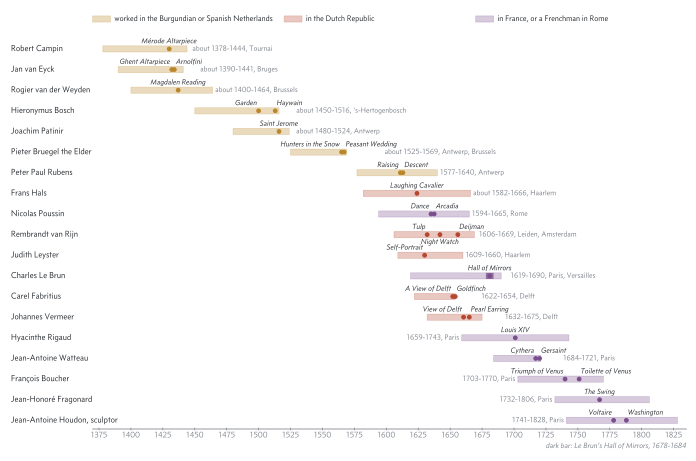
| Painter | Dates | Worked in | Best-known works | Ch. |
|---|---|---|---|---|
| Robert Campin | about 1378–1444 | Tournai | The Mérode Altarpiece, from his workshop; the Master of Flémalle | 2 |
| Jan van Eyck | about 1390–1441 | Bruges | Ghent Altarpiece (1432); Arnolfini Portrait (1434); Madonna of Chancellor Rolin | 1 |
| Rogier van der Weyden | about 1400–1464 | Brussels | The Magdalen Reading; Campin’s pupil | 2 |
| Hieronymus Bosch | about 1450–1516 | ’s-Hertogenbosch | The Garden of Earthly Delights; The Haywain; Ship of Fools; Death and the Miser | 3 |
| Joachim Patinir | about 1480–1524 | Antwerp | Charon Crossing the Styx; Landscape with Saint Jerome | 3 |
| Pieter Bruegel the Elder | about 1525–1569 | Antwerp; Brussels from 1563 | Icarus; The Hunters in the Snow; The Peasant Wedding; Netherlandish Proverbs | 7 |
Robert Campin. The painter of Tournai (about 1378–1444), a French town inside the Burgundian lands. On a chain of reasoning through his pupils, the Master of Flémalle was Campin,This artist is commonly identified with the Master of Flémalle. → Robert Campin• most scholars now conclude, and the Mérode Altarpiece is attributed to his workshop.The Mérode Altarpiece is attributed to this artist’s workshop. → Robert Campin•• Rogier van der Weyden trained with him. Taught in Chapter 2.
Jan van Eyck. The painter (about 1390–1441) of Philip the Good of Burgundy, who lived at Lille and then Bruges. He finished the Ghent AltarpieceThis artist completed the Ghent Altarpiece, begun with his brother Hubert. → Jan van Eyck••• that his brother Hubert had begun, and his motto, “As I can,”This artist’s Man in a Red Turban, often considered a self-portrait, bears his motto “As I can.” → Jan van Eyck•• runs across the top of the Man in a Red Turban, often thought a self-portrait. A clue that asks only the surname may mean Hand G of the Turin-Milan Hours,An artist with this surname is thought to be the "Hand G" who worked on the Turin-Milan Hours. → Jan van Eyck• usually thought to be Jan. Taught in Chapter 1.
Rogier van der Weyden. Campin’s pupil (about 1400–1464), born in Tournai, who became the city painter of Brussels. His Magdalen Reading,This artist’s Magdalen Reading depicts a woman reading beside an alabaster ointment jar. → Rogier van der Weyden• a fragment in London, shows Mary Magdalene reading beside her jar of ointment. Taught in Chapter 2.
Hieronymus Bosch. Jheronimus van Aken (about 1450–1516), who took his name from ’s-Hertogenbosch in Brabant and worked there all his life. Late in his life he painted The Haywain,This artist painted The Haywain triptych. → Hieronymus Bosch•• and his Ship of Fools,This artist painted Ship of Fools. → Hieronymus Bosch•• now in the Louvre, was a wing of the triptych to which Death and the Miser also belonged. Taught in Chapter 3.
Joachim Patinir. The painter from Dinant (about 1480–1524), in Antwerp from 1515, who made the world landscape, a wide view from high above in which the saints are small. He painted Charon crossing the StyxThis artist painted Charon crossing the Styx in a panoramic landscape. → Joachim Patinir• on a river as wide as a sea, between paradise and hell. Taught in Chapter 3.
Pieter Bruegel the Elder. The painter of Antwerp and, from 1563, Brussels (about 1525–1569), who dropped the h from his name. For Niclaes Jonghelinck he painted the Labors of the Months,This artist's Labors of the Months originally consisted of six paintings, of which five survive. → Pieter Bruegel the Elder•• five of six surviving. In his Misanthrope of 1568, a thief inside a glass globeIn this artist's The Misanthrope, a thief is partially encased in a transparent sphere with a cross at the top. → Pieter Bruegel the Elder• cuts the old man’s purse. Taught in Chapter 7.
Altarpieces, panels, and tapestries, 1430–1570
Twenty answers are the pictures of the Netherlands from the Ghent Altarpiece to Bruegel, with the scenes, figures, and medium they show (Table A.14). Clues say “this altarpiece,” “this triptych,” “this painting,” or “this series,” and they describe what is in the picture, panel by panel. The traps are pairs: two Annunciations, two unicorn sets, two Bosch triptychs, and a subject asked both as itself and as a painting. A clue for “this scene” or “this figure” wants the subject; “this triptych” or “this painting” wants the picture.
| Answer | Artist, date | To look for | Ch. |
|---|---|---|---|
| Mérode Altarpiece | Campin’s workshop, about 1427–1432 | Annunciation in a Flemish room; donors; Joseph’s mousetraps | 2 |
| Ghent Altarpiece | Hubert and Jan van Eyck, 1432 | Saint Bavo’s; the Lamb and the fountain; Adam’s foot; Eve’s citrus; singing angels; the stolen Just Judges | 1 |
| the Annunciation | a Gospel scene | On the closed Ghent Altarpiece; in the Mérode’s center | 1 |
| The Arnolfini Portrait | Jan van Eyck, 1434 | Convex mirror; “Jan van Eyck was here”; one candle; clogs; oranges | 1 |
| The Madonna of Chancellor Rolin | Jan van Eyck, about 1435 | Rainbow-winged angel crowns Mary; the kneeling chancellor | 1 |
| Virgin Mary | the figure | Rolin’s commission; holds a book on the Ghent Altarpiece | 1 |
| The Last Judgment (Memling) | Hans Memling, about 1467–1471 | Saint Michael in gold armor; Angelo Tani; seized by Paul Benecke; Gdańsk | 2 |
| The Last Judgment | a scene | Christ judging souls; Memling’s triptych | 2 |
| The Hunt of the Unicorn | about 1495–1505 | Seven tapestries; the Cloisters, New York; pomegranate tree; A and E | 2 |
| The Lady and the Unicorn | about 1500 | Six tapestries; Paris; five senses; “À mon seul désir” | 2 |
| tapestry | a medium | Millefleurs grounds; both unicorn sets | 2 |
| Death and the Miser | Bosch, 1490s | Death with an arrow at the door; Washington | 3 |
| Ship of Fools | Bosch, 1490s | A nun with a lute; a tree for a mast; the Louvre | 3 |
| The Garden of Earthly Delights | Bosch, about 1490–1510 | Creation outside; Eden, the naked crowd, Hell inside; the Tree Man | 3 |
| gardens | places | The Garden’s title; Rubens’s Garden of Love | 3 |
| The Haywain | Bosch, about 1510–1516 | Angels falling as insects; the hay cart; God above; a tooth-puller | 3 |
| Landscape with the Fall of Icarus | traditionally Bruegel | The plowman plows on; legs in the sea; perhaps a copy | 7 |
| Icarus | the mythical boy | The “fall” of the painting’s title | 7 |
| The Hunters in the Snow | Bruegel, 1565 | Three hunters, their dogs, one fox; skaters | 7 |
| The Peasant Wedding | Bruegel, about 1567 | Bowls carried on a door; the child in a peacock-feathered cap | 7 |
Mérode Altarpiece. A small triptych of about 1427 to 1432 from Robert Campin’s workshop in Tournai, now in the Cloisters in New York. The center shows an Annunciation in a Flemish room;An Annunciation in a domestic room is flanked by donors and Joseph’s mousetrap workshop in this triptych. → Mérode Altarpiece•• the wings hold the kneeling donors and Joseph making mousetraps. Taught in Chapter 2.
Ghent Altarpiece. The great altarpiece in Saint Bavo’s Cathedral in Ghent,This altarpiece is housed in Saint Bavo’s Cathedral in Belgium. → Ghent Altarpiece•• begun by Hubert van Eyck, finished by Jan in 1432, and paid for by Joos Vijd and Elisabeth Borluut. Open, its center shows the Lamb bleeding into a golden chaliceWorshippers and kneeling angels surround a lamb bleeding into a chalice beside an octagonal fountain in this altarpiece’s central panel. → Ghent Altarpiece••• above an eight-sided fountain. Taught in Chapter 1.
The Annunciation. The scene in which, in the Gospel of Luke, the angel Gabriel tells Mary that she will bear the Son of God. The closed Ghent Altarpiece shows itThis scene appears on the closed view of the Ghent Altarpiece. → the Annunciation• across its outer wings, and the Mérode Altarpiece sets it in a Flemish room. Taught in Chapter 1.
The Arnolfini Portrait. Van Eyck’s double portrait of 1434, now in London, of a merchant from Lucca and a woman in a green gown in a room in Bruges. The words “Jan van Eyck was here”The artist wrote that he “was here” above a convex mirror in this painting. → The Arnolfini Portrait••• are painted above a convex mirror, and in daylight a single candle burnsOnly one candle burns in the brass chandelier in this painting. → The Arnolfini Portrait•• in the chandelier. Panofsky read it as a wedding, Koster as a memorial. Taught in Chapter 1.
The Madonna of Chancellor Rolin. Van Eyck’s picture of about 1435, painted for Nicolas Rolin’s parish church at Autun and now in the Louvre. The chancellor kneels before Mary and the Child, and an angel with rainbow wingsA rainbow-winged angel crowns Mary as a kneeling chancellor faces her and the Christ Child in this painting. → The Madonna of Chancellor Rolin•• holds a crown over her head. Taught in Chapter 1.
Virgin Mary. The mother of Jesus. About 1435 Rolin commissioned van Eyck to paint herChancellor Rolin commissioned Jan van Eyck to depict this figure. → Virgin Mary• for his church at Autun; on the open Ghent Altarpiece she sits at the enthroned figure’s side, reading. Taught in Chapter 1.
The Last Judgment (Memling). Hans Memling’s triptych of about 1467 to 1471, made in Bruges for the Medici banker Angelo Tani. In its center Saint Michael in golden armor weighs souls.Saint Michael wears golden armor and weighs souls in this triptych commissioned by Angelo Tani. → The Last Judgment (Memling)•• On its way to Italy in 1473 the privateer Paul Benecke seized itPaul Benecke captured this triptych at sea and brought it to Danzig. → The Last Judgment (Memling)•• and took it to Danzig, now Gdańsk, where it hangs today. Taught in Chapter 2.
The Last Judgment. The end of the world, when, Christians believe, Christ will judge the living and the dead. Memling’s triptych in Gdańsk depicts it,Hans Memling’s triptych in Gdańsk depicts this scene of Christ judging souls. → The Last Judgment•• so “this scene” wants the subject and “this triptych” wants Memling’s picture. Taught in Chapter 2.
The Hunt of the Unicorn. Seven tapestries of about 1495 to 1505, probably woven in Brussels, now at the Cloisters in New York. In the last, the unicorn is chained to a pomegranate treeThe final tapestry in this series shows a mythical animal chained to a pomegranate tree inside a circular fence. → The Hunt of the Unicorn•• inside a round fence, and the letters A and EThe unexplained letters A and E recur in this tapestry series. → The Hunt of the Unicorn• of an unknown patron appear in each. Taught in Chapter 2.
The Lady and the Unicorn. Six tapestries in Paris, at the Musée de Cluny, with the arms of the Le Viste family. Five of them show the senses,Five tapestries in this series depict the senses. → The Lady and the Unicorn• sight, hearing, taste, smell, and touch, and the sixth bears “À mon seul désir”,The sixth tapestry in this series bears the motto “À mon seul désir.” → The Lady and the Unicorn• “To my only desire.” Taught in Chapter 2.
Tapestry. The woven picture, made of wool, silk, and gold or silver thread. Millefleurs tapestries set their figuresThe millefleurs ("thousand flowers") style in this medium sets central figures against densely flowered backgrounds. → tapestry•• against grounds of countless small flowering plants, as in both unicorn sets. Taught in Chapter 2.
Death and the Miser. A tall, narrow panel by Bosch, now in Washington, once a wing of the same triptych as Ship of Fools. Death, a skeleton holding an arrow,A skeleton with an arrow approaches a bedridden man while a green-clad figure puts coins in a chest in this painting. → Death and the Miser•• steps through the door toward a dying man, while an old man in green drops coins into a chest. Taught in Chapter 3.
Ship of Fools (Bosch). A small panel by Bosch in the Louvre, from the other wing of the sawn-apart triptych. A nun plays a luteA nun plays a lute aboard a boat whose mast is a tree, while a man reaches toward a roast bird in this painting. → Ship of Fools (Bosch)•• in a boat whose mast is a living tree, while a friar and the nun bite at a hanging cake. Taught in Chapter 3.
The Garden of Earthly Delights. Bosch’s great triptych of about 1490 to 1510, in the Prado. Closed, it shows the third day of Creation in grisaille.The closed exterior of this triptych shows the third day of Creation as a world inside a transparent sphere, painted in grisaille. → The Garden of Earthly Delights••• Open, its left wing is Eden, where God presents Eve to Adam,God presents Eve to Adam by holding her wrist in the Paradise wing of this triptych. → The Garden of Earthly Delights••• holding her by the wrist; the center is a crowd of naked pleasure-seekers; and in Hell the pale Tree ManThe pale “Tree Man” with a hollow, cracked-eggshell torso in this triptych’s Hell panel has been proposed as the artist’s self-portrait. → The Garden of Earthly Delights••• has been proposed as Bosch’s own face. Taught in Chapter 3.
Gardens. The places of the title, since Bosch’s Garden of Earthly DelightsA Hieronymus Bosch painting depicts one of these places "of Earthly Delights." → gardens• is one of them. Rubens’s Garden of Love of about 1633 is a different painted garden. Taught in Chapter 3.
The Haywain Triptych (Bosch). Bosch’s triptych of about 1510 to 1516, in the Prado. In the left wing the rebel angels fall as insects;Falling rebel angels become insects in the left wing of this triptych. → The Haywain Triptych (Bosch)•• in the center the world grabs at a cart of hay while God looks down on the crowdGod looks down on the sinners crowding around a cartload of hay in this triptych. → The Haywain Triptych (Bosch)• unseen. Constable’s The Hay Wain (1821) is an English landscape (Vol. 15, The Age of Revolution). Taught in Chapter 3.
Landscape with the Fall of Icarus (painting). The picture traditionally given to Bruegel, though it may be an early copy of his lost original. The plowman goes on plowing,A ploughman, shepherd and fisherman ignore a drowning figure whose legs stick out of the sea in this painting. → Landscape with the Fall of Icarus (painting)••• the shepherd gazes away, and Icarus’s legs stick out of the sea in a corner. Taught in Chapter 7.
Icarus. The boy of Greek myth whose wings of feathers and wax melted when he flew too near the sun (Vol. 4, Classical Myth). A painting titled after his “fall”A painting titled after this figure's "fall" is attributed to Pieter Bruegel the Elder. → Icarus• is attributed to Bruegel. Taught in Chapter 7.
The Hunters in the Snow. Bruegel’s winter picture of 1565, one of the five surviving Labors of the Months. Three hunters trudge home with their dogs,Three hunters and their dogs return with a single fox while people skate on distant ponds in this winter landscape. → The Hunters in the Snow••• their only catch a thin fox, above skaters on frozen ponds. Taught in Chapter 7.
The Peasant Wedding. Bruegel’s feast of about 1567, seen from the end of a long table in a barn, now in Vienna. Two men carry bowls on a doorMen carry food on a door, with an apparently extra foot beneath it, in this painting. → The Peasant Wedding•• taken off its hinges, and a child in a peacock-feathered cap licks his fingers. Taught in Chapter 7.
Painters of the seventeenth century
Nine painters of the age of Rubens and Rembrandt are answers: one Fleming, five Dutch painters, and three Frenchmen (Table A.15). Their clues say “this artist” and name a picture, a wife or model, a pupil, or a theft. The commonest confusions are between two painters of one town (Hals and Leyster in Haarlem, Fabritius and Vermeer in Delft) and between the two painters whose pictures were stolen from the Gardner Museum in 1990.
| Painter | Dates | Worked in | Best-known works | Ch. |
|---|---|---|---|---|
| Peter Paul Rubens | 1577–1640 | Antwerp | The Raising of the Cross; The Descent from the Cross; the Marie de’ Medici cycle; Helena Fourment | 9 |
| Frans Hals | about 1582–1666 | Haarlem | The Laughing Cavalier; Malle Babbe; militia companies; Descartes | 12 |
| Nicolas Poussin | 1594–1665 | Rome | Et in Arcadia Ego; A Dance to the Music of Time; The Funeral of Phocion | 9 |
| Rembrandt van Rijn | 1606–1669 | Leiden; Amsterdam from 1631 | Tulp; The Night Watch; the prodigal sons; about eighty self-portraits | 12 |
| Judith Leyster | 1609–1660 | Haarlem | Her self-portrait with a fiddler; the JL and star | 12 |
| Charles Le Brun | 1619–1690 | Paris; Versailles | The Hall of Mirrors; First Painter to Louis XIV | 15 |
| Carel Fabritius | 1622–1654 | Delft | A View of Delft (1652); The Goldfinch (1654) | 13 |
| Johannes Vermeer | 1632–1675 | Delft | The Milkmaid; View of Delft; Girl with a Pearl Earring; The Art of Painting | 13 |
| Hyacinthe Rigaud | 1659–1743 | Paris | Louis XIV (1701) | 15 |
Peter Paul Rubens. The Fleming (1577–1640), born in exile at Siegen, who lived in Antwerp apart from eight years in Italy. In 1610 and 1611 he painted The Raising of the Cross,This artist painted The Raising of the Cross triptych. → Peter Paul Rubens•• and in 1612 he began, for the cathedral, The Descent from the Cross.This artist painted The Descent from the Cross for the Cathedral of Our Lady in Antwerp. → Peter Paul Rubens•• In the French Academy’s quarrel of color and drawing, the party of color took his name.A faction in the French Academy named for this artist emphasized color over drawing and feuded with the Poussinistes. → Peter Paul Rubens• Taught in Chapter 9.
Frans Hals. The portrait painter (about 1582–1666), born in Antwerp, who worked in Haarlem all his life.This artist was based in Haarlem. → Frans Hals• He painted The Laughing Cavalier, Malle Babbe, five militia companies, and Descartes, and for two hundred years Judith Leyster’s paintings were sold as his.Works by Judith Leyster were misattributed to this artist before her rediscovery in 1893. → Frans Hals•• Taught in Chapter 12.
Nicolas Poussin. The Norman painter (1594–1665) who lived in Rome from 1624, apart from two years in Paris. Taking up Guercino’s subject a second time, he painted Et in Arcadia Ego,This artist painted Et in Arcadia Ego, taking up a theme also painted by Guercino. → Nicolas Poussin•• and his Funeral of Phocion shaped the landscape around the Glass HouseThis artist's Funeral of Phocion inspired the landscape around Philip Johnson's Glass House. → Nicolas Poussin•• of Philip Johnson. Taught in Chapter 9.
Rembrandt van Rijn. The miller’s son of Leiden (1606–1669) who moved to Amsterdam in 1631. He cast himself and SaskiaThis artist portrays himself with Saskia in The Prodigal Son in the Brothel. → Rembrandt van Rijn•• in The Prodigal Son in the Brothel, and in The Return of the Prodigal Son the father lays his hands on his son’s back.In this artist's The Return of the Prodigal Son, the red-cloaked father places his hands on his kneeling son's back. → Rembrandt van Rijn•• His only seascapeThis artist’s only seascape, The Storm on the Sea of Galilee, was stolen from the Gardner Museum in 1990. → Rembrandt van Rijn•• was stolen from the Gardner Museum in 1990. Taught in Chapter 12.
Judith Leyster. The cloth maker’s daughter of Haarlem (1609–1660), admitted to its painters’ guild. She signed with the initials JL and a star,This painter signed works with her initials JL and a star. → Judith Leyster• a pun on her name, and her self-portrait turns from a laughing fiddler on her easel. Her pictures passed as Hals’s until 1893. Taught in Chapter 12.
Charles Le Brun. The Parisian (1619–1690) who was First Painter to Louis XIV and ran the Academy. He decorated the Hall of MirrorsLouis XIV employed this painter to decorate the Hall of Mirrors at Versailles. → Charles Le Brun•• at Versailles, built from 1678 to 1684. Taught in Chapter 15.
Carel Fabritius. Rembrandt’s most original pupil (1622–1654), who moved to Delft and was killed when its powder magazine exploded in October 1654. That year he painted a chained goldfinchThis artist painted a chained goldfinch perched above two wall-mounted rings. → Carel Fabritius• on its feeding box. Taught in Chapter 13.
Vermeer. Johannes Vermeer (1632–1675), who spent his whole life in Delft and painted small rooms, most of them lit by a window on the left.Most of this artist's paintings are illuminated by a window on the left. → Vermeer•• Thieves stole his ConcertThis artist's painting The Concert was stolen from the Isabella Stewart Gardner Museum in 1990. → Vermeer•• from the Gardner Museum in 1990, with Rembrandt’s Storm. Thoré-Bürger rediscovered him in 1866. Taught in Chapter 13.
Hyacinthe Rigaud. The portrait painter from Perpignan (1659–1743) who painted the king in 1701 in a blue robe sewn with gold fleurs-de-lis,This artist portrayed Louis XIV wearing a blue robe embroidered with gold fleurs-de-lis. → Hyacinthe Rigaud• holding the scepter point down. Taught in Chapter 15.
Pictures by Rubens, Poussin, Hals, and Rembrandt
Nine pictures of the seventeenth century, outside Delft, are answers (Table A.16). Their clues say “this painting,” “this portrait,” or “this cycle” and describe who stands where and what each holds. Rembrandt’s The Night Watch has more clues than any other painting of the volume except the Ghent Altarpiece, and his two anatomy lessons are the pair players mix up most.
| Answer | Artist, date | To look for | Ch. |
|---|---|---|---|
| Marie de’ Medici cycle | Rubens, 1622–1625 | Twenty-four canvases; the landing at Marseilles; Juno’s peacocks | 9 |
| The Laughing Cavalier | Hals, 1624 | Broad black hat; upturned mustache; eyes that follow you | 12 |
| The Anatomy Lesson of Dr. Nicolaes Tulp | Rembrandt, 1632 | Tulp lifts the forearm’s tendons; seven surgeons; a book at the feet | 12 |
| Malle Babbe | Hals, about 1633–1635 | “Mad Babbe”; a pewter beer mug; an owl on her shoulder | 12 |
| A Dance to the Music of Time | Poussin, about 1634–1636 | Poverty, Labor, Wealth, and Pleasure dance to Time’s lyre | 9 |
| Belshazzar’s Feast | Rembrandt, about 1635–1638 | A hand writes Hebrew letters; a woman in red spills wine | 12 |
| Et in Arcadia Ego | Poussin, about 1637–1638 | Three shepherds and a woman at a tomb | 9 |
| The Night Watch | Rembrandt, 1642 | Banninck Cocq’s company; the girl with the chicken; cut down in 1715 | 12 |
| The Anatomy Lesson of Dr. Jan Deijman | Rembrandt, 1656 | Burned in 1723; a foreshortened body before an opened brain | 12 |
Marie de’ Medici cycle. Rubens’s twenty-four huge canvases of the lifeThis cycle of twenty-four paintings celebrates the life of Henry IV’s wife. → Marie de’ Medici cycle••• of Henry IV’s widow, painted from 1622 to 1625 for her Luxembourg Palace and now in the Louvre. One shows her ceremonial landing at MarseillesThis cycle includes a ceremonial disembarkation at Marseilles. → Marie de’ Medici cycle•• in 1600; another, the portrait presented to Henry beside Juno’s peacocks. Taught in Chapter 9.
The Laughing Cavalier. Hals’s portrait of 1624, now in the Wallace Collection, of a young man in a broad black hat with his elbow thrust toward us. Because Hals painted him looking straight out, his eyes seem to follow the viewer.The smiling sitter with an upturned moustache seems to follow the viewer with his eyes in this portrait. → The Laughing Cavalier•• Taught in Chapter 12.
The Anatomy Lesson of Dr. Nicolaes Tulp. Rembrandt’s group portrait of 1632 for Amsterdam’s surgeons’ guild, painted when he was twenty-six. With forceps Tulp lifts the tendons of the forearm,The title doctor demonstrates forearm tendons with forceps before seven onlookers in this painting. → The Anatomy Lesson of Dr. Nicolaes Tulp••• and an anatomy book lies open at the dead man’s feet. Seven surgeons lean in to watchSeven physicians watch a dissection of Aris Kindt’s body, whose navel resembles an R, in this painting. → The Anatomy Lesson of Dr. Nicolaes Tulp••• the dissection of Aris Kindt’s body. Taught in Chapter 12.
Malle Babbe. Hals’s “Mad Babbe,” an old woman in a white cap who turns to grin or shout at someone outside the picture, with a pewter beer mug in her hand while an owl perches on her shoulder.A woman holding a pewter beer mug has an owl perched on her shoulder in this painting. → Malle Babbe••• Taught in Chapter 12.
A Dance to the Music of Time. Poussin’s picture of about 1634 to 1636, in the Wallace Collection, in which Poverty, Labor, Wealth, and Pleasure dancePoverty, Labor, Wealth, and Pleasure dance in a circle while winged Time plays a lyre in this painting. → A Dance to the Music of Time•• in a ring to the lyre of winged Time. Above them Aurora leads Apollo’s chariotAurora leads Apollo’s chariot across the sky above the allegorical dancers in this painting. → A Dance to the Music of Time•• across the clouds at dawn. Taught in Chapter 9.
Belshazzar’s Feast (Rembrandt). Rembrandt’s picture of the Babylonian king’s feast in the Book of Daniel (Vol. 5, In the Beginning). A hand writes glowing Hebrew lettersA disembodied hand writes glowing Hebrew letters vertically on a wall as a king recoils in this painting. → Belshazzar’s Feast (Rembrandt)•• on the wall, and the king, in a crown over a turban, recoils. Beside him a woman in red spills her drink.A red-clad woman spills a drink beside a king wearing a crown over a turban in this painting. → Belshazzar’s Feast (Rembrandt)•• Taught in Chapter 12.
Et in Arcadia Ego (Poussin). Poussin’s second picture of the subject, about 1637 to 1638, now in the Louvre. Three shepherds and a woman read the inscriptionThree shepherds and a woman inspect an inscription on a tomb in this painting. → Et in Arcadia Ego (Poussin)•• on a plain stone tomb in a quiet landscape. Taught in Chapter 9.
The Night Watch. Rembrandt’s group portrait of 1642 of Captain Frans Banninck Cocq’s militia company,This painting depicts the militia company of Captain Frans Banning Cocq. → The Night Watch••• the centerpiece of the Rijksmuseum. It shows a company stepping out by day, but darkened varnish turned the scene to night,Darkened varnish helped give this daylight scene its misleading nocturnal title. → The Night Watch•• and the name followed late in the 1700s. Taught in Chapter 12.
The Anatomy Lesson of Dr. Jan Deijman. Rembrandt’s second anatomy lesson, of 1656, for the same surgeons’ hall, burned in 1723. In the surviving fragment, a foreshortened body lies before a dissected brain.A foreshortened cadaver lies before a dissected brain in this fire-damaged painting. → The Anatomy Lesson of Dr. Jan Deijman• Taught in Chapter 12.
Vermeer and Delft
Eleven answers belong to one small town of Holland: Delft itself, seven pictures painted there, its blue, its earthenware, and the porcelain it copied (Table A.17). Clues say “this painting,” “this city,” “this color,” or “this material.” Not every picture of Delft is Vermeer’s: Fabritius painted A View of Delft eight years before Vermeer’s View of Delft (Figure A.6), and Pieter de Hooch painted The Courtyard of a House in Delft.
| Answer | Artist, date | To look for | Ch. |
|---|---|---|---|
| Delft | a town of Holland | Vermeer’s birthplace; the Delft school; Delftware; the explosion of 1654 | 13 |
| A View of Delft (Fabritius) | Fabritius, 1652 | Tiny; an instrument seller’s stall; warped perspective | 13 |
| The Milkmaid | Vermeer, about 1658 | A servant in yellow and blue pours milk; bread; a foot warmer | 13 |
| The Courtyard of a House in Delft | de Hooch, 1658 | A tablet about Saint Jerome’s vale over an archway | 13 |
| View of Delft (Vermeer) | Vermeer, about 1660–1661 | Boats on the Schie; the Nieuwe Kerk’s tower without bells | 13 |
| Girl with a Pearl Earring | Vermeer, about 1665 | A tronie; blue and yellow turban; Chevalier’s novel | 13 |
| The Art of Painting | Vermeer, late 1660s | A painter from behind; Clio; the Seventeen Provinces; a Habsburg eagle | 13 |
| The Allegory of Faith | Vermeer, about 1670–1672 | A glass sphere; a foot on a globe; a snake under a stone | 13 |
| blue | a color | Ultramarine; the girl’s turban | 13 |
| porcelain | a material | Chinese ware that Delft imitated; Sèvres | 13, 19 |
| pottery | a material | Delftware, tin-glazed and painted blue | 13 |
Delft. The town of Holland where Vermeer was born and spent his life, and where William the Silent is buried. Vermeer painted a “View of” it,Jan Vermeer painted a "View of" this city. → Delft•• as Fabritius had before him. Its potters gave the world Delftware, blue-and-white earthenware made in imitation of Chinese porcelain, so that its name is on a type of pottery.This city names a type of blue earthenware imitating Chinese porcelain. → Delft•• In 1654 a gunpowder explosion killed Carel FabritiusA gunpowder explosion in this city killed Carel Fabritius and destroyed many of his paintings. → Delft•• there. Taught in Chapter 13.
A View of Delft (Fabritius). Fabritius’s tiny picture of 1652 in London, an instrument seller’s stall, warped in perspective,A musical-instrument seller’s stall appears with distorted perspective in this small painting by Carel Fabritius. → A View of Delft (Fabritius)•• probably painted for a perspective box. Taught in Chapter 13.
The Milkmaid. Vermeer’s kitchen picture of about 1658, in the Rijksmuseum. A servant in yellow and blue pours milk,A servant in yellow and blue pours milk into a container in this painting. → The Milkmaid••• with bread and a blue jug on the table. On the floor a foot warmer stands beside the Delft tiles,A foot warmer stands beside wall tiles, including one depicting Cupid, in this painting. → The Milkmaid•• one of which shows Cupid. Taught in Chapter 13.
The Courtyard of a House in Delft. Pieter de Hooch’s picture of 1658, by a painter of the Delft school, not by Vermeer. Over an archway a tablet speaks of Saint Jerome’s vale;An inscription above an archway mentions “St. Jerome’s vale” and descending before being raised in this painting. → The Courtyard of a House in Delft•• it came from the gate of a former convent. Taught in Chapter 13.
View of Delft (Vermeer). Vermeer’s townscape of about 1660 to 1661, in the Mauritshuis, the town seen across the water. Figures and boats appear beside the SchieFigures and boats appear beside the Schie in the foreground of this Vermeer cityscape. → View of Delft (Vermeer)••• in front, and the Nieuwe Kerk’s tower has no bells,The Nieuwe Kerk’s bell tower lacks bells in this Vermeer cityscape. → View of Delft (Vermeer)•• because its new ones had not yet been hung. Taught in Chapter 13.
Girl with a Pearl Earring. Vermeer’s picture of about 1665 in the Mauritshuis, a tronie, not a commissioned portrait:This painting of a girl wearing an exotic turban is a tronie rather than a commissioned portrait. → Girl with a Pearl Earring•• a girl in a blue and yellow turban turning over her left shoulder. In 1999 Tracy Chevalier’s novelThis painting names a Tracy Chevalier novel. → Girl with a Pearl Earring•• took its title. Taught in Chapter 13.
The Art of Painting. Vermeer’s most ambitious room, of the late 1660s, which he never sold, now in Vienna. A tapestry frames a painter seen from behind,A tapestry frames a painter seen from behind at his easel in this painting. → The Art of Painting•• and his model is dressed as Clio,A model representing Clio holds a book and trumpet and wears a laurel wreath in this painting. → The Art of Painting••• Muse of history, before a map of the Seventeen Provinces. Taught in Chapter 13.
The Allegory of Faith. Vermeer’s last allegory, of about 1670 to 1672, in the Metropolitan Museum. Faith gazes at a glass sphereA woman gazes at a reflective glass sphere suspended from the ceiling in this painting. → The Allegory of Faith•• that hangs from the ceiling, and her foot rests on a globe,A woman rests her foot on a globe in front of a crucifixion picture in this painting. → The Allegory of Faith•• before a painting of the Crucifixion. Taught in Chapter 13.
Blue. The color of ultramarine, ground from the stone lapis lazuli, the costliest blue there was, which Vermeer used freely. In Girl with a Pearl Earring, the headband is blue,The headband of Vermeer's Girl with a Pearl Earring is of this color. → blue• with a strip of yellow hanging down behind. Taught in Chapter 13.
Porcelain. The fine white ware of China. Delft’s faience imitated itA variety of faience produced in Delft imitated this material. → porcelain•• after the supply from China failed in the 1620s, and in the next century the porcelain of SèvresWorks in this medium were produced at Sèvres in France. → porcelain• was the luxury of Europe. Taught in Chapter 13 and Chapter 19.
Pottery. Earthenware, the material of Delftware, tin-glazed and painted in blue. Delft’s potters imitated Asian piecesCraftsmen in Delft imitated Asian pieces in this material. → pottery• in it, copying their shapes and even their Chinese figures. Taught in Chapter 13.
Watteau, Boucher, Fragonard, and the Rococo
Ten answers belong to the French art of the eighteenth century: a style, three painters, a sculptor, four pictures, and a goddess (Table A.18). Clues say “this style,” “this artist,” “this painting,” or “this figure.” The traps are Boucher’s two pictures of Venus, one at sea and one indoors, and two Fragonards, father and son.
| Answer | Who, date | To remember | Ch. |
|---|---|---|---|
| Rococo | a style, after 1715 | Curves, shells, pastels, and pleasure; named from rocaille; Clodion | 19 |
| Jean-Antoine Watteau | 1684–1721 | From Valenciennes; painter of fêtes galantes; Pierrot | 19 |
| The Embarkation for Cythera | Watteau, 1717 | Couples, a golden boat, flying putti; his Academy picture | 19 |
| Venus | a goddess | Cythera was her island; Boucher’s Triumph and Toilette | 19 |
| Gersaint’s Shop Sign | Watteau, 1720 | Louis XIV’s portrait packed in a crate; a woman in pink | 19 |
| François Boucher | 1703–1770 | Madame de Pompadour’s painter; Triumph of Venus (1740) | 19 |
| The Toilette of Venus (Boucher) | Boucher, 1751 | For Pompadour’s Bellevue; putti dress her hair | 19 |
| Fragonard | 1732–1806 | The Progress of Love for Madame du Barry; The Bolt; Fantasy Figures | 19 |
| The Swing | Fragonard, 1767 | A slipper flies; a hidden lover; Cupid with a finger to his lips; Doyen | 19 |
| Jean-Antoine Houdon | 1741–1828 | Sculptor of the seated Voltaire and the standing Washington | 19 |
Rococo. The style of curves, shells, pastel colors, and pleasure that followed straight after the BaroqueThis style immediately followed the Baroque. → Rococo•• in France when Louis XIV died in 1715, named later from rocaille, rockwork. Watteau was its first master and Fragonard its last. Taught in Chapter 19.
Jean-Antoine Watteau. The roofer’s son of Valenciennes (1684–1721), for whom the Academy created the rank of painter of fêtes galantes in 1717. Besides the Embarkation and Gersaint’s Shop Sign, he painted the white-clad clown Pierrot, long called Gilles.This artist painted Pierrot, formerly known as Gilles. → Jean-Antoine Watteau• Taught in Chapter 19.
The Embarkation for Cythera. Watteau’s picture for the Academy, delivered in August 1717, the Rococo’s first great painting. Its courting couples are on Cythera,This painting depicts courting couples on an island sacred to Aphrodite. → The Embarkation for Cythera•• an island sacred to Venus, and flying putti circle the golden boat.Flying putti accompany a golden boat in this painting. → The Embarkation for Cythera•• Taught in Chapter 19.
Venus. The Roman goddess of love. Watteau’s lovers gather on Cythera,The Embarkation for Cythera by Jean-Antoine Watteau depicts the island where this figure was born. → Venus• the island sacred to her, to which, in Hesiod’s story, she drifted from the foam before she came ashore on Cyprus. Boucher painted her Triumph and her Toilette. Taught in Chapter 19.
Gersaint’s Shop Sign. Watteau’s sign of 1720 for his friend’s art shop in Paris, painted as if the shop’s front wall were lifted away. A portrait of Louis XIV is packed in a crateA portrait of Louis XIV is packed into a crate as a woman in pink enters an art dealer’s shop in this painting. → Gersaint’s Shop Sign•• as a woman in pink steps in. Taught in Chapter 19.
François Boucher. The Parisian (1703–1770) who was Madame de Pompadour’s painter and from 1765 First Painter to Louis XV. He painted PompadourThis artist painted portraits of Madame de Pompadour. → François Boucher•• several times, and in his Triumph of Venus Tritons blow conch shellsIn this artist’s Triumph of Venus, sea figures blow conch shells beneath putti carrying striped drapery. → François Boucher•• at sea. Taught in Chapter 19.
The Toilette of Venus (Boucher). Boucher’s painting of 1751, commissioned by Madame de Pompadour for Bellevue,Madame de Pompadour commissioned this painting of the goddess preparing herself after bathing for her château of Bellevue. → The Toilette of Venus (Boucher)•• her château: the goddess sits on a daybed while putti dress her hair after her bath. Taught in Chapter 19.
Fragonard. Jean-Honoré Fragonard (1732–1806), a glover’s son from Grasse, the last great painter of the Rococo. In 1767 Fragonard painted The Swing,This artist painted The Swing. → Fragonard••• and later The Bolt. For her new pavilion at Louveciennes Madame du Barry commissioned The Progress of Love,Madame du Barry commissioned this artist’s Progress of Love paintings, now in the Frick Collection. → Fragonard•• now in the Frick Collection. Taught in Chapter 19.
The Swing. Fragonard’s picture of 1767 in the Wallace Collection. The woman in pink kicks off her slipperA pink-dressed woman kicks off a slipper as she rises through the air in this painting. → The Swing••• above a young man hidden in the roses. Doyen had refused the commissionDoyen refused the commission for this painting, whose patron initially wanted a bishop to push the woman. → The Swing•• because the patron wanted a bishop pushing the swing. Taught in Chapter 19.
Jean-Antoine Houdon. The sculptor born at Versailles (1741–1828), who modeled Voltaire from life in 1778, the sittings behind his seated statue. His standing George Washington holds a cane,This sculptor’s standing George Washington holds a cane beside a fasces and a plow. → Jean-Antoine Houdon•• with a fasces and a plow beside him. Taught in Chapter 19.
Places
Nine places are answers (Table A.19). Clues say “this country,” “this city,” “this location,” or “this kingdom,” and the two countries at the heart of the volume, France and the Netherlands, have fifty clues between them in thirteen of its twenty-two chapters. Country and language are different answers: a clue that asks which country Molière came from wants France, one that asks his language wants French.
| Place | Today | What its clues ask | Ch. |
|---|---|---|---|
| France | France | The home of Descartes, Molière, Lully, Couperin, Rameau, Watteau, Fragonard, and Montesquieu; the French overture; swung eighth notes | 5–20 |
| the Netherlands | the Netherlands | Independence (1648); the House of Orange; tulip mania; the VOC; polders; the Medway; New Amsterdam; 1672; the Patriots | 4–18 |
| Switzerland | Switzerland | Its pikemen beaten at Marignano; the country Geneva now lies in | 4, 5 |
| Navarre | Spain and France | Henry IV’s kingdom, held with France from 1589 | 5 |
| Rome | Italy | The Bentvueghels; Vouet; the French Academy in Rome | 9, 15 |
| Paris | France | Where Saint Bartholomew’s Day began; “well worth a Mass” | 5 |
| Amsterdam | the Netherlands | Three St. Andrew’s crosses; the Wisselbank (1609) | 11 |
| Geneva | Switzerland | Calvin’s city; Servetus burned; Rousseau’s birthplace | 5 |
| Versailles | France | The palace; the Hall of Mirrors; the two Trianons | 15 |
France. The kingdom of the whole volume, Valois to 1589 and Bourbon after. Many of its clues name a French style in music: the French overture, slow and dotted,A type of overture named for this country features a slow section in dotted rhythms followed by a faster fugal section. → France•• then fast and fugal, and the custom by which eighth notes were swung, long-short.In Baroque music from this country, eighth notes were often 'swung' with a long-short rhythm. → France•• Others make it “the home” of a painter, a composer, or a writer: Molière was a Frenchman born in Paris.Molière, the author of Tartuffe, is from this country. → France•• Taught in Chapter 5, Chapter 17, and other chapters.
The Netherlands. The country of the Dutch Republic, whose northern provinces rebelled against Spain and won recognition at the Peace of MünsterThe Peace of Münster recognized this country’s independence. → the Netherlands•• in 1648. Its stadtholders came from the House of Orange-Nassau, and every Dutch monarch since 1815 has come from it too. In 1841 Charles Mackay made its tulip mania of 1637This country experienced the speculative bubble known as tulip mania, famously described by Charles Mackay. → the Netherlands••• a byword for a nation gone mad. In the Disaster Year of 1672,During this country’s “Disaster Year” of 1672, Johan and Cornelis de Witt were lynched and, according to contemporary accounts, partly cannibalized. → the Netherlands•• when France and England attacked together, the de Witt brothers were lynched at The Hague, and in the 1780s its Patriots fought their own stadtholder.In the 1780s, this country's Patriot Movement fought its own leadership with the backing of France. → the Netherlands• Taught in Chapter 7, Chapter 11, and other chapters.
Switzerland. The confederation whose pikemen Francis I beat at MarignanoAt the Battle of Marignano, Francis I of France defeated this country's pikemen. → Switzerland•• in September 1515, ending forty years in which all Europe had feared them. Calvin based his church in Geneva, and since Calvin’s Geneva lies in it today,John Calvin based his namesake religion in Geneva in this country. → Switzerland• clues call it “this country,” though the city joined only in 1815. Taught in Chapter 4 and Chapter 5.
Navarre. The Pyrenean kingdom whose larger, southern part Spain had seized in 1512. Henry IV held its surviving partHenry IV held the French crown in personal union with the surviving independent part of this Pyrenean kingdom. → Navarre•• together with the French crown from 1589, and it was joined to France in 1620. Taught in Chapter 5.
Rome. The city of the popes, where about 1620 Dutch and Flemish painters formed the BentvueghelsThe Bentvueghels were a group of Dutch and Flemish artists active in this city. → Rome• and where Poussin lived from 1624. Later the winners of the Prix de Rome studiedWinners of a prestigious French fine arts prize studied at the French Academy in this city. → Rome•• there, at the French Academy in Rome. Taught in Chapter 9 and Chapter 15.
Paris, France. The capital of France, where on August 24, 1572, the massacre beganThe St. Bartholomew’s Day Massacre began in this city. → Paris, France•• that spread through the provinces. In the saying that Henry IV is credited with,Henry IV is credited with saying this city was “well worth a mass” when converting to Catholicism. → Paris, France•• it was “well worth a Mass.” Taught in Chapter 5.
Amsterdam. The great port of Holland, rich on the Baltic grain trade, whose coat of arms carries three St. Andrew’s crosses.This city's coat of arms includes three St. Andrew's crosses. → Amsterdam• It founded the WisselbankThis city founded the Wisselbank in 1609, an influential early public bank. → Amsterdam• in 1609, and the East India Company’s shares changed hands on its Exchange. Taught in Chapter 11.
Geneva. The city on its lake beyond France’s eastern border, where from 1541 Calvin led the church,John Calvin led religious reforms in this city. → Geneva••• Servetus was burned in 1553, and Rousseau was born in 1712. Taught in Chapter 5.
Versailles. Louis XIII’s hunting lodge outside Paris, which Louis XIV expanded into a palace,Louis XIV expanded this palace outside Paris. → Versailles•• one of the largest in Europe, where the court settled in 1682. Le Brun decorated its Hall of Mirrors, and its gardens hold two Trianons,This place's gardens include two smaller palaces known as "Trianons." → Versailles• the Grand Trianon of 1687 and Louis XV’s Petit Trianon. Taught in Chapter 15.