A Complete Course in Quiz Bowl · Volume 12
Crown and Parliament
Britain and Ireland, 1453-1788: history, prose, art, and music
23 chapters · 220 answers · 880 clues · 343 pages in print
Contents
The Roses and the Tudors, 1453-1603
The Stuarts, 1603-1702
Union, Hanover, and Walpole, 1702-1760
The Age of Johnson, 1746-1788
Back matter
The Stage: Crown and Parliament, 1453 to 1788
On the afternoon of January 4, 1642, King Charles I walked into the House of Commons at Westminster. He had come down the street from his palace of Whitehall with about four hundred armed men, and he left them at the door. He meant to arrest five members of the House whom he had accused of treason. He took off his hat, and the members stood in silence as he passed. Charles asked to borrow the chair of the Speaker, the member who presides over the House, and from it he looked along the benches for the five. They had been warned and were gone. He turned to the Speaker, William Lenthall, and asked where they were. Lenthall knelt and answered that he had “neither eyes to see nor tongue to speak in this place but as the House is pleased to direct me.” The king remarked that his birds had flown and walked out to shouts of “Privilege!” Before the year was out, king and Parliament were at war. No king or queen has entered the House of Commons while it was sitting since that day.
This volume tells how that quarrel between the crown and Parliament began, how it was fought, and how it was settled. It runs from 1453, when England lost its last war in France and its king’s mind gave way, to 1788, the year before the French Revolution. In those three centuries England, Wales, Scotland, and Ireland came under one crown, and the crown learned to share its power with Parliament. Part I, from Chapter 1 to Chapter 3, is the Wars of the Roses and the Tudors (too-derz), to 1603. Part II, from Chapter 4 to Chapter 12, is the Stuarts (stoo-ertz): James I, Charles I’s civil war, the eleven years without a king, the return of the monarchy, and the revolution of 1688. Part III, from Chapter 13 to Chapter 19, is the age of union with Scotland, the kings from Hanover (han-oh-ver), and Robert Walpole, the first prime minister, to 1760. Part IV, from Chapter 20 to Chapter 23, is the age of the dictionary maker Samuel Johnson, the statesman William Pitt, the explorer James Cook, and the economist Adam Smith, to 1788.
Beside the kings and queens stand the thinkers, writers, composers, and painters, each at the date of his main work. Part I has Thomas More, the statesman who wrote Utopia. Part II has the philosophers Francis Bacon, Thomas Hobbes, and John Locke, the preacher John Bunyan, and the composer Henry Purcell (pur-sul). Part III has the novelists Daniel Defoe (dih-foh) and Henry Fielding, the satirist Jonathan Swift, the philosophers George Berkeley (bark-lee) and David Hume (hyoom), the composer George Frideric Handel, and the painter William Hogarth. Part IV has Johnson, the painters Joshua Reynolds and Thomas Gainsborough, and Smith. The poets and playwrights of the same years, from Shakespeare to Pope, have their own volume (Vol. 11, The Age of Shakespeare). The stage that follows sets out what every chapter shares: the kings and queens, the maps, the institutions, the parties, and the witnesses on whom the story rests.
The ruling houses
Figure S.1 sets out the volume’s years with time running down the page, from 1440 to 1795. On the left are the monarchs of England, who from 1603 were also the monarchs of Scotland and from 1707 of Great Britain, with the ruling family in the narrow strip beside them. The gray blocks in the middle of the seventeenth century are the eleven years without a king. Next come the kings and queen of Scots until 1603, when one king inherited both crowns. Then come a lane for the two parties, Whig and Tory, from the time they were named in 1679, and the main events, each with the number of the chapter that tells it. On the right a gray bar for each chapter shows the years it covers, and the four Parts of the book are marked beside them. Read across at any year to see who reigned, who governed, and what had just happened.

A monarch is a king or queen who usually inherits the crown and wears it for life, and the years of a monarch’s rule are the reign. A family that holds the crown over several reigns is a dynasty, or house, and the houses of these centuries take their names from a title, a surname, or a homeland.
The first two houses, Lancaster and York, were branches of one royal family, both descended from King Edward III, who reigned from 1327 to 1377. Henry IV of the house of Lancaster took the crown in 1399 (Vol. 8, The Northern Worlds), and his grandson Henry VI became king in 1422 at the age of nine months. Henry VI grew up pious, gentle, and unfit to rule. In 1453, as the last English lands in France except Calais (kal-ay) were lost, his mind broke down. The struggle over who should govern for him, between his court and his cousin Richard, Duke of York, became the civil wars between the two houses known as the Wars of the Roses (1455 to 1487), told in Chapter 1. York’s son took the throne as Edward IV in 1461, lost it in 1470, when Henry VI was briefly restored, and won it back in 1471. In 1483 Edward’s brother seized it from Edward’s twelve-year-old son, Edward V, and reigned as Richard III. Two years later Henry Tudor, a Lancastrian on his mother’s side, defeated and killed Richard in battle at Bosworth (boz-wurth) and became Henry VII, and he married Edward IV’s daughter Elizabeth of York, joining the two houses (Vol. 11, The Age of Shakespeare).
The Tudors took their name from Henry VII’s Welsh grandfather, Owen Tudor, and five of them reigned from 1485 to 1603. The Stuarts were the royal house of Scotland, which had ruled there since 1371 (Vol. 8, The Northern Worlds); the old Scottish spelling was Stewart. They inherited England in 1603 and reigned until 1714, apart from eleven years. Those years, from the beheading of Charles I in 1649 to 1660, are the Interregnum (in-ter-reg-num), Latin for “between reigns.” England was first a republic, the Commonwealth, and then, from 1653, a Protectorate under Oliver Cromwell as Lord Protector (Chapter 6). In 1660 Parliament recalled the dead king’s son as Charles II, and his return is the Restoration (Chapter 8). In 1688 Charles’s brother and heir, the Catholic James II, was driven out by his Protestant son-in-law, the Dutch prince William of Orange, in what the victors called the Glorious Revolution (Chapter 10). The last Stuart, Queen Anne, died in 1714, and the crown passed to her nearest Protestant relative, the ruler of Hanover in Germany. The house of Hanover gave Britain four kings named George, and the years of their reigns, from 1714 to 1830, are called Georgian (jor-jun).
The family tree
Figure S.2 carries the crown from Henry VII and Elizabeth of York to George III, and every chapter points back to it. It extends the tree of the Tudors and Stuarts printed earlier in the Course (Vol. 11, The Age of Shakespeare). The houses before 1485 are drawn in two earlier trees, of Lancaster and York (Vol. 11, The Age of Shakespeare) and of the claims to the throne from 1399 to 1415 (Vol. 8, The Northern Worlds).
Three facts on the tree explain most of the volume’s successions. The first is that Henry VIII’s three children reigned one after another and none of them had children. Edward VI, dying at fifteen, named as his heir his Protestant cousin Lady Jane Grey, a great-granddaughter of Henry VII through his younger daughter, Mary. Jane was proclaimed queen in July 1553 and set aside after nine days by Edward’s half-sister, the Catholic Mary I (Chapter 3). When Elizabeth I died in 1603, the crown passed to the line of Henry VIII’s elder sister, Margaret, whom Henry VII had married to James IV, king of Scots, in 1503. Her great-grandson James VI had been king of Scotland since 1567, and he became James I of England as well (Chapter 4).
The second fact is that James II married twice. His first wife, Anne Hyde, the daughter of the royalist historian Edward Hyde, gave him two Protestant daughters, Mary and Anne. His second wife, the Catholic Mary of Modena (mod-ih-nuh), gave him a son in June 1688, James Francis Edward, who would be raised a Catholic and came before both his half-sisters in the line of succession, so that England faced a line of Catholic kings. Within the year James II had fled to France, and Parliament gave the crown to his daughter Mary and her husband, William of Orange, who was also James’s nephew. After them came Anne, and every one of Anne’s children died before her.
The third fact is the Act of Settlement, a law of 1701 that kept Catholics from the throne and passed the crown, after Anne, to the nearest Protestant heir. That was Sophia, a granddaughter of James I through his daughter Elizabeth Stuart. Elizabeth had married Frederick V, the elector Palatine (pal-uh-tyne), a German prince who was chosen king of Bohemia in 1619 and driven out the next year, so she is remembered as the Winter Queen (Vol. 14, From Luther to Mozart). An elector was one of the handful of German princes who chose the Holy Roman Emperor, and Sophia’s husband, Ernest Augustus, was made the first elector of Hanover. Sophia died on June 8, 1714, about two months before Queen Anne, so in August 1714 her son, Elector George of Hanover, became George I of Great Britain (Chapter 13).
Meanwhile the Catholic line went into exile in France and then Rome. James II’s son claimed the throne as James III, and his supporters’ risings are told in Chapter 13. A pretender is a claimant, from the French prétendre, “to claim,” and the British called him the Old Pretender. His sons were Charles Edward, the Young Pretender, who led the last rising in 1745, and Henry, who became a cardinal of the Catholic Church and died in 1807, the last of the line. On the Hanoverian side George II outlived his eldest son, Frederick, Prince of Wales, who died in 1751. Frederick’s son therefore succeeded his grandfather in 1760 as George III. George II’s younger son, William, Duke of Cumberland, commanded the army that ended the last rising at Culloden (kuh-lod-un) in 1746.

The chapters draw smaller trees for what this one cannot show: the house of York after 1460 (Chapter 1), the Scottish Stuarts from Margaret Tudor to Mary, Queen of Scots (Chapter 3), the Cromwells (Chapter 6), the Stuarts of 1688 (Chapter 10), and the Pitts and Grenvilles (Chapter 22).
The British Isles in 1500 and 1750
The British Isles are two large islands and more than six thousand small ones off the northwest coast of Europe (Vol. 3, Geography: Europe, Asia, and Africa). The larger island, Great Britain, held three countries, England, Wales, and Scotland, and the smaller held Ireland. Figure S.3 shows them near the start of the volume and near its end, with the borders and names of each date.
In 1500 England was a kingdom ruled from London, with the king’s palaces, the courts of law, and Parliament at Westminster, a mile upriver from the old city. Its kings had conquered Wales in the 1280s (Vol. 8, The Northern Worlds), but Wales was still governed apart. The north and west formed the Principality, the king’s own lands, and the east and south were cut into the Marches, lordships whose lords ruled almost as kings. Acts of Parliament of 1536 and 1543 (dated 1535 and 1542 in their official titles, from the old year that began on March 25; Vol. 8, The Northern Worlds) joined Wales to England, divided it into shires, or counties, on the English model, and gave it members in Parliament. Across the Channel the English still held Calais, a port and a strip of land they had taken in 1347, until the French captured it in January 1558 (Chapter 3).
Scotland was a separate kingdom with its own kings, Parliament, laws, and church, and its capital at Edinburgh (ed-in-bur-uh). It was often at war with England and usually allied with France. A rough boundary ran across it from the Firth of Clyde, west of Glasgow (glaz-goh), to the North Sea at Stonehaven, south of Aberdeen. North and west of this Highland line lay the mountains and the islands, where most people spoke Scottish Gaelic (gal-ik) and owed loyalty to the chief of their clan, a great kin group that claimed one ancestor. South and east of it lay the Lowlands, with the towns, the universities, and most of the wealth, where people spoke Scots, a northern form of English. The line still divided Scotland in 1745, when the Highland clans rose for the Young Pretender (Chapter 13).
Ireland had been a lordship of the English crown since Henry II landed there in 1171 (Vol. 8, The Northern Worlds), and the king of England was its Lord. In practice his government at Dublin ruled only the Pale, a district around the city stretching north to Dundalk (dun-dawk), a few dozen miles across. A pale was a fence of stakes, and parts of this one were marked by a ditch and bank. Beyond it Gaelic lords, and English families who had become almost as Irish as their neighbors, governed by their own laws. In 1542 Henry VIII took the title King of Ireland. Under Elizabeth and James I the English conquered the rest of the island, and the government planted English and Scottish Protestant settlers on lands taken from Catholic owners. The largest scheme was the Plantation of Ulster, the northern province, which began in 1609 in six counties: Donegal (don-ih-gawl), Londonderry, Tyrone (tih-rohn), Fermanagh (fer-man-uh), Armagh (ar-mah), and Cavan. Scottish settlers had already been moving into the counties of Antrim and Down since 1606. After the wars of the 1640s and of 1689 to 1691 (Chapter 6, Chapter 10), Protestants owned most of the land of Ireland, though most of its people were Catholic.

By 1750 the map had been simplified. On May 1, 1707, the Acts of Union, passed by the Parliaments of both kingdoms, made England and Scotland one kingdom, Great Britain, with one Parliament at Westminster (Chapter 13). Scotland kept its own law courts, its Presbyterian church, and its universities, so anyone crossing the old border still entered a different country in most things but government. Ireland remained a separate kingdom under the same monarch, with its own Parliament in Dublin, whose laws needed the approval of the king’s council in London, until a second union in 1801 (Vol. 15, The Age of Revolution).
The places the chapters return to most often are few. London, with Westminster beside it, was the capital of England and then of Great Britain, and by 1700 it had more than half a million people and rivaled Paris as the largest city in western Europe (Chapter 8, Chapter 13). Edinburgh was Scotland’s capital and kept its courts and its church assembly after 1707, and Glasgow grew rich on the Atlantic trade in tobacco (Chapter 23). Dublin, the seat of the government of Ireland, was the second city of the British Isles by 1750 (Chapter 15). England had only two universities, Oxford and Cambridge, and most of this volume’s Englishmen studied at one or the other. Scotland had five, at St. Andrews, Glasgow, and Edinburgh, and two at Aberdeen, and Ireland had one, Trinity College in Dublin, founded in 1592, where Swift and Berkeley studied.
The British Atlantic
England came late to the ocean. Spain and Portugal had divided the newly found lands of America, Africa, and Asia between them before the Tudors sent out more than a few voyages. English ships fished the cod banks off Newfoundland (noo-fun-lund) from the early 1500s, and English captains raided Spanish ships and towns for treasure and traded in African slaves. Between 1577 and 1580 Francis Drake sailed around the world, the first Englishman to do so (Chapter 3), and in the 1580s Elizabeth’s favorite Walter Raleigh (raw-lee) twice sent settlers to Roanoke (roh-uh-nohk), off the coast of what is now North Carolina. The second colony vanished. The first English settlement that lasted was Jamestown, in Virginia, founded in 1607 (Chapter 4). Between 1607 and 1611 Henry Hudson made four voyages in search of a northern sea passage to Asia, the last of them into the great bay that bears his name (Chapter 4).
Figure S.4 shows the British Atlantic about 1750, a century and a half later. Puritans, Protestants who wanted a stricter church than England’s, had founded New England from 1620, and by 1750 the thirteen colonies stretched along the coast from New Hampshire to Georgia, the last of them, founded in 1732. More than a million people lived in them. The sugar islands of the Caribbean, Barbados (bar-bay-dohs) (settled in 1627) and Jamaica (taken from Spain in 1655, Chapter 6), were worked by slaves brought from Africa. In the 1700s British ships carried more Africans across the Atlantic into slavery than the ships of any other nation (Chapter 13, Chapter 22). The Hudson’s Bay Company, chartered in 1670, traded for furs around the bay. Its huge territory was called Rupert’s Land after its first governor, Prince Rupert, Charles I’s cavalry general in the civil war (Chapter 5). Nova Scotia had been British, and Newfoundland wholly British, since 1713, when France gave them up at the end of a long war in the Treaty of Utrecht (yoo-trekt). At the gate of the Mediterranean, Britain had held Gibraltar since 1704 (Chapter 13) and the island of Minorca (mih-nor-kuh) since 1708, until the French took it in 1756 (Chapter 22). James Cook’s voyages in the Pacific have their own map in Chapter 22.

Parliament
Parliament was the great council of the kingdom. It had grown out of the meetings of barons and bishops that medieval kings summoned to give advice and grant taxes, and by the 1300s it had settled into two houses (Vol. 8, The Northern Worlds). The king called it when he wished, sent it home when he wished, and dissolved it, ending its life, by his own command.
The House of Lords was the upper house. In it sat the peers, the great nobles who held their seats by inheritance, and the bishops, twenty-six after the Reformation. The Lord Chancellor presided over it. The House of Commons was the lower house, elected, and in it sat two knights of the shire for most counties and one or two burgesses for each chartered town, or borough. England and Wales sent a little over five hundred members, and the union with Scotland added forty-five, for 558 in all. In the counties every man who owned freehold land worth forty shillings a year could vote, and he voted in public, by declaring his choice aloud. The boroughs had their own rules, and some had only a handful of voters, so that a great landowner could choose their members. Old Sarum (sair-um), a deserted hill in Wiltshire (wilt-sher), sent two members, and William Pitt the Elder first sat for it in 1735 (Chapter 22).
Why did a king need Parliament at all? Because he needed money. The crown had its own ordinary revenue, from royal lands, customs duties, and old feudal dues, and it was supposed to pay for government in peacetime. A war, which cost far more, had to be paid for with taxes. Since the 1200s the rule had been that taxes needed the consent of the realm, given in Parliament (Vol. 8, The Northern Worlds), and by custom a grant of money began in the Commons. A king who tried to raise money without Parliament, as Charles I did with ship money, a tax for the navy (Chapter 5), set off the quarrels this volume tells. After 1689 Parliament granted the money for the army and much of the rest for a year at a time, so it had to meet every year, and it has met every year since.
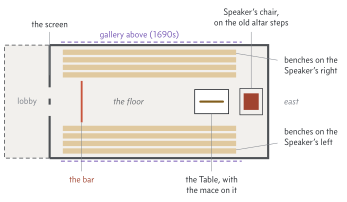
The Commons met in St. Stephen’s Chapel, a royal chapel in the Palace of Westminster that was given to them after its college of priests was dissolved in the Reformation (Figures S.5 and S.6). The members sat on benches that faced each other along the two long walls, where the choir had once sung, so that they argued across the open floor between. The Speaker, a member chosen by the House to preside and to speak for it to the king, sat in a high chair at the east end, where the altar had stood. In front of him was the Table, where the clerks sat and where the mace lay, a heavy silver-gilt staff that stood for the House’s authority. Near the door, a rail or a line across the floor marked the bar; no one who was not a member could pass it while the House sat, and anyone summoned to answer to the House stood there. The Lords had a bar of their own, and at the opening of each Parliament the Commons crowded to it to hear the monarch’s speech.

A law began as a bill, and a bill became an Act of Parliament by the same steps in each House (Figure S.7). The word “reading” was meant literally: few members had copies, so the clerk read the bill aloud. At its first reading the House heard it; at its second reading it was read again and debated; then a committee of members amended it clause by clause; and at its third reading the House voted on it for the last time. The other House then did the same. Last came the royal assent, the monarch’s consent, spoken in the old Norman French of the law courts: Le Roy le veult, “the king wills it,” or La Reyne le veult under a queen. A monarch could refuse, and Elizabeth I sometimes did. The last refusal was Queen Anne’s, in 1708, and since then no monarch has refused a bill that both Houses have passed.

Scotland had its own Parliament at Edinburgh until 1707, a single chamber in which lords, lairds (lesser landowners), and burgesses sat together, and Ireland had a Parliament of two houses at Dublin until 1801.
The king’s council and the shires
Parliament met for a few weeks or months at a time, and in some years not at all. Between its sessions the king governed with his Privy Council (priv-ee), the circle of great officers, nobles, and churchmen whom he chose to advise him, which issued orders in his name and judged some cases itself.
The first of the king’s officers was the Lord Chancellor. He kept the Great Seal, whose impression in wax made the king’s charters and commands valid, and he was the chief judge of the Court of Chancery and presided over the House of Lords. Several chancellors are in this volume: Cardinal Thomas Wolsey (wul-zee) and Thomas More under Henry VIII (Chapter 2), Francis Bacon under James I (Chapter 4), and Edward Hyde, Earl of Clarendon (klair-un-dun), under Charles II (Chapter 8). The Lord Treasurer ran the king’s money. From 1714 the Treasury was run by a board instead, led by the First Lord of the Treasury, and that was the office Robert Walpole held. The king’s secretaries of state handled his letters and his foreign affairs, and Francis Walsingham (wawl-sing-um), Elizabeth’s secretary, ran her spies (Chapter 3). By the 1700s an inner group of these ministers, the cabinet, met without the king and decided policy.
Outside London, England was divided into about forty shires, or counties, and Wales into thirteen after 1536. In each county the crown had a sheriff, who carried out the royal courts’ orders and ran the elections to Parliament, and from the 1540s a lord lieutenant, a great nobleman who commanded the county’s militia, its part-time soldiers. Most of the daily work of government fell to the justices of the peace. They were local gentlemen, named by the crown and unpaid, an office that dated from 1361. A justice could jail a vagrant, license an alehouse, or send a thief for trial. Four times a year the justices of a county sat together in court, at the quarter sessions, to try lesser crimes and manage roads, bridges, and the relief of the poor. A justice at Derby jailed George Fox, the founder of the Quakers, in 1650 (Chapter 6), and the novelist Henry Fielding sat as a justice in London a century later (Chapter 19). The smallest unit of all was the parish, the district served by one church, whose churchwardens and overseers collected the rate, a local tax, that fed its poor.
The Church of England
Every English man and woman in 1500 belonged, in law, to the Catholic Church, whose head was the pope in Rome. In 1534, after the pope refused to end his first marriage, Henry VIII broke with Rome and made himself Supreme Head of the Church of England (Chapter 2). Henry kept most of the old teaching, but under his son Edward VI the church became Protestant, and after Mary I had returned it to Rome for five years, Elizabeth made it Protestant again (Chapter 3). From then on it was governed by the crown. It kept its bishops and its cathedrals and parishes, and its services were in English. Its book of services, the Book of Common Prayer, first appeared in 1549, and its statement of belief, the Thirty-Nine Articles, was settled under Elizabeth (Chapter 3). It was the established church: the church of the nation by law, which every subject was required to attend and every parish supported with its tithes, a tenth of its produce.
The church had two provinces, each under an archbishop, a bishop with authority over the other bishops of his province. The archbishop of Canterbury, who lived at Lambeth Palace across the Thames (temz) from Westminster, headed the southern province, much the larger, and was the senior churchman of England. The archbishop of York headed the northern. Under them the bishops governed their dioceses (dy-uh-sih-siz), districts of parishes, and each parish had its priest, or parson.
Not everyone accepted the church the law established. Catholics who kept their old faith and refused to attend its services were called recusants (rek-yuh-zunts), from the Latin for “refusing,” and they paid fines or worse (Chapter 3). Their Protestant opponents often called them “papists,” followers of the pope. On the other side, Puritans were Protestants within the church who believed it was still too close to Rome and wanted it purified of ceremonies and of vestments, the robes priests wore, and some of them of bishops as well (Chapter 5). After 1662 those Protestants who worshiped outside the Church of England were called dissenters, or nonconformists. Among them were Presbyterians, who wanted the church governed by elders instead of bishops; Independents, who believed each congregation should govern itself; and Baptists, who baptized only believers old enough to profess their faith. So were the Quakers, who believed that God’s inner light shines in every person, so that no priest was needed (Chapter 6, Chapter 9). The Methodists of the 1700s began as a movement inside the Church of England (Chapter 20). Scotland’s church, the Kirk, became Protestant at its Reformation in 1560, and after more than a century of struggle over bishops it was settled as Presbyterian in 1690. In Ireland the established church was the Protestant Church of Ireland, though most of the Irish remained Catholic and many in Ulster were Presbyterian.
Party words
Several political names recur through the volume, and most of them began as insults. In the months before the civil war of 1642, the king’s men called their opponents Roundheads, after the cropped hair of the London apprentices who rioted against the bishops. Parliament’s men called the king’s party Cavaliers (kav-uh-leerz), a word for horsemen akin to the Spanish caballero, by which they meant the swaggering gentlemen who rode for the king (Chapter 5).
Forty years later, in the Exclusion Crisis of 1679 to 1681, Parliament fought over whether to shut Charles II’s brother and heir, James, Duke of York, out of the succession because he was a Catholic (Chapter 9). Those who wanted to exclude him were called Whigs, from whiggamore (wig-uh-mor), a Scottish name for the rebel Presbyterians of the southwest. Those who stood by the king’s brother were called Tories, from the Irish tóraidhe (tor-ee), a pursued man or outlaw. A dissenting minister in Yorkshire, Oliver Heywood, noted in his diary in October 1681 that people now said Tory and Whig where they had once said Cavalier and Roundhead. Both names stuck. In the 1700s the Whigs stood for the Protestant succession, the rights of Parliament, and toleration for dissenters, and the Tories for the Church of England, the crown, and the country gentlemen.
After 1688 the supporters of James II and his heirs were called Jacobites (jak-uh-byts), from Jacobus, the Latin for James (Chapter 10, Chapter 13). Because many Tories were suspected of Jacobite sympathy, the first Hanoverian kings gave office only to Whigs, and from 1714 to 1760 the Whigs governed without a break, the years called the Whig supremacy.
Last came prime minister. Under the Hanoverians, the minister who managed the Commons and the Treasury became the king’s first minister, and his enemies called him “prime minister” as an accusation, meaning a favorite who had grasped all power. Robert Walpole, First Lord of the Treasury from 1721 to 1742, is counted as the first (Chapter 13), though he denied the title in the House of Commons in 1741. The name had no place in law until the twentieth century. Table S.1 lists the first ministers of the volume’s years. Notice that the four who lasted longest, Walpole, Pelham, North, and the younger Pitt, all sat in the Commons, the House that voted the money.
| First minister | In office | Under |
|---|---|---|
| Sir Robert Walpole | 1721–1742 | George I and II |
| Earl of Wilmington | 1742–1743 | George II |
| Henry Pelham | 1743–1754 | George II |
| Duke of Newcastle | 1754–1756 | George II |
| Duke of Devonshire | 1756–1757 | George II |
| Duke of Newcastle, with Pitt the Elder directing the war | 1757–1762 | George II and III |
| Earl of Bute | 1762–1763 | George III |
| George Grenville | 1763–1765 | George III |
| Marquess of Rockingham | 1765–1766 | George III |
| Earl of Chatham (chat-um) (Pitt the Elder) | 1766–1768 | George III |
| Duke of Grafton | 1768–1770 | George III |
| Lord North | 1770–1782 | George III |
| Marquess of Rockingham | 1782 | George III |
| Earl of Shelburne | 1782–1783 | George III |
| Duke of Portland | 1783 | George III |
| William Pitt the Younger | 1783–1801 | George III |
Names, titles, dates, and money
Great men in this volume often go by a title instead of a surname. A peer holds one of five ranks, from the highest down: duke, marquess (mar-kwis), earl, viscount (vy-kownt), and baron. He is known by the place in his title, so Richard Neville, Earl of Warwick (wor-ik), the Kingmaker of the Wars of the Roses, is “Warwick,” and Edward Hyde, Earl of Clarendon, is “Clarendon.” A title could change as its holder rose. Robert Walpole sat in the Commons as Sir Robert until he became Earl of Orford in 1742, and William Pitt became Earl of Chatham in 1766. The eldest son of a duke, marquess, or earl was called by one of his father’s lesser titles as a courtesy, so Lord North was not a peer and sat in the Commons. A knight was called “Sir” before his first name, as Sir Thomas More and Sir Francis Drake were.
The word “queen” has two meanings. A queen regnant reigns in her own right, as Mary I, Elizabeth I, Mary II, and Anne did. A queen consort is a king’s wife, as Henry VIII’s first wife, Catherine of Aragon, and Charles I’s wife, Henrietta Maria, were. Kings who ruled more than one kingdom had more than one number. James VI of Scotland was James I of England, and his grandson James II of England was James VII of Scotland. The heir to the throne usually bore the title Prince of Wales (Vol. 8, The Northern Worlds).

Dates follow a rule already explained (Vol. 11, The Age of Shakespeare). Until 1752 the English year began on March 25, so a day in what we call February 1660 was written February 1659, or 1659/60 to be safe, as Pepys (peeps) headed his diary (Figure S.8). In 1752 Britain also changed from the old Julian calendar to the Gregorian one used in most of Europe, and eleven days were dropped, so that September 2 was followed by September 14. The chapters give every date with the year beginning on January 1.
Money was counted in pounds, shillings, and pence: twelve pennies made a shilling, and twenty shillings a pound (Vol. 11, The Age of Shakespeare). The gold guinea (gin-ee), first struck in 1663 from gold that came from the Guinea coast of Africa, was worth twenty-one shillings from 1717 (Chapter 13), and gentlemen’s fees and prices were often given in guineas.
Who tells the story
Much of what this volume tells comes from a few witnesses who wrote long after the events, or who took a side in them, or both. The chapters name the witness each time (“More says,” “Boswell tells”). Here are the chief ones, in about the order in which they wrote, with what each preserves.
- Thomas More (1478–1535), Henry VIII’s Lord Chancellor (Chapter 2), wrote The History of King Richard III about 1513 to 1518 and left it unfinished. It was printed after his death, in 1543 and in William Rastell’s edition of More’s works of 1557. It is the source of Richard III as the hunchbacked usurper and of Edward IV’s two young sons as the princes smothered in the Tower, perhaps learned from John Morton, the archbishop of Canterbury in whose household More grew up (Chapter 1).
- Polydore Vergil (pol-ee-dor vur-jil) (about 1470–1555), an Italian priest at Henry VII’s court, wrote a Latin history of England, the Anglica Historia (ang-glih-kuh hih-stor-ee-uh) (Basel, 1534). It is the fullest early account of Bosworth, where it shows the Stanleys holding back and then intervening, and of Henry VII’s reign (Chapter 1).
- Edward Hall (died 1547), a London lawyer, wrote The Union of the Two Noble and Illustre Families of Lancaster and York (1548). It told the Wars of the Roses as a punishment for sin ended by the Tudor marriage, and it describes Henry VIII’s court, the Field of the Cloth of Gold among it (Chapter 1, Chapter 2).
- John Foxe (1516 or 1517–1587), a Protestant clergyman who had fled abroad under Mary I, published Actes and Monuments in 1563 and enlarged it in 1570. “Foxe’s Book of Martyrs,” with its woodcuts, is the Protestant account of the burnings under Mary, and many churches kept a copy chained beside the Bible (Chapter 3).
- Raphael Holinshed (hol-inz-hed) (died about 1580) gave his name to the Chronicles of England, Scotland, and Ireland (1577; second edition, 1587), which gathered Hall, More, and Vergil and were the history Shakespeare read (Vol. 11, The Age of Shakespeare; Chapter 1 to Chapter 3).
- William Camden (1551–1623), a schoolmaster and herald, described the country county by county in Britannia (1586). His Latin Annales (1615 and 1625), written from state papers Lord Burghley (bur-lee) opened to him, are the first history of Elizabeth’s reign (Chapter 3).
- Francis Bacon (1561–1626) wrote The History of the Reign of King Henry VII (1622), the source of “Morton’s Fork,” the trap that made rich and thrifty subjects alike pay the king, which Bacon credits to the same John Morton as Henry VII’s chancellor (Chapter 1). Bacon himself is in Chapter 4.
- Leonel Sharp (about 1559–1631), a chaplain in Elizabeth’s army in 1588, wrote a letter to the Duke of Buckingham, James I’s favorite, that was printed in 1654. It is the source of the words of the queen’s speech at Tilbury as they are usually quoted (Chapter 3).
- Edward Hyde, Earl of Clarendon (1609–1674), Charles II’s chancellor and the grandfather of two queens, wrote The History of the Rebellion and Civil Wars in England, much of it in exile. Printed in 1702 to 1704, it is the royalist side of the civil war and the Restoration (Chapter 5, Chapter 6, Chapter 8).
- Samuel Pepys (1633–1703), a navy official, kept a diary in shorthand from 1660 to 1669. It was deciphered and printed in 1825 and is the great eyewitness account of Restoration London (Chapter 8).
- John Evelyn (eev-lin) (1620–1706), a gentleman scholar and gardener, kept a diary for most of his life. Printed in 1818, it is the second eyewitness of the plague and the Great Fire (Chapter 8).
- John Aubrey (aw-bree) (1626–1697), an antiquary, a collector of old records and stories, gathered gossip about famous Englishmen in Brief Lives, written mostly between 1680 and 1693 and printed in part in 1813. They keep most of what is known of the life of his friend Thomas Hobbes (Chapter 7).
- Gilbert Burnet (1643–1715), a Scottish clergyman who sailed with William of Orange in 1688 and became bishop of Salisbury (sawlz-bree), wrote the History of His Own Time, printed after his death (1724 to 1734). It keeps William’s question to him at Torbay about predestination (Chapter 10).
- Daniel Defoe (about 1660–1731) surveyed the trades and towns of the whole country in A Tour thro’ the Whole Island of Great Britain (1724 to 1727). Defoe and his Tour are in Chapter 14.
- William Hogarth (1697–1764) explained his “line of beauty,” the S-shaped curve he thought the root of beauty in a shape, in The Analysis of Beauty (1753) (Chapter 19).
- David Hume (1711–1776) wrote The History of England (1754 to 1762), from Julius Caesar’s invasion to 1688, the standard history for a century (Chapter 10, Chapter 16).
- John Mainwaring (man-er-ing) (1724–1807), a clergyman, published Memoirs of the Life of the Late George Frederic Handel (1760), the first book-length life of a composer. It is the source for Handel’s boyhood in Halle (hah-luh) and Hamburg (Chapter 17) and for the keyboard contest with Domenico Scarlatti (Vol. 10, Rebirth).
- Horace Walpole (1717–1797), Robert Walpole’s youngest son, wrote thousands of letters from the 1730s to the 1790s, printed after his death. They are the running chronicle of Georgian London, from the execution of Admiral Byng to the Gordon Riots (Chapter 19, Chapter 22).
- James Boswell (1740–1795), a Scottish lawyer, wrote The Journal of a Tour to the Hebrides (heb-rih-deez) (1785) and The Life of Samuel Johnson (1791), the source of nearly every story told of Johnson (Chapter 20).
- Thomas Babington Macaulay (muh-kaw-lee), a Whig politician who lived from 1800 to 1859, wrote The History of England from the Accession of James the Second (1848 to 1861), which made 1688 the Whigs’ “bloodless” revolution for generations of readers (Chapter 10).
Meanwhile elsewhere
Ottoman armies took Constantinople in the very year the volume opens, and the Mughals conquered northern India. Table S.2 sets the rest of the world beside Britain and Ireland and names the volumes of the Course that teach it.
| Region | In these years | Taught in |
|---|---|---|
| Italy, Spain, and Portugal | The Renaissance popes and painters; Charles V and Philip II; the Armada (1588) from Spain’s side; the Bourbon kings of Spain from 1700. | Vol. 10, Rebirth |
| France and the Low Countries | The Wars of Religion; the Dutch Republic from 1581; Louis XIV (reigned 1643–1715); Rembrandt, Molière, and Voltaire. | Vol. 13, Valois, Bourbon, and Orange |
| Germany and the East | Luther’s protest (1517); the Thirty Years’ War (1618–1648); Peter the Great; Frederick the Great; Bach, Haydn, and Mozart. | Vol. 14, From Luther to Mozart |
| North America | Jamestown (1607), New England, and Pennsylvania; the French and Indian War; the American Revolution (1775–1783). | Vol. 27, New Worlds |
| Latin America | Columbus (1492); the conquests of the Aztecs (1521) and the Inca (1532); the sugar islands of the Caribbean. | Vol. 44, Gold, God, and Glory |
| Africa | The Songhay empire; the kingdoms of Kongo, Benin, and Asante; the Atlantic slave trade at its height in the 1700s. | Vol. 43, Africa |
| The Ottomans and Persia | The fall of Constantinople (1453); Suleiman the Magnificent (reigned 1520–1566); Shah Abbas of Persia (reigned 1588–1629). | Vol. 37, The House of Islam |
| India | The Mughal emperors from Babur (1526) to Aurangzeb; the Taj Mahal; the East India Company’s victory at Plassey (1757). | Vol. 39, India |
| China | The last Ming emperors; the Qing dynasty from 1644, and the Kangxi and Qianlong emperors. | Vol. 40, The Middle Kingdom |
| Japan, Korea, and the Pacific | The Tokugawa shoguns from 1603; Japan closed to most foreigners from the 1630s; Tasman (1642) and Cook (1768–1779) in the Pacific. | Vol. 41, Islands of the Rising Sun; Vol. 42, Monsoon and Ocean |
The Roses and the Tudors, 1453-1603
Chapter 1 · 49 clues
The Wars of the Roses and the First Tudor
Just after Christmas 1454, the queen of England brought her baby son to his father. The prince was fourteen months old, and the king had never knowingly seen him. For more than a year Henry VI had sat silent, unable to speak, to feed himself, or to recognize anyone around him, and that winter he had suddenly woken. A letter written in January by a member of his household to John Paston, a Norfolk (nor-fuk) gentleman, tells what happened next. Henry asked the child’s name, and the queen told him it was Edward. The king held up his hands and thanked God. He said that he had never known the boy until that moment, and that he did not know where he himself had been while he was ill.
The court rejoiced, but the king’s waking began England’s troubles instead of ending them. While Henry was lost to the world, his cousin Richard, Duke of York, had governed in his place, and now the queen’s friends wanted York gone. Within five months the two sides were fighting in the streets of a market town north of London. For the next thirty years English lords fought one another for the crown, in a war that later centuries named after two flowers. It cost two kings their lives and perhaps a boy king as well, and it ended with the grandson of a Welsh squire on the throne.
Henry VI
Henry VI had been king since he was nine months old. His father, the warrior Henry V, died in 1422 with half of France conquered, and by treaty the baby was heir to the French crown as well as king of England. An earlier volume told how that inheritance was lost (Vol. 8, The Northern Worlds). The boy grew up gentle, pious, and generous, happier founding schools than leading armies: Eton College, for poor scholars, beside his castle at Windsor, and King’s College at Cambridge, both in the early 1440s. He disliked bloodshed and forgave easily. In a medieval king these were dangerous virtues. A king was expected to lead his armies, to settle the quarrels of his great lords, and to punish those who broke the peace, and Henry could do none of these things.
He belonged to the house of Lancaster, the branch of the royal family descended from John of Gaunt, Duke of Lancaster, a son of Edward III. Gaunt’s son had taken the crown from his cousin Richard II in 1399 and reigned as Henry IV, and his son and grandson had followed him. But another branch had a claim of its own. Richard, Duke of York, descended through his mother from Lionel, Duke of Clarence, a son of Edward III older than Gaunt. By strict order of birth, York’s line came first. Earlier volumes drew these claims as family trees (Vol. 8, The Northern Worlds; Vol. 11, The Age of Shakespeare), and the master tree of this volume begins where they end, with the Tudors (the Stage).
In 1445, to buy peace with France, Henry married Margaret of AnjouThis ruler's wife was Margaret of Anjou. → Henry VI of England•• (ahn-zhoo), the fifteen-year-old niece of the French king Charles VII. Her father, René (reh-nay), was a duke with grand titles and little money, and she brought no dowry. Instead Henry secretly promised to hand over Maine, the county that guarded Normandy’s southern border, and when the promise came out the English were furious. Margaret was clever, proud, and fierce in defense of her husband’s rights. As the years showed how little Henry could rule, she became the real leader of his party.

In 1450 the cost of the lost war came home. Normandy fell to the French that summer. Henry’s chief minister, William de la Pole, Duke of Suffolk, was blamed for the defeats and for the secret bargain over Maine. Parliament impeached him, the king banished him to save his life, and a ship intercepted him in the Channel. His headless body was found on the beach at Dover. Rumor said that Henry meant to punish Kent, where the murderers had landed. By June some five thousand men of Kent, most of them small farmers and craftsmen, with a few gentlemen and a knight among them, had gathered under a leader called Jack Cade. He named himself the Captain of Kent, and he also used the name John Mortimer, which was the name of York’s mother’s family. York himself was away in Ireland as the king’s lieutenant, and no evidence links him to the rising. Cade’s men set out their grievances in a petition: corrupt officials, rigged elections, and lords who robbed the king and the people alike.
Jack Cade’s rebellionJack Cade's rebellion took place during this ruler's reign. → Henry VI of England• reached London in July 1450. On July 3 the rebels crossed London Bridge, and Cade struck the ancient London Stone with his sword, the old way of claiming lordship over the city. The next day they dragged the king’s Treasurer, Lord Saye, before a mock trial at the Guildhall (gild-hawl) and beheaded him in Cheapside, the city’s main market street. Then they began to loot, and the Londoners turned on them. A few nights later the citizens fought the rebels for London Bridge until morning. The government offered pardons, and most of the rebels went home. Cade fled into Sussex, where a Kentish squire, Alexander Iden, caught him in a garden on July 12, and he died of his wounds before he reached London. Shakespeare put him on the stage in the second part of Henry VI, where one of his followers shouts, “The first thing we do, let’s kill all the lawyers.”
The last English army in France was destroyed three years later. In 1452 the old soldier John Talbot, Earl of Shrewsbury (shrohz-buh-ree), the same man who had given the new queen a book of romances in 1445, retook Bordeaux (bor-doh), the wine port of Gascony that England had held for three hundred years. On July 17, 1453, at Castillon (kas-tee-yon) on the Dordogne (dor-dohn), Talbot charged a French camp and died with many of his men under the fire of French cannon. Bordeaux could not hold out alone, and it surrendered in October. Many accounts say the king broke down when he heard that Bordeaux was lost. In fact the news that reached him that August, at his hunting lodge of Clarendon near Salisbury, was of Castillon, the defeat that made the city’s fall certain. Soon afterward Henry’s mind gave way.This ruler suffered a yearlong mental breakdown after learning of the loss of Bordeaux. → Henry VI of England• For seventeen months he sat unseeing, and through all that time he did not know that Bordeaux had fallen.
Two months into his illness, on October 13, 1453, the queen bore him a son, Edward. Until then York had been the heir to a childless king, and now he was not. Someone had to govern, and in March 1454 the lords chose York as Protector, a lord who rules for a king who cannot. York’s chief rival at court, Edmund Beaufort (boh-furt), Duke of Somerset, whom he blamed for the loss of Normandy, had already been arrested and locked in the Tower of London. When Henry woke at Christmas, Somerset was freed and York was out. A strong king could have kept the two men apart and made each of them serve him. In the end Henry’s weakness led to the Wars of the Roses,This ruler's weakness effectively led to the Wars of the Roses. → Henry VI of England•• because there was no one above the quarrel to stop it.
York and Lancaster
Richard, Duke of York, was born in 1411 and was the richest landowner in England after the king. His lands lay in the Welsh border country around Ludlow, in Yorkshire, and in Ireland. His father, the Earl of Cambridge, had been beheaded for plotting against Henry V in 1415 (Vol. 8, The Northern Worlds). York married Cecily Neville, and her brother Richard Neville, Earl of Salisbury, and his son Richard, Earl of Warwick, became York’s allies. The Nevilles had a feud of their own in the north with the Percy family, the Earls of Northumberland, who sided with the court. So private quarrels gathered around the great one, and England split into two parties. Supporters of the king were called Lancastrians and York’s party Yorkists. Their war, which lasted from 1455 to 1487, was fought between York and Lancaster,This fifteenth-century conflict was fought between the Houses of York and Lancaster. → Wars of the Roses••• two branches of one royal family that both descended from Edward III.
Neither side called it the Wars of the Roses. A badge was an emblem that a lord’s servants and soldiers wore on their coats, so that friends could tell one another apart, and both sides had several. York’s family used a white rose, a falcon, and a horse’s padlock called a fetterlock. Edward of York later took a sun with rays, and his brother Richard a white boar. In 1459 Queen Margaret gave her followers her son’s badge, a silver swan. The red rose was hardly used by Lancaster at all until Henry Tudor made it his own after 1485. In Shakespeare’s first part of Henry VI the lords pick white and red roses in the Temple Garden in London to show their sides, an invented scene. In 1762 the Scottish philosopher David Hume, in his History of England (Chapter 16), wrote that the two parties wore red and white roses and that the wars were known across Europe as the quarrel of the two roses. The modern name, the Wars of the Roses, named for the red rose and the white,This conflict is named for the red and white floral emblems associated with its opposing houses. → Wars of the Roses••• was made popular by Walter Scott’s novel Anne of Geierstein (gy-ur-shtine) in 1829 (Vol. 11, The Age of Shakespeare), long after the war was over.
The first battle came on May 22, 1455. Henry was riding north to a council at Leicester (les-ter) that York feared would condemn him, and York and the Nevilles met the king’s small army at St. Albans, a market town 20 miles north of London (Figure 1.2). The king’s men barricaded the streets. While York’s men attacked the barricades, the twenty-six-year-old Warwick led his men through the back lanes and gardens into the market square, where the royal soldiers stood talking, many without their helmets. The fight lasted perhaps half an hour. Somerset was cut down outside the Castle Inn, and the Earl of Northumberland and Lord Clifford were killed too. An arrow wounded the king in the neck, and Henry was captured at St. Albans.The First Battle of St. Albans, where Henry VI was captured, began this conflict. → Wars of the Roses•• York and the Nevilles knelt before him and swore that they were his loyal subjects. Fewer than sixty men had died, but the three dead lords left sons who wanted revenge, and the first battle of the Wars of the Roses had been fought.

Henry tried to make peace in the only way he knew, by ceremony. In early 1458 the lords came to London with armed retainers, and the city kept the two sides lodged apart. After weeks of talks the king announced his award. The Yorkists took the blame for St. Albans, paid compensation to the dead lords’ widows and sons, and paid for Masses, the Church’s prayers for the dead, for the souls of the slain. On March 25, 1458, Lady Day, a feast of the Virgin Mary, the lords walked hand in hand to St. Paul’s,Nobles held hands during “Loveday,” an attempted reconciliation during this conflict. → Wars of the Roses•• London’s cathedral, enemy beside enemy. The new Duke of Somerset walked with Salisbury, Warwick with the Duke of Exeter, and the queen herself with York, while the king walked alone, wearing his crown. The ceremony was called a loveday, an old name for a day of reconciliation. A preacher at Coventry said that the king made lovedays as Judas made one with a kiss to Christ. Within months Warwick’s men and Somerset’s were brawling at Westminster.
In 1459 the war began again. The Yorkists won a battle at Blore Heath in Staffordshire that September. But in October, at Ludford Bridge outside York’s castle of Ludlow, they faced the king himself, with his banner flying and a pardon offered to any man who changed sides, and their army melted away by night. York fled to Ireland, and Warwick, Salisbury, and York’s eldest son, Edward, Earl of March, fled to Calais, the English port across the Channel, where Warwick was captain of the garrison. In the summer of 1460 the three earls crossed back. On July 10, at Northampton, they defeated the royal army and took the king prisoner for the second time. That October York walked into Parliament and laid his hand on the empty throne. The lords would not make him king. Instead they agreed that Henry should reign for life and that York and his heirs should succeed him, which disinherited the king’s own son. Margaret would never accept that. On December 30, 1460, her northern army caught York outside his castle of Sandal, near Wakefield, and killed him and his second son. Salisbury was taken and beheaded. York’s head was set up on a gate of the city of York, wearing a paper crown.
York’s eldest son was eighteen. At dawn on February 2, 1461, Edward of March was waiting with his army at Mortimer’s Cross, in Herefordshire, for a Lancastrian army coming out of Wales, when three suns rose in the sky.A parhelion was witnessed at the Battle of Mortimer’s Cross during this war. → Wars of the Roses•• What his men saw was a parhelion (par-hee-lee-un), an effect of sunlight through ice crystals in high, thin cloud, which makes bright patches called sun dogs on either side of the sun. His soldiers were frightened. Edward told them that the three suns stood for the Holy Trinity, the Father, the Son, and the Holy Spirit of Christian belief, and that God was on their side. He won the battle and later took a sun with rays, which heralds call the “sun in splendour,” as his badge.
Among the prisoners was a Welsh squire named Owen Tudor. Long before, he had served at the court of Henry V’s widow, Catherine of France, and he had secretly married her. Their sons were Henry VI’s half-brothers, and the younger of them, Jasper Tudor, Earl of Pembroke, commanded the beaten army. Owen expected to be held for ransom, but he was led to the market place at Hereford (her-uh-furd) to be beheaded. A London chronicle of the time, known as Gregory’s Chronicle, says that only when he saw the block did he understand. That head, he said, would now lie on the block that used to lie in Queen Catherine’s lap. His head was set on the market cross, and a madwoman combed its hair, washed the blood from its face, and set candles burning around it. Owen Tudor’s grandson would be king of England.
Two weeks later the queen’s army beat Warwick at the second battle of St. Albans, on February 17, and recovered Henry, whom Warwick had brought along; the story goes that he had sat singing under a tree as the battle went on around him. But London shut its gates to Margaret’s northern army, which had plundered its way south. Edward marched in instead, and on March 4, 1461, he was proclaimed king at Westminster as Edward IV. Then he went north to settle it. On March 29, Palm Sunday, the two armies met in a snowstorm on a plateau near the village of Towton in Yorkshire, in what was probably the largest and bloodiest battle ever fought on English soil. The wind drove the snow into the Lancastrians’ faces. Their arrows fell short, while the Yorkist archers, with the wind behind them, shot farther than usual and then picked up the enemy’s arrows and shot those too. The fighting lasted most of the day. When the Lancastrian line broke, hundreds drowned in a little river, the Cock Beck, behind them. The royal heralds counted 28,000 dead, a figure that the historian Charles Ross, among others, thinks too high. The king had waited out the battle in the city of York, and now Henry fled to ScotlandThis ruler was forced to flee to Scotland after losing the Battle of Towton. → Henry VI of England• with Margaret and their son.
For three years the Lancastrians held out in the great castles of Northumberland, with Scottish and French help, until Warwick’s brother John Neville, Lord Montagu, beat them at Hexham in 1464. Henry wandered from one hiding place to another. In July 1465 a monk betrayed him, and Yorkist men caught him at stepping-stones over the river Ribble in Lancashire. He was taken to London and lodged in the Tower.

The new king was tall, handsome, brave, and fond of pleasure, the opposite of the man he had replaced. Warwick, who was his cousin and chief adviser, expected to arrange a royal marriage that would bind England to France, and in 1464 he was negotiating for the French queen’s sister. Then, at a council at Reading that September, Edward announced that he was already married. Edward IV had married Elizabeth WoodvilleThis ruler married Elizabeth Woodville. → Edward IV•• in secret that spring, by tradition on May 1, 1464, at her family’s house at Grafton in Northamptonshire, with only her mother, the priest, and a few attendants present. She was a beautiful widow about five years older than the king, with two sons, and her first husband, Sir John Grey, had died fighting for Lancaster at the second battle of St. Albans. Her father had been a plain knight until Henry VI made him a baron, Lord Rivers, and he was no great lord. No king since the Norman Conquest had married one of his own subjects. Edward then found husbands and wives for her sisters and brothers among the richest heirs in England, and Warwick, who had been made to look a fool before the French, watched the Woodvilles take the places he had meant for his own family.
Warwick the Kingmaker
Richard Neville, Earl of Warwick, was born on November 22, 1428, the eldest son of the Earl of Salisbury. At the age of eight he was married to Anne Beauchamp (beech-um), the daughter of the Earl of Warwick, and when her brother’s line died out in 1449 he became Earl of Warwick through her. From 1462 he was Earl of Salisbury too. His lands brought in more than £7,000 a year, more than any other man in England but the king, and as captain of Calais he commanded the largest permanent garrison the English crown had. He had won the first battle of St. Albans and helped make Edward king in 1461, and Edward owed his crown to him more than to any other man. Because he made kings and unmade them (Figure 1.4), he is remembered as Warwick “the Kingmaker”,This Earl of Warwick was nicknamed “the Kingmaker” during the Wars of the Roses. → Richard Neville, Earl of Warwick••• a name that later writers gave him.


The marriage was the first wound, and Edward’s friendship with Burgundy was the second. The Duke of Burgundy ruled the Low Countries, where English wool was sold, and he was the French king’s enemy. Warwick wanted alliance with France. In 1468 Edward married his sister Margaret to the duke, Charles the Bold. Warwick turned to the king’s discontented younger brother, George, Duke of Clarence, and in July 1469, at Calais, he married his elder daughter, Isabel, to Clarence against the king’s orders. At the same moment his northern friends rose in revolt. The king’s army was beaten at Edgecote, Edward himself was taken and held in Warwick’s castle of Middleham, and the queen’s father and one of her brothers were beheaded without trial. But Warwick found that England would not be governed through a captive king, and he had to let Edward go. In the spring of 1470 another rising failed, and Warwick and Clarence fled to France.
The French king, Louis XI, then arranged something that had seemed impossible: an alliance between Warwick and Margaret of Anjou. They had been bitter enemies for fifteen years. At Angers (ahn-zhay), in July 1470, Margaret kept Warwick on his knees before her for a quarter of an hour before she forgave him. Her son, Prince Edward, was betrothed to Warwick’s younger daughter, Anne Neville, and they married that December. In September Warwick landed in the West Country, and so many men joined him that Edward, caught in the north, fled by ship from King’s Lynn to the Low Countries on October 2. The next day Warwick, who had once made Edward king, restored Henry VI to the throne,This Earl of Warwick switched from supporting Edward IV to restoring Henry VI during the Wars of the Roses. → Richard Neville, Earl of Warwick••This ruler was briefly restored to the throne by Margaret of Anjou and the Earl of Warwick in 1470. → Henry VI of England• in alliance with Margaret, who waited in France. The old king was brought out of the Tower, and when Warwick reached London he led him in procession to St. Paul’s. The restoration is called the readeption, an old word for getting something back.
It lasted six months. With Burgundian ships and money, Edward landed at Ravenspur, on the Yorkshire coast, on March 14, 1471, claiming at first, as Henry IV had claimed in 1399, that he wanted only his own dukedom. Clarence, seeing that his father-in-law now favored Henry’s son over him, went back to his brother. London opened its gates to Edward on April 11, and Henry VI, who had been king again for half a year, was taken into custody once more. On Easter Sunday, April 14, Warwick’s army faced Edward’s on a ridge north of the town of Barnet, 12 miles from London. Edward brought the captive Henry with him.
The two armies had come up in the dark, and at dawn a thick fog lay over the field. Neither commander could see the other’s line, and each army was set too far to its own right, so that each overlapped the other’s left end (Figure 1.6). On Warwick’s right, John de Vere (duh veer), Earl of Oxford, a Lancastrian since his father’s execution, routed Edward’s left wing under Lord Hastings and chased it back through Barnet. Some of Hastings’s men ran all the way to London with news that the battle was lost. At the other end of the line, Edward’s youngest brother, Richard, Duke of Gloucester (glos-ter), eighteen years old, was pressing back the Duke of Exeter in the same way. Oxford rallied his men and led them back through the fog toward the fighting. They came up behind the Lancastrian center, commanded by Warwick’s brother Montagu, who had changed sides only the autumn before. Oxford’s men wore their lord’s badge, a star with rays, which a chronicle of the time calls a star with streams. Edward’s men wore his sun with rays, the “sun in splendour.” In the mist Montagu’s archers took the star for the sunDuring this war's Battle of Barnet, a commander mistakenly attacked an ally after confusing a badge with a "star with rays" for a "sun in splendour." → Wars of the Roses• and shot at their own allies. Oxford’s men cried treason and fled, and the cry ran down the Lancastrian line.


Warwick and Montagu had fought on foot, among their soldiers, to show that they would not run. When the center collapsed, Montagu was killed, and Warwick made for the horses at the rear. Edward had sent orders to take him alive, but the soldiers reached him first. Warwick was killed at Barnet,This Earl of Warwick was killed at the foggy Battle of Barnet during the Wars of the Roses. → Richard Neville, Earl of Warwick•• aged forty-two. The battle had lasted two or three hours and was over when the fog lifted. Edward had the bodies of the two brothers laid out in St. Paul’s, so that no one could pretend afterward that the Kingmaker had escaped.
On the very day of Barnet, Margaret of Anjou and her son landed at Weymouth on the south coast, too late. She marched west to join Jasper Tudor in Wales, and Edward raced to cut her off. The governor of Gloucester shut the city’s gates against her, so her army had to march on to the next crossing of the Severn, and on May 3 it stopped, exhausted, at Tewkesbury (tyooks-buh-ree). The next morning, May 4, 1471, Edward attacked. The Lancastrian army broke, and many were cut down in a field still called the Bloody Meadow. Among the dead was Prince Edward, the Lancastrian heir,This war was briefly halted after the Battle of Tewkesbury when the heir apparent Edward was slain. → Wars of the Roses• seventeen years old, killed in the rout or just after it. With him died Lancaster’s hope of a king, and the fighting stopped for fourteen years. The Duke of Somerset, a younger son of the duke killed at St. Albans, and other leaders took refuge in Tewkesbury Abbey; two days later they were dragged out and beheaded. Margaret was captured. In 1475 the French king ransomed her, and she died in France in 1482, poor and alone.
Edward returned to London on May 21. That same night Henry VI died in the Tower. The official account, written for Edward, said that he died of “pure displeasure and melancholy” at the news of his son’s death, and almost no one believed it. A chronicle written a few years later says that Henry was put to deathThis ruler was killed after the Battle of Tewkesbury. → Henry VI of England• that night between eleven and twelve, and that the king’s brother Richard, Duke of Gloucester, was then at the Tower. Henry was buried quietly at Chertsey Abbey. People soon began to pray at his tomb and to tell of miracles there. Every year on May 21 the provosts of Eton and King’s College still lay white lilies and roses in the Wakefield Tower, on the spot where, by tradition, he was killed at his prayers. With Henry and his son dead, Edward IV, who had succeeded Henry VIThis ruler was succeeded by Edward IV. → Henry VI of England•• twice over, reigned unchallenged for the next twelve years.
Richard III and the princes
Edward’s second reign was peaceful and prosperous. In 1475 he invaded France and let the French king buy him off with a large payment and a pension. In 1478 his brother Clarence, who had plotted once too often, was condemned for treason and put to death privately in the Tower; a rumor soon spread that he had been drowned in a barrel of sweet wine (Vol. 11, The Age of Shakespeare). Edward grew fat. In April 1483, after a short illness, he died at Westminster, aged forty. His elder son, Edward V, was twelve, and he was at Ludlow in the care of his mother’s brother, Anthony Woodville, Earl Rivers. His younger son, Richard of Shrewsbury, who bore his grandfather’s title of Duke of York, was nine.
The king’s only surviving brother, Richard, Duke of Gloucester, was thirty. He had been born at Fotheringhay (foth-ur-ing-hay) Castle in 1452, the youngest of York’s sons who grew up, and he had been loyal to Edward through everything, sharing his exile in 1470 and fighting for him at Barnet and Tewkesbury at eighteen. He had married Warwick’s younger daughter, Anne Neville, Prince Edward’s widow, and from Middleham he governed the north of England for his brother, firmly and well. Edward had named him Lord Protector, the office York had once held, to rule for the boy until he came of age. The Woodvilles, who had the boy king, did not mean to let him.
Richard moved first. On April 30 he met the young king’s party at Stony Stratford, on the road to London, arrested Rivers and the king’s half-brother Richard Grey, and took the boy into his own care; Rivers and Grey were later beheaded at Pontefract Castle. The queen fled into sanctuary at Westminster Abbey with her younger son and her daughters. On May 19 Edward V was lodged in the royal apartments of the Tower of London, where kings traditionally stayed before their coronation. On June 13, at a council in the Tower, Richard accused Lord Hastings, Edward IV’s oldest friend, of plotting against him and had him beheaded that same morning. Thomas More, who wrote the story down thirty years later, says that Richard opened that council in good humor. He asked the Bishop of Ely (ee-lee), John Morton, to send for strawberries from his garden in Holborn (hoh-burn), then left the room and came back in a fury. Morton was among those arrested. On June 16 the queen gave up her younger son, so that he could keep his brother company.
Then Richard took the crown. A preacher at St. Paul’s announced that Edward IV’s marriage had been invalid: before he married Elizabeth Woodville, the story went, he had promised to marry another lady, Eleanor Butler, and in the Church’s law such a promise could make a later marriage void. If so, Edward’s children were illegitimate and could not inherit. On June 26, 1483, at an assembly of lords and commons, Richard accepted the throne, and on July 6 he was crowned in Westminster Abbey as Richard III. He was the third king of the house of York, and the last Yorkist kingThis ruler was the last Yorkist monarch of England. → Richard III• England would have.
The two boys, ever since called the Princes in the Tower, were never seen in public again. Dominic Mancini (man-chee-nee), an Italian, was in London until July and wrote his account that winter. He says that after Hastings’s death the boys were moved into the inner rooms of the Tower and were seen less and less behind its windows, until at last they were not seen at all. The young king’s doctor told Mancini that the boy said his prayers and confessed his sins every day, as if he expected to die. Sometime in the late summer or autumn of 1483, the princes vanished inside the Tower,Edward V and Richard of Shrewsbury disappeared while held in this royal fortress. → Tower of London••This ruler possibly murdered the Princes in the Tower. → Richard III••The "Princes in the Tower" were imprisoned during this war. → Wars of the Roses• while the civil war was still unfinished, and their uncle may have had them killed. Rumors of their murder were soon running through England, and by January 1484 the Chancellor of France was telling an assembly at Tours that Richard had done it.
The detailed story of their deaths comes from Thomas More, the future Lord Chancellor of Henry VIII (Chapter 2), who wrote his History of King Richard III between about 1513 and 1518 and never finished it; it was printed only after his death. As a boy More had served as a page in the household of the same John Morton, by then Archbishop of Canterbury and Richard’s bitter enemy, and Morton may have told him much of what he wrote. More says that Richard sent a trusted knight, Sir James Tyrrell, to the Tower with orders, and that two men, Miles Forest, one of the boys’ keepers, and John Dighton, Tyrrell’s groom, smothered the sleeping boys with their feather bed and pillows. Their bodies, More says, were buried at the foot of a stair under a heap of stones, and later moved by a priest to a place no one knew. More claims that Tyrrell confessed before he was executed in 1502, for a different treason, but no record of a confession survives. Polydore Vergil, an Italian historian at Henry VII’s court, also names Tyrrell. In 1674 workmen rebuilding a staircase beside the White Tower dug up a wooden box with the bones of two children. Charles II had them buried in Westminster Abbey in an urn designed by Christopher Wren. An anatomist and a dentist who examined them in 1933 thought they were children of about the princes’ ages, but the bones have never been tested for their DNA, the chemical code that passes from parent to child.
The doubts have never been settled. No body was shown, no one was tried, and More wrote as a Tudor servant about a king whom the Tudors had overthrown. Some have blamed the Duke of Buckingham, Richard’s chief ally that summer, who soon rebelled against him; a few have even blamed Henry VII. In 1768 Horace Walpole, the letter writer and novelist (Chapter 19), argued in his Historic Doubts that Richard had been slandered, and in 1924 admirers founded a society to clear his name. Josephine Tey’s detective novel The Daughter of Time (1951) made the same case. Most historians who have studied the case, A. J. Pollard among them, still think Richard the likeliest culprit: the boys were in his Tower, guarded by his men, and he alone gained by their deaths.
Richard’s crown brought him little happiness. Buckingham’s rising failed in October 1483, and he was beheaded at Salisbury. Across the sea, on Christmas Day 1483, the last hope of Lancaster, Owen Tudor’s grandson Henry Tudor, swore in the cathedral of Rennes (ren), in Brittany, to marry Edward IV’s eldest daughter, Elizabeth of York, if he won the throne. In April 1484 Richard’s only legitimate son, Edward, died at Middleham, still a child, and in March 1485 his queen, Anne Neville, died too.
The Tower of London
The fortress where the princes vanished, the Tower of London, was already four hundred years old in 1483. William the Conqueror began its great stone keep, the White Tower, about 1080 (Vol. 8, The Northern Worlds), to command the city he had just conquered, and later kings wrapped two rings of walls and a moat around it. It stands on the north bank of the Thames,This royal fortress stands on the north bank of the Thames in England’s capital. → Tower of London•• just east of the old City wall, where it could guard the river approach to London and overawe the citizens at the same time. A water gate on the river, later called Traitors’ Gate, let prisoners be brought in by boat (Figure 1.8). The Tower was a royal palace, where kings slept before their coronations and rode in procession from it to Westminster. It was also a fortress, a prison, an armory, the home of the Royal Mint, and a store for the government’s records. An earlier volume drew it at the eastern edge of a map of London in 1600 (Vol. 11, The Age of Shakespeare).

The Tower has also kept the crown’s treasure since the fourteenth century, and today the Crown Jewels are kept there,The Crown Jewels are kept at this location. → Tower of London•• in a strong room called the Jewel House. They are the regalia, the objects used to crown a king or queen: crowns, scepters, an orb, swords, and a gilded spoon for the holy oil. Most of the medieval regalia were melted down by Parliament’s government in 1649, after Charles I’s execution, and new ones were made for Charles II’s coronation in 1661. In 1669 the jewels were put on show to paying visitors, and two years later an Irish adventurer, Colonel Thomas Blood, tied up the elderly keeper and nearly got away with the crown.
For six hundred years the Tower was also a zoo. About 1235 the emperor Frederick II sent Henry III three leopards, and they were kept at the Tower. In 1252 the king of Norway, Haakon IV (haw-kon), sent a polar bear, and Londoners crowded the riverbank to watch it fish in the Thames at the end of a long chain. In 1255 Louis IX of France sent an elephant, which the monk and chronicler Matthew Paris drew from life. Edward I built a gatehouse at the western entrance that came to be called the Lion Tower, and the Royal Menagerie,This structure housed exotic animals in the Royal Menagerie from the 13th to 19th centuries. → Tower of London• the king’s collection of wild animals, lived there for centuries. By the eighteenth century, visitors paid three halfpence to see the animals, or brought a cat or dog to feed to the lions. In the 1830s the Duke of Wellington, then Constable of the Tower, had the menagerie closed, and the last animals left in 1835 for the new London Zoo in Regent’s Park.
The Tower’s guards are the oldest part of this story that is still alive. After his victory at Bosworth in 1485, Henry VII formed a bodyguard of yeomen, men below the rank of gentleman, called the Yeomen of the Guard, and when his son moved the court out of the Tower in 1509, a detachment stayed behind as its garrison. Their successors are the Yeomen Warders, nicknamed “beefeaters”.Yeomen Warders who work at this location are known by the nickname "beefeaters." → Tower of London• The earliest use of the nickname for the royal guard comes from a visitor of 1669, the Italian prince Cosimo de’ Medici (koh-zee-moh deh med-ih-chee), who noticed that they were given a large ration of beef every day and said they might well be called beef-eaters. The next year he became Grand Duke of Tuscany as Cosimo III. Today the warders are veterans of the armed forces with at least twenty-two years of service, and on state occasions they still wear a red Tudor uniform embroidered with the crowned rose.
The Tower’s most famous inhabitants are birds. At least six ravens live there, with the flight feathers of one wing trimmed so that they cannot fly far, under the care of a Ravenmaster chosen from among the warders. Legend says that if the ravens leave,Legend says that if the ravens leave this fortress, the kingdom will fall. → Tower of London•According to legend, the British Crown will fall if these animals leave the Tower of London. → ravens•• the Crown and the kingdom will fall. A story told at the Tower says that Charles II wanted the birds removed and was warned of this danger. But no record of ravens kept there appears before a drawing of 1883. The warning about the kingdom’s fall is first recorded in 1944, during the Second World War, when bombing had left only a few ravens alive. Winston Churchill, the prime minister, is said to have ordered the flock brought back up to strength.
Bosworth
Henry Tudor was born on January 28, 1457, in Pembroke Castle, in southwest Wales. His mother, Margaret Beaufort, was thirteen; his father, Edmund Tudor, Owen Tudor’s elder son and Henry VI’s half-brother, had died at Carmarthen three months before, after a spell as a prisoner of the Yorkists. His uncle Jasper protected the baby, but after the Yorkist victory of 1461 the boy was brought up at Raglan Castle as the ward of a Yorkist lord, William Herbert. Jasper recovered him during Henry VI’s brief return, and in 1471, after Tewkesbury, he took the fourteen-year-old boy to Brittany, then an independent duchy, where he lived for fourteen years as a guest and a bargaining chip of its duke. By 1483 almost every Lancastrian with a better claim was dead, and Henry, an exile with a thin title, was the house’s last hope. His mother had married again, to Thomas, Lord Stanley, one of the great lords of the northwest, and she worked for her son from inside Richard’s court.
In August 1485 he sailed from France with about thirty ships and some two thousand men, most of them French soldiers lent by the government of the boy king Charles VIII, which wanted Richard busy at home. On August 7 he landed at Mill Bay, near Dale, on Milford Haven, not far from where he had been born. Welsh poets had long promised a son of the old British kings who would come back to win the island, and Henry marched under a red dragon banner, the Welsh emblem (Vol. 8, The Northern Worlds). He went north along the coast of Cardigan Bay and then east over the hills, while the strongest lord in west Wales, Rhys ap Thomas (rees ap tom-us), raised the south and joined him at Welshpool (Figure 1.9). By the middle of August he was at Shrewsbury, inside England. Richard waited at Nottingham Castle, in the middle of the kingdom, and on August 20 he moved to Leicester.

Everything depended on the Stanleys. Lord Stanley was Henry’s stepfather, and his brother Sir William Stanley had men of his own; together they could bring several thousand soldiers to whichever side they chose. Richard held Lord Stanley’s son, Lord Strange, as a hostage for his father’s loyalty. The fullest early account of what happened next comes from Polydore Vergil, an Italian priest who came to England in 1502 to collect taxes for the pope and stayed. At Henry’s request he wrote a Latin history of England, the Anglica Historia, printed at Basel in 1534 (the Stage). Vergil, who could talk to men who had fought, says that the Stanleys kept their troops apart, encamped between the two armies, and gave Henry only vague answers. They would decide the battle when they saw which way it was going.
The two armies met on August 22, 1485, in marshy country a few miles south of the town of Market Bosworth, which gave the battle its name, Bosworth Field. Henry had never fought a battle, and he gave command of his army to the Earl of Oxford, the same man who had been betrayed by his badge at Barnet, fourteen years before. Oxford’s men beat back the king’s vanguard, and its commander, the Duke of Norfolk, was killed. The Earl of Northumberland, with a third of Richard’s army, never moved. Then Richard saw Henry himself, standing apart with a small guard. He gathered the knights of his household and charged straight at him, meaning to end the war with one blow. He killed Henry’s standard-bearer, Sir William Brandon, and unhorsed a giant of a man who stood in his way. At that moment the Stanleys ended their waiting:The Stanleys initially withheld their troops, then intervened for Henry Tudor at this battle. → Battle of Bosworth Field• Sir William Stanley, who had held his men back all morning, brought them down on Richard’s flank to save Henry. Richard’s horse was stuck in marshy ground, and his followers begged him to flee. He would not. Vergil, Henry’s own historian, granted that he died fighting bravely in the thickest press of his enemies. Henry Tudor had defeated and killed Richard III.Henry Tudor defeated and killed Richard III at this battle in the Wars of the Roses. → Battle of Bosworth Field•••This king was killed at the Battle of Bosworth Field. → Richard III••This monarch defeated Richard III at the Battle of Bosworth Field. → Henry VII•• Richard was thirty-two, and he was the last English king to die in battle.
Richard’s naked body was slung over a horse and carried to Leicester, where it was shown to the people and then buried without a monument in the church of the Franciscan friars. His skeleton, found in 2012 under a parking lot on the site (Vol. 11, The Age of Shakespeare), showed the wounds of the blows that killed him. Vergil says that Lord Stanley found Richard’s crown among the spoils and put it on Henry’s head on the battlefield; the story that it was found hanging in a hawthorn bush appeared much later. Henry dated his reign from August 21, the day before the battle, so that every man who had fought for Richard could be called a traitor and lose his lands. The site of the fighting was long placed on Ambion Hill. Between 2005 and 2009 archaeologists searching with metal detectors about 2 miles to the southwest found thirty-four lead cannonballs, more than had been found on all the other fifteenth-century battlefields of Europe together, and that is now thought to be the real field.
Bosworth made the Tudors kings of England,The Battle of Bosworth Field decisively established the Tudors near the end of this conflict. → Wars of the Roses••• and it is usually taken as the end of the Wars of the Roses and even of the English Middle Ages. It was not quite the last battle. The house of York had nephews and nieces, a duchess in Burgundy who hated the Tudors, and friends in Ireland, and Henry would have to fight for his crown again.
Henry VII
Henry was crowned in Westminster Abbey on October 30, 1485, and his first Parliament declared that the crown belonged to him and his heirs. Henry VII founded the Tudor dynasty,This monarch founded the Tudor dynasty. → Henry VII•• named after his Welsh grandfather, Owen Tudor, the squire beheaded at Hereford in 1461. He rewarded the men who had made him king: his uncle Jasper became Duke of Bedford, his stepfather Lord Stanley became Earl of Derby, and Oxford became Constable of the Tower. The new house held the throne for 118 years, until 1603. Henry VII, Henry VIII, and Elizabeth IThis dynasty included Henry VII, Henry VIII, and Elizabeth I. → Tudor dynasty•• were its great monarchs, and between the last two reigned Henry VIII’s other children, Edward VI and Mary I. The chapters that follow tell them in turn, and the volume’s master tree shows them all (the Stage). Together the Tudors turned a kingdom torn by civil war into one of the strongest monarchies in Europe.

He kept his promise made at Rennes. On January 18, 1486, Henry married Elizabeth of York,This ruler married Elizabeth of York. → Henry VII• Edward IV’s eldest daughter and the sister of the princes in the Tower. By then Parliament had repealed Richard III’s act of 1484 that had called Edward IV’s children illegitimate, so that his daughter was once again the heir of York. Lancaster’s last claimant and York’s heir were now husband and wife, and their children would carry both claims. To show it, Henry joined the red rose and the white,This ruler created his house's double-rose emblem by joining the red rose of his family with the white rose of an opposing faction. → Henry VII• his own emblem and York’s, in a new badge, the Tudor rose: a white rose set inside a red one (Figure 1.11). It was carved and painted on everything the Tudors built, from the chapel of King’s College, Cambridge, which Henry VI had begun and the Tudors completed, to the uniforms of the Yeomen Warders. Their first son was born at Winchester in September 1486, in the city that Malory had called Camelot, and they named him Arthur, after the king of British legend (Vol. 8, The Northern Worlds).

The house of York did not give up. Its center was the court of Margaret of York, Edward IV’s sister and Charles the Bold’s widow, in the Low Countries. Its candidate was Edward, Earl of Warwick, the young son of the dead Clarence and of the Kingmaker’s daughter Isabel (Figure 1.12). But Henry had the real Warwick locked in the Tower. So in 1487 an Oxford priest, Richard Symonds, passed off a boy of about ten as the escaped earl. The boy’s real name is uncertain; history calls him Lambert Simnel. Symonds took him to Ireland, where many lords still loved the house of York, and on May 24, 1487, he was crowned in Christ Church Cathedral, Dublin, as “King Edward VI.” Margaret sent two thousand hired soldiers from Germany and the Low Countries, and the Earl of Lincoln, Richard III’s nephew, whom Richard had treated as his heir, joined the rebels. Lambert Simnel challenged Henry VIILambert Simnel challenged this Tudor king’s rule. → Henry VII•• with a real army. Henry paraded the real Warwick through London, but the rebels landed in Lancashire and marched south. On June 16, 1487, at Stoke, near Newark, Henry’s army, led again by Oxford, destroyed them. Lincoln was killed. Henry judged the boy a puppet and gave him a job turning the roasting spits in the royal kitchen; he later rose to be one of the king’s falconers. With Stoke, the last battle between Tudor and York, the wars ended with the Tudor dynastyThis war ended with the establishment of the Tudor dynasty. → Wars of the Roses•• safely on the throne.


The second pretender was more dangerous, because he chose a prince who had simply vanished. In 1491 a young man of about seventeen, a servant of a Breton merchant, walked through the streets of Cork in Ireland dressed in his master’s silks. The Yorkists of the town told him that he must be a prince of the house of York, and soon he claimed to be Richard of Shrewsbury, Edward IV’s younger son, the smaller of the two princes last seen in the Tower. Perkin Warbeck claimed to be the lost princePerkin Warbeck claimed to be Richard of Shrewsbury, a prince last seen in this structure. → Tower of London•Perkin Warbeck challenged this monarch by claiming to be one of the Princes in the Tower. → Henry VII•• for six years. Margaret of York welcomed him as her nephew, and the emperor Maximilian recognized him as king of England. In 1495 James IV of Scotland received him, gave him a noble wife, Lady Katherine Gordon, and in 1496 invaded England in his name. In 1497 he landed in Cornwall, where a rising against Henry’s taxes had just been crushed, and was proclaimed king as Richard IV. His Cornish army failed to take Exeter, and he fled and was captured. In his confession he said he was the son of a town official of Tournai (toor-nay), in the Low Countries, and the town’s records bear him out. Henry kept him at court, but he tried to escape, and in 1499 he and the real Earl of Warwick, now twenty-four and a prisoner almost all his life, were caught in a plot to break out of the Tower. Warbeck was hanged at Tyburn on November 23, 1499, and Warwick was beheaded five days later. With Warwick died the last legitimate descendant of Richard, Duke of York, in the male line, and he died for the safety of the Tudors.
Henry governed like a careful merchant. He inherited a crown that was poor and lords who kept private armies, and he meant to change both. He checked the royal accounts himself and initialed their pages. When he asked his subjects for a benevolence, a forced “gift” to the king, for a war against France in 1491, his collectors were said to use an argument that left no way out. Francis Bacon, in his History of the Reign of King Henry VII (1622), tells it as the device of Henry’s Lord Chancellor, John Morton, the same bishop whom Richard had arrested at the council in the Tower and More’s old master. A man who lived richly obviously had money to spare, and a man who lived plainly must have saved, so both could pay. Morton’s Fork,The tax-collection dilemma called “Morton’s Fork” was used during this monarch’s reign. → Henry VII•• as it came to be called, is a dilemma whose two prongs both stick. Bacon wrote more than a century after the event and gave the story only as a tradition; but Henry’s councilors certainly pressed hard on unwilling payers.
To bring the great lords to heel, Henry used his own council as a court for riots, bribed juries, and the keeping of private armies, crimes too big for ordinary courts when the accused was a powerful man whom jurors feared. A law of 1487 set up a small tribunal of councilors for the same crimes, which later lawyers wrongly took for the charter of the council’s court. The council sat in a room at Westminster whose ceiling, as the London historian John Stow later wrote, was decorated with gilded stars, and so it came to be called the court of Star Chamber.The Star Chamber court gained power during this ruler’s reign. → Henry VII•• Under Henry and his son it grew into one of the most powerful courts in England, swift, private, and hard to bribe, and at first it was popular. Later kings used it against their critics, and Parliament abolished it in 1641, in the quarrel with Charles I that Chapter 5 will tell. Henry’s sharpest tool was a smaller committee of lawyers, set up in 1495, called the Council Learned in the Law.A group of advisers to this monarch was called the "Council Learned in the Law." → Henry VII• It pressed every right and debt the king could claim. Its favorite weapon was the recognizance, a written promise to pay the king a huge sum if the signer misbehaved, so that hundreds of lords and gentlemen lived under the threat of ruin.
Henry also looked for friends abroad. The kingdoms of Spain had lately been joined by the marriage of Ferdinand of Aragon and Isabella of Castile (Vol. 10, Rebirth). In March 1489 Henry made the Treaty of Medina del CampoThis ruler signed the Treaty of Medina del Campo with Spain. → Henry VII• (meh-dee-nah del kahm-poh) with them, named for the Castilian town where it was signed. England and Spain promised each other help against France and lowered the duties on each other’s goods. Above all, the treaty promised Henry’s son Arthur, then two, to the Spanish monarchs’ youngest daughter, Catherine of Aragon, then three. The Spanish monarchs were in no hurry to send their daughter while rival claimants to Henry’s throne were alive, and she landed in England only in 1501. In November 1501, at fifteen, Arthur married Catherine in St. Paul’s. Five months later, on April 2, 1502, he died at Ludlow, the castle of his great-grandfather York (Figure 1.14).

Arthur’s death left one son, the ten-year-old Henry, Duke of York, and Catherine stayed in England, a young widow. Because Arthur never reigned, the first two Tudor kings were both Henrys.The first two kings of England's Tudor dynasty both had this name. → Henry• The queen died the next February, on her thirty-seventh birthday, after the birth of a daughter who did not live. Henry never remarried, though he looked for a new wife for years; the portrait of 1505 was painted for one such proposal. He grew grim and suspicious, and his last years were the years of his tax gatherers. He died at Richmond Palace on April 21, 1509, and was buried beside his wife in the new chapel he had built at the east end of Westminster Abbey. He left a full treasury, a crown no one any longer disputed, and a son of seventeen.
Henry VII was succeeded by Henry VIII,This monarch was succeeded by Henry VIII. → Henry VII• tall, golden-haired, and as open-handed as his father had been close-fisted. The new king’s first acts were to marry his brother’s widow, Catherine of Aragon (Chapter 2), and to win his people’s love by turning on his father’s most hated servants. Sir Richard Empson and Edmund Dudley, the two lawyers who had run the Council Learned in the Law, were arrested within days of the old king’s death and charged with treason on thin evidence. On August 17, 1510, Empson and Dudley were beheadedThis monarch's advisors Richard Empson and Edmund Dudley were executed by his successor. → Henry VII• on Tower Hill, before a cheering crowd. In prison Dudley wrote a book of advice for the young king, The Tree of Commonwealth. His son would rise to rule England for the boy king Edward VI, and his grandson, Robert Dudley, would be the favorite of Elizabeth I (Chapter 3).
What to remember
- Henry VI, king from 1422, married Margaret of Anjou in 1445, faced Jack Cade’s rebellion in 1450, and lost his mind in 1453 after the defeat in Gascony; his weakness let the quarrel between York and Lancaster become a war.
- The Wars of the Roses (1455–1487) were fought between the houses of York and Lancaster, two branches descended from Edward III, and named long afterward for their white and red roses.
- The first battle of St. Albans (1455) began the wars; the Loveday of 1458 failed; Edward of York saw three suns at Mortimer’s Cross and won the crown at Towton in 1461, and Henry fled to Scotland.
- Edward IV’s secret marriage to Elizabeth Woodville (1464) turned Warwick the Kingmaker against him; Warwick restored Henry VI in 1470 and was killed in the fog at Barnet in 1471, when Oxford’s star was mistaken for Edward’s sun.
- After Tewkesbury (1471) Henry’s son was slain and Henry died in the Tower; Edward IV reigned unchallenged until 1483.
- Richard III, the last Yorkist king, took the throne in 1483; his nephews, the princes in the Tower, vanished, and Thomas More’s later story makes him their murderer.
- The Tower of London, on the Thames’s north bank, holds the Crown Jewels and once held the Royal Menagerie; its Yeomen Warders are called beefeaters, and legend says the kingdom falls if its ravens leave.
- At Bosworth (1485) the Stanleys held back and then charged for Henry Tudor, and Richard was killed.
- Henry VII founded the Tudor dynasty, married Elizabeth of York and joined the two roses, beat the pretenders Simnel and Warbeck, ruled through Star Chamber and the Council Learned, allied with Spain at Medina del Campo, and was succeeded by Henry VIII in 1509.
Chapter 2 · 46 clues
Henry VIII and the Break with Rome
On Midsummer Day, June 24, 1509, a king and a queen were crowned together in Westminster Abbey. The king was Henry VIII, four days short of his eighteenth birthday. He stood about 6 feet 2 inches, rode, jousted, and hunted better than anyone at court, wrote songs and sang them to the lute, and read Latin and theology for pleasure. His father, Henry VII, had died at his palace of Richmond two months before, leaving him a full treasury and a crown that hardly anyone still disputed (Chapter 1). The queen beside him was his brother’s widow.

Thirty-eight years later Henry VIII died a different man: vast, lame, suspicious, and feared. In between he married six times, broke with the pope, made himself head of the Church in England, closed every monastery in the country, and sent two of his wives, his chief minister, and his former Lord Chancellor to the block. Yet he began as the most loyal son of the Roman Church in Europe, and a pope gave him a title for defending it. How the young Henry became the old one is the story of his reign. The German painter Hans Holbein (hohl-bine) the Younger, who worked at his court, drew him at the height of his power (Figure 2.1). His family, and the three children who reigned after him, are in the Tudor branch of the tree in the Stage.
Catherine of Aragon
Henry had married on June 11, 1509, seven weeks after his father’s death, in a private ceremony at Greenwich (gren-ich), the riverside palace east of London where he had been born. His first wife was Catherine of Aragon,This person was the first wife of Henry VIII. → Catherine of Aragon••Henry VIII’s first wife, a princess of Aragon, had this first name. → Catherine• a Spanish princess, the youngest child of King Ferdinand of Aragon and Queen Isabella of Castile, the Catholic Monarchs who had joined their two kingdoms into Spain (Vol. 10, Rebirth). She was twenty-three, five and a half years older than her husband, and she had been in England for nearly eight years.

As Chapter 1 told, she had come to England in 1501, at fifteen, under a treaty her parents had made with Henry VII, who wanted Spain as an ally against France. Catherine’s first husband was Prince Arthur,This person’s first husband was Prince Arthur. → Catherine of Aragon•• Henry VII’s eldest son and heir, named after the legendary king (Vol. 8, The Northern Worlds) to remind the English that the Tudors came from Wales, where Arthur’s legend was strongest. They were married in St. Paul’s Cathedral in November 1501 and sent to Ludlow Castle on the Welsh border, where the Prince of Wales kept his court. There, on April 2, 1502, Arthur died, aged fifteen, of an illness that may have been the sweating sickness, a deadly fever of those years.
Henry VII did not want to lose the alliance, or the half of Catherine’s dowry of 200,000 ducats that her father had not yet paid. So she was promised instead to his second son, Henry, five years her junior. There was a difficulty. The law of the Church, the canon law enforced by the pope’s courts across western Europe, forbade a man to marry his brother’s widow, because marriage was held to make two families one, and a brother’s wife became a sister. Only the pope could set such a rule aside in a particular case, by a dispensation, a written exemption from a law of the Church. Pope Julius II granted the dispensationA special dispensation from Pope Julius II was required for this person to remarry. → Catherine of Aragon• in a bull, a sealed papal letter, dated December 26, 1503, so that Catherine could marry again. Catherine always said that her marriage to Arthur had never been consummated, that the boy and girl had never slept together as husband and wife, and the dispensation was worded to cover the marriage either way. Then for six years nothing happened. Henry VII cooled toward Spain, the dowry stayed unpaid, and Catherine lived in poverty in London. In 1507 her father named her his ambassador to the English court, the first woman known to have held such a post in Europe. When the old king died, his son married her within weeks.
The marriage made Henry part of the greatest family in Christendom. Catherine’s sister Juana (hwah-nah) had married Philip, duke of Burgundy, and their son Charles inherited Spain in 1516 and was elected emperor in 1519, as Charles V (Vol. 10, Rebirth). Catherine was the aunt of Charles V,This person was the aunt of Holy Roman Emperor Charles V. → Catherine of Aragon• who ruled Spain, the Netherlands, much of Italy, and the Holy Roman Empire in Germany, and while she was Henry’s wife England and the Habsburgs were kin. Twenty years later that kinship would decide her fate in Rome.
Wolsey
Henry wanted glory, and glory meant war with France. Henry V had won at Agincourt a century before (Vol. 8, The Northern Worlds), and English kings still called themselves kings of France, though only Calais, on the French coast across from Dover, remained of their conquests. In 1513 Henry joined the pope and Catherine’s father against Louis XII of France and crossed to Calais with an army. Near the little town of Thérouanne (tay-roo-ahn) his men routed a body of French cavalry so quickly that the English called it the Battle of the Spurs, for the speed of the French knights’ flight. He took Thérouanne and the city of Tournai. The man who had gathered the ships, the beer, the bread, and the horses for the campaign was the royal almoner, Thomas Wolsey.

Wolsey was the son of a butcher of Ipswich, in Suffolk. He had taken his degree at Oxford at fifteen, become a priest, and served Henry VII as a chaplain. Under the new king he became almoner, the priest who gave out the king’s alms, his gifts to the poor, and he made himself the man who got things done. Henry liked to hunt in the mornings and dance at night, and Wolsey took the paperwork off his hands. The rewards came quickly. In 1514 he was made archbishop of York, the second place in the English Church. In September 1515 the pope made him a cardinal, one of the princes of the Church who elect the pope. In December 1515 Wolsey became Henry’s Lord Chancellor.Cardinal Wolsey served as this ruler's Lord Chancellor. → Henry VIII• The Lord Chancellor, keeper of the Great Seal (the Stage), was also the king’s first minister. In 1518 the pope made Wolsey his legate, his own representative in England, which set him above even the archbishop of Canterbury. For fourteen years Wolsey ran England for the king. He was called the alter rex, “the other king.” He built himself the grandest house in the country, Hampton Court on the Thames above London, begun in 1514, which Christopher Wren would half rebuild for William III (Chapter 10).
While Henry was in France in 1513, Catherine governed England as regent, ruling in the king’s name. Scotland and France had been allies for two centuries, in the treaty the Scots called the Auld Alliance (Vol. 8, The Northern Worlds), and the king of Scots, James IV, was bound to help the French. He was also Henry’s brother-in-law. In 1503 Henry VII had married his elder daughter, Margaret, to him in the hope of peace between the two kingdoms (the tree in the Stage follows her line). In August 1513 James crossed the River Tweed with one of the largest armies Scotland ever raised. Catherine rode north in armor to rally a second army she was raising. On September 9, 1513, an English army under Thomas Howard, Earl of Surrey, a soldier of seventy, met the Scots at Flodden, in Northumberland. The Scots came down a hill with long pikes, broke up in boggy ground at its foot, and were cut to pieces by English soldiers with bills, a kind of hooked axe on a pole. King James IV was killed at Flodden Field,King James IV of this country was killed at the Battle of Flodden Field. → Scotland• with an archbishop, ten earls, and thousands of his men. He was the last king in Britain to die in battle. Catherine sent Henry a piece of the dead king’s bloodstained coat. James’s heir, James V, was seventeen months old.

The Field of the Cloth of Gold
Wolsey preferred peace with splendor. In 1518 he made London the scene of a treaty of universal peace among the powers of Europe, and its showpiece came two years later, in the meeting remembered as the Field of the Cloth of Gold. From June 7 to June 24, 1520, Henry met the young king of France, Francis I (Vol. 13, Valois, Bourbon, and Orange), in the Pale of Calais, the strip of land around Calais that England still held. The place was a field between the English castle of Guînes (geen) and the French town of Ardres (ar-druh) (Figure 2.4). Wolsey organized the meeting of the two kingsCardinal Wolsey organized this ruler’s meeting with Francis I at the Field of the Cloth of Gold. → Henry VIII•• down to the number of servants each lord might bring. The cardinal himself brought three hundred. The chronicler Edward Hall, whose history of the Tudors the source guide in the Stage describes, gives pages to what followed. In front of Guînes the English raised a temporary palace of timber and painted canvas on a brick base, each side about 330 feet long, with real glass in its windows. Before its gate a fountain ran with wine for anyone who came. Tents and pavilions of cloth of gold, silk woven with gold thread, gave the meeting its name (Figure 2.5). For more than two weeks the kings feasted, jousted, and heard Mass together. A French noble, Robert de la Marck, lord of Fleuranges, remembered in the memoirs he wrote in prison a few years later that Henry suddenly challenged Francis to wrestle and was thrown. The friendship was hollow. Within weeks Henry met Charles V at Gravelines (grav-leen) and Calais, and by 1522 England was at war with France again.

Defender of the Faith
In 1517 a German monk and professor, Martin Luther, protested against the sale of indulgences, papers that, the Church taught, lessened the punishment of sins after death, and within three years he was attacking the pope’s authority itself (Vol. 14, From Luther to Mozart). In 1520 he argued that only two or three of the Church’s seven sacraments, the sacred rites through which, the Church taught, God gave his grace, had any warrant in the Bible. The seven were baptism, confirmation, the Mass, penance, marriage, ordination, and the anointing of the dying. Henry had studied theology and liked to argue it, and he answered Luther himself in a Latin book of 1521, the Assertio Septem Sacramentorum (ah-ser-tee-oh sep-tem sak-ruh-men-tor-um), with help, it was said, from Thomas More. It defended every one of the seven and praised the pope’s authority. Pope Leo X rewarded him on October 11, 1521: his Defense of the Seven Sacraments won himThis ruler's Defense of the Seven Sacraments earned him the title 'Defender of the Faith.' → Henry VIII•• the title Fidei Defensor (fee-day-ee deh-fen-sor), “Defender of the Faith.” Luther replied with insults, and More answered him for the king. In 1544 Parliament granted the title again on its own authority, after the pope had withdrawn it, and British monarchs still use it. The letters F.D. stand for it on British coins.
More’s Utopia
The friend who helped Henry with his book had written a stranger one of his own. Thomas More was born in London on February 7, 1478, the son of a judge. As a boy he served as a page in the household of John Morton, archbishop of Canterbury and Lord Chancellor (Chapter 1). He went to Oxford, studied law in London, and for a time lived beside the Charterhouse, the house of the strictest monks in London, joining in their prayers and wondering whether to become one. He chose marriage and the law instead, but for the rest of his life he wore a hair shirt, a scratchy shirt of animal hair worn as a penance, under his clothes. He became a famous lawyer and an under-sheriff of London. He was also a humanist, one of the scholars who went back to the Greek and Latin classics and the original texts of the Bible. His closest friend was the Dutch scholar Erasmus (ih-raz-mus) (Vol. 13, Valois, Bourbon, and Orange), who wrote The Praise of Folly in More’s house in 1509 and gave it a Greek title, Moriae Encomium (mor-ee-ee en-koh-mee-um), that puns on his host’s name, for moria is Greek for “folly.” More’s unfinished History of King Richard III is the first great English portrait of a tyrant (Chapter 1).

In 1526 a young German painter from Basel, Hans Holbein, came to London with a letter from Erasmus and stayed in More’s house at Chelsea. The next year he painted More’s portrait and drew the whole family together (Figure 2.6). But the book that made More famous was ten years old by then. In May 1515 Henry sent More to Flanders, in the Netherlands, to settle a quarrel about the wool trade with the officials of Charles, Catherine’s young nephew and the future emperor. The talks stalled, and More spent his spare time in Antwerp with Peter Giles, the town clerk, a young humanist who loved books as much as he did. There he began to write. The book, in Latin, was printed at Louvain (loo-van) in December 1516, with Erasmus and Giles seeing it through the press. Thomas More wrote UtopiaThis work was written by Thomas More. → Utopia•• as though it were a true report. Its full Latin title calls it “a truly golden little book, no less useful than entertaining, on the best state of a commonwealth and the new island of Utopia.” In its opening pages More himself tells how, after Mass one day in Antwerp, Peter Giles introduced him to Raphael HythlodayPeter Giles and Raphael Hythloday appear in this work. → Utopia•• (hith-loh-day), a weather-beaten Portuguese sailor and scholar. Hythloday had sailed with the explorer Amerigo Vespucci (ves-poo-chee), stayed behind in the New World, and wandered home by way of an island no European had heard of. In Greek his name, Hythlodaeus (hith-loh-dee-us), means something like “expert in nonsense,” one of many jokes for readers who knew the language. The book is their conversation, with More and Giles asking the questions.

More wrote in Latin for the scholars of Europe. The first English version, by Ralph Robinson, appeared only in 1551, sixteen years after his death, and the words quoted here come from a later one, of 1684, by Gilbert Burnet, the same man who sailed with William of Orange in 1688 (Chapter 10). The book has two parts. In Book I the three men talk in a garden about whether a wise man should serve a king. Hythloday says no: kings want wars and money, and their councilors want to please them, so good advice is wasted. He proves it with a story of a dinner at Cardinal Morton’s table in England, where a lawyer praised the hanging of thieves, twenty at a time. Why, Hythloday asked, do men steal? Because great landlords were turning fields into pastures for sheep, which needed few hands, and turning the plowmen out. In Burnet’s words, “your sheep, which are naturally mild, and easily kept in order, may be said now to devour men.” Thieves were made by poverty, and hanging them cured nothing. Then Hythloday goes further. “As long as there is any property, and while money is the standard of all other things,” he says, no nation “can be governed either justly or happily.” The Utopians have abolished it.
Book II describes them. “The island of Utopia is in the middle two hundred miles broad,” Hythloday begins, and it narrows toward both ends, so that its shape “is not unlike a crescent,” with a vast calm harbor inside the curve. Its founder, the conqueror Utopus, had cut a channel “fifteen miles long,” as Burnet has it, to turn a peninsula into an island shaped like a crescentThis work’s ideal society occupies a crescent-shaped island. → Utopia• moon. The entrance to its harbor is guarded by hidden rocks, with a single rock above the water and a fort on top of it, so that no stranger can sail in without a Utopian pilot. On the island stand fifty-four cities, all built alike, at least 24 miles apart, with Amaurot, the capital, in the middle (Figure 2.7). The Utopians have no private property.The society described in this work has no private property. → Utopia•• Their houses have doors that open at a touch and are never locked, and every ten years the families swap houses by lot, so that no one comes to think of a house as his own. Every citizen, man and woman, works six hours a day, and everyone takes turns at farming. Each family fetches what it needs from public storehouses without paying, because there is plenty for all. Gold and silver are made into chains for slaves and into chamber pots, so that no one will want them. When ambassadors from a distant country arrived dressed in gold, the Utopians bowed to their servants in plain clothes, taking them for the masters, and the children laughed at grown men who wore jewels like toys. The Utopians allow many religions, and they banish anyone who stirs up hatred against another man’s faith.
The island’s name is the last joke. More built it from two Greek words, ou, “not,” and topos, “place,” so that Utopia is Greek for “nowhere.”This word is Greek for "nowhere." → Utopia• A little poem printed with the book adds a second pun: the island deserves to be called Eutopia, “the good place.” The capital’s name, Amaurot, means a city seen dimly, and the river Anyder has no water. Did More want England to become Utopia? The book does not say. At its end the character More admits that much in Utopia seemed absurd to him, yet there are many things there, in Burnet’s words, “that I rather wish, than hope, to see followed in our governments.” The real More was a devout Catholic who would later hunt heretics, and readers have argued ever since about how much of the dream was his.
The name outlived every argument. Within a century English writers were calling any imagined perfect commonwealth a “Utopia,” and Francis Bacon’s New Atlantis (Chapter 4) is one of the first books built on More’s plan. Today a utopia means any ideal society,This concept describes an ideal society. → Utopia•• and “utopian” means a plan too good to work. Its opposite, a dystopia, a society imagined as nightmarishly bad, got its name only centuries later. Socialists of the nineteenth century claimed More as an ancestor, because Utopia has no property, while Catholics honored him as a saint, and both could point to the book.
The Great Matter
By the 1520s Henry had one great worry: he had no son. Catherine had been pregnant at least six times. A son born on New Year’s Day, 1511, lived seven weeks; the rest were stillborn or died within days, except one daughter, Mary, born on February 18, 1516. By 1525 Catherine was nearly forty and would have no more children. Henry had a son by a mistress, Henry FitzRoy, but a boy born out of wedlock could not inherit. Could Mary reign? No woman had ever ruled England in her own right, and the one who had tried, the empress Matilda in the twelfth century, had brought on a civil war (Vol. 8, The Northern Worlds). The last war over the succession, the Wars of the Roses, had ended only in 1485 (Chapter 1).
Henry began to believe that God was punishing him. In the book of Leviticus (lih-vit-ih-kus) he found a law that seemed to describe his own case. In the words of the King James Version, the English translation of 1611, “if a man shall take his brother’s wife, it is an unclean thing … they shall be childless.” He was childless, he reasoned, in the only way that counted, for he had no living son. If the marriage broke God’s law, no pope could have dispensed it, and Julius II’s bull was worthless. Catherine’s defenders answered with the book of Deuteronomy (doo-tuh-ron-uh-mee), which commands a man to marry his dead brother’s widow if she has no children (Vol. 5, In the Beginning), and they added that her marriage to Arthur had never been consummated. Then, about 1526, Henry fell in love with one of Catherine’s ladies, Anne Boleyn (buh-lin), the dark-eyed daughter of the diplomat Sir Thomas Boleyn. She had grown up at the courts of the Netherlands and France (Vol. 11, The Age of Shakespeare), and she was witty, elegant, and fluent in French. Anne would not be his mistress, as her sister Mary had been. She would be queen or nothing.
In May 1527 Wolsey opened a secret court to try the marriage. Eleven days earlier, on May 6, the unpaid army of Charles V had sacked Rome and shut Pope Clement VII up in the Castel Sant’Angelo (Vol. 10, Rebirth). The pope who alone could annul the marriage was now in the power of the queen’s nephew. Clement played for time. In 1528 he sent a cardinal, Lorenzo Campeggio (kahm-ped-joh), to hear the case in England with Wolsey, and told him privately to decide nothing.
The court sat at the Blackfriars, a friary in London, from May 31, 1529. George Cavendish, the gentleman of Wolsey’s household who wrote his master’s life in the 1550s, was there on June 21, when the queen was called. Catherine left her chair, crossed the hall, and knelt at her husband’s feet. She had been, she said, a true and obedient wife for twenty years, and she called on him to say whether she had not come to him a maid. Then she rose, bowed to the king, and walked out, and would not come back when the crier called her name. Shakespeare and John Fletcher put the scene on the stage in their Henry VIII (Vol. 11, The Age of Shakespeare). The queen’s boldest defender in the court was John Fisher, bishop of Rochester, a scholar and preacher famous for his holy life. He told the judges that, like John the Baptist, he was ready to die for the holiness of marriage. Everyone understood the comparison, for, as the Gospels tell, John the Baptist had been beheaded for telling King Herod that he could not marry his brother’s wife. In July Campeggio adjourned the court for the summer, and the pope called the case to Rome, where the emperor’s influence was strongest.
Henry blamed Wolsey (Figure 2.8). In October 1529 the cardinal was stripped of the Great Seal and charged with praemunire (pree-myoo-ny-ree), the crime of putting a foreign power, the pope’s, above the king’s. He handed over his houses, Hampton Court among them, and was sent north to his see of York. A year later he was arrested for treason and died on the road to London, at Leicester Abbey, on November 29, 1530. Cavendish heard his last words. If he had served God as diligently as he had served the king, Wolsey said, God would not have abandoned him in his old age.

The new Lord Chancellor was Thomas More, a layman, in an office that bishops had held almost without a break for a century. Henry knew that More thought the marriage good, and promised not to press him on it. More turned his energy against the Protestants, as Luther’s followers were coming to be called, after a formal protest that Lutheran princes made at the imperial assembly, the Diet of Speyer (shpy-er), in 1529. The most dangerous to him was William Tyndale (tin-dul), a scholar from Gloucestershire. John Foxe, the Protestant historian of martyrs (the Stage), tells that Tyndale once said to a learned man that if God spared him he would make a boy who drove the plow know more of the Scripture than he did. For more than a century the English Church had forbidden anyone to translate the Bible into English without a bishop’s permission, a rule made against the followers of the Oxford scholar John Wycliffe (wik-lif). The bishop of London would not give Tyndale that permission, so Tyndale went to Germany, and in 1526 his New Testament, translated from the Greek, was printed at Worms (vormz). Copies were smuggled into England in bales of cloth, and the bishop bought up what he could and burned them at St. Paul’s Cross. More wrote long books against Tyndale, and as chancellor he hunted down the men who sold and read him. Six men were burned for heresy while he held office. Tyndale himself was out of reach, and he went on writing. His Obedience of a Christian Man (1528) taught that every subject owes obedience to his king, whom God had set over him, and not to the pope, an argument that Henry found very useful. But Tyndale also wrote against the annulment, so that neither the king nor the pope was his friend. To More, heresy was a poison that killed souls forever and tore apart the one Church that Christ had founded. To the reformers, the Church was keeping God’s word from his people in a language they could not read.
Henry wanted his annulment more than he feared heresy. A new man showed him how to get it without the pope. Thomas Cromwell, born about 1485 at Putney, near London, was the son of a brewer and cloth-worker who, by tradition, was also a blacksmith. He went abroad as a young man, served as a soldier in Italy if a story by the Italian writer Matteo Bandello is true, worked for merchants in Antwerp, taught himself law, and rose in Wolsey’s service. When the cardinal fell, Cromwell stayed loyal to him to the end and was admired for it. By 1531 he was in the king’s council. His idea was simple and enormous: Parliament, with the king, could declare that no foreign power had any authority in England at all.
Step by step it happened. In 1531 the clergy, threatened with praemunire, acknowledged Henry as their supreme head “as far as the law of Christ allows.” That summer Henry left Catherine at Windsor and never saw her again. On May 15, 1532, the clergy surrendered their right to make church laws without the king. More resigned the next day. On September 1, 1532, at Windsor, Anne was created Marquess of Pembroke,This woman was created Marquess of Pembroke. → Anne Boleyn• with lands worth a thousand pounds a year. A marquess ranks just below a duke (the Stage), and Anne held the title in her own right, not as anyone’s wife, an honor almost unheard of for a woman. In October she went with Henry to Calais to meet Francis I. For five years Clement VII had refused to annulPope Clement VII refused to annul this person’s marriage to Henry VIII. → Catherine of Aragon••After Pope Clement VII refused to annul his marriage to Catherine of Aragon, this king broke with Rome and married Anne Boleyn. → Henry VIII••• Henry’s marriage to Catherine, and now Henry stopped waiting: he would break with Rome and marry Anne Boleyn without the pope. They were married secretly on January 25, 1533, after a first private ceremony in November, and by then she was pregnant.
The archbishop of Canterbury, old William Warham, had died in August 1532. For his successor Henry chose Thomas Cranmer, a quiet Cambridge theologian who had suggested putting the king’s case to the universities of Europe, and who had secretly married a German wife while he was ambassador to the emperor, though priests were forbidden to marry. Henry appointed Thomas Cranmer archbishop of Canterbury,This ruler appointed Thomas Cranmer as Archbishop of Canterbury. → Henry VIII• and Clement VII, still hoping to keep England, confirmed the appointment. Cranmer was consecrated, made archbishop in a solemn service, on March 30, 1533. That spring Parliament passed the Act in Restraint of Appeals, which forbade anyone to carry a case out of England to Rome. “This realm of England is an empire,” it declared, a kingdom subject to no one but God. Catherine could no longer appeal to the pope, and the king’s marriage could be judged in England, by his own archbishop. On May 23, 1533, at Dunstable, Cranmer’s court declared Henry’s marriage to Catherine void from the beginning. On June 1 Anne was crowned in Westminster Abbey, and on September 7, 1533, she gave birth to a daughter, Elizabeth.
The Supreme Head
Rome answered slowly. In July 1533 Clement VII declared Cranmer’s judgment void and threatened Henry with excommunication if he did not take Catherine back. Excommunication was the Church’s heaviest penalty: a sinner was cut off from the sacraments, and if he was a king, his subjects could be released from obeying him. On March 23, 1534, the court in Rome gave its final judgment: Henry’s marriage to Catherine was valid. By then it did not matter in England.
Parliament built the new order in two laws. The Act of Succession of March 1534 settled the crown on Anne’s children and made Mary illegitimate, and it ordered every adult subject to swear an oath to it. In November 1534 the Act of Supremacy made the kingHenry VIII made this institution independent of papal authority. → Church of England••The English church at the heart of this communion broke with Rome under Henry VIII. → Anglican Church••This ruler's Act of Supremacy made him the head of the Church of England. → Henry VIII••• “the only supreme head in earth of the Church of England,” and so made the Church of England independent of the pope: the English church had broken with Rome. That church is today the mother church of the Anglican Communion, the worldwide family of churches in communion with the archbishop of Canterbury. A Treasons Act made it treason even to deny the king’s title in words. Much in the parish churches went on as before: the Latin Mass, unmarried priests, and the seven sacraments that Henry had defended. What changed was who ruled the Church. The king now appointed its bishops, took the taxes it had paid to Rome, and judged its quarrels.
Those who spoke against the new order died for it. A young nun of Kent, Elizabeth Barton, whom many believed a prophetess, had foretold that Henry would die within months if he married Anne. In April 1534 she was hanged at Tyburn, London’s place of execution, with five monks, priests, and friars who had spread her words. More, who had once met her, was named in the act of Parliament against her and was struck out only after he had written to Cromwell to clear himself. Most of England swore the oath. A few would not. The first to die, on May 4, 1535, were John Houghton, prior of the London Charterhouse where More had prayed as a young man, two other priors of the Carthusians, the order that kept the charterhouses, and two more priests. They were hanged, drawn, and quartered at Tyburn, the cruel death the law set for traitors, and More, as his son-in-law William Roper tells in the life he later wrote of him, watched them set out from his window in the Tower. John Fisher, bishop of Rochester since 1504, was an old man of sixty-five, the same Fisher who had been Catherine’s boldest defender at Blackfriars. He refused the oath. Pope Paul III, who had succeeded Clement in 1534, made him a cardinal in May 1535, hoping to protect him. Henry is reported to have said that the pope might send the hat, but Fisher would have no head to wear it on. Fisher was beheaded on Tower Hill on June 22, 1535, two days before the feast of John the Baptist.
More was willing to swear that Parliament could settle the crown on Anne’s children. He would not swear to an oath that denied the pope’s authority, and he would not say why, for silence, he believed, was no crime. He had been in the Tower since April 1534. At his trial in Westminster Hall on July 1, 1535, Richard Rich, the king’s solicitor general, swore that More had denied the king’s supremacy to him in a private conversation in his cell, and More was condemned. Then, Roper tells, he spoke his mind at last: no temporal lord, no ruler of this world, could be head of the spiritual Church, and he would not set the law of one realm against the whole of Christendom. More was beheaded for refusing to acknowledgeThis lord chancellor was executed after refusing to acknowledge Henry VIII as head of the Church of England. → Thomas More•• the king as head of the Church, on Tower Hill on July 6, 1535, three years after he had resigned as Lord Chancellor. A newsletter printed in Paris reported his last words: he died the king’s good servant, and God’s first. To Henry, More’s silence in a time of danger was treason by example; to More and to Catholics ever since, he died for the unity of the Church. The Catholic Church declared Fisher and More saints in 1935.
The pope’s answer came last. Paul III drew up a bull excommunicating the king in 1535, but held it back while there was hope of a reconciliation. In September 1538 Henry’s commissioners destroyed the shrine of St. Thomas Becket at Canterbury, the greatest in England (Vol. 8, The Northern Worlds), and on December 17, 1538, the pope put his sentence into force. Henry was excommunicatedThis ruler was excommunicated after declaring himself head of the Church of England. → Henry VIII• for declaring himself head of the Church and all that followed from it. It changed nothing in England. Catherine had not lived to see it. Since 1531 she had been moved from one damp country house to another and kept apart from her daughter, Mary, and she never accepted any of it. She died at Kimbolton Castle on January 7, 1536, still signing herself queen, and was buried in Peterborough Abbey, now the cathedral.
Anne Boleyn
Anne was crowned queen in 1533, and she had three years. She was quick, proud, and outspoken, and she was a reformer: she kept an English Bible open in her rooms for her ladies to read, and she protected preachers who wanted the Church to change faster than Henry did. Her household was a center of the reforming party. Her almoner was John Skip,This woman's alms distributor was John Skip. → Anne Boleyn• a Cambridge scholar who handed out the queen’s alms, her money for the poor, and preached for her. Anne wanted the wealth of the smaller monasteries, which Parliament had just voted to close, to go to schools and the poor. Cromwell wanted it for the king. On Passion Sunday, April 2, 1536, Skip preached a sermon at court that compared the queen’s enemies to Haman, the king’s evil counselor in the Book of Esther, who plotted to destroy the Jews until Queen Esther saved them. Everyone understood who was meant, and Cromwell had him questioned for slandering the king’s council.
By then Anne’s position was weak. She had given Henry a daughter, not a son. In January 1536 Henry fell heavily from his horse while jousting and lay senseless for two hours; a few days later, on the day of Catherine’s funeral, Anne miscarried a boy. The king was already courting one of her ladies, Jane Seymour, the daughter of a Wiltshire knight, Sir John Seymour. Cromwell, who now feared the queen, built a case against her in April. Mark Smeaton, a young musician of her household, was arrested on April 30, and he confessed to adultery with her, perhaps under torture. On May Day Henry left a joust at Greenwich suddenly, and the arrests followed. According to a story told of that day, Anne was watching a game of tennisAnne Boleyn was reportedly watching this racket sport shortly before her arrest. → tennis• at Greenwich when the king’s council summoned her on May 2, 1536, and she was taken by barge to the Tower that afternoon. The game was what we now call real tennis, played with rackets and a hard ball in a walled indoor court. It was the king’s own sport: Henry built a court for it at Hampton Court about 1530, and the game is still played in a later court there.
The charges were adultery with five men and a plot to kill the king. One of the five was her own brother, George Boleyn, Lord Rochford, and Anne was accused of incest with her brother.This woman was accused of incest with her brother George. → Anne Boleyn• Most historians today, with Anne’s biographer Eric Ives, think the charges false. The men were tried first and condemned. On May 15 Anne was tried by a court of peers in the great hall of the Tower, with her uncle, the Duke of Norfolk, presiding, and condemned to be burned or beheaded at the king’s pleasure. On May 17 the five men were beheaded on Tower Hill, a scene the Course has told through the eyes of the poet Thomas Wyatt (Vol. 11, The Age of Shakespeare), and Cranmer declared her marriage void. On the morning of May 19, 1536, on a scaffold inside the Tower, Henry’s second wife was beheaded,This woman was the second wife of Henry VIII. → Anne Boleyn••This second wife of Henry VIII was beheaded. → Anne Boleyn• with a sword rather than the usual axe, by an expert swordsman sent for from across the Channel. The next day Henry was betrothed to Jane Seymour, and on May 30 they were married.
Thomas Cromwell and the monasteries
Cromwell was now the king’s chief minister, his principal secretary since 1534, and from 1535 his vicegerent in spirituals, the king’s deputy in ruling the Church, over the heads of the bishops. He used the post for the largest transfer of land in England since the Norman Conquest. England and Wales held nearly nine hundred religious houses: abbeys and priories of monks, nunneries, and the houses of friars, some 12,000 men and women in all. They owned a large share of the kingdom’s land and the rents that came with it. In 1535 Cromwell’s commissioners valued every church property in the country, in a great survey called the Valor Ecclesiasticus (val-or eh-klee-zee-as-tih-kus), “the Church’s value.” Other agents, his visitors, toured the monasteries and sent back reports of idleness, of relics they called superstitious, and of scandal, reports written to justify what came next.

What came next was the dissolution of the monasteries, their closing and the seizure of their property, and Thomas Cromwell oversaw the dissolution.Thomas Cromwell oversaw this ruler’s dissolution of the monasteries. → Henry VIII••• An act of Parliament in early 1536 closed the houses worth less than £200 a year, several hundred of them, though the king could spare any he chose. Their lands, buildings, plate, and lead roofs passed to a new office, the Court of Augmentations, which sold or leased them. Much of the monks’ work was prayer for the souls of the dead in purgatory, the place where, the Church taught, souls were cleansed of their sins before entering heaven. The reformers believed that purgatory did not exist, so that the prayers were wasted and the wealth would serve the realm better. To many people, above all in the poor and distant north, the abbeys were the places that fed the hungry, sheltered travelers, taught boys, and kept their parents’ graves and prayers. Their closing came on top of new taxes, bad harvests, and rumors that the king’s men would seize parish church plate next.

The north rose that autumn (Figure 2.10). On October 1, 1536, after evensong, the evening service, in the church at Louth, in Lincolnshire, the parishioners rose to guard their church’s treasures from the king’s commissioners, and within days tens of thousands marched on Lincoln. Their rising collapsed in two weeks, but by then Yorkshire was up. Its captain was Robert Aske, blind in one eye, the son of an old Yorkshire family and a lawyer of Gray’s Inn, one of the London societies of lawyers called the Inns of Court. Robert Aske led the Pilgrimage of Grace,Robert Aske led the Pilgrimage of Grace against this monarch’s dissolution of the monasteries. → Henry VIII•• as the rebels called their march, against the dissolution of the monasteries and the king’s evil counselors, Cromwell above all. His men swore an oath to be true to God, to the king, and to the commonwealth, and marched under a banner of the Five Wounds of Christ. On October 16 they entered York, where Aske restored the expelled monks and nuns to their houses. At Doncaster, at the end of October, some 30,000 to 40,000 pilgrims faced a royal army of about 12,000 under the Duke of Norfolk, and Norfolk, outnumbered, made a truce. Early in December the pilgrims’ leaders met at Pontefract and set down their demands in twenty-four articles. They asked that the pope’s authority over the care of souls be restored, that the closed abbeys be reopened, that Mary be made legitimate again, and that the heretic bishops and Cromwell be punished. Norfolk promised a general pardon and a Parliament at York, and the pilgrims went home. Henry invited Aske to court for Christmas and treated him kindly. Then, early in 1537, a new rising in the north gave the king his excuse. Aske was arrested, tried in London, and taken back to York, where he was hanged in chains at Clifford’s Tower, the castle keep, on July 12, 1537. In all about 216 people were executed, among them lords, knights, abbots, monks, and common men.
Jane Seymour gave Henry the son he had wanted for twenty years. Edward was born at Hampton Court on October 12, 1537, and Jane died twelve days later. The king mourned her as his true wife, and he would be buried beside her. Then the greater abbeys went, one after another, “surrendering” to Cromwell’s agents in 1538 and 1539; an act of 1539 confirmed it. The abbot of Glastonbury, who resisted, was hanged on the hill above his abbey in November 1539. The last abbey, Waltham in Essex, surrendered on March 23, 1540. The king’s share paid for his wars, and most of the land was sold to nobles and gentlemen, who from then on had a stake in the break with Rome. Roofs were stripped for their lead, and the great churches of the north became the ruins they are today.
Cromwell also gave the parishes the English Bible that Tyndale had died for. Betrayed to the emperor’s officers in Antwerp in 1535, Tyndale had been condemned as a heretic and strangled and burned near Brussels in 1536, praying, Foxe says, “Lord, open the King of England’s eyes.” In 1538 Cromwell ordered every parish church to buy a Bible in English, and the Great Bible of 1539, built largely on Tyndale’s translation, was printed for them (Figure 2.15).

Cromwell’s fall came from abroad. In 1538 Charles V and Francis I made peace, and England, cut off from the pope, feared that the two Catholic powers would combine against it. Cromwell looked for friends among the German princes who opposed the emperor, and found a bride for Henry: Anne, the sister of the Duke of Cleves (kleevz), a duchy on the lower Rhine. Holbein was sent to paint her, and Henry liked the picture. She landed in December 1539, and on New Year’s Day Henry rode to Rochester in disguise to surprise her. He was disappointed. He married her at Greenwich on January 6, 1540, only, he said, to satisfy the world and his realm, and the next morning he told Cromwell that he liked her even less than before. Cromwell’s enemies, led by the Duke of Norfolk, seized their chance. In April Henry made Cromwell Earl of Essex, a title that Elizabeth’s favorite, Robert Devereux, would hold half a century later (Chapter 3). On June 10 Cromwell was arrested at the council table, and Norfolk, the French ambassador reported, tore from his neck the badge of the Order of the Garter, England’s highest order of knighthood. He was condemned without a trial, by an act of Parliament. The marriage was annulled in July. Anne accepted it calmly, took the lands and the title of “the king’s beloved sister,” and lived in England until 1557. Thomas Cromwell was beheadedThis chief minister of Henry VIII was executed after arranging the king’s unsuccessful marriage to Anne of Cleves. → Thomas Cromwell•• on Tower Hill on July 28, 1540, executed for arranging the king’s unhappy fourth marriage as much as for any treason. The same day Henry married again. Within a year the French ambassador reported that the king blamed his council for the loss of the most faithful servant he had ever had.
The six wives and the Rough Wooing
Altogether Henry VIII married six times,This king had six wives. → Henry VIII••• more than any other English king, and English children learn the six by a rhyme about their fates: “divorced, beheaded, died; divorced, beheaded, survived.” The rhyme is modern, and its “divorced” really means annulled, for in the eyes of the Church and the law Henry’s first and fourth marriages had never been marriages at all (Figure 2.12). His wives’ names repeat as well: three of the six were named Catherine.Three of Henry VIII's six wives shared this first name. → Catherine••Women surnamed Howard and Parr shared this first name and were wives of Henry VIII. → Catherine• After Catherine of Aragon came, as his fifth and sixth wives, Catherine Howard and Catherine Parr.

Catherine Howard was a niece of the Duke of Norfolk and a first cousin of Anne Boleyn. She was about seventeen when Henry married her on July 28, 1540, and he was forty-nine, enormously fat, and in pain from an ulcer on his leg that would not heal. In November 1541 the king learned that she had had lovers before her marriage and had met secretly with a courtier, Thomas Culpeper, since. Culpeper and one of her earlier lovers were executed in December, and Catherine was beheaded in the Tower on February 13, 1542.
The same year brought war with Scotland. James V, Henry’s nephew, was now a grown king, married to a French noblewoman, Mary of Guise (geez), and he stood by France and the pope. In 1541 he failed to meet his uncle at York, as Henry had expected, and in the autumn of 1542 Henry sent an army over the border. On November 24, 1542, a Scottish army was routed at Solway Moss, near Carlisle. James V fell ill and died on December 14, aged thirty, six days after his wife had given birth to a daughter at Linlithgow (lin-lith-goh). So the baby, Mary, became queen of Scots in her first week of life (Chapter 3 tells her story).
Henry saw his chance to join the two kingdoms. In the Treaty of Greenwich of July 1543 the Scots agreed that their queen would marry his son, Edward, then five. That December the Scottish Parliament, led by Cardinal David Beaton and the queen mother, Mary of Guise, threw the treaty out and renewed the alliance with France. Henry made war to force the marriageThis monarch fought the Rough Wooing against Scotland. → Henry VIII•The Rough Wooing sought to force a marriage between this country’s infant queen and the English heir. → Scotland••A failed attempt to wed this ruler led to the War of the Rough Wooing. → Mary, Queen of Scots• of Scotland’s infant queen to the English heir, and the war that failed to win Mary’s hand is known as the Rough Wooing. In May 1544 Jane Seymour’s brother Edward Seymour, Earl of Hertford (har-ferd), landed near Edinburgh and burned the town and the port of Leith, and English raids harried the border abbeys. The Scots beat an English raid at Ancrum Moor in February 1545. After Henry’s death Hertford, by then Duke of Somerset, crushed the Scots at Pinkie on September 10, 1547, and in 1548 the little queen was sent to France to marry the French king’s heir instead. The war dragged on until 1551. The name grew from a joke of the time. William Patten, who rode with the English army in 1547, reported that a Scottish earl, Huntly, said he did not like this way of wooing. Nearly three centuries later the Scottish novelist Sir Walter Scott made the war famous as a “wooing,” and the phrase “the Rough Wooing” entered the history books in the 1850s. In France the same years brought Henry’s last campaign: he took Boulogne (boo-loyn) in September 1544, riding in person.

While Henry was in France, England was governed by his last queen. Catherine Parr, born about 1512, was a learned woman from a family of the north, twice widowed. Her second husband, Lord Latimer, had been caught up in the northern risings of 1536 and 1537, and rebels had once held her and her stepchildren hostage in his house. She married Henry at Hampton Court on July 12, 1543, and was regent from July to September 1544. She brought his daughters, Mary and Elizabeth, back to court, and helped restore them to the succession, after Edward, by the Third Succession Act. She was also an author. In 1544 she published a book of prayers without her name. On June 2, 1545, came her Prayers or Meditations, the book with which Catherine Parr became the first English queenThis queen wrote Prayers or Meditations, becoming the first English queen to publish a book under her own name. → Catherine Parr•• to publish a book under her own name. It was reprinted again and again. Her reforming beliefs nearly ruined her: John Foxe tells that in 1546 a warrant for her arrest was drawn up, and that she saved herself by submitting humbly to the king’s judgment. She outlived him, married again, and died a few days after giving birth to a daughter in 1548.

Henry VIII died at his palace of Whitehall in the early hours of January 28, 1547, aged fifty-five. He had grown so heavy that he had to be carried from room to room. In his last weeks he had the poet Henry Howard, Earl of Surrey, beheaded on suspicion of plotting for the crown (Vol. 11, The Age of Shakespeare); Surrey was the Duke of Norfolk’s son and the grandson of the Surrey who had won at Flodden. Henry’s son and successor, Edward VI,This ruler was Henry VIII’s son and successor. → Edward VI• was nine years old.
The Church of England
The Church of England (the Stage) is the church that Henry’s acts cut loose from Rome: the bishops, cathedrals, and parishes of England under the crown instead of the pope. Its other parts were added by Henry’s children, and each belongs to the reign that made it (Table 2.1).

Henry’s own church was Catholic in almost everything but obedience. The title page of the Great Bible shows it as he saw it: the king on his throne hands the Word of God down to his archbishop and his minister, and they hand it on to the people, who answer with “long live the king.” In 1539 the Act of Six Articles upheld the belief that in the Mass the bread and wine became Christ’s body and blood, the unmarried priesthood, and private confession, and Cranmer had to send his German wife abroad. Henry burned Protestants who denied the Mass and hanged Catholics who upheld the pope, sometimes on the same day: on July 30, 1540, three of each died at Smithfield, in London. To men like Fisher, Henry had torn England from the Church; to men like Tyndale’s friends, he had stopped halfway.
His son went much further. Edward VI was raised a Protestant, and his uncle, Edward Seymour, now Duke of Somerset and Lord Protector, governed for him with Cranmer at his side. Together they turned the English Church into a Protestant one. Images of saints were taken down and church walls whitewashed. The chantries, endowments that paid priests to say Masses for the souls of the dead, were dissolved in 1547. Priests were allowed to marry in 1549, and from 1550 stone altars were broken up and replaced with wooden tables. In 1549 Parliament ordered that every church in England use one service book, in English. Called “common” because the whole realm was to share it, the Book of Common Prayer was compiled by Thomas Cranmer,This institution follows the Book of Common Prayer. → Church of England•This communion uses the Book of Common Prayer, originally compiled by Thomas Cranmer. → Anglican Church•• and its first form was used from Whitsunday, the feast of Pentecost, June 9, 1549. For the first time the people heard the whole service in their own language, in sentences that English speakers have repeated at weddings and funerals ever since, and the Church of England and the other churches of the Anglican Communion still use versions of it. In Devon and Cornwall, where many loved the old Latin Mass and many Cornishmen spoke no English at all, the parishioners rose against the new book that summer and were put down with thousands dead. A second, more Protestant prayer book followed in 1552.
The church’s statement of belief came under Elizabeth I. In 1563 the clergy agreed on the Thirty-Nine Articles, short statements of doctrine that took a Protestant side on the questions of the Reformation, and in 1571 Parliament made them law. The Thirty-Nine Articles define the doctrinesThis institution is governed by the Thirty-Nine Articles. → Church of England•This denomination's doctrines and practices are defined in the Thirty-Nine Articles. → Anglican Church•• of the Church of England to this day (Chapter 3 tells how the settlement was made). For centuries every clergyman had to agree to them, and so, until the nineteenth century, did every student at Oxford.
| Year | Reign | What was made |
|---|---|---|
| 1534 | Henry VIII | Act of Supremacy: the king supreme head; the break with Rome |
| 1539 | Henry VIII | The Great Bible in every parish; the Six Articles keep the Mass |
| 1549 | Edward VI | Cranmer’s Book of Common Prayer, in English |
| 1559 | Elizabeth I | Elizabeth’s Act of Supremacy: the queen supreme governor |
| 1563, 1571 | Elizabeth I | The Thirty-Nine Articles, agreed and made law |
| 1867 | Victoria | The first Lambeth Conference of Anglican bishops |
The word Anglican comes from the Latin ecclesia Anglicana, “the English Church,” a phrase already used in Magna Carta. English settlers, soldiers, and missionaries carried the church around the world. In the colonies churches grew up that used the Prayer Book and looked to Canterbury, and after American independence the Episcopal Church in the United States became the first of them outside the British Isles to govern itself. In 1867 the archbishop of Canterbury invited the bishops of all these churches to his London palace at Lambeth, the first Lambeth Conference. The family of churches that meets there is called the Anglican Communion. Each member church governs itself, and within the communion the archbishop of Canterbury is “first among equals”The Archbishop of Canterbury is traditionally “first among equals” among this communion’s bishops. → Anglican Church•• among its bishops, honored as its senior figure but with no power to command them.
From the start the church held two tempers. Some of its people stressed bishops, sacraments, and the dignity of the service; others stressed preaching, the Bible, and plainness. In the quarrels of the late seventeenth and early eighteenth centuries these wings were given names, and churches are called “high church” or “low church”Individual churches of this denomination are characterized as "high-church" and "low-church" depending on their level of traditionalism. → Anglican Church•• by how traditional they are. A high-church parish has candles, vestments, and chanting, and is closest to the Catholic past; a low-church parish has a plainer service and a longer sermon. The Oxford Movement of the 1830s (Vol. 15, The Age of Revolution) pushed the high church closer still to Rome.
Edward VI never grew up to rule his church. In 1553, at fifteen, he fell ill with what was probably tuberculosis, and he tried to leave the crown to his Protestant cousin Lady Jane Grey rather than to his Catholic half-sister Mary. He died at Greenwich on July 6, 1553. Within two weeks Mary was queen, and she set out to undo everything her father and brother had built (Chapter 3).
What to remember
- Henry VIII (1509–1547) married his brother Arthur’s widow, Catherine of Aragon, under a dispensation from Julius II. She was the aunt of Charles V, and their only surviving child was Mary.
- Cardinal Wolsey was Lord Chancellor from 1515 to 1529 and staged the Field of the Cloth of Gold (1520). James IV of Scotland died at Flodden (1513). Henry’s book against Luther won him the title Defender of the Faith (1521).
- Thomas More’s Utopia (1516) has Peter Giles and Raphael Hythloday, a crescent-shaped island with no private property, and a name that is Greek for “nowhere.”
- In the Great Matter, Henry cited Leviticus and Catherine’s side Deuteronomy. Clement VII would not annul the marriage, so Henry broke with Rome: Cranmer annulled it (1533), Anne Boleyn became queen, and the Act of Supremacy (1534) made the king head of the Church of England.
- More and Fisher were beheaded in 1535 for refusing the supremacy. Paul III excommunicated Henry in 1538.
- Anne Boleyn was beheaded in 1536 on charges that included incest with her brother George.
- Thomas Cromwell dissolved the monasteries (1536–1540). Robert Aske led the Pilgrimage of Grace (1536) and was hanged in 1537. Cromwell was beheaded in 1540 after the failed marriage to Anne of Cleves.
- Henry’s six wives included three Catherines: of Aragon, Howard, and Parr. Parr’s Prayers or Meditations (1545) was the first book an English queen published under her own name. The Rough Wooing (1543–1551) tried to force Mary, Queen of Scots, to marry Edward.
- The Church of England’s parts came in different reigns: the supremacy from Henry, Cranmer’s Book of Common Prayer from Edward VI (1549), and the Thirty-Nine Articles from Elizabeth (1563, 1571). The archbishop of Canterbury is “first among equals” in the Anglican Communion.
Chapter 3 · 54 clues
Mary, Elizabeth, and the Queen of Scots
In the early summer of 1553 a boy of fifteen lay dying at Greenwich Palace, on the Thames below London. He was Edward VI, the only son of Henry VIII, and he had been king for six years (Chapter 2). Edward was a convinced Protestant. He knew that under his father’s will the next heir was his half-sister Mary, a Catholic who would undo the church his reign had built. So in his last weeks he wrote out a new order of succession in his own hand. It passed over both his half-sisters, Mary and Elizabeth, and named his cousin Lady Jane Grey, a learned Protestant girl of about sixteen.
Edward died on July 6, 1553. For most of the next fifty years the crowns of Britain were worn by women. In England came Jane for nine days, then Mary, and then Mary’s younger half-sister Elizabeth, who reigned for forty-four years. In Scotland the queen was another Mary, who had inherited her crown as a baby and was then growing up at the French court. All four descended from Henry VII, the first Tudor king (Chapter 1), and the family tree in the Stage shows how. Their quarrels over religion and over the succession filled the half century, and so did the burnings, plots, and executions those quarrels produced.
Mary I
Jane’s claim came through her grandmother, Henry VIII’s younger sister, also named Mary. In May 1553 Jane had been married to Lord Guildford (gil-ferd) Dudley, a younger son of John Dudley, Duke of Northumberland, the minister who ruled England in the sick king’s name. If Jane were queen, Northumberland’s son would sit beside her and Northumberland would keep his power. On July 10 the council proclaimed her queen in London. Mary, who was in East Anglia, did not run. By July 12 she had gathered an army at Framlingham Castle in Suffolk, and gentlemen and common people came to her by the thousand, because she was Henry VIII’s daughter and the heir his will had named, whatever her religion. Northumberland’s support melted away, and on July 19 the Privy Council, the monarch’s inner circle of advisers (the Stage), changed sides and proclaimed Mary queen. Mary took the throne after Jane was deposed,This ruler took the English throne after Lady Jane Grey was deposed. → Mary I• nine days after Jane’s proclamation, and later writers called Jane the Nine Days’ Queen. Northumberland was beheaded in August. Jane was condemned for treason but kept alive in the Tower of London.

The new queen was thirty-seven. Mary had been born on February 18, 1516, the only surviving child of Henry VIII and his first wife, Catherine of Aragon. When her father ended that marriage in 1533 (Chapter 2), she was declared illegitimate. She had been kept apart from her mother since 1531, and she never saw her again. For three years she refused to accept his new church, until in 1536, fearing for her life, she signed a paper accepting him as its head. Through all of it she clung to the old faith and to her mother’s Spanish family. As queen she meant to marry, to bear a Catholic heir, and to lead England back to the pope.
She chose her cousin Philip, the son of the emperor Charles V and heir to Spain, where he would reign from 1556 as Philip II. Many English people feared that a Spanish king would rule them. In January 1554 Thomas Wyatt, son of the poet of the same name (Vol. 11, The Age of Shakespeare), raised several thousand men in Kent and marched on London to stop the match. The rising failed, Wyatt was executed, and the government now saw Jane as too dangerous to live. She and her husband were beheaded on February 12, 1554. Even Elizabeth, who was suspected of knowing about the plot, was sent to the Tower in March and then held for months at Woodstock, in Oxfordshire. That summer Mary married Philip of SpainThis ruler of England married Philip II of Spain. → Mary I• at Winchester Cathedral, on July 25, 1554, two days after they first met (told from Spain’s side in Vol. 10, Rebirth). By the marriage treaty Philip was styled king of England, but he could not act without his wife’s consent or give English offices to foreigners. In late 1554 Mary believed she was pregnant, and the court waited for months for a baby who never came.
Mary’s great work was the return to Rome. In November 1554 her kinsman Cardinal Reginald Pole, an English exile who had spent twenty years in Italy, arrived as the pope’s legate, his personal representative. Parliament repealed the church laws of Henry and Edward and restored the pope’s authority over the English Church, and in January 1555 it revived the old laws against heresy, which meant belief that the Church condemned as false. Under those laws a heretic who would not recant, or take back his belief, was handed over to be burned alive. To Mary and her bishops, a false teaching was a poison that killed souls, which mattered more than bodies, and burning the unrepentant protected everyone else. To Protestants the Mass and the pope’s power were the errors, and to die rather than deny their faith was to be a martyr, from the Greek word for a witness. On February 4, 1555, John Rogers, who had edited an English Bible under Henry VIII, became the first to burn. In less than four years more than 280 men and women followed him, most of them weavers, laborers, and housewives rather than bishops.

The most famous were three bishops, remembered as the Oxford Martyrs, whom Mary had burned at Oxford:This ruler had the Oxford Martyrs, including Thomas Cranmer, burned for heresy. → Mary I•The Anglican bishops Thomas Cranmer, Nicholas Ridley, and Hugh Latimer were burnt at the stake in this city under Queen Mary. → Oxford• Hugh Latimer, Nicholas Ridley, and Thomas Cranmer. Latimer, an old man, had been bishop of Worcester (wuus-ter) under Henry VIII and was the most popular preacher in England. Ridley had been bishop of London under Edward VI. Both had denied transubstantiation, the Catholic teaching that the bread and wine of the Mass become the body and blood of Christ. On October 16, 1555, they were burned together in the ditch outside the town’s north wall, where Broad Street now runs past Balliol (bay-lee-ul) College (Figure 3.2). In John Foxe’s account, Latimer told his friend to be of good comfort and play the man, for “we shall this day light such a candle, by God’s grace, in England, as I trust shall never be put out.” Cranmer, the archbishop of Canterbury who had ended Henry’s first marriage and written the Book of Common Prayer (Chapter 2), was made to watch from his prison. In the months that followed he signed several recantations, papers taking back his Protestant beliefs. On March 21, 1556, brought to the University Church to read the last of them in public, he withdrew them all instead. At the stake, on the same spot outside Oxford’s wall, he held his right hand in the flames first, the hand that had signed.
The burnings did Mary’s cause great harm. Most of the dead were members of the Church of England as Edward had made it, plain Protestants who would not accept the Mass, and the crowds who watched them die often wept for them. After her death Protestant writers named her “Bloody Mary.”This English queen, Elizabeth I’s half-sister, was nicknamed “Bloody” for persecuting Protestants. → Mary I•"Bloody Mary" killed many members of this institution. → Church of England• The name lasted because of one book. John Foxe was a Protestant clergyman who had fled abroad under Mary and worked for a printer at Basel, in Switzerland, collecting reports of the martyrs. Back in England, he published them in 1563 as Actes and Monuments, a book of about 1,800 pages, and in 1570 he enlarged it to two volumes and some 150 woodcuts. Everyone called it “Foxe’s Book of Martyrs.” It told each burning in detail, with the martyrs’ last words and pictures of the flames, and copies were chained to desks beside the Bible in cathedrals and many churches for anyone to read. For two centuries Foxe’s book stirred feeling against Catholics,Negative sentiment against these people was stoked by John Foxe's book Actes and Monuments. → Catholics• who were remembered through it as the burners of Englishmen.
Mary’s marriage dragged England into Spain’s wars. In 1557 she declared war on France at Philip’s side, and an English force shared in a Spanish victory at Saint-Quentin that August. That winter the French struck back. The town of Calais, on the French coast opposite Dover, had been English since 1347, the last English possession on the Continent from the Hundred Years’ War (Vol. 8, The Northern Worlds). The French general Francis, Duke of Guise, attacked it in the first days of January 1558. On January 7, in the last year of Mary’s reign, England lost Calais:England lost Calais during this ruler’s reign. → Mary I• its commander handed over the keys, and a toehold in France held for two hundred years was gone. The chronicler Raphael Holinshed, writing about twenty years later, says the queen lamented that when she was dead and opened, Calais would be found lying in her heart; the story may well be invented.
Mary fell ill that autumn, perhaps of a cancer, and she died at St. James’s Palace in London on November 17, 1558, at the age of forty-two. Cardinal Pole died the same day. She left no child, and her heir was the half-sister she had distrusted all her life.
Elizabeth’s Settlement
Elizabeth was twenty-five when the news reached her at Hatfield, north of London. She had been born at Greenwich on September 7, 1533, the daughter of Henry VIII and Anne Boleyn,This monarch was the daughter of Henry VIII and Anne Boleyn. → Elizabeth I•• the queen for whom he had broken with Rome. When Elizabeth was two years and eight months old her mother was beheaded (Vol. 11, The Age of Shakespeare), and she was declared illegitimate, as Mary had been. An act of Parliament passed in 1544 put both daughters back in the line of succession after their brother. Elizabeth had a fine education. She read Latin and Greek and spoke French and Italian, and she had learned under Mary how to survive: to say little, to go to Mass when she must, and to wait. Now the Protestant half-sister succeeded the Catholic.This Protestant monarch succeeded her Catholic half-sister Mary I. → Elizabeth I•• She was crowned in Westminster Abbey on January 15, 1559.
Her chief minister for forty years was William Cecil (sis-ul), a careful Protestant lawyer whom she made secretary of state in her first week and later Lord Burghley. With him she settled the Church in the Parliament of 1559. The House of Commons was eager for a Protestant church; the House of Lords, where Mary’s Catholic bishops sat, resisted; but many bishoprics stood empty, so there were fewer bishops to vote, and the bills passed. The Act of Supremacy of 1559This monarch passed the Act of Supremacy in 1559. → Elizabeth I• again cut the English Church off from the pope. Henry’s act of 1534 had made the king the “Supreme Head” of the Church (Chapter 2). Elizabeth took the title of “Supreme Governor,” which sounded less like a claim to be a priest and pleased those who thought no woman could head a church. Every clergyman and royal official had to swear the Oath of Supremacy, acknowledging her as governor of the Church; nearly all of Mary’s bishops refused and lost their posts. The Act of Uniformity of the same year brought back Cranmer’s Prayer Book in a lightly revised form and required everyone to attend the parish church on Sundays and holy days, on pain of a fine of twelve pence for each absence. Matthew Parker, who had once been Anne Boleyn’s chaplain, became archbishop of Canterbury in December 1559. In 1563 the clergy agreed on the Thirty-Nine Articles, a short statement of the Church’s beliefs, and in 1571 Parliament made subscribing to them the law for every clergyman (Chapter 2).
The settlement was a compromise, and Elizabeth meant it to be. The Church kept its bishops and cathedrals, its choirs, and its clergy in surplices, the white robes worn in church, as the Catholic Church had. Its teaching on how a soul is saved was Protestant. Many Protestants who had spent Mary’s reign in the Swiss Protestant cities of Geneva and Zurich thought it far too Catholic, and they wanted the Church purified of everything that remained from Rome; their enemies called them Puritans (the Stage). Elizabeth refused to change it. Francis Bacon, the lawyer and philosopher whom Chapter 4 introduces, wrote that she did not like to make windows into men’s hearts; she asked only that her subjects come to church and obey.

Everyone expected her to marry, and Parliament begged her to, again and again, so that she would leave an heir. Her sister’s widower, Philip of Spain, offered himself in 1559. For years she bargained with an archduke of Austria and then with two French princes, the last of them Francis, Duke of Anjou, whom she was courting as late as 1581. The man she seemed to love was Robert Dudley, Northumberland’s son and the brother of Jane’s husband, whom she made Earl of Leicester in 1564. But he was a subject, with enemies at court, and in 1560 his wife was found dead at the foot of a staircase. An inquest called it an accident, but many suspected him, and the queen could not risk the scandal of marrying him. To one petition of the Commons in 1559 she answered, as the speech was later printed, that she would be content if a marble stone declared that a queen who had reigned so long had lived and died a virgin. Whether she ever meant it so early, she never married. She came to speak of herself as wedded to her kingdom, and poets and painters turned her single life into a cult: she became the Virgin Queen,This monarch was known as the “Virgin Queen.” → Elizabeth I••• splendid and untouchable (Figure 3.3). The poet Edmund Spenser made her the Faerie Queene, Gloriana (Vol. 11, The Age of Shakespeare), and the land that Walter Raleigh’s colonists claimed in America was named Virginia, in honor of the Virgin Queen, perhaps at Raleigh’s suggestion (Vol. 27, New Worlds).
Many English people did not accept the settlement. In the north and in many gentry families the old faith held, and those who stayed away from the parish church were the recusants (the Stage). For twelve years the queen and the pope left each other alone. Then the pope acted. Pius V (py-us) was a stern former head of the Roman Inquisition, the Church’s court against heresy. On February 25, 1570, Pius V excommunicated Elizabeth,Pope Pius V excommunicated this ruler in the papal bull Regnans in Excelsis. → Elizabeth I•• cutting her off from the Church, in a bull, a formal letter from the pope named by its opening words, Regnans in Excelsis (reg-nanz in ek-shel-sis), “Reigning on high.” It called her a heretic and released her subjects from their duty to obey her. In May a Catholic gentleman named John Felton fixed a copy to the gate of the Bishop of London’s palace, and in August he was executed for it. Now every English Catholic seemed to face a choice between pope and queen. The government reasoned that a man who would obey the pope rather than Elizabeth might help a Spanish army against her, and it treated Catholic priests as agents of a foreign enemy. In 1581 Parliament made it treason to bring anyone into the Catholic Church and raised the fine for missing church to twenty pounds a month, a sum that could ruin a family.
The Catholic Church in England survived on priests trained abroad. In 1568 William Allen, an Oxford exile, founded a college at Douai (doo-ay), in the Spanish Netherlands, to train young Englishmen as priests for a secret ministry at home; they were called seminary priests, from the Latin for a seedbed. In 1580 the first Jesuits came with them. The Jesuits were the Catholic order of priests founded by Ignatius Loyola to teach and to win back Protestant lands (Vol. 10, Rebirth), and their leaders in England were Robert Persons and Edmund Campion. Campion, born in London in 1540, had been the brightest scholar of his day at Oxford, where the queen herself had admired his speaking in 1566. He had been ordained a deacon, the first rank of the clergy, in the Church of England, doubted, gone to Douai and then to Rome, and become a Jesuit. He landed in June 1580 disguised as a jewel merchant and rode from one Catholic house to the next, saying Mass and preaching. He wrote a challenge to the Privy Council, asking to argue his faith before the queen and the universities, which his enemies called “Campion’s Brag.” He also wrote a Latin book, Ten Reasons, and in June 1581 copies of it appeared on the benches of St. Mary’s church at Oxford. A month later he was found hiding in a house at Lyford, in Berkshire. He was tortured on the rack in the Tower, put on trial for treason, and hanged, drawn, and quartered, the traitor’s death, at Tyburn, London’s place of execution, on December 1, 1581. To Catholics he died a martyr for his faith, and the Church made him a saint in 1970. To the government he died a traitor, because he would not say whose side he would take if the pope sent an army against the queen.
In 1585 Parliament ordered every Jesuit and seminary priest to leave England within forty days, on pain of death for treason, and made it a crime to shelter one. In January of that year, before the law was passed, the government had already shipped twenty-one imprisoned priests across the Channel to France, among them the Jesuit Jasper Heywood, the uncle of the poet John Donne (dun) (Vol. 11, The Age of Shakespeare). Under Elizabeth nearly two hundred Catholics were put to death, about two-thirds of them priests: fewer than Mary’s burnings, but to their own church they were martyrs just the same. For Protestants these executions were the punishment of traitors in a country at war; for Catholics they were persecution.
Mary, Queen of Scots
The other Mary was born at Linlithgow Palace, west of Edinburgh, on December 8, 1542. Her father was James V, king of Scots, and her mother was a French noblewoman, Mary of Guise. James’s army had just been routed by the English at Solway Moss, and he lay ill at Falkland Palace. On December 14 he died, and the baby, the daughter of James V,This ruler was the daughter of James V. → Mary, Queen of Scots• became queen at six days old. John Knox, a Protestant preacher who had no love for her, later told a story that the dying king had said the crown came to his family with a girl and would go with a girl. Henry VIII tried to force a marriage between the infant queen and his son Edward, and the burning raids of the Rough Wooing failed to win her (Chapter 2). In 1548, at five, she was sent to France for safety. She grew up at the French court, tall, quick, and admired, and on April 24, 1558, she married the heir to the French throne, the Dauphin (doh-fan) Francis, at Notre-Dame in Paris. In July 1559 he became Francis II and she was queen of France as well as of Scotland.

Mary also had a claim to England. Her grandmother was Margaret Tudor, Henry VIII’s elder sister, whom their father had married to James IV of Scotland (Figure 3.5). The Catholic Church had never accepted Henry’s marriage to Anne Boleyn, so to Catholics Elizabeth was illegitimate and could not inherit. In their eyes the true heir of Mary I was Mary Stuart, the senior descendant of Henry VII through Margaret. When Elizabeth took the throne in 1558, the king of France had his son and daughter-in-law proclaimed king and queen of England and added the English royal arms to their own. So the young queen was Elizabeth’s cousin and a rival claimantThis Scottish queen was Elizabeth I’s cousin and a rival claimant to the English throne. → Mary, Queen of Scots•• to her throne, and Elizabeth never forgot it. Mary spelled her family’s name in the French way, Stuart, instead of the Scottish Stewart, and her son’s line kept that spelling when it came to England.

While Mary was in France, Scotland changed its religion. The man who led the change was John Knox. Born about 1514 near Haddington, east of Edinburgh, Knox had been a Catholic priest before he became a Protestant preacher. When French ships took St. Andrews Castle in 1547 from the Protestants who had murdered Cardinal David Beaton there the year before, Knox, their preacher, spent nineteen months as a prisoner rowing in the French galleys. Freed, he preached in England under Edward VI, fled when Mary I came to the throne, and settled in Geneva, the Swiss city where the French-born reformer John Calvin had built a church that he meant to govern strictly by the Bible. From Geneva in 1558 Knox published The First Blast of the TrumpetThis reformer wrote The First Blast of the Trumpet against the Monstrous Regiment of Women. → John Knox• against the Monstrous Regiment of Women. “Regiment” meant rule, and “monstrous” meant unnatural: Knox argued that God’s law forbade any woman to rule men. He was aiming at two Catholic women, Mary I of England and Mary of Guise, who was ruling Scotland for her daughter. Within months of its printing Mary I was dead, and the new queen of England, a Protestant, took the pamphlet as an insult to herself and never forgave its author.

Knox came home in May 1559, and his sermons helped set off a revolt of the Protestant nobles, the Lords of the Congregation, against Mary of Guise. With English help they won, and she died in June 1560. That August, while the young queen was still in France, the Scottish Parliament abolished the pope’s authority, forbade the Mass, and adopted a new statement of faith that Knox helped write. Knox and his fellow ministers then drew up the rules of a new church, the Kirk, as Scots call it. They took Geneva as their model, and their church was governed not by bishops but by its ministers and elders, the leading laymen of each parish, meeting in councils. Such a church is called Presbyterian, from the Greek presbyteros, “elder.” The full system took another generation to build, and Scotland’s kings fought it for more than a century, but Knox made Scotland’s Reformation PresbyterianJohn Knox helped establish the Presbyterian Reformation in this country. → Scotland• from its foundations.
Mary’s young husband died on December 5, 1560, and she came home a widow of eighteen, landing at Leith, the port of Edinburgh, on August 19, 1561. She was a Catholic queen in a Protestant kingdom. She heard Mass in her own chapel at Holyrood (hol-ee-rood), the palace below Edinburgh Castle, and otherwise left the new church alone, governing with the help of her Protestant half-brother, James Stewart, whom she later made Earl of Moray (mur-ee). Moray was James V’s son by a mistress, and therefore no heir. Knox thundered against the queen’s Mass and her dancing from the pulpit of St. Giles’ Church, and she summoned him to Holyrood more than once to argue with him. In his History of the Reformation in Scotland, Knox tells that at one of these meetings, in 1563, she burst into tears over his sermons against her marriage plans, and that he answered her as a subject born in the realm, with a right to speak.
On July 29, 1565, Mary married her cousin Henry Stuart, Lord Darnley, at Holyrood. He was tall, handsome, and nineteen, and he was also Margaret Tudor’s grandchild, by her second marriage, so their children would carry a double claim to England. The marriage soon went bad. Darnley was vain, drank hard, and demanded a share of the crown. He grew jealous of the queen’s Italian secretary, David Rizzio (rit-see-oh), and on March 9, 1566, he and a band of Protestant lords burst into her supper room at Holyrood and stabbed Rizzio to death in front of her, while she was six months pregnant. Their son, James, was born at Edinburgh Castle on June 19, 1566.
Darnley did not live to see the boy’s first birthday. In February 1567, recovering from an illness, he lodged in a house at Kirk o’ Field, a former church just inside Edinburgh’s town wall. Mary visited him in the evening of February 9 and then went back to Holyrood for a servant’s wedding. In the early hours of February 10 the house was blown up with gunpowder, and Darnley’s body was found in the garden, unmarked by the blast; he had apparently been smothered. Suspicion fell on James Hepburn, Earl of Bothwell, a bold Protestant lord of the Borders who was close to the queen. He was tried and acquitted on April 12. On April 24 he met the queen on the road, carried her off to his castle at Dunbar, and on May 15 married her. All of Scotland was shocked, Catholic and Protestant alike, that she should marry the man accused of killing her husband. The lords raised an army against the couple, and on June 15 the two forces faced each other at Carberry Hill, near Edinburgh. Mary’s men slipped away, Bothwell rode off into exile, and Mary surrendered. The lords led her through Edinburgh while crowds shouted at her as an adulteress and a murderer, and then shut her up in Lochleven (lokh-lee-vun) Castle, on an island in a loch, a Scottish lake, in Kinross.
There, on July 24, 1567, the lords made her sign away her crown. Mary was forced to abdicateMary, Queen of Scots performed this action, allowing her son James VI to become king with the Earl of Moray as regent. → abdication• in favor of her son, who became James VI at thirteen months old, and the Earl of Moray ruled for him as regent, the person who governs for a monarch who is too young or unable. The baby was crowned at Stirling five days later, and John Knox preached the sermon.
To justify what they had done, Moray and his allies produced a silver casket. They said it had been seized from one of Bothwell’s servants in June 1567, and it held eight letters and some love poems in French, unsigned, which they said Mary had written to Bothwell. If they were hers, the Casket Letters implicated herThe disputed Casket Letters implicated this ruler in the murder of her husband Lord Darnley. → Mary, Queen of Scots•• in her husband’s murder, for they seemed to show her luring Darnley back to Edinburgh to be killed. Mary always said they were forgeries, and the originals were lost after 1584, possibly destroyed by her son. Only copies and translations survive. Historians still disagree about whether the letters were genuine, forged, or genuine letters with forged passages added.

Mary spent ten months at Lochleven. On May 2, 1568, with the help of George Douglas, the brother of the castle’s owner, she slipped out in disguise and crossed the loch in a boat. Within days her supporters, led by the great family of the Hamiltons, had raised 6,000 men for her. On May 13 they met Moray’s smaller army at Langside, then a village just south of Glasgow, and in less than an hour Mary was defeated at LangsideThis ruler was defeated at the Battle of Langside. → Mary, Queen of Scots• (Figure 3.7). She rode south for three days. On May 16, against her advisers’ pleading, she crossed the Solway Firth in a fishing boat to Workington in England, trusting her cousin Elizabeth to help her win back her throne. She never saw Scotland again.
Elizabeth did not help her, and she did not let her go. A queen who had been driven out by her own subjects was a dangerous example, and a Catholic heir to England loose in France or Spain was more dangerous still. An inquiry at York and Westminster in 1568 and 1569 heard the Casket Letters and reached no verdict, which left Mary neither guilty nor free. For nearly nineteen years she was moved from one castle or manor house to the next, mostly in the middle of England, far from the sea. Her longest-serving keeper was the Earl of Shrewsbury, with his formidable wife, Bess of Hardwick. Mary kept a household of servants, did fine embroidery, and wrote letters in cipher. Her cloth of state, the canopy hung over her chair, carried a French motto: En ma fin est mon commencement, “In my end is my beginning.”
She was also a standing invitation to plots. In November 1569 two great Catholic lords of the north rose in arms: Charles Neville, Earl of Westmorland, and Thomas Percy, Earl of Northumberland, no kin to the Dudley duke of 1553. They had Mass sung again in Durham Cathedral and marched south, meaning to free Mary, marry her to the Duke of Norfolk, the grandson of Henry VIII’s Norfolk and the richest nobleman in England, and put her on Elizabeth’s throne. This was the Rising of the North,The Rising of the North attempted to place this ruler on the English throne. → Mary, Queen of Scots• and it collapsed within weeks when the queen’s armies came up against it. Hundreds of the rebels’ followers were hanged. In Scotland, on January 23, 1570, Mary’s supporters shot the regent Moray dead in the street at Linlithgow.

The plots were fought by a quiet, sharp-eyed lawyer named Francis Walsingham. Born about 1532, he was a convinced Protestant who had lived in exile on the Continent during Mary’s reign. As Elizabeth’s ambassador in Paris he saw the Saint Bartholomew’s Day massacre of 1572, when Catholic mobs killed thousands of French Protestants (Vol. 13, Valois, Bourbon, and Orange), and he never trusted a Catholic power again. From December 1573 until his death in 1590 he was the queen’s principal secretary, running her foreign affairs, and he built a network of informers, agents, and code breakers at home and abroad. History remembers him as Elizabeth’s spymaster.This man served as Elizabeth I’s spymaster. → Francis Walsingham••
The first great plot after the rising took its name from Roberto Ridolfi (rih-dol-fee), a banker from Florence who moved freely between Brussels, Rome, and Madrid. He had helped to plan the Rising of the North, and when it failed he looked abroad for help. In 1571 the Ridolfi Plot aimed to overthrow ElizabethThe Ridolfi Plot aimed to overthrow this ruler. → Elizabeth I•• and put the Scottish queen in her place: the Duke of Alba, Philip’s general in the Netherlands (Vol. 10, Rebirth), would land a Spanish army, the English Catholics would rise, and Norfolk would marry Mary and rule with her. The pope approved, and Mary consented in March 1571. A draper of Shrewsbury, asked to carry a heavy bag of “silver” for Norfolk’s servants, opened it and found gold and letters in cipher. The servants confessed under threat of torture, and Norfolk was beheaded on June 2, 1572. Twelve years later the Throckmorton Plot targeted the queen.The Throckmorton Plot targeted this ruler. → Elizabeth I•• Francis Throckmorton, a young Catholic gentleman, carried secret letters between Mary and the Spanish ambassador for an invasion to be led by Mary’s cousin Henry, Duke of Guise, the son of the general who took Calais. Walsingham had him watched and arrested in November 1583. Racked in the Tower, he confessed, giving up a list of harbors where an army might land. The Spanish ambassador was expelled in January 1584, and Throckmorton was executed that July. That year the queen’s councilors signed a Bond of Association, swearing to kill anyone in whose favor a plot against her was made, and in 1585 Parliament made that rule a law.
Walsingham now wanted proof that Mary herself agreed to murder. Her letters had been cut off, so he opened a new channel he controlled. A Catholic agent he had turned, Gilbert Gifford, arranged for her letters to travel in and out of Chartley, the manor in Staffordshire where she was held, sealed inside the beer barrels a local brewer delivered. Every letter was copied and decoded by Walsingham’s code breaker, Thomas Phelippes (fil-ips), before it went on. In the summer of 1586 a rich young Catholic named Anthony Babington wrote to Mary that six gentlemen were ready to kill “the usurper,” meaning Elizabeth, while others freed her. On July 17 she answered, approving the plan in detail. Phelippes added a forged postscript asking for the names of the six. The plotters were arrested in August, and Babington and his friends were hanged, drawn, and quartered in September.

In October 1586 Mary was tried at Fotheringhay Castle in Northamptonshire by a court of English lords. She defended herself with spirit, saying that she was a foreign queen and no English subject, but her own secretaries confirmed the letter. She was found guilty. Elizabeth hesitated for months, dreading the example of a queen put to death, and only on February 1, 1587, did she sign the death warrant. Her council sent it on without telling her. On the morning of February 8, 1587, in the great hall of Fotheringhay, Elizabeth’s cousin, Scotland’s queen, was beheadedFrancis Walsingham exposed the Babington Plot to assassinate this ruler. → Elizabeth I••This monarch executed her cousin Mary, Queen of Scots. → Elizabeth I••Elizabeth I had this ruler beheaded after the Babington Plot sought to place her on the English throne. → Mary, Queen of Scots••Elizabeth I executed this country's queen Mary Stuart. → Scotland• for the Babington Plot that Walsingham had exposed, a plot to kill Elizabeth and put Mary on the English throne (Figure 3.9). Under her black gown she wore a petticoat of deep red, the Catholic Church’s color for martyrs. It took the executioner more than one stroke. A nephew of Lord Burghley who was there reported that her little dog was found hiding in her skirts. When the news came, Elizabeth raged that she had never meant the warrant to be sent, and she had the secretary to whom she had handed it, William Davison, thrown into the Tower. Mary’s son James protested, and then kept his alliance with England, for he was now its likeliest heir. Twenty-five years later, as king of England (Chapter 4), he moved his mother’s body to Westminster Abbey and raised a marble tomb over her near Elizabeth’s.
Drake and the Armada
England’s quarrel with Spain had been fought at sea for nearly twenty years before it became open war. Francis Drake was born about 1540 near Tavistock, in Devon, the son of a Protestant preacher, and went to sea as a boy. He learned his trade with his kinsmen, the Hawkins family of Plymouth, and sailed on the voyages of his cousin John Hawkins. In the 1560s those voyages took Africans captive on the coast of West Africa and sold them as slaves to Spanish colonists in the Caribbean. In 1568 a Spanish fleet attacked Hawkins’s ships in the harbor of San Juan de Ulúa (oo-loo-ah), in Mexico, and Drake hated Spain ever after. In 1572 and 1573 he raided the Isthmus of Panama, where the silver of Peru was carried overland to the treasure ships, and came home rich.

On December 13, 1577, Drake sailed from Plymouth with five ships, secretly backed by Walsingham, the Earl of Leicester, and Sir Christopher Hatton, a favorite of the queen. On the coast of Patagonia, near the southern tip of South America, he tried and beheaded his fellow commander, Thomas Doughty (dow-tee), for mutiny. In September 1578 the fleet passed through the Strait of Magellan (muh-jel-un) into the Pacific, where storms sank one ship and drove another home. Drake went on alone in his flagship, the Pelican, which he had renamed the Golden Hind after the golden deer on Hatton’s coat of arms. He plundered Spanish ports up the coast of Chile and Peru, which no Englishman had ever reached, and in March 1579 he captured the richest prize of the voyage, a Spanish treasure ship. In June 1579 he landed in what is now California, which he claimed for the queen as New Albion (Vol. 27, New Worlds). Then he crossed the Pacific to the Spice Islands, the Moluccas in what is now Indonesia, loaded cloves, and came home around Africa (Figure 3.11). On September 26, 1580, he sailed into Plymouth. Drake circled the globe in the Golden Hind.This explorer circumnavigated the globe aboard the Golden Hind. → Sir Francis Drake•• Magellan’s ships had gone around sixty years before, but Magellan himself was killed on the way; Drake was the first captain to bring his own expedition home, and the first Englishman to sail around the world at all. The queen’s share of the plunder was larger than the rest of her income for a year, and on April 4, 1581, she came aboard the ship at Deptford (det-ferd), on the Thames, where Drake was knighted.

For years Elizabeth avoided open war. She let her captains raid and denied it to Spain’s ambassadors. What finally drew her in was the Netherlands. The Protestant Dutch had rebelled against Philip in 1568 (Vol. 10, Rebirth), and in 1584 their leader, William the Silent, Prince of Orange, the great-grandfather of the William of 1688, was murdered while Philip’s general, the Duke of Parma, was taking their cities one by one. If Philip won there, his army would stand on the coast opposite the Thames. In August 1585, at Nonsuch Palace in Surrey, Elizabeth signed a treaty with the rebels: she would send them 6,400 foot soldiers and 1,000 horsemen, and they would hand over two ports, Flushing and Brill, as security. Under this Treaty of Nonsuch Elizabeth sent Robert Dudley to the Dutch:Under the Treaty of Nonsuch, this monarch sent Robert Dudley to aid the Dutch Revolt. → Elizabeth I•• in December her old favorite, the Earl of Leicester, landed at Flushing at the head of her army to aid the Dutch Revolt. He took the title of governor-general without her leave, which made her furious, and his campaigns failed (the Dutch Revolt is told in Vol. 13, Valois, Bourbon, and Orange). Philip took the treaty as a declaration of war. That autumn Drake sailed to raid the Spanish Caribbean, and on his way home in 1586 he picked up the starving colonists of Raleigh’s first settlement at Roanoke (Vol. 27, New Worlds).
Philip began to build a great fleet to invade England (Vol. 10, Rebirth). In April 1587 Drake sailed into the harbor of Cádiz (kah-diz), on the Atlantic coast of southern Spain, where ships and stores for it were gathering. In a day and a night his ships burned or took more than twenty vessels. For weeks afterward he prowled the coast near Cape St. Vincent, the southwestern tip of Portugal, burning the seasoned barrel staves the fleet needed to hold its food and water. Drake called the raid singeing the king of Spain’s beard,This man "singed the king of Spain's beard" during his raid on Cádiz. → Sir Francis Drake• in the boast that went around England, and the raid put the invasion off for a year.
The Armada sailed in 1588, and its voyage is told from Spain’s side elsewhere (Vol. 10, Rebirth). On the English side the Lord Admiral, commander of the fleet, was Charles Howard, Lord Howard of Effingham (ef-ing-um), a cousin of the queen’s mother, Anne Boleyn, and the patron of the acting company called the Admiral’s Men (Vol. 11, The Age of Shakespeare). Drake was his vice admiral, in the Revenge. Along the south coast and inland to London stood a chain of beacons, piles of wood and pitch on hills and towers, each in sight of the next, ready to be lit when the enemy came, so that the news could cross England in hours. On July 19, 1588, by the English calendar, the Armada was sighted off the Lizard, the southern tip of Cornwall, and the beacons were fired. England still kept the old Julian calendar, ten days behind the Gregorian calendar that Spain had adopted in 1582 (the Stage), which is why the Spanish side of the story gives the same day as July 29 (Vol. 10, Rebirth). A story first printed thirty-seven years later says Drake was playing bowls on Plymouth Hoe when the news came and insisted on finishing the game; no one who was there recorded it.

For a week the English fleet harried the Armada up the Channel. On the night of July 28 they sent fireships, old vessels filled with pitch and set alight, drifting into its anchorage off Calais, and on July 29 they fought it off Gravelines, on the Flemish coast (Figure 3.12). Then the wind carried the Spanish ships away into the North Sea. Meanwhile the Earl of Leicester had gathered an army of several thousand men at Tilbury, on the north bank of the Thames below London, to stop Parma if he crossed. On August 9 the queen rode through the camp and spoke to the soldiers, eleven days after Gravelines, when no one in England could yet be sure the invasion was over. Her words as they are usually quoted come from a letter that Leonel Sharp, a chaplain with Leicester’s army, wrote many years later to the Duke of Buckingham, James I’s favorite (Chapter 4); it was printed only in 1654. Other versions survive, in a poem printed soon after the victory and in a sermon of 1612, but Sharp’s is the text historians quote. Sharp’s version has her say: “I know I have the body but of a weak and feeble woman; but I have the heart and stomach of a king,At Tilbury, this monarch declared she had “the body of a weak and feeble woman” but “the heart and stomach of a king.” → Elizabeth I••• and of a king of England too.” Most later quotations drop Sharp’s little word “but.” Whether or not those were her exact words, Elizabeth spoke to her army at Tilbury as a queen ready to be its general. Historians from Garrett Mattingly, the American whose book on the Armada won a Pulitzer Prize in 1960, to Patrick Collinson, the English historian of the Elizabethan Puritans, have accepted the speech as hers.
By then the Armada was beyond return. Storms wrecked it on the coasts of Scotland and Ireland as it sailed home the long way, and between a quarter and a half of its ships never came home (Vol. 10, Rebirth). England lost no ship to the enemy’s guns. Elizabeth’s fleet had beaten Philip II’s Armada,This monarch’s forces defeated Philip II’s Spanish Armada in 1588. → Elizabeth I••• and in November she rode in procession to St. Paul’s Cathedral to give thanks. Protestants everywhere took the victory as God’s verdict for their cause.
England tried to strike back at once. In April 1589 an English fleet sailed under Drake as admiral, with Sir John Norreys (nor-is), England’s most experienced soldier from the Dutch wars, commanding the army. They had three tasks. They were to burn the Armada’s survivors refitting in the ports of northern Spain. They were to land at Lisbon and make Dom António (an-toh-nee-oo), a Portuguese prince who claimed the throne Philip had taken in 1580, king of Portugal in his place. And if possible they were to seize the Azores, the Atlantic islands where the treasure fleets stopped. Drake’s expedition with John Norreys failedThis man led a failed expedition with John Norreys. → Sir Francis Drake• at all three. They wasted two weeks at Corunna (kuh-run-uh), sacking the lower town and besieging the upper, the Portuguese did not rise when the army marched on Lisbon, and Drake’s fleet never came up the river to support it. Disease swept the ships, and many thousands of men died. Drake was blamed, and he was given no command again for six years. In 1595 he sailed once more for the Caribbean with Hawkins. Both men died on the voyage, Drake of dysentery off Portobelo, in Panama, in January 1596, and he was buried at sea in a lead coffin.
The Last Decade
After the Armada a new generation took over. Leicester died in September 1588, Walsingham in 1590, and Lord Burghley in 1598, leaving his place as the queen’s chief minister to his son, Robert Cecil, her secretary of state since 1596, a small, hunchbacked man of great cleverness. The war with Spain went on at sea and in France and the Netherlands, and English merchants looked for trade far beyond Spain’s reach. In 1581 a group of London merchants had formed the Turkey Company to trade with the Ottoman Empire, the great Muslim empire that ruled from Constantinople (now Istanbul) to the Persian Gulf. The queen sent William Harborne to the court of its sultan, Murad III, as her ambassador. Elizabeth and the sultan exchanged letters, for both were enemies of Spain. On September 11, 1592, the Turkey Company and the Venice Company merged, and Elizabeth chartered the Levant (luh-vant) Company,This ruler chartered the Levant Company to trade with the Ottoman Empire. → Elizabeth I• named for the Levant, the lands at the eastern end of the Mediterranean. It brought home currants, silk, and spices, and it lasted until 1825.
The books and stages of these years made the reign famous. Philip Sidney had died of a wound taken at Zutphen (zut-fen) in 1586, fighting in Leicester’s army in the Netherlands (Vol. 11, The Age of Shakespeare). He was Leicester’s nephew, a poet, a soldier, and the ideal of what a young gentleman ought to be, and Elizabeth counted him among her favorite courtiers, though he angered her often. About 1580, when he was out of favor for opposing her French match, he wrote a long romance in prose for his sister, Mary, Countess of Pembroke, at her house at Wilton. He named it for the shepherds’ land of Greek and Latin poetry that Virgil had made a pastoral paradise (Vol. 7, The Romans): Elizabeth’s favorite courtier set his romance in Arcadia.This place is the setting of prose works by Philip Sidney. → Arcadia•Philip Sidney was a favorite courtier of this monarch. → Elizabeth I• In Sidney’s Arcadia an oracle warns Duke Basilius (buh-sil-ee-us) of disaster, so he retires with his wife and two daughters to a lodge in the country. Two princes, Pyrocles (pir-uh-kleez) and Musidorus (myoo-sih-dor-us), fall in love with the daughters and come to woo them in disguise, Pyrocles as an Amazon and Musidorus as a shepherd, and the duke and duchess both fall in love with the false Amazon. Sidney rewrote and enlarged the story and died before finishing it. It was printed in 1590 as The Countess of Pembroke’s Arcadia, and it was soon among the most admired books in English; Shakespeare took a blind old king and his two sons from it for the Earl of Gloucester’s story in King Lear (Vol. 11, The Age of Shakespeare).
London had playhouses for the first time. In 1576 James Burbage built the TheatreJames Burbage built an early permanent example of these buildings in England. → theaters• in Shoreditch, just outside the City’s northern wall. He was a joiner, or furniture maker, who had become an actor, and his building of timber, round and open to the sky, was the first lasting home made for plays in England since Roman times (Vol. 11, The Age of Shakespeare). When the lease on its land ran out, his sons had it pulled down in the last days of 1598. Its timbers went across the Thames to Bankside, where they built a new playhouse in 1599 for their company, in which Shakespeare was a sharer, or partner. The Globe is the most famousThe Globe in London is a historical example of these buildings. → theaters• of all the open-air theaters of that age, and the plays performed in it are told elsewhere (Vol. 11, The Age of Shakespeare).
The hardest war of the reign was fought in Ireland. Elizabeth was queen of Ireland too, but her government held firmly only the Pale, the district around Dublin (the Stage), and the towns. Beyond it the Gaelic lords ruled their own lands under their own law and kept the Catholic faith. English officials pushed into their country with sheriffs and garrisons. When a revolt in Munster, in the south, was crushed in the early 1580s, an English army burned the crops, an estimated 30,000 people starved, and English settlers were given the rebels’ lands. Hugh O’Neill, Earl of Tyrone, had been raised as a boy in the Pale among the English, and for years he played both sides. In 1593 the Nine Years’ War broke out in IrelandDuring this ruler's reign, the Nine Years' War broke out in Ireland. → Elizabeth I• with a revolt in the north, and Tyrone, with his ally Hugh Roe O’Donnell, soon led it. To the Irish lords it was a war for their lands, their law, and their faith; to the English it was a rebellion that could give Spain a base at England’s back door. In August 1598 Tyrone destroyed an English army at the Yellow Ford, in Ulster, the northern province.
The queen sent her last favorite against him. Robert Devereux, the second Earl of Essex, was Leicester’s stepson, young, handsome, and vain, the hero of an English raid on Cádiz in 1596. (He is not to be confused with his son, the third earl, who led Parliament’s army in the Civil War, Chapter 5.) In 1599 Essex took a great army to Ireland, made a truce with Tyrone instead of fighting him, and rode home without leave. On February 8, 1601, he tried to raise London against her ministers, failed, and was beheaded in the Tower on February 25. His successor in Ireland, Lord Mountjoy, wore the rebels down. When a Spanish force landed at Kinsale (kin-sayl), on the south coast, Tyrone marched the length of Ireland to join it and was beaten there at the end of 1601. On March 30, 1603, at Mellifont, an old abbey north of Dublin, he submitted to Mountjoy, not knowing that the queen had died six days before.
Elizabeth had grown old and sad as her friends died around her. In March 1603 she fell ill at Richmond Palace, on the Thames above London, and sat for days on cushions, refusing to go to bed. She died there early on March 24, 1603, at sixty-nine, after a reign of forty-four years. She had never named an heir, but Robert Cecil had been writing secretly to Mary Stuart’s son, and within hours the council proclaimed James VI of Scotland king of England. Elizabeth was the last of the Tudors,This monarch was the last Tudor ruler of England. → Elizabeth I•• the dynasty that had begun with her grandfather at Bosworth in 1485 (Chapter 1). With James the Stuarts came to England, and the two crowns of Britain began their history together (Chapter 4).
Tallis and Byrd
One musician served four Tudor monarchs in turn: Henry VIII, Edward VI, Mary I, and Elizabeth I. Thomas Tallis was born about 1505, probably in Kent. He served the great abbey of Waltham, in Essex, until Henry VIII dissolved it in 1540, and by about 1543 he had joined the Chapel Royal, the monarch’s own choir of men and boys, who sang the services wherever the court was living. There he wrote Latin music for Henry, English music for Edward’s Protestant church, Latin again for Mary, and English and Latin for Elizabeth, changing his style each time the monarch changed the religion. He seems to have stayed a Catholic at heart, but he kept his post for forty years. Tallis was an English composer,Thomas Tallis is a composer from this country. → United Kingdom••• born in the kingdom that was joined with Scotland in 1707 and with Ireland in 1801 to make the United Kingdom.
His most astonishing work is a motet, a sacred piece in Latin for unaccompanied voices (Vol. 10, Rebirth). Its words come from the Latin services of the old church. They are a prayer based on the Book of Judith, the story of a Jewish widow who saved her city from an invading army, in which the singers say that they have never put their hope in any but the God of Israel. The first two words give the piece its name, Spem in alium (spem in ah-lee-oom), “Hope in any other.” A choir usually sings in four or five parts. Tallis set Spem in alium for eight choirsThis forty-part motet is written for eight choirs of five voices each. → Spem in alium•••Thomas Tallis set Spem in Alium for eight of these ensembles. → choirs•This composer wrote Spem in alium. → Thomas Tallis••• of five voices each, soprano, alto, tenor, baritone, and bass, which makes forty separate vocal lines (Figure 3.13). It begins with a single voice in the first choir. Others join one by one, and the sound moves around from choir to choir until all forty voices burst in together at the fortieth bar. Then it moves back the other way, from the eighth choir to the first; later the choirs answer one another in pairs across the room, and at the end all forty sing together again.

How Tallis came to write it is told in a single story, set down in 1611 in the notebook of a law student, Thomas Wateridge, forty years after the event. In Elizabeth’s time, he wrote, an Italian “song” in many parts was brought to England, and a duke who loved music asked whether no Englishman could set as good a one. Tallis wrote one in forty parts. It was sung in the long gallery of Arundel House, the Earl of Arundel’s mansion in London, and the duke was so delighted that he took his gold chain from his neck and hung it around Tallis’s. The Italian piece was probably a forty-part motet by Alessandro Striggio (stree-joh), a composer at the court of Florence, who visited London in 1567. The only duke in England in those years was the Duke of Norfolk, the same Norfolk who was beheaded for the Ridolfi Plot in 1572, so if the story is true, Spem in alium was written by then.
Tallis also wrote for the darkest days of the church year. On three evenings of Holy Week the old church sang the service of Tenebrae (ten-uh-bray), “darkness,” when candles are put out one by one (Vol. 10, Rebirth), and its readings come from the Lamentations of Jeremiah, the biblical poems mourning the fall of Jerusalem. In the Hebrew Bible the verses of most of Lamentations begin with the letters of the alphabet in order, and the Latin service sings the letters’ names too. Tallis wrote two settings of the Lamentations of Jeremiah,This composer wrote two settings of the Lamentations of Jeremiah. → Thomas Tallis• both for five voices, in which each Hebrew letter, such as Aleph or Beth, is drawn out on long, slow chords. Each ends with the call that closes every reading at Tenebrae, bidding Jerusalem return to the Lord its God. The words were no longer used in the Church of England, so they were probably sung in private, perhaps by Catholic friends who heard in them a lament for their own fallen church.
For the new church Tallis wrote plain tunes that a congregation could learn. Archbishop Matthew Parker had turned the whole Book of Psalms into rhymed English verse to be sung. For his psalter, printed in 1567, Tallis wrote nine tunes, one in each of the eight church modes, the old scales of plainchant (four of the modes of Vol. 1, The Toolkit, each sung in a high and a low range), and a ninth. The third mode is the Phrygian (frij-ee-un), which you can play on the white keys of a piano from E to E, and Tallis’s “third mode melody” set Parker’s version of Psalm 2.This composer wrote the "third mode melody," a setting of Psalm 2 called "Why fum’th in fight." → Thomas Tallis•• That psalm begins, in the words of the King James Bible, “Why do the heathen rage, and the people imagine a vain thing?” Parker’s rhymed version opens by asking why the Gentiles fume. While editing The English Hymnal, published in 1906, the English composer Ralph Vaughan (vawn) Williams came across the tune, and in 1910 he made it the theme of his Fantasia on a Theme by Thomas Tallis for strings, first played in Gloucester Cathedral (Vol. 21, Trenches and Modernists).
Tallis’s best pupil was William Byrd, born about 1540, probably in London. At about twenty-three Byrd became organist of Lincoln Cathedral, and in 1572 he joined Tallis in the Chapel Royal. Byrd, too, was an English composer,William Byrd is a composer from this country. → United Kingdom•• and in the next generation he was the greatest in the country. He was also a Catholic. He and his family were fined again and again as recusants, he was seen at Catholic gatherings with Jesuit priests, and in the 1590s he wrote three Masses for the secret services in Catholic houses. Yet he went on writing music for the queen’s church, and he kept his place in her chapel.
In 1575 the queen gave the two men a valuable gift, a monopoly: for twenty-one years only they, or printers they licensed, could print music in England or sell paper ruled for it. They used it at once for a grand book. Tallis and Byrd jointly published Cantiones sacraeThis composer shared a 21-year music-printing monopoly with William Byrd. → Thomas Tallis•••This composer collaborated with Thomas Tallis on Cantiones sacrae. → William Byrd•• (kahn-tsee-oh-nayz sah-kray), “Sacred songs,” that same year: thirty-four Latin motets dedicated to the queen, seventeen by each composer, one for each year of her reign. It sold badly, and two years later they had to ask her for help. Tallis died at Greenwich in November 1585, and Byrd mourned him in a song.
Dowland, the Virginalists, and The Triumphs of Oriana
The saddest music of the age was written by a lute player. The lute is a plucked string instrument with a pear-shaped body and frets (Vol. 1, The Toolkit), and it was the instrument of private music in houses all over Europe. John Dowland, born in 1563, probably in London, was the finest lutenist in England. As a young man he served the English ambassador in Paris, where he seems to have become a Catholic. In 1594 he hoped for a place as one of the queen’s lutenists, was passed over, and blamed his religion. He traveled through Germany and Italy, and from 1598 to 1606 he was lutenist to King Christian IV of Denmark, who paid him one of the highest salaries at his court. Like Tallis and Byrd, Dowland was an English composer,John Dowland is a composer from this country. → United Kingdom•• though he spent his best years abroad, and only in 1612 did he get a post at the English court, under James I.
His most famous piece began as a pavan, a slow, stately dance in duple time that Dowland wrote for the lute before 1596. He called it Lachrimae (lak-rih-my), Latin for “tears.” In 1600, in his Second Book of Songs, he gave it words as a song for voice and lute, which begins, in modern spelling, “Flow, my tears, fall from your springs.” It opens with four notes falling step by step, A, G, F, E, on the words “Flow, my tears” (Figure 3.14). Musicians of the time already used such a falling line for grief, and Dowland’s falling-tear figure in LachrimaeThis composer used a falling-tear motif in "Lachrimae," also known as "Flow My Tears." → John Dowland•• became the best-known musical sigh in Europe, copied and arranged by players from England to Italy. In 1604 he published Lachrimae, or Seaven Teares, seven pavans for five viols, the bowed string instruments of the day (Vol. 1, The Toolkit), and lute, all built on the same four falling notes. He even punned on his own name in a piece called Semper Dowland, semper dolens, “Always Dowland, always doleful.”

Elizabeth herself played the keyboard. Sir James Melville, sent from Scotland by Mary Stuart in 1564, wrote in his memoirs, long afterward, that he was led, as if without her knowledge, to a quiet gallery where he could overhear the queen playing the virginals. Then, he says, she asked whether she or his own queen played better. The virginal was a small harpsichord, an instrument that plucks its strings with quills when the keys are pressed (Vol. 1, The Toolkit). Its strings ran in a rectangular box, side to side, parallel to the keyboard, and it could stand on a table (Figure 3.15). English composers wrote so much brilliant music for it that the group is called the virginalists. Byrd was their leader, and the others included John Bull, Giles Farnaby, Thomas Tomkins, and Orlando Gibbons (Chapter 4). Their dances, free pieces called fantasias, and sets of variations on popular songs (Vol. 1, The Toolkit) fill manuscript books such as My Ladye Nevells Booke, forty-two pieces by Byrd copied in 1591, and the Fitzwilliam Virginal Book, nearly three hundred pieces copied in the early 1600s. About 1612 came Parthenia (par-thee-nee-uh), twenty-one pieces by Byrd, Bull, and Gibbons, the first keyboard music printed in England. Most of the virginalists were English,This country was home to the majority of the Virginalist School. → United Kingdom•• though the Fitzwilliam book also holds pieces by foreigners, among them the Dutch organist Jan Pieterszoon Sweelinck (pee-ter-sohn sway-link).


The last great tribute to the queen was a book of madrigals. A madrigal is a song for several voices, one singer to a part, set to a poem, usually about love (Vol. 10, Rebirth). Thomas Morley, born in Norwich in 1557, was Byrd’s pupil, the organist of St. Paul’s Cathedral, and, after the Tallis and Byrd monopoly ran out, the holder from 1598 of a new music-printing patent. In 1601 he published The Triumphes of Oriana, twenty-five madrigals by twenty-three composers, among them Thomas Weelkes, John Wilbye, Thomas Tomkins, and John Milton, the father of the poet. Each madrigal praises the queen under the name of Oriana (or-ee-ah-nuh), the heroine of Amadis of Gaul, the Spanish romance of chivalry that every reader knew (Vol. 10, Rebirth). Almost every one ends with the same couplet: “Then sang the shepherds and nymphs of Diana: / Long live fair Oriana.” Morley modeled his book on an Italian set in praise of a lady called Doris, and dedicated it to the Lord Admiral, Charles Howard, now Earl of Nottingham. The composers of the Oriana madrigals were English,The composers of The Triumphs of Oriana were from this country. → United Kingdom• and the book shows how many good ones England had in its golden age of song. Two years later Oriana was dead, and the crown had passed to Scotland’s King James. The madrigalist Thomas Bateson said goodbye to her in one more madrigal in the same style, “Oriana’s Farewell.”
What to remember
- Edward VI tried to leave the crown to Lady Jane Grey; she was deposed after nine days, and Mary I (1553–1558), Catherine of Aragon’s Catholic daughter, married Philip of Spain in 1554, restored the pope’s authority, and burned more than 280 Protestants, among them the Oxford Martyrs Latimer, Ridley (1555), and Cranmer (1556). Foxe’s Actes and Monuments (1563) kept the burnings in memory, and Protestant writers named her “Bloody Mary.” England lost Calais in January 1558.
- Elizabeth I (1558–1603), daughter of Henry VIII and Anne Boleyn, settled the Church in 1559 with an Act of Supremacy (“Supreme Governor”) and an Act of Uniformity; the Thirty-Nine Articles followed in 1563 and 1571. She never married and became the Virgin Queen.
- Pius V excommunicated her in Regnans in Excelsis (1570). Recusants were fined, the Jesuit Edmund Campion was executed in 1581, and a law of 1585 banished Jesuits and seminary priests on pain of death.
- Mary, Queen of Scots, daughter of James V, was queen at six days old and Elizabeth’s cousin and rival through Margaret Tudor. Knox, author of The First Blast of the Trumpet (1558), made Scotland’s Reformation Presbyterian.
- Darnley was murdered at Kirk o’ Field in 1567; the disputed Casket Letters implicated Mary. She was forced to abdicate for James VI, with Moray as regent, was defeated at Langside (1568), and fled to England.
- Plots for Mary: the Rising of the North (1569), Ridolfi (1571), Throckmorton (1583), and Babington (1586), exposed by the spymaster Walsingham. Mary was beheaded at Fotheringhay on February 8, 1587.
- Drake sailed around the world in the Golden Hind (1577–1580), singed the king of Spain’s beard at Cádiz (1587), served under Lord Howard of Effingham against the Armada (1588), and failed with Norreys at Corunna and Lisbon (1589). Elizabeth’s Tilbury speech is usually quoted from Leonel Sharp’s letter.
- The Treaty of Nonsuch (1585) sent Leicester to the Dutch; Elizabeth chartered the Levant Company (1592); Tyrone’s Nine Years’ War (1593–1603) shook Ireland; Sidney’s Arcadia was printed in 1590; Burbage’s Theatre (1576) and the Globe (1599) were London’s playhouses. Elizabeth, the last Tudor, died in 1603.
- Tallis wrote Spem in alium for eight choirs of five voices, two Lamentations, and the third mode melody for Parker’s psalter; with Byrd he held a twenty-one-year printing monopoly and published Cantiones sacrae (1575). Dowland’s Lachrimae falls in tears; the virginalists and The Triumphs of Oriana (1601) were English.
The Stuarts, 1603-1702
Chapter 4 · 51 clues
James I, Bacon, and the Gunpowder Plot
Late on the night of Saturday, March 26, 1603, a rider who had been in the saddle for most of three days knocked at the gate of Holyrood, the royal palace at the foot of Edinburgh. He was Sir Robert Carey, a cousin of Queen Elizabeth of England, and his head was bloody from a fall on the road. Two days before, in the small hours of Thursday, the old queen had died at Richmond Palace on the Thames, where Carey had watched her last illness. Her council had ordered that no one leave the court. Carey slipped away anyway and rode north, changing horses at the posts, the relay stations where fresh horses waited for the queen’s messengers. He covered about four hundred miles in less than three days, more than 130 miles a day. He meant to be the first to bring the news to the king of Scots, and to be remembered for it.
The king had just gone to bed. Carey was brought to his chamber, knelt, and greeted him by his new titles, King of England, France, and Ireland. English kings had claimed the crown of France since the fourteenth century and went on claiming it until 1801. James VI of Scotland was thirty-six years old, and in one night he had become the ruler of three kingdoms. Carey told the story himself, in memoirs that were not printed until 1759. He won a place in the royal bedchamber for his ride, and he lost it within weeks, because the English lords thought his haste indecent.
James VI and I
James had been a king for almost as long as he could remember. Born in Edinburgh Castle on June 19, 1566, he was the only son of Mary, Queen of Scots,This ruler was the mother of James VI of Scotland, also known as James I of England. → Mary, Queen of Scots••This ruler was the son of Mary, Queen of Scots. → James I of England [or James VI of Scotland]•• and of her second husband, Lord Darnley. Both parents descended from Henry VII’s daughter Margaret Tudor, and that double descent is why their son would one day inherit England, as the family tree in Chapter 3 shows. The story of his first year is told there too. His father was murdered in February 1567: the house at Kirk o’ Field where he lay sick was blown up with gunpowder, and his body was found in the garden. His mother, suspected of the crime and captured by rebel lords, was forced to abdicate in July. She had last seen her son in April, when he was ten months old, and she never saw him again. On July 29, 1567, at thirteen months, he was crowned James VI at Stirling.
Four regents ruled Scotland in his name, one after another; two of them were killed in office, and a third was later beheaded. The boy grew up in Stirling Castle among books. His senior tutor was George Buchanan, the most famous Latin poet and historian in Scotland, an old man who beat him and made him one of the most learned kings in Europe. Buchanan taught that kings held power from the people and could be called to account by them. His pupil came to believe the opposite. In The True Law of Free Monarchies (1598), James set out what is called the divine right of kings: a king receives his power from God, answers to God alone, and may never be resisted by his subjects, even when he rules badly. In the same year he wrote Basilikon Doron (buh-sil-ih-kon dor-on), Greek for “the royal gift,” a book of advice on how to be a king, for his four-year-old son, Henry. Only seven copies were printed in Edinburgh in 1599. Reprinted in London in 1603, when the English wanted to know what their new king was like, it sold in the thousands.

As king of Scots James learned to manage the turbulent nobles and the Kirk, Scotland’s Protestant church, which was governed by assemblies of ministers rather than by bishops (the Stage). When Elizabeth had his mother beheaded in 1587 (Chapter 3), James protested, but he did not go to war. He wanted to be Elizabeth’s heir. She never named one. Her secretary of state, Robert Cecil, the son of her old minister Lord Burghley, wrote to James in secret in the queen’s last years and prepared the way (Chapter 3).
When Elizabeth, the last of the Tudors, died on March 24, 1603, Cecil proclaimed the new king in London that same morning. With that proclamation James VI of Scotland became James I of England,This monarch was succeeded by James I (James Stuart), the first Stuart ruler. → Elizabeth I•This first Stuart king of England succeeded Elizabeth I. → James I of England [or James VI of Scotland]••James VI of this country became James I of England in the 1603 Union of the Crowns. → Scotland•• the first of the house of Stuart to reign there, and the joining of the two crowns in one man is called the Union of the Crowns. Only the crowns were joined. England and Scotland kept their own parliaments, laws, churches, and coins, and they remained two kingdoms under one king until 1707 (Chapter 13). James wanted more. In October 1604 he proclaimed himself “King of Great Britain,” though the English Parliament refused to make the title law. On April 12, 1606, he ordered the ships of both kingdoms to fly a new flag that laid the red cross of Saint George over the white saltire of Saint Andrew, the ancestor of the Union Jack.
England’s first Stuart king was also its first James,England’s first Stuart king bore this name. → James• for no English king had borne the name before. The name’s Latin form, Jacobus, gives his reign its adjective, Jacobean (jak-uh-bee-un). He rode south in April 1603 and reached London in May. He found England far richer than Scotland and spent its money freely. He went back to Scotland only once, in 1617.
On his way south, James was handed a petition from the Puritans, the earnest Protestants of the Church of England who believed that it was still too close to Rome and wanted it purified of the old Catholic ceremonies (the Stage). It asked that the minister no longer make the sign of the cross over a baby at baptism, that no ring be used in marriage, and that ministers need not wear the white linen surplice. It asked that the words “priest” and “absolution” be removed from the Prayer Book, and that every parish have a minister able to preach. Its authors claimed the support of a thousand ministers, and from the Latin mille, a thousand, it is called the Millenary Petition, though no list of names survives.
James answered the petition with the Hampton Court Conference.The Millenary Petition led to the Hampton Court Conference during this ruler's reign. → James I of England [or James VI of Scotland]• In January 1604 he gathered nine bishops and seven deans of the Church of England at Hampton Court Palace, the great riverside house that Henry VIII had taken from Cardinal Wolsey, to meet four moderate Puritans the bishops had chosen. Their leader was John Rainolds, the head of Corpus Christi College, Oxford. The conference met three times in five days, from January 14 to January 18, and James, who loved theological argument, presided and argued himself. He granted a few small changes to the Prayer Book and refused almost everything else. When a Puritan spoke of church government by assemblies of ministers, as in Scotland, the king answered, as William Barlow, one of the deans present, recorded it, “No bishop, no king.” He had seen in Scotland how ministers who could defy a bishop could defy a king.
On the second day Rainolds proposed a new translation of the Bible, and James seized on the idea. The English read two Bibles then: the Bishops’ Bible, read aloud in the churches, and the Geneva Bible, made by Protestant exiles in 1560 and loved by Puritans, whose margins were crowded with notes. James detested some of those notes. One praised the Hebrew midwives in Exodus for disobeying Pharaoh’s order to kill the Hebrew baby boys. Another blamed King Asa in Second Chronicles for not putting his idolatrous grandmother to death, and James read it as approving the execution of his own mother. The new translation was to have no notes of that kind. Forty-seven scholars worked on it in six companies, two at Westminster, two at Oxford, and two at Cambridge, starting from the Bishops’ Bible and comparing every verse with the Hebrew and Greek. Much of its New Testament kept the words of William Tyndale, who had been burned for translating it (Chapter 2).

Robert Barker, the King’s Printer, published it in 1611 as a great folio, ten shillings unbound, too heavy to hold and meant to rest on a church lectern. Its title page declared it “Appointed to be read in Churches” (Figure 4.2). This was the King James Bible, made for the Church of England;This ruler authorized a namesake Bible. → James I of England [or James VI of Scotland]••The King James Bible was produced for use in this institution. → Church of England• the British call it the Authorized Version. The first printing was not perfect. In one of the two editions of 1611, the Book of Ruth says “he went into the city” where the other says “she,” and collectors still call them the “He Bible” and the “She Bible.” For a generation many families kept their Geneva Bibles. But the King James Version won, and for more than three centuries it was the Bible of English-speaking Protestants.
Witches and tobacco
James believed in witches, and he had a reason of his own to fear them. The fear began with his marriage. In 1589 he was twenty-three, and Scotland needed an heir. James chose Anne of Denmark, the fourteen-year-old daughter of the late Frederick II, king of Denmark and of Norway, two kingdoms that shared one king. On August 20, 1589, she was married to James by proxy at Kronborg (kron-borg) Castle, with a Scottish nobleman standing in for the groom, and within days she sailed for Scotland. Storms drove her fleet back again and again. Her ship sprang a leak, and by October her admiral had given up the crossing until spring and put her ashore in Norway.
James waited at Seton Palace, east of Edinburgh, watching the Firth of Forth for her sails. He ordered prayers and fasting and wrote poems, one of them comparing himself to Leander, the young man of Greek legend who swam the sea to his love (Vol. 11, The Age of Shakespeare). When her letters came saying she would not come before spring, he did something no one expected, the only romantic thing, his biographer David Harris Willson thought, that he ever did. James sailed to Scandinavia for his bride.This Scottish king travelled to Scandinavia to marry his Danish bride. → James I of England [or James VI of Scotland]• He left Leith, Edinburgh’s port, on October 22, 1589, with some three hundred men, landed on the Norwegian coast, and rode on to Oslo, where he burst in on Anne in his riding boots, by a Scottish account, and kissed her. They were married in Oslo on November 23, 1589, in a ceremony held in French so that both could understand it.

The couple spent the winter with Anne’s family. Late in December they set out overland for Kronborg Castle at Elsinore (el-sih-nor), the fortress that guards the narrow strait into the Baltic, where Shakespeare would set Hamlet (Vol. 11, The Age of Shakespeare). James met learned Danes, among them the astronomer Tycho Brahe (tee-koh brah), in his observatory on an island in the strait. In April 1590 they sailed for Scotland, and on May 1 they landed at Leith (Figure 4.3).
In Denmark the storms had already been blamed on witches. Anne’s admiral blamed the Danish treasurer for sending her to sea in poorly fitted ships, and in the quarrel that followed, suspicion fell on witches, among them the wife of a Copenhagen official. In July 1590 women were tried in Copenhagen, and under torture they confessed that they had sent devils to climb up the keel of the queen’s ship. Two were burned at Kronborg that autumn. When the news reached him, James came to believe that witches had raised the stormsThis ruler believed witches had raised storms against his voyage across the North Sea. → James I of England [or James VI of Scotland]•Storms during James VI and Anne of Denmark’s sea voyage helped inspire these proceedings at North Berwick. → witch trials•• against his voyages across the North Sea, and in Scotland that belief set off the witch trials of North Berwick (ber-ik). Most Christians of the time, Protestant and Catholic alike, believed that the Devil was real and could give power to people who served him. They held such a person to be a witch, guilty of treason against God, and they quoted the command of Exodus, in the King James wording, “Thou shalt not suffer a witch to live.” Since 1563 Scottish law had punished witchcraft with death.

The case began in a small town east of Edinburgh. A local official there grew suspicious of his young servant girl, who had begun to cure the sick and slip out of the house at night. He had her tortured, and she named others. They included Agnes Sampson, a respected elderly woman of East Lothian, known as a healer; John Fian, a schoolmaster at Prestonpans; and Barbara Napier, a gentlewoman of Edinburgh. In time more than seventy people were accused. Under torture they confessed to a gathering on All Hallows’ Eve, the night of October 31, 1590, at the old church of North Berwick, on the coast east of Edinburgh, where the Devil preached to them from the pulpit. According to the confessions printed afterward, they had christened a cat and thrown it into the sea to raise a storm against the king’s ship.
James examined some of the accused himself at Holyrood. According to Newes from Scotland, a pamphlet printed in London in 1591, Agnes Sampson denied everything until she had been tortured. Then she took the king aside and told him the very words he and his bride had spoken to each other on their wedding night in Oslo. James, the pamphlet says, swore that all the devils in hell could not have discovered them, and believed her. Agnes Sampson was strangled and burned, and John Fian, after worse tortures, was burned on the Castle Hill of Edinburgh. The trials became political when the accused named the king’s dangerous cousin, Francis Stewart, Earl of Bothwell, a nephew of Mary’s Bothwell (Chapter 3), as a party to their plot against the king. Bothwell was arrested for witchcraft in 1591 and became James’s enemy. The pamphlet was probably written by James Carmichael, a minister who attended the examinations.
Carmichael then helped the king with a book of his own. Having watched the North Berwick examinations, James wrote DaemonologieThis monarch wrote Daemonologie after observing the North Berwick witch trials. → James I of England [or James VI of Scotland]•• (dee-muh-nol-uh-jee), printed in Edinburgh in 1597, the year of another great witch hunt in Scotland. It is a dialogue in three books between two speakers, Philomathes, a lover of learning who doubts, and Epistemon, a scholar who knows. Epistemon argues from Scripture that witches are real, that they serve the Devil, and that rulers must punish them. The king wrote it against doubters such as Reginald Scot, an English gentleman whose Discoverie of Witchcraft (1584) had argued that most so-called witches were poor, confused old women and most of their wonders tricks. When James came south, Daemonologie was reprinted in London, and Parliament passed a harsher Witchcraft Act in 1604. Shakespeare’s weird sisters in Macbeth, written for James’s company of actors, owe something to it (Vol. 11, The Age of Shakespeare).
James’s other horror was a habit. Tobacco is an American plant, and Native Americans smoked it in pipes, chewed it, and used it as a medicine. It had reached England by the 1570s, when the chronicler William Harrison mentioned Englishmen smoking it. Its great champion was Walter Raleigh, Elizabeth’s handsome, ambitious favorite, a soldier and poet who in the 1580s had sent colonists to Roanoke in America (the Stage). When his first colonists came home in 1586, they brought pipes with them, and the habit of “drinking” tobacco, as smoking was then called. Raleigh made pipe smoking fashionableSir Walter Raleigh popularized this crop in England. → tobacco•• at court, and his admirers copied him, until a clay pipe was the mark of a young man of fashion in London. Doctors argued over the new herb. Some thought it a poison, and others a cure for almost everything, as Spanish physicians had claimed. In 1595 Anthony Chute published Tabaco,Anthony Chute wrote findings defending this crop. → tobacco• the first English book about the plant, which praised its health-giving powers. A leaf laid on the skin, Chute wrote, could cure illnesses, and the smoke eased the chest. He did not live to see his book in print.
James disagreed with every word. In 1604, without his name on the title page, James published A Counterblaste to Tobacco,James I of England wrote a 'Counterblaste' against this crop. → tobacco•• a “blast” answering the praise of smoking. He wrote that the habit came from “barbarous Indians” and had been brought in “by a father so generally hated,” and readers took the father to be Raleigh. He argued from the medicine of his day that the smoke corrupted the brain and coated men’s insides with an oily soot, found, he said, in great smokers opened after death. He mocked men who puffed smoke across the dinner table, and husbands who made their wives breathe it. His last sentence is the one still quoted, here in the spelling of the first edition of 1604, as Edmund Goldsmid reprinted it in 1884. Smoking, the king wrote, is “A custome lothsome to the eye, hatefull to the Nose, harmefull to the braine, dangerous to the Lungs,” and its “blacke stinking fume” is nearest to the smoke of the bottomless pit of hell. The same year he laid a heavy new duty of six shillings and eightpence on every pound of tobacco brought into England. Englishmen went on smoking. In Virginia, from 1612, the colonists of Jamestown began to grow tobacco for sale, and by 1620 they were shipping 40,000 pounds of it a year to England (Vol. 27, New Worlds).
Raleigh never saw the profit. He was arrested in July 1603, accused of joining the Main Plot, a scheme to replace James with his cousin Arbella Stuart, and condemned to death. James spared his life but kept him in the Tower of London for thirteen years, where Raleigh wrote The History of the World. Released in 1616 to seek gold in South America, he failed, and his men attacked a Spanish town in breach of the peace with Spain. To please the Spanish, James had the old sentence carried out, and Raleigh was beheaded at Westminster on October 29, 1618. In his cell, it is said, was found a tobacco pouch engraved in Latin: “It was my companion at that most miserable time.”
The Gunpowder Plot
England’s Catholics had waited for James with hope. Under Elizabeth, recusants, the Catholics who refused to attend the services of the Church of England, had paid heavy fines, and Catholic priests caught in England had been executed as traitors (Chapter 3). James was the son of a Catholic queen whom many of them called a martyr, and he had told them that he would not persecute any who would be quiet and outwardly obey the law. In 1603 two plots against him were discovered, the Main Plot and a scheme by two priests to kidnap him, but Catholics had helped to expose the second, and James let the fines wait a year. Then the pope sent a rosary to his queen, who was suspected of having become a Catholic. In February 1604 James ordered every Jesuit and Catholic priest out of the kingdom and brought back the fines. The richest Catholics again paid £20 a month for the right to stay away from church.
Among the Catholic gentlemen who despaired of him was Robert Catesby (kayts-bee), of an old Warwickshire family. Contemporaries described him as handsome, about 6 feet tall, and a fine swordsman, a man others followed. He had ridden in the Earl of Essex’s failed rising against Elizabeth in 1601 and paid a fine of 4,000 marks to keep his life. Robert Catesby led the Gunpowder PlotRobert Catesby led this plot. → Gunpowder Plot•• from its first day. In February 1604, at his house in Lambeth, across the Thames from Westminster, he told his friends Thomas Wintour (win-ter) and John Wright his idea. They would blow up the House of Lords when the king opened Parliament and kill the whole government in one blow. Wintour went to Flanders, the Catholic part of the Netherlands then ruled for Spain, to ask for Spanish help. Spain was making peace with England and gave none. But Wintour came back with a soldier.
Guy Fawkes was born in York in April 1570 and baptized there on April 16. His father died when he was eight, and his mother married a Catholic. Fawkes became one too, and for about ten years he fought for the king of Spain against the Protestant Dutch, signing himself Guido, the Italian form of his name, and learning how to handle gunpowder. On May 20, 1604, Catesby, Wintour, Wright, Fawkes, and Thomas Percy met in a private room, probably at the Duck and Drake inn near the Strand, and swore an oath of secrecy on a prayer book (Figure 4.5). Percy was a kinsman and agent of the Earl of Northumberland and had been made one of the king’s fifty gentlemen bodyguards. That gave him a reason to rent a small house beside the Parliament buildings at Westminster. Fawkes took the name John JohnsonThis Gunpowder Plot conspirator used the alias “John Johnson.” → Guy Fawkes•• and lived there as Percy’s servant.

Plague kept postponing the opening of Parliament, and the plot grew slowly. On March 25, 1605, the conspirators took the lease of an undercroft, a ground-floor storeroom that lay directly beneath the chamber of the House of Lords. Into it they carried thirty-six barrels of gunpowder, hidden under piles of firewood and coal. When Fawkes found in August that the powder had spoiled in the damp, they replaced it. Parliament was to open on Tuesday, November 5, 1605. At a State Opening the king sat on his throne in the House of Lords, with the princes, the lords, the bishops, and the judges in the chamber and the members of the Commons crowded at its bar. The conspirators meant to kill the king by blowing up ParliamentThis failed plot aimed to kill James I by blowing up Parliament. → Gunpowder Plot••Robert Catesby’s Gunpowder Plot sought to kill this ruler by blowing up Parliament. → James I of England [or James VI of Scotland]•• with all of them inside. In 2005 a television program rebuilt the chamber at full size and blew it up with a metric ton of gunpowder, and the experiment showed that everyone in the room would have died.
Killing the king was only the beginning. Catholic gentlemen of the Midlands, gathered for a hunting party, were to rise in arms. James’s nine-year-old daughter, Elizabeth, lived at Coombe (koom) Abbey near Coventry, a few miles from their houses. They planned to seize her and make Elizabeth Stuart a Catholic queenThe goal of this event was to place Elizabeth Stuart on the throne under Catholic control. → Gunpowder Plot• under their control, a girl too young to rule, with a protector of their choosing to govern for her. By the autumn the conspirators numbered thirteen. Among them were Ambrose Rookwood, who owned fine horses, Sir Everard Digby, who was to lead the hunting party, and Francis Tresham, a rich cousin of Catesby’s.
Some of the plotters were troubled by the innocent people who would die, Catholics among them. Catesby put the question, in general terms, to Henry Garnet, the head of the Jesuits in England, who answered that such deaths could often be excused. Later another Jesuit heard the whole plan from Catesby in confession and told Garnet, also under the seal of confession. Garnet believed that God’s law forbade him to reveal what he had learned in confession, and he tried instead to talk Catesby out of it. The government would later call the conspiracy the “Jesuit Treason” and hang Garnet for it on May 3, 1606, though how much he knew has never been settled (Vol. 11, The Age of Shakespeare).

On the evening of October 26, 1605, a stranger in the street handed a letter to a servant of Lord Monteagle (mon-tee-gul), a Catholic lord who had made his peace with the government and was Tresham’s brother-in-law, at his house at Hoxton, just north of London. In modern spelling, it begged Monteagle, “as you tender your life,” to “devise some excuse to shift your attendance at this parliament,” and warned that “they shall receive a terrible blow this parliament and yet they shall not see who hurts them.” The anonymous letter to Lord MonteagleAn anonymous warning letter about this plot was sent to Lord Monteagle. → Gunpowder Plot•• has never been explained. Many suspected Tresham, who denied it to the end, and in 1897 a Jesuit writer, John Gerard, argued that Cecil’s own agents had known of the plot all along. Monteagle rode that night to Whitehall and gave it to Robert Cecil, now Earl of Salisbury. Cecil waited. When the king saw the letter on November 1, he fixed on the word “blow,” and thought of fire and powder, perhaps remembering his father’s death at Kirk o’ Field. The official account, printed that November as the “King’s Book,” gave the credit for the guess to James.
On Monday, November 4, the Lord Chamberlain searched the buildings under the House of Lords. In the undercroft he found an enormous pile of firewood and a tall servant who said it belonged to his master, Thomas Percy. Percy was known as a Catholic, and the king ordered a second search. Near midnight Sir Thomas Knyvet (niv-it) and his men came back and found Fawkes, in cloak, hat, boots, and spurs, ready to ride. In his pockets were a watch, touchwood for kindling, and slow matches, cords that burn slowly enough to give a man time to run; Fawkes was to light the powder and escape across the Thames. His lantern is now in the Ashmolean Museum at Oxford. Under the firewood were the thirty-six barrels.
Questioned before the king, “John Johnson” admitted that he had meant to destroy king and Parliament and refused to name anyone else. James admired his “Roman resolution” and ordered that he be tortured, the “gentler tortures” first and worse if those failed. Torture was against the common law, but the king could order it. Fawkes was taken to the Tower of London, almost certainly racked, and on November 7 he broke and began to name the others.
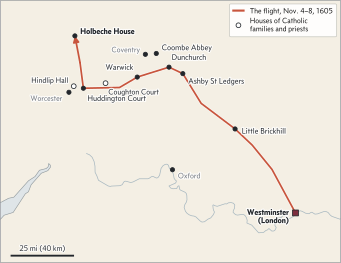
The others had already fled. As the news of “Johnson’s” arrest spread, they galloped northwest up Watling Street, the old Roman road; Rookwood covered 30 miles in two hours on one horse. At Dunchurch, Catesby told Digby’s hunting party that the king and Cecil were dead, but the gentlemen slipped away when the truth came out. The fugitives raided Warwick Castle for horses and supplies and rode on through rain to Huddington Court, the house of Robert Wintour. From there Catesby’s servant Thomas Bates rode to Coughton (koh-tun) Court to beg the priests hiding there for help. Garnet sent back a plea to stop. On November 7 the dwindling band reached Holbeche (hol-beech) House, in Staffordshire, the home of one of their followers (Figure 4.7). Holbeche House was their last refuge.The Holbeche House served as the final fallback point for organizers of this event. → Gunpowder Plot• That night they spread their rain-soaked gunpowder before the fire to dry, and a spark set it ablaze. Catesby was scorched, and another plotter, John Grant, was blinded. The next morning, November 8, the sheriff of Worcestershire surrounded the house with some two hundred men. John Wright and his brother Christopher were shot dead, Thomas Wintour and Rookwood were wounded and taken, and Catesby and Percy were reportedly killed by a single shot.
The survivors were tried in Westminster Hall on January 27, 1606, and condemned to be hanged, drawn, and quartered, the traitor’s death, in which the condemned man was cut down alive and his body cut to pieces. Four died on January 30 at St. Paul’s churchyard, and four on January 31 in Old Palace Yard at Westminster, in front of the building they had meant to destroy. Fawkes was one of the four. Weak from torture, he fell or jumped from the ladder and broke his neck, and so died before the rest could be done to him.
Parliament made the day a festival. An act of January 1606 ordered a service of thanksgiving in every church on every November 5, and it stayed law until 1859. Bells were rung and bonfires lit from the first year (Vol. 17, The Victorians), and on every Bonfire Night since an effigy of Guy Fawkes is burned.Effigies of Guy Fawkes are burned on November 5th to commemorate this event. → Gunpowder Plot•• Children made it of old clothes stuffed with straw or paper, carried it through the streets to beg pennies for fireworks, and called it a “guy.” That is how “guy” came to mean an oddly dressed man, and then any man at all. Since the Popish Plot of 1678, an invented Catholic conspiracy (Chapter 9), the cellars of Parliament have been searched before every State Opening, and the search goes on today.
After the plot, Parliament passed new laws against Catholics and an Oath of Allegiance, which James proclaimed in June 1606. A Catholic who took it swore that James was the lawful king and that the pope had no power to depose him. He also swore to abhor as “impious and heretical” the doctrine “that princes which be excommunicated by the pope may be deposed or murdered by their subjects.” Many Catholics thought they could take it in good conscience. Pope Paul V forbade them to, and the oath became a battle of books across Europe. James answered the pope himself in 1608, and Cardinal Robert Bellarmine (bel-ar-min), the most famous Catholic writer of the age, answered James. In 1613 the Spanish Jesuit Francisco Suárez (swahr-ez) replied with his Defense of the Catholic Faith, which argued that a pope could depose a heretic king, and James had it burned by the hangman in London (Vol. 10, Rebirth).
Henry Hudson
The Portuguese and Spanish held the ocean roads to Asia, south around Africa and South America. English merchants dreamed of a shorter road of their own across the top of the world. They looked for a Northeast Passage, along the Arctic coast of Russia, and for a Northwest Passage, around the north of America. A popular theory held that near the Pole, where the summer sun does not set for months, the ice must melt and leave open water. The polar ice never melts away in summer, but no one in 1607 knew that.
Of the man who tested it most stubbornly almost nothing is known before 1607. Henry Hudson was born about 1565, perhaps in London, and by 1607 he was an experienced captain. The theory’s keenest believers in London were the merchants of the Muscovy (mus-kuh-vee) Company, chartered in 1555 to trade with Russia. It was the first great English joint-stock company: its investors bought shares, put their money into one venture, and divided the profit or the loss. In 1607 the Muscovy Company hired HudsonThis man was employed by the Muscovy Company. → Henry Hudson•• to sail straight across the North Pole to China. If the sea at the top of the world was open, that road would be thousands of miles shorter than the voyage around Africa, and no Portuguese or Spanish fleet guarded it. On May 1, 1607, Hudson sailed in the Hopewell,This man sailed on the Hopewell. → Henry Hudson•• a ship of 80 tons, with ten men and a boy, who was probably his son John. He coasted along the ice of eastern Greenland, where he named a point Hold with Hope, then turned east to Spitsbergen (Figure 4.9). By mid-July he was at about 79°49′ north, within about seven hundred miles of the Pole, and the ice stopped him. He came home in September with reports of whales. In 1608 the company sent him in the Hopewell again, this time northeast around the North Cape of Norway, and again the ice turned him back, off Novaya Zemlya (noh-vuh-yuh zem-lyah).
In 1609 the Dutch hired him. The Dutch East India Company, founded in 1602 to trade with Asia, sent Hudson to try the northeast once more. On April 4, 1609, Hudson sailed the Half MoonThis man sailed on the Half Moon. → Henry Hudson•• out of Amsterdam, the Halve Maen (hahl-vuh mahn) in Dutch, with a crew of Dutchmen and Englishmen. East of the North Cape the ice blocked his way. Hudson turned his ship around and, against his orders, crossed the Atlantic to look for a passage through America. He reached Nova Scotia in July, Cape Cod in August, and sailed south as far as the mouth of Chesapeake Bay, near where English settlers had founded Jamestown two years before.
On September 3, 1609, he entered the great harbor at the mouth of a river where the city of New York now stands. The Italian navigator Giovanni da Verrazzano had seen it in 1524, but Hudson was the first European known to sail far up the river. Lenape (len-uh-pee) people, the Native Americans of the lower river, came out in canoes to trade oysters and beans, though one of Hudson’s men was killed by an arrow in a skirmish. Hudson sailed up the river for ten days, as far as the neighborhood of present-day Albany, until the water grew too shallow and fresh to be a passage to the Pacific. The river now bears his name. The voyage was the foundation of the Dutch claim to New Netherland.This man claimed New Netherland for the Dutch in 1609. → Henry Hudson•• Dutch traders followed his route to buy beaver furs, built a post near Albany, and in 1614 named the country New Netherland. In 1625 they founded New Amsterdam on Manhattan Island, the town that became New York (Vol. 27, New Worlds). On his way home Hudson put in at Dartmouth, in England, where the English authorities held him and his English crewmen, unwilling to let them serve the Dutch again.
So his last voyage was English. In April 1610, with money from the Virginia Company and the English East India Company, Hudson sailed northwest in the Discovery, the little ship that had carried some of the first settlers to Jamestown three years before. He passed Iceland in May and the south of Greenland in June, and in late June he reached the strait at the northern tip of Labrador that is now named for him. On August 2, 1610, after weeks among the ice, the Discovery came out into an open sea. Hudson believed he had found the way to the Pacific. He had found the great bay that bears his name,This man is the namesake of a large bay in Canada. → Henry Hudson•• an inland sea of nearly half a million square miles in what is now northeastern Canada. He sailed south along its eastern shore all autumn, and in November the ice trapped the ship in its shallow southern arm, James Bay. The crew wintered ashore, cold and half starved.

When the ice broke up in June 1611, Hudson meant to press on westward, and most of his men wanted to go home. Two men who had once been Hudson’s trusted friends, Henry Greene and Robert Juet (joo-it), led a mutiny. They seized the captain, and the crew set Hudson, his son, and his loyal men adriftAfter wintering in James Bay, this explorer’s Discovery crew set him, his son, and loyal followers adrift; they were never seen again. → Henry Hudson•• in the ship’s small open boat. With him went his teenage son John and seven men who were either sick or loyal to him. The mutineers gave them some clothing, powder and shot, a few pikes, an iron pot, and a little food. For a while the castaways rowed after the ship, and then the Discovery spread more sail and left them behind (Figure 4.8). They were never seen again.
Almost everything we know of the mutiny comes from one survivor, Abacuk (ab-uh-kuk) Pricket, one of the men who stayed aboard. Pricket kept an account of the voyage,Abacuk Pricket kept notes about this explorer's journeys. → Henry Hudson• which Samuel Purchas (pur-chus) printed in his great collection of travels in 1625. Greene and Juet did not survive the voyage home, and Pricket’s story puts the blame squarely on them, men who could no longer answer. Of the thirteen who seized the ship, eight reached England. In 1618 Pricket and others were tried for murder, and the court acquitted them, finding that it was not murder to turn experienced seamen adrift near a shore that was neither barren nor uninhabited.

Buckingham and the Spanish Match
James was generous to the point of ruin. He gave away lands, money, and titles, and he loved handsome young men. His first great favorite in England, Robert Carr, made Earl of Somerset, fell in 1615, when he and his wife were accused of poisoning his friend Sir Thomas Overbury in the Tower; the attorney general, Francis Bacon, prosecuted them the next year. By then a new face had appeared at court. At a hunt in August 1614 the king noticed George Villiers (vil-erz), a younger son of a Leicestershire gentleman, twenty-one years old, tall, graceful, and a beautiful dancer. Courtiers who wanted to bring Somerset down bought Villiers new clothes and had him made the king’s cupbearer, who served him his wine and could talk to him at table.

His rise was dizzying. He was knighted in 1615, made a viscount in 1616, an earl in 1617, a marquess in 1618, and in 1623 Duke of Buckingham. The king called him “Steenie,” after Saint Stephen, whose face, the Book of Acts says, looked like the face of an angel. In 1617 James told his council that he loved Buckingham more than anyone, and that Christ had his John, and he had his George. His letters to Buckingham call him “my sweet child and wife.” Buckingham was the king’s favorite and possibly his lover,George Villiers, Duke of Buckingham, was this ruler’s favorite and possible lover. → James I of England [or James VI of Scotland]• as the historian David Bergeron and many others now believe, though the letters, written in the extravagant style of the age, do not say so outright. For ten years every office and favor passed through his hands, and every ambitious man at court, Francis Bacon among them, courted him.
Across the sea the king’s family was in trouble. In 1613 James’s daughter Elizabeth had married Frederick V, the elector Palatine. In 1619 the Protestant Bohemians made Frederick their king. The next year the Holy Roman Emperor’s army drove him out, and Spanish troops occupied his lands on the Rhine. These were the first campaigns of the Thirty Years’ War (Vol. 14, From Luther to Mozart). The English Parliament wanted war with Spain, but James’s motto was “Blessed are the peacemakers,” and he hoped to win back his son-in-law’s lands by friendship with Spain instead. Since 1614 the clever Spanish ambassador, the Count of Gondomar (gon-doh-mar), had dangled before him a marriage, with a dowry of £600,000. This was the Spanish Match, the plan to marry the king’s son Charles to the Infanta Maria Anna,The Spanish Match was a failed attempt to marry this monarch's son to the Infanta Maria Anna. → James I of England [or James VI of Scotland]• the daughter of Philip III of Spain. An infanta (in-fan-tuh) is a daughter of a king of Spain.
The negotiations dragged on for years. In February 1623 Prince Charles, now twenty-two and heir to the throne since his brother Henry’s death in 1612, decided to win the princess in person. He and Buckingham rode across France in disguise, calling themselves Thomas and John Smith, and on March 7 they arrived unannounced at the English ambassador’s house in Madrid. The Spanish court was astonished. The two stayed for six months, and a play by the young Calderón (kahl-deh-rohn) was performed before the prince at the royal palace (Vol. 10, Rebirth). The Spanish asked for more than Charles could give: freedom of worship for England’s Catholics, the repeal of the laws against them, and a year’s wait in Spain before the bride left. Maria Anna herself did not want a Protestant husband, and Buckingham quarreled with the Count-Duke of Olivares (oh-lee-var-es), chief minister to her brother, Philip IV, king since 1621. In October Charles came home without a bride, and London greeted him with bells and bonfires of joy. Within months Charles and Buckingham had turned the old king against Spain: in 1624 he broke off the match, and Parliament voted money for a war that James himself never declared.
James did not see much of it. In early 1625 he suffered from arthritis, gout, and fainting fits, and in March he fell seriously ill and had a stroke. He died at Theobalds, his house in Hertfordshire, on March 27, 1625, aged fifty-eight, with Buckingham at his bedside. His son became Charles I (Chapter 5). A hostile book printed in the 1650s under the name of Sir Anthony Weldon, a courtier James had dismissed, claimed that he had been called “the wisest fool in Christendom,” and the phrase stuck for three centuries. Since the 1980s historians such as Jenny Wormald have judged him more kindly, as a shrewd ruler who kept his kingdoms out of Europe’s wars for most of his reign.
Bacon’s Advancement and Novum Organum
Francis Bacon was born on January 22, 1561, at York House in the Strand in London, the son of Sir Nicholas Bacon, Lord Keeper of the Great Seal, one of Elizabeth’s chief officers. His mother, Anne Cooke, was one of the most learned women in England, and her sister was married to Lord Burghley, Elizabeth’s chief minister, so Bacon grew up at the center of power. He went to Trinity College, Cambridge, at twelve, studied law at Gray’s Inn, one of the London colleges of lawyers, and sat in Parliament from the age of twenty. He was brilliant, ambitious, and always in debt.

Under Elizabeth he rose slowly. He served the queen’s favorite, the Earl of Essex, and when Essex rebelled in 1601, Bacon helped to prosecute him, and many never forgave him for it. Under James he rose fast. He was knighted in 1603, made Solicitor General in 1607 and Attorney General in 1613. With Buckingham’s backing he became Lord Keeper in 1617 and Lord Chancellor in 1618, the first of the king’s officers, who kept the Great Seal and presided over the House of Lords (the Stage). The king made him Baron Verulam (ver-oo-lum) in 1618 and Viscount St. Alban in 1621. Through all of it he wrote.
His first book was a slim volume of Essays (1597), ten short prose pieces of advice on studies, health, honor, and the like. He borrowed the name from the French writer Montaigne (mon-tayn) (Vol. 1, The Toolkit), and he enlarged the book to thirty-eight essays in 1612 and fifty-eight in 1625. The essays are short, hard, and quotable. In the text of 1625, as Mary Augusta Scott edited it in 1908, the essay “Of Truth” opens with the scene of Jesus before Pontius Pilate (Vol. 5, In the Beginning): “What is Truth? said jesting Pilate; and would not stay for an answer.” “Of Studies” advises that “Some books are to be tasted, others to be swallowed, and some few to be chewed and digested.”
His great ambition was larger. He believed that the learning of the universities, built on the writings of Aristotle (Vol. 6, The Greeks), had produced endless argument and almost no useful discovery. In 1605 Bacon published The Advancement of Learning,This philosopher wrote The Advancement of Learning. → Francis Bacon•• in English, and dedicated it to the king. Its first book answers those who say that learning makes men proud, idle, or unfit for business. Its second book surveys everything that human beings know, and marks what is missing. To survey knowledge, Bacon had to divide it. He divided it by the powers of the mind that produce it. “The parts of human learning,” he wrote, “have reference to the three parts of man’s understanding,” and so Bacon divided knowledge by memory, imagination, and reason:This philosopher classified knowledge into "Memory," "Reason," and "Imagination." → Francis Bacon•• “history to his memory, poesy to his imagination, and philosophy to his reason.” History, in this sense, is the record of particular things that have happened, in nature or among men. Poetry is the invention of things that never happened. Philosophy is the general truths that reason draws out of particular things. Divinity, the knowledge that comes by revelation, stood apart from all three.
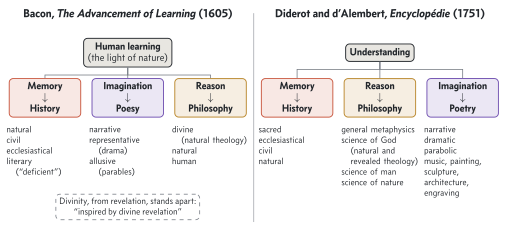
The division outlived him by more than a century. In 1751 the French writers Denis Diderot (dee-duh-roh) and Jean le Rond d’Alembert (dah-lahm-bair) began to publish the Encyclopédie (ahn-see-kloh-pay-dee), a dictionary of all the arts and sciences in seventeen volumes of text (Vol. 13, Valois, Bourbon, and Orange). Its first volume included a tree of human knowledge, and Bacon’s division shaped Diderot’s Encyclopédie:This philosopher's classification of knowledge in The Advancement of Learning inspired the structure of Diderot's Encyclopédie. → Francis Bacon•• memory leads to history, reason to philosophy, and imagination to poetry, exactly as in The Advancement of Learning (Figure 4.12). D’Alembert’s preface names Bacon as the model.

In 1620, when he was Lord Chancellor, Bacon published his boldest book, in Latin, for scholars all over Europe. It was meant as the second part of a six-part plan he called the Instauratio Magna (in-stow-rah-tee-oh mag-nuh), the “Great Renewal” of all knowledge, which he never finished. Its title page showed a ship sailing out past the Pillars of Hercules, the same pillars the emperor Charles V had taken as his badge (Vol. 10, Rebirth). Below it ran a verse from the Book of Daniel, which in the King James wording reads “many shall run to and fro, and knowledge shall be increased” (Figure 4.13). The old learning stopped at the edge of the known world, and the new would sail beyond it. Bacon wrote the Novum OrganumThis philosopher wrote Novum Organum. → Francis Bacon••• (noh-vum or-guh-num) as the vessel for that voyage, the part of the plan that set out the new method. Its title was a challenge. For four centuries the universities had taught logic from Aristotle, whose six books on reasoning had long been bound together as the Organon (or-guh-non), Greek for “tool” or “instrument.” The title answered Aristotle’s Organon:This work’s title refers to Aristotle’s collection of logical writings. → Novum Organum• Bacon’s book was the “new instrument” of thinking that would replace the old one.
The book is written in aphorisms, short numbered statements, each a paragraph or less. The third aphorism of its first book states its purpose. In the translation James Spedding published in 1858, it reads: “Human knowledge and human power meet in one; for where the cause is not known the effect cannot be produced. Nature to be commanded must be obeyed.” The same thought appears in a shorter form in an earlier book. In 1597 Bacon wrote a little book of religious meditations in Latin, the Meditationes Sacrae (med-ih-tah-tee-oh-nays sak-ry), where he says ipsa scientia potestas est (ip-suh skee-en-tee-uh poh-tes-tus est): knowledge itself is power.Francis Bacon stated this concept "is power" in a Latin maxim. → knowledge•• The short Latin maxim scientia potentia est first appears in those exact words in 1668, in a Latin edition of Leviathan (lih-vy-uh-thun) by Thomas Hobbes, who in his thirties had written down Bacon’s thoughts for him (Chapter 7).
Why had the old learning failed? Bacon’s answer was that the human mind is not a clear mirror. It comes to nature already full of errors, which he called idols, using an old word for a false image, a phantom that is worshiped in place of the real thing. Bacon named four idols that block knowledge:This philosopher classified errors of thought as idols of the tribe, cave, marketplace, and theater. → Francis Bacon•••Bacon promoted an inductive form of this process and identified four kinds of “idols” that obstruct it. → scientific method•• the idols of the tribe, the cave, the marketplace, and the theater (Table 4.1). They obstruct what we now call the scientific method, the patient procedure of observing, testing, and correcting by which science finds out how nature works.
| Idol | Where it comes from | An example |
|---|---|---|
| Of the tribe | Human nature itself, shared by the whole “tribe or race of men”: the mind is “like a false mirror” | Seeing patterns that are not there; remembering the hits and forgetting the misses |
| Of the cave | Each person’s own “cave or den,” made by temperament, education, and reading | A scholar who sees everything through his favorite subject |
| Of the marketplace | Words, which people coin in the market and the street | Arguing about a word that names nothing real |
| Of the theater | The systems of the philosophers, which are “but so many stage-plays” | Accepting a doctrine because a great authority taught it |
The idols of the tribe belong to the whole human race. The mind, Bacon says, is “like a false mirror,” which bends the rays that fall on it and colors things with its own nature; we see order where there is none and notice what agrees with us. The idols of the cave are each person’s own, his “cave or den” that “refracts and discolours the light of nature,” an image borrowed from Plato’s cave (Vol. 6, The Greeks). The idols of the marketplace come from words, which people make up in the market and the street to serve ordinary talk, so that philosophers argue endlessly over words that name nothing clearly. The idols of the theater are the great systems of the philosophers, which Bacon calls “so many stage-plays, representing worlds of their own creation.”
Against the idols Bacon set a method. Aristotle’s logic had taught deduction (Vol. 1, The Toolkit), in which true premises guarantee a conclusion, and its chief form, the syllogism, reasoned from general principles down to particular cases. Bacon said that this was useless for discovery, because the general principles were themselves hasty guesses. Science should start from the other end. Induction (Vol. 1, The Toolkit) is reasoning upward from many particular observations to a general law, and an empirical inquiry is one that rests on experience and experiment. Bacon made inductive, empirical inquiry the method of science.This philosopher promoted inductive, empirical inquiry as a method for studying nature. → Francis Bacon••Bacon promoted inductive inquiry as a method for this enterprise. → science••• The true road, he wrote, “derives axioms from the senses and particulars, rising by a gradual and unbroken ascent, so that it arrives at the most general axioms last of all.”
He put the method in a picture. In the translation of 1858, the ninety-fifth aphorism says that men of experiment “are like the ant; they only collect and use: the reasoners resemble spiders, who make cobwebs out of their own substance. But the bee takes a middle course.” The bee gathers from the flowers of the field and turns what it gathers into honey by a power of its own. The empiricists are ants and the dogmatists spiders:This work compares empiricists to ants, dogmatists to spiders, and the ideal investigator to a bee. → Novum Organum• the empiricist piles up facts without understanding them, the dogmatist spins theories out of his own head, and the true investigator, like the bee, must both gather and think.
The second book of the Novum Organum shows the method at work on a single question: what is heat? First Bacon made lists of instances, particular cases in which heat is found, missing, or stronger and weaker. His table of presence gathers twenty-seven things that are hot, from the rays of the sun at noon to fresh horse dung. His table of absence sets beside them things much like them that are not hot, such as the rays of the moon. His table of degrees compares things that are hotter or colder. Then he struck out every explanation that did not fit all the tables. What was left, in what he modestly called a “First Vintage,” was his answer. Bacon’s tables of heat showed it to be motion:This work uses tables of instances of heat to investigate heat as a form of motion. → Novum Organum••• “Heat itself, its essence and quiddity, is Motion and nothing else,” a motion of expansion working in “the smaller particles of bodies.” Two centuries later physicists showed that heat is indeed the motion of the tiny particles of matter.
Bacon fell the year after the book appeared. In 1621 Parliament accused the Lord Chancellor of taking gifts from people whose cases he was judging, on twenty-three counts. Judges commonly took such gifts then, and Bacon said they had never changed a judgment, but he confessed. When the House of Lords sent a committee to ask whether the confession was really his, he answered, “My lords, it is my act, my hand, and my heart; I beseech your lordships to be merciful to a broken reed.” He was fined £40,000, which the king later forgave, spent a few days in the Tower, and was barred from office forever. He spent his last five years writing, among other things, his History of the Reign of King Henry VII (1622; the Stage). He died on April 9, 1626. The antiquary John Aubrey told the story of his death decades later, as he had heard it from Hobbes. On a snowy day near Highgate, Aubrey wrote, Bacon stopped his coach and stuffed a hen with snow, to see whether cold would keep meat fresh, and he caught the chill that killed him. Bacon’s own last letter says only that the experiment “succeeded excellently well.”
The New Atlantis
Bacon left behind an unfinished story. His chaplain, William Rawley, printed it in 1626, a few months after his death, at the back of a book of Bacon’s natural history. Bacon wrote The New AtlantisThis philosopher wrote The New Atlantis. → Francis Bacon•• as a picture of what his method could do in a whole society. Like Thomas More’s Utopia, a century older (Chapter 2), it tells of travelers who find a perfect commonwealth on an unknown island. Its title answers another old story. In Plato’s dialogues, Atlantis was a great island in the western ocean that sank beneath the sea (Vol. 6, The Greeks). Bacon’s island is a new and better one.
A ship sails from Peru for China and Japan across the South Sea, the Pacific. After five months the wind turns against it, the food runs low, and the sailors pray. Then they see land, and they enter the harbor of a fair city. Officials row out and warn them off, but they also offer help, written on a scroll in Hebrew, Greek, Latin, and Spanish and signed with a cross. The sailors swear that they are Christians and no pirates, and they are allowed to land. They are on the island of BensalemThis work is set on the island of Bensalem. → The New Atlantis•• (ben-suh-lem), unknown to the rest of the world, whose people know the whole world and keep themselves hidden.
The sailors, fifty-one of them with seventeen sick, are lodged in the Strangers’ House, a fair building of brick, and by the custom of the land are kept indoors for three days. Their sick recover. Then they are visited by the governor of the House of Strangers,This work features the governor of the House of Strangers. → The New Atlantis• a Christian priest in a white turban with a small red cross. He tells them they may stay six weeks or longer, and on the next day he answers their questions. The first is how a land so remote became Christian.
He tells them the island’s story of its conversion. About twenty years after the Ascension, when Christians believe Jesus rose into heaven, the people of Renfusa (ren-foo-suh), a city on the eastern coast, saw a great pillar of light rising from the seaIn this work, a pillar of light rises from the sea. → The New Atlantis• about a mile offshore. At its top was a cross of light. Boats rowed out but could come no nearer than 60 yards. One of the boats carried a wise man of Salomon’s House (sal-uh-mun), who prayed that the sign be explained. His boat alone was allowed to move. As he came near, the pillar broke into a field of stars and vanished, and on the water floated a small ark of cedar wood. In it, the governor says, were the books of the Bible and a letter from the apostle Bartholomew, which every reader could understand in his own language.
The wise man came from the island’s greatest institution. About 1,900 years before, the governor tells them, the wise king who gave the island its laws founded an order called Salomon’s House,This work describes the research institution Salomon’s House. → The New Atlantis•• “the very eye of this kingdom,” dedicated to the study of the works and creatures of God. Near the end of the book one of its Fathers explains it to the narrator. “The end of our foundation,” he says, “is the knowledge of causes, and secret motions of things; and the enlarging of the bounds of human empire, to the effecting of all things possible.” Salomon’s House has caves 600 fathoms deep and towers half a mile high, houses where it makes artificial rain and thunder, gardens where it breeds new plants, and parks where it studies animals. The work is divided as Bacon’s method divides it. Twelve of its fellows, the Merchants of Light, travel abroad under the names of other nations, carried by ships that leave in secret every twelve years, and bring home books and the experiments of other countries. Others gather, test, and arrange the results, and the last three, the Interpreters of Nature, raise the discoveries into general laws.
The book breaks off with a printer’s note, “The rest was not perfected.” Readers never learned how Bensalem was governed, but they took the point. When a group of scholars founded the Royal Society in London in 1660 to promote “experimental learning,” many of them looked to Salomon’s House as their model (Chapter 8).
Gibbons
Orlando Gibbons was the finest English composer of James’s court. He was baptized in Oxford on Christmas Day, 1583, into a family of musicians; his father was one of the town’s waits, its band of salaried players. He sang as a choirboy at King’s College, Cambridge, where his eldest brother directed the choir. In 1603 he joined the Chapel Royal, the monarch’s choir (Chapter 3), and within a few years he was its organist and the most admired keyboard player in England.

In 1612 he published his First Set of Madrigals and Motets of Five Parts, dedicated to his patron, Sir Christopher Hatton, a cousin and heir of Elizabeth’s favorite of the same name (Chapter 3), in whose house, he said, most of them had been written. A madrigal is a song for several voices, one singer to a part, in which the music follows the meaning of the words (Chapter 3). The set opens with the most famous madrigal in English: Gibbons wrote “The Silver Swan”This composer wrote the madrigal "The Silver Swan." → Orlando Gibbons• for five voices, to an anonymous poem of six lines. The poem tells an old legend, known to the ancient Greeks, that the swan is silent all its life and sings only once, just before it dies. “The silver swan, who living had no note,” it begins, in modern spelling, and when death comes near she sings for the first and last time, leaning against the reeds at the water’s edge. She bids farewell to all joys and asks death to close her eyes. Then the last line turns sharply from grief to satire: there are more geese than swans alive now, and more fools than wise men.
Gibbons set it plainly, almost like a hymn, with the top voice singing a tune that can stand alone. On the word “death” he wrote a harsh, unprepared chord, an augmented triad (Vol. 1, The Toolkit), that makes the listener wince. Some editors in the nineteenth century thought it was a misprint and “corrected” it.
Gibbons also wrote six pieces for the virginal in Parthenia (Chapter 3), the first book of keyboard music printed in England, made about 1612 to celebrate the wedding of James’s daughter Elizabeth in February 1613. In 1623 he became organist of Westminster Abbey, and on May 7, 1625, he played at King James’s funeral there. A month later the Chapel Royal traveled to Canterbury to welcome the French princess Henrietta Maria, whom the new king, Charles I, had married by proxy. There, on June 5, 1625, Gibbons died suddenly, probably of bleeding in the brain, at forty-one. He was buried in Canterbury Cathedral, where a monument put up soon after his death still stands.
What to remember
- James VI of Scotland, son of Mary, Queen of Scots, succeeded Elizabeth I in 1603 as James I of England, the first Stuart king: the Union of the Crowns. He believed in the divine right of kings.
- The Puritans’ Millenary Petition led to the Hampton Court Conference (1604) and the King James Bible (1611), made for the Church of England.
- James sailed to Scandinavia for Anne of Denmark (1589); the storms he blamed on witches led to the North Berwick trials (1590) and his Daemonologie (1597). His Counterblaste to Tobacco (1604) attacked the smoking Raleigh made fashionable, which Anthony Chute’s Tabaco (1595) had praised.
- Robert Catesby’s Gunpowder Plot (1605) meant to blow up king and Parliament and crown Princess Elizabeth a Catholic queen. A letter to Lord Monteagle exposed it; Guy Fawkes, alias John Johnson, was caught; the rest fell at Holbeche House. His effigy burns every November 5.
- Henry Hudson sailed the Hopewell for the Muscovy Company (1607–1608), the Half Moon for the Dutch (1609), founding the claim to New Netherland, and the Discovery into Hudson Bay (1610); after a winter in James Bay he was set adrift (1611), as Abacuk Pricket told it.
- Buckingham was James’s favorite and possibly his lover. The Spanish Match, to marry Prince Charles to the Infanta Maria Anna, failed in 1623.
- Francis Bacon, Lord Chancellor from 1618, divided knowledge by memory, imagination, and reason (The Advancement of Learning, 1605), the plan of the Encyclopédie. The Novum Organum (1620) taught induction, the four idols, the ants, spiders, and bee, and heat as motion.
- The New Atlantis (1626) tells of Bensalem, the pillar of light, and Salomon’s House. Orlando Gibbons wrote “The Silver Swan” (1612).
Chapter 5 · 38 clues
Charles I and the Civil War
In 1633 the Flemish painter Anthony van Dyck (van dike) finished a picture more than 12 feet high for King Charles I of England, Scotland, and Ireland. It seems to have been meant for the far end of a long gallery in St. James’s Palace in London. A visitor walking down the room would see the king riding toward him through an archway, as if the wall had opened. The king is in armor, on a white horse, with the calm of a man who expects to be obeyed.
Sixteen years later, on a bitter January afternoon, the same king stepped through another opening in another wall: a window of the Banqueting House at Whitehall, half a mile away. Outside stood a scaffold draped in black, built by order of his own subjects. Between the two openings lie a quarrel over money and prayer books, eleven years without a Parliament, a rebellion in Scotland, two civil wars, and the rise of a country squire named Oliver Cromwell.
Van Dyck and the Stuart court
Charles was born at Dunfermline (dun-ferm-lin) in Scotland on November 19, 1600, the second son of James VI, who became James I of England in 1603 (Chapter 4). He was a weak, slow child who walked late and stammered all his life. When his brilliant elder brother Henry died in 1612, the shy younger son became heir to three kingdoms. He grew into a small, dignified, and deeply devout man, about 5 feet 4 inches tall. He held the creed his father had taught him, the divine right of kings (Chapter 4): that a king receives his power from God and answers to God alone, never to his subjects. He became king when his father died on March 27, 1625, and within weeks he married Henrietta Maria, the fifteen-year-old sister of King Louis XIII of France. She was a Catholic, and she kept her own priests and her own chapel in Protestant London.
Charles loved pictures more than any English king before or since. A journey to Madrid in 1623 (Chapter 4) had shown him the Spanish king’s paintings by Titian (tish-un) (Vol. 10, Rebirth). In 1627 and 1628 he bought the whole collection of the Duke of Mantua, with paintings by Raphael, Titian, Mantegna (man-ten-yuh), and Caravaggio (kar-uh-vah-joh). He wanted a great painter of his own, and he found Anthony van Dyck. Born in Antwerp in 1599, the son of a silk merchant, van Dyck had been the chief assistant of Peter Paul Rubens (roo-benz), the greatest painter of Flanders (Vol. 13, Valois, Bourbon, and Orange). He had then spent six years in Italy painting the nobles of Genoa. In 1632 he settled in London. Charles knighted him, gave him a pension and a house on the Thames at Blackfriars, and visited his studio so often that a causeway was built to make the trip easier. Van Dyck was Charles’s court painter,Anthony van Dyck was this man’s court painter. → Charles I• with the title of Principal Painter in Ordinary, until he died in London in December 1641, and in those nine years the king and queen hardly sat for anyone else. The pointed beard he gave his sitters is still called a Vandyke.

His portraits flattered, and everybody knew it. Charles’s niece Sophia, the girl whose son would one day reign as George I (the Stage), met the queen in Holland in 1642. Van Dyck’s pictures, she wrote in her memoirs, had led her to expect a beauty, and she found a small woman with long, thin arms and teeth that stuck out. The most famous of the portraits shows the king with neither armor nor crown. In Charles I at the Hunt, painted about 1635 and now in the Louvre in Paris, the king rests from the hunt,This painter portrayed Charles I taking a break from a hunt. → Anthony van Dyck•In a painting of this man “at the Hunt,” he leans on a staff while Endymion Porter tends his horse. → Charles I•• leaning on a tall staff while Endymion Porter (en-dim-ee-un) and a page hold his horse under a tree. Porter was a groom of the king’s bedchamber, one of the courtiers who waited on him in his private rooms, and he had gone with Charles to Madrid as his interpreter and later bought pictures for him abroad. The viewpoint is low, so that we look up at a king who was shorter than most of his courtiers, and the horse lowers its head as if it were bowing. The picture itself is printed elsewhere in the Course (Vol. 11, The Age of Shakespeare).
Van Dyck’s first great picture of Charles was the one painted in 1633 for the gallery at St. James’s (Figure 5.1). It is an equestrian portrait, a portrait of a rider on horseback, the form in which Roman emperors had been shown and in which Titian had painted the emperor Charles V (Vol. 10, Rebirth). The king rides through a triumphal arch,In an equestrian portrait, this man passes through a triumphal arch on horseback. → Charles I• the kind of gateway that Rome built for its victorious generals, framed by curtains of green silk. At the right his French riding master, Pierre Antoine Bourdon, lord of St. Antoine (san-tahn-twahn), looks up at him and holds his helmet; the “M.” of the title stands for Monsieur (muh-syur). At the lower left a crowned shield bears the Stuart arms.In an equestrian portrait of this man, a shield depicting the Stuart coat of arms sits at the bottom-left. → Charles I• Two of its quarters hold the lions of England and the lilies of France, whose crown English kings still claimed; the third holds the red lion of Scotland, and the fourth the harp of Ireland.

In 1635 Charles wanted a portrait in marble by the most famous sculptor in Europe, Gian Lorenzo Bernini (ber-nee-nee) of Rome (Vol. 10, Rebirth). Bernini never saw the king, so van Dyck painted Charles I in Three Positions: the head in full profile at the left, facing us in the middle, and turned three-quarters at the right (Figure 5.2). The triple portrait was sent to RomeA triple portrait showing this ruler’s head from three angles was made as a guide for Bernini’s bust. → Charles I•• in 1636 as Bernini’s guide, so that he could carve a head in the round from views on three sides. The bust reached England in 1637 as a present from Pope Urban VIII, who hoped that the Catholic queen might draw her husband toward Rome. Charles was delighted and sent Bernini a diamond ring. The bust burned with most of Whitehall Palace in 1698, and the painting is now the best record of what Bernini saw.
The grandest room at court was older than the portraits. In January 1619 fire destroyed the banqueting hall of Whitehall Palace, the sprawling riverside palace that was the monarchs’ home in London. To rebuild it James I turned to Inigo Jones (in-ih-goh), the designer of the court’s masques, its evenings of music, dance, and painted scenery (Vol. 11, The Age of Shakespeare). Jones had studied the buildings of Italy, and he filled his copy of the Four Books of Architecture by the Italian architect Andrea Palladio (puh-lah-dee-oh) with notes. His Banqueting House, built from 1619 to 1622, was the first finished building in England in the strict classical style of Palladio and the ancient Romans. It is a plain block of pale stone with two tiers of columns, and its windows are crowned by pediments (Vol. 1, The Toolkit), the low triangular or curved gables of Greek and Roman temples. Inside is a single hall, a double cube, as high as it is wide and twice as long, about 110 feet long and 55 feet wide (Figure 5.3). It was built for feasts, for receiving ambassadors, and for masques.

Charles gave the hall a ceiling. Rubens came to London in 1629 and 1630 as a diplomat for the king of Spain. Charles knighted him and commissioned nine canvases in honor of James I. Rubens painted them in his workshop in Antwerp and shipped them over, and they were fixed in place in 1636. In the great oval at the center, The Apotheosis of James I, the old king is carried up to heaven; an apotheosis, from the Greek for “making a god,” is a picture of someone raised among the gods. Over the entrance end, in The Union of the Crowns, England and Scotland, painted as two women, bring the infant Charles to his enthroned father. Over the throne end, where the king sat in state, The Peaceful Reign of James I shows the blessings of his rule. Long friezes of children leading animals and carrying fruit, and four ovals of virtues trampling vices, fill the rest (Figure 5.4).

The Banqueting House still stands in London,Inigo Jones’s Banqueting House, with a Rubens ceiling honoring James I, stands in this city. → London• on the street called Whitehall, the only large part of the palace that survived the fire of 1698. A visitor can stand where Charles stood under his father’s glory, a few yards from the spot where he walked out to die.
Personal rule
A king of England could not simply tax his people. By custom and law a new tax needed the consent of Parliament, the assembly of Lords and Commons that only the king could summon and dismiss (the Stage). Charles’s first Parliaments, from 1625 to 1629, quarreled with him over money, over his favorite, and over religion. The favorite was George Villiers, Duke of Buckingham, who had dominated James I’s court (Chapter 4) and now led Charles’s wars against Spain and France, which went badly. When the Commons refused money unless he dismissed Buckingham, Charles raised a forced loan, a “loan” that his subjects had no choice about making, and jailed gentlemen who refused to pay without saying what law they had broken.
In 1628 the Commons answered with the Petition of Right. It set out what they held to be the ancient liberties of Englishmen, going back to Magna Carta (Vol. 8, The Northern Worlds). There was to be no tax or loan without the consent of Parliament, no imprisonment without a cause shown, no soldiers lodged in private houses, and no martial law, the rule of army courts, in time of peace. Charles needed money, and on June 7, 1628, he accepted it. Eleven weeks later, on August 23, a discontented army officer named John Felton stabbed Buckingham to death in an inn at Portsmouth. Edward Hyde, later Earl of Clarendon, who wrote the great royalist history of these years (the Stage), says that the king threw himself on his bed and wept; in London the crowds rejoiced.
The peace lasted one more session. In March 1629 the Speaker of the Commons tried to adjourn the House on the king’s orders. Two members held him down in his chair while the House shouted through resolutions against new ceremonies in the church and against the customs duties, taxes on goods brought into the ports, that the king was collecting without Parliament’s consent. Charles dissolved Parliament and did not call another for eleven years. Charles ruled without Parliament from 1629 to 1640,This ruler refused to call Parliament for eleven years during a period known as "personal rule." → Charles I•• in what is now called the Personal Rule; the Victorian historians who sided with Parliament, S. R. Gardiner among them, called it the Eleven Years’ Tyranny. No court could stop it, for only the king could summon a Parliament. Two statutes of Edward III had called for one every year, but kings had long ignored them.
To rule alone Charles had to live on what he could raise without Parliament: customs duties, fines, the sale of monopolies, which gave one man or company the sole right to make or sell a product, and fees revived from forgotten laws. The most famous was ship money. Kings had long required the seaports, in wartime, to supply ships for the navy or pay what they cost. In 1634, in peacetime, Charles levied ship moneyThis ruler levied an unpopular tax called "ship money." → Charles I• on the ports, and in 1635 he extended it to every county inland, as a yearly tax of about £200,000. John Hampden (hamp-dun), a rich squire of Buckinghamshire and a first cousin of Oliver Cromwell, refused to pay his share, and in 1637 the crown tried him before all twelve of its senior judges. They found for the king by seven votes to five, but so narrow a win encouraged others to refuse, and by 1639 less than a fifth of the money was coming in. A century later Thomas Gray imagined “Some village-Hampden” buried in a country churchyard (Vol. 11, The Age of Shakespeare).
Two men carried out the king’s policies, and both paid with their heads. Thomas Wentworth, a Yorkshire landowner, had been jailed in 1627 for refusing the forced loan and had backed the Petition of Right in 1628, and then he went over to the king. In 1632 Charles made him Lord Deputy of Ireland, the king’s governor there, and he ruled the island with a hard, efficient hand, squeezing money out of its lords, Catholic and Protestant alike. In 1640 Charles made him Earl of Strafford and his chief adviser in England. His enemies said that he meant to bring an Irish army across the sea to make England obey as well.
The other was William Laud (lawd), a cloth merchant’s son from Reading, who became archbishop of Canterbury, the head of the clergy of the Church of England, in 1633. Laud believed that God should be worshiped with order and reverence, in what his followers called, after a verse of the Psalms, “the beauty of holiness.” He had the communion table moved against the east wall like an altar and fenced with rails; in many parishes it had stood in the middle of the church like an ordinary table. He also wanted kneeling, bowing, and the white surplice used exactly as the Prayer Book said. To the Puritans, the earnest Protestants who wanted the church purified of everything that reminded them of Rome (Chapter 4), this looked like the Catholic Mass creeping back. A Catholic queen with her own chapel at court, and an agent of the pope received in London, made the fear seem reasonable to them. Laud silenced his critics through the king’s courts. In 1637 three Puritan writers, William Prynne (prin), Henry Burton, and John Bastwick, had their ears cut off at Westminster as they stood in the pillory, a wooden frame that held a man’s head and hands before the crowd.
Scotland broke first. Its church, the Kirk, had been made Presbyterian at the Reformation, governed by assemblies of ministers and elders rather than by bishops (Chapter 3). James had put bishops back over it, but its worship stayed plain. In 1637 Charles imposed a new prayer book on Scotland, a Scottish version of England’s Book of Common Prayer (Chapter 2) drawn up by Scottish bishops, without asking the Kirk’s General Assembly or the Scottish Parliament. The Scots blamed it on Laud. When the dean of Edinburgh began to read from it in St. Giles’ Cathedral on Sunday, July 23, 1637, the congregation rioted. Edinburgh tradition says that a market woman, later named as Jenny Geddes (ged-iss), began it by throwing her stool at his head and crying that he dared to say the Mass in her ear. Whether she existed is doubted, but a letter written that August reports that the women beat the clergy out of the church with their little stools.

In February 1638 nobles, ministers, and townsmen in Edinburgh began to sign a National Covenant, a solemn promise before God to defend the Kirk against the new prayer book and any other changes that its Assembly and Parliament had not approved. Copies went round Scotland for signatures. Those who signed were the Covenanters (kuv-uh-nan-terz). Their General Assembly then abolished bishops altogether. Charles took this for rebellion, and in 1639 and 1640 the king fought the Covenanters in the Bishops’ Wars,This king fought the Bishops' War against a rebellion. → Charles I•This country’s Covenanters revolted during the Bishops’ Wars after an attempt to impose the Book of Common Prayer. → Scotland•• so called because he was fighting for his bishops. In 1639 the two armies faced each other near Berwick on the border and made peace without a battle. In August 1640 a Scottish army crossed the Tweed, the river that forms part of the border, beat the English at Newburn on August 28, and took Newcastle, whose coal heated London (Figure 5.5).
Charles called a Parliament in April 1640 and dismissed it after three weeks, which is why it is called the Short Parliament. The defeat at Newburn forced him to call another, which met on November 3, 1640, and became the Long Parliament, because it was not finally dissolved until 1660. Its leader in the Commons was John Pym, a Somerset gentleman who believed that the king’s advisers were plotting to bring back Catholic tyranny. The Commons impeached Strafford, accusing him before the House of Lords as judges, and when his trial faltered they passed a bill of attainder, an act of Parliament that simply declared him guilty and condemned him to death. Crowds surged round Whitehall, and on May 10, 1641, Charles, who had promised Strafford he would not die, signed the bill. One account says that Strafford, hearing the news, quoted the Psalm: “Put not your trust in princes.” He was beheaded on Tower Hill on May 12. Laud was sent to the Tower and beheaded in his turn on January 10, 1645.
In 1641 the Long Parliament abolished ship money and the court of Star Chamber, where the king’s councilors judged cases without a jury, and it required a Parliament to meet at least once every three years. In October the Catholics of Ulster rose against the Protestant settlers (Chapter 6 tells the rising from both sides), and king and Parliament could not agree who should command the army to put it down. In November the Commons passed the Grand Remonstrance (rih-mon-struns), a long list of the reign’s misdeeds, by just 159 votes to 148. On January 4, 1642, Charles came to the House of Commons with armed men to arrest five members for treason, Pym and Hampden among them, who had been warned and had fled. He looked along the benches, remarked that the birds had flown, and walked out while members shouted “Privilege!” (the Stage) They meant their ancient right to be free from arrest while Parliament sat. Six days later he left London, and he did not return until he was brought back as a prisoner.
The first civil war
Each side now raced to arm. The fighting that followed, from 1642 to 1651, is called the English Civil War, and its first round, the first civil war, lasted until 1646. The kingdom’s two great stores of weapons were the Tower of London, which Parliament held, and the magazine at Hull, the port on the Humber where Andrew Marvell grew up (Vol. 11, The Age of Shakespeare). Hull held 120 cannon, 7,000 barrels of gunpowder, and arms for some 16,000 men, left over from the Bishops’ Wars. On the morning of April 23, 1642, the king rode up to the town’s Beverley Gate and demanded to be let in. The governor, Sir John Hotham (huth-um), a Yorkshire member of Parliament, or MP, stood on the wall and refused, protesting his loyalty all the while, and the gate stayed shut. In July Charles came back with about 4,000 men. The siege of Hull and its arsenalThe siege of a weapons depository at Hull marked the beginning of the first phase of this conflict. → English Civil War• was the first fighting between king and Parliament. The defenders flooded the low fields round the walls, sallied out, and blew up a royalist store of powder, and before the end of July the king’s men withdrew.
On August 22, 1642, at Nottingham, Charles raised his royal standard, the flag that summoned loyal subjects to arms, and the war began (Vol. 11, The Age of Shakespeare). The two sides already had their nicknames, Cavaliers for the king’s men and Roundheads for Parliament’s (the Stage), and the royalists took theirs as praise. The king held most of the North, Wales, and the West. Parliament held London, with its money and its trained militia, the South-East, the eastern counties, the navy, and nearly every port (Figure 5.6).

The king’s best soldier arrived that summer from Holland. Prince Rupert of the Rhine commanded the king’s horse,Prince Rupert of the Rhine commanded this ruler's forces. → Charles I• as the cavalry was called, from August 1642, when he was twenty-two. He was Charles’s nephew, the son of the king’s sister Elizabeth and of Frederick V, the Elector Palatine, whose lands lay on the Rhine (the family is on the tree in the Stage). Frederick’s brief reign as king of Bohemia in 1619 and 1620 had helped to begin the Thirty Years’ War in Germany (Vol. 14, From Luther to Mozart). Rupert was born in Prague in 1619, fought in that war as a boy, and spent three years as a prisoner of the emperor at Linz on the Danube. He was tall, brave, quarrelsome, and quick, and he led his cavalry in a headlong charge with swords drawn. He lived to command Charles II’s fleets and to be the first governor of the Hudson’s Bay Company, whose lands in Canada were named Rupert’s Land after him (Vol. 2, Geography: The Americas and Oceania).
The armies met at Edgehill in Warwickshire on October 23, 1642. Rupert’s charge swept Parliament’s horse off the field, but his men galloped on to plunder the enemy’s baggage, and the infantry, or foot, fought until dark without a result. Parliament’s general, the third Earl of Essex, son of Elizabeth’s favorite, fell back to guard London. The king followed, but in November the London trained bands, the city’s part-time militia, stood across his road at Turnham Green, and he turned away. He never came so close to London again. Oxford became the royalist capitalThis city was the Royalist capital during the English Civil War. → Oxford• for the rest of the war. In that university town, about 55 miles northwest of London, Charles lived in the Deanery of Christ Church and the queen at Merton College. In January 1644 the lords and members who had left Westminster met as the king’s own Parliament in the great hall of Christ Church. The colleges’ silver plate was melted down for coin, and earthworks ringed the city.

Rupert went everywhere with a white hunting poodle named Boy, which the Earl of Arundel had given him to keep him company in prison. London pamphlets made the dog famous. They called Boy a “dog-witch,”A white poodle named Boy was portrayed as a “dog-witch” during this conflict. → English Civil War• Rupert’s familiar, the demon that was believed to serve a witch in the shape of an animal, and they said that he could catch bullets in his teeth and find hidden treasure (Figure 5.7). Royalist wits answered with mock pamphlets that piled on still wilder claims, to laugh at how much their enemies would believe. The historian Mark Stoyle showed in 2011 that some of the most famous “evidence” for the dog’s powers was royalist parody of this kind.
For a year the war went the king’s way. On June 18, 1643, Hampden was mortally wounded in a skirmish at Chalgrove Field in Oxfordshire, and he died six days later. In July Rupert stormed Bristol, the second city of the kingdom, and in the North the king’s general, William Cavendish, Earl of Newcastle, drove Parliament’s army, under Lord Fairfax and his son Thomas, back into Hull. Pym bought Parliament an ally before he too died, in December. By the Solemn League and Covenant of September 1643, Parliament promised to reform the English church after the example of the best Reformed churches, which the Scots took to mean their own Presbyterian Kirk, and the Scots promised an army. In January 1644 some twenty thousand Scots crossed the Tweed under the Earl of Leven (lee-vun), a veteran of the Swedish army in the Thirty Years’ War.
Cromwell the soldier
Oliver Cromwell was born at Huntingdon on April 25, 1599, into the gentry, the landowners just below the nobility, in a family that had grown rich on the lands of the monasteries Henry VIII had closed. His great-grandfather, Richard Williams, was a nephew of Henry VIII’s minister Thomas Cromwell and took his uncle’s name (Chapter 2). Oliver studied for a year at Sidney Sussex College, Cambridge, farmed and collected rents at Huntingdon, St. Ives, and Ely on the edge of the Fens, the marshy lowlands of eastern England, and sat in Parliament for Huntingdon in 1628 and for Cambridge in 1640. In the 1630s he passed through a religious crisis and came out of it certain that God had chosen him, though he had been, as he wrote in a letter of 1638, the worst of sinners. He belonged to no regiment and had never seen a battle. He became the greatest Roundhead leaderThe Cavaliers supported Charles I against the Roundheads in this war. → English Civil War••This man was a leader of the Roundheads. → Oliver Cromwell• in the war against the king’s Cavaliers because he joined that certainty to a gift for war that nobody, himself included, had suspected.
In August 1642 he stopped the silver plate that the Cambridge colleges were sending to the king and raised a troop of horse at Huntingdon; the accounts disagree whether it fought at Edgehill or arrived too late. Over the next year he built it into a regiment in the army of the Eastern Association, the league of eastern counties that Parliament had formed for their defense. By 1644 it had fourteen troops instead of the usual six. He chose men who prayed and would not swear, drink, or plunder, and he promoted them for merit rather than birth. He explained why in a letter of September 1643 to the county committee of Suffolk, printed in Thomas Carlyle’s edition of his letters (1845). “I had rather have a plain russet-coated Captain that knows what he fights for, and loves what he knows, than that which you call ‘a Gentleman’ and is nothing else.” Russet was the reddish-brown homespun of farmers. He drilled his troopers to ride knee to knee, and, harder, to halt after a charge, rally, and charge again instead of chasing a beaten enemy off the field. They proved it at Gainsborough in July 1643 and at Winceby that October, and early in 1644 Cromwell became lieutenant general, the second in command, of the Eastern Association’s army under the Earl of Manchester.
In the summer of 1644 three armies were besieging York, the royalist capital of the North: Leven’s Scots, Lord Fairfax’s Yorkshiremen, and Manchester’s men from the eastern counties, Cromwell’s horse among them. Rupert marched to the city’s rescue from Shrewsbury by way of Lancashire, slipped round the besiegers, and relieved it on July 1 (Figure 5.6). The next day he offered battle on Marston Moor, west of the city, and a report of the time has him asking a prisoner, “Is Cromwell there?” It was the largest battle of the civil wars. All afternoon the armies faced each other while the allied soldiers sang psalms. At about half past seven in the evening, in a thunderstorm, as the royalists settled down to supper, the allies attacked.
Cromwell’s horse, on the allied left, with three regiments of Scottish horse under David Leslie behind them, charged Rupert’s own. “They stood at the sword’s point a pretty while, hacking one another,” wrote Parliament’s scoutmaster, Watson, the officer in charge of its scouts, until Cromwell “brake through them.” Cromwell was slightly wounded in the neck and left the field for a short time to have it dressed. Instead of chasing the beaten horsemen, he rallied his men and swung round behind the royalist center to fall on the royalist cavalry that had routed Thomas Fairfax’s wing on the far side. The king’s foot was destroyed, and Newcastle’s own regiment of Whitecoats fought on to the last rather than surrender. About four thousand royalists were killed. Rupert lost Marston Moor, and Cromwell won it:Prince Rupert lost the Battle of Marston Moor, a turning point in this war. → English Civil War••This man won the Battle of Marston Moor. → Oliver Cromwell•• the armies of Parliament and the Scots fought together, but his charge decided the day. Rupert escaped by hiding in a bean field. Boy, who had broken his tether and run after his master, was killed. York surrendered two weeks later, and with it the king lost the North; the battle was the turning point of the war. “God made them as stubble to our swords,” Cromwell wrote to his brother-in-law, whose son had died there.
A London newspaper, Mercurius Civicus (mer-kyoor-ee-us siv-ih-kus), called Cromwell “Ironside” that September, “for that title was given him by Prince Rupert after his defeat near York.” The name stuck. Cromwell was “Old Ironsides” to his soldiers,This man, nicknamed “Ironsides,” commanded a cavalry unit known by that name. → Oliver Cromwell•• and his troopers, and later all the horse of the New Model Army, were called the Ironsides after him.
Victory split the winners. Manchester, a peer who still hoped for a treaty with the king, let the royal army slip away after the second battle of Newbury in October 1644. Cromwell accused him in the Commons, and their quarrel brought out what Manchester had told his council of war. If they beat the king ninety-nine times, he had said, the king would still be king, and his children after him; but if the king beat them once, they would all be hanged and their children made slaves. Cromwell answered that in that case they should never have taken up arms at all. Then he dropped the personal charge. On December 9, 1644, he told the Commons he hoped that “no Members of either House will scruple to deny themselves, and their own private interests, for the public good.”
Out of that speech came the Self-Denying Ordinance, passed on April 3, 1645. Parliament called its laws ordinances in these years, because the king would not assent to them. Every member of either House had to give up his command in the army or navy within forty days. That winter Parliament was also building a new national army, the New Model Army, whose officers were to sit in neither House. As peers, Essex and Manchester could not give up their seats in the House of Lords, so the ordinance removed the old generals,The Self-Denying Ordinance removed generals from command during this conflict. → English Civil War•The Self-Denying Ordinance required MPs to relinquish military commands, affecting this army. → New Model Army•This leader retained a position as a notable exception to the Self-Denying Ordinance. → Oliver Cromwell• while Cromwell, member for Cambridge, became its great exception. The new commander, Sir Thomas Fairfax, asked for him as his general of horse, and the Commons renewed his commission again and again for short terms until it was made permanent.
The New Model Army
By an ordinance of February 17, 1645, Parliament created an army of 22,000 men: eleven regiments of horse of 600 each, twelve regiments of foot of 1,200 each, and 1,000 dragoons, infantry who rode to battle and fought on foot. Unlike the county forces before it, it could be sent anywhere, it was paid from a national tax, and its officers were chosen for skill and zeal rather than rank. The foot wore red coats, because Venetian red was the cheapest dye, and red stayed the color of English soldiers for more than two hundred years. Men at the time called it the “New Modelled” army; the name New Model Army is first recorded in Carlyle’s book of 1845.

Its commander, with the title of captain general, was Sir Thomas Fairfax, a Yorkshireman of thirty-three (Figure 5.8). Born at Denton Hall on January 17, 1612, the heir of a family of northern lords, he had learned soldiering in the Netherlands under the English general Horace Vere, whose daughter Anne he married. He had even ridden in the king’s army against the Scots in 1639. At Marston Moor, when his wing was routed, he pulled the white token that marked Parliament’s men out of his hat and rode alone through the enemy to find Cromwell. His soldiers called him “Black Tom” for his dark hair (Vol. 11, The Age of Shakespeare). He was brave, modest, a poor speaker, and no politician. Philip Skippon commanded the foot, and in June 1645 Cromwell joined Fairfax as lieutenant general of the horse.
The new army’s test came near Naseby (nayz-bee), a village in Northamptonshire, on June 14, 1645. Rupert had stormed Leicester at the end of May, and Fairfax broke off a siege of Oxford to hunt down the king’s army. Charles and his council chose to fight, with perhaps 9,000 men against about 14,000. The king commanded, and Rupert led the horse on the royalist right (Figure 5.9). Rupert’s charge broke Parliament’s left wing, the horse of Henry Ireton (eye-er-tun), Cromwell’s future son-in-law, and as at Edgehill his men galloped on, this time to Parliament’s baggage behind the village. The veteran royalist foot pushed Skippon’s infantry back.

On the other wing Cromwell’s horse routed the king’s Northern Horse under Sir Marmaduke Langdale, who had to charge uphill through bushes and a rabbit warren. Cromwell kept half his men in hand and turned them on the royalist foot from behind, while a regiment of dragoons under John Okey charged out of the Sulby Hedges on the other side. The king tried to lead his lifeguard into the fight, but the Earl of Carnwath (karn-woth) seized his bridle and turned him back, and the royal horse followed. Fairfax’s men closed in, and the New Model Army won Naseby:Thomas Fairfax’s New Model Army defeated Prince Rupert’s Royalist forces at this English Civil War battle. → Battle of Naseby••This army won the Battle of Naseby. → New Model Army••This man served under Thomas Fairfax in the victory at Naseby. → Oliver Cromwell••• Fairfax commanding, Cromwell under him leading the charge that decided it, and Rupert’s horsemen returning too late to save their master’s foot. About 4,500 royalist foot were taken prisoner, with all the king’s cannon and his private letters, which Parliament printed as The King’s Cabinet Opened to show that he had sought Irish Catholic and foreign troops. After the battle Parliament’s troopers killed at least a hundred of the women who followed the royal army, reportedly taking their Welsh speech for Irish.
The rest was a year of mopping up. Fairfax destroyed the last royalist field army at Langport in July 1645, and in September Rupert surrendered Bristol; the king, who had expected him to hold it for months, dismissed him. On April 27, 1646, Charles slipped out of Oxford in disguise and gave himself up to the Scottish army near Newark, hoping to play his enemies off against each other. Oxford surrendered on June 24, and the first civil war was over. In January 1647 the Scots, paid for their service, handed the king to Parliament and went home.
Victory left Parliament with a king who would not bargain honestly and an army it could not pay. Most of the members were Presbyterians, who wanted one national church governed by elders on the Scottish model. Many of the soldiers were Independents, who wanted each congregation free to worship in its own way, and some were Baptists or members of smaller sects. In the spring of 1647 the Presbyterian leaders voted to send part of the army to Ireland and disband the rest, with only a fraction of its back pay. The regiments answered by electing Agitators, two representatives from each, a word that then meant agents rather than troublemakers. In June a junior officer, Cornet George Joyce, rode with several hundred troopers to Holdenby House in Northamptonshire and took the king out of Parliament’s keeping. In August the army marched on London and set up its headquarters at Putney, a village on the Thames above the city.

In the autumn five regiments of horse that distrusted their own senior officers chose new Agitators, called the New Agents. On October 15 their spokesmen presented a manifesto to Fairfax, The Case of the Armie Truly Stated, and the New Agents had it printedThis army's New Agents published a tract about the "Case" of this group "Truly Stated." → New Model Army• at once (Figure 5.10). It charged the army’s leaders with breaking the promises the soldiers had sworn to, and it demanded their back pay, a purge of Parliament, a new Parliament every two years, and supreme power for the people’s elected representatives. Its pen was probably that of John Wildman, a young civilian lawyer close to the Levellers, a London movement led by John Lilburne that wanted votes for nearly all men, freedom of religion, and equal justice. Their enemies called them Levellers because, they said, the movement would level every rank and every estate in the land.
The army’s council met in St. Mary’s Church, Putney, from October 28 to November 8, 1647, to debate the Case and the Levellers’ written constitution, the Agreement of the People. Fairfax was ill, so Cromwell chaired the Putney DebatesThis army’s “Agitators” argued with its “Grandees” at the Putney Debates. → New Model Army••This man chaired the Putney Debates. → Oliver Cromwell•• between the Grandees, the senior officers, and the Agitators with their civilian friends. The great question was the vote. Colonel Thomas Rainsborough (raynz-bruh), the Levellers’ ally among the officers, said “that the poorest he that is in England hath a life to live, as the greatest he.” Every man who lives under a government, he argued, should first consent to it. Ireton, Cromwell’s son-in-law since 1646, answered that only men with “a permanent fixed interest in this kingdom,” land or a business, should choose its lawmakers, or the poor majority might vote away everyone’s property. The army’s secretary, William Clarke, had the debates taken down in shorthand, and his notes lay forgotten in the library of Worcester College, Oxford, until 1890. On November 11, three days after the debates closed, the king escaped from Hampton Court, where the army had been holding him, to the Isle of Wight (Vol. 11, The Age of Shakespeare).
The soldiers worked out their own account of what they had fought for in five years of battles, prayers, and printed declarations. God had called them, they believed, to defend Parliament’s rights, the people’s liberties, and the freedom of godly men to worship as their consciences told them, against a king who would never keep his word. Years later, when the republic they set up had given way to Cromwell’s rule and then fallen to pieces, the old soldiers called it “the Good Old Cause.”This army's members fought for the "Good Old Cause." → New Model Army• In 1659 the phrase was on the title pages of pamphlet after pamphlet (Chapter 6).
The regicide
The defeated king still believed that his enemies would fall out and that God would not let rebels prosper. On December 26, 1647, from Carisbrooke Castle (kar-iz-brook) on the Isle of Wight, he signed a secret treaty with Scottish lords, the Engagement: in return for an army, he would establish the Presbyterian church in England for three years. In the spring and summer of 1648 royalists rose in Wales, Kent, and Essex, and a Scottish army under the Duke of Hamilton invaded England. This second civil war was short. Fairfax besieged Colchester until it surrendered on August 28, and Cromwell destroyed the Scots at Preston on August 17 to 19. Officers who had met to pray at Windsor that spring had already resolved that, if God gave them victory, the king would be called to account for the blood he had shed.
Parliament, though, went on negotiating with him on the Isle of Wight, and on December 5, 1648, the Commons voted by 129 to 83 to continue. The next morning soldiers under Colonel Thomas Pride stood on the stairs of the House with a list of the army’s opponents. An earl’s son who sat in the Commons, Lord Grey of Groby (groo-bee), stood beside them to point the members out. They turned away about 140 members and arrested forty-five. Pride’s Purge left the Rump Parliament,Pride’s Purge excluded MPs during this war, leaving the Rump Parliament. → English Civil War•• the remnant of a few score members whom the army let sit; a rump, the hindquarters of an animal, was its enemies’ name for what was left. It was a military coup: the army, not the voters, now decided who sat in Parliament.
On January 1, 1649, the Rump voted to try the king for treason. When the few remaining Lords refused, the Commons declared that all just power came from the people and that they, the people’s representatives, held it. A High Court of Justice of 135 commissioners was named, with a lawyer, John Bradshaw, as its president; Fairfax was named and never sat. The trial opened in Westminster Hall on January 20. Charles refused to plead. He demanded to know by what lawful authority he had been brought there, since there were many unlawful authorities in the world, thieves and robbers on the highways among them, and no court on earth could judge a king. On January 27 the court condemned him as a tyrant, a traitor, a murderer, and a public enemy of the nation.
Fifty-nine of the judges signed the warrant that sent the defeated king to the block, and Cromwell’s signature is the third.This ruler was executed after defeat by Parliament’s forces in the English Civil War. → Charles I••Charles I was executed during this conflict. → English Civil War••This man signed the death warrant for Charles I. → Oliver Cromwell•• On January 30, 1649, Charles walked through the Banqueting House beneath Rubens’s ceiling and out through a window onto the scaffold (Figure 5.3). He wore two shirts, so that the cold should not make him shiver and seem afraid. To Bishop William Juxon (juk-sun) he said that he would go from a corruptible to an incorruptible crown. The axe fell at one stroke. Philip Henry, a royalist boy of seventeen in the crowd, wrote later that the thousands present gave such a groan as he had never heard before; no other witness mentions it. Marvell’s ode and a German print of the scene are printed elsewhere in the Course (Vol. 11, The Age of Shakespeare).
The Grandees who had sent a king to the block would not be dictated to by their own troopers either. In April 1649 soldiers of Colonel Edward Whalley’s regiment of the New Model Army, quartered at Bishopsgate in the City of London, refused to march out until they were paid. They feared that once outside London they would be sent to Ireland or dismissed without their arrears. Fairfax and Cromwell came in person, and the Bishopsgate mutiny ended. Fifteen men were court-martialed and six sentenced to death; five were pardoned, but Robert Lockyer, a former Agitator,Robert Lockyer, a member of this force, was executed for his role in the Bishopsgate Mutiny. → New Model Army• was shot by a firing squad in St. Paul’s churchyard on April 27, 1649, for his part in the mutiny. He refused a blindfold. Thousands of Levellers followed his coffin through London wearing their color, sea green, and in May Fairfax and Cromwell crushed a larger Leveller mutiny at Burford in Oxfordshire.
That August Cromwell sailed for Ireland (Chapter 6). In May 1650 he was called home, because the Scots had proclaimed the dead king’s son as Charles II, and the Council of State, the executive of the new republic, resolved to strike at Scotland first. Fairfax, a Presbyterian, would not invade a Presbyterian kingdom that had not attacked England, and he resigned rather than lead the army north. Cromwell succeeded Fairfax in commandThomas Fairfax and later Oliver Cromwell commanded the New Model Army during this war. → English Civil War••This Parliamentary army was commanded first by Thomas Fairfax and later by Oliver Cromwell. → New Model Army••This man succeeded Thomas Fairfax in command of the New Model Army. → Oliver Cromwell••• of the New Model Army on June 26, 1650, as captain general of all the forces of the Commonwealth, the kingless republic proclaimed in 1649 (Chapter 6). The soldier of the civil war had become the most powerful man in the three kingdoms.
What to remember
- Charles I (1600–1649), king from 1625, believed in the divine right of kings. Anthony van Dyck, his court painter from 1632, painted him at the hunt with Endymion Porter, riding through an arch with M. de St. Antoine under the Stuart arms (1633), and in three positions as a guide for Bernini’s bust.
- Inigo Jones’s Banqueting House in London (1619–1622), the first finished Palladian building in England, has Rubens’s nine ceiling canvases honoring James I, installed in 1636.
- After the Petition of Right (1628), Charles ruled without Parliament from 1629 to 1640, the Personal Rule, and raised ship money; John Hampden refused to pay. Laud’s church policies and Strafford’s government made bitter enemies, and both men were beheaded.
- A new prayer book set off the Scottish Covenanters’ revolt (1637–1638) and the Bishops’ Wars (1639–1640). Defeat forced Charles to call the Long Parliament in November 1640.
- The siege of Hull (1642) began the English Civil War (1642–1651) between the king’s Cavaliers and Parliament’s Roundheads. Oxford was the royal capital, and Prince Rupert, with his poodle Boy, led the king’s horse.
- At Marston Moor (July 2, 1644) Cromwell’s horse beat Rupert’s, and Cromwell became “Old Ironsides.” The Self-Denying Ordinance (1645) removed members of Parliament from command, with Cromwell the great exception.
- Fairfax’s New Model Army, with Cromwell as lieutenant general of horse, won Naseby (June 14, 1645). In 1647 Cromwell chaired the Putney Debates between Grandees and Agitators, after the New Agents’ Case of the Armie Truly Stated; the soldiers’ cause was later called the Good Old Cause.
- Pride’s Purge (December 1648) left the Rump, which tried the king; Cromwell signed the death warrant, and Charles was beheaded outside the Banqueting House on January 30, 1649. Robert Lockyer was shot after the Bishopsgate mutiny (April 1649), and Cromwell succeeded Fairfax in command in June 1650.
Chapter 6 · 35 clues
Cromwell, the Commonwealth, and the Quakers
On August 15, 1649, thirty-five ships sailed into the bay below Dublin, and a general of fifty stepped ashore to win back Ireland for a country that had just killed its king. Two days later seventy-seven more ships followed. Oliver Cromwell had made his name at the head of Parliament’s cavalry in the civil war, and in January he had signed Charles I’s death warrant (Chapter 5). England was now a republic, with no king and no House of Lords, and it had enemies on every side. The Catholic Confederates, who held most of Ireland, had just made a treaty with the royalists and joined them. Scotland had proclaimed the dead king’s son its king.
Within five years the man on the first ship would rule England, Scotland, and Ireland together. Within eleven the republic would be gone. The same years gave the English something few of them had asked for: the freedom to believe almost anything. Out of that freedom came a shoemaker’s apprentice who would not take off his hat to any man, and the sect his enemies named for trembling.
Ireland
To understand what Cromwell did in Ireland, go back eight years. In 1641 Ireland was a kingdom with its own Parliament in Dublin, but its king was Charles I and its government answered to London. Three peoples lived there. The Gaelic Irish, who spoke Irish and were Catholics, still held much of the land. The Old English, descendants of the Anglo-Norman lords who had come with Strongbow in 1170 (Vol. 8, The Northern Worlds), were Catholics too, and their heartland was the Pale, the district around Dublin where English law had always run (the Stage). The newest arrivals were Protestants from England and Scotland, settled on land taken from Catholics, above all in the Plantation of Ulster, the six northern counties granted to English and Scottish settlers from 1609 (Figure 6.1). Catholics could not hold the highest offices, and every farmer paid tithes, a tenth of his harvest, to the Protestant Church of Ireland, which only a minority attended. Most Catholic gentry were loyal to the king and hoped he would let them keep their land and worship openly.

In 1641 they saw their danger and their chance at once. The king had lost control of the Scots and of the English Parliament (Chapter 5), and the Puritans who led that Parliament hated Catholicism and seemed ready to rule Ireland too. A group of Catholic gentry, most of them Ulstermen who had lost land to the plantation, plotted to seize Dublin Castle on October 23, 1641. The plot was betrayed the night before. In Ulster the rising went ahead anyway, led by Sir Phelim O’Neill (fay-lim), who claimed, with a forged letter of authority, to be acting for the king.
The settlers paid for it. Across Ulster, Irish bands drove Protestant families from their farms in the winter cold, stripped them, and killed thousands. At Portadown about a hundred were forced off the bridge into the River Bann and shot as they tried to swim. Recent research puts the dead at about 4,000, and as many as 12,000 if the refugees who died of cold and hunger are counted. Catholics were killed in their turn by Scottish soldiers and by settlers. In London, pamphlets told of 200,000 Protestants murdered, more than the whole settler population, and Parliament jailed one printer who admitted paying for invented horrors. In 1646 Sir John Temple, a Dublin official who had lived through the rising, summed up the sworn statements of survivors in The Irish Rebellion, which taught a generation of Englishmen that the Catholics of Ireland had plotted to kill every Protestant on the island.
The Catholics saw a war of defense. In May 1642 Ireland’s Catholic bishops met at Kilkenny, a walled town in the southeast, and declared the war just. By October, Catholic lords, gentry, and clergy had set up a government there, which history calls Confederate Ireland, the Confederation of Kilkenny, or the Irish Catholic Confederacy. With an elected General Assembly, a Supreme Council, armies, taxes, and its own coins, it held about two-thirds of the island. Its seal read Pro Deo, Rege, et Patria, Hiberni Unanimes, “for God, king, and fatherland, the Irish united.” The Confederates saw themselves as the king’s loyal subjects, fighting for their church and their land.
The war that followed, from 1641 to 1653, is called the Eleven Years’ War. It had four sides. The Confederates fought the king’s Protestant royalists, led by his Lord Lieutenant, James Butler, Marquess of Ormond; a Scottish army sent to Ulster in 1642 to protect the settlers; and the English Parliament’s forces in Dublin and Derry. Ormond was the head of the Butlers, the greatest of the Old English families, though he himself was a Protestant. In January 1649, two weeks before Charles I was beheaded, the Confederates signed a treaty with Ormond and joined the royalists. For the new republic in London, that alliance was a knife at its back: Ireland could be the base from which the dead king’s son came home. Since 1642 Parliament had also borrowed money from investors, called adventurers, promising to repay them with land taken from Irish rebels, and only a conquest could produce the land. And Cromwell believed the stories of 1641. He went to Ireland, in his own mind, to punish a massacre.

Two weeks before he landed, Parliament’s commander in Dublin, Michael Jones, had routed Ormond’s army at Rathmines, just outside the city. Ormond fell back on a plan to hold the walled towns of the east coast and let hunger and disease wear down the invaders over the winter. The first town in Cromwell’s way was Drogheda (draw-heh-duh), a port on the River Boyne 30 miles north of Dublin, held by about 2,500 royalist and Confederate soldiers. Their governor, Sir Arthur Aston, was an English Catholic who had fought for the kings of Poland and Sweden. He had lost a leg after a fall from his horse in 1644 and walked on a wooden one.
On September 10, 1649, Cromwell summoned him to surrender, and Aston refused. The next evening, with two breaches battered in the old walls, Cromwell’s men stormed the town; driven back once, they went in again over the bodies of their comrades. Then, in his own words, Cromwell forbade them “to spare any that were in arms in the town.” Aston and about two hundred men had taken refuge in the Millmount, a fort on a mound above the south gate. They gave up their arms on a promise of their lives, and they were killed. Aston himself, the story goes, was beaten to death with his own wooden leg,This man sacked Drogheda, where his soldiers reportedly killed Arthur Aston with Aston’s wooden leg. → Oliver Cromwell•••Oliver Cromwell’s conquest of this island included the sack of Drogheda. → Ireland•• because the soldiers thought he had hidden gold inside it.
The killing went on all night. About a hundred defenders had climbed into the steeple of St. Peter’s Church. Cromwell ordered it set on fire, and some thirty of them burned to death, while others were cut down as they fled the flames. Every Catholic priest found in the town was killed. A chaplain with the army counted 3,552 dead and reckoned about 2,800 of them soldiers, a few hundred more than the garrison was thought to hold; by his count some 700 or 800 townspeople died. Soldiers who surrendered later from two towers were shipped as forced laborers to Barbados, England’s sugar island in the Caribbean. Cromwell reported to the Speaker of the House of Commons that it was “a righteous judgment of God upon these barbarous wretches, who have imbrued their hands in so much innocent blood” (imbrued means stained). He meant the killings of 1641. Yet Drogheda had never been a rebel town. The Irish had besieged it in 1641 and failed, and many of the men killed in 1649 were English royalists.
Next came Wexford, a port in the southeast whose privateers, privately owned ships licensed to raid enemy shipping, had preyed on English merchants for years. Its royalist garrison was commanded by Colonel David Synnot (sin-ut). On October 11, 1649, while Synnot was still bargaining over terms, the captain of the town’s castle, James Stafford, surrendered it without telling him, and Cromwell’s soldiers poured through the castle into the streets. They killed between 1,500 and 2,000 soldiers and townspeople, priests among them, and more than three hundred drowned trying to escape across the River Slaney. The governor, David Synnot, was among the dead.This man sacked Wexford, where his forces killed David Synnot. → Oliver Cromwell•• Whether Cromwell ordered the assault or lost control of his men is still argued. He wrote afterward that God had brought a just judgment on the town for its cruelties to Protestants.
Not every town met that end. Kilkenny, the Confederate capital, surrendered on terms in March 1650, and Cromwell kept them. At Clonmel (klon-mel) in May he lost as many as 2,000 men in failed assaults, the worst losses his army suffered in Ireland, and when the town gave up he kept its terms as well. By then the Scots had taken Charles II as their king, and Parliament wanted its general at home. On May 26, 1650, after nine months in Ireland, Cromwell sailed from Youghal (yawl) for England.
He left the war to his son-in-law, Henry IretonThis man was the father-in-law of Henry Ireton. → Oliver Cromwell•• (Figure 6.7). Ireton was a lawyer from Nottinghamshire, twelve years younger than Cromwell, who had led Parliament’s cavalry on one wing at Naseby (Chapter 5). In June 1646 he had married Cromwell’s eldest daughter, Bridget. He was the army’s best political mind: he had drafted its terms for a settlement with the king in 1647, and he had signed the king’s death warrant. As Lord Deputy, the old title of the governor of Ireland, he besieged Limerick, and when it fell in October 1651 he hanged its leading defenders. A month later he died of the plague in his camp outside the city.
Galway, the last Catholic city, surrendered in the spring of 1652, and the last Confederate soldiers gave up in County Cavan on April 27, 1653. Cromwell and his generals had crushed the Irish Catholic ConfederacyThis man crushed the Irish Confederacy during the Eleven Years’ War. → Oliver Cromwell•• and ended the Eleven Years’ War. Behind the armies came famine and plague, made worse when English commanders burned crops to starve out the guerrillas. Modern estimates are that Ireland lost a sixth to a quarter of its people between 1641 and 1653.
Then came the land. The Act for the Settlement of Ireland of 1652 took the estates of every Catholic landowner who could not prove his loyalty to Parliament and gave them to the adventurers and to soldiers in place of their pay. Catholic landowners allowed to keep anything had to take it west of the River Shannon, in Connacht (kon-uht) and County Clare, a poor, wet, rocky country, from 1654 on. “To hell or to Connacht” was how the Irish remembered the choice. In 1641 Catholics had owned about three-fifths of the land of Ireland. Under the Commonwealth they kept less than a tenth, and even after Charles II gave some of it back they held only about a fifth. Marvell’s “Horatian Ode” of 1650 imagined the Irish confessing Cromwell good and just (Vol. 11, The Age of Shakespeare). In Ireland his name is remembered above all for Drogheda.
The Commonwealth
Meanwhile, from the first months of 1649, the men in London had been building a state without a king. England was ruled by the Rump, the remnant of the Long Parliament, elected in 1640, that was left after soldiers purged it in December 1648 (Chapter 5). In March 1649 the Rump abolished the monarchy and the House of Lords, and on May 19 it declared England “a Commonwealth and Free-State,” governed by Parliament and a Council of State that Parliament chose. Commonwealth (the Stage) was an old word for the common good, or for a state run for it, and now it meant a republic (Figure 6.3). The republic’s new great seal, the stamp in wax that made a document an act of state, showed not a king enthroned but the House of Commons sitting in its chamber (Figure 6.4).


Scotland had not been asked. The Scots had fought Charles I to keep bishops out of their church (Chapter 5), but they had not fought to abolish kings, and the killing of a Stuart, their own royal family, horrified them. On February 5, 1649, six days after the execution, they proclaimed his son king as Charles II. In June 1650 the twenty-year-old king swore to the Covenant, the Scots’ solemn pledge to keep their church Presbyterian, and landed in Scotland. Thomas Fairfax, the army’s commander, would not invade a Presbyterian kingdom, and Cromwell took his command (Chapter 5).
Cromwell crossed the border on July 22, 1650, with about 16,000 men. Early in August he wrote to the leaders of the Scottish church, begging them, “in the bowels of Christ,” to think it possible that they might be mistaken; the bowels were thought to be the seat of pity, as the heart is now. The Scots’ general, David Leslie, refused to fight and stripped the countryside of food. By the start of September the English, wet, hungry, and sick with dysentery, had fallen back to the little port of Dunbar, east of Edinburgh. Leslie’s army sat on Doon Hill above them and blocked the road to England, and Cromwell was trapped between the hill and the sea.
Then, on September 2, the Scots came down from the hill to finish him, onto cramped ground between the slope and a stream. Before dawn on September 3, 1650, Cromwell attacked their right wing. His cavalry and infantry rolled up the Scottish line, and within a few hours he had beaten the Scots at Dunbar.This man defeated the Scots at the Battle of Dunbar. → Oliver Cromwell•• Cromwell claimed nearly 4,000 Scots killed and 10,000 captured; a Scottish chronicler of the time, Sir James Balfour, put the dead at eight or nine hundred, but the prisoners were real. Some 5,000 of them were marched south, and about 3,000 were locked in Durham Cathedral, where many died of hunger and disease. In 2015 archaeologists identified their bones in mass graves beside the cathedral.

The Scots crowned Charles at Scone (skoon), their ancient crowning place, on January 1, 1651, and raised a new army. That summer Cromwell got behind it. He ferried troops across the Firth of Forth, the wide estuary north of Edinburgh, beat a Scottish force at Inverkeithing in July, and took Perth on August 2, cutting Leslie off from the north. That left the road to England open, as Cromwell intended. Charles marched south with about 16,000 men, mostly Scots, hoping the English royalists would rise for him, and few did. He reached Worcester, on the River Severn, on August 22, and there Cromwell caught him with 28,000 men (Figure 6.5).
On September 3, 1651, a year to the day after Dunbar, Cromwell won the Battle of Worcester.This man won the Battle of Worcester. → Oliver Cromwell•• He attacked from both banks of the Severn, shifting his reserves across the river and back, until the royalists broke and the fighting ended in the streets of the city. In his report to Parliament he called the victory “a crowning mercy.” It was the last battle of the civil wars. Charles escaped in disguise and reached France six weeks later, a story that Chapter 8 will tell. General George Monck (munk) stayed in Scotland to finish its conquest, and the kingdom was governed by English soldiers until 1660.
Back in London, Cromwell grew impatient with the Rump. It had ruled for four years without an election, and its members seemed more interested in keeping their seats than in the reforms the soldiers wanted. In April 1653 he heard that the House was rushing through an election bill that would let the sitting members keep their places. On April 20, 1653, he went to the House, sat listening for a while, and then rose and attacked the members in a fury. His speech was never written down, but one later account of that morning gives him these words: “You are no parliament, I say you are no parliament. I will put an end to your sitting.”
At his signal Major-General Thomas Harrison brought in about forty musketeers, and Harrison led the Speaker from his chair. On the table lay the mace, the gilded staff carried before the Speaker as the sign of the House’s authority; without it on the table the Commons cannot sit. Several accounts agree that Cromwell called the mace a “bauble” and had it carried out. In the version most later writers repeat, printed seventy years afterward in Thomas Salmon’s Chronological Historian (1723), Cromwell told a soldier to “take away that fool’s bauble,”This man dismissed the Rump Parliament, reportedly ordering soldiers to remove its “fool’s bauble” of a ceremonial mace. → Oliver Cromwell•• meaning the mace. Then he locked the doors and walked back to Whitehall.
Cromwell now held power by the army’s strength alone, and he did not want it that way. With his officers he chose a new assembly of 140 men, some of them perhaps put forward by the Independent congregations, all picked for their godliness rather than elected. Some were Fifth Monarchists, Puritans who read the Book of Daniel as foretelling a fifth and final kingdom, the rule of Christ and his saints, and believed it was about to begin. Enemies mocked the assembly Cromwell had calledThis man established Barebone's Parliament. → Oliver Cromwell•• as Barebone’s Parliament, after one member, a London leather-seller and preacher called Praise-God Barebone, and the name stuck. It met on July 4, 1653, and set out to abolish tithes and the slow, costly Court of Chancery, which judged disputes over land and inheritances, alarming every landowner and lawyer. On December 12 its moderate members met early, voted to dissolve it before the radicals arrived, and handed their power back to Cromwell.
Within four days the army had a constitution ready. Major-General John Lambert, a Yorkshireman of thirty-four who had led the cavalry at Dunbar and was the cleverest of Cromwell’s officers, had been drafting it for weeks, and it was called the Instrument of Government. It was the first written constitution in English history, one document that said who governed and how. Power was shared among a Lord Protector; a Council of State of thirteen to twenty-one members, whose consent he needed to make war or peace; and a Parliament of one house, elected at least every three years. That Parliament had 400 members from England and Wales, thirty from Scotland, and thirty from Ireland, the first ever chosen from all three nations. The Instrument named Cromwell himself and made him Lord Protector “for his life.”This written constitution, drafted by John Lambert, made Oliver Cromwell Lord Protector for life. → Instrument of Government••The Instrument of Government made this man Lord Protector for life. → Oliver Cromwell•• On December 16, 1653, he was installed in Westminster Hall, dressed neither in a general’s scarlet nor in a king’s robes but in a plain black suit and cloak.

The title was not new. English lords had named a Protector to govern for kings who could not. Richard, Duke of York, ruled for the broken Henry VI in 1454, and Richard of Gloucester for his boy nephew Edward V in 1483 (Chapter 1); Edward Seymour, Duke of Somerset, ruled for the boy Edward VI in 1547 (Chapter 2). Now the office had no king behind it. As Lord Protector of England,This man was Lord Protector of England. → Oliver Cromwell••• Scotland, and Ireland, Cromwell signed his letters “Oliver P.,” as kings signed with an R for Rex, and people learned to call him “Your Highness.” His new great seal showed him on horseback in armor, as the old kings’ seals had shown them (Figure 6.6).
The Protectorate
The Protector inherited a war at sea, begun under the Rump and fought hardest in the months before he took office. In 1651 the Rump had passed the Navigation Act, which let goods come into England only in English ships or in ships of the country that produced them. It struck at the Dutch, who carried much of Europe’s trade in their ships, and fighting broke out in May 1652. The North Sea is the shallow arm of the Atlantic between Great Britain and the coasts of the Low Countries, Germany, Denmark, and Norway. A Dutch ship bound anywhere in the world had to cross it, or slip down the Channel past the English coast. On June 2 and 3, 1653, about a hundred English warships under the generals at sea George Monck and Richard Deane met nearly as many Dutch ships under Admiral Maarten Tromp (mar-tun tromp) on the North Sea, off Suffolk,Two countries with coasts on this body of water fought the Battle of the Gabbard on it. → North Sea• near a sandbank called the Gabbard. The English kept their ships in a line, firing broadside after broadside, every gun on one side at once, and would not let the Dutch close in to board. The Battle of the Gabbard cost the Dutch twenty ships, sunk or captured, and the English none, though Deane was killed. Afterward the English blockaded the Dutch coast, and for a few weeks that summer Dutch trade nearly stopped.
Cromwell had no wish to fight fellow Protestants, and the Treaty of Westminster ended the war in April 1654. It held a secret. The Dutch Republic had no king. Each of its provinces chose a stadtholder (stat-hohl-der), a governor and commander-in-chief, and for three generations Holland, the richest province, had chosen the princes of Orange. The last of them, William II, had married Mary, the eldest daughter of Charles I, and had died of smallpox in the autumn of 1650, eight days before his son was born. That baby, William of Orange, was Charles II’s nephew, and Cromwell feared that an Orange prince in power would one day help the Stuarts home. So, as a secret condition of the treaty, the States of Holland, the province’s assembly, passed the Act of Seclusion in May 1654, which barred the three-year-old Prince of OrangeThe Act of Seclusion barred this Prince of Orange from becoming stadtholder of Holland. → William III of England• from ever becoming their stadtholder. The boy became stadtholder anyway in 1672, and in 1689 king of England as William III (Chapter 10); the Dutch wars are told from the Dutch side elsewhere (Vol. 13, Valois, Bourbon, and Orange).
At home the Protector’s safety rested on one man. John Thurloe (thur-loh), a lawyer of thirty-seven, was secretary to the Council of State and ran its intelligence. From 1655 he was Postmaster General as well, so his clerks could open and copy the letters that passed through the post, and the mathematician John Wallis broke the codes of captured letters for him. The royalists’ secret society, the Sealed Knot, was six gentlemen whom Charles II commissioned from his exile in Paris in the winter of 1653–1654 to prepare a general rising. Royalists planned risings all over England for March 1655, but Thurloe knew of them in advance, and only one band moved, at Salisbury under a Wiltshire squire named John Penruddock; it was crushed in four days. From at least 1656 one of the Knot’s six founders, Sir Richard Willis, was secretly selling its plans to Thurloe. Thurloe’s spies broke the Sealed Knot,John Thurloe’s intelligence helped this man defeat the Sealed Knot conspiracy. → Oliver Cromwell• and none of its plots against Cromwell succeeded.
After Penruddock’s rising Cromwell divided England and Wales into districts, each under a major-general who kept order, hunted royalists, and shut down alehouses and horse races. The rule of the major-generals, from 1655 to 1657, made the army’s government hated.
Abroad, Cromwell dreamed of a Protestant crusade against Catholic Spain, the old enemy of Elizabeth I’s day, whose American empire sent home the silver that paid its armies. He called his plan the Western Design. In December 1654 a fleet under Admiral William Penn sailed for the Caribbean with an army under General Robert Venables: about 2,500 men from England, most of them raw recruits, joined by a few thousand more volunteers from England’s island colonies. Their target was Hispaniola (his-pan-yoh-luh), the island now shared by Haiti and the Dominican Republic, and its capital, Santo Domingo (san-toh doh-ming-goh), the oldest Spanish city in the Americas.
In April 1655 the army landed some 30 miles from the city and marched for four days through the heat with too little water. A few hundred Spanish militiamen ambushed it outside the walls, and the survivors fled back to the ships. The commanders sailed on to Jamaica, a lightly defended Spanish island to the west, and in May 1655 they took Jamaica instead,This man’s “Western Design” failed to capture Hispaniola but seized Jamaica. → Oliver Cromwell•• so the Western Design failed at Hispaniola but won an island. Cromwell took the defeat as a sign that God was angry with England’s sins, and Penn and Venables, who came home without leave, were dismissed. In the next century Jamaica became the richest sugar island in the British Empire, worked by slaves brought from Africa. Admiral Penn’s son and namesake, a boy of ten in 1655, would grow up to be the most famous Quaker of all (Chapter 9).
In 1657 Parliament offered Cromwell the crown itself, in a new constitution called the Humble Petition and Advice. He agonized for six weeks and refused the title, saying he would not set up again what God’s providence had laid in the dust. But he accepted the rest, including the right to name his successor. On June 26, 1657, he was installed a second time in Westminster Hall, in a purple robe, with a scepter, seated in the coronation chair of the kings.

His health broke in the summer of 1658, after his favorite daughter, Elizabeth Claypole, died in August. He died at Whitehall on September 3, 1658, the anniversary of Dunbar and Worcester, as a great storm swept England. The council proclaimed his eldest surviving son, Richard, Lord Protector in his place. Richard Cromwell was thirty-one, a pleasant country gentleman from Hursley in Hampshire who liked hunting and had little experience of war or government. The army did not trust him, and he could not pay it. In April 1659 the officers forced him to dissolve his Parliament and called back the Rump, and on May 25, 1659, after the Rump agreed to pay his debts, Richard resigned. Royalists mocked the Protector who fell without a fight, and so Oliver’s son and successor became “Tumbledown Dick”This man was succeeded by his son Richard, nicknamed “Tumbledown Dick.” → Oliver Cromwell•• to them, and “Queen Dick” too. He lived abroad for twenty years under false names, among them John Clarke, came home quietly about 1680, and died in 1712 at eighty-five. Within a year of his fall, General Monck had marched south from Scotland, and in May 1660 Charles II came home (Chapter 8).
The Jews readmitted
In 1290 Edward I had expelled every Jew from England (Vol. 8, The Northern Worlds), and for 365 years no Jew could live there openly. A few lived there in secret: merchants from Spain and Portugal whose families had been forced to become Christians, and who kept their Jewish faith behind closed doors in London. In the 1650s their status became a question for the Protector.
The man who raised it was a rabbi from Amsterdam. Menasseh ben Israel (meh-nass-eh ben iz-ray-el) was born in 1604 to a family of Portuguese Jews who had been forced to live as Christians, and he grew up in Amsterdam, where the Dutch let Jews worship freely. He became a rabbi and a scholar who wrote to Christian scholars across Europe, and in 1626 he founded the city’s first Hebrew printing press. Like many Jews and Christians of his day, he read the prophets as a promise. The Messiah, the king whom Jewish tradition expected God to send to redeem Israel, would come, he believed, only when the Jewish people had been scattered, in the King James Version’s words from Deuteronomy, “from the one end of the earth even unto the other.”

In 1650 Menasseh published The Hope of Israel, which repeated a traveler’s claim that some of the ten lost tribes of Israel, carried into exile by the Assyrians in the Bible’s account, were living in South America. If Jews were now scattered over nearly the whole earth, England, at the western edge of the known world, was one of the last lands closed to them, and letting them in would hasten the Messiah’s coming. Many English Puritans read the same prophecies with hope. Some wanted Jews in England so that they might be converted to Christianity, which they believed must come before Christ’s return. Others, Cromwell among them, also valued the Jewish merchants of Amsterdam, whose trade the Commonwealth wanted. In the autumn of 1655 Menasseh came to London and presented his Humble Addresses to the Lord Protector, asking that Jews be allowed to live in England, to worship in synagogues, and to bury their dead in their own ground.
Cromwell put the question to a meeting of merchants, lawyers, and clergymen at his palace of Whitehall, which sat from December 4 to 18, 1655. The Whitehall Conference debated Menasseh’s pleaThe Whitehall Conference debated whether these people could return to England. → Jews••This leader convened the Whitehall Conference to discuss readmitting Jews to England. → Oliver Cromwell••Menasseh ben Israel advocated these people’s return to England. → Jews•• for the Jews’ return, and it could not agree. The London merchants feared Jewish competition. Many ministers feared that Jews would lead Christians astray, and the lawyer William Prynne rushed out a pamphlet that raked up every medieval charge against them. Others wanted the Jews admitted so that they might be converted. Only one question was settled. Two senior judges, John Glynne and William Steele, declared that no law forbade Jews to live in England, because the expulsion of 1290 had been a royal order, never an act of Parliament. Seeing that he would get no clear answer, Cromwell sent the conference home.
So he did nothing in public and let the Jews come in private. In 1656, during the war with Spain, a London merchant named Antonio Robles had his goods seized as an enemy Spaniard’s; he answered that he was not a Spaniard but a Jew, and the Council gave them back. The same spring six leaders of London’s hidden Jewish families asked the Protector for the right to worship and to buy a burial ground. No written answer survives. But by December 1656 they had rented a house in the City as a synagogue, and in 1657 they acquired land for a cemetery at Mile End. That quiet permission, never written into law, began the Jewish community Britain has today. Cromwell granted Menasseh a pension of £100 a year, but the rabbi died in the Netherlands in 1657, while taking his son’s body home for burial.
The Quakers
The 1650s were the freest years for religion that England had known. The bishops were gone, and in 1650 the Rump stopped requiring anyone to attend the parish church. Baptists, Seekers, Ranters, and Fifth Monarchists preached in fields and taverns. Of all the sects born in those years, the one that has lasted is the Society of Friends, called the Quakers.
George Fox was born in July 1624 in the village of Drayton-in-the-Clay, now Fenny Drayton, in the English Midlands, the son of a Puritan weaver whom his neighbors called “Righteous Christer.” He was apprenticed to a shoemaker who also dealt in wool and cattle. At nineteen he fell into a long crisis of the soul, left home, and wandered for years, asking ministers for help. His Journal, the story of his life that he dictated in his fifties, says that one “ancient priest” told him to smoke tobacco and sing psalms, and another advised medicine and bleeding. None of them could help. Then, in 1647, he heard a voice: “There is one, even Christ Jesus, that can speak to thy condition.” “And when I heard it,” he wrote, “my heart did leap for joy.”
From that moment came the center of Fox’s teaching. Christ, he taught, speaks to every person directly and inwardly, not only through the Bible or a learned minister. Friends took their text from the first chapter of John’s Gospel, which calls Christ “the true Light, which lighteth every man that cometh into the world.” They spoke of the “inward light” of Christ, and later Friends of the inner light in every person,This religious movement teaches that each person can attend to an “inner light.” → Quakers••• of “that of God” in everyone. If every man and woman could hear God within, no priest was needed to stand between, and Fox called churches “steeple-houses,” mere buildings of stone.

From 1647 Fox preached in market squares, in fields, and sometimes in churches after the sermon, which landed him in jail, and small groups gathered around him. They called themselves Children of the Light and Friends of the Truth, and later simply Friends, after the words of Jesus in John’s Gospel, “Ye are my friends.” Fox had not set out to start a church, but he proved a gifted organizer, and the society George Fox foundedGeorge Fox founded this group. → Quakers••• is still called, formally, the Religious Society of Friends. His Journal was printed in 1694, three years after his death, edited by Thomas Ellwood, the young Quaker who had found the blind Milton a cottage at Chalfont during the plague (Vol. 11, The Age of Shakespeare).
The nickname came from a courtroom. In 1650 Fox was jailed at Derby for blasphemy, and his Journal says that the magistrate there, Justice Gervase Bennet (jur-vis), first called the Friends Quakers, because Fox had bidden him tremble at the word of the Lord. The phrase came from the prophet Isaiah, who speaks to those “that tremble at his word.” Their enemies said the name fitted for another reason, since Friends sometimes shook and trembled in their meetings when they felt the Spirit move them. Either way, a Quaker is one who tremblesThis sect's name derives from trembling before God. → Quakers•• before God, and the Friends took up the insult and kept it.
In 1652 Fox climbed Pendle Hill in Lancashire and saw in a vision a great people waiting to be gathered. That June he preached for hours to about a thousand people on Firbank Fell in the northern hills. At Swarthmoor Hall, near Ulverston, he won over Margaret Fell, the wife of a judge, and her house became the movement’s headquarters. From the northern dales came the first Quaker preachers, farmers and tradesmen and several women, who walked the length of England, often in pairs, preaching wherever they could get a hearing. Friends later called them the First Publishers of Truth, or the Valiant Sixty, though there were more than sixty of them.
The most gifted of them was James Nayler, a Yorkshire farmer who had served in Parliament’s army as a quartermaster, the officer in charge of supplies, under John Lambert, the author of the Instrument of Government. In London in 1655 his preaching drew crowds, and a group of followers, most of them women, began to hail him as more than a prophet. The Gospels tell how Jesus rode into Jerusalem a few days before his death while the crowds spread their garments and branches in his path. In October 1656 Nayler, one of the Valiant Sixty,James Nayler, one of this movement’s Valiant Sixty, reenacted Christ’s entry into Jerusalem in Bristol. → Quakers••This sect was led by the Valiant Sixty. → Quakers•• acted out that entry at Bristol. On the road there his followers had spread their garments in his path, and on October 24 he rode into the city through the pouring rain, two women of the company leading his horse while the rest sang hosannas around him. To Nayler it was a sign that Christ lived in him, as Friends taught he lived in every believer. To nearly everyone else it was blasphemy.
Parliament itself tried him, and in December 1656 it voted by 96 to 82 not to put him to death. Instead it had him set in the pillory, a wooden frame that locked his head and hands before a jeering crowd. He was whipped through the streets of London, branded on the forehead with a B for blasphemer, and bored through the tongue with a red-hot iron, then whipped again at Bristol and jailed at hard labor. Cromwell feared that Parliament had made itself a court with no law to guide it, but he let the sentence stand. Fox, who had already quarreled with Nayler, was appalled, and afterward Friends’ meetings took more care over who spoke for them. Nayler was freed in 1659, knelt to ask Fox’s forgiveness, and died in 1660 after thieves robbed him on the road home.
The early Friends set themselves apart in speech and manners. In the English of the 1650s, thou and thee were what one said to a single equal or inferior, a child, a servant, or God in prayer, while you, once only plural, was the polite form for a single superior. Friends said “thee” and “thou” to everyone,This movement’s "plain speech" included addressing individuals as "thee." → Quakers•• to judges, lords, and the Lord Protector himself, because all are equal before God, and they called it plain speech. For the same reason they would not take off their hats to any man, or bow, or use titles such as “my lord.” In 1655 Fox, brought to London under guard, talked with Cromwell for most of a morning. According to the Journal, the Protector, with tears in his eyes, asked him to come again, saying that if they were together an hour of a day they would be nearer to each other.
Friends also refused to swear any oath.This sect's members refuse to swear oaths. → Quakers•• In the Sermon on the Mount, in the King James Version, Jesus says, “Swear not at all.” Friends argued that a man who swears to tell the truth in court implies that at other times he may lie, and that a Friend’s yes should mean yes always. The refusal cost them dearly, because English law demanded oaths of witnesses, jurors, and anyone the authorities suspected, and Quakers who would not swear went to jail. Only in 1696 did Parliament let them make a solemn affirmation instead.
Most distinctive of all was their refusal to fight. In 1651, while Fox was still a prisoner at Derby, he was offered a captain’s commission in the Commonwealth’s army against Charles II. He answered, by his own account, that he lived in the power that took away the occasion of all wars, and the magistrates kept him in jail longer. After the Restoration, when the king’s government suspected every sect of plotting, Fox and eleven other Friends set the belief down in a declaration presented to Charles II. “The Spirit of Christ, which leads us into all truth,” it says, “will never move us to fight and war against any man with outward weapons, neither for the kingdom of Christ, nor for the kingdoms of this world.” This peace testimony,This Society of Friends is known for its peace testimony. → Quakers••• as Friends call it, has bound them ever since. In their language a testimony is not a sentence in a creed but a way of living that bears witness to a belief.
The same scruple reached the days of the week, whose English names honor the sun and the moon and the old gods of the Anglo-Saxons, the same gods the Norsemen worshipped: Tuesday is the day of Tiw (tee-oo), Wednesday Woden’s, and Thursday Thor’s. Friends numbered the days instead. The Gospels call the morning of the Resurrection “the first day of the week,” and so Friends call Sunday “First Day,”Members of this denomination call Sunday "First Day." → Quakers• Monday Second Day, and so on to Seventh Day; a Quaker Sunday school is a First Day school.
Fox spent his later years turning a movement into a society. Local meetings gathered monthly to manage their affairs, and from 1668 Friends from all over England met once a year in London. Today the Quakers of each country or region form a Yearly Meeting, named for its yearly gathering, and each Yearly Meeting issues a Book of Discipline,This movement’s Yearly Meetings issue Books of Discipline. → Quakers•• often called Faith and Practice. It collects the advice, rules, and spiritual writings that Friends have agreed on, and it is revised from time to time. Its oldest ancestor is a letter of advice from a meeting of elders at Balby, in Yorkshire, in 1656, which ends by saying that its counsel is not a rule to walk by but a help to those guided by the light.
Friends decide things without voting, by waiting until the meeting is united, and they take the same care over a single person’s choices. When a Friend faces a hard decision, a quarrel, or a marriage, the meeting may appoint a clearness committee:Members of this sect often consult with clearness committees for help with disputes or marriages. → Quakers• a few trusted Friends who meet with the person, ask questions, and listen, until the person sees clearly where the inner light is leading. A couple who wish to marry in a Quaker meeting usually meet one first.
Fox’s followers worshipped in silence, without a minister, hymns, or set prayers. Friends today worship in two ways, waiting and programmed:This sect uses two types of worship called "waiting" and "programmed." → Quakers••In this movement’s unprogrammed worship, participants wait in silence until moved to speak. → Quakers•• in waiting, or unprogrammed, worship they sit in silence until someone is moved to speak, and in programmed worship a pastor leads hymns, prayers, and a sermon. Waiting worship is still the custom in Britain, Canada, and parts of the United States, where a meeting lasts about an hour and may pass with few words or none. Programmed worship began among American Friends in the nineteenth century and spread with missionaries to Africa, where nearly half the world’s Quakers now live. No one announces the end of a silent meeting. When the hour is up, two elders turn and shake hands to end the meeting,Religious observances within this sect often end with members shaking hands. → Quakers• and the others follow, each Friend shaking hands with those nearby.
Quakers have never had a creed, a fixed statement of belief recited in worship. Instead they speak of their testimonies, such as plain speech, honesty without oaths, and peace. Lists of the testimonies differ from one Yearly Meeting to another. In recent decades American Friends have often summed them up with the acronym SPICES:This movement’s testimonies are often summarized by the acronym SPICES. → Quakers•• simplicity, peace, integrity, community, equality, and stewardship, the last meaning care for the earth and for what one owns. It is a modern teaching aid, not a rule of Fox’s.
The Restoration brought the Quakers harder persecution (Chapter 9), and Admiral Penn’s son joined them in 1667 and gave them a colony in America. The Course follows the Friends across the Atlantic (Vol. 27, New Worlds), tells of the Shakers, a later sect that grew from them (Vol. 28, The Young Republic), and tells the quarrels that divided Friends in the nineteenth century (Vol. 15, The Age of Revolution).
What to remember
- Ireland’s rising of October 1641 killed about 4,000 Protestant settlers in Ulster, magnified in London to 200,000; the Catholic Confederation of Kilkenny then governed most of Ireland through the Eleven Years’ War (1641–1653).
- Cromwell’s conquest began with the sacks of Drogheda (September 1649), where Arthur Aston was reportedly beaten with his wooden leg, and Wexford (October 1649), where David Synnot commanded; his son-in-law Henry Ireton carried it on, and Catholic landowners were sent to Connacht.
- Cromwell beat the Scots at Dunbar (September 3, 1650) and Charles II at Worcester (September 3, 1651).
- He expelled the Rump in April 1653, had the “fool’s bauble” taken away, set up Barebone’s Parliament, and under John Lambert’s Instrument of Government became Lord Protector for life (December 1653).
- The English fleet won the Battle of the Gabbard in the North Sea (June 1653); the Protectorate barred William of Orange by the Act of Seclusion (1654), broke the Sealed Knot through John Thurloe’s spies, and took Jamaica after failing at Hispaniola (1655).
- Menasseh ben Israel pleaded for the Jews’ return, and the Whitehall Conference of December 1655 debated it; they returned quietly from 1656.
- Oliver died on September 3, 1658; his son Richard, “Tumbledown Dick,” resigned in May 1659.
- George Fox founded the Quakers, who teach an inner light in everyone, use plain speech, refuse oaths and war, and worship in waiting silence or in programmed services; James Nayler of the Valiant Sixty rode into Bristol as Christ in 1656.
Chapter 7 · 29 clues
Hobbes’s Leviathan
In the spring of 1588 all England waited for the Spanish Armada (Chapter 3). In the little Wiltshire town of Malmesbury (mahmz-buh-ree), the wife of the local vicar heard the rumors of invasion and, as her son later told it, went into labor early. On April 5 she gave birth to a son, Thomas Hobbes. More than eighty years later, writing the story of his life in Latin verse, Hobbes said that his mother had borne twins that day: himself and fear.
He lived to be ninety-one. In the middle of that long life his country fell into civil war, its king was beheaded, and for eleven years it had no king at all. Hobbes spent those years asking two questions. Why do men obey anyone at all? And what happens when they stop? His answer was a book with a monster’s name.
Hobbes and De Cive
Most of what we know about Hobbes as a man comes from his younger friend John Aubrey, the collector of gossip and anecdote whose Brief Lives the source guide in the Stage describes. Aubrey says that the elder Thomas Hobbes, the vicar, was an ignorant, hot-tempered man. After a brawl with another parson at the church door, he fled the district and died, Aubrey heard, somewhere beyond London. A prosperous uncle, Francis Hobbes, a glove maker, paid for the boy’s schooling. Young Thomas learned Latin and Greek so well that he turned the Medea of Euripides (yoo-rip-ih-deez) into Latin verse before he was fourteen. Early in 1603 he went up to Magdalen (mawd-lin) Hall, Oxford, where, Aubrey says, he liked snaring jackdaws better than the lectures. He took his degree in 1608.
That same year he became tutor to William Cavendish, the son of a great Derbyshire family that soon held the title Earl of Devonshire; the royalist general William Cavendish (Chapter 5) was his cousin. The connection lasted the rest of his life: Hobbes taught the son, then the grandson, and died in their house seventy-one years later. With his pupil he toured France, Germany, and Italy from 1610 to 1615. Back home he worked at Greek, and in 1629 he published the first English translation from the Greek of Thucydides (thoo-sid-ih-deez), the Athenian historian of the long war that ruined his city (Vol. 6, The Greeks). Hobbes said later that he meant the book to show how much wiser one man is than a crowd. In the same years, Aubrey says, the fallen Lord Chancellor Francis Bacon (Chapter 4) liked Hobbes best of the gentlemen who wrote down his thoughts as he walked in his gardens, because Hobbes understood what he wrote.

At about forty he fell in love with geometry, and Aubrey tells how. In a gentleman’s library he found Euclid’s Elements, the ancient Greek textbook of geometry, lying open at the forty-seventh proposition of the first book, the theorem of Pythagoras about the sides of a right triangle. He read it and swore that it was impossible. So he read the earlier proposition that its proof rested on, and the one behind that, until he was convinced. Here was a kind of reasoning that forced agreement, step by step, from things no one could deny. Hobbes wanted the same certainty for the study of men and states. About 1636 he visited the aged Galileo near Florence, and in Paris he joined the circle of Marin Mersenne (mair-sen), a friar whose letters linked the learned men of Europe. He came to believe that everything in the world is a body in motion, and he planned a philosophy in three books: De Corpore (day kor-po-ray), “On Body”; De Homine, “On Man”; and a third, on the citizen.
Politics would not wait for the plan. In 1640 Charles I’s quarrel with his Parliament over taxes and religion was coming to a head (Chapter 5), and Hobbes circulated a short treatise in manuscript that argued for the king’s undivided power. When the Long Parliament met in November 1640 and impeached Charles I’s chief minister, the Earl of Strafford, accusing him before the House of Lords, Hobbes feared for his life. He sailed for Paris, “the first of all that fled,” as he wrote twenty years later.
In Paris he wrote the third book first. It was the Latin treatise De Cive (day kee-vay), “On the Citizen,”This philosopher wrote De Cive. → Thomas Hobbes•• finished in November 1641 and printed in Paris in 1642, the year England’s civil war began. Its three parts were called Liberty, Dominion, and Religion. Its argument was that peace needs a single supreme power that no subject may lawfully resist, punish, or depose, whether that power belongs to one man or to an assembly. Hobbes called the holder of that power the sovereign. A sovereign of this kind is absolute: not bound by the laws he makes, and answerable to no one on earth. Hobbes was not defending cruelty, and he did not rest the king’s power on divine right, the belief that God appoints kings and that they answer to him alone. But from first to last he defended an absolute sovereign,This philosopher defended an absolute sovereign. → Thomas Hobbes••• because he thought anything less meant war. An English translation of 1651 opens with a dedication that sets the two sides of man in one sentence: “Man to Man is a kind of God; and … Man to Man is an arrant Wolfe.” Among fellow citizens, he explained, men can be just and kind; between states with no power over them, they are wolves.

The war brought the defeated to his door. By 1646 Paris was full of royalist exiles, and that summer the Prince of Wales, the future Charles II, arrived, and Hobbes was engaged to teach him mathematics. In 1647 Hobbes fell dangerously ill, but he recovered, and over the next few years he wrote a larger, angrier, and English book. Aubrey says that he carried a pen and an inkhorn in the head of his walking stick, to note his thoughts as they came. His dearest friend, the poet Sidney Godolphin, had been killed fighting for Charles I in 1643, and Hobbes dedicated the new book to Godolphin’s brother (Figure 7.2).
Man and motion
The book appeared in London in the middle of 1651, printed for the bookseller Andrew Crooke, more than two years after the beheading of Charles I. It was Leviathan, Hobbes’s great political work,This philosopher wrote Leviathan. → Thomas Hobbes•••This book is Thomas Hobbes’s best-known political work. → Leviathan••• and it is the book he is remembered by. Its full title promised to show “the Matter, Forme, & Power of a Common-wealth Ecclesiasticall and Civill,” that is, what a state is made of, how it is made, and what powers it has over both church and people. Quotations here keep the spelling of that first edition.


Leviathan is the sea monster of the Book of Job.This book takes its title from a sea monster in the Book of Job. → Leviathan•• In chapter 41 God asks Job, in the King James Version, “Canst thou draw out leviathan with an hook?” (the story is told in Vol. 5, In the Beginning). Hobbes explained his choice later in his book: he had compared the ruler of a state to Leviathan, taking the comparison from the last two verses of that chapter, where God “calleth him King of the Proud.” In the King James wording those verses say, “Upon earth there is not his like, who is made without fear. … he is a king over all the children of pride.” Men, Hobbes thought, are proud, and only a power with no equal on earth can tame them.
The engraved title page, or frontispiece, puts the whole argument in one picture (Figure 7.3). A giant wearing a crown rises over a peaceful countryside, and his body is made of hundreds of tiny people,This book’s frontispiece shows a crowned giant whose body is composed of many people. → Leviathan•• his subjects, who turn their faces toward his head. In his right hand he holds a sword, the power of the state; in his left he holds a crozier (kroh-zhur), the hooked staff that a bishop carries as the shepherd of his flock. One body holds both. Below, ten small pictures stand in two columns, the state’s five powers on the left and the church’s five on the right, each matched with its rival (Figure 7.5). A fortress faces a church, a crown a bishop’s miter, his tall pointed hat, and a cannon the thunderbolts of excommunication, the church’s sentence cutting a sinner off from its sacraments. Weapons face the forked weapons of logic, and a battle faces a church council. Above the giant runs a Latin line from Job, which says that there is no power on earth to be compared with him. A handwritten copy of the book, which Hobbes gave to the exiled Charles II in Paris late in 1651, has a drawing of the same design in which the giant’s subjects look out at the reader (Figure 7.4).

The Introduction begins with machines. God made nature by his art, Hobbes writes, and man imitates that art. A watch moves itself by springs and wheels. Hobbes asks why it should not be called alive: “For seeing life is but a motion of Limbs,This book's introduction asserts that "life is but a motion of limbs." → Leviathan• the begining whereof is in some principall part within; why may we not say, that all Automata … have an artificiall life?” The heart is only a spring, the nerves are strings, and the joints are wheels. Then comes the great step. By the same art men have made a bigger machine, “that great Leviathan called a Commonwealth, or State, … which is but an Artificiall Man,”This book describes the commonwealth as an “Artificial Man.” → Leviathan•• larger and stronger than a natural one and made to protect him. In this giant the sovereign power is the soul, the judges and officers are the joints, rewards and punishments are the nerves, the people’s wealth is its strength, and laws are its reason and will. Concord is its health, sedition its sickness, “and Civill war, Death.”
To understand the artificial man, Hobbes says, we must first understand what it is made of and who made it, and both are man. He therefore titled the first part of his book “Of Man.”The first part of this book is titled “Of Man.” → Leviathan••• It runs for sixteen chapters, and Table 7.1 lays out the whole book. Hobbes starts with the senses and with words. Reasoning, he says, is only adding and subtracting names, and a name that joins two contradictory names means nothing, like “a round quadrangle.” His chief example was a phrase from the universities. The schoolmen, the philosophers who taught Aristotle together with Christian theology, spoke of spirits and souls as substances without bodies. But a substance, for Hobbes, is a body, so “incorporeall substance”This book treats “incorporeal substance” as an insignificant or contradictory expression. → Leviathan•• is as empty a sound as “round quadrangle.” Many readers saw at once where that led: to a universe with nothing in it but bodies.
| Part | Title | Chapters | Chapters named here |
|---|---|---|---|
| I | “Of Man” | 1–16 | 4, words and “incorporeall substance”; 6, the passions and the will; 11, no highest good; 13, the state of nature; 14–15, the laws of nature |
| II | “Of Common-wealth” | 17–31 | 17, the covenant; 18, the sovereign’s twelve rights; 19, the three kinds of commonwealth; 20, parents and children |
| III | “Of a Christian Common-wealth” | 32–43 | 32, prophecy after the miracles have ceased |
| IV | “Of the Kingdome of Darknesse” | 44–47 | 44, the “Confederacy of Deceivers”; 46–47, empty philosophy and the papacy |
Then come the passions, the movements inside us that make us act. Animals, Hobbes says in chapter 6, have two sorts of motion, vital and voluntary.This book distinguishes "vital" and "voluntary" motions. → Leviathan•• Vital motion runs from birth to death without our thinking about it: the blood’s course, the pulse, breathing, and digestion. Voluntary motion is walking, speaking, or moving a limb “in such manner as is first fancied in our minds.” Its tiny first beginnings inside the body he calls “Endeavour,” a striving. A striving toward something is appetite, or desire; a striving away from something is aversion. Then comes a bold claim: good and evil name our appetites and aversions.This book discusses "appetites" and "aversions" in relation to good and evil. → Leviathan• Whatever a man desires, he calls good; whatever he hates and shuns, he calls evil. Nothing is “simply and absolutely” good, and the words always mean good or evil to someone.
Choosing works the same way. Suppose you stand on a dock above a cold lake. You want to jump, then you fear the cold, then you want to again, then you fear again. Hobbes calls that seesaw deliberation, and he defines the will as “the last Appetite, or Aversion”This book concludes that "the will" is the "last appetite, or aversion." → Leviathan• before the deed. Whichever wins at the instant you act, the plunge or the step back, is your will. No separate faculty of reason sits above the passions to decide, and so, Hobbes adds, beasts deliberate and have wills too.
In chapter 11 he turns on the ancient moralists. Aristotle had taught that all our aims lead up to one final goal, happiness, the highest good, sought for its own sake and never for anything else (Vol. 6, The Greeks), and the schoolmen called it in Latin the summum bonum (soo-mum boh-num). Hobbes denies that any highest good exists:This book rejects the idea of a summum bonum, or highest good. → Leviathan•• “there is no such Finis ultimus, (utmost ayme,) nor Summum Bonum, (greatest Good,) as is spoken of in the Books of the old Morall Philosophers.” A man whose desires had come to an end could no more live, he says, than a man whose senses had stopped. Happiness is a “continuall progresse of the desire, from one object to another.” And because no man can be sure of keeping what he has without getting more, all mankind shares “a perpetuall and restlesse desire of Power after power, that ceaseth onely in Death.”
The state of nature
Now Hobbes performs his most famous thought experiment. He asks us to imagine men with no government at all: no king, no judge, no constable, nothing above any of them. This imagined condition is called the state of nature, and chapter 13 describes it.
First, men are roughly equal. One may be stronger, another cleverer, but “the weakest has strength enough to kill the strongest, either by secret machination, or by confederacy with others.” Equal ability breeds equal hope, so when two men want the same thing, they become enemies. Hobbes finds three causes of quarrel in human nature: competition, which makes men attack for gain; diffidence, his word for distrust, which makes them strike first for safety; and glory, which makes them fight over “a word, a smile, a different opinion.” So while men live without “a common Power to keep them all in awe,” they are at war, “and such a warre, as is of every man, against every man.” War, he adds, does not mean only battles. It is like foul weather, which is not a shower or two but an inclination to rain over many days.
Readers of Leviathan have long summed up this war in Latin words that Hobbes had used in De Cive: bellum omnium contra omnes (bel-um om-nee-um kon-truh om-nayz). The English De Cive of 1651 gives them as “a meere warre of all against all,”This book describes the state of nature as a “war of all against all.” → Leviathan••• and that phrase, more than the English of chapter 13, is the one people quote for Leviathan.
What would such a life be like? No one would sow a field, since someone else might reap it. No one would sail ships, build great houses, map the earth, count the years, or write books. Hobbes’s list ends with the most famous sentence in English philosophy: there would be “no Arts; no Letters; no Society; and which is worst of all, continuall feare, and danger of violent death; And the life of man, solitary, poore, nasty, brutish, and short.”This book describes life in the state of nature as “solitary, poor, nasty, brutish, and short.” → Leviathan•••
Does this slander human nature? Hobbes answers with the reader’s own habits. When you take a journey, you go armed and in company. When you go to sleep, you lock your doors, and even at home you lock your chests, though there are laws and officers to punish thieves. Of such a man Hobbes asks, “Does he not there as much accuse mankind by his actions, as I do by my words?” He granted that the whole world had perhaps never lived like this at once. But kings, with no power over them, stood in “the state and posture of Gladiators,” their forts and guns pointed at each other. And any country could see the state of nature by watching what men become in a civil war, which is what England had just seen.
In such a war nothing is unjust. “Where there is no common Power, there is no Law: where no Law, no Injustice.” There is no property either, no mine and thine, only what a man can grab and for as long as he can keep it. Yet the way out lies in human nature too. “The Passions that encline men to Peace,” Hobbes writes, “are Feare of Death; Desire of such things as are necessary to commodious living; and a Hope by their Industry to obtain them.” Above all, fear of violent death drives men toward peace:This book treats fear of violent death as a motive for establishing civil peace. → Leviathan••• the very thing that makes the natural state so terrible is what makes men want to leave it. Reason then shows them the terms of peace.
The laws of nature and the sovereign
Chapter 14 sets out two ideas that sound alike but are opposites. The right of nature is each man’s liberty to use his own power, as he judges best, to save his life. In a state of war that right extends to everything, “even to one anothers body.” A law of nature, by contrast, is a rule found out by reason that forbids a man to do what will destroy his life. A right is a liberty, Hobbes says, and a law is a bond, and the two differ “as much, as Obligation, and Liberty.”
Over chapters 14 and 15 Hobbes derives nineteen laws of nature, beginning with peace.This book’s laws of nature begin with seeking peace and following it. → Leviathan••In chapters 14 and 15 of Leviathan, Thomas Hobbes enumerated 19 of these concepts. → laws• The first and “Fundamentall” law is “to seek Peace, and follow it”; where peace cannot be had, the right of nature still lets a man defend himself by every means of war. The second follows from the first: a man should be willing, if others are willing too, to lay down his right to all things, and be content with as much liberty against others as he would allow them against himself. Hobbes calls this the Gospel’s rule, “Whatsoever you require that others should do to you, that do ye to them.” The third law is to keep the covenants one makes, and in that law, he says, lies the whole origin of justice. The other sixteen command gratitude, forgiveness, fair dealing, and settling quarrels by an umpire who is not a party to them. Hobbes sums up all nineteen in one line that anyone can apply: “Do not that to another, which thou wouldest not have done to thy selfe.”
But laws of reason do not enforce themselves. “Covenants, without the Sword, are but Words,” Hobbes writes in chapter 17, “and of no strength to secure a man at all.” A man who keeps his promise while his neighbor breaks his only makes himself prey. So there must be a power that makes breaking promises more dangerous than keeping them, and there is only one way to build it. Every man must make a covenant with every other manIn this book, individuals covenant with one another to authorize a sovereign and escape the state of nature. → Leviathan••• to hand his power to one man or one assembly. It is as if every man should say to every man, “I Authorise and give up my Right of Governing my selfe, to this Man, or to this Assembly of men, on this condition, that thou give up thy Right to him.” The crowd thus joined into one person is a commonwealth, the last link in the chain of Figure 7.6. “This is the Generation of that great Leviathan, or rather (to speake more reverently) of that Mortall God, to which wee owe under the Immortall God, our peace and defence.”

Chapter 18 then lists what the sovereign may do. Part II is called “Of Common-wealth,” and here Hobbes numbers the twelve rights of the sovereign.This book lists the twelve rights of the sovereign in its section "Of Commonwealth." → Leviathan•• The first five protect him: his subjects may not change the form of government, his power cannot be forfeited, a man who voted against him when he was chosen must accept him, and he can neither be justly accused nor punished by a subject. The other seven are his powers. He judges which opinions and doctrines may be taught, makes the rules of property, judges all disputes, makes war and peace, chooses every counselor and officer, rewards and punishes, and gives out honors and ranks. These rights cannot be divided, Hobbes insists, and he points to his own country. If most of England had not first believed that power was divided among the King, the Lords, and the House of Commons, “the people had never been divided, and fallen into this Civill Warre.”
What kind of sovereign? In chapter 19 Hobbes allows only three kinds of commonwealth: monarchy, rule by one man; aristocracy, rule by an assembly of some; and democracy, rule by an assembly of all who will come. Books of history name others, but tyranny and oligarchy are not other forms.This book argues that tyranny and oligarchy are merely derogatory terms for monarchy and aristocracy. → Leviathan• They are “the same Formes misliked”: men displeased with a monarchy call it tyranny, and men displeased with an aristocracy call it oligarchy. Hobbes was frank that the choice among the three mattered less than having one of them whole. Still, he preferred monarchy,Hobbes preferred this form of government, although his sovereign could also be an assembly. → monarchy• and gave reasons. A king’s private interest is the same as the public’s, since no king is rich or safe whose subjects are poor and weak. A king can take advice from whom he pleases, in secret, and he cannot disagree with himself, as an assembly can. Yet he never claimed proof. In the preface to De Cive he had admitted that the advantage of monarchy was the one thing in the whole book “not to be demonstrated, but only probably stated.” His sovereign could just as well be an assembly, such as the Parliament that ruled England in 1651.
Chapter 20 asks how one person comes to rule another, beginning with parents and children. Some writers, Hobbes says, give the father dominion over the child, “as being of the more excellent Sex; they misreckon in it.” He denied that men are naturally superior to women:This book rejects the idea that men are naturally superior to women. → Leviathan• “there is not alwayes that difference of strength, or prudence between the man and the woman, as that the right can be determined without War.” In the state of nature, where no one can be sure who the father is, dominion over the child belongs to the mother, who can nourish it or abandon it. Commonwealths usually favor fathers, he adds, only because fathers, not mothers, founded most of them. Nearly forty years later the philosopher John Locke (Chapter 12) would build a different commonwealth from the same starting point, a state of nature and a contract, and it is Locke’s version that the American Declaration of Independence echoes.
The Christian Commonwealth
The first two parts of Leviathan are the ones most often read today, but they fill only half the book. Hobbes gave the other half to the Bible and the churches, because in his England the fiercest arguments about obedience were arguments about God. Part III is titled “Of a Christian Common-wealth,”This book supports the establishment of a "Christian Commonwealth." → Leviathan• and it argues that in a Christian country the sovereign is also the supreme head of the church, with no pope or assembly of ministers above him.
The question at its center was how anyone could know that God had spoken. In the 1640s England’s new sects were full of preachers who said that God spoke to them directly, and a few years later the Quakers (Chapter 6) would build their faith on the inner light of Christ that they believed shines in every soul. Hobbes answered with cool skepticism. A man who says that God spoke to him in a dream, he wrote, says no more than that he dreamed God spoke to him. Scripture, he said, gives two marks of a true prophet, the doing of miracles and the teaching of true doctrine, and both are needed. In chapter 32 he concluded, “Seeing therefore Miracles now cease,This book argues that, since miracles have ceased, claims to divine revelation must conform to Scripture. → Leviathan• we have no sign left, whereby to acknowledge the pretended Revelations, or Inspirations of any private man; nor obligation to give ear to any Doctrine, farther than it is conformable to the Holy Scriptures.” Since the Bible is read and taught under the sovereign’s authority, this put the last word on religion in his hands too.
Part IV, “Of the Kingdome of Darknesse,” is Hobbes’s attack on the clergy of his day. Scripture speaks of Satan’s kingdom and of the rulers of the darkness of this world, and Hobbes read these words as a kingdom of men. The Kingdom of Darkness, he wrote in chapter 44, “is nothing else but a Confederacy of Deceivers,This book calls the “Kingdom of Darkness” a “confederacy of deceivers.” → Leviathan••• that to obtain dominion over men in this present world, endeavour by dark, and erroneous Doctrines, to extinguish in them the Light, both of Nature, and of the Gospell.” His chief target was Rome. Catholics believed, and believe, that the pope holds his authority as the successor of Saint Peter, to whom, the Gospel of Matthew says, Jesus gave the keys of the kingdom of heaven. Hobbes, a Protestant, saw only a worldly power that had grown up in the ruins of the empire, and in chapter 47 he wrote that “the Papacy, is no other, than the Ghost of the deceased Romane Empire, sitting crowned upon the grave thereof.” But he aimed too at every clergy, Protestant as well as Catholic, that claimed a power independent of the sovereign, and at the universities, whose Aristotle he counted among the “Vain Philosophy” that kept men in the dark.
Nearly every churchman in Europe found the book shocking. Anglican bishops thought it blasphemous, and Catholics read Part IV as a slander on their faith. In Paris the exiled court shut its doors on him. Edward Hyde, the future Earl of Clarendon (the Stage), a royalist who had followed the young king into exile, later remembered that when he warned Hobbes against publishing, Hobbes replied, “The truth is, I have a mind to go home.” At the end of 1651 he slipped back to London, made his submission to the Council of State, the committee that governed the new Commonwealth (Chapter 6), and settled quietly in Fetter Lane. His enemies said that Leviathan was written to please Oliver Cromwell. Its “Review, and Conclusion” does say that a subject owes obedience to whatever power protects him, and its last page calls the book’s purpose “to set before mens eyes the mutuall Relation between Protection and Obedience.”
When Charles II came home in 1660 (Chapter 8 will tell it), he greeted his old tutor kindly in the Strand and gave him a pension of £100 a year. The courtiers liked to match wits with him, like dogs set on a chained bear for sport, and Aubrey says that when the old man came to court, the king would joke, “Here comes the bear to be baited.” Others were less amused. In October 1666, after the plague of 1665 and the Great Fire of London, a committee of the House of Commons drafting a bill against atheism was told to look into books that tended toward it, Leviathan by name. Aubrey says that Hobbes, now seventy-eight, burned some of his papers. He was never prosecuted, but he could no longer publish on politics or religion in England.
He answered in Latin, for readers abroad. In 1668 a Latin translation of Leviathan was printed in Amsterdam, with an appendix of three dialogues defending it against the charge of heresy. There Hobbes argued that since the Court of High Commission, the old supreme church court, had been abolished by the Long Parliament in 1641, no court in England could now try him for heresy at all. He went further than in English. Leviathan had said that the universe “is Corporeall, that is to say, Body,” and that what is not body is nothing. In the appendix he argued that God himself is a body,The appendix to this book contains an argument for the corporeality of God. → Leviathan• a spirit too pure and fine to be seen, but a body still, and he cited the early Christian writer Tertullian (ter-tul-ee-un), who had said much the same about AD 200. Hobbes held that this was orthodox Christianity rightly understood; his critics took it as atheism in disguise.
He worked almost to the end. He wrote Behemoth (bih-hee-muth), a history of the civil wars named for the land monster that Job sets beside Leviathan, but Charles II would not let him publish it. He finished a translation of all of Homer into English verse when he was past eighty-five. He died at Hardwick Hall, the Cavendishes’ house in Derbyshire, on December 4, 1679, at ninety-one. “Hobbism” remained a word of reproach in England until the middle of the next century.
The ship of Theseus
In 1655, four years after Leviathan, Hobbes at last published the first book of his old three-part plan, De Corpore, “On Body.” Most of it was geometry and physics, and it included a “proof” that a circle could be turned into a square of equal area, which the Oxford mathematician John Wallis demolished in print; the two fought for more than twenty years. But one chapter, on what makes a thing the same thing over time, has lasted far better.
There Hobbes took up the oldest puzzle about identity. Plutarch tells (Vol. 6, The Greeks) that the Athenians kept the ship in which Theseus (thee-see-us) came home from Crete by replacing each plank as it rotted, until no original timber was left, and that philosophers argued over whether it was still the same ship. Hobbes made the puzzle harder. Suppose, he wrote, that someone had kept the old planks as they were taken outHobbes adds a second vessel assembled from discarded planks to this thought experiment. → ship of Theseus•• and afterward put them together again in the same order. That rebuilt ship, too, would surely be the same ship as Theseus’s. Then there would be two ships, each the same as the one ship of the beginning, which is absurd (Figure 7.7).

His way out was to ask what name we are using. If “ship” means matter in a certain shape, then the ship is the same only while its matter is the same, and the Athenians’ ship, with no old plank left, is another ship. But a man, Hobbes said, stays the same man through all the changes of his body, because his actions flow from the same beginning of motion, the one he had when his life began. A river stays the same river while it flows from the same spring, whatever water fills it. And a city stays the same city while its acts flow from the same founding, whoever its citizens are. That last answer was Leviathan’s too. Every king and every assembly dies, Hobbes had written there, so the artificial man needs “an Artificiall Eternity of life,” a fixed rule of succession. With it, the giant lives on while every subject in its body dies and is replaced.
What to remember
- Thomas Hobbes (1588–1679), born at Malmesbury in the Armada year, was tutor to the Cavendishes, translated Thucydides, and fled to Paris in 1640, “the first of all that fled.”
- He defended an absolute sovereign, first in the Latin De Cive (1642), whose English calls the natural state “a meere warre of all against all,” then in Leviathan (1651), named for the sea monster of Job.
- Bosse’s title page shows a crowned giant made of his subjects, holding the sword and the crozier; the Introduction calls the state an “Artificiall Man” and says that “life is but a motion of Limbs.”
- Part I, “Of Man,” divides vital from voluntary motion, makes good and evil the names of appetite and aversion, defines the will as the last appetite or aversion, denies any summum bonum, and calls “incorporeall substance” a contradiction.
- In the state of nature there is war of every man against every man, and life is “solitary, poore, nasty, brutish, and short”; fear of violent death inclines men to peace.
- Nineteen laws of nature (chapters 14–15) begin with “seek Peace, and follow it”; each man covenants with each to authorize a sovereign, who has twelve rights and makes no promise himself.
- Tyranny and oligarchy are only monarchy and aristocracy “misliked”; Hobbes preferred monarchy but allowed an assembly, and denied that men are by nature superior to women.
- Part III requires revelation, now that miracles have ceased, to agree with Scripture; Part IV calls the Kingdom of Darkness a “Confederacy of Deceivers”; the Latin Leviathan of 1668 argued that God is a body.
- In De Corpore (1655) Hobbes added a second ship of Theseus, rebuilt from the discarded planks.
Chapter 8 · 39 clues
The Restoration, the Plague, and the Fire
On the afternoon of May 23, 1660, a warship sailed from the Dutch coast toward England with a king on board. She had been called the Naseby, after Parliament’s great victory over the king’s father, but after dinner that day the king renamed her, and she was soon known as the Royal Charles. The king was Charles II, who would turn thirty in six days, the eldest surviving son of Charles I, whom Parliament had beheaded in 1649 (Chapter 5). For nine years he had lived in exile, poor and often ignored. Now he walked up and down the quarterdeck, “very active and stirring,” and told the officers around him how he had once escaped from England with a price on his head.
Among the listeners was a clerk of twenty-seven, the secretary of the admiral who commanded the fleet. That night he wrote in his diary that the king’s stories “made me ready to weep.” Charles had told of four days and three nights on foot in the mud, in a green coat and country breeches. His country shoes had left him so sore “that he could scarce stir.” The clerk’s name was Samuel Pepys. Within six years he would watch plague empty London and fire burn it down. Within twenty-seven he would put his name to the license printed on the title page of the most important book of science ever published in England.
The king returns
The escape had begun with a defeat. In 1650 the Scots, horrified that the English had beheaded a Stuart, their own royal family, brought the young Charles to Scotland as their king, and on January 1, 1651, they crowned him at Scone. That summer he led a Scottish army deep into England, hoping the English royalists would rise for him. Few did. On September 3, 1651, Oliver Cromwell destroyed his army at Worcester (Chapter 6), and the defeat at Worcester drove Charles into exileThis king went into exile after losing the Battle of Worcester. → Charles II•• for the next nine years. He spent them in France, in Germany, and in the Spanish Netherlands, borrowing money, pawning his silver, and waiting.
He very nearly did not reach the coast. Parliament offered £1,000 for his capture, and for six weeks he was passed from one royalist or Catholic household to the next (Figure 8.1). On September 6 he hid all day in a thick, lopped oak near Boscobel (bos-kuh-bel) House in Shropshire with a royalist officer, Colonel William Careless, while soldiers searched the wood below. In 1680 the king dictated the whole story to Pepys, and he remembered then how the two men had watched the soldiers searching the thickets around them. Afterward he rode south disguised as “William Jackson,” the servant of a young gentlewoman named Jane Lane, and on October 15 a small trading ship carried him from Shoreham, on the Sussex coast, to Fécamp (fay-kahn) in Normandy.
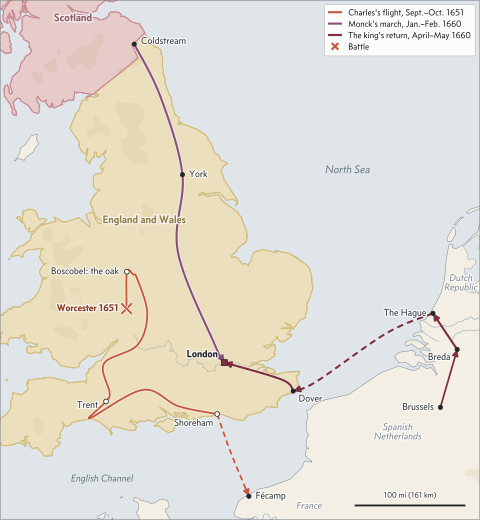
Cromwell ruled the three kingdoms of England, Scotland, and Ireland as Lord Protector, the head of state under a written constitution, until he died on September 3, 1658, the anniversary of Worcester. His eldest surviving son, Richard, succeeded him, but Richard was a country gentleman with no hold on the army. In April 1659 the generals forced him to dissolve his Parliament, and in May, deposed in all but name, he gave up the protectorship. People called him “Tumbledown Dick” (Chapter 6). The fall of Richard CromwellThis period was preceded by the deposition of Lord Protector Richard Cromwell. → English Restoration• began the year of confusion that ended in the Restoration, the return of the king. The years from 1649 to 1660, when England had no king, are called the Interregnum (the Stage), and by the winter of 1659 it seemed to be dissolving into anarchy. The army recalled the Rump, the remnant of the Parliament that had put Charles I on trial, then expelled it again, then recalled it once more.
One man held the strongest army in Britain and kept his own counsel. George Monck, born in 1608 to a poor gentry family in Devon, was a professional soldier who had learned his trade in the Dutch army. He had fought for Charles I and been captured, then served Parliament in Ireland and Cromwell in Scotland, which he had governed since 1654. He was blunt, silent, and careful, and nobody knew what he wanted. On January 1, 1660, he led his army across the river Tweed at Coldstream and marched south, and the troops who might have opposed him melted away. His old regiment still bears the name of that village: it is the Coldstream Guards.
Monck entered London at the beginning of February and at first did as the Rump told him. Then, on February 11, he wrote to it demanding elections to its empty seats and a date for its own dissolution. Everyone understood that a freely elected Parliament would bring back the king. London went wild. Pepys counted fourteen bonfires between St. Dunstan’s church and Temple Bar, where people roasted rumps of beef to mock the Rump. He saw “rumps tied upon sticks and carried up and down,” and on Ludgate Hill “one turning of the spit that had a rump tied upon it, and another basting of it.” Monck readmitted the members whom the army had driven out of Parliament in 1648, and in March that Parliament voted itself out of existence and called new elections. Without firing a shot, Monck’s march would bring the king back:George Monck helped restore this ruler to the throne, ending the Interregnum. → Charles II••George Monck was the main military instigator of this event. → English Restoration• of all the men who made the Restoration, he was the soldier who made it possible, and he ended the Interregnum.
The king’s side of the bargain was written in exile. Edward Hyde, born in 1609, was a lawyer who had sat in the Parliament of 1640 and attacked Charles I’s ministers, then sided with the king when he thought Parliament was grasping too much. He had gone into exile with the young Charles in 1646, and after the defeat at Worcester he became his chief adviser; in 1658 the exiled king made him Lord Chancellor, the highest officer of the law. On Monck’s advice Charles moved from Brussels, which was Spanish and so belonged to England’s enemy, to Breda (bray-dah) in the Dutch Republic. Hyde helped him draft the DeclarationEdward Hyde helped this ruler draft the Declaration of Breda. → Charles II•• of Breda, sent as soon as Charles crossed the border and dated from Breda on April 4, 1660, “in the twelfth year of our reign,” since in royalist eyes Charles had been king since his father’s death. It promised “a free and general pardon” to everyone except those whom Parliament chose to punish, and “a liberty to tender consciences,” so that no one would be troubled for his religion. Hyde’s cleverness was to leave every hard question—who should be punished, who should keep the lands sold in the wars, how the soldiers’ back pay was to be found—to Parliament itself.
The new Parliament met in April, read the Declaration, and on May 8 proclaimed Charles king. A fleet under Edward Montagu, Pepys’s cousin and patron, fetched him from the Dutch coast. Charles landed at Dover on May 25, where Monck was waiting to greet him, and he rode into London on May 29, his thirtieth birthday, through streets hung with tapestry and lined with cheering crowds. This return of the monarchy is the Restoration:Charles II returned to the English throne in 1660 during this event, ending the Interregnum. → English Restoration•• in 1660 Charles II came back to his father’s throne, and the Interregnum was over. The word also names the whole age that followed, with its reopened theaters and its new comedies (Vol. 11, The Age of Shakespeare).
Parliament made the king’s birthday a holiday. An act of 1660 ordered a day of thanksgiving every May 29 forever, and people kept it by wearing sprigs of oak, in memory of the tree at Boscobel. Oak apples are the round, brown swellings that a wasp’s grub causes on oak twigs, and the holiday took its name from them. Oak Apple Day celebrated the RestorationOak Apple Day celebrates the anniversary of this event. → English Restoration• every year until Parliament abolished it as a public holiday in 1859. The pensioners of the Royal Hospital at Chelsea, which Charles founded for old soldiers, still parade on that day, and the Royal Oak is still one of the commonest names for an English inn.
The pardon had limits. The men who had tried Charles I or signed his death warrant were excluded from it, and in October 1660 ten men were put to death, six of the judges who had signed the warrant and four who had helped them. Pepys went to Charing Cross to watch one of them, Major-General Thomas Harrison, who had signed the warrant, die the traitor’s death of hanging, drawing, and quartering, “he looking as cheerful as any man could do in that condition.” The dead were punished too. In January 1661 the bodies of Oliver Cromwell, his son-in-law Henry Ireton, and John Bradshaw, the judge who had presided at the trial, were exhumed, dug out of their graves in Westminster Abbey. On January 30, the twelfth anniversary of the king’s execution, they were dragged to the gallows at Tyburn, west of the city, and hanged there until four in the afternoon, and then Cromwell’s corpse was beheaded.This man's corpse was posthumously exhumed and beheaded. → Oliver Cromwell•• His head was set on a pole above Westminster Hall, where Charles I had been tried. It stayed there until at least 1684; after passing through the hands of collectors for nearly three centuries, it was buried in 1960 at Sidney Sussex College, Cambridge, where Cromwell had been a student.
Charles II
Charles was crowned in Westminster Abbey on April 23, 1661, St. George’s Day. Parliament had melted down the old crown jewels, the regalia (Chapter 1), in 1649, so goldsmiths made a new set. He wore them in the state portrait that the painter John Michael Wright made of him: the king enthroned in red velvet and white ermine fur, with the orb and scepter. Most of that regalia is still used at coronations today.

The man inside the robes was unusually tall, over 6 feet, with a dark complexion and heavy black hair, and he was quick, witty, lazy about business, and very hard to fool. Exile had taught him to trust nobody and to say little about what he meant to do. On board the Royal Charles he had told how a soldier who had fought for him at Worcester failed to recognize him in disguise and said that the king was “at least four fingers higher” than he was. He loved the theater, horse racing, sailing, and science, and he let his subjects come near him as few kings had: anyone could watch him walk his dogs in St. James’s Park.
A king needed a queen and an heir, and he needed money. Portugal offered both a bride and a dowry. The Portuguese had thrown off Spanish rule in 1640 under a new royal family, the house of Braganza (bruh-gan-zuh), and they needed English ships and soldiers against Spain. In 1661 Charles agreed to marry Catherine, the twenty-two-year-old daughter of the first Braganza king (Figure 8.3). Her dowry, the money and property a bride’s family gave with her, was enormous: a great sum of money, trading rights in Brazil and the East Indies, and two harbors, Tangier (tan-jeer) on the coast of Morocco and the islands of Bombay in India. Bombay passed to the English crown (Vol. 3, Geography: Europe, Asia, and Africa); in 1668 Charles leased it to the East India Company, the London merchants’ company that traded with India, for £10 a year (Vol. 39, India). Catherine landed at Portsmouth in May 1662 and married him there on May 21, first in a private Catholic ceremony and then in a Church of England service.


The new queen spoke little English and was a Catholic, so she could not be crowned in a Protestant service. But she brought a Portuguese habit with her. Tea had reached London a few years earlier as an expensive “China drink”: Pepys sent for his first cup in September 1660 and noted that he had never drunk it before. Charles’s queen, Catherine of Braganza, made tea fashionableThis ruler was married to Catherine of Braganza. → Charles II••Catherine of Braganza, wife of Charles II, helped popularize this drink at the English court. → tea• at court, where she drank it as Portuguese ladies did, and the ladies of the court copied her. Over the next century tea overtook coffee as the English drink.
Catherine had no children. Her pregnancies ended in miscarriages, and it was cruel to her that her husband had children by other women. He had many mistresses and acknowledged at least twelve illegitimate children, among them James Scott, Duke of Monmouth, who would later claim the throne (Chapter 10). One mistress, Barbara Villiers, Lady Castlemaine, was forced on the queen as a lady of her bedchamber. The best loved was an actress. When the theaters reopened in 1660, women acted on the English stage for the first time, and the king’s own company played at a new theater off Drury Lane. A girl named Nell Gwyn, born about 1650 and, by tradition, raised in poverty near Drury Lane, sold oranges to its audience at sixpence apiece and was acting on its stage by the age of fourteen or fifteen. Pepys saw her in April 1665 and called her “pretty witty Nell,” and later he thought her the best comic actress he had ever seen. About 1668 Nell Gwyn became the king’s mistress,Nell Gwyn was a mistress of this ruler. → Charles II•• and she remained one of his favorites until he died. She bore him two sons; the elder was made Duke of St. Albans.
Charles’s wish for money and trade soon drew England into war with the Dutch Republic, the great trading nation across the North Sea. English and Dutch merchants fought each other for the trade of Africa, the East Indies, and North America. In 1664 an English squadron seized the Dutch colony of New Amsterdam and renamed it New York, for the king’s brother James, Duke of York (Vol. 27, New Worlds). The Second Anglo-Dutch War was declared in 1665 and fought in great battles at sea. Rear Admiral Robert Holmes was an Irish-born royalist who had fought for the Stuarts on land and at sea. In August 1666 he sent fire ships into the Vlie (vlee), an anchorage between two Dutch islands, and burned about 140 merchant ships and a Dutch town on the island of Terschelling (tur-skel-ing), a raid told elsewhere (Vol. 3, Geography: Europe, Asia, and Africa). The Dutch had their revenge in June 1667. Their fleet sailed up the river Medway to Chatham, burned English warships at anchor, and towed away the Royal Charles, the ship that had brought the king home; her carved stern is still in the Rijksmuseum (rykes-myoo-zay-um) in Amsterdam. Peace was signed at Breda on July 31, 1667, and England kept New York. The war is told from the Dutch side elsewhere (Vol. 13, Valois, Bourbon, and Orange).
Somebody had to be blamed, and it was Hyde, now Earl of Clarendon. He had opposed the war, but he was proud and tactless. His enemies at court said he had chosen a barren queen on purpose: his own daughter, Anne Hyde, had married the Duke of York, so his grandchildren might inherit the crown. In 1667 the king dismissed him, the Commons impeached him, charging him before the House of Lords, and he fled to France, where he finished his History of the Rebellion, the royalists’ account of the civil wars. Two of those grandchildren did become queens, Mary II and her younger sister Anne (Chapter 10). The rest of Charles’s reign, with its secret treaty with France and its fears of a Catholic plot, belongs to Chapter 9.
Pepys, the plague, and the fire
Samuel Pepys was born on February 23, 1633, in Salisbury Court off Fleet Street, the son of a London tailor. He went to St. Paul’s School and to Magdalene (mawd-lin) College, Cambridge, and then into the household of his father’s cousin Edward Montagu, a rich gentleman who had served Cromwell. Since boyhood he had suffered from a stone in his bladder, a hard lump of mineral that grows inside the body and causes terrible pain. In 1658, at twenty-five, he risked an operation that often killed its patient, with no anesthetic, in a bedroom of a cousin’s house. He survived, and Pepys celebrated the anniversary of his stone operationThis man annually celebrated the successful removal of a bladder stone. → Samuel Pepys• every March 26 for years afterward. In 1660 he was at sea on that day, but he wrote, “This day it is two years since it pleased God that I was cut of the stone,” and that he had resolved “while I live to keep it a festival.”

After the Restoration Montagu became Earl of Sandwich, and he found his young cousin a post as Clerk of the Acts of the Navy Board, the office that built, supplied, and paid the king’s ships. Pepys knew nothing about ships, so he learned arithmetic and studied models of hulls, and he became one of the ablest naval administrators England ever had, rising to be Secretary to the Admiralty. He lived beside the Navy Office in Seething Lane, in the east of the City of London.
On January 1, 1660, he had begun a diary, and he kept it every day for nine and a half years, about 1.25 million words. He wrote it in shorthand, a system of quick strokes and signs that stand for sounds and whole words. Thomas Shelton had published the system in 1626 and, in later editions, called it tachygraphy (ta-kig-ruh-fee), Greek for “swift writing,” and Pepys used Shelton’s tachygraphy for his diaryThis man used tachygraphy to write his diary. → Samuel Pepys• because it was fast, and because his servants could not read it. He recorded the court and the navy, the plays he saw and the books he bought, his quarrels with his wife, and his own bad behavior, which he hid in a jumble of French, Spanish, Italian, and Latin words. After his death the six bound volumes went with the rest of his library to Magdalene College, where they lay almost unread for a century. A young Cambridge student, John Smith, spent three years deciphering them, from 1819 to 1822, not learning until he had nearly finished that a key to Shelton’s system stood a few shelves above the diary. The first edition was printed in 1825; this chapter quotes the fuller Victorian edition transcribed by Mynors Bright and edited by Henry B. Wheatley (1893–1899), with its spellings.
The diary ended because Pepys feared for his eyes. Writing small by candlelight hurt them, and he believed he was going blind. On May 31, 1669, he gave up his diary for fear of blindness,This man discontinued his most famous project in 1669 for fear of becoming blind. → Samuel Pepys• writing that to stop was “almost as much as to see myself go into my grave.” He did not go blind. He lived another thirty-four years, and the diary was never resumed. For these years there is a second witness. John Evelyn (1620–1706), a scholarly country gentleman who wrote books on trees and gardens, kept a diary for more than sixty years, and it was printed in 1818. Evelyn writes more grandly than Pepys and less about himself, and where the two describe the same scene, historians can test one against the other.
The first great scene was a plague. Bubonic plague is a disease of rats, carried to people by the bites of the rats’ fleas; it causes high fever and painful swellings in the groin and armpits, called buboes, and it killed perhaps half of those who caught it. Nobody in 1665 knew about the fleas. Each London parish paid “searchers,” usually poor old women, to view every corpse and report the cause of death, and the parish clerks printed the totals every week in the Bills of Mortality. The city fought the disease by shutting up any house where it appeared, with the sick and the healthy inside, for forty days. On June 7, 1665, Pepys passed through Drury Lane and saw “two or three houses marked with a red cross upon the doors, and ‘Lord have mercy upon us’ writ there,” the first such houses he had ever seen.
London’s plague of 1665,Samuel Pepys chronicled this 1665 outbreak, which preceded the Great Fire of London. → Great Plague of London••Samuel Pepys chronicled a plague and a fire that affected this city in his diary. → London••This city experienced bubonic plague in 1665. → London•• the Great Plague, was the last major outbreak of bubonic plague in England, and the first of two disasters that Pepys chronicled in his diary; the second, the Great Fire, came the next year. By July the rich were leaving. The king and his court went to Salisbury and then to Oxford, while Monck, now Duke of Albemarle (al-buh-marl), stayed to keep order. Pepys stayed too, though he sent his wife away to Woolwich. In September he put on a new wig and wondered what would become of the fashion, since “nobody will dare to buy any haire, for fear of the infection, that it had been cut off of the heads of people dead of the plague.” In October he walked to the Tower: “Lord! how empty the streets are and melancholy, so many poor sick people in the streets full of sores.” In the worst weeks of September more than 7,000 Londoners died of plague each week. The Bills counted 68,596 plague deaths in 1665, and the real total was probably near 100,000, about a quarter of the people of London. The disease faded in the cold of winter and was nearly gone by the end of 1666.
The second disaster came in the late summer of 1666, which had been long and dry. The City of London was the old walled town on the north bank of the Thames, about a square mile in all, where some 80,000 of London’s 300,000 or more people lived and worked. Its streets were narrow and its houses were built of timber, with upper stories that jutted out until they almost met above the lanes. Along the river stood warehouses full of pitch, tar, oil, and brandy. A little after midnight on Sunday, September 2, 1666, fire broke out in the house of Thomas Farriner, the king’s baker, in Pudding Lane near London Bridge, and a strong east wind drove it westward along the riverside.
The City had its own government, a Lord Mayor chosen each year and a council of aldermen, who guarded their rights jealously against the king. The usual way to stop a fire was to pull down the houses in its path with long hooks, and the neighbors sent for the Lord Mayor, Sir Thomas Bloodworth, to give the order. He came in the middle of the night, saw a small fire, and would not do it. Most of the houses were rented, their owners could not be found, and he would not take the blame for destroying their property. By the time anyone pulled houses down, the wind had carried the flames past them. Bloodworth’s refusal to demolish housesThis event is believed to have been worsened by Thomas Bloodworth's inaction to demolish buildings. → Great Fire of London• has been blamed ever since for letting the fire grow, though the historian Jacob Field argues that with the tools of the time he could have done little.
Pepys’s maid woke him at three in the morning, and he looked out and went back to bed. By morning 300 houses were gone. He climbed the Tower of London to look and then took a boat along the river. He saw people throwing their goods into boats or into the water, and pigeons that would not leave their houses until they “were, some of them burned, their wings, and fell down.” Then he went upriver to the palace at Whitehall and told the king that nothing could stop the fire unless houses were pulled down. Charles sent him back with an order to the Lord Mayor “to spare no houses.” Pepys found Bloodworth in Cannon Street, “like a man spent,” with a handkerchief round his neck. “Lord! what can I do?” he cried. “I am spent: people will not obey me. I have been pulling down houses; but the fire overtakes us faster than we can do it.”

For three more days the fire burned westward with the wind (Figure 8.5). On Monday it reached Lombard Street, where the goldsmiths, who were London’s bankers too, kept their money, and the Royal Exchange, the merchants’ meeting hall; the king put his brother James in command of the firemen. Rumors spread that the Dutch or the French, England’s enemies, had started it, and mobs beat foreigners in the streets. On Tuesday the flames jumped the river Fleet, the little river that ran along the western wall, and inland swept through Cheapside, the City’s broad market street, toward St. Paul’s. The old cathedral stood in a wooden cage of scaffolding for repairs, and the booksellers of the churchyard had stacked their stock in its crypt for safety. That night the scaffolding caught fire. Evelyn wrote that the stones of the cathedral burst in the heat and the lead of its roof ran down the streets in a stream.
Pepys spent Tuesday saving what he could. His money had gone by cart before dawn on Monday; now he sent the rest of his goods away by boat and buried his office papers in a pit in the garden. In the evening he and his neighbor Sir William Penn, a commissioner of the navy and the father of the Quaker William Penn (Chapter 9), dug another pit. There Pepys buried his wine and Parmesan cheese,This diarist described burying wine and Parmesan cheese during the Great Fire of London. → Samuel Pepys•Samuel Pepys described burying his Parmesan cheese during this event. → Great Fire of London•• or, as he spelled it, “my Parmazan cheese, as well as my wine and some other things.” That night the men of the Tower and the royal dockyards began blowing up houses with gunpowder to make gaps the fire could not cross. In the night the wind dropped. On Wednesday morning Pepys climbed the steeple of Barking church, at the bottom of his own lane, and saw “the saddest sight of desolation that I ever saw.”
In four days, the Great Fire that began in Pudding LaneThis 1666 disaster began on Pudding Lane and destroyed much of London. → Great Fire of London••A great fire devastated this city in 1666. → London•••This 1666 fire destroyed the old St. Paul’s Cathedral. → Great Fire of London• had destroyed most of the City of London: about 13,200 houses, eighty-seven parish churches, the Guildhall, the Royal Exchange, and Old St. Paul’s. The church whose dean had been the poet John Donne was a ruin (Vol. 11, The Age of Shakespeare). Only a handful of deaths were recorded, perhaps six or eight, though the historian Neil Hanson has argued that hundreds of poor people, perhaps many more, died unrecorded in the flames or in the cold camps of the homeless afterward. Tens of thousands of refugees camped in the fields to the north, at Moorfields and Islington.

Somebody, again, had to be blamed. A French watchmaker named Robert Hubert confessed to starting the fire and was hanged in October 1666; it later turned out that he had not even arrived in London until two days after it began. The poet John Dryden made the year of war and fire into a poem of praise for the king, Annus Mirabilis (an-us mih-rab-ih-lis), “the year of wonders” (Vol. 11, The Age of Shakespeare). Across the North Sea the fire was read another way. Three weeks before it began, Holmes had burned the Dutch merchant fleet and the town on Terschelling, and the Dutch saw the fire as God’s revengeIn the Netherlands, this event was seen as divine retribution for a raid carried out by Robert Holmes. → Great Fire of London• for that raid. An Italian pamphlet, too, compared London to Lucifer, fallen through its pride. Dutch painters such as Lieve Verschuier (lee-vuh fer-skhoy-er) of Rotterdam painted it in flames (Figure 8.6).
The rebuilding was the king’s work as much as anyone’s. Within days of the fire Charles ordered London rebuilt in brickThis ruler helped rebuild London after the Great Fire of London. → Charles II•• and stone, with wider streets, and he forbade anyone to build until the ground had been surveyed. Plans for a new city of broad avenues and open squares, one by Evelyn and one by the astronomer Christopher Wren, were laid before him, but every owner wanted his house back on its own plot, and the old street plan survived. The Rebuilding Act of 1667 fixed the materials and the heights of new houses, a special Fire Court settled quarrels between landlords and tenants, and a tax on coal brought into the port paid for the churches and the cathedral. Most of the private houses were rebuilt by 1671. Out of the disaster came the first fire insurance companies in England, which kept their own firemen.
Wren
There was no school of architecture in England, and the man who rebuilt the City’s churches came to building from science. Christopher Wren was born on October 20, 1632, at East Knoyle (noyl) in Wiltshire, the son of a clergyman who later became dean of Windsor. He studied at Wadham (wod-um) College, Oxford, and became one of the best astronomers and mathematicians of his time: professor of astronomy at Gresham College in London at twenty-four, and at twenty-eight Savilian Professor of Astronomy at Oxford. His friend Robert Hooke was a brilliant inventor and experimenter who would later work beside him in rebuilding London. In 1665 Hooke wrote that “since the time of Archimedes, there scarce ever met in one man, in so great a perfection, such a Mechanical Hand, and so Philosophical a Mind.” Wren was an English architect,Christopher Wren is an architect from this country. → United Kingdom• the greatest the British Isles have produced, and still the most famous architect of the United Kingdom, the state that England and Wales, Scotland, and Ireland formed through the unions of 1707 and 1801 (the Stage).
He came to architecture as a problem in mechanics. Gilbert Sheldon, the Archbishop of Canterbury and a former head of an Oxford college, wanted a hall where the university could hold its degree ceremonies, which had grown too rowdy for a church, and he asked Wren to design it. Wren designed the Sheldonian TheatreThis architect designed the Sheldonian Theater. → Christopher Wren• (shel-doh-nee-un) on the plan of an ancient Roman theater, the Theater of Marcellus, which he knew from an Italian book of engravings: a D shape, curved at one end. A Roman theater was open to the sky, but Oxford is rainy, and no tree was long enough to span the 70 feet of its roof. Wren used trusses built up from short timbers locked together, on a plan for a flat floor that the Oxford mathematician John Wallis had worked out years before. Inside he hung a painted ceiling of the sky, by the king’s painter Robert Streater, so that the audience seemed to sit under the open heavens. Building began in 1664; it opened in 1669 and is still used for degree ceremonies.

In 1665 he went to Paris, his only journey abroad, to see the new palaces and domed churches of France. There he met Gian Lorenzo Bernini, the greatest sculptor and architect of Rome, who had come to design a palace for Louis XIV. Since 1661 the king had consulted him about repairing Old St. Paul’s, whose crumbling Gothic tower worried everyone, and at the end of August 1666, back in London, he proposed to replace the tower with a dome. A week later the fire settled the matter. Within days he had drawn a plan for a new city, which the king admired and could not use. In 1669 Charles made him Surveyor of the King’s Works, in charge of all royal building, and in 1673 he was knighted.
Most of the City’s eighty-seven burned churches had to be replaced, and Parliament paid for fifty-one of them with the coal tax. Wren rebuilt fifty-one of the City’s churchesThis architect rebuilt over fifty churches after the Great Fire of London. → Christopher Wren•• between 1670 and the 1710s, with Hooke and other assistants doing much of the detail. The sites were cramped and crooked, wedged between houses on medieval plots, and he made each one different. Above the rooftops he raised steeples of Portland stone, a white limestone from the coast of Dorset, so that the skyline bristled with them around the great dome to come. St. Mary-le-Bow in Cheapside got the most famous bells in London, and St. Stephen Walbrook got a small dome over a forest of columns, a trial for the cathedral. The steeple of St. Bride’s in Fleet Street rises in tiers, and a story says that an eighteenth-century baker’s apprentice on Ludgate Hill copied it for the first tiered wedding cake.
St. Paul’s took most of his life. His first design was thought not stately enough, and his second, a church shaped like a Greek cross, with four equal arms under a great dome, did not suit the clergy’s services. His favorite, the Great Model of 1673, an oak model taller than a man, kept the Greek cross and added a nave, the main hall of a church (Vol. 1, The Toolkit), at the west end. The clergy rejected it as too unlike any English cathedral. In 1675 the king approved a fourth design with a long nave in the old English way, and gave Wren leave to make “ornamental” changes as he built. He used that leave to change almost everything. The first stone was laid in June 1675. The family memoir that his son put together, Parentalia, printed by his grandson in 1750, tells a story of the first days of the work. When Wren marked out the center of the dome, a workman brought him a piece of an old gravestone from the rubble to use as a marker, and it bore one Latin word, Resurgam, “I shall rise again.” Wren had the word carved over the south door beneath a phoenix rising from flames.

The building went up for thirty-five years. The first service was held in the choir in December 1697, Wren’s son laid the last stone on top of the lantern in October 1708, and in 1711 Parliament declared the cathedral complete. It stands on Ludgate Hill, the highest ground in the City, on the site of the old one, and its dome rises 365 feet to the cross. Wren solved the hardest problem of a dome by cheating the eye (Figure 8.8). A dome tall enough to rule the skyline would look like a dark well from inside, and one shaped well for the inside would look squat from the street. So he built two domes, an inner one of brick that looks right from the floor and a much taller outer one of timber and lead, and between them, unseen, a cone of brick that carries the lantern, the 850-ton stone tower on top. At 99 feet above the floor a narrow balcony runs around the base of the drum, the round wall that lifts the dome. Its curved wall carries sound so well that a whisper spoken against it can be heard 112 feet away on the other side. Wren’s St. Paul’s on Ludgate Hill,Christopher Wren rebuilt St. Paul's Cathedral in this city after a 1666 fire. → London•••This architect designed St. Paul's Cathedral. → Christopher Wren••This cathedral on Ludgate Hill, rebuilt after the Great Fire, contains a Whispering Gallery. → St. Paul’s Cathedral•• rebuilt after London’s fire of 1666, still crowns the City, and visitors climb 259 steps to stand in its Whispering Gallery (Figure 8.9).


Wren died on February 25, 1723, at ninety, and was buried in the crypt. His son wrote his epitaph in Latin. It ends Lector, si monumentum requiris, circumspice: “Reader, if you seek his monument, look around you.”
The City wanted a monument of the other kind as well, to the fire itself. The Rebuilding Act ordered a column of brass or stone to be set up near the place where the fire began, to keep the disaster in memory. Wren and Hooke designed the Monument,This architect collaborated on the 202-foot Monument to the Great Fire of London. → Christopher Wren••A monument in this city commemorating the 1666 fire consists of a 202-foot-tall Doric column topped with a gilded urn. → London• a fluted, or grooved, Doric column of Portland stone, the plainest of the Greek orders of architecture (Vol. 1, The Toolkit), which stands 202 feet high and 202 feet from the spot in Pudding Lane where Farriner’s bakery stood. Wren first wanted a phoenix or a statue of the king on top, and settled for a gilded urn, a vase covered with gold leaf, from which golden flames burst. It was built from 1671 to 1677. Hooke, who drew the design, made the hollow shaft a scientific instrument too: an upright telescope pointing straight overhead, and a tall, still space for experiments with pendulums and air pressure. Visitors still climb its 311 steps. In 1681, during the panic over a Catholic plot (Chapter 9), the City added words to the inscription falsely blaming the fire on “Popish frenzy,” that is, on Catholics, and they stayed until 1830.

The astronomer in Wren designed one more building for the king. Ships could find their latitude, how far north or south they were, from the sun and stars, but nobody could yet find longitude, how far east or west a ship had sailed, and wrecks were common. In 1675 Charles founded an observatory and appointed John Flamsteed as the first Astronomer Royal, to chart the stars precisely enough to solve the problem. Wren designed the Royal Observatory at Greenwich,This architect designed the Royal Observatory at Greenwich. → Christopher Wren•• on a hill in the royal park beside the Thames east of London. It was built cheaply, in about a year, partly with old bricks and timber from other royal buildings, and its tall, eight-sided main room held Flamsteed’s long telescopes and clocks. In 1884 an international conference chose the line through Greenwich as the prime meridian, the zero of longitude for the whole world.
One of Wren’s possible works stands across the Atlantic. In 1693 King William III and Queen Mary II (Chapter 10) chartered a college in Virginia that took their names, the College of William & Mary, and its main building went up from 1695 to 1700. In 1724 a professor there, Hugh Jones, wrote that its design had come from Sir Christopher Wren, and no older document says so; the college building is traditionally attributedThe oldest surviving American college building at William & Mary is traditionally attributed to this architect. → Christopher Wren• to Wren, without proof. It burned three times and was rebuilt each time, and since its restoration in 1931 it has been called the Wren Building. It is the oldest college building still standing in the United States. Wren’s last great royal palace, the rebuilt Hampton Court of the 1690s, belongs to Chapter 10.
The coffeehouses
The new London had a new kind of room. Coffee came from Ethiopia and Yemen, and for a century it had been drunk in the coffeehouses of Cairo and Constantinople. About 1650, according to the Oxford antiquary Anthony Wood, a Jewish man known only as Jacob opened the first English coffeehouse in Oxford. In 1652 Pasqua Rosée (roh-zay), a servant from Smyrna in Turkey who worked for an English merchant, opened the first in London, in an alley off Cornhill near the Royal Exchange. Englishmen thought coffee bitter and black, but it kept them awake and sober, and by 1675 there were hundreds of coffeehouses in London, rebuilt after the fire with the rest of the City.
A man paid a penny at the bar and got a “dish” of coffee and a seat at a long table, with the newspapers and pamphlets of the day, and whatever conversation was going on (Figure 8.11). Rank counted for little inside: verses printed in 1674 as “The Rules and Orders of the Coffee-House” told gentlemen and tradesmen alike to sit down together, and fined anyone who swore twelve pence. Because a penny bought a seat among merchants, scholars, lawyers, and wits, the coffeehouses were called “penny universities”:These English establishments were nicknamed “penny universities” for their cheap admission. → coffeehouses• a verse of 1672 called the coffeehouse the greatest university there ever was, where a man could become a scholar for a penny.

Each coffeehouse drew its own crowd. The poets gathered around Dryden at Will’s in Covent Garden (Vol. 11, The Age of Shakespeare), and Pepys went to coffeehouses near the Exchange for news of ships and trade. Robert Hooke’s diary of the 1670s records him in one coffeehouse or another again and again, often with Wren, talking about science. Merchants and shipowners met at Edward Lloyd’s coffeehouse to read the shipping news and insure each other’s cargoes, and Lloyd’s of London, the insurance market, still bears his name. Dealers in shares met at Jonathan’s, which grew in the next century into the London Stock Exchange.
The coffeehouses sold tea and chocolate as well, but what worried the king was the talk. He distrusted places where men talked politics over a penny cup. In December 1675 he ordered the coffeehouses closed as places where idle and disaffected men spread false and scandalous reports about his government. The outcry was so loud that he withdrew the order within days.
The Royal Society and Newton’s Principia
On November 28, 1660, a dozen men met at Gresham College in London after a lecture by the young professor of astronomy, Christopher Wren, and agreed to found a college for learning about nature by experiment and mathematics. Its model was Francis Bacon’s dream of a house of scientists who would study nature together (Chapter 4). The king liked the idea, and on July 15, 1662, he gave it a royal charter as the Royal Society. It still meets today. Its motto, Nullius in verba (nuh-lee-us in vur-buh), means “on no one’s word.” It comes from a line of the Roman poet Horace about a man who is not bound to swear by the words of any master (Vol. 7, The Romans). The Society meant it seriously. No claim would be accepted because a great authority, even Aristotle (Vol. 6, The Greeks), had made it, but only when an experiment showed it before witnesses.
The most famous experiments were Robert Boyle’s. Boyle, born in 1627, was a younger son of the Earl of Cork in Ireland, rich, pious, and tireless. In 1659 his assistant, Robert Hooke, built him an air pump that could suck the air out of a glass globe. In it Boyle showed that a candle went out, that the sound of a bell inside grew faint, and that a small animal soon died. In 1662 he showed that if you squeeze a gas into half the space, its pressure doubles, the rule called Boyle’s law. Hooke became the Society’s curator of experiments, bound to show the members new ones every week, and in 1665 he published Micrographia, drawings of a flea, a fly’s eye, and the cells of cork seen through his microscope. Pepys sat up reading it and called it “the most ingenious book that ever I read in my life.” Not everyone was impressed. In February 1664 the king “mightily laughed” at the Society, Pepys reported, “for spending time only in weighing of ayre, and doing nothing else since they sat.” Pepys himself was elected a fellow, or member, in 1665.

The Society’s greatest fellow was a Cambridge professor who disliked controversy and avoided company. Isaac Newton was born on Christmas Day 1642, by the calendar England then used, at Woolsthorpe, a farm in Lincolnshire, three months after his father died. He went to Trinity College, Cambridge, and when the plague of 1665 closed the university he went home for most of two years. There, by his own later account, he worked out the mathematics now called calculus, found that white light is a mixture of colors, and began to think that the force that pulls a stone to the ground might reach as far as the moon. One of the earliest accounts of the famous apple comes from William Stukeley, a doctor and antiquarian who knew Newton in his old age. In 1752 Stukeley wrote that Newton had told him in 1726, sitting under apple trees, that the fall of an apple had set him thinking about gravity. In 1669 Newton became Lucasian (loo-kay-zhun) Professor of Mathematics, and in 1672 he was elected to the Royal Society for a new kind of telescope, made with a mirror instead of a lens.
The Principia (prin-sip-ee-uh) began with a question asked among friends. In January 1684 Wren, Hooke, and the young astronomer Edmond Halley (hal-ee) argued about the planets. The German astronomer Johannes Kepler had shown, early in the century, that the planets move around the sun in ellipses, stretched circles. All three men suspected that the sun pulled them with a force that weakened with the square of the distance, so that at twice the distance it was a quarter as strong. But could they prove that such a force would make the orbits ellipses? Hooke said he could, and never showed it. Wren offered a book as a prize for a proof. In August Halley went to Cambridge and asked Newton. According to the mathematician Abraham de Moivre (duh mwah-vruh), who heard the story from Newton, he answered at once that it would be an ellipse; he had calculated it years before. Within months he sent Halley a short proof, and then, working with fierce concentration for about eighteen months, he wrote a whole book.
The Royal Society agreed to publish it but had spent its money printing a history of fishes, so Halley paid for the printing himself; the Society later paid Halley’s salary in unsold copies of the fish book. The title page carries the license of the Society’s president, dated July 5, 1686: “Imprimatur, S. Pepys.” Imprimatur is Latin for “let it be printed.” The book appeared in July 1687, in Latin, as Philosophiae Naturalis Principia Mathematica (fil-oh-sof-ee-eye nat-yoo-rah-lis prin-sip-ee-uh math-uh-mat-ih-kuh), “Mathematical Principles of Natural Philosophy,” where “natural philosophy” meant what is now called physics. It is quoted here in Andrew Motte’s English translation of 1729.

Newton begins with definitions of matter, motion, and force. Then, in a note after them, he turns to the things everyone thinks they understand, time and space, which he does not define, he says, “as being well known to all.” People measure time by clocks and the sun, he says, and place by the things around them; but behind these measures stand true time and true space. “Absolute, True, and Mathematical Time, of it self, and from its own nature, flows equably without relation to anything external.” “Absolute Space, in its own nature, without relation to anything external, remains always similar and immovable.” A clock may run fast or slow, and a ship may carry a passenger who thinks himself at rest, but Newton held that absolute time and spaceThis thinker defended absolute time and space independent of observers. → Isaac Newton•• exist whether or not anyone measures them, independent of every observer. He offered an experiment as evidence. Hang a bucket of water from a twisted cord and let it spin. At first the bucket turns and the water does not, and its surface stays flat. Then the water catches up, until it turns with the bucket, at rest relative to its sides, and now its surface is hollow, climbing the walls. What curves the water, Newton argued, is not its motion relative to the bucket but its true rotation in absolute space.
Then come his three laws of motion: that a body keeps still or moves straight on unless a force acts on it, that a force changes its motion in proportion to its strength, and that every action has an equal and opposite reaction (Vol. 48, Physics: Motion and Matter). Book 1 works out, with geometry, how bodies move under forces of different kinds, and proves the answer to Halley’s question. Book 2 treats motion through air and water, and uses it to demolish the theory of the French philosopher René Descartes (day-kart) that whirlpools of invisible matter carried the planets. Book 3, “The System of the World,” applies the laws to the heavens. One force, gravity, reaching across space between every pair of bodies, explains the fall of a stone, the orbit of the moon, the paths of the planets and comets, and the tides.
Many readers, the German philosopher Leibniz (lybe-nits) and the Dutch scientist Christiaan Huygens (hy-genz) among them, objected that a force acting across empty space with nothing to carry it was an “occult quality,” a hidden power like those of the medieval university philosophers. Newton answered in the second edition of 1713. A scholium (skoh-lee-um) is a scholar’s explanatory note, and at the end of the book he added a General Scholium, a short essay on the whole work. He admits there that he does not know what causes gravity: “hitherto I have not been able to discover the cause of those properties of gravity from phænomena, and I frame no hypotheses.” In Latin the General Scholium says hypotheses non fingoThe General Scholium of this work declares "hypotheses non fingo," or "I do not feign hypotheses." → Philosophiæ Naturalis Principia Mathematica•• (hy-poth-uh-seez non fing-goh), which is also translated “I do not feign hypotheses”: to feign is to make something up. Newton meant that he would not invent a story about hidden machinery that no experiment could test. It was enough that gravity exists and acts as his laws say. In the same essay he wrote that “this most beautiful System of the Sun, Planets, and Comets, could only proceed from the counsel and dominion of an intelligent and powerful being.”
The quarrel over absolute space came to a head after Newton was old and famous. Gottfried Wilhelm Leibniz, who had invented calculus independently and was quarreling with Newton over who came first (Vol. 14, From Luther to Mozart), wrote in November 1715 to Caroline, Princess of Wales, the wife of the heir to the British throne (Chapter 13). Newton’s philosophy, he warned her, was weakening religion. Caroline passed the letter to Samuel Clarke, a London clergyman and philosopher and Newton’s friend, and Clarke defended Newton’s absolute spaceSamuel Clarke defended this thinker’s absolute space in correspondence with Leibniz. → Isaac Newton• through five letters on each side, until Leibniz died in November 1716. Leibniz argued that space is nothing but the order of things that exist together. If it were a real, absolute container, God would have had no reason to put the world in one place in it rather than another, shifted a mile to the east. But God does nothing without a reason, so absolute space is impossible. Clarke replied that God’s own will is reason enough, and that space is real, the place where God is everywhere present; the bucket shows that true motion can be told from apparent motion. Clarke printed the whole exchange in 1717.
John Locke, writing in the 1680s, had already built his philosophy in the light of the new science (Chapter 12). A generation later George Berkeley attacked absolute space as an idea without meaning (Chapter 16), and the argument was not settled for two centuries. Newton became Master of the Mint and president of the Royal Society, was knighted in 1705, and died in 1727, honored as no English thinker had ever been. In 1905 Albert Einstein’s theory of relativity finally gave up absolute time and space, and showed that two observers moving past each other measure time and distance differently (Vol. 50, Physics: Relativity, Quanta, and the Cosmos).
What to remember
- Charles II fled abroad after losing the Battle of Worcester in 1651, hiding in the oak at Boscobel. After Richard Cromwell’s fall in 1659, General George Monck marched from Coldstream to London and made the Restoration possible.
- Edward Hyde, later Earl of Clarendon, helped Charles draft the Declaration of Breda (April 1660), which promised a general pardon and “a liberty to tender consciences.” Charles entered London on May 29, 1660, his birthday, kept afterward as Oak Apple Day.
- In January 1661 Cromwell’s body was dug up from Westminster Abbey, hanged, and beheaded.
- Charles married Catherine of Braganza (1662), whose dowry included Bombay and Tangier and who made tea fashionable at court. Nell Gwyn, an actress, was his best-loved mistress.
- Samuel Pepys kept his diary in Shelton’s shorthand, called tachygraphy, from 1660 to 1669, when he stopped for fear of blindness. He celebrated his bladder-stone operation every year.
- London suffered the Great Plague in 1665 and the Great Fire, which began in Pudding Lane on September 2, 1666, and destroyed most of the City and Old St. Paul’s. Lord Mayor Bloodworth refused to pull down houses, and Pepys buried his wine and Parmesan cheese. The Dutch saw the fire as God’s revenge for Holmes’s raid.
- Christopher Wren, English astronomer and architect, designed the Sheldonian Theatre, fifty-one City churches, St. Paul’s on Ludgate Hill with its Whispering Gallery, the Royal Observatory at Greenwich, and, with Hooke, the 202-foot Doric Monument with its gilded urn. The Wren Building at William & Mary is traditionally attributed to him.
- The coffeehouses, where a penny bought a cup and a seat, were called “penny universities.”
- The Royal Society was chartered in 1662 (motto Nullius in verba). Newton’s Principia (1687) defined absolute time and space; its General Scholium (1713) says “hypotheses non fingo”; Samuel Clarke defended absolute space against Leibniz (1715–1716).
Chapter 9 · 24 clues
Bunyan, the Popish Plot, and the Whigs
On November 12, 1660, John Bunyan, a tinker, or traveling mender of pots and kettles, went 13 miles south from Bedford to a farmhouse at Lower Samsell, near the village of Harlington, where a few friends were waiting to hear him preach. There he learned that a magistrate had signed a warrant for his arrest. He could have slipped away. He stayed, because, as he later wrote, if he ran from a warrant, weaker believers would run from mere threats. The meeting had begun when the constable came in. Within days Bunyan was in the county jail at Bedford, and except for short spells of leave he stayed there for nearly twelve years.
Charles II had been home for six months. The theaters were open again, and so were the bishops’ palaces. In his cell Bunyan would write one of the most widely read books in the English language. Within twenty years the Parliament whose laws jailed men like him would be swept by a panic about Catholics, and the quarrel over who should follow Charles II on the throne would give England its first two political parties.
Dissenters: Bunyan and Penn
When Charles II returned in May 1660, the Church of England returned with him (Chapter 8). Since the 1640s its bishops had been abolished and its Book of Common Prayer, the book of services read in every parish, had been forbidden. Now the bishops came back, and in 1661 the country elected a Parliament so full of the king’s old supporters that it was called the Cavalier Parliament. Its members remembered Archbishop Laud beheaded in 1645 and Charles I in 1649 (Chapter 5), and they blamed the sects for both. In January 1661 a band of Fifth Monarchists, who believed that Christ was about to return and reign, fought the king’s guards in London for four days. To the bishops and the gentry, every meeting outside the parish church looked like the seed of the next revolution.
Protestants who would not worship in the restored Church were the dissenters, or nonconformists, whom the Stage describes: Presbyterians, Independents, Baptists, and the Quakers (Chapter 6). Between 1661 and 1665 Parliament passed four laws against them, known as the Clarendon Code, after the king’s chief minister, Edward Hyde, Earl of Clarendon, though he did not write them.
The Corporation Act of 1661 shut dissenters out of town governments by requiring every mayor and alderman to take communion in the Church of England. The Act of Uniformity of 1662 ordered every clergyman to use the revised Prayer Book and to be ordained by a bishop, or to leave his parish by August 24, St. Bartholomew’s Day. About two thousand ministers walked out of their pulpits and their houses. Dissenters called it Black Bartholomew’s Day, after the massacre of French Protestants that had begun on the same saint’s day in 1572 (Vol. 13, Valois, Bourbon, and Orange). The Conventicle Act of 1664 punished any conventicle, a religious meeting outside the Church, of more than five people besides a household. The Five Mile Act of 1665 kept the ejected ministers 5 miles from any town with a corporation and from their old parishes. The bishops saw these laws as the price of peace. Dissenters believed that every Christian must worship as Scripture commands, and that no king or bishop could answer to God for another man’s soul; to them the laws were persecution.

Bunyan was born in 1628 in Elstow (el-stoh), a village 2 miles south of Bedford (Figure 9.2). His father was a tinker too, and the boy learned the trade. In 1644, at sixteen, he joined Parliament’s army and served for nearly three years in the garrison at Newport Pagnell (pag-nul). His autobiography, Grace Abounding to the Chief of Sinners (1666), tells how one Sunday he was playing tip-cat, a game of hitting a wooden peg with a stick, on the village green. A voice in his soul asked whether he would leave his sins and go to heaven. Years of terror and doubt followed. In the 1650s he overheard some poor women in Bedford talking about God on a doorstep, joined their congregation, the Bedford Meeting, and began to preach in barns and fields.

After his arrest, Bunyan was tried at Bedford in January 1661 under an old law of Elizabeth I’s reign against unlawful religious meetings. He would not promise to stop preaching, so the justices kept him in the county jail. His second wife, Elizabeth (his first had died in 1658), went to London to plead with the House of Lords, and then with the king’s judges at the Bedford assizes, the court they held in each county on their rounds, in vain. He made long laces to sell for his family, read his Bible and Foxe’s Book of Martyrs (Chapter 3), preached to his fellow prisoners, and wrote. In 1672, when Charles II suspended the laws against dissenters, he walked free with a license to preach.
The Quakers filled more of England’s jails than any other sect, because they met openly and would not take oaths. One of them was an admiral’s son. William Penn was born in London in 1644; his father, Sir William Penn, had commanded fleets for Cromwell and then helped bring Charles II home. Expelled from Oxford in 1662 for refusing to conform, the son was sent abroad, and in 1666 to look after the family’s estates in Ireland. There, at Cork, he heard the Quaker preacher Thomas Loe, and in 1667 William Penn became a Quaker,William Penn was a member of this group. → Quakers••• a follower of the inner light that Quakers believe God puts in every soul. In 1668 he wrote a pamphlet that the bishops read as a denial of the Trinity, the teaching that God is three persons in one, and he spent eight months in the Tower of London. In 1681 Charles II paid off a debt of £16,000 owed to the late admiral with a grant of land in America. Penn proposed to call it Sylvania, Latin for “woodland,” and the king put his father’s name in front: Pennsylvania (Vol. 27, New Worlds).
The Pilgrim’s Progress
In February 1678 a London bookseller, Nathaniel Ponder, brought out a small book with a long title: The Pilgrim’s Progress from This World, to That which is to come: Delivered under the Similitude of a Dream. It was John Bunyan’s book,This author wrote The Pilgrim's Progress. → John Bunyan•• printed six years after his release. Its first sentence tells where it was dreamed: “As I walk’d through the wilderness of this world, I lighted on a certain place, where was a Denn.” That is the spelling of the first edition, and in the third edition (1679) a note in the margin explains the den: “The Gaol,” the old spelling of jail (jayl). Bunyan wrote it in prison at Bedford,This novel was written while its author was imprisoned in Bedford Jail. → The Pilgrim's Progress• but scholars disagree about which imprisonment. He was jailed again for six months in 1676 and 1677, for refusing to attend his parish church, and some think he wrote the book then. Others, like its modern editor Roger Sharrock, think he began it during the long imprisonment.

The book is an allegory (Vol. 1, The Toolkit), a story in which every person and place stands for something else, and Bunyan names them plainly. In the dream a man in rags stands with “a Book in his hand, and a great burden upon his back.” He reads, weeps, and cries out, “what shall I do?” The book is the Bible, and the burden is his sins, which he fears will sink him into hell. Only later, when a porter asks his name, does he answer, “My name is now Christian; but my name at the first was Graceless.” The pilgrim’s name is Christian,This work's protagonist is named Christian. → The Pilgrim's Progress•• and his story is the journey of a soul to heaven, as Bunyan believed every Christian must make it (Figure 9.4).
A man named Evangelist points him across a wide field toward a gate he cannot see and a shining light he thinks he can. He runs from his own door with his fingers in his ears, crying, “Life, Life, Eternal Life,” while his wife and children call him back. Behind him lies the City of Destruction, where Christian’s journey begins,This character begins his journey in the City of Destruction. → Christian (The Pilgrim’s Progress)• a town that he believes will be burned with fire from heaven. Two neighbors, Obstinate and Pliable, chase him; Obstinate goes home in disgust, but Pliable comes along.
In the middle of the plain they fall into a bog. A slough, a word that rhymes with cow, is a muddy hollow, and this one is the Slough of Despond,This work features the Slough of Despond. → The Pilgrim's Progress•• the swamp of despair. Pliable struggles out on the side nearer home and goes back, and Christian, dragged down by his burden, sinks until a man named Help pulls him out. The slough cannot be mended, Help explains. It is “the descent whither the scum and filth that attends conviction for sin continually run”: the doubts and fears that pour into a sinner’s mind once he sees how lost he is.
Bunyan added the next episode in the second edition, within a year. Alone again, Christian meets Mr. Worldly Wiseman,This character encounters Mr. Worldly Wiseman. → Christian (The Pilgrim’s Progress)• a gentleman from the town of Carnal Policy, who tells him to forget the gate and go to the village of Morality, where a Mr. Legality can take his burden off. But the road there passes under a hill that leans over it and flashes fire. It is Mount Sinai, where, Exodus tells, Moses received the Law of the Ten Commandments, and Evangelist finds Christian trembling under it and sends him back. Bunyan taught that no one is saved by keeping the moral law or living respectably, only by faith in Christ.

Back on the road, Christian reaches a small door in a wall, with words over it: “Knock and it shall be opened unto you.” A wicket is a small gate, and Christian passes through the Wicket GateThis character passes through the Wicket Gate. → Christian (The Pilgrim’s Progress)•• when its keeper, Goodwill, opens it and pulls him in quickly. Close by, Goodwill explains, stands the castle of Beelzebub (bee-el-zih-bub), a prince of devils, whose archers shoot at pilgrims before they can enter. Beyond the gate, at a cross on a hill, Christian’s burden loosens from his shoulders and tumbles down into the mouth of a tomb, and he gives three leaps for joy.
He climbs the Hill Difficulty and rests at the Palace Beautiful, where he is given armor. Below it lies the Valley of Humiliation, and there Christian meets the demon ApollyonThis work features the demon Apollyon. → The Pilgrim's Progress•• (uh-pol-ee-un), whose name means “Destroyer” in the Book of Revelation. The monster is “cloathed with scales like a Fish,” with “Wings like a Dragon,” and “out of his belly came Fire and Smoak.” He is the prince of the City of Destruction, and he claims Christian as a runaway subject. Apollyon asks where Christian comes fromIn this work, the protagonist is asked "Whence came you, and whither are you bound?" → The Pilgrim's Progress• and where he is going: “Whence come you and whither are you bound?” in the first edition’s words (later editions print “Whence came you”). The fight lasts more than half a day. Apollyon knocks the sword out of Christian’s hand, but Christian snatches it up and gives him a deadly thrust, and the demon spreads his dragon’s wings and flies away. Past the Valley of the Shadow of Death, named from the Twenty-third Psalm, Christian overtakes a neighbor from his own town, Faithful.
Vanity Fair and the Celestial City
The two pilgrims come next to a town called Vanity. “Vanity” has its old biblical meaning here, emptiness, as in Ecclesiastes: “all is vanity.” A fair was a great market held at set times, and in this town a fair called Vanity FairThis work features Vanity Fair. → The Pilgrim's Progress•• is kept all the year round. Beelzebub and Apollyon set it up almost five thousand years earlier, the dreamer explains, because the pilgrims’ road ran through the town. Everything is for sale there: “Houses, Lands, Trades, Places, Honours, Preferments, Titles, Countreys, Kingdoms,” and pleasures of every sort. Its streets are named for nations, the Britain Row, the French Row, the Italian Row, and others, and the wares of Rome, by which Bunyan meant the Catholic Church’s, sell best of all.
At the fair the pilgrims’ clothes and speech are strange, and they will not even look at the goods. When a merchant mockingly asks what they will buy, they answer, “We buy the Truth,” from the Book of Proverbs. The fair’s officers decide that the two men are madmen or troublemakers, beat them, smear them with dirt, and shut them in the CageAt this location in Pilgrim's Progress, two characters are put in cages after stating "We buy the Truth." → Vanity Fair• to be mocked by all who pass. The pilgrims answer insults with blessings, and when some townspeople take their side and a brawl breaks out, the pilgrims are blamed, led about the fair in chains, and caged again with their feet fast in the stocks.
Their trial is held before Lord Hate-good.At this location in Pilgrim's Progress, a trial is presided over by Lord Hate-Good. → Vanity Fair• Three witnesses, Envy, Superstition, and Pickthank, a flatterer, swear that Faithful has insulted their prince, Beelzebub. The judge reminds the jury of ancient laws made by Pharaoh, Nebuchadnezzar, and Darius to punish men of another religion. Bunyan knew such courts from the inside, for his own judges had sentenced him under an act nearly seventy years old. The jurymen include Mr. Blind-man, the foreman, who says, “I see clearly that this man is an Heretick,” and Mr. Malice and Mr. Implacable. Faithful is scourged, cut with knives, stoned, and pricked with swords, and “last of all they burned him to Ashes at the Stake.” Faithful is burned at Vanity Fair,At this location in Pilgrim's Progress, Faithful is burned at the stake. → Vanity Fair•• the book’s one martyr, and a chariot carries him up through the clouds to the Celestial Gate. Christian escapes, and a man of the fair named Hopeful goes on with him.
The rest of the road is a string of tests. Leaving the hard road for an easier path, the pilgrims are caught by Giant Despair and beaten in his Doubting Castle, until Christian remembers he carries a key called Promise that opens every lock. From the Delectable Mountains the shepherds show them the city’s gates through a “Perspective Glass,” a telescope. At last they reach the Land of Beulah (byoo-luh), where the city is in sight. Between them and the Celestial City, Christian’s destination,This character’s destination is the Celestial City. → Christian (The Pilgrim’s Progress)•• runs a river with no bridge, the River of Death. Christian nearly drowns, and Hopeful holds his head above the water until they reach the far bank. Then the gates open, and the dreamer sees that “the City shone like the Sun, the Streets also were paved with Gold.” The first part ends as it began: “So I awoke, and behold it was a Dream.”
In 1684 Bunyan published a second part, in which Christian’s wife, Christiana, follows the same road with their four sons. Bunyan died in London in August 1688. By 1692 his friend Charles Doe reckoned that 100,000 copies had been printed, and the book has never been out of print. In the first chapter of the American novelist Louisa May Alcott’s Little Women (1868), Marmee, the mother of the four March sisters in Massachusetts, reminds them of a game. When they were little, the March sisters acted out Bunyan’s journey,The March sisters act out passages from this novel in the first chapter of Little Women. → The Pilgrim's Progress• with bags tied on their backs for burdens, traveling from the cellar, their City of Destruction, up to the roof, their Celestial City. Now she asks them to play it again, “not in play, but in earnest” (Vol. 30, Whitman to Wharton). In 1843 the American storyteller Nathaniel Hawthorne mocked the comfortable religion of his own day in “The Celestial Rail-road,” a parody of Bunyan’s book in which a traveler makes the same trip by train, with Apollyon running the engine and a friendly Mr. Smooth-it-away for company. At the river Smooth-it-away reveals himself as a fiend, with smoke hissing from his mouth. Hawthorne’s narrator wakes from a dream,A parody of this book ends with the narrator waking from a dream. → The Pilgrim's Progress• as Bunyan’s had: “Thank heaven, it was a Dream!”
Dover and the Test Act
Charles II himself did not care much for persecution, and before his return he had promised “liberty to tender consciences” in the Declaration of Breda (Chapter 8). His mother, Henrietta Maria, and his queen, Catherine of Braganza, were Catholics, Catholics had hidden him after his defeat at Worcester in 1651, and about 1668 his brother and heir, James, Duke of York, the future James II (the Stage), secretly became a Catholic himself. He also needed money, and Parliament always voted him less than his navy and his court cost.
His first cousin, Louis XIV of France, was the richest king in Europe (Vol. 13, Valois, Bourbon, and Orange), and Charles II’s favorite sister, Henrietta Anne, had married Louis’s brother, the Duke of Orléans (or-lay-ahn). In the spring of 1670 she crossed to Dover to visit her brother, and there the two kings’ agents signed the Treaty of Dover, which made England and France allies against the Dutch Republic. In a secret clause Charles II promised to become a CatholicIn a secret clause of his Treaty of Dover with Louis XIV, this ruler promised to convert to Catholicism. → Charles II•• when the time suited him, and Louis promised money and, if needed, soldiers. Only two of the king’s ministers, Lord Arlington and Lord Clifford, knew. The rest signed a second, false treaty without the Catholic promise in December 1670, and the real clause stayed hidden until a Scottish historian, Sir John Dalrymple, printed it in 1771.

On March 15, 1672, Charles II issued a Declaration of Indulgence, suspending the laws against dissenters and letting Catholics worship in their own homes (Figure 9.5). That was the declaration that freed Bunyan. Two days later England joined France in war against the Dutch. But war needed money, and money needed Parliament, which met in February 1673 in a fury. The Commons declared that the king could not suspend by his own word laws that Parliament had made, and the House would vote no money for the war until he gave way. He withdrew the declaration, and, as the price of the money, Charles II agreed to the Test ActThis ruler agreed to the Test Act. → Charles II• of March 1673. Every holder of an office under the crown had to take communion in the Church of England and sign a declaration against transubstantiation, the Catholic teaching about the Mass (Chapter 3). No sincere Catholic could sign it. That June the Duke of York gave up his post as Lord High Admiral rather than sign, and the country knew that the heir to the throne was a Catholic. That autumn James married Mary of Modena, a Catholic princess of fifteen from a small Italian duchy.
The Popish Plot
In the summer of 1678 the fear of Catholics found its prophet. Titus Oates was a clergyman not yet thirty, the son of a Baptist preacher. He had left Cambridge without a degree and been dismissed as a navy chaplain for misconduct. In 1677 he announced that he had become a Catholic and went to study at the English Jesuit colleges at Valladolid (val-uh-duh-lid), in Spain, and Saint-Omer (sant-oh-mair), in France; the Jesuits were the Catholic order of priests most feared in England (Chapter 3). Both colleges expelled him, and he came home with a story. With another clergyman, Israel Tonge, he wrote out the details of a “Popish” plot, “popish” being a hostile word for Catholic. Oates swore that the Catholics were plotting to kill Charles II,Titus Oates fabricated the Popish Plot, falsely claiming Catholics were conspiring to assassinate this ruler. → Charles II••Titus Oates's fabricated Popish Plot accused these people of treason. → Catholics•• the highest treason there was, led by the Jesuits, to put his Catholic brother on the throne and the kingdom under Rome.
Charles II did not believe a word of it. But on September 6, 1678, Oates had already sworn to his story before a respected London magistrate, Sir Edmund Berry Godfrey, and two things then made the lie look true. Among the papers of Edward Coleman, secretary to the Duke of York’s wife, the government found letters asking Louis XIV’s confessor for French money to break up Parliament: a real intrigue, though not a murder plot. Then, on October 12, Godfrey disappeared. Five days later his body was found in a ditch on Primrose Hill, north of London, strangled and run through with his own sword. Who killed him has never been discovered. London believed it knew. The House of Commons was searched for gunpowder, and Parliament passed the second Test Act.

The trials that followed were judicial murders (Figure 9.6). Men accused of treason had no lawyers, the judges took the informers’ side, and juries believed whatever Oates and the witnesses who copied him swore. A silversmith, threatened with torture, accused three working men at Somerset House, the queen’s palace, of killing Godfrey, and they were hanged in February 1679; he later admitted that he had lied. Coleman was executed, and five Jesuits were hanged together that June. At least twenty-two innocent men were put to death before the panic burned out.
The last of them was an Irishman. Oliver Plunkett was the Catholic Archbishop of Armagh, head of the Catholic Church in Ireland, who had come home in 1670 after more than twenty years in Rome. In December 1679 he was arrested on the word of Irish informers, who swore that he had planned to bring twenty thousand French soldiers into Ireland. An Irish court could not try him, because the witnesses would not appear, so he was tried in Westminster Hall, in London, in June 1681, with no time to fetch his own witnesses from home. When the jury found him guilty, he answered, “Deo gratias,” Latin for “Thanks be to God.” On July 1, 1681, he was hanged, drawn, and quartered at Tyburn, the last Catholic put to death for his faith in England. The French ambassador reported that Charles II admitted Plunkett was innocent but dared not pardon him. In 1975 the Catholic Church declared Plunkett a saint. As for Oates, in 1685 he was convicted of perjury, lying under oath, whipped through the streets of London, and set in the pillory.
Whigs and Tories
The man who turned the Plot into a political weapon was Anthony Ashley Cooper, the first Earl of Shaftesbury (shafts-buh-ree). Born in Dorset in 1621, he had fought for Charles I, changed sides in 1644, and sat on Cromwell’s Council of State, and in 1660 he helped bring Charles II home. As Lord Ashley he became one of the king’s chief ministers, the five nicknamed the Cabal, a word for a secret clique, which their initials could be arranged to spell: Clifford, Arlington, Buckingham (the son of James I’s favorite), Ashley, and Lauderdale. He signed the false treaty of 1670 without knowing of the real one. In 1672 the king made him Earl of Shaftesbury and Lord Chancellor, the highest judge in England, but when James’s conversion came out in 1673, Shaftesbury turned against the court, and the king dismissed him.

His household doctor and secretary was an Oxford scholar named John Locke (Chapter 12). Like most Protestants, Shaftesbury believed that a Catholic king meant, in the phrase of the day, “popery and arbitrary government”: the Church of Rome restored and Parliament silenced, as in Louis XIV’s France. In May 1679 his allies brought in a bill to bar James from the throne, and for two years Shaftesbury’s party, the Whigs, pressed Exclusion Bills,Led by the 1st Earl of Shaftesbury, this British faction supported Exclusion Bills targeting the future James II. → Whigs•• which would have kept the future James II from inheriting the crown. This struggle was the Exclusion Crisis (the Stage). Charles II dissolved one Parliament to stop the first bill and kept the next from meeting for a year. When it met in 1680, the Commons passed the bill, but on November 15 the Lords threw it out by sixty-three votes to thirty. In March 1681 the king called a third Parliament to Oxford, away from the London crowds, and dissolved it within a week, as soon as the bill came back. With Louis XIV’s money he never called another. Many excluders wanted the crown for the king’s eldest illegitimate son, the Protestant Duke of Monmouth, whom Dryden made his Absalom (Vol. 11, The Age of Shakespeare).
In these quarrels the two sides found names, and both were insults: the excluders’ enemies called them Whigs, after the Presbyterian rebels of western Scotland, and the excluders called the king’s friends Tories, after Irish outlaws (the Stage). Both names stuck, and some forty-five years later Jonathan Swift would mock the two parties as the high heels and low heels of Lilliput (lil-ih-put) (Chapter 15).
Then the king struck back. In July 1681 Shaftesbury was arrested for treason, but a London grand jury, chosen by Whig sheriffs, refused to send him to trial. When Tory sheriffs took office in 1682, he urged a rising on Monmouth and his allies, who held back, and he fled to Amsterdam, where he died in January 1683. That spring a band of Whig plotters planned to ambush Charles II and James on the road home from the horse races at Newmarket, at the Rye House, a moated manor near Hoddesdon (hodz-dun) in Hertfordshire (Figure 9.2). On March 22 a fire burned half of Newmarket, the king went home early, and the ambush never happened. In June an informer revealed the plan, and several Whig leaders were implicated in the Rye House Plot,Several of this faction's leaders were implicated in the Rye House Plot. → Whigs• though most of them had talked of a rising, not of murder. Lord William Russell, a member of Parliament for Bedfordshire, was beheaded on July 21, and Arthur Capell, Earl of Essex, of a different family from Elizabeth I’s Essex, was found in the Tower with his throat cut.
Algernon Sidney was the boldest of them. A great-nephew of the poet Philip Sidney (Chapter 3), he had fought for Parliament at Marston Moor and called Cromwell a tyrant, and he had come home from seventeen years of exile in 1677. In his study he had been writing Discourses Concerning Government, an answer to Patriarcha (pay-tree-ar-kuh), a defense of kings by Sir Robert Filmer, a Kentish gentleman, which the king’s friends had printed in 1680, long after its author’s death (Chapter 12). Filmer taught that kings rule their people as fathers rule children, by God’s grant; Sidney argued that a people may choose its government and change it. Treason needed two witnesses, and the court had only one. So at Sidney’s trial in November 1683 the Lord Chief Justice, George Jeffreys, let the unpublished manuscript serve as the second, ruling that “scribere est agere”: to write is to act. Sidney was beheaded on Tower Hill on December 7, 1683. His book was printed in 1698 and later read in America beside Locke’s (Chapter 12). For a century the Whigs counted Algernon Sidney among their martyrs,This faction's martyrs included Algernon Sidney, the author of Discourses Concerning Government. → Whigs• with Lord Russell.
Charles II ruled the rest of his reign without a Parliament. On February 2, 1685, he collapsed at Whitehall, and his doctors bled and purged him for four days. On his last evening Father John Huddleston, the priest who had helped hide him after Worcester, was brought secretly to his bedside and received him into the Catholic Church. He died on February 6, keeping the promise of Dover only on his deathbed, and the Catholic brother the Whigs had tried to bar became James II (Chapter 10).
What to remember
- The Clarendon Code (1661–1665) punished Protestant dissenters; about two thousand ministers left their parishes on St. Bartholomew’s Day, 1662.
- John Bunyan, a tinker who had served in Parliament’s army, spent most of 1660–1672 in jail at Bedford for preaching; the Declaration of Indulgence freed him in 1672.
- William Penn became a Quaker in 1667, was jailed in the Tower, and received Pennsylvania from Charles II in 1681.
- The Pilgrim’s Progress (1678) is a dream allegory: Christian leaves the City of Destruction, falls in the Slough of Despond, meets Mr. Worldly Wiseman, passes the Wicket Gate, fights Apollyon, and reaches the Celestial City.
- At Vanity Fair, Christian and Faithful say “We buy the Truth,” are caged, and are tried before Lord Hate-good; Faithful is burned.
- In the secret Treaty of Dover (1670) Charles II promised Louis XIV to become a Catholic; the Test Act (1673) barred Catholics from office and exposed his brother James.
- Titus Oates invented the Popish Plot (1678); at least twenty-two innocent Catholics were executed, the last of them Archbishop Oliver Plunkett in 1681.
- Shaftesbury’s Whigs tried to exclude James from the throne (1679–1681); their enemies were the Tories. After the Rye House Plot (1683), Russell and Algernon Sidney were executed.
Chapter 10 · 29 clues
The Glorious Revolution
At three o’clock in the morning on Tuesday, December 11, 1688, the king of England got out of bed in Whitehall Palace. He told the nobleman sleeping in his room not to open the door until the usual hour. Then James II took the Great Seal of England in his hand and slipped away down a secret passage. The seal was a pair of engraved silver dies, and its wax impression turned a sheet of parchment into an act of the king. Without it, no writ could go out to summon a Parliament. A Catholic gentleman, Sir Edward Hales, was waiting with a hired coach. At Millbank, just up the river from Westminster, the king climbed into a small rowing boat and crossed the Thames. As he passed Lambeth, he threw the seal into the water.
The scene comes from Thomas Babington Macaulay, who told it in his History of England in 1848, and he adds that a fisherman’s net brought the seal up months later. Five weeks before that night, James had an army of more than 30,000 men on paper. The prince he was running from had landed with about 15,000. No great battle was fought in England, and the English came to call what happened the Glorious Revolution. How does a king lose his crown almost without a fight, and what did the people who picked it up do with it?
James II
Charles II died on February 6, 1685, without a legitimate child, and the crown passed to his brother James, Duke of York, then fifty-one. James had been born in 1633, the second surviving son of Charles I. He spent the years of the Commonwealth in exile and came home in 1660 to be Lord High Admiral, the head of the navy, fighting the Dutch at sea in person. In the late 1660s he became a Roman Catholic. When the Test Act of 1673 shut Catholics out of every office, he gave up the Admiralty rather than deny his faith, and from 1679 to 1681 the Whigs fought to bar him from the throne (Chapter 9). They lost, and James, who was also James VII in Scotland, became the last Roman Catholic king of England.This ruler was the last Roman Catholic ruler of England. → James II••
Why did his religion matter so much? Most English Protestants had learned to fear Catholic rule from a memory and a sight: the memory of the burnings of Protestants under Mary I (Chapter 3), and the sight of Louis XIV’s France, the strongest Catholic kingdom in Europe. James saw it the other way. He believed that his church was the true church, and he wanted Catholics, about one English subject in a hundred, free to worship openly and to serve the crown. Most of his subjects comforted themselves with arithmetic. James was past fifty, his second wife had no living child, and his heirs were his two Protestant daughters by his first wife, Mary and Anne (Figure 10.1). A Catholic reign, they thought, would be short.


The first months went well. Parliament voted James a large income for life. Then, on June 11, 1685, James Scott, Duke of Monmouth, came ashore at Lyme Regis in Dorset with eighty-two followers. Monmouth was Charles II’s eldest son, born to Lucy Walter, who had never been the king’s wife. He was handsome, Protestant, and popular, the Absalom of John Dryden’s poem Absalom and Achitophel (uh-kit-uh-fel) (Vol. 11, The Age of Shakespeare), and he had been living in Holland since the Rye House Plot (Chapter 9). Weavers, farmers, and miners of the West Country flocked to him, many armed with scythes and pitchforks, and so did a young London merchant, Daniel Defoe, the future author of Robinson Crusoe (kroo-soh) (Chapter 14). At Taunton Monmouth had himself proclaimed king.
On the night of July 5, Monmouth led his men out of Bridgwater to surprise the king’s army, camped on Sedgemoor. This was a flat marsh cut by deep drainage ditches, which the people of Somerset call rhines (reenz). While the rebels were crossing one of them, a shot went off, and the royal camp woke. The royal army was commanded by the Earl of Feversham, a French-born general, and a young officer named John Churchill, the future Duke of Marlborough (mawl-buh-ruh) (Chapter 13). Its musket and cannon fire cut the rebels down, and the rebellion ended at SedgemoorThe Duke of Monmouth’s rebellion against this ruler ended at Sedgemoor. → James II•• on July 6, 1685, with hundreds of them dead. Monmouth was found two days later hiding in a ditch. He begged his uncle for his life and was beheaded on Tower Hill on July 15; the executioner, Jack Ketch, needed several blows. Then Judge George Jeffreys rode through the West Country holding trials so brutal that they were called the Bloody Assizes. More than a thousand prisoners were tried, and most were sentenced to death, but fewer than three hundred were hanged; some eight hundred were shipped as laborers to the West Indies. James made Jeffreys his Lord Chancellor.
The rising convinced James that he needed a bigger army. He raised it to about 20,000 men and camped many of them each summer on Hounslow Heath, a day’s march from London. He also gave commands to Catholic officers. That broke the Test Act of 1673, which barred Catholics from every office under the crown (Chapter 9). When Parliament objected in November 1685, James sent it home. It never met again in his reign.
He turned to the judges instead. English kings had long claimed a dispensing power, the right to excuse one person from one law in a particular case, rather as a pardon excuses a crime, only in advance. James wanted the courts to say that it covered the Test Act. Six judges who would not promise to agree were dismissed. Then a test case was arranged. Sir Edward Hales, a baronet who had become a Catholic, held a colonel’s commission without having taken the test; he was the same Hales who waited with the coach on the night of the seal. His servant, Arthur Godden, sued him for the £500 that the Act promised to any informer, and Hales pleaded the king’s dispensation. On June 21, 1686, Chief Justice Sir Edward Herbert gave judgment in Godden v. Hales. With eleven of the twelve judges agreeing, he ruled that the laws were the king’s laws and that the king could dispense with themThe case Godden v. Hales established this ruler's right to dispense with the provisions of the Test Acts. → James II• in particular cases. James began to put Catholics into the Privy Council, the army, and the colleges of Oxford.
In April 1687 James went further. His Declaration of Indulgence used a suspending power, the claim that the king could set a law aside altogether, for everyone, until Parliament met again. It let Catholics and Protestant dissenters, the Protestants outside the Church of England whose sufferings Chapter 9 tells, worship in public, and it set the Test Acts asideJames II’s efforts to evade the anti-Catholic Test Acts helped provoke this event. → Glorious Revolution•• for every office in the kingdom. This, more than anything, turned the Church of England against its king and set the kingdom on the road to revolution. James argued that no one should be punished for his faith, and William Penn, the Quaker, agreed with him. Most churchmen heard something else. If one man could switch off an act of Parliament, Parliament’s laws meant nothing, and the Catholics he was putting into office could soon reshape the church itself. To pack a Parliament that would repeal the Tests, he had every justice of the peace asked in the winter of 1687–1688 whether he would vote for repeal, and he dismissed hundreds who said no.
On April 27, 1688, James reissued the Declaration, and a week later he ordered every clergyman to read it from the pulpit. William Sancroft, the Archbishop of Canterbury, was seventy-one and had always preached that subjects must obey their king, but he could not obey this. He and six other bishops petitioned James to excuse them, and the petition was printed and sold in the streets. James had the seven charged with seditious libel, which meant stirring up the people with a written attack on the government, and he sent them to the Tower of London. A jury found them not guilty on June 30, 1688. London lit bonfires, and even the soldiers in the camp at Hounslow cheered.
Between the arrest and the trial came a birth. On June 10, 1688, at St. James’s Palace, Queen Mary of Modena gave birth to a son, James Francis Edward. She was an Italian Catholic princess whom James had married in 1673, when she was fifteen, and every child she had borne before had died young. A son would come before his Protestant half-sisters, and he would be raised a Catholic. England now faced a Catholic dynasty, not a Catholic interlude. James’s enemies refused to believe in the child. Princess Anne had been away at Bath, bathing in its hot springs for her health, and the story spread that the queen had never been pregnant and that a newborn had been smuggled into the queen’s bedThe birth of James Francis Edward, rumored to be a “warming-pan baby,” raised fears of a Catholic succession and helped cause this event. → Glorious Revolution••• in a warming pan. This was a covered brass pan of hot coals on a long handle, which servants slid between the sheets to warm a bed. Many courtiers had crowded into the room, as a royal birth required, among them Protestants who later swore that they had seen the child born, and the boy was almost certainly the queen’s son. Yet the rumor did its work. The baby, later the Old Pretender of Chapter 13, became the reason for a revolution.
1688
The man James’s enemies turned to was his nephew. William of Orange was born in The Hague on November 4, 1650, eight days after his father, William II, Prince of Orange, died of smallpox (Chapter 6). His mother, Mary, was Charles I’s eldest daughter. The Dutch Republic had no king. Each of its seven provinces chose a stadtholder, a governor who commanded its forces, and the princes of Orange had usually held the post in the largest provinces. In 1672, when Louis XIV invaded the Republic, the Dutch made the twenty-one-year-old prince stadtholder, and he held the French back behind a line of deliberately flooded fields (Vol. 13, Valois, Bourbon, and Orange). In November 1677 he married his cousin Mary, James’s elder daughter, a tall girl of fifteen who wept when she was told. William was small, asthmatic, and cold in company, a strict Calvinist of the Dutch Reformed Church, and he had one great purpose: to stop Louis XIV.
Louis was frightening all of Protestant Europe. In October 1685 he revoked the Edict of Nantes (nahnt), the law that had protected French Protestants, the Huguenots (hyoo-guh-nots). At least 200,000 of them fled abroad, perhaps 40,000 to London, with stories of soldiers quartered in their homes until they converted. William expected another war with France. If England fought on Louis’s side, as it had in 1672, the Republic might not survive. If England fought on William’s, Louis might be stopped.
In late 1687 a Scottish lawyer, James Stewart, working for the king’s policy, wrote to friends in Holland to ask what William and Mary thought of repealing the Tests. The answer came from Gaspar Fagel (fah-khul), the Grand Pensionary of Holland, the chief minister of the largest Dutch province and William’s closest political partner. Early in 1688 Fagel published a letter against James’s policy,Gaspar Fagel published pamphlets criticizing James II’s policies in support of this event. → Glorious Revolution•• and copies were handed about in England by the thousand. It said that the prince and princess wished no one to suffer for his religion. Dissenters should worship freely and Catholics quietly in private, but the Test Acts and the laws that kept Catholics out of Parliament and office should stay. Now every reader knew that the heir to the throne and her husband disagreed with the king.
William had already asked his English friends, through the Whig admiral Edward Russell, for a formal invitation. The birth of the prince and the acquittal of the bishops decided them. On June 30, 1688, the day the bishops walked free, seven men, whom Whig writers later called the Immortal Seven, signed a letter asking William to come with an army. They were chosen to look like the whole nation: the Whig Earls of Shrewsbury and Devonshire; the Tory Earl of Danby, once Charles II’s chief minister; Henry Compton, the Bishop of London, whom James had suspended; Lord Lumley, an army officer; and Russell. The seventh was Henry Sidney, the younger brother of Algernon Sidney, the Whig writer beheaded in 1683 (Chapter 9). Henry had been the English envoy at The Hague and had become William’s friend, and Sidney drafted the Seven’s invitation to William.The “Immortal Seven” invited this figure to depose James II. → William III of England••Henry Sidney drafted the Immortal Seven’s invitation that helped precipitate this event. → Glorious Revolution••• It promised that nineteen of every twenty English people wanted a change and that many officers would desert, and it repeated the doubts about the baby. Admiral Arthur Herbert, the chief justice’s brother, dressed as an ordinary sailor, carried it to Holland.
William still had to wait for Louis. In September 1688 the French king sent his armies east, against the German lands on the Rhine, instead of north against the Dutch. That freed William’s troops. The States General, the Republic’s assembly, let him take about 15,000 of its best soldiers and much of its navy. On September 30, by the English calendar, which ran ten days behind the Dutch one, William published The Declaration of The HagueThe invading force at this event justified their cause with The Declaration of the Hague. → Glorious Revolution• to justify the invasion. Fagel wrote it, and Gilbert Burnet put it into English. Burnet was a Scottish clergyman and historian whom James had driven into exile and who served William and Mary as chaplain. The Declaration listed James’s wrongs, from the dispensing and suspending powers to the trial of the bishops, and blamed them on his evil counselors. William said that he came for one thing only, a free and lawful Parliament, which would also look into the birth of the baby Prince of Wales. Sixty thousand copies were printed for the landing.
The fleet first sailed on October 19, and a gale drove it back. On November 1 it sailed again before a strong east wind, which also kept James’s fleet penned in the mouth of the Thames. It was called the “Protestant wind” because it carried the Protestant prince. William led the way in his flagship, the Brill,The flagship of the invading fleet at this event was the Brill. → Glorious Revolution• a frigate, or fast, middle-sized warship. Her Dutch name, Den Briel (den breel), was that of the port whose capture by Dutch rebels in 1572 was the first great success of their revolt against Spain (Vol. 13, Valois, Bourbon, and Orange). More than four hundred ships followed her. Macaulay describes them passing the Strait of Dover on November 3, spread almost from Dover to Calais, with troops on the decks and trumpets and drums heard on both shores. That night every steersman watched “three huge lanterns which flamed on the stern of the Brill.” William’s flag filled out his family’s motto, Je maintiendrai, “I will maintain,” with the words “The liberties of England and the Protestant religion.”


Torbay, a wide bay on the coast of Devon, was the fleet’s goal. On the morning of November 5 the haze was so thick that the pilot of the Brill missed it, and the fleet ran on toward Plymouth, where James had a garrison. “You may go to prayers, Doctor,” Russell told Burnet, in Macaulay’s telling. “All is over.” Then the wind swung round to the south, the mist cleared, and the fleet turned back. That afternoon William landed at Brixham on TorbayWilliam of Orange landed at Brixham on Torbay during this event. → Glorious Revolution•• (brik-sum). It was the day English Protestants celebrated every year as their deliverance from the Gunpowder Plot (Chapter 4), and the day before had been William’s birthday and his wedding anniversary (Figure 10.3).
Burnet told the story in his History of His Own Time, printed after his death in 1724 and 1734. He hurried to the prince on the beach to congratulate him, and William took his hand and asked what he thought of predestinationOne leader in this event asked Gilbert Burnet, "Well, Doctor, what do you think of predestination now?" after landing his forces. → Glorious Revolution• now. Predestination is the teaching of John Calvin, held by William’s church, that God has decided from eternity everything that will happen, including who will be saved. A wind that had turned just in time looked like such a decision. Macaulay, retelling the scene, adds that Burnet had first asked eagerly what the prince meant to do next, and he gives William’s reply as “Well, Doctor, what do you think of predestination now?” He reads it as a gentle snub to a chaplain who had asked a soldier about soldiering, and he thinks Burnet never noticed.
The march to London took six weeks (Figure 10.4). William entered Exeter on November 9 and waited there twelve days, while the gentry of Devon hung back. The Bloody Assizes were only three years past. James joined his army at Salisbury on November 19. He had perhaps 19,000 men there, but he could not sleep, his nose bled for days, and he no longer knew which officers to trust. On November 23 he ordered a retreat toward London. That night John Churchill, who had beaten Monmouth and whom James had raised from a page to a general, rode over to William. Prince George of Denmark, Princess Anne’s husband, followed, and on November 26 Anne herself slipped out of London to join the rebels in the Midlands.
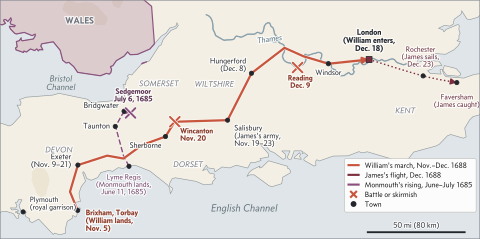
There was hardly any fighting. On December 9 about six hundred of the Irish Catholic soldiers whom James had brought over from his army in Ireland held the town of Reading, on the Thames. They were led by Patrick Sarsfield, a Catholic officer from an old Irish family who would later defend Limerick. The townspeople feared that the Irish meant to massacre them and sent to William for help. Some 280 Dutch dragoons, soldiers who rode to battle, came in by an unexpected road, while townsmen fired from their windows, and the Irish fled. This skirmish, the Battle of Reading,The Battle of Reading was fought during this event. → Glorious Revolution• cost between six and fifty lives, depending on whose report one trusts. With a brush between cavalry patrols at Wincanton on November 20, it was the only real fighting of the campaign.
James had sent three lords to bargain with William at Hungerford, and William’s terms were mild: a free Parliament, Catholic officers dismissed, and money for his army. James did not wait for them. On December 9 the queen and the baby slipped away down the Thames to a ship for France. James burned the writs he had issued for a new Parliament and sent Feversham an order that could only mean that the army should disband. Then, in the small hours of December 11, he took the Great Seal and went down to the river.
London woke without a king. Mobs wrecked Catholic chapels and the houses of foreign ambassadors, and Jeffreys, the hanging judge, was caught at Wapping dressed as a sailor and was locked in the Tower, where he died the next year. Then, in the early hours of December 13, countrymen came into Westminster crying that the disbanded Irish troops were marching on the city, burning and killing. That was the start of the panic called the Irish Night,A period of panic during this event was called the "Irish Night" or "Irish Fright." → Glorious Revolution•• or the Irish Fright. Within half an hour, it was reported, 100,000 Londoners were in arms. Candles burned in the windows, and the envoy of the Grand Duke of Tuscany watched women beat warming pans and frying pans to make a din. For a week the rumor ran through at least nineteen counties, always the same story of a town 40 miles off in flames and the Irish coming next. No Irish army ever came. The one known death was a tax officer shot at Dolgellau (dol-geth-lye) in Wales by a crowd that took him for an Irishman, but Protestant mobs ransacked Catholic houses across England in the name of searching them for arms.
James never reached France on his first try. Boatmen from Faversham in Kent boarded his ship before it could sail. Macaulay says that they took him for a Jesuit priest on the run, crying “Search the hatchet faced old Jesuit,” and robbed him of his money and his watch before they knew who he was. He was brought back to London on December 16, and the crowds, to everyone’s surprise, cheered. William did not want his father-in-law as a prisoner, still less as a martyr. On December 18 he let James go to Rochester, on the Kent coast, under a Dutch guard, and that afternoon he entered London himself. On December 23 James slipped out of a back door and sailed for France. Louis XIV gave him the palace of Saint-Germain (san zhair-man) outside Paris and a pension to live on.
William and Mary
England now had neither a king nor a Great Seal. William called together the peers and the men who had sat in Charles II’s Parliaments, and on their advice he called an election. The body that met at Westminster on January 22, 1689, was a Convention: a Parliament that meets without a king’s writ, since there was no king to issue one and no seal to put on it. Its members had to decide what had happened. The Tories, the party of the Church and the crown (Chapter 9), believed that a king’s right came from God and could not be taken away by his subjects. Some of them, Archbishop Sancroft among them, wanted James kept as king in name, with a regent ruling for him, and others would make Mary queen alone. The Whigs held that James had broken the contract between king and people and had lost his crown by it.
On January 28 the Commons voted for words that both sides could swallow. They resolved that James, who had fled the kingdom and dropped the Great Seal in the Thames, had “abdicated the government,”After James II fled and threw the Great Seal into the Thames, the Convention Parliament declared that he had performed this action. → abdication• and that the throne was therefore vacant. To abdicate is to give up a throne of one’s own will. The word made the loss James’s own doing, not his subjects’. Yet James had never said he was giving anything up, and the Lords objected that the word was unknown to English law and proposed “deserted” instead. On February 6 they gave way, and the whole Convention stood behind “abdicated.”

Then the question was who should wear the crown. William made himself clear. He would not be a regent, and he would not be king only as his wife’s escort, a mere “gentleman usher,” in Macaulay’s phrase, like the court officer who walks ahead of a great lady. If he was not made king, he would go home and leave the English to their troubles. Mary, twenty-six, devout, and fond of the husband she had wept to marry, refused to reign over him. Anne agreed to let William reign for life before her. On February 13, 1689, in the Banqueting House at Whitehall, the Convention’s Declaration of Right was read to William and Mary. It listed James’s wrongs and the rights of Parliament, and they accepted the crown. On April 11 Bishop Compton crowned them together in Westminster Abbey, because Archbishop Sancroft would not. The revolution had overthrown James II and crowned William III and Mary II,This event overthrew James II and placed William III and Mary II on the English throne. → Glorious Revolution•••This ruler was overthrown by William and Mary in the Glorious Revolution. → James II••This Dutch stadtholder took the English throne with his wife Mary in the Glorious Revolution. → William III of England••• the Dutch stadtholder and his wife. They are the only king and queen to have reigned over England together, each in his or her own right, though William alone held the power. In Scotland, where a separate Convention offered them the crown in April, he was William II. Within a generation, Protestant preachers were calling the whole affair the Glorious Revolution.
In December 1689 Parliament made the Declaration of Right lawAfter this event, the Declaration of Right was incorporated into the English Bill of Rights. → Glorious Revolution•• as the Bill of Rights, which received the royal assent on December 16. Its first article answered the Declarations of Indulgence: “That the pretended power of suspending the laws or the execution of laws by regal authority without consent of Parliament is illegal.” The second outlawed the dispensing power “as it hath been assumed and exercised of late,” which undid Godden v. Hales. Others forbade the crown to raise money without Parliament’s grant or to keep a standing army in peacetime without its consent. They declared that “election of members of Parliament ought to be free,” that Parliament’s debates could not be questioned in any court, and that Parliaments ought to be held frequently. The Bill also barred from the throne anyone who was a Catholic or married one, and it fixed the succession: William and Mary, then Anne and her children (Figure 10.6).

The same Parliament passed the Toleration Act in May 1689. It let Protestant dissenters worship in their own licensed meeting houses, but it gave nothing to Catholics or to those who denied the Trinity, and the Test Acts stayed. Everyone who held office, clergymen included, now had to swear a new oath to be “faithful and bear true allegiance to their Majesties King William and Queen Mary.” Some could not. Archbishop Sancroft had gone to the Tower rather than obey James, but he had sworn allegiance to James before God, and while James lived, Sancroft believed, that oath still bound him. He had preached all his life that no subject may ever resist the king God has given. Nine bishops and a few hundred clergymen took the same view, five of the Seven Bishops among them. They were called Nonjurors, from the Latin iurare, “to swear.” Their opponents, Burnet among them, answered that Providence, God’s guiding hand in events, had plainly handed the crown to William and that an oath to a king who had run away no longer held. Sancroft and the other Nonjurors refusedAfter this event, William Sancroft and other Nonjurors refused to take oaths of allegiance, causing the "nonjuring schism." → Glorious Revolution• to give way. They were deprived of their offices in 1690. The Nonjurors then consecrated bishops of their own, splitting the church, and this schism, as a split in a church is called, lasted for nearly a century.
William, whose asthma grew worse in the smoky air of Whitehall, rarely lived there. He bought a house in the village of Kensington, which became Kensington Palace, and he and Mary set Christopher Wren, the architect of St. Paul’s (Chapter 8), to work at Hampton Court. This was the great palace on the Thames above London that Cardinal Wolsey, Henry VIII’s chief minister, had built from 1514 and the king had taken from him (Chapter 2). From 1689 Wren pulled down half of the Tudor palace and built the Fountain Court in its place. Around it he set two suites of state rooms of exactly equal grandeur, the King’s Apartments facing south over the Privy Garden and the Queen’s facing east over the Fountain Garden (Figure 10.7). Kip’s engraving of the finished palace is printed elsewhere (Vol. 11, The Age of Shakespeare).

The Boyne
Ireland did not accept the verdict of Westminster. About three of every four people in Ireland were Catholics. But after the plantation of Ulster under James I and the confiscations of the 1650s (Chapter 6), Catholics owned only about 22 percent of the land, down from about 90 percent in 1600. James’s lord deputy, Richard Talbot, Earl of Tyrconnell (tir-kon-ul), was a Catholic soldier who had spent two years putting Catholics into the army, the courts, and the town councils. To Irish Catholics, James was their best hope in a century of winning back their land, their worship, and their offices. To the Protestants of Ireland, many of them Scots settled in Ulster, he threatened everything they had held since the rising of 1641, when thousands of Protestant settlers had been killed.
The first stand came at Derry, the walled city on the River Foyle that London’s merchants had planted, which Protestants called Londonderry. On December 7, 1688, thirteen apprentice boys slammed its gates in the face of a Catholic regiment sent to garrison it. The next spring James himself came before the walls. He had landed at Kinsale on March 12, 1689, with French officers, arms, and money from Louis XIV. The siege lasted 105 days, from April 18 to August 1. Thousands in the city died of hunger and fever before ships broke a boom of timber and chain across the river at the end of July and brought food. The defenders’ cry, “No surrender,” became the watchword of Ulster Protestants ever after (Figure 10.8).

A Parliament in Dublin, almost all Catholic, declared James still king. It passed an act granting liberty of conscience to Catholics and Protestants alike and an Act of Attainder that named more than two thousand Protestants as traitors, to lose their lands and their lives unless they surrendered. In August 1689 William’s general, the Duke of Schomberg (shom-burg), landed in Ulster. He was a Protestant soldier of seventy-three who had left the service of France after 1685, and his army stalled at Dundalk and wasted away from disease. So William came himself. He landed at Carrickfergus (kar-ik-fur-gus) on June 14, 1690, and marched south with about 36,000 men: Dutch, Danes, French Huguenots, English, and Ulster Protestants. James waited behind the River Boyne, about 30 miles north of Dublin, with about 23,500, most of them Irish Catholic recruits stiffened by French regulars. On June 30 a cannonball grazed William’s shoulder as he rode along the river bank.
On July 1, 1690, William sent part of his army upriver as a feint, and James moved his best troops to meet it. Then the Dutch Blue Guards waded the river at the ford of Oldbridge and held their ground against charge after charge of Irish cavalry led by James’s illegitimate son, the Duke of Berwick. Schomberg was killed in the crossing, and so was George Walker, the clergyman who had governed Derry in the siege. By afternoon the Williamites were across in force (Figure 10.9). At the Boyne William beat James and the Jacobites,William III defeated James II at this 1690 battle in Ireland. → Battle of the Boyne••This king defeated James II at the Battle of the Boyne. → William III of England•Jacobites seeking to reverse this event were defeated at the Battle of the Boyne. → Glorious Revolution••• the supporters of James and his heirs (the Stage) who wanted to undo the revolution; their long struggle is told in Chapter 13. About two thousand men died, three quarters of them Jacobites. The Irish army fell back in good order toward Limerick.

James did not stay to see the end. He rode to Dublin that night and within days sailed from the south coast for France, never to return to any of his kingdoms. His Irish soldiers had fought for him, and he had left them to fight on alone. Irish speakers gave him a name that stuck: Séamus an Chaca, “James the shit”This king was derisively nicknamed “the shit” in Ireland after fleeing the Battle of the Boyne. → James II•• (shay-mus un khah-kuh). Irish memory of the Stuarts was more mixed than the nickname suggests. The scholar Breandán Ó Buachalla (bran-dawn oh boo-uh-khuh-luh) showed in 1996 that for most of the eighteenth century, Irish poetry was full of longing for the exiled Stuart king and his return.
The war went on for another year. William failed to take Limerick in August 1690 and went back to fight Louis in the Netherlands, leaving his Dutch general, Godert de Ginkel (ging-kul), in command. On July 12, 1691, Ginkel destroyed the Jacobite army at Aughrim in County Galway. Its French commander, the Marquis de St. Ruth, was killed by a cannonball, and some 7,000 men died, in one of the bloodiest battles ever fought in Ireland. Limerick, under Sarsfield, held out until the autumn and then made terms. The Treaty of Limerick, signed on October 3, 1691, had two parts. Under the military articles, Sarsfield and about 14,000 soldiers sailed to serve the king of France, a departure remembered as the Flight of the Wild Geese. Under the civil articles, Catholics were to have the freedom of worship they had enjoyed under Charles II, and the Jacobites of Limerick who swore allegiance to William and Mary were to keep their lands.
The Irish Parliament, now wholly Protestant, did not keep those promises. It put off ratifying the treaty until 1697 and then ratified only part of it. From 1695 it passed the penal laws, a code of punishments and disabilities for Catholics. Catholics could not keep a school or send their children abroad to be taught, carry a sword or a gun, or own a horse worth more than £5 (1695). Their bishops and friars were banished (1697). They could not buy land, or lease it for more than thirty-one years, and a Catholic’s estate had to be divided among all his sons unless the eldest turned Protestant (1704). In 1728 they lost the vote. To Ireland’s Protestants, a minority who remembered 1641 and the siege of Derry, the laws were their security against a people who outnumbered them three to one and had just fought to take back the land. To Catholics they were persecution and a broken treaty, and Limerick is still called the City of the Broken Treaty. Most of the laws were repealed from the 1770s on, and the last great barrier fell with Catholic emancipation in 1829 (Vol. 15, The Age of Revolution).
The settlement
Queen Mary died of smallpox at Kensington on December 28, 1694, at thirty-two. William, who had often seemed cold to her, was wild with grief. Henry Purcell wrote the music for her funeral in March 1695 (Chapter 11). William reigned alone and fought Louis XIV (Vol. 13, Valois, Bourbon, and Orange) until the Treaty of Ryswick (riz-wik) in 1697, by which Louis recognized him as king.
The question of who would come next was settled by deaths. Anne was pregnant at least seventeen times, but only one of her children lived beyond infancy: William, Duke of Gloucester, born in July 1689. He was a lively boy who drilled a company of ninety boy soldiers, and he died on July 30, 1700, six days after his eleventh birthday. Now the line laid down in the Bill of Rights would end with Anne. In June 1701 Parliament passed the Act of Settlement (the Stage). It gave the crown, after William and Anne, to Sophia, Electress of Hanover, widow of one of the German princes who elected the emperor and a granddaughter of James I through his daughter Elizabeth (Chapter 4), and to the Protestant heirs of her body. To reach Sophia, Parliament passed over dozens of nearer relatives, every one of them a Catholic. Repeating the Bill of Rights, the Act barred Catholics from the throneThe 1701 Act of Settlement forbade these people from becoming monarchs. → Catholics• for good: no one who was a Catholic, or who married one, could inherit. It added that every future monarch had to join in the communion of the Church of England.
The Act also tied the crown’s hands in other ways. Judges were to hold office as long as they behaved well and could be removed only at the request of both Houses, an answer to the sacking of judges before Godden v. Hales. No one born abroad could sit in the Privy Council or in Parliament, and the king could not take England to war for lands that were not England’s without Parliament’s consent. The Tory ministry that steered the Act through Parliament, and the members who added those clauses, were thinking of William’s Dutch favorites and of the German Hanover to come. The Act is still law. Since 2015 marrying a Catholic no longer costs an heir the throne, but a Catholic still cannot reign.
James II died at Saint-Germain on September 16, 1701. Louis XIV at once recognized his thirteen-year-old son, the baby of the warming-pan story, as King James III, and England prepared for a new war with France. William did not live to fight it. In February 1702 his horse stumbled on a molehill in the park at Hampton Court, and William broke his collarbone. He died at Kensington on March 8, 1702. Jacobites afterward drank toasts to the mole as “the little gentleman in the black velvet waistcoat.” Anne, the last of the Stuart monarchs, became queen (Chapter 13).
The unwritten constitution
A constitution is the set of rules that says who governs a country, how they are chosen, and what they may not do. The United States wrote its constitution as a single document in 1787 (Vol. 27, New Worlds). The United Kingdom, the state formed when Great Britain and Ireland were joined in 1801 (Vol. 15, The Age of Revolution), never has. Its constitution is uncodified, and often called “unwritten”.The United Kingdom’s uncodified example of these systems, often described as “unwritten,” draws on statutes, conventions and other sources. → constitutions• That does not mean that nothing is written down, only that the rules are scattered. Some are statutes, acts of Parliament that happen to be fundamental, such as Magna Carta, the Bill of Rights, and the Act of Settlement. Some are conventions, unwritten rules that everyone obeys because breaking them would cause a crisis. The monarch, for example, always gives the royal assent to a bill that has passed both Houses, and none has refused since Queen Anne in 1708. Others come from judges’ decisions and from the books of great lawyers. Because no one document stands above the rest, Parliament can change any part of it by an ordinary act.
The oldest piece is Magna Carta, the charter King John sealed at Runnymede on June 15, 1215 (Vol. 8, The Northern Worlds). Its Latin runs on without breaks. William Blackstone (1723–1780) was an Oxford lawyer who became the university’s first professor of English law. His Commentaries on the Laws of England (1765–1769) were the books through which generations of English and American lawyers learned their law. In 1759 he published a careful edition of the charter, comparing the old copies, and Blackstone divided it into sixty-threeThis document's modern numbering system, which includes 63 sections, was introduced by William Blackstone. → Magna Carta•• numbered clauses. Lawyers have quoted Magna Carta by his numbers ever since.
The revolution also became the end point of English histories. David Hume (1711–1776), the Edinburgh philosopher whose arguments Chapter 16 explains, wrote a History of England in six volumes between 1754 and 1762. He began with the Stuarts and worked backward, so that the finished work ran from Julius Caesar’s invasion of Britain to 1688.This event, along with Julius Caesar's invasion of Britain, chronologically bookends David Hume's The History of England. → Glorious Revolution• It was the standard history of England for a century, and the Whigs hated it longest. In a short autobiography written in 1776, Hume complained that men of every party had united against him because he had “presumed to shed a generous tear” for Charles I.
The Whigs’ answer came from Macaulay (1800–1859), a Whig politician and essayist. The first two volumes of his History of England from the Accession of James the Second appeared in 1848, the year revolutions broke out in Paris, Vienna, Berlin, and a dozen other cities. Macaulay portrayed 1688 as consensual and bloodless:Macaulay portrayed this event as consensual and bloodless, echoing its nickname the “Bloodless Revolution.” → Glorious Revolution•• a whole nation of Whigs and Tories acting together to keep its old laws, not to overturn them. His picture fits the event’s other name, the Bloodless Revolution. “The highest eulogy which can be pronounced on the revolution of 1688 is this,” he wrote, “that it was our last revolution.” It was bloodless only in England. Scotland had its battle at Killiecrankie (kil-ee-krang-kee) in 1689, where Highlanders loyal to James beat William’s army. In 1692 came the massacre at Glencoe, where government soldiers killed about thirty MacDonalds whose chief had been late to swear loyalty to William. Ireland had Derry, the Boyne, and Aughrim. Later historians have stressed what Macaulay played down. Jonathan Israel, a historian of the Dutch Republic, argued in 1991 that it began as a Dutch invasion. Steven Pincus, in 1688: The First Modern Revolution (2009), argued that it divided the nation as deeply as any revolution and changed its government, its trade, and its place in Europe.
What to remember
- James II (1685–1688), the last Roman Catholic king of England, crushed Monmouth at Sedgemoor (1685), won Godden v. Hales (1686) for the dispensing power, and set the Test Acts aside by the suspending power (1687, 1688).
- June 1688 brought the birth of James Francis Edward, rumored a “warming-pan baby,” and the acquittal of the Seven Bishops. Fagel’s letter had shown that William and Mary would keep the Test Acts; Henry Sidney drafted the Immortal Seven’s invitation.
- William issued The Declaration of The Hague, sailed in the Brill, and landed at Brixham on Torbay on November 5, 1688. The only fighting was at Wincanton and Reading; the Irish Night was a panic over an army that never came.
- James fled, dropped the Great Seal in the Thames, and sailed for France. The Convention Parliament declared that he had abdicated, and William III and Mary II were crowned together on April 11, 1689.
- The Declaration of Right became the Bill of Rights (December 1689). Archbishop Sancroft and the other Nonjurors refused the new oaths, and their refusal split the church.
- William beat James and the Jacobites at the Boyne on July 1, 1690, and Irish speakers called the fleeing king “Séamus an Chaca.” The Treaty of Limerick (1691) ended the war, and the Irish Parliament’s penal laws (from 1695) broke its promises to Catholics.
- The Act of Settlement (1701) barred Catholics from the throne and gave it to Sophia of Hanover’s Protestant line.
- Britain’s constitution is uncodified: statutes, conventions, and judgments. Blackstone numbered Magna Carta’s sixty-three clauses (1759); Hume’s History ran from Caesar to 1688; Macaulay made 1688 consensual and bloodless.
Chapter 11 · 31 clues
Purcell and Dido
On November 26, 1695, the choir of Westminster Abbey sang at the burial of its own organist. Henry Purcell had died five days before, on the eve of the feast of Saint Cecilia (sih-seel-yuh), the patron saint of music. He was thirty-six. He was laid to rest in the north aisle, near the organ he had played for sixteen years, and at the service the singers performed a short anthem he had written eight months earlier for the funeral of a queen.

In his short life Purcell wrote for three kings and a queen, for the Church of England, for the London theaters, for a society of music lovers, and for a girls’ boarding school in a village up the Thames. Some of that music was lost after his death, and much of it was long neglected. One song is now better known than all the rest. It is the lament a dying queen of Carthage sings at the end of his one true opera, and every November it is still played in London at the memorial to the dead of two world wars.
Purcell at court
Purcell was born in 1659 in Westminster, then a small town of palaces and lanes just west of the City of London, in the shadow of the Abbey. England had no king that year; the next spring Parliament called Charles II home from exile (Chapter 8). Purcell was English, and England, which joined Scotland in 1707 to form Great Britain, is now the largest part of the United KingdomHenry Purcell is a composer from this country. → United Kingdom•• (Chapter 13). His father, also named Henry, sang in the Chapel Royal, the monarch’s own choir (Chapter 3). The father died in 1664, and the boy was raised by his uncle Thomas, another singer of the Chapel.
As a boy Purcell sang in the Chapel Royal himself. He was trained by two Masters of the Children, the officers who taught and housed the choirboys: Captain Henry Cooke, who had fought for Charles I in the Civil War, and then Pelham Humfrey (hum-free), who had studied music in France. When his voice broke in 1673, the court found him work as assistant to John Hingston, who kept the king’s organs and wind instruments in repair. He went on to Westminster School, and in 1676 the Abbey paid him to copy music for its choir.

His teacher in composition was John Blow.John Blow was this composer's mentor. → Henry Purcell•• Blow had been born in 1649 at or near Newark, in Nottinghamshire, and had sung in the Chapel Royal as a boy in the first years after the Restoration. At nineteen he became organist of Westminster Abbey, and in 1674 he followed Humfrey as Master of the Children. He taught many of the next generation of English composers. Teacher and pupil became friends, and Blow was generous. In 1679 he gave up the post of Abbey organist, and Purcell, about twenty, took it. In 1682 Purcell became an organist of the Chapel Royal as well, and he held both posts until he died. When Purcell died, Blow set an ode on his death by the poet John Dryden (Vol. 11, The Age of Shakespeare).
A court composer’s most regular work was the ode, a poem of praise set to music in a chain of short movements for solo singers, chorus, and strings, much like a cantata (Vol. 1, The Toolkit). Nearly every year Purcell wrote welcome songs, odes to greet the king when he came back to London after a summer away. Other odes were for royal birthdays and weddings, and one series was for a saint. Saint Cecilia was a young Roman Christian who, by tradition, died a martyr in the third century. Her legend, written down long after her death, says that while musicians played at her wedding she sang to God in her heart. By the late Middle Ages she was honored as the patron saint of music and was often painted at an organ. Her feast falls on November 22. In 1683 a group of London musicians and music lovers, the Musical Society, began to keep the day each year with a new ode, and Purcell wrote their first, “Welcome to all the pleasures,” sung in a concert room just off the Strand.
His most famous Cecilia ode came in 1692. Its words were by Nicholas Brady, an Irish-born clergyman, and they praise one instrument after another: the organ, which legend said Cecilia had invented, then the violin, the flute, and the instruments of war. Purcell gave each its turn, and for the music of war he chose trumpets and kettledrums. “Hail, bright Cecilia,” Purcell’s odeThis composer wrote an Ode to St. Cecilia. → Henry Purcell•• for Saint Cecilia’s Day, was sung in Stationers’ Hall, the hall of the London guild of printers and booksellers, on November 22, 1692, and the audience called for it to be sung again.
Charles II died in February 1685, and his brother came to the throne as James II, a Roman Catholic (Chapter 10). For the coronation that April Purcell wrote the anthem “My heart is inditing,” an old phrase from the Psalms for “my heart is composing,” and he saw to the building of an organ in the Abbey for the day. James wanted his fellow Catholics in the army and in office, despite the laws that shut them out. In Ireland most people were Catholic, but Protestants held most of the land and power. James gave the Irish army to Richard Talbot, Earl of Tyrconnell (Chapter 10), an Irish Catholic soldier who had been his friend since the years of exile. Early in 1687 he made Tyrconnell Lord Deputy, to govern Ireland in the king’s name. Tyrconnell filled the Irish army with Catholic officers and hoped to win back the lands taken from Catholics under Cromwell (Chapter 6). Irish Protestants feared a massacre like the one they remembered from 1641.
Thomas Wharton, a hard-drinking Whig member of Parliament (Chapter 9), mocked the appointment in a song. In it two Irishmen, whose words are spelled to mimic an Irish accent, cheer the news of their new deputy: “Ho! broder Teague, dost hear de decree?” Teague (teeg) was an English nickname for an Irishman. The refrain, “Lilliburlero (lil-ee-bur-lair-oh) bullen a la,” was said to be Irish words, though whether it means anything is still argued, and it gave the song its name. The tune was a jaunty quick march that had first been printed in 1686, in a book of tunes for the recorder, with no composer’s name. For a year the song made little stir. Then, in the autumn of 1688, James brought Irish regiments to England to meet the Dutch invasion he expected, and printed copies of the words spread through the streets and the barracks. Gilbert Burnet, the Scottish clergyman who sailed with William of Orange that November, wrote in his History of His Own Time that the army, and at last the whole country, sang it constantly. He added that “perhaps never had so slight a thing so great an effect.” Wharton later boasted that he had sung a king out of three kingdoms.
Who wrote the tune is still uncertain. In 1689 a harpsichord piece by Purcell built on it, “A New Irish Tune,” appeared in a book of keyboard pieces called Musick’s Hand-maid, and the tune has been credited to PurcellThis composer is commonly attributed as the author of the Irish march Lilliburlero. → Henry Purcell• ever since. He may have composed it, or he may only have arranged a tune that everyone already knew. Either way it outlived the quarrel that made it famous. For decades in the twentieth century the BBC World Service played it before its news bulletins.
James fled to France in December 1688, and in February 1689 his elder daughter, Mary, and her Dutch husband, William of Orange, were proclaimed joint monarchs as William III and Mary II (Chapter 10). Purcell kept his posts. William spent most summers at war in Flanders, but Mary loved music, and Purcell wrote an ode for her birthday, April 30, in each of the six years from 1689 to 1694. The last, “Come, ye sons of art,” has words usually credited to the poet Nahum Tate (nay-um).
In December 1694 Mary caught smallpox, and she died at Kensington Palace on December 28, at the age of thirty-two. Her body lay in state in the Banqueting House at Whitehall, and on March 5, 1695, the procession carried her to Westminster Abbey (Figure 11.3). It was the first royal funeral attended by every member of both Houses of Parliament.

For the procession and the service Purcell wrote a slow march and a short canzona (kan-zoh-nuh), a piece for instruments in which the parts imitate one another, both in C minor. The ordinary trumpet of his day had no valves and could play only its natural notes (Vol. 1, The Toolkit), so it was at home in a few bright major keys and nearly useless in a minor one, which musicians then called a “flat” key. The flat trumpet had a slide, like a trombone’s, that let the player lengthen the tube and fill the gaps between the natural notes. A quartet of flat trumpetsThis composer's funeral music for a monarch utilises a quartet of flat trumpets. → Henry Purcell• played Purcell’s march and canzona, in slow, dark chords. Then the choir sang his new setting of one of the sentences of the burial service in the Book of Common Prayer, “Thou knowest, Lord, the secrets of our hearts,” plain and quiet, with every voice moving together. Thomas Tudway, a church musician of the time, wrote years later that it drew tears from all who heard it. Eight months later the choir sang the same anthem at Purcell’s own funeral. William Croft, who followed Blow as organist of the Abbey, kept it in the burial service he composed about 1724, and it has been sung at nearly every royal and state funeral in England since.
The trumpet was the sound of royal ceremony, and the most famous English trumpet tune of the next generation came from another of Blow’s pupils. Jeremiah Clarke, born about 1674, sang in the Chapel Royal as a boy and became the first organist of Christopher Wren’s new St. Paul’s Cathedral (Chapter 8). About 1700 he wrote a march named for Prince George of Denmark, the husband of Mary’s sister, Princess Anne, who would reign as Queen Anne from 1702 (Chapter 13). The Prince of Denmark’s March was first printed in 1700 as a piece for harpsichord. In the 1870s an English organist, William Spark, published it as a “Trumpet Voluntary” by Henry Purcell. A voluntary is a piece played on the organ before or after a church service, and a trumpet voluntary uses the organ’s trumpet stop, a set of pipes that sounds like a trumpet. The conductor Henry Wood arranged it for trumpet and orchestra, recordings spread it, and Clarke’s march, the “Trumpet Voluntary,”Jeremiah Clarke’s Prince of Denmark’s March is often called a "Voluntary" for this instrument and was formerly attributed to Purcell. → trumpet••• passed as Purcell’s until scholars traced it back to Clarke in the 1940s. It is still a favorite at weddings; it was played when Prince Charles married Lady Diana Spencer in St. Paul’s in 1981.
The theater music
In the last six years of his life Purcell wrote music for more than forty plays. After the death of Charles II, who had loved music and paid for it, the court spent less on musicians, and a court composer with a family to feed looked for work in the playhouses. The theaters had reopened in 1660, and since 1682 London’s actors had formed a single troupe, the United Company (Vol. 11, The Age of Shakespeare). A play of the 1690s began with an overture, filled the pauses between its acts with tunes for the band, and stopped now and then for a song or a dance. Music written to go with a spoken play is called incidental music (Vol. 1, The Toolkit).
Many of Purcell’s finest songs began as incidental music. In 1692 the company revived Oedipus (ed-ih-pus), a version of the Greek tragedy of Sophocles (sof-uh-kleez) by Dryden and Nathaniel Lee, and Purcell wrote music for the scene in which the blind prophet Tiresias (ty-ree-see-us) calls up the ghost of the murdered King Laius (ly-us). The song is “Music for a While.” It promises that music will beguile, or charm away, the listeners’ cares for a while, until the Fury Alecto (uh-lek-toh) sets the dead free from their eternal bonds and the snakes drop from her headThis composer's "Music for a While" describes snakes dropping from the head of the Fury Alecto. → Henry Purcell• and the whip from her hands. Alecto is one of the three Furies, the spirits of vengeance with snakes for hair whom Virgil names (Vol. 4, Classical Myth). Purcell repeats the word “drop” on short notes, again and again, so that the listener hears the snakes fall one by one. Beneath the voice the bass plays a short phrase over and over. A phrase in the bass repeated without a break while the music above it changes is a ground bass, or simply a ground. The ground of “Music for a While” is only three bars long, and the voice wanders above it into other keys and back.
London audiences liked their music with spectacle. The most lavish shows of the 1690s were what Purcell’s contemporaries called dramatic operas and what historians call semi-operas. These were plays in which the main characters speak, while the singing and dancing go to gods, spirits, shepherds, and drunkards. The music came above all in the masque, the long scene of song, dance, and stage machinery that court and theater had loved since the days of James I (Vol. 11, The Age of Shakespeare). In 1690 Purcell’s music made a hit of Dioclesian (dy-oh-klee-zhun), an old play about a Roman emperor, made over as a semi-opera. John Dryden, the greatest poet of the age, had become a Catholic under James and would not swear allegiance to William and Mary, so he had lost his post as Poet Laureate. That year he printed a comedy with Purcell’s songs in it, and in its dedication he wrote of the composer, “We have at length found an Englishman equal with the best abroad.”

Dryden and Purcell then made a semi-opera together. King Arthur, or The British Worthy opened in the late spring of 1691 at the company’s theater at Dorset Garden, on the Thames, which had stage machinery to fly gods and spirits through the air (Figure 11.4). Dryden’s Arthur is a Christian British king at war with the Saxons of Oswald, king of Kent, who still worship the old Germanic gods. Oswald has carried off Arthur’s betrothed, the blind Cornish princess Emmeline. Merlin and a gentle spirit of the air help Arthur, while a Saxon magician named Osmond and an earthy spirit work against him.
In Act 3 Osmond, who wants Emmeline for himself, tries to persuade her that love can warm even the coldest heart by showing her a masque set in a frozen land in the far north. Cupid wakes the Cold Genius, the spirit of winter, from his bed of snow. The Genius rises unwillingly and sings “What power art thou,” in a voice that shivers. The strings play quick repeated notes, like chattering teeth, and the harmony slides by semitones through strange, cold chords. A chorus of Cold People shivers in the same way until Cupid warms them, and they sing that it is love that has warmed them. Purcell probably took the shivering from a chorus of trembling people in Isis (1677), an opera by Jean-Baptiste Lully (loo-lee), the court composer of Louis XIV (Vol. 13, Valois, Bourbon, and Orange). The Frost Scene of King ArthurThis composer’s semi-opera King Arthur includes a celebrated "Frost Scene." → Henry Purcell•• has been the most admired part of the score since its first season; the poet Thomas Gray (Vol. 11, The Age of Shakespeare), writing about a revival in 1736, thought the Cold Genius’s song the finest in the play. The next year came The Fairy Queen, a version of Shakespeare’s A Midsummer Night’s Dream with a masque in every act but the first; its score was lost after Purcell’s death and found again only in 1901.
Purcell’s last year was one of his busiest. That spring the best actors of the United Company, led by Thomas Betterton, walked out and opened a rival theater (Vol. 11, The Age of Shakespeare). The managers left behind at Drury Lane had to fill their stage, and they turned to old plays with new music. One was Abdelazer, or The Moor’s Revenge, a tragedy of 1676 by Aphra Behn (af-ruh ben), one of the first Englishwomen to earn her living by writing, who had died in 1689. Its hero is a captive North African prince at the court of Spain who takes a terrible revenge on the king who killed his father. For the revival Purcell wrote an overture and a set of dances and airs. One of them is a rondeau (ron-doh), a dance in which the opening tune keeps coming back between new passages, and Purcell’s is a stately tune in D minor. Two and a half centuries later Benjamin Britten, the leading English composer of the twentieth century (Vol. 24, After Empire), took the Abdelazer rondeau as the themeBritten based The Young Person’s Guide to the Orchestra on this composer’s incidental music to Abdelazer. → Henry Purcell•• of The Young Person’s Guide to the Orchestra, subtitled Variations and Fugue on a Theme of Purcell. The whole orchestra plays the tune at the start, and at the end the brass blare it out again over the closing fugue (Vol. 1, The Toolkit).
The company also turned an old heroic play into a semi-opera. The Indian Queen, by Dryden and his brother-in-law Sir Robert Howard, had first been acted in 1664; it is a tale of war between the Incas of Peru and the Aztecs of Mexico in the years before the Spanish came. Purcell wrote music for its prologue and its second and third acts, including the song “I attempt from love’s sickness to fly.” The masque that was to end the play had still not been set when he died, and so The Indian Queen was left unfinished.This composer failed to complete The Indian Queen before his death. → Henry Purcell• His younger brother, Daniel Purcell, also a composer, set the last masque.

Henry Purcell died at home in Westminster on November 21, 1695. No one knows what killed him, and tuberculosis is a common guess. Sir John Hawkins, in his General History of the Science and Practice of Music (1776), passed on a story that Purcell came home late one night, found that his wife, Frances, had locked him out, and caught his death of cold on the doorstep. Hawkins himself thought a long illness more likely. On his last day Purcell made a will that left everything to his “loving wife.” The tablet near his grave says that he has gone to the one blessed place where his harmony can be surpassed.
Frances Purcell gathered his songs. In 1698 the music publisher Henry Playford brought out the first volume of Orpheus Britannicus (or-fee-us brih-tan-ih-kus), “the British Orpheus.” The title compares Purcell to the singer of Greek myth whose music charmed wild beasts and the lords of the dead (Vol. 4, Classical Myth). A second volume followed in 1702, with “Music for a While” among its songs. Orpheus Britannicus, the collection of his songs,A posthumous collection of this composer's songs is titled Orpheus Britannicus. → Henry Purcell• opened with an engraving of Purcell made from Closterman’s portrait (Figure 11.1), and new editions and volumes under its name were still appearing in the 1740s.
Few of Purcell’s works can be dated exactly, many of his manuscripts are lost, and many pieces were copied under the wrong name, so for two centuries no one could say exactly what he had written. Today his works carry numbers. In 1963 the American scholar Franklin Zimmerman published a catalogFranklin Zimmerman categorised this composer's works by "Z numbers." → Henry Purcell•• of everything Purcell wrote, giving each work a number, grouped by kind rather than by date: anthems and services first, then odes, songs, music for the theater, and instrumental pieces. Musicians cite them as Z numbers, so that King Arthur is Z. 628 and The Indian Queen Z. 630.
Dido and Aeneas
Chelsea was a village on the Thames about 2 miles above Westminster, a place of gardens and country houses. In 1680 a dancing master named Josias Priest (joh-sy-us) moved his boarding school for young gentlewomen there. Priest also arranged the dances for the London theaters, Dorset Garden among them, and his school put on shows; in 1684 its girls performed John Blow’s opera Venus and Adonis. A little printed book of the words, a libretto (Vol. 1, The Toolkit), records a later show: “An Opera Perform’d at Mr. Josias Priest’s Boarding-School at Chelsey. By Young Gentlewomen. The Words Made by Mr. Nat. Tate. The Musick Composed by Mr. Henry Purcell.” This was Purcell’s Dido and AeneasThis composer wrote Dido and Aeneas. → Henry Purcell••• (dy-doh and ih-nee-us), and the school’s performance, by 1689 and perhaps a year or two earlier, is the first that anyone recorded. When it was written is uncertain: no later than the summer of 1688, and it may be several years older, written for the court of Charles II. The schoolgirls sang and danced most of it; no list of the singers survives.
It was something England hardly had: an opera sung from beginning to end. Italy had had opera since about 1600 (Vol. 10, Rebirth), and in France Lully had made a French kind for Louis XIV (Vol. 13, Valois, Bourbon, and Orange). English audiences preferred plays with music, and even the semi-operas kept their heroes speaking. In Dido and Aeneas every word is sung, in English.Henry Purcell composed operas in this language. → English• The story moves forward in recitative, singing that follows the rhythm of speech, and stops for airs, choruses, and dances (Vol. 1, The Toolkit). Its model was Blow’s Venus and Adonis, written about 1683 for Charles II’s court, in which Venus was sung by Mary Davis, an actress who had been the king’s mistress, and Cupid by their daughter, Lady Mary Tudor, then about ten years old. Blow’s opera also has a prologue and three acts, ends with the death of Adonis, and closes with a chorus of mourning in G minor. Purcell followed Blow’s planThis opera was influenced by John Blow’s Venus and Adonis, including its closing chorus. → Dido and Aeneas•• down to that last chorus, and each opera runs less than an hour.
The words were by Nahum Tate, an Irishman born in Dublin in 1652, the son of a Puritan clergyman. He had come to London in his twenties to live by writing, and in 1681 he rewrote King Lear with a happy ending (Vol. 11, The Age of Shakespeare). In 1692 he became Poet Laureate, and his Christmas hymn “While shepherds watched their flocks by night” is still sung. Tate wrote the librettoNahum Tate wrote the libretto for this opera about a queen of Carthage. → Dido and Aeneas•Nahum Tate wrote the libretto for a Henry Purcell opera featuring this character. → Dido• by cutting down a tragedy of his own on the same story, Brutus of Alba (1678). His lines are short and rhymed, easy to sing and quick to grasp, plain feelings in few words, which is just what a composer needs. The story comes from Virgil’s AeneidBased on Virgil’s Aeneid, this opera depicts the love of a queen of Carthage and a Trojan prince. → Dido and Aeneas•• (ih-nee-id), the Roman epic of the Trojan prince Aeneas, who escaped from burning Troy to found a new nation in Italy. In its first book a storm drives him ashore near Carthage, on the coast of Africa. In the fourth book Carthage’s queen, Dido, falls in love with him; at the gods’ command he leaves her, and she kills herself on a pyre (Vol. 4, Classical Myth). Tate kept the outline and changed the machinery. Virgil’s Dido confides in her sister Anna, and Tate’s in Belinda. Virgil’s lovers are parted by Jupiter, who sends his messenger, Mercury; Tate’s are parted by a Sorceress and her witches, who hate Dido for her happiness. And Tate leaves out the pyre and the sword. His Dido simply dies of grief. The libretto also has a prologue of gods and nymphs, but its music is lost (Table 11.1).
| Act and place | What happens | Numbers |
|---|---|---|
| 1: Dido’s palace | Belinda cheers the queen; Dido confesses her love; Aeneas woos and wins her | “Shake the cloud from off your brow” (Belinda); “Ah! Belinda, I am prest” (Dido); a guitar chaconne; “To the hills and the vales” (chorus) |
| 2, scene 1: the cave | The Sorceress plots to part the lovers; two witches call up a storm | “Wayward sisters” (Sorceress); “In our deep vaulted cell” (echo chorus); Echo Dance of Furies |
| 2, scene 2: a grove | The royal hunt; the storm; the false Mercury orders Aeneas away | a guitar ground; “Stay, Prince, and hear great Jove’s command” (the Spirit) |
| 3: the harbor, then the palace | The sailors leave; the witches gloat; Dido sends Aeneas away and dies | “Come away, fellow sailors” (First Sailor); the Witches’ Dance; “Thy hand, Belinda” and “When I am laid in earth” (Dido); “With drooping wings” (chorus) |
Act 1 is set in Dido’s palace. Belinda bids the queen “Shake the Cloud from off your Brow,” since fortune smiles on Carthage. Dido answers in a song over a ground: “Ah! Belinda I am prest, / With Torment not to be Confest.” She confides her torment to BelindaThe heroine confides in Belinda, her sister and attendant, in this opera. → Dido and Aeneas•• but will not name its cause. Modern editions list Belinda as her sister and attendant, and she plays the part of Virgil’s Anna. She guesses at once: the Trojan guest. Aeneas enters, woos the queen, and wins her, and the court rejoices in a chorus, “To the Hills and the Vales,” and a dance.
Just before that chorus the Chelsea libretto calls for “A Dance Gittars Chacony,” and in the grove of Act 2 for a “Gitter Ground.” A chaconne (sha-kon) is a dance built, like a ground, over a short bass repeated again and again. No music survives for either dance. The two guitar dancesThe earliest libretto of this opera calls for two guitar dances, possibly improvised or never composed. → Dido and Aeneas• may have been left to a guitarist to improvise over a bass he knew, or Purcell may never have written them.
Act 2 opens in a cave. The Sorceress summons her “Weyward Sisters you that Fright, / The Lonely Traveller by Night,” using the spelling the First Folio of Macbeth had given Shakespeare’s witches (Vol. 11, The Age of Shakespeare). They hate the queen of Carthage, she tells them, as they hate all who prosper, and she has a plan. When the hunt is over, “my trusty Elf / In Form of Mercury himself” will order Aeneas to sail that night. The Sorceress sends her elf disguised as Mercury,In this opera, the Sorceress sends her elf disguised as Mercury to separate the title characters. → Dido and Aeneas•• the messenger of the gods, so that Aeneas will think the command comes from Jupiter himself. The witches shriek with laughter. Then two of them propose to spoil the royal hunt with a storm, and the chorus answers that they will brew the charm in their “deep-Vaulted Cell.” Purcell sets that chorus as an echo, with a few soft voices repeating the ends of its phrases as if from deep in the cave. The Echo Dance of FuriesIn Act 2 of this opera, two witches conjure an "Echo Dance of the Furies." → Dido and Aeneas•• follows, its string players split so that one group echoes the other.
In the second scene the hunting party rests in a grove. Aeneas shows the head of a boar on his spear; then thunder breaks, and the court hurries home. Aeneas is left behind, and the Sorceress’s spirit, disguised as Mercury, stops him: “Stay Prince,” it sings, and it tells him that Jupiter commands him to leave that very night. Aeneas agrees to obey. Alone, he wonders how he will tell the queen.
Act 3 opens at the harbor among the Trojan ships, where the sailors are weighing anchor and singing:
Spelling was not yet fixed: the “Bouze” leave is a drunken one, and modern editions print “boozy,” while “Morning” is mourning. The sailors’ sea song opens the actThis opera's third act opens with a sea shanty about sailors taking a "boozy short leave" of their nymphs. → Dido and Aeneas• with a joke that is also a warning, for the Trojans too are leaving women on the shore with promises they do not mean to keep. The Sorceress and her witches come to gloat. Their plot has worked, and their next move will be to raise a storm against Aeneas at sea and to burn Carthage. They end their scene with the Witches’ Dance,This opera's third act includes a "Witches' Dance." → Dido and Aeneas• a wild piece for the strings. In the palace, Dido has learned that the Trojans are leaving, and Aeneas comes to explain. Dido calls his grief the tears of a crocodile: “Thus on the fatal Banks of Nile, / Weeps the deceitful Crocodile.” He offers to defy the gods and stay. She will not have him. It is enough, she says, “That you had once a thought of leaving me.” She sends him away, and she knows that death must come when he is gone.
Dido’s Lament
Dido’s death takes two pieces of music, a short recitative and the Lament, “When I am laid in earth.” The recitative is accompanied only by the continuo, the group of harpsichord and bass instruments that supports the singers. “Thy Hand Belinda,”The recitative "Thy hand, Belinda" precedes "When I am laid in earth" in this opera. → Dido and Aeneas••This character requests her attendant Belinda’s hand in a recitative before her final aria. → Dido• she begins, “darkness shades me, / On thy Bosom let me rest.” Her line sinks by semitones on “darkness” and again on “death,” and the recitative leads straight into the Lament.
The Lament is in G minor and in 3/2 time, three slow half-note beats to the bar, and before Dido sings, the bass instruments play its ground alone (Figure 11.6). The bass falls from G to D one semitone at a time, G, F-sharp, F, E, E-flat, D; then it steps through B-flat and C to D once more and comes back to G, the key’s home note. The fall from G down to D is the interval of a perfect fourth, and filling it with every semitone makes a chromatic fourth. A ground that repeats unchanged like this is also called an ostinato (os-tih-nah-toh), from the Italian for “obstinate.” Dido’s Lament is built on a groundThe lament "When I am laid in earth" in this opera uses a chromatically descending ground bass from G to D. → Dido and Aeneas•••This character's Lament aria is underpinned by a ground bass ostinato repeating a descending chromatic fourth beginning on G. → Dido•• that falls chromatically from G to D and back to G, five bars long, heard eleven times. Falling basses had marked laments in Italian opera for half a century, but few composers had made one so slow and so bare.

The ground is five bars long, and Dido’s phrases are not. Her first words come in the ground’s last bar, so that when the bass begins again she is in the middle of a sentence, and for most of the song her phrases end while the bass is still moving (Figure 11.7). Purcell repeats Tate’s words, and adds one, to make them fit: “When I am laid, am laid in earth, may my wrongs create / No trouble, no trouble in thy breast.” She asks Belinda not to grieve for the wrongs Aeneas has done her. The second half of the song turns to a plea that is also a farewell. “Remember me, but ah! forget my Fate,”This opera’s dying heroine sings "Remember me, but ah! Forget my fate." → Dido and Aeneas••This character sings "Remember me, but ah! Forget my fate" in "When I am laid in earth." → Dido•• she sings, and she repeats “remember me” on plain repeated notes, one to each syllable, until at the last repetition her voice leaps up to the top of its range. Each half of the song is sung twice. Then the strings play the ground twice more alone, their upper lines sinking by semitones as well, and Dido is dead.

The opera ends with a chorusThis opera ends with the chorus "With drooping wings, ye cupids come." → Dido and Aeneas•• of mourning. Cupids appear in the clouds above Dido’s tomb, and the chorus calls them down: “With drooping Wings you Cupids come, / To scatter Roses on her Tomb.” The voices enter one after another, each sinking on the word “drooping,” and they end in G minor, as Blow’s mourners had: “Keep here your Watch and never part.”
For nearly two centuries the opera was hardly heard. No score in Purcell’s hand survives; the oldest copy was made after 1750, and the music of the prologue and of several dances was lost. The opera was first printed in 1840, and in 1895, for the two hundredth anniversary of Purcell’s death, students of the Royal College of Music staged it in London. Today it is one of the most often performed operas of its century. Every November, on Remembrance Sunday, a military band plays Dido’s Lament at the Cenotaph in Whitehall, the memorial to the dead of the two world wars, among the music played before the two minutes’ silence.
What to remember
- Henry Purcell (1659–1695), England’s finest composer of the century, was a Chapel Royal choirboy, studied with John Blow, and succeeded him as organist of Westminster Abbey in 1679.
- He wrote court odes and anthems for Charles II, James II, and William and Mary, and odes for Saint Cecilia’s Day, among them “Hail, bright Cecilia” (1692).
- “Lilliburlero,” the anti-Catholic song of 1688 with Thomas Wharton’s words mocking Tyrconnell, is credited to Purcell, but he may only have arranged the tune.
- His funeral music for Mary II (March 1695) used four slide trumpets called flat trumpets; Jeremiah Clarke’s Prince of Denmark’s March, the “Trumpet Voluntary,” was long misattributed to him.
- His theater music includes “Music for a While” (Oedipus), the semi-opera King Arthur with its Frost Scene, the Abdelazer rondeau that Britten varied, and the unfinished Indian Queen; his songs were collected as Orpheus Britannicus, and Zimmerman’s catalog gives his works Z numbers.
- Dido and Aeneas, sung in English throughout at Josias Priest’s school in Chelsea by 1689, has a libretto by Nahum Tate after Book 4 of the Aeneid and follows Blow’s Venus and Adonis.
- In it the Sorceress sends her elf disguised as Mercury to part the lovers; Act 3 brings the sailors’ song, the Witches’ Dance, and Dido’s death.
- Dido’s Lament, “When I am laid in earth,” follows the recitative “Thy hand, Belinda” and is built on a ground that falls chromatically from G to D; the opera ends with the chorus “With drooping wings.”
Chapter 12 · 45 clues
John Locke
In the autumn of 1683 a thin, coughing Oxford doctor of fifty-one slipped out of England and crossed to Holland. His patron, the Earl of Shaftesbury, had died an exile in Amsterdam that January, and the government was beheading the Whigs caught up in the Rye House Plot (Chapter 9). The doctor, John Locke, had reason to fear his own papers: that November, at the trial of the Whig Algernon Sidney, Sidney’s own unpublished manuscript was made to serve as the second witness that treason required. He stayed abroad for five years, moving from city to city and sometimes living under a false name, and in 1685 the English envoy asked the Dutch to hand him over with eighty-three other suspected plotters.
He came home in February 1689, in the party that brought James II’s Protestant daughter, Princess Mary, across the North Sea to share the throne with her husband, William III (Chapter 10). Before the year was out, three of his books were in print. Two carried no author’s name. One argued that a people may resist a government that betrays it, and another that a newborn mind holds no ideas at all. Between them they made Locke the most widely read English philosopher of the next hundred years, in England, in France, and in the American colonies that would one day quote him against an English king.
Carolina and A Letter Concerning Toleration
John Locke was born on August 29, 1632, at Wrington (ring-tun), a village in Somerset, and grew up near Bristol. His father was a country lawyer who rode as a captain of horse for Parliament in the Civil War (Chapter 5), and his father’s colonel, a member of Parliament named Alexander Popham, found the boy a place at Westminster School in London. Locke was a pupil there on January 30, 1649, when Charles I was beheaded a few hundred yards away; so was the young John Dryden (Vol. 11, The Age of Shakespeare). In 1652 he entered Christ Church, Oxford, the college that is also a cathedral, and he kept his place there for thirty years as a Student, which is Christ Church’s word for a fellow, a scholar whom a college pays to study and teach.
The Aristotle taught at Oxford bored him. What excited him was the new philosophy of René Descartes, the Frenchman who rebuilt knowledge from the single certainty that, since he was thinking, he must exist (Vol. 13, Valois, Bourbon, and Orange), and the experiments of Robert Boyle and the other men who would found the Royal Society (Chapter 8). Locke studied medicine and practiced it, though he took his medical degree only in 1675. His first political writings, two short papers of 1660 and about 1662 that he never published, were a frightened man’s. After a decade of war fought partly over religion, he argued that the magistrate, meaning the government, may command how people worship in matters the Bible leaves open. A winter abroad began to change his mind. In 1665 he went as secretary with an English embassy to Cleves, a town on the lower Rhine ruled by a German prince, the Elector of Brandenburg. He wrote home to Boyle that its Calvinists, Lutherans, and Catholics quietly let one another choose their own way to heaven.

In 1666 a powerful visitor came to Oxford and asked for the medicinal water of a nearby spring. He was Anthony Ashley Cooper, Lord Ashley, the king’s Chancellor of the Exchequer and so one of the ministers who managed his revenue, who would become Earl of Shaftesbury and found the Whigs (Chapter 9). Locke was sent to fetch the water, and the two men took to each other at once. In 1667 Locke moved into Ashley’s London mansion, Exeter House on the Strand, as his doctor, adviser, and secretary. The next year an abscess, a swollen pocket of infection, on Ashley’s liver nearly killed him. Locke persuaded him to have it cut open, and a silver tube was left in the wound to drain it. Ashley’s enemies joked about the tube for years, and Ashley believed for the rest of his life that Locke had saved it. In 1668 Locke was elected to the Royal Society.
In 1663 Charles II had granted the land between Virginia and Spanish Florida to eight of his courtiers, Ashley among them. They named it Carolina, from Carolus, the Latin for Charles. These Lords Proprietors owned the colony as a private estate, and they needed settlers and a plan of government. Locke became their secretary, and in 1669 he helped draft the Fundamental Constitutions of Carolina,This philosopher helped draft the Fundamental Constitutions of Carolina, which authorized slavery. → John Locke•• the proprietors’ long plan of government for the colony, 120 articles in its best-known version, which made slavery part of the colony’s founding law. It is a strange document for a future philosopher of liberty. It set up a hereditary nobility with invented titles, landgraves and caciques (kuh-seeks), borrowed from a German title and a Caribbean word for a chief. It tied tenants called leet-men to their lords’ manors, with “all the children of leet-men” bound in the same way “to all generations.” Its 110th article, in the text Francis Newton Thorpe printed in his collection of colonial charters (1909), reads: “Every freeman of Carolina shall have absolute power and authority over his negro slaves, of what opinion or religion soever.” The last words meant that a slave who became a Christian stayed a slave.
The same document was generous about religion. Any seven people who agreed in a faith might form a church; Jews, “heathens,” and dissenters were to be let in, in the hope that gentle treatment would win them; and no one was to be molested “for his speculative opinions in religion.” Only those who denied God were shut out. A note in a later printing says that the article establishing the Church of England in Carolina was added by some of the proprietors against Locke’s judgment. How much of the rest is his is still argued, since he was a paid secretary working for his patron and never claimed the document. The settlers founded Charles Town, the first lasting town of the colony, in 1670 (Figure 12.2). In the early 1670s Locke also became a shareholder in the new Royal African Company, the slave-trading company headed by the king’s brother James, and he held the shares for a few years.

Locke’s fortunes rose and fell with his patron’s. Ashley became Earl of Shaftesbury and Lord Chancellor in 1672, was dismissed the next year, and turned against the court. Locke went to France for his health and stayed three and a half years, first at Montpellier (mon-pel-yay), the southern city where invalids went for the sun, and later in Paris. He came home in 1679 to the Exclusion Crisis and Shaftesbury’s last, losing fight to keep the king’s Catholic brother from the throne (Chapter 9), and in 1683 he fled. The next year the king ordered the dean of Christ Church to expel him. The dean replied that the college had watched Locke closely for years and never heard him speak a word for or against the government, and then he expelled him.

In Holland Locke found what he had seen at Cleves, a country where several churches lived side by side. His closest friend there was Philipp van Limborch (lim-bork), a professor of theology at the Amsterdam seminary of the Remonstrants (rih-mon-strunts), a small Protestant church that the official Dutch Calvinists had cast out. In October 1685 Louis XIV of France revoked the Edict of Nantes, which had protected French Protestants for eighty-seven years (Chapter 10). Their churches were pulled down, soldiers were quartered in their homes until they converted, and refugees poured into Holland. In England the new king, James II, was a Catholic. That winter Locke wrote to Limborch the long Latin letter that became A Letter Concerning Toleration.This philosopher wrote A Letter Concerning Toleration. → John Locke•• It was printed in Holland in the spring of 1689, without his name, as Epistola de Tolerantia (eh-pis-toh-luh day tol-eh-ran-tee-uh), and that autumn the merchant William Popple published it in English. Locke had not asked for the translation, but he did not disown it.
Toleration means allowing beliefs and worship one does not share. Locke’s argument begins by drawing a line: civil government and religion have separate concerns,This work distinguishes the concerns of civil government from those of religion. → A Letter Concerning Toleration• and peace depends on knowing where one ends and the other begins. “I esteem it above all things necessary,” he writes in Popple’s English, “to distinguish exactly the business of civil government from that of religion.” The commonwealth, Locke’s word for the state, exists for “civil interests,” which he lists as “life, liberty, health, and indolency of body” (freedom from pain) and outward possessions such as money, land, and houses. The care of souls is not the magistrate’s business. God never gave one man the right to choose another’s religion, and no man could hand that right over to a ruler if he wanted to. The magistrate’s only tool is force, and force cannot make anyone believe, for “faith is not faith without believing.” A church, in turn, is “a free and voluntary society,” which may expel a member but may not touch his body or his goods.
Locke’s toleration had limits, and he named them. A church whose members owe obedience to a foreign prince cannot claim it. His example is a Muslim who obeys the Mufti of Constantinople, the chief Muslim jurist of the Ottoman sultan’s capital, but every English reader thought of Catholics and the pope. And atheists are not to be tolerated at all,This work excludes atheists from toleration on the ground that they cannot be bound by oaths. → A Letter Concerning Toleration•• because “promises, covenants, and oaths, which are the bonds of human society, can have no hold upon an atheist.” In a country where courts, offices, and contracts all rested on oaths sworn before God, a man who did not fear God’s judgment seemed to Locke a man whose word was worth nothing. Yet the same letter went further than almost any Englishman had dared: “neither Pagan nor Mahometan, nor Jew, ought to be excluded from the civil rights of the commonwealth because of his religion.” (“Mahometan” was the old English word for a Muslim.)
The Letter asked for more than England was ready to give. That May, Parliament had passed the Toleration Act, which let Protestant dissenters worship in their own meeting houses but kept Catholics, and those who denied the Trinity of Father, Son, and Holy Spirit, outside the law’s protection. An Oxford clergyman, Jonas Proast, replied to Locke that a little force might make a dissenter think again. Locke answered him in a Second Letter (1690) and a much longer Third (1692).
The Two Treatises
In December 1689 the London bookseller Awnsham Churchill, who had printed Popple’s translation, published Locke’s Two Treatises of Government,This philosopher wrote Two Treatises of Government. → John Locke••• anonymous like the Letter and dated 1690 on its title page. A treatise is a long, orderly argument on one subject. The preface says the book was meant “to establish the throne of our great restorer, our present King William; to make good his title, in the consent of the people.” It also admits that the papers which should have filled the middle, “more than all the rest,” had been lost, and the first treatise breaks off in the middle of a sentence. In 1960 the Cambridge historian Peter Laslett showed that most of the book had been written long before William came, between about 1679 and 1683, while Shaftesbury fought to keep James from the throne. It was written for a revolution that had not yet happened, and Locke had kept it hidden for good reason: Sidney’s manuscript had cost Sidney his head. Quotations here follow the edition of 1764.

The first treatise answers a dead man. Sir Robert Filmer (about 1588–1653), a Kentish country gentleman whom the Civil War had plundered and imprisoned, had written a short book called Patriarcha, Latin for “the patriarch,” the father who rules a family. It lay in manuscript until 1680, when the king’s friends printed it as a weapon against the Whigs. Filmer argued that God gave Adam absolute power over his children, and through them over the whole world. The power passed from Adam to Noah and the patriarchs, the long-lived fathers of Genesis, and from them to every lawful king, so a king rules his people as a father rules his children and answers to God alone. Locke’s first treatise refutes Filmer’s case for absolute monarchy as a father’s rule,The first of these treatises refutes Robert Filmer’s Patriarcha. → Two Treatises of Government••Robert Filmer defended this form of government through patriarchal authority in Patriarcha. → monarchy• almost sentence by sentence.
Its opening line is a sneer. “Slavery is so vile and miserable an estate of man, and so directly opposite to the generous temper and courage of our nation; that it is hardly to be conceived, that an Englishman, much less a gentleman, should plead for it.” Then Locke takes Filmer’s proofs apart. God gave the earth to mankind in common, not to Adam alone. The Fifth Commandment says “Honour thy father and thy mother,” so even a parent’s authority is shared with the mother, and it ends when the child grows up. And if kings rule as Adam’s heirs, who is the heir? Nobody could trace the eldest line of Adam’s descendants, so on Filmer’s own principles no king alive could prove his title.

The second treatise, which carries its own title, builds what Filmer denied. Like Thomas Hobbes, Locke begins with the state of nature, men living with no government over them (Chapter 7). But Locke’s state of nature is not a war. It is “a state of perfect freedom” and equality, and it has a law, the law of nature, which is reason itself: “being all equal and independent, no one ought to harm another in his life, health, liberty, or possessions.” Men are God’s workmanship, Locke says, made to last during his pleasure and not one another’s. A right is a claim that others are bound to respect. Locke’s natural rights belong to men by this law before any government exists, so no government grants them. In the state of nature everyone may enforce the law and punish whoever breaks it.
From the law of nature Locke drew a short, hard chapter on slavery. No man has power over his own life, so he cannot give that power away, and no one can sell himself into slavery,These treatises deny voluntary self-enslavement but allow slavery as a continuation of a just war. → Two Treatises of Government•• “by compact, or his own consent.” The only slave Locke allows is a man who has forfeited his life by waging an unjust war and been taken captive. His conqueror may spare him and use him, and that, Locke writes, is “nothing else, but the state of war continued, between a lawful conqueror and a captive.” The word mattered in 1689, because Whigs said the Stuart kings had meant to make free Englishmen slaves; Locke’s chapter says no people could ever have agreed to such a master. By its own logic it also condemned the enslavement of nearly everyone in the Atlantic trade, whose captives had not been aggressors in a just war, and whose children had forfeited nothing at all. Locke, who had helped draft Carolina’s 110th article and held shares in the African trade, never explained in anything he published how the two fitted together.
Property
Chapter 5 of the second treatise asks how anything came to belong to anyone. God, Locke says, quoting the Psalms, “has given the earth to the children of men,” to mankind in common. Yet “every man has a property in his own person,” and so in “the labour of his body, and the work of his hands.” Whatever a man takes out of the state that nature left it in, “he hath mixed his labour with, and joined to it something that is his own, and thereby makes it his property.” Locke’s example is the simplest meal: a man who gathers apples has mixed his labor with them,This philosopher argued that mixing labor with nature creates property. → John Locke••These treatises use gathering apples to illustrate acquisition of property through labor. → Two Treatises of Government• and they are his. When did they begin to be his, Locke asks: when he digested them, or ate them, or boiled them, or brought them home? The answer, he says, is plain: “if the first gathering made them not his, nothing else could.”
Two limits keep this from becoming a license to grab. The first is that a man may take only where there is “enough, and as good, left in common for others,” as a man who drinks deeply from a river wrongs no one who still has a whole river left. A proviso is a lawyer’s word for a condition attached to a rule. Later philosophers called this one the Lockean proviso: taking things as one’s own, which they call appropriation, must leave “enough and as good” for others.This philosopher’s proviso requires appropriation to leave “enough and as good” for others. → John Locke•• The second limit is waste. A man may take as much as he can use “before it spoils”; “whatever is beyond this, is more than his share, and belongs to others.” Land is acquired the same way, as much as a man “tills, plants, improves, cultivates, and can use the product of.”
Labor, Locke goes on, makes most of the value of anything. Bread is worth more than acorns, wine more than water, and cloth more than leaves, and the difference is all work. He did the sum out loud: of the useful products of the earth, “nine tenths are the effects of labour,” and on a closer count nearer ninety-nine hundredths. An acre of English wheat land, he reckoned, yielded about £5 a year, and an acre of equally good soil in America, as its inhabitants used it, “possibly not worth a penny.”
To show the world before property, Locke pointed across the Atlantic. “Thus in the beginning all the world was America,”This philosopher wrote "In the beginning all the world was America." → John Locke• he wrote, “and more so than that is now; for no such thing as money was any where known.” In the America he pictured from London and from the Carolina papers, land lay open and unimproved, and “a king of a large and fruitful territory there, feeds, lodges, and is clad worse than a day-labourer in England.” The picture was wrong. The peoples of the Carolinas farmed maize, beans, and squash and had customs of their own about land. But it was useful to colonists, who could call land that was not fenced and plowed empty and free for the taking.
Money ends the limit of spoiling. A man who gathered a hundred bushels of apples had to eat them or give them away before they rotted. He might trade plums “that would have rotted in a week, for nuts that would last good for his eating a whole year,” and nuts for “a piece of metal, pleased with its colour,” and metal never spoils. Once men agreed to value gold and silver, a man could fairly hold more land than he could use himself and sell its surplus crops for coin. Locke concluded that by agreeing to use money, men had consented to “a disproportionate and unequal possession of the earth.” For three centuries readers have argued over whether chapter 5 defends the poor man’s labor or the rich man’s estate.
Consent and rebellion
Before he explains government in the second treatise, Locke clears away the kinds of rule that are not political, the confusion on which Filmer had built. The first society was between man and wife: “Conjugal society is made by a voluntary compact between man and woman,” for the raising of children and for mutual help, and Locke thought it might even be dissolved, like other compacts, once the children were grown. A father rules his children only until they reach the age of reason, and a master rules a servant only as far as their bargain runs. Locke insists that conjugal society is not political society,These treatises distinguish conjugal society from political society. → Two Treatises of Government• because a husband has no power of life and death over his wife. Political power is exactly that: “a right of making laws with penalties of death, and consequently all less penalties,” for the preservation of property and the public good.
Why would free men give up their freedom and submit to such a power? Because in the state of nature its enjoyment “is very uncertain, and constantly exposed to the invasion of others.” So men join together “for the mutual preservation of their lives, liberties and estates, which I call by the general name, property.” These three, life, liberty, and estate,This philosopher argued for the natural rights of "life, liberty, and property" (also phrased as "life, liberty, and estate"). → John Locke•••Locke’s natural examples of these claims include life, liberty, and property. → rights•• are Locke’s natural rights, and his word “property” covers all three, not only land and goods. What the state of nature lacks is a known and settled law, an impartial judge, and a power strong enough to carry out the judge’s sentence. Every man is judge in his own case, and men are partial to themselves.
“Men being, as has been said, by nature, all free, equal, and independent,” Locke writes, “no one can be put out of this estate, and subjected to the political power of another, without his own consent.” Government rests on the consent of the governed:These treatises defend government based on the consent of the governed. → Two Treatises of Government•• free men agree with one another to form one body, and the majority acts for the whole. What of men born under a government, who never signed anything? Locke’s answer is tacit consent, consent given without words. Whoever owns land under a government, or lodges for a week, or even travels “freely on the highway,” has agreed to obey its laws while he stays.
The government that men set up is bound. The legislature, the lawmaking body, is the supreme power, but it holds “only a fiduciary power to act for certain ends,” a power held on trust, as a guardian holds money for a child. It may not take a man’s property without his consent, and so it may not tax him except by the consent of the majority, “giving it either by themselves, or their representatives chosen by them.” Every English reader remembered ship money, the tax Charles I had raised without Parliament (Chapter 5). The agreement by which free people make a political society and trust a government with power is what later writers call the social contract. Hobbes’s covenant was one version of it, Locke’s “compact” another, and a book of 1762 by Jean-Jacques Rousseau (roo-soh) gave the idea its name (Vol. 13, Valois, Bourbon, and Orange).
Chapter 19, the last, says what happens when the trust is broken. A government which invades its subjects’ property, or tries to make them slaves, puts itself into a state of war with the people, “who are thereupon absolved from any farther obedience.” When rulers break the social contract and act against the people they serve, the people have a right to rebel,This philosopher justified revolution against governments lacking consent or working against their citizens’ interests. → John Locke••John Locke argued that people have a right to rebel when this concept is violated, as described in his Second Treatise of Government. → social contract•• and to put power “into such hands which may secure to them the ends for which government was at first erected.” Who is to judge whether the trust has been broken? “The people shall be judge,” Locke replies, and where there is no judge on earth, the only appeal left is to heaven. He did not think this would make revolutions common. People bear “great mistakes in the ruling part” without “mutiny or murmur,” he wrote, “but if a long train of abuses, prevarications and artifices, all tending the same way, make the design visible to the people,” no one should wonder that they rise. To readers of 1690 it sounded like a description of what had just happened to James II (Figure 12.6).

The Essay
Locke signed only the third book of that winter. In December 1689, dated 1690 on its title page, the bookseller Thomas Basset published An Essay Concerning Human Understanding,This philosopher wrote An Essay Concerning Human Understanding. → John Locke•••John Locke wrote one of these "Concerning Human Understanding." → essay• a thick volume in four books, for whose copyright Locke was paid £30. An essay, from the French essai, “trial” or “attempt,” was the word the French writer Michel de Montaigne had given his short pieces (Vol. 13, Valois, Bourbon, and Orange) and Francis Bacon his (Chapter 4). Locke used it for an attempt at a subject he thought nobody had surveyed: what the human mind can know, and how it comes to know it. That subject is the branch of philosophy now called epistemology (ih-pis-tuh-mol-uh-jee), from the Greek word for knowledge. A French summary of the book had already appeared in a Dutch journal in January 1688, so scholars abroad knew it was coming. The Essay is quoted here from the sixth edition of 1710, which prints Locke’s last corrections.

In the “Epistle to the Reader” Locke traced the book to an evening about 1671, when “five or six friends meeting at my chamber” argued about a question “very remote” from this one and “found themselves quickly at a stand.” It came into his head that they had gone about it the wrong way. Before asking hard questions, “it was necessary to examine our own abilities, and see what objects our understandings were, or were not, fitted to deal with.” He wrote some notes for the next meeting, and nineteen years of interrupted work followed. In an age of “master-builders” like Boyle and “the incomparable Mr Newton,” whose Principia had appeared in 1687 (Chapter 8), Locke called it “ambition enough to be employed as an under-labourer in clearing the ground a little.”
The first chapter states the aim with an image from the sea. A sounding line was a weighted rope that sailors let down over the side to measure the depth of water. Our understanding, Locke says, is like a sailor’s line, long enough to find bottomThis work compares limited human understanding to a sailor who needs only enough line to find the bottom. → An Essay Concerning Human Understanding• where the ship needs to steer, though it cannot reach the floor of the deep ocean. “It is of great use to the sailor to know the length of his line, though he cannot with it fathom all the depths of the ocean.” We cannot know everything, but that is no reason to give up knowing anything.
Many philosophers, Descartes among them, taught that some ideas and principles are innate, stamped on the mind before birth: the idea of God, for instance, or the rule that “it is impossible for the same thing to be, and not to be.” Locke’s first book attacks the doctrine. If such principles were written on every mind, children would know them and so would every nation. But small children cannot state the rule, and nations disagree about God and about right and wrong. Where people do agree, experience can explain why.
Book II begins from nothing. “Let us then suppose the mind to be, as we say, white paper, void of all characters, without any ideas; how comes it to be furnished?” Locke’s answer is “in one word, from experience.” An idea, in his language, is anything the mind thinks about: a color, a pain, the thought of an elephant or of an army. Readers soon put his white paper into Latin as tabula rasa (tab-yoo-luh rah-suh), “scraped tablet,” the wax writing tablet of the Romans smoothed clean, an image Aristotle had used two thousand years before (Vol. 6, The Greeks). Locke’s denial of innate ideas and his blank slate became the emblem of empiricism.This philosopher rejected innate ideas and described the mind at birth as a tabula rasa, or blank slate. → John Locke•••Locke’s tabula rasa is associated with this epistemological position. → empiricism•• Empiricism, from the Greek word for experience, is the position in epistemology that all our knowledge comes from experience.
Experience has two “fountains.” Sensation brings in ideas of things outside us: “yellow, white, heat, cold, soft, hard, bitter, sweet.” Reflection is the mind watching its own work: “perception, thinking, doubting, believing, reasoning, knowing, willing.” What arrives first are simple ideas, each one uncompounded, like the coldness and hardness of a piece of ice or the smell and whiteness of a lily. The mind cannot refuse them or invent new ones, any more than “a mirror can refuse, alter, or obliterate the images” set before it. Nor can words give a simple idea to someone who has never had it. A blind man, Locke reports, once announced that he understood scarlet at last: “it was like the sound of a trumpet.” Then the mind goes to work. It builds complex ideas from simple ones,This book explains complex ideas as combinations of simple ideas supplied by sensation and reflection. → An Essay Concerning Human Understanding•• such as “beauty, gratitude, a man, an army, the universe”; by comparing ideas it gets relations, such as father or bigger; and by abstracting it gets general ideas, such as whiteness, drawn from chalk, snow, and milk (Figure 12.8).

Some ideas resemble their causes and some do not. Take a grain of wheat, Locke says, and divide it, and divide the halves, until the parts are too small to see. Each part still has solidity, extension, figure, and mobility: it is solid, takes up space, has a shape, and can move. And the parts together make a number. These are what Locke calls the primary qualities: “solidity, extension, figure, motion or rest, and number.” Shape is a primary quality, color a secondary one.This philosopher distinguished primary qualities such as shape from secondary qualities such as color. → John Locke••• Primary qualities are really in a body, whether anyone perceives it or not, and our ideas of them resemble them. Secondary qualities, such as colors, sounds, tastes, and smells, are only powers in a body, made by the size, shape, and motion of its tiny parts, to produce ideas in us that resemble nothing in the body itself. A red-and-white stone called porphyry has no color in the dark. The same fire that warms us at a distance burns us close up, and no one thinks the pain is in the fire. And the same water can feel hot to one hand and cold to the other at the same moment, which could not happen if the heat were really in the water.
Book II also takes up power, and with it freedom. Locke separates two things people run together, willing and being free. Suppose a man is carried while fast asleep into a room where there is someone he longs to see and talk with, and is locked in. He wakes, is glad of the company, and stays. “I ask, is not this stay voluntary? I think nobody will doubt it: and yet, being locked fast in, it is evident he is not at liberty not to stay.” The man in the locked room stays willingly but not freely.This work imagines a man voluntarily staying in a room whose door is locked to distinguish willing from being free. → An Essay Concerning Human Understanding•• Liberty is the power to do or not to do as one wills, and the locked door has taken it away without touching his will.
Words and knowledge
Book III turns to words, because Locke had come to think that half the quarrels of philosophy were about words. A general word like “gold” stands for an idea in the mind, and Locke calls that idea the nominal essence, from the Latin nomen, “name”: the nominal essence of gold is “a body yellow, of a certain weight, malleable, fusible, and fixed.” The real essence is the hidden arrangement of the gold’s tiny parts that produces all those qualities, and no one in 1690 could see it. We sort things by nominal essences,This book distinguishes “nominal essences” used in classification from the “real essences” of things. → An Essay Concerning Human Understanding•• which we make; the real essences of things stay out of reach.
Earlier in Book III, in the chapter where he first set real essences against nominal ones, Locke needed a word for the names of sorts. “General” comes from genus, Latin for a kind or family, so he coined a word from “sort”: “sortal (if I may have leave so to call it from sort, as I do general from genus).” In the twentieth century, philosophers revived Locke’s word “sortal”This philosopher coined the term "sortal" to describe the essences linking countable objects. → John Locke•• for words that sort things into kinds we can count, such as “cat,” “chair,” or “triangle,” as against “water” or “gold.” We can ask how many cats are in a room and get an answer, but not how many waters or how many golds, and that difference turns out to matter for what counts as one thing.
Then comes a chapter called “Of the Abuse of Words,”This work includes a chapter titled “Of the Abuse of Words.” → An Essay Concerning Human Understanding•• a catalog of the ways people make language worse than it need be. They use words with no clear idea behind them, as the sects of philosophy and religion coin terms to cover a weak argument. They shift a word’s meaning in the middle of an argument, and they take words for things. Even eloquence falls under suspicion. “All the artificial and figurative application of words eloquence hath invented,” Locke writes, serves only “to insinuate wrong ideas, move the passions, and thereby mislead the judgment, and so indeed are perfect cheats.” He excused such ornaments only in writing meant for “pleasure and delight” rather than information.
Book IV asks what we can know. Knowledge, for Locke, is “the perception of the connexion of and agreement, or disagreement and repugnancy” of our ideas. It comes in three degrees: intuitive, seen at a glance, as that white is not black; demonstrative, reached step by step, as in geometry; and sensitive, our assurance that the things we see exist. That leaves most of life outside, and there judgment works on probability, not certain knowledge.This book distinguishes certain knowledge from judgments based on probability. → An Essay Concerning Human Understanding• God, Locke wrote, has set most of our concerns in “the twilight, as I may so say, of probability.” That is no disaster. “He that will not eat till he has demonstration that it will nourish him; he that will not stir till he infallibly knows the business he goes about will succeed, will have little else to do but to sit still and perish.”
Personal identity
The Essay sold well enough for a second edition, which Locke spent two years revising. It came out in 1694 with two famous additions, and both began in letters from Dublin. William Molyneux (mol-in-yoo) (1656–1698) was a Dublin scientist, founder of the city’s Philosophical Society, and member of the Irish Parliament for the University of Dublin. He had read the Essay with delight and praised it in print in 1692, and the two men began writing to each other. They did not meet until the summer of 1698, but their letters became one of the warmest friendships in the history of philosophy (Figure 12.9).


Molyneux’s wife was blind, and he had a question about blindness. He had sent it in 1688 and sent it again in March 1693, and Locke put it into the chapter on perception. Suppose a man born blind, now grown, who has learned by touch to tell a cube from a sphere of the same metal and nearly the same size. Set both on a table, and let the blind man be made to see. Could he tell by sight alone which was the cube?This book discusses whether a newly sighted person could distinguish a sphere from a cube previously known by touch, in Molyneux’s problem. → An Essay Concerning Human Understanding•• Molyneux answered no: he knows how a cube feels, but nothing has yet taught him how a cube looks. Locke agreed with “this thinking gentleman, whom I am proud to call my friend.” The puzzle, Molyneux’s problem, was argued over for three centuries. In 2011 a team led by the neuroscientist Pawan Sinha reported tests on children in India who had been born blind and given sight by surgery. Tested within two days of the operation, they matched by sight the shapes they knew by touch barely better than by guessing.
The second addition was a new chapter, “Of Identity and Diversity,” on what makes a thing the same thing over time. A lump of matter, Locke argued, is the same lump only while no particle is added or taken away. An oak is different. It stays the same oak from sapling to giant though its particles change, because one life runs through one organized body, and the same is true of a horse or of a man, meaning the human animal. But a person, Locke says, is “a thinking intelligent being, that has reason and reflection, and can consider itself as itself, the same thinking thing, in different times and places.” What makes the same person is the same consciousness. As far back as I can remember an action as mine, I am the person who did it.
To show the difference between a man and a person, Locke told a story. Suppose, he wrote, that “the soul of a prince, carrying with it the consciousness of the prince’s past life,” should “enter and inform the body of a cobbler, as soon as deserted by his own soul.” Then “every one sees he would be the same person with the prince, accountable only for the prince’s actions: but who would say it was the same man?” A cobbler mended shoes, about as far below a prince as English life allowed. The prince in the cobbler’s bodyThis work considers a prince’s consciousness entering a cobbler’s body to examine personal identity. → An Essay Concerning Human Understanding•• is the same person as the prince, because he remembers the prince’s life and answers for the prince’s deeds, but to everyone else he is the same man, the cobbler. “Person,” Locke wrote, is “a forensic term,” a word of the law courts: it marks who deserves reward and punishment, here and, as Locke believed, at the Last Judgment.
Education
In the spring of 1691, sick of London’s coal smoke and short of breath from asthma, Locke moved for good to Oates, a manor house in the parish of High Laver in Essex. (It has no connection with Titus Oates, the inventor of the Popish Plot, Chapter 9.) The house belonged to Sir Francis Masham (mass-um) and his wife, Damaris, a daughter of the Cambridge philosopher Ralph Cudworth, whom Locke had known since she was a young woman and who wrote philosophy of her own. He lived with the Mashams for the last thirteen years of his life, and from his rooms there he managed the later editions of all his books.
Some of his friends had children to bring up. In 1684, from Holland, Locke had begun writing letters of advice to Edward and Mary Clarke,This work grew out of letters to Edward and Mary Clarke. → Some Thoughts Concerning Education• a Somerset Whig and his wife, about the upbringing of their son. Molyneux, a widower with an only son, heard about the letters from his brother and begged Locke to print them. Locke turned the letters into a book, and in 1693 he published Some Thoughts Concerning Education,This philosopher wrote Some Thoughts Concerning Education. → John Locke••John Locke wrote Some Thoughts Concerning this subject. → education• again without his name. He kept the friendly, practical tone of the letters and dedicated the book to Clarke, so that it still reads like advice from an old family friend.
Locke thought that nine men in ten are what they are, good or bad, useful or not, because of their education, and as a doctor he started with the body. The book opens with “A sound mind in a sound body,”This work opens with “A sound mind in a sound body.” → Some Thoughts Concerning Education• the prayer at the end of the tenth satire of the Roman poet Juvenal (joo-vuh-nul) (Vol. 7, The Romans), and calls it “a short, but full description of a happy state in this world.” Children should be dressed lightly in winter and summer, sleep on hard beds, eat plain food, live in the open air, and take as little medicine as possible. Feet that are used to the wet do not catch cold, so the boy’s feet should be washed in cold water every day and his shoes made thin enough to leak.This work recommends shoes thin enough to admit water as a way of hardening children. → Some Thoughts Concerning Education• A man who had always gone barefoot with his hands in mittens, Locke pointed out, would fear wet hands as most people fear wet feet.
The mind comes next, and here Locke wanted habits more than rules. Children should be reasoned with as soon as they can understand, praised and shamed rather than beaten or bribed with sweets, and trained to deny themselves what they want when reason says no. Learning should be made into play, with letters pasted on dice and the fables of Aesop (ee-sop) read with pictures, and Latin learned by speaking it more than by drilling grammar. A gentleman’s son should also learn to draw, to keep accounts, and to practice a manual trade such as gardening or carpentry. The book reached its fourteenth edition in 1772, and Rousseau’s Emile (1762) argued with it again and again (Vol. 13, Valois, Bourbon, and Orange).

Locke’s book was about a son. Mary Astell (1666–1731), a coal merchant’s daughter from Newcastle who had no schooling but what an uncle gave her, wrote about daughters. In A Serious Proposal to the LadiesMary Astell wrote Serious Proposal concerning this subject. → education• (1694) she argued that women’s minds were as capable as men’s and were wasted by an education in dress and flattery. She proposed a college where women could withdraw to study and pray, a Protestant cousin of the convent. The proposal was never adopted. Astell was a Tory and a devout member of the Church of England, and she disliked Locke’s politics; in 1706 she asked why, if all men are born free, all women are born slaves. Locke’s own hostess, Damaris, Lady Masham, answered Astell’s religious writing in 1696 with a book of her own.
Last years
Locke’s last large book was about religion. In 1695, once more without his name, he published The Reasonableness of Christianity,This philosopher wrote The Reasonableness of Christianity. → John Locke•• a reading of the Gospels and the Acts of the Apostles to find what a person must believe to be a Christian. His answer was short: that Jesus is the Messiah, with repentance and a good life. Christ, a title meaning “anointed,” is the Greek for the Hebrew “Messiah.” A faith meant for laborers and dairymaids, Locke argued, could not depend on the fine points of theologians. Because the book said almost nothing about the Trinity, the clergyman John Edwards accused Locke of Socinianism, the denial that Jesus is God, and Locke defended the book in two Vindications (1695 and 1697).

From 1696 to 1700 Locke served on the new Board of Trade, which advised the king on England’s commerce and its colonies, riding up from Essex for its meetings. In 1697 Molyneux asked for his portrait, and Godfrey Kneller (nel-er), the court painter, painted it. The next summer Molyneux crossed from Dublin and spent five weeks with Locke in London and at Oates, and Molyneux died that October. Locke died at Oates on October 28, 1704, aged seventy-two, while Lady Masham read the Psalms to him, as she told the story afterward. He wrote his own Latin epitaph for the church wall at High Laver. It asks the passerby not to look for his virtues, which were too slight to offer as an example; for a pattern of good life, it says, look in the Gospel.
Locke’s readers
Locke’s political books found their largest audience across the Atlantic. The second treatise was first printed in America in Boston in 1773, as the colonies quarreled with Parliament over taxes their own assemblies had not voted. Thomas Jefferson (1743–1826), a Virginia planter and lawyer of thirty-three, drafted the Declaration of Independence for the Continental Congress in June 1776 (Vol. 27, New Worlds). Locke’s ideas run through Jefferson’s Declaration.This philosopher’s ideas influenced Jefferson and the Declaration of Independence. → John Locke•• Its words here follow the engrossed copy, the fair copy written out on parchment for signing. The second sentence reads: “We hold these truths to be self-evident, that all men are created equal, that they are endowed by their Creator with certain unalienable Rights, that among these are Life, Liberty and the pursuit of Happiness.” Governments, it goes on, derive “their just powers from the consent of the governed,” and “a long train of abuses and usurpations” gives a people the right to throw them off. Jefferson called Bacon, Locke, and Newton the three greatest men who had ever lived.
Locke’s theory of the person met its most famous objection from Scotland. Thomas Reid (1710–1796), a minister who became professor of moral philosophy at Glasgow and led the philosophy of common sense against David Hume (Chapter 16), answered the prince and the cobbler in his Essays on the Intellectual Powers of Man (1785). He imagined a general who forgets his boyhood flogging.Thomas Reid objected to this thinker's theory of personal identity by imagining a brave officer who forgets being flogged as a boy when made a general in old age. → John Locke• A brave officer, flogged as a boy, takes a standard, an enemy regiment’s flag, in his first campaign and is made a general in old age. By then he remembers the battle but has lost all memory of the flogging. On Locke’s terms the general both is and is not the boy, as the box below sets out.
Locke’s part in slavery has drawn the sharpest modern argument. In 2017 the American historian Holly Brewer wrote about Locke in “Inheritable Blood,”Holly Brewer wrote about this philosopher in a work titled Inheritable Blood. → John Locke• the key words of her article “Slavery, Sovereignty, and ‘Inheritable Blood’ ” in the American Historical Review. The phrase comes from the old law by which both kingship and slavery passed from parent to child. Brewer argued that Locke drafted the Carolina constitutions as a paid secretary, as a lawyer drafts a will for a client. The Stuart kings, she argued, promoted hereditary slavery in their colonies as they defended hereditary monarchy at home, and Locke’s attack on Filmer was an attack on both. On the Board of Trade in the 1690s, she argued, Locke worked to change Virginia’s practice of rewarding planters with land for every slave they brought in, and urged that the children of slaves be baptized and taught. Others, among them the scholar James Farr, read the same record differently: Locke never faced the contradiction in his writings, Farr argued, because he had a stake in the Atlantic slave trade himself.
Two twentieth-century readers found a darker Locke beneath the familiar one. Leo Strauss (strowss) (1899–1973) was a German-born Jewish philosopher who left Germany in 1932 and taught for twenty years at the University of Chicago. He held that philosophers in dangerous times wrote esoterically, hiding their real teaching between the lines for careful readers. In Natural Right and History (1953) he argued that beneath Locke’s Christian surface lay an irreligious follower of Hobbes, a hedonist, one who holds that pleasure is the only good. Men in this hidden teaching flee pain without ever reaching happiness, and life is “the joyless quest for joy.”Leo Strauss argued that this thinker made life a "joyless quest for joy" and presented him as esoterically an irreligious hedonist. → John Locke•
Robert Nozick (noh-zik) (1938–2002), a Harvard philosopher, took Locke’s side in Anarchy, State, and Utopia (1974), defending a state that does little more than guard its citizens’ lives and property. It was Nozick who named the Lockean proviso, and he also asked the hardest question about mixing labor. Nozick’s can of tomato juiceRobert Nozick imagined dumping a can of tomato juice into the sea to criticize this thinker's theory of ownership. → John Locke• poured into the sea tests Locke’s theory of ownership: if the juice’s molecules spread evenly through the ocean, has its owner come to own the sea, or has he foolishly wasted his tomato juice? Three hundred years after Locke’s apples, philosophers are still arguing over where a man’s labor ends and the world begins.
What to remember
- John Locke (1632–1704), doctor and secretary to the Earl of Shaftesbury, helped draft the Fundamental Constitutions of Carolina (1669), which gave every freeman absolute power over his slaves; he fled to Holland in 1683 and came home in 1689.
- A Letter Concerning Toleration (1689) separates the business of civil government from religion and tolerates every church except those loyal to a foreign prince, and no atheists, whom oaths cannot bind.
- The first of the Two Treatises of Government (1689, dated 1690) refutes Filmer’s Patriarcha; the second argues that men in the state of nature have natural rights to life, liberty, and estate, and that government rests on consent and may be resisted when it breaks its trust.
- Property comes from mixing one’s labor with nature, as in gathering apples, so long as “enough, and as good” is left and nothing spoils; “in the beginning all the world was America.”
- An Essay Concerning Human Understanding (1690) denies innate ideas: the mind begins as white paper, a tabula rasa, and gets every idea from sensation or reflection. This is empiricism.
- The Essay also teaches simple and complex ideas, primary and secondary qualities, the man in the locked room, nominal and real essences, the word “sortal,” the abuse of words, and knowledge against probability.
- The second edition (1694) added Molyneux’s problem of the blind man made to see and the chapter on personal identity, with the prince in the cobbler’s body.
- Some Thoughts Concerning Education (1693) grew from letters to Edward and Mary Clarke; Mary Astell’s Serious Proposal to the Ladies (1694) asked for women’s education. The Reasonableness of Christianity followed in 1695.
- Locke’s readers include Jefferson (the Declaration of Independence), Reid (the brave officer), Strauss, Macpherson, Holly Brewer, and Nozick (the tomato juice).
Union, Hanover, and Walpole, 1702-1760
Chapter 13 · 44 clues
Union, Hanover, and the Forty-Five
Early on the morning of August 1, 1714, Queen Anne died at Kensington Palace, west of London, at the age of forty-nine. She had been pregnant at least seventeen times, and not one of her children had outlived her. Within hours the lords of her council unsealed a list, drawn up in secret by her heir, of the men who were to govern until he arrived, and heralds proclaimed a new king. He was a German prince of fifty-four who had last seen London on a visit thirty-three years before, who spoke little English, and who was at that moment in his own palace at Hanover, more than four hundred miles away.
Across the Channel another man believed the crown was his. He was Anne’s half-brother, James, twenty-six years old, the son of the king whom Parliament had driven out in 1688. For the next thirty-two years he and then his son would try to win it back, and the last of their attempts would end on a wet moor near Inverness in April 1746. In the years between Anne’s accession and that battle, England and Scotland became one kingdom, a minister learned to govern it through the House of Commons, and its people learned to gamble, to borrow, and to riot on a scale no one had seen before.
Queen Anne’s wars
Anne was the younger daughter of James II by his first wife, Anne Hyde, and she had been raised a Protestant at her uncle Charles II’s command. When her brother-in-law William III died in March 1702, she became queen at thirty-seven (Chapter 10). She was shy, devout, and often ill, and gout, a painful swelling of the joints, had made her so lame that she was carried to her coronation in an open chair. Her only child to live beyond infancy, William, Duke of Gloucester, had died in 1700 at eleven, and that death was why Parliament had passed the Act of Settlement, which promised the crown after her to her Protestant cousins in Hanover. The family tree in the Stage shows how the line ran from Anne’s great-grandfather James I to them.

Anne’s closest friend since girlhood was Sarah Churchill, a sharp-tongued woman who had served in her household for twenty years. When they were alone, Anne was Mrs. Morley and Sarah was Mrs. Freeman, so that a princess and her servant could write as equals. Sarah’s husband was John Churchill, a Devon-born soldier from a family of minor gentry. He had risen as a page and officer in the service of Anne’s father and had deserted him for William in 1688. Anne made him commander of all her armies and, in December 1702, Duke of Marlborough. He never lost a battle.
He had a war to fight from the first months of the reign. King Charles II of Spain had died childless in 1700 and left his whole empire to a French prince, Philip, the grandson of Louis XIV, who became King Philip V of Spain (Vol. 10, Rebirth). To keep France and Spain from being joined under one family, England, the Dutch Republic, and the Holy Roman emperor went to war in 1702 in the War of the Spanish Succession, which lasted until 1714.
In the spring of 1704 the war was going badly. A French and Bavarian army stood on the Danube, ready to march on Vienna, the emperor’s capital, and knock him out of the alliance. Marlborough decided to save him and told only a handful of Dutch leaders, for the States General, the Dutch parliament, which paid many of his soldiers, would never have let them go so far from home. He let everyone think he was marching up the Moselle into France. On May 19 he left Bedburg, near Cologne, and marched south along the Rhine, then turned east across the hills of Swabia. In five weeks his army covered about 250 miles and reached the Danube in good order (Figure 13.2). On July 2 he stormed the hill of the Schellenberg above Donauwörth (doh-now-vurt) to win a crossing of the river.

On August 13 he and his ally Prince Eugene of Savoy, the emperor’s best general, attacked the French and Bavarians along a stream near the village of Blindheim (blint-hime), which the English spelled Blenheim (blen-im). The fighting lasted all day. At its end the French center broke, some 3,000 French horsemen drowned trying to escape across the Danube, and the French commander, Marshal Tallard (tah-lar), was taken prisoner. Marlborough scribbled a note to Sarah on the back of an old tavern bill, asking her to give his duty to the queen and tell her that her army had won a glorious victory. Vienna was saved, Bavaria was knocked out of the war, and Europe learned that Louis XIV’s armies could be beaten.
The nation paid him in land and stone. In 1705 the queen gave him the royal manor of Woodstock in Oxfordshire, 8 miles north of Oxford, and promised to pay for a house there. The architect was John Vanbrugh (van-bruh), a playwright who had taught himself to design buildings, working with the trained architect Nicholas Hawksmoor. Their house is as grand as any king’s, with wings and courtyards wrapped around a great columned front (Figure 13.3). Blenheim Palace was named for the battle,Marlborough’s palace in Oxfordshire was named for this battle. → Battle of Blenheim• and the Dukes of Marlborough still live in it. It took from 1705 to 1722 to build, the queen’s money stopped in 1712, and Sarah quarreled so bitterly with Vanbrugh over the cost that she would not let his wife into the park. Winston Churchill, the Duke’s descendant, was born at Blenheim Palace in 1874.

The same summer brought a smaller prize that lasted longer. On August 4, 1704, an English and Dutch fleet under Admiral Sir George Rooke took the little Spanish town of Gibraltar, under its great rock at the entrance to the Mediterranean, in the name of the allies’ own candidate for the Spanish throne. He was the Archduke Charles, the emperor’s younger son. The Rock itself is described elsewhere (Vol. 3, Geography: Europe, Asia, and Africa). The English kept the town for themselves. Four years later they took the island of Minorca, with its fine harbor at Port Mahon, as well.
Marlborough won three more great battles, at Ramillies (ram-ih-leez) in 1706, Oudenarde (oo-duh-nard) in 1708, and Malplaquet (mal-plah-kay) in 1709. But the war grew long and costly, and at home the queen’s friendship with Sarah broke apart. Sarah was a Whig, and she bullied Anne about politics, while Anne leaned to the Tories, the party of the Church of England (the Stage). Anne found a quieter favorite in Abigail Masham, Sarah’s own cousin. In 1710 the queen dismissed her Whig ministers and turned to the Tories Robert Harley and Henry St. John (sin-jun), who wanted peace. The writer Jonathan Swift argued their case in a pamphlet of 1711, The Conduct of the Allies (Chapter 15). At the end of December 1711, Anne dismissed Marlborough.
Peace came in a group of treaties signed at the Dutch city of Utrecht in 1713. Philip kept Spain, but he gave up any claim to France. Britain kept Minorca and gained Hudson Bay, Acadia (which the British called Nova Scotia), and the whole of Newfoundland in North America (Vol. 27, New Worlds), and Spain ceded Gibraltar to Britain at Utrecht.This territory was ceded by Spain in the Treaty of Utrecht. → Gibraltar• Spain has asked for it back ever since.
Britain gained something else, which its merchants valued above any rock. The Spanish crown bought the slaves its American colonies used from foreign traders, who held a contract from the king called the asiento (ah-syen-toh), “agreement.” At Utrecht Britain won the asiento for the slave tradeThe Treaty of Utrecht granted Britain an asiento, or exclusive right, on this activity in the Spanish empire. → Atlantic slave trade• in the Spanish empire, the sole right for thirty years to carry Africans to Spanish America and sell them there. The contract promised 4,800 people a year, about thirteen every day (Vol. 10, Rebirth). The Atlantic slave trade was the forced shipping of Africans across the ocean to work as slaves in the Americas, from the 1500s to the 1800s. Men, women, and children were bought on the African coast, packed below deck for weeks, and sold on arrival, and many died on the way. For most of the eighteenth century, British ships carried more of them than those of any other European country. The government handed the asiento to a new trading firm, the South Sea Company, and its story leads straight to the great financial crash of 1720.
The Union of 1707
Since 1603, when James VI of Scotland became James I of England (Chapter 4), England and Scotland had shared a monarch. They shared almost nothing else. Each kingdom had its own Parliament, its own laws and courts, its own coins and customs, and its own church. The Church of England was ruled by bishops. The Church of Scotland, the Kirk, was Presbyterian (Chapter 3), governed by councils of ministers and elders called presbyteries, and many Scots thought English worship little better than Catholic. England was rich, and Scotland was poor and growing poorer. The 1690s brought it a run of failed harvests remembered as the “seven ill years,” when perhaps one Scot in ten died of hunger.
Some Scots hoped to trade their way out. In 1695 the Scottish Parliament chartered the Company of Scotland, to trade with Africa and the Indies. Its leading planner was William Paterson, a Scottish merchant who had helped found the Bank of England the year before. Paterson had a dream: a colony on the narrow neck of land between North and South America, where goods could be carried overland between the Atlantic and the Pacific and the trade of two oceans would pass through Scottish hands. Merchants of the English East India Company, who wanted no rivals, frightened off the English and Dutch investors. So the Scots raised the money themselves, about £400,000 in a few weeks, from nobles, towns, shopkeepers, and servants, perhaps a fifth of all the money in the country.

In July 1698 five ships sailed from Leith, the port of Edinburgh, with about 1,200 settlers. They reached the coast of Darién (dair-ee-en), on the isthmus of Panama, on November 2, and named the land Caledonia, the old Latin name for Scotland (Figure 13.4). The Darién scheme settled Scots in Panama,This country's Darién Scheme was an attempt to settle a colony in present-day Panama. → Scotland•• at a fort called St. Andrew and a town of huts called New Edinburgh. Nothing went right. The people of the coast did not want the combs, cloth, and other goods the ships had brought to sell. The settlers’ food rotted, and fever killed them at the rate of ten a day. Spain claimed the land, and William III, who was at peace with Spain and needed it as an ally against France, ordered the English colonies not to help the Scots. The survivors abandoned the colony in July 1699. A second fleet with more than a thousand people arrived that November, before the news of the failure reached Scotland. A Spanish army besieged it, and in the spring of 1700 the Scots surrendered and sailed away. Of about 2,500 settlers, only a few hundred lived to come home, and the money was gone.
Darién left Scotland bankrupt and furious with England, and a quarrel over the crown made matters worse. In 1701 the English Parliament had given the succession after Anne to the House of Hanover without asking the Scots. In 1704 the Scottish Parliament answered with the Act of Security: it would choose its own successor to Anne and would not choose the Hanoverian unless Scotland got free trade with England and its colonies. To England, at war with France, a separate Scottish king meant a French ally at its back door. The English Parliament struck back with the Alien Act of 1705, which threatened to treat every Scot in England as a foreigner and to ban the cattle, coal, and linen Scotland sold to England, unless the Scots agreed to talk about union.
They talked. In 1706 thirty-one commissioners from each kingdom met in London and agreed on a Treaty of Union in about three months. Scotland would give up its Parliament and send members to Westminster instead (Figure 13.5). In return it would have free trade with England and its colonies, and a payment called the Equivalent, £398,085 and ten shillings, most of which went to repay the losers of Darién. The Kirk and the Scottish courts would stay exactly as they were. Edinburgh’s mobs rioted against the treaty, and petitions poured in from all over the country. On January 16, 1707, the Scottish Parliament ratified it anyway, by 110 votes to 69, many of the members having been paid salaries owed to them or promised government posts. The English Parliament followed in March. Each passed the treaty as an Act of Union, and by these acts Scotland entered a Union with England:This country entered into a 1707 Act of Union with England. → Scotland•• on May 1, 1707, the two kingdoms became one, the Kingdom of Great Britain. That morning the bells of St. Giles in Edinburgh rang an old tune, “Why should I be so sad on my wedding day?”

Scots argued about the Union for generations. Its friends pointed to the trade that soon flowed from Glasgow to the tobacco colonies of Virginia, and its enemies to the bribes. More than eighty years later Robert Burns, Scotland’s national poet, gave its enemies their line in a song about the members who had voted for it. In Alexander Smith’s edition of his poems (1887) it runs: “We’re bought and sold for English gold: / Such a parcel of rogues in a nation!” Burns was writing as a poet, not a witness, but the line stuck.
George I and the Bubble
Anne’s heir was meant to be Sophia, Electress of Hanover, the granddaughter of James I through his daughter Elizabeth (Chapter 4). Hanover was a German state of the Holy Roman Empire, and its ruler was one of the princes, called electors, who chose the emperor. Sophia, at eighty-three, collapsed in her garden while hurrying out of a shower of rain and died in June 1714, about two months before Anne. So when Anne died on August 1, the crown passed to Sophia’s son, George Louis, the Elector of Hanover. Under the Act of Settlement, George I succeeded Anne,Under the succession established by the Act of Settlement, this Hanoverian monarch succeeded Queen Anne. → George I• because he was her nearest Protestant relative. More than fifty Catholic relatives stood closer to the throne by birth, Anne’s half-brother James first among them, and the Act shut them all out.
George I was born in 1660 and had been elector since 1698. He had fought against the Turks at the Battle of Vienna in 1683 and had commanded the emperor’s army on the Rhine in the War of the Spanish Succession. His marriage had ended in scandal: in 1694, after his wife, Sophia Dorothea, was caught in a love affair with a Swedish count, he divorced her and shut her up in a castle at Ahlden, where she stayed for the last thirty-two years of her life. Contrary winds kept him in Holland, and he reached Greenwich only on September 18. He was crowned on October 20, and on coronation day there were riots in more than twenty English towns. He spoke some English but preferred French with his ministers, and he went home to Hanover whenever he could. Within a year of his coronation the Jacobites, the supporters of the exiled Stuarts (the Stage), rose against him in Scotland and failed. The Tories, many of whom had wished the Stuarts well, were ruined with them, and the Whigs held power until 1760.
Four Hanoverian kings in a row were named George,The first four Hanoverian kings of Britain shared this name, also borne by two later British monarchs. → George•• from George I to George IV, who died in 1830. Their reigns, 116 years in all, gave the period its name, the Georgian age (the Stage), and its buildings and furniture their style. Two more Georges reigned in the twentieth century: George V, from 1910 to 1936, and George VI, from 1936 to 1952.
The new king’s ministers inherited a heavy debt from Anne’s wars. By 1719 the government owed about £50 million to lenders of every kind, and it paid them interest every year. In 1711 Robert Harley, then the queen’s chief minister, had set up the South Sea Company. A share is a small piece of the ownership of a company, which can be bought and sold, and whose price rises when buyers expect the company to make money. The South Sea Company took over £9 million of the debt in exchange for its own shares and the promise of the trade of Spanish America, including the asiento. In 1720 the company offered to take over most of the rest. Holders of government debt could swap it for South Sea shares at the shares’ market price. Parliament let the company create one £100 share for every £100 of debt it took over, so if a share sold for £300, the holder of £300 of debt took one share, and the company had two more to sell for itself. The higher the shares rose, the more it made.
So the company’s directors set out to make the shares rise, and they rose. They had stood at £128 in January 1720; they reached £550 by the end of May and about £1,000 that summer. Dukes, clergymen, widows, and servants bought, often with borrowed money. Hundreds of smaller companies were started on the same fever. The Scottish journalist Charles Mackay, in a history of 1841, listed schemes for a wheel for perpetual motion and for turning mercury into a solid metal. The most famous on his list, which he says “an unknown adventurer” started, was for “carrying on an undertaking of great advantage, but nobody to know what it is.”
A rising price that rests on nothing but the hope that it will keep rising is called a bubble, because it is mostly air. This one burst in the autumn: by the end of September the shares were back to £150. Thousands were ruined. The South Sea Bubble burst under George I,The South Sea Bubble occurred during this monarch's reign. → George I• and the king himself, who had been made governor of the company in 1718, lost money in it.

The young engraver William Hogarth, who would become London’s great painter of moral stories (Chapter 19), mocked the madness in a print of 1721 (Figure 13.6). Parliament met in December 1720 in a fury. Its inquiry found that the company had given shares to ministers and courtiers without asking them to pay. The company’s cashier, Robert Knight, fled abroad with the secret ledger that recorded the gifts. The Chancellor of the Exchequer, John Aislabie (ayz-luh-bee), the minister who kept the government’s accounts, was expelled from the Commons and sent to the Tower of London. James Craggs, a Secretary of State, and his father, the Postmaster General, both died in disgrace, and the directors were stripped of most of their wealth. Someone had to clear up the wreck, and the man who did would rule Britain for twenty years.
Walpole
The Great Man
Robert Walpole was a Norfolk squire’s son, born at Houghton (how-tun) on August 26, 1676, the third son and fifth of nineteen children. He was meant for the Church, but his elder brothers died, and in 1700 he inherited the family estate. He was broad, red-faced, and cheerful, loved hunting, drink, and gossip, and was known as “Robin.” He entered Parliament in 1701 for the family’s borough of Castle Rising and from 1702 sat for nearby King’s Lynn, which elected him for the rest of his career. He was a Whig from the start. Under Anne he became Secretary at War, and when the Tories came in, they charged him with corruption over two army contracts. In 1712 he spent six months in the Tower of London, and the Whigs treated him as a martyr.

The Whigs of Anne’s reign had a club. Its members met to dine and talk politics at a pie shop in Shire Lane, near Temple Bar in London, kept by Christopher Catt, whose mutton pies, called “kit-cats,” were the standing dish. Walpole belonged to the Kit-Cat Club,This politician was a member of the Kit-Cat Club, a group named after mutton pies. → Robert Walpole• which took its name from the pies. The club’s secretary was the publisher Jacob Tonson, and its members included the playwrights William Congreve and John Vanbrugh and the essayists Joseph Addison and Richard Steele (Chapter 14). The painter Godfrey Kneller painted forty-eight of them, Walpole among them, on canvases of a special shape, 36 by 28 inches, which painters still call kit-cat size. His Congreve is printed elsewhere in the Course (Vol. 11, The Age of Shakespeare). The club once toasted a girl of seven as the beauty of the season and engraved her name on its glasses: Lady Mary Pierrepont, the daughter of a member, who will reappear as Lady Mary Wortley Montagu.
Under George I, Walpole held high office, lost it in a quarrel among the Whigs in 1717, and came back in 1720 as Paymaster of the Forces, the minister who paid the army. He had bought South Sea shares himself. When the Bubble burst, the ministers who had run the government were dead, disgraced, or under suspicion, and Walpole was the one man in the Commons who understood the numbers. Walpole came to power after the South Sea Bubble:This politician came to power after the collapse of the South Sea Bubble. → Robert Walpole•• on April 3, 1721, he became First Lord of the Treasury and Chancellor of the Exchequer. He split the company’s stock between the Bank of England and the East India Company, and slowly restored the public credit.
He also did something the angry public never forgave. Many of the most powerful people in the kingdom, including the king’s German mistress, the Duchess of Kendal, had taken South Sea shares as gifts, and Walpole saw that a full prosecution would bring down the new dynasty along with the guilty. Walpole was nicknamed the “Screen-Master General”Nicknamed “Screen-Master General,” this politician shielded ministers implicated in the South Sea Bubble scandal. → Robert Walpole•• for the way he shielded them, standing between the guilty and justice as a screen stands between a fire and the room. He managed the inquiry so that the Earl of Sunderland, who had led the ministry, was cleared, and he saved several other ministers from impeachment by a margin of three votes. Walpole kept the dynasty safe and earned a reputation for corruption that he never lost.
From then on he was the king’s indispensable servant. Walpole is called the first British prime minister,This politician is considered the first British Prime Minister. → Robert Walpole••• though the office did not yet exist in law. His title was First Lord of the Treasury, the head of the board that ran the government’s money (the Stage). What made him more than that was a new way of governing. The king chose his ministers, but they could raise taxes only through Parliament, and since 1688 Parliament had met every year. A minister who could hold a majority in the House of Commons, year after year, was the one the king could not do without. Walpole stayed in the Commons rather than take a peerage, a lord’s title with a seat in the House of Lords, spoke in nearly every debate, and kept his majority with jobs, pensions, and favors for members and their families. He led the cabinet, the inner group of ministers. His enemies called him the “prime” minister as an insult, meaning a royal favorite who had grabbed power that belonged to the king, and in 1741 he denied in the Commons that he was sole and prime minister at all. The name stuck anyway. So did another: Whig writers called him the Great Man, and Tory writers took up the name in mockery.
He began with a partner. Charles, Viscount Townshend (town-zend), was a fellow Norfolk Whig landowner who had married Walpole’s sister Dorothy. As Secretary of State for the Northern Department, the minister who dealt with the northern countries of Europe, he ran Britain’s foreign affairs, while Walpole ran the money and the Commons. Walpole first shared power with Charles Townshend,This politician initially served as prime minister alongside Charles Townshend. → Robert Walpole• and they fell out as Walpole grew stronger. Walpole joked that all went well while the firm was Townshend and Walpole, and badly once it became Walpole and Townshend. In 1730 Townshend resigned and went home to his estate at Raynham, where he grew turnips as winter feed for cattle and earned the nickname “Turnip Townshend” (Chapter 23). He is not to be confused with his grandson, also Charles Townshend, whose taxes on American tea and glass helped bring on the American Revolution.
The exiled Stuarts were not done. In 1721 Francis Atterbury, Bishop of Rochester and Dean of Westminster, a brilliant Tory preacher who dreaded the Hanoverians, began plotting with the court of the exiled James, Anne’s half-brother, whom his enemies called the Pretender. The plan was to seize the Tower and the Bank of England and proclaim James king during the general election of 1722. The French government, then friendly to Britain, warned the British ministers. Walpole’s agents opened the mail, and code breakers deciphered the conspirators’ letters, which mentioned a little spaniel named Harlequin, sent to the bishop as a present from abroad. Walpole uncovered the Atterbury Plot,This politician helped uncover the Atterbury Plot. → Robert Walpole• and the bishop was arrested in August 1722. The evidence against him was too thin for a court, so Parliament banished him by a special act, and in June 1723 he sailed into exile. A London lawyer in the plot, Christopher Layer, was hanged.
On June 11, 1727, George I died at Osnabrück (oz-nah-brook), two days after a stroke in his carriage on the road to Hanover, and he was buried in Hanover. His son, George II, was forty-three. He had quarreled with his father for years and meant to sack his father’s ministers. But his wife, Queen Caroline of Ansbach (anz-bahk), clever and well read, trusted Walpole, and Walpole persuaded Parliament to give the new king a generous income, £800,000 a year. So Walpole served both George I and George IIThis politician served as Britain’s chief minister under George I and George II. → Robert Walpole•• as chief minister, and he won the second king as surely as the first. He also had a country house to finish, one fit for the king’s chief minister.


Walpole had begun building it in 1722, the year after he took office. Walpole built Houghton Hall in NorfolkThis politician built Houghton Hall in Norfolk. → Robert Walpole• on his family’s land and finished it in 1735 (Figure 13.8). Houghton is Palladian, in the style of the Italian architect Andrea Palladio: severe outside, with a temple front and stone domes at the corners, and rich inside, with gilded rooms by the painter and designer William Kent. To make room for the park, the old village of Houghton was pulled down and rebuilt outside the gates. There Walpole hung more than four hundred old master paintings and held his “Norfolk Congress,” weeks of hunting and drinking with his political friends. His grandson sold the pictures in 1779 to Catherine the Great of Russia, and they hang today in the Hermitage in St. Petersburg. The house now belongs to the Marquess of Cholmondeley (chum-lee), a descendant of Walpole’s daughter.
In London he took a smaller house that became more famous. In 1732 George II offered him, as a personal gift, a brick house in Downing Street, a short street off Whitehall built in the 1680s by Sir George Downing, a diplomat. Walpole would accept it only for the office, not for himself, and moved in on September 22, 1735. Walpole first used 10 Downing Street as First Lord of the Treasury,This politician was the first to use 10 Downing Street while serving as First Lord of the Treasury. → Robert Walpole•• and the house has belonged to the First Lord ever since. Since the prime minister almost always holds that office, “Number 10” has become the name for the prime minister’s government.
The Robinocracy and its enemies
For twenty years Walpole kept Britain at peace and its taxes low. In 1734, while Europe fought over the crown of Poland, he boasted to Queen Caroline, as her courtier Lord Hervey (har-vee) recorded, that fifty thousand men had been killed in Europe that year and not one Englishman. He cut the land tax that the squires paid and kept the Whig majority fed with offices. His enemies mocked his long dominance as the “Robinocracy”,This politician's period of dominance was satirically known as the "Robinocracy." → Robert Walpole•• rule by Robin, a word made like “aristocracy”: a government, they said, of bribes and placemen, men who held government jobs in return for their votes.
The opposition joined two kinds of enemy. William Pulteney (pult-nee) was a rich Whig who had fought beside Walpole for years and turned on him when he was left out of the government in 1725. Henry St. John, Viscount Bolingbroke (bol-ing-brook), Anne’s Tory secretary of state, had fled to France in 1715 and served the Pretender, then was pardoned and allowed home in 1723, though Walpole kept him out of the House of Lords. In December 1726 the two of them founded a paper, The Craftsman, which attacked the “craft,” or trickery, of the minister week after week under the made-up name of Caleb D’Anvers. Pulteney and Bolingbroke attacked Walpole in The Craftsman,William Pulteney and Viscount Bolingbroke opposed this minister through the Patriot Whigs and the newspaper The Craftsman. → Robert Walpole•• and they gathered the Whigs who had broken with him into the Patriots, who claimed to love their country more than their offices. In the 1730s a group of young Patriot members, nicknamed the Boy Patriots, joined them. Among them was a young cavalry officer named William Pitt, later called the Elder (Chapter 22), whom Walpole tried to silence by having him dismissed from the army. In 1733 Walpole planned to collect the duties on wine and tobacco as an excise, a tax gathered in shops and warehouses by government officers. The opposition beat the plan by stirring up crowds with the cry of “No excise,” and he withdrew the bill rather than govern with soldiers.
Scotland gave Walpole his worst riot. In April 1736 a smuggler named Andrew Wilson was hanged in the Grassmarket, the old market square below Edinburgh Castle. Smugglers were popular in Scotland, where many saw the customs duties of the Union as English taxes. When the crowd began to throw stones, Captain John Porteous (por-tee-us) of the Edinburgh City Guard, a harsh and hated officer, ordered his men to fire, and several people were killed. Porteous was tried for murder and sentenced to hang on September 8. But Queen Caroline, ruling as regent while George II was in Hanover, put off the execution for six weeks, and Edinburgh believed he would be pardoned. On the night of September 7 a crowd of several thousand broke into the Tolbooth (tole-booth), the town prison, dragged him to the Grassmarket, and hanged him from a dyer’s pole. Under Walpole, Porteous was lynched in Edinburgh:During this politician’s government, John Porteous was lynched in Edinburgh after receiving a reprieve. → Robert Walpole•• he was killed by a crowd, without trial, after the government had reprieved him. No one was ever convicted. Parliament fined the city £2,000 for Porteous’s widow. Walter Scott opened his novel The Heart of Midlothian (1818) with the riot.
The stage gave him the next fight. In the 1730s the young playwright Henry Fielding (Chapter 19) filled London’s smaller theaters with farces that mocked Walpole openly, and they were packed. In the spring of 1737 the manager of one of them brought Walpole the script of an anonymous farce called The Golden Rump, so coarse an attack on the king that Walpole made it his chief argument before the king and the House of Commons. He wanted a bill to put every new play under the Lord Chamberlain, the officer who ran the king’s household. No copy of the farce survives, and it may even have been written to Walpole’s own order, to give him his excuse. It did its work, and Walpole’s government carried the bill through both Houses. The Licensing Act made the Lord Chamberlain censor every playThis politician passed the Licensing Act, which allowed the Lord Chamberlain to censor plays. → Robert Walpole••The Licensing Act of 1737 gave the Lord Chamberlain power to regulate events in these buildings. → theaters• and licenser of the theaters. From June 1737 no new play could be acted until he had read and allowed it. Only the two royal theaters in Drury Lane and Covent Garden could act plays in London all year. The two theaters kept that monopoly until 1843, and the London stage under it is told elsewhere (Vol. 11, The Age of Shakespeare). Fielding gave up writing plays and turned to the law and the novel. The Lord Chamberlain read every new play performed in Britain until 1968.
Spain gave Walpole his war. Since Utrecht, British merchants had smuggled goods into Spanish America on the back of the asiento, and Spanish coast guards, called guarda costas, stopped and searched British ships. In April 1731 a guarda costa boarded the brig Rebecca near Havana. In the statement its captain swore in London that June, a Spanish officer slit his left ear with a cutlass, another tore it off, and they handed him back the piece. The captain was Robert Jenkins, a Welsh seaman. Seven years later the opposition took up his story to force a war. A popular tale has Jenkins showing the House of Commons his ear in a jar in 1738, though no record shows he did. Walpole had no wish to fight, but the king, the Commons, and the merchants overruled him. Walpole’s government fought the War of Jenkins’ EarThis politician's government fought the War of Jenkins' Ear against Spain. → Robert Walpole•• against Spain from October 1739. London rang its church bells when the war was declared.
At first the bells were right. In November 1739 Admiral Edward Vernon took Portobelo, Spain’s treasure port on the Panama coast, with only six ships, and London named Portobello Road after the victory. In March 1741 Vernon came back with a huge fleet of about 120 ships, carrying more than 25,000 sailors and soldiers, to take Cartagena de Indias (kar-tah-hay-nah), the walled port of New Granada, now Colombia. Its commander, Admiral Blas de Lezo (blahs day lay-thoh), a veteran who had lost an eye, an arm, and a leg in Spain’s wars, held the forts for two months. Yellow fever did the rest, and the British lost perhaps ten thousand men, most of them to disease. One survivor, Lawrence Washington of Virginia, named his estate Mount Vernon after his admiral, and his half-brother George later lived there.
The news of Cartagena reached London as the general election of 1741 was cutting Walpole’s majority. Early in 1742 he lost a vote on a disputed election at Chippenham and took it as a sign that he had lost the Commons. Walpole resigned after the defeat at Cartagena de Indias,This politician resigned following the Battle of Cartagena de Indias. → Robert Walpole•• on February 11, 1742, after nearly twenty-one years, still the longest stretch any prime minister has held. The king made him Earl of Orford, and he advised the government from the House of Lords until his death in 1745. He set the pattern for the ministers who followed him, whom Chapter 22 will set out on a timeline from Walpole to the younger Pitt. His youngest son, Horace Walpole, became a famous writer of letters and the author of the first Gothic novel (Chapter 19).
Georgian London
London under the first two Georges had well over half a million people and rivaled Paris as the largest city in western Europe. It was full of new money and old dangers. Its coins were a mess. Britain paid in silver shillings and in the gold guineas the Stage described, struck from gold brought from the Guinea coast of West Africa. A guinea was meant to be worth twenty shillings, a pound, but its value floated with the price of gold, up to thirty shillings and back. Isaac Newton, the great mathematician and physicist (Chapter 8), had become Master of the Royal Mint, the government’s coin factory, and in 1717 he reported on the coinage. On his advice the government fixed the guinea at twenty-one shillings.
Newton set the price of gold slightly too high compared with silver, at about fifteen times its weight in silver, while elsewhere in Europe gold fetched less. So a merchant could gain by paying his debts in gold and shipping his silver abroad, and the full-weight silver coins disappeared from Britain. Only worn and clipped ones stayed, coins from whose edges cheats had shaved slivers of silver. A country is on a gold standard when its money is defined as a fixed weight of gold and its coins and notes can be exchanged for that gold. Newton’s guinea of 1717 drifted Britain onto the gold standardIsaac Newton’s 1717 valuation of the guinea helped Britain drift into this monetary system. → gold standard• by accident, long before the law made it official in 1816. In the nineteenth century, as Britain became the world’s banker, other countries followed it onto gold.
A worse danger than bad coin was smallpox. It was a disease, caused as we now know by a virus, that spread from person to person through the air, raised a fever, and covered the body with blisters full of pus. James Jurin, a London doctor who gathered the figures in the 1720s, reckoned that it killed one in seven or eight of those who caught it, and many who lived were blinded or deeply scarred, though they could never catch it again. Lady Mary Wortley Montagu, the toast of the Kit-Cat Club at seven, had lost her brother to smallpox in 1713 and caught it herself in 1715, at twenty-six. It scarred her face and took her eyelashes. Her wit and her quarrel with the poet Alexander Pope are told elsewhere (Vol. 11, The Age of Shakespeare).
In 1716 her husband was sent as British ambassador to the Ottoman Empire, the empire of the Turks, and she went with him to Constantinople. There she saw what the Turks called engrafting (Figure 13.9). Old women went from house to house each autumn with a nutshell of matter taken from a mild case of smallpox, scratched a little into a healthy child’s arm, and gave the child a mild case, which protected it for life. This way of protecting a person by giving him a deliberate mild case is called variolation, from variola, the doctors’ name for smallpox, or inoculation, from a gardener’s word for grafting a bud onto a plant. In March 1718 she had her son, nearly five, inoculated by the embassy’s surgeon, Charles Maitland, and he barely fell ill. When smallpox struck London in 1721, she had Maitland inoculate her small daughter there.

Lady Mary brought inoculation against smallpox to Britain,Lady Mary Wortley Montagu introduced inoculation against this disease to Britain after witnessing variolation in the Ottoman Empire. → smallpox•• and she would not let it be forgotten. In August 1721 condemned prisoners in London’s Newgate Prison were promised their lives if they would be inoculated, and all survived. In 1722 Caroline, then Princess of Wales, had her own daughters inoculated, and the fashion spread. Some doctors and preachers attacked the method as a dangerous foreign practice, unfit for Christians. By Jurin’s count it did kill about one patient in fifty, and the inoculated could spread the disease to others. Edward Jenner’s safer method, using cowpox, replaced it at the end of the century (Vol. 55, Biology: The Human Body).

Even weddings in Georgian London could be bought cheaply. The Church of England said that a proper marriage needed either banns, a notice read out in the parish church on three Sundays so that anyone could object, or a license from a bishop, which cost money. Couples in a hurry, or who wanted to marry in secret, found another way. The Fleet Prison, beside the Fleet River near Ludgate, held people who could not pay their debts, among them clergymen. Because the prison claimed to lie outside the bishop’s control, the imprisoned parsons, and others pretending to be parsons, married anyone who came, with no banns, no license, and no questions, for a few shillings. Touts in the street outside called to passers-by (Figure 13.10). By the 1740s more than half of all London weddings took place in and around the Fleet. Most were honest couples saving money, but heiresses were married off to fortune hunters, and men took second wives without troubling to lose the first.
The Lord Chancellor, Philip Yorke, Earl of Hardwicke (hard-wik), England’s highest judge, set out to stop it. Hardwicke’s Marriage Act of 1753 ended the Fleet marriages,Clandestine marriages named for this London prison were curtailed by Hardwicke’s Marriage Act of 1753. → Fleet Prison•• the secret weddings named for the prison. From March 25, 1754, a marriage in England and Wales was valid only if it took place in a parish church after banns or with a license, before two witnesses. A license for anyone under twenty-one also needed a parent’s consent. Jews and Quakers kept their own ceremonies. The act did not reach Scotland, where a couple could still marry by simply declaring themselves married before witnesses. So eloping English couples began to race north over the border, and from the 1770s, when a new road ran through it, above all to Gretna Green, the first village in Scotland.
Pirates
When the war ended at Utrecht, thousands of sailors lost their work. Many had served on privateers, private ships licensed by their government to capture enemy merchant ships in wartime and keep the profit. With peace, plundering became plain piracy, robbery at sea, punished by hanging. In 1715 a Spanish treasure fleet was wrecked off Florida, and English adventurers raided the Spanish camp that was salvaging it. They made their base at Nassau (nass-aw), on the island of New Providence in the Bahamas, a British colony with no governor, close to the routes along which Spain’s silver ships sailed home. For three years Nassau was a pirates’ town. From it sailed men whose names still frighten children: Benjamin Hornigold, Charles Vane, and Edward Teach, known as Blackbeard.
The government answered with an offer and a threat. On September 5, 1717, George I issued a proclamation promising a royal pardon to every pirate who gave himself up to a governor within a year, for any piracy done before January 5, 1718, and rewards for those who captured the rest. It was called an Act of Grace, though it was a royal proclamation, not an act of Parliament, and a second proclamation in 1718 extended it. The Acts of Grace offered pirates a pardon,The royal “Acts of Grace” of 1717 and 1718 offered pardons to people in this profession. → pirates• and in July 1718 a new governor, Woodes Rogers, a former privateer who had sailed around the world, arrived at Nassau with warships and the pardon. Hornigold took it and turned pirate hunter. Vane fled and was hanged in 1721.

Blackbeard took the pardon too, from the governor of North Carolina in 1718, and went back to robbery within months. On November 22, 1718, Lieutenant Robert Maynard of the Royal Navy cornered him in an inlet at Ocracoke (oh-kruh-kohk), and Blackbeard died fighting on Maynard’s deck.
Six years later a London book made these men famous: A General History of the Pyrates, in the old spelling of “pirates.” Its full title was A General History of the Robberies and Murders of the Most Notorious Pyrates, and it appeared in 1724, with a second volume a few years later. Its author signed himself as a sea captain, and the name on the book was Captain Charles Johnson,This book appeared under the name Captain Charles Johnson. → A General History of the Pyrates•• but no one knows who he was. In 1932 the American scholar John Robert Moore argued that Johnson was Daniel Defoe, the author of Robinson Crusoe (Chapter 14), and many catalogs still list him. In 1988 the Defoe scholars P. N. Furbank and W. R. Owens rejected the attribution, and in 2004 the historian Arne Bialuschewski (bee-ah-loo-shev-skee) suggested the London publisher Nathaniel Mist instead. Whoever he was, he wrote well. Of Blackbeard the first volume says that his beard “like a frightful Meteor, covered his whole Face,” and that in battle he “stuck lighted Matches under his Hat.” One of Blackbeard’s crew, Israel Hands, the book says, was condemned to hang in Virginia, but a ship arrived with the proclamation extending the pardon just in time, and he went free. The book gave the world most of its picture of pirates, from the skull-and-crossbones flag it calls the Jolly Roger to Israel Hands, whose name Robert Louis Stevenson borrowed for a pirate in Treasure Island (Vol. 17, The Victorians).
Not all of it is true. The second volume tells of a French captain named Misson and an Italian priest, Caraccioli (kah-rah-choh-lee), who led their crew to the island of Madagascar, off the coast of East Africa, where pirates really did trade and settle in those years. There, the book says, they founded a free republic named Libertalia, from the Latin for “free.” Its people chose their own rulers, shared their goods, freed the slaves they captured, and spoke a new language made from all of theirs. It was egalitarian, a society of equals, without masters or ranks. The General History tells of Libertalia in Madagascar,This book tells of pirates founding the egalitarian settlement of Libertalia in Madagascar. → A General History of the Pyrates• but no other record mentions Misson, Caraccioli, or their republic, and it is now generally thought that the author made them up, perhaps to say through pirates what he could not safely say about kings.
The Jacobites
The Jacobites took their name from Jacobus, the Latin form of James. The Jacobites sought to restore James II and the StuartsThis movement sought to restore James II and the Stuart dynasty to the British throne. → Jacobites•• to the throne from which Parliament had driven him in 1688 (Chapter 10). After James II died in exile in 1701, they followed his son, and then his grandson. Their cause was a faith as well as a politics. Catholics in England, Scotland, and Ireland hoped a Catholic king would lift the penal laws against them. Many Scottish Episcopalians, Protestants who kept their bishops after Parliament made the Kirk Presbyterian in 1690, were Jacobites too. So were many Highland chiefs, whose clans, great family groups who bore the chief’s name and followed him to war, had fought for the Stuarts before. Others were Tories who believed that God had made the crown hereditary and that no Parliament could change the line, or Scots who hoped a restored king would undo the Union. To their enemies a Stuart restoration meant a Catholic king, French soldiers, the persecution of Protestants, and the loss of everything gained in 1688. Men died on both sides for these beliefs, on the battlefield and on the scaffold.
James Francis Edward Stuart was born in June 1688, the baby whose birth set off the Glorious Revolution and who, his father’s enemies claimed, had been smuggled into the queen’s bed in a warming pan. When James II died, Louis XIV recognized the thirteen-year-old as King James III of England and VIII of Scotland (Chapter 10); the family tree in the Stage draws his line and his sons’. His enemies called him the Pretender (the Stage), and later the Old Pretender, to tell him from his son. James Francis Edward, the “Old Pretender,” was the Jacobites’ figureheadJames Francis Edward Stuart, the “Old Pretender,” was a figurehead of this movement. → Jacobites• for more than sixty years, though he led only one campaign in Britain. He was brave, pious, and gloomy, and he would not give up his Catholic faith for three kingdoms.


His first chance came in 1715. George I had dismissed the Tories, and one of them, John Erskine, Earl of Mar, a Scottish nobleman who had served Anne as secretary of state for Scotland, went home in anger. Mar had changed sides so often that people called him “Bobbing John.” On September 6, 1715, at Braemar (bray-mar) in the Highlands, he raised the Stuart standard, the royal banner that called men to arms. The Old Pretender’s rising of 1715 challenged George I,The “Old Pretender” challenged this ruler in the Jacobite rising of 1715. → George I• and by October Mar’s army held all of Scotland north of the Firth of Forth except Stirling Castle. Mar had perhaps three men for every one of the government’s, under John Campbell, Duke of Argyll (ar-gyle) (Figure 13.13). On November 13 the two armies met at Sheriffmuir (sherr-if-myoor), a moor north of Stirling. Each army’s right wing routed the enemy’s left, and night fell with neither side sure who had won. The Earl of Mar led the Jacobites at Sheriffmuir,The Earl of Mar (John Erskine) led this movement at the Battle of Sheriffmuir. → Jacobites•• and he failed to press his advantage, which was as good as a defeat. An old Scottish ballad of the battle sums it up: some say that we won, some say that they won, and some say that nobody won at all. The next day a second Jacobite army, of English and Lowland rebels who had marched south into England, surrendered at Preston, in Lancashire, after two days of street fighting.
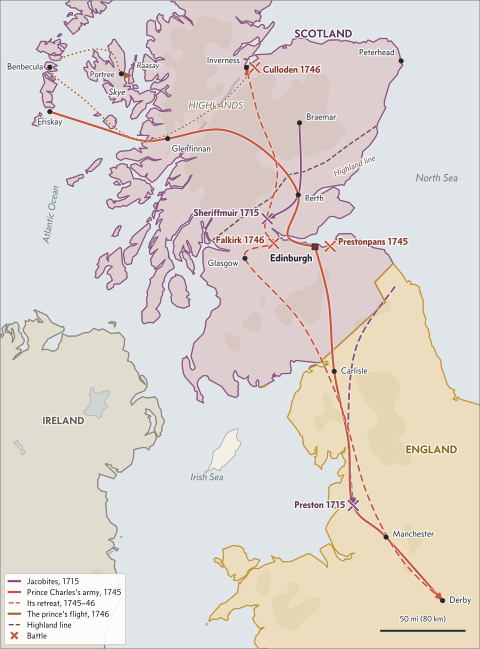
James himself landed at Peterhead in December 1715, too late, and sailed away again from Montrose in February 1716, taking Mar with him. Two of the lords taken at Preston, the English Earl of Derwentwater and the Scottish Viscount Kenmure, were beheaded. In 1719 a smaller rising, with a few hundred Spanish soldiers, was beaten at Glen Shiel in the western Highlands. Then came the Atterbury Plot and twenty years of exile, while James settled in Rome with his Polish wife, Maria Clementina Sobieska (soh-byes-kah), and their two sons. The Jacobite cause led to the risings of 1715 and 1745,This movement led to rebellions in 1715 and 1745. → Jacobites• and the second, led by James’s elder son, came far closer to success.
The Jacobites had songs and signs as well as swords. Toasts to “the king over the water” were drunk by passing a glass over a jug of water on the table. A Christmas hymn may belong among their secrets too. “Adeste Fideles” (ah-des-tay fee-day-lays), “O come, all ye faithful,” is first found in Latin in the books of John Francis Wade. He was an English Catholic who had gone to live in France, where he earned his living copying church music, and he printed the hymn in 1751. His books are decorated with Jacobite emblems. The musicologist Bennett Zon has argued that the hymn calls the faithful to come to “Bethlehem,” a Jacobite code word for England, and to adore the king. In this reading Regem Angelorum, “King of angels,” hides a pun on Regem Anglorum, “King of the English.” One disputed reading makes “Adeste Fideles” a coded Jacobite song.One disputed interpretation treats “Adeste Fideles” as a coded song for supporters of this movement. → Jacobites• Against this, nearly every line of the hymn comes from the Bible and the creed, and no evidence shows that Wade meant anything but a Christmas hymn.
Meanwhile Britain went to war on the Continent again. In 1740 the emperor Charles VI died, leaving his lands to his daughter, Maria Theresa, and France and Prussia attacked her in the War of the Austrian Succession (Vol. 14, From Luther to Mozart). George II feared for his own Hanover and joined her side. In June 1743 his army of British, Hanoverian, and Austrian troops was trapped by a French army on the river Main near the village of Dettingen (det-ing-en), east of Frankfurt. The king, nearly sixty, was at the head of his army, though his veteran field marshal, the Earl of Stair, who had fought under Marlborough, gave most of the orders, and he stayed in the thick of the fighting. The French attack broke against his infantry, and his courage was admired. On June 27, 1743, at Dettingen, George II became the last British king to lead troopsAt Dettingen, this monarch became the last British king to lead troops in battle. → George II• in battle. Handel, the German-born composer of the royal court (Chapter 17), wrote a Dettingen Te Deum, a hymn of thanksgiving, to celebrate it. The king’s younger son, William, Duke of Cumberland, twenty-two years old, was wounded in the leg beside him.
Two years later France was ready to help the Stuarts. James’s elder son, Charles Edward Stuart, was born in Rome on December 31, 1720. He was tall, handsome, brave, and charming, and he believed his family’s cause needed only his presence. In July 1745, with a few French guns and money borrowed from Jacobite bankers, he sailed from France on the small ship Du Teillay. His escort, carrying most of his weapons, was crippled by a British warship and turned back. On July 23 he landed on Eriskay (err-isk-ay), a small island of the Outer Hebrides, with seven companions. Charles Edward was known as the “Young Pretender”This Jacobite prince was known as the “Young Pretender.” → Bonnie Prince Charlie• to the Whigs, and as Charles III to the Jacobites after his father’s death. Later songs called him Bonnie Prince Charlie, “bonnie” being Scots for “handsome.”
The chiefs he met advised him to go home. He went to the mainland instead, and on August 19, 1745, he raised his father’s standard at Glenfinnan (glen-fin-un), at the head of Loch Shiel, before about seven hundred Highlanders, by one of his officers’ count. Bonnie Prince Charlie led the JacobitesBonnie Prince Charlie was a leader of this movement. → Jacobites•• south through Perth, where he was joined by Lord George Murray, a veteran of 1715 and the best soldier on his side. On September 17 Edinburgh opened its gates. The castle held out, but the prince held court at the Palace of Holyroodhouse. There, it seems, he sat for his portrait to Allan Ramsay, an Edinburgh-born painter and the son of a poet of the same name. The picture was lost for more than two centuries, until it was rediscovered in 2014 (Figure 13.12).
The government’s only army in Scotland was commanded by Sir John Cope, a veteran general. He had marched north to Inverness looking for the rebels and missed them, so he brought his army back by sea to Dunbar and marched toward the capital. On the night of September 20 a local farmer’s son led the Jacobites by a hidden path across the bog that guarded Cope’s front. At dawn on September 21 the Highlanders charged out of the mist with broadswords and axes, and Cope’s raw troops broke in a quarter of an hour. The Jacobites beat Sir John Cope at Prestonpans,The Jacobites defeated Sir John Cope at this battle, inspiring the mocking song “Hey, Johnnie Cope, Are Ye Waking Yet?” → Battle of Prestonpans•• a village on the shore east of Edinburgh. An East Lothian farmer, Adam Skirving, mocked the beaten general in a song that Scots still sing, “Hey, Johnnie Cope, are ye waking yet?” Cope reached Berwick with a few hundred men the next day. A later story, which Walter Scott spread, says he was the first general ever to bring the news of his own defeat.
Culloden
Victory gave the prince Scotland, but he wanted Britain. In November 1745 his army of about 5,500 men crossed into England by the western road and took Carlisle. He counted on English Jacobites to rise and on a French army to land in the south. Few of the first joined except at Manchester, which gave him a regiment of three hundred, and the second never came. On December 4 the army reached Derby, about 120 miles from London, and when the news reached the capital, crowds rushed to draw their money from the Bank of England. Three government armies were closing in. At a council of war the next day, Lord George Murray and the chiefs insisted on going home, and the prince, who wanted to press on, gave way in a rage. On December 6 they turned north. Jacobites have argued ever since whether London would have fallen.
They got home with their army whole. On January 17, 1746, they beat a government army at Falkirk, but they failed to take Stirling Castle and fell back to Inverness. Coming after them was the Duke of Cumberland, George II’s younger son, now twenty-four, who had commanded the army in Flanders and had taken over in Scotland at the end of January. He is not to be confused with Prince Rupert (Chapter 5), whom Charles I had made Duke of Cumberland a century earlier. Cumberland spent the late winter at Aberdeen, drilling his infantry to meet the Highland charge, and in April he marched west.
On April 15, 1746, his army camped at Nairn and celebrated his twenty-fifth birthday with an allowance of brandy. The Jacobites, short of food and pay, tried a night march to surprise them, but in the dark their columns fell behind, and they turned back at dawn, exhausted and hungry. They then formed up on open, boggy moorland called Drummossie Moor, by the estate of Culloden, a few miles east of Inverness, on ground Murray had warned against. About 5,000 Jacobites faced nearly 8,000 government soldiers, many of them Scots, with far better artillery. On April 16 the government guns tore into the Jacobite lines for some minutes before the clans charged through the sleet. The right of their line reached the redcoats, as the government’s soldiers were called from their uniforms, and broke into the first rank, but they were cut down by musket fire and bayonets (Figure 13.14). In less than an hour it was over. Cumberland defeated the Jacobites at Culloden,The Duke of Cumberland defeated the Jacobites at this battle, commonly described as the last pitched battle on British soil. → Battle of Culloden•• commonly called the last pitched battle fought on British soil: a battle between two armies drawn up against each other on open ground by choice, not a skirmish or a siege. Between 1,500 and 2,000 Jacobites were killed or wounded, many in the pursuit; Cumberland reported 50 dead and 259 wounded.

After the battle Cumberland’s men killed many of the wounded where they lay, and for weeks his soldiers burned houses, drove off cattle, and shot suspected rebels across the Highlands. His victory made him a hero in London, where Handel’s oratorio Judas Maccabaeus (mak-uh-bee-us) was written in his honor (Chapter 18), and his Tory enemies called him “Butcher” Cumberland. The rising of 1745 was defeated under George II,The Jacobite rising of 1745 was defeated during this king’s reign. → George II• and with it the last real hope of a Stuart restoration.

The prince escaped. For five months he hid in the hills and islands of the west, with a price of £30,000 on his head, an enormous fortune, which no one ever claimed. Government ships and soldiers searched the Outer Hebrides, and he was trapped on the island of Benbecula (ben-bek-yoo-luh). There a young woman of about twenty-four, Flora MacDonald, whose stepfather commanded the local militia, got passes for herself, a boat’s crew, and an Irish maid named Betty Burke. The maid was the prince, in a dress, apron, and bonnet. At the end of June they crossed the sea to Skye. Disguised as a woman, the prince escaped to Skye,This Jacobite prince escaped to the Isle of Skye disguised as a woman. → Bonnie Prince Charlie•• and from there to the island of Raasay (rah-say) and back to the mainland. On September 20, 1746, a French ship took him off from Loch nan Uamh (lokh nan oo-uv), the bay where he had landed fourteen months before. Flora was arrested and held for a time in the Tower of London, and she was freed in 1747.
Charles never came back at the head of an army; he slipped into London once, in disguise, in 1750. He lived for more than forty years after Culloden, quarreling with his friends, drinking heavily, and wandering Europe. He died in Rome in January 1788. His younger brother, Henry, had become a cardinal of the Catholic Church, and when he died in 1807 the direct line of James II ended.
Parliament set out to make sure the Highlands could never rise again. A clan chief judged his people’s quarrels in his own courts and called them out to fight, and they owed him loyalty before any king. After Culloden, laws broke the Highland clan system in Scotland.The defeat at Culloden was followed by laws weakening the Highland clan system in this country. → Scotland• From August 1746 the Act of Proscription forbade Highlanders to carry weapons, and its Dress Act, in force from August 1747, banned the kilt and tartan for men and boys who were not soldiers until 1782 (Vol. 8, The Northern Worlds). The Heritable Jurisdictions Act of 1747 took away the chiefs’ private courts, and the estates of the rebel chiefs were seized by the crown. About 120 Jacobites were executed, and more than a thousand were transported, shipped to the American colonies to work as convict laborers. Within a generation many chiefs had turned into landlords who wanted rent rather than soldiers, and their people began to leave for America. Stevenson’s Kidnapped shows the Highlands of 1751 (Vol. 17, The Victorians).
In 1773 Samuel Johnson (Chapter 20) and his friend James Boswell toured the Western Islands and were received on Skye by Flora MacDonald, by then a married woman of about fifty. In his Journey to the Western Islands of Scotland (1775), Johnson called hers “a name that will be mentioned in history, and if courage and fidelity be virtues, mentioned with honour.”
What to remember
- Queen Anne (1702–1714) was the last Stuart monarch. In the War of the Spanish Succession her general, the Duke of Marlborough, won at Blenheim (1704), for which Blenheim Palace was named, and the Peace of Utrecht (1713) gave Britain Gibraltar, Minorca, and the asiento, the right to sell African slaves in Spanish America.
- The failure of Scotland’s Darién colony in Panama (1698–1700) helped bring the Union of 1707, which joined England and Scotland in one Kingdom of Great Britain with one Parliament, while Scotland kept its own church and law.
- Under the Act of Settlement, George I of Hanover succeeded Anne in 1714, the first of four King Georges. The South Sea Bubble burst in his reign, in 1720.
- Robert Walpole, First Lord of the Treasury from 1721 to 1742 under George I and George II, is counted the first British prime minister. He shielded those implicated in the Bubble, uncovered the Atterbury Plot, lived at Houghton Hall and 10 Downing Street, and was attacked by Pulteney and Bolingbroke in The Craftsman.
- Walpole’s government saw the Porteous riot in Edinburgh (1736) and passed the Licensing Act (1737), which made the Lord Chamberlain censor of plays. The War of Jenkins’ Ear (1739) and the disaster at Cartagena (1741) brought his fall.
- Newton’s guinea of 1717 put Britain on a gold standard by accident; Lady Mary Wortley Montagu brought smallpox inoculation from Turkey; Hardwicke’s Marriage Act (1753) ended the Fleet marriages.
- George I’s Acts of Grace (1717–1718) offered pirates pardons. A General History of the Pyrates (1724), by the unknown “Captain Charles Johnson,” shaped the image of pirates and probably invented the pirate republic of Libertalia.
- The Jacobites tried to restore the exiled Stuarts: the Old Pretender in 1715 (Sheriffmuir), and the Young Pretender, Bonnie Prince Charlie, in 1745 (Glenfinnan, Prestonpans, Derby).
- The Duke of Cumberland crushed the Jacobites at Culloden on April 16, 1746, the last pitched battle on British soil. The prince escaped to Skye disguised as Flora MacDonald’s maid, and Parliament broke the power of the Highland clans.
Chapter 14 · 34 clues
Defoe and the Island
On April 25, 1719, a London bookseller named William Taylor, whose shop stood at the sign of the Ship in Paternoster Row, beside St. Paul’s, put a new book on sale. Its title page promised The Life and Strange Surprizing Adventures of Robinson Crusoe, of York, Mariner, the story of a man who had lived twenty-eight years alone on an island off the coast of America. It ended with three words: “Written by Himself.” No other author was named. A short preface signed by “the Editor” assured the buyer that the book was a true history of fact, with no appearance of fiction in it.
Readers believed it, or enjoyed pretending to, and Taylor needed a fourth edition by August 8. The man who had really written the book was nearly sixty. He had been a merchant and a bankrupt, a rebel, a government spy, and the editor of a newspaper written almost entirely by himself. He had also stood in the pillory while London crowds looked on. His name was Daniel Defoe, and the road to the most famous desert-island story in the world began with a joke that nearly destroyed him.
Defoe the pamphleteer
He was born Daniel Foe in London about 1660, in the parish of St. Giles, Cripplegate, just outside the City’s northern wall. His father, James Foe, was a prosperous tradesman and a member of the Butchers’ Company, one of the guilds that governed the trades of the City. As a small boy Daniel lived through the plague of 1665 and the Great Fire of 1666, which Chapter 8 tells. Later he added a “De” to the family name, which made it sound grander, and by the 1690s he signed himself Defoe.
The Foes were dissenters, Protestants who would not worship in the Church of England (Chapter 9). In 1662 the restored Church had driven about two thousand ministers from their parishes for refusing its Prayer Book, and the laws of the 1660s and 1670s barred anyone who would not take its communion from town councils and public office (Chapter 9). Dissenters could not take degrees at Oxford or Cambridge either. So at about fourteen Daniel was sent to a dissenting academy at Newington Green, north of London, kept by a minister named Charles Morton, where lessons were given in English instead of Latin. He was meant for the ministry, but he chose trade.
He dealt in stockings, woolen cloth, and wine. In 1684 he married a merchant’s daughter, Mary Tuffley, who brought a dowry (Chapter 8) of £3,700. The next year he rode with the Duke of Monmouth, Charles II’s Protestant son born out of wedlock, in his rising against James II (Chapter 10) and escaped the hangings that followed. When William III took the throne in 1689, Defoe became his eager supporter. His business did worse. In 1692 he went bankrupt, with debts that he later put at £17,000, and he spent years paying them down. In 1701, when a rival writer sneered that the Dutch-born king was a foreigner, Defoe answered with The True-Born Englishman. It was a satire (Vol. 1, The Toolkit), writing that mocks folly or wickedness in order to correct it, and it told the English that they were themselves a mongrel people descended from every invader who had ever landed. Defoe claimed that eighty thousand copies were sold in the streets, and for years his title pages called him “the author of the True-Born Englishman.”

Then the king died, on March 8, 1702, and his sister-in-law Anne, the younger daughter of James II, became queen (Chapter 13). Anne loved the Church of England, and she favored its High Church party, the Tories who wanted the bishops, the ceremonies, and the Church’s privileges kept exactly as they were and dissenters kept out of power. Many dissenters had found a way around the laws. They took communion in their parish church once a year, which qualified them for office, and worshiped in their own chapels the rest of the time. High churchmen called this occasional conformity and hated it. In November 1702 the Tories brought in a bill to punish it, and preachers thundered against the dissenters from their pulpits.
Defoe answered with a trick. In December 1702 he published, without his name, a pamphlet called The Shortest Way with the Dissenters, written in the voice of a furious High Church clergyman. Its argument was simple: toleration had failed, so the government should crush dissent at once. “If one severe Law were made, and punctually executed,” the pamphlet says, “that Whoever was found at a Conventicle should be banished the nation, and the Preacher be hanged; we should soon see an end of the tale!” A conventicle was a dissenters’ meeting for worship (Chapter 9). The pamphlet compares dissenters to snakes and toads, and near its end comes the cry “Now, let us crucify the thieves!”
This is irony (Vol. 1, The Toolkit): saying the opposite of what you mean, so that the reader sees the truth through the exaggeration. Defoe’s real point was that the High Church sermons, pushed to their end, meant the gallows and exile for thousands of peaceful Christians. Defoe meant The Shortest Way as satire,This author wrote the satirical pamphlet The Shortest Way with the Dissenters. → Daniel Defoe• but at first almost nobody saw the joke. Some high churchmen praised it in earnest, and Defoe later told of a clergyman who ranked it next to the Bible. Dissenters were terrified. When the author’s name came out, the high churchmen were furious at having been fooled, and the dissenters were hardly more grateful. The House of Commons ordered the pamphlet burned.
The Earl of Nottingham, a strong churchman and one of the queen’s two Secretaries of State, her chief ministers for affairs at home and abroad, had the author hunted. On January 10, 1703, the government’s newspaper, the London Gazette, offered a reward for him. It described him as “a middle-sized spare man, about forty years old, of a brown complexion, and dark brown-coloured hair, but wears a wig; a hooked nose, a sharp chin, grey eyes, and a large mole near his mouth.” He hid for months and was caught in May. In July he was tried at the Old Bailey, London’s criminal court, for seditious libel, a writing meant to bring the government or the Church into contempt. He was sentenced to pay a fine of two hundred marks (a mark was an old money of account worth two-thirds of a pound), to stand three times in the pillory, and to stay in prison as long as the queen pleased.

The pillory was a wooden frame on a post, with holes that locked a prisoner’s head and hands, set up in a busy street so that passers-by could jeer and pelt him with rotten eggs, filth, and stones. Men were sometimes maimed in it, and a few were even killed. Defoe stood there on July 29, 30, and 31, 1703, in three busy places in the City (Figure 14.2). He had written a defiant poem, “A Hymn to the Pillory,” and copies were sold among the crowd around him. Later accounts say that the people guarded him, drank his health, and threw flowers instead of filth. The flowers may be a legend, but he came through unhurt. Alexander Pope later sneered at him in The Dunciad (Vol. 11, The Age of Shakespeare) with the line “Earless on high, stood unabash’d De Foe,” as if the hangman had cropped his ears, a punishment sometimes added to the pillory. Defoe’s ears were never touched.
He went back to Newgate, London’s great prison, with his business ruined. Help came from Robert Harley, the Speaker who presided over the House of Commons and soon a Secretary of State himself, a clever and secretive moderate Tory from a dissenting family. Harley saw, before most politicians did, what a skillful writer could do for a government. In November 1703 Harley had the fine paid from the Treasury and Defoe set free. In return Defoe worked for Harley and the queen’s ministers for the next ten years as writer, adviser, and secret agent. In 1706 Harley sent him to Edinburgh, under cover, to report on the Scots and to argue for the Union of England and Scotland that came in 1707 (Chapter 13).
The Review, the Tatler, and the Spectator
In February 1704 Defoe began a paper of his own, A Review of the Affairs of France, named for the enemy in Queen Anne’s war and soon called simply the Review. It came out once a week at first and later three times a week, and it ran until June 1713. Defoe wrote nearly every word himself. He reported on the war with France, argued about trade, money, and the Union, and generally backed Harley’s ministry while claiming to be independent. London had had printed newspapers for half a century, and in 1695 Parliament let lapse the old law requiring every book and paper to be licensed. Papers multiplied, and the coffeehouses (Chapter 8), where men paid a penny for coffee and a seat among the newspapers, were full of them.

The cleverest of the new papers belonged to Richard Steele, a Dublin-born soldier and playwright and a Whig, the party that had backed William III and the dissenters’ liberties. On April 12, 1709, Steele began The Tatler, which came out three times a week. Its pretended author was “Isaac Bickerstaff,” a name borrowed from a famous hoax of 1708, in which Steele’s fellow Dubliner, the clergyman Jonathan Swift (Chapter 15), had used it to predict the death of a real maker of almanacs. The Tatler gave its news as if gathered in different coffeehouses, its poetry from Will’s and its foreign news from St. James’s, and soon it gave essays on manners and daily life. It closed in January 1711.
Two months later Steele and his old school friend Joseph Addison started something better. Addison was a clergyman’s son, a fine classical scholar from Oxford, and a Whig politician, shy in company and brilliant on paper. The Spectator came out six days a week from March 1, 1711, to December 6, 1712, 555 numbers in all. Each number was one essay on a single printed sheet, written in the voice of an imaginary “Mr. Spectator,” a silent gentleman who goes everywhere, watches everything, and almost never speaks. In the tenth number Addison said he hoped to bring philosophy out of libraries and colleges into the clubs, tea tables, and coffeehouses where people talked. About three thousand copies were printed each day, and each was passed from hand to hand, so that Addison reckoned on twenty readers for every copy.
The second number, by Steele, introduced Mr. Spectator’s club. Its first member is Sir Roger de Coverley (kuv-er-lee), a baronet (a gentleman whose title of “Sir” passes to his heir) from Worcestershire, “of an ancient descent,” whose great-grandfather had invented the country dance that bears his name. Sir Roger is a kindly, old-fashioned Tory squire whose tenants love him. Beside him sit Sir Andrew Freeport, a Whig merchant of the City who calls the sea “the British Common,” a retired soldier named Captain Sentry, and an aging man of fashion, Will Honeycomb. Over the next months Addison took Sir Roger to church, to the theater, and to Westminster Abbey, gently mocking his prejudices and loving him for them. Samuel Johnson, the great critic of the next generation (Chapter 20), later reported that Addison grew so fond of the old knight that he killed him off, in October 1712, so that no other writer could spoil him.
Readers loved the Spectator’s easy, clear, good-humored prose, and it was reprinted for more than a century as a model of how to write. “Whoever wishes to attain an English style, familiar but not coarse, and elegant but not ostentatious,” Johnson advised in his life of Addison (1781), “must give his days and nights to the volumes of Addison.” Johnson’s own Rambler of 1750–1752 will follow the Spectator’s plan, and Pope’s bitter portrait of Addison as “Atticus” is told elsewhere (Vol. 11, The Age of Shakespeare).
Robinson Crusoe
Harley fell from power in July 1714, days before Anne died and George I came from Hanover with Whig ministers (Chapter 13). Defoe went on writing for the new government too. He was in his late fifties, still in debt, and still turning out a pamphlet or a book every few weeks. Then he tried something new: a long story in the voice of an invented man, told so plainly and with so many exact details that it read like a sailor’s memoir. Robinson Crusoe was Defoe’s creation,This character is created by Daniel Defoe. → Robinson Crusoe••• though nothing on the title page said so (Figure 14.4).

A novel (Vol. 1, The Toolkit) is a long story in prose about invented people, and a novel dressed up as a true memoir was something English readers had hardly seen. Defoe’s book is often called the first English novel.This author’s 1719 Robinson Crusoe is often called the first English novel. → Daniel Defoe••• Other books have their champions: Spain had Don Quixote a century earlier, and in England the playwright Aphra Behn (Chapter 11), in Oroonoko (1688), and John Bunyan, in The Pilgrim’s Progress (Chapter 9), had told long stories in prose. What was new in Defoe was an ordinary man in a believable world. Crusoe counts his barrels and his days, worries about money, botches his carpentry, and prays when he is frightened, and the reader follows every step as though it had really happened.
The story begins, in the words of the third edition of 1719: “I Was born in the Year 1632, in the City of York, of a good Family, tho’ not of that Country, my Father being a Foreigner of Bremen.” The father, a merchant of Bremen (bray-mun) in Germany named Kreutznaer (kroits-nair), had married a York woman whose family was called Robinson, and the English soon turned the German surname into Crusoe. Robinson is the third son, with no trade, and he longs only to go to sea. His gouty old father calls him in and begs him to stay in his own rank, “the middle State, or what might be called the upper Station of Low Life.” It is the happiest state in the world, the old man says, free from both the labor of the poor and the envy of the great. Robinson resolves to stay, and within a few days the resolve wears off. On September 1, 1651, without telling his parents, he boards a ship at Hull, the port on the Humber, bound for London.
The voyage is a warning he ignores. A storm sinks the ship off Yarmouth, on the Norfolk coast, and he travels on to London. From there he sails twice to Guinea, the West African coast, the first time with an honest captain who teaches him navigation; he trades trinkets for gold dust and comes home with almost £300. On the second voyage, between the Canary Islands and the African shore, his ship is chased and boarded by “a Turkish Rover of Sallee.” Sallee (sal-ee), now Salé (sah-lay) in Morocco, was a port of corsairs, the Muslim pirates of the Barbary coast of North Africa who seized European ships and sold their crews, and Englishmen of the time called any such raider a “Turk.” Crusoe is captured by pirates and enslaved in Sallee,This character is captured by pirates and enslaved in Sallee. → Robinson Crusoe•• where the corsair captain keeps him to work in his garden and look after his boat. The novel calls the people of the town “Moors,” its word for the Muslims of North Africa.
For two years Crusoe dreams of escape. His chance comes when his master sends him out fishing with one of the master’s kinsmen, Ismael, and a boy called Xury (zoo-ree). Out at sea he tips Ismael overboard and tells him to swim for the shore, but he keeps the boy, who swears to be faithful. For weeks the two sail south along the coast of Africa, shooting a lion and a leopard and trading with the people of the shore, until off Cape Verde a Portuguese ship takes them aboard. Its captain asks nothing for the rescue. He buys their boat and offers “60 Pieces of Eight more for my Boy Xury”; a piece of eight was the Spanish silver dollar. Crusoe hesitates to sell “the poor Boy’s Liberty, who had assisted me so faithfully in procuring my own.” Then the captain promises to set Xury free in ten years if he becomes a Christian, and Crusoe sells the boy who shared his escape.This character escapes slavery with Xury and later sells him to a Portuguese captain. → Robinson Crusoe••• It is a cold bargain, and the novel lets it stand.
The Portuguese ship carries him to Brazil, then a Portuguese colony, and lands him at All Saints Bay, the harbor of Salvador in the province of Bahia (bah-ee-uh). There a planter teaches him how sugar is grown and made, and with his savings Crusoe buys a plantation in Brazil.This character obtains a plantation in Brazil. → Robinson Crusoe•• He grows food at first, then tobacco, then sugarcane. After almost four years Crusoe is prospering. Then three of his fellow planters come to him with a secret proposal. They are short of laborers, and slaves from Africa are scarce and dear in Brazil, so they will fit out a ship to buy slaves in Guinea and land them secretly on their plantations. Crusoe, who knows the coast, will go as their agent for a share. He agrees to this voyage to buy human beings, and he sails on September 1, 1659, “the same Day eight Year that I went from my Father and Mother at Hull.”

The ship works north along the coast of Brazil, crosses the equator, and is caught by a hurricane that drives it before the wind for twelve days. Leaky and lost, it makes for the English island of Barbados, but a second storm drives it onto a sandbank. The crew take to the boat, a wave “Mountain-like” overturns it, and Crusoe alone is thrown ashore alive (Figure 14.5). He spends his first night in a tree. In the morning he finds that he is on land with no people, no houses, and no way off: Crusoe is stranded on an island,Robinson Crusoe is stranded on one of these places. → islands•• a castaway. At first he does not know where he is. The title page puts the island “near the Mouth of the Great River of Oroonoque,” the Orinoco (or-ih-noh-koh), the great river of Venezuela. Years later, with Friday’s help, Crusoe works it out: his island lies near the Orinoco’s mouth,This character's island is near the mouth of the Orinoco River. → Robinson Crusoe•• with the large island of Trinidad in sight to the west and northwest.
The wreck is still stuck on the sand, and for the next two weeks he swims out to it again and again. He lashes spars into rafts and floats ashore bread, rice, cheese, rum, the carpenter’s chest, guns, powder and shot, sails, rope, and the ship’s dog and two cats. In a drawer he finds a heap of coins, and he laughs at the useless money, then takes it anyway. Next he chooses a home: a little plain on the side of a hill, in front of a hollow in the rock. He pitches a tent there, rings it with a double fence of sharpened stakes, and climbs in and out by a ladder that he pulls up after him. Then he digs back into the hollow, and Crusoe makes his house in a cave,This character builds a house in a cave on his island. → Robinson Crusoe• with a storeroom, a kitchen, and a cellar behind the tent. In later years, proud of its walls, he calls it his castle.
He keeps a journal while his ink lasts, and in its first entry, written about the day of the wreck, he names his home the Island of Despair.This character is stranded on the "Island of Despair." → Robinson Crusoe•• Like a merchant balancing his accounts, he also lists the evils of his state on one side and the good things on the other. He is alone, but he is alive. He has no clothes, but he is in a hot country where he hardly needs them.
He is afraid of losing count of the days, so he makes a calendar. With his knife he cuts in capital letters, on a large square post, that he came on shore there on September 30, 1659, and he sets it up as a great crossThis character keeps a calendar on a wooden cross inscribed September 30, 1659. → Robinson Crusoe•• on the beach where he landed. Every day he cuts a notch in its side, every seventh notch longer for Sunday, and every month’s first notch longer still, so that the wooden cross is his calendar.

In June 1660, nine months after the wreck, he falls sick with a fever that comes back day after day. On the night of June 27, weak and alone, he dreams of a man descending from a great black cloudThis character has a dream in which a man descends in a "great black cloud" and urges him to repent his sins. → Robinson Crusoe•• in a bright flame of fire. The figure carries a spear, the earth trembles under his feet, and he tells Crusoe that since all these things have not brought him to repentance, now he shall die. To repent is to be sorry for one’s sins and to turn away from them. Crusoe wakes in terror. He doses himself with tobacco steeped in rum, opens a Bible he saved from the ship, and finds a verse of the Psalms in which God promises to deliver those who call on him in the day of trouble. For the first time in years he prays. As Crusoe tells it, the fever and the dream were God’s call, and from then on he reads the Bible every day and begins to see the island not as a prison but as a deliverance.

The years go by in work. He finds barley and rice sprouting where he had shaken out an old bag of chicken feed, and in time he grows enough grain to bake bread. He tames goats for milk and meat, teaches a parrot named Poll to say his name, makes clumsy pots that will stand the fire, and spends months hollowing out a canoe that turns out to be too heavy to drag to the water. His clothes rot, so he makes a cap, a jacket, and breeches of goatskin with the hair outside. The sun and the rains are hard to bear, and he makes an umbrella like those he had seen in Brazil,Robinson Crusoe creates one of these objects modeled off of one he sees in Brazil. → umbrella• where they were common against the great heat. He spoils two or three before he succeeds. The last he covers with skins, hair outward, so that it sheds the rain like a sloping roof, and he can fold it and carry it under his arm.
The figure of Crusoe under his umbrella became one of the best known in English books. When Londoners began to carry umbrellas against the rain later in the century, the heavy early ones were called “Robinsons” in EnglandSome of these objects were called "Robinsons" in England. → umbrella• for many years, after the castaway who made his own.
The footprint and Friday
Crusoe has lived alone for fifteen years when, one day about noon, walking to his boat, he finds the print of a man’s bare foot in the sand. There is only one print, but it is perfect: toes, heel, and every part. He stares, listens, and looks around, then runs home like a frightened hare and does not sleep. His first thought is not of men at all. He thinks the footprint may be the Devil’s,This character initially thinks a footprint on his island belongs to the Devil. → Robinson Crusoe••• since he cannot imagine how any human being could have come there. Then he reasons it out. Satan would hardly leave a single mark on a beach where the next high tide would wipe it away, and where Crusoe might never see it. It must be the print of one of the people of the mainland, who must sometimes paddle over in their canoes.

Fear changes his life. He thickens his fence, plants a grove of trees to hide his castle, and keeps his guns loaded. Some years later, on the far side of the island, he comes upon a beach strewn with skulls and bones around the ashes of a fire, where men from the mainland have feasted on their prisoners. In the novel they are cannibals, people who eat human flesh. Crusoe is sick with horror. For a long time he dreams of killing them; then he decides that God has not made him their judge, and that he will fight them only if they attack him.
In his twenty-fourth year on the island he dreams that a prisoner escapes from the cannibals and runs to him for shelter. About a year and a half later the dream comes true. One morning he sees five canoes drawn up on his side of the island and thirty or more men dancing around a fire, with two prisoners. One is clubbed down. The other breaks away and runs toward Crusoe’s grove, chased by two men. Crusoe knocks the first pursuer down with the butt of his gun, and when the second raises a bow, he shoots him. Crusoe rescues the prisoner from the cannibalsThis character rescues Friday from cannibals and takes him as a servant. → Robinson Crusoe••• and takes him as his servant. The young man kneels, kisses the ground, and sets Crusoe’s foot on his head, as a sign that he will serve him as long as he lives. Crusoe leads him to the cave, gives him bread, raisins, and water, and lets him sleep.
Crusoe names him Friday, for the dayRobinson Crusoe names this rescued character for the day of the week on which they meet. → Friday• on which he saved his life. Friday is tall and well made, about twenty-six by Crusoe’s guess, with long black hair and a lively face. He is the first human being Crusoe has spoken to in twenty-five years. He is also no stranger to the feast on the beach: Friday belongs to a cannibal people,This character belongs to a cannibal tribe. → Friday•• the Caribs, as he calls them, whom the novel shows eating the prisoners they take in war. When he finds the bodies of the men Crusoe killed, he wants to dig them up and eat them, and Crusoe angrily forbids it. In time, as Crusoe tells it, Friday comes to hate the custom. He learns quickly. Crusoe teaches Friday English,This character teaches his rescued companion English. → Robinson Crusoe• beginning with his new name, then “Master,” then “yes” and “no,” and soon Friday speaks a broken but lively English that Crusoe records word for word.
Crusoe asks him who made the sea and the land, the hills and the woods. Friday worships BenamuckeeThis character worships Benamuckee. → Friday•• (ben-uh-muk-ee), he answers, a very old being who lives beyond all things, older than the sea, the land, the moon, and the stars. Only the old men of his people may go up into the mountains to speak with Benamuckee and bring back his words. Then Crusoe tells Friday about the God of the Bible, about the devil, and about Jesus, sent, as Christians believe, to redeem mankind. Friday asks hard questions. If God is so much stronger than the devil, he asks, why does God not kill the devil, so that he does no more wickedness? Crusoe confesses that he hardly knows how to answer. Still, Crusoe converts Friday to Christianity,This character converts his rescued companion to Christianity. → Robinson Crusoe•• and in the end he decides that Friday has become a better Christian than himself.
The two live together happily for about three years. Then deliverance comes all at once. They rescue a Spaniard and Friday’s own father from another cannibal feast, and soon afterward an English ship anchors off the island with a crew in mutiny, a revolt of sailors against their captain. Crusoe, Friday, and the captain’s few loyal men outwit the mutineers and win the ship back. On December 19, 1686, Crusoe sails away with Friday (Figure 14.6). By his own reckoning he was shipwrecked there twenty-eight years,This character is shipwrecked for twenty-eight years on a deserted island. → Robinson Crusoe••• two months, and nineteen days, and he notes that he left on the same day of the month on which he had escaped from Sallee.
Crusoe returns to England with Friday,This character returns to England with his companion. → Robinson Crusoe• landing on June 11, 1687, thirty-five years after he ran away from Hull. His parents are dead. He sails to Lisbon and finds the old Portuguese captain, who has kept the accounts of the Brazilian plantation faithfully, and Crusoe is suddenly a rich man. He decides to go home by land rather than risk the sea again. With Friday and a party of travelers he crosses Spain to Pamplona (pam-ploh-nuh), where they wait twenty days in snow before a guide leads them over the mountains in what the novel calls the severest winter in living memory. Friday has never seen snow. Crossing the Pyrenees (peer-uh-neez), the mountains between Spain and France, Friday fights a bear and Crusoe fights wolves.This character fights off wolves while crossing the Pyrenees. → Robinson Crusoe••This character battles a bear while crossing the Pyrenees. → Friday•• On the French side a huge bear comes out of a forest, and Friday, laughing, throws a stone at it to make it chase him. He climbs an oak with the bear after him and dances on the end of a branch until the bear wobbles, then jumps down and shoots it. That evening some three hundred wolves attack the party. Crusoe’s men make a wall of a felled tree, fire volley after volley, and at last drive the pack off by setting fire to a trail of gunpowder. The travelers reach Toulouse, Paris, and Calais, and Crusoe lands at Dover on January 14.
The book sold so well that Defoe published The Farther Adventures of Robinson Crusoe that August, sending his hero back to visit the island. Crusoe has been imitated ever since, and a whole kind of castaway story is called a Robinsonade. Seven years later Jonathan Swift will send another English sailor, Gulliver, on voyages that mock books like Defoe’s (Chapter 15).
Selkirk and Serrano
Defoe never named his sources, but readers in 1719 knew of a real castaway (Vol. 2, Geography: The Americas and Oceania). Alexander Selkirk was a hot-tempered Scottish sailor on a privateer, a privately owned warship licensed to raid the enemy. In 1704 he quarreled with his captain and was marooned, put ashore on purpose and left behind, on Más a Tierra (mahs ah tee-air-ah), in the Juan Fernández (fer-nahn-dez) Islands in the Pacific off Chile. He lived there alone for four years and four months, hunting wild goats and dressing in their skins, until the privateers of Woodes Rogers, later the governor of the Bahamas (Chapter 13), found him in February 1709. Rogers told the story in A Cruising Voyage Round the World (1712), and Steele, after talking with Selkirk, wrote it up for his paper The Englishman in 1713. Most readers since have believed that Crusoe was based in part on Selkirk.This character may have been based on the marooned privateer Alexander Selkirk. → Robinson Crusoe•••
There was an older story too. The Peruvian historian Garcilaso de la Vega (gar-see-lah-soh day lah vay-gah) was called the Inca, because his mother was an Inca princess and his father a Spanish conqueror. In his Royal Commentaries (1609) he told of a Spanish sailor named Pedro Serrano (pay-droh seh-rah-noh), wrecked in the sixteenth century on a bare sandbank in the Caribbean. Serrano lived there for seven or eight years on turtles and shellfish, catching rainwater in turtle shells. After three years another castaway joined him, and each at first took the other for the Devil. The Commentaries had been put into English by Paul Rycaut in the 1680s, and Crusoe may also have been based on Serrano,This character may have been based on the life of Pedro Serrano. → Robinson Crusoe• though no one can prove that Defoe read him.
Moll Flanders and the plague
In 1722, at about sixty-two, Defoe published three long books in a single year. The first, in January, was a woman’s life told in her own voice, and, as with Robinson Crusoe, Defoe wrote Moll FlandersThis author wrote Moll Flanders. → Daniel Defoe••• as a true confession and put no author’s name on it. Its title page reads like a criminal record. It calls the book The Fortunes and Misfortunes of the Famous Moll Flanders. Then a long subtitle sums up her threescore years, that is, sixty: born in Newgate, twelve years a prostitute, five times a wife, once to her own brother,This character marries five men, including her half-brother. → Moll Flanders••This novel's subtitle describes the title character as "Twelve Year a Whore, five times a Wife (whereof once to her own brother)." → Moll Flanders• and twelve years a thief. After eight years as a convict in Virginia, it adds, she grew rich, lived honest, and died penitent. The book tells all of it, though always as a sinner looking back.
Newgate, the prison beside the Old Bailey courthouse, is where Moll’s story begins. Moll explains how she came to be born there. Her mother stole three pieces of fine linen from a draper’s shop, a cloth seller’s, in Cheapside, was convicted, and was sentenced to hang. A woman who was pregnant could not be hanged until her child was born, and Moll says that her mother “pleaded her belly”In this novel, the protagonist’s mother "pleads her belly" to escape execution at Newgate Prison. → Moll Flanders•• and was found to be with child, so the hanging was put off for about seven months. After Moll’s birth her mother was not hanged but transported, shipped to the colonies to work as a convict servant, and she sailed for Virginia, leaving her six-month-old baby behind.
The girl grows up in Colchester, in Essex, raised by a poor nurse and then by a kindly family, and she wants above all to be a gentlewoman, a lady who need never go into service. She is pretty and clever, and her life becomes a long hunt for security in a world where a woman without money has few choices. Her first husband is a younger son of the family that took her in, and he dies; the second, a spendthrift cloth merchant, goes bankrupt and flees to France. Moll hides from his creditors in the Mint, a district of Southwark (suth-erk) where debtors could not be arrested, and calls herself Mrs. Flanders. Her third husband takes her to his plantation in Virginia. There she learns from his mother’s own story that the old woman is her mother, the convict of Newgate. Moll has married her half-brother, a son of the same mother by a different father. She leaves him and sails home.
At Bath, the fashionable spa town in the west, she becomes the mistress of a married gentleman, who leaves her when he falls ill and repents. Then a woman she has befriended invites her north to Lancashire, the county around Liverpool, and introduces her to a handsome gentleman with estates, she says, in Ireland. Each thinks the other rich. They marry, and only afterward does each discover that the other is penniless. This is Jemmy, Moll’s “Lancashire husband,”This character has a "Lancashire husband" named Jemmy. → Moll Flanders•• the man she loves best, and they part tenderly, since neither can keep the other. Later she learns that he lives by highway robbery. Her fifth husband, an honest bank clerk in London, gives her five quiet years, then loses his money and dies of grief.
Widowed at forty-eight, Moll sinks into poverty, and about three years later she steals for the first time, a bundle left on a stool in an apothecary’s, or druggist’s, shop. She is good at it. Taught by her “governess,” a midwife and pawnbroker who sells stolen goods, she picks pockets, lifts gold watches, and robs shops, and the other thieves give her the name Moll Flanders. She is also a conwoman, a confidence tricksterThis character is a conwoman. → Moll Flanders• who wins people’s trust and then robs them. At a house on fire she offers to carry a frightened neighbor’s bundle to safety and walks off with it. She goes out in disguise as a widow, a beggar, and even a man. At last she is caught, sent to Newgate, and condemned to death. Jemmy is there too. Moll repents, a minister wins her a reprieve, and she and Jemmy are transported together to America, where they prosper as planters. She ends the book back in England, almost seventy, rich and sorry for her sins.


Two months later Defoe published A Journal of the Plague Year, a memoir of the plague of 1665, which had killed about seventy thousand Londoners by the official count and perhaps a hundred thousand in truth (Chapter 8). In 1720 the plague had broken out again at Marseilles in France, and the English were afraid it would cross the Channel. The Journal claims to be “Written by a Citizen who continued all the while in London,” and it is signed only H. F., a saddler who lived outside Aldgate, on the road to Whitechapel, in London’s East End. Defoe had an uncle named Henry Foe, a saddler, and may have used his memories. H. F. walks the emptying streets, copies out the weekly Bills of Mortality, peers into a burial pit in Aldgate churchyard some 40 feet long, and tells story after story of panic, courage, and cruelty.
He scorns the quack doctors, fortune-tellers, and astrologers who sold the frightened people false hope. Worst of all, he says, were the “Charms, Philters, Exorcisms, Amulets” that people hung around their necks, as if the plague were an evil spirit that a magic word could keep away. In the Journal, people wear charms of ABRACADABRA,In this author’s A Journal of the Plague Year, people wear charms bearing variations of ABRACADABRA. → Daniel Defoe•• the old magic word written “in Triangle, or Pyramid,” one letter shorter on each line (Figure 14.9). Others wore the letters IHS, the first letters of the name of Jesus in Greek and the emblem of the Jesuits. H. F. adds that many were carried off in the dead-carts with the charms still around their necks. The book ends with a little rhyme of his own: “A dreadful Plague in London was, / In the Year Sixty Five, / Which swept an Hundred Thousand Souls / Away; yet I alive!”
The Journal was so convincing that it was long read as a true eyewitness record, and as late as 1835 the historian Edward Wedlake Brayley still insisted that it was not fiction. Defoe went on writing to the end: Colonel Jack, a pickpocket’s life told in his own voice, at the end of 1722; Roxana, his last novel, in 1724; and A Tour thro’ the Whole Island of Great Britain (1724–1727), a survey of the country’s towns and trades. He died in April 1731, in a lodging in Ropemakers’ Alley, near the parish where he was born, probably in hiding from his creditors, and was buried among the dissenters in Bunhill Fields. The English novel he had started would be carried on by Samuel Richardson and Henry Fielding (Chapter 19).
What to remember
- Daniel Defoe (about 1660–1731), a dissenter, merchant, and pamphleteer, mocked the High Church Tories in The Shortest Way with the Dissenters (1702) and stood in the pillory for it in July 1703.
- Robert Harley freed him and employed him as a writer and secret agent. Defoe wrote the Review (1704–1713); Steele wrote The Tatler (1709–1711); Addison and Steele wrote The Spectator (1711–1712), with Sir Roger de Coverley.
- Robinson Crusoe (1719), often called the first English novel, is told as a true memoir: Crusoe of York runs away to sea, is enslaved at Sallee, escapes with Xury and sells him, plants in Brazil, and is wrecked on a voyage to buy slaves.
- On his island near the mouth of the Orinoco, the Island of Despair, Crusoe keeps a calendar on a wooden cross from September 30, 1659, lives in a cave, dreams of a man descending from a black cloud, repents, and makes an umbrella like those of Brazil.
- After fifteen years he finds a footprint and fears it is the Devil’s. Later he rescues Friday from cannibals, names him for the day, and teaches him English and Christianity; Friday’s god is Benamuckee.
- Crusoe leaves after twenty-eight years, by his own count, returns to England with Friday, and on the way home over the Pyrenees Friday fights a bear and the party fights wolves.
- Crusoe’s possible models are Alexander Selkirk, marooned on Más a Tierra (1704–1709), and the Spanish castaway Pedro Serrano.
- Moll Flanders (1722): born in Newgate to a mother who “pleaded her belly,” Moll marries five times, once to her half-brother, loves her Lancashire husband Jemmy, and becomes a thief and conwoman before repenting.
- A Journal of the Plague Year (1722), narrated by the saddler H. F., tells the London plague of 1665, when people wore charms of ABRACADABRA.
Chapter 15 · 46 clues
Swift’s Dublin
In November 1726 London was reading a book of travels. Its author called himself Captain Lemuel Gulliver, and in the flat, careful style of a ship’s log he described a kingdom of people 6 inches tall, a land of giants, an island that floated in the air, and a country governed by horses. On November 17 the poet John Gay, who would soon write The Beggar’s Opera (Chapter 17), sent the news across the Irish Sea: “From the highest to the lowest it is universally read, from the cabinet council to the nursery.” The cabinet council was the king’s inner circle of ministers, and the nursery was where the children slept, so Gay meant everybody. He was writing to the man the whole town suspected, a clergyman in Dublin who had not put his name on the book and never would. That clergyman soon wrote to his friend Alexander Pope, the poet (Vol. 11, The Age of Shakespeare), with a story of his own. An Irish bishop, he reported, had said that the book “was full of improbable lies, and for his part, he hardly believed a word of it.”
The suspect was Jonathan Swift, Dean of St. Patrick’s Cathedral in Dublin, and he was fifty-eight years old. A dean is the priest in charge of a cathedral and of the clergy who serve it. He had spent his life crossing that sea, between Ireland, where he was born and where he worked, and England, where he had hoped to make his career. He was a priest who wrote some of the funniest and fiercest pages in English, and he almost always wrote them behind a mask. To read him well, you have to know whom each joke was aimed at.
A Tale of a Tub
Swift was born in Dublin on November 30, 1667, about seven months after his father died. The family was English. His father, also named Jonathan, had come over from Herefordshire with his brothers to practice law in Ireland, and his mother, Abigail, came from Leicestershire. When the baby was a year old, his nurse went home to Whitehaven, on the English coast across the Irish Sea, and took him with her. He said later that she taught him to read the Bible there, and she brought him back when he was three. His mother went home to England, and his uncle Godwin Swift, a lawyer, paid for his schooling. At six the boy was sent to Kilkenny College, a grammar school about 70 miles southwest of Dublin, where the playwright William Congreve was his schoolfellow (Vol. 11, The Age of Shakespeare) and where the philosopher George Berkeley would study after them (Chapter 16). In 1682 Swift entered Trinity College, Dublin. He took his degree in 1686 speciali gratia (speh-see-ah-lee grah-tee-uh), “by special grace.” Swift himself later wrote that the college had first held back his degree for dullness and then granted it in a way little to his credit.

In 1688 the Glorious Revolution drove the Catholic James II from his throne, and Parliament gave it to his daughter Mary II and her husband, William III. In 1689 James came to Ireland to fight for his crown (Chapter 10). In those troubled months many Protestants fled to England, and Swift went with them. His mother found him a post as secretary to Sir William Temple, a retired diplomat who lived at Moor Park, his country house in Surrey, writing his memoirs and tending his famous gardens (Figure 15.2). In Temple’s household lived a widow who looked after his sister, and her daughter Esther Johnson, a little girl of eight. Swift became her tutor. Years later, in his poems to her, he called her Stella, Latin for “star,” and she remained the closest friend of his life.

A young man with no money needed a living, a post in the church that came with a house and an income. In 1694 Swift was ordained a clergyman of the Church of Ireland (the Stage), the Protestant church established by law in Ireland, which held the same faith as the Church of England and had the same kind of bishops. Early in 1695 he was given the parish of Kilroot, on Belfast Lough near Carrickfergus, where most of the people were Scottish Presbyterians who would not come to his church. Bored and lonely, he went back to Temple in 1696 and stayed until Temple died on January 27, 1699. In 1700 he took a new living at Laracor (lar-uh-kor), near Trim, about 20 miles from Dublin, where perhaps fifteen people came to church. He planted willows there and dug a little canal in the Dutch fashion he had admired at Moor Park. Soon afterward Stella and her friend Rebecca Dingley, also from Temple’s household, moved to Ireland to live near him. Mrs. Dingley later said that Swift and Stella were never alone together.

Swift was writing too. In 1704 a London bookseller, John Nutt, published an anonymous volume that held two satires and a short essay mocking preachers who worked themselves into a frenzy. No name appeared on the title page, and Swift never admitted it in print, but A Tale of a Tub was Swift’s,This author wrote A Tale of a Tub. → Jonathan Swift••• and within a few years everyone knew it. “A tale of a tub” was an old English phrase for a rambling story told to pass the time. The book’s preface offers a sillier explanation. Sailors who meet a whale, it says, throw it an empty tub to play with, so that it will leave the ship alone (Figure 15.3). The whale is Hobbes’s Leviathan (Chapter 7), the book that clever skeptics were using to toss religion and government about, and the ship is the state. This book, the preface explains, is the tub, thrown out to keep the wits busy.
The person who tells all this is not Swift. He is a hack, a writer who scribbles for whoever will pay him, proud of being modern and in love with his own cleverness. Satire (Vol. 1, The Toolkit) mocks something to show it up, and this narrator is the first target: the book mocks bad writing by being an example of it, on purpose. Its chapters take turns. A section of the tale is followed by a “digression,” a wandering away from the subject, on critics, on modern learning, and even on digressions themselves.
The tale proper is a parable, and it begins like a fairy story. A man had three sons, born at one birth, and on his deathbed he left each of his three sons a coat.In this work, three brothers inherit coats from their father. → "A Tale of a Tub"•• The coats had two virtues: with good wearing they would last as long as the sons lived, and they would grow with their bodies, so as always to fit. In his will, the father gave careful instructions on how the coats were to be worn, and he forbade his sons to add a thread to them or take one away. The brothers went to town and were soon ashamed of their plain coats, because the fashionable men there all wore shoulder-knots, bunches of ribbon on the shoulder. They searched the will for permission. The word “shoulder-knot” was not there, so they hunted for its syllables, and then for its letters one by one. They found S, H, O, U, L, D, E, and R scattered through the will, but there was no K anywhere. The most learned brother solved the problem by announcing that K was a modern letter, and that “knot” ought to be spelled with a C. Gold lace, silver fringe, and flame-colored linings followed, each excused by a new and cleverer reading of the will.

The meanings inside the parable soon show through (Figure 15.4). The father is Christ, and the will is the New Testament, the Christian scriptures he left behind. The coats are the faith he gave, plain and meant to be worn as it was given. One brother claims to be the eldest, takes charge, calls himself Lord Peter, keeps the will locked away, and orders his brothers to believe whatever he says. At dinner he carves two slices from a brown loaf and serves them as “excellent good mutton,” and he flies into a rage when his brothers say it tastes like bread. Catholics believe that in the Mass the bread becomes the body of Christ while it still looks and tastes like bread, the doctrine called transubstantiation (Chapter 3). Swift, a Protestant priest, rejected it, and Peter’s mutton is his mockery of it. At last the two younger brothers secretly copy the will, and Peter kicks them out of his house. Martin picks the lace and fringes off his coat carefully, one stitch at a time, and leaves alone whatever cannot come off without tearing the cloth. Jack is so eager to look unlike Peter that he rips his coat to rags.
In Swift’s parable Peter, Martin, and Jack stand for three churches.In this work, Peter, Martin, and Jack represent three branches of Christianity. → "A Tale of a Tub"••• Peter, named for the apostle whom Catholics count as the first pope, is the Church of Rome. Martin is named for Martin Luther, who began the Reformation in Germany, and he stands for the reformed churches that kept bishops and the old forms of worship, above all the Church of England. Jack is named for John Calvin, the reformer of Geneva, and he stands for the dissenters, the Presbyterians, Baptists, Quakers, and others who refused the Church of England altogether (Chapter 9). Swift’s own church, as you might expect, comes off best. The clearest key to the allegory was written by an enemy. William Wotton, a clergyman and scholar whom the book also mocks, attacked it in 1705 as an insult to religion. Swift printed some of Wotton’s explanations as notes in the edition of 1710: “By these three sons, Peter, Martin, and Jack, Popery, the Church of England, and our Protestant Dissenters, are designed.” “Popery” was a hostile word for the Catholic Church. Swift’s prose is quoted here from Dean Swift’s Works, the edition in nineteen volumes published in London in 1801.
The most famous chapter of the book is not part of the tale at all. Section IX is “A Digression concerning … Madness,”This work includes a "Digression on Madness." → "A Tale of a Tub"•• and its full title promises to show “the Original, the Use and Improvement of Madness in a Commonwealth.” The hack argues that every conqueror, every founder of a new philosophy, and every prophet of a new religion was mad, his brain disturbed by vapors rising from below. He would like the inmates of Bedlam, London’s hospital for the insane, examined for useful work in the government. Happiness, he decides, is “a perpetual possession of being well deceived,” and the wise man looks only at surfaces: “Last week I saw a woman flayed, and you will hardly believe, how much it altered her person for the worse.” To be flayed is to be skinned, and the sentence is meant to make the reader flinch at a man who could say it calmly. The digression’s last joke is on the narrator himself. Even he, he admits, has an imagination “exceedingly disposed to run away with his reason,” so that his friends “will never trust me alone.”
The Battle of the Books
The second satire in the volume of 1704 grew out of a quarrel at Moor Park. In 1690 Sir William Temple had published an essay arguing that the ancient Greeks and Romans had been wiser than any modern writer, and that the oldest books were the best. As proof he praised the fables of Aesop and the letters of Phalaris (fal-uh-ris), a tyrant of Sicily in the sixth century BC. In 1694 William Wotton answered him with a book on the side of the moderns. In 1695 a young Oxford nobleman, Charles Boyle, brought out an edition of Phalaris, and in his preface he complained that the keeper of the king’s library had been rude to him. That keeper was the greatest classical scholar in England, Richard Bentley, and in 1697 and 1699 he showed that the letters of Phalaris were a forgery, written centuries after the tyrant died. Boyle took Temple’s side, but Bentley was right, and Temple was humiliated.
Swift was Temple’s secretary, and about 1697 he came to his master’s defense with a satire of his own. Swift wrote The Battle of the BooksThis author wrote The Battle of the Books. → Jonathan Swift• as a mock news report, and he gave it a newspaper’s title: A Full and True Account of the Battle Fought Last Friday, Between the Ancient and the Modern Books in St. James’s Library. The quarrel it reports, between those who thought the writers of Greece and Rome could never be surpassed and those who thought modern learning had passed them, was real, and it had begun in France in the 1680s. In Swift’s version the argument began long ago, when the Ancients and the ModernsThis work depicts a clash between the Ancients and Moderns. → "The Battle of the Books"•• lived on the two peaks of Parnassus (par-nass-us), the mountain of the Muses, the goddesses of the arts (Vol. 4, Classical Myth). The Moderns, on the lower peak, complained that the Ancients spoiled their view, and asked them to move. The Ancients refused, and the war has gone on ever since, carried on by books. Every book, the reporter explains, holds the spirit of its author, and the books of controversy, the most quarrelsome of all, are chained to the shelves to keep them from fighting.

The battleground is the king’s library in St. James’s Palace,This work is set in St. James's Library. → "The Battle of the Books"• the royal library that Bentley kept. The reporter blames the keeper for the trouble. In a fog of learned dust he has shelved the books in the wrong places: the French philosopher Descartes next to Aristotle, Plato beside Hobbes, and Virgil hemmed in by Dryden on one side and a minor poet on the other. Swift calls him “a person of great valour, but chiefly renowned for his humanity,” which turns Boyle’s complaint about Bentley’s rudeness into a joke.
Before the battle comes a quarrel in a corner of the window. A fat spider has built a web there, a castle “all after the modern way of fortification.” A bee flies in through a broken pane and wrecks it, and the two begin to argue. The spider boasts that his house is “built with my own hands, and the materials extracted altogether out of my own person.” The bee replies that he visits every flower in the field and garden and harms none of them, and that what the spider spins out of himself is only “dirt and poison.” Aesop, the ancient fable-teller, explains the meaning. In Swift’s fable of the spider and the bee,This work features the allegory of the spider and the bee. → "The Battle of the Books"•• the spider is the Moderns, proud of making everything out of their own heads, and the bee is the Ancients, who gather from nature and from the past. The Ancients fill their hives “with honey and wax; thus furnishing mankind with the two noblest of things, which are sweetness and light.” Honey is sweet, and wax makes candles. The Victorian poet and critic Matthew Arnold borrowed those words in 1869 for his idea of culture (Vol. 17, The Victorians).
Then the battle begins, told in the style of Homer’s Iliad (Vol. 6, The Greeks), with gods taking sides and heroes trading spears. Aristotle shoots an arrow at Francis Bacon and misses, and it kills Descartes instead. Virgil rides out against a modern champion who lifts his visor and turns out to be Dryden, the poet, wearing a helmet “nine times too large for the head” (Vol. 11, The Age of Shakespeare). At the end Charles Boyle runs his lance through both Bentley and Wotton, pinned together like two birds on a cook’s skewer, “so closely joined, that Charon would mistake them both for one, and waft them over Styx for half his fare.” Charon was the ferryman who rowed the dead across the river Styx for a coin (Vol. 4, Classical Myth). Then the account breaks off, as if the old manuscript were torn, with the Latin words Desunt cœtera, “the rest is missing.”
The book made Swift’s name among the wits of London, and he spent much of the years 1707 to 1714 there, on business for the Church of Ireland. In 1708 he played the most famous practical joke of the age. John Partridge, a former shoemaker, made a good living from an almanac, a yearly booklet with a calendar, the phases of the moon, and predictions from the stars. Swift became Isaac Bickerstaff,This author used the pseudonym Isaac Bickerstaff. → Jonathan Swift•• an imaginary astrologer, and under that pseudonym, or false name, published Predictions for the Year 1708. The first prediction was that Partridge “will infallibly die upon the 29th of March next, about eleven at night, of a raging fever.” On March 30 a second pamphlet described his death. Partridge protested in print that he was alive. In 1709 Bickerstaff answered him with A Vindication, which proved that the almanac-maker must be dead, since no living man could write such stuff. “Partridge lies under a dilemma,” it reasoned, “either of disowning his almanack, or allowing himself to be no man alive.” The joke was such a success that Richard Steele borrowed the name of Isaac Bickerstaff for his new paper, The Tatler, in 1709 (Chapter 14).
In 1710 Swift changed sides in politics. He had been a Whig, a supporter of the party that had made the Revolution of 1688 (Chapter 9). But in religion he was, in his own words, “an High-Churchman.” And for three years the Whig ministers had put off the business he had come on, a grant from the queen for the poor clergy of Ireland like the one the English clergy already had. When the Tories came to power under Robert Harley, later Earl of Oxford, and Henry St. John, later Viscount Bolingbroke, they courted him, and he became their most brilliant writer. He edited their weekly paper, The Examiner, and in 1711 his pamphlet The Conduct of the Allies argued that Britain should end its long war against France (Chapter 13). Almost every day he added a few lines to a long letter to Stella and Mrs. Dingley in Ireland, telling them whom he had dined with and what the ministers had said. Published after his death as the Journal to Stella, the letters are full of baby talk and political secrets. His reward was not the English bishopric he wanted. Queen Anne would not have him, and Swift believed he knew why. In a poem written in 1714, “The Author upon Himself,” he told how the Archbishop of York had gone to her with the Tale: “York is from Lambeth sent, to show the queen / A dangerous treatise writ against the spleen.” Lambeth was the Archbishop of Canterbury’s palace, and the spleen meant low spirits, so a treatise against the spleen was a funny book. In 1713 he was made Dean of St. Patrick’s in Dublin instead.
Lilliput
On August 1, 1714, a year after Swift was installed in his cathedral, Queen Anne died, and George I, the first of the Hanoverian kings, gave power to the Whigs (Chapter 13). The Tory ministers were impeached, charged with high crimes by the House of Commons for trial before the Lords. Harley, now Earl of Oxford, was sent to the Tower of London, and Bolingbroke fled to France and served the Old Pretender, James II’s son. Swift’s friends were finished, and so was any hope of a career in England. He stayed in Dublin, unhappy, and ruled his cathedral.
Stella was there. She and Mrs. Dingley lived in lodgings in Dublin, and Swift saw her often, always with a third person present. From 1719 he wrote her poems for her birthday. A story told after both were dead says that in 1716 Swift’s old college tutor, St. George Ashe, Bishop of Clogher, married Swift and Esther Johnson in secret,This author may have been secretly married to Esther Johnson ("Stella"). → Jonathan Swift•• on the condition that they live apart and tell no one. Both always called themselves unmarried, the bishop died before the story got about, and there were no other witnesses. Their friends were divided: Thomas Sheridan, one of Swift’s closest friends, believed it, and Mrs. Dingley laughed at it as absurd. No one has ever settled the question.
In 1720 or 1721 Swift began a book that took him five years. He wrote the first two parts first, then the fourth, and then the third in 1724. In March 1726 he crossed to England, stayed with Pope at Twickenham (twik-un-um), and arranged for the manuscript to reach the bookseller Benjamin Motte in secret. It came with a letter from Gulliver’s “cousin,” Richard Sympson, who did not exist. Motte published it on October 28, 1726, in two volumes at eight shillings and sixpence, as Travels into Several Remote Nations of the World. In Four Parts. By Lemuel Gulliver, First a Surgeon, and then a Captain of Several Ships. He was afraid of being prosecuted, and he quietly softened some of the sharpest passages. Swift was furious, and in 1735 the Dublin printer George Faulkner brought out a fuller text, probably with Swift’s help. Swift’s novel of Gulliver’s travelsThis author wrote Gulliver's Travels. → Jonathan Swift•••Jonathan Swift wrote a novel about this character’s travels. → Lemuel Gulliver•• has been read ever since, by children for its adventures and by grown-ups for its satire (Figure 15.6).

The book begins like a true sailor’s memoir, with a page of dull facts. Gulliver’s father had a small estate in Nottinghamshire, and Lemuel was the third of five sons. He studied for three years at Emmanuel College, Cambridge, and then, since there was not enough money to keep him there, was bound apprentice for four years to Mr. James Bates, “an eminent surgeon in London.” He studied medicine at Leiden (ly-dun) in Holland and went to sea, since every ship carried a doctor. Gulliver was a ship’s surgeonThis character is a surgeon. → Lemuel Gulliver•• on several voyages to the East and West Indies, married Mary Burton, and tried to practice in London, without much success.
On May 4, 1699, he sailed from Bristol as surgeon of the Antelope, Captain William Prichard, bound for the South Sea. That voyage, told in the first part of the book, would bring him to Lilliput, the first country of his travels,This country is the first visited in Jonathan Swift's Gulliver's Travels. → Lilliput•• though he had no idea of it yet. A storm drove the ship northwest of Van Diemen’s Land, the island off southern Australia now called Tasmania, and on November 5 it struck a rock and split. Six of the crew got away in the ship’s boat, which overturned in a sudden gust. Gulliver swam ashore after the wreck,This character swims ashore after the ship Antelope is wrecked. → Lemuel Gulliver•• alone, pushed forward by wind and tide, until at last he could feel the bottom. He waded nearly a mile to the shore and, worn out and drowsy from the half pint of brandy he had drunk as he left the ship, lay down on the short, soft grass and slept about nine hours.

When Gulliver woke at daylight he could not move. He was tied to the ground:This character awakens tied to the ground. → Lemuel Gulliver•• his arms and legs were fastened down on each side, his long, thick hair was pegged to the earth, and thin cords ran across his body from his armpits to his thighs (Figure 15.7). He felt something alive walk up his leg and over his chest. Bending his eyes down, he saw “a human creature not six inches high, with a bow and arrow in his hands,” and some forty more behind him. These tiny people are about one-twelfth of Gulliver’s height,In this novel, the Lilliputians are six inches tall. → Gulliver's Travels••The Lilliputians this man encounters are about one-twelfth his size. → Lemuel Gulliver•• so that if Gulliver stood 6 feet tall, they stood about 6 inches, a little shorter than a new pencil. Gulliver roared, and they fled; he pulled one arm free, and they shot a hundred arrows into his hand. Then a lord spoke to him at length from a little stage, and Gulliver, starving, put his finger to his mouth. The people climbed ladders to his lips with baskets of meat, joints like mutton but smaller than a lark’s wing, and rolled him casks of wine that held half a pint each. The wine had a sleeping drug in it.
The country is an island of tiny people,This country is an island inhabited by tiny people. → Lilliput•• separated from its neighbor and rival, the island of Blefuscu (bleh-fuss-koo), by a channel eight hundred yards wide. While Gulliver slept, five hundred carpenters and engineers built a frame on twenty-two wheels, and fifteen hundred of the emperor’s largest horses, each 4½ inches high, dragged it half a mile to the town. Gulliver was chained by the leg in an old temple outside the gate. When at last he was given leave to walk through Mildendo (mil-den-doh), the capital of Lilliput,Mildendo is the capital of this country. → Lilliput•• the people were ordered to stay indoors. He stepped over the wall, which was 2½ feet high, and found a city that was an exact square, five hundred feet on each side. The Lilliputians called him Quinbus Flestrin, the Man-Mountain.
Lilliput’s court is England’s in miniature. Here officials win office by rope-dancing.This country's government officials must demonstrate skill in rope-dancing. → Lilliput•• When an office falls vacant, the candidates dance on a slender thread stretched a foot above the ground before the emperor, and the one who jumps highest without falling gets the post. Even ministers must sometimes show that they have not lost the knack. The champion is Flimnap, the Treasurer, who “is allowed to cut a caper on the straight rope, at least an inch higher than any other lord in the whole empire.” A year or two earlier, Gulliver adds, Flimnap would have broken his neck if one of the king’s cushions had not broken his fall. Swift’s readers did not need to be told who was meant. Robert Walpole, the king’s chief minister and First Lord of the Treasury (Chapter 13), had fallen from office in 1717 and climbed back to the top in 1721, and he was the greatest political acrobat of the age.
Gulliver’s friend Reldresal, the secretary for private affairs, explains the empire’s troubles. At home there are two parties, the Tramecksan (truh-mek-sun), who wear high heels on their shoes, and the Slamecksan (sluh-mek-sun), who wear low ones, and they will not eat or drink or talk with each other. The high heels are said to suit the ancient constitution, but the emperor uses only low heels in his government. The heir to the throne worries everyone, because “one of his heels is higher than the other, which gives him a hobble in his gait.” Lilliput’s high and low heelsThis country's high- and low-heeled factions satirize Tories and Whigs; its prince wears mismatched heels, suggesting sympathy for the Tramecksan party. → Lilliput•• are England’s Tories and Whigs (Chapter 9): the Tories were the high-church party and the Whigs the low, and George I gave office only to Whigs. The hobbling heir is his son, the future George II, who quarreled with his father in 1717 and made his house a meeting place for his father’s opponents, so that the high-heeled Tramecksan could hope for something from him.
Abroad, Lilliput is at war with Blefuscu, and the cause is an egg. Everyone used to break eggs at the larger end, Reldresal explains. Then the present emperor’s grandfather, as a boy, cut his finger doing so, and the boy’s father ordered all his subjects, on great penalties, to break their eggs at the smaller end. The people rebelled six times; one emperor lost his life in the troubles and another his crown, and eleven thousand people died rather than break their eggs at the small end. Those who held to the big end were called Big-Endians. Lilliput has been fighting the war of the Big-Endians and Little-EndiansIn this novel, Big-Endians and Little-Endians fight over the correct way to crack open an egg. → Gulliver's Travels•This man becomes embroiled in a conflict between factions called the Big-Endians and Little-Endians. → Lemuel Gulliver••This man witnesses a conflict over which end of an egg one should crack. → Lemuel Gulliver••This country fights Blefuscu over the proper way to break an egg. → Lilliput•• for thirty-six moons, because the Big-Endian exiles fled to Blefuscu and its emperor took up their cause. Gulliver, who has just been set free, is drawn into the war as Lilliput’s secret weapon. Blefuscu accuses Lilliput of a schism, a break with the true faith, against the teaching of their great prophet, whose holy book says only that “all true believers break their eggs at the convenient end.” Which end is the convenient one, Reldresal remarks, seems to be left to every man’s conscience, or at least to the ruler’s. The allegory is the English Reformation. Henry VIII’s break with Rome is the edict, the king who lost his life and the king who lost his crown are Charles I and James II, the Big-Endians are the Catholics, and Blefuscu, where they take refuge, is France. Swift does not say that religion is trivial. He says that men have killed one another over differences that their own scriptures leave open.


His great feat comes soon (Figure 15.8). Blefuscu’s fleet of about fifty warships lay at anchor across the channel, ready to invade. Gulliver made fifty hooks from twisted iron bars, tied each to a length of cable as thick as packthread, and waded across, swimming only in the deepest middle part. With arrows sticking in his face and hands, and his spectacles on to save his eyes, Gulliver seized Blefuscu’s fleet with cables,This character uses cables to seize the fleet of Blefuscu. → Lemuel Gulliver•• cut their anchor ropes with his knife, and towed all fifty ships home, crying, “Long live the most puissant king of Lilliput!” The emperor made him a Nardac, the highest title in the land. Then the emperor wanted more: to make all Blefuscu a province, destroy the Big-Endian exiles, and become “the sole monarch of the whole world.” Gulliver refused. “I would never be an instrument of bringing a free and brave people into slavery,” he said. That was the position of Swift’s Tory friends, who had made peace with France at Utrecht in 1713 rather than crush her.
Soon afterward the empress’s apartment caught fire, because a maid of honor had fallen asleep while reading a romance, and the people’s buckets were the size of thimbles. Gulliver had drunk plenty the night before of a strong, delicious wine, and he had not yet relieved himself. Gulliver put out the fire by urinatingThis man extinguishes a fire by urinating. → Lemuel Gulliver•• on the palace, and in three minutes it was out. But it was a capital crime in Lilliput to make water anywhere near the palace, and the empress was so disgusted that she vowed never to live in those rooms again. It is hard not to think of Queen Anne, who never forgave Swift A Tale of a Tub: he had served his church, and she could not stand how he did it.
Gulliver’s enemies at court now had their case. The admiral, jealous of his triumph, and Flimnap, who complained of what he cost to feed, drew up articles of impeachment for treason. Making water in the palace was one charge. Another was that he had refused to destroy Blefuscu and the Big-Endian exiles, and he was also accused of being too friendly with Blefuscu’s ambassadors. A friend at court came secretly at night with the verdict. In consideration of his services, the council had shown mercy: Gulliver was sentenced to blindingThis character faces blinding for treason after refusing to destroy an enemy population. → Lemuel Gulliver•• for treason, so that, as the council’s “lenity” put it, the emperor would “only give orders to put out both your eyes” and let him live. Gulliver did not wait. He crossed to Blefuscu, found a boat drifting on its coast, and sailed for home. The parallel was plain to everyone in 1726: in 1715 the Whigs had impeached the Tory ministers who made the peace, and Bolingbroke had fled to France.
The later voyages
Gulliver stayed at home for two months. On his second voyage, to BrobdingnagIn this novel, the title character visits Brobdingnag. → Gulliver's Travels•This character visits Brobdingnag. → Lemuel Gulliver• (brob-ding-nag), he found everything turned around. Sent ashore with a party to look for water, he was left behind when his shipmates fled from a giant striding through the sea. The people of this country are about as much taller than Gulliver as he is taller than a Lilliputian. The first farmer he saw “appeared as tall as an ordinary spire-steeple, and took about ten yards at every stride,” and the farmer’s nine-year-old daughter, Glumdalclitch (glum-dal-klitch), became Gulliver’s nurse. The farmer showed him for money at fairs, then sold him to the queen. The map in the first edition joins Brobdingnag to the northwest coast of North America, far north of the harbor where Francis Drake had landed in 1579, and marks it “Discovered, A.D. 1703.” Now the small, absurd person is Gulliver. The king of Brobdingnag is wise and kind, and he asks Gulliver to describe England: its Parliament, its courts, its wars, and its history. Gulliver boasts, and the king listens. At the end the king gives his verdict, that he “cannot but conclude the bulk of your natives to be, the most pernicious race of little odious vermin, that nature ever suffered to crawl upon the surface of the earth.” When Gulliver offers to teach him how to make gunpowder, the king is horrified. Whoever could make two blades of grass grow where only one grew before, the king thinks, would do more good for mankind than all the politicians in the world put together.
The third voyage, written last, satirizes learning that has lost touch with life. Laputa (luh-pyoo-tuh) is a flying island, steered by a great magnet, from which a king rules the land of Balnibarbi below; if a town disobeys, he can hover over it and cut off its sun and rain, or even drop the island on it. The Laputans are so lost in mathematics and music that servants must strike them on the mouth and ears with little bladders to make them notice a conversation. Below, in the capital city of Lagado (luh-gah-doh), Gulliver visits an “academy of projectors.” A projector was a man full of schemes, and Swift’s academy mocks the experiments of the Royal Society in London (Chapter 8). One projector has spent eight years trying to extract sunbeams from cucumbers. In the Academy of Projectors at Lagado, Gulliver sees the professor’s Engine,In this novel, the title character sees "The Engine" in the Academy of Projectors in the city of Lagado. → Gulliver's Travels• a frame 20 feet square covered with little wooden blocks, each bearing a word of the language. Forty pupils turn iron handles to tumble the blocks, and when three or four words happen to make part of a sentence, scribes copy them down. By this means, the professor promises, “the most ignorant person” can write books in philosophy, poetry, politics, law, mathematics, and theology “without the least assistance from genius or study.” The voyage goes on to an island of sorcerers who call up the dead, and to the Struldbrugs (struld-brugz), who never die but go on growing old forever.

On the last voyage Gulliver’s own crew mutinied and set him ashore on an unknown coast, in 1711 (Figure 15.8). There he was attacked by a herd of filthy, hairy, ape-like creatures, and rescued by a horse. Gulliver met the HouyhnhnmsThis character encounters the intelligent horses called Houyhnhnms. → Lemuel Gulliver••• (hwin-imz), the horses who rule this country: calm, clean, and reasonable beings whose name, Gulliver says, means “the perfection of nature.” They have no word for a lie and can only call it “the thing which was not.” The filthy creatures are the Yahoos (yah-hooz), the beasts that the Houyhnhnms keep in kennels and use for work, and they are human in every feature but their manners. The Houyhnhnms take one look at Gulliver and call him a Yahoo,This character is called a "Yahoo" by the people he lives with. → Lemuel Gulliver•• though a strangely clever one with clothes on. His master, a dapple-gray horse, decides after long talks about Europe that Gulliver is worse than the others, because he has a little reason and uses it to sharpen his vices. At last the assembly of the Houyhnhnms orders him to leave, and he sails away in a canoe he has made himself (Figure 15.9).
A kind Portuguese captain, Pedro de Mendez, picked him up and carried him to Lisbon, but Gulliver could hardly bear the sight or smell of him, or of any other Yahoo. At home in England, in December 1715, his wife kissed him and he fainted. He spent his money on two young horses and talked with them “at least four hours every day.” Readers have argued ever since about this ending. Some take Gulliver’s hatred of mankind for Swift’s. Others notice that Gulliver has become ridiculous, a man who prefers his stable to his family, and that the generous Portuguese captain is the best person in the book. Swift’s own words point both ways. On September 29, 1725, as he finished the book, he told Pope that his aim in all his labors was “to vex the world rather than divert it.” In the same letter he wrote, “I hate and detest that animal called man; although I heartily love John, Peter, Thomas, and so forth.”
“A Modest Proposal”
Swift had not wanted to live in Ireland, but once there he fought for it. Ireland had its own Parliament in Dublin, but the Parliament at Westminster claimed the right to make laws for it, and an English law forbade Ireland to sell its woolen cloth anywhere but England. Most of the land belonged to Protestant landlords, many of whom lived in England and spent their rents there. Under the penal laws passed after 1691, the Catholic majority could not sit in Parliament, hold office, or freely buy land (Chapter 10). In 1720 Swift urged the Irish to wear only Irish cloth, and the government prosecuted his printer. In 1724 it was a coin. An English ironmaster, William Wood, had been given a royal patent, the king’s grant of the sole right, to make copper halfpence and farthings, or quarter-pennies, for Ireland. The patent allowed up to £100,800 of coins, and it came after a bribe of £10,000 to the king’s mistress. No one in Ireland would oversee how many coins Wood made or how good they were, and the Irish feared that a flood of poor copper would drive their gold and silver out of the country. Writing as “M. B. Drapier,” a Dublin draper, or cloth merchant, Swift told the shopkeepers and farmers of Ireland in a series of letters to refuse the coins. The government offered £300 for the name of the author. Everyone in Dublin knew it, and nobody told, and in 1725 the patent was withdrawn.
In 1728 Pope saluted his friend at the opening of The Dunciad (Vol. 11, The Age of Shakespeare) by every one of his names: “O Thou! whatever title please thine ear, / Dean, Drapier, Bickerstaff, or Gulliver!” By then Swift was grieving. Stella died on January 28, 1728, and he was too ill to attend her funeral at St. Patrick’s. Many years later a lock of hair was found among his papers, wrapped in a sheet on which he had written, “Only a woman’s hair.” In the same years the harvests failed, and Irish people were starving in the roads.

In 1729 Sarah Harding, a Dublin printer, published a short pamphlet with a long, reasonable title: A Modest Proposal for Preventing the Children of Poor People from Being a Burthen to Their Parents or Country, and for Making Them Beneficial to the Publick. Anyone who has read only its title expects a sensible plan for schools or workhouses. Swift’s “A Modest Proposal”This author wrote "A Modest Proposal". → Jonathan Swift••• is the most famous piece of irony in English, and it works because its author never once raises his voice. The speaker is a calm planner with a horrible plan (Vol. 1, The Toolkit), and he leads the reader into it step by step.
It opens with a sight anyone in Dublin could see. “It is a melancholy object,” the essay begins, to see “the streets, the roads, and cabin doors crowded with beggars of the female sex,This essay opens with an image of female beggars followed by their children in rags. → "A Modest Proposal"• followed by three, four, or six children, all in rags.” The planner agrees that this is a great grievance. Whoever could make these children useful, he says, would deserve a statue as a savior of the nation, and he has studied the question for many years.
Then he does his arithmetic, in the dry manner of the economists of his day. Ireland, he says, has about a million and a half people. Of these, about 200,000 couples can have children. Take away 30,000 couples who can afford to feed their own, which leaves 170,000. Take away another 50,000 for miscarriages and for babies who die in their first year. That leaves 120,000 children born each yearThis essay calculates that one hundred twenty thousand children are born annually to impoverished parents. → "A Modest Proposal"• to poor parents. These children cannot be put to work, since there is none, and they cannot even steal for a living until they are six. Every step is calm and correct, and that is the trap.
Only now does the planner reveal his idea. “I have been assured by a very knowing American of my acquaintance in London,” he writes, “that a young healthy child, well nursed, is at a year old a most delicious, nourishing, and wholesome food, whether stewed, roasted, baked, or boiled.”This work describes the central subjects as suitable "whether stewed, roasted, baked, or boiled." → "A Modest Proposal"• He means it as a menu. Twenty thousand of the 120,000 are to be kept for breeding, and the other hundred thousand are to be sold at a year old to people of quality and fortune throughout the kingdom. In plain words, the planner proposes eating the childrenThis essay suggests eating Irish children. → "A Modest Proposal"••• of the poor, and he moves on at once to weights and prices. He notes that the food will be expensive and therefore “very proper for landlords, who, as they have already devoured most of the parents, seem to have the best title to the children.” Here the mask slips, on purpose. The landlords really are eating the poor, though only in the sense that they take everything the poor have.
The planner goes on calmly, as a good businessman does, to the by-products. Nothing should be wasted. Thrifty buyers may skin the carcass, since the skin would make “admirable glovesThis essay promotes making "admirable gloves for ladies and summer boots for fine gentlemen" from the skin of poor children. → "A Modest Proposal"•• for ladies, and summer boots for fine gentlemen.” He then reports a friend’s suggestion that boys and girls of twelve to fourteen might take the place of venison, now that the gentlemen have killed off their deer. He rejects it, not because it is wicked but because it would be uneconomical. The friend had the idea from a man all London had heard of. George Psalmanazar (sal-muh-naz-er) was a Frenchman who had arrived in London in 1703 claiming to come from Formosa (for-moh-suh), the island now called Taiwan, and in 1704 he published an invented description of it. In the essay he becomes “the famous Psalmanaazor, a native of the island Formosa,”This essay mentions "the famous Psalmanazar, a native of the island Formosa." → "A Modest Proposal"•• as the edition of 1801 spells him, who told the friend that in Formosa the bodies of young criminals were sold to great men as a delicacy. Psalmanazar later confessed the fraud and spent his last years as a writer in London, where Samuel Johnson (Chapter 20) counted him a friend.
Each child, the planner promises, will at last be made “Beneficial to the Publick,”This essay ironically argues that certain people could become "Beneficial to the Publick." → "A Modest Proposal"• just as his title said: the mothers will earn eight shillings a year, the gentlemen will dine well, and the taverns will thrive. He lists the advantages one by one, and the first is the most chilling. The scheme “would greatly lessen the number of papists,This essay aims to "lessen the number of papists." → "A Modest Proposal"••• with whom we are yearly overrun.” “Papists” was the Protestants’ hostile word for Catholics, whose babies, in the planner’s own count, outnumbered Protestant babies by at least three to one. In his voice Swift mocks the men who talked this way, Protestants who spoke of their Catholic neighbors as a problem of numbers.
At the end Swift lets the real remedies slip out, by forbidding anyone to mention them. “Let no man talk to me of other expedients,” the planner says: of taxing the landlords who live in England, of using only Irish goods, of “teaching landlords to have at least one degree of mercy toward their tenants.” He has given up hope of those, he says, so he has made his own proposal. His last sentence is the coldest of all. He has no personal interest in the matter, he writes, since his youngest child is nine and his wife is past childbearing.
Swift kept writing verse in his last active years, much of it about the body, and some of it shocked his readers then and still does. Swift’s poem “The Lady’s Dressing Room”This author wrote the poem "The Lady's Dressing Room." → Jonathan Swift•• (1732) tells how a young man, Strephon, creeps into his sweetheart’s dressing room while she is out and makes an inventory of everything there: the dirty linen, the greasy combs, the pots of cream, and worse. He comes away disgusted with every woman he meets. The poem mocks Strephon as much as the lady, a lover who wanted a goddess and could not bear to find a human being.
Swift’s Dublin
The Dublin in which Swift lived and died was the second city of the British Isles after London. It had passed 60,000 people by 1700, and it grew all through the eighteenth century. It was a Protestant capital in a Catholic country: in 1700 it was one of the few parts of Ireland where Protestants were the majority. Dublin Castle, on its ridge south of the river Liffey, was the seat of the lord lieutenant, the king’s viceroy, who governed Ireland in his name (Figure 15.11). Below it the city’s two cathedrals, Christ Church and St. Patrick’s, stood a few hundred yards apart. To the east lay Trinity College, Swift’s old college, whose great library was rising between 1712 and 1732, and on College Green opposite it the Irish Parliament began a new building in 1729, the first ever built for a parliament of two houses.

Around St. Patrick’s lay the Liberties, named for old manors that had once stood outside the city’s government. Their crowded streets of weavers and small tradesmen were Swift’s people. He preached to them, gave money to their poor, lent small sums to tradesmen to start a business, and defended their trade in his pamphlets. After the Drapier’s victory the people of Dublin treated him as a hero, and his birthday was celebrated with bonfires. In 1742 Dublin heard the first performance of Handel’s Messiah, in a new music hall on Fishamble Street, a short walk from his cathedral (Chapter 18). By then Swift’s mind was failing.
His last years were sad. Giddiness and deafness had troubled him since youth, and from about 1738 his memory failed. In 1742 he may have suffered a stroke, and that year a court declared him of unsound mind and appointed guardians to manage his affairs. He died on October 19, 1745, at seventy-seven, and was buried in St. Patrick’s beside Stella. He left most of his money, about £12,000, to build a hospital for the insane, St. Patrick’s Hospital, which opened in 1757 and still treats patients today. He had joked about it in advance, in his Verses on the Death of Dr. Swift (written 1731): “He gave the little wealth he had / To build a house for fools and mad; / And showed, by one satirick touch, / No nation wanted it so much.” His Latin epitaph, which he wrote himself and which hangs in the cathedral, says that he lies where saeva indignatio (sy-vuh in-dig-nah-tee-oh), “savage indignation,” can tear his heart no more, and it dares the traveler to imitate a man who served liberty.

The old Ireland that Swift’s Dublin ruled had its own music. For centuries its great lords had kept harpers, and the Irish harp (Vol. 17, The Victorians) was strung with brass wire and plucked with the fingernails, unlike the gut-strung concert harp of the orchestra (Vol. 1, The Toolkit). The last famous master of that tradition was Turlough O’Carolan (tur-lokh oh-kar-uh-lun) (1670–1738). He was born at Nobber, in County Meath, the son of a blacksmith, and his family moved to County Roscommon, where his father worked for the MacDermot Roe family of Alderford House. At eighteen he was blinded by smallpox. Mrs. MacDermot Roe had him taught the harp, and at twenty-one she gave him a horse and a guide, and he set out to earn his living. For nearly fifty years he rode from one great house to another, Catholic and Protestant, and O’Carolan composed tunes for the harpThe blind Turlough O'Carolan was an Irish composer for this type of instrument. → harp• in honor of his hosts. More than two hundred of them survive. A tune in praise of a generous host was called a planxty, a word Carolan seems to have made popular, and some of his tunes borrow the manner of the Italian concertos then fashionable in Dublin, such as those of Arcangelo Corelli (koh-rel-ee) (Vol. 10, Rebirth). In 1720 Swift wrote “The Description of an Irish Feast,” a lively translation of an Irish song about a famous feast, “translated almost literally out of the Original Irish.” The Irish song was sung to a tune by Carolan, and in Swift’s version the feasters call out, “Come, harper, strike up.” Carolan died at Alderford in March 1738 and was buried nearby at Kilronan.
Fourteen years after Swift’s death, Dublin gained the business that would make its name known around the world. Arthur Guinness (gin-iss) was born about 1725 at Celbridge, County Kildare (kil-dair), the son of the land steward of Arthur Price, a clergyman who became Archbishop of Cashel. When the archbishop died in 1752, he left both father and son £100 in his will. Arthur opened a small brewery at Leixlip (leeks-lip), on the Liffey above Dublin, in 1755, and in 1759 he looked for a larger one in the city. On December 31, 1759, Arthur Guinness leased the brewery at St. James’s Gate,Arthur Guinness established a brewery at St. James’s Gate in this city. → Dublin• on the western edge of Dublin, an empty brewhouse with malt houses and stables on 4 acres. He paid £100 down and agreed to pay £45 a year for nine thousand years. He brewed ale at first and began to brew porter, a dark beer, in 1778. By 1886 his brewery was the largest in the world. His grandson Sir Benjamin Lee Guinness, who put the Irish harp on its labels (Vol. 17, The Victorians), paid from 1860 to 1865 for the restoration of Swift’s own cathedral, St. Patrick’s. Ireland’s story after 1789, down to the Act of Union of 1800 that closed its Parliament House, is told elsewhere (Vol. 15, The Age of Revolution).
What to remember
- Jonathan Swift (1667–1745), born in Dublin, a priest of the Church of Ireland and from 1713 Dean of St. Patrick’s Cathedral, almost always wrote behind a mask: the hack of the Tale, Isaac Bickerstaff, M. B. Drapier, Lemuel Gulliver, and the planner of “A Modest Proposal.”
- A Tale of a Tub (1704) tells of three brothers and the coats their father left them: Peter (the Church of Rome), Martin (the Church of England), and Jack (the dissenters). Its digressions include one on madness.
- The Battle of the Books (1704) fights the quarrel of the Ancients and Moderns in the king’s library at St. James’s; Swift’s bee, which brings “sweetness and light,” stands for the Ancients and his spider for the Moderns.
- As Isaac Bickerstaff, Swift predicted and then announced the death of the almanac-maker John Partridge in 1708. Stella, Esther Johnson, was his lifelong friend and perhaps his secret wife.
- Gulliver’s Travels (1726): the surgeon Gulliver is wrecked in the Antelope, tied down in Lilliput, sees the rope-dancers, the high and low heels, and the egg war with Blefuscu, takes the enemy fleet, puts out a fire, and flees a sentence of blinding. Then he visits the giants of Brobdingnag, the flying island of Laputa and the Engine of Lagado, and the Houyhnhnms, who call him a Yahoo.
- “A Modest Proposal” (1729) calmly proposes that the children of the Irish poor be sold as food. It is irony aimed at landlords and at those who treated the poor, and the “papists,” as numbers.
- Swift’s Dublin was the second city of the British Isles, a Protestant capital in a Catholic country. He left his money to found St. Patrick’s Hospital, opened in 1757.
- The blind harper Turlough O’Carolan (1670–1738) was the last great composer for the Irish harp; Arthur Guinness leased the brewery at St. James’s Gate in 1759.
Chapter 16 · 48 clues
Berkeley and Hume
In 1710 a young clergyman in Dublin published a short book with a startling claim. George Berkeley was twenty-five, a fellow of Trinity College, and he had decided that there is no such thing as matter. Tables, trees, and mountains are real, he said, but only as things seen, touched, and thought of, and nothing stands behind them. Twenty-nine years later, in London, a Scot of twenty-seven named David Hume published a much longer book. It set out to explain human nature the way Isaac Newton had explained the planets, and almost nobody noticed it.
Both men began where John Locke had stopped (Chapter 12). Locke had argued that everything we know comes from experience, from what the senses deliver and what the mind observes of its own workings. Berkeley followed that road further than Locke had gone, and found that it led away from matter and toward God. Hume followed it further still. He found that experience could not prove that one billiard ball moves another, that the sun will rise tomorrow, or even that there is a single self doing the thinking. Reason, he concluded, has far less power over our lives than philosophers had supposed.
Berkeley’s immaterialism
George Berkeley was born on March 12, 1685, at Dysart Castle, near Thomastown in County Kilkenny, in the southeast of Ireland. His father, William, came of an English family and had settled in Ireland, and the family belonged to the Protestant minority that owned most of the land and filled the established Church of Ireland. George went to school at Kilkenny College, where Jonathan Swift (Chapter 15) had studied a generation earlier. At fifteen he entered Trinity College, Dublin, the university of Ireland’s Protestants, and in 1707 he became a fellow, one of the scholars who taught and governed it.

The notebooks Berkeley filled in 1707 and 1708 show him wrestling with one book above all, Locke’s Essay Concerning Human Understanding (1690). Locke had taught that every idea in the mind comes from experience, the view called empiricism (Chapter 12). He also held that our ideas of a thing’s primary qualities, such as size and shape, resemble the thing, while its secondary qualities, such as colors and warmth, are only powers to produce ideas in us. Both kinds of idea, in Locke’s picture, are caused by matter. Yet matter itself never comes before the mind, which has only its own ideas to look at.
Berkeley’s answer came in 1710, when he published A Treatise Concerning the Principles of Human KnowledgeThis philosopher wrote A Treatise Concerning the Principles of Human Knowledge. → George Berkeley•• in Dublin. It is a short book of numbered paragraphs, and it begins with what we actually know. By sight we have ideas of light and color, by touch of hard and soft, by smell of odors, and by the palate of tastes. When several of these are found together, Berkeley wrote, “they come to be marked by one name, and so to be reputed as one thing.” A certain color, taste, smell, shape, and firmness, always met together, are what we call an apple. An apple, then, is a collection of ideas.
What can it mean to say that such a thing exists? In his third paragraph Berkeley answered by looking at his own desk. “The table I write on I say exists, that is, I see and feel it.” If he left the room, he would still say that it existed, “meaning thereby that if I was in my study I might perceive it, or that some other spirit actually does perceive it.” For tables and apples, he concluded, “Their esse is percipi.” Esse is Latin for “to be” and percipi for “to be perceived,” and later readers turned his half-English sentence into an all-Latin motto, esse est percipi (es-ay est per-kih-pee). Its English, “to be is to be perceived,”This philosopher developed the maxim "to be is to be perceived," or "esse est percipi." → George Berkeley••• has been Berkeley’s slogan ever since.
Locke had already argued that colors and warmth exist only in the mind, and he had given a reason (Chapter 12). Put one hand in hot water and the other in cold, then plunge both into a basin of lukewarm water: it feels cool to one hand and warm to the other, and since the water cannot be both, the warmth must be in us. Berkeley turned the same argument on the primary qualities. A tower looks large close up and small from far away, and in a later book he pointed out that a mite must see its own foot as a body of some size, though to us it is scarcely a dot. Size and shape, then, change with the observer exactly as warmth does. Worse, no one can even imagine a body with shape and motion but no color at all: “extension, figure, and motion, abstracted from all other qualities, are inconceivable.” Wherever color is, shape must be too, and color is in the mind. In this way Berkeley rejected Locke’s distinctionThis philosopher rejected Locke's distinction between primary and secondary qualities. → George Berkeley•• between primary and secondary qualities, and with it Locke’s reason for believing in matter (Figure 16.2).

If every quality is an idea, there is nothing left for matter to be. Philosophers had called it material substance: an unthinking stuff that holds a thing’s qualities together while being none of them, which no one has ever seen, touched, or tasted. Berkeley concluded that there is no such thing, but he did not deny that the world is real. “That the things I see with my eyes and touch with my hands do exist, really exist, I make not the least question,” he wrote. “The only thing whose existence we deny is that which philosophers call Matter or corporeal substance. And in doing of this there is no damage done to the rest of mankind, who, I dare say, will never miss it.”
Then where do our ideas come from? Not from ourselves, Berkeley answered, for when I open my eyes in daylight I cannot choose what I will see. The ideas of sense must be caused by another mind, a spirit far greater than ours, and the order and beauty of nature show that it is wise and good. That spirit, he concluded, is God, and a tree in an empty field goes on existing because God always perceives it. Berkeley thought this the best news possible for religion. Some readers of Newton were coming to see the world as a machine that runs by itself, and Berkeley’s world was instead a language in which God speaks to us at every moment.
Berkeley was so sure of his case that he staked it on a single test. “If you can but conceive it possible for one extended movable substance, or, in general, for any one idea, or anything like an idea, to exist otherwise than in a mind perceiving it, I shall readily give up the cause.” Surely, a reader objects, I can imagine trees in a park or books in a closet with nobody there to perceive them. “But do not you yourself perceive or think of them all the while?” Berkeley replied. To imagine an unperceived tree you must imagine it, and then it is not unperceived after all. In 1974 the philosopher André Gallois (gal-wah) named this Berkeley’s “master argument,”This philosopher’s “master argument” challenges the conceivability of mind-independent objects. → George Berkeley••• because Berkeley rested everything on it. Philosophers still argue over where it goes wrong, and many think it confuses thinking about a tree with the tree’s being in a mind.
Few readers were convinced, and many laughed. In January 1713 Berkeley went to London, where the essayists Richard Steele and Joseph Addison (Chapter 14) and the poet Alexander Pope (Vol. 11, The Age of Shakespeare) made him welcome. There he published the same doctrine in a livelier form, as Three Dialogues between Hylas and Philonous. The two speakers carry their positions in their names: Hylas (hy-lus), from the Greek hylē, “matter,” and Philonous (fih-lon-oh-us), “lover of mind.” The book opens in a garden at sunrise. “Good morning, Hylas: I did not expect to find you abroad so early,” says Philonous. Hylas has heard that his friend holds “the most extravagant opinion that ever entered into the mind of man,” that there is no material substance in the world.
Over three meetings, Philonous argues Hylas out of materialism,This philosopher used Hylas and Philonous to debate materialism and immaterialism in Three Dialogues. → George Berkeley••• the belief in material substance, quality by quality. Intense heat, Hylas has to admit, is a kind of pain, and a pain can exist only in a mind that feels it. A microscope shows colors that the naked eye never sees, so which are the true colors of the object? At last Hylas tries to picture “a tree or house existing by itself,” unperceived by any mind, and confesses that he was “not considering that I myself conceived it all the while.” In the Third Dialogue Philonous praises “the great advantages that arise from the belief of Immaterialism, both in regard to religion and human learning,” for it proves at a stroke that God exists and that the soul, which is not made of matter, cannot decay. Berkeley called his denial of matter “immaterialism,”This philosopher called his denial of material substance “immaterialism.” → George Berkeley•• and the name has stuck. In his own century it stood for clever nonsense, and Samuel Johnson would answer it, Boswell tells, by kicking a stone (Chapter 20).
Berkeley on motion and the calculus
Between 1714 and 1720 Berkeley spent long stretches traveling in France and Italy. On the way home he wrote a short Latin essay for a prize offered by the Academy of Sciences in Paris. It did not win, but he printed it in London in 1721 as De Motu (day moh-too), “On Motion,” and its target was Isaac Newton. Newton’s Principia (Chapter 8) explained the planets and the tides by forces, gravity above all, acting in an absolute space that exists whether or not anything is in it. Berkeley asked what we actually observe. We see bodies change their places and their speeds. We never see a force, and “force,” “gravity,” and “attraction” name nothing that we perceive in a falling stone.
Such words are useful all the same. A mechanic who calculates with forces gets the right answers, just as a navigator finds his course by pretending that the sun goes around the earth. In De Motu, therefore, force is a mathematical hypothesis, and motion relative.In De Motu, this philosopher treated force-related concepts as mathematical hypotheses rather than real physical qualities. → George Berkeley••Berkeley discussed the relativity of this process in De Motu. → motion• A force is a device for calculating, not a real quality hidden in bodies. As for motion, Berkeley had argued in the Principles that “if there was one only body in being it could not possibly be moved,” since to move is to change distance from something else. The same pages denied that Newton’s spinning bucket of water (Chapter 8) proved there is any absolute motion. In De Motu he imagined two globes alone in empty space, circling each other, and said we could not conceive their motion at all; create the fixed stars around them, and at once we could. A century and a half later the Austrian physicist Ernst Mach (mahk) pressed the same argument against Newton’s absolute space (Vol. 48, Physics: Motion and Matter), and the young Albert Einstein read Mach.
Berkeley’s next project was not a book. In 1724 he became Dean of Derry, head of the cathedral clergy in that northern city and one of the richest posts in the Irish church, and almost at once he set out to give it up. He had conceived a plan for a college on the islands of Bermuda, in the western Atlantic. It would train the sons of English colonists as clergymen for the American colonies, and it would educate Native American boys to go back to their own peoples as missionaries. In 1725 Berkeley published his proposal, won a charter from George I, and charmed London into promising money. Then the House of Commons asked the king to grant him £20,000 from the sale of lands on the Caribbean island of St. Kitts, which France had given up at the Peace of Utrecht in 1713 (Chapter 13). Only one or two members voted against it.

Bermuda was a strange choice (Figure 16.3). Berkeley liked its mild climate and thought it central, since ships from every colony called there, but it lies about 650 miles from the nearest point of the mainland, and few of the people the college was meant for lived anywhere near it. The money never came. Robert Walpole (Chapter 13), who as First Lord of the Treasury controlled the government’s spending, saw no hurry to pay for a college on a remote island. Berkeley lost patience. On August 1, 1728, he married Anne Forster, the daughter of an Irish judge, and on September 4 he sailed from Greenwich with his wife, a few friends, and the Scottish painter John Smibert (smy-bert), who was to teach art at the new college. In January 1729 they landed at Newport, Rhode Island, to buy land and supplies and to wait for the grant.
Berkeley waited nearly three years. He bought a farm of 96 acres near Newport and built a house he called Whitehall, where he wrote, preached in the town’s church, and met the colony’s few scholars. To work the farm he bought slaves, as many landowners in Rhode Island then did, and he defended slavery in his writings; in 2023 Trinity College, Dublin, removed his name from one of its libraries because of it. His first son, Henry, was born at Newport. Smibert painted the whole party (Figure 16.4). In 1731 Edmund Gibson, the Bishop of London, asked Walpole plainly whether the money would ever be paid. The story was later told that Walpole answered that as a minister he must say it would certainly be paid, as soon as it suited the public convenience, but that as a friend he would advise Berkeley to go home. Berkeley sailed from Boston late in 1731 and was in London early in 1732. He gave his farm and a large gift of books to Yale College, in Connecticut.

He came home with a book written at Whitehall. Alciphron (al-sih-fron), or the Minute Philosopher (1732) is a set of seven dialogues aimed at the freethinkers, writers who claimed the right to judge religion by reason alone and who doubted or mocked the Bible’s miracles and mysteries. Among them were Anthony Collins, whose Discourse of Free-Thinking (1713) made the word famous, and Bernard Mandeville, a Dutch-born London doctor who argued in The Fable of the Bees that private vices make public benefits. Berkeley called them “minute philosophers,” borrowing the Latin name for petty thinkers used by the Roman orator Cicero (sis-uh-roh). In the book two freethinkers, Alciphron and Lysicles, argue with two Christians, Euphranor and Crito, and are answered point by point. In Alciphron Berkeley defended Christianity against the freethinkers:This philosopher defended Christianity against freethinkers in Alciphron. → George Berkeley• its morality made people better and happier, its evidence was as good as that of any history, and the visible world itself was a language by which God speaks to the eye.
Two years later Berkeley turned the freethinkers’ own weapon around. Many of them admired mathematics as the model of clear reasoning, and the most admired mathematics of the day was the calculus. Newton and the German philosopher Gottfried Wilhelm Leibniz had each invented it in the 1660s and 1670s (Vol. 47, Mathematics). It lets a mathematician find the speed of a moving body at a single instant, or the steepness of a curve at a single point, a rate of change that mathematicians call the derivative. Newton had built his physics on it. Berkeley’s The Analyst (1734) was “a discourse addressed to an infidel mathematician,” an unbeliever usually taken to be the astronomer Edmond Halley (Chapter 8). It asked whether the calculus was any clearer than the mysteries of faith that such men refused to believe. “He who can digest a second or third Fluxion, a second or third Difference, need not, methinks, be squeamish about any Point in Divinity,” Berkeley wrote, using Newton’s word for a rate of change and Leibniz’s for a vanishing difference.
The method, Berkeley said, has it both ways (Figure 16.5). And what are these vanishing increases, which are spoken of as though they were something? “They are neither finite Quantities, nor Quantities infinitely small, nor yet nothing. May we not call them the Ghosts of departed Quantities?” The phrase stuck. The infinitely small quantities of the calculus, which mathematicians call infinitesimals, have been haunted ever since by Berkeley’s “ghosts of departed quantities.”Berkeley criticized the infinitesimals used in this branch of mathematics as “ghosts of departed quantities.” → calculus•This philosopher's The Analyst ridiculed calculus's derivatives as "ghosts of departed quantities." → George Berkeley• He did not deny that the calculus worked. Its answers came out right, he said, because one error canceled another, which showed “how Error may bring forth Truth, though it cannot bring forth Science.” Mathematicians answered him for decades. The gap he found was closed only in the nineteenth century, when the Frenchman Augustin-Louis Cauchy (koh-shee) and the German Karl Weierstrass (vy-er-shtrahss) rebuilt the calculus on the idea of a limit, with no vanishing quantities at all (Vol. 47, Mathematics).

In 1734 Berkeley became Bishop of Cloyne, a diocese in County Cork, and he stayed there eighteen years. When famine and fever struck Ireland in 1740 and 1741, he gave money to the poor of Cloyne every Monday morning and dosed the sick with tar-water, pine tar steeped in water, a remedy he had learned of in America. His book praising it, Siris (1744), sold more copies than anything else he wrote. In 1752 he moved to Oxford, where his son George was a student, and he died there on January 14, 1753.
A century later his name crossed a continent. In the 1720s Berkeley had written a poem, “Verses on the Prospect of Planting Arts and Learning in America,” which foresaw learning and greatness moving west from tired Europe; its last stanza begins, “Westward the course of empire takes its way.” The university’s own centennial history tells how, in 1866, a group of men from the College of California stood on a rock above San Francisco Bay, at the site of a new campus, and watched two ships sail out through the Golden Gate. One of them, a trustee named Frederick Billings, remembered the line and proposed the bishop’s name for the town. The college soon became the public University of California, and the University of California at BerkeleyThis philosopher is the namesake of a California university. → George Berkeley• still bears it, though the city says “Burk-lee” where the bishop said “Bark-lee.”
Hume’s Treatise
David Hume was born in Edinburgh on April 26, 1711, by the calendar Britain then used (May 7 by the calendar it adopted in 1752), in a tall tenement on the Lawnmarket, the street that climbs to the castle. He was a Scot,David Hume was from this country. → Scotland•• born four years after the Act of Union had joined Scotland and England as Great Britain (Chapter 13), and he lived and died one. His family spelled their name Home but said it “Hume,” and in 1734 David changed the spelling so that the English would say it right. The family’s land was at Ninewells, near Chirnside in Berwickshire, a few miles from the English border. His father, a lawyer, died when David was two, and his mother brought up three children alone.

He entered the University of Edinburgh when he was ten or twelve (the records disagree), left without a degree, and was meant for the law, but he found he could read nothing except philosophy and literature. At eighteen, he wrote in a letter of 1734, “a new Scene of Thought” opened before him, and the strain of following it broke his health for several years. In 1734 he tried a merchant’s office in Bristol and gave it up within months. Then he went to France, where living was cheap, and settled at La Flèche (lah flesh) in Anjou, a quiet town whose Jesuit college had once taught the philosopher René Descartes (Vol. 13, Valois, Bourbon, and Orange). There, between 1735 and 1737, he wrote his first book.
Its title page announced A Treatise of Human Nature: Being an Attempt to introduce the experimental Method of Reasoning into Moral Subjects (Figure 16.8). “Moral subjects” then meant everything about human beings, their thinking, feeling, and acting, and “the experimental method” meant Newton’s: observe, find the general rules, and invent no hidden causes. Hume meant to be the Newton of the mind. He published the Treatise anonymouslyThis philosopher wrote A Treatise of Human Nature. → David Hume••• in London, the volumes on the understanding and the passions in January 1739 and the volume on morals in 1740. He was twenty-seven, and the book sank. “Never literary attempt was more unfortunate than my Treatise of Human Nature,” he wrote in a short life of himself in 1776. “It fell dead-born from the press, without reaching such distinction, as even to excite a murmur among the zealots.”
The Treatise begins by sorting everything in the mind, which Hume calls perceptions, into two kinds. Impressions are the perceptions that arrive “with most force and violence,” meaning sensations, passions, and emotions as we first feel them. Ideas are “the faint images of these in thinking and reasoning.” Seeing a red rose gives you an impression; remembering it tonight gives you an idea, the same red but fainter. Some ideas are complex, and the mind can build them freely: Hume could imagine “the New Jerusalem, whose pavement is gold and walls are rubies,” though he had never seen it. But every simple idea, he claimed, began as a simple impression: “all our simple ideas in their first appearance are deriv’d from simple impressions, which are correspondent to them, and which they exactly represent.” Later readers called this Hume’s Copy Principle: ideas copy impressions.This philosopher’s Copy Principle derives ideas from impressions. → David Hume••• A man born blind has no idea of scarlet, and to give a child the idea of scarlet or of sweetness, Hume said, you show him something scarlet or give him something sweet.
Hume at once found an exception. Imagine, he wrote, a man who has had his sight for thirty years and has met every color except “one particular shade of blue.” Set before him all the shades of that blue, from darkest to lightest, with the one he has never seen left out (Figure 16.7). He will notice a gap, and Hume thought that most people would agree that he could fill it in his imagination. That would be a simple idea with no impression behind it. Hume shrugged the problem off: the case was “so particular and singular, that ’tis scarce worth our observing.” Philosophers have argued about the missing shade of blueThis philosopher posited a "missing shade of blue" as a counterexample to his Copy Principle. → David Hume••• ever since. If the mind can do more than copy here, it may do more than copy elsewhere, and the Copy Principle was the ground Hume built on.

If the imagination can join ideas in any order, why do our thoughts run in such regular channels? Hume answered with a kind of gravity among ideas, “a gentle force” that draws one to the next. “The qualities, from which this association arises,” he wrote, “are three, viz. Resemblance, Contiguity in time or place, and Cause and Effect.” He called them natural relations. A portrait makes us think of the person it shows, which is resemblance; mention of one room in a house makes us think of the next, which is contiguity, or nearness. A wound makes us think of the pain that follows it, and that is the third natural relation, cause and effect,Resemblance, contiguity, and this phenomenon are the three ways the mind associates ideas, or "natural relations," according to David Hume. → causation• which Hume thought binds ideas most strongly of all. He spent much of the Treatise trying to understand it.
The same patient looking produced the Treatise’s most unsettling pages, on personal identity. Philosophers had said that we are always aware of a self, the same from moment to moment, that has all our thoughts. Hume looked inside and could not find it. “For my part, when I enter most intimately into what I call myself, I always stumble on some particular perception or other, of heat or cold, light or shade, love or hatred, pain or pleasure. I never can catch myself at any time without a perception, and never can observe any thing but the perception.” What we call a self, Hume concluded, is “nothing but a bundle or collection”This philosopher claimed that personal identity is a mere "bundle" of perceptions. → David Hume• of different perceptions, “which succeed each other with an inconceivable rapidity.” The mind is “a kind of theatre, where several perceptions successively make their appearance; pass, re-pass, glide away.” But the comparison must not mislead us, he added, for this theater has no stage and no building: the passing perceptions are all there is.
Causation and induction
Hume blamed the Treatise’s failure on its manner, not its matter. He had gone to the press too early, he decided, and the book was long, dense, and strange. So he rewrote its first part as a set of short, clear essays, which appeared in 1748 as Philosophical Essays Concerning Human Understanding while Hume was abroad as secretary to a British general on a diplomatic mission to Vienna and Turin. In the collected edition of 1758 he gave the book the title it has kept, An Enquiry Concerning Human Understanding.This philosopher wrote An Enquiry Concerning Human Understanding. → David Hume••• It is the book of Hume’s that most readers meet first, and most of what follows is quoted from its first edition.


The fourth essay opens with a division: “All the Objects of human Reason or Enquiry may naturally be divided into two Kinds, viz. Relations of Ideas and Matters of Fact.” Relations of ideas are the truths of geometry, algebra, and arithmetic. “That three times five is equal to the half of thirty” can be known “by the mere Operation of Thought,” and to deny it is to contradict yourself. Matters of fact are different. “That the Sun will not rise To-morrow is no less intelligible a Proposition, and implies no more Contradiction, than the Affirmation, that it will rise.” Only experience can tell us which is true. Every statement, Hume held, belongs on one prong or the other of what later readers called Hume’s forkThis philosopher’s fork distinguishes relations of ideas from matters of fact. → David Hume••• (Figure 16.9).
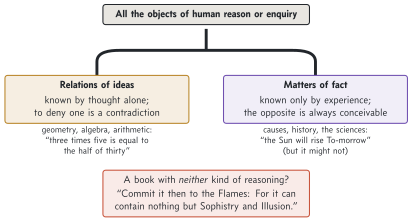
Arithmetic, the plainest case of relations of ideas, had drawn from Hume one remark in the Treatise that waited 145 years for its best reader. Two numbers are equal, he wrote, when “the one has always an unite answering to every unite of the other.” You can tell that a table holds as many cups as saucers without counting either, by setting one cup on each saucer and finding none left over. In 1884 the German logician Gottlob Frege (fray-guh) (Vol. 1, The Toolkit) quoted the sentence in The Foundations of Arithmetic. His derivations showed that this one principle, with logic and a few definitions, yields every basic law of the whole numbers, such as that every number has a next one. Logicians now call the rule Hume’s principle and the result Frege’s theorem, which states that Hume’s principle entails all of second-order arithmetic,A principle named for this philosopher was shown by Gottlob Frege to entail all axioms of second-order arithmetic. → David Hume• the system of axioms, starting rules taken without proof, in which logicians set down arithmetic.
Matters of fact beyond what we see and remember are all known, Hume went on, through cause and effect. I believe my friend is in France because I have a letter from him: the letter is the effect, his being there the cause. And how do we learn causes? The knowledge of cause and effect, Hume wrote, “is not, in any Instance, attain’d by Reasonings a priori; but arises entirely from Experience.” In Hume’s example, Adam, newly made and perfect in reason, could not have told from the clearness of water that it would drown him. Even the most familiar case hides the same gap. Watch a billiard ball roll toward another. “May not both these Balls remain at absolute Rest? May not the first Ball return in a strait Line, or leap off from the second in any Line or Direction? All these Suppositions are consistent and conceivable.”
What we see, Hume said, is one ball moving, then the touch, then the other ball moving. We never see the push itself, the power or “necessary Connexion” that makes the second ball go. What we do see, after many games, is that such events always go together, and Hume called this constant conjunction. After enough repetitions the mind, seeing the first event, simply expects the second, and that expectation, a feeling in us, is all there is to the necessity we seem to see in the balls. The billiard table showed Hume that causation, as we know it, is constant conjunction and the habit it breeds,This philosopher used colliding billiard balls to examine causation as a constant conjunction of events. → David Hume•••Hume explained expectations of this relation through constant conjunction and habit rather than an observed necessary connection. → causation••• not a connection anyone has ever observed.
That account leads to Hume’s most famous question. Induction (Chapter 4) is reasoning from cases we have seen to cases we have not. Bread has nourished me every day of my life, and I expect it to nourish me today. What justifies that step? Not a demonstration, Hume answered, since there is no contradiction in supposing that “the Course of Nature may change,” that snow might taste of salt or that trees might bloom in December and wither in May. Not experience either, since experience tells only what has happened, and to argue that the future will resemble the past because it always has before is to assume the very thing in question. Hume concluded that we infer the future by custom or habit,David Hume questioned whether past observations can justify this kind of inference about the future. → induction••This philosopher argued that to infer the future will be like the past, people must rely on "custom or habit," not reason. → David Hume• not by reason. “This Principle is Custom or Habit,” he wrote, and “Custom, then, is the great Guide of human Life.”
Hume himself did not stop eating bread. Outside his study he expected the sun to rise like everyone else, for “Nature is always too strong for Principle.” But his question troubled others for good. In 1783 the German philosopher Immanuel Kant (Vol. 14, From Luther to Mozart) wrote that it was the memory of David Hume that, years before, had first interrupted his “dogmatic slumber”:Kant claimed that this philosopher woke him from his "dogmatic slumber." → David Hume•• Hume’s doubts about cause and effect had woken Kant from an untroubled trust in what reason alone can prove. Kant’s Critique of Pure Reason (1781) was his long reply.
More than two centuries after the Enquiry, Hume’s picture of causation lent its name to a whole picture of the world. The American philosopher David Lewis (1941–2001; Vol. 33, The American Century) held that the world is a vast mosaic of small local facts, a little matter of this kind here at this moment and of that kind there, with no necessary connections binding the pieces together. Laws of nature, causes, and chances are fixed by the pattern of the mosaic, as the picture on a screen is fixed by its dots. Philosophers say that one set of facts supervenes on another when the first cannot differ unless the second does. In 1986 Lewis gave his view the name “Humean supervenience”David Lewis named a supervenience thesis for this philosopher. → David Hume•• in honor of the philosopher who had looked for the necessary connection and failed to find it.
Hume’s ethics
The second volume of the Treatise, “Of the Passions,” took on a picture as old as Plato, in which reason is a charioteer and the passions are horses to be kept in hand. For Hume reason does only two things. It compares ideas, as in arithmetic, and it discovers matters of fact, such as which means lead to which end. Neither can move anyone to act. Only a passion, a desire or an aversion, can do that, and reason can only show it the way to what it wants. Hume made reason the servant of the passionsThis philosopher stated that "reason is, and ought only to be, the slave of the passions." → David Hume•• and said so in a sentence meant to startle: “Reason is, and ought only to be the slave of the passions, and can never pretend to any other office than to serve and obey them.”
A passion can be called unreasonable, Hume said, in only two cases: when it rests on a false belief, as when I fear a danger that does not exist, or when it chooses means that will not reach its end. Otherwise reason has nothing to say about it. Then came his most shocking example. “’Tis not contrary to reason to prefer the destruction of the whole world to the scratching of my finger.” Hume did not mean that such a choice would be anything but monstrous. He meant that preferring the world’s destruction is not irrational:This philosopher remarked that it is not "contrary to reason" to prefer the "destruction of the whole world" to the scratching of one's finger. → David Hume•• what is wrong with it is a failure of feeling, not a mistake in reasoning.
The third volume, “Of Morals” (1740), drew the conclusion. If reason cannot move us, then moral judgments, which plainly do move us, cannot come from reason alone. Hume asked his reader to take “Wilful murder” and examine it “in all lights.” You find passions, motives, and actions, but no matter of fact called vice. “The vice entirely escapes you, as long as you consider the object. You never can find it, till you turn your reflection into your own breast, and find a sentiment of disapprobation, which arises in you, towards this action.” Virtue and vice are like colors, which the science of Hume’s day placed in the mind and not in objects. Moral distinctions, for Hume, are grounded in sentiment rather than reason,This philosopher grounded moral distinctions in sentiment rather than reason. → David Hume•• that is, in the feelings of approval and blame that human nature gives to everyone.
In the same section Hume added a short observation that has outlived almost everything around it. In every system of morality he had read, he said, the author reasons for a while about God or human affairs in sentences joined by “is” and “is not.” Then, “of a sudden I am surpriz’d to find, that instead of the usual copulations of propositions, is, and is not, I meet with no proposition that is not connected with an ought, or an ought not.” This change, he said, “is imperceptible; but is, however, of the last consequence,” because no one explains how an “ought” can follow from premises that say only what “is.” Philosophers call this the is–ought problem, or “Hume’s guillotine”,This philosopher’s is–ought problem, also called his “guillotine,” warns against deriving normative conclusions from purely factual premises. → David Hume••• a twentieth-century nickname for a rule that cuts facts cleanly apart from normative claims, claims about what ought to be. That fire burns does not by itself show that you ought not to touch it; you also need a premise about what you want or value.
Hume’s last great division concerned the virtues themselves, and it turned on whether a virtue depends on rules that people have invented. Kindness, generosity, and pity please us directly, and each kind act is good in itself; Hume called them natural virtues. Justice, honesty about property, and keeping promises are different. They rest on conventions that people worked out because society cannot last without them. A single act of justice may even do harm, as when a fortune is returned to a miser who will hoard it; the good lies in the whole system of rules. These Hume called artificial virtues, and the line between natural and artificial virtuesAccording to this philosopher, virtues are either "natural" or "artificial," depending on their relationship to social rules. → David Hume• runs through all his ethics. “Mankind is an inventive species,” he wrote, and “Tho’ the rules of justice be artificial, they are not arbitrary.”
As with the first part of the Treatise, Hume recast the third as An Enquiry Concerning the Principles of Morals (1751). He thought it “of all my writings, historical, philosophical, or literary, incomparably the best,” and it “came unnoticed and unobserved into the world.” Its test of a virtue is simple: a quality of character is a virtue if it is useful or agreeable to its owner or to others. By that test Hume rejected the “monkish virtues”This philosopher declared celibacy, fasting, and other "monkish virtues" to be unethical because they serve no purpose. → David Hume•• that the Christian centuries had honored. “Celibacy, Fasting, Penances, Mortification, Self-denial, Humility, Silence, Solitude and the whole Train of monkish Virtues,” he wrote, are rejected by men of sense “because they serve to no manner of Purpose.” He moved them “to the opposite Column” and placed them “in the Catalogue of Vices.” To the monks and nuns who practiced them, and to many Christians since, these disciplines were the way to master the self and draw near to God, and their purpose lay beyond this life. Hume judged them by this life alone.
The same thinking reached beauty in “Of the Standard of Taste,” printed in Hume’s Four Dissertations in 1757. If beauty, like virtue, lies in our sentiments, is every taste as good as every other? Common sense says no: anyone who ranked Bunyan (Chapter 9) as high as Addison (Chapter 14) as a writer, Hume said, might as well maintain “a molehill to be as high as Teneriffe,” the great volcano of the Canary Islands. He told a story from Don Quixote (Vol. 10, Rebirth). Two of Sancho Panza’s kinsmen are asked to judge a barrel of wine; one likes it but tastes a little leather, and the other tastes a little iron. Everyone laughs at them, until the barrel is emptied and an old key on a leather strap is found at the bottom. Some people’s taste is finer than others’, and in “Of the Standard of Taste”This philosopher wrote “Of the Standard of Taste.” → David Hume• the standard is the agreement of the best judges: “Strong sense, united to delicate sentiment, improved by practice, perfected by comparison, and cleared of all prejudice.”
Hume’s ethics found new defenders more than two centuries later. In the Treatise he had remarked that “the mind has a great propensity to spread itself on external objects,” feeling its own expectations as a necessity in things. The English philosopher Simon Blackburn (born 1944) took up that picture of the mind spreading its feelings on the world, and in his book Spreading the Word (1984), starting from Hume’s account of sentiment, he set out a view he called quasi-realism.This philosopher inspired "quasi-realism," a meta-ethical view formulated by Simon Blackburn. → David Hume•• It is a meta-ethical theory, one about what moral judgments are rather than about which acts are right. On this view they express our attitudes rather than describe facts, yet we may still call them true or false and argue over them as seriously as over anything else.
Religion and miracles
Hume’s enemies called him an atheist. In 1745, when he applied to be professor of moral philosophy at Edinburgh, the city’s ministers petitioned against him and the chair went to another man, and six years later the University of Glasgow passed him over too. He did not hide his doubts. The tenth section of An Enquiry Concerning Human Understanding, first printed among the Philosophical Essays of 1748, is “Of Miracles,” the most famous argument ever written against believing reports of them. The essay weighs testimony against the laws of nature,This work’s section “Of Miracles” weighs testimony against the evidence for natural laws. → An Enquiry Concerning Human Understanding•••These events were the subject of an empirical criticism by David Hume. → miracles• and it starts from a rule of evidence: “A wise Man, therefore, proportions his Belief to the Evidence.” A miracle, Hume says, “is a Violation of the Laws of Nature,” and those laws rest on “a firm and inalterable Experience,” the experience of everyone who has seen the dead stay dead and lead fall when dropped. Against that stands the report of witnesses, whose reliability also rests on experience, and experience shows that witnesses are often mistaken and sometimes lying.
The result is a rule. “No Testimony is sufficient to establish a Miracle, unless the Testimony be of such a Kind, that its Falshood would be more miraculous, than the Fact, which it endeavours to establish.” When someone tells me that a dead man was restored to life, Hume wrote, I ask which is more likely: that the witness is deceived or deceiving, or that the thing really happened. “I weigh the one Miracle against the other… and always reject the greater Miracle.” The essay’s second part adds that no miracle has ever been witnessed by enough people of good sense and learning, that people love to tell and hear wonders, and that the miracles of rival religions cancel one another out. If every historian of England agreed that Queen Elizabeth I had died, lain buried a month, and then returned to rule for three more years (Chapter 3), Hume would still believe that her death had been a pretense. He closed with an irony that every reader understood: the Christian religion “not only was at first attended with Miracles, but even at this Day cannot be believ’d by any reasonable Person without one.”
Christian writers answered at once, and the argument has never stopped. The Aberdeen minister George Campbell replied in A Dissertation on Miracles (1762) that we trust testimony before we have experience to check it against, and that Hume’s rule would forbid us to believe any strange report, however true. Others argued that the God who made nature’s laws may set them aside when he chooses, and that the apostles, who suffered for what they said they had seen, were exactly the kind of witnesses Hume demanded. To believers, a miracle was not a breach of order but a sign from the one who ordered the world.
The Enquiry’s last paragraph turns Hume’s fork into a weapon. “When we run over Libraries, persuaded of these Principles, what Havoc must we make?” Take any book, “of Divinity or School Metaphysics, for Instance,” meaning theology or the philosophy of the medieval universities, and ask two questions. “Does it contain any abstract Reasonings concerning Quantity or Number? No. Does it contain any experimental Reasonings concerning Matters of Fact or Existence? No. Commit it then to the Flames: For it can contain nothing but Sophistry and Illusion.” With that order, to commit such books to the flames,This work ends by urging readers to “commit it then to the flames” if a book contains only “sophistry and illusion.” → An Enquiry Concerning Human Understanding•• the Enquiry ends.
Hume’s boldest book on religion he never published. He began a dialogue on the subject about 1751 and revised it for twenty-five years, but friends warned him that it would raise a storm, and he kept it in his desk. Natural religion meant what reason and the evidence of nature can show about God, as distinct from revealed religion, what Christians believed God had made known in Scripture. Hume’s Dialogues Concerning Natural ReligionThis philosopher wrote Dialogues Concerning Natural Religion. → David Hume•• take their form from Cicero’s dialogue On the Nature of the Gods. A young man, Pamphilus (pam-fih-lus), writes to a friend to report a conversation he heard one summer at the house of his tutor, Cleanthes (klee-an-theez). He describes the three speakers: Cleanthes, with his “accurate philosophical turn”; Philo (fy-loh), with his “careless scepticism”; and Demea (dee-mee-uh), with his “rigid inflexible orthodoxy.” Through twelve parts Cleanthes, Philo, and Demea debateThis work presents a conversation among Cleanthes, Philo, and Demea. → Dialogues Concerning Natural Religion••• what, if anything, reason can know about God.
Cleanthes argues from design. “Look round the world,” he says: it is “nothing but one great machine,” divided into lesser machines that are fitted to each other with marvelous accuracy. Since the effects resemble the works of human minds, the cause must resemble a human mind, though a far greater one. Philo answers with a house. “If we see a house, Cleanthes, we conclude, with the greatest certainty, that it had an architect or builder; because this is precisely that species of effect which we have experienced to proceed from that species of cause.” We have watched many houses built, but we have never watched a world being made, and the universe is not much like a house. The inference from house to builderThis work compares the inference to a designer of the universe with the inference to a builder of a house. → Dialogues Concerning Natural Religion•• is sound; the inference from the universe to God is, Philo says, at best “a guess, a conjecture, a presumption.”
Philo then offers rival comparisons. The world is as much like an animal or a plant as a machine, and might as well have grown as been built. “The Bramins assert,” he says, meaning the Brahmins, the priestly teachers of India, “that the world arose from an infinite spider, who spun this whole complicated mass from his bowels.” On a planet of spiders that story would seem as natural as Cleanthes’ architect seems to us. “Why an orderly system may not be spun from the belly as well as from the brain, it will be difficult for him to give a satisfactory reason.” Philo’s universe spun by an infinite spiderThis work imagines a universe spun by an infinitely large spider to question the argument from design. → Dialogues Concerning Natural Religion• is a joke with a point: when many comparisons fit equally well, no one of them proves anything.
In the eleventh part the argument turns to suffering. Imagine, Philo says, a house or palace “where there was not one apartment convenient or agreeable; where the windows, doors, fires, passages, stairs, and the whole œconomy of the building, were the source of noise, confusion, fatigue, darkness, and the extremes of heat and cold.” You would blame the architect without further inquiry. The world, with its diseases, storms, and famines, looks to Philo like a house of noise, confusion, fatigue, darkness,This work compares the world’s defects to a house whose design subjects its occupants to “noise, confusion, fatigue, darkness.” → Dialogues Concerning Natural Religion• and from such a world we cannot infer a builder who is both all-powerful and good. This is the ancient problem of evil, and Philo presses it hard. The book ends with Pamphilus judging “that Philo’s principles are more probable than Demea’s; but that those of Cleanthes approach still nearer to the truth.” Readers have argued ever since about which speaker speaks for Hume, and many think it is Philo.
In the spring of 1775 Hume fell ill with a disease of the bowels that he knew would kill him. He wrote his short life, revised the Dialogues, and saw his friends as cheerfully as ever. James Boswell (Chapter 20), who visited him on July 7, 1776, found him calm, and Hume told him that it was “a most unreasonable fancy” that we should live on after death. He died in Edinburgh on August 25, 1776. His will provided for the Dialogues to be printed, and his nephew brought them out in 1779 (Figure 16.10).

The Scottish Enlightenment
Hume did his thinking in a small country that was suddenly full of thinkers. After the Union of 1707 (Chapter 13) Scotland had no parliament of its own, but it kept its own church, its own law, and its universities: Edinburgh, Glasgow, St. Andrews, and Aberdeen, which had two colleges, King’s College and Marischal (mar-ih-shul) College. Their professors began to lecture in English instead of Latin and to write for the public as well as for students, and Edinburgh’s clubs gathered lawyers, ministers, doctors, and merchants to argue about everything. The movement across Europe that tried to test religion, government, trade, and morals by reason and evidence, rather than by tradition and authority, is called the Enlightenment, and its French writers (Vol. 13, Valois, Bourbon, and Orange) called themselves philosophes. Scotland’s part in it, from about 1730 to about 1800, was out of all proportion to the country’s size (Figure 16.11).
Its first great philosopher was an Irishman. Francis Hutcheson (huch-ih-sun) (1694–1746), the son of a Presbyterian minister in Ulster, became professor of moral philosophy at Glasgow in 1730. He taught that human beings have a moral sense, an inner sense that feels the beauty of a kind action as the eye sees a color. The best action, he judged, is the one that brings the greatest happiness to the greatest number of people. Hume learned much from him and sent him the third volume of the Treatise before it was printed. Hutcheson’s student Adam Smith (Chapter 23) would become Hume’s closest friend.

In his lifetime Hume won his fame not as a philosopher but as a historian. In 1752 the Faculty of Advocates, the society of Edinburgh’s lawyers, made him keeper of their library, and with its books he wrote a History of England in six volumes,This philosopher wrote a six-volume History of England. → David Hume• published between 1754 and 1762. He wrote it backward. The first volume told the reigns of James I and Charles I, and its sympathy for the beheaded king outraged both parties. Hume had shed, as he put it, a “generous tear” for Charles I and the Earl of Strafford (Chapter 5, Chapter 10), and in a year his London bookseller sold only forty-five copies. Volumes on the Commonwealth and the later Stuarts down to 1688 (Chapter 10), on the Tudors, and finally on the centuries from Julius Caesar’s invasion to 1485 followed. The whole became a best seller and the standard history of England for a hundred years. From 1763 to 1765 Hume served at the British embassy in Paris, where the philosophes and the great ladies of the salons made much of him. In 1766 he brought the exiled writer Jean-Jacques Rousseau (Vol. 13, Valois, Bourbon, and Orange) to England, only to quarrel with him within months.
Hume’s essays carried his name further than any of his philosophy, and one of them carries a stain. “Of National Characters” (1748) argued that the characters of nations come mostly from their governments and customs, not from their climates. But in a footnote added to the edition of 1753 Hume wrote that he suspected black people, and all other races, to be naturally inferior to whites. The footnote was racism, a prejudice dressed as an observation. James Beattie (bee-tee) (1735–1803), a poet, a professor at Marischal College, Aberdeen, and an opponent of slavery, wrote An Essay on the Nature and Immutability of Truth (1770) to refute Hume’s skepticism. The book, known for short as the Essay on Truth, also answered Hume’s racismJames Beattie's Essay on Truth critiques the racism of this philosopher's essay "Of National Characters." → David Hume•• and denied that any such claim had been proved. The book made Beattie famous, and George III gave him a pension of £200 a year.

Hume’s ablest critic was Thomas Reid (1710–1796), who served as a country minister before he became a professor at King’s College, Aberdeen, in 1752. Like Hume, Reid was a Scot,Thomas Reid was from this country. → Scotland• the son of a minister in Aberdeenshire, and he had once admired Berkeley. Reading Hume convinced him that something had gone badly wrong, not in Hume’s reasoning, which he thought sound, but in the starting point that Locke, Berkeley, and Hume all shared. That was the “theory of ideas,” the assumption that the mind perceives only its own ideas and never things themselves. Begin there, Reid argued, and you end as Hume did, doubting the world, the self, and every cause.
In An Inquiry into the Human Mind on the Principles of Common Sense (1764) Reid rejected the assumption. We perceive things, not ideas of things, and we rely on principles of common sense, such as that what we clearly perceive exists and that nature will go on as it has, which no one can prove and everyone must use. The skeptic trusts his reason without proof, Reid pointed out, and he has no better ground for trusting it than for trusting his senses. Our idea of a cause, Reid held, comes from our own power to act, which we know from the inside. In this way Reid and the “common sense” philosophers answered Hume,"Common sense" philosophers like Thomas Reid refuted this philosopher's skepticism and theory of causation. → David Hume• both his skepticism and his account of causation. In 1764 Reid succeeded Adam Smith as professor of moral philosophy at Glasgow, and he taught there for seventeen years.
Reid’s pupil Dugald Stewart (doo-guld) (1753–1828) taught moral philosophy at Edinburgh from 1785, and his lectures carried the common-sense philosophy to a generation of students. He also wrote the first lives of Smith and Reid. The line of moral philosophers that ran from Hutcheson in the 1730s, through Hume and Reid, to Stewart, who lectured until 1810, is the philosophical heart of the Scottish Enlightenment.The Scottish branch of this concept was exemplified by Dugald Stewart, Francis Hutcheson, and Thomas Reid. → the Enlightenment• The same movement gave the world Adam Smith’s economics, and for half a century it made Edinburgh one of the capitals of European thought.
What to remember
- George Berkeley, an Irish clergyman, argued in A Treatise Concerning the Principles of Human Knowledge (1710) that to be is to be perceived (esse est percipi), denied material substance, and called his view immaterialism.
- Berkeley rejected Locke’s split between primary and secondary qualities, staked his case on the “master argument,” and restated it in the Three Dialogues between Hylas and Philonous (1713).
- De Motu (1721) treated force as a mathematical hypothesis and motion as relative; Alciphron (1732) defended Christianity against freethinkers; The Analyst (1734) mocked the calculus’s “ghosts of departed quantities.”
- Berkeley’s Bermuda college was never built, and the city and university of Berkeley, California, are named for him.
- David Hume, a Scot, wrote A Treatise of Human Nature (1739–1740): the Copy Principle and the missing shade of blue, the three associations, and the self as a bundle of perceptions.
- The Enquiry Concerning Human Understanding (1748) holds Hume’s fork, causation as constant conjunction and habit (the billiard balls), the problem of induction, “Of Miracles,” and the order to commit empty books to the flames.
- In ethics, reason is the slave of the passions, morality rests on sentiment, no “ought” follows from an “is,” virtues are natural or artificial, and the “monkish virtues” serve no purpose.
- The Dialogues Concerning Natural Religion (1779) set Cleanthes, Philo, and Demea arguing about design: the house and its builder, the infinite spider, and the house of noise and darkness.
- The Scottish Enlightenment ran from Hutcheson through Hume and Thomas Reid, whose common sense answered Hume, to Dugald Stewart; Beattie answered Hume’s racist footnote, and Kant said Hume woke him from his dogmatic slumber.
Chapter 17 · 28 clues
Handel in London
In the spring of 1738 a marble statue went up in Vauxhall Gardens (voks-hawl), a pleasure garden on the south bank of the Thames, where Londoners paid a shilling to stroll down lamplit walks under the trees and hear an orchestra play. Jonathan Tyers, who owned the gardens, had ordered it, and a young Frenchman named Louis-François Roubiliac (loo-ee frahn-swah roo-bee-lee-ak) had carved it. In England, statues were made for kings, generals, and great lords. This one showed a living musician, life-size, and no living artist had ever been carved that way in marble before.

The man in the marble was George Frideric Handel, fifty-three years old. Roubiliac showed him as Orpheus, the singer of Greek myth whose music moved trees and stones (Vol. 4, Classical Myth), plucking a lyre. But he did not dress him as a Greek. Handel sits cross-legged in the clothes he wore at home, with his stockings slipping down and one slipper off. He had been born in a German town and trained in Germany and Italy, and he had come to London at twenty-five. Now the town knew his tunes so well that a pleasure garden could sell tickets with his likeness. That same spring his newest Italian opera closed after five nights. London loved Handel and would not pay for his operas, and both things had been true for most of the twenty-seven years since he arrived.
Handel’s operas
Halle and Hamburg
Handel was born in Halle, a salt-making town on the river Saale (zah-leh) in eastern Germany, on February 23, 1685, by the calendar Protestant Germany then used (March 5 by ours). Johann Sebastian Bach was born less than a month later, and the Italian Domenico Scarlatti that October. Handel’s father, Georg Händel (hen-dl), was sixty-two, a barber-surgeon who set bones and dressed wounds for the dukes of Saxe-Weissenfels (vy-sen-fels), and he meant his son to be a lawyer. Nearly everything known of the boy comes from one book, the Memoirs of the Life of the Late George Frederic Handel (1760) by John Mainwaring, a young Cambridge clergyman. It was the first book-length life of any composer, written a year after Handel’s death from what his assistant, John Christopher Smith the younger, remembered, and it is often wrong about dates. Mainwaring says the father banned music from the house, so the boy had a clavichord, a small, quiet keyboard instrument, smuggled into an attic and practiced there at night while the family slept.
When the boy was seven or so, Mainwaring goes on, his father took him to the duke’s palace at Weissenfels. The boy found his way to the organ in the chapel and played, and Duke Johann Adolf I heard him and told the father that such a gift must be trained. So Handel became the pupil of Friedrich Wilhelm Zachow (tsahkh-oh), organist of Halle’s Market Church. Zachow taught him the organ, the harpsichord, and the violin, and set him to copy out the music of the best German and Italian composers to learn how it was built. He was the only teacher Handel ever had. The father died in February 1697. In 1702, perhaps to keep a promise to him, Handel enrolled at Halle’s new university and became organist of the town’s cathedral. A year later he walked away from both.
He went to Hamburg, a rich free city on the river Elbe that governed itself. Hamburg had the first public opera house in Germany, built in 1678 on the Gänsemarkt (gen-zeh-markt), the Goose Market, and anyone who bought a ticket could go in, as in Venice. Handel joined its orchestra in 1703 as a violinist and later played the harpsichord, from which operas were directed. There he made a friend, the singer and composer Johann Mattheson (maht-teh-zon), who nearly killed him. At a performance of Mattheson’s opera on December 5, 1704, the two quarreled over who should sit at the harpsichord, and they fought a duel outside the theater. As the story was later told, Mattheson’s sword broke on a large button on Handel’s coat. They made it up and wrote to each other for the rest of their lives.
A month later the theater staged an opera by its nineteen-year-old harpsichordist. Almira, Handel’s first opera,This composer's first opera was Almira. → Handel• opened on January 8, 1705. Its heroine, Almira (al-mee-rah), is a young queen of Castile, in Spain, who loves her secretary but is told she must marry another man’s son; in the last act the secretary turns out to be that man’s long-lost son, and everyone is satisfied. The recitatives were sung in German and many of the arias in Italian, as Hamburg liked. Almira ran for twenty performances. In its last act the court puts on a masque, a show of songs and dances, in which three courtiers appear as Europe, Asia, and Africa, and the dance for Asia is a slow, grave sarabande. Handel did not forget that tune.

In the autumn of 1706 he went to Italy, the home of opera, and stayed nearly four years (Figure 17.2; Vol. 10, Rebirth). In Rome, where the pope had banned opera, he wrote oratorios, with Arcangelo Corelli leading the violins, and Mainwaring describes a contest at the keyboard with Domenico Scarlatti. In Venice his opera Agrippina (ag-rih-pee-nah) triumphed on December 26, 1709, and, Mainwaring says, the audience cheered il caro Sassone, “the dear Saxon.” Princes now competed to hire him (Figure 17.3). In June 1710 he became Kapellmeister (kah-pel-my-ster), “chapel master,” the director of all the music at a German court, to Georg Ludwig (George Louis in English), the elector of Hanover, one of the princes who chose the Holy Roman Emperor. It was a lucky post. By the Act of Settlement of 1701 the elector was second in line to the British throne, after his old mother, Sophia (Chapter 13; the family tree is in the Stage). Handel asked at once for leave to visit London, and the elector granted it.

Rinaldo
London in 1710 had more than half a million people, and Queen Anne, the last of the Stuarts, sat on its throne (Chapter 13). Italian opera had arrived there only a few years before, mostly in patched-together versions of operas written for Italy, sung partly in Italian and partly in English. No one had yet written an Italian opera for London. Aaron Hill, the young manager of the Queen’s Theatre in the Haymarket, which the architect and playwright John Vanbrugh had built in 1705, meant to be the first. He sketched the story himself, an Italian poet named Giacomo Rossi turned it into verse, and Handel wrote the music. Rossi complained that he could not keep up, since the composer set the whole opera in two weeks. Handel’s RinaldoThis composer wrote the opera Rinaldo. → Handel•• (rih-nahl-doh) opened on Saturday, February 24, 1711. It was the first Italian opera ever written for the London stage.
Hill took his story from an Italian epic of the First Crusade, the war in which knights from western Europe took Jerusalem from its Muslim rulers in 1099. Its poet was Torquato Tasso (tor-kwah-toh tahs-soh), whose enchanted knights appear elsewhere in the Course (Vol. 10, Rebirth). Tasso’s Jerusalem Delivered,This opera is based on Tasso’s Jerusalem Delivered. → Rinaldo (Handel)• printed in 1581, was the opera’s source. Hill kept Tasso’s hero, the young crusader Rinaldo, and Armida (ar-mee-dah), the sorceress who bewitches him, and changed the rest to suit the stage. Goffredo (gof-fray-doh), Tasso’s Godfrey of Bouillon (boo-yawn), leads the crusaders besieging Jerusalem and has promised his daughter, Almirena (al-mih-ray-nah), to Rinaldo when the city falls. Inside the walls is Argante (ar-gahn-teh), the city’s Muslim king, a “Saracen,” as the crusaders called any Muslim enemy. His ally and lover is Armida, queen of Damascus, and in the first act she seizes Almirena and carries her off in a black cloud.
In the second act Almirena is a prisoner in Armida’s enchanted garden. Argante comes to her there, and, overcome by her beauty, the Muslim king falls in loveThe Saracen king Argante falls in love with the captive Almirena in this opera. → Rinaldo (Handel)• with his captive and promises to set her free in defiance of Armida. She wants nothing from him but her freedom, and she answers with the most famous song in the opera, “Lascia ch’io pianga” (lah-shah kee-oh pyahn-gah), “Let me weep”: let me weep for my cruel fate, she sings, and sigh for liberty. Its slow, stately tune was not new. “Lascia ch’io pianga” reused the Almira dance,Almirena sings "Lascia ch’io pianga" in this opera, reusing music from Almira. → Rinaldo (Handel)•• the sarabande for Asia, which Handel had already turned into an aria in Rome in 1707; now, with new words, it became a prisoner’s plea. Handel borrowed from his own music all his life, and nobody minded, since hardly anyone in London had heard Almira. The aria is the Course’s model of the da capo aria, in which the opening section returns, ornamented, after a contrast (Vol. 1, The Toolkit). In the last act Jerusalem falls, Rinaldo and Almirena are united, and Argante and Armida become Christians and are forgiven.
London went for the spectacle as much as for the songs. Armida arrived from the sky in a fiery chariot, a garden in the first act had fountains and live birds, and Rinaldo was sung by Nicolini (nee-koh-lee-nee), a castrato. Castrati were male singers who had been castrated as boys so that their voices would never break, a cruel practice of Italy (Vol. 1, The Toolkit). As grown men they sang as high as women, with a man’s lungs behind the voice, and they were the stars of Italian opera. The essayist Joseph Addison mocked the whole show in his new paper, The Spectator (Chapter 14), complaining that Londoners now sat through whole evenings in a language they did not understand. London ignored him. Rinaldo played fifteen nights in its first run and was revived for years, fifty-three performances in Handel’s lifetime, more than any other of his operas.
Handel went back to Hanover in June 1711. In the autumn of 1712 he asked for leave again and was granted it, Mainwaring says, “on condition that he engaged to return within a reasonable time.” He never went back to stay. He lived as a guest of rich patrons, among them the young Earl of Burlington, and in 1713 he wrote a Te Deum, a hymn of thanksgiving, for the Peace of Utrecht, which ended Queen Anne’s war with France (Chapter 13). The queen gave him a pension of £200 a year. The peace pleased her Tory ministers and angered Hanover, whose elector thought Britain had deserted its allies, and his own Kapellmeister had set it to music. On August 1, 1714, Anne died, and the elector became King George I of Great Britain. Handel’s absent master was now his king.
The Royal Academy
In 1719 a group of rich noblemen founded a company to give London Italian opera every season. They called it the Royal Academy of Music, and George I granted it a charter. It was run like a business: its planned capital of £10,000 was divided into shares of £200 each, the subscribers who bought them hoped the boxes and tickets would pay a profit, and the Academy paid one dividend, in 1723. The directors named Handel their Master of the Orchestra and sent him to Dresden, where the elector of Saxony had just built a splendid new opera house, to hire singers. From 1720 to 1728, in the theater in the Haymarket, now renamed the King’s Theatre, Handel wrote thirteen operas for the Academy.

Its stars were castrati and sopranos. The greatest was Francesco Bernardi, who called himself Senesino (seh-neh-zee-noh), “the little Sienese,” after his birthplace, Siena. He came in 1720 for a salary reported at £2,000 or more a season, at least ten times Handel’s pension from the queen. Senesino was tall, proud, and quarrelsome. Mainwaring wrote that singer and composer were as unmanageable as each other, yet Handel wrote seventeen roles for him. In January 1723 the soprano Francesca Cuzzoni (koot-soh-nee) made her London debut. She was short and plain, with a voice so lovely that a man in the gallery was said to have shouted that she had a nest of nightingales in her belly. Figure 17.5 shows how a London satirist saw them.

The finest of Handel’s operas for the Academy opened on February 20, 1724, and its first night is told elsewhere (Vol. 1, The Toolkit). Handel’s Giulio CesareThis composer wrote the opera Giulio Cesare. → Handel•• (joo-lyoh cheh-zah-reh), “Julius Caesar,” tells how the Roman general chased his defeated rival Pompey to Egypt in 48 BC (Vol. 7, The Romans). The young Egyptian king Ptolemy (tol-uh-mee), Tolomeo (toh-loh-may-oh) in the Italian, hopes to please him and has Pompey’s severed head brought to him, and Caesar is disgusted. Ptolemy’s sister Cleopatra, who wants Egypt for herself, sets out to win Caesar, and does. To create a role is to sing it at the first performance, so that the composer writes the music for that singer’s voice, and in this opera set in Egypt Senesino created the title role.Senesino created the title role of this Handel opera set in Egypt. → Giulio Cesare (Handel)• Cuzzoni sang Cleopatra, and Gaetano (gah-eh-tah-noh) Berenstadt (bair-en-shtaht), a huge castrato from Florence, sang Ptolemy.
Handel gave Caesar eight arias to show off Senesino’s voice. In the first act Ptolemy welcomes Caesar to his palace with smiles, and Caesar, aside to his officer Curio, sees through them. He compares himself to a hunterThe title character compares himself to a hunter in the horn-accompanied aria "Va tacito e nascosto" in this opera. → Giulio Cesare (Handel)•• in the aria “Va tacito e nascosto” (vah tah-chee-toh eh nah-skos-toh): the cunning hunter who means to catch his prey goes silently and unseen, and so does the man who plans treachery. Handel wrote a solo part for the horn, the hunter’s instrument (Vol. 1, The Toolkit), which answers the voice phrase by phrase like an echo across a wood. Sixty years later the music historian Charles Burney heard the aria sung at a festival in Handel’s memory and wrote that no air with a horn part had ever equaled it.
The Academy did not belong to Handel alone. Its directors also hired Giovanni Bononcini (boh-non-chee-nee) (1670–1747), a cellist and composer from Modena whose opera Camilla had been admired across Europe, and London took sides. Bononcini’s admirers were led by Henrietta, Duchess of Marlborough, the great general’s daughter, and were mostly Whigs; Handel’s were mostly Tories (Whig and Tory, Chapter 9). In 1721 the directors even had three composers write one act each of a single opera, Muzio Scevola (moo-tsee-oh shay-voh-lah), with Bononcini’s act second and Handel’s third. In 1725 John Byrom (by-rum), a Manchester poet who earned his living teaching a shorthand of his own invention, wrote an epigram, a short, witty poem with a sting in its tail. Some say, his first lines run, that Handel is a ninny beside Bononcini; others that Bononcini is not fit to hold a candle to Handel. The sting comes last: Byrom’s “Tweedle-dum and Tweedle-dee”John Byrom coined "Tweedledum and Tweedledee" in an epigram comparing this composer with Giovanni Bononcini. → Handel• were two things so alike that only fools would quarrel over the difference. The couplet was quoted so often that later editors printed it among the poems of Jonathan Swift (Chapter 15):
Bononcini’s star fell a few years later, when he was caught passing off a madrigal by the Venetian composer Antonio Lotti as his own, and he left London for good. The Academy’s troubles were worse. In 1726 it hired a second star soprano, Faustina Bordoni (bor-doh-nee), and London split again, between Cuzzoni’s admirers and Faustina’s. On June 6, 1727, at a performance of Bononcini’s Astianatte (ah-stee-ah-naht-teh) with Caroline, Princess of Wales, the wife of the king’s son and heir, in the audience, the two parties hissed and catcalled until the performance was abandoned. Satirical pamphlets soon had the two women coming to blows on stage and pulling at each other’s headdresses, though the uproar seems to have been their admirers’ work, not theirs. Then, in January 1728, John Gay, a friend of Swift and Pope, put on The Beggar’s Opera at the theater in Lincoln’s Inn Fields. It was a play in English about highwaymen and thieves, with songs set to old ballad tunes everyone knew, and it mocked Italian opera and the government of Robert Walpole (Chapter 13) in the same breath. It ran for sixty-two nights, a record. The Academy, out of money, closed after its season of 1728.
Covent Garden and Serse
Handel did not give up. In 1729 he and the Swiss-born manager John James Heidegger (hy-deg-er) took on the King’s Theatre themselves, and Handel went to Italy for new singers. Then, in 1733, a rival company opened, the Opera of the Nobility, backed by Frederick, Prince of Wales, George II’s eldest son, who was quarreling with his father and his father’s friends. Senesino went over to it, and in 1734 it hired the most famous castrato of all, Farinelli (Vol. 1, The Toolkit), and took over the King’s Theatre. Two opera companies now divided an audience too small for one.
Handel moved to Covent Garden, a London district built around a square with a fruit and vegetable market. In 1732 the actor-manager John Rich, with the money The Beggar’s Opera had made him, had opened a new theater there, the Theatre Royal, Covent Garden, one of only two London theaters licensed to act plays (Vol. 11, The Age of Shakespeare). From 1734 Handel gave his seasons in it, and wrote two of his finest operas for it in 1735, Ariodante (ah-ree-oh-dahn-teh) and Alcina (al-chee-nah), with ballets for the French dancer Marie Sallé (sah-lay). That Lent he also began playing organ concertos of his own between the acts of his oratorios (Chapter 18). Rich’s theater burned down in 1808, and the organ Handel had left to Rich burned with it. Its successor burned in 1856. The third theater on the site, built in 1858 and called the Royal Opera HouseThis city's concert venues include the Royal Opera House in Covent Garden. → London• since 1892, is one of London’s great stages, the home of the Royal Opera and the Royal Ballet.
The strain told on Handel. In April 1737 he had a stroke that left his right hand and arm paralyzed, and in September he went to the hot springs at Aix-la-Chapelle (eks-lah-shah-pel), now Aachen (ah-khen), in Germany, to take the cure; by November he was well. That year both opera companies went bankrupt, and what was left of them joined forces at the King’s Theatre, which commissioned new operas from Handel. On December 26, 1737, he began the first and finished it in seven weeks. Handel’s SerseThis composer wrote the opera Serse. → Handel•• (sair-seh), “Xerxes” (zurk-seez), opened on April 15, 1738. Its hero is the Persian king who invaded Greece in 480 BC (Vol. 6, The Greeks), and its first scene comes from the Greek historian Herodotus (heh-rod-uh-tus). On his march toward Greece, in G. C. Macaulay’s translation, Xerxes “found a plane-tree, to which for its beauty he gave an adornment of gold, and appointed that some one should have charge of it always in undying succession.”
When the curtain rises Xerxes stands in a garden, and he sings to a plane tree,The title character admires a plane tree in this opera’s opening aria "Ombra mai fu," often called Handel’s "Largo." → Serse•• a tall shade tree with broad leaves and mottled, peeling bark. “Ombra mai fu” (ohm-brah my foo), he begins: never was there shade of any plant so dear, so lovely, so sweet. The castrato Caffarelli (kahf-fah-rel-lee) sang it. The aria is short and slow, marked larghetto (lar-get-oh), “a little broad,” a shade quicker than largo, the slowest of the common tempo words (Vol. 1, The Toolkit). In the nineteenth century, long after the opera was forgotten, the tune was played everywhere without its words, arranged for organ, for violin, and for orchestra, and printed as “Handel’s Largo.” The name stuck, and it hides a joke. Handel had borrowed the libretto, and some of the melody, from his old rival Bononcini, who had set the same words in Rome in 1694.
Serse failed. It mixed comedy into serious opera, with a clownish servant and many short songs, and it closed after five performances. The Handel scholar Winton Dean judged it the most popular of his operas with modern audiences after Giulio Cesare. Handel wrote only two more. The last, Deidamia (day-ee-dah-mee-ah), opened on January 10, 1741, at Lincoln’s Inn Fields, and closed after three nights. By then he had found a new kind of work, the oratorio in English, which needed no castrati and no scenery, and Chapter 18 tells it.
Water Music
When Queen Anne died in 1714, Handel had been away from Hanover for nearly two years, far longer than his leave allowed, and the master he had left was now king of Great Britain. What happened next is a story told by Mainwaring in 1760. Handel did not dare show himself at court, he says, until his friend Baron Kielmansegg (keel-mahn-zeg), a Hanoverian courtier, found a way. The king was to take a trip on the river. Handel wrote music for it and played it from a boat that followed the royal barge, the delighted king asked who had written it, and Kielmansegg brought the runaway forward to be forgiven. The story will not fit the record. In 1715 Handel was writing operas for the King’s Theatre, and in the summer of 1716 he probably traveled with the court to Hanover, which no man in disgrace would have done. The reconciliation is a legend that grew out of the music’s fame.
What the record does show is a summer evening. At about eight o’clock on Wednesday, July 17, 1717, George I and a party of lords and ladies stepped into an open barge at Whitehall, the old royal palace by the Thames, for a trip upriver to Chelsea, then a village west of London. The rising tide carried them without rowing. Beside them floated a barge provided by the City of London, with about fifty musicians playing for the king.This collection of orchestral suites premiered on a barge on the Thames for George I. → Water Music••• So many Londoners rowed out to listen, the Daily Courant reported, that the river was almost covered with boats. At Chelsea the king went ashore for supper at the house of the late Lord Ranelagh (ran-uh-luh), and late that night he came back aboard. He liked the music so much that he had it played three times over, going and coming, until he landed at Whitehall well after midnight. The music, by the king’s runaway Kapellmeister, was Handel’s Water Music.This composer wrote Water Music. → Handel•••

Handel never published it himself, and his own score is lost. John Walsh, the London printer who published most of his music, brought out players’ parts for some of the movements about 1733, sixteen years after the river party, and the first full score appeared only in 1788. Nobody knows in what order the pieces were played that night, and Handel may have written some of them earlier. Modern editions sort the twenty or so movements by key, so the collection is arranged as three suites,This orchestral collection is commonly arranged as three suites in F, D, and G major. → Water Music••• in F major, D major, and G major. A suite (Vol. 1, The Toolkit) is a set of instrumental pieces in one key, most of them dances, played one after another. Each of Handel’s three has its own instruments (Table 17.1).
| Suite | Instruments besides the strings | What to listen for |
|---|---|---|
| F major (9 movements) | two horns, two oboes, bassoon | a French overture; the horns’ hunting calls |
| D major (5 movements) | two trumpets, two horns, two oboes, bassoon | the “Alla Hornpipe,” with trumpets and horns |
| G major (4 movements) | flute and recorder | quiet minuets and country dances |
The F-major suite is the longest. It opens with a French overture, a slow, grand introduction in jerky dotted rhythms followed by a quick section in which the instruments enter one after another. Two horns stand out in it.Two horns are prominent in the F-major suite of this orchestral collection. → Water Music•• They were natural horns, coiled brass tubes with no valves, which had come into the orchestra from the hunting field (Vol. 1, The Toolkit), and their open, ringing calls carry well across water. The D-major suite adds two trumpets, the most brilliant sound of the Baroque orchestra, and its best-known movement is the “Alla Hornpipe,”The D-major suite in this collection includes "Alla Hornpipe." → Water Music••• “in the style of a hornpipe.” A hornpipe was a lively British dance, whose name probably comes from a country pipe with a bell made of horn; sailors danced it later. Handel’s is a bold, stamping tune for the whole band, with the trumpets and horns ringing out above the strings. The short G-major suite is the gentlest of the three, with a flute or a recorder and strings.
Zadok the Priest
George I died on June 11, 1727, on the road to Hanover, and his son became King George II. Handel was ready for the new reign. That February Parliament had passed an act making him a British subject, so the German from Halle was now British by law. George II and his queen, Caroline, were to be crowned in Westminster Abbey on October 11, 1727, and Handel was commissioned to write the music. He wrote four anthems. An anthem, in the Church of England, is a piece for choir, usually with organ or orchestra, that sets words from the Bible or the prayer book. It is sung at a set point in a service, and a coronation anthem is one sung while a king or queen is crowned.
The most famous of the four, Zadok the Priest, is sung just before the most sacred moment of the service, the anointing. Then the archbishop pours holy oil on the new monarch’s hands, breast, and head, as the priests of ancient Israel anointed their kings (Vol. 5, In the Beginning). Its words come from the First Book of Kings. There King David is old and dying, one of his sons has proclaimed himself king, and David orders Zadok (zay-dok) the priest and Nathan the prophet to take his son Solomon down to the spring of Gihon (gy-hon) and anoint him. In the King James Version, “Zadok the priest took an horn of oil out of the tabernacle, and anointed Solomon,” and the people shouted, “God save king Solomon.” English coronations had sung these words in Latin since the crowning of King Edgar at Bath in 973. Handel’s English text tells how Zadok and Nathan anointed SolomonThis anthem recounts how "Nathan the Prophet anointed Solomon King." → Zadok the Priest• and how “all the people rejoic’d, and said” God save the King, and it ends in Amens and an Alleluia.

Handel built the anthem in three parts, plus an introduction (Figure 17.7). It opens with the orchestra alone, very softly. The violins, divided into three parts, play gently rising broken chords, layer upon layer, over a slow and steady bass, and the music grows thicker and thicker without growing louder. Then the choir enters at full strength,This coronation anthem’s choir enters at full volume after a quiet orchestral introduction. → Zadok the Priest• with trumpets and drums, on the word “Zadok.” It is one of the most famous surprises in music, and it works every time because Handel has made the listener wait so long for it. The choir declaims the opening words in great blocks of chords, with the trumpets ringing above. The second part changes the beat. At “And all the people rejoic’d”The words "And all the people rejoiced" accompany a lively triple-meter dance in this anthem. → Zadok the Priest• the music becomes a lively dance in triple time, three beats to a bar (Vol. 1, The Toolkit), the choir singing in chords while the strings skip in dotted rhythms beneath them, as if the crowd at Gihon were dancing. The third part returns to four beats for “God save the King,” and it ends with long runs of fast notes on “Amen,” passed from one voice part to the next, and a slow, broad “Alleluia.”
The coronation itself was not Handel’s finest hour. According to notes that the Archbishop of Canterbury, William Wake, wrote in his copy of the order of service, the choir forgot one anthem altogether, another ended “in confusion,” and Zadok was sung at the wrong point. The music survived its first performance. Handel’s Zadok the Priest, written for George II in 1727, has been sung at every British coronationWritten for George II in 1727, this anthem has been performed at every subsequent British coronation. → Zadok the Priest•••George Frideric Handel composed Zadok the Priest to be performed at these events. → coronations•This composer wrote the coronation anthem Zadok the Priest. → Handel••• since, just before the anointing: George III’s in 1761, Victoria’s in 1838, Elizabeth II’s in 1953, and Charles III’s on May 6, 2023. Millions who have never heard of George II know its opening another way. In 1992 the composer Tony Britten reworked it into the anthem of the UEFA Champions League, which is played before every match of Europe’s great club soccer competition.
Instrumental Handel
Handel was the finest keyboard player in London, and his instrument was the harpsichord. A harpsichord (Vol. 1, The Toolkit) looks like a small, wing-shaped piano, but where a piano’s keys work hammers that strike the strings, a harpsichord’s keys work small quills that pluck them. So a player cannot make a note louder by striking harder, and for contrast larger harpsichords had two keyboards, one louder than the other. It was the leading keyboard instrument of the Baroque, and Handel directed his operas from one. In 1720 he published a book of eight suites for it, the Suites de pièces pour le clavecin (sweet duh pyess poor luh klahv-san), “Suites of Pieces for the Harpsichord,” clavecin being French for harpsichord. In the preface he explained that he had been forced to it, because faulty copies of his pieces had been circulating without his leave.
The fifth suite, in E major, has four movements: a Prelude, an Allemande (al-uh-mand), a Courante (koo-rahnt), and an Air, a simple song-like tune (air is the English form of the Italian aria), followed by five variations that move in quicker and quicker notes. That air and its variations, the last movement of a suite for harpsichord, are “The Harmonious Blacksmith,”Handel's "The Harmonious Blacksmith," an E-major aria and variations, was written for this instrument. → harpsichord•This composer’s fifth harpsichord suite ends with variations known as "The Harmonious Blacksmith." → Handel•• the most famous keyboard piece Handel wrote. Handel never called it that. The name first appears in print about 1819, sixty years after his death. In 1836 a singer named Richard Clark told how Handel, sheltering from the rain in a smithy near Edgware, heard the blacksmith’s hammer ring on the anvil and wrote down the tune. Edgware is next to Cannons, the great house where Handel worked in 1717 and 1718 for James Brydges (brij-iz), soon to be Duke of Chandos (shan-dos) (Figure 17.8). Admirers named a smith, William Powell, and in 1868 the parish of Whitchurch put up a gravestone calling him “the Harmonious Blacksmith.” But Powell had been the parish clerk, not a smith, and Handel had written the suite before he went to Cannons. The other story, told later by the music historian William Chappell, is duller and probably true. A music seller in Bath named Lintern, who had been apprenticed to a blacksmith and was nicknamed for it, printed the piece under that name because it was the one his customers always asked him to play.

The seventh suite of the same book, in G minor, ends with a passacaglia (pah-sah-kahl-yah), a set of variations over a short pattern of chords repeated again and again. Handel’s is short, and almost every variation keeps the same march of chords while the patterns above it change. In 1897 the Norwegian violinist and conductor Johan Halvorsen (hahl-vor-sen), who had married a niece of the composer Edvard Grieg (greeg), arranged it for violin and viola,Johan Halvorsen arranged a G-minor Passacaglia by this composer for violin and viola. → Handel•• the violin’s slightly larger and lower sister. With no keyboard at all, both players must supply the chords themselves, playing two and three strings at once, and Halvorsen added showy variations of his own. It became one of the favorite duets of string players.
In the autumn of 1739, in about five weeks of late September and October, Handel wrote twelve concertos for strings. A concerto grosso, “big concerto,” sets a small group of solo players against the full string band (Vol. 1, The Toolkit). The model every musician in London knew was Corelli’s set of twelve, printed in 1714 as his Opus 6, his sixth published book, and sold in London by John Walsh (Vol. 10, Rebirth). Handel’s Opus 6, twelve concerti grossiThis composer's Opus 6 is a set of twelve concerti grossi, like Corelli's. → Handel• on Corelli’s model, matched Corelli’s set in every way that counted: the same number of concertos, the same kind, and in the end the same opus number. Walsh sold them to subscribers in April 1740, and the second edition, of 1741, called them Opus 6. Handel played them between the parts of his oratorios that winter (Chapter 18). They are full of surprises, a fugue in one and a hornpipe in another, and they are among the finest concerti grossi ever written.
Handel’s music did not stay in London. Since about 1715 the cathedral choirs of three cities in the west of England, Gloucester, Hereford, and Worcester, had met each year to sing, taking turns as hosts. By the middle of the century Handel’s oratorios filled their programs, and later the festival commissioned works from English composers, Elgar among them (Vol. 17, The Victorians). The Three Choirs FestivalThe Three Choirs Festival takes place in this country. → United Kingdom• still meets every summer in the United Kingdom, rotating among the same three cathedrals. It is the oldest music festival in Europe that still runs.
In January 1741 Handel staged his last opera. He was fifty-five, and he had eighteen years to live. He would spend them on the English oratorio, and on the work that made him permanent, Messiah (Chapter 18).
What to remember
- Handel was born in Halle in 1685, studied with Zachow, and played in the Hamburg opera orchestra, where his first opera, Almira, was staged in 1705. His first biographer was John Mainwaring (1760).
- Rinaldo (1711), the first Italian opera written for London, comes from Tasso’s Jerusalem Delivered; the Muslim king Argante falls for the captive Almirena, who sings “Lascia ch’io pianga” to a tune from Almira.
- The Royal Academy of Music (1719–1728) gave London Handel’s greatest operas, among them Giulio Cesare (1724), in which Senesino created Caesar and sang the horn aria “Va tacito e nascosto.”
- John Byrom’s epigram of 1725 called Handel and his rival Bononcini “Tweedle-dum and Tweedle-dee.”
- From 1734 Handel’s seasons were at Covent Garden, where the Royal Opera House now stands; his Serse (1738), for the King’s Theatre, opens with “Ombra mai fu,” sung to a plane tree and known as “Handel’s Largo.”
- The Water Music was played from a barge on the Thames for George I on July 17, 1717; it is arranged as three suites in F, D, and G, the F-major with two horns and the D-major with the “Alla Hornpipe.”
- Zadok the Priest, written for George II’s coronation in 1727, has been sung at every British coronation since: a soft introduction, the choir’s full entry, and “And all the people rejoic’d” in triple time.
- Handel’s fifth harpsichord suite ends with “The Harmonious Blacksmith,” a nickname of about 1819; Halvorsen arranged his G-minor Passacaglia for violin and viola; his Opus 6 is twelve concerti grossi on Corelli’s model; the Three Choirs Festival sang his oratorios.
Chapter 18 · 41 clues
Messiah and the Oratorios
On April 6, 1759, Messiah was sung in the theater at Covent Garden in London, and the man who had written it was there to hear it. George Frideric Handel was seventy-four, rich, famous, and blind. He had not been able to read a note of music for seven years. Eight days later, on April 14, he died in his house in Brook Street, and more than three thousand people came to his funeral in Westminster Abbey.
Twenty years before that evening he had been an opera composer in trouble. For a quarter of a century he had written Italian operas for London’s rich, as Chapter 17 told, and by the late 1730s the audiences were leaving him. What saved him was a kind of work he had first tried almost by chance: the oratorio, a sacred story sung in English by soloists and a choir, with no scenery and no costumes. Between 1739 and 1752 he wrote more than a dozen of them (Figure 18.1), and they never stopped being sung in England.
The English oratorio
The first came in 1732. Handel had written a short sacred drama, Esther, on the Jewish queen of Persia in the Bible (Vol. 5, In the Beginning), for a private patron about 1718. Early in 1732 others staged it without him and drew good audiences, so that spring he revised it for the King’s Theatre, where his operas played, but the Bishop of London would not allow a story from the Bible to be acted on a stage. So Handel gave it as a concert. The singers stood and sang in English, without costumes or scenery, and the royal family came to hear them. The oratorio had begun in Rome more than a century earlier (Vol. 1, The Toolkit), and it is made of three things: recitative, the speech-like singing that carries the words quickly; the air, as the English called an aria, a song for one voice; and the chorus. The weight he gave the chorus was Handel’s own. In Italian opera the choir barely sang, but Handel had written great anthems for choirs, among them the coronation anthems of 1727 (Chapter 17), and in his oratorios the choir took the leading part. Two more followed in 1733, Deborah in London and Athalia at Oxford, but opera still came first with him.

In 1737 a death turned him toward grief. Queen Caroline of Ansbach, the wife of George II, had been Handel’s friend and patron for more than thirty years. She was clever and musical, and she had been Robert Walpole’s strongest friend at court (Chapter 13). She died on November 20, 1737, seven months after Handel’s stroke (Chapter 17), and he was asked to write music for her funeral. On December 17, in Westminster Abbey, about eighty singers and a hundred players performed his anthem “The ways of Zion do mourn,” known today as the Funeral Anthem for Queen Caroline, with words gathered from the Lamentations of Jeremiah and the Book of Job. Its refrain borrowed David’s lament for Saul and Jonathan: “How are the mighty fall’n.” Outside, an account of the day reports, the bells of St. Paul’s tolled and the guns of the Tower fired once a minute.
The next oratorio was the first of Handel’s great ones. Its words came from Charles Jennens (1700–1773), the rich, touchy country gentleman (Vol. 1, The Toolkit) who loved Handel’s music and thought he could improve it. Jennens sent the text of Saul in 1735, and Handel set it in the summer of 1738. It tells the story from the First Book of Samuel (Vol. 5, In the Beginning). The young David kills the giant Goliath, and the women of Israel sing that Saul has slain his thousands and David his ten thousands. King Saul’s admiration turns to envy, and then to murderous rage. Jennens called on Handel while he was writing and told a friend that “Mr. Handel’s head is more full of Maggots than ever,” a maggot being a whim. Handel had ordered a carillon, a keyboard instrument that struck little bells, for the women’s dance in praise of David, and an organ costing £500 to play himself while he directed. He wanted trombones too, so rare in London that a friend of his described one in a letter as a kind of trumpet 7 or 8 feet long that “draws in like a perspective glass,” a telescope. For drums he borrowed outsize army kettledrums from the Tower of London. Handel’s Saul opened at the King’s TheatreThis composer wrote the oratorio Saul. → Handel•• on January 16, 1739, with members of the royal family present, and it had six performances that season, a success for its day.
The third and last act brings Saul to ruin. In despair he makes the Witch of Endor call up the ghost of the prophet Samuel, who foretells his death, and the next day Saul and his son Jonathan, David’s dearest friend, fall in battle against the Philistines on Mount Gilboa. Then the orchestra plays a funeral march. The Dead March in SaulThe Act III "Dead March" in this oratorio contrasts organ and trombones with flutes, oboes, and timpani. → Saul (Handel)•• is in C major, a bright key for a funeral, and its slow tread passes between two kinds of sound: the dark organ and trombones, and then soft flutes and oboes over quiet kettledrums. It was played at the funerals of George Washington in 1799 and Winston Churchill in 1965, and Germany’s army still plays it at state funerals.
Less than three months later Handel brought out something bolder. Israel in Egypt, written in a single month in the autumn of 1738 and first heard on April 4, 1739, has no characters at all and very little solo singing. Its words, probably chosen by Jennens again, are verses from Exodus and the Psalms, and nearly all of them belong to the choir. They tell the plagues of Egypt (Vol. 5, In the Beginning): the frogs, the flies and lice, the hailstones mixed with fire, and a darkness thick enough to be felt. Then come the crossing of the Red Sea and Moses’s song of victory. Before the plagues Handel put a first part that his audience found hard to bear. It mourns the death of Joseph, the son of Jacob who had governed Egypt for Pharaoh, and for it Handel reworked his Funeral Anthem for Queen Caroline,This composer reworked the theme from his Funeral Anthem for Queen Caroline for a chorus in Israel in Egypt. → Handel•This composer wrote Funeral Anthem for Queen Caroline. → Handel•This composer wrote the oratorio Israel in Egypt. → Handel•• changing “The ways of Zion do mourn” to “The sons of Israel do mourn.” Half an hour of lament for a dead queen, sung again as a lament for Joseph, was too much for a paying audience in a theater. The first night went badly, and for the next performances Handel cut the funeral music and added arias in the Italian style. Many performers now sing his first version.
That autumn Handel turned from the Bible to a poet. In the 1680s and 1690s London’s Musical Society had kept the feast of Saint Cecilia, the patron saint of music, with a new ode each year, and Chapter 11 told the odes Purcell wrote for it. For the feast of 1687 John Dryden, then poet laureate (Vol. 11, The Age of Shakespeare), wrote “A Song for St. Cecilia’s Day,” which tells how the world was made out of music. In the text Samuel Johnson (Chapter 20) quoted in his life of Dryden (1779), it begins, “From harmony, from heavenly harmony, / This universal frame began,” the “frame” being the universe, which music called out of a heap of “jarring atoms.” It then praises the instruments one by one, the trumpet and drum, the flute, the violins, and the organ, and it ends at the Last Judgment, when the trumpet sounds and “musick shall untune the sky.” Johnson thought this poem “lost in the splendor of the second,” Dryden’s Alexander’s Feast of 1697, which Handel had set to music in 1736. On November 22, 1739, Saint Cecilia’s own day, Handel’s Ode for St. Cecilia’s Day,This composer set a John Dryden poem to music in his cantata Ode for St. Cecilia's Day. → Handel• Dryden’s earlier poem set as a cantata of a dozen short numbers, was sung at the theater in Lincoln’s Inn Fields.
The organ concertos
An oratorio evening had pauses, and Handel filled them himself. He was the most famous organist in England. In 1702, at seventeen, he had been organist of the cathedral in Halle, his hometown. In Rome, his first biographer John Mainwaring tells, a cardinal matched him against the Italian Domenico Scarlatti at the keyboard, and at the organ no one doubted that Handel was the better (Vol. 10, Rebirth). In London he made the gift an attraction. The rival opera company had the castrato Farinelli, the most admired singer in Europe; Handel had himself.
For the oratorio seasons of 1735 and 1736 he wrote concertos for organ to play between the actsHandel composed concertos for this instrument as interludes for his oratorios. → pipe organ••This composer helped establish the organ concerto by performing such concertos between sections of his oratorios. → Handel•• of his oratorios Esther, Deborah, and Athalia and his setting of Alexander’s Feast. A concerto sets a soloist against an orchestra (Vol. 1, The Toolkit), and in these the organ trades phrases with the strings and oboes. In 1738 the London music publisher John Walsh printed six of them as Handel’s Opus 4, the first collection of keyboard concertos ever published, and the organ concerto became a form of its own. The instrument was not a great church organ. It was a chamber organ, with one keyboard and no pedals, that stood among the players, so that Handel could lead the band from it. In places he wrote only ad libitum, Latin for “at pleasure,” and made up the solo on the spot.
The most famous of the later ones was first heard on the night of Israel in Egypt, April 4, 1739, as an interlude between its parts. It is a concerto in F major in four movements, and its second movement plays a game with birds. The organ calls the cuckoo’s two falling notes again and again and answers with the quick trills and repeated notes of a nightingale, and so the work is nicknamed “The Cuckoo and the Nightingale.”One of Handel's concertos for this instrument is nicknamed "The Cuckoo and the Nightingale." → pipe organ••One of this composer's organ concertos in F major is nicknamed "The Cuckoo and the Nightingale." → Handel•• Its third movement is marked organo ad libitum, a blank for Handel to fill, and organists today improvise there for anything from one to three minutes. That autumn Handel turned its bird calls into one of his concerti grossi (Chapter 17), and Walsh printed the organ version in 1740.
Messiah, Part One
In July 1741 Jennens sent Handel a new text. He was a devout member of the Church of England and a Nonjuror (Chapter 10), loyal to the exiled line of James II. He had opposed the Act of Settlement, the law of 1701 that gave the throne to the Hanoverians, and those views kept him from taking his degree at Oxford. He also had a quarrel with the Deists, writers of his day who held that God made the world but does not act in it. His answer was a text made only of verses of Scripture, set in order to show the prophets’ promises fulfilled, as Christians believe, in Jesus. On July 10 he wrote to his friend Edward Holdsworth that he hoped Handel would “lay out his whole Genius & Skill upon it, that the Composition may excell all his former Compositions, as the Subject excells every other subject. The Subject is Messiah.” Charles Jennens compiled the words of MessiahCharles Jennens compiled the libretto for this oratorio. → Messiah (Handel)••• from the King James Bible, the English translation of 1611, and from the Psalms in the version printed in the Church of England’s Book of Common Prayer.
Messiah means “anointed one,” the king whom the Hebrew prophets promised; Christians believe that Jesus is that king, and they call him Christ, the Greek word for the same title (Vol. 5, In the Beginning). The texts follow Jesus’s birth, Passion, and resurrection.This oratorio’s biblical text treats Christ’s birth, Passion, and resurrection. → Messiah (Handel)•• Part One gathers the prophecies of his coming and the story of his birth. Part Two tells of his suffering and death, which Christians call the Passion, his rising from the dead and ascension into heaven, and the spreading of the Gospel. Part Three looks to the resurrection of the dead at the end of time. Most of the words come from the Old Testament, above all from Isaiah, read as Christians read it, as a prophecy of Jesus. Jewish readers understand the same prophets differently, as promises to the people of Israel (Vol. 5, In the Beginning). Figure 18.2 shows every number in order.

Handel wrote the music of MessiahThis composer wrote Messiah. → Handel••• in twenty-four days, from August 22 to September 14, 1741 (Vol. 1, The Toolkit), and at the end of the manuscript he wrote the letters SDG, for Soli Deo gloria, “to God alone the glory.” That autumn the third Duke of Devonshire, the Lord Lieutenant, who governed Ireland for the king, invited Handel to give concerts in Dublin, and he arrived on November 18. A charity, the Charitable and Musical Society, had just opened a new Music Hall in Fishamble Street, built for concerts whose profits bought the freedom of men jailed for debt. After two series of concerts there, Handel gave the first Messiah on April 13, 1742, for the imprisoned debtors and two Dublin hospitals. The men and boys of Dublin’s two cathedral choirs sang, from Christ Church and from St. Patrick’s, where Jonathan Swift was still dean (Chapter 15).

The soprano was Christina Maria Avoglio (ah-voh-lyoh), probably German-born, who sang under the name of her Italian husband. The contralto, the lowest woman’s voice, was Susannah Cibber (sib-er), an actress and the sister of the composer Thomas Arne. Seven hundred people crowded in to hear them. The performance raised about £400, and 142 debtors walked out of prison.
The music begins with the orchestra alone. Handel called the opening piece the “Sinfony,” and the E-minor Sinfony is a French overture,This oratorio opens with an E-minor Sinfony in the form of a French overture. → Messiah (Handel)••• the form Jean-Baptiste Lully made for the operas at Louis XIV’s court (Vol. 13, Valois, Bourbon, and Orange). A French overture has two parts. The first is slow and grand, full of dotted rhythms, long notes jerked onto short ones, like the steps of a procession. The second is fast, a fugue (Vol. 1, The Toolkit): the violins enter alone with a theme, and the other parts take it up one after another. Handel’s is somber, in a minor key. Jennens grumbled that it held “passages far unworthy of Handel, but much more unworthy of the Messiah.”
Then a tenor sings, and the key turns to E major. “Comfort ye my people” is a tenor recitativeThis oratorio includes the tenor recitative "Comfort ye my people." → Messiah (Handel)• of the kind called accompanied (Vol. 1, The Toolkit), with the strings playing under the voice instead of the harpsichord alone. The strings murmur, and the singer’s line floats free above them. The words open Isaiah 40, where the prophet tells the exiles in Babylon that God has ended their suffering (Vol. 5, In the Beginning). In the wordbook sold at Covent Garden about 1749 they read, “Comfort ye, comfort ye my People, saith your God; speak ye comfortably to Jerusalem, and cry unto her, that her Warfare is accomplished.”
The recitative runs straight into the tenor air “Ev’ry valley shall be exalted”,This oratorio includes the tenor aria "Ev’ry valley shall be exalted." → Messiah (Handel)••• the first full song of the work. It is a lesson in word painting (Vol. 10, Rebirth), music that acts out what its words say. “Every Valley shall be exalted, and every Mountain and Hill made low, the crooked straight, and the rough Places plain,” runs the text. On “exalted” the tenor climbs and then pours out a long run of quick notes on one syllable, a melisma (Vol. 1, The Toolkit). On “plain” he holds a single level note, and on “crooked” his line twists back and forth.
Part One rises toward the birth. Prophecies follow of a messenger who will come suddenly to the Temple and of a virgin who will bear a son. Then the chorus “For unto us a child is born”This oratorio includes the chorus "For unto us a child is born." → Messiah (Handel)•• sets the verse of Isaiah 9 (Vol. 5, In the Beginning), which Christians read as the birth of Jesus. “For unto us a Child is born, unto us a Son is given,” it runs, “and the Government shall be upon his Shoulder.” Handel took its music from an Italian duet he had written that July and made it new. The sopranos begin lightly in G major, with a tune broken by rests, and the other voices follow. Each time the words reach the child’s names, the whole choir and orchestra break in together on great hammered chords, “Wonderful, Counsellor, the mighty God, the everlasting Father, the Prince of Peace,” while the violins rush underneath.

Then the orchestra plays alone for the second and last time. The short piece is headed Pifa (pee-fah), and the Pifa imitates Italian shepherds’ bagpipes.This oratorio includes a pastoral interlude called the "Pifa," evoking Italian shepherds’ bagpipes. → Messiah (Handel)••• Every December shepherds came down from the hills into Rome and played in the streets, before images of the Virgin Mary, on bagpipes and reed pipes. The Romans called them pifferari (pif-feh-rah-ree), “pipers,” and Handel, who had lived in Rome as a young man (Vol. 10, Rebirth), had probably heard them. His Pifa is in C major and a gently rocking meter, like a cradle song, over the long held notes of a bagpipe’s drone (Vol. 1, The Toolkit). It brings on the one true scene of the oratorio, from Luke 2: “There were Shepherds, abiding in the Field, keeping Watch over their Flock by Night.” When the angels sing “Glory to God,” the trumpets are heard for the first time, softly, as if from far away.
Messiah, Parts Two and Three
Part Two begins in G minor, with the choir’s “Behold the Lamb of God,” the words of John the Baptist, and turns at once to suffering. “He was despised” is the longest aria"He was despised" is the longest aria in this oratorio. → Messiah (Handel)•• in the oratorio, for alto, on the last of Isaiah’s Servant Songs (Vol. 5, In the Beginning): “He was despised and rejected of Men, a Man of Sorrows, and acquainted with Grief.” Handel breaks the words into pieces, as if the singer could hardly say them, and some phrases are sung with no accompaniment at all. Its middle section, in C minor, turns harsh, with jabbing rhythms in the violins under “He gave his Back to the Smiters.” In Dublin Mrs. Cibber sang it, a woman whose private life had been a public scandal in London: in 1738 her husband had taken her lover to court. A clergyman and friend of Swift’s, Patrick Delany, is reported to have risen when she finished and cried, “Woman, for this be all thy sins forgiven thee!”
Two solemn choruses follow, “Surely he hath borne our griefs” and “And with his stripes we are healed.” Then comes the chorus “All we like sheep have gone astray”,This oratorio includes the chorus "All we like sheep have gone astray." → Messiah (Handel)• the strangest page of the work: a bright romp in F major for a confession of sin. “All we like Sheep have gone astray, we have turned every one to his own way.” On “astray” two voices wander off in opposite directions, and on “turned” the lines spin out in long runs that seem to lose their way, while the bass walks steadily underneath. Handel took this music, too, from his Italian duet. Then the tempo drops suddenly to slow, the harmony fills with chromatic notes (sharps and flats from outside the key), and the choir sings the rest of the verse: “And the Lord hath laid on him the Iniquity of us all.”
Part Two ends in triumph. The trumpets, silent since the angels’ “Glory to God,” return in D major, the trumpets’ key (Vol. 1, The Toolkit), and the kettledrums join them for the first time, in the chorus everyone knows. Its words come from Revelation, the last book of the Bible, where voices in heaven sing them (Vol. 5, In the Beginning): “Hallelujah, for the Lord God Omnipotent reigneth. The Kingdom of this World is become the Kingdom of our Lord and of his Christ; and he shall reign for ever and ever, King of Kings, and Lord of Lords.”

The “Hallelujah” chorus is marked Allegro,This oratorio contains the "Hallelujah" chorus. → Messiah (Handel)•••An Allegro movement by this composer begins with the soprano singing long D, down to short A-B-A, repeated. → Handel• quick and cheerful. After three bars for the strings, all four voices shout the word together on one short figure (Figure 18.5): the sopranos sing a long D, then fall to a quick A, B, and A, and do it again. Handel builds the rest out of contrasting blocks. “For the Lord God Omnipotent reigneth” is sung by all the voices on the same notes, with “Hallelujah” shouted back between the lines. “The Kingdom of this World” is as plain as a hymn. “And he shall reign for ever and ever” starts a fugue, the voices entering one after another, and at “King of Kings” the sopranos climb higher and higher on long notes while the others answer “for ever and ever.”
London was cooler than Dublin. Handel gave Messiah at Covent Garden on March 23, 1743, but he did not dare use its name in his advertisements and called it only “A New Sacred Oratorio.” Even so, a writer in the newspapers asked whether “the Playhouse is a fit Temple” for such a work, sung by actresses. There were only three performances that season. Out of that first London night grew a story that has no good evidence behind it: that King George II rose for the “Hallelujah”,An unsubstantiated story credits George II with starting the tradition of standing during this oratorio’s "Hallelujah" chorus. → Messiah (Handel)••• and that since no one may sit while the king stands, the whole audience rose with him. Audiences have stood for the chorus ever since. Yet nothing shows that the king was at the performance, or at any later one, and the first mention of anyone standing is in a letter of 1756, thirteen years afterward.

After the shouting, “I know that my Redeemer liveth” opens the third partThe soprano aria "I know that my Redeemer liveth" opens the third part of this oratorio. → Messiah (Handel)••• in calm: an air for soprano in E major on the words of Job (Vol. 5, In the Beginning), joined to Paul’s words on the resurrection. “I know that my Redeemer liveth, and that he shall stand at the latter Day upon the Earth,” it begins, and it ends, “For now is Christ risen from the Dead, the first Fruits of them that sleep.” The violins play in unison under the voice, and the singer’s first two notes leap upward a fourth on “I know.” It is one of the few numbers Handel never revised.
A bass then announces a mystery: “We shall not all sleep, but we shall be all changed in a Moment, in the twinkling of an Eye, at the last Trumpet.” And the trumpet answers. The bass aria “The trumpet shall sound”A bass aria in Handel’s Messiah declares that this instrument “shall sound.” → trumpet••This oratorio includes the bass aria "The trumpet shall sound." → Messiah (Handel)•••Mozart’s arrangement of this oratorio gives the solo in "The trumpet shall sound" to a horn. → Messiah (Handel)•• sets the next words of Paul’s First Letter to the Corinthians: “The Trumpet shall sound, and the Dead shall be raised incorruptible, and we shall be changed.” It is in D major, marked pomposo ma non allegro, “stately, but not fast,” and its long trumpet part, which calls before the singer begins and answers him all through, is the only great instrumental solo in the oratorio. By 1789 few trumpeters could still play parts so high, and when Mozart arranged the work that year he gave the solo to a horn.
Handel never fixed a single text of Messiah. From 1742 into the 1750s he rewrote and reassigned numbers to suit the singers he had. For Mrs. Cibber’s low voice he moved “He shall feed his flock” down into her range; for the 1745 season he shortened “Rejoice greatly”; and in 1750 he wrote new settings of two airs for the castrato Gaetano Guadagni (gwah-dahn-yee). Performers still choose among the versions, and the voices given in this chapter are those of the versions most often sung.
Messiah after Handel
After a short revival in 1745, Handel set Messiah aside for four years, and he gave it again at Covent Garden in 1749, now under its own name. The next spring it found a home. The Foundling Hospital in London had been founded in 1739 by a retired sea captain, Thomas Coram, to take in babies whose mothers could not keep them, and the painter William Hogarth, whose prints Chapter 19 will show, was one of its governors. Handel gave the hospital an organ for its chapel, and on May 1, 1750, he directed Messiah there to mark the gift. The next day the governors made him one of themselves. He gave the oratorio for the hospital every year for the rest of his life and left it a full score in his will, and these concerts made it famous.

Abroad, the work was changed to suit new ears. In Vienna, Baron Gottfried van Swieten (fahn svee-ten), a Dutch-born diplomat who ran the emperor’s library, loved the old music of Handel and Bach, and he founded a society of noblemen to pay for concerts of it. Wolfgang Amadeus Mozart, the composer from Salzburg who had settled in Vienna in 1781 (Vol. 14, From Luther to Mozart), went to his house on Sundays to play it. At van Swieten’s request, Mozart reorchestrated MessiahAt Gottfried van Swieten’s request, Mozart reorchestrated this oratorio for a German-language performance. → Messiah (Handel)• in 1789 for a performance in German, Der Messias (dair meh-see-ahs), sung in the translation that the poet Friedrich Klopstock and the scholar Christoph Ebeling had made, close to Martin Luther’s German Bible. He wrote for the orchestra of his own day. He dropped the organ, added flutes, clarinets, trombones, and horns, and gave the trumpet’s solo to the horn. It was first heard on March 6, 1789, in a Viennese palace, with a choir of twelve. In the next century the German music scholar Moritz Hauptmann (howpt-mahn) compared Mozart’s additions to stucco ornaments on a marble temple.
Messiah was first sung in April, and for the rest of Handel’s life it belonged to the spring. Only Part One is about Jesus’s coming and birth, the season of Advent and Christmas. Yet in the nineteenth century the choral societies of Britain and America began to sing the whole work in December, and Messiah became music for Christmas.Handel's Messiah is often performed during this time of year. → Christmas• Boston’s Handel and Haydn Society, founded in 1815, first sang it in 1818 and has sung it every year since 1854. In December 1993 a New York critic counted twenty-one performances in his city alone.

Its choruses have made it the work that amateurs most love to sing. In a Scratch Messiah, the audience sings the choruses unrehearsed,Audience members sing in "Scratch" performances of this oratorio. → Messiah (Handel)• with professional soloists and orchestra and a small trained choir to hold them together; the name comes from cooking “from scratch,” from nothing prepared. The largest in Britain, the “Messiah from Scratch” at the Royal Albert Hall in London, began in 1974 and now gathers more than three thousand singers (Figure 18.8). Americans call such events “sing-along” Messiahs.
Judas and Solomon
In 1745 the Jacobite rising of Charles Edward Stuart, the Young Pretender, brought a Highland army as far south as Derby before it turned back, and on April 16, 1746, George II’s son the Duke of Cumberland destroyed it at Culloden (Chapter 13). To the Jacobites it was the end of a cause men had died for, and Cumberland’s enemies called him “the Butcher” for the killings that followed it. In London it was a deliverance, and Handel wrote for the victors. His librettist now was Thomas Morell, a clergyman and classical scholar, and Handel’s Judas Maccabaeus,This composer wrote the oratorio Judas Maccabaeus. → Handel•• written in the summer of 1746, was meant as a compliment to Cumberland on his return. Its hero is Judah the Maccabee, known from the Greek and Latin of the Apocrypha as Judas Maccabaeus. About 167 to 160 BC he led the Jews against the Seleucid (sih-loo-sid) king who had banned the worship of the God of Israel, retook Jerusalem, and rededicated the Temple, the victory that Jews remember at Hanukkah (Vol. 5, In the Beginning). It was first performed at Covent Garden on April 1, 1747, and it became one of his most popular oratorios.
Its best-known chorus was not written for it. “See, the conqu’ring hero comes”This composer's Judas Maccabaeus includes the chorus "See, the conqu'ring hero comes." → Handel•• was composed in the summer of 1747 for Handel’s next oratorio, Joshua, on the conquest of Canaan (kay-nun), first given on March 9, 1748. It was so popular that Handel moved it into Judas Maccabaeus, probably in 1751, and there it has stayed, sung by the people to welcome Judas home from battle. It is a plain, march-like tune, sung first by a few voices and then by the full choir, and in 1797 Beethoven published twelve variations on it for cello and piano.
Solomon came two years later, and it is not about war at all. Its author’s name was not printed; he may have been Moses Mendes, an English Jewish poet. Handel wrote the music between May 5 and June 13, 1748, and Handel’s Solomon was first sungThis composer wrote the oratorio Solomon. → Handel•• at Covent Garden on March 17, 1749. Its three acts show the wise king of Israel (Vol. 5, In the Beginning) in three lights. First he dedicates the Temple he has built in Jerusalem and rejoices with his queen. Then he judges between two women who both claim one baby, and last he receives the Queen of Sheba. Listeners took the oratorio as praise of George II’s peaceful, prosperous Britain, with the wise king as a portrait of their own. The part of Solomon was sung by a woman, the mezzo-soprano Caterina Galli.
Act Three opens with the orchestra alone. “The Arrival of the Queen of Sheba”The sinfonia "The Arrival of the Queen of Sheba," for two oboes and strings, opens Act III of this oratorio. → Solomon (Handel)••• is a short, quick sinfonia for two oboes and strings, and it is now one of Handel’s most famous works: the oboes and violins toss running figures back and forth like a procession hurrying in. The title is not Handel’s, who called it simply a sinfonia; the conductor Sir Thomas Beecham seems to have given it the name in the twentieth century. In 2012 it played as James Bond walked into Buckingham Palace in the film made for the opening of the Olympic Games in London. Then the queen herself steps forward, sung by Handel’s soprano Giulia Frasi. Sheba most likely lay in southern Arabia, a land rich from the trade in incense and spices (Vol. 5, In the Beginning), and she sings “From Arabia’s spicy shores”The Queen of Sheba sings "From Arabia’s spicy shores" in this oratorio. → Solomon (Handel)• as her first words, a recitative to which Solomon replies.
Music for the Royal Fireworks
Solomon’s peace had a real one behind it. Since the early 1740s Britain had been fighting in the War of the Austrian Succession, on the side of Austria against France, and George II had led his own army to victory at Dettingen in 1743 (Chapter 13). Handel had celebrated that battle with his Dettingen Te Deum, an English setting of the ancient Latin hymn of thanksgiving whose first words mean “We praise thee, O God.” The treaty signed at Aix-la-Chapelle on October 18, 1748, ended the war mostly by handing back what each side had taken. The king meant to celebrate it anyway, with a great show of fireworks in Green Park, the royal park beside St. James’s Palace, and George II commissioned the music for the celebrationGeorge II commissioned this work for a Green Park celebration of the Treaty of Aix-la-Chapelle. → Music for the Royal Fireworks••• from Handel.
In Green Park the government built a huge wooden temple of make-believe, designed by the Florentine-born theater designer Giovanni Servandoni (sair-vahn-doh-nee) (Figure 18.9). It had a gallery for the musicians, arcades for 101 cannon, a great scene in relief of the king giving Peace to Britannia, and a pole 50 feet high with a sun on top that was meant to burn for hours. The display was the business of the Duke of Montagu, the Master-General of the Ordnance, the officer in charge of the army’s guns and gunpowder, and he passed on the king’s wishes. George II, he told Handel, wanted warlike instruments and hoped there would be “no fiddles.” Handel disliked the idea, but at the king’s wish the band had no strings.At George II’s request, this work was initially scored for a large band of winds and percussion without strings. → Music for the Royal Fireworks•• It was an enormous outdoor band of winds and percussion: twenty-four oboes, twelve bassoons and a contrabassoon, nine trumpets, nine horns, three pairs of kettledrums, and side drums besides.

Handel wanted the music first heard in the park, but the public rehearsal was held on April 21 at Vauxhall Gardens, across the Thames, where Roubiliac’s statue of him stood (Chapter 17). More than twelve thousand people, it was said, paid half a crown (two shillings and sixpence) each to hear it, and their carriages blocked London Bridge, then the only road across the river, for three hours. The night itself, April 27, 1749, went worse. It rained, many fireworks misfired, and in the middle of the show the right-hand pavilion caught fire. Handel’s Music for the Royal FireworksThis composer wrote Music for the Royal Fireworks. → Handel••• came off much better than the fireworks.
The suite is in D major, for the trumpets, and has five movements. It opens with a French overture, slow and grand and then quick. A bourrée, a quick French dance, follows, and the suite ends with a pair of minuets. Between them come “La Paix” (lah pay) and “La Réjouissance” (ray-zhwee-sahns), French for “Peace” and “Rejoicing.” A siciliana (sih-chee-lyah-nah) is a slow dance-song with a lilting long-short-long rhythm, the kind Italians linked with Sicilian shepherds and so with peace and the countryside, like the Pifa in Messiah. “La Paix” is a siciliana,This suite includes the siciliana "La Paix" and the trumpet-led "La Réjouissance." → Music for the Royal Fireworks••• and “La Réjouissance” is a short, fast blaze led by the trumpets and drums. A month later, on May 27, Handel gave the suite again at the Foundling Hospital, now with violins playing the oboe parts.
The last oratorios
In the summer of 1750 Handel wrote a short work in a single week. The Choice of Hercules, first given on March 1, 1751, is a one-act oratorio on a parable told by Prodicus (prod-ih-kus), a Greek teacher of the fifth century BC, and preserved by the Athenian writer Xenophon (zen-uh-fun). In it the young Hercules, at the start of his life, meets two women where the road divides. Pleasure offers him an easy way of feasting and love; Virtue offers a steep, hard path that leads to glory. The words came from a poem by Robert Lowth, an Oxford professor of poetry who later became Bishop of London, revised probably by Morell. Pleasure’s music tempts him, and Hercules, wavering, sings the air “Yet can I hear that dulcet lay,”"Yet can I hear that dulcet lay" is an aria from this composer's oratorio The Choice of Hercules. → Handel• a lay being a song and dulcet meaning sweet; only after he and both women have sung “Where shall I go?” does he choose Virtue. Handel wrote the part of Hercules for an alto voice.
That August, traveling home from Germany, Handel was badly hurt in a carriage accident between The Hague and Haarlem (har-lem) in the Netherlands, and in the following year his eyes began to fail. One great oratorio remained. Jephtha (jef-thuh) had words by Morell again and a story from the Book of Judges, where the name is spelled Jephthah (Vol. 5, In the Beginning). Called home from exile to lead Israel against the Ammonites, Jephthah vows that if God gives him victory he will sacrifice the first living thing that comes out of his house to meet him, and the first is his only daughter. Morell, who also drew on a sixteenth-century Latin play by the Scottish scholar George Buchanan, names her Iphis (eye-fis), and he spares her: an angel stops the sacrifice, and she gives her life to God’s service instead, unmarried. Handel was setting the chorus “How dark, O Lord, are thy decrees” when, on February 13, 1751, he wrote in German in his score that he had got this far and could go no further, because the sight of his left eye had weakened. He finished the score later that year, and Handel’s Jephtha was first performedThis composer wrote the oratorio Jephtha. → Handel• at Covent Garden on February 26, 1752. Jephtha’s prayer for his daughter, “Waft her, angels, through the skies,” became one of his best-loved airs.
It was his last oratorio. By 1752 Handel was blind, and an operation on his eyes made them no better. In 1755 his pupil John Christopher Smith directed the hospital Messiah in his place, though Handel seems to have come back to it two years later. He went on giving his oratorio seasons at Covent Garden, and it was at one of them, on April 6, 1759, that he heard Messiah for the last time.
What to remember
- Handel turned from Italian opera to English oratorio: Esther (1732), then Saul (1739), with its Dead March in Act 3 for organ and trombones against flutes, oboes, and timpani, and Israel in Egypt (1739), whose lament for Joseph reworks his Funeral Anthem for Queen Caroline (1737).
- His Ode for St. Cecilia’s Day (1739) sets John Dryden’s poem of 1687.
- He played organ concertos between the acts of his oratorios; Opus 4 (1738) was the first printed set of keyboard concertos, and the F-major concerto is nicknamed “The Cuckoo and the Nightingale.”
- Messiah: words compiled by Charles Jennens from the King James Bible and the Prayer Book psalms, on Jesus’s birth, Passion, and resurrection; first sung in Dublin on April 13, 1742.
- Part One: the E-minor Sinfony (a French overture), the tenor’s “Comfort ye” and “Ev’ry valley,” the chorus “For unto us a child is born,” and the Pifa. Part Two: “He was despised,” the longest aria; “All we like sheep”; and the “Hallelujah” chorus. Part Three: “I know that my Redeemer liveth” for soprano and “The trumpet shall sound” for bass.
- The story that George II stood for the “Hallelujah” has no good evidence; standing is first mentioned in 1756.
- Mozart reorchestrated Messiah in German for Gottfried van Swieten in 1789, giving the trumpet’s solo to a horn. It is now sung above all at Christmas, and in Scratch Messiahs the audience sings.
- Judas Maccabaeus (1747) honored Cumberland after Culloden; “See, the conqu’ring hero comes” came from Joshua. Solomon (1749) has “The Arrival of the Queen of Sheba,” for two oboes and strings.
- George II commissioned Music for the Royal Fireworks for Green Park (1749) to celebrate the Peace of Aix-la-Chapelle, for winds and drums without strings; it includes the siciliana “La Paix” and “La Réjouissance.”
- The last oratorios were The Choice of Hercules (1751) and Jephtha (1752), written as Handel went blind.
Chapter 19 · 46 clues
Hogarth, Fielding, and the Novel
In January 1751 a London magistrate named Henry Fielding published a pamphlet with a long title, An Enquiry into the Causes of the Late Increase of Robbers. Fielding sat in judgment every day in the front room of his house in Bow Street, and he had seen the thieves of the capital at close quarters. Much of the blame, he decided, belonged to gin, the cheap grain spirit that the poor of London drank in astonishing quantities. A few weeks later, in the middle of February, his friend William Hogarth advertised two new prints at a shilling each. One showed a street of fat, cheerful beer drinkers. The other showed a street of people destroyed by gin.
The painter and the magistrate had known each other for twenty years. Hogarth told stories in pictures, scene after scene, the way a novel tells them chapter after chapter. Fielding, who began as a writer of comedies for the stage, became one of the first great English novelists, and he wrote that the people in his friend’s pictures seemed to think. Fielding’s novels, and the very different ones of three writers who came after him, Laurence Sterne (sturn), Horace Walpole, and Oliver Goldsmith, are still read today, and Hogarth’s pictures still hang in London.
Hogarth’s progresses
William Hogarth was born in London on November 10, 1697, in Bartholomew Close, a lane beside the old priory church of St. Bartholomew. His father, Richard, was a poor schoolmaster who wrote Latin textbooks. He opened a coffee house near St. John’s Gate where the customers were supposed to speak Latin, and it failed. Richard Hogarth was then locked in the Fleet Prison for debt for about five years. His son never spoke of it, but prisons, debts, and ruined men fill his pictures. The boy was apprenticed to an engraver, Ellis Gamble, and learned to cut designs into silver plate and copper. By 1720 he was an engraver on his own, making shop cards and book illustrations, and he studied painting at the drawing school of Sir James Thornhill, the official painter of King George I. On March 23, 1729, he eloped with Thornhill’s daughter, Jane, against her father’s wishes. His London was small: from his birthplace to the gallows at Tyburn was less than 3 miles, and nearly every scene he painted lies inside that walk (Figure 19.1).

Engraving (Vol. 1, The Toolkit) was a way to make many copies of a picture. The engraver cut lines into a polished copper plate with a sharp steel tool, rubbed ink into the lines, wiped the surface clean, and pressed damp paper onto the plate in a rolling press. Every print came out reversed, left for right, and a good plate could print hundreds of copies. A painting could belong to only one rich buyer, but a print could hang in a shopkeeper’s parlor or a tavern. Hogarth saw his chance in that difference. He would paint a series of pictures that told a story, engrave them, and sell the prints to everyone. He called such a series a “modern moral subject.”
The first was A Harlot’s Progress, engraved in 1732. In six scenes a country girl, Moll Hackabout, steps down from the wagon at a London inn into the arms of a procuress, a woman who finds girls for brothels, and ends in her coffin, dead of disease at twenty-three. A progress was a journey, like the pilgrim’s journey in Bunyan’s The Pilgrim’s Progress (Chapter 9), but Hogarth’s journeys ran downhill. The prints sold to more than 1,200 subscribers, and printsellers at once sold cheap copies of them, which robbed Hogarth of his profits. He and his fellow engravers asked Parliament for a law, and the Engravers’ Copyright Act, which Londoners called Hogarth’s Act, became law on June 25, 1735. It was the first English law to protect an artist’s right to copy his own pictures. Hogarth published his next series that same day.
That series was A Rake’s Progress. A rake was a young man of fortune who raked through his money on drink, gambling, and women. Hogarth painted A Rake’s ProgressThis artist created A Rake's Progress. → William Hogarth•• as eight canvases between 1732 and 1734, and then engraved them; the paintings hang today in London in Sir John Soane’s (sohn) Museum, the house of a later architect (Figure 19.2). In the first scene young Tom Rakewell inherits the fortune of his father, a miser who resoled his shoes with leather cut from a Bible cover. Tom is being measured for fine clothes, and he pays off Sarah Young, the girl he promised to marry and who is carrying his child.

He loses the new fortune too. In the sixth scene he kneels on the floor of a gaming house, cursing, with his wig thrown off, and none of the gamblers notices that the room behind them is on fire. In the seventh he is in the Fleet Prison, the debtors’ prison where Hogarth’s father had been held. A play he wrote to pay his debts lies rejected on the table, his wife screams at him, and Sarah faints. In the eighth and last scene Tom Rakewell ends in Bedlam,Tom Rakewell ends up in Bedlam in the last of this series of eight paintings. → A Rake’s Progress•• the Bethlem (beth-lum) Hospital for the insane at Moorfields. Tom lies nearly naked on the floor while a keeper chains his leg, and only Sarah kneels weeping beside him. Around him are the other patients. One believes he is the king, and another thinks he has found the longitude, a ship’s east-west position, which no one could yet measure at sea. Two fashionable ladies have paid to come in and stare. Bedlam and its visitors have a long history of their own (Vol. 17, The Victorians).

In the second scene Tom has moved to a fashionable house and holds a levée (luh-vay), a morning reception given while he dresses, as kings did (Figure 19.3). Teachers and hangers-on crowd round to sell him what a gentleman is supposed to want. The musician at the harpsichord has been taken for Handel, the German composer who ruled London’s opera (Chapter 17). The third scene is a drunken night at the Rose Tavern, a brothel by the Drury Lane theater, where the women around Tom steal his watch while he sprawls in his chair. In the fourth, on his way to St. James’s Palace for the birthday of Queen Caroline, the wife of King George II, he is arrested in the street for debt. Sarah Young, now earning her living as a milliner, selling hats and trimmings, pays his bailiffs. In the fifth he restores his fortune by marrying a rich, one-eyed old woman in Marylebone (mar-lee-bun) church, while Sarah, holding their child, tries to stop the wedding at the door.
Ten years later Hogarth turned from a rake to a marriage. A marriage among rich families was often a business arrangement, in which a nobleman with debts sold his title and a merchant with money bought it for his daughter. In Marriage A-la-Mode (ah-lah-mohd), a series of six paintings made between 1743 and 1745 and now in the National Gallery in London, a marriage arranged by the gouty Earl Squanderfield, as the series’ commentators name him, ends with the lawyer Silvertongue killing his son.This artist created Marriage-a-la-Mode. → William Hogarth••A marriage arranged by Earl Squanderfield ends with his son killed by the lawyer Silvertongue in this painting series. → Marriage A-la-Mode•• “A-la-mode” is French for “in the fashion,” and the title says that this kind of ruin was fashionable. Hogarth hired French engravers, and the prints came out in 1745.

The first painting, The Marriage Settlement, shows the bargain being struck (Figure 19.4). The old earl has spent his money on a new house he cannot finish. The bride’s father, a merchant and an alderman, one of the men who governed the City of London, has money and wants a title. Neither young person has been asked. In the scenes that follow, the young husband and wife go their separate ways and take their pleasures where they find them. By the fourth scene the old earl has died, his son is the new earl, and the countess holds her own levée while Silvertongue lounges on a sofa beside her with tickets for a masquerade, a costume ball where everyone wore masks.
| Title | What happens | |
|---|---|---|
| 1 | The Marriage Settlement | The bankrupt earl and the rich alderman sign the contract; the bride listens to Silvertongue. |
| 2 | The Tête à Tête | The morning after separate nights out; a dog sniffs a woman’s cap in the husband’s pocket, and the steward leaves with unpaid bills. |
| 3 | The Inspection | The young lord visits a quack doctor. |
| 4 | The Toilette | The new countess’s morning levée, with a singer, a flute player, and Silvertongue at her side. |
| 5 | The Bagnio | The earl finds the lovers at a bagnio; Silvertongue runs him through and escapes by the window. |
| 6 | The Lady’s Death | Silvertongue has been hanged at Tyburn; the countess poisons herself, and her father takes the ring from her finger. |
The end comes quickly (Table 19.1). A bagnio (ban-yoh) was at first a bathhouse, from the Italian word for a bath, but by Hogarth’s day it was a place where rooms were rented by the night and no questions were asked. In Hogarth’s fifth painting, The Bagnio,This artist painted The Bagnio in the series Marriage A-la-Mode. → William Hogarth• the husband has followed his wife and Silvertongue there from a masquerade. Their masks lie on the floor. He has drawn his sword, but Silvertongue has run him through, and the dying earl sinks against the wall while his wife kneels to beg forgiveness. The lawyer, in his nightshirt, climbs out of the window as the watchmen burst in with their lanterns. In the sixth scene the countess is back in her miserly father’s house in the City. On the floor lies a printed sheet of Counsellor Silvertongue’s last dying speech, sold at his hanging. She has swallowed poison, and her father, while she dies, pulls the wedding ring from her finger so that it will not be buried with her.
By 1751 Hogarth had turned from the follies of the rich to the miseries of the poor. Gin, flavored with juniper berries, had arrived from Holland at the end of the 1600s, and Parliament encouraged English distillers because they bought English grain. By 1750, by one count, more than a quarter of the houses in the parish of St. Giles, a slum a few streets from Covent Garden, sold gin. The two prints of February 1751 were Beer Street and Gin Lane, made to be hung side by side, and Gin Lane is set in St. Giles. In Beer Street the only shop that is failing belongs to the pawnbroker, because nobody needs to pawn anything. In Gin Lane the pawnbroker, Mr. Gripe, is the only man who thrives. A sign over a cellar promises that a customer can be drunk for a penny and dead drunk for twopence, with clean straw to lie on for nothing. The steeple of St. George’s, Bloomsbury, rises in the distance. In the foreground a drunken mother lets her baby fallA drunken woman lets her infant fall from her arms on a stairway in this artist’s Gin Lane. → William Hogarth• over the rail of a stairway while she reaches for a pinch of snuff. The mother in the print was no fantasy: in 1734 a woman named Judith Dufour had strangled her two-year-old daughter to sell the child’s new clothes for gin. Parliament passed a new Gin Act in 1751, and the gin distilled in England fell from about 7 million gallons in 1751 to about 4.25 million in 1752.
The same month Hogarth issued a third set of prints, cheaply printed so that the poor could afford them. Hogarth’s The Four Stages of CrueltyThis artist created Four Stages of Cruelty. → William Hogarth• follows Tom Nero, a charity boy kept by the parish of St. Giles, from childhood to the dissecting table. In the first print the boy tortures a dog in the street. In the second, grown up and driving a hackney coach, a carriage for hire, he beats his fallen horse. In the third he has murdered the young woman who loved him. In the fourth, The Reward of Cruelty, his body has been taken from the gallows and is being cut up by surgeons before an audience of students, while a dog eats his heart. Hogarth wrote later that he made the prints in the hope of checking the cruelty to animals he saw every day in the streets of London.
Hogarth’s line of beauty
Hogarth wanted to be known as more than a satirist. He painted portraits and great religious canvases, and he quarreled for years with the connoisseurs, the gentlemen collectors who believed that only old Italian and Flemish pictures could be good. He thought of it as a war with the connoisseurs. In 1745 he finished a picture of himself that says what he thought an English painter should be.

Hogarth painted The Painter and His Pug,This artist painted the self-portrait The Painter and his Pug. → William Hogarth•• a self-portrait with a joke inside it, in 1745, and it hangs today in Tate Britain in London. He had begun it about ten years earlier. The portrait of Hogarth himself is a painting of a painting: an oval canvas, propped up on three books, which are labeled Shakespeare, Milton, and Swift (Figure 19.5). Hogarth wears a fur cap and looks out calmly. The books say whom he admired: two great English poets and the satirist of Gulliver’s Travels (Chapter 15). He is placing himself among English artists.
Beside the oval sits his pug dog, Trump,The dog Trump appears in this self-portrait. → The Painter and His Pug•• painted as if alive and sitting in front of the frame. The dog is more real than the painter, and he looks off to one side, uninterested in books or art. Hogarth kept a series of pugs, and his enemies later drew him as one. In front of the books lies a painter’s palette. On it Hogarth painted an S-shaped line labeled “The LINE of BEAUTY”,A palette bearing the “Line of Beauty” appears in this self-portrait. → The Painter and His Pug••This artist's "line of beauty" is S-shaped. → William Hogarth• with “and GRACE” below. He gave no explanation, and for years people asked him what the line meant.

He answered in a book, The Analysis of Beauty, published in 1753 with two large engraved plates. The beauty of a shape, he argued, lies in variety: the eye tires of sameness, as the ear tires of one note. A straight line has no variety. A line that curves first one way and then the other, like a stretched letter S, leads the eye along and keeps it interested (Figure 19.6). That waving line was his line of beauty. A line that also twists in depth, like a wire wound round a cone, was his line of grace. He found the line everywhere he looked: in the curve of a chair leg, the stays of a woman’s corset, and the human body in motion. The connoisseurs laughed at a self-taught engraver writing about beauty, and caricaturists mocked him, but the phrase stuck. In 1757 Hogarth was made Serjeant Painter to King George II, the court post his father-in-law, Thornhill, had held under George I. He died at his house in Leicester Fields on October 26, 1764. His friend the actor David Garrick (Vol. 11, The Age of Shakespeare) wrote the epitaph on his tomb at Chiswick (chiz-ik).
Fielding, from the stage to the novel
Henry Fielding was born on April 22, 1707, at Sharpham Park in Somerset, the house of his mother’s family. His father was an army officer, a nephew of the Earl of Denbigh, charming and careless with money. Henry went to Eton, the great school beside Windsor, where his friends included William Pitt the Elder, the future prime minister (Chapter 22), and George Lyttelton, a future statesman who later helped him. He studied law for a time at Leiden in Holland, ran short of money, and came home in 1729 to live by his pen. Figure 19.7 sets his books beside Hogarth’s prints and the novels that followed.

He began on the stage, writing comedies and burlesques, plays that mock a serious kind of writing by imitating it absurdly. His most lasting success was The Tragedy of Tragedies,This author wrote The Tragedy of Tragedies. → Henry Fielding• first acted at the Little Theatre in the Haymarket on March 24, 1731. It grew out of an earlier, shorter play about Tom Thumb, the tiny hero of a nursery tale. Tom Thumb the Great conquers giants for King Arthur and wins the hand of a princess, and he speaks in the swollen, high-flown verse of the serious tragedies of the day. At the end he is eaten offstage by a cow, and the court kills itself off in a heap of corpses, the king last of all. The printed play came with mock-learned footnotes signed “H. Scriblerus Secundus,” and with a frontispiece by Hogarth, the first sign of the two men’s friendship. Laetitia (lih-tish-uh) Pilkington, who knew Jonathan Swift in Dublin, wrote in her memoirs that he had laughed only twice in his life, once at the killing of a ghost in Fielding’s Tom Thumb.

Fielding’s later plays mocked the government of Sir Robert Walpole, the King’s chief minister. In 1737 Walpole answered with the Licensing Act, which made the Lord Chamberlain license every new play and closed the small theaters where satire flourished (Chapter 13). Fielding’s career as a playwright was over at thirty. He studied law at the Middle Temple, one of the London colleges of lawyers, and in 1740 he was called to the bar, which means he was allowed to argue cases in court. He wrote for opposition newspapers to pay his debts.
A novel, as Chapter 14 said, is a long story in prose about invented people, and the word comes from the Italian novella, “a little new thing,” a short tale (Vol. 1, The Toolkit). In the 1600s English readers used “novel” for short love stories in the Italian or Spanish manner, and they called long ones “romances” or “histories.” Then Daniel Defoe’s Robinson Crusoe (1719) and Moll Flanders (1722) told invented lives in plain prose and pretended they were true memoirs (Chapter 14). The writers of the 1740s went further. Their stories were openly invented, set among ordinary people in the England their readers knew, and long enough to follow a whole life.

In 1740 a London printer published a book that set all London talking. Samuel Richardson was fifty-one, a careful, pious tradesman whose press printed newspapers and the journals of Parliament. Two booksellers had asked him for a book of model letters that plain people could copy, and among them he wrote a few for a servant girl whose master tried to seduce her. The idea grew into Pamela; or, Virtue Rewarded, which appeared in November 1740. It is an epistolary novel, a novel told in letters (Vol. 1, The Toolkit). Pamela Andrews is fifteen, a maid in a rich household. When her mistress dies, the son of the house, known only as Mr. B., pursues her, and when she resists, he carries her off to his house in Lincolnshire and holds her there under a grim housekeeper, Mrs. Jewkes. Pamela writes everything down for her parents. At last Mr. B. reads her letters, is moved by her goodness, and marries her (Figure 19.9). The subtitle gives the moral: her virtue is rewarded with a husband and a fortune. Clergymen praised the book from the pulpit, and ladies carried it about.
Fielding thought it ridiculous. He saw a shrewd girl who had held out for the highest price, and a book that taught servants to trap their masters. In April 1741 there appeared An Apology for the Life of Mrs. Shamela Andrews, under the false name “Conny Keyber.” Fielding’s Shamela mocks Richardson’s PamelaThis author's Shamela satirizes Samuel Richardson's Pamela. → Henry Fielding•• by retelling it as a sham. A parody is a work that imitates another in order to mock it, and Shamela parodies Pamela letter by letter. Its heroine is a scheming hussy who acts virtue to catch her master, now named Squire Booby, and she writes the word as she says it, “vartue.” Fielding never admitted he wrote it, but almost every reader since has given it to him.
Then he wrote a novel of his own. In February 1742 came Fielding’s Joseph Andrews,This author wrote Joseph Andrews. → Henry Fielding•• whose full title says it was “written in imitation of the manner of Cervantes,” the author of Don Quixote (Vol. 10, Rebirth). Joseph is Pamela’s brother, a handsome footman whose mistress, Lady Booby, tries to seduce him. He resists her as virtuously as his sister resisted Mr. B., and Lady Booby throws him out. On the road home to his sweetheart, Fanny, he falls in with Parson Abraham Adams, a learned, good, and absent-minded country curate, carrying his sermons to London to sell. Adams, with his fists and his pipe and his Greek copy of Aeschylus (es-kih-lus), became the first great comic character of the English novel. In his preface Fielding called his book “a comic epic poem in prose,” the comedy of an epic told about ordinary people.
Fielding also wrote for money, quickly. In 1746 he wrote a sixpenny pamphlet about a trial that had been in the newspapers. Mary Hamilton had dressed and lived as a man since the age of fourteen, worked as a traveling seller of medicines under the name Charles Hamilton, and in July 1746 married a young woman named Mary Price at Wells, in Somerset. Two months later the bride went to the authorities. At the quarter sessions in Taunton the court, unsure what the crime was, convicted Hamilton under the law against vagrants and sentenced her to be whipped in four towns and jailed for six months. Fielding’s The Female HusbandThis author's The Female Husband describes Mary Hamilton, who married a woman while presenting as a man. → Henry Fielding• retold the case with invented details, claiming on its title page that the story came from her own mouth. It was hackwork, written quickly for sale, and his great novel was still to come.
Tom Jones
Fielding’s first wife, Charlotte, whom he loved deeply, died in 1744, and in 1747 he married her maid, Mary Daniel. In the next years he wrote his masterpiece, and he put two people he loved into it. Its good squire was modeled on Ralph Allen of Bath, a rich and generous man who had made his fortune reforming the post office and quarrying stone, and who helped Fielding through his poorest years. Its heroine was modeled on Charlotte. Fielding’s Tom Jones,This author wrote Tom Jones. → Henry Fielding••• in full The History of Tom Jones, a Foundling, was published on February 28, 1749, in six small volumes. It sold four editions in its first year. Its eighteen books fall into three equal parts: six in the country, six on the road, and six in London. Each book opens with a chapter in which the author talks to the reader about writing, critics, and life. In the first of them Fielding compares his book to the dinner at an inn and gives the bill of fare: “The provision, then, which we have here made is no other than Human Nature.” The novel is quoted here from the text Wikisource transcribes.
A foundling is a baby abandoned by its parents and found by strangers; London’s Foundling Hospital, of which Hogarth was a governor, had admitted its first foundlings in 1741 (Chapter 18). The story begins in Somerset, Fielding’s own county. Squire Allworthy, a rich and good country gentleman, comes home from London to Paradise Hall and finds a baby asleep in his bed. He lives with his unmarried sister, Bridget. The village suspects Jenny Jones, a clever servant of the local schoolmaster, Partridge, who has taught her Latin. Jenny confesses that she put the child there but will not name the father, so Allworthy sends her away to a place where no one knows her. The schoolmaster is suspected and driven from the parish. Allworthy names the boy Thomas and raises him in his own house.
Bridget then marries Captain Blifil (blif-il), a half-pay army officer who wants her brother’s estate. The captain spends his days calculating how soon Allworthy will die and how he will spend the money. Captain Blifil dies of apoplexy,In this novel, Captain Blifil dies of apoplexy. → Tom Jones• a sudden stroke, in the middle of these happy thoughts. Fielding tells it with straight-faced irony: just as the captain’s heart was rejoicing over Allworthy’s death, “he himself—died of an apoplexy.” Two doctors arrive at the same moment, take a wrist each, and agree that he is dead; they disagree only about the disease. He leaves a son. Master Blifil grows up as Tom’s rival,In this novel, Master Blifil is the protagonist's rival. → Tom Jones• sly, pious in public, and jealous, while Tom grows up open, generous, wild, and always in trouble. The two boys are taught by a pair of hypocrites, the flogging clergyman Thwackum and the philosopher Square, who both prefer Blifil.

Tom’s friends are the servants and poachers. One is Black George Seagrim (see-grim), Allworthy’s gamekeeper, the servant who guarded the squire’s game birds and deer from poachers. When the two are caught shooting on a neighbor’s land, Tom takes all the blame and the flogging, and later he sells his own horse and his Bible to feed George’s hungry family. Molly Seagrim, daughter of the gamekeeper Black George,In this novel, Molly Seagrim is the daughter of the gamekeeper Black George. → Tom Jones•• is the second of his five children and one of the handsomest girls in the county, poor, bold, and pleased with her looks. She sets out to win the squire’s young favorite, and he is flattered and generous and has no one to warn him. So Tom begins an affair with Molly,This character has a relationship with Molly Seagrim. → Tom Jones•• and when she is found to be expecting a child he means to stand by her. When Molly comes to church one Sunday in a fine gown that once belonged to Sophia Western, the daughter of the neighboring squire, the village women jeer and pelt her as she leaves. Fielding tells what happens next as a mock battle in the style of Homer, the kind of joke Pope played in The Rape of the Lock (Vol. 11, The Age of Shakespeare). The churchyard is the battlefield, a grave has been dug for a funeral that evening, and Molly fights back. She fells a tailor with a skull and then, as the novel tells it, taking a thigh-bone in her hand,In this novel, a girl fights a mob in a graveyard using a human thighbone. → Tom Jones• she charges the mob and scatters it. Tom rides up and rescues her.
But Tom’s heart goes elsewhere. Sophia Western is beautiful, good, and sensible, the daughter of Squire Western, a loud, hard-riding, hard-drinking Tory who loves his hounds and his daughter, in that order. One day, as she rides home from a hunt, her horse rears. Tom leaps from his own horse to catch her as she falls, and Tom breaks his arm saving Sophia.This character breaks his arm saving someone who falls from a horse. → Tom Jones• “If I have broke my arm,” he tells her, “I consider it as a trifle.” Laid up for weeks in her father’s house, he falls in love with her, and she with him. But Tom is a foundling with no fortune, and Western means Sophia to marry Blifil, the heir of Allworthy’s lands. When Allworthy falls ill, Tom gets drunk for joy at his recovery and fights Blifil, and Blifil tells Allworthy that Tom celebrated while his benefactor lay dying. Allworthy turns Tom out of the house. Sophia, to escape marriage to Blifil, runs away from her father.
The road is where the novel comes alive. It is late 1745, and Prince Charles Edward Stuart’s Jacobite army is marching into England (Chapter 13). Tom falls in with a company of soldiers going north to fight the rebels and joins them as a volunteer. At an inn one evening each man drinks a toast to a lady, and Tom names Sophia Western. The company’s ensign, the junior officer who carried its flag, is a man named Northerton, and he says something filthy about her. Tom calls him a rascal, and Ensign Northerton hurls a full bottle at Tom’s head;This character is hit over the head with a bottle by Ensign Northerton. → Tom Jones• it hits him above the right temple and knocks him senseless. Northerton escapes before Tom can fight him. On the road Tom also meets Partridge, the schoolmaster blamed for his birth, now a barber, who becomes his cowardly, talkative, superstitious companion, as Sancho Panza was Don Quixote’s.
On a hill near Upton, in Worcestershire, Tom hears a woman screaming and finds Northerton trying to murder her. He drives the ensign off and takes the half-dressed lady down to the inn in the town. She is Mrs. Waters, a woman of the world, and that night at Upton Tom has an affair with Mrs. Waters.This character has an affair with Mrs. Waters. → Tom Jones•• The inn fills up through the night like a stage farce. An angry Irishman, Mr. Fitzpatrick, bursts into the wrong room looking for his runaway wife. Sophia herself arrives, learns where Tom is, and leaves her muff on his empty bed as a sign that she knows. Both lovers then make their separate ways to London.
In London everything goes wrong. Tom, penniless, becomes the lover of a rich and scheming lady of fashion, Lady Bellaston, who pays his bills. One evening he takes Partridge to the theater to see David Garrick play Hamlet (Vol. 11, The Age of Shakespeare). Partridge shakes with terror at the ghost, and then declares that Garrick is no great actor, since any man would behave just so if he saw a ghost; the best player, he says, is the one who plays the king, because he speaks loudest. Sophia’s family hunts her down. Then Fitzpatrick, convinced that Tom is courting his wife, attacks him in the street. In Tom’s duel with Mr. Fitzpatrick,This character duels Mr. Fitzpatrick. → Tom Jones•• Tom draws his sword and wounds him, and he is thrown into prison, where he expects to hang if the Irishman dies. Worse follows. Partridge recognizes Mrs. Waters as Jenny Jones, the woman everyone believed to be Tom’s mother, and Tom thinks for one terrible moment that he has slept with his own mother.
Jenny Jones herself undoes the knot. She had only been paid to take the blame. Tom’s real mother was Bridget Allworthy, who bore him in secret before her marriage; his father, a young man her brother had befriended, had died. Dying herself, Bridget sent word of it to her brother, and Blifil kept the message from his uncle. The foundling Allworthy raised is his own nephewThis character is a foundling raised by his uncle Squire Allworthy. → Tom Jones••• and Blifil’s half-brother (Figure 19.10). Fitzpatrick recovers and admits that he struck first, and Partridge, blamed for twenty years, is cleared at last. Blifil’s lies are all exposed. Allworthy makes Tom his heir, and Squire Western, delighted that Tom now has an estate, hurries Sophia into his arms. Tom Jones marries Sophia Western,This character marries Sophia Western. → Tom Jones••• and they live on her father’s estate with a son and a daughter.
The poet Samuel Taylor Coleridge later counted its plot among the three most perfect ever planned. Richardson had just finished his own second novel, Clarissa (1747–1748), a tragedy in seven volumes of letters about a young woman destroyed by a rake named Lovelace, and one of the longest novels in English. He thought Tom Jones low and its hero a rascal, and Samuel Johnson, whom Chapter 20 will meet, agreed with him. Readers have sided with Fielding ever since.
The magistrate of Bow Street
London in the 1740s had no police force. Each parish elected unpaid constables for a year and hired old men as night watchmen, and the victims of crime had to catch and prosecute the criminals themselves. Parliament paid rewards, up to 100 pounds for a convicted highwayman, and so a trade of thief-takers grew up: men who caught criminals for the rewards, and who often ran the crimes themselves. The most famous, Jonathan Wild, was hanged at Tyburn in 1725. In 1743 Fielding made him the mock hero of a satire, The Life and Death of Jonathan Wild, the Great, which aimed the thief’s “greatness” at Walpole, whom his enemies called the “Great Man.”
In 1748 Fielding, a loyal supporter of the Whig government against the Jacobites, was made a justice of the peace for Westminster, and a year later for the county of Middlesex as well. A justice of the peace was a gentleman appointed by the Crown to try small crimes and send larger ones to trial (the Stage). Fielding held his court in his own house, No. 4 Bow Street, near Covent Garden. Most London magistrates lived on the fees they charged the people brought before them, and many were corrupt. Fielding refused to take money from the very poor, and by doing so, he wrote later, he cut his fees, “the dirtiest money upon earth,” from about 500 pounds a year to little more than 300.
He needed men to catch thieves, and he chose them himself. In 1749 Fielding founded the Bow Street Runners, London’s first police:Henry Fielding founded an organization of this profession called the Bow Street Runners. → police•The Bow Street Runners served as an early police force in this city. → London•• at first six honest constables, paid from the reward money and attached to his court, who would go anywhere in England on a magistrate’s warrant. They never called themselves runners; the public gave them the nickname. Fielding’s younger half-brother, John Fielding, worked beside him. John had been blinded in an accident at nineteen, yet he was said to know three thousand thieves by their voices alone, and Londoners called him the Blind Beak, “beak” being slang for a magistrate. In 1753 the Duke of Newcastle, the King’s secretary of state, gave the brothers a government grant of 200 pounds a year for their men, the first regular money any government had spent on a body of men to catch London’s criminals.
Fielding wrote about what he saw in his court. His Enquiry of January 1751, the pamphlet that opened this story, blamed the rise in robbery on the pleasures of the town, which taught working people to want more than they could earn. Above all he blamed gin, which, he wrote, had become the chief nourishment of more than a hundred thousand Londoners. He asked Parliament for stricter laws on gin shops and gaming houses, and the Gin Act passed that year. His last novel, Amelia, published in December 1751, opens in a magistrate’s court like his own, before a stupid and corrupt justice named Thrasher, who sends the innocent to prison and lets those who can pay go free.
The work wore Fielding out. Gout, asthma, and a diseased liver put him on crutches by the age of forty-six. In June 1754 he sailed for Lisbon, in the hope that the warm air would save him, and he kept a journal of the voyage that was published after his death. He died in Lisbon on October 8, 1754, and is buried in the English cemetery there. John Fielding succeeded him at Bow Street and ran the court until his own death in 1780. The Runners survived until 1839, when they were merged into the Metropolitan Police that Sir Robert Peel had founded ten years before (Vol. 15, The Age of Revolution).
Sterne
The strangest novel of the century was written by a country parson. Laurence Sterne was born on November 24, 1713, at Clonmel in Ireland, the son of a poor army officer, and spent his childhood moving from barracks to barracks with the regiment. With help from a cousin and a scholarship for poor students, he went to Jesus College, Cambridge. In 1738 he became a priest of the Church of England and the vicar of Sutton-on-the-Forest, a village near York, where he stayed for twenty years, preached, farmed badly, and fell in and out of love. In January 1759 he wrote a comic pamphlet about a squabble among the clergy of York Minster, the city’s cathedral, and the embarrassed churchmen had it burned. Sterne had found out that he could make people laugh, and he began a novel at once.

Sterne’s Tristram Shandy,This author wrote Tristram Shandy. → Laurence Sterne•• in full The Life and Opinions of Tristram Shandy, Gentleman, came out in nine small volumes between 1759 and 1767. Sterne paid for the first two volumes to be printed in York at the end of 1759. When he took them to London the next spring they were the rage of the season, and the clergyman found himself dining with lords. Tristram means to tell the story of his life, but he cannot get past his own birth. He begins on the night he was conceived, when his mother interrupted his father with a question: “Pray, my dear, quoth my mother, have you not forgot to wind up the clock?” Tristram blames all his misfortunes on that question. The novel is quoted here from the early editions that Wikisource transcribes.
From there the book wanders. Tristram says that his work is “digressive, and it is progressive too”: the story goes forward by going sideways. Tristram is not even born until the third volume. Most of the book is about his family at Shandy Hall. There is his father, Walter Shandy, a retired merchant full of learned theories; his uncle Toby, a gentle old soldier wounded in the groin at the siege of Namur, in the Low Countries, in 1695; and Toby’s servant, Corporal Trim. Each man has what Sterne calls a hobby-horse, a ruling passion he rides everywhere. “There is no disputing against Hobby-Horses,” Tristram says. Uncle Toby’s is the science of fortifications: on his bowling green he and Trim build model forts and fight the sieges of the Duke of Marlborough’s wars all over again, cannon and all. Toby is the gentlest man in English fiction. Tristram remembers him at dinner catching a fly that had tormented him all through the meal. Toby carried it to the window and let it go: “go, poor devil, get thee gone, why should I hurt thee?—This world surely is wide enough to hold both thee and me.”
Walter’s hobby-horses are theories. He believes that a man’s name decides his fate, and he collects every book ever written on the importance of noses. Walter’s hobby-horse is that noses should be large:In this novel, Walter's 'hobby-horse' is his belief that noses should be large. → Tristram Shandy• no great family, he says, could hold its place against six or seven short noses in a row, and long noses had made the Shandys what they were. Volume after volume, he reads the treatise on noses of a learned German named Slawkenbergius, whose tale of a stranger with an enormous nose Sterne prints in the fourth volume.

The first volumes also hold a death. Parson Yorick, the village clergyman and Tristram’s friend, is a witty, careless man descended, says Tristram, from the jester in Hamlet whose skull the prince holds in the graveyard (Vol. 11, The Age of Shakespeare). Yorick makes too many jokes at the expense of the powerful, they ruin him, and he dies of a broken heart. His gravestone bears only “Alas, poor YORICK!” Then, on the next page, a black page marks Yorick’s death:This novel marks the death of Yorick with a black page. → Tristram Shandy•• Sterne had the printer ink both sides of the leaf solid black, a page of mourning. Sterne liked Yorick so much that he published his own sermons as The Sermons of Mr. Yorick and was called Yorick in London society.
At last Tristram is born, and everything goes wrong. His mother wants the village midwife, but his father has Dr. Slop waiting downstairs, a man-midwife, a doctor who delivered babies, then a new and fashionable thing. Dr. Slop brings a new instrument, the forceps, a pair of curved tongs for drawing out a baby, and, as the maid Susannah reports, Dr. Slop’s forceps crush Tristram’s noseIn this novel, Dr. Slop accidentally flattens the protagonist's nose with forceps. → Tristram Shandy•• “as flat as a pancake to his face.” For Walter, with his theory of noses, it is a catastrophe. He tries to repair his son’s fate by naming him Trismegistus, the greatest of names, but Susannah cannot carry the word down the corridor, and the curate christens the child Tristram, the name Walter hates most.
The accidents continue. When Tristram is five there is no chamber pot under his bed, so Susannah lifts the window and holds him up to the windowsill to relieve himself. Trim has taken the lead weights out of the sash to melt into cannon for Uncle Toby’s sieges, and the window slams down. The falling sash accidentally circumcises Tristram.This novel's protagonist is accidentally circumcised by a window-sash. → Tristram Shandy• “’Twas nothing,” he says; “I did not lose two drops of blood by it.” Sterne played with the printed book itself as no one before him had. Besides the black page, there is a marbled page, a blank page left for the reader to draw a beautiful widow, and chapters left out and printed later. In the sixth volume Tristram draws the plots of his earlier volumes as wiggling lines, and promises to keep straighter in future (Figure 19.13).

Samuel Johnson told Boswell in 1776 that nothing odd would last long and that Tristram Shandy had not lasted. He was wrong. Sterne’s habit of following thoughts wherever they lead, rather than the order of events, made him the ancestor of the twentieth-century novelists, such as James Joyce and Virginia Woolf (Vol. 21, Trenches and Modernists), who tried to write down the stream of a mind.
Sterne’s lungs were failing, and in 1762 he went to France for his health and stayed two years; in 1765 and 1766 he traveled through France to Italy. From these journeys came his second book. Sterne’s A Sentimental Journey through France and Italy,This author wrote A Sentimental Journey through France and Italy. → Laurence Sterne•• “by Mr. Yorick,” appeared on February 27, 1768. In Sterne’s day sentimental was a new and fashionable word for a person of fine and tender feelings, quick to be moved by the sufferings and kindnesses of others. Parson Yorick crosses to France and travels toward Italy by way of Paris, though he never gets there. On the way he is moved by a peasant mourning his dead donkey, hears a caged starling in Paris repeat “I can’t get out,” and meets mad Maria of Moulins (moo-lan), a girl from Tristram Shandy. Britain and France are at war, and he has forgotten his passport. At Versailles a French count sees his name in a volume of Shakespeare, takes him for the king’s jester in Hamlet, and gets him a passport at once; Yorick fails to set him right and is glad of the passport.
The book opens at Calais. A poor Franciscan monk, Father Lorenzo, asks Yorick for alms for his convent, and Yorick sends him away with a sharp little speech. Then he is ashamed. When they meet again, Yorick apologizes, and Yorick exchanges snuffboxes with Father Lorenzo:This novel's protagonist exchanges snuffboxes with Father Lorenzo, a monk in Calais. → A Sentimental Journey through France and Italy• he gives the monk his own tortoiseshell box and receives the monk’s plain box of horn, which he treasures ever after. It is the first of many small scenes in which a stranger’s kindness, a touch of the hand, or a moment of embarrassment matters more to Yorick than any cathedral.
The last chapter is set at a small inn in the mountains beyond Lyon. Yorick must share a bedroom with a lady and her fille de chambre, her chambermaid, and the three agree on careful rules, with a curtain across the room. In the night the rules break down. The novel ends in the middle of a sentence:This novel ends mid-sentence as the narrator catches hold of a chambermaid. → A Sentimental Journey through France and Italy•• Yorick reaches out in the dark and catches hold of the chambermaid, and the sentence, and the book, stop unfinished. Sterne meant to write two more volumes, but he died in his lodgings in Old Bond Street on March 18, 1768, less than a month after the book appeared. A story went round that body snatchers dug up his corpse and sold it to the anatomy school at Cambridge, where a professor recognized his face on the dissecting table.
In his last year Sterne had fallen in love, at fifty-three, with Eliza Draper, the young wife of an official of the East India Company, who was staying in London without her husband. They met often, exchanged miniature portraits, and wrote to each other constantly, until in April 1767 she sailed back to India. Sterne signed his letters to her “Yorick” and called her his “Bramine,” and after she left he kept a journal for her. Eliza’s part in it is unclear, but in 1773, five years after his death, ten of the letters were printed under the name of his own character: Sterne’s letters appeared as Letters from Yorick to Eliza.This author's letters to Eliza Draper were published under the name of one of his characters. → Laurence Sterne•
The Castle of Otranto
Horace Walpole was the youngest son of Sir Robert Walpole, the minister whose government Fielding had mocked and whose Licensing Act had ended Fielding’s plays (Chapter 13). Born on September 24, 1717, Horace went to Eton, where his friends included the poet Thomas Gray (Vol. 11, The Age of Shakespeare), and spent his life as a member of Parliament, a collector, and the busiest letter writer of the century. His letters, written from the 1730s to the 1790s, are a running chronicle of Georgian London, and Chapter 22 will quote them. From 1749 he turned his house at Strawberry Hill, at Twickenham by the Thames, into a little Gothic castle of pointed windows and battlements (pictured in Vol. 1, The Toolkit). He also gave English a word: in a letter of 1754 he invented “serendipity,” the knack of finding good things by accident, after a fairy tale about three princes of Serendip, the old name of Ceylon. In 1791, at seventy-four, he inherited his father’s title and became Earl of Orford.
In June 1764 Walpole dreamed of a gigantic hand in armor on the banister of a great staircase (Vol. 1, The Toolkit), and he sat down that evening and began a story. Walpole’s The Castle of OtrantoThis author wrote The Castle of Otranto. → Horace Walpole•• (oh-trahn-toh) was published at Christmas 1764, though its title page was dated 1765. It pretended to be a translation by one “William Marshal” of an Italian book printed at Naples in 1529. When it sold, Walpole admitted that he had written it, and in the second edition, of April 1765, he called it A Gothic Story. It is counted as the first Gothic novel: a tale of terror set among ancient buildings, a tyrant, a persecuted young woman, and the supernatural. It is quoted here from the third edition (1766), as Wikisource transcribes it. In the preface to the second edition Walpole explained what he had tried to do. “It was an attempt to blend the two kinds of Romance, the ancient and the modern,” he wrote: to put the giants and miracles of the old tales of chivalry among people who think and speak like real men and women.

On the morning of his wedding, Conrad, the sickly fifteen-year-old son of Manfred, prince of Otranto, is found dead in the courtyard. He lies “dashed to pieces, and almost buried under an enormous helmet, an hundred times more large than any casque ever made for human being, and shaded with a proportionable quantity of black feathers.” Manfred’s son Conrad is crushed by the gigantic helmet,In this novel, Manfred’s son Conrad is crushed by a gigantic falling helmet. → The Castle of Otranto•• and it fulfills, in part, an old prophecy: the castle and lordship of Otranto will pass from Manfred’s family when the real owner grows too large to live in it. Manfred’s grandfather, it turns out, poisoned the good prince Alfonso and seized his throne.
Manfred is desperate for an heir to hold the castle. He decides to divorce his patient wife, Hippolita, and marry his dead son’s bride, Isabella, himself. “Isabella,” he tells her, “since I cannot give you my son, I offer you myself.” Manfred pursues Isabella after Conrad’s death,In this novel, a father tries to marry Isabella after his son’s death. → The Castle of Otranto• and she flees through the dark vaults under the castle, by the light of a lamp, toward the church of St. Nicholas. A young peasant, Theodore, shows her a trapdoor, and the friar of the church, Father Jerome, gives her sanctuary.
Manfred seizes Theodore and orders him beheaded in the courtyard, and Jerome is summoned to hear his last confession. As the young man kneels, his collar slips down and shows “the mark of a bloody arrow” below his shoulder. Father Jerome recognizes Theodore as his son:In this novel, Father Jerome recognizes Theodore as his son. → The Castle of Otranto• before he became a friar, Jerome was the Count of Falconara, and the birthmark is the one his lost child bore. The story then hurries to its end. Manfred, mistaking his own daughter Matilda for Isabella in the dark church, stabs her. The walls of the castle fall, and the ghost of Alfonso rises among the ruins, grown enormous, crying “Behold in Theodore the true heir of Alfonso!” Manfred gives up his throne and retires with his wife to religious houses, and Theodore, prince of Otranto at last, marries Isabella.
A castle is a fortified house of a lord, with thick walls and towers, built to be defended; the word comes from the Latin castellum, a little fort. Otranto’s castle is the hero of the bookOtranto is an example of one of these buildings. → castles• more than any of its people: its courtyard, its vaults, its walking portraits, and its trapdoors became the furniture of every Gothic novel after it. Walpole took the name from a map of the Kingdom of Naples because he liked its sound, and modeled the building on his own Strawberry Hill. There really is a castle at Otranto, in the heel of Italy (Figure 19.14). Walpole learned of it only in 1786, twenty-two years after the book, when a traveling friend sent him a drawing of it. Gray wrote to him that the book made some of its readers in Cambridge cry a little, and all of them afraid to go to bed at night. The Gothic novel’s next and greatest generation, Ann Radcliffe and the young Jane Austen who mocked her, is told elsewhere (Vol. 15, The Age of Revolution).
The Vicar of Wakefield
Oliver Goldsmith, the Irish essayist, poet, and playwright, wrote She Stoops to Conquer (1773; Vol. 11, The Age of Shakespeare). He was always in debt. Samuel Johnson told the story, as Boswell recorded it, of a morning when Goldsmith sent him an urgent message that he was in great distress. Johnson sent him a guinea and followed it, to find that Goldsmith’s landlady had had him arrested for his rent and that the guinea had already bought a bottle of Madeira wine. Johnson began to talk of how to get him free, and Goldsmith produced a novel. Johnson looked it over, took it to a bookseller, and sold it for sixty pounds. The bookseller, Johnson said, kept it a long time and published it only after Goldsmith’s poem The Traveller (1764) had made his name.
Goldsmith wrote The Vicar of WakefieldThis author wrote The Vicar of Wakefield. → Oliver Goldsmith•• in 1761 and 1762, and it was printed at Salisbury for the London bookseller Francis Newbery in 1766. A vicar was the priest of a parish in the Church of England. Dr. Charles Primrose, the vicar of the title, tells his own story. He begins with the confession of a contented man: “I was ever of opinion, that the honest man who married and brought up a large family, did more service than he who continued single, and only talked of population.” The novel is quoted here from the first edition, as Wikisource transcribes it. He has a sensible, vain wife, Deborah; two pretty daughters, Olivia and Sophia; and four sons, the eldest of whom, George, is about to marry a rich young lady, Arabella Wilmot. The vicar has money of his own, and he gives his salary away to the widows and orphans of poor clergy.
Then the merchant who holds his money goes bankrupt and runs away. Arabella’s careful father breaks off the match. The Primroses move to a poorer parish whose landlord is the handsome Squire Thornhill, a rake, and they make friends with a shabby, kindly man called Mr. Burchell. Even their comedy is the comedy of the poor. The vicar’s wife sends their second son, Moses, to the fair to sell the family’s colt, and he comes home proud of a bargain: “a groce of green spectacles, with silver rims and shagreen cases.” A gross is twelve dozen, and the silver rims turn out to be copper, varnished over. Olivia falls for the squire and runs off with him. The vicar sets out on foot and finds her at last at an inn, deceived by a sham marriage and abandoned. He brings her home late at night and finds his house in flames. He runs into the fire to carry out his two youngest sons and burns his arm “to the shoulder.”

One morning the family breakfasts on the honeysuckle bank where Olivia first met her seducer. Her mother asks her to sing the melancholy air her father loves, and she sings a song of a deceived woman whose only remedy is death, the most famous lines in the book. Squire Thornhill now invites the vicar to his coming wedding to Arabella Wilmot. The vicar refuses with scorn. The squire then demands the rent, which the burned-out family cannot pay, and so the vicar goes to debtors’ prison after the fire.In this novel, the title character is sent to debtors' prison after his house burns down. → The Vicar of Wakefield• A debtors’ prison held people who owed money until they or their friends paid. There, among thieves and swindlers, Dr. Primrose preaches to his fellow prisoners and begins to reform them (Figure 19.15). Misfortune follows misfortune. He hears that Olivia has died of grief, Sophia is carried off by a stranger, and George is brought in chained and bloody, arrested for challenging the squire to a duel.
Then Mr. Burchell arrives, and all is undone at once. He has rescued Sophia, and he is really Sir William Thornhill, the squire’s rich and good uncle, who travels in disguise to learn the truth about people. Olivia is alive, and the sham marriage turns out to have been real, because the man the squire sent for a false priest had brought a real one, so the squire is Olivia’s lawful husband and cannot marry Arabella. The runaway merchant is caught, and the vicar’s fortune returns. The book ends in a double wedding: George Primrose marries Arabella Wilmot,In this novel, Arabella Wilmot marries George Primrose. → The Vicar of Wakefield• as he meant to from the start, and Sir William marries Sophia. The ending piles one lucky chance on another, but readers did not mind, and the book was among the most reprinted English novels of the next hundred years.
What to remember
- William Hogarth (1697–1764) told “modern moral subjects” in series of paintings and engravings: A Rake’s Progress (eight scenes, engraved 1735), in which Tom Rakewell ends in Bedlam, and Marriage A-la-Mode (six scenes, 1743–1745), in which the lawyer Silvertongue kills the earl’s son in The Bagnio.
- In 1751 Hogarth issued Beer Street, Gin Lane, with its drunken mother dropping her baby, and The Four Stages of Cruelty, about Tom Nero; Fielding attacked gin in the same weeks.
- The Painter and His Pug (1745) shows Hogarth’s dog, Trump, and a palette bearing the S-shaped “line of beauty,” which Hogarth explained in The Analysis of Beauty (1753).
- Henry Fielding (1707–1754) wrote the burlesque The Tragedy of Tragedies (1731); after the Licensing Act he parodied Richardson’s Pamela (1740) in Shamela (1741) and wrote Joseph Andrews (1742) and The Female Husband (1746).
- Tom Jones (1749): a foundling raised by Squire Allworthy, who proves to be his uncle, loses and wins Sophia Western; his rival is Master Blifil, and his adventures include Molly Seagrim, Northerton’s bottle, Mrs. Waters at Upton, and the duel with Fitzpatrick.
- As a Westminster magistrate, Fielding founded the Bow Street Runners in 1749 with his blind half-brother John: London’s first police.
- Laurence Sterne’s Tristram Shandy (1759–1767) has Walter’s theory of noses, Dr. Slop’s forceps, the window sash, and a black page for Yorick; his Sentimental Journey (1768) begins with Father Lorenzo’s snuffbox and ends in mid-sentence.
- Horace Walpole, Robert’s son, wrote The Castle of Otranto (1764), the first Gothic novel, which opens with Conrad crushed by a giant helmet.
- Oliver Goldsmith’s The Vicar of Wakefield (1766): Dr. Primrose loses his money and his house, goes to debtors’ prison, and sees his son George marry Arabella Wilmot.
The Age of Johnson, 1746-1788
Chapter 20 · 29 clues
Johnson, Burke, and the Methodists
On the evening of Monday, May 16, 1763, a young Scot of twenty-two sat, after tea, in the back parlor of a bookshop in Russell Street, Covent Garden. His name was James Boswell, and he had come to London to enjoy himself and to meet famous men. The bookseller, Tom Davies, had once been an actor. When a large, heavy man of fifty-three appeared at the glass door, Davies announced him with the line Horatio speaks in Hamlet when the ghost appears: “Look, my lord, it comes.” The visitor was Samuel Johnson. Boswell knew of Johnson’s dislike of the Scots and blurted out, “I do indeed come from Scotland, but I cannot help it.” That, Johnson answered, was what a great many of his countrymen could not help.
Boswell went home and wrote it all down, as he wrote down nearly everything Johnson said to him for the next twenty-one years. Almost every famous story about Johnson comes from those notebooks, and this chapter names Boswell each time it uses one. By 1763 Johnson was already the most famous writer in London, and he had won his fame the hard way. Around him gathered a club of friends, among them a young Irishman who wrote about terror and beauty. Out in the fields, meanwhile, other men were preaching to crowds that never entered a church.
Johnson’s poems and essays
Samuel Johnson was born on September 18, 1709, in the cathedral town of Lichfield, in Staffordshire, the son of Michael Johnson, a bookseller who was always short of money. As a baby he caught scrofula, a disease of the glands of the neck then called the “King’s Evil,” because the touch of a king or queen was believed to cure it. On March 30, 1712, his mother took him to London to be touched by Queen Anne, the last Stuart monarch (the Stage). The touch did no good. The disease left scars on his face, and he was nearly blind in one eye and deaf in one ear. He read everything in his father’s shop, and in October 1728 a small legacy sent him to Pembroke College, Oxford. Thirteen months later the money ran out, and he went home without a degree.
The next years were miserable. In 1735 he married Elizabeth Porter, called “Tetty,” a widow twenty years older than he, and with her money he opened a school near Lichfield. It had three pupils. One of them was David Garrick, who would become the greatest actor of the age (Vol. 11, The Age of Shakespeare). On March 2, 1737, master and pupil set out together for London to seek their fortunes.

Johnson found work as a hack writer for the Gentleman’s Magazine, a monthly run by the printer Edward Cave. In May 1738 he published his first important poem, London, an imitation of the third satire of the Roman poet Juvenal. In an imitation, a poet takes an ancient poem and remakes it with modern places and people. Juvenal’s speaker flees the crime and noise of Rome; Johnson’s flees London for Wales.
In those years Johnson’s closest friend was a ruined poet, Richard Savage. Savage claimed to be the son of an earl and a countess who had disowned him at birth. In 1727 he had killed a man in a tavern brawl, been sentenced to death, and been pardoned. Johnson told the painter Joshua Reynolds, whom Chapter 21 will meet, that he and Savage sometimes had no money for a lodging. One night they walked round and round St. James’s Square for several hours, abusing the government and resolving, in Johnson’s words as Boswell reports them, “they would stand by their country.” Savage left London in 1739. He died in a debtors’ prison in Bristol on August 1, 1743. The next year Johnson published, without his name, An Account of the Life of Mr Richard Savage.This writer created a biography of Richard Savage. → Samuel Johnson• He was heard to say that he had written forty-eight of its printed pages at one sitting, “but then I sat up all night.” It told the life of a gifted, quarrelsome man who wasted every chance, honestly and with pity.
Then Johnson returned to Juvenal. Juvenal’s tenth satire (Vol. 7, The Romans) is about what men pray for: wealth, power, eloquence, glory, long life, and beauty, each of which ruins the man who wins it. Johnson wrote most of his imitation at Hampstead, then a village outside London, where Tetty had lodgings for the country air, and Boswell heard him say that he once composed seventy lines of it in a day without writing a word down. It was published in January 1749 as The Vanity of Human Wishes, an imitation of Juvenal’s tenth satire,This author wrote The Vanity of Human Wishes. → Samuel Johnson••This poem opens "Let observation with extensive view, / survey mankind, from China to Peru." → The Vanity of Human Wishes•This poem imitates Juvenal's Tenth Satire. → The Vanity of Human Wishes•• and its first couplet asks the reader to look at the whole world: “Let Observation with extensive View, / Survey Mankind, from China to Peru.” The quotations here follow the first edition of 1749.
Johnson kept Juvenal’s plan and changed the examples. For the fall of a great minister, Juvenal had shown Sejanus, the emperor Tiberius’s all-powerful minister; Johnson showed Cardinal Wolsey, Henry VIII’s minister, who fell in 1529 (Chapter 2). For the folly of military glory, Juvenal had Hannibal; Johnson took the warrior king Charles XII of Sweden, who marched toward Moscow and was ruined at Poltava in 1709. Charles, the poem says, “left the Name, at which the World grew pale, / To point a Moral, or adorn a Tale.” Johnson knew the scholar’s life best, and he summed up its dangers in one line: “Toil, Envy, Want, the Garret, and the Jail.” Juvenal ended by advising a sound mind in a sound body. Johnson ended with a Christian prayer, for patience, love, and faith, and for the wisdom that “makes the Happiness she does not find.”
On March 20, 1750, Johnson began a paper of his own. Each issue was a single essay, sold for twopence twice a week, and he called it The Rambler. The model was Joseph Addison and Richard Steele’s Spectator,This author's The Rambler was inspired by Addison's The Spectator. → Samuel Johnson•• the daily paper of essays of 1711 and 1712 that Chapter 14 described. But where the Spectator was light and sociable, the Rambler was grave. Johnson wrote nearly all of its 208 essays himself, on envy, idleness, grief, marriage, and the writer’s trade. Before the first issue he wrote a prayer asking that God’s Holy Spirit not be “with-held from me” in the work. The deadlines did not frighten him: “a man may write at any time,” he told Boswell years later, “if he will set himself doggedly to it.” The paper closed in March 1752. A few days later, on March 17, Tetty died, and Johnson grieved for the rest of his life.
The Dictionary
In 1746 English had no dictionary that a writer could trust. The lists that existed mostly explained “hard words,” Latin borrowings and terms of art, and none showed how the best writers had used the common ones. France and Italy had academies of scholars to fix their languages. A group of London booksellers decided that England should have a dictionary instead, and that Johnson should make it. On the morning of June 18, 1746, he signed a contract to write A Dictionary of the English LanguageThis writer authored A Dictionary of the English Language. → Samuel Johnson••• for 1,500 guineas, a guinea being the gold coin worth twenty-one shillings (the Stage). He promised to finish in three years.
In 1747 Johnson published a Plan of the work, addressed to Philip Stanhope, Earl of Chesterfield, a rich statesman famous for his wit and his manners. Johnson hoped that Chesterfield would be his patron, the great man who supported a writer with money and his name. He called on the earl, waited in his outer rooms, and was turned away, and he did not go back.
He worked in an upper room of a tall house at 17 Gough Square (goff), off Fleet Street, and the work took nine years,Samuel Johnson spent nine years compiling this work. → A Dictionary of the English Language• from the summer of 1746 to the spring of 1755, through poverty, illness, and Tetty’s death. Johnson read through the English writers from the late 1500s to his own day and marked passages in pencil. Six amanuenses (uh-man-yoo-en-seez), or copyists, five of them Scots as Boswell liked to point out, copied the marked sentences onto slips under the headwords. Johnson wrote the definitions and the histories of the words. The quotations were the great novelty: about 114,000 of them, most often from Shakespeare, Milton, and Dryden, each showing a word at work in a real sentence.


The Dictionary appeared on April 15, 1755,This dictionary was published in 1755. → A Dictionary of the English Language• in two huge volumes whose pages stood nearly 18 inches tall. It held 42,773 entries and sold for the very high price of four pounds ten shillings. The title page promised words “deduced from their originals” and illustrated “by examples from the best writers” (Figure 20.2). It remained the standard dictionary of English until the Oxford English Dictionary was completed in 1928.
Most of its definitions are plain and exact, but in a few Johnson let himself speak. Oats were “a grain, which in England is generally given to horses, but in Scotland supports the people.” A pension was “generally understood to mean pay given to a state hireling for treason to his country.” And he described his own trade with a rueful joke. A lexicographer (lek-sih-kog-ruh-fer) is a maker of dictionaries, and Johnson defined him as “a harmless drudge”This work defines a "lexicographer" as a "harmless drudge." → A Dictionary of the English Language•• who busies himself tracing where words come from and what they mean. The Preface said the same in grander words: the lexicographer “can only hope to escape reproach.” It ended by saying that the book had been written “without any patronage of the great,” “in sickness and in sorrow.”
That phrase was aimed at Chesterfield. Late in 1754, with the book about to appear, the earl wrote two essays in a weekly paper called The World praising it, as if he had been its patron all along. On February 7, 1755, Johnson answered him in a letter. “Seven years, my lord, have now passed, since I waited in your outward rooms, or was repulsed from your door,” he began. In those years he had pushed on “without one act of assistance, one word of encouragement, or one smile of favour.” Then came the blow: “Is not a patron, my lord, one who looks with unconcernThis author rebuked Lord Chesterfield for failing to support his work. → Samuel Johnson•• on a man struggling for life in the water, and, when he has reached ground, encumbers him with help?” A patron, that is, watches a man drown, and loads him with help once he has swum ashore alone. Chesterfield’s notice, had it come early, “had been kind,” but it had been delayed “till I am solitary, and cannot impart it; till I am known, and do not want it.” With Tetty dead, he had no one to share it with. When The Vanity of Human Wishes was reprinted that year, Johnson changed one word in its list of the scholar’s dangers: “the Garret” became “the Patron.”
The Dictionary brought fame, not wealth, since Johnson had spent his fee long before it was finished. In January 1759 his mother died at Lichfield, aged about ninety, and he wrote a short book, by his own account in the evenings of a single week, to pay for her funeral and her debts. It came out in April 1759 as The Prince of Abissinia, and readers know it by its hero’s name, Rasselas (ras-uh-lus). Abissinia, now spelled Abyssinia, is the old name of Ethiopia. Its prince, Rasselas, lives with the other royal children shut up in the Happy Valley, a paradise ringed by mountains whose only entrance is a cave closed by iron gates, where every pleasure is provided. Rasselas is bored and unhappy there. A craftsman builds wings to fly out, leaps, and drops straight into the lake. At last, guided by the poet and philosopher Imlac (im-lak), Rasselas escapes from the Happy ValleyIn this author's Rasselas, the title prince leaves the Happy Valley. → Samuel Johnson•• with his sister through a tunnel they dig through the mountain, copying the burrows of rabbits. In Cairo they search for the one way of life that brings happiness, among shepherds, hermits, philosophers, and the great, and do not find it. The last chapter is called “The conclusion, in which nothing is concluded.”
In July 1762 the young George III, on the advice of his favorite minister, the Earl of Bute (byoot), granted Johnson a pension of £300 a year (Chapter 22 will meet Bute). Johnson worried that he had defined a pension as the wage of treason. Bute is said to have told him, “It is not given you for anything you are to do, but for what you have done.”
Johnson and Boswell
The young man in Davies’s back parlor was born in Edinburgh on October 29, 1740, the eldest son of a stern Scottish judge, Alexander Boswell, Lord Auchinleck (af-lek), named for the family’s estate in Ayrshire. James was meant for the law and longed for London, actresses, and famous men. He kept a journal nearly every day of his adult life, and he wrote down conversations while he could still remember the words.

In August 1763 Johnson rode with Boswell to the port of Harwich (har-ij), where Boswell was to sail for Holland to study law. After church they talked about George Berkeley, the Irish bishop who taught that nothing exists except minds and the ideas in them, so that for a thing to be is to be perceived (Chapter 16). Berkeley called his view immaterialism, and later philosophers named it idealism. Boswell said that the doctrine could not be refuted, though everyone knew it was false. Johnson, as Boswell tells it, struck his foot against a large stone so hard that he bounced back from it, and said, “I refute it thus.”Samuel Johnson kicked a rock to refute this philosopher's theory that "to be is to be perceived." → George Berkeley•This author kicked a stone and declared “I refute it thus” against Berkeley’s idealism. → Samuel Johnson• Philosophers have argued ever since about whether a kick answers Berkeley. Berkeley never denied that stones feel hard; he denied that they exist apart from the feeling.
In February 1764 Johnson and Reynolds founded a dining club, known simply as the Club, which met on Monday evenings at the Turk’s Head tavern in Soho. Its first members included the young Irish writer Edmund Burke and Oliver Goldsmith, the playwright and novelist (Vol. 11, The Age of Shakespeare; Chapter 19). Garrick and Boswell joined in 1773, and later members included Adam Smith (Chapter 23) and the historian Edward Gibbon. In 1765 Johnson met Henry Thrale, a rich brewer, and his clever wife, Hester. For seventeen years he lived much of the time with them, at their house at Streatham (stret-um), then a village south of London. In October 1765 he brought out his edition of the plays of Shakespeare,This writer edited the plays of Shakespeare. → Samuel Johnson•• in eight volumes, years after he had promised it. Its Preface calls Shakespeare “the poet of nature” (Vol. 11, The Age of Shakespeare). Trinity College, Dublin, made him a Doctor of Laws that same year, and from then on he was “Dr. Johnson.”
In August 1773 Johnson, now sixty-three, did what his friends thought impossible and went to see the Scottish Highlands and the Hebrides, the islands off Scotland’s west coast. Twenty-seven years after the Jacobites’ defeat at Culloden (Chapter 13), the Highland chiefs had lost their power, and Johnson wanted to see the old way of life before it vanished. He and Boswell left Edinburgh on August 18 and went up the east coast to St. Andrews, Aberdeen, and Inverness, then west to the sea and across to Skye. On Skye they were the guests of Flora MacDonald, who had helped the Young Pretender escape in 1746 (Chapter 13). They went by small boats to Raasay and Coll, where a storm stranded them for days, then Mull and Iona (eye-oh-nuh), where Columba had founded the monastery whose monks carried Christianity to the Picts (Vol. 8, The Northern Worlds). They were back in Edinburgh on November 9, eighty-three days after they set out (Figure 20.4).

Johnson’s book about the journey came out in January 1775. Boswell’s own diary of it waited until after Johnson’s death, so the same tour was told twice. Johnson told it in A Journey to the Western Islands of Scotland, and Boswell in The Journal of a Tour to the HebridesJames Boswell wrote a biography of this author and an account of their tour of the Hebrides. → Samuel Johnson•••This writer wrote A Journey to the Western Islands of Scotland. → Samuel Johnson• (1785), six years before his life of Johnson. Johnson wrote about the land, the poverty, and the people leaving for America; Boswell wrote about Johnson. Of their landing on Iona Johnson wrote his most quoted sentence of the trip: “That man is little to be envied, whose patriotism would not gain force upon the plain of Marathon, or whose piety would not grow warmer among the ruins of Iona?”
In 1777 a group of London booksellers asked Johnson to write short prefaces for a large edition of the English poets. The prefaces grew into fifty-two lives of poets, from Cowley and Milton to Pope and Gray, published from 1779 to 1781 and collected as The Lives of the Most Eminent English Poets.This writer wrote Lives of the Most Eminent English Poets. → Samuel Johnson•• Each combined a biography with a judgment of the poems, and Johnson’s judgments were bold. Of Paradise Lost he wrote, “None ever wished it longer than it is,” and he praised Gray’s “Elegy” while mocking his odes (Vol. 11, The Age of Shakespeare). In the life of the poet Abraham Cowley he discussed the witty, learned poets of the early 1600s, Donne and his followers, and gave them their lasting name. Johnson called them “the metaphysical poets”,This writer coined the term "metaphysical poets." → Samuel Johnson•• borrowing a word Dryden had used of Donne, and the label stuck.
Boswell gave posterity something rarer than the books: the man. Johnson had odd habits that alarmed strangers. He swayed his body back and forth as he talked, rubbed his knee, muttered, made clucking and whistling noises with his mouth, and touched posts as he passed them in the street, going back if he missed one. At a doorway he would stop and perform a little ritual of steps before he could cross. In 1967 the American doctor Lawrence McHenry suggested that these were the signs of a condition unknown in Johnson’s time. It is a disorder of the nervous system that causes tics, sudden repeated movements and sounds that a person cannot easily control. Doctors now widely agree that Johnson probably had Tourette syndromeThis man probably had Tourette's Syndrome. → Samuel Johnson• (too-ret), named for the French doctor who described it in the 1880s. If so, he had it all his life and did his life’s work in spite of it.
Boswell also recorded Johnson’s tenderness, and the best-known instance is a cat. Johnson owned a cat named Hodge, “for whom he himself used to go out and buy oysters,” Boswell wrote, “lest the servants having that trouble should take a dislike to the poor creature.” Boswell himself disliked cats. Once, when Johnson heard of a wild young gentleman who went “about town shooting cats,” he thought of his own pet and said, “But Hodge shan’t be shot; no, no, Hodge shall not be shot.” Nearly two centuries later the Russian-born American novelist Vladimir Nabokov (nuh-baw-kof) made Boswell’s story of Hodge the epigraph of his novel Pale FireAn anecdote about this author's cat Hodge supplies the epigraph to Pale Fire. → Samuel Johnson•• (1962; Vol. 34, American Fiction since 1945). An epigraph is a quotation set at the start of a book.
Johnson died at his house in Bolt Court, off Fleet Street, on December 13, 1784, and was buried in Westminster Abbey. Boswell published his Life of Samuel Johnson on May 16, 1791, twenty-eight years to the day after their meeting, in two thick volumes. Readers have often called it the greatest biography in English, and the Course names it in its account of biography (Vol. 1, The Toolkit).
Johnson’s London
Johnson loved London. In September 1777, as Boswell reports, he said that a man who is tired of London is tired of life, since London holds everything that life can offer. In his years there it gained a great museum. Sir Hans Sloane, an Irish-born physician, had collected about 71,000 objects: books, manuscripts, coins, dried plants, and curiosities from every continent. When he died in January 1753, his will offered them to the nation for £20,000, far less than they were worth. On June 7, 1753, George II gave his assent to an Act of Parliament that bought them and joined them to two great libraries of old manuscripts, the Cotton and the Harley, named for the men who had gathered them. A public lottery paid for the purchase and for a building. The new institution was the first national museum in the world that belonged neither to a king nor to a church.

The trustees bought Montagu House, a mansion in Bloomsbury on what was then the northern edge of the town, and on January 15, 1759, the British Museum opened in LondonThis city is home to the British Museum. → London• to visitors (Figure 20.5). Entry was free, and scholars had a reading room of their own. The collections grew with each generation: objects from Captain Cook’s voyages went on show from 1778 (Chapter 22).
London’s crowds also loved a cruder show. Boxing was fought with bare fists on a raised stage or a patch of turf, for a purse of money, before crowds who bet heavily on the result. A fight went on, round after round, until one man could not continue. In 1743 the champion Jack Broughton drew up the first written rules, which among other things forbade hitting a man when he was down. Great lords paid for the fighters and bet on them, and the Prince of Wales, George III’s eldest son, came to watch.

The most famous boxer of the 1780sThe Jewish eighteenth-century fighter Daniel Mendoza became famous in this sport. → boxing• was Daniel Mendoza (men-doh-zuh). He was born in the mid-1760s in Whitechapel, in London’s East End, to a poor family of Sephardic (seh-far-dik) Jews, whose ancestors had come from Spain by way of Holland. Jews had been allowed to live in England again only since Cromwell’s time (Chapter 6), and they still met suspicion and insult in the street. Mendoza was not big, so he fought with speed and science: he blocked blows, stepped back, and struck again with the same hand. In April 1787, after he beat a butcher from Bath, the Prince of Wales gave him a purse, and a cheering crowd followed him home by torchlight singing Handel’s “See, the conqu’ring hero comes” (Chapter 18). His three famous fights with his former mentor Richard Humphries, between 1788 and 1790, filled the newspapers, and in 1789 he published The Art of Boxing. From 1792 he was champion of England.
Burke on beauty
Edmund Burke was born in Dublin in 1729. His father was a Protestant lawyer, his mother a Catholic, and he went to a school kept by Quakers at Ballitore, in County Kildare, before entering Trinity College, Dublin, in 1744. In 1750 he crossed to London to study law, and he soon gave it up for writing. In 1757, at twenty-eight, he published the only book of pure philosophy he ever wrote, A Philosophical Enquiry into the Origin of Our Ideas of the Sublime and Beautiful. Burke went on to sit in Parliament from 1765 as a Whig, and his Reflections on the Revolution in France (1790) belongs to the age of revolution (Vol. 15, The Age of Revolution).

The Enquiry sets out to answer a puzzle. Why do terrible things please us? We go to see tragedies full of murder, read of shipwrecks, and climb to look down cliffs. Burke’s Preface adds a second puzzle, and the whole book answers it. People used the words “sublime” and “beautiful” as if they meant the same thing, but Burke set beauty against the sublime,Edmund Burke contrasted this concept with the sublime. → beauty•• as names for feelings “of natures directly opposite.” Sublime comes from the Latin for “lofty.” Burke’s words here follow his first edition of 1757.
His answer starts from the passions, the strong feelings that move us to act. Some passions belong to self-preservation, keeping ourselves alive, and they turn on pain and danger. Others belong to society, our life with other people, and above all to love. Out of the first Burke builds the sublime. Whatever is “in any sort terrible,” he writes, “is a source of the sublime; that is, it is productive of the strongest emotion which the mind is capable of feeling.” A danger that presses too close is simply terrible; at a safe distance it becomes a kind of pleasure, which he calls delight. Think of a storm: watched from the shore it is sublime, but in a small boat at sea it is only frightening. Out of the second passion he builds beauty: “I call beauty a social quality,” he says, the quality in things that makes us love them. The sublime is rooted in fear, and beauty in love.
Part II of the Enquiry lists what makes things sublime (Table 20.1). Darkness and obscurity come first, since what we cannot see clearly frightens us more; his example is Milton’s shadowy figure of Death in Paradise Lost. Then come vastness, for “a tower an hundred yards high” strikes us more than a hundred yards of level road, and infinity, power, emptiness, silence, sudden loud noises, and magnificence. The sublime at its height produces astonishment, “that state of the soul, in which all its motions are suspended, with some degree of horror.” Part III turns to beauty and denies the old view that it lies in proportion. Beautiful things, Burke says, are small, smooth, gently varied in outline, delicate, and clear and soft in color. In Part IV he guesses at the bodily cause: the sublime tightens the nerves, and beauty relaxes them.
| The sublime | The beautiful | |
|---|---|---|
| Root passion | Self-preservation: pain and danger | Society: love |
| Feeling | Astonishment, terror felt at a safe distance (“delight”) | Love, tenderness, pleasure |
| Qualities | Obscurity, vastness, infinity, power, privation (darkness, solitude, silence), magnificence, loudness, suddenness | Smallness, smoothness, gradual variation, delicacy, clear and mild colors |
| Effect on the body | Tightens the nerves | Relaxes the nerves |
The little book had a long life. The German philosopher Immanuel Kant discussed it in his Critique of Judgment of 1790, in which the beautiful and the sublime are two of the main subjects (Vol. 14, From Luther to Mozart). Writers of Gothic novels, beginning with Horace Walpole’s Castle of Otranto of 1764 (Chapter 19), and painters of storms and mountains in the next generation (Vol. 15, The Age of Revolution) worked as if Burke’s list were a recipe.
Methodism
Boswell records Johnson saying, in 1763, that the Methodists did good among the common people because they spoke to them in a plain and familiar way. That was a judgment on the Church of England too. Its clergy in the 1700s were often learned and decent men, but many distrusted strong religious feeling, which they called enthusiasm, and many parishes saw little of their parsons. New mining and weaving towns had grown up far from any church. Into that gap came a movement that began, oddly, among a few Oxford students.
John Wesley was born in June 1703 at Epworth, in Lincolnshire, the fifteenth child of the rector, or parish clergyman, Samuel Wesley, and his wife, Susanna. When John was five, on February 9, 1709, the rectory burned, and he was lifted from an upstairs window moments before the roof fell in. He grew up believing he had been saved for a purpose. His younger brother Charles was born in 1707. At Oxford in 1729 Charles and a few friends began meeting to read the Greek New Testament, pray, and take Communion every week, and they fasted on Wednesdays and Fridays. That November John, a fellow, or teaching member, of Lincoln College, returned to Oxford and became their leader. The group visited prisoners in the town jail and taught poor children to read. Other students mocked them as the “Holy Club” and as “Methodists,” for their methodical rules. The second nickname stuck. The Wesley brothers of the Oxford Holy ClubJohn and Charles Wesley were founders of this movement. → Methodism••The founders of this denomination created the "Holy Club" while at Oxford. → Methodism• became the founders of Methodism, a movement that in time grew into a separate church, or denomination, of its own.
In 1735 the brothers sailed to the new colony of Georgia as missionaries (Vol. 27, New Worlds). On the voyage, in a violent Atlantic storm, John saw a group of Moravians, members of a small German Protestant church, sing calmly while the English passengers panicked, and he felt that they had a faith he lacked. Georgia went badly, and he came home in 1738 in despair. On the evening of May 24, 1738, at a meeting in Aldersgate Street in London, he listened to someone reading Martin Luther’s preface to Paul’s letter to the Romans (Vol. 14, From Luther to Mozart). “I felt my heart strangely warmed,” Wesley wrote in his Journal. “I felt I did trust in Christ, Christ alone, for salvation; and an assurance was given me that he had taken away my sins, even mine.” From then on Wesley taught that a sinner is saved by faith in Christ, that he can know he is forgiven, and that God offers that salvation to everyone.

One of the Holy Club’s later members was George Whitefield (wit-feeld), the son of an innkeeper of Gloucester, born in December 1714. He had come up to Pembroke, Johnson’s old college, in 1732, as a servitor, a poor student who paid his way by waiting on richer ones. Ordained a clergyman in 1736, he preached with an astonishing voice, and churches filled to hear him until many of their ministers shut him out. In February 1739, at Kingswood, near Bristol, he preached in the open air to the coal miners, who had no church of their own. Whitefield wrote that he saw tears making white channels down their blackened faces. On April 2, 1739, Wesley followed him and preached in a brickyard near Bristol, though all his life he had thought preaching outside a church almost a sin. This was field preaching, and it made the revival (Figure 20.9).

Whitefield crossed to the American colonies seven times. In 1739 to 1741 he preached from Georgia to New England to crowds of many thousands, and Whitefield was an early leader of the Methodist revivalGeorge Whitefield was an early leader of this movement during the Great Awakening. → Methodism•• in what Americans called the Great Awakening, a wave of revivals that swept the colonies in the 1730s and 1740s. In Philadelphia even the skeptical Benjamin Franklin, by his own account, emptied his pockets into the collection for Whitefield’s orphanage, and the Awakening is told from America’s side elsewhere (Vol. 27, New Worlds). Whitefield also owned slaves, whose plantation labor helped to support that orphanage, and he argued that the colony should allow slavery, which its founders had banned. In theology he was a Calvinist, believing that God has chosen from eternity who will be saved; Wesley believed that God offers salvation to all. The two quarreled in print in 1740 and 1741 and then made peace as friends who disagreed. Whitefield died in Newburyport, Massachusetts, on September 30, 1770.
Wesley lived to be eighty-seven and spent fifty years on horseback, preaching two or three times a day across England, Wales, Scotland, and Ireland. By one modern count he rode 250,000 miles and preached more than 40,000 sermons. Mobs stoned his preachers, and bishops warned against them, but Wesley never left the Church of England. He organized his converts into local societies and small weekly “classes,” and appointed traveling preachers who were not ordained ministers. In the Church of England only a bishop could ordain a minister, but in 1784, for the Americans cut off by the American Revolution, Wesley ordained ministers himself, and that Christmas the American Methodists formed a church of their own. In Britain the Methodists left the Church of England only after his death in 1791.
Wesley read widely but called himself “a man of one book,” the Bible. In 1964 the American Methodist scholar Albert Outler, studying how Wesley reached his conclusions, found four sources at work. Scripture came first and ruled the rest; tradition, the teaching of the early Church and the Church of England, came next; then reason; and last, experience, the believer’s own sense of God’s work in his heart. Outler called this method the “Wesleyan quadrilateral” of Scripture, tradition, reason, and experience,Scripture, reason, experience, and tradition make up a "quadrilateral" named after this denomination's founder. → Methodism•• a quadrilateral being a four-sided figure. The name is Outler’s, not Wesley’s, but Methodists use it still.
The hymns
The center of the Methodists’ teaching was grace: God’s love and help, as they believed, given freely to people who have not earned it and cannot. The revival sang that teaching. Charles Wesley wrote more than six thousand hymns, among them “Love Divine, All Loves Excelling” and a Christmas hymn of 1739 that began “Hark how all the welkin rings,” the welkin being the sky. Whitefield changed the opening, and it is sung today as “Hark! The Herald Angels Sing.” Two of the century’s best-loved hymns of grace, though, were written by men who ended outside the Methodist societies: an Anglican curate, or assistant parish clergyman, and a Baptist minister.
John Newton was born at Wapping, beside the Thames in London, in 1725, the son of a ship’s master. In 1743 he was seized by a press gang and forced into the navy, flogged for trying to desert, and traded into the crew of a slave ship. For a time he lived as the half-starved servant of a slave trader on the coast of Sierra Leone. Rescued early in 1748, he was sailing home on the Greyhound when a storm nearly sank her, and in his terror he prayed. He dated his conversion from that voyage. Even so, he went on to command slave ships for several years before illness drove him ashore in 1754. He became a customs officer at Liverpool, heard Whitefield preach, and in 1764 was ordained curate of Olney (oh-nee), a poor lace-making town in Buckinghamshire.
For a sermon on New Year’s Day 1773, Newton wrote a hymn on God’s grace to a sinner, with his own life in it. In the reprint of 1840, its first stanza reads: “Amazing grace! (how sweet the sound!) / That saved a wretch like me!John Newton’s “Amazing” hymn says this concept “saved a wretch like me.” → grace•• / I once was lost, but now am found,— / Was blind, but now I see.” It was printed in 1779 in the Olney Hymns. Newton wrote 280 of that book’s 348 hymns, and the other sixty-eight were by his friend William Cowper (koo-per), a gentle poet tormented by fits of despair, who had moved to Olney to be near him. Cowper’s contributions include “God moves in a mysterious way / His wonders to perform,” and his long poem of country life, The Task (1785), made him one of the most popular poets of his day. Newton later moved to a church in the City of London, and in 1788 he published Thoughts upon the African Slave Trade, confessing his part in it and calling for its end (Vol. 15, The Age of Revolution). His hymn was joined to the tune it is sung to today only in 1835, in America, when a melody called “New Britain” was printed with its words.
Robert Robinson was apprenticed at fourteen to a London barber. In May 1752, at sixteen, he heard Whitefield preach and, after a long struggle, became a Methodist preacher himself. In 1758, at twenty-two, he wrote a hymn that opens, in the words an American hymnal of 1920 prints, “Come, thou fount of every blessing, / Tune my heart to sing thy grace.”The hymn "Come Thou Fount of Every Blessing" asks God to "tune my heart to sing" this concept. → grace• Its second stanza says, “Here I raise my Ebenezer.” The line borrows from the First Book of Samuel, where the prophet sets up a stone after a victory and names it Ebenezer, “stone of help,” saying that the Lord has helped Israel so far. Its last stanza is a sinner’s honest prayer: “Prone to wander, Lord, I feel it; / Prone to leave the God I love.” Robinson soon left the Methodists and served from 1759 until his death as a Baptist minister in Cambridge.
What to remember
- Samuel Johnson (1709–1784), a bookseller’s son from Lichfield, wrote the Life of Richard Savage (1744) and The Vanity of Human Wishes (1749), an imitation of Juvenal’s tenth satire that opens “Let Observation with extensive View, / Survey Mankind, from China to Peru.”
- The Rambler (1750–1752) imitated Addison and Steele’s Spectator.
- A Dictionary of the English Language (1755) took nine years; it defines a lexicographer as “a harmless drudge.” Johnson’s letter of 1755 rebuked Lord Chesterfield, the patron who had failed him.
- In Rasselas (1759) a prince escapes from the Happy Valley and finds no perfect way of life.
- Johnson edited Shakespeare (1765), named the “metaphysical poets” in the Lives of the Most Eminent English Poets (1779–1781), and toured Scotland with Boswell in 1773; he wrote A Journey to the Western Islands of Scotland, Boswell the Journal of a Tour to the Hebrides (1785) and the Life (1791).
- Boswell tells of Johnson kicking a stone against Berkeley (“I refute it thus”), of his cat Hodge (the epigraph of Nabokov’s Pale Fire), and of the tics now read as Tourette syndrome.
- The British Museum, founded in 1753 on Sloane’s collection, opened in Montagu House, London, in 1759; Daniel Mendoza, a Jewish Londoner, was the great boxer of the late 1780s.
- Burke’s Enquiry (1757) set the beautiful, which we love, against the sublime, rooted in terror.
- John and Charles Wesley’s Holy Club at Oxford gave Methodism its name; George Whitefield led it in the Great Awakening; Outler named the “Wesleyan quadrilateral” of Scripture, tradition, reason, and experience.
- John Newton’s “Amazing Grace” (Olney Hymns, 1779) and Robert Robinson’s “Come, Thou Fount” (1758) are hymns of grace.
Chapter 21 · 34 clues
Gainsborough, Reynolds, and the Royal Academy
On April 26, 1769, an exhibition opened in some rented rooms in Pall Mall (pal mal), a street of fine houses near St. James’s Palace in London. On the walls hung 136 paintings, drawings, and models, more than half of them by the members of a society that was four months old. Its president was a deaf, courteous portrait painter of forty-five with a scar on his upper lip, and King George III had knighted him five days before. By the time the rooms closed, the visitors had paid £699, seventeen shillings, and sixpence, and the money went to a school of art that charged its students nothing.
Fifty years earlier, England had nothing like it. A boy who wanted to paint was apprenticed to a portrait painter, as a boy who wanted to make shoes was apprenticed to a shoemaker. There were a few small private drawing schools, but no yearly show where the public could see new work, and no title that told a buyer who the leading painters were. Rich collectors bought old Italian and Dutch pictures, and William Hogarth had spent years quarreling with them (Chapter 19). The new society meant to change all that. Its president was the newly knighted Sir Joshua Reynolds. Among its founders was the one man in England who could paint as well as he did, a quick, witty, music-mad painter from Suffolk named Thomas Gainsborough, who sent his pictures to its exhibitions and hardly ever came to its meetings.
The Royal Academy
The idea grew out of a crowd. In 1758 Londoners flocked to an exhibition of pictures at the Foundling Hospital, a home for abandoned babies to which Hogarth and his friends had given paintings, and the artists noticed that people would come to look at new paintings. From 1760 they held public exhibitions every spring, and their Society of Artists was given a royal charter in 1765. It prospered, but its members quarreled, and in 1768 the most eminent of them walked out. They were led by William Chambers, the king’s architect, who had taught him architecture when he was a prince, and by Benjamin West, a painter from Pennsylvania who was the king’s favorite. On November 28, 1768, they asked George III, who had come to the throne in 1760 at twenty-two (the Stage), for his “gracious assistance, patronage and protection.”
They wanted two things: “a well-regulated school or academy of design for the use of students in the arts,” and an exhibition every year “open to all artists of distinguished merit,” whose profits would pay for the school. The king liked the plan. On December 10, 1768, he signed the document that founded the society. Frederick Eaton, the Academy’s secretary from 1873, recorded in 1911 that the king wrote on it, “I approve of this plan; let it be put into execution.” An academy in this sense (Vol. 1, The Toolkit) was a society of artists under a king’s protection that trained students, held exhibitions, and gave prizes, like the one Louis XIV had founded in Paris in 1648. London’s was called the Royal Academy of Arts. Its members, never more than forty, were the Royal Academicians, and they wrote “R.A.” after their names.

Four days later twenty-eight of the members met to elect their officers, and they chose Joshua Reynolds as their first president.This painter was the first president and founder of the Royal Academy of Arts. → Joshua Reynolds•• He was the most successful portrait painter in London and one of the founders, and he held the office until his death in 1792. On January 2, 1769, the Academy’s school opened, and Reynolds gave its first lecture. Seventy-seven students enrolled in the first year. They drew plaster casts of ancient statues for months before they were allowed into the life class, where they drew a living model, and they paid no fees. The king promised to pay any deficit himself, and over the next twelve years he paid more than £5,000. From 1781 the exhibitions paid the Academy’s way (Figure 21.1).
The king’s document named thirty-four founders, and in 1769 he added two more. Most were painters, but there were also sculptors and architects, and they came from many countries: the American Benjamin West, several Italians, a Swiss enamel painter named George Michael Moser, and Gainsborough from Bath. Two of them were women: the Swiss painter Angelica Kauffmann (kowf-mun), who painted scenes from ancient history and myth, and Mary Moser (1744–1819), George Michael Moser’s daughter, who painted flowers so well that she had won a prize from the Society of Arts at fourteen. The kingdom where they worked was Great Britain, which joined with Ireland in 1801 to form the United Kingdom, and Kauffmann and Moser helped foundThis artist and Mary Moser were the two female founding members of the Royal Academy. → Angelica Kauffmann•Angelica Kauffmann helped found the Royal Academy in this country. → United Kingdom• its Royal Academy as the only women among the founders.
Women could be academicians, but they could not draw in the life class. In 1771 and 1772 Johan Zoffany (zof-uh-nee), one of the two the king added, painted the academicians gathered in the life room around a model taking his pose. Kauffmann and Moser are in the picture, but only as two portraits hanging on the wall. No other woman was elected a full member of the Academy until the painter Laura Knight in 1936. The founders also chose honorary professors from outside the arts, and two of them were Reynolds’s friends: Samuel Johnson became professor of ancient literature and Oliver Goldsmith professor of ancient history (Chapter 20).
For eleven years the exhibition opened every spring in Pall Mall. In 1780 the Academy moved into new rooms in Somerset House, a great government building on the Thames that Chambers had designed, and the exhibition moved into its Great Room (Figure 21.2). In 1769 the walls held 136 works; in 1780 they held 489. Pictures hung frame to frame from the floor almost to the skylight, and a painter’s fortune could depend on whether his picture hung at eye level or near the ceiling. The Academy moved again in 1837, to the new National Gallery on Trafalgar Square, and in 1868 to Burlington House in Piccadilly, where it still holds its summer exhibition.

Gainsborough
Thomas Gainsborough was baptized on May 14, 1727, at Sudbury, a cloth-making town on the river Stour in Suffolk, in the east of England. He was the youngest son of John Gainsborough, a maker of woolen cloth whose business failed when the boy was six. At ten, it is said, he was already drawing faces and fields. At thirteen he went to London, where he worked with a French engraver, Hubert Gravelot (grahv-loh), who taught him the light, curving style of French decoration. He helped paint pictures for the supper boxes at Vauxhall Gardens (Chapter 17), and he learned to love the landscapes of the Dutch painters. In 1746 he married Margaret Burr, an illegitimate daughter of the Duke of Beaufort, who had settled an income of £200 a year on her.
Landscapes did not sell, and in 1748, the year his father died, Gainsborough went home to Sudbury. That year, at twenty-one, he painted the woods near his home. Gainsborough’s Cornard WoodThis artist painted Cornard Wood. → Thomas Gainsborough• shows a wood of oaks near Sudbury in autumn colors under a cloudy sky, with a sandy track winding through it and a church tower in the distance. Four country people, a cow, and two mules are almost lost among the trees. Gainsborough had learned this kind of picture from the Dutch, who looked hard at ordinary woods and fields instead of the ideal Italian valleys that English collectors wanted. A print of it published in 1790 called it “Gainsborough’s Forest,” and the National Gallery in London bought it in 1875.
Portraits paid. On November 10, 1748, Robert Andrews, a young gentleman of twenty-two who had been at Sudbury’s grammar school with Gainsborough, married sixteen-year-old Frances Carter in Sudbury’s church of All Saints. About two years later Gainsborough painted Mr. and Mrs. AndrewsThis artist painted Mr. and Mrs. Andrews. → Thomas Gainsborough••• on a canvas only a little over 2 feet high and nearly 4 feet wide (Figure 21.3). It is two kinds of picture at once. The left third is a double portrait, and the right two-thirds is a landscape of the couple’s own land near Sudbury, which had probably come with Frances’s dowry.

The husband stands with his gun and dog,In this painting, a man with a gun and dog stands beside his seated wife before their estate. → Mr. and Mrs. Andrews••• in a loose hunting coat with bags for powder and shot, his three-cornered hat pushed back, leaning on a curly green bench under an oak. His wife sits stiffly upright on the bench beside him, and behind them the estate stretches away: golden wheat in straight rows, sheaves already cut, sheep in a meadow, and the tower of a Sudbury church. The straight rows were the work of a seed drill, a new machine that sowed seed in lines (Chapter 23). On her lap is a strange blank. The lap of Mrs. Andrews was left unfinished,The wife’s lap is left unfinished in this double portrait set on a country estate. → Mr. and Mrs. Andrews•• a patch of bare brownish canvas where her blue dress should be. A long-popular guess is that Gainsborough meant to paint a pheasant there, shot by her husband; others suggest a book, a bag of needlework, or a fan. The picture stayed with the Andrews family until 1960, when the National Gallery bought it, and it is now one of the most famous English paintings.
Gainsborough moved to Ipswich in 1752 and then, in 1759, to Bath, the spa in the west of England where the rich came to drink the waters and dance. There fashionable sitters crowded his rooms, and he studied the portraits of Anthony van Dyck, Charles I’s court painter (Chapter 5). He raised his price for a head from five guineas to eight, and in time he charged forty for a half-length and a hundred for a full-length; a guinea was a gold coin worth a pound and a shilling. But he grumbled. In a letter of the 1760s he told a friend that he was sick of portraits. He wished he could take his viola da gamba (vee-oh-lah dah gahm-bah), a bowed instrument held between the knees, and walk off to some sweet village to paint landscapes in peace.

He painted landscapes anyway, often at night. After Gainsborough’s death, Reynolds told the Academy’s students that Gainsborough had built little landscapes on his table out of broken stones, dried plants, and pieces of mirror, and turned them on canvas into rocks, trees, and water. About 1767 he painted The Harvest Wagon, a country cart coming home from the harvest field, and about 1784 he painted the subject again (Figure 21.4). In the earlier version a young woman is lifted up into the cart, where two other women already sit; his own daughters, Mary and Margaret, posed for them. Two men tussle over a flaskTwo men tussle over a flask on a cart in one version of this artist’s Harvest Wagon. → Thomas Gainsborough•• at the top of the load, one tipping it to his mouth while the other reaches for it. Nobody bought the picture, perhaps because it was too rowdy for a drawing room, and Gainsborough gave it to his friend Wiltshire, the Bath carrier whose horses had posed for it and who carried his pictures to London for nothing. The first version is now in Birmingham, and the calmer second one in Toronto.
Gainsborough was a founding member of the Royal Academy, but Bath was more than a hundred miles from its meetings, and he never cared for them. He sent pictures to its exhibitions from 1769 to 1772, then fell out with Reynolds and stayed away for four years. In 1770 the flower painter Mary Moser wrote to a friend in Rome, the young Swiss painter later known as Henry Fuseli (few-zuh-lee): “Gainsborough is beyond himself in a portrait of a gentleman in a Vandyke habit.” A Vandyke habit was a costume like those in van Dyck’s portraits, worn more than a century before. The portrait she meant may have been the most famous of all English paintings.


Gainsborough’s The Blue BoyThis artist painted The Blue Boy. → Thomas Gainsborough••The boy in a famous Thomas Gainsborough portrait wears a suit of this color. → blue••The boy holds a hat in his right hand in this Thomas Gainsborough painting. → The Blue Boy• is a life-size portrait of a boy in a suit of shimmering blue satin, with a lace collar, slashed sleeves, and bows on his shoes, holding a wide hat with a white plume in his right hand (Figure 21.5). His left hand rests on his hip, and a stormy landscape rises behind him. The costume belongs to the 1630s, the age of van Dyck, whom Gainsborough loved above all painters. For a century and a half people thought they knew who the boy was. He was long identified as Jonathan Buttall,The sitter in this painting was long identified as its first owner Jonathan Buttall, though that identification is disputed. → The Blue Boy•• the son of a rich London ironmonger and the picture’s first owner, who kept it until he went bankrupt in 1796. Nothing proves it, and in 2013 the art historian Susan Sloman argued that the model was probably Gainsborough’s nephew and assistant, Gainsborough Dupont.
A better-known story about it is false. In 1821 an engraver, John Young, wrote that Gainsborough painted the picture to defy Reynolds, who had told the Academy’s students in a lecture of December 1778 that cool colors such as blue should be kept out of the brightest parts of a picture. The picture is about eight years older than the lecture. The story spread anyway, because it suited what people believed about the two painters. In 1921 the Duke of Westminster sold The Blue Boy to Henry Huntington, an American railroad millionaire, and about 90,000 people came to the National Gallery to say goodbye before it sailed for California in 1922.
In 1927 Huntington bought a second picture to keep it company. Pinkie is Thomas Lawrence’s portrait of Sarah Barrett Moulton, an eleven-year-old girl from a family of Jamaica sugar planters who had been sent to school in England. Lawrence painted her in 1794 standing on a hilltop in a white dress, her pink ribbons blowing in the wind; she died the next year, at twelve, and her brother’s daughter grew up to be the poet Elizabeth Barrett Browning (Vol. 17, The Victorians). Lawrence, born in 1769, was a later painter who became president of the Royal Academy in 1820. The Blue Boy hangs paired with PinkieThis painting is traditionally paired with Thomas Lawrence’s Pinkie at the Huntington. → The Blue Boy•• in the great gallery of the Huntington, the library and art museum on Henry Huntington’s old estate at San Marino, California. The two pictures face each other across the room, and most visitors take them for a matched set. In January 2022, a hundred years to the day after it left, The Blue Boy came back to the National Gallery in London on loan for five months.
The Blue Boy story lasted because the rivalry was real. Gainsborough was the great rival of ReynoldsThis artist was a rival of Sir Joshua Reynolds. → Thomas Gainsborough•• for twenty years, and they were opposites. Reynolds was the Academy’s president, a learned man who lectured on the rules of art and borrowed poses from the old masters. Gainsborough read little, lectured never, painted at great speed in feathery strokes, and cared more for landscapes and music than for theories. In 1774 Gainsborough moved to London for good, to a house in Pall Mall. Reynolds called on him there, and Gainsborough never returned the visit; Reynolds sat for a portrait, and Gainsborough never finished it. In 1784 the king’s official portrait painter, the Principal Painter in Ordinary, died. Gainsborough was the royal family’s favorite painter, but the post went to Reynolds, who soon grumbled in a letter that its pay had been cut so far that the king’s rat-catcher had a better place. In the same year Gainsborough quarreled with the Academy over where to hang a portrait of the king’s three eldest daughters, took all eighteen of his pictures out of the exhibition, and never showed there again.
Even so, Reynolds admired his work. In 1782 Gainsborough painted Girl with Pigs, one of his fancy pictures, scenes of poor country children made up for their charm rather than commissioned as portraits. In it a girl in a dark dress watches pigsThis artist depicted a seated girl in a dark dress watching a group of pigs drink milk out of a bowl. → Thomas Gainsborough•• drinking milk from a bowl. She sits barefoot on a bank under a tree, her chin in her hand, while a pink piglet and two spotted pigs lap at a shallow earthenware dish. Reynolds bought the picture and paid more than Gainsborough asked, and he is said to have called it the best picture Gainsborough ever painted.
In the summer of 1785 a young couple came to sit for him. William Hallett and Elizabeth Stephen were both twenty-one, and they were married on July 30. Hallett had inherited Cannons, the estate in Middlesex where the Duke of Chandos’s great house had stood when Handel worked there (Chapter 17); his grandfather, a rich cabinetmaker, had bought the land after the house was pulled down. The Morning Walk shows the HallettsThis artist painted The Morning Walk, depicting the Halletts. → Thomas Gainsborough• strolling arm in arm through a wood, she in billowing ivory silk and a black hat heaped with ostrich plumes, he in a black velvet coat, with a long-haired dog trotting at her side. Hallett paid 120 guineas for it. The brushwork is so light and feathery that the leaves, the silk, and the dog’s fur seem to shimmer, and the National Gallery bought the picture in 1954.
In February 1788, while he was watching the impeachment trial of Warren Hastings, the former governor of Bengal, in Westminster Hall, Gainsborough felt something cold touch his neck. It was a cancer. A few days before he died, he wrote to Reynolds. In the lecture he gave that December, Reynolds told the students that the dying man had written to thank him for his good opinion and “desired he might see me once more before he died.” Reynolds went. Gainsborough died on August 2, 1788, and was buried at Kew, and Reynolds was one of his pallbearers. In a story told later, his last words to Reynolds were that they were all going to heaven, “and Vandyck is of the party.”
Johann Christian Bach
Many of Gainsborough’s friends were musicians. He played the violin and the viola da gamba, Italian for “leg viol,” an instrument with six or seven strings and frets like a guitar’s. It was older than the cello and quieter, and by the 1760s it was going out of fashion. One of its last great masters lived in London. Carl Friedrich Abel (ah-bel) was born in 1723 at Köthen (kur-ten), a small German court where his father played the viol in the prince’s orchestra, and he was taught at the St. Thomas School in Leipzig by its cantor, or choirmaster, Johann Sebastian Bach (Vol. 1, The Toolkit). He played for fifteen years in the court orchestra at Dresden, came to London in 1759, and in 1764 became chamber musician to Queen Charlotte, George III’s wife.
Abel’s partner was his old teacher’s son. Johann Christian Bach was born in Leipzig on September 5, 1735, the eighteenth of Johann Sebastian’s twenty children and his last son. After his father’s death in 1750 he studied with his half-brother Carl Philipp Emanuel in Berlin, then went to Italy, where he became a Catholic and the organist of Milan Cathedral. In 1762 he came to London to write Italian operas for the King’s Theatre in the Haymarket, the house where Handel’s operas had been sung (Chapter 17), and he stayed for the rest of his life. He became music master to the queen. Several of the Bach brothers were named after the cities where they worked: Johann Christoph Friedrich was the “Bückeburg (bew-keh-boork) Bach,” after the small German court he served, and the youngest son was the “London Bach.”This youngest son of Johann Sebastian Bach was nicknamed the "London Bach." → Johann Christian Bach••


In 1765 the two friends began England’s first subscription concerts, in which music lovers paid in advance for a whole season of evenings, as people now buy season tickets to a theater. The Bach–Abel concerts were held at first at Carlisle House in Soho Square, a fashionable assembly room run by a former Venetian singer, Teresa Cornelys. In 1775 Bach and Abel moved them into the new Hanover Square Rooms, which they had built with a dancing master, Giovanni Gallini. It was London’s main concert hall for a century, and in the 1790s Joseph Haydn conducted his London symphonies there (Vol. 14, From Luther to Mozart).
Their most famous listener was eight years old. In 1764 and 1765 Leopold Mozart brought his children, Wolfgang and his sister, Nannerl, to London on a long tour of Europe’s courts. Bach became a friend of the family, and Nannerl remembered long afterward how he and her brother played a sonata together at one keyboard, taking turns a few bars at a time, so smoothly that anyone not watching would have thought one person was playing. In London Wolfgang wrote his first symphonies. He also copied out a symphony of Abel’s to learn from it, and because the copy was in his handwriting, it was long printed as Mozart’s own Symphony No. 3.
Gainsborough painted both his friends (Figure 21.6). In 1776 Bach asked him for a portrait to send to his old teacher in Bologna, Padre Martini, who was collecting likenesses of musicians. In 1777 Gainsborough showed at the Academy his portrait of Abel at work. Abel rests his viola da gamba on his thighCarl Friedrich Abel rests a viola da gamba on his thigh in a portrait by this artist. → Thomas Gainsborough• as he sits at a table, writing music with a quill, its neck lying across his knees and its bow beside it, while a white dog sleeps under the table. Their friend the composer William Jackson laughed that Gainsborough bought one instrument after another from his musician friends, Abel’s viola da gamba among them, but never had the patience to learn to read music.
Bach was a man of business as well as a musician. In 1777 he won a lawsuit against the London music publisher Longman, who had printed his music without his leave, and the case established that English copyright protected printed music as it protected books. Yet his fortunes faded in his last years, and his steward stole his money. He died on New Year’s Day, 1782, so deep in debt that Queen Charlotte settled the costs of his estate and gave his widow a pension. Mozart, by then in Vienna, wrote to his father that it was a loss to the world of music. Abel died in London in 1787, and both men are buried in the churchyard of St. Pancras Old Church.
Reynolds
Joshua Reynolds was an English painter,Joshua Reynolds is a painter from this country. → United Kingdom•• born on July 16, 1723, at Plympton in Devon, in the southwest of England, which has been part of the United Kingdom since 1801. His father was the master of the town’s grammar school. As a boy he read Jonathan Richardson’s Essay on the Theory of Painting (1715), which argued that English painters might one day stand beside the Italian masters, and he never forgot it. In 1740 he was apprenticed to Thomas Hudson, a fashionable London portrait painter who also came from Devon. He left after three years to paint portraits on his own.
In 1749 a young naval officer, Commodore Augustus Keppel, the son of an earl, met him at a friend’s house near Plymouth and offered him a passage to the Mediterranean in his ship, the Centurion. Reynolds sailed on May 11, 1749. He saw Lisbon, Cádiz, and Algiers, painted the officers of the garrison on the island of Minorca, where a fall from a horse scarred his lip, and went on to Rome. For two years he studied and copied the old masters. Copying Raphael in the cold rooms of the Vatican, he caught a chill that left him partly deaf, and for the rest of his life he carried an ear trumpet.

He came home in October 1752 and painted Keppel full-length, striding along a stormy shore in the pose of a famous ancient statue of Apollo, to recall the day in 1747 when Keppel had saved his crew from the wreck of his ship. The portrait made Reynolds’s name. By 1759 he had 156 sitters a year, and by 1764 he could charge a hundred guineas for a full-length. He was kind, even-tempered, and sociable, and he collected friends: Johnson, the statesman Edmund Burke, Goldsmith, and the actor David Garrick. In 1764 he and Johnson founded the Club, where they dined together every week (Chapter 20). When Goldsmith wrote mock epitaphs for his friends in his poem Retaliation (1774), he teased Reynolds about his ear trumpet:
As president of the Academy, Reynolds gave a lecture to its students and members at the prize-giving in December, every year at first and then every second year. There were fifteen of them, from 1769 to 1790, and printed as his Discourses they were read all over Europe; the Pre-Raphaelites later rebelled against them (Vol. 17, The Victorians). Reynolds’s Discourses on Art taught the “grand style”,This artist introduced the "grand style" in Discourses on Art. → Joshua Reynolds•• which he also called the “great style.” A painter, he said, should not copy every wart and wrinkle of the person or the scene in front of him. He should paint the general and ideal form behind the accidents of nature, as the ancient sculptors had done, and Raphael and Michelangelo after them. The apostle Paul, Reynolds pointed out, described himself as a man of unimpressive appearance, and Alexander the Great was short; a painter ought to give them a dignity that matches their deeds. This was the style for history painting, pictures of great actions from history, the Bible, and myth, which stood at the top of the academies’ ranking of the kinds of painting (Vol. 1, The Toolkit).
England, however, wanted portraits. Reynolds’s studio turned out more than two thousand pictures, most of them portraits, with assistants who painted the clothes. He made portraits grand. In 1769 and 1770 he painted two young aristocrats, Colonel John Dyke Acland and Dudley Cosby, Lord Sydney, in old-fashioned hunting costume, one in green and one in gold, drawing longbows in an autumn forest. In Colonel Acland and Lord Sydney: The ArchersDead game lies behind two aristocrats aiming bows in this artist’s Colonel Acland and Lord Sydney: The Archers. → Joshua Reynolds•• dead game lies behind the two aiming men: a stag on its side, a heron, and other birds. By 1770 gentlemen hunted with guns, so the bows turn two friends out shooting into heroes of an older and nobler time. It hung in the Academy’s exhibition of 1770, and the Tate Gallery bought it in 2005.
Reynolds kept painting his old friend Keppel. In July 1778, during the war with the American colonies and France (Chapter 22), Keppel commanded the Channel Fleet in an indecisive battle off the island of Ushant (ush-unt), near the coast of Brittany. He blamed Sir Hugh Palliser, the admiral commanding his rear division, who in turn brought charges against him, and Keppel was court-martialed. On February 11, 1779, he was acquitted, and he became a national hero overnight. Reynolds’s portrait of KeppelThis artist's portrait of Augustus Keppel shows a corpulent admiral with a saber. → Joshua Reynolds• of that year shows a heavy, corpulent admiral of fifty-four in gold-laced uniform, his hand on the hilt of his saber, the sword the court had handed back to him with honor (Figure 21.7). Keppel had copies made for the lawyers who had defended him and for Burke.
Reynolds’s greatest picture of an actress came five years later. Sarah Siddons, born in 1755 at Brecon in Wales, the daughter of a touring actor-manager named Roger Kemble, had failed in her first London season. She came back to Drury Lane in October 1782 and conquered the city; audiences wept and fainted, and from 1785 her Lady Macbeth (Vol. 11, The Age of Shakespeare) was the most famous performance on the English stage. Reynolds painted Sarah Siddons as the Tragic MuseThis man painted Sarah Siddons as the Tragic Muse. → Joshua Reynolds•• in 1783 and 1784 and showed it at the Academy in 1784 (Figure 21.8). Thomas Lawrence, who painted Siddons many times himself, later called it the finest portrait of a woman in the world, and it now hangs at the Huntington, under the same roof as The Blue Boy. The Muses were the nine goddesses of the arts in Greek myth (Vol. 4, Classical Myth), and Reynolds made the actress one of them.

She sits enthroned as MelpomeneAn actress sits enthroned as Melpomene, with Pity holding a cup and Terror a dagger behind her, in this painting. → Sarah Siddons as the Tragic Muse•• (mel-pom-ih-nee), the Muse of tragedy, on a great chair set on clouds, in a gold-brown gown with pearls at her breast. Her eyes look upward, and one hand is raised as if she hears something. Behind the throne, in the shadows, stand two figures: Pity holding a cup and Terror holding a dagger, the two feelings that Aristotle said a tragedy should stir (Vol. 6, The Greeks). Reynolds took the pose from Michelangelo’s prophet Isaiah on the Sistine ceiling (Vol. 10, Rebirth), though Siddons said she had found it herself. He signed his name along the hem of her dress, telling her, as she remembered, that he could not miss the chance of going down to posterity on the hem of her garment.
Reynolds also painted children, and his best-loved picture is a small one. He painted The Age of Innocence overThis artist painted The Age of Innocence over a version of A Strawberry Girl. → Joshua Reynolds•• an earlier picture of his own, A Strawberry Girl (1773), perhaps because its paint had begun to flake; only the hands were kept. The new picture, of about 1788, shows a little girl in a white dress sitting barefoot on the ground under a tree, her hands crossed on her breast, looking off to the side. Nobody knows who she was; she may have been Reynolds’s great-niece. Reynolds probably called it simply A Little Girl. The title was invented in 1794 by an engraver who sold prints of it, and between 1856 and 1893 copyists made 323 full-size copies in oil.
On July 13, 1789, Reynolds noted that his eye was “beginning to be obscured.” Within ten weeks he had lost the sight of it, and he painted no new pictures. He gave his last lecture on December 10, 1790. During it a beam under the crowded floor cracked with a loud noise, and the audience rushed for the door; Reynolds sat still in his chair and went on when they came back. He ended with praise of Michelangelo. He died on February 23, 1792, and was buried in St. Paul’s Cathedral. Benjamin West succeeded him as president (Vol. 27, New Worlds).
Stubbs and Wright of Derby
The academies ranked pictures by subject, with history at the top, portraits below it, and animals and scenes of daily life near the bottom. Two painters from the provinces chose the low subjects and made them as serious as history. George Stubbs was born in Liverpool on August 25, 1724, the son of a currier, a man who dressed leather, and he worked at his father’s trade until he was about sixteen. He taught himself to paint. What he really wanted to understand was anatomy, and at York, from 1745 to 1753, he studied it with a surgeon at the county hospital. In 1754 he visited Rome, he told a friend long afterward, only to convince himself that nature was better than art, and he came home at once.

In 1756 Stubbs rented a farmhouse at Horkstow in Lincolnshire and spent eighteen months dissecting horses. He hung each carcass from the ceiling with hooks and tackle and drew it layer by layer as he stripped away muscle, vein, and bone. The engravings, which he cut himself, came out in 1766 as The Anatomy of the Horse. No painter had ever known the animal so well, and the great horse-racing lords began to send for him.
The richest of them was Charles Watson-Wentworth, Marquess of Rockingham, a Whig who later served twice as prime minister (Chapter 22) and who loved horses and racing. In 1762 he invited Stubbs to his huge house, Wentworth Woodhouse, in Yorkshire. Whistlejacket was Rockingham’s chestnut stallion, born in 1749, a grandson of the Godolphin Arabian, one of the three Eastern stallions from which every Thoroughbred racehorse descends in the male line. He had won a famous race of 4 miles at York in 1759. Stubbs painted Whistlejacket rearingThis artist painted the rearing racehorse Whistlejacket. → George Stubbs•• on his hind legs, life-size, on a canvas nearly 10 feet high, against a plain background of pale gold with no rider and no landscape at all (Figure 21.9). Visitors were so astonished that legends grew up to explain it: that a king was to have been painted on his back, or that the stallion, led in front of the canvas, reared and tried to attack the painted rival. In 1997 the National Gallery bought it for £11 million.
Rockingham also ordered a life-size picture of a lion attacking a horse, about 1762, and the subject haunted Stubbs for thirty years. Stubbs painted a lion attacking a horseThis artist painted several scenes of a lion attacking a horse. → George Stubbs• in at least seventeen versions, in oil, in enamel, and in engravings. They show the lion stalking at a distance, the white horse rearing in terror as it comes close, and the lion on the horse’s back with its teeth in the flank. A magazine story of 1808 said that Stubbs had seen such an attack in North Africa. He probably never went there. In Rome he had seen an ancient marble group of a lion seizing a horse, and he studied a real lion in a nobleman’s private zoo. In 1772 he painted one of the first pictures of a kangaroo, from a skin brought back from the first voyage of the explorer James Cook (Chapter 22), and from 1775 he showed his work at the Royal Academy.
Joseph Wright was born in Derby, in the English Midlands, on September 3, 1734, the son of an attorney, and he is called Wright of Derby to tell him from other painters named Wright. He trained in London with Thomas Hudson, Reynolds’s old master, and then painted portraits in Derby. In the 1760s he began a series of pictures lit by a single candle or lamp. Painters had long used candlelight for holy scenes, such as shepherds kneeling at a manger. Wright gave the same mystery to science.

Wright painted An Experiment on a Bird in the Air PumpThis artist painted An Experiment on a Bird in the Air Pump. → Joseph Wright of Derby•• in 1768 (Figure 21.10). An air pump sucks the air out of a sealed glass vessel; Robert Boyle had used one about 1660 to show that living things need air (Chapter 8). By Wright’s time traveling lecturers showed the experiment for a fee in town halls and private houses. In the picture, a long-haired lecturer in a red robe has put a white cockatiel inside the glass globe at the top of the pump and is drawing out the air. The bird flutters helplessly. With one hand raised to the stopcock at the top of the globe, the lecturer looks straight out at us, as if asking whether to let the air back in and save it. Around the table, lit by a single candle, every face shows a different feeling. A man times the experiment with his watch, two young lovers gaze only at each other, a boy watches eagerly, and a girl hides her face while her father comforts her and her little sister stares in fear. At the window a boy lowers or raises the empty birdcage, and outside shines a full moon.
Wright’s friends were the inventors and scientists of the Midlands, among them the doctor Erasmus Darwin and his fellow members of the Lunar Society of Birmingham, who met on the night of the full moon so they could ride home by its light. He painted the new cotton mills of the 1780s too (Chapter 23). He was elected an associate of the Academy in 1781 and a full member in 1784, but he believed he had been slighted and refused the second honor.
Kauffmann and Zoffany
Angelica Kauffmann was born on October 30, 1741, at Chur (koor), a town in the mountains of what is now eastern Switzerland, the daughter of a wandering painter, Joseph Johann Kauffmann. She traveled with him through Switzerland, Austria, and Italy as his assistant, spoke four languages, and sang so well that she had to choose between painting and opera; she chose painting. In Rome in 1764 she painted the German scholar of ancient art Johann Joachim Winckelmann (vink-ul-mahn), and the next year Rome’s academy of painters elected her a member. British travelers liked her and her portraits, and in 1766 she came to London with the wife of the British minister at Venice.
Reynolds became her closest friend. In his notebook of appointments she appears as “Miss Angel,” and the two painted each other. In English she often spelled her name Kauffman, with one n. Unlike almost every other woman painter of her time, she painted history: scenes from Homer, Roman history, and myth, the subjects Reynolds ranked highest. In 1768 she was one of the Academy’s two women founders, and between 1778 and 1780 she painted four round pictures for the ceiling of its Council Room at Somerset House: Invention, Composition, Design, and Color, shown as women. They hang today in the entrance hall at Burlington House. In 1781 she married the Venetian painter Antonio Zucchi (tsoo-kee) and left London for good to live in Rome.
There, in 1785, she painted a story that the Roman writer Valerius Maximus tells (Vol. 7, The Romans, where her painting illustrates it). A lady visiting Cornelia, the mother of the Gracchi (grak-eye), showed off her jewelry and asked to see her hostess’s. Kauffmann painted Cornelia presenting her sonsThis artist painted Cornelia presenting her sons as her treasures instead of jewelry. → Angelica Kauffmann•• as her treasures, instead of jewels. Cornelia stands in the middle of the picture and gently points to her two boys, Tiberius and little Gaius, who would grow up to be famous reformers, while the visitor sits with her jewel box open and Cornelia’s daughter looks on. It is a picture about the Roman virtues of a good mother, painted when Europe was falling in love with ancient Rome. The painting is in the Virginia Museum of Fine Arts, in Richmond. Kauffmann lived in Rome until her death in 1807 (Vol. 14, From Luther to Mozart).
Johan Zoffany was born near Frankfurt in Germany on March 13, 1733, the son of a cabinetmaker at a prince’s court. He studied in Rome and came to London in 1760, where at first he painted the faces of clocks for a clockmaker. The actor David Garrick then hired him to paint scenes from his plays (Vol. 11, The Age of Shakespeare), and soon the king and queen were sitting to him for conversation pieces, small pictures of a family or a group of friends in their own rooms. He painted the queen at her dressing table with her two eldest sons, and in 1769 the king made him a member of the new Academy.

In 1772 Queen Charlotte commissioned Zoffany, for £300, to go to Florence and paint the Uffizi (oo-feet-see), the gallery of the Medici grand dukes of Tuscany. Its heart was the Tribuna (tree-boo-nah), an eight-sided room built in 1584 to hold their greatest treasures. Every young Englishman on the Grand Tour, the long journey through France and Italy with which rich families finished their sons’ education, came to see it. Zoffany stayed more than five years at work on The Tribuna of the Uffizi. He had pictures brought in from other rooms and even from another palace, so that his canvas became a sampler of the finest things in Florence, and he filled the room with real English visitors whom anyone in London could recognize (Figure 21.11). In the middle, the gallery’s keeper holds up Titian’s painting of Venus for a knot of gentlemen to admire. On the right, more of them crowd round the most admired statue in Europe, the Venus de’ Medici, a marble sculpture of Venus,A sculpture of this figure is depicted in Johan Zoffany's The Tribuna of the Uffizi. → Venus• the Roman goddess of love, called Aphrodite by the Greeks (Vol. 4, Classical Myth). It is a copy of a lost Greek bronze, carved in the first century BC.
The queen was not pleased. She had wanted a picture of the gallery, and she got a crowd. The letter writer Horace Walpole (Chapter 19) grumbled that it was full of young travelers whom nobody knew or cared about. Zoffany showed it at the Academy’s first exhibition at Somerset House, in 1780, and three years later he sailed for India, where he painted for six years.
Fuseli
Henry Fuseli was born in Switzerland,Henry Fuseli was born in this country. → Switzerland•• on February 7, 1741, at Zurich, then a self-governing city in the league of cantons that made up the Swiss Confederation. His name was Johann Heinrich Füssli (fews-lee), and he was the second of eighteen children of a painter and writer on art. His father meant him for the church, and in 1761 he was ordained a minister of Zurich’s Protestant church. The next year he and his friend Johann Kaspar Lavater (lah-vah-ter) exposed a magistrate who had been cheating the people, and the magistrate’s powerful family made Zurich too hot for them. Füssli traveled in Germany and in 1765 reached London, where he lived by writing and translating.
Reynolds looked at his drawings and told him to become a painter, and in 1770 he went to Rome to study Michelangelo. He stayed eight years and changed his name to the more Italian-sounding Fuseli. In 1779 he was back in London. He would spend his life painting scenes from Shakespeare and Milton full of witches, ghosts, and giants (Vol. 11, The Age of Shakespeare), but the picture that made him famous, two years later, came from no book at all.

Fuseli’s The NightmareThis artist painted The Nightmare. → Henry Fuseli• hung at the Academy’s exhibition of 1782 and startled London (Figure 21.12). A young woman lies asleep on her back, flung across a bed, her head and one arm hanging down over the edge toward the floor. Her white gown glows against the dark reds and browns of the room. An incubus (ing-kyoo-bus), from the Latin for “one who lies upon,” was a demon of old European belief that pressed on sleepers’ chests and gave them evil dreams. An incubus sits on the sleeping woman,An incubus sits on a sleeping woman in this painting. → The Nightmare•• a squat, ape-like creature with his chin in his hand, staring out of the picture at us. On a little table by the bed stand a mirror, a small bottle, and a book, the ordinary things of a lady’s bedroom.
The second visitor is a joke. A glassy-eyed horse peers through the curtains,A glassy-eyed horse peers through curtains in this painting. → The Nightmare•• its head thrust in from the darkness at the left, its eyes blank white balls without pupils. The mare in the English word nightmare has nothing to do with horses. It comes from an Old English word for a goblin that sat on sleepers and smothered them, but Fuseli made the pun into a picture. He sold the painting for twenty guineas. An engraving of it, published in January 1783, earned its publisher more than £500, and cartoonists borrowed the scene for years, with politicians as the sleeper and the demon. Fuseli painted several more versions, and the picture fed the Gothic stories of the next generation, Mary Shelley’s Frankenstein among them (Vol. 15, The Age of Revolution).
Fuseli became an academician in 1790, the Academy’s professor of painting in 1799, and a few years later its Keeper, the officer in charge of the schools. He taught there until his death in 1825, and he was buried in St. Paul’s Cathedral, like Reynolds. By 1830 the Academy Schools had enrolled more than 1,500 students, among them J. M. W. Turner and John Constable, the two great English landscape painters of the next age (Vol. 15, The Age of Revolution).
What to remember
- George III founded the Royal Academy of Arts on December 10, 1768. Joshua Reynolds was its first president (1768–1792), and Angelica Kauffmann and Mary Moser were its two women founders. Its first exhibition opened in Pall Mall in April 1769, and from 1780 it met at Somerset House.
- Thomas Gainsborough (1727–1788), Reynolds’s great rival, painted Cornard Wood (1748), Mr. and Mrs. Andrews (about 1750; the husband with gun and dog, the wife’s lap unfinished), The Harvest Wagon (about 1767), Girl with Pigs (1782), and The Morning Walk (1785; the Halletts).
- The Blue Boy (about 1770), in a blue satin suit with his hat in his right hand, was long said to be Jonathan Buttall; it hangs at the Huntington in California opposite Thomas Lawrence’s Pinkie (1794).
- Johann Christian Bach, Johann Sebastian’s youngest son, was “the London Bach”; with the viola da gamba player Carl Friedrich Abel he ran England’s first subscription concerts, and Gainsborough painted them both.
- Reynolds’s Discourses on Art (1769–1790) taught the “grand style.” He painted Keppel (1752 and 1779), The Archers (1769–1770), Sarah Siddons as the Tragic Muse (1784), with Pity and Terror behind her, and The Age of Innocence (about 1788), over A Strawberry Girl.
- George Stubbs dissected horses for The Anatomy of the Horse (1766) and painted the rearing Whistlejacket (about 1762) and many versions of a lion attacking a horse.
- Joseph Wright of Derby painted An Experiment on a Bird in the Air Pump (1768) by candlelight.
- Kauffmann painted Cornelia pointing to her sons as her jewels (1785); Zoffany painted The Tribuna of the Uffizi (1772–1778), with the Venus de’ Medici.
- Henry Fuseli, born in Zurich, Switzerland, painted The Nightmare (1781): an incubus on a sleeping woman, and a horse peering through the curtains.
Chapter 22 · 39 clues
Pitt, Cook, and George III
On March 14, 1757, the boats of the fleet rowed in close around a warship anchored off Portsmouth, HMS Monarch, and every sailor in them was ordered to watch. An admiral of fifty-two came out onto the quarterdeck, the raised deck at the stern from which a ship is commanded. He was a famous admiral’s son and a member of Parliament, and he had spent nearly forty years at sea. He knelt on a cushion. A file of marines raised their muskets, and when he dropped a white handkerchief, they fired. No British admiral has been executed since.
He had not run from the enemy, and the court that condemned him said so. Yet within two years of that volley, Britain’s fleets and armies were winning battles in Europe, America, Africa, and India in a single season. Twenty-six years later, under a new king, the same kingdom signed away thirteen of its colonies. Those years belong to a king who reigned for nearly sixty, to a minister called the Great Commoner and his son, and to a farm laborer’s son who sailed farther than any man before him.
The Seven Years’ War
The Seven Years’ War (1756 to 1763) is sometimes called the first world war, because it was fought around the globe (Figure 22.1). On one side stood Britain and Prussia, the kingdom of Frederick the Great (Vol. 14, From Luther to Mozart); on the other stood France, Austria, and Russia, joined by Spain in 1762 (Vol. 10, Rebirth). In North America the fighting had begun in 1754 in the Ohio valley, and Americans call that part the French and Indian War (Vol. 27, New Worlds). For Britain it was two wars in one. In Germany it paid for armies to defend Hanover, which George II ruled as elector (the Stage). At sea and in the colonies it fought France for an empire.

The first blow fell on an island. Minorca, the second largest of the Balearic Islands off the east coast of Spain, had been British since 1708 (Chapter 13), and its deep harbor of Port Mahon, guarded by Fort St. Philip, was the navy’s base in the western Mediterranean. In April 1756 a French fleet from Toulon landed about 15,000 soldiers there under the Duke of Richelieu (rish-uh-loo), and the garrison shut itself in the fort. The Duke of Newcastle had led the government since his younger brother, Henry Pelham, died in 1754. His ministry had kept most of the navy at home against an invasion, and it sent out Admiral John Byng with ten ships, several of them half manned and in poor repair. Byng was a careful officer, and he believed from the start that he had been sent too late with too little.
On May 20 Byng fought the French fleet off the island. His ships came at the enemy at an angle, the leading ones took the damage, and the French drew off. After four days without reaching the fort, his captains voted to return to Gibraltar for repairs, and on June 29 Fort St. Philip surrendered. The government’s newspaper printed Byng’s dispatch with passages cut, and crowds burned him in effigy from Portsmouth to Boston. Newcastle wrote privately that the blame must be laid on Byng and on him alone. It did not save Newcastle, whose government fell over the loss in November. The admiral was brought home under arrest and tried by court-martial at Portsmouth that winter. The court acquitted him of cowardice. But it found that he had not done his “utmost” to destroy the enemy and relieve the garrison, and the Articles of War, the navy’s code of discipline, allowed only one sentence for that. Byng was shot for failing to relieve Minorca,This admiral was executed after failing to relieve Minorca during the Seven Years’ War. → John Byng•• though the court itself asked the king for mercy (Figure 22.2). William Pitt, secretary of state in the new government since December, pleaded for him too. In the exchange as it was reported, Pitt told George II that the House of Commons was inclined to mercy, and the king answered that Pitt had taught him to look for the sense of his people somewhere other than the House of Commons. He meant the crowds in the streets, who wanted Byng dead.

The French writer Voltaire put the execution into his comic novel Candide (kahn-deed) (1759). His hero’s ship comes into Portsmouth harbor as an admiral is shot on the deck of a warship, and he is told that in this country it is good to kill an admiral now and then, pour encourager les autres, “to encourage the others.” Candide is so shocked that he will not set foot on shore (Vol. 13, Valois, Bourbon, and Orange).

The man who pleaded for Byng now took charge of the war. William Pitt was born in 1708. His grandfather, Thomas “Diamond” Pitt, a governor of Madras, now Chennai, for the East India Company, had bought a huge Indian diamond and sold it for about £135,000 to the Duke of Orléans, who governed France for the boy king Louis XV. William went to Eton, served as a young cavalry officer, and entered the Commons in 1735 for Old Sarum, the deserted hill his family owned (the Stage). As Paymaster of the Forces from 1746 he refused to pocket the interest on public money in his hands, as his predecessors had done, and the public never forgot it. He was proud, theatrical, often crippled by gout, and the finest speaker of his age. People called him the Great Commoner because for decades he refused a title and drew his power from the House of Commons and the merchants of the City of London, not from a great family. In June 1757, after the king had dismissed him and then tried and failed to govern without him, the Great Commoner joined the Duke of NewcastleThis politician, nicknamed the “Great Commoner,” formed a ministry with the Duke of Newcastle. → William Pitt the Elder•• in a ministry of two very different men. Newcastle was the greatest giver of jobs and pensions in England, and he kept the Treasury and the votes. Pitt, as secretary of state, ran the war. When he had first taken that office, under the Duke of Devonshire in December 1756, he is said to have told the duke, “My Lord, I am sure I can save this country, and no one else can.”
Pitt led Britain through the Seven Years’ WarWilliam Pitt the Elder led Britain during this war. → Seven Years' War•• by a plan he held to for four years. Britain would pay Frederick the Great a large subsidy and keep an army in Germany under Frederick’s general, Prince Ferdinand of Brunswick, so that the French had to spend their men and money in Europe. Meanwhile the navy would keep the French fleets bottled up in Brest and Toulon while British expeditions picked off France’s colonies one by one. In 1758 Pitt’s armies took Louisbourg (loo-ee-burg), the French fortress that guarded the mouth of the St. Lawrence River, and Fort Duquesne (doo-kayn) on the Ohio, which the British rebuilt and named Pittsburgh, after him. A small fleet took the French slaving post at Gorée (gor-ay) off West Africa. In India the East India Company had already won a greater prize. On June 23, 1757, at Plassey (plass-ee), north of Calcutta, now Kolkata, the Company’s colonel, Robert Clive, beat the ruler of Bengal, Siraj ud-Daulah (sih-rahj ood-dow-luh). Clive had bribed the ruler’s commander, Mir Jafar, to hold his troops back, and the battle began the Company’s rule over Bengal (Vol. 39, India).

In 1759 France’s new foreign minister, the Duke of Choiseul (shwah-zul), struck back with a plan to invade Britain. Flat-bottomed boats were built in the Channel ports, and an army gathered on the coast of Brittany. To carry it across, France needed its two fleets, the one in Toulon and the one in Brest, at sea together. In August the Toulon fleet under Admiral de La Clue got through the Strait of Gibraltar by night. Admiral Edward Boscawen (bos-koh-un), a tough Cornishman, was refitting at Gibraltar, and he went after the French at once. On August 18 and 19 he caught them off the Portuguese port of Lagos (lah-goosh), took three of their ships, and drove two more ashore and burned them (Figure 22.4). That left the Brest fleet. Admiral Sir Edward Hawke had blockaded Brest all year, until a November gale drove his ships back to Torbay on the English coast. The French admiral, the Count of Conflans (kon-flahn), slipped out to collect the invasion transports. Hawke found him on November 20 at the mouth of Quiberon Bay (kee-buh-ron), a bay of reefs and shoals on the coast of Brittany, in a rising gale. Conflans ran in among the rocks, sure that no enemy would follow. Hawke followed. By the time the gale eased two days later, six French ships of the line, the great warships that fought in a line of battle, had been wrecked or sunk and one taken, for the loss of two British ships on the shoals. Hawke’s victory at Quiberon Bay ended the invasion:Edward Hawke's victory at the Battle of Quiberon Bay during this war prevented an invasion of the British Isles. → Seven Years' War• without a fleet, the French army in Brittany could not cross, and Choiseul gave up the plan.
The same year had brought news from everywhere. In May the sugar island of Guadeloupe (gwah-duh-loop) fell. On August 1, at Minden in Germany, six British regiments and two from Hanover marched straight into charges of French cavalry and broke them. And on September 13 the army of James Wolfe, a general of thirty-two, climbed the cliffs above the St. Lawrence by night and beat the French on the Plains of Abraham outside Quebec (kwih-bek), the capital of New France. Wolfe was killed in the battle, with a poem on his mind from the night before (Vol. 11, The Age of Shakespeare; the battle itself, Vol. 27, New Worlds). Londoners rang their church bells for one victory after another. British victories made 1759 the “Annus Mirabilis”,British victories made 1759 the “Annus Mirabilis” of this war. → Seven Years' War••This politician’s ministry saw victory at Lagos during the “Annus Mirabilis” of 1759. → William Pitt the Elder• Latin for “year of wonders”: Pitt’s ministry had won at Minden, Lagos, Quebec, and Quiberon Bay within four months. It was the name John Dryden had given the year of war and fire 1666 (Chapter 8).
The fleet could bring Wolfe’s army up to Quebec only because its pilots knew the river. The St. Lawrence below the city is broad, shallow, and full of shoals, and a safe channel had to be found and marked before the big ships could pass. The work fell to the ships’ masters, the officers in charge of navigation. Among those who sounded its depths and marked the shoals was a Yorkshireman of thirty named James Cook, master of HMS Pembroke. Cook charted the St. Lawrence for Wolfe,This explorer surveyed the St. Lawrence River for General Wolfe during the Seven Years’ War. → James Cook•• and the fleet passed safely through the Traverse, the river’s most dangerous stretch.
The actor David Garrick (Vol. 11, The Age of Shakespeare) wrote the song for a Christmas pantomime, Harlequin’s Invasion, first played at Drury Lane on the last night of 1759, with music by William Boyce. Sung as “Heart of Oak,” it is still the march of the Royal Navy. The oak is the wood of the ships. In this printing the “press” is the press-gang, which seized men in the ports and forced them to serve, and the song’s sailors are volunteers; other printings, the version usually sung among them, call them freemen instead.
George II died suddenly on October 25, 1760, at seventy-six, and his grandson came to the throne as George III. The young king and his friends wanted peace. When Pitt learned that Spain was about to join France and demanded war on Spain first, the cabinet refused, and he resigned in October 1761. Spain came in anyway, and in 1762 the British took Havana in Cuba and Manila in the Philippines. The Peace of Paris, signed on February 10, 1763, gave Britain Canada and all of France’s lands east of the Mississippi except New Orleans, and Florida from Spain, which got Havana back. France recovered its rich sugar islands, Guadeloupe and Martinique (mar-tih-neek), and Minorca came back to Britain. Pitt thought the peace threw away his victories. Crippled by gout, he was carried into the Commons and spoke against it for more than three hours. The war had nearly doubled the national debt, from about £72 million in 1755 to about £130 million in 1764, and paying the interest on it would shape everything that followed.
George III and his ministers
The new king was twenty-two. George William Frederick was born in London on June 4, 1738, the eldest son of Frederick, Prince of Wales, and when his father died in 1751 he became heir to his grandfather, George II (the Stage). He was shy, earnest, deeply religious, and determined to be good. Unlike the first two Georges, he was born in Britain, spoke English as his first language, and never once visited Hanover. In his first speech to Parliament he added a line of his own to the text his ministers had written: “Born and educated in this country, I glory in the name of Britain.” George III reigned from 1760 to 1820,This monarch reigned from 1760 to 1820, including the American Revolution and Britain’s loss of the Thirteen Colonies. → George III••• longer than any king before him. In those years the war of 1775 to 1783 that Americans call the American Revolution cost Britain the thirteen colonies, and after 1789 came the long wars with revolutionary France (Vol. 15, The Age of Revolution).

On September 8, 1761, the king married a German princess, Charlotte of Mecklenburg-Strelitz (mek-lun-burg shtray-lits), on the evening of the day she arrived in London. They were crowned in Westminster Abbey on September 22, and they had fifteen children. The court met at St. James’s Palace, and the king wanted a private house for the queen nearby. In 1761 the king bought Buckingham House, a brick mansion built in 1703 for the Duke of Buckingham at the western end of St. James’s Park, and it became known as the Queen’s House. His eldest son, George IV, had it rebuilt as a palace, and from 1837 Queen Victoria made it her home (Vol. 17, The Victorians), so the house the king bought for his wife grew into Buckingham Palace, the monarch’s home in LondonBuckingham Palace is in this city. → London•• ever since.
The king’s closest friend was the tutor of his boyhood, John Stuart, third Earl of Bute. Bute was a Scottish nobleman and a keen botanist, and the prince leaned on him even in love: in 1759, on Bute’s advice, he gave up the girl he wished to marry. He had no experience of government and few supporters in Parliament, but the king wanted him in power. Bute joined the cabinet in 1761, helped push Pitt out over Spain, and in May 1762 forced the Duke of Newcastle to resign. Bute became prime minister in 1762,John Stuart, Third Earl of Bute, served as prime minister early in this monarch’s reign. → George III• the first Scot to hold the office, and he made the peace of 1763. He was hated for it, and hated more for being a Scot and a royal favorite. Crowds burned jackboots, because his enemies called him Jack Boot, a pun on John Bute. A slander, almost certainly false, said that he was the lover of the king’s widowed mother. He arranged a pension of £300 a year for Samuel Johnson (Chapter 20). In April 1763, worn out by the abuse, he resigned.

The fiercest of Bute’s enemies was John Wilkes. Born in 1725, the son of a rich London distiller, he had been member of Parliament for Aylesbury (aylz-bur-ee) since 1757. He was a rake, a member of a club of aristocratic pleasure-seekers, and famously ugly, with a squint and a jutting jaw, but he boasted that it took him only half an hour to talk away his face. In 1762 he founded a weekly paper, The North Briton, to mock Bute’s own paper, The Briton. Since the Union of 1707 Scotland was sometimes called North Britain, so a “North Briton” was a Scot. Its forty-fifth number, printed on April 23, 1763, attacked the speech the king had just made to Parliament praising the peace. Wilkes called it the minister’s speech and hinted that the king had been made to say what was false. Forty-five was simply the next number, but it made a taunt all the same, for “the ’45” was the Jacobite rising (Chapter 13), and Bute bore the old royal name of Stuart. The king took it as a personal insult. His secretary of state, the Earl of Halifax, issued a general warrant, an order to arrest the unnamed authors, printers, and publishers of the paper, and forty-nine people were seized. On April 30 Wilkes was arrested for attacking the kingJohn Wilkes’s attacks on this ruler in The North Briton led to Wilkes’s arrest. → George III•• in The North Briton and sent to the Tower of London. Within a week Chief Justice Charles Pratt set him free, because a member of Parliament could not be arrested for libel. Wilkes sued the officers who had searched his house and won, and the courts soon ruled general warrants illegal. Crowds chalked “45” on walls and doors and shouted “Wilkes and Liberty.”
His enemies struck back with a poem. Wilkes and a friend had written An Essay on Woman, an indecent parody of Pope’s Essay on Man (Vol. 11, The Age of Shakespeare), and the Earl of Sandwich, a minister who had been his companion in the same club, read it aloud in the House of Lords in November 1763. Wounded in a duel that same month, Wilkes fled to France before the year was out, and the Commons expelled him in January 1764. He came back in 1768 and was elected for Middlesex, the county around London, four times in a row, while the Commons expelled him and then refused to accept the voters’ choice. In 1774 he became Lord Mayor of London.
The king’s next minister, George Grenville, Pitt’s brother-in-law, was a careful man of business who meant to pay the debt. Britain had decided to keep about 10,000 soldiers in America to guard the new lands won from France, and it seemed fair in London that the colonists, who paid far lower taxes than people in Britain, should pay part of the cost. In 1764 his Sugar Act set out to collect a duty on molasses, the syrup left over from making sugar, which the colonies bought from the French islands and distilled into rum. Then, on March 22, 1765, Parliament passed the Stamp Act,Parliament passed the Stamp Act under this monarch. → George III• by 205 votes to 49 in the Commons and without a vote against it in the Lords. From November 1 every newspaper, pamphlet, legal document, ship’s paper, and license in the colonies had to be printed on paper carrying a stamp bought from the government. Playing cards cost a shilling a pack more, and dice ten shillings. Britons had long paid such duties, and few members expected trouble.
The colonies answered with riots, boycotts, and a congress of nine colonies in New York (Vol. 27, New Worlds), and London merchants, losing their American orders, begged Parliament for repeal. The king had already tired of Grenville’s long lectures and dismissed him in July 1765. The next ministry, under the Marquess of Rockingham, a leading Whig lord, repealed the Stamp Act in March 1766, but at the same time it passed a Declaratory Act, which said that Parliament could make laws for the colonies “in all cases whatsoever.” Pitt had said in the Commons that he rejoiced that America had resisted, and New York put up statues of him and of the king. Later that year the king made Pitt prime minister, and also Earl of Chatham. The title cost him the people’s love. Gout and a deep depression kept him from his duties, and the government drifted under the Duke of Grafton. In 1767 its Chancellor of the Exchequer, the minister in charge of the government’s money, Charles Townshend, put new duties on glass, paper, paint, and tea entering the colonies, and the quarrel began again.

Figure 22.7 sets the ministers in order, from Walpole, whom Chapter 13 told, to Pitt the Younger. In the ten years after 1760 the king went through six ministries in search of one he could trust. He found it in 1770.
Cook’s voyages
James Cook was born in November 1728 in the village of Marton in Yorkshire, the son of a Scottish farm laborer. At sixteen he went to work in a grocer’s shop at Staithes (stayths), a fishing village on the coast, and after eighteen months he was taken on as an apprentice by John and Henry Walker, Quaker shipowners of the port of Whitby. Their ships were colliers, broad, flat-bottomed, and slow, built to carry coal from the Tyne to London through shallow and dangerous waters. On them Cook learned his trade and taught himself mathematics and navigation. In 1755 he was offered the command of a collier of his own. Instead, as the Royal Navy grew for the coming war with France, he joined it as an able seaman. He rose fast. After the war he spent five summers charting the coasts of Newfoundland, and in 1766 he timed an eclipse of the sun so exactly that his figures were laid before the Royal Society.

The Royal Society, the club of scientists founded in 1660 (Chapter 8), had a reason to send a ship into the Pacific. Every century or so the planet Venus crosses the face of the sun as a small black dot, and these crossings, called transits, come twice, eight years apart: in 1761 and 1769, and then not again until 1874. The astronomer Edmond Halley had shown that if observers far apart on the earth timed the crossing, which takes about six hours, the small differences in their timings would let astronomers work out by geometry how far the earth is from the sun. The Society asked the king for money, and he granted it. A navy captain, Samuel Wallis, had just come home from the South Seas with news of a beautiful island, Tahiti (tuh-hee-tee), where the transit of 1769 could be seen. The Admiralty, which ran the navy, bought a Whitby collier, renamed her Endeavour, and gave her to the man who knew such ships best. Cook, aged thirty-nine, was promoted to lieutenant, the lowest rank that could command a navy ship of her size, and Cook commanded HMS EndeavourThis man was the captain of the HMS Endeavour. → James Cook•• when she sailed from Plymouth in August 1768 with ninety-four people on board (Figure 22.8).
Among them was Joseph Banks, a rich young landowner of twenty-five who had paid his own way and brought seven companions at his own expense, among them two artists and two black servants. The servants froze to death on a plant-hunting trip in Tierra del Fuego (tee-air-uh del fway-goh), at the southern tip of South America. Banks had loved botany since his schooldays at Eton, and Banks sailed with CookJoseph Banks accompanied this explorer. → James Cook•• as the voyage’s naturalist, the student of its plants and animals. His chief helper was a Swede. Daniel Solander (soh-lan-der) had been a pupil of Carl Linnaeus (lih-nee-us), the Swedish botanist who gave every plant and animal a two-part Latin name, and he was cataloging the plants of the British Museum when Banks hired him. Daniel Solander accompanied CookDaniel Solander accompanied this explorer. → James Cook• and Banks for the whole voyage, and between them they brought home thousands of plants that no European scientist had ever described.
The Endeavour rounded Cape Horn and reached Tahiti on April 13, 1769. Cook built a small fort on the low point at the northern end of Matavai (mah-tah-vy) Bay, which has been called Point Venus ever since (Figure 22.9), and set up his instruments. On June 3, 1769, Cook observed the transit of VenusThis man observed the transit of Venus near Tahiti. → James Cook•• with the astronomer Charles Green and Solander. Their results disappointed them. As the dark planet touched the edge of the sun, its rim seemed to cling to the sun’s edge like a drop of water, and their timings disagreed by many seconds. The measurements taken around the world that year gave a distance to the sun close to the true one, but not as close as Halley had hoped.

Cook also carried secret orders, to be opened after the transit. For two thousand years geographers had reasoned that the lands of the Northern Hemisphere must be balanced by a great continent in the south. Maps showed a vast Terra Australis Incognita (ter-uh aw-stray-lis in-kog-nee-tuh), Latin for “unknown southern land,” of which nothing was known but its name. The Admiralty told Cook to sail south to 40 degrees of latitude to look for it, and if he found nothing, to go west and explore New Zealand, which the Dutch captain Abel Tasman had sighted in 1642 (Vol. 2, Geography: The Americas and Oceania).
For this he gained a guide. Tupaia (too-py-uh) was a priest and navigator from the island of Raiatea (rah-ee-ah-tay-ah), northwest of Tahiti, who had fled to Tahiti after warriors from the neighboring island of Bora Bora invaded his home. Asked what islands he knew, he named seventy-four of them, scattered over two thousand miles of ocean, and helped the officers draw them on a chart. Banks persuaded Cook to take him, and Tupaia guided and interpreted for CookThe priest and navigator Tupaia assisted this man. → James Cook• through the islands west of Tahiti and on to New Zealand. There his language proved close enough to that of the Māori (mow-ree), the Polynesian people of New Zealand, for him to speak with them, and he became the voyage’s go-between. He died of fever at Batavia (buh-tay-vee-uh), the Dutch port on Java that is now Jakarta, in December 1770.

After two months at sea the Endeavour sighted New Zealand on October 6, 1769, at Poverty Bay on the east coast of the North Island. The first meetings with the Māori ended in shooting, and several were killed. Cook then spent six months charting the coast, about 2,400 miles of it. Cook sailed right round New Zealand,This man circumnavigated New Zealand. → James Cook•• through the strait that bears his name between its two main islands, proving that it was no part of a southern continent. Queen Charlotte Sound, a deep inlet at the north end of the South Island, became his favorite anchorage.
On April 19, 1770, sailing west, the Endeavour’s lookouts sighted the unknown east coast of Australia, which the Dutch called New Holland. Ten days later Cook landed in a wide bay where two men of the Gweagal, the Aboriginal clan of that shore, tried to stop the boats, and one was wounded with small shot. For a week Banks and Solander gathered plants on its shores. Cook first called the place Stingray Harbour, for the great rays his men caught, but in the journal he wrote up afterward he changed it. Cook named Botany BayThis explorer landed at and named Botany Bay on his first voyage. → James Cook•• for the great quantity of plants the two botanists found there. Eighteen years later the first British convicts were sent to it (Vol. 2, Geography: The Americas and Oceania). Sailing north along the coast, the ship struck the Great Barrier Reef on June 11 and nearly sank. On a small island off the northern tip of Australia, on August 22, 1770, Cook claimed the whole coast he had charted for George III and called it New South Wales. At Batavia the crew caught dysentery and malaria, which killed thirty men before the ship anchored off the coast of Kent on July 12, 1771.
Ships on long voyages feared one enemy above all. Sailors who lived for months on salt meat and ship’s biscuit sickened of scurvy: their gums swelled and bled, their teeth loosened, old wounds opened again, and many died. No one yet knew that the cause was the lack of what is now called vitamin C, found in fresh fruit and vegetables. Cook did not know it either, but he made his men eat sauerkraut, a sour cabbage, and a malt broth called wort, gathered fresh greens at every landing, and punished men who refused them. He also kept the ship clean and dry and had the bedding aired. Not one of his crew died of scurvy on the first voyage.
The second voyage was meant to settle the southern continent for good. Cook took two Whitby colliers, the Resolution and the Adventure, and sailed in July 1772. Tobias Furneaux (fur-noh) commanded the Adventure. Banks stayed home after the Admiralty refused the extra cabins he wanted, and in his place came a German naturalist, Johann Reinhold Forster, with his son Georg, and the painter William Hodges. Cook also carried a copy of John Harrison’s sea watch, which kept the time at home through three years of heat, cold, and pitching. By comparing it with noon on board, Cook could find his longitude, how far east or west he had sailed, and his charts of the southern ocean came out remarkably exact. Cook searched for Terra Australis IncognitaThis man voyaged to find Terra australis incognita, a missing southern continent. → James Cook• for three southern summers. On January 17, 1773, his ships became the first known to cross the Antarctic Circle, the line at about 66.5 degrees south beyond which the sun never sets at midsummer, and his men hacked blocks from icebergs and melted them for drinking water. A year later, on January 30, 1774, pack ice stopped him at 71 degrees 10 minutes south, farther south than anyone had sailed. In the winters he went north among the islands: Tahiti, Tonga, Easter Island, and New Caledonia, which no European had seen. He came home in July 1775 having sailed round the world in high southern latitudes. If any southern land existed, it lay under ice near the pole, and no one could live there.

The Admiralty made Cook a captain, and the Royal Society made him a Fellow. In 1776 the Society heard his paper on how he had kept his crew healthy, and the Copley Medal honored Cook’s fight against scurvy.This explorer received the Copley Medal for methods of preventing scurvy on long voyages. → James Cook•• The medal, given each year since 1731, was the Society’s highest award. On the Resolution only one man had died of illness in three years, while on the Adventure, where Furneaux had not enforced Cook’s diet, scurvy had broken out. James Boswell met Cook at a dinner that spring and was charmed by his plain honesty.
Cook could have retired to a post at Greenwich Hospital, the navy’s home for old sailors, but he asked for a third voyage. The head of the Admiralty, the First Lord, was now the same Earl of Sandwich who had read Wilkes’s poem to the Lords. He wanted to know whether a sea passage ran around the north of America, the Northwest Passage, and Parliament had offered £20,000 to the ship that found it. The public was told that the voyage would take home Mai (my), a young man of Raiatea who had come to England on the Adventure. Cook sailed again in the Resolution,This man sailed on the HMS Resolution on his final voyage. → James Cook• leaving Plymouth in July 1776, days after the American colonies declared their independence. The Discovery, under Charles Clerke (klark), followed a few weeks later and joined him at the Cape of Good Hope. In January 1778, sailing north from Tahiti, he became the first European known to reach the Hawaiian Islands, which he named the Sandwich Islands after the First Lord. He went on to the coast of North America and followed it north from Oregon past Nootka (noot-kuh) Sound and around Alaska, through the Bering Strait, until a wall of ice stopped him at nearly 71 degrees north in August 1778. He turned back to winter in Hawaii.
In January 1779 Cook anchored in Kealakekua (kay-ah-lah-keh-koo-ah) Bay, on the island of Hawaii (Vol. 42, Monsoon and Ocean). Thousands of Hawaiians came out in canoes. It was the season of the Makahiki (mah-kah-hee-kee) festival, sacred to the god Lono (loh-noh), and priests led Cook through ceremonies in a temple. The ruling chief of the island, Kalaniʻōpuʻu (kah-lah-nee-oh-poo-oo), exchanged names and gifts with him and gave him a cloak of feathers. Some of the officers believed that the Hawaiians took their captain for Lono himself, and modern scholars still argue over whether they did. The ships sailed on February 4, but a gale broke the Resolution’s foremast, and a week later they were back to a colder welcome. On the night of February 13 someone stole the Discovery’s large boat. Cook had dealt with thefts before by holding a chief on board until the goods came back, and on the morning of February 14 he went ashore with a party of marines to bring the old chief to his ship. Kalaniʻōpuʻu came willingly at first, but his wife and two chiefs begged him to stay, and a great crowd gathered on the shore. Word came that the British had shot a chief across the bay, and warriors with stones, clubs, and daggers pressed in on the landing party. Cook fired, and killed a man. In the fighting that followed at the water’s edge, Cook was killed taking Kalaniʻōpuʻu hostage,This explorer was killed in Hawaii while attempting to take Kalaniʻōpuʻu hostage. → James Cook•• with four of his marines; seventeen Hawaiians died. Days later the Hawaiians gave back part of his body, and his crew buried him at sea.
Clerke took the ships north again, still searching for the passage, and died off Kamchatka (kam-chat-kuh) that August. A packet of journals sent overland across Siberia brought the news to London, eleven months after Cook’s death. The ships came home in October 1780, in the middle of another war.
The American war and the Pitts
The minister the king had been looking for was Lord North. Frederick North, born in 1732, was the eldest son of the Earl of Guilford (gil-ferd). He sat in the Commons under a courtesy title (the Stage), and he looked so like the king that gossip made them brothers. He was clever, good-humored, and lazy, a fine manager of the House who sometimes dozed through attacks on himself. He had been Chancellor of the Exchequer since 1767, and when Grafton resigned in January 1770, Lord North became prime ministerLord North served as Prime Minister during this man's reign. → George III•• and kept the office for twelve years. He took off most of the Townshend duties but kept the one on tea, which the king called the one tax kept to uphold the right to tax. In December 1773 men of Boston boarded three ships and dumped their tea into the harbor (Vol. 27, New Worlds). Parliament answered in 1774 with laws the colonists called the Intolerable Acts, closing the port of Boston and taking much of Massachusetts’s self-government away. Most of the House, and the king, believed that if the colonies were let go now, Parliament’s authority would never be obeyed again.
Fighting began at Lexington and Concord, near Boston, in April 1775. In May the delegates of the colonies met in Philadelphia as the Second Continental Congress, a congress of all the colonies (the first had met the year before). Most of them still hoped to remain British. John Dickinson of Pennsylvania wrote a last appeal to the king, declaring their loyalty and asking him to stop the fighting until a lasting peace could be made. The Congress adopted it on July 5, 1775, and its members signed it three days later. Richard Penn, a grandson of the founder of Pennsylvania (Chapter 9), carried it to London. Congress sent George III the Olive Branch Petition,This monarch received the Olive Branch Petition from the Second Continental Congress. → George III• as the appeal came to be called, and on August 21 Penn and Arthur Lee, an American already in London, handed a copy to the colonial secretary, Lord Dartmouth, and the original on September 1. But news of the bloody battle of Bunker Hill had reached London first, and on August 23 the king proclaimed the colonies in open rebellion. He would not receive the petition. The envoys reported home that “as his Majesty did not receive it on the throne, no answer would be given.”
On July 4, 1776, the Congress declared independence, in a document whose longest part is a list of charges against the king (Vol. 27, New Worlds). The British took New York and Philadelphia but could not end the war. In October 1777 an army under General John Burgoyne surrendered at Saratoga, and France, eager for revenge for 1763, made an alliance with the Americans. Spain joined France in 1779, and by the end of 1780 the Dutch were at war with Britain too, so that Britain fought on four continents with no ally at all. On April 7, 1778, Chatham, old and sick, came to the House of Lords to speak against a motion to make peace on any terms, for he would not see America given up to France. Rising to speak a second time, he pressed his hand to his chest and collapsed, and he died on May 11. In October 1781 a British army under Lord Cornwallis surrendered to the Americans and the French at Yorktown, in Virginia. When the news reached North, according to the memoirs that the member of Parliament Nathaniel Wraxall published in 1815, he took it like a musket ball in the chest, and cried out to God again and again that it was all over. He resigned in March 1782. The king drafted a message giving up the crown, which he never sent. By the Treaty of Paris of September 3, 1783, Britain recognized the independence of the United States.
The Church of England was left with a problem across the ocean. It had churches in many colonies but never a bishop in America, and only a bishop could ordain new priests. In March 1783 the clergy of Connecticut chose one of their number, Samuel Seabury, who had stayed loyal to the king through the war and written pamphlets for his side as “a Westchester Farmer,” and sent him to London. The English bishops could not consecrate him, that is, make him a bishop by laying their hands on his head, because the law required every new bishop to swear allegiance to George III, and Seabury was now an American citizen. He went to Scotland instead. Like the English Nonjurors (Chapter 10), the small Scottish Episcopal Church had refused to swear allegiance to William III and the kings from Hanover, and it kept bishops of its own who needed no oath to the king. On November 14, 1784, three of them consecrated him at Aberdeen. Seabury became the first Episcopal bishopSamuel Seabury became a bishop of the Episcopal Church, which developed from this institution’s American branch. → Church of England• in the United States. The church he helped to organize, the Episcopal Church, grew out of the Church of England’s American branch, and it takes its name from its bishops, episkopoi (eh-pis-koh-poy) in Greek.

North did not stay out of office long. Early in 1783 he joined his old enemy, Charles James Fox, a brilliant and reckless Whig who had attacked him all through the war. Together their followers threw out the Earl of Shelburne, the prime minister who had negotiated the peace with America. In April the two forced the king to accept a ministry under the Duke of Portland, a figurehead. That autumn Fox brought in a bill to put the government of the East India Company’s lands under commissioners chosen by Parliament, which meant chosen by Fox. The king let the House of Lords know that any peer who voted for it would be his enemy, and the Lords threw it out on December 17. The next day the king dismissed the ministry, and he turned to a young man whose name every Briton knew.
The Pitt family gave Britain two prime ministersThis family featured two Prime Ministers named William, known as the "elder" and "younger." → Pitt•• named William, the Elder and the Younger (Figure 22.12). William Pitt the Younger, Chatham’s second son, was born on May 28, 1759, in the year of wonders his father had made. He was a frail child, taught at home, who entered Pembroke College, Cambridge, before he was fifteen. He entered the Commons in 1781, and at twenty-three he was Chancellor of the Exchequer under Lord Shelburne. On December 19, 1783, William Pitt the Younger became prime ministerWilliam Pitt the Younger served as Prime Minister during this monarch's reign. → George III•• at twenty-four, the youngest Britain has ever had. The Rolliad, a satire printed in a newspaper in 1784 and 1785, mocked “a kingdom trusted to a school-boy’s care,” and his opponents called his government the “mince-pie administration,” sure it would not last past Christmas. In the election of 1784 the voters gave him a large majority. He governed for seventeen years, and again from 1804 until his death in 1806, through the war with revolutionary France (Vol. 15, The Age of Revolution).
The king in the 1780s
By the 1780s George III was a sober family man who rose early, ate plainly, and worked hard at his state papers. On August 2, 1786, as he stepped from his carriage at St. James’s Palace, a woman came forward with a paper, as many people did, to present a petition. She was Margaret Nicholson, a servant who had lost her place and believed that the crown was rightfully hers. The paper was blank. Margaret Nicholson struck at the king with a dessert knife,Margaret Nicholson attempted to assassinate this monarch with a dessert knife. → George III•• a thin ivory-handled blade for cutting fruit, and lunged at his chest twice before she was seized. The king was unhurt. He called out to the guards, by a page’s account, “The poor creature is mad; do not hurt her, she has not hurt me.” She was never tried. Doctors declared her insane, and she spent the remaining forty-two years of her life in Bethlem Hospital, London’s madhouse (Chapter 19). The country admired the king’s mercy, and his popularity rose.

The satirists liked him less. Prints, sold singly in the shop windows of London, mocked the king’s thrift, his habit of ending his questions with “What? What?” and his love of his farms at Windsor, where he bred sheep and wrote on farming under a false name. The sharpest of the printmakers was James Gillray (gil-ray), born in 1756, whose hand-colored etchings hung in the window of his publisher, Hannah Humphrey, while crowds pressed to see them. The satirists called the king “Farmer George,” and Gillray drew him as a farmer:James Gillray dubbed this ruler a "farmer." → George III• a penny-pinching squire in a plain coat, no grander than the farmers he chatted with on his walks. In a pair of prints of 1791, which collectors later called Farmer George and His Wife, the king toasts his own muffins and the queen fries her own sprats.
In the summer of 1788 the king fell ill. By November he was talking for hours without stopping, until he foamed at the mouth and lost his voice, and his doctors feared for his life and his mind. A clergyman-doctor from Lincolnshire, Francis Willis, who kept an asylum, was brought to Kew and treated him as madmen were then treated, tying him into a strait waistcoat, a jacket whose long sleeves were tied behind the back, when he raved. Parliament wrangled over a regency. Fox wanted his friend the Prince of Wales, the king’s eldest son and the future George IV, to rule with full powers, and Pitt, who expected the prince to dismiss him, wanted Parliament to limit them. The Regency Bill had passed the Commons when, in February 1789, the king recovered. What the illness was, no one knows. In 1966 two psychiatrists, Ida Macalpine and Richard Hunter, argued from his doctors’ records that it was a disease of the blood, and a disputed diagnosis calls the king’s illness porphyriaA disputed retrospective diagnosis attributed this monarch’s mental illness to porphyria. → George III••• (por-feer-ee-uh), an inherited disorder that can bring attacks of pain, confusion, and discolored urine. Most later scholars doubt it. Studying the long, racing sentences of the king’s letters, they think it more likely that he suffered from a mental illness, perhaps what is now called bipolar disorder. He was ill again in 1801 and 1804, and from 1810 until his death in 1820 (Vol. 15, The Age of Revolution).
The Gordon Riots
In the middle of the American war, the worst riots in London’s history broke out over the Catholics. The penal laws (Chapter 10) still stood. Under an act of 1698 a Catholic priest who said Mass could be imprisoned for life, the man who caught him earned £100, and Catholics could not buy land or easily inherit it. Few of these laws were enforced any longer, and the pope had stopped supporting the Jacobite claim to the throne in 1766. In 1778 Sir George Savile brought in a bill to relieve Catholics, for the government wanted soldiers for the war, and Catholic Highlanders and Irishmen made good ones. Under the Papists Act of 1778, a Catholic who took an oath of loyalty to George III could buy and inherit land and join the army. The oath renounced the Stuart Pretender and the pope’s claim to any power in Britain. Priests were no longer to be hunted for reward, though Catholics still could not worship in public. Two years later, in the twentieth year of George III’s reign, the Gordon Riots broke out against the Papists ActThe Gordon Riots occurred as a backlash against legislation reducing discrimination toward these people. → Catholics•These anti-Catholic riots followed the Papists Act of 1778. → the Gordon Riots••The Gordon Riots occurred during this monarch's reign. → George III•• and the relief it had given Catholics.
To the Act’s opponents it looked like the first step back to Rome. Many Protestants still believed, as their grandparents had, that a Catholic’s first loyalty was to the pope and that Catholic power meant persecution and tyranny. A crowd in Edinburgh had stopped a similar bill for Scotland in 1779. In London a Protestant Association gathered petitions against the Act, and its president was Lord George Gordon, the twenty-eight-year-old third son of the Duke of Gordon and a member of Parliament, an eccentric and excitable man. He warned that Catholic soldiers might one day join their fellow Catholics abroad against Britain. The king received him several times and grew tired of him.
On Friday, June 2, 1780, some 50,000 people gathered in St. George’s Fields, south of the Thames, wearing blue cockades and carrying banners marked “No Popery,” and marched across the bridges to Parliament with a petition for repeal. Outside, the crowd attacked lords in their coaches. Inside, the Commons rejected the petition by 192 votes to 6. That night the rioters burned the Catholic chapels of the Sardinian and Bavarian embassies, among the few places in London where Mass could lawfully be said, since an ambassador might worship in his own way. Over the next days they wrecked Catholic houses, schools, and chapels in Moorfields, where many poor Irish workers lived. Under the Riot Act of 1714, a magistrate, one of the local justices, could read a proclamation ordering a crowd to disperse, and an hour later soldiers could use force. The magistrates were afraid to read it.

On the evening of Tuesday, June 6, the crowd turned on Newgate, the City of London’s chief prison since 1188, built at the old west gate of the Roman wall (Figure 22.14). Moll Flanders was born there in Defoe’s novel (Chapter 14), and Sir Thomas Malory probably wrote his book of King Arthur there (Vol. 8, The Northern Worlds). Its new building, designed by George Dance the Younger, was nearly finished, and rioters arrested on the first day were held inside. The mob broke down the gates, set the prison on fire, and freed the prisoners, some still in their irons. On a wall of the ruin “His Majesty, King Mob” was painted,After this prison was attacked during the Gordon Riots, “His Majesty, King Mob” was reportedly written on its walls. → Newgate Prison••During these riots, “King Mob” was painted on Newgate Prison. → the Gordon Riots•• by the report of those who saw it, to announce by whose authority the prisoners had been freed. The phrase stuck, and afterward “King Mob” meant the crowd at its most frightening. That night and the next, the rioters opened the other jails and burned the house of Lord Mansfield, the Lord Chief Justice, in Bloomsbury Square, with his great library; as a judge he had discouraged prosecutions under the laws against priests.
Horace Walpole called the next day, June 7, “Black Wednesday.” A crowd broke into the distillery of a Catholic, Thomas Langdale, in Holborn, where men drank the raw spirit running in the gutters and burned to death when it caught fire. The rioters then marched on the Bank of England. Soldiers and armed volunteers drove them off, and among the officers firing on the crowd was the alderman John Wilkes, the old hero of liberty, who had no love for mobs that burned houses. That day the king insisted, against the doubts of some of his ministers, that the army need not wait for a magistrate to read the Riot Act, and the troops were ordered to fire on any group that refused to disperse. By June 9 the riots were over. About 285 people had been shot dead and some 200 wounded, and about two dozen rioters were later hanged. Samuel Johnson walked over to look at Newgate and found it in ruins, with the fire still glowing (Chapter 20). Lord George Gordon was tried for high treason and acquitted in February 1781, after his cousin Thomas Erskine argued that leading a crowd to Parliament was not making war on the king. He later became a Jew and died in Newgate in 1793. Charles Dickens set his novel Barnaby Rudge (1841) during the riots.
Against slavery
In the 1700s British ships carried more Africans across the Atlantic into slavery than the ships of any other nation (Chapter 13), and Liverpool, Bristol, and London grew rich on the trade. Few Britons questioned it. The first to campaign against it were Quakers, who believed that every person carries the light of God (Chapter 6). Their cause became known as abolition, the movement to abolish, or end, first the slave trade and then slavery itself. One of its earliest champions was Granville Sharp, a government clerk with no legal training, who taught himself the law to defend black men in England whose masters tried to ship them back to the plantations.
His great case came in 1772. James Somerset had been bought as a slave in Virginia by a Scottish merchant, Charles Stewart, who later became a customs officer in Boston and brought him to England in 1769. Somerset was baptized in London, and in October 1771 he walked away. Stewart had him seized and put aboard the Ann and Mary, bound for Jamaica, where he was to be sold. Somerset’s godparents went to the Court of King’s Bench for a writ of habeas corpus (hay-bee-us kor-pus), Latin for “you shall have the body.” The writ ordered a jailer to bring his prisoner before the judges and show a lawful reason for holding him. Sharp found him lawyers. The Lord Chief Justice was William Murray, Lord Mansfield, a Scot and the greatest judge of his age, and he did not want to free every slave in England with one judgment. On June 22, 1772, he ruled only that Stewart could not force Somerset out of the country. In one reporter’s version of the judgment, he called slavery “so odious, that nothing can be suffered to support it, but positive law,” meaning a law that Parliament had actually passed, and England had none. Somerset went free. Somerset v. Stewart heartened the abolitionists,The decision in Somerset v. Stewart helped spark support for this cause. → abolition of slavery• for most people read it more broadly than Mansfield had meant it, as a ruling that slavery could not exist in England at all.
Ten years later the trade showed what it could do. In 1781 a syndicate of Liverpool merchants bought a captured Dutch slave ship and renamed her. The Zong was a small ship,The Zong was one of these objects. → ships• and that August she sailed from the coast of Africa for Jamaica with 442 captive Africans, more than twice as many as she could safely carry. Her captain, Luke Collingwood, was a former ship’s surgeon on his first command. His crew mistook Jamaica for the French part of Hispaniola and sailed hundreds of miles past it. Water ran short, or so the crew later said. Under the law of marine insurance, a captain who threw part of his cargo overboard to save the rest could claim its value from the insurers, but slaves who died on board of sickness or thirst were not covered. So, beginning on November 29, 1781, the crew threw fifty-four women and children through the cabin windows into the sea. Two days later they threw forty-two men overboard, though it rained that day, and thirty-six more followed. Ten others leaped in themselves. More than 130 people were murdered.
The owners claimed for the dead as lost cargo, and in March 1783 a London jury awarded them the money. When the insurers appealed, Lord Mansfield said in court that the case was the same as if horses had been thrown overboard; the question was only whether it had been necessary. He ordered a new trial, and no record shows that it was ever held. A freed slave living in London, Olaudah Equiano (oh-low-dah ek-wee-ah-noh), brought the story to Sharp, who tried to have the crew prosecuted for murder and failed. But the case was printed and talked about, and it convinced many readers that the trade itself was murder.

In May 1787 twelve men met at a printer’s shop in London and founded the Society for Effecting the Abolition of the Slave Trade. Nine of them were Quakers; the others included Granville Sharp and a young Cambridge graduate, Thomas Clarkson, who would ride thousands of miles gathering evidence. The Society needed a seal, and one of its supporters was the greatest potter in England. Josiah Wedgwood, born in 1730 into a family of potters at Burslem in Staffordshire, had built a factory he called Etruria (ih-troor-ee-uh), after the land of the ancient Etruscans, whose painted vases he admired. He was famous for jasperware, a hard, unglazed stoneware that could be tinted, with raised white figures in the manner of ancient cameos. For the Society, Wedgwood had his modeler make a small cameo of a kneeling man in chains, and the medallion was made of pottery,This medium was used for a work titled "Am I Not a Man And a Brother?" → pottery• black figure on white jasperware, with the words “Am I not a man and a brother?” Wedgwood paid for them himself and gave them away. Men set them into the lids of snuffboxes and women wore them on bracelets and in their hair, so that opposition to the slave trade became a fashion, and Wedgwood sent a packet to Benjamin Franklin in Philadelphia. The campaign that the medallion opened, led in Parliament by William Wilberforce, ended the British slave trade in 1807 (Vol. 15, The Age of Revolution). Wedgwood’s grandson was Charles Darwin.
What to remember
- The Seven Years’ War (1756–1763) began with the loss of Minorca, for which Admiral Byng was shot on his own quarterdeck in 1757. Pitt the Elder, the Great Commoner, in a ministry with the Duke of Newcastle, then directed the war.
- 1759 was the Annus Mirabilis: Minden, Boscawen’s victory at Lagos, Wolfe’s at Quebec (where Cook had charted the St. Lawrence), and Hawke’s at Quiberon Bay, which ended the threat of a French invasion. Clive had won Bengal at Plassey in 1757.
- George III reigned from 1760 to 1820 and lost the thirteen colonies. He bought Buckingham House in 1761. His ministers included Bute, Grenville (the Stamp Act of 1765), and Lord North (1770–1782).
- John Wilkes was arrested under a general warrant in 1763 for attacking the king’s speech in number 45 of The North Briton.
- Cook’s first voyage, in the Endeavour (1768–1771), with Banks, Solander, and Tupaia, observed the transit of Venus at Tahiti, sailed round New Zealand, and named Botany Bay. His second, in the Resolution (1772–1775), proved there was no habitable southern continent and won him the Copley Medal for beating scurvy. On his third he was killed in Hawaii in 1779 while trying to take the chief Kalaniʻōpuʻu hostage.
- The king refused the Olive Branch Petition of 1775; North resigned after Yorktown; Seabury, refused in England, was consecrated in Scotland in 1784 as the first American Episcopal bishop.
- The Pitt family gave Britain two prime ministers named William; the Younger took office in 1783 at twenty-four.
- Margaret Nicholson attacked the king with a dessert knife in 1786; the satirists called him “Farmer George,” and Gillray drew him as one; his illness of 1788, once diagnosed as porphyria, is now more often thought mental.
- The Gordon Riots of June 1780, against the Papists Act of 1778, burned Newgate, where “His Majesty, King Mob” was painted on the walls.
- Somerset v. Stewart (1772), the Zong massacre (1781), and Wedgwood’s medallion (1787) were the first steps of the campaign against the slave trade.
Chapter 23 · 21 clues
Adam Smith and the First Factories
In the 1750s a professor at the University of Glasgow could walk down the High Street to the Cross, where four streets met, and watch the richest men in Scotland strolling in scarlet cloaks, with silver-tipped canes in their hands. They were merchants who bought tobacco in Virginia and sold it to France. Their town had been a small college and cathedral town fifty years before; now it handled more of Britain’s tobacco than all the other ports of the kingdom together.
The professor was Adam Smith. He dined with these men, argued with them about trade, and asked himself where their wealth came from, and why some nations grow rich while others stay poor. He gave the next quarter of a century to the question. The book he finally published, in 1776, made him the founder of a new science, economics, and it opened with a pin.
The Theory of Moral Sentiments
Adam Smith was a Scot,Adam Smith was from this country. → Scotland•• born in Kirkcaldy (kur-kaw-dee), a small port on the north shore of the Firth of Forth, the wide estuary across which Edinburgh lies. The day of his birth was not recorded, only his baptism, on June 5, 1723. His father, also Adam Smith, was a lawyer and the town’s controller of customs, the officer in charge of the taxes on goods passing through the port. He died that year, before his son was born, and the boy was raised by his mother, Margaret Douglas, a landowner’s daughter. Smith never married, and she kept house for him until she died in 1784. At fourteen he went to the University of Glasgow, where Francis Hutcheson taught him that people have a moral sense that feels the beauty of a kind act, as Chapter 16 explains. In 1740 a scholarship took him to Balliol College, Oxford, for six years. He read widely in its libraries and learned little from its teachers. “In the University of Oxford,” he wrote thirty years later, “the greater part of the public professors have, for these many years, given up altogether even the pretence of teaching.”
Back in Scotland, he gave public lectures in Edinburgh from 1748 that made his name, and in 1751 the University of Glasgow made him its professor of logic. In these years he came to know David Hume, the Edinburgh philosopher who doubted what everyone else took for granted about causes and miracles (Chapter 16). Hume was twelve years older and already well known for his essays. By 1752 the two were writing to each other, and the shy professor became Hume’s closest friendThis philosopher was a close friend of David Hume. → Adam Smith• for the rest of Hume’s life. Hume was suspected of having no Christian faith at all, and the friendship made some people in Glasgow wonder about Smith’s own. In 1752 Smith moved to Hutcheson’s old chair of moral philosophy. In Smith’s day moral philosophy covered nearly the whole study of man: ethics, law, government, and what was called political economy, the study of how a nation grows rich.

In 1759 Smith published The Theory of Moral Sentiments,This thinker wrote The Theory of Moral Sentiments. → Adam Smith••• built from his lectures (Figure 23.1). A sentiment, in the language of his day, is a feeling, and the book asks where our feelings of right and wrong come from: why we approve of some actions and blame others, in other people and in ourselves. Quotations here follow the sixth edition of 1790, the last Smith revised. It begins by answering the cynics who said that every man cares only for himself. “How selfish soever man may be supposed,” Smith writes, “there are evidently some principles in his nature, which interest him in the fortune of others, and render their happiness necessary to him.” We want others to be happy, he says, even when we gain nothing from it but the pleasure of seeing it.
The principle Smith builds on is sympathy, by which he means fellow-feeling of any kind, not only pity. We cannot feel another person’s pain directly. “Though our brother is upon the rack,” he writes, the rack being an instrument of torture, “as long as we ourselves are at our ease, our senses will never inform us of what he suffers.” Only the imagination carries us into his place, and there we feel a fainter copy of what he feels. Smith makes a whole morality out of this. When I can share your anger at an insult, I judge your anger fitting; when I cannot, because it runs far beyond the offense, I blame it. Everyone longs for this agreement of feelings, so people learn to lower their passions to a pitch that others can share, as a man in grief steadies himself when visitors call.
How, then, do we judge ourselves? Smith’s answer is his most famous idea. We imagine a fair-minded stranger watching us, someone with nothing to gain or lose, and ask whether this “impartial spectator” could sympathizeThis thinker argued that moral norms come from imagining whether an "impartial spectator" would sympathize with one's circumstances. → Adam Smith• with what we feel and do. In time the spectator moves inside us and becomes conscience. Smith tests the idea with a terrible example. Suppose, he writes, that “the great empire of China, with all its myriads of inhabitants, was suddenly swallowed up by an earthquake.” A humane man in Europe would say sad and thoughtful things and then go about his business as before. “If he was to lose his little finger to-morrow, he would not sleep to-night.” Yet would he sacrifice a hundred million lives to save his finger? Never, Smith answers, and kindness is not what stops him. It is “reason, principle, conscience, the inhabitant of the breast, the man within, the great judge and arbiter of our conduct,” reminding him that he is only one of the multitude and no better than any other in it.
The book made Smith famous. Hume wrote from London that it was selling well and that the great were praising it. One admirer was Charles Townshend, a brilliant and unsteady politician whose taxes on American tea would later help to bring on the American Revolution (Chapter 22). He was the grandson of Robert Walpole’s partner “Turnip” Townshend (Chapter 13). Townshend’s stepson was the young Henry Scott, Duke of Buccleuch (buh-kloo). In 1763 Townshend asked Smith to take the boy abroad as his tutor, for £300 a year and a pension of £300 for life, about twice a professor’s income. Smith left his chair early in 1764 and insisted on handing back his students’ fees for the unfinished term. Tutor and pupil spent eighteen months at Toulouse, in southern France, where Smith, bored, began to write a book to pass the time. They visited the French writer Voltaire at Geneva. In Paris Smith met the French economists called physiocrats (fiz-ee-uh-krats), led by the king’s physician, François Quesnay (keh-nay), who taught that all wealth comes from the land and that governments should let trade alone. In 1766 the tour ended, and after some months in London Smith went home to his mother in Kirkcaldy to finish the book.
The Wealth of Nations
The book took Smith ten years. In 1773 he carried the manuscript to London and went on revising it there for three years more, while the quarrel with the American colonies turned into war. On March 9, 1776, the London booksellers William Strahan (strawn) and Thomas Cadell published in two large volumes Smith’s Wealth of Nations,This thinker wrote The Wealth of Nations. → Adam Smith•••This economic work was written by Adam Smith. → The Wealth of Nations•• in full An Inquiry into the Nature and Causes of the Wealth of Nations. The first edition sold out in six months. Its question was the one Smith had asked in Glasgow, and its answer filled five parts, which Smith called books, and about a thousand pages.

Book I opens with the division of labor, the splitting of a job into many small tasks, each done by a different worker. Smith chose “a very trifling manufacture” that everyone could picture, and his example is a pin factory.This book uses the example of a pin factory to illustrate the division of labor. → The Wealth of Nations••• “One man draws out the wire, another straights it, a third cuts it, a fourth points it, a fifth grinds it at the top for receiving the head,” and so on through “about eighteen distinct operations” (Figure 23.3). He had seen a small workshop where ten men, poor and badly equipped, made about 12 pounds of pins a day. At upwards of 4,000 pins to the pound, that came to upwards of 48,000 pins, or 4,800 for each man. One man working alone and untrained, Smith reckoned, could not make twenty pins a day, “perhaps not one.” Dividing the work had multiplied each man’s output at least 240 times. Smith gave three reasons: each worker grows expert at one motion, no time is lost in moving from task to task, and men who do one thing all day invent machines to do it faster.

Why do people divide their work at all? Not, Smith thought, because anyone planned it, but because of a “propensity to truck, barter, and exchange one thing for another,” found in no other animal. “Nobody ever saw a dog make a fair and deliberate exchange of one bone for another with another dog.” And exchange runs on self-interest, not kindness. “It is not from the benevolence of the butcher, the brewer, or the baker,This book discusses the self-interest of "the butcher, the brewer, or the baker." → The Wealth of Nations• that we expect our dinner, but from their regard to their own interest. We address ourselves, not to their humanity, but to their self-love.”
Exchange needs money, and money led Smith to a puzzle about value. “Nothing is more useful than water; but it will purchase scarce anything,” he observed. “A diamond, on the contrary, has scarce any value in use: but a very great quantity of other goods may frequently be had in exchange for it.” Things have two kinds of value, value in use and value in exchange, and diamonds and water show them pulling apart.This thinker illustrated the paradox of value by comparing diamonds with water. → Adam Smith• This is the paradox of value. Smith explained exchange value chiefly by the labor a thing costs. A century later economists answered the paradox differently: a price depends on how much one more unit is worth, and one more glass of water is worth little to people who have plenty (Vol. 58, Social Science).
Smith was a historian too, and Book III asks why Europe had grown rich so slowly. The peoples who overran the western Roman Empire were, in his words, “the German and Scythian nations.” By Scythian (sith-ee-un) he meant the horsemen of the steppe, the grasslands of eastern Europe and Asia, such as the Huns. Their plundering, “rapine and violence” in his words, cut the towns off from the countryside. Then “the towns were deserted, and the country was left uncultivated,”This book discusses conditions after the fall of the Roman Empire, noting that "the towns were deserted, and the country was left uncultivated." → The Wealth of Nations•• and the western provinces sank into poverty. The conquerors’ chiefs seized the land in vast estates, and laws of inheritance kept the estates whole for centuries. The great lords had little reason to improve their land, and the men who farmed it had no right to keep what they improved. Wealth came back through the towns and their trade, and only later did it spread back to the land.
Book IV is an attack. Smith called the policies of his day “the commercial, or mercantile system,” and mercantilism is still the name. It began from “a popular notion,” that “wealth consists in money, or in gold and silver.” A country without gold mines could gain gold only by selling abroad more than it bought, so governments tried to keep the balance of trade, the difference between what a country sells abroad and what it buys, in their favor. Their “two great engines for enriching the country,” Smith wrote, “were restraints upon importation, and encouragements to exportation.” These were taxes and bans on foreign goods, payments called bounties to exporters, and laws that let colonies trade only with the mother country. Governments also granted monopolies, sole rights to a trade, such as the East India Company’s (Chapter 8). Smith rejected the whole mercantile systemThis work argues against mercantilism, criticizing the view that prosperity results from maximizing exports and minimizing imports. → The Wealth of Nations•• as a confusion of money with wealth. Money is only a tool of exchange, and “Consumption is the sole end and purpose of all production.” Laws that kept goods out made consumers pay more, to the profit of the merchants and manufacturers who had asked for them.
In the middle of this argument comes the book’s most famous phrase. A merchant who keeps his money at home, where he can watch it, “intends only his own security.” In running his business to earn the most, “he intends only his own gain, and he is in this, as in many other cases, led by an invisible handThis man argued that the self-interest of individuals can benefit society through an "invisible hand." → Adam Smith••• to promote an end which was no part of his intention.” By pursuing his own interest, Smith goes on, he “frequently promotes that of the society more effectually than when he really intends to promote it.” And he added dryly, “I have never known much good done by those who affected to trade for the public good.” Smith used the words “invisible hand” only once in this book and once in the Moral Sentiments, but later readers made the invisible hand the emblem of his whole case for free markets. Yet he did not think that markets cured everything. In Book V, on the duties of government, which for him were defense, justice, public works such as roads and harbors, and schools, he warned that the division of labor could ruin the very worker it enriched. A man who spends his whole life “in performing a few simple operations” becomes “as stupid and ignorant as it is possible for a human creature to become,” unless the public helps to educate him.
Hume read the book at once and wrote to congratulate his friend, though he was already gravely ill. He died in Edinburgh on August 25, 1776. Smith described his friend’s last months, calm and cheerful to the end, in a letter to Strahan. It closes with a judgment: “Upon the whole, I have always considered him, both in his lifetime and since his death, as approaching as nearly to the idea of a perfectly wise and virtuous man, as perhaps the nature of human frailty will permit.” Printed in 1777, the letter caused an uproar, because Hume had died without Christian faith. Smith complained that one harmless sheet of paper had brought him far more abuse than his attack on the whole commercial system of Britain. In 1778 the great free trader was made a commissioner of customs for Scotland, collecting the duties he had criticized, and he moved with his mother to Edinburgh, where he died on July 17, 1790. At his request his friends burned most of his unpublished papers.
Readers after Smith found a puzzle in his two books. The Theory of Moral Sentiments builds morality on sympathy; The Wealth of Nations builds prosperity on self-love. German scholars of the later nineteenth century named the difficulty “das Adam Smith Problem,” the Adam Smith problem, and asked how the benevolent Smith fittedThis thinker’s namesake problem concerns reconciling benevolence in one work with self-interest in another. → Adam Smith• with the self-interested one. Some argued that he had changed his mind in France, after meeting French philosophers who traced all conduct to self-love. Most modern readers find no contradiction. Smith revised the Moral Sentiments for the last time in 1790, fourteen years after the Wealth of Nations, and kept sympathy at its center. In his sense sympathy is not kindness, and self-love is not selfishness: his impartial spectator approves of a man who looks after his own affairs prudently, within the rules of justice, as the butcher does. Economics after Smith belongs to a later volume (Vol. 58, Social Science).
Tobacco lords and enclosure
The merchants Smith dined with owed their fortunes to the Union of 1707 (Chapter 13), which let Scots trade legally with England’s colonies for the first time. Their prize was tobacco, the American leaf that James I had attacked in print (Chapter 4). It grew on the plantations of Virginia and Maryland, around Chesapeake Bay, and the work in the fields was done by slaves brought from Africa. Glasgow’s ships had two advantages (Figure 23.4). They sailed out of the Clyde and around the north of Ireland straight into the Atlantic. That was a quicker passage than the voyage from London down the crowded English Channel, and in wartime a safer one, farther from French privateers. And instead of selling the planters’ crops on commission, for a fee, as London merchants did, the Scots ran stores in Virginia whose agents bought the tobacco outright, paying partly in British goods on credit. At its peak Glasgow handled some 47 million pounds of leaf a year, and most of it was sold on to Europe, above all to France.

The greatest of these merchants were called the tobacco lords, and John Glassford was a tobacco lord,John Glassford belonged to the Glasgow merchants known as the “Lords” of this crop. → tobacco•• perhaps the richest of them. Born about 1715 in Paisley, near Glasgow, the son of a merchant, he went into the tobacco trade in 1750. In 1771 the Scottish novelist Tobias Smollett had a character in Humphry Clinker call him one of the greatest merchants in Europe, said to have owned twenty-five ships at once with their cargoes. Glassford lived in the Shawfield Mansion in Glasgow, where Charles Edward Stuart, the Young Pretender, had lodged for ten days over Christmas 1745 (Chapter 13), and he owned plantations in Virginia and Maryland worked by slaves. A portrait of his family, painted about 1766, once showed a black servant with them; he was later painted over, and only his faint outline can be seen. The American war ruined the trade. When it began in 1775 the planters of Virginia and Maryland owed the Glasgow firms about a million pounds, and most of it was never paid. Glassford died in 1783 owing more than £93,000.
Glasgow traded, but most Britons still farmed, and farming was changing too. In much of England a village’s land still lay in open fields, two or three huge unfenced fields cut into narrow strips. Each family’s strips lay scattered among its neighbors’, so the whole village had to plow, sow, and reap together. Beyond the fields lay the common, rough pasture where cottagers had the right to graze a cow or a few geese and gather firewood. Each year one of the open fields lay fallow, unplanted, to rest the soil. Improving landlords wanted more from the land. Jethro Tull (1674–1741), a lawyer from Berkshire who turned farmer, built a horse-drawn seed drill about 1701. It sowed seed in straight rows at the right depth instead of scattering it by hand, and his Horse-Hoeing Husbandry (1731) taught farmers to hoe the soil between the rows. Charles, Viscount Townshend, Walpole’s partner and the grandfather of Smith’s admirer, retired in 1730 to his Norfolk estate at Raynham (Chapter 13) and earned the nickname “Turnip Townshend” by promoting the four-course rotation, which grew wheat, turnips, barley, and clover in turn. Turnips and clover fed cattle through the winter, the cattle’s manure fed the soil, and no field had to lie idle. Norfolk farmers had grown turnips before him, but he made the system famous.
The new methods needed land held in one piece. Enclosure turned a village’s open fields and common into separate farms, each fenced or hedged and owned outright. Where the owners could not all agree, those holding most of the land asked Parliament for a private act, a law for their parish alone, and commissioners surveyed the parish and shared it out. Between 1604 and 1914 Parliament passed more than 5,200 such acts, most of them between 1760 and 1820, and the land they enclosed,This resource was subjected to the process of enclosure. → land• nearly seven million acres, was about a fifth of the area of England. To the improvers, enclosure meant bigger harvests for a growing people. To the cottager whose right to the common rested on custom rather than a written deed, it could mean losing his cow, his fuel, and his independence. Many cottagers became laborers for wages or left for the towns. Thomas More had blamed landlords who turned plowland into sheep pasture for making thieves (Chapter 2). Nearly three centuries later Arthur Young, a writer on farming and the most tireless champion of improvement, admitted in 1801 that most enclosure acts had injured the poor. In 1770 Oliver Goldsmith (Vol. 11, The Age of Shakespeare) mourned a village emptied for a rich man’s park in The Deserted Village: “Ill fares the land, to hastening ills a prey, / Where wealth accumulates, and men decay.”
Coal and steam
Britain’s other great change lay underground. As forests were cut, wood grew dear, and Britain turned to the coal it had in plenty (Figure 23.5). Ships carried coal from Newcastle down the east coast to warm London, and brewers, brickmakers, and glassmakers burned it in their furnaces. The deeper the mines went, the more water seeped into them, and pumps worked by horses could not keep up. In 1698 Thomas Savery patented a steam pump that he called “the Miner’s Friend,” but it could raise water only a few dozen feet, and its boilers were apt to burst.
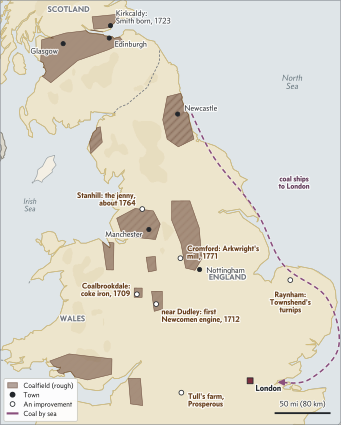
The answer came from Thomas Newcomen (nyoo-kum-en) (1664–1729), an ironmonger, a dealer in iron goods, from Dartmouth in Devon, who with his partner John Calley built the first steam engine that did useful work. In 1712, near Dudley Castle in Staffordshire, it pumped water from a coal mine.The Newcomen engine was first commercially deployed to pump water for this industry. → coal•• It was an atmospheric engine, so called because the push came from the weight of the air, not from the steam (Figure 23.6). Steam from a boiler filled a cylinder under a piston. A jet of cold water sprayed into the cylinder turned the steam back into water, leaving a partial vacuum, a space with almost no air in it, and the air above pressed the piston down. The piston hung by a chain from one end of a great wooden beam that rocked on the wall of the engine house. As the piston sank, the other end rose, lifting the heavy pump rods in the shaft and the water with them. Then the weight of the rods pulled the beam back, and the stroke began again, about twelve times a minute. The engine burned a great deal of coal, but at a coal mine coal was cheap, and by 1733, four years after Newcomen’s death, about 125 had been built.

Smith wrote about these engines. Among his examples of workmen inventing machines is a boy who was kept at an engine to open and shut the valve between the boiler and the cylinder at every stroke. One such boy, “who loved to play with his companions,” tied a string from the valve’s handle to another part of the machine, and the engine worked the valve itself. Legend names him Humphrey Potter, but the earliest pictures of a Newcomen engine, from 1717, already show valves worked by the beam, so the boy is more likely a parable than a memory. The engine’s next great improvement came from Smith’s own university. In 1757 it gave a workshop to a young instrument maker, James Watt, whom Smith befriended, and in 1763 Watt was asked to mend the university’s model Newcomen engine. Within two years he had thought of a separate condenser that saved most of its coal, and his engine belongs to the age that followed (Vol. 15, The Age of Revolution).
Coal changed iron too. Iron was smelted, melted out of its ore, in a blast furnace that burned charcoal, which is wood baked in a smothered fire, and charcoal grew scarcer as the woods shrank. Raw coal would not do, because its impurities, sulfur above all, made the iron brittle. In 1709 Abraham Darby, a Quaker ironmaster at Coalbrookdale in Shropshire, smelted iron with coke instead. Coke is coal baked without air,A form of this good used for iron smelting was known as coke. → coal• as charcoal is wood baked without air, so that the gases and much of the sulfur are driven off and nearly pure carbon is left. Darby’s iron was good for casting pots and kettles, and later the cylinders of Newcomen engines. In 1779 his grandson, Abraham Darby III, set up across the Severn near Coalbrookdale the first large bridge ever built of cast iron.
Cotton and the first mills
Cotton was a foreign cloth before it was a British one. After 1660 the East India Company brought home light, washable cotton from India, printed or painted in bright patterns, called calico after Calicut (kal-ih-kut), a port on India’s southwest coast. It became the fashion for dresses, curtains, and bed hangings. Wool had been England’s great industry for centuries, and the weavers of wool and silk watched their trade slip away. In 1719 some four thousand silk weavers of Spitalfields, in east London, rioted and threw ink and acid at women wearing calico. Parliament had already passed the first of the Calico Acts in 1700, banning the import of printed calicoes. After the riots the second, in 1721, forbade printed cotton clothThe Calico Acts restricted textiles made from this good to protect England's wool and silk industries. → cotton• in clothing and furnishings, as an act “to Preserve and Encourage the Woollen and Silk Manufactures of this Kingdom.” Fustian, a cloth woven with linen threads one way and cotton the other, was one of the few cloths exempted, and the weavers of Lancashire made more and more of it. It was a law of the mercantile system, protecting one industry at its customers’ expense.
Making cloth, the work of the textile trades (Vol. 1, The Toolkit), took two steps. Spinners drew out the loose fibers and twisted them into thread, and weavers wove the thread on a loom, the lengthwise threads called the warp and the crosswise ones the weft. Spinning was slow. Several spinners, each at a wheel that spun one thread, were needed to keep one weaver busy. Then John Kay’s flying shuttle of 1733 let a weaver shoot the cross-thread through the loom with a jerk of a cord, and the weaver needed more yarn still. About 1764 James Hargreaves, a weaver at Stanhill, near Blackburn in Lancashire, built a hand-turned frame that spun eight threads at once, and later models spun many more. Hargreaves’s spinning jennyJames Hargreaves invented the Spinning Jenny to aid production in this industry. → textiles• sped up the slowest step in the textile industry. A story says he named it after his daughter or his wife, Jenny, but the parish registers show no Jenny in his family, and the name was probably short for “engine.” When the price of yarn fell, his neighbors turned against the machine, and he moved to Nottingham, where he patented it in 1770. The jenny’s thread was soft, good only for the weft.
Strong thread for the warp came from a barber. Richard Arkwright, born in Preston in 1732, the youngest child of a tailor, made wigs in Bolton and sold a waterproof dye for them. With the clockmaker John Kay he built a machine that drew the cotton out between pairs of rollers, each pair turning faster than the one before, and then twisted it on spindles, and he patented it in 1769. It was too heavy to turn by hand, so he drove it first with horses at Nottingham and then with a waterwheel, which gave it its name. Arkwright’s water frame spun cottonRichard Arkwright’s water frame spun fibers of this crop. → cotton•Richard Arkwright developed the water frame for this industry. → textiles•• thread strong enough for the warp, so that British weavers could at last make cloth wholly of cotton. In 1774, after the new mill owners pressed for it, Parliament allowed cloth of pure cotton made in Britain to be printed and sold.

In 1771 Arkwright and his partners, the stocking makers Jedediah Strutt and Samuel Need, built a mill at Cromford, in a steep Derbyshire valley, the first successful cotton-spinning mill driven by water (Figure 23.7). Arkwright ran it by the clock, in two shifts of thirteen hours. Bells rang at five in the morning and five in the evening, the gates shut at six, and anyone who came late was shut out for the day and lost a second day’s pay. Few people lived in the valley, so he built cottages and hired whole families, children as young as seven among them. Near the end of his life about two-thirds of his 1,150 workers were children. He was knighted in 1786 and died in 1792, leaving a fortune of about half a million pounds. The Wealth of Nations, published five years after Cromford opened, still pictured industry as a workshop of ten men making pins. Within a generation of Smith’s death the factory, driven by water and then by Watt’s steam, had become the great fact of British life, and its story is told elsewhere (Vol. 15, The Age of Revolution).
What to remember
- Adam Smith (1723–1790), a Scot from Kirkcaldy, Hutcheson’s pupil and Hume’s closest friend, taught moral philosophy at Glasgow from 1752.
- The Theory of Moral Sentiments (1759) builds morality on sympathy: we judge ourselves by imagining whether an impartial spectator could share our feelings.
- The Wealth of Nations (1776) opens with the pin factory and the division of labor, grounds exchange in self-interest (“the butcher, the brewer, or the baker”), and sets water against diamonds in the paradox of value.
- Its Book III says that after Rome’s fall the towns were deserted and the country left uncultivated; Book IV attacks the mercantile system, which equated wealth with gold and sought exports over imports, and says the merchant is “led by an invisible hand” to serve society.
- “Das Adam Smith Problem” was German scholars’ name for the seeming clash between the sympathy of the first book and the self-interest of the second.
- Glasgow’s tobacco lords, John Glassford among them, grew rich on slave-grown Chesapeake tobacco after 1707, until the American war ruined the trade.
- Tull’s seed drill, Townshend’s turnips, and enclosure by act of Parliament raised harvests and took common rights from cottagers.
- Newcomen’s engine first pumped water from a coal mine in 1712; Darby smelted iron with coke in 1709.
- The Calico Acts protected wool and silk against Indian cotton; Hargreaves’s jenny and Arkwright’s water frame, at Cromford from 1771, began the factory age.
Back matter
Answers by Type
Every question asks for one kind of thing, and its first words usually say which: “this king,” “this battle,” “this philosopher,” “this novel.” That kind of thing is the question’s answer type. The chapters of this volume followed Britain and Ireland from 1453 to 1788 in the order things happened. This section takes the volume’s 220 answers out of that story and sorts them by type into twenty-one groups. History comes first: the monarchs and their families, then ministers, wars, plots, documents, and voyages. Then come the churches; the philosophers, their books, and their ideas; the writers, their books, and their characters; the composers and their music; the painters and their pictures; and last the places and things.
Each group opens with a table for comparing its answers at a glance and then gives a short entry for each answer, with the chapter that teaches it. The entries reprint only the clues that tell an answer from its look-alikes, and boxes at the end of a group take apart the pairs that players confuse most. This volume’s look-alikes are of three kinds. The commonest is a name that several people bore: four Edwards, four Jameses, four Elizabeths, three Marys, three Cromwells, two Pitts, and four Johnsons. The second is a book and its hero, such as Moll Flanders and Moll, or Tom Jones and Tom, where only the question’s first words decide. The third is one idea asked in several forms, as a man, a book, or a word: More, Utopia, and a utopia.
Kings and queens
Seventeen monarchs are answers, from Henry VI, who lost his mind in 1453, to George III, who was still king when the volume ends (Table A.1). A clue for one of them says “this king,” “this queen,” “this monarch,” or “this ruler,” and it nearly always names a wife, a minister, a rebel, or a battle, so the surest key is the date of that event. The trap is the number after the name. Three Henrys, two Jameses, two Charleses, and three Georges are answers, and what tells the second of a pair from the first is usually the crisis of the reign. The second Charles came back to the throne the first had lost, and the second James lost it again. Figure A.1 is the volume’s family tree.
| Monarch | Reigned | House | The crisis of the reign | Ch. |
|---|---|---|---|---|
| Henry VI | 1422–1461, 1470–1471 | Lancaster | Breakdown in 1453; the Wars of the Roses; killed in the Tower | 1 |
| Edward IV | 1461–1470, 1471–1483 | York | Secret marriage to Elizabeth Woodville; Warwick’s revolt | 1 |
| Richard III | 1483–1485 | York | The princes in the Tower; killed at Bosworth | 1 |
| Henry VII | 1485–1509 | Tudor | The pretenders Simnel and Warbeck; Morton’s Fork | 1 |
| Henry VIII | 1509–1547 | Tudor | Six wives; the break with Rome; the monasteries dissolved | 2 |
| Edward VI | 1547–1553 | Tudor | A boy king; Cranmer’s Book of Common Prayer (1549) | 2 |
| Mary I | 1553–1558 | Tudor | A Spanish marriage; Protestants burned; Calais lost | 3 |
| Elizabeth I | 1558–1603 | Tudor | The church settled; the Scottish queen beheaded; the Armada | 3 |
| Mary, Queen of Scots | Scotland, 1542–1567 | Stuart | Darnley murdered; forced to abdicate; beheaded in England (1587) | 3 |
| James I (VI of Scotland) | Scotland from 1567; England 1603–1625 | Stuart | The Union of the Crowns; the Gunpowder Plot; the King James Bible | 4 |
| Charles I | 1625–1649 | Stuart | The Personal Rule; the Civil War; beheaded | 5 |
| Charles II | 1660–1685 | Stuart | The Restoration; plague and fire; the Popish Plot | 8, 9 |
| James II | 1685–1688 | Stuart | A Catholic king driven out in the Glorious Revolution | 10 |
| William III | 1689–1702 | Orange; Stuart mother | The invasion of 1688; the Boyne; reigned with Mary II to 1694 | 10 |
| George I | 1714–1727 | Hanover | The South Sea Bubble; the Jacobite rising of 1715 | 13 |
| George II | 1727–1760 | Hanover | Dettingen; the Forty-Five; the Seven Years’ War | 13 |
| George III | 1760–1820 | Hanover | The loss of America; the Gordon Riots; his illness | 22 |
Henry VI. The Lancastrian king who inherited the throne as a baby in 1422 and lost his mind in 1453. In 1445 he married Margaret of Anjou,This ruler's wife was Margaret of Anjou. → Henry VI of England•• a French king’s niece, and she fought for their son when he could not. Deposed in 1461, he was brought back when Warwick and Margaret restored himThis ruler was briefly restored to the throne by Margaret of Anjou and the Earl of Warwick in 1470. → Henry VI of England• in 1470, for six months; after Tewkesbury he was put to death in the Tower. Taught in Chapter 1.
Edward IV. The Yorkist who took the crown in 1461 and made it safe at Towton, lost it to Warwick in 1470, and won it back at Barnet and Tewkesbury in 1471. In 1464 he married Elizabeth WoodvilleThis ruler married Elizabeth Woodville. → Edward IV•• in secret, and the match turned his cousin the Kingmaker against him. He is not his son Edward V, one of the princes in the Tower. Taught in Chapter 1.
Richard III. Edward IV’s brother, Duke of Gloucester, who took the throne in 1483 from his nephew Edward V. He was the last Yorkist king.This ruler was the last Yorkist monarch of England. → Richard III• Thomas More’s story, written about thirty years later, makes him the murderer of the princes, and he possibly had his nephews killed,This ruler possibly murdered the Princes in the Tower. → Richard III•• a doubt that has never been settled. He died fighting at Bosworth in 1485. Taught in Chapter 1.
Henry VII. Henry Tudor, the exile who defeated and killed Richard IIIThis monarch defeated Richard III at the Battle of Bosworth Field. → Henry VII•• at Bosworth in 1485 and founded the Tudor dynasty. To join the two houses he married Elizabeth of York,This ruler married Elizabeth of York. → Henry VII• Edward IV’s daughter, in 1486. He beat off two pretenders and squeezed his subjects for money, and, as Bacon tells it in 1622, the dilemma called Morton’s ForkThe tax-collection dilemma called “Morton’s Fork” was used during this monarch’s reign. → Henry VII•• caught rich and thrifty alike. Taught in Chapter 1.
Henry VIII. The second Tudor, king from 1509 to 1547, who married six times. Pope Leo X rewarded his book against Luther, so that he became “Defender of the Faith.”This ruler's Defense of the Seven Sacraments earned him the title 'Defender of the Faith.' → Henry VIII•• When Clement VII refused to annul his first marriage he broke with Rome, and his Act of Supremacy of 1534This ruler's Act of Supremacy made him the head of the Church of England. → Henry VIII••• made him supreme head of the Church of England. Elizabeth’s Act of 1559 is a different law. Taught in Chapter 2.
Edward VI. The son of Henry VIII and Jane Seymour, nine years old when he succeeded his fatherThis ruler was Henry VIII’s son and successor. → Edward VI• in 1547. Cranmer’s Book of Common Prayer was first used in his reign, in 1549, and before he died at fifteen in 1553 he tried to leave the crown to Lady Jane Grey. Taught in Chapter 2.
Mary I. Catherine of Aragon’s Catholic daughter, queen from 1553, who restored the pope’s authority. She married Philip of SpainThis ruler of England married Philip II of Spain. → Mary I• in 1554, and his war with France cost England its last town across the Channel, for in January 1558 England lost Calais.England lost Calais during this ruler’s reign. → Mary I• Protestant writers named her “Bloody Mary” for the burnings. Taught in Chapter 3.
Elizabeth I. The daughter of Henry VIII and Anne Boleyn,This monarch was the daughter of Henry VIII and Anne Boleyn. → Elizabeth I•• queen from 1558 to 1603 and the last of the Tudors. Her Act of Supremacy of 1559This monarch passed the Act of Supremacy in 1559. → Elizabeth I• made her “Supreme Governor” of the Church; she never married, and in poems and pictures she became the Virgin Queen.This monarch was known as the “Virgin Queen.” → Elizabeth I••• Her reign saw her Scottish cousin beheaded and the Armada beaten. She is not Elizabeth Stuart, James I’s daughter. Taught in Chapter 3.
Mary, Queen of Scots. The daughter of James V,This ruler was the daughter of James V. → Mary, Queen of Scots• queen at six days old in 1542, and Elizabeth’s cousin and rival through Margaret Tudor. Forced to abdicate for her son in 1567, she fled to England, where plot after plot was made in her name, and at last she was beheaded for the Babington Plot,Elizabeth I had this ruler beheaded after the Babington Plot sought to place her on the English throne. → Mary, Queen of Scots•• at Fotheringhay in 1587. Her son was James VI and I. Taught in Chapter 3.
James I of England. James VI of Scotland, son of Mary, Queen of Scots, king there from 1567, who in 1603 succeeded Elizabeth as the first StuartThis first Stuart king of England succeeded Elizabeth I. → James I of England [or James VI of Scotland]•• king of England. Catholics tried to blow him up in the Gunpowder Plot, and in 1611 he authorized the King James Bible.This ruler authorized a namesake Bible. → James I of England [or James VI of Scotland]•• He wrote Daemonologie and a Counterblaste against tobacco. He is not his grandson James II. Taught in Chapter 4.
Charles I. James I’s second son, king from 1625, who believed in the divine right of kings. He ruled without ParliamentThis ruler refused to call Parliament for eleven years during a period known as "personal rule." → Charles I•• from 1629 to 1640, the Personal Rule, raised ship money, and lost the Civil War, and in 1649 he was beheadedThis ruler was executed after defeat by Parliament’s forces in the English Civil War. → Charles I•• after Parliament’s court condemned him. Van Dyck painted him at the hunt and on horseback. Taught in Chapter 5.
Charles II. Charles I’s son, who fled abroad after he lost at WorcesterThis king went into exile after losing the Battle of Worcester. → Charles II•• in 1651 and came back as king in 1660, the Restoration. He married Catherine of Braganza,This ruler was married to Catherine of Braganza. → Charles II•• who brought Bombay as her dowry and made tea fashionable, and he kept Nell Gwyn as his mistress. Plague, fire, the Popish Plot, and the fight over his Catholic brother filled his reign. Taught in Chapter 8 and Chapter 9.
James II. Charles II’s Catholic brother, king from 1685, who began by crushing a rebellion and lost his throne within four years. Monmouth’s rising ended at SedgemoorThe Duke of Monmouth’s rebellion against this ruler ended at Sedgemoor. → James II•• in July 1685. He was the last Catholic kingThis ruler was the last Roman Catholic ruler of England. → James II•• of England; the birth of his son in 1688 brought William of Orange’s invasion, and he fled to France. He is not James I, his grandfather. Taught in Chapter 10.
William III. The Dutch stadtholder, Prince of Orange, Charles I’s grandson and James II’s nephew and son-in-law. In 1654, under Cromwell’s treaty with the Dutch, the Act of Seclusion barred the boyThe Act of Seclusion barred this Prince of Orange from becoming stadtholder of Holland. → William III of England• from Holland’s stadtholdership. In 1688 he invaded at the invitation of James’s own subjects, and he took the throne with Mary II;This Dutch stadtholder took the English throne with his wife Mary in the Glorious Revolution. → William III of England••• he beat James at the Boyne in 1690. Taught in Chapter 10.
George I. The elector of Hanover, Sophia’s son and Elizabeth Stuart’s grandson, who succeeded Queen Anne in 1714 under the Act of Settlement. The South Sea Bubble burst in his reign,The South Sea Bubble occurred during this monarch's reign. → George I• in 1720, and in the rising of 1715 the Old Pretender challenged him.The “Old Pretender” challenged this ruler in the Jacobite rising of 1715. → George I• Walpole became his chief minister. Taught in Chapter 13.
George II. George I’s son, king from 1727 to 1760, who kept Walpole as his minister. On June 27, 1743, at Dettingen, he became the last British kingAt Dettingen, this monarch became the last British king to lead troops in battle. → George II• to lead troops in battle. The rising of 1745 was defeatedThe Jacobite rising of 1745 was defeated during this king’s reign. → George II• in his reign, at Culloden, and Handel wrote Zadok the Priest for his coronation. Taught in Chapter 13.
George III. George II’s grandson, born in England, who reigned from 1760 to 1820This monarch reigned from 1760 to 1820, including the American Revolution and Britain’s loss of the Thirteen Colonies. → George III••• and lost the thirteen colonies. His prime ministers ran from Bute through Lord North to William Pitt the YoungerWilliam Pitt the Younger served as Prime Minister during this monarch's reign. → George III•• in 1783. His illness of 1788 has been called porphyria, a disputed diagnosis, and the satirists called him “Farmer George.” Taught in Chapter 22.
Royal wives, names, and the Tudor house
Eight answers are royal wives, royal names, or a royal house (Table A.2). Three of Henry VIII’s six wives are answers in their own right, and a clue for one of them names her husband’s quarrel, her child, or her fate. A clue for a name says “this name” or “this first name” and gives two or more people who bore it, so it can look like a clue for any one of them. The rhyme “divorced, beheaded, died; divorced, beheaded, survived” keeps Henry’s six wives in order (Figure A.2).
| Answer | Who or what | Dates | To remember | Ch. |
|---|---|---|---|---|
| Catherine of Aragon | Henry VIII’s first wife, Prince Arthur’s widow | Married 1509; annulled 1533 | Mother of Mary I; aunt of Charles V | 2 |
| Anne Boleyn | Henry’s second wife | Married 1533; beheaded 1536 | Mother of Elizabeth I | 2 |
| Catherine Parr | Henry’s sixth wife | Married 1543 | Outlived him; published a book | 2 |
| Catherine | The first name of three of his wives | 1509–1547 | Aragon, Howard, and Parr | 2 |
| Henry | The name of the first two Tudor kings | 1485–1547 | Henry VII and Henry VIII | 1 |
| James | The name of England’s first Stuart king | From 1603 | James VI and I | 4 |
| George | The name of four Hanoverian kings in a row | 1714–1830 | George I to George IV | 13 |
| Tudor dynasty | The house of Henry VII and his heirs | 1485–1603 | Named for Owen Tudor | 1 |
Catherine of Aragon. The youngest child of Ferdinand and Isabella, sent to England to marry Henry VII’s heir. Her first husband was Prince Arthur,This person’s first husband was Prince Arthur. → Catherine of Aragon•• who died in 1502, and a papal dispensation let her marry his brother, Henry VIII, in 1509. Because she was Charles V’s aunt,This person was the aunt of Holy Roman Emperor Charles V. → Catherine of Aragon• Clement VII would not annul the marriage, and Henry broke with Rome. Her daughter was Mary I. Taught in Chapter 2.
Anne Boleyn. Henry’s second wife and the mother of Elizabeth I, created Marquess of PembrokeThis woman was created Marquess of Pembroke. → Anne Boleyn• in 1532, a year before he married her. When she gave him no son she fell. Charged with adultery and with incest with her brother George,This woman was accused of incest with her brother George. → Anne Boleyn• she was beheaded with a sword in the Tower on May 19, 1536. A story says she was watching tennis when she was summoned. Taught in Chapter 2.
Catherine Parr. Henry’s sixth and last wife, twice widowed before him, who married him in 1543 and outlived him. In 1545 she published Prayers or Meditations,This queen wrote Prayers or Meditations, becoming the first English queen to publish a book under her own name. → Catherine Parr•• the first book an English queen put out under her own name. Taught in Chapter 2.
Catherine. The name that three of Henry’s six wivesThree of Henry VIII's six wives shared this first name. → Catherine•• shared. Catherine of Aragon was the first, and Catherine Howard and Catherine ParrWomen surnamed Howard and Parr shared this first name and were wives of Henry VIII. → Catherine• were the fifth, beheaded in 1542, and the sixth. A clue that names Aragon, Howard, or Parr and asks for “this first name” wants Catherine; one that names Charles II wants his queen, Catherine of Braganza, a fourth. Taught in Chapter 2.
Henry. The name shared by the Tudor father and son who reigned from 1485 to 1547. The first two Tudor kings were both Henrys,The first two kings of England's Tudor dynasty both had this name. → Henry• because Henry VII’s elder son, Arthur, died in 1502 and never reigned. A third Henry of this volume, Henry VI, was a Lancastrian. Taught in Chapter 1.
James. The first name of the king who joined the crowns in 1603, since England’s first Stuart king was a James:England’s first Stuart king bore this name. → James• James VI of Scotland and James I of England. No king of England had borne the name before him. Taught in Chapter 4.
George. The name that four Hanoverian kings bore in a row,The first four Hanoverian kings of Britain shared this name, also borne by two later British monarchs. → George•• George I to George IV, from 1714 to 1830; two kings of the twentieth century, George V and George VI, bore it too. Taught in Chapter 13.
Tudor dynasty. The royal house that Henry VII founded in 1485, named for his Welsh grandfather, Owen Tudor. Henry VII, Henry VIII, and Elizabeth IThis dynasty included Henry VII, Henry VIII, and Elizabeth I. → Tudor dynasty•• were its great monarchs, with Edward VI and Mary I between the last two. It ended with Elizabeth’s death in 1603. Taught in Chapter 1.
Ministers, favorites, and commanders
Nine answers served the crown, or in Cromwell’s case replaced it (Table A.3). Clues call them “this minister,” “this politician,” “this man,” or “this admiral,” and they usually name the monarch served or the event that made or broke the man. The traps are family names. Three Cromwells, two Walpoles, and two Pitts appear in this volume, and the elder Pitt is an answer both by himself and, with his son, as a family. Figure A.3 sets the Georgian first ministers in order, from Walpole to the younger Pitt.
| Name | Dates | Served | Known for | The end | Ch. |
|---|---|---|---|---|---|
| Richard Neville, Earl of Warwick | 1428–1471 | Edward IV, then Henry VI | “The Kingmaker” | Killed at Barnet, 1471 | 1 |
| Thomas More | 1478–1535 | Henry VIII; Lord Chancellor to 1532 | Utopia; refused the royal supremacy | Beheaded, 1535 | 2 |
| Thomas Cromwell | About 1485–1540 | Henry VIII, chief minister | The break with Rome; the monasteries dissolved | Beheaded, 1540 | 2 |
| Francis Walsingham | About 1532–1590 | Elizabeth I | Her spymaster; the Babington Plot exposed | 3 | |
| Oliver Cromwell | 1599–1658 | Parliament; Lord Protector from 1653 | The New Model Army; Ireland; the Protectorate | Died 1658; body beheaded 1661 | 5, 6 |
| Robert Walpole | 1676–1745 | George I and George II | The first prime minister, 1721–1742 | Resigned, 1742 | 13 |
| John Byng | 1704–1757 | George II | The admiral who failed to relieve Minorca | Shot, 1757 | 22 |
| William Pitt the Elder | 1708–1778 | George II and George III | The Great Commoner; the Seven Years’ War | Earl of Chatham, 1766 | 22 |
| Pitt | The family of two prime ministers named William | 22 |
Richard Neville, Earl of Warwick. Edward IV’s cousin and chief adviser, who helped make him king in 1461 and then turned on him over the Woodville marriage. He is remembered as “the Kingmaker”This Earl of Warwick was nicknamed “the Kingmaker” during the Wars of the Roses. → Richard Neville, Earl of Warwick••• because he made kings and unmade them, restoring Henry VI in 1470. In the fog of Easter morning 1471 he was killed at Barnet.This Earl of Warwick was killed at the foggy Battle of Barnet during the Wars of the Roses. → Richard Neville, Earl of Warwick•• Taught in Chapter 1.
Thomas More. The lawyer, scholar, and author of Utopia who served Henry VIII as Lord Chancellor until 1532. Three years later he was beheaded for refusingThis lord chancellor was executed after refusing to acknowledge Henry VIII as head of the Church of England. → Thomas More•• to acknowledge the king as head of the Church, on July 6, 1535. A clue that asks for “this lord chancellor” wants More; one that asks for “this work” and names Hythloday wants Utopia. Taught in Chapter 2.
Thomas Cromwell. The brewer’s son from Putney who became Henry VIII’s chief minister after Wolsey’s fall, carried through the break with Rome, and oversaw the dissolution of the monasteries. He was beheaded in 1540This chief minister of Henry VIII was executed after arranging the king’s unsuccessful marriage to Anne of Cleves. → Thomas Cromwell•• after arranging the king’s unhappy marriage to Anne of Cleves. Oliver Cromwell descended from his sister. Taught in Chapter 2.
Francis Walsingham. The quiet Protestant lawyer who ran Elizabeth’s secret service, so that history calls him her spymaster.This man served as Elizabeth I’s spymaster. → Francis Walsingham•• His agents broke the Throckmorton Plot in 1583 and the Babington Plot in 1586, which cost Mary, Queen of Scots, her head. Taught in Chapter 3.
Oliver Cromwell. The country squire who became Parliament’s greatest general and then ruled without a king. In 1650 he succeeded Fairfax in commandThis man succeeded Thomas Fairfax in command of the New Model Army. → Oliver Cromwell••• of the New Model Army, and in 1653 the Instrument of Government made him Lord Protector of England,This man was Lord Protector of England. → Oliver Cromwell••• Scotland, and Ireland. When he died in 1658 his son Richard succeeded him,This man was succeeded by his son Richard, nicknamed “Tumbledown Dick.” → Oliver Cromwell•• and lasted eight months. Taught in Chapter 5 and Chapter 6.
Robert Walpole. The Norfolk squire who is called the first British prime minister,This politician is considered the first British Prime Minister. → Robert Walpole••• First Lord of the Treasury from 1721 to 1742 under George I and George II. He first used 10 Downing Street,This politician was the first to use 10 Downing Street while serving as First Lord of the Treasury. → Robert Walpole•• and his long rule ended after the defeat at Cartagena. His son Horace wrote The Castle of Otranto. Taught in Chapter 13.
William Pitt the Elder. The Great Commoner, who in 1757, after the king had failed to govern without him, joined the Duke of NewcastleThis politician, nicknamed the “Great Commoner,” formed a ministry with the Duke of Newcastle. → William Pitt the Elder•• in a ministry and directed the Seven Years’ War to the victories of 1759. He became Earl of Chatham and prime minister in 1766. His son, Pitt the Younger, became prime minister at twenty-four. Taught in Chapter 22.
Pitt. The family name of two prime ministers named William,This family featured two Prime Ministers named William, known as the "elder" and "younger." → Pitt•• the Elder (1708–1778) and his second son, the Younger (1759–1806). A clue that names both and asks for “this family” wants Pitt. Taught in Chapter 22.
John Byng. The admiral who failed to relieve Minorca in 1756, at the start of the Seven Years’ War. Byng was shot for that failureThis admiral was executed after failing to relieve Minorca during the Seven Years’ War. → John Byng•• in 1757, on the quarterdeck of HMS Monarch off Portsmouth, though the court that condemned him asked the king for mercy. Taught in Chapter 22.
Wars, battles, and an army
Ten answers are wars, battles, or an army (Table A.4). A battle clue names a commander, a side, a nearby town, or something that happened on the field, and the answer line usually accepts the place name alone. Most of the volume’s battles were fought among Englishmen, Scots, and Irishmen over the crown itself, so the question to ask is who wanted the throne and who held it. Two pairs cause most mistakes. Marston Moor and Naseby were both Parliament’s victories over Prince Rupert, and Prestonpans and Culloden were the Jacobites’ great victory and their ruin, seven months apart.
| Answer | Date | Where | Who against whom | Outcome | Ch. |
|---|---|---|---|---|---|
| Wars of the Roses | 1455–1487 | England | The house of York against the house of Lancaster | The Tudors on the throne | 1 |
| Battle of Bosworth Field | August 22, 1485 | Near Market Bosworth, in the Midlands | Henry Tudor against Richard III | Richard killed; Henry VII king | 1 |
| English Civil War | 1642–1651 | England, Scotland, and Ireland | Charles I’s Cavaliers against Parliament’s Roundheads | The king beheaded in 1649 | 5 |
| New Model Army | Formed 1645 | England | Parliament’s army, under Fairfax, then Cromwell | Won the war; purged Parliament | 5 |
| Battle of Naseby | June 14, 1645 | Northamptonshire | Fairfax’s New Model Army against the king | The royal army destroyed | 5 |
| Battle of the Boyne | July 1, 1690 | The River Boyne, Ireland | William III against James II | James fled to France | 10 |
| Battle of Blenheim | August 13, 1704 | Blindheim, on the Danube | Marlborough and Eugene against the French and Bavarians | A great victory; a palace named for it | 13 |
| Battle of Prestonpans | September 1745 | East of Edinburgh | The Jacobites against Sir John Cope | A Jacobite victory | 13 |
| Battle of Culloden | April 16, 1746 | Near Inverness | The Duke of Cumberland against the Jacobites | The Jacobites crushed | 13 |
| Seven Years’ War | 1756–1763 | Europe, America, India, and the seas | Britain against France | Britain’s year of victories, 1759 | 22 |
Wars of the Roses. The civil wars of 1455 to 1487 between York and Lancaster,This fifteenth-century conflict was fought between the Houses of York and Lancaster. → Wars of the Roses••• two branches of Edward III’s family, named long afterward for their white and red roses. In 1455 the first battle of St. Albans began them,The First Battle of St. Albans, where Henry VI was captured, began this conflict. → Wars of the Roses•• with Henry VI wounded and captured; Bosworth (1485) and Stoke (1487) ended them. Taught in Chapter 1.
Battle of Bosworth Field. The battle of August 22, 1485, in which Henry Tudor beat and killed Richard III and became Henry VII. As Polydore Vergil tells it, the Stanleys held back their menThe Stanleys initially withheld their troops, then intervened for Henry Tudor at this battle. → Battle of Bosworth Field• all morning and then charged Richard’s flank. It is taken as the end of the Wars of the Roses. Taught in Chapter 1.
English Civil War. The war of 1642 to 1651 in which Charles I’s Cavaliers fought Parliament’s Roundheads.The Cavaliers supported Charles I against the Roundheads in this war. → English Civil War•• In 1642 the siege of Hull began it;The siege of a weapons depository at Hull marked the beginning of the first phase of this conflict. → English Civil War• Marston Moor (1644) and Naseby (1645) decided it; Pride’s Purge (1648) and the king’s execution (1649) ended its first act. Taught in Chapter 5.
Battle of Naseby. The battle in Northamptonshire on June 14, 1645, in which Fairfax’s New Model Army beat the king,Thomas Fairfax’s New Model Army defeated Prince Rupert’s Royalist forces at this English Civil War battle. → Battle of Naseby•• with Cromwell leading the charge that decided it and Rupert’s horse coming back too late. It destroyed the royal army. Marston Moor, a year earlier, was won by Parliament and the Scots together. Taught in Chapter 5.
New Model Army. Parliament’s professional army of 1645, commanded first by Thomas Fairfax,This Parliamentary army was commanded first by Thomas Fairfax and later by Oliver Cromwell. → New Model Army•• with Cromwell under him, and from 1650 by Cromwell. It won Naseby, and in 1647, at Putney, its Agitators argued with its GrandeesThis army’s “Agitators” argued with its “Grandees” at the Putney Debates. → New Model Army•• over what the war had been for. Its veterans later called that cause “the Good Old Cause.” Taught in Chapter 5.
Battle of the Boyne. The battle in Ireland on July 1, 1690, at which William III defeated James IIWilliam III defeated James II at this 1690 battle in Ireland. → Battle of the Boyne•• and the Jacobites. James fled to France, and Irish speakers gave him a rude nickname. Taught in Chapter 10.
Battle of Blenheim. The Duke of Marlborough’s victory of August 13, 1704, with Prince Eugene, over the French and Bavarians near the village of Blindheim on the Danube, in the War of the Spanish Succession. Blenheim Palace was named for it,Marlborough’s palace in Oxfordshire was named for this battle. → Battle of Blenheim• and the Dukes of Marlborough still live there. Taught in Chapter 13.
Battle of Prestonpans. The Jacobites’ victory of September 1745, when the prince’s army beat Sir John CopeThe Jacobites defeated Sir John Cope at this battle, inspiring the mocking song “Hey, Johnnie Cope, Are Ye Waking Yet?” → Battle of Prestonpans•• in a quarter of an hour on the shore east of Edinburgh. A song still mocks the beaten general. Taught in Chapter 13.
Battle of Culloden. The battle on Drummossie Moor near Inverness on April 16, 1746, at which Cumberland crushed the Jacobites.The Duke of Cumberland defeated the Jacobites at this battle, commonly described as the last pitched battle on British soil. → Battle of Culloden•• It is called the last pitched battle on British soil. Taught in Chapter 13.
Seven Years’ War. The war of 1756 to 1763 that Britain fought against France around the world, directed by Pitt the Elder.William Pitt the Elder led Britain during this war. → Seven Years' War•• Victories at Minden, Lagos, Quebec, and Quiberon Bay made 1759 the “Annus Mirabilis,”British victories made 1759 the “Annus Mirabilis” of this war. → Seven Years' War•• the year of wonders. Taught in Chapter 22.
Plots, revolutions, and disasters
Ten answers are events that shook a reign, and the people at their center (Table A.5). Clues call them “this plot,” “this event,” “this disaster,” or “this movement,” and the date is usually the surest key, because the volume’s plots and risings came a generation or two apart. Two pairs are easily crossed. London’s plague and fire came a year apart, and Pepys’s diary tells both. The crown changed hands twice in twenty-eight years: Charles II came back to it in the Restoration of 1660, and William and Mary took it from his brother in the Glorious Revolution of 1688. A third tangle is the Stuart heirs in exile, whom a box at the end of this group sorts out.
| Answer | Date | What happened | Names in the clues | Ch. |
|---|---|---|---|---|
| Witch trials | 1590 | A witch hunt at North Berwick | James VI’s storms; Daemonologie (1597) | 4 |
| Gunpowder Plot | November 5, 1605 | A Catholic plan to blow up king and Parliament | Catesby; Fawkes; Monteagle’s letter; Holbeche House | 4 |
| Guy Fawkes | November 1605 | The plotter caught with the gunpowder | “John Johnson”; Bonfire Night | 4 |
| English Restoration | 1660 | Charles II restored | Monck; the Declaration of Breda; Oak Apple Day | 8 |
| Great Plague of London | 1665 | Bubonic plague | Pepys; Defoe’s Journal (1722) | 8 |
| Great Fire of London | September 1666 | Most of the City burned | Pudding Lane; Bloodworth; Pepys’s cheese | 8 |
| Glorious Revolution | 1688–1689 | James II driven out; William and Mary crowned | The warming-pan baby; the Immortal Seven; Torbay | 10 |
| Jacobites | 1688–1746 | The supporters of the exiled Stuarts | The risings of 1715 and 1745; Sheriffmuir | 13 |
| Bonnie Prince Charlie | 1720–1788 | The Young Pretender | Prestonpans; Culloden; the escape to Skye | 13 |
| The Gordon Riots | June 1780 | Anti-Catholic riots in London | The Papists Act (1778); Newgate burned | 22 |
Witch trials. The hunt of 1590 at North Berwick, on the coast east of Edinburgh. James VI believed that witches had raised storms against his voyages to and from his Danish bride, and those storms set off the trials.Storms during James VI and Anne of Denmark’s sea voyage helped inspire these proceedings at North Berwick. → witch trials•• He watched the examinations and wrote Daemonologie. Taught in Chapter 4.
Gunpowder Plot. The Catholic conspiracy of 1605, which Robert Catesby led from the first,Robert Catesby led this plot. → Gunpowder Plot•• to blow up James I and Parliament on November 5. The plotters meant to make Elizabeth Stuart a Catholic queen,The goal of this event was to place Elizabeth Stuart on the throne under Catholic control. → Gunpowder Plot• but an anonymous letter to Lord Monteagle gave them away. It is not the Popish Plot of 1678, which Titus Oates invented. Taught in Chapter 4.
Guy Fawkes. The York-born Catholic soldier caught with the gunpowder under Parliament in 1605. He called himself John Johnson,This Gunpowder Plot conspirator used the alias “John Johnson.” → Guy Fawkes•• the name he lived under as a servant, and his effigy is still burned every November 5. Taught in Chapter 4.
English Restoration. The return of the monarchy in 1660, when Charles II came back to his father’s throneCharles II returned to the English throne in 1660 during this event, ending the Interregnum. → English Restoration•• and the Interregnum ended. General Monck made it possible, and Oak Apple Day celebrated itOak Apple Day celebrates the anniversary of this event. → English Restoration• every May 29 until 1859. Taught in Chapter 8.
Great Plague of London. The bubonic plague of 1665, the last great outbreak in England, which Pepys chronicled the year before the fire.Samuel Pepys chronicled this 1665 outbreak, which preceded the Great Fire of London. → Great Plague of London•• Defoe told it again in A Journal of the Plague Year (1722). Taught in Chapter 8.
Great Fire of London. The fire that began in Pudding LaneThis 1666 disaster began on Pudding Lane and destroyed much of London. → Great Fire of London•• on September 2, 1666, and in four days destroyed most of the City and Old St. Paul’s. The Lord Mayor, Sir Thomas Bloodworth, refused to pull down housesThis event is believed to have been worsened by Thomas Bloodworth's inaction to demolish buildings. → Great Fire of London• in its path, and Pepys buried his cheese. Wren’s Monument stands 202 feet from where it started. Taught in Chapter 8.
Glorious Revolution. The overthrow of James II in 1688. The birth of his son that June, the rumored “warming-pan baby,”The birth of James Francis Edward, rumored to be a “warming-pan baby,” raised fears of a Catholic succession and helped cause this event. → Glorious Revolution••• raised fears of a Catholic line of kings. The Immortal Seven invited William of Orange in a letter that Henry Sidney drafted,Henry Sidney drafted the Immortal Seven’s invitation that helped precipitate this event. → Glorious Revolution••• and William landed at Brixham on TorbayWilliam of Orange landed at Brixham on Torbay during this event. → Glorious Revolution•• on November 5. The Declaration of Right became the Bill of Rights in 1689. Taught in Chapter 10.
Jacobites. The supporters of the exiled Stuarts, named from Jacobus, Latin for James. For more than sixty years the Old Pretender was their figurehead,James Francis Edward Stuart, the “Old Pretender,” was a figurehead of this movement. → Jacobites• though he led only one campaign in Britain. In the rising of 1715 the Earl of Mar led them at SheriffmuirThe Earl of Mar (John Erskine) led this movement at the Battle of Sheriffmuir. → Jacobites•• and wasted his advantage; the rising of 1745, led by the Old Pretender’s son, ended at Culloden. Taught in Chapter 13.
Bonnie Prince Charlie. Charles Edward Stuart, the Old Pretender’s elder son, known as the “Young Pretender”This Jacobite prince was known as the “Young Pretender.” → Bonnie Prince Charlie• to the Whigs. He led the Forty-Five from Glenfinnan to Derby and back, and after Culloden he escaped to Skye disguised as a woman,This Jacobite prince escaped to the Isle of Skye disguised as a woman. → Bonnie Prince Charlie•• Flora MacDonald’s maid. Taught in Chapter 13.
The Gordon Riots. The anti-Catholic riots in London in June 1780, which broke out against the Papists Act of 1778,These anti-Catholic riots followed the Papists Act of 1778. → the Gordon Riots•• the law that had eased the burdens on Catholics. Lord George Gordon’s Protestant Association raised the crowds, and the rioters burned Newgate Prison. Taught in Chapter 22.
Parliaments, parties, and documents
Five answers concern how the kingdom was governed: a written constitution, an old charter, the unwritten constitution as a whole, the giving up of a crown, and a party (Table A.6). Their clues name the man who drafted, numbered, or used them. The Whigs are the only party that is an answer; their rivals, the Tories, were named in the same quarrel over a Catholic heir in 1679.
| Answer | Date | What it is | Names in the clues | Ch. |
|---|---|---|---|---|
| Instrument of Government | December 1653 | The first written constitution in English history | John Lambert; Cromwell made Lord Protector for life | 6 |
| Magna Carta | 1215 | King John’s charter | Blackstone’s edition (1759), with sixty-three clauses | 10 |
| Constitutions | Grown over centuries | Britain’s is uncodified, often called “unwritten” | Statutes, conventions, and judgments | 10 |
| Abdication | 1567; 1689 | The giving up of a throne | Mary, Queen of Scots; James II, who “abdicated the government” | 3, 10 |
| Whigs | From 1679 | Shaftesbury’s party | The Exclusion Bills; the Rye House Plot; Algernon Sidney | 9 |
Instrument of Government. The constitution drafted by John Lambert, one of Cromwell’s generals, in 1653, the first written constitution in English history. It made Cromwell Lord Protector for life,This written constitution, drafted by John Lambert, made Oliver Cromwell Lord Protector for life. → Instrument of Government•• sharing power with a Council of State and Parliaments. Taught in Chapter 6.
Magna Carta. King John’s charter of 1215 (Vol. 8, The Northern Worlds), an answer here because Blackstone numbered its sixty-three clausesThis document's modern numbering system, which includes 63 sections, was introduced by William Blackstone. → Magna Carta•• in his careful edition of 1759, the numbering still used. Taught in Chapter 10.
Constitutions. The answer when a clue asks what Britain’s “unwritten” one is: Britain’s constitution is uncodified,The United Kingdom’s uncodified example of these systems, often described as “unwritten,” draws on statutes, conventions and other sources. → constitutions• drawn from statutes such as Magna Carta and the Bill of Rights, from conventions, and from judgments. Cromwell’s Instrument of Government was a written one. Taught in Chapter 10.
Abdication. The giving up of a throne. In 1567 Mary, Queen of Scots, was forced to abdicateMary, Queen of Scots performed this action, allowing her son James VI to become king with the Earl of Moray as regent. → abdication• for her baby son, James VI, with the Earl of Moray as regent. In January 1689 the Commons resolved that James II, who had fled and dropped the Great Seal in the Thames, had “abdicated the government.”After James II fled and threw the Great Seal into the Thames, the Convention Parliament declared that he had performed this action. → abdication• Taught in Chapter 3 and Chapter 10.
Whigs. The party born in the Exclusion Crisis, when Shaftesbury’s followers pressed Exclusion BillsLed by the 1st Earl of Shaftesbury, this British faction supported Exclusion Bills targeting the future James II. → Whigs•• (1679–1681) to keep the Catholic James from the throne. Several of their leaders were caught up in the Rye House Plot of 1683, and they counted Algernon Sidney among their martyrs.This faction's martyrs included Algernon Sidney, the author of Discourses Concerning Government. → Whigs• They held power under the first two Georges. Taught in Chapter 9.
Explorers, ships, and the slave trade
Three explorers are answers, one from each of the sixteenth, seventeenth, and eighteenth centuries, and five more answers come from the sea and the trade that crossed it (Table A.7). Clues for an explorer name a ship, a shipmate, a place first reached, or a death, and the ships tell them apart. Drake sailed the Golden Hind; Hudson the Hopewell, the Half Moon, and the Discovery; Cook the Endeavour and the Resolution. The rest of the group belongs to the pirates, to the Atlantic slave trade, which British ships led for most of the eighteenth century, and to the first campaign against it.
| Answer | Date | Ships or occasion | Known for | Ch. |
|---|---|---|---|---|
| Sir Francis Drake | About 1540–1596 | The Golden Hind | Around the world, 1577–1580; the raid on Cádiz, 1587 | 3 |
| Henry Hudson | Voyages 1607–1611 | Hopewell, Half Moon, Discovery | The Hudson River (1609); Hudson Bay (1610); set adrift (1611) | 4 |
| James Cook | 1728–1779 | Endeavour, Resolution | The transit of Venus; New Zealand; Botany Bay; killed in Hawaii | 22 |
| Pirates | 1717–1718 | The Acts of Grace | Pardons; Woodes Rogers at Nassau | 13 |
| Atlantic slave trade | 1713 | The Peace of Utrecht | Britain won the asiento | 13 |
| Abolition of slavery | 1772 | Somerset v. Stewart | Mansfield’s judgment heartened the abolitionists | 22 |
| Ships | 1781 | The Zong | A slave ship whose captives were thrown overboard | 22 |
| Pottery | 1787 | Wedgwood’s medallion | “Am I not a man and a brother?” | 22 |
Sir Francis Drake. The Devon seaman who circled the globe in the Golden HindThis explorer circumnavigated the globe aboard the Golden Hind. → Sir Francis Drake•• from 1577 to 1580, the first Englishman to sail around the world. In 1587 he raided Cádiz, singeing the king of Spain’s beard,This man "singed the king of Spain's beard" during his raid on Cádiz. → Sir Francis Drake• as he boasted, and the next year he fought the Armada. Taught in Chapter 3.
Henry Hudson. The English captain who made four voyages in search of a northern way to Asia. The first two, in the Hopewell, were for the Muscovy Company. In 1609, for the Dutch, he sailed the Half MoonThis man sailed on the Half Moon. → Henry Hudson•• up the river now named for him, and in 1610 the Discovery took him into Hudson Bay. After a winter in James Bay, his crew set him adriftAfter wintering in James Bay, this explorer’s Discovery crew set him, his son, and loyal followers adrift; they were never seen again. → Henry Hudson•• with his son in 1611, and he was never seen again. Taught in Chapter 4.
James Cook. The Yorkshire-born son of a Scottish farm laborer, who charted the St. Lawrence for Wolfe and then commanded the EndeavourThis man was the captain of the HMS Endeavour. → James Cook•• on the first of three Pacific voyages. At Tahiti in 1769 he observed the transit of Venus,This man observed the transit of Venus near Tahiti. → James Cook•• and he sailed round New Zealand and named Botany Bay. On his third voyage, in 1779, he was killed in HawaiiThis explorer was killed in Hawaii while attempting to take Kalaniʻōpuʻu hostage. → James Cook•• while trying to take a chief hostage. Taught in Chapter 22.
Pirates. The answer when a clue asks who was pardoned: the Acts of Grace of 1717 and 1718The royal “Acts of Grace” of 1717 and 1718 offered pardons to people in this profession. → pirates• offered pardons to pirates who surrendered, and Woodes Rogers brought one to Nassau. Taught in Chapter 13.
Atlantic slave trade. The trade that carried Africans across the Atlantic to be sold as slaves. At the Peace of Utrecht in 1713 Britain won the asiento,The Treaty of Utrecht granted Britain an asiento, or exclusive right, on this activity in the Spanish empire. → Atlantic slave trade• the sole right to sell them in Spanish America for thirty years. Taught in Chapter 13.
Abolition of slavery. The cause whose first steps the volume follows. In 1772 Somerset v. Stewart heartened its supporters,The decision in Somerset v. Stewart helped spark support for this cause. → abolition of slavery• though Lord Mansfield meant his judgment more narrowly than most people read it. The Zong and Wedgwood’s medallion came after. Taught in Chapter 22.
Ships. The answer when a clue asks what the Zong was: a small slave ship.The Zong was one of these objects. → ships• In 1781 she sailed from Africa for Jamaica with 442 captives, more than twice as many as she could carry, and her crew threw more than a hundred and thirty of them into the sea. Taught in Chapter 22.
Pottery. The material of Josiah Wedgwood’s antislavery medallion of 1787: a cameo of black and white jasperwareThis medium was used for a work titled "Am I Not a Man And a Brother?" → pottery• showing a kneeling man in chains, with the words “Am I not a man and a brother?” Taught in Chapter 22.
Churches, sects, and hymns
Eight answers are churches, sects, believers, a reformer, or a teaching of the faith, and each is told here as its own people understood it (Table A.8). A clue usually names a founder, a book, a practice, or a persecution. Two answers are nearly the same thing seen at two sizes. The Church of England is the national church that Henry VIII cut loose from Rome, and the Anglican Church is the worldwide communion that grew from it, so the clue’s own word for it, “institution” or “communion,” often decides which is wanted. Two other answers began as insults: “Quaker” and “Methodist” were both nicknames that the mocked took up as their own.
| Answer | Begun | Founders and leaders | What marks it | Ch. |
|---|---|---|---|---|
| Church of England | 1534 | Henry VIII; Cranmer | The monarch at its head; the Prayer Book; the Thirty-Nine Articles; the King James Bible | 2 |
| Anglican Church | Grew from it | The archbishop of Canterbury, “first among equals” | A worldwide communion of self-governing churches; high church and low church | 2 |
| Catholics | The pope | Feared and persecuted: Foxe’s book, the Popish Plot, the Act of Settlement, the Gordon Riots | 3, 9, 10, 22 | |
| John Knox | 1558 | Scotland’s Presbyterian Reformation; The First Blast of the Trumpet | 3 | |
| Jews | Readmitted 1656 | Menasseh ben Israel | Expelled in 1290; the Whitehall Conference of 1655 | 6 |
| Quakers | 1650s | George Fox; William Penn | The inner light; plain speech; no oaths; the peace testimony; silent worship | 6, 9 |
| Methodism | From 1729 | John and Charles Wesley; George Whitefield | The Holy Club at Oxford; field preaching; the Wesleyan quadrilateral | 20 |
| Grace | 1758; 1779 | John Newton; Robert Robinson | “Amazing Grace”; “Come, Thou Fount” | 20 |
Church of England. The national church that Henry VIII’s Act of Supremacy of 1534 made independent of the pope, with the monarch at its head. Its parts came in three reigns: Cranmer’s Prayer Book under Edward VI, the Thirty-Nine Articles under Elizabeth, and, under James I, the King James Bible, made for it.The King James Bible was produced for use in this institution. → Church of England• Across the Atlantic its American branch became the Episcopal Church,Samuel Seabury became a bishop of the Episcopal Church, which developed from this institution’s American branch. → Church of England• whose first bishop, Samuel Seabury, was consecrated in Scotland in 1784. Taught in Chapter 2.
Anglican Church. The worldwide communion of churches that grew from the Church of England, each governing itself, in which the archbishop of Canterbury is “first among equals”The Archbishop of Canterbury is traditionally “first among equals” among this communion’s bishops. → Anglican Church•• among the bishops. It shares Cranmer’s Book of Common Prayer and the Thirty-Nine Articles, and its churches are called “high” or “low”Individual churches of this denomination are characterized as "high-church" and "low-church" depending on their level of traditionalism. → Anglican Church•• by how traditional they are. Taught in Chapter 2.
Catholics. The answer when a clue names a law, a plot, or a riot aimed at those who kept the old faith. In 1678 Titus Oates accused them of a plotTitus Oates's fabricated Popish Plot accused these people of treason. → Catholics•• to kill Charles II, and at least twenty-two innocent men died for it. In 1701 the Act of Settlement barred them from the throne,The 1701 Act of Settlement forbade these people from becoming monarchs. → Catholics• and in 1780 the Gordon Riots were raised against a law that eased their burdens. Taught in Chapter 3, Chapter 9, Chapter 10, and Chapter 22.
John Knox. The preacher who made Scotland’s Reformation Presbyterian, governed by elders rather than bishops, and who scolded Mary, Queen of Scots, from the pulpit. From Geneva in 1558 he published The First Blast of the TrumpetThis reformer wrote The First Blast of the Trumpet against the Monstrous Regiment of Women. → John Knox• against the “monstrous regiment,” or rule, of women. Taught in Chapter 3.
Jews. The people expelled from England in 1290 (Vol. 8, The Northern Worlds) and allowed back, quietly, under Cromwell. Menasseh ben Israel pleaded for their return,Menasseh ben Israel advocated these people’s return to England. → Jews•• and the Whitehall Conference of December 1655 debated it without agreeing; from 1656 the Jewish families already hidden in London were quietly allowed to worship. Taught in Chapter 6.
Quakers. The Religious Society of Friends, which George Fox foundedGeorge Fox founded this group. → Quakers••• in the 1650s, teaching the inner light of Christ in every person. Their enemies mocked them as people who trembled, and a Quaker is one who tremblesThis sect's name derives from trembling before God. → Quakers•• before God, as Friends took the name up. They refuse oaths, keep the peace testimony, and worship in silence or in programmed services, and in 1667 William Penn became a Quaker.William Penn was a member of this group. → Quakers••• Taught in Chapter 6 and Chapter 9.
Methodism. The revival movement inside the Church of England that grew from the Wesley brothers’ Holy Club at Oxford,The founders of this denomination created the "Holy Club" while at Oxford. → Methodism• begun in 1729, whose members were mocked as “Methodists” for their methodical rules. John Wesley organized it and Charles wrote its hymns, while in America George Whitefield led it in the Great Awakening.George Whitefield was an early leader of this movement during the Great Awakening. → Methodism•• Taught in Chapter 20.
Grace. God’s free favor to sinners, the subject of two hymns of the revival. John Newton’s “Amazing Grace,”John Newton’s “Amazing” hymn says this concept “saved a wretch like me.” → grace•• printed in the Olney Hymns (1779), says that grace saved “a wretch like me.” Robert Robinson’s “Come, Thou Fount” (1758) asks God to tune the heart to sing it. Taught in Chapter 20.
Philosophers
Seven thinkers are answers as “this philosopher,” “this thinker,” or “this man” (Table A.9). Each is best known by a book, and the surest key is a doctrine, a coined phrase, or a famous example from that book. Three of them, Locke, Berkeley, and Hume, are often taught together as the British empiricists, who held that knowledge comes from experience, and what tells them apart is how they answered the same questions about matter and the mind. Hobbes and Locke both began from a state of nature and a contract, and they drew opposite conclusions. Figure A.4 sets their lives and books in order.
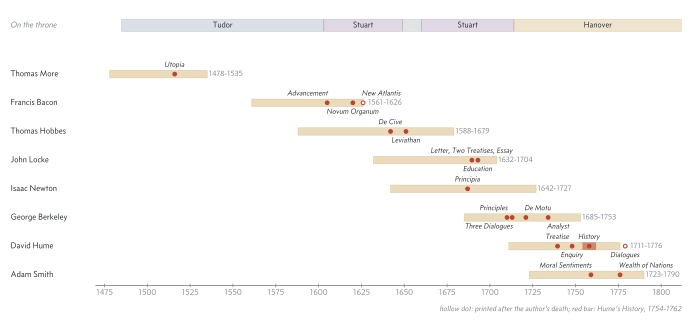
| Philosopher | Dates | Born | Books in this volume | Ideas to know | Ch. |
|---|---|---|---|---|---|
| Francis Bacon | 1561–1626 | London | The Advancement of Learning (1605); Novum Organum (1620); The New Atlantis (1626) | Induction; the four idols; knowledge is power | 4 |
| Thomas Hobbes | 1588–1679 | Malmesbury | De Cive (1642); Leviathan (1651) | The state of nature; the covenant; an absolute sovereign | 7 |
| John Locke | 1632–1704 | Wrington, Somerset | A Letter Concerning Toleration and the Two Treatises (1689); the Essay (1690); Education (1693) | The blank slate; primary and secondary qualities; consent; property from labor | 12 |
| Isaac Newton | 1642–1727 | Woolsthorpe, Lincolnshire | The Principia (1687) | Absolute time and space; “hypotheses non fingo” | 8 |
| George Berkeley | 1685–1753 | County Kilkenny, Ireland | Principles (1710); Three Dialogues (1713); De Motu (1721); The Analyst (1734) | “To be is to be perceived”; immaterialism | 16 |
| David Hume | 1711–1776 | Edinburgh | Treatise (1739–1740); Enquiry (1748); History of England (1754–1762); Dialogues (1779) | The fork; causation as habit; is and ought | 16 |
| Adam Smith | 1723–1790 | Kirkcaldy, Scotland | The Theory of Moral Sentiments (1759); The Wealth of Nations (1776) | The impartial spectator; the division of labor; the invisible hand | 23 |
Francis Bacon. The lawyer and Lord Chancellor who set out to remake knowledge of nature on experiment. In The Advancement of Learning he divided knowledge by memory, imagination, and reason,This philosopher classified knowledge into "Memory," "Reason," and "Imagination." → Francis Bacon•• the plan Diderot’s Encyclopédie later followed, and in the Novum Organum he named four idolsThis philosopher classified errors of thought as idols of the tribe, cave, marketplace, and theater. → Francis Bacon••• that mislead the mind: of the tribe, the cave, the marketplace, and the theater. Taught in Chapter 4.
Thomas Hobbes. The tutor to the Cavendish family who fled to Paris in 1640 and wrote his politics in fear of civil war. He first set it out in the Latin De Cive (1642),This philosopher wrote De Cive. → Thomas Hobbes•• and Leviathan (1651) followed; in both he defended an absolute sovereign,This philosopher defended an absolute sovereign. → Thomas Hobbes••• because anything less meant war. Taught in Chapter 7.
John Locke. The doctor and secretary to the Earl of Shaftesbury who fled to Holland in 1683 and came home with the Glorious Revolution. In his Essay the mind begins as a blank slate,This philosopher rejected innate ideas and described the mind at birth as a tabula rasa, or blank slate. → John Locke••• and shape is a primary quality, color a secondary one.This philosopher distinguished primary qualities such as shape from secondary qualities such as color. → John Locke••• In the Two Treatises government rests on consent, and men have natural rights to “life, liberty, and estate.”This philosopher argued for the natural rights of "life, liberty, and property" (also phrased as "life, liberty, and estate"). → John Locke••• Taught in Chapter 12.
Isaac Newton. The mathematician whose Principia (1687) set out the laws of motion and universal gravitation. He held that absolute time and spaceThis thinker defended absolute time and space independent of observers. → Isaac Newton•• exist apart from every observer, and his friend Samuel Clarke defended the view against Leibniz in 1715 and 1716. Taught in Chapter 8.
George Berkeley. The Irish clergyman, Bishop of Cloyne from 1734, who denied that matter exists. His slogan is “to be is to be perceived”,This philosopher developed the maxim "to be is to be perceived," or "esse est percipi." → George Berkeley••• and he rejected Locke’s distinctionThis philosopher rejected Locke's distinction between primary and secondary qualities. → George Berkeley•• between primary and secondary qualities, calling his own view immaterialism. As Boswell tells it, Samuel Johnson answered him by kicking a stone and saying “I refute it thus.”Samuel Johnson kicked a rock to refute this philosopher's theory that "to be is to be perceived." → George Berkeley• Taught in Chapter 16.
David Hume. The Edinburgh philosopher and historian who pushed experience as far as it would go and found skepticism at the end. He wrote An Enquiry Concerning Human UnderstandingThis philosopher wrote An Enquiry Concerning Human Understanding. → David Hume••• (1748), which sorts every statement onto one prong of Hume’s fork:This philosopher’s fork distinguishes relations of ideas from matters of fact. → David Hume••• relations of ideas or matters of fact. Years later, Kant said, Hume’s doubts about cause and effect had woken him from his “dogmatic slumber.”Kant claimed that this philosopher woke him from his "dogmatic slumber." → David Hume•• Taught in Chapter 16.
Adam Smith. The professor from Kirkcaldy, Hume’s closest friend, who founded economics. In The Theory of Moral Sentiments (1759) we judge ourselves by an “impartial spectator,”This thinker argued that moral norms come from imagining whether an "impartial spectator" would sympathize with one's circumstances. → Adam Smith• and in The Wealth of Nations (1776) the merchant seeking his own gain is “led by an invisible hand”This man argued that the self-interest of individuals can benefit society through an "invisible hand." → Adam Smith••• to serve society. Taught in Chapter 23.
Books of philosophy, science, and economics
Twelve books are answers as “this book,” “this work,” or “this treatise” (Table A.10). A clue for one of them quotes it, names a character or an example in it, or describes its title page. Titles are the first trap: five of Locke’s and Hume’s books “concern” something, and two of them concern human understanding. The second is a shared image. Bacon, Swift, and Hume all used a spider, each for a different point, and only the first and the last of them are in this group.
| Book | Author | Year | What it argues | An image or example in it | Ch. |
|---|---|---|---|---|---|
| Utopia | More | 1516 (Latin) | The best state of a commonwealth | Hythloday; a crescent-shaped island with no private property | 2 |
| Novum Organum | Bacon | 1620 (Latin) | A new method of induction | The four idols; the ants, spiders, and bee; heat as motion | 4 |
| The New Atlantis | Bacon | 1626 | A society ruled by learning | Bensalem; Salomon’s House; a pillar of light | 4 |
| Leviathan | Hobbes | 1651 | Absolute sovereignty by covenant | The giant made of people; life “nasty, brutish, and short” | 7 |
| Principia | Newton | 1687 (Latin) | The laws of motion and gravity | “Hypotheses non fingo” (1713) | 8 |
| A Letter Concerning Toleration | Locke | 1689 | Government and religion have separate concerns | No toleration for atheists | 12 |
| Two Treatises of Government | Locke | 1689, dated 1690 | Government by consent | Filmer refuted; apples gathered | 12 |
| An Essay Concerning Human Understanding | Locke | 1689, dated 1690 | Every idea comes from experience | The blank slate; Molyneux’s problem; the prince and the cobbler | 12 |
| Some Thoughts Concerning Education | Locke | 1693 | How to raise a gentleman’s son | “A sound mind in a sound body”; shoes that leak | 12 |
| An Enquiry Concerning Human Understanding | Hume | 1748 | Causation as habit; skepticism | “Of Miracles”; commit it to the flames | 16 |
| The Wealth of Nations | Smith | 1776 | Free exchange against mercantilism | The pin factory; the invisible hand | 23 |
| Dialogues Concerning Natural Religion | Hume | 1779 | Against the argument from design | Cleanthes, Philo, and Demea; the infinite spider | 16 |
Utopia. Thomas More’s Latin dialogue of 1516 on the best state of a commonwealth. In its opening pages Peter Giles introduces More to Raphael Hythloday,Peter Giles and Raphael Hythloday appear in this work. → Utopia•• a sailor who describes an island shaped like a crescentThis work’s ideal society occupies a crescent-shaped island. → Utopia• where no one owns private property. The book gave English its word for any ideal society. Taught in Chapter 2.
Novum Organum. Bacon’s “new instrument” of 1620, written in Latin aphorisms, whose title answers Aristotle’s Organon,This work’s title refers to Aristotle’s collection of logical writings. → Novum Organum• the old logic it meant to replace. It makes empiricists ants and dogmatists spiders,This work compares empiricists to ants, dogmatists to spiders, and the ideal investigator to a bee. → Novum Organum• with the true investigator a bee, and its tables of instances show heat to be motion. Taught in Chapter 4.
The New Atlantis. Bacon’s unfinished tale, printed in 1626 after his death, of sailors who land on the hidden island of Bensalem.This work is set on the island of Bensalem. → The New Atlantis•• There a learned order, Salomon’s House,This work describes the research institution Salomon’s House. → The New Atlantis•• studies the works of God. Like More’s Utopia it is an imaginary island, but its ideal is learning, not shared property. Taught in Chapter 4.
Leviathan. Hobbes’s great work of 1651, named for the sea monster of Job.This book takes its title from a sea monster in the Book of Job. → Leviathan•• Its title page shows a crowned giant made of his subjects.This book’s frontispiece shows a crowned giant whose body is composed of many people. → Leviathan•• Without a sovereign, Hobbes argues, men live in war of every man against every man, and life is “solitary, poore, nasty, brutish, and short.”This book describes life in the state of nature as “solitary, poor, nasty, brutish, and short.” → Leviathan••• Taught in Chapter 7.
Principia. Newton’s Mathematical Principles of Natural Philosophy (1687), which set out the laws of motion and universal gravitation. In the General Scholium added in 1713, admitting that he could not find gravity’s cause, he wrote “hypotheses non fingo”:The General Scholium of this work declares "hypotheses non fingo," or "I do not feign hypotheses." → Philosophiæ Naturalis Principia Mathematica•• I frame no hypotheses. Taught in Chapter 8.
A Letter Concerning Toleration. Locke’s Latin letter of 1689 to his Dutch friend Philipp van Limborch, put into English the same year. It separates civil government from religionThis work distinguishes the concerns of civil government from those of religion. → A Letter Concerning Toleration• and tolerates every church but those loyal to a foreign prince, and it excludes atheists,This work excludes atheists from toleration on the ground that they cannot be bound by oaths. → A Letter Concerning Toleration•• whom oaths cannot bind. Taught in Chapter 12.
Two Treatises of Government. Locke’s anonymous defense of government by consent, published in December 1689 and dated 1690. The first treatise refutes Filmer’s Patriarcha,The first of these treatises refutes Robert Filmer’s Patriarcha. → Two Treatises of Government•• which made kings the fathers of their people. In the second a man who gathers applesThese treatises use gathering apples to illustrate acquisition of property through labor. → Two Treatises of Government• makes them his by mixing his labor with them. Taught in Chapter 12.
An Essay Concerning Human Understanding. Locke’s long work in four books (1690), which derives every idea from sensation or reflection. Its second edition added Molyneux’s problem,This book discusses whether a newly sighted person could distinguish a sphere from a cube previously known by touch, in Molyneux’s problem. → An Essay Concerning Human Understanding•• whether a blind man made to see could tell a cube from a sphere, and the prince in the cobbler’s body,This work considers a prince’s consciousness entering a cobbler’s body to examine personal identity. → An Essay Concerning Human Understanding•• Locke’s test of personal identity. Hume’s Enquiry has nearly the same title. Taught in Chapter 12.
Some Thoughts Concerning Education. Locke’s book of 1693 on bringing up a gentleman’s son, which grew out of letters to Edward and Mary Clarke.This work grew out of letters to Edward and Mary Clarke. → Some Thoughts Concerning Education• It opens with “a sound mind in a sound body” and prescribes cold water, hard beds, and shoes thin enough to leak.This work recommends shoes thin enough to admit water as a way of hardening children. → Some Thoughts Concerning Education• Taught in Chapter 12.
An Enquiry Concerning Human Understanding. Hume’s short recasting of the first book of his Treatise, printed in 1748 as Philosophical Essays Concerning Human Understanding and retitled in 1758. Its tenth section, “Of Miracles,” weighs testimonyThis work’s section “Of Miracles” weighs testimony against the evidence for natural laws. → An Enquiry Concerning Human Understanding••• against the laws of nature, and it ends by committing to the flamesThis work ends by urging readers to “commit it then to the flames” if a book contains only “sophistry and illusion.” → An Enquiry Concerning Human Understanding•• every book of empty reasoning. Taught in Chapter 16.
The Wealth of Nations. Adam Smith’s Inquiry into the Nature and Causes of the Wealth of Nations (1776), the founding book of economics. It opens with the pin factoryThis book uses the example of a pin factory to illustrate the division of labor. → The Wealth of Nations••• and the division of labor, finds our dinner in the self-interest of “the butcher, the brewer, or the baker,”This book discusses the self-interest of "the butcher, the brewer, or the baker." → The Wealth of Nations• and attacks the mercantile system. Taught in Chapter 23.
Dialogues Concerning Natural Religion. Hume’s dialogue on the argument from design, printed in 1779, three years after his death. Cleanthes, Philo, and Demea debateThis work presents a conversation among Cleanthes, Philo, and Demea. → Dialogues Concerning Natural Religion••• what reason can know of God, and against the house and its builder Philo sets a universe spun by an infinite spider.This work imagines a universe spun by an infinitely large spider to question the argument from design. → Dialogues Concerning Natural Religion• Taught in Chapter 16.
Ideas, words, and subjects
Nineteen answers are ideas, words, or fields of study, and most of them are asked through one thinker’s book: “Bacon said that this concept is power,” “Hume questioned this kind of inference” (Table A.11). Because the answer is a common noun, the clue’s own word for it matters more than usual: “this concept,” “this process,” “this branch of mathematics,” or “this word.” Several of Locke’s answers here are also words in his titles, so a clue that says “this work” wants the book, and one that says “this subject” or “this kind of writing” wants the word.
| Answer | Whose | What the clue says | Ch. |
|---|---|---|---|
| Utopia (the word) | More | Greek for “nowhere”; any ideal society | 2 |
| Knowledge | Bacon | “Is power” (ipsa scientia potestas est) | 4 |
| Science | Bacon | The enterprise he made inductive | 4 |
| Scientific method | Bacon | Inductive, and blocked by four idols | 4 |
| Laws | Hobbes | Nineteen laws of nature, in chapters 14 and 15 of Leviathan | 7 |
| Monarchy | Hobbes; Filmer | Hobbes preferred it; Filmer defended it as a father’s rule | 7, 12 |
| Ship of Theseus | Hobbes | A second ship built from the old planks | 7 |
| Rights | Locke | Life, liberty, and property | 12 |
| Social contract | Locke | Broken, it gives the people a right to rebel | 12 |
| Empiricism | Locke | The blank slate | 12 |
| Essay | Locke | The kind of work he wrote “Concerning Human Understanding” | 12 |
| Education | Locke; Mary Astell | Some Thoughts; A Serious Proposal to the Ladies | 12 |
| Motion | Berkeley | Relative, in De Motu | 16 |
| Calculus | Berkeley | Its infinitesimals are “ghosts of departed quantities” | 16 |
| Induction | Hume | Inference from the past to the future, which reason cannot justify | 16 |
| Causation | Hume | Constant conjunction and habit; one of three associations | 16 |
| Miracles | Hume | Weighed against the laws of nature | 16 |
| The Enlightenment | Hutcheson, Hume, Reid, Stewart | Its Scottish branch | 16 |
| Beauty | Burke | Set against the sublime | 20 |
Utopia (the word). The common noun that More’s island gave the language. From ou, “not,” and topos, “place,” “Utopia” is Greek for “nowhere,”This word is Greek for "nowhere." → Utopia• and a utopia now means any ideal society. “This work” wants the book; “this concept” or “this word” wants the word. Taught in Chapter 2.
Knowledge. Bacon’s subject in a Latin book of meditations of 1597, where he wrote that knowledge itself is power,Francis Bacon stated this concept "is power" in a Latin maxim. → knowledge•• ipsa scientia potestas est. Taught in Chapter 4.
Science. The enterprise whose method Bacon set out to remake: he made inductive, empirical inquiryBacon promoted inductive inquiry as a method for this enterprise. → science••• the way to study nature, reasoning up from many observed cases. Taught in Chapter 4.
Scientific method. The process of inquiry that Bacon wanted inductive, and that, he warned, four kinds of “idols” obstruct:Bacon promoted an inductive form of this process and identified four kinds of “idols” that obstruct it. → scientific method•• those of the tribe, the cave, the marketplace, and the theater. “This enterprise” wants science; “this process” with the idols wants the method. Taught in Chapter 4.
Laws. The answer when a clue counts Hobbes’s laws of nature: he derived nineteen of themIn chapters 14 and 15 of Leviathan, Thomas Hobbes enumerated 19 of these concepts. → laws• in chapters 14 and 15 of Leviathan, beginning with “seek peace, and follow it.” Taught in Chapter 7.
Monarchy. Rule by one person. Hobbes preferred it,Hobbes preferred this form of government, although his sovereign could also be an assembly. → monarchy• though his sovereign could be an assembly, and Sir Robert Filmer defended it in PatriarchaRobert Filmer defended this form of government through patriarchal authority in Patriarcha. → monarchy• as a father’s rule, which Locke’s first treatise refuted. Taught in Chapter 7 and Chapter 12.
Ship of Theseus. The ancient puzzle of a ship whose planks are replaced one by one until none is left (Vol. 6, The Greeks). In 1655 Hobbes added a second ship,Hobbes adds a second vessel assembled from discarded planks to this thought experiment. → ship of Theseus•• built from the discarded planks, and asked which of the two was the ship of Theseus. Taught in Chapter 7.
Rights. The answer when a clue lists life, liberty, and property, which are Locke’s natural rights.Locke’s natural examples of these claims include life, liberty, and property. → rights•• He called them life, liberty, and estate, and summed up all three as property. Taught in Chapter 12.
Social contract. The agreement by which free men form a government. In Locke’s second treatise, when rulers break it, the people have a right to rebel.John Locke argued that people have a right to rebel when this concept is violated, as described in his Second Treatise of Government. → social contract•• Hobbes’s covenant, by contrast, binds the subjects and not the sovereign. Taught in Chapter 12.
Empiricism. The view that all knowledge comes from experience, whose emblem is Locke’s blank slate,Locke’s tabula rasa is associated with this epistemological position. → empiricism•• the tabula rasa of the mind at birth. Berkeley and Hume carried it further. Taught in Chapter 12.
Essay. The answer when a clue asks what kind of work Locke wrote “Concerning Human Understanding”: Locke’s EssayJohn Locke wrote one of these "Concerning Human Understanding." → essay• of 1690. Hume’s book on the same subject is an Enquiry. Taught in Chapter 12.
Education. The subject of Locke’s Some Thoughts (1693) and of Mary Astell’s Serious Proposal to the LadiesMary Astell wrote Serious Proposal concerning this subject. → education• (1694), which argued that women’s minds were as capable as men’s and were wasted by an education in dress and flattery. Taught in Chapter 12.
Motion. The answer when a clue names Berkeley’s De Motu (1721), whose title means “On Motion,” for in it Berkeley treated motion as relativeBerkeley discussed the relativity of this process in De Motu. → motion• and force as a mathematical hypothesis. Taught in Chapter 16.
Calculus. The mathematics of change that Newton and Leibniz invented, whose infinitely small quantities Berkeley mocked in The Analyst (1734) as “ghosts of departed quantities.”Berkeley criticized the infinitesimals used in this branch of mathematics as “ghosts of departed quantities.” → calculus• Taught in Chapter 16.
Induction. Reasoning from observed cases to a general rule or a prediction. Bacon made it the method of science, and later Hume asked whether past observation can justify it;David Hume questioned whether past observations can justify this kind of inference about the future. → induction•• he answered that we expect the future to resemble the past by custom, not by reason. Taught in Chapter 16.
Causation. The relation of cause and effect, which, Hume found, no one has ever observed directly; he traced our idea of it to constant conjunction and habit. With resemblance and contiguity it is one of threeResemblance, contiguity, and this phenomenon are the three ways the mind associates ideas, or "natural relations," according to David Hume. → causation• ways the mind joins ideas. Taught in Chapter 16.
Miracles. The subject of the tenth section of Hume’s Enquiry, an empirical critique of reports of miracles.These events were the subject of an empirical criticism by David Hume. → miracles• A wise man, Hume says, proportions his belief to the evidence. Taught in Chapter 16.
The Enlightenment. The eighteenth-century movement that trusted reason and argument. Its Scottish branchThe Scottish branch of this concept was exemplified by Dugald Stewart, Francis Hutcheson, and Thomas Reid. → the Enlightenment• ran from Francis Hutcheson in the 1730s through Hume and Thomas Reid to Dugald Stewart, who lectured until 1810. Taught in Chapter 16.
Beauty. The quality that Edmund Burke, in his Enquiry of 1757, set against the sublime:Edmund Burke contrasted this concept with the sublime. → beauty•• the beautiful is what we love, and the sublime is rooted in terror. Taught in Chapter 20.
Writers of prose
Nine writers of prose are answers as “this author” or “this writer” (Table A.12). Most clues name a book, so the skill is matching titles to authors, and Figure A.5 shows when each of them wrote. Several hid behind a mask. Defoe and Swift put no name on their title pages, Swift wrote as Isaac Bickerstaff and as Lemuel Gulliver, and Sterne as Parson Yorick. The surname is the trap in two cases: a Walpole is a writer here and a prime minister among the ministers, and four Johnsons, two of them false names, appear in this volume.
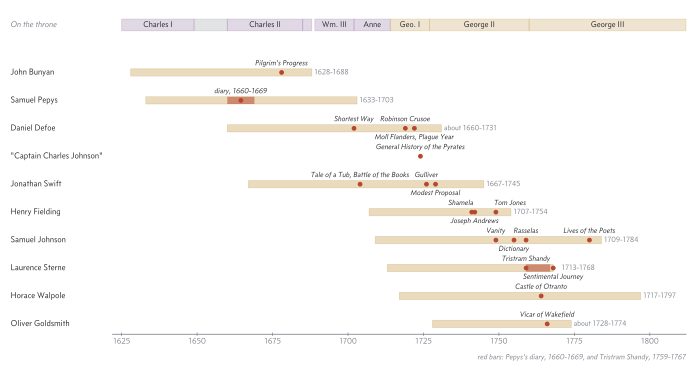
| Writer | Dates | Who he was | Works in this volume | Ch. |
|---|---|---|---|---|
| John Bunyan | 1628–1688 | Tinker and preacher, twelve years in jail | The Pilgrim’s Progress (1678) | 9 |
| Samuel Pepys | 1633–1703 | Official of the navy | His diary, 1660–1669 | 8 |
| Daniel Defoe | About 1660–1731 | Dissenter, merchant, pamphleteer, and secret agent | The Shortest Way with the Dissenters (1702); Robinson Crusoe (1719); Moll Flanders and A Journal of the Plague Year (1722) | 14 |
| Jonathan Swift | 1667–1745 | Dean of St. Patrick’s, Dublin | A Tale of a Tub and The Battle of the Books (1704); Gulliver’s Travels (1726); “A Modest Proposal” (1729) | 15 |
| Henry Fielding | 1707–1754 | Playwright, novelist, and magistrate | The Tragedy of Tragedies (1731); Shamela (1741); Joseph Andrews (1742); Tom Jones (1749) | 19 |
| Samuel Johnson | 1709–1784 | Poet, essayist, lexicographer, and critic | The Vanity of Human Wishes (1749); the Dictionary (1755); Rasselas (1759); the Lives of the Poets (1779–1781) | 20 |
| Laurence Sterne | 1713–1768 | Country parson | Tristram Shandy (1759–1767); A Sentimental Journey (1768) | 19 |
| Horace Walpole | 1717–1797 | Robert Walpole’s youngest son; letter writer | The Castle of Otranto (1764) | 19 |
| Oliver Goldsmith | About 1728–1774 | Irish essayist, poet, and playwright | The Vicar of Wakefield (1766) | 19 |
John Bunyan. The tinker from Elstow, near Bedford, who had served in Parliament’s army and spent twelve years in Bedford jail for preaching. He wrote The Pilgrim’s ProgressThis author wrote The Pilgrim's Progress. → John Bunyan•• (1678), the dream of Christian’s journey to the Celestial City. Taught in Chapter 9.
Samuel Pepys. The London tailor’s son who rose to be a leading official of the navy and kept a diary from 1660 to 1669 that tells the Restoration, the plague, and the fire. He wrote it in Shelton’s shorthand,This man used tachygraphy to write his diary. → Samuel Pepys• called tachygraphy, so that his servants could not read it, and in 1669 he stopped for fear of blindness.This man discontinued his most famous project in 1669 for fear of becoming blind. → Samuel Pepys• Taught in Chapter 8.
Daniel Defoe. The London dissenter, merchant, and secret agent who stood in the pillory in 1703 for The Shortest Way with the Dissenters,This author wrote the satirical pamphlet The Shortest Way with the Dissenters. → Daniel Defoe• a satire his readers took straight. At nearly sixty he wrote Robinson Crusoe (1719). In 1722 came Moll Flanders and the Journal of the Plague Year, in which Londoners wear charms of ABRACADABRA.In this author’s A Journal of the Plague Year, people wear charms bearing variations of ABRACADABRA. → Daniel Defoe•• Taught in Chapter 14.
Jonathan Swift. The Dublin-born priest who became dean of St. Patrick’s in 1713 and almost always wrote behind a mask. In 1708 he became Isaac Bickerstaff,This author used the pseudonym Isaac Bickerstaff. → Jonathan Swift•• an imaginary astrologer who foretold the death of the almanac maker John Partridge and then announced it. His dearest friend was Esther Johnson, his “Stella,” and he may have married her in secret.This author may have been secretly married to Esther Johnson ("Stella"). → Jonathan Swift•• His prose satires have their own entries under their titles. Taught in Chapter 15.
Henry Fielding. The Somerset-born playwright who turned to the novel after the Licensing Act of 1737 ended his plays. His most lasting stage success was the burlesque The Tragedy of TragediesThis author wrote The Tragedy of Tragedies. → Henry Fielding• (1731), and his Shamela mocked Richardson’s PamelaThis author's Shamela satirizes Samuel Richardson's Pamela. → Henry Fielding•• in 1741; Joseph Andrews and Tom Jones followed. As a magistrate he founded the Bow Street Runners. Taught in Chapter 19.
Samuel Johnson. The bookseller’s son from Lichfield who wrote the Dictionary, the Lives of the Poets, and Rasselas, in which a prince escapes from the Happy Valley.In this author's Rasselas, the title prince leaves the Happy Valley. → Samuel Johnson•• Nearly every story about him comes from James Boswell, who wrote his Life and the Tour to the Hebrides.James Boswell wrote a biography of this author and an account of their tour of the Hebrides. → Samuel Johnson••• Boswell tells how he kicked a stone to answer Berkeley: “I refute it thus.”This author kicked a stone and declared “I refute it thus” against Berkeley’s idealism. → Samuel Johnson• Taught in Chapter 20.
Laurence Sterne. The Irish-born country parson whose Tristram Shandy (1759–1767) made him famous and whose Sentimental Journey (1768) came out less than a month before he died. He wrote as Parson Yorick, and after his death his letters to Eliza Draper appeared as Yorick’s.This author's letters to Eliza Draper were published under the name of one of his characters. → Laurence Sterne• Taught in Chapter 19.
Horace Walpole. Robert Walpole’s youngest son, who made his house at Strawberry Hill a little Gothic castle and wrote The Castle of OtrantoThis author wrote The Castle of Otranto. → Horace Walpole•• (1764), the first Gothic novel. His letters are the running chronicle of Georgian London. He is not his father, the prime minister. Taught in Chapter 19.
Oliver Goldsmith. The Irish essayist, poet, and playwright whom Johnson rescued from his landlady by selling a manuscript: Goldsmith wrote The Vicar of WakefieldThis author wrote The Vicar of Wakefield. → Oliver Goldsmith•• in 1761 and 1762, and it was printed in 1766. His comedy She Stoops to Conquer belongs to Vol. 11, The Age of Shakespeare. Taught in Chapter 19.
Novels, satires, and other books
Fourteen answers are books: novels, prose satires, an allegory, a history of pirates, a dictionary, and one poem that clues ask about in the same way (Table A.13). Most are asked through a character, a scene, or a line, and the trap is that the same scene may want the book or its hero. A clue that begins “In this novel” wants the book; one that begins “This character” wants the person, who has an entry among the characters. Five of the books are Swift’s or Defoe’s, and none of the five had its author’s name on the title page.
| Title | Author | Year | Kind | Hero, speaker, or subject | Ch. |
|---|---|---|---|---|---|
| The Pilgrim’s Progress | Bunyan | 1678 | Dream allegory | Christian | 9 |
| A Tale of a Tub | Swift | 1704 | Prose satire | Three brothers and their coats | 15 |
| The Battle of the Books | Swift | 1704 | Mock news report | Ancient and modern books | 15 |
| Moll Flanders | Defoe | 1722 | Novel told as a confession | Moll | 14 |
| A General History of the Pyrates | “Captain Charles Johnson” | 1724 | Lives of pirates | Libertalia | 13 |
| Gulliver’s Travels | Swift | 1726 | Satire in four voyages | Lemuel Gulliver | 15 |
| “A Modest Proposal” | Swift | 1729 | Ironic pamphlet | The planner | 15 |
| Tom Jones | Fielding | 1749 | Comic novel | Tom, a foundling | 19 |
| The Vanity of Human Wishes | Johnson | 1749 | Poem after Juvenal | Wolsey, Charles XII, and others | 20 |
| A Dictionary of the English Language | Johnson | 1755 | Dictionary | Words, with quotations | 20 |
| Tristram Shandy | Sterne | 1759–1767 | Comic novel | Tristram and his father, Walter | 19 |
| The Castle of Otranto | Horace Walpole | 1764 | The first Gothic novel | Manfred | 19 |
| The Vicar of Wakefield | Goldsmith | 1766 | Novel | Dr. Primrose | 19 |
| A Sentimental Journey | Sterne | 1768 | Travel narrative | Yorick | 19 |
The Pilgrim’s Progress. Bunyan’s allegory of 1678, told as a dream, of a man named Christian who travels from the City of Destruction to the Celestial City. Bunyan wrote it in prison at Bedford.This novel was written while its author was imprisoned in Bedford Jail. → The Pilgrim's Progress• On the way Christian falls into the Slough of Despond,This work features the Slough of Despond. → The Pilgrim's Progress•• fights Apollyon, and passes through Vanity Fair. In Little Women the March sisters act it out. Taught in Chapter 9.
A Tale of a Tub. Swift’s first great satire, printed without his name in 1704, in which a father leaves each of his three sons a coat and Peter, Martin, and JackIn this work, Peter, Martin, and Jack represent three branches of Christianity. → "A Tale of a Tub"••• stand for the Church of Rome, the Church of England, and the dissenters. Among its digressions is one on the uses of madness.This work includes a "Digression on Madness." → "A Tale of a Tub"•• Taught in Chapter 15.
The Battle of the Books. Swift’s mock news report, printed in the same volume as the Tale in 1704, of a battle between ancient and modern books in the king’s library at St. James’s.This work is set in St. James's Library. → "The Battle of the Books"• In its fable of the spider and the bee,This work features the allegory of the spider and the bee. → "The Battle of the Books"•• the spider is the Moderns and the bee the Ancients. Taught in Chapter 15.
Moll Flanders. Defoe’s novel of 1722, told as a true confession by a woman born in Newgate, where her mother “pleaded her belly”In this novel, the protagonist’s mother "pleads her belly" to escape execution at Newgate Prison. → Moll Flanders•• to put off her hanging. Its long subtitle sums up the life, including five marriages, one to her own brother.This novel's subtitle describes the title character as "Twelve Year a Whore, five times a Wife (whereof once to her own brother)." → Moll Flanders• “This novel” wants the book; “this character” wants Moll. Taught in Chapter 14.
A General History of the Pyrates. The book of 1724 that fixed the picture of pirates for good. The name on it was Captain Charles Johnson,This book appeared under the name Captain Charles Johnson. → A General History of the Pyrates•• and no one knows who he was. It tells of Libertalia, a pirate republic in Madagascar,This book tells of pirates founding the egalitarian settlement of Libertalia in Madagascar. → A General History of the Pyrates• which its author probably invented. Taught in Chapter 13.
Gulliver’s Travels. Swift’s satire of 1726 in four voyages, told by the ship’s surgeon Lemuel Gulliver. In the first the Lilliputians stand about six inches tall,In this novel, the Lilliputians are six inches tall. → Gulliver's Travels•• a twelfth of his height; in the second he visits the giants of Brobdingnag. In the third, at Lagado, he sees the professor’s Engine,In this novel, the title character sees "The Engine" in the Academy of Projectors in the city of Lagado. → Gulliver's Travels• a frame of word-blocks that writes books by chance, and in the fourth he meets the Houyhnhnms. “This novel” wants the book; “this character” wants Gulliver; “this country” wants Lilliput. Taught in Chapter 15.
A Modest Proposal. Swift’s pamphlet of 1729, the most famous irony in English, in which a calm planner proposes that Irish children be eaten.This essay suggests eating Irish children. → "A Modest Proposal"••• To prove the dish is known abroad he cites “the famous Psalmanaazor,”This essay mentions "the famous Psalmanazar, a native of the island Formosa." → "A Modest Proposal"•• a fake native of Formosa, and he promises that the scheme will lessen the number of papists. Taught in Chapter 15.
Tom Jones. Fielding’s novel of 1749, The History of Tom Jones, a Foundling, in six volumes. Master Blifil is Tom’s rival,In this novel, Master Blifil is the protagonist's rival. → Tom Jones• and Captain Blifil, his father, dies of apoplexyIn this novel, Captain Blifil dies of apoplexy. → Tom Jones• early in the book. Molly Seagrim, the gamekeeper’s daughter, scatters a churchyard mob with a thigh-bone. “In this novel” wants the book; “this character” wants Tom. Taught in Chapter 19.
The Vanity of Human Wishes. Johnson’s poem of 1749, an imitation of Juvenal’s tenth satire,This poem imitates Juvenal's Tenth Satire. → The Vanity of Human Wishes•• with Cardinal Wolsey and Charles XII of Sweden in place of Juvenal’s Romans and Hannibal. It opens by bidding Observation “Survey Mankind, from China to Peru.”This poem opens "Let observation with extensive view, / survey mankind, from China to Peru." → The Vanity of Human Wishes• Taught in Chapter 20.
A Dictionary of the English Language. Johnson’s dictionary of 1755, in two huge volumes; the work took him nine years.Samuel Johnson spent nine years compiling this work. → A Dictionary of the English Language• In it a lexicographer is “a harmless drudge.”This work defines a "lexicographer" as a "harmless drudge." → A Dictionary of the English Language•• Its would-be patron, Lord Chesterfield, had failed him, and Johnson’s letter rebuked him. Taught in Chapter 20.
Tristram Shandy. Sterne’s comic novel in nine volumes (1759–1767). Dr. Slop’s forceps flatten Tristram’s noseIn this novel, Dr. Slop accidentally flattens the protagonist's nose with forceps. → Tristram Shandy•• at birth, a disaster for his father, Walter, whose hobby-horse is the importance of noses, and a black page marks Yorick’s death.This novel marks the death of Yorick with a black page. → Tristram Shandy•• Taught in Chapter 19.
The Castle of Otranto. Horace Walpole’s novel of 1764, the first Gothic novel, which opens when Manfred’s son Conrad is crushedIn this novel, Manfred’s son Conrad is crushed by a gigantic falling helmet. → The Castle of Otranto•• by a gigantic helmet. Taught in Chapter 19.
The Vicar of Wakefield. Goldsmith’s novel of 1766, in which Dr. Primrose loses his money and his house and goes to debtors’ prison, and his son George marries Arabella WilmotIn this novel, Arabella Wilmot marries George Primrose. → The Vicar of Wakefield• at the end. Taught in Chapter 19.
A Sentimental Journey through France and Italy. Sterne’s last book (1768), narrated by Parson Yorick, who at Calais exchanges snuffboxes with Father Lorenzo,This novel's protagonist exchanges snuffboxes with Father Lorenzo, a monk in Calais. → A Sentimental Journey through France and Italy• a poor monk. It ends in the middle of a sentence,This novel ends mid-sentence as the narrator catches hold of a chambermaid. → A Sentimental Journey through France and Italy•• as Yorick reaches for a chambermaid in the dark. Taught in Chapter 19.
Characters and imagined places
Twelve answers live inside books: six characters, three imagined places, and three things that a clue reaches through a story (Table A.14). The commonest trap is the book that shares its hero’s name. Moll Flanders and Tom Jones are answers both as novels and as people, and Gulliver’s Travels has its hero and its first country as separate answers. Robinson Crusoe is different: the novel is not an answer in this volume, and its clues ask for the castaway.
| Answer | Book | Author | Who or what | Ch. |
|---|---|---|---|---|
| Arcadia | Arcadia (printed 1590) | Philip Sidney | The shepherds’ land of Greek and Latin poetry | 3 |
| Christian | The Pilgrim’s Progress (1678) | Bunyan | The pilgrim, first named Graceless | 9 |
| Vanity Fair | The Pilgrim’s Progress | Bunyan | A town with a fair all year round | 9 |
| Robinson Crusoe | Robinson Crusoe (1719) | Defoe | A castaway for twenty-eight years | 14 |
| Friday | Robinson Crusoe | Defoe | Crusoe’s servant, named for the day he was saved | 14 |
| Islands | Robinson Crusoe | Defoe | Crusoe’s Island of Despair | 14 |
| Umbrella | Robinson Crusoe | Defoe | Crusoe made one; Londoners called them “Robinsons” | 14 |
| Moll Flanders (the character) | Moll Flanders (1722) | Defoe | A thief, five times a wife | 14 |
| Lemuel Gulliver | Gulliver’s Travels (1726) | Swift | A ship’s surgeon | 15 |
| Lilliput | Gulliver’s Travels | Swift | An island of tiny people | 15 |
| Tom Jones (the character) | Tom Jones (1749) | Fielding | A foundling | 19 |
| Castles | The Castle of Otranto (1764) | Horace Walpole | Otranto’s castle, the real hero | 19 |
Arcadia. The shepherds’ land of Greek and Latin pastoral (Vol. 7, The Romans), and the setting Philip Sidney chose for his prose romance,This place is the setting of prose works by Philip Sidney. → Arcadia• printed in 1590, four years after his death. Taught in Chapter 3.
Christian. The pilgrim of The Pilgrim’s Progress, first named Graceless, who begins his journey in the City of DestructionThis character begins his journey in the City of Destruction. → Christian (The Pilgrim’s Progress)• with a burden on his back. He meets Mr. Worldly Wiseman, passes the Wicket Gate, and at last crosses the River of Death to the Celestial City, his destination.This character’s destination is the Celestial City. → Christian (The Pilgrim’s Progress)•• Taught in Chapter 9.
Vanity Fair. The town on Christian’s road where a fair is kept all the year round. Its people cage the pilgrims, Lord Hate-good presides at their trial,At this location in Pilgrim's Progress, a trial is presided over by Lord Hate-Good. → Vanity Fair• and Faithful is burned at the stake,At this location in Pilgrim's Progress, Faithful is burned at the stake. → Vanity Fair•• the book’s one martyr. Thackeray took the name for his novel (Vol. 15, The Age of Revolution). Taught in Chapter 9.
Robinson Crusoe. Defoe’s castaway, a York merchant’s son who runs away to sea, is enslaved by the corsairs of Sallee,This character is captured by pirates and enslaved in Sallee. → Robinson Crusoe•• escapes, and plants in Brazil before his wreck. He lives twenty-eight years on his island,This character is shipwrecked for twenty-eight years on a deserted island. → Robinson Crusoe••• near the Orinoco’s mouth, rescues Friday, and on the way home over the Pyrenees fights off wolvesThis character fights off wolves while crossing the Pyrenees. → Robinson Crusoe•• while Friday fights a bear. Taught in Chapter 14.
Friday. The young man of a cannibal people whom Crusoe rescues and names for the day he saved him. His god is Benamuckee,This character worships Benamuckee. → Friday•• though Crusoe teaches him English and converts him to Christianity, and on the road to England, crossing the Pyrenees, Friday fights a bearThis character battles a bear while crossing the Pyrenees. → Friday•• for the party’s amusement. Taught in Chapter 14.
Islands. The answer when a clue asks where Crusoe is stranded: on an island near the Orinoco,Robinson Crusoe is stranded on one of these places. → islands•• which he names the Island of Despair. Taught in Chapter 14.
Umbrella. The answer when a clue asks what Crusoe makes after those he had seen in Brazil. In London later in the century the heavy early umbrellas were called “Robinsons”Some of these objects were called "Robinsons" in England. → umbrella• after him. Taught in Chapter 14.
Moll Flanders (the character). Defoe’s heroine, born in Newgate, who tells her own life in old age. She marries five men, one of them her half-brother,This character marries five men, including her half-brother. → Moll Flanders•• and loves best Jemmy, her “Lancashire husband,”This character has a "Lancashire husband" named Jemmy. → Moll Flanders•• who turns out to be as penniless as she is. She becomes a thief and a confidence trickster before she repents. Taught in Chapter 14.
Lemuel Gulliver. The narrator of Swift’s Travels, a ship’s surgeon,This character is a surgeon. → Lemuel Gulliver•• who sails four times into unknown seas. In Lilliput he puts out a palace fire by urinating,This man extinguishes a fire by urinating. → Lemuel Gulliver•• and in his last voyage he meets the Houyhnhnms,This character encounters the intelligent horses called Houyhnhnms. → Lemuel Gulliver••• rational horses who call him a Yahoo. Taught in Chapter 15.
Lilliput. The first country of Gulliver’s travels,This country is the first visited in Jonathan Swift's Gulliver's Travels. → Lilliput•• an island of people a twelfth his height, at war with Blefuscu over which end of an egg to break. Its capital is Mildendo,Mildendo is the capital of this country. → Lilliput•• and its ministers win office by rope-dancing. Taught in Chapter 15.
Tom Jones (the character). Fielding’s hero, a foundling raised by Squire Allworthy,This character is a foundling raised by his uncle Squire Allworthy. → Tom Jones••• who proves to be his nephew. Generous and wild, he is turned out of the house and has adventures from Molly Seagrim to Mrs. Waters at Upton, and in the end he marries Sophia Western.This character marries Sophia Western. → Tom Jones••• Taught in Chapter 19.
Castles. The answer when a clue asks what Otranto is: the castle of Otranto,Otranto is an example of one of these buildings. → castles• with its vaults, walking portraits, and trapdoors, is the real hero of Walpole’s novel. Taught in Chapter 19.
Composers
Seven composers are answers (Table A.15). Four belong to the golden age of English church music and song under Elizabeth and James, one to the Restoration, and two to Georgian London, where both were foreigners. A clue for a composer names a work, a teacher, a post, or a patron, so the skill is again matching works to names. The traps are partnerships and rivalries: Tallis and Byrd shared a printing monopoly and a book, and Purcell and Handel both set odes for Saint Cecilia’s Day.
| Composer | Dates | Who he was | Works in this volume | Ch. |
|---|---|---|---|---|
| Thomas Tallis | About 1505–1585 | The Chapel Royal under four Tudors | Spem in alium; two Lamentations; the third mode melody; Cantiones sacrae (1575) | 3 |
| William Byrd | Born about 1540 | Tallis’s pupil; the Chapel Royal from 1572 | Cantiones sacrae (1575); keyboard music | 3 |
| John Dowland | Born 1563 | Lutenist, long abroad | Lachrimae, or “Flow, my tears” | 3 |
| Orlando Gibbons | 1583–1625 | Organist of the Chapel Royal | “The Silver Swan” (1612) | 4 |
| Henry Purcell | 1659–1695 | Organist of Westminster Abbey | Dido and Aeneas; King Arthur; odes; music for Mary II’s funeral | 11 |
| George Frideric Handel | 1685–1759 | German-born; first in London 1710, settled there 1712 | Italian operas; English oratorios; Water Music; Zadok the Priest | 17, 18 |
| Johann Christian Bach | 1735–1782 | J. S. Bach’s youngest son; in London from 1762 | Symphonies; subscription concerts with Abel | 21 |
Thomas Tallis. The English composer who served four Tudor monarchs in the Chapel Royal, writing in Latin or English as each reign required. Tallis wrote Spem in aliumThis composer wrote Spem in alium. → Thomas Tallis••• for forty voices. For Archbishop Parker’s psalter his “third mode melody” set Psalm 2,This composer wrote the "third mode melody," a setting of Psalm 2 called "Why fum’th in fight." → Thomas Tallis•• and Vaughan Williams later made the tune into a fantasia. With Byrd he held a twenty-one-year monopoly on printing music. Taught in Chapter 3.
William Byrd. Tallis’s pupil, born about 1540, organist of Lincoln Cathedral and from 1572 his master’s colleague in the Chapel Royal, the greatest English composer of his generation. In 1575 he and Tallis published Cantiones sacrae,This composer collaborated with Thomas Tallis on Cantiones sacrae. → William Byrd•• thirty-four Latin motets, seventeen by each, one for each year of the queen’s reign. Taught in Chapter 3.
John Dowland. The finest English lutenist, born in 1563, who spent his best years abroad. His Lachrimae falls in tears,This composer used a falling-tear motif in "Lachrimae," also known as "Flow My Tears." → John Dowland•• a figure of four falling notes, and as the song “Flow, my tears” it became the best-known musical sigh in Europe. Taught in Chapter 3.
Orlando Gibbons. The finest English composer of James I’s court, organist of the Chapel Royal, who died suddenly in 1625 at forty-one. In 1612 Gibbons wrote “The Silver Swan”,This composer wrote the madrigal "The Silver Swan." → Orlando Gibbons• the most famous madrigal in English. Taught in Chapter 4.
Henry Purcell. The Westminster composer (1659–1695), John Blow’s pupil and his successor as organist of the Abbey, who wrote for three reigns. His ode for Saint Cecilia’s Day of 1692, “Hail, bright Cecilia,”This composer wrote an Ode to St. Cecilia. → Henry Purcell•• was called for again at its first hearing. For Mary II’s funeral in 1695 a quartet of flat trumpetsThis composer's funeral music for a monarch utilises a quartet of flat trumpets. → Henry Purcell• played his slow march and canzona. Since 1963 his works have carried Z numbers,Franklin Zimmerman categorised this composer's works by "Z numbers." → Henry Purcell•• from Franklin Zimmerman’s catalog. Taught in Chapter 11.
Handel. George Frideric Handel (1685–1759), born in Halle and trained in Hamburg and Italy, who made London his home and wrote Italian operas, English oratorios, and music for the Hanoverian kings. His Ode for St. Cecilia’s DayThis composer set a John Dryden poem to music in his cantata Ode for St. Cecilia's Day. → Handel• (1739) sets Dryden’s poem, not the one Purcell set. Between the acts of his oratorios he played his own organ concertos,This composer helped establish the organ concerto by performing such concertos between sections of his oratorios. → Handel•• and an epigram of 1725 made him and his rival Bononcini “Tweedle-dum and Tweedle-dee.”John Byrom coined "Tweedledum and Tweedledee" in an epigram comparing this composer with Giovanni Bononcini. → Handel• Taught in Chapter 17 and Chapter 18.
Johann Christian Bach. The youngest son of Johann Sebastian Bach, born in Leipzig in 1735, who settled in London in 1762 and was known as the “London Bach.”This youngest son of Johann Sebastian Bach was nicknamed the "London Bach." → Johann Christian Bach•• With Carl Friedrich Abel he ran subscription concerts, and Gainsborough painted them both. Taught in Chapter 21.
Music from Tallis to Purcell
Seven answers come from English and Irish music outside Handel’s own works (Table A.16). Two famous works each have a second answer that a clue reaches through them: the choirs that Spem in alium was written for, and the heroine of Dido and Aeneas. Three more are reached through a piece or a player: the English language of Purcell’s opera, the trumpet of Clarke’s march and of Messiah, and the harp of the blind Irish harper O’Carolan. “This opera” wants Purcell’s work, and “this character” wants Dido; Vol. 4, Classical Myth told her story in Virgil.
| Answer | Composer | Date | What it is | Ch. |
|---|---|---|---|---|
| Spem in alium | Tallis | Elizabethan | A motet in forty parts | 3 |
| Choirs | Tallis | Eight choirs of five voices in Spem in alium | 3 | |
| Dido and Aeneas | Purcell; words by Nahum Tate | By 1689 | An opera after Book 4 of the Aeneid | 11 |
| Dido | Purcell | By 1689 | The queen of Carthage; “When I am laid in earth” | 11 |
| English | Purcell | The language of his operas | 11 | |
| Trumpet | Clarke; Handel | About 1700; 1742 | The “Trumpet Voluntary”; “The trumpet shall sound” | 11, 18 |
| Harp | Turlough O’Carolan | 1670–1738 | The instrument of the blind Irish harper | 15 |
Spem in alium. Tallis’s Latin motet in forty parts,This forty-part motet is written for eight choirs of five voices each. → Spem in alium••• for eight choirs of five voices each, which answer one another around the room and join in great chords. Taught in Chapter 3.
Choirs. The answer when a clue counts what Spem in alium is written for: Tallis set it for eight choirs,Thomas Tallis set Spem in Alium for eight of these ensembles. → choirs• each of soprano, alto, tenor, baritone, and bass. Taught in Chapter 3.
Dido and Aeneas. Purcell’s opera of three short acts, sung at Josias Priest’s school for girls in Chelsea by 1689, with words by Nahum Tate after the Aeneid. It follows Blow’s Venus and AdonisThis opera was influenced by John Blow’s Venus and Adonis, including its closing chorus. → Dido and Aeneas•• down to its closing chorus. The Sorceress sends her elf disguised as MercuryIn this opera, the Sorceress sends her elf disguised as Mercury to separate the title characters. → Dido and Aeneas•• to part the lovers, and the opera ends with “With drooping wings.” Taught in Chapter 11.
Dido. The queen of Carthage, Purcell’s heroine, who confides in her sister Belinda and dies when Aeneas leaves her. “Thy hand, Belinda,” she begins,This character requests her attendant Belinda’s hand in a recitative before her final aria. → Dido• and then, over a falling ground, her lament “When I am laid in earth” asks, “Remember me, but ah! forget my fate.”This character sings "Remember me, but ah! Forget my fate" in "When I am laid in earth." → Dido•• Taught in Chapter 11.
English. The language of Purcell’s operas: in Dido and Aeneas every word is sung in English,Henry Purcell composed operas in this language. → English• two decades before Handel’s Rinaldo, the first Italian opera written for London. Taught in Chapter 11.
Trumpet. The instrument of two famous pieces. Jeremiah Clarke’s Prince of Denmark’s March,Jeremiah Clarke’s Prince of Denmark’s March is often called a "Voluntary" for this instrument and was formerly attributed to Purcell. → trumpet••• the “Trumpet Voluntary,” passed as Purcell’s until the 1940s. In Messiah the bass sings that “the trumpet shall sound”A bass aria in Handel’s Messiah declares that this instrument “shall sound.” → trumpet•• over the work’s one great instrumental solo. Taught in Chapter 11 and Chapter 18.
Harp. The instrument of the blind Irish harper Turlough O’Carolan,The blind Turlough O'Carolan was an Irish composer for this type of instrument. → harp• who rode from house to house for nearly fifty years, composing tunes for his hosts. Taught in Chapter 15.
Handel’s works
Thirteen answers are Handel’s works, or the occasions and instruments they were written for (Table A.17). He wrote in three kinds, and his career passed from one to the next: Italian operas for the London stage from 1711 to 1741, music for the kings, and English oratorios from 1732 to 1752. Figure A.6 sets the oratorios and festival works in order. The kind of work is the first key, and a famous aria or movement is the second: “Ombra mai fu” is Serse, the Dead March is Saul, and the Queen of Sheba is Solomon.
| Answer | Kind | Year | Occasion or place | To remember | Ch. |
|---|---|---|---|---|---|
| Rinaldo | Italian opera | 1711 | The first Italian opera written for London | Tasso; Almirena’s “Lascia ch’io pianga” | 17 |
| Water Music | Orchestral suites | 1717 | A barge on the Thames, for George I | Three suites; two horns; “Alla Hornpipe” | 17 |
| Harpsichord | Instrument | 1720 | The fifth suite | “The Harmonious Blacksmith” | 17 |
| Giulio Cesare | Italian opera | 1724 | The Royal Academy of Music | Senesino; “Va tacito e nascosto” | 17 |
| Zadok the Priest | Coronation anthem | 1727 | George II’s coronation | Sung at every coronation since | 17 |
| Coronations | Occasion | 1727 on | Zadok the Priest | Charles III’s in 2023 | 17 |
| Pipe organ | Instrument | 1735 on | Concertos between the acts | “The Cuckoo and the Nightingale” | 18 |
| Serse | Italian opera | 1738 | The King’s Theatre | “Ombra mai fu,” Handel’s “Largo” | 17 |
| Saul | Oratorio | 1739 | The King’s Theatre | The Dead March | 18 |
| Messiah | Oratorio | 1742 | Dublin, then London | Words compiled by Jennens; “Hallelujah” | 18 |
| Solomon | Oratorio | 1749 | Covent Garden | “The Arrival of the Queen of Sheba” | 18 |
| Music for the Royal Fireworks | Suite | 1749 | Green Park, for George II | Winds and drums; “La Paix” | 18 |
| Christmas | Season | 1800s on | Messiah | Sung each December | 18 |
Rinaldo. Handel’s first opera for London (1711), the first Italian opera written there, taken from Tasso’s Jerusalem Delivered.This opera is based on Tasso’s Jerusalem Delivered. → Rinaldo (Handel)• Its captive heroine, Almirena, sings “Lascia ch’io pianga”Almirena sings "Lascia ch’io pianga" in this opera, reusing music from Almira. → Rinaldo (Handel)•• to music Handel had first written as a dance in his first opera, Almira. Taught in Chapter 17.
Water Music. The orchestral music played from a barge on the ThamesThis collection of orchestral suites premiered on a barge on the Thames for George I. → Water Music••• for George I on July 17, 1717. Modern editions arrange it as three suites, in F, D, and G; the F-major has two horns, and the D-major has the “Alla Hornpipe.”The D-major suite in this collection includes "Alla Hornpipe." → Water Music••• The story that it reconciled the king with his runaway Kapellmeister is a later legend. Taught in Chapter 17.
Giulio Cesare. Handel’s opera of 1724 for the Royal Academy of Music, on Caesar’s pursuit of Pompey into Egypt. Senesino created the title role,Senesino created the title role of this Handel opera set in Egypt. → Giulio Cesare (Handel)• and in “Va tacito e nascosto,” with a solo horn, Caesar compares himself to a hunter.The title character compares himself to a hunter in the horn-accompanied aria "Va tacito e nascosto" in this opera. → Giulio Cesare (Handel)•• Taught in Chapter 17.
Zadok the Priest. Handel’s coronation anthem for George II in 1727, which has been sung at every coronation since.Written for George II in 1727, this anthem has been performed at every subsequent British coronation. → Zadok the Priest••• After a long, soft introduction the choir enters at full strengthThis coronation anthem’s choir enters at full volume after a quiet orchestral introduction. → Zadok the Priest• on “Zadok,” and “And all the people rejoic’d” becomes a dance in triple time. Taught in Chapter 17.
Coronations. The occasions for which Handel wrote Zadok the Priest: it was written for George II’s coronationGeorge Frideric Handel composed Zadok the Priest to be performed at these events. → coronations• and has been sung at every one since, Charles III’s in 2023 among them. Taught in Chapter 17.
Harpsichord. The instrument of Handel’s fifth suite, whose last movement, an air with variations, is called “The Harmonious Blacksmith,”Handel's "The Harmonious Blacksmith," an E-major aria and variations, was written for this instrument. → harpsichord• a nickname given about a century later. Taught in Chapter 17.
Serse. Handel’s opera of 1738, “Xerxes,” which opens as the Persian king sings “Ombra mai fu” to a plane tree,The title character admires a plane tree in this opera’s opening aria "Ombra mai fu," often called Handel’s "Largo." → Serse•• the air known as Handel’s “Largo.” Taught in Chapter 17.
Saul. Handel’s oratorio of 1739 on the first king of Israel, in whose third act the Dead MarchThe Act III "Dead March" in this oratorio contrasts organ and trombones with flutes, oboes, and timpani. → Saul (Handel)•• sets the dark organ and trombones against soft flutes, oboes, and kettledrums. Taught in Chapter 18.
Pipe organ. The instrument of the concertos that Handel played himself between the acts of his oratorios; one in F major is “The Cuckoo and the Nightingale”One of Handel's concertos for this instrument is nicknamed "The Cuckoo and the Nightingale." → pipe organ•• for its birdcalls. Taught in Chapter 18.
Messiah. Handel’s oratorio of 1741, its words compiled by Charles JennensCharles Jennens compiled the libretto for this oratorio. → Messiah (Handel)••• from the King James Bible and the Prayer Book psalms, first sung in Dublin in 1742. Its three parts tell of Jesus’s birth, Passion, and resurrection, and “I know that my Redeemer liveth” opens the third.The soprano aria "I know that my Redeemer liveth" opens the third part of this oratorio. → Messiah (Handel)••• Mozart reorchestrated it in German for Gottfried van Swieten in 1789, and his version gives the trumpet solo to a horn.Mozart’s arrangement of this oratorio gives the solo in "The trumpet shall sound" to a horn. → Messiah (Handel)•• Taught in Chapter 18.
Christmas. The season when Messiah is now sung above all,Handel's Messiah is often performed during this time of year. → Christmas• since the choral societies of the nineteenth century began to sing the whole work every December. Taught in Chapter 18.
Solomon. Handel’s oratorio of 1749 on the wise king, whose third act opens with “The Arrival of the Queen of Sheba,”The sinfonia "The Arrival of the Queen of Sheba," for two oboes and strings, opens Act III of this oratorio. → Solomon (Handel)••• a quick sinfonia for two oboes and strings. Taught in Chapter 18.
Music for the Royal Fireworks. The suite George II commissioned for Green ParkGeorge II commissioned this work for a Green Park celebration of the Treaty of Aix-la-Chapelle. → Music for the Royal Fireworks••• in 1749 to celebrate the Peace of Aix-la-Chapelle. At the king’s wish it had no strings,At George II’s request, this work was initially scored for a large band of winds and percussion without strings. → Music for the Royal Fireworks•• only winds and drums, and its movements include the siciliana “La Paix” and “La Réjouissance.” Taught in Chapter 18.
Painters and an architect
Nine artists are answers: two from the Stuart century, the court painter van Dyck and the architect Wren, and seven from Georgian London (Table A.18). Almost every clue names a work, so the paintings that follow are the other half of this group. Figure A.7 lines up the lives and works of most of the Georgians around the founding of the Royal Academy in 1768. The trap is the pair of rivals, Gainsborough and Reynolds, who both painted the portraits of the rich for twenty years.
| Artist | Dates | Born | Known for | Ch. |
|---|---|---|---|---|
| Anthony van Dyck | 1599–1641 | Antwerp | Charles I’s court painter from 1632 | 5 |
| Christopher Wren | 1632–1723 | East Knoyle, Wiltshire | St. Paul’s; fifty-one City churches; Greenwich; the Sheldonian | 8 |
| William Hogarth | 1697–1764 | London | Moral series: A Rake’s Progress, Marriage A-la-Mode; Gin Lane | 19 |
| Joshua Reynolds | 1723–1792 | Plympton, Devon | The Royal Academy’s first president; the “grand style” | 21 |
| George Stubbs | 1724–1806 | Liverpool | Horses: Whistlejacket; a lion attacking a horse | 21 |
| Thomas Gainsborough | 1727–1788 | Sudbury, Suffolk | Portraits and landscapes: Mr. and Mrs. Andrews, The Blue Boy | 21 |
| Joseph Wright of Derby | 1734–1797 | Derby | Candlelight: An Experiment on a Bird in the Air Pump (1768) | 21 |
| Henry Fuseli | 1741–1825 | Zurich, Switzerland | The Nightmare (1781) | 21 |
| Angelica Kauffmann | 1741–1807 | Chur, Switzerland | History painting; one of the Academy’s two women founders | 21 |
Anthony van Dyck. The painter from Antwerp, once Rubens’s chief assistant, who served Charles I as court painter from 1632 until he died in London in 1641. In Charles I at the Hunt, about 1635, the king rests from the hunt,This painter portrayed Charles I taking a break from a hunt. → Anthony van Dyck• leaning on a staff beside his horse. “This painter” wants van Dyck; “this man” or “this ruler” wants Charles I. Taught in Chapter 5.
Christopher Wren. The astronomer turned architect who rebuilt London after the fire: St. Paul’s, fifty-one City churches, and, with Hooke, the Monument. Before the fire he designed the Sheldonian TheatreThis architect designed the Sheldonian Theater. → Christopher Wren• at Oxford on the plan of a Roman theater, and later the Royal Observatory at Greenwich.This architect designed the Royal Observatory at Greenwich. → Christopher Wren•• Taught in Chapter 8.
William Hogarth. The Londoner who painted and engraved “modern moral subjects” in series, A Rake’s Progress and Marriage A-la-Mode among them. In 1751 he issued Gin Lane, where a drunken mother lets her baby fall,A drunken woman lets her infant fall from her arms on a stairway in this artist’s Gin Lane. → William Hogarth• and The Four Stages of Cruelty,This artist created Four Stages of Cruelty. → William Hogarth• the life of Tom Nero. His S-shaped “line of beauty” is on the palette of his self-portrait. Taught in Chapter 19.
Joshua Reynolds. The Devon-born portrait painter who was the first president of the Royal Academy,This painter was the first president and founder of the Royal Academy of Arts. → Joshua Reynolds•• from 1768 until 1792. In his Discourses on Art he taught the “grand style”,This artist introduced the "grand style" in Discourses on Art. → Joshua Reynolds•• which improves on nature rather than copying every wrinkle, and he painted Sarah Siddons as the Tragic Muse. Taught in Chapter 21.
George Stubbs. The Liverpool painter who dissected horses for his Anatomy of the Horse and painted Whistlejacket rearing,This artist painted the rearing racehorse Whistlejacket. → George Stubbs•• life-size, against a plain gold ground. He painted a lion attacking a horse in at least seventeen versions. Taught in Chapter 21.
Thomas Gainsborough. The Suffolk painter of portraits and landscapes, from Mr. and Mrs. Andrews to The Blue Boy, who was Reynolds’s great rivalThis artist was a rival of Sir Joshua Reynolds. → Thomas Gainsborough•• for twenty years. Late in life he painted the Halletts in The Morning Walk,This artist painted The Morning Walk, depicting the Halletts. → Thomas Gainsborough• and he painted his friend Abel with his viola da gamba. Taught in Chapter 21.
Joseph Wright of Derby. The Midlands painter of science and industry by candlelight, who painted An Experiment on a Bird in the Air PumpThis artist painted An Experiment on a Bird in the Air Pump. → Joseph Wright of Derby•• in 1768, its faces lit by one hidden candle. Taught in Chapter 21.
Angelica Kauffmann. The Swiss-born painter of history and myth who helped found the Royal Academy,This artist and Mary Moser were the two female founding members of the Royal Academy. → Angelica Kauffmann• one of its two women members with Mary Moser. In 1785, in Rome, she painted Cornelia presenting her sonsThis artist painted Cornelia presenting her sons as her treasures instead of jewelry. → Angelica Kauffmann•• as her jewels. Taught in Chapter 21.
Henry Fuseli. The Zurich-born painter of terror and dreams who settled in London and painted The NightmareThis artist painted The Nightmare. → Henry Fuseli• (1781). Taught in Chapter 21.
Paintings and a cathedral
Ten answers are works of art and things seen in them: five paintings, two series of paintings, a cathedral, a statue inside a painting, and a color (Table A.19). A painting clue describes what is in the picture, so the details in the table are the ones that tell one from another. The volume’s pictures come in pairs that are easy to cross: Hogarth’s two great series, Gainsborough’s two most famous canvases, and two Venuses, one in a painting and one in the sky.
| Work | Artist | Date | What it shows | Ch. |
|---|---|---|---|---|
| St. Paul’s Cathedral | Wren | After 1666 | A domed cathedral on Ludgate Hill, with a Whispering Gallery | 8 |
| A Rake’s Progress | Hogarth | 1732–1734 | Eight scenes of Tom Rakewell’s ruin, ending in Bedlam | 19 |
| Marriage A-la-Mode | Hogarth | 1743–1745 | Six scenes of an earl’s son’s arranged marriage | 19 |
| The Painter and His Pug | Hogarth | 1745 | A self-portrait with his dog Trump and the line of beauty | 19 |
| Mr. and Mrs. Andrews | Gainsborough | About 1750 | A couple before their estate; her lap unfinished | 21 |
| The Blue Boy | Gainsborough | About 1770 | A boy in blue satin, hat in his right hand | 21 |
| Blue | Gainsborough | About 1770 | The color of the Blue Boy’s suit | 21 |
| Venus | Zoffany | 1772–1778 | The Venus de’ Medici in The Tribuna of the Uffizi | 21 |
| The Nightmare | Fuseli | 1781 | An incubus on a sleeping woman; a horse at the curtains | 21 |
| Sarah Siddons as the Tragic Muse | Reynolds | 1784 | The actress as Melpomene, with Pity and Terror | 21 |
St. Paul’s Cathedral. Wren’s domed cathedral on Ludgate Hill, with its Whispering Gallery,This cathedral on Ludgate Hill, rebuilt after the Great Fire, contains a Whispering Gallery. → St. Paul’s Cathedral•• built after the Great Fire destroyed Old St. Paul’s in 1666. A clue about the fire wants the old cathedral’s loss; one about the dome wants Wren’s. Taught in Chapter 8.
A Rake’s Progress. Hogarth’s eight paintings of 1732 to 1734, engraved in 1735, of Tom Rakewell, who inherits a fortune and wastes it; the last scene ends in Bedlam.Tom Rakewell ends up in Bedlam in the last of this series of eight paintings. → A Rake’s Progress•• Taught in Chapter 19.
Marriage A-la-Mode. Hogarth’s six paintings of 1743 to 1745 of a marriage arranged by Earl Squanderfield,A marriage arranged by Earl Squanderfield ends with his son killed by the lawyer Silvertongue in this painting series. → Marriage A-la-Mode•• which ends when the lawyer Silvertongue kills the earl’s son in The Bagnio. Taught in Chapter 19.
The Painter and His Pug. Hogarth’s self-portrait of 1745, with his pug dog, Trump,The dog Trump appears in this self-portrait. → The Painter and His Pug•• sitting in front of the painted oval, and a palette that bears the “line of beauty.” Taught in Chapter 19.
Mr. and Mrs. Andrews. Gainsborough’s double portrait of about 1750 of a young couple before their Suffolk estate, the husband with his gun and dog. The lap of Mrs. Andrews was left unfinished,The wife’s lap is left unfinished in this double portrait set on a country estate. → Mr. and Mrs. Andrews•• a bare patch of canvas. Taught in Chapter 21.
The Blue Boy. Gainsborough’s life-size boy in blue satin, about 1770, long said to be Jonathan Buttall,The sitter in this painting was long identified as its first owner Jonathan Buttall, though that identification is disputed. → The Blue Boy•• the son of a rich ironmonger. At the Huntington in California it hangs opposite Lawrence’s Pinkie,This painting is traditionally paired with Thomas Lawrence’s Pinkie at the Huntington. → The Blue Boy•• painted twenty-four years later by another painter. Taught in Chapter 21.
Blue. The answer when a clue asks the color of the suit in Gainsborough’s most famous portrait: the boy wears shimmering blue satin.The boy in a famous Thomas Gainsborough portrait wears a suit of this color. → blue•• Taught in Chapter 21.
Venus. The goddess of love, whose statue, the Venus de’ Medici, connoisseurs crowd around in Zoffany’s Tribuna of the Uffizi: a marble Venus in a painted gallery.A sculpture of this figure is depicted in Johan Zoffany's The Tribuna of the Uffizi. → Venus• The other Venus of this volume is the planet whose transit Cook watched at Tahiti. Taught in Chapter 21.
The Nightmare. Fuseli’s painting of 1781, shown at the Academy in 1782, in which an incubus squats on a sleeping womanAn incubus sits on a sleeping woman in this painting. → The Nightmare•• and a glassy-eyed horse peers through the curtains. Taught in Chapter 21.
Sarah Siddons as the Tragic Muse. Reynolds’s portrait of 1784 of the great tragic actress, who sits enthroned as Melpomene,An actress sits enthroned as Melpomene, with Pity holding a cup and Terror a dagger behind her, in this painting. → Sarah Siddons as the Tragic Muse•• the Muse of tragedy, with Pity holding a cup and Terror a dagger behind her. Taught in Chapter 21.
Places
Fifteen answers are places: a city and five of its buildings and sights, two more cities, four countries, a territory, a sea, and the birds of a fortress (Table A.20). Place clues name something that happened there or someone who came from there. The commonest trap is the nested answer. A clue that names the British Museum wants London, and one that names the Crown Jewels wants the Tower; a clue about a Scot may want Scotland, and one about an Englishman the United Kingdom. Read the clue for its unit: “this city,” “this fortress,” “this prison,” or “this country.”
| Place | Where | What happens there in this volume | Ch. |
|---|---|---|---|
| London | England | The plague and the fire; St. Paul’s and the Monument; the Banqueting House; the British Museum | 8 |
| Tower of London | London | The princes vanished; the Crown Jewels; the beefeaters | 1 |
| Ravens | The Tower | The legend that the kingdom falls if they leave | 1 |
| Coffeehouses | London | “Penny universities” | 8 |
| Theaters | London | The Theatre (1576); the Globe (1599); the Licensing Act (1737) | 3, 13 |
| Fleet Prison | London | The Fleet marriages, ended by Hardwicke’s Act (1753) | 13 |
| Newgate Prison | London | Moll Flanders born there; burned in the Gordon Riots (1780) | 22 |
| Oxford | England | The Oxford Martyrs (1555–1556); the royalist capital in the Civil War | 3, 5 |
| Dublin | Ireland | Swift’s city; Guinness at St. James’s Gate (1759) | 15 |
| Scotland | Great Britain | The Union of the Crowns (1603); the Union (1707); Darién; Hume and Smith | 13 |
| Ireland | The whole island | Cromwell’s conquest, from Drogheda (1649) | 6 |
| United Kingdom | Formed 1801 | The country of Tallis, Byrd, Purcell, Wren, and Reynolds | 3 |
| Switzerland | Central Europe | The birthplace of Fuseli and Kauffmann | 21 |
| Gibraltar | The Mediterranean’s mouth | Ceded by Spain at Utrecht (1713) | 13 |
| North Sea | Between Britain and the Netherlands | The battle of the Gabbard (1653) | 6 |
London. The capital, asked through its landmarks and its disasters: the plague of 1665, the fire of 1666, and Wren’s St. Paul’s and Monument. Inigo Jones’s Banqueting House stands there,Inigo Jones’s Banqueting House, with a Rubens ceiling honoring James I, stands in this city. → London• with Rubens’s ceiling for James I inside it, and in 1761 George III bought Buckingham House,Buckingham Palace is in this city. → London•• now Buckingham Palace. “This city” wants London; “this fortress” wants the Tower. Taught in Chapter 8 and other chapters.
Tower of London. The royal fortress on the north bank of the Thames,This royal fortress stands on the north bank of the Thames in England’s capital. → Tower of London•• where the princes vanished in 1483. It keeps the Crown Jewels,The Crown Jewels are kept at this location. → Tower of London•• once held the Royal Menagerie, and is guarded by the Yeomen Warders, the “beefeaters.” Taught in Chapter 1.
Ravens. The birds kept at the Tower, of which a legend says that the kingdom will fall if they leave.According to legend, the British Crown will fall if these animals leave the Tower of London. → ravens•• No record of ravens there appears before 1883, and the warning is first recorded in 1944. Taught in Chapter 1.
Coffeehouses. The London meeting places of the Restoration, where a penny bought a cup and a seat among merchants and wits, so that they were called “penny universities.”These English establishments were nicknamed “penny universities” for their cheap admission. → coffeehouses• Taught in Chapter 8.
Theaters. The answer for London’s playhouses. James Burbage built the TheatreJames Burbage built an early permanent example of these buildings in England. → theaters• in Shoreditch in 1576, the Globe followed in 1599, and in 1737 the Licensing ActThe Licensing Act of 1737 gave the Lord Chamberlain power to regulate events in these buildings. → theaters• made the Lord Chamberlain the censor of every play. Taught in Chapter 3 and Chapter 13.
Fleet Prison. The London prison that gave its name to the Fleet marriages, secret weddings performed without banns or license, until Hardwicke’s Marriage Act ended themClandestine marriages named for this London prison were curtailed by Hardwicke’s Marriage Act of 1753. → Fleet Prison•• in 1753. Taught in Chapter 13.
Newgate Prison. The City jail where Moll Flanders was born. In the Gordon Riots of 1780 the mob burned it, and “His Majesty, King Mob” was paintedAfter this prison was attacked during the Gordon Riots, “His Majesty, King Mob” was reportedly written on its walls. → Newgate Prison•• on its ruined walls. Taught in Chapter 22.
Oxford. The university city where, under Mary I, Latimer, Ridley, and Cranmer were burned.The Anglican bishops Thomas Cranmer, Nicholas Ridley, and Hugh Latimer were burnt at the stake in this city under Queen Mary. → Oxford• In the Civil War it became the royalist capital,This city was the Royalist capital during the English Civil War. → Oxford• and Charles I held his court there. Taught in Chapter 3 and Chapter 5.
Dublin. Ireland’s capital and Swift’s city, the second city of the British Isles, where on December 31, 1759, Arthur Guinness leased the brewery at St. James’s Gate.Arthur Guinness established a brewery at St. James’s Gate in this city. → Dublin• Taught in Chapter 15.
Scotland. The northern kingdom, joined to England first by a shared king, when James VI became James I of EnglandJames VI of this country became James I of England in the 1603 Union of the Crowns. → Scotland•• in 1603, and then by the Union of 1707.This country entered into a 1707 Act of Union with England. → Scotland•• Its failed colony at Darién, in Panama, helped bring the Union about. Hume and Smith were Scots. Taught in Chapter 13 and other chapters.
Ireland. The island that Cromwell conquered at the end of the Eleven Years’ War. His conquest began with the sack of DroghedaOliver Cromwell’s conquest of this island included the sack of Drogheda. → Ireland•• in September 1649, and his son-in-law Henry Ireton carried it on. Taught in Chapter 6.
United Kingdom. The state formed in 1801 from Great Britain and Ireland, an answer here because clues ask the country of English composers and artists. The virginalists were mostly English,This country was home to the majority of the Virginalist School. → United Kingdom•• and Joshua Reynolds was an English painter.Joshua Reynolds is a painter from this country. → United Kingdom•• A clue that names a Scot, such as Hume or Smith, usually wants Scotland. Taught in Chapter 3 and other chapters.
Switzerland. The country of mountain cantons where Henry Fuseli was born,Henry Fuseli was born in this country. → Switzerland•• at Zurich in 1741; Angelica Kauffmann was born there too, at Chur. Taught in Chapter 21.
Gibraltar. The rock at the mouth of the Mediterranean that Spain ceded to Britain at UtrechtThis territory was ceded by Spain in the Treaty of Utrecht. → Gibraltar• in 1713. Taught in Chapter 13.
North Sea. The sea between Britain and the Netherlands where, in June 1653, the English fleet met the Dutch off the GabbardTwo countries with coasts on this body of water fought the Battle of the Gabbard on it. → North Sea• sandbank, near Suffolk, and won. Taught in Chapter 6.
Trades, goods, and pastimes
Eleven answers are things, trades, and pastimes, each reached through a person or a law (Table A.21). The clue’s noun tells the kind: “this crop,” “this drink,” “this disease,” “this industry,” or “this sport.” One pair needs care, because Arkwright’s water frame appears in clues for both: “this industry” wants textiles, and “this crop” or “this fiber” wants cotton.
| Answer | Kind | The clue’s fact | Ch. |
|---|---|---|---|
| Tennis | Sport | Anne Boleyn watched a game before her arrest (1536) | 2 |
| Tobacco | Crop | James I’s Counterblaste (1604); Raleigh; Glasgow’s tobacco lords | 4, 23 |
| Tea | Drink | Catherine of Braganza made it fashionable (1660s) | 8 |
| Gold standard | Monetary system | Newton’s valuation of the guinea (1717) | 13 |
| Smallpox | Disease | Lady Mary Wortley Montagu brought inoculation (1718, 1721) | 13 |
| Police | Profession | The Bow Street Runners (1749) | 19 |
| Boxing | Sport | Daniel Mendoza, the great boxer of the 1780s | 20 |
| Land | Resource | Enclosure by act of Parliament | 23 |
| Coal | Fuel | Newcomen’s engine (1712); coke | 23 |
| Cotton | Fiber | The Calico Acts (1700, 1721); Arkwright’s water frame | 23 |
| Textiles | Industry | Hargreaves’s spinning jenny; Arkwright’s water frame | 23 |
Tennis. The game Anne Boleyn was watching at Greenwich, according to a story told of that day,Anne Boleyn was reportedly watching this racket sport shortly before her arrest. → tennis• when the council summoned her on May 2, 1536. Taught in Chapter 2.
Tobacco. The American crop whose smoking Raleigh made fashionable at court and which James I attacked in his CounterblasteJames I of England wrote a 'Counterblaste' against this crop. → tobacco•• of 1604. More than a century later Glasgow’s “tobacco lords,”John Glassford belonged to the Glasgow merchants known as the “Lords” of this crop. → tobacco•• John Glassford among them, grew rich on the slave-grown leaf of the Chesapeake. Taught in Chapter 4 and Chapter 23.
Tea. The drink that Catherine of Braganza made fashionableCatherine of Braganza, wife of Charles II, helped popularize this drink at the English court. → tea• at Charles II’s court, drinking it as Portuguese ladies did. The coffeehouses are a separate answer. Taught in Chapter 8.
Gold standard. The monetary system onto which Newton’s valuation of the guinea in 1717Isaac Newton’s 1717 valuation of the guinea helped Britain drift into this monetary system. → gold standard• drifted Britain by accident, a century before the law of 1816 made it official. Taught in Chapter 13.
Smallpox. The disease against which Lady Mary Wortley Montagu brought inoculationLady Mary Wortley Montagu introduced inoculation against this disease to Britain after witnessing variolation in the Ottoman Empire. → smallpox•• to Britain, after seeing it in the Ottoman Empire, where she had her son inoculated in 1718. Taught in Chapter 13.
Police. The profession of the Bow Street Runners, London’s first police,Henry Fielding founded an organization of this profession called the Bow Street Runners. → police• which Henry Fielding founded as a magistrate in 1749 with his blind half-brother John. Taught in Chapter 19.
Boxing. The sport in which the Jewish fighter Daniel MendozaThe Jewish eighteenth-century fighter Daniel Mendoza became famous in this sport. → boxing• became the most famous boxer of the 1780s. Taught in Chapter 20.
Land. The resource that enclosure acts fenced into private fields:This resource was subjected to the process of enclosure. → land• nearly seven million acres, about a fifth of England, by act of Parliament. Taught in Chapter 23.
Coal. The fuel whose mines Newcomen’s engine first pumped dry,The Newcomen engine was first commercially deployed to pump water for this industry. → coal•• near Dudley Castle in 1712. Baked without air, it becomes coke, with which Abraham Darby smelted iron. Taught in Chapter 23.
Cotton. The fiber that the Calico Acts restrictedThe Calico Acts restricted textiles made from this good to protect England's wool and silk industries. → cotton• to protect England’s wool and silk. Later Arkwright’s water frame spun itRichard Arkwright’s water frame spun fibers of this crop. → cotton• strong enough for the warp, so that British weavers could make cloth wholly of cotton. Taught in Chapter 23.
Textiles. The industry that the first factories transformed. Hargreaves’s spinning jennyJames Hargreaves invented the Spinning Jenny to aid production in this industry. → textiles• sped up spinning, and Arkwright’s water frame, at Cromford from 1771, began the factory age. Taught in Chapter 23.