A Complete Course in Quiz Bowl · Volume 6
The Greeks
Ancient Greece, from Homer to the Hellenistic age
22 chapters · 214 answers · 932 clues · 312 pages in print
Contents
The Bronze Age and Homer
Archaic Greece
The Persian Wars
Classical Athens and Its War
Plato and the Fourth Century
The Hellenistic World
Back matter
The Stage: The Greek World, 3000 to 31 BC
In 399 BC the Athenian philosopher Socrates (sok-ruh-teez) spent his last day in prison, talking with his friends while he waited for the poison that the city’s court had ordered him to drink. So his pupil Plato (play-toh) tells it in the dialogue called the Phaedo (fee-doh). Near the end, Socrates describes the shape of the world. In Benjamin Jowett’s translation, he says that “we who dwell in the region extending from the river Phasis to the Pillars of Heracles inhabit a small portion only about the sea, like ants or frogs about a marsh.” The Phasis (fay-sis) was a river at the far eastern end of the Black Sea. The Pillars of Heracles (herr-uh-kleez) were the two headlands on either side of the Strait of Gibraltar, where the Mediterranean opens into the Atlantic. They are about 2,500 miles apart, and along the shores between them, like frogs around a pond, lived the Greeks.
They never made one country. A Greek was first of all a citizen of his own city, of Athens or Sparta, Corinth or Miletus (my-lee-tus), and each city had its own laws, its own army, and often its own coins. What made them all Greeks was a language, a family of gods, Homer’s poems the Iliad and the Odyssey, and the great festivals where they met. They called themselves Hellenes (hel-eenz) and their world Hellas (hel-us). The name “Greeks” comes from the Romans, who called them Graeci (gry-kee). This volume follows them from the palaces of Bronze Age Crete through the poets and the first philosophers, the wars with Persia, and the Athens of the statesman Pericles (perr-ih-kleez). It goes on to Plato and his pupil Aristotle (air-ih-stot-ul), to Alexander the Great, and to the kingdoms of his successors. It ends in 31 and 30 BC, when Rome swallowed the last of the Greek kingdoms that Alexander’s generals had founded, the Egypt of Cleopatra.
Before the first chapter come a few tools: maps of the Greek world at three moments, a timeline of its ages, and plans of Athens and the Peloponnese (pel-uh-puh-neez). Then come the city-state and its kinds of government, a guide to the spelling of Greek names, and an account of how the ancient books reached us and who wrote them. Earlier volumes have laid some of the ground. The first volume (Vol. 1, The Toolkit) taught how to read the series’ maps and timelines, how BC and AD work, the orders of Greek architecture, and the parts of an epic and a tragedy. The fourth (Vol. 4, Classical Myth) told the myths of the gods and heroes, and this volume uses its stories, among them the house of Atreus (ay-tree-us), Oedipus (ed-ih-pus), and the Trojan War, as the material of poems and plays. The fifth (Vol. 5, In the Beginning) told the story of the Persian Empire and of Alexandria from their own side.
The Greek gods appear here as the Greeks worshiped them, and the book keeps three kinds of statement apart. There is what the Greeks believed and did, what a named ancient writer reports, and what modern historians and archaeologists conclude. When the writer Plutarch (ploo-tark), himself a priest at Delphi (del-fy), records the view that Apollo’s prophetess there spoke after breathing a vapor that rose from the ground, that is Plutarch’s report; whether any such vapor existed is a question that geologists still argue about (Chapter 4).
Three maps of the Greek world
Greece is a land of mountains and sea. Ridges of gray limestone cross the mainland and break it into small plains, and the sea reaches into it everywhere in gulfs and bays. Travel by land was slow and hard, travel by sea quick but dangerous, and each small plain became a small state. In the north lies Macedon (mas-ih-don), a land of kings and horses that the southern Greeks long thought half foreign, and below it the broad plain of Thessaly (thes-uh-lee), under Mount Olympus. Central Greece holds Phocis (foh-sis), where the sanctuary of Delphi clings to the slopes of Mount Parnassus (par-nas-us); Boeotia (bee-oh-shuh), whose chief city was Thebes (theebz); and Attica (at-ih-kuh), the triangle of land that belonged to Athens. The long island of Euboea (yoo-bee-uh) lies along the east coast. South of the Isthmus (is-mus) of Corinth, a narrow neck of land, lies the Peloponnese. Figure S.6 shows it and central Greece close up.
East of the mainland stretches the Aegean (ih-jee-un) Sea, crossed by the islands of the Cyclades (sik-luh-deez) like stepping stones. On its far side is Asia Minor, also called Anatolia, the great peninsula that is now Turkey. Greek migrants settled its western coast between about 1050 and 800 BC, and its middle stretch, with the cities of Miletus and Ephesus (ef-ih-sus) and the islands of Samos (say-mos) and Chios (ky-os), was called Ionia (eye-oh-nee-uh). Its people were as Greek as the Athenians, and Greek science and philosophy began among them.
The Bronze Age Aegean
The story begins on Crete, the long, mountainous island that closes the Aegean on the south (Figure S.1). From about 1900 BC its rulers built great palaces at Knossos (noss-us), Phaistos (fy-stos), Malia (mah-lee-uh), and Zakros (zak-ros). Each was a rambling building of many rooms around a central court, with storerooms full of jars of oil and grain and walls painted with scenes of flowers, sea creatures, and acrobats leaping over bulls. The British archaeologist Arthur Evans, who dug Knossos from 1900, called this civilization Minoan (mih-noh-un), after Minos (my-nos), the king of Crete in Greek myth. Its people wrote in a script now called Linear A, which no one has read, so we do not know what they called themselves. Seventy miles north of Crete, on the volcanic island of Thera (theer-uh), a vast eruption about 1600 BC buried the town of Akrotiri (ak-roh-teer-ee) in ash and preserved its houses and paintings.
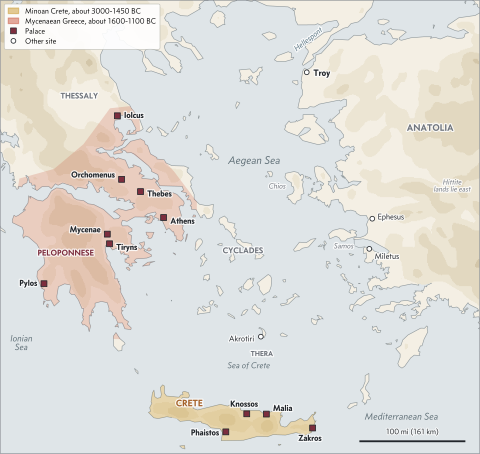
On the mainland, a warlike people grew rich and powerful from about 1600 BC, and by about 1400 BC they were building fortified palaces. Mycenae (my-see-nee) gave them their modern name, Mycenaean (my-suh-nee-un). Other palaces stood at Tiryns (ty-rinz), near Mycenae in the plain of Argos (ar-gos); at Pylos (py-los) in the southwest; at Thebes and Orchomenus (or-kom-uh-nus) in Boeotia; at Athens; and at Iolcus (eye-ol-kus) in Thessaly. These people spoke Greek. About 1450 BC they took over Knossos, and their clerks kept the palace accounts on clay tablets in a script called Linear B, the earliest written Greek. Across the Aegean, near the mouth of the Hellespont (hel-ih-spont), the narrow strait that leads from the Aegean toward the Black Sea, stood the walled city of Troy. Between about 1200 and 1100 BC nearly every Mycenaean palace was burned or abandoned, and the art of writing went with them. Chapter 1 tells how these places were found and their scripts read.
Cities and colonies, about 500 BC
After the palaces fell, the Greeks lived in villages and, so far as anyone knows, wrote nothing for some four hundred years. When they come back into view, about 800 BC, they have a new alphabet, borrowed from the Phoenicians (fuh-nish-unz), the seafaring traders of the coast of Lebanon. They also have a new kind of community, the self-governing city. Between about 750 and 550 BC dozens of these cities sent out shiploads of settlers to found new cities overseas (Figure S.2). Each new city was a colony, usually independent from the day it was founded, but it kept the gods, the dialect, and usually the friendship of its mother city, in Greek its metropolis. Some colonists left to escape hunger or feuds at home and some to trade. In the stories the Greeks told about their founders, Apollo’s oracle at Delphi, the shrine where his prophetess answered questions in the god’s name, often told them where to go.
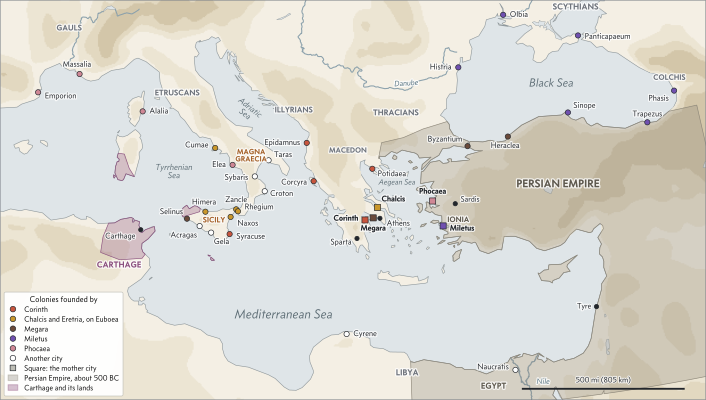
The colonists went west and northeast. So many Greek cities rose in southern Italy, among them Taras (tair-us), Sybaris (sib-uh-ris), Croton (kroh-tun), Elea (el-ee-uh), and Cumae (kyoo-mee) near modern Naples, that the Romans called the region Magna Graecia (mag-nuh gree-shuh), “Great Greece.” Corinth founded Syracuse in Sicily, in 733 BC as the Greeks dated it, and Syracuse grew into the greatest city of the Greek west. Gela (jel-uh), Acragas (ak-ruh-gus), and Selinus (sih-ly-nus) crowded Sicily’s southern coast. Phocaea (foh-see-uh), an Ionian city, planted Massalia (muh-say-lee-uh), now Marseille (mar-say), on the coast of Gaul. To the northeast, Megara (meg-uh-ruh) founded Byzantium (bih-zan-tee-um) on the Bosporus (bos-puh-rus), the strait at the mouth of the Black Sea, and Miletus ringed the Black Sea with colonies of its own. Among them were Sinope (sih-noh-pee), Olbia (ol-bee-uh), and Phasis in Colchis (kol-kis), the land of the Golden Fleece in myth. In Africa, settlers from Thera founded Cyrene (sy-ree-nee), and in the Nile Delta an Egyptian king let Greek merchants live and trade in a town of their own, Naucratis (naw-kruh-tis). On the map, five great founders each have a color of their own: Corinth, Megara, Miletus, Phocaea, and the two chief cities of Euboea, counted as one.
The map also shows the two great powers that pressed on the Greeks. In the east the Persian Empire conquered the kingdom of Lydia, inland from Ionia, in 547 or 546 BC (Vol. 5, In the Beginning) and the Ionian cities soon after, and by about 513 BC, under King Darius (duh-ry-us), it had crossed into Europe along the coast of Thrace. In the west, Carthage, a colony founded by the Phoenicians of Tyre, held western Sicily, Sardinia, and much of the coast of Africa, and it fought the Sicilian Greeks for more than two centuries. Chapter 4 tells the story of the colonies, and Chapter 8 the revolt of the Ionians against Persia.
The kingdoms after Alexander, about 240 BC
Alexander the Great, king of Macedon, conquered the Persian Empire between 334 and 330 BC, marched on as far as India, and died at Babylon in 323 BC at the age of thirty-two (Chapter 20). His generals, the Successors, in Greek the Diadochi (dy-ad-uh-ky), fought over his empire for forty years and broke it into kingdoms (Figure S.3). By about 240 BC three royal houses had settled in, each named after its founder. The Ptolemies (tol-uh-meez), descended from Alexander’s general Ptolemy (tol-uh-mee), ruled Egypt from Alexandria down to Cleopatra (Vol. 5, In the Beginning). The Seleucids (suh-loo-sidz), descended from Seleucus (suh-loo-kus), ruled from Antioch (an-tee-ok) in Syria and from Seleucia (seh-loo-shuh) on the Tigris over Asia Minor, Mesopotamia, and Iran. Their realm had once reached Bactria (bak-tree-uh), in what is now northern Afghanistan, but about 250 BC its Greek governor made himself a king there. The Antigonids (an-tig-uh-nidz), descended from Antigonus (an-tig-uh-nus) the One-Eyed, ruled Macedon from Pella (pel-uh) and kept soldiers in the strongholds of Greece.
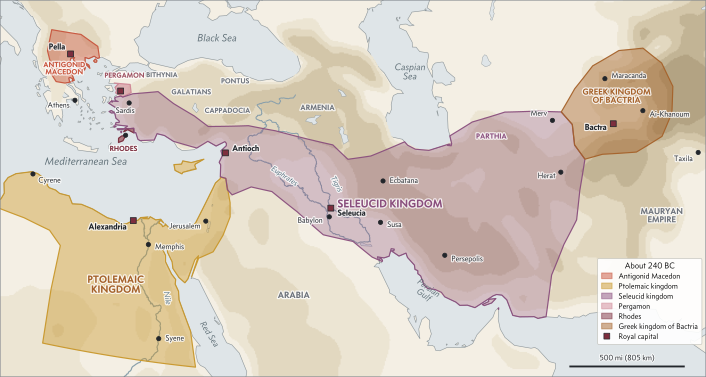
Between these giants lived smaller powers. The kingdom of Pergamon (pur-guh-mon), in the northwest of Asia Minor, grew rich and built one of the finest cities of the age. The island of Rhodes (rohdz), a trading republic, kept its freedom by its fleet. In Greece itself many cities joined in leagues, the Achaean (uh-kee-un) League in the northern Peloponnese and the Aetolian (ee-toh-lee-un) League north of the Gulf of Corinth, to hold their own against the kings. Chapter 21 tells how Rome absorbed them all.
The ages of Greek history
Historians divide the Greek past into ages, and the chapters use their names without stopping to explain them. Figure S.4 sets the ages down the left side of the page, with the volume’s main events in two lanes beside them and the six Parts of this book on the right. Time runs down the page, but not evenly. The centuries before 800 BC, which hold few dated events, are squeezed together at the top. The two centuries from 500 to 300 BC, which hold most of this volume’s stories, are stretched out in the middle.
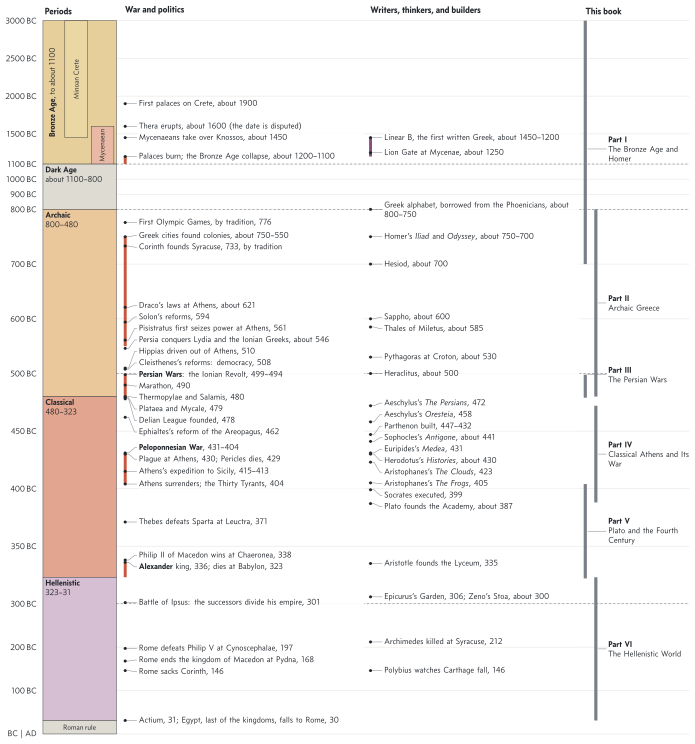
The Bronze Age, named for the metal of its tools and weapons, ended in Greece about 1100 BC with the fall of the palaces. Then came what historians call the Dark Age, from about 1100 to 800 BC. It is dark not because nothing happened in it but because so little evidence survives to light it: writing was forgotten, people lived in small villages, and trade with the rest of the Mediterranean shrank. The Archaic (ar-kay-ik) period, from about 800 to 480 BC, takes its name from a Greek word for “ancient.” It is the age of the alphabet and Homer, of the first city-states and the colonies, of the poets who sang of their own lives, of tyrants, and of the first philosophers. It ends with the Persian invasion of 480 BC.
The Classical period runs from that invasion to the death of Alexander in 323 BC. It holds the Athens of Pericles, the great tragedies, the war between Athens and Sparta, Socrates, Plato, and Aristotle, and its art and writing were later taken as the models of excellence, which is what “classical” means. The Hellenistic (hel-uh-nis-tik) period, from 323 to 31 BC, is the age of Alexander’s successors. The German historian Johann Gustav Droysen (droy-zen) gave it its name in the 1830s, from Hellenes, because Greek kings, Greek cities, and the Greek language then spread from Egypt to Afghanistan. It ends in 31 BC with the sea battle of Actium (ak-shee-um), off western Greece, where Cleopatra of Egypt and her Roman ally Mark Antony lost to the Roman who would become the emperor Augustus.
The Greeks themselves had no BC. Most cities named each year after an official who served for that year. At Athens the year took the name of one of the chief magistrates, the archons (ar-konz); at Sparta it took the name of one of the five ephors (ef-orz), who watched over the kings. A date in one city meant nothing in the next. Later Greek scholars counted years by Olympiads, the four-year spans between the Olympic Games, starting from the first games on record, which they set in the year we call 776 BC. Modern historians turn all these dates into years BC by fitting the lists of officials together and pinning them to eclipses and other fixed points. An Athenian year began at midsummer, so an Athenian event can often be dated only to the two of our years that its year overlapped, written “508/7 BC”; this book gives the single year that most histories use.
Athens and the Peloponnese
Most of this volume’s stories happen in two places: the city of Athens, which Figure S.5 plans, and the Peloponnese, which Figure S.6 maps.

Athens grew up around a steep, flat-topped rock that rises about 490 feet above the sea. A hilltop citadel of this kind was an acropolis (uh-krop-uh-lis), “high city,” and many Greek cities had one. This book means Athens’s when it writes “the Acropolis.” Its top, about 7 acres, held the palace of Bronze Age kings and later the city’s greatest temples (Chapter 11). Below it to the northwest lay the agora (ag-uh-ruh), the open square that was both marketplace and meeting place, where citizens shopped, argued, and did the city’s business. Low hills rise west of the Acropolis. On the nearest, the Areopagus (air-ee-op-uh-gus), “the hill of Ares (air-eez),” an ancient council met and judged cases. On the Pnyx (niks) the citizens gathered in their Assembly to vote, and the Hill of the Muses closed the view to the southwest. Around the gate called the Dipylon (dip-ih-lon), “double gate,” lay the Kerameikos (kerr-uh-my-kos), the potters’ quarter, and outside the gate the city’s chief cemetery. Farther out, in groves along two small rivers, the Cephissus (seh-fis-us) and the Ilissus (ih-lis-us), lay two exercise grounds, the Academy and the Lyceum (ly-see-um), where Plato and Aristotle would teach.
Athens lies about 3 miles from the nearest beach. Its first harbor was the open beach of Phaleron (fal-uh-ron) Bay. From 493 BC the Athenians fortified the rocky peninsula of Piraeus (py-ree-us) instead, with its three natural harbors: a large main harbor and two round basins, Zea (zee-uh) and Munychia (myoo-nik-ee-uh). Between about 462 and 457 BC they joined city and sea with the Long Walls: the North Wall, about 4 miles long, to Piraeus, and the Phaleric Wall to Phaleron. In the 440s BC they built a second wall to Piraeus, the Middle Wall, parallel to the first, with a road between the two. Behind these walls Athens could not be starved out by an army on land as long as its ships held the sea.

The Isthmus of Corinth, a neck of land about 4 miles wide, is all that joins the Peloponnese to the rest of Greece. The name Peloponnese means “the island of Pelops (pee-lops),” after a hero of myth. Corinth stood at the isthmus’s southwestern end. It had one harbor on the Gulf of Corinth, facing west toward Italy, and another on the Saronic (suh-ron-ik) Gulf, facing east toward the Aegean, so it held both the road between the two halves of Greece and the short way between two seas. The Peloponnese itself is a fist of mountains with fingers pointing south. Its northern shore is Achaea (uh-kee-uh). In its northeast lies Argolis (ar-guh-lis), the plain of Argos, with Mycenae, Tiryns, and the healing sanctuary of Epidaurus (ep-ih-dor-us). The mountainous heart is Arcadia (ar-kay-dee-uh), with the towns of Mantinea (man-tih-nee-uh) and Tegea (tee-jee-uh) and the later city of Megalopolis (meg-uh-lop-uh-lis). In the west is Elis (ee-lis), and beside its river, the Alpheus (al-fee-us), stood the sanctuary of Zeus at Olympia (oh-lim-pee-uh), home of the Olympic Games.
Sparta lay in the south, in the valley of the Eurotas (yoo-roh-tus), between the high wall of Mount Taygetus (tay-ij-ih-tus) and the Parnon (par-non) range. Its land was Laconia (luh-koh-nee-uh), also called Lacedaemon (las-uh-dee-mun), which is why the Greeks often called the Spartans Lacedaemonians. Its port was Gythium (jith-ee-um), now Gytheio (yee-thee-oh). West of Taygetus lay Messenia (meh-see-nee-uh), a richer plain that Sparta conquered in the eighth and seventh centuries BC and held for some three hundred years (Chapter 6). At its center stood the stronghold of Mount Ithome (ih-thoh-mee), where the city of Messene (meh-see-nee) was later built, and on its west coast lay Bronze Age Pylos. By road, Sparta is about 150 miles from Athens. North of the Gulf of Corinth, the map shows Delphi under Mount Parnassus, and in Boeotia, some 30 miles northwest of Athens, Thebes with its neighbors Plataea and Leuctra (look-truh).
The polis and its kinds of rule
The Greek word for a city-state was polis (poh-lis), plural poleis (poh-layz). A polis was a town and the farmland around it, governing itself. It had its own laws and officials, its own army of citizens, its own gods and festivals, and often its own coins. A polis was its people more than its walls: Greek writers wrote “the Athenians” where we would write “Athens.” More than a thousand poleis are known. Most were small, a walled town of a few thousand people with a few miles of fields around it, so that a farmer could walk to the town’s market and home again in a day. Athens was a giant. Attica covers about 1,000 square miles, a little less than Rhode Island, and in the middle of the fifth century BC perhaps as many as 60,000 of its people were adult male citizens. Sparta, which ruled both Laconia and Messenia, had the largest territory of any city on the mainland. English still carries the word: politics first meant the affairs of the polis, and a metropolis was a mother city.
Not everyone who lived in a polis was a citizen. In most cities, citizens were the free men born to citizen families. Their wives and daughters belonged to the city and served its gods, but they did not vote or hold office. Free foreigners who settled in the city, and slaves, who were bought and sold as property, had no share in governing at all. Citizens also defended the city. A citizen who could afford a bronze helmet, a breastplate, a long spear, and a big round shield fought as a hoplite (hop-lyte), a heavily armed foot soldier. Hoplites fought shoulder to shoulder in a deep block of men called a phalanx (fay-lanks), each man’s shield covering his neighbor. At Athens, poorer citizens rowed the city’s warships.
Rivals in everything else, the poleis spoke one language, in several dialects, and met at the four great festivals of games open to all Greeks, at Olympia, Delphi, Nemea (nee-mee-uh), and the Isthmus. They also consulted the same oracle at Delphi (Chapter 4). The Greeks called anyone who did not speak Greek a barbaros (bar-buh-ros), a word that probably imitated the sound of speech they could not understand, as if it were “bar-bar.” It meant at first simply “foreigner,” and it covered peoples the Greeks admired, such as the Egyptians and the Persians. Its English descendant, “barbarian,” is harsher, and in this book it is only ever the Greek writers’ word.
The words for rule
Poleis governed themselves in many ways, and the Greeks gave the ways names that English still uses (Table S.1). Most are built from two Greek words, archein (ar-kay-in), “to rule” or “to lead,” and kratos (kray-tos), “power.” Whatever its kind of rule, nearly every polis had the same three parts: an assembly of citizens, a council that prepared the assembly’s business, and magistrates who carried out its decisions. The kinds of rule differed in who could belong to each part and who had the last word.
Under a monarchy one man ruled, usually a king. Kings ruled the Bronze Age palaces, but the Linear B tablets call the king by another title (Chapter 1) and use basileus (bah-sih-lyoos), the later Greek word for a king, for a lesser local chief. Kings later ruled Macedon and the Hellenistic kingdoms. By the seventh century BC, though, most poleis had replaced their kings with an aristocracy, the rule of noble families who called themselves the aristoi, “the best,” such as the clan of the Bacchiads (bak-ee-adz) at Corinth. Sparta kept two kings at once, from two royal houses, beside its ephors and a council of elders. A tyrannos (tih-ran-os) was not at first a monster. He was a man, often a noble with the common people behind him, who seized power and ruled outside the city’s laws. Some tyrants were popular, built temples and fountains, and kept the peace, like Pisistratus (py-sis-truh-tus) of Athens (Chapter 5); others, like Periander (perr-ee-an-dur) of Corinth in the historian Herodotus’s (hih-rod-uh-tus) telling, were remembered as cruel (Chapter 4). Dionysius (dy-uh-nish-us) I of Syracuse, two centuries later, ruled for thirty-eight years and was remembered for both (Chapter 18). By Plato’s day the word had come to mean the worst of all rulers, and that is the meaning that “tyrant” and tyranny carry in English.
Under an oligarchy (ol-ih-gar-kee) a few men ruled, usually those rich enough to meet a property test, and twice near the end of its great war Athens fell into the hands of oligarchs (Chapter 13). Under a democracy, which Athens adopted after the reforms of Cleisthenes (klys-thuh-neez) in 508 BC, every citizen could speak and vote in the Assembly, and many officials were chosen by lot, drawn at random, rather than by election (Chapter 5). It was a direct democracy, with no representatives: the citizens themselves voted on war and peace. The word hegemony (hih-jem-uh-nee), from hegemon (hej-uh-mon), “leader,” names the leadership that one strong city held over its allies, as Sparta led the cities of the Peloponnese. Historians call the decades after 404 BC, when first Sparta and then Thebes led Greece, the age of the hegemonies (Chapter 18).
| Word | From the Greek | In this book |
|---|---|---|
| monarchy | monos, alone, and archein, to rule: rule by one man, usually a king | Philip and Alexander of Macedon; the Ptolemies of Egypt |
| tyranny | tyrannos, a man who seized power and ruled outside the laws | Pisistratus of Athens; Dionysius I of Syracuse |
| aristocracy | aristoi, the best, and kratos, power: rule by the noble families | the Bacchiads of early Corinth |
| oligarchy | oligoi, the few, and archein: rule by a few, usually the rich | the Four Hundred (411 BC) and the Thirty (404 BC) at Athens |
| democracy | demos, the people, and kratos: rule by all the citizens in their assembly | Athens after Cleisthenes’s reforms of 508 BC |
| anarchy | an-, without, and archos, ruler: no one in charge | the years when Athens chose no chief archon |
| hegemony | hegemon, leader: one city’s leadership of its allies | Sparta’s and then Thebes’s, 404–362 BC |
Greek names in English
Greek has an alphabet of its own (Chapter 2), so every Greek name in English is a spelling of Greek sounds in our letters, and there are two ways of doing it. The old way came from the Romans, who wrote Greek names as Latin spelled them. They wrote c for the Greek k, ae for ai, oe for oi, u for ou, and the ending -us for -os. The newer way keeps closer to the Greek letters. So the playwright whom the Greeks called Aischylos is Aeschylus (es-kih-lus) in the Latin spelling, and the historian Thoukydides is Thucydides. Table S.2 gives the rules with examples.
| Greek spelling | This book | The rule |
|---|---|---|
| Kleisthenes | Cleisthenes | k becomes c |
| Korinthos | Corinth | |
| Khalkis | Chalcis | kh becomes ch |
| Akhilleus | Achilles | |
| Aischylos | Aeschylus | ai becomes ae |
| Mykenai | Mycenae | |
| Oidipous | Oedipus | oi becomes oe |
| Boiotia | Boeotia | |
| Thoukydides | Thucydides | ou becomes u |
| Peisistratos | Pisistratus | ei becomes i or e |
| Pheidias | Phidias | |
| Herodotos | Herodotus | -os becomes -us |
| Byzantion | Byzantium | -on becomes -um |
| Alexandros | Alexander | -ros becomes -er |
| Herakles | Heracles | the Roman name is Hercules |
| Odysseus | Odysseus | the Roman name is Ulysses |
| Athenai | Athens | an English form |
| Platon | Plato | an English form |
| Aristoteles | Aristotle | an English form |
This book, like the volume of myths (Vol. 4, Classical Myth), uses the Latin spellings that English has used for centuries, and the English forms where English has its own: Athens, not Athenai; Homer, not Homeros; Plato, not Platon. A few places are known in English mainly by their Greek spelling, like Knossos and the Kerameikos, and they keep it. A reader who meets Herakles, Kleisthenes, or Peisistratos in another book is meeting Heracles, Cleisthenes, and Pisistratus. The Roman names of gods and heroes, such as Hercules for Heracles and Ulysses (yoo-lis-eez) for Odysseus (oh-dis-ee-us), are given in the volume of myths (Vol. 4, Classical Myth).
English also says these names in its own traditional way, which is not how the Greeks said them. A final e is almost always sounded, so Nike, the goddess of victory, is said NY-kee, and Penelope (puh-nel-uh-pee) has four syllables. The ending -es is said “eez,” as in Socrates and Sophocles (sof-uh-kleez). The letters ch are a hard k, as in Chios. A c is soft before e, i, or y, as in the Cyclades, and hard elsewhere, as in Corinth. The pairs ae and oe are usually said “ee,” as in Aegean. Wherever a name is hard to say, this book gives its usual English pronunciation the first time it appears.
How the ancient books reached us
Not one book by an ancient Greek survives in its author’s own copy. Every Greek text we read reached us through a chain of copies made by hand, and every link in the chain could add mistakes or break. Three kinds of evidence survive: books copied in the Middle Ages, scraps of ancient books found in Egypt, and passages of lost books that later writers quoted.
Manuscripts
An ancient Greek book was a roll of papyrus (puh-py-rus), the paper that the Egyptians made from a marsh reed, often 20 to 30 feet long when unrolled. In a damp climate a roll lasted a few centuries at most, so a book survived only if someone kept copying it. In the Hellenistic age the scholars of the great Library at Alexandria collected the classics, corrected them, and had them copied (Vol. 5, In the Beginning). Between the second and fourth centuries AD the roll gave way to the codex (koh-deks), a book of pages bound along one edge like this one. Then for a thousand years the copying went on mainly in Constantinople, the old Byzantium, capital of the Greek-speaking empire that historians therefore call Byzantine (biz-un-teen). Nearly every Greek author read today survives in manuscripts, books written by hand on parchment, made from animal skin, or on paper, most of them made between the ninth century AD and the fifteenth. As the Turks closed in on Constantinople, which fell to them in 1453, Greek scholars and their books moved west to Italy, where printers set the texts in type. Aldus Manutius (al-dus muh-noo-shus), a printer of Venice, published Aristotle in five volumes from 1495 to 1498.
Whatever the copyists did not copy was lost. The three great tragic playwrights of Athens, Aeschylus, Sophocles, and Euripides (yoo-rip-ih-deez), wrote about three hundred plays between them, and about thirty survive whole. Often what survived was what teachers chose for their pupils to read.
Papyri
The second kind of evidence is papyrus itself, which can last two thousand years in the dry sand of Egypt. In 1896 two young Oxford scholars, Bernard Grenfell and Arthur Hunt, began to dig the ancient rubbish heaps of Oxyrhynchus (ok-sih-ring-kus), a town on the edge of the desert west of the Nile. Its people had thrown out worn-out books along with letters, tax receipts, and contracts, and the heaps held hundreds of thousands of scraps. Only about one in ten is literary, but among them are lost poems of the poets Sappho (saf-oh) (Chapter 3) and Pindar (pin-dur) (Chapter 4).

Papyri found elsewhere in Egypt have given back whole books. One, bought in Egypt in 1890 and published by the British Museum in January 1891, turned out to be the Constitution of the Athenians, a history of Athens’s government written by Aristotle or one of his students (Figure S.7). Apart from two small papyrus leaves found in 1879, it had been lost for more than a thousand years. Another, published in 1958, gave back the only nearly complete comedy by Menander (meh-nan-dur) (Chapter 21).
Fragments
The third kind of evidence is the fragment, a surviving scrap of a lost work: either a torn piece of papyrus or a passage that some later writer happened to quote. Much of the earliest Greek thought survives only in this way. The sayings of Heraclitus (herr-uh-kly-tus) and the poem of Parmenides (par-men-ih-deez), two of the first philosophers, come to us as quotations in writers who lived centuries after them, some of whom quoted them only to argue against them (Chapter 7). Modern editors gather the fragments of each lost author and number them, so a fragment is known by its number. Sappho’s “Fragment 31,” for example, is a poem that an ancient book on style happened to quote. The philosophers before Socrates are cited by the numbers that the German scholar Hermann Diels (deelz) gave their fragments in 1903, as later revised by Walther Kranz (krahnts).
How a passage is cited
Scholars number the texts so that a reader can find a passage in any edition or translation, and the chapters use these numbers.
- Book and chapter. The history of Herodotus is divided into nine books, and its Book 2 is about Egypt. Within each book later editors numbered the chapters and sections. “Thucydides 1.23” means Book 1, chapter 23, where Thucydides gives what he thought the truest cause of his war. In Crawley’s words: “The growth of the power of Athens, and the alarm which this inspired in Lacedaemon, made war inevitable.”
- Book and line. Long poems are cited by book and line, so Iliad 22.136 is line 136 of Book 22. Plays have line numbers but no books.
- Stephanus (stef-uh-nus) pages. Plato is cited by the pages of the edition of his works that Henri Estienne (ahn-ree ay-tyen), a printer known in Latin as Stephanus, published at Geneva in 1578. Each page was divided into sections lettered a to e, so “Republic 514a” marks the start of Plato’s story of prisoners in a cave (Chapter 17). Estienne’s father, Robert, was the printer who numbered the verses of the New Testament (Vol. 5, In the Beginning).
- Bekker (bek-ur) numbers. Aristotle is cited by the pages of the Berlin edition of his works begun in 1831 by August Immanuel Bekker, each with its column, a or b, and its line. The number 1094a1, page 1094, column a, line 1, is the first line of the Nicomachean Ethics (nik-uh-muh-kee-un) (Chapter 19).

These systems also explain the odd numbers that turn up beside quotations in other books. A reader who sees “Apology 38a” knows at once that the passage is Plato’s, and one who sees “1253a” knows it is Aristotle’s, without needing the same translation as the writer who cited it.
The writers behind the stories
Many of the most famous stories about the Greeks were first written down long after they happened, by writers who took them from older books now lost, from local tradition, or from their own imagination. The story of a runner who carried the news of the victory at Marathon to Athens and fell dead first appears in Plutarch, nearly six centuries after the battle. Herodotus, who wrote within living memory of it, tells instead of a runner sent to Sparta for help before the battle, and it was the satirist Lucian (loo-shun), some decades after Plutarch, who first gave the dying runner the name of Herodotus’s messenger (Chapter 8). So whenever a story’s source matters, the chapters name the writer, as in “Plutarch tells” or “Lucian’s story of the runner.” The list below gives, in order of their dates, the ancient writers the chapters rely on most. Most of the dates are approximate.
- Herodotus of Halicarnassus (hal-ih-kar-nas-us) (about 484–425 BC), a Greek of Asia Minor, wrote the Histories, on the Persian Wars and the peoples of the Persian Empire, and finished it about 430 BC (Chapter 8).
- Thucydides of Athens (about 460–400 BC) wrote the History of the Peloponnesian War, a general’s account of the war he fought in, which breaks off in 411 BC (Chapter 11).
- Xenophon (zen-uh-fun) of Athens (about 430–354 BC) wrote the Anabasis (uh-nab-uh-sis), on the march of the Ten Thousand, Greek soldiers who fought their way home from Persia; the Hellenica (heh-len-ih-kuh), which carries Thucydides’s story on to 362 BC; and memoirs of Socrates (Chapter 14).
- Aristotle or one of his students wrote the Constitution of the Athenians about 330 BC, a history of Athens’s government, lost but for scraps until a papyrus of most of it was published in 1891.
- Polybius (puh-lib-ee-us) of Megalopolis (about 200–118 BC), a Greek hostage at Rome, wrote the Histories, which explain how Rome conquered the Mediterranean, down to 146 BC, the year he watched Carthage fall (Chapter 21).
- Diodorus (dy-uh-dor-us) of Sicily (wrote about 60–30 BC) compiled the Library of History, a history of the world in forty books, of which fifteen survive whole.
- Strabo (stray-boh) of Amaseia (am-uh-see-uh) (about 64 BC–AD 24), from northern Asia Minor, wrote the Geography, seventeen books describing the known world place by place.
- Plutarch of Chaeronea (ker-uh-nee-uh) (about AD 46–120), in Boeotia, a priest at Delphi, wrote the Parallel Lives, biographies in pairs, a Greek beside a Roman, and the essays called the Moralia (muh-ray-lee-uh), among them the Sayings of Spartans (Chapter 6).
- Arrian (air-ee-un) of Nicomedia (nik-uh-mee-dee-uh) (about AD 86–160), in northwest Asia Minor, wrote the Anabasis of Alexander, built on the memoirs of Alexander’s officers Ptolemy and Aristobulus (uh-ris-toh-byoo-lus) (Chapter 20).
- Pausanias (paw-say-nee-us) (about AD 110–180) wrote the Description of Greece, a traveler’s guide to its sanctuaries and monuments.
- Lucian of Samosata (suh-mos-uh-tuh) (about AD 125–180), a satirist from the Euphrates (yoo-fray-teez), wrote a short essay, “A Slip of the Tongue in Greeting,” in which the runner who died at Athens after Marathon is first called Philippides (fih-lip-ih-deez).
- Polyaenus (pol-ee-ee-nus) (wrote about AD 163) collected military tricks in his Stratagems, which he dedicated to the emperors Marcus Aurelius (aw-ree-lee-us) and Lucius Verus (veer-us).
- Diogenes Laërtius (dy-oj-uh-neez lay-ur-shus) (third century AD) wrote the Lives and Opinions of Eminent Philosophers, the source of most stories about the philosophers (Chapter 22).
- Iamblichus (eye-am-blih-kus) (about AD 245–325) wrote On the Pythagorean Life, about the philosopher Pythagoras (pih-thag-er-us) and his followers, some eight centuries after their time.
- Simplicius (sim-plish-us) (about AD 480–540) wrote commentaries on Aristotle that preserve sayings of the first philosophers.
- The Suda (soo-duh) (late tenth century AD) is a Byzantine encyclopedia of some 30,000 entries, drawn from books now lost.
| Region | In these years | Taught in |
|---|---|---|
| Egypt | The great pyramids of the Old Kingdom (about 2600–2500 BC); the New Kingdom of Ramesses II; Persian rule from 525 BC; the Ptolemies from 305 BC to Cleopatra’s death in 30 BC. | Vol. 5, In the Beginning |
| Persia | Cyrus the Great founds the Persian Empire (550 BC) and takes Lydia and Babylon; Darius I and Xerxes invade Greece (490 and 480 BC); Alexander ends the empire (330 BC). | Vol. 5, In the Beginning |
| Israel and Judah | The kingdoms of Israel and Judah; Jerusalem destroyed by Babylon (587 or 586 BC); the return from exile; the Maccabees’ revolt against the Seleucids (167 BC). | Vol. 5, In the Beginning |
| Carthage | Founded, by tradition, in 814 BC; fights the Greeks of Sicily from the sixth century BC and Rome in three wars; destroyed by Rome in 146 BC, the year Corinth fell. | Vol. 5, In the Beginning |
| Rome | Founded, by tradition, in 753 BC; a republic from 509 BC; master of Italy by about 270 BC and of Greece by 146 BC; Octavian, the future emperor Augustus, defeats Antony and Cleopatra at Actium (31 BC). | Vol. 7, The Romans |
| India | The Buddha, in the sixth or fifth century BC; Alexander at the Indus (326 BC); the Mauryan emperors Chandragupta and Ashoka. | Vol. 39, India |
| China | Confucius (551–479 BC); the First Emperor unites China (221 BC); the Han dynasty from 206 BC. | Vol. 40, The Middle Kingdom |
Notice the distance between each writer and his stories. Herodotus, Thucydides, and Xenophon wrote about their own times or their fathers’. Most of the writers after them looked back across centuries, and the further back they looked, the more room their stories had to grow. Roman writers also told Greek stories, and the chapters introduce each where his story comes. They include the architect Vitruvius (vih-troo-vee-us), the orator Cicero (sis-uh-roh), and the philosopher Seneca (sen-ih-kuh). Others are the satirist Juvenal (joo-vuh-nul), the collector of anecdotes Valerius Maximus (vuh-leer-ee-us mak-sih-mus), and Curtius Rufus (kur-shus roo-fus), a historian of Alexander.
Meanwhile elsewhere
The Greeks were never alone. They traded with the Egyptians and the Phoenicians, fought Persia and Carthage, and were conquered at last by Rome. Table S.3 sets their story beside what was happening elsewhere in the same centuries, and names the volumes of this Course that teach it.
The Bronze Age and Homer
Chapter 1 · 34 clues
Palaces and the Fall: Minoans and Mycenaeans
In February 1893 an Englishman went shopping in the flea markets of Athens. He was Arthur Evans, forty-one years old, the keeper, or director, of the Ashmolean (ash-moh-lee-un) Museum in Oxford, and wherever he traveled he collected small antiquities, above all engraved seal stones. A seal stone is a little carved gem that was pressed into soft clay to stamp its owner’s mark, the way an official stamps a document today. Evans was badly nearsighted, but an object held close to his eyes showed him details that other people missed. On several of the stones he bought that winter he saw rows of tiny signs. They were not Egyptian hieroglyphs, and they were not the letters of any alphabet. The dealers said the stones had come from Crete.
Evans knew what that might mean. The heroes of Homer’s poems almost never write anything down. The scholars of Evans’s day believed that the Greeks had not written at all until they borrowed the alphabet from the Phoenicians, which they did, it is now thought, in the ninth or eighth century BC (Vol. 5, In the Beginning). If the signs on the stones were writing, then someone in the Greek world had kept records centuries earlier, in the age that the Greeks remembered only as the time of the heroes. Over the next sixty years a handful of diggers and code breakers brought that age back. They found palaces and painted walls, gold masks and burned cities, and at last they learned to read what the palace clerks had written.
Crete and the Minoans
Crete is the largest of the Greek islands, a mountainous bar of land about 160 miles long that closes off the southern end of the Aegean Sea. Its myths, of King Minos, the craftsman Daedalus (ded-uh-lus), and the Minotaur (min-uh-tor) in its maze, were told in an earlier volume (Vol. 4, Classical Myth). In 1893 the island still belonged to the Ottoman Empire, the empire of the Turkish sultans, and its Christian Greeks had risen against their rulers again and again. Fifteen years earlier a merchant of the island with the ringing name of Minos Kalokairinos (kah-loh-keh-ree-nos) had dug for a few weeks into a low hill called Kephala (kef-ah-lah), about 3 miles south of the port of Heraklion (heh-rak-lee-on). He found storerooms lined with clay jars as tall as a man before the Ottoman authorities made him stop. The hill was the site of Knossos, the city of Minos in the old stories.
Evans came to see it in 1894. Among the stones that Kalokairinos had uncovered he noticed a double axe carved again and again, and he became sure that he had found the home of the script on his seal stones. He began buying the land, though rebellion kept him from digging. In 1898 the last Ottoman troops left the island, and Crete became a self-governing state under the protection of the European powers. In March 1900 Evans started work with thirty-two hired diggers, and within weeks it was clear that he had found something extraordinary. Arthur Evans excavated the palace of Knossos,This archaeologist excavated the Minoan palace at Knossos on Crete. → Arthur Evans••• uncovering most of it by 1905 and returning to dig and rebuild, on and off, for a quarter of a century more, paying for much of it himself. His workmen uncovered a building far older than any Greek temple, begun about 1900 BC, wrecked by an earthquake about 1700 BC, and rebuilt on a grander scale.

Evans needed a way to date what he found. The age itself already had a name. Archaeologists call the long stretch when the best tools and weapons were made of bronze, an alloy of copper and tin, the Bronze Age; in the Aegean it ran from about 3000 to about 1100 BC (the Stage). Evans divided the Bronze Age of Crete into Early, Middle, and Late periods by changes in the style of its pottery. Broken pots are the commonest thing on any ancient site, and their fashions changed every few generations. Later scholars split his periods more finely and fixed them to calendar years by matching them with dated objects from Egypt. Later still came radiocarbon dating, which measures the slowly decaying carbon left in anything that was once alive, such as wood or seeds. The dates in this chapter come from that work, and many are uncertain by decades (Figure 1.1).
For the people who built the palace, Evans turned to legend. He called them the Minoans, and he named them for King Minos,This civilization is named for a mythical king associated with a labyrinth. → Minoan civilization•• the ruler of Knossos in Greek myth, whose craftsman Daedalus built him a labyrinth to hold the Minotaur, a monster half man and half bull. Minoan is a modern word. What these people called themselves is unknown, and the Egyptians, who traded with them, called them Keftiu (kef-tee-oo). The legend, though, had always been fixed to this spot. Every Greek who told the story agreed that the Minotaur’s labyrinth lay at Knossos,This site legendarily contained the Minotaur's labyrinth. → Knossos• and the city later stamped a maze on its coins (Vol. 4, Classical Myth). The palace, with its maze of rooms and the double axes carved on its walls, made Evans wonder whether the building itself had given rise to the tale.
Whatever the truth of that, what Evans had found was far older than the legend. It was a Bronze Age civilization centered on Crete,The Minoan civilization was centered on this island. → Crete••This Bronze Age civilization was based on Crete. → Minoan civilization••• often called the first civilization in Europe. It grew out of farming villages that had stood on the island for thousands of years, and by about 1900 BC it had towns, palaces, and trade with Egypt and the coast of Syria.

The palace is easiest to understand on foot (Figure 1.3). A visitor in about 1500 BC came up from the town into a wide paved square, the West Court, and faced the palace’s tall western front. Inside, a long corridor ran past the narrow storerooms of the west wing. There clay jars called pithoi (pith-oy) held olive oil, wine, and grain, for the palace was also a warehouse for the harvests of the countryside around it. Beyond lay the Central Court, an open rectangle about 170 feet long and 80 feet wide, a little more than half the length of a football field. Around it rose wings several stories high, with staircases, light wells that brought daylight down into inner rooms, and drains of fitted clay pipes. On the east side a grand staircase led down to rooms that Evans named the Hall of the Double Axes and the Queen’s Hall. Altogether the building held more than a thousand rooms, and it had no fortress walls at all.

Around the palace spread a town of houses, workshops, and paved roads, and Knossos was the largest Minoan city.This civilization's largest city was Knossos. → Minoan civilization•• Its palace was also the largest of several on the island. Italian archaeologists began digging a second palace in 1900 at Phaistos, near the south coast, and later excavators found others at Malia, on the north coast east of Knossos, and at Zakros, near the island’s eastern tip (Figure 1.2). Each was built around a central court twice as long as it was wide, with its long side running north and south. Whether each palace had its own ruler, or whether Knossos ruled the whole island, no one knows.

The most famous room in the palace opens off the western side of the Central Court. Evans’s men cleared it in April 1900, in the first weeks of the dig. Against its north wall stands a high-backed seat of stone, with stone benches running along the walls on either side and a sunken basin, reached by steps, nearby. On the walls behind and beside it, painted griffins guard the throne,This site's throne room is decorated with griffins. → Knossos• lying among plants on a dark-red ground (Figure 1.4). A griffin is a monster with the body of a lion and the head of an eagle, and these wear tall crests on their heads. Evans called the seat the throne of Minos, and it is often called the oldest throne in Europe. Who sat on it is another matter. The German archaeologists Helga Reusch (roysh) and Friedrich Matz suggested that a priestess sat there, playing the part of a goddess between her guardian beasts. The room took its final shape late in the palace’s life, after about 1450 BC, and a throne room at Pylos, on the Greek mainland, had painted griffins too.
Visitors to Knossos today see a palace that is partly Minoan and partly the work of Evans. He rebuilt stairways, columns, and whole upper floors in reinforced concrete and painted them in strong reds and blacks. He also hired a Swiss artist, Émile Gilliéron (ay-meel zheel-yay-rawn), and later the artist’s son, to restore the paintings that his workmen found in pieces on the floors. Their work saved much that would have crumbled, but it often went beyond the evidence, and scholars now treat every restored wall and painting at Knossos with caution.
The thing Evans had come for was writing, and Knossos gave it to him in quantity. His workmen found some three thousand clay tablets, flat pieces of clay about the size of a hand on which clerks had scratched signs with a pointed tool. Clay that is only dried in the sun crumbles in time, and most of these tablets survived because the fires that destroyed the palace baked them hard, like pots in a kiln. Evans sorted the signs he found on Crete into three scripts. The oldest was made of little pictures, and he called it hieroglyphic, after Egyptian writing. The two later scripts were drawn in quick strokes, so he called them Linear A and Linear B.
Evans identified Linear A,This archaeologist identified the Linear A script on Crete. → Arthur Evans•This civilization used the still-undeciphered Linear A script identified by Arthur Evans. → Minoan civilization•• the script of the Minoans themselves. It appears on tablets, jars, and stone offering tables from all over Crete, written between about 1800 and 1450 BC. Because Linear B later borrowed many of its signs, scholars can guess how some Linear A words sounded, but the words match no language that anyone knows. Linear A has never been deciphered. Linear B is different in one way that would turn out to matter enormously: it has been found far beyond Crete, in the palaces of the Greek mainland, where Linear A almost never turns up. On the island, though, Linear B was found at KnossosLinear B script was found at this site. → Knossos• and almost nowhere else, on thousands of tablets from the palace’s last years. They are crowded with little pictures of men, women, sheep, chariots, and jars, and with numbers. Evans believed that Linear B, like Linear A, recorded the Minoans’ own language, and he never accepted any other idea.


Phaistos produced a stranger puzzle. On July 3, 1908, the Italian archaeologist Luigi Pernier (pair-nyay), digging in a basement room at the edge of the palace, picked up a disc of fired clay about 6 inches across, now called the Phaistos Disc. Both of its faces are covered with signs that run in a spiral between the rim and the center. There are 242 signs in all, made with forty-five different symbols, among them a head with a crest of plumes, a shield, an arrow, an eagle, and a rosette (Figure 1.5). Unlike every other text of the Bronze Age Aegean, the signs were not drawn. Each was pressed into the wet clay with a carved stamp, one stamp for each symbol, so the disc has been called the earliest known printing with movable type.
Pernier’s disc has never been deciphered,Luigi Pernier discovered this inscribed clay disc, whose text remains undeciphered, at a Minoan site. → Phaistos Disc•• and with only 242 signs it may never be. A code breaker needs many texts to compare, and not one other object with the same set of stamped signs has ever been found. Its date is uncertain too, though it probably belongs to the first half of the second millennium BC, and a few scholars have suspected a forgery, though most now accept it as genuine. What is certain is where it was found. The Phaistos Disc came from a Minoan palace,The Phaistos Disc was found at a site of this civilization. → Minoan civilization•• one of the great palaces of Crete, whatever language its signs record. By 1910, then, the Minoans had a name, a palace, three scripts, and a stamped disc, and no one could read a word they had written.
Minoan frescoes and pottery
The Minoans covered their walls with paintings. Most were frescoes, painted while the plaster was still wet so that the colors sank in and dried with it (Vol. 1, The Toolkit). Few survived whole. The walls of Knossos had fallen and burned, and the excavators found the paintings as heaps of colored flakes, many only a few inches across, which Gilliéron’s workshop fitted together and completed. In every photograph of a Minoan fresco, look for the difference between the original pieces, with their cracked and worn surfaces, and the smooth modern plaster painted in between.
The most famous picture fell from an upper story of the east wing when the palace was destroyed. Evans excavated the Bull-Leaping Fresco at Knossos:Arthur Evans excavated the Bull-Leaping Fresco at this site. → Knossos•• a charging bull with one young athlete gripping its horns, another somersaulting over its back, and a third waiting behind with arms outstretched (Vol. 4, Classical Myth). Evans called the panels the Taureador Frescoes, after the Spanish toreador, a bullfighter. The two outer athletes are painted white. In Minoan painting, as in Egyptian, white skin usually marked a woman and reddish-brown skin a man, so the leapers may have included young women.

Another fragment made the Minoans famous in France. It shows the head of a young woman in profile, with a huge dark eye, bright-red lips, and a curl of hair on her forehead. The French archaeologist Edmond Pottier (pot-yay) thought that she looked like a fashionable lady of his own day, and the nickname he gave her, La Parisienne (lah pah-ree-zyen), “the Parisian,” has stuck. The painters of Knossos made both the Bull-Leaping Fresco and La Parisienne,This civilization produced Knossos’s Bull-Leaping Fresco and the fragment called La Parisienne. → Minoan civilization••• the two best-known paintings of Minoan Crete. She is a piece of a larger scene, the Camp Stool Fresco, in which figures sit on folding stools and raise cups at a feast. A loop of cloth tied at the back of her neck, called the sacral knot, suggests that she was a priestess or even a goddess. She dates from about 1450 to 1350 BC, the last century of the palace.
Women fill Minoan art, as priestesses, worshipers, dancers, and perhaps goddesses, and kings are strangely hard to find in it. In 1903 Evans’s workmen opened a stone-lined pit in the floor of the west wing, one of a pair that he called the Temple Repositories. In it they found small figures of women in long flounced skirts, made of faience (fay-ahns), a glazed paste that shines like colored glass. Snakes coil around the arms of one and wriggle in the raised fists of the other (Vol. 4, Classical Myth). The snake goddess figurines came from Knossos,Snake Goddess figurines were found at this site. → Knossos•• but whether they show goddesses, priestesses, or worshipers, and what the snakes meant, are still argued.

Evans believed he had found a king at last. In 1901 his workmen dug up, near the southern end of the palace, pieces of a painted relief, plaster that had been built up into low shapes before it was painted. Gilliéron assembled them into a young man striding to the left, wearing a crown of lilies with tall plumes, a necklace of lilies, and a belt, with one fist on his chest. Evans called him the Priest-King, but most people now know this Minoan painting as the Prince of the Lilies.This civilization produced an artwork known as the "Prince of the Lilies." → Minoan civilization• Only nine fragments are original, and Evans himself first thought they came from at least two figures. Some scholars now think the muscular torso belonged to a boxer, and the crown to someone else, perhaps a priestess or one of the crested griffins like those of the Throne Room.
Paintings were for the rich few, but everyone used pots, and Minoan potters were among the best of the ancient world. Their finest early ware is Kamares (kah-mah-res) ware, named for a caveThis civilization produced Kamáres ware pottery. → Minoan civilization• high on Mount Ida, the tallest mountain of Crete, where pieces of it were first found in the 1890s. The ware was made in the workshops of the palaces at Phaistos and Knossos, mostly between about 2000 and 1700 BC, on the potter’s wheel, which the Minoans had just begun to use. The potter covered the pot in dark paint and then painted on top of it in white, red, and orange: spirals, rosettes, and coiling plants. The best pieces have walls so thin that collectors call them eggshell ware. Kamares cups traveled as far as Egypt.


Three centuries later the fashion had turned inside out, with dark paint on pale clay instead of light paint on dark. The most famous pots of this age, about 1500 BC, are in the Minoan pottery style called Marine Style,The "Marine Style" was used for pottery from this civilization. → Minoan civilization• which covers the whole surface with sea creatures (Figure 1.8). Octopuses wrap their arms around the vessel, among argonauts (small relatives of the octopus that live in thin shells), dolphins, seaweed, and rocks. There are no borders or bands; the animals seem to float, as they would in water. It was the last purely Minoan style. About 1450 BC fire destroyed every palace on Crete except Knossos, and the island’s art changed with its rulers.
Seventy miles north of Crete lies the island of Thera, now usually called Santorini (san-tuh-ree-nee). In the Bronze Age a prosperous port town stood on its southern shore, near the modern village of Akrotiri; its ancient name is lost. Its people were probably islanders of the Cyclades, the ring of small islands in the middle of the Aegean, and not Cretans, but they lived in the Minoan manner. They painted their houses with frescoes in the Minoan style and used Minoan goods and customs, so Akrotiri counts as a town of the Minoan world. Then, about 1600 BC, the volcano under the island exploded in one of the largest eruptions in the history of mankind. The eruption of Thera buried AkrotiriThe eruption of Thera destroyed Akrotiri, a settlement strongly influenced by this civilization. → Minoan civilization••• under many feet of pumice and ash. Its date is still argued, because radiocarbon points to about 1600 BC while links with Egyptian history suggest a century later.
The people of Akrotiri seem to have had warning. The excavators have found no bodies in its streets and only one gold object, as if the inhabitants had gathered their valuables and fled. Like Pompeii (pom-pay), the Roman town buried by Vesuvius in AD 79 (Vol. 7, The Romans), the town was preserved by the disaster that ended it. The Greek archaeologist Spyridon Marinatos (mah-ree-nah-tos) began digging there in 1967 and found houses standing two and three stories high, with their paintings still on the walls. He died at the site in 1974 and is buried there.

In 1970 his team found the first Aegean fresco still standing on its walls in the place where it had been painted. The Spring Fresco from AkrotiriThe Spring Fresco from Akrotiri is an early landscape without people associated with this civilization. → Minoan civilization• covers the walls of a small room with a Minoan-style landscape that has no people in it at all. Red lilies spring from rocks painted in bands of color, and swallows dart above them (Figure 1.9). It is among the earliest pure landscapes in the history of painting, a picture of a place and a season for their own sake. The fresco was lifted off its crumbling wall to save it, and it now hangs in Athens.
Mycenae
Across the sea from Crete, in the northeastern corner of the Peloponnese, a rocky hill rises between two ravines above the plain of Argos, a district called the Argolid (ar-guh-lid), or Argolis. On it stand the ruins of Mycenae, which later Greeks remembered as the greatest city of the age of heroes. Archaeologists call the Bronze Age people of the Greek mainland the Mycenaeans, after this city, just as Evans named the Minoans after Minos. In Homer’s Iliad, Agamemnon (ag-uh-mem-non) rules from MycenaeThis city was legendarily home to Agamemnon. → Mycenae• as the king of kings who led all the Greeks to Troy, and the poem calls him, in A. T. Murray’s translation, “the king of Mycenae, rich in gold.” An earlier volume (Vol. 4, Classical Myth) told the city’s legends: how Perseus (pur-see-us) founded it, how the giant Cyclopes (sy-kloh-peez) built its walls, and how the house of Atreus ruled it, until Agamemnon was murdered on his return from Troy.
Part of Mycenae had never been buried. The traveler Pausanias, who wrote a guide to Greece in the second century AD (the Stage), saw its ruins and wrote, in W. H. S. Jones’s translation, “There still remain, however, parts of the city wall, including the gate, upon which stand lions.” The gate is still there. The citadel’s main entrance is the Lion Gate, built about 1250 BC, and above it two lions flank a stone pillarThis city's citadel is entered via the Lion Gate. → Mycenae••Two of these animals flank a pillar above a namesake gate in Mycenae. → lions• (Vol. 4, Classical Myth). They are carved in relief, standing out from the face of a triangular slab of limestone, and they rest their front paws on an altar-like base on either side of the column. Their heads, carved separately, are lost. The triangle does a job as well as showing a picture. It fills a gap left in the wall above the gate’s huge stone beam, its lintel (Vol. 1, The Toolkit), so that the weight of the wall above presses on the sides and not on the beam, which might otherwise crack. The Lion Gate is the largest piece of sculpture left from Bronze Age Greece, and the only one that has stood in the open air ever since.
Pausanias also wrote that Agamemnon and those murdered with him lay buried inside the walls. In 1876 a German millionaire read that sentence and took it at its word. Heinrich Schliemann (shlee-mahn) was born in 1822, the son of a poor country pastor in northern Germany, and left school at fourteen to work in a grocer’s shop. He later said that his love of Homer began there, when a drunken miller came in and recited Greek verses that he could not understand. He went to sea, was shipwrecked, and worked his way up from office boy in Amsterdam, teaching himself one language after another. As a merchant he grew rich, trading indigo dye in Russia and buying gold dust in the California gold rush. In middle age he gave up business to hunt for the world of the Iliad. In 1869 he married a Greek girl of seventeen, Sophia Engastromenos (en-gas-troh-meh-nos), chosen for him partly for her love of Homer. From 1871 to 1873 the two of them had been digging at a mound in Asia Minor that he believed was Troy.
At Mycenae the Greek Archaeological Society sent an official, Panagiotis Stamatakis (stah-mah-tah-kis), to watch him and to make sure that every find stayed in Greece. Just inside the Lion Gate, Schliemann’s workmen found a ring of upright stone slabs around six deep graves cut into the rock. A shaft grave is just that: a rectangular pit dug straight down, with the dead laid at the bottom and the shaft filled in above them. The six graves held nineteen men, women, and children, with bronze swords and daggers, gold cups, and gold jewelry, about 15 kilograms (33 pounds) of gold in all. Five of the men wore masks of gold over their faces. The finest came out of the fifth grave on November 30, 1876.
That is the mask Schliemann named for Agamemnon:Heinrich Schliemann unearthed this funerary artifact, hammered from a single gold sheet, at Mycenae and associated it with a legendary king. → the Mask of Agamemnon•• a bearded face with closed eyes and a thin, firm mouth, hammered out of a single sheet of gold (Vol. 4, Classical Myth). A famous story says that Schliemann telegraphed the king of Greece, “I have gazed upon the face of Agamemnon.” He probably never sent those words, but the name stuck. It is wrong. The shaft graves date from about 1600 to 1500 BC, three or four centuries before 1184 BC, the date that ancient scholars gave for the fall of Troy. The man under the mask was a king of Mycenae, but an older one, from a family whose names no one knows.

Later kings of Mycenae were buried in a new way. Outside the walls the builders cut into the hillsides and raised tholos (thoh-los) tombs, from the Greek for a round building; the plural is tholoi (thoh-loy). Each is a round stone chamber with a tall stone roof shaped like an old-fashioned straw beehive, reached by a long open passage and buried under a mound of earth. Mycenaean tholoi are beehive-shaped tombs,Mycenaean tholoi, including the Treasury of Atreus, are beehive-shaped examples of these structures. → tombs•• and the greatest of them is the so-called Treasury of Atreus, built about 1300 to 1250 BC. Its passage is about 120 feet long, and over its door lies a lintel weighing about 120 tons, the heaviest single block of stone in all Greek building. Inside, the chamber is 48 feet across and 43 feet high (Figure 1.10).
The roof is not a true dome, the kind made by swinging an arch around in a circle (Vol. 1, The Toolkit). It is corbeled: each ring of stones juts a little inward over the ring below, thirty-three rings in all, until the last opening is small enough to close with a single stone. For more than a thousand years it was the widest dome in the world, until Roman builders outdid it, most famously in the Pantheon (Vol. 7, The Romans). Travelers of the 1700s named it for Atreus, Agamemnon’s father, but Pausanias did not, and no one knows who was buried in it.

Mycenae was not alone. By about 1400 BC palaces stood at Tiryns, about 9 miles to the south, at Pylos in the southwest of the Peloponnese, at Thebes and Orchomenus in Boeotia, at Athens, and as far north as Iolcus in Thessaly (Figure 1.11). Their lords built walls of huge stones, buried their dead with weapons, and fought from chariots. Their traders carried pottery and perfumed oil to Cyprus, Egypt, Syria, and Italy. Letters of the Hittites, the great power of central Asia Minor, deal in the 1300s and 1200s BC with a western king of Ahhiyawa (ah-khee-yah-wah), who is probably a king of the Achaeans (uh-kee-unz), Homer’s name for the Greeks (Vol. 5, In the Beginning). But for decades no one knew what language the Mycenaeans spoke. Most scholars, following Evans, thought that the Minoans had ruled the mainland and that the Mycenaeans had learned everything from Crete, writing included.
The answer came from Pylos. In April 1939 the American archaeologist Carl Blegen (bleg-un) of the University of Cincinnati, working with Greek colleagues, began to dig on a hill called Englianos (en-glee-ah-nos). He was looking for the palace of Nestor, the wise old king of Pylos in Homer. On the very first day his trenches turned up clay tablets inscribed in Linear B, and by the end of the season he had about a thousand of them, the first large find of tablets on the Greek mainland. Within months Europe was at war. The tablets were photographed and then locked in a vault of the Bank of Greece, where they stayed until 1950.
The man who read them was not a professional scholar. Michael Ventris was an English architect, born in 1922. At fourteen he went with his school to an exhibition in London where the aged Arthur Evans, leaning on his walking stick, showed visitors tablets that no one could read. The boy, by his own later account, decided then to read them himself. He flew as a navigator in a bomber during the Second World War, finished his training as an architect, and worked on Linear B in the evenings. He built on the work of an American classicist, Alice Kober of Brooklyn College, who had shown that some Linear B words appeared in sets of three, alike at the start and different at the end. They were the forms of one word changing its ending to show its use in a sentence, as words do in Latin and Greek. Kober died in 1950. Two years later Ventris made his guess.
On July 1, 1952, Ventris announced on BBC radio that Linear B was written in Greek, an early form of the language some five hundred years older than Homer. A Cambridge scholar, John Chadwick, heard the broadcast and became his partner. In 1953 a tablet from Pylos settled the matter. Beside little drawings of three-legged cauldrons it spelled the Greek word for tripods. Ventris died in a car crash in 1956, at thirty-four. Evans had died in 1941, still sure that the tablets of Knossos were Minoan.

The Mycenaeans wrote in Linear B,This city’s culture used the Linear B writing system. → Mycenae• and they wrote Greek (Figure 1.12). The script had been borrowed from Crete: Linear B is Linear A, adapted about 1450 BC to write a different language. And the Linear B tablets of Knossos meant that by then the palace of Minos had Greek-speaking masters. About 1450 BC, fires destroyed the palaces, towns, and country houses of Crete, all except the palace of Knossos. Marinatos had blamed the eruption of Thera, but the dates are too far apart, and most archaeologists now think the fires were set by people, either rebels or invaders. After the fires come the Linear B tablets, warriors buried with their weapons in the Mycenaean way around Knossos, and the remodeled Throne Room, and they all point the same way. Mycenaean Greeks took control of KnossosMycenaean rulers took control of this Cretan palace during the fifteenth century BC. → Knossos•This civilization was eventually conquered by the Mycenaean Greeks. → Minoan civilization• in the fifteenth century BC. They ruled from it for about a century, until the palace itself was destroyed, probably about 1350 BC, though that date too is argued.
The tablets are not letters, poems, or histories. They are lists: rations for workers, flocks of sheep and bales of wool, chariot wheels and bronze, perfumed oil, and offerings to gods with familiar names, Zeus, Hera, Poseidon (puh-sy-dun), and Dionysus (dy-uh-ny-sus). From them historians have pieced together how a Mycenaean kingdom worked. At its head was a king whom the tablets call the wa-na-ka, the wanax (wah-naks), “lord.” The wanax was the Mycenaean king,A king or tribal leader in this city's culture was called a wanax. → Mycenae• the greatest landholder, who gave out land and appointed officials. Below him came the lawagetas (lah-wah-gay-tahs), “leader of the people,” perhaps a war leader, and below them scribes, overseers, and local chiefs. The tablets call such a chief a qa-si-re-u, the word that later Greeks wrote basileus and used for a king. Homer remembered wanax. In the Iliad, Agamemnon is anax andrōn, “lord of men,” an old title worn smooth, since the w sound had dropped out of the speech of Homer’s Greeks.
Troy and the archaeologists
Homer’s Troy stood across the Aegean, on the coast of Asia Minor near the Hellespont, the narrow strait between Europe and Asia that is now called the Dardanelles. Greeks and Romans knew the spot well. They built a city there called Ilion (il-ee-on) and showed visitors the sights of the war. By the 1800s, though, travelers were arguing over several hills in the plain. Today almost every scholar agrees on one, a mound called Hisarlık (hih-sar-luk), which means roughly “place of the fortress” in Turkish, a few miles from the sea. The ruins of Troy lie in Turkey,The ruins of Troy are located in this country. → Turkey•• in its northwestern corner near the Dardanelles, and since 1998 they have been a World Heritage Site.
The man who pointed Schliemann to it was Frank Calvert, an Englishman who served as a consul in the region and whose family owned part of the hill. He cut trial trenches into it in the 1860s and became convinced that it hid Homer’s city. In 1868 he showed it to Schliemann, who began digging in 1870 and dug in earnest from 1871 to 1873. Schliemann wanted the oldest Troy, which he assumed must lie deepest, so he cut a vast trench straight across the hill and down into its earliest layers, throwing aside most of what lay above them. The trench wrecked much of the later Bronze Age city, including the layers that would later seem the likeliest setting for the Trojan War. Archaeology was a young science, but even in his own day critics complained that Schliemann destroyed what he did not record.
In late May 1873, near the end of his third season, Schliemann’s destructive digging at TroyHeinrich Schliemann’s destructive excavations at this ancient city uncovered the objects he called “Priam’s Treasure.” → Troy•• reached a burned layer near the bottom of the mound. There he found a hoard of gold, silver, and bronze, and he named it “Priam’s Treasure,” after Priam (pry-um), the last king of Troy in Homer. It held two gold diadems, headdresses hung with long chains of tiny gold leaves, six gold bracelets, gold cups, and some 8,750 small gold rings and buttons. Schliemann later wrote that he had cut it out of the wall with a knife while his workmen ate their lunch, and that Sophia had carried it away in her shawl. That part was invented: Sophia was in Athens at the time, mourning her father, and Schliemann later admitted it. He smuggled the treasure out of the Ottoman Empire to Athens, where Sophia was photographed wearing the larger diadem. Schliemann called it one of the “Jewels of Helen,” after the Spartan queen over whom, in legend, the Trojan War was fought (Figure 1.13). The Ottoman government took away his permit and sued him for its share.

The treasure went to Berlin in 1881. At the end of the Second World War it vanished from a bunker in the city. In the 1990s Russia admitted that the Red Army had carried it off to Moscow, and it is now in the Pushkin Museum there. And it was never Priam’s. The burned city where it lay, now called Troy II, flourished from about 2550 to 2300 BC, a thousand years before any date proposed for the Trojan War. Calvert could see from the pottery as early as 1872 that it was far too old.
Schliemann’s own architect, Wilhelm Dörpfeld (durp-felt), who joined him in 1882, began to put the mound in order, and Carl Blegen carried the work on in seven seasons from 1932 to 1938 (Figure 1.14). The mound of Hisarlık holds nine layers,The archaeological site of this ancient city at Hisarlık is conventionally divided into nine major layers. → Troy•• nine cities built one on the ruins of another over some four thousand years. Archaeologists number them with Roman numerals from the bottom, from Troy I, a small walled town founded about 3000 BC, to Troy IX, the Roman city. Blegen divided the nine further into forty-six sublayers, marked with letters and numbers, so that the late Bronze Age city has a Troy VI, a Troy VIIa, and a Troy VIIb.

Which layer is Homer’s Troy, if any is? Dörpfeld chose Troy VI, a rich city of about 1750 to 1300 BC with sloping stone walls, tall towers, and great gates, which fits Homer’s picture of a mighty town. But Troy VI seems to have been shaken down by an earthquake, not sacked. Blegen pointed instead to the city built in its ruins. Troy VIIa burned about 1180 BC,Burning and other evidence in layer VIIa of this ancient city have been interpreted as signs of a siege. → Troy• and Blegen saw signs of a siege in it: small houses crowded inside the old walls, big storage jars sunk into their floors as if to hoard food, and a destruction by fire. Later digging, led by the German archaeologist Manfred Korfmann from 1988 to 2005, showed that the city had a large lower town outside the citadel, protected by a ditch. It also turned up bronze arrowheads and burned human remains from the early twelfth century BC. Hittite letters speak of a kingdom called Wilusa (wih-loo-sah) in this corner of Asia Minor, a name very like Ilios (il-ee-os), Homer’s other name for Troy (Vol. 5, In the Beginning). None of this proves that Agamemnon’s army ever came, but it shows that a real Troy burned at about the time the Mycenaean world fell.
The Bronze Age collapse
The palaces of the mainland did not fall all at once. About 1250 BC fire destroyed Thebes, and buildings outside the walls of Mycenae were burned. The kings answered by building. Mycenae’s walls were pushed out to take in the old grave circle, and it was then that the Lion Gate was raised. Tiryns and Athens built new walls of huge stones, and at Mycenae a passage was cut down through the rock to an underground cistern, so that a besieged citadel would not die of thirst. People who build like that expect to be attacked.
At Pylos the end is recorded in the clerks’ own hand. Unlike Mycenae and Tiryns, Pylos had no great fortress walls at the end, and in its last months its scribes were busy. Tablets list rowers called up to man the fleet and companies of men sent to watch the coast, as if the kingdom expected trouble from the sea. Then, about 1180 BC, the palace burned. The fire baked the tablets in the archive and so preserved the last records of a kingdom at the moment it died.
Within a generation or two the whole palace world was gone. Mycenae burned about 1190 BC and never again ruled more than its own district. Far to the east (Vol. 5, In the Beginning), the kingdom of the Hittites fell, the great trading port of Ugarit (oo-guh-rit) on the coast of Syria was destroyed, and Egypt only just beat off raiders whom modern historians call the Sea Peoples. Historians name the whole disaster the Late Bronze Age collapse:The fall of Mycenaean palaces and attacks by the Sea Peoples are associated with this collapse. → the Bronze Age collapse• the fall of the Mycenaean palaces, the attacks of the Sea Peoples, and the ruin of the kingdoms of the eastern Mediterranean, all in the decades around 1200 BC. Some of the raiders may themselves have been Greeks. The Philistines, one of the Sea Peoples who settled on the coast of Canaan (kay-nun), used pottery copied from Mycenaean wares (Vol. 5, In the Beginning). What caused the collapse is still argued: drought, earthquakes, revolts, raiders, the breakdown of the trade that brought tin for bronze, or several at once.
In Greece the fall was deep. Over the next century the number of settlements in the Argolid, Boeotia, and around Pylos fell sharply, and many people fled to Cyprus. The arts of the palaces were lost: wall painting, the building of great tombs, and writing itself. So far as anyone knows, no Greek wrote anything for some four hundred years, until the alphabet arrived (Chapter 2). Historians call those centuries the Greek Dark Age (the Stage), because so little light from writing falls on them.
Yet memory survived in song. In the tenth book of the Iliad, Odysseus puts on a leather helmet, and Homer says, in Murray’s translation, that “without the white teeth of a boar of gleaming tusks were set thick on this side and that.” Helmets covered with slices of boar’s tusk have been found in Mycenaean graves, and warriors seem to wear them in a fresco at Akrotiri. By Homer’s day such helmets had long gone out of use; the latest pieces found date from about the tenth century BC. The poem had carried a real object of the palace age across the Dark Age, and Chapter 2 will show how the poems themselves were made.
What to remember
- The Minoan civilization flourished on Crete in the Bronze Age. Arthur Evans, who began digging at Knossos in 1900, named it for the legendary King Minos; Knossos, where legend put the Labyrinth, was its largest city.
- The palace of Knossos had a central court, storerooms, and a throne room painted with griffins. Evans identified Linear A, still undeciphered, and Linear B.
- Luigi Pernier found the Phaistos Disc in 1908, its signs stamped in a spiral; it has never been deciphered.
- Minoan art includes the Bull-Leaping Fresco, La Parisienne, the snake goddesses, and the Prince of the Lilies from Knossos; Kamares ware and Marine Style pottery; and the Spring Fresco from Akrotiri on Thera, a town buried by a volcanic eruption about 1600 BC.
- Mycenae, Agamemnon’s city in legend, is entered by the Lion Gate. Schliemann’s gold Mask of Agamemnon (1876) is centuries older than any Trojan War; later kings lay in beehive-shaped tholos tombs such as the Treasury of Atreus.
- In 1952 Michael Ventris showed that Linear B was early Greek. The Mycenaeans, ruled by a wanax, wrote it, and they took over Knossos in the fifteenth century BC.
- Troy is the mound of Hisarlık in Turkey, with nine main layers. Schliemann’s “Priam’s Treasure” came from Troy II, a thousand years too early; Troy VIIa burned about 1180 BC.
- Around 1200 BC the Bronze Age collapse destroyed the Mycenaean palaces, in the age of the Sea Peoples, and Greece entered a Dark Age without writing.
Chapter 2 · 41 clues
Homer: The Iliad and the Odyssey
In the early days of Greece, the Ionian Greeks, those of the Aegean islands and the coast of Asia Minor, sailed with their wives and children to Delos (dee-los) to keep a festival. Delos was the small island where the god Apollo was said to have been born. There were boxing matches and dances, and choirs of girls sang in the god’s honor. A hymn to Apollo, a song of praise composed for such a gathering in the seventh or sixth century BC, ends with the singer turning to those girls to ask a favor. If a stranger should ever land on Delos and ask them who was the sweetest singer to visit the island, they must answer together. In H. G. Evelyn-White’s translation of 1914, the answer was to be: “He is a blind man, and dwells in rocky Chios: his lays are evermore supreme.”
Most Greeks believed that the blind man of Chios was Homer, speaking of himself. The Athenian historian Thucydides, writing about 400 BC, quoted these lines as Homer’s own words. Nobody now thinks Homer composed that hymn, and nobody knows for certain where he lived, whether he was blind, or whether one man made both of the great poems that carry his name. But those two poems, the Iliad and the Odyssey, were the first books of the Greeks. Singers who could not read made them, scribes wrote them down in an alphabet the Greeks had only lately borrowed, and copyists kept them alive by hand for two thousand years before they ever reached a printing press.
Homer and the epic formula
Every Greek knew Homer’s name, and no Greek knew his story. The ancient Lives of Homer that survive were written many centuries after the poems, and they disagree about nearly everything except that he was poor, that he wandered from town to town, and that he was blind. Several cities claimed him. The poet Pindar of Thebes, in the fifth century BC, is credited with naming two of them: the island of Chios and the port of Smyrna (smur-nuh), now Izmir in Turkey. Both lay in Ionia, the strip of Greek cities along the Aegean coast of Asia Minor and the islands just off it. On Chios a guild of professional reciters called themselves the Homeridae (hoh-mer-ih-dee), “the sons of Homer,” and claimed to be his descendants.
Nor did anyone know when he lived. The historian Herodotus, writing about 430 BC, put Homer about four hundred years before his own time, which would mean the ninth century BC. Scholars today place the poems later, roughly 750 to 700 BC, because their language, their places, and their objects fit that age best. Whoever he was, the Greeks agreed on his work. Homer composed the Iliad,This author wrote the Iliad. → Homer• the poem of the anger of Achilles (uh-kil-eez) in the tenth year of the Trojan War, in twenty-four books and 15,693 lines (Vol. 4, Classical Myth).
A second poem, a little shorter at about 12,100 lines, tells how the Greek hero Odysseus came home from that war after ten more years of wandering. Most ancient readers believed that Homer also composed the Odyssey,This author wrote the Odyssey. → Homer• though a few scholars at Alexandria, the great center of learning in Egypt, thought two different poets had made the two epics. Many scholars today agree with them, though the question is still argued; the language of the Iliad seems a little older than that of the Odyssey. For the Greeks themselves he was simply “the poet.” Children learned to read on his lines, and orators quoted him. Even the philosopher Plato, who wanted Homer’s stories banned from his ideal city (Chapter 17), granted in Benjamin Jowett’s translation that “Homer is the greatest of poets.” To his own people he was the first poet of Greece,Homer is an author from this country. → Greece• and Plato reports that his admirers called him “the educator of Hellas,” Hellas being the Greeks’ own name for Greece.

No one knew what he looked like either. In the second century BC, in the Hellenistic age that followed the death of Alexander the Great in 323 BC, a sculptor invented a face for him. Later copies made it famous: an old man with a deep-lined forehead, a tangled beard, and eyes that do not see (Figure 2.1). It is a portrait of the legend, not of the man.
The question that mattered most was how the poems had been made. In 1795 the German scholar Friedrich August Wolf argued that the poems had been composed without writing and passed down by mouth for generations before anyone wrote them out. For more than a century scholars quarreled over this “Homeric Question,” cutting the poems into layers and assigning each layer to a different poet. The answer came from an American who never found a new manuscript. Milman Parry was a young Californian studying in Paris. In 1928 he published two theses, the long studies written for a doctor’s degree, showing that Homer’s language was built out of formulas: ready-made phrases, each of a fixed length, that a singer could slot into his line without stopping to think.
Then Parry went to see such singers at work. In 1933, and again in 1934 and 1935 with his student Albert Lord, he traveled through the mountain villages of Yugoslavia and recorded the guslari (goos-lar-ee), singers who performed long war songs to a one-stringed fiddle, most of whom could not read (Vol. 1, The Toolkit). The greatest of them, Avdo Međedović (meh-jeh-doh-vich), dictated a single song of more than 12,000 lines over five days, about the length of the Odyssey, and sang another of more than 13,000. Parry died in 1935, killed by an accidental shot from his own pistol, and Lord finished the work in The Singer of Tales (1960). Together they showed that a poet with a lifetime’s store of formulas could compose a long, beautiful poem as he sang it.

The formulas were shaped by the meter. Homer’s line is the dactylic hexameter, the six-foot line of every Greek epic (Vol. 1, The Toolkit). Greek verse was measured by the length of syllables, not by their stress: a long syllable took about twice as long to say as a short one. A dactyl is one long syllable and two short ones, DUM-da-da, and the poet may swap any of the first five dactyls for a spondee, two longs, DUM-DUM. Figure 2.2 scans the poem’s first line. A singer working at speed needed a phrase that would fill exactly the space left in the line, and over generations singers had made one for every name and every common action, in several lengths.
The commonest formula is the fixed epithet, a describing word or phrase that comes back nearly every time a name does (Vol. 1, The Toolkit). Morning never simply breaks in Homer. In A. T. Murray’s translation of 1924, “soon as early Dawn appeared, the rosy-fingered,” the heroes rise and go about their day. The Greeks’ goddess of dawn was Eos (ee-oss), and her epithet in Homer’s Greek is rhododaktylos (roh-doh-dak-tih-los), made from rhodon, “rose,” and daktylos, “finger,” the same word that names the dactyl. Homer gives Dawn the epithet rhododaktylos, “rosy-fingered”,This poet used oft-repeated epithets, including one frequently translated as "rosy-fingered" to describe dawn. → Homer••The epithet translated “rosy-fingered dawn” was used in this language. → Greek• as if the first pink streaks of light along the horizon were her fingers reaching up over the edge of the world.
The sea has its own epithets, and one has puzzled readers for centuries. Five times in the Iliad and twelve times in the Odyssey, Homer’s Greek calls the sea “wine-dark”:This poet used an epithet frequently translated as "wine-dark" to describe the sea. → Homer••The epithet translated “wine-dark sea” was used in this language. → Greek• the word is oinops (oy-nops), from oinos, “wine,” and ops, “face” or “eye,” so more exactly it means “wine-faced.” In 1858 the British statesman William Gladstone, later prime minister four times, noticed that Homer had no word for blue at all and wondered whether the Greeks saw color as we do. Most scholars now think the epithet is about darkness and mood, the look of a deep sea under a storm, more than about the color of the water.
Gods have epithets too, and the most famous belongs to Athena (uh-thee-nuh). In Greek myth she was the goddess of wisdom, of crafts such as weaving, and of war fought with skill rather than fury, the daughter of Zeus born fully armed from his head (Vol. 4, Classical Myth). Homer calls her glaukōpis (glow-koh-pis), and translators have never agreed what it means. The word may come from glaukos, “gleaming” or “gray,” or from glaux, the owl that was her bird. So she is gray-eyed or bright-eyed AthenaThis figure is called “grey-eyed” or “bright-eyed.” → Athena•• in most English versions, “owl-eyed” in some, and “flashing-eyed Athene” in Murray’s. Whatever the color, the epithet marked her out in every scene, the way a crest marks a warrior.
The Greek language and alphabet
The language of the poems is Greek, but no Greek ever spoke quite like Homer. Ancient Greek was a family of dialects, the local ways of speaking of each region. Homer’s Greek is a poetic mixture of them, mainly Ionic, the dialect of Chios, Smyrna, and the Ionian coast, sprinkled with forms from other regions and with very old words that ordinary speech had long forgotten. Singers kept these old forms because they fit the meter. Homer sang in Greek,Homer used this language. → Greek•• then, but in a Greek made for singing, and Greeks of later centuries had to learn its strange words at school, the way students now learn Shakespeare’s.
Greek had been written once before. The palaces of Mycenaean Greece had kept their accounts in Linear B, a syllabary of about ninety signs that wrote an early form of the language (Chapter 1). When the palaces fell, in the decades after 1200 BC, the script fell with them, and for centuries the Greeks of the mainland and the Aegean seem to have written nothing at all. Writing came back in a new and better form. By about 800 BC Greek traders had borrowed the alphabet of the Phoenicians, the seafaring people of Tyre and Sidon (sy-dun) on the coast of what is now Lebanon (Vol. 5, In the Beginning).
The Phoenician alphabet had twenty-two letters, all of them consonants. Greek could not be read without its vowels, so the Greeks took Phoenician letters for sounds that Greek did not have and made them stand for vowels: aleph became alpha, he became epsilon, yodh became iota, ayin became omicron, and waw became upsilon. They kept the Phoenician names, bent to Greek sounds, though in Greek the names meant nothing. Later they added letters of their own for sounds the Phoenicians had never needed, and let others drop. Figure 2.3 shows the result: twenty-four letters, from alpha to omega.

The order of the letters stayed much as the Phoenicians had it, and the names still tell it. The first two, alpha and beta, gave English the word “alphabet.” Next comes gamma, from the Phoenician gimel. Gamma is the third letterThis is the third letter of the Greek alphabet. → gamma•• of the Greek alphabet, Γ as a capital and γ as a small letter, and it stood for a hard g, as in “go.” After it comes delta, from the Phoenician daleth, “door,” and its capital is a triangle, Δ. Delta, the fourth Greek letter,This letter is the fourth letter of the Greek alphabet. → delta• stood for the sound d. Herodotus already called the triangle of land where the Nile splits apart before reaching the sea “the Delta,” after the letter’s shape, and every river delta on Earth is named after it.
Early Greek writing went in any direction. The first Greek writers followed the Phoenicians from right to left, then sometimes turned at the end of a line and came back the other way, the way an ox plows a field; the style is called boustrophedon (boo-struh-fee-dun), “ox-turning.” Each city also had its own version of the alphabet, with letters added, dropped, or shaped differently. In 403 BC Athens officially adopted the Ionian version, and by about 300 BC it had spread across the Greek world. Its twenty-four letters are the ones Greeks still write today.


Among the oldest Greek writing that anyone can read may be a joke about Homer. In 1954 the archaeologist Giorgio Buchner was digging a cemetery at Pithekoussai (pith-eh-koo-sy), a trading post that Greeks from the island of Euboea had founded on Ischia (isk-ee-uh), off the coast of Italy. In a grave of the late eighth century BC he found a small clay drinking cup (Figure 2.4). Scratched on its side, from right to left, are three lines of Greek. The first is broken; the other two are hexameters. Roughly, they say that the cup of Nestor was good to drink from, but whoever drinks from this cup will at once be seized by the desire that Aphrodite (af-ruh-dy-tee), the goddess of love, sends.
Nestor was the old king of Pylos, the eldest and wisest of the Greek leaders at Troy. In the eleventh book of the Iliad he drinks from a great cup studded with gold and fitted with four handles. In Murray’s words, “another man could scarce have availed to lift that cup from the table, when it was full, but old Nestor would raise it right easily.” The guest who scratched the verses may have been comparing his cheap little cup to the hero’s famous one, while promising its drinkers something better than strength. If so, a Greek drinking party in Italy about 720 BC already knew a story told in the Iliad, and someone there could write a hexameter. A jug from Athens of about 740 BC, offered as a prize to the best dancer, carries another early hexameter. From its first appearance, Greek writing was used for verse.
When, then, were the poems themselves written down? Albert Lord thought the poet had dictated them to a scribe, the way the singers of Yugoslavia had dictated their songs to him and Parry. Ancient writers told a later story. Pisistratus ruled Athens as tyrant, a ruler who had seized power for himself, until his death about 527 BC (Chapter 5). Cicero, the Roman orator of the first century BC, repeats what was said in his day, that Pisistratus was the first to put the books of Homer in order, when before they had been jumbled. On this story, Athens gave Greece its first fixed, written Homer. Athens certainly made Homer part of its great festival for Athena, the Panathenaia (pan-ath-uh-nee-uh) (Chapter 11), where professional reciters called rhapsodes (rap-sohdz) competed in performing the poems. Later writers report a rule that they must recite them in order, each man taking up where the last had stopped. However it happened, the Iliad was written in GreekThis language was used to write The Iliad. → Greek•• letters by about 500 BC, and from then on it lived in books as well as in voices.

The books were rolls of papyrus, the reed paper of Egypt, and Egypt’s dry sand is where most of the old rolls survive. After Alexander the Great conquered Egypt, Greek became the language of its rulers, and Greek families there read Homer more than any other author. Their worn-out copies went into rubbish heaps and graves. Well over a thousand scraps of Homer have been dug up there, most of them since the 1880s, among them the Hawara Homer, a roll copied in the first or second century AD and found by the British archaeologist Flinders Petrie in 1888 (Figure 2.5).
The text in those rolls had been fixed by scholars. At the Library of Alexandria, founded by the Greek kings of Egypt (Vol. 5, In the Beginning), three scholars in turn edited Homer: Zenodotus (zuh-nod-uh-tus) about 280 BC, then Aristophanes (air-ih-stof-uh-neez) of Byzantium, then Aristarchus (air-ih-star-kus), who worked until about 145 BC. They compared copies, marked lines they thought later hands had added, and wrote notes on hard words. Each poem came to be divided into twenty-four books, one for each letter of the alphabet, and scholars still sometimes name a book of the Iliad by its letter: Book 2 is “Beta.”

Papyrus rots in a damp climate, so outside Egypt the poems survived only because medieval scribes kept copying them. The most famous copy is the Venetus A (veh-nee-tus ay), a book of parchment, prepared animal skin, made in the tenth century AD in the Greek-speaking Byzantine Empire, ruled from Constantinople. Around its text it carries scholia (skoh-lee-uh), notes in the margins, many going back to Aristarchus himself. It came into the hands of Bessarion (beh-sair-ee-on), a Greek scholar who had become a cardinal of the Catholic Church, and in 1468 he gave his library to the city of Venice, where it is still kept. In 1788 the French scholar Jean-Baptiste Gaspard d’Ansse de Villoison (vee-lwah-zon) published its notes, and Wolf, reading them, built his case that the poems had once lived only in the mouths of singers.

The poems first appeared in print at Florence in 1488, edited by Demetrios Chalkokondyles (kal-koh-kon-dih-leez), a Greek scholar born in Athens who taught in Italy. By then the Iliad and the Odyssey had already lasted some 2,200 years, every one of their lines copied by hand. Figure 2.7 follows the whole journey.
The Iliad
The Iliad takes its title from Ilion, the other name of Troy, the walled city in the northwest corner of Asia Minor, near the strait of the Hellespont (Chapter 1). The Iliad tells of the Trojan War,This poem describes the Trojan War. → the Iliad•• the ten-year siege of Troy by an army from all over Greece, but it covers only some fifty days of the tenth year. It never tells how the war began or how it ended. Homer expected his listeners to know those things already, and an earlier volume tells the whole story (Vol. 4, Classical Myth).
The cause of the war was a woman. In myth, Helen was the daughter of Zeus and of Leda (lee-duh), queen of Sparta, and the most beautiful woman in the world. Suitors came from all over Greece to win her, and the man she married was Menelaus (men-uh-lay-us), who became king of Sparta. Helen, the wife of Menelaus,This figure was the wife of Menelaus. → Helen of Troy••• lived with him in his palace there and bore him a daughter, Hermione (her-my-uh-nee), until a guest arrived from across the sea. He was Paris, a son of Priam, the old king of Troy, and the goddess Aphrodite had promised him the most beautiful woman in the world for judging her the fairest of the goddesses (Vol. 4, Classical Myth). While Menelaus was away, Helen sailed away with ParisThis figure’s departure with Paris sparked the Trojan War. → Helen of Troy••• to Troy, taking treasure from her husband’s house. To the Greeks this was theft and an insult to every host, and Menelaus’s brother Agamemnon, king of Mycenae, gathered the kings of Greece to win her back.
In the Iliad Helen feels the weight of it herself. In the sixth book she calls herself, in Murray’s translation, “a dog, a contriver of mischief and abhorred of all,” and wishes a storm wind had carried her away on the day she was born. In the third book the old men of Troy, watching her walk on the walls, say that no one could blame the two armies for suffering so long for such a woman. Then they say she should go home.
The poem’s first word gives its real subject. Its hero is Achilles, the son of the mortal king Peleus (pee-lee-us) and the sea goddess Thetis (thee-tis), leader of the Myrmidons (mur-mih-donz) of Phthia (thy-uh) in Thessaly, and the greatest fighter in either army. In T. A. Buckley’s literal prose translation, first published in 1851, the poem opens: “Sing, O goddess, the destructive wrath of Achilles, son of Peleus, which brought countless woes upon the Greeks.” The goddess is the Muse, one of the nine goddesses of poetry and song, whom the singer asks to sing through him. The Greek word is mēnis, and many modern translators, the American Robert Fagles in 1990 among them, render it “rage.” Either way, the singer begins by asking the Muse to sing the wrath of Achilles,An epic poem begins "Sing to me, Muse, of the wrath of" this person. → Achilles••This work's opening line invokes the goddess to "sing the rage of [...] Achilles." → the Iliad• and the whole poem follows that anger from beginning to end.
The anger began in a quarrel. In the first book Agamemnon was forced to give up a captive woman to appease Apollo, and he took Achilles’s captive, Briseis (bry-see-is), in her place. Insulted before the whole army, Achilles withdrew from the fighting and asked his mother to have Zeus give the Trojans victory until the Greeks learned what he was worth (Vol. 4, Classical Myth). The rest of the poem works out the cost.

Before the armies meet, Homer stops to count them. In Book 2 he calls on the Muses for help, because, in Murray’s translation, he could not name the common soldiers “not though ten tongues were mine and ten mouths and a voice unwearying.” What follows is the Catalogue of Ships,This poem contains a Catalogue of Ships in Book 2. → the Iliad•• a list of 266 lines that names every Greek contingent, its leaders, its towns, and the number of its ships. It begins with the Boeotians, who brought fifty ships with 120 young men aboard each, and runs to twenty-nine contingents and 1,186 ships in all (Figure 2.8). Agamemnon led a hundred ships, the most of anyone, and old Nestor ninety. Odysseus brought just twelve, “with vermilion prows.” Most of the places in the list were inhabited in the late Bronze Age, and some had been deserted long before Homer’s day. The British scholar Denys Page argued that the Catalogue preserved a memory of Mycenaean Greece, passed down by singers for five hundred years.
The Trojans had their champion too. Hector was the eldest son of Priam and of his queen, Hecuba (hek-yoo-buh), the commander of the Trojan army, and the one man on whom the city’s safety rested. In the sixth book he went back into Troy and met his wife, Andromache (an-drom-uh-kee), at the gate, with a nurse carrying their baby son, Astyanax (uh-sty-uh-naks). Hector reached for the boy, and the baby shrank back crying, because the plumed helmet frightened Astyanax:This figure’s plumed helmet frightened Astyanax, his son with Andromache. → Hector•• the bronze and the nodding crest of horsehair were too much for him. His parents laughed, and Hector set the helmet on the ground before he kissed his son (Vol. 4, Classical Myth).
Hector’s courage shaded into recklessness. In the twelfth book the Trojans were pressing toward the Greek ships when an eagle flew over them carrying a blood-red snake in its talons. The snake twisted and bit it, and the eagle dropped its prey among the Trojans and flew off shrieking. Polydamas (poh-lid-uh-mus), Hector’s comrade and the most careful of the Trojan advisers, read it as a warning: like the eagle, they would carry nothing home, and they should pull back. But Hector brushed the omen aside,This character dismisses a warning to retreat after seeing an eagle drop a snake it was carrying. → Hector• saying in Murray’s translation, “One omen is best, to fight for one’s country.” The Trojans charged on, and for a while the boldness paid.
With the Greeks pinned against their ships, Patroclus (puh-troh-klus), Achilles’s dearest friend, begged to be sent out in Achilles’s place. Achilles agreed, and in the sixteenth book Patroclus put on Achilles’s armor,Patroclus wore this figure's armor. → Achilles••• so that the Trojans would think the great fighter had returned. The trick worked until Patroclus forgot Achilles’s warning and chased the Trojans to the walls of Troy. There Apollo stunned him, and Hector killed him and stripped the borrowed armor from his body (Vol. 4, Classical Myth). Achilles’s grief turned his anger away from Agamemnon and onto Hector.
Achilles now had no armor, so his mother went to Hephaestus (hih-fes-tus), the smith of the gods, who made him a new set overnight. The eighteenth book describes its shield in some 130 lines. A vivid description of a work of art inside a work of literature is called an ekphrasis (ek-fruh-sis), from the Greek for “speaking out,” and the ekphrasis of Achilles’s shieldAn ekphrasis in the Iliad describes this person's shield. → Achilles•• is the first great example in European writing. Homer does not describe a finished object so much as watch the god making it, scene after scene, as if the pictures were alive.
On the shield Hephaestus put the earth, the sky, and the sea, and the sun, the moon, and the stars. Then he made two cities, one at peace and one at war.This poem describes a shield depicting two cities, one at peace and one at war. → the Iliad••• In the first there are weddings, with brides led through the streets by torchlight to music, and a trial in the marketplace, where two men argue over the payment due for a man who was killed, and the elders weigh their case. Around the second lie two besieging armies, while the townsmen slip out to lay an ambush at a river. After the cities come plowing, a harvest, a vineyard, cattle attacked by lions, and a dance. Of the plowed field Murray’s Homer says that it “grew black behind and seemed verily as it had been ploughed, for all that it was of gold; herein was the great marvel of the work.” Around the rim runs the river Ocean, which the Greeks believed circled the world. An earlier volume (Vol. 4, Classical Myth) draws the shield’s scenes in a diagram, and Keats’s “Ode on a Grecian Urn” would describe an ancient urn in the same way (Vol. 15, The Age of Revolution).
Achilles went back to war in the nineteenth book. The Trojans ran for their city, and in the twenty-second book only Hector waited outside the gate, ashamed to go in, since his refusal to heed Polydamas and retreat had cost so many lives. When Achilles came at him, Hector’s nerve broke and he ran. In Murray’s words, “these twain circled thrice with swift feet about the city of Priam; and all the gods gazed upon them.” Homer compares them to racehorses running round a turning post for a prize, and the prize was Hector’s life. Then Zeus weighed the two men’s fates in golden scales, and Hector’s sank.
Now a goddess deceived him. Athena came disguised as DeiphobusAthena tricks this man by appearing as his brother Deiphobus, then disappears when he asks for a spear. → Hector•• (dee-if-uh-bus), Hector’s favorite brother, and promised to fight beside him, so Hector stopped and turned to face Achilles. Achilles threw his spear and missed, and Athena, unseen, gave it back to him. Hector’s own spear bounced off the god-made shield, and he turned to his brother for another. In Murray’s translation, “he shouted aloud, and called to Deiphobus of the white shield, and asked of him a long spear; but he was nowise nigh.” Hector understood at once that a goddess had tricked him and that he would die. He drew his sword and charged.
He was wearing Achilles’s old armor, taken from Patroclus, and Achilles knew where it left the throat bare. With one thrust of his spear there, Achilles killed Hector, Priam’s son,This figure killed Hector. → Achilles•••Achilles killed this son of Priam after chasing him three times around Troy. → Hector••• after chasing him three times around the walls of Troy, while the whole city looked on. Dying, Hector begged Achilles to give his body back to his parents for burial, and Achilles refused.
Instead Achilles pierced the tendons behind Hector’s heels, tied them to his chariot with leather thongs, and dragged the body behind his chariotThis character's corpse is dragged behind a chariot for days. → Hector•• to the Greek ships, while Hector’s mother and father watched from the walls. After Patroclus’s funeral he kept it up at every dawn for days, dragging the corpse three times around his friend’s tomb. On the twelfth day the gods intervened. Old Priam came by night to Achilles’s hut with a ransom, kissed the hands that had killed his son, and won the body back. The poem ends with Hector’s funeral, and with that the anger of Achilles is spent.
The Odyssey
The Greeks had a word, nostos (nos-tos), for a soldier’s homecoming, and poets sang of the homecomings of all the heroes who survived Troy. Only one of those poems survives whole. The Odyssey tells a hero’s returnThis work is about a hero's return from the Trojan War. → The Odyssey•• from the Trojan War: how Odysseus, ten years after Troy fell, finally reached his home and took it back from the men who had invaded it. It is a quieter poem than the Iliad, and much of it happens in huts, kitchens, and halls, among swineherds, nurses, and maids. Its title means “the story of Odysseus,” and Odysseus is its title figure,This character is the title figure of an epic by Homer. → Odysseus••• the only hero to give his name to one of Homer’s poems. Every one of its twenty-four books is about getting him home.
Odysseus was the son of Laertes (lay-ur-teez) and king of Ithaca, a small, rocky island off the west coast of Greece. At Troy he was the cleverest of the Greek leaders, the man who thought of the wooden horse. In Samuel Butler’s prose translation of 1900, the poem opens: “Tell me, oh Muse, of that ingenious hero who travelled far and wide after he had sacked the famous town of Troy.” The Greek word that Butler renders “ingenious” is polytropos (poh-lit-roh-pos), “of many turns,” and it can mean a man of many twists of mind or a man much turned about by fortune. Odysseus was both.

Homer does not tell the story in order (Figure 2.9). He begins, as epics do, in the middle of things, with Odysseus already ten years gone from Troy and held on a far island by the goddess Calypso (kuh-lip-soh). Odysseus’s home, the island of Ithaca,This character's home is Ithaca. → Odysseus• had been without its king for twenty years. More than a hundred young nobles from Ithaca and the islands nearby, sure that Odysseus was dead, had moved into his palace, eating his cattle and drinking his wine, each demanding that his wife choose one of them as her new husband.
She was Penelope, and she had not given up. Odysseus, the husband of Penelope,This figure is the husband of Penelope. → Odysseus••• had left her with a baby son when he sailed for Troy, and that son, Telemachus (tuh-lem-uh-kus), was now a young man unable to throw the suitors out. The first four books follow him. Athena visited the palace disguised as an old friend of his father’s and told him to go looking for news of Odysseus. When the suitors mocked him, Athena took the shape of Mentor,This figure assists Telemachus in the disguise of Mentor. → Athena•• the old friend to whom Odysseus had entrusted his household, and found Telemachus a ship and a crew. Disguised as Mentor, she sailed with him to the court of Nestor at Pylos and coached him on how to speak to kings. In 1699 the French archbishop Fénelon (fayn-uh-lon) made Mentor the wise tutor in a popular novel about Telemachus, and “mentor” became an English word for a trusted guide.
In their quarrel with Telemachus, the suitors complained of how Penelope had fooled them. She had said she would choose a husband as soon as she finished weaving a shroud, a cloth for wrapping a dead body, for her husband’s father, the old king Laertes, so that he would not lie unhonored when he died. She wove the shroud for LaertesThis woman wove a burial shroud for her father-in-law Laertes by day and unraveled it each night to delay her suitors. → Penelope•• all day, and, in Butler’s words, “at night she would unpick the stitches again by torchlight.” For three years the shroud never grew. In the fourth year one of her maids gave her away, and the suitors caught her at it.
Odysseus himself first appears in the fifth book, weeping on Calypso’s shore. The gods ordered her to let him go, and he built a raft, but a storm wrecked it, and he swam for two days before crawling ashore on Scheria (skeer-ee-uh), the island of the Phaeacians (fee-ay-shunz), naked and caked with salt. That morning the princess Nausicaa (naw-sik-ay-uh) had driven a mule cart down to the river with her maids to wash clothes in its washing pools.Nausicaa encounters this figure while washing clothes on Scheria. → Odysseus•• When the work was done they played ball, and their shouts woke the stranger in the bushes. He came out holding a leafy branch before him, and while the maids ran, the princess stood her ground, gave him clothes, and showed him the way to the palace of her father, King Alcinous (al-sin-oh-us) (Vol. 4, Classical Myth).
At Alcinous’s feast, in Books 9 to 12, Odysseus tells his own story. An earlier volume (Vol. 4, Classical Myth) tells the adventures: the Cyclops, the winds of Aeolus (ee-oh-lus), the witch Circe (sur-see), the Sirens. In the eleventh book, on Circe’s orders, he sailed to the edge of the world, to a mouth of the underworld, the land of the dead. He dug a trench, poured in the blood of sheep, and held the crowding ghosts back with his sword until the one he needed had drunk. In Butler’s words, “Then came also the ghost of Theban Teiresias, with his golden sceptre in his hand.” Odysseus consulted the blind seer TiresiasOdysseus consults this blind seer in the underworld. → Tiresias•• (ty-ree-see-us), the prophet of Thebes, among the dead. Tiresias warned him that the sea god Poseidon was angry with him for blinding his son the Cyclops, a one-eyed giant, and that his men must not touch the cattle of the Sun. He would come home late and alone, the seer said, to find strangers in his house.
On the way home lay a narrow strait. On one side was Charybdis (kuh-rib-dis), a whirlpool that swallowed the sea three times a day; on the other, in a cave high in the cliff, lived Scylla (sil-uh), a monster with six heads on long necks. Circe had told him the hard choice: in Butler’s words, “you had better lose six men than your whole crew.” So he steered close to Scylla, and Scylla snatched six of his menThis figure loses six men while passing between Scylla and Charybdis. → Odysseus•• from the deck, one in each mouth, while the ship ran past. Later his crew ate the cattle of the Sun, and Zeus wrecked their ship. Every man but Odysseus drowned.
The Phaeacians carried Odysseus home in one of their magic ships and set him down asleep on Ithaca. Athena disguised him as a ragged old beggar, and he went first to the hut of his most loyal servant. The swineherd Eumaeus (yoo-mee-us) took him in,This figure is welcomed home by the swineherd Eumaeus. → Odysseus• killed a hog for his supper, and grumbled about the suitors without guessing who his guest was. Eumaeus had been born a king’s son, kidnapped as a child and sold as a slave to Laertes, and he had never stopped hoping for his master’s return. In his hut Odysseus revealed himself to Telemachus, back from his voyage, and father and son planned the suitors’ deaths.
Then Eumaeus led the beggar to the palace. On a dung heap by the gate lay an old hound whom Odysseus had raised as a puppy before he left for Troy, now neglected and crawling with fleas. After twenty years the old dog Argos knew his master.This figure's dog Argos dies after recognizing him upon his return. → Odysseus••• He dropped his ears and wagged his tail, but he had no strength to rise, and Odysseus, who dared not show who he was, turned away to hide a tear. Then, as Butler puts it, “Argos died as soon as he had recognised his master.”
At last Penelope set the suitors a test. She brought out Odysseus’s great bow and promised to marry the man who could string it and shoot, in Butler’s words, “through each one of twelve axes” set up in a row. No one is quite sure how the target looked; most readers picture iron ax heads with holes through them, set in a line in a trench. None of the suitors could even string the bow. Then the beggar asked for a turn, strung it as easily as a singer strings a lyre, and shot an arrow through twelve ax headsThis figure shoots an arrow through twelve ax heads before killing his wife's suitors. → Odysseus••• without rising from his stool. His next arrow killed the suitors’ leader, Antinous (an-tin-oh-us), and with Telemachus and two loyal herdsmen he killed the rest. Penelope still made him prove who he was, with a secret about their bed that only the two of them knew. The poem ends with peace on Ithaca, made by Athena.
Homer in English
The first English translator of all of Homer was a playwright. George Chapman, born near Hitchin in Hertfordshire about 1559, wrote comedies and tragedies for the London stage in Shakespeare’s time. In 1598 he published seven books of the Iliad, and he kept at the work for eighteen years. George Chapman translated HomerGeorge Chapman translated this poet's works. → Homer•• into rhyming verse: the Iliad in long lines of fourteen syllables, finished in 1611, and the Odyssey in rhymed pairs of ten-syllable lines a few years later. Chapman’s Greek was not perfect, and he padded Homer with ideas of his own, but his verse had an energy no later version quite matched.

In 1616 both poems appeared together as The Whole Works of Homer (Figure 2.10), the first complete Homer in English. Two hundred years later a London medical student named John Keats, who could not read Greek, sat up until daylight one night in October 1816 reading Chapman aloud with his friend Charles Cowden Clarke. By ten the next morning a sonnet was on Clarke’s breakfast table: “On First Looking into Chapman’s Homer” (Vol. 15, The Age of Revolution). Keats had heard of “deep-brow’d Homer,” he wrote, “Yet did I never breathe its pure serene / Till I heard Chapman speak out loud and bold.”
Chapman was followed by Alexander Pope, whose Iliad in rhymed couplets, published from 1715 to 1720, made him rich (Vol. 11, The Age of Shakespeare). Later translators often chose prose, among them Butler, whose versions came out in 1898 and 1900, and A. T. Murray, whose Iliad of 1924 printed the Greek and the English on facing pages. In the twentieth century came verse translations by Richmond Lattimore, Robert Fitzgerald, and Robert Fagles, each widely read in schools and colleges.
In 2017 the classicist Emily Wilson, a British scholar teaching at the University of Pennsylvania, published the first English translation of the Odyssey by a woman. She wrote it in iambic pentameter, the ten-syllable line of Shakespeare and Milton, and she gave herself a strict rule: her Odyssey has exactly as many lines as Homer’s, so that it moves as fast as the original. Her first line became famous at once. Where Butler wrote “that ingenious hero,” Wilson wrote “Tell me about a complicated man,”In Emily Wilson's translation, this work opens with "Tell me about a complicated man." → The Odyssey•• choosing a plain modern word for polytropos, the many-turning man. Readers argued about the word, and every argument was about what the Greek really means. Her Iliad followed in 2023.
What to remember
- Homer, the first poet of Greece, was credited with the Iliad and the Odyssey, composed about 750 to 700 BC. Tradition made him a blind singer of Chios or Smyrna; nothing about his life is known for certain.
- The poems were composed orally in dactylic hexameter from formulas, as Milman Parry and Albert Lord showed by recording singers in Yugoslavia. Fixed epithets include “rosy-fingered” Dawn, the “wine-dark” sea, and “gray-eyed” or “bright-eyed” Athena.
- Homer used a poetic mixture of Greek dialects, mainly Ionic. The Greek alphabet, borrowed from the Phoenicians by about 800 BC, added vowels; gamma is its third letter and delta its fourth. Nestor’s Cup, of about 720 BC, carries one of the oldest Greek inscriptions.
- The poems were written down by about 500 BC (Cicero credits Pisistratus with putting them in order), edited at Alexandria, preserved in papyri and in the tenth-century Venetus A, and first printed in 1488.
- The Iliad tells the wrath of Achilles in the tenth year of the Trojan War, which began when Helen, wife of Menelaus, left with Paris. Book 2 holds the Catalogue of Ships; Hector’s plumed helmet frightens Astyanax; Hector ignores the omen of the eagle and the snake.
- Patroclus fights in Achilles’s armor and is killed by Hector. The ekphrasis of Achilles’s new shield shows two cities, one at peace and one at war. Athena tricks Hector by posing as Deiphobus; Achilles chases him three times around Troy, kills him, and drags his body behind his chariot.
- The Odyssey tells Odysseus’s return to Ithaca and Penelope. Athena aids Telemachus as Mentor; Penelope weaves and unweaves Laertes’s shroud; Nausicaa finds Odysseus on Scheria; Odysseus consults Tiresias and loses six men to Scylla.
- On Ithaca the swineherd Eumaeus shelters Odysseus, the dog Argos knows him and dies, and he shoots through twelve axes before killing the suitors.
- George Chapman translated all of Homer by 1616, and Keats wrote a sonnet about reading him. Emily Wilson’s Odyssey (2017), the first by a woman, opens “Tell me about a complicated man.”
Archaic Greece
Chapter 3 · 46 clues
Hesiod, Aesop, and Sappho
Homer never says a word about himself. The Iliad and the Odyssey (Chapter 2) tell of kings who lived long ago, and the singer stays out of sight behind them. The poets who came after him would not stay out of sight. Within a generation or two a Greek farmer was writing verse to scold his brother over their father’s land, and a soldier was boasting that he had dropped his shield and run. On an island off Asia Minor, a woman was describing exactly how it felt to watch the girl she loved laugh with someone else.
They lived in the Archaic period, from about 800 to 480 BC (the Stage), in a world of family farms, island towns, merchant ships, and small wars between neighbors. They spoke of it in the first person, and that “I” is the great invention of the poetry that came after Homer. This chapter follows that voice from a village in central Greece to the island of Lesbos (lez-bos), with a slave who told stories about animals in between.
Hesiod and Archilochus
The farmer was Hesiod (hee-see-od), and he lived about 700 BC in Boeotia, the farming country northwest of Athens whose chief city was Thebes. An earlier volume (Vol. 4, Classical Myth) told the poem he sang about the birth of the gods, the Theogony. It also told his own account of the day the Muses, the goddesses of poetry and song, found him keeping sheep under Mount Helicon (hel-ih-kon) and breathed a divine voice into him. Hesiod is the first Greek poet who tells us anything about his own life. Nearly all of it comes from his other long poem, the Works and Days.

His father had been a trader from Cyme (ky-mee), a Greek town in Aeolis (ee-oh-lis), the stretch of the Asia Minor coast across the Aegean (Figure 3.1). Fleeing poverty, the father sailed west and settled under Helicon in a village called Ascra (ass-kruh). His son, in H. G. Evelyn-White’s translation of 1914, called it “bad in winter, sultry in summer, and good at no time.” When the father died, the farm was split between his two sons, and the poem grew out of what happened next.
The Works and Days is a poem of 828 lines in Homer’s six-beat line, the hexameter (Vol. 1, The Toolkit), and it is addressed to Hesiod’s brother, Perses (pur-seez). Perses, Hesiod says, “seized the greater share and carried it off,” flattering the “bribe-swallowing lords” who judged such quarrels in the village. Now he had wasted his share and was coming back for more, begging at Hesiod’s door and stirring up new quarrels. The poem is Hesiod’s answer: stop scheming and get to work. He tells his brother that there are two kinds of Strife in the world. One stirs up war and lawsuits. The other is good, because it makes a lazy man see his neighbor growing rich and hurry to plow and plant himself.
Behind the advice, as Hesiod tells it, stands Zeus, who watches how men treat one another. Hesiod retells here the story of Prometheus’s (pruh-mee-thee-us) stolen fire and the first woman, Pandora, and the five races of men who declined from gold to iron, the race of his own day (Vol. 4, Classical Myth). Then he tells a story about a hawk that has caught a nightingale and carries her up into the clouds. “One far stronger than you now holds you fast,” the hawk tells the weeping singer, and he will eat her or let her go as he pleases. It is the oldest fable in Greek. Hesiod’s point is that birds and beasts live by force, but Zeus gave justice to men. The road to wickedness, he warns Perses, is smooth and short, while “between us and Goodness the gods have placed the sweat of our brows.”

The Works of the title are the farmer’s year, and the stars are its calendar. When the Pleiades (plee-uh-deez), the little cluster of seven stars, rise before dawn in May, it is time to harvest; when they set at dawn in November, it is time to plow. The cry of the cranes flying south is the signal for the autumn plowing. A man should keep his ship hauled up on the beach through the winter and sail in late summer, about fifty days after the summer solstice, the longest day, when the winds are steady, hurrying home before the autumn gales. Hesiod himself had sailed exactly once, he says, across the narrow strait from Aulis (aw-lis), on the coast of Boeotia, to Chalcis (kal-sis) on the island of Euboea. There he won a three-legged bronze pot called a tripod as the prize for a song at the funeral games of a nobleman, Amphidamas (am-fid-uh-mus), and he gave it to the Muses of Helicon.
The advice reaches into every corner of life. Marry at about thirty, Hesiod says, a girl who lives nearby, and look her over well, so that the neighbors do not laugh at your choice. Never cross a river without washing your hands and praying. The Days of the title come last: a list of lucky and unlucky days of the month. The thirteenth is a bad day to start sowing but a good one for setting out plants. The fifth days of the month are to be avoided, because on a fifth, he says, the Furies attended the birth of Oath, who punishes men who swear falsely.
Ancient readers gave Hesiod other poems as well, and the best known is a poem of 480 lines called the Shield of Heracles. It tells how Heracles and his nephew Iolaus (eye-oh-lay-us) fought Cycnus (sik-nus), a son of the war god Ares, and killed him, then wounded Ares himself. Most of the poem describes the shield Heracles carries, made by the smith god Hephaestus, in the way the Iliad describes the shield of Achilles (Chapter 2). On it are snakes and boars and lions, the Lapiths (lap-iths) fighting the Centaurs, Perseus flying from the Gorgons, and a city at peace with its plowmen and reapers. The Shield was traditionally attributed to Hesiod,The Shield of Heracles was traditionally attributed to this poet. → Hesiod•• and it came down to us copied among his works. Even in antiquity, though, Aristophanes of Byzantium, a librarian at Alexandria about 200 BC (Vol. 5, In the Beginning) and no relation of the comic playwright of Athens, doubted it. He noticed that its first fifty-six lines were borrowed from another Hesiodic poem, the Catalogue of Women. Most scholars today date the Shield to the late seventh or the sixth century BC, long after Hesiod.
A generation after Hesiod, a very different voice came from the Cyclades, the ring of islands in the middle of the Aegean. Archilochus (ar-kil-uh-kus) was born on Paros (pair-os), an island famous for its white marble, and lived from about 680 to 645 BC. One of his poems describes the sun going black at midday, and astronomers have matched it to a total eclipse, most likely the one of April 6, 648 BC. His family was noble. His father, Telesicles (teh-les-ih-kleez), led settlers from Paros to found a colony on Thasos (thay-sos), an island rich in gold off the coast of Thrace, the wild country north of the Aegean. Archilochus followed and fought for the new town against the Thracian tribes of the mainland.
He wrote in shorter, quicker meters than Homer’s, many of them built on the iamb, the da-DUM foot (Vol. 1, The Toolkit). The mocking, joking kind of verse he made famous was called iambus (eye-am-bus), a name it shared with the foot, though it used other meters too. He was a soldier who refused to talk like a hero. Among the Greeks, a soldier who came home without his shield was disgraced, because the heavy round shield was the mark of a fighting man. In one short poem Archilochus admits that he left his own beside a bush and ran for his life. One of the Saians (say-unz) now enjoys it,This poet wrote that “one of the Saians” now enjoyed his abandoned shield. → Archilochus• he says, the Saians being a Thracian tribe of the coast near Thasos. What does he care? He saved himself, and he can buy another shield just as good. Later poets copied the boast, among them Alcaeus (al-see-us) of Lesbos, whom this chapter meets with Sappho, and the Roman poet Horace.
Ancient readers remembered Archilochus most of all for his tongue. The story went that a man of Paros named Lycambes (ly-kam-beez) promised him his daughter Neobule (nee-ob-yoo-lee) and then broke the promise, and that Archilochus mocked the family in verse so savagely that father and daughters hanged themselves. The tale comes from writers who lived centuries later, and it may not be history at all: Lycambes and his daughters look very like the stock characters of a kind of comic song. Archilochus died fighting for Paros against the neighboring island of Naxos. When the Naxian who killed him went to Delphi to consult the oracle of Apollo, the god’s priestess, Plutarch tells, ordered him out of the temple for killing a servant of the Muses. Archilochus also told stories about animals, among them a fable of an eagle that betrayed its friendship with a fox, and one of his lines became a proverb: the fox knows many tricks, the hedgehog one big one.
Aesop’s fables
Hesiod’s hawk and Archilochus’s eagle and fox are fables: short stories, usually with animals that talk like people, told to make a point. The point is often spelled out in a last line called the moral. The Greeks had fables long before they had history books, and they came to credit nearly all of them to one man. Aesop (ee-sop) was the Greek writer of fables,This author was a Greek writer of fables. → Aesop•• though he may never have written a line: every Greek knew his name, and no book of his survives. He lived, by the oldest accounts, in the first half of the sixth century BC.
The earliest of those accounts comes from Herodotus, the historian from Halicarnassus, a Greek city on the coast of Asia Minor, who wrote about 430 BC (the Stage). He mentions Aesop in passing, in a story about Egypt that Chapter 8 will tell. Aesop, he says, was a slave on the island of Samos, off the coast of Ionia, and belonged to a man named Iadmon (ee-ad-mon); in G. C. Macaulay’s translation of 1890 he is “Esop the maker of fables.” Herodotus also knew how Aesop died. The people of Delphi, the home of Apollo’s oracle (Chapter 4 will visit it), put him to death, though Herodotus does not say why. Later, at their oracle’s command, they announced again and again that anyone with a claim should come and collect the blood-money, the payment owed for a man’s death. No one came but Iadmon’s grandson, and that, says Herodotus, proves that Aesop had been Iadmon’s slave.

Whatever Aesop said, others remembered and retold. The fables were famous in Athens: the philosopher Plato says in his Phaedo (Chapter 16) that his teacher Socrates, waiting in prison for his death in 399 BC, passed the time turning Aesop’s fables into verse. Later hands wrote them down. Demetrius (dih-mee-tree-us) of Phaleron, the Athenian statesman who went on to advise the first Ptolemy at Alexandria (Vol. 5, In the Beginning), made a collection about 300 BC. Phaedrus (fee-drus), a freed slave of the emperor Augustus, put the fables into Latin verse in the first century AD, and Babrius (bay-bree-us) put them into Greek verse a little later. Each collector added stories of his own, so that “Aesop’s fables” became a library of several hundred tales, many of them far younger than Aesop.
Three of them nearly everyone still knows. In the first, “The Tortoise and the Hare,” as George Fyler Townsend’s English translation of 1867 tells it, a hare makes fun of a tortoise, a turtle that lives on land, for its short feet and slow pace. The tortoise laughs and challenges him to a race, and they agree that the fox shall choose the course and mark the finish. The tortoise sets off and never stops. The hare, sure of his speed, lies down by the road and falls asleep. When he wakes and runs as fast as he can (Figure 3.4), the tortoise has already won the race"The Tortoise and the Hare" is included in this author's namesake fables. → Aesop••In a fable, a hare is beaten in a race by this animal. → turtle•• and is dozing at the finish. Many English editions end the story with the moral “Slow but steady wins the race.”

The second is a story of summer and winter. In Townsend’s version, ants are drying the grain they stored in summer when a hungry grasshopper begs them for food. They ask why he did not save some in the summer, and he says he was too busy singing. “If you were foolish enough to sing all the summer,” the ants reply, “you must dance supperless to bed in the winter.” “The Ant and the Grasshopper” is attributed to Aesop,"The Ant and the Grasshopper" is attributed to this author. → Aesop•• but in the Greek the singer is a cicada, the insect whose buzzing fills the Greek summer. The French poet Jean de La Fontaine kept the cicada when he put the fable into verse in 1668; English translators made it a grasshopper.
The third gave English a phrase. A hungry fox sees ripe grapes hanging from a vine, jumps for them again and again, and cannot reach them. At last he walks away, saying, in Townsend’s words, “The Grapes are sour, and not ripe as I thought.” In Aesop’s “The Fox and the Grapes,” the fox calls the grapes he cannot reach sour,In this author's "The Fox and the Grapes," a fox dismisses the grapes he cannot reach as being sour. → Aesop• and ever since, “sour grapes” has meant pretending to despise something you wanted and could not get.
Some six centuries after Aesop’s death, someone whose name is lost wrote a comic novel about him. It is called the Life of Aesop, or the Aesop Romance, romance being the word for a prose tale of adventure, and it was written down in the first or second century AD. Long passages in it are pure invention. The Aesop Romance tells his lifeThis man is the subject of a namesake ancient Romance. → Aesop• as a string of tricks and stories. Its Aesop is a slave from Phrygia (frij-ee-uh), in the interior of Asia Minor, and the ugliest man alive: potbellied, snub-nosed, bandy-legged, and dark. He cannot speak at all.
One day, working in the fields, he meets a priestess of Isis (eye-sis), the great Egyptian goddess whom many Greeks also worshiped (Vol. 5, In the Beginning). She has lost her way, and he shows her the road and gives her food. The goddess rewards her helper. Isis gives Aesop the power of speech,This man is given the power of speech by Isis. → Aesop• along with a gift for making up stories, and from then on he cannot stop talking. He is sold to a pompous philosopher named Xanthus (zan-thus) on Samos and makes a fool of him in front of his students. He wins his freedom by explaining an omen to the people of Samos, and he talks Croesus (kree-sus), the rich king of Lydia, the kingdom inland from the Greek cities of Asia Minor (Vol. 5, In the Beginning), out of attacking the island by telling him a fable. Last of all he goes to Delphi and insults its people with his stories. They hide a golden cup from Apollo’s temple in his baggage, convict him of stealing from the god, and force him to his death over a cliff.
Sappho’s life and legend
Across the Aegean from Hesiod’s Boeotia lay the island where the other great voice of this chapter was heard. Sappho came from Lesbos,This poet was an ancient Greek from the island of Lesbos. → Sappho••• the third-largest island in Greece, a few miles off the coast of Aeolis. It was a rich island of olive groves and vineyards, and its wine was famous. Sappho was born about 630 BC, perhaps at Eresus (er-eh-sus) on the island’s west coast, and spent most of her life in its chief city, Mytilene (mit-ih-lee-nee). She seems to have lived until about 570 BC.
She was a lyric poet: she made songs to be sung, often to the lyre, the small stringed instrument from which “lyric” takes its name. Her songs were short, and they spoke of her own feelings, her friends, her family, and the goddesses she prayed to. Sappho composed in Greek,Sappho wrote in this language. → Ancient Greek•• but in the Aeolic (ee-ol-ik) dialect of Lesbos and the coast opposite, which sounded quite unlike Homer’s language or the Greek of Athens. In it she called herself Psappho (psap-foh). Almost every Greek poet whose name we know was a man, so a woman poet in ancient GreeceThis female poet lived in Ancient Greece. → Sappho•• was a rarity. Sappho was the one whose fame matched any man’s.
Her family was rich. Herodotus names her father as Scamandronymus (skam-an-dron-ih-mus); tradition names her mother Cleis (klee-is), and two of her poems speak of a daughter of the same name. She had three brothers. Athenaeus (ath-eh-nee-us), a writer who collected gossip about the Greeks around AD 200, says that she often praised one of them, Larichus (lair-ih-kus), for pouring the wine at the city’s feasts in the town hall of Mytilene, an honor given to boys of the best families. Another, Charaxus (kuh-rak-sus), was a merchant who shipped the island’s wine to Naucratis, the Greek trading town in Egypt. Herodotus says that he spent a fortune there buying the freedom of a slave woman named Rhodopis (roh-doh-pis), a story that Chapter 8 will tell, and that Sappho mocked him for it in a poem.

Mytilene in Sappho’s lifetime was torn by feuds among its noble families. Her countryman Alcaeus, also a poet, plotted against one tyrant after another and was driven into exile more than once (Figure 3.5). The quarrels ended only when the citizens gave a soldier named Pittacus (pit-uh-kus) full powers to rule them for ten years. He used them well enough to be counted later among the Seven Sages, the wise men of early Greece whose names and sayings later Greeks collected. Sappho’s family seems to have been caught up in the same struggles. An inscription carved on a slab of marble on Paros about 264 BC, a list of dates called the Parian Chronicle, records that she sailed into exile in Sicily some time between 604 and 595 BC. She seems to have come home again, but nothing more is known of her life for certain.
Her songs were of many kinds. Some were hymns to the gods. Many were wedding songs, sung by choirs of girls as a bride was led to her husband’s house. In one, the bride is likened to a sweet apple ripening alone at the top of the tree. In E. M. Cox’s translation of 1924, it “blushes on the end of the bough, the very end of the bough which the gatherers missed, nay missed not, but could not reach.” In another the bride herself cries, “Maidenhood, maidenhood, whither art thou gone from me?” Other songs speak to girls and women of her circle by name, Atthis, Gongyla, and Anactoria (an-ak-tor-ee-uh) among them, and many grieve that a friend has gone away, often to marry. One praises her daughter: “I have a fair daughter with a form like golden flowers, Cleis the belovedest.” The Suda, a Byzantine encyclopedia, names girls from as far away as Miletus who came to Lesbos as her pupils. Nineteenth-century scholars pictured a school; many today think she trained choirs of young women from the noble families of Mytilene to sing at festivals and weddings.

What survives of her poems is far less than what she wrote. About 200 BC, scholars at Alexandria gathered her songs into eight or perhaps nine books, sorted by meter, and the first book alone held 1,320 lines. All told she may have written some 10,000 lines. Copies circulated for centuries, but readers found her dialect hard, and when books were recopied from papyrus rolls onto pages of parchment, prepared animal skin, late in the Roman Empire, few people paid to copy Sappho. By the twelfth century a scholar in Constantinople could write that time had destroyed her and her works. Renaissance writers blamed churchmen who had supposedly burned her books in Rome and Constantinople, but no ancient record mentions any such fire.
The 650 lines come down to us in two ways. Some were quoted by later writers: critics who wanted an example of fine style, and grammarians who wanted an example of a meter or an odd Aeolic word. One of her fragments is a single word, “wedding gifts,” saved in an ancient dictionary of rare words. The rest come from papyrus, the paper of ancient Egypt. Many of them come from the rubbish heaps of Oxyrhynchus, which Grenfell and Hunt began to dig in 1896 (the Stage). Among the scraps were pieces of Sappho, and new ones are still being found.

So little was known of her life that later Greeks filled the gaps with stories, and the stories are often more famous than the poems. Athenian comic poets, a century and more after her death, made her a character in their plays; at least six comedies were called Sappho. The best-known legend tells of Phaon (fay-on), an old ferryman who once carried Aphrodite across the water without asking for his fare, and whom the goddess rewarded by making him young and beautiful. Sappho, the legend says, fell in love with him, and when he scorned her, she leaped from the Leucadian (loo-kay-dee-un) cliff.Legend says this poet jumped from the Leucadian cliffs for unrequited love of the ferryman Phaon. → Sappho•• That was the white headland at the southern tip of Leucas (loo-kus), an island off the west coast of Greece (Figure 3.8), where lovers were said to jump into the sea to cure themselves of love. The story goes back at least to Menander, a writer of comedies at Athens about 300 BC. The Roman poet Ovid (Vol. 4, Classical Myth) made it famous in his Heroides (heh-roh-ih-deez), “Heroines,” a book of imaginary love letters, one of them from Sappho to Phaon. Modern scholars treat it as legend.

Another story gave her a husband. The Suda, compiled at Constantinople in the tenth century AD (the Stage), says that she married a very rich man, Kerkylas (ker-kih-las) of Andros (an-dros),This poet’s supposed spouse Kerkylas of Andros (roughly "Little Prick from the Isle of Man") is generally considered a comic invention. → Sappho• a real island of the Cyclades. But the name is an obscene pun in Greek, and no one else in Greek records was ever called Kerkylas. Scholars think a comic poet invented him as a joke, and the Suda, drawing on books now lost, repeated it as fact.
The kindest legend came from admirers. Ancient critics ranked her with Homer and called her simply “the Poetess,” as he was “the Poet.” The scholars of Alexandria counted her among the nine great lyric poets of Greece, and Alcaeus and Pindar, the singer of athletes’ victories (Chapter 4), were two of the others. An epigram, a short poem of a few lines, has come down under the name of the philosopher Plato, who lived two centuries after her (Chapter 16). Some say the Muses are nine, it runs, but they forget Sappho of Lesbos, the tenth. From verses like these Sappho was called the “Tenth Muse,”This poet was called the "Tenth Muse." → Sappho•• and the name stuck, though Plato probably did not write this one. Other poets paid her the same compliment, the earliest in the third century BC.
The poems of Sappho
Sappho’s best-known poems share a shape. Greek meter (Vol. 1, The Toolkit) is built from long and short syllables, where English verse uses stressed and unstressed ones. The Sapphic stanza has three lines of eleven syllables,This poet's namesake stanza has three eleven-syllable lines followed by a five-syllable line. → Sappho•• all in the same pattern of long and short, and then a short fourth line of five syllables that closes it like a cadence (Figure 3.9). Sappho may not have invented this stanza, and Alcaeus used it too, but she used it so often and so well that it carries her name. The whole of her first book was written in it.

The finest example is Sappho’s “Ode to Aphrodite,”This poet wrote a poem called "Ode to Aphrodite" (also called "Hymn to Aphrodite"). → Sappho••• also called the “Hymn to Aphrodite.” It survives because Dionysius of Halicarnassus, a Greek teacher of rhetoric, the art of persuasive speaking, who worked in Rome about 30 BC, copied the whole poem into his book On Literary Composition, as a model of smooth and polished writing. A scrap of it has also turned up at Oxyrhynchus. Its seven stanzas, twenty-eight lines in all, make the only complete poem of SapphoThis poem is its author's only complete surviving poem. → "Ode to Aphrodite"•• that we have. It is a prayer, built like the hymns Greeks sang to their gods: first the speaker calls the goddess by her titles, then she reminds her of past favors, and last she makes her request.
The titles come first, piled up in the opening lines. The first word is a compound adjective. The manuscripts read it two ways: poikilothronos, “of the many-colored throne,”The opening of this poem describes its addressee with an epithet translated as "iridescent-throned" or "spangled mind." → "Ode to Aphrodite"••• or poikilophronos, “of the many-colored mind,” that is, subtle and full of tricks. Most editors print the throne, and Cox’s translation begins, “Immortal Aphrodite of the shimmering throne, daughter of Zeus, weaver of wiles.” The Greek words behind Cox’s “Immortal” and “daughter” are plainer still, athanatos and pai Dios, which mean “deathless” and “child of Zeus.”This poem addresses its goddess as "deathless" and a "child of Zeus." → "Ode to Aphrodite"••• Aphrodite was the goddess of love and beauty (Vol. 4, Classical Myth), and Homer made her the daughter of Zeus and the goddess Dione (dy-oh-nee).
The next title tells what kind of goddess she is, and it is not comforting to anyone she has in her sights. Doloplokos joins the Greek words for a trick and for weaving: the goddess “weaves wiles,”In this poem, the goddess "weaves wiles." → "Ode to Aphrodite"• plotting love the way a woman weaves cloth on a loom. In Sappho’s poems love is often something done to a person by a power far cleverer than its victim. Then the singer begs her not to crush her heart with pain, and in the stanza’s short last line she calls the goddess of beauty potnia, “lady”This poem describes the addressee as "lady of beauty." → "Ode to Aphrodite"• or “queen,” the respectful title Greeks gave their great goddesses.
The second part is a memory. Come to me, the singer prays, if ever before you heard my voice from far away and came. Once, she remembers, the goddess left her father’s golden house and came down to her in a chariot. Sparrows drew Aphrodite’s chariot,In this poem, the goddess rides a chariot drawn by sparrows. → "Ode to Aphrodite"•• small birds beating their wings fast as they carried it from heaven over the dark earth. Sappho’s Greek word is strouthoi, “sparrows,” and the Victorian critic John Addington Symonds, in a translation that Cox reprinted, saw “fair swift flying sparrows” pulling the goddess down. It is a lovely picture, and perhaps a smiling one, for the mighty goddess of love arrives behind a team of the commonest birds in Greece.
Then the goddess speaks. Smiling with her immortal face, she asks what the trouble is this time, and why the singer is calling her this time, and whom she must persuade this time to love her. The Greek repeats its word for “again” three times, as if Aphrodite had answered this prayer often before. “Who wrongs thee Sappho?” she asks, in Cox’s words, and the poet names herself, as she does in only a few of her poems. Then Aphrodite promises: whoever runs away will soon give chase; whoever refuses gifts will give them; whoever does not love will soon love, even unwilling. One small word settles who the beloved is. The Greek for “unwilling” is feminine, so the one who flees is a woman.
The last stanza returns to the present. Come to me now as well, the singer says, free me from these cruel cares, and do what my heart longs to have done. Its final line, in Cox’s prose, is “be thou my ally.” Sappho asks the goddess to be her symmachos,In this poem, the speaker asks the goddess to "be my ally" or "fight as my comrade." → "Ode to Aphrodite"••• a word that means a fellow fighter, a comrade in battle. Homer’s heroes call on the gods to fight beside them at Troy. Sappho borrows the language of war for a love affair, and the poem ends with the goddess enlisted on her side.
The second of her great poems is Sappho’s Fragment 31,This poet wrote Fragment 31. → Sappho•• so called from its number in modern editions of her work (the Stage explains such numbers). It survives because another critic quoted it. A Greek treatise of the first century AD called On the Sublime discusses the sublime, writing so great that it lifts the reader out of himself; its author is unknown, and the manuscripts call him Longinus (lon-jy-nus). Such writing, he believed, came from great thoughts, strong feeling, and the art of choosing the right details and binding them into one. To show how it is done, he copied four stanzas of Sappho. Look, he says, how she burns and freezes, raves and reasons, all at the same moment. Longinus’s On the Sublime preserved the poemThis poem was preserved in Longinus's On the Sublime, which praises its intensity. → Sappho's Poem 31•• and praised it, in the words Cox quotes, as “not one passion, but a congress of passions.” Without his book the poem would be lost.
The poem opens on a scene, and its first words are a puzzle. A man, the speaker says, seems to her equal to the gods;This poem opens with the line "He seems to me to be equal to the gods." → Sappho's Poem 31••• in Cox’s prose, “That one seems to me the equal of the gods.” He is not a god, and we never learn who he is. What makes him godlike is where he sits and how calmly he sits there, close to the woman the speaker loves. He sits opposite her and hears her laughing,This poem describes the speaker's physical reactions while watching a man sit opposite a woman who is laughing. → Sappho's Poem 31•• so near that he catches every word. Her voice is sweet, the speaker says, and her laugh is lovely, and that laugh sets the speaker’s heart pounding. The poem never names the man or the woman. Older books called it the “Ode to Anactoria,”This poem has traditionally been called "Ode to Anactoria." → Sappho's Poem 31•• guessing that the woman was Anactoria, a girl named in another of Sappho’s poems, but nothing in this one says so. Some readers have taken the scene for a wedding, with the man as the bridegroom; others think he is there only to make a contrast with the speaker. He sits calmly where she could not.
For the speaker, one glance at the woman is enough to undo her, and the poem lists what happens to her body, symptom after symptom. Her heart flutters in her chest. Her voice fails, and then, in the Greek, her tongue is broken,In this poem, the speaker's tongue breaks. → Sappho's Poem 31•• as a stick snaps; Cox softens it to “my tongue is useless.” The old manuscripts are muddled at this point, and editors have argued over the words, but most print the broken tongue, a strange and exact picture of a singer who cannot sing. Then, in Cox’s words, “a subtle fire races under my skin,”In this poem, the speaker describes "a subtle fire" running or racing under their skin. → Sappho's Poem 31•• her eyes see nothing, and her ears hum.
The last full stanza goes further. In Cox’s words, “sweat pours forth and all my body is seized with trembling.” The next phrase is famous and hard to translate. The Greek says she is chlōrotera poias, greener than grass,In this poem, the speaker becomes "greener than grass" or "paler than grass," with translations differing. → Sappho's Poem 31•• because chlōros is the pale green of new shoots, a color Greeks also used for a face drained by fear or sickness. Homer speaks of “green fear” seizing soldiers, the fear that empties the blood from their cheeks. Cox writes “paler,” and other translators choose one word or the other. Drenched in sweat and shaking, she seems “little better than dead,”In this poem, the speaker drips with sweat and trembles, seeming "nearly to have died." → Sappho's Poem 31•• in Cox’s version, or as the Greek has it, a little short of dying. The next line begins, in Cox’s words, “But I must dare all,” and breaks off, because Longinus stopped quoting there.
Other poems survived only in a line or two. A grammarian named Hephaestion (heh-fees-tee-on), writing a handbook of meters in the second century AD, quoted two lines in which a girl speaks to her mother. In Cox’s translation: “My sweet mother, broken by soft Aphrodite’s spell, longing for a youth, I can no more weave the cloth.” Here a lovesick girl cannot finish weaving,In a poem by this poet, a speaker enamored with a boy tells her mother she cannot finish weaving. → Sappho• the daily work of every Greek woman, and she tells her mother why. The grammarian wanted only the meter; he saved a whole small drama.
The papyri gave back more. The scraps of Papyrus Oxyrhynchus 1231, published in 1914, contain most of a poem now numbered Fragment 16 (Figure 3.7). It opens with a question every Greek had an answer to. Cox’s prose translation begins, “Some say that the fairest thing upon the dark earth is a host of horsemen, and some say a host of foot soldiers, and others again a fleet of ships, but for me it is my beloved.” The Greek says literally that the most beautiful thing is “whatever one loves.”This poet wrote that the finest or most beautiful thing on earth is "whatever one loves," rather than armies, fleets, or cavalry. → Sappho•• To prove it, Sappho turns to Helen of Troy (Vol. 4, Classical Myth), the most beautiful of women, who left her husband, her child, and her parents for the man she loved. Then the poem comes home: Sappho would rather see the walk and the bright face of Anactoria, who is far away, than all the chariots of Lydia and its soldiers in armor.
Another papyrus, published in 1922, held parts of a poem about growing old, and in 2004 two scholars at the University of Cologne, in Germany, published a papyrus, copied about 280 BC, that filled most of its gaps. It is the oldest known copy of any of Sappho’s poems. The speaker tells a group of girls to love the gifts of the Muses and the clear-voiced lyre. Her own skin, she says, was once soft, but old age has seized it, and her black hair has turned white. Her knees no longer carry her to dance like young deer. Nothing can be done about it, she says: no human being can escape old age. In the Cologne copy the poem ends with a myth, which gives Sappho’s “Tithonus Poem”This poet wrote the "Tithonus Poem." → Sappho•• its modern name. Tithonus (tih-thoh-nus), a prince of Troy whom the goddess of the dawn carried off to the ends of the earth, grew old even so, though his wife was immortal. In the myth she had asked Zeus to let him live forever and forgotten to ask that he stay young (Vol. 4, Classical Myth).
The newest find made headlines. In January 2014 Dirk Obbink (ob-ink), an Oxford professor who directed the publication of the Oxyrhynchus papyri, announced a papyrus, then in a private collection, with nearly complete lines of a poem nobody had read since antiquity. Obbink published the “Brothers Poem” in 2014,Dirk Obbink published this poem in 2014. → "Brothers Poem"•• and it is the first poem of Sappho known to name two of her brothers. Its five surviving stanzas begin in the middle of a conversation. The speaker scolds someone who keeps chattering that Charaxus will come home with his ship full of goods. Only the gods know that, she says, and the chatterer would do better to send her to pray to Hera that Charaxus may come home with his ship safeIn this poem, Kharaxos (Charaxos) should return with his ship undamaged. → "Brothers Poem"• and find his family safe. Storms give way to fair weather, she says, and those whom Zeus favors see their troubles turn to good fortune.
The last stanza turns to the other brother, Larichus, still a boy. The speaker hopes that Larichus will lift his head and become a man,In this poem, Larikhos (Larichos) should "raise his head and become a man." → "Brothers Poem"• a man of standing on Lesbos, and free the family from its troubles. The family’s fortunes, the poem suggests, rest on two young men: one risking its money on the sea, the other not yet old enough to take his place among the nobles of the city. The poem takes its modern name from them: its title figures are Sappho’s own brothers,The title figures of this poem are its author's siblings. → "Brothers Poem"• the merchant away at sea and the boy at home. Scholars found it less beautiful than her love poems. It mattered more for what it proved: Herodotus had been right that Sappho wrote about Charaxus. Its own history turned out less respectable. Obbink gave several different accounts of where the papyrus had come from, and none of them held up. In 2019 he was accused of selling papyri from the Oxyrhynchus collection at Oxford, which had been in his care, to an American museum. The editors of a book on the new papyrus later retracted the chapter in which he had described its origins. Most scholars still accept the “Brothers Poem” as Sappho’s,This poet wrote the "Brothers Poem." → Sappho•• but no one can now say where in Egypt the papyrus was found.
Sappho’s afterlives
Sappho’s songs outlived the Greek world that sang them, first of all in Latin. Catullus (kuh-tul-us), a young Roman poet of the first century BC (Vol. 7, The Romans), wrote love poems to a woman whose real name he kept out of them. Catullus named his beloved “Lesbia” after Sappho,Catullus named his poetic mistress "Lesbia" after this poet. → Sappho• the woman of Lesbos. The name was a compliment and a disguise at once: Roman poets gave their beloveds Greek-sounding false names, and ancient readers took Lesbia to be a Roman noblewoman named Clodia. Catullus went further still, and in one poem he let Sappho speak through him. Catullus’s Poem 51 adapts Fragment 31Catullus adapted this poem into his Poem 51. → Sappho's Poem 31•• into Latin, in Sapphic stanzas, following her first three stanzas closely, with Lesbia laughing opposite the godlike man and the poet’s tongue gone numb. In place of her fourth he wrote a last stanza of his own, scolding himself for having too much time on his hands. The Roman poet Horace wrote dozens of his odes in the same stanza, and through Horace it passed into the poetry of Europe. English came to her late. The first English version of any poem of Sappho was of Fragment 31, made in 1652 by John Hall of Durham for his translation of Longinus. The “Ode to Aphrodite” followed in 1711, when the English poet Ambrose Philips turned it into neat rhyming couplets and made the beloved a man.
Her name passed into the language too. In the nineteenth century, English took two words for women who love women from Sappho and her island: “lesbian,” from Lesbos, and “sapphic,” from Sappho.This poet's name and birthplace are the source of two modern terms for women attracted to women, including the word "lesbian." → Sappho• Ancient writers had argued about her loves, and modern scholars still do, but her own poems speak plainly of desire for women, in the Ode’s one feminine word and in the girl laughing in Fragment 31.
Translators have never stopped trying her. One of the boldest is the Canadian poet and scholar Anne Carson, whose If Not, Winter (2002) puts every surviving fragment into English with the Greek printed on the facing page. Where the papyrus is torn or a word cannot be read, Carson brackets the gaps in Sappho’s Greek:Anne Carson's If Not, Winter translates this poet using brackets for lost or undecipherable words. → Sappho•••Anne Carson's If Not, Winter translates poems originally written in this language. → Ancient Greek•• she prints a square bracket and leaves blank space, so that a broken scrap looks broken on the page. Her reader sees exactly how much has been lost, and how much is left.
What to remember
- Hesiod, a farmer of Ascra in Boeotia about 700 BC, wrote the Works and Days for his brother Perses: advice on justice, hard work, and the farmer’s year. Ancient readers also gave him the Shield of Heracles.
- Archilochus of Paros, a soldier-poet of about 650 BC, boasted that one of the Saians, a Thracian tribe, had the shield he threw away.
- Aesop, the teller of fables, was a slave on Samos and was killed at Delphi, says Herodotus. His fables include “The Tortoise and the Hare,” “The Ant and the Grasshopper,” and “The Fox and the Grapes.”
- The anonymous Aesop Romance tells how Isis gave the mute slave the power of speech.
- Sappho of Lesbos, about 630 to 570 BC, wrote lyric poems in the Aeolic dialect of Greek. Only about 650 of perhaps 10,000 lines survive, through quotations and papyri from Oxyrhynchus.
- Her legends are later inventions: the leap from Leucas for Phaon, the husband Kerkylas, and the title “Tenth Muse” from an epigram ascribed to Plato.
- The Sapphic stanza has three lines of eleven syllables and one of five.
- The “Ode to Aphrodite,” her only complete poem, asks the goddess to be her ally; Fragment 31, saved by Longinus, describes love as fire under the skin.
- The “Brothers Poem,” published in 2014, names Charaxus and Larichus; the “Tithonus Poem” is about old age.
- Catullus called his beloved Lesbia and adapted Fragment 31; Anne Carson’s If Not, Winter marks the gaps with brackets.
Chapter 4 · 32 clues
Cities, Colonies, and Games
Two men stood before Apollo’s priestess at Delphi, so the geographer Strabo tells the story, each about to lead a shipload of settlers across the sea. One was Archias (ar-kee-us), a nobleman of Corinth. The other was Myscellus (mih-sel-us), from the coast of the northern Peloponnese. The god offered them a choice between wealth and health. Archias chose wealth, and the god sent him to Sicily, where his settlers founded Syracuse, the richest Greek city of the west. Myscellus chose health and founded Croton in southern Italy, whose men were famous for their strength and came home from Olympia with prize after prize.
The story survives in a book written some seven centuries after the voyages, and it is too neat to be true. Yet it holds the Archaic Greek world in a few lines. A rich trading city sends out its sons. They found new cities on far shores, each a polis (the Stage) with its own laws and gods, and soon there are hundreds of them from Spain to the far end of the Black Sea. They fight one another constantly. But they ask the same god at Delphi where to go, and their grandsons come back every four years to race at Olympia for a crown of leaves. That story begins at Corinth.
Corinth and the tyrants
Look at a map of Greece and you will see that its southern part, the Peloponnese, is very nearly an island. It is joined to the rest of the mainland by a neck of land only about 4 miles wide at its narrowest. A neck of land like this, with sea on both sides, is called an isthmus. Corinth sat on the isthmusThis city is located on a namesake isthmus between the Peloponnese and mainland Greece. → Corinth•• that still bears its name, at the gate between the Peloponnese and mainland Greece (Figure 4.1). The historian Thucydides explained why that made it rich. In Richard Crawley’s translation, “Planted on an isthmus, Corinth had from time out of mind been a commercial emporium,” because everyone traveling in or out of the Peloponnese had to cross its land. Homer, centuries earlier, had already called it “wealthy Corinth” in his list of the Greek ships at Troy, in A. T. Murray’s translation.

Corinth also faced two seas. West of the isthmus the long Gulf of Corinth led out toward Italy and Sicily; east of it the Saronic Gulf led to Athens, the Aegean islands, and the coast of Asia. Corinth kept a harbor on each. Lechaeum (leh-kee-um) lay on the Gulf of Corinth, about 2 miles north of the city. Cenchreae (ken-kree-ee) lay on the Saronic Gulf, about 6 miles to the east. Above the city rose Acrocorinth (ak-roh-kor-inth), a great rock nearly 1,900 feet high with a spring near its top. It was the strongest citadel in southern Greece.
Ships had their own reason to love the isthmus. A captain sailing from the Gulf of Corinth to Athens the long way had to go all around the Peloponnese, several hundred miles out of his way. He had to round Cape Malea (muh-lee-uh) at its southeastern tip, where sudden gales wrecked so many ships that sailors said whoever rounded Malea should forget his home. Around 600 BC the Corinthians gave them a shortcut over land. Ships were hauled across on the diolkosShips were transported overland on this city’s paved trackway, the diolkos. → Corinth•• (dee-ol-kos), a paved trackway that ran some 4 to 5 miles from the Gulf of Corinth to the Saronic Gulf. Its name means “the haul-across.”

The track was laid with blocks of limestone. In places two grooves about 5 feet apart were cut into it to guide the wheels of the carts, which makes it something close to a railway (Figure 4.2). Gangs of men, perhaps helped by oxen, dragged boats or their cargoes up over the low ridge of the isthmus and down the other side. Thucydides tells how in 428 BC the Spartans got ready to haul their warships across it to attack Athens from the Saronic Gulf. The diolkos was still in use in the first century AD. In AD 67 the Roman emperor Nero began to dig a canal across the isthmus, and the work stopped when he died the next year. The modern Corinth Canal, finished in 1893, follows nearly the same line and has cut away part of the old track.
Corinth was rich long before it had tyrants. For most of the eighth and seventh centuries BC the city belonged to a single clan, the Bacchiads. They ruled as an aristocracy, the rule of the noble families (the Stage), and chose one of their own each year as head of state. Herodotus, who calls their rule an oligarchy, the rule of a few, says they married only among themselves, and in his Histories a Corinthian tells how their rule ended. One Bacchiad girl, Labda, was lame, and no man of the clan would marry her. She married an outsider named Eetion (ee-ee-tee-on), from a village called Petra, “Rock.” When he asked the oracle at Delphi about children, the answer warned, in G. C. Macaulay’s translation, “Labda conceives, and a rolling rock will she bear, which shall ruin / Down on the heads of the kings.” When the oracle reached the Bacchiads, they sent ten men to kill the baby. Labda, suspecting nothing, put him into the arms of the first man, and the baby smiled at him. The man could not do it and passed him to the next, and so the child went around all ten. When they came back to try again, Labda had hidden him in a chest, a kypsele. From it, the story says, he took his name.
Whatever the truth of the chest, Cypselus (sip-suh-lus) grew up to fulfill the oracle. About 657 BC, with the help of the army, Cypselus drove out the BacchiadsCypselus overthrew the Bacchiadae to become this city’s tyrant. → Corinth•• (Bacchiadae, in the Latin spelling) and made himself tyrant of Corinth. To a Greek a tyrant was a man who had seized sole power outside the laws, whether he then governed well or badly (the Stage). Cypselus ruled for thirty years, and later writers say he was popular enough to go about without a bodyguard. He built a treasury at Delphi for the city’s offerings. At Olympia the Greeks long showed visitors a cedar chest carved with scenes from myth, which they said his family had dedicated.
His son Periander was a harder man. Periander ruled Corinth for about forty years,This city was ruled by the tyrant Periander. → Corinth••• from about 627 to 587 BC, and under him the city reached the height of its power. He founded colonies in the north and took the island of Corcyra (kor-sy-ruh), and he is often credited with building the diolkos. Herodotus remembers him as a monster. He tells how Periander sent a messenger to Thrasybulus (thras-ih-byoo-lus), the tyrant of Miletus, to ask how best to rule. Thrasybulus said nothing. He walked the messenger through a wheat field and, in Macaulay’s words, “kept cutting off the heads of those ears of corn which he saw higher than the rest.” The puzzled messenger reported this, and Periander understood: kill the leading men. Yet other Greeks counted Periander among the Seven Sages, the wise men of the sixth century. Even the ancients could not agree whether he was a thinker or a butcher.
Herodotus also tells a marvel that the Corinthians told about Arion (uh-ry-on), a singer from the island of Lesbos who lived at Periander’s court. He was, in Macaulay’s words, “a harper second to none of those who then lived.” Arion sailed to Italy and Sicily, made a fortune singing, and hired a Corinthian ship to bring him home from Taras, in southern Italy. At sea the crew decided to throw him overboard and keep his money. He asked to sing one last song, put on his singer’s robes, sang, and leaped into the sea. A dolphin carried him to the tip of the Peloponnese. He reached Corinth before the ship did. When the sailors arrived and told Periander that Arion was safe in Italy, Arion stepped out in the robes he had worn when he jumped.
Periander’s nephew ruled for only three years before the Corinthians rose and killed him, about 584 BC. Corinth became an oligarchy ruled by a council of rich men, a merchants’ republic, and a steady ally of Sparta. The city’s great festival grew at the same time. On the isthmus, beside the eastern end of the diolkos, stood a sanctuary of Poseidon, the god of the sea. There Corinth hosted the Isthmian GamesThis city hosted the Isthmian Games. → Corinth•• every two years, newly organized in 582 or 581 BC. Myth said that Sisyphus, the city’s legendary founder, had begun them as funeral games for a drowned child (Vol. 4, Classical Myth). Their winners were crowned with a wreath of celery in the poet Pindar’s day and of pine leaves later.
The city’s riches drew stories, and one of them has been repeated ever since. On the summit of Acrocorinth stood a temple of Aphrodite, the goddess of love. Strabo wrote in the time of Augustus, the first Roman emperor. He says that in the old days courtesans were dedicated to Aphrodite’s temple,Strabo described numerous courtesans dedicated to Aphrodite’s sanctuary in this city. → Corinth•• more than a thousand of them, given to the goddess by men and women as temple slaves. A courtesan was a woman paid for her company. He adds that they drew sailors and visitors to Corinth and emptied their purses, so that a proverb said not every man could afford the voyage to Corinth. Many historians doubt the story. Strabo wrote about a city that the Romans had destroyed in 146 BC (Chapter 21) and rebuilt more than a century later. The historian Stephanie Budin has argued that sacred prostitution of this kind never existed anywhere in Greece. So the thousand courtesans are best read as what one writer believed about Corinth’s past.
Corinthian pottery
The things Corinth made traveled as far as its ships. In the decades around 700 BC its potters invented a new way of painting a vase. They brushed figures onto the pale clay in a liquid clay, called slip, that turned glossy black in the kiln, so that each animal or warrior stood out as a dark silhouette. Then, before firing, they scratched fine lines through the black with a sharp point. The pale clay showed through as the lines of a mane, a feather, or a fold of cloth, and touches of red and white paint finished the picture. This is black-figure painting, and Corinth was the first to develop black-figure pottery.This city was the first to develop black-figure pottery. → Corinth• Before it, Greek painters had drawn mostly patterns and stick-like figures; scratching gave them a way to show detail inside a shape.

Corinthian painters loved rows of animals marching around a pot: lions, panthers, goats, bulls, and winged monsters such as sphinxes, with little rosettes dotted into every empty space (Figure 4.3). The animals and the rosettes came from the textiles and metalwork of Syria and Assyria, which Corinthian merchants handled, and the style is called Orientalizing, “Eastern-looking.” Most Corinthian pots were small. The commonest was the aryballos (ar-ih-bal-os), a round flask for olive oil that fits in a palm, which athletes carried by a thong around the wrist. Corinthian pots have turned up by the thousands in the tombs of the Etruscans, the people of central Italy north of Rome, and in the Greek cities of Sicily, and for about a century they had the Mediterranean market almost to themselves. Then the potters of Athens learned the technique and used it on larger vases with scenes from myth. By about 550 BC they had driven Corinth out of the trade, and that story belongs to Athens (Chapter 5). The Corinthian order of columns, named for the city, is a different matter and came more than a century later (Vol. 1, The Toolkit; Chapter 11).
Colonies in the west and on the Black Sea
A Greek colony, as the Stage explained, was not a possession of the city that sent it. It was a new, independent polis planted on a foreign shore, which the Greeks called an apoikia (ah-poy-kee-uh), “a home away.” A city sent one out when it had too many mouths for its land or when a quarrel had left a faction that had to go. Sometimes merchants simply wanted a base near grain, metals, or timber. The leader, the founder, first asked the god at Delphi where to go. He then sailed with a few hundred settlers, almost all men, who took wives from the local people. The colony kept the gods, the dialect, and the alphabet of its mother city, its metropolis, and owed it respect but not obedience. Between about 750 and 550 BC such voyages carried Greeks around most of the Mediterranean and the Black Sea (Figure S.2).
The first to go west were men from the island of Euboea, from its cities Chalcis and Eretria (eh-ree-tree-uh). About 770 BC they set up a trading post on the island of Ischia in the Bay of Naples, where a cup that jokes about Homer’s Nestor has been found (Chapter 2). Soon afterward they founded Cumae on the mainland opposite. In 734 BC, by Thucydides’s reckoning, they founded the first Greek city in Sicily, Naxos, which shared its name with the Aegean island. The next year Archias of Corinth, the founder who in Strabo’s story chose wealth over health, sailed past it with his settlers. He drove the native Sicels (siss-ulz) off a small island a little way down the coast, and so Syracuse was founded from CorinthSyracuse was a colony of this city. → Corinth• in 733 BC. Myscellus, who in the same story chose health, founded Croton in Italy, by the traditional date about 710 BC.
Archias chose well. His island, Ortygia (or-tij-ee-uh), held the spring of Arethusa (air-ih-thoo-zuh), the nymph whom the river god Alpheus, in the myths, pursued under the sea from Olympia (Vol. 4, Classical Myth), and it guarded the best harbor in Sicily. Sicily itself is the largest island in the Mediterranean, a mountainous triangle crowned by the volcano Etna, with wheat plains wide enough to feed a hundred cities. The Greeks took its eastern and southern coasts, and the Phoenicians of Carthage held its western tip (Vol. 5, In the Beginning). The Sicels kept the hills in between. Over the next two and a half centuries Syracuse became the greatest city of Sicily.Syracuse was a major city on this island. → Sicily•• By the fifth century BC it was perhaps the largest city in the Greek world, a rival of Athens in size. Twenty years before Archias sailed, by the Romans’ own reckoning, Romulus had founded Rome (Vol. 4, Classical Myth), and in time Rome would rule all of Sicily. Sicily today is part of Italy, so Syracuse lies in modern Italy,Syracuse is located in this modern-day country. → Italy•• a city of about 115,000 people on the island’s southeast coast.

Across the Strait of Messina, about 2 miles wide at its narrowest, lies the toe of Italy. The colonies on that mainland were so many and so rich that the Romans later named the whole south of Italy Magna Graecia,Magna Graecia was located in this country. → Italy•• “Great Greece” (Figure 4.4). Its cities included Cumae, Neapolis (nee-ap-uh-lis), the “new city” that is now Naples, and Poseidonia (pos-eye-doh-nee-uh), whose temples still stand at Paestum (pes-tum). Sybaris, founded by Achaeans from the northern Peloponnese about 720 BC, grew so rich and soft that English still calls a lover of luxury a sybarite. Its neighbor Croton produced the wrestler Milo, who won at six Olympic Games, and gave a home to the philosopher Pythagoras (Chapter 7). In 510 BC Croton destroyed Sybaris and, Strabo says, turned a river over its ruins. Taras, now Taranto, was Sparta’s only great colony, and its strange founding story belongs with Sparta (Chapter 6).
Other cities sailed in other directions. About 600 BC Greeks from Phocaea, on the coast of Asia Minor, founded Massalia, now Marseille, near the mouth of the Rhone. They traded wine and olive oil up the river into Gaul. About 631 BC settlers from the island of Thera founded Cyrene in Libya. Herodotus says that Delphi ordered it, and that the Therans did not even know where Libya was. In Egypt, which allowed no foreign colonies, Herodotus says that the pharaoh Amasis (uh-may-sis) (Vol. 5, In the Beginning) gave Greek merchants of many cities a single town in the Nile Delta to live and trade in, Naucratis. Greek pots found there show that Greeks were trading at Naucratis some decades before his reign.
The busiest colonizers of all came from Miletus, the great Ionian city on the coast of Asia Minor, and they sailed north. Beyond the Bosporus, the strait where Megara, Corinth’s neighbor on the isthmus, had planted Byzantium about 667 BC, lay the Black Sea. The Greeks called it the Euxine (yook-sin), “the hospitable,” a hopeful name for stormy water ringed by unfamiliar peoples. Milesians planted dozens of towns around it. Sinope stood on its southern shore, and Olbia on its northern shore, where the Scythians (sith-ee-unz), horse-riding nomads of the plains beyond, brought grain to sell. In the sixth century BC they founded Phasis, at the mouth of the river Phasis in the far east. That last corner was Colchis, the land of gold and of Medea (mih-dee-uh), where Jason in the myth had sailed for the Golden Fleece (Vol. 4, Classical Myth). The Greeks brought home from its river a bird they named “the Phasian bird,” and English still calls it the pheasant.
Inland from Colchis, beyond its mountains, lay a kingdom the Greeks and Romans called Iberia, the land its own people called Kartli (kart-lee). Both lands are now in Georgia,This country contained the ancient kingdoms of Iberia and Colchis. → Georgia• the country on the eastern shore of the Black Sea, south of the Caucasus Mountains, whose capital is Tbilisi (tuh-bih-lee-see). Colchis was the west of the country, along the coast, and Iberia the east. Iberia’s kings made Christianity their state religion in the fourth century AD, and the two lands together became the core of the medieval kingdom of Georgia.
The tyrants of Sicily
Sicily’s colonies made colonies of their own. Gela, on the south coast, was founded in 688 BC by settlers from Rhodes and Crete. In 580 BC Gela founded Acragas, farther west, which the Romans later called Agrigentum (ag-rih-jen-tum) and Italians now call Agrigento. Within a dozen years Acragas had a tyrant whose name became a byword for cruelty. Phalaris (fal-uh-ris) ruled it from about 570 to 554 BC, and he was remembered for a brazen bull, a hollow bull of bronze. A victim was shut inside it and a fire lit underneath, and his screams came out through pipes in its mouth as the bellowing of a bull. The story is old. Pindar, writing less than a century later, already contrasts the kindness of Croesus, the Lydian king, with the cruelty of Phalaris. In Ernest Myers’s translation of 1874 he names the man “who burned men with fire within a brazen bull, Phalaris that had no pity.”
Later writers improved it. The historian Diodorus of Sicily tells how a craftsman named Perilaus (pair-ih-lay-us) brought Phalaris the bull as a gift and explained how well it would turn a man’s cries into music. Phalaris, disgusted, made him climb in first to test it. About 554 BC the people of Acragas rose, led by a man named Telemachus, and overthrew the tyrant. Some versions burn Phalaris in his own bull,According to legend, Phalaris of Acragas on this island was killed in his own brazen bull. → Sicily• a punishment that fits too neatly to be trusted. The books that say so were written centuries after his death. Lucian, the satirist of the second century AD, wrote two mock speeches about the bull, in the first of which Phalaris defends himself.
The richest of the Sicilian tyrants came from Gela. Gelon (jee-lon), a son of Deinomenes (dy-nom-ih-neez), commanded the cavalry of Gela’s tyrant Hippocrates (hih-pok-ruh-teez), who shares his name with a later and more famous doctor, and seized power there when his master died, in 491 BC. Six years later the great landowners of Syracuse, who had been driven out by the common people, asked him to restore them. He brought them home, and then Gelon made himself tyrant of SyracuseGelon, formerly ruler of Gela, became tyrant of this Sicilian city. → Syracuse• in 485 BC and made it his capital, leaving Gela to his brother Hiero (hy-er-oh). Herodotus says he moved more than half the citizens of Gela and the rich men of other conquered towns into Syracuse, which became the strongest Greek city in the west. In 480 BC, with his father-in-law Theron (theer-on), tyrant of Acragas, Gelon crushed a Carthaginian invasion at Himera (him-er-uh). An earlier volume told that battle from Carthage’s side (Vol. 5, In the Beginning), and the Greek side will come in Chapter 9. He died two years later, and Hiero and a third brother, Polyzalus (pol-ee-zay-lus), inherited the family’s wealth. The brothers spent it where every Greek could see it: on golden tripods beside Apollo’s temple at Delphi, on bronze statues, and on racehorses for Olympia.
Delphi and the oracle
Every colonist in this story first climbed to the same place. Delphi lies nearly 2,000 feet up on the slopes of Mount Parnassus,This place is located on the slopes of Mount Parnassus. → Delphi• the great limestone mountain of central Greece. It sits on a shelf under two sheer cliffs that glow at sunrise. Below, the ground falls away into a deep gorge, and beyond it olive groves run down to the Gulf of Corinth and the harbor where pilgrims landed. The Greeks said it was the navel of the world. An earlier volume told the myths of the place, how Apollo killed the serpent Python there and how Zeus’s eagles met above it (Vol. 4, Classical Myth).
People came to Delphi with questions. Cities asked whether to go to war, how to end a plague, or where to found a colony; private visitors asked whether to marry or to make a voyage. The oracle spoke only on certain days, by late tradition the seventh day of each month, for the nine warm months of the year. Visitors paid a fee and offered a goat. Plutarch, who served as a priest at Delphi about AD 100, says the priests first sprinkled the goat with cold water. Only if it shivered all over, they held, was the god willing to speak. Then the questioner was led into the temple of Apollo.
There, in a sunken inner room called the adyton (ad-ih-ton), “the place not to be entered,” sat the Pythia (pith-ee-uh), Apollo’s priestess. At Delphi the Pythia spoke Apollo’s oracles,The Pythia delivered Apollo’s oracles at this place, traditionally said to be inspired by vapors. → Delphi•• and a long tradition said that vapors rising from the rock beneath her inspired them. She was a woman of Delphi, in later times one over fifty, Diodorus says, though she still dressed as a girl. She sat on a tall bronze tripod, held a sprig of laurel, Apollo’s tree, and answered in the god’s name, often in verse. Greeks believed that the god himself spoke through her. Strabo describes a narrow opening deep in the ground under the tripod, breathing out a vapor that filled the priestess with the god. Plutarch, who had watched many sessions, wrote a dialogue on why the oracles were failing. In it his brother Lamprias argues that an exhalation from the earth gave the Pythia her power and grew stronger and weaker over the centuries. At times, Lamprias says, the room where the questioners waited filled with a sweet smell like costly perfume.
Modern scholars have argued about those vapors for more than a century. French archaeologists who dug the temple in the 1890s found no chasm. In 1904 the British scholar A. P. Oppé (op-ay) declared that there had never been one, nor any vapor, and most classicists agreed with him for decades. Then, in the 1980s and 1990s, the geologist Jelle de Boer and the archaeologist John Hale found two faults in the rock that cross beneath the temple. In 2001 they reported traces of ethylene, a sweet-smelling gas that can cause a trance, in a spring nearby. Their critics, among them the historian of science Daryn Lehoux, answer that the amounts are far too small to affect anyone. The scholar Joseph Fontenrose pointed out that the oldest sources show the Pythia answering clearly, not raving. The question is still open.
Her answers were famous for sounding clear and turning out double. When King Croesus of Lydia asked whether to attack Persia, Herodotus says, he was told that he would destroy a great empire, and he did: his own (Vol. 5, In the Beginning). The “wooden walls” that would save Athens from the Persian king Xerxes (zurk-seez) come later (Chapter 9). Over the entrance to the temple were carved short sayings for every visitor to read. “Know thyself” was inscribed on the temple,The maxim "know thyself" was inscribed on a temple in this place. → Delphi• together with “Nothing in excess.” “Know thyself” meant first of all “know that you are a mortal, not a god,” and Plato says that the Seven Sages had dedicated the sayings to Apollo. Two centuries later Socrates took the first of them as a command to examine his own life.
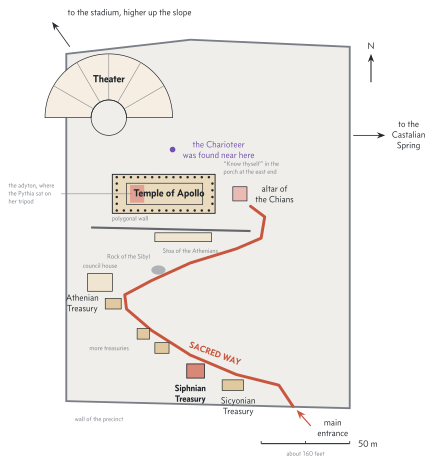
To reach the temple a visitor to Delphi climbed the Sacred Way, a path that zigzags up the slope from the gate at the bottom of the sanctuary (Figure 4.5). On both sides stood monuments that the cities of Greece had set up to boast of their victories, often over one another. Among them were the treasuries, little buildings shaped like temples, in which a city kept its offerings to the god and displayed its wealth. Corinth had one, built by Cypselus. Just inside the gate, on the left, stood the most splendid of them, the Siphnian Treasury, built about 525 BC.This place was the site of the Siphnian Treasury. → Delphi• Siphnos (sif-nos) was a small island in the Aegean with mines of gold and silver, and Herodotus says its people were then the richest islanders of all. They paid for the treasury with a tenth of the income from their mines. It was among the first buildings in Greece made entirely of marble. Instead of columns, two stone maidens held up its porch roof, and a carved frieze ran around all four sides (Figure 4.6).

The Siphnians had their own oracle to remember. Herodotus says the Pythia warned them that when their town hall shone white, they should beware “the army of wood” and “the red-coloured herald,” in Macaulay’s words. They had just faced the hall with white marble when a fleet from the island of Samos arrived, its ships painted red as all ships were then. A messenger came ashore demanding a loan of ten talents; a talent was a weight of silver of about 57 pounds. The Siphnians refused, lost a battle, and paid a hundred talents. Their treasury stands for something larger: Delphi was where the Greek cities competed in stone. Above it the Sacred Way turns sharply at the treasury of the Athenians, built, Pausanias says, from the spoils of their victory at Marathon (Chapter 8). It climbs past a long porch set against a wall of fitted many-sided stones and reaches the temple terrace and the great altar. Higher still are the theater and, at the top of the slope, the stadium where the footraces of the Pythian (pith-ee-un) Games were run.
Delphi itself had to be fought for. The shrine was guarded by a league of neighboring peoples called the Amphictyony (am-fik-tee-uh-nee), “those who dwell around,” who met twice a year. Below the sanctuary, on the plain that runs down to the gulf, stood the town of Kirrha (keer-uh). Its people controlled the harbor, and the ancient writers say they robbed and taxed the pilgrims on their way up. About 590 BC the Amphictyony declared a Sacred War, a war fought in the god’s name, against Kirrha. Cleisthenes, tyrant of Sicyon (sish-ee-on), a city near Corinth, and grandfather of the Athenian reformer of the same name (Chapter 5), blockaded it by sea while an army besieged it by land. The town held out, and here the ancient accounts tell how the attackers poisoned Kirrha’s water with hellebore,According to ancient accounts, attackers poisoned Kirrha’s water with hellebore during a Sacred War over this sanctuary. → Delphi• a plant whose root causes violent sickness. The earliest version, by a medical writer of about 400 BC, says a physician advised it. Pausanias, much later, credits the Athenian lawmaker Solon (soh-lun) (Chapter 5). The defenders were too weak to hold their walls. Kirrha was destroyed, and its plain was given to Apollo and might never be farmed again. In 582 BC the Pythian Games were refounded as one of the great crowned festivals of Greece. Three more Sacred Wars would follow, and the last two carried Philip of Macedon into the heart of Greece (Chapter 18).
The Panhellenic games
Olympia was not a city. It was a sanctuary of Zeus in the farm country of Elis, in the northwest Peloponnese. There the little river Cladeus (klay-dee-us) runs into the broad Alpheus under a pine-covered hill named for Cronus, the father of Zeus. Its heart was a walled grove, the Altis (al-tis), crowded with altars, temples, and statues, and the people of Elis ran its festival. In the middle of the Altis stood the temple of Zeus, finished about 457 BC. Inside it, from the 430s BC, sat the god’s gold-and-ivory statue by the Athenian sculptor Phidias (fid-ee-us), one of the Seven Wonders of the World, which a later chapter will describe (Chapter 11). Myth said the games were founded by Heracles, as an earlier volume told (Vol. 4, Classical Myth), or by Pelops. History gives a date. Greek scholars, working from a list of winners compiled about 400 BC, dated the first games to 776 BC. From then on Olympia held its games every four years,This site hosted a namesake set of athletic games every four years. → Olympia• for more than a thousand years. Archaeologists suspect the true beginning was somewhat later, about 700 BC. Before each festival heralds went out from Elis to announce a sacred truce, so that athletes and spectators could travel safely through cities at war.
Olympia was the oldest and grandest of four festivals that were open to every Greek, and only to Greeks. When Alexander I of Macedon, the kingdom north of Greece, came to run, Herodotus says, he had to prove his Greek descent first. These were the Panhellenic games, “of all the Greeks.” The Olympic Games were one of four Panhellenic festivals,These events were one of the four Panhellenic festivals, alongside the Pythian, Nemean and Isthmian games. → Olympic Games•• together with the Pythian Games at Delphi, the Isthmian Games at Corinth, and the Nemean (nih-mee-un) Games at Nemea, in the hills south of Corinth. They were spaced so that there were games every year, and an athlete who won at all four had won “the circuit” (Table 4.1).
| Games | Place | God | Held | Prize | From |
|---|---|---|---|---|---|
| Olympic | Olympia, in Elis | Zeus | every 4 years | wild olive | 776 BC |
| Pythian | Delphi | Apollo | every 4 years | laurel | 582 BC |
| Isthmian | the Isthmus of Corinth | Poseidon | every 2 years | celery, later pine | 582 or 581 BC |
| Nemean | Nemea | Zeus | every 2 years | wild celery | 573 BC |
The games began with a single footrace. A stadion (stay-dee-on) was a Greek measure of 600 Greek feet, and the race the length of it, run straight down a track of packed earth, was called the stadion too. At Olympia the track was about 192 meters long, roughly 210 yards. For the first thirteen Olympics, by the ancient list, the stadion was the only event,The stadion was the main event at these ancient events. → Olympic Games• and it always remained the most honored. The winner of the stadion gave his name to the whole Olympiad. The first recorded winner was Coroebus (kuh-ree-bus), a cook from Elis. Only in 724 BC was a second race added, twice the length. Then came a long-distance race, wrestling, and the pentathlon (pen-tath-lon), five contests in one: running, jumping, the discus, the javelin, and wrestling. Boxing followed in 688 BC, and in 680 BC the four-horse chariot race joined them. The word stadion also named the place where the race was run, and from its Latin form comes the English stadium.

Athletes trained for months in a gymnasium, an exercise ground with a running track. Beside it was the palaestra (puh-les-truh), a wrestling school built around a sanded courtyard, with rooms for bathing, dressing, and storing oil (Figure 4.7). Greek men exercised and competed naked; the word gymnasium comes from gymnos, “naked.” Thucydides says the Spartans were the first to do so, “publicly stripping and anointing themselves with oil.” Athletes rubbed themselves with olive oilThese people applied olive oil to themselves before entering a palaestra. → athletes• before entering the palaestra, often from a Corinthian aryballos, and then dusted their skin with fine powder. After exercise they scraped off the oil, dust, and sweat with a strigil (strij-il), a curved bronze scraper. The great sculptors of Greece made statues of these naked victors, and a later chapter will describe some of them (Chapter 11).
The prize at Olympia was a wreath. Olympic victors received olive wreaths,Kotinos, or olive wreaths, were given as prizes at these ancient events. → Olympic Games••Victors among these competitors at the ancient Olympic Games received olive wreaths. → athletes• each called in Greek a kotinos (kot-ih-nos), and nothing else at Olympia itself. A boy whose parents were both living cut the branches with a golden blade from a sacred wild olive tree near the temple of Zeus, and the judges wove them into crowns. At home they received much more: statues, songs, money, the best seats in the theater, and in Athens free meals for life at the city’s expense. A victory belonged to the victor’s city as much as to him. Strabo says that when men from Croton once took the first seven places in the stadion, people said the last of the Crotoniates was the first of the other Greeks. Cheating was rare enough to be remembered. Athletes swore at the council house to keep the rules, and fines from the few who broke them paid for bronze statues of Zeus that lined the way into the stadium.
The most splendid event was the chariot race. Four horses abreast drew a light two-wheeled car twelve times around the hippodrome, a level course beside the stadium. Crashes at the turning posts were part of the spectacle. Only the very rich could breed, train, and ship such horses, and the rich did not drive. The prize went to the owner, not the driver,Ancient Olympic prizes for this sport were given to the owner, not the driver. → chariot racing• who was a hired professional or a servant. Pausanias tells of a mare named Aura, “Breeze,” owned by Pheidolas (fy-doh-las) of Corinth. She threw her rider at the start of the race for ridden horses, ran the course alone, and stopped in front of the judges, who declared Pheidolas the winner. The rule also let a woman win. Cynisca (sih-nis-kuh), a princess of Sparta, entered her horses in 396 and 392 BC and won both times. She was the first woman named as an Olympic victor, though married women were forbidden even to watch the games.

The finest likeness of such a driver stands at Delphi, where the Pythian Games had a chariot race of their own. In the 470s BC Polyzalus, Gelon’s brother, won it. He set up a bronze chariot with its four horses and its driver beside Apollo’s temple, and the base says that Polyzalus dedicated it. An earthquake buried the group in 373 BC, and in 1896 French excavators dug up the driver and fragments of the horses. The Charioteer of Delphi is a young man in a long robe that falls to his feet, holding the reins in a calm victory lap (Figure 4.8). He is the servant, and the glory was his master’s.

Athens held its own games every four years at its great festival of Athena, the Panathenaia (Chapter 11), and they paid better than Olympia. The prizes were tall jars of olive oil from Athena’s sacred trees. Each was painted with the goddess on one side and the winner’s event on the other and labeled “one of the prizes from Athens” (Figure 4.9). About 330 BC the Athenian statesman Lycurgus (ly-kur-gus), not the Spartan lawgiver of the same name (Chapter 6), built a stadium for these games in a hollow beside the river Ilissus. About AD 140 the rich Athenian Herodes Atticus (heh-roh-deez at-ih-kus) rebuilt it all in white marble, with seats for perhaps fifty thousand people. The Panathenaic Stadium in AthensThe ancient Panathenaic is one of these structures in Athens. → stadiums• is still there, the only stadium in the world built entirely of marble. It was dug out again in the nineteenth century, and in 1896 it held the opening ceremony of the first modern Olympic Games (Vol. 20, The North and the East). The ancient games at Olympia had ended long before; the last recorded festival was held in AD 393, under a Christian emperor, Theodosius (thee-uh-doh-shus).
Pindar
When a victor came home, his family or his city often hired a poet, and the greatest of them came from Boeotia, the farming country north of Athens. Pindar came from Thebes,This city was the home of Pindar. → Thebes• Boeotia’s chief city, the city of Oedipus in myth (Vol. 4, Classical Myth). He was born about 518 BC in a village nearby and died about 438 BC; his datable odes span more than fifty years. Pausanias, writing six centuries later, tells a legend of his youth. Pindar once lay down to sleep beside a road on a hot day, and bees settled on his mouth and coated his lips with wax; that, says Pausanias, was the start of his career as a poet. His own city sided with Persia in 480 BC, yet Pindar wrote for patrons all over the Greek world, from the tyrants of Sicily to the kings of Cyrene, and even for the Athenians, Thebes’s enemies (Figure 4.10).

The poems that made him famous were epinikia, songs celebrating winning athletesThese people were celebrated in poems called epinikia. → athletes• (ep-ih-nik-ee-uh); the word is Greek for “victory songs.” A rich man who won at the games paid Pindar to compose an ode for him. A chorus of young men sang and danced it, often at a feast when the victor came home. Scholars at Alexandria (Vol. 5, In the Beginning) later gathered all of Pindar’s poems into seventeen books. The four books of victory odes are the ones that survived nearly whole, forty-five odes named for the four great festivals. Fourteen are Olympian odes, which Pindar wrote for Olympic victors;Pindar wrote victory odes for an ancient version of these events. → Olympic Games• the rest are twelve Pythian, eleven Nemean, and eight Isthmian odes. Each praises the winner, his family, and his city, tells a myth that throws light on the victory, and warns that success comes from the gods and can be lost. Pindar built them, as an earlier volume showed (Vol. 1, The Toolkit), from triads of strophe (stroh-fee), antistrophe (an-tis-truh-fee), and epode.
Like Homer and Sappho before him, Pindar wrote in Ancient Greek,Pindar wrote in this language. → Ancient Greek• but not quite in the Greek he spoke at home. He was a Boeotian, yet choral songs were sung in a literary Greek colored by the Doric dialect of the Peloponnese and of the western colonies, mixed with old words from Homer. Every educated Greek, from Syracuse to Cyrene, could follow it, and the strangeness of the language was part of its grandeur. His sentences leap from image to image and from myth to praise, and readers have found him difficult ever since. The Roman poet Horace compared him to a river in flood that has burst its banks.
His most famous ode is the one that stands first in the collection. In 476 BC Hiero, now tyrant of Syracuse after his brother Gelon, won the horse race at Olympia with a stallion named Pherenikos (feh-ren-ih-kos), “Victory-Bringer.” Pindar’s ode for him was probably sung at a banquet in Syracuse. The first Olympian begins “Water is best”,This poet's first Olympian ode begins "Water is best." → Pindar• in Greek ariston men hydor. In Myers’s translation it opens: “Best is Water of all, and Gold as a flaming fire in the night shineth eminent amid lordly wealth.” The logic climbs a ladder. Water is the most precious of the elements, and gold of possessions. As no star outshines the sun, so no games outshine Olympia, and at Olympia Hiero has won. Then Pindar tells the myth of Pelops, whose chariot race for Hippodamia (hip-uh-duh-my-uh) was remembered at Olympia (Vol. 4, Classical Myth), and he changes it as he tells it. He refuses the old story that the gods ate Pelops at his father’s feast, saying in Myers’s words, “to me it is impossible to call one of the blessed gods cannibal.” He says outright that he is contradicting the poets before him, and it was a bold thing for a poet to correct the myths to keep the gods honorable.
Pindar lived on in a way few poets have. In 335 BC, when Alexander the Great destroyed Thebes (Chapter 20), Arrian says he ordered his soldiers to spare one house, the house of Pindar, and Plutarch that he spared the poet’s family. Ancient critics ranked him first among the lyric poets, and two thousand years later poets writing in English still imitated his odes when they wanted to sound grand. His odes are also our best window onto this world of tyrants from Sicily racing horses at Olympia, cities competing in stone at Delphi, and Greeks from a hundred shores gathering every four years to see who was best.
What to remember
- Corinth, on the Isthmus of Corinth between the Peloponnese and mainland Greece, grew rich on trade between two seas, with the harbors of Lechaeum and Cenchreae, the diolkos for hauling ships across, and the Isthmian Games of Poseidon.
- Cypselus overthrew the Bacchiadae about 657 BC and became tyrant; his son Periander ruled about 627 to 587 BC. Strabo’s story of a thousand courtesans at Aphrodite’s temple is doubted by many historians.
- Corinthian potters invented black-figure painting about 700 BC: black silhouettes with scratched details, often in animal friezes.
- Greek colonies were independent cities. Corinth founded Syracuse in Sicily in 733 BC; the cities of southern Italy were called Magna Graecia; Milesians settled the Black Sea as far as Colchis, now in Georgia with the old kingdom of Iberia.
- Phalaris of Acragas was remembered for roasting men in a brazen bull; Gelon of Gela made himself tyrant of Syracuse in 485 BC.
- At Delphi, on Mount Parnassus, the Pythia spoke Apollo’s oracles, by tradition inspired by vapors. “Know thyself” was carved on the temple, and the Siphnian Treasury stood on the Sacred Way. The First Sacred War destroyed Kirrha, whose water was poisoned with hellebore.
- The four Panhellenic games were the Olympic, Pythian, Isthmian, and Nemean. At Olympia, held every four years from 776 BC by tradition, the stadion was the chief race, oiled athletes trained in the palaestra, victors won olive wreaths, and chariot victories went to the owner.
- Pindar of Thebes wrote victory odes, epinikia, in Ancient Greek; his first Olympian ode, for Hiero of Syracuse, begins “Water is best.”
Chapter 5 · 45 clues
Athens from Draco to Cleisthenes
In 1890 an American missionary in Egypt bought some old papyrus rolls from local dealers, and before the year was out the British Museum in London had acquired them. A young scholar on the museum’s staff, Frederic Kenyon, unrolled them and recognized a book that had been lost for well over a thousand years: the Constitution of the Athenians, also called the Athenian Constitution, written in Athens about 330 BC by the philosopher Aristotle or one of his students. Ancient writers said that Aristotle’s school had described the governments of 158 Greek states. This was the only one ever found. Kenyon published it in January 1891, and historians found in it dates and details that no other surviving book gives.
The first half of the Constitution tells a story of change, and it is the story of this chapter (Figure 5.1). In the late seventh century BC, Athens was run by a few noble families, and a poor farmer who fell into debt could be sold abroad as a slave. By 508 BC the same city had given its male citizens the final say in its affairs, and within a few years those citizens could send a powerful man into exile by scratching his name on a broken pot. Herodotus and Thucydides tell parts of the story, and Plutarch, writing six centuries after it ended, fills in the rest with anecdotes. None of them saw the beginning, and where they disagree, this chapter says whose version it follows.

Cylon and Draco
Athens was the chief town of Attica, a triangle of land poking southeast into the Aegean Sea, about the size of Rhode Island (Figure 5.2). Mountains split it into a few plains of thin, stony soil, good for olives, vines, and barley. At the center of Athens stood the Acropolis, a flat-topped rock that had been a fortress since the Bronze Age. By the time of this chapter the villages of the whole peninsula counted themselves Athenians, which gave Athens one of the largest territories of any Greek city.

The kings of the old stories were long gone. An earlier volume (Vol. 4, Classical Myth) told how the last of them, Kodros, died to save the city, and how officials called archons ruled after him. An archon, whose title means “ruler,” was a magistrate, as the Stage explained. From 683 BC each archon served for a single year, and by the time of this chapter Athens had a board of nine archons.This city had a board of nine archons. → Athens• The chief archon gave his name to the year, the way we might say “the year Washington was president.” The “king” archon took over the old royal duties of sacrifice and religion. The polemarch (pol-eh-mark) led the army, and six junior archons kept the records of the laws and the judges’ decisions. After his year, an archon sat for life on the Council of the Areopagus, named for the Hill of Ares beside the Acropolis, where it met. Only men of a few rich families, who called themselves the Eupatridae (yoo-pat-rih-dee) or “sons of good fathers,” could hold office, and they judged cases by customs that nobody had written down.
About 632 BC a nobleman named Cylon (sy-lon) tried to make himself tyrant, the name the Greeks gave a man who seized sole power outside the law (the Stage). Cylon had won a race at the Olympic Games in 640 BC and married the daughter of Theagenes (thee-aj-ih-neez), who had made himself tyrant of Megara, Athens’s neighbor to the west. In Thucydides’s account, quoted here in Richard Crawley’s translation, the oracle at Delphi told Cylon to seize the Acropolis “on the grand festival of Zeus,” and he took this to mean the Olympic Games. While the Games were on he occupied the rock with his friends and soldiers lent by his father-in-law. Athens had a great festival of Zeus of its own, Thucydides adds dryly, and it never occurred to Cylon to wonder which festival the god meant. The Athenians “flocked in, one and all, from the country” and besieged him.
The siege dragged on, and most of the farmers went home, leaving the nine archons in charge. Cylon and his brother slipped away. His followers, starving, sat down at the altar of Athena as suppliants, people who have put themselves under a god’s protection and whom, the Greeks believed, it was sacrilege to harm. The archons promised them their lives, led them out, and killed them, and some who fled to the altars of the Furies, the goddesses of vengeance (Vol. 4, Classical Myth), were cut down there. Plutarch, writing more than seven centuries later, adds that the suppliants had tied a thread to Athena’s statue to keep hold of her protection, and that when it snapped, the archons claimed the goddess had refused them. The archon in charge that year was Megacles (meg-uh-kleez), the head of a rich and proud family called the Alcmaeonids (alk-mee-uh-nidz). For killing men under the goddess’s protection, the Alcmaeonids were declared accursed,This city’s Alcmaeonid family incurred a hereditary curse after the killing of Cylon’s supporters. → Athens• and the curse was held to pass to their children and grandchildren too. A court of nobles banished the family, the bones of its dead were dug up and thrown beyond the borders, and a Cretan holy man named Epimenides (ep-ih-men-ih-deez) came to purify the city. The curse never quite went away: their enemies brought it up again in 508 BC and, against Pericles, in 432 BC.
In 2016 archaeologists digging at Phaleron, the old harbor of Athens, uncovered two mass graves holding about eighty skeletons, thirty-six of them still bound in iron shackles. The pottery beside them dates from about the middle of the seventh century BC. Some archaeologists have suggested that these were Cylon’s followers. Nobody can prove it.

Cylon had failed, but the troubles he exposed had not gone away. When a man was killed, his family took revenge for itself, and revenge led to feuds that could run for generations. In 621 or 620 BC, about a decade after Cylon’s coup,This Athenian lawgiver drew up his code roughly a decade after Cylon’s failed coup. → Draco•• the Athenians gave a man named Draco (dray-koh) the job of writing their laws down. Almost nothing is known of his life. His name means “serpent,” and one German historian, Karl Julius Beloch, even suggested that the “laws of Draco” had been issued in the name of a sacred snake on the Acropolis. Few have followed him, and Draco is usually treated as a real man.
According to later Greek writers, Draco’s laws were put up where any citizen could read them, written on wooden tablets called axonesThis early Athenian lawgiver’s written laws were displayed on wooden tablets, traditionally described as rotating axones or kyrbeis. → Draco•• (ak-suh-neez), or “axles,” because each was mounted so that it could be turned around to show all its faces. The writers also call them kyrbeis (kur-bayz), and argue about whether these were the same tablets or posts of another shape. The tablets themselves have perished, and so has every law on them except one.
What made Draco famous was that he gave Athens a strict law code.Draco created a strict law code for this city. → Athens•• Plutarch, who wrote his life of Solon some seven centuries afterward, says in Arthur Hugh Clough’s translation that under Draco death was “appointed for almost all offences,” so that even men convicted of idleness were put to death. Small thefts were no exception. According to Plutarch, stealing vegetables or fruit was punished by death:According to ancient accounts, this lawgiver prescribed death even for minor offenses such as stealing vegetables. → Draco•• a man who “stole a cabbage or an apple” suffered the same penalty as a temple robber or a murderer.
Plutarch also gives Draco’s own defense. Asked why he had made death the penalty for nearly everything, Draco is supposed to have answered that small crimes deserved it, and that he had nothing heavier for the great ones. Some three centuries after Draco, the Athenian politician Demades (dem-uh-deez), a quick-witted speaker of Alexander’s time, joked that Draco’s laws were written not in ink, but blood,Demades quipped that this leader wrote in blood rather than ink. → Draco• a line that Plutarch says was much admired.
The name stuck. Draco appears among the great lawgivers of history carved in the courtroom of the United States Supreme Court, and his name became an English word. Since at least the 1770s, “draconian” has meant harsh and unforgiving,This leader's name became an adjective for severe punishments or strict rules. → Draco•• and a “draconian” rule, sentence, or budget cut is one that seems far more severe than it needs to be.
Yet the one law of Draco that survives is not cruel at all. It deals with the gravest crime there is, and it handles it with care. His law on homicideThis lawgiver’s homicide code regulated blood vengeance and distinguished intentional killing, unintentional killing and lawful killing in self-defense. → Draco•• took vengeance out of private hands and gave it to a court. It separated a killing done on purpose from one done by accident, and both from a lawful killing, such as killing in self-defense a man who struck first. It said which relatives of the dead man could prosecute and how they could forgive the killer, if all of them agreed. A man who killed by accident was not executed but sent into exile. In 409 or 408 BC the Athenians had this law copied onto a marble slab, and a large piece of it survives (Figure 5.3). Its text begins in the middle of a sentence, with words that mean that even a man who kills without intending to must go into exile.
The Constitution of the Athenians claims much more for Draco. One chapter says he gave Athens a whole new form of government, with the vote, or franchise, for every man who could afford the bronze armor of a hoplite, a citizen foot soldier (the Stage), and a council of 401 members chosen by lot.A disputed passage in the Constitution of the Athenians attributes a council of 401 and a hoplite-based franchise to this lawgiver. → Draco•• The passage is probably not true. No other ancient writer says that Draco did more than write laws, and the scheme looks like a program of the late fifth century BC, perhaps invented by men who wanted to give their own plans an ancient pedigree.
Draco’s death is told only in the Suda, a Byzantine encyclopedia compiled some sixteen centuries after him. It says he went to the island of Aegina (ee-jy-nuh) to make laws there. In the theater, the crowd showed their admiration as Greek crowds did, by throwing their hats, tunics, and cloaks over the man they honored, and so many landed on Draco that he was smothered under the clothes.According to the Suda, this lawgiver suffocated in a theater under clothes thrown by admirers. → Draco•• They buried him in the theater. It is a folk tale, but it is the only death story Draco has.
Solon, Pisistratus, and Cleisthenes
Written laws did not cure the real sickness of Athens, which was debt. The Constitution of the Athenians says, in Kenyon’s translation, that the poor were “the serfs of the rich.” Many farmed nobles’ land for a share of the crop, and loans were made on the security of the borrower’s own body. A farmer who could not repay could be seized with his children and sold as a slave, sometimes abroad. Stone markers stood in mortgaged fields to show that the land was pledged. By about 600 BC the poor were close to revolt, and some demanded that all the land be divided up.
Both sides agreed to trust one man. Solon was a noble of middling wealth who had traveled as a merchant, and he is the first Athenian whose own words survive, because he wrote poems about justice and the city. Solon was chosen archon in 594 BC,Solon was a leader of this city. → Athens•• with power to rewrite the laws and settle the quarrel. His first act was the “shaking off of burdens,” the Seisachtheia (sy-sak-thee-uh). He canceled debts, freed the Athenians who had been enslaved for debt, brought home some who had been sold abroad, and forbade any loan secured on a person. In one of his poems, which the Constitution quotes, he calls the dark Earth as his witness, “from whose breast / I swept the pillars broadcast planted there, / And made thee free, who hadst been slave of yore.” The pillars were the mortgage stones.
Then Solon replaced the laws. He repealed all of Draco’s laws exceptAlmost all of this leader's laws were repealed by Solon, except for his statutes on homicide. → Draco•• those on homicide, which stayed in force, and that is why the homicide law is the one Draco text that survives. He sorted the citizens into four classes by the yearly harvest of their land, measured in bushels of grain or jars of wine and oil. The top class needed five hundred measures; the lowest, the thetes (thee-teez), were laborers with little or no land. Only the top classes could be archons, but even a thete could vote in the Assembly, the open meeting of citizens, and sit on a jury, and anyone could appeal a magistrate’s verdict to a court of citizens. Wealth, not birth, now decided who could govern. Then, Herodotus says, Solon sailed away for ten years, so that nobody could make him change his laws; the Athenians had sworn to keep them for that long. On his travels, Herodotus has him meet Croesus at Sardis, a story an earlier volume told (Vol. 5, In the Beginning).
Without Solon the quarrel came back. “In the fifth year after Solon’s government,” says the Constitution of the Athenians, “they were unable to elect an Archon on account of their dissensions, and again four years later.” The Greeks called a year like that, 590 or 586 BC, an anarchia. The word means “without a ruler”,This concept is derived from the Greek for "without rulers." → anarchy• from an-, “not,” and archos, “ruler,” and it gave English the word anarchy, a state with no government at all. In 582 BC an archon named Damasias (duh-may-see-us) refused to step down, and he held on for two years and two months before he was thrown out.
By the 560s BC three factions were fighting over Athens, each named for the part of Attica where its leaders held their land (Figure 5.2). The Plain was led by a noble named Lycurgus, not the Spartan lawgiver of Chapter 6. The Coast was led by Megacles, son of Alcmaeon (alk-mee-on); the cursed family had come home. Herodotus tells how this Alcmaeon had grown rich. He had helped the men Croesus sent to consult the oracle at Delphi, and in thanks the king invited him to Sardis and offered him as much gold as he could carry. Alcmaeon put on the baggiest tunic and the widest boots he could find, stuffed them with gold dust, sprinkled more in his hair, and filled his mouth. He waddled out looking like anything but a man, and the king laughed and gave him as much again. Megacles himself married Agariste (ag-uh-ris-tee), the daughter of Cleisthenes, the tyrant of Sicyon who had fought in the Sacred War for Delphi (Chapter 4).
The third faction, the Hills, was led by Pisistratus, a noble from Brauron (braw-ron) on the east coast who had made his name capturing Nisaea (ny-see-uh), the port of Megara. About 561 BC Pisistratus, as Herodotus tells it, wounded himself and his mules and drove his cart into the marketplace, crying that his enemies had tried to kill him on the road. The people voted him a bodyguard of men armed with clubs, and with them he seized the Acropolis. In the next thirty-three years Pisistratus ruled Athens as tyrantPisistratus led this city. → Athens• three separate times, and spent the rest of those years in exile.
The first time, the Plain and the Coast joined forces and drove him out. Then Megacles quarreled with his allies and offered Pisistratus his daughter in marriage and his help. To bring him back, the two men found a handsome woman named Phye (fy-ee), about 5 feet 9 inches tall by Herodotus’s measure. They dressed her in armor as Athena and drove her into the city in a chariot beside Pisistratus. Heralds ran ahead crying, in G. C. Macaulay’s translation of Herodotus, that “Athenë herself, honouring him most of all men, brings back” Pisistratus “to her Acropolis.” Herodotus thought it the silliest trick ever played on a people as clever as the Athenians, but the city welcomed him. The marriage soured at once. Pisistratus already had grown sons and, Herodotus says, wanted no children from a cursed family. Megacles changed sides again, and Pisistratus left Attica.

This exile lasted ten years. Pisistratus went north to Thrace, the wild country above the Aegean, and settled near Mount Pangaeus (pan-jee-us), where there were mines of gold and silver, and made himself rich. He hired soldiers and collected allies: money from Thebes, a thousand men from Argos, and help from Lygdamis (lig-duh-mis), a noble of the island of Naxos who wanted to be its tyrant (Figure 5.4). In 546 BC he crossed from Eretria on the island of Euboea, landed at Marathon, and marched on the city. The Athenian army met him at Pallene (puh-lee-nee). Herodotus says the citizens had just eaten breakfast, and some were playing dice and some were napping, when Pisistratus’s men fell on them. The rout was total. Pisistratus sent his sons riding after the fugitives to tell them to go quietly home, and they did.
This time he stayed. Pisistratus kept Solon’s laws, though he made sure that his own family and friends held the offices. He taxed farm produce at a tenth and lent money to poor farmers so that they could make a living on the land, which also kept them busy far from the city. Under him Athens began to look like a capital, with a fountain house for clean water and grander festivals for the gods. The City Dionysia (dy-uh-niz-ee-uh), at which tragedy would be born (Chapter 10), probably took shape in his reign. The Constitution of the Athenians says his rule was later remembered as “the age of gold.”

Pisistratus died in 528 or 527 BC, and his eldest son Hippias (hip-ee-us) took his place (Figure 5.5). His brother Hipparchus (hih-par-kus) spent his time with poets and set up the stone pillars called herms along the country roads (Vol. 4, Classical Myth). In 514 BC two Athenians, Harmodius (har-moh-dee-us) and Aristogeiton (uh-ris-toh-jy-ton), plotted to kill the brothers at the Panathenaia, Athena’s great summer festival with its procession to the Acropolis. Aristogeiton was the older man who loved Harmodius. Thucydides says the cause was a private quarrel. Hipparchus had courted Harmodius and been refused, and in revenge he invited Harmodius’s young sister to carry a sacred basket in the procession and then turned her away as unworthy. On the festival day the plotters saw one of their friends chatting with Hippias and feared they had been betrayed, and in panic they stabbed Hipparchus instead. Harmodius was killed on the spot, and Aristogeiton was caught and put to death after torture. Hippias, now afraid, grew cruel. Thucydides adds that the Athenians of his own day believed Hipparchus had been the tyrant, and he uses the story to show how badly people remember their own history.
Later Athenians honored the two killers as the Tyrant Slayers. They set up bronze statues of them in the agora, sang songs about them at drinking parties, and gave their descendants free meals at public expense. The first statues were carried off by the Persians in 480 BC and replaced with a new pair; a Roman marble copy of the second pair survives in Naples.
The tyranny was ended by the Alcmaeonids and by Sparta. Exiled again, the Alcmaeonids took the contract to rebuild Apollo’s temple at Delphi, which had burned, and they built its front of marble when the contract asked only for limestone. Herodotus heard in Athens that they also bribed the Pythia, the god’s prophetess (Chapter 4), so that whenever Spartans came to consult the oracle she told them to free Athens. In 510 BC, after a first expedition by sea had been beaten by Hippias’s allies, horsemen from Thessaly, the Spartans sent their king, Cleomenes I (klee-om-ih-neez), by land (Chapter 6). He shut Hippias up on the Acropolis and might have given up the siege, but Hippias’s children were caught being smuggled out of Attica. To get them back, Hippias surrendered and left for Sigeion (sih-jee-on), a town his father had won near the Hellespont. Twenty years later he would come back to Marathon with a Persian army (Chapter 8).
Two men now competed to lead Athens. Isagoras (eye-sag-uh-rus) was a noble and a friend of the Spartan king. Cleisthenes, Megacles’s son by Agariste and so an Alcmaeonid, was named after his grandfather, the tyrant of Sicyon. Isagoras won the archonship for 508 BC, and Cleisthenes, losing among the nobles, “made common cause with the people,” in Macaulay’s words. Isagoras called in Cleomenes, who demanded that Athens drive out “those under the curse,” meaning the Alcmaeonids. Cleisthenes slipped away. Cleomenes came with a small force, expelled seven hundred families whose names Isagoras gave him, and tried to dissolve the city’s council and hand power to three hundred of Isagoras’s friends. The council refused. Cleisthenes was gone, but the people of Athens rose together and besieged the Spartan king and Isagoras on the Acropolis. On the third day the Spartans left under a truce, and the Athenians called Cleisthenes home.

In 508 and 507 BC Cleisthenes rebuilt the constitution of AthensCleisthenes reformed this city's constitution. → Athens•• from the ground up. He started with the villages. Attica was divided into about 140 demes (deemz), country villages and wards of the city, and each deme kept a list of its citizens. A man was now known by his deme as well as by his father’s name: Pericles, son of Xanthippus (zan-thip-us), of the deme of Cholargos (koh-lar-gos). Then Cleisthenes did away with the four old tribes, which had been run by the great families, and made ten new ones. Each tribe was made of three trittyes (trit-ee-eez), or “thirds”: one from the city and its plain, one from the coast, and one from the inland country called the Mesogeia (mes-oh-jee-uh), assigned by lot (Figure 5.6). The Pythia at Delphi picked the names of the tribes’ founding heroes from a list of a hundred, and Herodotus notes that all ten were Athenian heroes except Ajax, whom Athens adopted as a neighbor and ally.
The tribes were the frame for a new government. Cleisthenes set up a Council of Five Hundred,This Athenian reformer established the Council of Five Hundred. → Cleisthenes•• fifty men from each tribe, chosen from the demes in proportion to their size. Later councilors were picked by lot from citizens over thirty, and no man could serve more than twice in his life. The Council prepared every question the Assembly would vote on and ran the city’s daily business. Each tribe’s fifty took turns as the presiding committee for a tenth of the year, so in a lifetime a great many ordinary citizens held real power for a while. The army was reorganized by tribes too, with one general from each.
The Athenians at first called the new order isonomia, “equal law.” The word democracy, “rule of the people” (the Stage), came into use within the next two generations, and Herodotus, writing about 430 BC, describes Cleisthenes as the man “who established the tribes and the democracy for the Athenians.” Women, slaves, and foreigners had no part in it, and the Assembly of citizens did not yet hold all the power it would win later. Still, Athens is often called the birthplace of democracy,This city is often considered the birthplace of democracy. → Athens••• and 508 BC is the date usually given for its birth. Herodotus drew his own lesson from what came next. In 506 BC the new citizen army beat two neighbors, the Boeotians to the north and the Chalcidians (kal-sid-ee-unz) of Euboea, on the same day. Under the tyrants, he wrote, the Athenians had fought no better than their neighbors, “whereas when they had been set free each one was eager to achieve something for himself.”
Ostracism and the agora
The Athenians had learned what one popular man could do. Pisistratus had won the people’s trust and then made himself their master, and Isagoras had invited a foreign king into the city. The Constitution of the Athenians credits Cleisthenes with the law of ostracism,The Athenian Constitution attributed the introduction of ostracism to this reformer. → Cleisthenes•• a way to remove a man before he grew too strong, “as a precaution against men in high office.” It was used for the first time only in 487 BC, twenty years later, against Hipparchus son of Charmus, a relative of the old tyrants.
Each year, in the sixth of the ten periods into which the Council divided the year, the Assembly voted, without naming anyone, on whether to hold an ostracism. If the answer was yes, the vote came about two months later, in the agora, inside a fenced-off space. Each citizen scratched a name on a potsherd,Votes for this practice were cast by writing names on pottery shards. → ostracism•• a broken piece of pottery, and dropped it in. The Greek word for a potsherd was ostrakon (os-truh-kon), and that gave the practice its name, ostracism. Broken pots were the scrap paper of Athens: papyrus, the paper of the age, came from Egypt and cost money, while sherds lay everywhere for free. A citizen who could not write could ask a neighbor to write for him.
Then the archons counted. Plutarch says, in Clough’s translation, that “if there were less than six thousand, the ostracism was imperfect.” In other words, a quorum of six thousand votes was required,A quorum of at least six thousand was required to carry out this practice. → ostracism•• the smallest turnout at which the vote counted; if it was met, the man whose name appeared most often had to leave. A later Athenian historian, Philochorus (fih-lok-uh-rus), says instead that the six thousand had to be votes against one man. Plutarch’s rule is the more likely of the two.
The loser had ten days to settle his affairs and go. He was banished from Athens for ten years,This Athenian practice exiled a citizen for ten years by popular vote. → ostracism•• and if he came back early he could be put to death. That sounds hard, but it was mild beside what an Athenian court could do to a politician it thought dangerous: execution, a fine too large to pay, the loss of every civic right, or the seizure of everything he owned. Ostracism punished no crime. The exile kept his property and his citizenship,This practice did not deprive its victims of property rights or citizenship. → ostracism• and came home after ten years with his rights untouched, free to run for office again. Several did.

Archaeologists have dug up about twelve thousand ostraka in the agora and in the Kerameikos, the potters’ quarter outside the city gate. The second man ever ostracized, in 486 BC, was Megacles son of Hippocrates, Cleisthenes’s nephew, and more than four thousand sherds carry his name (Figure 5.7). Some voters added a word of abuse: one sherd calls him “the adulterer.” Another find shows organized politics at work. In a well beside the Acropolis lay 190 sherds, all naming Themistocles (thuh-mis-tuh-kleez), the leader who built Athens’s fleet (Chapter 9), and written by only fourteen hands. Someone had prepared them in advance to hand out.
The most famous ostracism was that of Aristides (air-is-ty-deez), son of Lysimachus (ly-sim-uh-kus), a general at Marathon whose honesty earned him the nickname “the Just.” In 482 BC he lost a contest of ostracism to his rival Themistocles. Plutarch tells what happened as the sherds were being written. A country fellow who could not write handed his sherd to a stranger, not knowing that it was Aristides himself, and asked him to write “Aristides” on it. The man wanted Aristides exiledAn illiterate man once called for this action against Aristides because he was tired of hearing Aristides called "the Just." → ostracism•• for no reason but his fame. Asked whether Aristides had ever wronged him, he answered, in Clough’s version, “None at all, neither know I the man; but I am tired of hearing him everywhere called the Just.” Aristides said nothing, wrote his own name on the sherd, and handed it back.
The Athenians used ostracism about a dozen times in the fifth century BC. The last victim, about 417 BC, was a loud politician named Hyperbolus (hy-pur-buh-lus), and Plutarch says the Athenians gave the practice up once it had been used on so low a man. Other Greek cities copied it. Syracuse, the great Greek city in Sicily founded from Corinth (Chapter 4), tried a version after a man named Tyndarides (tin-dar-ih-deez) attempted to become tyrant in 454 BC. According to Diodorus of Sicily, the Syracusans wrote the names on olive leaves,This city used petalismos, an exile vote in which citizens wrote names on leaves. → Syracuse• so their vote was called petalismos (pet-uh-liz-mos), from petalon, “leaf,” and the man named most often was exiled for five years. Diodorus says that the most capable men then withdrew from public life rather than risk it, and the Syracusans soon abolished the law.

An ostracism was held in the agora because the agora was where Athenians gathered. The word agora comes from a verb meaning “to gather.” An agora was the open square at the heart of a Greek city, both marketplace and civic center.These public spaces served as marketplaces and civic centers in Greek poleis. → agora• Farmers sold vegetables and potters sold pots under awnings, while around the edges stood the offices of government, law courts, and temples. In Athens it lay just northwest of the Acropolis, and the Panathenaic Way, the road of Athena’s procession, crossed it on a slant (Figure 5.8). Along its west side stood the Royal Stoa, a columned hall where the “king” archon worked and Solon’s laws were displayed, the council house where the Five Hundred met, and the round Tholos, where the presiding fifty took their meals and some of them slept. In front of the council house stood the Monument of the Eponymous Heroes, with statues of the ten heroes who named the tribes, and on its base hung notices of new laws and lists of men called up for the army.
A stoa (stoh-uh) was a long building with a roof held up by a row of columns and a wall along the back, open on one side to the square. It gave shade in summer and shelter in winter, and Athenians did business, judged cases, and talked philosophy in its shadow. One of them, the Painted Stoa on the north side, later gave its name to the Stoics, a school of philosophers who taught there (Chapter 22).
The tyrants left a mark on the agora too. In 522 BC Pisistratus, the son of Hippias and grandson of the tyrant, served as archon, and Thucydides says that in his year he dedicated the Altar of the Twelve GodsThe Altar of the Twelve Gods was located at one of these places in Athens. → agora• in the agora. It stood in a small walled enclosure beside the Panathenaic Way. A suppliant could take refuge there. From the 400s BC Athenians also measured distances from it, the way a modern city measures them from a central milestone, and a stone of about 400 BC says that the harbor at Piraeus lies 45 stades, or about 5 miles, from the altar.

The grandest building in the agora came last. Attalus (at-uh-lus) II, king of Pergamon in Asia Minor (Chapter 21), had studied in Athens as a young man. About 150 BC he gave the city the Stoa of AttalusThe Stoa of Attalos is located within one of these places. → agora• (Attalos, in the Greek spelling), a two-story colonnade 115 meters (377 feet) long on the east side of the square, with forty-two shops on its two floors (Figure 5.9). Raiders called the Heruli (herr-uh-ly) burned it in AD 267. From 1952 to 1956 the American School of Classical Studies at Athens rebuilt it on its old foundations, largely with gifts from the American millionaire John D. Rockefeller Jr., and it now holds the museum of the agora excavations, ostraka included.
The idea of a public square spread far beyond Greece. Every Roman town had at its center a forum, Rome’s version of the agora,The Roman forum derived from these places. → agora• an open square for markets, law courts, and public meetings, surrounded by colonnades and temples (Vol. 7, The Romans). Rome came to Athens too. With money that Julius Caesar promised and his heir Augustus paid, the Athenians built a new marketplace about 100 meters east of the old one, now called the Roman Agora.
Citizens, metics, and coins
Athenian democracy belonged to a minority of the people who lived in Attica. A citizen was a free man born to an Athenian father and, from 451 BC, to an Athenian mother as well, enrolled in his father’s deme at the age of eighteen. Only he could speak and vote in the Assembly, sit on the Council or a jury, or hold office. In 431 BC there were somewhere between thirty and sixty thousand of them, by modern estimates, in a population several times larger.
Women had no place in any institution of the democracy.Women were excluded from the institutions of this city’s celebrated ancient democracy. → Athens• An Athenian woman could not vote, attend the Assembly, serve on a jury, or hold office, and in law she was always under the guardianship of a man, first her father and then her husband, who handled her property and spoke for her in court. Her citizenship mattered mainly for her sons, who after 451 BC could be citizens only if both parents were Athenian. Religion was the exception: women served as priestesses, among them the priestess of Athena on the Acropolis, and held festivals of their own. Slaves, who were bought and sold, had no rights at all, and nobody knows how many there were.
Between the citizens and the slaves lived a large class of free people from elsewhere. Foreigners who settled in Athens without citizenship were known as “metics”Foreigners living in this city without citizenship rights were known as "metics." → Athens•• (met-iks), from metoikos, “one who has changed house.” A metic had to register in a deme, find a citizen to act as his sponsor, and pay a tax of twelve drachmas (drak-muhz) a year (six for a woman living on her own). Metics served in the army and the fleet, and the rich among them paid the same special taxes as rich citizens. But they could not vote, and they could not own a house or a field in Attica. Many prospered as traders, bankers, and craftsmen. A wealthy shield maker from Syracuse, a metic, owned the house where Plato set his Republic (Chapter 17), and Aristotle himself lived in Athens as a metic.
Many metics lived near the sea, at Piraeus, the port of Athens,Piraeus served as the port of this city. → Athens•• about 5 miles (8 kilometers) southwest of the Acropolis (Figure 5.2). For centuries Athenian ships had simply been dragged up on the open beach of Phaleron. Hippias, the last tyrant, began to fortify the hill of Munychia above Piraeus about 511 BC as a refuge, but was driven out before the work was done. From 493 BC Themistocles turned Piraeus’s three rocky harbors into the base of the Athenian fleet, later joined to the city by the Long Walls (the Stage). Grain from the Black Sea, timber, and slaves came in through Piraeus, and Athenian olive oil and pottery went out. It is still the chief port of Greece.
Trade needed money. Before coins, Greeks paid in goods or in measured metal, and one old form of money was the iron spit used for roasting meat. A coin is a piece of metal of fixed weight, stamped by a government that stands behind it. The first coins were made of electrum,Early examples of these objects were made of electrum, an alloy of gold and silver. → coins•• the natural mixture of gold and silver washed down by the river Pactolus (pak-toh-lus) in Lydia, in western Asia Minor, about 600 BC (Vol. 5, In the Beginning). The Greek cities of the coast soon followed, and then the mainland. Athens’s first coins were struck under Pisistratus and his sons, with designs that changed from issue to issue: a wheel, a horse, an owl, a Gorgon’s face (Figure 5.10). About 515 BC, with silver from new mines at Laurium (law-ree-um) in southern Attica, Athens began to strike the coins with Athena’s head on one side and her owl on the other, the “owls” (Vol. 4, Classical Myth). They were made with hardly a change for two centuries and were trusted all over the Mediterranean.


The basic Greek coin was the drachma. A drachma was a silver coinThe Greek drachma was a silver example of these objects. → coins• weighing about 4.3 grams, a little less than a modern U.S. nickel. Its name means a “handful,” and the smaller coin, the obol (ob-ul), takes its name from obelos, a spit; Plutarch explains that six iron spits once made a handful, and so six obols made a drachma. In the late 400s BC a skilled workman on the Acropolis earned about a drachma a day. Greece kept the drachma, in a modern form, until the euro replaced it in 2002. The obol had a strange second use (Vol. 4, Classical Myth): an obol was placed with the dead as payment to CharonOne of these objects could be placed with the dead as payment to Charon. → coins• (kair-on), the ferryman of Greek myth who carried souls across the river of the underworld. Archaeologists find small coins in Greek graves, sometimes in the dead person’s mouth.
Black-figure and red-figure
The potters of Athens worked in the Kerameikos, northwest of the agora, along the banks of a little stream. From the Greek word for potter’s clay, keramos, English takes “ceramic.” For two centuries Athenian painted pottery, the “vases” of every museum of ancient art, was the finest in the Greek world, and it was shipped all over the Mediterranean. Some of the best pieces have been found not in Greece but in the tombs of the Etruscans, a wealthy people of central Italy (Vol. 7, The Romans), who bought them as luxuries. Both of the vases pictured in this section were found at the Etruscan city of Vulci (vool-chee). A large painted pot cost about a drachma, a skilled worker’s daily pay.

Each shape of vase had a name and a job (Figure 5.11). The amphora (am-fuh-ruh) was a pottery jarAmphorae are a type of these objects. → vases••Amphorae were examples of this product. → pottery• with two handles; its Greek name, amphoreus, means “carried on both sides.” Plain amphoras by the thousands carried wine and olive oil by sea, packed tight in the holds of ships, while painted ones stood on tables and were given as prizes at Athena’s festival, full of oil from her sacred olive trees (Chapter 4). The kylix (ky-liks) was a wide, shallow drinking cup on a stem. The hydria (hy-dree-uh) carried water from the fountain, with two side handles for lifting and one at the back for pouring, and the lekythos (lek-ih-thos) was a narrow flask for oil, often left at graves. A wide bowl with a broad mouth was the krater (kray-ter), the mixing bowl,Kraters are a type of these objects. → vases•• and its name, from a Greek verb meaning “to mix,” tells its purpose: in it the Greeks mixed their wine with water.
Many of these pots were made for one occasion, the symposium (sim-poh-zee-um), or “drinking together.” After dinner a group of male friends lay on couches around the walls of a room in a private house, and a slave boy ladled wine, the drink of the symposium,This good was traditionally consumed by Greeks at symposia. → wine• from the krater into their cups. One guest acted as master of the drinking and decided how strong the mixture should be, for Greeks thought that only “barbarians,” their word for anyone who did not speak Greek, drank wine unmixed. The guests sang, recited poems, argued, and played games; in one called kottabos (kot-uh-bos), a man flicked the last drops from his kylix at a target. Respectable women stayed away, though hired musicians and dancers did not. Plato’s dialogue the Symposium is set at one such party (Chapter 16). That is why so many painted pots show drinking, wine, and Dionysus, the god of wine.
Athenian painters decorated their vases in two styles,In ancient Greece, these objects were painted in "red-figure" and "black-figure" styles. → vases••Ancient Greek pottery is distinguished between figures of black and this color. → red• named for the color of their figures: black-figure and red-figure. Both depend on a trick of the kiln. The painter worked on the dried but unfired pot with slip, the fine liquid clay described in Chapter 4. The pot then went through a single firing in three stages. First air was let into the kiln, and everything turned red-orange. Then the vents were closed and green wood thrown on the fire to fill it with smoke, and everything turned black. Finally air was let in again: the plain clay turned back to red-orange, but the slip, now melted into a glassy skin, stayed glossy black.


In black-figure, which the potters of Corinth had invented (Chapter 4), the painter brushed the figures in slip as silhouettes on the bare clay, then scratched details through the slip with a sharp point, so that the lines showed red. By about 550 BC Athens had overtaken Corinth, and the master of the style was a potter and painter named Exekias (ek-see-kee-us), who worked about 545 to 530 BC. He signed his work, usually as its potter but twice as both potter and painter. Exekias is best known for his painted vases,The Athenian Exekias is best-known for his decorations of these objects. → vases• above all his amphora in the Vatican (Figure 5.12). On it, Achilles and Ajax, the two greatest Greek warriors at Troy (Vol. 4, Classical Myth), sit hunched over a board game in full armor, spears on their shoulders, during a lull in the fighting. Exekias has written beside them the numbers each calls out: Achilles says “four,” Ajax “three.” No surviving poem tells this scene. It seems to be Exekias’s own idea, and it shows two men who will both die at Troy, absorbed in a game. His cup with Dionysus sailing among dolphins is pictured in an earlier volume (Vol. 4, Classical Myth).


About 530 to 520 BC a painter in Athens reversed the method. He painted the background black and left the figures in the red of the clay, then drew the details inside them with a fine brush. Nobody knows his real name. Modern scholars call him the Andokides (an-dok-ih-deez) Painter, after a potter named Andokides whose workshop he painted for. The Andokides Painter may have invented red-figure,The Andokides painter may have pioneered the use of this color to depict people in pottery, superseding the black-figure style. → red•In Greek painting on these objects, the red-figure technique gradually displaced the black-figure technique. → vases• the style that gradually displaced black-figure on Athenian vases. Several of his amphoras are “bilingual,” black-figure on one side and red-figure on the other, as if painter and customers were trying out the new style (Figure 5.13). A brush could draw a muscle, a fold of cloth, or a face turned toward the viewer far more freely than a scratching point could. Within a generation red-figure had won. Only the prize amphoras of Athena’s festival kept the old black-figure style, out of tradition, for centuries.
Why are these pots called “vases” at all? In English today a vase is a tall vessel for holding flowers,These objects are tall vessels that often hold flowers. → vases• which the Greeks hardly ever put in their painted pots. The habit of calling them vases came from eighteenth-century collectors, who prized Greek pots as ornaments for their cabinets and, because so many were dug up in Etruscan tombs, at first called them “Etruscan vases.” The English potter Josiah Wedgwood, who copied their shapes and colors, named his new factory of 1769 “Etruria.” The Greeks had a separate name for each shape, by what it held.
What to remember
- In early Athens nine archons, chosen yearly from a few noble families, governed; ex-archons formed the Council of the Areopagus. About 632 BC Cylon’s coup failed, and the Alcmaeonids, who killed his followers after promising them their lives, were cursed.
- Draco wrote Athens’s first laws about 621 BC, on revolving wooden tablets; they were so harsh that “draconian” means severe. Only his homicide law, which separated intentional, accidental, and lawful killing, survived Solon.
- Solon, archon in 594 BC, canceled debts, ended slavery for debt, and set up four property classes. Years with no archon were called anarchia, “without a ruler.”
- Pisistratus ruled as tyrant three times between 561 and 528 BC; his son Hipparchus was murdered in 514 BC, and Hippias was driven out by the Spartan king Cleomenes I in 510 BC.
- In 508 and 507 BC Cleisthenes made ten tribes, each drawn from city, coast, and inland, and a Council of Five Hundred. Athens is called the birthplace of democracy.
- Ostracism exiled a man for ten years without loss of property, by votes scratched on potsherds, with a quorum of six thousand. Aristides “the Just” was ostracized in 482 BC; Syracuse’s version, petalismos, used olive leaves.
- The agora was the marketplace and civic center; it held the Altar of the Twelve Gods and, later, the Stoa of Attalus.
- Women, slaves, and metics (free foreigners) had no part in the democracy. Piraeus was the port. The first coins were electrum; the Athenian drachma was silver, and an obol paid Charon.
- Athenian pots (amphora, krater, kylix, hydria, lekythos) were painted in black-figure, mastered by Exekias, and then in red-figure, credited to the Andokides Painter.
Chapter 6 · 39 clues
Sparta
In the years when his city was at war with Sparta, the Athenian general and historian Thucydides made a prediction about his enemy. Suppose, he wrote, that Sparta were deserted one day, with only its temples and the foundations of its buildings left. Later generations would refuse to believe it had ever been powerful. In Richard Crawley’s translation of 1874, the city was “neither built in a compact form nor adorned with magnificent temples and public edifices, but composed of villages after the old fashion of Hellas,” Hellas being the Greeks’ name for Greece. Yet the Spartans held two-fifths of the Peloponnese, the great peninsula of southern Greece, and led the rest of it. Athens, Thucydides guessed, would leave ruins that made it look twice as strong as it was.
He was right on both counts. A visitor to Sparta today finds olive groves, a few fallen columns, most of them Roman, and above them the long snowy wall of Mount Taygetus (Figure 6.1). The Spartans left little writing, too. Nearly everything we know about them was written by outsiders: Athenians who feared or admired them, philosophers who held them up as a model, and above all a Greek priest who wrote six centuries after the city’s greatest days. This chapter takes the Spartan system apart: its laws, its workers, its citizens, and its women. Then it follows one king, Cleomenes I, whose reign shows the machine in motion.

Lycurgus and the constitution
The valley of the Eurotas
Sparta stood beside the river Eurotas, in the southeast of the Peloponnese (Figure 6.2). West of the valley rises the Taygetus range, nearly 8,000 feet high; east of it lies the lower range of Parnon. The valley floor is some of the best farmland in southern Greece. The country around it was Laconia, and Sparta was the capital of Laconia,This city was the capital of Laconia. → Sparta• though it hardly looked like one. It was four open villages along the river, and in its great centuries it had no city wall. A fifth village, Amyclae (uh-my-klee), lay about 3 miles to the south, where the Spartans mourned Apollo’s friend Hyacinthus (hy-uh-sin-thus) every summer (Vol. 4, Classical Myth).
The Spartans usually called their state Lacedaemon and themselves Lacedaemonians. Its legendary kings, Helen’s husband Menelaus among them, belong to myth (Vol. 4, Classical Myth). The traveler Pausanias, who toured Greece in the second century AD, was told how the two names began. In his story, the state was named Lacedaemon after its founding king,This city was also known as Lacedaemon after one of its founders. → Sparta• who gave the city itself his wife’s name. Lacedaemon was a son of Zeus by the nymph Taygete (tay-ij-ih-tee), whose name the mountain bears, and he married Sparta, the daughter of the old king Eurotas, who gave his to the river.
The Eurotas reaches the sea at the Laconian Gulf. Sparta’s harbor lay on the gulf’s western shore at Gytheio, the ancient Gythium, about 25 miles (40 km) south of the city, and much of Sparta’s trade passed through Gytheio,Much of this city's trade passed through the port of Gytheio. → Sparta• which in later centuries was also the base of Sparta’s small navy. The town was run by its own people, who were free but not Spartan citizens.

West of Taygetus lies Messenia, a wider and richer plain. Late in the eighth century BC the Spartans crossed the mountains and conquered it, in a war that Pausanias dated from 743 to 724 BC (Figure 6.4). About 660 BC the Messenians rose and were crushed again. The Spartans fought as hoplites, heavy-armed citizen foot soldiers who stood shoulder to shoulder in the close-packed block called a phalanx (the Stage). During that second war a Spartan poet, Tyrtaeus (tur-tee-us), wrote songs urging them to hold the front rank and die there rather than give ground. Conquest doubled Sparta’s land and gave it a whole people to work it. To hold down a conquered people many times their own number, the Spartans turned their city into an army.


Plutarch’s Lycurgus
The Spartans explained their way of life by one man. Lycurgus was remembered as Sparta’s lawgiver,Lycurgus was the traditional lawgiver of this city. → Sparta••• the founder of nearly all its customs, and after his death they honored him as a god. Our fullest account of him was written eight or nine centuries after his supposed lifetime, by Plutarch.
Plutarch was a Greek gentleman of Chaeronea, a small town of central Greece about 20 miles east of Delphi. Born before AD 50, he studied philosophy at Athens, and from about AD 95 he served for the rest of his life as one of the two priests of Apollo at Delphi (Chapter 4). Around AD 100 he began the work that made him famous, the Parallel Lives. These are biographies set in pairs, a famous Greek beside a famous Roman, and most pairs end with a short essay comparing the two men’s characters. Twenty-three pairs survive. Plutarch said he was writing lives, not histories: a small act or a joke, he thought, could show a man’s character better than a battle. He also wrote seventy-eight essays and dialogues, gathered under the title Moralia, among them collections of the sayings of Spartan men and of Spartan women. He returns in nearly every chapter of this book. In 1579 Thomas North put the Lives into English from a French version, and Shakespeare took the plots of Julius Caesar, Antony and Cleopatra, and Coriolanus from North’s book (Vol. 11, The Age of Shakespeare).
Plutarch paired Lycurgus with NumaPlutarch paired this Spartan lawgiver with Numa Pompilius in his Parallel Lives. → Lycurgus• Pompilius (noo-muh pom-pil-ee-us), the second king of Rome, whom Roman tradition credited with founding the city’s religion and its calendar (Vol. 7, The Romans). Both lawgivers, he thought, had used the gods’ authority to make their laws stick. The Life of Lycurgus opens, in the old translation revised by Arthur Hugh Clough in 1859, by admitting that “scarcely any thing is asserted by one of them which is not called into question or contradicted by the rest.” The ancient writers disagreed about Lycurgus’s family, his travels, his death, and even his century. Modern historians go further. Some doubt he lived at all, and most think the customs credited to him grew up over centuries, many of them as late as the sixth century BC.
Plutarch’s story runs like this. Lycurgus was a younger son of a royal house. When his brother the king died, the pregnant widow offered to get rid of the baby if Lycurgus would marry her and reign. He led her on until the birth. Then, at dinner with the magistrates, he showed them the newborn boy as their king and named him Charilaus (kar-ih-lay-us), “joy of the people.” Slandered by the queen’s family, he went abroad to study the laws of Crete and perhaps of Egypt. On his return he went to Delphi, and the oracle, Plutarch says, called him more a god than a man.
The Great Rhetra
The heart of Lycurgus’s work, Plutarch says, was an oracle he brought back from Delphi. The Spartans called it the rhetra (ree-truh), “the saying,” and modern scholars call it the Great Rhetra (ree-truh), Lycurgus’s constitution.This lawgiver was traditionally credited with the constitution called the Great Rhetra. → Lycurgus••• A city’s constitution is the basic arrangement of its offices and powers, and these few lines are among the oldest descriptions of any Greek constitution. They order the Spartans to build a temple to Zeus and Athena, to divide the people into tribes, and, in Clough’s version, to “establish a council of thirty elders, the leaders included.” The people were to meet at regular times in the open, between a bridge and a stream, where the council would propose and “the commons have the final voice and decision.”

Behind those words stood the four parts of the Spartan state (Figure 6.5). First, Sparta had two kings at once, a thing found almost nowhere else in Greece. The two kings came from two dynasties,This city was ruled by two kings from the Agiad and Eurypontid dynasties. → Sparta••• or royal families, the Agiads (aj-ee-adz) and the Eurypontids (yoo-rih-pon-tidz), and each house passed its throne from father to son. Herodotus traced them to twin brothers, the first kings. The kings led the army, offered the city’s sacrifices, and ate a double share at public dinners.
Second, the kings sat in the council of elders, the gerousia (juh-roo-see-uh). Twenty-eight elders and the two kingsThis city’s gerousia consisted of twenty-eight elders and its two kings. → Sparta••• made thirty, as the rhetra said. An elder had to be at least sixty, and he served for life. Plutarch describes how he was chosen: the candidates walked one at a time through the assembled citizens, while judges shut in a nearby building listened, and the man greeted with the loudest shout won. The gerousia prepared business for the assembly and tried the gravest cases, even those of kings.
Third came the assembly of all citizen men. It voted yes or no, again by shouting, on what the elders and kings put before it, but it could not propose laws or change a word. Two later kings added a clause to the rhetra: if the people “decide crookedly,” the elders and kings could simply send them home.
Fourth, and last to appear, were the ephors, the “overseers,” one of whom gave his name to each Spartan year (the Stage). Five were elected each year by the assembly, and any citizen could be chosen. The five ephors watched over the two kings.Five ephors supervised this city’s two kings. → Sparta•• Every month kings and ephors swore oaths to each other: the kings to rule by the laws, the ephors to keep the kingship safe as long as they did. Two ephors marched with a king on campaign, and the ephors could put a king on trial. Greek philosophers admired the balance. Aristotle, and later the historian Polybius, called Sparta a mixed constitution, with monarchy in its kings, oligarchy in its elders, and democracy in its ephors and assembly (the Stage explains the words).
Land, iron, and allies
Plutarch credits Lycurgus with a bolder stroke. Most of the land belonged to a few rich men, and the poor had only debts. So, the story goes, Lycurgus persuaded the Spartans to pool all their land, and he divided it into equal lots:Tradition credited this lawgiver with distributing equal land allotments among citizens. → Lycurgus• nine thousand for the citizens of Sparta and thirty thousand for the other people of Laconia. Each citizen’s lot was to yield about seventy bushels of barley a year for him and twelve for his wife, with oil and wine. Walking past rows of equal stacks at harvest time, Lycurgus smiled and said that Laconia looked like an estate just shared among brothers.
Then he went after money. He replaced gold and silver with iron money,Plutarch credits this Spartan lawgiver with replacing gold and silver currency with iron money. → Lycurgus• Plutarch says: heavy iron bars that had been plunged red-hot into vinegar, so that the metal turned brittle and was good for nothing but coin. To store a modest fortune took a whole room, and to move it took a yoke of oxen. No one would steal such money or take it as a bribe, because it could not be hidden, and foreign merchants stopped coming, since it was worth nothing anywhere else.
Historians doubt much of this. The Spartans did use iron bars as money for centuries, and the city struck no coins of its own until the third century BC. But the story of equal lots first appears in writers of that same century, when two reforming kings, Agis (ay-jis) IV and Cleomenes III, were trying to share out the land again. They had every reason to claim that Lycurgus had done it first.
Abroad, Sparta built a league rather than an empire. In the sixth century BC, after failing to conquer its Arcadian neighbor Tegea, it made Tegea a sworn ally instead, and one city after another followed: Corinth, Elis, Megara, and most of the Peloponnese. Historians call the alliance the Peloponnesian League; the Greeks said “the Lacedaemonians and their allies.” Sparta dominated the Peloponnesian League.This city was the dominant power in the Peloponnesian League. → Sparta• Its allies swore to follow where Sparta led, though at a congress of the league each city had one vote. Argos, Sparta’s old rival in the northeast, never joined. A century later this league fought Athens and its allies in the Peloponnesian War (Chapter 13).
Helots and perioikoi
A Spartan citizen did no farming, no trading, and no craft work. Others did all of it. The farmers were the helots (hel-uts), and ancient writers argued over what to call them. Greeks counted the helots as slaves,The helots were a class of slaves in this city. → Sparta•••Helots were classified as these people in Sparta. → slaves• though they were not bought and sold like the slaves of Athens. They belonged to the state, lived in their own villages with their own families, worked the citizens’ lots, and handed over a fixed amount of barley, oil, and wine each year. But they could never leave, and their masters could kill them. Plutarch quotes a saying that in Sparta the free man was the freest in Greece, and the slave, in Clough’s words, “the greatest slave in the world.”
The helots were of two kinds,These people were legally divided into Messenian and Laconian branches. → helots• Laconian and Messenian. The Laconian helots lived around Sparta itself. The Messenians, across Taygetus, descended from a conquered Greek people who remembered that they had once been free. Thucydides says that most of the helots were Messenians, “and so all of them came to be called Messenians.” They far outnumbered their masters. When Sparta sent its army to fight the Persians at Plataea in 479 BC, Herodotus says, in Macaulay’s words, it sent “five thousand Spartans, with no less than seven of the Helots set to attend upon each man of them.” That made thirty-five thousand helots behind five thousand citizens.
Spartan life was organized around the fear of a helot rising, and its sharpest weapon against one was the krypteia (krip-tay-uh), from the Greek for “hidden.” The krypteia served Sparta as a secret police,This city used a secret police called the krypteia. → Sparta•• though its members were young men, not officials. Greeks believed that killing a person brought pollution, a stain that angered the gods until rituals washed it away; killing an enemy in war brought none. So each year, Aristotle wrote, as Plutarch reports, the ephors declared war on the helotsSpartan ephors declared war on these people annually, allowing members of the krypteia to kill them without ritual pollution. → helots•• as soon as they took office. Every helot became a lawful enemy, whom a Spartan could kill without pollution. The declaration was a legal trick, and a chilling one: it made the people who fed Sparta enemies in their own fields.
From time to time, Plutarch says, the magistrates sent the most promising young men into the countryside with daggers and a little food. By day they hid. By night they came out onto the roads, and the young men of the krypteia killed helotsThe Spartan krypteia killed members of this enslaved population. → helots•• wherever they found them, sometimes even in the fields by day. Thucydides tells of a worse deed, though he does not say when it happened. The Spartans once invited the helots who had served best against the enemy to come forward and be freed, reckoning that the boldest would claim it first. About two thousand were chosen, crowned themselves with garlands, and went around the temples. “The Spartans, however, soon afterwards did away with them,” Thucydides writes, “and no one ever knew how each of them perished.” Plutarch, who admired Lycurgus, refused to believe that the lawgiver had invented such cruelty. He thought it began after the great earthquake.
The earthquake of 464 BC
In 464 BC an earthquake struck Laconia. Plutarch says that the ground split into chasms, that peaks broke off Taygetus, and that only five houses in Sparta were left standing. King Archidamus (ar-kih-day-mus) had the alarm sounded, so that the citizens came running to him armed instead of digging in the rubble for their goods. He was right to. The helots rose in revolt after the earthquake,A helot uprising caused by one of these events in 464 BC led Sparta to reject Athenian hoplite support, contributing to the Peloponnesian War. → earthquakes•These people revolted after an earthquake at the Taygetus Mountains. → helots• joined by some of Sparta’s free subject towns, and when they found Sparta guarded they fortified Mount Ithome, the old Messenian stronghold. Sparta called on its allies, and Athens, still its ally from the war against Persia, sent hoplites under its leading general, Cimon (sy-mun). The Spartans soon grew afraid that these clever, restless Athenians might take the rebels’ side, and sent them home alone of all the allies. “The first open quarrel between the Lacedaemonians and Athenians arose out of this expedition,” Thucydides writes. Athens broke off the alliance at once, and the road to the Peloponnesian War began.
The revolt lasted for years, ten according to Thucydides, though historians argue about the dates. It ended in a bargain: the rebels could leave the Peloponnese under safe conduct, never to return. The helots were resettled at NaupactusSome of these people were resettled in the strategically-critical city of Naupactus. → helots• (naw-pak-tus), a port that Athens had just taken on the north shore of the Gulf of Corinth, where its ships could watch the gulf’s narrow mouth. The Messenians of Naupactus became Sparta’s most faithful enemies. In Athens, Cimon was ostracized for his friendship with Sparta (Chapter 11).
Neodamodeis and perioikoi
War at last forced Sparta to arm the people it feared. In 424 BC it sent seven hundred helots as hoplites with the general Brasidas (bras-ih-dus) to fight Athens in the north, glad, Thucydides says, of an excuse to get some of them out of the country. Those who came back were freed. Thucydides soon names a second group of freed helots beside them, and from then on helots could become neodamodeis (nee-oh-dam-oh-days) by serving as hoplites.These people could become neodamodeis by serving as hoplites. → helots•• The name means something like “new members of the people.” Neodamodeis were free and fought in the phalanx, but they never became citizens. By 396 BC two thousand of them were fighting for Sparta in Asia Minor.
Between the helots and the citizens stood the perioikoi (peh-ree-oy-koy), “those who live around.” The perioikoi were free men but not citizens.The perioikoi were free noncitizens living around this city. → Sparta• They lived in several dozen towns of their own in Laconia and Messenia, Gytheio among them, and served in Sparta’s army. Spartan citizens were forbidden to trade or to work at crafts, so the perioikoi did both: they forged the armor, built the ships, and traded with the world. They had no voice in Sparta’s decisions. Spartans and perioikoi together made up the Lacedaemonians, which is why treaties name the Lacedaemonians and not the Spartans.
Freedom for five hundred drachmas
The system lasted for centuries, but the citizens dwindled, for a man who lost his land lost his citizenship with it. Herodotus gives about eight thousand citizen men in 480 BC. Aristotle, a century and a half later, counted fewer than a thousand. By about 245 BC, Plutarch says, seven hundred Spartan families were left, and perhaps a hundred of them owned land. Cleomenes III, king from 235 to 222 BC, tried to rescue the city by force. In 227 BC his men cut down four of the five ephors at their dinner, and he abolished their office. He canceled debts, divided the land into equal lots, and filled out the citizen body to four thousand men, all in the name of restoring the laws of Lycurgus.
He was at war with the Achaean League, an alliance of cities in the northern Peloponnese, and with the Macedonian king Antigonus III. By 223 BC he was short of both men and money. So Cleomenes III let helots buy their freedomCleomenes III allowed members of this enslaved population to buy freedom for 500 drachmas. → helots•• for five Attic minas each, that is, five hundred drachmas (the drachma was the common silver coin of Greece; Chapter 5), and he armed two thousand of the freedmen with long Macedonian pikes. It was not enough. The next year Antigonus beat him at Sellasia (sel-uh-see-uh), a few miles north of Sparta, and Cleomenes fled to Egypt, where he died in 219 BC.
The Spartan citizen
A Spartan citizen called himself one of the homoioi (hom-oy-oy), “the equals.” Freed from farming and trade, he had one job. Plutarch describes the city as “a sort of camp” in which “no one was allowed to live after his own fancy.” Sparta was famous for its warrior culture.This city was known for its militaristic warrior culture. → Sparta•• Other Greek cities called up their farmers and shopkeepers when war came, but every Spartan citizen was a professional soldier, liable to serve from twenty to sixty, and the rest of Greece feared his army more than any other.
The agoge
The making of a soldier began at birth. Plutarch says a father had to carry his newborn son to the elders of his tribe; if they judged the baby weak, it was left to die in a ravine under Taygetus. At seven, a citizen’s son entered the agogeMost boys of citizen families in this city underwent the agoge, a system of education and military training. → Sparta••• (uh-goh-jee), Sparta’s public upbringing, and stayed in it until he was about twenty. The boys lived in packs under older youths. They went barefoot, and from the age of twelve they wore a single cloak all year and slept on rushes they pulled by hand from the banks of the Eurotas, since knives were not allowed. Food was kept short, and the boys were expected to steal more. A boy caught stealing was whipped, Plutarch explains, for being clumsy, not for being a thief. He tells of a boy who hid a stolen fox under his cloak and let it tear at his belly rather than be found out, until he fell dead. Spartan boys were also whipped at the altar of Artemis Orthia (or-thee-uh) (Vol. 4, Classical Myth).
They learned to read and write “just enough to serve their turn,” Plutarch says, and to answer questions in as few words as possible. Short, sharp speech is still called laconic, from Laconia. When Philip II of Macedon, the father of Alexander the Great, wrote that if he invaded Laconia he would drive the Spartans out, Plutarch tells, they wrote back one word: “If” (Chapter 18).
Not every boy in the agoge was a citizen’s son. The mothakes (moth-uh-keez) were raised alongside citizens’ sons.People called mothakes were educated alongside citizens in this city. → Sparta• Some were the sons of helot mothers and Spartan fathers, others the sons of poor Spartans, and a richer family took each into the agoge as a foster brother of its own boy and paid his costs. They were free but not citizens, and some rose high. Lysander (ly-san-der), who won the Peloponnesian War for Sparta, and Gylippus (jih-lip-us), who saved Syracuse from the Athenians, were said to have been mothakes (Chapter 13).
The common meals
At twenty a young man joined one of the syssitia (sih-sit-ee-uh), the common messes, groups of about fifteen men who ate together every evening of their lives. Even kings ate there. Each member gave food to his mess every month,This city practiced the system of syssitia, where citizens donated food to common dining groups. → Sparta•• from the harvest of his lot: Plutarch lists a bushel of barley meal, 8 gallons of wine, 5 pounds of cheese, 2½ pounds of figs, and a little money for meat. To join, a candidate needed the vote of every member. Each man dropped a ball of soft bread into a bowl passed around, and a single ball squeezed flat kept him out. The famous dish was black broth, a stew of pork cooked in blood; a foreign king who tried it, Plutarch says, was told that to enjoy it one must first bathe in the Eurotas. A man who could no longer pay his share lost his place, and with it his citizenship. Over the centuries that rule emptied the citizen body more surely than any battle.
Shield and line
In battle every Spartan was a hoplite, and a hoplite was made by his shield. The aspis was a round shieldThe Greek aspis was a round example of these defensive objects. → shields• (as-pis) about 3 feet (90 cm) across, dished like a shallow bowl, built of wood and often faced with a thin skin of bronze. It weighed about 16 pounds (7 kg). Its secret was the grip: the left forearm passed through a band at the center and the hand held a handle near the rim, so that part of the weight rested on the shoulder. The aspis covered its bearer from chin to knee and also half of the man on his left, so each man depended on his neighbor’s shield. A man who dropped his to run away broke the whole line, and in Sparta he was disgraced for life.

Spartans almost never surrendered, and so one surrender shocked Greece. In 425 BC, in the Peloponnesian War, an Athenian force fortified the headland of Pylos on the coast of Messenia, and 420 Spartan hoplites were cut off on the island of Sphacteria (sfak-teer-ee-uh) across the bay. For weeks helots ran food out to them by night, for the promise of freedom. Then the Athenians landed with archers and slingers, and the trapped men, half blinded by dust and arrows, surrendered: 292 of them, about 120 of them citizens. Nothing in the war surprised the Greeks so much, Thucydides says. When an Athenian ally sneered at a prisoner, asking whether the dead had been the brave ones, the Spartan answered that the arrow “would be worth a great deal if it could tell men of honour from the rest.” The Athenians hung the captured shields in a colonnade beside their marketplace, where Pausanias saw them six centuries later, and archaeologists digging in the marketplace found one of them in 1936 (Figure 6.6).
The Spartan army had one more unit of noncitizens. The skiritai formed a special contingentThe skiritai served as a distinctive contingent in this city’s army. → Sparta• (skih-ree-tye) of about six hundred men from Skiritis (skih-ree-tis), a hilly district on the Arcadian border north of Sparta. Thucydides says they always held the far left of a Spartan battle line, a post they kept to themselves alone, and Xenophon says they scouted ahead of the army and kept watch around its camp at night.
The Gymnopaedia
Each midsummer the citizens danced. The Gymnopaedia (jim-noh-pee-dee-uh), “festival of naked youths,” lasted several days at the hottest time of year. Men and boys danced nakedMen danced naked in this city's Gymnopaedia festival. → Sparta• and unarmed, in separate choruses of boys, grown men, and old men, in a part of the marketplace called the Choros (kor-os), “the dancing floor.” They honored Apollo and, later writers say, the Spartans who had died fighting Argos for the border district of Thyrea (thy-ree-uh). Pausanias calls it, in the translation by W. H. S. Jones and H. A. Ormerod, “a festival which the Lacedemonians take more seriously than any other.” Bachelors were barred from watching, Plutarch says. The festival went on even in disaster. In 371 BC, Xenophon writes, news that the army had been crushed at Leuctra arrived during the Gymnopaedia, and the ephors quietly told the families of the dead and let the choruses dance to the end (Chapter 18).
Spartan women
Other Greeks thought Spartan women the strangest thing about Sparta. A woman of a good Athenian family spent her life mostly indoors and could own little in her own name. Spartan girls were fed as well as boys, exercised in public, and married at about eighteen. Because their husbands lived in barracks and ate in the messes, wives ran the households, and women could own and inherit land. By Aristotle’s day, he complained, nearly two-fifths of Spartan land belonged to women. A foreign woman once told Gorgo (gor-goh), the daughter of King Cleomenes I, that Spartan women alone could rule their men. In Clough’s version of Plutarch, she answered, “we are the only women who bring forth men.”
Spartan mothers were said to talk like Spartan soldiers, in few, hard words. Plutarch collected their remarks in the Sayings of Spartan Women, one of the essays of the Moralia. The most famous is a mother’s command as she handed her son his shield before battle, usually given in English as “with it or on it.”Plutarch attributes the command “with it or on it” to Spartan women referring to these items. → shields• The words meant: come home with your shield, having held your place in the line, or be carried on it, dead. Only a coward came home without it.

Girls trained too. Plutarch says that Lycurgus ordered them to run, wrestle, and throw the discus and javelin, so that strong mothers would bear strong children. Girls exercised unclothed,Ancient authors describe girls in this city exercising unclothed. → Sparta• Plutarch and other ancient authors say, and even marched and danced so at festivals while the young men looked on. Other Greeks were shocked. In Andromache, a play by the Athenian tragic poet Euripides (Chapter 13), an old king sneers at Spartan girls who race and wrestle with the young men with their thighs bare. A little bronze from about 500 BC shows a girl running in a short tunic, the dress Pausanias saw girls wear for the footraces at Olympia (Figure 6.7).
Boys and girls alike did a jumping dance called the bibasis (bib-uh-sis), leaping again and again and kicking their own buttocks with their heelsThe bibasis dance in this city involved repeatedly kicking one’s buttocks. → Sparta• while others counted. An old verse preserved by Julius Pollux, a scholar of the second century AD, boasts of a Laconian girl who once did it a thousand times, more than anyone before her. In Aristophanes’s comedy Lysistrata, the Spartan woman Lampito (lam-pih-toh) brags of her strength and says she trains by jumping and kicking her heels against her rump (Chapter 15).
Girls sang, too. In the seventh century BC the poet Alcman (alk-mun), who may have come to Sparta from Sardis in Lydia, wrote partheneia, songs for choruses of unmarried girlsUnmarried women in this city sang Alcman's partheneia. → Sparta• (par-thuh-nee-uh), to sing and dance at Sparta’s festivals. Most of his six books are lost. In 1855 the French archaeologist Auguste Mariette found a papyrus at Saqqara (suh-kar-uh) in Egypt with about a hundred lines of one of them, now in the Louvre. In it the girls of the chorus praise and tease their two leaders, comparing them to the sun and to prize racehorses.
Modern study of these women came late. The American classicist Sarah Pomeroy wrote the first book-length historySarah Pomeroy wrote the first book-length history of women in this city. → Sparta•• of them, Spartan Women, published in 2002. Pomeroy, who taught at Hunter College in New York, had written one of the first general histories of women in ancient Greece and Rome in 1975. Her Spartan book gathered every scrap of evidence on the education, marriage, property, and religion of Spartan girls and women.
One Spartan colony, the story went, was founded by the sons of unmarried mothers. The geographer Strabo gives two versions. The historian Ephorus (ef-uh-rus) said that during the long war for Messenia, the soldiers at the front had sworn not to come home until they won. To keep the city from running out of citizens, they sent the youngest men home to father children with the unmarried girls. An older writer, Antiochus (an-ty-uh-kus) of Syracuse, said instead that the children’s fathers had refused to fight. Either way the boys were called the Partheniai (par-then-ee-eye), “sons of maidens,” and were denied full rights when they grew up. They plotted a rising, were found out, and were sent abroad under a leader named Phalanthus (fuh-lan-thus). In 706 BC, by the traditional date, the Partheniai founded TarasThe Partheniai from this city founded Taras in southern Italy. → Sparta•• on the instep of Italy’s heel, beside the best harbor on that coast. It is now Taranto, and it was the only great colony Sparta ever founded.
Cleomenes I
Two wives and four sons
King Anaxandridas (an-ak-san-drih-dus) II, of the Agiad house, had married his sister’s daughter and loved her, but she bore him no children. Herodotus tells that the ephors ordered him to divorce her, and he refused. So the ephors and the elders allowed him to keep her and take a second wife as well, “a thing which was not by any means after the Spartan fashion,” in Macaulay’s words. The second wife bore a son, Cleomenes. Then the first wife, childless for years, became pregnant. The second wife’s family cried fraud, and the ephors sat around her bed to watch the birth. She bore Dorieus (dor-ee-yoos), and soon after Leonidas (lee-on-ih-dus) and Cleombrotus (klee-om-bruh-tus) (Figure 6.8).

When Anaxandridas died, about 524 BC, Cleomenes, the eldest, became king, though it was said, Herodotus reports, that he was “not quite in his right senses but on the verge of madness.” Dorieus, the finest young man of his generation, would not live as his subject. He took ships and settlers and founded a colony at the river Cinyps (sin-ips) in Libya; in the third year the Libyans and the Carthaginians drove him out. He then sailed along the coast of Italy to western Sicily to found a city near Mount Eryx (eer-iks), and there, about 510 BC, the Phoenicians of the island and the men of Segesta (sih-jes-tuh), a non-Greek town, killed him (Figure 6.9). Had he stayed home, Herodotus remarks, he would have been king, for Cleomenes left no son, only a daughter, Gorgo.
Athens and Argos
Cleomenes’s reign turned on Athens, and Chapter 5 told the Athenian side of the story, in which the exiled Alcmaeonids bribed the Pythia and the Spartans besieged the tyrant on the Acropolis. In 510 BC Cleomenes drove Hippias out of Athens,This Spartan king led the expedition that drove Hippias from Athens. → Cleomenes I• where Hippias had ruled as tyrant since his father Pisistratus died, and sent him into exile at Sigeion, near Troy.
Two years later Cleomenes came back for his friend Isagoras, an Athenian nobleman who was losing a struggle for power to Cleisthenes. In 508 BC Cleomenes expelled seven hundred Athenian families whose names Isagoras gave him and tried to dissolve the city’s council, and the Athenians besieged him on the Acropolis. As he went up to Athena’s temple, Herodotus says, the priestess stopped him: “Lacedemonian stranger, go back and enter not into the temple, for it is not lawful for Dorians to pass in hither.” He answered, “Woman, I am not a Dorian, but an Achaian.” The Dorians were the Greeks who, by tradition, had taken the Peloponnese after the Trojan War; Sparta’s kings claimed descent from Heracles and so counted themselves Achaeans, the older Greeks of Homer’s poems. On the third day he left under a truce. In 506 BC he marched on Athens with the whole Peloponnesian League, but at Eleusis (eh-loo-sis) the Corinthians went home, and so did Sparta’s other king, the Eurypontid (yoor-ih-pon-tid) Demaratus (dem-uh-ray-tus). The army broke up, and Sparta passed a law that its two kings must never again march out together.
About 499 BC, Herodotus tells, Aristagoras (air-is-tag-uh-rus), the ruler of Miletus, came to beg Spartan help for the Ionian Greeks against Persia (Chapter 8). He brought a bronze tablet engraved with a map of the world and pointed out the rich peoples on the road to Susa, the Persian king’s city. Cleomenes asked how far it was. Three months’ march from the sea, said Aristagoras, and Cleomenes ordered him out of Sparta before sunset. Aristagoras followed him home as a suppliant and offered money, ten talents, then more, up to fifty. Cleomenes’s daughter Gorgo, eight or nine years old, was standing by. “Father,” she said, “the stranger will do thee hurt, if thou do not leave him and go.” Cleomenes went into another room, and Aristagoras left Sparta.

Against Argos he was ruthless. In 494 BC he ferried his army to the coast near Tiryns and camped facing the Argives (ar-jyvz) at Sepeia (seh-pee-uh). The Argives feared a trick, Herodotus says, so they copied every order the Spartan herald gave. Cleomenes noticed. He told his men that when the herald called them to breakfast, they should arm and attack, and they caught the Argives eating. The survivors fled into a sacred grove of Argos, the hero the city was named for. Cleomenes called fifty of them out by name, promising ransom, and killed each one as he came, until a man in a tree saw what was happening. Then he had helots pile brushwood around the grove and burned it with the men inside. Six thousand Argives died, he writes elsewhere. Only when he learned the grove’s name did Cleomenes remember an oracle that he would take Argos. It had come true, he decided, and he went home without attacking the city.
Demaratus and the end
Demaratus opposed him again in 491 BC, when Cleomenes crossed to the island of Aegina to punish it for submitting to Persia. Cleomenes struck back through an old scandal. When Demaratus’s father, King Ariston, was told of his son’s birth, he had counted the months on his fingers and sworn that the child could not be his. Cleomenes had Leotychidas (lee-oh-tik-ih-dus), a kinsman and enemy of Demaratus, challenge Demaratus’s right to the throne. The question went to Delphi, and Cleomenes bribed the Pythia to say that Demaratus was not Ariston’s son. Demaratus was deposed and given a lesser office. At the next Gymnopaedia, Leotychidas, now king, sent a servant to ask him mockingly what it was like to be a magistrate after being a king. Demaratus covered his head, walked out of the festival, and soon fled to Darius, the king of Persia, who gave him land and cities. He would return with the Persians in 480 BC (Chapter 9).
Then the bribe came out. Cleomenes fled, first to Thessaly, then to Arcadia, where he tried to raise the Arcadians against Sparta. Alarmed, the Spartans invited him home as king on the old terms. He had hardly returned when madness seized him, and he struck any Spartan he met in the face with his staff. His kinsmen locked him in the stocks. Left alone with his guard, a helot, he demanded a knife and threatened the man until he handed it over. Then, Herodotus says, Cleomenes mutilated himself with the knife,According to Herodotus, this Spartan king mutilated himself with a knife while confined for madness. → Cleomenes I• cutting his flesh into strips from his shins up through his thighs, hips, and sides to his belly, and so he died, about 490 BC.
Herodotus collected four explanations. Most Greeks said the gods punished him for bribing the Pythia. The Athenians said it was for ravaging the sanctuary of Demeter (dih-mee-ter) and Persephone (per-sef-uh-nee) at Eleusis, the Argives for burning their men in the grove of Argos. The Spartans said he had learned from Scythian visitors to drink wine without water, and that the drink drove him mad. Herodotus himself thought it was payment for what Cleomenes had done to Demaratus. Cleomenes’s half-brother Leonidas, already Gorgo’s husband, became king. Ten years later Leonidas led three hundred Spartans to Thermopylae (thur-mop-ih-lee) (Chapter 9).
What to remember
- Sparta, also called Lacedaemon, was the capital of Laconia in the Eurotas valley; its port was Gytheio, and it conquered Messenia across Taygetus in the eighth and seventh centuries BC.
- Plutarch of Chaeronea, a priest at Delphi about AD 100, wrote the Parallel Lives, pairing Lycurgus, Sparta’s legendary lawgiver, with Numa of Rome.
- The Great Rhetra set up two kings (Agiad and Eurypontid), a gerousia of twenty-eight elders plus the kings, and an assembly; five ephors watched the kings. Plutarch credits Lycurgus with equal land lots and iron money.
- The helots, Laconian and Messenian, were state slaves; the ephors declared war on them yearly, and the krypteia killed them. After the earthquake of 464 BC they revolted at Ithome, Sparta sent Athens’s hoplites home, and the rebels were settled at Naupactus.
- Perioikoi were free noncitizens; neodamodeis were helots freed for serving as hoplites; mothakes were raised in the agoge beside citizens’ sons; Cleomenes III sold helots freedom for five hundred drachmas.
- Citizens went through the agoge from seven, ate in the syssitia, fought as hoplites with the round aspis beside the skiritai, and danced naked at the Gymnopaedia.
- Spartan girls exercised, did the bibasis, and sang Alcman’s partheneia; mothers said “with it or on it”; Sarah Pomeroy wrote Spartan Women; the Partheniai founded Taras.
- Cleomenes I drove Hippias from Athens in 510 BC, crushed Argos at Sepeia in 494, had Demaratus deposed, and died slashing himself with a knife; his half-brothers were Dorieus and Leonidas, and his daughter was Gorgo.
Chapter 7 · 46 clues
The First Philosophers
Plato, the Athenian philosopher of the fourth century BC (Chapter 16), tells a joke about the first philosopher. Thales (thay-leez) of Miletus was walking at night with his eyes on the stars when he fell into a well. A servant girl from Thrace, the rough country north of the Aegean, saw it and laughed at him. In Benjamin Jowett’s translation of Plato’s Theaetetus (thee-ee-tee-tus), she said “that he was so eager to know what was going on in heaven, that he could not see what was before his feet.” Plato wrote two centuries after Thales, and the story may be no more than a story. But it shows what was new about the man. He was looking at the whole world and asking what it was.
The Greeks already had an answer. In the Theogony of the poet Hesiod (Chapter 3) the world came from Chaos, Earth, and Sky, and the gods who were born of them (Vol. 4, Classical Myth). Thales and the men who followed him asked the question again without the family tree. What is everything made of? How does one thing turn into another? Can our eyes be trusted? For a century and a half, from about 585 to 430 BC, the question passed from Miletus to the cities of southern Italy and Sicily and then east again to Athens. Because nearly all of these thinkers lived before Socrates, Plato’s teacher, who was put to death in 399 BC (Chapter 14), they are called the Presocratics (pree-soh-krat-iks). None of their books survives whole. What we have are fragments (the Stage), sentences quoted by later writers, together with summaries of what they taught, most of them made by Aristotle and his students two and three centuries later.
Thales and the elements
Miletus was the richest city of Ionia, the strip of Greek cities along the west coast of Asia Minor, now Turkey. Its ships traded with Egypt and planted colonies all around the Black Sea (Figure 7.1), and its people knew the learning of Lydia, Babylon, and Egypt at first hand. Thales was born there about 624 BC and lived to about 546. Later Greeks counted him among the Seven Sages, the wise men of the early sixth century BC. Stories collected around him. Diogenes Laërtius, citing an older writer, says that he measured the height of the pyramids in Egypt from their shadows, at the hour when a man’s shadow is as long as he is tall. One winter, Aristotle says, he foresaw a large olive crop, rented every olive press in Miletus and on Chios cheaply, and rented them out again at his own price when the harvest came, to show that a philosopher could be rich if he cared to. Herodotus says that he foretold the eclipse of the sun that stopped a battle between the Lydians of western Asia Minor and the Medes of Iran on May 28, 585 BC (Vol. 5, In the Beginning). Modern astronomers doubt that anyone then knew enough to predict it.
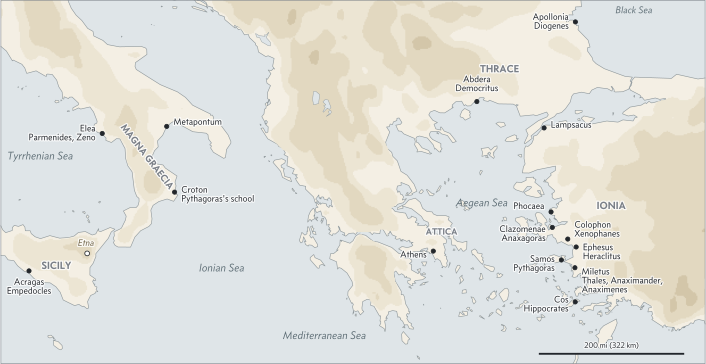
Thales wrote nothing, and he is known almost entirely through Aristotle (384–322 BC), the great philosopher of the next age (Chapter 19), who collected the opinions of the men before him. Aristotle says that Thales was the first to ask what the arche (ar-kee) of all things was. The Greek word means a “beginning,” and here it means the first principle, the one stuff from which everything comes and into which everything returns. Thales said that it was water. He also said that the earth floats on water like a log. Aristotle guessed at his reasons: all food is moist, heat itself is kept alive by moisture, and the seeds of all things are moist. Water is also the one thing anyone can see as a solid, a liquid, and a vapor. The answer mattered less than its kind. Thales explained the world by something in it, not by the quarrels of gods, and he left his answer open to argument.
His neighbors argued at once. Anaximander (an-ak-sih-man-der), a younger man of Miletus who is said to have drawn the first Greek map of the world, seems to have objected that water could not be the source of fire, its opposite. The first stuff must be something with no qualities of its own, which he called the apeiron (uh-py-ron), “the boundless.” The next Milesian, Anaximenes (an-ak-sim-ih-neez), came back to something you could feel. He said it was air. Air thinned out becomes fire, and air packed tighter becomes wind, then cloud, water, earth, and finally stone.
Out of these arguments came, in time, the list that every later Greek learned. By the end of the fifth century BC, philosophers spoke of four basic kinds of matter, which English calls the four classical elements: earth, water, air, and fire.These things classically consisted of air, fire, earth, and water. → classical elements•• An element, in this old sense, is a stuff that cannot be broken down into other stuffs. Plato later called each of them a stoicheion (stoy-kay-on), the same word he used for a letter of the alphabet. As a few letters spell every word, so a few elements make every thing. The thinker who first set the four side by side was Empedocles (em-ped-uh-kleez), who comes later in the chapter.
Thales’s answer did not last, but his question did. For a century and a half each new thinker named a different first stuff, sometimes one of the four elements and sometimes something stranger (Figure 7.2). Where Thales chose water, Heraclitus chose fire.Thales chose water and Heraclitus emphasized fire among these classical substances. → classical elements••Thales of Miletus held that this substance was the primary component of all matter. → water••This philosopher believed that fire is the fundamental element. → Heraclitus of Ephesus•• Heraclitus of Ephesus, who wrote about 500 BC, thought the world was a fire that never stops burning. The Pythagoreans looked to number, Parmenides to a single unchanging One, Empedocles to four “roots,” Anaxagoras (an-ak-sag-er-us) to Mind, and Democritus (dih-mok-rih-tus) to atoms. Each answer was a reply to the one before, and the chain of replies is the story of this chapter.

Air had one more champion, a full century after Anaximenes. Diogenes of Apollonia (ap-uh-loh-nee-uh) most likely came from a Milesian colony of that name on the west shore of the Black Sea, now Sozopol in Bulgaria, though one ancient writer placed his Apollonia on Crete. He worked about 440 to 425 BC and spent some time in Athens, where the comic poet Aristophanes seems to have laughed at his ideas (Chapter 15). Diogenes asked why the world is so well arranged, with summer and winter, day and night, rain and fair weather each in its measure. Something must be steering it, and he held that air is the first substance and has intelligence.This philosopher held that air is the fundamental substance and possesses intelligence. → Diogenes of Apollonia• His proof was breathing. “Men and all other animals live upon air by breathing it,” he wrote, in John Burnet’s translation, “and this is their soul and their intelligence.” Take the air away, and they die.
If air is the soul, it must travel through the body, and Diogenes thought it went with the blood. So he traced where the blood vessels run: two great vessels up through the belly beside the backbone, one on the right and one on the left, branching into the legs, the arms, and the head. His book is lost, but this passage is the longest piece of it we have, because Aristotle copied it into his History of Animals,Aristotle’s History of Animals preserves this philosopher’s account of blood vessels. → Diogenes of Apollonia• a survey of animal bodies. It is one of the oldest attempts by any Greek to describe the inside of the human body in detail, and it survives in Diogenes’s own words.
Not every Ionian looked at matter. Xenophanes (zeh-nof-uh-neez) was born about 570 BC in Colophon (kol-uh-fon), just north of Ephesus. He was a poet, and he says in one of his poems that he left home at twenty-five and had been wandering the Greek world for sixty-seven years. He probably left when the Persians conquered Ionia about 546 BC, and he spent much of his long life in Sicily and southern Italy, reciting his verses. His target was the gods of the poets. “Homer and Hesiod have ascribed to the gods all things that are a shame and a disgrace among mortals,” he wrote, in Burnet’s translation, “stealings and adulteries and deceivings of one another.” People make gods in their own image, he said. The Ethiopians give theirs black skin and snub noses, and the Thracians give theirs blue eyes and red hair. Then he carried the point to its end: if animals could paint, horses would draw horse-shaped gods.Xenophanes argued that, given hands, horses would draw these entities as horses. → gods• “If oxen and horses or lions had hands,” the fragment runs, and could paint as men do, “horses would paint the forms of the gods like horses, and oxen like oxen.” His own god was one, “neither in form like unto mortals nor in thought,” moving all things by the power of its mind. Xenophanes also wrote a mocking poem about another philosopher, the earliest mention of that man by any writer whose words survive. He was Pythagoras.
Pythagoras
Pythagoras was born about 570 BC on Samos, the large island a mile off the Ionian coast, a short sail northwest of Miletus. Herodotus knew of him, Xenophanes and Heraclitus mocked him, and Plato and Aristotle took him seriously. Beyond that, almost everything told about him comes from writers who lived centuries later and admired him as a holy man. The three Lives of Pythagoras that survive, by Diogenes Laërtius, Porphyry (por-fih-ree), and Iamblichus, date from the third and fourth centuries AD, eight hundred years after him. They say he had a golden thigh and could be in two cities at once. Pythagoras himself wrote nothing.
About 530 BC Pythagoras left Samos. According to Aristoxenus (ar-ih-stok-suh-nus), a student of Aristotle who knew the last Pythagoreans, he went to escape the rule of Polycrates (puh-lik-ruh-teez), the island’s tyrant, a ruler who had seized power for himself. He sailed to Croton, a Greek colony on the southern Italian coast of the Ionian Sea (Chapter 4). Croton was famous for its athletes and its doctors. Pythagoras founded a school at Croton,This philosopher founded a philosophical school at Croton. → Pythagoras•• though “school” is too weak a word. It was a brotherhood whose members, women among them, shared their property, swore to keep its teachings secret, and followed a strict way of life. Later writers say that a newcomer kept silent for five years before he could see the master’s face. Pythagoras stayed at Croton for some twenty years, and his followers came to hold power there and in the neighboring Greek cities.
Some writers credited Pythagoras with naming the whole enterprise. The Roman orator Cicero tells, from a lost dialogue by one of Plato’s students, that Leon, the ruler of the small Greek city of Phlius (fly-us), asked Pythagoras what he was. He answered with a new Greek word,Pythagoras used this language. → Greek• philosophos (fih-los-oh-fos), a “lover of wisdom.” Life, he said, is like the Olympic Games: some come to win prizes, some to buy and sell, and the best come simply to watch. The word, whoever made it, is the root of “philosophy.”

The teaching most surely his was about the soul. Pythagoras taught metempsychosis (meh-tem-sy-koh-sis), or the transmigration of souls:This philosopher preached a form of reincarnation known as "metempsychosis," or "transmigration of souls." → Pythagoras•• the soul does not die with the body but moves, at death, into a new one, a man’s or a woman’s, a beast’s or a bird’s. The oldest evidence is Xenophanes’s mocking poem. In Burnet’s translation it tells how Pythagoras was passing when a dog was being beaten, and cried out: “Stop! don’t beat it! For it is the soul of a friend that I recognised when I heard its voice.” Later writers said that Pythagoras remembered four lives before his own, one of them as Euphorbus (yoo-for-bus), a Trojan warrior whom Menelaus killed in the Iliad (Vol. 4, Classical Myth). If souls pass between men and animals, then all living things are kin, and some of his followers would eat no meat at all.
The brotherhood lived by a set of short rules, the akousmata (uh-koos-muh-tuh), “things heard.” Do not stir a fire with a knife. Put on the right sandal first. Do not pick up crumbs that have fallen from the table. The most famous rule was that his followers abstained from eating beans,This philosopher's followers abstained from eating beans. → Pythagoras•• the broad beans, or fava beans, of the Mediterranean. No one knows why. Aristotle offered several guesses. A modern guess is favism, an inherited condition, common around the Mediterranean, in which eating fava beans can make a person dangerously ill. A late story turned the rule into a death. Diogenes Laërtius tells that when enemies set fire to the house where the Pythagoreans were meeting, Pythagoras fled until he reached a field of beans, stopped, and let himself be killed rather than cross it. The story seems to go back to Neanthes (nee-an-theez), a historian of about 300 BC, who told it not about Pythagoras but about a band of later Pythagoreans cut down by a tyrant’s soldiers at the edge of a bean field.

In time the followers split into two groups. The mathematikoi (math-uh-mat-ih-koy), “those who learn,”This philosopher's school's adherents were known as the mathematikoi. → Pythagoras• studied the reasons behind the teachings, above all number and geometry. The Greek mathema meant anything learned, and the Pythagoreans are thought to have been the first to narrow it to these studies, the origin of our “mathematics.” The akousmatikoi (uh-koos-mat-ih-koy), “those who listen,” kept the rules and the sayings without asking why. The two groups quarreled over which of them was the master’s true heir.
The learners came to believe that the world is built on number. Their great discovery came from music. Pluck a string, then press it down at its middle and pluck one half: the second note is an octave higher, the same note in a higher voice. Two-thirds of the string sounds a fifth above the first note, and three-quarters a fourth (Figure 7.5). The intervals that sound sweet to the ear are the simple ratios 2:1, 3:2, and 4:3, made of the numbers 1, 2, 3, and 4, which add up to 10, the number the Pythagoreans held sacred. If harmony is number, they reasoned, perhaps everything is. Aristotle summed up their belief in one phrase: the principles of number are the principles of all things.

They turned the same reasoning on the sky. In their picture of it, the sun, the moon, and the planets each moved in a circle around the center of the world, at speeds that stood in musical ratios. Anything so large, moving so fast, must make a sound, so the heavenly bodies made a “music of the spheres”,This philosopher proposed a “music of the spheres” produced by heavenly bodies. → Pythagoras• a harmony too great for any instrument. Aristotle, who did not believe it, tells their answer to the obvious question of why no one hears it. We have heard it since the moment we were born, they said, and a sound that never stops cannot be told from silence, just as smiths in a copper workshop stop noticing the din.
Number also brought the brotherhood its worst shock. Its members believed that any length could be measured exactly by some fraction of any other. The trouble came from the theorem that bears Pythagoras’s name: in a right triangle, the squares on the two shorter sides add up to the square on the longest. Babylonian scribes knew it more than a thousand years before Pythagoras, and the writers who credit him with discovering it lived centuries after him. Draw the diagonal of a square whose sides are 1, and it cuts the square into two right triangles, so by the theorem the square on the diagonal is 1 + 1 = 2. That diagonal proved the brotherhood wrong: no fraction multiplied by itself makes exactly 2, as the box shows. The Greeks called such a length alogos, “without ratio” or “unspeakable,” and we call its number irrational. A story grew up around the discovery. Iamblichus, writing about eight centuries later, tells of a Pythagorean who was drowned at sea as punishment for revealing one of the school’s secrets to outsiders, and in one version he names him Hippasus (hip-uh-sus) of Metapontum (met-uh-pon-tum). Iamblichus’s versions do not agree on what the secret was, but in the story as it is usually told, Hippasus was drowned for discovering irrational numbers.Hippasus, a follower of this philosopher, was supposedly drowned for discovering irrational numbers. → Pythagoras•
The brotherhood’s power did not last either. About 510 BC, Croton’s citizens turned against the Pythagoreans, led by a rich man named Cylon whom the brotherhood had refused to admit. Later writers say that their meeting house was burned with many of them inside, though their accounts may mix this attack with later risings against the brotherhood. Most say that Pythagoras moved to nearby Metapontum and died there, about 495 BC, in a manner that every source tells differently. His followers scattered across Greece and carried his teaching with them. A later Pythagorean, Archytas (ar-ky-tus) of Taras in southern Italy, was a friend of Plato (Chapter 16), and Plato’s dialogues are full of Pythagorean number, music, and souls.
Heraclitus
North of Miletus, on the same coast, stood Ephesus, the city of the great temple of Artemis, later counted among the Seven Wonders of the World. When Heraclitus wrote there, about 500 BC, Ephesus was ruled by Persia. Heraclitus was a native of Ephesus,This philosopher was a native of Ephesus. → Heraclitus of Ephesus•• born into one of its noblest families. Diogenes Laërtius, in R. D. Hicks’s translation, says that he renounced his claim to the kingship, an old title his family still held, in favor of his brother. He despised his fellow citizens. When they asked him to give them laws, the biographer says, he refused, because their city was already in the grip of bad government. He would go off to the temple of Artemis to play knucklebones with the boys instead, and he told the crowd that gathered that this was better than taking part in their politics. He despised the famous thinkers too: “Much learning does not teach understanding; else would it have taught Hesiod and Pythagoras, or, again, Xenophanes…”
He wrote one book and, the story goes, laid it up in the temple of Artemis. It was not an argument but a string of short, dark sayings, built to puzzle and then to strike. Later Greeks called him ho skoteinos, “the Obscure.” More than a hundred of the sayings survive, quoted by writers who often disagreed about what they meant.
The book opened with the logos (loh-gos). The Greek word means a word, a speech, an account, a reckoning, a reason. Heraclitus used it for the account he was giving and also for what that account described: the order of the world, its logos,This philosopher described a universal order or account using the term logos. → Heraclitus of Ephesus•• a single law that runs through all things and is there for everyone to see. “Though this Word is true evermore,” his opening ran, in Burnet’s translation, “yet men are as unable to understand it when they hear it for the first time as before they have heard it at all.” “It is wise to hearken, not to me, but to my Word,” another fragment says, “and to confess that all things are one.”
The one thing was fire. “This world, which is the same for all, no one of gods or men has made,” Heraclitus wrote, “but it was ever, is now, and ever shall be an ever-living Fire, with measures of it kindling, and measures going out.” Fire is always changing and always the same flame, so it was the right image for a world that keeps its order by changing. It also trades with everything, he said, as goods are traded for gold and gold for goods. Fire condensing turns to sea, and sea to earth; earth melting turns to sea, and sea, rising as vapor, feeds fire. Diogenes Laërtius says that Heraclitus called the first change the downward path and the second the upward path. Heraclitus said that the way up and the way down are one and the same.This philosopher stated "the way up and the way down are the same." → Heraclitus of Ephesus•• The road up a hill is the same road as the road down it. The two changes are one process seen from its two ends, and if either stopped, the other would stop too, and the world would stand still.
His most famous saying is that one cannot step into the same river twice.This philosopher is associated with the saying that one cannot step into the same river twice. → Heraclitus of Ephesus••• In Burnet’s translation: “You cannot step twice into the same rivers; for fresh waters are ever flowing in upon you.” The river is the same river only because its water never stops changing; if it stood still it would be a pond. A person, a city, and the world itself, Heraclitus meant, stay what they are only by flowing. Plato, who read him a century later, made the saying into a doctrine. In Jowett’s translation of Plato’s Cratylus, Socrates reports that “Heracleitus is supposed to say that all things are in motion and nothing at rest; he compares them to the stream of a river, and says that you cannot go into the same water twice.” Later still, the whole teaching was boiled down to two Greek words, panta rhei (pan-tuh ray), “everything flows.” Heraclitus may never have said them. The summary “everything flows”This philosopher’s thought is commonly summarized by “panta rhei,” or “everything flows.” → Heraclitus of Ephesus••• was first written down by Simplicius, a commentator on Aristotle in the sixth century AD, a thousand years after Heraclitus. It has stood for his thought ever since.
One of his followers went further than the master. Cratylus (krat-ih-lus), an Athenian who taught later in the fifth century, followed Heraclitus’s account of changeCratylus was a follower of this philosopher’s account of change. → Heraclitus of Ephesus•• to its end. You cannot step into the same river even once, he said, since it changes while you step. Aristotle reports that in the end Cratylus thought nothing could be said truly about a world that never holds still, and gave up speaking: he only moved his finger. Aristotle also says that Plato knew Cratylus as a young man, and Plato named the dialogue on language after him.
Change, for Heraclitus, comes from the pull of opposites, and the opposites belong together. He used the bow and the lyreThis philosopher used the example of the harmony of the bow and lyre to illustrate the unity of opposites. → Heraclitus of Ephesus•• to show how. A strung bow seems to rest, but the string pulls one way and the wood the other, and that double pull is what makes it a bow. A lyre’s strings sound only because they are stretched. In Burnet’s translation: “Men do not know how what is at variance agrees with itself. It is an attunement of opposite tensions, like that of the bow and the lyre.” Things that pull against each other make one thing, and this teaching is called the unity of opposites. Day and night, he said, are one. The sea is the purest and the foulest water: fish can drink it, and it kills men.
If tension holds the world together, then quarrel is not a fault in it. Homer has Achilles wish that strife might vanish from gods and men; Heraclitus answered that without strife the world would fall apart. “War is the father of all and the king of all,” he wrote. And in Burnet’s translation, “We must know that war is common to all and strife is justice.”This philosopher stated "strife is justice." → Heraclitus of Ephesus•• The fragment overturns an older idea. Anaximander had called the way one opposite overruns another an injustice, for which it must pay. Heraclitus said the struggle itself is what is right, because it keeps everything in balance.
The fire that runs through the world also rules it, and Heraclitus gave that power the weapon of Zeus: the thunderbolt steers all things.This philosopher said "lightning steers the universe." → Heraclitus of Ephesus• In Burnet’s translation, “It is the thunderbolt that steers the course of all things.” Lightning, the purest fire, is the helmsman of the universe. The world’s order, though, does not lie open to view. In three Greek words, physis kryptesthai philei, Heraclitus said that nature loves to hide.One of this philosopher's maxims claims that nature loves to hide its meanings. → Heraclitus of Ephesus• The real constitution of things, the hidden harmony of the bow and the lyre, has to be read out of what we see, the way a riddle is solved. “The lord whose is the oracle at Delphoi neither utters nor hides his meaning,” he wrote of Apollo, “but shows it by a sign.” His own sayings work the same way.


Diogenes Laërtius tells how Heraclitus ended. He came to hate his own kind, went to live in the mountains on grass and herbs, and fell ill with dropsy, a swelling of the body with water. He came back to town and asked the doctors, in a riddle, whether they could turn a flood into a drought. When they did not understand, he buried himself in a cowshed, hoping that the warmth of the manure would draw the water out of him, and he died at sixty. The story fits his saying that it is death for souls to become water, and it may have been made up from it. A gentler picture came from two Roman writers of the first and early second centuries AD (Vol. 7, The Romans): Seneca and Juvenal pictured him weeping at human folly.Seneca and Juvenal pictured this philosopher weeping at human folly, the origin of his name "the weeping philosopher." → Heraclitus of Ephesus•• The philosopher Seneca, who was the emperor Nero’s tutor, wrote that whenever Heraclitus went out of doors and saw so many men “living wretchedly, nay, rather perishing wretchedly,” he would weep (in Aubrey Stewart’s translation), while Democritus never went out without laughing. The satirist Juvenal used the same pair, and wondered, in G. G. Ramsay’s translation, “how the other sage’s eyes were supplied with all that water.” Heraclitus has been “the weeping philosopher” ever since, set beside Democritus in paintings like ter Brugghen’s (Figure 7.6).
Philosophers went on reading the sayings themselves. Twenty-three centuries after him, the German philosopher Georg Wilhelm Friedrich Hegel (hay-gul) (1770–1831) built a whole system on one idea (Vol. 16, Romantic Europe). Every idea, he argued, turns into its opposite when it is thought through, and the two are then taken up into a higher idea, as being and nothing are joined in becoming. He saw his own method in the Ephesian’s riddles. In his lectures on the history of philosophy, Hegel said there was no proposition of HeraclitusHegel said there was no proposition of this philosopher’s that he had not adopted in his Logic. → Heraclitus of Ephesus•• that he had not adopted in his Logic, the book in which he laid out that method.
Parmenides and Zeno
About 546 BC, as the Persians took Ionia, the people of Phocaea, the northernmost Ionian city, loaded their families into their ships and sailed away rather than submit. Herodotus tells their story. After years of wandering, some of them founded a town on the west coast of southern Italy, Elea, later called Velia. There, about 515 BC, Parmenides was born to a rich family. Plutarch and Strabo say that he gave Elea its laws. In 1969 archaeologists at Elea found the base of a statue of the first century AD inscribed with his name, “Parmenides, son of Pyres,” and the title of physikos, a student of nature.
Parmenides wrote a single poem, in the same long hexameter lines as Homer, and about 160 of its lines survive, most of them copied out by Simplicius. It opens like an epic. A young man rides in a chariot drawn by horses, guided by “the daughters of the Sun,” to “the gates of the ways of Night and Day,” where Justice keeps the keys. The gates swing open, and a goddess greets him. In Burnet’s translation she promises that he will learn “the unshaken heart of well-rounded truth” as well as “the opinions of mortals in which is no true belief at all.”
The truth she teaches is an argument, the first long argument in Western thought. There are only two roads, she says: that a thing is, or that it is not. The second road leads nowhere, “for thou canst not know what is not,” nor say it. Follow the first road, and strange things follow. What is cannot come into being, because it would have to come from what is not, and there is no such thing. It cannot pass away, for the same reason. It cannot change, or move, because there is no empty space for it to move into: empty space would be what is not. So what truly is must be one, whole, unchanging, and still, “like the mass of a rounded sphere.” Our senses show us a world of many things, born and dying and moving. The senses, said Parmenides, lie. The rule at the heart of his argument, that nothing comes from nothing, bound every philosopher after him.
Many people laughed at Parmenides, but he found a champion in a younger man of Elea. Zeno (zee-noh) was born about 490 BC, and Diogenes Laërtius says that Parmenides adopted him as a son. Zeno was the most famous student of Parmenides,This philosopher was the most famous student of Parmenides. → Zeno of Elea•• and he spent his cleverness defending his teacher. Plato describes the two of them in a dialogue named for the older man. In the Parmenides, they come to Athens for the Great Panathenaia, the city’s festival of Athena (Chapter 11). Parmenides is about sixty-five, “very white with age, but well favoured,” and Zeno is “nearly 40 years of age, tall and fair to look upon,” in Jowett’s translation. A crowd gathers to hear Zeno read his book, and among them is Socrates, “then a very young man.” When Zeno finishes, Zeno and Socrates discuss his argumentsThis philosopher discusses his arguments with Socrates in Plato's Parmenides. → Zeno of Elea• until Parmenides himself takes over and questions the young Socrates closely. Zeno explains that he wrote the book in his youth, to protect Parmenides from those who mocked him, by showing that his opponents’ belief in many things led to things “still more ridiculous.” Plato wrote the dialogue some eighty years after the visit it describes, and no one knows whether the meeting took place.
That was Zeno’s method. He took his opponents’ belief, that there are many things and that they move, and drew from it conclusions they could not accept. He devised arguments against the possibility of motion,This philosopher devised arguments against the possibility of motion. → Zeno of Elea•• and Aristotle thought them clever enough to answer at length. The method is now called by a Latin name, reductio ad absurdum, “reduction to the absurd”: grant your opponent’s view, follow it, and show that it ends in nonsense. Aristotle called Zeno the inventor of dialectic, the art of argument by question and answer. Zeno’s book is lost. Its arguments were paradoxes: a paradox, from the Greek for “against belief,” is an argument that seems sound and reaches a conclusion that seems false. Aristotle’s Physics preserves his arguments, in Books VI and VII:Some of this philosopher's ideas are preserved in Book VI and VII of Aristotle's Physics. → Zeno of Elea•• the paradoxes of motion in Book VI, and in Book VII a puzzle about a grain of millet. A single grain makes no sound when it falls, but a whole sack of grain does, so either the single grain does make a sound or the sack’s noise is made of silences.
The first paradox is the dichotomy, the “cutting in two.” A runner who wants to cross a racecourse must first reach the halfway mark. Then he must cover half of what is left, then half of that, and so on. However close he comes, there is always another half to cross. Zeno’s dichotomy splits the distance in half infinitely many times,Zeno of Elea's dichotomy paradox involves splitting a distance in half this many times, arguing that motion is impossible. → infinity• and infinity, a number of steps with no last step, cannot be finished, Zeno said. So the runner never reaches the end. Run the argument backward and he cannot even start, since before the halfway mark he must reach the quarter mark, and before that the eighth.
The second paradox puts Achilles, the swiftest runner in Homer (Vol. 4, Classical Myth), into a race. Zeno’s paradox of Achilles and the tortoiseThis philosopher proposed a paradox involving a race between Achilles and the Tortoise. → Zeno of Elea••• gives the slow runner a head start. By the time Achilles reaches the place where the tortoise began, the tortoise has crept a little farther. By the time he reaches that place, it has crept farther still. However often he arrives where it was, it is always a little ahead, so Achilles never catches it. Aristotle’s version says only that the slowest runner will never be overtaken by the quickest; the race has been run with a tortoise in nearly every retelling since (Figure 7.7).

The third paradox stops an arrow in the air. At any single instant, Zeno argued, a flying arrow occupies a fixed position,This philosopher’s arrow paradox holds that an arrow cannot move because it is stationary at each instant. → Zeno of Elea•••Zeno’s arrow paradox challenges this process by observing that the arrow occupies a fixed position at each instant. → motion•• a space exactly its own size, and in that instant it does not move, since an instant has no time in it for moving. But the whole flight is made of such instants, so the arrow is always at rest, and motion never happens. Aristotle answered that time is not made of instants, as a line is not made of points: the arrow moves in a stretch of time, not in an instant. Philosophers still argue about whether that settles it.
Zeno’s death became a story too. Diogenes Laërtius says that he joined a plot against a tyrant, was caught, and was tortured to name his fellow plotters. He named the tyrant’s own friends instead. Then, in one version, he offered to whisper a secret in the tyrant’s ear and bit it until he was killed; in another, he bit off his own tongue and spat it at him.
Empedocles, Anaxagoras, and the atomists
Parmenides left his successors a hard choice. They could not deny that the world changes, and they could not answer his argument that nothing comes from nothing. Three answers came in the middle of the fifth century BC, and at bottom all three said the same thing. The basic stuff of the world never comes into being or perishes, but it can move, mix, and separate, and what we call change is that rearrangement.
The first came from Acragas, a rich Greek city on the south coast of Sicily, famous for its temples. Empedocles was born there about 494 BC. He was a statesman who, an old story says, refused to be made king, a healer who was said to have ended a plague, and a poet who wrote philosophy in hexameters like Parmenides. He was not modest. “I go about among you an immortal god, no mortal now,” he told his fellow citizens, in Burnet’s translation. Like Pythagoras he believed that souls pass from body to body: “For I have been ere now a boy and a girl, a bush and a bird and a dumb fish in the sea.”
His answer to Parmenides was that there is not one stuff but four, earth, water, air, and fire, and that none of them ever comes into being or perishes. He called them rhizomata (rih-zoh-muh-tuh), “roots,” and gave them the names of four gods, among them Aidoneus (ay-doh-nee-us), another name for Hades: “Hear first the four roots of all things: shining Zeus, life-bringing Hera, Aidoneus and Nestis.” Ancient readers argued over which god stood for which element. Two forces move the roots. Love unites the roots and Strife drives them apart,Empedocles called these substances “roots,” combined and separated by Love and Strife. → classical elements••Empedocles made this force unite the elements, opposing Strife. → love•• and every thing in the world is a mixture of roots that Love has brought together and Strife will one day separate. Over vast ages, Empedocles taught, the two forces take turns. When Love wins, all the roots are blended in a single still sphere. When Strife wins, they lie in four separate masses. Our world belongs to the time between.
Diogenes Laërtius collects several endings for him. In the most famous, Empedocles leaped into the crater of Mount Etna so that people would think he had vanished and become a god, but the volcano threw up one of the bronze slippers he always wore, and gave him away. Aristotle simply says that he died at sixty.
The second answer came from Ionia. Anaxagoras was born about 500 BC in Clazomenae (kluh-zom-ih-nee), near modern Izmir, and he was the first philosopher to make his home in Athens, where he lived for about thirty years as the friend and teacher of the statesman Pericles (Chapter 11). He taught, in Burnet’s translation, that “in everything there is a portion of everything”: every scrap of bread holds tiny amounts of flesh and bone and hair, which is how bread can become a body. What set the mixture moving and sorted it out was nous (noos), Mind, which started a great whirl at the beginning of the world. He said the sun was a mass of red-hot metal larger than the Peloponnese and that the moon took its light from the sun, and he explained eclipses correctly. Saying the sun was a fiery mass and not a god got him charged with impiety, and he ended his life in exile at Lampsacus (lamp-suh-kus) on the Hellespont, where the town honored him with a yearly holiday for its children. When Socrates was tried in 399 BC, his accuser said that he taught Anaxagoras’s doctrine of the sun, and Socrates denied it (Chapter 14).
The third answer was the boldest. Leucippus (loo-sip-us) is so obscure that the later philosopher Epicurus (ep-ih-kyoor-us) is said to have claimed he never existed. Aristotle, though, names him, and his home is given as Miletus, Elea, or Abdera (ab-deer-uh). Leucippus is credited with the first Greek theory of atoms.Leucippus is traditionally credited with first proposing a Greek theory of these particles. → atoms••• He granted Parmenides that what is cannot come from nothing and cannot be divided without end. But he said that what is not, empty space, exists too. He called it the void. The world, he said, is made of tiny solid bodies, each one whole and unchangeable like Parmenides’s One, moving through the void and bumping into each other. They are far too small to see. Their name, atoma, means “uncuttable”These things are named from a Greek word meaning "uncuttable" or "indivisible." → atoms•• in Greek, from a-, “not,” and temnein, “to cut,” the same root as “anatomy.”
His pupil made the theory famous. Democritus was born about 460 BC in Abdera, a Greek town on the coast of Thrace, and lived, the stories say, to a great age. He spent his inheritance on travel to Egypt and Persia and wrote some seventy books, on everything from music to farming, and every one is lost. Democritus said that everything is atoms moving in the void.Democritus described reality as these indivisible particles moving in the void. → atoms•••Democritus believed these objects made up everything in the universe. → atoms• There are infinitely many atoms, all made of the same stuff, and they differ only in shape, in order, and in position. Aristotle explained this with letters: A differs from N in shape, AN from NA in order, and Z from N in position, since a Z is an N lying on its side. Out of a few kinds of atom, arranged in endless ways, come all the things there are, as all of Homer comes from twenty-four letters. Worlds form wherever atoms happen to collide in a whirl, and there are countless worlds, coming into being and perishing. Color, taste, heat, and cold, Democritus said, exist only by custom, in the way they strike us; in reality there are only atoms and the void. A century later Epicurus made the atoms the basis of a whole way of life (Chapter 22), and the Roman poet Lucretius (loo-kree-shus) put them into Latin verse (Vol. 7, The Romans). Modern chemistry borrowed the name in the early nineteenth century, though the modern atom turned out to be cuttable after all.
Later writers imagined that the man who saw the world as atoms colliding by chance found it funny. Those who paired him with Heraclitus made him the one who laughed, and so Democritus became the laughing philosopher.This philosopher was known as the “laughing philosopher.” → Democritus•• Juvenal says his sides “shook with unceasing laughter” at the pomp and worry of ordinary people, and he laughs out of ter Brugghen’s painting still (Figure 7.6). In his surviving sayings on how to live, he praised cheerfulness above all.
The four elements outlived every rival for two thousand years. About 360 BC Plato, in his dialogue the Timaeus (ty-mee-us) (Chapter 17), gave the four elements shapes. He matched each element to a Platonic solid,In the Timaeus, Plato linked each of these things to a Platonic solid. → classical elements••Plato associated this substance with the icosahedron. → water• as the regular solids are now called: solids whose faces are all the same regular polygon. Fire, which burns, got the sharp-pointed tetrahedron, with four triangular faces. Air got the octahedron, with eight, and water the icosahedron (eye-koh-suh-hee-drun), with twenty. Earth got the cube, the steadiest of the solids, which sits firmly on any face. The fifth such solid, the dodecahedron, he left for the whole heaven. Eight centuries after Plato, Proclus (prok-lus) (AD 412–485), the head of the Platonist school at Athens, sorted the four elements once more in his commentary on the Timaeus. Proclus told the elements apart by sharpness, density, and mobility.Proclus differentiated these things based on properties including sharpness, density, and mobility. → classical elements• Fire is sharp, thin, and quick-moving; air is blunt, thin, and quick-moving; water is blunt, dense, and quick-moving; earth is blunt, dense, and still. Each step from fire to earth changes one quality. Aristotle had meanwhile added a fifth element, the aether (ee-ther), the pure, unchanging stuff of the stars (Chapter 19). Its Latin name, quinta essentia, “the fifth essence,” gives English the word “quintessence.”
Hippocrates
While the philosophers argued about the stuff of the world, Greek doctors were studying the stuff of the body. The most famous of them was Hippocrates, born about 460 BC on Cos (kos), an island off the coast of Asia Minor south of Miletus. He came from a family of doctors who claimed descent from Asclepius (uh-sklee-pee-us), the god of healing (Vol. 4, Classical Myth), and he taught medicine for fees, as Plato mentions. He traveled widely and died, very old, about 370 BC at Larissa in Thessaly. Some sixty or seventy medical books came down under his name, written in the Ionic dialect, and they are called the Hippocratic Corpus. They were gathered in Alexandria (Vol. 5, In the Beginning) and are the work of many authors, and no one can say which of them, if any, he wrote himself.
What unites them is a way of thinking. One of them, On the Sacred Disease, is about epilepsy, the illness of seizures, which many Greeks thought was sent by the gods. Its author disagrees. He says that this disease is no more sacred than any other, that it has a natural cause in the brain, and that the men who first called it sacred were magicians covering up their ignorance. Hippocratic doctors watched their patients closely, wrote down how illnesses ran their course day by day, and judged their treatment by its results. The first of the collection’s Aphorisms begins, in Francis Adams’s translation of 1849, “Life is short, and Art long,” the art being medicine.
The best-known work in the collection is short enough to swear by. The Hippocratic Oath begins by calling to witness Apollo the Physician, Asclepius, and his daughters Hygieia (hy-jee-uh) and Panacea (Vol. 4, Classical Myth). The new doctor swears to honor his teacher like a parent and to teach the art freely to his teacher’s sons. He will treat the sick for their benefit and never do them harm or wrong, and he will give no deadly drug, even if asked. He will not cut the body, even to remove stones from the bladder, but will leave that work to the specialists, and he will keep secret what he sees and hears in his patients’ homes. The words “First, do no harm,” often quoted as the oath’s own, are not in it. The oath was probably written in the fifth or fourth century BC, perhaps not by Hippocrates at all. Even so, doctors still take versions of the oathMembers of this profession traditionally take versions of an oath attributed to Hippocrates. → doctors• at the start of their careers. In 1948 the World Medical Association wrote a modern pledge, the Declaration of Geneva, and most medical schools now use one of the updated forms.

Greek medicine also had its own theory of elements. A treatise in the collection called On the Nature of Man, probably by Hippocrates’s son-in-law Polybus (pol-ih-bus), says that the body contains four fluids, or humors: blood, phlegm, yellow bile, and black bile. Health is their right mixture, and sickness comes when one of them is too strong or too weak. Each humor, the treatise says, rises with a season. Phlegm, which is cold and wet, grows strongest in winter, when people’s noses run; blood in spring; yellow bile in summer; and black bile in autumn. Phlegm has the qualities of water, cold and wet, and Galen (gay-lun), the great doctor of six centuries later, says that Hippocrates paired phlegm with water,Hippocrates associated this substance with the bodily humor he called phlegm. → water• as he paired blood with air, yellow bile with fire, and black bile with earth (Figure 7.9). Galen, a Greek who practiced at Rome in the second century AD, made this scheme the core of medicine for fifteen hundred years. English still keeps its words: a sanguine person (from the Latin for blood) is cheerful, a phlegmatic one calm, a choleric one angry, and a melancholic one, full of black bile, sad.

The humors were wrong, and the bleeding and purging they called for harmed patients for two thousand years. But the method was right. Like the philosophers of Miletus, the Hippocratic doctors looked for natural causes, and they argued from what they could observe.
What to remember
- The first philosophers, called the Presocratics, asked what everything is made of, and answered with something in the world rather than with the gods. Their books survive only in fragments.
- Thales of Miletus said the first principle was water; Anaximenes and later Diogenes of Apollonia said air, which Diogenes thought was intelligent; Heraclitus said fire. The four classical elements are earth, water, air, and fire.
- Xenophanes mocked the gods of Homer and Hesiod: if horses could draw, they would draw gods like horses.
- Pythagoras, from Samos, founded a brotherhood at Croton about 530 BC. It taught metempsychosis, forbade beans, found musical intervals in simple ratios, and imagined a music of the spheres; the discovery of irrational numbers was later tied to the legend of Hippasus.
- Heraclitus of Ephesus taught the logos, the unity of opposites (the bow and the lyre), that strife is justice, and that one cannot step into the same river twice; “everything flows” is a later summary. Seneca and Juvenal made him the weeping philosopher.
- Parmenides of Elea argued that what is cannot change or move. His pupil Zeno defended him with paradoxes of motion, the dichotomy, Achilles and the tortoise, and the arrow, which Aristotle’s Physics preserves.
- Empedocles of Acragas taught four roots moved by Love and Strife; Anaxagoras made Mind the mover; Leucippus and Democritus, the laughing philosopher, said all is atoms and the void.
- Plato later matched the elements to regular solids, water to the icosahedron; Hippocrates of Cos gave his name to the doctors’ oath and to medicine without gods, and the four humors made phlegm the body’s water.
The Persian Wars
Chapter 8 · 23 clues
The Ionian Revolt and Marathon
In 499 BC a slave walked into Miletus, the richest Greek city on the coast of Asia, carrying a message he could not read. It was written on his own scalp. His master, Histiaeus (his-tee-ee-us), had once ruled Miletus, but for years the king of Persia had kept him at the royal city of Susa, three months’ journey inland, as an honored guest who could not leave. The roads were watched. So Histiaeus shaved the slave’s head, pricked the message into the skin, and waited for the hair to grow back. At Miletus the slave told the city’s ruler, Aristagoras, to shave him and look. The marks meant one thing: revolt.
That is the story as the historian Herodotus tells it. Within nine years the revolt had burned a Persian capital, brought Miletus to ruin, and drawn a Persian army to a beach 25 miles from Athens. The road from that tattooed scalp to the beach at Marathon is one of the great stories of the ancient world, and the man who traced it invented a new kind of book.
The Ionian Revolt
The Greeks of Ionia lived on the western coast of Asia Minor, the great peninsula that is now Turkey, and on the islands just off it. They spoke the Ionic dialect of Greek, and they believed that their ancestors had sailed there from Athens centuries before. By 500 BC their cities were among the richest in the Greek world, and the first philosophers had been born in them (Chapter 7). Twelve cities formed the Ionian League: Miletus, Myus (my-us), and Priene (pry-ee-nee) in the south; Ephesus, Colophon, Lebedus (leb-ih-dus), Teos (tee-os), Clazomenae, Phocaea, and Erythrae (err-ih-three) up the coast; and the islands of Samos and Chios. Their common sanctuary was the Panionium (pan-eye-oh-nee-um), “the place of all the Ionians,” sacred to the sea god Poseidon, on the north slope of Mount Mycale (mik-uh-lee), the ridge that runs out toward Samos. There the league gathered for the Panionia,This region's namesake league gathered regularly for a festival held at the Panionium sanctuary on Mt. Mycale. → Ionia• a festival of sacrifices and games, and there its delegates met when the cities had to act together (Figure 8.1).

The Ionians had lost their freedom twice. First the kings of Lydia, whose capital was Sardis, about 60 miles inland, made the cities pay them tribute. Then, about 546 BC, Cyrus the Great of Persia conquered Lydia and its king Croesus, and his generals took the Greek cities one by one (Vol. 5, In the Beginning). Persia ruled them through Greek tyrants, single rulers who governed without a lawful title (the Stage), each kept in power by the Persian governor, or satrap (say-trap), at Sardis. In 499 BC the satrap was Artaphernes (ar-tuh-fur-neez), a brother of the king. The king was Darius I, who had seized the throne in 522 BC and made the empire into a machine of provinces, tribute, and royal roads (Vol. 5, In the Beginning).
Darius had once owed his life to the Ionian tyrants. In 513 BC he led an army into Europe against the Scythians, the horse nomads beyond the Danube, and left the tyrants to guard the bridge of boats on which he had crossed the river. One of them was an Athenian, Miltiades (mil-ty-uh-deez). His family had ruled the Chersonese (kur-suh-neez), the long peninsula on the European side of the Hellespont, since his uncle settled there, and Miltiades held it now under Persian protection. Herodotus says Miltiades urged the others to break the bridge and leave Darius to die in Scythia. Histiaeus of Miletus talked them out of it, reminding them that each of them ruled his city only because Darius backed him. The king rewarded Histiaeus, then grew afraid of his ambition and took him to Susa.
Histiaeus left Miletus to his son-in-law and cousin, Aristagoras. In 500 BC Aristagoras promised Artaphernes an easy conquest of Naxos, the largest island of the Cyclades in the middle of the Aegean Sea, and Artaphernes gave him two hundred ships under a Persian commander. Aristagoras and the commander quarreled on the voyage, and Herodotus says the Persian warned the Naxians, who held out behind their walls for four months until the money ran out. Aristagoras had promised to pay for the expedition and could not. He expected to lose Miletus, and then the slave with the shaved head arrived.
In the autumn of 499 BC Aristagoras laid down his tyranny and declared that the Milesians would govern themselves. He arrested the tyrants of the other cities, who were still with the fleet back from Naxos, and handed each over to his own people. The Ionian cities threw out their rulers and rose against the king. This rising, the Ionian Revolt, began the Persian Wars,These wars began with the Ionian Revolt. → Persian Wars• the name historians give to twenty years of fighting between Greeks and Persians, from 499 to 479 BC. The Ionians knew they could not fight the largest empire on earth alone, so Aristagoras sailed to Greece to ask for help.
At Sparta, the strongest military power in Greece, King Cleomenes turned him down once he learned that Susa lay three months’ march from the sea, and his small daughter Gorgo warned her father against the stranger’s bribes (Chapter 6). Aristagoras sailed on to Athens. The Athenians had their own quarrel with Persia: their exiled tyrant Hippias, the son of Pisistratus (Chapter 5), had gone to Sardis, and Artaphernes had ordered Athens to take him back. In the assembly Aristagoras promised everything. “It would seem that it is easier to deceive many than one,” Herodotus remarks in G. C. Macaulay’s translation of 1890, for the man who had failed with Cleomenes persuaded thirty thousand Athenians. Athens voted twenty ships, and the city of Eretria, on the island of Euboea north of Athens, sent five more. “These ships proved to be the beginning of evils for the Hellenes and the Barbarians,” Herodotus writes. Barbarians was the Greek word for all peoples who did not speak Greek.
In 498 BC the allies landed at Ephesus and marched inland, up the valley of the river Cayster (kay-stur) and over Mount Tmolus (tmoh-lus), to Sardis. They took the city at once, all but the citadel, where Artaphernes held out. Most houses in Sardis were roofed with reeds. A soldier set one on fire, the flames ran from roof to roof, and the whole city burned, together with the temple of the Lydian mother goddess whom the Greeks called Cybele (sib-uh-lee). The Persians later cited that temple as their reason for burning the temples of Greece. The allies retreated to the coast, a Persian army caught them near Ephesus and beat them, and the Athenians sailed home and refused to come back. Herodotus says that when Darius heard of the burning he asked who the Athenians were, and ordered a servant to say to him three times at every dinner, “Master, remember the Athenians” (Vol. 5, In the Beginning).
The revolt spread north to the Hellespont, south into Caria (kair-ee-uh), and across the sea to Cyprus, but Persian armies won it back piece by piece. Aristagoras lost heart, sailed off to Thrace, and was killed there. In 494 BC a Persian army and a fleet of six hundred ships, most of them Phoenician, closed in on Miletus. The delegates met at the Panionium and decided to leave the Milesians to defend their walls and to fight for them at sea. The whole Ionian fleet, 353 triremes (try-reemz), the oared warships of the age, gathered at Lade (lay-dee), a small island off Miletus.
The Ionians chose as their leader Dionysius of Phocaea, who drilled them at sea from morning to night. After seven days of rowing under the hot sun, the crews refused to go on. Herodotus gives their complaint: why should they suffer under a Phocaean who brought only three ships? Meanwhile the Persians had sent the deposed tyrants to their old subjects with promises, and the men of Samos secretly accepted. When the Phoenician fleet attacked, the Samian ships raised sail and went home, all but eleven. The ships of Lesbos fled after them, and then most of the rest. The Chians fought on with a hundred ships and broke through the enemy line again and again before they too were overwhelmed. The fleet of Ionia was destroyed at Lade,A naval fleet from this region was defeated at the Battle of Lade. → Ionia• and Miletus stood alone.
The Persians undermined the walls of Miletus and stormed it later that year. Most of the men were killed and the women and children enslaved, and Darius settled the captives near the mouth of the Tigris, at the head of the Persian Gulf. Apollo’s great temple at Didyma (did-ih-muh), the city’s oracle, was plundered and burned. When an Athenian playwright put the fall of Miletus on the stage, the audience wept, and Athens fined him for reminding it of the ruin of a city it counted as kin (Chapter 10). Histiaeus, who had talked his way out of Susa by promising to calm the Ionians, turned pirate instead; he was caught, and Artaphernes had him impaled. In 493 BC the Persian fleet retook the last rebel islands and towns, so the revolt is often dated 499 to 493 BC. That year Miltiades, who had joined the revolt, fled the Chersonese for Athens with Phoenician ships at his heels.
In 492 BC Darius’s son-in-law Mardonius (mar-doh-nee-us) marched west along the north coast of the Aegean, but off Mount Athos (ath-os), a tall headland in northern Greece, a storm wrecked his fleet; Herodotus speaks of three hundred ships and more than twenty thousand men lost. The next year Darius sent heralds through Greece to ask every city for earth and water, the tokens of submission to the king. Many gave them. At Athens, Herodotus says, the heralds were thrown into a pit, and at Sparta into a well, with the advice to take their earth and water from there.
The battle of Marathon
In 490 BC Darius sent a new army west under two new commanders: Datis (day-tis), a Mede, from the people who had ruled Iran before the Persians, and Artaphernes, the son of the satrap of Sardis and the king’s nephew. Their orders were to enslave Athens and Eretria and bring the captives to him. It was a campaign to avenge the burning of Sardis,This battle was part of a campaign that retaliated against the burning of Sardis. → Battle of Marathon•• aimed at the two cities whose ships had helped to light it. Six hundred triremes and horse transports sailed straight across the Aegean from island to island, avoiding the coast where Mardonius’s fleet had been wrecked, as a map in an earlier volume shows (Vol. 5, In the Beginning). They burned Naxos. At Delos, the island sacred to Apollo, Datis touched nothing and burned three hundred talents of frankincense, some 8 tons, on the god’s altar. Eretria held out for six days. On the seventh two of its leading men opened the gates, and the Persians burned its temples in revenge for Sardis and carried off its people.
Their guide in Attica, the territory of Athens, was an old man who knew it well. Hippias, the tyrant driven out of Athens twenty years before, hoped to rule them again under the Persians. Hippias guided the Persian fleet to Marathon,The exiled Athenian ruler Hippias assisted the losing side at this battle. → Battle of Marathon•• a bay about 25 miles northeast of Athens across the narrow strait from Eretria, because, Herodotus says, its plain was the best ground in Attica for cavalry. Fifty-six years before, Hippias had landed on that same beach with his father Pisistratus, when the family came back from exile to take Athens. Herodotus adds that the night before, the old man dreamed of his mother and took it to mean that he would come home to his motherland. As he arranged the troops on the beach, he coughed so hard that a loose tooth flew out into the sand. He could not find it, and groaned that the land would never be his: his tooth held all the share of it he would ever have.
The Athenians marched out with every hoplite they had, citizen soldiers in bronze helmets who fought shoulder to shoulder behind round shields. They were led by ten generals, one elected from each of the ten tribes into which Cleisthenes had divided the citizens (Chapter 5), and each general commanded the whole army for one day in turn. With them went the polemarch, the “war ruler,” one of the city’s nine archons (Chapter 5), who by old custom had a vote among the generals and led the right wing. That year he was Callimachus (kuh-lim-uh-kus) of Aphidna (uh-fid-nuh). One of the ten generals was Miltiades. Since escaping to Athens he had been tried for his tyranny in the Chersonese and acquitted, and the people had elected him. Nobody in Athens knew the Persian way of war better.
Before leaving the city the generals sent a messenger to Sparta, a man named Pheidippides (fy-dip-ih-deez), who ran long distances for his living. Sparta is about 150 miles from Athens by road, over the Isthmus of Corinth and through the mountains of Arcadia. Herodotus says Pheidippides was in Sparta the day after he set out, and that on the way, by the runner’s own account, the god Pan met him on Mount Parthenion (par-thee-nee-on) above Tegea and asked why the Athenians neglected him (Vol. 4, Classical Myth). The Spartans agreed to help, but not at once. It was the ninth day of the month, they said, and their law forbade them to march before the moon was full. Herodotus does not name the festival that held them, but the date fits the Carneia (kar-nee-uh), Sparta’s great summer feast of Apollo, which ended at the full moon and during which Spartans did not go to war (Figure 8.2).

The Athenians, nine thousand strong by the count of later writers (Herodotus gives no number), camped in a sanctuary of Heracles at the southern edge of the plain, where they blocked the road to Athens. There they were joined by the whole army of Plataea, a small town on the far side of the mountains, in Boeotia. Plataea had put itself under Athens’s protection in 519 BC to escape its powerful neighbor Thebes, and now the Plataeans came to help at Marathon,Troops from Plataea aided the winning side at this battle. → Battle of Marathon• the only Greeks who did, about a thousand men by later accounts. The Persian army was larger, perhaps twenty-five thousand by modern estimates, with archers and cavalry the Greeks did not have. For several days neither side moved.
The ten generals were split, five for fighting and five against. Miltiades went to Callimachus, and Herodotus gives his speech. “With thee now it rests, Callimachos,” it begins in Macaulay’s version, “either to bring Athens under slavery, or by making her free to leave behind thee for all the time that men shall live a memorial such as not even Harmodios and Aristogeiton have left.” Harmodius and Aristogeiton were the two men who had killed Hippias’s brother in 514 BC, and Athens honored them as the heroes of its freedom (Chapter 5). If the army waited, Miltiades warned, quarrels would break out and some Athenians would go over to the Persians. Callimachus voted to fight. The generals who had voted with Miltiades then gave him their days of command, and Herodotus says he waited until his own day came round before he gave battle. In practice Miltiades commanded the Athenian armyMiltiades commanded the victorious forces at this 490 BC battle. → Battle of Marathon••• at Marathon, though the polemarch held the place of honor.
Callimachus led the right wing, the tribes stood in their numbered order, and the Plataeans held the left. The Persian line was long, and the Greeks were few. To match the length of the Persian front, Miltiades stretched his line,This general extended his line of soldiers at Marathon. → Miltiades•• leaving the center only a few ranks deep while each wing stood at full strength (Figure 8.3). Plutarch says that Themistocles and Aristides fought side by side in the thin center, each among the men of his own tribe. The two rivals will meet again in Chapter 9.

When the seers found the omens of the sacrifices good, the Athenians went forward. Eight stades, nearly a mile, separated the two armies, and Herodotus says the Athenians crossed it at a run. The Persians thought them mad: so few, with no horsemen and no archers, charging straight at them. Herodotus calls the Athenians the first Greeks to attack at a run and the first to face the sight of Persian dress without fear. In the center stood the Persians themselves and the Sacae (say-see), nomads from Central Asia, and there the thin Greek ranks broke and were chased inland. On both wings the Athenians and the Plataeans won. They let the beaten wings of the enemy run, turned inward, and fell together on the Persians who had broken their center. Then the whole Persian army fled to the ships, many of them, the travel writer Pausanias says, into a marsh at the north end of the plain, and the Greeks followed them to the water’s edge, calling for fire to burn the fleet.
Many Athenians of note died at the ships. Among them was the polemarch Callimachus: the man whose vote had decided for battleThe polemarch Callimachus cast the deciding vote for fighting and was killed in this battle. → Battle of Marathon•• did not live to see its end. One of the ten generals fell there too. Cynaegirus (sin-ee-jy-rus), the brother of the playwright Aeschylus, who also fought that day (Chapter 10), seized the curved ornament at the stern of a ship as it pulled away and lost his hand to an axe.Cynaegirus lost his hand while trying to hold onto a fleeing trireme during this battle. → Battle of Marathon•• He fell and died. The Athenians captured seven ships, and the rest got away. Herodotus counts about 6,400 Persian dead against 192 Athenians.
The Persians did not go home at once. They took the Eretrian captives off the island where they had left them and sailed south around Cape Sunium (soo-nee-um), hoping to reach Athens while its army was still at Marathon. A story went round Athens that the Alcmaeonids, the noble family of Cleisthenes (Chapter 5), had plotted this move with the Persians and that they raised a shield as a signalThe Alcmaeonid family allegedly signaled the losers of this battle with a shield. → Battle of Marathon• to the Persians once the ships had put to sea. Herodotus will not believe it of them. They had hated the tyrants, he says, and done more than anyone to drive Hippias out. But he does not deny the signal: “A shield was displayed, however; that cannot be denied, for it was done: but as to who it was who displayed it, I am not able to say more than this.” The Athenian army marched back the 25 miles at once and camped at Cynosarges (sy-noh-sar-jeez), another sanctuary of Heracles, just outside the city. When the Persian fleet anchored off Phaleron, then the port of Athens, the army of Marathon was already back. After a pause at anchor, Datis and Artaphernes sailed home beaten,Datis and Artaphernes commanded the losing forces at this battle. → Battle of Marathon•• and Darius settled the Eretrian captives near Susa, where Herodotus says they still spoke Greek in his own day.
When the moon was full, two thousand Spartans set out, and in their haste they covered the 150 miles in three days. Held back by the Carneia, they arrivedThe Carneia festival was Sparta's excuse for not fighting in this battle. → Battle of Marathon••This city’s army reached Marathon after the battle, having delayed its march for a religious observance. → Sparta• after the battle was over. They went out to Marathon to look at the Persian dead, praised the Athenians, and marched home, and the glory belonged to Athens and Plataea alone.
Before the battle the Athenians had made a vow to Artemis Agrotera (ag-rot-er-uh), “the Huntress”: a goat for every enemy they killed. After Marathon there were not enough goats in Attica. Xenophon, the Athenian soldier and writer who tells the story ninety years later, says they settled instead on a yearly sacrifice of 500 goats,The Athenians commemorated this battle with an annual sacrifice of 500 goats. → Battle of Marathon•• which the Athenians still offered in his own day in thanks for the victory. The god Pan, whom Pheidippides said he had met in the mountains, received a cave shrine under the Acropolis.
The dead were honored as no Athenians before them. Athens usually brought its war dead home to a public cemetery outside the city walls, but the men who ended Persia’s first invasion of GreeceThis battle ended the first Persian invasion of Greece. → Battle of Marathon•• were buried where they fell, at Marathon. Thucydides, the Athenian historian of the next generation, says it was because their courage had been beyond all others. Their ashes lie under the Soros (sor-os), “the mound,” which still stands in the plain (Figure 8.4). The Plataeans were buried under a mound of their own.

Over the centuries the story of Pheidippides changed. Herodotus says nothing about a run from Marathon to Athens or about anyone dying of it. Plutarch, about AD 100, is the earliest writer whose account survives to tell of a messenger who ran from the battlefield in his armor, gasped out the news of the victory, and died; most writers, he says, called him Eucles (yoo-kleez). Some decades later, more than six hundred years after the battle, the satirist Lucian gave that runner the name of Herodotus’s messenger in a short essay on greetings. In Lucian’s story Philippides, as he spells it, ran to the magistrates of Athens, said chairete, nikomen, “Joy to you, we win,” and died as he announced the victory.According to legend, Pheidippides died after running to Athens to announce victory at this battle. → Battle of Marathon•••

Miltiades did not enjoy his fame for long. The next year he asked the Athenians for seventy ships without telling them where he meant to take them, and sailed against the island of Paros, which had sent a ship to fight for the Persians. The siege failed after twenty-six days, and he came home with a badly injured thigh. His enemies charged him with deceiving the people, and he was fined fifty talents, nearly 3,000 pounds of silver. He died soon afterward when the wound turned gangrenous, and his son Cimon paid the fine. Darius, whose army had been beaten at Marathon,Darius I’s forces were defeated at this battle. → Battle of Marathon••This ruler's forces were defeated at the Battle of Marathon. → Darius I•• died in 486 BC while preparing a far larger army against Greece, and the war passed to his son Xerxes (Chapter 9).
Herodotus
Almost everything in this chapter comes from one book. Its author, Herodotus, was born about 484 BC, six years after Marathon, in Halicarnassus, a Greek city in Caria on the southwest coast of Asia Minor, ruled by local tyrants loyal to Persia. He was born a subject of the Persian king. The Suda, a Byzantine encyclopedia of the tenth century AD, says that he quarreled with the tyrant of his city and went into exile on Samos. He was a great traveler. He says he went up the Nile as far as Elephantine, at Egypt’s southern border, to Tyre in Phoenicia, and to the Greek towns on the northern shore of the Black Sea. He spent time in Athens, and in 444 or 443 BC he joined the new colony of Thurii (thoor-ee-eye) in southern Italy, where he probably died about 425 BC.

His book opens with its purpose. In Macaulay’s translation it begins: “This is the Showing forth of the Inquiry of Herodotus of Halicarnassos, to the end that neither the deeds of men may be forgotten by lapse of time, nor the works great and marvellous … may lose their renown.” Above all, he adds, he wants the causes of the war between Greeks and Persians to be remembered. The Greek word for inquiry was historia. From it come the English name of his book, the Histories, and our word history. Herodotus was the first writer we know of to gather the deeds of a whole generation, ask why they happened, and set them down in prose as one connected story. To explain the war he describes every people of the Persian empire and many beyond it. Later scholars, probably at Alexandria, divided the book into nine parts, each named after one of the nine Muses, so that the first book is called Clio (Vol. 4, Classical Myth). The Ionian Revolt and Marathon fill Books 5 and 6.
The Roman orator Cicero, writing in the first century BC, called Herodotus “the father of history,” and the name has stuck. A generation after Herodotus, the Athenian general Thucydides wrote the history of the war between Athens and Sparta (Chapter 11). He made the method stricter, trusting only what he had seen or could check, and leaving out the marvels that made Herodotus a pleasure to read. Between them, Herodotus and Thucydides made historyHerodotus, often called this discipline’s “father,” and Thucydides were early practitioners of it. → history•• into a discipline: an inquiry into what really happened and why, written by one man who says how he knows.
Herodotus is honest about his sources. He tells what he was told, and often says whether he believes it. “I however am bound to report that which is reported, though I am not bound altogether to believe it,” he writes in Book 7, “and let this saying be considered to hold good as regards every narrative in the history.” So he reports the shield at Marathon and refuses to blame the Alcmaeonids. He is at his most enchanting at the edges of the world, where he could only repeat what travelers and Persians told him.
The farthest land to the south, he says, was Arabia, the only country where frankincense, myrrh, cassia, and cinnamon grow. Frankincense is a fragrant resin, the dried sap of small, scrubby trees of southern Arabia and the Horn of Africa. Burned, it gives off a sweet white smoke, and temples all over the ancient world burned it to their gods (Vol. 5, In the Beginning), as Datis did at Delos. Herodotus says that winged serpents guard the frankincense trees:Herodotus claimed that winged serpents guarded trees yielding this aromatic resin. → frankincense• small snakes of many colors, a swarm around every tree. The Arabians drive them off with the smoke of another resin, storax (stor-aks), the only thing that will move them. He even explains why the serpents have not filled the world: the female kills the male as they mate, and the young eat their way out of their mother to avenge their father.
At the other end of the empire lay India, by which Herodotus meant the valley of the Indus, Darius’s farthest province in the east, now in Pakistan. It paid the largest tribute of any province, 360 talents of gold dust a year, about 10 tons. In a sandy desert in the north of India, Herodotus was told, giant ants dig up gold:Herodotus described giant ants digging up gold in this country. → India• ants smaller than dogs but larger than foxes, whose burrows throw up sand full of gold dust. The Indians ride out in the hottest hours, when the ants stay underground, fill their bags, and race home on fast female camels, because the ants smell them and give chase. Some of the creatures, he adds, were kept at the Persian king’s court. In 1984 the French explorer Michel Peissel (pay-sel) suggested that the story began with the marmots of a high plateau in northern Pakistan, which throw up gold dust when they burrow, and with a mix-up between the Persian words for marmot and for mountain ant.
Herodotus gave a whole book, the second, to Egypt. There he corrected a story he had heard from other Greeks: that Rhodopis, a courtesan, or woman who lived on the gifts of wealthy admirers, had built the third pyramid at Giza, the pyramid of Menkaure (men-kow-ray). Nonsense, he says. Rhodopis lived many centuries after the pyramids, under King Amasis, in the sixth century BC, and no courtesan could afford a pyramid. She was born in Thrace, the wild country north of the Aegean, and was a slave on Samos in the household of Iadmon, where Aesop, the teller of fables, was her fellow slave (Chapter 3). Another Samian took her to Naucratis, the Greek trading town in the Nile Delta, and there Charaxus, the brother of the poet Sappho, paid a great sum for her freedom. Herodotus says Sappho mocked her brother for it in a poem. Rhodopis, whose name means “rosy-cheeked,” grew rich and famous, and sent a tenth of her fortune to Delphi as a heap of iron roasting spits, which, he says, still lay behind the altar there in his day.
More than four hundred years after Herodotus, the Greek geographer Strabo told a different story about her. While Rhodopis was bathing, an eagle snatched one of her sandals from her maid, flew to Memphis, and dropped it into the lap of the king as he sat in judgment. Struck by the sandal’s beautiful shape, the king sent men through all Egypt to find the woman who wore it. They found her at Naucratis, and she became his queen. Strabo’s tale of a lost shoe, a search, and a royal marriage is the earliest known version of Cinderella,An early version of this story concerns the Greek slave girl Rhodopis. → "Cinderella"• the fairy tale that the French writer Charles Perrault (peh-roh) made famous in 1697 with its glass slipper.
What to remember
- The Persian Wars, from 499 to 479 BC, began with the Ionian Revolt, when Aristagoras of Miletus led the Greek cities of Ionia against Darius I. The Ionian League met at the Panionium on Mount Mycale.
- Athens and Eretria sent ships, and in 498 BC the rebels burned Sardis. In 494 BC the Ionian fleet was destroyed at Lade when the Samians deserted, and Miletus was sacked.
- In 490 BC Darius sent Datis and Artaphernes to punish Athens and Eretria. They burned Eretria, and the old tyrant Hippias guided them to Marathon.
- At Marathon the polemarch Callimachus cast the deciding vote to fight; Miltiades stretched the line with a thin center and strong wings; the Plataeans held the left. The wings won and closed in, the Persians fled to their ships, and Callimachus and Cynaegirus died at the water’s edge. Herodotus counts 6,400 Persian and 192 Athenian dead.
- Pheidippides ran about 150 miles to Sparta before the battle; the Spartans waited for the full moon, during the Carneia, and arrived after the battle. The story of a runner dying at Athens with news of the victory comes from Plutarch and Lucian, centuries later.
- Athens vowed a goat to Artemis for every enemy killed and sacrificed 500 every year instead. The Athenian dead lie under the Soros on the plain.
- Herodotus of Halicarnassus, “the father of history,” wrote the Histories, an inquiry into the Persian Wars and the peoples of the empire. He told of winged serpents guarding the frankincense trees of Arabia, gold-digging ants in India, and Rhodopis, the fellow slave of Aesop freed by Sappho’s brother, whose lost sandal in Strabo is the earliest Cinderella.
Chapter 9 · 43 clues
Thermopylae and Salamis
Late in 481 BC, or early in the next year, Athenian envoys came up the mountain road to Delphi with a question for Apollo. A Persian army larger than any the Greeks had ever seen was gathering in Asia, and its king meant to burn Athens. The envoys made the usual offerings and sat down in the temple, and the Pythia, the priestess through whom the god was believed to speak (Chapter 4), answered them in verse. Herodotus, the historian whose book is our main account of this war (Chapter 8), even gives her name, Aristonice (air-is-toh-ny-see). In G. C. Macaulay’s translation of 1890 her answer begins: “Why do ye sit, O ye wretched? Flee thou to the uttermost limits.” Fire and the war god would destroy their city, she went on, and dark blood was already trickling down the temples of the gods.
The envoys were in despair. A leading man of Delphi advised them to go in again as suppliants, carrying olive branches, and they told the god they would not leave his sanctuary until they died there. The second answer was gentler, but it was a riddle about a wall of wood, and back in Athens men argued over what it meant. The one who read it best had already begun, two years before, to build the thing he said it meant.
Themistocles and the fleet
The man was Themistocles, who had fought among his tribe’s men in the thin center of the line at Marathon, the biographer Plutarch says (Chapter 8), and in 481 BC he was about forty-three. Herodotus introduces him as a man who “had lately been coming forward to take a place among the first” in Athens. Themistocles was the son of NeoclesThis man was the son of Neocles. → Themistocles• (nee-oh-kleez), a citizen of no great family, and Plutarch adds that his mother was a foreigner, from Thrace or from Caria in Asia Minor. In a city where the old families still expected to lead, he had to make his own way, and he did it by being quicker than everyone else. In 493 BC, as archon, one of the nine magistrates chosen each year, he had begun to turn Piraeus, the rocky peninsula about 5 miles from the city, into a fortified naval port (Chapter 5).

Plutarch, who wrote nearly six centuries later (Chapter 6), tells a story of his youth. After Marathon in 490 BC the young Themistocles was seen brooding alone and lying awake at night, and when friends asked why, he said, in the translation revised by Arthur Hugh Clough, that “the trophy of Miltiades would not let him sleep.” Miltiades was the general who had won the battle. Most Athenians thought Marathon had ended the war with Persia. Themistocles, Plutarch says, thought it was only the beginning.
Athens had the means to fight that war, because it had silver. At Laurium, in the hills near the southern tip of Attica, about 30 miles from the city, the rock held galena, a heavy gray ore of lead that also carries silver. Shafts and narrow galleries ran deep into the hills, and the miners who crawled through them by lamplight were slaves, most of them owned or hired by the contractors who leased the mines from the city. Much of Athens’s wealth came from Laurium’s silver,Much of the wealth of ancient Athens came from mines producing this commodity at Laurium. → silver•• minted into the owl coins (Chapter 5) that paid the city’s bills for generations. In 483 BC the miners struck a new and much richer vein. The Constitution of the Athenians, by Aristotle or one of his students, puts the windfall at a hundred talents (a talent was a weight of about 57 pounds), or nearly 3 tons of silver, and Herodotus says the Athenians meant to share it out, ten drachmas to every citizen.
Themistocles persuaded them to build ships with it instead. His argument, Herodotus says, was the war Athens was then fighting with Aegina, an island in the gulf southwest of Athens whose navy ruled the waters off Attica. Plutarch adds that Themistocles was careful not to mention Persia, which seemed far away. Herodotus says the money built two hundred ships, Plutarch a hundred, and Themistocles kept Athens building until it had the largest fleet in Greece. The ship was the trireme, in Greek trieres, “three-rower.” The trireme was the standard warshipThe trireme was a common type of these objects. → ships•• of the eastern Mediterranean in the fifth century BC, and every Greek and Phoenician navy was built of them (Figure 9.2).

A trireme was about 120 feet (37 meters) long and less than 20 feet (6 meters) wide, a light shell of pine and fir built for speed rather than strength. It was rowed by 170 men, one to an oar, sitting in three banks one above another. The sixty-two men on the top level rowed through an outrigger, a frame that stuck out over the side, and fifty-four sat on each of the two levels below. The lowest rowers sat just above the waterline, with their oars poking out through holes sealed with leather sleeves, and they could see nothing of the battle. With about thirty officers, sailors, archers, and armored marines, the crew came to two hundred. At the bow, just at the waterline, a bronze ram jutted forward. The ship itself was the weapon: rowed hard into an enemy’s side, the ram smashed the planks and let the sea in.

No ancient trireme survives, so in the 1980s one was built for the Greek navy from the evidence, to drawings by the British naval architect John Coates and the historian John Morrison, and named Olympias (Figure 9.3). In sea trials in 1987, with 170 inexperienced volunteer rowers, she reached 9 knots, about 10 miles an hour, and turned completely around in one minute. Ancient crews, rowing every day, were surely faster.
Not everyone in Athens wanted a navy. The leading opponent was Aristides, the general at Marathon whose honesty had earned him the name “the Just” (Chapter 5); Herodotus thought him “the best and most upright of all Athenians.” He and Themistocles had been rivals since they were young, and their quarrel was settled by ostracism, the vote of potsherds that sent a man into exile for ten years. In 482 BC, the year after the silver strike, Themistocles got Aristides ostracized,This man got Aristides ostracized. → Themistocles• and the building went on without him. Chapter 5 tells Plutarch’s story of the voter who asked Aristides himself to write his name. Two years later, with the Persians coming, Athens recalled its exiles, and Aristides came home to fight beside his rival.
Then came the oracle. Herodotus copies out the second answer from Delphi. In Macaulay’s words it promised that “a bulwark of wood at the last Zeus grants to the Trito-born goddess / Sole to remain unwasted”: when everything else in Attica was taken, Zeus would let a wall of wood stand for Athena and her people. It ended with two strange lines: “Salamis, thou the divine, thou shalt cause sons of women to perish, / Or when the grain is scattered or when it is gathered together.” Salamis (sal-uh-mis) is an island just off the coast of Attica. Some older Athenians thought the wooden wall meant the thorn hedge that had once fenced the Acropolis, and others said it meant the ships. But the professional interpreters of oracles read the lines about Salamis as a warning that the Athenians would be beaten if they fought at sea there, and they advised leaving Attica for good.
Themistocles answered that if the god had meant the Athenians to die at Salamis, he would not have called the island “divine”; he would have said “Salamis, thou the merciless.” The sons of women who would perish there were the enemy. The wooden wall was the fleet,This battle fulfilled a prophecy that "only a wooden wall will keep you safe." → Battle of Salamis••This man interpreted the Delphic Oracle’s “wooden walls” as a call to build triremes. → Themistocles• he argued, so Athens should trust its new triremes and fight at sea, and the oracle promised that the fight would be won at Salamis. The assembly agreed. The Athenians resolved, Herodotus says, to meet the invader with their ships “in full force,” obeying the god, and to build still more of them. With that vote Athens staked its life on its fleet, and the place where the fleet would fight had already been named.
Thermopylae
In the autumn of 481 BC, delegates from the Greek cities that meant to resist met at the Isthmus of Corinth, the narrow neck of land that joins the Peloponnese to the rest of Greece. They swore an oath together, made peace among themselves, and agreed that Sparta, the strongest military power in Greece, would command on land and at sea. Historians call this alliance the Hellenic League. It was smaller than it sounds. Many Greeks had already given “earth and water,” the tokens of submission that Persian heralds demanded, among them the Thessalians in the north and the Thebans, the strongest people of Boeotia, the region northwest of Attica. Greeks called the Persians “Medes,” after the people who had ruled Iran before them (Vol. 5, In the Beginning), and a Greek who went over to Persia was said to medize (mee-dyz).
The man who would lead the Greeks on land was Leonidas, one of Sparta’s two kings (Chapter 6). Herodotus traces his family back, father to son, twenty generations to the hero Heracles, and Leonidas ruled as king of SpartaLeonidas was a king of this city. → Sparta••• from about 490 BC. He had never expected to. His father, King Anaxandridas, had sons by two wives, and Leonidas was the third son. The eldest was his half-brother Cleomenes I, the hard and clever king who had crushed Argos in the battle of Sepeia in 494 BC. The second, Dorieus, had sailed away to found a colony and been killed fighting in Sicily about 510 BC. So when Cleomenes died without a son, Leonidas succeeded his half-brother Cleomenes,This ruler succeeded his half-brother Cleomenes I, the victor at Sepeia, after Dorieus had died in Sicily. → Leonidas I•• winning the throne, Herodotus says, “contrary to expectation.” He had married Cleomenes’s only child, his own niece Gorgo, and Herodotus says the throne came to him rather than to his younger brother Cleombrotus because he was the elder and because of that marriage.
Gorgo was Leonidas’s wife and Sparta’s queen,This ruler was the husband of Queen Gorgo. → Leonidas I••Gorgo was a queen of this city. → Sparta• and Herodotus tells two stories of her quick mind. As a girl of eight or nine she had stood beside her father while Aristagoras of Miletus offered him larger and larger bribes, up to fifty talents of silver, to send Spartans to help the Ionian Revolt (Chapter 6). Gorgo warned her father against Aristagoras’s bribes,As a child, this woman warned her father Cleomenes against accepting Aristagoras’s bribes. → Gorgo• telling him that the stranger would do him harm unless he left, and Cleomenes walked out of the room.
Years later she served Greece again. Demaratus, Sparta’s other king in Cleomenes’s time, had been pushed off his throne by Cleomenes’s scheming and had fled to Persia (Chapter 6). Herodotus says that when Demaratus, at the Persian court at Susa, learned that Xerxes had decided to invade Greece, he wanted to warn Sparta, but the roads were watched. So he took a folding wooden writing tablet, the kind whose inner faces were coated with wax to be written on with a pointed stylus. He scraped off the wax, wrote his message on the bare wood, and poured fresh wax over it. The blank tablet passed the guards and reached Sparta, where no one could make sense of it, until Gorgo told them to scrape off the wax.This Spartan queen told the recipients of Demaratus’s warning to scrape wax off a tablet to reveal its hidden message. → Gorgo•• Herodotus thought Demaratus no friend of Sparta, and left readers to guess whether he sent it out of goodwill or to gloat.
The Spartans sent to Delphi too, and Herodotus says their answer was grim: either Sparta would be sacked, or Sparta would mourn a king. In Macaulay’s translation it begins: “Either your glorious city is sacked by the children of Perses, / Or, if it be not so, then a king of the stock Heracleian / Dead shall be mourned for.” Perses, a son of the hero Perseus, was in Greek eyes the ancestor of the Persians (Vol. 4, Classical Myth). Leonidas was a king of the stock of Heracles.

Meanwhile the invasion had begun (Figure 9.4). The Greeks remembered the whole long struggle, from the Ionian Revolt of 499 BC to the last battles of 479 BC, as the war against the Mede; we call it the Persian Wars. Darius had sent the first invasion under his generals in 490 BC (Chapter 8). This second one was far greater, and Xerxes led it in person.Xerxes led the Achaemenid forces in these wars. → Persian Wars• Xerxes, Darius’s son, had ruled the Achaemenid (uh-kee-muh-nid) Empire, as Persia’s empire is called after the founder of its royal family, since 486 BC. An earlier volume (Vol. 5, In the Beginning) tells how his engineers bridged the Hellespont, the narrow strait between Asia and Europe, with boats and how he had the strait whipped when a storm broke the first bridges. In the spring of 480 BC his army crossed into Europe and marched around the northern coasts of the Aegean, as that volume’s map shows, while the fleet sailed beside it. Herodotus counted 1,700,000 foot soldiers and 1,207 warships. Modern estimates of the army run from about 100,000 to 300,000 men, still far more than the Greeks could raise.
The Greeks chose a line to hold. Their army would block the pass at Thermopylae, and their fleet would hold the strait off Artemisium (ar-tuh-mish-ee-um), at the northern tip of the long island of Euboea, about 40 miles to the east. Each position protected the other. As long as the fleet held, the Persian ships could not land troops behind the pass, and as long as the pass held, the Persian army could not march on to meet its ships farther south.
The pass was the only good road south from Thessaly into central Greece. Its name, Thermopylae, means “the hot gates”:This battle's name means "hot gates." → Battle of Thermopylae•• hot sulfur springs rise there, which the local people called the Pots, beside an altar of Heracles. The gates were the narrow places where a mountain came down almost to the sea, so that an army could pass only in a thin column. In 480 BC the road ran along the southern shore of the Malian (may-lee-un) Gulf,This battle took place on the Malian Gulf. → Battle of Thermopylae•• an inlet of the Aegean named for the Malians who lived around it. On the other side rose the steep wall of the mountain now called Kallidromo (kah-lee-droh-moh). At the west gate and the east gate, Herodotus says, there was room for only one wagon. At the middle gate, where Leonidas would stand, the Phocians (foh-shunz), the people of the hill country just to the south, had long ago built a wall to keep out invaders from the north (Figure 9.5).

No battlefield in Greece has changed more. The Spercheios (spur-kee-os) River flows into the head of the gulf, and it has carried down so much mud that in places the shore has moved out by more than 5 miles. The ground where the Greeks fought now lies under about 65 feet (20 meters) of soil, and a highway runs where the shore used to be.
Sparta sent only an advance guard. The Carneia, a festival of Apollo during which Spartans would not march to war (Chapter 8), was due, and the Olympic Games fell in the same weeks, so the main armies of Sparta and its allies were to follow afterward. Leonidas took with him three hundred Spartans, and Herodotus says he chose only men who had sons living. On the way north he gathered allies until he had about 7,000 men. Some 3,100 came from the Peloponnese and 700 from Thespiae (thes-pee-ee), a small Boeotian city that had refused to medize; there were also 400 Thebans, 1,000 Phocians, and every man that the Locrians (loh-kree-unz) of Opus (oh-pus), the Phocians’ neighbors on the coast, could raise. The Thebans, Herodotus says, Leonidas brought on purpose, because their city was suspected of favoring the Persians and he wanted to see whose side it was on. Nearly all of them were hoplites, the armored spearmen who fought shoulder to shoulder (Chapter 6).

Xerxes came down the coast road and camped near Trachis (tray-kis), on the plain west of the pass, and waited four days for the Greeks to run away. Herodotus says he sent a horseman to look at them, who found the Spartans outside their wall, some exercising and some combing their long hair. Xerxes thought this ridiculous and asked Demaratus, who was marching with him, what it meant. Demaratus told him that Spartans dressed their hair when they were about to risk their lives. Plutarch, in his collection of the Sayings of Spartans, tells that Xerxes wrote ordering Leonidas to hand over his weapons, and that Leonidas wrote back, “Come and take them”:This king reportedly answered “come and take them” (“molon labe”) when ordered to surrender his weapons. → Leonidas I••• in Greek, molon labe. Herodotus records another Spartan answer. When a man of Trachis warned that the Persian archers were so many that their arrows hid the sun, a Spartan named Dieneces (dy-en-ih-seez) said that this was good news: they would fight in the shade.
On the fifth day, in August 480 BC, Xerxes attacked. He sent in his Median troops first, and when they were cut down, his royal guard, the Immortals, under their commander Hydarnes (hy-dar-neez) (Vol. 5, In the Beginning). They did no better. In the narrow pass the Persians could not use their numbers, and their spears were shorter than the Greeks’. The Spartans, Herodotus says, would turn and pretend to run, and when the Persians chased them, shouting, they wheeled around and cut them down. Three times, as he watched, Xerxes leaped up from his seat in fear for his army. The second day went the same way.
That evening a Malian named Ephialtes (ef-ee-al-teez), son of Eurydemus (yoor-ih-dee-mus), came to Xerxes hoping for a great reward and showed him a path around the pass.Ephialtes revealed a mountain path that let Hydarnes’s force bypass the defenders at this battle. → Battle of Thermopylae••• It was called the Anopaea (an-oh-pee-uh). It climbed from the gorge of the Asopus (uh-soh-pus) River near Trachis, ran along the wooded ridge of the mountain, and came down at Alpenoi (al-pee-noy), the first town of the Locrians, behind the Greek wall. Xerxes sent Hydarnes and the Immortals up it, with Ephialtes as their guide, and they set out, Herodotus says, “about the time when the lamps are lit.” Ephialtes later fled to Thessaly with a price on his head, and Herodotus says that a man of Trachis killed him in a quarrel over something else.
Leonidas knew about the path, because the people of Trachis had told the Greeks of it, and a thousand Phocians guarded the pathThe mountain path at this battle was guarded by a Phocian force. → Battle of Thermopylae• near the summit, having volunteered because it led into their own country. The mountain was covered with oak trees, and the Persians climbed unseen all night. At dawn the air was still, and the Phocians heard the rustle of dry leaves under thousands of feet. They snatched up their arms. When Persian arrows began to fall, the Phocians fell back to the top of the mountain to make a stand, sure that they were the Persians’ target. The Persians ignored them and hurried down the other side.
The Greeks at the pass knew before sunrise. Their seer, Megistias (meh-jis-tee-us), had read death in the morning’s sacrifices, deserters had come in during the night, and at first light the lookouts ran down from the heights. The Greeks held a council, and most of the allies went home. Herodotus had heard that they left on their own and also that Leonidas sent them away, and he believed the second. In his view Leonidas would not leave the post he had been sent to hold, because of the oracle given to Sparta that either the city would fall or a king would die. Leonidas chose to stay and die,According to Herodotus, this king chose to die after an oracle foretold that Sparta must lose either its city or a king. → Leonidas I• Herodotus says, so that great fame would be left behind him and Sparta’s prosperity would not be blotted out.
With the three hundred stayed the seven hundred Thespians under their general Demophilus (dih-mof-ih-lus), who would not desert Leonidas, and the four hundred Thebans, whom Herodotus says Leonidas kept against their will as hostages. That morning the Greeks did not wait behind the wall. They marched out into the wider part of the pass and attacked, while Persian officers drove their own men forward with whips. Many Persians were pushed into the sea and drowned, and others were trampled by their comrades. When the Greek spears broke, the Greeks fought on with swords. In this fighting Leonidas died leading his three hundred Spartans,Leonidas’s force, including 300 Spartans, defended a narrow pass against Xerxes’s army at this battle. → Battle of Thermopylae••This Spartan king died leading 300 Spartans at Thermopylae. → Leonidas I••Three hundred soldiers from this city made a last stand at Thermopylae. → Sparta••• and two of Xerxes’s brothers were killed nearby. Four times the Greeks drove the Persians back from their king’s body and dragged it away.
Then the Immortals appeared behind them. The survivors fell back past the wall to a low hill, called Kolonos, and made their last stand there, fighting with daggers, and with their hands and teeth, until the Persians surrounded the hill and shot them down with arrows. In 1939 the Greek archaeologist Spyridon Marinatos dug into the hill and found large numbers of Persian bronze arrowheads.
The Thebans did not share the end. While the others were falling back to the hill, they broke away and went toward the Persians with their hands held out, crying that they had always been on the king’s side and had come only because they were forced. Some were killed as they came, but most of the four hundred Thebans surrendered,The 400 Thebans accompanying the defending force at this battle largely surrendered to the Persians. → Battle of Thermopylae• and Herodotus says Xerxes had them branded with the royal mark. Plutarch, a Boeotian himself, later wrote a whole essay, On the Malice of Herodotus, accusing Herodotus of slandering the Thebans, among others.
Xerxes walked over the field among the dead. When he was told which body was the Spartan king’s, he ordered Leonidas’s head cut offXerxes ordered this ruler’s corpse beheaded. → Leonidas I• and the body fixed on a stake. Herodotus thought this the clearest proof of how bitterly Xerxes had hated Leonidas, because the Persians, more than any people he knew, honored brave enemies.
The dead were buried where they fell. Afterward the Amphictyons (am-fik-tee-onz), a league of neighboring peoples whose council met at a shrine of Demeter at Anthela (an-thee-luh), just west of the middle gate, set up stones with verses on them, and Herodotus copied them out. One stone said that four thousand men of the Peloponnese had fought there against three million. The Spartans’ own verse became the most famous epitaph in Greek. Later writers gave it to the poet Simonides (sy-mon-ih-deez) of Ceos (see-os), though Herodotus names him only as the author of the seer Megistias’s epitaph. Macaulay translated it: “Stranger, report this word, we pray, to the Spartans, that lying / Here in this spot we remain, faithfully keeping their laws.” Its last Greek words, rhemasi peithomenoi, say more simply that they lie there obeying their words,An epitaph at this battlefield tells a passerby, “here we lie, obedient to their words.” → Battle of Thermopylae•• the commands of the Sparta that had sent them (Figure 9.7).

Yet Sparta, too, showed visitors a grave of its king. The travel writer Pausanias, who visited Sparta in the second century AD, saw it opposite the theater, and he says that Leonidas’s bones were brought homeThis ruler’s supposed remains were returned to Sparta forty years after his death, and he was honored with a shrine. → Leonidas I• from Thermopylae forty years after the battle. Every year the Spartans made speeches at the tomb and held a contest in which only Spartans could compete, the honors paid to a hero at his shrine. Whether the bones were really his, no one can say. The marble warrior in Figure 9.6 was found on Sparta’s acropolis in 1925 and has been called “Leonidas” ever since.
Artemisium
Meanwhile the Greek fleet lay off Artemisium, a beach on Euboea with a temple of Artemis. It had 271 triremes, more than half of them Athenian, under the command of a Spartan, Eurybiades (yoor-ih-by-uh-deez), because the other allies refused to follow an Athenian; Themistocles commanded the Athenian ships. Before the fighting began, a summer gale caught the Persian fleet at anchor off the coast of Magnesia (mag-nee-zhuh), northwest of Euboea, and Herodotus says at least four hundred ships were wrecked. Then, he says, the battles at Artemisium and ThermopylaeThis battle was fought simultaneously with the naval Battle of Artemisium. → Battle of Thermopylae•• were fought on the same days. The Greeks at sea were fighting to keep the Persians out of the channel behind Euboea, just as Leonidas was fighting to keep them out of the pass.
For three days the fleets fought. On the first, the Greeks drew their ships into a circle, bows outward, and took thirty Persian ships, and that night a storm wrecked a squadron of two hundred that the Persians had sent around Euboea to trap them. On the third day both sides suffered badly, and half the Athenian ships were damaged. That evening a thirty-oared boat brought the news that Leonidas was dead and the pass was lost. The fleet slipped away south. Themistocles stopped at the springs where ships took on water and had messages cut into the rocks, urging the Ionian Greeks in Xerxes’s fleet to change sides, or at least to fight badly.
Salamis, Plataea, and Mycale
With the pass lost, nothing stood between Xerxes’s army and Athens. The Athenians had hoped that the Peloponnesians would march north to fight in Boeotia, but they found them building a wall across the Isthmus to defend the Peloponnese alone. So the fleet sailed south from Artemisium to Salamis,This battle was fought after the engagement at Artemisium. → Battle of Salamis• at the Athenians’ request, to cover their families’ escape from Attica, and it was at Salamis that it would fight its next battle.
A herald went through Athens proclaiming that every citizen should save his family as best he could. The Athenians evacuated their city:Athens was evacuated before this battle. → Battle of Salamis• most sent their families across the gulf to Troezen (tree-zen), a friendly city in the Peloponnese, others to Aegina or to Salamis, and the men went to the ships. Herodotus says one more sign hurried them. A sacred snake was believed to guard the Acropolis and was given a honey cake every month, and this time the cake was left uneaten, as if Athena herself had left the city. A few poor men and temple stewards stayed behind, convinced that the wooden wall meant the timber barricade they built across the Acropolis gate. The Persians climbed the cliff where no one was watching, killed them, and burned the temples (Vol. 4, Classical Myth; Vol. 5, In the Beginning).
Salamis lies in the Saronic Gulf,This battle took place in the Saronic Gulf. → Battle of Salamis• the wide bay between Attica and the Peloponnese, and its eastern shore is separated from the mainland by straits less than a mile wide at the narrowest point. The Greek fleet, 378 triremes by Herodotus’s count, lay in the bays on the island’s eastern side. There, in September, a few weeks after Thermopylae,This battle occurred after the engagement at Thermopylae. → Battle of Salamis•• its commanders argued about where to fight. Most wanted to row back to the Isthmus, where an army stood behind them. Themistocles wanted to fight in the straits. In open water, he told Eurybiades, the faster and more numerous Persian ships would surround them, but in a narrow place a few heavy ships could beat many. The Corinthian admiral Adeimantus (ad-ay-man-tus) sneered that at the games, runners who start too soon are beaten with rods. “Yes,” Themistocles answered in Macaulay’s version, “but those who remain behind are not crowned.”

Adeimantus then said that a man without a city had no right to speak. Themistocles replied that Athens had a city and a land greater than Corinth’s as long as it had two hundred ships. If the fleet left Salamis, he said, the Athenians would load their families aboard and sail away to a new home in Italy. Eurybiades stayed. On the Persian side, all of Xerxes’s naval commanders but one advised battle. The exception was Artemisia (ar-tuh-mizh-ee-uh), queen of Halicarnassus, Herodotus’s own city, who ruled it for her young son and had brought five ships to the war. The Greeks had little food on their island, she argued, and would soon scatter if the king simply waited. Xerxes admired her advice and ordered the battle anyway.
Themistocles feared that the Peloponnesians would still slip away. That night, Herodotus says, he left the council secretly and sent his slave Sicinnus (sih-sin-us), the tutor of his children, across to the Persian camp with a message to lure the PersiansThis man used a message carried by Sicinnus to lure the Persian fleet into the straits at Salamis. → Themistocles•• into the straits. Sicinnus told the Persian commanders that Themistocles was secretly on the king’s side, that the Greeks were quarreling and about to run, and that if the Persians blocked the straits, they could catch the whole Greek fleet at once. They believed him. During the night their ships moved to close the straits, and they landed troops on Psyttaleia (sit-uh-lee-uh), a small island at the southern entrance, to kill any Greeks who swam ashore there. Themistocles later made Sicinnus a citizen of Thespiae and a rich man.
That same night Aristides crossed from Aegina, slipping past the Persian ships, and called his old rival out of the council to tell him that the Greeks were surrounded. Now above all, he said in Macaulay’s version, “we ought to carry on rivalry as to which of us shall do more service to our country.” Themistocles admitted that the trap was his own doing and asked Aristides to tell the other commanders, since they would never believe it from him. A ship that deserted from the Persian side confirmed it, and the Greeks prepared to fight.
At dawn Xerxes had his throne set upA ruler watched this battle from a throne on Mount Aigaleo. → Battle of Salamis••This ruler had a throne set up on Mount Aigaleo to watch a battle. → Xerxes I•• at the foot of Mount Aigaleo (eye-gal-eh-oh), the long ridge on the Attic shore that looks down on the straits (Figure 9.8). Scribes sat beside him to write down the name, father, and city of every captain who fought well. The Greek ships rowed out from the Salamis shore and, seeing the enemy, began at first to back water toward the beach. Then, as the Athenians told it, one of their captains, Ameinias (uh-my-nee-us) of Pallene, drove forward and rammed a Persian ship, and the others came on to help him. The Phoenician squadrons faced the Athenians on the side toward Eleusis, and the Ionian Greeks faced the Spartans on the side toward Piraeus. In the straits the larger fleet was only a crowd. The Greeks kept their order and the Persians lost theirs, and the ships at the back, pushing forward to show their courage before the king, ran into their own front line as it fled.
Athens’s triremes, led by Themistocles,Under the leadership of Themistocles, this city used triremes to win the battle of Salamis. → Athens•Themistocles led the Athenian contingent at this naval battle. → Battle of Salamis•• made up nearly half the Greek fleet, 180 of its 378 ships, and with the ships of Aegina they did most of the damage and won the battle. Many Persian sailors drowned because they could not swim, while Greeks whose ships went down swam to Salamis. Herodotus tells one story from the confusion at length. Artemisia’s ship was being chased by the trireme of Ameinias, with friendly ships blocking her way out, so she rammed and sank a ship of her own side,Xerxes reportedly said “My men have become women, and my women men” after Artemisia rammed an allied ship during this battle. → Battle of Salamis•• from the Carian town of Calynda (kuh-lin-duh), with its king aboard. The Athenian captain, seeing her ram a Persian ship, decided she must be a Greek or a deserter and turned away. Xerxes, watching from the shore, was told that Artemisia had just sunk an enemy, for no one from the other ship survived to say otherwise. “My men have become women, and my women men,” the king is said to have answered.
While the ships fought, Aristides led a band of Athenian hoplites across to Psyttaleia and killed every Persian on the island. By evening the Persian fleet had fled to Phaleron, the open beach east of Piraeus. Herodotus gives no total of the losses; Diodorus, a Greek historian from Sicily who wrote four centuries later, says the Greeks lost forty ships and the Persians more than two hundred. The poet Aeschylus, who had fought at Marathon and probably fought here too, put the news of this battle on the stage eight years later in The Persians (Chapter 10). For the Athenians the oracle had come true: divine Salamis had destroyed sons of women, and the wooden wall had held.
Xerxes now feared for his bridges over the Hellespont: if the Greeks sailed there and broke them, his army would be trapped in Europe. Mardonius, his cousin and brother-in-law, who had urged the war from the start, offered a way out. Let the king go home with most of the army, he said, and leave him a picked force to finish the conquest. Artemisia advised the king to accept. Xerxes left Mardonius in commandAfter this naval defeat, Xerxes left Mardonius commanding the Persian land army in Greece. → Battle of Salamis• of the Persian army in Greece, 300,000 men in Herodotus’s count, and marched back to Asia, while his fleet sailed for the Hellespont. Themistocles sent Sicinnus to the king once more, Herodotus says, to claim that Themistocles had kept the Greeks from chasing the Persians and breaking the bridges. Mardonius took his army north to spend the winter in Thessaly.
The same year brought a war in the west. In 480 BC a Carthaginian army under Hamilcar (huh-mil-kar) landed in the north of Sicily, invited by a tyrant who had been driven out of the Greek city of Himera (Vol. 5, In the Beginning). The man who had driven him out was Theron, tyrant of Acragas, a rich Greek city on Sicily’s south coast, and Theron’s son-in-law was Gelon, the tyrant of Syracuse and the strongest ruler in the Greek world (Chapter 4). The Hellenic League had asked Gelon for help, Herodotus says, but would not give him the command he demanded. Theron of Acragas and Gelon togetherThe tyrant Theron of Acragas allied with Gelon to defeat an attack on this island at the Battle of Himera. → Sicily•• destroyed Hamilcar’s army at Himera and saved the Greek cities of Sicily. Hamilcar himself disappeared in the battle; the Carthaginians told Herodotus that he had thrown himself into the fire where he was making sacrifices. The Sicilians told a further story, which Herodotus reports: that Himera was won on the same day as Salamis.According to a tradition reported by Herodotus, this battle occurred on the same day as the Battle of Himera. → Battle of Salamis• Diodorus, a Sicilian himself, puts it on the same day as Thermopylae instead. Neither coincidence can be checked.
In the spring of 479 BC Mardonius offered Athens peace, its land back, and any new territory it wanted, if it would change sides. The Athenians refused, and early that summer he marched south and took the empty city again, ten months after Xerxes had taken it, while the Athenians once more crossed to Salamis and sent envoys to Sparta to demand help. This time Sparta answered. Leonidas’s son Pleistarchus (ply-star-kus) was still a boy, so the army was led by his cousin Pausanias, the son of Leonidas’s brother Cleombrotus, as regent, a man who governs on behalf of a king too young to rule. Five thousand Spartans marched, each with seven helots to serve him, and with the allies they made the largest Greek army ever gathered: 38,700 hoplites by Herodotus’s count, and nearly twice as many lightly armed men.
A year after Salamis, the war was decided on land, at the battle of Plataea in 479 BC.This battle was followed by the Battle of Plataea. → Battle of Salamis• Mardonius had pulled back into Boeotia, where the open plain suited his cavalry, and the armies faced each other near the small city of Plataea. For more than a week they watched each other. Persian horsemen raided the Greeks’ supply trains and fouled the spring they drank from, and when Pausanias tried to move his army by night to a better position, the march fell into confusion. At dawn Mardonius saw the Greeks scattered and attacked the Spartans and the men of Tegea, their allies from Arcadia. The Spartan line held and pushed forward into the Persians’ wicker shields. Mardonius, riding a white horse among a thousand picked men, was killed by a Spartan named Arimnestus (air-im-nes-tus), and when he fell his army broke.
After the victory, Herodotus says, a man of Aegina urged Pausanias to impale Mardonius’s body, as Xerxes had done to Leonidas. Pausanias refused. Such things, he said, were “more fitting for Barbarians to do than for Hellenes,” and Leonidas had been avenged already by the countless enemy dead.

From a tenth of the plunder the Greeks dedicated a golden tripod to Apollo at Delphi, set on a bronze column made of three snakes twisted together. On the coils they listed the cities that had fought the war, thirty-one of them. Pausanias had first had a verse inscribed on it claiming the victory as his own, the historian Thucydides says, and the Spartans had it erased. The Roman emperor Constantine carried the column to his new capital, Constantinople, in the fourth century AD, and it still stands in the city now called Istanbul (Figure 9.9).
On the same day as Plataea, Herodotus says, the Greek fleet won a second victory across the Aegean. It was commanded by Leotychidas, the Spartan king who had taken Demaratus’s throne, and its Athenian ships by Xanthippus, whose son Pericles would one day lead Athens (Chapter 11). The surviving Persian ships had been hauled up on the beach at Mycale, the mountain on the coast of Ionia opposite the island of Samos, behind a wall of stones and timber, with an army to guard them. The Greeks landed, broke through the Persian shields and over the wall, and burned the ships, while the Ionians in the Persian camp turned on their masters. Then Xanthippus led the Athenians north to besiege Sestos on the Hellespont, and with its fall that winter Herodotus brings his history to an end. No Persian army ever again marched into Greece.
Themistocles after the war
After Salamis the Greek commanders met at the Isthmus to vote a prize to the man who had served best. Herodotus says each of them voted for himself first, and most voted for Themistocles second. Sparta gave him an olive wreath and the finest chariot in the city, and three hundred picked Spartans escorted him to the border, an honor that Herodotus says Sparta paid to no other man. Within a year he had outwitted them.
The Persians had left Athens a ruin, its walls thrown down and most of its houses burned. When the Athenians came home and began to rebuild their city walls, Sparta, urged on by allies who were alarmed at the new Athenian navy, sent envoys to object. No city outside the Peloponnese, they said, should have walls that a returning Persian army might use as a fortress. Thucydides, the Athenian general who later wrote the history of the great war between Athens and Sparta (Chapter 11), tells what Themistocles did. He had the envoys sent home with a promise that Athens would discuss the matter at Sparta, and he went there himself, telling the Athenians to send his colleagues only when the walls were high enough to defend. Every man, woman, and child in Athens went to work, tearing down any building whose stones would serve.
At Sparta, Themistocles stalled the Spartans while the walls rose,This man delayed Spartan envoys while the Athenians rebuilt their city walls. → Themistocles•• explaining that his colleagues had been held up and would surely arrive any day. When travelers reported that the walls were growing, he told the Spartans not to trust rumors but to send envoys of their own to see, and he secretly told the Athenians to keep those envoys until he was safely home. When his colleagues came at last, Aristides among them, with the news that the walls were high enough, he told the Spartans plainly that Athens was walled and would decide its own interests. Thucydides says the haste still showed in his own day: columns from tombs and carved stones had been thrown into the foundations. Grave monuments have been dug out of the stretch of this wall that survives in the Kerameikos (Chapter 5). Themistocles also had the walls of Piraeus finished, and Thucydides says he was the first to tell the Athenians to make the sea their element.
In 478 BC the allied fleet under Pausanias took Byzantium, the city on the strait leading to the Black Sea. There Pausanias began to wear Persian clothes, to treat the allies like a tyrant, and, Thucydides says, to write secretly to Xerxes. The Ionian allies turned to Athens instead, and from that year Athens led a new league of Aegean cities against Persia, which Chapter 11 will follow as it becomes an empire. Pausanias was recalled. Years later, when the ephors, the five officials who watched over Sparta’s kings (Chapter 6), found proof of his treason, he fled into the temple of Athena on Sparta’s acropolis, and they shut him in and starved him to death, about 470 BC.

Themistocles fell too. Plutarch says he wearied the Athenians by reminding them of everything he had done for them, and he built a temple near his house to Artemis of Best Counsel, as if to say that the best counsel had been his. About 471 BC the Athenians ostracized him (Figure 9.10). His name had come up at earlier votes too, as the 190 ballots written out against him in advance show (Chapter 5). He went to live at Argos, Sparta’s old enemy in the Peloponnese. Then the Spartans’ inquiry into Pausanias turned up evidence, they said, against Themistocles as well, and Athens sent men to arrest him.
He ran. He went first to the island of Corcyra, off northwestern Greece, then over to the mainland, to the house of Admetus (ad-mee-tus), king of the Molossians (muh-los-ee-unz), who was no friend of his. On the advice of the king’s wife he sat down at the hearth holding the king’s small son, the most solemn way a Greek could beg for protection, and Admetus would not give him up. From the coast of Macedonia he took a merchant ship for Asia. A storm drove it toward an Athenian fleet besieging the island of Naxos, and Themistocles saved himself only by telling the captain who he was and threatening him into keeping everyone aboard until the wind changed. He landed at Ephesus.
From there he wrote to the new Persian king, Artaxerxes I (ar-tuh-zurk-seez), the son of Xerxes, who had come to the throne when his father was murdered in 465 BC. Thucydides gives the letter, which in Richard Crawley’s translation begins: “I, Themistocles, am come to you, who did your house more harm than any of the Hellenes, when I was compelled to defend myself against your father’s invasion.” He reminded the king of his messages after Salamis, falsely taking the credit for the unbroken bridges, and asked for a year to learn Persian before coming to court. When the year was up, Thucydides says, he stood higher with the king than any Greek ever had. Artaxerxes made him governor of Magnesia,This man was appointed governor of Magnesia by Artaxerxes I. → Themistocles•• not the coast near Euboea but a Greek city on the Maeander (mee-an-der) River in Asia Minor. He also gave Themistocles three cities for his table. Magnesia, which paid fifty talents a year, was for his bread, Lampsacus, the best wine country, for his wine, and Myus for the rest of his food.
He died at Magnesia about 459 BC, at sixty-five. Thucydides says that illness killed him, though a story went around that he had poisoned himself rather than lead a Persian army against Greece as he had promised; later writers, Plutarch among them, said he drank bull’s blood. His tomb stood in the marketplace of Magnesia, but his relatives, Thucydides was told, carried his bones home and buried them secretly in Attica, because a man condemned for treason could not lawfully be buried there. Thucydides wrote that Themistocles “exhibited the most indubitable signs of genius,” a man who saw at once what a crisis demanded. Athens had exiled him, but it kept his fleet and his walls, and on them it built its empire.
What to remember
- Themistocles, son of Neocles, persuaded Athens in 483 BC to spend a strike of silver from the mines of Laurium on a fleet, and in 482 BC he got his rival Aristides ostracized.
- The trireme, the standard warship of the age, was rowed by 170 men in three banks and fought by ramming with a bronze ram at the bow.
- Themistocles read the Delphic oracle’s “wooden wall” as the fleet and “divine Salamis” as a promise of victory there.
- In August 480 BC Leonidas, Gorgo’s husband and Cleomenes I’s half-brother, held Thermopylae, the “hot gates” on the Malian Gulf, while the fleet fought at Artemisium on the same days. Ephialtes showed Hydarnes the mountain path past the Phocians, and Leonidas died with his three hundred Spartans and the Thespians, while most of the Thebans surrendered.
- Gorgo, Cleomenes’s daughter, had found the warning that Demaratus hid under the wax of a tablet.
- In September 480 BC, after Athens was evacuated, Themistocles’s message through Sicinnus drew the Persian fleet into the straits of Salamis, where Xerxes watched from Mount Aigaleo and Artemisia sank a ship of her own side.
- Xerxes left Mardonius in Greece, and in the summer of 479 BC Pausanias beat him at Plataea while the fleet burned the Persian ships at Mycale. In Sicily, Gelon and Theron beat Carthage at Himera in 480 BC.
- After the war Themistocles stalled the Spartans while Athens rebuilt its walls; ostracized about 471 BC, he fled to Persia and ended as Artaxerxes I’s governor of Magnesia.
Classical Athens and Its War
Chapter 10 · 53 clues
Aeschylus and the Birth of Tragedy
In 456 BC an old Athenian died at Gela, a Greek city on the south coast of Sicily, far from home. The people of Gela buried him with honor and cut four lines of verse on his tomb. The verses give his name, Aeschylus, and his father’s name, Euphorion (yoo-for-ee-on). They say that the grove of Marathon could tell of his courage, and so could the long-haired Persian, who had learned it the hard way. Pausanias, the traveler of the second century AD, believed that Aeschylus wrote the lines himself.
They say nothing about his plays. Yet the man in that grave had won first prize for tragedy at Athens thirteen times. He had written seventy plays or more, and he had done more than anyone else to turn a song for a chorus into drama, the kind of story told by actors who speak as the characters themselves. How did a soldier of Marathon come to invent so much of what the theater still is? The answer begins with a festival, a hillside, and a mask.
The Athenian theater
Tragedy at Athens was a contest held in honor of a god. Every spring the city celebrated the City Dionysia, the festival of Dionysus, the god of wine and of the frenzy that takes people out of themselves (Vol. 4, Classical Myth). The plays came on the last days of it. Months before, the chief archon, the official who gave his name to the year (Chapter 5), chose three poets to compete in tragedy. Each poet was “granted a chorus,” and a rich citizen, the choregos (koh-ree-gos), literally “chorus leader,” paid for its training and costumes. Paying was a duty the city laid on its wealthiest men, and a proud one, since the choregos shared the poet’s glory if the play won.
Each poet had a whole day. From morning on, his actors and chorus performed three tragedies and then a short comic play, four plays in all, called a tetralogy. Ten judges, one from each of the ten tribes of citizens, wrote down their choices, and only some of their votes were drawn by lot and counted. The winning poet was crowned with ivy, and the city’s records of victories name both him and his choregos.
A Greek tragedy was written in verse and mixed two kinds of performance. Most of the story was spoken by actors in short scenes called episodes. Between the episodes the chorus, a group of twelve men in Aeschylus’s day and fifteen later, sang and danced long poems called odes. A piper played for them on the aulos, a double pipe with a reed, something like two oboes played at once. Each ode was built of pairs of stanzas: the chorus sang a strophe, or “turn,” as it danced one way across the orchestra, and then an antistrophe, with the same rhythm and the same steps, as it danced back.
At first there had been only one actor. Tradition said that a poet named Thespis, about 534 BC, first stepped out from the chorus to answer it in a character’s voice, and actors are still called “thespians.” Aristotle, the philosopher of the next century (Chapter 19), wrote in his Poetics that Aeschylus raised the number of actors from one to two, cut down the chorus’s part, and made the dialogue the main thing. Two actors could argue, lie to each other, and change each other’s minds. That is the start of drama as we know it. His younger rival Sophocles would add a third (Chapter 12).
Two or three actors had to play every part in the play, and all of them were men. They managed it with masks. Every actor wore a mask over his face,Actors wore these objects over their faces in ancient Greek theater. → masks•• and so did every member of the chorus, who all wore the same one because together they played a single character. The Greek word for a mask was prosopon (pros-oh-pon), which also meant “face.” The masks were made of stiffened linen, cork, or wood, with real hair attached, and covered the whole head like a helmet, with holes for the eyes and the mouth. With a change of mask, the man who had played a king came back as his wife, a herald, or a ghost. A mask could also be read from the back of a hillside where nobody could have seen a frown.

No mask from Aeschylus’s time survives, because linen and cork rot. We know them from vase paintings, such as the Pronomos (pron-uh-mos) Vase of about 400 BC, on which actors hold their masks in their hands after a show, and from later copies in stone and clay. Tragic masks had calm or grieving faces, and comic masks had gaping mouths and swollen, jeering features. Later artists set the two side by side, the sorrowful and the laughing, and a pair of masks, one tragic and one comic,A pair of contrasting examples of these objects symbolize tragedy and comedy. → masks•• has stood for the theater ever since (Figure 10.1). You can find the pair today above stages and on the posters of school plays.
Aeschylus loved spectacle. The Life of Aeschylus, an ancient biography by an unknown author, credits him with grand, trailing costumes for his kings and gods. His plays bring on strange sights: sea nymphs in a flying car, a ghost rising from a tomb, and a chorus of snake-haired Furies. He also liked a long, dramatic silence. Aristophanes, the comic poet of the next generation, makes fun of it in The Frogs, where a rival complains that Aeschylus would seat a hero on stage with his head veiled and leave him there, saying nothing, while the chorus sang on and on (Chapter 15).
The fourth play of every tetralogy was a satyr play (say-ter), named for its chorus of satyrs, the drunken, horse-tailed followers of Dionysus. It took a story from myth and played it for laughs, so that the audience went home cheerful after three tragedies. Only one complete satyr play survives, Euripides’s Cyclops (Vol. 4, Classical Myth), but Pausanias reports that no one’s satyr plays were more popular than Aeschylus’s. He wrote a satyr play called ProteusThis playwright wrote the lost satyr play Proteus. → Aeschylus• to follow his greatest tragedies in 458 BC. It probably told how Menelaus, sailing home from Troy, was stranded on an island off Egypt and wrestled the shape-changing Old Man of the Sea, Proteus (proh-tee-us), to make him tell the way home, a story from the fourth book of the Odyssey (Chapter 2). Two lines are all that remain, about a starving dove that dashed itself against a farmer’s winnowing fans and broke its breast.
Aeschylus also liked to make his three tragedies one continuous story, as an earlier volume explained (Vol. 4, Classical Myth): a trilogy, in which each play takes up where the last left off. Most poets told three separate stories. Of all the trilogies ever staged at Athens, the only one that survives whole is the Oresteia, written by Aeschylus,This trilogy was written by Aeschylus. → the Oresteia• which this chapter follows play by play.
All of this happened outdoors, in the sanctuary of Dionysus on the south slope of the Acropolis (Figure 10.2). The audience sat on wooden benches on the hillside, the theatron, or “seeing place,” and looked down on the orchestra, the “dancing place,” a flat circle of beaten earth where the chorus danced around an altar. Beyond the orchestra stood the skene (skee-nee), a wooden building that served as a backdrop and a dressing room. Our word “scene” comes from it. Plays written before about 460 BC never need one, but the Oresteia does: its first line is spoken by a man lying on a palace roof, and the palace has a great central door through which characters go to their deaths. Two broad side passages, the parodoi (pair-uh-doy), let the chorus march in and travelers arrive from far away.

Two machines finished the stage. Greek tragedy almost never shows violence. A murder happens inside the skene, the audience hears the screams, and then the door opens to show the bodies. Later plays did this with the ekkyklema (ek-ee-klee-muh), the “roll-out,” a low wooden platform on wheels pushed out through the door with the dead and their killer arranged on it like a picture. Scholars argue over whether Aeschylus had it already. The mechane (meh-kah-nee), a crane at one end of the skene, swung actors through the air, so that a god could fly in and settle everything. The Romans translated the Greek phrase for this as deus ex machina, “the god from the machine,” which we still use for any too-convenient ending.
The Persians and Prometheus Bound
Aeschylus was born about 525 BC at Eleusis, a town at the head of the Saronic Gulf about 11 miles west of Athens. Demeter and her daughter Persephone were worshipped there in the secret rites called the Mysteries (Vol. 4, Classical Myth). His family was old and well off. Pausanias tells a story that Aeschylus himself is said to have told: as a boy he was set to guard grapes in a vineyard, fell asleep, and dreamed that Dionysus told him to write tragedy, and when he woke he found it easy. He first competed in 499 BC, at about twenty-six, and won his first victory in 484 BC.

Between those years came the Persian Wars. In 490 BC Aeschylus and his brother Cynaegirus fought in the Athenian line at Marathon, where Cynaegirus died at the water’s edge, his hand cut off by an axe as he clung to the stern of a Persian ship (Chapter 8). The poet Ion of Chios, a younger contemporary, said that Aeschylus fought at Salamis ten years later as well (Chapter 9).
Fame brought danger as well as prizes. Aristotle mentions that Aeschylus was once accused of revealing the secrets of the Mysteries of his home town in one of his plays. Heracleides (hair-uh-kly-deez) of Pontus, a pupil of Plato’s, adds that the audience tried to stone him and he took refuge at the altar in the orchestra, and later writers say a court acquitted him when he said he had not known the lines were secret. He went to Sicily more than once. In the 470s he was the guest of Hiero, tyrant of Syracuse, for whose new city of Aetna (et-nuh) he wrote a play, and in his last years, long after Hiero’s death, he went back to the island and died at Gela. A Roman writer of the first century AD, Valerius Maximus, tells the most famous story about his death: an eagle, looking for a rock to crack a tortoise on, dropped it on the poet’s bald head. Nobody believes it now. Athens gave him an honor it gave no other poet. The Life says that after his death the city voted to give a chorus to anyone who wished to stage his plays again, at a time when new plays were the rule.
Ancient lists give Aeschylus between seventy and ninety plays. Seven survive, all tragedies, saved probably because later teachers chose them for schoolboys to read and copied them into books. Figure 10.4 sets them beside the surviving plays of Sophocles and Euripides, the two younger tragedians whose work the next chapters teach.

Tragedy and the news
Aeschylus was not the first to put the Persian Wars on the stage. In 494 BC the Persians had crushed the revolt of the Greek cities of Ionia and sacked Miletus, the greatest of them, killing its men and enslaving its women and children (Chapter 8). Soon afterward the leading tragedian of the day, Phrynichus (frin-ih-kus), staged a play called The Capture of Miletus. Herodotus reports the result in G. C. Macaulay’s translation: the audience “fell to weeping, and the Athenians moreover fined the poet a thousand drachmas on the ground that he had reminded them of their own calamities.” At the wages of the later fifth century, a thousand drachmas was about three years’ pay for a skilled workman, and no one was ever allowed to stage the play again. In 476 BC Phrynichus tried again with a happier subject, the victory at Salamis, in a play called The Phoenician Women, and its choregos was Themistocles, the admiral who had won the battle (Chapter 9).
Four years later Aeschylus staged The Persians,This author wrote The Persians. → Aeschylus•• and it won first prize. Its choregos was a rich young man in his early twenties named Pericles, who would one day lead Athens (Chapter 11). It is the only surviving Greek tragedy about events in the audience’s own lifetime. Many of the men watching had rowed at Salamis eight years before, and some had seen their city burned. Yet Aeschylus set the play in Susa, the Persian capital, and told the battle entirely through Persian eyes. Its chorus is a council of old Persian nobles, waiting for news of the army. No Greek is named in it, not even Themistocles.
The first great scene belongs to Atossa (uh-toss-uh), the widow of King Darius (Figure 10.5) and the mother of Xerxes and daughter of Cyrus the Great (Vol. 5, In the Beginning). She enters in a chariot, and Atossa tells the elders her dreamIn this play, Atossa narrates a dream sequence. → The Persians•• of the night before. Two tall, beautiful women had appeared to her, sisters, one dressed as a Persian and one as a Greek. Xerxes yoked them both to his chariot. The Persian woman held her head proudly in the harness, but the Greek woman struggled, tore the harness apart, and snapped the yoke. Xerxes was thrown to the ground. His dead father Darius stood beside him in pity, and at the sight of him Xerxes tore his own robes. When she woke, Atossa says, she saw an eagle fleeing to Apollo’s altar, chased by a smaller falcon that clawed at its head. The elders tell her to pray and to pour offerings for the dead.
Then Atossa asks the questions an Athenian audience must have loved to hear, and the chorus answers each one. Where is Athens? Far in the west, where the sun sets. Are its people archers, like the Persians? No: they fight hand to hand, with spears and shields. Who is their master? In Herbert Weir Smyth’s translation, published in the 1920s, the chorus answers: “Of no man are they called the slaves or vassals.”
At that moment a messenger runs in, and Atossa hears the news of SalamisIn this play, Queen Atossa receives news of her son Xerxes's defeat at the Battle of Salamis. → The Persians• from a survivor. He counts the fleets: the Greeks had about 310 ships (Herodotus counts 378; Chapter 9), and Xerxes a thousand, with 207 fast ones besides. He tells how a Greek came to Xerxes with a false message that the Greeks meant to escape by night, how the Persian ships rowed up and down the strait until dawn, and what they heard when day came.
That is the war cry of the Greek fleet as an enemy heard it, and many in the theater had once shouted it themselves. “Hellas” was the Greeks’ name for their land, and the “fanes” are temples. The messenger goes on: the Persian ships jammed together in the narrows and smashed one another’s oars, and the Greeks struck at the men in the water with broken oars and pieces of wreckage, “as if our men were tunnies or some haul of fish.” Tunny is tuna, which Greek fishermen trapped in nets and clubbed.

Atossa goes to the tomb of Darius with offerings of milk, honey, and wine, and the chorus chants until the dead king’s ghost rises out of the earth. Darius’s ghost condemns his son’s bridgeIn this play, the ghost of Darius rebukes his son for building a bridge across the Hellespont as a challenge against the gods. → The Persians•• across the Hellespont, the strait between Europe and Asia, which Xerxes’s engineers had spanned with two lines of boats (Vol. 5, In the Beginning). Xerxes, he says in Smyth’s translation, “conceived the hope that he could by shackles, as if it were a slave, restrain the current of the sacred Hellespont.” The bridge was an offense against the gods: “Mortal though he was, he thought in his folly that he would gain the mastery over all the gods, aye even over Poseidon,” the god of the sea. Darius foretells a worse defeat still to come, at Plataea, and sinks back into his tomb. The play ends with Xerxes himself, alone and in torn robes, wailing with the chorus.
The Greeks had a word for the fault Darius sees, hubris (hyoo-bris): the pride that leads a man to overstep the limits the gods set for mortals, and that the gods punish. The Persians is not a gloating play. It turns the enemy’s disaster into a warning about power, and it was written for a city that was just then building an empire of its own.
Thebes and Prometheus
Five years later, in 467 BC, Aeschylus won again with a trilogy about the royal house of Thebes. Its first two plays are lost, but the third, Seven Against Thebes,Aeschylus wrote a play titled Seven Against this city. → Thebes•• survives. An earlier volume told the myth (Vol. 4, Classical Myth): after the fall of Oedipus, his sons Eteocles (ee-tee-oh-kleez) and Polynices (pol-ih-ny-seez) quarreled over the throne, and Polynices brought six other champions from Argos to attack the city. The play is set inside the walls. A scout describes each attacker in turn and the picture on his shield, and Eteocles chooses a Theban to stand at each of the seven gates. He has promised to be the seventh defender himself, and the seventh attacker turns out to be his brother; Eteocles goes out to meet him anyway. Both die, each by the other’s hand. Another surviving play, The Suppliants, tells the story of the fifty daughters of Danaus (dan-ay-us) fleeing marriage (Vol. 4, Classical Myth).
One more play has come down under Aeschylus’s name, and it is the strangest. The scholars of Alexandria who edited Greek literature in the third century BC, and almost everyone after them, believed that Aeschylus wrote Prometheus Bound.This author wrote Prometheus Bound. → Aeschylus•• Its hero is the Titan who, as an earlier volume told (Vol. 4, Classical Myth), stole fire from the gods and gave it to mankind. Zeus, newly king of the gods, wanted no rival to his power and no friend to the feeble race of men, and he punished the thief in the way the title tells. Prometheus is “Bound”This figure is "Bound" in the title of an Aeschylean tragedy. → Prometheus•• in chains to a mountain at the end of the world. He stays there through the whole play, unable to move a step, while one visitor after another climbs or flies up to see him.

The play opens with four figures on stage at once, something no other surviving tragedy does. Kratos and Bia (by-uh), Power and Force,This play features the guards Kratos and Bia, representing Power and Force. → Prometheus Bound• the brutal servants of Zeus, drag the Titan to a crag in Scythia, the wild steppe north of the Black Sea. “To earth’s remotest confines we are come, to the Scythian tract, an untrodden solitude,” Power begins in Smyth’s translation. Force never speaks at all. Hephaestus, the smith of the gods, hammers the chains on, pitying Prometheus all the while, and Power jeers at both of them.
When they leave, Prometheus speaks to the empty sky. Then the chorus arrives, flying in, the text suggests, on a winged car. The chorus is the OceanidsThis play features a chorus of Oceanids. → Prometheus Bound•• (oh-see-uh-nidz), the sea-nymph daughters of the Titan Oceanus (oh-see-uh-nus), who have heard the hammering in their cave and come to grieve with him. Their father follows on a winged beast and offers to beg Zeus for mercy, and Prometheus sends him away.
To the nymphs Prometheus tells what he did for mankind. Men once lived like ants in sunless caves, he says, and could not tell winter from spring. He taught them the risings and settings of the stars, and in Smyth’s words, “numbers, too, chiefest of sciences, I invented for them, and the combining of letters,” that is, writing. He yoked oxen and horses for them, built them ships, and showed them how to mix medicines, read omens, and mine metals. Every art men have, he says, came from Prometheus. Then Io, the girl whom Zeus loved and who was changed into a cow, wanders in, driven by a gadfly, and Prometheus tells her where her journey will take her (Vol. 4, Classical Myth). Prometheus also has a secret: Zeus means to marry a goddess whose son will be greater than his father. When Hermes comes to demand it, Prometheus refuses, and the play ends in thunder and earthquake as the crag sinks with him and the loyal Oceanids into the abyss.
Since the nineteenth century, scholars have doubted that Aeschylus wrote it. The German scholar Rudolf Westphal raised the first doubts in 1857, and in 1977 two scholars, Oliver Taplin and Mark Griffith, argued separately that its meter, its vocabulary, and its staging all differ from the six other plays. Some think it is the work of Aeschylus’s son Euphorion, himself a tragic poet who once beat both Sophocles and Euripides. Others still defend it as Aeschylus’s. The question is open, and the play is still read, taught, and listed as his.
Prometheus Bound probably belonged to a trilogy. Fragments survive of a Prometheus Unbound, in which Heracles shoots the eagle that eats the Titan’s liver, and the title of a third, Prometheus the Fire-Bringer,A lost play in an Aeschylean trilogy about this figure called him "the Fire-Bringer." → Prometheus• a name for the god who carried fire to men. Whether that play told the theft of fire, and so came first, or the Titan’s final reconciliation with Zeus, and so came last, nobody knows. It should not be confused with Prometheus the Fire-Kindler, the satyr play staged on the same day as The Persians in 472 BC. More than two thousand years later the English poet Percy Bysshe Shelley borrowed the title Prometheus Unbound for a play of his own, in which Prometheus is never reconciled (Vol. 15, The Age of Revolution).
Agamemnon
In the spring of 458 BC, two years before his death, Aeschylus won first prize for the last time. He won it with the work most readers think his greatest, Aeschylus’s Oresteia,This author wrote the Oresteia trilogy. → Aeschylus••• three tragedies about one family, followed by the satyr play Proteus. An earlier volume (Vol. 4, Classical Myth) told the myth and drew the family tree of the house of Atreus. Atreus had killed his brother Thyestes’s (thy-es-teez) children and served them to their father at a feast. Atreus’s son Agamemnon led the Greeks against Troy, and to get a wind for the fleet he sacrificed his own daughter, Iphigenia (if-ih-jih-ny-uh). Thyestes’s son Aegisthus (ee-jis-thus), in Aeschylus’s telling a baby who survived the feast and went into exile with his father, has waited for revenge, and so has Agamemnon’s wife, Clytemnestra (kly-tem-nes-truh), the mother of Iphigenia.
The trilogy takes its name from the son who ends the story: the Oresteia is named for OrestesThis character is the namesake of a trilogy of Greek tragedies by Aeschylus. → Orestes•• (oh-res-teez). Before his father came back from the war, the boy was sent away to be raised by a friend of the family, so he never appears in the first play at all. He comes home in secret, a grown man, in the second, and in the third he must answer for what he did there. The three plays are Agamemnon, The Libation Bearers, and The Eumenides,This trilogy consists of Agamemnon, The Libation Bearers, and The Eumenides. → the Oresteia•• and each ends with a killing or a judgment that the next must answer (Figure 10.7). In the first, Agamemnon comes home from Troy and is murdered by his wife. In the second, their son comes home to avenge his father. In the third, Orestes, who has killed his mother, Clytemnestra, stands trialIn this trilogy, the title character murders Clytemnestra before being put on trial in Athens in The Eumenides. → the Oresteia• at Athens. The whole trilogy asks one question: how can a chain of revenge, in which every killer has a just cause and every killing calls for another, ever be broken? Aeschylus’s answer, as the last play will show, is a court of law.

The beacon
The first play of the Oresteia, Agamemnon,This play is the first in the Oresteia trilogy. → Agamemnon•• is the longest of Aeschylus’s surviving plays. It begins in the dark, on the palace roof. For a whole year a watchman has lain there, “couchant upon the palace roof of the Atreidae, upon my bended arm, like a hound,” as Smyth translates him. The Atreidae (uh-tree-ih-dee) are the two sons of Atreus: Agamemnon and his brother Menelaus. The queen has set him to watch, a woman, he says, with a man’s strength of purpose. He is waiting for a fire that will mean Troy has fallen and the king is coming home. Suddenly, the watchman sees the beaconThis play opens with a watchman spotting a lit beacon that signals the end of a war and the return of the king. → Agamemnon•• blaze up on the horizon, and he shouts for the queen. Then he strikes a darker note: “the house itself, could it but speak, might tell a tale full plain.” He knows something is wrong in the palace.
The fire was the queen’s idea. Clytemnestra had arranged a chain of bonfires on mountaintops, each in sight of the next, from Mount Ida above Troy to the roof at Argos. When the old men of the city doubt her, she names every link in the chain. The fire leaped from Ida to the island of Lemnos, to Mount Athos, and across the sea to the mountains of Euboea. Then it ran on over the mainland, by Mount Cithaeron (sih-thee-ron), to Mount Arachnaeus (ar-ak-nee-us) above Argos (Figure 10.8). No news could travel faster in the ancient world.

The chorus enters next, and its members are no soldiers. The chorus is old men of Argos, too old to fightThe chorus of this play is made up of old men who were unfit soldiers. → Agamemnon• when the army sailed ten years earlier. They are, in Smyth’s words, “incapable of service by reason of our aged frame,” left at home “supporting on our staves a strength like unto a child’s.” Their long opening song goes back to the start of the war. They remember an omen at Aulis, two eagles tearing a pregnant hare, and the anger of Artemis. They remember the day Agamemnon had his daughter lifted over the altar like a young goat, with a gag in her mouth so that she could not curse him.
Between these memories the old men pray to Zeus as the god who teaches mortals the hard way. In Smyth’s translation it is Zeus “who hath stablished as a fixed ordinance that ‘wisdom cometh by suffering.’ ” In Greek this is two words, pathei mathos, “by suffering, learning”This play is the source of a saying in its original language that wisdom comes through suffering. → Agamemnon• (path-ay math-os). The phrase means that human beings learn what the gods require only by paying for their mistakes. Agamemnon has paid for Aulis with ten years of war, and before the night is over he will pay again. The whole trilogy will test whether suffering teaches anyone anything.
The purple cloths
In Homer, as Chapter 2 told, Agamemnon was the king of Mycenae,This play's title character is the king of Mycenae. → Agamemnon• the richest city of Greece, whose Lion Gate still stands. Aeschylus moves his palace to Argos, a few miles away, which in the poet’s own day was a powerful city and Athens’s new friend. A herald comes ahead of the king. He describes the misery of ten years in camp, the cold and the lice, and a storm that scattered the fleet on the way home. Menelaus’s ship, he says, has vanished, and nobody knows whether he is alive. (The satyr play Proteus, at the end of the day, probably showed where he had gone.) Then the king himself drives in on a chariot, and beside him sits a silent young woman, Cassandra, the daughter of King Priam of Troy, his share of the captives.
Of all the scenes Aeschylus wrote for the Agamemnon,This author wrote Agamemnon. → Aeschylus•• the one that follows is the most famous. Clytemnestra greets her husband with a long, flattering speech and orders her maids to spread a carpet of cloths on the ground from his chariot to the door. They are dyed purple, the most costly color in the ancient world, made from the shellfish called murex, and she means him to walk on them. Such honors are for gods, Agamemnon says, and he fears the jealous eye of heaven. Then the two argue in stichomythia (stik-oh-mith-ee-uh), a quick exchange of single lines, like a duel with words. “What, think’st thou, had Priam done, had he achieved thy triumph?” she asks. “He would have set foot upon the broideries, I do verily believe,” he answers, and he has lost the argument by comparing himself with an Eastern king.
Clytemnestra persuades Agamemnon to walk on the purple clothsThis play's title character is persuaded by his wife to walk on a purple carpet. → Agamemnon••• in a few more lines. He takes off his sandals so as not to spoil the cloth, and gives in: “I will tread upon a purple pathway as I pass to my palace halls.” To trample the wealth of his own house is an act of hubris, like Xerxes’s bridge, and the path of deep red cloth looks like a river of blood leading into the house. “There is the sea (and who shall drain it dry?),” Clytemnestra says as he goes in, meaning there is plenty more dye where that came from.

Cassandra stays in the chariot. For a long time she will not answer the chorus. Then, with the doors shut, Cassandra cries “Woe, woe, woe! O Apollo, O Apollo!”A character in this play repeats the lament "Woe, woe" and invokes Apollo. → Agamemnon• The old men are shocked, because Apollo is a god of light, not of mourning. But Apollo is the god who gave her the gift of prophecy and the curse that no one would believe her (Vol. 4, Classical Myth), and she is seeing what he shows her. She smells the old blood in the house, the children of Thyestes. She sees what is happening behind the door now.
The queen, Cassandra cries, is bathing her husband after his journey. Then, as Smyth translates her: “She hath caught him in the robe and gores him with the crafty device of her black horn! He falls in a vessel of water!” Agamemnon will be killed in his bath,This play's title character is killed while taking a bath. → Agamemnon•• tangled in a robe he cannot fight his way out of. The old men understand none of it. Cassandra knows she will die with him, and she walks into the house anyway.
A cry comes from inside: “Ay me! I am smitten deep with a mortal blow!” Then a second. The twelve old men of the chorus argue about what to do, each in a couplet of his own, and do nothing. Then the doors open on the two bodies, perhaps rolled out on the ekkyklema. Agamemnon’s body lies beside Cassandra’s,The body of this play's title character is found next to Cassandra's body. → Agamemnon•• and the queen stands over them both with the robe she threw over him like a fishing net (Figure 10.9). She is not ashamed. She struck him three times, she says, and his blood fell on her like spring rain on the young wheat.
“Here lies the man that did me wrong,” she says. Clytemnestra has murdered her husbandThis play's title character is murdered by Clytemnestra. → Agamemnon••• to pay him back for Iphigenia, and she has taken Aegisthus as her lover and her shield. Then Aegisthus swaggers in with armed guards, gloating over his revenge for his father’s children and claiming the throne. The old men almost come to blows with his soldiers, and Clytemnestra stops them. Their last threat is that Orestes, the king’s son, is still alive.
The Libation Bearers
Aeschylus’s The Libation BearersThis author wrote The Libation Bearers. → Aeschylus•• takes its title from its chorus. In Greek it is the Choephori (koh-ef-or-eye), “the women who pour libations.” A libation was a drink offering, wine, milk, or honey poured on the ground for a god or for the dead, and the women of the title are slaves of the palace, sent to pour libations at Agamemnon’s grave. Years have passed since the murder when the second play of the OresteiaThis play is the second in Aeschylus's Oresteia. → The Libation Bearers• begins.
As a boy, Orestes had been sent away to grow up in Phocis, the mountain country around Delphi, in the house of Strophius (stroh-fee-us), who in later tellings was married to Agamemnon’s sister. His mother had sent him there, she told her husband, for his own safety while the king was away at war. Now Orestes, the son of Agamemnon,This character is the son of Agamemnon. → Orestes•• is a grown man, and he comes home in secret. He has been gone so long that no one in Argos would know his face, not even his own sister, and he means to keep it so until his work is done. Apollo’s oracle has ordered him back to Argos,Apollo orders this character to return to Argos with his cousin Pylades. → Orestes•• and with him comes his cousin Pylades (pil-uh-deez), Strophius’s son. The play opens at Agamemnon’s grave. Orestes cuts two locks of his hair, one for the river god of Argos, who had watched over his boyhood, and one in mourning, and lays the second on the tomb. The pages that held the opening speech are lost from the only medieval manuscript of the play, and we have its first lines only because other writers quoted them. Aristophanes quotes some of them in The Frogs.
A procession comes toward the tomb, and Orestes and Pylades hide. It is the chorus, slave women of the palace dressed in black, carrying jugs of libations, and with them is Orestes’s sister Electra (ih-lek-truh), who has lived in the palace like a servant since her father’s death. Clytemnestra has sent them. Electra pours the offerings, and then Electra finds the lock of hair and the footprintsIn this play, two siblings plot revenge after recognizing each other at a tomb. → The Libation Bearers•In a play's opening, this character finds a lock of hair familiar to her own on a tomb. → Electra••This character leaves a lock of hair and footprints at his father’s grave. → Orestes•• on the tomb. The lock looks just like her own hair. The footprints, when she sets her feet in them, match her own: “tracks of feet, matching each other—and like unto my own!” in Smyth’s translation. Who else in the world could have left them? Hope and fear tear at her until Orestes steps out of hiding. She does not believe him until he shows her a piece of weaving she once made for him, with “the beasts in the design.” About forty years later Euripides would mock this recognition scene, asking how a grown man’s footprints could match a girl’s (Chapter 13).
Orestes is Electra’s brother,This character is the brother of Electra. → Orestes•• the one person she has been praying for, and the reunion turns at once into a council of war. Brother and sister kneel at their father’s grave with the chorus and sing a long lament, calling on the dead king to rise and help them. This sung exchange of mourning between actors and chorus is called a kommos (kom-os), from a word for beating the breast. The lament fires them up, and Electra and Orestes plot to kill their motherThis character plots with her brother Orestes to kill their mother Clytemnestra. → Electra•• and her lover. Orestes explains why he must act: Apollo has threatened him with madness, disease, and exile if he leaves his father unavenged. Even so, before he moves he wants to know one more thing. Why would a murderess send offerings to her victim’s grave?
The chorus tells him why Clytemnestra sent the libations. The night before, Clytemnestra dreamed she gave birth to a snake,In this play, Clytemnestra dreams of giving birth to a snake, which suckles at her breast and draws blood along with milk. → The Libation Bearers•This character identifies himself with the snake that sucks milk and blood from his mother’s breast in her dream. → Orestes•• wrapped it in swaddling clothes like a baby, and put it to her breast, and it drew clotted blood with the milk. She woke screaming. Orestes knows at once what the dream means. He was born from the same womb, he wore the same swaddling clothes, and he drank at the same breast. “For I, turned serpent, am her slayer, as this dream declares.”

The plan works by trickery, as the queen’s had. Electra goes back into the palace to keep the secret. Orestes and Pylades come to the door as strangers from Phocis, imitating the local accent, and tell Clytemnestra that Orestes is dead. She takes them in as guests. Orestes’s old nurse comes out weeping, the only character in the trilogy who simply loves him. She remembers the baby’s midnight crying and all the linen she had to wash, since “laundress and nurse had the same office.” Clytemnestra has sent her to fetch Aegisthus with his bodyguard, but the chorus persuades her to tell him to come alone. He hurries in to hear the news, and a scream follows. The plot of brother and sister has worked: the king Aegisthus is killed,This character and her brother kill the king Aegisthus. → Electra• cut down by Orestes inside the house while Electra keeps the secret. Vase painters had loved this scene even before Aeschylus wrote it (Figure 10.10). A servant runs out shouting that the dead are killing the living, and Clytemnestra understands. “Someone give me a battle-axe, and quick!”
Before the axe comes, Orestes is in the doorway. His mother bares the breast that nursed him and begs for her life, and he falters and turns to his friend. Pylades has not said a word all play, and now he speaks his only three lines. He reminds Orestes of what Apollo commanded, using the god’s other name, Loxias (lok-see-us): “Count all men thy enemies rather than the gods.” Orestes kills his mother on the orders of Apollo,In this play, Orestes kills his mother on the orders of Apollo. → The Libation Bearers••This character kills his mother Clytemnestra. → Orestes••• driving her inside to die beside Aegisthus. Then the doors open on two more bodies, laid out just as Agamemnon and Cassandra had been. Orestes holds up the bloody robe that trapped his father and declares his deed just. But even as he speaks, his mind begins to go. He sees women only he can see, “like Gorgons, stoled in sable garb, entwined with swarming snakes,” and he runs from the stage.
The Eumenides
The final play of the OresteiaThis play is the final play of Aeschylus's Oresteia. → The Eumenides• opens at Delphi, at the temple of Apollo. The god’s priestess, the Pythia, says her morning prayer and goes inside, and comes straight back out on her hands and knees in terror (Vol. 4, Classical Myth). On the stone at the temple’s heart sits a man with blood on his hands. Around him sleeps a crowd of creatures she cannot describe, black, wingless, and snoring, with foul matter oozing from their eyes.
These are the spirits that only Orestes could see at the end of The Libation Bearers. Aeschylus’s EumenidesThis author wrote The Eumenides. → Aeschylus•• (yoo-men-ih-deez) puts them on the stage as its chorus. They are the Furies, the Erinyes (ih-rin-ee-eez), the ancient goddesses who punish those who shed the blood of their own kin. Apollo has purified Orestes, but he cannot save him from them. He sends Orestes on to Athens to throw himself on the mercy of Athena. Then the ghost of Clytemnestra rises and taunts the sleeping Furies for letting her killer escape. They wake moaning, one after another, and take up the hunt.
The Furies pursue OrestesIn this play, the Furies pursue Orestes for killing his mother Clytemnestra. → The Eumenides••This character is pursued by the Furies for killing his mother. → Orestes•• across land and sea, as hounds follow a wounded deer, for the crime of killing his mother. In Athens, as Smyth’s stage direction has it, they enter “hunting Orestes’ trail by scent,” and find him clinging to the ancient wooden statue of Athena on the Acropolis. They dance around him singing a “binding song,” which in Smyth’s translation is “fraught with madness, fraught with frenzy, crazing the brain,” a spell to wither his mind and drink his blood.
Athena arrives in her armor and hears both sides. The case, she says, is too grave for any mortal to judge, and too grave for her to judge alone. So she chooses the best citizens of Athens as jurors, makes them swear an oath, and founds a court that will judge cases of bloodshed forever. It meets on the hill of Ares, the Areopagus, a rocky height just west of the Acropolis.
A court and a reform
That court was real, and the audience of 458 BC knew it well. The Council of the Areopagus was made up of every man who had served a year as archon, and its members sat on it for life (Chapter 5). In the years after the Persian Wars it was the most powerful body in Athens. It watched over the officials and the laws and could judge almost any public case. Then, in 462 BC, a politician named Ephialtes, no kin to the traitor of Thermopylae (Chapter 9), persuaded the Assembly to strip it of nearly all those powers and hand them to the people’s Council and courts. He was a leader of the democrats, who wanted power in the hands of the ordinary citizens. The Areopagus was left little more than its oldest duty, the trial of murder.
Ephialtes did not live to see what came of it. He was murdered the next year, and the leadership of the democrats passed to his younger ally, Pericles (Chapter 11). Their great opponent, the general Cimon, son of Miltiades of Marathon (Chapter 8), had wanted friendship with Sparta, but when he led Athenian soldiers to help the Spartans put down a revolt, they sent his men home. Cimon was ostracized, sent into exile for ten years by a vote of the people. Athens broke with Sparta and made an alliance with Argos instead. So when Aeschylus, four years after the reform, showed Athena founding the Areopagus as a court for homicide, every spectator could hear an echo of the city’s quarrels.
The play can be heard two ways. Read one way, it approves the reform, since the court keeps exactly the task the goddess gave it. Read the other way, it warns the reformers to go no further, for Athena urges the citizens to revere the court and to choose “Neither anarchy nor tyranny.” On one point the poet is plain. When Orestes thanks Athens by promising that Argos will never make war on it, Aeschylus is praising the new alliance.
The trial
The play builds to a trial,Aeschylus's The Eumenides climaxes with one of these events. → trial• the oldest courtroom drama that survives, with prosecutors, a defendant, a witness, and a jury. The Furies question Orestes, and he admits that he killed his mother. But she killed his father, he answers, so why did they not hunt her? Because, the Furies reply, she was not related by blood to the man she killed, and Orestes is. Then Apollo speaks for the defense, and makes the trilogy’s most startling argument.
“The mother of what is called her child is not its parent,” Apollo says in Smyth’s translation, “but only the nurse of the newly implanted germ.”A speaker in this play calls a mother "just a nurse to the seed" and "a host who feeds a guest." → The Eumenides•• A germ here means a seed. The father alone is the true parent, Apollo argues, and the mother only keeps his child, “as a stranger for a stranger,” the way a host shelters a guest. As proof he points to Athena herself, who sprang fully armed from the head of Zeus and never had a mother at all. Modern readers find the argument outrageous, and Aeschylus’s own jurors, as their vote will show, are far from all convinced.
The jurors drop their pebbles into two urns, one to condemn and one to acquit, and Athena announces how she will cast her own. Having no mother, she says, she is on the father’s side, and “Orestes, even with equal ballots, wins.” The pebbles are counted, and the votes are equal. Athena casts her vote to acquit Orestes,Athena votes to acquit Orestes in this play. → The Eumenides••Athena casts a vote to acquit this character during a trial on the Areopagus. → Orestes•• and he goes free (Figure 10.11). Whether her pebble made the tie or was counted apart from the jurors’ has been argued ever since. Either way, the play gives a divine beginning to a real rule of Athenian courts: a tied vote acquits.

Orestes leaves for home. The Furies, outvoted, rage that the younger gods have trampled the ancient laws, and they threaten to drip poison on the land of Athens until nothing grows. Athena answers with patience, not force. She offers them a home in a cave beneath the Areopagus and the worship of the whole city, and after a long while they accept. Their curses turn to blessings on the land, its crops, and its people. In a torchlight procession, wrapped in crimson robes, the goddesses of vengeance are led to their new home as the guardians of Athens. Athenians called them the Semnai (sem-ny), the “Revered Ones,” and the title by which the play is known, Eumenides, “the Kindly Ones,” was another of their names. Revenge has become law, and the chain is broken.
How the play was remembered
The Furies’ entrance became the most famous moment in the trilogy. Pausanias says that Aeschylus was the first to give them snakes in their hair. The Life of Aeschylus, written centuries after the poet’s death and copied into the manuscripts of his plays, tells a story about it. When the chorus of Furies burst into the orchestra, some people said, the audience was so terrified that children fainted and pregnant women miscarried.According to legend, the premiere of this play was so disturbing that pregnant women miscarried. → The Eumenides• No one at the time recorded any such thing, and the story is surely a legend. But it shows how frightening Aeschylus’s masks and costumes seemed to the Greeks who came after him.
The story itself lived on. Sophocles and Euripides each wrote an Electra retelling Orestes’s revenge (Chapter 12, Chapter 13), and in 1931 the American playwright Eugene O’Neill moved the whole trilogy to New England after the Civil War in Mourning Becomes Electra (Vol. 31, The Lost Generation). Scholars, meanwhile, have never finished with the Greek. The Agamemnon is one of the hardest texts in the language. Its choral songs pile image on image, its sentences twist, and the manuscripts that preserve it are full of copying errors.
In 1950 the German-born scholar Eduard Fraenkel (freng-kul) published a three-volume commentary on the Agamemnon,A three-volume commentary on this play was written by Eduard Fraenkel. → Agamemnon• which explains the play line by line and word by word. Fraenkel was a Jewish professor who had lost his post in Germany under the Nazis’ laws in 1933. He found refuge in England the next year and settled at Oxford, where he became Professor of Latin, and from 1936 to 1942 he led a seminar on the Agamemnon. The novelist Iris Murdoch, one of his students, later wrote a poem called “The Agamemnon Class, 1939,” about reading Aeschylus’s play of war while a real war began. The classicist H. J. Rose called the book that grew out of those years perhaps the most learned commentary any Greek play has ever had.
What to remember
- Tragedies were staged in competition at the City Dionysia: three poets, each with three tragedies and a satyr play on one day, paid for by a rich citizen, the choregos, and judged by ten citizens.
- Actors and chorus all wore masks; a pair of masks, one tragic and one comic, became the symbol of the theater. The stage had an orchestra for the chorus, a skene with a door, the rolling ekkyklema, and the mechane crane.
- Aeschylus (about 525–456 BC) was born at Eleusis, fought at Marathon, added the second actor, won thirteen victories, and died at Gela in Sicily. Seven of his tragedies survive.
- The Persians (472 BC) is set at Susa: Atossa dreams of the yoked women, a messenger reports Salamis, and Darius’s ghost condemns Xerxes’s bridge over the Hellespont. Phrynichus had been fined for The Capture of Miletus.
- Prometheus Bound, whose authorship is disputed, has Kratos and Bia and a chorus of Oceanids; the lost Prometheus the Fire-Bringer belonged to its trilogy.
- The Oresteia (458 BC) is Agamemnon, The Libation Bearers, and The Eumenides, with the satyr play Proteus.
- In Agamemnon a watchman sees the beacon, old men sing “wisdom through suffering,” the king walks on purple cloths, Cassandra cries “woe” to Apollo, and Clytemnestra kills him in his bath beside Cassandra.
- In The Libation Bearers Electra recognizes Orestes by a lock of hair and footprints at the tomb, Clytemnestra dreams of nursing a snake, and Orestes kills Aegisthus and then his mother on Apollo’s orders.
- In The Eumenides the Furies pursue Orestes, Apollo argues that the mother is only a nurse to the seed, and Athena founds the Areopagus and votes to acquit. Ephialtes had cut the real council down to a murder court in 462 BC.
Chapter 11 · 52 clues
Pericles and the Acropolis
Anyone who walks along the streets below the north side of the Acropolis of Athens can see something odd, high up in its wall. Set into the masonry is a row of round stone drums, the pieces of columns that were never stood upright. They come from a temple of Athena that was still being built when the Persians took Athens in 480 BC and burned everything on the rock (Vol. 5, In the Beginning). When the Athenians came home, they rebuilt their walls with the broken drums in plain view, and for a generation they left the burned temples on the summit as the Persians had left them.
In 447 BC the work began again. Oxcarts hauled white marble from Mount Pentelicus (pen-tel-ih-kus), about 10 miles away, and dragged it up the slope of the rock, and within fifteen years Athens had the most famous building in Europe. The man who persuaded the Athenians to pay for it was a general and orator named Pericles. He led his city for some thirty years, through its proudest age and into the war that broke its power, and he died in the third year of that war, of a plague that killed perhaps a quarter of his fellow citizens.
Pericles’s rise to power
Pericles was born in Athens about 495 BC, into the first rank of the city. His father, Xanthippus, was a politician and a soldier. His mother, Agariste, was a niece of Cleisthenes, the reformer who had founded the democracy in 508 BC, and so she belonged to the Alcmaeonids, the proud and unlucky family whose tree is drawn in Chapter 5.
Xanthippus’s career shows how rough Athenian politics could be. In 484 BC the voters ostracized him, sending him away for ten years by the vote with potsherds that Chapter 5 describes. When Xerxes invaded in 480 BC, Athens called its exiles home, and the next year Xanthippus was its admiral. In 479 BC Xanthippus commanded the Athenians at Mycale,This man’s father Xanthippus commanded the Athenian forces at Mycale. → Pericles•• on the coast of Ionia opposite the island of Samos, where the Greeks landed, stormed the Persian camp, and burned the Persian ships drawn up on the beach (Chapter 9). His son was about sixteen. He grew up the son of a war hero, in a city that had just beaten the greatest empire in the world.

Herodotus, the historian of the Persian Wars (Chapter 8), tells a story about his birth. A few days before the baby came, he says, Agariste dreamed that she bore a lion;This man's mother supposedly dreamt she would give birth to a lion while pregnant with him. → Pericles• in G. C. Macaulay’s translation, “it seemed to her that she had brought forth a lion: then after a few days she bore to Xanthippos Pericles.” Plutarch, the Greek biographer who wrote Pericles’s life some five centuries later, repeats the dream and adds a less flattering detail. The baby was perfectly formed, he says, except for his head, which was long and out of proportion, and the comic poets of Athens nicknamed him “squill-head,” after the sea onion, a bulb with a tall pointed top. Plutarch thought this was why sculptors always showed Pericles in a helmet (Figure 11.1). More likely the helmet simply marked his rank as a general.
Pericles had the best teachers money could buy. A musician named Damon taught him the lyre and, Plutarch suspected, politics too. He heard Zeno of Elea, the master of paradox (Chapter 7). But the man who shaped him most, Plutarch says, was Anaxagoras of Clazomenae, the philosopher who taught that Mind had set the universe in order and that the sun was a mass of red-hot metal (Chapter 7). Anaxagoras lived in Athens for many years, and Pericles became his friend and pupil.This man had a notable friendship with Anaxagoras. → Pericles• Plutarch credits him with Pericles’s famous calm: the unhurried voice, the face that never showed anger, the contempt for superstition. Once, he says, a ram’s head was brought from one of Pericles’s farms with a single horn growing out of the middle of its forehead. A soothsayer declared it an omen of political victory. Anaxagoras split the skull and showed that the brain had not filled its proper space, which was why the horn had grown so oddly. Years later, when Anaxagoras was put on trial for impiety because of what he taught about the sun, Pericles helped him get safely away from Athens.
His first recorded public act was a gift to the theater. In 472 BC, still in his early twenties, Pericles paid for the chorus of Aeschylus’s The Persians (Chapter 10). Politics meant votes, though, and he began his career in the shadow of an older man. Cimon was the son of Miltiades, the general who had won at Marathon (Chapter 8), and through the 470s and 460s he was the city’s greatest commander. About 466 BC he destroyed a Persian fleet and a Persian army in a single day at the river Eurymedon (yoo-rim-uh-don), on the south coast of Asia Minor. He was rich and open-handed. Plutarch says he pulled down the fences around his orchards so that anyone could pick the fruit, and fed poor citizens at his table every day. He also admired Sparta so openly that he named one of his sons Lacedaemonius (las-ih-dee-moh-nee-us), “the Spartan.” Pericles, who had money but not Cimon’s kind of money, took the other side and made himself the champion of the poorer citizens, the men who rowed in the fleet.
In 463 BC the two collided. Cimon had just crushed a revolt on the island of Thasos, and his enemies charged that he could have gone on to conquer part of Macedon and had been bribed by its king, Alexander I, to leave it alone. Pericles was one of the prosecutors chosen by the people, though Plutarch says he spoke only once, and gently, and Cimon was acquitted. The next year Cimon fell anyway. Sparta, shaken by an earthquake and by a revolt of its helots, the serfs who farmed its land (Chapter 6), asked Athens for help, and Cimon led four thousand Athenian hoplites to the siege of the rebels’ stronghold on Mount Ithome. The Spartans, suspicious of these democrats, sent them home. While Cimon was away, the reformer Ephialtes, with Pericles at his side, stripped the old council of the Areopagus of its political powers (Chapter 10). In 461 BC the humiliated Cimon was ostracized, and Pericles, who had prosecuted him for bribery, supported the vote.This man prosecuted Cimon on a bribery charge and later supported his ostracism. → Pericles••• A few months later Ephialtes was murdered, and Pericles, about thirty-four years old, was the leading man of the democrats.
He held no office above any other citizen. Athens elected ten generals every year to command its army and fleet, one from each of the ten tribes (Chapter 5), and a general could be elected again as often as the voters liked. Pericles was elected again and again, and from 443 BC until his death he served fifteen years in a row. His real power lay in the assembly, where any citizen could speak and the majority decided. He spoke seldom and gravely, and the comic poets called him “the Olympian,” as if he thundered like Zeus. His chief opponent in the 440s BC, a conservative named Thucydides, son of Melesias (meh-lee-see-us) (not the historian of the same name), was once asked by the Spartan king Archidamus whether he or Pericles was the better wrestler. Plutarch reports his answer: whenever he threw Pericles, Pericles argued that he had not fallen, and convinced everyone who had seen him fall.
Pericles’s laws made democracy something a poor man could afford. He brought in pay for the citizens who sat on the great juries, so that a day in court no longer cost a day’s wages. In 451 BC he also proposed a law that narrowed citizenship: from then on a man was an Athenian only if both his parents were Athenian. The law would one day catch his own son.
Pericles had married a woman of good family whose name is not recorded, and she bore him two sons, Xanthippus, named for his grandfather, and ParalusThis man was the father of sons named Paralus and Xanthippus. → Pericles• (pair-uh-lus). (Greek families often named a boy after his grandfather, which is why this story has two men called Xanthippus.) The marriage was unhappy, and about 445 BC the couple parted, Plutarch says by agreement. Pericles then lived with Aspasia (as-pay-zhuh), a woman from Miletus, the great Greek city of Ionia. She was clever, well educated, and famous for her conversation; Socrates (Chapter 14) is said to have visited her with his friends, and the philosopher Plato later joked that she wrote Pericles’s speeches. Because she was not Athenian, Pericles’s own law made any child of theirs a non-citizen, and whether the two could lawfully marry at all is still argued. Aspasia bore Pericles a son,This man was the partner of Aspasia, with whom he had a son. → Pericles••• who was named Pericles after him. The comic poets mocked her without mercy, and Plutarch says that Pericles kissed her every day when he left the house and again when he came home.
Later ages would call the next thirty years the Golden Age of Athens, the generation in which the city built the Parthenon and staged the tragedies of Sophocles and Euripides. Pericles led Athens through its Golden AgeThis man led Athens during its Golden Age and the opening years of the Peloponnesian War. → Pericles•••Pericles led this city during its Golden Age and the opening years of the Peloponnesian War. → Athens••• and into the first years of its long war with Sparta, which historians call the Peloponnesian War, after the Peloponnese, the peninsula where Sparta and most of its allies lay (Figure 11.2).
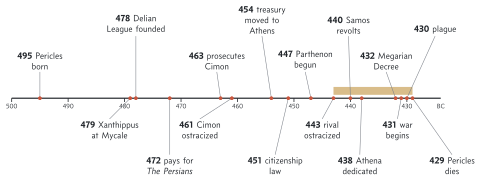
The Delian League becomes an empire
In 478 BC, the year after Mycale, the Greek fleet took Byzantium, the city on the strait between Europe and Asia, from the Persians. There its commander, the Spartan regent Pausanias, began to dress like a Persian and to treat the allies like a tyrant (Chapter 9). The Greeks of Ionia, just freed from Persia and afraid it would return, asked the Athenians to lead them instead, and Sparta, a land power with troubles at home, let them go.
That winter Athens and its allies swore an alliance against Persia. Its meetings and its treasury were on Delos, the small sacred island in the middle of the Aegean where, the Greeks said, Apollo was born (Vol. 4, Classical Myth), and the money was kept in Apollo’s sanctuary. Modern historians call the alliance the Delian League; the Greeks said “the Athenians and their allies.” As they swore, Plutarch says, lumps of iron were dropped into the sea, a promise to keep the oaths until the iron floated. Aristides, the Athenian whose honesty had earned him the name “the Just” (Chapter 5), went from city to city and fixed what each member owed, either ships with their crews or a yearly payment of money. The historian Thucydides, an Athenian general of the next generation who wrote the history of the great war with Sparta, records the first total. In Richard Crawley’s translation of 1874, “The tribute was first fixed at four hundred and sixty talents.”
Most allies chose to pay money rather than send ships, since building and manning triremes (Chapter 9) was costly and dangerous. Athens took the money and built the ships itself. Year by year the allies grew weaker and Athens stronger, until leaving became impossible. About 470 BC the island of Naxos tried to withdraw, and the Athenian fleet besieged it and forced it back. Thucydides called it “the first instance of the engagement being broken by the subjugation of an allied city,” and others followed. Thasos, a rich island in the north Aegean with gold mines on the mainland opposite, revolted in 465 BC. After a siege of more than two years, Cimon made it pull down its walls, hand over its ships, and pay tribute like the rest.
In 454 BC an Athenian fleet sent to help a revolt against Persia in Egypt was destroyed, and that same year the league’s treasury was moved to Athens,During this man’s rise to power, the Delian League’s treasury was moved to Athens in 454 BC. → Pericles• supposedly to keep it safe from a Persian fleet. Plutarch makes Pericles, by then the city’s leading voice, responsible for the move, and says his enemies never let him forget it. From then on, a sixtieth part of each year’s payments was given to Athena as her share, and the amounts were cut into great marble slabs set up on the Acropolis. Pieces of these “Athenian Tribute Lists” survive, and they are our best record of who paid what. In 443 BC the Athenians sorted the payers into five districts: the Islands, Ionia, the Hellespont, Thrace, and Caria (Figure 11.3).

About 449 BC the fighting with Persia stopped. Later Greek writers spoke of a formal treaty, the Peace of Callias (kal-ee-us), though whether one was ever signed is still argued. Either way the league’s reason for existing was gone, and the payments went on. Athens, the league’s leader, now spent its fundsThis city led the Delian League and used its funds for public building projects. → Athens•• on temples and public buildings at home. Money collected from the allies for ships to fight Persia would pay for marble. Pericles’s opponents in the assembly protested, led by Cimon’s kinsman Thucydides, son of Melesias, the wrestler of Plutarch’s story. In Plutarch’s account, which comes to us in the old Dryden translation as revised by Arthur Hugh Clough in 1859, they said that Greece must watch Athens gild itself “as it were some vain woman, hung round with precious stones and figures and temples.”
Pericles answered that the allies paid for protection, not for an account of how the money was spent: as long as Athens kept the Persians away, the money was Athens’s to use. He added an argument every voter could feel. The works would employ every trade in the city, and Plutarch lists them, from stone-cutters, carpenters, goldsmiths, ivory-workers, and painters to the carters, sailors, and rope-makers who brought the materials in. The assembly agreed, and the work on the Parthenon began in 447 BC. In 443 BC the quarrel went to an ostracism, and Thucydides son of Melesias, not Pericles, had to leave the city. Pericles sponsored the Acropolis building program,This man sponsored the Acropolis building program, including the Parthenon and Phidias’s statue of Athena. → Pericles•• from the Parthenon itself to the gold-and-ivory statue of Athena that Phidias, the greatest sculptor of the day, made to stand inside it.
Meanwhile Athens had made peace with Sparta. Through the 450s BC the two had fought on and off, and in 446 BC, after Athens lost its hold on Boeotia and Megara revolted, they signed a Thirty Years’ Peace: each side would keep its own allies, and future quarrels would go to arbitration. The peace with Sparta did not mean peace inside the empire. Samos, the large island off Ionia beside Mycale, was one of the few allies that still had its own navy, and in 440 BC it went to war with Miletus over the small town of Priene, which lay between them. Miletus appealed to Athens, and Samos refused to let Athens judge the dispute. (Plutarch passes on the gossip that Pericles took Miletus’s side to please Aspasia.) Pericles sailed to Samos with forty ships, replaced its government of rich men with a democracy, and took fifty men and fifty boys as hostages. The Samian oligarchs, with help from the Persian governor at Sardis, rescued the hostages and rose against Athens. Pericles came back, beat the Samian fleet, and besieged the city.
After nine months, in 439 BC, Pericles forced the rebel Samians to surrender.This man subdued the island of Samos after it revolted from his home city's control. → Pericles•• They pulled down their walls, handed over their ships, and paid the cost of the war in installments, a lesson to every ally watching. One of the ten Athenian generals in that campaign was the poet Sophocles (Chapter 12). At home Pericles gave the speech over the Samian War’s dead, and Plutarch reports one thing he said: that they had become like the gods, whom no one sees, but whom we know to be immortal by the honors paid to them.
The Parthenon and the Erechtheion
The Acropolis, the steep, flat-topped “high city” in the middle of Athens (the Stage), had been a citadel since the Bronze Age (Chapter 1), but by Pericles’s time it belonged to Athena alone. Its limestone summit stands 150 meters (490 feet) above the sea, and its top, about 7 acres, is the size of four soccer fields.
A visitor in 432 BC climbed to it by the Panathenaic Way, the road of Athena’s great procession, which ran from the city gate through the agora and up the rock’s western slope (Figure 11.4). At the top stood the Propylaea (prop-uh-lee-uh), a great marble gateway designed by the architect Mnesicles (nes-ih-kleez) and built from 437 to 432 BC. It was never finished, because the war stopped the work. On a bastion to the right, a little temple of Athena Nike, Athena as Victory, was added in the 420s. Through the gate the visitor faced Phidias’s giant bronze Athena, armed with spear and shield; Pausanias, a travel writer of the second century AD, says that sailors could see the tip of her spear and the crest of her helmet as soon as they rounded Cape Sunium, 30 miles away. To the right, on the highest part of the rock, rose Athena’s temple: the Parthenon, which still stands on the AcropolisThe Parthenon is located in this city. → Athens••This temple dedicated to Athena stands on the Acropolis in Athens. → Parthenon••The Parthenon stands on this rocky hill in Athens. → the Acropolis••This country is home to the Parthenon. → Greece• of Athens and is now the most famous building in Greece.
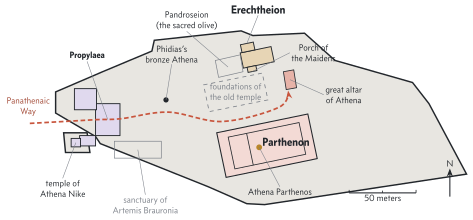
Work on it began in 447 BC, on the platform of the older temple that the Persians had burned, with the sculptor Phidias in charge of the whole project; the building was finished in 438 BC and its sculpture in 432 BC. Its architects were Ictinus (ik-ty-nus) and Callicrates (kuh-lik-ruh-teez):This building was designed by Ictinus and Callicrates. → Parthenon•• Ictinus, probably the designer, and Callicrates, probably the builder. The temple’s top step measures about 70 by 31 meters (228 by 101 feet), with eight Doric columns across each end and seventeen down each side, each column about 10 meters (34 feet) tall. Eight columns across the front, where most Doric temples had six, made it unusually broad. The whole temple was built of marble,The Parthenon is made of this material. → marble• down to its roof tiles: white marble from Mount Pentelicus, with a trace of iron in it that weathers to a warm honey color. Almost nothing in it is straight. The floor rises toward the middle of each side, by about 10 centimeters (4 inches) over its length, the columns lean slightly inward and swell a little as they rise, and the corner columns are thicker than the rest. Each of these adjustments is too small to see by itself, but together they keep the great building from looking flat and stiff.
Phidias’s workshop filled the temple with sculpture in four places: the two gables, two bands of carving around the building, and the great statue of Athena within (Figure 11.5). The two triangular gables, the pediments, held Athena’s birth and her contest with Poseidon (Vol. 4, Classical Myth). Above the outer columns ran a Doric frieze of grooved blocks alternating with square carved panels called metopes (met-uh-peez), and the Parthenon had ninety-two metopes:This building features 92 metopes. → Parthenon•• fourteen at each end and thirty-two down each side, carved between about 446 and 440 BC. Each side told one battle of order against chaos. On the east the gods fought the giants, on the west Athenians fought the Amazons, the warrior women of legend, and on the north the Greeks sacked Troy. The south metopes showed Lapiths fighting centaurs,South metopes of this temple depict the battle of Lapiths and Centaurs. → Parthenon•• the brawl that broke out when the centaurs, half man and half horse, got drunk and tried to carry off the bride at the wedding of Pirithous (py-rith-oh-us), king of the Lapiths of Thessaly (Vol. 4, Classical Myth).

Inside the outer colonnade, around the top of the wall of the temple’s inner building, ran a second frieze, a continuous band of low relief in the Ionic manner, about a meter high and 160 meters (524 feet) long. It shows a procession: young horsemen, chariots, old men carrying olive branches, musicians, girls with jugs and bowls, and cattle and sheep led to sacrifice, all moving toward the east end, where the gods sit and a man and a child fold a cloth. It is almost certainly the procession of Athena’s own festival, the Panathenaia. Like all Greek sculpture it was painted, and traces of its color survive.
The Parthenon stood nearly whole for some two thousand years, as a church and then a mosque, until a Venetian shell set off the Turkish gunpowder stored inside it in 1687 (Vol. 4, Classical Myth). The next blow came from a British diplomat. Thomas Bruce, seventh Earl of Elgin (el-gin), known as Lord Elgin, was Britain’s ambassador to the Ottoman sultan, who then ruled Greece. Between 1801 and 1812 his agents removed about half of the Parthenon’s surviving sculpture, with pieces of other buildings on the Acropolis, under a permission from Ottoman officials whose meaning is still argued over. One shipload sank off the island of Kythera (kith-er-uh), and it took two years to raise. In 1816 Parliament bought the collection for 35,000 pounds and gave it to the British Museum in London. There the “Elgin Marbles,” as they are still often called,This material gives its name to a set of Parthenon sculptures pilfered by Lord Elgin. → marble•Sculptures removed from this temple by Lord Elgin are held by the British Museum and sought by Greece. → Parthenon••• fill a long gallery (Figure 11.6), and Greece, which has formally asked for their return since 1983, wants them back. In 2009 Greece opened the Acropolis Museum at the foot of the rock, with a top-floor gallery laid out to the Parthenon’s own size, where white plaster casts wait in the places of the pieces in London.

North of the Parthenon stands the Erechtheion (eh-rek-thee-on), finished about 406 BC, in the last years of the war. It is Ionic and strangely shaped, with rooms at two levels and porches on three sides. The reason is that it had to cover several holy spots at once: marks in the rock that the Athenians said Poseidon’s trident had made, the place of Athena’s olive tree (Vol. 4, Classical Myth), and the tomb of Cecrops (see-krops), the first king of Athenian legend. It is named for Erechtheus (ih-rek-thee-us), a later legendary king who was probably worshiped there beside Poseidon (Vol. 4, Classical Myth). Inside stood the oldest and holiest image in Athens, the olive-wood statue of Athena Polias (poh-lee-us), Athena “of the city,” which, the Athenians said, had fallen from the sky. On the south side, facing the Parthenon, is the porch everyone remembers. In the Porch of the Maidens, six caryatidsThe Porch of the Maidens on this Acropolis temple uses six caryatids as columns. → Erechtheion•• (kair-ee-at-idz), marble statues of young women, hold up the roof in place of columns (Figure 11.7). The Roman architect Vitruvius explained the name with a story about the women of Caryae (kair-ee-ee), a town near Sparta, who were enslaved because their town sided with Persia and so were shown carrying burdens forever. Statues of maidens holding up roofs are older than the Persian Wars, which makes his story doubtful. Elgin took one of the six to London; the other five are in the Acropolis Museum, and casts stand in their places.

Three orders in one temple
An earlier volume (Vol. 1, The Toolkit) taught the three orders of Greek building, Doric, Ionic, and Corinthian, and how to tell them apart by their capitals. Pericles’s buildings use the first two side by side. The Parthenon’s outer colonnade is Doric, with plain cushion capitals and no bases. The Erechtheion and the little temple of Athena Nike are Ionic, with scroll capitals, slimmer shafts, and bases. Even the Parthenon mixes them: its inner frieze is an Ionic feature, and four columns, probably Ionic, held up the roof of its back room. Figure 11.8 sets one column from each building side by side.
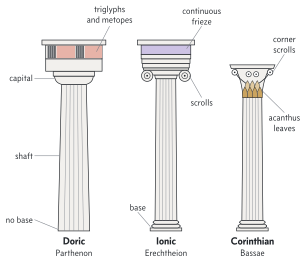
The third order appears first far from Athens. High in the mountains of Arcadia, in the middle of the Peloponnese, the people of the small town of Phigalia (fih-gay-lee-uh) built a temple at a place called Bassae (bas-ee) to Apollo Epikourios (ep-ih-koor-ee-os), Apollo the Helper. Pausanias, who saw it in the second century AD, says its architect was Ictinus, the designer of the Parthenon, and that Apollo earned his title by helping Phigalia against a plague in the years of the Peloponnesian War. The temple, built in the second half of the fifth century BC, is Doric outside. Inside, Ionic half-columns line the walls of the main room, and at its far end stood a single column with a capital of carved leaves, the oldest Corinthian capital known, from about 420 BC (Figure 11.9). So all three orders stood together in one building.
The ornate third order is named for Corinth,This city names the ornate Greek column order distinguished from Doric and Ionic. → Corinth•• the trading city on its isthmus (Chapter 4), because of a story that Vitruvius told (Vol. 1, The Toolkit). A sculptor named Callimachus, he says, saw a basket of a dead girl’s toys left on her grave in Corinth and covered with a tile. An acanthus (uh-kan-thus), a plant with large, deeply notched leaves, had grown up around it and curled under the tile’s corners, and Callimachus turned what he saw into stone. Nobody knows whether it happened. (This Callimachus is not the Athenian commander who fell at Marathon, Chapter 8.)


Phidias
Phidias, the son of Charmides (kar-mih-deez), was an Athenian, born about 480 BC, and the most admired sculptor of the ancient world. He worked in bronze, in marble, and in gold, and Pericles made him overseer of all the works on the Acropolis. His bronze Athena already stood in the open beside the Panathenaic Way. His masterpiece was the Athena Parthenos (par-thuh-nos),This sculptor created the Athena Parthenos. → Phidias•• “Athena the Maiden,” the statue for which the Parthenon itself was built. It took some nine years to make, and it was dedicated at Athena’s summer festival in 438 BC, in the dim light of the new temple.

The statue was about 12 meters (40 feet) tall, as high as a four-story house. Over a wooden core, carved ivory and sheets of goldThis material is combined with ivory in chryselephantine sculptures. → gold••Gold and this material are combined in chryselephantine sculptures. → ivory•• made the figure: ivory for the goddess’s face, arms, and feet, gold for her dress, her helmet, and her armor. A statue of gold and ivory is called chryselephantine (kris-el-uh-fan-teen), from the Greek chrysos, gold, and elephas, ivory. The gold weighed about a ton. Thucydides reports that Pericles reminded the Athenians how “the statue contained forty talents of pure gold and it was all removable,” so that in an emergency the city could take it off, spend it, and put it back later. Ivory dries out and cracks, and Pausanias says that because the high Acropolis was so dry, the statue’s ivory needed water. Archaeologists think a shallow pool on the floor in front of her kept the air damp.
She stood in the cella (sel-uh), the main room of the temple, facing the great east door. In the cella of the Parthenon, Phidias’s Athena Parthenos wore her helmet and her aegis, the goatskin cape fringed with snakes, and in her right hand she held Nike,Phidias made this gold-and-ivory statue of Athena holding Nike for the Parthenon. → Athena Parthenos••Phidias’s gold-and-ivory Athena holding Nike stood in this temple’s cella. → Parthenon•• the winged goddess of Victory, who was herself about as tall as a man. At her left side her great round shield rested on the ground. Its outside was carved with a battle of Athenians and Amazons, and Plutarch tells a story about it. Among the fighters, he says, Phidias carved himself as a bald old man lifting a stone in both hands, and he portrayed Pericles fighting an Amazon,Pericles was reportedly portrayed on the shield of this Phidias statue. → Athena Parthenos• his spear arm raised so that it half hid his face. A Roman marble copy of the shield, the Strangford Shield in the British Museum, has two figures that fit the description (Figure 11.10). The inside of the shield, the Roman writer Pliny (plin-ee) the Elder says, showed the battle of the gods and the giants.
Sheltered by the shield, a sacred snake coiled between shield and feet,A sacred snake coils between a round shield and the goddess’s feet in this statue. → Athena Parthenos• like the guardian serpent the Athenians believed lived on the Acropolis; Pausanias took it for Erichthonius (air-ik-thoh-nee-us), the serpent-footed king of Athenian legend (Vol. 4, Classical Myth). Even the statue’s base was carved. Pausanias saw the statue some six centuries after it was made and described it in his guide to Greece. He says that the birth of Pandora decorated the base:The birth of Pandora decorated the base of this statue, a detail absent from the Varvakeion copy. → Athena Parthenos• Pandora, the first woman, whom the gods made and gave gifts to (Vol. 4, Classical Myth). Pliny adds that twenty gods stood by at her birth. The small Roman copy called the Varvakeion (var-vah-kay-on) Athena (Vol. 4, Classical Myth) has a plain base, so it cannot show us the Pandora scene. The original stood in the Parthenon for centuries and was lost in late antiquity; nobody knows when or how.
A visitor can stand in front of her again in Nashville, Tennessee. In 1897 the city, which liked to call itself “the Athens of the South,” built a full-size copy of the Parthenon for a fair celebrating the state’s hundredth birthday, and later rebuilt it in concrete. In 1982 the sculptor Alan LeQuire began a full-size Athena to stand inside it. LeQuire’s replica of the Athena Parthenos,Alan LeQuire sculpted a gilded replica of the statue originally housed in this structure. → Parthenon• unveiled in 1990 and covered in gold leaf in 2002, is 42 feet (13 meters) tall, with her Nike, her shield, and her snake.
Phidias’s fame made him enemies, and attacking him was a way to attack Pericles. Plutarch says that a workman named Menon accused him of stealing some of the statue’s gold. Phidias, on Pericles’s advice, had fixed the gold so it could be lifted off, and when it was weighed, none was missing. Then he was charged with impiety for putting his own face and Pericles’s on the goddess’s shield, and Plutarch has him die in prison. Other ancient writers say instead that he left Athens to work at Olympia, the sanctuary of Zeus in the western Peloponnese where the Olympic Games were held (Chapter 4), and the ground bears them out. There, in the 1950s, excavators found Phidias’s workshop. Built to the size of the cella of Zeus’s temple, it held tools, clay molds for shaping golden drapery, and a small clay cup scratched with the words “I belong to Phidias.”
At Olympia, probably in the 430s BC, Phidias’s seated Zeus presided over the Olympic Games:Phidias’s gold-and-ivory image of a seated god holding Nike stood at this sanctuary. → Olympia••A giant statue of Zeus designed by Phidias presided over these ancient events. → Olympic Games• a figure of gold and ivory 12 meters (41 feet) tall, holding a Nike in his right hand and an eagle-topped scepter in his left. He sat on a throne inside the temple of Zeus, and the geographer Strabo wrote that if the god stood up, he would lift the roof off his temple. Later Greek writers counted the statue among the Seven Wonders of the World, their list of the seven greatest sights made by human hands, with the Great Pyramid of Egypt and the Colossus of Rhodes. According to a tradition recorded by an eleventh-century Byzantine historian, it was carried to Constantinople and burned there in a fire in AD 475.
The Panathenaia
Every Athenian who looked at the Parthenon’s frieze knew which procession it showed. The Panathenaia, the festival “of all the Athenians,” was held each summer at the end of the first month of the Athenian year, on what was counted Athena’s birthday. Every fourth year it became the Great Panathenaia, with contests in running, wrestling, chariot racing, music, and the recitation of Homer, and the winners took home large painted jars of olive oil from Athena’s sacred trees (Chapter 4). On the birthday itself a procession formed at the city gate, wound through the agora and up the Panathenaic Way, and ended at Athena’s great altar on the Acropolis. There a hundred or more cows and sheep were sacrificed, and their meat was shared out among the people.
At the heart of the procession was a gift. Every year Athenian women wove Athena a new robe,Women wove a new robe for this figure at the Panathenaic festival. → Athena• a woolen peplos (pep-los) dyed saffron yellow, with the battle of the gods and the giants woven into it. The work began nine months before the festival, when the priestess of Athena and young girls chosen to serve the goddess set up the loom, and the finished robe was carried up to dress the old olive-wood Athena of the city, not Phidias’s gold-and-ivory one. In later centuries, at the Great Panathenaia, a far larger robe was hung like a sail from the mast of a ship on wheels and rolled through the streets. At the center of the Parthenon’s east frieze, above the temple’s door, a man and a child hold a folded cloth between them, and the cloth is very probably the peplos (Figure 11.11).

Athena had smaller and stranger festivals too. At midsummer, in the last month of the Athenian year, came the Skira (skir-uh), or Skirophoria (skir-uh-for-ee-uh). The priestess of Athena Polias walked out of the city with the priest of Poseidon and, in later times, the priest of the sun god Helios (hee-lee-os). They were shaded from the summer sun by a great parasol, a sunshade like an umbrella, which the Greeks called the skiron. In most ancient accounts they walked to a place called Skiron on the road to Eleusis. But Athena also had a shrine under the name Skiras at Phaleron, the open beach that had been Athens’s harbor before Piraeus, and some modern reference books, linking the festival to that shrine, have white umbrellas carried from the Acropolis to PhaleronDuring the Athenian Skirophoria festival, white versions of these objects were carried from the Acropolis to Phalerum. → umbrella• (Phalerum, in the Latin spelling). Modern scholars read the shade as a prayer to protect the fields of Attica from the burning sun in the hottest weeks of the year.
Myron and Polykleitos
The riders of the frieze are the young men Athenians saw every day in the gymnasium, and the age of Pericles was also the great age of the statue of an athlete. Such statues were usually cast in bronze, the alloy of copper and tin that gave the Bronze Age its name (Chapter 1). The sculptor modeled the figure in wax over a core of clay and covered it with more clay; then he heated the mold so the wax ran out, and poured in molten bronze, which took the exact shape the wax had left. Bronze could hold poses that would snap a marble figure, but it could also be melted down for its metal, and nearly every Greek bronze was. We know the famous ones mostly from marble copies that Romans, who prized Greek art, ordered for their houses and gardens centuries later.
Myron (my-ron) came from Eleutherae (el-yoo-theer-ee), on the border between Attica and Boeotia, and worked in Athens in the middle of the fifth century BC. His most famous statue, the Discobolus (dis-kob-uh-lus) or “Discus Thrower,” made about 460 to 450 BC, shows an athlete throwing the discus,Myron's Discobolus depicts one of these people. → athletes• one of the five events of the pentathlon (Chapter 4). Myron caught him at the top of his backswing, the instant before he uncoils: the body twisted like a spring, the face calm. The pose is a sculptor’s invention, an awkward way to hurl a real discus, but it packs the whole movement into a single moment. Myron cast the Discobolus in bronze,Myron's Discobolus was originally made of this material. → bronze• and the original is lost. It is known from Roman marble copies, the finest found in Rome in 1781, and the copyists had to add a tree stump beside one leg, since marble will not stand on one foot as bronze can. Ancient poets also wrote dozens of short verses about a bronze cow by Myron, so lifelike, they joked, that calves tried to suckle it.

Polykleitos (pol-ee-kly-tos) of Argos, a younger contemporary of Phidias, worked out on paper what Myron did by eye. He wrote a book called the Canon, “the Rule,” which set out ideal proportions for the human body, each part a fixed fraction of the others, and he made a statue of a spear-carrier, the Doryphoros (dor-if-uh-ros), to show them. His figures stand in the pose later called contrapposto (kon-truh-pos-toh), Italian for “set against”: the weight rests on one leg, the other knee bends, and the hips and shoulders tilt in opposite directions, so that a standing body looks relaxed and alive. About 430 to 420 BC he made the Diadumenos (dy-uh-doo-muh-nos), the “Ribbon-Binder.” The Diadumenos shows a victorious athleteOne of these people is depicted in Polykleitos's Diadumenos. → athletes• raising both arms to tie a ribbon around his head, the band that marked a winner (Figure 11.12). Polykleitos also made a gold-and-ivory Hera for her temple near Argos, which ancient writers ranked beside Phidias’s Zeus.
The war begins
The best witness to what came next was a young Athenian who saw it coming. Thucydides, son of Olorus (ol-uh-rus), was born about 460 BC into a rich family, probably related to Cimon’s, which owned gold mines in Thrace on the north coast of the Aegean. He was a general himself in 424 BC and was exiled when he failed to save the city of Amphipolis (am-fip-uh-lis) (Chapter 13). His History of the Peloponnesian War says that he began it, in Crawley’s words, “at the moment that it broke out,” believing “that it would be a great war and more worthy of relation than any that had preceded it.” He tried to report only what he had seen or had checked with witnesses. The speeches in his book, he warned, give what each speaker needed to say, while keeping “as closely as possible to the general sense of what they really said.” The book breaks off in the middle of a sentence in the year 411 BC.
The war began far from Athens, in a family quarrel. Corcyra, the island now called Corfu, off the northwest coast of Greece, had been founded by settlers from Corinth in the eighth century BC, but it had grown rich and had long been on bad terms with its mother city. About 435 BC civil war broke out in Corcyra’s own colony, Epidamnus (ep-ih-dam-nus), on the Adriatic coast where the Albanian port of Durrës (door-us) stands today, and Corinth took up the side that Corcyra had refused to help. Corinth’s quarrel with its colony CorcyraThis city’s conflict with its colony Corcyra helped lead to the Peloponnesian War. → Corinth•• became a war. Corcyra beat the Corinthian fleet, and Corinth spent two years building a bigger one. Corcyra had a hundred and twenty warships, one of the three great navies of Greece with Athens’s and Corinth’s, and in 433 BC it asked Athens for an alliance. The Athenians agreed to a defensive one. That summer, at the sea battle of Sybota (sib-uh-tuh) off the mainland opposite Corcyra, Athenian ships stood beside Corcyra’s, and the Corinthians turned back when still more Athenian ships came into sight. Corinth was Sparta’s most important ally, and it now wanted war.
Next Athens squeezed Potidaea (pot-ih-dee-uh), a Corinthian colony in the north that paid tribute to Athens, ordering it to pull down part of its walls and send away the magistrates whom Corinth sent it every year. In 432 BC Potidaea revolted, and an Athenian army laid siege to it. Closest to home was Megara, Athens’s small neighbor on the road to the Isthmus, which had gone back to Sparta’s side in 446 BC. About 432 BC the Athenians accused the Megarians of farming land sacred to the goddesses of Eleusis and of sheltering runaway slaves. In answer Pericles issued the Megarian Decree,This man issued the Megarian Decrees, economic sanctions banning trade with Megara. → Pericles•• a ban on trade that shut them out, in Crawley’s words, “from the use of Athenian harbours and of the market of Athens.” For a city that lived by trade, and whose ships had to put in at harbors all over the Athenian empire, it meant slow strangulation. It is one of the earliest economic sanctions on record.
Plutarch adds a darker story. Pericles, he says, first proposed sending a herald to Megara and to Sparta to complain about the sacred land. The herald, Anthemocritus (an-thuh-mok-rih-tus), died on his mission, and the Athenians believed that the Megarians had killed him. Then, in Plutarch’s account, Athens passed a harsher decree against Megara,According to Plutarch, this city adopted a hostile decree against Megara after its herald Anthemocritus was killed. → Athens• proposed by a man named Charinus (kuh-ry-nus): endless hatred between the two cities, death for any Megarian who set foot in Attica, and an oath for every general to invade Megara’s land twice a year. Anthemocritus was buried beside the Dipylon, the city’s great double gate (the Stage). Historians still argue over whether this decree came before the war or after it began.
In 432 BC Sparta’s allies came to Sparta to complain, the Corinthians loudest of all, and the Spartan assembly voted that Athens had broken the Thirty Years’ Peace. Spartan envoys came to Athens with demands, and the plainest was that the Megarian Decree be repealed. Pericles would not give way. Plutarch tells that when Pericles said the law forbade taking down the tablet on which the decree was written, a Spartan envoy answered, “Well, do not take it down then, but turn it.” Pericles argued that yielding on one small thing would only bring the next demand, and he offered instead to send every dispute to arbitration, as the treaty required. The Spartans refused. Thucydides looked past the quarrels over Corcyra, Potidaea, and Megara to the real cause, the one “formally most kept out of sight”: “The growth of the power of Athens, and the alarm which this inspired in Lacedaemon, made war inevitable.” Lacedaemon was the official name of the Spartans’ state (Chapter 6).
In the spring of 431 BC Sparta’s ally Thebes attacked Plataea, Athens’s little ally in Boeotia, and the Peloponnesian War had begun. It would last, with one long truce, for twenty-seven years, Athens and its empire against Sparta and its allies (Figure 11.13). Pericles had a plan for it. Sparta had the best infantry in Greece, and its king, Archidamus, would lead an army into Attica that Athens could not beat in open battle. Athens had the best navy and the empire’s money: about six hundred talents a year in tribute, and six thousand more in coined silver stored on the Acropolis. So Pericles ordered the people behind the walls.This man ordered citizens to stay behind the Long Walls. → Pericles•• The farmers of Attica brought their families and goods into the city and left their fields and vines to be burned. Athens was joined to its harbor at Piraeus by the Long Walls (the Stage), built in the late 460s and 450s BC and running, as Thucydides says, “a distance of some four miles and a half.” Behind them the city was an island that could be fed by sea. The fleet would raid the coasts of the Peloponnese, and the Spartans, who could not leave their farms and their helots for long, would tire.
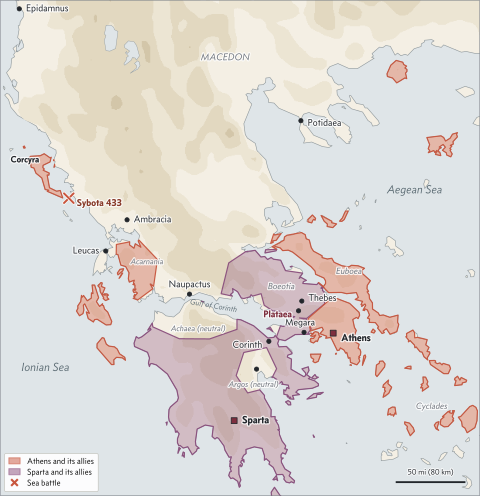
It was a hard plan to obey. Archidamus was an old friend of Pericles, and Pericles, guessing that the king might spare his estates to make him look like a traitor, announced that if they were spared, he would give them to the city. When the Spartans burned the farms of Acharnae (uh-kar-nee), the biggest village in Attica, within sight of the walls, the young men wanted to march out and fight, and Pericles would not even call the assembly.
At the end of each year of war the Athenians buried their dead together. Thucydides describes the custom. The bones were laid in cypress coffins, one for each of the ten tribes, an empty bier, or funeral couch, was carried for the missing, and the dead were buried in the public cemetery outside the walls, in the Kerameikos, the potters’ quarter. Then a man chosen by the city spoke. In the winter of 431 to 430 BC the speaker was Pericles, and Thucydides recorded the funeral oration he delivered,Pericles gave a funeral oration during this war. → Peloponnesian War••Thucydides recorded the funeral oration delivered by this man during the Peloponnesian War. → Pericles••• or at least the speech as Thucydides believed it had to be given. It is the most famous speech in Greek.
Pericles began with a doubt. He would rather, he said, that the deeds of brave men were honored by deeds alone, such as the public funeral itself, because a poor speaker could damage their reputation.This man’s funeral oration argued against eulogizing brave deeds lest a speaker’s poor eloquence damage their reputation. → Pericles• In Crawley’s translation, “I could have wished that the reputations of many brave men were not to be imperilled in the mouth of a single individual, to stand or fall according as he spoke well or ill.” Then, instead of praising the dead one by one, he praised the city they had died for. Its government was called a democracy because power lay with the many and not the few, and its laws gave equal justice in private disputes:In his funeral oration, this man praised laws that afforded equal justice in private disputes. → Pericles• “If we look to the laws, they afford equal justice to all in their private differences.” Office went to men of ability whatever their class, and poverty kept no one from serving. Athenians let one another live as they pleased in private, and they loved beauty and learning without growing soft. “In short,” he said, “I say that as a city we are the school of Hellas.” For the dead he promised a fame no tomb could hold. “For heroes have the whole earth for their tomb,” runs Crawley’s version; the whole earth is the memorial of famous men,In his funeral oration, this man said "famous men have the whole earth as their memorial." → Pericles•• he meant, who are remembered in far countries where no inscription stands. He ended by promising the families that the city would raise the children of the dead at public expense until they were grown.
A few months later, in the early summer of 430 BC, the Spartans invaded again, and a plague broke out in Athens.A devastating plague struck this city beginning in 430 BCE. → Athens••• It had started, Thucydides heard, in Ethiopia beyond Egypt and spread through Egypt and much of the Persian empire. In Athens it struck Piraeus first, where people said the Spartans had poisoned the water tanks, and in a city packed with refugees living in stifling huts, it spread fast. Thucydides describes it as a doctor would, because, in his words, “I had the disease myself, and watched its operation in the case of others.” It began with fever, red eyes, and a bleeding throat, moved down to the chest and stomach, and broke out on the skin in small sores, and the sick burned with such thirst that some threw themselves into water tanks. Doctors died fastest, because they touched the most sick. Even the birds and beasts that feed on the dead, he says, kept away from the unburied bodies, or died if they ate. People stopped fearing gods or laws, since they expected to be dead before anyone could punish them. Perhaps a quarter of the people of Athens died. What the disease was is still unknown. Typhus, smallpox, measles, and many others have been proposed, and a study of DNA from a mass grave of the time pointed to typhoid fever, a result other scientists doubt.
The Athenians turned on the man whose plan had crowded them inside the walls. They sent envoys to ask Sparta for peace, and when Sparta refused, they fined Pericles and took away his command. Within the year they elected him general again, Thucydides says, “understanding that he was the best man of all for the public necessities.” But the plague had reached his own house. His sister died, and so did his sons Xanthippus and Paralus. Plutarch says that Pericles, who had never been seen to weep, broke down and sobbed as he laid a wreath on the younger son’s body. With no lawful heir left, he asked the assembly to set aside his own citizenship law for his son by Aspasia, and the Athenians, pitying him, agreed. Then the disease took him too, slowly. Pericles died of the plagueThis statesman died during the plague that struck his city in the Peloponnesian War. → Pericles••• in the autumn of 429 BC, two and a half years into the war. Plutarch tells that friends sat by his bed recalling his nine victories, thinking he could no longer hear them, and that he roused himself to say they had forgotten the best thing of all: “no Athenian, through my means, ever wore mourning.”
Thucydides gave him an obituary that is also a verdict. While Pericles led, he wrote, Athens kept to a moderate course and was safe. His successors, more nearly equal to one another and each grasping for the first place, gave the people whatever they wanted and blundered into disaster. Pericles had held his power by ability and known honesty: he never flattered the crowd, and could anger it by contradicting it. Athens was a democracy in nameThucydides described Athens under this man as “in name a democracy but, in fact, governed by its first citizen.” → Pericles• but was governed in fact by its first citizen, or, in Crawley’s words, “what was nominally a democracy became in his hands government by the first citizen.” The city had lost the man who had built its glory, and it had twenty-five more years of war to fight without him.
What to remember
- Pericles (about 495 to 429 BC) was the son of Xanthippus, the Athenian commander at Mycale, and of Agariste, an Alcmaeonid; Herodotus tells that his mother dreamed she bore a lion.
- He prosecuted Cimon for bribery in 463 BC and backed his ostracism in 461 BC, then led Athens, elected general year after year, through its Golden Age.
- His sons were Xanthippus and Paralus; with Aspasia of Miletus he had a third son, Pericles. Anaxagoras the philosopher was his friend.
- The Delian League, founded on Delos in 478 BC, became an Athenian empire: its treasury moved to Athens in 454 BC, its money paid for the Acropolis, and Samos was crushed when it revolted in 440 to 439 BC.
- The Parthenon (447 to 432 BC), by Ictinus and Callicrates, is a Doric marble temple with ninety-two metopes (Lapiths and centaurs on the south), an Ionic frieze, and pediments; Lord Elgin’s share of its sculpture is in the British Museum.
- The Erechtheion has the Porch of the Maidens, six caryatids; the earliest known capital of the Corinthian order, named for Corinth, stood inside the temple at Bassae.
- Phidias made the gold-and-ivory (chryselephantine) Athena Parthenos, holding Nike, with Pericles on her shield, a snake, and Pandora on her base, and the seated Zeus at Olympia; Alan LeQuire’s replica of the Athena stands in Nashville.
- At the Panathenaia women wove Athena a new peplos; at the Skirophoria a great parasol was carried out of the city.
- Myron’s bronze Discobolus and Polykleitos’s Diadumenos show athletes and survive in Roman marble copies.
- Corcyra’s quarrel with Corinth, Potidaea, and the Megarian Decree led to the Peloponnesian War in 431 BC; Pericles kept the people behind the Long Walls, gave the funeral oration Thucydides records, and died in the plague in 429 BC.
Chapter 12 · 56 clues
Sophocles and the Theban Plays
Near the end of the fifth century BC, an old man stood before a jury in Athens. His own sons had brought him there. They claimed that he had grown too feeble in mind to manage the family’s property, and they asked the court to hand it over to them. The old man did not argue. Instead, as the Roman writer Cicero tells the story nearly four centuries later, he read aloud from a play he had just written and asked the jurors whether it sounded like the work of a man who had lost his wits. Plutarch adds that he recited a song in praise of his birthplace, and that the people in the court cheered him out of it as if he were leaving a theater. He won his case.
The story may not be true; it was told long after his death. But the old man was real. He was Sophocles, the most successful playwright Athens ever had, and the play told how the blind and ruined king Oedipus came to die at Colonus (kuh-loh-nus), Sophocles’s own village. It is called Oedipus at Colonus. He was nearly ninety. He had been born when Athens was a small city in the shadow of the Persian Empire, and he died as it was losing a long war to Sparta. In between, he wrote more than 120 plays. Seven survive whole, and three of them, about the doomed royal house of Thebes, are among the most famous plays ever written.
Sophocles and his seven plays
Sophocles was born about 497 BC at Colonus, a village famous for its horses, about a mile and a half north of the Acropolis, the rocky hill of temples at the heart of Athens. His father, Sophillus (sof-ih-lus), was rich, and later writers said that he owned slaves who worked as smiths or carpenters. The boy was taught music and wrestling. In 480 BC, when he was about sixteen, the Athenians and their allies beat the Persian fleet at Salamis (Chapter 9). The ancient Life of Sophocles, a short biography written centuries later by an unknown author, says that he was chosen to lead the chorus of boys who sang the hymn of thanks for the victory. It is the first time we hear of him, singing in public for his city.

Athens put on its tragedies each spring at the festival of Dionysus, the god of wine and of the theater. As Chapter 10 explains, three poets competed, each with three tragedies and a comic satyr play, and judges ranked them first, second, and third. In 468 BC Sophocles, not yet thirty, competed against Aeschylus, the master of the stage and a veteran of Marathon. Plutarch tells that the audience was so divided that the official in charge broke with custom. Instead of choosing the judges by lot, he asked Cimon, the city’s leading general (Chapter 11), and his fellow generals, who had just come into the theater, to decide. They gave the prize to the young man. Plutarch adds that Aeschylus took it so hard that he soon left Athens for Sicily, though the older poet won first prize at Athens again the very next year.
For the next sixty years Sophocles was the favorite of the Athenian stage. The Suda, a Byzantine encyclopedia, says he wrote 123 plays and won twenty-four victories, more than any other tragic poet. The Life adds that he often came second but never third (Figure 12.2).

He also changed how a tragedy was made. He added the third actor, as Chapter 10 told, and Aristotle credits him with painted scenery too. The Suda adds that he enlarged the chorus from twelve singers to fifteen. Three actors may not sound like many, but each actor wore a mask and could change it backstage, so three men could play all the speaking parts. Oedipus Rex has eight speaking roles, and no scene in it needs more than three speakers at once. With a third actor, a playwright could put two people in conflict while a third looked on, or bring in a witness who destroys a man in front of his wife. Sophocles built his greatest scenes that way, for a theater open to the sky, with a round dancing floor for the chorus and a stage building behind it (Figure 12.3). The Life says he stopped acting in his own plays because his voice was weak.
His plays have a regular shape, and Oedipus Rex shows it clearly. Each opens with a prologue, a scene for the actors before the chorus arrives, which sets out the problem. Then the chorus marches in singing its entrance song, the parodos (par-uh-dos). After that, as Chapter 10 explains, scenes for the actors, called episodes, take turns with the chorus’s odes, until the last scene, the exodos (ek-suh-dos), when the chorus marches out. Deaths usually happen offstage. A messenger comes out and describes them in a long, vivid speech, and then the doors of the stage building may open on the bodies. Sophocles’s chorus is more than a commentator. Aristotle, in S. H. Butcher’s translation of 1895, says that the chorus “should be regarded as one of the actors,” sharing in the action “in the manner not of Euripides but of Sophocles.”
What makes the plays his own is their people. Almost every one is built around a single hero who will not bend: Oedipus, who will have the truth whatever it costs; Antigone (an-tig-uh-nee), who will bury her brother whatever the law says; Ajax, who would rather die than live disgraced. Beside each stands someone sensible who begs the hero to give way, a wife or a sister or a friend, and the hero never listens. These people are larger than life, and Sophocles seems to have meant them to be. Aristotle, in Butcher’s words, reports that “Sophocles said that he drew men as they ought to be; Euripides, as they are.”

Sophocles also served his city in office. An inscription records him in 443 BC as one of the treasurers who received the tribute of Athens’s allies (Chapter 11). Two years later he was elected one of the ten generals and sailed with Pericles against the island of Samos, which had revolted. A note attached to Antigone in the manuscripts says that the Athenians chose him because the play had pleased them so much; that may be only a guess. In 420 BC, later writers say, when the cult of Asclepius, the god of healing, came to Athens, Sophocles received the god into his house until a shrine was ready, and after his death Athenians honored him as Dexion (dek-see-on), “the Receiver.” After Athens lost a great army and fleet in Sicily in 413 BC (Chapter 13), he was probably one of ten elderly men chosen to advise the city in its emergency.
He died in the winter of 406 to 405 BC, at about ninety. A few months earlier, news had come that Euripides was dead in Macedonia, and the ancient Life of Euripides says that Sophocles appeared before the festival dressed in mourning and brought on his actors without their garlands. The Life of Sophocles collects later stories about his death: that he choked on a grape, or ran out of breath reading a long sentence of Antigone aloud. Soon afterward a comic poet named Phrynichus, not the tragic poet of Chapter 10, wrote in a play called The Muses that Sophocles was blessed: he had lived long and happily, written many fine tragedies, and died without suffering any misfortune.

The seven plays that survive whole were chosen for readers and schools in late antiquity and copied by hand through the Middle Ages. They are Ajax, Antigone, The Women of Trachis, Oedipus Rex, Electra, Philoctetes (fil-ok-tee-teez), and Oedipus at Colonus (Figure 12.4). The rest are names and scraps. In 1912 scholars published a papyrus dug up at Oxyrhynchus in Egypt with more than four hundred lines of his satyr play The Trackers. In it the satyrs hunt for Apollo’s stolen cattle and track them to the cave where the baby Hermes is playing the lyre he has just invented (Vol. 4, Classical Myth).
Of the seven, two are named for Oedipus,Two surviving plays by Sophocles are named for this figure. → Oedipus••• the king of Thebes who killed his father and married his mother without knowing it. Oedipus Rex shows the day he learned the truth, and Oedipus at Colonus the day he died.
These two plays and Antigone, about Oedipus’s daughter, are called the Theban plays,This author wrote three Theban plays. → Sophocles••This city gives its name to a group of three Sophocles plays. → Thebes•This play is last in the story chronology of Sophocles' three Theban plays. → Antigone•• after the city where their story is set, and in the story’s order Antigone comes last, though Sophocles wrote it first. They were not written as a set. A trilogy, as Chapter 10 explains, is three tragedies staged together on one day to tell one continuous story. The Theban plays were written over some thirty-five years for three different festivals, and each was staged with other plays that are now lost (Figure 12.5). They do not always agree. At the end of Oedipus Rex, Oedipus’s brother-in-law Creon (kree-on) is plainly in charge; in the two plays that follow it in the story, Oedipus’s sons have quarreled over the throne.

Thebes itself was a real city, the chief town of Boeotia, about 30 miles northwest of Athens across the range of Mount Cithaeron. Its people traced their beginnings to myth. They told that Cadmus founded the city.According to myth, Cadmus founded this city. → Thebes••• He was a prince from Phoenicia who, in the myth (Vol. 4, Classical Myth), followed a cow as the oracle at Delphi commanded, built where she lay down, and sowed a dragon’s teeth there. Armed men sprang up from the teeth, and the noble families of Thebes claimed them as ancestors; the citadel was still called the Cadmea (kad-mee-uh) after its founder. Thebes was famous for its walls. Homer calls it “seven-gated.”Homer referred to this city as "seven-gated." → Thebes• In the Iliad, in A. T. Murray’s translation of 1924, the son of one of the Seven, the champions who attacked the city in the war between Oedipus’s sons (Chapter 10), boasts that his own generation “took the seat of Thebe of the seven gates.” Thebe (thee-bee) is Homer’s form of the name. In the age of heroes, the Thebans said, Oedipus had ruled the city.According to myth, Oedipus ruled this city. → Thebes••• To an Athenian in the theater, Thebes was also an uncomfortable neighbor: it had taken Persia’s side in 480 BC, and it fought beside Sparta against Athens in the war that began in 431. On Athens’s stage, Thebes was where terrible things happened to kings.
Oedipus Rex
Sophocles wrote Oedipus RexThis author wrote Oedipus Rex. → Sophocles•• at the height of his powers, probably about 429 BC. The year before, a plague had broken out in Athens, crowded behind its walls in the second summer of the war with Sparta, and Pericles himself died of it in 429 (Chapter 11). The play opens on a city dying of plague. Its Greek title is Oidipous Tyrannos. A tyrannos was a ruler who had won power for himself rather than inheriting it, and Oedipus believes that is what he is: a newcomer who earned the throne. English readers know it by its Latin title, Oedipus Rex, or as Oedipus the King. It won only second prize, losing to Philocles (fil-uh-kleez), a nephew of Aeschylus whose plays are lost.
The audience knew the myth, and an earlier volume (Vol. 4, Classical Myth) tells it in full, with the family tree of the house of Laius (lay-us). King Laius of Thebes and his queen, Jocasta (joh-kas-tuh), were warned by Apollo that their son would kill his father. They had the baby’s ankles pinned together and gave him to a servant to leave on Mount Cithaeron. The boy grew up in Corinth, believing himself a prince there. Fleeing a prophecy, he killed an old man in a quarrel on the road and came on to Thebes. He found the city in the grip of the Sphinx, a monster with a woman’s head and a lion’s body who killed anyone who could not answer her riddle. Oedipus answered the Sphinx’s riddleThis figure became king of Thebes by solving the Sphinx’s riddle with the answer “man.” → Oedipus••• by naming man, who crawls on four legs as a baby, walks on two, and leans on a stick in old age; so the Thebans made him king and gave him the widowed queen. All this has happened before the play begins.
The play opens before the palace. Thebans young and old are gathered at the altars, led by a priest of Zeus. They are suppliants (Chapter 5), people asking for help in the solemn way the Greeks thought the gods protected, and they carry olive branches wound with wool,This play opens with suppliants carrying wool-wrapped olive branches during a plague. → Oedipus Rex• the suppliant’s sign. A blight is on the land, the priest tells the king. The crops wither in the fields, the cattle die, women labor in childbirth and bring forth nothing, and “the malign plague” is emptying the city, in R. C. Jebb’s translation of 1904. Oedipus, who saved Thebes once, is their hope. He has already acted. He has sent Creon to DelphiThis character sends Creon to the Oracle of Delphi to investigate a plague afflicting his city. → Oedipus• to ask Apollo’s oracle what the city must do. Creon is his wife’s brother, and he is late.
Creon comes back wearing a crown of bay leaves, the sign of good news. Apollo says that the killer of Laius, the old king, is living in Thebes. His presence pollutes the city, and the plague will end only when he is killed or driven out. Oedipus takes on the search at once. Before all the people he lays a curse on the unknown murderer: no one may shelter him, speak to him, or let him share a prayer, and he is to wear out his life in misery. He adds that if the killer turns out to live in his own house, the curse should fall on himself. The audience knows what he does not. This is dramatic irony: words that mean one thing to the speaker and something else, often terrible, to those who know more. Oedipus Rex is full of it.
On Creon’s advice, Oedipus sends for Tiresias, the blind seer of Thebes, whose ghost Odysseus will one day consult in the Odyssey (Chapter 2). His gift of prophecy has shown him the truth (Vol. 4, Classical Myth). The old man arrives, led by a boy, and refuses to speak: he wishes he had not come. Oedipus loses his temper and accuses Tiresias of plotting the murder himself. Stung, the seer tells him that he is the killer he seeks.Tiresias tells this character "you are the criminal you seek." → Oedipus•• In Jebb’s words: “I say that thou art the slayer of the man whose slayer thou seekest.” Oedipus will not believe it. He decides that Creon has bribed the old fraud to drive him from the throne, and he sneers that it was he, “Oedipus the ignorant,” and not this seer, who answered the Sphinx. Tiresias answers with a riddle of his own. The man they seek, he says, now thought a foreigner, will prove to be a Theban born. He who now has sight will be blind, and will go into a strange land, “feeling the ground before him with his staff.”

Creon defends himself, and Oedipus threatens him with death. Jocasta comes out to stop the quarrel. To calm her husband she tells him that prophets know nothing. An oracle once told Laius that his own son would kill him, she says, yet Laius was murdered by foreign robbers “at a place where three highways meet,” and the baby was left on a mountain to die before it was three days old. The words about the three roads stop Oedipus cold, and he tells her a story he has never told. He grew up the son of Polybus of Corinth,This character was raised by King Polybus of Corinth. → Oedipus••• the king, and of Queen Merope (merr-uh-pee). At a feast, a drunken guest jeered that he was not his father’s son. His parents denied it, but the taunt stuck, and he went secretly to Delphi to ask Apollo the truth. The god did not answer his question. Instead he foretold that Oedipus would kill his father and marry his mother. So Oedipus never went home again.
His road took him into Phocis, the mountain country around Delphi, and there, he tells Jocasta, he killed a man where three roads met.This figure killed his father Laius at a crossroads. → Oedipus••• The audience knows more than he does: the man was Laius, his own father. As Oedipus tells it, a herald walked ahead of a carriage, and the driver and the old man in it tried to force him off the road. He struck the driver. The old man waited until he passed and brought down on his head a two-pointed goad, the stick a driver used to prod his horses, and Oedipus knocked him out of the carriage with his staff and killed the whole party, as he believed. There is one hope left. The servant who escaped from the attack on Laius, and who later begged to be sent away to the pastures, said that robbers killed the king, more than one. If he still says so, Oedipus is innocent.
Then comes a messenger from Corinth with news he thinks is welcome. King Polybus has died of old age, and the people of Corinth want Oedipus for their king. For a moment Oedipus and Jocasta are almost gleeful: the oracle was wrong, for his father is dead and not by his hand. But Oedipus still fears to marry his mother, Merope. The messenger, meaning to help, sets his mind at rest. Polybus was not his father at all. The messenger himself had brought the baby to the childless king. Years ago, as a shepherd, he had been given the baby by another shepherd, a herdsman of Laius on Cithaeron,A shepherd found this man as a baby on Mount Cithaeron. → Oedipus•• and he had carried it home to Corinth.
The messenger even remembers the baby’s wound. He had freed its ankles, which had been pinned together, and from that misfortune, he says, Oedipus got “the name which still is thine.” Oedipus means “swollen foot”This figure’s name means “swollen foot.” → Oedipus•• in Greek. Jocasta now understands everything. She begs her husband to stop searching. He refuses, thinking that she fears only to learn that he was born a slave, and she cries, in Jebb’s translation, “Ill-fated one! Mayst thou never come to know who thou art!” Then she calls him miserable, says that this is the only word she will ever speak to him again, and rushes into the palace. Oedipus is left almost cheerful. Whatever his birth, he says, he counts himself the son of Fortune, the goddess of luck, who has always been kind to him. The chorus, full of hope, sings that he may turn out to be the child of a god, born on the mountain.
The last witness is the old Theban herdsman, the same man who escaped from the crossroads. He does not want to talk. Oedipus has him seized and threatens him with torture, and the truth comes out a question at a time. The baby he gave away was from the house of Laius. It was said to be Laius’s own son, and the queen herself had given it to him to kill, because of a prophecy. He pitied the child and handed it to the Corinthian. Oedipus understands: he had married his own mother,This figure married his mother Jocasta. → Oedipus••• Jocasta, and had children with her. In Jebb’s words he cries, “Oh, oh! All brought to pass—all true! Thou light, may I now look my last on thee.”
A second messenger comes out of the palace to tell what happened inside, because Greek tragedy rarely showed violent death on stage. Jocasta had hanged herself in her bedroom. Oedipus broke in, cut her down, and laid her on the ground. Then he tore the golden broochesThis figure blinded himself with golden brooches. → Oedipus••• from her dress, the long pins that held a Greek woman’s robe at the shoulders, and drove them again and again into his eyes, crying that they should never again see what he had suffered and done. The doors open, and he stumbles out, blind and bleeding.
In the last scene Creon, now in power, treats him more kindly than he expected. Oedipus begs to be cast out of Thebes, and asks Creon to look after his two young daughters, whom he holds and weeps over. Then the chorus ends the play with a warning to count no one happyThis play ends with the chorus warning to count no one happy until death. → Oedipus Rex• until he is dead. Look at Oedipus, they say, who solved the famous riddle and was the mightiest of men, whose fortune every citizen envied. In Jebb’s translation they end, “we must call no one happy who is of mortal race, until he hath crossed life’s border, free from pain.” No one knows what the last day will bring.
A century later Aristotle made Oedipus Rex his favorite example of a perfect tragedy, and Chapter 19 will explain his reasons. An earlier volume (Vol. 1, The Toolkit) already showed the two parts of the plot he admired most: the recognition, when Oedipus learns who he is, and the reversal, when the messenger who came from Corinth to cheer him brings the news that destroys him. Figure 12.6 shows the other secret of the play’s design. Almost nothing new happens in it. Everything terrible was done years before, and each visitor only brings a piece of the past onto the stage. The play is a search, and the searcher and the criminal are the same man.
Oedipus at Colonus
Sophocles wrote Oedipus at ColonusThis author wrote Oedipus at Colonus. → Sophocles•• in the last years of his life, and he did not live to see it performed. His grandson, also named Sophocles, staged it in 401 BC. By then Athens had lost the war, its walls had been pulled down, and the city had lived through a reign of terror under the Thirty, a group of oligarchs installed by Sparta (Chapter 13). The play looks back to an older and prouder Athens, ruled in the age of heroes by its king Theseus (thee-see-us), and it is set in the poet’s own village. It is the longest Greek tragedy that survives.
Years have passed since Oedipus Rex. Oedipus has wandered for a long time as a blind beggar, cast out of Thebes. He is led onto the stage by his daughter Antigone,This man is the father of Antigone. → Oedipus••• the child of Oedipus and Jocasta who has given up home and marriage to be his guide and his eyes. She sits him down on a rock to rest in a grove full of laurel, olive, and vines, where nightingales sing. A man of Colonus rushes up and orders them off the spot. The grove is holy, he says, and no one may set foot in it. It belongs to the Eumenides, the “Kindly Ones,” the polite name Athenians gave the Furies, the dread goddesses who punish crimes against one’s own family (Chapter 10). Oedipus refuses to move. Long ago, he says, Apollo told him that his life would end at the seat of these goddesses, and that the land that sheltered him would be blessed.
The chorus enters: old men of Colonus, hunting for the stranger who has dared to trespass. The old men coax Oedipus out of the Furies’ grove,A chorus of old men persuades this figure to leave a grove sacred to the Furies at Colonus. → Oedipus•• promising that no one will drag him away against his will, and seat him at its edge. Then they ask his name. When they learn it, they cry out in horror and order him out of their land at once. Oedipus pleads with them. He did not know the man he killed was his father, he says, and the man had attacked him first; in the eyes of the law, he did nothing wrong. He asks them to wait for their king.

Before the king arrives, another traveler does. His other daughter, IsmeneThis man is the father of Ismene. → Oedipus•• (is-mee-nee), rides in on a pony from Thebes with news. Her brothers, Eteocles and Polynices, have fallen out over the throne. Eteocles, the younger, has driven Polynices out, and Polynices has gone to Argos to raise an army against his own city. And there is a new oracle. The land where Oedipus is buried will be strong, and his grave will decide the war. So now everyone wants the outcast. Creon is on his way to bring him back and bury him just outside the Theban border, where his grave can protect Thebes and his polluted body need not lie in Theban soil.
Then the king of Athens comes. Theseus meets Oedipus with sympathy,This character meets Theseus in a play titled for him "at Colonus." → Oedipus•• before Oedipus can even tell his story: Theseus too grew up in exile, he says, and knows that he is only a man. Oedipus offers him a gift, his own body, whose grave will one day protect Athens. Theseus does not see why Athens should need protection from Thebes, which is its friend. Oedipus answers in the play’s most famous speech. Only the gods never grow oldThis character says "only the gods can never age" while talking to Theseus. → Oedipus•• or die, he says; everything else is ruined by time. In Jebb’s words, “to the gods alone comes never old age or death, but all else is confounded by all-mastering time.” Strength fades in a country as it fades in a body, and the friendship of cities turns to hatred, as men’s hearts do. Some day Thebes and Athens will fight, and the dead man in his grave will drink Theban blood. Theseus makes him a citizen of Athens and promises to protect him. The chorus, left to guard him, sings an ode to Colonus, the song Plutarch says the old poet recited to his jury.
The ode goes on to praise everything Colonus and Athens were proud of. It sings of the narcissus and the crocus, and of the river Cephisus (sih-fy-sus) that never runs dry. It praises the gray-leaved olive, watched over by Zeus and Athena, and the horses and ships that were Poseidon’s gifts. The old poet wrote it while a Spartan garrison held a fort at Decelea (des-uh-lee-uh), in the Attic countryside, and Athens was running out of men and money.
Creon arrives with soldiers. He speaks kindly at first, then shows his hand: he has already seized Ismene, and his men drag Antigone away to force the old man to follow. Theseus, called from a sacrifice, sends his horsemen after them and brings both girls back. Oedipus, overjoyed, asks Theseus for his right hand, so that he may touch it and kiss his cheek. Then he stops himself. The Greeks believed that bloodshed, and crimes like his, left a stain called pollution (Chapter 6) that could spread from person to person like a disease. Oedipus will not kiss Theseus,This character stops himself from kissing Theseus because he believes he is still "polluted" or cursed. → Oedipus• he says, because “all stain of sin hath made its dwelling” in himself, and only those whom such a burden has already struck can share it.
Next a suppliant is waiting at the altar of Poseidon: Polynices, the son who did nothing when Oedipus was driven from Thebes. Antigone persuades her father to hear him. Polynices begs for his blessing in the war. His father answers with a curse. You will never take Thebes, he tells him, and the brothers will kill each other:This character curses his sons, predicting they will kill each other. → Oedipus• “by a kindred hand to die, and slay him by whom thou hast been driven out.” Polynices knows now that he is going to his death, but he goes, and as he leaves he asks his sisters to bury him if the curse comes true. That request sets up the plot of Antigone.
At once thunder rolls, again and again. Oedipus knows the thunder means his death,This character interprets a thunderstorm as an omen of his forthcoming death. → Oedipus•• the sign Apollo promised him long before, and he sends for Theseus. Then the blind man, who has been led everywhere, rises and leads the others, walking without help toward the place where he must die. He tells Theseus never to reveal that place to anyone. Its secret, passed from each king of Athens to his heir, will defend the city better than many shields.
A messenger tells how Oedipus died at Colonus.This character dies at Colonus. → Oedipus•• Oedipus washed, put on clean clothes, and embraced his daughters. Then a voice called him by name, scolding him for delaying. He sent everyone away except Theseus. When the others looked back, Oedipus was gone, and the king was shading his eyes with his hand, as if he had seen something too terrible to look at. How he died, the messenger says, no one can tell except Theseus. The man Thebes drove out found his grave in Athens’s land, and not in his own city.
Antigone and Ismene return weeping and beg Theseus to show them their father’s grave, so that they may mourn there. Theseus refuses. Oedipus made him swear that no one would come near the place or call out to the dead man in it, and, Theseus says, the god heard the oath. Only Theseus knows where the tomb lies.This character is buried in a tomb whose location is known only to Theseus. → Oedipus•• The Athenians believed that the bones of a hero kept watch over the land where they lay, and that Oedipus, the polluted outcast of Thebes, had become a guardian of Athens. Antigone asks to be sent home to Thebes, to try to stop her brothers from killing each other. The audience in 401 BC knew she would fail.
Antigone
Sophocles wrote AntigoneThis author wrote Antigone. → Sophocles•• about 441 BC, more than thirty years before Oedipus at Colonus, though its story comes last. It begins where Aeschylus’s Seven Against Thebes ended (Chapter 10). Polynices has come back with an army from Argos, led by seven champions, one against each gate of Thebes. The attack has failed. At the seventh gate the two brothers met and, as their father foretold, killed each other. Their uncle Creon is now king. He was the queen’s brother in Oedipus Rex, the man Oedipus wrongly accused of treason, and an earlier volume (Vol. 4, Classical Myth) draws his family in its tree of the house of Laius.
The play opens before dawn, outside the palace, with the two sisters alone. Creon has issued his first decree. Eteocles, who died defending the city, will be buried with every honor. Polynices, who brought a foreign army against his own city, is to lie unburied for the dogs and birds to eat, and anyone who buries him will be stoned to death. A Greek believed that the unburied dead could not rest. Antigone has decided to bury Polynices against Creon’s decree,This character defies Creon by performing burial rites for her brother Polyneices. → Antigone•••In this play, Creon forbids the burial of Polyneices. → Antigone•• because the gods require that the dead be buried and he is her brother. She asks Ismene to help her.
Ismene is horrified. Their father destroyed himself, she reminds her sister, their mother hanged herself, their brothers killed each other, and now the two of them are left alone. They are women, she says, and they cannot fight men or the king’s law. Ismene refuses to help,Ismene refuses to help this character defy Creon's edict. → Antigone•• and she will ask the dead to forgive her for it. Antigone answers with contempt. She does not need Ismene’s help, she says, and she does not want it, and Ismene may tell the whole city if she likes. She will do it alone, and if she dies for it, she will die having done a holy crime.
The chorus, the old men of Thebes, enters singing of the victory: how seven captains at seven gates were beaten, and the two sons of one father and one mother died by each other’s spears. Then Creon comes out to address them. He speaks as a statesman, and the first words of his speech, in Jebb’s prose, are “Sirs, the vessel of our State, after being tossed on wild waves, hath once more been safely steadied by the gods.” One modern translation puts it more plainly: “My countrymen, the ship of state is safe.” This is the ship of state speech,In this play, a character gives a speech beginning "My countrymen, the ship of state is safe." → Antigone• and the image, a city as a ship that needs a firm hand at the helm, was already old. Creon’s rules sound reasonable: a ruler who keeps silent out of fear is the worst of men, and no one who puts a friend before his country deserves respect. Then he announces his decree.
A guard arrives, frightened and long-winded, who wishes he had not drawn the short straw. Someone, he reports, has already given the body a burial. Whoever it was sprinkled “thirsty dust” over the flesh, with the other rites that piety requires, and left no trace, not even the track of a wheel. The chorus wonders whether the gods have done it. Creon is furious. He decides that his enemies in the city have bribed the guards, and he threatens to hang them all unless they find the culprit.
The chorus then sings its most famous ode. It begins, in Jebb’s version, “Wonders are many, and none is more wonderful than man.”This play features the chorus "Wonders are many, and none is more wonderful than man." → Antigone•• Man crosses the sea before the stormy south wind and wears away the earth with his plows. He snares the birds and the fish, tames the horse and the mountain bull, and has taught himself speech, thought, and the ways of living in cities. Only death he cannot escape. The Greek word that Jebb translates “wonderful” is deinos (day-nos), which also means terrible, as a storm or a weapon is terrible. Man’s cleverness can carry him to good or to evil, the chorus warns, and a man who honors the laws of the land and the justice of the gods is a credit to his city.
The guard returns, this time pleased with himself, leading Antigone. He tells how the guards brushed the dust away and sat on a hill upwind of the stinking body, keeping one another awake. At noon a whirlwind raised a storm of dustIn this play, guards discover the title character after a dust storm. → Antigone•• that filled the plain and stripped the trees, and the guards shut their eyes against it. When it passed, they saw the girl. She cried out like a bird that finds its nest empty, cursed whoever had uncovered the body, and brought dry dust in her hands. Then, raising a bronze jug, she poured a drink offering three timesIn this play, guards see the title character pouring wine on the ground. → Antigone•• over the dead. A libation, as Chapter 10 explains, was a drink offering, often of wine, poured on the ground for a god or for the dead (Figure 12.9).
Antigone does not deny it. When Creon asks whether she knew of his decree, she says she did, but it was not Zeus who made it. A king’s decree, she says, cannot override the unwritten laws of the gods, which are not of today or yesterday but forever (Vol. 4, Classical Myth). Creon decides that both sisters are guilty and sends for Ismene. Now the timid sister is brave. Ismene falsely claims a share in the burialIn this play, Ismene falsely claims to have been an accomplice to the burial. → Antigone• and asks to die beside Antigone. Antigone will not let her. “Thy choice was to live; mine, to die,” she says, and she refuses to share her deed with a sister who would not share it when it counted.

The king has a son, Haemon (hee-mon), and Antigone is betrothed to Haemon;Haemon is this character's lover or fiancé. → Antigone•• the two were to be married. “But wilt thou slay the betrothed of thine own son?” Ismene asks the king. Creon answers coldly that there are other fields for him to plow, as if a bride were a field to be sown. Then Haemon, Creon’s son,In this play, Haemon is the son of Creon. → Antigone•• comes to plead with his father, and he begins with great tact. He will always obey his father’s good advice, he says, but he hears what the people whisper and his father does not: that no woman ever deserved such a death less. A wise man, he says, bends like the trees beside a flooded stream, which keep their branches, while the tree that stands stiff is torn up by the roots. Creon is enraged to be lectured by a boy, and he calls his son a woman’s slave. Haemon storms out, warning that his father will never see his face again.
Creon decides against stoning. He will not spill her blood in the city, which would bring pollution on it, so Antigone will be sealed alive in a cave,This title character is sentenced to be sealed alive in a cave or tomb. → Antigone••• a tomb cut into the rock, with just enough food that the city cannot be blamed for her death. Antigone is led away singing her own funeral song. She will never have a wedding, she says, and her bridegroom will be death. Then she gives a strange reason for what she did. She would not have defied the king for a dead husband or a dead child, she says, because she could have married another husband and borne other children; but her father and mother are dead, so no brother can ever be born again.In this play, the title character says she would not have defied Creon to bury a husband or child, but that she can have no more brothers. → Antigone• In Jebb’s words, “no brother’s life could ever bloom for me again.” Jebb printed these lines in brackets, because he believed someone else had added them; most editors now accept them as Sophocles’s own.
Then Tiresias comes, led by a boy, as he was in Oedipus Rex. Sitting in his old seat for reading the birds, he says, he heard them screaming with a strange and furious noise, and the birds were tearing at each otherIn this play, Tiresias reports birds attacking each other. → Antigone•• with their claws; the whirring of their wings told him so, since he could not see. Frightened, he tried a burnt offering, the usual way for a seer to ask the gods for a clearer sign. He laid the thighbones of a victim, wrapped in fat, on a blazing altar. But the offering would not burn.In this play, Tiresias fails to burn his offerings at an altar. → Antigone• The fat around the thighbones melted and dripped onto the embers, smoking and sputtering, and no flame rose. The altars of the city, he explains, are fouled with scraps that dogs and birds have carried from the unburied corpse, and the gods have turned away. When Creon accuses him too of taking bribes, the old man tells him his fate. Before many days have passed, Creon will pay a corpse for a corpse: a son of his own loins,In this play, the blind prophet Tiresias warns Creon that he will lose "a son of his own loins." → Antigone•• in Jebb’s version “one begotten of thine own loins,” will die because the king has buried the living and left the dead unburied.
Tiresias has never been wrong, and Creon, at last, is afraid. He gives way. He hurries with his men to bury Polynices, and only then goes to free Antigone. It is too late. A messenger tells the queen, Eurydice (yoo-rid-ih-see), what happened. When they reached the tomb, they heard Haemon’s voice crying inside. Deep in the cave they found that Antigone had hanged herselfThis tragic character hangs herself in a cave. → Antigone•• with a noose of fine linen, and Haemon was clinging to her body, his arms around her waist, mourning his lost bride and his father’s deeds. When his father called to him, Haemon spat in his face, drew his sword, and lunged, but Creon jumped back. Then, maddened by Antigone’s death, Haemon stabbed himselfThis character's death causes Haemon to kill himself. → Antigone•••In this play, Haemon stabs himself. → Antigone•• with his own sword, and he died holding her in his arms.
Eurydice listens to the end without a word and goes back into the palace. The chorus fears her silence more than it would fear loud weeping, and the messenger follows her in. Creon returns carrying his son’s body and blaming himself. Then the messenger comes out again: Eurydice has killed herselfIn this play, Eurydice, Creon's wife, commits suicide. → Antigone•• at the household altar with a sharp knife, cursing her husband as the killer of their sons. Their other son, Megareus (meg-uh-roos), had already died in the siege. Creon begs for death. He has kept his throne and his law, and lost his son and his wife. The chorus ends the play by saying that wisdom is the greatest part of happiness, and that proud men learn wisdom only when they are old and broken.

Few plays have been argued over so long. The German philosopher G. W. F. Hegel, early in the nineteenth century, called Antigone one of the most sublime works of art ever made (Vol. 16, Romantic Europe). He read it as a clash between two rights, the family’s duty to its dead and the city’s duty to protect itself, each just in itself and each wrong to deny the other. In 1841 the composer Felix Mendelssohn wrote music for its choruses for a production at the Prussian court in Potsdam. In 1944 the French playwright Jean Anouilh (ah-noo-ee) staged his own Antigone in Paris while German troops still occupied the city, and many in his audience took his heroine’s refusal as a picture of resistance (Vol. 22, The Lost Peace).
Thirty years later the play went to prison in South Africa. Under apartheid, the system of laws that separated the races and kept power in white hands, black opponents of the government were held in the prison on Robben Island, off Cape Town, among them Nelson Mandela. In 1973 the South African playwright Athol Fugard (ath-ol fyoo-gard) made The Island with the two actors who first played it. In it, two prisoners perform AntigoneTwo prisoners perform this play in The Island. → Antigone•• for a prison concert, one as Creon and one as Antigone, rehearsing in their cell at night after days of hard labor. At the end the prisoner playing Antigone tears off his wig and speaks her farewell as his own (Vol. 43, Africa).
Ajax, Electra, Philoctetes, and The Women of Trachis
Sophocles’s other four plays take their stories from the Trojan War and its aftermath and from Heracles, the greatest of the heroes, and an earlier volume (Vol. 4, Classical Myth) tells the myths behind all of them. Each is built around a single great, stubborn figure who suffers. Sophocles wrote AjaxThis author wrote Ajax. → Sophocles• early, perhaps in the 440s BC, about the huge, slow, brave warrior who was second only to Achilles among the Greeks at Troy. Ajax was a hero of the island of Salamis, just off Athens, and the Athenians honored him, naming one of their ten tribes after him. When Achilles died, his armor was awarded to Odysseus, the clever talker, instead of Ajax, and Ajax went out at night with his sword to kill the Greek commanders. The goddess Athena drove him mad, and he slaughtered the army’s cattle and sheep instead.
The play opens at dawn outside his tent, where Athena shows the raving Ajax to Odysseus, his enemy. Odysseus does not gloat; he pities him, knowing that he too is only a man. When Ajax comes to his senses among the dead animals, he cannot live with the shame. His captive wife, Tecmessa (tek-mes-uh), begs him to live, for her sake and for their small son, Eurysaces (yoo-ris-uh-seez). Then he seems to give in. In a strange, beautiful speech he says that time changes everything, that winter gives way to summer and night to day, and that he too will learn to yield to the gods and obey the kings. “All things the long and countless years first draw from darkness, then bury from light,” he says in Jebb’s version. He will go to the shore, he tells them, and bury his sword.
He does bury it, point upward. Alone on the beach, he fixes in the ground the sword that Hector gave him after their duel in the Iliad and falls on it, in one of the very few deaths shown on the Greek tragic stage (Figure 12.10). The second half of the play is a quarrel over his body. Menelaus and his brother Agamemnon, the commanders of the Greek army, forbid its burial, because Ajax tried to murder them. His half-brother Teucer (tyoo-sur) defies them, and in the end it is Odysseus who persuades Agamemnon that even an enemy deserves a grave.

Electra tells the revenge on Clytemnestra for the murder of Agamemnon, the story Aeschylus told in The Libation Bearers (Chapter 10). Sophocles makes the sister, not the brother, the center. Electra has spent years in the palace at Mycenae mourning her father, insulted by her mother and her mother’s lover, Aegisthus, who now rules in Agamemnon’s place. Her gentler sister Chrysothemis (kry-soth-uh-mis) pities her but will not help. Clytemnestra has had a frightening dream: Agamemnon came back to life and planted his scepter at the hearth, and from it, in Jebb’s words, “a fruitful bough sprang upward, wherewith the whole land of Mycenae was overshadowed.”

Orestes, Electra’s brother, comes home in secret with an old servant, who brings the false news that Orestes has been killed in a chariot race at Delphi. The servant describes the race so vividly that the audience almost believes him too. Electra mourns over a bronze urn she thinks holds her brother’s ashes, until the young man holding it reveals that he is Orestes himself. He kills Clytemnestra inside the palace while Electra stands outside listening to her mother’s cries, and the play ends as he drives Aegisthus in to die. Euripides wrote an Electra too, which Chapter 13 will compare. Richard Strauss’s opera Elektra (1909) follows Sophocles’s version (Vol. 19, Wagner and Verdi).
Sophocles wrote PhiloctetesThis author wrote Philoctetes. → Sophocles•• in his late eighties, and it won first prize in 409 BC. Its hero, Philoctetes, was the archer who, in Sophocles’s telling, had lit Heracles’s funeral pyre on Mount Oeta (ee-tuh) and received the hero’s bow and poisoned arrows in return; some writers gave that service to his father instead (Vol. 4, Classical Myth). On the way to Troy the archer was bitten by a snake,This author's Philoctetes features a snakebitten archer. → Sophocles• in Sophocles at the shrine of a goddess named Chryse (kry-see), in other tellings at a feast on an island near Troy. The wound festered. It stank so badly, and his screams of pain were so loud, that the Greek commanders had Odysseus put him ashore alone on the island of Lemnos. He has lived there for ten years in a cave, shooting birds for food with the bow of Heracles (Figure 12.12).

Now a prophecy has told the Greeks that they cannot take Troy without Heracles’s bow and its owner. Odysseus comes to Lemnos with Neoptolemus (nee-op-tol-uh-mus), the young son of Achilles, and orders him to win the bitter man’s trust with a lie. He is to say that he, too, has quarreled with the Greek commanders and is sailing home. Odysseus cannot show his own face, for Philoctetes hates him more than anyone alive. So Philoctetes trusts the boy and begs to be taken home. When he feels an attack of pain coming on, he hands Neoptolemus the bow to keep while he sleeps it off.
Neoptolemus now has everything Odysseus wanted, and he cannot bear it. He is his father’s son, and Achilles hated a liar. He confesses the plot, and in spite of Odysseus’s threats he gives the bow back. Philoctetes still will not go to Troy, and Neoptolemus at last agrees to take him home instead, whatever the army does to them. At the very end Heracles himself appears above the stage, now a god, and commands him to go: at Troy he will be healed and win glory. A god who appears at the end to settle the plot, perhaps lowered by the stage crane (Chapter 10), is called a deus ex machina, Latin for “a god from the machine.” The play asks a question that has never gone away: whether a good end can excuse a lie.
How Heracles came to that funeral pyre is the subject of The Women of Trachis. Sophocles wrote The Women of Trachis,This author wrote Women of Trachis. → Sophocles• which takes its title from its chorus, the young women of the town of Trachis, near Mount Oeta, where Heracles’s family lives. No one knows when it was first staged. Deianira (dee-uh-ny-ruh), Heracles’s wife, learns that he is sending home a young captive, Iole (eye-oh-lee), whom he loves. She does not rage. Hoping to win him back, she sends him a robe smeared with the blood of the centaur Nessus, who had told her as he died that it was a love charm. It was poison, and she learns it too late. The play shows the death of Heracles:This Sophocles play depicts the death of Hercules. → The Women of Trachis• he is carried onstage raving, his flesh eaten by the burning robe, after Deianira has killed herself in grief. Understanding at last that an old prophecy has come true, he orders his son to carry him up Mount Oeta and burn him on a pyre. The play ends as the procession sets out, and the god he will become is never mentioned.
What to remember
- Sophocles (about 497–406 BC), born at Colonus near Athens, won twenty-four victories and was never placed third. Aristotle says he added the third actor. He served as a general beside Pericles at Samos.
- Seven of his more than 120 plays survive: Ajax, Antigone, The Women of Trachis, Oedipus Rex, Electra, Philoctetes (409 BC), and Oedipus at Colonus (staged in 401 BC, after his death).
- The three Theban plays are Oedipus Rex, Oedipus at Colonus, and Antigone, which is last in the story but was written first. In myth, Cadmus founded Thebes; Homer called it seven-gated.
- In Oedipus Rex, Oedipus searches for the killer of Laius to end a plague. Tiresias tells him he is the killer; the Corinthian messenger and the old herdsman prove it. Jocasta hangs herself, and Oedipus blinds himself with her brooches. The chorus warns: call no one happy until he is dead.
- In Oedipus at Colonus, the blind Oedipus, led by Antigone, reaches the Furies’ grove at Colonus, curses his sons, and vanishes after thunder in a place only Theseus knows.
- In Antigone, Antigone buries Polynices against Creon’s decree and is sealed in a cave, where she hangs herself. Haemon, Creon’s son and her betrothed, stabs himself, and Creon’s wife, Eurydice, kills herself.
- Ajax shows the hero’s madness and suicide; Electra, the revenge on Clytemnestra; Philoctetes, the snakebitten archer on Lemnos; The Women of Trachis, the death of Heracles.
Chapter 13 · 51 clues
The Peloponnesian War and Euripides
In the autumn of 413 BC some seven thousand prisoners lay in the stone quarries of Syracuse, in Sicily. They were Athenians and their allies, all that was left of the largest force a Greek city had ever sent overseas, and they were dying of hunger, thirst, and the sun. Plutarch, writing five centuries later, tells a story about some of them. The Sicilians, he says, loved the poetry of Euripides more than any other Greeks living outside Greece itself, and a prisoner who could recite a few of his lines might be given food and water, or even set free. Some of those who reached home, Plutarch adds, went to thank the old poet.
Whether or not it happened that way, the story holds this chapter together. From 431 to 404 BC Athens fought Sparta in the longest and cruelest war the Greek world had known. Chapter 11 told how it began, and how the plague killed Pericles, the man who had planned it, in 429. Through all but the last two years of what followed, Euripides wrote plays for the Athenian stage. They are about Troy and Thebes and Corinth, about women betrayed and cities burned, and the audience that watched them was the same Assembly that voted for the war’s massacres and expeditions.
Delium and the Peace of Nicias
The Peloponnesian War was fought between two alliances. On one side stood Athens and its Delian League,This war pitted Athens and its Delian League against Sparta and its Peloponnesian League. → Peloponnesian War••• the alliance of over 150 cities, most of them islands and coastal towns around the Aegean, that had begun in 478 BC as a league against Persia and had become an Athenian empire paying tribute to Athens (Chapter 11). On the other stood Sparta and its Peloponnesian League, Sparta’s old alliance with Corinth and the cities of the Peloponnese, joined now by Thebes and the other cities of Boeotia (Chapter 6). Thucydides calls it the war between the Peloponnesians and the Athenians, and the first half of that name stuck. Thucydides wrote the historyThucydides wrote a history of this war. → Peloponnesian War••• of the war year by year, as it happened, and fought in it himself; his book is almost all we know of it (Chapter 11). A map of the two alliances in 431 is in Chapter 11; the places where the war after Pericles was decided are in Figure 13.1.

The two sides were built for different wars. Sparta’s army of heavy infantry was the best in Greece, and Athens had the best fleet, some three hundred triremes, the oared warships with a bronze ram at the bow. Pericles’s plan, as Chapter 11 told, was to bring the farmers of Attica inside the walls, let the Spartans burn their crops, and live from the sea. What made that possible were the Long Walls (the Stage), begun about 462 BC and finished about 457. Two ramparts, each some 4 miles long or a little more, ran from Athens down to the sea, one to Piraeus and one to Phaleron,The Long Walls protected the route from this city to the sea. → Athens••These fortifications connected Athens with Piraeus and Phaleron. → the Long Walls•• Athens’s two harbors; a third, parallel wall to Piraeus was added in the 440s. Between the walls lay a fortified corridor, so that grain unloaded at Piraeus could reach the city however many Spartans stood outside.
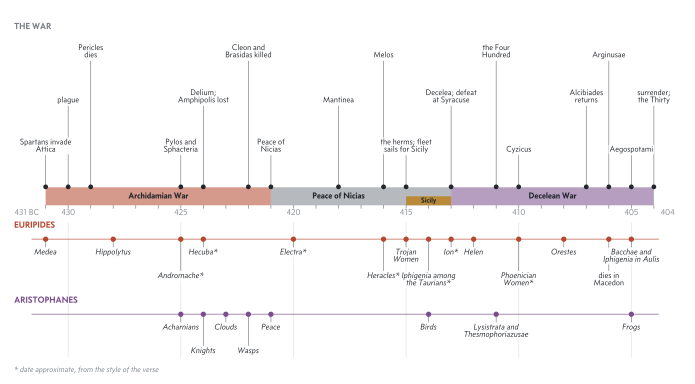
With Pericles dead, two men led Athens. Cleon (klee-on), whose family owned a tannery, was a loud and forceful speaker in the Assembly who wanted to fight the war harder; Aristophanes made fun of him in play after play (Chapter 15). His rival was Nicias (nish-ee-us), born about 470 BC, one of the richest men in Athens. The historian Xenophon says that he owned a thousand slaves, whom he hired out to work in the silver mines of Laurium in southern Attica. Nicias was cautious, pious, and careful of his reputation, and he wanted a peace that left Athens’s empire whole. In 425 BC Cleon won a famous success. An Athenian force trapped a Spartan garrison on Sphacteria, an island off Pylos in the southwestern Peloponnese, and Cleon brought 292 prisoners home to Athens, about 120 of them full Spartan citizens. All Greece was amazed: Spartans were supposed to die rather than surrender.
Sparta answered with a general of its own. Brasidas marched north through Thessaly into Thrace, the northern coast of the Aegean, where Athens’s allies lay far from its fleet. In the winter of 424 BC, in a snowstorm, he crossed the bridge over the river Strymon (stry-mon) and offered generous terms to Amphipolis, an Athenian colony that supplied timber for Athens’s ships. That year Thucydides was an Athenian general,Thucydides was a general from this city. → Athens• one of the two commanders on the Thracian coast, and he was at the island of Thasos with seven ships, half a day’s sail away. He sailed at once, but by the time he reached Eion (ee-on), the port at the mouth of the river, late that day, Amphipolis had surrendered. He saved only Eion. The Athenians blamed him and sent him into exile, and he tells it in one dry sentence, here in Richard Crawley’s translation: “It was also my fate to be an exile from my country for twenty years after my command at Amphipolis.” Exile, he adds, let him watch both sides at leisure, and the Peloponnesians most of all.
Modern historians still follow him. The fullest modern history of the war is Donald Kagan’s four volumes,Donald Kagan wrote a four-volume history of this war. → Peloponnesian War•• published between 1969 and 1987 by a historian who had been born in Lithuania in 1932, grew up in Brooklyn, and taught at Yale for more than forty years. Like Thucydides, Kagan told the war as politics and battles, and his first volume asks whether the war had to happen at all.

The same winter Athens tried to knock Boeotia out of the war. Boeotia was the farming country north of Attica, a league of cities led by Thebes, which was Sparta’s ally and Athens’s bitter neighbor. The Athenian general Hippocrates (no relation of the famous doctor) marched the whole army of Athens to Delium (dee-lee-um), a sanctuary of Apollo on the Boeotian coast, and fortified the temple. Then he turned for home. The Boeotian army caught him on the way. Most of its eleven generals wanted to let him go, since he was already back over the border, but Pagondas (puh-gon-dus), one of the two generals from Thebes, talked the army into a fight. Hoplites, the heavy infantry, fought in a phalanx (the Stage), a block of men standing shoulder to shoulder with their shields overlapping, usually eight ranks deep; when two phalanxes met, the deeper one could push harder. At Delium Pagondas massed the Thebans twenty-five shields deepPagondas led this city’s army to victory at Delium. → Thebes••Pagondas deployed a Theban phalanx twenty-five ranks deep at this battle. → Battle of Delium• on his right wing, and the Athenians stood eight deep all along their line (Figure 13.3).
The two lines met at a run, shield against shield. On the Athenian left, the deep Theban column slowly shoved the Athenians back. On the other wing the Athenians won, surrounded the men of Thespiae, a Boeotian town, and cut them down. But as the two arms of their ring closed, Thucydides says, “some of the Athenians also fell into confusion in surrounding the enemy and mistook and so killed each other.”Confusion led Athenians to attack their own troops during this battle against the Thebans. → Battle of Delium• Then Pagondas played his last card. He had sent two squadrons of cavalry round behind a hill, out of sight, and when they appeared behind the victorious Athenian wing, the Athenians thought a second army had come and ran. Nearly a thousand Athenians died, Hippocrates among them, against fewer than five hundred Boeotians. Seventeen days later the Boeotians took the temple fort with a strange machine. It was a hollowed beam plated with iron, with a cauldron of burning coals, sulfur, and pitch at one end and great bellows at the other, and it blew a jet of flame onto the wooden wall. One of the Athenian hoplites who walked away from the rout was Socrates, the philosopher of Chapter 14; Plato’s dialogues remember how calmly he retreated.
In 422 BC both Cleon and Brasidas were killed in a battle outside Amphipolis, and the two men who most wanted the war were gone. In the spring of 421 Nicias made a treaty with Sparta that was meant to last fifty years. Each side was to give back what it had taken, Amphipolis to Athens and the prisoners of Sphacteria to Sparta. History remembers it by his name, the Peace of Nicias,The Peace of Nicias was an armistice during this war. → Peloponnesian War•• and it was more an armistice, a halt in the fighting, than a peace. Amphipolis was never handed back, Corinth and Thebes refused to sign, and in 418 BC Athenian and Spartan soldiers fought each other at Mantinea, in the middle of the Peloponnese, while their cities were officially at peace. Thucydides refused to count the peace as an end at all.
Euripides and Medea
Euripides was born about 480 BC into an Athenian family that seems to have been well off, though Aristophanes liked to joke that his mother sold vegetables in the market. A pretty legend, told in the ancient Life of Euripides long after his death, says he was born on the island of Salamis on the very day of the great sea battle there, when Aeschylus fought in the Athenian fleet and the boy Sophocles danced in the victory chorus. He was the third great Athenian tragic playwright,This person was an Athenian tragic playwright. → Euripides•• after Aeschylus (Chapter 10) and Sophocles (Chapter 12), and the youngest. Each spring at the City Dionysia, the festival of the god Dionysus, three poets competed, each with three tragedies and a comic satyr play (Chapter 10). Euripides first competed in 455 BC and went on for nearly fifty years. He wrote about ninety plays, yet he won first prize only four times in his life, and once more after his death.

More of his plays survive than of Aeschylus and Sophocles together: eighteen tragedies under his name, one of which, the Rhesus, may not be his, and the only complete satyr play, Cyclops (Vol. 4, Classical Myth). Partly this was luck. In the Roman Empire ten of his plays were picked, probably for school reading, against seven each of Aeschylus’s and Sophocles’s. A further nine survived in just two medieval manuscripts, both copied from one ancestor, part of an old collected edition whose titles began with the Greek letters epsilon to kappa.
The Athenians loved and distrusted him. Aeschylus had written of gods and heroes in grand, strange language. Euripides made them talk like Athenians arguing in a law court, and he brought onto the stage ordinary people, slaves, beggars, and above all women: clever women, desperate women, and women who did terrible things. His heroes doubt the gods out loud. Comic poets mocked him for it all his life, and Aristophanes put him on stage as a character three times (Chapter 15). Yet Aristotle, a century later, called him, in S. H. Butcher’s translation of the Poetics (Chapter 19), “the most tragic of the poets,” because so many of his plays end in misfortune.
In the spring of 431 BC, about two months before the Spartans first marched into Attica, Euripides staged MedeaThis author wrote Medea. → Euripides••• at the Dionysia. Its story was an old one (Vol. 4, Classical Myth). Medea was a princess of Colchis, at the far eastern end of the Black Sea, and a granddaughter of the Sun. She had used her magic to help the hero Jason win the Golden Fleece, betrayed her own father, and sailed away with him on the Argo. Now, years later, she is the wife of Jason,This figure is the wife of Jason. → Medea••• living in exile in Corinth with their two small sons, and Jason has left her to marry the daughter of Creon, the king of Corinth. Euripides never names the princess; later writers call her Glauce (glaw-see) or Creusa (kree-oo-suh).
The play opens with Medea’s old nurse wishing that the Argo had never sailed. Medea’s cries come from inside the house, and then the title character of Euripides’s tragedyThis character is the title role of a tragedy by Euripides. → Medea••• comes out to speak to the chorus of Corinthian women. The nurse has said that for days she has lain without food, weeping; now she is calm, and she argues. In E. P. Coleridge’s translation she begins with a famous complaint: “Of all things that have life and sense we women are the most hapless creatures.”This character proclaims that "Of all creatures that can feel and think, we women are the worst treated things alive." → Medea• A woman must buy a husband with a dowry and take a master with him. She cannot divorce him without disgrace, she must learn a strange house’s ways, and when he is bored at home, he goes out to his friends, while she must look to him alone. Medea has less even than that: she is a foreigner in Corinth, with no mother, brother, or kinsman to take her in. Men say that women live safe at home while they go to war. Medea answers that she would rather fight three timesThis character maintains that she "would rather stand three times in battle with shield and spear than give birth once." → Medea•• in the battle line than bear one child: “I would gladly take my stand in battle array three times o’er, than once give birth.”
King Creon comes to banish her and her sons at once, because he fears what so clever a woman may do. She begs for a single day to prepare, and he grants it against his judgment. Jason comes next, and the two quarrel like lawyers. He says he married the princess to give his sons royal brothers and a secure future, and that Medea ought to be grateful to live in Greece at all. She reminds him that she saved his life from the fire-breathing bulls and the dragon, and asks where she can go now.
Then chance sends her a way out. Aegeus (ee-jee-us), the king of Athens, passes through Corinth on his way from Apollo’s oracle at Delphi to consult a wise friend. He has no son, and the oracle has given him a riddle: in Coleridge’s words, he must “not loose the wineskin’s pendent neck”In this play, an oracle warns a man "not to unstop the wineskin's neck." → Medea•• until he is home again. He does not understand it, though the meaning was that he should not sleep with a woman before he reached Athens; an earlier volume tells what came of it (Vol. 4, Classical Myth). Medea listens, and sees her chance. She makes him an offer: she will cure his childlessnessKing Aegeus offers this character sanctuary in Athens in exchange for curing his infertility. → Medea•• with her drugs if he will give her a refuge in Athens. Aegeus swears by Earth and the Sun to shelter her. The Athenian audience was watching a promise of sanctuary made by their own legendary king.
With a refuge secured, Medea pretends to make peace with Jason and sends her sons to the princess with wedding gifts, a fine robe and a golden crown, or diadem, that had come down from the Sun. When the boys come back, she looks at their faces and, in a long speech, wavers and decides again. Then a messenger arrives, and in one of the most horrible speeches in Greek tragedy he tells how the poisoned robe and crownThis figure sends a poisoned dress and diadem that kill Glauce and her father. → Medea••• killed the princess and then her father. When she put them on, the crown burst into flame, and the robe ate her flesh until it peeled from her bones “as when the pine-tree weeps its tears of pitch.” Old Creon ran in, threw his arms around her, and was caught in the robe himself, so that the king and his daughter died together.
Medea now does what she has been arguing herself toward. She goes into the house, the children’s screams are heard from inside, and she kills her own childrenThis character kills her children for revenge on her husband. → Medea••• so that Jason will be left with nothing: no bride, no sons, and no heirs. In some older versions of the myth the Corinthians killed the boys, or Medea killed them by accident; Euripides may have been the first to make their mother kill them on purpose, and his version has been the story ever since.

Jason runs in to save his sons and finds the doors barred. Then Medea appears above the house, in a chariot drawn by dragons,This character escapes in a dragon-drawn chariot with her children's bodies. → Medea••• with the children’s bodies beside her, sent by her grandfather the Sun (Figure 13.5). Athenian tragedy had a crane for such moments, the mechane, which swung an actor through the air above the stage building (Chapter 10). It usually carried a god, who arrived at the end to settle the story. In the first production, it seems, the mechane lifted Medea,The original production of this play used the mechane to lift its mortal title character. → Medea• a mortal woman, into the place where the audience expected a god. Aristotle disliked the effect: the ending of a plot, he wrote in the Poetics, “must not be brought about by the Deus ex Machina—as in the Medea.” Aristotle wrote in Greek; Butcher’s translation gives his phrase in Latin, which means “the god from the machine.”
From the air Medea refuses Jason even his sons’ bodies. She will bury them herself in the sanctuary of Hera at Corinth and go to live with Aegeus in Athens. Jason, she foretells, will die a coward’s death, struck by a broken piece of the Argo,This character predicts her husband will be killed by wreckage from his ship. → Medea•• his own old ship: “thy head crushed ’neath a shattered relic of Argo,” in Coleridge’s words. The play won only third prize, behind Aeschylus’s son Euphorion and Sophocles. In the twentieth century it became the most often performed of all Greek tragedies.
Medea was not the oldest of his surviving plays: Alcestis (438 BC), seven years earlier, had a wife die in her husband’s place. Once the war began, he kept writing. Hippolytus (428 BC), which won first prize, had Theseus’s wife Phaedra (fee-druh) fall in love with her stepson; Heracles, of about 416 BC, had the hero go mad and kill his children after his labors, though in the older story the madness came first. An earlier volume (Vol. 4, Classical Myth) tells all three myths. Figure 13.2 sets most of his surviving plays beside the years of the war in which they were staged.
Melos and Sicily
After the Peace of Nicias a new man rose in Athens. Alcibiades (al-sih-by-uh-deez) was born about 450 BC into two of the city’s grandest families. His father died in battle when he was a small boy, and he was brought up in the house of his mother’s cousin Pericles; the family tree is in Chapter 5. He was handsome, rich, clever, and a brilliant speaker, and he could not bear to be second at anything. In 416 BC he entered seven chariots at the Olympic Games, more than any private man had ever sent, and they took first, second, and fourth places. He was a friend of Socrates. Plato tells how Socrates saved his life in battle at Potidaea, and how at Delium Alcibiades, on horseback, guarded Socrates in the retreat. In politics he led the party that wanted to renew the war, against Nicias.

The most famous event of the peace was not a battle. Melos (mee-los) was an island in the southern Aegean, settled long before by colonists from Sparta, and almost the only island of that sea that had never joined Athens’s league. In the summer of 416 BC Athens sent thirty-eight ships and more than three thousand men to make it join. Before they attacked, the Athenian envoys talked with the island’s magistrates and leading men, and Thucydides wrote the talk out as a play in two voices. In Crawley’s translation of the Melian Dialogue,The Melian Dialogue during this war contains the phrase “the strong do what they can and the weak suffer what they must.” → Peloponnesian War•• the Athenians sweep aside all talk of justice: “right, as the world goes, is only in question between equals in power, while the strong do what they can and the weak suffer what they must.” The Melians answer that the gods and the Spartans will help the just. The Athenians reply that the gods themselves rule where they can, and that the Spartans take no risks for others.
The Melians refused, and they held out until winter. Then they surrendered, and the Athenians killed all the men of fighting age, sold the women and children as slaves, and sent five hundred Athenian settlers to take the island. Thucydides tells it in a few lines and then, without comment, begins his next book with the Athenians’ plans for Sicily.
Sicily was the largest island of the Mediterranean and one of the richest, full of Greek colonies (Chapter 4). The greatest of them was Syracuse, a colony of Corinth on the island’s east coast, nearly as large as Athens and, like it, a democracy. In 415 BC envoys came to Athens from Segesta, a non-Greek city in western Sicily, asking for help against Selinus, a Greek neighbor allied with Syracuse. They promised to pay for the war. Athenian envoys who went to check were shown temple treasures and feasted in houses full of gold and silver cups. Thucydides says later that the Segestans had borrowed the cups from their neighbors and passed them from house to house.
In the Assembly Nicias argued against the expedition. Alcibiades argued for it and dreamed of conquering all Sicily. Nicias then tried to frighten the Athenians off by saying how huge a force the war would need, and the Assembly, more eager than ever, gave the generals full powers to raise whatever force they thought best. It chose three commanders for the Sicilian Expedition, Alcibiades, Nicias, and LamachusThis man was initially one of the commanders of Athens’s Sicilian Expedition. → Alcibiades••• (lam-uh-kus), a tough professional soldier. The fleet that finally gathered at Corcyra, off northwestern Greece, numbered 134 triremes and carried 5,100 hoplites, with archers, slingers, and some 130 supply ships behind (Figure 13.7).
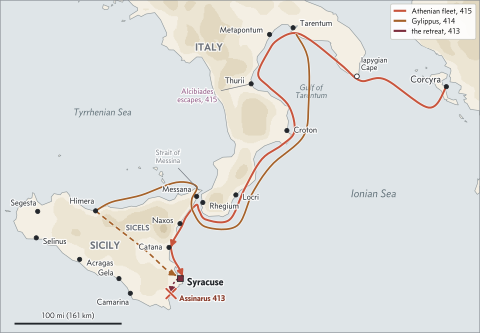

Just before the fleet sailed, Athens woke to a sacrilege. A herm was a square stone pillar topped with a carved head of the god Hermes, which stood at doorways and crossroads to guard them. While the fleet was being made ready, Thucydides says, the stone herms of Athens “had in one night most of them their faces mutilated.” No one knew who had done it. Informers then accused Alcibiades and his friends of another crime, mocking the Mysteries of Eleusis, the secret rites of the goddess Demeter (Vol. 4, Classical Myth), at drunken private parties. Alcibiades asked to be tried at once, before the fleet left. His enemies, who feared that the army would take his side, preferred to wait until he was gone.
The fleet sailed at midsummer. Later that year a state galley reached the army at Catana (kat-uh-nuh) with orders to bring Alcibiades home. Recalled from the expedition against SyracuseRecalled to face charges after the mutilation of the herms, this Athenian commander defected to Sparta. → Alcibiades•••Alcibiades was recalled from an Athenian expedition against this city to face trial. → Syracuse• to stand trial for the herms and the Mysteries, he slipped away from his escort at Thurii, in southern Italy, and went over to Sparta. Athens condemned him to death in his absence. At Sparta he gave the enemy two pieces of advice. They should send a Spartan to lead the Syracusans, and they should build a permanent fort in Attica itself.

Without Alcibiades, the expedition was left to Nicias and Lamachus, and the first winter passed with little done. Early in the summer of 414 BC the Athenians seized Epipolae (ih-pip-uh-lee), the high plateau behind Syracuse, built a round fort in its middle, and began a wall to shut the city off by land, while the fleet blocked it by sea (Figure 13.9). Lamachus was killed in a skirmish. By late summer the wall nearly closed the ring, and the Syracusans talked of surrender. Then Sparta acted on Alcibiades’s advice. Gylippus, a Spartan general, sailed with a few ships to Himera on Sicily’s north coast, gathered troops there, and marched across the island to take charge of Syracuse’s defense.Gylippus organized Syracuse’s defense against this Athenian campaign. → Sicilian Expedition•This city was aided by the Spartan general Gylippus. → Syracuse• He came up onto the plateau by Euryalus (yoo-ry-uh-lus), its western point, and soon began a counter-wall across Epipolae, crossing the line of the unfinished Athenian wall. Once the two walls crossed, the Athenians could never close their ring.
Nicias, sick with a disease of the kidneys, wrote home that Athens must either recall the army or send another as large. Athens sent another. In 413 BC the general Demosthenes (dih-mos-thuh-neez) (not the orator of Chapter 18) arrived with seventy-three ships and five thousand hoplites. His night attack on Epipolae ended in a rout in the dark, and he urged the generals to sail home while they still could. Nicias delayed, and then at last agreed. Everything was ready to go when the full moon went dark in an eclipse, late in August. The soldiers took it as a warning from the gods, and Nicias, “somewhat over-addicted to divination,” as Crawley’s Thucydides puts it, would not discuss leaving until they had waited the thrice nine days,A lunar eclipse prompted Nicias to delay the retreat during this campaign. → Sicilian Expedition••This general delayed retreat for 27 days because of a lunar eclipse. → Nicias•• twenty-seven days in all, that the soothsayers prescribed.
The delay destroyed them. The Syracusans attacked by sea, blocked the mouth of the Great Harbor with a line of ships, and beat the Athenian fleet inside it. The Athenians abandoned their ships and their wounded and tried to escape by land, some forty thousand men and camp followers. For a week they were harried by cavalry and javelin men. Demosthenes’s column surrendered first. Nicias’s men reached the river Assinarus (as-ih-nair-us), and they were so mad with thirst that they crowded into it to drink while the enemy cut them down from the banks. Nicias surrendered, and the Syracusans put him and Demosthenes to death, though Gylippus wanted to take them to Sparta alive.

The prisoners, about seven thousand of them, were put in the city’s stone quarries, open pits with no shade by day and cold at night (Figure 13.10), on half a pint of water and a pint of grain a day, Thucydides says. After seventy days all but the Athenians and the Sicilian and Italian Greeks were sold as slaves; the rest stayed longer. The Athenian expedition against Syracuse in SicilyThis Athenian campaign against Syracuse ended in disaster during the Peloponnesian War. → Sicilian Expedition•••This city was targeted during the Peloponnesian War by the Sicilian Expedition. → Syracuse••A disastrous Athenian expedition targeted this island. → Sicily••• had ended in the worst disaster of the war. Thucydides wrote its epitaph: “they were destroyed, as the saying is, with a total destruction, their fleet, their army, everything was destroyed, and few out of many returned home.”
Euripides’s war plays
Euripides watched all of this from Athens, and some of his plays seem to answer it. In the spring of 415 BC, a few months after Melos fell and a few months before the fleet sailed for Sicily, he staged The Trojan Women.This author wrote The Trojan Women. → Euripides• It is set on the morning after the Greeks took Troy (Vol. 4, Classical Myth). The men are dead, and the women wait in huts by the shore to learn which Greek each of them will belong to. The old queen Hecuba grieves over the ruin. The herald Talthybius (tal-thib-ee-us) brings the news one blow at a time: her daughter Cassandra will go to Agamemnon, her son Hector’s widow Andromache to Achilles’s son. Then the Greeks decide that Hector’s little son Astyanax must die, and they take him to throw him from the walls. Helen pleads for her life before her husband, Menelaus. The boy’s body is brought back, his grandmother buries him in his father’s shield, and Troy burns as the women are led to the ships.
The play begins with two gods. Athena, angry that the Greeks let one of their men drag Cassandra from her temple, asks Poseidon to wreck their fleet on its way home, and he agrees. Then he warns the conquerors, in Gilbert Murray’s verse translation of 1905:
Readers since have heard Melos in it, and Sicily to come. Euripides had probably written much of it before Melos surrendered, so the link is a guess, but an audience that had just voted to kill a city’s men watched it. The judges gave it second prize.
Euripides also took on his great predecessor. Electra, whose date is uncertain (its verse looks like his plays of about 420 to 416 BC, though some scholars put it in 413), retells the revenge of Agamemnon’s children on their mother, which Aeschylus had staged in The Libation Bearers (Chapter 10). Euripides moves it to a poor farmhouse, where Electra has been married off to a decent peasant who has never touched her. Her brother, Orestes, back from exile, comes to the door disguised as a stranger with news of himself. In Aeschylus, Electra had recognized him by a lock of his hair left on their father’s tomb, by footprints like her own, and by a cloth she had woven. Here an old servant brings her the same tokens, and she mocks each one: a man’s hair is not like a girl’s, a man’s foot is bigger, and there is no footprint on stony ground. Then the old man looks at the stranger and sees the scar on his brow,In Euripides’ play about this character, recognizing a man by his forehead scar from chasing a doe parodies Eurycleia’s recognition of Odysseus. → Electra• from a day when the boy fell while chasing a fawn with his sister. A scar was how the old nurse Eurycleia (yoor-ih-klee-uh) had known Odysseus in the Odyssey: a scar left by a boar’s tusk, which she felt as she washed his feet (Vol. 4, Classical Myth). Euripides laughs at Aeschylus’s tokens and then borrows Homer’s.
Both Sophocles and EuripidesThis character titles plays by both Sophocles and Euripides. → Electra• wrote an Electra, and nobody knows which came first. Euripides’s play ends with the twin gods Castor and Polydeuces (pol-ih-dyoo-seez), Electra’s uncles, appearing to set things right, and then hurrying away to save sailors on “the far Sicilian sea,” as Murray translates it. Some scholars have read that line as a sign that the play was staged in 413, the year of the disaster.
The spring after the disaster, in 412 BC, Euripides staged Helen, and its story says the whole Trojan War was a mistake. Helen, the wife of the Spartan king Menelaus, was the woman whose flight with the Trojan prince Paris had started that war. In Euripides’s play she never went to Troy at all. The goddess Hera, angry at losing the beauty contest that Paris judged, sent a phantom made of airIn Euripides’s account, this figure remains in Egypt while a phantom takes her place at Troy. → Helen of Troy•• in Helen’s shape to Troy, while the real Helen waited out the war in Egypt (Vol. 4, Classical Myth). There, faithful and miserable, she is hiding from the king of Egypt, who wants to marry her, when the shipwrecked Menelaus arrives in rags. He has left the phantom wife he won at Troy in a cave with his crew, and a sailor soon brings word that she has vanished into the sky. They recognize each other and escape by a trick, a pretended funeral at sea. Greeks and Trojans had died for ten years for a cloud. Athens, the year after Sicily, was in a mood to hear it.
Euripides’s last Athenian play, Orestes, came in 408 BC. Soon afterward, the ancient accounts say, the old poet left Athens for the court of King Archelaus (ar-kuh-lay-us) of Macedon, in the north, who collected poets and painters, and he died there in 406 BC; a few modern scholars doubt that he ever went. Later writers, the Suda among them, say he was torn apart by the king’s hunting dogs, a death too much like his own plays to be trusted. When the news reached Athens, Sophocles appeared at the festival in mourning (Chapter 12).

He had left plays unperformed, and in 405 BC his son (or, some say, his nephew), also named Euripides, staged them. They won first prize. In Iphigenia in Aulis the Greek fleet sits windbound at Aulis on its way to Troy, and the goddess Artemis will release it only if Agamemnon sacrifices his daughter Iphigenia. He lures her there with a promise that she will marry Achilles. Her mother pleads for her, Achilles offers to fight for her, and Iphigenia herself begs to live. Then she changes her mind and agrees to die so that the fleet can sail,In this author's Iphigenia in Aulis, the title character agrees to be sacrificed to Artemis so the fleet can sail. → Euripides• choosing to give her life for Greece (Vol. 4, Classical Myth).
The other play was The Bacchae (bak-ee), named for its chorus of women who worship Bacchus, another name for Dionysus. The god comes to Thebes disguised as a gentle stranger to punish the city that denies he is a god. Its young king, Pentheus (pen-thee-us), the son of Agave (uh-gah-vee) and grandson of the city’s founder, Cadmus, jails the stranger, and the palace shakes. Little by little the stranger takes hold of the king’s mind, until Pentheus agrees to dress as a woman and spy on the god’s women on the mountain. They find him, and his mother, Agave, tears him apartIn this playwright's The Bacchae, Agave dismembers her son Pentheus. → Euripides••• with her own hands, believing him a lion. She carries his head home in triumph, and her old father, Cadmus, slowly brings her back to her senses (Vol. 4, Classical Myth). It was among the last things Euripides wrote, a play about the god of the theater himself.
The fall of Athens
The news from Sicily reached Athens, Plutarch says, by way of a stranger who mentioned it to a barber at Piraeus, and at first nobody believed it. Athens had lost some two hundred ships and tens of thousands of men. In the same year, 413 BC, the Spartans took Alcibiades’s second piece of advice and built a fort at Decelea, about 14 miles north of Athens and in sight of it. Now the enemy stayed in Attica all year round, and Athens, Thucydides says, became a fortress instead of a city. More than twenty thousand slaves, many of them skilled workmen, ran away to the Spartans at Decelea, he adds. Athens’s allies began to revolt, and the Persian king, who had lost the Aegean cities to Athens two generations before, began to pay for a Spartan fleet to take them back (Vol. 5, In the Beginning).
In 411 BC, with the treasury nearly empty, a group of rich Athenians decided that the democracy could not win the war. Alcibiades, who had quarreled with the Spartans and gone over to the Persian governor of western Asia Minor, let it be known that he could bring Persian money to Athens if only the city were ruled by the few instead of the many. The plotters frightened the Assembly into voting itself out of power, and a coup set up the Four Hundred,A coup in this city established the oligarchical Council of Four Hundred. → Athens• a council of four hundred men who ruled as an oligarchy, government by a few (the Stage). The fleet at Samos refused to obey them, stayed loyal to the democracy, and recalled Alcibiades as its general. The Four Hundred lasted about four months before they fell, and democracy was fully back by 410. Thucydides’s history breaks off in 411, in the middle of its story; Xenophon, a young Athenian who knew Socrates, carried the story on in his Hellenica (Chapter 14).
For a few years Alcibiades won victory after victory in the north, and in 407 BC he sailed home in triumph, his death sentence lifted. But the next year, while he was away, the helmsman he had left in charge of the fleet disobeyed orders and lost a battle at Notium (noh-shee-um), near Ephesus, and the Athenians dismissed him again. He withdrew to a castle he owned on the Hellespont.
In 406 BC Athens melted down golden statues of Victory on the Acropolis to build a new fleet, put slaves at the oars beside citizens and freed them afterward, and won one last great sea battle, at the Arginusae (ar-jih-noo-see) islands near Lesbos. Then a storm blew up, and the ships sent to pick up the men clinging to the wrecks of twenty-five Athenian triremes never reached them, so that a great many sailors drowned. The people of Athens were furious. Two of the eight generals in command had not come home, and the six who had were executedDuring this war, six of eight generals were executed for failing to rescue drowning sailors after a battle. → Peloponnesian War•• for failing to rescue the drowning men, after the Assembly condemned them all together in a single vote, against the law. Among them was Pericles the Younger, the son of Pericles and his Milesian companion Aspasia (Chapter 11). Xenophon says that one member of the presiding committee refused to put the illegal vote: Socrates.
Sparta’s admiral, in fact if not always in title, was now Lysander, an able, ruthless commander who had made friends with the Persian prince Cyrus the Younger (Vol. 5, In the Beginning) and used his money to pay rowers more than Athens could. In 405 BC the last Athenian fleet, 180 triremes, beached on an open shore called Aegospotami (ee-gus-pot-uh-my), “Goat Rivers,” on the European side of the Hellespont, facing Lysander’s base at Lampsacus across the strait. Day after day the Athenians rowed out and offered battle, and Lysander would not come. Alcibiades rode down from his castle and told the generals to move to a safer harbor; they told him that they were the generals now, not he. On the fifth day, when the crews had scattered along the shore to buy food, Lysander’s scout hoisted a shield in mid-strait as a signal, and his whole fleet rowed across. At Aegospotami Lysander destroyed the Athenian fleet,This city was defeated by Lysander at the Battle of Aegospotami in 405 B.C. → Athens••This city's admiral Lysander won the Battle of Aegospotami, securing victory in the Peloponnesian War. → Sparta••Lysander destroyed the Athenian fleet at Aegospotami near the end of this war. → Peloponnesian War•• capturing 171 ships on the beach; only nine escaped. Xenophon says the allies voted to kill all the Athenian prisoners, and Plutarch puts their number at three thousand.
One of the ships that escaped carried the news home. In H. G. Dakyns’s translation of Xenophon, the wail of grief ran from Piraeus “following the line of the long walls up to the heart of the city,” and “on that night no man slept.” The Athenians were afraid, Xenophon says, that they would now suffer what they had done to the men of Melos. Lysander blockaded Piraeus, and a Spartan army camped outside the walls. Through the winter the city starved.
In the spring of 404 BC Athens surrendered to Sparta,This city lost the Peloponnesian War to Sparta. → Athens•••This city defeated Athens in the Peloponnesian War and gained hegemony in Greece. → Sparta••• which now held the leadership of Greece, what the Greeks called hegemony (the Stage). Corinth and Thebes wanted Athens destroyed and its people enslaved. Sparta refused, saying, in Xenophon’s account, that it would not enslave a Greek city that had done great service to Greece in its hour of danger. Plutarch tells a gentler story: at a feast of the allied generals, a man from Phocis sang the first chorus of Euripides’s Electra, and the generals were so moved that they could not bring themselves to destroy the city that had produced such a poet. The terms were hard enough. Athens must give up all but twelve ships, take back its exiles, follow Sparta in war and peace, and pull down the walls of Piraeus and the Long Walls. Lysander sailed into Piraeus, and, Xenophon says, “they fell to levelling the fortifications and walls with much enthusiasm, to the accompaniment of female flute-players,Xenophon describes these Athenian fortifications being demolished to the music of flute-girls after the Peloponnesian War. → the Long Walls•• deeming that day the beginning of liberty to Greece.”
The cities that had paid Athens tribute for seventy years now took Spartan governors instead. The defeat ended the Delian League, and in the summer of 404 BC Lysander put Athens under thirty Athenian oligarchs, the Thirty Tyrants,This city was ruled by the Thirty Tyrants. → Athens•••This city installed the Thirty Tyrants to govern Athens, a system that lasted only eight months. → Sparta••Athens’s defeat in this war ended the Delian League and brought the Thirty Tyrants to power. → Peloponnesian War•• who ruled for only about eight months. Their leader was Critias (krit-ee-us), a poet and a friend of Socrates. Protected by a Spartan garrison on the Acropolis, they killed some fifteen hundred Athenians and seized their property. When Theramenes (thih-ram-uh-neez), one of their own number, objected, Critias had him put to death. In the winter a band of democratic exiles led by Thrasybulus, a general who had kept the fleet at Samos loyal in 411, seized a mountain fort near the border; in the spring of 403 they took Piraeus, and Critias was killed fighting them. The Spartan king Pausanias, grandson of the regent who had won at Plataea, did not trust Lysander and let the democracy come back. The restored democracy passed an amnesty, a law that nobody could be prosecuted for what had been done under the Thirty. Athens kept its democracy for another eighty years. Four years after the amnesty, it put Socrates on trial (Chapter 14).
What to remember
- The Peloponnesian War (431 to 404 BC) set Athens and its Delian League against Sparta and its Peloponnesian League. Thucydides, an Athenian general exiled after he lost Amphipolis in 424, wrote its history; Donald Kagan wrote the fullest modern history, in four volumes.
- The Long Walls joined Athens to its harbors at Piraeus and Phaleron, so that the city could be fed by sea.
- At Delium (424) Pagondas of Thebes massed his men twenty-five deep; Athenians killed each other in the confusion, and Socrates fought there. The Peace of Nicias (421) was only an armistice.
- Euripides’s Medea (431): Jason’s wife, abandoned for the daughter of Creon of Corinth, kills the princess and her father with a poisoned robe and crown, wins a refuge from Aegeus, kills her children, and escapes in the Sun’s dragon chariot, lifted by the mechane.
- Athens destroyed Melos (416); the Melian Dialogue says that the strong do what they can and the weak suffer what they must.
- The Sicilian Expedition (415 to 413) against Syracuse ended in disaster. Alcibiades, one of its commanders, was recalled over the herms and fled to Sparta; Gylippus saved Syracuse; Nicias waited twenty-seven days after an eclipse.
- Euripides’s later plays include The Trojan Women (415), Electra with its scar, Helen (412) with its phantom, and, after his death in Macedon, Iphigenia in Aulis and The Bacchae.
- After the Four Hundred (411), Arginusae and the six executed generals (406), and Lysander’s victory at Aegospotami (405), Athens surrendered in 404, pulled down the Long Walls to flute music, and fell to the Thirty Tyrants.
Chapter 14 · 29 clues
The Sophists and Socrates
Very early one morning, a few years before the war with Sparta began in 431 BC, a young man beat on the door of Socrates’s house in Athens with his walking stick. His name was Hippocrates (no relation to the famous doctor), and he could not wait for daylight. Protagoras (proh-tag-er-us), the most famous teacher in Greece, had come to town and was staying with Callias, the richest man in Athens. Hippocrates had money, and he wanted Socrates to introduce him.
Socrates walked him up and down the courtyard until it grew light, asking questions. If you paid a doctor to teach you, you would expect to become a doctor; if you paid a sculptor, a sculptor. What did Hippocrates expect to become by paying Protagoras? By the dawn light Socrates could see the young man blush. Protagoras, he admitted, would make a Sophist of him, and he was ashamed to say so. The scene opens the Protagoras, a dialogue by Socrates’s pupil Plato, and it holds the question of this chapter: can a man be taught to be good, and should he pay for it?
The Sophists
Speaking well was power in democratic Athens (the Stage). Any citizen could stand up in the Assembly, where thousands of men voted on war and peace, and any citizen might find himself in a law court, with no lawyer to speak for him. Yet a boy’s schooling ended with reading, writing, the lyre, wrestling, and Homer learned by heart. Nobody taught a grown man to argue a case or sway a crowd.
The teachers who did came from all over the Greek world: Protagoras from Abdera in Thrace, Gorgias (gor-jee-us) from Sicily, Hippias from Elis, Prodicus (prod-ih-kus) from the island of Ceos (Figure 14.1). They traveled from city to city, gave public lectures to show off their skill, and took paying pupils. They were called Sophists, and their name came from sophiaThe Greek word for "wisdom" provides the name for these people. → Sophists•• (soh-fee-uh), the Greek word for wisdom. A sophistes was a man who made a profession of being wise, and at first the word was a compliment.

What the Sophists sold was success. The Greek word for the quality that wins it was arete (ar-eh-tay), usually translated “virtue” but wider than that: it meant excellence, whatever makes a thing good at what it does. A knife’s arete is to cut, a racehorse’s to run, and a man’s, as most Athenians saw it, was to run his household well and lead in the city. The Sophists promised to teach arete,These people claimed to be able to bestow arete, or virtue. → Sophists• and Protagoras, in Plato’s dialogue, promises Hippocrates exactly that. In Benjamin Jowett’s translation, the pupil “will learn to order his own house in the best manner, and he will be able to speak and act for the best in the affairs of the state.” Older Athenians believed that such excellence came with good birth. The Sophists said it could be taught, for a fee.
Protagoras was the first to call himself a SophistProtagoras was an early member of this group of teachers. → Sophists•• openly and to charge for teaching, as Plato tells it. Born in Abdera about 490 BC, he taught for some forty years, traveling all over Greece, and was a friend of Pericles, Athens’s leading statesman (Chapter 11). His most famous sentence opened a book called Truth. In Jowett’s translation it reads: “man is the measure of all things,This philosopher stated that “man is the measure of all things.” → Protagoras•• of the existence of things that are, and of the non-existence of things that are not.” Plato, who quotes it in his dialogue Theaetetus, explains it with an example. The same wind blows on two men, and one shivers while the other does not. For the man who shivers the wind is cold, and for the other it is not, and there is no wind “in itself” to settle the question. Each person is the judge of how things are for him.

Protagoras’s book Truth is lost,This philosopher wrote the lost work Truth. → Protagoras• like everything else he wrote, and we have only the sentences that later writers quoted. He also taught that on every question there are two arguments, one against the other, and that a trained speaker can argue either side. Aristotle, the great philosopher of the next century (Chapter 19), reports that he offered to make the weaker argument the stronger.These people were criticized for making deceptive arguments and for "making the weaker argument the stronger" through rhetoric. → Sophists•• To his pupils that meant skill: a good speaker could win even when the odds were against him. To his enemies it meant fraud, because a man who could make a bad case look good could make a guilty man look innocent. The charge of twisting the truth with rhetoric, the art of persuasive speaking, stuck to all the Sophists. Plato and Aristotle, who thought the Sophists cared more for winning than for truth, turned their name into an insult, and sophistry still means clever reasoning meant to deceive.
In Plato’s Protagoras, Socrates doubts that this kind of excellence can be taught at all. When the Assembly debates a building, he says, it listens only to builders. When it debates how the city should be run, a smith or a shoemaker may speak, as if no one needed lessons in that. Protagoras answers with a story whose first half an earlier volume told (Vol. 4, Classical Myth). Epimetheus (ep-ih-mee-thee-us) handed out every gift to the animals and left man naked, and Prometheus stole fire and the crafts for him. Still men could not live together in cities without wronging one another. So Zeus sent Hermes with reverence and justice. These were not to go to a few, the way skill in medicine is given, one doctor serving many, but to everyone: “cities cannot exist,” Zeus says in Jowett’s translation, “if a few only share in the virtues.” That, says Protagoras, is why Athens rightly lets every citizen speak about justice. Parents, nurses, teachers, and the laws teach it to every child, and a Sophist only teaches it a little better.
The most dazzling of the Sophists came from the west. Gorgias was a citizen of Leontini (lee-on-ty-nee), a Greek city in eastern Sicily. In 427 BC, when he was about sixty, his city sent him to Athens to ask for help against its powerful neighbor, Syracuse. Athenians had never heard prose like his. He built his sentences in matched pairs of clauses, set idea against idea, and made their endings rhyme, so that his speeches sounded like poetry without meter. He stayed in Greece as a traveling Sophist and teacher of speakingGorgias was one of these people. → Sophists• and grew rich enough to set up a golden statue of himself at Delphi.
One of his showpieces survives whole. In the legend, Helen, the wife of the Spartan king Menelaus, had fled to Troy with the prince Paris and started the Trojan War (Vol. 4, Classical Myth; Chapter 2), and every Greek blamed her. An encomium (en-koh-mee-um) is a speech of praise, and Gorgias wrote an encomium of HelenThis character was defended in an encomium by Gorgias with the line "it is an equal error to blame the praiseworthy and to praise the blameworthy." → Helen of Troy• to prove her innocent. He begins by saying that blaming what deserves praise is as great a fault as praising what deserves blame. Then he takes the reasons she might have gone. If the gods willed it, no mortal could resist; if Paris took her by force, she deserves pity. If words persuaded her, then speech is a mighty master that works on the soul as drugs work on the body. If she fell in love, love is a god or a sickness, and not her fault. At the end Gorgias calls the speech his plaything. It was an advertisement: if a skilled speaker could clear the most blamed woman in Greek story, what could he not do for a paying pupil?
Socrates’s method
Socrates was born in 470 or 469 BC, in Alopece (al-op-eh-see), a district just outside the walls of Athens. His father worked in stone, and his mother was a midwife. He served as a hoplite, a foot soldier in heavy armor, at Potidaea and Amphipolis in the north and in the retreat from Delium in 424 BC (Chapter 13; Figure 14.1). He was famously ugly, with a snub nose and bulging eyes, and his friends compared him to a satyr. He went barefoot even in winter and owned one worn cloak. His wife, Xanthippe (zan-thip-ee), bore him three sons, the youngest still a small child when he died. All his life he talked, in the marketplace, the gymnasiums, and the shops, with anyone who would answer his questions. He never took a fee, and at his trial he offered his poverty as the proof.

He wrote no books, and everything we know of him comes from others. The comic poet Aristophanes mocked him on stage in 423 BC (Chapter 15), and Xenophon, whose story ends this chapter, wrote memoirs of him. The most important was his pupil Plato,This philosopher was the teacher of Plato. → Socrates••• the son of a rich Athenian family, who was about twenty-eight when Socrates died and never got over it. Plato spent the next fifty years writing dialogues: prose works laid out like plays, as conversations among real people, most of them set in the Athens of his youth. Socrates is the main speakerThis philosopher is featured in many dialogues written by Plato. → Socrates••• in almost all of them, and Plato himself never speaks in any (Chapter 16 will tell his own story). Plato put more and more of his own ideas into his teacher’s mouth, so scholars look for the real Socrates mainly in the short early dialogues.
Plato’s Apology, his version of the speech Socrates made at his trial, tells how the questioning began. An impulsive friend named Chaerephon (kair-eh-fon) went to Apollo’s oracle at Delphi (Chapter 4) and asked whether anyone was wiser than Socrates. The Pythia, the god’s priestess, answered that no one was. Socrates was baffled, for he knew he had no wisdom; yet, he reasoned, a god could not lie. So he set out to find someone wiser. He questioned a politician famous for wisdom and found that the man only thought he knew. “I am better off than he is,” Socrates reflected, in Jowett’s translation, “for he knows nothing, and thinks that he knows; I neither know nor think that I know.” The poets could not explain their own poems, and the craftsmen thought that knowing their trades made them wise about everything else. At last he understood the god. The wisest man is the one who knows, “like Socrates,” that his wisdom “is in truth worth nothing.” Later readers boiled this down to a slogan that Plato never gives him in so many words: “I know that I know nothing.”This philosopher’s awareness of his own ignorance is often summarized as “I know that I know nothing.” → Socrates••
The way Socrates tested people has a Greek name, elenchus (eh-leng-kus), which means testing or refutation. He asks someone who claims to know a thing, such as courage or piety, what it is. He gets him to agree to a few other statements, each reasonable on its own, and then shows that together they contradict the definition. The man tries again, and the testing starts over (Figure 14.4). In English the elenchus is called cross-examination,This philosopher’s questioning method uses elenchus, or cross-examination. → Socrates•• the word for what a lawyer does to a witness.

Plato’s Laches (lay-keez) shows the method at work. Two fathers ask two generals whether their sons should take lessons in fighting in armor. One general is Nicias, who later led the expedition to Sicily (Chapter 13). The other is Laches, who had marched beside Socrates in the retreat from Delium and says that if every Athenian had fought like Socrates, the city would not have lost. Socrates turns the question around: what is courage? Laches answers like a soldier: a brave man stays at his post and does not run. But Scythian horsemen fight as well in flight as in pursuit, Socrates replies, and the Spartans at Plataea fell back before the Persians and then turned and won. Laches tries again, and Nicias tries a third time, and each answer breaks. “Then, Nicias, we have not discovered what courage is,” Socrates concludes.
An ending like that has a name too. Aporia (uh-por-ee-uh) means “no way through,” the helplessness of a traveler who comes to a river with no bridge. Many early dialogues end in aporia:Many early works featuring this philosopher are described as "aporetic" or end in a state of aporia. → Socrates•• the Charmides fails to define self-control, the Lysis friendship, and the Euthyphro piety (Chapter 16). Dialogues that end this way are called aporetic. For Socrates this was not failure. A man who has lost a false belief is better off than one who still holds it, and freer to look for the truth. The men he questioned rarely thanked him, for he had made them look foolish in public, often before rich young men who enjoyed the show and went off to try the trick on their elders.
Socrates claimed one more thing that set him apart. Ever since childhood, he said, he had heard a divine sign, his daimonionThis philosopher described a divine sign or daimonion that warned him against certain actions. → Socrates•• (dy-moh-nee-on), a kind of voice from the gods. It never told him to do anything. It only stopped him, sometimes in the middle of a sentence, when he was about to go wrong, even in small things. This sign, he said, had kept him out of politics, which would have killed him long before. His friends took it seriously. To his enemies it sounded like a private god of his own.
The trial and death of Socrates
For most of his life Athens put up with Socrates. Then the war with Sparta ended in disaster. In 404 BC the city surrendered, and the Spartans set up the Thirty Tyrants, a board of Athenian oligarchs who killed some fifteen hundred citizens in eight months (Chapter 13). Their leader, Critias, had been one of Socrates’s companions, and so had Alcibiades, the reckless general who had gone over to Sparta during the war. Socrates himself defied the Thirty. When they ordered him and four others to arrest a man named Leon of Salamis, so that they could put him to death, the other four went, and Socrates went home. In 403 BC the democrats fought their way back and passed an amnesty forbidding lawsuits over the past. But Athenians remembered whose pupils Critias and Alcibiades had been.
In 399 BC, when Socrates was seventy, three citizens brought a case against him. Meletus (mel-eh-tus) was a young poet. Anytus (an-ih-tus), a rich tanner, had helped lead the democrats against the Thirty and was one of the most respected men in the city. Lycon (ly-kon) was an orator. Plato’s version of their charge reads, in Jowett’s translation: “Socrates is a doer of evil, who corrupts the youth; and who does not believe in the gods of the state, but has other new divinities of his own.” The charges were impiety and corrupting the young,This philosopher was charged with corrupting the youth of Athens. → Socrates•••Charges at this trial included impiety and corrupting the youth of Athens. → the trial of Socrates• and the penalty asked was death. Impiety was a real crime in Athens, because Athenians believed that an offense against the gods endangered the whole city, which the gods might punish with plague or defeat.

The trial took a single day. A jury of about five hundred citizens, men over thirty chosen by lot and paid for their time, sat on wooden benches. There was no judge to explain the law and no lawyer on either side. The accusers, Meletus, Anytus, and Lycon, spoke first,Meletus and Anytus were among this philosopher’s accusers. → Socrates•• then Socrates answered, and each speaker’s time ran out with the water in a water clock. The jurors voted at once, without discussing the case, and there was no appeal.
Plato was in the court that day, and he later wrote down Socrates’s defense as he remembered or reimagined it. The Greek apologia means a speech in one’s own defense, and nothing in Plato’s ApologyThis philosopher defends himself in Plato's Apology. → Socrates••Plato's Apology depicts this event. → the trial of Socrates• apologizes. Socrates began with his oldest accusers: years of gossip, and the comedy of Aristophanes, which had shown a “Socrates” studying the sky from a basket. The gossip added the old charge against the Sophists, that he made the weaker argument the stronger. He denied all of it. He took no fees, he said, and he told the jury the story of the oracle, to explain why so many men hated him.
Then he questioned Meletus in front of the jury, as he questioned everyone. Who makes the young better? The laws, said Meletus, and the jurors, the council, and in fact every Athenian except Socrates. Is that true of horses, Socrates asked? Only a trainer improves a horse, and most people spoil one. Meletus, pressed on the gods, went beyond his own charge and said that Socrates believed in no gods at all, for he taught that the sun was a stone and the moon was earth. “You think that you are accusing Anaxagoras,”At this event, the central figure attributed the doctrine that the sun and moon are rocks to Anaxagoras rather than himself. → the trial of Socrates• Socrates answered. That was the teaching of Anaxagoras of Clazomenae, Pericles’s friend (Chapter 7), and anyone could buy his books for a drachma at most and laugh at Socrates if he passed them off as his own.
Then he told the jury why it should spare him, for its own sake. Athens, he said, was like a great and noble horse, slow and sleepy because of its size, and the god had fastened Socrates to the city like a gadfly stinging the horse,This philosopher compared himself to a gadfly bothering a horse. → Socrates••• to rouse it and scold it all day long. Jowett’s translation has him call himself “a sort of gadfly, given to the state by God.” If they killed him, they could sleep for the rest of their lives, and they would not easily find another.
The jurors voted. About 280 found him guilty and about 220 found him innocent; had thirty votes gone the other way, Socrates said, he would have been acquitted. Now each side proposed a penalty, and the jury had to choose between them. Meletus asked for death. The jurors expected Socrates to ask for exile. Instead he said that what he deserved was free meals in the Prytaneum (prit-uh-nee-um), the hall where Athens fed its Olympic victors. Then why not go into exile and keep quiet? Because, he answered, to talk every day about goodness was the greatest good a man could have, and the unexamined life is not worth living.This philosopher said that "the unexamined life is not worth living." → Socrates•• He could perhaps afford one mina himself, he said; in the end he offered a fine of thirty, which Plato, Crito (kry-toh), and other friends promised to pay.
It was not enough. The jury voted for death, and Diogenes Laërtius says that eighty more jurors voted for it than had found him guilty. The sentence was death by hemlock,This philosopher was sentenced to death by drinking hemlock. → Socrates•••At this event, the central figure was sentenced to death by hemlock. → the trial of Socrates• a poison from a tall weed of the carrot family that numbs the body from the feet upward; it was a common way for Athens to execute citizens in these years. Plato calls it only “the drug,” and later writers name the plant. Socrates told the jurors who had voted for him that death was either a dreamless sleep or a journey to a place where he could question the heroes of old, and either way no evil. His sign, he added, had not stopped him once that day, and so what was happening to him must be good. His last words to the court, in Jowett’s translation, were: “The hour of departure has arrived, and we go our ways—I to die, and you to live. Which is better God only knows.”
He should have died the next day. But on the day before the trial a priest had hung garlands on the stern of the sacred ship that Athens sent each year to Delos. The ship kept a vow to Apollo that, Athenians said, went back to Theseus, and until it came home the city could put no one to death (Vol. 4, Classical Myth). The voyage took about a month. Socrates spent it in chains in the state prison, and his friends came every morning as soon as the doors opened. The prison is the setting of the Phaedo,Socrates awaited execution in one of these institutions, the setting of Plato’s Phaedo. → prisons• Plato’s account of his last day, and of the Crito before it.
Near the end of the month, Crito came to the prison before dawn. He was Socrates’s age, from the same district, and rich. The ship had been seen off Sunium, the cape at the tip of Attica, and would arrive that day. Everything was ready for an escape. The guards could be bribed, a Theban friend named Simmias (sim-ee-us) had brought money, and friends in Thessaly, in northern Greece, would take Socrates in. In Plato’s Crito Socrates refused to escape,This philosopher refused Crito’s proposal that he escape prison. → Socrates•• and he explained why by argument, as always. A man must never do wrong, even to someone who has wronged him. Then Socrates imagines the Laws of Athens coming to question him. They gave him birth, for his parents married under them, and they raised and educated him. For seventy years he could have left Athens, and he stayed, so he had agreed to obey them. If he ran now, he would prove the jury right about him and end his days, as the Laws put it in Jowett’s translation, “eating and drinking in Thessaly, having gone abroad in order that you may get a dinner.” Crito had no answer.
The ship came in, and on the last morning the officials of the prison came early to take off Socrates’s chains. Plato tells the story in the Phaedo through one of the friends who was there, Phaedo of Elis; Plato himself, Phaedo says, was ill. The friends found Xanthippe sitting beside Socrates with their youngest child in her arms. She cried out that this was the last time he would talk with his friends, and he had her taken home. Then he spent the day arguing that the soul is immortal, in arguments that Chapter 16 will give. Toward sunset the jailer came in to say that it was time. He called Socrates the noblest, gentlest, and best man who had ever come to that place, and turned away in tears.

Socrates took the cup “in the easiest and gentlest manner,” Phaedo says, and drank it off. His friends broke down, and he scolded them. He walked about until his legs grew heavy, then lay down, and the man who had brought the poison pressed his feet and legs, which had lost all feeling, to show that the cold was rising. Socrates uncovered his face to say his last words, a reminder to Crito that they owed a rooster to Asclepius, the god of healing (Vol. 4, Classical Myth). The Phaedo ends with Phaedo’s verdict, in Jowett’s translation: of all the men of his time whom he had known, Socrates was “the wisest and justest and best” (Figure 14.6).
Xenophon
Plato was not the only young Athenian who followed Socrates and wrote about him. Xenophon was born about 430 BC in Erchia (er-kee-uh), a district east of Athens, the son of a well-off man named Gryllus. Diogenes Laërtius tells how he met Socrates. In a narrow lane Socrates barred his way with a stick and asked where various foods were sold, and Xenophon told him. Then Socrates asked, in R. D. Hicks’s translation, “And where do men become good and honourable?” Xenophon had no idea. “Then follow me,” said Socrates, “and learn.” It is a late story, but it fits both men.

In 401 BC a friend from Boeotia, Proxenus (prok-sen-us), invited Xenophon to Sardis, the Persian capital of western Asia Minor, to join the service of Cyrus the Younger, a Persian prince. Cyrus had given Sparta the gold that won it the war (Chapter 13), and Socrates feared that Athens would hold that against any Athenian who served him. He told Xenophon to ask the oracle at Delphi whether to go. Xenophon asked a different question: to which gods should he sacrifice so that his journey would turn out well? Socrates scolded him, then told him to do as the god said. Xenophon tells the story against himself in the Anabasis.
Cyrus had hired more than ten thousand Greek soldiers. His real aim, which he hid from them until they were deep in Asia, was the throne of his elder brother, King Artaxerxes II. The army crossed the mountains of Cilicia (sih-lish-ee-uh), then the Euphrates, and followed the river south for weeks. At Cunaxa (kyoo-nak-suh), north of Babylon, it met the king. The Greeks routed the troops in front of them, but Cyrus charged at his brother and was killed (Vol. 5, In the Beginning). Then Tissaphernes (tiss-uh-fur-neez), the king’s satrap, or governor, in western Asia Minor, invited the Greek generals to a meeting, seized them, and sent them to the king to be beheaded. That night, Xenophon writes, he dreamed that a thunderbolt struck his father’s house. He woke, gathered the officers of his captured friend Proxenus, and told them they must act. The soldiers elected new generals, Xenophon among them, though he was about thirty and had come along as a guest.

They went north, up the Tigris and into the mountains of the Carduchians (kar-doo-kee-unz), a people the Persian king had never conquered, who rolled boulders down on them for seven days. Beyond lay Armenia in winter. Men waded through deep snow, lost toes to frostbite, and went blind from the glare. Early in 400 BC the vanguard climbed a mountain called Theches (thee-keez), and Xenophon, at the rear, heard a great shout and feared an attack. He galloped forward, and in H. G. Dakyns’s translation of the Anabasis he heard the soldiers “passing on the joyful word, ‘The sea! the sea!’ ” (Vol. 5, In the Beginning). Generals and soldiers embraced in tears and piled up a great cairn of stones. Some days later they reached Trapezus (trap-eh-zus), a Greek city on the Black Sea (Figure 14.8).
Greeks remembered them as the Ten Thousand. Xenophon told their story some thirty years later in the Anabasis, “the march up-country,”This historian recounted the retreat of the Ten Thousand in Anabasis. → Xenophon• though only its first book goes up; the other six bring the army back down. He seems never to have lived in Athens again. He became the friend of the Spartan king Agesilaus (uh-jes-ih-lay-us) and fought at his side, even against Athens. Athens banished him, for that or for serving Cyrus; the ancient writers disagree. The Spartans gave him an estate at Scillus (skil-us), near Olympia. There he built a small copy of the great temple of Artemis at Ephesus and held a festival for the goddess every year, with a hunt for boar and deer.
Hunting was his passion, and a treatise, or short handbook, on hunting with hounds has come down under his name, though whether he wrote it is disputed. It begins in the age of heroes. Hunting and hounds, it says, were the invention of Apollo and Artemis, who gave them to the wise centaur Chiron (ky-ron) (Vol. 4, Classical Myth). Then Chiron taught the heroes to hunt:This author wrote a treatise on hunting that describes Chiron’s instruction of heroes. → Xenophon• Asclepius, Theseus, Odysseus, Achilles, Meleager (mel-ee-ay-jer), and many more, each of whom owed his greatness to the training. Hunting, the book argues, makes a young man fit for war.
In his exile Xenophon also wrote about Socrates. His Memorabilia (mem-uh-ruh-bil-ee-uh), or “recollections,” gathers conversations to show that the man the city killed was pious and useful to his friends. He wrote an Apology as well, but he had been in Asia in 399 BC, so for the trial he relied on a friend who was there. His account came from HermogenesXenophon's account of this event used Hermogenes as a source. → the trial of Socrates• (her-moj-eh-neez), a poor brother of the same rich Callias at whose house Protagoras had stayed. Xenophon’s Socrates is plainer than Plato’s. When Hermogenes urged him to prepare a defense, he said that twice he had tried and twice his divine sign had stopped him; the god, he thought, meant to spare him the miseries of old age. When a simple-minded follower cried that the hardest thing was to see him put to death unjustly, Socrates stroked his head. “Would you have been better pleased, my dear one,” he asked, in Dakyns’s translation, “to see me put to death for some just reason rather than unjustly?”
Xenophon wrote history too. Thucydides’s history of the war (Chapter 11) breaks off in 411 BC, and Xenophon’s Hellenica, “Greek affairs,” picks up the story there. It carries it through the fall of Athens and the years of Spartan and Theban power (Chapter 18), down to the battle of Mantinea in 362 BC. He died about 354 BC, perhaps at Corinth. Plato and Xenophon had followed the same man and drawn two different portraits, and nearly everything the world knows about Socrates comes from them.
What to remember
- The Sophists, named from sophia, “wisdom,” were traveling teachers of the fifth century BC who charged fees to teach arete, excellence, and the art of persuasion; their enemies said they made the weaker argument the stronger.
- Protagoras of Abdera, the first to call himself a Sophist, wrote in his lost book Truth that “man is the measure of all things.”
- Gorgias of Leontini dazzled Athens in 427 BC and wrote a showpiece speech in praise of Helen of Troy.
- Socrates (about 470–399 BC) wrote no books. We know him from his pupil Plato, whose dialogues make him the main speaker, and from Xenophon.
- His method was the elenchus, or cross-examination, and many early dialogues end in aporia, without an answer. He said he was wise only in knowing that he knew nothing, and that a divine sign, the daimonion, warned him away from wrong actions.
- In 399 BC Meletus, Anytus, and Lycon charged him with impiety and corrupting the young. Plato’s Apology gives his defense, with the gadfly and “the unexamined life is not worth living.”
- Sentenced to drink hemlock, he waited a month in prison for the sacred ship from Delos, refused Crito’s offer of escape in the Crito, and Plato tells his death in the Phaedo.
- Xenophon, one of the generals of the Ten Thousand, helped lead them from Cunaxa to the Black Sea and told the story in the Anabasis. He also wrote the Hellenica, his own Apology of Socrates, based on what Hermogenes told him, and a book on hunting that begins with Chiron’s pupils.
Chapter 15 · 55 clues
Aristophanes and Old Comedy
In the spring of 426 BC, five years into the war with Sparta, Athens was crowded with visitors. Allies from the islands and coasts of the Aegean had sailed in with their yearly tribute, the payments that Athens’s empire demanded of its members (Chapter 11), and many of them stayed for the City Dionysia, the spring festival of plays for the god Dionysus (Chapter 10). In the theater on the slope of the Acropolis they watched a comedy called The Babylonians. The play is lost, but it seems to have shown the allied cities as slaves grinding grain at a mill, and it probably took first prize. Then Cleon, the son of a rich tanner, who had become the most powerful speaker in the Assembly after Pericles died of the plague in 429, accused its author of slandering the city in front of foreigners. The author later said that Cleon dragged him before the Council of Five Hundred, which prepared the Assembly’s business.
The author was about twenty years old. What the Council decided is not recorded, but the young man was not frightened off. For the next twenty years he put the most powerful men in Athens on stage under their own names, mocked the Assembly and the law courts, and begged the city, in play after play, to make peace with Sparta. His name was Aristophanes. His comedies are the only plays of their kind that survive whole. They show the war from the side that Thucydides left out (Chapter 13): the farmer shut inside the city walls, the old juror living on his pay, and the wife whose husband had sailed away.
Old Comedy
Comedy in Athens belonged to Dionysus, just as tragedy did, and the city staged both at two of the god’s festivals. The City Dionysia came in early spring, when the sea was open and visitors filled the streets; it had added comedies to its tragedies in the 480s BC. The Lenaia (lee-nee-uh) came in midwinter, about January, when few foreigners sailed, and it gave prizes for comedy from about 440 BC. At each festival several comic poets, usually five, though the records of the war years name only three, competed with one play apiece, and judges chosen by lot ranked them. As with tragedy, a wealthy citizen, the choregos (Chapter 10), paid for each poet’s chorus.
A comic chorus had twenty-four singers and dancers, against fifteen in tragedy, and it could be dressed as anything the poet liked: knights on horseback, old jurors with wasps’ stings, birds, clouds, or frogs. Three or four actors played every speaking part, women’s parts included. They wore grotesque masks and costumes stuffed with padding at the belly and the rump, so that every character looked ridiculous before he said a word (Figure 15.9). The audience, many thousands strong, sat on the hillside below the Acropolis from early morning.
Scholars at Alexandria later divided Athenian comedy into three periods. Old Comedy flourished in the century of Pericles and the war. Middle Comedy followed in the early fourth century, and New Comedy, the comedy of Menander and his rivals after about 320 BC (Chapter 21), gave Europe the plot of young lovers and a wedding (Vol. 1, The Toolkit). Old Comedy was something wilder. It built a fantasy on an impossible plan, attacked living people by name, mixed lovely songs with filthy jokes, and stopped in the middle to lecture the audience. Its three masters, as the Roman poet Horace listed them, were Cratinus (kruh-ty-nus), an older poet famous for his drinking; Eupolis (yoo-puh-lis), who was Aristophanes’s own age; and Aristophanes himself. Of the first two only fragments survive, most of them lines quoted by later writers. The comedies of Aristophanes,Aristophanes wrote The Frogs, a play of this genre. → ancient Greek comedy•• eleven complete plays out of about forty, are the only whole examples of Old Comedy left, and nearly all the ancient Greek comedy that can still be read from beginning to end.

Aristophanes was born about 446 BC, the son of a man named Philippus, in Cydathenaeum (sy-duh-thuh-nee-um), one of the wards inside the city. It was Cleon’s ward too. Almost everything else we know about him comes from his own plays. His first comedy, The Banqueters, won second prize in 427 BC, when he was hardly more than eighteen, and for his first plays he let two other men named Callistratus (kuh-lis-truh-tus) and Philonides (fy-lon-ih-deez) train the chorus and present the work. His choruses joke that he went bald young. He lived through the whole war, two revolutions by the oligarchs (in 411 and 404, Chapter 13), and two restorations of the democracy, and he died about 386 BC; one of his sons, Araros (air-uh-ros), became a comic poet too. Plato would later give him a seat at the dinner party of the Symposium (Chapter 16). Because his are the oldest comedies anyone can still read from beginning to end, he is often called the Father of Comedy.This playwright is called the "Father of Comedy." → Aristophanes••
Every line Aristophanes wrote was verse, meant to be spoken or sung by masked actors to an audience that knew its poetry well. His spoken scenes use the same iambic line as tragedy, but loosely and quickly, and his songs use dozens of lyric meters. He wrote in Attic Greek,Aristophanes wrote in this language. → Ancient Greek•• the dialect of Athens, and he played with it endlessly. He coined comic compound words a whole line long, made foreigners and foreign gods speak broken Greek, parodied the tragic poets line by line, and could turn from a dirty joke to a song about nightingales as fine as any lyric poet’s (Chapter 3). Later teachers prized his plays as models of pure Attic speech, which is one reason eleven were copied again and again and survived (Table 15.1).
| Play | BC | Festival | Prize | What it mocks or argues |
|---|---|---|---|---|
| The Acharnians | 425 | Lenaia | first | The war; a farmer makes his own peace. |
| The Knights | 424 | Lenaia | first | Cleon and the people who trust him. |
| The Clouds | 423 | Dionysia | third | Socrates and the new education. |
| The Wasps | 422 | Lenaia | second | The jury courts and their old jurors. |
| Peace | 421 | Dionysia | second | The war’s profiteers; peace with Sparta. |
| The Birds | 414 | Dionysia | second | Athenian ambition and busybodies. |
| Lysistrata | 411 | Lenaia (probably) | not known | The war; the women stage a strike. |
| Thesmophoriazusae | 411 | Dionysia (probably) | not known | Euripides and his wicked women. |
| The Frogs | 405 | Lenaia | first | Euripides; the city’s leaders. |
| Assemblywomen | about 392 | not known | not known | The Assembly, run by women. |
| Wealth | 388 | not known | not known | Who deserves to be rich. |
An Old Comedy has a shape, and most of Aristophanes’s plays follow it (Figure 15.2). Like a tragedy (Chapter 12), it begins with a prologue, in which an ordinary Athenian explains his trouble and hits on a wild plan to end it. The chorus marches in for the parodos, its entrance song, often angry at the hero. A formal debate called the agon (ag-ohn), or “contest,” settles whether the plan will go ahead, and the hero wins it. Then the actors leave, and the chorus does something no tragic chorus ever did. In the parabasis (puh-rab-uh-sis), the “stepping forward,” it turns to face the audience and speaks for the poet, boasting of his cleverness, scolding the city’s leaders, and complaining about the judges. Next comes a string of short episodes in which the plan works and pests arrive to share its rewards. Last is the exodos, the “going out,” a feast, a wedding, or a drunken revel that sweeps everyone off the stage.

The first of the surviving plays shows the whole machine at work. In the winter of 425 BC Aristophanes staged The AcharniansThis author wrote The Acharnians. → Aristophanes• (uh-kar-nee-unz) at the Lenaia, and it won first prize. It was the sixth winter of the war. Nearly every summer a Spartan army marched into Attica, the farmland around Athens, to cut down vines and burn farmhouses, while the farmers watched from behind the city walls, where Pericles had brought them in 431 (Chapter 11). The hero is Dicaeopolis (dik-ee-op-uh-lis), whose name means something like “Just City,” a farmer who longs for his village. The play opens with him sitting alone at dawn on the Pnyx, the hill where the Assembly met, grumbling that nobody comes on time and nobody will talk about peace. When the Assembly ignores him and welcomes a pompous embassy home from Persia instead, he sends his own messenger to Sparta and buys a private peace for himself and his family. The treaties arrive as samples of wine, because the Greek word for a truce also meant the wine poured out to the gods when one was sworn, and Dicaeopolis tastes a five-year, a ten-year, and a thirty-year peace before choosing the last.
The chorus are old charcoal burners from Acharnae, the largest village in Attica, whose vineyards the Spartans have ruined, and they want revenge, not peace. They come after the traitor with stones. Dicaeopolis seizes a hostage, a basket of their charcoal,A character takes a basket of charcoal hostage and threatens to chop it up in this play. → The Acharnians• and threatens to chop it up with his sword unless they hear him out, and the old men, who love their charcoal like a child, beg him to spare it. The scene parodies a famous moment in a lost tragedy by Euripides (Chapter 13), in which the wounded hero Telephus (tel-ih-fus), who had come among his Greek enemies disguised as a beggar, snatched the baby Orestes and held a sword over him. Dicaeopolis even knocks at Euripides’s door to borrow Telephus’s beggar rags from the poet himself. Then he makes his speech for peace with his head laid on a chopping block, and in the poet’s own voice he reminds the audience how Cleon dragged him before the Council over last year’s comedy.
Half the chorus is won over, and the general Lamachus, who would die in Sicily eleven years later (Chapter 13), storms out of his house next door to defend the war, all plumes, with a Gorgon’s head painted on his shield. He is a perfect alazon (al-uh-zon), the impostor or braggart who claims to be more than he is. The alazon was a stock characterThe alazon recurred as a stock character in this genre. → ancient Greek comedy• of Greek comedy, a type the audience knew at a glance, and Old Comedy is full of them: quack prophets, sham experts, and pompous officials, all beaten off the stage in the end. Aristotle (Chapter 19) later set the alazon against the eiron (ay-ron), the sly man who pretends to know less than he does, and from eironeia, the eiron’s way of talking, comes the English word “irony.” The play ends with Lamachus carried home wounded from a frontier skirmish, while Dicaeopolis comes back from a feast, drunk, with a girl on each arm.

Aristophanes satirized the institutions of Athenian democracyAristophanes frequently satirized this city's democratic institutions in his plays. → Athens•• again and again, a citizen mocking his own city. His targets were the Assembly on the Pnyx, where the best flatterer usually won (Figure 15.3), the jury courts of The Wasps, and, late in his life, an Assembly taken over by women in his Assemblywomen. Such mockery was allowed at the festivals of Dionysus, and the men he mocked sat in the audience. Some laughed. Cleon, as the young poet had learned, went to the Council instead.
Cleon remained his great target. In 425 BC, as Chapter 13 told, Cleon won the most famous Athenian success of the war, at Sphacteria, the island off Pylos (Figure 15.4). The general Demosthenes (not the orator of Chapter 18) had trapped a Spartan garrison there, but the siege dragged on, and Cleon told the Assembly that real generals would have taken the island long ago. The general Nicias offered to hand him the command, and Cleon, cornered, promised to win within twenty days. Using Demosthenes’s plan, he did, and the 292 prisoners he brought home made him the hero of the city.

The next winter, at the Lenaia of 424, Aristophanes answered with The Knights. In it the Athenian people becomes an old man named Demos (dee-mos), “the People,” a bad-tempered, half-deaf master who believes whoever flatters him most. His household is run by a new slave, a leather tanner from Paphlagonia (paf-luh-goh-nee-uh) in Asia Minor, who fawns on the old man, bullies the other slaves, and steals their credit; he snatched, they say, the cake that Demosthenes had baked at Pylos. Everyone knew who the Paphlagonian (paf-luh-goh-nee-un) was, since Cleon’s father had owned a tannery, and the play jokes that the mask-makers were too frightened of Cleon to make his likeness. The other two slaves, whom ancient commentators identified as the generals Nicias and Demosthenes, steal the Paphlagonian’s oracles and learn that he is fated to be overthrown by a sausage seller. At that moment a sausage seller strolls by with his tray. Aristophanes’s play pits the sausage seller against CleonThis playwright's The Knights pits a sausage seller against a caricature of Cleon for the approval of an old man representing the people. → Aristophanes•• in contest after contest of shouting, bribery, and flattery before old Demos, and the sausage seller wins by being even more shameless. At the end he boils Demos young again, back into the citizen who fought at Marathon. The chorus were the Knights, the young men rich enough to serve Athens on horseback, who hated Cleon, and the play took first prize. A few weeks later the Athenians elected Cleon a general.
The Clouds
In the spring of 423 BC Aristophanes put on The CloudsThis playwright wrote The Clouds. → Aristophanes••• at the City Dionysia, and this time his target was not a politician but a new kind of education. Over the past generation teachers called Sophists had come to Athens, as Chapter 14 told, and charged high fees to teach young men to speak, argue, and win, and people said they could make the weaker argument the stronger. Aristophanes rolled the Sophists’ tricks with words and the philosophers’ theories of the heavens into one man, and he called him Socrates. He wrote the play in Greek verse, like all his plays,The Clouds was written in this language. → Ancient Greek• and named it Nephelai (nef-uh-lye), Greek for “clouds,” after its chorus. The real Socrates, as his pupils Plato and Xenophon describe him, took no fees and asked how a man should live rather than how the sky was made. But he was the best-known thinker in Athens and the oddest-looking, with his snub nose and bare feet, and he made a perfect mask.
The play opens in the dark. An old farmer lies awake counting his debts, while his son snores in the next bed and dreams of chariots. This farmer, Strepsiades (strep-sy-uh-deez), is the hero,This play's protagonist is Strepsiades. → The Clouds•• and his name means something like “Twister.” He married above himself, a fine city lady of the family of Megacles, one of the great noble clans of Athens (Chapter 5). When the boy was born, his mother wanted a grand name with hippos, “horse,” in it, like an aristocrat’s; his father wanted a name from the Greek word for thrift, like his own father’s. They settled on Pheidippides, which mixes the two and happens to be the name of Herodotus’s runner of Marathon (Chapter 8). The boy grew up mad about horses, and his son’s love of horse racingThis character is driven into debt by his son's horse-racing addiction. → Strepsiades•• has driven Strepsiades deep into debt: twelve minas to one man for a racehorse and three to another for a chariot, with the interest due at the end of the month.
Strepsiades has a plan. Next door stands a school called the Thinkery, in Greek the phrontisterion (fron-tis-teer-ee-on), where, he has heard, a pupil who pays can learn the argument that wins even when it is wrong. With it he could talk his creditors out of court. He begs his son to enroll at Socrates’s Thinkery,This play features Socrates running a school called the Thinkery. → The Clouds•••This character enrolls himself and his son Pheidippides in the Thinkery. → Strepsiades••• and when Pheidippides refuses to ruin his complexion among those pale philosophers, the old man enrolls himself; later he drags the boy there too.
A pupil opens the door and, swearing Strepsiades to secrecy as if these were holy mysteries, tells him the school’s latest discoveries. A flea had bitten the eyebrow of Chaerephon, the friend who once asked the Delphic oracle about Socrates (Chapter 14), and jumped onto Socrates’s head, and Socrates wanted to know how far it had jumped, measured in flea’s feet. So he melted some wax and dipped the flea’s feet in it.In this play, a character dips a flea's feet in wax to measure how far it can jump. → The Clouds•• When the wax cooled, the flea was wearing a tiny pair of slippers, which Socrates pulled off and used as a measuring stick. He had also settled whether a gnat hums through its mouth or through its rear end. After a few more such marvels, “Why then do we admire that Thales?” cries Strepsiades, in W. J. Hickie’s translation of 1853, naming the first philosopher (Chapter 7). Inside, the pupils bend double with their noses in the dirt to study what lies under the earth, while their rumps, pointed at the sky, study astronomy on their own.
Then Strepsiades looks up and sees Socrates hanging in a basketIn this play, a philosopher appears suspended in a basket. → The Clouds• high above the stage, swung there by the crane that tragedy used for flying gods (Chapter 10). “I am walking in the air, and speculating about the sun,” he says. A thinker, he explains, must hang his mind up high, so that his thought can mix with the air it resembles; on the ground, the earth would suck the moisture out of it. The joke is probably aimed at Diogenes of Apollonia, who taught that air thinks (Chapter 7). He then calls down the chorus, the Clouds, the only goddesses the Thinkery worships. Zeus does not exist, Socrates tells the old man. Thunder is clouds bumping together, and rain is water falling out of them.
Strepsiades is too old and too forgetful to learn anything, and Socrates throws him out. So he forces Pheidippides to go in his place. Two figures come out to compete for the boy, Just and Unjust Argument,This play stages a debate between personified Just and Unjust Argument. → The Clouds• the two kinds of speech made into persons; Hickie calls them the Just Cause and the Unjust Cause, and other translators call them Right and Wrong, or Stronger and Weaker. Just Argument praises the old education that made the men of Marathon: boys silent in the street, walking in good order to the music master even through falling snow, modest and respectful to their elders. Unjust Argument laughs at all of it. There is no such thing as justice, he says, for Zeus chained up his own father and was never punished, and a young man who can talk his way out of any trouble may as well enjoy himself. He wins by pointing at the audience, which, he says, is packed with his pupils, and Just Argument throws his cloak to the crowd and joins them. It is the Sophists’ boast, making the weaker argument the stronger, acted out on the stage.
The new Pheidippides comes home pale and clever, and Strepsiades uses the boy’s tricks to send two creditors away. Then the lesson turns on him. At dinner he asks his son to sing an old song by the poet Simonides (Chapter 9). The boy calls it old-fashioned, sneers at Aeschylus as a windbag, and recites a shocking speech from a play by Euripides instead. They quarrel, and his newly educated son beats him.This character is beaten by his newly educated son. → Strepsiades•• Worse, Pheidippides proves that he was right to do it. A father beats his son for the boy’s own good, he argues, so why may a son not do the same for his father, since old men are children twice over? Next, he offers, he will prove that he may beat his mother too.
That is too much. Strepsiades turns on the Clouds, and they tell him that they lead men who love wickedness into trouble, so that they will learn to fear the gods. He sees that he has been a fool. With a slave, a ladder, a torch, and a mattock, he climbs onto the roof and burns down the schoolThis character burns down the school that educated his son. → Strepsiades••• that educated his son. When Socrates cries out from inside, asking what he is doing up there, Strepsiades throws his own words back at him: “I am walking on air, and speculating about the sun.”
The Athenians did not care for the play. The Clouds came third of three, behind Cratinus’s The Wine Flask, a comedy about the old poet’s own drinking, and a play by Ameipsias (uh-myp-see-us). Aristophanes rewrote parts of it, and the version we have includes a new parabasis that scolds the audience for preferring vulgar rivals to his cleverest play, but the revision was never staged. The play still did its harm. Twenty-four years later, on trial for his life, Socrates, in Plato’s account of his defense, named it among the old slanders that had turned Athens against him (Chapter 14). Aelian (ee-lee-un), a writer of the Roman empire, tells a story some six hundred years after the play. At its first performance, he says, visitors in the audience asked who this Socrates was, and the philosopher stood up in his seat and stayed standing so that they could see him.
The Wasps, Peace, and The Birds
At the Lenaia of 422 BC Aristophanes staged The Wasps,This playwright wrote The Wasps. → Aristophanes•• an attack on the law courts, the part of the democracy that Cleon used best. Athens had no professional judges or lawyers. Each year six thousand citizens over thirty were enrolled as jurors, and juries of hundreds heard each case and voted by dropping a pebble into one of two urns, one for guilty and one for not guilty. Cleon had raised a juror’s pay to three obols a day, half a craftsman’s wage. For many old men the courts were a pension, a pastime, and a source of power over the rich men who came begging for their votes. A politician who could stir up the jurors, as Cleon could, could ruin his enemies.

The hero is an old man named Philocleon (fil-oh-klee-on), “Cleon-lover,” and Philocleon’s addiction to the law courtsIn this play, Philocleon has an addiction to law courts. → The Wasps•• is a disease. Even asleep, his fingers pinch together as if dropping a vote into the urn; he rushes off to court before dawn; and he lives in fear of an oracle that if he ever lets a defendant go free, he will waste away. His son Bdelycleon (del-ih-klee-on), “Cleon-loather,” has shut him in the house, covered it with nets, and set two slaves on guard. The old man tries every way out. First a voice rumbles in the chimney: Philocleon is pretending to be smoke.In this play, a man confined to his house unsuccessfully attempts to escape by pretending to be fig-wood smoke. → The Wasps•• “Smoke? Come, let me see of what wood you are,” says his son, in Hickie’s translation, and the father answers, “Of fig.” The joke had two edges. Fig-wood smoke stung the eyes worst of all, and the Greek word for a spiteful accuser, sykophantes, from which “sycophant” comes, began with sykon, “fig.” He is pushed back down the chimney. Next he tries to ride out clinging to the belly of a donkey, the way Odysseus escaped the Cyclops under a ram (Vol. 4, Classical Myth), and when he is caught he even gives his name as “Nobody.”
The chorus are old jurors dressed as wasps, with stings for anyone who crosses them. After a debate in which Bdelycleon proves that the jurors are servants of politicians who pocket the empire’s money, the son offers a bargain: a court at home, with full pay. The first case is a crime in the kitchen, a dog’s theft of a Sicilian cheese.In this play, a trial is held over a dog's theft of Sicilian cheese. → The Wasps•• The dog Labes (lay-beez), whose name means “Grabber,” has run off with the cheese and eaten it alone, and another dog prosecutes him. The audience caught the point at once. Labes stood for Laches, a general whom Cleon seems to have accused of embezzling money during a command in Sicily, and the prosecuting dog came from Cydathenaeum, Cleon’s ward. The kitchen pots and the cheese grater give evidence, Labes’s puppies whimper, and Bdelycleon steers his father’s hand to the urn for acquittal. When Philocleon hears the verdict, he faints.
That summer Cleon marched north to win back Amphipolis, the Athenian colony in Thrace that the Spartan general Brasidas had captured in 424 (Chapter 13), and both men were killed in the battle outside its walls. With the loudest champions of the war on each side dead, Athens and Sparta began to talk. At the City Dionysia of 421, a few days before the treaty called the Peace of Nicias was sworn, Aristophanes put on Peace,This playwright wrote Peace. → Aristophanes•• and it took second prize.
Its hero, Trygaeus (try-jee-us), is a vine grower whose name means something like “Vintager,” and he has decided to fly up to Zeus and ask what the god means by destroying Greece. For a steed Trygaeus rides a giant dung beetleIn this play, Trygaeus rides a giant dung beetle. → Peace•• (Figure 15.6), which his slaves have fattened on cakes kneaded from dung. The idea came from one of Aesop’s fables (Chapter 3), in which a beetle flies up to Zeus, and the flight parodied Euripides’s tragedy about Bellerophon (buh-lerr-uh-fon), who rode the winged horse Pegasus toward heaven (Vol. 4, Classical Myth). The actor swung across the sky on the stage crane, and Trygaeus calls out to the crane operator to be careful with him.
In heaven only Hermes is at home. The other gods have moved away in disgust and left their house to War, a giant who has thrown the goddess Peace into a deep cave and heaped stones over its mouth. War means to pound the cities of Greece to paste in a huge mortar, but he cannot find a pestle: his two pestles, Cleon of Athens and Brasidas of Sparta, are both lost. While he goes off to make a new one, Trygaeus calls on Greeks from every city to come with ropes and levers. In a great tug-of-war they haul Peace out of her caveIn this play, the title goddess is liberated from a cave to end the Peloponnesian War. → Peace•• and end the war. Some cities pull badly or in the wrong direction, and in the end the farmers do the work. Peace rises, a beautiful silent statue, with two companions named Harvest and Festival, and Trygaeus goes back down to earth, leaving his beetle in heaven, to marry Harvest. The real peace, sworn days later, did not hold for long (Chapter 13).


Seven years later, in the spring of 414, the great Athenian fleet had sailed for Sicily (Chapter 13), and the city was dreaming of new conquests. At the City Dionysia that year Aristophanes staged his longest and most fantastic play, The Birds, which took second prize. Two Athenians, Pisthetaerus (pis-thuh-teer-us), “Persuader of His Friends,” and Euelpides (yoo-el-pih-deez), “Good Hope,” are sick of a city where everyone spends his life in lawsuits, and they set out to find a quieter place. They go to ask the advice of Tereus (teer-ee-us), the Thracian king whom the gods turned into a hoopoe, a bird with a tall crest like a helmet (Vol. 4, Classical Myth). Having been both a man and a bird, he should know where to find such a place. As they talk with him, Pisthetaerus has an idea. The birds live between heaven and earth, so let them build a city in the air, wall it off, and stop the smoke of men’s sacrifices from rising to the gods, until the hungry gods surrender.
The king likes the plan. He calls the birds of the world together with the song of his wife, the nightingale, and the hoopoe helps them build Cloudcuckooland,In this author's The Birds, a king turned into a hoopoe helps construct Cloudcuckooland. → Aristophanes•• a walled city among the clouds. In Greek its name is Nephelokokkygia (nef-uh-loh-kok-sij-ee-uh), and the English phrase “cloud-cuckoo-land,” for any dreamer’s imaginary world, comes from this play. Then the pests arrive: a poet who wants to write the city’s anthem, a seller of oracles, the real Athenian astronomer Meton (mee-ton) with plans to lay out the streets of the air, an inspector from Athens, and a seller of ready-made laws. Pisthetaerus beats each one away. At last the starving gods give in. Prometheus sneaks in under a parasol, so that Zeus cannot see him, to give secret advice, and an embassy of Poseidon, Heracles, and a foreign god who can hardly speak Greek comes to bargain. Pisthetaerus marries Sovereignty, the keeper of Zeus’s thunderbolt, and takes Zeus’s place as ruler of the universe.
Lysistrata
Early in 411 BC, probably at the Lenaia, Aristophanes put on Lysistrata,This playwright wrote Lysistrata. → Aristophanes••• whose heroine’s name means “she who disbands armies.” By then the war had gone very badly for Athens. The whole expedition to Sicily had been destroyed in 413, ships and men together (Chapter 13). A Spartan army now held a fort at Decelea, in Attica itself, all year round, and Athens’s allies were deserting. In the emergency the Athenians had elected ten older men as probouloi (proh-boo-loy), “advisers,” to manage the crisis, and the Assembly had voted to spend the reserve of a thousand talents of silver, six million drachmas, kept on the Acropolis for the city’s worst hour.
The play opens with Calonice (kal-uh-ny-see) and LampitoThis play opens with Lampito and Calonice meeting its title character. → Lysistrata•• arriving at a meeting that Lysistrata (ly-sis-truh-tuh) has called at dawn below the Acropolis. She has summoned women from every city at war, and at first none has come. Then her neighbor Calonice arrives, then Myrrhine (mih-ree-nee), and at last the Spartan Lampito, with a woman from Boeotia and another from Corinth. Spartan girls exercised like boys (Chapter 6), and Lysistrata admires Lampito’s strength. In Benjamin Bickley Rogers’s translation she exclaims, “Here’s nerve! here’s muscle! here’s an arm could fairly / Throttle a bull!” Rogers turned Lampito’s broad Spartan dialect into Scots, so that she answers, “Weel, by the Twa, I think sae,” swearing by Sparta’s twin gods, Castor and Pollux. He chose Scots because it sounded to English readers of his day the way Spartan Greek sounded to Athenians: strong, rustic, and funny.
Then Lysistrata explains her plan. The men are always away at the war; not one woman present has seen her husband for months. If the women of Greece refuse to sleep with their husbandsIn this play, women stage a sex strike to end the Peloponnesian War. → Lysistrata••• until the men make peace, she says, the war will be over within days. The women are horrified, and one says she would rather walk through fire. Lampito agrees first, and the others follow.
To bind themselves they need an oath, and an oath needs a sacrifice. Lysistrata first suggests killing a sheep over a shield, the way the warriors swear in Aeschylus’s Seven Against Thebes (Chapter 10), but a shield is no thing to swear peace on. Instead they set a great black bowl on the ground and swear their oath over a jar of wine,Characters in this play swear an oath over a jug of wine. → Lysistrata••• “sacrificing” good wine from the island of Thasos into the bowl; the penalty for breaking the oath is to find one’s cup full of water. Every woman lays a hand on the bowl. Calonice repeats the oath line by line for all of them, and its promises are bawdy:In this play, women vow not to pose like "the lioness on the cheese grater" or lift their slippers to the ceiling. → Lysistrata•• the women swear off particular poses in bed, called by comic names, one of them after the little lioness carved on the handle of a cheese grater.
At that moment a shout of triumph comes from the hill above. While the young wives were swearing, the old women seized the Acropolis,In this play, women seize the Acropolis and its treasury. → Lysistrata••• pretending to come up and sacrifice, and with it they seized the treasury, the silver stored in the temples there that paid for the war (Chapter 11). Without money there can be no fleet. Lampito hurries home to start the strike in Sparta, and the others go up and bar the gates.
The chorus of this play is split in two, twelve old men and twelve old women, who fight each other until they make peace near the end of the play. The old men come puffing up the slope with logs and pots of burning coals, meaning to smoke the women out and burn down the gates. The old women arrive behind them with jars of water filled at the fountain, and they drench the old men’s fire pots,In this play, a group trying to smoke out another with pots of fire is doused with water. → Lysistrata•• and the old men with them.
Next comes one of the probouloi, a magistrate, with a squad of archers. He needs silver from the treasury to buy timber for oars, and he grumbles about women and their wild religious festivals. He remembers the day in 415 when the Assembly debated sending the fleet to Sicily. While a speaker named Demostratus (dih-mos-truh-tus) was urging the voyage, his own wife was up on the roof, half drunk, wailing for Adonis. In Greek myth Adonis was the beautiful young man loved by Aphrodite and killed by a boar, and the women of Athens mourned him every summer on their rooftops (Vol. 4, Classical Myth). The women mourning AdonisIn this play, a magistrate recalls calls for the Sicilian Expedition being interrupted by women mourning Adonis. → Lysistrata• had broken into the debate like an evil omen, and no one had listened.

The magistrate’s archers were the nearest thing Athens had to policemen: a few hundred slaves owned by the city, brought from Scythia, the grasslands north of the Black Sea, and armed with bows. He orders them to tie up Lysistrata. She calls out her reserves from inside the gates, the tough women of the marketplace. The sellers of seed, porridge, and vegetables come charging out, and the garlic-selling innkeepers and bread womenA character in this play calls on "garlic-tavern-keepers of bakeries" to prevent the actions of a group of Scythian archers. → Lysistrata• with them, and they beat, kick, and scratch the archers until the archers run.
Beaten, the magistrate demands to know why women should meddle in war and peace at all, and what they could possibly know about the city’s affairs. Lysistrata answers that they know all they need to, because running a state is like spinning wool.This play compares running the state to spinning wool. → Lysistrata•• Every Athenian wife knew how to turn a raw fleece into cloth, since the spinning and weaving for the household were her daily work (Figure 15.8). First, says Lysistrata, you wash the fleece, as you would wash the city clean of its rascals. Then you comb out the burrs and tangles, the men who knot themselves together to grab public offices. You card the good wool into one basket of goodwill, mixing in the foreigners who live in the city, the friendly allies, and even the debtors to the state. You gather in the colonies too, which lie apart like loose tufts. Then you spin it all into one great ball and weave from it a good cloak for the People. The magistrate is outraged. Earlier, when he refused to be silenced by a woman in a veil, the women had wrapped him in the veil and handed him a wool basket; now they dress him as a corpse laid out for burial.

The hardest enemy is the women’s own longing. Within days they are slipping away with excuses: one must go home to spread out her wool before the moths eat it, and another claims she is about to have a baby, though the bulge under her dress turns out to be Athena’s helmet. Lysistrata holds them with an oracle. Then a husband arrives. Kinesias (kih-nee-see-us), Myrrhine’s husband, comes desperate, with their baby in his arms, and Lysistrata tells Myrrhine to torment him. Myrrhine promises to lie down with him if he will vote for peace, and then Myrrhine keeps leaving to fetch things:In this play, Myrrhine repeatedly leaves to fetch items, frustrating her husband Kinesias. → Lysistrata•• a cot, a mattress, a pillow, a blanket, a flask of perfume, and then a better perfume. When she has run out of things to fetch, she runs back to the Acropolis and leaves her husband alone.
The men give in first, on both sides. A Spartan herald arrives in as bad a state as Kinesias, and at last envoys from Sparta and Athens meet below the Acropolis. Lysistrata calls out a silent figure named Reconciliation, played as a beautiful young woman without clothes, and tells her to lead in the delegates. Then she scolds both sides. The Spartans should remember that Athens once sent the general Cimon with four thousand soldiers to save them from a revolt of their serfs (Chapter 6), and the Athenians that Spartans helped them drive out the tyrant Hippias (Chapter 5). The envoys bargain over the terms, and they use Reconciliation as a map of Greece,Near the end of this play, the nude figure Reconciliation is used as a map of Greece. → Lysistrata••• each pointing at a part of her for the territory his city wants. The Spartans claim Pylos, which Athens still held. The Athenians want Echinus (eh-ky-nus), the Malian Gulf, and the “legs” of Megara, the two long walls that joined that city to its harbor (Figure 15.4). They settle, feast together on the Acropolis, and dance home to a Spartan song.


The real war did not stop. A few months later, in the summer of 411, a group of oligarchs called the Four Hundred overthrew the democracy for a time (Chapter 13), and the fighting went on for seven more years.
The Frogs
Of all the living Athenians whom Aristophanes put on stage, none came back more often than the tragic poet Euripides, whose plays Chapter 13 told. Euripides was a recurring victimThis playwright is a recurring character lampooned in Aristophanes' comedies. → Euripides•• of the comedies. He lends his beggar’s rags in The Acharnians, Pheidippides recites his shocking speeches in The Clouds, and he has a leading part in two more plays. Aristophanes mocked his ragged kings, his clever and dangerous women, his chatty slaves, and his showy music. Yet he knew the plays by heart and borrowed their scenes for his own, and his rival Cratinus coined a verb, “to euripidaristophanize,” for the habit.
The first of the two came in 411, the same year as Lysistrata. Its title, Thesmophoriazusae (thez-moh-for-ee-uh-zoo-see), means “Women at the Thesmophoria,” the festival of Demeter that only married women could attend (Vol. 4, Classical Myth). Euripides has learned that the women mean to use their festival to decide how to punish him for the wicked women in his tragedies. He begs the tragic poet Agathon (ag-uh-thon), a handsome young man who dresses like a woman, to go in disguise and speak for him, and Agathon refuses. Instead Euripides persuades MnesilochusIn a comedy, this playwright convinces Mnesilochus to spy on a women's festival for him. → Euripides• (nee-sil-uh-kus), his elderly in-law, to spy on the festival; the old manuscripts give him that name, though the play itself never does. Mnesilochus is shaved, singed, dressed in a borrowed gown, and sent off. At the women’s meeting he defends Euripides by telling them that women are even worse than Euripides says, and he is caught. Euripides tries to rescue him by acting out scenes from his own new plays, Helen and Andromeda (Vol. 4, Classical Myth), and at last frees him by dressing as an old woman and distracting the Scythian guard.
In 406 BC both great tragedians died, Euripides in Macedon and Sophocles in Athens (Chapter 12). That summer Athens won a sea battle at Arginusae by putting even slaves at the oars and freeing them afterward, and then it put its own victorious generals to death (Chapter 13). The city was running out of money, ships, and men. At the Lenaia of 405, a few months before the final disaster, Aristophanes put on The Frogs.This playwright wrote The Frogs. → Aristophanes••• It won first prize, and it was given an honor no other comedy is known to have received, a second performance. The reason, an ancient summary of the play says, was the advice in its parabasis. The chorus begged Athens to give back their rights to the citizens disgraced after the oligarchy of 411: if slaves who had rowed at Arginusae could be made free, it argued, citizens who had made one mistake could be forgiven.
The hero is the god of the theater himself. Dionysus travels to the underworldIn this play, Dionysus travels to the underworld. → The Frogs••• to bring Euripides back, because since his death no tragic poet left alive is any good. First he calls on his half-brother Heracles, who once went down to the land of the dead to fetch the three-headed dog Cerberus, to ask the way. Dionysus has dressed for the trip as Heracles, with a lion skin and a club, but under them he wears his own saffron-yellow gown and the high boots of a tragic actor, and Heracles can hardly stop laughing. How, Heracles asks, did this longing come on? Dionysus says that he was reading Euripides’s Andromeda on board ship when the desire struck him. Heracles, the great eater of Greek myth, cannot imagine a passion for a poet, so Dionysus tries a comparison he will understand. Has he ever felt a sudden craving for pea soup?In this play, the protagonist compares his longing for "someone who can write" to a sudden passion for pea soup. → The Frogs• “Pease-broth? Bless me, crowds of times,” says Heracles, in Gilbert Murray’s translation of 1908. That, says Dionysus, is how he longs for a poet who can really write.
Dionysus’s slave Xanthias (zan-thee-us) rides behind him on a donkey, carrying the luggage on his shoulder and grumbling all the way. At a great lake in the underworld Dionysus boards Charon’s boat.In this play, the protagonist boards Charon's ship to cross a lake. → The Frogs• The old ferryman of the dead, who charges two obols (Vol. 4, Classical Myth), makes the god row himself, and Xanthias, being a slave, must walk around the lake. As Dionysus pulls clumsily at the oar, a chorus of frogs strikes up from the marsh. The frogs croak their refrain,This play's title chorus chants "brekekekex koax koax." → The Frogs••• “Brekekekex co-äx, co-äx,” in Murray’s spelling, a Greek imitation of a frog’s call, again and again. Dionysus, blistered and sore, tries to shout them down and at last outcroaks them. The frogs give the play its title, though they sing only this one song. The main chorus is a band of the happy dead, men and women who had been initiated into the Mysteries of Eleusis (Vol. 4, Classical Myth).
At the door of Pluto’s palace the doorkeeper, Aeacus (ee-uh-kus), takes Dionysus for Heracles, the thief who stole his watchdog, and threatens him with every monster in the underworld. Dionysus, terrified, makes Xanthias put on the lion skin, and from then on Xanthias and Dionysus keep swapping clothes.In this play, the servant Xanthias repeatedly exchanges clothes with his master. → The Frogs••• When a maid of Persephone comes out to invite “Heracles” to a feast with dancing girls, the god wants the lion skin back at once, and Xanthias hands it over with a groan. Then two women who keep an inn appear, and they accuse “Heracles” of stealing food.In this play, the protagonist is accused of stealing food after dressing as Heracles. → The Frogs•• On his last visit, they scream, he ate sixteen loaves, twenty plates of boiled meat, heaps of garlic and salt fish, and their good fresh cheese, and ran off without paying. Back goes the lion skin to Xanthias. At last Aeacus whips them both to find out which is the god, since a god would feel no pain, and neither will admit that it hurts.
Inside, a contest is under way. Every art in the underworld has a chair of honor at Pluto’s table for its best man, and the chair of tragedy has long belonged to Aeschylus (Chapter 10). Euripides, newly dead, has claimed it, cheered on by the crowd of thieves, burglars, and father-beaters who love his clever arguments. Sophocles, gentler, kissed Aeschylus when he arrived and would not challenge him. Pluto makes Dionysus the judge. Aeschylus is gruff, proud, and thunderous; Euripides is quick, sly, and talkative. Each attacks the other’s verse. Aeschylus mocks the beggars in rags, the lovesick women, and the habit of teaching ordinary people to argue about everything; Euripides mocks the crashing compound words and the heroes who sit silent for half a play.

Euripides is proud of his prologues, the opening speeches of his plays. Aeschylus answers that he can ruin every one of them with a little oil flask, the small jar of olive oil an Athenian took with him to the baths. Euripides’s sentences, he means, always pause at the same place in the line, so that any old phrase will fit after the pause. Euripides recites the opening of one play after another, and each time Aeschylus interrupts with “lost his little oil flask”,In this play, a character interrupts another's prologues by repeating the phrase "lost his little flask of oil." → The Frogs••In a comedy, this playwright's recitations are interrupted with "Lost his little flask of oil!" → Euripides•• in Greek lekythion apolesen, until the grand beginnings collapse into nonsense. In Murray’s version the refrain is “Found his oil-can gone!”
Then Dionysus brings in a giant pair of scales, and each poet speaks a line of his own verse into his pan; the heavier line wins (Figure 15.11). Twice Aeschylus’s pan sinks, because his lines carry heavier things, first a river and then Death. In the last round Dionysus weighs Euripides’s verse against Aeschylus’sIn this play, verses by competing poets are weighed on a scale. → The Frogs••In a comedy, this playwright's verse is outweighed by "two chariots and two corpses." → Euripides•• once more, an iron club against “Chariot on chariot lay, dead piled on dead,” and Aeschylus’s pan sinks a third time. The god does the sum: “Two chariots and two corpses in the scale—/ Why, ten Egyptians couldn’t lift so much!”

Still Dionysus cannot choose, for he loves them both. So he tells them the deeper reason for his journey: he came for a poet whose advice could guide the city. He puts a question to each. What should Athens do about Alcibiades (Chapter 13), the brilliant general who had betrayed it and was living in exile? Euripides gives a clever answer that means little. Aeschylus answers with a riddle, in Murray’s words: “No lion’s whelp within thy precincts raise; / But, if it be there, bend thee to its ways!” Then the god makes his choice with a joke at Euripides’s expense. In Euripides’s Hippolytus the hero had said that his tongue swore an oath but his mind did not. Now, when Euripides reminds Dionysus that he swore to take him home, the god answers, “My tongue hath sworn;—but I’ll choose Aeschylus!” Euripides has lost, and the play ends with Pluto sending Aeschylus back to the living,In The Frogs, this playwright loses a poetry contest to Aeschylus. → Euripides••This playwright is pitted against Euripides in an underworld verse contest in Aristophanes' The Frogs. → Aeschylus••This play ends with the decision to bring Aeschylus back from the underworld. → The Frogs•• the winner of the contest, to save Athens with his poetry. Before he goes, Aeschylus leaves his chair to Sophocles and warns that Euripides must never sit in it, and the initiates light his way with torches.
The advice came too late. That summer the Spartan admiral Lysander caught the Athenian fleet on the beach at Aegospotami and destroyed it, and in the spring of 404 Athens surrendered (Chapter 13). Aristophanes lived on for almost twenty years. His last surviving plays are Assemblywomen and Wealth, the play with the night in a temple of Asclepius (Vol. 4, Classical Myth). They give the chorus a smaller part, have no true parabasis, and attack few living men, and comedy was already turning toward the gentler comedy of manners that Menander would perfect (Chapter 21). Aristophanes died about 386 BC. An epigram that ancient writers attributed to Plato says that the Graces, looking for a temple that would never fall, found the soul of Aristophanes.
What to remember
- Old Comedy was the comedy of fifth-century Athens, staged at the City Dionysia and the Lenaia: a fantastic plan, a chorus of twenty-four, masks and padded costumes, attacks on living people by name, and the parabasis, in which the chorus spoke for the poet.
- Aristophanes (about 446 to 386 BC), the “Father of Comedy,” wrote about forty plays in Attic Greek verse; his eleven survivors are the only complete Old Comedies.
- The Acharnians (425): a farmer’s private peace and a charcoal basket held hostage. The Knights (424): a sausage seller beats the Paphlagonian slave, Cleon, for the favor of old Demos.
- The Clouds (423): Strepsiades, ruined by his son Pheidippides’s horses, sends him to Socrates’s Thinkery; the basket, the flea’s feet, Just and Unjust Argument, the beaten father, and the Thinkery burned.
- The Wasps (422): Philocleon, addicted to the courts, and the dog tried for stealing a Sicilian cheese. Peace (421): Trygaeus flies on a dung beetle and frees Peace from her cave. The Birds (414): Tereus the hoopoe and Cloudcuckooland.
- Lysistrata (411): the strike, the oath over wine, the seized Acropolis and its treasury, water against fire, the Adonis memory, the state as wool, Myrrhine and Kinesias, and Reconciliation as a map of Greece.
- Euripides is Aristophanes’s favorite victim: Mnesilochus spies for him in Thesmophoriazusae (411), and in The Frogs (405) Dionysus, dressed as Heracles, goes down to fetch him and chooses Aeschylus instead, after the oil flask and the scales.
Plato and the Fourth Century
Chapter 16 · 31 clues
Plato and the Academy
Diogenes Laërtius, who gathered the lives of the Greek philosophers in the third century AD, tells a story about a dream. One night Socrates dreamed that a young swan sat on his knees. All at once it grew its feathers and flew away, singing a loud, sweet note. The next day a young Athenian was brought to him as a pupil, and Socrates recognized the swan of his dream. The young man was Plato.
Nobody takes the story as history, since it was written down more than five hundred years later. But it tells the truth about what came next. Socrates wrote nothing at all. His pupil wrote some thirty-five books, and every work Plato is known to have published still survives. Of the philosophers before him we have only scraps quoted by later writers (Chapter 7); of Plato we have everything.
Plato’s life and the Academy
Plato was born in Athens about 428 BC, in the fourth year of the Peloponnesian War (Chapter 11), into one of the oldest and richest families in the city. His father, Ariston, claimed descent from the ancient kings of Athens, and his mother, Perictione (peh-rik-ty-oh-nee), came from the family of Solon, the lawgiver (Chapter 5). His two older brothers, Glaucon (glaw-kon) and Adeimantus, would one day be speakers in the Republic. Diogenes says that the boy was named Aristocles (uh-riss-toh-kleez), after his grandfather, and that “Plato,” from the Greek platys, “broad,” was a nickname for his sturdy build. Modern scholars doubt it, since Plato was an ordinary Athenian name.

As a young man he wrote poems and tragedies. Then he met Socrates, the stonemason’s son who spent his days in the marketplace questioning anyone who claimed to know something (Chapter 14). According to Diogenes, Plato was about to enter a tragedy in the contest at the theater of Dionysus when he heard Socrates talking in front of it, and he went home and burned his poems. Plato studied under SocratesThis philosopher studied under Socrates and featured him in dialogues. → Plato••• for about eight years, until his teacher’s death, and almost everything he wrote afterward is a conversation in which Socrates asks the questions.
A young man of his family was expected to go into politics, and in 404 BC the door opened. When Athens surrendered to Sparta, power passed to the Thirty Tyrants (Chapter 13), among them his mother’s cousin Critias and her brother Charmides, and they invited Plato to join them. A letter preserved among his works, the Seventh Letter, tells what happened next; scholars argue over whether Plato wrote it, but it is the fullest account of his life that survives. The Thirty were soon killing citizens for their property, and then the restored democracy put Socrates himself to death in 399 BC. Plato, the letter says, decided that every city of his time was badly governed. Mankind would have no rest from its troubles until true philosophers came to power, or the men in power became true philosophers, the idea at the center of the Republic (Chapter 17).
After the execution Plato stayed for a time at nearby Megara with another follower of Socrates, and then he traveled. In the Greek cities of southern Italy he met the followers of Pythagoras, who still studied number as their founder had taught (Chapter 7). One of them, Archytas of Taras, the city the Romans called Tarentum (tuh-ren-tum), was a mathematician whom his city elected general seven times. He became Plato’s lifelong friend, and one day he would save Plato’s life (Figure 16.2).

When he was about forty, around 388 BC, Plato crossed to Sicily to see Syracuse, the greatest Greek city of the west. It was ruled by Dionysius I, a soldier who had made himself tyrant in 405 BC; Chapter 18 will tell his reign. At his court Plato won a devoted disciple in Dion (dy-on), the tyrant’s young brother-in-law, who took to philosophy at once. The tyrant did not. Diogenes tells that Plato lectured him on the evils of tyranny, and that Dionysius snapped, in Hicks’s translation, “You talk like an old dotard.” “And you like a tyrant,” Plato answered. In Diogenes’s telling, the furious ruler handed him to a Spartan envoy, who sold him as a slave on the island of Aegina, and a man from Cyrene, the Greek city in Libya, who happened to be there paid his ransom.
Back in Athens, about 387 BC, Plato founded the Academy,This philosopher founded the Academy. → Plato•• the school that gave every later academy its name. It met about a mile northwest of the city wall, outside the Dipylon Gate (the Stage), at a public gymnasium among olive trees sacred to Athena. The grove was named for an old hero, Academus (ak-uh-dee-mus), who had told Castor and Pollux where Theseus had hidden their sister Helen, and Plutarch says that the grateful Spartans spared it whenever they invaded Attica (Vol. 4, Classical Myth). Plato owned a house and garden nearby, and the school met in both. As far as anyone knows it charged no fees and had no fixed course; the older members set problems in mathematics, astronomy, and philosophy, and the younger ones worked on them. The famous words said to stand over the gate, “Let no one ignorant of geometry enter,” are first reported some seven hundred years later, but they fit what the school prized. Romans still pictured the philosophers in their grove centuries afterward (Figure 16.3).

What did Plato teach there? Socrates had asked again and again what courage itself is, or piety itself, and had never found an answer that held. Plato looked for the answer outside the world we see. Draw a circle in the sand, as Greek geometers did, and it will be a little lumpy; yet geometry proves things about the perfect circle, which no one has ever seen. Plato concluded that the perfect circle exists, though in no place, and that our minds know it, not our eyes. He said the same of Beauty itself, Justice itself, and the Equal itself, each eternal and unchanging. The beautiful faces, just acts, and equal sticks around us have their qualities only because they share in these originals, as a copy shares in what it copies. He called the originals Forms, in Greek idea or eidos, “look” or “shape.” Plato’s Theory of FormsThis philosopher’s Theory of Forms treats abstract ideals as more fundamental than material copies. → Plato•• makes them more real than the things that copy them, since copies change and decay while Forms do not. The theory surfaces in the dialogues of this chapter and is argued in full in the Republic (Chapter 17).
In 367 BC a seventeen-year-old from Stagira (stuh-jy-ruh), a small Greek town on the northern Aegean, came to study at the Academy. His name was Aristotle, and he stayed for twenty years, until his teacher’s death. Plato taught Aristotle,This philosopher taught Aristotle. → Plato• and Aristotle grew into the one pupil able to argue with him as an equal; he would reject the Forms, holding that the form of a thing exists only in the thing itself (Chapter 19). Raphael’s fresco The School of Athens, of which an earlier volume printed a corner (Vol. 5, In the Beginning), puts the two at its center, Plato pointing up and Aristotle holding his hand flat over the earth (Chapter 17; Vol. 10, Rebirth).
Plato went back to Syracuse twice, and both voyages ended badly. When Dionysius I died in 367 BC, Dion persuaded Plato that the new tyrant, Dionysius II, a man of about thirty, might be made into a philosopher on the throne. For a while the whole court took up geometry; Plutarch says the palace filled with dust from the sand in which the courtiers drew their diagrams. But rivals whispered that Dion meant to use the philosopher to seize power, and within months the young tyrant sent Dion into exile and kept Plato as an honored prisoner. In 361 BC Plato sailed a third time, on the tyrant’s promise to settle Dion’s affairs as Plato wished. The promise was broken, and Archytas had to send a ship from Taras to bring Plato home. Dion later raised an army and took Syracuse in 357 BC, but in 354 he was murdered by Callippus (kuh-lip-us), an Athenian he had counted as a friend.
Plato spent his last years teaching and writing in Athens, and he died there in 347 BC, at about eighty (Chapter 17). The Academy passed to his nephew Speusippus (spyoo-sip-us) and lasted for centuries. Its later heads turned to doubt, teaching that nothing can be known for certain (Chapter 22), and in 86 BC the Roman general Sulla, besieging Athens, cut down the grove’s trees for his siege engines (Vol. 7, The Romans).
Plato’s thought outlived the grove. In the third century AD Plotinus (ploh-ty-nus) founded a schoolPlotinus founded a philosophical school named for this thinker. → Plato• of Platonists in Rome. Plotinus, a Greek-speaking philosopher from Egypt, taught that everything flows from a single source, the One, as light flows from the sun, and that the soul’s task is to climb back to it. He called himself simply a Platonist; modern historians named his teaching Neoplatonism, “new Platonism.” His pupil Porphyry, a Neoplatonist from Tyre,Porphyry belonged to a philosophical school named for this thinker. → Plato• edited his master’s writings into six sets of nine treatises, the Enneads (“nines”), and wrote a short introduction to logic that students read for a thousand years (Chapter 19). Through Neoplatonism Plato reached the Christian thinker Augustine (Vol. 7, The Romans), and in fifteenth-century Florence a circle around the scholar Marsilio Ficino (fee-chee-noh) called itself the Platonic Academy (Vol. 10, Rebirth). The English philosopher Alfred North Whitehead wrote in 1929 that the European philosophical tradition “consists of a series of footnotes to Plato.”
Thirty-five dialogues
Plato wrote no treatises. Apart from some letters of doubtful authorship, every work that has come down under his name is a dialogue, the kind of play-like conversation Chapter 14 described, usually with a scene: a street, a prison, a dinner party. Plato never speaks in them, and his own name appears in only two: the Apology has him at Socrates’s trial, and the Phaedo has him too ill to be at Socrates’s death.
No one knows the exact order in which the dialogues were written, but scholars sort them into three groups by their style and ideas (Table 16.1). The early dialogues, written in the dozen years after Socrates’s death, are short searches for a definition. The middle dialogues are longer and bolder, and they bring in the Forms. The group ends with Plato’s masterpiece, the Republic,This philosopher wrote The Republic. → Plato••• ten books on the just city and the just soul, which Chapter 17 will read book by book. The late dialogues, written after it, are harder and more technical, and several question Plato’s own earlier ideas.
| Group | Written, BC | Dialogues | Taught in |
|---|---|---|---|
| Early | about 399–387 | Euthyphro, Apology, Crito | this chapter; the trial, Chapter 14 |
| Laches (courage), Charmides (self-control), Lysis (friendship), Ion (poets), Protagoras, Gorgias | named here; Protagoras, Chapter 14 | ||
| Middle | about 387–370 | Meno, Phaedo, Symposium | this chapter |
| Republic | Chapter 17 | ||
| Late, after the Republic | about 370–347 | Parmenides, Theaetetus, Phaedrus, Sophist, Statesman, Timaeus, Critias, Philebus, Laws | Chapter 17; Parmenides, Chapter 7 |
Three of the late dialogues that Chapter 17 will read need a word here. Plato’s PhaedrusThis philosopher wrote the Phaedrus. → Plato• is a walk outside the city walls on a summer afternoon with Phaedrus, a young Athenian who loves fine speeches. It returns to love, the subject of the Symposium, pictures the soul as a charioteer driving two horses, and ends with a warning against trusting written words. Plato wrote the Theaetetus,This philosopher wrote Theaetetus. → Plato• named for a brilliant young mathematician of the Academy; it opens as Theaetetus is carried home from the army at Corinth, dying of wounds and sickness. In it the young man and Socrates try three definitions of knowledge, and none survives.
Last came the Laws, Plato’s longest work,This thinker wrote Laws. → Plato• in which an unnamed Athenian, a Cretan, and a Spartan walk across Crete planning the laws of a new city. It is the only dialogue in which Socrates does not appear at all. Like every other work of Plato’s, it is quoted by the page numbers and letters of the edition of 1578 by the printer Henri Estienne, known in Latin as Stephanus (the Stage). Plato is cited by Stephanus pagesThis philosopher's works are referenced using the Stephanus pagination. → Plato• in any edition and any language: the dilemma of the Euthyphro is at 10a, the geometry lesson of the Meno at 82b, and the cave of the Republic at 514a.
The early dialogues
The early dialogues are short, and most are named for the man Socrates questions. Each asks what one virtue is: the Laches asks about courage, the Charmides about self-control, the Lysis about friendship. A general, a beautiful boy, or a confident expert offers a definition, and Socrates finds a case it does not fit. The man tries again and fails again, and the talk ends in aporia, the helpless puzzlement of Chapter 14. Ancient editors put four dialogues first, as a set that follows Socrates through his last days: the Euthyphro, the Apology, the Crito, and the Phaedo.
Plato’s EuthyphroThis philosopher wrote the Euthyphro. → Plato• is set a few weeks before Socrates’s trial, outside the Porch of the King Archon, the official who heard cases about religion. There Socrates, who has come to answer the charge of impiety, meets Euthyphro (yoo-thih-froh), a prophet who has come to prosecute his own father for murder. On the family’s farm on Naxos, a hired laborer had killed a household slave in a drunken quarrel. The father tied the man hand and foot, threw him into a ditch, and sent to Athens to ask a religious adviser what to do, and before the answer came the man died of cold and hunger. To Euthyphro’s relatives, a son prosecuting his father was the height of impiety. Euthyphro is certain that he knows exactly what piety is, and Socrates begs to learn.
The first answer, “Piety is doing as I am doing,” is only an example. The second is that piety is what is dear to the gods. But the gods quarrel, as Euthyphro admits when he points out that Zeus bound his own father, Cronus, so the same act might please one god and anger another. Piety, Euthyphro decides, is what all the gods love. Then Socrates asks whether the gods love pietyThis dialogue asks whether the pious is loved by the gods because it is pious, or is pious because they love it. → Euthyphro••This philosopher asked whether something is pious because the gods love it, or the gods love something because it is pious, in a debate with Euthyphro. → Socrates• because it is pious, or whether it is pious because they love it. In Jowett’s translation, he wants to know “whether the pious or holy is beloved by the gods because it is holy, or holy because it is beloved of the gods.” Euthyphro chooses the first. But then being loved by the gods is only something that happens to pious acts, and he still has not said what makes them pious. Two more tries go in circles, and Socrates teases him that his definitions walk away like the moving statues of Daedalus, the legendary craftsman (Vol. 4, Classical Myth). At last Euthyphro leaves: “Another time, Socrates; for I am in a hurry, and must go now.”
The question outlived Greek religion. Philosophers call it the Euthyphro dilemma, and they still ask it about God. Does God command what is good because it is good, so that goodness is a standard God himself follows? Or is a thing good only because God commands it? Jewish, Christian, and Muslim thinkers have answered it in different ways for more than a thousand years.
Plato’s ApologyThis philosopher wrote the Apology. → Plato•• is the speech Socrates made at his trial in 399 BC, a few weeks after he met Euthyphro. Its title is the Greek apologia, “a speech in defense,” and Socrates apologizes for nothing. Chapter 14 told the trial, from the charges of impiety and corrupting the young to the sentence of death. Plato was in the courtroom: Socrates names him among the friends who offer to pay a fine of thirty minas for him, when one mina, a hundred drachmas, was more than three months’ pay for a skilled workman. The Crito, set in the prison near the end of the month Socrates spent waiting to die, has Socrates’s old friend Crito beg him to escape. Socrates refuses, imagining the Laws of Athens asking whether a man who has lived under them for seventy years may break them now.
Meno and Phaedo
In the middle dialogues Socrates stops only asking. He begins to answer, with the ideas this chapter has called Plato’s: the Forms, a soul that lives before and after the body, and knowledge that the soul brings with it. Plato wrote the MenoThis philosopher wrote Meno. → Plato•• (mee-noh) about 385 BC and set it about 402. Meno was a rich, handsome young aristocrat of Thessaly, probably from the town of Pharsalus (far-say-lus), and a pupil of the Sophist Gorgias. A year later he led a band of soldiers on the march of the Ten Thousand, and Xenophon, who marched with him, calls him greedy and treacherous (Chapter 14).
Meno asks whether virtue can be taught. Socrates says he does not even know what virtue is, and Meno’s definitions fail one after another, until he complains that Socrates is like the torpedo fish, an electric ray that numbs anyone who touches it. Then he strikes back with a puzzle. How can you search for something you do not know? If you do not know what it is, you cannot aim at it, and if you found it, you would not recognize it. Socrates answers with a teaching he credits to priests and poets. The soul is immortal, has been born many times, and has seen everything, in this world and the world below, so learning is not putting new knowledge in but drawing out what the soul already holds. Knowledge is recollection,This dialogue presents knowledge as anamnesis, or recollection. → Meno•• in Greek anamnesis (an-am-nee-sis); in Jowett’s words, “all enquiry and all learning is but recollection.”
To prove it, Socrates calls over one of Meno’s slaves, a boy who speaks Greek but has never studied geometry, and draws a square in the sand, 2 feet on each side, with an area of 4 square feet. How long is the side of a square twice as big? The boy answers at once: double the side. But a square of side four holds four copies of the first, 16 square feet. Then 3 feet, the boy says, but three times three is nine. Now he is stuck, numb from the torpedo’s touch, and Socrates tells Meno that this is progress, since the boy knows at last that he does not know. Socrates fits four copies of the first square together and draws a line across each from corner to corner. The four inner halves make a new square standing on its point, and the boy sees that it holds four halves of four, which is eight (Figure 16.4). Step by step, Socrates’s questions led the slave to double the square,In this dialogue, an uneducated slave solves a geometrical puzzle. → Meno••This philosopher demonstrates his theory of recollection by teaching a slave to double the area of a square in Meno. → Socrates•• and Socrates insists that he taught him nothing: the boy recollected.

The second half of the Meno returns to virtue. Anytus, soon to be one of Socrates’s accusers, joins the talk, and when Socrates points out that great Athenians like Pericles never managed to teach virtue to their own sons, Anytus warns him darkly to be careful how he speaks of men. Near its end comes a distinction. Good men may act from true opinion rather than knowledge, but true opinions run away like the statues of Daedalus unless they are tied down by reasoning, and that tying down is recollection. Since no one seems able to teach virtue, Socrates concludes that good statesmen have it as a gift of the gods, and that nobody will know for certain until someone learns what virtue is.
Plato wrote the PhaedoThis philosopher wrote the Phaedo. → Plato•• as the story of Socrates’s last day in prison, told some time afterward by Phaedo of Elis to a Pythagorean named Echecrates (eh-kek-ruh-teez) in the town of Phlius. Diogenes says that Phaedo had been a prisoner of war, sold as a slave in Athens, until Socrates persuaded a friend to buy his freedom. Phaedo lists the friends who were present and adds, in Jowett’s translation, “Plato, if I am not mistaken, was ill.” Chapter 14 told how the sacred ship to Delos delayed the execution (Vol. 4, Classical Myth), how Socrates drank the hemlock, and what his last words were. Between them the dialogue is an argument about death. A philosopher, Socrates says, spends his life trying to free his soul from the body’s distractions, so death, the soul’s release, is what he has been practicing all along. Two young Thebans, Simmias and Cebes (see-beez), fear that the soul may simply scatter at death like smoke.
Socrates offers three proofs of immortality,This dialogue defends immortality through the cyclical, recollection, and affinity arguments. → Phaedo•• which later readers named the cyclical argument, the argument from recollection, and the argument from affinity. The cyclical argument starts from opposites. The larger comes from the smaller and waking from sleeping, so if the living come to be dead, the dead must come to be living again, or everything would end in death. The argument from recollection repeats the Meno. We judge two sticks to be equal, or not quite equal, which we could do only if we already knew Equality itself, and no stick shows it perfectly, so the soul knew it before birth. The argument from affinity compares the soul to the Forms. Things made of parts, visible and changing, can come apart, but the Forms are invisible, simple, and unchanging, and the soul is akin to them, more like the unseen and divine than like the body.
Socrates also says where souls go. A soul that lived for the body’s pleasures is dragged back into a body that suits its habits. Gluttons and drunkards, he says, “would pass into asses and animals of that sort,” the violent into wolves, hawks, and kites, and decent people who never studied philosophy into social creatures like bees and ants, or back into men. Only the philosopher’s purified soul escapes the round of births to dwell with the gods. Plato treated the soul as immortalPlato treated this part of a person as immortal and capable of transmigration. → soul•• and as passing from one body to another, the transmigration of souls that Pythagoras had taught (Chapter 7). Simmias and Cebes press their objections, and Socrates answers with a last proof: the soul brings life to whatever it enters, so it can no more admit death than fire can admit cold. Then the jailer brings the cup.
The Symposium
Plato wrote the SymposiumThis philosopher wrote Symposium. → Plato•• about a symposium, the after-dinner drinking party of Athenian men described in Chapter 5. This one was held in 416 BC in the house of the young tragic poet Agathon, the day after the feast for his first tragedy’s victory. It is the most delightful thing Plato wrote, a comedy of manners and a work of philosophy at once.
The story reaches us at two removes. The dialogue is narrated by ApollodorusThis work is narrated by Apollodorus. → The Symposium• (uh-pol-uh-dor-us), an excitable follower of Socrates who, years later, retells it to a friend as he heard it from Aristodemus (air-iss-toh-dee-mus), a small, barefoot admirer of Socrates who had been there. Apollodorus was a real man: Plato puts him in the courtroom at the trial and has him weeping aloud at Socrates’s death. Aristodemus remembered meeting Socrates freshly bathed and, for once, wearing sandals; Socrates arrived late, after standing lost in thought on a neighbor’s porch.
The guests were still hung over from the victory celebration of the day before. The doctor among them, Eryximachus (air-ik-sim-uh-kus), warned that deep drinking is bad for the health, so they agreed that nobody should be made to drink, and at his suggestion the pipe girl was sent away. Another guest, Phaedrus, had often complained that no poet had ever properly praised the god of love. So each guest made a speech in praise of love,Speakers at a drinking party discuss the nature of love in this dialogue. → The Symposium••Plato's Symposium discusses this concept. → love•• going around the couches from left to right. The love they meant was eros, the passionate desire of one person for another, and Eros, the god of that desire (Vol. 4, Classical Myth).
Phaedrus speaks first: love makes men brave, and an army of lovers, ashamed to be cowards in each other’s sight, could conquer the world. Agathon’s lover Pausanias follows with the two Aphrodites, the heavenly and the common, and their two kinds of love (Vol. 4, Classical Myth). Then it is the turn of Aristophanes, the comic poet who had mocked Socrates in The Clouds seven years before (Chapter 15), but he has the hiccups. Eryximachus speaks in his place, after prescribing a cure: hold your breath, and if that fails, gargle, and if that fails, tickle your nose and sneeze. As a doctor, he finds love in medicine.In this work, Eryximachus discusses how the central concept relates to medicine. → The Symposium• Love, he says, is at work in every body, not only in human hearts. A body holds opposites, hot and cold, bitter and sweet, wet and dry, and health is a loving harmony among them, disease a quarrel. In Jowett’s translation, “medicine may be regarded generally as the knowledge of the loves and desires of the body,” and a good doctor replaces a bad love with a good one, as music reconciles high notes with low.
His hiccups sneezed away, Aristophanes tells the most memorable story of the night, a comic myth of his own invention. Long ago, he says, humans were round, with four arms, four legs, and two faces looking in opposite directions. They came in three kinds, male, female, and a mixture of the two, and when they wanted to run fast they rolled over and over on their eight limbs like tumblers. Proud of their strength, they attacked the gods. Zeus split each human in half,In this dialogue, Aristophanes says Zeus split eight-limbed humans in half, leaving them to search for their other halves. → The Symposium••• as one might cut an egg with a hair, and had Apollo turn their faces around and draw the skin together at the belly, tying it off in a knot, the navel. Ever since, each half has searched for its partner. “Each of us when separated, having one side only, like a flat fish, is but the indenture of a man,” Jowett translates, “and he is always looking for his other half.” An indenture was a contract cut in two along a wavy line, so that each half fitted only its partner. Love, Aristophanes concludes, is the name for our longing to be whole again.
Agathon praises Love in balanced, glittering phrases as the youngest, most beautiful, and most delicate of the gods. Then Socrates questions him. If love is always love of something, and we desire only what we lack, then Love lacks beauty and cannot be beautiful himself. Agathon gives way with good humor, and Socrates says that he learned the truth about love from a woman. She was Diotima (dy-oh-ty-muh) of Mantinea, in the central Peloponnese, who had once, he says, put off a plague at Athens for ten years by having the city make sacrifices. No other writer of the time mentions her, and scholars still argue whether she lived or Plato invented her.
Diotima taught him that Love is not a god but a great spirit, in Greek a daimon, halfway between gods and mortals. In her story he is the son of Resource and Poverty, conceived at the feast for Aphrodite’s birth. He takes after both parents, always needy like his mother and always scheming like his father to get what is beautiful and good. In this he is like a philosopher, who is neither wise nor ignorant but loves wisdom. Love is the desire to possess the good forever, and mortals reach for forever by giving birth: some through children, others, pregnant in soul, through poems and laws, the immortal offspring of Homer and of Solon. Then she taught him the highest mystery. Diotima describes a climbIn this dialogue, Diotima of Mantineia describes an ascent from loving one beautiful body to absolute beauty. → The Symposium••• from loving one beautiful body to seeing Beauty itself, as if up the rungs of a ladder (Figure 16.5). After one body, the lover sees that the beauty of all bodies is one and the same. He comes to value beautiful souls above beautiful faces, then the beauty of laws and ways of life, then the beauty of knowledge. In Jowett’s words, he goes “from fair practices to fair notions, until from fair notions he arrives at the notion of absolute beauty.” Last of all he sees, suddenly, Beauty itself: eternal, unchanging, and never beautiful in one way and ugly in another.

The ladder gave English the phrase “Platonic love.” Ficino coined it in Latin for a love that rises from the body toward beauty and wisdom, and only later did it come to mean a friendship without romance.
Just as Socrates finishes, there is a great knocking at the door (Figure 16.6). A drunken Alcibiades bursts in, crowned with ivy and violets and held up by a pipe girl. He was the most dazzling and most reckless man in Athens, raised in Pericles’s house, and the next year he would command the expedition against Syracuse and then flee to Sparta (Chapter 13). Told that everyone has praised Love, the drunken Alcibiades praises SocratesA drunken Alcibiades praises Socrates in this dialogue. → The Symposium•• instead. Socrates, he says, is like the little statues of the satyr Silenus (sy-lee-nus), snub-nosed and potbellied, that stood in the sculptors’ shops; in Jowett’s words, “they are made to open in the middle, and have images of gods inside them.” His talk of pack asses and cobblers sounds ridiculous, but inside it is divine. Like the satyr Marsyas (mar-see-us) with his pipes (Vol. 4, Classical Myth), he bewitches his hearers, with words alone.

Alcibiades confesses, half joking, that he once tried to win Socrates over with his good looks, and that Socrates simply declined. Then he tells of Socrates the soldier. At the siege of Potidaea, a rebel city in the north, in the war’s first winters, Socrates walked barefoot on the ice, and once he stood lost in thought from one dawn to the next. He saved the wounded Alcibiades’s life and let him take the prize for courage, and at Delium he retreated calmly while other men ran (Chapter 13). More revelers crowd in, and the party dissolves into heavy drinking. When Aristodemus wakes at cockcrow, only Agathon, Aristophanes, and Socrates are still awake, and Socrates is arguing that the same man ought to be able to write both comedy and tragedy. The two poets nod off. Socrates leaves, bathes at the Lyceum, another gymnasium outside the walls, and spends the day as usual.
Greek had no single word for love but several, and three of them, eros, philia (fil-ee-uh), and agape (ah-gah-pay),Greek terms for forms of this concept include philia, agape, and eros. → love•• still turn up in English books. Eros is passionate desire, the love that wants to possess, and the subject of the Symposium. Philia is the love of friends, of family, and of fellow citizens; it is the phil- in philosophy, “love of wisdom,” and in Philadelphia, “brotherly love.” Agape was an uncommon word in Plato’s day, until the writers of the New Testament chose it for God’s love of mankind and the love of one’s neighbor (Vol. 5, In the Beginning). A fourth word, storge (stor-gay), means the affection of parents and children, and in 1960 the British writer C. S. Lewis built a book, The Four Loves, around the four of them.
What to remember
- Plato (about 428–347 BC), an Athenian aristocrat, was Socrates’s pupil and made him the questioner of nearly all his dialogues. Socrates’s death in 399 BC turned him against the politics of his day.
- About 387 BC he founded the Academy, in the grove of the hero Academus outside Athens, and taught Aristotle there. He sailed three times to Syracuse, hoping to make a philosopher of a tyrant, and failed.
- The Theory of Forms holds that perfect, unchanging patterns such as Beauty itself are more real than the changing things that copy them.
- The dialogues fall into three groups: early (Euthyphro, Apology, Crito), middle (Meno, Phaedo, Symposium, Republic), and late (Phaedrus, Theaetetus, Laws). They are cited by the pages of Stephanus’s edition of 1578.
- The Euthyphro asks whether the pious is loved by the gods because it is pious, or pious because they love it.
- In the Meno, Socrates leads a slave boy to double a square on its diagonal, to show that knowledge is recollection.
- The Phaedo argues that the soul is immortal, by the cyclical, recollection, and affinity arguments, and that it passes into new bodies.
- In the Symposium, narrated by Apollodorus, the guests praise love: Eryximachus as a doctor, Aristophanes with the split humans, Socrates with Diotima’s ladder, and the drunken Alcibiades by praising Socrates.
- Plotinus founded Neoplatonism; his pupil Porphyry edited his Enneads.
Chapter 17 · 35 clues
The Republic and the Later Dialogues
When Plato died in 347 BC, the story goes, someone found among his papers a wax tablet covered with one phrase, written out again and again with its words in different orders. It was the opening of the Republic. The story was told by Dionysius of Halicarnassus, a Greek critic who taught at Rome three centuries later; the biographer Diogenes Laërtius, citing older writers, says only that the opening was found rewritten many times. Nobody can say whether it is true, but it fits the book. The Republic is the most carefully built thing Plato ever made, a conversation that sets out to answer one question and on the way designs a city, a soul, a theory of knowledge, a school, and a world after death.
Plato wrote it about 375 BC. He was in his fifties, and he had been teaching at his Academy, outside the walls of Athens, for about ten years (Chapter 16). He went on writing for almost thirty years more. His last books turned in new directions: to love and beauty, to the puzzle of what knowledge is, to the making of the universe, and to the laws of a city that real people might live in.
Justice and the city
The Republic is a dialogue told by Socrates himself, who describes to a listener a conversation he had the day before. It is divided into ten books, the ten rolls of papyrus it filled in the ancient world. The first sentence puts Glaucon at Socrates’s sideThis work opens with Glaucon accompanying Socrates. → The Republic• on the road to the Piraeus, the harbor town 5 miles from Athens. In Benjamin Jowett’s translation it begins, “I went down yesterday to the Piræus with Glaucon, the son of Ariston.” Glaucon and his brother Adeimantus, who soon joins them, were Plato’s elder brothers. Plato set the scene in his own family, decades before he wrote it, while Socrates was alive and Athens was at war with Sparta (Chapter 13).

Socrates had come to see a new festival. The Thracians, a people from the wild country north of the Aegean, had brought to the port their own goddess, Bendis (ben-dis), a huntress like Artemis, and her worship was now part of the city’s calendar. After the procession, Socrates and Glaucon started home. Polemarchus (pol-ih-mar-kus), the son of a rich family of the Piraeus, sent his slave running to catch Socrates by the cloak and joked that his own party was too many to resist. Adeimantus added that there would be a torch race on horseback that evening. Glaucon decided they must stay, and they went home with Polemarchus.
Polemarchus’s father, Cephalus (sef-uh-lus), was an old man from Syracuse who had settled in Athens as a metic, a resident foreigner (Chapter 5), and made a fortune manufacturing shields. Plato’s readers knew what came later. In 404 BC the Thirty Tyrants, the oligarchs whom Sparta set over beaten Athens, seized the family’s fortune and made Polemarchus drink hemlock. His brother Lysias (lis-ee-us), who sits silently in the house in Book 1, escaped. The great conversation about justice takes place in the house of a man who would die unjustly.
Cephalus says that the best use of wealth is to die owing nothing to gods or men. Socrates turns this into a definition: is justice telling the truth and paying back what you owe? No, he says, for if a friend lent you his weapons and then went mad, nobody would call it just to hand them back. Polemarchus offers another answer: justice is helping your friends and harming your enemies. Socrates argues that a just man would never make anyone worse, and harming a man makes him worse, so the just man harms no one.
At this point Thrasymachus (thruh-sim-uh-kus) could stand it no longer. He was a Sophist from Chalcedon (kal-sih-don), on the Bosporus, a famous teacher of speaking who took pay (Chapter 14), and Socrates says he came at them “like a wild beast, seeking to devour us.” His definition is the one that sets the whole book going. Justice, he says in Jowett’s words, “is nothing else than the interest of the stronger,” or, as it is usually put in English, the advantage of the stronger.Thrasymachus defines this concept as the "advantage of the stronger" in Plato's Republic. → justice•• Every government, he explains, makes laws that suit itself, a democracy democratic laws and a tyrant tyrannical ones, and then calls obeying them “justice.” A shepherd fattens his sheep for his own table, not for theirs. And the man who commits injustice on the largest scale, the tyrant who steals a whole city, is the happiest man alive.
Socrates fights back. A ruler who rules by real skill, he argues, is like a doctor, whose art serves his patients, not himself. Thrasymachus sneers back, asking whether Socrates has a nurse, since she lets him snivel and “never wipes your nose.” By the end he is giving way, sweating in the summer heat, and Socrates notices something he had never seen before: Thrasymachus blushing. Yet Book 1 ends as the early dialogues did, in confessed ignorance. Socrates admits that he still does not know what justice actually is,This concept is the central subject that Plato's Republic seeks to define. → justice•• which is the question the whole book exists to answer. Ancient editors added a second title to the work, On Justice, and it heads the first page of one of the oldest manuscripts (Figure 17.1).
Glaucon is not satisfied. He wants to know whether justice is good in itself, or only for the rewards it brings, and he tells a story to sharpen the question. Gyges (jy-jeez) was a shepherd who served the king of Lydia, the rich kingdom of western Asia Minor (Chapter 8). After a storm and an earthquake he climbed down into a chasm and found a hollow bronze horse with a dead giant inside, wearing nothing but a gold ring. Gyges took it. Later, sitting with the other shepherds, he turned its setting toward his palm and found that he had become invisible. He used the Ring of GygesThe Ring of Gyges appears in this work. → The Republic••• to reach the palace, seduce the queen, kill the king, and take his throne. (Herodotus told a different story, with no magic, of how a real Gyges seized the Lydian throne about 680 BC.) Give one such ring to a just man and one to an unjust man, says Glaucon, and they will behave exactly alike. Men, he says, are just only because they fear being caught.
So Glaucon and Adeimantus set Socrates a hard task: to show that the just man is happier than the unjust even if everyone thinks him wicked and he is tortured for it. Socrates answers with a plan. Justice belongs to a city as well as to one person, and in a city it will be written in larger letters, easier to read. So they will build a city in words and look for justice in it.
The city begins with needs: farmers, builders, weavers, shoemakers, and traders, each doing the work he does best. Glaucon scoffs that Socrates is “providing for a city of pigs,” with no couches or sweets. Very well, Socrates says, add luxuries; but a luxurious city wants more land, and so it needs an army. Its protectors, whom Socrates calls guardians, must be like good watchdogs, gentle to their own people and fierce to strangers, and they will need a careful education. The best of them, older men tested over many years, become the rulers. The rest become auxiliaries, the soldiers who carry out the rulers’ decisions, and everyone else belongs to the third class, the producers.
The three-part soul
With the city built, Socrates looks for its virtues. Wisdom lives in the rulers, the smallest class, who know what is best for the whole city. Courage lives in the auxiliaries, who hold firm to what they have been taught to fear and not to fear. Temperance, or self-control, runs through all three classes, like a harmony, as their agreement about who should rule. With justice, the fourth, still to be found, they make up the four cardinal virtues.This work delineates the "four cardinal virtues." → The Republic• Later Christian writers gave them that name, from the Latin cardo, “hinge,” because every other good quality was thought to turn on them.
Justice is what remains when the other three are found. It was the principle the city was founded on: every person does the one job that suits his nature. In Book 4 Socrates defines it as minding one’s own business:This concept is defined as "minding one's own business" or "the having and doing what is one's own" in Book IV of Plato's Republic. → justice•• in Jowett’s translation, “doing one’s own business, and not being a busybody.” Justice in a city means that the producers produce, the soldiers defend, and the rulers rule, and that none of them meddles in another’s work. Injustice is the meddling: a shoemaker who wants to be a general, or a soldier who wants to be a king.
Now Socrates turns from the city to the soul, and asks whether it too has parts. A thirsty man sometimes refuses to drink, perhaps because a doctor has forbidden it. One thing in him pulls toward the water and another holds him back, and the same thing cannot pull in opposite directions at once. So there must be two parts: reason, which calculates, and appetite, which simply wants.
Then he tells a story to show a third. Leontius (lee-on-shee-us), son of Aglaion (uh-gly-on), was walking up from the Piraeus, outside the northern of the two Long Walls that joined Athens to its harbor, when he saw dead bodies lying by the public executioner. Leontius struggled against his desireIn this dialogue, Leontius struggles with a desire to look at corpses. → The Republic• to look at the corpses: he wanted to look, and he loathed himself for wanting. For a time he covered his eyes. Then the desire won. He forced them open, ran up to the bodies, and cried, in Jowett’s translation, “Look, ye wretches, take your fill of the fair sight.” His anger at his own appetite was not appetite, and not quite reason either. It was a third thing.
This gives Plato’s famous division of the soul into reason, spirit, and appetite,Plato divided this entity into rational, spirited, and appetitive parts. → soul••This philosopher claimed there are appetite, spirit, and reason components to the soul. → Plato• the tripartite, or three-part, soul. Reason loves learning and works out what is best. Spirit (in Greek thumos (thoo-mos)) is the part that gets angry, feels pride and shame, and loves honor; when it is well trained, it fights on reason’s side. Appetite is the many-headed crowd of desires for food, drink, sex, and the money that buys them.

The match with the city is exact, and the three classes mirror the soul’s three partsThis work’s three social classes parallel the tripartite soul. → The Republic•• (Figure 17.2). Reason should rule the soul, as the rulers rule the city, with spirit as its ally against appetite. A just person is one in whom each part does its own work. An unjust person is a soul at civil war, appetite in revolt or spirit running wild, as sick as a body whose organs fight one another. This is Socrates’s first answer to Glaucon. Nobody would choose to have a diseased soul, any more than a diseased body, and no ring of Gyges could make injustice worth it.
The guardians and the philosopher-kings
The guardians are to live like soldiers in a camp. They own no land and no houses, eat at common tables, and may not touch gold or silver. To make the whole city accept its order, Socrates proposes a story. He is so ashamed of what Jowett calls this “audacious fiction” that he can hardly look his friends in the face, and it has come to be known in English as the noble lie. All the citizens are to be told that their upbringing was a dream, and that they were really formed inside the earth, which is their mother, so that they are all brothers. But the god who made them mixed gold, silver, and bronze into their souls:This work’s "noble lie" assigns gold, silver, and bronze souls to rulers, auxiliaries, and producers. → The Republic••• gold in those fit to rule, silver in the auxiliaries, and iron and bronze in the farmers and craftsmen. A golden child born to bronze parents must be raised up, and a bronze child of rulers sent down to the fields.
In Book 5 Socrates braces himself for three “waves” of protest, each bigger than the last. The first is that women of the guardian class will be trained as the men are and serve beside them, though given the lighter tasks. The second is stranger: a guardian will have no private family. Socrates proposes that guardians share their wives and children.A character advocates sharing wives and children among “guardians” in this work. → The Republic• In Jowett’s translation the law runs, “the wives of our guardians are to be common, and their children are to be common, and no parent is to know his own child, nor any child his parent.” Marriages will be arranged at festivals by lots that the rulers secretly fix, and babies will be raised in common nurseries. Then no guardian will ever say “mine” of anything that another can call “not mine,” and the city will be one family.
The third wave is the greatest. Glaucon demands to know whether such a city could ever exist. Socrates answers with the most famous sentence in the book, a call for rule by philosopher-kings.This work proposes rule by philosopher-kings in the ideal city Kallipolis. → The Republic••• “Until philosophers are kings,” he says, “or the kings and princes of this world have the spirit and power of philosophy … cities will never have rest from their evils.” Later in the book Socrates gives the city a name, Kallipolis (kuh-lip-uh-lis), “the beautiful city.” Plato himself tried twice, at Syracuse, to turn a young tyrant into a philosopher-king, and failed (Chapter 16).
Adeimantus objects that real philosophers are either useless or wicked, and Socrates answers with a parable. A ship’s owner is bigger and stronger than his crew, but he is a little deaf and nearsighted and knows little about sailing. The sailors quarrel over who should take the helm, though none of them has ever learned navigation. They drug the owner, seize the ship, and feast on its stores. Meanwhile the only real navigator aboard, the one man who has studied the seasons, the sky, the stars, and the winds, is dismissed as a useless stargazer,This work contains a ship metaphor in which a stargazer is the only competent navigator but is dismissed by the quarreling or incompetent crew. → The Republic•• “a prater, a star-gazer, a good-for-nothing,” as Jowett has it. The owner stands for the people of a democracy, the sailors for the politicians who flatter them, and the navigator for the philosopher. Plato had watched the Athenian people put Socrates to death, and the ship of state is his picture of what was wrong with them.
The sun, the line, and the cave
What does the philosopher know that the sailors do not? To answer, Socrates sets out in full Plato’s theory of Forms,This work discusses its author's theory of forms. → The Republic• which earlier dialogues had sketched (Chapter 16). There are many beautiful things, and each is beautiful only in part, only for a while, or only to some eyes. But there is also Beauty itself, which is beautiful completely and forever. The many things are seen with the eyes; the Form is grasped by the mind.
The highest Form of all is the Good, and here even Socrates holds back. He will not say what the Good is, but he will describe its “offspring.” In the world we see, the sun gives light, so that eyes can see and things can be seen, and it makes living things grow. In the same way the Good gives truth to what we know and the power of knowing to the mind, and it is the source of everything’s being. Socrates compares the Form of the Good to the sun,This work compares the sun making things visible to how the Good facilitates truth and knowledge. → The Republic••Plato’s analogy of the Sun concerns one of these entities called “the Good.” → forms•In The Republic, Socrates compares the Form of this concept to the sun. → good• and adds that the Good itself, like the sun, is greater than all it makes, for it “far exceeds essence in dignity and power.”
Next he asks Glaucon to take a line and cut it into two unequal parts, then to cut each part again in the same ratio. This is the divided line (Figure 17.3). The lower part stands for the visible world, the upper for the world grasped by the mind. At the bottom are images, such as shadows and reflections in water; above them are the real animals, plants, and made things that cast them. Higher up are mathematical objects, the square and the triangle that geometers reason about from their starting assumptions, and at the top are the Forms themselves, reached by dialectic, the philosopher’s art of question and answer. Each kind of object has its own state of mind, and conjecture, belief, thought, and knowledgeThis work’s divided line distinguishes conjecture, belief, thought, and knowledge. → The Republic••• rise up the line in that order, each clearer and truer than the one below.

At the start of Book 7 comes the most famous image Plato ever made, the Allegory of the Cave, a story in which each thing stands for something else. “Behold!” says Socrates, in Jowett’s translation, “human beings living in an underground den.” Picture prisoners chained in a caveThis work’s Allegory of the Cave depicts prisoners who see only shadows projected on a wall. → The Republic•••This type of place is the setting of an allegory in Plato's Republic. → caves• since childhood, legs and necks fixed so that they can look only at the back wall. Behind them burns a fire, and between the fire and the prisoners runs a low wall, like the screen of a puppet show. Along it walk men carrying statues of people and animals, which stick up above the wall. The prisoners see only the shadows that the fire throws on the wall in front of them, and they give the shadows names, hold contests to guess which will come next, and take them for the whole of reality (Figure 17.4).

Now suppose one prisoner is freed and made to turn around. The firelight hurts his eyes, and he insists that the shadows were more real than the statues. Dragged up the steep, rough way to the mouth of the cave, he is dazzled. At first he can look only at shadows and reflections, then at things themselves, then at the stars by night, and at last at the sun, which he understands is the cause of everything he used to see. If he went back down, his eyes would be full of darkness, and the others would laugh at him and say his trip had ruined his sight. If he tried to free them and lead them up, Socrates says, they would kill him if they could. No reader in Athens could miss whom Plato meant.
The cave is the visible world, the fire is the sun, and the climb is education, which turns the whole soul around rather than putting sight into blind eyes. So the future rulers of Kallipolis will study arithmetic, geometry, solid geometry, astronomy, and harmony, the mathematics of music, then dialectic from the age of thirty. They will serve fifteen years in war and office, and at fifty, having seen the Good, they will take their turns at ruling. They must go back down into the cave, even though they would rather stay in the light.
Plato himself saw a difficulty in the Forms. In the Parmenides, a dialogue written after the Republic, the old philosopher Parmenides (Chapter 7) questions a very young Socrates. Suppose many large things are large because they share in one Form, Largeness. Now put the large things and Largeness together: they all seem alike in being large, so there must be a second Form of Largeness over them, then a third, and so on without end. Such an endless chain is called an infinite regress. Aristotle, Plato’s pupil, pressed the objection with the example of a man, the Form of Man, and a “third man” over both, and the Third Man ArgumentThe "Third Man Argument" is a criticism of these entities that creates an infinite regress. → forms• has kept that name (Chapter 19). Philosophers still disagree about whether Plato found an answer.
The poets and the Myth of Er
Books 8 and 9 tell how a good city decays, step by step: into rule by men who love honor, as at Sparta, then rule by the rich, then democracy, and at last tyranny, the worst. Each kind of city has its kind of man, and the tyrant, a slave to his own appetites, is the most miserable of all. With mock precision, Socrates works out that the just king lives 729 times more pleasantly than the tyrant, which is nine times nine times nine.
Book 10 returns to the poets. Books 2 and 3 had already cut from the guardians’ education every story of gods who lie or heroes who wail. Now Socrates makes a deeper charge, about imitation. There is one Form of Bed, made by the god; the carpenter makes a bed by looking to it; a painter paints a picture of the carpenter’s bed. The painter is “third in the descent from nature,” copying only how a bed looks. Homer, too, describes generals and doctors without knowing war or medicine. Socrates argues for banishing imitative poets as men without knowledgeThis work argues for excluding imitative poets as imitators without knowledge of truth. → The Republic•• of the truth, who stir up the soul’s lower part and make listeners weep over griefs they should bear calmly. Only hymns to the gods and praises of good men may stay. Yet Socrates speaks of “an ancient quarrel between philosophy and poetry,” says he still loves Homer, and offers to take poetry back if she can defend herself. Plato himself was one of the finest writers in Greek, and the book ends with a story.
It is the Myth of Er, the tale of a soldier named Er, son of Armenius (ar-mee-nee-us), from Pamphylia (pam-fil-ee-uh) on the southern coast of Asia Minor. Er was killed in battle. Ten days later his body was found undecayed, and on the twelfth day, as he lay on his funeral pyre, he came back to life and told what he had seen. His soul had come to a strange place where judges sent the just up into the sky and the unjust down into the earth, for a thousand-year journey in which every wrong was paid back tenfold. Some souls never came back up, among them a tyrant named Ardiaeus (ar-dee-ee-us), who had murdered his old father and his elder brother. The rest, their thousand years done, gathered in a meadow to be born again.

After seven days in the meadow the souls set out again, and four days later they saw a straight column of light, brighter than a rainbow, running through heaven and earth and binding the universe together like the cables that girded a warship. From it hung the Spindle of Necessity,This work models the revolution of celestial objects with a spindle called the "Spindle of Necessity." → The Republic•• turning on the knees of the goddess Necessity herself, and its whorl was made of eight hollow bowls nested one inside another (Figure 17.5). On their rims rode the fixed stars, the five planets, the sun, and the moon, all turning together, while the inner seven slowly turned back the other way, as the planets seem to drift against the stars. A Siren stood on each rim singing one note, and the eight notes made one harmony. Around them sat the three Fates (Vol. 4, Classical Myth): Lachesis (lak-ih-sis) singing of the past, Clotho (kloh-thoh) of the present, and Atropos (at-ruh-pos) of the future.
A prophet scattered lots among the souls to fix the order in which they would choose, and spread before them more patterns of lives than there were souls, the lives of animals as well as of men. Then, in the order of their lots, the souls chose their next lives.This work concludes with the Myth of Er, in which a revived soldier describes souls choosing their next lives by lottery. → The Republic•••Metempsychosis, or the soul’s passage into another body, is a form of this belief recounted in Plato’s Myth of Er. → reincarnation• This is reincarnation, rebirth in a new body, the belief that Pythagoras had taught under the Greek name metempsychosis, the passage of a soul into another body (Chapter 7). “The responsibility is with the chooser,” the prophet proclaimed; “God is justified.” The soul with the first lot seized the greatest tyranny at once, and only afterward saw that it was fated to eat its own children. It had come down from heaven after a good life in a well-run city, but it had been virtuous by habit, not by philosophy. Orpheus (or-fee-us), killed by women, would not be born of one and chose to be a swan; Ajax, still bitter that Achilles’s armor had gone to Odysseus, chose a lion; and Agamemnon, hating mankind for his sufferings, chose an eagle. Odysseus drew the last lot, and remembering his toils, he searched until he found what everyone else had passed over: the quiet life of a private man. Then every soul drank from the river of Unmindfulness on the plain of Forgetfulness, or Lethe (lee-thee) (Vol. 4, Classical Myth), and was swept up to its birth like a shooting star. Er alone was not allowed to drink. He woke on the pyre.
“And thus, Glaucon,” Socrates ends, “the tale has been saved and has not perished.” In Book 2 Glaucon had made Socrates set aside all the rewards of justice. Now, with justice shown to be good in itself, Socrates gives them back, in this life and the next.
The Phaedrus and the Theaetetus
Plato wrote the Phaedrus about 370 BC, and it is the one dialogue in which Socrates goes out into the countryside. On a hot summer day Socrates, who almost never left the city, walks barefoot with Phaedrus, a young lover of fine speeches, along the Ilissus, a stream just outside the walls of Athens. They sit in the shade of a plane tree while cicadas sing overhead. Phaedrus is hiding a roll under his cloak, which turns out to be a speech by Lysias, the son of Cephalus from the Republic, now the most famous speechwriter in Athens. The dialogue sets a speech by Lysias against two by Socrates,This dialogue contrasts a speech by Lysias with speeches by Socrates about love. → Phaedrus• all of them about love. Lysias argues that a handsome boy should favor a man who does not love him over one who does, because a lover is out of his mind.
Socrates, his head covered for shame, makes a better speech on the same side. Then, as he gets up to cross the stream, the inner voice that sometimes warned him (Chapter 14) holds him back. He has insulted Love, who, he reminds Phaedrus, is a god, and like the poet Stesichorus (steh-sik-uh-rus), who took back his slanders of Helen (Vol. 4, Classical Myth), he must recant. His second speech praises madness. Not all madness is disease, he says; some of it is a gift of the gods. There is prophecy, inspired by Apollo; there are the cleansing rites of Dionysus; there is poetry, inspired by the Muses; and Socrates calls love the fourth and greatest divine madness,This dialogue calls love the fourth and greatest kind of divine madness. → Phaedrus• the gift of Aphrodite and Eros.
It is the best, he will show, because it is the madness that remembers heaven. First he argues that the soul is immortal, since it moves itself, and what moves itself can never stop moving. Its true nature, he says, would take a god to describe, so he tells what it is like. He likens it to a charioteer driving two winged horsesThis dialogue compares the soul to a charioteer driving two horses of different temperaments. → Phaedrus•• (Figure 17.6). The right-hand horse is white and upright, “a lover of honour,” and obeys a word. The other is dark, crooked, and deaf, and “hardly yielding to whip and spur.” The gods’ chariots ride smoothly up to the rim of heaven, where they gaze at the Forms beyond it. Human souls struggle to follow, the dark horse dragging them down. Some glimpse the Forms for a moment before they lose their wings and fall into bodies. On earth, the sight of a beautiful face reminds such a soul of Beauty itself, and its wings begin to grow again. That longing is love. Readers have always seen in the charioteer, the noble horse, and the unruly one the reason, spirit, and appetite of the Republic.

In its last part the dialogue asks what makes speaking and writing good, and its last argument is a warning against writing itself. Socrates tells how the Egyptian god Theuth (thyooth), who invented letters, showed them to King Thamus (thay-mus), who answered that writing would weaken memory (Vol. 5, In the Beginning). Writing is like painting, Socrates adds: its figures look alive, “and yet if you ask them a question they preserve a solemn silence.” Plato wrote this warning down.
The Theaetetus was written soon after 369 BC, and it begins as a memorial. Euclides (yoo-kly-deez) of Megara, a friend of Socrates (not the geometer Euclid), has just met Theaetetus being carried home to Athens from the army at Corinth, badly wounded and sick with dysentery. He was a brilliant mathematician, whom later Greeks credited with proving that there are exactly five regular solids, solid shapes, like the cube, whose faces are all identical regular figures. Years before, when Theaetetus was a boy, Socrates had talked with him, and Euclides had written the conversation down. A servant now reads it aloud. The boy, we learn, looked like Socrates, with the same snub nose and bulging eyes.
Socrates asks him what knowledge is, and when the boy despairs, Socrates explains his own trade. His mother, Phaenarete (fee-nair-ih-tee), was a midwife, and he practices the same art on minds. He is a midwife helping others give birthIn this dialogue, Socrates compares himself to a midwife for ideas. → Theaetetus••This philosopher compares himself to a midwife who helps others give birth to ideas. → Socrates•• to ideas: barren of wisdom himself, he helps young men bring their thoughts into the world and then tests whether each newborn is a real child or a “wind-egg,” an egg with nothing inside. “She delivered women,” he says in Jowett’s translation, “I deliver men.”
Theaetetus tries three answers in turn, and the dialogue tests knowledge as perception, then as true judgment,This dialogue examines knowledge as perception, true judgment, and true judgment with an account. → Theaetetus••• and last as true judgment with an account. The first answer agrees with Protagoras, who said that man is the measure of all things (Chapter 14): what seems hot to me is hot for me. Socrates asks why a pig or a baboon should not be the measure, then, and shows that the mind itself, not any sense, judges whether things are the same or different, or exist at all.
The second answer fails in a law court. A clever speaker may persuade a jury of what happened at a robbery none of them saw, and even if they judge truly, they do not know. On the way Socrates tries to explain how a judgment can be false at all. He compares the mind to a block of wax that takes impressions, and then to an aviary full of birds.This dialogue compares possessing knowledge to keeping birds in an aviary. → Theaetetus•• A man may own many birds without holding any of them; so we possess pieces of knowledge without always having them in hand, and may reach for one and catch the wrong bird, a ringdove instead of a pigeon. The third answer adds an account, a reason why the judgment is true, but no one can say what an account is without going in circles. The dialogue ends without an answer, and Socrates leaves to face the charge that Meletus has brought against him (Chapter 14).
The Timaeus and the Laws
The Timaeus, written about 360 BC, opens the day after Socrates has described an ideal city much like the Republic’s. One guest tells a story said to have come down from the Athenian lawgiver Solon, who heard it from priests in Egypt. Nine thousand years before, they said, Athens had defeated a great island power beyond the Pillars of Heracles, Atlantis, and the island had sunk into the sea in a single day and night. Then Timaeus, an astronomer from Locri (loh-kry) in southern Italy, gives a long speech on how the universe was made.

In Timaeus’s account, a good god, the demiurge (dem-ee-urj), from the Greek word for a craftsman, made the world by copying an eternal model, and made it as good as it could be. He built the four elements out of triangles, folded into the regular solids, as Chapter 7 told: the tetrahedron for fire, the octahedron for air, the icosahedron for water, and the cube for earth, with the dodecahedron for the whole (Figure 17.8). These are the five solids that Theaetetus was credited with proving are the only ones possible.

For most of the Middle Ages the Timaeus was the only dialogue of Plato’s that western Europe could read, in a partial Latin translation. When the painter Raphael put the great thinkers of antiquity on a wall of the Vatican about 1510, he gave Plato this book to hold (Figure 17.7; Vol. 10, Rebirth).
The Laws is Plato’s longest dialogue, in twelve books,This twelve-book dialogue is Plato’s longest and does not feature Socrates. → Laws (Plato)• and it is the only one in which Socrates does not appear. Three old men walk on a long summer day from Knossos, on Crete, to the cave of Zeus on Mount Ida, the path that Minos was said to have climbed to receive his laws from the god (Vol. 4, Classical Myth). They are an unnamed Athenian Stranger, who leads the talk, Clinias (klin-ee-us) of Crete, and Megillus (meh-jil-us) of Sparta. Clinias has been chosen to help found a new colony, and the three design its laws as they walk. Their city, Magnesia, is a second-best city for people as they are. Families and private property are allowed, and every law comes with a preamble that tries to persuade before it commands.
Plato plans the colony down to its arithmetic. It is to be a city of 5,040 citizens,This dialogue proposes a city of 5,040 citizens overseen by a Nocturnal Council. → Laws (Plato)• each the head of a household with an equal plot of land, and its laws are to be kept by a Nocturnal Council. It is called nocturnal, “of the night,” because it meets every day in the half-light between dawn and sunrise. It takes in the priests honored for virtue, the ten oldest guardians of the laws, and men who have traveled abroad to study other cities’ laws, and each member brings a younger man between thirty and forty. Its members must understand what the laws are for, and the Athenian calls the council “the anchor of the state.”
The Laws seems never to have been revised. Diogenes Laërtius reports that some said Plato left it on wax tablets and that a pupil, Philip of Opus, copied it out. Plato died in 347 BC, at about eighty, and was buried at the Academy. Diogenes, citing the biographer Hermippus (her-mip-us), tells one story of his death, that he died at a wedding feast. A charred papyrus from Herculaneum (her-kyuh-lay-nee-um), the Roman town buried by Vesuvius, tells another: on his last evening, feverish, he listened to a girl from Thrace playing the flute and complained that her rhythm was off. His nephew Speusippus took over the school, and his best pupil, Aristotle, left Athens to build a philosophy of his own (Chapter 19).
What to remember
- Plato’s Republic (about 375 BC), ten books narrated by Socrates, asks what justice is. It opens with Socrates and Glaucon walking to the Piraeus; Thrasymachus calls justice the advantage of the stronger, and Glaucon tells of the Ring of Gyges.
- The city has three classes, rulers, auxiliaries, and producers, matching the soul’s three parts, reason, spirit, and appetite (shown by Leontius and the corpses). Justice is each part doing its own business; with wisdom, courage, and temperance it makes the four cardinal virtues.
- The guardians share wives and children and own nothing; the noble lie gives them souls of gold, silver, and bronze; philosopher-kings rule Kallipolis. The ship of state mocks a democracy that calls its true navigator a star-gazer.
- The Forms are the perfect originals of things. The Good is compared to the sun; the divided line runs from conjecture through belief and thought to knowledge; the allegory of the cave shows prisoners watching shadows. The Third Man Argument, raised in the Parmenides, is an infinite regress.
- Book 10 banishes imitative poets and ends with the Myth of Er, in which souls choose their next lives, a picture of reincarnation, and the Spindle of Necessity turns the heavens.
- The Phaedrus sets Lysias’s speech against Socrates’s two, calls love the fourth and greatest divine madness, and pictures the soul as a charioteer with two horses.
- The Theaetetus tests knowledge as perception, true judgment, and true judgment with an account; Socrates is a midwife of ideas, and the mind is an aviary.
- The Timaeus has a craftsman god build the elements from regular solids. The Laws, Plato’s longest work and the only one without Socrates, plans a city of 5,040 citizens with a Nocturnal Council. Plato died in 347 BC.
Chapter 18 · 47 clues
Sparta, Thebes, and Philip
In the middle 360s BC a Macedonian boy of about fifteen lived as a hostage in Thebes, in the house of a general named Pammenes (pam-eh-neez). He was a younger son of the royal house of Macedon, the kingdom of horsemen and hill clans north of Mount Olympus, and the Thebans held him to keep his quarreling family in line. Thebes was then the strongest city in Greece. A few years earlier its army had done what no Greek army had done in living memory: it had beaten an army led by a Spartan king in open battle and marched into the Spartan homeland. The boy watched that army drill, and he watched the two men who led it.
His name was Philip. About thirty years later, as king, he met the Theban army on a plain at Chaeronea and destroyed it. Between those two scenes lies the story of this chapter. Sparta took the leadership of Greece when Athens fell in 404 BC, and lost it; Thebes held it for nine years; and then a kingdom that many city Greeks hardly counted as Greek took it from all of them.

Sparta’s leadership and the King’s Peace
The Greeks had a word for what a strong city held over its allies: hegemony (the Stage), from hēgemonia (hay-geh-moh-nee-uh), “leadership.” A hegemon commanded an alliance in war and expected the allies to follow in peace. Athens had led the Delian League in this way, and Sparta the Peloponnesian League (Chapter 6). In 404 BC, when Athens surrendered to the Spartan admiral Lysander and pulled down its Long Walls (Chapter 13), Sparta was left as the only leader Greece had (Figure 18.1). It led badly. Lysander put boards of ten pro-Spartan men in charge of the cities Athens had ruled, propped up by Spartan garrisons under governors called harmosts (har-mosts), and Sparta pocketed the tribute that had once gone to Athens. Its own allies, Corinth and Thebes, got nothing for their share in the war.
Sparta’s new king turned its eyes east. Agesilaus II came to the throne about 400 BC, a small man, lame in one leg, brave and stubborn, who had been raised in the hard Spartan schooling like any other boy. Sparta had won its war with Persian money, but it had then helped the Persian prince Cyrus the Younger in his failed revolt against his brother, King Artaxerxes II (Chapter 14). The Greek cities of Asia Minor that had sided with Cyrus now begged Sparta to save them from the king’s revenge. In 396 BC Agesilaus crossed to Asia Minor to free its Greek cities from the Persian king, and he did so well that the Persians fought back with money. A Greek agent, Timocrates (ty-mok-ruh-teez) of Rhodes, carried Persian gold to politicians in Thebes, Athens, Corinth, and Argos, who were glad of an excuse. In 395 BC the four cities went to war with Sparta. Their council met at Corinth, much of the fighting was around it, and so the struggle was named the Corinthian War. Plutarch says that Agesilaus, recalled to defend Greece, complained that he had been driven out of Asia by ten thousand archers: the Persian gold coin was stamped with a king drawing a bow.
The war went neither way for eight years. Lysander was killed in its first summer, attacking a Boeotian town. Sparta won hard battles on land at Nemea and at Coronea (kor-uh-nee-uh), where Agesilaus himself commanded, in 394 BC. But in the same summer a Persian fleet commanded by the satrap Pharnabazus (far-nuh-bay-zus) and the Athenian exile Conon (koh-non) smashed the Spartan fleet off Cnidus (ny-dus), a city on the coast of Asia Minor. Conon sailed home to rebuild the Long Walls with Persian money. In 390 BC an Athenian general, Iphicrates (eye-fik-ruh-teez), used light troops armed with javelins to wear down and destroy a whole regiment of Spartan hoplites, the heavy infantrymen of Greek war, near Corinth. Sparta, it turned out, could be beaten.
In the end Sparta won the war by changing sides with Persia. Its envoy Antalcidas (an-tal-sih-dus) traveled to Susa, the Persian capital, and persuaded Artaxerxes that Athens, rebuilding its fleet, was now the greater danger. Then Antalcidas took a fleet to the Hellespont and choked off the grain ships Athens depended on. The allies gave in, and in 387 or 386 BC Antalcidas’s peace ended the Corinthian War.This city’s diplomat Antalcidas negotiated the King’s Peace ending the Corinthian War. → Sparta•The Peace of Antalcidas ended a war named for this city. → Corinth•• The Greeks called it the King’s Peace, because its terms were the Persian king’s own. Xenophon, the Athenian soldier and historian (Chapter 14), copies them out. In H. G. Dakyns’s translation the king “deems it just that the cities in Asia, with the islands of Clazomenae and Cyprus, should belong to himself,” while “the rest of the Hellenic cities he thinks it just to leave independent, both small and great.” Whoever refused, the king would fight “by land and by sea, with ships and with money.” Some ninety years after Salamis, a Persian king was writing the rules of Greece, and the Greeks of Asia were his again.
Sparta was made the peace’s enforcer, and it read “independent” to suit itself. Any league it disliked was broken up as a threat to the independence of its members, so Thebes had to dissolve the league of Boeotian cities it led, and Mantinea in Arcadia was pulled apart into the villages it had grown from. In 382 BC a Spartan commander, Phoebidas (fee-bih-dus), marching past Thebes, was invited in by a pro-Spartan faction and seized the Cadmea, the Theban citadel, on a day when the women held it for a festival. Even Xenophon, who admired Sparta, thought the gods had noticed. The Spartans had sworn to leave the cities independent, he wrote, and they were punished by the very people they had wronged.
Thebes and Epaminondas
The city of Cadmus
Thebes stood in Boeotia, the broad farming country northwest of Attica, behind the mountain wall of Cithaeron. Its citadel bore the name of Cadmus, the hero who in legend founded the city by sowing a dragon’s teeth (Vol. 4, Classical Myth), and its legendary kings included Oedipus (Chapter 12). Athenians mocked Boeotians as slow-witted farmers, yet Boeotia had given Greece the poets Hesiod and Pindar (Chapter 3, Chapter 4). Its towns were joined in a federation, the Boeotian League, run by a council and by officers called boeotarchs (bee-oh-tark), elected generals, and the largest share of seats went to the largest city. Thebes led the Boeotian League,This Greek city in Boeotia led the Boeotian League. → Thebes••• and its neighbors, especially little Plataea, which had sided with Athens since before Marathon (Chapter 8), resented that leadership as much as Thebes resented Sparta’s.
After 382 BC a Spartan garrison sat in the Cadmea, and Thebes’s patriots fled to Athens. Among them was Pelopidas (peh-lop-ih-dus), a rich young noble famous for his courage and his generosity. In December 379 BC he and a handful of exiles crossed the mountains in the snow, dressed as hunters, and slipped into the city at dusk. That night the two pro-Spartan magistrates were at a dinner where their host had promised them the company of women. Plutarch tells how a messenger arrived with a letter from Athens that revealed the whole plot. Archias, the magistrate, already drunk, tucked it under his pillow unread, saying, in the old Dryden translation as revised by Arthur Hugh Clough, “Urgent business to-morrow.” The conspirators came in dressed as the women, drew their swords among the tables, and killed him and his colleague, while Pelopidas broke into the house of the pro-Spartan leader and killed him in a fight in a narrow doorway. By morning the city was free, and within days the Spartan garrison marched out under a truce.
The Sacred Band
The freed city built a new army. In 378 BC the boeotarch Gorgidas (gor-gih-dus) formed a picked corps of 300 men, housed and trained on the Cadmea at the city’s expense. Its name was the Sacred Band. In his Life of Pelopidas, Plutarch says that it was made of 150 pairs of lovers,According to Plutarch, this elite Theban unit consisted of 150 pairs of male lovers. → Sacred Band of Thebes•• each pair an older man and a younger. Lovers in Thebes, he adds on Aristotle’s word, swore their faith at the tomb of Iolaus, the companion of Heracles, and he guesses that this is why the band was called sacred. Plutarch’s explanation of its courage is that no one would play the coward in front of the person he loved. In Clough’s version, “a band cemented by friendship grounded upon love, is never to be broken, and invincible.” Historians still argue how much of this description is true, because Xenophon, who lived through these years, never mentions the corps at all.
What the Sacred Band did is surer ground. Gorgidas spread its men through the front ranks of the army, as a stiffening for the ordinary citizens. Pelopidas, who took command of it in 375 BC, kept it together as a single body that fought at the point of greatest danger. Plutarch says it was never beaten until its last battle, and Thebes’s Sacred BandThis city was home to the Sacred Band. → Thebes••• became the most famous unit in Greece.
Its first great fight came that year. Pelopidas had led the Band and a few horsemen against Orchomenus, a Boeotian town held by a Spartan garrison. Marching home along the shore of Lake Copais (koh-pay-is), near the shrine of Apollo at Tegyra (tej-ih-ruh), he met two Spartan regiments coming the other way, at least twice his numbers. “We are fallen into our enemy’s hands,” one of his men said, in Clough’s Plutarch, and Pelopidas answered, “And why not they into ours?” He sent his cavalry charging from the rear and packed his infantry into a tight mass. The two Spartan commanders fell in the first clash, the Spartans opened their ranks to let the Thebans through, and Pelopidas turned instead and cut them down. At Tegyra Pelopidas led the ThebansPelopidas led this city’s forces to victory over a larger Spartan force at Tegyra. → Thebes• to victory over a larger Spartan force. Plutarch says that never before had Spartans been beaten in a set battle by smaller numbers, or even by equal ones.
Leuctra
Pelopidas’s closest friend was the man who would lead Thebes to the top. Epaminondas (eh-pam-ih-non-dus) came of an old but poor Theban family. As a young man he studied with a philosopher of the school of Pythagoras (Chapter 7), and he lived simply all his life, refusing bribes and gifts. He spoke little, but when he did, he was hard to answer. In 371 BC the Greek cities met at Sparta to renew the King’s Peace. Epaminondas, as boeotarch, insisted on signing for all of Boeotia, as Sparta signed for its own league. Agesilaus told him to sign for Thebes alone or not at all, and when he refused, the Spartan king struck the name of Thebes from the treaty. A Spartan army under the other king, Cleombrotus, was already waiting in Phocis, Boeotia’s neighbor to the west.
The armies met in July 371 BC on a plain near the village of Leuctra, a few miles southwest of Thebes. Cleombrotus had perhaps 10,000 hoplites, though only 700 were full Spartan citizens; Epaminondas had perhaps 6,000 or 7,000. A Greek army normally stood in a long line about eight to twelve men deep, with its best men on the right, the place of honor. Xenophon says the Spartans lined up “not more than twelve” deep, with the king and his Spartans on their right as usual. Epaminondas broke every rule, though he had a Theban example: at Delium in 424 BC Pagondas had massed the Thebans twenty-five deep (Chapter 13). Epaminondas doubled it. He massed his Thebans on his own left, directly facing the king, in a column “not less than fifty shields deep.” The rest of his line he set in steps behind it, so that the weaker Boeotian contingents would meet the enemy late or not at all (Figure 18.2).

The battle began with the horsemen. The Theban cavalry drove the Spartan cavalry back through its own infantry, throwing the line into confusion just as the Theban column came on at a run, angling across the field toward the Spartan right. Plutarch adds that the Spartans saw the danger and began to stretch their right wing to wrap around the column, and that Pelopidas charged with the Sacred Band before they could finish. Then fifty ranks of Thebans pushed into twelve. Cleombrotus was mortally wounded, and Xenophon counts nearly a thousand Lacedaemonian dead around him: about 400 of the 700 Spartans, and the rest mostly perioikoi, the free neighbors who served beside them (Chapter 6). When the Spartan right broke, the rest of the army gave way without much fighting. So Thebes’s massed left wing ended Sparta’s hegemonyEpaminondas’s Theban army defeated the Spartans at this battle using a deeply massed left wing, ending Spartan hegemony. → Battle of Leuctra•••This city’s hegemony ended after its defeat by Thebes at Leuctra. → Sparta•• in a single afternoon. Five centuries later Pausanias, the travel writer, called Leuctra the most famous victory ever won by Greeks over Greeks.
The news reached Sparta during the Gymnopaedia, its summer festival of dances, and the ephors, Sparta’s chief magistrates, let the choruses dance to the end (Chapter 6). The next day, Xenophon adds, the relatives of the dead went about the city cheerful, while the relatives of the survivors, whose men had lived through a defeat, hid their faces.
Nine years of Theban leadership
Thebes now held the leadership of Greece that Sparta had lost, and Epaminondas, at the head of Thebes,Epaminondas led this city during its brief period of Greek hegemony. → Thebes• meant to make the change permanent. In the winter of 370 BC he led an army of Boeotians and Peloponnesian allies into Laconia, the Spartan homeland, which no enemy army had entered in centuries (Figure 18.3). Plutarch says the Spartan women, who had never seen the smoke of an enemy’s campfires, could not bear the sight. Sparta itself had no walls, but old Agesilaus posted his few men at every approach, and Epaminondas did not storm it. Instead he struck at what fed it. He marched into Messenia, whose people had been Sparta’s helots, its state-owned serfs, for three hundred years (Chapter 6), set them free, and in 369 BC founded a new city for them, Messene, under Mount Ithome, with some of the strongest walls in Greece. In Arcadia he helped found Megalopolis, the “Great City,” as a fortress against Sparta. Without the helots of Messenia to farm its land, Sparta could never again field the army it had once had.

At home his enemies were less grateful than the Messenians. A boeotarch served for a year, and he had kept his command months past its end to finish the work in Messenia, an offense that could cost a general his life. Cornelius Nepos (nee-pos), a Roman biographer of the first century BC, tells a story of the trial. Epaminondas said he would gladly die if the judges wrote his crime on his tombstone: that he had forced the Thebans to beat the Spartans at Leuctra and had saved Thebes and freed Greece. The court acquitted him.
Pelopidas carried Theban power north. He led armies into Thessaly against its brutal tyrant, Alexander of Pherae (feer-ee), and he intervened in Macedon, whose royal house was tearing itself apart, taking home as hostages the king’s youngest brother, Philip, and thirty sons of nobles. In 367 BC Pelopidas went as ambassador to Susa, where the Persian king, who had backed Sparta twenty years before, now backed Thebes. In 364 BC, fighting Alexander of Pherae at Cynoscephalae (sin-oh-sef-uh-lee), “the Dogs’ Heads,” a line of hills in Thessaly, he saw the tyrant across the field, charged ahead of his own men to reach him, and was killed. With Epaminondas, Pelopidas had led ThebesPelopidas led this city during its brief period of Greek hegemony. → Thebes• through the short years when it was the first city in Greece.
The end came at Mantinea in Arcadia in 362 BC, in what was probably the largest battle Greek hoplites had ever fought among themselves. On one side stood Thebes and its Peloponnesian allies; on the other Sparta, Athens, Mantinea, and their friends. Epaminondas used the method of Leuctra again, and it worked again: his massed left smashed the enemy line. But as he pressed forward a spear struck him in the chest, and its iron head broke off inside. He was carried from the field alive. Diodorus, writing three centuries later, says that one of his friends wept that he was dying without children. Epaminondas answered that he left two daughters, Leuctra and Mantinea,Dying after Mantinea, this general reportedly called his victories at Mantinea and Leuctra his two daughters. → Epaminondas•• his two victories, and when the spearhead was drawn out, he died.
His victory settled nothing. Xenophon chose to end his Hellenica, his history of Greece in his own lifetime, with this battle, after which, in Dakyns’s translation, “Uncertainty and confusion, indeed, had gained ground, being tenfold greater throughout the length and breadth of Hellas after the battle than before.” Then he writes, “At this point I lay aside my pen.”
One power remained to Thebes. The sanctuary of Apollo at Delphi (Chapter 4) was run by an ancient council of neighboring peoples, the Amphictyonic League (am-fik-tee-on-ik), from amphiktiones, “those who dwell around.” Each member people sent two delegates, and the council could fine anyone who offended the god and call the Greeks to a sacred war against him. After Leuctra, Thebes and its friends in Thessaly held a majority of its votes, so Thebes controlled the Amphictyonic League.This city controlled the Amphictyonic League prior to the Third Sacred War. → Thebes• In 357 BC the Thebans used it to punish an old enemy, Phocis, which had refused to march with them to Mantinea. The council fined the Phocians a huge sum for farming land below Delphi that belonged to Apollo, the same sacred plain over which the First Sacred War had been fought two centuries before (Chapter 4). The Phocians, who could not pay, did something no one expected. Their answer began a ten-year war over Delphi, the Third Sacred War, and gave a young king of Macedon his chance.
Dionysius I of Syracuse
The western Greeks had troubles of their own. Syracuse, the great Corinthian colony in Sicily (Chapter 4), had destroyed the Athenian invaders in 413 BC (Chapter 13), but four years later Carthage, the Phoenician power of North Africa (Vol. 5, In the Beginning), sent huge armies into the island. Between 409 and 406 BC the Carthaginians stormed one Greek city after another, among them Selinus, Himera, and Acragas, the richest of all. Syracuse was in a panic, and a young clerk in its government saw his opportunity. Dionysius, about twenty-five years old, stood up in the assembly and accused the city’s generals of treason. The people made him a general, then sole general with full powers. Then, as Pisistratus had done at Athens a century and a half before (Chapter 5), he claimed that enemies had tried to murder him, was voted a bodyguard, and with it made himself master of the city. He ruled Syracuse as its tyrant from 405 until his death in 367 BC.

He turned the city into a fortress. The island of Ortygia, the old heart of Syracuse, became his private citadel, walled off from the rest of the town. Around the plateau above the city he built walls about 17 miles long, and Diodorus says that 60,000 laborers raised the first long stretch of them in twenty days. He gathered craftsmen from all over the Greek world into state workshops, and in 399 BC, Diodorus says, his engineers invented the catapult, a giant crossbow that shot heavy bolts farther than any archer could. With it he struck at Carthage. In 397 BC he besieged Motya (moh-tee-uh), the Phoenician island city off western Sicily, rolled siege towers along a causeway to its walls, and took it after fierce street fighting. The next year a Carthaginian general, Himilco (hih-mil-koh), besieged Syracuse itself, until plague broke out in his camp and Dionysius burned the Carthaginian fleet. The wars flared up again and again for the rest of his life, and when he died Carthage still held the west of the island.
The tyrant wanted to be admired as well as feared. He collected writers at his court, among them the historian Philistus (fih-lis-tus), and in about 388 BC the Athenian philosopher Plato, whose visit ended in a quarrel (Chapter 16). He also wrote tragedies, and they were not good. Diodorus tells how the poet Philoxenus (fih-lok-sih-nus), who had said so, was sent to work in the stone quarries; brought back the next day to hear another reading, he listened, then turned to the guards and asked to be taken back to the quarries. In 388 BC Dionysius sent actors to the Olympic Games to recite his poems, and the crowd laughed at them.
At last, in 367 BC, his play The Ransom of Hector won first prize at the Lenaia, Athens’s winter festival of drama (Chapter 15). Diodorus says that an oracle had told Dionysius he would die when he had beaten his betters. He had taken it to mean the Carthaginians, and had been careful never to win too completely against them. Now, overjoyed at the news from Athens, he offered sacrifices, held a great feast, and drank so much that he fell ill and died.According to Diodorus, this city’s tyrant Dionysius I fell fatally ill after drinking to celebrate a dramatic victory. → Syracuse•• Diodorus thought the oracle had come true: Dionysius had beaten better poets than himself. Plutarch, citing the Sicilian historian Timaeus, tells a darker story: the doctors, eager to please his son, gave the sick man the sleeping drug he asked for, and he never woke. His son, Dionysius II, inherited the city and invited Plato back, with no better result (Chapter 16).
Philip II of Macedon
The kingdom and the hostage
Macedon lay at the northern edge of the Greek world, between Mount Olympus and the Balkan mountains: a coastal plain around the head of the Thermaic (thur-may-ik) Gulf, ringed by upland valleys whose clan chiefs obeyed the king when they had to. Its people spoke a dialect of Greek, or a close cousin of Greek (scholars still argue which) and worshiped the Greek gods. Its kings, the Argeads (ar-jee-adz), claimed descent from Heracles through the city of Argos. Herodotus tells how one of them, Alexander I, proved his Greek blood to be allowed to run at Olympia. But Macedonians lived in villages, not city-states, and followed a king rather than an assembly, and Athenian orators called them barbarians. Macedon was rich in timber, horses, and men. Its old capital was Aegae (ee-jee); about 400 BC King Archelaus, at whose court Euripides had spent his last years (Chapter 13), moved the capital to Pella, nearer the sea. This was the kingdom of Philip II and Alexander the Great,This kingdom was ruled by Philip II and Alexander the Great. → Macedon•• and in two generations it would rule from the Danube to the Indus.
Philip was born in 382 BC, the youngest son of King Amyntas (uh-min-tus) III and his wife Eurydice (Figure 18.5). After his father died, his eldest brother, the new king Alexander II, quarreled with a powerful noble over the throne. Pelopidas came north to make peace between them and took the king’s youngest brother back to Thebes as a hostage. Philip spent three years as a hostage in Thebes,This king spent his youth as a hostage in Thebes, where he observed the military system associated with Epaminondas. → Philip II of Macedon••Philip II of Macedon lived as a hostage in this city. → Thebes• about 368 to 365 BC, in the house of Pammenes, a friend of Epaminondas and an admirer of the Sacred Band, at the moment when the Theban army was the best in Greece. Plutarch says some people believed that Philip took Epaminondas as his model in war, though not, Plutarch adds, in justice or mildness.

Alexander II was murdered soon afterward, and the middle brother, Perdiccas (per-dik-us) III, became king. In 359 BC the Illyrians (ih-lirr-ee-unz), the warlike peoples west of Macedon, killed King Perdiccas in battle, with 4,000 of his men. Philip, twenty-three years old, became guardian of his brother’s baby son and soon king in his place. Enemies were closing in on every side. He bought off some, beat others, and rebuilt the army.
The sarissa phalanx
Philip’s soldiers carried a new weapon. Philip armed his phalanx with the sarissaThis ruler equipped his phalanx with the long sarissa pike. → Philip II of Macedon•• (suh-riss-uh), a pike of cornel wood with an iron head, about 18 to 20 feet long, more than twice the length of a hoplite’s spear. It took both hands, so each man hung a small round shield from his shoulder in place of the hoplite’s great one. Packed in files sixteen deep, the men of the first five ranks leveled their pikes, so that a charging enemy met five points for every man in the front rank before he could get close enough to strike anyone (Figure 18.6). The ranks behind held their pikes slanting upward, a thicket that broke the flight of arrows. The phalanx was hard to attack from the front, but it moved slowly and was helpless if taken in the flank. Philip did not ask it to win his battles alone. It held the enemy in place, like an anvil, while his heavy cavalry, the nobles called the King’s Companions, struck like a hammer at a gap or a flank. Philip drilled his men in long marches under full kit, and he kept them under arms all year round. Greece had never seen a standing army of farmers’ sons like it.

The new army took the coast. In 357 BC Philip captured Amphipolis, the city on the river Strymon that Athens had founded and lost, and the next year he seized the gold mines of Mount Pangaeum (pan-jee-um), refounding the mining town of Crenides (kreh-ny-deez) as Philippi (fih-lip-eye), “Philip’s city.” Diodorus says the mines brought him more than a thousand talents a year (a talent was a weight of about 57 pounds of precious metal), enough to hire soldiers, buy friends, and bribe enemies. He took wives as he took cities: a list of his seven marriages, which the writer Athenaeus quotes, says that he always married in connection with a war. In 357 BC he married Olympias (oh-lim-pee-us), a princess of Epirus (ih-py-rus), the kingdom west of the Pindus mountains, and the next year she bore him a son, Alexander (Chapter 20).
The last Athenian base on the Macedonian coast was Methone (meh-thoh-nee), and Philip besieged it in 355 and 354 BC. During the siege an arrow struck him in the face, and Philip lost his right eye at Methone.This man lost his right eye besieging the city of Methone. → Philip II of Macedon• The town surrendered soon after.
The war over Delphi
The quarrel over Delphi gave Philip his way into Greece. Faced with the fine that Thebes had steered through the Amphictyonic council, the Phocians seized Delphi in 356 BC. Their general Philomelus (fil-uh-mee-lus) at first borrowed from Apollo’s treasury, then plundered it; over ten years the Phocians melted down the offerings of centuries to pay the largest mercenary armies in Greece. The council declared the sacred war against them. Philomelus died in battle, but his successor Onomarchus (on-uh-mar-kus) was a better general. The Thessalians had called in Philip against the tyrants of Pherae, who were allies of the Phocians, and so in 353 BC Onomarchus marched into Thessaly and beat Philip twice. Polyaenus, a later collector of soldiers’ stratagems, says that the first time Onomarchus lured the Macedonian phalanx up a slope into the stones of hidden catapults. Philip took his army home, Polyaenus adds, saying that he had not run away but drawn back like a ram, to butt the harder.
He came back the next summer with 20,000 infantry and the cavalry of Thessaly. At the battle of Crocus Field, on a plain by the sea near the port of Pagasae (pag-uh-see), he ordered his men to wear crowns of laurel, Apollo’s tree, to show that they fought for the god whose temple had been robbed. Diodorus says that 6,000 Phocians and their mercenaries were killed and 3,000 captured; Onomarchus’s body was hung on a cross, and the prisoners were drowned as temple robbers. The Thessalians made Philip the head of their league. Only an Athenian force holding the pass of Thermopylae kept him out of central Greece.
He waited. In 348 BC he took Olynthus (oh-lin-thus), the chief city of the Chalcidice (kal-sid-ih-see), the three-fingered peninsula east of the Thermaic Gulf, razed it, and sold its people as slaves. In 346 BC Athens made peace with him, a treaty whose making belongs to the story of Demosthenes, and within weeks the Phocian army in Thermopylae surrendered the pass to Philip. The Phocian cities were broken up into villages and fined for the stolen treasure, and Phocis’s two votes on the Amphictyonic council were given to the king of Macedon, who presided over the Pythian Games at Delphi that autumn. Ten years after Philomelus seized the temple, Philip, who had beaten Onomarchus at Crocus Field, had won the Third Sacred War,This ruler defeated Onomarchus at Crocus Field during the Third Sacred War. → Philip II of Macedon••This ruler won the Third Sacred War. → Philip II of Macedon•• and he now sat on the oldest council in Greece.
Chaeronea
For a few years Philip was busy in the north, where he made the Thracian kingdom pay him tribute and founded Philippopolis, today’s Plovdiv in Bulgaria (Figure 18.7). In 340 BC he besieged Perinthus (puh-rin-thus) and Byzantium, the cities that guarded Athens’s grain route from the Black Sea, and Athens declared war. Both sieges failed. Then Delphi gave him another opening: in 339 BC the Amphictyonic council declared a fourth sacred war on the town of Amphissa (am-fis-uh), which had farmed Apollo’s sacred plain, and asked Philip to lead it. He marched south, slipped past Thermopylae by a mountain road, and in November seized Elatea (el-uh-tee-uh), three days’ march from Athens. In the panic that followed, Athens made an alliance with Thebes, its old enemy and until then Philip’s ally, and the two cities gathered their armies to block his road.

The armies met in August 338 BC on the plain below Chaeronea, in western Boeotia, about 30,000 infantry on each side. Philip commanded his right wing, facing the Athenians, and gave the left, facing the Thebans, to his son Alexander, who was eighteen. Diodorus says the fighting was long and even until Alexander broke through the Theban line. According to Polyaenus, Philip drew his own wing slowly backward until the eager Athenians, chasing what they took for a retreat, lost their order, then turned and routed them. More than a thousand Athenians died and two thousand were captured. The Sacred Band did not run. Plutarch says that all 300 lay dead where they had faced the pikes. When Philip came to the place where they lay together and learned who they were, he wept, and said, in Clough’s version, “Perish any man who suspects”On seeing this Theban unit’s dead, Philip reportedly denied they had “done or suffered anything unseemly.” → Sacred Band of Thebes• that these men “either did or suffered any thing that was base.”

The Thebans buried their dead under a great stone lion (Figure 18.8). Philip treated the two cities differently. Thebes, which had betrayed its alliance with him, had to ransom its prisoners and take a Macedonian garrison in the Cadmea. Athens got its prisoners back free and kept its fleet, because Philip needed it. In 337 BC, with the Sacred Band destroyed, Philip summoned the Greeks to Corinth.After defeating the Greek coalition and its Sacred Band at Chaeronea, this ruler organized the League of Corinth. → Philip II of Macedon•••Philip II’s army destroyed this elite Theban unit at Chaeronea. → Sacred Band of Thebes••Philip II of Macedon established a League named for this city to control the Greek city-states. → Corinth•• There every mainland state except Sparta joined a league that historians call the League of Corinth. Sparta, too weak to fight and too proud to join, was the city that, in a story Plutarch tells, had answered Philip’s threat to invade Laconia with the single word “If” (Chapter 6). The league’s members swore a common peace, promised not to overthrow one another’s governments, sent delegates to a common council, and chose Philip as their hegemon, their leader in war. The council then voted for the war Philip had wanted, against Persia, to avenge the temples Xerxes had burned a century and a half before (Chapter 9). In the spring of 336 BC an advance army crossed to Asia.
The murder at Aegae
Philip did not live to lead the war. In 337 BC he married again, this time, Plutarch says, for love: a Macedonian girl named Cleopatra, the niece of one of his generals, Attalus, and the quarrel this caused with Olympias and Alexander will be told with Alexander’s story (Chapter 20). Olympias went home in anger to Epirus. To make peace with Epirus, Philip married his and Olympias’s daughter, also named Cleopatra, to her uncle, Olympias’s brother, King Alexander of Epirus. The wedding was held at the old capital, Aegae, in October 336 BC, with games and feasts for guests from all Greece. At dawn on the day of the games the crowd filled the theater, and Diodorus describes the procession that entered it: statues of the twelve Olympian gods, and a thirteenth, of Philip himself. Then the king walked in, alone, his bodyguards a little behind to show that he needed no protection. One of the guards, a young noble named Pausanias from Orestis (oh-res-tis), a district of upper Macedon (no relation of the Spartan regent of Chapter 9), ran forward and drove a dagger into his ribs. Pausanias of Orestis killed PhilipPausanias of Orestis assassinated this ruler at celebrations of his daughter’s wedding. → Philip II of Macedon•• at his daughter’s wedding and ran for the horses waiting at the gates, but he tripped on a vine, and the other guards caught him and killed him. Aristotle, who had lived at Philip’s court as Alexander’s tutor (Chapter 19), says only that Pausanias had been shamefully insulted by Attalus’s friends and that Philip had refused him justice. Other writers, much later, suspected Olympias, or even Alexander, who became king that day.
Philip had already found his historian. Theopompus (thee-oh-pom-pus) of Chios, an orator and a rich man’s son who had traveled widely, wrote a history of Philip in fifty-eight books,The historian Theopompus wrote a digression-filled 58-book history of this ruler's reign. → Philip II of Macedon• the Philippica. He began by declaring, as Polybius quotes him, that Europe had never produced such a man as Philip son of Amyntas. Then he filled the work with stories of the drunkenness and vice of Philip’s court, and with digressions on every land and people the story touched. More than a century later another king of Macedon, Philip V (Chapter 21), had the digressions cut out, and only sixteen books were left. The whole work is lost except for quotations in later writers.
The royal tombs at Vergina
Aegae itself was lost for more than two thousand years, until historians identified it with the village of Vergina (ver-yee-nuh), near the river Haliacmon (hal-ee-ak-mon). Under a great earth mound there, in 1977 and 1978, the Greek archaeologist Manolis Andronikos (an-draw-nee-kos) found royal tombs. One had been robbed long ago, but two were untouched. In the larger, now called Tomb II, behind a painted front, a marble chest held a box of solid gold with lion’s feet, decorated with rosettes and with a sixteen-pointed star on its lid (Figure 18.9). Inside were the burned bones of a man and a gold wreath of oak leaves and acorns. A gold box of this kind for bones is called a larnax (lar-naks), and Macedonian kings were buried in larnax coffins,Rulers of this kingdom were buried in larnax coffins. → Macedon• after their bodies had been burned on a pyre as Homer’s heroes were. A second gold larnax in the tomb’s front room held the bones of a young woman, wrapped in gold and purple cloth, with a gold diadem.

Andronikos believed that he had found Philip himself, and Tomb II at Vergina is often identified with Philip:The royal burial in Tomb II at Vergina is often identified with this ruler. → Philip II of Macedon•• the right date, the armor of a king, and, some scientists have argued, a skull with damage near the right eye. Others, studying the same bones, think Philip lay in Tomb I, the robbed tomb beside it, whose wall painting of Hades carrying off Persephone was printed in an earlier volume (Vol. 4, Classical Myth). In their view Tomb II belongs to his son Arrhidaeus (ar-ih-dee-us), who was king in name, as Philip III, for six years after Alexander, and to his wife. The argument is not settled.
Demosthenes
Philip’s fiercest enemy never commanded an army. Demosthenes, no relation of the general of the same name who fought at Pylos (Chapter 15) and died in Sicily (Chapter 13), was born in Athens in 384 BC, two years before Philip, the son of a rich man who owned a workshop where slaves made swords. His father died when he was seven, and the guardians named in his will spent or stole most of the estate. At twenty Demosthenes sued them, writing and delivering the speeches himself, and won, though he got back only a small part of his money. He then earned his living as a logographer, a speechwriter for people with lawsuits, since Athenians had to plead their own cases in court.
He was not a natural speaker. Plutarch says his first speeches in the assembly were laughed down: his voice was weak, his breath short, and his sentences tangled. Plutarch tells, on the word of Demetrius of Phaleron, a statesman who had heard it from Demosthenes himself in old age, how Demosthenes practiced with pebbles in his mouthAccording to Plutarch, this orator placed pebbles in his mouth to improve his speaking ability. → Demosthenes•• until he could speak clearly. He recited verses while running uphill to strengthen his breathing, and he rehearsed his gestures in front of a large mirror. He also dug himself a study underground, which Plutarch says could still be seen in his own day, and he would stay down there two or three months at a time. To make sure he could not give in to the wish to go out, he shaved off half the hair on his head,According to Plutarch, this politician shaved half his head to embarrass himself into staying home. → Demosthenes• so that he would be too ashamed to be seen.

From 351 BC on, nearly every speech Demosthenes gave in the assembly was about one man. In his speeches against Philip, which later readers called the Philippics, he told the Athenians that Philip grew stronger every year because they did nothing. The king was always on campaign, he said, while they sat at home listening to speeches; they should man a fleet and a standing force of their own instead of voting decrees. The First Philippic came in 351 BC; three speeches for Olynthus, the Olynthiacs, followed in 349 BC; the Third Philippic, his most powerful, in 341 BC. Philip, he said in the Third Philippic, was no Greek, nor even a barbarian from any land worth naming, but a Macedonian, from a country where you could not even buy a decent slave. Demosthenes’s Philippics against Philip of MacedonThis Athenian orator delivered the Philippics against Philip of Macedon. → Demosthenes••Demosthenes gave many speeches opposing this ruler. → Philip II of Macedon•• were so famous that “philippic” became an English word for a bitter speech of attack, and three centuries later the Roman orator Cicero called his own speeches against Mark Antony Philippics (Vol. 7, The Romans).
Yet in 346 BC Demosthenes himself helped make peace with Philip. Athens sent ten envoys to the king’s court at Pella, among them Philocrates (fih-lok-ruh-teez), who had proposed the embassy, and Aeschines (es-kih-neez), a former actor with a beautiful voice, who became Demosthenes’s lifelong rival. Aeschines later claimed that when Demosthenes rose to speak before Philip, he lost his place, stammered, and fell silent. With Aeschines and the others, Demosthenes helped negotiate the Peace of Philocrates,This statesman and Aeschines helped negotiate the Peace of Philocrates. → Demosthenes•• named for the man who moved it in the assembly. Within weeks Philip was through Thermopylae and Phocis was crushed, and Demosthenes turned on his fellow envoys. In 343 BC he prosecuted Aeschines for taking Philip’s bribes; Aeschines was acquitted by thirty votes.
When the news came in 339 BC that Philip had taken Elatea, Demosthenes alone, Plutarch says, stood up in the stunned assembly with a plan, went to Thebes, and talked the Thebans into the alliance that fought at Chaeronea. He fought there himself, in the ranks. Plutarch, admiring as he was, does not hide what happened next: in Clough’s version, “he fled, deserting his place disgracefully, and throwing away his arms,” though his shield bore the words “With good fortune” in gold.
Athens did not blame him. The city chose him to give the speech over its dead, and in 336 BC a supporter, Ctesiphon (tes-ih-fon), proposed that the people award Demosthenes a gold crown, to be proclaimed in the theater, for his services. Aeschines charged Ctesiphon with proposing an illegal decree, and the trial, delayed for years, came at last in 330 BC, when it was really a trial of Demosthenes’s whole policy against Macedon. In his speech On the Crown, Demosthenes defended Ctesiphon against AeschinesIn On the Crown, this orator defended Ctesiphon against Aeschines and justified his own opposition to Macedon. → Demosthenes•• and justified everything he had done: Athens, he said, had been right to fight for the freedom of Greece even though it lost, because the honor lay in the choice. Aeschines won less than a fifth of the jurors’ votes, too few for an accuser to escape a heavy fine. He left Athens and spent the rest of his life teaching oratory on Rhodes. The speech has been read ever since as the greatest in Greek.
The end was bitter. In 324 BC Harpalus (har-puh-lus), a runaway treasurer of Alexander’s, came to Athens with a fortune, and Demosthenes was convicted of taking some of it and fled into exile. When Alexander died the next year, Athens rose against Macedon, and Demosthenes came home in triumph. But the Macedonian general Antipater (an-tip-uh-ter) crushed the revolt in 322 BC and demanded the orators who had stirred it up. Demosthenes took refuge in the temple of Poseidon on the island of Calauria (kuh-lor-ee-uh), also spelled Kalaureia, off the coast of the Peloponnese. Antipater’s agent, another Archias, a former tragic actor whom men called the “exile-hunter,” landed with soldiers and promised him kind treatment. Plutarch tells what happened. Demosthenes asked for a moment to write a letter home, put his reed pen into his mouth as he always did while thinking, and bit on it; the poison was hidden in the reed.According to Plutarch, this orator killed himself with poison concealed in a reed at Kalaureia. → Demosthenes• When he felt it working, he asked to be helped out of the temple, so as not to pollute it with a death, and fell by the altar.
Plutarch paired Demosthenes in his Parallel Lives with Cicero, the other great orator who died fighting a would-be master of his country. The Athenians later set up a bronze statue of him, and Plutarch quotes the two lines of Greek verse on its base, which Clough’s version turns into a rhymed English couplet.
Praxiteles
The century of lost freedom was also a century of new art, and the most famous sculptor in GreecePraxiteles is an ancient sculptor from this country. → Greece• was an Athenian, Praxiteles (prak-sit-uh-leez). He was the son of another sculptor, Cephisodotus (sef-ih-sod-uh-tus), and was at work from about 370 to about 330 BC, the years of Leuctra, Philip, and Chaeronea. He worked mostly in the fine white marble of the island of Paros, and he liked to have his statues painted by the painter Nicias. Asked which of his works he valued most, he answered, the Roman writer Pliny says, those that Nicias had touched. Not one of his statues certainly survives. We know them from descriptions by Pliny and Pausanias and from the copies that Roman collectors ordered by the hundred, and every attribution is an argument.
The sculptors of the century before had found how to make a marble body look as if it stood easily. In a statue like Polykleitos’s Diadumenos (Chapter 11), the weight rests on one leg, so the hips tilt one way and the shoulders the other. This is the pose called contrapposto, “set against.” Praxiteles pushed it further. His figures lean on a support, a tree trunk or a pillar, so that the hip swings out and the whole body bends in a long, lazy curve. Praxiteles carried the gentle weight shift into an S-curve,This sculptor pioneered a form featuring a more dramatic S-curve than the slight weight shift of contrapposto. → Praxiteles• the shape that later critics called the Praxitelean curve, and with it his gods look relaxed, even dreamy, rather than heroic.
His most famous statue broke a rule. Pliny tells that Praxiteles made two statues of Aphrodite, one clothed and one nude, and offered them together. The people of the island of Cos, who had first choice, took the clothed one as more proper; the people of Cnidus, the city on the coast of Asia Minor where Conon had won his sea battle, bought the other. The Aphrodite of Cnidus, by Praxiteles,This sculptor created Aphrodite of Cnidus. → Praxiteles•• was the first life-size statue in Greek art of a woman without clothes. Until then sculptors had shown men nude and women dressed, like the robed maidens carved for the Acropolis in the sixth century BC. Cnidus set the goddess in a small round shrine open on every side, so that she could be seen all the way around, and travelers came from all over the Mediterranean to look. When a king of Bithynia (bih-thin-ee-uh), in northern Asia Minor, offered to pay off the city’s whole public debt in exchange for her, Pliny says, the Cnidians refused.
The original is lost; it was taken to Constantinople and destroyed there, perhaps by fire, in late antiquity. From the copies, the best of them the Colonna Venus in the Vatican Museums, the pose is known. The goddess, nude, is about to bathe:A nude goddess covers her pubic area with one hand while holding drapery above a water jar in this sculpture. → Aphrodite of Cnidus•• with her right hand she modestly shields her body, and with her left she lifts her robe, or lays it down, over a tall water jar beside her. Her head turns aside, as if someone had come in. Ancient writers loved the statue and joked that Aphrodite herself came to Cnidus to see it and asked where Praxiteles had seen her.
Who had posed for it? According to Athenaeus, a writer who collected gossip about the Greeks around AD 200, the model was Phryne (fry-nee), a celebrated courtesan from Thespiae in Boeotia who grew rich in Athens, and the story became famous: Phryne was Praxiteles’s lover and model.The courtesan Phryne was traditionally said to be this sculptor’s lover and the model for his Aphrodite of Cnidus. → Praxiteles•• Pausanias tells another story about the two. Praxiteles promised to give her his finest statue but would not say which it was, so she had a slave run in crying that his workshop was on fire. He rushed out crying that all his labor was wasted if the fire had taken his Satyr and his Eros, and so she knew which to ask for. She chose the Eros, the god of love. Pliny, who tells the statue’s history at length, never names Phryne as its model, and both stories may be gossip of the kind that gathers around a famous artist and a famous beauty.

Only one statue has ever been claimed as his own work. In the second century AD Pausanias saw in the temple of Hera at Olympia, in W. H. S. Jones’s translation, “a marble Hermes carrying the baby Dionysus, a work of Praxiteles.” In 1877 German archaeologists digging at Olympia found a marble Hermes with a baby lying fallen in the ruins of that very temple. Hermes and the Infant Dionysus is traditionally credited to Praxiteles,This sculptor is traditionally credited with Hermes and the Infant Dionysus. → Praxiteles•• the only one found where an ancient writer saw it. The myth behind it is told in an earlier volume (Vol. 4, Classical Myth): Zeus has sent Hermes to carry his newborn son to the nymphs who will raise him. Hermes leans against a tree trunk with his cloak thrown over it. He holds the infant on his left arm,A god holds an infant on his left arm while his missing right hand may once have held grapes in this sculpture. → Hermes and the Infant Dionysus•• and his right arm, now broken off above the elbow, was raised. Its hand may have held out a bunch of grapes, the fruit of the wine god, for the baby to reach for. Even this original is disputed. The German archaeologist Carl Blümel (bloo-mel), who studied it for decades, first called it a Roman copy and later the work of a younger sculptor of the same name; others defend it as the master’s own.
Pliny describes a bronze by Praxiteles called the Sauroktonos (saw-rok-tuh-nos), the “lizard-slayer,” and the Apollo Sauroktonos of PraxitelesThis sculptor created Apollo Sauroktonos. → Praxiteles•• is known from about forty Roman copies in marble, on gems, and on coins; the best are in the Louvre and the Vatican. The god is not the grown archer of the myths but a slim boy, his weight on one leg. In it a youth leans against a tree trunk,A youth leans against a tree while preparing to stab a climbing lizard in this sculpture. → Apollo Sauroktonos•• with a lizard climbing its bark, and holds his weapon ready to stab it. The Roman poet Martial wrote a two-line poem about it, begging the treacherous boy to spare the lizard. In 2004 the Cleveland Museum of Art in Ohio bought an ancient bronze of the same figure, and the Cleveland Apollo has been attributed to PraxitelesA bronze Apollo in the Cleveland Museum of Art, interpreted as a python-slayer, has been attributed to this sculptor or a follower. → Praxiteles•• or to a follower. The museum reads the scene as a playful echo of Apollo’s first great deed, the killing of the monster serpent Python at Delphi (Vol. 4, Classical Myth), with the dragon shrunk to a lizard. Greece disputes how the bronze left the ground, and where it was found is not known.
Two more types are tied to his name. A marble in the Capitoline Museums in Rome shows a young satyr, one of the half-wild companions of Dionysus, with pointed ears and a panther skin across his chest, resting his elbow on a tree stump. The Capitoline Resting Satyr is thought to copy Praxiteles,The Capitoline Resting Satyr is thought to copy a work by this sculptor. → Praxiteles• since more than a hundred copies of the type survive and its curving pose is his. The American novelist Nathaniel Hawthorne, who saw it in 1858, built his novel The Marble Faun around it. Another Apollo leans on a support with his right forearm laid over the top of his head, the gesture of a man at rest. The Lycian Apollo is traditionally associated with Praxiteles;The Lycian Apollo type, with a forearm resting on the head, is traditionally associated with this sculptor. → Praxiteles• its name comes from the Lyceum, a sports ground at Athens where the satirist Lucian describes a statue of this kind.
Praxiteles’s sons became sculptors after him, and his soft, leaning gods set the style of the next two centuries. A carved base from Mantinea, with Apollo and Marsyas, printed in an earlier volume (Vol. 4, Classical Myth), is in his style and was perhaps made by his pupils, and the Venus de Milo was once believed to be his (Chapter 21).
What to remember
- After 404 BC Sparta led Greece. It won the Corinthian War (395–387 BC) only by siding with Persia, and the King’s Peace of Antalcidas handed the Greeks of Asia to the Persian king.
- Thebes, head of the Boeotian League, threw out its Spartan garrison in 379 BC. Its Sacred Band, 300 men said by Plutarch to be 150 pairs of lovers, won at Tegyra under Pelopidas in 375 BC.
- At Leuctra in 371 BC Epaminondas massed his left wing fifty deep and broke the Spartans. He freed Messenia and founded Messene; he died at Mantinea in 362 BC, calling his two victories his daughters.
- Dionysius I ruled Syracuse from 405 to 367 BC, fought Carthage with new catapults, wrote tragedies, and died, Diodorus says, after celebrating a prize at Athens.
- Philip II, once a hostage in Thebes, built the sarissa phalanx, lost an eye at Methone, won the Third Sacred War at Crocus Field, crushed Athens and Thebes at Chaeronea in 338 BC, and formed the League of Corinth.
- Pausanias of Orestis murdered Philip at his daughter’s wedding at Aegae in 336 BC; Tomb II at Vergina, with its gold larnax, is often called his.
- Demosthenes trained his voice with pebbles, attacked Philip in the Philippics, helped make the Peace of Philocrates, defended his career in On the Crown against Aeschines, and died by poison at Calauria in 322 BC.
- Praxiteles gave Greek sculpture the S-curve and the first female nude, the Aphrodite of Cnidus; the Hermes at Olympia and the Apollo Sauroktonos are tied to his name.
Chapter 19 · 51 clues
Aristotle
In the middle of a great fresco in the Vatican, painted by Raphael between 1509 and 1511 and known as The School of Athens, two philosophers walk side by side under a high arch (Chapter 17). The older man, white-haired and barefoot, points straight up at the sky. The younger, dark-bearded, holds a book under one arm and stretches the other hand out flat, palm down, over the ground. Raphael’s viewers knew the code. The old man is Plato, who taught that the truest things are perfect Forms that lie beyond the world we see. The younger is his student Aristotle, and his book is labeled Ethics. His hand says that the truth is to be found down here, among the plants and animals, the cities and the plays, and the people in front of us.
For twenty years Aristotle studied in Plato’s school, and for the rest of his life he argued with his teacher. He wrote on logic, motion, the heavens, animals, the soul, ethics, politics, speeches, and poetry, and in several of these subjects his is the first book anyone wrote. For almost two thousand years, first in the Islamic world and then in Christian Europe, his books were simply what educated people learned.
Aristotle’s life and the Lyceum
Aristotle was born in 384 BC at Stagira, a small Greek town on the coast of the Chalcidice, the three-fingered peninsula that hangs below Macedon at the top of the Aegean Sea (Figure 19.1). His father, Nicomachus (nih-kom-uh-kus), was a doctor, the personal physician of King Amyntas III of Macedon, the father of Philip II (Chapter 18). A doctor’s son grew up among bodies, symptoms, and cures, and Aristotle kept a doctor’s habit of looking closely at living things all his life. Both his parents died while he was a boy, and his sister’s husband brought him up.

At seventeen, in 367 BC, Aristotle was sent south to Athens, the center of Greek learning. He entered the Academy, the school that Plato had opened about twenty years before in a grove outside the city walls (Chapter 16), and he stayed on as Plato’s studentThis philosopher was a student of Plato. → Aristotle••• for twenty years, until Plato died in 347 BC. He was the most brilliant pupil the school ever had, though not the most obedient. Diogenes Laërtius, who wrote the lives of the philosophers in the third century AD, records a remark said to be Plato’s, in R. D. Hicks’s translation: “Aristotle spurns me, as colts kick out at the mother who bore them.”

When Plato died, the Academy passed to his nephew Speusippus, and Aristotle left Athens. Politics may have pushed him too. A year earlier Philip II had destroyed Olynthus, Athens’s ally in the Chalcidice, and Athenians were turning against anything Macedonian (Chapter 18). Aristotle, the son of a Macedonian king’s doctor, was not even a citizen of Athens, only a resident foreigner. He crossed the Aegean to Assos (as-os), on the coast of Asia Minor, where a remarkable man named Hermias (her-mee-us) ruled. Hermias, Diogenes Laërtius says, had begun life as a slave and made himself master of Atarneus (uh-tar-nee-us) and Assos under the distant rule of the Persian king, and he liked to gather philosophers around him. Aristotle married his niece and adopted daughter, Pythias (pith-ee-us).
About 345 BC Aristotle moved to the nearby island of Lesbos with a younger friend, Theophrastus (thee-oh-fras-tus), who was born there. In the shallow lagoon of Pyrrha (peer-uh), in the middle of the island, they watched and dissected fish, octopuses, and sea urchins and questioned fishermen about what they caught. Aristotle’s books on animals describe about five hundred kinds, down to details such as the four-chambered stomach of the cow, and no one before him had studied living things on such a scale. He sorted animals into those with blood and those without, roughly our animals with backbones and the rest. He also arranged all living things on a ladder that rises from plants through animals to human beings, a picture later writers called the great chain of being. A few years later, about 341, the Persians seized Hermias by a trick and put him to death. Aristotle wrote a hymn in his memory.
In 343 BC a summons came from Pella, the capital of Macedon. Philip II wanted a teacher for his son Alexander, who was thirteen, and Aristotle became the tutor of Alexander.This philosopher tutored Alexander the Great. → Aristotle•••This ruler was tutored by Aristotle. → Alexander the Great•• Plutarch, the Greek biographer whose Life of Alexander was written more than four hundred years later, says that Philip paid for the lessons by rebuilding Stagira, which his own army had wrecked, and bringing its scattered citizens home. Teacher and pupil worked at Mieza (mee-eh-zuh), a royal estate near Pella, at a shrine of the Nymphs, where in Plutarch’s day visitors were still shown Aristotle’s stone seats and shady walks. Plutarch adds that Alexander carried on his campaigns a copy of Homer’s Iliad that Aristotle had corrected for him and kept it under his pillow beside his dagger. The lessons ended in 340, when Philip left the sixteen-year-old prince in charge of Macedon while he was away at war (Chapter 20).

Philip was murdered in 336 and Alexander became king. The next year, 335 BC, Aristotle came back to Athens, which had bowed to Macedon since its defeat at Chaeronea in 338, and there he founded the Lyceum and its Peripatetic school.This philosopher founded the Lyceum and its Peripatetic school. → Aristotle••• The Lyceum itself was already a public gymnasium outside the city’s eastern wall, named for a grove where Apollo was worshiped under the title Lykeios. A gymnasium was a park for exercise, with a running track, a wrestling ground, and shady colonnades, and as a foreigner who could not own land in Athens, Aristotle rented buildings there. The covered walk of such a place was called a peripatos, and his followers became the Peripatetics (pehr-ih-puh-tet-iks), “the people of the walk.” Diogenes Laërtius gives the name a picture: Aristotle would walk up and down discussing philosophy with his pupils “until it was time to rub themselves with oil.”

Plato’s Academy had prized mathematics. The Lyceum, whose remains were found in 1996 (Figure 19.4), gathered facts. Its members collected books, maps, and specimens. With Aristotle’s great-nephew Callisthenes (kuh-lis-thuh-neez) they compiled a list of the winners at the Pythian Games, and they gathered the constitutions of 158 Greek cities, of which only the Constitution of the Athenians survives, known again from a papyrus published in 1891. In these years Pythias died, and Aristotle lived with Herpyllis (her-pil-is), a woman from Stagira, who bore him a son. They named the boy Nicomachus, after his grandfather.
Callisthenes, meanwhile, had gone east with Alexander as the official historian of his campaign. In 327 he refused to bow down before the king in the Persian manner. Soon afterward he was accused of joining a plot against Alexander’s life and arrested, and he died a prisoner, though the ancient writers disagree about how (Chapter 20). Plutarch quotes a letter in which Alexander threatened to punish those who had sent Callisthenes to him, and he took the threat to mean Aristotle. The king’s old warmth toward his teacher, Plutarch says, had cooled.
In June 323 BC Alexander died at Babylon (Chapter 20), and Athens rose against Macedon. A priest charged Aristotle, Alexander’s old teacher, with impiety, and Diogenes Laërtius says the grounds included the hymn to Hermias, a kind of song meant for gods, not men. Aristotle did not wait for a trial. He withdrew to Chalcis, on the island of Euboea, where his mother’s family had a house. In a story told by later writers, he left saying that he would not let the Athenians sin twice against philosophy; everyone knew the first time, the execution of Socrates in 399 (Chapter 14). He died at Chalcis the next year, 322 BC, aged sixty-two, of an illness. Theophrastus, who had taken charge of the Lyceum when Aristotle left, ran it for some thirty-five years more. Aristotle’s will, which Diogenes Laërtius copies out, provides for Herpyllis and the children, frees several of his slaves, and asks that the bones of Pythias be laid beside his own.
He had written an enormous amount. Diogenes Laërtius lists some 150 titles and adds up their length: 445,270 lines. Aristotle wrote polished dialogues for the public, whose style the Roman orator Cicero called a “golden river,” and every one of them is lost. What survives, about thirty treatises, are the notes he lectured from inside his school: dense, compressed, sometimes repetitive, and never meant for outsiders. The geographer Strabo tells how even these nearly vanished. Theophrastus left them to a pupil from Scepsis (skep-sis), in Asia Minor, whose heirs hid them underground to keep them from the book-hungry kings of Pergamon, and there damp and worms got at them. A collector bought them about 100 BC, the Roman general Sulla carried them off to Rome after he took Athens in 86 BC, and, Plutarch adds, Andronicus (an-druh-ny-kus) of Rhodes edited them, in the order they still have.

Scholars today cite those books in a way that works in any edition or translation. In 1831 the German scholar August Immanuel Bekker published the complete Greek text for the Prussian Academy in Berlin, two columns to a page, with the lines of each column numbered. Ever since, Aristotle’s works have been cited by Bekker numbers,This philosopher's works are cited using Bekker numbers. → Aristotle• which give the page, the column, and the line of that edition. Plato’s dialogues are cited in the same spirit by their Stephanus pages (Chapter 16).
Aristotle also drew a map of all knowledge. He divided the sciences into theoretical, practical, and productive,This philosopher divided science into the categories of "practical," "theoretical," and "poetical" (or "productive"). → Aristotle• according to what each kind of knowledge is for (Figure 19.6). Theoretical knowledge is sought for its own sake: first philosophy, mathematics, and the study of nature. Practical knowledge is for acting well, in ethics and politics. Productive knowledge, also called poetical, from the Greek poiein, “to make,” is for making things, poems and speeches among them. Logic has no branch of its own, because it is the tool of all three, and the sections that follow begin with it and then take the three branches in turn.

His books outlived the world that made them. After the Roman Empire fell in the west, Latin Europe kept only two short works of his logic, put into Latin about AD 510 by the Roman scholar Boethius (boh-ee-thee-us). In the ninth century, scholars at Baghdad, the capital of the Abbasid caliphs, who ruled the Islamic world from there, translated nearly all of Aristotle from Greek into Arabic (Vol. 37, The House of Islam). To the philosophers of the Islamic world Aristotle was “the First Teacher,”In the Classical Arabic world, this philosopher was called "the First Teacher." → Aristotle• the man who first set out each science in order, and the philosopher al-Farabi (al-fah-rah-bee), who died about AD 950, was honored as the Second Teacher. In the twelfth and thirteenth centuries Latin translations, many of them made from the Arabic, reached the new universities of Paris and Oxford, where Aristotle was known simply as “the Philosopher” (Vol. 9, Cathedrals and Crusades). Averroes (uh-ver-oh-eez), a judge in Muslim Spain who wrote commentaries on nearly all his books, was known in the Latin schools as “the Commentator.” And in his Inferno, written in the early 1300s, the Italian poet Dante placed Aristotle in the first circle of Hell, among good men who had never been baptized, as the master of those who know.
Aristotle’s logic
Greeks argued constantly, in law courts, in assemblies, and in Plato’s dialogues, but before Aristotle nobody had studied what makes an argument hold. An earlier volume (Vol. 1, The Toolkit) taught the result: the syllogism, in which two premises force a conclusion, as in “All men are mortal; Socrates is a man; therefore Socrates is mortal.” Aristotle invented the syllogismThis philosopher invented the syllogism. → Aristotle•• in his Prior Analytics, and with it formal logic, the study of the shape of an argument apart from what it is about. He wrote his premises with letters, as in O. F. Owen’s translation of 1853, “if A is predicated of every B, and B of every C,” so that the reasoning would hold whatever the letters stood for.
Six of his books on reasoning were later bound together, and the collection was called the OrganonThis philosopher’s logical works were collected as the Organon. → Aristotle••• (or-guh-non), Greek for “tool” or “instrument.” His followers chose the name because they held, as he did, that logic is the instrument of every science rather than a science of its own. In the traditional order, the first two are the Categories and On Interpretation, on words and statements. Then come the Prior Analytics on the syllogism, the Posterior Analytics on scientific proof, and the Topics on arguing from accepted opinions. Last is the Sophistical Refutations, a catalog of the tricks that Sophists (Chapter 14) used to win arguments unfairly.
The first, and one of the shortest, is Aristotle’s Categories,This philosopher wrote Categories. → Aristotle•• and it asks a simple question with large consequences: what kinds of thing can be said about anything at all? Picture Socrates yesterday in the marketplace, sitting, wearing a cloak, arguing with a young man. Each detail answers a different question about him. Aristotle sorted all the possible answers into a list, and the Categories distinguishes ten categories,This work distinguishes ten categories, including substance and quantity. → Categories•• beginning with substance and quantity. Substance answers “what is it?” (a man, a horse); quantity, “how much?” (2 cubits long, a cubit being about a foot and a half); quality, “what sort?” (white, able to read); relation, “compared with what?” (double, half, larger). Then come place (in the Lyceum, in the marketplace), time (yesterday, last year), position (lying, sitting), state (shod, armed), action (cutting, burning), and being acted on (being cut, being burned). The examples are mostly his own.
The first category matters most. A substance, for Aristotle, is above all an individual thing: this man, this horse. Their kinds, man and horse, he called substances only in a second sense, and everything in the other nine categories exists only in some substance. There is no whiteness floating free, only white things. For Plato the Form of Man was more real than any man; in the Categories the order is reversed, and the individual comes first.

Six hundred years later the Categories gained an introduction that became almost as famous as the book. Its author, Porphyry, was a Greek scholar from Tyre in Phoenicia and the pupil of Plotinus (Chapter 16), and he wrote it in Sicily about AD 270. Porphyry’s IsagogePorphyry’s Isagoge was written as an introduction to this work. → Categories•• (eye-suh-goh-jee), Greek for “Introduction,” was written to lead students into the Categories, and it explains five terms that the Categories takes for granted. A genus is a wide kind, such as animal; a species is a narrower kind within it, such as human; and a difference is the feature that marks the species off, such as rational. A property belongs to one species alone, as the ability to laugh belongs to humans, and an accident may come and go, like sitting or being pale. Medieval teachers drew Porphyry’s chain of kinds as a tree (Figure 19.8). Boethius put the Isagoge into Latin, and for a thousand years it was the first logic book a European student read. Its opening question, whether kinds such as “animal” really exist or only in our minds, Porphyry declined to answer, and medieval philosophers argued over it for centuries (Vol. 8, The Northern Worlds).
The second book of the Organon, On Interpretation, studies statements, the sentences that can be true or false, and in its ninth chapter Aristotle met a puzzle that still troubles philosophers. Take the statement “There will be a sea battle tomorrow.” If every statement is either true or false, this one is already true or already false today. If it is already true, the battle cannot fail to happen; if false, it cannot happen. Either way, nothing the admirals decide tonight makes any difference, and everything is fated. Aristotle refused that conclusion. It is necessary, he said, that there either will or will not be a sea battle tomorrow, but neither half is necessary on its own. A future event that may or may not happen is called contingent, and his sea battle tomorrowThis philosopher discussed future contingents through the example of a sea battle tomorrow. → Aristotle•• remains the standard example in every discussion of these future contingents.
Physics and the four causes
The Greek word physis means “nature,” and from it English takes the words physics and physical. Aristotle’s eight books of lectures on the subject carry a Greek title that means “Lecture on Nature,” and Aristotle’s PhysicsThis philosopher wrote Physics. → Aristotle•• is the name they go by. By nature he meant something definite. A stone dropped from the hand falls, and an acorn in the ground grows, but a bed left alone does nothing of its own, and if it rots, that is the wood rotting, not the bed. A natural thing, Aristotle said, has inside it a source of change and of rest, and the study of nature is the study of things that change.
Change was therefore the subject, and the Physics is above all about motion.This phenomenon is the subject of Aristotle's Physics. → motion• Its Greek word, kinesis, covers more than travel from place to place: it includes growing and shrinking, a change of quality such as a leaf turning red, and a thing’s coming to be and passing away. The subject needed a defense. A century earlier Parmenides of Elea had argued that change is impossible, since what is cannot come from what is not, and his pupil Zeno had made motion look absurd with his paradoxes (Chapter 7).
Aristotle’s answer rests on a pair of ideas of his own that run through all his work, potentiality and actuality.This philosopher developed the concepts of potentiality and actuality. → Aristotle•• An acorn is not an oak, but it is not nothing either: it is potentially an oak. A block of bronze is potentially a statue, cold water is potentially hot, and a sleeping mathematician is potentially solving a problem. When the oak grows, the water boils, or the mathematician wakes and works, the potential becomes actual. So nothing comes from sheer nothing, as Parmenides feared. A thing comes from what was potentially that thing.
Motion, then, is the passage from potentiality to actuality:This phenomenon is defined as "a reduction of something from potentiality to actuality." → motion•• in Aristotle’s own compressed definition, the actuality of what is potential, insofar as it is potential. Water being heated is in motion just while its potential heat is being made actual, and once it is hot the motion is over. Medieval scholars, who read him in Latin, called this passage the “reduction” of a thing from potentiality to actuality, using the word in its old Latin sense of a leading or bringing. The wording became famous through Thomas Aquinas (uh-kwy-nus), an Italian friar of the thirteenth century AD who built his theology on Aristotle (Vol. 9, Cathedrals and Crusades).
Things move differently, Aristotle thought, according to their natures. Every body has a natural place, to which it moves when nothing stops it: heavy things such as earth and water move down, toward the center of the universe, and light things such as air and fire move up. He divided motion into natural and violent.Aristotle distinguished natural and violent or forced forms of this process. → motion•• A falling stone moves naturally, while a stone thrown upward moves violently, by force and against its nature, and it falls again as soon as the force gives out. Forced motion, he argued, needs a mover in contact with the thing moved, which made a thrown ball a puzzle: what pushes it after it leaves the hand? His answer was that the air behind it keeps pushing. He also taught that a heavier body falls faster than a lighter one, in proportion to its weight. Both answers were doubted in late antiquity and in the Middle Ages, and Galileo overturned them in the early 1600s (Vol. 48, Physics: Motion and Matter). Aristotle also denied that empty space, a void, exists anywhere in nature. In a void, he reasoned, nothing would slow a moving body, so it would move infinitely fast, which is absurd. Later writers summed up his view in a slogan he never used: nature abhors a vacuum.
To understand anything, Aristotle said, is to know why it is so, and “why?” has four kinds of answer. The Greek word aitia, translated “cause,” means something closer to “the reason why,” and he distinguished material, formal, efficient, and final causesThis philosopher described "material," "formal," "efficient," and "final" as the four types of causes. → Aristotle••Aristotle distinguished material, formal, efficient, and final types of this relation. → causation•• (Figure 19.9). His first example is a bronze statue. The material cause is what the thing is made of: the bronze. The formal cause is the form or pattern that makes it the thing it is: the shape of a man that the bronze has taken. The efficient cause is what brings it about: the sculptor and his art. The final cause is what the thing is for, its end or goal, in Greek its telos: to honor a victor, or to thank a god. His other examples are just as plain. A father is the efficient cause of his child, and health is the final cause of a walk.

Modern science asks mostly about efficient causes. Aristotle found final causes everywhere in nature. Empedocles (Chapter 7) had suggested that the parts of animals arose by chance, and that the creatures whose parts happened to fit together survived. Aristotle replied that our front teeth come in sharp, for biting, and our back teeth broad, for grinding, in nearly every child, and that what happens always or nearly always is not chance. “Nature does nothing in vain” was one of his favorite principles. The view that nature works toward ends is called teleology, from telos, and it shaped the study of living things until Charles Darwin (Vol. 17, The Victorians).
Like Empedocles, Aristotle built the world below the moon from four elements, earth, water, air, and fire (Chapter 7). In his book On Generation and Corruption, on how things come to be and pass away, he explained them by four qualities that the senses, above all touch, can perceive, which is why they are called the sensible qualities: hot, cold, wet, and dry. Each element joins two of them.In On Generation and Corruption, each of these things is associated with two of the four sensible qualities. → classical elements• Fire is hot and dry, air hot and wet, water cold and wet, and earth cold and dry. An element can turn into its neighbor when one quality changes: heat water, so that its cold gives way to hot, and it becomes air, which is what boiling water seems to do.

Above the moon Aristotle saw something quite different. The stars and planets never age, break, or stop, and records going back centuries showed the heavens unchanged, wheeling forever in circles. So he added a fifth element, aether,Aristotle added aether as the fifth of these things. → classical elements•• from which the heavens are made. It is neither heavy nor light, it cannot be created or destroyed, and its natural motion is circular. Aristotle derived its name from aei thein, “always running.” Its medieval Latin name, quinta essentia, gave English the word quintessence, the purest part of anything (Chapter 7).
Put together, these ideas make the universe that Europe and the Islamic world believed in until the 1600s (Figure 19.10). The earth is a sphere at the center, and Aristotle gave good evidence for its shape: its shadow on the moon during an eclipse is always round, and a traveler going south toward Egypt sees new stars rise above the horizon. Around it lie water, air, and fire, the region of birth and decay. From the moon outward, nested spheres of aether carry the moon, the sun, the planets, and the fixed stars around the earth.
Aristotle also argued that this universe never had a beginning. Any first change would need something already there to change and a cause to set it going, and that would be an earlier change, so motion and time can have no first moment. The heavens, made of aether, cannot come to be or perish, and so the world has always existed. That conclusion collided with the belief of Jews, Christians, and Muslims that God created the world, as Genesis and the Quran (kuh-rahn) tell. In the thirteenth century, Aquinas answered it: reason alone, he argued, can prove neither that the world had a beginning nor that it did not, and faith teaches that it did (Vol. 9, Cathedrals and Crusades).
The Metaphysics and De Anima
Aristotle never wrote a book called the Metaphysics. The work we call his MetaphysicsThis philosopher wrote Metaphysics. → Aristotle••• is fourteen books of lectures, written at different times, that his editors gathered into one work; one of them, Book 5, is a small dictionary of thirty philosophical words. The editors placed the collection after the books on nature and then named it for its place:This work’s title refers to its placement after Aristotle’s writings on physics. → Metaphysics•• ta meta ta physika, “the books after the Physics.” Later readers took the Greek meta to mean “beyond,” and metaphysics has meant the study of what lies beyond the physical world ever since.
The branch of philosophy that asks what exists, and what it is for anything to exist, is still called metaphysics. Aristotle himself called the subject wisdom, or theology, and, most famously, “first philosophy,”This branch of philosophy was originally referred to as "first philosophy." → metaphysics• first because it studies the first causes and principles of everything. The book opens with one of his most quoted sentences, in W. D. Ross’s translation of 1908: “All men by nature desire to know.”
Every other science, Aristotle explained, cuts off one part of what exists and studies that part: mathematics studies things insofar as they have number and shape, physics insofar as they move. First philosophy, the subject of the Metaphysics, studies being qua beingThis work studies “being qua being.” → Metaphysics•• (kway), things simply insofar as they exist at all. Qua is Latin for “as” or “in the capacity of,” and Ross’s version reads, “There is a science which investigates being as being.” It asks what all existing things have in common, and Aristotle’s answer is substance. The same book defends the rule on which all reasoning rests, the law of non-contradiction (Vol. 1, The Toolkit). In Ross’s words, “the same attribute cannot at the same time belong and not belong to the same subject in the same respect,” and it is “the most certain of all principles,” since anyone who argues against it must use it.
Here he settled accounts with his teacher. Plato had taught that each kind of thing has a perfect Form, existing apart from the world, which the things we see share in or copy. Aristotle rejected Plato’s theory of Forms.This philosopher rejected the theory of forms proposed by his teacher Plato. → Aristotle• He pressed the objection called the Third Man, the endless chain of Forms over Forms that Plato himself had raised in the Parmenides (Chapter 17). Separate Forms, he argued, could not explain how anything comes to be or changes, and to call them patterns was, in Ross’s translation, “to use empty words and poetical metaphors.” For Aristotle there is no Form of Horse anywhere but in horses.
What replaced the Forms was a pair, matter and form. A bronze ball is bronze, its matter, shaped into a sphere, its form, and neither exists without the other: there is no shapeless bronze and no sphere made of nothing. Every physical thing, from a pebble to a person, is such a compound, and this view is called hylomorphismThis philosopher developed hylomorphism. → Aristotle•• (hy-luh-mor-fiz-um). It is a modern name built from Aristotle’s two words, hyle, “wood” or “material,” and morphe, “shape.” Form in this sense is the organization that makes a thing what it is, and Aristotle compared a thing’s form and matter to the shape stamped on a piece of wax and the wax itself.
First philosophy ends in theology, in Book 12 of the Metaphysics. The heavens turn forever, and every motion needs a mover. If each mover were moved by another, the chain would run back forever and explain nothing, so there must be a first mover that is not itself moved. This unmoved moverThis philosopher posited an “unmoved mover,” which Aquinas identified with God. → Aristotle•• is eternal and pure actuality, with no potentiality and therefore no matter. It does not push the heavens. It moves them, Aristotle says, as a beloved moves a lover, by being the object of their desire, and its only activity is thinking, a thought that thinks about itself. Sixteen centuries later Thomas Aquinas made this reasoning the first of his five arguments that God exists, and identified the unmoved mover with God (Vol. 9, Cathedrals and Crusades).
Aristotle’s De AnimaThis philosopher wrote De Anima. → Aristotle• (day an-ih-muh), Latin for “On the Soul,” applies the same ideas to living things. The Greek word psyche, which we translate “soul,” meant whatever makes a living thing alive, so plants have souls too. For Plato the soul was a prisoner in the body, able to leave it at death and live on (Chapter 16). Aristotle, discussing the soul in De Anima,Aristotle discussed this concept in De Anima. → soul•• made it the form of a living body, related to the body as the shape to the wax. If an eye were a whole animal, he wrote, seeing would be its soul, and if an axe were alive, cutting would be its soul. A soul without its body makes as little sense as sight without an eye, though he hinted that one part of the mind might be separable, and readers have argued about the hint ever since.
Souls come in ranks, and the nutritive, sensitive, and rational powers,This work distinguishes nutritive, sensitive, and rational faculties of living beings. → De Anima• which philosophers also call faculties, build one on another. The nutritive soul takes in food, grows, and reproduces, and every living thing has it, plants included. Animals add the sensitive soul, which perceives, feels pleasure and pain, desires, and in most animals moves. Human beings add the rational soul, which thinks. Before it thinks, Aristotle said, the mind is like a writing tablet with nothing yet written on it, a picture that the English philosopher John Locke made famous two thousand years later as the blank slate (Vol. 12, Crown and Parliament).
The Nicomachean Ethics
Aristotle’s lectures on how to live survive in two main versions, and the longer and more famous is Aristotle’s Nicomachean Ethics,This philosopher wrote the Nicomachean Ethics. → Aristotle••• in ten books. The English word ethics comes from the Greek ethike, “having to do with character,” and Aristotle points out that the word for character comes from the word for habit, a hint of his whole argument. The book is named for his son Nicomachus,This work’s title is traditionally associated with Aristotle’s son Nicomachus. → Nicomachean Ethics••Aristotle wrote a work on this field named after his son Nicomachus. → ethics••• perhaps because the son edited his father’s notes, just as the shorter Eudemian Ethics takes its name from Eudemus (yoo-dee-mus) of Rhodes, the pupil who may have edited that one.
The book opens, in D. P. Chase’s Victorian translation, with the claim that “every art, and every science reduced to a teachable form, and in like manner every action and moral choice, aims, it is thought, at some good.” Goods are stacked one on another: bridle-making serves horsemanship, and horsemanship serves the art of war. Something must stand at the top, sought for its own sake and never for anything else. Nearly everyone agrees on its name, eudaimonia (yoo-dy-moh-nee-uh), “happiness,” but they disagree about what it is, whether pleasure, honor, or wealth. The Greek word means something like having a good guardian spirit, and “flourishing” is often a better translation, because it names a way of living, not a feeling.
To find out what flourishing is, Aristotle asks what a human being is for. A flute player’s good lies in playing well, and a good knife is one that cuts well. What human beings alone can do is reason, so the human good is reason at work and working well, which means working with virtue, in Greek arete, “excellence.” It also takes time. In Chase’s words, “as it is not one swallow or one fine day that makes a spring, so it is not one day or a short time that makes a man blessed and happy.” Eudaimonia, the highest human good,This philosopher advocated the pursuit of eudaimonia, or happiness, as the highest human good. → Aristotle•••This work treats eudaimonia as the highest human good. → Nicomachean Ethics••Aristotle associates practicing these character traits with eudaimonia, or flourishing. → virtues•• is a whole life spent practicing the virtues.
There are two kinds of virtue. Virtues of thought, such as wisdom, are taught. Virtues of character, such as courage, justice, and self-control, are formed by habit, the way a harp player learns by playing: “by doing just actions we come to be just,” writes Chase’s Aristotle, and “by doing brave actions brave.” So ethics, for Aristotle, begins with the question “What kind of person should I be?” and only then asks “What should I do?” Philosophers call the study of how we ought to live normative ethics, and it has three great schools. One judges an act by its results, as the English utilitarians Jeremy Bentham and John Stuart Mill did, and one by duties and rules, as the German philosopher Immanuel Kant did. Virtue ethics judges by character,A school of normative ethics emphasizes these moral character traits. → virtues•• taking its name from the virtues and its model from Aristotle, and it was revived in the twentieth century by the British philosopher Elizabeth Anscombe and her successors (Vol. 24, After Empire). Faced with a hard choice, a virtue ethicist asks first what an honest, brave, and fair person would do.

Which habits count as virtues? Aristotle’s answer is the doctrine of the mean:This philosopher discussed virtue as a mean between two extremes in his "doctrine of the mean." → Aristotle•••This work describes moral virtue as a mean between excess and deficiency. → Nicomachean Ethics••• a virtue of character is a mean between two vices, one of excess and one of deficiency (Figure 19.11). In facing danger, the man who fears everything is a coward and the man who fears nothing is rash, and courage lies between. In giving, stinginess gives too little and wastefulness too much, and generosity lies between. The mean is not always the arithmetic middle. If ten minas of food (a mina weighed a little under a pound) is too much and two too little, a trainer will not order six for everyone. Six would be too little for Milo of Croton, the most famous wrestler in Greece, and too much for a beginner. Aristotle calls it the mean “relative to us,” found by practical wisdom. Some acts have no mean at all, for there is no right amount of theft or murder.
Book 5 is about justice, and it draws a line that lawyers still use, between distributive justice and rectificatory justice.This work distinguishes distributive from rectificatory justice. → Nicomachean Ethics•• Distributive justice governs how a community shares out what it holds in common, such as offices, honors, and money, and it is proportional: the more a person deserves, the larger his share. Rectificatory justice, from the Latin for “setting right,” also called corrective justice, governs dealings between individuals, such as a theft or a broken bargain. Here merit does not matter. As Chase puts it, “it makes no difference whether a robbery, for instance, is committed by a good man on a bad or by a bad man on a good.” The judge’s task is to restore equality, taking the gain from one side and giving it back to the other.
Book 7 takes up a puzzle Socrates had left behind. Everyone knows what it is to see what is best and do something else, like the student who knows he should study and plays a game instead. The Greeks called this akrasia, weakness of willThis work examines akrasia, or weakness of will. → Nicomachean Ethics•• (uh-kray-zhuh), literally “lack of mastery.” Socrates had denied that it happens. In Chase’s version of Aristotle’s report, “it is a strange thing, as Socrates thought, that while Knowledge is present in his mind something else should master him and drag him about like a slave,” so anyone who does wrong must simply not know better. Aristotle disagreed: “With all due respect to Socrates, his account of the matter is at variance with plain facts.” The weak-willed man does know, but in the grip of desire his knowledge is asleep, like a drunk man reciting verses of Empedocles without taking in a word.
Book 1 had already parted from Plato. Aristotle criticizes Plato’s Form of the Good,This work criticizes Plato’s Form of the Good. → Nicomachean Ethics• the single perfect Good that the Republic sets above every other Form, like the sun above the things it lights (Chapter 17). He begins almost with an apology, since “they are friends of ours who have introduced” the Forms, and then, in Chase’s words, “since both are dear to us, we are bound to prefer the truth.” Later readers boiled this down to a Latin proverb, Amicus Plato, sed magis amica veritas, “Plato is a friend, but truth is a greater friend.” His argument is that “good” means different things in different categories: a good man, a good amount, and a good moment to act have nothing in common to make one Form. Nor would the Form help anyone. A doctor learns nothing by gazing at the Good itself; he studies the health of the patient in front of him.
Two of the last books treat friendship, without which, Aristotle says, no one would choose to live, even with every other good. Friendships come in three kinds. Some rest on use, like those of business partners, and some on pleasure, like those of young people who enjoy the same games. Both end when the use or the pleasure ends. The third kind, rare and lasting, joins good people who love each other for their characters. The last book of the Ethics praises the life of thought as the happiest of all, because it is most like the life of a god.
The Politics
The Ethics ends by saying that its subject must be completed by a study of the city, and Aristotle’s PoliticsThis philosopher wrote Politics. → Aristotle•• is that study, in eight books. It begins with a famous claim, in Benjamin Jowett’s translation of 1885: “man is by nature a political animal.” Political here means made to live in a polis, the self-governing city (the Stage). Bees and cattle live in groups, but only human beings have speech, with which they argue about what is just and unjust. A man who could live outside a city, Jowett’s Aristotle continues, “must be either a beast or a god.”
The book begins with the household, and with it comes its worst argument. Greek cities depended on slave labor, and Aristotle asked whether slavery was just. He defended “natural slavery”This philosopher defended “natural slavery” in Politics. → Aristotle•• in Book 1. Some people, he argued, can follow reason but cannot reason for themselves, and for them, in Jowett’s translation, “it is better for them as for all inferiors that they should be under the rule of a master.” He held women, too, to be fitted by nature to be ruled. He admitted that many slaves were free men captured in war, slaves only by law and not by nature, and his own will freed several of his slaves. Yet he never doubted that natural slaves existed, and he quoted with approval the poets’ line “It is meet that Hellenes should rule over barbarians,” adding, “as if they thought that the barbarian and the slave were by nature one.” The argument was wrong, and it lasted. In 1550 it was heard again, at Valladolid (val-uh-duh-lid) in Spain. There the scholar Juan Ginés de Sepúlveda (hwahn hee-nays deh seh-pool-veh-dah) used it to justify the conquest and forced labor of the peoples of the Americas. His opponent, the friar Bartolomé de las Casas (bar-toh-loh-may deh lahs kah-sahs), answered that those peoples reasoned as well as any and were no one’s slaves by nature (Vol. 10, Rebirth).
| Who rules | For the good of all | For the rulers’ own good |
|---|---|---|
| One | kingship | tyranny |
| A few | aristocracy, the best men | oligarchy, the rich |
| The many | polity, the citizens under law | democracy, the poor |
Book 2 turns on Plato’s Republic, whose guardians share their property, their wives, and their children (Chapter 17). What belongs to everyone, Aristotle objected, is looked after by no one, and a citizen with a thousand sons is a real father to none of them. The rest of the Politics compares constitutions, drawing on the 158 that his school had gathered and even on one foreign city’s, Carthage’s (Vol. 5, In the Beginning). Aristotle sorted them by two questions, how many rule and in whose interest (Table 19.1). The best constitution that most cities could actually reach, he thought, was a polity that blended oligarchy and democracy and rested on a large middle class, neither very rich nor very poor, since such citizens neither covet their neighbors’ property nor fear for their own.
The Poetics and the Rhetoric
Plato had banished the poets from his ideal city as liars who stir up the passions (Chapter 17). Aristotle’s Poetics,This philosopher wrote the Poetics. → Aristotle•• the first surviving book of literary criticism, answers him without naming him. It is short, only sixteen pages in Bekker’s edition, and like the rest of his surviving work it is lecture notes. It begins from imitation, in Greek mimesis (mih-mee-sis). Human beings are the most imitative of animals and learn their first lessons by imitating, and we enjoy imitations even of things that pain us in life, in S. H. Butcher’s translation “such as the forms of the most ignoble animals and of dead bodies.” Poetry, music, and dance are all kinds of imitation, and the Poetics studies two of them, epic and, above all, tragedy (Vol. 1, The Toolkit). Of the epic poets, it praises Homer most, because he speaks as little as possible in his own voice: “after a few prefatory words,” Butcher translates, he “at once brings in a man, or woman, or other personage.”
Its definition of tragedy, in Butcher’s words, runs: “Tragedy, then, is an imitation of an action that is serious, complete, and of a certain magnitude; … in the form of action, not of narrative; through pity and fear effecting the proper purgation of these emotions.” The last phrase names what tragedy is for, catharsis through pity and fearThis work explains tragedy’s catharsis through pity and fear. → Poetics•• (kuh-thar-sis). The Greek catharsis meant a purging, as of the body by a doctor’s medicine, or a ritual cleansing. Readers have argued ever since whether Aristotle meant that tragedy drains pity and fear away, purifies them, or clarifies them by showing what deserves them. Either way, his reply to Plato is plain. The audience leaves a tragedy relieved, not diseased with feeling.
A tragedy has six parts (plot, character, thought, diction, song, and spectacle), and the plot comes first: “the soul of a tragedy,” Butcher translates. A plot must be whole, with “a beginning, a middle, and an end,” each event following from the last by probability or necessity. Aristotle insisted on this unity of action, a single story. Italian and French critics of the 1500s and 1600s added unities of time and place and credited them to him, though he had only remarked that a tragedy tends to keep within “a single revolution of the sun.”
Who should the hero be? A perfectly good man falling into misery only shocks us, and a villain’s fall pleases us without stirring pity. The best hero lies between, in Butcher’s words “a man who is not eminently good and just, yet whose misfortune is brought about not by vice or depravity, but by some error or frailty.” Aristotle’s word for the error is hamartia, a mistakeThis work uses hamartia, often translated as “error,” to explain tragic downfall. → Poetics• (hah-mar-tee-uh), which literally means “missing the mark,” as an arrow does. Later critics turned it into a “tragic flaw” of character, but Aristotle meant a mistake, often made in ignorance, rather than a vice (Vol. 1, The Toolkit).
The best plots turn on two moments. A reversal, peripeteia (pehr-ih-peh-ty-uh), is a change of the action to its opposite. A recognition, anagnorisisThis work defines anagnorisis as recognition. → Poetics• (an-ag-nor-ih-sis), is defined in the Poetics, in Butcher’s words, as “a change from ignorance to knowledge,” when a character learns who someone really is. Best of all is when the two come together, and Aristotle’s model is Sophocles’s Oedipus Rex (Chapter 12): “the messenger comes to cheer Oedipus and free him from his alarms about his mother, but by revealing who he is, he produces the opposite effect.” The Poetics returns to Oedipus again and again, and for Aristotle it was the model of what a tragedy should be.
The Poetics also makes a promise: “Of the poetry which imitates in hexameter verse, and of Comedy, we will speak hereafter.” The pages on epic survive, but the second book, on comedy, was lost in antiquity. The Italian novelist Umberto Eco imagined its last copy in The Name of the Rose (1980), a murder mystery set in an Italian monastery in 1327, where a blind old monk who hates laughter has poisoned its pages (Vol. 25, Europe Remade).
The Rhetoric, three books on the art of persuasion, is the companion of the Poetics, and an earlier volume (Vol. 1, The Toolkit) taught its three modes of persuasion, ethos, pathos, and logos. Its third book turns to style, and there Aristotle explains how metaphor makes learning pleasant.Aristotle's Rhetoric frames this concept as a way of facilitating learning by making it "pleasant." → metaphor• A metaphor gives a thing a name that belongs to something else. In J. H. Freese’s translation, “easy learning is naturally pleasant to all,” and metaphor teaches quickly: “when Homer calls old age stubble, he teaches and informs us through the genus; for both have lost their bloom.” In a single word the listener grasps a likeness he had never noticed. The Poetics had said the same more grandly: “the greatest thing by far is to have a command of metaphor,” because “to make good metaphors implies an eye for resemblances.”
What to remember
- Aristotle (384–322 BC), born at Stagira, studied at Plato’s Academy for twenty years, tutored Alexander the Great from 343, and in 335 founded the Lyceum, whose members were called Peripatetics. He died at Chalcis.
- His surviving works are lecture notes, cited by Bekker numbers such as 1094a1. He sorted knowledge into theoretical, practical, and productive, with logic as the tool of all three. Arabic philosophers called him the First Teacher.
- Logic: the six books of the Organon, including the Categories (ten categories, substance first), the syllogism of the Prior Analytics, and the sea battle of On Interpretation. Porphyry’s Isagoge introduced the Categories.
- Nature: motion is the passage from potentiality to actuality, natural or violent. Everything has four causes, material, formal, efficient, and final. Four elements, each a pair of qualities, lie below the moon, and aether, the fifth, above it. The world had no beginning.
- The Metaphysics, named for its place after the Physics, is first philosophy, the study of being qua being. It rejects Plato’s Forms for hylomorphism, matter plus form, and ends with the unmoved mover.
- De Anima makes the soul the form of a living body, with nutritive, sensitive, and rational powers.
- The Nicomachean Ethics, named for his son, makes eudaimonia the highest good and virtue a mean between two vices, and treats akrasia and distributive and rectificatory justice. Virtue ethics takes its name from it.
- The Politics calls man a political animal and defends natural slavery. The Poetics defines tragedy by catharsis through pity and fear, with hamartia, reversal, and anagnorisis, and takes Oedipus Rex as its model; its book on comedy is lost.
Chapter 20 · 34 clues
Alexander the Great
In the spring of 334 BC a fleet of 160 warships and many cargo boats ferried an army across the Hellespont, the narrow strait between Europe and Asia. Most of it crossed at the usual place, from the town of Sestos to Abydos (uh-by-dos). Its king crossed farther south, near the mouth of the strait, and Arrian, the Greek historian who later wrote the fullest account of his wars, gives the story most writers told. The king steered his own ship. In midstream he sacrificed a bull to Poseidon and poured wine into the sea from a golden cup, and when the keel touched the beach he was the first man ashore, in full armor. Then he went up to Ilion, the small Greek town that stood on the ruins of Troy. There he laid a garland on the tomb of Achilles, the hero of the Iliad (Chapter 2), while his closest friend did the same at the tomb of Patroclus. Arrian reports that the king called Achilles fortunate in having had Homer to proclaim his fame.
The king was twenty-one years old. His name was Alexander, and he meant to conquer the Persian Empire, the largest state the world had yet seen. Eleven years later the empire was his, and he was dead at Babylon (Figure 20.1).

Alexander’s youth and accession
Alexander was born at Pella, the capital of Macedon, in the summer of 356 BC. Plutarch says it was the same day that the great temple of Artemis at Ephesus burned down. His father was Philip II of Macedon,This ruler was the son of Philip II of Macedon. → Alexander the Great•••This ruler was the father of Alexander the Great. → Philip II of Macedon•• who had taken the throne three years before and was turning a poor, quarreling northern kingdom into the strongest power in Greece, with a new army, new gold mines, and new towns (Chapter 18, which draws the family tree). Philip married seven times. Alexander’s mother was Olympias,This ruler's mother was Olympias. → Alexander the Great•• a princess of Epirus, the hill kingdom west of the Pindus mountains, whom Philip had married the year before; Plutarch calls her jealous and implacable. Both parents gave the boy famous ancestors. The kings of Macedon traced their line back to Heracles, and the royal house of Epirus traced its own to Achilles’s son Neoptolemus. Alexander grew up believing that the greatest hero of the Iliad was his own forebear.
Stories gathered around his birth, and Plutarch, writing more than four hundred years later, collected them. The night before her wedding, he says, Olympias dreamed that a thunderbolt struck her wombIn a dream reported by Plutarch, a thunderbolt struck the womb of Olympias before this ruler’s birth. → Alexander the Great• and lit a great fire, whose flames spread in all directions and then went out. A thunderbolt was the weapon of Zeus, so the dream hinted that the child would be more than a mortal’s son. Philip, Plutarch goes on, dreamed that he sealed his wife’s body with a seal carved with a lion. Most of his seers took it as a warning, but one of them, Aristander (air-ih-stan-der), said that no one seals up an empty vessel: the queen was pregnant with a son who would have a lion’s courage. Plutarch tells these as other men’s reports; they are the kind of legend that grows around a great life.

The boy was brought up strictly by a kinsman of his mother’s named Leonidas, who searched his chests for luxuries. Plutarch says that when news came of another of Philip’s victories, the young Alexander complained to his friends that his father would leave him nothing great to do.
Plutarch tells how a horse dealer from Thessaly, the horse country south of Macedon, brought Philip a tall black horse and asked the enormous price of thirteen talents, a fortune in silver. Out in the field the animal reared and would let no one mount him, and Philip told the dealer to lead him away. Alexander, still a boy, complained aloud that they were losing a fine horse for lack of skill and nerve. His father asked whether he thought he knew better than his elders, and the boy bet the price of the horse that he could ride him. He had noticed that the horse shied at the movement of his own shadow. So he turned him to face the sun, stroked him, slipped off his cloak, and leaped onto his back. Alexander tamed and rode BucephalusBucephalus was this ruler’s horse. → Alexander the Great••Alexander the Great tamed and rode this horse. → Bucephalus•• (byoo-sef-uh-lus), whose name means “ox-head,” perhaps from a brand or from a white mark on his black forehead. Philip wept for joy, and in the translation revised by Arthur Hugh Clough he told his son to “look thee out a kingdom equal to and worthy of thyself, for Macedonia is too little for thee.”
In 343 BC Philip hired Aristotle to teach his son, and for three years the two worked at Mieza, near Pella (Chapter 19). At sixteen Alexander was left in charge of the kingdom while his father was away at war, and he crushed a revolt of the Maedi (mee-dy), a Thracian tribe, and planted a town in their land that he called Alexandropolis. At eighteen he commanded the left wing at Chaeronea, facing the Thebans, and Diodorus says it was he who broke their line (Chapter 18).
Then his father married again. In 337 BC Philip took as his seventh wife a young Macedonian noblewoman named Cleopatra, the niece of his general Attalus. At the wedding feast, Plutarch says, Attalus drank too much and called on the Macedonians to pray for a lawful heir to the throne by his niece. Alexander, the son of a foreign princess, heard an insult in the word “lawful.” He threw a cup at Attalus and shouted, “What, am I then a bastard?” Philip rose and drew his sword on his son, but he was drunk, and he tripped and fell. Alexander jeered that here was a man preparing to cross from Europe into Asia who could not cross from one dining couch to another. Then he took his mother home to Epirus and went off himself among the Illyrians, the warlike peoples west of Macedon. A Corinthian friend of the family, Plutarch says, shamed Philip into bringing him back.
The quarrel ended in October 336 BC, when Pausanias of Orestis stabbed Philip to death in the theater at Aegae (Chapter 18). The army hailed the twenty-year-old Alexander as king. Philip’s chief officers, Antipater and Parmenion (par-mee-nee-un), stood by him, and Attalus was soon killed on the new king’s orders. Olympias had Cleopatra and her baby daughter killed, which Plutarch says made Alexander angry. Within weeks the new king marched into Greece, and the League of Corinth, the alliance of Greek states that Philip had built (Chapter 18), named him its hegemon, its leader in war, in his father’s place. In the same year Persia also got a new king. A palace official named Bagoas (bay-goh-us) had poisoned two kings in turn and crowned a distant cousin of theirs, who took the name Darius III; when Bagoas tried to poison him too, Darius made him drink the cup himself. So the war that Philip had planned was left to two new kings: Alexander ruling Macedon, and Darius IIIAlexander the Great ruled this kingdom while Darius III ruled its Persian enemy. → Macedon• ruling the Persian Empire.
First Alexander had to hold what his father had won. In the spring of 335 BC he marched north to the Danube against the Triballians (try-bal-ee-unz), a Thracian people, and then west against the Illyrians. A rumor reached Greece that he had been killed, and Thebes rose against the Macedonian soldiers whom Philip had left in its citadel. Alexander came south so fast that the Thebans hardly believed it was he. When they refused to surrender, his army stormed the city. Plutarch says that six thousand Thebans were killed and thirty thousand sold as slaves. The council of the League voted on the city’s fate, and its members from Phocis, and from Plataea and the other Boeotian towns, old victims of Thebes, wanted it gone. So Alexander razed ThebesAlexander destroyed this Greek city, which Cassander later rebuilt in 316 BC. → Thebes•• to the ground and divided its land, sparing only the temples and, Arrian says, the house of the poet Pindar (Chapter 4). The city stayed empty for nineteen years. In 316 BC Cassander (kuh-san-der), the son of Antipater, who by then ruled Macedon, rebuilt it. Plutarch says that Alexander later regretted his severity. Athens, which had sympathized with Thebes, was forgiven.
Alexander left Antipater in Macedon as regent, with about 12,000 foot soldiers to watch over Greece. In the spring of 334 BC he marched for the Hellespont with, Arrian says, not much more than 30,000 infantry and over 5,000 cavalry, and with Parmenion, now about sixty-five, as his second in command.
Granicus to Gaugamela
The Persian king did not come to meet him. The defense of Asia Minor was left to the satraps, the governors of the western provinces (Chapter 8), who gathered their cavalry and some Greek mercenaries at Zeleia, near the Sea of Marmara. One of their commanders was a Greek, Memnon of Rhodes, the ablest general in Persian service. He advised them not to fight at all: they should burn the crops and the villages and starve the invaders out. The satraps refused to burn their own lands. They drew up their horsemen on the steep eastern bank of a river called the Granicus (gruh-ny-kus) and waited.

It was May 334 BC, late in the day. Parmenion advised waiting until morning, and Plutarch has Alexander answer that he would shame the Hellespont if he feared the Granicus. He plunged into the river at the head of his cavalry, the Companions, the Macedonian nobles who rode beside the king (Chapter 18). On the steep, muddy bank the horsemen fought packed together, Arrian says, more like foot soldiers than cavalry. Alexander’s lance broke. He killed one Persian commander, a son-in-law of Darius, with a borrowed spear, and another Persian split his helmet with a sword before Alexander killed him too. A third, Spithridates (spith-rih-day-teez), the satrap of Lydia, raised his blade behind the king. A Macedonian officer named Cleitus (kly-tus) cut off his arm, sword and all. The Persian line broke, and Alexander defeated the satraps at the Granicus.This ruler defeated Persian satraps at the Granicus. → Alexander the Great• Then he surrounded the Greek mercenaries, who were still standing in formation, and cut them down. The two thousand taken alive went to Macedon in chains, as Greeks who had fought for Persia. He sent three hundred suits of Persian armor to Athens to hang on the Acropolis. In E. J. Chinnock’s translation of Arrian, the inscription over them read: “Alexander, son of Philip, and all the Greeks except the Lacedaemonians, present this offering from the spoils taken from the foreigners, inhabiting Asia.” The Lacedaemonians were the Spartans (Chapter 6), who had refused to join the League.
Sardis, the Persian capital of the west, surrendered without a fight. Miletus and Halicarnassus resisted and were taken by siege. Then Alexander sent home his small, costly fleet, which could not match the Persian navy, and resolved to beat the Persian ships on land, by capturing every harbor on the coast until they had nowhere left to go.
Early in 333 BC he turned inland to Gordium (gor-dee-um), the old capital of Phrygia. Phrygia was a region of the high central plateau of Asia Minor, the peninsula that is now Turkey,This country's ancient regions included Phrygia. → Turkey•• and its legendary king was Midas (Vol. 4, Classical Myth). In the citadel stood a wagon that Midas’s father, a poor farmer, had driven into town on the day an oracle made Midas king. Its yoke was tied to the pole with a cord made from the bark of the cornel, a kind of dogwood, knotted so that neither end could be seen. In Chinnock’s translation of Arrian the local tradition was that “whosoever could loosen the cord with which the yoke of the wagon was tied, was destined to be the ruler of Asia.” Alexander tried and could not. Then, Arrian says, “it is said by some” that he struck the knot with his sword and cut it through. But Aristobulus, one of his officers, wrote that he simply pulled out the wooden pin that fastened the cord to the pole and slid the yoke off. Arrian could not decide between them. The sword is the version that people remember: Alexander cut the Gordian Knot,This ruler legendarily cut the Gordian Knot. → Alexander the Great•• and “cutting the Gordian knot” still means solving a hard problem by a bold stroke.
Issus
Darius III now raised a great army at Babylon and came west himself. Alexander had fallen ill at Tarsus, in Cilicia, the southeastern corner of Asia Minor, and was delayed. In November 333 BC the Persian king slipped around behind him and came down on the coast at Issus (is-us), on the narrow plain between the mountains and the sea where the coast bends south toward Syria. Alexander turned back to fight him there. On so narrow a field the Persians could not use their numbers. Alexander led the Companions across a small river against the Persian left, broke it, and then wheeled toward the center, where Darius stood in his chariot. Darius fled, leaving behind his chariot, his shield, his cloak, and his bow. Alexander had defeated the Persians at Issus,This ruler defeated the Persians at Issus in 333 BC. → Alexander the Great••• and in the Persian camp his men found the king’s mother, his wife, and his children.
Arrian tells two versions of what followed. Ptolemy and Aristobulus, two officers who later wrote memoirs, said that Alexander sent word to the weeping women that Darius was alive, and that they would keep their royal rank. Another story, which Arrian repeats without vouching for it, says that the king went to their tent himself with Hephaestion, his closest friend since boyhood, who was the taller of the two and dressed like him. Darius’s mother, Sisygambis (sis-ih-gam-bis), bowed down before the wrong man. When an attendant pointed out her mistake, she was ashamed, but Alexander said that she had not erred, for Hephaestion was also Alexander.
Tyre, Gaza, and Egypt
Alexander marched south along the coast, and the Phoenician harbors opened their gates, all but one. Tyre, on its island half a mile offshore, refused to let him into the temple of its god, whom the Greeks identified with Heracles (Vol. 4, Classical Myth). The siege took seven months of 332 BC, and an earlier volume tells it from the Tyrians’ side (Vol. 5, In the Beginning). Alexander had no fleet, so he built a causeway to reach Tyre,This ruler built a causeway to besiege the city of Tyre. → Alexander the Great•• a road of stones and timber pushed out across the strait to carry his siege towers to the walls. When the Persian fleet’s Phoenician ships, whose home ports he now held, came over to his side, he took the city. While the siege went on, envoys came from Darius offering ten thousand talents for his family, all the lands west of the river Euphrates, and a daughter’s hand in marriage. Parmenion, Arrian says, told Alexander that if he were Alexander he would accept. Alexander replied that so would he, if he were Parmenion.
The last town on the road to Egypt was Gaza, on a high mound at the edge of the desert, and its governor, Batis (bay-tis), refused to surrender. The siege lasted two months, and a catapult bolt struck Alexander in the shoulder. When Gaza fell, its men died fighting and its women and children were sold. The Roman historian Quintus Curtius Rufus, writing in Latin about four centuries later, adds a terrible ending. According to Curtius, Alexander dragged Batis behind his chariotAccording to Quintus Curtius Rufus, this ruler dragged the governor Batis to death behind his chariot after besieging Gaza, imitating Achilles. → Alexander the Great• around the walls while he was still alive, his ankles pierced and tied with thongs, boasting that he was copying his ancestor Achilles. In the Iliad Achilles had done the same to the body of Hector (Chapter 2). Curtius notes the difference himself: Hector was already dead. Arrian does not tell the story, and historians are divided over whether it happened.
Egypt fell without a battle. The Egyptians had hated their Persian masters, and they welcomed the newcomer as pharaoh. Early in 331 BC he founded Alexandria on the coast, the greatest of the cities he named for himself. Then he made a dangerous march across the desert to the oasis of Siwa (see-wuh), home of the oracle of the Egyptian god Amun, whom the Greeks called Ammon (am-un) and identified with Zeus. There, Plutarch says, the god’s high priest greeted him as Ammon’s son. An earlier volume (Vol. 5, In the Beginning) tells all three stories. From then on Alexander let it be known that Zeus Ammon was his true father.
Gaugamela
In the summer of 331 BC Alexander marched back north and east, across the Euphrates and the Tigris, into the heart of the empire. Darius had chosen his ground with care. He waited on a broad plain near a village called Gaugamela (gaw-guh-mee-luh), “the camel’s house,” in northern Mesopotamia. His men had leveled the ground for his chariots. He had some two hundred scythed chariots, war chariots with long curved blades fixed to their wheels, meant to slice through the ranks of the enemy. He also had fifteen elephants from India, and an army larger, perhaps much larger, than Alexander’s 47,000. Arrian’s figure of a million foot soldiers is impossible, and modern historians guess at about 50,000 to 120,000 in all.
On the night of September 20, eleven nights before the battle, the moon went into eclipse, and Alexander’s seer Aristander, Arrian says, declared that it favored the Macedonians and that the battle would come within the month. Plutarch tells what happened on the last night. The old officers, led by Parmenion, looked out at the endless campfires of the Persian camp, heard a noise like the roaring of the sea, and urged the king to attack in the dark. In Clough’s Plutarch, Alexander refused with the celebrated answer,Before a battle, this man rejected a proposed night attack by his subordinate Parmenion. → Alexander the Great• “I will not steal a victory.” Arrian gives his reasons. A night battle was a lottery that could hand victory to the weaker side, and if Darius was beaten by a trick, he could always say that he had not really lost. The Persians, afraid of just such an attack, stood in their ranks all night. Alexander went to bed and slept so soundly that Parmenion had to wake him in the morning.

The battle of Gaugamela was fought on October 1, 331 BC (Figure 20.4). Alexander led his line slantwise to the right, edging off the smooth ground the Persians had prepared, and Darius sent cavalry around his flank to stop him. Then the scythed chariots charged. Alexander had foreseen them. Javelin men posted in front of his cavalry shot down the horses and drivers, or ran in and dragged the drivers down. The chariots that got through found no one to kill. The Macedonian ranks opened lanes,At this battle, Alexander’s troops opened gaps to neutralize scythed chariots, a tactic sometimes called a “mousetrap.” → Battle of Gaugamela•• as Arrian says they had been ordered to, the chariots rattled harmlessly down the gaps, and the grooms and royal guards behind the line overpowered them. Some modern writers have called this trick a mousetrap. Greek soldiers had beaten scythed chariots the same way at Cunaxa seventy years before (Vol. 5, In the Beginning).
The Persian cavalry riding out to the flank had left a gap in the Persian line. Alexander saw it at once. He formed his Companion cavalry and the nearest infantry into a wedge, and the Companions charged through the gap at Darius.This ruler defeated Darius III at Gaugamela with the help of his Companion Cavalry. → Alexander the Great••• At Gaugamela, as at Issus, the Persian king turned his chariot and fled. On the other wing Parmenion was hard pressed by the Persian right under its commander Mazaeus (muh-zee-us), and Persian horsemen broke through to the Macedonian baggage camp. Alexander gave up the chase to help him, and Darius escaped into the mountains of Media, in western Iran.
Babylon opened its gates, and Mazaeus surrendered and was made its governor. Susa yielded a treasure that Plutarch puts at forty thousand talents of coined money. Early in 330 BC Alexander forced the Persian Gates, a pass in the Zagros mountains, and took Persepolis (per-sep-uh-lis), the ceremonial capital, whose palaces burned that spring (Vol. 5, In the Beginning). He sent home the Greek allies of the League with their pay and a bonus: the war of revenge for Xerxes’s invasion was over. In July, as Alexander’s cavalry closed in, Darius was stabbed and left to die in a wagon by his own nobles, led by Bessus (bes-us), the satrap of Bactria, the far northeastern province. Plutarch says Alexander threw his own cloak over the body. He sent it to Persepolis to be buried among the kings. The Achaemenid dynasty, the house of Cyrus and Darius I (Chapter 9), had ruled for two hundred and twenty years, and now Alexander had conquered the Persian EmpireThis ruler conquered Darius III’s Achaemenid Persian Empire. → Alexander the Great••• of Darius III. He was twenty-six.
Into the east and India
Alexander now called himself king of Asia, and he began to rule like one. He kept Persian nobles as satraps, took Persian courtiers into his household, and wore a mixture of Persian and Macedonian dress, though never the trousers or the tall Persian cap. Many Macedonians hated it. They had come to conquer the Persians, not to become their fellow subjects.
On the march toward the Caspian Sea, in 330 BC, came one of the strangest stories. Curtius Rufus and Diodorus, a Greek historian of the first century BC, say that the queen of the Amazons, the warrior women of Greek myth (Vol. 4, Classical Myth), rode into his camp with three hundred armed women. Her name was Thalestris (thuh-les-tris), and she had come, they say, to have a child by the greatest of men; she stayed thirteen days. Plutarch lists the writers who told the story of the Amazon queenIn a disputed ancient story, the Amazon queen Thalestris visited this ruler hoping to conceive a child by him. → Alexander the Great• and the larger number who called it an invention, among them Ptolemy and Aristobulus. He adds that years later, when one of the believers read his account aloud to Lysimachus, a former bodyguard of Alexander’s who had become king of Thrace, Lysimachus laughed quietly and asked, in Clough’s version, “Where could I have been at that time?”
Plots now came from inside. In the autumn of 330 BC a plot against the king’s life was discovered, and Philotas (fih-loh-tus), Parmenion’s son and the commander of the Companion cavalry, was found to have heard of it and said nothing. The army tried him and stoned him to death, or speared him; the writers disagree. Alexander did not dare leave his father alive at the head of an army. Riders hurried across the desert to Ecbatana (ek-bat-uh-nuh), the old capital of Media, where Parmenion was guarding the treasure, and killed the old general before he could hear the news.
Bessus had fled to Bactria, the land of the upper Oxus River in what is now northern Afghanistan, and called himself king. Alexander crossed the snowy passes of the Hindu Kush (hin-doo koosh) after him in the spring of 329 BC. Bessus’s own followers handed him over, and he was mutilated in the Persian way, his nose and ears cut off, and later executed. Beyond Bactria lay Sogdiana (sog-dee-an-uh), the country around Maracanda (mar-uh-kan-duh), today’s Samarkand in Uzbekistan. On its farthest river, the Jaxartes (jak-sar-teez), Alexander founded Alexandria Eschate (es-kuh-tee), “the Farthest.” Then the Sogdians rose under a nobleman named Spitamenes (spih-tam-ih-neez), and for two years the army fought a war of raids, ambushes, and hill forts.
In the autumn of 328 BC, at a feast in Maracanda, the king and his officers drank late. Some young courtiers sang songs mocking Macedonian generals who had lost a skirmish, and flatterers ranked Alexander above his father. One officer would not listen. He was Cleitus the Black, whom Alexander killed,This ruler killed Cleitus the Black in a drunken quarrel. → Alexander the Great•• the same Cleitus who had saved his life at the Granicus; the nickname set him apart from another officer called Cleitus the White. Plutarch says that when the king sneered at cowardice, the drunken Cleitus answered that this cowardice, as he called it, had saved a son of the gods from Spithridates’s sword. He told Alexander that he had better spend his evenings with Persians, who would bow before his white tunic. His friends dragged him out, but he came back through another door, quoting a line from Euripides about how badly things are ordered in Greece. Alexander snatched a spear from a guard and ran him through. Then, sober at once, he tried to turn the spear on himself. For three days he lay in his tent and wept. Plutarch says he later blamed the anger of Dionysus, the god of wine, whose birthplace Thebes he had destroyed.

In the spring of 327 BC one of the last Sogdian strongholds held out. On a cliff known as the Sogdian Rock, deep in snow and stocked for a long siege, the defenders had gathered with their families, among them the family of a Bactrian lord, Oxyartes (ok-see-ar-teez). Offered terms, they laughed. In Chinnock’s Arrian, they “bade Alexander seek winged soldiers”This ruler was told he needed 'men with wings' to capture the Sogdian Rock. → Alexander the Great• to take it. He offered twelve talents to the first man up the cliff. Three hundred soldiers who had learned rock climbing in sieges set out at night, hammering iron tent pegs into frozen snow and hauling themselves up on ropes of flax. Thirty fell to their deaths. At dawn the rest waved linen flags from the summit, and a herald shouted that the winged men had been found. The defenders, seeing soldiers above them, surrendered.
Among the captives was Oxyartes’s daughter Roxana (rok-san-uh). Soldiers said that she was the most beautiful woman in Asia after the wife of Darius, and Plutarch says Alexander fell in love with her when he saw her dance at a banquet. He did not take her as a captive. Alexander married RoxanaThis ruler married the princess Roxana. → Alexander the Great•• that year, a Bactrian wedding that also won over her people, and she was the only wife who bore him a son.

That same year he tried to bring one Persian custom to his whole court. Persians greeted their king, and any great superior, with proskynesis (pros-kih-nee-sis), a bow that could go as low as lying face down on the ground. To Persians it was ordinary courtesy. To Greeks and Macedonians it was the worship owed only to the gods, and a free man did not do it to another man. At a banquet in Bactria, Arrian says, the king’s friends had agreed to try it: each drank from a gold cup, bowed down, and received a kiss from the king. The historian Callisthenes, Aristotle’s great-nephew, who had come east to write the official account of the campaign (Chapter 19), drank and came up for his kiss without bowing. When a courtier told the king, Alexander refused him the kiss, and Callisthenes said that he would go away the poorer by a kiss. Alexander’s attempt to introduce proskynesisThis ruler tried to introduce Persian proskynesis at his court. → Alexander the Great• failed: the Macedonians would not do it, and he dropped it for them. Soon afterward some of the royal pages, noble youths who waited on the king, plotted to kill him in his sleep. They were caught and stoned to death, and Callisthenes, their friend and tutor, was accused of urging them on. Even Ptolemy and Aristobulus disagree about his end. Aristobulus says that he was carried along in chains and died of illness; Ptolemy says he was tortured and hanged.
In 327 BC Alexander turned toward India. He crossed the Hindu Kush again and came down into the Punjab (pun-jahb), “the five waters,” the land of five rivers that join to flow into the Indus, now in Pakistan and northwest India (Figure 20.5). The king of Taxila (tak-sih-luh), a great city east of the Indus, became his ally. Beyond the river the Greeks called the Hydaspes (hy-das-peez), now the Jhelum (jay-lum), ruled a stronger king, whom they called Porus (por-us). He waited on the far bank with an army that Arrian says included two hundred elephants. The river was running high, swollen, Arrian says, by heavy rain and by snow melting in the mountains, and no horse would face the elephants. For weeks Alexander marched troops up and down the near bank every night, until Porus stopped answering the alarms. Then, in a thunderstorm, he crossed about 17 miles upstream with part of his army, while the rest stayed in camp to hold Porus’s attention. In the battle that followed, in May 326 BC, the Macedonian cavalry drove the Indian horsemen back among their own elephants. The infantry fought the maddened animals with javelins and axes until they turned and trampled their own men. Porus fought to the end from the back of a huge elephant, and Alexander defeated Porus at the Hydaspes.This ruler defeated Porus at the Hydaspes during his campaign in the Punjab. → Alexander the Great••• Arrian makes the captured king more than 7 feet tall. Asked how he wished to be treated, Porus answered, in Chinnock’s words, “Treat me, Alexander, in a kingly way!” Alexander gave him back his kingdom and added more to it. India’s side of the story belongs to a later volume (Vol. 39, India).
Bucephalus did not leave the Hydaspes. Arrian says the old horse died there, about thirty years old, of toil and age; Plutarch says most writers thought he died of his wounds. He had carried Alexander for many years and would take no other rider. Once, Arrian says, tribesmen in the Zagros had stolen him, and Alexander promised to kill every one of them unless the horse came back, and it came back at once. Now Alexander founded Bucephala in his memory,After this horse died around the time of the Hydaspes campaign, Alexander founded a city in its memory. → Bucephalus•• on the river bank where the army had set out to cross, and a second city, Nicaea (ny-see-uh), “Victory,” on the battlefield across the water. Plutarch passes on, at third hand, a story that he also named a city for his dog, Peritas.
The army pushed on east across two more rivers and reached a fourth, the Hyphasis (hif-uh-sis), now the Beas (bee-ahs). Beyond it, they heard, lay rich lands, a great river called the Ganges, and kings with thousands of elephants. The men had marched for eight years, their armor was worn out, and many friends lay buried along the road. So the troops refused to cross the Hyphasis.This ruler's troops refused to continue past the Hyphasis (Beas) River during his invasion of India. → Alexander the Great•• Alexander made a speech to his officers, and a veteran commander, Coenus (see-nus), answered him: those who had started out with him were few now, and wanted to see their families again. The king shut himself in his tent for three days. When the omens from the sacrifices came out against crossing, he gave the order to turn back. Arrian says the soldiers wept for joy and blessed the king “because by them alone he suffered himself to be conquered.” On the bank he built twelve altars, as tall as towers, to mark the end of his march.
Alexander did not go back the way he had come. He built a fleet and sailed down the rivers to the Indus, fighting the towns along the banks. At a town of a people called the Malli (mal-eye), in the winter of 326–325 BC, he climbed a ladder onto the wall, jumped down inside with only three companions, and fought until an arrow pierced his chest. His men broke in and carried him out unconscious, and for days the army believed he was dead. At the mouth of the Indus he split his forces. His friend Nearchus (nee-ar-kus) took the fleet along the coast toward the Persian Gulf, while Alexander led the army west through the desert of Gedrosia (jih-droh-zhuh), on the coast of today’s southern Pakistan and Iran. It took sixty days to cross it. Arrian says most historians thought the army suffered more there than in all the rest of Asia, from heat, thirst, and shifting sand that swallowed the pack animals. Once, Arrian tells, some soldiers found a little water and brought it to the king in a helmet. He thanked them and poured it on the ground in front of the army, so that he would not drink while his men went thirsty.
Back at Susa in the spring of 324 BC, he held a wedding unlike any before it. He himself married Stateira (stuh-ty-ruh), Darius’s eldest daughter, and Parysatis (puh-ris-uh-tis), the daughter of an earlier king. Hephaestion married Stateira’s sister, so that their children would be cousins. In all, Arrian says, Alexander married about eighty of his officersThis ruler married off many of his generals to foreign wives at Susa. → Alexander the Great•• to Persian and Median noblewomen in a single Persian-style ceremony, each bridegroom taking his bride by the hand and kissing her. More than ten thousand soldiers who had taken Asian wives were given wedding gifts. The British historian W. W. Tarn saw in the Susa weddings part of a dream of the unity of mankind; others see a conqueror tying his officers to the Persian nobility. After his death most of the bridegrooms, as far as we know, put these wives aside. The officer Seleucus was one of the few who kept his: Apama (uh-pay-muh), the daughter of the Sogdian rebel Spitamenes, with whom he founded a royal house (Chapter 21). That autumn Hephaestion died of a fever at Ecbatana, and Alexander mourned him as Achilles had mourned Patroclus.
Alexander’s death and the sources
In 323 BC Alexander was at Babylon, planning his next war around the coast of Arabia. Early in June he spent a night drinking at a friend’s house and fell ill with a fever. The court’s daily record, which Arrian quotes, shows him bathing, sacrificing, and giving orders to his officers for a week while the fever grew worse. Then he could no longer speak. His soldiers forced their way in to see him, and they filed past his bed while he raised his head and greeted each with his eyes. Alexander died at Babylon in 323 BC,This ruler died at Babylon in 323 BC, conventionally marking the beginning of the Hellenistic period. → Alexander the Great•• on June 10 or 11, a month short of his thirty-third birthday. Historians date the start of the Hellenistic period from that day, when the age of the kingdoms of his successors began (the Stage). Some later writers said that he had been poisoned by the sons of Antipater, one of whom was his cupbearer. Plutarch says that no one suspected poison at the time and that most writers thought the story an invention. A fever such as malaria, after years of wounds, hardship, and heavy drinking, is enough to explain his death. Some writers, Arrian reports, said that when his friends asked to whom he left his kingdom, he answered: “To the best.”
He left no grown heir. His half-brother Arrhidaeus, the son of another of Philip’s wives (Chapter 18), was simple-minded; Roxana’s son, Alexander IV, was born a few months after his father died. The army made both of them kings, while the generals ruled. They are called the Successors, in Greek the Diadochi (the Stage), and the Diadochi divided his empireAfter this ruler's death, his generals, the Diadochi, divided his empire. → Alexander the Great••• among themselves at Babylon. Ptolemy took Egypt, and in 321 BC he seized Alexander’s body on its way to Macedon and carried it to Egypt, to lie first at Memphis and later at Alexandria (Vol. 5, In the Beginning). Antipater kept Macedon, Lysimachus took Thrace, and Antigonus the One-Eyed held much of Asia Minor; Seleucus, then commander of the Companion cavalry, would win Babylon and the east only later. Within a few years they were fighting one another, and the fighting went on for forty years. None of Alexander’s family survived it. Olympias had Arrhidaeus killed in 317 BC, and Cassander captured her and put her to death in 316 BC. About 310 BC he had Roxana and the boy king killed; the travel writer Pausanias says by poison. Three great kingdoms came out of the wreck, which Chapter 21 will follow.
In eleven years his empire reached from Greece to India,This ruler's empire stretched from Greece to India. → Alexander the Great•• from the Danube to the first cataract of the Nile, the rapids at Aswan, about 2 million square miles (Figure 20.3). It was the old Persian Empire with Macedon, Greece, and the Punjab added. Plutarch credits him with more than seventy new cities; most other ancient lists give between ten and twenty, many of them named Alexandria and settled with his veterans. Through them and the cities of his successors, Greek became the language of government and trade from Egypt to Afghanistan (the Stage). As king he fought four great pitched battles, at the Granicus, Issus, Gaugamela, and the Hydaspes, and dozens of sieges and skirmishes. Alexander never lost a battle,This ruler never lost a battle. → Alexander the Great• though he was usually outnumbered. He won by speed, by the drill of the phalanx his father had built, and by leading the cavalry charge himself at the decisive moment.
The sources
Several men who marched with Alexander wrote histories of him, among them Callisthenes, Ptolemy, Aristobulus, and Nearchus, and every one of those histories is lost. What survives was written much later, from their books. Diodorus of Sicily gave him one book of his world history in the first century BC. Curtius Rufus wrote a Latin history of Alexander in ten books, of which the first two are lost, full of speeches and dark stories like Batis’s. Plutarch wrote his Life of Alexander about AD 100, paired with a life of Julius Caesar in his Parallel Lives. He warned his readers, in Clough’s version, that “my design is not to write histories, but lives”: a joke or a small action could show a man’s character better than a battle.
The most careful of them is Arrian, a Greek from Nicomedia in northwest Asia Minor who became a Roman senator and a governor under the emperor Hadrian. In the second century AD Arrian wrote the Anabasis of Alexander,Arrian of Nicomedia wrote an Anabasis about this ruler's life. → Alexander the Great•• in seven books. He explains his method at the start. He followed Ptolemy and Aristobulus, because both had marched with Alexander, and because Ptolemy, being a king, would have been more ashamed to lie than other men. Where they agree he reports them as true; where they differ he chooses the version that seems to him more believable, and sometimes, as over the Gordian Knot, he gives both.

Plutarch says that Alexander allowed only the sculptor Lysippus (ly-sip-us) to carve his portrait, because only Lysippus caught the slight tilt of his head and his melting gaze, and that the painter Apelles (uh-pel-eez) showed him holding a thunderbolt. Both artists’ works are lost. The most famous picture of him that survives was made two centuries later. In 1831 excavators at Pompeii, the Roman town buried by Vesuvius in AD 79, uncovered a floor in a great house named for its bronze statue of a dancing faun, a woodland spirit with goat’s ears. The Alexander Mosaic covered a floorA mosaic depicting this person was found at the House of the Faun in Pompeii. → Alexander the Great• in the House of the Faun: a battle scene almost 20 feet long, made of tiny colored stones (Figure 20.7). It shows Alexander charging bareheaded at Darius, at a battle traditionally taken to be Issus. The Roman writer Pliny says that a painter named Philoxenus of Eretria painted a battle of Alexander and Darius for Cassander, and the mosaic may copy it. A later volume returns to Pompeii and its floors (Vol. 7, The Romans), and another to the German painter Albrecht Altdorfer, who painted the battle of Issus in 1529 (Vol. 14, From Luther to Mozart).

Alexander’s successors put his face on their coins, to borrow his glory. On the silver coins of Lysimachus (Figure 20.8) he wears the horns of a ram curling around his ears, the horns of Ammon, the god whose son the oracle at Siwa had called him. A king with horns entered the legends of many peoples.
The legends grew in a book now called the Alexander Romance, a romance being a prose tale of adventure (Chapter 3). It was written in Greek, probably in Egypt, some centuries after his death, and some manuscripts falsely name Callisthenes as its author. In it Alexander is the son of the last native pharaoh of Egypt, a magician named Nectanebo (nek-tuh-nee-boh), who visited Olympias in the shape of the god Ammon. Later versions send him into the sky in a basket drawn by griffins, and to the bottom of the sea in a glass diving bell, and in search of the water of life. A Christian version in Syriac, a form of Aramaic, told how he shut a mountain pass with a gate of bronze to keep out the wild nations of Gog and Magog, peoples whom the Bible names among the enemies of the last days. The Romance was retold in dozens of languages, from Latin to Malay, and for a thousand years most people knew Alexander from it. In Persian he became Iskandar (is-kan-dar). The poet Ferdowsi (fer-dow-see) made him a hero of the Shahnameh (shah-nah-meh), the Persian “Book of Kings,” about AD 1010, and the poet Nizami wrote a whole Book of Alexander about AD 1200 (Vol. 37, The House of Islam).

The Quran, the scripture that Muslims believe God revealed to the Prophet Muhammad in Arabia in the seventh century AD, tells in its eighteenth chapter, the Cave, of a man of power called Dhu al-Qarnayn (thool-kar-nine), “the one with two horns.” God, it says, gave him power on earth. He traveled to the place where the sun sets and to the place where it rises. In a pass between two mountains he built a barrier of iron and molten copper to shut out the destructive peoples Gog and Magog until the end of the world, when God would level it. Since the early centuries of Islam, Dhu al-Qarnayn has often been identifiedThis ruler has often been identified with the Qur’anic Dhu al-Qarnayn. → Alexander the Great•• with Alexander, the horned king of the coins and the builder of the gate in the Syriac legend. Other commentators have proposed other rulers, among them Cyrus the Great, and the question is still argued. Persian painters often showed Iskandar building his wall (Figure 20.9).
What to remember
- Alexander (356–323 BC) was the son of Philip II of Macedon and Olympias of Epirus. Plutarch reports Olympias’s dream of a thunderbolt and the boy’s taming of Bucephalus; Aristotle was his tutor.
- King at twenty in 336 BC, he destroyed Thebes in 335 BC (Cassander rebuilt it in 316 BC) and crossed into Asia in 334 BC.
- He beat the Persian satraps at the Granicus (334), cut or untied the Gordian Knot at Gordium in Phrygia, and beat Darius III at Issus (333).
- He took Tyre by building a causeway (332). Curtius Rufus says he dragged Batis of Gaza behind his chariot, imitating Achilles. He founded Alexandria and visited Ammon’s oracle at Siwa.
- At Gaugamela (331) he refused Parmenion’s night attack, let the scythed chariots through gaps in his ranks, and charged at Darius with the Companion cavalry. By 330 BC Darius was dead and the Achaemenid empire conquered.
- In the east he killed Cleitus the Black in a drunken quarrel, took the Sogdian Rock with “winged” climbers, married Roxana, and failed to impose proskynesis. The story of the Amazon queen Thalestris was disputed even in antiquity.
- He beat Porus at the Hydaspes (326) and founded Bucephala for his horse; at the Hyphasis (Beas) his army refused to go on. At Susa (324) he married his officers to Persian brides.
- He died at Babylon in 323 BC, never having lost a battle; the Diadochi divided an empire that reached from Greece to India, and the Hellenistic period began.
- Arrian’s Anabasis, Curtius, and Plutarch’s Life are the main sources. The Alexander Mosaic from Pompeii’s House of the Faun shows him at war; the Alexander Romance made him a legend, and he is often identified with the Qur’an’s Dhu al-Qarnayn.
The Hellenistic World
Chapter 21 · 41 clues
The Successor Kingdoms
In the summer of 301 BC two armies met on a plain near Ipsus (ip-sus), a village in Phrygia, in the middle of what is now Turkey. On one side stood Antigonus the One-Eyed, past eighty, the strongest of Alexander’s old generals, with his son Demetrius at the head of the cavalry. On the other stood the armies of three rivals who had joined forces to stop him, and with them, Plutarch says, four hundred war elephants. Demetrius charged, broke the horsemen in front of him, and chased them too far. When he turned back, the elephants stood across his path, and his horses would not go near them. The old man’s infantry began to melt away. Someone shouted that the enemy was coming for him, and he answered, in Clough’s translation of Plutarch, “Demetrius will come to my rescue.” He kept looking for his son until he “was borne down by a whole multitude of darts, and fell.”
Alexander the Great had died at Babylon twenty-two years before (Chapter 20). His empire, from Greece to the Indus, never lived another day as a single state, and his generals spent forty years fighting over the pieces. Ipsus settled much of the map. This chapter follows the kingdoms that came out of those wars and the kings who fought across them, and then the Romans who swallowed them all. It ends with the poems, plays, and statues of the age, and with its greatest mathematician, killed in the sack of his own city (Figure 21.1).
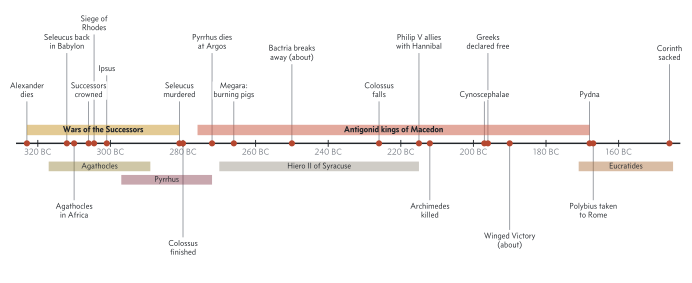
Seleucids, Antigonids, and Bactria
When Alexander died in 323 BC, his generals made his simple-minded half-brother and his baby son joint kings and shared out the provinces among themselves as satraps, governors under the old Persian title (Chapter 8). Within thirteen years both kings had been murdered (Chapter 20), and the generals, the Successors, were fighting openly for themselves. In 306 BC Demetrius won a sea battle off Salamis, a city on Cyprus with the same name as the island where Xerxes’s fleet was beaten (Chapter 9), and his father Antigonus took the title of king. The others followed within two years: Ptolemy in Egypt (Vol. 5, In the Beginning), Seleucus in Babylon, Lysimachus in Thrace, and Cassander, the son of Alexander’s regent Antipater, in Macedon. Plutarch tells how Demetrius’s friends drank to him and his father as kings and to the others with mocking titles: Seleucus was “Master of the Elephants,” Ptolemy “High Admiral,” and Lysimachus “Treasurer.”
Ipsus was the other kings’ answer to Antigonus. Afterward the winners divided his lands (Figure 21.2). Lysimachus, once one of Alexander’s bodyguards, added most of Asia Minor to Thrace, where he had founded a capital named after himself, Lysimachia (lis-ih-may-kee-uh). Cassander kept Macedon and Thessaly, Ptolemy held Egypt and the coast of Syria south of the river Eleutherus, and Seleucus took Syria to the north and everything east of it. Demetrius escaped with nine thousand men. He still had the strongest fleet in the eastern Mediterranean, the island of Cyprus, the Phoenician ports of Tyre and Sidon, and Corinth, but he was a king without a kingdom.
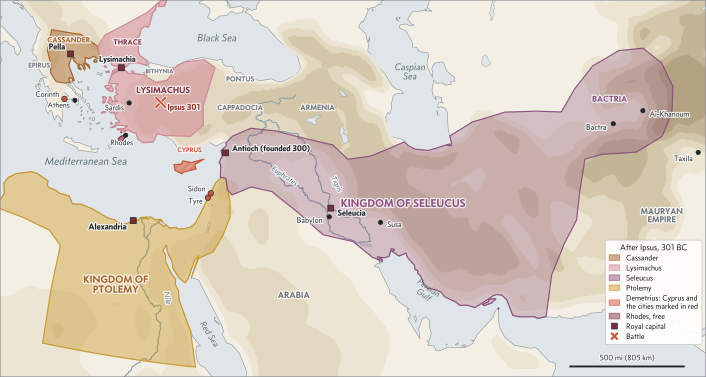
Seleucus and his kingdom
Seleucus had the largest share. He was born about 358 BC at Europus, in the north of Macedon, the son of a nobleman named Antiochus, and he crossed into Asia with Alexander as a young officer. In India he commanded the Shield-bearers, the elite infantry of the royal guard. At the mass wedding at Susa in 324 BC (Chapter 20), Seleucus was given Apama, the daughter of Spitamenes, the Sogdian chief who had fought Alexander for two years. Nearly every other officer put away his Iranian bride after Alexander’s death. Seleucus kept his, and their son, Antiochus I, was half Iranian.
In 321 BC Seleucus became satrap of Babylon. Antigonus drove him out in 316 BC, and he fled to Ptolemy in Egypt. In 312 BC he rode back into Babylonia with about a thousand soldiers lent by Ptolemy and won the province again. The people of Babylon counted the years from his return, and the Seleucid era, as historians call that count, stayed in use in Syria and Mesopotamia for centuries. Then he marched east, through Iran to the Indus. There he met Chandragupta Maurya (chun-druh-gup-tuh mow-ree-uh), who had built a new empire across northern India. Seleucus gave up the Indus lands and what is now southern Afghanistan, and in return Chandragupta gave him five hundred war elephants. They decided the day at Ipsus.
Seleucus founded new cities and named them after his family. In 300 BC he laid out Antioch on the river Orontes (oh-ron-teez) in Syria, named for his father or his son, both called Antiochus, and it became one of the great cities of the ancient world. Seleucia on the Tigris, founded a few years earlier, drew so many people that old Babylon slowly emptied. In 299 BC he made an alliance with Demetrius and married his daughter Stratonice (struh-ton-ih-see). In 281 BC he beat and killed Lysimachus at Corupedium (kor-yoo-pee-dee-um), near Sardis, and crossed into Europe to claim Macedon itself. A few months later, as he walked near Lysimachia, he was stabbed to death by Ptolemy Keraunos (keh-row-nos), “the Thunderbolt,” an exiled son of the king of Egypt who had taken refuge at his court. Seleucus was in his seventies, the last of Alexander’s great generals.
His heirs, the Seleucids, ruled Syria for two hundred years more, over Babylonians, Persians, Syrians, Arabs, and Jews. Yet the ruling house never belonged to any of them. Macedonians spoke a dialect of Greek, or a close cousin of it, and worshiped the Greek gods (Chapter 18), and Seleucus I, the founder, was a Macedonian Greek,Seleucus I belonged to this ethnic group. → Greeks• as were the officers, governors, and settlers who ran his kingdom. The new cities were Greek cities, with gymnasiums, theaters, and councils, and their citizens were Greek soldiers and their families. Even the Jews of Judea, who rose against the Seleucid king Antiochus IV in 167 BC (Vol. 5, In the Beginning), counted their years by the Seleucid era. First Maccabees, their history of the revolt, dates his reign in the King James Version to “the hundred and thirty and seventh year of the kingdom of the Greeks.”
The Antigonids of Macedon
Demetrius did not stay down. Plutarch, who wrote his life, calls him handsome, generous, brave, and incapable of moderation in anything. In 294 BC, when the sons of Cassander quarreled over Macedon, he murdered one of them at a dinner and was hailed as king. He ruled for six years, ordered a fleet of five hundred ships to win back his father’s empire, and frightened every other king into an alliance against him. In 288 BC they invaded from two sides, and his Macedonian army deserted to the enemy. He wandered through Asia Minor with a dwindling band until he surrendered to Seleucus, who kept him in comfort in Syria. There, Plutarch says, he spent his days hunting, dicing, and drinking, and he died in 283 BC.
His son Antigonus, called Gonatas (gon-uh-tus) for a reason nobody now knows, won back what his father had lost (Figure 21.3). In 279 BC a horde of Gauls, the Celtic peoples of central Europe, poured into Macedon and killed its king, the same Ptolemy Keraunos who had murdered Seleucus and then seized Macedon’s throne. Two years later Antigonus caught a Gallic army near Lysimachia and destroyed it, and the Macedonians took him as their savior and king. He held the throne, with one interruption, until 239 BC, kept garrisons in Corinth and other strongholds of Greece, and counted among his friends the philosopher Zeno, whose Stoic school Chapter 22 will describe. His descendants, the Antigonids, ruled Macedon until 168 BC.
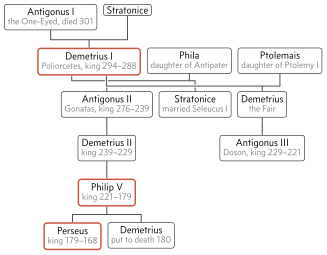
The Greek kings of Bactria
Far to the east, beyond the deserts of Iran, lay Bactria, the plain of the upper Oxus river in what is now northern Afghanistan, with Sogdiana beyond it. Alexander had spent two hard years conquering it and had left thousands of Greek soldiers there to hold it. They hated it, and after his death many tried to march home. Those who stayed farmed its fertile valleys and grew rich on the caravan trade. About 250 BC their governor, Diodotus (dy-od-uh-tus), stopped obeying the Seleucid king, who was busy with wars in the west, and soon called himself king. The Seleucid Antiochus III marched out to win the province back and besieged its capital, Bactra, for two years, from 208 to 206 BC. The Greek historian Polybius, whose life comes later in this chapter, says the Bactrian king, Euthydemus (yoo-thih-dee-mus), who had overthrown Diodotus’s son, warned him that hordes of nomads waited on the frontier and that both of them would be ruined if Bactria fell. Antiochus made peace and marched away.
The kings of Bactria were Greeks,The rulers of the Bactrian kingdom were of this ethnicity. → Greeks• and so were their cities. In 1961 the king of Afghanistan, out hunting near the Oxus, was shown the carved top of a Greek column that had been found there, and French archaeologists went on to uncover a whole city at Ai-Khanoum (eye-khah-noom). It had a palace, a gymnasium, and a theater that held about six thousand people. In a shrine stood a stone carved with the wise sayings of Apollo’s temple at Delphi, copied there, an inscription says, by a man named Clearchus (klee-ar-kus). Its last lines survive, and they tell a man how to live: well behaved as a child, self-controlled as a youth, just in middle age, wise in old age, and at death without grief. That was a Greek education, set up some 2,500 miles from Delphi.
The Bactrian Greeks were bold enough to invade India about 180 BC. Their most daring king, Eucratides (yoo-krat-ih-deez), seized the throne about 171 BC, fought off the Parthians, the Iranian horsemen who were tearing away the Seleucid provinces west of him, and led his own army into India. His coins in silver and gold show his portrait in a crested cavalry helmet, and Eucratides I struck a gold coin of twenty statersEucratides I created exceptionally large examples of these objects. → coins• (Figure 21.4). A stater (stay-ter) was the standard Greek gold coin, about a third of an ounce. Twenty of them in one piece weigh 169 grams, about 6 ounces, and the coin is more than 2 inches across, the largest gold coin known from the ancient world. It was perhaps made as a gift, not to spend, and the one surviving example was found at Bukhara (boo-kar-uh), in what is now Uzbekistan.

Eucratides’s end was grim. The Roman writer Justin abridged a lost history of the world in the second or third century AD. He says that Eucratides was murdered on his way home from India by his own son, who drove his chariot through his father’s blood and left the body unburied. Many historians doubt that the killer was his son. Either way, the kingdom did not long survive him. About 145 BC nomads sacked Ai-Khanoum, and by about 130 BC the tribes Euthydemus had warned of held Bactria. Greek kings lasted another century in northwestern India.
Rhodes, Pyrrhus, and the wars of kings
The siege of Rhodes
The island of Rhodes lies off the southwest corner of Asia Minor (Figure 21.5), about 50 miles long, with Crete to its west and Egypt across the sea to the south. Its people were Dorians, the Greeks whose dialect was spoken in Sparta and Corinth (Chapter 6). Dorians founded Lindus (lin-dus), Ialysus (eye-al-ih-sus), and Camirus (kuh-my-rus),Dorians established the city-states of Camirus, Ialysus, and Lindus on this island. → Rhodes• the three old cities of the island: Lindus on the east coast, Ialysus on the north, and Camirus on the west. Homer already knew them. In A. T. Murray’s translation of the Iliad, the Rhodians sailed to Troy from an island “sundered in three divisions—in Lindos and Ialysus and Cameirus, white with chalk.” In 408 BC the three cities joined to found a single new city at the island’s northern tip, also named Rhodes. Its harbors made it the meeting place of the trade between Egypt, Asia, and Greece, and its fleet hunted the pirates of the Aegean. The Rhodians tried to stay friends with every king, and they were closest to Ptolemy, whose grain ships filled their docks.
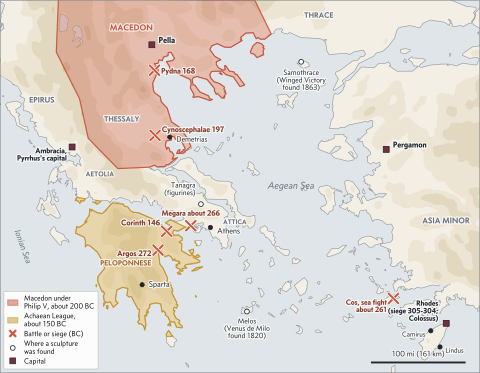
When Antigonus went to war with Ptolemy, the Rhodians refused to join him, and in 305 BC he sent Demetrius to force them onto his side. Diodorus says that Demetrius brought 40,000 soldiers, 200 warships, and about a thousand private vessels whose owners hoped to share the plunder, so that the whole strait between Rhodes and the mainland seemed covered with ships. The Rhodians armed every citizen and foreigner they had, and promised freedom to any slave who fought well. For a year Demetrius tried everything: ships carrying towers, mines under the walls, and catapults throwing stones as heavy as a man. His masterpiece was the Helepolis (heh-lep-uh-lis), “taker of cities,” a siege tower nine stories high and about 130 feet tall, on eight great wheels (Figure 21.6). Its front and sides were plated with iron against fire, its windows had shutters padded with skins, and every floor carried catapults or dart-throwers. Diodorus says it took 3,400 of the strongest men in the army to push it forward.

The Rhodians fought back with fire and stone. They knocked loose some of the iron plates, and Demetrius pulled the tower back before it burned. The Roman architect Vitruvius tells a different story, in which a Rhodian engineer named Diognetus (dy-og-nih-tus) flooded the ground in front of the walls with water and sewage, and the great tower sank in the mud and never moved again. The siege also gave the age one of its kindest stories. The painter Protogenes (proh-toj-uh-neez) had spent seven years on a picture of Ialysus, the hero for whom the old city of Ialysus was named, and it was in a suburb that Demetrius took. The Rhodians begged him to spare it, and Plutarch says, in Clough’s translation, that Demetrius answered “that he would rather burn the pictures of his father than a piece of art which had cost so much labor.”
Ptolemy’s ships kept slipping supplies into the harbor, and in 304 BC Demetrius made peace and sailed away, leaving his engines behind. He had already earned the nickname he kept forever, Poliorcetes (pol-ee-or-see-teez), “the Besieger,” though the most famous of his sieges was a failure. The Rhodians had beaten off Demetrius,Demetrius Poliorcetes unsuccessfully besieged this island in 305–304 BC. → Rhodes••This statue of Helios commemorated an island’s resistance to Demetrius Poliorcetes. → Colossus of Rhodes•Demetrius Poliorcetes, later a ruler of this kingdom, used the Helepolis siege tower against Rhodes. → Macedon• the man who would one day be king of Macedon, and they sold the engines he left behind, the Helepolis among them, for 300 talents. They spent the money on the Colossus, a giant bronze statue of their island’s patron god, Helios, the sun, to celebrate their deliverance.
The Colossus
The sculptor was Chares (kair-eez) of Lindus, a pupil of Lysippus, who had made Alexander’s portraits. The work took him twelve years, and it was finished about 280 BC. Bronze plates were fastened over a frame of iron bars, and the inside was weighted with blocks of stone. The ancient writers give its height as 70 cubits, about 105 feet, and it rose from a stone base near the harbor. The Greek lists of the seven greatest works of human hands, which counted the statue of Zeus at Olympia (Chapter 11), included it, and Rhodes’s Colossus of Helios was one of the Seven Wonders.This island’s Colossus of Helios was one of the Seven Wonders of the Ancient World. → Rhodes•• The Greek word kolossos had meant any statue; this one made it mean a giant, and gave English the word “colossal.” Coins of Rhodes show the sun god’s face with rays standing up from his hair (Vol. 4, Classical Myth), and the statue probably looked much the same.
It stood for fifty-four years. Then an earthquake in 226 BC threw down the Colossus,An earthquake in 226 BC toppled this ancient statue. → Colossus of Rhodes•• along with much of the city. The geographer Strabo says it broke at the knees, and that the Rhodians did not raise it again because of an oracle. Even lying on the ground it drew visitors. The Roman writer Pliny the Elder, in the first century AD, says that few men could put their arms around its thumb, and that its broken limbs gaped like caverns, full of the stones that had steadied it. It lay there for nearly nine hundred years. A Byzantine chronicle says that in AD 653 Arab raiders sold the bronze to a merchant who loaded it on 900 camels; historians doubt it. The famous picture of the Colossus standing astride the harbor mouth, with ships sailing between its legs, was dreamed up in the Middle Ages. No bronze statue that size could have stood that way, and the fallen giant would have blocked the harbor.
Agathocles of Syracuse
The Successors were not the only kings of the age. Syracuse, the greatest Greek city of Sicily (Chapter 4), had a self-made one. Agathocles (uh-gath-uh-kleez) was born in 361 BC, the son of a potter, and moved to Syracuse as a young man when the Corinthian general Timoleon (ty-moh-lee-un) (Vol. 5, In the Beginning) invited new settlers to fill the half-empty city. He rose as a soldier, married a rich widow, and twice was driven into exile by the oligarchs who ran the city. In 317 BC, back in command of the army, he turned it on them. Diodorus says that his men killed more than four thousand of the rich and their friends, and that six thousand more fled. Agathocles made himself tyrant of SyracuseThis city's tyrants included Agathocles. → Syracuse• by that massacre, though he called himself the people’s general and promised them a cancellation of debts.
Then he took on Carthage, the Phoenician city of North Africa that held the west of Sicily. In 311 BC the Carthaginians beat him at the river Himera and besieged Syracuse itself. Agathocles did something no one expected. In August 310 BC he slipped out of the harbor with sixty ships, crossed to Africa, and, Diodorus says, burned his ships on the beach, so that his men could win or die but never sail home. For three years he plundered the farmland around Carthage and won battle after battle, while the Carthaginians, in Diodorus’s account, sacrificed children of their noblest families to win back the favor of their gods (Vol. 5, In the Beginning). In 307 BC he lost, slipped away to Sicily, and left his army and his sons to die. In 304 BC, as the Successors had done two years earlier, he took the title of king. Demetrius’s friends toasted him too, Plutarch says, as “Governor of the Island of Sicily.” He died in 289 BC. His daughter Lanassa (luh-nas-uh) had married the most restless king of them all.
Pyrrhus of Epirus
Epirus was the mountain country of northwestern Greece, west of the Pindus range, the land of the Molossians (Chapter 9) and of the oracle of Zeus at Dodona (doh-doh-nuh), where, the Greeks believed, the god made his will known in the rustling of a sacred oak. Its royal house claimed descent from Achilles’s son Neoptolemus, and Alexander’s mother Olympias was one of its princesses (Chapter 18). Pyrrhus (pir-us), the son of her cousin, was born in 319 or 318 BC and became king at thirteen. Driven out at seventeen, he fought at Ipsus beside Demetrius, who had married his sister, then lived as a hostage at Ptolemy’s court in Alexandria, where he charmed the queen and married her daughter. In 297 BC Ptolemy sent him home with money and men, and Pyrrhus ruled EpirusThis kingdom was led by Pyrrhus. → Epirus• for the rest of his life. Plutarch says the Epirotes called him their “Eagle,” and in Clough’s translation he answered, “By you I am an eagle; for how should I not be such, while I have your arms as wings to sustain me?”

Pyrrhus was the finest soldier of his generation and a poor judge of what to do next. Antigonus Gonatas compared him, Plutarch says, to a dice player who threw well but did not know how to use his throws. He held half of Macedon for a while and lost it. In 280 BC he crossed to Italy to help the Greek city of Tarentum against Rome. He beat the Romans twice at such a cost that a “Pyrrhic victory” still means one that ruins the winner, fought Carthage in Sicily, and came home in 275 BC with what was left of his army (Vol. 7, The Romans). The next year he drove Antigonus out of most of Macedon, and his Gallic mercenaries dug up the tombs of the Macedonian kings at Aegae looking for gold (Chapter 18).
In 272 BC he invaded the Peloponnese, failed to take Sparta, and tried to seize Argos by night. His men got through a gate that a traitor had opened, but his elephants were too tall for the gateway, and the delay let the Argives and Antigonus’s troops pour into the town. At dawn Pyrrhus found himself fighting in narrow streets, with his own reinforcements jamming the gate and a giant elephant fallen across it. An Argive soldier wounded him with a spear, and Pyrrhus turned on the man. Plutarch tells what happened next. The soldier’s mother was watching from a rooftop with other women, and when she saw her son in danger she “took up a tile with both hands, and threw it at Pyrrhus.” The roof tile struck PyrrhusAccording to tradition, a woman’s roof tile struck this ruler of Epirus during fighting at Argos. → Pyrrhus• below the helmet, at the back of the neck, and he fell from his horse stunned. A soldier of Antigonus’s named Zopyrus (zop-ih-rus) dragged him into a doorway and hacked off his head. When Antigonus’s son brought him the head, Antigonus struck the boy, covered his face with his cloak, and wept, thinking of his own father and grandfather.
The pigs of Megara
War elephants had come west with Alexander’s successors. Seleucus had his from India, and the Ptolemies caught smaller ones in Africa (Vol. 5, In the Beginning). Each carried a driver on its neck, called a mahout (muh-howt), and sometimes a wooden tower full of archers on its back. Horses that had not been trained beside them would bolt at their smell and their trumpeting, and an elephant charge could break a line of infantry. But elephants could panic too, and a panicking elephant trampled its own side. Their enemies looked for anything that might frighten them.
Antigonus Gonatas kept elephants of his own. Polyaenus, the second-century collector of stratagems, tells how he brought them up against the walls of Megara, the city on the isthmus between Athens and Corinth, probably during his war with Athens and Sparta about 266 BC. The Megarians smeared pigs with pitch, set them alight, and drove them out of the gates. Shrieking and burning, the pigs ran straight at the elephants, and the burning pigs terrified Antigonus’s elephants,According to ancient accounts, defenders at Megara frightened these war animals with burning pigs. → elephants••According to Polyaenus, burning examples of these animals frightened Antigonus’s war elephants at Megara. → pigs• which broke their ranks and stampeded through the Macedonians. Polyaenus adds that Antigonus learned his lesson. From then on he ordered his Indian mahouts to keep pigs among the elephants, so that the beasts would grow used to their squealing.
Rome and the end of Macedon
While the kings fought one another, a new power grew in the west. By 270 BC Rome, a republic governed by its Senate and its elected consuls, ruled all of Italy south of the Po valley. Its army was built of legions, citizen infantry about 4,200 strong, each with 300 horsemen, armed with throwing spears and short swords and drawn up in small blocks called maniples, about 120 men apiece, which could move on their own (Vol. 7, The Romans). From 264 to 241 BC Rome fought Carthage for Sicily and won it, in the first of the wars the Romans called Punic, from their word for Phoenicians. In 218 BC, at the start of the Second Punic War, the Carthaginian general Hannibal crossed the Alps into Italy and destroyed one Roman army after another, the largest at Cannae (kan-ee) in 216 BC (Vol. 5, In the Beginning). This chapter watches what happened when its legions met Alexander’s phalanx (Chapter 18).
Philip V and Cynoscephalae
The king of Macedon in those years was Philip V, the son of Demetrius II. He was nine when his father died, and his father’s cousin Antigonus III ruled as his guardian until Philip became king at seventeen, in 221 BC. He was clever, popular, and violent. When the news of Cannae reached Greece, Philip sent envoys to Hannibal’s camp in Italy, and in 215 BC Philip V allied with Hannibal and CarthagePhilip V of this kingdom allied with Carthage during the Second Punic War. → Macedon• against Rome. Polybius copied the treaty into his history. The two sides swore by the gods of Carthage and of Greece to help each other until Rome was beaten. The Romans caught Philip’s envoys on their way home, read the treaty, and sent a fleet across the Adriatic. The war that followed, the First Macedonian War, ended in a draw in 205 BC. Rome had not forgotten.
Philip then made war on the Greek cities of the Aegean, and in 201 BC Rhodes and Attalus I, king of Pergamon in northwestern Asia Minor, asked Rome for help. In 200 BC the Romans declared war again. Their commander from 198 BC was a young consul named Titus Quinctius Flamininus (flam-ih-ny-nus), who spoke Greek and liked the Greeks. In June 197 BC the two armies stumbled into each other in fog among a range of hills in Thessaly called Cynoscephalae, “the Dogs’ Heads.” Philip’s right wing charged downhill with leveled pikes and drove back the Romans in front of it. But his left wing was still coming over the ridge in column when Flamininus struck it with elephants and legions and broke it. Then an officer whose name Polybius does not record took twenty maniples, about 2,500 men, from the winning Roman wing, turned them around, and fell on the rear of Philip’s victorious phalanx. Men packed in ranks sixteen deep, each holding a pike some 20 feet long, could not turn to face an enemy behind them. On the ridge, the beaten men of Philip’s left wing raised their pikes upright, the Macedonian sign of surrender. Polybius says Flamininus understood and held his men back, but Romans farther ahead fell on them and went on killing.
Flamininus did not destroy Macedon. At the Isthmian Games at Corinth in 196 BC his herald announced that the Greeks of the cities Philip had held were free, and could live under their own laws without garrisons or tribute. Plutarch says the stadium roared so loudly that, in Clough’s translation, “Crows that were accidentally flying over the course, fell down dead into it.” Two years later the legions went home. They were back in 191 BC, when the Seleucid Antiochus III invaded Greece, and Rome drove him out of Greece and then beat him in Asia Minor.
Perseus and Pydna
Philip spent his last years rebuilding his army and quarreling with his sons. His elder son, Perseus, persuaded him that the younger, Demetrius, who had lived in Rome as a hostage and had friends there, was plotting against him, and in 180 BC Philip had Demetrius put to death. He died the next year, and Perseus became king. Rome watched him make alliances among the Greeks and declared war in 171 BC. In 168 BC the consul Lucius Aemilius Paullus (ee-mil-ee-us pawl-us), a soldier of about sixty, took command and met the Macedonian army near Pydna (pid-nuh), on the coast below Mount Olympus. The night before the battle the moon went dark in an eclipse, and the Macedonians took it as a sign that their king would fall. On the afternoon of June 22, 168 BC, the phalanx advanced across the plain. Paullus said afterward that he had never seen anything so terrible. But as it pressed forward over rising, broken ground, gaps opened in its front, and Roman soldiers slipped into them with their swords, inside the reach of the pikes. The battle lasted about an hour. The Roman historian Livy, who wrote under the emperor Augustus, found sources that put the Macedonian dead at up to twenty thousand. At Cynoscephalae and at Pydna the legions broke Macedon’s phalanxes,Roman victories at Cynoscephalae and Pydna broke the power of this kingdom’s phalanxes. → Macedon•• and with them the power of Alexander’s kingdom.
Perseus fled to the island of Samothrace (sam-oh-thrayss) and took refuge in its sanctuary, then gave himself up. He walked in chains in Paullus’s triumph at Rome and died a prisoner in Italy. Rome did not want Macedon as a province yet, but it would not let it be a kingdom again. Rome partitioned Macedon into four republics,This Antigonid kingdom was partitioned after Rome defeated its king Perseus at Pydna. → Macedon•• each with its own council, and forbade their people to marry or buy land across the new borders. The next year Paullus’s soldiers sacked seventy towns of Epirus, which had sided with Perseus, and sold 150,000 people as slaves. After a pretender to the throne raised a revolt in 149 BC, Rome crushed him and made Macedonia a province.
Polybius and the fall of Corinth
The historian of these wars lived through them. Polybius, the son of a general of the Achaean League, was born at Megalopolis in Arcadia about 200 BC. The Achaean League was a union of the cities of Achaea, the strip along the north coast of the Peloponnese, and by 191 BC it had drawn in the whole peninsula. Its cities kept their own laws but sent delegates to a common assembly and followed one elected general in war. Polybius commanded its cavalry in 169 BC. After Pydna the Romans took a thousand leading Achaeans to Italy as hostages for good behavior, and he was one of them. In Rome he became the friend and tutor of Paullus’s son, Scipio Aemilianus (sip-ee-oh ee-mil-ee-ay-nus), who had been adopted into the family of the Scipios. He set himself to explain, in Paton’s translation, “by what means and under what system of polity the Romans in less than fifty-three years have succeeded in subjecting nearly the whole inhabited world to their sole government.” His Histories, in forty books, of which five survive whole, are the best account we have of the Hellenistic world’s last century of freedom.
The hostages came home in 150 BC, and the Achaean League soon quarreled with Rome over Sparta, which wanted to leave it. In 146 BC the League’s leaders chose war. A Roman army from Macedonia broke one Achaean force, and the consul Lucius Mummius (mum-ee-us) arrived with 23,000 infantry and beat the last one outside Corinth, the League’s chief city. The Romans waited three days, suspecting a trap, and then marched in. Mummius sacked CorinthLucius Mummius sacked this city in 146 BC after defeating the Achaean League. → Corinth••• on the Senate’s orders: the men were killed, the women and children sold, and the city burned. Its statues and paintings were shipped to Rome. Polybius, who arrived soon after, saw soldiers throwing famous paintings on the ground and playing dice on them, as the geographer Strabo reports. A Roman historian of the first century AD, Velleius Paterculus (vuh-lee-us puh-tur-kyuh-lus), tells that Mummius warned the shippers that if they lost any of these masterpieces they would have to replace them with new ones. In the same year another Roman army leveled Carthage (Vol. 7, The Romans). Greece south of Macedon came under the governor of Macedonia, and Corinth stayed empty for a hundred years. The Hellenistic age itself went on in the east for another century, until the last of the kingdoms, Cleopatra’s Egypt, fell to Rome after the battle of Actium in 31 BC (Vol. 5, In the Beginning).
Hellenistic poetry and New Comedy
Menander
Athens lost its power in the age of the kings, but it kept its theater. Old Comedy, the comedy of Aristophanes, had mocked living politicians by name and brought gods and talking birds onstage (Chapter 15). By the time of Alexander it had given way to a quieter kind. Its master was Menander, an Athenian of a rich family, born about 342 BC, a pupil, Diogenes Laërtius says, of Aristotle’s successor Theophrastus (Chapter 19) and a friend of Demetrius of Phaleron. He wrote 108 comedies and won first prize eight times. Menander was the master of New Comedy,Menander pioneered the "New" form of this genre. → ancient Greek comedy•• the comedy of manners: plays about ordinary families in ordinary houses, with no politics and no fantasy. The plots turn on love, money, mistaken identity, and long-lost children found again, and they end in a wedding. The characters are types the audience knew at once from their masks: the young man in love, the stern father, the clever slave, the boastful soldier, the cook. The chorus no longer takes part. It only dances between the five acts.
Ancient readers loved him. The Alexandrian scholar Aristophanes of Byzantium, no kin to the comic poet, asked whether Menander had imitated life or life Menander. One of his lines, from a lost play, reached the New Testament, where the apostle Paul (Vol. 5, In the Beginning) quotes it to the Corinthians, in the King James Version, as “evil communications corrupt good manners.” The Roman playwrights Plautus and Terence turned many of his plays into Latin, and through them his plots came down to Shakespeare and Molière (mol-yair). Yet the Greek plays themselves were lost in the Middle Ages, and for centuries Menander was known only from quotations.
The Dyskolos
Then the papyri began to come back from the sands of Egypt (the Stage). In the 1950s a Swiss collector, Martin Bodmer, bought a papyrus book of the third century AD, and in 1958 it was published: Menander’s Dyskolos (dis-kuh-los), “The Grouch,” almost complete, the only comedy of his that survives nearly whole. It had won first prize at the Lenaia in 316 BC, when he was about twenty-five.
The god Pan opens the play in front of his shrine at Phyle (fy-lee), a farming village in the hills of Attica. Next door, he tells us, lives Knemon (nee-mon), the grouch of the Dyskolos,This author's Dyskolos centers on the grouchy Knemon. → Menander• an old farmer who hates everybody and throws clods at anyone who crosses his land. He has driven his wife away to live with her son by an earlier marriage, Gorgias, a poor and honest young farmer. Knemon’s daughter, who honors Pan’s nymphs, is the only good thing in his life, and Pan has made a rich young Athenian, Sostratos (sos-truh-tos), fall in love with her at first sight. Sostratos sends a slave to ask Knemon for her, and the slave comes back pelted with pears and stones. To win the old man over, Sostratos puts on a leather jerkin and spends a day digging in the fields, and goes home stiff and sunburned without even seeing him. Then everything falls down Knemon’s well: first his bucket, then the mattock, a heavy hoe, that his old servant uses to fish for it, and at last Knemon himself, who climbs down after them. Gorgias goes down on a rope and Sostratos hauls them up, though, he admits, he was mostly gazing at the girl. Shaken, Knemon makes a long speech admitting that no man can live entirely alone, adopts Gorgias, and gives Gorgias charge of his daughter’s marriage. Sostratos gets the girl, and Gorgias gets Sostratos’s sister. In the last scene the cook and a slave whom Knemon had insulted haul the sleeping old man outside and torment him with requests for pots and pans until he agrees to come to the wedding party.
Apollonius and Theocritus
The poets of the age worked mostly at the courts of kings, and above all at Alexandria, where the Ptolemies kept scholars and poets at the Library (Vol. 5, In the Beginning). One of its librarians, Apollonius (ap-uh-loh-nee-us), wrote the Argonautica, the epic of Jason and the Golden Fleece (Vol. 4, Classical Myth). He was a native of Alexandria, or perhaps of Naucratis, but Apollonius was called “of Rhodes.”This island supplied the epithet of Apollonius, author of the Argonautica. → Rhodes• The ancient lives of the poet explain why. When he first read the Argonautica aloud in Alexandria it failed, they say, and in his shame he moved to Rhodes, where he revised the poem, taught, and was made a citizen. Modern scholars suspect the story was invented to explain the name, which may mean no more than that he lived on the island or wrote about it.
The most original poet of the age came from Syracuse. Theocritus (thee-ok-rih-tus), born about 300 BC, worked on the island of Cos and in Alexandria under Ptolemy II, and wrote short poems that later readers called Idylls, from a Greek word for a “little picture.” Some are scenes of city life. In one, two Syracusan housewives living in Alexandria push through the crowds to see the festival of Adonis at the palace, chattering about their husbands and the price of dresses. But his most famous Idylls are set in the countryside of Sicily, and they invented a new kind of poetry. Pastoral poetry takes its name from the Latin pastor, “shepherd,” and is also called bucolic, from the Greek for “cowherd.” Its herdsmen live in a beautiful landscape, sing to one another in contests, fall in love, and mourn their dead, and pastoral poetry pictures shepherds’ lives,Pastoral poetry traditionally depicts the lives of these people. → shepherd•• though the shepherds talk like poets. In the first Idyll, a shepherd named Thyrsis (thur-sis), sitting under a pine with a goatherd, sings the death of Daphnis (daf-nis), the herdsman-poet who would not yield to love and wasted away while the gods themselves asked what ailed him. In another, the one-eyed Cyclops Polyphemus (pol-ih-fee-mus), the monster of the Odyssey (Chapter 2), sits on a rock by the sea and sings to the sea nymph Galatea (gal-uh-tee-uh), who will not have him, until song cures him of his love. Two centuries later the Roman poet Virgil imitated Theocritus in his Eclogues, and moved the shepherds from Sicily to an imagined Arcadia (Vol. 7, The Romans). The pastoral poems of the Renaissance and after descend from those Sicilian herdsmen.
Hellenistic sculpture
Sculptors of the fifth century BC had carved gods and athletes calm, balanced, and ideal, like the figures on the Parthenon (Chapter 11). Their Hellenistic successors wanted motion, emotion, and surprise. They carved figures twisting in space, faces in agony, old market women, drunks, and sleeping children, for kings who wanted to dazzle and cities that wanted to boast. Many of the most famous Greek statues in the world’s museums come from these centuries.
The Winged Victory of Samothrace
Samothrace is a small, steep island in the northern Aegean, and in antiquity it was famous for the sanctuary of the Great Gods, whose secret rites were believed to protect sailors at sea (Vol. 4, Classical Myth). In the spring of 1863 Charles Champoiseau (shahm-pwah-zoh), the French vice-consul at Adrianople, now Edirne in Turkey, and an amateur archaeologist, was digging there. On April 13 his workmen uncovered the body of a great marble statue of a woman, in pieces, with fragments of wings. Champoiseau found the statue on Samothrace,Charles Champoiseau found this sculpture at the sanctuary of the Great Gods on Samothrace. → Winged Victory of Samothrace•• in the sanctuary of the Great Gods, and he shipped it to the Louvre in Paris. It was the goddess Nike, Victory (Chapter 11).
The statue is now called the Winged Victory of Samothrace (Figure 21.8). Its head and arms have never been found, but what remains is enough. A headless, armless Victory spreads her wingsA headless, armless goddess with windblown drapery and spread wings forms this sculpture. → Winged Victory of Samothrace•• as she lands, leaning into the wind, and her thin dress is blown flat against her body in front and streams out in folds behind. Champoiseau had left on the island a heap of gray marble blocks he had not thought worth shipping. In 1875 Austrian archaeologists saw that, put together, they made the prow of a warship, and that the goddess had stood on it, as if alighting on the deck of the winning ship after a sea battle. Champoiseau went back in 1879 for the blocks. The Victory stands on a gray-marble ship’s prow,This sculpture stands on a ship’s-prow base made of gray marble from Rhodes. → Winged Victory of Samothrace•• and the marble came from the quarries of Lartos on Rhodes. In 1950 a Louvre curator digging with American archaeologists found her right hand, raised in greeting and holding nothing.


Who set her up, and for which battle, is unknown, because no dedication has been found. She is Greek work through and through, carved by Greek sculptors and set up on a Greek island, and Greece produced the Winged Victory;This country produced The Winged Victory of Samothrace. → Greece• the Greek government has asked France to send her back, so far without success. The Rhodian marble suggests the Rhodians as her donors, and many scholars date her about 190 BC, when the Rhodian fleet beat the fleet of Antiochus III. One older proposal connects the Victory with the battle of Cos,A proposed interpretation links this naval victory monument to the Battle of Cos. → Winged Victory of Samothrace• a sea fight about 261 BC in which Antigonus Gonatas beat the fleet of Ptolemy II off the island of Cos and then dedicated his flagship to Apollo. The Louvre had the statue reassembled, with a plaster wing to match the surviving one, and in 1884 set her at the top of its great Daru staircase,This sculpture resides at the top of the Daru staircase in the Louvre. → Winged Victory of Samothrace•• where visitors climb toward her as if she were landing on the ship of their own victory.
The Venus de Milo and the Farnese Hercules
The Louvre owns the other famous statue of the age. On April 8, 1820, a farmer on the island of Melos, then ruled by the Ottoman Turks, was digging in his field when he broke into a buried niche. A French naval officer watching nearby urged him on, and together they brought up the upper half of a marble woman, then the lower half. Officers of the French navy reported the find to their ambassador at Constantinople, his agent bought it, and the statue was presented to King Louis XVIII, who gave it to the Louvre in 1821. Melos is spelled Milos today, and the armless Aphrodite found on MilosThis armless ancient statue of Aphrodite was discovered on Milos and is now displayed in the Louvre. → Venus de Milo•• is known by her Roman name, the Venus de Milo, “Venus of Milos.” She stands a little over 6½ feet tall, bare to the hips, her drapery slipping, her arms long since broken off. A marble hand holding an apple was found near her, and she may have held it, the prize Paris gave Aphrodite (Vol. 4, Classical Myth).
At first the French called her a work of the fourth century BC, perhaps by Praxiteles himself (Chapter 18), the most famous sculptor of goddesses. But a block found with her, which fitted her broken base, bore a sculptor’s signature: a name ending in -andros, “son of Menides (men-ih-deez), of Antioch on the Maeander.” Scholars restore the name as Alexandros. That Antioch, a town on the river Maeander in Asia Minor and not Seleucus’s great city in Syria, was founded after 280 BC, so the statue was later. The block was drawn in Paris and then lost, and some later writers suspected that it had been mislaid on purpose because it spoiled the claim. Today most scholars date the statue to the second century BC and attribute the Venus de Milo to Alexandros of Antioch,This Hellenistic statue has been attributed to Alexandros of Antioch, though it was once associated with Praxiteles. → Venus de Milo•• though they admit that the lost signature may have belonged to another statue found with her.
Not every famous Hellenistic statue survives in the original. The Greek sculptor Lysippus, in the fourth century BC, made a bronze of Heracles resting after his labors, and Roman sculptors copied it again and again. The grandest copy, more than 10 feet tall, was carved for the great public baths of the emperor Caracalla in Rome in the early third century AD and signed by Glykon (gly-kon) of Athens. Dug up in 1546, it passed to the Farnese (far-nay-zay), the family of the reigning pope, Paul III, and it is still called the Farnese Hercules, with the hero’s Roman name. It stands today in the National Archaeological Museum in Naples. The Farnese Heracles leans on his club,The Farnese sculpture depicts this figure leaning on a club. → Heracles• which is draped with the skin of the Nemean lion, his head bowed with weariness. Behind his back his right hand holds the golden apples of the Hesperides (hes-perr-ih-deez), the fruit of one of his last labors (Vol. 4, Classical Myth).
The Pergamon Altar
Pergamon, in the northwest of Asia Minor, began as a fortress where Lysimachus kept a treasure of nine thousand talents. Its commander, Philetaerus (fil-ih-teer-us), changed sides at the right moment and kept the money. His heirs, the Attalids, made the town a kingdom. In the 230s BC Attalus I beat the Galatians, Gauls who had crossed into Asia Minor and lived by plundering it, and he took the title of king. His son Eumenes (yoo-muh-neez) II built a library to rival Alexandria’s. Pliny tells a story that the Ptolemies, jealous, stopped selling papyrus to Pergamon, so that its scribes had to write on specially prepared animal skins, called in Latin pergamena, “parchment.” Many historians doubt the story, but the word stuck.
On a terrace of his hilltop citadel Eumenes II built a great altar, perhaps to Zeus and Athena, probably between about 180 and 160 BC. It stood on a platform about 117 feet wide, approached by a broad stairway, and around its base ran a frieze in high relief about 370 feet long, showing the battle of the gods and the Giants (Vol. 4, Classical Myth). Athena drags a winged Giant away from the ground where his mother Earth rises to beg for him; Zeus hurls thunderbolts; snake-legged Giants writhe under the gods’ feet. Pergamon’s kings had beaten the Galatians, and no visitor could miss the likeness between the gods’ victory and theirs. The last king of Pergamon, Attalus III, died in 133 BC and left his kingdom to Rome in his will, and it became the Roman province of Asia. In 1878 a German engineer, Carl Humann (hoo-mahn), began to dig on the citadel, and over eight years the frieze was shipped to Germany. The Pergamon Altar was rebuilt in Berlin,A reconstruction of the Pergamon Altar is displayed in this city. → Berlin•• its whole west front with the stairway reconstructed inside a museum built for it, the Pergamon Museum, which opened in 1930 (Figure 21.9). The altar hall closed for rebuilding in 2014 and the whole museum in 2023; the hall is due to reopen about 2027.

Tanagra figurines
Not all Hellenistic art was made for kings. In the 1870s farmers digging near the village of Tanagra (tan-uh-gruh), in Boeotia, found ancient graves full of small painted clay figures of women, most of them 4 to 8 inches tall. Terracotta, Italian for “baked earth,” is clay fired in a kiln, the stuff of flowerpots and roof tiles. The figures were pressed in molds, so that one workshop could turn out many copies of one design, then coated with white clay and painted in pink, blue, and gold after firing, and Tanagra’s terracotta figurines were mass-producedFigurines of this material were mass produced for the Mediterranean world in the Boeotian town of Tanagra. → terracotta• for buyers all around the Mediterranean. Most date from the late fourth and third centuries BC. They show women of the day as they looked in the street: wrapped in a long cloak, the himation, over a thin dress, often wearing a pointed sun hat and carrying a fan (Figure 21.10). Some may show characters from New Comedy. The figures turned up in graves, but most seem to have been ornaments of the home, buried with their owners. Workshops in Alexandria, southern Italy, and Asia Minor soon copied the style, and Tanagras became so popular with nineteenth-century collectors that forgers began to fake them.

Archimedes
The mathematician of Syracuse
From 270 to 215 BC Syracuse was ruled by Hiero II, a shrewd king who kept his city safe for half a century as Rome’s ally. His greatest subject, and Plutarch says his relative, was Archimedes (ar-kih-mee-deez) of Syracuse, in Sicily,Archimedes was from this island. → Sicily••This city was home to Archimedes. → Syracuse•• born about 287 BC, the son of an astronomer named Phidias, no kin to the sculptor. He may have studied in Alexandria, and he went on sending his discoveries to its mathematicians, among them Eratosthenes (er-uh-tos-thuh-neez), the librarian who measured the earth (Vol. 5, In the Beginning). He proved that a sphere has two-thirds the volume and two-thirds the surface of the cylinder that just encloses it, and he showed that the ratio of a circle’s circumference to its diameter, which we call pi, lies between 310⁄71 and 31⁄7. He worked out the law of the lever, and Plutarch says, in Clough’s translation, that he boasted “that if there were another earth, by going into it he could remove this.”
He is best remembered for a story told two centuries after his death by the Roman architect Vitruvius. Hiero had given a goldsmith a weighed amount of gold to make a crown for a temple. The crown came back at the right weight, but the king heard that the smith had kept some gold and mixed in silver. He asked Archimedes to find out without damaging the crown. Archimedes was thinking about it when he stepped into a full bath and saw the water run over the side. In Morris Hicky Morgan’s translation of Vitruvius, “he jumped out of the tub and rushed home naked, crying with a loud voice that he had found what he was seeking.” Archimedes ran home naked shouting “Eureka!”,This mathematician allegedly ran naked through the streets shouting "Eureka!" after discovering his namesake principle while in a bath. → Archimedes•• which is Greek for “I have found it.” He had seen that a body put in water pushes aside its own volume of water. A crown with silver in it would take up more room than the same weight of pure gold. In his book On Floating Bodies he went further, to the law now called Archimedes’s principle: water pushes up on anything in it with a force equal to the weight of the water it pushes aside.
Archimedes also built machines, and one of them is still in use. The Archimedes screw raised water for irrigation,This man is traditionally credited with a namesake screw for raising water. → Archimedes••Archimedes' Screw was a device used for this process. → irrigation•• the watering of fields that the rain does not reach. It is a spiral blade wound around an axle inside a sealed tube, set at a slant with its lower end in a river or canal. When the screw turns, each twist of the blade traps a little water at the low side of the tube and carries it up one step, until it spills out at the top into a ditch that runs to the fields (Figure 21.11). Diodorus says that Archimedes invented it on a visit to Egypt, and that the farmers of the Nile Delta watered their land with it, though no one can prove that nobody had built one before him. Vitruvius describes one turned by men treading on its outside like a treadmill. Screws of the same design still lift water and grain, and drain land in the Netherlands.
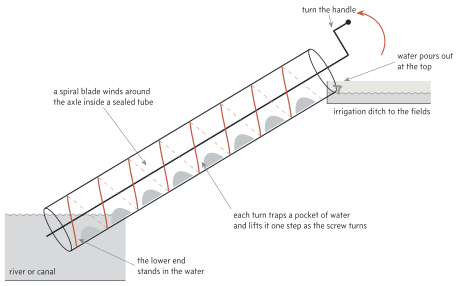
The siege of Syracuse
When Hiero died in 215 BC, after the Roman disaster at Cannae, his fifteen-year-old grandson went over to Carthage, and the boy was murdered within a year by his own subjects. The new leaders of Syracuse kept the city on Hannibal’s side in the Second Punic War (Vol. 7, The Romans). In 213 BC a Roman army and fleet under the general Marcus Claudius Marcellus (mar-sel-us) attacked it by land and sea. Archimedes, now about seventy-four, had built war machines for Hiero years before, and Polybius describes what they did. Catapults of every range hurled stones on the Roman ships as they came in. When the ships reached the wall, cranes swung out over them and dropped boulders and lumps of lead. Worst of all, in Paton’s translation, a crane would “let down an iron hand attached to a chain” that gripped a ship’s prow. Archimedes’s claw lifted Roman shipsThis mathematician devised a claw to lift Roman ships out of the water during the siege of Syracuse. → Archimedes••• until they stood on their sterns, then let them drop, so that they capsized or filled with water. Polybius sums it up: “The Romans at least, strong as they were both by sea and land, had every hope of capturing the town at once if one old man of Syracuse were removed.” Marcellus, Plutarch says, joked about fighting “this geometrical Briareus,” as if Archimedes were Briareus (bry-air-ee-us), the hundred-handed giant of myth.
Later writers added a stranger weapon. Polybius, Livy, and Plutarch say nothing about it, but the satirist Lucian, in the second century AD, wrote that Archimedes set the Roman ships on fire by some clever device. By about AD 500 the Byzantine engineer Anthemius (an-thee-mee-us) took it for granted that the device had been burning mirrors. In the twelfth century two Byzantine writers, Zonaras (zoh-nar-us) and John Tzetzes (tset-seez), told the full story: a later legend says Archimedes’s mirrors burnedA later legend credits this mathematician with using mirrors to burn Roman ships. → Archimedes••• the Roman fleet by gathering the sun’s rays on them. Renaissance artists loved the scene (Figure 21.12). The philosopher Descartes (day-kart) thought it impossible. Modern experimenters with many mirrors have set fire to a fixed wooden target in strong sun, but never to anything like a moving ship.

The death of Archimedes
Syracuse fell in 212 BC. Marcellus had climbed the wall at its lowest point during a festival of Artemis, when the guards were drunk, and in the sack that followed, Archimedes was killed. Marcellus had ordered him spared, and the stories of his death are many. Livy says a soldier killed him while he was drawing figures in the dust, not knowing who he was. Plutarch gives several versions. In one, a soldier ordered him to come to Marcellus, and he refused to go until he had finished his proof; “the soldier, enraged, drew his sword and ran him through.” In another, soldiers killed him for the instruments he was carrying, thinking them gold. The Roman writer Valerius Maximus, in the first century AD, says that Archimedes, bent over the shapes he had drawn in the dust, covered them with his hands and begged the soldier not to disturb them. “Do not disturb my circles!”This mathematician was killed by a Roman soldier at Syracuse, reportedly protesting, "Do not disturb my circles!" → Archimedes•• is the shorter form later tellings gave his last words.

Marcellus grieved for him, Plutarch says, and honored his family. Archimedes had asked that his tomb carry a sphere inside a cylinder, the figure of the proof he was proudest of. In 75 BC the Roman orator Cicero, serving as an official in Sicily, went looking for it, found it overgrown with brambles near one of the gates of Syracuse, and recognized it by the sphere and cylinder carved on top. By then Syracuse, Macedon, Corinth, and Pergamon all belonged to Rome, and the Greek world’s next masters were reading its books.
What to remember
- After Alexander’s death in 323 BC his generals, the Successors, fought for forty years. At Ipsus in 301 BC Seleucus’s Indian elephants helped beat Antigonus the One-Eyed, and the empire was split among Seleucus, Lysimachus, Cassander, and Ptolemy.
- Seleucus, a Macedonian Greek, ruled from Syria to Bactria and founded Antioch and Seleucia. Greek kings later ruled Bactria on their own; Eucratides struck the largest gold coin of antiquity.
- Demetrius Poliorcetes besieged Rhodes in 305 and 304 BC with the Helepolis and failed. With the money from his engines the Rhodians built the Colossus of Helios, one of the Seven Wonders, thrown down by an earthquake in 226 BC.
- Agathocles, tyrant and then king of Syracuse, carried his war into Africa. Pyrrhus of Epirus was killed at Argos in 272 BC by a roof tile; Polyaenus tells how the Megarians routed Antigonus Gonatas’s elephants with burning pigs.
- Philip V allied with Hannibal in 215 BC and was beaten at Cynoscephalae in 197 BC; his son Perseus lost at Pydna in 168 BC, and Rome split Macedon into four republics. In 146 BC Mummius sacked Corinth and broke the Achaean League. Polybius told the story.
- Menander created New Comedy; his Dyskolos, about the grouch Knemon, was published from a papyrus in 1958. Theocritus invented pastoral poetry, and Apollonius of Rhodes wrote the Argonautica.
- The Winged Victory of Samothrace, found by Champoiseau in 1863 and standing on a prow of Rhodian marble, crowns the Louvre’s Daru staircase. The Venus de Milo is attributed to Alexandros of Antioch; the Farnese Hercules copies Lysippus; the Pergamon Altar is in Berlin; Tanagra figurines are painted terracotta.
- Archimedes of Syracuse shouted “Eureka,” gave his name to a screw for irrigation, and defended his city with a ship-lifting claw (the burning mirrors are a later legend). A Roman soldier killed him in 212 BC.
Chapter 22 · 48 clues
The Schools of the Hellenistic Age
In 322 BC the Macedonian general Antipater crushed Athens’s last great revolt (Chapter 18). He put a garrison in the fort of Munychia, on its hill above the harbor of Piraeus, and took the vote away from every citizen who owned less than 2,000 drachmas. For two centuries the Athenians had decided for themselves, in their own Assembly, whether to make war or peace and whom to honor or exile. Now those questions were settled by kings in Pella, in Babylon, and soon in Alexandria. Aristotle, who died that same year, had taught that man is by nature a political animal, a creature made to live in a self-governing city (Chapter 19). What was such a creature to do when his city no longer governed itself?
The answers came from men who walked the same few streets. Within a mile and a half of the agora, in the century after Alexander, four groups of teachers and friends offered four different roads to a good life that no king could take away. One said: own nothing and fear nothing. One said: live by reason and let nothing else matter. One said: seek quiet pleasures among friends. One said: believe nothing and be at peace. They argued with each other for five hundred years, and the names of all four are still English words (Figure 22.1).

The Cynics
The first answer was older than the kings. Antisthenes (an-tis-thuh-neez) was born in Athens about 446 BC to an Athenian father and, the story went, a Thracian mother, so his fellow citizens never let him forget that he was not of pure Athenian blood. He studied speechmaking with the Sophist Gorgias (Chapter 14) and then fell under the spell of Socrates. Diogenes Laërtius, the biographer whose Lives and Opinions of Eminent Philosophers tells most of this chapter’s stories (the last section of this chapter says who he was), writes that Antisthenes lived in Piraeus and walked the 5 miles to Athens every day to hear Socrates. He was in the prison cell, Plato says, on the day Socrates drank the hemlock, and his portrait still stands beside his teacher’s (Figure 22.2). What he took from his teacher was not the endless questioning but the endurance: Socrates barefoot in winter, careless of money, unafraid of the jury.

Antisthenes taught that virtue alone is enough for happiness, since, in R. D. Hicks’s translation of Diogenes Laërtius (1925), it “needed nothing else except the strength of a Socrates.” Money, fame, and pleasure were worthless, and a wise man trained himself to need as little as possible. He taught in the Cynosarges, the gymnasium of Heracles just outside the city wall on the south (Figure 22.3), where sons of mixed birth like himself were allowed to exercise. He doubled his cloak so that one garment served for day and night, and he carried a staff and a beggar’s wallet. That cloak, staff, and wallet became the uniform of the Cynic movement, and later writers made Antisthenes its founder,Antisthenes is traditionally associated with the origins of this philosophical movement. → Cynicism•• though he never ran a school in the way Plato did.
His hero was the gymnasium’s god. Heracles, the strongman of myth, had won his place among the immortals by twelve brutal labors, done at another man’s command for the good of others (Vol. 4, Classical Myth). He owned nothing but a lion skin and a club, and he slept wherever night found him. Antisthenes wrote several dialogues named for Heracles, and Diogenes Laërtius says that “he demonstrated that pain is a good thing” by pointing to him. Heracles became the Cynics’ model of endurance:Members of this philosophical tradition took Heracles as a model of endurance and toil. → Cynicism•• life was a series of labors, and toil cheerfully borne was the training that made a man free. By a fitting chance, the last of his labors, in the usual telling, had been to drag a dog, Cerberus, the watchdog of the underworld, up into the light.

The man who made the Cynics famous came from the edge of the Greek world. Diogenes of SinopeThis school included Diogenes of Sinope. → Cynicism•••This Cynic philosopher was from Sinope. → Diogenes•• was born around 410 BC in Sinope, the Milesian colony on the south shore of the Black Sea (Chapter 4). His father, Hicesias (hih-see-shee-us), was a banker who looked after the city’s money, and here the trouble began. Someone in the family had “adulterated the coinage,” in Hicks’s words, tampering with the city’s money, and Diogenes himself, according to one book of his, admitted the crime. In one account the father was jailed, and Diogenes fled into exile. Later writers were not sure who had done it, and modern scholars are not sure it happened at all.
They added an oracle. In one version Diogenes, put in charge of the workmen at the mint, asked Apollo at Delphi whether he should do as they urged, and the oracle told him to “debase the currency”,According to tradition, the Delphic oracle told this philosopher to “debase the currency.” → Diogenes•• as the reply is usually translated. The Greek word for currency, nomisma, comes from nomos, which means custom or law, so the command could mean the city’s coins or the city’s customs. Diogenes, the story goes, took it the first way and was caught. Only later did he see that Apollo meant the second, and he spent the rest of his life defacing the customs of mankind. Another version puts the oracle after his flight, as the god’s answer when he asked how to win the greatest fame. Socrates, in Plato’s Apology, had taken his mission from a riddling answer at Delphi (Chapter 14); in this story Diogenes, too, took his life’s work from the god.
In Athens, Diogenes Laërtius says, the exile went straight to Antisthenes, who took no pupils and raised his staff to drive him off. Diogenes offered his head: “Strike, for you will find no wood hard enough to keep me away from you, so long as I think you’ve something to say.” So Diogenes became the pupil of Antisthenes,This philosopher is traditionally described as a pupil of Antisthenes. → Diogenes•• according to the tradition. Modern scholars doubt that the two ever met, since Antisthenes probably died about 366 BC, perhaps before Diogenes reached Athens, but Diogenes certainly took up his ideas and carried them much further.

He watched a mouse, the story goes, running about without a bed, unafraid of the dark, wanting none of the dainties people prize, and decided he could live the same way. He slept in his cloak and ate wherever he happened to be. When the friend he had asked to find him a cottage was slow about it, he made his home in a storage jar.This philosopher lived in a large jar or pithos. → Diogenes••• It was a pithos (pith-os), a great clay jar of the kind that held a household’s grain, wine, or oil, often taller than a man and wide enough to crawl into. English translators call it a tub and painters often make it a wooden barrel, but it was earthenware (Figure 22.4). It lay, Diogenes Laërtius says, at the Metroon (meh-troh-on), the temple of the Mother of the Gods in the agora, where the city kept its records (Figure 22.3). In summer he rolled it over hot sand, and in winter he hugged statues covered with snow, to harden himself. When a boy broke the jar, the Athenians flogged the boy and gave Diogenes a new one.
Plato, who taught in the shady groves of his Academy outside the walls, is said to have called him a dog, and Diogenes agreed. In Greek a dog is kyon, and the adjective is kynikos (kin-ih-kos), “dog-like.” He ate in the marketplace, slept in the street, and did in public what everyone else did in private, as shamelessly as a dog, so his dog-like life gave the Cynics their name.This school's name derives from the Greek word for "dog-like." → Cynicism•••This philosopher’s dog-like behavior helped give Cynicism its name. → Diogenes•• Diogenes Laërtius reports a second explanation as well: some thought the name came from the Cynosarges, where Antisthenes taught, whose own name could be read as “White Dog.” Either way the name stuck, and the Cynics wore it proudly. Asked why he was called a hound, Diogenes answered, in Hicks’s translation, “I fawn on those who give me anything, I yelp at those who refuse, and I set my teeth in rascals.”
Behind the rudeness lay an idea. The Greeks liked to set nomos, custom, against physis (fy-sis), nature, and the Sophists of Socrates’s day (Chapter 14) had argued about which should rule. Diogenes chose nature without reserve. Marriage, money, temples, rank, good manners, and shame itself were all customs, made by men and unmade by them; hunger, thirst, and cold were nature. He claimed, in Hicks’s words, that “to fortune he could oppose courage, to convention nature, to passion reason.” The Cynics rejected social conventions to live by nature,This philosophical movement rejected social conventions in favor of living according to nature. → Cynicism•• as animals and gods do, for animals need nothing artificial and gods need nothing at all. It was, he said in Hicks’s translation, “the privilege of the gods to need nothing and of god-like men to want but little.”
He loved to puncture the learned. Plato had defined man, Diogenes Laërtius says, as “an animal, biped and featherless,” and was applauded for it. Diogenes plucked a chickenThis philosopher plucked a chicken to mock Plato’s definition of man as a “featherless biped.” → Diogenes••• and brought it into the Academy’s lecture room: “Here is Plato’s man.” The Academy, the story ends, added “having broad nails” to its definition. Diogenes thought most philosophy was talk, and he answered talk with things a crowd could see. On another day he lit a lamp in broad daylightThis philosopher carried a lantern in daylight looking for an honest man. → Diogenes••• and walked through the crowded marketplace with it, saying, “I am looking for a man.” Later retellings turned the lamp into a lantern and the man into an honest man, but the point is the same: among all the citizens bustling past, Diogenes could not find one real human being.
What the Cynics prized most was the right to say anything. Asked what was the most beautiful thing in the world, Diogenes answered, “Freedom of speech.” The Greek word is parrhesia (puh-ree-zhuh), literally “saying everything,” and in a democracy it had meant a citizen’s right to speak his mind in the Assembly. The Cynics practiced parrhesia, frank speech,This school of thought espoused frank speech called parrhesia. → Cynicism•• as a duty owed to everyone, the powerful above all. When Philip of Macedon captured Diogenes after the battle of Chaeronea in 338 BC and asked him who he was, Diogenes, by Diogenes Laërtius’s account, answered, “A spy upon your insatiable greed”; Philip, amused, let him go.
A Greek belonged to his city, and the first thing anyone asked a stranger was where he came from. Diogenes, an exile, had an answer ready: “I am a citizen of the world.”This philosopher called himself a “citizen of the world.” → Diogenes• The Greek word was kosmopolites, from kosmos, “world” or “universe,” and polites, “citizen,” and it gave English “cosmopolitan.” For a man who had lost his own city, the claim was a declaration of freedom: no law of Sinope or Athens could bind him, and the whole world was his home.
His later years, the stories say, were spent at Corinth. Pirates captured him on a voyage and sold him in the slave market of Crete. When the auctioneer asked what he was good at, he said, “In ruling men,” and pointed to a rich Corinthian named Xeniades (zeh-ny-uh-deez): “Sell me to this man; he needs a master.” Xeniades bought him and set him over his household and his sons. In 336 BC the Greeks met at the Isthmus of Corinth to name the young Alexander their leader against Persia (Chapter 20), and many came to congratulate him. Diogenes did not. Plutarch tells, in the translation that Arthur Hugh Clough revised in 1859, how the king went to find him at the Craneum (kruh-nee-um), a cypress grove outside Corinth, lying in the sun. Alexander asked whether he wanted anything. “Yes,” said Diogenes, “I would have you stand from between me and the sun.”This philosopher told Alexander the Great to stop blocking his sunlight. → Diogenes•• As Alexander walked away, his officers laughing at the old man, he told them that “if he were not Alexander, he would choose to be Diogenes.” Diogenes died at Corinth an old man, about 323 BC; one writer claimed it was the very day Alexander died in Babylon. The Corinthians set a dog of white marble on his grave.

The most famous Cynic marriage came next. Crates (kray-teez) of Thebes, born about 365 BC to a rich family, saw a tragedy in which the hero Telephus appeared in rags with a beggar’s basket, the kind of ragged hero Aristophanes mocked in Euripides (Chapter 15), and decided to live like that. He sold his land, gave away the money, and followed Diogenes. He was a gentler Cynic, so welcome in Athenian homes that people called him the Door-Opener, from his habit of walking into any house and giving the family advice. A young woman of Maroneia (mar-uh-nee-uh), on the coast of Thrace, named Hipparchia (hih-par-kee-uh), fell in love with him and turned away every suitor her parents found her. Her parents begged Crates to talk her out of it. He stood before her, Diogenes Laërtius says, threw off his cloak to show her that he owned nothing but himself, and said, “This is the bridegroom, here are his possessions; make your choice accordingly.” She chose him. Hipparchia and Crates lived as Cynics together,Hipparchia of Maroneia and her husband Crates of Thebes practiced this philosophy. → Cynicism•• both in the rough Cynic cloak. She went everywhere with him in public, even out to dinners, which no respectable Greek woman did (Figure 22.5). At one dinner a philosopher sneered that she had left her weaving. “Do you suppose,” she answered, “that I have been ill advised about myself, if instead of wasting further time upon the loom I spent it in education?”
Crates wrote poems too. In Homer’s Odyssey, Odysseus, disguised as a beggar, tells Penelope a tale that begins, in Samuel Butler’s translation, “There is a fair and fruitful island in mid-ocean called Crete” (Chapter 2). Crates twisted the line. Pera (peer-uh) was the Greek word for the beggar’s wallet that every Cynic carried, and Crates imagined an ideal city called Pera:Crates of Thebes imagined the ideal city Pera while practicing this philosophy. → Cynicism• “There is a city Pera in the midst of wine-dark vapour, / Fair, fruitful, passing squalid, owning nought.” Homer’s wine-dark sea has become a wine-dark fog, typhos, a Greek word that also meant vanity, and the island city is a bag. No fool or glutton ever sails to it, the poem goes on, and it grows only thyme, garlic, figs, and bread, things no one fights wars about. Plato had imagined an ideal city in ten books (Chapter 17); Crates carried his on his shoulder.
The movement faded after the third century BC and came back under the Roman emperors, when bearded men in a single cloak with a staff and a wallet preached in the streets of every city from Spain to Syria, and the satirist Lucian mocked them. They needed books to recruit with. Letters circulated under Cynic names,Fictional "epistles" named for this school circulated throughout the Roman Empire. → Cynicism• the Cynic Epistles, as they are called today: fifty-one written as if by Diogenes and thirty-six as if by Crates, full of advice on training the body and scorning luxury. Most were composed in the first century BC or the first century AD, long after both men were dead. Through these and through Diogenes Laërtius, the anecdotes reached modern Europe, where Diogenes appears sprawled on the steps of Raphael’s School of Athens (Vol. 10, Rebirth).
The name survived too, but it changed its meaning. The Cynics attacked greed and pretense in the name of virtue. Later readers kept the attack and dropped the virtue, and by the nineteenth century a “cynic” meant someone of jaded negativityThis school's name now connotes an outlook of "jaded negativity" or general distrust of others' motives. → Cynicism•• who assumes that everyone is acting from selfish motives. Diogenes looked for a good man and expected not to find one; a modern cynic does not bother to look.
The Stoics
Some time before 300 BC a ship carrying a cargo of purple dye from Phoenicia was wrecked on its way to Piraeus. Its owner, a merchant of about thirty, Diogenes Laërtius says, walked up to Athens with nothing to do and sat down in a bookseller’s shop. He was Zeno of Citium (sish-ee-um), a Greek city on Cyprus where Phoenicians had settled too, and some said he had Phoenician blood. There he came upon Xenophon’s Memorabilia, his memoir of Socrates (Chapter 14), and was so pleased with it that he asked where men like that were to be found. At that moment Crates walked past. “Follow yonder man,” said the bookseller, and Zeno did.
He studied with Crates, though he was too modest to master Cynic shamelessness. Crates once made him carry a pot of lentil soup through the Kerameikos, the potters’ quarter, and when Zeno tried to hide it, smashed it with his staff. As Zeno fled with the soup running down his legs, Crates called after him, “Why run away, my little Phoenician? nothing terrible has befallen you.” He studied with the logicians of Megara, heirs of Socrates’s friend Euclides (Chapter 17), and with Polemo (pol-ih-moh), the head of Plato’s Academy. Then, about 301 BC, he began to teach for himself, pacing up and down in the long colonnade on the north side of the agora. Diogenes Laërtius says he chose it to keep the spot clear of idle crowds, and adds that fourteen hundred citizens had been put to death there under the Thirty Tyrants (Chapter 13). Zeno of Citium founded the Stoic schoolThis school was founded by Zeno of Citium. → Stoicism••• there, and his pupils were called Zenonians at first.

The colonnade gave them a new name. A stoa, as Chapter 5 explained, was a long roofed colonnade open on one side, and this one, built in the 460s BC, was the most famous in Athens. It was called the Stoa Poikile (poy-kih-lee), the Painted Stoa or Painted Porch, for the great paintings on wooden panels inside it, by Polygnotus (pol-ig-noh-tus) and other masters: the battle of Marathon, the Greeks taking Troy, and Theseus’s Athenians fighting the Amazons. The Stoics took their name from the Painted Stoa:This school is named after the "painted porch" where its founder taught. → Stoicism•• they were the men of the Stoa (Figure 22.3). Athens honored Zeno with a golden crown and a bronze statue and gave him the keys of the city walls for safekeeping, and the Macedonian king Antigonus Gonatas (Chapter 21) visited him whenever he came to Athens. Zeno died about 262 BC, after nearly forty years of teaching.
Zeno organized philosophy as no one had before. Diogenes Laërtius says that Zeno divided philosophy into logic, physics, and ethics.This school divided philosophy into the three subjects of logic, physics, and ethics. → Stoicism•• Logic was the study of reasoning and of speech, physics the study of nature, gods included, and ethics the study of how to live. The Stoics liked to say that the three could not be pulled apart, and they used comparisons to show how they fitted together (Figure 22.7). Philosophy is like an egg, they said: logic is the shell, ethics the white, and physics the yolk at the center. Or it is like a field, in which logic is the fence, physics the soil and trees, and ethics the crop. The fence keeps out bad arguments, the soil is the nature of things, and the crop, a good life, is what the farm is for.
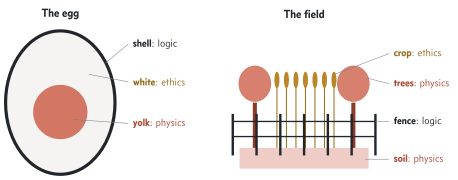
The Stoic world was made of stuff. Plato had said that the most real things are the Forms, which have no bodies (Chapter 16). The Stoics answered that a thing is real only if it can act or be acted upon, and only a body can do either. So the Stoics held that only bodies exist,Members of this school argued that only bodies exist, and that moral qualities and the soul are corporeal. → Stoicism• and they called things corporeal, or bodily, that nobody else did. The soul is a body, they argued, because it suffers with the body, feeling its wounds, and the body suffers with the soul, blushing with its shame. Virtue and wisdom are bodies too, since they are the soul itself in a certain condition, as a fist is a hand held in a certain way.
What holds the bodies together is breath. Through every part of the world, the Stoics taught, runs a fiery breath, pneumaThis school believed the universe was infused with pneuma, or "breath of life." → Stoicism•• (nyoo-muh), a mixture of fire and air in constant tension, stretching out and pulling back. In a stone it is what keeps the stone in one piece; in a plant it is the power of growth; in an animal it is the soul, “the breath of life,” in Hicks’s words. In the whole world it is reason itself, which the Stoics also called Nature, Fate, and Zeus. So for the Stoics the world is one living, thinking creature, and everything in it happens for a reason. Zeno’s pupil Cleanthes (klee-an-theez) praised this god in a famous “Hymn to Zeus,” one of the few Stoic writings to survive whole.
Their god was fire, as Heraclitus’s had been (Chapter 7), and the fire would have the last word. At fixed intervals, the Stoics said, the world ends in fire,Early adherents of this school described a periodic cosmic conflagration called ekpyrosis. → Stoicism•• the ekpyrosis (ek-py-roh-sis), “conflagration”: everything returns to the pure, divine fire from which it came. Then the fire cools, the elements separate again, and a new world grows from it, the same as the last. Later writers report that Chrysippus (kry-sip-us), the school’s third head, thought the very same people would live again in the new world. They spelled it out with Socrates as their example: he would be born again, be accused again by the same men, and die again in the same way, over and over without end.
To say what a thing is, the Stoics needed only four headings, where Aristotle had used ten (Chapter 19). Their four categories were substance, quality, disposition, and relative disposition.This school's four categories included substance, quality, disposition, and relative disposition. → Stoicism• Take a man named Dion. He is first a lump of matter, his substance. He is a man, and this particular man, Dion, which is his quality, the way the breath shapes his matter. He is sitting, or angry, which is his disposition, the state he is in. And he is a father, or to the left of his friend, which is his relative disposition, the way he stands toward something else.
Not everything that can be talked about is a body. If I say “Dion is walking,” the sound of my voice is a body, since it is struck air, and Dion is a body. But what my words mean is neither. The Stoics called it a lekton (lek-ton), “something sayable”: a Greek and a foreigner may both hear the sentence and both see Dion, but only the Greek grasps the sayable. For the Stoics, logic studied the sayables, or lekta,According to this school, logic described relations between "sayables" called lekta. → Stoicism• and above all the complete ones that are true or false, which logicians now call propositions. Since sayables have no bodies, the Stoics said they do not exist but “subsist,” and they counted only four such shadowy things: the sayable, the void, place, and time.
The school’s second head was a former boxer. Cleanthes, who succeeded Zeno in 262 BC,Cleanthes was an early member of this school. → Stoicism•• had come from Assos, on the coast of Asia Minor, with four drachmas in his pocket. He worked at night drawing water for gardeners so that he could study by day, which earned him the nickname Well-Lifter. The council of the Areopagus, Diogenes Laërtius says, once summoned him to explain how so strong a man made his living. He brought as witnesses the gardener and the woman who sold the meal he ground, and the councilors voted him a gift of money, which Zeno told him to refuse. His fellow students called him the donkey. He said he was the only one strong enough to carry Zeno’s load. He was slow, Zeno said, like a hard wax tablet that is difficult to write on but keeps whatever is written.

His successor was the school’s genius. Chrysippus came from Soli (soh-lee), on the southern coast of Asia Minor in the region called Cilicia; he had been a long-distance runner before he came to hear Cleanthes. He headed the Stoics from 230 BC until his death about 206, and he wrote 705 books, 500 lines a day by his housekeeper’s count. They were stuffed with quotations; one of them copied out nearly the whole of Euripides’s Medea, so that a man caught reading it said he was reading “The Medea of Chrysippus.” He argued every Stoic doctrine afresh against its critics in Plato’s Academy, and the Greeks said, in Hicks’s version, “But for Chrysippus, there had been no Porch.” The Porch was the Stoic school itself.
Aristotle had built a logic of terms: all men are mortal, Socrates is a man, so Socrates is mortal (Chapter 19). Chrysippus built a logic of whole propositionsThis Stoic philosopher developed a system of propositional logic. → Chrysippus•• instead, joined by small words: if, and, or, not. The Stoics’ standard example was “If it is day, it is light; but it is day; therefore it is light.” The argument works whatever “it is day” and “it is light” mean, so Chrysippus replaced them with “the first” and “the second” and wrote out five patterns so clear that they need no proof. Logicians worked this kind of logic out afresh in the nineteenth century, and only in the twentieth did scholars see how far ahead of his time Chrysippus had been.
Diogenes Laërtius gives Chrysippus two deaths. In one, at a sacrifice, he drank a cup of unmixed wine, grew dizzy, and died five days later, aged seventy-three. In the other, he saw a donkey eating his figs and told the old woman who kept house for him to give the donkey a drink of pure wine to wash them down. Then, at his own joke, he laughed so hard that he died.According to Diogenes Laertius, this philosopher died laughing after seeing a donkey eat figs and joking that it should be given wine. → Chrysippus••
His opponents attacked the Stoics where it hurt: if only bodies exist, and bodies are always changing, what stays the same? The comic poet Epicharmus (ep-ih-kar-mus), who wrote in Sicily in the early fifth century BC, had put the problem on the stage. A man grows and shrinks, his matter coming and going, so “you and I were one pair of men yesterday, are another to-day, and again will be another to-morrow,” as Diogenes Laërtius quotes him. The philosophers of Plato’s Academy, who by then doubted everything, took up this growing argument to show that nothing persists, so no one can be said to grow. The Stoics answered that a man’s matter flows away, but the man, the particular person shaped out of it, remains. Then Chrysippus, answering the growing argument, tested the Stoic reply on a man who loses a foot,This philosopher discussed bodily identity through a “growing argument” involving the loss of a foot. → Chrysippus• as Philo (fy-loh), a Jewish philosopher of Alexandria who wrote about AD 40, reports him. Call the whole man Dion, and call all of Dion except one foot Theon (thee-on). Cut off Dion’s foot, and Dion and Theon now fill exactly the same body, though two individuals cannot share one body. One of them has ceased to exist. Chrysippus decided it was Theon, though Theon had lost nothing at all.
The most famous puzzle about things that grow was a ship, the ship of Theseus. The Athenians kept the thirty-oared ship that, they said, had carried Theseus home from Crete after he killed the Minotaur (Vol. 4, Classical Myth). Plutarch tells in his Life of Theseus that they preserved it until the time of Demetrius of Phaleron, who governed Athens for the Macedonians from 317 to 307 BC, by replacing each plank as it rotted.This thought experiment asks whether a vessel remains the same after all its original planks are replaced. → ship of Theseus•• In the end no original timber was left. So, in Clough’s version, “this ship became a standing example among the philosophers, for the logical question as to things that grow; one side holding that the ship remained the same, and the other contending that it was not the same.” In the seventeenth century the English philosopher Thomas Hobbes made the puzzle harder by imagining a second ship built from the old planks (Vol. 12, Crown and Parliament).
All this logic and physics served the crop in the field, the good life. The Stoics held that virtue is the only good,This school held that virtue is the only good and sufficient for happiness. → Stoicism•• and that it alone is enough for happiness. Health, wealth, and a long life are not good in themselves, since a wicked man may have them and be the worse for it. The Stoics called them “indifferent,” though some are “preferred” and a wise man will reasonably choose health over sickness. Virtue has no degrees: a stick, they said, must be either straight or crooked. The goal of life is to live in agreement with nature, which means with reason, since reason runs through nature and through us.
What stands in the way is passion. The Stoics counted four great passions: grief, fear, desire, and pleasure. Each, they said, was a false judgment; desire, for instance, is believing that money or fame is a good thing worth reaching for. Since passions are mistaken beliefs, a man can unlearn them. The Stoics sought freedom from the passions through self-control,This school emphasized freedom from destructive passions through self-control. → Stoicism••• a state they called apatheia (ap-uh-thee-uh), “freedom from passion.” The wise man still feels joy, caution, and rational wishing, but nothing outside his own choices can disturb him: neither exile, nor poverty, nor the death of a child.
That calm made the school famous, and “stoic” now means calm and unemotional,This school's name is today associated with being calm and unemotional. → Stoicism•• someone who bears pain or loss without complaint. Stoicism became the favorite philosophy of educated Romans, and its most famous writers, the statesman Seneca, the freed slave Epictetus (ep-ik-tee-tus), and the emperor Marcus Aurelius, belong to a later volume (Vol. 7, The Romans).
Epicurus
Epicurus was born in 341 BC on the island of Samos, where his father, an Athenian citizen, had gone as a settler and earned his living as a schoolmaster. Epicurus said that he took up philosophy at fourteen. One early biographer, as Diogenes Laërtius quotes him, says he turned to it “in disgust at the schoolmasters who could not tell him the meaning of ‘chaos’ in Hesiod,” the void that came first in the Theogony (Chapter 3). He found better answers in the books of Democritus, who had taught that the world is made of atoms moving in empty space (Chapter 7). At eighteen he went to Athens for the two years of military training required of young citizens, arriving in 323 BC, the year Alexander died. Soon afterward the Athenian settlers were driven off Samos, and his family moved to Colophon on the mainland.

He began to teach at Mytilene on Lesbos and at Lampsacus on the Hellespont, and about 306 BC he came back to Athens with his friends and bought a house with a garden, on the road toward the Academy (Figure 22.3). The Garden, as his school was called, was a community as much as a school. Women studied there, among them a courtesan named Leontion (lee-on-tee-on), and so did Epicurus’s slave Mys, whom he freed in his will. They lived simply. Epicurus wrote that he was content with bread and water, and once asked a friend: “Send me a little pot of cheese, that, when I like, I may fare sumptuously.” Diogenes Laërtius adds dryly: “Such was the man who laid down that pleasure was the end of life.”
For Epicurus did say that pleasure is the goal, but he meant something unexpected by it. “By pleasure,” he wrote in a letter that Diogenes Laërtius copied out whole, “we mean the absence of pain in the body and of trouble in the soul.” The highest pleasure is not a feast but the calm that comes when every need is met. Epicureans seek ataraxia and aponia:Followers of this school seek ataraxia and aponia. → Epicureanism•• ataraxia (at-uh-rak-see-uh), “freedom from disturbance” of the mind, and aponia (uh-poh-nee-uh), “freedom from pain” in the body. Some desires, Epicurus said, are natural and necessary, like the desire for bread and water when we are hungry and thirsty, and they are easily satisfied. Some are natural but unnecessary, like the desire for fine food. And some are neither, like the desire for crowns and statues, and they can never be satisfied at all.
Two fears, Epicurus thought, ruin most lives: the fear of the gods and the fear of death. The gods exist, he said, but they live in perfect happiness far from our world and never trouble themselves with it, so they neither punish nor reward. Death he answered with an argument. Death is “nothing to us,” Epicurus wrote,This philosopher argues that death is “nothing to us,” since when it is present we no longer exist. → Epicurus•• because it is the end of all feeling, and what we do not feel cannot hurt us. In Hicks’s translation of his letter to a friend named Menoeceus (meh-nee-see-us), “when we are, death is not come, and, when death is come, we are not.” His Roman follower Lucretius added that to fear being dead is as foolish as to grieve that we did not exist before we were born.

Epicurus took his physics from Democritus: everything is atoms and void, and the soul is a cluster of fine atoms that scatters at death. But he changed one thing. In his world, atoms fall downward through the endless void, all at the same speed, like raindrops in still air, and falling side by side they would never meet. So, his followers explained, the atoms sometimes swerve by the smallest amount,This school explained atomic deviations with a clinamen, or “swerve.” → Epicureanism•• at no fixed time or place, and the swerve sets off the collisions from which worlds are made (Figure 22.10). It is known chiefly from the Roman poet Lucretius, who put Epicurus’s teaching into Latin verse in the first century BC and called the swerve the clinamen (kly-nay-men), from a Latin verb meaning “to lean” (Vol. 7, The Romans). The same swerve, the Epicureans said, breaks the chain of cause and effect inside us and leaves room for free choice.
Epicurus died in 270 BC of a painful illness of the kidneys. On his last day he wrote to a friend: “On this blissful day, which is also the last of my life, I write this to you.” His pain, he said, was as great as pain can be, but he set against it the joy of remembering their conversations. He left the Garden to his successors, and it lasted for centuries. His followers were still arguing in the agora when the apostle Paul came to Athens (Vol. 5, In the Beginning). The English word “epicure,” a lover of fine food, would have puzzled the man who asked for a little pot of cheese.
The skeptics
The Cynics, the Stoics, and Epicurus all claimed to know how the world is and how to live in it. The fourth group doubted that anyone could know either. The Greek skeptikos meant an inquirer, a man still looking, and the skeptics doubted that certain knowledge is possible.This tradition doubts the possibility of certain knowledge. → skepticism•• Every argument, they found, could be met by an equally strong argument on the other side, and every way a thing looks to us could be matched by another way it looks to someone else. A tower that seems round from far away is square close up; honey tastes sweet to the healthy and bitter to the sick.
The first of them marched with Alexander. Pyrrho (pir-oh) of Elis, in the western Peloponnese, was born about 360 BC and began as a poor painter. He became the follower of Anaxarchus (an-ak-sar-kus), a philosopher from Abdera, the city of Democritus, who went east in Alexander’s train. The two of them, Diogenes Laërtius says, reached India and talked with the “Gymnosophists,” or naked wise men, and with the Magi, the priests of Persia (Figure 22.6). One Indian, the story goes, told Anaxarchus that a man who waited on kings at court could never teach anyone what was good. Pyrrho never forgot it. He came home, lived quietly with his sister, a midwife, and wrote nothing at all. Pyrrho inspired the first school of skepticism,Pyrrho of Elis inspired an ancient form of this philosophical tradition. → skepticism•• and the later skeptics called themselves Pyrrhonists after him.
He taught that no single thing “is in itself any more this than that.” If honey is both sweet and bitter, depending on who tastes it, then we cannot say what it is in itself, and the wise man says nothing about it. Pyrrho practiced epochéPyrrhonian adherents of this tradition practice epoché, or suspension of judgment. → skepticism•• (ep-oh-kee), the suspension of judgment: he held back his assent, neither affirming nor denying, and lived by how things appeared. Antigonus of Carystus (kuh-ris-tus), an early biographer, told how Pyrrho walked straight toward carts, cliffs, and dogs without trusting his senses to warn him, so that his friends had to follow him around. A later Pyrrhonist answered that Pyrrho suspended judgment only in philosophy and took ordinary care in daily life. On a ship in a storm, when the other passengers panicked, he pointed to a little pig on board that went on calmly eating: such, he said, should be the wise man’s calm. He lived to be nearly ninety, and Elis made him its high priest. His pupil Timon (ty-mun) of Phlius, a poet who mocked every other philosopher in verse, spread his teaching.
Doubt soon captured Plato’s own Academy. Chapter 17 told how the Theaetetus tested three definitions of knowledge and ended with none. Arcesilaus (ar-ses-ih-lay-us) of Pitane (pit-uh-nee), a town of Aeolis on the coast of Asia Minor, became head of the Academy about 264 BC and turned it back to Socrates’s questioning. Socrates had said that he knew only that he knew nothing; Arcesilaus, the Roman statesman Cicero says, claimed that he did not know even that. He argued both sides of every question and wrote no books. The Academy stayed skeptical for two centuries after him, and its greatest head in that time was Carneades (kar-nee-uh-deez), a century younger. Arcesilaus and Carneades led the “Academic” skeptics,Arcesilaus and Carneades advanced the "Academic" form of this tradition. → skepticism•• named for the school of Plato they headed.
Their target was the Stoics, who claimed that knowledge was possible. Cicero tells how Zeno explained it with his hand. He held it out open with the fingers spread: that is an impression, how something looks to us. He curled the fingers a little: that is assent, saying yes to the impression. He closed his hand into a fist: that is katalepsis (kat-uh-lep-sis), “grasping” or comprehension. Then he took the fist tight in his other hand: that is knowledge, which only the wise man has. Zeno taught that some impressions are so clear that they could only come from a real thing, and a man who assents to them cannot be wrong. Arcesilaus and his successors answered that for every true impression there could be a false one exactly like it, from identical twins, two eggs, a dream, or a fit of madness. The Academic skeptics rejected katalepsisThis school rejected the concept of katalepsis in favor of acatalepsia, or "incomprehensibility." → skepticism• and taught acatalepsia (uh-kat-uh-lep-see-uh), “incomprehensibility”: nothing can be grasped, so the wise man will suspend judgment about everything.
Carneades was born in 214 BC at Cyrene in Libya and came to Athens as a young man. He studied the books of Chrysippus so closely in order to refute them that he used to say, parodying the saying that but for Chrysippus there would have been no Porch, “Without Chrysippus where should I have been?” In 155 BC Athens sent him to Rome with a Stoic and a follower of Aristotle to plead against a heavy fine, and his speeches drew such crowds that, Plutarch says, they “filled, like a wind, all the city with the sound of it.” According to Cicero’s account, he spoke in praise of justice one day and against it the next. Plutarch adds that the stern old senator Cato urged the Senate to settle the business quickly and send the philosophers home before they corrupted Rome’s young men. Carneades admitted that men must act, so he allowed them to follow whatever impression seemed most persuasive, as a guide to life and never as knowledge. His pupil Clitomachus (kly-tom-uh-kus) confessed that he never discovered what his master really thought.
Knowledge itself was out of reach,Skeptics doubt the ability to attain this concept. → knowledge• the skeptics concluded. By knowledge they meant what the Stoics and Plato meant: not a belief that happens to be true, but a grasp so firm that no argument could ever shake it. The later Pyrrhonists, who revived Pyrrho’s name in the first century BC, collected the arguments that defeat every claim to it and sorted them into sets they called modes, or ways. Five modes are named for AgrippaAdvocates of this tradition often used a set of "modes," including five named for Agrippa. → skepticism• (uh-grip-uh), a Pyrrhonist of about AD 100 of whom nothing else is known (Figure 22.11). One is disagreement: wise men have always disagreed about every question. Another is relativity: a thing appears only in relation to the one who perceives it and the conditions around it. The other three trap anyone who tries to prove anything. A proof needs reasons, and each reason needs reasons of its own. So either the chain goes on forever, or it stops at something simply assumed, which an opponent may just as well deny, or it circles back to lean on the very thing it set out to prove.

Why live like this? The answer came from a doctor. Sextus Empiricus (em-pirr-ih-kus), who worked about AD 200, belonged to the Empiric school of medicine, physicians who trusted only what experience showed, and his Outlines of Pyrrhonism is the fullest skeptic book to survive. To explain what the skeptic gains, Sextus told a story about a painter. Apelles, the most famous painter of Alexander’s time (Chapter 20), was painting a horse and could not get the foam at its mouth right. At last he gave up in a rage and flung his sponge at the painted horse,Sextus Empiricus illustrated this tradition’s search for tranquility with an artist who flings a sponge at a painting of a horse. → skepticism•• the sponge he used to wipe his brushes, and the mark it left was perfect foam. The skeptic, Sextus explained, also hoped to find calm by settling which arguments were true. He failed, gave up, and suspended judgment, and the calm came by itself.
That calm had a name the Epicureans used. Like the Epicureans, the skeptics sought ataraxia,This tradition, like Epicureanism, sought ataraxia, or freedom from disturbance. → skepticism• freedom from disturbance, though they reached it by the opposite road: Epicurus by knowing that atoms and void are all there is, Pyrrho by knowing nothing. Diogenes Laërtius, in Hicks’s version, gives the skeptics’ goal as “suspension of judgement, which brings with it tranquillity like its shadow.” Sextus’s books were printed in Latin in the 1560s, and their arguments unsettled European thinkers for two centuries, from the French essayist Montaigne (mon-tayn) (Vol. 13, Valois, Bourbon, and Orange) to the Scottish philosopher David Hume (Vol. 12, Crown and Parliament).
Diogenes Laërtius
Almost every story in this chapter, and many in the chapters before it, comes from one book. Diogenes Laërtius wrote the Lives and Opinions of Eminent Philosophers,This biographer wrote Lives and Opinions of Eminent Philosophers. → Diogenes Laërtius•• in ten books, in the first half of the third century AD. He names Sextus Empiricus and a pupil of his, so he wrote after about AD 200, and a writer of about AD 300 quotes him. Nothing else is known of him, not even his city. Even his name is a puzzle. In Homer the hero Odysseus, the son of Laertes, is often addressed in Greek as diogenes Laertiade (dy-oj-uh-neez lay-er-ty-uh-dee), which A. T. Murray’s translation renders “Son of Laërtes, sprung from Zeus.” The likeliest explanation is that “Laërtius” was a nickname taken from that line, to tell this Diogenes from all the others.
| School | Founder | Where | The good life | How to reach it |
|---|---|---|---|---|
| Cynics | Antisthenes and Diogenes, after 399 BC | the streets; the Cynosarges | virtue: freedom from every need | live by nature, scorn custom, speak frankly |
| Stoics | Zeno of Citium, about 301 BC | the Painted Stoa | virtue, the only good | live by reason; unlearn the passions |
| Epicureans | Epicurus, about 306 BC | the Garden | pleasure: no pain in body, no trouble in mind | want little; lose the fear of gods and death |
| Skeptics | Pyrrho, about 320 BC; Arcesilaus at the Academy, about 264 BC | no fixed place; the Academy | calm, ataraxia | suspend judgment on every question |
His book runs from the Seven Sages of early Greece to Epicurus, philosopher by philosopher: the Academy in Book 4, the Cynics in Book 6, the Stoics in Book 7, and Pyrrho and the skeptics in Book 9. He copied from older collections of lives, now all lost, and he loved a good anecdote far more than a hard argument, so that a philosopher’s death often gets more room than his doctrines. He added little poems of his own on his subjects’ deaths, most of them bad. Yet he also copied whole documents. The tenth book is given entirely to Epicurus, and it includes three of Epicurus’s letters and a list of his main sayings, the only complete works of Epicurus that survive. The Stoic book breaks off in the middle of the list of Chrysippus’s writings; every manuscript has lost its ending.

The book survived in medieval Greek manuscripts, the best of them copied in the twelfth century, and in the Renaissance it was translated into Latin and printed (Figure 22.12). The French essayist Montaigne, who loved its stories, wished that there had been a dozen books like it instead of one. Modern scholars treat it warily, checking every anecdote against older sources wherever they survive. But often there are no older sources. If Diogenes Laërtius had not written, the world would know far less of the man in the jar and his lamp, of Hipparchia at the dinner table, of Chrysippus and the donkey, or of Epicurus’s little pot of cheese.
What to remember
- After Macedon took away the Greek cities’ freedom, four schools in Athens taught a happiness that depended on nothing outside a man.
- The Cynics, named from the Greek for “dog-like,” traced themselves to Antisthenes and took Heracles as their model. Diogenes of Sinope lived in a storage jar, carried a lamp by day looking for a man, plucked a chicken to mock Plato’s “featherless biped,” told Alexander to stand out of his sun, and called himself a citizen of the world.
- Crates and Hipparchia lived as Cynics together, and Crates imagined the ideal city of Pera. The Cynics valued parrhesia, frank speech; the modern “cynic” distrusts everyone’s motives.
- Zeno of Citium founded the Stoics in the Painted Stoa. They divided philosophy into logic, physics, and ethics, held that only bodies exist, and saw a fiery pneuma running through a world that ends in fire, the ekpyrosis.
- Cleanthes and then Chrysippus led the Stoics. Chrysippus built a logic of propositions, puzzled over a man who loses a foot, and is said to have died laughing at a donkey eating figs. Plutarch’s ship of Theseus asks whether a ship with every plank replaced is the same ship.
- For the Stoics virtue is the only good, and freedom from the passions is the goal.
- Epicurus taught in his Garden that pleasure is the goal, meaning ataraxia and aponia; that death is nothing to us; and that atoms swerve, the clinamen of Lucretius.
- Pyrrho of Elis, who went to India with Alexander, taught epoché, suspension of judgment; Arcesilaus and Carneades made Plato’s Academy skeptical and attacked the Stoic katalepsis; Agrippa gave five modes; Sextus Empiricus told of Apelles’s sponge.
- Diogenes Laërtius wrote the Lives and Opinions of Eminent Philosophers in the third century AD, the source of most of these stories.
Back matter
Answers by Type
Every question asks for one kind of thing, and its first words usually say which: “this city,” “this philosopher,” “this play,” “this battle.” That kind of thing is the question’s answer type. The chapters of this volume followed the story of the Greeks from the palaces of Crete to the schools of Hellenistic Athens. This section takes the volume’s 214 answers out of that story and sorts them by type into twenty-four groups. The places, rulers, battles, and institutions of Greek history come first, then the poets, playwrights, and their works. After them come the philosophers and their ideas, and last the buildings, statues, and materials of Greek art.
Each group opens with a table for comparing its answers at a glance and then gives a short entry for each answer, with the chapter that teaches it. The entries reprint only the clues that tell an answer from its look-alikes. Boxes at the end of a group take apart the names that players confuse most: three men called Diogenes, two Zenos, two Philips, three Pausaniases, three Electras, and Ionia beside the Ionic order.
The Bronze Age
Eleven answers come from the Bronze Age Aegean, before about 1100 BC, and from the archaeologists who dug it up (Table A.1). Two peoples must be kept apart. The Minoans of Crete wrote Linear A, which no one can read, while the Mycenaeans of the mainland wrote an early form of Greek in Linear B and ruled from citadels such as Mycenae. A site and its people are separate answers too: a clue about a palace, a throne room, or a find spot wants Knossos, and one about a whole culture, its art, or its script wants the Minoan civilization. Two diggers matter most. Heinrich Schliemann dug Troy and Mycenae in the 1870s, and Arthur Evans began digging on Crete in 1900.
| Answer | What | Where | Known for | Ch. |
|---|---|---|---|---|
| Minoan civilization | The Bronze Age people of Crete, about 1900 to 1450 BC | Crete | Named by Evans for King Minos; Linear A; the Bull-Leaping Fresco; Kamares and Marine Style pottery | 1 |
| Crete | The largest Greek island | South of the Aegean | The center of the Minoan world | 1 |
| Knossos | The largest Minoan palace and town | North-central Crete | The Minotaur’s labyrinth; the griffin throne room; Linear B tablets; snake goddesses | 1 |
| Arthur Evans | British archaeologist | Dug at Knossos from 1900 | Named the Minoans; identified Linear A | 1 |
| Phaistos Disc | A clay disc with 242 stamped signs | A Minoan palace in southern Crete | Found by Luigi Pernier in 1908; never deciphered | 1 |
| Mycenae | The citadel of Agamemnon | The Argolid, in the Peloponnese | The Lion Gate; the wanax; Linear B | 1 |
| the Mask of Agamemnon | A gold funeral mask | A shaft grave at Mycenae | Found by Schliemann in 1876; centuries older than any Trojan War | 1 |
| tombs | Tholoi, beehive-shaped tombs | Outside Mycenae | The Treasury of Atreus, about 1300 to 1250 BC | 1 |
| lions | The beasts over the gate | Mycenae | Two lions flank a pillar above the Lion Gate | 1 |
| Troy | The city of the Iliad | Hisarlık, in Turkey | Nine layers; Schliemann’s “Priam’s Treasure”; Troy VIIa burned | 1 |
| the Bronze Age collapse | The fall of the palace kingdoms | The eastern Mediterranean | Mycenaean palaces burned; the Sea Peoples; about 1200 BC | 1 |
Minoan civilization. The first civilization of Europe, with palaces on Crete by about 1900 BC. The name is modern: Evans named the people for King Minos,This civilization is named for a mythical king associated with a labyrinth. → Minoan civilization•• whose craftsman built the labyrinth of myth. Its own script, unlike the Linear B of the mainland, is still unread: Evans identified the script Linear AThis civilization used the still-undeciphered Linear A script identified by Arthur Evans. → Minoan civilization•• on Minoan tablets and jars. Taught in Chapter 1.
Crete. The large island at the southern edge of the Aegean, home of the palaces of Knossos and Phaistos and of King Minos in myth. The Minoans were centered on Crete,The Minoan civilization was centered on this island. → Crete•• and Greek-speaking Mycenaeans ruled it after them. Taught in Chapter 1.
Knossos. The palace and town that Evans uncovered, the largest on Crete. Because Mycenaean Greeks ruled it in its last century, Linear B was found at Knossos,Linear B script was found at this site. → Knossos• though hardly anywhere else on the island. Its throne room, where painted griffins guard the throne,This site's throne room is decorated with griffins. → Knossos• is the room clues describe most. Taught in Chapter 1.
Arthur Evans. The British archaeologist who began digging in March 1900 and excavated the palace of Knossos,This archaeologist excavated the Minoan palace at Knossos on Crete. → Arthur Evans••• rebuilding parts of it in concrete. He gave the Minoans their name. Troy and Mycenae had been dug a generation earlier by a different man, Heinrich Schliemann. Taught in Chapter 1.
Phaistos Disc. A disc of fired clay about six inches across, its signs stamped in a spiral, which Luigi Pernier found in 1908 at the palace of Phaistos. Pernier’s disc has never been read,Luigi Pernier discovered this inscribed clay disc, whose text remains undeciphered, at a Minoan site. → Phaistos Disc•• because no other text uses its signs. Taught in Chapter 1.
Mycenae. The citadel that gave the mainland Greeks of the Bronze Age their modern name, the Mycenaeans. Visitors enter it through the Lion Gate, built about 1250 BC.This city's citadel is entered via the Lion Gate. → Mycenae•• Unlike the Minoans, the Mycenaeans wrote in Linear B,This city’s culture used the Linear B writing system. → Mycenae• in an early form of Greek. Taught in Chapter 1.
the Mask of Agamemnon. The gold mask Schliemann namedHeinrich Schliemann unearthed this funerary artifact, hammered from a single gold sheet, at Mycenae and associated it with a legendary king. → the Mask of Agamemnon•• for Homer’s king, found in a shaft grave just inside the Lion Gate in 1876. It is centuries too old to have belonged to anyone who fought at Troy. Taught in Chapter 1.
tombs. The great tombs of Mycenae were round stone chambers under mounds, reached by a long passage. Mycenaean tholoi are beehive-shaped tombs;Mycenaean tholoi, including the Treasury of Atreus, are beehive-shaped examples of these structures. → tombs•• the greatest is the Treasury of Atreus, whose lintel weighs about 120 tons. Taught in Chapter 1.
lions. Two lions flank a stone pillarTwo of these animals flank a pillar above a namesake gate in Mycenae. → lions• over the main entrance of Mycenae, the Lion Gate, carved in relief on a triangular slab. It is the largest piece of sculpture left from Bronze Age Greece. Taught in Chapter 1.
Troy. The city of Priam, on the mound of Hisarlık near the Dardanelles. Schliemann’s destructive digging at TroyHeinrich Schliemann’s destructive excavations at this ancient city uncovered the objects he called “Priam’s Treasure.” → Troy•• found the hoard he called “Priam’s Treasure” in a layer far older than any Trojan War. Archaeologists now count nine layers in the mound,The archaeological site of this ancient city at Hisarlık is conventionally divided into nine major layers. → Troy•• and Carl Blegen saw signs of a siege in Troy VIIa. Taught in Chapter 1.
the Bronze Age collapse. The ruin, in the decades around 1200 BC, of the palace kingdoms of Greece and the eastern Mediterranean. Historians use the Late Bronze Age collapseThe fall of Mycenaean palaces and attacks by the Sea Peoples are associated with this collapse. → the Bronze Age collapse• for the burning of the Mycenaean palaces, the raids of the Sea Peoples, and the fall of the Hittites together. Taught in Chapter 1.
Cities and kingdoms
Eight answers are Greek cities or kingdoms, and each gathers clues from several centuries (Table A.2). The quickest guide is the city’s government and its famous men. Athens had archons, a democracy, and a port at Piraeus. Sparta had two kings, five ephors, and the helots. Corinth had tyrants and an isthmus, Thebes had the Sacred Band, Syracuse had tyrants of its own, and Macedon had kings named Philip. Many clues name an event that involved two of these cities, such as the Peloponnesian War or the Thirty Tyrants, so read them for which side the city stood on. Figure A.1 shows where the cities of the mainland lie.
| Answer | Where | Government | Famous men | What became of it | Ch. |
|---|---|---|---|---|---|
| Athens | Attica; port at Piraeus | Archons; Cleisthenes’s democracy of 508 BC | Draco, Solon, Pisistratus, Cleisthenes, Pericles | Lost the Peloponnesian War, 404 BC | 5 |
| Sparta | Laconia, in the Peloponnese; also called Lacedaemon | Two kings, twenty-eight elders, five ephors | Lycurgus, Cleomenes I, Leonidas, Lysander | Beaten by Thebes at Leuctra, 371 BC | 6 |
| Corinth | On its isthmus | The Bacchiadae, then tyrants | Cypselus, Periander | Sacked by Mummius, 146 BC | 4 |
| Thebes | Boeotia | Head of the Boeotian League | Pindar, Pelopidas, Epaminondas | Razed by Alexander, 335 BC | 18 |
| Syracuse | Sicily; founded from Corinth | Tyrants | Gelon, Dionysius I, Agathocles, Archimedes | Taken by Rome in 212 BC | 13 |
| Macedon | North of Greece | Kings | Philip II, Alexander, Demetrius, Philip V | Broken by Rome at Pydna, 168 BC | 21 |
| Epirus | Northwestern Greece | Kings | Pyrrhus | Plundered by Rome, 167 BC | 21 |
| Rhodes | Island off southwestern Asia Minor | Dorian cities | Apollonius “of Rhodes” | Its Colossus fell in an earthquake, 226 BC | 21 |
Athens. The city of Attica. Its harbor was Piraeus, the port of Athens,Piraeus served as the port of this city. → Athens•• about five miles from the Acropolis and joined to the city by the Long Walls. Clues call it the city where democracy is often said to begin,This city is often considered the birthplace of democracy. → Athens••• with Cleisthenes’s reforms of 508 BC. Its defeat in the Peloponnesian War ended the Delian League, and then the Thirty Tyrants ruled AthensThis city was ruled by the Thirty Tyrants. → Athens••• for about eight months, installed by Sparta’s admiral Lysander. Taught in Chapter 5, Chapter 11, and Chapter 13.
Sparta. The capital of Laconia, four open villages with no city wall. Pausanias tells how the state was named LacedaemonThis city was also known as Lacedaemon after one of its founders. → Sparta• after its founding king, so a clue about “the Lacedaemonians” wants Sparta. It alone in Greece had two kings from two royal houses,This city was ruled by two kings from the Agiad and Eurypontid dynasties. → Sparta••• the Agiads and the Eurypontids. At seven a citizen’s son entered the agoge,Most boys of citizen families in this city underwent the agoge, a system of education and military training. → Sparta••• the public upbringing that made every Spartan a soldier. Its hegemony, its leadership of Greece, ended at Leuctra. Taught in Chapter 6.
Corinth. The trading city that sat on the isthmusThis city is located on a namesake isthmus between the Peloponnese and mainland Greece. → Corinth•• between the Peloponnese and central Greece, where ships were hauled across on the diolkos. Its tyrants were Cypselus and his son Periander. The ornate third order of columnsThis city names the ornate Greek column order distinguished from Doric and Ionic. → Corinth•• is named for it. In 146 BC Mummius sacked CorinthLucius Mummius sacked this city in 146 BC after defeating the Achaean League. → Corinth••• for Rome. Taught in Chapter 4.
Thebes. The chief city of Boeotia, which the Thebans said Cadmus founded,According to myth, Cadmus founded this city. → Thebes••• and which Oedipus ruled in myth. Its great years came in the 370s and 360s BC, when Thebes had the Sacred BandThis city was home to the Sacred Band. → Thebes••• and beat Sparta at Leuctra. This is not the Egyptian Thebes of Vol. 5, In the Beginning. Taught in Chapter 18.
Syracuse. The greatest Greek city of Sicily, founded from Corinth in 733 BC and ruled by a series of tyrants. Athens sent the Sicilian Expedition against SyracuseThis city was targeted during the Peloponnesian War by the Sicilian Expedition. → Syracuse•• and lost it. Its tyrant Dionysius I, Diodorus says, drank so much that he diedAccording to Diodorus, this city’s tyrant Dionysius I fell fatally ill after drinking to celebrate a dramatic victory. → Syracuse•• after hearing that his tragedy had won a prize at Athens. Its most famous citizen was Archimedes of Syracuse, in Sicily,This city was home to Archimedes. → Syracuse•• killed when Rome took the city in 212 BC. Taught in Chapter 13.
Macedon. The kingdom north of Greece, with its capital at Pella. It was the kingdom of Philip II and Alexander,This kingdom was ruled by Philip II and Alexander the Great. → Macedon•• and later of the Antigonids. One of them, Philip V, allied with HannibalPhilip V of this kingdom allied with Carthage during the Second Punic War. → Macedon• against Rome in 215 BC, and Rome broke Macedon’s phalanxes at Cynoscephalae and Pydna. Taught in Chapter 18 and Chapter 21.
Epirus. The hill kingdom of northwestern Greece, west of the Pindus mountains, the homeland of Alexander’s mother, Olympias. Pyrrhus ruled EpirusThis kingdom was led by Pyrrhus. → Epirus• from 297 BC, and the Epirotes called him their “Eagle.” Taught in Chapter 21.
Rhodes. The island off the southwest corner of Asia Minor, whose three old cities were Dorian. The Rhodians beat off DemetriusDemetrius Poliorcetes unsuccessfully besieged this island in 305–304 BC. → Rhodes•• Poliorcetes in 305 and 304 BC and paid for their Colossus with the engines he left behind. Taught in Chapter 21.
Lands, regions, and peoples
Nine answers are lands or peoples rather than cities (Table A.3). Besides Greece itself, four are modern countries, and their clues usually name an ancient place that now lies inside them: Troy in Turkey, Syracuse in Italy, Colchis in Georgia. Two regions of the Greek world, Ionia and Sicily, gather clues about the cities in them. “Greece” and “Greeks” are separate answers: the first wants the country and the second the people, so read whether the clue says “this country” or “this ethnic group.” The odd one out is Berlin, a modern city that holds a Greek altar.
| Answer | What | Clues name | Ch. |
|---|---|---|---|
| Greece | The country | Homer; the Parthenon; Praxiteles; the Winged Victory | 2 |
| Greeks | The people | Seleucus I; the kings of Bactria | 21 |
| Ionia | The Greek coast of Asia Minor | The Ionian League and the Panionium; the sea battle of Lade, 494 BC | 8 |
| Sicily | The island | Syracuse; Phalaris of Acragas; Himera, 480 BC; the Sicilian Expedition; Archimedes | 4 |
| Italy | The modern country | Magna Graecia, “Great Greece”; Syracuse | 4 |
| Turkey | The modern country | The ruins of Troy; Phrygia, with Gordium | 1 |
| Georgia | The modern country | The ancient lands of Colchis and Iberia | 4 |
| India | The eastern edge of the Persian Empire | Herodotus’s gold-digging ants | 8 |
| Berlin | The German capital | The Pergamon Altar, rebuilt in a museum | 21 |
Greece. The country itself, Hellas to its own people. Clues use it for any Greek person or thing: Homer was the first poet of Greece,Homer is an author from this country. → Greece• and the Parthenon, Praxiteles, and the Winged Victory are all Greek. Taught in Chapter 2.
Greeks. The people, as opposed to the country. In the kingdoms after Alexander the rulers were Greeks among other peoples: Seleucus I was a Macedonian Greek,Seleucus I belonged to this ethnic group. → Greeks• as were his officers and settlers. Farther east, in what is now Afghanistan, the kings of Bactria were Greeks,The rulers of the Bactrian kingdom were of this ethnicity. → Greeks• and so were their cities. Taught in Chapter 21.
Ionia. The Greek coast of western Asia Minor, now Turkey, with its islands, where the first philosophers were born. Its twelve cities met at the Panionium on Mount Mycale. When they rebelled against Persia, the fleet of Ionia was destroyed at LadeA naval fleet from this region was defeated at the Battle of Lade. → Ionia• in 494 BC. Taught in Chapter 8.
Sicily. The great island off the toe of Italy, with Greek cities on its eastern and southern coasts and Carthage holding its western tip. Clues name its tyrants, among them Phalaris of Acragas and his bronze bull, and the victory of 480 BC when Theron of Acragas and Gelon togetherThe tyrant Theron of Acragas allied with Gelon to defeat an attack on this island at the Battle of Himera. → Sicily•• beat Carthage at Himera. Sixty-five years later Athens sent its great expedition against Sicily,A disastrous Athenian expedition targeted this island. → Sicily••• and lost it at Syracuse. Taught in Chapter 4 and Chapter 13.
Italy. The modern country, which takes in Sicily and the toe and heel of the peninsula. The Romans called the Greek south Magna Graecia, “Great Greece,”Magna Graecia was located in this country. → Italy•• for its many rich colonies. Taught in Chapter 4.
Turkey. The modern country that holds Asia Minor. The ruins of Troy lie in Turkey,The ruins of Troy are located in this country. → Turkey•• near the Dardanelles, and so do Ionia and Halicarnassus. So does Phrygia, on the high central plateau,This country's ancient regions included Phrygia. → Turkey•• whose old capital Gordium held the knot that Alexander cut. Taught in Chapter 1 and Chapter 20.
Georgia. The country on the eastern shore of the Black Sea. Colchis and Iberia are now in Georgia:This country contained the ancient kingdoms of Iberia and Colchis. → Georgia• Colchis, where Jason found the Golden Fleece, along the coast, and Iberia inland. Taught in Chapter 4.
India. The land at the eastern edge of the Persian Empire. Persia’s Indian province, Herodotus says, paid the largest tribute of any, in gold dust, and he heard that in its northern desert giant ants dig up gold.Herodotus described giant ants digging up gold in this country. → India• Taught in Chapter 8.
Berlin. The German capital, where a museum holds a famous piece of Hellenistic Asia Minor: the Pergamon Altar was rebuiltA reconstruction of the Pergamon Altar is displayed in this city. → Berlin•• there, with its frieze of gods fighting giants. Taught in Chapter 21.
Sanctuaries and games
Six answers come from the great sanctuaries, the holy places that belonged to all the Greeks, and from the games held at them (Table A.4). Delphi, on Mount Parnassus, had Apollo’s oracle and the Pythian Games; Olympia, in the northwest Peloponnese, had Zeus’s temple and the Olympic Games. Read a clue for whether it wants the place, the festival, or the people who competed there. A clue about wreaths and victory odes may want the Olympic Games or the athletes, and only its last words will tell.
| Answer | What | Known for | Ch. |
|---|---|---|---|
| Delphi | Apollo’s sanctuary on Mount Parnassus | The Pythia and her oracles; “Know thyself”; the Siphnian Treasury; the First Sacred War | 4 |
| Olympia | Zeus’s sanctuary in Elis, in the northwest Peloponnese | Games every four years from 776 BC; Phidias’s gold-and-ivory Zeus | 4 |
| Olympic Games | The festival at Olympia | One of four Panhellenic games; the stadion; olive wreaths; Pindar’s odes | 4 |
| athletes | The competitors | Olive oil and the strigil; epinikia; Myron’s Discobolus; Polykleitos’s Diadumenos | 4 |
| chariot racing | The most costly event | The prize went to the owner, not the driver | 4 |
| stadiums | The running tracks | The Panathenaic Stadium in Athens, rebuilt in marble | 4 |
Delphi. The sanctuary of Apollo on the slopes of Mount Parnassus, which every colonist consulted. The Pythia spoke Apollo’s oraclesThe Pythia delivered Apollo’s oracles at this place, traditionally said to be inspired by vapors. → Delphi•• there, and later writers said vapors from the rock inspired her. In the First Sacred War, the attackers of the nearby town of Kirrha poisoned Kirrha’s water with hellebore.According to ancient accounts, attackers poisoned Kirrha’s water with hellebore during a Sacred War over this sanctuary. → Delphi• Taught in Chapter 4.
Olympia. The sanctuary of Zeus in Elis, in the northwest Peloponnese, where games were held every four years,This site hosted a namesake set of athletic games every four years. → Olympia• by the Greeks’ own reckoning from 776 BC. Its temple held Phidias’s seated Zeus of gold and ivory,Phidias’s gold-and-ivory image of a seated god holding Nike stood at this sanctuary. → Olympia•• one of the Seven Wonders. Taught in Chapter 4.
Olympic Games. The festival itself, as opposed to the place. It was one of four Panhellenic festivals,These events were one of the four Panhellenic festivals, alongside the Pythian, Nemean and Isthmian games. → Olympic Games•• with the Pythian, Isthmian, and Nemean Games. Each victor received an olive wreath,Kotinos, or olive wreaths, were given as prizes at these ancient events. → Olympic Games•• the kotinos, and nothing else at Olympia. Taught in Chapter 4.
athletes. The men who competed, naked, at the games. They rubbed themselves with olive oilThese people applied olive oil to themselves before entering a palaestra. → athletes• before exercise and scraped it off with a strigil afterward. Sculptors made them their great subject, as when Myron’s Discobolus throws the discus.Myron's Discobolus depicts one of these people. → athletes• Taught in Chapter 4 and Chapter 11.
chariot racing. The richest men’s event, since only they could breed and ship the horses. The prize went to the owner,Ancient Olympic prizes for this sport were given to the owner, not the driver. → chariot racing• not to the hired driver, who was a professional or a servant. Taught in Chapter 4.
stadiums. Running tracks with seats for the crowd, named for the stadion race. The Panathenaic Stadium in Athens,The ancient Panathenaic is one of these structures in Athens. → stadiums• rebuilt in white marble about AD 140, held the first modern Olympic Games in 1896. Taught in Chapter 4.
Athenian lawgivers, statesmen, and generals
Eight answers are Athenians who made laws, led the city, or commanded its armies, in the three centuries from Draco to Demosthenes (Table A.5). They are easiest to keep apart by date and by the one deed each is known for. The lawgivers come first: Draco wrote the laws down about 621 BC, and Cleisthenes rebuilt the constitution in 508. The generals of the Persian Wars come next, Miltiades at Marathon and Themistocles at Salamis. Pericles led the city in its golden age, Nicias and Alcibiades shared the command against Syracuse, and Demosthenes spoke against Philip of Macedon. Several share a name with someone else in the volume, and the boxes at the end take them apart.
| Name | Great years | Role | Known for | Ch. |
|---|---|---|---|---|
| Draco | 621 or 620 BC | Lawgiver | Laws written on axones; death for small thefts; “draconian”; his homicide law alone kept by Solon | 5 |
| Cleisthenes | 508–507 BC | Reformer | Ten tribes; the Council of Five Hundred; ostracism | 5 |
| Miltiades | 490 BC | General | Commanded at Marathon; stretched his line; fined, and died of a wound | 8 |
| Themistocles | 483–480 BC | Statesman and admiral | The fleet from Laurium’s silver; the “wooden wall”; Sicinnus; ended as a Persian governor | 9 |
| Pericles | About 461–429 BC | Leading statesman | The Parthenon; the Funeral Oration; Aspasia; died of the plague | 11 |
| Nicias | 421–413 BC | General | The Peace of Nicias; waited twenty-seven days after an eclipse; put to death at Syracuse | 13 |
| Alcibiades | 415–404 BC | General | The Sicilian Expedition; recalled over the herms; fled to Sparta; drunk at the Symposium | 13 |
| Demosthenes | 351–322 BC | Orator | The Philippics; pebbles in his mouth; On the Crown; poison at Calauria | 18 |
Draco. The first man to write down the laws of Athens, about a decade after Cylon’s failed coup. His penalties were so harsh that the Athenian Demades, three centuries later, joked that his laws were written in blood,Demades quipped that this leader wrote in blood rather than ink. → Draco• not ink. Since at least the 1770s English has used his name for any such rule: “draconian” means harsh and unforgiving.This leader's name became an adjective for severe punishments or strict rules. → Draco•• When Solon replaced them in 594 BC, he repealed all Draco’s laws exceptAlmost all of this leader's laws were repealed by Solon, except for his statutes on homicide. → Draco•• those on homicide. Taught in Chapter 5.
Cleisthenes. The Alcmaeonid noble who rebuilt the constitution of Athens in 508 and 507 BC on ten new tribes. He set up a Council of Five Hundred,This Athenian reformer established the Council of Five Hundred. → Cleisthenes•• fifty men from each tribe, and the Constitution of the Athenians credits him with the law of ostracism.The Athenian Constitution attributed the introduction of ostracism to this reformer. → Cleisthenes•• His enemies in 508 were the noble Isagoras and the Spartan king Cleomenes I. Taught in Chapter 5.
Miltiades. The general who in practice commanded the Athenians at Marathon in 490 BC, though the polemarch Callimachus held the place of honor. To match the long Persian front Miltiades stretched his line,This general extended his line of soldiers at Marathon. → Miltiades•• thin in the center and strong on the wings. His son was Cimon. Taught in Chapter 8.
Themistocles. The son of Neocles, a man of no great family, who persuaded Athens to spend a strike of silver on a fleet of triremes. He read the oracle’s “wooden wall” as the fleet, and before Salamis he sent his slave SicinnusThis man used a message carried by Sicinnus to lure the Persian fleet into the straits at Salamis. → Themistocles•• to lure the Persians into the straits. Ostracized about 471 BC, he fled to Persia, and Artaxerxes made him governor of Magnesia.This man was appointed governor of Magnesia by Artaxerxes I. → Themistocles•• Taught in Chapter 9.
Pericles. The leading man of Athens from about 461 BC until his death in 429, who sponsored the Parthenon. His father was the Xanthippus who commanded the Athenians at MycaleThis man’s father Xanthippus commanded the Athenian forces at Mycale. → Pericles•• in 479 BC, the summer after Salamis. His wife, whose name is not recorded, bore him two sons, and one was named for his grandfather: his sons were Xanthippus and Paralus.This man was the father of sons named Paralus and Xanthippus. → Pericles• Thucydides wrote down the funeral oration he deliveredThucydides recorded the funeral oration delivered by this man during the Peloponnesian War. → Pericles••• in the first winter of the war. Taught in Chapter 11.
Nicias. The cautious general who made the Peace of Nicias in 421 BC and then commanded at Syracuse against his own advice. When the moon was eclipsed, he waited the thrice nine daysThis general delayed retreat for 27 days because of a lunar eclipse. → Nicias•• that the soothsayers asked for, and the army was trapped. The Syracusans put him to death. Taught in Chapter 13.
Alcibiades. The brilliant, reckless ward of Pericles, one of three commanders chosen for the Sicilian Expedition. Recalled to stand trial over the herms,Recalled to face charges after the mutilation of the herms, this Athenian commander defected to Sparta. → Alcibiades••• he slipped away and went over to Sparta, then to Persia, and then back to Athens in triumph in 407 BC. In Plato’s Symposium he arrives drunk and praises Socrates. Taught in Chapter 13.
Demosthenes. The orator who rallied Athens against Philip of Macedon. Plutarch says that as a young man he practiced with pebbles in his mouthAccording to Plutarch, this orator placed pebbles in his mouth to improve his speaking ability. → Demosthenes•• to cure his weak voice. His speeches against Philip, the Philippics,This Athenian orator delivered the Philippics against Philip of Macedon. → Demosthenes•• gave English the word “philippic,” and in On the Crown he defended his whole career. Taught in Chapter 18.
Kings, queens, and generals
Eleven answers are rulers and commanders from outside Athens, with one horse among them (Table A.6). They come from five states: Sparta, with its lawgiver and its kings and queen; Thebes, with Epaminondas; Persia, with the two kings who invaded Greece; and Macedon and Epirus, with Philip, Alexander, and Pyrrhus. Kings often shared names with ancestors and descendants, and the numbers matter: Cleomenes I is not Cleomenes III, and Philip II is not Philip V. Darius I sent the army beaten at Marathon, and Darius III lost his empire to Alexander.
| Name | State | Years | Known for | Ch. |
|---|---|---|---|---|
| Lycurgus | Sparta | Legendary | The Great Rhetra; equal land lots; iron money; paired by Plutarch with Numa | 6 |
| Cleomenes I | Sparta | King about 524–490 BC | Drove Hippias from Athens, 510 BC; died mad, cutting himself | 6 |
| Leonidas I | Sparta | King about 490–480 BC | Husband of Gorgo; “Come and take them”; died at Thermopylae | 9 |
| Gorgo | Sparta | Queen | Daughter of Cleomenes; warned him against Aristagoras; found Demaratus’s hidden message | 9 |
| Epaminondas | Thebes | Died 362 BC | Won at Leuctra, 371 BC; freed Messenia; died at Mantinea | 18 |
| Darius I | Persia | King 522–486 BC | Sent the army beaten at Marathon | 8 |
| Xerxes I | Persia | King 486–465 BC | Bridged the Hellespont; watched Salamis from his throne | 9 |
| Philip II | Macedon | King 359–336 BC | The sarissa; Chaeronea; the League of Corinth; killed by Pausanias | 18 |
| Alexander the Great | Macedon | King 336–323 BC | Granicus, Issus, Gaugamela, the Hydaspes; never lost a battle | 20 |
| Bucephalus | Macedon | Died 326 BC | Alexander’s horse; the city of Bucephala | 20 |
| Pyrrhus | Epirus | King 297–272 BC | “Pyrrhic victory”; killed at Argos by a roof tile | 21 |
Lycurgus. The lawgiver to whom the Spartans traced nearly all their customs. Our fullest account was written eight or nine centuries later by Plutarch, who paired Lycurgus with Numa,Plutarch paired this Spartan lawgiver with Numa Pompilius in his Parallel Lives. → Lycurgus• the second king of Rome, in his Parallel Lives. Plutarch says Lycurgus brought home from Delphi the Great Rhetra, Sparta’s constitution,This lawgiver was traditionally credited with the constitution called the Great Rhetra. → Lycurgus••• divided the land into equal lots, and replaced gold and silver with iron money.Plutarch credits this Spartan lawgiver with replacing gold and silver currency with iron money. → Lycurgus• Taught in Chapter 6.
Cleomenes I. The forceful Agiad king of Sparta at the end of the sixth century BC. In 510 BC he drove Hippias out of Athens,This Spartan king led the expedition that drove Hippias from Athens. → Cleomenes I• and two years later he backed Isagoras against Cleisthenes. Herodotus says that, confined for madness, he mutilated himself with a knifeAccording to Herodotus, this Spartan king mutilated himself with a knife while confined for madness. → Cleomenes I• and died, about 490 BC. Taught in Chapter 6.
Leonidas I. The Spartan king who held the pass at Thermopylae in 480 BC with his three hundred Spartans. He had succeeded his half-brother CleomenesThis ruler succeeded his half-brother Cleomenes I, the victor at Sepeia, after Dorieus had died in Sicily. → Leonidas I•• and married Cleomenes’s daughter Gorgo. Plutarch says that when Xerxes ordered him to hand over his weapons, he wrote back, “Come and take them.”This king reportedly answered “come and take them” (“molon labe”) when ordered to surrender his weapons. → Leonidas I••• Taught in Chapter 9.
Gorgo. The daughter of Cleomenes I and wife of Leonidas, whose quick wit Herodotus admired. As a girl she warned her father against Aristagoras,As a child, this woman warned her father Cleomenes against accepting Aristagoras’s bribes. → Gorgo• who offered him bribes. Years later, when the exiled king Demaratus sent a warning hidden under the wax of a blank tablet, Gorgo told them to scrape off the wax.This Spartan queen told the recipients of Demaratus’s warning to scrape wax off a tablet to reveal its hidden message. → Gorgo•• Taught in Chapter 9.
Epaminondas. The Theban general who beat Sparta at Leuctra in 371 BC and then invaded Laconia and freed Messenia. Dying at Mantinea in 362 BC, he called Leuctra and Mantinea his daughters,Dying after Mantinea, this general reportedly called his victories at Mantinea and Leuctra his two daughters. → Epaminondas•• his two victories. Taught in Chapter 18.
Darius I. The Persian king whose generals Datis and Artaphernes led the first invasion of Greece. His army was beaten at MarathonThis ruler's forces were defeated at the Battle of Marathon. → Darius I•• in 490 BC, and he died in 486 BC preparing a larger one. He is the ghost in Aeschylus’s The Persians. Taught in Chapter 8.
Xerxes I. Darius’s son, who led the second invasion himself in 480 BC across a bridge of boats over the Hellespont. At dawn on the day of Salamis Xerxes had his throne set upThis ruler had a throne set up on Mount Aigaleo to watch a battle. → Xerxes I•• on the shore below Mount Aigaleo to watch his fleet. Taught in Chapter 9.
Philip II of Macedon. The king who made Macedon the master of Greece. As a young hostage in Thebes he studied its army, and later he armed his phalanx with the sarissa,This ruler equipped his phalanx with the long sarissa pike. → Philip II of Macedon•• a pike about eighteen to twenty feet long. Ten years after the Phocians seized Delphi, he had won the Third Sacred War,This ruler won the Third Sacred War. → Philip II of Macedon•• and in 338 BC he beat Athens and Thebes at Chaeronea. At his daughter’s wedding in 336 BC Pausanias of Orestis killed him.Pausanias of Orestis assassinated this ruler at celebrations of his daughter’s wedding. → Philip II of Macedon•• Taught in Chapter 18.
Alexander the Great. His father was Philip II of Macedon,This ruler was the son of Philip II of Macedon. → Alexander the Great••• and his mother was Olympias, a princess of Epirus; Aristotle was his tutor, and he was king at twenty. In eleven years he conquered the Persian Empire of Darius III and reached the Punjab. At Gordium he cut the Gordian Knot,This ruler legendarily cut the Gordian Knot. → Alexander the Great•• with his sword in the version people remember, and in Bactria, at a wedding that also won over her people, he married Roxana.This ruler married the princess Roxana. → Alexander the Great•• He died at Babylon in 323 BC, and his generals, the Diadochi, divided his empire.After this ruler's death, his generals, the Diadochi, divided his empire. → Alexander the Great••• Taught in Chapter 20.
Bucephalus. Alexander’s black horse, whose name means “ox-head,” tamed by the boy when no one else could ride him. He died after the battle of the Hydaspes, and Alexander founded Bucephala in his memoryAfter this horse died around the time of the Hydaspes campaign, Alexander founded a city in its memory. → Bucephalus•• on the river bank. Taught in Chapter 20.
Pyrrhus. The king of Epirus, the finest soldier of his generation, whose costly wins over Rome gave us the “Pyrrhic victory.” At Argos in 272 BC a roof tile struck Pyrrhus,According to tradition, a woman’s roof tile struck this ruler of Epirus during fighting at Argos. → Pyrrhus• thrown by a woman watching from a rooftop. Taught in Chapter 21.
Battles and wars
Nine answers are battles, campaigns, and wars (Table A.7). Most of the battles belong to two wars, the Persian Wars of 499 to 479 BC and the Peloponnesian War of 431 to 404 BC; the rest show Thebes beating Sparta and Alexander beating Persia. Clues give a commander, a stratagem, or the battle that came before or after, so learn the battles in order. Marathon, Thermopylae, and Salamis fall within ten years, and Figure A.2 sets out the battles of Xerxes’s invasion month by month. Many clues name a man who shares his name with someone else, such as Ephialtes, Pheidippides, or Callimachus; the box at the end sorts them.
| Answer | Date | Who beat whom | Commanders | Remember | Ch. |
|---|---|---|---|---|---|
| Persian Wars | 499–479 BC | Greeks beat Persia | Darius I, then Xerxes | Began with the Ionian Revolt | 8 |
| Battle of Marathon | 490 BC | Athens and Plataea beat Persia | Miltiades; Callimachus; Datis and Artaphernes | Spartans late for the Carneia; 500 goats a year | 8 |
| Battle of Thermopylae | 480 BC | Persia beat Leonidas’s Greeks | Leonidas; Xerxes; Hydarnes | “Hot gates”; Ephialtes’s path; fought with Artemisium | 9 |
| Battle of Salamis | 480 BC | Greek fleet beat Persia’s | Themistocles; Eurybiades; Xerxes | The “wooden wall”; Artemisia; Xerxes’s throne | 9 |
| Peloponnesian War | 431–404 BC | Sparta beat Athens | Pericles, Lysander | Thucydides; the Melian Dialogue; Aegospotami | 13 |
| Battle of Delium | 424 BC | Thebes beat Athens | Pagondas | Twenty-five shields deep; Socrates fought there | 13 |
| Sicilian Expedition | 415–413 BC | Syracuse beat Athens | Nicias, Alcibiades, Lamachus; Gylippus | The eclipse; the quarries | 13 |
| Battle of Leuctra | 371 BC | Thebes beat Sparta | Epaminondas; King Cleombrotus | The massed left wing; end of Sparta’s hegemony | 18 |
| Battle of Gaugamela | 331 BC | Alexander beat Darius III | Alexander; Parmenion | Scythed chariots let through; the Companion charge | 20 |
Persian Wars. Twenty years of fighting between the Greeks and the Persian Empire. The Ionian Revolt began the Persian WarsThese wars began with the Ionian Revolt. → Persian Wars• in 499 BC; Darius’s invasion ended at Marathon, and Xerxes led the second in person,Xerxes led the Achaemenid forces in these wars. → Persian Wars• to defeat at Salamis, Plataea, and Mycale. Herodotus wrote their history. Taught in Chapter 8 and Chapter 9.
Battle of Marathon. The first great Greek victory over Persia, in 490 BC, on a plain twenty-five miles from Athens. The polemarch Callimachus, whose vote decided for battle,The polemarch Callimachus cast the deciding vote for fighting and was killed in this battle. → Battle of Marathon•• was killed at the ships. The Spartans, held back by their festival of the Carneia until the full moon, arrived after the battle was over.The Carneia festival was Sparta's excuse for not fighting in this battle. → Battle of Marathon•• The runner who, in Lucian’s story, died as he announced the victoryAccording to legend, Pheidippides died after running to Athens to announce victory at this battle. → Battle of Marathon••• came from a legend written centuries later. Taught in Chapter 8.
Battle of Thermopylae. Leonidas’s stand in 480 BC at the pass whose name means “the hot gates,”This battle's name means "hot gates." → Battle of Thermopylae•• for its sulfur springs. It held until a local man, Ephialtes, showed the Persians a path around the pass,Ephialtes revealed a mountain path that let Hydarnes’s force bypass the defenders at this battle. → Battle of Thermopylae••• and Hydarnes led the Immortals over it by night. Herodotus says that the battles at Artemisium and ThermopylaeThis battle was fought simultaneously with the naval Battle of Artemisium. → Battle of Thermopylae•• were fought on the same days. Taught in Chapter 9.
Battle of Salamis. The sea battle of September 480 BC in the straits beside the island of Salamis, a few weeks after Thermopylae. Themistocles had read the oracle’s “wooden wall” as the fleet.This battle fulfilled a prophecy that "only a wooden wall will keep you safe." → Battle of Salamis•• In the fighting the Carian queen Artemisia rammed a ship of her own sideXerxes reportedly said “My men have become women, and my women men” after Artemisia rammed an allied ship during this battle. → Battle of Salamis•• to escape, and the Athenian captain chasing her let her go. The Sicilians later told Herodotus that Himera was won on the same day.According to a tradition reported by Herodotus, this battle occurred on the same day as the Battle of Himera. → Battle of Salamis• Taught in Chapter 9.
Peloponnesian War. The war of 431 to 404 BC between Athens and its Delian LeagueThis war pitted Athens and its Delian League against Sparta and its Peloponnesian League. → Peloponnesian War••• on one side and Sparta and its Peloponnesian League on the other. Thucydides wrote its historyThucydides wrote a history of this war. → Peloponnesian War••• year by year as it happened, with Pericles’s Funeral Oration and the Melian Dialogue.The Melian Dialogue during this war contains the phrase “the strong do what they can and the weak suffer what they must.” → Peloponnesian War•• It ended with Lysander’s victory at Aegospotami and the Thirty Tyrants. Taught in Chapter 13.
Battle of Delium. The Theban victory over Athens in 424 BC, in which Socrates fought as a hoplite. Pagondas massed the Thebans twenty-five shields deepPagondas deployed a Theban phalanx twenty-five ranks deep at this battle. → Battle of Delium• on his right wing, where the usual depth was eight. Taught in Chapter 13.
Sicilian Expedition. The great Athenian attack on Syracuse, 415 to 413 BC, which ended with the fleet and army destroyed. The Spartan Gylippus came to take charge of Syracuse’s defense,Gylippus organized Syracuse’s defense against this Athenian campaign. → Sicilian Expedition• and Nicias’s delay after an eclipse doomed the retreat. Taught in Chapter 13.
Battle of Leuctra. The battle of July 371 BC in Boeotia, where Epaminondas packed his left wing deep against the Spartan king’s right. Thebes’s massed left wing ended Sparta’s hegemonyEpaminondas’s Theban army defeated the Spartans at this battle using a deeply massed left wing, ending Spartan hegemony. → Battle of Leuctra••• in an afternoon. Taught in Chapter 18.
Battle of Gaugamela. Alexander’s decisive victory over Darius III, on October 1, 331 BC, on a plain in northern Mesopotamia. Against the scythed chariots the Macedonian ranks opened lanes,At this battle, Alexander’s troops opened gaps to neutralize scythed chariots, a tactic sometimes called a “mousetrap.” → Battle of Gaugamela•• and the Companion Cavalry charged straight for Darius. Taught in Chapter 20.
Laws, classes, and public places
Eight answers are the institutions of the Greek cities: a way of voting, a kind of disorder, two classes of the unfree, a regiment, a disaster, and two public works (Table A.8). Each belongs to one city, so the city named in a clue is the best guide. Ostracism, the agora, and the Long Walls are Athenian; the helots and the earthquake belong to Sparta, and the Sacred Band to Thebes. Syracuse had its own version of ostracism, voted on olive leaves.
| Answer | City | What clues ask | Ch. |
|---|---|---|---|
| ostracism | Athens | Names scratched on potsherds; a quorum of six thousand; ten years’ exile with property kept; Aristides “the Just” | 5 |
| anarchy | Athens | A year with no archon, 590 or 586 BC; Greek for “without a ruler” | 5 |
| agora | Athens | Marketplace and civic center; the Altar of the Twelve Gods; the Stoa of Attalus; the Roman forum | 5 |
| the Long Walls | Athens | Walls to Piraeus and Phaleron, about 460 BC; pulled down to flute music in 404 BC | 13 |
| helots | Sparta | State serfs, Laconian and Messenian; the krypteia; freed as neodamodeis; Cleomenes III sold them freedom | 6 |
| slaves | Sparta | What Greeks counted the helots as | 6 |
| earthquakes | Sparta | The quake of 464 BC that set off a helot revolt | 6 |
| Sacred Band of Thebes | Thebes | 150 pairs of lovers; Pelopidas; destroyed at Chaeronea, 338 BC | 18 |
ostracism. The Athenian vote to send a man away for ten years before he grew too strong. Each citizen scratched a name on a potsherd,Votes for this practice were cast by writing names on pottery shards. → ostracism•• an ostrakon, and the vote counted only if six thousand took part. Plutarch says a country voter wanted Aristides exiledAn illiterate man once called for this action against Aristides because he was tired of hearing Aristides called "the Just." → ostracism•• because he was tired of hearing him called the Just. Taught in Chapter 5.
anarchy. The Greek anarchia, a year without an archon, which Athens suffered twice in the quarrels after Solon. The word means “without a ruler,”This concept is derived from the Greek for "without rulers." → anarchy• and it gave English its word for a state with no government. Taught in Chapter 5.
agora. The open square at the heart of a Greek city, both marketplace and civic center.These public spaces served as marketplaces and civic centers in Greek poleis. → agora• In Athens it held the Altar of the Twelve Gods and, from about 150 BC, the Stoa of Attalus,The Stoa of Attalos is located within one of these places. → agora• the gift of a king of Pergamon. Taught in Chapter 5.
the Long Walls. The two ramparts, finished about 457 BC, that ran from Athens to Piraeus and to Phaleron,These fortifications connected Athens with Piraeus and Phaleron. → the Long Walls•• making the city an island fed by sea. After the surrender of 404 BC Xenophon says they were pulled down to the music of female flute-players.Xenophon describes these Athenian fortifications being demolished to the music of flute-girls after the Peloponnesian War. → the Long Walls•• Taught in Chapter 13.
helots. The farmers of Laconia and Messenia who belonged to the Spartan state and worked the citizens’ land. Every year the ephors declared war on the helots,Spartan ephors declared war on these people annually, allowing members of the krypteia to kill them without ritual pollution. → helots•• so that the young men of the krypteia could kill them without pollution. Late in Sparta’s history Cleomenes III let helots buy their freedom.Cleomenes III allowed members of this enslaved population to buy freedom for 500 drachmas. → helots•• Taught in Chapter 6.
slaves. Greeks counted the helots as slaves,Helots were classified as these people in Sparta. → slaves• though they were not bought and sold like the slaves of Athens. Taught in Chapter 6.
earthquakes. The great earthquake of 464 BC at Sparta, after which the helots rose in revolt.A helot uprising caused by one of these events in 464 BC led Sparta to reject Athenian hoplite support, contributing to the Peloponnesian War. → earthquakes• Sparta asked Athens for help and then sent its hoplites home, a snub that broke the old alliance. Taught in Chapter 6.
Sacred Band of Thebes. The elite Theban regiment that Plutarch says was made of 150 pairs of lovers.According to Plutarch, this elite Theban unit consisted of 150 pairs of male lovers. → Sacred Band of Thebes•• Under Pelopidas it was never beaten until Chaeronea, where Philip’s army destroyed it in 338 BC. Taught in Chapter 18.
Objects of war and daily life
Seven answers are things: weapons, ships, animals, a drink, a sunshade, and a perfume (Table A.9). A clue about a thing usually names the event or the custom it belongs to, so ask which story the thing is in. Two of them share a single story: at Megara, burning pigs stampeded Antigonus Gonatas’s war elephants, and a clue may want either the beasts that charged or the beasts that fled.
| Answer | Story | Ch. |
|---|---|---|
| shields | The hoplite’s round aspis; “with it or on it”; Archilochus’s abandoned shield | 6 |
| ships | The trireme, the three-banked warship of Salamis | 9 |
| elephants | Antigonus Gonatas’s war elephants, routed at Megara | 21 |
| pigs | Set alight and driven at the elephants by the Megarians, says Polyaenus | 21 |
| wine | Mixed with water in a krater and drunk at the symposium | 5 |
| umbrella | White sunshades carried at Athens’s Skirophoria festival | 11 |
| frankincense | Guarded by winged serpents, says Herodotus | 8 |
shields. The hoplite was made by his shield, and the aspis was a round shieldThe Greek aspis was a round example of these defensive objects. → shields• about three feet across. Plutarch gives a Spartan mother’s order to her son, “with it or on it”:Plutarch attributes the command “with it or on it” to Spartan women referring to these items. → shields• come home with your shield, or be carried home on it. Taught in Chapter 6.
ships. The warships of the Persian Wars were rowed, not sailed, into battle. The trireme was the standard warship,The trireme was a common type of these objects. → ships•• and Themistocles built Athens’s fleet of them. Taught in Chapter 9.
elephants. The war beasts of the Hellenistic kings. Polyaenus says that at Megara the burning pigs terrified Antigonus’s elephants,According to ancient accounts, defenders at Megara frightened these war animals with burning pigs. → elephants•• which turned and trampled his own men. Taught in Chapter 21.
pigs. The defenders’ answer to the elephants at Megara: the Megarians smeared pigs with pitch, and the burning pigs routed the war elephantsAccording to Polyaenus, burning examples of these animals frightened Antigonus’s war elephants at Megara. → pigs• of Antigonus Gonatas. Taught in Chapter 21.
wine. Greeks drank it mixed with water, and only “barbarians” drank it neat. A slave ladled wine, the drink of the symposium,This good was traditionally consumed by Greeks at symposia. → wine• from the krater into the guests’ cups. Taught in Chapter 5.
umbrella. At the summer festival of the Skirophoria white sunshades were carried from the Acropolis;During the Athenian Skirophoria festival, white versions of these objects were carried from the Acropolis to Phalerum. → umbrella• most ancient accounts send the procession to Skiron on the road to Eleusis, and some modern books to Phaleron (Phalerum). Taught in Chapter 11.
frankincense. A sweet resin from Arabia, burned to the gods. Herodotus says that winged serpents guard the frankincense trees,Herodotus claimed that winged serpents guarded trees yielding this aromatic resin. → frankincense• driven off with the smoke of another resin. Taught in Chapter 8.
Homer’s poems and their people
Ten answers come from Homer’s two epics, composed about 750 to 700 BC (Table A.10). The Iliad tells some fifty days in the tenth year of the Trojan War, ending with Hector’s funeral; the Odyssey tells Odysseus’s return home ten years after Troy fell. A clue about a scene is easiest to place by asking which poem it is in: battle, armor, and the walls of Troy belong to the Iliad, and islands, monsters, swineherds, and suitors to the Odyssey. Athena, Helen, and Tiresias appear in other works too, and their clues sometimes leave Homer behind.
| Answer | Who or what | Scenes to know | Ch. |
|---|---|---|---|
| Homer | The poet of both epics | Formulas such as “rosy-fingered” dawn and the “wine-dark” sea; Chapman’s translation | 2 |
| the Iliad | Epic of the war, twenty-four books | “Sing the wrath of Achilles”; the Catalogue of Ships, Book 2; the shield, Book 18 | 2 |
| The Odyssey | Epic of the return, twenty-four books | Begins in the middle; Wilson’s “complicated man”; the bow and the twelve axes | 2 |
| Achilles | Greatest Greek warrior | His wrath; Patroclus in his armor; his shield; kills Hector | 2 |
| Hector | Trojan prince, Priam’s son | Frightens Astyanax with his helmet; ignores the eagle omen; dragged behind a chariot | 2 |
| Helen of Troy | Wife of Menelaus | Leaves with Paris; a phantom in Euripides; defended by Gorgias | 2 |
| Odysseus | King of Ithaca | Nausicaa; Scylla; Eumaeus; the dog Argos; twelve ax heads | 2 |
| Penelope | Odysseus’s wife | Weaves Laertes’s shroud by day and unpicks it at night | 2 |
| Athena | Goddess of wisdom | “Gray-eyed”; disguised as Mentor; a new robe each year at the Panathenaia | 2 |
| Tiresias | The blind seer of Thebes | Consulted by Odysseus among the dead | 2 |
Homer. The poet to whom the Greeks credited both epics, though a few ancient scholars and many modern ones think two poets made them. His formulas, such as the “wine-dark” sea,This poet used an epithet frequently translated as "wine-dark" to describe the sea. → Homer•• are clues of their own. Among English versions, George Chapman translated HomerGeorge Chapman translated this poet's works. → Homer•• in rhyming verse, finishing the Iliad in 1611. Taught in Chapter 2.
The Iliad. Homer’s poem of the anger of Achilles and some fifty days of the Trojan War. It begins by asking the Muse to sing the wrath of Achilles,This work's opening line invokes the goddess to "sing the rage of [...] Achilles." → the Iliad• or in some modern versions his rage. In Book 2 the poet lists every contingent in the Catalogue of Ships,This poem contains a Catalogue of Ships in Book 2. → the Iliad•• and in Book 18 Hephaestus puts on Achilles’s new shield two cities, one at peace and one at war.This poem describes a shield depicting two cities, one at peace and one at war. → the Iliad••• Taught in Chapter 2.
The Odyssey. Homer’s second epic: the Odyssey tells a hero’s returnThis work is about a hero's return from the Trojan War. → The Odyssey•• from the Trojan War. It begins in the middle of things, with the hero held on Calypso’s island. Emily Wilson’s translation of 2017 opens “Tell me about a complicated man,”In Emily Wilson's translation, this work opens with "Tell me about a complicated man." → The Odyssey•• a plain word for Homer’s polytropos. Taught in Chapter 2.
Achilles. The greatest Greek warrior at Troy, whose anger is the subject of the Iliad. When he withdrew from the fighting, Patroclus put on Achilles’s armorPatroclus wore this figure's armor. → Achilles••• and was killed by Hector. In revenge Achilles killed Hector,This figure killed Hector. → Achilles••• after chasing him three times around the walls. Taught in Chapter 2.
Hector. The son of Priam and the defender of Troy. In Book 6 his plumed helmet frightened Astyanax,This figure’s plumed helmet frightened Astyanax, his son with Andromache. → Hector•• his baby son. At the end Athena, disguised as his brother Deiphobus,Athena tricks this man by appearing as his brother Deiphobus, then disappears when he asks for a spear. → Hector•• tricked him into facing Achilles, who killed him and dragged the body behind his chariot. Taught in Chapter 2.
Helen of Troy. The wife of Menelaus of Sparta, whose flight with Paris began the war. Later writers retold her. In Euripides’s Helen of 412 BC a phantom made of airIn Euripides’s account, this figure remains in Egypt while a phantom takes her place at Troy. → Helen of Troy•• went to Troy while she waited in Egypt, and the Sophist Gorgias wrote an encomium of Helen,This character was defended in an encomium by Gorgias with the line "it is an equal error to blame the praiseworthy and to praise the blameworthy." → Helen of Troy• a speech in praise, to prove her innocent. Taught in Chapter 2, Chapter 13, and Chapter 14.
Odysseus. The king of Ithaca and the title figure of the Odyssey. He had left a baby son when he sailed, and twenty years later Odysseus, the husband of Penelope,This figure is the husband of Penelope. → Odysseus••• came home to find suitors in his hall. Disguised as a beggar, he was known at once by the old dog Argos,This figure's dog Argos dies after recognizing him upon his return. → Odysseus••• which then died. Then he strung his old bow and shot an arrow through twelve ax headsThis figure shoots an arrow through twelve ax heads before killing his wife's suitors. → Odysseus••• before killing the suitors. Taught in Chapter 2.
Penelope. Odysseus’s wife, who held off more than a hundred suitors while her husband was away. She promised to choose one when a shroud was done, and she wove the shroud for LaertesThis woman wove a burial shroud for her father-in-law Laertes by day and unraveled it each night to delay her suitors. → Penelope•• by day and unpicked it by night for three years. Taught in Chapter 2.
Athena. The goddess who guards Odysseus and his son, called “gray-eyed” or “bright-eyed” in English. In the Odyssey Athena took the shape of MentorThis figure assists Telemachus in the disguise of Mentor. → Athena•• to guide Telemachus. At Athens, every year women wove Athena a new robeWomen wove a new robe for this figure at the Panathenaic festival. → Athena• for her old olive-wood statue. Taught in Chapter 2 and Chapter 11.
Tiresias. The blind prophet of Thebes. In the Odyssey Odysseus consulted TiresiasOdysseus consults this blind seer in the underworld. → Tiresias•• in the underworld and learned that Poseidon was angry with him. Sophocles brings him on stage alive in Oedipus Rex and Antigone. Taught in Chapter 2.
Poets, poems, and fables
Eleven answers are early poets, three poems of Sappho, the fable writer Aesop and one of his beasts, a fairy tale, and the shepherds of pastoral poetry (Table A.11). Each poet is easiest to know by a place and a kind of poem: Hesiod, a farmer of Boeotia; Archilochus of Paros, who threw away his shield; Sappho of Lesbos; and Pindar of Thebes, who wrote odes for athletes. Sappho’s poems are separate answers, and their clues are full of quoted phrases, so learn which phrases go with which poem.
| Answer | Who or what | Clues use | Ch. |
|---|---|---|---|
| Hesiod | Farmer-poet of Boeotia, about 700 BC | Theogony; Works and Days; the Shield of Heracles credited to him | 3 |
| Archilochus | Soldier-poet of Paros | The shield a Saian now enjoys | 3 |
| Sappho | Lyric poet of Lesbos | The “Tenth Muse”; the Sapphic stanza; Phaon and the Leucadian cliff; “whatever one loves” | 3 |
| “Ode to Aphrodite” | Sappho’s prayer | Her only complete poem; “many-colored throne”; sparrows draw the chariot; “be my ally” | 3 |
| Sappho’s Poem 31 | Sappho’s poem of jealousy | “Equal to the gods”; tongue broken; “greener than grass”; Longinus; Catullus 51 | 3 |
| “Brothers Poem” | Sappho’s poem on her family | Published by Obbink, 2014; Charaxus at sea; Larichus to become a man | 3 |
| Pindar | Choral poet of Thebes | Victory odes; the first Olympian, “Water is best” | 4 |
| Aesop | Teller of fables, sixth century BC | “The Tortoise and the Hare”; “The Ant and the Grasshopper”; sour grapes; the Aesop Romance | 3 |
| turtle | The tortoise of the fable | Beats the hare | 3 |
| “Cinderella” | The fairy tale | Strabo’s Rhodopis and the sandal dropped by an eagle | 8 |
| shepherd | The herdsmen of pastoral poetry | Theocritus’s Idylls; Thyrsis and Daphnis | 21 |
Hesiod. The farmer-poet of Boeotia, about 700 BC, who wrote the Theogony and the Works and Days. A third poem, the Shield of Heracles, was traditionally attributed to Hesiod,The Shield of Heracles was traditionally attributed to this poet. → Hesiod•• though even ancient scholars doubted it. Taught in Chapter 3.
Archilochus. The soldier-poet of Paros, about 680 to 645 BC, who boasted of what other Greeks hid. He left his shield beside a bush and ran, and one of the Saians now enjoys it,This poet wrote that “one of the Saians” now enjoyed his abandoned shield. → Archilochus• he says, so let it go. Taught in Chapter 3.
Sappho. The lyric poet of Lesbos, born about 630 BC, who sang in the Aeolic dialect of her island. Later poets called Sappho the “Tenth Muse.”This poet was called the "Tenth Muse." → Sappho•• The Sapphic stanza has three lines of eleven syllablesThis poet's namesake stanza has three eleven-syllable lines followed by a five-syllable line. → Sappho•• and a fourth of five. Legend made her leap from the Leucadian cliff for love of the ferryman Phaon. In Rome Catullus called his beloved “Lesbia”Catullus named his poetic mistress "Lesbia" after this poet. → Sappho• in her honor. Taught in Chapter 3.
Ode to Aphrodite. Sappho’s prayer to the goddess of love, preserved by Dionysius of Halicarnassus. Its seven stanzas make the only complete poem of Sappho.This poem is its author's only complete surviving poem. → "Ode to Aphrodite"•• In it the goddess once came down in a chariot, and sparrows drew Aphrodite’s chariot.In this poem, the goddess rides a chariot drawn by sparrows. → "Ode to Aphrodite"•• Taught in Chapter 3.
Sappho’s Poem 31. Also called Fragment 31, the poem that opens with a man who seems equal to the gods. It survives only because Longinus’s On the Sublime preserved the poem,This poem was preserved in Longinus's On the Sublime, which praises its intensity. → Sappho's Poem 31•• and in Latin Catullus’s Poem 51 adapts it.Catullus adapted this poem into his Poem 51. → Sappho's Poem 31•• Its speaker becomes, in the Greek, greener than grass. Taught in Chapter 3.
Brothers Poem. A poem of Sappho found on a papyrus and announced in January 2014: Obbink published the “Brothers Poem.”Dirk Obbink published this poem in 2014. → "Brothers Poem"•• It hopes that Charaxus may come home with his ship safeIn this poem, Kharaxos (Charaxos) should return with his ship undamaged. → "Brothers Poem"• and that young Larichus will become a man. Taught in Chapter 3.
Pindar. The choral poet of Thebes, about 518 to 438 BC, who wrote victory odes for winners at the four great games. The first Olympian begins “Water is best”;This poet's first Olympian ode begins "Water is best." → Pindar• it praised Hiero of Syracuse, whose horse won in 476 BC. Taught in Chapter 4.
Aesop. The slave of Samos, in the first half of the sixth century BC, to whom the Greeks credited nearly every fable. In his best-known one the tortoise has already won the race."The Tortoise and the Hare" is included in this author's namesake fables. → Aesop•• In the Aesop Romance, a later fictional life, Isis gives Aesop the power of speech.This man is given the power of speech by Isis. → Aesop• Taught in Chapter 3.
turtle. The tortoise of Aesop’s fable, who keeps plodding while the hare sleeps, so that the tortoise wins the race.In a fable, a hare is beaten in a race by this animal. → turtle•• Zeno’s tortoise, which Achilles can never catch, is a different beast in a different argument. Taught in Chapter 3.
Cinderella. The fairy tale that Charles Perrault made famous in 1697. Strabo’s story of Rhodopis, whose sandal an eagle dropped into a king’s lap, is the earliest known version of Cinderella;An early version of this story concerns the Greek slave girl Rhodopis. → "Cinderella"• Herodotus’s Rhodopis, a fellow slave of Aesop, has no slipper. Taught in Chapter 8.
shepherd. The herdsmen of pastoral poetry, which Theocritus invented in the third century BC in his Idylls. Pastoral poetry pictures shepherds’ lives,Pastoral poetry traditionally depicts the lives of these people. → shepherd•• though its shepherds talk like poets. Taught in Chapter 21.
The Greek language and its historians
Six answers are about language and writing: the Greek language under two names, two of its letters, the discipline that Herodotus and Thucydides began, and the historian Xenophon (Table A.12). “Greek” and “Ancient Greek” are one language, given as two answers; a clue for either names a writer who wrote in it. Ancient Greek had dialects, and the clue’s writer tells which: Homer’s mostly Ionic, Sappho’s Aeolic, Pindar’s colored by Doric, and Aristophanes’s the Attic of Athens.
| Answer | What | Clues name | Ch. |
|---|---|---|---|
| Greek | The language | Homer and the Iliad; “wine-dark sea”; “rosy-fingered dawn”; Pythagoras’s word philosophos | 2 |
| Ancient Greek | The same language | Sappho; Carson’s If Not, Winter; Pindar; Aristophanes and The Clouds | 3 |
| gamma | Third letter, Γγ | A hard g, from Phoenician gimel | 2 |
| delta | Fourth letter, Δδ | A d; its triangle named the Nile Delta | 2 |
| history | The discipline | Herodotus, “father of history,” and Thucydides | 8 |
| Xenophon | Athenian soldier and writer, about 430–354 BC | The Anabasis; memoirs of Socrates; the Hellenica; a hunting book under his name | 14 |
Greek. The language of every Greek author, given in clues from Homer to Pythagoras. Homer sang in Greek,Homer used this language. → Greek•• in a mixture of dialects made for singing. Pythagoras, Cicero says, answered with a new Greek word,Pythagoras used this language. → Greek• philosophos, “lover of wisdom.” Taught in Chapter 2.
Ancient Greek. The same language under its other name. Sappho composed in Greek,Sappho wrote in this language. → Ancient Greek•• but in the Aeolic dialect of Lesbos, and Aristophanes wrote in Attic Greek,Aristophanes wrote in this language. → Ancient Greek•• the dialect of Athens. Anne Carson translated Sappho from it in If Not, Winter. Taught in Chapter 3 and Chapter 15.
gamma. The third letter of the Greek alphabet, which the Greeks borrowed from the Phoenicians and gave vowels. Gamma is the third letter,This is the third letter of the Greek alphabet. → gamma•• and it stood for the hard g of “go.” Taught in Chapter 2.
delta. Delta, the fourth Greek letter,This letter is the fourth letter of the Greek alphabet. → delta• stood for d. Its capital is a triangle, and Herodotus already called the triangle of land at the Nile’s mouth “the Delta.” Taught in Chapter 2.
history. The discipline that asks what really happened and why. Herodotus and Thucydides made historyHerodotus, often called this discipline’s “father,” and Thucydides were early practitioners of it. → history•• what it is: Herodotus as its “father,” Thucydides by trusting only what he had seen or could check. Taught in Chapter 8.
Xenophon. The Athenian who marched with the Greek mercenaries called the Ten Thousand into Persia and, as one of their generals, helped lead them home. He told it in the Anabasis, “the march up-country.”This historian recounted the retreat of the Ten Thousand in Anabasis. → Xenophon• He also wrote memoirs of Socrates and the Hellenica, and a hunting book that has come down under his name says that Chiron taught the heroes to hunt.This author wrote a treatise on hunting that describes Chiron’s instruction of heroes. → Xenophon• Taught in Chapter 14.
Tragedians and their plays
Fifteen answers come from Athenian tragedy: its three great poets, nine of their plays, the trilogy that holds three of them, and the masks and the trial that clues ask about (Table A.13). Many plays tell the same myths, so a clue’s details of plot are not always enough; the playwright’s way of telling it, or a famous line, usually is. Aeschylus wrote the oldest plays and the only surviving trilogy, the Oresteia. Sophocles wrote the three Theban plays, and Figure A.3 shows the trap in their order. Euripides, the youngest, made Medea kill her children on purpose and sent a phantom Helen to Troy.
| Answer | Poet | Date | Story | Remember | Ch. |
|---|---|---|---|---|---|
| Aeschylus | About 525–456 BC | Fought at Marathon | Seven plays; won the contest in The Frogs | 10 | |
| The Persians | Aeschylus | 472 BC | Salamis seen from Susa | Atossa’s dream; Darius’s ghost | 10 |
| the Oresteia | Aeschylus | 458 BC | The house of Atreus | The only surviving trilogy | 10 |
| Agamemnon | Aeschylus | 458 BC | The king’s murder | The beacon; the purple cloths; Cassandra; the bath | 10 |
| The Libation Bearers | Aeschylus | 458 BC | Orestes’s revenge | The lock of hair; the snake dream | 10 |
| The Eumenides | Aeschylus | 458 BC | Orestes’s trial | The Furies; “nurse of the seed”; Athena’s vote | 10 |
| Prometheus Bound | Aeschylus? | Unknown | The Titan’s punishment | Power and Force; the Oceanids | 10 |
| Sophocles | About 497–406 BC | Seven plays survive | The Theban plays; Ajax; Philoctetes | 12 | |
| Antigone | Sophocles | About 441 BC | The burial of Polynices | “Wonders are many”; the ship of state | 12 |
| Oedipus Rex | Sophocles | About 429 BC | The truth about Oedipus | Plague and suppliants; “count no one happy” | 12 |
| The Women of Trachis | Sophocles | Unknown | The death of Heracles | Deianira’s poisoned robe | 12 |
| Euripides | Died 406 BC | Eighteen tragedies survive | Mocked in Aristophanes; died in Macedon | 13 | |
| Medea | Euripides | 431 BC | Jason’s betrayal | Aegeus’s oracle; the mechane | 13 |
| masks | Worn by every actor; tragic and comic pair | 10 | |||
| trial | The climax of The Eumenides | 10 |
Aeschylus. The oldest of the three, who fought at Marathon, won his first prize in 484 BC, another for The Persians in 472 BC, and his last for the Oresteia, and died at Gela in Sicily in 456 BC. He wrote a satyr play called ProteusThis playwright wrote the lost satyr play Proteus. → Aeschylus• to follow the Oresteia; it is lost. In Aristophanes’s The Frogs Dionysus sends Aeschylus back to the livingThis playwright is pitted against Euripides in an underworld verse contest in Aristophanes' The Frogs. → Aeschylus•• after he beats Euripides. Taught in Chapter 10.
Sophocles. The tragedian of the middle generation, of whose many plays seven survive. The Theban playsThis author wrote three Theban plays. → Sophocles•• are his, about Oedipus and his daughter; the last of them, Oedipus at Colonus, he wroteThis author wrote Oedipus at Colonus. → Sophocles•• near the end of his long life. He also wrote Ajax, Electra, and Philoctetes, in which the archer was bitten by a snake.This author's Philoctetes features a snakebitten archer. → Sophocles• Taught in Chapter 12.
Euripides. The youngest of the three, legendarily born on the day of Salamis. Euripides staged MedeaThis author wrote Medea. → Euripides••• in 431 BC, and later The Trojan Women and The Bacchae, in which Agave tears her son Pentheus apart.In this playwright's The Bacchae, Agave dismembers her son Pentheus. → Euripides••• Aristophanes mocked him in play after play, and in The Frogs his verse is weighed against Aeschylus’sIn a comedy, this playwright's verse is outweighed by "two chariots and two corpses." → Euripides•• and found lighter. Taught in Chapter 13 and Chapter 15.
The Oresteia. Aeschylus’s trilogy of 458 BC, named for Orestes, the only Greek trilogy that survives whole. Its plays are Agamemnon, The Libation Bearers, and The Eumenides,This trilogy consists of Agamemnon, The Libation Bearers, and The Eumenides. → the Oresteia•• each answering the killing in the one before. Taught in Chapter 10.
Agamemnon. The first play of the Oresteia, which opens as the watchman sees the beaconThis play opens with a watchman spotting a lit beacon that signals the end of a war and the return of the king. → Agamemnon•• that means Troy has fallen. Clytemnestra lays purple cloths for her husband’s feet, and Agamemnon is killed in his bath,This play's title character is killed while taking a bath. → Agamemnon•• tangled in a robe. Taught in Chapter 10.
The Libation Bearers. The second play of the Oresteia, named for the slave women who pour offerings at Agamemnon’s grave. There brother and sister know each other at the tomb,In this play, two siblings plot revenge after recognizing each other at a tomb. → The Libation Bearers• and Clytemnestra’s dream of giving birth to a snakeIn this play, Clytemnestra dreams of giving birth to a snake, which suckles at her breast and draws blood along with milk. → The Libation Bearers• comes true when Orestes kills her. Taught in Chapter 10.
The Eumenides. The last play of the Oresteia, in which the Furies pursue OrestesIn this play, the Furies pursue Orestes for killing his mother Clytemnestra. → The Eumenides•• from Delphi to Athens. At his trial Apollo argues, in Smyth’s translation, that a mother is “only the nurse of the newly implanted germ,”A speaker in this play calls a mother "just a nurse to the seed" and "a host who feeds a guest." → The Eumenides•• and Athena’s vote sets Orestes free. Taught in Chapter 10.
The Persians. Aeschylus’s play of 472 BC about Salamis, set at Susa and told entirely through Persian eyes. Queen Atossa tells her dream and hears the messenger’s news, and Darius’s ghost condemns his son’s bridgeIn this play, the ghost of Darius rebukes his son for building a bridge across the Hellespont as a challenge against the gods. → The Persians•• over the Hellespont. Taught in Chapter 10.
Prometheus Bound. The play of the Titan chained to a crag in Scythia, credited to Aeschylus since antiquity. It opens as Kratos and Bia, Power and Force,This play features the guards Kratos and Bia, representing Power and Force. → Prometheus Bound• drag him in, and its chorus is the Oceanids,This play features a chorus of Oceanids. → Prometheus Bound•• the daughters of Oceanus. Taught in Chapter 10.
Antigone. Sophocles’s play of about 441 BC, the first of the Theban plays written and the last in the story. Creon forbids the burial of Polynices, and the chorus sings its ode on man, which in Jebb’s version opens “Wonders are many.”This play features the chorus "Wonders are many, and none is more wonderful than man." → Antigone•• Creon’s own ship of state speechIn this play, a character gives a speech beginning "My countrymen, the ship of state is safe." → Antigone• opens his reign. Taught in Chapter 12.
Oedipus Rex. Sophocles’s play of about 429 BC, written in the years of the Athenian plague. It opens as suppliants carry olive branches wound with wool,This play opens with suppliants carrying wool-wrapped olive branches during a plague. → Oedipus Rex• and it ends with a warning to count no one happyThis play ends with the chorus warning to count no one happy until death. → Oedipus Rex• until he is dead. Taught in Chapter 12.
The Women of Trachis. Sophocles’s play about the end of Heracles, named for its chorus of young women of Trachis. The play shows the death of Heracles,This Sophocles play depicts the death of Hercules. → The Women of Trachis• burned by the robe that his wife Deianira sent him as a love charm. Taught in Chapter 12.
Medea. The play itself, staged by Euripides in 431 BC, as opposed to its heroine. In it the oracle tells Aegeus not to loose the wineskin’s neck.In this play, an oracle warns a man "not to unstop the wineskin's neck." → Medea•• At the end, it seems, the mechane lifted Medea,The original production of this play used the mechane to lift its mortal title character. → Medea• a mortal, into the place of a god. Taught in Chapter 13.
masks. Every actor and every member of the chorus wore one, so two or three men could play every part. A pair of masks, one tragic and one comic,A pair of contrasting examples of these objects symbolize tragedy and comedy. → masks•• has stood for the theater ever since. Taught in Chapter 10.
trial. The Eumenides builds to a trial,Aeschylus's The Eumenides climaxes with one of these events. → trial• the oldest courtroom drama that survives, on the Areopagus at Athens. Taught in Chapter 10.
Heroes and heroines of tragedy
Six answers are characters of tragedy, each the hero or heroine of a play (Table A.14). Their myths are told in Vol. 4, Classical Myth; this volume teaches them as the playwrights made them. A clue may come from any play the character is in, so it helps to know which poet told which part. Electra appears in a play by each of the three tragedians, and two kings named Creon stand in the way of two heroines.
| Character | Family | Plays | Known for | Ch. |
|---|---|---|---|---|
| Orestes | Son of Agamemnon; brother of Electra | The Oresteia; both Electras | Kills Clytemnestra; the Furies; acquitted by Athena | 10 |
| Electra | Daughter of Agamemnon | The Libation Bearers; Sophocles’s and Euripides’s Electra | The lock of hair; the scar | 10 |
| Prometheus | A Titan | Prometheus Bound and its lost sequels | Gave fire to men; chained by Zeus | 10 |
| Oedipus | Son of Laius and Jocasta | Oedipus Rex; Oedipus at Colonus | “Swollen foot”; the Sphinx; blinds himself; dies at Colonus | 12 |
| Antigone | Daughter of Oedipus | Antigone; Oedipus at Colonus | Buries Polynices; sealed in a cave; Haemon’s bride | 12 |
| Medea | Wife of Jason | Euripides’s Medea | Kills her sons; the dragon chariot; refuge with Aegeus | 13 |
Orestes. The son of Agamemnon, who comes home in secret with his cousin Pylades to avenge his father. He knows himself in his mother’s dream as the snake that drew blood with the milk,This character identifies himself with the snake that sucks milk and blood from his mother’s breast in her dream. → Orestes•• and he kills his mother on Apollo’s orders.This character kills his mother Clytemnestra. → Orestes••• The Furies hunt him until Athena’s court acquits him. Taught in Chapter 10.
Electra. Agamemnon’s daughter, who plots with Orestes to kill their mother. In Aeschylus Electra finds the lock of hairIn a play's opening, this character finds a lock of hair familiar to her own on a tomb. → Electra•• on the tomb. In Euripides’s Electra she mocks that token, and the old servant knows Orestes by the scar on his brow,In Euripides’ play about this character, recognizing a man by his forehead scar from chasing a doe parodies Eurycleia’s recognition of Odysseus. → Electra• as Eurycleia knew Odysseus by his. Taught in Chapter 10 and Chapter 13.
Prometheus. The Titan who stole fire for mankind, punished as the title says: Prometheus is “Bound”This figure is "Bound" in the title of an Aeschylean tragedy. → Prometheus•• to a mountain. A lost play of the same trilogy called him Prometheus the Fire-Bringer.A lost play in an Aeschylean trilogy about this figure called him "the Fire-Bringer." → Prometheus• Taught in Chapter 10.
Oedipus. The king of Thebes who killed his father and married his mother without knowing it. His name means “swollen foot,”This figure’s name means “swollen foot.” → Oedipus•• from the pinned ankles of the baby left on Cithaeron, and he grew up the son of Polybus of Corinth.This character was raised by King Polybus of Corinth. → Oedipus••• At Colonus, near Athens, Theseus meets Oedipus with sympathyThis character meets Theseus in a play titled for him "at Colonus." → Oedipus•• and alone sees where he dies. Taught in Chapter 12.
Antigone. The daughter of Oedipus, who guides her blind father in exile and then, at Thebes, buries Polynices against Creon’s decree.This character defies Creon by performing burial rites for her brother Polyneices. → Antigone••• She is betrothed to Creon’s son, Haemon,Haemon is this character's lover or fiancé. → Antigone•• and when she hangs herself in the cave, Haemon kills himself beside her. Taught in Chapter 12.
Medea. The heroine of Euripides’s play, a princess of Colchis and the wife of Jason,This figure is the wife of Jason. → Medea••• abandoned in Corinth. She kills the princess and her father with the poisoned robe and crown,This figure sends a poisoned dress and diadem that kill Glauce and her father. → Medea••• then her own sons, and escapes in a chariot drawn by dragonsThis character escapes in a dragon-drawn chariot with her children's bodies. → Medea••• to Aegeus in Athens. Taught in Chapter 13.
Comedy
Ten answers come from Greek comedy: Aristophanes, the genre, six of his plays and one of his heroes, and Menander, the master of the comedy that came after (Table A.15). Old Comedy, the comedy of Aristophanes’s Athens, mocked living men by name and built each play on one impossible idea. New Comedy, Menander’s, told stories of ordinary families with no politics at all. The plays are easiest to tell apart by their impossible idea and their chorus, since most take their titles from the chorus.
| Answer | Date | Hero | The idea, and what to remember | Ch. |
|---|---|---|---|---|
| Aristophanes | plays 427–388 BC | “Father of Comedy”; eleven plays survive; also The Knights and The Birds | 15 | |
| The Acharnians | 425 BC | Dicaeopolis | A private peace; the charcoal basket held hostage | 15 |
| The Clouds | 423 BC | Strepsiades | Socrates’s Thinkery; the basket; the flea; Just and Unjust Argument | 15 |
| Strepsiades | 423 BC | In debt for his son’s horses; burns the Thinkery | 15 | |
| The Wasps | 422 BC | Philocleon | Addicted to the courts; the dog’s trial over a cheese | 15 |
| Peace | 421 BC | Trygaeus | A dung beetle to heaven; Peace hauled from a cave | 15 |
| Lysistrata | 411 BC | Lysistrata | A sex strike; the Acropolis seized; Reconciliation as a map | 15 |
| The Frogs | 405 BC | Dionysus | Xanthias; “brekekekex”; Aeschylus beats Euripides | 15 |
| ancient Greek comedy | Old Comedy of Aristophanes; the alazon; Menander’s New Comedy | 15 | ||
| Menander | Born about 342 BC | Knemon | New Comedy; the Dyskolos, “The Grouch” | 21 |
Aristophanes. The comic poet of Athens, the only writer of Old Comedy whose plays survive whole, eleven of about forty. Since his are the oldest that can be read entire, he is often called the Father of Comedy.This playwright is called the "Father of Comedy." → Aristophanes•• In The Birds of 414 BC two Athenians talk the birds into walling a city in the air, and the hoopoe helps them build Cloudcuckooland.In this author's The Birds, a king turned into a hoopoe helps construct Cloudcuckooland. → Aristophanes•• Taught in Chapter 15.
The Acharnians. Aristophanes’s play of 425 BC, the oldest surviving comedy, whose hero makes a private peace with Sparta. The old charcoal burners of Acharnae attack him, and he seizes a basket of their charcoalA character takes a basket of charcoal hostage and threatens to chop it up in this play. → The Acharnians• as a hostage. Taught in Chapter 15.
The Clouds. The comedy of 423 BC that put Socrates on stage, named for its chorus. In it Strepsiades enrolls at Socrates’s Thinkery,This play features Socrates running a school called the Thinkery. → The Clouds••• where Socrates hangs in a basket, and Just and Unjust ArgumentThis play stages a debate between personified Just and Unjust Argument. → The Clouds• compete for his son. Taught in Chapter 15.
Strepsiades. The old farmer of The Clouds, whose name means something like “Twister.” His son’s love of horse racingThis character is driven into debt by his son's horse-racing addiction. → Strepsiades•• has driven him into debt, and when the newly educated son beats him, he burns down the school.This character burns down the school that educated his son. → Strepsiades••• Taught in Chapter 15.
The Wasps. The play of 422 BC that mocks the Athenian jury courts, named for its chorus of old jurors dressed as wasps. Philocleon’s addiction to the law courtsIn this play, Philocleon has an addiction to law courts. → The Wasps•• drives his son to hold a trial at home, where a dog stole a Sicilian cheese.In this play, a trial is held over a dog's theft of Sicilian cheese. → The Wasps•• Taught in Chapter 15.
Peace. The play of 421 BC, staged a few days before the Peace of Nicias. Trygaeus rides a giant dung beetleIn this play, Trygaeus rides a giant dung beetle. → Peace•• up to the gods, and the Greeks haul the goddess Peace out of her cave. Taught in Chapter 15.
Lysistrata. The play of 411 BC whose heroine’s name means “she who disbands armies.” The women of Greece refuse to sleep with their husbandsIn this play, women stage a sex strike to end the Peloponnesian War. → Lysistrata••• until the war ends, and the old women seize the AcropolisIn this play, women seize the Acropolis and its treasury. → Lysistrata••• and its treasury. At the end the envoys of Athens and Sparta bargain over a figure called Reconciliation and use her as a map of Greece.Near the end of this play, the nude figure Reconciliation is used as a map of Greece. → Lysistrata••• Taught in Chapter 15.
The Frogs. The play of 405 BC in which Dionysus goes down to the underworld to bring back a poet. The frogs croak their refrainThis play's title chorus chants "brekekekex koax koax." → The Frogs••• as he rows across the lake. At Pluto’s door Xanthias and Dionysus keep swapping clothes,In this play, the servant Xanthias repeatedly exchanges clothes with his master. → The Frogs••• since the god has dressed as Heracles. Taught in Chapter 15.
ancient Greek comedy. The genre, which ran from the Old Comedy of Aristophanes to the New Comedy of Menander. Old Comedy loved the braggart: the alazon was a stock character.The alazon recurred as a stock character in this genre. → ancient Greek comedy• Menander was the master of New Comedy,Menander pioneered the "New" form of this genre. → ancient Greek comedy•• the comedy of manners. Taught in Chapter 15 and Chapter 21.
Menander. The Athenian comic poet, born about 342 BC, who wrote 108 comedies. His only play to survive nearly whole, found on a papyrus and published in 1958, has Knemon, the grouch of the Dyskolos,This author's Dyskolos centers on the grouchy Knemon. → Menander• as its hero. Taught in Chapter 21.
The first philosophers
Ten answers come from the thinkers before Socrates and from the ideas they argued about: the first stuff of the world, atoms, the elements, and the impossibility of motion (Table A.16). Each early philosopher is best remembered by his city and by his first principle, the stuff or rule from which he said everything comes; Figure A.4 sets them in order with their principles. Clues for the ideas usually name the man who held them, so a clue that names Thales wants water, one that names Empedocles wants the four elements or Love, and one that names Leucippus wants atoms. Two of these men have namesakes later in the volume, and the box at the end sorts them.
| Answer | City | Taught | Clues name | Ch. |
|---|---|---|---|---|
| Pythagoras | Samos, then Croton | The transmigration of souls; number | Beans; Hippasus; the music of the spheres; the mathematikoi | 7 |
| Heraclitus of Ephesus | Ephesus | Fire; everything flows; the logos | The river; the bow and the lyre; “strife is justice”; weeping | 7 |
| Zeno of Elea | Elea | Motion is impossible | Achilles and the tortoise; the arrow; the dichotomy; Parmenides | 7 |
| Democritus | Abdera | Atoms and the void | The “laughing philosopher” | 7 |
| Diogenes of Apollonia | Apollonia | Air, which thinks | The blood vessels, copied by Aristotle | 7 |
| atoms | “Uncuttable” particles | Leucippus; Democritus; later Epicurus | 7 | |
| classical elements | Earth, water, air, fire | Empedocles’s “roots”; Plato’s solids; Aristotle’s aether | 7 | |
| water | The first stuff | Thales; phlegm in Hippocrates; Plato’s icosahedron | 7 | |
| infinity | Steps with no last step | Zeno’s dichotomy | 7 | |
| gods | Made in their makers’ image | Xenophanes’s horses | 7 |
Pythagoras. The philosopher of Samos who about 530 BC moved to Italy and founded a school at Croton,This philosopher founded a philosophical school at Croton. → Pythagoras•• a brotherhood with secret teachings and strict rules, among them no beans. The teaching most surely his was that the soul moves at death into a new body: he taught metempsychosis, the transmigration of souls.This philosopher preached a form of reincarnation known as "metempsychosis," or "transmigration of souls." → Pythagoras•• In a later story, Hippasus was drowned for discoveringHippasus, a follower of this philosopher, was supposedly drowned for discovering irrational numbers. → Pythagoras• irrational numbers and revealing the secret. Taught in Chapter 7.
Heraclitus of Ephesus. The noble of Ephesus who wrote about 500 BC. Where Thales chose water as the first stuff, Heraclitus chose fire,This philosopher believed that fire is the fundamental element. → Heraclitus of Ephesus•• a fire that never stops burning. His best-known saying is that no one steps into the same river twice.This philosopher is associated with the saying that one cannot step into the same river twice. → Heraclitus of Ephesus••• Two Roman writers of the first and early second centuries AD, Seneca and Juvenal, pictured him weepingSeneca and Juvenal pictured this philosopher weeping at human folly, the origin of his name "the weeping philosopher." → Heraclitus of Ephesus•• at human folly, while Democritus laughed. Taught in Chapter 7.
Zeno of Elea. Zeno was born at Elea about 490 BC and became the most famous student of Parmenides,This philosopher was the most famous student of Parmenides. → Zeno of Elea•• whom he defended with paradoxes. He devised arguments against motion,This philosopher devised arguments against the possibility of motion. → Zeno of Elea•• showing that belief in it led to absurd conclusions. In his best-known paradox Achilles can never catch the tortoise,This philosopher proposed a paradox involving a race between Achilles and the Tortoise. → Zeno of Elea••• which always creeps a little farther ahead. Taught in Chapter 7.
Democritus. The philosopher of Abdera, born about 460 BC, who taught that everything is atoms moving in the void. Later writers set him beside Heraclitus as the man who laughed at human folly, and Democritus became the laughing philosopher.This philosopher was known as the “laughing philosopher.” → Democritus•• Taught in Chapter 7.
Diogenes of Apollonia. A philosopher of the later fifth century BC, probably from a Milesian colony on the Black Sea, who went back to air as the first stuff. Something must steer the world, and he held that air is the first substanceThis philosopher held that air is the fundamental substance and possesses intelligence. → Diogenes of Apollonia• and that it thinks; his proof was breathing. Taught in Chapter 7.
atoms. The tiny, uncuttable bodies of which, some philosophers said, everything is made. Leucippus is credited with the first theory,Leucippus is traditionally credited with first proposing a Greek theory of these particles. → atoms••• and Democritus worked it out; the Greek atoma means “uncuttable.”These things are named from a Greek word meaning "uncuttable" or "indivisible." → atoms•• Epicurus later took over the theory and added the swerve. Taught in Chapter 7.
classical elements. The four kinds of matter every later Greek learned: earth, water, air, and fire. Empedocles called them roots, and Love unites the roots and Strife divides them.Empedocles called these substances “roots,” combined and separated by Love and Strife. → classical elements•• For the heavens Aristotle added a fifth element, aether.Aristotle added aether as the fifth of these things. → classical elements•• Taught in Chapter 7 and Chapter 19.
water. The element that the first philosopher chose as the first stuff of the world: Thales chose water.Thales of Miletus held that this substance was the primary component of all matter. → water•• Later Plato gave it the icosahedron, and Galen says that Hippocrates matched it with phlegm. Taught in Chapter 7.
infinity. A number of steps with no last step. To reach the end of a course, a runner must first cover half of it, then half of the rest, and so on: Zeno’s dichotomy splits the distanceZeno of Elea's dichotomy paradox involves splitting a distance in half this many times, arguing that motion is impossible. → infinity• without end. Taught in Chapter 7.
gods. Xenophanes of Colophon, a poet and philosopher born about 570 BC, mocked the Greeks for picturing their gods as men. If animals could paint, he said, horses would draw horse-shaped gods.Xenophanes argued that, given hands, horses would draw these entities as horses. → gods• Taught in Chapter 7.
The Sophists and Socrates
Five answers belong to Athens in the late fifth century BC (Table A.17). Two are the paid teachers called Sophists and Protagoras, the most famous of them; the other three are Socrates, his trial, and the prison where he died. The Sophists charged fees to teach young men to speak and win; Socrates took no fees and asked questions. Socrates wrote nothing, so clues about him come from what Plato and Xenophon wrote, and a clue that quotes a dialogue may want Socrates or the dialogue itself. The dialogues have their own group below.
| Answer | Who or what | Clues use | Ch. |
|---|---|---|---|
| Sophists | Paid teachers of speaking | Name from sophia, “wisdom”; promised to teach arete; “the weaker argument the stronger”; Gorgias | 14 |
| Protagoras | The first Sophist, from Abdera | “Man is the measure of all things”; his lost book Truth | 14 |
| Socrates | Athenian, about 470–399 BC | The gadfly; the elenchus; the daimonion; “the unexamined life”; the midwife; hemlock | 14 |
| the trial of Socrates | 399 BC | Impiety and corrupting the young; Meletus, Anytus, Lycon; Plato’s Apology | 14 |
| prisons | The state prison of Athens | Setting of the Crito and the Phaedo | 14 |
Sophists. The traveling teachers who came to Athens in the fifth century BC and took paying pupils. Their name came from sophia, wisdom, and they promised to teach arete, excellence. Critics said they could make the weaker argument the stronger.These people were criticized for making deceptive arguments and for "making the weaker argument the stronger" through rhetoric. → Sophists•• One of them, Gorgias, who taught speaking as a traveling Sophist,Gorgias was one of these people. → Sophists• grew rich enough to set up a golden statue of himself at Delphi. Taught in Chapter 14.
Protagoras. The Sophist of Abdera, born about 490 BC, who taught for forty years and was a friend of Pericles. His lost book Truth opened by saying that man is the measure of all things.This philosopher stated that “man is the measure of all things.” → Protagoras•• Taught in Chapter 14.
Socrates. The stonemason’s son of Athens who questioned anyone who claimed to know something, and the teacher of Plato,This philosopher was the teacher of Plato. → Socrates••• who made him the speaker of his dialogues. His method, the elenchus, is cross-examination:This philosopher’s questioning method uses elenchus, or cross-examination. → Socrates•• he asked a man to define something and then showed, question by question, that the answer failed. At his trial he called himself a gadfly stinging the horseThis philosopher compared himself to a gadfly bothering a horse. → Socrates••• of Athens, sent by the god to keep it awake. In the Theaetetus, since his mother had been a midwife, he is a midwife helping others give birthThis philosopher compares himself to a midwife who helps others give birth to ideas. → Socrates•• to ideas. Taught in Chapter 14.
the trial of Socrates. The trial of 399 BC, before a jury of about five hundred, which ended in a sentence of death by hemlock. When Meletus said that Socrates taught that the sun was a stone, Socrates answered, in Jowett’s translation, “You think that you are accusing Anaxagoras.”At this event, the central figure attributed the doctrine that the sun and moon are rocks to Anaxagoras rather than himself. → the trial of Socrates• Xenophon, who was in Asia, wrote that his account came from Hermogenes.Xenophon's account of this event used Hermogenes as a source. → the trial of Socrates• Taught in Chapter 14.
prisons. Socrates waited in chains in the state prison of Athens until a sacred ship came back from Delos, and his friends visited him every morning. The prison is the setting of the Phaedo,Socrates awaited execution in one of these institutions, the setting of Plato’s Phaedo. → prisons• Plato’s account of his last day, and of the Crito. Taught in Chapter 14.
Plato and his dialogues
Nine answers are Plato and eight of his dialogues (Table A.18). In almost all of them Socrates asks the questions, so the surest way to tell them apart is by the question each asks and the image each leaves. The early dialogues end without an answer; the middle ones, ending with the Republic, bring in the Forms; and the late ones, written after it, are harder and more technical. Two pairs are easy to confuse by name: the Phaedo and the Phaedrus, and the Republic and the Laws, which both plan a city.
| Dialogue | Setting | Question | Remember | Ch. |
|---|---|---|---|---|
| Euthyphro | Before the trial, 399 BC | What is piety? | Is the pious loved by the gods because it is pious? | 16 |
| Meno | About 402 BC | Can virtue be taught? | A slave boy doubles the square; knowledge as recollection | 16 |
| Phaedo | The prison, Socrates’s last day | Is the soul immortal? | Three proofs; told by Phaedo of Elis | 16 |
| The Symposium | Agathon’s house, 416 BC | What is love? | Aristophanes’s split humans; Diotima’s ladder; drunk Alcibiades; narrated by Apollodorus | 16 |
| The Republic | The Piraeus | What is justice? | Ring of Gyges; philosopher-kings; the cave; the divided line; the Myth of Er | 17 |
| Phaedrus | Outside the walls, a summer day | Love and fine speaking | Lysias’s speech; the charioteer and two horses; love as divine madness | 17 |
| Theaetetus | After the army’s return from Corinth | What is knowledge? | Perception, true judgment, and an account; the midwife; the aviary | 17 |
| Laws | A walk across Crete | The laws of a new city | Twelve books; no Socrates; 5,040 citizens; the Nocturnal Council | 17 |
Plato. The rich Athenian who studied under Socrates for eight years and spent fifty more writing dialogues, which are cited by Stephanus pagesThis philosopher's works are referenced using the Stephanus pagination. → Plato• from a printed edition of 1578. About 387 BC Plato founded the AcademyThis philosopher founded the Academy. → Plato•• outside Athens, and there, from 367 BC until his death, Plato taught Aristotle,This philosopher taught Aristotle. → Plato• the one pupil who could argue with him as an equal. Taught in Chapter 16.
Euthyphro. The dialogue set outside the court where Socrates must answer the charge of impiety, a few weeks before his trial. Its famous dilemma asks whether the gods love piety because it is pious,This dialogue asks whether the pious is loved by the gods because it is pious, or is pious because they love it. → Euthyphro•• or whether it is pious because they love it. Taught in Chapter 16.
Meno. The dialogue named for a young Thessalian pupil of Gorgias. Socrates argues that knowledge is recollectionThis dialogue presents knowledge as anamnesis, or recollection. → Meno•• and proves it as his questions lead a slave to double the square.In this dialogue, an uneducated slave solves a geometrical puzzle. → Meno•• Taught in Chapter 16.
Phaedo. Plato’s story of Socrates’s last day in prison, told by Phaedo of Elis. In it Socrates offers three proofs of immortality,This dialogue defends immortality through the cyclical, recollection, and affinity arguments. → Phaedo•• the cyclical, recollection, and affinity arguments, before he drinks the hemlock. Taught in Chapter 16.
The Symposium. The dialogue of a drinking party in 416 BC, where each guest makes a speech in praise of love. In the comic poet’s speech Zeus split each human in half,In this dialogue, Aristophanes says Zeus split eight-limbed humans in half, leaving them to search for their other halves. → The Symposium••• and Diotima’s ladder climbs from one beautiful body to Beauty itself. At the end the drunken Alcibiades praises Socrates.A drunken Alcibiades praises Socrates in this dialogue. → The Symposium•• Taught in Chapter 16.
Phaedrus. A late dialogue, a walk outside the walls with a young lover of speeches, which sets a speech by Lysias against two by Socrates.This dialogue contrasts a speech by Lysias with speeches by Socrates about love. → Phaedrus• It pictures the soul as a charioteer driving two winged horses,This dialogue compares the soul to a charioteer driving two horses of different temperaments. → Phaedrus•• one noble and one unruly. Taught in Chapter 17.
Theaetetus. The late dialogue named for a young mathematician, which asks what knowledge is. It tests knowledge as perception, then as true judgment,This dialogue examines knowledge as perception, true judgment, and true judgment with an account. → Theaetetus••• and last as true judgment with an account. Socrates compares the mind to an aviary full of birds.This dialogue compares possessing knowledge to keeping birds in an aviary. → Theaetetus•• Taught in Chapter 17.
The Republic. Plato’s masterpiece in ten books, on the just city and the just soul. Early on, Glaucon tells of the Ring of Gyges,The Ring of Gyges appears in this work. → The Republic••• which made its wearer invisible, to ask why anyone would be just if he could never be caught. The ideal city needs rule by philosopher-kings,This work proposes rule by philosopher-kings in the ideal city Kallipolis. → The Republic••• and Socrates shows what the philosopher knows with the image of prisoners chained in a cave.This work’s Allegory of the Cave depicts prisoners who see only shadows projected on a wall. → The Republic••• The book ends with the Myth of Er, in which the souls chose their next lives.This work concludes with the Myth of Er, in which a revived soldier describes souls choosing their next lives by lottery. → The Republic••• Taught in Chapter 17.
Laws. Plato’s last work and his longest dialogue, in twelve books,This twelve-book dialogue is Plato’s longest and does not feature Socrates. → Laws (Plato)• the only one without Socrates. Its three old men plan a city of 5,040 citizens,This dialogue proposes a city of 5,040 citizens overseen by a Nocturnal Council. → Laws (Plato)• guarded by a Nocturnal Council. Taught in Chapter 17.
Aristotle and his works
Six answers are Aristotle and five of his books (Table A.19). His works are lecture notes, and each has a subject that its title gives away once the title is translated: categories, the soul, what comes after physics, ethics, and poetry. The clues name a technical term from the book, so learn which terms belong where. Substance and quantity go with the Categories, and the nutritive soul with De Anima. Being qua being belongs to the Metaphysics, the mean and akrasia to the Nicomachean Ethics, and catharsis and hamartia to the Poetics.
| Answer | Subject | Terms clues use | Ch. |
|---|---|---|---|
| Aristotle | 384–322 BC; the Lyceum | The syllogism; four causes; the unmoved mover; hylomorphism; potentiality and actuality | 19 |
| Categories | What can be said of anything | Ten categories, beginning with substance and quantity; Porphyry’s Isagoge | 19 |
| De Anima | “On the Soul” | The soul as the form of the body; nutritive, sensitive, and rational powers | 19 |
| Metaphysics | “After the Physics” | Being qua being; first philosophy; the unmoved mover | 19 |
| Nicomachean Ethics | How to live | Eudaimonia; the doctrine of the mean; akrasia; distributive and rectificatory justice | 19 |
| Poetics | Tragedy and epic | Catharsis through pity and fear; hamartia; anagnorisis; peripeteia | 19 |
Aristotle. The philosopher of Stagira and Plato’s pupil for twenty years. In 343 BC Philip II called him to Pella, and Aristotle became the tutor of Alexander,This philosopher tutored Alexander the Great. → Aristotle••• then thirteen years old. Back in Athens in 335 BC, he founded the Lyceum and its Peripatetic school,This philosopher founded the Lyceum and its Peripatetic school. → Aristotle••• in a public gymnasium outside the city’s eastern wall. Unlike his teacher, Aristotle rejected the theory of Forms,This philosopher rejected the theory of forms proposed by his teacher Plato. → Aristotle• holding that the form of a thing exists only in the thing. Taught in Chapter 19.
Categories. One of the shortest of Aristotle’s logical works. It sorts what can be said of anything, and it distinguishes ten categories,This work distinguishes ten categories, including substance and quantity. → Categories•• where the Stoics later used four. Centuries later Porphyry’s IsagogePorphyry’s Isagoge was written as an introduction to this work. → Categories•• was written to lead students into it. Taught in Chapter 19.
De Anima. Latin for “On the Soul,” Aristotle’s book on what makes living things alive. Its souls come in ranks: the nutritive, sensitive, and rational powers,This work distinguishes nutritive, sensitive, and rational faculties of living beings. → De Anima• the first shared by every living thing, plants included, and the last by human beings alone. Taught in Chapter 19.
Metaphysics. Fourteen books of lectures that Aristotle’s editors put after his books on nature and named for their place,This work’s title refers to its placement after Aristotle’s writings on physics. → Metaphysics•• “the books after the Physics.” Their subject, first philosophy, studies being qua being,This work studies “being qua being.” → Metaphysics•• things simply insofar as they exist. Taught in Chapter 19.
Nicomachean Ethics. Aristotle’s ten books on how to live, named for his son Nicomachus.This work’s title is traditionally associated with Aristotle’s son Nicomachus. → Nicomachean Ethics•• Their best-known teaching is the doctrine of the mean,This work describes moral virtue as a mean between excess and deficiency. → Nicomachean Ethics••• which puts each virtue between two vices, as courage lies between cowardice and rashness. Taught in Chapter 19.
Poetics. The first surviving book of literary criticism, a short answer to Plato’s banishing of the poets. It says tragedy works catharsis through pity and fear,This work explains tragedy’s catharsis through pity and fear. → Poetics•• and that the hero falls by hamartia, a mistake,This work uses hamartia, often translated as “error,” to explain tragic downfall. → Poetics• not by vice. Taught in Chapter 19.
Ideas
Thirteen answers are ideas, the most abstract answers in the volume (Table A.20). Most belong to Plato or to Aristotle, and many belong to both, so the clue’s philosopher and book are the best guide. Plato’s Forms, his Good, and his tripartite soul come from the dialogues; Aristotle’s causes, his motion, and his virtues come from the lecture notes. Figure A.5 shows how the Republic joins justice, the soul, and the virtues in one picture.
| Answer | Plato and earlier | Aristotle and later | Ch. |
|---|---|---|---|
| forms | Perfect originals of which things are copies; the Good like the sun | The Third Man; Aristotle rejected them | 17 |
| good | The Form of the Good, compared to the sun in the Republic | Criticized in the Nicomachean Ethics | 17 |
| justice | “The advantage of the stronger”; “minding one’s own business” | Distributive and rectificatory justice | 17 |
| soul | Immortal; reborn; reason, spirit, and appetite | The form of a living body, in De Anima | 16 |
| love | Empedocles’s Love and Strife; the Symposium | Eros, philia, and agape | 16 |
| reincarnation | Pythagoras’s metempsychosis; the Myth of Er | 17 | |
| caves | The Allegory of the Cave | 17 | |
| causation | Material, formal, efficient, and final causes | 19 | |
| motion | Denied by Zeno’s arrow | From potentiality to actuality; natural and violent | 19 |
| virtues | The four cardinal virtues | Practiced for eudaimonia; virtue ethics | 19 |
| ethics | The Nicomachean Ethics | 19 | |
| metaphysics | “First philosophy” | 19 | |
| metaphor | Makes learning pleasant, in the Rhetoric | 19 |
forms. Plato’s perfect, unchanging originals, of which the things we see are copies. A Form over every kind of thing seems to need another Form over the thing and its Form, and so on forever, the objection Aristotle pressed as the Third Man Argument,The "Third Man Argument" is a criticism of these entities that creates an infinite regress. → forms• which Plato himself had raised. Taught in Chapter 17.
good. The highest of Plato’s Forms. In the Republic Socrates compares the Form of the Good to the sun:In The Republic, Socrates compares the Form of this concept to the sun. → good• as the sun makes things visible, the Good makes them knowable. Taught in Chapter 17.
justice. The question the Republic sets out to answer. Thrasymachus calls it the advantage of the stronger;Thrasymachus defines this concept as the "advantage of the stronger" in Plato's Republic. → justice•• in Book 4 Socrates defines it as minding one’s own business,This concept is defined as "minding one's own business" or "the having and doing what is one's own" in Book IV of Plato's Republic. → justice•• each part doing its own work. Taught in Chapter 17.
soul. For Plato reason, spirit, and appetitePlato divided this entity into rational, spirited, and appetitive parts. → soul•• make up the soul, and it passes from body to body. Aristotle, discussing the soul in De Anima,Aristotle discussed this concept in De Anima. → soul•• made it instead the form of a living body. Taught in Chapter 16, Chapter 17, and Chapter 19.
love. The subject of the Symposium, where the love meant is eros, passionate desire. Long before, Empedocles had made Love a force: Love unites the elements,Empedocles made this force unite the elements, opposing Strife. → love•• and Strife drives them apart. Greek had several words for it, among them eros, philia, and agape.Greek terms for forms of this concept include philia, agape, and eros. → love•• Taught in Chapter 7 and Chapter 16.
reincarnation. Rebirth in a new body, which Pythagoras taught as metempsychosis. In Plato’s Myth of Er the souls chose their next livesMetempsychosis, or the soul’s passage into another body, is a form of this belief recounted in Plato’s Myth of Er. → reincarnation• by lot. Taught in Chapter 17.
caves. The setting of Plato’s most famous image, in which prisoners are chained in a caveThis type of place is the setting of an allegory in Plato's Republic. → caves• and take shadows on the wall for the real world. Taught in Chapter 17.
causation. Aristotle’s “why,” with four kinds of answer. He distinguished material, formal, efficient, and final causes,Aristotle distinguished material, formal, efficient, and final types of this relation. → causation•• using a bronze statue as his first example. Taught in Chapter 19.
motion. Change of every kind, in Aristotle’s sense, the subject of his Physics. He defined it as the passage from potentiality to actuality.This phenomenon is defined as "a reduction of something from potentiality to actuality." → motion•• Long before, Zeno had denied it: a flying arrow occupies a fixed positionZeno’s arrow paradox challenges this process by observing that the arrow occupies a fixed position at each instant. → motion•• at every instant. Taught in Chapter 7 and Chapter 19.
virtues. Good habits of character. Virtue ethics judges by character,A school of normative ethics emphasizes these moral character traits. → virtues•• taking its model from Aristotle, for whom a life spent practicing the virtues is eudaimonia, the highest good. Taught in Chapter 19.
ethics. The study of how to live, from the Greek for “having to do with character.” Aristotle’s best-known book on it is named for his son Nicomachus.Aristotle wrote a work on this field named after his son Nicomachus. → ethics••• Taught in Chapter 19.
metaphysics. The branch of philosophy that asks what exists, named for Aristotle’s book. He himself called the subject “first philosophy,”This branch of philosophy was originally referred to as "first philosophy." → metaphysics• because it studies the first causes of everything. Taught in Chapter 19.
metaphor. Giving a thing a name that belongs to something else. In the Rhetoric, the companion of the Poetics, Aristotle explains how metaphor makes learning pleasant.Aristotle's Rhetoric frames this concept as a way of facilitating learning by making it "pleasant." → metaphor• Taught in Chapter 19.
The Hellenistic schools
Ten answers come from the four schools of the Hellenistic age and the book that tells their stories (Table A.21). Each school had a founder, a place in Athens, and a goal. The Cynics lived by nature in the streets; the Stoics taught in the Painted Stoa that virtue is the only good; the Epicureans sought calm in the Garden; and the skeptics doubted that anything can be known. Their goals overlap, so the neighbors are the hard pairs: Cynics and Stoics both lived by nature, and Epicureans and skeptics both sought ataraxia, freedom from disturbance.
| Answer | Founder and members | Place | Teaching, and what clues use | Ch. |
|---|---|---|---|---|
| Cynicism | Antisthenes; Diogenes; Crates and Hipparchia | The streets | Live by nature; frank speech; Heracles their model; “dog-like” | 22 |
| Diogenes | Of Sinope, about 410–323 BC | A jar in Athens | The lamp; the plucked chicken; Alexander asked to stand out of his sun; “citizen of the world” | 22 |
| Stoicism | Zeno of Citium; Cleanthes; Chrysippus | The Painted Stoa | Virtue the only good; pneuma; ekpyrosis; logic, physics, ethics | 22 |
| Chrysippus | Third head of the Stoa | Propositional logic; died laughing at a donkey | 22 | |
| Epicureanism | Epicurus | The Garden | Ataraxia and aponia; atoms and the swerve | 22 |
| Epicurus | Founder, 341–270 BC | The Garden | “Death is nothing to us” | 22 |
| skepticism | Pyrrho; Arcesilaus and Carneades | The Academy, for a time | Epoché; Agrippa’s five modes; ataraxia | 22 |
| Diogenes Laërtius | Biographer, third century AD | Lives and Opinions of Eminent Philosophers | 22 | |
| ship of Theseus | Athens | Every plank replaced: is it the same ship? | 22 | |
| knowledge | What the skeptics said no one can reach | 22 |
Cynicism. The movement that later writers traced to Antisthenes and that Diogenes made famous. Its name means “dog-like,”This school's name derives from the Greek word for "dog-like." → Cynicism••• from the shameless, public life of Diogenes, who ate and slept in the street. Antisthenes had praised the hero who owned only a lion skin and a club, and Heracles became the Cynics’ modelMembers of this philosophical tradition took Heracles as a model of endurance and toil. → Cynicism•• of endurance. A generation later the married couple Hipparchia and Crates lived as Cynics,Hipparchia of Maroneia and her husband Crates of Thebes practiced this philosophy. → Cynicism•• both in the rough cloak. Taught in Chapter 22.
Diogenes. The Cynic, Diogenes of Sinope,This Cynic philosopher was from Sinope. → Diogenes•• a banker’s son exiled from his Black Sea city. In Athens he made his home in a storage jar,This philosopher lived in a large jar or pithos. → Diogenes••• and when Alexander asked what he wanted, he told the king to stand out of his sunlight.This philosopher told Alexander the Great to stop blocking his sunlight. → Diogenes•• Taught in Chapter 22.
Stoicism. The school that Zeno of Citium foundedThis school was founded by Zeno of Citium. → Stoicism••• about 301 BC. He taught in the Painted Stoa, a colonnade on the north side of the agora hung with famous paintings, and the Stoics took their nameThis school is named after the "painted porch" where its founder taught. → Stoicism•• from it. The school held that virtue is the only goodThis school held that virtue is the only good and sufficient for happiness. → Stoicism•• and enough for happiness, and so “stoic” now means calm in the face of pain. Taught in Chapter 22.
Chrysippus. The third head of the Stoa, its great logician, who built a logic of whole propositions,This Stoic philosopher developed a system of propositional logic. → Chrysippus•• joined by “if,” “and,” and “or.” Diogenes Laërtius says that, seeing a donkey eat his figs, he joked that it should be given wine, and laughed so hard that he died.According to Diogenes Laertius, this philosopher died laughing after seeing a donkey eat figs and joking that it should be given wine. → Chrysippus•• Taught in Chapter 22.
Epicureanism. The school of Epicurus, whose followers seek ataraxia and aponia,Followers of this school seek ataraxia and aponia. → Epicureanism•• calm of mind and freedom from pain. Its atoms fall straight through the void until they swerve by the smallest amount,This school explained atomic deviations with a clinamen, or “swerve.” → Epicureanism•• the swerve that Lucretius called the clinamen. Taught in Chapter 22.
Epicurus. The founder of the Garden, who taught that the gods do not trouble with us and that death should not frighten us. Death is “nothing to us,” he wrote,This philosopher argues that death is “nothing to us,” since when it is present we no longer exist. → Epicurus•• since when death is come, we are not. Taught in Chapter 22.
skepticism. The school of doubt, begun by Pyrrho of Elis, who practiced epoché,Pyrrhonian adherents of this tradition practice epoché, or suspension of judgment. → skepticism•• the suspension of judgment. For two centuries Plato’s own Academy taught it, when Arcesilaus and Carneades led the “Academic” skeptics.Arcesilaus and Carneades advanced the "Academic" form of this tradition. → skepticism•• Like the Epicureans, the skeptics sought ataraxia,This tradition, like Epicureanism, sought ataraxia, or freedom from disturbance. → skepticism• freedom from disturbance, but by doubting rather than by knowing. Taught in Chapter 22.
Diogenes Laërtius. The biographer of the third century AD who wrote the Lives and Opinions of Eminent Philosophers,This biographer wrote Lives and Opinions of Eminent Philosophers. → Diogenes Laërtius•• in ten books, the source of most stories about the Greek philosophers. He wrote after about AD 200, since he names Sextus Empiricus. Taught in Chapter 22.
ship of Theseus. The puzzle of the ship that Athens kept for centuries by replacing each plank as it rotted,This thought experiment asks whether a vessel remains the same after all its original planks are replaced. → ship of Theseus•• until no old timber was left. Plutarch says philosophers argued over whether it was still the same ship. Taught in Chapter 22.
knowledge. What the skeptics said cannot be had. Knowledge itself was out of reach,Skeptics doubt the ability to attain this concept. → knowledge• they argued, if knowledge means a grasp so firm that no argument could shake it. Taught in Chapter 22.
Science and medicine
Three answers come from Greek science and medicine: the mathematician Archimedes, the water-raising that his screw made easy, and the doctors who still take an oath named for Hippocrates (Table A.22). Archimedes’s stories come from writers who lived long after him, and each story has its own source. Vitruvius tells of the bath, Polybius of the claw, Valerius Maximus of the circles, and Byzantine writers of the twelfth century of the burning mirrors.
| Answer | Who or what | Clues use | Ch. |
|---|---|---|---|
| Archimedes | Mathematician of Syracuse, about 287–212 BC | “Eureka!”; the screw; the claw; the mirrors; “Do not disturb my circles!” | 21 |
| irrigation | Watering fields | The Archimedes screw | 21 |
| doctors | The profession | The Hippocratic oath | 7 |
Archimedes. The mathematician of Syracuse, born about 287 BC. Vitruvius tells how, seeing his bath overflow, he ran home naked shouting “Eureka!”This mathematician allegedly ran naked through the streets shouting "Eureka!" after discovering his namesake principle while in a bath. → Archimedes•• When Rome besieged Syracuse, Polybius says, his claw lifted Roman shipsThis mathematician devised a claw to lift Roman ships out of the water during the siege of Syracuse. → Archimedes••• out of the water. A Roman soldier killed him in 212 BC; Valerius Maximus says he begged the man not to disturb his drawings, words later shortened to “Do not disturb my circles!”This mathematician was killed by a Roman soldier at Syracuse, reportedly protesting, "Do not disturb my circles!" → Archimedes•• Taught in Chapter 21.
irrigation. The watering of fields that the rain does not reach. The Archimedes screw raised waterArchimedes' Screw was a device used for this process. → irrigation•• for it: a spiral blade turned inside a slanted tube. Taught in Chapter 21.
doctors. Members of the profession whose oath is named for Hippocrates of Cos, the doctor born about 460 BC who treated illness without blaming the gods. Doctors still take versions of the oath,Members of this profession traditionally take versions of an oath attributed to Hippocrates. → doctors• though he may not have written it. Taught in Chapter 7.
Buildings, statues, and sculptors
Thirteen answers are Greek buildings, statues, and the two sculptors who are answers (Table A.23). The buildings stand on the Acropolis of Athens, and the clue that separates them is usually their order of columns or their sculpture: the Parthenon is Doric with its metopes, and the Erechtheion Ionic with its maidens (Figure A.6). The statues fall into two groups. Phidias and Praxiteles made the classical ones in the fifth and fourth centuries BC. The rest are taught with the Hellenistic kingdoms, and two of them, the Winged Victory and the Venus de Milo, stand in the Louvre. Several statues of goddesses are easy to confuse, so learn each one’s pose and its museum.
| Answer | Maker | Date | Remember | Ch. |
|---|---|---|---|---|
| the Acropolis | The rocky hill of Athens’s temples | 11 | ||
| Parthenon | Ictinus and Callicrates; Phidias | 447–432 BC | Doric; 92 metopes; the Elgin Marbles in London | 11 |
| Erechtheion | Finished about 406 BC | Ionic; the Porch of the Maidens, six caryatids | 11 | |
| Phidias | Born about 480 BC | Overseer of the Acropolis works; the Athena Parthenos; the Zeus at Olympia | 11 | |
| Athena Parthenos | Phidias | 438 BC | Gold and ivory, about 40 feet tall; Nike in her hand; known from Roman copies | 11 |
| Praxiteles | About 370–330 BC | Athenian; the S-curve; his model Phryne | 18 | |
| Aphrodite of Cnidus | Praxiteles | Fourth century BC | The first life-size female nude; known from copies | 18 |
| Hermes and the Infant Dionysus | Praxiteles, by tradition | Fourth century BC | Found at Olympia in 1877 | 18 |
| Apollo Sauroktonos | Praxiteles | Fourth century BC | The “lizard-slayer”; a Roman copy in the Louvre; a bronze in Cleveland | 18 |
| Winged Victory of Samothrace | Unknown | About 190 BC? | Nike on a ship’s prow; the Louvre’s Daru staircase | 21 |
| Venus de Milo | Alexandros of Antioch? | Second century BC | Found on Melos in 1820; armless; the Louvre | 21 |
| Colossus of Rhodes | Chares of Lindus | Fell 226 BC | Bronze Helios, about 105 feet; one of the Seven Wonders | 21 |
| Heracles | Lysippus; copy signed by Glykon | The Farnese Heracles, leaning on his club, in Naples | 21 |
the Acropolis. The rocky hill at the heart of Athens, the city’s citadel and its holiest ground. The Parthenon stands on the Acropolis,The Parthenon stands on this rocky hill in Athens. → the Acropolis•• with the Erechtheion, the temple of Athena Nike, and the Propylaea gateway beside it. Taught in Chapter 11.
Parthenon. Athena’s temple on the Acropolis, built of marble from 447 to 438 BC. Its architects were Ictinus and Callicrates,This building was designed by Ictinus and Callicrates. → Parthenon•• with Phidias in charge of the sculpture. Of its ninety-two metopes, the south ones showed Lapiths fighting centaurs.South metopes of this temple depict the battle of Lapiths and Centaurs. → Parthenon•• Lord Elgin took much of its sculpture to London, where the “Elgin Marbles”Sculptures removed from this temple by Lord Elgin are held by the British Museum and sought by Greece. → Parthenon••• still are. Taught in Chapter 11.
Erechtheion. The Ionic temple north of the Parthenon, built over several holy spots, where the olive-wood Athena of the city stood. On its south side, in the Porch of the Maidens, six caryatidsThe Porch of the Maidens on this Acropolis temple uses six caryatids as columns. → Erechtheion•• hold up the roof in place of columns. Taught in Chapter 11.
Phidias. The greatest sculptor of Pericles’s Athens and overseer of all the works on the Acropolis. His masterpiece was the Athena Parthenos;This sculptor created the Athena Parthenos. → Phidias•• he also made a bronze Athena for the open air and the seated Zeus at Olympia. Taught in Chapter 11.
Athena Parthenos. Phidias’s gold-and-ivory Athena, about forty feet tall, which stood inside the Parthenon from 438 BC and is known today only from Roman copies. On her shield, Plutarch says, he portrayed Pericles fighting an Amazon,Pericles was reportedly portrayed on the shield of this Phidias statue. → Athena Parthenos• and Pausanias says the birth of Pandora decorated the base.The birth of Pandora decorated the base of this statue, a detail absent from the Varvakeion copy. → Athena Parthenos• Taught in Chapter 11.
Praxiteles. The most famous sculptor of fourth-century Greece, an Athenian at work from about 370 to 330 BC. He carried the weight shift into an S-curve,This sculptor pioneered a form featuring a more dramatic S-curve than the slight weight shift of contrapposto. → Praxiteles• so that his gods lean and dream. His best-known works are the Aphrodite of Cnidus,This sculptor created Aphrodite of Cnidus. → Praxiteles•• the Hermes at Olympia, and the Apollo Sauroktonos. Athenaeus says that Phryne was Praxiteles’s lover and model.The courtesan Phryne was traditionally said to be this sculptor’s lover and the model for his Aphrodite of Cnidus. → Praxiteles•• Taught in Chapter 18.
Aphrodite of Cnidus. Praxiteles’s statue for the city of Cnidus, the first life-size statue in Greek art of a woman without clothes. Known from Roman copies, it shows the goddess about to bathe,A nude goddess covers her pubic area with one hand while holding drapery above a water jar in this sculpture. → Aphrodite of Cnidus•• her robe over a water jar beside her. Taught in Chapter 18.
Hermes and the Infant Dionysus. The marble found in 1877 in the temple of Hera at Olympia, where Pausanias saw it. Hermes leans on a tree trunk, and he holds the infant on his left arm,A god holds an infant on his left arm while his missing right hand may once have held grapes in this sculpture. → Hermes and the Infant Dionysus•• while his lost right hand may have held up grapes. Taught in Chapter 18.
Apollo Sauroktonos. Praxiteles’s “lizard-slayer,” known from about forty Roman copies. In it a youth leans against a tree trunk,A youth leans against a tree while preparing to stab a climbing lizard in this sculpture. → Apollo Sauroktonos•• ready to stab a lizard climbing its bark. Taught in Chapter 18.
Winged Victory of Samothrace. The Hellenistic statue of Nike that Charles Champoiseau found on Samothrace in 1863. Headless and armless, she stands on a gray-marble ship’s prow,This sculpture stands on a ship’s-prow base made of gray marble from Rhodes. → Winged Victory of Samothrace•• of stone from Rhodes, and since 1884 she has stood at the top of the Daru staircaseThis sculpture resides at the top of the Daru staircase in the Louvre. → Winged Victory of Samothrace•• in the Louvre. Taught in Chapter 21.
Venus de Milo. The armless Aphrodite that a farmer dug up on Melos in 1820, now in the Louvre. She was once thought to be by Praxiteles, but most scholars attribute the Venus de Milo to Alexandros of AntiochThis Hellenistic statue has been attributed to Alexandros of Antioch, though it was once associated with Praxiteles. → Venus de Milo•• and date her to the second century BC. Taught in Chapter 21.
Colossus of Rhodes. The bronze Helios, about 105 feet tall, that the Rhodians built with money from the engines Demetrius left behind. One of the Seven Wonders, it stood fifty-four years until an earthquake in 226 BC threw it down.An earthquake in 226 BC toppled this ancient statue. → Colossus of Rhodes•• Taught in Chapter 21.
Heracles. The hero is an answer here as a statue. The Farnese Heracles leans on his club,The Farnese sculpture depicts this figure leaning on a club. → Heracles• weary, with the golden apples of the Hesperides behind his back. It copies a bronze by Lysippus and is now in Naples. Taught in Chapter 21.
Materials, pots, and coins
Ten answers are the stuff of Greek art and trade: four materials of sculpture, the clay of pots and figurines, the vases themselves and their painting, and money (Table A.24). A clue for a material names a work made of it. Gold and ivory are separate answers whose clues describe the same chryselephantine statue, so read for the material the clue leaves out. A clue about pot shapes may want pottery or vases, and one about the color of the figures wants red.
| Answer | Clues name | Ch. |
|---|---|---|
| bronze | Myron’s Discobolus, cast in bronze and now known from marble copies | 11 |
| gold | Gold sheets over a wooden core, with ivory, in chryselephantine statues | 11 |
| ivory | Ivory for the face, arms, and feet, with gold, in chryselephantine statues | 11 |
| marble | The Parthenon, of Pentelic marble; the “Elgin Marbles” | 11 |
| terracotta | Tanagra figurines, pressed in molds and painted | 21 |
| pottery | Amphorae for wine and oil | 5 |
| vases | Amphora, krater, hydria, lekythos; black-figure and red-figure; Exekias; “vase” as a modern word | 5 |
| red | Red-figure, perhaps invented by the Andokides Painter | 5 |
| coins | The first, of electrum; the silver drachma; an obol for Charon; Eucratides’s gold giant | 5 |
| silver | The mines of Laurium, which paid for Athens’s fleet | 9 |
bronze. The alloy of copper and tin in which Greek sculptors cast many of their finest statues. Myron cast the Discobolus in bronze,Myron's Discobolus was originally made of this material. → bronze• and the original is known only from Roman marble copies. Taught in Chapter 11.
gold. With ivory, the material of the grandest statues of the fifth century, which are called chryselephantine. In Phidias’s Athena sheets of gold made her dress,This material is combined with ivory in chryselephantine sculptures. → gold•• her helmet, and her armor, over a wooden core, and ivory her face and arms. Taught in Chapter 11.
ivory. With gold, the other half of a chryselephantine statue. Phidias carved ivory for the face, arms, and feetGold and this material are combined in chryselephantine sculptures. → ivory•• of his Athena, and the word comes from the Greek chrysos, gold, and elephas, ivory. Taught in Chapter 11.
marble. The white stone of Greek temples and statues. The Parthenon was built of it from Mount Pentelicus, down to its roof tiles, and the sculptures Elgin took are still called the “Elgin Marbles.”This material gives its name to a set of Parthenon sculptures pilfered by Lord Elgin. → marble• Taught in Chapter 11.
terracotta. Clay fired in a kiln, Italian for “baked earth.” At the Boeotian town of Tanagra terracotta figurines were mass-producedFigurines of this material were mass produced for the Mediterranean world in the Boeotian town of Tanagra. → terracotta• from molds for buyers all around the Mediterranean, most of them in the late fourth and third centuries BC. Taught in Chapter 21.
pottery. Fired clay made into vessels. The amphora was a pottery jarAmphorae were examples of this product. → pottery• with two handles, and plain ones by the thousands carried wine and oil by sea. Taught in Chapter 5.
vases. The painted pots of Greece, each shape with its own name and job: the krater, the mixing bowl,Kraters are a type of these objects. → vases•• the hydria for water, the lekythos for oil. The master of black-figure was Exekias, and Exekias is best known for his painted vases,The Athenian Exekias is best-known for his decorations of these objects. → vases• above all Achilles and Ajax at a board game. Taught in Chapter 5.
red. The color of the figures in the newer style of Athenian vase painting, where the figures are left the color of the clay and the background is painted black. The Andokides Painter may have invented red-figureThe Andokides painter may have pioneered the use of this color to depict people in pottery, superseding the black-figure style. → red• about 530 to 520 BC. Taught in Chapter 5.
coins. Pieces of metal of fixed weight, stamped by a government. The first coins were made of electrum,Early examples of these objects were made of electrum, an alloy of gold and silver. → coins•• a natural mix of gold and silver, in Lydia about 600 BC. The Greeks left an obol with the dead as payment to Charon,One of these objects could be placed with the dead as payment to Charon. → coins• the ferryman of the underworld. Taught in Chapter 5.
silver. The metal of the Athenian drachma and the owl coins. Much of Athens’s wealth came from Laurium’s silver,Much of the wealth of ancient Athens came from mines producing this commodity at Laurium. → silver•• and the new vein struck there in 483 BC paid for Themistocles’s fleet. Taught in Chapter 9.