A Complete Course in Quiz Bowl · Volume 5
In the Beginning
The Bible and Judaism; ancient Egypt, Mesopotamia, Persia, and Carthage
37 chapters · 311 answers · 1656 clues · 525 pages in print
Contents
The Land Between the Rivers
The Gift of the Nile
The Hebrew Bible
Empires of the Iron Age
Between Greece and Rome
The New Testament
After the Temple
Back matter
The Stage: The Ancient Near East and the Bible
Late in 1946 or early in 1947, three Bedouin (bed-oo-in), Arab shepherds of the desert, were grazing their animals in the cliffs above the northwest shore of the Dead Sea. In a cave they found tall clay jars, and in the jars were rolls of leather covered with writing. One roll, opened out, was about 24 feet long. It held the whole Book of Isaiah (eye-zay-uh), one of the books of the Bible, written by hand in Hebrew in about 125 BC. Until then the oldest known Hebrew copies of Isaiah had been made about a thousand years later. Scholars laid the old scroll beside the later copies and found that, across those thousand years, the words had changed surprisingly little. Most of the differences were matters of spelling.
That scroll joins the two halves of this volume. One half is the ancient Near East, the historians’ name for the lands at the eastern end of the Mediterranean and beyond it, from Egypt to Iran. There people first farmed, built cities, wrote, and made empires. The other half is the Bible, the scripture of Jews and of Christians, and the two faiths that grew from it. The stories run from the oldest known monuments of carved stone, raised about 9500 BC, to about AD 500. By then the rabbis, the teachers of Judaism, had written down the great books of Jewish law called the Mishnah (mish-nuh) and the Talmuds (tahl-moodz), and Christian bishops had met in council at Chalcedon (kal-sih-don). Before the first chapter the reader needs six tools: two maps, a timeline, a guide to the Bible as a book, the Hebrew calendar by which the Jewish holidays are dated, and a first look at the two oldest kinds of writing.
This volume tells the Bible’s stories as the Bible tells them, and the beliefs of Jews and Christians as those faiths hold them. It does not ask the reader to believe them, and it does not try to argue anyone out of them. Three kinds of statement are kept apart, and the book says which is which: what a text says (“Genesis tells”), what a tradition holds (“in Jewish tradition,” “Christians believe”), and what historians and archaeologists conclude from evidence outside the text. A miracle is told as the text tells it. Where the evidence is thin, or where scholars disagree, as they do about the dates of Abraham and of the Exodus, the book says so plainly.
The Fertile Crescent and the Nile
Look first at Figure S.1. Most of it is desert: the Libyan Desert west of the Nile, the Arabian Desert to the south, and the Syrian Desert in the middle. Around the deserts runs a curve of land green enough to farm, watered by rain from the mountains and by rivers. In books of 1914 and 1916 the American historian James Henry Breasted called it the Fertile Crescent, and the name stuck. It starts at the head of the Persian Gulf, rises northwest between the rivers Tigris (ty-gris) and Euphrates (yoo-fray-teez), bends west along the foot of the Taurus (tor-us) Mountains, and runs down the coast of the eastern Mediterranean toward Egypt. Wheat and barley were first farmed in this crescent, and here grew the first farming villages, then the first towns, and then the first cities.

The land between the two rivers the Greeks called Mesopotamia (mes-uh-puh-tay-mee-uh), “between the rivers.” Both rivers rise in the mountains of eastern Anatolia (an-uh-toh-lee-uh) and flow southeast to the Gulf. The far south, a flat country of marsh and mud, was Sumer (soo-mer), where Uruk (oo-rook) and Ur stood; when Ur was built, it was close to the shore of the Gulf, which the rivers’ mud has since pushed about 150 miles away. Just north of Sumer lay Akkad (ak-ad), and in it, later, Babylon. The north, a land of hills and rain, was Assyria (uh-seer-ee-uh), with its old capital Assur (ah-soor) and its last great one, Nineveh (nin-uh-vuh), both on the Tigris. Upstream on the Euphrates stood Mari (mah-ree). The plain of the south had almost no stone, little timber, and no metal. It had mud, and out of mud its people made bricks, pots, and the tablets they wrote on.
East of the rivers rise the Zagros (zag-ros) Mountains, the edge of Iran. In the lowland at their foot lay Elam (ee-lum), with its capital at Susa (soo-suh), Sumer’s oldest neighbor and rival. In the mountains to the north were the Medes (meedz), and in the southwest of Iran was Persia, whose kings would one day build Persepolis (pur-sep-uh-lis). To the northwest is Anatolia, the great peninsula that is now Turkey. Two of the oldest places in this volume are there: Göbekli Tepe (guh-bek-lee teh-peh), a hilltop of carved stone pillars set up by hunters about 9500 BC, and Çatalhöyük (chah-tahl-hoo-yook), a farming town that lasted from about 7500 to 5600 BC. Later the Hittites ruled central Anatolia from Hattusa (hah-too-sah), and the kings of Lydia ruled the west from Sardis.
The coast of the eastern Mediterranean is called the Levant (luh-vant), from a French word for “rising,” because the sun rises there as seen from Europe. Its northern part, under the mountains of Lebanon, was Phoenicia (fuh-nish-uh), a string of seaports: Byblos (bib-los), Sidon (sy-dun), and Tyre. Inland, on the river Orontes (oh-ron-teez), stood Kadesh (kay-desh), where the armies of Egypt and of the Hittites met in about 1274 BC. Farther south lay Damascus, and then the land the Bible calls Canaan (kay-nun), with Jerusalem and Jericho, which the second map shows close up. The Phoenicians were the great sailors of the age, and the Mediterranean was their sea. Their ships worked west by Cyprus, Crete, and Sicily, along the sea road the map draws in red. Colonists from Tyre founded Carthage, on the coast of what is now Tunisia, in 814 BC, as later tradition dates it (Chapter 24).
Egypt is another kind of country. Almost no rain falls there, and the whole land lives on the Nile, which flows north out of Africa through the desert to the sea. Every summer the river flooded, and when the water went down it left a strip of black mud a few miles wide on each bank, rich enough to grow grain year after year. The Greek historian Herodotus (hih-rod-uh-tus), who traveled in Egypt in the fifth century BC, called the country the gift of the river. The Egyptians spoke of their country as the Two Lands. Lower Egypt was the north: the Delta, the fan of marsh and channels where the Nile splits before it reaches the sea. Upper Egypt was the long, narrow valley to the south. Upper Egypt is upstream, so on a map it lies below Lower Egypt, which trips up nearly every new reader. Memphis, near the point of the Delta, was the old capital, and Thebes (theebz), far up the river, was the great city of the later kings. Amarna (uh-mar-nuh) was the short-lived capital of one strange king (Chapter 9), and Alexandria, on the coast, was founded by Alexander the Great in 331 BC.
South of Egypt the river is broken by six cataracts, stretches of rocky rapids that boats could not easily pass. The first, at Aswan (as-wahn), was Egypt’s usual southern border. Beyond it lay Nubia (noo-bee-uh), which the Egyptians called Kush (koosh), a land of gold mines and of kings who, in the eighth century BC, conquered Egypt itself, and whose later capitals were Napata (nap-uh-tuh) and Meroë (mair-oh-ee).
Israel and its neighbors
Most of the Bible happens on a strip of land so small that a modern car could cross it in an afternoon. The Bible’s own phrase for the whole country is “from Dan even to Beersheba,” as the Book of Judges puts it in the King James Version, the English translation of 1611. Dan was in the far north, under Mount Hermon, and Beersheba (beer-shee-buh) at the edge of the southern desert, the Negev (neg-ev). The two are about 150 miles apart. From the Mediterranean coast to the river Jordan is about 50 miles. Figure S.2 draws the land twice, at two dates, because its peoples and the names of its parts changed between the age of Israel’s kings and the age of Jesus.

The land has several names, and each belongs to a time and a people. The oldest is Canaan, the name used in Egyptian records and in Genesis for the land before the Israelites; its people were the Canaanites. The Bible calls it the land of Israel, after the people that Genesis traces to Jacob, whose second name was Israel (Chapter 12). Judah was the southern part, around Jerusalem, and its Greek and Latin form, Judea (joo-dee-uh), is the name the New Testament uses. The name Palestine comes from the Philistines (fil-ih-steenz), a people of the southern coast, and Herodotus was already using it in the fifth century BC. After a Jewish revolt in AD 132 to 135, the Romans renamed their province of Judea Syria Palaestina (pal-eye-stee-nuh). Christians have long called the whole country the Holy Land.
The country lies in strips that run from north to south. Along the sea is a coastal plain, where the Philistines had five cities: Gaza, Ashkelon (ash-keh-lon), Ashdod, Ekron, and Gath. Behind the plain rises the hill country, the spine of the land and the heart of the Bible’s story. Its northern part is Galilee (gal-ih-lee), its middle part Samaria (suh-mair-ee-uh), and its southern part Judah. Along the ridge stand Hebron (hee-brun), Bethlehem, Jerusalem, Shechem (shek-em), and the city of Samaria, which gave its name to the region. North of Samaria a broad valley cuts through the hills, guarded by the fortress of Megiddo (meh-gid-oh). Galilee holds the towns of Jesus’s life, Nazareth and, on the lakeshore, Capernaum (kuh-pur-nee-um).
East of the hills the ground falls into one of the deepest valleys on earth, a crack in the earth’s crust that runs south to the Red Sea. The river Jordan flows down it from springs near Dan into the Sea of Galilee, a freshwater lake about 13 miles long whose surface lies about 700 feet below sea level. From there the Jordan winds south to the Dead Sea, whose shore is the lowest dry land on earth. Its surface is about 1,440 feet below sea level today, and its water is so salty that no fish can live in it; the Bible calls it the Salt Sea. Jericho, in the valley near the river’s mouth, is about 850 feet below sea level, while Jerusalem, 15 miles away, stands about 2,500 feet above it. Near the Dead Sea’s northwest shore is Qumran (koom-rahn), where the scrolls of the opening were found.
Across the Jordan a high plateau runs from north to south. On it lived three peoples whom the Bible counts as Israel’s kin and rivals: Ammon (am-un), whose capital Rabbah is now Amman, the capital of Jordan; Moab (moh-ab); and Edom (ee-dum), south of the Dead Sea. To the northeast was Aram (air-um), the kingdom of Damascus, and up the coast to the north the Phoenician cities. In the time of the New Testament the names were different, as Panel B shows. Beyond the Jordan lay Perea (puh-ree-uh) and the Decapolis (dih-kap-uh-lis), “the ten cities,” a group of towns of Greek speech and Greek gods. South of Judea lay Idumea (id-yoo-mee-uh), the hill country around Hebron, named for the Edomites who had moved into it as their own kingdom declined and fell. Their old land, south and east of the Dead Sea, now belonged to the Arab kingdom of the Nabataeans (nab-uh-tee-unz).
From Göbekli Tepe to Chalcedon
Figure S.3 sets ten thousand years on one page. Time runs down the page, and each column follows one region. The scale is not the same all the way down. The six thousand years before 3500 BC are squeezed into the top band, since few events in them can be dated. The scale opens out at 3500 BC, shortly before writing begins, and opens again at 1200 BC, because the last seventeen centuries hold most of this volume’s stories. Dashed lines mark the two changes.

The narrow gray strip beside the years gives the ages that archaeologists name after the materials people made their tools from. In the New Stone Age, people farmed but cut with stone. Then came copper, and about 3300 BC the Bronze Age, when smiths learned to harden copper by melting it with tin. About 1200 BC came the Iron Age, named for the cheaper, more plentiful metal that slowly replaced bronze. The end of the Late Bronze Age, around 1200 BC, was a time of disaster all around the eastern Mediterranean: the Hittite kingdom fell, Mycenaean (my-suh-nee-un) Greece collapsed, and Egypt survived but grew weaker (Chapter 10). After the Iron Age, the strip simply names the empires, Persian, Hellenistic (hel-uh-nis-tik), and Roman. Hellenistic means “Greek-like,” and it names the three centuries after Alexander, when Greek kings ruled the Near East.
Most of the columns are lists of ruling houses. Modern historians group Egypt’s kings into three kingdoms, the Old, Middle, and New, times of strong united rule, with intermediate periods of division between them (Chapter 4). The Mesopotamian column runs from the cities of Sumer to the first empire, Akkad, and to the kings of Ur’s Third Dynasty, whom historians call Ur III (Chapter 1). Then come the first kingdom of Babylon and the Kassite kings who later ruled it (Chapter 3), Assyria (Chapter 18), and last a new Babylonian empire, which historians call Neo-Babylonian (Chapter 20). In Iran three great houses ruled in turn: the Achaemenids (uh-kee-muh-nidz) from 550 BC until Alexander the Great conquered their empire, the Parthians (par-thee-unz) from the third century BC, and the Sasanians (suh-say-nee-unz) from AD 224. Between the first two came the Seleucids (suh-loo-sidz), Macedonian kings descended from one of Alexander’s generals, just as Egypt after Alexander was ruled by the Ptolemies (tol-uh-meez), descended from another. In Judea the Maccabees (mak-uh-beez), the Jewish family that won freedom from the Seleucids, went on to rule as high priests and later as kings; as rulers they are called the Hasmoneans (haz-muh-nee-unz), after an ancestor (Chapter 26).
How are these dates known at all? The Egyptians and Mesopotamians kept lists of kings with the length of each reign, and modern scholars add the reigns up. The Assyrians named every year after an official, and one year in their list records an eclipse of the sun that astronomers can date to June 15, 763 BC. That one fixed point pins down Assyrian dates for centuries on either side of it. The farther back from such anchors, the less certain the dates become: Hammurabi (ham-uh-rah-bee) of Babylon, for example, reigned from 1792 to 1750 BC in the usual reckoning, which scholars call the “middle” one, but other reckonings move him by decades.
The two middle columns need more care, for here the three kinds of statement meet. The first gives what history records of Canaan, Israel, and Judah; the second sets the Bible’s own story beside it. The Bible gives no dates in years BC, but it gives numbers, and readers have long added them up. The First Book of Kings, for instance, says that King Solomon began the Temple in Jerusalem in “the four hundred and eightieth year” after the Israelites left Egypt. Jewish tradition counts the years of the world from a creation in 3761 BC, and in 1650 the Irish archbishop James Ussher calculated 4004 BC. These are dates that tradition holds, and the timeline puts the stories from the creation to the Flood in a dashed box, because history can give them no date. What historians can check begins later. The first mention of a people called Israel outside the Bible comes on a victory stone of the Egyptian king Merneptah (mer-nep-tah), about 1208 BC. From the ninth century BC on, Assyrian and Babylonian records and the inscriptions of Israel’s neighbors name kings of Israel and Judah, and the Bible’s story of the two kingdoms can be set against them. For the patriarchs, the Exodus, and Joshua’s conquest, no evidence outside the Bible has been found. Scholars debate whether and when these events happened, so the timeline hatches them and gives them no firm dates.
In the New Testament the outside evidence returns. Matthew and Luke, the two Gospels that tell of the birth of Jesus, set it in the reign of Herod the Great, who ruled Judea for Rome and died in 4 BC. All four Gospels set Jesus’s death under Pontius Pilate (pon-shus py-lut), the Roman governor of Judea from AD 26 to 36. The Jewish historian Josephus (joh-see-fus) and the Roman historian Tacitus (tas-ih-tus) both mention Jesus, and nearly all historians accept that he lived and was crucified. What the Gospels say about his miracles and his rising from the dead is a matter of Christian faith, and this volume tells it as the Gospels tell it.
The Bible as a book
The English word Bible comes from the Greek ta biblia, “the books.” The Greek word for a book came, in turn, from byblos, the Greeks’ word for papyrus, the reed paper of Egypt, probably named after the port of Byblos, through which it reached them. The plural is a good reminder: the Bible is not one book but a library, written by many hands over more than a thousand years. Jews and Christians do not keep the same library, and Christians do not all keep the same one either: Catholics, Protestants, and the Orthodox churches of Greece, Russia, and the Middle East each count the books differently. The list of books that a community accepts as scripture is its canon (kan-un), from a Greek word for a measuring rod. Figure S.4 sets the main canons side by side.

The Hebrew Bible
The Jewish Bible is the Hebrew Bible, and Jews call it the Tanakh (tah-nakh). The word is made from the first letters of its three parts, T, N, and K. The first part is the Torah (tor-uh), a Hebrew word that means “teaching” or “instruction” and is often translated “law.” It is the five books from Genesis to Deuteronomy (doo-tur-on-uh-mee), which tradition calls the Five Books of Moses and Greek speakers called the Pentateuch (pen-tuh-took), “the five-volume book.” The second part is the Nevi’im (neh-vee-eem), the “Prophets.” Its first half, the Former Prophets, tells the story of Israel from Joshua to the fall of Jerusalem in the books of Joshua, Judges, Samuel, and Kings. Its second half, the Latter Prophets, holds the books of Isaiah, Jeremiah, and Ezekiel (ih-zee-kee-ul) and the Twelve, twelve short books of prophecy counted as one. The third part is the Ketuvim (keh-too-veem), the “Writings”: poetry such as the Psalms (sahmz), wisdom such as Proverbs and Job, five short books read at holidays, and the stories and histories of Daniel, Ezra–Nehemiah (nee-uh-my-uh), and Chronicles. Counted the Jewish way, with Samuel, Kings, and Chronicles each one book, the Tanakh has twenty-four books. Nearly all of it is in Hebrew; a few chapters of Ezra and Daniel are in Aramaic (air-uh-may-ik), a sister language that became the everyday speech of the Near East and was the language of Jesus.
The Christian Bible
The Christian Bible has two parts, the Old Testament and the New Testament. Testament here means covenant, a solemn agreement between God and his people; Christians believe that a new covenant came with Jesus. The Old Testament of Protestant churches holds exactly the books of the Hebrew Bible, but it counts them as thirty-nine, splitting Samuel, Kings, and Chronicles into two books each, Ezra from Nehemiah, and the Twelve into separate prophets. It also puts them in another order, inherited from the old Greek translation described below. The Christian order runs from Law to History to Poetry and Wisdom, and ends with the Prophets, so that the Old Testament closes with the prophet Malachi (mal-uh-kye) foretelling a messenger to come.
Catholic and Orthodox Bibles add books that were in the Greek translation but never in the Hebrew Bible. Catholics call them the deuterocanonical (doo-tur-oh-kuh-non-ih-kul) books, “of the second canon,” a term coined in 1566. They are Tobit (toh-bit), Judith, the two books of Maccabees, the Wisdom of Solomon, Sirach (sy-rak) (also called Ecclesiasticus (ih-klee-zee-as-tih-kus)), and Baruch (bair-uk). There are also Greek additions to Esther and to Daniel, among them the stories of Susanna and of Bel and the Dragon. The Catholic bishops gathered at the Council of Trent confirmed them as scripture in 1546. Orthodox Bibles add a few more, among them a third book of Maccabees and a Psalm 151. Protestants call all these books the Apocrypha (uh-pok-rih-fuh), Greek for “hidden things.” Martin Luther, the German monk who began the Protestant break with Rome, printed them in his German Bible of 1534 as a separate section, and the first King James Version of 1611 printed them between the testaments. The word apocryphal is also used, more loosely, for early writings that no church counts as scripture, such as the gospels named for Thomas and for Judas.
The New Testament has twenty-seven books, all written in Greek in the first century or early in the second. It begins with the four Gospels, Matthew, Mark, Luke, and John, which tell the life of Jesus (Chapter 27). Then come the Acts of the Apostles, the story of the first Christians; twenty-one letters, thirteen of them under the name of Paul, the early Christian missionary (Chapter 33); and last the Revelation to John, a book of visions of the end of the world. The earliest surviving list of exactly these twenty-seven books is in a letter written in 367 by Athanasius (ath-uh-nay-shus), bishop of Alexandria.
Chapter and verse
The books were written without chapters or verses. The chapters used today were drawn up early in the thirteenth century by Stephen Langton, an English scholar in Paris who later became Archbishop of Canterbury. The Hebrew text had long been divided into verses, but the verse numbers used today were added by a Paris printer, Robert Estienne (ay-tyen), first in his Greek New Testament of 1551. A reference gives the book, then the chapter, then the verse: Genesis 1:1 is the first verse of the first chapter of Genesis, and Exodus 20:1–17 runs from verse 1 to verse 17 of chapter 20. Where there are two or three books of a name, the number comes first, and 1 Kings is read “First Kings.” One trap catches many readers. The Greek and Latin Bibles number most of the Psalms one lower than the Hebrew does, so the psalm that begins “The Lord is my shepherd,” Psalm 23 in Protestant and Jewish Bibles, is Psalm 22 in older Catholic ones.
How the words came down
For more than two thousand years the Hebrew Bible was copied by hand, in an alphabet of twenty-two letters, all of them consonants. Readers supplied the vowels from memory, as an English reader could guess that “ths s bk” means “this is a book.” Between the seventh and tenth centuries AD, Jewish scholars called the Masoretes (mas-uh-reets), many of them working at Tiberias (ty-beer-ee-us) on the Sea of Galilee, fixed the traditional reading. Their name comes from masorah, “tradition.” They added small dots and dashes for the vowels, accent marks that guide the chanting of the text in the synagogue, the Jewish house of prayer, and notes in the margins that counted letters and words to keep copyists honest. The result is the Masoretic Text (mas-uh-ret-ik), the standard Hebrew text of the Bible ever since. A Torah scroll read in a synagogue today is still written without the marks, as Figure S.5 shows. The two oldest complete or nearly complete copies are each a codex (koh-deks), a book of parchment pages bound at one edge, rather than a scroll. The Aleppo Codex (uh-lep-oh), made at Tiberias early in the tenth century, lost about two-fifths of its pages after rioters burned the synagogue in Aleppo that kept it, in 1947. The Leningrad Codex, copied in Cairo in 1008 or 1009, is the oldest complete one; it is kept in Saint Petersburg, which was called Leningrad when the codex got its name.

The Dead Sea Scrolls, found from 1946 to 1956 in eleven caves near Qumran, are about a thousand years older than these codices. Scholars have pieced together some 980 manuscripts from many thousands of fragments, copied between the third century BC and the first century AD. About two-fifths are books of the Hebrew Bible, and every book is there at least in fragments except Esther. The best preserved is the Great Isaiah Scroll, the scroll of the opening and the only one found almost whole (Figure S.6). Who wrote and hid the scrolls is still argued: many scholars have linked them with a strict Jewish group called the Essenes (ess-eenz), and others doubt it.

The great translations
Three translations matter most in this volume. The first is the Septuagint (sep-too-uh-jint), the Greek translation of the Hebrew Bible made by Jews in Egypt, mostly at Alexandria. The Torah was translated in the third century BC, and the other books over the next two centuries; its name, Latin for “seventy,” comes from a legend about how it was made (Chapter 25). It was the Bible of Greek-speaking Jews and of the first Christians, and the New Testament often quotes the Old in its words. The second is the Vulgate (vul-gayt), the Latin Bible of Jerome, a scholar whom Pope Damasus (dam-uh-sus) asked in 382 to revise the Latin Gospels. Jerome went on to translate most of the Old Testament from the Hebrew, finishing about 405 in a monastery at Bethlehem. Its name means “the common version,” and it was the Bible of Western Christians for a thousand years.
The third is the King James Version, the English Bible ordered by King James I of England at a meeting of churchmen at Hampton Court in 1604 and published in 1611. Forty-seven scholars made it, working in six committees at Oxford, Cambridge, and Westminster. It is also called the Authorized Version. Its wording has shaped English for four centuries, and it is the wording this volume quotes. Where a later translation uses a different word that readers may meet, the chapter gives both. In 1 Corinthians 13, for example, the King James Version says “charity” where most modern translations say “love.”
The names of God
The Hebrew Bible calls God by several names, and English Bibles render them in ways that matter for the chapters. The most sacred is a name of four Hebrew letters, Y–H–W–H, called the Tetragrammaton (tet-ruh-gram-uh-ton), Greek for “four letters.” By the time of Jesus, Jews no longer said it aloud, out of reverence; rabbinic tradition says that it was spoken only in the Temple in Jerusalem, by the priests. A reader who meets it says Adonai (ah-doh-ny), “my Lord,” instead, and the King James Version prints it “the Lord” in small capitals. Table S.1 gives the names the chapters use.
| Name | What it is |
|---|---|
| Elohim (el-oh-heem) | the ordinary Hebrew word for God, plural in form but used as one; it is the word in Genesis 1:1 |
| YHWH | the four-letter name, the Tetragrammaton, not spoken aloud in Jewish practice |
| Yahweh (yah-way) | the way most scholars think YHWH was once pronounced |
| Jehovah (jih-hoh-vuh) | an English form made by joining the letters YHWH to the vowels of Adonai; the King James Version uses it a few times |
| the Lord | how the King James Version prints YHWH |
| Adonai | “my Lord,” said aloud in place of YHWH |
| HaShem (hah-shem) | “the Name,” how many Jews refer to God in everyday speech |
| El Shaddai (el shah-dy) | usually translated “God Almighty” |
| the Trinity | the Christian belief that one God is three persons: the Father, the Son, and the Holy Spirit |
| Christ | a title, not a name: Greek for “anointed one,” which is Messiah in Hebrew (Chapter 17) |
When Moses asks God’s name at the burning bush, the answer in the King James Version is “I AM THAT I AM,” which many scholars connect with the four letters (Chapter 13). In Exodus 6:3 God says, “by my name JEHOVAH was I not known to them,” one of the few verses where the King James Version prints the name instead of “the Lord.”
The Hebrew calendar
Every Jewish holiday falls on a date in the Hebrew calendar, so it shifts from year to year on the calendar of everyday life. The reason is the moon. A Hebrew month begins with the new moon and lasts 29 or 30 days, the time from one new moon to the next. In ancient times the month began when witnesses saw the first thin crescent in the evening sky and reported it in Jerusalem. Since about the fourth century AD the months have been worked out by calculation instead; tradition credits the change to a rabbi called Hillel (hil-el) II in AD 359. Figure S.7 sets the months in a wheel.

Twelve months of the moon make only 354 days, about 11 days fewer than a year of the sun. If nothing were done, the holidays would drift backward through the seasons, and Passover, a spring festival, would wander into winter. So seven times in every nineteen years the calendar adds a thirteenth month, a second Adar (ah-dar), just before the spring. The months are Nisan (nee-sahn), Iyar (ee-yar), Sivan (see-vahn), Tammuz (tah-mooz), Av (ahv), Elul (eh-lool), Tishrei (tish-ray), Cheshvan (khesh-vahn), Kislev (kis-lev), Tevet (teh-vet), Shevat (sheh-vaht), and Adar. Their names come from the calendar of Babylon, which the Jews learned in the sixth century BC, when many of them were carried off there as exiles (Chapter 20). Tammuz is even named for a Mesopotamian god (Chapter 2).
A day in the Hebrew calendar begins at sunset, not at midnight. The custom follows the refrain of Genesis 1, “And the evening and the morning were the first day,” in which evening comes first. So a holiday “on 15 Nisan” begins at sundown the evening before by everyday reckoning, and the Sabbath, the weekly day of rest, runs from Friday evening to Saturday evening (Chapter 35).
The calendar has two starting points, as a school year and a calendar year do. The months are numbered from Nisan, in the spring, because in Exodus God tells Moses that this month “shall be the first month of the year to you” (Chapter 13). But the number of the year changes on 1 Tishrei, in the autumn, at Rosh Hashanah (rohsh hah-shah-nuh), “the head of the year.” The years are counted from the creation of the world as the rabbis reckoned it. The year 5787 began at sunset on September 11, 2026.
The holidays fall where the wheel shows them. Passover, in Hebrew Pesach (pay-sahkh), begins on 15 Nisan and remembers the Exodus from Egypt (Chapter 14). Shavuot (shah-voo-oht), the Feast of Weeks, comes seven weeks later, on 6 Sivan. Tisha B’Av (tish-uh bahv), the ninth of Av, is a fast day of mourning for the two Temples of Jerusalem, both destroyed, by tradition, on that date. Rosh Hashanah falls on 1 Tishrei, and Yom Kippur (yohm kih-poor), the Day of Atonement and the holiest day of the year, on the 10th (Chapter 35). Sukkot (soo-koht), the Feast of Booths, begins on the 15th (Chapter 15). Hanukkah (hah-nuh-kuh) begins on 25 Kislev and remembers the Maccabees (Chapter 26), and Purim (poor-im), on 14 Adar, remembers Queen Esther (Chapter 23). In a leap year Purim moves to the second Adar.
Cuneiform and hieroglyphs
Writing appeared twice in this part of the world, at nearly the same time and in much the same way; whether Egypt took the idea from Sumer or found it for itself is still argued. In Sumer, scribes began writing on clay about 3300 BC, and in Egypt, on small labels of bone and ivory and on pots, at about the same time. Both systems began as pictures, and both soon learned the trick that makes real writing possible: using a picture for its sound. The chapters will tell how writing grew from counting (Chapter 1) and how Egypt’s scripts worked and were read again (Chapter 4, Chapter 25). Here the reader needs only to know what the two systems look like.


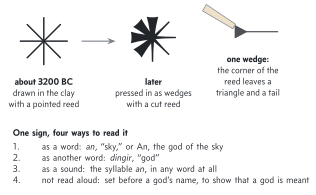
Cuneiform (kyoo-nee-ih-form) means “wedge-shaped,” from the Latin cuneus, a wedge. The first tablets of Uruk carry small pictures drawn into soft clay with a pointed reed: a head, a bowl, an ear of barley, a jar (Figure S.9). Over the next few centuries scribes stopped drawing and began pressing a reed cut to a sharp corner into the clay, which left a mark like a tiny triangle with a tail. The pictures turned into clusters of wedges that no longer looked like anything, as Figure S.10 shows. Cuneiform has several hundred signs. Some stand for whole words, some for syllables, and some are silent markers that tell the reader what kind of word comes next, such as the name of a god or of a city. The script was used for about three thousand years to write many languages, among them Sumerian; Akkadian (uh-kay-dee-un), the language of Babylon and Assyria; and the language of the Hittites. Hundreds of thousands of tablets survive, because clay that is baked, even by accident in a burning palace, lasts nearly forever. The last datable tablet was written at Uruk in AD 79 or 80.
Hieroglyphs (hy-roh-glifs) are the picture signs of Egypt. The name is Greek for “sacred carvings,” because the Greeks saw them cut into the walls of temples and tombs. Unlike cuneiform, they stayed pictures: an owl is always an owl, and a loaf of bread a loaf. In the classical age of Egyptian writing there were about nine hundred signs, and each could work in more than one way, as Figure S.8 shows. A sign could mean the thing it showed. It could stand for the sound of that thing’s name, the way a picture of an eye and a saw could spell “I saw” in English. And it could be a silent picture at the end of a word that showed what sort of word it was, a determinative (dih-tur-mih-nuh-tiv). About two dozen signs each stood for a single consonant, almost an alphabet, but the Egyptians never wrote with those signs alone. Like Hebrew, Egyptian writing left out the vowels, which is why the names of Egyptian kings are spelled in different ways in different books. Hieroglyphs could run from left to right or right to left; the reader starts from the side that the people and animals face. A king’s name was written inside an oval ring called a cartouche (kar-toosh). Hieroglyphs were used for more than three thousand years; the last known inscription was carved in AD 394, on the island of Philae (fy-lee) in the Nile.
Meanwhile elsewhere
The ancient Near East was not the only place where cities and writing appeared in these years, though it was the first. Table S.2 sets this volume’s stories beside what was happening in the rest of the world, and names the volumes that teach it. The Greeks and Romans appear in this volume wherever their story touches the Near East, as Alexander and Cleopatra do, but their own histories belong to their own volumes.
| Region | In these years | Taught in |
|---|---|---|
| Greece | The palaces of Minoan (mih-noh-un) Crete and Mycenaean Greece, gone by about 1200 BC; Homer’s epics, about 750 BC; Athens and Sparta; the wars with Persia (490–479 BC); Alexander the Great (336–323 BC). | Vol. 6, The Greeks |
| Rome | Rome founded, by tradition, in 753 BC; the Republic from 509 BC; Augustus, the first emperor, from 27 BC; Constantine, the first Christian emperor (312); the last emperor in the West deposed (476). | Vol. 7, The Romans |
| India | The cities of the Indus valley, Harappa and Mohenjo-daro, about 2600 to 1900 BC; the Vedas; the Buddha, in the sixth or fifth century BC; the emperor Ashoka, in the third. | Vol. 39, India |
| China | The Shang kings and their oracle bones (about 1600–1046 BC); Confucius (551–479 BC); the First Emperor unites China (221 BC); the Han dynasty (206 BC to AD 220). | Vol. 40, The Middle Kingdom |
| Africa | The Nok people of what is now Nigeria make terracotta heads and work iron, in the last nine centuries BC; the kingdom of Aksum in Ethiopia becomes Christian in the fourth century AD. | Vol. 43, Africa |
| The Americas | The first Andean cities, in Peru, from about 3500 BC; the Olmecs of Mexico (about 1200–400 BC); the city of Teotihuacan; the rise of the Maya cities. | Vol. 44, Gold, God, and Glory |
The Land Between the Rivers
Chapter 1 · 33 clues
Temples, Cities, and the First Writing
About 3,800 years ago, a man named Nanni was angry with a merchant in the city of Ur, in what is now southern Iraq. He had paid for copper, and the copper he was offered was bad. So he sent a letter, in the way people in his country had kept records for some fifteen hundred years. A lump of wet clay was flattened into a tablet a little smaller than a phone, and the end of a reed was pressed into it again and again, until both faces were covered with tiny wedge-shaped marks. Then the tablet went to the merchant who had cheated him.
The tablet survives, and visitors to the British Museum in London can look at Nanni’s anger today. Behind it lies a story much older than Nanni. It tells how people who hunted and gathered their food came to build temples, then towns, then cities ruled by kings, and how, to keep track of everything they owned, they invented writing. That story begins not in Iraq but on a hilltop in what is now Turkey, nearly eight thousand years before Nanni lost his temper.
Before the cities
For almost all of the human past, people lived by hunting animals and gathering wild plants. They moved with the seasons in bands of a few dozen, and they built nothing that lasted. Then, more than 12,000 years ago, in the hills that curve around the top of the Fertile Crescent, the arc of good land drawn on the map in the Stage, some groups began to stay in one place. They harvested wild wheat and barley, and over many centuries they learned to plant them. Archaeologists call this age the Neolithic, or “New Stone Age,” after its finely ground stone tools. For a long time the story seemed simple: first people learned to farm, and only then, with food to spare, did they build anything grand.
A hill called Göbekli Tepe, “Potbelly Hill” in Turkish, turned that story upside down. Göbekli Tepe lies in southeastern Turkey,The site of Göbekli Tepe is located in this country. → Turkey•• near the city of Şanlıurfa (shahn-luh-oor-fah), on a ridge at the foot of the Taurus Mountains, looking out over a wide plain (Figure 1.1). Surveyors first noted the site in 1963. In 1994 a German archaeologist, Klaus Schmidt, saw what it was, and from the next year until his death in 2014 he led the digging there.

Schmidt found rings of rough stone walls, 10 to 30 meters across, set with tall T-shaped pillars of limestone (Figure 1.2). Archaeologists call huge standing stones like these megaliths, from the Greek for “great stones.” Two larger pillars stand facing each other in the middle of each ring. Some pillars have arms and hands carved along their sides, so that each T looks like a giant stylized person, or a god, with the crossbar for a head. Carved across them run animals: foxes, boars, snakes, lions, scorpions, and vultures. The oldest rings were built about 9500 BC, before pottery, before metal, and probably before anyone in the region grew wheat on purpose. The builders cut the slabs from the bedrock about 100 meters away, working with flint tools.


Who could have built such a place? Schmidt reasoned that cutting and raising the pillars needed hundreds of workers, and that feeding them may have pushed people to farm. He summed up his idea in a phrase: “First came the temple, then the city.”Klaus Schmidt proposed “first came the temple, then the city” after excavating this megalithic site. → Göbekli Tepe• If he was right, religion did not grow out of settled life; settled life grew out of religion. The work since his death has made the picture less tidy. Excavators have found houses, rock-cut cisterns for rainwater, and stones for grinding grain, so people lived on the hill as well as worshiping there. What the rings were for is still argued.
Göbekli Tepe was not alone. About 40 kilometers to the northwest lay Nevalı Çori (neh-vah-luh choh-ree), a village of long stone houses beside a stream that runs into the Euphrates, lived in between about 8400 and 8100 BC. It had a shrine with T-shaped pillars like Göbekli Tepe’s, some of the oldest life-size statues ever found, and the oldest grains of farmed einkorn, an early kind of wheat. Among the finds is a fragment of a stone bowl from Nevalı Çori,A stone bowl from Nevalı Çori in this country depicts two human-like figures with a turtle-like being. → Turkey• carved with two human figures and a creature like a turtle, all three apparently dancing. German archaeologists dug the village in a hurry between 1983 and 1991, because Turkey’s Atatürk (at-uh-turk) Dam, named for the founder of the modern Turkish state, was about to flood the valley of the Euphrates. The site now lies under its lake.

About 550 kilometers to the west, on the flat Konya (kohn-yah) Plain, people built a true town. It is called Çatalhöyük, in central Turkey,The settlement of Çatalhöyük is located in this country. → Turkey•• from the Turkish for “fork mound,” and it was lived in from about 7500 to about 5600 BC. Its mud-brick houses were packed wall to wall, with no streets between them. People walked across the flat roofs and climbed down into their homes by ladders. They plastered their rooms white, painted the walls with hunting scenes and vultures, and set the horns of aurochs, huge wild cattle, into walls and benches (Figure 1.3). They buried their dead beneath the floors, sometimes under the very platforms where they slept.
The British archaeologist James Mellaart found the mound in 1958 and dug it from 1961 to 1965. He called the rooms with horns “shrines,” and in 1961 he found a small clay figure of a heavy woman seated between two great catsA figurine called the “Seated Woman,” with feline-shaped armrests, was found at this Neolithic settlement. → Çatalhöyük•• (leopards or lionesses), whose heads form the arms of her throne. She is known today as the Seated Woman of Çatalhöyük, and she had been left in a bin for storing grain. Mellaart believed she was a mother goddess who guarded the harvest. Later excavators, led from 1993 by the British archaeologist Ian Hodder, have doubted much of Mellaart’s reading, and nobody knows whom the figure was meant to be. Her head is a modern replacement, and she now sits in the Museum of Anatolian Civilizations in Ankara.
Farming spread from these hills across the Near East, and Anatolia, the great peninsula that is now Turkey, went on to develop cultures of its own. By the time cities had risen far to the south, western Anatolia had entered the Bronze Age (the Stage), and its smiths were casting tools and weapons of bronze. The Yortan (yor-tahn) culture of western Turkey,The Yortan culture was found in this modern-day country. → Turkey• of about 2700 to 2300 BC, is known from a cemetery near the village of Yortan, between the modern towns of Balıkesir (bah-luh-keh-seer) and Manisa, dug in the early 1900s. Its people buried their dead in huge clay storage jars, with pottery of distinctive shapes beside them.
Sumer and the invention of writing
Two great rivers, the Tigris and the Euphrates, run down from the mountains of Turkey to the Persian Gulf. The land between them is Mesopotamia (the Stage). Its southern plain is flat, hot, and nearly rainless, but every spring the rivers rise with melted snow. Farmers learned to dig canals that led the water to their fields, a practice called irrigation, and on that watered soil barley grew in enormous harvests. The rivers also carry silt, and over thousands of years they have pushed the coast far out into the Gulf (Vol. 3, Geography: Europe, Asia, and Africa describes the delta today).
By about 3500 BC the people of this southern plain were the Sumerians, and their land was Sumer. Their language, Sumerian, is related to no other known language. North of them, around the narrow neck where the two rivers come closest, lived people who spoke Akkadian, a Semitic language, one of the family that includes Hebrew and Arabic. The two peoples traded, married, and borrowed each other’s gods, and in time the Akkadians would rule them all.
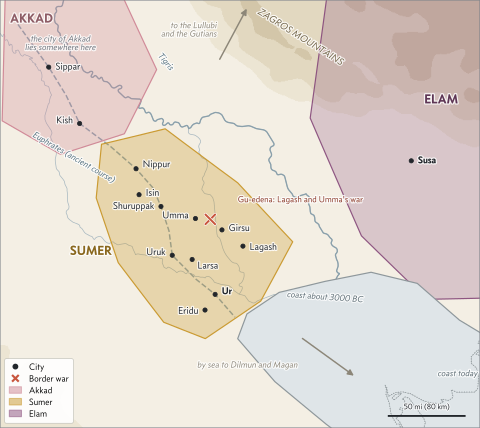
The Sumerians lived in city-states: each city ruled the fields, villages, and canals around it and answered to no one else. Sumerians built city-states such as Uruk and Ur,These people developed early Mesopotamian city-states such as Uruk and Ur. → Sumerians•• Lagash (lay-gash), Umma (oom-uh), Nippur (nih-poor), and Eridu (air-ih-doo) (Figure 1.4). The greatest was Uruk. By 3100 BC it may have held 50,000 people, more than any other city on earth. Each city belonged, the Sumerians believed, to a god, who lived in its chief temple: Uruk to the sky god An and the goddess Inanna (ih-nah-nuh), Ur to the moon god Nanna (nah-nah), Nippur to Enlil (en-lil), and Eridu to Enki (en-kee).
A Sumerian city’s ruler went by several titles, and scholars still argue about the differences between them. An en was a lord who also served the gods as a priest; an ensi governed a city on its god’s behalf. The grandest title was lugal (loo-gahl), “big man”,This civilization's kings were known as lugals, or "big men." → Sumerians• from lu, “man,” and gal, “big.” A lugal led the city’s army, judged its quarrels, and built its temples and canals, and the word came to mean simply “king.”

A city full of temples, workshops, and storehouses had to keep track of things. Long before the cities, from about 8000 BC, farmers across the Near East had counted their goods with small tokens of clay: cones, balls, and disks, each standing for a fixed amount of something, such as a jar of oil or a measure of grain. By about 3500 BC, to keep a deal honest, people sealed the clay tokens inside a bulla,"Accounting tokens" made of this material were stored in hollow envelopes called bulla, also made of it. → clay• a hollow ball of clay (the word is Latin for “bubble”; the plural is bullae). They rolled a cylinder seal, a small carved stone cylinder that left a picture in the clay like a signature, over the outside (Figure 1.5). To show what was inside without breaking the ball, they pressed the tokens into its surface before it dried.
The oldest tablets come from Uruk, from about 3300 to 3200 BC, and almost all of them are receipts and accounts of the temples, kept in small pictures and marks for numbers. Soon, as the Stage showed, the pictures turned into clusters of wedges pressed into the clay with a cut reed. This is the writing the Sumerians invented, cuneiform,This people invented cuneiform. → Sumerians• and over the next three thousand years it was used to write many languages, from Akkadian to Hittite and Elamite. In the same centuries as the first tablets, Egypt began writing in hieroglyphs (Chapter 4).
East of Sumer, across the Tigris and the marshes, lay Elam, the land around the city of Susa in what is now southwestern Iran, with a highland capital, Anshan (ahn-shahn), farther east. The Elamites spoke a language unrelated to Sumerian or Akkadian, and about 3100 BC Susa developed a writing of its own. From the Iranian mountains Elam sent timber, stone, and metal, which Sumer lacked, and its armies came down to raid as often as its traders came to sell. Elam was Sumer’s rival for a thousand years, and it will return as Babylon’s enemy in Chapter 3 and as the heart of a Persian empire in Chapter 21.
The city-states fought one another constantly, often over water and land. Lagash and its neighbor Umma quarreled for generations over the Gu-edena, a strip of rich farmland on their border. About 2450 BC Eannatum (ay-an-uh-tum), ruler of Lagash, beat Umma and set up a stele, an upright stone slab carved with pictures and words, to record his victory and the new border. On one side the god of Lagash holds the men of Umma trapped in a great net. On the other Eannatum marches at the head of his soldiers, who advance in a solid block behind a wall of shields with their spears thrust forward. They tread on enemy corpses, and above them vultures fly off with severed heads. That is why the monument is called the Stele of the Vultures,The Stele of the Vultures records a border conflict between this people's cities of Lagash and Umma. → Sumerians• the oldest war memorial known (Figure 1.6). Its inscription makes the ruler of Umma swear never to cross the border again. The oath did not hold: a later ruler of Umma, Lugalzagesi (loo-gahl-zah-gay-see), would conquer Uruk, Lagash, and nearly all of Sumer.


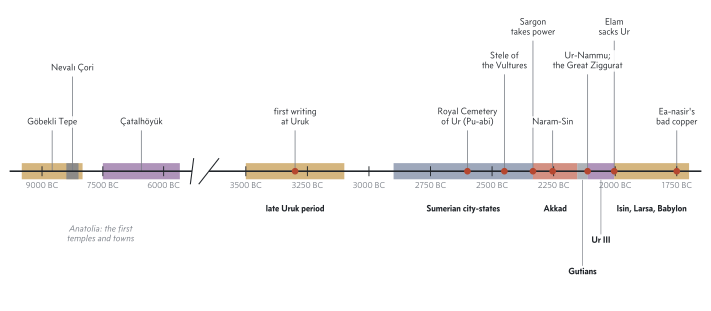
The Sumerians also began to tell stories about their own past. Their scribes drew up the Sumerian King List, a roll of cities and kings stretching back to fabulous reigns of tens of thousands of years before a great flood. One king of Uruk on the list, Gilgamesh (gil-guh-mesh), became a hero of legend. Sumerian poets wrote poems about GilgameshThese people composed early Gilgamesh poems in cuneiform. → Sumerians• in cuneiform: his fight with the guardian of a cedar forest, his battle with a monstrous bull, and his death. Centuries later Babylonian poets wove those tales into one long epic, the subject of Chapter 2. Figure 1.7 sets these centuries, and those that followed, in order.
The Royal Cemetery of Ur
Ur stood on the Euphrates near the head of the Gulf, a port and the city of the moon god. In 1922 an expedition of the British Museum and the University of Pennsylvania Museum began to dig there under the British archaeologist Leonard Woolley, a patient and exact excavator who recorded where every object lay. From 1926 on, his workers uncovered the find that made him famous, a cemetery of about 1,850 graves used over several centuries. Its richest tombs date from about 2600 to 2500 BC, the century in which the Egyptian king Khufu (koo-foo) raised his Great Pyramid at Giza (Chapter 8). Woolley dug the Royal Cemetery of Ur,This city's Royal Cemetery was excavated by Leonard Woolley. → Ur• so named because sixteen of its tombs were so large and rich that he took them for the graves of kings and queens.
The richest was a stone chamber that robbers had somehow missed for 4,500 years. In it lay a woman whose cylinder seal named her Pu-abi (poo-ah-bee) and gave her the title nin, a word for a queen or a high priestess. The tomb of Pu-abi heldThe tomb of Pu-Abi was discovered at this site. → Ur• a lyre, a headdress of gold leaves, rings, and flowers, and strands of beads of gold, red carnelian, and lapis lazuli, a deep-blue stone carried from the mountains of Afghanistan, more than 2,000 kilometers away. Three women lay in the chamber with her, and dozens of servants and guards in the pit beside it.
They were not the only ones. In the largest pit, which Woolley called the Great Death Pit, lay seventy-four attendants, six of them men and sixty-eight women, dressed in their finest gold and silver. Woolley found a small cup beside most of them and guessed that they had drunk poison calmly to follow their mistress or master into the next world. Modern study of some of the skulls tells a harsher story: they had been broken by blows to the head. Whether the victims went willingly or not, the burials of Ur were human sacrifice, and a cruel one.


From the Great Death Pit came a pair of figures about 46 centimeters high, each a goat standing on its hind legs and peering through the branches of a golden bush (Figure 1.8). He named them after a verse in Genesis, which tells how God tested Abraham, the ancestor of the Israelites in its story, by commanding him to sacrifice his son Isaac. An angel stopped him at the last moment, and then, Genesis 22:13 says, Abraham looked up and saw, in the King James Version’s words, “a ram caught in a thicket by his horns.” He offered the ram in his son’s place. So the goats of Ur became the Ram in a Thicket,Figures nicknamed "Ram in a Thicket" were discovered at this site. → Ur• though the sculptor almost certainly never heard of Abraham. One stands today in the British Museum, the other in Philadelphia.
The graves also held music. A lyre is a stringed instrument whose strings run from a hollow sound box up to a crossbar held between two arms, played by plucking. Woolley found several in the tombs of Ur, the wood long decayed but the decoration intact. The finest are lyres crowned with bulls’ heads,Lyres topped with bull's heads were discovered at this site. → Ur• mounted on the front of the sound box. The head on the lyre now in Philadelphia, from the grave Woolley called the King’s Grave, is gold over wood, with a beard of lapis lazuli. Below it a panel of shell shows animals behaving like people: a donkey plays a lyre, a lion carries a jar, and a scorpion-man walks with a gazelle. The bull’s head probably stands for the sun god Utu (oo-too), who, the Sumerians believed, could go down into the underworld.
The gods of Sumer
The Sumerians believed that the world was run by gods who looked like people, only taller, brighter, and deathless. Each god owned a city and lived in its temple, where priests fed, clothed, and washed the god’s statue every day. In one Sumerian myth, humans were shaped from clay for one reason: to do the hard work of digging canals and growing food, so that the gods could rest. In carvings a god can be recognized by a tall crown ringed with pairs of horns (Figure 1.10). Every later Mesopotamian myth, from Gilgamesh’s to Babylon’s, uses the same great gods. Most have two names, a Sumerian one and an Akkadian one, because the Akkadians who came to rule Sumer kept its gods and gave them names in their own language.

At the head of the family stood An, whose name means “sky”; the Akkadians called him Anu (ah-noo). He was the father of the gods and the source of kingship, but he stayed far off in heaven and seldom acted. The god who really ruled was his son Enlil, whose temple, the Ekur (eh-koor) or “mountain house,” stood at Nippur. Enlil’s name probably means “Lord Wind,” though scholars debate its second half, and the Sumerians thought of Enlil as the god of the wind,Enlil is a Sumerian god of this domain. → wind• of the air and the storm. He granted kingship to whomever he chose, and when he was angry he could send famine, invaders, or the great flood of Chapter 2.
A Sumerian poem of about 150 lines tells how Enlil won his wife. The young goddess Ninlil (nin-lil) went down to bathe in a river at Nippur, where Enlil saw her and took her, though she protested that she was too young. For this crime the other gods seized him in the city and banished him to the underworld. Ninlil, carrying his child, followed him. On the road Enlil disguised himself as the gatekeeperThis figure disguised himself as a gatekeeper and a ferryman to approach Ninlil. → Enlil• of the city, then as the man who kept the river of the underworld, then as the ferryman, and each time, hidden in a stranger’s shape, he lay with Ninlil and fathered another son. Those three sons, Nergal (nur-gahl), Ninazu (nin-ah-zoo), and Enbilulu (en-bih-loo-loo), became gods of the underworld and its waters (Figure 1.9). The poem explains how the moon and the gods below the earth were born, and it may be the oldest story known of a god changing his shape.
The first child of that strange union was the moon. Nanna, called Sin (seen) in Akkadian, sailed across the night sky in a boat shaped like the crescent moon, and he was also a god of the cattle herds that grazed by the rivers. He was the god of Ur, and he married the goddess Ningal (nin-gahl), “Great Lady.” So Nanna, son of Enlil and Ninlil,This Sumerian figure, born to Enlil and Ninlil, was Ningal’s consort and the father of Utu and Inanna. → Nanna (Sumerian god)•• was Ningal’s husband, and their children were two of the brightest lights in the sky, the twins Utu and Inanna.
Utu, the sun, whom the Akkadians called Shamash (shah-mahsh), climbed each morning out of the mountains of the east, crossed the sky, and went down in the west. Because he saw everything that happened under heaven, he was the god of justice, the judge who knew who had lied and who had stolen. He was worshiped above all at Sippar and Larsa. Hammurabi, a king of Babylon, will stand before him on the stone of his laws in Chapter 3, and he will help Gilgamesh against a monster in Chapter 2.
His twin sister was the most famous goddess of Mesopotamia. Inanna, called Ishtar (ish-tar) in Akkadian, was the goddess of love and of war, of desire and battle, and she shone in the sky as the planet Venus, the morning and evening star. The Sumerians worshiped the goddess InannaThis people worshipped the goddess Inanna. → Sumerians• above all at Uruk, where her temple, the Eanna (ay-an-uh), stood at the heart of the city from its earliest days. Most Sumerian texts make her Nanna’s daughter, though some, including the Epic of Gilgamesh, call her the daughter of An. Her quarrels and her journey to the land of the dead belong to Chapter 2.


The last of the great gods was Enki, called Ea (ay-ah) in Akkadian, who lived in the Abzu (ahb-zoo), the sea of fresh water that the Sumerians believed lay under the earth and fed every spring, well, and river. His city was Eridu, which they thought the oldest city in the world. Enki was the god of wisdom, crafts, and magic, the clever one who found a way out when the other gods were stuck. He was also the friend of mankind. In the myth of the clay people it is Enki who thinks of making humans, and when Enlil later decides to drown them all, Enki warns one man in time (Chapter 2). In carvings, streams of water full of fish flow from his shoulders.
Enki’s servants were the Apkallu (ahp-kah-loo), half man and half fish:In Mesopotamian legend, these animals form the bodies of a group of seven sages called the Apkallu. → fish• seven sages whom, the Mesopotamians said, the gods sent up out of the waters before the flood to teach humans the arts of civilization, from building cities to writing. Sculptors of later centuries, in Babylon and in Assyria on the upper Tigris, showed them as bearded men wrapped in the skin of a huge fish, its head worn as a cap and its body as a cloak (Figure 1.10). Small clay Apkallu were buried under the floors of houses to guard them from evil. About 280 BC a Babylonian priest named Berossus (beh-ros-us), writing in Greek for the Greek-speaking kings who then ruled Babylonia, told of the first of them, Oannes (oh-an-eez). He had a fish’s body with a man’s head and feet, and he came up from the sea each day to teach and went back into the water every night.
Sargon and Akkad
Kish, near the place where Babylon would later rise, was the strongest city of the Akkadian-speaking north, and its kings claimed to rule the whole land. Among the servants at its court was a young man of no known family. According to the Sumerian King List and a Sumerian legend, Sargon (sar-gon), the future founder of the Akkadian Empire, began as cupbearer to the king of Kish,According to tradition, this founder of the Akkadian Empire served as a cupbearer to the king of Kish. → Sargon of Akkad• Ur-Zababa (oor-zah-bah-bah). A cupbearer poured the king’s wine, tasted it for poison, and stood close to him every day, so the post was a position of trust. In the legend, the king, frightened by a dream, sends Sargon to a rival king carrying a clay tablet that asks its reader to kill the bearer, and there the broken tablet ends.
What is certain is that Sargon seized power, about 2334 BC in the reckoning most books use. His name, Sharru-kin (shar-roo-keen) in Akkadian, means “the true king,” a name that a man not born to the throne might well have chosen for himself. He ruled from Akkad, also called Agade, a city that later tradition said he built. Its ruins have never been found. Then he turned south against Lugalzagesi, the ruler of Umma who had made himself king of Uruk and of nearly all Sumer. Sargon defeated him and led him in a wooden neck stock to the gate of Enlil’s temple at Nippur, to show the land which king the god had chosen. Sargon conquered the city-states of SumerSargon of Akkad conquered the city-states of these people. → Sumerians•• one by one, Ur, Lagash, and Umma among them, and tore down their walls.
Sargon did not stop at Sumer. His inscriptions boast that he won thirty-four battles, and that 5,400 men ate before him every day, a standing army paid by the king and loyal to him alone. His soldiers marched up the Euphrates to Mari, a trading city on the river’s middle course, and toward the cedar mountains of Syria, and east into Elam. Ships from Dilmun (dil-moon) and Magan (mah-gahn) on the Gulf, and from Meluhha (meh-loo-hah), the land of the Indus River far to the east, tied up at his city’s quay. He claimed to rule from the Lower Sea, the Gulf, to the Upper Sea, the Mediterranean, though historians doubt that he held the far west for long. A state like this, in which one king rules many lands and peoples by force from one center, is an empire, and Sargon the Great founded the Akkadian Empire,Sargon the Great founded this Mesopotamian empire. → Akkad• which most historians count as the first in history.
Under the Akkadian kings, Akkadian became the language of government, written in Sumer’s cuneiform. Sumerian lived on as the language of temples and learning, much as Latin did in medieval Europe. To bind the conquered south to his house, Sargon made his daughter the en, or high priestess, of the moon god Nanna at Ur. She is known by her priestly name, Enheduanna (en-heh-doo-ah-nah), and she probably lived in the priestesses’ house beside the god’s temple. Hymns in Sumerian to Inanna, spoken in her own voice, and a cycle of forty-two hymns to the temples of Sumer and Akkad are credited to her. That makes Enheduanna, a priestess from Akkad,Enheduanna, a priestess from this empire, is traditionally regarded as the earliest named author. → Akkad• the earliest author in the world whose name we know. In one hymn, The Exaltation of Inanna, she tells how a rebel named Lugal-Ane drove her out of Ur and how she begged the goddess for help. Scholars debate whether she truly composed these works: the copies that survive were made by Babylonian students about six hundred years later, who may have attached her famous name. Woolley found an alabaster disk at Ur in 1927 that names her and shows her at an offering (Figure 1.11).

The empire reached its height under Sargon’s grandson Naram-Sin (nah-rahm-seen), whose name means “beloved of Sin,” the moon god. He reigned from about 2254 to 2218 BC. When the cities of the empire rose together against him, he boasted of winning nine battles in a single year. He took the title “king of the four quarters,” meaning the whole world, and he was the first king of Mesopotamia to call himself a god. In the Zagros Mountains to the northeast lived the Lullubi (loo-loo-bee), a mountain people who raided the plain. Naram-Sin of Akkad defeated the Lullubi,Naram-Sin of this empire defeated the Lullubi. → Akkad• and he set up a stele of pink limestone, 2 meters high, to say so (Figure 1.12).

On that stele the king climbs a mountain at the head of his army, in a helmet with horns, the mark of a god. His enemies tumble down the slope or beg for mercy, and above the peak shine the stars of the gods. About a thousand years later, in the twelfth century BC, the Elamite king Shutruk-Nakhunte (shoo-trook-nah-koon-teh) raided Mesopotamia and carried the stele off to Susa as loot, and he added an inscription of his own. The same raids probably brought Hammurabi’s law stele to Susa as well (Chapter 3). In 1898 the French archaeologist Jacques de Morgan found Naram-Sin’s stele at Susa, and it went to the Louvre.
After Naram-Sin the empire fell apart. His son Shar-kali-sharri (shar-kah-lee-shar-ree) lost province after province; a long drought may have struck the north; and raiders came down from the hills. The most feared were the Gutians (goo-tee-unz), a people of the Zagros whom the Sumerians thought barbarous. When Shar-kali-sharri died, about 2193 BC, the state fell into such confusion that the Sumerian King List asks, at this point, who was king and who was not, and lists four kings in three years. A shrunken Akkad lasted until about 2154 BC. For the next few decades Gutian kings ruled parts of Sumer,The Gutians ruled parts of these people’s homeland after the fall of Akkad. → Sumerians• while some Sumerian cities, such as Lagash, governed themselves, until a ruler of Uruk drove the Gutians out. A Sumerian poem, The Curse of Agade, written later, blamed the fall on Naram-Sin himself: it says he tore down Enlil’s temple at Nippur, and that Enlil sent the Gutians down from the mountains in revenge.
The kings in legend
Akkad fell, but its kings lived on in stories for two thousand years. The most famous was copied in Assyria in the seventh century BC, written as if Sargon himself were speaking. His mother, it says, was a high priestess, and he never knew his father. She bore him in secret, set him in a reed basket,According to his birth legend, this ruler was set afloat in a reed basket as a baby. → Sargon of Akkad• sealed its lid with bitumen, a natural tar, and put it in the river. The river carried him to Akki, a man who drew water, who lifted him out, raised him as his son, and made him a gardener. While he was a gardener, the goddess Ishtar loved him, and so he became king. Readers of the Bible at once think of Moses, the leader who, the Book of Exodus says, brought Israel out of Egypt. When a pharaoh ordered every newborn Hebrew boy thrown into the Nile, Exodus 2:3 says, Moses’s mother “took for him an ark of bulrushes, and daubed it with slime and with pitch,” and laid it among the reeds at the river’s edge (Chapter 13). Scholars debate whether one story borrowed from the other or both drew on an older pattern of the hero cast away as a baby.
That tale belongs to a type that scholars call narû (nah-roo) literature,Mesopotamian naru literature includes fictionalized accounts of Sargon and Naram-Sin of this empire. → Akkad• from narû, the Akkadian word for a stele. These were invented inscriptions, written in a famous king’s own voice as if carved on his monument, and they told his story to teach a lesson to the kings who came after. Sargon and Naram-Sin of Akkad were their favorite heroes. In one, Naram-Sin faces a horde of strange warriors created by the gods. He sends a soldier to prick one with a pin to see whether they bleed, ignores bad omens, and loses three armies in three years. In the end he learns humility, and he advises future kings to obey the gods and leave such enemies alone.
Ur’s last dynasty and a merchant’s complaint
The ruler of Uruk who drove out the Gutians, Utu-hengal (oo-too-heng-gahl), died after seven years as king, and his governor at Ur took power. This was Ur-Nammu (oor-nah-moo), who about 2112 BC founded the Third Dynasty of Ur, called Ur III: “third” because the Sumerian King List counted two earlier dynasties at Ur. Its kings ruled Sumer and Akkad for about a century, until 2004 BC. They wrote in Sumerian, and theirs was the last great Sumerian kingdom. The oldest law code that survives bears Ur-Nammu’s name; it is more than three hundred years older than Hammurabi’s (Chapter 3).
Ur-Nammu’s grandest work stood in the moon god’s precinct at Ur. A ziggurat (zig-uh-rat) is a stepped tower of solid brick, built in stages one on top of another, with stairways climbing to a temple at the top. It was not a tomb and had no rooms inside: it was a man-made mountain that lifted the god’s house toward the sky. Ur-Nammu’s Sumerian builders raised the Great ZigguratThis civilization built the Great Ziggurat of Ur. → Sumerians• for Nanna, and his son finished it. Its base measured 64 by 45 meters, about the area of seven basketball courts, and it may have stood more than 30 meters high. A core of sun-dried mud brick was cased in fired brick set in bitumen. Its Sumerian name, Etemenniguru, means “house whose foundation creates terror.”

By the sixth century BC the tower had crumbled, and the last king of Babylon, Nabonidus (nab-uh-ny-dus), rebuilt it. Woolley cleared it in the 1920s and 1930s, and Iraq rebuilt its outer facing and stairways in the 1980s. The Great Ziggurat still stands at Ur,The Great Ziggurat is located at this Sumerian city. → Ur• the best preserved of all the ziggurats of Mesopotamia (Figure 1.13). The story of the Tower of Babel in Genesis may have taken shape among people who had seen towers like this one, above all the greater ziggurat at Babylon (Chapter 11).
Ur-Nammu’s son Shulgi (shool-gee) reigned for forty-eight years, from about 2094 to 2047 BC, and turned the kingdom into a machine run by scribes. A hymn has him run from Nippur to Ur and back, about 160 kilometers each way, in a single day, to celebrate a festival in both cities. Like Naram-Sin he made himself a god. He set up governors in every province, a single calendar, and standard weights. Above all, he organized the bala, or “rotation,”The kingdom centered on this Sumerian city organized rotating provincial contributions through the bala system. → Ur• by which the kingdom centered on Ur was fed. Each province of the heartland took its turn, usually for one month a year and the richest for two or three, sending goods to the king’s storehouses and temples: grain from Girsu (geer-soo), reeds, wood, and leather from Umma. Clerks then passed the goods on to wherever they were needed. At one center near Nippur, Puzrish-Dagan (pooz-rish dah-gahn), scribes recorded some 70,000 sheep moving through in a single year.
The machine broke under Shulgi’s grandson Ibbi-Sin (ib-ee-seen). Provinces broke away, and nomads called Amorites pushed in from the west. About 2004 BC an army from Elam, with highlanders from the Zagros, sacked Ur and led Ibbi-Sin away to Elam as a prisoner. Sumerian poets mourned in the Lament for Ur, in which Nanna’s wife Ningal weeps before the gods for her ruined city. Within a few centuries Sumerian died as a spoken language, though scribes went on copying it for two thousand years, and Sumer passed into the hands of rival kingdoms: Isin (ee-sin), Larsa, and at last Babylon (Chapter 3).

Ur was still a busy port. Its merchants sailed down the Gulf to Dilmun, the trading island now called Bahrain, to buy copper, the reddish metal from which tools and weapons were made, alone or as bronze. Mesopotamia had no ore of its own. The copper was mined in Magan, in what is now Oman, and passed through Dilmun’s markets on its way north. Some two centuries after Ur III fell, one of these traders was a man named Ea-nasir (ay-ah-nah-seer).
Nanni had paid Ea-nasir for copper ingots, bars of the raw metal, and Ea-nasir had promised good ones. When Nanni’s servant came to collect them, he was offered poor copper and told to take it or leave it. Nanni sent messengers to get his money back, and Ea-nasir sent them away empty-handed and treated them rudely. So Nanni sent a complaint about bad copperEa-Nasir received a complaint about poor-quality supplies of this metal. → copper•• to Ea-nasir in cuneiform (Figure 1.14). He demands to know why he has been treated with such contempt, insists on his refund, and says that from now on he will inspect every ingot himself before accepting it. Woolley found the tablet in the ruins of a house at Ur believed to be Ea-nasir’s, along with other angry letters, among them one from a customer who had not yet received his copper at all. Guinness World Records lists Nanni’s tablet as the oldest written customer complaint, and since 2015 it has been a running joke on the internet.
The clay that had once counted a farmer’s sheep now carried a customer’s fury. In less than two thousand years, the Sumerians and their neighbors had built cities, temples, and towers, invented writing, and given the world its first empire and its first author known by name. Meanwhile Babylon, a small town in Sargon’s day, was becoming the capital of all Mesopotamia under its king Hammurabi (Chapter 3).
What to remember
- Göbekli Tepe in southeastern Turkey (about 9500 BC) had carved T-shaped pillars raised before farming, and the later village of Nevalı Çori had pillars like them. Göbekli Tepe’s excavator, Klaus Schmidt, said “first came the temple, then the city.” Çatalhöyük in central Turkey was a crowded Neolithic town of mud-brick houses entered through the roof.
- The Sumerians of southern Mesopotamia built city-states such as Uruk, Ur, Lagash, and Umma; a king was a lugal, “big man.” Elam, around Susa in southwestern Iran, was their neighbor and rival.
- Writing grew out of accounting: clay tokens sealed in bullae, then marks on tablets at Uruk about 3300 BC, then cuneiform, wedges pressed into clay with a reed.
- Leonard Woolley dug the Royal Cemetery of Ur (about 2600–2500 BC): Pu-abi’s tomb, the Ram in a Thicket, the bull-headed lyres, and dozens of sacrificed attendants.
- The great gods: An (Anu) the sky; Enlil, the wind, of Nippur; Enki (Ea), fresh water and wisdom, of Eridu, served by the fish-cloaked Apkallu; Nanna (Sin), the moon, of Ur, son of Enlil and Ninlil and father of Utu (Shamash) the sun and Inanna (Ishtar).
- Sargon of Akkad, by tradition once cupbearer to the king of Kish, conquered Sumer about 2334 BC and founded the first empire; a later legend set him afloat in a reed basket. His daughter Enheduanna is the earliest named author, and his grandson Naram-Sin defeated the Lullubi. The Gutians followed the empire’s fall.
- Ur III (2112–2004 BC) built the Great Ziggurat of Ur for Nanna and fed its kingdom through the bala rotation; Elam sacked Ur. Some two centuries later Nanni complained to the merchant Ea-nasir about bad copper.
Chapter 2 · 54 clues
Gilgamesh, Enkidu, and Ishtar
One day in 1872, a young assistant at the British Museum in London sat sorting broken pieces of clay. George Smith had left school at fourteen to learn to engrave banknotes. In his lunch hours he had taught himself to read cuneiform, the wedge-shaped writing of ancient Mesopotamia (the Stage). Now the museum paid him to fit together the thousands of fragments that British diggers had shipped home from Nineveh, the ruined capital of the Assyrian empire, in what is now northern Iraq.

On one fragment he read that a ship had come to rest on a mountain. A dove was sent out, and it came back because it found nowhere to land. A swallow came back too. Then a raven was let go, and it did not return. Smith knew this story, and so did everyone who went to church in Victorian England: in the eighth chapter of Genesis, Noah sends a raven and a dove out of the ark when the rain has stopped. Here was the same scene in a language dead for nearly two thousand years, on a tablet buried since 612 BC. His colleagues remembered that Smith jumped up, rushed about the room in delight, and to their astonishment began to take off his clothes.
On December 3, 1872, Smith read his translation to the Society of Biblical Archaeology in London, and the prime minister, William Gladstone, came to hear it. But the flood was only one episode in a far longer poem. The man who heard the story of the flood was its hero, a king who wanted more than anything not to die (Figure 2.2).

The Epic of Gilgamesh
What Smith had found was one page of the poem now called the Epic of Gilgamesh. An epic is a long poem that tells the deeds of a hero, as Homer’s Iliad tells the deeds of Achilles (Vol. 4, Classical Myth). This one was written down more than a thousand years before Homer. It is about friendship, fame, and death, and its hero Gilgamesh gives the poem its name.This figure is the hero of a namesake Mesopotamian epic. → Gilgamesh••• He is a king stronger than any man alive, who wins every fight he picks and then learns the one thing his strength cannot change. Along the way the poem asks what a friend is worth, and how a man should live once he knows that he must die.
The hero may also have been a real man. In Sumerian his name was Bilgames (bil-gah-mes), which probably means “the kinsman is a hero.” Gilgamesh was remembered as king of Uruk,This figure is the king of Uruk. → Gilgamesh••• the great Sumerian city on the Euphrates (Chapter 1). The Sumerian King List, a roll of rulers that scribes compiled about 2000 BC, names him among Uruk’s early kings and gives him a reign of 126 years. No one believes the number, but most scholars accept that a real Gilgamesh ruled Uruk, and the British scholar Stephanie Dalley puts his lifetime between about 2800 and 2500 BC. Later texts credit him with building the city’s wall, and archaeologists have traced a wall thought to date from about 3000 BC, earlier than Dalley’s dates for him: mud brick some 40 feet high, running 5.6 miles around the city, a walk of nearly two hours.
After his death Gilgamesh was worshiped as a god, and people prayed to him as a judge of the dead. About 2100 BC the kings of Ur’s Third Dynasty (Chapter 1) called him their brother, to borrow some of his glory, and poets told stories about him in Sumerian. Five of these poems survive, and some may come from those kings’ court. They are separate tales, not one long story, and in them his friend Enkidu (en-kih-doo) is still his servant. The poem kept growing for more than a thousand years after its hero’s death (Figure 2.3).

The first long poem to join the tales together was written about 1800 BC in Akkadian, the language of Babylon and Assyria (Chapter 1). Babylonian scribes named a poem by its first words, and this one began “Surpassing all other kings.” Modern scholars titled the poem for Uruk’s kingThis text is titled for a king of Uruk. → The Epic of Gilgamesh•• instead, and every version is now called the Epic of Gilgamesh. This first one is known as the Old Babylonian version, after the centuries from about 1900 to 1600 BC when Babylon’s first dynasty ruled, and only a few of its tablets survive. Students learning cuneiform copied it at school, and so it traveled wherever cuneiform went (Figure 2.4). Between about 1400 and 1200 BC it was copied at Ugarit (oo-guh-reet) and Emar (eh-mar) in Syria and at Megiddo in Canaan, and the Hittites, whose kingdom ruled Anatolia (Chapter 10), put it into their own language at their capital, Hattusa.

The version read most today, the Standard Babylonian version, was made between about 1300 and 1000 BC by a scholar named Sin-leqi-unninni (sin-leh-kee-oo-nin-ee). His version fills twelve tablets, about three thousand lines in all (Table 2.1). The twelfth is a translation of an older Sumerian poem, and it sits oddly after the story has ended. He gave the poem a new first line, which became its Babylonian title: “He who saw the deep.” The words describe the hero. Gilgamesh is the one who saw the deep,This figure is known as "He who saw the deep." → Gilgamesh• the man who traveled to the edge of the world and came back with secret knowledge, the story of the flood and of what the gods intend for men.
| Tablet | What happens |
|---|---|
| I | Gilgamesh oppresses Uruk; the gods make Enkidu; Shamhat tames him; Gilgamesh dreams |
| II | Enkidu reaches Uruk; the two wrestle and become friends |
| III | Preparations for the Cedar Forest; Ninsun prays to Shamash |
| IV | The journey; Gilgamesh’s nightmares on the way |
| V | The battle with Humbaba and the felling of the cedars |
| VI | Ishtar’s proposal; the Bull of Heaven |
| VII | The gods condemn Enkidu; his illness and death |
| VIII | Gilgamesh mourns and buries his friend |
| IX | Mount Mashu and the scorpion-men; the road of the sun |
| X | Siduri, Urshanabi, and the Waters of Death |
| XI | Utnapishtim’s flood; the test of sleep; the plant and the snake |
| XII | Enkidu in the underworld (an older Sumerian poem, translated) |
Sin-leqi-unninni also gave the poem a frame. Its opening tells the reader to climb Uruk’s wall, walk along it, and admire its brickwork. Then he is to find a box of cedar wood, undo its bronze clasps, and read the story of Gilgamesh’s hardships from a tablet of lapis lazuli, a deep blue stone. At the end, Gilgamesh comes home and shows the same wall to a companion in nearly the same words. The story closes where it began, on the one thing the king made that would outlast him.
The poem’s verse works by pairs. A line says something, and the next says it again in other words or pushes it one step further, as the Hebrew Psalms do. When a god or a hero sends a message, the poet repeats it word for word as it is passed on, and long journeys are counted out stage by stage. Listeners who heard the poem read aloud could feel the story coming, and the repetitions made the surprises sharper.
The copies Smith worked on were made for Ashurbanipal (ah-shoor-bah-nih-pahl), king of Assyria from 669 to 631 BC, who gathered the writings of Mesopotamia into a library at Nineveh (Chapter 18). More than thirty thousand of its tablets and fragments survive. In 612 BC Nineveh fell to its enemies and burned, and the library lay buried in the ruins. The Englishman Austen Henry Layard (laird) and his assistant Hormuzd Rassam (hor-muzd ruh-sahm), an Assyrian Christian from Mosul, dug much of it out in the early 1850s, and the tablets went to London.
Smith could not yet read the hero’s name and called him “Izdubar.” In 1873 the Daily Telegraph, a London newspaper, paid for him to dig at Nineveh himself, and he brought back more pieces of the flood story. On a later journey he caught dysentery, a disease of the gut, and died at Aleppo, in Syria, in 1876, at thirty-six. The work goes on without him. Much of Sin-leqi-unninni’s poem has now been recovered, though gaps remain, and some of them are filled from the older versions. In 1998 the American scholar Theodore Kwasman found what seem to be the poem’s opening lines on a fragment that had lain unread in the British Museum’s storerooms since 1878.
Gilgamesh and Enkidu
The king and the wild man
The poem opens on a tyrant. Gilgamesh is the strongest and handsomest man in Uruk, two-thirds god and one-third man.This figure is two-thirds divine and one-third human. → Gilgamesh•• The arithmetic is strange, since a child has two parents, and the poem never explains it. Perhaps the poet meant only that he is more god than man, yet still man enough to die, and the whole poem turns on that one remaining third. His mother is the goddess NinsunThis figure is the son of the goddess Ninsun. → Gilgamesh•• (nin-soon), whose name means “Lady of the Wild Cows,” and his father is Lugalbanda (loo-gal-ban-duh), remembered as an earlier king of Uruk and worshiped as a god after his death. Gilgamesh never rests and never lets anyone else rest. He wears out the young men of the city with contests and labor, and he claims each new bride before her husband. The people of Uruk cry out to the gods.
The gods answer by making him an equal. The mother goddess Aruru (ah-roo-roo) pinches off a piece of clay and throws it down in the wilderness, and from it grows Enkidu. He is shaggy with hair from head to foot. He grazes on grass beside the gazelles and crowds in with the herds at the water holes. The gods have made a wild man to be Gilgamesh’s companion,This figure is Gilgamesh's wild companion. → Enkidu•• though neither of them knows it yet. Enkidu’s first act in the story is to ruin a trapper, filling in his pits and tearing up his snares so that the animals go free.

The frightened trapper goes to Uruk, and Gilgamesh tells him what to do. He is to take Shamhat (shahm-haht) out to the water hole. The poem calls her a harlot, and she is often thought to have served the love goddess Ishtar at her temple. She waits there until Enkidu comes, and she lies with him for a week. When at last he gets up to rejoin his herd, the gazelles run from him, and his legs can no longer keep up. Enkidu has lost his wildness, the poem says, but gained understanding. Shamhat tames the wild manShamhat tames this wild figure. → Enkidu•• the rest of the way. She clothes him from her own garments and leads him to a shepherds’ camp, where he learns to eat bread and drink beer. He drinks seven jugs, sings for joy, washes, oils his skin, and becomes a man.
Meanwhile, in Uruk, Gilgamesh dreams. In the first dream a rock falls from the sky in front of him, a meteorite so heavy he cannot lift it, while the people of the city crowd around to kiss it. In the second dream an axe lies in the street. Each time he loves the thing as if it were a wife and brings it to his mother. Ninsun, who is wise, explains that a mighty friend is coming who will never abandon him. The dreams of meteorite and axeThis figure dreams of an axe and a meteorite, foretelling Enkidu's arrival. → Gilgamesh••Gilgamesh dreams of an axe and a meteorite before meeting this figure. → Enkidu•• foretell Enkidu.
Enkidu hears from a traveler how the king treats brides, and he comes to Uruk in anger. At a wedding he plants himself in the doorway of the bride’s house and blocks the king’s way. The two men grapple like bulls, shattering the doorposts and shaking the walls, until Gilgamesh brings him down and Enkidu admits that the king has no equal. The fight ends in admiration, and they kiss and become friends. Enkidu becomes Gilgamesh’s wild companion,Enkidu is this figure's wild companion. → Gilgamesh••• and Ninsun later adopts him as a son. The tyrant has someone to share his strength with, and Uruk has some peace.
The Cedar Forest
Friendship makes Gilgamesh restless for fame. Death takes everyone, he tells Enkidu, so a man should make a name that lasts. Far to the west lies the Cedar Forest, where the tall trees that Mesopotamia lacked grew thick on the mountains. It has a guardian, Humbaba (hoom-bah-bah), whom Enlil, the god of the wind and the chief of the gods (Chapter 1), has set there to keep men out. Humbaba guards the cedarsThis figure guards the cedar forest in the Epic of Gilgamesh. → Humbaba• with seven terrible auras of light, and the poem says his roar is the flood and his breath is death (Figure 2.6).


Enkidu, who had roamed those hills, warns him, and so do the elders of Uruk. When they cannot change his mind, the elders give him advice for the road: let Enkidu walk in front, since he knows the way and has seen the fighting. Ninsun climbs to her roof and prays for her son to Shamash, the sun god who sees everything (Chapter 1). Then Gilgamesh sets out to kill Humbaba,This figure ventures into the Cedar Forest to kill Humbaba. → Gilgamesh••• with Enkidu at his side. They walk west for days, and each night Gilgamesh has a nightmare of falling mountains, storms, and wild bulls. Each morning Enkidu insists the dream means victory.
At the forest’s edge they hear Humbaba bellow, and Gilgamesh is afraid. The battle shakes the mountains and turns the sky black. Then Shamash sends thirteen winds against Humbaba,The sun god Shamash sends winds to help this figure defeat Humbaba in the Cedar Forest. → Gilgamesh••Shamash sends these phenomena to help Gilgamesh and Enkidu defeat Humbaba. → wind• and they pin him so he can move neither forward nor back. Caught, the monster begs for his life. He offers to be Gilgamesh’s servant and to cut his cedars for him. Gilgamesh hesitates, but Enkidu insists: kill him before the gods hear of it, and win fame forever. Humbaba curses them both. Enkidu helps the king kill Humbaba,This figure assists the king of Uruk in killing Humbaba, the Guardian of the Cedar Forest. → Enkidu•• and Gilgamesh strikes him in the neck.
Then they cut down the cedars. Enkidu chooses the tallest tree to make a great door for Enlil’s temple at Nippur, the god’s holy city (Chapter 1). They lash the logs into a raft and float home down the Euphrates (Figure 2.7). They have won their fame. They have also killed a guardian whom a god appointed, and the gods do not forget.

Ishtar and the Bull of Heaven
Back in Uruk, Gilgamesh washes his long hair and puts on clean robes, and a goddess sees him. The Sumerians called her Inanna (Chapter 1). The Akkadian poem calls her Ishtar, Anu’s daughter, goddess of love and war,This Mesopotamian figure, often called Anu's daughter, is the goddess of love and war. → Ishtar••• a child of the sky god who was father of all the gods. She asks Gilgamesh to marry her, and she promises him a chariot of lapis lazuli and gold and kings kneeling at his feet. His goats will bear triplets, she says, and his ewes twins.
Gilgamesh rejects Ishtar’s advances,Gilgamesh rejected this figure's romantic advances. → Ishtar•• and he does it with insults. She is a door that does not keep out the wind, he says, and a shoe that pinches its owner’s foot. Then he lists her lovers and what became of them. There was Tammuz, the lover of her youth, for whom she decreed weeping every year. There were a bright bird whose wing she broke, a lion for whom she dug pits, and a stallion she gave the whip and spur. A shepherd she turned into a wolf, and her father’s gardener she struck as well. Why should he be next?
Ishtar storms up to heaven in tears and persuades Anu to send the Bull of Heaven,This figure persuades Anu to send the Bull of Heaven against Gilgamesh. → Ishtar••• the sky god’s own monstrous bull, though only after a scene. Anu points out that Gilgamesh told only the truth. If he will not give her the Bull, she says, she will smash the gates of the underworld and let the dead come up to eat the living, until the dead outnumber them. Anu warns that the Bull will bring seven years of famine, and she says she has stored grain enough. He gives it to her, and she sends the Bull to kill Gilgamesh.The Bull of Heaven is sent to kill this figure after he spurns Ishtar's advances. → Gilgamesh•••
The Bull comes down to Uruk and drinks the river low. Each time it snorts, a pit opens in the ground and swallows a hundred young men, then two hundred. Enkidu falls into the third pit up to his waist, but he leaps out and seizes the Bull by its horns. He shouts to Gilgamesh where to strike, and Gilgamesh drives his sword in between the horns and the neck. Gilgamesh and Enkidu slay the Bull,This figure and Enkidu slay the Bull of Heaven. → Gilgamesh•• and they cut out its heart as an offering to Shamash. Babylonian astronomers saw this Bull among the stars, in the constellation we call Taurus.
Ishtar climbs Uruk’s wall and curses Gilgamesh. Enkidu answers by tearing off one of the Bull’s haunches, and Enkidu hurls the thigh at Ishtar:This figure throws the Bull of Heaven's severed thigh at Ishtar. → Enkidu•• if he could catch her, he shouts, he would do the same to her. Ishtar gathers the women of her temple to wail over the Bull’s haunch. Gilgamesh gives the oil that the Bull’s huge horns can hold to his father Lugalbanda, hangs the horns in his bedroom, and Uruk feasts. In the palace he calls out to the serving women, asking who is the finest of men, and they answer that Gilgamesh is. It is the last happy night of the friendship.
The death of Enkidu
That night Enkidu dreams that the gods sit in council. Anu decrees that one of the friends must die, since together they had killed Humbaba and the Bull. Gilgamesh struck the death blows, but Enkidu had helped kill the Bull,This figure assists in killing the Bull of Heaven. → Enkidu• and it was he who had urged Humbaba’s death. Enlil, who had set Humbaba over the forest, chooses Enkidu, and Shamash protests in vain. Enkidu falls sick. In his bitterness he curses the cedar door he made, the trapper, and Shamhat, who brought him out of the wild. Then Shamash reminds him that Shamhat gave him bread, beer, clothes, and a friend, and Enkidu blesses her instead. He dreams of the underworld: a house of dust, where the dead sit in darkness, eat clay, and wear feathers like birds. He grieves that he must die of sickness instead of falling in battle like a hero. After twelve days of illness, he dies.
Gilgamesh will not believe it. He covers his friend’s face like a bride’s and paces around the body like a lioness robbed of her cubs. Later he tells how he wept for six days and seven nights and mourned until a maggot fell from its nose.This figure mourns his friend’s corpse until a maggot crawls from its nose. → Gilgamesh• Only then would he let his friend be buried. He calls on the mountains, rivers, and animals to mourn, has a statue made of gold and lapis lazuli, and gives the gods of the underworld rich gifts so they will welcome Enkidu. But the gifts do not bring him back. For the first time, Gilgamesh understands that he too will die, and Enkidu’s death drives Gilgamesh to seek immortality.This figure's death prompts Gilgamesh to seek immortality. → Enkidu•
Utnapishtim and Atrahasis
To the edge of the world
Grief turns into fear. Gilgamesh roams the open country weeping, and he asks himself whether he too must lie down like Enkidu and never rise again. Sorrow has entered his heart, the poem says, and he is afraid of death. His companion’s death sets him questingThe death of this figure's companion Enkidu motivates his quest for immortality. → Gilgamesh••• for eternal life, and he knows of one man who escaped death. His ancestor Utnapishtim (oot-nuh-pish-tim) survived the great flood, and the gods made him immortal and settled him far away, at the mouth of the rivers. Gilgamesh sets out to ask him how. He crosses the wild unwashed, dressed in the skins of lions he has killed.
At the end of the earth he reaches Mashu (mah-shoo), the twin-peaked mountain through which the sun passes as it goes down and comes up. Two scorpion-men guard Mount Mashu,This figure encounters two scorpion monsters at Mount Mashu. → Gilgamesh•• a husband and wife who are human above and scorpion below and whose glance is death. The husband tries to turn Gilgamesh back. The wife pities him, and they let him enter the tunnel that the sun travels by night. He must reach the far end before the sun comes in behind him.
The Babylonians divided the day and the night together into twelve parts, each as long as two of our hours, which scholars call double-hours. The poem counts them off one by one as Gilgamesh runs, with nothing to see ahead or behind. Twelve double-hours of darkness beneath MashuThis figure travels through twelve double-hours of darkness beneath Mount Mashu. → Gilgamesh• make a whole day and night, twenty-four hours of blackness. He comes out just ahead of the sun into a garden of the gods, where the trees bear fruit of red carnelian and leaves of lapis lazuli.
By the sea at the world’s edge lives Siduri (sih-door-ee), an alewife: a woman who brews ale and keeps a tavern. When she sees the wild figure approaching, she bolts her door. He tells her his story. In the Old Babylonian version she answers with famous advice. When the gods made mankind, she says, they kept life for themselves and gave death to men. So fill your belly, enjoy yourself day and night, wear clean clothes, and love the child who holds your hand and the wife in your arms. Gilgamesh will not listen. Only the sun crosses this sea, she tells him, but Utnapishtim’s boatman, Urshanabi (oor-shuh-nah-bee), might take him over. Siduri sends him to the ferryman.The alewife Siduri directs this figure to the ferryman Urshanabi. → Gilgamesh••
Gilgamesh finds Urshanabi in the woods with the Stone Things, mysterious figures of stone that crewed or drove his boat, and in a fit of rage he smashes them. Without them the boat cannot cross the Waters of Death, which kill anyone who touches them. So Gilgamesh cuts punting poles for Urshanabi.After destroying the Stone Things, this figure cuts poles for Urshanabi to ferry him across the Waters of Death. → Gilgamesh•• A punting pole pushes a boat along by pressing against the bottom. Gilgamesh uses each pole for a single push and lets it go before the deadly water can run down to his hand. When the poles run out, he strips off his clothes and holds them up as a sail.
The flood
At last Gilgamesh meets Utnapishtim,This figure meets Utnapishtim, a survivor of a great flood. → Gilgamesh••• the survivor of the great flood. He had expected a hero and finds an ordinary-looking man lying at his ease. First Utnapishtim scolds him. Men build houses and seal agreements, he says, and rivers rise and flood, but nothing lasts. No one sees the face of death or hears its voice, yet death cuts men down like reeds, and the gods fix the day of each man’s death without revealing it. You are no different from me, Gilgamesh answers; how did you come to stand among the gods? Then Utnapishtim offers to tell him a secret.
Utnapishtim tells how he survived the flood.This figure tells Gilgamesh how he survived a great flood. → Utnapishtim••• Long ago he lived in Shuruppak (shoo-roo-pak), an old city on the Euphrates. The great gods decided to destroy mankind with a flood, and they swore to keep it secret. But Ea, the god of the fresh waters and the friend of men (Enki in Sumerian, Chapter 1), found a way around his oath. He did not speak to Utnapishtim at all. He spoke to the reed wall of his hut, and Utnapishtim overheard: tear down your house, build a boat, abandon your wealth, and save your life.
As the poem is usually read, the boat was a cube, its walls 120 cubits on each side. A cubit was the length of a forearm, about 20 inches, so the boat was about 200 feet high, as tall as a twenty-story building, sealed inside and out with hot bitumen, a natural tar. Some translations give the boat a name, the Preserver of Life.This figure survived a flood aboard a vessel called the Preserver of Life in some translations. → Utnapishtim••• Utnapishtim told the people of Shuruppak that Enlil hated him and he must go and live with Ea, and they helped him build it. He feasted the workmen as if it were the New Year festival. Then he loaded his silver and gold, his family and kin, his craftsmen, and the beasts of the field.
At dawn a black cloud rose on the horizon, and Adad the storm god thundered inside it. The dikes burst, and the water came down on the people like an army. The gods themselves were terrified and fled up to heaven, where they cowered like dogs against a wall. Ishtar shrieked like a woman in childbirth, sorry that she had agreed to destroy her own people. For six days and nights the wind and flood flattened the land. On the seventh day it was still, and all mankind had turned to clay. Utnapishtim opened a hatch and wept.
The boat ran aground on Mount Nimush (nee-moosh), which scholars place in the Zagros Mountains of northeastern Iraq. After seven days Utnapishtim sent out a dove and a swallow, which came back, and then a raven, which found food and did not. He let the animals go and offered a sacrifice, and the gods smelled the sweet smoke and gathered over it like flies. Ishtar held up her necklace of lapis lazuli and swore by it never to forget those days. Enlil arrived in a fury that anyone had lived. Ea rebuked him: punish the sinner for his sin, he said, and send a lion, a wolf, a famine, or a plague, but never again a flood. Enlil took Utnapishtim and his wife by the hand, touched their foreheads, and made them gods.
Sleep and the plant of youth
No council of gods will ever meet to give Gilgamesh eternal life, Utnapishtim says. But let him try a lesser test: stay awake for six days and seven nights. The moment Gilgamesh sits down, sleep drifts over him like a mist. Utnapishtim’s wife bakes a loaf each day and sets it by his head. On the seventh day he wakes and insists he only dozed. The loaves prove that Gilgamesh failed:Loaves of bread prove that this figure failed Utnapishtim's test of staying awake for six days and seven nights. → Gilgamesh•• the first is dried hard, the next ones stale and moldy, and the last is still on the coals. A man who cannot conquer sleep will not conquer death.
Utnapishtim’s wife pities him, and her husband gives him a parting secret. At the bottom of the Apsu (ahp-soo), the fresh water under the earth that the Sumerians called the Abzu, grows a thorny plant that makes the old young again. Gilgamesh ties heavy stones to his feet.This figure ties stones to his feet to retrieve a plant that restores youth from beneath the water. → Gilgamesh••• He sinks to the bottom and grabs the plant, though it tears his hands. Then he cuts the stones loose and rises to the shore. He names it “Old Man Grown Young” and plans to test it on an old man of Uruk before eating it himself.
On the way home with Urshanabi he sees a pool of cool water and goes down to bathe. A snake steals the plant:A snake steals a plant that would restore youth from this figure. → Gilgamesh••• it smells its fragrance, slips up out of the water, and carries it off, shedding its skin as it goes. The story told its ancient listeners why snakes grow young again and men do not. Gilgamesh sits down and weeps. For whom, he asks, have his hands toiled? Then he comes home to Uruk and tells Urshanabi to climb the wall and look at its brickwork. He has not escaped death, but he has built something that will outlive him, and the poem has said so from its first lines.
Atrahasis
Utnapishtim’s story is older than the epic that tells it. An Akkadian poem called Atrahasis (ah-truh-hah-sis), after its hero, whose name means “exceedingly wise,” tells the flood at greater length. Its fullest copy was written about 1640 BC, in the reign of a great-great-grandson of Hammurabi, the Babylonian king famous for his laws (Chapter 3). Ea even calls Utnapishtim “Atrahasis” in the eleventh tablet of Gilgamesh, and the American scholar Jeffrey Tigay, among others, thinks the flood story was added to the epic late, borrowed from this poem.
Atrahasis starts before there were people. The great gods ruled, and the lesser gods did the hard work, digging out the beds of the rivers and canals. At last the workers burned their tools and surrounded Enlil’s house by night. The gods agreed on a cure: make men to do the work. Enki and the mother goddess mixed clay with the flesh and blood of a god killed for the purpose, and the first people were born, carrying baskets of earth for the gods.
But people multiplied, and the land grew loud with them. Every 1,200 years Enlil, unable to sleep, tried to cut them down, first with plague, then with drought, then with famine. Each time Enki told Atrahasis how to turn the disaster aside. In the end noisy, thriving humans drove Enlil to floodOne of these events is caused by the noisy prosperity of humans angering the god Enlil. → floods• the earth, and he made the gods swear to tell no one. Enki spoke to the wall of the reed hut, as in Gilgamesh. Atrahasis built his boat and invited his people to a farewell banquet, but he could not eat a bite; his heart was breaking, and he was sick with fear. Then the storm broke, and Atrahasis survived the floodAtrahasis survived one of these events. → floods•• in his boat while the storm raged for seven days and nights. Without people to feed them, the gods grew hungry and thirsty and wept. Afterward Enki and the mother goddess limited mankind’s numbers, so that some women would bear no children and some babies would die young.
Ishtar and the descent to the underworld
The Queen of Heaven
In the Epic of Gilgamesh, Ishtar is a rejected lover in a rage. In her own myths she is the greatest goddess Mesopotamia knew: Inanna of the Eanna at Uruk, “House of Heaven,” the goddess of love and war and the planet Venus (Chapter 1). Poets called battle “the dance of Inanna,” and her title was “Queen of Heaven.” She was never a goddess of marriage or of motherhood.
In most Sumerian texts her parents were the moon god Nanna and his wife Ningal, and her twin was the sun god Utu, as Chapter 1 told (Figure 2.8). When the epic calls her Anu’s daughter, it may mean that the sky god An was the forefather of her whole family.
A Sumerian myth tells how she won her powers. She sailed to Eridu, the city of the wise god Enki (Chapter 1), and drank with him until he was drunk and generous. One by one he gave her the mes (mayz), the divine powers on which civilization runs: kingship and priesthood, truth and victory, writing, weaving, music, and many more. Inanna loaded them into her Boat of Heaven and escaped to Uruk, while her faithful minister Ninshubur (nin-shoo-boor) fought off the monsters that Enki, sober again, sent after her. The myth may remember a time when Uruk grew greater than Eridu.


Each great god had a symbol that stood for the god in art, and the eight-pointed star was Ishtar’s.The eight-pointed star is a symbol of this figure. → Ishtar•• Babylonian stone-carvers set it beside the crescent of her father and the sun disk of her brother, so that the three bright lights of the sky appeared together as a family. The star stood for Venus, the brightest light in the night sky after the moon.
The lion was the symbol of royal power. Ishtar’s beast was the lion,This figure is associated with lions and a lion-drawn chariot. → Ishtar•• and on cylinder seals of the Akkadian age she stands armed with weapons sprouting from her shoulders and one foot on a lion’s back (Figure 2.10). Her hymns praise her in a lion’s terms, and she is often described riding in a chariot drawn by lions. Centuries later, the Babylonian king Nebuchadnezzar II (neb-yoo-kud-nez-ur) named the great blue gate of Babylon after her (Chapter 20). In the west the Phoenicians worshiped a goddess much like her, Astarte (a-star-tee) (Chapter 18), and the Greeks’ Aphrodite may owe something to them both (Vol. 4, Classical Myth).

The shepherd, the tree, and the gardener
A Sumerian poem tells how Inanna chose her husband. Her brother Utu tells her it is time to marry and urges her to take the shepherd Dumuzid (doo-moo-zid). But she prefers the farmer EnkimduThis figure initially prefers the farmer Enkimdu to her eventual husband. → Ishtar• (en-kim-doo), who has grain and flax to give. Dumuzid argues back, matching every gift of the farmer’s with a better one of his own: milk and cream, cheese and wool. In the end Inanna marries the shepherd, and the two rivals make peace. The American scholar of Sumer Samuel Noah Kramer compared this contest to the one between Cain the farmer and Abel (ay-bul) the shepherd in Genesis, where God too prefers the shepherd’s offering (Chapter 11).
A consort is the husband or wife of a ruler or a god, and Inanna’s consort was Dumuzid, later called Tammuz,This figure's principal consort was Dumuzid, also known as Tammuz. → Ishtar••• the lover of her youth in Gilgamesh’s list. Dumuzid was a god of shepherds, and every summer women across Mesopotamia mourned him as if he had just died. The mourning spread west. In a vision the prophet Ezekiel (Chapter 20) saw it at the Temple in Jerusalem, and in the King James Version he reports, “behold, there sat women weeping for Tammuz” (Ezekiel 8:14). The Jewish calendar still calls its fourth month Tammuz.
Probably the oldest poem in which Gilgamesh appears begins with Inanna and a tree. A huluppu (hoo-loo-poo) tree, perhaps a willow, grew on the bank of the Euphrates until the south wind tore it up. Inanna planted it in her garden at Uruk, meaning to make a throne and a bed from its wood. But as it grew, a serpent, the Anzu (ahn-zoo) bird, and a demon-maidenThis figure's huluppu tree was occupied by a serpent, the Anzu bird, and a female spirit before Gilgamesh cleared it. → Ishtar•• moved in. The snake, which no spell could charm, coiled in its roots. The Anzu, a monstrous eagle with a lion’s head, nested in its crown, and in its trunk lived Lilitu (lil-ih-too), a female spirit whom Kramer and others have connected with Lilith (lil-ith) of later Jewish folklore (Chapter 11). Inanna wept.
Gilgamesh, who is her brother in this poem, put on his armor and took up his bronze axe. He killed the snake, and the Anzu flew off to the mountains with its young, and Lilitu fled to the wilderness: Gilgamesh drove the demons from her tree.This figure drives demons away from a goddess' huluppu tree. → Gilgamesh• Then he cut the trunk for her throne and bed. In return she made him two wooden objects, perhaps a drum and drumsticks. They fell into the underworld, Enkidu went down to fetch them and could not come back, and that second half of the poem became the epic’s twelfth tablet.
Another poem tells of a gardener named Shukaletuda (shoo-kah-leh-too-duh) who could grow nothing but a single poplar tree. Tired from her travels, Inanna lay down to rest in its shade, and while she slept he assaulted her. When she woke, she hunted him. She turned the land’s waters into blood,After the gardener Shukaletuda assaulted this figure, she turned the waters to blood. → Ishtar•• so that every well and canal ran red, and then she sent storms and closed the roads. Shukaletuda hid among the crowds of the cities, as his father advised, but at last she found him and killed him. Water turned to blood is also the first of the plagues of Egypt in Exodus (Chapter 13).
The descent of Inanna
The Mesopotamians imagined the dead in a gloomy land under the earth. The Sumerians called it Kur, and the Akkadians called it the “land of no return.” The dead lived in dust and darkness there, as Enkidu saw in his dream, and nobody came back. Its queen was Ereshkigal (eh-resh-kih-gahl), whose name means “Queen of the Great Earth.” So Ereshkigal ruled the underworld,Ereshkigal, Ishtar's sister, rules one of these places. → the underworld•• and the Sumerian poem told next calls her Inanna’s elder sister. Her cult was small, and her chief temple stood at Kutha, near Babylon. Later stories gave her a husband, Nergal, a god of plague and war.
The Sumerian poem now called the Descent of Inanna, about 400 lines long and known from copies made about 1750 BC, tells how the Queen of Heaven went down to her sister’s kingdom.This figure descends to the underworld ruled by her sister Ereshkigal. → Ishtar••• It never quite says why, though she seems to want her sister’s power too. She dresses in seven pieces of finery, and each stands for one of her mes. She wears a crown, a necklace of lapis lazuli beads, a double strand of beads on her breast, a breastplate, a golden ring, a measuring rod and line of lapis lazuli, and a royal robe. She tells Ninshubur what to do if she is not back in three days. Then she knocks on the gate and says she has come for the funeral of Gugalanna (goo-guh-lah-nuh), Ereshkigal’s husband in this poem.
His name can be read as “great bull of heaven,” and he has often been identified with the beast that Gilgamesh and Enkidu killed. On that reading, the Bull of Heaven was Gugalanna,The Bull of Heaven, often identified with Gugalanna, was one of these animals. → cattle• and Inanna has come to mourn the very bull she sent to Uruk. Whatever the truth of that, Ereshkigal does not believe her sister’s story, and she suspects that Inanna has come to take her throne. Ereshkigal orders the seven gates bolted and opened only a crack at a time, and at each of seven gates Inanna gives upThis figure removes one article of clothing at each of seven gates while descending to the underworld. → Ishtar••• a crown, a jewel, or a garment. Each time she protests, the gatekeeper answers that such are the ways of the underworld. She reaches the throne room with nothing left. The seven judges of the dead fix their eyes on her, and she becomes a corpse, hung on a hook on the wall.
After three days Ninshubur goes for help, to Enlil at Nippur and to Nanna at Ur, and both refuse: Inanna brought this on herself. Then she goes to Enki at Eridu. From the dirt under his fingernails Enki makes two tiny beings, the kurgarra (koor-gar-uh) and the galatura (gah-luh-too-ruh), who are neither male nor female, and they slip into the underworld like flies. They find Ereshkigal groaning in pain like a woman in labor, and they groan with her in sympathy. Grateful, she offers them rivers and fields, but they ask only for the corpse on the hook. They sprinkle it with the food of life and the water of life, and Enki’s two creatures bring Inanna backIn the Sumerian descent myth, two beings created by Enki restore this figure to life. → Ishtar•• to life.
But no one leaves the underworld free. The galla (gah-luh), demons of the underworld who drag people down when their time has come, go up with her to take a substitute. They want Ninshubur, and then two others of her household, but each has been mourning her in rags, and she refuses. At Uruk they find Dumuzid sitting on her throne in splendid clothes, not mourning at all. She fixes the look of death on him, and she lets the galla take DumuzidThis figure lets the galla demons take Dumuzid to the underworld after finding him not mourning her. → Ishtar•• away. He runs, and they catch him.
The poem’s last lines soften the ending. Dumuzid’s sister Geshtinanna (gesh-tih-nah-nuh) weeps for him, and Inanna relents: Dumuzid will spend half of each year in the underworld and his sister the other half. The Danish scholar Thorkild Jacobsen read this as a story of the turning seasons. The Greeks told a similar story of Persephone, the daughter of the grain goddess Demeter, who spends part of each year below the earth with Hades, the king of the dead (Vol. 4, Classical Myth).
The descent of Ishtar
The same story was retold in Akkadian, much more briefly, in a poem of 138 lines, now called the Descent of Ishtar, whose copies come from Nineveh and Assur. Its Nineveh copy was published in 1873, long before the Sumerian poem was pieced together. This time Ishtar threatens the gatekeeper with the threat she made to Anu in Gilgamesh: open, or she will smash the door and raise the dead to eat the living. At the seven gates she gives up her crown, her earrings, her necklace, the pins on her breast, her jeweled belt, her bangles, and last her robe. When she reaches the bottom, she flies at her sister, and Ereshkigal calls her minister Namtar (nahm-tar), a demon of disease whose name means “fate.” Namtar strikes Ishtar with sixty diseases,This figure was cursed with sixty diseases by Namtar. → Ishtar•• from her eyes to her feet. The goddess of desire lies sick and helpless in the dark, struck by every disease her sister can command, and the world above feels her absence at once.
With the goddess of love gone, all mating on earth stops:When this figure descended to the underworld, all sexual activity ceased on Earth. → Ishtar• the bull will not mount the cow, and young men and girls sleep apart. Papsukkal (pap-sook-uhl), the messenger of the gods, puts on mourning clothes and goes weeping to the moon god Sin and to Ea, the clever god of the fresh waters. Once before Ea had saved mankind from the flood, and now he finds a way again. Ea creates Asu-shu-namirIn the Akkadian descent myth, Ea creates Asu-shu-namir to secure this figure's release from the underworld. → Ishtar•• (ah-soo-shoo-nah-meer), whose name means “his appearance is dazzling,” a beautiful being neither man nor woman, to win Ishtar’s release. He charms Ereshkigal, makes her swear by the great gods, and then asks for the waterskin that holds the water of life. Furious, she curses him to eat from the gutters of the city, but she is bound by her oath. Ishtar is sprinkled, revived, and led back up through the seven gates, taking back one garment at each. The poem ends with rites for Tammuz and his sister, here called Belili (beh-lee-lee).
What to remember
- The Epic of Gilgamesh grew from Sumerian poems about a king of Uruk who probably lived about 2800–2500 BC, through an Old Babylonian epic (about 1800 BC), to Sin-leqi-unninni’s twelve-tablet version, “He who saw the deep.”
- Its best copies come from Ashurbanipal’s library at Nineveh; George Smith read the flood tablet in 1872.
- Gilgamesh, two-thirds god and son of Ninsun, befriends the wild man Enkidu, whom Shamhat tamed; together they kill Humbaba in the Cedar Forest and the Bull of Heaven that Ishtar sent.
- Enkidu’s death sends Gilgamesh past the scorpion-men of Mount Mashu, Siduri, and Urshanabi to Utnapishtim, who survived the flood in a cube-shaped boat.
- Gilgamesh fails the test of sleep, and a snake steals the plant of youth; he goes home to Uruk’s walls.
- The flood hero is Ziusudra in Sumerian, Atrahasis in the older Akkadian poem, and Utnapishtim in Gilgamesh; in Atrahasis, mankind’s noise provokes Enlil.
- Inanna (Ishtar) ruled love and war; her symbols were the eight-pointed star of Venus and the lion; her husband was the shepherd Dumuzid (Tammuz).
- In the Sumerian descent she loses a garment at each of seven gates, dies, is revived by Enki’s two creatures, and gives up Dumuzid; in the Akkadian descent Namtar’s sixty diseases strike her and Ea’s Asu-shu-namir frees her.
Chapter 3 · 43 clues
Hammurabi’s Babylon and the Rise of Marduk
In the winter of 1901, French archaeologists digging at Susa, in the plain of southwestern Iran, turned up the pieces of a black stone. Fitted together, they made a pillar taller than a man, rounded at the top like a thumb. On its upper end a king stood before a seated god. Below the two figures, all the way around the stone, ran thousands of wedge-shaped signs. A French priest named Jean-Vincent Scheil (shay) set to work on them, and within a few months he had published the text. It was a collection of laws, close to three hundred of them, issued by a king who had died some 3,650 years before.
The king was not from Susa. He had ruled Babylon, a city about 225 miles to the west, on the Euphrates. So the stone raised three questions at once: who the king was, why he had carved his laws in stone, and how the stone had come to Susa. The answers run through a thousand years of Babylon’s history, and they end with the city’s own god crowned king of all the gods.
Hammurabi and his code
Babylon lay about 50 miles south of where Baghdad stands today, in the flat land between the two rivers of Mesopotamia. Rain there is scarce, and farmers lived by digging canals to carry river water to their fields. The city stood on the Euphrates,This city is on the Euphrates River. → Babylon• the western of the two rivers, which in ancient times flowed right through it, so that boats could tie up at its walls with grain, dates, and timber. Its name in Akkadian, the Semitic language of Babylonia (Chapter 1), was Bab-ili, which Babylonians took to mean “gate of the god,” and the Greeks later made it Babylon. Before about 1900 BC it was a small town that other cities ruled.
Then the Amorites came. They were a people of the Syrian steppe, the dry grassland west of the Euphrates, and the Akkadians called them Amurru, a name that came to mean “the West” itself. They spoke a Semitic language related to Hebrew. For centuries they had drifted into Mesopotamia as herders and hired soldiers, and Sumerian writers sneered at them as tent dwellers who did not even bury their dead. But after Ur’s last dynasty fell, about 2004 BC (Chapter 1), Amorite chiefs seized power in city after city. About 1894 BC one of them, Sumu-abum (soo-moo ah-bum), made himself master of Babylon. He founded a dynasty, a line of rulers from one family in which the throne passed from father to son, and it would hold the city for three hundred years.
Hammurabi, the king remembered today for his laws, was Babylon’s most famous Amorite ruler,Hammurabi, known for his law code, was an Amorite ruler of this city. → Babylon••• and he is also the one we can see most closely. More than two hundred of his letters survive, most of them written to two officials he later placed in the conquered south. In them he orders canals dredged and taxes collected, settles quarrels over fields, and has a case of bribery investigated, like a manager who reads every report himself.
In 1792 BC Hammurabi succeeded his father, Sin-muballitThis ruler succeeded his father Sin-Muballit. → Hammurabi•• (sin-moo-bal-it), who had spent his own reign building walls and fighting his neighbors. Hammurabi reigned until 1750 BC, forty-three years by the Babylonians’ count, longer than most people of his time lived. Before him had come Sumu-abum, Sumu-la-El, Sabium, Apil-Sin, and Sin-muballit, so, counting from the founder, Hammurabi was the sixth kingThis ruler was the sixth king of Babylon’s Amorite dynasty. → Hammurabi•• of Babylon’s Amorite dynasty. Nothing in his first years suggested greatness. Babylon held a stretch of the river perhaps 50 miles long, with Sippar, the city of the sun god, at its northern end. It was one middling kingdom among many.
How many is clear from a letter that an officer sent to Zimri-Lim (zim-ree lim), the king of Mari, a rich trading city far up the Euphrates. No king, he wrote, is strong on his own. Ten or fifteen kings follow Hammurabi of Babylon, and as many follow Rim-Sin (reem-sin) of Larsa, the king of Eshnunna (esh-noon-uh), and the king of Qatna (kaht-nuh); twenty follow Yarim-Lim of Yamhad (yahm-hahd), the kingdom of Aleppo. The map in Figure 3.1 shows these neighbors. To the south lay Larsa, whose king had swallowed the old Sumerian cities. To the northeast lay Eshnunna, on the Diyala (dee-yah-luh) River, which guarded the road from the mountains of Iran. And beyond the Tigris lay Elam, Sumer’s old enemy around the city of Susa (Chapter 1), richer than any of them. Kings in Mesopotamia wrote to the ruler of Elam as a son writes to his father.

The war that made Hammurabi began in the east. In 1765 BC an Elamite army marched on Eshnunna, and Babylon and Mari, glad to see a rival humbled, helped. Eshnunna fell. Then Elam turned on its helpers. Its troops pushed into Babylon’s own lands, and its ruler gathered the kings he had frightened into a coalition, an alliance of several states against a common enemy. Hammurabi built a coalition of his own. Zimri-Lim sent soldiers from Mari, and kings of the north sent more. Hammurabi also asked Rim-Sin of Larsa for help, and Rim-Sin promised it and sent almost nothing. After hard fighting the Elamites withdrew in 1764 BC.
Rim-Sin had ruled Larsa since 1822 BC, some sixty years, one of the longest reigns any Mesopotamian king is known to have had, and he had conquered Isin and Uruk. Historians call him Rim-Sin I, because a rebel later took the same name. Now he was old, and Hammurabi had an excuse. Pointing to the help that never came, he marched south with troops from Mari beside him and laid siege to Larsa. An officer from Mari wrote home that when reinforcements arrived the Babylonians stormed the walls, and that Rim-Sin was brought out alive. So in 1763 BC Hammurabi conquered Rim-Sin I’s kingdom of Larsa,This ruler conquered Rim-Sin I’s kingdom of Larsa after receiving no aid from him against Elam. → Hammurabi•• the price Rim-Sin paid for the aid against Elam he had refused to send. Babylon now held the whole south, the old land of Sumer, and Hammurabi took the proud title “king of Sumer and Akkad.”
The next year he turned east again. Eshnunna had a new king, a commoner whom its nobles had raised to the throne, and Hammurabi had given him a daughter in marriage. That did not save him. In 1762 BC Babylon’s army beat Eshnunna and the hill peoples who fought beside it. Hammurabi had beaten the coalition Elam ledThis ruler defeated an Elamite-led coalition and took control of Eshnunna. → Hammurabi•• two years before, and now he held Eshnunna, the kingdom whose fall had started the war.

Last came Mari, his ally. Zimri-Lim had come to the throne about 1775 BC, after years in exile under the protection of the king of Aleppo, and he had made Mari rich on the river trade between Syria and Babylonia. He had sent soldiers to Hammurabi’s wars against Elam and Larsa. But a Babylon that held the whole south was a danger to any king upstream, and the two kings fell out. In 1761 BC Hammurabi’s army defeated Zimri-Lim and took Mari. About two years later Hammurabi destroyed Mari:This ruler destroyed Mari after defeating its king Zimri-Lim. → Hammurabi• his men pulled down the walls and burned the great palace. What became of Zimri-Lim no one knows. A small settlement lingered among the ruins, under Babylonian and later Assyrian rule, for more than a thousand years, and then even that was abandoned.
Then Mari was forgotten for more than two thousand years. Its ruins lie in eastern Syria,This country is home to the ancient site of Mari. → Syria• the modern country west of Iraq, close to the border between the two. In 1933 people from the area, digging on a mound called Tell Hariri for a stone to set on a fresh grave, struck a headless stone statue, and French archaeologists under André Parrot (pa-roh) came to dig. In the palace they found some 20,000 clay tablets: the letters, accounts, and treaties of Zimri-Lim’s court. Much of what we know about Hammurabi comes from them. Even the gaps tell a story. Before the fire, Hammurabi’s officials had gone through the archive and carried off the letters of the great kings, Hammurabi’s own among them.

When Hammurabi died in 1750 BC he ruled from the Persian Gulf to Mari. Near the end of his reign, about 1754 BC, he set up his judgments in writing on a stele, an upright slab of stone carved with words and pictures, like the one Eannatum set up to boast of his victory over Umma (Chapter 1). Copies stood in several cities, and pieces of a second stele, and perhaps a third, were found with this one at Susa. The one that survives whole is black basalt,This law collection was inscribed on a black basalt stele. → Code of Hammurabi•• a hard volcanic rock that takes a high polish, and it is 7 feet 4 inches tall (Figure 3.3).

At the top of the stele is a picture carved in relief, raised from a flat background so that it catches the light. In it the king stands before the sun god Shamash,The stele bearing this law collection depicts its king before the sun god Shamash. → Code of Hammurabi•• whom the Sumerians called Utu (Chapter 1). Shamash crossed the sky each day and saw everything below, so he was the judge of gods and men and the natural patron of a lawgiver. He sits on a throne in a horned crown, the sign of a god, with flames rising from his shoulders. He holds out a rod and a ring. Some scholars read them as the emblems of kingship, and others as a measuring rod and a coil of rope, the builder’s tools of a king who sets things straight.
Below the picture the laws begin. A long prologue, an introduction, praises Hammurabi as the shepherd of his people and lists the cities and temples he cared for. Then come the laws themselves. Modern scholars count 282 laws,This ancient law collection is conventionally divided into 282 laws. → Code of Hammurabi• numbered by Scheil in 1902. Seven columns near the bottom of the stone were polished smooth in ancient times, and the missing laws have been filled in from clay copies that scribes made for centuries afterward. Most laws take the same shape: if someone does this, then that happens to him. In law 2, a man accused of sorcery leaps into the river. If he sinks, his accuser takes his house; if the river carries him safely to shore, the accuser is put to death and the accused takes the accuser’s house.
The most famous laws deal with injuries. In the translation that L. W. King of the British Museum published in 1903, law 196 reads: “If a man put out the eye of another man, his eye shall be put out.” Law 197 does the same for a broken bone, and law 200 for teeth: whoever knocks out the teeth of his equal loses his own. The code demands an eye for an eye,This law collection includes “an eye for an eye” and “a tooth for a tooth.” → Code of Hammurabi•••This ruler’s law code includes lex talionis, or “an eye for an eye.” → Hammurabi•• a rule that lawyers call by a Latin name, lex talionis (leks tal-ee-oh-nis), “the law of retaliation”: the punishment matches the harm. But the matching held only between equals. If the victim was a man of the lower class, the attacker paid a fine in silver; if the victim was a slave, he paid the owner half of what the slave was worth. A builder whose badly made house fell and killed the owner was put to death. If it killed the owner’s son, the builder’s son was put to death.
The laws guarded the family as fiercely as the body. They set the rules for marriage, divorce, and inheritance, and they backed a father’s authority with force. Law 195 is one sentence long, and in King’s words it reads: “If a son strike his father, his hands shall be hewn off.” The Akkadian names a single hand: a son who struck his father lost his hand,This law collection prescribes cutting off the hand of a son who strikes his father. → Code of Hammurabi• the hand that had done the wrong.
Why carve all this in stone? Hammurabi answers in the epilogue, the closing speech. He made his laws, he says, “that the strong might not injure the weak, in order to protect the widows and orphans.” Any man wronged was to “come and stand before this my image,” have the stone read to him, and find his case. Yet thousands of contracts and court records survive from his time, and not one of them cites the stele. So most scholars read it less as a rulebook for judges than as a monument to a just king, addressed to the gods and to the kings who would come after. Hammurabi was not the first lawgiver, either: laws in the name of Ur-Nammu of Ur (Chapter 1) are more than three centuries older.
The stone’s own story did not end with Hammurabi. About 1158 BC the Elamite king Shutruk-Nakhunte raided Babylonia and carried off its most famous monuments as trophies, among them the victory stele of Naram-Sin (Chapter 1) and Hammurabi’s stele, probably taken from Sippar. Seven of its columns were polished away, perhaps on his orders to make room for a boast of his own, but no boast was ever cut. For three thousand years the stone lay buried in Susa. Then, between December 1901 and January 1902, the stele was found at SusaThe stele bearing this law collection was discovered at Susa. → Code of Hammurabi•• by the French team of Jacques de Morgan. It stands today in the Louvre.
Babylon and its rulers
Hammurabi’s city, like every city in Mesopotamia, was built around a god. At its center stood the temple of Marduk (mar-dook), Babylon’s own god, and the temple had a Sumerian name, the Esagila (ess-uh-gee-luh), in the heart of Babylon.The Esagila temple was in this city. → Babylon•• The name means “house whose top is high.” Hammurabi says in his epilogue that he set up a copy of his laws in the Esagila itself. Inside, in a shrine of its own, stood the god’s statue, carved of wood and covered with gold.
Hammurabi’s empire did not outlive him by long. His son Samsu-iluna (sahm-soo ee-loo-nuh) lost the south to rebels, one of whom even took the name Rim-Sin, and for the next century and a half Babylon ruled little more than its own corner of the plain. In those years a new people appears in its records, first as enemies and then as hired soldiers. These were the Kassites, and in time they would rule the city.
The blow that ended the dynasty came from much farther away. The Hittites were a people of Anatolia, the high plateau that is now central Turkey, and their capital was Hattusa (Chapter 10 will tell the story of their kingdom). About 1595 BC their king, Mursili I (moor-sih-lee), took Aleppo and then kept going, south and east down the Euphrates, on a march of about 1,200 miles. Mursili I sacked BabylonThis city was sacked by Mursili I. → Babylon•• and ended the dynasty of Hammurabi. Mursili could not hope to hold a city so far from home, and he did not try. He went back to Hattusa with his loot and was murdered there by his own brother-in-law. Figure 3.5 shows how far he came.

Mursili’s men also carried off Babylon’s god. The statue of Marduk was a cult statue, the image in which a temple’s god was worshiped and was believed to live. Babylon remembered its journeys in a strange text. In the Marduk Prophecy, the god’s statue tells its travels,A prophecy named for this figure recounts the travels of his cult statue, including its journey to Hatti. → Marduk•• speaking as Marduk himself. He went to Hatti, the land of the Hittites, he says, and stayed there twenty-four years, and he brought that land good fortune. Then he went to Assyria, the kingdom of the city of Assur up the Tigris, and after that to Elam. At the end he foretells a king of Babylon who will bring him home and make the city great. The prophecy only seems to look forward. Scholars think it was written after the events it “foretells,” to praise the king who did bring the god back.

The Kassites took Babylon after the Hittites left. They came from the Zagros Mountains to the east, and their language was related to no other known language. Yet they took up Babylon’s gods, its writing, and its customs so completely that their kings left their inscriptions in Sumerian and Akkadian. Babylon was ruled by KassitesThis city was ruled by Kassites during periods of waning power. → Babylon•• for more than four hundred years, longer than any other dynasty. The days of Hammurabi’s empire were gone, and under the Kassites Babylon’s power rose and sank as Assyria and Elam grew strong beside it. They called the country Karduniash (kar-doo-nee-ash). Their kings wrote to the pharaohs of Egypt as equals, in letters on clay tablets later found at Amarna in Egypt (Chapter 9). One of them, Burna-Buriash (boor-nuh boo-ree-ash), complained that the gold the pharaoh sent had shrunk to less than a quarter of its weight when it went into the furnace. The Kassites also made the kudurru (koo-doo-roo), a carved stone recording a gift of land, set up in a temple under the eyes of the gods (Figure 3.6).
Under the Kassites the statue came home from Hatti, but its travels were not over. In 1225 BC the Assyrian king Tukulti-Ninurta I (too-kool-tee nih-noor-tuh) captured Babylon and took Marduk to his own city, Assur. Then Elam struck again. Shutruk-Nakhunte, the raider who carried off Hammurabi’s stele in 1158 BC, ravaged the country, and in 1155 BC the Elamites ended the Kassite dynasty and carried Marduk away to Elam.
Babylon’s revenge came under a new line of native kings, the Second Dynasty of Isin, named for the city it came from. Its greatest king was Nebuchadnezzar I, who reigned for twenty-two years just before 1100 BC. He struck at Elam from the border town of Der in the hottest month of summer. The kudurru in Figure 3.6 tells how the axes in the soldiers’ hands burned like fire and the wells were dry. He beat the Elamite king beside a river near Susa and brought Marduk home. Babylon celebrated the return in hymns and poems for centuries afterward, and the tale may well have grown in the telling.
Most of this story comes from clay tablets and inscriptions dug up since the 1840s. For two thousand years before that, Babylon’s history was known only from the Bible and from books in Greek, and the one author among them who could read Babylon’s own records was Berossus, a priest of Marduk in Babylon. After Alexander the Great conquered the city in 331 BC (Vol. 6, The Greeks), Babylon came under Greek-speaking kings, the Seleucids. About 280 BC Berossus wrote a history of BabylonBerossus wrote a history of this city. → Babylon•• in Greek, the Babyloniaca, and dedicated it to the Seleucid king Antiochus (an-ty-uh-kus) I. In three books it ran from the creation of the world down to his own times. The books are lost. What survives are passages that later writers quoted, among them the Jewish historian Josephus and the Christian bishop Eusebius (yoo-see-bee-us). One passage tells of the creation, in which Bel (bayl), a title of Marduk’s, cut a monstrous woman in two to make heaven and earth. The timeline in Figure 3.7 sets out the kings and raids of this section.

The Enuma Elish
Bel’s victory over the monstrous woman is the plot of Babylon’s great poem of creation. Like most Mesopotamian poems it is named for its opening words, and the epic begins “When on high”:This Babylonian creation epic begins “When on high.” → Enuma Elish•• in Akkadian, Enuma Elish (ay-noo-mah el-ish). It runs to about a thousand lines on seven clay tablets. The best copies came from the library of Ashurbanipal at Nineveh, the same ruins that gave up the Epic of Gilgamesh (Chapter 2), and George Smith first published it in 1876. The oldest copy found so far, from Assur, dates to the ninth century BC.

The poem was not only read. Babylon’s great New Year festival, the Akitu (ah-kee-too), lasted about twelve days in the spring month of Nisannu (nee-sahn-noo), the month the Jewish calendar still calls Nisan. A ritual text from the time of the Seleucid kings says that on the fourth day a priest recited the Enuma Elish. On the fifth, the high priest took the king’s crown and scepter from him, struck him on the cheek, and made him kneel before Marduk and swear that he had not harmed Babylon. Then he gave the crown and scepter back, and the god’s favor ran for another year. Each spring, then, Babylon heard again how its god had won the right to rule.
The poem’s date is debated. Scholars once took it for a work of Hammurabi’s time, but in his day Marduk was not yet king of the gods; that place still belonged to Enlil, the god of the wind (Chapter 1). Most scholars now follow W. G. Lambert, a British Assyriologist (a scholar of ancient Mesopotamia), who dated the poem in its present form to the reign of Nebuchadnezzar I, when Marduk’s statue came home from Elam. A few, such as the Assyriologist Stephanie Dalley, still argue for an earlier date.
The poem opens before anything had a name. When on high the heaven had not yet been named, it says, and the earth below had no name either, there were only two waters, and they mingled. Apsu was the fresh water, the sweet water under the earth that fed springs and rivers. Tiamat (tee-ah-maht) was the salt water, the sea; her name is simply the Akkadian word for “sea.” From their mingling came the first gods: Lahmu (lah-moo) and Lahamu (lah-hah-moo), then Anshar (ahn-shar) and Kishar (kee-shar), whose names mean the whole sky and the whole earth. Anshar’s son was Anu, the sky, and Anu’s son was Ea, called Enki by the Sumerians (Chapter 1), the god of the fresh water and of cunning (Figure 3.9).
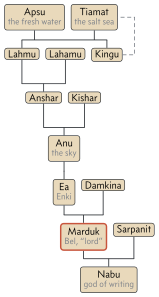
The young gods were noisy. They danced and shouted inside Tiamat until Apsu could not rest by day or sleep by night. With his servant Mummu (moo-moo) he planned to destroy them. Tiamat would not agree: why, she asked, should they destroy what they themselves had made? But Apsu went on plotting, and the young gods heard of it. Ea, the cleverest of them, acted first. He cast a spell that put Apsu to sleep, took his crown of radiance, and killed him. Then he built his house on top of Apsu, in the fresh water under the earth, and called the place by Apsu’s name.
There Ea and his wife Damkina (dahm-kee-nuh) had a son. Marduk was the son of Ea,This figure is the son of Enki, also known as Ea. → Marduk•• whom the Sumerians called Enki, and he was born in the fresh water that his father had won. The poem makes him strange from his birth. He was taller than any other god, and his body was made beyond understanding. He had four eyes and four ears,This figure has four eyes and four ears. → Marduk•• so that he saw and heard everything at once, and fire blazed from his lips when he spoke. His grandfather Anu gave him the four winds to play with, and he let them blow over Tiamat’s waters and churn them into waves.
Not every god had taken Ea’s side. Others still lived within Tiamat, and the waves gave them no rest. They reproached her: when her husband was killed, they said, she had done nothing. Tiamat gave way to them and made war on the young gods. She bore eleven monsters to fight for her, with poison in their bodies instead of blood: a venomous snake, a great dragon, a mad dog, a scorpion-man, a fish-man, a bull-man, and others. From her own brood she raised one god, Kingu (king-goo), above the rest. Tiamat, the salt water, made Kingu her consort,This primordial figure, associated with salt water, makes Kingu her consort before being defeated by Marduk. → Tiamat•• her new husband, and the captain of her army. She gave him the Tablet of Destinies (in many retellings, the Tablets of Destiny), a clay tablet that made whatever its holder decreed come true, and fastened it to his chest.
The young gods were terrified. Ea and then Anu went out to face Tiamat, and each turned back. At last Anshar called on young Marduk, and Marduk agreed on one condition. If he saved them, his word, and not theirs, would decide the destinies of the world. The gods gathered for a feast and drank until they were merry. Then they tested him. They set a single lumashu in front of him, an Akkadian word that translators read either as “constellation” or as “garment.” At Marduk’s command it vanished, and at his command it came back. The gods tested Marduk’s powerTo test this figure's power, other gods tasked him to make a constellation or cloth disappear and reappear. → Marduk•• in this way, and when they saw it, they shouted, “Marduk is king!” and gave him a scepter, a throne, and an unrivaled weapon.
He armed himself for battle. He made a bow and fixed an arrow to it, took a mace in his right hand, and set lightning before him. He filled his body with blazing flame,Before fighting Tiamat, this figure fills his body with blazing flame. → Marduk• a living fire. He made a net to catch Tiamat, and he set the four winds at its corners so that nothing of her could escape. Then he made seven winds of his own, among them the imhullu (im-hool-loo), the “evil wind.” He rode out in a storm chariot drawn by four fearsome horses, whose names meant things like Killer and Trampler. The horses had poison in their mouths,This figure's chariot is pulled by four horses with poison in their mouths. → Marduk•• and their teeth were sharp.
Kingu’s courage failed when he saw the young god coming, but Tiamat stood her ground. Marduk called her out to single combat, and she shrieked spells as she came. He spread his net to catch her. When Tiamat opened her mouth to swallow him, he drove the evil wind down her throat,Marduk forces the imhullu, the “evil” form of this phenomenon, down Tiamat’s throat. → wind•• so that she could not close her lips. The winds rushed in after it and swelled her belly like a waterskin, until she gaped, helpless, with her mouth wide open and her body stretched tight. She could neither bite nor shriek. Then Marduk shot an arrow into Tiamat,This figure traps Tiamat in a net, fills her with wind, and shoots an arrow into her. → Marduk•• caught in his net and filled with wind, and it tore open her belly, split her insides, and pierced her heart. She fell, and he stood on her body. The battle that the other gods had dreaded was over almost as soon as it began.
So Marduk defeated Tiamat,This figure defeats Tiamat in the Enuma Elish. → Marduk••• and the rest of her army broke and ran. He caught the fleeing gods in his net and chained the eleven monsters. Then he went to Kingu, who had sat in Tiamat’s council with the power of the high gods. Marduk took the Tablet of Destinies from Kingu,This figure took the Tablets of Destiny from Kingu. → Marduk••• saying it had never rightfully been his, sealed it with his own seal, and fastened it on his own chest. Whoever held it held the fate of the universe, and now that was Marduk.
He turned back to Tiamat and smashed her skull with his mace. Then he split her body in two, the poem says, as one splits a fish for drying. One half he raised up as the sky, and he set a bar across it and posted guards to keep her waters from spilling down. The other half he spread out below as the earth. Marduk made earth and sky from Tiamat’s body:This figure created the earth and sky from Tiamat's body. → Marduk•• the Tigris and the Euphrates flowed from her eyes, and he heaped mountains on her head. In the sky he set the stars in their places, gave the moon its phases, and fixed the year and its months.
The gods still had to do all the work of the new world, digging canals and growing food. So Marduk planned a new creature to do it for them. The gods named Kingu as the one who had started the war, and he was put to death. From his blood Ea made mankind, to serve the gods so that the gods could rest. In thanks, the gods offered to build Marduk a home. For a whole year they molded bricks, and in the second year they raised Babylon and its temple, the Esagila, so high that its top reached heaven. Marduk had his great temple at Esagila,This figure had a major temple at Esagila. → Marduk•• built by the gods’ own hands, and there the gods held their feast.
At the feast the gods confirmed Marduk’s rank forever. From that day Marduk was the chief god of Babylon,This figure is the chief Babylonian god. → Marduk•• king over all the gods, and he gave each god a place in heaven or on earth. Three hundred gods he set in the sky and six hundred below. The gods in turn wanted to honor him, so they drew up a list of his titles, and each title was a name with its own meaning: Asalluhi (once a god of healing spells in his own right), Tutu, and dozens more. The Enuma Elish gives Marduk fifty names.The Enuma Elish gives this figure fifty names. → Marduk•• The poem’s last two tablets go through them one by one, each with a line or two of praise. The number was itself a crown. Mesopotamians gave the great gods numbers, and fifty belonged to Enlil, the old king of the gods. Enlil himself is made to hand over his own title, “lord of the lands.” So the poem ends, with the god of a single city made king of the universe.
Marduk and Babylon’s gods
Every Mesopotamian city had a god of its own, who lived in its chief temple and watched over its people: Shamash at Sippar, Enlil at Nippur, Ea at Eridu. The god who slew Tiamat was, first of all, the patron god of Babylon,Marduk, the slayer of Tiamat, was the patron god of this city. → Babylon•• the city’s own protector long before the poem made him king of everything. As Babylon rose, he rose with it, and when its kings ruled the whole land, he became the god whom the whole land worshiped.
In time Babylonians so often called him by a title that the title stood for his name. Marduk was called Bel,This figure's name is often preceded by the title "Bel," meaning "lord." → Marduk•• which means “lord,” and to Babylonians “Bel” alone meant Marduk. The word is the same as Baal (bay-ul), the title of the Canaanite storm god (Chapter 16). The Hebrew Bible knows Marduk under both names. In Isaiah 46:1 the prophet mocks the gods of Babylon carried off on pack animals: “Bel boweth down, Nebo stoopeth.” The book of Jeremiah (50:2) calls him Merodach (mehr-uh-dak): “Babylon is taken, Bel is confounded, Merodach is broken in pieces.”
His own name was older than Babylon’s glory. Scribes wrote it with two Sumerian signs, AMAR.UTU, and Marduk’s name may mean “calf of Utu,”This figure’s name may mean “solar calf” or “calf of Utu.” → Marduk•• the young bull of the sun god Utu, whom the Babylonians called Shamash. A “solar calf” is a strange name for a god who has no family tie to the sun god in any myth. Some scholars suspect it comes from the old bond between Babylon and Sippar, the sun god’s city just upstream. The Enuma Elish makes its own pun on the name, hailing Marduk as the son of the sun and the sun of the gods. In later centuries Babylonian astronomers gave him a planet, Jupiter, the brightest wanderer of the night sky after Venus.

Marduk had a wife and a son. Marduk’s consort was Sarpanit (sar-pah-nit),This figure is the husband or consort of Sarpanit. → Marduk•• a goddess first worshiped in a village near Babylon. Her statue stood beside his in the Esagila, and when Mursili raided the city he carried the two away together. Their son was Nabu (nah-boo), and he had a temple of his own, the Ezida (eh-zee-duh), at Borsippa (bor-sip-uh), Babylon’s sister city about 11 miles to the southwest. Every spring, at the New Year festival, Nabu’s statue traveled to Babylon to pay its respects to its father. Marduk was the father of Nabu, the god of writing,This figure is the father of Nabu, the god of writing. → Marduk•• whose symbol was a stylus, the reed pen that scribes pressed into wet clay to make the wedges of cuneiform. Nabu wrote down the fates that the gods decreed. Kings took his name: Nebuchadnezzar is a Hebrew form of Nabu-kudurri-usur, “O Nabu, protect my eldest son,” and Isaiah’s Nebo (nee-boh) is Nabu himself.
Marduk also had an animal, as many Mesopotamian gods did. It was the mushhushshu (moosh-hoosh-shoo), also spelled mushussu, a name usually translated “fierce snake.” It had a scaly body, a snake’s head with horns and a forked tongue, a lion’s front legs, and an eagle’s hind legs. The mushhushshu was sacred to Marduk and Nabu,The snake-dragon mushussu is sacred to this figure and his son Nabu. → Marduk•• and in pictures it lies at the god’s feet like a guard dog (Figure 3.10). The dragon was not Marduk’s to begin with. It had belonged to Tishpak (tish-pahk), the god of Eshnunna, and the Assyriologist Frans Wiggermann argues that Marduk took it over after Hammurabi conquered that city, as a conqueror takes a trophy. The Enuma Elish even puts a mushhushshu among Tiamat’s eleven monsters. Centuries later Nebuchadnezzar II covered his Ishtar Gate with rows of these dragons in glazed brick (Chapter 20).
Marduk was a frightening god, but Babylonians also prayed to him for mercy. In a poem written about 1300 BC, under the Kassites, a nobleman tells how his life fell apart. He lost the king’s favor and his post at court, strangers divided up his property, his friends and his own city turned against him, and illness brought him close to death. Diviners and exorcists could not help him, and he could not understand what he had done wrong. Then in a series of dreams messengers came to him, his suffering ended, and he recovered. The poem takes its name, Ludlul bel nemeqi (lood-lool bayl neh-meh-kee), from its first line, which means “I will praise the lord of wisdom.” The lord of wisdom is Marduk, who struck the man down and then raised him up, and Ludlul bel nemeqi praises Marduk for rescuingLudlul bel nemeqi, the Poem of the Righteous Sufferer, praises this figure for rescuing its suffering narrator. → Marduk•• its narrator. Its other name is the Poem of the Righteous Sufferer. Readers often call it the “Babylonian Job,” after the book of Job in the Bible, whose hero also suffers without knowing why (Chapter 17).
Not every Babylonian myth was about Marduk. Scribes also copied older stories of his father Ea and the people of Ea’s city, Eridu, in the far south. In one of them, Adapa (ah-dah-pah), a wise man of Eridu and a priest of Ea, went out fishing for the temple. The south wind blew up a storm and overturned his boat, and in his rage he cursed it. Adapa broke the wings of the south wind,Adapa broke the wings of the south form of this phenomenon. → wind• and for seven days no wind blew from the south. Anu, the sky god, summoned him to heaven to answer for it. Ea warned Adapa that the gods would offer him the bread and water of death and that he must refuse them. But Anu offered him the bread and water of life instead, and Adapa, obeying his master, refused. So he lost the chance to live forever, and Anu sent him back to earth. Copies of the story turned up as far away as Amarna in Egypt, among the tablets of the pharaoh’s scribes (Chapter 9), who probably used it to practice their Akkadian.
What to remember
- Babylon, on the Euphrates, became great under its Amorite dynasty. Hammurabi, son of Sin-muballit and the dynasty’s sixth king, ruled from 1792 to 1750 BC.
- Hammurabi drove back an Elamite-led coalition, took Larsa from Rim-Sin I (who had sent no help against Elam), took Eshnunna, and destroyed Zimri-Lim’s Mari, whose ruins lie in Syria.
- His laws, carved about 1754 BC on a black basalt stele, show him before the sun god Shamash. They are counted as 282 laws and include “an eye for an eye” between equals and the hand of a son who strikes his father.
- Elamites carried the stele to Susa about 1158 BC; French archaeologists found it there in 1901–1902, and it is now in the Louvre.
- The Hittite king Mursili I sacked Babylon about 1595 BC. The Kassites then ruled it for over four centuries, until Elam ended their dynasty in 1155 BC. Nebuchadnezzar I brought Marduk’s statue home about 1100 BC.
- Berossus, a priest of Marduk, wrote a history of Babylon in Greek about 280 BC.
- The Enuma Elish (“When on high”) tells how Ea killed Apsu, how Marduk, Ea’s son, killed Tiamat and took the Tablet of Destinies from Kingu, and how he made heaven and earth from her body and received fifty names.
- Marduk, called Bel, was the patron god of Babylon, with his temple the Esagila. His wife was Sarpanit, his son Nabu was the god of writing, and his animal was the dragon mushhushshu.
- Ludlul bel nemeqi praises Marduk for rescuing a suffering man. In another myth, Adapa broke the wings of the south wind.
The Gift of the Nile
Chapter 4 · 34 clues
The Nile and the Two Lands
About 450 BC a Greek traveler named Herodotus sailed to Egypt. He spent his life asking questions of priests, sailors, and anyone else who would talk, and he wrote down the answers in his Histories, the first great work of history in Greek (Vol. 6, The Greeks). A day’s sail before the coast came in sight, he reported, sailors who let down a weighted line brought up mud from eleven fathoms, about 66 feet, below the ship. The river’s mud reached that far out to sea. Egyptian priests told him that most of the land ahead had once been a swamp and that the river had built it up, year by year. Herodotus agreed with them. Egypt, in G. C. Macaulay’s translation, was “a gift of the river.”
He was right. Seen from the air, Egypt is a green ribbon laid across a brown desert: a valley a few miles wide, and then a fan of green where the river splits before it reaches the sea. All of that green is the river’s work. Inside the ribbon, for three thousand years, one of the longest-lived kingdoms in history grew its grain, buried its kings, and told stories about its gods.
The river and its seasons
The Nile is the longest river in Africa, more than 4,000 miles from its farthest springs to the Mediterranean, and it has two great branches (Figure 4.1). The White Nile drains the lakes of central Africa and flows steadily all year. The Blue Nile flows out of Lake Tana in the highlands of Ethiopia, where the summer monsoon, a season of heavy rain carried in by winds from the ocean, pours down from June to September. The two Niles meet at what is now Khartoum (kar-toom), in Sudan, and a third river, the Atbara, joins them farther north. Every summer the Blue Nile and the Atbara turned into torrents thick with dark mud washed off the mountains. That surge traveled more than a thousand miles north and reached Egypt as the yearly flood, until the Aswan High Dam, finished in 1970, held it back. No ancient Egyptian ever saw where it came from. To them the water simply rose out of the south, as reliably as the sun.

In Egypt itself rain hardly ever falls, so everything depended on the river. When the flood drained away, it left a fresh layer of silt, fine black mud, on the fields, and the Egyptians named their country for it: Kemet (kem-et), “the black land.” The desert on either side, where nothing grew, was Deshret (desh-ret), “the red land.” The line between them was so sharp that a person could stand with one foot in a wheat field and the other on sand. Egypt’s whole civilization grew along the Nile:This country's ancient civilization was based around the Nile River. → Egypt• its farms, its towns, its temples, and its traffic, because the river was also the road. Boats drifted north with the current and sailed south on the wind, which blows up the valley from the Mediterranean for most of the year. The Egyptians even wrote “to travel north” with a picture of a boat with its sail down, and “to travel south” with a boat under sail. Near the sea the valley opens into the Delta (the Stage), a great fan of marshes and fields where the river splits into branches; the Greeks named it for its shape, like their letter delta, a triangle.
The flood set the calendar. The Egyptian year had three seasons of four months each, named for what the river was doing. First came Akhet (ah-ket), the inundation, the season of the yearly flood,The ancient Egyptian season Akhet coincided with these annual events on the Nile. → floods• roughly from July to October, when the water spread across the valley and villages stood like islands on their mounds. Then came Peret (peh-ret), “coming forth,” when the fields emerged and the crops were sown and grew through the cool winter. Last came Shemu (sheh-moo), the harvest and the season of low water, in spring and early summer, when the river shrank to its narrowest. The new year was greeted when Sirius, the brightest star in the night sky, rose again just before dawn after weeks hidden in the sun’s glare. That happened in midsummer, just as the river began to rise, and the Egyptians linked the star with the goddess Isis (eye-sis) (Chapter 6).
Farming followed the same rhythm. Most fields needed no watering by hand, because the river watered them. Farmers built low banks of earth that divided the floodplain into basins, and when the flood came they let the water in and held it there for weeks, so that it soaked deep into the ground and dropped its silt. Then they let it drain back toward the river and sowed wheat, barley, and flax in the wet mud. A good flood meant full granaries. A low one meant hunger, and a very high one swept away houses and dikes. Officials measured every flood on Nilometers, stairways cut down into the river with the depth marked on their walls. The one on Elephantine (el-uh-fan-ty-nee), an island at Egypt’s southern frontier, gave the first warning of what the year would bring.

Some land lay too high for the flood, and gardens needed water in the dry months. For these the Egyptians used the shaduf (shah-doof), a long pole balanced on a post like a seesaw. A bucket hangs from the long end, and a lump of clay or a stone weighs down the short end. The worker pulls the bucket down into the water, and the counterweight lifts the full bucketThis counterweighted pole-and-bucket device was used in ancient Egypt to lift water. → shaduf•• for him, so that he only has to swing it around and tip it into a channel (Figure 4.2). The device probably came to Egypt from Mesopotamia, where a seal from about 2200 BC already shows one, and Egyptian farmers were still using it in the twentieth century. Irrigation (Chapter 1) was the Egyptian farmer’s whole craft. The flood did most of it, and the shaduf lifted irrigation waterAncient Egyptians used the shaduf, a lever with a counterweight and bucket, for this process. → irrigation•• to the gardens and fields that the flood could not reach.
South of Egypt the river is not smooth. Six times between Aswan and Khartoum, ridges of hard granite cross its bed, and the water breaks into rapids among boulders and rocky islands. These are the cataracts (the Stage), from a Greek word for “rushing down,” numbered from north to south in the order the Egyptians came to them. Boats could pass most of them only at high water, or by being hauled along the bank on ropes. So the First Cataract, at Aswan, made a natural southern frontier, and beyond the First Cataract lay Nubia,Nubia lay along this river beyond its first cataract. → Nile River•• a land of gold mines, ebony, ivory, and famous archers. The Egyptians traded with the Nubians, fought them, and hired them as soldiers. Nubian kings at Kerma, south of the Third Cataract, ruled a rich state that the Egyptians called Kush. About 1900 BC Egyptian kings built a chain of forts at the Second Cataract to hold it back, and about 1500 BC their successors conquered Nubia as far as the Fourth. Then, about 730 BC, the kings of Kush marched north and ruled Egypt itself for some seventy years.
At the foot of the First Cataract lies an island that the Egyptians called Abu, “elephant,” perhaps for the ivory traded there, perhaps for the rounded gray boulders around it. The Greeks translated the name as Elephantine. It was a border fortress, a market for the goods of the south, the capital of Egypt’s southernmost province, and the home of the god Khnum (kuh-noom), whose temple was rebuilt there again and again for thousands of years.
The gods of the Nile
The Egyptians did not worship the river as one god. They saw divine powers in what it did. They had a single word, iteru, for both “river” and “the Nile,” since the Nile was the only river they knew, and its yearly rising was a god called Hapi (hah-pee). Hapi presided over the river’s annual flooding;Hapi presided over the annual flooding of one of these features in Egypt. → rivers• more exactly, he was the flood, the arrival of the water that fed everyone. Egyptians sang hymns to him and threw offerings into the river when it began to rise. A year when Hapi came too weakly was a year of empty granaries and hungry villages.


Artists gave Hapi a body no one could mistake. Hapi had a potbelly and drooping breasts,This figure personifies the Nile's inundation and is depicted with a potbelly and breasts. → Hapi•• though he was a male god with a false beard: the belly and breasts stood for plenty, the body of someone who never goes hungry. His skin was painted blue or green, like water. He wore a crown of papyrus or lotus plants and carried trays heaped with fish, birds, bread, and flowers (Figure 4.3). On the sides of royal thrones he often appears twice, as a pair of Hapis tying the lotus of the south and the papyrus of the north around a sign that means “union”: the river binding Egypt’s two halves together.
Hapi was believed to live in a cave deep under the First Cataract, where the river seemed to boil up out of the rocks. The keeper of that cave was Khnum, a god with the head of a ram, worshiped on Elephantine. Khnum controlled the Nile from caves beneath Elephantine,This figure was believed to control the Nile from caves beneath Elephantine. → Khnum• releasing the water each year, so the people of the frontier thought of their own god as the master of Egypt’s food supply. An inscription carved on a boulder on Sehel, an island in the cataract, tells the story. King Djoser (joh-ser), whose pyramid will appear in Chapter 8, suffers seven years of low floods and famine. His wise minister Imhotep (im-hoh-tep) searches the old books and learns that Khnum holds the key, and Khnum then appears in a dream and promises water. The stone claims to be ancient, but it was carved more than two thousand years after Djoser, under the Greek kings, and scholars think Khnum’s priests composed it to support their temple’s claim to land. Together Khnum and Hapi were gods of the river:Khnum and Hapi were gods of this river. → Nile River• Hapi was the flood, and Khnum was the keeper of its doors. Elephantine made a fitting home for both of them, since it was the first place in Egypt where the rising water could be seen.
Khnum had a second task, which grew out of the first. The flood brought mud, and mud is a potter’s clay. Egyptians said that Khnum shaped people from clay on a potter’s wheel:This figure fashioned humans from clay on a potter's wheel. → Khnum•• he molded each child’s body and its life force on his wheel and placed them in its mother’s womb. Temple walls from Greek and Roman times show him seated at his wheel with a small finished figure standing on it, ready to be born.

The river had a darker side. The Nile crocodile can grow longer than 16 feet, and it seizes animals and people at the water’s edge. The crocodile god was Sobek (soh-bek), and Sobek was shown with a crocodile’s headSobek, worshipped at Faiyum, was depicted with the head of this animal. → crocodiles•• on a man’s body (Figure 4.4). His greatest home was the Faiyum (fy-yoom), a basin in the desert west of the Nile, fed by a channel from the river and filled with a large lake. Its chief town, which the Egyptians called Shedet (shed-et), was known to the Greeks as Crocodilopolis, “crocodile city.” Farther south, at Kom Ombo, Sobek shared a double temple with the falcon god Horus. Fishermen, boatmen, and travelers on the Nile sought Sobek’s protection,Travelers on this river sought Sobek's protection. → Nile River•• since the god who commanded crocodiles could keep them away. Herodotus heard that the people around Thebes and around the lake of the Faiyum each kept one sacred crocodile, trained to be tame. In Macaulay’s translation, they “put hanging ornaments of molten stone and of gold into the ears” of these beasts and “anklets round the front feet.” When such a crocodile died, it was mummified, and thousands of crocodile mummies have been found. Not everyone revered the beasts: Herodotus adds that the people of Elephantine ate them.
The name “Nile” itself comes from the Greeks, who called the river Neilos. In their myths the river had its own god, Nilus (ny-lus), one of the river sons of Oceanus (oh-see-uh-nus), the Titan of the great stream that the Greeks believed flowed around the world (Vol. 4, Classical Myth). After Greek and then Roman rulers took Egypt, Nilus came to stand for Egypt itselfThe river god Nilus was associated with this place. → Egypt• in Greek and Roman art and on the coins of Roman Egypt: a bearded old man reclining with a horn of plenty, often with sixteen small children climbing over him. The Roman writer Pliny the Elder explains the number. A flood of 16 cubits, about 27 feet, brought a perfect harvest, while twelve meant famine. Nilus was Hapi in Greek dress.
The great gods and their cities
Egypt had hundreds of gods, and most began as the god of a particular town. Each god lived in a temple, which the Egyptians thought of as the god’s house. There priests washed, dressed, and fed the god’s statue every morning, while ordinary people prayed at the gates and saw the god only when the statue was carried out at festivals. Artists often showed a god as a human being with the head of the animal that stood for him: a ram for Khnum, a crocodile for Sobek, a falcon for Horus. The animal was a sign of the god’s nature, and a god could be shown in several forms. When a city grew powerful, its god grew with it, and priests sometimes joined two gods so that they could be spoken of as one. Four cities mattered most for the stories that follow (Figure 4.5).

The sun god Ra (rah) was worshiped above all at Heliopolis (hee-lee-op-uh-lis), Greek for “sun city,” near the point where the Delta begins. Its priests taught that the world itself began there, and Chapter 5 will tell their story.
Across the river, at the capital, Memphis, the chief god was Ptah (puh-tah), the patron of craftsmen: builders, sculptors, and metalworkers. He is shown as a man wrapped like a mummy, wearing a close-fitting cap and holding a staff (Figure 4.6). His priests taught that he had made the world by thought and speech. He conceived everything in his heart, which Egyptians thought of as the seat of the mind, and each thing came to be when his tongue spoke its name. The text that says so survives on a slab of dark stone that a king named Shabaka (shab-uh-kuh) had carved about 700 BC, claiming that he had copied it from an old book eaten by worms. Centuries later someone used the slab as a millstone and ground away part of the writing. The Greeks identified Ptah with their own smith god, Hephaestus (hih-fes-tus) (Vol. 4, Classical Myth).


Far up the river, at Thebes, the chief god was Amun (ah-mun), whose name means “the hidden one.” He was a god of the unseen air and of the power behind everything visible, and artists showed him as a man wearing a crown of two tall plumes. Amun began as a minor local god. He rose with his city, when princes of Thebes made themselves kings of all Egypt, about 2055 BC and again about 1550 BC (Chapter 9). Priests joined him to the sun as Amun-Ra, and in the New Kingdom Amun-Ra was hailed as the king of the gods. His temple at Karnak, in Thebes, became the largest temple complex in Egypt, and the Greeks identified him with Zeus. Do not confuse Amun with Atum (ah-tum), the creator god of Heliopolis (Chapter 5), or with the Aten (ah-ten), the sun disk that one king tried to put in Amun’s place (Chapter 9).
Halfway between Memphis and Thebes lay the city that the Greeks called Hermopolis (her-mop-uh-lis), “city of Hermes,” because they took its god for their own messenger god. He was Thoth (thohth), the scribe of the gods, with the head of an ibis, a wading bird with a long curved beak, or sometimes in the form of a baboon. Thoth was said to have invented writing. He kept the gods’ records, counted the days, and ruled the moon. He will act in the myths of Chapter 5 and Chapter 6, and Chapter 7 will give him a section of his own.
One great goddess belonged to no single city. Isis, wife of the god Osiris (oh-sy-ris) and mother of Horus, was the goddess of magic and of motherhood, and her story fills Chapter 6. Isis was a native Egyptian goddess,This place's native deities included Isis. → Egypt•• worshiped since at least the age of the pyramids, and yet she became the most widely traveled of Egypt’s gods. In Greek and Roman times her temples stood across the Mediterranean, as far away as Rome.
The two lands and the pharaoh
Egyptians called their country “the Two Lands” (the Stage). Upper Egypt was the long valley from the First Cataract to a little south of Memphis, upstream and so in the south; Lower Egypt was the broad, marshy Delta in the north. Each land had its own symbols. Upper Egypt had a white crown, the lotus, and the vulture goddess Nekhbet (nek-bet); Lower Egypt had a red crown, the papyrus, and the cobra goddess Wadjet (wahd-jet), whose city was Buto (boo-toh). For three thousand years an Egyptian king was “Lord of the Two Lands.”
Before about 3100 BC the valley held farming villages and small rival kingdoms. Archaeologists have found towns and the rich tombs of chiefs at Nekhen (nek-en), which the Greeks called Hierakonpolis (hy-ruh-kon-puh-lis), “falcon city,” at Naqada (nah-kah-dah), and at Abydos (uh-by-dos). Over several generations the rulers of the south seem to have absorbed the north. The Egyptians’ own picture, of two finished kingdoms joined in a single conquest, may be partly a tidy story told later. The first king known to have ruled all of Egypt is Narmer (nar-mer), about 3100 BC, and the great stone palette that bears his name shows him wearing each crown in turn.
The king of the united country was more than a man in his people’s eyes. Egyptians believed the living king was the falcon god Horus in human form (Chapter 7) and the son of the sun god. He alone could stand between the gods and the people, feeding the gods with offerings and keeping the world in its proper order. We call him a pharaoh, from the Egyptian per-aa, “great house,” which first meant the palace. Only in the New Kingdom did Egyptians start calling the king himself “Great House,” the way people say “the White House” for an American president. The Hebrew Bible uses the word almost as a name: the kings in the stories of Joseph and of Moses are simply “Pharaoh” (Chapter 12, Chapter 13). Historians now use it for every king of Egypt.
The framework that historians still use for these kings was made by an Egyptian priest. About 280 BC, when Greek kings ruled Egypt, Manetho (man-uh-thoh), a priest from the Delta town of Sebennytos (seh-ben-ih-tos), wrote a history of his country in Greek so that its new rulers could read it. The book is lost, but later Jewish and Christian writers copied long passages from it, above all its lists of kings. Manetho sorted the kings into thirty dynasties. For him a dynasty was not always one family but a run of kings between two breaks, such as a new family on the throne or a new capital. In the same years a Babylonian priest, Berossus, did the same for Babylon (Chapter 3).
Later Egyptians remembered the first king by another name. King lists carved and written in the New Kingdom begin with Meni, and the Greek form of the name is Menes (mee-neez). Manetho called the first king Menes,The first of these people was named Menes by Manetho. → pharaoh• and his history of human kings starts there. Whether Menes was Narmer, or Narmer’s successor Hor-Aha (hor-ah-hah), or a memory of several early kings rolled into one, is still debated. Stories gathered around him. Herodotus, who calls him Min, heard that he founded Memphis after damming the Nile to drain its site, and Manetho says that Menes reigned some sixty years and was carried off by a hippopotamus. Diodorus (dy-uh-dor-us), a Greek historian from Sicily writing about 30 BC, tells a tale from the priests of Shedet. Chased by his own hunting dogs, Menes fled to Lake Moeris (meer-is) in the Faiyum, where a crocodile carried Menes to safetyOne of these animals carried King Menes to safety. → crocodiles• across the water on its back. In thanks he founded the crocodile city. Historians treat the tale as a legend, told long afterward by the priests of the city it explains.

Manetho’s thirty dynasties run from Menes to Nectanebo II (nek-tuh-nee-boh), the last native Egyptian to rule Egypt. In 343 BC the Persians, who had ruled Egypt once before, invaded again, and Nectanebo fled south and vanished from history. Eleven years later Alexander the Great took Egypt (Vol. 6, The Greeks), and after him Greek kings, the Ptolemies, ruled until Cleopatra’s death in 30 BC (Chapter 25). Modern historians group Manetho’s dynasties into longer periods (Figure 4.7). Three times Egypt was strong and united under one king. The Old Kingdom (about 2686 to 2181 BC) was the age of the pyramids (Chapter 8). In the Middle Kingdom (about 2055 to 1650 BC) a family from Thebes put the country back together, and the New Kingdom (about 1550 to 1070 BC) was Egypt’s age of empire. Pharaohs governed the Old, Middle, and New KingdomsThese rulers governed Egypt during the Old, Middle and New Kingdoms. → pharaoh• alike, and between them came intermediate periods, when the country split among rival rulers or foreign kings. In the Second Intermediate Period, for example, foreign kings called the Hyksos (hik-sohs), from western Asia, ruled the Delta for about a century. New Kingdom pharaohs no longer built pyramids. Instead they were buried in the Valley of the Kings,The Valley of the Kings houses many tombs of holders of this title who ruled during the New Kingdom. → pharaoh• a desert valley across the river from Thebes, in tombs cut deep into the rock and hidden from robbers (Chapter 9). Through all these centuries the outward signs of kingship changed remarkably little.
A pharaoh’s costume announced that he ruled both lands. Pharaohs wore the white Hedjet (hed-jet) and red Deshret.These rulers wore the white Hedjet and red Deshret crowns, combined in the Pschent. → pharaoh•• The Hedjet, the tall white crown of Upper Egypt, was shaped like a bowling pin. The Deshret, the red crown of Lower Egypt, was a flat-topped cap with a tall spike at the back and a coil in front; it shares its name with the red land of the desert. Set one inside the other and you have the double crown, the Pschent (puh-skent), from the Egyptian for “the Two Powerful Ones.” A rearing cobra on the king’s brow and a vulture beside it stood for Wadjet and Nekhbet. On other days he wore the striped headcloth called the nemes (nem-ez), and on formal occasions a false beard tied on with a strap.
In his hands the crook and flail symbolized royal power.These rulers' power was symbolized by the crook and flail. → pharaoh• The crook is a shepherd’s hooked staff, for the king as herdsman of his people. The flail, a rod with three strands of beads, may once have been a herdsman’s whip or a tool for threshing grain, and it is usually read as a sign of the land’s fertility. Egyptians gave the same pair to the god Osiris, Egypt’s first king in myth (Chapter 6), and the only real pair to survive comes from the tomb of the boy king Tutankhamun (too-tahng-kah-moon) (Chapter 9).
By the Middle Kingdom, a new pharaoh also took a set of official names when he came to the throne, a kind of statement of what his reign would be. Each pharaoh had five great names.Holders of this title customarily possessed "five great names." → pharaoh• The oldest was his Horus name, written inside a serekh (ser-ek), a frame drawn like the front of a palace with a falcon perched on top. Next came his Two Ladies name, which put him under the protection of Nekhbet and Wadjet, and his Golden Horus name. The last two were used most: his throne name, after a title meaning “King of Upper and Lower Egypt,” and his birth name, after the title “Son of Ra.” Tutankhamun, for example, is a birth name; his throne name was Nebkheperure (neb-kep-er-oo-ray).
To govern so long a country, kings divided it into provinces. The Egyptian word was sepat (sep-at), and the Greek word was nomos, “district,” so in English Egypt’s provinces are called nomes.This civilization used provinces called sepat or nome. → Egypt• There were usually forty-two: twenty-two in Upper Egypt, numbered downstream from Elephantine, and twenty in Lower Egypt. Each nome had its capital, its own god, and an emblem carried on a pole like a flag. Its governor, the nomarch (noh-mark), was the king’s appointee when kings were strong. When kings were weak, nomarchs handed their offices to their sons and fought one another like little kings, which is exactly what happened in the First Intermediate Period.
The Narmer Palette
In the digging season of 1897 and 1898, two British archaeologists, James Quibell and Frederick Green, were working in the ruins of the temple of Horus at Nekhen. There they found a buried hoard of very old objects, probably royal gifts to the temple. Among them was a shield-shaped slab of dark stone, carved on both sides. The Narmer Palette was found in EgyptThe Narmer Palette was found in this country. → Egypt•• at Nekhen, the old capital of the south, and it is now in the Egyptian Museum in Cairo (Figure 4.8).

A palette in ancient Egypt was a flat stone for grinding green malachite or black lead ore into powder for eye paint, which Egyptians wore for beauty and, they believed, for health. Ordinary palettes were small. This one is 25 inches (63 cm) tall, far too large and heavy for daily use, and it was surely made as a gift to the god. The Narmer Palette is carved from gray-green siltstone,This gray-green siltstone palette depicts intertwined serpopards and an early king wearing the crowns of Upper and Lower Egypt. → Narmer Palette•• a fine, hard stone from the quarries of the Wadi Hammamat (wah-dee ham-uh-maht) in the Eastern Desert, though older books call it slate. Its subject is the king himself, shown in both his crowns.
On one side the king, far larger than anyone else, wears the tall white crown of Upper Egypt. He grips a kneeling enemy by the hair and raises a mace to smash his skull, while a servant behind him carries the royal sandals. Above the captive, a falcon, the god Horus, perches on a clump of papyrus plants and holds a rope through the nose of a human head. Many scholars read the scene as the god handing the king the papyrus country of the north. At the top, between two heads of a cow goddess, the king’s name is written inside a serekh: a catfish, nar, and a chisel, mer. It is among the oldest royal names written in hieroglyphs.
On the other side Narmer wears the red crown of Lower Egypt. He marches behind four standard-bearers toward two rows of beheaded enemies. No older picture shows one king in both crowns, one on each side. Below, two men hold leashes tied to two strange beasts, each with a leopard’s body and a long snake’s neck. Egyptologists call them serpopards, from “serpent” and “leopard,” since the serpopards combine leopards and snakes.The Narmer Palette depicts two giraffe-necked creatures thought to combine leopards with these animals. → snakes• Their long necks curve and cross to make a circle, and that circle is the hollow where the eye paint would have been ground. The two beasts, tamed and joined, may stand for the two lands made one, though no one can be sure. At the bottom a bull, another image of the king, butts down the walls of a town and tramples a fallen man.
Is the palette a record of a war, the conquest of the north by the south? Older books treated it as a snapshot of the unification, but many Egyptologists now doubt that it shows any single event. One Egyptologist, Nicholas Millet, argued that it records the events of the year in which it was given to the temple. Another, John Baines, argued that its purpose is to show the king defeating the forces of disorder in the name of the gods, whatever real battles lay behind it. Either way, the palette already follows the rules that Egyptian artists kept for the next three thousand years. The most important person is drawn largest; a human body shows the head and legs in profile but the eye and shoulders from the front; and scenes are stacked in neat horizontal bands called registers.
Daily life on the Nile
Most Egyptians were farmers who never saw a king. They lived in houses of sun-dried mud brick, with flat roofs where families slept on hot nights. They ate bread, onions, beans, and fish, with meat on feast days, and drank a thick, cloudy beer. Wages were usually paid in grain and beer, since Egypt had no coins until late in its history. Men and women wore linen woven from flax. When the flood covered the fields, farm work stopped, and many farmers were called up to labor on the king’s buildings.
In their spare time Egyptians played board games, and the favorite was senet (sen-et), “passing.” Nobles and commoners alike played senet,Both nobility and commoners in this civilization played senet, a game on a 10-by-3 board based on throwing sticks or bones as "dice." → Egypt• on a board of thirty squares in three rows of ten. Each player raced a set of pieces along a snaking path, moving by the throw of four flat sticks colored on one side, or of knucklebones, which served as dice. Workmen scratched boards into building stones, and boards of ebony and ivory went into royal tombs; Tutankhamun was buried with several. No full set of rules survives, and modern sets follow guesses made in the twentieth century. Over time the game took on a religious meaning, as a picture of the soul’s journey through the world of the dead. In a painting from her tomb, Queen Nefertari (nef-er-tar-ee), wife of the pharaoh Ramses II (ram-seez) (Chapter 10), sits at a senet board against an opponent no one can see (Figure 4.9).

Some foods were newcomers. The chicken, first tamed in southern Asia, reached Egypt late. A record from the reign of King Thutmose III (thoot-moh-suh), about 1450 BC, lists among the tribute brought from abroad birds that laid eggs every day, and chickens became common only in the last centuries BC. Then the Egyptians found a way to hatch them by the thousand. From about the fourth century BC, Egyptians hatched chickens in mud ovens,Egyptians used mud oven incubators to raise these animals. → chickens• low brick buildings with rows of chambers warmed by slow fires of dried dung. Keepers turned the eggs by hand and judged the warmth by pressing an egg against an eyelid. The craft was handed down for many centuries, and the largest ovens of later times held 80,000 eggs at once. In 1750 the French scientist René de Réaumur (ray-oh-myoor), who built incubators of his own, wrote that Egypt ought to be prouder of its egg ovens than of its pyramids.

Egyptians lived beside dangerous animals and turned them into art. About 1950 BC a steward named Senbi was buried at Meir, in Upper Egypt, with the small hippopotamus now called William. It is about 8 inches (20 cm) long and made of faience (fay-ahns), a paste of crushed quartz covered with a glassy glaze. The hippo’s glaze is bright blue,The Egyptian hippo figurine nicknamed William has a glaze of this color decorated with dark river plants. → blue• colored with copper, and painted in black with lotus flowers, buds, and leaves, so that the animal seems to stand in the river (Figure 4.10). Hippos were among the most dangerous animals in Egypt, and three of this one’s legs were deliberately broken, probably so that it could not harm the dead man in the next world; the museum has restored them. The Metropolitan Museum of Art in New York acquired it in 1917. In 1931 a British humor magazine, Punch, printed an article by Captain H. M. Raleigh, whose family kept a photograph of the hippo and called it William. The name stuck, and William is now the museum’s unofficial mascot.
Hieroglyphs, hieratic, and Demotic
The catfish and chisel on the Narmer Palette are among the first Egyptian writing. Hieroglyphs, the picture-signs whose workings the Stage explained, never wrote vowels, and many of their signs stood for two or three consonants at once. They were beautiful and slow, and they belonged on temple and tomb walls, where they were meant to last forever.
For everyday writing the Egyptians had a better surface than stone. Papyrus is a tall reed with a three-sided stem that grew in thickets along the Nile, above all in the marshes of the Delta. To make a sheet, workers peeled the stems and pressed strips of papyrus pith together.The pith of papyrus plants that primarily grew along this river could be compressed to create mats and scrolls. → Nile River• They laid the soft strips from inside the stem side by side, put a second layer across them, and pounded and pressed the two layers until they bonded, then dried and polished the sheet. Sheets glued edge to edge made a scroll, sometimes many yards long. The same plant gave the Egyptians mats, sandals, rope, baskets, and even light boats. The oldest written papyri yet found, the logbook of an official named Merer, record the hauling of stone for Khufu’s Great Pyramid about 2560 BC. Our word “paper” comes from “papyrus.”

Writing on papyrus with a reed brush, a scribe did not draw every little bird and eye. From early on scribes used a faster, joined-up script, as different from hieroglyphs as handwriting is from print. The Greeks called it hieratic (hy-uh-rat-ik), “priestly,” because by their time only priests still used it (Figure 4.11). About 650 BC an even quicker script grew out of it for letters, contracts, and tax records, and Herodotus called it Demotic (dih-mot-ik), “popular,” the people’s script. Hieroglyphs were for monuments, so Egyptian literature was written in hieratic or Demotic,Literature from this country was often written in hieratic or Demotic scripts. → Egypt• the scripts of the brush. The tales of the Middle Kingdom were copied in hieratic, and later stories, such as the tales of the magician prince Setne Khamwas (set-neh kahm-wahs) (Chapter 8), in Demotic. In 196 BC a decree of King Ptolemy V was carved on a stone slab in hieroglyphs, Demotic, and Greek; that slab, the Rosetta Stone, helped scholars decipher hieroglyphs in the 1820s (Chapter 25).
One shape helped the decipherers more than any other. When Napoleon’s army invaded Egypt in 1798 (Vol. 15, The Age of Revolution), his soldiers noticed ovals on every temple wall and nicknamed them cartouches, French for the paper cartridges of their muskets, which the ovals resembled. To an Egyptian the shape was a loop of rope with its ends tied together, called shenu, from a word meaning “to encircle”: the king ruled everything the sun encircled. A cartouche encircles a name with an oval,This country's cartouche motif encircles names within an oval and a single horizontal line. → Egypt• closed by a single straight line across its base, which is the knotted end of the rope. Kings used it for their two most important names, the throne name and the birth name, and later queens and princes used it too. In the painting of Nefertari at her senet board, her own name stands in a cartouche above the table (Figure 4.9).
Egyptian tales
The Egyptians told stories for pleasure, and some of the oldest stories in the world survive on their papyri. The Middle Kingdom, from about 2055 to 1650 BC, was the classic age of their literature, and its language became the model that young scribes copied in school for centuries afterward. One of its finest tales is known today as “The Shipwrecked Sailor.” It survives on a single papyrus, which turned up in the 1880s in the imperial museum at St. Petersburg in Russia and is now in Moscow. Its scribe signed his name at the end and boasted of his skill with the pen.
It is a story inside a story. An official is sailing home from an expedition into Nubia that seems to have gone badly, and he dreads facing the king. One of his followers tries to cheer him with a tale of his own. Once, he says, he set out by sea for the king’s mines in a great ship with a crew of 120 of the best sailors in Egypt. A storm raised a wave 8 cubits high, the ship went down, and every man drowned but him. A wave cast him onto an island where figs, grapes, fish, and birds were his for the taking. He lit a fire and made an offering to the gods, and then he heard a noise like thunder. Trees cracked and the ground shook, and a serpent came toward him, 30 cubits long, its body covered in gold and its eyebrows of lapis lazuli, a deep blue stone.
The serpent carried him gently in its mouth to its home and asked him three times who had brought him there. Then it told its own sorrow: it had lived on the island with its family, seventy-five serpents in all, until a star fell and burned them, and it alone was left. It told the sailor to be brave, for in four months a ship would come and take him home. The grateful sailor promised to send it myrrh and incense from Egypt, and the serpent laughed at him. The serpent called itself the Lord of PuntIn this ancient Egyptian tale, the protagonist meets a serpent who calls himself the Lord of Punt. → "The Shipwrecked Sailor"• (poont), and Punt was the far-off land on the Red Sea from which Egyptians brought incense, myrrh, ebony, and gold (Chapter 9 will follow a queen’s expedition there). How could a poor sailor send incense to its owner? The ship came as promised, and the serpent loaded it with myrrh, incense, ivory, hunting dogs, and baboons. The island, it said, would sink beneath the waves, and the sailor would never see it again. He reached home, and the king rewarded him. But the master is not comforted. He answers with a grim proverb: there is no point in giving a bird water at dawn when it is to be slaughtered that morning.
Another papyrus collects tales of magic. In 1823 or 1824 a British traveler, Henry Westcar, acquired a scroll copied about 1600 BC and now in Berlin. The Westcar Papyrus tells how King Khufu, builder of the Great Pyramid (Chapter 8), passed the time listening to his sons tell stories of wonder-working priests. In the second tale, told by Prince Khafre (kaf-ray), an earlier king named Nebka (neb-kah) had a chief lector priest, the priest who read the sacred books aloud and was believed to know their spells. The priest’s name was Webaoner (web-ah-oh-ner), also spelled Uba-aner, and he learned that his wife was secretly meeting a young man of the town in the garden pavilion beside his lake. Webaoner made a crocodile of wax,A magician named Uba-aner created a wax version of this animal. → crocodiles• seven fingers long, spoke a spell over it, and ordered his servant to throw it into the lake when the young man went in to bathe. In the water it became a real crocodile 7 cubits long, which seized the man and sank with him to the bottom.
For seven days the crocodile held the man under the water. Then Webaoner brought King Nebka to the lake, called the beast up, and touched it, and it turned back into a wax figure in his hand. When the king heard the whole story, he gave the man back to the crocodile, which carried him off and was never seen again, and the unfaithful wife was put to death by burning. Khufu, the papyrus says, then ordered offerings of bread, beer, and incense in memory of King Nebka and his magician.
What to remember
- Egypt lived on the Nile’s yearly flood, which came from summer rains in Ethiopia and gave the year its three seasons: Akhet (the flood), Peret (the growing), and Shemu (the harvest).
- Upper Egypt is the southern valley and Lower Egypt the northern Delta; the First Cataract at Aswan was the frontier, and Nubia (Kush) lay beyond it.
- Hapi was the flood itself, a potbellied god; Khnum, the ram-headed potter of Elephantine, kept the cave the flood came from; Sobek was the crocodile god of the Faiyum; the Greeks called the river god Nilus.
- The great gods each had a city: Ra at Heliopolis, Ptah the craftsman at Memphis, Amun “the hidden one” at Thebes, who became Amun-Ra, king of the gods, and Thoth the ibis-headed scribe at Hermopolis.
- Narmer ruled all Egypt about 3100 BC; the Narmer Palette, found at Nekhen, shows him in the white crown of Upper Egypt and the red crown of Lower Egypt.
- Manetho, writing in Greek about 280 BC, divided Egypt’s kings into thirty dynasties, from Menes to Nectanebo II (fled 343 BC); historians group them into the Old, Middle, and New Kingdoms and the intermediate periods between.
- A pharaoh wore the double crown, carried the crook and flail, bore five great names, and governed through forty-two provinces called nomes.
- Egyptians wrote hieroglyphs on monuments and the faster hieratic and Demotic on papyrus; kings’ names stood in cartouches.
- “The Shipwrecked Sailor” meets a giant serpent, the Lord of Punt; in the Westcar Papyrus, the priest Webaoner punishes an adulterer with a wax crocodile.
Chapter 5 · 47 clues
Ra and the Making of the World
In El Matareya, a crowded district of northeastern Cairo, a single shaft of red granite stands about 69 feet tall. King Senusret I (seh-noos-ret) set it up nearly four thousand years ago, and it is the oldest obelisk in the world still standing where it was raised. Everything that once surrounded it has vanished: the temple it stood before, the city’s walls, the houses of its priests. The Egyptians called the city Iunu (yoo-noo), “the Pillars.” The Greeks called it Heliopolis, the “City of the Sun.” The Hebrew Bible calls it On, and Genesis says that Joseph, the Hebrew slave who rose to govern Egypt for the pharaoh, married the daughter of a priest of On (Chapter 12).
The priests of this city taught that the world had begun on the very ground where the obelisk stands. Before there was anything, they said, there was dark water. Then a mound of earth rose out of it, and on the mound stood a god who had made himself. Every morning, as the sun lifted over the eastern desert and caught the obelisk’s tip, the people of Heliopolis could watch that first morning happen again.
Creation at Heliopolis
The god of that city was Ra, the sun, whom the Egyptians honored above almost every other power in their world (Chapter 4 introduced him with the other great gods and their cities). Every important god had a cult center, a home city where his chief temple stood and where his priests carried out his rites day after day. Heliopolis, at the point where the Nile spreads out into its Delta, was the center of Ra’s worshipThis figure's center of worship was Heliopolis. → Ra•• (Figure 5.1). Its temple of the sun was one of the richest in Egypt, and its priests had a name for learning. When the Greek traveler Herodotus toured Egypt about 450 BC, he went there on purpose to question them, because, as he wrote in G. C. Macaulay’s translation of 1890, “the men of Heliopolis are said to be the most learned in records of the Egyptians.”

What the priests of Heliopolis taught about the beginning has to be pieced together. No Egyptian ever wrote the whole creation story down in one place. It survives in spells carved inside the pyramids of kings from about 2350 BC, the Pyramid Texts, in later spells painted inside coffins, and in hymns and papyri copied over the next two thousand years (Chapter 8 will describe these tomb texts). Out of the pieces comes a picture. Before the world existed there was only Nun (noon), a dark, endless, motionless water, with no up or down, no light, and no life. Nothing could happen in it, because there was nothing yet to happen.
Then, at what the texts call “the First Time,” a hill of earth pushed up out of the water. Every Egyptian knew what that looked like. Each autumn, as the Nile’s flood drained away (Chapter 4), the first humps of black mud broke the surface of the flooded fields, and within days green shoots were sprouting on them. At Heliopolis the first mound had a sacred stone to stand for it, the benben, a block with a pointed top. The pointed capstone of every pyramid and the gilded tip of every obelisk copied the shape of the benben, so that the sun’s first light would strike them as it had once struck the mound.
On the mound stood Atum, whose name probably means “the Complete One.” He had not been born, for there was no one yet to bear him. He had made himself, out of the waters of Nun, by his own will. Atum was the sun god under another name: the priests of Heliopolis treated Atum and Ra as one god, and they called him Atum-Ra or Ra-Atum. In art Atum is usually a man in a king’s double crown, and in the books of the underworld an old man leaning on a stick. The Egyptians thought of him above all as the evening sun, the sun at the end of its day.
A bird belongs at the beginning too. In the stories told at Heliopolis, a great gray heron flew over the dark waters, landed on the benben, and gave a cry that broke the silence of the world. This was the Bennu (ben-oo), the heron of Heliopolis,The Bennu is one of these animals. → birds• whose name comes from an Egyptian verb meaning “to rise in brilliance.” Artists drew him as a tall heron with two long feathers trailing from the back of his head, perched on the benben or on a willow tree. He was counted as the soul of Ra, and like Atum he was self-made. Among the titles given to this bird was “He Who Came into Being by Himself”,One of these animals had the title "He Who Came Into Being by Himself." → birds• and another was “Lord of Jubilees,” because, like the sun, he renewed himself again and again.
The Greeks turned the Bennu into the phoenix. Herodotus was told about a sacred bird at Heliopolis, though he admitted that he “did not myself see” it “except in painting.” It came, the people of Heliopolis said, only once in five hundred years, when its father died. “Some of his feathers are of gold colour and others red,” and it carried its dead father from Arabia to the temple of the Sun, sealed inside an egg of myrrh, a sweet-smelling tree resin. Herodotus added, honestly, “but I cannot believe the story.” Later writers of the Roman Empire gave the bird a fiery end, among them the author of a Latin poem of about AD 300 that is usually credited to the Christian writer Lactantius (lak-tan-shus). In their telling the phoenix burned and rose from its ashes,The phoenix is a mythical one of these animals associated with fiery death and rebirth. → birds•• young again, and Christians made it a sign of Jesus’s rising from the dead. That is the phoenix of modern stories, but its first nest was the benben of Heliopolis.
Atum was alone on his mound, and to make a world he needed others. With no goddess to be their mother, he made two children out of himself. The Pyramid Texts say that he sneezed out Shu, the air, and spat out Tefnut (tef-noot), moisture. The words are puns, for in Egyptian the names Shu and Tefnut sound like the words for sneezing and spitting. Another version says more bluntly that he made them with his own hand. Either way, Shu and Tefnut were the first pair, a son and a daughter, the empty air and the damp that fills it. Because Atum and Ra were one god, Ra was the father of Shu and Tefnut,This figure was the father of Shu and Tefnut. → Ra• and later Egyptians called Tefnut “the daughter of Ra.”
In the dark of Nun the two children drifted away from their father and were lost. Atum sent out his Eye, the Eye of Ra, to search for them. To the Egyptians, the eye of a god was more than part of his face. It could leave him and act on its own, like a person, and it was always thought of as a goddess. The Eye found the lost children and brought them home. But while she was away, Atum had grown a new eye in her place, and when she returned and found herself replaced, she was furious. To calm her, Atum gave her a higher place of honor. He set her on his forehead as a rearing cobra, so that the Eye became the uraeus (yoo-ree-us) on Atum’s brow.In an Egyptian creation myth, this divine entity recovered Shu and Tefnut and was placed on Atum’s brow as the uraeus. → Eye of Ra• The uraeus, a cobra raised and ready to strike, was worn from then on by gods and kings at the front of their crowns, where it was believed to spit fire at their enemies.
Atum wept when his children came back, though the sources do not agree whether he wept for joy at their return or for grief at the Eye’s anger. His tears fell, and from them came people. The fullest telling is in a papyrus copied out about 300 BC and now in the British Museum, in which the creator speaks in his own voice. In the translation published by E. A. Wallis Budge of the British Museum more than a century ago, he says: “I wept over them, and men and women sprang into being from the tears which came forth from my Eye.” So mankind was made from Ra’s tears.Mankind was created by this figure's tears. → Ra•• The story rests on a pun: the Egyptians’ word for people was something like remetj, and their word for tears was remyt.
The same papyrus says that plants and “creeping things,” the snakes and lizards and insects, came from those tears as well, and it names the god they came through: “from the god Rem, through the tears which I let fall.” Rem, “the Weeper,” was a minor god pictured as a fish, the creator’s tears given a body of their own. In this little story Rem, a fish, fertilized the land with tears,In Egyptian mythology, one of these creatures named Rem fertilizes the land with its tears. → fish•• making the first green things grow, much as the Nile’s flood made the fields grow every year.
Shu and Tefnut became a couple, as the first gods had to, and they had two children: Geb, the earth, and Nut (noot), the sky. Geb was a god and Nut a goddess, the reverse of many peoples’ myths, in which the sky is a father and the earth a mother. At first Geb and Nut lay pressed together, with no room between them. Then their father Shu, the air, stepped in between and lifted Nut high, so that she arched over the world on her fingertips and toes while Geb lay below. That gap, held open by the air, was the space where everything else would live. Nut’s body, painted with stars, was the night sky. Every evening she swallowed the sun in the west, and every morning she gave birth to it again in the east.
The fullest story of what came next is told not by an Egyptian but by a Greek. Plutarch (ploo-tark), who lived from about AD 46 to after AD 119, was a scholar and a priest of Apollo at Delphi, the most famous oracle in Greece. Late in his life, some time after AD 100, he wrote a long essay, On Isis and Osiris, for a priestess friend named Clea, collecting what Greeks knew of the Egyptian gods. Plutarch called the gods by the names of the Greek gods he thought they matched, so in his pages Nut is Rhea, Geb is Cronus, Ra is Helios, the sun, and Thoth is Hermes. Thoth, as Chapter 4 told, was the ibis-headed scribe of the gods; he was also a god of the moon and of reckoning time. Chapter 6 will follow Plutarch’s essay through its great story; its opening belongs here.
Plutarch says that the Sun discovered that Nut had become Geb’s wife in secret. In his anger he laid a curse on her: she should bear no child in any month or any year. Since every one of the year’s 360 days belonged to some month, Ra forbade Nut to give birthThis figure forbade Nut from giving birth during the 360 days of the year. → Ra• on any of them. But Thoth loved Nut too, and he found a way around the curse. He played a board game with the Moon, and he kept winning. As his prize he took from her a small share of her light on each of her days of shining, and out of all that borrowed moonlight he made five new days. They were added to the end of the year, outside any month, so the curse could not touch them. Thus Thoth won moonlight in a gameThis figure won enough moonlight in a game to give Nut five extra days in which to give birth. → Thoth••• and gave Nut five days in which to give birth. The myth explains a real feature of the Egyptian calendar (Chapter 4): twelve months of thirty days, 360 in all, and then five days that belonged to no month, which the Greeks called the epagomenal days, the days “brought in on top.” The Egyptians, Herodotus wrote, “reckoning the twelve months at thirty days each, bring in also every year five days beyond the number.”
On the five new days, Plutarch says, Nut bore five children, one each day. On the first was born Osiris, and a voice was heard announcing that the lord of all the world had come into the light. On the second came an elder Horus, a falcon god. On the third came Set, who did not wait to be born in the usual way but burst out through his mother’s side. On the fourth came Isis, and on the fifth Nephthys (nef-thiss). The Egyptians kept the five days as the birthdays of the gods.

The Egyptian sources themselves name four children of Geb and Nut: Osiris, Isis, Set, and Nephthys. Osiris married his sister Isis, and Set married his sister Nephthys. With Atum, Shu and Tefnut, and Geb and Nut, these four made a family of nine gods in four generations, the Ennead (en-ee-ad), a Greek word meaning “the Nine” (Figure 5.2). The Ennead was the priests’ family tree of the world, running from the creator, through air and moisture and earth and sky, down to the gods who ruled Egypt itself. Osiris became the first king of Egypt, and his murder by Set, the long search of Isis, and the war between Set and Osiris’s son Horus are the greatest of all Egyptian myths. Chapter 6 and Chapter 7 will tell them.
The sun’s journey and Apep
To the Egyptians the sun was not a ball of burning gas millions of miles away. It was a god making a journey. When they looked up at the blazing disk at noon, they were looking at Ra himself, and Ra was the sunThe Egyptian god Ra represents this entity. → the Sun••• in a way that a statue of him never could be. Every day the sun crossed the sky, sank in the west, and came back in the east the next morning. Where did it go at night, and how did it get back? The answer the Egyptians gave was one of the longest and most dramatic stories they ever told.
Artists had to give a god who was a disk of light a shape people could recognize. Most often Ra had the head of a falcon,This Egyptian sun god is often depicted with a falcon's head. → Ra••• the hunter that soars high over the Nile and dives faster than any other bird, on a man’s body. The falcon was also the bird of Horus, and the two sky gods were often joined as Ra-Horakhty (rah-hor-ahk-tee), “Ra, who is Horus of the Two Horizons.” On Ra’s head sits the sun itself, a red or golden disk, and around the disk curls a cobra, the uraeus (Figure 5.3). In Egyptian art the sun disk wears the uraeus cobraA disk representing this celestial body often accompanies the uraeus cobra in Egyptian iconography. → the Sun• so often that the two make one sign: the sun and its fiery guardian.
Joining Ra to other gods was an old Egyptian habit. A god could “enter” another god without either losing himself, and the double name meant that each now shared the other’s power. Ra was joined to Atum as Atum-Ra, to Horus as Ra-Horakhty, and, most importantly, to Amun of Thebes (Chapter 4). When kings from Thebes ruled all Egypt in the New Kingdom, from about 1550 BC, Amun was combined with Ra as Amun-Ra,This figure was combined with Amun. → Ra• and Amun-Ra was hailed as “King of the Gods.”
The sun even had different shapes at different hours. At dawn it was Khepri (kep-ree), the scarab beetle. The scarab is a dung beetle, which rolls a ball of dung across the ground, often far bigger than itself, and lays its eggs inside. Egyptians watched young beetles crawl out of the ball as if from nothing, and they imagined a giant beetle pushing the new sun up over the eastern horizon in the same way. The name Khepri comes from kheper, “to come into being,” and so the scarab Khepri was the morning sun.This figure's morning form is the scarab Khepri. → Ra•• At noon the sun was Ra in his full strength. In the evening, sinking toward the west, it was Atum, the old man.


Egyptians traveled almost everywhere by boat, on the Nile. A boat drifted north with the current and hoisted its sail to go south before the steady north wind. The gods traveled by boat too. Ra crossed the sky in the Mandjet (man-jet),This figure crosses the sky and underworld in boats called the Mandjet and Mesektet. → Ra••• the “Boat of Millions of Years,” sailing from east to west through the twelve hours of the day. At sunset he changed boats. The night boat was the Mesektet (meh-sek-tet), and in it Ra sailed back from west to east through the twelve hours of the night, beneath the earth (Figure 5.4). Egyptians kept a second picture of the night beside this one, in which Nut swallowed the sun each evening and gave birth to him again each morning.

Below the earth lay the Duat (doo-aht), the underworld, the land of the dead. It was divided into twelve regions, one for each hour of the night, with a gate between each region and the next. From about 1500 BC the kings of the New Kingdom had the walls of their tombs in the Valley of the Kings, near Thebes, covered with guidebooks to this journey. The two most famous are called the Amduat (am-doo-aht), “What Is in the Underworld,” and the Book of Gates. They map the night hour by hour, with the names of every god and monster the sun meets. The books promised that a dead king who knew those names could join the sun’s crew and be born again with him at dawn.

In the night boat Ra looked different. Ra had a ram’s head at night,This figure is depicted with a ram's head during his nighttime journey. → Ra•• and he stood inside a shrine on the deck, wrapped in the coils of a protecting serpent named Mehen (meh-hen) (Figure 5.5). The ram was chosen partly for a pun. The Egyptian word ba meant a ram, and it also meant the soul, the part of a person that could move about after death. The ram-headed god was Ra’s soul traveling through the land of the dead. At midnight, in the deepest hour, Ra’s soul met the body of Osiris, lord of the dead, and for a moment the two gods were one. From that meeting the sun drew the strength to be reborn.
The night was dangerous, because something in the dark wanted the sun dead. This was Apep (ah-pep), called Apophis (uh-poh-fis) by the Greeks, a serpent so long that one text measures him at 16 yards, with a head of flint. He stood for chaos itself, the formless dark that had come before creation and still pressed in on every side. Every night the serpent Apep attacked the sun’s boatThe serpent Apep attacks this figure during his nightly journey through the underworld. → Ra•••This serpent figure attacks Ra’s solar barge during its nightly passage through the underworld. → Apophis (or Apep)••One of these creatures named Apep attacks Ra's solar barge every night. → snakes••Ra’s barge carries this celestial body across the sky and is attacked by Apep during its nightly journey. → the Sun•• as it passed through the underworld, trying to swallow the boat and the sun inside it, and with them the next day. His roar shook the underworld, and his stare could freeze the boat’s crew where they stood. In the seventh hour of the Amduat, he swallows all the water of the river of the night, so that the boat runs aground. The goddess Isis speaks a spell that lets it sail on without water. Other texts put the god Set at the front of the boat, driving his spear into Apep (Chapter 7).
The Book of Gates tells the fight differently. Its first complete copy is carved on the alabaster coffin of King Seti I (set-ee), now in Sir John Soane’s Museum, a small museum in London. In the tenth hour of that book, a band of gods stands before the boat with magic in their hands, and the gods catch Apep in magical nets.During the tenth hour of the Book of Gates, fourteen deities use magical nets to control this figure. → Apophis (or Apep)• By the next hour he is bound and punished. No victory over Apep was final, however. He could be beaten, wounded, and tied up, but never destroyed, and the next night he was waiting again.
Egyptians told more than one story of where such a monster came from. Some texts say that Apep had always existed in the waters of Nun. A late creation story, carved on the walls of a temple at Esna (es-nuh), south of Thebes, in Roman times, gives him a mother. It belongs to Neith (neeth), a very old goddess of Sais (say-iss) in the Delta, whom the Greeks matched with their own Athena. In that story Neith made the world herself and gave birth to the sun. But while she was still in the primeval waters she spat, and Apep sprang from Neith’s spit:In some traditions, this figure sprang from the spit of the goddess Neith. → Apophis (or Apep)• a serpent of chaos, born from the same mother as the sun he would hunt forever.

One famous scene shows Ra himself winning (Figure 5.6). The Book of the Dead was a collection of spells written on papyrus and buried with the dead from about 1550 BC (Chapter 8). In one of its spells, the dead person who speaks it claims to be the great cat who fought beside the sacred tree at Heliopolis on the night when the sun’s enemies were destroyed. Painters showed the scene as a tomcat with a knife slicing off Apep’s head under a tree. That tree was the Ished (ish-ed), a kind of persea, a fruit tree, and the Ished tree grew at Ra’s templeThe Ished Tree, a tree of life, was associated with a temple devoted to this figure. → Ra• in Heliopolis. It was a tree of life. On its leaves, Egyptians said, Thoth and the goddess of writing inscribed the name of each new king and the number of years he would reign. The cat goddess Bastet (bas-tet), one of Ra’s daughters, was also pictured fighting Apep.
So the story ran without end. Each night the sun died and fought its way through the dark, and each morning Khepri rolled it up over the eastern horizon, newborn. To Egyptians this was the most important thing that happened every day, and they did not take it for granted. Priests in the temples recited hymns and spells each night to help Ra’s boat get through.
The Eye of Ra: Sekhmet and Hathor
Ra’s Eye, the goddess who brought Shu and Tefnut home, appears again and again in Egyptian myth, and she is never quite the same twice. She is the sun’s disk, which texts call Ra’s daughter. She is the burning heat of the sun, which in an Egyptian summer could feel like a weapon. She is the cobra on his brow. And she could take the form of many goddesses. Hathor (hath-or), Sekhmet (sek-met), Bastet, Tefnut, the cobra Wadjet, and Mut (moot), the wife of Amun, were all called the Eye of Ra, and Ra’s daughters were called his “Eyes”,This figure's daughters were known as his namesake "Eyes." → Ra• each a goddess sharing in his power and his anger. When the Eye was angry, she was a lioness. When she was soothed, she became gentle, a cat or a cow.
The most famous story of the Eye’s anger is told in a text called the Book of the Heavenly Cow. Its oldest copy was found on the outermost of the gilded shrines that stood around the coffin of the boy king Tutankhamun, about 1325 BC (Chapter 9). Complete copies cover the walls of side rooms in the tombs of Seti I, Ramses II, and Ramses III. It begins at a time when Ra still lived on earth as king of gods and men, and had grown old. In Budge’s translation, people complained that “his bones have become like silver, and his members have turned into gold and his hair is like unto real lapis-lazuli,” the deep blue stone that reached Egypt by trade from the mountains of far-off Afghanistan. They began to plot against him.
Ra called the gods together in secret, with Nun, the ancient water, as their elder, and asked what he should do. Nun told him to send out his Eye. “Let thine Eye go forth,” the gods agreed, and the Eye went out in the form of Hathor. Hathor, the goddess of love and music, was usually the kindest of goddesses, but as Ra’s Eye she went into the desert after the rebels and began to kill them. Her rage made her another goddess entirely. She became Sekhmet, “the Powerful One,” and so Hathor could take the form of Sekhmet,This figure could take the form of the lioness goddess Sekhmet. → Hathor• the destroyer, as a cloud can become a storm. When Ra called, “Come, come in peace, O Hathor, for the work is accomplished,” she answered that killing had been “sweet to my heart.”
Sekhmet was a lioness. Her statues show a woman’s body with a lion’s head and a mane falling over her shoulders, and often the sun disk on her head. To the Egyptians, the lioness was the most dangerous animal of the desert’s edge, a mother who hunts. Sekhmet, the war goddess, had a lion’s head,The war goddess Sekhmet was depicted with the head of this animal. → lions•• and her breath was said to be the hot wind off the desert. She led her army of plagues against Egypt’s enemies, and the sick prayed to her to call off her messengers of disease.

Then Ra changed his mind. He had meant to punish mankind, not end it, but Sekhmet would not stop. So he sent swift messengers south to Elephantine, at the First Cataract, to bring back a red earth that was found there. Budge’s translation calls it “mandrakes,” but most later translators read the word as red ochre, an iron-rich red clay. It was ground up and mixed into beer, and in Budge’s words, “they made seven thousand vessels of beer.” In the night Ra had the beer poured out over the fields where Sekhmet would come at dawn. When she arrived she saw a flood of red that looked like blood, and she drank it all. She grew drunk and happy, forgot the people she had come to kill, and went home. That is how Ra pacified Sekhmet with red beer,Ra pacified this figure with beer dyed red to resemble blood after sending her to punish humanity. → Sekhmet••• and how mankind survived. Egyptians remembered the story at yearly festivals of drunkenness in honor of Hathor, with music, dancing, and a great deal of beer.

The world was saved, but Ra was tired of ruling the ungrateful. He decided to leave the earth. Nut, the sky goddess, changed herself into a heavenly cowNut transforms into one of these animals in a book titled for a 'heavenly' one of them. → cattle•• and lifted Ra up onto her back, so high that she trembled at the height (Figure 5.8). Ra ordered her father Shu to stand beneath her and hold her up, with other gods to steady her four legs. Ever since, the sun has lived in the sky, the stars hang from the cow’s belly, and people have had to rule themselves on earth. The Book of the Heavenly Cow gave Egyptians a reason the world is not perfect.
Sekhmet stayed a great goddess. Her home was Memphis, the old capital near the apex of the Delta, where Ptah was the chief god. Ptah, as Chapter 4 told, was the craftsman god who made the world by speaking it. Sekhmet was the lioness-headed wife of Ptah,This figure was the lioness-headed wife of Ptah. → Sekhmet•• and their son was Nefertum (nef-er-toom), a young god of the lotus flower. About 1370 BC King Amenhotep III (am-en-hoh-tep), who ruled Egypt at the height of its wealth, ordered statues of Sekhmet by the hundreds for his temples at Thebes. Perhaps seven hundred were carved, and Sekhmet is now the goddess a visitor meets most often in the world’s Egyptian collections, from Turin to New York (Figure 5.7).
The Eye did not always come home so easily. In another story, told in many versions, she quarreled with Ra and ran away to the far south, into the deserts of Nubia beyond Egypt’s border. There she roamed as a wild lioness, and without her Ra was weak and exposed to his enemies. She is the “Distant Goddess,” Ra’s runaway Eye,The “Distant Goddess” is a personification of this divine entity. → Eye of Ra• and to win her back, Ra had to send someone she would listen to, someone clever enough to talk a lioness out of the desert. The stories disagree about whom he chose. In some versions she is Tefnut, Ra’s daughter and Shu’s wife, and Thoth and Shu brought Tefnut home from Nubia.This figure and Shu convinced Tefnut to return home from Nubia. → Thoth• The longest version is a tale in Demotic, the everyday Egyptian script of late times (Chapter 4), written down in the Roman period. In it Thoth goes alone, disguised as a little baboon. He talks to the angry goddess, flattering her and telling her fables, and once she grows so angry that she turns from a cat into a fire-breathing lioness and makes him jump. In the end he coaxes her home. Her return was celebrated at the start of the new year, when the Nile’s flood arrived, and Egyptians said that the wild goddess had come home tame.
The gentle form of the Eye was Hathor herself. Hathor was a cow, or a woman with cow’s hornsHathor was depicted as one of these animals or as a woman with its horns. → cattle•• holding the sun disk between them, and sometimes a woman’s face with a cow’s ears (Figure 5.9). A cow made sense for a loving goddess: it fed its calf, and people, with its milk. Hathor’s name means “House of Horus,” and she was the mother, and sometimes the wife, of the falcon god (Chapter 7). She was the goddess of love, music, dancing, and drink, and of women and childbirth. Her priestesses shook a sistrum, a rattle of metal disks on a frame, and the sound was said to drive evil away. She also welcomed the dead in the west.

Hathor had a gift no other god had. A story in the Contendings of Horus and Set, the tale of a long trial among the gods written down about 1150 BC (Chapter 7), shows it. While the gods were sitting as a court, one of them, the baboon god Babi, insulted Ra to his face, saying that his shrine was empty. Ra was so hurt that he went off and lay alone on his back, sulking, and would not rule. The world could not run without the sun god. Then Hathor came and stood before her father, and, as the story bluntly puts it, uncovered herself before his face. Hathor made Ra laugh by exposing herself,This figure exposed herself to make Ra laugh. → Hathor•• and he laughed, got up, and went back to work. It is a strange scene, and the story does not explain it; it shows only that Hathor’s joy could lift even the sun god’s spirits.
Hathor had more temples than any other goddess, and the greatest was at Dendera (den-duh-ruh), on the Nile north of Thebes. Hathor was worshiped at the temple complex at DenderaThis figure was worshipped at the temple complex at Dendera. → Hathor•• for thousands of years. The temple that stands there now, one of the best preserved in Egypt, was begun in 54 BC under one of the Greek kings of Egypt and finished under the Roman emperors. On its back wall is a carving of Cleopatra and her son by Julius Caesar (Chapter 25). Its ceiling once held a carved round map of the stars, the Dendera zodiac, which was cut out and shipped to Paris in the 1820s; it is in the Louvre today. Each column of its great hall is topped with Hathor’s face on all four sides, with a cow’s ears (Figure 5.10).

At Dendera, too, Egyptians kept the festival of the returning goddess. Each year, as the new flood came, the priests brought out Hathor’s image and welcomed the Eye home. The angry Eye who had nearly destroyed mankind and the joyful goddess of the sistrum were, to the Egyptians, one power in two moods.
Egypt’s sacred animals
Greek and Roman visitors mocked the Egyptians for worshiping animals, but the Egyptians did not think a cat or a bull was a god in itself. They believed that a god could show himself in a living animal, as he could in a statue. Sometimes one single animal was chosen to be a god’s living image and was kept in a temple like a prince. Sometimes a whole kind of animal was dear to a god, so that every cat or every ibis in Egypt belonged to that god. Such an animal is called a sacred animal. Killing one could be a crime, and many were mummified when they died.

The best-loved of the animal gods was the cat goddess Bastet. Her city was Bubastis (byoo-bas-tis) in the eastern Delta, whose Egyptian name meant “House of Bastet.” At first she was a lioness, like Sekhmet, but by about 800 BC she had become a cat, the Eye of Ra soothed and made gentle. Cats were useful in Egypt, where they killed the mice and rats in the granaries and even snakes, and they were loved as pets. So cats were sacred to Bastet,Cats were sacred to this Egyptian goddess. → Bastet• and Herodotus could hardly believe what he saw. When a cat died a natural death in a house, he wrote, “all those who dwell in this house shave their eyebrows only,” as a sign of mourning. Dead cats “are carried away to sacred buildings in the city of Bubastis, where after being embalmed they are buried.” Excavators at Bubastis found more than 300,000 cat mummies. Her festival there, the local people told Herodotus, drew 700,000 pilgrims, not counting children. They came by boat, singing and clapping, and drank more wine in those days than in all the rest of the year.

The most famous single sacred animal was a bull. Apis was a living bullApis took the form of one of these animals. → cattle•• kept at Memphis, Ptah’s city, and treated as a god. There was only one Apis at a time, and he lived in his own quarters beside Ptah’s temple, fed and groomed like a king. The Egyptians believed that a god’s power came into this one animal, so that Apis was the herald of Ptah,Believed to be conceived by a flash of light, this sacred bull was worshipped at Memphis as a herald of Ptah. → Apis•• the god’s messenger in living form. His birth, they said, was a miracle. As Herodotus heard it, “the Egyptians say that a flash of light comes down from heaven upon this cow, and of this she produces Apis,” and his mother never bore another calf. Herodotus also says that the Greeks identified Apis with Epaphus, the son of the princess Io in their own myths (Vol. 4, Classical Myth).
When an Apis died, the priests searched the herds of Egypt for the calf that would take his place, and they knew it by its markings. Apis had a white triangle on his forehead,This sacred bull was identified by markings including a white triangle on its forehead and a scarab-shaped mark under its tongue. → Apis•• though the rest of his hide was black, and he had a mark shaped like a scarab beetle under his tongue. Herodotus, who calls the forehead mark a white square and puts the beetle on the tongue, lists more signs: the likeness of an eagle on his back, and double hairs in his tail. The calf that matched was brought to the temple at Memphis, given a herd of cows, and worshiped. People watched him through a window, and his movements were read as answers from the gods. When he died, all Egypt mourned, and he was mummified and buried in a stone coffin. From the reign of Ramses II, about 1250 BC, the dead bulls were laid in long galleries cut into the rock at Saqqara (suh-kar-uh), the cemetery of Memphis. The Greeks later called it the Serapeum (ser-uh-pee-um). The French archaeologist Auguste Mariette (mar-yet) found it in 1850, with the tombs of more than sixty bulls buried over 1,400 years. A Persian king’s attack on an Apis bull will be told in Chapter 21, and the Greek god Serapis (seh-ray-pis), made from Apis and Osiris, in Chapter 25.
Heliopolis had a bull of its own. The Mnevis (muh-nee-vis) bull belonged to RaMnevis, associated with Ra, took the form of one of these animals. → cattle•• at Heliopolis, as Apis belonged to Ptah at Memphis. He was all black, and he wore a sun disk and a cobra between his horns. Plutarch says that the Egyptians honored him second only to Apis, and the priests of Heliopolis went further and claimed that Mnevis was the father of Apis. Like Apis, the Mnevis had cows of his own, was consulted as an oracle, and was buried with honors in a cemetery of his own near the city. Even Akhenaten (ah-keh-nah-ten), the king who swept away most of Egypt’s gods, kept the Mnevis bull, because he belonged to the sun.

Not every animal god lived in a temple. The goddess whom ordinary families trusted most was Taweret (tah-weh-ret), “the Great One.” She was a hippopotamus standing on her hind legs, swollen like a mother about to give birth, with the paws of a lion and the back and tail of a crocodile. That frightening mixture was the point. The hippopotamus is one of the most dangerous animals in Africa, and a mother hippo will fight anything to defend her young, so Taweret turned her ferocity against whatever might harm a mother and her child. Taweret protected women during childbirth.Taweret protects women during this process. → childbirth• Her image was carved on chairs, stools, and headrests, on the ivory wands that nurses held in rites to guard mother and baby, and on children’s feeding cups, and women wore her as an amulet. Her partner in this work was Bes, a little bearded god who stuck out his tongue to frighten evil away.
The moon had its gods too. At Thebes, Amun and his wife Mut had a son named Khonsu (kon-soo), whose name means “the Traveler,” because the moon wanders across the sky each night. Khonsu was the god of the moon,This is the domain of the Egyptian god Khonsu. → the Moon•• and he was usually shown as a boy wrapped like a mummy, with the side-lock of hair that Egyptian children wore, and with a full moon resting in a crescent on his head. Sometimes he had a falcon’s head instead. He marked the passing of months with Thoth, the other moon god, and he was a healer who watched over travelers at night. A stone inscription tells how his statue was sent to a foreign land to cure a sick princess. His temple at Karnak still stands beside his father’s, so Thebes kept a whole family of gods, Amun-Ra, Mut, and Khonsu. Plutarch’s Moon, who lost the board game to Thoth, was this same wandering light, seen through Greek eyes.
Snakes in Egyptian ritual
Egypt is full of snakes, and some are deadly. The Egyptian cobra lifts the front of its body off the ground, spreads its hood, and strikes. To the Egyptians, snakes were both the worst of enemies and the best of guards. Apep was a snake, but so was Mehen, who wrapped Ra in his coils, and so was the cobra on the sun’s brow.
The oldest of these guardian snakes was a goddess. Wadjet, “the Green One,” was the protector of Lower Egypt, the Delta, and her city was Buto in the marshes of the northwest Delta. Wadjet was a cobra goddess,The goddess Wadjet was often depicted as one of these creatures. → snakes•• and artists most often drew her as a cobra rearing up with her hood spread. With the vulture goddess Nekhbet of Nekheb (nek-eb), the protector of Upper Egypt, she made the “Two Ladies” who guarded the king and gave one of his five great names (Chapter 4).
The cobra on the front of a king’s crown brought the whole story together. The uraeus was a rearing cobra,One of these creatures forms the uraeus symbol. → snakes•• the Eye of Ra placed on the creator’s brow at the beginning of the world, and Wadjet, the goddess of the north, at the same time. On the king it was a weapon. Egyptians believed that the cobra on the royal brow spat fire at anyone who threatened the king, as the sun’s heat burns. On the gold mask of Tutankhamun, the cobra rises from the king’s forehead beside the head of the vulture Nekhbet. Lesser people put cobras to use as well. Clay models of rearing cobras have been found in Egyptian houses, set up to frighten off evil spirits and bad dreams.

One snake shape outlasted Egypt itself. It is the ouroboros (yoor-uh-bor-us), a serpent in a circle, biting or swallowing its own tail. The word is Greek and means “tail-eater.” Because the ouroboros is a snake biting its own tail,The ouroboros motif depicts one of these creatures biting or eating its own tail. → snakes•• a circle with no beginning and no end, it stands for things that renew themselves forever: time, the year, the sun’s endless round. One of the earliest examples comes from Tutankhamun’s tomb. A text called the Enigmatic Book of the Netherworld, carved on the second of the gilded shrines around his coffin, shows a huge wrapped figure with a serpent biting its tail around its head and another around its feet (Figure 5.14). The figure has been read as the meeting at midnight of Ra and Osiris, the sun and the dead king. So an ouroboros encircles a united Ra and Osiris,An early ouroboros image in the Enigmatic Book of the Netherworld depicts one of these creatures encircling a unified Ra and Osiris. → snakes• binding the end of the night to the beginning of the day.
The symbol traveled far. Greek-speaking alchemists in Roman Egypt, early chemists who hoped to turn common metals into gold, drew it as a sign that “the all is one,” and it passed from them to the alchemists of medieval Europe. The Norse imagined a world serpent, Jörmungandr (yur-mun-gahn-der), lying around the whole earth with its tail in its mouth (Vol. 8, The Northern Worlds). The idea of the tail-eater was older than either.
Enemies could be fought with ritual as well as with spears. An execration, from the Latin for “cursing,” was a ritual that destroyed an enemy by destroying an image of him. Behind it lay sympathetic magic, the belief that what is done to an image happens to the thing it stands for. Priests fought Apep in this way. A priestly handbook, the Book of Overthrowing Apep, survives in the same papyrus that tells of the creator’s tears. It tells the priests to make a figure of the serpent, often of wax. Then they were to spit on it, trample it under the left foot, stab it with a spear and cut it with a knife, and throw it into the fire, spitting on it again as it burned. So priests spat on and burned wax snakes,Egyptian priests spat on and burned wax figurines of these creatures in execration rituals. → snakes•• and every melted figure was a victory for the sun’s boat in the dark. Some of these rites were held in the temples every day, and a great one each year.
Kings used the same magic against living enemies. From about 2300 BC, Egyptian officials wrote the names of hostile princes, peoples, and cities on pottery bowls or on small clay figures of bound prisoners, and then smashed them and buried the pieces. More than a thousand such deposits have been found. Among the names on a group of these pots, from about 1900 BC, is a city of Canaan that may be the oldest mention of Jerusalem known. At Mirgissa, an Egyptian fortress on the Nile in Nubia, archaeologists found hundreds of smashed red pots and clay figures, traces of melted red wax, and the remains of one man who had been killed in the rite.
What to remember
- At Heliopolis, Ra’s city, the priests taught that the world began when a mound rose from the dark water of Nun, and the self-made god Atum, one with Ra, stood on it. The Bennu, a heron, cried out on the first mound; the Greeks made it the phoenix.
- Atum made Shu (air) and Tefnut (moisture); they bore Geb (earth) and Nut (sky); Geb and Nut bore Osiris, Isis, Set, and Nephthys. These nine gods are the Ennead.
- People came from the creator’s tears, a pun in Egyptian. The lost Eye that found Shu and Tefnut became the uraeus cobra on his brow.
- In Plutarch’s story, Ra cursed Nut so that she could not give birth in the 360 days of the year, and Thoth won five extra days from the Moon in a game.
- Ra was the sun: falcon-headed at noon, the scarab Khepri at dawn, ram-headed at night. He sailed the day boat Mandjet and the night boat Mesektet, and every night the serpent Apep attacked the boat in the Duat.
- Ra sent his Eye as Hathor to punish rebellious mankind; she became the lioness Sekhmet, Ptah’s wife, and was stopped with red beer. The Eye who ran away to Nubia is the Distant Goddess.
- Hathor was a cow goddess of love, music, and joy, worshiped above all at Dendera. Bastet was the cat goddess of Bubastis, Taweret the hippopotamus who guarded childbirth, and Khonsu the moon god of Thebes.
- The Apis bull of Memphis was Ptah’s herald, known by his markings and buried at Saqqara; the black Mnevis bull belonged to Ra at Heliopolis.
- Snakes guarded as well as threatened: Wadjet the cobra, the uraeus on the king’s brow, and the ouroboros biting its tail. Priests spat on and burned wax figures of Apep in execration rituals.
Chapter 6 · 45 clues
Osiris and Isis
Plutarch, the Greek priest of Delphi whom Chapter 5 introduced, wrote his essay On Isis and Osiris some time after AD 100 for a friend named Clea. She led the women of Delphi who worshiped Dionysus, the Greek god of wine, and her parents had initiated her as a girl into the secret rites of Osiris, an Egyptian god whom the Greeks had come to worship too. Early in the essay, Plutarch stopped to tell her the god’s story. He promised to tell it as briefly as he could and to leave out everything useless.
The story was already ancient. Egyptians had been telling it for more than two thousand years, carving pieces of it on tomb walls and chanting them at funerals. Yet no Egyptian text that survives tells it from beginning to end. Plutarch’s version, written by a Greek more than four hundred years after the last Egyptian-born pharaoh lost his throne, is the fullest account we have, and it is the one most retellings follow today. Plutarch’s is the version told here, with a note at each turn of where the Egyptians’ own texts agree with him and where he adds something of his own. Plutarch himself warned Clea not to believe that the gods had really done these things in the way the tales described.
The death of Osiris
Osiris was the eldest son of Geb and Nut,This figure is the eldest son of Geb and Nut. → Osiris•• the earth god and the sky goddess. Chapter 5 told how he was born on the first of the five extra days that Thoth won from the moon, while a voice announced that the lord of all things had come into the light. His brother Set and his sisters Isis and Nephthys were born on the days that followed.

Geb and Nut were brother and sister themselves, and their children paired off in the same way. Set married the younger sister, Nephthys. Osiris married the elder: Isis, daughter of Geb and Nut, became his wife,This figure, a daughter of Geb and Nut and sister of Nephthys, is Osiris's wife. → Isis••• so that she was at once the sister of Nephthys, the sister of Osiris, and his queen. The family is small enough to fit in a few boxes (Figure 6.1), but every one of its members will matter in this chapter and the next two. Osiris was Isis’s husband and Nephthys’s brother,This figure is Isis's husband and Nephthys's brother. → Osiris••• and Set was his brother twice over, by birth and by marriage.
Osiris became king of Egypt, and in Plutarch’s account a very good one. He found the Egyptians living like animals, without farms or laws. He taught them to grow crops, gave them laws, and showed them how to honor the gods. Then he traveled over the whole earth teaching other peoples the same things, and he won them, Plutarch says, with persuasion, songs, and music instead of weapons. That is why the Greeks identified him with Dionysus, their own wandering god (Vol. 4, Classical Myth). While he was away, Isis ruled Egypt so watchfully that Set dared not move against her.

Egyptian artists drew Osiris the same way for two thousand years, and every detail of the picture meant something. His skin was painted green,This figure is often depicted with green skin. → Osiris•• the color of young plants and of life coming back after death. Sometimes it was black instead, the color of the rich mud that the Nile left on the fields. His body is wrapped tightly in white linen, like a mummy, because he was a god who had died. On his head he wears the atef crown, flanked by ostrich feathers:This figure wears the atef crown, flanked by two ostrich feathers. → Osiris••• the Hedjet, the tall white crown of Upper Egypt (Chapter 4), with a curling ostrich plume on each side. A single ostrich feather was the Egyptian sign for truth and right order, so the crown announced that its wearer judged justly.
Across his chest he holds a crook and a flail.This figure is often depicted holding a crook and flail. → Osiris••• The crook is a shepherd’s hooked staff, the sign of a king who guards his people like a flock. The flail is a short rod hung with strands of beads, perhaps a herdsman’s whip or a tool for threshing grain. Every pharaoh carried the pair (Chapter 4). Osiris seems to have taken them over from Andjety (an-jet-ee), an older god of the Delta town of Busiris (byoo-sy-ris), who held the same crook and flail and wore a similar crown.
Set, the god of the desert, of storms, and of disorder (Chapter 7), hated his brother. The sources give different reasons. One spell in the Pyramid Texts, the oldest religious writings of Egypt, carved inside royal pyramids from about 2350 BC, says that Set was taking revenge for a kick. A text written nearly two thousand years later blames Osiris for sleeping with Nephthys, Set’s wife. Plutarch does not stop to give a reason at all, and his account comes very late in the long history of the story (Figure 6.3).
Plutarch’s Set worked by trickery. He gathered seventy-two fellow plotters and was helped by a visiting queen named Aso from Ethiopia, the Greek name for the lands south of Egypt. Secretly he measured Osiris’s body and had a chest built to exactly that size, beautifully decorated. At a feast he had it carried in. When the guests admired it, Set promised, as if joking, to give it to whoever fitted it exactly. One by one they lay down in it, and none fitted, until Osiris climbed in. At once the plotters slammed down the lid, nailed it shut, and sealed it with molten lead. Then they carried it to the river and threw the sealed coffin into the Nile.Set tricked this figure into a coffin, sealed it, and threw it into the Nile. → Osiris••• It floated out to sea through the Tanitic (tuh-nit-ik) mouth, one of the several channels by which the river then reached the Mediterranean, and Plutarch says that the Egyptians still called that mouth hateful and accursed. He even gives the date: the seventeenth day of Athyr, the third month of the Egyptian year, in the twenty-eighth year of Osiris’s reign.
The Egyptians themselves never told the murder this way, and in fact they hardly told it at all. They believed that written words had the power to make things happen, so their scribes avoided writing out a god’s death, even in a prayer. The old texts only hint: Set threw Osiris to the ground, or came at him in the shape of a wild animal, or left him drowned in the Nile. Even so, every account agrees on the essential fact. Osiris was killed by his brother Set.This figure was killed by his brother Set. → Osiris••• The drowning left its mark on Egyptian custom. The Greek historian Herodotus visited Egypt about 450 BC (Vol. 6, The Greeks). There he learned that the body of anyone drowned in the Nile had to be embalmed and buried by the priests “as that of one who was something more than man,” in George Macaulay’s translation.
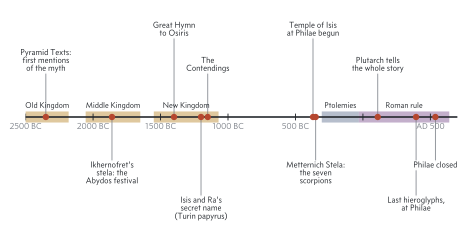
Isis’s search
When the news reached Isis, Plutarch says, she cut off a lock of her hair and put on mourning clothes at Coptos (kop-tohs), a town in Upper Egypt. Then she wandered everywhere, asking everyone she met about the chest. Some little children had seen it go, and they told her which mouth it had floated out of; ever after, he adds, the Egyptians believed that children’s chance words could foretell the future. The first to spread the news, Plutarch claims, were the Pans, Greek spirits of the wild country, and that, he says, is why a sudden terror in a crowd is called a panic.
On her travels Isis learned something painful. Osiris had slept with her sister Nephthys, believing that she was Isis, and he had left behind a garland of melilot (mel-ih-lot), a sweet-smelling clover, as proof. Nephthys had borne a son. In her fear of Set she had left the baby out in the open to die. Isis searched for the child, found him with the help of dogs, and raised him to be her guard and companion. He was Anubis (uh-noo-bis), the jackal-headed god who would watch over the dead and their embalming (Chapter 8). So in Plutarch’s account Osiris was the father of Anubis.This figure is sometimes depicted as the father of Anubis. → Osiris• Older Egyptian texts give the jackal god other parents, among them Ra himself.
Plutarch says only that Osiris was mistaken; he does not say whether Nephthys meant to deceive him. The version most often told today makes her the schemer. In it, Nephthys disguised herself as IsisNephthys disguised herself as this figure to conceive Anubis with Osiris. → Isis•• and lay with Osiris in her sister’s shape, and Anubis was the child of that deception. The Egyptologist George Hart sees the whole story as a way of fitting Anubis, once a god in his own right, into the family of Osiris.
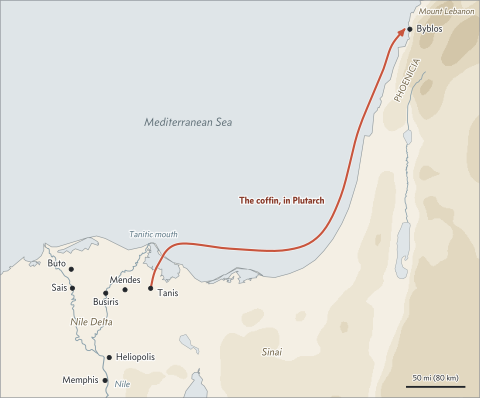
Meanwhile the chest had drifted far from Egypt. Plutarch says the waves carried it to Byblos, a port on the coast of what is now Lebanon, more than 300 miles from the Nile by sea (Figure 6.4). The choice was not random. Byblos was one of Egypt’s oldest partners abroad. Since the age of the pyramid builders, Egyptian ships had sailed there to buy cedar from the mountains behind the town, the long, straight timber that treeless Egypt needed for ships and fine coffins. The goddess of Byblos, called simply the Lady of Byblos, was identified by Egyptians with Hathor and later, it seems, with Isis. The city’s later history belongs to the Phoenicians (Chapter 18).
The chest came to rest in a clump of heather, a shrub that in that country can grow as tall as a small tree. The plant shot up into a great trunk, and the tree grew around the coffinThis figure's coffin became enclosed in a tree at Byblos. → Osiris••• until it was hidden completely. The king of Byblos admired the huge plant. He had it cut down and set the part that held the chest under his roof as a pillar, never knowing what was inside. Plutarch names him Malcander (mal-kan-der); for the queen he gives three names that different sources used, Astarte, Saosis (say-oh-sis), or Nemanus (neh-may-nus).
Isis learned all this, Plutarch says, from a rumor sent by the gods, and came to Byblos. She sat down by a spring, weeping, and spoke to no one except the queen’s maids. She braided their hair and gave their skin a wonderful scent from her own body. When the maids came home smelling like that, the queen longed to meet the stranger. She sent for her and made her the nurse of her baby son. Isis nursed the child in her own way, letting him suck her finger instead of her breast. At night, when the palace slept, she laid the baby in the fireAt Byblos, this figure tried to make a queen's child immortal by placing him in a fire. → Isis•• to burn away the parts of him that could die and make him immortal. While he lay in the flames, she turned herself into a swallow and flew around the pillar that held her husband, crying. One night the queen crept in, saw her son on fire, and screamed, and her scream broke the spell: the boy lost his chance to live forever. Greek readers knew this scene already, because the goddess Demeter does the same thing to the baby Demophon at Eleusis (eh-loo-sis) in a Greek hymn (Vol. 4, Classical Myth).
Now Isis revealed who she was and asked for the pillar. She drew it out from under the roof with ease, cut the wood away, and took out the coffin of Osiris.This figure retrieved Osiris's coffin from a tree at Byblos. → Isis•• The empty wood she wrapped in linen, anointed with perfume, and gave back to the king and queen, and Plutarch says that the people of Byblos still worshiped it in a temple of Isis in his own day. Then she threw herself on the coffin and wailed so terribly that the king’s younger son died on the spot. She sailed home with the chest, taking the elder prince with her. When he crept up behind her and saw her weeping over the dead face, a single furious look from her killed him. The Egyptians, Plutarch says, sang about this boy at their feasts under the name Maneros.
No Egyptian text sets any part of the story at Byblos, so the whole episode is known only from Plutarch and other Greek writers. It probably explains a real cult: in Plutarch’s time the people of Byblos did worship Isis and Osiris, and their goddess had been linked with Egypt’s for more than two thousand years. The sacred pillar wrapped in linen also looks very like the djed (jed), the pillar of Osiris shown in Figure 6.6.
Isis brought the chest back to Egypt and hid it in a lonely place while she went to see her young son Horus, who in Plutarch’s version was already born and was being raised in secret at Buto, in the marshes of the Delta. But Set, out hunting one night by moonlight, came upon the chest. He recognized his brother’s body, tore it into fourteen pieces,Set cut this figure into fourteen pieces and scattered them throughout Egypt. → Osiris••• and scattered them throughout Egypt, each in a different place. Isis set out again, sailing through the swamps in a boat made of papyrus reeds. Plutarch says that crocodiles never harm people in papyrus boats, out of fear or respect for the goddess.
Wherever Isis found a piece of her husband, she held a funeral, and that, Plutarch explains, is why so many towns in Egypt showed visitors a tomb of Osiris. He also reports another version, in which she made a likeness of the whole body for each town, so that Osiris would be honored in many places and Set would never know which grave was the real one. The Egyptians’ own lists of the pieces vary: fourteen in some temples, sixteen in others, and as many as forty-two in others, one for each of Egypt’s nomes, the provinces that Chapter 4 described. In those lists the murdered king’s body had become a map of his kingdom.
One piece was never found. Set had thrown Osiris’s phallus, the male sexual organ, into the river, and before Isis could reach it fish had eaten the missing phallus.A fish ate the missing phallus of this figure's husband Osiris. → Isis•According to Plutarch, fish ate this figure's missing phallus. → Osiris••One of these animals eats the phallus of Osiris. → fish• Plutarch names three kinds: the lepidotus (lep-ih-doh-tus), the sea bream, and the oxyrhynchus (ok-see-ring-kus), the “sharp-snout.” He says this is why the Egyptians refused to eat those fish above all others, and a whole town far south of Memphis, Oxyrhynchus, took its name from the sharp-snout and worshiped it. Then Isis fashioned a replacementThis figure fashioned a replacement for her husband Osiris's missing phallus. → Isis•• for the lost part, and the Egyptians, he says, still held a festival in its honor. This is one of Plutarch’s additions. In the Egyptian texts the phallus is found with the rest of the body.
Here the Egyptian texts take over the story again. Isis did not give up on a husband killed and cut apart by Set.This figure's husband Osiris was killed and dismembered by Set. → Isis••• Her sister Nephthys, though she was Set’s wife, joined her, and the two goddesses searched together, weeping as they went. Egyptian artists show them as a pair of mourners kneeling at either end of a body, or as two birds of prey guarding it (Figure 6.5). With Nephthys’s help, Isis gatheredWith Nephthys's help, this figure gathered and reassembled the pieces of Osiris's body. → Isis••• all the pieces and fitted them back into one body.
Then came the hardest part, bringing the dead god back. Isis was a great magician, but some Egyptian texts say that she learned her strongest spells from Thoth, the ibis-headed god of writing and wisdom whom Chapter 4 introduced. In the story of Osiris’s return, Thoth gave Isis the magic wordsThis figure gave Isis the magic words to revive Osiris. → Thoth•• that would restore her husband. The other gods worked to make the body whole and lasting. Anubis, the jackal god of the cemetery, washed it, anointed it with oils, and wound it in strips of linen, while the two sisters sang their laments over it. When he had finished, Osiris became the first mummy.This figure became the first mummy. → Osiris• Every Egyptian mummy afterward copied what the gods had done for him, as Chapter 8 will explain. When Herodotus described the embalmers’ finest method, he called it the method of “him whose name I think it impiety to mention,” because out of reverence he would not write the god’s name.

Then Isis did something no other god could do. She brought her reassembled husband back to life,Isis reassembled and revived this figure's body. → Osiris••• not to rule again on earth but for a short time, long enough to conceive a child by him. To do it she changed her shape. Kites are hawk-like birds of prey with forked tails, and their thin, whistling cry may have sounded to Egyptians like a woman wailing over the dead; the two sisters often appear as kites in tomb paintings. Isis took the form of a kiteThis figure took the form of a kite to conceive Horus. → Isis•• and hovered over Osiris, fanning breath back into him with her wings, and from him she conceived a son. A hymn to Osiris from the New Kingdom, known as the Great Hymn and translated in 1913 by E. A. Wallis Budge of the British Museum, describes the moment.
The son was Horus, the falcon-headed god whose battles fill Chapter 7. In this way Osiris became the father of HorusThis figure is the father of Horus. → Osiris••• after his own death, and Egyptian texts make much of it: the murdered king had an heir after all, and the throne that Set had stolen would one day return to Osiris’s line. Isis hid in the papyrus marshes of the Delta until the baby was born, and she raised him there in secret. As the mother of Horus,This figure is the mother of Horus. → Isis••• she became the model of a devoted mother, and thousands of Egyptian statues show her seated with the child on her lap. Plutarch tells the birth differently. In his version Horus was already born when Osiris died, and the child conceived after the death was a second son, born too early and weak in the legs, whom the Greeks called Harpocrates (har-pok-ruh-teez) (Chapter 7).
When Horus grew up, he fought Set for the throne in a long and violent struggle, and in the end Horus avenged his father’s deathThis figure's death was avenged by his son Horus. → Osiris•• and became king, as Chapter 7 will tell. In Plutarch’s version Osiris himself came back from the world of the dead to train his son for the battle. He asked Horus what he thought was the noblest deed a man could do. Horus answered that it was to avenge his father and mother for the wrong done to them, and Osiris knew that the boy was ready.
Osiris, lord of the dead
Osiris did not come back to rule on earth. His kingdom now lay elsewhere. The Egyptians called the world of the dead the Duat, a dim country beneath the earth through which the sun traveled each night (Chapter 5), and Osiris became the ruler of the dead and the underworld.This figure is the Egyptian ruler of the dead and the underworld. → Osiris••• The arrangement fitted the Egyptian idea of kingship exactly. To the Egyptians the living pharaoh was Horus, the son of the last king, and the pharaoh who had died became Osiris, king of the dead. Every new reign repeated the myth, because a son buried his father, sat on his throne, and so kept the order of the world, which the Egyptians called ma’at (muh-aht), unbroken.
Osiris also took over the titles of older gods of the dead. The cemetery at Abydos, in Upper Egypt, had long been guarded by a jackal god called Khenti-Amentiu (ken-tee ah-men-tee-oo), “Foremost of the Westerners.” The Westerners were the dead. The sun died each evening in the west, so Egyptians buried their dead on the west bank of the Nile, in the desert where the sun went down. By the troubled years after the Old Kingdom, about 2100 BC, Osiris had taken over Khenti-Amentiu’s name and temple,This figure was syncretized with Khenti-Amentiu, the 'Foremost of the Westerners.' → Osiris•• and the two gods became one. Scholars call this kind of merging syncretism (sing-kruh-tiz-um): two gods, often from different towns, come to be worshiped as a single god. Here the older god survived only as one of Osiris’s titles.

Osiris’s own emblem was the djed, a pillar with a broad base and four crossbars near the top (Figure 6.6). In writing, the djed sign meant “stability” or “lasting.” Egyptians said that the djed was his backbone,The djed column is a symbol of this figure that represents his backbone. → Osiris•• the spine that held the restored god upright. At the end of the great festival of Osiris in the month of Khoiak (koy-ak), at the season of sowing, the king and his priests hauled a wooden djed upright with ropes at Memphis. The ceremony was called the raising of the djed, and it showed the dead god standing again. A djed amulet of gold or of blue-green faience was laid on mummies, so that the dead would have a firm backbone too.
Osiris’s green skin points to his other side, as a god of growing grain. In Khoiak, priests filled Osiris-shaped frames with earth and barley seed, watered them, and watched the grain sprout from the god’s body. One of these “Osiris beds” was found in the tomb of the boy king Tutankhamun (Chapter 9). Plutarch reports that the priests called the Nile itself the outflow of Osiris. Modern scholars disagree about which side came first. In 1906 the Scottish anthropologist James Frazer argued that Osiris began as a spirit of the crops, which die and grow again every year. In 1980 the Welsh Egyptologist J. Gwyn Griffiths argued that he began as a king of the dead, and that the grain came later.
Osiris could take animal form as well. Egyptians believed that each person and each god had a ba (bah), a part of the self that could move about freely after death, often drawn as a bird with a human head; it was the nearest thing in their thought to a soul. The word ba could also mean “ram,” and the pun shaped worship. At Mendes (men-deez), a city of the Delta, his soul was worshiped as a ram,This figure's soul was worshipped in the form of a ram at Mendes. → Osiris•• the god Banebdjedet (bah-neb-jed-et), whose name means “the ba of the lord of Djedet,” Djedet (jed-et) being the Egyptian name of the city. A living ram was kept in the temple there as the god on earth, and when it died it was mummified and buried in a cemetery for rams.
Isis the magician
Isis outgrew her husband’s story. By Plutarch’s time she was the greatest goddess of Egypt and one of the best loved in the whole Roman world. Her Egyptian name was Aset, and it was written with the sign of a seat or throne. In paintings she wears that sign on her head: her headdress was shaped like a throneThis figure normally wears a throne-shaped headdress. → Isis•• (Figures 6.5 and 6.6). The throne made a fitting crown for the mother of kings. In temple carvings the pharaoh sits on her lap, as a king sits on his throne, and she nurses him like a baby, because to the Egyptians every king was Horus and so her son.

From the New Kingdom on, Isis also borrowed the crown of the cow goddess Hathor (Chapter 5): a pair of cow’s horns holding the sun’s disk (Figure 6.7). Herodotus noticed it. In Macaulay’s translation, he reports that “the figure of Isis is in the form of a woman with cow’s horns.” Plutarch has a story to explain the horns. After Horus beat Set, Isis let her captured enemy go free; Horus in his fury snatched the royal crown from her head, and Thoth gave her a helmet shaped like a cow’s head instead. An Egyptian story of the New Kingdom is grimmer: in it Horus cuts off his mother’s head, and Thoth gives her a cow’s head in its place.
Above all, Isis was the Egyptian goddess of magic.This figure is the Egyptian goddess of magic. → Isis•• The Egyptians called magic heka (hek-ah), a power that the creator had used to make the world and that gods and people could use through spoken words, amulets, and rituals. It was no trick and no rival to religion: priests and doctors used it every day, side by side with medicine. One of Isis’s titles was “Great of Magic,” and Egyptians said she was cleverer than millions of gods.
The most famous story of her magic is written on a papyrus of about 1200 BC, now in Turin, in Italy. Budge translated it twice, in 1895 and in 1912, and the words quoted here are from his second version. Ra, the sun god and king of the gods (Chapter 5), had grown old. In Budge’s words, “he dribbled at the mouth,” and his spittle fell to the ground. Isis wanted the one thing that would make her as powerful as he was: his secret name, which, the papyrus says, his father and mother had hidden in his body at his birth so that no magician could use it against him. She gathered up the spittle, kneaded it with earth, and made a snake from Ra’s spittle.Isis forced this figure to reveal his secret name after a snakebite. → Ra•••Isis creates one of these creatures from Ra's spit in order to learn Ra's secret name. → snakes••This figure made a snake from Ra's spittle and used its bite to force him to reveal his secret name. → Isis••• She shaped it like an arrow and left it on the road where Ra walked every day.
The snake bit him. Ra cried out so loudly that the cry reached the sky, his jaws shook, and the poison spread through his body the way the Nile flood spreads over the fields. None of the gods could help him. Then Isis came and offered to heal him if he would tell her his name. Ra listed his titles: he had made heaven and earth, and he was Khepri in the morning, Ra at noon, and Atum in the evening. The poison burned on, because none of these was the hidden name. At last Ra gave in and agreed that “my name shall come forth from my body and go into hers.” Isis took the name, and the poison flowed out of him. The papyrus never tells us what the name was.
It does tell us what the story was for. The text ends with instructions to recite it over little images of the gods, and with a line that leaves a blank for the patient: “a certain man, the son of a certain man, shall live and the poison shall die.” A myth told inside a spell gave the spell its power. What Isis had done for Ra, a healer reciting her words could do for anyone bitten by a snake.
Scorpions were the other everyday terror of Egypt, and Isis had a story for them too. It is carved on the Metternich (met-er-nik) Stela, a stone slab made about 350 BC and now in the Metropolitan Museum of Art in New York. After the murder of Osiris, Set shut the pregnant Isis up in a house. Thoth helped her escape and told her to hide until her child was born, and seven scorpions went with her as bodyguards. The stela says only that they came with her, but many retellings of the myth say that Thoth sent seven scorpionsIn one myth, this figure sent seven scorpions to protect Isis. → Thoth• to guard her. Three went ahead to clear the road, two walked at her sides, and two came behind. Isis warned them to speak to no one on the way.
At dusk they reached a town at the edge of the marshes. A rich woman saw the strange party coming and shut her door in their faces, but a poor woman of the marshes opened her house to the goddess. The scorpions were furious at the insult. Six of them gave their poison to the seventh, named Tefen (tef-en), who crept under the rich woman’s door, and so, as the stela tells it, one scorpion poisoned the woman’s childSeven scorpions accompanied this figure; one poisoned the child of a woman who denied her shelter. → Isis••• because she had refused Isis shelter. Isis would not let an innocent child die for his mother’s rudeness. She laid her hands on him, called each scorpion by name, and drove the poison out. The rich woman, ashamed, brought so many gifts from her house that they filled the poor woman’s home. Stones like this one, carved with spells, stood in temples and houses. People poured water over them, let it run across the words, and drank it as medicine.

Isis’s own emblem was a knot called the tyetThe tyet is a knot-shaped symbol of this figure. → Isis••• (tee-yet): a loop of cloth with two arms hanging down, rather like the ankh, the sign of life, with its arms bent. Its oldest examples are older than any mention of Isis, but from the New Kingdom on it was hers, and nearly every mummy had a tyet amulet laid among its wrappings. The Book of the Dead asks for one carved from red jasper, a blood-red stone that Egyptians likened to the blood of Isis, and promises that the power of Isis will protect the body.
Isis had a place in the sky as well. The brightest star of the night, Sirius, was the goddess Sopdet (sop-det) to the Egyptians, a name the Greeks spelled Sothis (soh-this), and Egyptians identified Sopdet with Isis. Plutarch says plainly that Sirius was the star of Isis,The star Sirius is a symbol of this figure. → Isis• calling it by its Greek name, the Dog Star. The star mattered because of when it rose. For about seventy days each year Sirius is lost in the sun’s glare. Then, one summer morning, it appears again low in the east just before sunrise, an event called its heliacal rising. In ancient Egypt that morning came in July, just as the Nile began to rise, so the return of Isis’s star announced the flood and the new year (Chapter 4 showed how the Egyptian calendar slowly drifted away from it). The neighboring stars of Orion were linked with Osiris. Egyptians took the seventy days of the star’s absence as its time in the underworld, the same number of days the embalmers took to prepare a mummy.
The flood that followed the star was tied to Isis in another way. Egyptian texts linked the rising water with her grief, and by Roman times the belief was common. Pausanias (paw-say-nee-us), a Greek who traveled through his country about AD 150 and wrote a guidebook to it, describes a festival of Isis in central Greece and adds what Egyptians said about the Nile. It rose, they told him, when Isis mourned for Osiris, and many of them said that what made it rise and water their fields was the tears of Isis,The annual flooding of this river was attributed to the tears of Isis for her dead husband Osiris. → Nile River•• shed every summer for her dead husband.
The cults of Abydos and Philae
Historians use the word cult in a plain sense: the worship of a god, with its temple, priests, offerings, and festivals. A god’s cult center (Chapter 5) is the town where that worship was oldest or greatest. Osiris was honored everywhere, but his chief cult center was Abydos,Abydos was this figure's cult center. → Osiris•• a town on the west bank of the Nile in Upper Egypt, some 50 miles northwest of Thebes (the map of the Nile in Chapter 4 shows both).
Abydos had been holy ground since the beginning of Egyptian history. The kings of the First Dynasty, about 3000 BC, were buried in the desert behind it, at a place now called Umm el-Qa’ab (oom el-kahb), “Mother of Pots,” from the countless broken jars that pilgrims later left there as offerings. By the Middle Kingdom, a thousand years after those burials, the Egyptians decided that the tomb of an early king named Djer (jer) was the tomb of Osiris himself. Plutarch heard that rich Egyptians wanted to be buried at Abydos, close to the body of Osiris. Those who could not be buried there set up a stela, as Egyptologists spell the stele (Chapter 1), carved with prayers, beside the road that the god’s procession took.
We know what happened on that road from one of those stelae. About 1860 BC, Senusret III, one of the strongest kings of the Middle Kingdom, sent his treasurer Ikhernofret (ik-her-noh-fret) to Abydos to adorn the god’s statue and shrine with gold, lapis lazuli, and turquoise. Ikhernofret also took charge of the yearly festival, and on his stela, now in a museum in Berlin, he listed what he did. First came the procession of Wepwawet (wep-wah-wet), a jackal god called “the Opener of the Ways,” who went out ahead to clear the road and champion Osiris. Osiris had a sacred boat of his own, the neshmet (nesh-met) bark. A bark, in this sense, is a boat; Egyptian gods traveled in sacred boats, and priests carried the smaller ones on poles over their shoulders. Then came the Great Procession, in which the god’s body was carried in the neshmet barkDuring a festival devoted to this figure at Abydos, his body was carried on the Neshmet bark. → Osiris• out across the desert to his tomb in the old royal cemetery. On the way, men playing the enemies of Osiris attacked the boat and were driven off, while crowds of pilgrims watched. Finally the god came home to his temple, restored to life.

Kings kept adding to Abydos for another two thousand years. About 1290 BC Seti I, the father of Ramses the Great (Chapter 10), built a temple there whose carved and painted walls are among the finest in Egypt, with chapels for Osiris, Isis, and Horus. Behind it lies the Osireion (oh-sih-ree-on), an underground hall of massive granite pillars. It was a symbolic tomb in the likeness of the god’s own, and most Egyptologists think it was built as a second, empty tomb for Seti himself, close to Osiris (Figure 6.9).
The death of Osiris was acted out in other towns too. At Busiris in the Delta, Herodotus reports, many thousands of men and women beat themselves in mourning at a festival of Isis, and he refused to say for whom they mourned. At Sais, another Delta city, he saw the tomb of one whose name he would not write, beside a round lake, and he wrote, in Macaulay’s translation: “On this lake they perform by night the show of his sufferings, and this the Egyptians call Mysteries.” The Greeks used the word mysteries for secret rites that only initiates could see, like those of Demeter at Eleusis (Vol. 4, Classical Myth).
Sais was the city of the goddess Neith, whom the Greeks matched with their own Athena. Plutarch describes a veiled statue at Sais,Plutarch described a veiled statue at Sais as representing this figure. → Isis• an image of Athena whom the Egyptians, he says, believed to be Isis. Its inscription had the goddess declare that she was everything that has been, is, and will be, and that no mortal had ever lifted her robe. Later Europeans read the veiled Isis as Nature herself, hiding her secrets from those who study her. In 1795 the German poet Friedrich Schiller wrote a poem about a young man who lifts the veil and is never happy again.

Isis’s most famous home was in the far south, on Philae, a small island in the Nile at the First Cataract, the stretch of rapids at Egypt’s old southern border (Chapter 4). Her first temple there was built about 370 BC under one of the last Egyptian-born pharaohs. Then the Ptolemies, the Greek kings who ruled Egypt after Alexander the Great (Chapter 25), and the Roman emperors after them went on adding gateways, courts, and colonnades for four hundred years (Figure 6.10). Isis had temples in many towns, but in those centuries Philae became the cult center of Isis,This figure's cult center is at Philae. → Isis•• the place her worshipers thought of first.
Beside Philae lies the island of Bigeh (bee-geh), where Osiris was said to be buried. Plutarch describes it as an island no one might set foot on, where birds would not land and fish would not swim near, except at one season, when the priests crossed over to make offerings at a tomb shaded by a tall tree. Every ten days the statue of Isis was carried across the water to visit her husband’s grave. Pilgrims came from Egypt and from Nubia, the land to the south, whose people honored Isis as their own.
Philae outlasted every other temple of the old gods. The last inscription ever carved in hieroglyphs was cut there in AD 394, and Nubian worshipers still came to Isis in the 450s, long after Christian emperors had ordered the temples closed. According to the Greek historian Procopius (pro-koh-pee-us), the Christian emperor Justinian, who ruled the Roman Empire from Constantinople, finally shut the temple in AD 537, and part of it became a church of Saint Stephen. In the twentieth century the Nile itself threatened the island. After the first dam at Aswan was finished in 1902, Philae lay under water for much of the year, and the far larger High Dam, finished a few miles upstream in 1970, threatened to leave it under water for good. So between 1977 and 1980 engineers took the temples apart stone by stone and rebuilt them on the higher island of Agilkia (ah-gil-kee-ah) nearby.
Long before her temple closed, Isis had traveled far beyond Egypt. Greeks and Romans built temples to her from Athens to Rome and beyond, and the Roman writer Apuleius (ap-yoo-lee-us) ended his comic novel The Golden Ass with his hero’s initiation into her mysteries (Vol. 7, The Romans). Clea, the priestess at Delphi for whom Plutarch wrote, was one of her worshipers. When she read his essay, she was reading a story that the priests of Abydos had been acting out for nearly two thousand years.
What to remember
- No Egyptian text tells the whole myth. The fullest account is the Greek writer Plutarch’s On Isis and Osiris (written some time after AD 100), and some of it, such as Byblos and the fish, is his alone.
- Osiris, eldest son of Geb and Nut, married his sister Isis; Set married Nephthys. Osiris is shown green-skinned, wrapped like a mummy, with the atef crown, crook, and flail.
- In Plutarch, Set tricked Osiris into a chest at a feast and threw it into the Nile. It drifted to Byblos, where a tree grew around it; Isis nursed the queen’s baby, tried to burn away his mortality, and took the coffin home.
- Set cut the body into fourteen pieces. Isis and Nephthys gathered them; fish ate the phallus, and Isis made a replacement. Thoth gave the magic words, Anubis wrapped the first mummy, and Isis, as a kite, conceived Horus, who avenged his father.
- Osiris rules the dead. He absorbed Khenti-Amentiu of Abydos; the djed pillar is his backbone; his soul was a ram at Mendes; every dead Egyptian hoped to become “an Osiris.”
- Isis, goddess of magic, wears a throne headdress and has the tyet knot. She tricked Ra out of his secret name with a snake made from his spittle, traveled with seven scorpions, and is linked with Sirius and the Nile flood, said to be her tears.
- Abydos was the cult center of Osiris, where his body rode in the neshmet bark at the festival; Philae was Isis’s, the last temple of the old gods; Plutarch describes a veiled statue of Isis at Sais.
Chapter 7 · 56 clues
Horus and Set
Two gods stand before a court of gods. One is young, a falcon god who asks for the throne of his murdered father. The other is his uncle, the strongest god of all, who killed that father and means to keep the throne himself. Nearly every judge agrees that the young god is in the right. They have agreed for years. Still the case drags on, because the chief judge prefers the uncle, and because no one quite dares to tell the strong god no.
This quarrel was the most famous lawsuit in Egyptian myth. It ends with a crowning, and for three thousand years every king of Egypt claimed to be the god who won it.
The Contendings
The young god was Horus, and his story begins with a murder. His father Osiris had been king of Egypt, until his jealous brother Set killed him and took the throne (Chapter 6). Osiris’s sister and wife, Isis, the greatest magician among the gods, found his body and brought him back to life just long enough to conceive a son. Then Osiris went down to rule the dead, and Isis was left alone and pregnant, with the murderer on the throne.
She fled north into the Delta, the wide, flat fan of land where the Nile splits into branches before it reaches the Mediterranean. There the river spreads into marshes of papyrus reeds taller than a man, cut by channels that only a small boat can follow. Egyptian texts say that Isis hid her son in the marshes,This figure hid with his mother from Set in the Nile delta's swamps. → Horus•This figure hid in a marsh with her son Horus. → Isis• in a thicket near the town of Buto, a place that Greek writers called Chemmis (kem-is). She had borne Horus there, and she nursed him in secret, so that Set would not find the child who might one day claim his father’s crown. Isis suckling the baby Horus on her lap became one of the commonest images in Egyptian art.
Horus was a falcon. His Egyptian name, Heru, may have meant “the one far above,” and the falcon that circles high over the Nile valley was his living image. Artists showed this son of Isis and Osiris either as the bird itself or as a man with a falcon’s head.This figure, the son of Isis and Osiris, is depicted with a falcon’s head. → Horus••• Through his parents he was the grandson of Geb and Nut, the earth and the sky (Figure 7.1).

When Horus was grown, he came to claim the throne. Egyptian texts of every age mention the fight that followed, but the fullest and liveliest of them tells it as a single long story. It is called The Contendings of Horus and Set, and in it Set competes with his nephew HorusThis figure competes with his nephew Horus for Egypt’s throne in the Contendings. → Set••• for the throne of Egypt before a court of gods. A scribe copied it about 1150 BC, in the reign of Ramses V. He wrote in hieratic, the quick, joined-up handwriting of everyday Egyptian documents (Chapter 4). His roll of papyrus, which also holds a set of love songs, came from Thebes, probably from Deir el-Medina (dair el meh-dee-nah), the village where the builders of the royal tombs lived.
In the late 1920s the roll was bought by Alfred Chester Beatty, an American-born mining millionaire who collected manuscripts from all over the world. So it is among the Chester Beatty papyriThis figure's conflict with his rival is recorded in the Chester Beatty manuscripts. → Horus• that the quarrel of Horus and Set survives. The English Egyptologist Alan Gardiner published it in 1931, and it now belongs to the Chester Beatty Library in Dublin (Figure 7.2).

The story has a comic touch. Its gods sulk, insult one another, weep, laugh, and lose their tempers like relatives at a family quarrel, and the judges cannot make up their minds. Some Egyptologists, among them Antonio Loprieno (loh-pree-ay-noh), have read it as a political satire, a story that mocks the powerful by making them look foolish. Whatever the scribe meant by it, the plot holds together as a string of contests, each one a trick or a fight, and in the end Horus wins.
The court was the Ennead, the nine great gods of Heliopolis (Chapter 5), and its president was Ra, the sun god, whom the story calls the Lord of All. By the time it was settled, the case had lasted eighty years.This figure's conflict with Set lasted eighty years. → Horus•• Most of the gods thought that Horus should have his father’s office, because a son should inherit from his father. Shu, the god of the air, declared that justice must be done, and Thoth, the ibis-headed scribe of the gods (Chapter 4), agreed with him. But Ra favored Set, who was older and stronger. He told Horus to his face that he was a mere boy, too weak for the office he wanted.
So the gods wrote for advice to Neith, an ancient goddess of the Delta city of Sais, a warrior who carried bow and arrows and whom the Egyptians called the mother of the gods. Thoth wrote the letter. Neith’s answer was a compromise. The gods must give the throne of Osiris to his son Horus, she said, and do no such wrong, or she would grow angry and the sky would crash down on the earth. But they should make it up to Set: double his property, and give him Anat (ah-naht) and Astarte,Neith suggested that this figure take Anat and Astarte as consorts as a compromise. → Set•• Ra’s two daughters, as wives. Anat and Astarte were goddesses of war and love from Canaan and Syria, the lands northeast of Egypt (Chapter 18), whom the Egyptians had taken into their own religion in the New Kingdom. Set was the god of foreign lands, so foreign wives suited him.
Even then Ra would not decide. Set boasted that he alone was strong enough to rule, and he refused to argue his case while Isis was in the room, because her pleading kept swaying the judges. So the court moved to an island in the river, the Island in the Middle, and Ra ordered the ferryman to carry no woman who looked like Isis.
The ferryman was a falcon god of boatmen. Older translations read his name as Anti (an-tee), and newer ones as Nemty (nem-tee): the same few hieroglyphs, read two ways. Isis changed herself into a bent old woman with a little gold ring on her finger. She told Nemty she was bringing a jar of flour to a young herdsman on the island, who had been hungry for five days. Nemty answered that he had been ordered to ferry no woman at all. She offered him a cake, and he refused it. Then she held out her ring, and Isis paid the ferryman with a gold ring.This figure used a gold ring to trick Anti into ferrying her to an island. → Isis• Nemty took it and rowed her across to the island.
There she turned into a beautiful young woman, and Set, catching sight of her, wanted her at once. She told him a sad story. Her husband, a herdsman, had died, and a stranger had come, seized the dead man’s cattle, and threatened to drive out his son. Set was indignant. Should the cattle go to a stranger, he asked, while the owner’s son was still alive? Isis turned into a kite, a bird of prey, flew to the top of a tree, and called down that his own mouth had judged him. Her tale had been his own crime in disguise: the dead herdsman was Osiris, the cattle were his throne, and the son was Horus. Set went weeping to Ra, and Ra told him that he had condemned himself. Set took his anger out on the ferryman. Set demanded that Nemty’s toes be cut off,After Isis bribed the boatman Nemty, this figure demanded that the boatman's toes be cut off. → Set• and the gods cut off the front of his feet. From that day, the story says, Nemty would have nothing to do with gold, and gold was forbidden in his town.
With the court now leaning toward Horus, Set proposed a new contest. The two of them would turn into hippopotamuses and plunge under the river, and whoever came up before three months had passed would lose the throne. The hippopotamus was the most dangerous animal of the Nile, a huge beast that overturned boats and trampled crops, and the Egyptians counted it among Set’s creatures. Isis, watching from the bank, feared for her son. She made a copper harpoon on a line and threw it into the water. It struck Horus, who cried out, so she pulled it free. She threw again and struck Set, who begged her to remember that he was her own brother, born of the same mother. Isis pitied him and let him go. Horus came out of the water in a fury, and Horus cut off his mother’s headThis figure decapitated his mother after she spared Set during their contest as hippopotamuses. → Horus•• and carried it up into the mountains. Isis turned herself into a headless statue of flint. In Plutarch’s much later telling, Horus only tore the crown from her head, and Thoth gave her a new headdress in the shape of a cow’s head.
The gods climbed the mountains to punish Horus, but Set found him first, lying under a tree in a desert oasis. Set tore out both of Horus’s eyesSet tore out this figure’s eyes, which grew into lotuses. → Horus•• and buried them on the mountain, where they sprouted like bulbs and grew into lotus flowers. Then Set went back to Ra and said that he had not seen Horus anywhere. It was Hathor, the cow goddess and Ra’s daughter (Chapter 5), who found the young god weeping alone in the desert. She caught a gazelle and milked it, and told Horus to open his eyes. Hathor dripped the gazelle’s milk into his eyes,This figure healed Horus's eyes with milk. → Hathor••• the right and then the left, and Horus was healed.
The weary gods ordered both rivals to stop quarreling and to eat and drink in peace. Set invited Horus to a holiday feast at his house, a day of eating and drinking, and Horus agreed. That night, as they lay on the same bed, Set tried to assault Horus.This figure's rival tried to get him drunk and rape him to assert dominance. → Horus•• His plan was to boast in court that he had overpowered his nephew and made him his inferior, which in Egyptian eyes would shame Horus and prove him unfit to rule. But Horus caught Set’s seed, his semen, in his hands and ran to his mother.
When Isis saw what was in his hands, she cried out, took her copper knife, and Isis cut off her son’s hands.This figure's hands were cut off by his mother. → Horus•• She threw the soiled hands into the river and made him new ones by her magic. Another text, a spell copied in the Book of the Dead, the collection of spells buried with Egypt’s dead (Chapter 8), tells what became of the old ones. Ra sent for Sobek, the crocodile god of the river (Chapter 4), to find them. Sobek searched the water, and Sobek brought the hands up in a fish trap,Sobek used a fish-trap to retrieve this figure's severed hands. → Horus•• a basket of reeds of the kind fishermen set in the stream.
Then Isis turned Set’s trick around. She collected some of Horus’s own seed in a jar and took it the next morning to Set’s garden. She asked the gardener which plants his master ate there, and he said that Set ate nothing but lettuce. Egyptian lettuce was a tall plant with a milky white sap, and Egyptians linked it with Min, the god of fertility. Isis spread Horus’s seed on the lettuceThis figure helped Horus place his semen on lettuce eaten by Set. → Isis• while no one was watching. Set came to his garden as usual and ate his fill.
Then he went to court, sure that he had won. Before the gods he claimed the throne, announcing that he had overpowered Horus. The gods cried out in disgust and spat in Horus’s face. Horus only laughed and asked the court to summon both gods’ seed and see where each one answered from. Thoth laid his hand on Horus and called Set’s seed, and it answered from the water of the marsh. Then Thoth laid his hand on Set and called Horus’s seed, and it came out of Set’s forehead as a golden sun disk. It was Set who had been tricked: Set had eaten Horus’s seedThis figure tricked his rival into eating lettuce contaminated with his semen. → Horus•••This figure was tricked into eating lettuce covered in his rival's semen. → Set•• on his lettuce. Thoth took the golden disk and set it on his own head as a crown, and the gods declared Horus in the right.
Set swore that Horus would not have the throne until the two of them had held one more contest. Let each of them build a ship of stone, he said, and race, and the winner would be king. Horus built a ship of wood and coated it with plaster, so that from a distance it looked like stone. He launched it at evening, when no one could look closely. Set saw it and was fooled. He cut the top off a mountain and carved from it a stone ship 138 cubits long, about 240 feet (72 m). The two gods climbed aboard before the assembled court, and Set’s stone ship sankThis figure won a race by sailing a wooden boat painted to look like stone, while Set's stone boat sank. → Horus•••This figure lost a boat race when his stone boat sank while Horus sailed a wooden imitation. → Set••• at once, while Horus’s painted wooden one floated. Set turned into a hippopotamus and smashed Horus’s ship, and Horus raised his harpoon, but the gods would not let him strike.
Horus took his weapons down to Sais to complain to Neith. He had been in court for eighty years, he said, and had won every contest, and still he did not have his father’s throne. At last Thoth proposed that the gods write to Osiris himself, in the land of the dead. Osiris answered angrily. Why was his son being cheated, he asked, when it was he who had made the barley and emmer wheat that fed the gods? And he reminded them that the land of the dead was full of fierce-faced messengers who feared no god, and who would fetch the heart of anyone who did wrong.
The threat worked. Isis was ordered to bring Set before the court in chains, and when the gods asked him why he would not accept their judgment, Set gave way. Horus was summoned and crowned with the White Crown, the tall crown of Upper Egypt (Chapter 4). After eighty years Horus had won the contestsThis figure defeated Set in a series of contests to become ruler of Egypt. → Horus••• and, with them, the throne of Egypt. Set was not destroyed. Ra took him up into the sky to live with him as a son, to thunder in the heavens and be feared, and so Set became a god of storms. The gods rejoiced, Isis rejoiced, and the land was at peace. In the old phrase of the Egyptian texts, Horus was the “avenger of his father”: Horus had defeated his uncle SetThis figure defeated his uncle Set to avenge his father Osiris. → Horus••• and taken back the place of Osiris.
Set
The loser of the Contendings had a name that the Egyptians wrote something like Sutekh (soo-tek), and that English writers spell Set or Seth. He has nothing to do with Seth, the third son of Adam in Genesis (Chapter 11): the names only happen to look alike in English. Set was the god of chaosThis figure is an Egyptian god of chaos and disorder. → Set•• and disorder, of everything violent, sudden, and uncontrolled. The Egyptians believed that the world held together through ma’at, the right order of things: truth, justice, and the steady return of the sun and the flood. Set was the force that pushed against it, the storm, the brawl, the stranger, and the murderer.
His home was the desert. The Egyptians called their own country the Black Land, after the dark mud of the Nile’s yearly flood, and the desert on either side the Red Land (Chapter 4; Figure 7.3). The Black Land fed everyone. The Red Land was sand and rock, sudden sandstorms and wild beasts, the country of nomads and raiders. Set was the god of the desert,This figure is an Egyptian god of the desert. → Set•• lord of the Red Land, as Horus was lord of the Black.

The oldest texts tell of a fight in which both gods were maimed. These are the Pyramid Texts, spells carved inside royal pyramids from about 2350 BC (Chapter 8). In them Set seizes the eye of Horus, and Horus tears off Set’s testicles.This figure ripped off his foe's testicle, explaining why the desert is infertile. → Horus•• The Egyptian texts do not draw a lesson from it, but modern retellings often do, because the injury matched the god’s country. The desert, where nothing grows, belonged to a god whose power to make new life had been torn away, and the barren land and the maimed god explained each other.

Set had an animal of his own, and nobody knows what it was. Set’s animal was the sha,This figure is represented by a mysterious doglike animal called the sha. → Set•• a lean creature something like a dog, with a long curved snout, tall ears squared off at the tips, and a stiff tail that stood straight up (Figure 7.4). Egyptologists have suggested an aardvark, a donkey, a jackal, a greyhound, an antelope, and even a giraffe, but the Egyptians drew all of those animals differently. The sha may be a beast of the imagination, or one that died out in Egypt very early. It already appears on a king’s ceremonial mace head from before 3000 BC, and artists showed Set either as the sha itself or as a man with its head.
Set’s sister Nephthys was the youngest child of Geb and Nut. Just as Osiris married his sister Isis, Set was the husband of Nephthys,This figure is the husband of Nephthys. → Set•• his own sister. The marriage was an empty one. In Plutarch’s account Nephthys bore her son Anubis not to Set but to Osiris, and when Osiris was murdered she took her sister’s side, mourning him and helping to gather his body (Chapter 6).
The murder was Set’s most famous deed. In Plutarch’s telling (Chapter 6) he tricked his brother into a splendid chest at a feast, and Set threw the coffin into the Nile.This figure trapped Osiris in a coffin and threw it into the Nile. → Set•• It drifted out to sea, and Isis searched as far as Byblos before she found it and brought it home. Then Set cut Osiris into fourteen piecesThis figure cut his brother Osiris into fourteen pieces and scattered them throughout Egypt. → Set••• and scattered them across Egypt.
Set was very old and very much at home in Upper Egypt. His chief town was Nubt (noobt), the City of Gold, beside the modern village of Naqada, north of Thebes. The Greeks called the town Ombos (om-bos), and Set was worshiped at OmbosThis figure was worshipped at Ombos. → Set• from before the first kings. About 60 miles upriver lay Nekhen, the falcon’s town, a rival power in the south before Egypt was united. J. Gwyn Griffiths and other Egyptologists have wondered whether the myth remembers a real war between the towns of the two gods. Others, like Herman te Velde (tuh vel-duh), read it as a religious myth rather than a memory of real events. One strange piece of evidence survives. About 2700 BC, late in the Second Dynasty, a king named Peribsen (per-ib-sen) topped his royal name with Set’s animal instead of the usual falcon of Horus. Khasekhemwy (kah-sek-em-wee), the dynasty’s last king and probably his successor, put both animals on his, as if to make peace between them.

Yet Set was not simply evil. Every night, the Egyptians believed, the sun god sailed his boat through the underworld, and every night the great serpent Apep rose against it, to swallow the sun and end the world (Chapter 5). Someone had to fight the serpent off, and the strongest god aboard was Set. Standing at the prow, Set speared the serpent ApepSet protects this figure's solar boat from Apep. → Ra•This figure protects Ra's solar boat on its nightly journey by slaying the serpent Apep. → Set••• to protect Ra’s boat, and the sun passed safely on to the dawn (Figure 7.5). In the Contendings Set makes exactly this boast: he alone, he tells the court, kills Ra’s enemy every day. The violence that made him dangerous made him useful, so long as it pointed outward.
His greatest days came late. About 1650 BC, foreign rulers from the Levant, known as the Hyksos, from an Egyptian phrase meaning “rulers of foreign lands,” took over the Delta and ruled from their city of Avaris (av-uh-ris) (Chapter 9). They chose Set, the god of foreigners, as their patron and saw in him their own storm god. After the Egyptians drove them out, Set’s temple at Avaris kept its priests. About two and a half centuries later, a family from that town became pharaohs: Ramses I, his son Seti I, whose name means “man of Set,” and Seti’s son Ramses II, the great builder of Chapter 10.
Ramses II built his new capital, Pi-Ramesses (pee-ram-uh-seez), beside the old town, and there he set up a stela (Chapter 6) in honor of Set. Its carving shows the king offering wine to the god, with an official named Seti standing behind him, probably Ramses’s own father before he became king. Its text records the day Seti came to worship Set and dates it to “Year 400” of a king called “Set of Ombos,” as if the god himself had begun a reign four centuries before. So the slab is called the Year 400 Stela, or the 400 Year Stela.The 400 Year Stela celebrates the 400th anniversary of a cult of this figure. → Set•• Most Egyptologists read it as celebrating four hundred years of Set’s cult in the Delta, which would put the cult’s beginning about 1720 BC. Later kings carried the stela north to Tanis (tay-nis), where the French archaeologist Auguste Mariette found it in 1863. He copied it and buried it again, and it was dug up a second time in 1933 and taken to Cairo.
By then Set’s good name was long gone. From the late eighth century BC Egypt was conquered again and again, by kings from Nubia, by the Assyrians, and by the Persians, and Set, the god of foreigners, became the god of hated invaders. His name was chiseled off monuments, the Year 400 Stela among them. The Greeks who later settled in Egypt matched him with Typhon, the monster who fought Zeus (Vol. 4, Classical Myth), and Plutarch calls him by that name.
Horus and the king
Horus was never only one god. Egyptians worshiped falcon gods under his name in many towns and many forms. There was Horus the Elder, whom the Greeks called Haroeris (har-oh-air-is), a great god of the sky. There was Horus son of Isis, the hero of the Contendings, and Horus the Child, and Horus joined with the sun as Horus of the Horizon. Egyptologists treat them as separate gods. The Egyptians let them run together, like one falcon seen from different sides.

The Horus who mattered most sat on the throne. From the First Dynasty on, Egyptians held that the living pharaoh was Horus on earth,Pharaohs were believed to be this figure's earthly incarnations. → Horus•• the god present in a human body; by the Fifth Dynasty, when Osiris first appears in the texts, they also held that the king became Osiris when he died. The first of the king’s five great names was his Horus name, written inside a serekh, the palace front with a falcon on top (Chapter 4). Sculptors made the same point in stone. On the seated statue of Khafre, who built the second pyramid at Giza about 2500 BC (Chapter 8), a falcon perches behind the king’s head and spreads its wings around it (Figure 7.6).
The oldest home of Horus was Nekhen, a town in the south of Upper Egypt, which the Greeks called Hierakonpolis, “city of the falcons.” Around 3200 BC Nekhen was a capital of the south, in the last generations before the southern kings united Egypt. Nekhen was the cult center of HorusThis figure's cult center was Nekhen, also called Hierakonpolis. → Horus•• long before the pyramids, and the temple there held the treasures of the first kings. In the digging season of 1897 and 1898, the English archaeologists James Quibell and Frederick Green found the Narmer Palette in its ruins, the great carved slab that shows the first king of all Egypt (Chapter 4).
His grandest temple stands at Edfu (ed-foo), about 10 miles upriver from Nekhen. The temple of Horus at EdfuThis figure has a temple at the city of Edfu. → Horus•• was begun on August 23, 237 BC, under Ptolemy III, one of the Greek-speaking kings who ruled Egypt after Alexander the Great (Chapter 25), and it was finished in 57 BC. It is one of the best-preserved temples in Egypt, partly because sand and river mud buried it almost to the roof until Auguste Mariette began to clear it in 1860. Granite falcons guard its courts (Figure 7.7), and its walls tell the war of Horus and Set as a sacred drama. At the yearly Festival of Victory the king, or a priest in his place, harpooned a hippopotamus that stood for Set, probably a model rather than a living animal, and so won the throne again.


Each year Horus of Edfu received a visit from his wife. Horus’s wife was the cow goddess Hathor,This figure's wife is normally the cow goddess Hathor. → Horus• the goddess of love, music, and joy, whose own great temple stood downriver at Dendera. Her statue sailed up the Nile to Edfu for the Festival of the Beautiful Reunion, a holy wedding kept with feasts and processions. Nine months later Dendera celebrated the birth of their son Ihy (ee-hee), a child god who played the sistrum, the sacred rattle. Yet Hathor’s own name, Hut-Hor, means “house of Horus,” and in some traditions she was the mother who carried him rather than the wife who married him. So Hathor was both mother and consortThis figure could be described as both the mother and the consort of Horus. → Hathor• of Horus, as different temples told it, and the Egyptians saw no difficulty in that.
The child of the marshes had a cult of his own as well. Egyptians called him Horus the Child and showed him as a small boy with the side-lock of hair that Egyptian children wore, sitting on his mother’s lap or on a lotus, with one finger raised to his mouth. That gesture was simply how Egyptian artists drew a young child, as if he were sucking his finger. The Greeks who came to Egypt under the Ptolemies took it for a sign of silence. The Greeks called the child Harpocrates,The child form of this figure was called Harpocrates by the Greeks and depicted with a finger to his lips. → Horus••• from his Egyptian name, Har-pa-khered, and made him the god of silence and secrets, holding a finger to his lips as if to say “hush.”
The eye of Horus
The falcon who flew across the sky had the sun and the moon for eyes. Egyptian texts say that his right eye was the sunThis figure's eyes represented the sun and moon. → Horus•• and his left eye the moon. That explained something everyone could see. The moon is dimmer than the sun, and every month it shrinks to nothing and grows back. Something had happened to the left eye.
The Pyramid Texts tell what. Their version is more than a thousand years older than the Contendings, and it is not the same story. In the fight with his uncle, Set gouged out the eye of Horus,This figure gouged out the eye of his rival Horus. → Set• trampled on it, and in some versions tore it into pieces or swallowed it. In the Book of the Dead he struck at the eye in the shape of a black boar. The eye he took was the left one, the moon, so that Horus lost his left eyeThis figure lost his left eye in a conflict with Set. → Horus••• to Set, and the moon’s waning was the wound. Then a god came to mend it. Here, and in most versions, it was not Hathor but Thoth, who was himself a god of the moon. He searched out the pieces and fitted them together, and Thoth restored the eye of HorusThis figure restored the eye of Horus. → Thoth•• to its owner. The Egyptians called the healing “filling” the eye, as the moon fills from new to full. Temple texts of Greek and Roman times say that Thoth and fourteen other gods filled it, one god for each of the fifteen days from new moon to full.
Horus did not keep his eye. He offered it to his dead father, and Osiris ate it and was given new life in the land of the dead. From then on any offering of food or drink laid before a god or a dead person could be called “the Eye of Horus.” In the offering spells of the Pyramid Texts, the bread, beer, and oil laid out for the dead king are each presented as the Eye of Horus.

The healed eye became Egypt’s favorite charm. The Egyptians called it the wedjat, “the sound one” or “the whole one.” They drew it as an eye with an eyebrow above and the markings of a falcon’s cheek below: a straight stripe falling from the eye and a line that curls into a spiral (Figure 7.8). The wedjat was the eye of Horus,The wedjat symbol represents this figure's eye. → Horus••• torn away and made whole again, and so it promised that what was hurt could be healed.
People wore it from the Old Kingdom to Roman times, carved in stone or molded in faience, a glazed ceramic, or made of glass or gold, and it was among the commonest amulets that Egypt ever made. The protective wedjat eyeThese body parts are depicted by the protective wedjat. → eyes• kept watch for the living and the dead. In the Middle Kingdom a pair of wedjat eyes was painted on the side of a coffin, so that the dead could look out. From the New Kingdom on, embalmers laid it on mummies over the cut through which the organs had been removed. Sailors painted the eye on the bows of their boats, and fishermen in many Mediterranean ports still paint eyes on their bows, a custom that may come down from the wedjat.
Thoth
Egypt gave several of its great gods the heads of birds. Horus had a falcon’s head,Horus had the head of one of these animals. → birds• the head of the hunter of the high sky, and his mother Isis could appear as a kite with spread wings. The god who healed the eye of Horus came from the marshes instead. His Egyptian name was Djehuty (jeh-hoo-tee), which became Thoth in Greek, and it may have meant “the one who is like the ibis.”
Thoth had the head of an ibis,This figure is depicted with the head of an ibis. → Thoth••• the long-legged wading bird that stalked the shallows of the Nile looking for frogs and fish. The sacred ibis is white, with a black head and neck and a long bill that curves downward. The Egyptians saw the moon in that bill. In his ibis form, his beak was the crescent moon,The crescent moon is represented by this figure's beak in his ibis form. → Thoth•• and Thoth was a moon god who often wore a crescent and a full moon on his head as well. Because the moon’s phases measured the months, Thoth was also the god of reckoning and of time. It was he, in the story Plutarch tells, who won the five extra days of the year from the moon (Chapter 5).

His other animal was the baboon. Baboons chatter and raise their arms when the sun comes up, and the Egyptians took them for worshipers of the sun. Thoth took the form of a baboon,This figure takes the form of a baboon called A'an or Aani. → Thoth•• called A’an (ah-ahn), often seated with the moon on his head (Figure 7.9). In that shape he was the god of balance. When the hearts of the dead were weighed in the underworld, the baboon of Thoth squatted on top of the scales and reported when the beam hung level (Chapter 8).
His city was Khmunu (kmoo-noo), “Eight-town,” in Middle Egypt, named for the eight gods of the dark waters whom its priests placed before the beginning of the world. The Greeks matched Thoth with their own god Hermes and called the city Hermopolis, “city of Hermes,” so Thoth’s cult center was Hermopolis.This figure's cult center was Hermopolis, also called Khmunu. → Thoth••• In the last centuries of Egyptian religion, pilgrims bought mummified ibises to offer to Thoth, and millions of them were buried in the underground galleries of Tuna el-Gebel (too-nah el-geb-el), the cemetery of Hermopolis.
Thoth’s greatest work, though, was writing. Thoth was the god of writingThis figure is the Egyptian god of writing and wisdom. → Thoth••• and wisdom, the inventor of hieroglyphs and the scribe of the gods, who kept their records and wrote their letters, as he writes the court’s letter to Neith in the Contendings. Every Egyptian scribe counted him as a patron. The Greeks remembered him for the same gift. In Plato’s dialogue Phaedrus (fee-drus) (Vol. 6, The Greeks), Socrates tells how the god Theuth, as Plato spells Thoth, showed his new invention, writing, to an Egyptian king. The king answered that it would make people forgetful, because they would trust the marks on the page instead of their own memories.

Thoth had two partners. Seshat (sesh-aht) was Thoth’s female counterpart,This figure's female counterpart is Seshat, who is variously described as his wife or daughter. → Thoth•• described in some texts as his wife and in others as his daughter. Her name, Seshat, means “female scribe.” She wore a leopard skin and a seven-pointed emblem on her head, and she counted the years of a king’s reign by cutting notches in a palm rib. When a temple was founded she helped the king lay out its walls, stretching a measuring cord between stakes. The walls of Edfu say that Thoth and Seshat drew up the plan of its first temple.
The other partner was Ma’at, the goddess of truth and order. She was the right order of the world that Set threatened, made into a goddess, and artists drew her as a woman with a tall ostrich feather in her hair. Ma’at was Thoth’s consort,Ma'at is this figure's consort. → Thoth•• and the two of them stood on either side of Ra in the sun’s boat. Her feather would be the weight against which every dead person’s heart was weighed (Chapter 8).
In the war of Horus and Set, Thoth was the peacemaker. He wrote the court’s letters, called out the seeds of both gods, healed the eye, and proposed the letter to Osiris when the judges stalled. So Thoth kept the balance between Horus and Set,This figure maintained balance in the dispute between Horus and Set. → Thoth• and later texts say that it was he who finally made peace between them. In temple reliefs the two gods often work side by side, pouring the water of purification over the king (Figure 7.10).
Thoth’s care for Horus went back to the boy’s childhood. The Metternich Stela (Chapter 6) has a second healing story, which tells how a scorpion stung the baby Horus while Isis was away from their hiding place in the marshes. She came back to find him dying and cried out to heaven. Ra’s boat stopped in the sky, and the sun stood still until Thoth healed Horus of the scorpion’s stingThis figure healed Horus after he was stung by a scorpion. → Thoth• with his spells. Stelae like it showed the child Horus standing on crocodiles and gripping snakes and scorpions in his fists.
Thoth had a long afterlife. The Greeks in Egypt saw in him their own Hermes, the clever messenger who guided the dead (Vol. 4, Classical Myth), and the two gods merged. An old Egyptian title of Thoth, “great, great, great,” carved at the temple of Esna, became in Greek trismegistos, “thrice-great.” So Thoth became Hermes TrismegistusThis figure was syncretized with Hermes to form Hermes Trismegistus, the “thrice-great.” → Thoth•• (triz-meh-jis-tus). Under Roman rule, writers in Egypt composed books of philosophy and magic in Greek under his name, the Hermetica, claiming that they held the wisdom of the most ancient Egyptian sage. In 1462 the Florentine scholar Marsilio Ficino (fih-chee-noh) put aside his translation of Plato to translate the Hermetica into Latin for Cosimo de’ Medici (med-ih-chee), the banker who ruled Florence (Vol. 10, Rebirth), and he finished the work the next year. Renaissance scholars believed them as old as the time of Moses, until the Geneva-born classical scholar Isaac Casaubon (kuh-saw-bun) showed in 1614, from their Greek, that they had been written after the time of Jesus.
What to remember
- The Contendings of Horus and Set, copied about 1150 BC and now among the Chester Beatty papyri, tells how Horus won his murdered father’s throne from his uncle Set after eighty years before the court of the gods.
- Its contests include Isis bribing the ferryman Nemty (Anti) with a gold ring, the battle as hippopotamuses, the eyes that became lotuses, the trick with the lettuce, and the race of the stone ship against the painted wooden one.
- Set was the god of chaos and the desert, the Red Land, with his strange sha animal, his old town of Ombos, and his wife Nephthys; yet he guarded Ra’s boat by spearing the serpent Apep.
- The Hyksos and the family of Ramses II honored Set, and Ramses II’s Year 400 Stela marks four hundred years of his cult; later Egyptians made him the god of invaders.
- The living pharaoh was Horus and the dead one Osiris. Horus’s oldest home was Nekhen (Hierakonpolis), his grandest temple Edfu, and his wife Hathor of Dendera; the Greeks turned Horus the Child into Harpocrates, god of silence.
- Set tore out the eye of Horus, and Thoth restored it. The healed eye, the wedjat, became Egypt’s favorite protective amulet.
- Thoth, the ibis and the baboon, was the god of the moon, writing, and wisdom, at home in Hermopolis, partnered with Seshat and Ma’at, and later merged with Hermes as Hermes Trismegistus.
Chapter 8 · 53 clues
Pyramids, Mummies, and the Weighing of the Heart
In the thirteenth century BC, a prince of Egypt went looking for kings his country had forgotten. His name was Khaemwaset (kah-em-wah-set), and he was the fourth son of Ramses the Great, the pharaoh whose wars and monuments fill a later chapter (Chapter 10). As a priest of Ptah, the craftsman god of Memphis (Chapter 4), Khaemwaset looked after the temples and cemeteries around the old capital. At Saqqara, the great cemetery on the desert edge above Memphis, he found a pyramid that no longer bore its builder’s name. He had an inscription carved on its south face, recording that he had restored it and that the king who built it was called Unas (oo-nahs).
Unas’s pyramid was about 1,100 years old when Khaemwaset stood in front of it, about as old to him as the reign of Alfred the Great, the Anglo-Saxon king who fought the Vikings, is to us. A short walk away rose an older pyramid built in six giant steps, and on the plateau to the north stood three more, so vast that travelers have measured them ever since. All of them were tombs. The kings of the Old Kingdom, the age from about 2700 to 2200 BC (Chapter 4), put more of their country’s labor into houses for the dead than into anything built for the living. This chapter asks what Egyptians believed happened after death, and why that belief needed so much stone. It ends with Khaemwaset himself, whom later Egyptians turned into a magician who robbed a tomb.
From bench to staircase
The earliest Egyptians buried their dead in pits at the edge of the desert, curled on one side, with pots of food beside them. The hot, dry sand drew the water out of the bodies so quickly that some of them lasted for thousands of years as leathery, recognizable people. Wind and jackals sometimes uncovered such graves, and the sight may have taught the Egyptians that a body could survive death. Wherever they could, they buried their dead on the west bank of the Nile, because the sun set in the west. The dead themselves were “westerners,” and the west was their country.
As kings and nobles grew richer, a pit was no longer enough. By the First Dynasty, about 3000 BC, the great men of Egypt were buried in chambers dug below solid, flat-topped blocks of mud brick, rectangular, with walls that sloped gently inward. Their ruins lay half buried in sand for thousands of years, and Egyptian villagers gave them the Arabic name for the low mud-brick bench outside a house: mastaba (mas-tuh-buh). The mastaba was a kind of tomb,The mastaba is a type of these structures. → tombs• a house for the dead built above the grave. It marked the place, protected the burial below, and held rooms where the family could bring food. For several centuries kings were buried this way too, and nobles and officials went on building mastabas for a thousand years after the kings had moved on.
The mastaba was the standard Egyptian tomb of the Old Kingdom. At Giza and Saqqara, streets of them stand in rows around the royal pyramids, the court still gathered around its king, and Egypt built these flat-roofed mastabasThis civilization built flat-roofed tombs called mastabas. → Egypt•• by the thousand. Inside, as a later section explains, they were laid out for the needs of the dead. But a mastaba was low and modest, and about 2650 BC one king wanted something more.
He was Djoser, a king of the Third Dynasty, and his tomb at Saqqara began as a mastaba of the ordinary kind, except that it was built of stone instead of brick. It was a square block 63 meters on a side and about 8 meters high. His builders enlarged it, then enlarged it again. Then they set a smaller block on top of it, and another on top of that, until six stone mastabas of shrinking size rose in a stack 62.5 meters high. The stepped pyramid grew out of stacked mastabas,The stepped form of these structures developed from stacked mastabas. → pyramids•• and the result looked like a staircase to the sky (Figure 8.1). Spells carved in later pyramids speak of the dead king climbing up to the sky to join the gods, and the steps may have been meant as his stairway.


Djoser’s tomb is the oldest great stone building in Egypt and one of the oldest in the world. Most Egyptologists credit its design to Imhotep, Djoser’s chancellor and the wise minister of the famine story carved on Sehel (Chapter 4), whose name and titles are carved on the base of a statue of the king found at Saqqara. Manetho, the Egyptian priest who wrote a history of his country in Greek in the third century BC (Chapter 4), dated the first building in dressed stone to Djoser’s reign. No ancient text says in so many words who planned the pyramid, but from this evidence Egyptologists have concluded that Imhotep designed the Step PyramidImhotep designed this stepped structure at Saqqara for Djoser. → Step Pyramid of Djoser•• at Saqqara for Djoser. Over the next two thousand years he became a legend and then a god of wisdom and healing, and the Greeks identified him with their own god of medicine, Asclepius (uh-sklee-pee-us) (Vol. 4, Classical Myth). The real Imhotep is almost invisible. No text from his own lifetime calls him a doctor, and his tomb has never been found.
The purpose of the building was never in doubt. Under the Step Pyramid a shaft 7 meters square drops 28 meters into the rock, to a burial chamber of pink granite, with nearly 6 kilometers of tunnels and galleries around it. From then on, for about a thousand years, pyramids were built to bury Egypt’s kings,These structures were used to bury Egyptian pharaohs. → pyramids••• and a few of their queens. Nearly every king of the Old Kingdom after Djoser who reigned long enough began one.
The next step was to fill in the stairs. Sneferu (snef-er-oo), the first king of the Fourth Dynasty, who reigned from about 2613 to 2589 BC, built at least three pyramids. At Meidum (may-doom), about 70 kilometers south of modern Cairo, his builders turned a step pyramid into a smooth-sided one by packing its steps with casing stones. Much of the casing later fell away, and Meidum stands today as a ruined tower on a heap of rubble. At Dahshur (dah-shoor), just south of Saqqara, Sneferu’s builders began again with a steep pyramid at an angle of about 54 degrees.
Partway up they changed their minds. Above about 47 meters, the sides slope at only about 43 degrees, so the pyramid has a visible kink, as if it had been folded. The builders probably feared that it would collapse: the chambers inside show cracks that were patched in ancient times. That kink gives Sneferu’s Bent Pyramid at DahshurA "Bent" one of these structures was built for Sneferu. → pyramids•• its name. Sneferu then built a third pyramid a short way to the north, the Red Pyramid, at the gentler angle from the start, and it was the first true pyramid finished as planned. It is called red for the color of its stone, laid bare after its white casing was carried off in the Middle Ages to build Cairo. In about a century, Egypt’s royal tombs grew from a stone bench to the tallest building on earth (Figure 8.2).

Why a pyramid? Egyptologists usually connect the shape with the sun god Ra and the creation story of Heliopolis, in which the first land rose out of the waters as a mound (Chapter 5). A pyramid recalls that mound, and also the sun’s rays slanting down through a break in the clouds, a ramp a king’s spirit might climb. Egypt kept building pyramids long after the Fourth Dynasty, smaller ones of stone at Abusir (ah-boo-seer) and Saqqara and, in the Middle Kingdom around 1850 BC, pyramids of mud brick faced with limestone. All of these royal tombs stand on the west bank (Figure 8.3).

The first person to try to count them all was a Prussian scholar, Karl Richard Lepsius (lep-see-us), who led an expedition up the Nile for the king of Prussia from 1842 to 1846. His team surveyed every pyramid they could find in the desert west of Memphis and numbered them with Roman numerals from north to south. Lepsius listed sixty-seven of these pyramidsKarl Richard Lepsius compiled a list of 67 of these structures in the 1840s. → pyramids• in 1842 and 1843, and Egyptologists still use some of his numbers for the smaller ruins. Later explorers have raised the count to more than a hundred.
Giza and the Sphinx
Sneferu’s son Khufu, whom the Greeks called Cheops (kee-ops), chose a new site for his tomb: a limestone plateau at Giza, about 20 kilometers north of Memphis. There, in a reign of more than twenty years, from about 2589 to 2566 BC, his builders raised the largest pyramid in Egypt. It stood 146.6 meters high, about as tall as a skyscraper of forty-five stories, on a square base 230 meters on a side. Its sides face north, south, east, and west with an error of a small fraction of a degree. For more than 3,700 years nothing built by human hands stood taller.
The Greeks of the last centuries BC drew up lists of the Seven Wonders of the World, the sights every traveler should see. Khufu’s pyramid was already more than two thousand years old when it went on the list, by far the oldest of the seven. The other six have fallen, burned, or vanished, and the Great Pyramid built for KhufuThis tomb built for Khufu is the only largely surviving Wonder of the Ancient World. → Great Pyramid of Giza•• is the only Wonder of the Ancient World that still stands largely intact. What a visitor sees today is the stepped core. The smooth casing of white limestone was stripped off in the Middle Ages to build Cairo, which took about 8 meters off the top.
Inside, a passage climbs through the masonry to a tall, narrow corridor called the Grand Gallery and on to a burial chamber lined with red granite, brought down the Nile from Aswan, about 900 kilometers upriver. The chamber held a granite coffin, empty when explorers first broke in; robbers had come long before. How the blocks were raised, on ramps of earth and brick that ran straight up one side or wound around the pyramid, is still argued. Who raised them is better known.
The Greek historian Herodotus, who visited Egypt about 450 BC, was told that Khufu was a cruel king who closed the temples and forced all Egypt to work for him. In G. C. Macaulay’s translation, “they worked by a hundred thousand men at a time, for each three months continually.” But Herodotus came two thousand years after Khufu, and the priests who told him the story had only legends to go on. Since the 1990s, archaeologists digging south of the pyramids have found the town where the builders lived, with its bakeries and breweries, and the tombs of workmen buried with honor near their king. The builders were Egyptians fed on bread and beer, and the logbook of one of their officials, Merer, records his crew ferrying white limestone across the river from the quarries at Tura for the pyramid’s casing (Chapter 4). A permanent crew of a few thousand skilled men worked with many thousands of laborers called up in turns, perhaps 40,000 at the busiest times. Gangs of them painted their names on blocks hidden inside the pyramids, names that boasted of their king, such as “The white crown of Khnum-Khufu is powerful.”

Khufu also took ships with him. Around his pyramid his builders cut five long pits in the rock for boats the king would need after death. Three were empty when they were found. In 1954, while clearing rubble along the south side of the pyramid, an Egyptian archaeologist named Kamal el-Mallakh (el-mah-lahkh) noticed a line of huge limestone slabs. Under them lay a ship, taken apart into 1,224 pieces of cedar from Lebanon and stacked in order with its ropes and oars. Kamal el-Mallakh discovered buried boatsKamal el-Mallakh discovered buried boats in pits beside this tomb of Khufu. → Great Pyramid of Giza• beside Khufu’s tomb: this one, and a second still sealed in the next pit. A restorer, Hag Ahmed Youssef, spent years fitting the planks together the way the shipwrights had, sewn with rope rather than nailed. The finished ship is 43.4 meters long, about one and a half times the length of a basketball court. Egyptologists still debate whether it carried Khufu’s body to his tomb or was meant to carry his spirit across the sky beside the sun god, who sailed in boats of his own (Chapter 5).
Khufu’s son Khafre built the second pyramid at Giza. It is a little lower than his father’s, about 143.5 meters as built, but it stands on higher ground, so from many angles it looks taller. It still keeps a cap of its smooth white casing near the top, which shows how all the pyramids once looked: polished limestone shining in the sun. The third pyramid, built for Khafre’s son Menkaure (men-kow-ray), is far smaller, 65.5 meters high, with its lowest courses cased in red granite from Aswan. Together, the three pyramids of Khufu, Khafre, and MenkaureThe Giza necropolis contains three major examples of these structures built for Khufu, Khafre and Menkaure. → pyramids• make up the necropolis of Giza, the “city of the dead,” with small pyramids for queens, temples, causeways, and streets of mastabas for the royal family and the court (Figure 8.5). For travelers from Herodotus to the present, the three of them have stood for the whole of the ancient civilization: Egypt built the Pyramids of Giza,This civilization built the Pyramids of Giza. → Egypt• and no other monument has done more to make Egypt famous.

Below Khafre’s pyramid, beside the causeway that led down to his valley temple, his quarrymen left a knob of rock they had not cut away. Sculptors carved it into a crouching creature 73 meters long and 20 meters high, with its paws stretched out in front. The Sphinx has a human head and a lion’s body:This animal forms the body of the Sphinx. → lions••This animal's body is combined with a human head in the Great Sphinx of Giza. → lions••This Egyptian monument has a human head and a lion’s body. → The Great Sphinx of Giza• the head of a king, in the striped linen headdress called the nemes (Chapter 4), on the body of the animal that stood for royal strength. Most Egyptologists think the face is Khafre’s, though no inscription of his time says so, and some argue for Khufu or another of his sons. What its builders called it is unknown. The name “sphinx” was given to it by Greeks two thousand years later, after a monster of their own myths, the riddling Sphinx of Thebes (Vol. 4, Classical Myth). The Greek Sphinx has a lion’s body too, but a woman’s head and wings. The Egyptian Sphinx is male and has no wings.

Sand filled the hollow around the Sphinx again and again. By about 1400 BC, more than a thousand years after it was carved, it was buried up to its shoulders. As he later told it, a young prince named Thutmose, a son of the pharaoh Amenhotep II, went hunting in the desert near Giza and lay down at noon in the Sphinx’s shade. He fell asleep, and in a dream the Sphinx spoke to him as a father speaks to a son. It called itself by its New Kingdom name, Horemakhet (hor-em-ah-ket), “Horus in the Horizon,” and promised him the crown if he would free it from the sand. Thutmose became king as Thutmose IV and reigned from about 1401 to 1391 BC. In the first year of his reign Thutmose IV set up the Dream Stele,The Dream Stele was constructed next to this monument by Thutmose IV. → The Great Sphinx of Giza• a granite slab taller than a man, between the Sphinx’s paws, and on it he told the story of his dream. Thutmose may not have been the eldest son, and a king whom a god had chosen had an answer to rivals. Historians read the stele as royal publicity, though no one can say what he dreamed.
The sand came back. By the time Europeans began to dig in Egypt, the Sphinx again showed only its head and back. In 1817 Giovanni Battista Caviglia (kah-veel-yah), a sea captain from Genoa turned excavator, set about 160 workmen to clear it for the British consul in Egypt, Henry Salt. They uncovered the chest and the paws and found the Dream Stele still standing between them. But the sand slid back into the trench almost as fast as it was dug out. Caviglia could not fully excavate the Sphinx,Giovanni Battista Caviglia was unsuccessful in fully excavating this monument. → The Great Sphinx of Giza• and photographs taken nearly sixty years later still show it sunk in sand to the chest (Figure 8.6). The whole body was not cleared down to the rock floor of its enclosure until the 1920s and 1930s.
One famous story about the Sphinx is false. Its nose is gone, and tour guides long liked to say that Napoleon’s soldiers shot it off with a cannon when the French army occupied Egypt in 1798. The legend that blames Napoleon’s soldiersA false legend blames Napoleon’s soldiers for destroying this monument’s nose. → The Great Sphinx of Giza• cannot be true, because Frederic Louis Norden, a Danish naval officer, drew the Sphinx in 1737 without its nose, sixty years before the French arrived. A close look at the face shows what really happened. Someone drove long rods or chisels into the bridge of the nose and under the nostrils and pried it off on purpose. The Egyptian historian al-Maqrizi (al-mah-kree-zee), writing in the early fifteenth century, blamed a Sufi, a Muslim mystic, named Muhammad Sa’im al-Dahr, who he said broke the nose in 1378 because local farmers were making offerings to the statue for good harvests. Whoever did it, the story of the cannon was invented long afterward.
The ka and the tomb texts
Why spend so much on the dead? The answer lay in what Egyptians believed a person was made of. Besides a body, every person had a ka (kah), a life force or spiritual double, which came into being at birth and stayed with him all his life. Egyptian art shows the god Khnum shaping a child and its ka side by side on his potter’s wheel (Chapter 4). The hieroglyph for ka is a pair of arms raised from the elbows, as if to embrace. Egyptians believed in a life force called ka,This civilization believed in a life-force called ka. → Egypt• and they believed it did not die when the body did. It went on living, and it went on needing what a living person needs: a home, a body to return to, and food and drink.
A person also had a ba, the part of the self that could move about after death (Chapter 6). Artists drew the ba as a bird with the dead man’s head, flying out of the tomb by day and coming back at night. A dead person who passed the judgment described later in this chapter became an akh (ahk), a shining spirit among the gods. Egyptian thinkers did not set all these parts into one tidy system, and their ideas changed over three thousand years. But in the Old Kingdom the ka mattered most, and the tomb was built for it.

The tomb supplied all three of the ka’s needs (Figure 8.7). Above the burial shaft, the mastaba held a chapel open to the living, where the family or a priest they paid would leave bread, beer, meat, and linen. In the chapel’s west wall was a false door, a carved door that did not open, through which the ka was thought to come out from the burial to receive what was offered. Behind the wall, in a sealed room that Egyptologists call by the Arabic word serdab (ser-dab), “cellar,” stood a statue of the dead man, with a narrow slit through which it could “see” the offerings and smell the incense. If the body were destroyed, the statue could house the ka instead. The walls were carved with pictures of food, servants, and farms, which magic could make real if the living ever stopped bringing offerings. Djoser’s own seated statue was found in 1924 in its serdab beside the Step Pyramid, still gazing out through two peepholes in the wall.

Many of the finest sculptures of the Old Kingdom were made for such tombs and were never meant to be seen by the living. The most famous is the Seated Scribe, found at Saqqara in 1850 by the French archaeologist Auguste Mariette, who uncovered the tombs of the Apis bulls nearby the same year (Chapter 5). It is now in the Louvre in Paris. A man sits cross-legged on the ground with a roll of papyrus open across his lap, his right hand poised to write. The limestone Seated Scribe was made in EgyptThe limestone Seated Scribe, depicting a cross-legged man with a papyrus roll, was made in this ancient civilization. → Egypt•• in the Fourth or Fifth Dynasty, between about 2600 and 2350 BC, and painted in lifelike colors. His eyes are inlaid with polished rock crystal rimmed with copper, so that they catch the light and seem alive. Nobody knows his name. Scribes were among the few Egyptians who could read and write, and a statue showing him at his work told the gods, and his ka, what kind of man he had been.
For three centuries the burial chambers of the pyramids were bare stone. Then came Unas, the last king of the Fifth Dynasty, who reigned from about 2375 to 2345 BC. He had the walls of his burial chamber and the room before it carved from floor to ceiling with columns of hieroglyphs, filled with blue paint, under a ceiling of painted stars. These are the Pyramid Texts, the oldest large collection of religious writing from Egypt: 283 spells in Unas’s pyramid alone, meant to be recited for the dead king. They tell how the king rises from the tomb, climbs to the sky by a ladder or flies there as a bird, joins the sun god in his boat, and becomes one of the stars that never set. Some are fierce. In the spells that Egyptologists call the “Cannibal Hymn,” the dead king hunts the gods and eats them to take their power into himself (Figure 8.9). Unas’s successors copied the custom until the end of the Old Kingdom.

The texts were found only in 1880 and 1881. Gaston Maspero (mas-peh-roh), a young French Egyptologist, opened the pyramids of Saqqara one after another and found their walls covered with writing. Mariette, the discoverer of the Seated Scribe, was then dying. In thirty years of digging he had never seen writing inside a pyramid, and he would not believe the news.
At first only kings, and then a few queens, had these spells. After the Old Kingdom broke up, about 2181 BC, into a century of weak kings and local lords, the spells spread to other people. Officials and their families began to paint versions of them on the insides of their wooden coffins, so that the dead could read them, as it were, while lying there. These are the Coffin Texts, about 1,185 spells, some borrowed from the Pyramid Texts and many new. They promise ordinary people what had once been promised only to a king: to rise, to travel, to eat and drink, to escape the demons of the underworld, even to avoid having to walk upside down. So Egypt’s writers produced the Coffin Texts and Pyramid Texts,This country's ancient writers produced funerary documents such as the Coffin Texts and Pyramid Texts. → Egypt• the first two great collections of spells for the dead. The third, the Book of the Dead, grew out of them in the New Kingdom, and it carried the story to the judgment hall.
Mummification
The ka needed a body to come home to, and so the body had to last. What sand had done by accident in the earliest graves, the Egyptians learned to do on purpose. The word mummy comes through Latin from the medieval Arabic mumiya, which meant both an embalmed body and bitumen, a kind of tar, because the blackened bodies looked as if they had been dipped in it. In Egyptian myth, embalming had been invented for a god. When Set murdered his brother Osiris and scattered the pieces of his body, Isis and her sister Nephthys gathered them, and with the help of Anubis they made Osiris whole again and wrapped him in linen, so that he became the first mummy (Chapter 6). Every embalmed Egyptian after him hoped to live again as he did.
No Egyptian embalmer left a manual. The fullest description comes from Herodotus, who says that the embalmers offered three grades of service at three prices and showed their customers painted wooden models of each. The finest, he adds, was named for a god whose name he thought it impious to mention in such a matter, by which he meant Osiris. It went this way, in Macaulay’s translation: “First with a crooked iron tool they draw out the brain through the nostrils.” Then, with a sharp stone, they made a cut along the side and took out the whole contents of the belly; mummies show that the cut was on the left and that the lungs were taken out too. They washed the empty body with palm wine and spices and packed it in natron (nay-tron), a natural salt from the dry lake beds of the desert that sucks water out of flesh.
Herodotus says the body lay in natron for seventy days. Modern studies of mummies suggest that the drying took about forty days of a process that lasted seventy in all. Then the embalmers washed the body, rubbed it with oils and resins, and wrapped it in linen bandages, sometimes hundreds of meters of them, with amulets tucked between the layers. The heart stayed in its place in the chest, because the Egyptians believed it was the seat of the mind and would be needed at the judgment. The brain, which they thought useless, was thrown away.
The other organs were dried separately and kept, each in its own canopic jar. There were four of them, for the liver, the lungs, the stomach, and the intestines. Egyptians used canopic jarsThis civilization often used canopic jars. → Egypt• for some two thousand years, from the Old Kingdom until the last centuries BC. From about 1000 BC, though, embalmers usually wrapped the organs in packets and put them back inside the body, and the jars that rich families still buried stood empty. The name is a mistake of early Egyptologists. They connected the jars with Canopus (kuh-noh-pus), a town on the coast of the western Delta, which the Greeks said was named for the helmsman of King Menelaus of Sparta on his voyage home from Troy (Vol. 4, Classical Myth). The helmsman was said to be buried there and worshiped in the form of a jar, and so the jars took his name.

Each jar was placed under the protection of a god, one of the four sons of Horus, the falcon god who avenged his father Osiris (Chapter 7). Imsety (im-set-ee), with a human head, guarded the liver; Hapi, a baboon, the lungs; Duamutef (doo-ah-moo-tef), a jackal, the stomach; and Qebehsenuef (keh-beh-sen-oo-ef), a falcon, the intestines (Table 8.1). So the four sons of Horus protected the canopic jars,This figure's four sons—Imsety, Hapi, Duamutef, and Qebehsenuef—protect the canopic jars. → Horus••• and from the time of Ramses the Great each lid was usually carved as the head of its own son (Figure 8.10). The sons were linked with the four directions, and they had protectors of their own: four goddesses, one for each son. In the usual telling Isis was not their mother but their grandmother, the mother of Horus. Yet Isis was the protector of Imsety,This figure is the protector, but not a parent, of Imsety, the guardian of the South and the liver. → Isis• the son with the human head, who guarded the liver and was linked with the south. Nephthys watched over Hapi, the goddess Neith over Duamutef, and the scorpion goddess Serqet (ser-ket) over Qebehsenuef.
| Son of Horus | Head | Organ | Direction | Guardian goddess |
|---|---|---|---|---|
| Imsety | human | liver | south | Isis |
| Hapi | baboon | lungs | north | Nephthys |
| Duamutef | jackal | stomach | east | Neith |
| Qebehsenuef | falcon | intestines | west | Serqet |
Anubis
Long before Osiris ruled the dead, the dead belonged to a dog. In the desert cemeteries of early Egypt, jackals came at night to dig up shallow graves and eat what they found. The Egyptians answered with a jackal god who would guard the graves instead of robbing them. He was Anubis, as the Greeks spelled his Egyptian name, Inpu. In the earliest pictures, from the First Dynasty, he is simply a jackal, and artists went on drawing him as a black jackal lying on top of a tomb or shrine, keeping watch. Later artists gave him a man’s body, and that is how he usually appears: Anubis has the head of a jackalThis figure is depicted with the head of a jackal. → Anubis••• on the body of a man, with tall pointed ears and a long, narrow muzzle. He is black, though real jackals are tawny, because black was the color of the Nile’s fertile mud and of a body darkened by embalming resin. To an Egyptian, black meant new life.
In the Old Kingdom, Anubis was the great god of the dead. His titles say what he did: “He Who Is upon His Mountain,” watching over the cemetery from the cliffs above it; “Lord of the Sacred Land,” the desert where the dead lay; and “Foremost of the Westerners,” chief of all the dead in the west. He shared that last title with the jackal god of Abydos whom Osiris absorbed (Chapter 6). The prayer carved over countless tomb doors asked the king and Anubis to provide bread, beer, and linen for the dead man’s ka. He was worshiped everywhere, but his own city stood on the Nile in Middle Egypt (Figure 8.11). The Greeks called it Cynopolis (sih-nop-uh-lis), “city of the dog.” The cult of Anubis was centered at Cynopolis,The cult of this figure was located at Cynopolis. → Anubis•• and across the river from it lay a cemetery of mummified dogs, buried there in the god’s honor. Plutarch, the Greek writer whose version of the Osiris myth Chapter 6 followed, tells a comic story about the place. When the people of Cynopolis ate a fish sacred to the neighboring town of Oxyrhynchus, the Oxyrhynchites caught and ate dogs in revenge, and the two towns fought a small war.

In the myth, when Osiris died, it was Anubis who embalmed him, and so Anubis became the god of embalmingThis figure is associated with embalming and mummification. → Anubis••• and mummification, the patron of every embalmer (Figure 8.12). One of his titles was “He Who Is in the Place of Embalming,” in Egyptian imy-wt. The same word named a strange object that stood in tombs and in pictures of the embalming tent: a headless animal skin, stuffed, tied to a pole, and set upright in a pot. Egyptologists call it the imiut (im-ee-oot), and a fetish here means a sacred object that holds a god’s power. Because the imiut fetish belonged to Anubis,This figure was associated with the Imiut fetish. → Anubis•• it is also called the Anubis fetish. Two of them were buried with the boy king Tutankhamun (Chapter 9).

Who were Anubis’s parents? Egyptian texts give different answers. In early writings he is a son of the sun god Ra; in some of the Coffin Texts his mother is the cat goddess Bastet or the cow goddess Hesat (heh-saht). The version best known today is Plutarch’s (Chapter 6), in which Osiris mistook Nephthys for his own wife, Isis, and lay with her,According to Plutarch, this figure was born after Osiris mistook Nephthys for Isis and lay with her. → Anubis•• and so fathered Anubis (Figure 8.13). Other texts simply make Anubis the son of Osiris and Isis.

Anubis had a daughter, Kebechet (keh-beh-chet), whose name means “cool water.” She was a serpent goddess, and the Pyramid Texts say that she refreshes and purifies the dead king. In later belief, his daughter Kebechet brought purifying waterThis figure's daughter Kebechet is associated with purification. → Anubis•• to the dead while they waited for their embalming to be finished, and she stood for the liquids with which the embalmers washed a body clean.
Anubis guarded Osiris’s body after death as well, and a late papyrus tells how. The Papyrus Jumilhac (zhoo-mee-yak), written around the first century BC and named after the Frenchman who sold it to the Louvre in 1945, collects the myths of Anubis’s own district of Egypt. In one of them, Set came back to attack his dead brother’s body, disguised as a leopard. Anubis caught him and branded Set with a hot iron,This figure branded Set with a hot iron while Set was disguised as a leopard, giving the leopard its spots. → Anubis•• and the papyrus says that is why the leopard has spots. Egyptian stories often explained something in the world this way, as a scar left by an old quarrel of the gods. Anubis was not finished with his enemy. He skinned Set and wore Set’s flayed leopard skinThis figure wore Set's flayed leopard skin. → Anubis•• as a warning to anyone who would violate a tomb. Priests who served the dead wore leopard skins over one shoulder, and the papyrus makes them a memorial of his victory.
The leopard skin leads to the last rite before burial. On the day of the funeral, the mummy in its coffin was stood upright at the door of the tomb, and a priest wearing a jackal mask held it steady, playing the part of Anubis. Another priest, the sem priest, dressed in a leopard skin, touched the mummy’s mouth and eyes with an adze, a woodworker’s tool with a curved blade, and with other ritual tools, while a lector priest read the spells aloud. This was the Opening of the Mouth, and it gave the dead back their senses: the power to see, to breathe, to speak, and to eat the offerings. “May my mouth be opened,” says a spell of the Book of the Dead, in E. A. Wallis Budge’s translation. So a priest in the mask of AnubisA priest wearing a mask of this figure performs the Opening of the Mouth ceremony. → Anubis•• took part in the Opening of the Mouth, and in some pictures of the rite Anubis himself holds the mummy upright.
Anubis guided the dead as well as guarding them. Late Egyptian paintings show him taking the dead by the hand and leading them to Osiris. A god who leads souls to the land of the dead is called a psychopomp (sy-koh-pomp), from the Greek for “guide of souls,” and the Greeks had one already: Hermes, who led ghosts down to the house of Hades (Vol. 4, Classical Myth). After Alexander the Great conquered Egypt in 332 BC and Greek kings ruled it (Chapter 25), Anubis was joined with HermesThis figure was conflated with Hermes for his role as a psychopomp. → Anubis• as a fellow guide of souls. The two became one god, Hermanubis (her-muh-noo-bis), with a jackal’s head and the Greek god’s herald’s staff, popular under the Romans.
Anubis even appears as a farmer in an Egyptian tale. The “Tale of Two Brothers,” copied on a papyrus about 1200 BC, is about two brothers named Anpu (ahn-poo) and Bata (bah-tah). Anpu, the elder, has a house and a wife; Bata, the younger, lives with them, plows his brother’s fields, and understands what his cattle say. When Anpu’s wife tries to seduce Bata and he refuses her, she tells her husband that Bata attacked her. Anpu takes a knife to kill his brother, and the sun god puts a stretch of water full of crocodiles between them. Across the water Bata tells the truth, and Anpu goes home and kills his wife. Bata goes away to the Valley of the Cedar and hides his heart in the blossom of a cedar tree. When the tree is cut down he dies, and Anpu searches more than three years for the heart, finds it, and brings his brother back to life by setting it in a bowl of cool water. The elder brother’s name is the Egyptian name of the jackal god, and Bata’s brother Anpu is identified with Anubis.Bata's brother in "The Tale of the Two Brothers" is identified with this figure. → Anubis• Bata, too, was a god, a bull worshiped in Anubis’s district. The wife’s false accusation will be familiar to readers of the story of Joseph and the wife of Potiphar (pot-ih-fer) in Genesis (Chapter 12).
The judgment in the Hall of Two Truths
Mummy and tomb took care of the body. The soul still had a journey to make, and the way led down into the land of the dead. The Egyptian underworld was called the Duat,The Egyptian version of this place is called the Duat. → the underworld•• the dark country beneath the earth through which the sun god Ra sailed every night between sunset and sunrise, fighting off the serpent Apep on the way (Chapter 5). New Kingdom tombs mapped it hour by hour, with lakes of fire, winding waterways, and gates guarded by demons holding knives. A dead person had to know the right spells and the name of every gatekeeper to pass.
At the end of the road sat its king. By the Middle Kingdom, Osiris had taken Anubis’s old place as lord of the dead. Osiris ruled the DuatOsiris rules the Egyptian version of this place. → the underworld•• from a throne under a canopy, green-skinned, wrapped like a mummy, holding the crook and flail of a king (Chapter 6). Anubis did not lose his work. He became the guide who met the newly dead at the edge of the other world and led them toward the judges, and so Anubis ushered souls into the Duat,This figure ushers souls into the Duat. → Anubis•• taking them by the hand.
What happened next is shown in hundreds of copies of the Book of the Dead, the third great collection of spells for the dead. Its Egyptian name was “Spells for Coming Forth by Day.” The English name comes from Lepsius, the scholar who counted the pyramids, who published one copy in 1842 under the German title Todtenbuch. From about 1550 BC, in the New Kingdom, anyone who could afford it was buried with a papyrus roll of these spells, often painted with pictures. Spell 125 describes the trial of the dead, whose great moment was the weighing of the heart. The trial took place in a hall named for Ma’at, the goddess of truth and order, whom Chapter 7 met as the companion of Thoth. The hall was named for her twice over: the weighing took place in the Hall of Two Truths,This event takes place in the Hall of Two Truths. → weighing of the heart•• or of the Two Ma’ats.
The dead man entered and greeted forty-two judges, lesser gods who sat in rows along the hall. Each had a frightening name and came from a particular place in Egypt, and their number matched the forty-two nomes, the provinces of the country (Chapter 4). To each judge in turn he denied a sin. Egyptologists call this speech the negative confession, because it confesses nothing. In the papyrus of a scribe named Nebseni (neb-sen-ee), as Budge translates it, it begins: “Hail, thou whose strides are long, who comest forth from Annu (Heliopolis), I have not done iniquity.” Then come theft, murder, and lies, and cheating customers with false measures (“I have not made light the bushel”), and anger, adultery, and prying into other people’s business. In the trial whose great moment was the weighing of the heart, the dead recited negative confessions before forty-two judges,During this event, the deceased recites negative confessions before forty-two divine judges. → weighing of the heart•• and only then was the heart put on the scale. The list of denials is a portrait of the good Egyptian: honest in trade, gentle in speech, and respectful of the gods.
Then came the test that could not be talked around. In the middle of the hall stood a great balance. On one pan the gods placed the dead man’s heart, which held the record of everything he had thought and done. On the other they placed a single ostrich feather, the sign of Ma’at. This was the weighing of the heart: the heart was balanced against the feather of Ma’at.During this event, an organ of the deceased is balanced against the feather of Ma'at. → weighing of the heart•• A heart weighed down with wrongdoing would sink and tip the beam; a heart that was true would hang level with the feather. To a modern reader the picture suggests a heart as light as a feather, which weighs almost nothing at all. To the Egyptians it meant something more: Ma’at’s feather represented truth,One of these objects belonging to Ma’at represents truth and is weighed against the hearts of the dead. → feathers•• and the question was whether a life had been as true as the order of the world.

The god at the scale was Anubis. He knelt beside the balance and watched the plumb line that hung from its crossbar, steadying the pans and making sure the weighing was fair, while in some papyri Thoth’s baboon squats on top of the balance (Chapter 7). Anubis was the Guardian of the Scales,Anubis administers this event as Guardian of the Scales. → weighing of the heart•• and it was his care that made the weighing of the heart honest (Figure 8.14). The jackal who had embalmed the body now examined the heart that the embalmers had left inside it, and no god knew a dead man’s insides better. In picture after picture, then, Anubis weighed the heart against Ma’at’s featherThis figure weighs hearts against Ma'at’s feather in the Hall of Two Truths. → Anubis•••In Egyptian mythology, Anubis weighed the hearts of men against the feather of Ma'at in one of these places. → the underworld•• in the Hall of Two Truths, deep in the land of the dead.
Beside the scale stood Thoth, the ibis-headed god of writing (Chapter 7), with his palette and reed pen, as if he were a royal scribe taking minutes at a trial. Thoth recorded the resultThis figure served as a scribe recording the results of the weighing of the hearts of the dead. → Thoth•• of the weighing on his palette and announced it to the gods. If the scales balanced, the gods declared the dead man maa kheru (mah-ah kheh-roo), “true of voice,” which meant that he had been found innocent. From then on the phrase was written after his name, the way a title is.
If the scales did not balance, a monster was waiting. Beside the scale crouched Ammit (ah-mit), whose name means “Devourer of the Dead.” Ammit devoured the hearts judged unworthyThis figure devours the hearts of the dead who fail the weighing ceremony. → Ammit••Ammit devours hearts judged unworthy in the ceremony administered by this figure. → Anubis•• at the weighing over which Anubis presided. A person whose heart she ate did not go on to be punished forever. He simply ceased to exist, in what the texts call the second death, and to an Egyptian nothing could be worse. Ammit was not worshiped. She was a demon who belonged to the judgment hall alone, and she first appears there in the New Kingdom copies of the Book of the Dead. Painters built her from the three most dangerous animals in Egypt, with a crocodile’s head, a lion’s forequarters, and a hippopotamus’s hindquarters,This figure has the head of a crocodile, the forequarters of a lion, and the hindquarters of a hippopotamus. → Ammit•• so that no one could escape her. The lion hunted at the edge of the desert, and the hippopotamus ruled the river, overturning boats and trampling the fields. Of the three parts, the one at the front mattered most, since it was the mouth that did the eating, and Ammit had the head of a crocodile,Ammit had the head of this animal. → crocodiles• the beast that Nile villagers feared above all.
The Egyptians did not leave the result to chance. A heart might speak up at the trial and give its owner away, so the embalmers laid a stone scarab beetle on the mummy’s chest, carved with a spell addressed to the heart. In Budge’s translation it begins, “My heart, my mother; my heart, my mother!” and it pleads, “May naught stand up to oppose me in judgment.” A good life was the surest way through the hall, but a good spell was thought to help.

A heart that balanced earned the reward. Horus took the soul found true of voice by the hand and led it to Osiris on his throne. Beyond lay Aaru (ah-roo), the Field of Reeds, an Egypt without sorrow, and passing the weighing granted access to it.Successful completion of this event grants access to Aaru, the Field of Reeds. → weighing of the heart•• It was a land of canals and islands like the marshes of the Delta, where the grain grew taller than a man and the blessed dead plowed, sowed, and harvested forever (Figure 8.15). Even in paradise there were fields to work, so Egyptians were buried with small figures called shabtis (shab-teez), servants who would step forward when their owner was called to labor and do the work for him.
The Book of Thoth
Khaemwaset, the prince who restored the name of Unas, died about 1225 BC, and Egyptians did not forget a man who had spent his life among the tombs of ancient kings. A thousand years later he was the hero of stories told in Demotic, the everyday script of late Egypt (Chapter 4), under the name Setne Khamwas. “Setne” came from one of his priestly titles, sem or setem, the priest who opened the mouths of the dead. In the stories he is a learned prince and a great magician, and his learning gets him into trouble. The first story survives on a papyrus of the last centuries BC, and it is a ghost story about a book.

Setne learned of a book that Thoth, the god of writing (Chapter 7), had written with his own hand: the Book of Thoth. It lay in the tomb of a prince named Neferkaptah (nef-er-kap-tah), in the cemetery of Memphis. Setne went down into the tomb and saw the book shining with its own light. But the tomb was not empty. Beside Neferkaptah’s mummy sat the ghosts of his wife, Ahwere (ah-weh-reh), and their young son, Merib (meh-rib), and Ahwere told Setne how the book had come there.
Neferkaptah, a king’s son, had spent his days reading the inscriptions on old tombs, until an old priest laughed at him and told him where to find something worth reading. The book of spells lay at the bottom of the river at Coptos, the town far up the Nile where Isis had mourned her husband (Chapter 6), locked in nested boxes and guarded by serpents.This magical text was hidden in nested boxes beneath the Nile at Coptos, guarded by serpents. → Book of Thoth•• The outermost box was of iron; inside it was a box of copper, then one of juniper wood, then one of ivory and ebony, then one of silver, and in the silver a box of gold, and in the gold the book. Snakes and scorpions swarmed around it for miles, and coiled around the box lay a serpent that could not die. Neferkaptah sailed to Coptos with his wife and son, and there, with the help of a magic boat, he went down into the river. He killed the snakes. He killed the deathless serpent, and it came back to life; he killed it again, and it came back again. The third time he cut it in two and put sand between the halves, so that they could never join, and he opened the boxes one after another.
He read the first spell in the book, and he could enchant the sky, the earth, the underworld, the mountains, and the seas, and understand what the birds and the fish and the beasts of the desert were saying. He read the second, and he saw the sun god rising in the sky with his company of gods. But the book was named for Thoth,A magical book stolen by Neferkaptah is named for this figure. → Thoth• and it was his. When Thoth learned that Neferkaptah had stolen it, he complained to Ra, and Ra allowed him his revenge. On the way home, Merib fell into the river and drowned, and then Ahwere. Neferkaptah tied the book to his body with a strip of linen and threw himself into the water after them. He was buried at Memphis with the book, and his wife and son lay far away at Coptos, separated from him forever.
Setne was not frightened off. The ghost of Neferkaptah offered to play him for the book at a board game. Three times Setne lost, and each time the ghost struck him with the game board and drove him into the floor of the tomb, to his legs, to his waist, and at last to his ears. Setne sent for his brother to bring him the protective amulets of the god Ptah, and with them he sprang up out of the ground. The book Neferkaptah had stolen was stolen again:This magical text was taken by Neferkaptah and later by Setne Khamwas. → Book of Thoth• Setne seized it and fled, and the light went out of the tomb behind him.
Neferkaptah warned him that he would bring it back. Soon afterward, Setne saw a beautiful woman named Tabubu (tah-boo-boo) at the temple of Ptah and fell in love with her. She agreed to receive him only if he signed over everything he owned to her, and then she asked for more, until he agreed even to the deaths of his own children. At that moment Setne found himself lying in the road without his clothes, as the pharaoh’s procession came by. None of it had happened. It was an illusion sent by Neferkaptah. Shamed and frightened, Setne carried the book back to the tomb. Then, at the ghost’s request, he went to Coptos, found the bodies of Ahwere and Merib, and brought them home to lie beside Neferkaptah, and the tomb was sealed. The family of the dead was together at last, as every Egyptian hoped his own would be.
The story’s lesson is an old one: some knowledge belongs to the gods, and a man who steals it pays. But the story is also built from everything this chapter has described. Its hero is a priest of the dead, whose duty was to keep the old tombs. Its ghosts live on in their tomb as the ka was believed to live, and its plot turns on a family wrongly buried apart. A second story, written down in Roman times, sends Setne and his wonder-child son Si-Osire (see-oh-see-reh) down into the Duat itself. There they see Osiris, Anubis, and Thoth weigh a rich man’s misdeeds and a poor man’s good deeds, and they find the poor man in fine linen beside Osiris while the rich man suffers at a gate. Readers of the Gospel of Luke will recognize the shape of Jesus’s parable of the rich man and Lazarus (Chapter 30).
What to remember
- Old Kingdom tombs grew from the flat-roofed mastaba to Djoser’s Step Pyramid at Saqqara, attributed to Imhotep, to Sneferu’s Bent and Red Pyramids at Dahshur, and to Khufu’s Great Pyramid at Giza, the one Wonder of the Ancient World still standing.
- Giza holds the pyramids of Khufu, Khafre, and Menkaure, Khufu’s buried boats (found by Kamal el-Mallakh in 1954), and the Great Sphinx, a lion with a king’s head. Thutmose IV set up the Dream Stele between its paws; its nose was gone long before Napoleon.
- Egyptians believed every person had a ka, a life force that needed a home, a body, and offerings: the tomb, its statue, and its chapel supplied them.
- The Pyramid Texts (from Unas, about 2350 BC), the Coffin Texts, and the Book of the Dead carried spells for the dead from kings to ordinary people.
- Embalmers dried the body in natron, in a process of about seventy days, left the heart inside, and stored four organs in canopic jars guarded by the four sons of Horus.
- Anubis, the black jackal, guarded tombs, embalmed Osiris, guided souls, and was played by a masked priest at the Opening of the Mouth; Plutarch made him the son of Nephthys and Osiris.
- In the Hall of Two Truths the dead denied forty-two sins, and Anubis weighed the heart against the feather of Ma’at while Thoth recorded the result. Ammit ate a failed heart; a true heart went on to Aaru, the Field of Reeds.
- In a Demotic tale, the Book of Thoth lay in nested boxes under the Nile at Coptos until Neferkaptah stole it, and Setne Khamwas, based on Khaemwaset, a son of Ramses II, stole it again.
Chapter 9 · 56 clues
Hatshepsut, Akhenaten, and the Boy King
About 1435 BC, a gang of stonecutters climbed the ramps of a great temple on the west bank of the Nile and went to work with copper chisels. Their job was to destroy the face and the name of a king who had died some twenty years before. They smashed the king’s statues, carried the pieces to a pit in the desert, and cut the king’s name out of the walls, letter by letter. The king had worn a crown and a false beard, had sent ships to a fabulous land in the south, and had ruled Egypt for twenty-two years. The king was a woman.
About ninety years later, men with chisels went through the same temple again. This time they were hunting for the name of a god, and they hacked it out wherever they found it, even inside private tombs. The king who sent them believed that only one god deserved worship. A generation after his death, a soldier who had made himself pharaoh pulled that king’s temples down and left his name off the lists of Egypt’s rulers. The Egyptians believed that to destroy a person’s name was to kill that person a second time. Three times in little more than a century, the kings of one dynasty tried to blot out a name, and three times they failed.
The New Kingdom and Thebes
The story begins with a humiliation. About 1650 BC, Egypt split apart for the second time in its history. The Middle Kingdom (Chapter 4 sets out Egypt’s kingdoms and the troubled ages between them) had broken down, and newcomers from Canaan, the land along the eastern shore of the Mediterranean, took over the north. The Egyptians called their kings heqau khasut, “rulers of foreign lands,” and the Greek form of that phrase gives them their modern name: the Hyksos. From their capital at Avaris, in the marshy Delta where the Nile fans out into the sea, the Hyksos kings ruled Lower Egypt as pharaohs, while a family of Egyptian princes held on in the south at Thebes. Modern historians call this century of division the Second Intermediate Period, “intermediate” because it falls between two of the great kingdoms.
The Theban princes fought back, and it cost them. One of them, Seqenenre Tao (sek-en-en-ray), died violently: his mummy, found in the nineteenth century, has axe wounds in the skull. His successor Kamose (kah-mohs) raided the country around Avaris. The task of finishing the war fell to a younger member of the family, probably Kamose’s brother, named Ahmose (ah-mohs). Ahmose attacked Avaris three times and took it at the fourth attempt. Then he chased the Hyksos out of Egypt altogether and besieged their last stronghold, Sharuhen, near Gaza on the coast of Canaan, for three years until it fell. A soldier who fought beside him, also named Ahmose, had the whole war carved on the wall of his tomb, with a list of the rewards his king gave him: gold for valor, land, and captives.
Ahmose put Upper and Lower Egypt, the Two Lands, back under one king. Modern historians date the start of the New KingdomAhmose I’s expulsion of the Hyksos marked the beginning of this period after the Second Intermediate Period. → New Kingdom• from his victory over the Hyksos, about 1550 BC, and they number him Ahmose I, the first king of the Eighteenth Dynasty. The New Kingdom lasted almost five hundred years, until about 1070 BC, and it was the richest and most powerful age Egypt ever knew.
The Hyksos taught the Egyptians a hard lesson: an enemy at the border could become a king on the throne. The new kings decided to keep their enemies far away. Ahmose’s successors pushed south into Nubia, the land of gold beyond the cataracts of the Nile, and north into Canaan and Syria. Thutmose I, the third king of the dynasty, marched as far as the Euphrates River and set up a stone there to mark the edge of his power. For the first time, Egypt had an empire (Chapter 1), a group of foreign lands ruled from one center. The kings of Canaan’s little cities now sent tribute to the pharaoh and swore loyalty to him.
The center was Thebes. The Egyptians called the city Waset; the Greeks later gave it the name of their own Thebes, the city of Oedipus (ed-ih-pus) (Vol. 4, Classical Myth), and no one knows exactly why. Its ruins lie under the modern town of Luxor, about 800 kilometers (500 miles) up the Nile from the sea. To the Greeks it was a byword for wealth. In Homer’s Iliad, the angry Achilles swears that no gift could win him back, not even all the treasure of “Thebes which is a city of an hundred gates,” in A. T. Murray’s translation.
Thebes owed its new glory to its god. Amun, “the hidden one” (Chapter 4), had been a local god of Thebes. When Theban princes became kings of all Egypt, they joined him to the sun god as Amun-Ra and made him king of the gods. To the kings, every victory was Amun’s gift, and every king paid him back with gold, captives, and buildings. On the east bank of the Nile at Thebes, the side of the rising sun and of the living city, stood the temple of Karnak.The temple of Karnak was located in this city. → Thebes• It was less a temple than a city of temples, which the Egyptians called “the most select of places.” Almost every king of the dynasty added something to it: a gateway, a hall of columns, a pair of obelisks. Its priests became the richest men in Egypt after the king, and that wealth would one day make them a king’s enemies.
Across the river, on the west bank, lay the city of the dead (Figure 9.1). The sun set in the west, so the Egyptians buried their dead there, at the edge of the desert where nothing grew. The kings of the Old Kingdom had built pyramids (Chapter 8), and robbers had broken into every one. So the kings of the New Kingdom hid their tombs. Behind the cliffs of the west bank lies a dry, winding valley, and there, beginning with Thutmose I or perhaps the king before him, they cut their tombs deep into the rock. Thutmose I’s architect, Ineni, boasted in his own tomb that he had dug his master’s grave in secret, with no one watching. Thebes stood across the river from the Valley of the Kings,This city is located across from the Valley of the Kings. → Thebes• which held the tombs of nearly every king of the next five hundred years.

A king’s hidden tomb could not receive the daily offerings that kept his spirit fed (Chapter 8 explains the ka, the life force that needed them). So each king also built a mortuary temple, a temple for his worship after death, out on the plain where priests could reach it. One of the largest belonged to Amenhotep III, a king of the same family whom this story meets again. Almost nothing of his temple survives except the two colossi, or giant seated statues, of the king that guarded its gate, each about 18 meters (60 feet) high with its base. The Greeks and Romans who toured Egypt centuries later decided that they showed Memnon, the king of the Ethiopians whom Achilles killed at Troy (Vol. 4, Classical Myth). That is why Thebes is still remembered as the city of the Colossi of Memnon.This city was home to the Colossi of Memnon. → Thebes•

The statues gave the Romans a wonder. An earthquake in 27 BC cracked the northern one, and afterward it gave out a sound at dawn, like a cry or the snapping of a string. Visitors decided that Memnon was greeting his mother, Eos, the Dawn. Tourists came from all over the Roman world to hear it, among them the emperor Hadrian (hay-dree-un) in AD 130, and they scratched more than a hundred poems and messages into the stone. The sound was probably made by stone warming in the morning sun after a cold night. Sometime after AD 196 the statue was repaired, and it never sang again.
Hatshepsut
Thutmose I was a soldier who seems not to have been born a king’s son. He married Queen Ahmose, who may have been a princess of the old royal family, and their daughter was Hatshepsut (hat-shep-soot), whose name means “foremost of noble women.” By a lesser wife, Mutnofret (moot-nof-ret), Thutmose I also had a son, who became king after him as Thutmose II. Egyptian kings often married their own half-sisters, to keep the royal blood and its claims inside one family. So Hatshepsut married her half-brother, Thutmose II,This ruler was the wife of Thutmose II. → Hatshepsut• and as his chief queen she held the title Great Royal Wife. She was also God’s Wife of Amun, a priestly office that gave her a place in the temple rituals at Karnak. The couple had one daughter, Neferure (nef-er-oo-ray).
Thutmose II died young, about 1479 BC. His only son, by a minor wife named Iset, was a small child, perhaps two years old. The boy was crowned as Thutmose III, but a toddler cannot rule a kingdom. Someone had to govern for him, and that person is called a regent. The obvious choice was the dead king’s widow, who knew the court and the priests. So Hatshepsut served as regent for her stepson, Thutmose III,This ruler served as regent for her stepson Thutmose III before ruling jointly with him. → Hatshepsut•• as earlier queens had done for young sons. For a few years her monuments show her as a queen, standing modestly behind the boy king.
Then she did something no queen of the New Kingdom had done. By the seventh year of the reign, she had herself crowned king. She took a throne name, Maatkare (mah-at-kah-ray), and the full list of royal names that every ruler bore. She did not murder or imprison the boy. Thutmose III remained king beside her, but she was the senior partner, and she dated her reign from his first year. So Hatshepsut held the title of pharaohHatshepsut held this title. → pharaoh•• and all the powers that went with it (Chapter 4 explains the title, which comes from the Egyptian for “great house,” the palace). She was not quite the first woman to rule Egypt: Sobekneferu (soh-bek-nef-eh-roo) had reigned for a few years at the end of the Middle Kingdom. But Hatshepsut ruled far longer and far more grandly than any woman before her.

Egyptian art had no picture of a woman king, so her artists used the picture of a king. In her statues she wears a king’s short kilt and striped headcloth, and on her chin, the false beardThis ruler was commonly depicted wearing a fake or false beard. → Hatshepsut•• that every pharaoh wore at ceremonies, tied on with a strap. Egyptian men were mostly clean-shaven. The beard was a symbol, borrowed from the gods, who were imagined with long braided beards. Some statues show her with a woman’s face and a man’s body, and her inscriptions often slip between “he” and “she.” When the French scholar Champollion (sham-poh-lee-un), who first deciphered hieroglyphs, visited her temple in 1829, he was puzzled to find a bearded king described with feminine nouns and verbs.
She needed a case for her right to rule, and she had it carved in stone. One series of reliefs tells that the god Amun himself visited her mother in the form of Thutmose I, so that Hatshepsut was the god’s own daughter. Another claims that her father named her his heir before the court. Historians treat both as propaganda, stories told to win support. But the stories worked: for about fifteen years no one seems to have challenged her.
Her most trusted official was Senenmut (sen-en-moot), a man of humble birth who rose to be steward of her household and tutor to her daughter Neferure. Statues show him holding the little princess wrapped in his cloak. He was also her overseer of works. When Hatshepsut chose a site for her mortuary temple, she picked a bay in the western cliffs opposite Karnak, beside the older temple of Mentuhotep II (men-too-hoh-tep), a king who had reunited Egypt six centuries before. Senenmut, her architect, is usually creditedThe architect Senenmut designed this ruler's mortuary temple. → Hatshepsut•• with its design, though the evidence is not conclusive.

The temple was called Djeser-Djeseru (jes-er jes-er-oo), “holiest of holy places.” Its site is now known by an Arabic name, Deir el-Bahari (dayr el-bah-har-ee), “the northern monastery,” after a Christian monastery built in its ruins many centuries later. Three broad terraces climb toward the cliff, joined by ramps and lined with colonnades (Figure 9.4). On the top terrace stood rows of statues of Hatshepsut as Osiris, the god of the dead (Chapter 6). The lowest terrace once had pools of papyrus and trees in front. Hatshepsut’s tomb, cut deep into the same cliff from the Valley of the Kings on the other side, lay almost directly behind it.
The walls told the great events of her reign, and the most famous was a voyage. In the ninth year of the reign, about 1471 BC, Hatshepsut sent five ships from Egypt’s Red Sea coast to a land the Egyptians called Punt, “the land of the god” (the talking serpent of “The Shipwrecked Sailor,” Chapter 4, called itself the Lord of Punt). No one is certain where Punt was. Its animals and goods point to the African coast of the southern Red Sea, perhaps modern Eritrea or Sudan, about 1,200 kilometers (750 miles) south of the Egyptian port. The ships carried beads, tools, and weapons to trade. They came home loaded with gold, ebony, ivory, panther skins, live baboons, and incense. Most precious of all, the expedition brought back living myrrh trees,This pharaoh sent a trading expedition to Punt that brought back myrrh trees and other valuable goods. → Hatshepsut••• thirty-one of them, their roots packed in baskets. Myrrh is a fragrant resin burned as incense in the temples, and Egypt had always had to buy it from foreign traders. Hatshepsut planted the trees in front of her new temple so that Amun would never lack it again.
On the walls of Djeser-Djeseru, her temple at Deir el-Bahari,This pharaoh’s mortuary temple, Djeser-Djeseru at Deir el-Bahari, depicts her expedition to Punt. → Hatshepsut••• the expedition to Punt is carved scene by scene. The ships sail with fish swimming in the sea below them. The houses of Punt stand on stilts among palm trees, and porters carry the trees up the gangplanks. The inscriptions call the goods “tribute,” as if Punt had bowed to Egypt. In fact it was a trading mission to a land the Egyptians had visited before.

One scene caught the eye of every later visitor. The chief of Punt comes to greet the Egyptians, a tall, lean man with a pointed beard, whom the inscription calls Parahu. Behind him walks his wife. Ati, the queen of Punt,Reliefs commissioned by this ruler depict the corpulent Queen Ati of Punt. → Hatshepsut•• is carved as an enormously fat woman, with folds of flesh on her arms and legs and a deeply curved back. Egyptian art almost always shows people slim and young, so the carvers must have meant this picture to be noticed. Perhaps the queen had a disease; perhaps her shape was the ideal of beauty in Punt. The relief cannot tell us which.
Hatshepsut’s other great gift to Amun was stone. An obelisk is a tall, four-sided pillar cut from a single stone,These are tall monuments made of a single stone that were erected in ancient Egypt. → Egyptian obelisks• narrowing toward a small pointed pyramid at the top. That tip was often covered in gold or electrum, a natural mix of gold and silver, so that it flashed when the first light of the sun struck it. Obelisks were sacred to the sun, and kings set them up in pairs at temple gateways. They were cut from the red granite of the quarries at Aswan, near Egypt’s southern border, and floated more than 200 kilometers (125 miles) down the Nile on barges.
For Karnak, Hatshepsut ordered twin obelisks at the entranceThis pharaoh ordered the construction of twin obelisks flanking the entrance to the Temple of Karnak. → Hatshepsut•• of the temple of Amun. One of them still stands (Figure 9.6). It is about 29 meters (95 feet) tall and weighs over 300 tons, and when it went up it was the tallest obelisk in the world. Its inscription boasts that the work took only seven months from the quarry. Of all the ancient obelisks still standing, only one is taller than hers, and it is not in Egypt but in Rome, where the emperors carried it.


At Karnak she also built a shrine for Amun’s sacred boat. On festival days the god’s statue left his temple in a gilded model boat carried on the shoulders of priests, and the boat needed resting places along its route. Hatshepsut’s was made of blocks of red quartzite set on a base of black stone. It is called the Red Chapel, or Chapelle Rouge.This ruler built the Red Chapel, or Chapelle Rouge, at Karnak. → Hatshepsut•• Some of its blocks show obelisks being towed down the river on a barge. After her death the chapel was taken apart and its blocks reused in other buildings, and only in 1997 was it rebuilt from more than three hundred of them, in the open-air museum at Karnak.
Her ambitions may have grown larger still. At Aswan, a stone far bigger than any ever raised was marked out in the living rock. If it had been finished it would have stood about 42 meters (137 feet) high and weighed nearly 1,100 tons. But cracks opened in the granite, and the workmen abandoned it, still joined to the bedrock underneath. The Unfinished Obelisk at AswanThe Unfinished Obelisk at Aswan is often attributed to this ruler. → Hatshepsut• is often attributed to Hatshepsut, though no inscription names her. Its value lies in its failure: the tool marks and the lines of red paint still on it show exactly how Egyptians quarried obelisks, by pounding the granite away with balls of harder stone.
Hatshepsut ruled for about twenty-two years, from about 1479 to 1458 BC, counting her years as regent. That made her the longest-reigning woman pharaohThis ruler was the longest-reigning female pharaoh from an indigenous Egyptian dynasty. → Hatshepsut•• of any native Egyptian dynasty. Only Cleopatra, a Greek queen of Egypt more than a thousand years later (Chapter 25), ruled nearly as long. Hatshepsut’s reign was mostly peaceful and very rich, and she built more than almost any ruler before her.
She died about 1458 BC. Thutmose III, now in his twenties, ruled alone for another thirty-three years and became the greatest conqueror Egypt ever had. Within months of her death he marched into Canaan and defeated a league of rebel kings, led by the king of Kadesh in Syria, at Megiddo, in the first battle in history whose course was written down in detail. He led more than fifteen campaigns, and the American Egyptologist James Henry Breasted called him the Napoleon of Egypt.
Then, about twenty years after her death, the chisels came. Late in Thutmose III’s reign,Late in Thutmose III’s reign, images and names of this female pharaoh were systematically erased. → Hatshepsut•• his workmen went through Egypt destroying her images. At Deir el-Bahari they smashed her statues and threw the pieces into a quarry pit, where archaeologists found them in the twentieth century. Her names were cut out of walls, or replaced with the names of her father or her husband, so that her buildings seemed to be theirs. At Karnak her obelisks were walled in, so that only their upper parts could be seen. Personal hatred seems unlikely, since Thutmose III waited two decades to act. The likeliest reason is that he wanted to make sure his own son, Amenhotep II, would inherit, and that a woman king in the records was an awkward precedent. The lists of kings carved under the next dynasty left her out entirely.
The destruction was so thorough that it confused modern scholars. In the late nineteenth and early twentieth centuries, Egyptologists found Thutmose I, II, and III and Hatshepsut written over one another on the same walls, and they argued about who had reigned when and who had overthrown whom. One theory imagined a feud in which the Thutmoses seized the throne from each other in turn. The tangle became known as the “Hatshepsut Problem.”This ruler's namesake "Problem" concerns the chronology and order of succession of the early pharaohs of the 18th dynasty. → Hatshepsut• It was solved only when the dates of the reigns were worked out from many other records, and the recarved names were read as what they were: a stepson’s attempt to edit history.
Akhenaten and the Aten
A century after Hatshepsut, Egypt was at the height of its wealth. Thutmose III’s great-grandson Amenhotep III ruled for nearly forty years, from about 1391 to 1353 BC, in peace. Gold flowed in from the mines of Nubia, and foreign kings sent their daughters to his court and begged him for gold in return. He married a woman not of royal birth, Tiye (tee-yeh), the daughter of an official from the provinces. He made her his Great Royal Wife, and she remained a power in Egypt for the rest of her life. Their eldest son died young, so the crown passed to a younger son, who became king in 1353 BC as Amenhotep IV. History remembers him by the name he took a few years later, Akhenaten.
The new king began by honoring all the gods, but one above them. The Aten was the disk of the sun, the shining ball itself, as distinct from the sun god Ra who traveled in it. Amenhotep IV built new temples for the Aten at Karnak, just east of Amun’s great temple, using small sandstone blocks that a single man could carry, so that the work went fast. There, in an unusual move, he held a Sed festival three years into his reign.This ruler unusually held a Sed festival three years into his reign. → Akhenaten• A Sed festival was a jubilee that renewed a king’s strength with rituals and processions, and it was normally held only after thirty years on the throne. No one knows why a young king held his so early. Perhaps he meant to show that his rule was already blessed by the Aten.
The king soon went much further. He declared the Aten the only god worthy of worship, and he gave it a new picture. Many of the old gods had human bodies and the heads of animals, but this king’s artists drew a sun disk with rays ending in hands.This pharaoh promoted exclusive worship of Aten, depicted as a sun disk with rays ending in hands. → Akhenaten••• The rays stretch down to the king and queen, and some of the little hands hold out the ankh, the hieroglyph for life, to their faces. In his fifth year he changed his own name from Amenhotep, “Amun is satisfied,” to Akhenaten, “effective for the Aten.” He closed the temples of the other gods and took their income for the Aten.
Thebes belonged to Amun, and Akhenaten wanted a city that belonged to the Aten alone. In his fifth year he chose an empty stretch of desert on the east bank of the Nile, about halfway between Thebes and Memphis. There the cliffs open in a gap where the sun rises, like the hieroglyph for “horizon,” a sun between two hills. He named the place Akhetaten (ak-eh-tah-tun), “horizon of the Aten,” and marked its borders with boundary stones carved with his vow never to leave it. Its ruins are now called Amarna, or Tell el-Amarna, after an Arab tribe that later settled nearby. So the king moved his capital from Thebes to Amarna,This pharaoh moved his capital from Thebes to Amarna. → Akhenaten•• and within a few years the court, the officials, the artists, and thousands of workmen lived in a new city of temples, palaces, and mud-brick houses.
Beside him at every step was his queen, Nefertiti (nef-er-tee-tee), whose name means “the beautiful one has come.” Akhenaten had other, lesser wives, but in the eyes of Egypt Nefertiti was Akhenaten’s wife,Nefertiti was this pharaoh’s wife. → Akhenaten••This figure was Akhenaten’s wife. → Nefertiti•• his Great Royal Wife. No one knows who her parents were. She may have been the daughter of a courtier named Ay (eye), of whom more will be heard. She bore Akhenaten six daughters, and she appears beside him in almost every scene, worshiping the Aten, riding in his chariot, and even striking down Egypt’s enemies with a club, a pose that belonged only to kings.

The new religion had its own scripture. On the wall of a tomb at Amarna, made for Ay, is a long poem of praise now called the Great Hymn to the Aten, probably written by Akhenaten himself. It praises the sun for waking the world each morning, for the birds in the marshes, for the chick inside the egg, and for the Nile that waters Egypt. In the 1923 translation by E. A. Wallis Budge, an Egyptologist of the British Museum, the hymn cries, “O how many are the things which thou hast made!” and calls the Aten “One God, like whom there is no other.” But it also says that no one knows the god except “thy son,” the king. Only Akhenaten and his family could worship the Aten directly; everyone else was to worship the Aten through the king.
Was Akhenaten the first monotheist, the first to believe in only one god? Egyptologists still argue about it. He did treat the Aten as the one true god, and he attacked the others. But he also treated himself as the Aten’s only son and go-between, almost a god in his own right. And ordinary Egyptians seem to have kept their household gods: little amulets of the old protectors of childbirth and the home turn up in the houses of Amarna.
Art changed as suddenly as religion. In the new style, called the Amarna style after the king’s city, figures have long faces, thin necks, and wide hips.This pharaoh's Amarna style depicts exaggerated, slender figures with large hips. → Akhenaten• Statues of Akhenaten from his first temples at Karnak give him a narrow, drooping face, slanting eyes, full lips, a swelling belly, and broad hips, a shape unlike any earlier king’s. Some modern doctors have suggested that he suffered from a disease that made his body look like this. Most Egyptologists think the shape was deliberate; one common view is that the king was showing himself as both father and mother of his people, as the Aten was. The court artists also showed the royal family as no Egyptian art had before, kissing, embracing, and playing with their children (Figure 9.7).
Around his ninth year, the king’s men began to destroy the old faith. Gangs went through Egypt cutting out the name and the image of Amun wherever they found them: on temple walls, on the tips of Hatshepsut’s obelisks, and even in the tombs of private men on the west bank at Thebes. Sometimes they cut out even the word “gods,” plural. The painted tomb-chapel of a scribe named Nebamun (neb-ah-moon) is one place where their work can still be seen.

The most surprising treasure of Amarna was found by accident. About 1887, Egyptian villagers digging in the ruins came upon hundreds of clay tablets and sold them to dealers, and only later did scholars trace them to a building that had been Pharaoh’s office for foreign letters. About 380 tablets are known. They are not written in Egyptian hieroglyphs but in cuneiform, the wedge-shaped writing of Mesopotamia (the Stage), and in Akkadian, the language of Babylon, which every royal court of the age used for its letters, as Europe’s courts later used French. The Amarna letters are named forThe Amarna letters are named for this ruler’s capital. → Akhenaten• Akhenaten’s capital, where they were kept, and they are among the oldest archives of diplomatic letters in the world. Most were written to Akhenaten or to his father, and they cover about thirty years.
The letters show the whole Near East talking at once (Figure 9.9). The “great kings” wrote as equals and called one another “brother.” Babylon was then ruled by a dynasty of Kassites (Chapter 3), and Assyria, ruled from the city of Assur on the Tigris, had just won back its independence. The Hittites ruled the high plateau of Anatolia, the land that is now Turkey, from their capital at Hattusa (Chapter 10), and the king of Alashiya, on Cyprus, traded copper. Across the upper Euphrates lay Mitanni (mih-tan-ee), also spelled Mittani, a kingdom of a people called the Hurrians (hoor-ee-unz). The small kings of Canaan wrote very differently. They were Pharaoh’s servants, and they bowed before him in writing seven times and seven times, calling him their lord and their sun.

The great kings wanted gold, and the pharaoh wanted their princesses and their friendship. Tushratta (toosh-rat-uh), king of Mitanni, had seen both his sister and his daughter married to Amenhotep III. In return, he said, the old king had promised him statues of solid gold. When Amenhotep III died, his son sent the statues, but Tushratta found that they were wood covered with gold. He complained that Akhenaten had sent gold-plated wooden statuesThis pharaoh was accused by King Tushratta of Mittani of sending gold-plated wooden statues instead of solid gold ones. → Akhenaten• instead of the solid gold his father had promised. He reminded the young king that gold in Egypt was as common as dust, and he even wrote to Queen Tiye, Akhenaten’s mother, asking her to make her son keep his father’s word. The quarrel mattered more than it seems. Mitanni was about to be crushed by the Hittites, and Tushratta needed a friend.
The saddest letters come from Rib-Hadda (rib-had-uh), king of Byblos, an old port on the coast of what is now Lebanon (Chapter 6 tells Plutarch’s story of how Isis came there in search of Osiris). He wrote about sixty letters, more than anyone else. His neighbors, the kings of Amurru (uh-moo-roo) to the north, were seizing Byblos’s towns with the help of the Habiru (hah-bee-roo), bands of outlaws and hired soldiers. Again and again his letters open with the same blessing, asking the Lady of GublaRib-Hadda of Byblos repeatedly appealed to this pharaoh for help in letters invoking the Lady of Gubla. → Akhenaten•• (goob-luh), the goddess of Byblos (Gubla was the city’s own name), to grant power to his lord the king, who in most of these letters was Akhenaten. Then come the pleas. His people were starving; his fields lay untilled; he was trapped in his city like a bird in a snare; he begged for even a few archers. He was not alone. Abdi-Heba (ab-dee heb-uh), the ruler of Jerusalem, then a small fort in the hills, also begged for troops against the Habiru, while his neighbors accused him of seizing their towns. Almost no help came to Byblos. In the end Rib-Hadda’s own brother drove him out of Byblos, and what became of him after that is uncertain.
Another letter of the reign, written in Egyptian, shows a word changing its meaning. The Egyptian per-aa, “great house,” had long meant the palace (Chapter 4). Historians call every Egyptian king a pharaoh, but the earliest letter known to use the word as a title for the king himself was written to Akhenaten. So Akhenaten held the title of pharaohAkhenaten held this title. → pharaoh•• in its modern sense, and the Bible, written centuries later, would call Egypt’s kings by it.
Akhenaten’s last years were dark. A plague seems to have swept the Near East, and several of his daughters died. Nefertiti vanishes from many records after his twelfth year, but an inscription found in 2012 shows that she was still his queen in his sixteenth year. He died in his seventeenth year, about 1336 BC, and was buried in a tomb in the cliffs east of his city.
What happened next is one of the great puzzles of Egyptian history. For a few years Egypt had one or two short-lived rulers. One was a man named Smenkhkare (smenk-kah-ray). The other was a woman king named Neferneferuaten (nef-er-nef-er-oo-ah-tun), “beautiful are the beauties of the Aten.” That was also a name Nefertiti had taken early in the reign, and some Egyptologists identify Nefertiti with Neferneferuaten,Some Egyptologists identify this figure with the pharaoh Neferneferuaten. → Nefertiti• who would then have ruled after her husband’s death as Hatshepsut had ruled after hers. Others think the woman king was one of Nefertiti’s daughters. The evidence is too thin to settle it.
The king’s own body may have been found. In January 1907, the English archaeologist Edward Ayrton, digging for an American millionaire named Theodore Davis, opened a small tomb in the Valley of the Kings. Archaeologists number the tombs there, after the first twenty-one, in the order they were found, with KV for “Kings’ Valley,” and this one was KV55. Inside was a jumble of objects from Amarna and a rotted coffin whose gold face had been torn off and whose names had been cut out. Someone had wanted its owner to be nameless forever. The mummy in KV55The mummy in KV55, discovered by Edward Ayrton, has been identified as this pharaoh. → Akhenaten•• has been identified, by most scholars, as Akhenaten. DNA tests published in 2010 showed that the man was a son of Amenhotep III and Tiye and the father of a famous king, whose story ends this chapter. The same team judged him old enough to be Akhenaten, but the Czech anthropologist Eugen Strouhal (stroh-hahl) read the bones as those of a younger man, and a minority still argue that he was Smenkhkare.
Nebamun’s tomb-chapel
The chisels of Akhenaten’s reign did not stop at temples. They reached even the tomb of a man named Nebamun, a scribe who had counted the grain in the storehouses of Amun’s temple at Karnak. He was a useful, comfortable official, not a great lord, and he died late in the reign of Amenhotep III, around 1350 BC. His name meant “my lord is Amun.”
Like other well-off Thebans, Nebamun had a tomb on the west bank. It had two parts: a shaft deep in the rock for the burial, and above it a small tomb-chapel, a room where his family could bring food and drink to his ka on feast days. Painters covered the chapel’s plastered walls with scenes of the life Nebamun hoped to go on living forever. There was a banquet with musicians and dancers, and a garden with a fish pond among fruit trees. Herds of geese and cattle were counted before him, and he went hunting in the papyrus marshes.

The hunt is the masterpiece (Figure 9.10). Nebamun stands in a light boat made of bundled papyrus, raising a throwing stick at a flock of birds bursting out of the reeds. His wife, in a fine pleated dress and a perfumed cone on her wig, stands behind him; she is named in the hieroglyphs as Hatshepsut, like the queen who had ruled a century before. His little daughter crouches at his feet, holding his leg. A ginger cat leaps among the birds, seizing three at once. The painter followed the old rules of Egyptian art: Nebamun is drawn largest because he matters most, his head is in profile but his eye faces us, and his shoulders turn flat toward the viewer. Inside those rules, the painter’s hand was free. The feathers, the butterflies’ wings, the scales of the fish, and the cat’s striped fur are drawn with a delight in living things. The cat’s eye is even gilded.
The scene was more than a holiday. Marshes were places of birth and new life in Egyptian thought, and hunting in them stood for the dead man’s victory over chaos and his rebirth. But the painting also carries a scar from Akhenaten’s reign. In the hieroglyphs that name the hunter, the name Amun was erased:The name Amun was erased from paintings in this tomb-chapel, whose surviving scenes include a man hunting birds in the marshes. → Tomb of Nebamun• a decade or two after Nebamun’s burial, Akhenaten’s agents entered the chapel and chiseled the god’s name out of the inscriptions, even out of Nebamun’s own name. They did not care that the man was dead and the painting was a work of art. The god had to go.
The paintings survived the agents, but they did not survive the nineteenth century in place. About 1820, a young Greek named Giovanni d’Athanasi, digging for Henry Salt, the British consul in Egypt, found the tomb-chapel. His workmen cut the best scenes out of the walls with knives, saws, and crowbars, and Salt sold them to the British Museum in 1821. D’Athanasi never told anyone where the tomb was, and he died poor with the secret. The tomb itself is lost; a scientific study of the paintings in 2008 and 2009 suggested that it lay near the hillside called Dra Abu el-Naga. The eleven fragments in London were restored and shown in a new gallery in 2009. They are among the finest paintings to survive from ancient Egypt.
The Bust of Nefertiti
On December 6, 1912, a German expedition was digging through the ruins of Amarna. It was paid for by the German Oriental Society, a club of wealthy patrons, and led by the archaeologist Ludwig Borchardt (bor-kart). That day the workmen were clearing a large house in the southern part of the city. In a small room they found sculptures that had been left behind when the city was abandoned: plaster faces of the royal family, unfinished heads, and a painted bust of a queen. Borchardt wrote in his diary that words could not describe it; you had to see it. The bust was unearthed in 1912 by Ludwig Borchardt,This work was unearthed in 1912 by Ludwig Borchardt. → Bust of Nefertiti• and it became the most famous portrait to survive from the ancient world.
Whose house was it? In a rubbish pit in the courtyard, the diggers found an ivory blinker from a horse’s harness, inscribed with the name and title of its owner: the king’s favorite and master of works, the sculptor Thutmose. The house was a sculptor’s workshop, with rooms for apprentices and a yard for cutting stone. So the bust of Nefertiti, made in Amarna about 1345 BC, was found in the workshop of the sculptor Thutmose,The sculptor Thutmose’s workshop produced this famous painted bust of an Amarna queen. → Bust of Nefertiti••Thutmose’s workshop produced a famous bust of this figure. → Nefertiti•The famous painted bust of Nefertiti was found in this sculptor’s Amarna workshop. → Thutmose (sculptor)•• and it is credited to him. He shares his name, which means “born of Thoth,” with four kings of the Eighteenth Dynasty, but there is no sign that he was related to them. Thutmose seems to have been the chief sculptor of Akhenaten’s court, and when the court left Amarna, he left behind the models he no longer needed.

The bust shows Akhenaten’s wife, carved in limestoneThis limestone bust depicts Akhenaten’s wife. → Bust of Nefertiti•• and then built up with layers of plaster and painted. It is about 48 centimeters (19 inches) tall, the size of a real head and shoulders. Her face is calm and perfectly balanced, and her neck is long and slender, curving forward like the stem of a heavy flower under the weight of the crown. Nefertiti wears her own tall crown, flat on top and painted blue, with a band of colored inlay wound around it. The bust carries no inscription, but no one else in Egyptian art wears this crown, so there is no doubt whom it shows. At its front was a uraeus, the rearing cobra that guarded kings and queens (Chapter 5), but only its coils remain: the bust has a broken uraeus on its tall blue crown.A broken uraeus adorns this bust’s tall blue crown. → Bust of Nefertiti••
Look closely at the eyes. The right one is inlaid with a disk of rock crystal, the clear form of quartz, with a black pupil fixed in beeswax. The left socket is empty. Borchardt’s workmen searched the rubble for the missing piece and he offered a reward, but it was never found. Probably it was never made. If the bust was a model for other sculptors to copy, a second eye may simply not have been needed. The two oddities together make the bust easy to recognize: it has an elongated neck and only its right eye inlaid.This painted bust has an elongated neck and only its right eye inlaid with quartz. → Bust of Nefertiti•• In 2006 a scan of the bust’s inside revealed a surprise: the limestone face underneath has creases around the mouth and a bump on the nose, which the sculptor smoothed away with plaster to make the queen more perfect.
The bust was created in Egypt,The bust of Nefertiti was created in this country. → Egypt•• but it has lived in Germany since 1913. In January of that year, Borchardt and an official of the Egyptian Antiquities Service, which was then run by Frenchmen, divided the season’s finds between Germany and Egypt, as the rules of the time required, and the bust went to Germany. Egypt has claimed ever since that Borchardt hid its value, showing the official only a poor photograph and describing it as gypsum. Germany answers that the division was signed and legal. Egypt has asked for the bust’s return since 1924, the year it was first shown to the public, and has never received it.
The bust has had adventures of its own. During the Second World War it was hidden in a salt mine, where the American army found it in 1945. It spent the next sixty years in Wiesbaden and then in West Berlin, while its old home, the Neues Museum, stood in ruins in the eastern half of the divided city. When the Neues Museum, or “New Museum,” on Berlin’s Museum Island reopened in 2009, Nefertiti came home to it. She is exhibited in a special room in the Neues Museum,This work is exhibited in a special room in the Neues Museum in Berlin. → Bust of Nefertiti•• a domed hall where she stands alone in a glass case.
Tutankhamun
About 1342 BC, at Amarna, a prince was born and named Tutankhaten (toot-ahng-kah-ten), “living image of the Aten.” The world knows him by the name he took later as king, Tutankhamun. For a long time no one knew his parents. Then, in 2010, a team led by Egyptian scientists published the results of DNA tests on royal mummies. They showed that the boy’s father was the man from KV55, so Akhenaten is generally identified as his father.This pharaoh is generally identified as Tutankhamun’s father. → Akhenaten••Akhenaten is generally identified as this ruler’s father. → Tutankhamun•• His mother was a mummy found in 1898 in another tomb in the Valley, KV35, and known only as “the Younger Lady,” because no one knew her name. KV35 was the tomb of Amenhotep II, which priests of a later age had turned into a hiding place for royal mummies rescued from robbed tombs. The Younger Lady was his mother,DNA analysis identified the mummy called the Younger Lady as this ruler’s mother and suggested his parents were siblings. → Tutankhamun•• and the DNA showed that she was also a daughter of Amenhotep III and Tiye. His parents, in other words, were brother and sister. Some scientists doubt that DNA so old and so damaged can prove so much, but the family tree in Figure 9.12 follows the study.

Children of such marriages are more likely to suffer from inherited illnesses. The scientists of 2010 reported that Tutankhamun’s left foot was deformed and that he walked with a cane, and more than 130 walking sticks were buried with him. Other scholars answer that most of the sticks were signs of rank rather than aids, and that they show little wear.
He was perhaps eight or nine years old when, about 1332 BC, he became king. That is why he is often called the “boy king.”This Egyptian ruler is often called the “boy king.” → Tutankhamun•• He was married at once to Ankhesenpaaten (ahnk-es-en-pah-ah-ten), a daughter of Akhenaten and Nefertiti and therefore his half-sister, who may have been a little older than he was.
A child of nine could not rule, and the real power lay with two men. Ay, an old courtier who had served Akhenaten and bore the title “God’s Father,” guided the government. Horemheb (hor-em-heb), a general of common birth, commanded the army. Together they turned Egypt back. In the third year of the reign, the court left Amarna for Memphis and Thebes, and the city of the Aten began to empty. The young king set up a stone at Karnak, called the Restoration Stela, which says that in the years before him the temples had fallen into ruin and the gods had turned their backs on Egypt. He reopened the temples, gave the priests back their lands and incomes, and made new statues of the gods. Tutankhamun restored the worship of the old gods,This ruler restored traditional Egyptian worship after Akhenaten’s promotion of Aten. → Tutankhamun•• and Amun above all. The king and queen changed their names to Tutankhamun, “living image of Amun,” and Ankhesenamun (ahnk-es-en-ah-moon). The change can still be seen on the golden throne later found in his tomb. Its back shows the young couple under the rays of the Aten, and some of the names on it are written in the old form, with Aten, and some in the new, with Amun.
Even as a boy, Tutankhamun held the title of pharaoh,Tutankhamun held this title. → pharaoh•• with all its ceremony. He hunted, rode in chariots, and was shown trampling Egypt’s enemies, though he probably never led an army. Then, about 1323 BC, at about nineteen, he died. No one knows how. An X-ray of his mummy in 1968 showed bone fragments inside his skull, and some writers decided he had been murdered with a blow to the head. Later scans showed that the fragments had been broken when Carter’s team unwrapped the mummy in 1925. Other studies found a badly broken leg and signs of malaria. A chariot accidentA chariot accident is one proposed explanation for this ruler’s early death. → Tutankhamun•• is one proposed explanation for his early death: some of his injuries are on one side of his body, as if he had been crushed by a falling chariot or a wheel.
Tutankhamun left no living children; two tiny mummies of daughters, stillborn or dead soon after birth, were found in his tomb. A widowed Egyptian queen, probably Ankhesenamun, then wrote to the Hittite king Suppiluliuma (sup-ee-loo-lee-oo-muh), asking him to send one of his sons to marry her and become king of Egypt. The Hittite king was amazed and suspicious, but he sent a prince, who died on the way (Chapter 10 will tell the story from the Hittite side). Meanwhile, Tutankhamun was succeeded by his adviser Ay.This ruler was succeeded by his adviser Ay. → Tutankhamun• On the wall of Tutankhamun’s burial chamber, Ay is painted performing the Opening of the Mouth for the dead king (Chapter 8), the duty of an heir, to show that the throne was rightfully his. Ay was an old man, and he reigned only about four years.
Then Horemheb took the throne as the last king of the Eighteenth Dynasty, and he set out to undo the Amarna age entirely. He pulled down Akhenaten’s temples to the Aten at Karnak and used their small blocks as filling inside the great gateways he built for Amun. Horemheb and the Nineteenth Dynasty kings destroyedHoremheb and the 19th-dynasty rulers destroyed many of this pharaoh’s monuments. → Akhenaten• what was left of Akhenaten’s monuments. They cut Akhenaten’s name, and the names of Tutankhamun and Ay, from the walls, and they counted Horemheb’s reign as if it had begun the day Amenhotep III died. Under Ramses II (Chapter 10) builders carried the stones of Amarna across the river to use in other temples. Official lists of kings skipped straight from Amenhotep III to Horemheb, and in the few records that mention him, Akhenaten is called “the enemy.”
The irony is that the destruction preserved what it tried to destroy. The blocks hidden inside Horemheb’s gateways kept their carvings fresh, and archaeologists have pulled out tens of thousands of them. And because Tutankhamun’s name was struck from the lists, and his small tomb was soon buried under the rubble of later building, robbers forgot it. His tomb was entered twice by thieves shortly after his burial and sealed up again. Then, nearly two hundred years later, workmen cutting a tomb for Ramses VI, a king of a later dynasty, dumped their chips over its entrance and built their huts on top. Every other king’s tomb in the Valley was found and emptied in ancient times. His was not.

The man who found it was Howard Carter, an Englishman who had come to Egypt at seventeen to copy tomb paintings and stayed to become an archaeologist. His patron was Lord Carnarvon (kar-nar-vun), a rich English nobleman who had gone to Egypt for his health after a car accident and taken up digging as a hobby. For several seasons they searched the Valley of the Kings and found almost nothing, and in 1922 Carnarvon agreed to pay for one last try. On November 4, 1922, Carter’s workmen uncovered a step cut in the rock. On November 26, with Carnarvon beside him, Carter made a small hole in the sealed doorway and held up a candle. Carnarvon asked whether he could see anything. Carter’s answer is usually quoted as “Yes, wonderful things!” His diary that night recorded something plainer: “Yes, it is wonderful.”
Howard Carter, backed by Lord Carnarvon,Howard Carter, backed by Lord Carnarvon, discovered this ruler’s largely intact tomb KV62. → Tutankhamun•• had found the tomb now numbered KV62, the sixty-second on the Valley’s list. It held more than five thousand objects: chariots, beds, chests, thrones, weapons, jewelry, statues of the king, and food for the afterlife. So Tutankhamun, who had done little as king, became the most famous pharaoh of all, because his was the one royal tomb in the Valley of the KingsThis ruler's tomb is in the Valley of the Kings. → Tutankhamun•• ever found nearly intact.
It took Carter ten years to clear the tomb. In the burial chamber stood four gilded wooden shrines, one inside another, around a stone sarcophagus. In the sarcophagus lay three coffins nested like dolls (Figure 9.14), and the innermost was made of solid gold. When it was opened in October 1925, the mummy inside wore an elaborate golden death mask.This ruler had an elaborate golden death mask. → Tutankhamun•• It is made of two sheets of gold weighing about 10 kilograms (22 pounds), inlaid with blue lapis lazuli around the eyes and brows, quartz and obsidian in the eyes themselves, and stripes of blue glass in the royal headcloth. On the brow are a vulture and a cobra, the guardians of Upper and Lower Egypt. On the chin is a long, plaited false beard of the kind given to gods, for the mask shows the dead king in the form of Osiris.

Unlike the bust of Nefertiti, the mask never left its country for good. It went to the Egyptian Museum in Cairo in December 1925, and it is now in the new Grand Egyptian Museum near the pyramids of Giza, which opened in 2025. The mask is still in Egypt,This country is home to the burial mask of the Pharaoh Tutankhamun. → Egypt• which now refuses to let it travel abroad.
The discovery made a legend. In April 1923, Lord Carnarvon died in Cairo of blood poisoning, after a mosquito bite that he had nicked while shaving became infected. Newspapers, which had competed fiercely for news of the tomb, announced that a curse had struck him. The novelist Marie Corelli had already warned that dire punishment followed anyone who broke into a sealed tomb. Then Arthur Conan Doyle, the creator of Sherlock Holmes, who late in life had come to believe that the living could speak with spirits, suggested a cause. Conan Doyle blamed “elementals,”Arthur Conan Doyle attributed Lord Carnarvon’s death to “elementals” guarding this ruler’s tomb. → Tutankhamun•• spirits that he said Tutankhamun’s priests had created to guard the tomb. The curse of the pharaohs was born. In fact, of the fifty-eight people present when the tomb and the sarcophagus were opened, only eight died within the next dozen years. Carter himself lived until 1939.
The boy king had one more triumph, half a century later. In 1972 a selection of his treasures, the gold mask among them, went on display at the British Museum in London, and more than 1.6 million people came to see them, some waiting in line for hours. From 1976 to 1979 the treasures toured the United States, and more than eight million Americans saw them. Shows that drew such crowds were called blockbusters, a word first used for the giant bombs of the Second World War and later for hit films. Tutankhamun was the subject of some of the earliest “blockbuster” exhibitions,This ruler was the subject of some of the earliest "blockbuster" art exhibitions. → Tutankhamun• and museums have been chasing such crowds ever since. The comedian Steve Martin even had a hit with a song called “King Tut.” Horemheb had tried to remove the boy from history; three thousand years later, the boy’s name was better known than any other pharaoh’s.
What to remember
- Ahmose drove out the Hyksos about 1550 BC and began the New Kingdom and the Eighteenth Dynasty, Egypt’s age of empire.
- Thebes was the capital and the city of Amun: Karnak on the east bank; the Valley of the Kings, the mortuary temples, and the Colossi of Memnon on the west.
- Hatshepsut, widow of Thutmose II, ruled first as regent for Thutmose III and then as king, shown with a false beard; Senenmut is credited with her terraced temple at Deir el-Bahari.
- Her reign is remembered for the expedition to Punt, with its myrrh trees and Queen Ati, for her obelisks and Red Chapel at Karnak, and for the Unfinished Obelisk at Aswan.
- Late in his reign Thutmose III had Hatshepsut’s names and images erased, which later puzzled Egyptologists as the Hatshepsut Problem.
- Akhenaten made the Aten, the sun disk with hands, Egypt’s only god, moved the capital to Amarna, and had Amun’s name chiseled out, even in the tomb-chapel of Nebamun.
- The Amarna letters, cuneiform tablets from foreign kings such as Tushratta and vassals such as Rib-Hadda of Byblos, show Egypt’s place in the Near East.
- The painted limestone bust of Nefertiti, Akhenaten’s queen, came from the sculptor Thutmose’s workshop, was found by Borchardt in 1912, and is in Berlin.
- Tutankhamun, son of Akhenaten and the Younger Lady, restored the old gods; Ay and Horemheb followed him, and Horemheb erased the Amarna kings.
- Howard Carter and Lord Carnarvon found Tutankhamun’s nearly intact tomb, KV62, in 1922; its gold mask, the “curse,” and the blockbuster tours made him the best-known pharaoh.
Chapter 10 · 53 clues
Ramses the Great and the Hittites
On an autumn day in the twenty-first year of his reign, a day that modern scholars reckon as November 10, 1259 BC, envoys from the north came before Ramses II, king of Egypt, at his new city in the Nile Delta. They carried a tablet of silver from the king of a land called Hatti, far beyond the mountains of Syria. Engraved on it was a treaty. The two kings swore to be at peace forever, to help each other against any enemy, and to send back each other’s runaways. Fifteen years earlier their armies had met outside a Syrian city called Kadesh, in what may have been the largest chariot battle ever fought, and each side had gone home saying that it had won.
The Egyptians carved the treaty on the walls of two great temples at Thebes, where much of it can still be read. The people of Hatti, though, were forgotten. For three thousand years their name survived only in the Bible, which counts the Hittites among the peoples of Canaan, though how those Hittites were related to the kingdom of Hatti no one knows. In Genesis, Abraham buys a burial cave from “Ephron the Hittite” (Chapter 12), and in 2 Samuel, King David sends one of his soldiers, “Uriah the Hittite,” to his death (Chapter 17). Then, a little over a century ago, archaeologists dug up the Hittites’ capital in the middle of Turkey, and in it the archive of their kings. This chapter tells the story of the two kingdoms that swore that oath, of the chariots they fought with, and of the disaster that swallowed one of them.
The Hittite kingdom
Anatolia is the broad peninsula between the Black Sea and the Mediterranean that makes up most of modern Turkey (Vol. 3, Geography: Europe, Asia, and Africa). Its heart is a high plateau, around 3,000 feet above the sea, with hot, dry summers, snowy winters, and good wheat land along its rivers. In the second millennium BC, the thousand years from 2000 to 1001 BC, one people came to rule much of Anatolia,This people ruled much of Anatolia during the second millennium BC. → Hittites• and the Bible’s name for them, the Hittites, is the one historians still use. They themselves spoke of the land of Hatti, a name they took from the Hattians, an older people of the plateau whose gods and customs they adopted.
The Hittites spoke an Indo-European language: a member of the great family that includes Greek, Latin, Persian, the Sanskrit (san-skrit) of ancient India, and English, all descended from one tongue spoken in prehistory, probably on the grasslands north of the Black Sea. Their ancestors had reached Anatolia before 2000 BC. The kingdom they built lay in what is now the center of modern Turkey,This country was the modern-day site of the Hittite Empire. → Turkey• inside the great bend of a river that the Greeks later called the Halys (hay-lis), and at its height its empire reached from the Aegean (ih-jee-un) coast to the Euphrates.
Writing came to the plateau with merchants. About 1900 BC, traders from the city of Assur on the Tigris settled outside a town called Kanesh (kah-nesh), near the modern city of Kayseri, and sold tin and fine cloth for Anatolian silver and gold. Thousands of their business letters, pressed into clay in cuneiform, the wedge-shaped script of Mesopotamia (the Stage), have been dug up there (Chapter 18). The Anatolians called the same town Nesha (nesh-ah). Not long after 1750 BC, a king of a city named Kussara (koo-sar-ah), whose site has never been found, took Nesha in a night attack. His son Anitta (ah-nit-ah) made Nesha his capital and conquered the kings around him. One of them ruled a fortified hill town of the Hattians called Hattusa. About 1700 BC Anitta sacked Hattusa,Anitta sacked what would become this people's capital in 1700 BC. → Hittites• the town that would one day be the Hittite capital. He sowed weeds where it had stood and laid a curse on any king who settled there again.
We know this because Anitta said so. His boast of his conquests survives in copies that later scribes made at Hattusa itself. It opens with his own name, his father’s, and his title, king of Kussara, and goes on to his wars and his buildings. It is the oldest known text in Hittite,The earliest known text in this people's language was written by a king of Kussara named Anitta. → Hittites•• written in the name of Anitta, king of Kussara, and the oldest text in any Indo-European language.

The curse did not hold. About 1650 BC a later king moved his court to Hattusa, rebuilt it, and took the name Hattusili (hah-too-sil-ee), “the man of Hattusa.” For most of the next 450 years the Hittite capital was Hattusa,This people's capital was at the city of Hattusa. → Hittites••• a fortress city on a rocky slope between two gorges. At its height it had dozens of temples, a royal citadel on a crag, and walls of huge fitted stones with gates guarded by carved lions and sphinxes. Its ruins lie beside the village of Boğazkale (boh-ahz-kah-leh), once called Boğazköy (boh-ahz-koy), about 90 miles east of Ankara, in north-central Turkey.The Hittite capital of Hattusa lies in this country. → Turkey•• A French architect, Charles Texier, came upon the ruins in 1834 and drew their walls and gates, though no one then knew whose city they had been.
The scribes of Hattusa used cuneiform for half a dozen languages. When a passage was in their own, they marked it with a word meaning “in the speech of Nesha,” for they called their language NeshiliThis people called their language Neshili, meaning "the language of Nesha." → Hittites• (nesh-ih-lee), after the town of Anitta’s capital. Modern scholars call it Hittite. For years after its tablets were found, nobody could understand it: scholars could sound out the familiar cuneiform signs, but the words meant nothing. In 1915 a Czech scholar, Bedřich Hrozný (bed-zhikh hroz-nee), studied a sentence that contained the sign for bread, a word-sign borrowed from Sumerian whose meaning was already known, and noticed two words, ezzatteni and watar. He guessed that they meant “you will eat” and “water,” like German essen and English water, and read the sentence as “Now you will eat bread and drink water.” He was right.
Hattusili’s grandson Mursili I made Hatti feared. About 1595 BC he marched down the Euphrates and sacked Babylon itself, the city of Hammurabi, as Chapter 3 told. He went home with his plunder, and there his own brother-in-law murdered him. For two generations after that the royal family killed one another, brother against brother and in-law against in-law, while the kingdom’s conquests slipped away.
About 1525 BC a king named Telepinu (teh-lep-ih-noo), who had taken the throne from his own brother-in-law, set out to end the bloodshed. He issued a long proclamation that historians call the Edict of Telepinu. It opens as a history lesson: it tells each reign and each royal murder,This kingdom's succession events are documented in the Edict of Telepinu. → Hittites• from the kingdom’s founders to his own time, as a warning of what disorder had cost. Then it lays down rules. The king’s heir was to be a son of the first rank, a son of his chief wife. If there was none, a son of the second rank would rule, and if there was no son at all, the husband of a first-rank daughter. A member of the royal family who killed a kinsman was to be tried by the assembly called the pankusA document from this kingdom describes a people's assembly called the pankus. → Hittites•• (pan-koos), a council of the king’s nobles, officers, and household, whose name means something like “the whole body.” The killer would pay with his life, but his wife and children were to be left alone.
After Telepinu, Hatti went through a century of weakness, and its records grow thin. Then, about 1350 BC, a great conqueror came to the throne. Suppiluliuma I, the new Hittite king,Suppiluliuma I ruled this ancient Anatolian people. → Hittites• had been a general who won back the kingdom’s lost lands for the king before him, and he had come to power when his supporters murdered the rightful heir. He turned next against Mitanni, the kingdom of the Hurrians, a people of northern Syria and Mesopotamia, whose king, Tushratta, wrote to the pharaohs in the Amarna letters (Chapter 9). Suppiluliuma crossed the Euphrates, sacked Mitanni’s capital, and took for himself its Syrian vassals, the lesser kings who owed it tribute and obedience. When Tushratta was murdered by one of his own sons, Suppiluliuma made another son king of what was left, as his vassal, and married him to a Hittite princess. So the Hittites conquered the Mitanni empire,This people conquered the Mitanni Empire under Suppiluliuma I. → Hittites•• the power that had been Egypt’s rival and then its ally for a century, and Hittite princes now ruled Aleppo and Carchemish (kar-kuh-mish) as viceroys, governing in the great king’s place. Hatti’s southern border touched Egypt’s lands in Syria (Figure 10.2).

Then came one of the strangest letters in history, which Chapter 9 told from the Egyptian side. Suppiluliuma’s son Mursili II later wrote that while his father was besieging Carchemish, a letter arrived from the widowed queen of Egypt. Her husband was dead, she wrote, and she had no son. She would not marry one of her own servants, but the Hittite king was said to have many sons, and if he sent her one, he would be her husband and king of Egypt. Suppiluliuma suspected a trick and sent an envoy to find out whether it was true. When the envoy came back with a second letter, he sent his son Zannanza (zah-nan-zah). The prince died on the road to Egypt, and the Hittites believed he had been murdered. The Hittite text calls the queen Dahamunzu (dah-hah-moon-zoo), which seems to be no name at all but the Egyptian for “the king’s wife.” She was most likely Ankhesenamun, Tutankhamun’s widow (Chapter 9), though Nefertiti and one of her daughters have also been proposed.
In revenge Suppiluliuma attacked Egypt’s towns in Syria. The prisoners his army brought home carried a plague. It killed him about 1322 BC, then killed his eldest son, Arnuwanda II (ar-noo-wan-dah), and went on killing Hittites for twenty years. His younger son Mursili II, who now became king, wrote long prayers asking the gods why. The oracles, the answers that priests read from signs such as the liver of a sacrificed sheep, blamed his father, he wrote, who had broken a sworn treaty with Egypt and had come to the throne by murder.
Mursili II left a stranger record too, about his own body. He wrote that once, as he drove to a town called Til-Kunnu, a thunderstorm broke over him and he was afraid, and afterward his speech grew weak and the words came out of his mouth only a little. Years later the trouble returned in his dreams. The hand of a god struck him,One ruler of this people wrote of "the hand of god" striking him dumb, possibly referring to an epileptic seizure or a speech impediment. → Hittites• he believed, and his mouth went crooked. The oracles named a storm god as the cause, and an ox was dressed up and sent to the god’s temple as a substitute, to carry the illness away. Modern doctors who have read the text suggest a stroke, an epileptic seizure, or a speech impediment such as a stammer that grew worse under strain.
The archives of Hattusa show kings who looked west as well as south. Several letters and reports deal with a land called Ahhiyawa (ah-khee-yah-wah), overseas to the west, whose king the Hittites sometimes addressed as an equal and “my brother.” Ahhiyawa meddled on the Aegean coast of Anatolia, where it held a town the Hittites called Millawanda (mil-ah-wahn-dah), almost certainly the later Greek city of Miletus (my-lee-tus). Most scholars now agree that the Ahhiyawa of the Hittite lettersThese people’s records mention the Ahhiyawa, often identified with Mycenaean Greeks. → Hittites• were Mycenaean Greeks, the warrior kingdoms of mainland Greece whose palaces a later volume describes (Vol. 6, The Greeks). The name seems to match “Achaeans” (uh-kee-unz), Homer’s word for the Greeks. The same letters speak of a western city called Wilusa (wih-loo-sah), which many scholars identify with Ilios, Homer’s Troy (Vol. 4, Classical Myth).
Chariots and horses
The Hittites, like every great power of their age, fought from chariots. A chariot is a light, fast, two-wheeled car pulled by horses and built for war or racing. Its secret is the spoked wheel. The heavy carts of early Mesopotamia rolled on solid disks of wood and were pulled by donkeys. A chariot’s wheels had a hub, spokes, and a rim of bent wood, and weighed a fraction as much, so a pair of horses could pull two or three men at a gallop.
The oldest chariots yet found come from the steppe, the great grasslands east of the southern Ural Mountains, in what is now Russia, where horses were bred and tamed. The people of the Sintashta (sin-tahsh-tah) culture buried their chiefs with their horses and their vehicles. In a cemetery beside a lake called Krivoye Ozero (kree-vuh-yeh oh-zeh-ruh), “Crooked Lake,” archaeologists found chariot burialsEarly examples of these vehicles were found in Sintashta-culture burials such as Krivoye Ozero around 2000 BCE. → chariots• from about 2000 BC. The wood had rotted, but the wheels had left their shapes in the earth of the grave, spokes and all, beside the skulls and leg bones of the horses that pulled them. Two scholars of ancient vehicles, Mary Littauer and Joost Crouwel, argued that these were too narrow and flimsy for battle and should be called carts, not chariots. Either way, within a few centuries chariots had spread south into the Near East. Anitta’s own inscription already boasts of forty teams of horses.
The chariot changed who ruled. A chariot, its pair of trained horses, its weapons, and the craftsmen to keep it running cost a fortune, so the men who fought from chariots became a rich and proud nobility. In Mitanni, and in the cities of Syria and Canaan that borrowed the word, chariot warriors formed the maryannuThe use of these objects was the defining feature of a caste called the maryannu. → chariots•• (mar-yan-oo), a hereditary class, or caste, whose rank came from fighting from a chariot. Their name hints at where the chariot came from. It joins a Hurrian ending to marya, “young man” or “young warrior,” a word of the Indo-Aryan language whose descendant was Sanskrit. Mitanni’s kings had Indo-Aryan names, and a treaty that one of them swore with Suppiluliuma calls to witness Mitra, Varuna, Indra, and the twin Nasatyas, gods of India’s oldest scriptures. Somewhere behind the Hurrian kingdom there probably stood a ruling class whose ancestors had come down from the steppe in chariots.
Mitanni’s horse trainers were the best of the age, and one of them, a man named Kikkuli (kih-koo-lee), worked for the Hittites. Kikkuli of Mitanni wrote a manualKikkuli of Mitanni wrote an early Hittite-language training manual for these animals. → horses• for training chariot horses, in Hittite, on four clay tablets, and it opens with his title: master horse trainer of the land of Mitanni. It sets out a program of 214 days for building up a horse’s strength. It says when to walk the horses, when to trot and when to gallop them, how far, when to rest them, when to wash them down with warm water, and when to feed them grass, barley, or hay. Some of its technical words are not Hittite at all but Indo-Aryan: aika-wartanna, “one turn” of the track, uses the same word for one as Sanskrit eka. In 1991 and 1992 an Australian scholar, Ann Nyland, trained Arabian horses on Kikkuli’s schedule and found that it worked.

Each army built its chariots for its own way of fighting. An Egyptian chariot was light, with the axle at the very back, and carried two men: a driver and an archer, who shot at the gallop. A Hittite chariot had its axle under the middle of the box and carried three: a driver, a warrior with a spear or a bow, and a man to hold the shield. It was heavier and slower to turn. It was built to crash into an enemy line rather than to circle and shoot, and Egyptian artists took care to show the difference (Figure 10.3).
Two horses were the rule in war. Later peoples harnessed more for show and for sport, and the Greeks and Romans raced a chariot with four horses abreast,The quadriga is a variant of these objects. → chariots•• which the Romans called a quadriga (kwah-dree-gah), at Olympia and in the Circus Maximus at Rome (Vol. 6, The Greeks; Vol. 7, The Romans). In the Late Bronze Age, though, the last centuries of the age of bronze, from about 1550 to 1200 BC, the chariot was the weapon that decided wars, and the greatest chariot battle of all was coming.
The Battle of Kadesh

Egypt had lost its northern Syrian lands to the Hittites in the reign of Akhenaten, when Suppiluliuma took Mitanni’s place (Chapter 9). The pharaohs who tried to win them back came from a new family. Horemheb, the general who was the last king of the Eighteenth Dynasty, had no son. He left the throne to his vizier (vih-zeer), or chief minister, an old soldier named Ramses, who founded the Nineteenth Dynasty as Ramses I and died within two years. His son Seti I, whose name means “the man of Set,” the god of storms and chaos (Chapter 7), marched north and briefly took Kadesh. He brought his teenage son along to learn the art of war. In 1279 BC, at about twenty-five, Seti’s son, Ramses II,This pharaoh was the son of Seti I. → Ramses II•• became king.
At his crowning he took the five names of a king. The one on most of his monuments, his throne name, was Usermaatre Setepenre (oo-ser-mah-ray set-ep-en-ray), “the justice of Ra is strong, chosen of Ra.” Remember its first word: it comes back at the end of his story. Like every king of Egypt, Ramses (also spelled Ramesses) held the title pharaoh,Ramesses II (Rameses the Great) held this title. → pharaoh•• from the Egyptian per-aa, “great house,” which first meant the palace and by his time had come to mean the king who lived in it (Chapter 4).
His first war was at sea. In the second year of his reign, raiders called the Sherden (shur-den), warriors in horned helmets who came in their own ships from somewhere across the Mediterranean, were attacking the coast of the Delta. Ramses posted troops and ships along the shore, let the raiders come in, and caught them in a single action. Then, instead of killing his prisoners, he took the Sherden into his army,This pharaoh defeated Sherden raiders and incorporated some into his army. → Ramses II•• and they became his bodyguard. Some scholars link their name with the island of Sardinia, where they may have come from or gone to later.
In the fourth year of his reign he marched up the coast of Canaan into Lebanon. Just north of modern Beirut, a river runs into the sea between steep cliffs, the Nahr al-Kalb (nahr al-kalb). There Ramses crossed the Dog River,This pharaoh crossed the Dog River during a military campaign. → Ramses II•• as its name means in Arabic, and had his image and an inscription carved into the rock face. Later conquerors liked the idea, and Assyrian kings, Roman emperors, and modern armies carved their own beside his, until the cliff became a gallery of passing empires. On the same march the small kingdom of Amurru, on the coast north of Byblos, left the Hittites and went over to Egypt.
That was a challenge the Hittite king could not ignore. He was Muwatalli (moo-wah-tah-lee) II, a grandson of Suppiluliuma, who had ruled Hatti since about 1295 BC, and he gathered the largest army he could. The prize both kings wanted was Kadesh, also written Qadesh. The city stood beside the Orontes River,This battle was fought near the Orontes River. → Battle of Kadesh•• which rises between the two mountain ranges of Lebanon and flows north through Syria and into Turkey before it reaches the Mediterranean. Kadesh guarded the road from Canaan into Syria, and whoever held it held the gate to the north. Its ruins are a mound now called Tell Nebi Mend, near the city of Homs, in western Syria,This country is home to the ancient site of Qadesh. → Syria• a few miles from the border with Lebanon (Figure 10.4).
In the spring of 1274 BC, the fifth year of his reign, Ramses set out from his Delta capital with about twenty thousand men in four divisions, each named for a great god: Amun, Ra, Ptah, and Set (Chapter 4). With them marched Sherden mercenaries,One side in this battle used Sherden mercenaries. → Battle of Kadesh• soldiers who fought for pay, the same sea raiders he had captured three years before, whom the temple reliefs show with round shields, long swords, and horned helmets. He had also left a smaller force in Amurru, a troop that the Egyptian texts call the Ne’arin (neh-ah-reen), a word borrowed from the Semitic speech of Canaan and usually taken to mean young warriors; whether its men were Canaanites or Egyptians is not known. In a month the army marched about four hundred miles, past the frontier fortress of Tjaru, along the coast road to Gaza, and up through Canaan into the long valley between the Lebanon ranges.
South of the town of Shabtuna, about 7 miles short of Kadesh, two men of the Shasu (shah-soo), the nomads of the desert edges, came into the Egyptian camp. They said they wished to desert the Hittites for the pharaoh. They also said that the Hittite army was near Aleppo,Before this battle, Shasu informants falsely told Ramesses II that the Hittite army was near Aleppo. → Battle of Kadesh••• more than a hundred miles to the north, and too afraid of the Egyptians to come south. Ramses believed them. He crossed the Orontes at the ford with the division of Amun and hurried north to make camp beside Kadesh, leaving his other divisions strung out for miles along the road behind him.
Then his scouts caught two more men near the camp. Beaten, they confessed that they too served the Hittite king, and that he was not at Aleppo at all. He was waiting behind the old city of Kadesh, just across the river, with an army larger than Ramses’s own: thousands of chariots and many thousands of foot soldiers, drawn from nineteen allied and subject lands. The Shasu had been sent to lie. Ramses called his officers together in a fury and sent riders south to hurry the other divisions along.
He was too late. The division of Ra was still marching north across open ground when the Hittite chariots crossed the river south of Kadesh and struck it in the side (Figure 10.5). The division broke and ran, and the Hittites drove on into the camp. In Ramses’s own account, his soldiers fled and left him almost alone, with 2,500 enemy chariots closing around him in a ring. There he prayed to his god. In a rhymed English version published in 1914 and credited to the Egyptologist Flinders Petrie, who spells the god’s name Ammon, he cries out, “Father Ammon, where are you? / Shall a sire forget his son?” Amun answers, and the king charges into the enemy like a god of war.

What happened next is plainer than the poem. Ramses, with his bodyguard and whatever chariots he could rally, charged the Hittites again and again. Many Hittite crews, sure the battle was won, had stopped to plunder the Egyptian camp, and among the tents and baggage their heavy chariots lost their speed. Muwatalli sent in a second wave of a thousand chariots. At that moment the Ne’arin marched in from AmurruNe'arin/Nearin forces fought for one side in this battle. → Battle of Kadesh•• and fell on the Hittites from the flank, and later in the day the division of Ptah came up from the south. Pressed back to the Orontes, many Hittite charioteers abandoned their cars and tried to swim the river, and many drowned. Two of Muwatalli’s own brothers were among the dead.
All told, the two armies brought perhaps five or six thousand chariots to the field, which is why Kadesh is often called the largest chariot battleThis engagement between Egyptians and Hittites is often described as the largest chariot battle in history. → Battle of Kadesh••• ever fought. In the first Hittite charge alone, by Ramses’s count, there were 2,500 of them.
The next day the armies faced each other again, but neither could break the other. Muwatalli still held Kadesh behind its walls and its moat. Ramses, far from home with a battered army, could not besiege it, and he marched back to Egypt. So the battle of 1274 BC, in which Ramses fought Muwatalli II’s HittitesIn this battle around 1274 BC, Ramesses II fought Muwatalli II and subsequently proclaimed victory. → Battle of Kadesh••This pharaoh fought Muwatalli II’s Hittites at Kadesh on the Orontes and claimed victory. → Ramses II•••Muwatalli II led these people against Ramesses II at Kadesh on the Orontes. → Hittites••• at Kadesh on the Orontes, ended in a draw. On the walls of Egypt, though, it became a triumph: Ramses proclaimed a great victory, won almost single-handed with the help of Amun, and never stopped saying so. Hittite records tell it the other way, with the Egyptians going home beaten. Afterward Muwatalli followed them south and took the land around Damascus, and Hatti kept both Kadesh and Amurru.
Ramses told his version on a scale no pharaoh had matched. Two texts about the battle, with huge carved scenes of the fighting, cover walls in five of his temples: at Abydos, at Karnak and Luxor in Thebes, at the Ramesseum (ram-uh-see-um), his mortuary temple across the river from Thebes, and at Abu Simbel (ah-boo sim-bel). Egyptologists call the shorter one the Bulletin, and the longer the Poem.The Bulletin and the Poem of Pentaur celebrate an Egyptian victory in this battle. → Battle of Kadesh•• The Bulletin is the official report, written beside the pictures, and the Poem tells the story of the king alone among his enemies, partly in his own voice. Both celebrate an Egyptian victory. A copy of the Poem on papyrus ends with the name of the scribe who wrote it out, Pentaweret (pen-tah-weh-ret). Early scholars took him for its author, so the work is still often called the Poem of Pentaur (pen-towr).
The war dragged on for years. In his eighth year Ramses went north again, this time through Amurru, and besieged the Hittite town of DapurThis pharaoh besieged Dapur during campaigns in Syria. → Ramses II•• (dah-poor), probably in Syria. A relief at the Ramesseum shows Egyptian soldiers climbing scaling ladders to the walls while the king’s young sons fight below. He took Dapur, but within a year or two it was Hittite again, and in the end Kadesh stayed Hittite too. An army so far from home could win battles but could not keep land.
The silver treaty
Muwatalli died a few years after Kadesh, and his son Urhi-Teshub (oor-hee tesh-oob) became king as Mursili III. Urhi-Teshub was the son of a lesser wife, a son of the second rank in the words of Telepinu’s edict, but there was no son of the first rank, so his claim was lawful. His uncle Hattusili, Muwatalli’s younger brother, had fought at Kadesh and had ruled the northern lands of Hatti for years. Some years later, when the young king began taking his uncle’s lands away, the uncle rebelled, beat his nephew in a civil war, and took the throne as Hattusili III, about 1267 BC.
A usurper, a king who takes a throne that is not his by right, needs a defense, and Hattusili wrote one. In a long text that scholars call his Apology, in the old sense of a speech in one’s own defense, he tells his life as the story of a sickly boy whom the goddess Shaushka (showsh-kah) protected from childhood and at last made king. Shaushka was the Hurrian goddess whom the Hittites matched with Ishtar (Chapter 2), and she chose his wife too. On his way home from Kadesh, Hattusili writes, the goddess told him to marry Puduhepa (poo-doo-heh-pah), the daughter of her chief priest at Lawazantiya, a temple city of Kizzuwatna (kiz-oo-waht-nah) on Hatti’s southern coast. Puduhepa was herself a priestess of Shaushka, the chief goddess of Lawazantiya, in that neighboring land. So the Apology records a Hittite king’s marriage to a priestess,A text called the "Apology" describes a ruler of this people's marriage to a priestess of a neighboring region's chief goddess. → Hittites• and it was the best match he ever made. Puduhepa became one of the most powerful queens of the ancient world: she kept her own seal, judged lawsuits, and wrote to Ramses as an equal.
Urhi-Teshub did not stay quiet. Banished to Syria, he plotted to win back his throne, and when he was found out he fled to Egypt. Hattusili demanded him back. Ramses claimed not to know where he was, and for a time the two empires drifted toward war again. Both kings, though, had reasons for peace. Hattusili needed the world to accept him as king, and Assyria, the rising power beyond the Euphrates, was swallowing what was left of Mitanni and pressing on Hatti’s eastern border. Ramses had learned that he could not hold Syria by force. So in 1259 BC, fifteen years after the battle, Ramses and Hattusili III made a peace treaty,Years after this battle, Ramesses II and Hattusili III concluded a celebrated surviving peace treaty. → Battle of Kadesh••Hattusili III of these people concluded a peace treaty with Ramesses II preserved in Egyptian and Akkadian versions. → Hittites••This pharaoh concluded a peace treaty with Hattusili III, preserved in Egyptian and Akkadian versions. → Ramses II••• the one with which this chapter began. Its text was written in Akkadian, the language of Babylon, which every court of the age used for diplomacy (Chapter 9), and each king sent the other a copy on a silver tablet. The Egyptians translated theirs and carved it on the walls of Karnak and the Ramesseum. The treaty therefore survives in two versions, an Egyptian one in hieroglyphs and an Akkadian one on clay tablets from Hattusa. It is the oldest peace treaty whose text survives from both sides.

The two versions are nearly the same, but each lets its own king look stronger: in the Egyptian text the Hittites ask for peace, and in the Hittite one the Egyptians do. Both kings swear brotherhood forever and promise to help each other against any enemy or rebel. They also agree to send back fugitives, and they add a merciful clause that those sent back are not to be punished. A thousand gods of Hatti and a thousand gods of Egypt are called to witness. The Egyptian copy even describes the seals stamped on the silver tablet, with the Hittite storm god, whom the Egyptians called Set, embracing the king. A copy of the treaty now hangs at the headquarters of the United Nations in New York.
The Hittite side of the story lay buried until 1906. That year a German scholar, Hugo Winckler (vink-ler), began digging at Boğazköy with Theodor Makridi of the Ottoman Imperial Museum in Constantinople, now Istanbul. In the ruins of the royal citadel they found the archive of the Hittite kings: some ten thousand clay tablets and fragments in the first seasons alone. There at Hattusa Winckler found records of the war and the peace:Hugo Winckler uncovered Hittite records related to this battle and its later peace at Hattusa. → Battle of Kadesh•• the Akkadian treaty, letters between Ramses and Hattusili about it, and other texts that mention the battle. He wrote that one look at the treaty tablet made the work of his whole life seem small. Most of the other tablets were in a language no one could yet read, the Hittite that Hrozný deciphered nine years later.

The peace held for the rest of both kings’ lives. Hattusili and Puduhepa wrote to Ramses as “my brother.” Puduhepa haggled with him by letter over the dowry, the wealth a bride brings to her marriage, for their daughter. In 1245 BC the princess traveled to Egypt with a great escort to become one of his wives (Figure 10.7). The two empires never fought again.
Ramses II
With his northern border at peace, Ramses had another half-century to rule, and he spent much of it building. No pharaoh left more monuments, and none put his own name on so many, including temples and statues of earlier kings that he simply had carved with his own name. Ramses I had been the first king of that name, and the second is called Ramses the Great.This long-reigning pharaoh, the second with his name, is called “the Great.” → Ramses II•• He is by far the most famous of the eleven pharaohs named Ramses. Nine later kings took his name, as if some of his fortune might come with it.
He began with a new capital. Egypt’s old royal cities, Memphis and Thebes, lay far up the Nile from the wars in Asia. In the eastern Delta, where his own family came from, he built Pi-Ramesses near Avaris,This pharaoh built a new capital near the city of Avaris referred to as 'Pi-Ramesses.' → Ramses II•• the old capital of the Hyksos, the foreign kings who had ruled the Delta before the New Kingdom (Chapter 9). Its name means “the House of Ramses.” It had palaces faced with glazed tiles, great temples, barracks, and workshops that turned out weapons and chariots for the army, and the Kadesh campaign set out from it. Nothing of it stands today. Later kings carried off its stone and statues to build the city of Tanis, farther north, and for years archaeologists mistook Tanis for it; the real site lies under fields near the village of Qantir (kahn-teer). The book of Exodus says that the Hebrews in Egypt built for the pharaoh “treasure cities, Pithom and Raamses,” and for that reason Ramses is the pharaoh most often guessed to be the one of the Exodus, a question Chapter 13 will take up.
To the south lay Nubia, the land up the Nile beyond the First Cataract at Aswan, which Egypt had ruled for two centuries for its gold (Chapter 4). Early in his reign Ramses sent armies there to put down revolts, and he lined the Nubian Nile with temples cut into the cliffs. One of the earliest is a small one at Beit el-Wali (bayt el-wah-lee), south of Aswan. On its walls the young king’s Nubian campaign is carved:This pharaoh’s temple at Beit el-Wali depicts his campaigns in Nubia. → Ramses II•• Ramses charging in his chariot, his small sons in chariots behind him, Nubians fleeing, and then the tribute that the defeated paid, gold, ebony, ivory, and live animals, a giraffe among them. One of those sons, Khaemwaset, grew up to be high priest of Ptah at Memphis and a restorer of ancient monuments, and later Egyptians made him the magician Setne Khamwas of their tales (Chapter 8).
Ramses reigned for sixty-six years, from 1279 to 1213 BC, one of the longest reigns in history. In his thirtieth year he held his first Sed festival, the jubilee in which a king’s strength was renewed by ritual (Chapter 9). After that he held one every few years, so in his sixty-six-year reign Ramses celebratedDuring his roughly sixty-six-year reign, this pharaoh celebrated an exceptional number of Sed festivals. → Ramses II•• thirteen or fourteen Sed festivals, more than any other pharaoh. He married many wives and had about a hundred children, and he outlived most of them. When he died in 1213 BC, at about ninety, his heir was his thirteenth son, Merneptah. Hardly an Egyptian then alive could remember another king.
The first and best loved of his queens was Nefertari, his chief consort, or Great Royal Wife, the queen who ranked above all the others. They had married before he became king, and her name stands beside his on temples from Thebes to Nubia. Her greatest monuments are her temple at Abu Simbel and her painted tomb.
Ramses was buried in the Valley of the Kings, but robbers came, and a few centuries later priests moved his mummy, with those of other kings, to a hidden tomb near Deir el-Bahari. The hiding place was found in 1881, and his mummy is now in Cairo. In 1976 it was flown to Paris for treatment against a fungus, and French soldiers met it at the airport with the honors due a king.

His fame outlived Egypt itself, under another name. Greek writers turned his throne name, Usermaatre, into Ozymandias (oz-ih-man-dee-us). The Greek historian Diodorus Siculus (sik-yoo-lus), writing in the first century BC, described a giant statue of Osymandias at Thebes. Its inscription, he said, dared anyone who wished to know the king’s greatness to surpass one of his works. In the winter of 1817 the young English poet Percy Bysshe Shelley and his friend Horace Smith each wrote a sonnet on that passage. At the time an Italian strongman turned explorer, Giovanni Belzoni (bel-zoh-nee), had just hauled a colossal head of Ramses out of the Ramesseum and down to the Nile, bound for the British Museum. Shelley’s “Ozymandias,” published in January 1818, tells of a traveler who found two legs of stone standing in the desert and a shattered face half sunk in the sand (Vol. 15, The Age of Revolution). So the pharaoh the Greeks called OzymandiasThis pharaoh was known as Ozymandias, the name used in a poem by Shelley. → Ramses II••• became, in Shelley’s poem, the image of how power passes.
Abu Simbel
Far to the south, Ramses’s most famous monument lay forgotten under the sand. In Nubia, about 140 miles south of Aswan, two temples were cut into a sandstone cliff above the Nile at a place now called Abu Simbel. It lies today in the far south of Egypt, about 25 miles from the border of Sudan, and its colossal statues are among Egypt’sThis country is home to colossal statues at Abu Simbel. → Egypt• most famous sights. For centuries, though, drifting sand slowly buried the temples. In March 1813 a Swiss traveler, Johann Ludwig Burckhardt (burk-hart), came upon the smaller temple and, almost buried beside it, the top of the great one. In August 1817 Belzoni and his party dug down to the doorway of the larger temple and crawled inside.
Ramses had the temples builtThis pharaoh built the Abu Simbel temple complex. → Ramses II••• over about twenty years, beginning around 1264 BC, and in the twenty-fourth year of his reign he sailed south with Nefertari to dedicate them. The Great Temple belongs to the three state gods of Egypt: Amun of Thebes, Ra-Horakhty, the sun as Horus of the horizon (Chapter 5), and Ptah of Memphis. It also belongs to a fourth god, Ramses himself. Its front is the face of the cliff carved into the shape of a temple gateway, and before it four colossal statues of RamsesFour colossal statues of Ramesses II flank the entrance to the great temple at this complex. → Abu Simbel• sit on thrones, two on each side of the door. Each is about 66 feet high and wears the double crown of Upper and Lower Egypt. One lost its head and chest in an ancient earthquake, and the pieces still lie at its feet. Beside the king’s legs stand his mother, his queen Nefertari, and some of his children, none of them taller than his knee (Figure 10.9).


Inside, the rooms run about two hundred feet into the rock, each smaller and darker than the last. The first hall is held up by eight pillars carved as Ramses in the form of Osiris, god of the dead (Chapter 6). On its north wall the Battle of Kadesh is told again in relief: the camp, the beaten spies, the charge, the city ringed by water. In the sanctuary at the far end sit four statues, of Ra-Horakhty, Ramses, Amun, and Ptah. Twice a year, around February 22 and October 22, the rising sun shines straight through the door and down the whole length of the temple and lights three of them. Ptah, a god linked with the world of the dead, stays in the dark.
A hundred yards to the north, the smaller temple honors Nefertari and Hathor,The smaller temple at this complex honors Nefertari and Hathor. → Abu Simbel•• the cow goddess of love, music, and joy who once made Ra laugh (Chapter 5). Six standing statues about 33 feet high front the cliff: four of Ramses and two of Nefertari, crowned like Hathor with cow horns, a sun disk, and tall plumes. Egyptian art nearly always showed a queen far smaller than her husband, no higher than his knee. Here she is as tall as he is. Only once before had a pharaoh dedicated a temple to his queen, when Akhenaten (Chapter 9) built one for Nefertiti.
In the 1960s both temples nearly drowned. Behind the new Aswan High Dam the Nile was rising into a vast reservoir, Lake Nasser, whose waters would cover the cliff. An international campaign led by UNESCO, the United Nations’ agency for education, science, and culture, cut the temples into 1,036 blocks and rebuilt them, between 1964 and 1968, about 210 feet higher and 680 feet back from the river, inside an artificial hill (Vol. 3, Geography: Europe, Asia, and Africa). The engineers kept the old line of the axis, so the sun still reaches the sanctuary twice a year.

Nefertari appears at the dedication of Abu Simbel and then vanishes from the records; she probably died soon after. She was buried in tomb QV66,This pharaoh’s chief consort Nefertari was buried in the richly decorated tomb QV66. → Ramses II•• in the Valley of the Queens, the burial ground across the river from Thebes where royal wives and children lay. Ancient robbers had stripped it. The Italian archaeologist Ernesto Schiaparelli (skyah-pah-rel-ee), who found it in 1904, recovered little but pieces of her granite coffin, a pair of sandals, and fragments of her mummy. Its walls, though, were covered with about 5,200 square feet of paintings, and two-thirds of them survive, among the finest in Egypt. They show the queen with the gods who guide her through the underworld (Chapter 8), the queen at a game of senet (Chapter 4), and a starry blue ceiling overhead. Salt in the rock had pushed the plaster loose, and from 1986 to 1992 conservators fixed it back to the walls.
Ramses III and the collapse
The world that Ramses ruled was tied together by the sea. In 1982 a Turkish sponge diver named Mehmet Çakır (chah-kur) told archaeologists that he had seen “metal biscuits with ears” on the seabed at Uluburun (oo-loo-boo-roon), a cape on the southern coast of Turkey near the town of Kaş (kahsh). They were copper ingots, slabs of metal cast in molds for shipping and trade, and the Uluburun shipwreck off TurkeyThe Uluburun shipwreck off this country contained oxhide copper and tin ingots. → Turkey• turned out to hold the richest cargo from the Bronze Age ever found. Divers led by the American archaeologist George Bass and then by the Turkish archaeologist Cemal Pulak made more than 22,000 dives over eleven summers, from 1984 to 1994, to raise it from about 150 feet down.

The ship, about 50 feet long, had sunk about 1320 BC, in the age of Tutankhamun and Suppiluliuma. Most of its cargo was metal. Its 354 copper ingots, most of them shaped like oxhides,The cargo of the Uluburun shipwreck primarily contained this material in oxhide-shaped units. → copper• together weighed about 10 tons. The 317 oxhide ingots were flat slabs with a handle at each corner for carrying, which gave each one the look of an ox’s hide stretched out to dry. With them came about a ton of tin. That is the recipe for bronze, roughly nine parts copper to one of tin, so the ship carried the makings of some 11 tons of it. Around the metal lay jars of resin, ingots of blue glass, ebony from Africa, elephant and hippopotamus ivory, and a gold scarab with the name of Nefertiti, goods from at least seven lands. The ship was probably sailing west from the coast of Canaan or Cyprus toward the Aegean, perhaps with a gift for a Mycenaean king.
Within a century and a half, that world broke. Ramses II’s son Merneptah already had to beat off an invasion of Libyans allied with raiders from the sea, Sherden among them. His victory stela of about 1208 BC is famous for another reason, as the oldest mention of Israel outside the Bible (Chapter 13). Then, in the decades around 1200 BC, disaster spread around the eastern Mediterranean. The palaces of Greece burned, among them Mycenae (my-see-nee) and Pylos. Ugarit, the great trading port on the Syrian coast, was destroyed and never rebuilt. Hattusa was abandoned about 1180 BC and partly burned, and the Hittite kingdom vanished, though smaller kingdoms in Syria and southern Anatolia kept its name and traditions alive for four more centuries. Historians call this the Late Bronze Age collapse. Its causes are still argued: years of drought and famine, earthquakes, revolts, the breakdown of the trade every palace depended on, and armed bands on the move by land and sea. The American archaeologist Eric Cline, in his book 1177 B.C.: The Year Civilization Collapsed (2014), argues that several of these struck at once, and that kingdoms so tied together by trade fell together.
Egyptian texts speak of peoples from the north who had left their islands and lands and swept down the coast; modern historians call them the Sea Peoples. Their names in Egyptian records include the Peleset (pel-eh-set), the Tjekker, the Shekelesh, the Denyen, the Weshesh, and once again the Sherden. They came both by sea and over land, with oxcarts full of women and children. Facing them was Ramses III, son of Setnakhte (set-nahkh-teh), who had founded a new line of kings, the Twentieth Dynasty. Whether the family was related to Ramses II is unknown, but Ramses III admired him and copied his monuments. In the eighth year of his reign, about 1177 BC, Ramses III defeated the Sea PeoplesThis pharaoh defeated Sea Peoples at Djahy and in the Nile Delta. → Ramses III• twice. First he beat them on land in Djahy (jah-hee), the Egyptian name for the coast of Canaan. Then he beat them at sea, in the mouths of the Nile in the Delta, where he trapped their ships between his fleet and archers lining the shore.

He told the story on the walls of his mortuary temple at Medinet Habu (meh-dee-net hah-boo), on the west bank at Thebes, in one of the oldest surviving pictures of a sea battle (Figure 10.12). Some of the defeated he settled as soldiers. The Peleset made their home on the southern coast of Canaan, which came to be called Philistia (fih-lis-tee-uh) after them. They are the Philistines of the Bible, where their god is Dagon (day-gon) and their champion is Goliath (Chapter 16; Chapter 17), and through Greek and Latin their name became “Palestine.”
Ramses III saved Egypt, but not himself. In 1155 BC, in the thirty-second year of his reign, a plot was hatched in the royal harem, the women’s quarters of the palace, where the king’s lesser wives and their children lived. Historians call it the Harem Conspiracy. Its leader was Tiye, one of those wives and not the earlier queen of the same name (Chapter 9), and she meant to put her son Pentawere (pen-tah-weh-reh) on the throne. Court records on papyrus, now in Turin, describe the trials that followed. Officials, butlers, and guards were condemned, some of them allowed to take their own lives, and even some of the judges were punished for carousing with the accused women. For three thousand years no one knew whether Ramses III was killed in the plot.This pharaoh was killed in the Harem Conspiracy involving Tiye and her son Pentawere. → Ramses III• In 2012 a scan of his mummy found a deep cut across the throat, hidden under the bandages, which would have killed him at once. Even so, the throne went to his chosen heir, Ramses IV. A young man’s mummy, wrapped in a goatskin as if unclean, may be Pentawere’s: its DNA shows that he was Ramses III’s son.
The collapse also ended an age. Archaeologists divide the distant past by the main material of its tools: the Stone Age, the Bronze Age, and the Iron Age, a scheme the Danish museum curator Christian Thomsen worked out in the 1830s (the Stage). Bronze needs tin, and tin came from very few places, all far away. Iron ore lies almost everywhere, and when the long trade routes broke, smiths learned to smelt it, heating the ore with charcoal to free the metal from the rock, and to forge it, hammering the hot metal into shape. Iron had been known for centuries, but as a rare and precious metal, much of it fallen from the sky in meteorites. Tutankhamun was buried with a dagger of meteoric iron.
The Hittites are traditionally creditedThese Anatolian people are traditionally credited with pioneering ironworking. → Hittites•• with pioneering ironworking and keeping it as a royal secret. The idea came partly from their own letters, such as one in which a Hittite king tells an Assyrian king that good iron is not ready yet, and sends him a single iron dagger blade in the meantime. Most historians now doubt that the Hittites led the way. About as many iron objects have been found in Bronze Age Egypt and Mesopotamia as in Anatolia, few of them weapons, and tests suggest that most iron of that time came from meteorites. Ironworking seems to have spread slowly through the whole region and became common only after the collapse. So the age that followed the Late Bronze Age collapse in the eastern Mediterranean is named for iron: the Iron Age,This metal names the age that followed the Late Bronze Age collapse in the eastern Mediterranean. → iron•• beginning about 1200 BC. It is the age of the Phoenicians, the Assyrians, and the kingdoms of Israel and Judah, whose scriptures this book turns to next.
What to remember
- The Hittites, an Indo-European people of Anatolia, ruled much of what is now Turkey in the second millennium BC from their capital, Hattusa. Anitta of Kussara sacked Hattusa about 1700 BC; their language, Neshili, was named for his capital, Nesha.
- The Edict of Telepinu set rules for the royal succession and gave a council, the pankus, the power to judge royal murders. Suppiluliuma I conquered Mitanni; his son Mursili II wrote of losing his speech.
- Chariots, light two-wheeled cars with spoked wheels, spread from the steppe about 2000 BC. The maryannu were a chariot-fighting nobility, and Kikkuli of Mitanni wrote a horse-training manual for the Hittites.
- At Kadesh on the Orontes, in Syria, in 1274 BC, Ramses II, son of Seti I, fought Muwatalli II in perhaps the largest chariot battle ever. Shasu spies misled him, Sherden mercenaries fought for him, the Ne’arin helped save him, and the result was a draw that he proclaimed a victory in the Bulletin and the Poem.
- In 1259 BC Ramses and Hattusili III made the oldest peace treaty surviving from both sides, in Egyptian and Akkadian versions. Hugo Winckler found the Hittite archive at Hattusa in 1906.
- Ramses the Great reigned sixty-six years and held thirteen or fourteen Sed festivals. He built Pi-Ramesses and the temples of Abu Simbel, where four colossi guard the Great Temple and the smaller temple honors Nefertari and Hathor. The Greeks called him Ozymandias.
- Ramses III defeated the Sea Peoples on land and at sea about 1177 BC and was murdered in a harem plot in 1155 BC.
- The Late Bronze Age collapse destroyed the Hittite kingdom and opened the Iron Age. The Hittites were long said to have pioneered ironworking, but most historians now doubt it.
The Hebrew Bible
Chapter 11 · 43 clues
Creation, the Fall, and the Flood
On Christmas Eve 1968, three American astronauts became the first people to circle the Moon. On their ninth orbit, with the gray craters sliding past their windows and the Earth hanging over the lunar horizon, they switched on a television camera. Bill Anders began to read: “In the beginning God created the heaven and the earth.” Jim Lovell and Frank Borman took turns with the verses that followed, ten in all, in the wording of the King James Version. About a billion people, one in four of everyone then alive, were listening.
The idea had come from Christine Laitin, the wife of a government official who was helping the crew decide what to say. She chose the opening of the most widely read book in the Western world. Those ten verses begin a story that runs, in eleven short chapters, from the first light to the first murder, a flood that drowned the world, and a tower that was never finished.
The book of Genesis
Genesis is the first book of the Bible,This first book of the Bible opens with the creation of the world. → Book of Genesis••• and it opens with the creation of the world. It is the first of the five books of the Torah, the books that Jewish tradition calls the Law of Moses (the Stage). It is also the first book of every Christian Bible, because the Christian Old Testament begins with the same five books in the same order. Its English name comes from the Septuagint, the Greek translation made for the Jews of Egypt, where genesis means “origin” or “birth.” In Hebrew the book is named after its first word, Bereshit (beh-ray-sheet), “in the beginning.”
The book has fifty chapters, and they fall into two unequal parts. Chapters 1 to 11 tell the story of the whole human race, from the creation to a tower in the land of Babylon; scholars call them the primeval history, the history of the first ages. There are no Israelites in it yet, and no chosen people, only one family that grows into all the nations of the earth. Chapters 12 to 50 narrow the story to one man, Abraham, and his children and grandchildren, the ancestors of Israel (Chapter 12).
Genesis also divides itself. Eleven times a new part begins with the words “These are the generations of” someone: of the heavens and the earth, of Adam, of Noah, of Noah’s sons, and so on down to Jacob. In Hebrew the word for “generations” is toledot (toh-leh-dote), and it means the story of what came from a person, both his children and the events of his life. A list of names sounds dull, but in Genesis the lists are the skeleton, and the stories hang between them.

Who wrote it? Jewish and Christian tradition holds that Moses, the lawgiver of the Exodus (Chapter 13), wrote the whole Torah, Genesis included. Most modern scholars conclude otherwise. In their view Genesis was put together over several centuries from older written sources, and reached its final form after the Babylonian exile of the sixth century BC (Chapter 20), perhaps in the fifth century BC. They point to seams in the text. Genesis tells the creation twice, in two different styles. The first account calls God Elohim (el-oh-heem), the ordinary Hebrew word for God, while the second uses his personal name, which the King James Version prints as “the Lord” in small capitals (the Stage explained both names). Scholars still argue about how many sources there were and how they were joined. Jewish and Christian readers, for their part, have always read Genesis as one book with one meaning.
The first eleven chapters are set in the world of Mesopotamia. Two of the rivers of Eden are the Tigris and the Euphrates, the ark comes to rest in the mountains north of Assyria, and the tower rises in Babylon. The stories share that world’s ideas as well: a universe that began as water, a flood that drowned mankind, and a hero who rode it out in a boat. You met the Babylonian versions in Chapter 3 and Chapter 2. Genesis tells the same kinds of stories with one great difference. Its God is one, and he has no parents, no wife, no rivals, and no monster to fight.
Creation in six days
Genesis begins before there is anything to see. The earth is shapeless and empty, “and darkness was upon the face of the deep. And the Spirit of God moved upon the face of the waters.” The Hebrew word translated “the deep” is tehom (teh-home), the dark waters that the peoples of the ancient Near East believed lay under and around the world. Its kinship with the name of Tiamat, the salt-water goddess of the Enuma Elish, has already come up (Chapter 3); the German scholar Hermann Gunkel made the case in 1895. In Genesis the deep is only water, and nobody fights it.

Then God speaks. His first words in Genesis are a command, “Let there be light”,In this book, God says 'Let there be light.' → Book of Genesis• and there was light. Nothing in the story resists him, and he needs no tools; in Genesis, God makes the world by saying what it shall be. When the French illustrator Gustave Doré (dor-ay) drew the scene in 1866, he left God out of the picture and drew only the light. In 1798 the Austrian composer Joseph Haydn (hide-n) set the chapter to music in The Creation, an oratorio, which is a long sacred work for singers and orchestra. His chorus whispers until the word “light,” and then the whole orchestra blazes out at once (Vol. 14, From Luther to Mozart).
Light is the first thing God makesThis phenomenon is the first thing God creates after the heavens and the earth in Genesis. → light• after the heavens and the earth themselves, and it comes before the sun, which does not appear until the fourth day. Jewish and Christian commentators have offered many explanations for this; the text itself gives none. God sees the light, “that it was good,” divides it from the darkness, and names them Day and Night. Then comes a refrain that will close each day of the week: “And the evening and the morning were the first day.” Because evening comes first, Jewish tradition counts each day from sunset, and the Sabbath still begins on Friday evening (the Stage).

The days have a pattern, and Figure 11.3 sets it out. On the second day God makes a firmament, a solid dome over the earth; the Hebrew word suggests a sheet of metal beaten flat. The dome holds back the waters above the sky, the store of rain, from the waters below. On the third day the waters below gather into seas, dry land appears, and the land puts out grass, plants, and fruit trees. Then the second three days fill the spaces the first three made. The fourth day brings “two great lights; the greater light to rule the day, and the lesser light to rule the night: he made the stars also.” Genesis never names the sun and moon here. Elsewhere in the Near East the sun and moon were gods, Shamash and Sin among them (Chapter 1), and many scholars read Genesis’s plain word “lights” as a quiet demotion. On the fifth day the waters fill with fish and “great whales,” and the sky with birds. On the sixth come the animals of the land, and last of all mankind.
The making of man is told differently from everything before it. God does not say “Let there be”; he says, “Let us make man in our image, after our likeness.” Jewish commentators have explained the “us” as God speaking to his heavenly court of angels, or as the plural that kings use, and Christians later read it as a hint of the Trinity. Man and woman are made together, at the same moment: “male and female created he them.” God blesses them, tells them to “be fruitful, and multiply,” and gives them rule over every other living thing. Then he looks at everything he has made, “and, behold, it was very good.”
Then God “rested on the seventh day from all his work which he had made,” and he blessed that day and made it holy. Here, at the very beginning of the Bible, is the pattern of the Jewish week and its day of rest, the Sabbath (Chapter 35). The world has been built in six days like a house, and on the seventh its builder stops work.
Eden and the Fall
The second story begins on bare ground. No plant has grown, for no rain has fallen and there is no one to farm. Then “the Lord God formed man of the dust of the ground, and breathed into his nostrils the breath of life; and man became a living soul.” This is the first man God created,This is the first man created by God. → Adam•• and Hebrew makes a pun of him: he is adam, “man,” made from the adamah (ah-dah-mah), “ground.” At first “the adam” is simply “the man,” and only gradually does the word become his name, Adam.
God plants “a garden eastward in Eden” and puts the man in it “to dress it and to keep it.” A river flows out of Eden and splits into four. Two of them, the Pison and the Gihon, cannot be identified, and people have looked for Eden from Armenia to Arabia to Africa. The other two are the Tigris and the Euphrates, which point toward Mesopotamia (Figure 11.9). The English word paradise, often used for Eden, came from a Persian word for a walled park, by way of the Greek of the Septuagint. In the middle of the garden grow two trees, the tree of life and the tree of the knowledge of good and evil, often called simply the Tree of Knowledge. God gives the man one rule: “of the tree of the knowledge of good and evil, thou shalt not eat of it: for in the day that thou eatest thereof thou shalt surely die.”
Then God says, “It is not good that the man should be alone; I will make him an help meet for him,” that is, a helper fit for him. (Later English ran the two words together into “helpmeet,” meaning a wife.) God brings him every animal, and whatever the man calls each one becomes its name, but none of them is a fit companion. So God causes “a deep sleep to fall upon Adam,” takes one of his ribs,God uses one of this man's ribs to create a woman. → Adam•One of these objects was taken from Adam to create Eve. → bones• closes up the flesh, and builds the rib into a woman. When Adam wakes and sees her, the first human words in the Bible come out as poetry: “This is now bone of my bones, and flesh of my flesh: she shall be called Woman, because she was taken out of Man.” The pun works in Hebrew as it does in English, since she is ishshah, “woman,” taken out of ish, “man.”
She will not receive her name, Eve, until later in the story, but she is the first woman in the Bible.This biblical figure is the first woman to appear in the Bible. → Eve• Man and woman are made of one flesh, and the chapter ends with the first marriage: “Therefore shall a man leave his father and his mother, and shall cleave unto his wife: and they shall be one flesh.” In the Gospel of Matthew, Jesus quotes these words when he is asked about divorce, and adds, “What therefore God hath joined together, let not man put asunder.” So Adam is the husband of Eve,This man is the husband of Eve. → Adam•• joined to her, as Genesis tells it, by God himself. Christian wedding services repeat both sayings, and the blessings said at a Jewish wedding recall the joy of the first couple in Eden.

Careful readers noticed a puzzle. Genesis 1 says that God created mankind “male and female” at the same moment, while Genesis 2 tells of a woman made later from a rib. Had there been an earlier woman? Some rabbis, in commentaries written down by about AD 500, spoke of a “first Eve.” Then a medieval Hebrew book of stories, the Alphabet of Ben Sira (see-rah), written somewhere in the Islamic world between about AD 700 and 1000, gave her a name, Lilith, and a story. In this piece of Jewish folklore, Lilith was Adam’s first wife.In Jewish folklore, Lilith is this man's first wife. → Adam••In Jewish folklore, this biblical figure’s husband was first married to Lilith. → Eve• She was made from the earth just as he was, refused to accept him as her master, spoke the secret name of God, and flew away. Three angels sent after her could not bring her back, but she swore to spare any newborn child protected by their names.
Lilith herself is far older than this tale. Most scholars trace her to the lilitu, female spirits of the night in Mesopotamian magic, and centuries later, around AD 500 to 800, the Jews of Babylonia wrote spells against her on clay bowls that they buried under their houses. Her name appears once in the Bible, in a list of wild creatures in Isaiah 34:14, where the King James Version translates it “screech owl.” Genesis itself knows nothing of her.
Now the serpent enters, “more subtil than any beast of the field which the Lord God had made.” Subtil means cunning. In Genesis the serpent is a snake that talks, one of the creatures God has made, and nothing more. It speaks not to the man but to Adam’s wife,This character is the wife of Adam. → Eve• and asks whether God has really forbidden every tree in the garden. Not every tree, she answers, only the fruit of the tree in the middle of the garden: “Ye shall not eat of it, neither shall ye touch it, lest ye die.” God had said nothing about touching. The serpent contradicts God outright. “Ye shall not surely die,”A serpent assured this biblical figure, "you will not certainly die," before she ate forbidden fruit. → Eve• it says; in plainer words, she will certainly not die. God knows, the serpent goes on, that on the day they eat it their eyes will be opened, “and ye shall be as gods, knowing good and evil.”
The woman looks at the tree and sees that it is good for food, pleasant to the eyes, and “a tree to be desired to make one wise.” She takes its fruit and eats, and gives some to her husband, “and he did eat.” So Adam ate from the Tree of Knowledge,This man ate from the Tree of Knowledge. → Adam•• and Genesis records not a word he said. The King James Version says that she gave the fruit “unto her husband with her,” and many readers take those last two words to mean that he had stood beside her through the whole conversation. What kind of fruit was it? Genesis says only that fruit grew on the tree,These objects grew on the Tree of Knowledge in the Garden of Eden. → fruit• and never names it. Jewish commentators guessed a fig, since the couple next sew fig leaves, or a grape, or wheat. The apple belongs to the art of Western Europe, and it may have been helped along by two Latin words that are spelled alike, malum, “evil,” and malum, “apple.”
At once “the eyes of them both were opened,” and the first thing they know is that they are naked. They sew fig leaves into aprons, and when they hear God “walking in the garden in the cool of the day,” they hide among the trees. “Where art thou?” God calls. The man blames the woman, and even God: “The woman whom thou gavest to be with me, she gave me of the tree, and I did eat.” The woman blames the serpent: “The serpent beguiled me, and I did eat.”
Then God passes sentence, on each in turn. The serpent is cursed to crawl on its belly:One of these creatures tempts Eve in Genesis and is cursed to crawl on its belly. → snakes•• “upon thy belly shalt thou go, and dust shalt thou eat all the days of thy life.” God puts hatred between the serpent’s offspring and the woman’s, so that “it shall bruise thy head, and thou shalt bruise his heel”; many Christians have read this verse as the first promise of a savior who would crush the serpent. The woman will bear children in pain, and her husband will rule over her. The man will win his bread from cursed ground full of thorns and thistles: “In the sweat of thy face shalt thou eat bread, till thou return unto the ground … for dust thou art, and unto dust shalt thou return.” Only now does Adam name his wife: “Adam called his wife’s name Eve; because she was the mother of all living.” In Hebrew she is Chavah (khah-vah), a name that sounds like the word for “living.”
God makes them “coats of skins” and clothes them. Then he gives his reason for what comes next. The man has become “as one of us, to know good and evil,” and might now “take also of the tree of life, and eat, and live for ever.” So God drove Adam and Eve out of Eden,This man and his wife were expelled from the Garden of Eden. → Adam•• to farm the ground from which Adam had been taken. At the east of the garden he placed “Cherubims, and a flaming sword which turned every way, to keep the way of the tree of life.” The cherubim (chair-uh-bim) (-im is already a Hebrew plural, to which the King James Version adds an English -s) are winged guardians of holy places; later Jewish and Christian tradition counts them among the angels. They have nothing to do with the plump winged babies that later painters called cherubs.

Genesis’s story of the banishmentIn this book, Adam and Eve are banished from the Garden of Eden. → Book of Genesis•• became one of the favorite subjects of Western art. The American painter Thomas Cole, a founder of the Hudson River School of landscape painting (Vol. 28, The Young Republic), made Adam and Eve almost invisible in his Expulsion from the Garden of Eden (Figure 11.5). His real subject is the world they leave and the world they enter. The English poet John Milton’s epic Paradise Lost (1667) turns the scene into a military march (Vol. 11, The Age of Shakespeare). The archangel Michael hurries the couple out by the hand while a squadron of cherubim with the flaming swordA squadron of angels with a flaming sword drives this character and her husband from Eden. → Eve• comes down behind them, the sword blazing “Fierce as a Comet.”
Milton’s poem also shows how the serpent had changed in the two thousand years since Genesis. The Hebrew word satan means “adversary” or “accuser,” and in the later books of the Hebrew Bible “the satan” is an accuser in God’s heavenly court. The Wisdom of Solomon, a Jewish book written in Greek about the first century BC, which Catholic and Orthodox Christians count as scripture, says that “through envy of the devil came death into the world.” The last book of the New Testament, Revelation, calls the devil “that old serpent, called the Devil, and Satan” (Chapter 33). From then on, Christian tradition identified the serpent with Satan,Christian tradition identifies this figure with the serpent that tempts Eve. → Satan••• the leader of the angels who rebelled against God, and Milton’s Satan enters Eden hidden inside a sleeping snake. Christians call the whole episode the Fall. From Augustine (aw-gus-tin) of Hippo, a North African bishop of about AD 400, the Western church taught that the Fall left all of Adam’s descendants with original sin, a guilt and weakness passed down from the first parents. Jewish tradition reads the story without any inherited guilt; it teaches that every person chooses for himself between good and evil.
Cain and Abel
Outside the garden, ordinary life begins: work, children, and death. “Adam knew Eve his wife,” says Genesis, its polite way of saying that they lay together, and she bore a son. She called him Cain, and explained the name at his birth:This figure's mother said "I have acquired a child from the Lord" when he was born. → Cain• “I have gotten a man from the Lord.” In Hebrew the name is Qayin (kah-yin), which sounds like the verb for “get” or “acquire,” so her words can as well be put into English as acquiring a man, or a child, from the Lord. Then she bore a second son, Abel.
Cain and Abel, Adam’s two sons,Cain and Abel were sons of this man. → Adam• took up the two great trades of the ancient world. “Abel was a keeper of sheep, but Cain was a tiller of the ground.” In time both brought gifts to God. Cain brought “of the fruit of the ground,” and Abel “the firstlings of his flock and of the fat thereof,” the firstborn lambs and their best parts. God “had respect unto Abel and to his offering,” but not to Cain and his (Figure 11.6). Genesis never says why the farmer’s offering of crops was rejected.This farmer’s offering of crops was rejected in favor of Abel’s offering from his flock. → Cain•• Readers have pointed out that Abel gave his firstborn and finest, while Cain gave only some of his harvest, and the New Testament letter to the Hebrews says that “By faith Abel offered unto God a more excellent sacrifice than Cain.” The quarrel between shepherd and farmer is older than Genesis. In a Sumerian poem, the goddess Inanna chose a shepherd over a farmer for her husband (Chapter 2).


“Cain was very wroth, and his countenance fell”: he was furious, and his face showed it. God asked him why, and then gave him a warning. “If thou doest well, shalt thou not be accepted? and if thou doest not well, sin lieth at the door. And unto thee shall be his desire, and thou shalt rule over him.” Sin is pictured as an animal crouching at the door, waiting to spring, and Cain is told that he can master it. The last words have been argued over for centuries: are they a command, a promise, or a choice? The American novelist John Steinbeck built East of Eden (1952) around the Hebrew verb, which he spelled timshel and read as “thou mayest” (Vol. 34, American Fiction since 1945).
Cain did not master it. “Cain talked with Abel his brother: and it came to pass, when they were in the field, that Cain rose up against Abel his brother, and slew him.” So Cain killed his brother Abel.This figure killed his brother Abel. → Cain•• It is told in a single sentence, with no weapon named and no cry recorded, and it is the first death in the Bible. Adam and Eve had been told that they would die; the first of their family to die is their younger son, and the first murderer is Eve’s firstborn.This biblical figure is the mother of Cain, who committed the first murder. → Eve•
God asked, “Where is Abel thy brother?” The question echoes the one he asked in the garden, “Where art thou?” Both times, commentators have noticed, it gives the guilty a chance to confess, and both times the answer dodges it. Cain answered with a lie and a sneer: “I know not: Am I my brother’s keeper?”This figure asked "Am I my brother's keeper?" → Cain•• His “I know not” is the first lie that any human being tells in the Bible. The words have outlived their story. People still ask them, seriously or not, whenever they wonder how far they are responsible for someone else. God did not argue. He answered, “What hast thou done? the voice of thy brother’s blood criethGod tells Cain that this figure’s blood cries out from the ground. → Abel• unto me from the ground.”
The punishment fit the crime. The ground, which “hath opened her mouth to receive thy brother’s blood,” would no longer yield crops for the farmer, and “a fugitive and a vagabond shalt thou be in the earth.” Cain cried out, “My punishment is greater than I can bear,” and feared that anyone who met him would kill him. God answered that whoever killed Cain would suffer vengeance “sevenfold,” and the Lord set a mark upon Cain,God placed a mark on this figure and promised sevenfold vengeance against anyone who killed him. → Cain•• “lest any finding him should kill him.” Genesis does not say what the mark was, or where on Cain it was set. In the story it is a protection, though in English “the mark of Cain” came to mean a brand of guilt. Then Cain “dwelt in the land of Nod, on the east of Eden.”This figure was exiled to the Land of Nod. → Cain•• In Hebrew, Nod means “wandering,” so the fugitive settled in the Land of Wandering. Steinbeck took his title from this verse.
Here a reader is bound to ask where Cain’s wife came from. Genesis does not say, though it later mentions that Adam had daughters as well as sons, and later Jewish tradition married Cain to one of his sisters. Genesis only reports that Cain fathered a son, EnochThis figure fathered Enoch. → Cain•• (ee-nuk), and built a city, which he named after the boy. The first city in the Bible is founded by the first murderer. Enoch’s great-great-grandson was Lamech (lay-mek), the first man in the Bible with two wives, Adah (ay-duh) and Zillah (zil-uh) (Figure 11.7).
Lamech’s children, Genesis says, founded three of the crafts of civilization. Adah’s son Jabal (jay-bul) was “the father of such as dwell in tents, and of such as have cattle,” the first herdsmen. His brother Jubal (joo-bul) was “the father of all such as handle the harp and organ,” the first musicians; the “organ” was a pipe. Zillah’s son Tubal-cain (too-bul-kayn), Cain’s descendant in the sixth generation, was a worker of bronze and iron.This figure’s descendant Tubal-cain was a worker of bronze and iron. → Cain• The King James Version calls him “an instructer of every artificer in brass and iron,” but in 1611 “brass” meant any alloy of copper, and the Hebrew means bronze. Zillah also had a daughter, Naamah (nay-uh-muh). Herding, music, and metalworking all come from Cain’s line.
So does a darker gift. Lamech made a short poem for his wives, which later readers named the Song of the Sword. It comes straight after the verses about the first smith, though the poem itself never mentions a sword. “I have slain a man to my wounding, and a young man to my hurt,” he boasted, and then he set his vengeance against Cain’s:In the “Song of the Sword,” Lamech contrasts this ancestor’s sevenfold vengeance with his own seventy-sevenfold vengeance. → Cain• “If Cain shall be avenged sevenfold, truly Lamech seventy and sevenfold.” God had promised Cain protection; Lamech promises slaughter, and within five generations revenge has grown elevenfold. Many readers have heard an answer to Lamech in the Gospel of Matthew. There the apostle Peter asks Jesus whether he should forgive his brother seven times, and Jesus replies, “I say not unto thee, Until seven times: but, Until seventy times seven.”
Adam and Eve had another son. “Adam knew his wife again; and she bare a son, and called his name Seth: For God, said she, hath appointed me another seed instead of Abel, whom Cain slew.” The name Seth sounds like the Hebrew for “appointed” or “put.” So Eve became the mother of Seth,This biblical figure is the mother of Seth. → Eve• the son appointed to take Abel’s place. She had lost both her older sons, one to death and one to exile, and Genesis records no word of her grief, only the name she chose. Seth was not her eldest, for Cain, Adam and Eve’s first son,This figure was Adam and Eve’s first son, an elder brother of Seth. → Cain•• was still alive somewhere east of Eden. But the family line that matters to the rest of Genesis runs through the third son: through Seth come Noah and, ten generations after Noah, Abraham. Genesis 5 opens by saying that Adam was 130 years old when Adam became the father of Seth,This man became the father of Seth. → Adam•• a son “in his own likeness, after his image,” and that he lived 800 years more and had other sons and daughters.
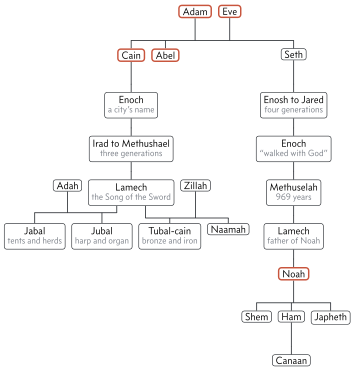
Noah and the flood
Genesis 5 is a list, and an astonishing one. It counts ten generations from Adam to Noah, giving each father’s age when his son was born and the length of his whole life (Figure 11.8). Adam lived 930 years and Seth 912. A Sumerian list of kings had gone further still, giving the kings who reigned before the Flood tens of thousands of years each. The seventh man in the line from Adam was the second Enoch, of whom Genesis says only, “Enoch walked with God: and he was not; for God took him.” Jewish and Christian tradition took this to mean that he never died. His son Methuselah lived 969 years, the longest life in the Bible. Add up the ages, and Methuselah dies in the very year of the Flood.

Methuselah’s son was another Lamech, not the singer of the Song of the Sword, and Lamech’s son was Noah.This man is a son of Lamech. → Noah•• At the boy’s birth his father made a pun on the name, which sounds like the Hebrew for “rest” or “comfort”: “This same shall comfort us concerning our work and toil of our hands, because of the ground which the Lord hath cursed.” When Noah was five hundred years old, Noah fathered Shem, Ham, and JaphethShem, Ham, and Japheth were this man’s sons. → Noah•• (jay-feth). These three, Genesis will say, are the ancestors of every people on earth. By Genesis’s own arithmetic, Noah was the first man in the line to be born after Adam’s death; his father Lamech was the last who could have known Adam.
Genesis tells the story of the FloodThis book tells the story of Noah’s Ark and the Great Flood. → Book of Genesis•• in chapters 6 to 9. It begins with a strange fragment. “The sons of God saw the daughters of men that they were fair” and married them, and “There were giants in the earth in those days.” The Hebrew calls the giants Nephilim (nef-ih-lim). Who the sons of God were, angels or the sons of Seth, has been argued over ever since. Then the reason for the Flood: God saw that “every imagination of the thoughts of his heart was only evil continually,” and “it repented the Lord that he had made man on the earth.” The earth “was filled with violence.” “But Noah found grace in the eyes of the Lord.” He was “a just man and perfect in his generations,” and, like his great-grandfather Enoch, he “walked with God.”
God told Noah, “Make thee an ark of gopher wood.” An ark is a chest, and the Hebrew word, tevah, appears in only one other story in the Bible: the basket of bulrushes in which the infant Moses floats on the Nile (Chapter 13). Nobody knows what gopher wood was. So Noah built an arkThis man built an ark to survive the Great Flood. → Noah••• to God’s measurements, three hundred cubits long, fifty wide, and thirty high, with three decks, a door in the side, a window, and many rooms. He sealed it with pitch inside and out. “Thus did Noah; according to all that God commanded him, so did he.”
Into the ark went Noah, his wife, his three sons, and their wives, eight people in all, with “two of every sort” of living thing, male and female. A few verses later God asks for seven pairs of every clean animal, the kinds fit for sacrifice, and one pair of the rest. Scholars see in such doubled details the place where two older accounts were woven together. Jewish and Christian commentators have long offered ways to reconcile the two commands.
In Noah’s six hundredth year, on the seventeenth day of the second month, “were all the fountains of the great deep broken up, and the windows of heaven were opened. And the rain was upon the earth forty days and forty nights.” On the second day of creation God had divided the waters above from the waters below; now they rush back together, and the world returns to the deep it came from. “And the Lord shut him in.” The waters rose 15 cubits above the highest mountains and stayed for 150 days. Everything that breathed on dry land died, “and Noah only remained alive, and they that were with him in the ark.”

Then “God remembered Noah.” A wind passed over the earth, the waters went down, and the ark came to ground in Ararat (air-uh-rat). In the seventh month, says Genesis, “the ark rested … upon the mountains of Ararat.” Ararat is the Hebrew name of Urartu (oo-rar-too), a kingdom in the high country around Lake Van that fought Assyria from the ninth century BC to the seventh (Figure 11.9). The verse means the mountains of that land, not a single peak. Since the Middle Ages, Europeans have given the name Ararat to its tallest volcano, 16,854 feet (5,137 meters) high, which Armenians count as their sacred mountain. Other traditions, and the Quran, the holy book of Islam, place the landing on Mount Judi, farther south.
Noah opened the window and sent out a raven, “which went forth to and fro, until the waters were dried up.” Next he sent a dove, but “the dove found no rest for the sole of her foot” and came back. After seven days he sent her again, and the dove returned with an olive leaf:A dove sent out by this man returned with an olive leaf. → Noah•• “in her mouth was an olive leaf pluckt off: so Noah knew that the waters were abated.” Seven days later he sent her once more, and she did not come back. The dove with its olive branch has been a sign of peace ever since. By the dates Genesis gives, Noah stepped onto dry ground a year and ten days after the rain began.

His first act was to build an altar and offer burnt sacrifices of every clean animal and bird. “The Lord smelled a sweet savour,” and promised never again to curse the ground for man’s sake: “While the earth remaineth, seedtime and harvest, and cold and heat, and summer and winter, and day and night shall not cease.” Then God repeated to Noah and his sons the blessing of the sixth day, “Be fruitful, and multiply, and replenish the earth,” as if the world were beginning again. He gave them new rules too. They may now eat meat, though never with its blood in it, and murder is forbidden in words that are still quoted: “Whoso sheddeth man’s blood, by man shall his blood be shed: for in the image of God made he man.” The rabbis whose discussions fill the Talmud (Chapter 34) drew from Genesis the seven Noahide laws, which Jewish tradition holds are binding on all mankind, the “children of Noah”; Jews are bound besides by the whole Law of Moses.
A covenant is a solemn agreement that binds both sides, and this one is the first in the Bible. God bound himself to Noah, to his descendants, and to “every living creature” never again to destroy the earth by water. He gave a token to mark it: “I do set my bow in the cloud, and it shall be for a token of a covenant between me and the earth.” So the rainbow became the sign of God’s covenantA rainbow appeared as the sign of this man’s covenant with God. → Noah••• with Noah. Whenever clouds gather and the bow appears, says God, “I will remember my covenant,” and he will look upon it himself, “that I may remember the everlasting covenant.” The Hebrew word for it, qeshet, is the ordinary word for a warrior’s bow. In Genesis every rainbow is God’s promise against another flood,God sends one of these things to Noah as a promise that he will not send another flood. → rainbows• and many readers have pictured it as a weapon hung up in the sky. Rain still falls and rivers still flood; the promise is that the whole world will never again be drowned.
Then the story turns sour. “Noah began to be an husbandman, and he planted a vineyard”; so Noah planted the first vineyardGenesis credits this man with planting the first vineyard. → Noah•• in Genesis, and the first wine in the Bible soon follows. He drank it, became drunk, and lay uncovered in his tent. His son Ham saw his father’s nakedness and went out and told his brothers. Shem and Japheth took a cloak on their shoulders, walked in backward, and covered their father without looking at him. When Noah woke and learned what had happened, Noah cursed Ham’s son Canaan:After Ham saw this man drunk and naked, this man cursed Ham’s son Canaan. → Noah•• “Cursed be Canaan; a servant of servants shall he be unto his brethren.” He blessed Shem and Japheth. Genesis never says why the curse fell on Canaan rather than on Ham. Many scholars read the curse as written with the future in view, since Canaan’s descendants, the Canaanites, are the people whose land Israel would later conquer (Chapter 16). Centuries later, defenders of slavery in Europe and America misread the passage as a “curse of Ham” on Africans and used it to defend the slave trade. The text curses Canaan, and it says nothing of the color of anyone’s skin. Noah lived 350 years after the Flood, 950 in all, and died.
| Noah (Genesis) | Utnapishtim (Gilgamesh) | |
|---|---|---|
| Who sends it | the one God, because the earth is “filled with violence” | the gods in council, led by Enlil |
| Who warns the hero | God himself | the god Ea, speaking through the reed wall of his house |
| The boat | 300 by 50 by 30 cubits, sealed with pitch | a cube of 120 cubits, sealed with bitumen |
| Aboard | his family; every kind of animal | his family, craftsmen, animals, gold and silver |
| The storm | 40 days of rain; the waters stay 150 days | six days and six nights |
| Landing | the mountains of Ararat | Mount Nimush |
| Birds sent out | a raven; a dove three times | a dove, a swallow, a raven |
| Afterward | a sacrifice; God smells “a sweet savour” | a sacrifice; the gods gather over it like flies |
| The sign | the rainbow | a goddess’s necklace of lapis lazuli |
| The hero’s end | lives to 950 and dies | made immortal, to live far off at the mouth of the rivers |
Readers of Chapter 2 have heard this story before, in Utnapishtim’s flood on the epic’s eleventh tablet, which George Smith deciphered in 1872, and in the older Epic of Atrahasis (Table 11.1). Most scholars conclude that the writers of Genesis knew a Mesopotamian flood story and retold it in their own way. The differences carry the meaning. In Babylon a council of quarrelsome gods drowns mankind and then regrets it, and the hero is rewarded with eternal life. In Genesis one God judges the world for its violence, saves one just man, and binds himself by a promise to every living thing; and Noah, like Adam, dies.
The Tower of Babel
After the Flood, Genesis 10 spreads Noah’s family across the map. This chapter, called the Table of Nations, lists the descendants of the three sons as peoples and places. Japheth’s sons include Javan, the Greeks, and Madai, the Medes, peoples of the north who reached from the Aegean Sea to Iran. Ham’s include Cush, which is Kush, the land south of Egypt; Mizraim, which is Egypt; and Canaan. Shem’s include Elam, Asshur, which is Assyria, and Aram, the land around Damascus, to the east. Jewish tradition counted the names and found seventy nations, the number of all the peoples of the world. From Shem, in 1781, a German historian named the Semitic family of languages, the family of Hebrew, Aramaic, Arabic, and Akkadian.
One of Ham’s descendants was Nimrod, “a mighty hunter before the Lord,” the first man to make himself a great king. His kingdom began in Shinar (shy-nar), the Bible’s name for Babylonia: “The beginning of his kingdom was Babel, and Erech, and Accad … in the land of Shinar.” These are Babylon, Uruk, and Akkad, cities you met in Chapter 1 and Chapter 3. From that land, Genesis goes on, Nineveh and Calah were built in Assyria to the north.
Then Genesis 11 tells a story that seems to belong before that list, which has already divided the nations “every one after his tongue.” “And the whole earth was of one language, and of one speech.” People wandering from the east found a plain in Shinar and settled there. They said to one another, “Go to, let us make brick, and burn them throughly”; go to is old English for “come on.” “And they had brick for stone,” Genesis adds, “and slime had they for morter.” The “slime” is bitumen, the natural tar that Mesopotamian builders used as mortar for baked brick in a land with little stone. Commentators point out that in the hill country of Canaan houses were built of stone, so the writer stops to explain this foreign way of building. Then came the plan: “let us build us a city and a tower, whose top may reach unto heaven; and let us make us a name, lest we be scattered abroad upon the face of the whole earth.”
“And the Lord came down to see the city and the tower.” Many readers have seen a gentle and deadly joke here: the tower meant to reach heaven is so small that God must come down to look at it. Yet God takes the builders seriously. “Behold, the people is one, and they have all one language; and this they begin to do: and now nothing will be restrained from them.” So God resolved, “let us go down, and there confound their language, that they may not understand one another’s speech.” The builders could no longer understand each other, the work stopped, and God scattered them across the earth. “Therefore is the name of it called Babel; because the Lord did there confound the language of all the earth.” In Hebrew, Babel sounds like balal (bah-lal), “to confuse.” The Babylonians said their city’s name meant “gate of the god,” and Genesis turns the boast into a pun on confusion.

In Babylon itself there was a real tower. The ziggurat (Chapter 1) beside Marduk’s great temple (Chapter 3) was called Etemenanki (eh-teh-meh-nahn-kee), “the house that is the foundation of heaven and earth.” A Babylonian tablet copied in 229 BC gives its base as about 300 feet (91 meters) on each side and its height as the same. Modern archaeologists doubt that a tower of mud brick could stand so tall and suggest about 215 feet (66 meters), temple included. King Nabopolassar (nab-uh-puh-lass-ur) of Babylon, who took up its rebuilding in the late seventh century BC, wrote in an inscription that Marduk had told him to make its top rival the heavens, and his son Nebuchadnezzar II finished the work (Chapter 20). The story of Babel may have taken shape among people who had seen such towers, perhaps the Judeans carried off to Babylon. Alexander the Great ordered the tower pulled down in 323 BC so that it could be rebuilt, and he died before the rebuilding began. Pieter Bruegel (broy-gul) the Elder painted the story in 1563 (Figure 11.11; Vol. 13, Valois, Bourbon, and Orange). Christian readers have long seen Babel undone at Pentecost, when, in the Acts of the Apostles, men of many nations each hear the apostles speaking in their own language (Chapter 32).
The Tower of Babel is the last story of the first ages. Genesis 11 ends with another list, the line of Shem through ten generations. The lifespans shrink as it goes on, from Shem’s 600 years to Terah’s 205. Terah lives at “Ur of the Chaldees,” and he sets out with his son Abram and his grandson Lot for the land of Canaan, though he gets no farther than Harran (huh-rahn). From here the Bible’s story narrows from all mankind to one family, and Abram, later called Abraham, is its next hero (Chapter 12).
What to remember
- Genesis, the first book of the Bible and of the Torah, takes its name from the Greek for “origin”; its Hebrew name, Bereshit, means “in the beginning.” Chapters 1 to 11 tell the story of all mankind; chapters 12 to 50 tell of Israel’s ancestors.
- Tradition holds that Moses wrote it; most modern scholars conclude that it was assembled from older sources and finished after the Babylonian exile.
- In Genesis 1 God creates by speaking, in six days, beginning with “Let there be light,” and rests on the seventh. Genesis 2 tells a second creation story: Adam formed from dust, Eve from his rib, and the Garden of Eden.
- A talking serpent persuades Eve to eat the forbidden fruit, and Adam eats too; God curses the serpent to crawl on its belly and drives the couple out of Eden past cherubim with a flaming sword. Later Christian tradition identified the serpent with Satan, and medieval Jewish folklore gave Adam a first wife, Lilith.
- Cain, a farmer, kills his brother Abel, a shepherd, after God prefers Abel’s offering. When God asks for Abel, Cain answers, “Am I my brother’s keeper?” God marks him, and he settles in the land of Nod. His descendants include Lamech, who boasts in the Song of the Sword, and Tubal-cain, the first smith. Seth replaces Abel.
- Noah, son of Seth’s descendant Lamech, builds the ark, sends out a raven and a dove (which returns with an olive leaf), and receives the rainbow as the sign of God’s covenant. He plants the first vineyard and curses his grandson Canaan.
- Most scholars conclude that Genesis’s flood draws on the older Mesopotamian flood of Utnapishtim and Atrahasis, but its one God judges violence and binds himself by a promise.
- At Babel, in the land of Shinar, God confounds the builders’ single language and scatters them. Babylon’s ziggurat, Etemenanki, was a real tower of the kind the story describes.
Chapter 12 · 59 clues
Abraham, Jacob, and Joseph
In the hill town of Hebron, 19 miles south of Jerusalem, stands a great rectangle of stone. Herod the Great, the king who rebuilt the Temple in Jerusalem (Chapter 26), raised it in the last decades BC to mark a cave, with walls 6 feet thick and blocks up to 24 feet long. Since 1967 it has been divided between a mosque and a synagogue. Between them, the two halves hold monuments to the six people whom Jewish, Christian, and Muslim tradition places in the cave below: Abraham and Sarah, Isaac and Rebekah, Jacob and Leah.
They are the heroes of the second part of the Book of Genesis, chapters 12 to 50. Genesis has told the story of the whole world from the creation to the Tower of Babel (Chapter 11). Now it narrows to one family and follows it through four generations, from a city in Mesopotamia to the hills of Canaan and down into Egypt. Out of that family, Genesis says, came the people of Israel.
Abraham
The Greek word patriarch (pay-tree-ark) means “chief father of a family.” Jews and Christians use it for the three founders of Israel’s family line: Abraham, his son Isaac, and Isaac’s son Jacob. Their wives, Sarah, Rebekah, Leah, and Rachel, are the matriarchs. Genesis tells their story as a family chronicle of journeys, wells, flocks, quarrels, and marriages, in which God speaks to the fathers and makes them promises.
Did it happen? No inscription, letter, or grave outside the Bible names Abraham, Isaac, or Jacob, and historians give them no date. Readers who added up the ages Genesis gives put Abraham about 2000 BC. In the middle of the twentieth century the American archaeologist William F. Albright argued that the stories fit the customs of the Middle Bronze Age, about 2000 to 1500 BC. In the 1970s the biblical scholars Thomas L. Thompson and John Van Seters answered that they belong to a much later world. Genesis gives Abraham camels, but the oldest bones of tame camels yet found in Israel date from the tenth century BC. It calls his home “Ur of the Chaldees,” but the Chaldeans first appear in the records of southern Mesopotamia in the ninth century BC. Most scholars now hold that the stories were written down in the first millennium BC, from older traditions whose age no one can measure. This chapter tells the story as Genesis tells it.
It begins with a man named Terah, a descendant of Noah’s son Shem, who lived in Ur, the old Sumerian city on the lower Euphrates (Chapter 1). Terah had three sons, Abram, Nahor (nay-hor), and Haran (hair-un). Abram is the man Genesis later renames Abraham. Haran died in Ur while his father still lived, and left a son. So Haran’s son LotThis man, Haran’s son, was Abraham’s nephew. → Lot• was Abram’s nephew, and he grew up in his grandfather’s house.
Terah set out with Abram, Abram’s wife, and Lot for the land of Canaan, but they stopped halfway, at Harran, a caravan city on a tributary of the upper Euphrates, and Terah died there. (The King James Version spells both the city and Abram’s brother “Haran,” though they are different words in Hebrew.) Now Abram was the head of the family. He was the husband of SaraiThis prophet is the husband of Sarah. → Abraham [or Ibrahim]•• (sair-eye), who would later be renamed Sarah, and she had no children. Ur and Harran had one thing in common: each was a chief city of the moon god Nanna, whom the Akkadians called Sin (Chapter 1). A later book of the Bible, Joshua, says that Israel’s fathers, Terah among them, “served other gods.”
At Harran, Genesis says, God spoke to Abram: “Get thee out of thy country, and from thy kindred, and from thy father’s house, unto a land that I will shew thee” (Genesis 12:1, in the King James Version, which this book quotes). God promised to make of him a great nation, “and in thee shall all families of the earth be blessed.” Abram was seventy-five. He asked nothing, and he obeyed and left his countryThis man obeyed when God told him to "Leave your country and your relatives and go to the land that I will show you." → Abraham [or Ibrahim]• for a land he had never seen.
Christians later made this departure the model of trust in God. The Letter to the Hebrews, a book of the New Testament written in Greek in the first century AD by an author it does not name (tradition long credited Paul, Chapter 33), praises in its eleventh chapter the heroes of faith from Abel onward. Hebrews 11 holds up AbrahamIn Hebrews 11, this man is cited as an exemplar of faith. → Abraham [or Ibrahim]•• longest of all: “By faith Abraham, when he was called to go out into a place which he should after receive for an inheritance, obeyed; and he went out, not knowing whither he went.”

With Abram went his servants, his flocks, and his nephew Lot.Lot is this prophet's nephew. → Abraham [or Ibrahim]•• The road from Harran to Canaan ran more than 400 miles (Figure 12.1). At Shechem, in the central hills, God appeared to Abram and said, “Unto thy seed will I give this land.” Abram built an altar there, and another near Bethel, and moved slowly south toward the dry country called the Negev. Then the rains failed. In a famine, the herdsmen of Canaan went down to Egypt, where the Nile watered the fields whatever the sky did (Chapter 4), and Abram went too.
On the way he made a plan that does him no credit. Sarai was beautiful, and he feared the Egyptians would kill her husband to take her. “Say, I pray thee, thou art my sister,” he told her. She was taken into Pharaoh’s palace, and Abram was paid in sheep, oxen, donkeys, servants, and camels. Then, Genesis says, God struck Pharaoh’s household with plagues. Pharaoh learned the truth and sent Abram away with a just complaint: “Why saidst thou, She is my sister?”
Genesis tells this story three times. The second time, years later, Abraham told Abimelech (uh-bim-uh-lek) that Sarah was his sister.This prophet told Abimelech that his wife was his sister. → Abraham [or Ibrahim]• Abimelech was the king of Gerar (geer-ar), a town in the dry south, and a different man from the Abimelech who made himself king in the Book of Judges (Chapter 16). God warned him in a dream that Sarah was another man’s wife, and in that dream God called Abraham “a prophet,” the first time the word appears in the Bible. Abimelech returned Sarah with gifts and a rebuke. Abraham’s excuse was that it was half true: she was his father’s daughter, “but not the daughter of my mother.” In the third telling Isaac says the same of his own wife.
Back in Canaan, Abram and Lot had grown so rich in flocks that their herdsmen quarreled over grass and water. Abram proposed that they part, and he let his nephew choose first. Lot looked east from the hills by Bethel and saw the plain of the Jordan, “well watered every where... even as the garden of the Lord.” He took it, and Lot settled near Sodom,After separating from Abraham, this man settled near Sodom. → Lot• one of five cities on that plain, though “the men of Sodom were wicked and sinners before the Lord exceedingly.” Abram pitched his tents by the oaks of Mamre (mam-ree), at Hebron.
Then came war. Four kings from the east, led by Chedorlaomer (ked-er-lay-oh-mer), king of Elam, the land around Susa in southwestern Iran (Chapter 1), had ruled the five cities of the plain for twelve years. In the thirteenth year the cities rebelled, and in the fourteenth the eastern kings marched west. They beat the five kings in the Vale of Siddim (sid-im), a valley full of tar pits that Genesis places where the Dead Sea now lies, plundered Sodom, and carried off Lot.
A fugitive brought the news to “Abram the Hebrew,” the first time that word appears. Abram armed “his trained servants, born in his own house, three hundred and eighteen,” and chased the raiders north to Dan. He fell on them by night and rescued Lot from Chedorlaomer’s army,This prophet led a force of 318 men at the Battle of the Vale of Siddim to rescue his nephew from king Chedorlaomer. → Abraham [or Ibrahim]• with all the captives and goods. Genesis puts only the first battle in the Vale of Siddim, but the whole war, Abram’s night raid included, is often called the Battle of the Vale of Siddim. As Abram came home, Melchizedek (mel-kiz-uh-dek), “king of Salem” and “priest of the most high God,” brought out bread and wine and blessed him, and Abram gave him a tenth of the spoil. Jewish tradition identifies Salem with Jerusalem. None of the four eastern kings has been found for certain in any record outside the Bible.
The covenant
Abram now had land promised to him and no son to inherit it. In a vision, Genesis 15 says, he complained that his heir would be his chief servant, Eliezer (el-ee-ee-zer) of Damascus. God took him outside at night: “Look now toward heaven, and tell the stars, if thou be able to number them... So shall thy seed be.” (To “tell” here means to count.) His descendants would be as the stars,God promised this prophet that his descendants would be as numerous as the stars in the sky. → Abraham [or Ibrahim]• beyond counting. “And he believed in the Lord; and he counted it to him for righteousness.” Paul would make that verse the center of his argument about faith in his letter to the Romans (Chapter 33).
That night, Genesis says, God made a covenant with Abram, a solemn agreement like the one with Noah (Chapter 11), with promises on each side, like a treaty between a great king and a lesser one. Some ancient treaties were sealed by cutting animals in half and walking between the halves, as if to say “so may it be done to me if I break my word.” Abram cut a heifer, a goat, and a ram in two, and after dark “a smoking furnace, and a burning lamp” passed between the pieces. The land was promised to his descendants “from the river of Egypt unto the great river, the river Euphrates.”
Ten years passed in Canaan, and Sarai bore no child. So she gave her husband her Egyptian maid, Hagar (hay-gar), as a concubine, a wife of lower rank, often a servant, whose child would count as her mistress’s own. Hagar conceived, and then looked down on her mistress. Sarai treated her so harshly that Hagar fled into the desert.
By a spring on the road, the angel of the Lord found Hagar and sent her back. He told her she would bear a son and call him Ishmael (ish-may-el), “God hears,” and said what kind of man the boy would be: “his hand will be against every man, and every man’s hand against him.” The King James Version calls him “a wild man,” but the Hebrew says pere adam, and a pere is the onager, the wild ass of the desert steppes, which no one could tame. The Jewish Publication Society’s translation of 1917 renders it “a wild ass of a man.” (An ass, in the English of the Bible, is a donkey.) So the angel compared Ishmael to a wild donkey.In Genesis, an angel describes Ishmael as a wild one of these animals. → donkey•
Abram was ninety-nine when God appeared again, in Genesis 17, to make the covenant permanent. God changed his name from Abram, “exalted father,” to Abraham, which Genesis explains as “father of many nations,” and Sarai’s to Sarah. And God gave the covenant a sign to be carried in the body of every male descendant: circumcision (sur-kum-sizh-un), the cutting away of the foreskin, the loose fold of skin at the tip of the penis. Every boy was to be circumcised at eight days old: “it shall be a token of the covenant betwixt me and you.” Circumcision became the covenant’s sign,In Genesis, this action is the sign of Abraham’s covenant with God. → circumcision•• and that day Abraham circumcised himself, his thirteen-year-old son Ishmael, and every man of his household. Jewish families still circumcise their sons on the eighth day, in the ceremony called the brit milah, “covenant of circumcision” (Chapter 37).
Then God promised that Sarah would bear a son within the year. Abraham fell on his face and laughed: “Shall a child be born unto him that is an hundred years old? and shall Sarah, that is ninety years old, bear?” God answered that the boy should be named Isaac, Hebrew Yitzhak (yits-hahk), “he laughs.”
Sodom and Lot
On a hot afternoon, Genesis 18 says, Abraham was sitting at his tent door by the oaks of Mamre when he saw three men standing near. He ran to meet them, bowed to the ground, and begged them to rest under the tree. He had Sarah bake cakes, chose a tender calf from the herd, and stood by his guests as they ate. As the story goes on, it becomes clear that the visitors were the Lord and two angels, and Abraham’s welcome made him the model host of Jewish tradition. One of them said that Sarah would have a son, and Sarah, listening behind the tent door, laughed to herself. “Is any thing too hard for the Lord?” came the answer.

As the visitors looked toward Sodom, the Lord told Abraham that “the cry of Sodom and Gomorrah (guh-mor-uh) is great,” and that he would go down and see whether the cities deserved destruction. Abraham did something no one in Genesis had done before: he argued with God for the lives of strangers. “Wilt thou also destroy the righteous with the wicked?... Shall not the Judge of all the earth do right?” If there were fifty good people in the city, would God spare it? God agreed. Then Abraham, apologizing for his boldness, asked about forty-five, then forty, thirty, and twenty. Each time God agreed, and at last Abraham bargained God down to ten:This prophet bargained with God to spare Sodom if ten righteous people could be found in it. → Abraham [or Ibrahim]•• “I will not destroy it for ten’s sake.”
The two angels reached Sodom at evening. Lot was sitting in the city gate, where the elders of an ancient town met to judge and trade, and like his uncle he pressed the strangers to spend the night in his house. Before they slept, the men of Sodom, “both old and young,” surrounded the house and shouted for Lot to bring his guests out so that they could abuse them. Lot went out, shut the door behind him, and offered the mob his two daughtersThis man shelters angelic visitors from a mob in Sodom and offers his daughters instead. → Lot• instead; the guests under his roof, he said, must come to no harm. Genesis tells it without comment. The angels pulled Lot inside and struck the men at the door blind.

At dawn the angels hurried Lot out with his wife and two daughters: “Escape for thy life; look not behind thee.” Lot begged to go to a small town nearby called Zoar (zoh-ar), and the angels allowed it. “Then the Lord rained upon Sodom and upon Gomorrah brimstone and fire from the Lord out of heaven.” (Brimstone is sulfur, which burns with a choking blue flame.) So, as Genesis tells it, Sodom and Gomorrah were destroyedIn this book, the cities of Sodom and Gomorrah are destroyed. → Book of Genesis•• with all the plain, and the next morning Abraham, looking down from the hills, saw the smoke rising “as the smoke of a furnace.” Later books of the Bible name Sodom’s sin in other ways; the prophet Ezekiel says it was pride and idleness, and that Sodom did not help “the poor and needy.”
One of the fugitives did not reach Zoar. As the fire fell, Lot’s wife looked back and became a pillar of salt.This man’s wife becomes a pillar of salt after looking back at Sodom. → Lot••Lot’s wife was turned into a pillar of this substance after looking back. → salt•• Genesis tells it in a single verse, and the verse has lasted. The Gospel of Luke has Jesus warn his followers in three words: “Remember Lot’s wife.” The Russian poet Anna Akhmatova (ahk-mah-tuh-vuh) gave her a poem of her own (Vol. 23, Revolution and Ruin). The landscape suits the story. The Dead Sea is so salty that no fish can live in it, and at its southern end rises Mount Sodom, a ridge of solid rock salt (Figure 12.3). But no one knows where Sodom stood. Archaeologists have proposed several ruins near the Dead Sea, such as Bab edh-Dhra (bahb ed-drah) on its southeastern shore, but none is agreed.
Genesis ends Lot’s story in a cave above Zoar, with a dark tale of how his daughters, believing no other men were left alive, had sons by their drunken father. From those sons, it says, came the Moabites and the Ammonites, Israel’s neighbors east of the Jordan.
The binding of Isaac
At last, Genesis 21 says, Sarah bore a son. Abraham was a hundred years old, and they named the boy Isaac. “God hath made me to laugh,” said Sarah, “so that all that hear will laugh with me.” At the feast for Isaac’s weaning, Sarah saw Ishmael “mocking”; the Hebrew word can also mean “playing,” and it puns on Isaac’s name. Sarah feared for her son’s inheritance, and it was Sarah’s jealousy that banished Ishmael:This figure's banishment was caused by the jealousy of Sarah. → Ishmael• “Cast out this bondwoman and her son: for the son of this bondwoman shall not be heir with my son, even with Isaac.”

The demand grieved Abraham, for Ishmael was his son too. But God told him to do as Sarah said, promising that Ishmael would also become a nation. So Abraham sent Hagar and Ishmael awayThis prophet's wife Sarah forced him to banish his concubine Hagar and their son Ishmael into the desert. → Abraham [or Ibrahim]• with bread and a skin of water on Hagar’s shoulder.
They wandered in the wilderness near Beersheba until the water was gone. Hagar laid the boy under a bush and sat down a bowshot away, saying, “Let me not see the death of the child,” and wept. Then, Genesis says, God heard the boy’s voice; an angel called to Hagar from heaven, and God opened her eyes to a well. So Ishmael and his mother, sent away into the desert,This figure and his mother were sent away into the desert. → Ishmael•• did not die there. Ishmael grew up in the wilderness of Paran, south of Canaan, became an archer, and married an Egyptian wife. Genesis later names his twelve sons as princes of desert tribes. Muslims, who honor Abraham as the prophet Ibrahim (ib-rah-heem), count Ishmael as the ancestor of the Arabs; in Islamic tradition Hagar and Ishmael came to Mecca, a story told in a later volume (Vol. 37, The House of Islam).
Some years later, Genesis 22 says, “God did tempt Abraham,” that is, he tested him. God called his name, and Abraham answered with one Hebrew word, hineni (hee-nay-nee), “Behold, here I am.” It is the answer of a servant ready for orders. Abraham answered God with hineni,This man responded to a command from God with the word hineni, or "here I am." → Abraham [or Ibrahim]• and he says it three times in this chapter: to God, to his son, and to the angel. Then came the command: “Take now thy son, thine only son Isaac, whom thou lovest, and get thee into the land of Moriah (muh-ry-uh); and offer him there for a burnt offering upon one of the mountains which I will tell thee of.” The son God named was not Ishmael but Isaac, the son of the promise,In Biblical accounts, the son this prophet was ordered to sacrifice is Isaac. → Abraham [or Ibrahim]••• the child through whom every promise to Abraham was to come true. A burnt offering was an animal killed and burned whole on an altar as a gift to God, usually a lamb, a goat, or a young bull. So God ordered Abraham to sacrifice his son,This prophet was ordered by God to sacrifice his son. → Abraham [or Ibrahim]•• as if the boy were a lamb from the flock.
Abraham rose early, saddled his donkey, split wood, and set out with Isaac and two young servants. On the third day he saw the place far off. He left the servants with the donkey, laid the wood on Isaac’s back, and carried the fire and the knife himself. “My father,” said Isaac. “Here am I, my son.” “Behold the fire and the wood: but where is the lamb for a burnt offering?” “My son, God will provide himself a lamb for a burnt offering.” “So they went both of them together.” Genesis says no more of what either one felt. Father and son went up the mountain in Moriah,This prophet went up to Mount Moriah. → Abraham [or Ibrahim]•• which later tradition calls Mount Moriah (Figure 12.5).

At the top Abraham built an altar, bound Isaac, laid him on the wood, and took the knife to kill his son. The angel of the Lord called from heaven, “Abraham, Abraham,” and Abraham answered, “Here am I.” “Lay not thine hand upon the lad... for now I know that thou fearest God.” Abraham saw a ram caught by its horns in a thicket and offered it instead. Thus Abraham was stopped from a human sacrifice,In the Book of Genesis, Abraham is narrowly prevented from performing this act. → human sacrifice• the killing of a person as an offering to a god. Some ancient peoples did offer human beings, even children. The Second Book of Kings tells of a king of Moab who burned his eldest son on the city wall during a siege, and the children’s graves of Carthage are still argued over (Chapter 24). The laws of Moses forbid the practice outright. Many Jewish and Christian readers have taken the story as God’s refusal of child sacrifice, though Genesis itself says only that it was a test.
Jews call this chapter of Genesis, in which Abraham nearly sacrifices his son,In this book, Abraham nearly sacrifices his son Isaac. → Book of Genesis• the Akedah (ah-keh-dah), “the binding,” because Isaac was bound and not killed. It is read in synagogues on the second day of Rosh Hashanah, the Jewish New Year, when the shofar, a ram’s horn, is blown (Chapter 35); the Talmud, the great collection of rabbinic teaching (Chapter 34), links the horn to the ram that took Isaac’s place.
Where was Moriah? Genesis does not say. The only other verse that names it, in the Second Book of Chronicles, says that Solomon built the Temple “at Jerusalem in mount Moriah” (Chapter 17). Jewish tradition joined the two verses, and so tradition places the binding in Jerusalem,Tradition locates Abraham’s binding of Isaac on Mount Moriah in this city. → Jerusalem•• on the rock of the Temple Mount, where Muslims finished the Dome of the Rock in AD 691 or 692.
Sarah died at Hebron at 127, the only woman in the Hebrew Bible whose age at death is given. Abraham had lived in Canaan for more than sixty years and owned not a foot of it. He went before the townsmen of Hebron, whom Genesis calls Hittites (how they were related to the Hittite kingdom of Anatolia, Chapter 10, no one knows), and asked to buy a grave. A man named Ephron (ee-fron) offered the cave at the end of his field as a gift. Abraham insisted on paying, and Ephron named his price as if it were nothing: “four hundred shekels of silver; what is that betwixt me and thee?”

A shekel was a weight, not yet a coin, and in ancient Israel it came to about 11 grams of silver, so the price was some 10 pounds of silver. Abraham weighed it out before witnesses, and Abraham bought the Cave of MachpelahThis prophet bought the Cave of Machpelah to bury his wife. → Abraham [or Ibrahim]•• (mak-pee-luh), “the double cave,” and buried Sarah there. It was the first piece of the promised land the family owned, and they owned it as a grave.
Abraham then sent his oldest servant north to the city of his brother Nahor to find a wife for Isaac among their own kin. At a well, the servant prayed for a sign: the right girl would offer water to his ten camels as well as to him. Rebekah, Nahor’s granddaughter, did exactly that (Figure 12.7), and Isaac married her and loved her. Abraham died at 175, and “his sons Isaac and Ishmael buried him in the cave of Machpelah.”

Jacob and Esau
Like Sarah, Rebekah was long childless. Isaac prayed for her, and she conceived twins who struggled inside her. God told her, Genesis 25 says, “Two nations are in thy womb... and the elder shall serve the younger.” The first twin came out red and “all over like an hairy garment,” and they called him Esau (ee-saw). His brother followed with his hand gripping Esau’s heel, and they called him Jacob, Hebrew Yaakov (yah-ah-kove), from akev, “heel,” one who grabs from behind. Esau grew up “a cunning hunter, a man of the field,” Jacob “a plain man, dwelling in tents.” Isaac loved Esau, who brought him game to eat; Rebekah loved Jacob.
Esau, born first, held the birthright, the right of the firstborn son to lead the family after his father and to inherit a double share. One day Jacob was cooking a stew of red lentils when Esau came in from the field, faint with hunger. “Feed me, I pray thee, with that same red pottage; for I am faint.” (Pottage is a thick stew, and Genesis says this is why Esau was also called Edom, “red,” the name of the nation descended from him.) Jacob named his price: “Sell me this day thy birthright.” Esau shrugged: “Behold, I am at the point to die: and what profit shall this birthright do to me?” He swore an oath, and Jacob traded lentil stew for the birthright.This son of Isaac traded lentil stew for his twin brother Esau’s birthright. → Jacob•• “Thus Esau despised his birthright.” A “mess of pottage,” a meal of stew, is still English for a trifle taken in exchange for something precious.
Years later Isaac was old and nearly blind. He sent Esau to hunt venison and cook it, “that my soul may bless thee before I die.” A father’s last blessing in Genesis works like a will and a prophecy together, and once spoken it cannot be taken back. Rebekah overheard. She cooked two young goats from the flock to taste like venison, dressed Jacob in Esau’s best clothes, and covered his hands and neck with the hairy skins of the goats. So Jacob wore goatskins to pass for Esau.This man wore goatskins to impersonate his brother and obtain his father’s blessing. → Jacob••

Isaac was suspicious. He felt Jacob’s hands: “The voice is Jacob’s voice, but the hands are the hands of Esau.” He smelled Esau’s clothes and was satisfied, and he blessed the son before him with the dew of heaven, plenty of grain and wine, and lordship over his brothers. Genesis does not hide that a mother and son lied to a blind old man. Minutes later Esau came in with the real venison and “cried with a great and exceeding bitter cry,” begging, “Bless me, even me also, O my father.” But the blessing was given. Isaac could promise Esau only that he would live by the sword and serve his brother, until one day he broke his yoke.
Esau swore to kill Jacob as soon as their father died, and Rebekah sent Jacob north to her brother Laban (lay-bun) in Harran. On the road, at a place called Luz, Jacob slept in the open with a stone for a pillow. “And he dreamed, and behold a ladder set up on the earth, and the top of it reached to heaven: and behold the angels of God ascending and descending on it.” Above it stood the Lord, who gave Jacob the promise he had given Abraham: the land, and descendants “as the dust of the earth.” So Jacob dreamed of a ladder to heavenThis man dreamed of a ladder reaching heaven. → Jacob•• on his flight from Esau. The Hebrew word, sullam, appears nowhere else in the Bible and may mean a staircase, like the stepped ramp of a ziggurat, a Mesopotamian temple tower (Chapter 1).

Jacob woke afraid. “Surely the Lord is in this place; and I knew it not... this is none other but the house of God, and this is the gate of heaven.” He set up his stone pillow as a pillar, poured oil on it, and named the place Bethel, “house of God.”
Jacob and Laban
At a well outside Harran, Jacob met Rachel, the younger daughter of his uncle Laban, coming with her father’s sheep. He rolled the great stone from the well’s mouth alone, watered her flock, kissed her, and wept. Laban took him in. He had two daughters: “Leah was tender eyed; but Rachel was beautiful and well favoured.”
Jacob had arrived with nothing, so he could not pay the bride-price, the gift a groom gave the bride’s father. Instead he offered seven years of work for Rachel. “And Jacob served seven years for Rachel; and they seemed unto him but a few days, for the love he had to her.” After the wedding feast, Laban brought Leah to him in the dark, and in the morning, “behold, it was Leah.” Laban’s excuse was a lesson Jacob could not miss: “It must not be so done in our country, to give the younger before the firstborn.” The younger brother who had dressed as the elder had now been given the elder sister in the younger’s place. A week later Laban gave Rachel too, for seven more years. So Jacob worked fourteen years for Leah and Rachel.This man worked for Laban for fourteen years to marry Leah and Rachel. → Jacob••
Jacob loved Rachel more, and the sisters’ rivalry filled his house. Genesis says God saw that Leah was unloved and gave her sons while Rachel had none: Reuben, Simeon, Levi (lee-vy), and Judah. Rachel, desperate, did what Sarah had done and gave Jacob her maid Bilhah (bil-hah), who bore Dan and Naphtali (naf-tuh-ly). Leah answered by giving him her own maid Zilpah (zil-pah), who bore Gad and Asher. So Jacob took the concubines Bilhah and Zilpah,This man kept the rival concubines Bilhah and Zilpah. → Jacob• enlisted as rivals in their mistresses’ contest. Leah then bore two more sons, Issachar (iss-uh-kar) and Zebulun (zeb-yoo-lun), and a daughter, Dinah (dy-nuh). Rachel was still childless, and by now Jacob had ten sons.
At last, Genesis says, God remembered Rachel, and she bore a son and called him Joseph. Joseph was Rachel’s firstborn son,This man was Jacob and Rachel’s firstborn son. → Joseph•• and from that day he was his father’s favorite (Figure 12.10).

Jacob wanted to go home, and Laban, grown rich from his work, wanted him to stay. For wages Jacob asked only for the speckled, spotted, and dark animals, a small share, because most sheep there were white and most goats black. Laban agreed, and that same day secretly sent every such animal three days’ journey away with his sons. Jacob answered with a trick of his own. He peeled white stripes in fresh rods of poplar, hazel, and chestnut (as the King James Version names the trees) and set them in the watering troughs where the strongest animals mated. The flocks “brought forth cattle ringstraked, speckled, and spotted,” which by the bargain were Jacob’s. With his peeled branches Jacob bred speckled flocks.While tending Laban’s flocks, this figure used peeled branches to obtain spotted and speckled animals. → Jacob•• The trick rests on an old belief, common until modern times, that what a mother sees at conception marks her young. Later Jacob told his wives that an angel had shown him in a dream that God was behind it.
After twenty years, “fourteen years for thy two daughters, and six years for thy cattle,” Jacob left in secret. Rachel stole her father’s teraphim (tehr-uh-fim), small images of household gods. Laban caught up with them in the hills of Gilead (gil-ee-ud), east of the Jordan, but never found the images, because Rachel had hidden them in her camel’s saddle and was sitting on them. The two men made a covenant over a heap of stones and parted.
Ahead lay Esau, coming to meet him with four hundred men. Jacob prayed and sent his brother a peace offering in droves: two hundred she-goats and twenty he-goats, two hundred ewes and twenty rams, thirty milk camels with their colts, forty cows and ten bulls, twenty she-donkeys and ten foals. That is 550 animals, not counting the colts.

That night he sent his family across the ford of the Jabbok (jab-ok), a stream that flows west into the Jordan. “And Jacob was left alone; and there wrestled a man with him until the breaking of the day.” The stranger could not win, so he touched the hollow of Jacob’s thigh and put his hip out of joint. “Let me go, for the day breaketh.” “I will not let thee go, except thou bless me.” The stranger gave him a new name: “Thy name shall be called no more Jacob, but Israel: for as a prince hast thou power with God and with men, and hast prevailed.” Genesis explains Israel as “he who strives with God.”
Who was the stranger? Genesis calls him “a man” and will not give his name. Jacob named the place Peniel (pen-ee-el), “face of God”: “for I have seen God face to face, and my life is preserved.” The prophet Hosea (hoh-zee-uh), centuries later, says Jacob “had power over the angel, and prevailed,” and painters have followed Hosea. So at Peniel Jacob was renamed Israel after wrestling with an angel.This man was renamed Israel after wrestling at Peniel. → Jacob••Jacob was renamed Israel after engaging in this activity with an angel. → wrestling• He limped away into the sunrise, and to this day, Genesis adds, the children of Israel do not eat “the sinew which shrank” in the hip, a rule the Jewish food laws still keep (Chapter 36). From here on Jacob’s descendants are the “children of Israel,” the Israelites. Eugène Delacroix (deh-lah-krwah) painted the fight on a chapel wall in Paris (Vol. 15, The Age of Revolution), and Paul Gauguin (goh-gan) set it in a Breton field watched by village women (Vol. 18, Paris, Capital of the Arts).
The meeting he dreaded was a reunion: “Esau ran to meet him, and embraced him, and fell on his neck, and kissed him: and they wept.” Esau, the father of the Edomites, went home to Seir, south of the Dead Sea, and Jacob crossed the Jordan and bought land outside Shechem.
There the family met disaster. Jacob’s daughter Dinah went out to visit the young women of the land, and Shechem, who bore the city’s name and was the son of its ruler, Hamor (hay-mor), seized her and raped her. Afterward, Genesis says, he loved her and asked to marry her, and Hamor offered Jacob an alliance: let our peoples intermarry, trade, and share the land. Dinah’s brothers answered “deceitfully,” in Genesis’s own word. They would agree only if every man in Shechem were first circumcised. The men of the city agreed. On the third day, while they were still sore, Simeon and Levi, Dinah’s full brothers, took their swords, entered the city unopposed, and killed every man in it. The other brothers plundered the town.
Jacob was appalled, and he condemned Simeon and Levi’s massacreThis man condemned his sons Simeon and Levi for massacring the men of Shechem after the rape of Dinah. → Jacob••Simeon and Levi massacred the men of Shechem after they underwent this procedure. → circumcision• of the circumcised men: “Ye have troubled me to make me to stink among the inhabitants of the land.” His sons answered with a question: “Should he deal with our sister as with an harlot?” Genesis lets them have the last word for now. On his deathbed Jacob would curse their anger.
Jacob went back to Bethel, as God commanded, and built an altar there. On the road south, near Ephrath (ef-rath), which is Bethlehem, Rachel died giving birth to a second son. She named him Ben-oni, “son of my sorrow,” but Jacob called him Benjamin, “son of the right hand,” and set up a pillar over her grave; a shrine called Rachel’s Tomb still stands at the edge of Bethlehem. Soon after, Reuben slept with his father’s concubineThis man's eldest son Reuben slept with his concubine. → Jacob• Bilhah. Reuben was Jacob’s eldest son, the heir to the birthright, and Genesis says only, “and Israel heard it.” Then it counts the twelve sons and brings Jacob home to his father at Hebron, where Isaac died at 180 and was buried by Esau and Jacob together.
Joseph and his brothers
The last quarter of Genesis belongs to Joseph. At seventeen he kept the flocks with the sons of the maids, and he brought his father bad reports of them. Jacob, the father of Joseph,This man is the father of Joseph. → Jacob•• made no secret of whom he loved best: “Now Israel loved Joseph more than all his children, because he was the son of his old age.” Joseph was the son of Rachel, the wife Jacob had worked fourteen years to win.
Jacob gave him a garment none of the others had, and so Joseph owned a coat of many colors,This man owned a coat of many colors. → Joseph•• as the King James Version calls it. The Hebrew words, ketonet passim (keh-toh-net pas-seem), are rare and their meaning uncertain. The Septuagint, the old Greek translation (the Stage), took them as a coat of many colors; many modern translations prefer a long robe with sleeves, the dress of a man who does not work in the fields. Either way, his brothers “hated him, and could not speak peaceably unto him.”

Joseph made it worse by telling his dreams. “For, behold, we were binding sheaves in the field, and, lo, my sheaf arose, and also stood upright; and, behold, your sheaves stood round about, and made obeisance to my sheaf.” A sheaf is a bundle of cut grain stalks tied together at harvest, and to “make obeisance” is to bow. Everyone understood: his sheaf stood upright while theirs bowed.This man envisioned his sheaf of grain standing upright while other sheaves bowed to it. → Joseph• In a second dream the sun, the moon, and eleven stars bowed to him, and even Jacob rebuked him: “Shall I and thy mother and thy brethren indeed come to bow down ourselves to thee to the earth?”
One day Jacob sent Joseph from Hebron to check on his brothers, who were pasturing the flocks near Shechem; he found them farther north, at Dothan (doh-thun) (Figure 12.13). “Behold, this dreamer cometh,” they said, and they plotted to kill him and tell their father a wild animal had eaten him. Reuben, the eldest, talked them into throwing him alive into a dry pit instead, meaning to rescue him later. They stripped off the coat, threw Joseph into the pit, and sat down to eat.
A caravan came along the road, traders from Gilead with camels loaded with spices for Egypt. Judah asked, “What profit is it if we slay our brother, and conceal his blood?” So his brothers sold Joseph as a slaveThis man's brothers sold him into slavery. → Joseph•• for twenty pieces of silver. Genesis calls the traders both Ishmaelites, Ishmael’s descendants, and Midianites, another desert people. The Documentary Hypothesis, the theory that the books of Moses were woven together from older sources (Chapter 15), explains the muddle as two versions of the story joined in one. Reuben came back, found the pit empty, and tore his clothes.

The brothers dipped the coat in a young goat’s blood and sent it to their father. Jacob knew it at once: “It is my son’s coat; an evil beast hath devoured him.” He tore his clothes, put on sackcloth, and refused to be comforted. The deceiver had been deceived with the same animal: Jacob had fooled his father with goatskins, and now his sons fooled him with a goat’s blood. Meanwhile the traders carried Joseph south, and he was sold again, a slave in Egypt,Joseph, a son of Jacob, is sold into slavery in this country by his brothers. → Egypt•• to Potiphar, an officer of Pharaoh and captain of the guard.
Here Genesis leaves Joseph in Egypt and turns for one chapter to his brother Judah. Judah’s eldest son, Er, married a woman named Tamar (tay-mar) and died young. By the custom of the time, a childless widow was given to her husband’s brother, so that a son born to them would carry on the dead man’s name. The law of Moses later made this a duty, which English calls levirate marriage, from the Latin levir, “husband’s brother” (Chapter 37). The second son, Onan, refused his duty and died too. Judah, afraid for his last son, Shelah, sent Tamar back to her father’s house to wait, and never gave him to her.
Years later, when Judah went up to shear his sheep, Tamar took off her widow’s clothes, veiled her face, and sat by the road. Judah took her for a prostitute. As a pledge for payment he left her his seal, the engraved stone a man pressed into clay to sign his name, with its cord, and his staff. Three months later Judah heard that his daughter-in-law was pregnant, and he ordered her burned. Tamar sent him the seal, the cord, and the staff: “By the man, whose these are, am I with child.” Judah knew them. “She hath been more righteous than I,” he said, “because that I gave her not to Shelah my son.”
So it is in Genesis that Tamar disguised herself as a prostituteIn this book, Tamar disguises herself as a prostitute and has a child with her father-in-law. → Book of Genesis• to win from her father-in-law the child she was owed. She bore twins, Perez and Zerah. The Book of Ruth traces King David’s line from Perez, and the Gospel of Matthew names Tamar among the ancestors of Jesus.
In Egypt, Genesis says, “the Lord was with Joseph,” and Potiphar put him in charge of his whole household. Joseph was “a goodly person, and well favoured,” and Potiphar’s wife wanted him. Day after day she said, “Lie with me,” and he refused: his master trusted him with everything, “how then can I do this great wickedness, and sin against God?” One day, when no other servants were in the house, she caught him by his garment, and he slipped out of it and ran. She told the household, and then her husband, that the Hebrew slave had tried to force himself on her, and she showed the garment as proof. So Potiphar’s wife falsely accused Joseph,Potiphar’s wife falsely accuses this man after he rejects her advances. → Joseph•• and his master threw him into the prison where the king’s prisoners were kept.
For the second time a piece of Joseph’s clothing had been turned into a lie. An Egyptian story written down about 1200 BC, the “Tale of Two Brothers” (Chapter 8), has the same plot: a married woman tries to seduce her husband’s younger brother, is refused, and accuses him to her husband.
In prison Joseph rose again, and the jailer put him in charge of the other prisoners. Soon two of Pharaoh’s officers were thrown in with him: the chief cupbearer, who poured the king’s wine and tasted it first for poison, and the chief baker. The King James Version calls the cupbearer the “butler.” It was a post of great trust; Sargon of Akkad, the Sumerian King List says, had been cupbearer to the king of Kish before he took the throne (Chapter 1). So Joseph was imprisoned with the cupbearer and baker,This man was imprisoned with a cupbearer and a baker. → Joseph• and he served them.
One night both men dreamed. The cupbearer saw a vine with three branches that ripened into grapes, which he squeezed into Pharaoh’s cup. Joseph told him the three branches were three days: in three days Pharaoh would restore him. “But think on me when it shall be well with thee,” Joseph asked. The baker carried three baskets on his head, and the birds ate the baked goods for Pharaoh out of the top one. Joseph read the dream of the birds eating the baker’s breadThis figure interpreted a baker’s dream of birds eating bread from three baskets on his head as a prediction of his execution. → Joseph•• as death: in three days Pharaoh would “lift up thy head from off thee, and shall hang thee on a tree; and the birds shall eat thy flesh.” On the third day, Pharaoh’s birthday, the cupbearer was restored and the baker hanged. “Yet did not the chief butler remember Joseph, but forgat him.”
Joseph in Egypt
Two full years later Pharaoh dreamed that he stood by the Nile. Out of the river came seven sleek, fat cows to graze in the reeds. Then seven thin, ugly cows, “such as I never saw in all the land of Egypt for badness,” came up and ate the fat ones. He slept again and saw seven full ears of grain swallowed by seven thin ears scorched by the east wind. None of his magicians could explain it. Then the cupbearer remembered the young Hebrew in prison.
Joseph was brought out, shaved, and given clean clothes, for Egyptians went clean-shaven at court. “It is not in me,” he told Pharaoh: “God shall give Pharaoh an answer of peace.” The two dreams were one, he said. Pharaoh’s dream of seven thin cows eating seven fat cowsThis figure interpreted Pharaoh’s dream of seven thin cows devouring seven fat cows as seven years of famine following seven years of plenty. → Joseph•••In Genesis, the Pharaoh dreams of seven thin examples of these animals eating seven fat ones. → cattle••In Genesis, Joseph interprets this ruler’s dream of seven lean cows eating seven fat cows. → pharaoh• meant seven years of famine to follow seven years of great plenty, a famine so severe that the plenty would be forgotten. The King James Version calls the animals kine, the old plural of cow. The cows came up out of the river for a reason: in Egypt the Nile’s yearly flood decided whether the harvest would be rich or poor (Chapter 4).
Joseph advised Pharaoh to appoint a wise man to store a fifth of the grain in each good year against the bad ones. “Can we find such a one as this is, a man in whom the Spirit of God is?” said Pharaoh. He gave Joseph his own signet ring, robes of fine linen, a gold chain, and the second chariot in the kingdom, and heralds cried before it, “Bow the knee.” Historians call the pharaoh’s chief minister the vizier, and in that sense Joseph became vizier of Egypt,This man became vizier of Egypt. → Joseph•• at thirty, governing the whole country in Pharaoh’s name.

Pharaoh gave him an Egyptian name, Zaphnath-paaneah (zaf-nath-pay-uh-nee-uh), whose meaning Egyptologists still debate, and a wife, Asenath (as-ih-nath), daughter of the priest of On, the city the Greeks called Heliopolis, where the sun god Ra was worshiped (Chapter 5). Before the famine came, Asenath bore Joseph’s two sons, Manasseh (muh-nass-uh) and EphraimThis man had two sons named Manasseh and Ephraim. → Joseph• (ee-free-um). He named the elder Manasseh, “making to forget,” because God had made him forget all his toil; the younger he called Ephraim, “fruitful,” because God had made him fruitful “in the land of my affliction.”
No Egyptian record mentions Joseph, but Egypt did remember famines. On the island of Sehel, near the First Cataract of the Nile, priests carved the Famine Stela in the age of the Ptolemies, the Greek kings of Egypt (Chapter 25). It tells of seven years when the river failed to rise in the reign of King Djoser, builder of the Step Pyramid (Chapter 8), more than two thousand years before, until the king honored Khnum, the ram-headed god of the cataract (Chapter 4).
The seven good years came, and Joseph gathered grain “as the sand of the sea.” Then the famine came, and people from every land came to Egypt to buy grain. In Canaan, Jacob sent ten of his sons, keeping Benjamin, Rachel’s last child, at home. They came before the governor of Egypt and bowed to the ground. Joseph knew them at once; they did not know the shaven Egyptian lord who spoke to them through an interpreter. He accused them of being spies, kept Simeon in chains, and sent the others home with grain, demanding that they bring their youngest brother as proof of their story. Not knowing he understood them, they said to each other in their own language, “We are verily guilty concerning our brother,” and Joseph turned away and wept.
The famine went on, and at last Judah, who had once proposed selling Joseph, pledged himself to Jacob for Benjamin’s safe return. The brothers went down a second time with Benjamin and with gifts. Joseph feasted them and seated them in the order of their ages, to their astonishment. Then he set his final test. He told his steward to put “my cup, the silver cup, in the sack’s mouth of the youngest.” When the brothers had gone a little way, the steward overtook them with a charge of theft: this was the cup from which his lord drank, “and whereby indeed he divineth.” Divination is telling the future by signs; one ancient way was to read the patterns on liquid in a cup. The steward searched every sack from the eldest’s to the youngest’s and found the cup in Benjamin’s. Joseph had planted his silver cup in Benjamin’s sackThis man placed a silver cup in his brother Benjamin’s grain sack to frame him for stealing. → Joseph•• to see what the brothers would do when Rachel’s other son was in danger.
They tore their clothes and went back together. Judah offered himself as a slave in Benjamin’s place: “how shall I go up to my father, and the lad be not with me?” The brother who had sold Rachel’s elder son would not abandon her younger. Joseph could hold back no longer. He sent the Egyptians out, wept so loudly that the palace heard, and said, “I am Joseph; doth my father yet live?” His brothers were struck dumb. “Be not grieved, nor angry with yourselves, that ye sold me hither,” he said, “for God did send me before you to preserve life.”
When the news reached Canaan, Jacob said, “It is enough; Joseph my son is yet alive: I will go and see him before I die.” Seventy members of the family went down. Joseph told them to say they were keepers of livestock, “for every shepherd is an abomination unto the Egyptians,” so that Pharaoh would settle them apart from his people. And so, during the seven-year famine, Jacob’s family settled in GoshenJoseph’s family settled in the Land of Goshen in this country during a seven-year famine. → Egypt•• (goh-shen), good pasture in the eastern Nile Delta, in Egypt. Jacob, 130 years old, stood before Pharaoh and blessed him.

People from Canaan and the lands around it did come into Egypt to trade and settle, as the painting at Beni Hasan shows (Figure 12.15). From about 1650 BC some of them, the Hyksos, ruled northern Egypt from Avaris, in the same eastern Delta where Genesis puts Goshen, until Ahmose drove them out (Chapter 9). The Jewish historian Josephus, writing in the first century AD, identified the Hyksos with Israel’s ancestors; most historians today see no direct link.
Meanwhile Joseph’s plan saved Egypt at a price. Year by year the Egyptians paid Pharaoh for grain with their money, then their livestock, then their land, and at last themselves, and a fifth of every harvest became Pharaoh’s. Genesis tells it as wise government; it also made every farmer in Egypt Pharaoh’s tenant.
Jacob lived seventeen years in Egypt. When he fell ill, Joseph brought his two sons to his bedside, and Jacob adopted them as his own: “as Reuben and Simeon, they shall be mine.” Joseph set Manasseh, the elder, at his father’s right hand, but Jacob crossed his arms, “guiding his hands wittingly,” and laid his right hand on the younger boy. Joseph tried to move it. “I know it, my son, I know it,” said the old man: “his younger brother shall be greater than he.” So Jacob blessed his grandsons Ephraim and ManassehThis man blessed his grandsons Ephraim and Manasseh. → Jacob• and set Ephraim first: “God make thee as Ephraim and as Manasseh.” Jewish fathers still bless their sons with those words on Friday evening, at the start of the Sabbath.
Then Jacob gathered all his sons and spoke to each in a short poem, part blessing, part judgment. Reuben lost the firstborn’s place: “Unstable as water, thou shalt not excel; because thou wentest up to thy father’s bed.” Simeon and Levi heard him curse their anger at Shechem: “instruments of cruelty are in their habitations.” Judah received the greatest promise: “Judah is a lion’s whelp... The sceptre shall not depart from Judah.” From his tribe would come King David (Chapter 17). Then, after a single verse for Zebulun, who “shall dwell at the haven of the sea,” came a son whose reward was a quiet life. “Issachar is a strong ass couching down between two burdens,” content to bend his back to work if he could rest in a pleasant land; Jacob compared Issachar to a strong donkey,In his final blessing, Jacob compared his son Issachar to one of these animals. → donkey• a beast of burden that works for others. Of the others Jacob said, “Dan shall judge his people”; “Naphtali is a hind let loose”; “Joseph is a fruitful bough”; and “Benjamin shall ravin as a wolf.”
Each of these sons became the father of a tribe, and Jacob’s twelve sons founded twelve tribes,The twelve sons of this man founded twelve tribes that bore their names. → Jacob•• each bearing its father’s name and settling its own share of Canaan, as the Book of Joshua tells it (Chapter 16). The count stayed twelve with a change: Joseph’s place went to two tribes, Ephraim and Manasseh, while the tribe of Levi became the priests of Israel and held towns but no territory of its own.
The number outlived the tribes themselves, most of which were scattered and lost long before the time of Jesus. Jesus chose twelve apostles (Chapter 29), and the last book of the Bible, Revelation, gives its heavenly city twelve gates (Chapter 33), named for the twelve tribes of Israel.This is the number of tribes of Israel. → twelve••
Jacob died at 147. Egyptian physicians embalmed him, which Genesis says took forty days, about as long as the drying in natron took (Chapter 8), and the Egyptians mourned him for seventy. Then Joseph and his brothers, with chariots and horsemen of Pharaoh’s court, carried him to Canaan and buried him in the cave of Machpelah, beside Abraham and Sarah, Isaac and Rebekah, and Leah.
With their father gone, the brothers feared that Joseph would take his revenge at last. He wept and reassured them: “ye thought evil against me; but God meant it unto good, to bring to pass, as it is this day, to save much people alive.” Joseph lived to 110, which Egyptians counted the ideal length of a life. He made his family swear to carry his bones out of Egypt when God brought them home, and he was embalmed and laid in a coffin in Egypt. There Genesis ends. The next book opens generations later, when “there arose up a new king over Egypt, which knew not Joseph” (Chapter 13).
What to remember
- Genesis 12 to 50 follows one family through four generations: Abraham, Isaac, Jacob, and Jacob’s twelve sons. No record outside the Bible mentions them, and historians give them no date.
- In Genesis, Abraham left Ur and Harran for Canaan at God’s command. God promised him the land and descendants as many as the stars, and made circumcision the sign of the covenant.
- Lot settled near Sodom. In the story Abraham bargained God down to ten righteous men, the city was destroyed by fire, and Lot’s wife looked back and became a pillar of salt.
- Sarah’s jealousy drove Hagar and Ishmael into the desert. In the Akedah God ordered Abraham to sacrifice Isaac on Moriah, then stopped him and provided a ram; tradition puts Moriah in Jerusalem.
- Jacob bought Esau’s birthright for lentil stew, stole his blessing in goatskins, dreamed of the ladder at Bethel, and served Laban fourteen years for Leah and Rachel.
- At Peniel Jacob wrestled until dawn and was renamed Israel. His twelve sons by four wives became the twelve tribes.
- Joseph, Rachel’s son, was sold by his brothers, falsely accused by Potiphar’s wife, read the dreams of the cupbearer, the baker, and Pharaoh, and became vizier of Egypt.
- The silver cup in Benjamin’s sack tested the brothers. Jacob’s family settled in Goshen, and Jacob blessed Ephraim before Manasseh and each of his sons before he died.
Chapter 13 · 38 clues
Moses and the Ten Plagues
A baby three months old lies in a little basket of papyrus reeds, smeared with tar so that it will float. His mother has hidden him at home for as long as she dared. Now she sets the basket among the reeds at the edge of the Nile and walks away, while his older sister stands at a distance to see what will happen. That year every Hebrew boy born in Egypt has been sentenced to drown in that same river.
So begins the life of Moses as the Bible tells it. The baby in the basket will grow up to face the king of Egypt, call down ten disasters on his land, and lead a nation of slaves through the sea. Jews call him Moshe Rabbenu, “Moses our teacher.” Christians honor him as the great lawgiver of the Old Testament, and the Quran, the holy book of Islam, names him 136 times, more than any other person (Vol. 37, The House of Islam). This chapter tells his story as the Book of Exodus tells it, and then asks what historians and archaeologists have found.
The birth of Moses
The story fills the Book of Exodus, the second book of the Bible and of the Torah, the five books of Moses that open the Hebrew Bible (the Stage). Its English name comes from the Greek exodos, “a way out,” its title in the Septuagint, the Greek translation made for the Jews of Alexandria. In Hebrew it is called Shemot (sheh-mote), “Names,” from its first words. As the Greek title promises, Exodus tells of Israel’s departure from Egypt.This second book of the Bible recounts the Israelites’ departure from Egypt. → Book of Exodus•• Its first fifteen chapters carry the people from slavery to the far side of the sea. The rest, which bring them to Mount Sinai and its Law, belong to Chapter 15.
Exodus picks up where Genesis left off (Chapter 12). Jacob, whom God had renamed Israel, had come down to Egypt with his family, seventy people in all, to escape a famine. His son Joseph, sold into slavery by his brothers, had risen to be Pharaoh’s chief minister and settled them in Goshen, good grazing land in the eastern Nile Delta. Their descendants were the children of Israel, or Israelites; the Egyptians in the story call them Hebrews. In Goshen, Exodus says, they “were fruitful, and increased abundantly” until the land was full of them.
Then came the sentence that turns the story: “Now there arose up a new king over Egypt, which knew not Joseph.” He was a pharaoh, the title of the Egyptian king (Chapter 4), and the Bible never says which one. He looked at the Hebrews and saw a danger: in a war they might join Egypt’s enemies. So the Egyptians set taskmasters over them and put them to forced labor. In the words of the King James Version, which this book quotes, “they built for Pharaoh treasure cities, Pithom (py-thom) and Raamses (ray-am-seez)”: store cities, where the king kept grain and supplies.
Labor did not stop the Hebrews from multiplying, so the king tried murder. He told two Hebrew midwives, Shiphrah (shif-ruh) and Puah (poo-uh), to kill every boy they delivered. The midwives “feared God” and disobeyed, telling the king that Hebrew babies were born before the midwife could arrive. So the king gave the order to all his people, and Exodus records it in one cold line: “Every son that is born ye shall cast into the river, and every daughter ye shall save alive.” The river was the Nile. A king who commanded that newborn Hebrew boys be drownedIn this book, a ruler issues a proclamation to drown all male babies in the Nile. → Book of Exodus• had turned his whole people into executioners. It is the first great crime in the book, and the story will come back to it.
The basket in the reeds
In those years a man of the tribe of Levi married a woman of the same tribe. Levi was one of Jacob’s twelve sons, and his descendants, the Levites, would one day serve in Israel’s sanctuary, with its priests chosen from among them. Exodus waits until its sixth chapter to name the couple: Amram and Jochebed (jok-eh-bed), the mother of Moses,This man's mother was Jochebed (Yocheved). → Moses•• called Yocheved in Hebrew. They already had a daughter and a son, Aaron, and now another son was born. Jochebed saw that he was “goodly,” and she hid him for three months.
When she could hide him no longer, she “took for him an ark of bulrushes, and daubed it with slime and with pitch,” and set it “in the flags by the river’s brink.” Bulrushes are papyrus, the tall reed Egyptians made into paper and boats, and flags are reeds. The Hebrew word for the basket, tevah, is used in only one other story in the Bible: it is the word for Noah’s ark (Chapter 11). Both times, a box sealed with pitch carries a life through water that drowns others.

Then Pharaoh’s daughter came down to batheThe daughter of one holder of this position rescued a baby from a basket among the reeds while she was bathing. → pharaoh• at the river, with her maidens walking along the bank. She saw the basket among the reeds and sent a maid to fetch it. When she opened it “the babe wept,” and she pitied him. “This is one of the Hebrews’ children,” she said, knowing what her father had ordered (Figure 13.1). At that moment the baby’s sister stepped forward and offered to find a Hebrew woman to nurse him. The princess agreed, and the girl ran home for her mother. So Jochebed was paid wages to nurse her own son.
When the child had grown, his mother brought him to the palace, “and he became her son.” The princess who adopted the boy from the basketPharaoh’s daughter adopted this man after finding him in a basket on the Nile. → Moses•• gave him his name: “she called his name Moses: and she said, Because I drew him out of the water.” In Hebrew, Moshe sounds like mashah, “to draw out.” The name looks Egyptian too: the Egyptian mose, “born of,” ends royal names such as Thutmose, “born of Thoth,” and Ramesses, or Ramses, “born of Ra.”
The coal and the crown
Exodus says nothing of Moses’s childhood at court. Later Jewish teachers filled such gaps with midrash (mid-rahsh), stories and interpretations that explain what the Bible leaves unexplained. A famous midrash about Moses, collected in a medieval book of the rabbis’ comments called Exodus Rabbah and retold with more detail in later books, explains a puzzle that comes later in the story: why the man who spoke for God had trouble speaking.

When Moses was a small child, the legend says, he sat on Pharaoh’s lap, took the crown from the king’s head, and put it on his own. The king’s counselors were alarmed. Was the boy already reaching for the throne? They set two plates before him, one of gold and jewels and one of burning coals. If he reached for the gold, he knew what he was doing and must die. If he took the coals, he was only a child. Moses reached for the gold, but Gabriel, one of God’s chief angels, pushed his hand to the coals. The boy, as small children will, put the coal in his mouth, and the burning coal scarred his tongue.According to a legend, this man’s childhood choice of hot coals over jewels caused his speech impediment. → Moses•• The choice saved his life and left him the slow speech he would complain of at the burning bush. A painting of the test made in Venice about 1505 is usually credited to Giorgione (jor-joh-nay) (Figure 13.2).
Murder and flight
Exodus jumps from the baby to the man: “when Moses was grown,” he “went out unto his brethren, and looked on their burdens.” A prince of Egypt, he still knew whose son he was. He saw an Egyptian beating a Hebrew; Jewish tradition makes the Egyptian one of the overseers who drove the slaves. Moses “looked this way and that way,” killed the man, and hid the body in the sand. The next day he tried to stop two Hebrews from fighting, and one turned on him: “intendest thou to kill me, as thou killedst the Egyptian?” The secret was out, and Pharaoh sought his life. So Moses fled east to MidianThis man fled to Midian after killing an overseer. → Moses•• (mid-ee-un), a desert land beyond the Sinai peninsula, the wedge of land between Egypt and Canaan. Most scholars place Midian east of the Gulf of Aqaba (ak-uh-buh), the Red Sea’s eastern arm, in what is now northwestern Saudi Arabia.
The fugitive sat down by a well. The priest of Midian had seven daughters, and they came to draw water for their father’s flock, but shepherds drove them away. “But Moses stood up and helped them, and watered their flock.” Thus Moses rescued the seven daughtersThis man rescued seven women, daughters of his future father-in-law, from shepherds in Midian. → Moses• of the man who would become his father-in-law. The girls told their father that “an Egyptian” had saved them. In his clothes and speech, the Hebrew raised at court must have looked Egyptian to them.
Their father, called Reuel (roo-el) here and Jethro later on, took the stranger in and gave Moses his daughter Zipporah (zih-por-uh) as wife.This man's wife is Zipporah (Tzipporah). → Moses••• She bore a son, and Moses named him Gershom (gur-shom), “for he said, I have been a stranger in a strange land.” A second son, Eliezer, appears later in the book. Meanwhile, back in Egypt, the king died. The Israelites cried out under their slavery, and Exodus says that God heard them and “remembered his covenant with Abraham, with Isaac, and with Jacob,” the promise of a land and a people.
The burning bush
Moses spent many years as a shepherd. One day, Exodus says, he “led the flock to the backside of the desert, and came to the mountain of God, even to Horeb (hor-eb).” Exodus usually calls the mountain of God Sinai and the Book of Deuteronomy calls it Horeb; most scholars take the two names for one place. There “the angel of the Lord appeared unto him in a flame of fire out of the midst of a bush: and he looked, and, behold, the bush burned with fire, and the bush was not consumed.”This plant is unharmed despite being on fire. → the burning bush• A fire in a dry thornbush should have burned it to ash in moments, but this one burned and stayed whole. Moses turned aside to see “why the bush is not burnt.”
Then a voice called from the fire: “Moses, Moses.” He answered, “Here am I.” The voice warned him: “put off thy shoes from off thy feet, for the place whereon thou standest is holy ground.” So it was on Horeb that Moses received his mission from the bush.This man received God’s command from a burning bush on Mount Horeb. → Moses••• The speaker named himself: “I am the God of thy father, the God of Abraham, the God of Isaac, and the God of Jacob.” Moses hid his face, “for he was afraid to look upon God.”
The Hebrew word for this bush is seneh (seh-neh), a thornbush or bramble, and it appears nowhere else in the Bible except in a later verse that remembers this one. Jewish commentators long ago noticed that seneh sounds like Sinai,The Hebrew word seneh names this object and has been linked with Sinai. → the burning bush•• the mountain where God would later give the Law, and many modern scholars take the echo for a deliberate pun. Some Jewish teachers saw in the bush that burned but was not burned up a picture of Israel, suffering in Egypt and never destroyed. The Church of Scotland took a burning bush as its emblem with the Latin motto Nec tamen consumebatur, “and yet it was not consumed,” and Presbyterian churches around the world still use the emblem.
God said he had seen the suffering of his people and would bring them “unto a land flowing with milk and honey.” The command followed: “Come now therefore, and I will send thee unto Pharaoh, that thou mayest bring forth my people the children of Israel out of Egypt.” The voice from the burning bush ordered MosesIn Exodus, God speaks from this object to command Moses to lead the Israelites out of Egypt. → the burning bush•• to go back to the country he had fled, face its king, and lead a whole people out. Moses did not want to go. In the conversation that follows he raises one objection after another, and God answers every one.
I am that I am
First Moses asked, “Who am I, that I should go unto Pharaoh?” God promised to be with him. Then he asked what to say when the Israelites wanted the name of the God who had sent him. The answer is one of the most famous sentences in the Bible: “And God said unto Moses, I AM THAT I AM:God identifies himself to Moses as “I am that I am” while speaking from this object. → the burning bush••At the burning bush, this being tells Moses “I am that I am.” → God•• and he said, Thus shalt thou say unto the children of Israel, I AM hath sent me unto you.” In Hebrew the words are Ehyeh asher ehyeh (eh-yeh ah-sher eh-yeh). They come from the verb “to be,” and they can also mean “I will be what I will be.” In the next verse God gives a name built on the same verb, the four letters YHWH, which Jews do not pronounce and the King James Version prints as “the Lord” (the Stage; the name’s history belongs to Chapter 15). Readers have argued over the phrase for two thousand years. Some hear a God who simply is; others hear a God who will not be pinned down by a name.
Next Moses said the people would not believe him, so the voice from the bush gave him signs to perform. At God’s word he threw his shepherd’s rod, or staff, on the ground and it became a serpent; he caught it by the tail, and it was a rod again. Then God told him to put his hand inside his cloak, “and when he took it out, behold, his hand was leprous as snow.”A man's hand is temporarily made leprous after encountering this object. → the burning bush•• He put it back, and it came out healed. The Hebrew word translated “leprous,” tzaraath (tsah-rah-ath), covered several skin diseases that made a person ritually unclean, not only what doctors call leprosy today. A third sign was to pour Nile water on dry ground, where it would turn to blood.
The next objection is the one the legend of the coal explains. “I am not eloquent,” Moses said, “but I am slow of speech, and of a slow tongue.” God answered, “Who hath made man’s mouth?” Then Moses made his last plea, the most honest one: “send, I pray thee, by the hand of him whom thou wilt send.” In other words, send anyone else. God grew angry, but he gave Moses a helper: “Is not Aaron the Levite thy brother?This man is the brother of Aaron. → Moses••• I know that he can speak well.” Aaron would be Moses’s mouth, “and thou shalt be to him instead of God.” The partnership that runs through the rest of the Torah begins here: Moses hears God, and Aaron speaks.
A monastery and a bloody bridegroom

Christian monks and pilgrims came to believe that Horeb was Jebel Musa (jeb-el moo-sah), “the Mountain of Moses,” a granite peak in the south of the Sinai peninsula. By the fourth century AD a chapel stood at its foot, where, they said, the bush had burned. Between 548 and 565 Justinian, the Christian emperor who ruled from Constantinople, enclosed it in a fortress, and so Saint Catherine’s Monastery was builtSaint Catherine's Monastery was built at this object's supposed location. → the burning bush• on the bush’s supposed site (Figure 13.3). A bramble still grows there, and the monks show it as the bush itself. The monastery later took the name of Catherine of Alexandria, a martyr whose body, the monks said, was found on a nearby peak (Chapter 34). Many count it the oldest working Christian monastery in the world.
Moses went back to Jethro and asked leave to return to Egypt. He set his wife and sons on a donkey and took “the rod of God” in his hand. Then comes the strangest passage in the book: “And it came to pass by the way in the inn, that the Lord met him, and sought to kill him.” Zipporah “took a sharp stone, and cut off the foreskin of her son, and cast it at his feet.” That cut was a circumcision, which Genesis makes the sign of God’s covenant with Abraham’s descendants (Chapter 12). Then she said, “Surely a bloody husband art thou to me.” The Jewish Publication Society’s translation of 1917 renders her words “a bridegroom of blood.”
The passage is three verses long and leaves almost everything unsaid. It never says whether God attacked Moses or the boy, or why. Most Jewish commentators explained that Moses had put off circumcising his son, and that a man about to lead God’s people could not neglect God’s covenant. Whatever the reason, Zipporah saved Moses by circumcising their son,God tried to kill this man until his wife Zipporah circumcised his son. → Moses••Zipporah performed this action at an inn to save Moses from being killed by God. → circumcision•• and God “let him go.” Soon afterward God sent Aaron into the wilderness to meet his brother, and the two met and kissed at the mountain of God. Aaron had lived among their people in Egypt through all the years of Moses’s exile. Aaron was three years olderThis man is the older brother of Moses. → Aaron•• than Moses, and from now on he would be at his side. Together the brothers went down to Egypt, gathered the elders of Israel, and showed them the signs, “and the people believed.”
Aaron and the magicians
Moses and Aaron went in to Pharaoh with God’s demand: “Thus saith the Lord God of Israel, Let my people go, that they may hold a feast unto me in the wilderness.” Pharaoh answered with contempt: “Who is the Lord, that I should obey his voice to let Israel go?” Then he punished the slaves for asking. Egyptian bricks were made of Nile mud mixed with chopped straw, which held the brick together as it dried. Until now the Egyptians had supplied the straw; from now on the Hebrews had to gather their own and still make as many bricks. “Ye are idle, ye are idle,” Pharaoh told their foremen, and his taskmasters beat them. The foremen blamed Moses and Aaron.
At this low point Exodus stops for a family register, as if to say exactly who these two men are (Figure 13.4). Levi’s son was Kohath (koh-hath), and Kohath’s son was Amram, and “Amram took him Jochebed his father’s sister to wife; and she bare him Aaron and Moses.” Aaron is named first because he was the eldest son of Amram and Jochebed.This man was the eldest son of Amram and Yochebed. → Aaron• His wife was Elisheba (eh-lish-eh-buh), and their four sons became the first priests (Chapter 15). When the brothers stood before Pharaoh, Moses was eighty and Aaron eighty-three.

God had told Moses that Pharaoh would demand a wonder. So the brothers went in, “and Aaron cast down his rod before Pharaoh, and before his servants, and it became a serpent.” Here the Hebrew word for the creature is tannin (tah-neen), which elsewhere in the Bible can mean a great reptile or a sea monster. At the burning bush the word had been nachash (nah-khash), the ordinary word for a snake, used for the serpent in Eden (Chapter 11). Before the king, then, Aaron’s rod became a serpent,This man's staff turned into a snake. → Aaron••Aaron's rod transformed into one of these animals. → snakes•• perhaps a monstrous one.
Pharaoh was not impressed. He called his wise men and sorcerers, and “the magicians of Egypt, they also did in like manner with their enchantments.” Each threw down his rod, and each rod became a serpent. For a moment it looked like a contest of equals. “But Aaron’s rod swallowed up their rods”: the serpent from Aaron’s rod swallowed the magicians’ serpents.This man's snake swallowed those produced by the pharaoh's magicians. → Aaron• The king who watched wore a rearing cobra on his brow, the uraeus that protected him (Chapter 5), and the swallowing reads like a blow at the emblem of his own power. Exodus never names the magicians, but a New Testament letter calls two of them Jannes (jan-eez) and Jambres (jam-breez).
The wonder changed nothing. Pharaoh’s heart was hardened, Exodus says, “that he hearkened not unto them.” That phrase will come back again and again. Sometimes Exodus says that Pharaoh hardened his own heart, and sometimes that God hardened it, and readers have long asked how Pharaoh could be blamed for a stubbornness God caused. The twelfth-century Jewish philosopher Maimonides (my-mon-ih-deez) answered that Pharaoh had first sinned freely, many times, and that the hardening was his punishment.
The plagues
The next morning Moses and Aaron met Pharaoh as he came down to the river. Exodus calls what followed “signs” and “wonders,” and also plagues, the King James Version’s word for Hebrew words that mean “blows” or “strokes,” not only disease. Aaron stretched his rod over the waters of Egypt, and the river, the canals, the ponds, and even water standing in jars of wood and stone turned to blood. So Exodus begins the ten plaguesThis book recounts the ten plagues of Egypt, beginning with water turning to blood. → Book of Exodus•• with the water turning to blood. The fish died, the river stank, and the Egyptians dug wells beside the Nile to find water to drink. The blow struck at the center of Egyptian life, for the Nile watered every field, and Egyptians revered its yearly flood as the god Hapi (Chapter 4). But Pharaoh’s magicians did the same with their enchantments, and he would not listen.
| Plague | Exodus | Brought by | What else happens | |
|---|---|---|---|---|
| 1 | Water to blood | 7:14–25 | Aaron’s rod | The magicians copy it. |
| 2 | Frogs | 8:1–15 | Aaron’s rod | The magicians copy it; Pharaoh first asks for prayers. |
| 3 | Lice (gnats) | 8:16–19 | Aaron’s rod | The magicians fail: “This is the finger of God.” |
| 4 | Swarms of flies | 8:20–32 | God | Goshen is spared. |
| 5 | Murrain (cattle die) | 9:1–7 | God | Not one Israelite animal dies. |
| 6 | Boils | 9:8–12 | Moses throws ashes | The magicians are too sick to stand. |
| 7 | Hail | 9:13–35 | Moses’s rod | Goshen is spared; barley and flax are ruined. |
| 8 | Locusts | 10:1–20 | Moses’s rod | They eat what the hail left. |
| 9 | Darkness | 10:21–29 | Moses’s hand | Three days; the Israelites have light. |
| 10 | Death of the firstborn | 11:1–12:36 | God, at midnight | Houses marked with blood are passed over. |
Plague followed plague, as Table 13.1 lays out: frogs, lice, flies, a disease that killed the cattle, boils, and hail (Figure 13.5). At the third, the magicians failed and told Pharaoh, “This is the finger of God.” From the fourth, God set the Israelites apart: “I will sever in that day the land of Goshen, in which my people dwell.” One after another, the blows fell on Pharaoh’s country,Ten plagues are inflicted upon a holder of this position's country. → pharaoh•• on its water, its animals, its crops, and its people. Again and again Pharaoh bargained. The Hebrews could sacrifice, but only inside Egypt; they could go, but not “very far away”; the men could go, but not the children. Each time the danger passed, his heart hardened again.

The hail ruined the ripe barley and flax, but the wheat came up later and survived. Then Moses warned that locusts would cover the ground “that one cannot be able to see the earth,” and would eat “the residue of that which is escaped, which remaineth unto you from the hail.” Even Pharaoh’s officials begged him to give in: “knowest thou not yet that Egypt is destroyed?” He refused, and an east wind blew all day and all night. In the morning it brought the locusts, the eighth plague.These creatures form the eighth plague of Egypt, consuming crops left after the hail. → locusts• They darkened the land and ate “all the fruit of the trees which the hail had left,” until nothing green remained in Egypt.
Locusts are no invention. The desert locust still swarms across North Africa and the Middle East in bad years. A swarm covering 1 square kilometer, about two-fifths of a square mile, can hold tens of millions of insects and eat as much food in a day as about 35,000 people, and real swarms cover hundreds of square kilometers. In Exodus a “mighty strong west wind” finally swept them into the sea.
Darkness came next, “even darkness which may be felt,” for three days, “but all the children of Israel had light in their dwellings.” Pharaoh offered to let the people go without their flocks. Moses refused, and Pharaoh threw him out: “see my face no more; for in that day thou seest my face thou shalt die.” Before he went, Moses announced the last plague. At midnight, God had said, every firstborn in Egypt would die, “from the firstborn of Pharaoh that sitteth upon his throne, even unto the firstborn of the maidservant that is behind the mill.”
The blood on the doorposts
Exodus slows down here to give instructions, because Jews would repeat them every year. “This month shall be unto you the beginning of months,” God said of the spring month later called Nisan (the Stage). On the tenth day each household was to choose a lamb, a male a year old and without blemish, and on the fourteenth day, at evening, to kill it. Then they were to dip a bunch of hyssop (his-up), a small bushy herb, in the lamb’s blood and mark the doorposts with the blood,Jews avoided the plague on the firstborn sons in Egypt by marking their doorposts with this substance. → blood• on the two side posts and the lintel above the door. Behind those doors they were to eat the lamb roasted, with bitter herbs and with unleavened bread, flat bread baked before the dough could rise. They were to eat dressed for a journey: “ye shall eat it in haste: it is the Lord’s passover.”
The blood was a sign. “When I see the blood,” God said, “I will pass over you, and the plague shall not be upon you to destroy you.” The Hebrew name of the feast, Pesach, comes from that verb, “to pass over.” The English word Passover first appears in 1530, in the translation of these books from Hebrew by the English scholar William Tyndale, and the King James Version kept it. How Jews keep the feast today is the subject of Chapter 14.
At midnight, Exodus says, the Lord struck down “all the firstborn in the land of Egypt, from the firstborn of Pharaoh that sat on his throne unto the firstborn of the captive that was in the dungeon.” The last of the plagues killed the firstborn in every unmarked house.The last of these events killed the firstborn in households whose doorposts were not marked with lamb’s blood. → plagues of Egypt•• “There was a great cry in Egypt; for there was not a house where there was not one dead.” It is a terrible scene, and Jewish commentators saw in it a judgment, measure for measure, for the crime of the book’s first chapter. As Moses set out from Midian for Egypt, God had told him to warn Pharaoh: “Israel is my son, even my firstborn … if thou refuse to let him go, behold, I will slay thy son, even thy firstborn.” The kingdom whose king had once ordered the Hebrews’ sons drowned now lost its own firstborn, Pharaoh’s son among them (Figure 13.6). That night he summoned Moses and Aaron and gave in: “Rise up, and get you forth from among my people.”

The crossing
The Israelites left in such a hurry that they “took their dough before it was leavened,” carrying their kneading bowls wrapped in their clothes. They asked their Egyptian neighbors for silver, gold, and clothing, and the Egyptians, eager to see them go, handed it over. So, as Jews have told it ever since, Israel came out of slavery in Egypt.Moses leads the Israelites out of slavery from this country in the Exodus. → Egypt•• They marched from Raamses to Succoth (suk-uth), “about six hundred thousand on foot that were men, beside children,” with “a mixed multitude” of others and great herds of cattle (Figure 13.7). Exodus counts their stay in Egypt as 430 years, to the very day.

The shortest road to Canaan ran along the coast, past a chain of Egyptian forts. Moses led the Israelites out of Egypt,This man led the Israelites out of Egypt. → Moses••• but Exodus says that God chose the road, “not through the way of the land of the Philistines, although that was near,” lest the people see war and turn back. Instead God led them round “through the way of the wilderness of the Red sea.” They carried a coffin with them. Joseph had made his brothers swear that their descendants would take his body home to Canaan, and now Moses took the bones of JosephJoseph asks the Israelites to carry these remains out of Egypt, a request fulfilled by Moses. → bones• along. Many years later, the Book of Joshua says, the bones were buried at Shechem.
They did not have to find the way themselves. “The Lord went before them by day in a pillar of a cloud, to lead them the way; and by night in a pillar of fire, to give them light.” In Exodus God led them as cloud and fire,In this book, God appears as a protective cloud in the daytime and a pillar of fire at night. → Book of Exodus• and the pillar never left the front of the camp. Then God told Moses to turn back and camp by the sea, where the people seemed to be trapped, so that Pharaoh would think them lost in the wilderness and come after them.
The sea divides
Pharaoh did exactly that. Once the slaves had gone, he and his servants regretted it: “Why have we done this, that we have let Israel go from serving us?” He took “six hundred chosen chariots, and all the chariots of Egypt,” and overtook the Israelites camped by the water. With the army behind them and the sea in front, the people turned on Moses: “Because there were no graves in Egypt, hast thou taken us away to die in the wilderness?” Moses answered, “Fear ye not, stand still, and see the salvation of the Lord.” The pillar of cloud moved behind the camp to shield it and stood between the two peoples all night, dark on the Egyptians’ side and bright on Israel’s.
“And Moses stretched out his hand over the sea; and the Lord caused the sea to go back by a strong east wind all that night, and made the sea dry land, and the waters were divided.” This is the moment most painters of the story choose, when Moses parted the seaThis man parted the Red Sea. → Moses••• with his outstretched hand and rod. The Israelites walked through on dry ground, “and the waters were a wall unto them on their right hand, and on their left.” The Egyptians followed them in. Before dawn God threw their army into confusion and “took off their chariot wheels, that they drave them heavily.” At God’s command Moses stretched out his hand again, and at daybreak the sea came back over the chariots and the horsemen: “there remained not so much as one of them.” Exodus never says that Pharaoh himself drowned, though Psalm 136 says that God overthrew Pharaoh and his army in the Red Sea.
English Bibles call that water the Red Sea, and so in English the Book of Exodus says that Moses parts the Red Sea.In this book, Moses parts the Red Sea. → Book of Exodus• The Hebrew says Yam Suph (yahm soof), and suph means reeds, the same word as the “flags” where Moses’s basket lay. The Septuagint translated the name as the Greek for “Red Sea,” the Latin Bible followed, and English followed the Latin. Yet Yam Suph can also mean the Gulf of Aqaba, for the First Book of Kings says that King Solomon built ships at Ezion-geber, a port near the head of that gulf, “on the shore of the Red sea, in the land of Edom.” So where was the crossing? Tradition points to the head of the Gulf of Suez, the Red Sea’s western arm. Scholars have also proposed the marshy lakes on Egypt’s eastern edge, such as Lake Timsah and the Bitter Lakes; Lake Bardawil, a lagoon on the Mediterranean coast; and the Gulf of Aqaba (Figure 13.7). One of the oldest surviving paintings of the scene was made about AD 245 for a synagogue at Dura-Europos (doo-ruh yoo-roh-pus) in Syria (Figure 13.8).

The mountain is just as uncertain. Christian tradition since the fourth century has pointed to Jebel Musa, though the earliest hermits preferred Jebel Serbal nearby. Modern scholars have proposed Jebel Helal in the north of the peninsula and Har Karkom in the Negev desert, and amateur explorers have championed Jabal al-Lawz in Saudi Arabia, in the old land of Midian, which most scholars reject. None can be proved. The Bible’s list of stopping places in the wilderness, in the Book of Numbers, can be drawn on a map, but almost none of them has been found; Chapter 15 will follow the people through the wilderness.
The Song of the Sea
On the far shore Moses and the Israelites sang: “I will sing unto the Lord, for he hath triumphed gloriously: the horse and his rider hath he thrown into the sea.” In the 1950s the scholars Frank Moore Cross and David Noel Freedman argued that this song is among the oldest poems in the Bible, because its Hebrew is older than the prose around it. It praises God as “a man of war” and asks, “Who is like unto thee, O Lord, among the gods?”
Now a woman took the lead: “And Miriam the prophetess, the sister of Aaron,This man's sister Miriam is described as a prophet. → Moses• took a timbrel in her hand; and all the women went out after her with timbrels and with dances.” A timbrel is a hand drum like a tambourine. Miriam was Moses’s sister as well as Aaron’s, and a prophetess is a woman who speaks for God; she is the first woman the Bible calls one. Jewish tradition holds that she was the sister who watched over the basket, though Exodus does not name that girl. Her name in Greek became Mariam, and in English, Mary. She sang the song’s first line back as a refrain, and the women danced.
Then the desert began. For three days the people found no water. At Marah (mah-ruh) the water was too bitter to drink until God showed Moses a piece of wood to throw in, and it turned sweet. At Elim (ee-lim) there were “twelve wells of water, and threescore and ten palm trees,” and the people camped there. The slaves of Egypt were free, and the road to Sinai lay ahead (Chapter 15).
Searching for the Exodus
Exodus tells its story as history, with names, numbers, and places, but never names its pharaoh. Historians who want to date the story start from the city of Raamses that the Hebrews built. Egypt did have such a city. Pi-Ramesses, “the House of Ramses,” was the new capital Ramses II built in the eastern Delta, near the modern village of Qantir (Chapter 10). A story that names his city points to his time or later. That is why Ramses II is the usual candidateThis pharaoh is often proposed as the ruler in the biblical Exodus story. → Ramses II• for the pharaoh of the story. He reigned from 1279 to 1213 BC, raised monuments all over Egypt, and used foreign laborers to build them. Some writers make him the king who oppressed the Hebrews and his son Merneptah the king who let them go.
Other dates have their defenders. The First Book of Kings says that Solomon began the Temple in Jerusalem 480 years after the Exodus. Counting back from about 966 BC, the usual date for the Temple’s founding, puts the Exodus about 1446 BC, in the Eighteenth Dynasty (Chapter 9). Jewish tradition counts the years from creation and places the Exodus in the year 2448, which is 1313 BC. Near the end of the first century AD, the Jewish historian Josephus linked the story to the Hyksos, foreign kings driven out of Egypt about 1550 BC (Chapter 9). The guesses span more than three hundred years, because the Bible’s own evidence points different ways.

The oldest mention of Israel outside the Bible was found in 1896 by the British archaeologist Flinders Petrie, in the ruins of Merneptah’s funeral temple at Thebes (Figure 13.9). It is a stele (Chapter 1), carved in the fifth year of Merneptah’s reign, about 1208 BC. Most of it boasts of a victory over the Libyans. Near the end it lists enemies the king had crushed in Canaan: the towns of Ashkelon, Gezer, and Yanoam (yah-noh-am), and then Israel. In the translation that the German scholar Wilhelm Spiegelberg made for Petrie in 1897, the line reads, “The people of Israel is laid waste,—their crops are not.” Egyptian scribes added a silent sign to each name to show what kind of thing it was. The three towns carry the sign for a city, but Israel carries the sign for a people. So by about 1208 BC a people called Israel already lived in Canaan. The stele says nothing of an escape from Egypt.
Nothing else from Egypt does either. No Egyptian record mentions Hebrew slaves, a man named Moses, ten plagues, or an army lost in the sea. Nor has archaeology found any trace of a great people living forty years in the Sinai desert. At the oasis usually identified with Kadesh-barnea, where the Book of Numbers keeps the Israelites for years, the oldest building is a small fort of about the tenth century BC. Meanwhile, after about 1200 BC, hundreds of small farming villages appear in the hill country of Canaan. The archaeologist Israel Finkelstein and others have shown that their houses and pottery look like those of the Canaanites around them. Most archaeologists therefore conclude that the first Israelites came mostly from inside Canaan, not from Egypt (Chapter 16).
Some scholars still find a memory behind the story. Egyptian texts of the New Kingdom mention workers in Egypt who spoke Semitic languages, the family that includes Hebrew, and some of them ran away; and the names of Moses and of Aaron’s grandson Phinehas (fin-ee-us), both Levites, look Egyptian. The archaeologist Avraham Faust judges that the story has a historical core, though the group that left Egypt was probably a few thousand people or only a few hundred. The archaeologist William Dever links such a group with the tribe of Joseph, and the Bible scholar Richard Elliott Friedman with the Levites. The Egyptologist James Hoffmeier argues that the story’s Egyptian details fit the age of Ramses, while the historian Lester Grabbe sees no compelling reason to think it happened at all. The question is still open. What the story became is not in doubt: the founding memory of the Jewish people, told every spring at the Passover table (Chapter 14).
What to remember
- The Book of Exodus, the second book of the Bible and the Torah, tells of Israel’s slavery in Egypt and its escape under Moses; its Hebrew name, Shemot, means “Names.”
- A pharaoh ordered every Hebrew baby boy thrown into the Nile. Moses’s mother Jochebed hid him in a basket of reeds, and Pharaoh’s daughter found him, adopted him, and named him.
- Moses killed an Egyptian, fled to Midian, rescued the seven daughters of the priest Jethro (Reuel) at a well, and married Zipporah, who later saved his life by circumcising their son.
- On Mount Horeb (Sinai), Exodus says, God spoke to Moses from a bush that burned without burning up, called himself “I AM THAT I AM,” and sent him to Pharaoh with his elder brother Aaron as his spokesman.
- Aaron’s rod became a serpent and swallowed the serpents of Pharaoh’s magicians.
- The ten plagues ran from water turned to blood, through locusts (the eighth), to the death of the firstborn, which passed over the houses marked with lamb’s blood.
- In the story, led by a pillar of cloud and fire, the Israelites crossed the sea on dry ground, Pharaoh’s chariots drowned, and Miriam the prophetess led the women’s song.
- The Bible never names the pharaoh; Ramses II is the usual guess. No Egyptian record or archaeological find shows the Exodus, and the Merneptah Stele of about 1208 BC already names Israel as a people in Canaan.
Chapter 14 · 38 clues
The Night of the Passover
The Book of Exodus tells that as the last night in Egypt drew near, Moses called the elders of Israel together and gave them instructions for a meal. Each household was to kill a lamb, paint its blood on the doorposts, roast the meat whole, and eat it in haste, with shoes on and a walking staff in hand, like travelers about to leave. Then Moses looked past that night to the years ahead. One day, he said, your children will ask what this ceremony means, and you must have an answer ready. In the King James Version the children’s question is “What mean ye by this service?”
Every spring, on the night of the full moon, Jewish families around the world still sit down to a meal built around that question. The table is strange on purpose. There is flat, cracker-like bread where the loaf should be, a bowl of salt water, a lump of horseradish, a brown paste, and a roasted bone that nobody eats. A child is expected to notice and to ask why. The rest of the evening is the answer, given with a book read aloud, four cups of wine, and songs that grow longer with every verse.
Chametz and matzah
The holiday is Passover, in Hebrew Pesach (the Stage), and it commemorates the Exodus,This holiday commemorates the Exodus of the Israelites from Egypt. → Passover••• the escape of the Israelites from slavery in Egypt. Its name recalls the night of the tenth plague, when, Exodus says, God struck down the firstborn of Egypt but passed over the houses whose doorposts were marked with a lamb’s blood (Chapter 13). Historians find no trace of the Exodus in Egyptian records, and they still debate whether anything like it happened, and when. The holiday is a fact of another kind. A letter on papyrus of 419 BC, sent to a garrison of Jewish soldiers on the island of Elephantine in southern Egypt, gives them instructions for keeping the week of unleavened bread, and Jews have kept the feast ever since.
Exodus fixes the date as well. The lamb was to be killed on the fourteenth day of the first month, in the evening, and unleavened bread eaten for seven days after. That first month, later called Nisan, is the month of spring on the Hebrew calendar (the Stage). Hebrew months begin at the new moon, so the middle of a month falls at the full moon, and the holiday begins on 15 Nisan.This holiday begins on the 15th of Nisan. → Passover•• A Hebrew day begins at sunset, not at midnight, so 15 Nisan begins on the evening when the full moon of spring rises. On the calendar of everyday life that evening comes in late March or in April, a little earlier or later each year (Figure 14.9).
Exodus asks for seven days, and Passover lasts seven days or eight,This holiday lasts either 7 or 8 days. → Passover• depending on where it is kept. In the Land of Israel it lasts seven. Jews of the diaspora (dye-as-pur-uh), a Greek word for “scattering” that means the Jewish communities outside the Land of Israel, keep eight. The extra day goes back to the centuries when each new month was proclaimed in Jerusalem, after witnesses swore that they had seen the new moon. Messengers carried the news outward, and communities too far away to hear in time could not be sure which day was the fifteenth. To be safe, they kept two. By Jewish tradition a calendar worked out by arithmetic replaced the witnesses in the fourth century AD. But the rabbis, the teachers of Jewish law who led the Jewish people after the Bible was complete (Chapter 34), told distant communities to keep the second day anyway, as their ancestors had done. Most traditional Jews outside Israel still do.
The holiday’s other name in the Bible is the Feast of Unleavened Bread, and its strictest rule is about bread. Leaven is anything that makes dough rise, and Exodus forbids every trace of it for seven days: “there shall no leavened bread be seen with thee.” Jewish law calls the forbidden food chametz (khah-mets): any of five grains (wheat, barley, spelt, rye, or oats) that has been mixed with water and allowed to rise. Bread, cake, pasta, cookies, beer, and most breakfast cereals are chametz. A Jew may not eat it during Passover, or even own it. Families spend the weeks before the holiday cleaning out every crumb, and on the night before, they search the house by candlelight with a feather and a wooden spoon. The next morning the last crumbs are burned. Chametz too valuable to throw away, such as a bottle of whiskey made from grain, is sold to a non-Jewish neighbor and bought back when the holiday is over.
What Jews eat instead is matzah (maht-suh), also spelled matzo (the plural is matzot). Matzah is an unleavened flatbread,This food is an unleavened flatbread eaten during Passover. → matzo• made of nothing but flour and water. The dough is mixed, rolled thin, pricked all over with rows of holes so that it cannot puff up, and baked in a very hot oven before it has time to rise. It comes out flat, dry, and crisp, and it keeps for months. For the whole of the holiday matzah replaces the forbidden chametzUnleavened matzah replaces forbidden chametz during this holiday. → Passover••• on the table. A Passover sandwich is made between two sheets of it, and Passover cakes are baked from matzah ground into meal. Anyone who has eaten it for a week knows that it is not quite the same thing as bread, but Jewish law still counts matzah as an unleavened form of bread,Matzah is an unleavened form of this food eaten during Passover. → bread•• and says the blessing for bread over it. What it lacks is the rise.
Exodus gives the reason in its story of the night itself. When the firstborn died, the Egyptians drove the Israelites out in such a hurry that they carried off their dough before it had risen, the kneading bowls wrapped in their clothes (Chapter 13). On the road they baked it as it was, in flat cakes, “for it was not leavened; because they were thrust out of Egypt, and could not tarry.” So matzah recalls a people leaving EgyptThis food recalls the Israelites leaving Egypt before their bread could rise. → matzo• too fast for their bread to rise. Deuteronomy gives it a second meaning, “the bread of affliction,” the poor food of slaves. The Haggadah (huh-gah-duh), the book read aloud at the Passover meal, keeps both: matzah is the bread of slavery and the bread of freedom at once.
What makes ordinary dough rise is alive. Yeast, the leavening agent in bread,This organism is a leavening agent absent from matzah. → yeast• is exactly what matzah is made without. Yeast is a fungus, a living thing too small to see, whose single cells drift in the air and live on the skins of grain and fruit. When flour gets wet, the cells begin to feed on its sugars and give off bubbles of carbon dioxide gas. The sticky dough traps the bubbles and swells, and baking sets them in place as the holes in a slice of bread. How the cells do it is the chemistry of fermentation, taught in a later volume (Vol. 53, Biology: Cells and Genes). Ancient bakers had no packets of yeast. They kept back a lump from the last batch of dough, sour and alive, and kneaded it into the next, and that lump is the leaven Exodus ordered out of the house. The rabbis set a clock on the danger: flour and water left standing for eighteen minutes are treated as chametz.

The strictest matzah is shmurah (shmoo-rah) matzah, “guarded” matzah. The King James Version renders a verse in Exodus “ye shall observe the feast of unleavened bread,” but the Hebrew can also be read “ye shall guard the unleavened bread,” and the rabbis took it that way. So the wheat for shmurah matzah is guardedThe shmurah variety of this food is guarded against leavening during production. → matzo•• from the moment it is cut in the field, through the mill, to the oven, so that no drop of water can reach it early and start it rising. Shmurah matzah is usually rolled and baked by hand, in round sheets with scorched spots (Figure 14.1). The square matzah sold in stores is made by machine. The first matzah machine was built in France in the late 1830s, and for decades rabbis argued over whether matzah from a machine could count at all.
The seder and its plate
On the first night of Passover, and in the diaspora on the second night too, the family holds a seder (say-der). The seder is a feastThis holiday features the seder feast. → Passover••• with a script. Its name is Hebrew for “order,” because everything at it happens in a fixed sequence, and the sequence is old: its outline is already written down in the Mishnah, the first code of Jewish law, finished about AD 200 (Chapter 34). In the Middle Ages the order was summed up in a rhyme of short Hebrew names, and since then the seder has taken fifteen stepsThis holiday's seder takes 15 steps. → Passover•• (Figure 14.2). Some steps take a minute. One, the telling of the story, can take an hour, and another is simply dinner.
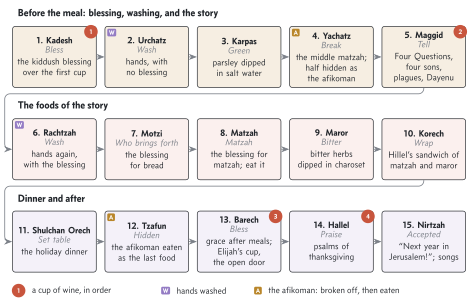

The table is set for a celebration, with the best dishes and candles, cushions on the chairs, and a copy of the Haggadah at every place (Figure 14.3). At several moments the guests lean to the left while they eat and drink, the way free men lay on couches at a Greek or Roman banquet. On this night, the rabbis said, even the poorest Jew is to feel like a free man. In front of the leader lie three matzot under a cloth, a bowl of salt water, and a large plate of six symbolic foods, the seder plate.
Over the evening each adult drinks four cups of wine,During this holiday's seder, four cups of wine are traditionally drunk. → Passover•• and the Mishnah insists that even a man who lives on charity must be given wine enough for all four. The usual explanation is a passage in Exodus where God makes four promises to the slaves in Egypt. In the King James Version, God says, “I will bring you out from under the burdens of the Egyptians, and I will rid you out of their bondage.” Then come the third and fourth: “I will redeem you with a stretched out arm,” and “I will take you to me for a people.” There is a cup for each promise. The first is drunk at once, with the blessing called kiddush (kid-ish) that opens every Sabbath and festival meal (Chapter 35).
Then everyone washes hands, pouring water from a cup over each one, without the usual blessing. Later, just before the matzah is eaten, they wash again, this time with the blessing. The Hebrew names of the two steps are urchatz (oor-khahts), “and wash,” and rachtzah (rahkh-tsah), “washing,” so celebrants wash their hands twiceCelebrants of this holiday wash their hands twice, during the urchatz and rachtzah ceremonies. → Passover•• in a single evening. Jewish law asks for washed hands before anyone eats a food dipped in liquid, and that rule explains the first washing, which prepares for an odd appetizer. Each person takes a sprig of karpas (kar-pahs), a green vegetable, often parsley, dipped in salt water.Karpas, often parsley, is dipped in salt water during this holiday. → Passover•• The salt water stands for the tears of the slaves, and the green for spring. To the rabbis, dipping vegetables before a meal was the habit of free people at leisure.
Next the leader takes the middle one of the three matzot and breaks it in two. The smaller half goes back between the others. The larger half is wrapped in a napkin and set aside, and it has a name of its own: the afikoman (ah-fee-koh-mahn), from a Greek word for what comes after a meal. The afikoman is a piece of matzah,The afikoman is a piece of this food hidden during the Passover seder. → matzo• but it is also the dessert, the last food anyone eats that night. In the days of the Temple, the house of God in Jerusalem where priests offered animals on the altar (Chapter 17), the last taste of the evening was the meat of the Passover lamb. When there was no more lamb, the rabbis made the afikoman take its place.
Children have made the afikoman into a game. In many families the leader hides it during the meal and the children hunt for the afikoman;The afikoman is hidden during this holiday for children to find or "steal." → Passover••• in others the children “steal” it while no one is looking and hide it themselves. Either way the seder cannot end without it, so whoever has it can bargain, and the leader must ransom it back with a present. The custom keeps small children awake through a long night, which is exactly what it is for.

Now comes the plate itself (Figure 14.4). Its six foods each tell part of the story, and two of them are never eaten. A roasted shankbone and a roasted eggA shankbone and roasted egg on this holiday’s seder plate recall Temple sacrifices. → Passover• stand for two sacrifices that every family offered at the Temple at Passover. The zeroa (zeh-roh-ah), a lamb bone, recalls the Passover lamb itself; the beitzah (bay-tsah), an egg browned in the oven, recalls the festival offering that came with it. The Romans burned the Temple in AD 70. No Passover lamb has been offered on the Temple’s altar since, and the bone on the plate marks the empty place.
Two foods are bitter. Maror (mah-ror), the bitter herb, is usually a lump of fresh horseradish root or a few leaves of romaine lettuce, and everyone eats the bitter herbs,During this holiday, observers eat bitter herbs called maror. → Passover•• because Exodus told the Israelites to eat the lamb “with bitter herbs.” The Haggadah explains the taste with another verse: the Egyptians “made their lives bitter with hard bondage, in morter, and in brick.” A second bitter herb, chazeret (khah-zeh-ret), waits at the bottom of the plate for a later step.
The bitterness is softened at once by a sweet brown paste called charoset (khah-roh-set), and its recipe tells where a family comes from. Ashkenazim (ahsh-kuh-nah-zim) are Jews whose ancestors lived in medieval Germany, called Ashkenaz in Hebrew, and later spread across Poland and Russia. In Ashkenazi homes charoset is made of apples, nuts, and wine,A paste of apples, nuts, and wine called charoset is eaten during this holiday and symbolizes mortar. → Passover•• chopped together until the paste looks like the mortar the slaves used for Pharaoh’s bricks. Sephardim (seh-far-dim) descend from the Jews of Spain, called Sepharad, whose king and queen expelled them in 1492. Their charoset is often made from dates or figs. Everyone dips the maror into the charoset before eating it.
When the second washing is done and the matzah has been blessed and eaten, the family makes a sandwich: the second bitter herb, the chazeret, often with charoset, wrapped between two pieces of matzah. This step, korech (kor-ekh), “wrapping,” copies Hillel, the most famous teacher in Jerusalem in the time of King Herod (Chapter 26). Hillel is said to have eaten the lamb, the matzah, and the bitter herbs together in one bite. Then dinner is served, beginning in many families with a hard-boiled egg in salt water.
One newer object sits on some plates: an orange. In the families that keep the custom, the orange stands for including womenAn orange placed on this holiday's seder plate represents the inclusion of women and/or LGBTQ+ people. → Passover•• and gay and lesbian Jews, and its history explains why it means both. In the early 1980s Susannah Heschel (hesh-ul), an American scholar of Jewish history, began placing an orange on her family’s seder plate. By her own account she meant it as a sign that gay and lesbian Jews belonged at the table. A different story soon spread, in which a man told her that a woman belonged in a rabbi’s pulpit about as much as an orange belonged on a seder plate. Heschel has said that the story is wrong, but it stuck.
The Haggadah and its songs
The book at every place is the Haggadah, Hebrew for “telling,” and the Haggadah is read at the sederA text called the Haggadah is read during this holiday's seder. → Passover••• from start to finish. Its name comes from a verse in Exodus: “And thou shalt shew thy son in that day, saying, This is done because of that which the Lord did unto me when I came forth out of Egypt.” Where the King James Version says “shew,” the Hebrew says ve-higgadta, “and thou shalt tell,” and the Haggadah exists to obey it. No single author wrote it. It grew over more than a thousand years, from the outline in the Mishnah through the prayers and comments of generations of rabbis. Its earliest complete text is in a prayer book put together by Amram, the head of a Jewish academy in Babylonia, in the ninth century AD. Babylonia had been home to a great Jewish community ever since the exile there (Chapter 20).

In the Middle Ages, Jewish families who could afford it had their Haggadot copied by hand and painted, and some became masterpieces of Jewish art. One of the most famous was made in Spain about 1350 and is now kept in the National Museum in Sarajevo, which is why it is called the Sarajevo Haggadah (Figure 14.5). It probably left Spain with the Sephardim in 1492. During the Second World War the museum’s librarian, a Muslim scholar named Derviš Korkut (dair-vish kor-koot), smuggled it out of the city, and it was hidden from the Nazis in a village mosque. Since the invention of printing, the Haggadah has appeared in thousands of editions.
The telling begins with a child’s question. Soon after the middle matzah is broken, and long before dinner, the youngest child who can manage it stands and sings, in Hebrew, Mah nishtanah ha-laylah ha-zeh mi-kol ha-leilot? That is, “Why is this night different from all other nights?” The passage is called the Ma Nishtana (mah nish-tah-nah), the Four Questions, and the youngest child traditionally asks it.During this holiday, the youngest child traditionally asks "Why is this night different from all other nights?" as part of the Four Questions, known as the Ma Nishtana. → Passover••• The child goes on to list what is different. On all other nights we eat bread or matzah, but tonight only matzah. On other nights we eat any vegetables, tonight bitter herbs. On other nights we do not dip our food even once, tonight we dip twice. On other nights we sit up or recline, tonight we all recline. That makes a set of four questions,"How is this night different from all other nights?" is asked by a child during the Passover seder in a set of this many questions. → four• and each one points at something on the table. The Mishnah’s older list asked about roasted meat instead of reclining; with no lamb to roast after AD 70, the question changed. The Hebrew mah can mean “why” or “how,” so some English Haggadot print “How is this night different?”
Next the Haggadah imagines four children asking about the seder, each in his own way. The rabbis noticed that the Torah tells parents four times to answer a son’s question about the Exodus, in four different wordings, and from those verses they built four sons: wise, wicked, simple,This seder text teaches four sons: the wise, the wicked, the simple, and the one who cannot ask. → Haggadah•• and one who does not know how to ask. The wise son asks about every law of the holiday, and he is taught all of them, down to the rule that nothing is eaten after the afikoman. The wicked son asks in the words of Exodus, “What mean ye by this service?” He says “ye,” not “we,” and so the Haggadah answers him sharply: God did this “unto me,” and had he been in Egypt he would not have been freed. The simple son asks only “What is this?” and is told that “by strength of hand the Lord brought us out from Egypt.” For the son who cannot ask, the parent must begin the story unasked. Painters of Haggadot loved the four sons, and they often drew the wicked one as a soldier.
The questions and the four sons both belong to the longest of the fifteen steps, called maggid (mah-geed), “telling,” and so does the story itself. The answer to the child’s questions begins with the words “We were slaves to Pharaoh in Egypt,” and the story moves on through the slavery, the cry for help, and the plagues. The Haggadah names Moses only once, in a verse it quotes in passing; the usual explanation is that the hero of its story is God. When the leader reaches the ten plagues, from blood to the death of the firstborn (Chapter 13), everyone dips a finger into the cup and removes a drop of wine for each plague.During this holiday, drops of wine are removed while the Ten Plagues are recited. → Passover•• Many families spill a few more drops for the words around the list. The custom began among German Jews. The reason most often given is that a full cup is a sign of joy, and joy cannot be full while others suffer, even enemies. A story in the Talmud, the vast record of the rabbis’ discussions (Chapter 34), makes the same point: when the Egyptians drowned in the sea, the angels began to sing, and God silenced them, saying that the work of his hands was drowning.
So wine does two jobs at the seder. Four cups of wine are drunkFour cups of this drink are used in the Passover seder, with drops removed when naming the ten plagues. → wine•• for the four promises of freedom, and drops of the same wine are spilled for the ten plagues, the price that Egypt paid. Children, and anyone who does not drink wine, may use grape juice, which Jewish law also accepts as “the fruit of the vine.”
Then the mood turns to thanks. The family sings the fifteen-stanza song “Dayenu”The fifteen-stanza song “Dayenu,” or “It would have been enough,” is sung during this holiday. → Passover••• (dye-yay-noo), whose Hebrew title means “It would have been enough for us.” Each stanza names one gift of God and declares that it alone would have been enough. If he had brought us out of Egypt and not punished the Egyptians, dayenu; if he had split the sea for us and not led us through it on dry land, dayenu. The gifts climb in order through the manna that fell from heaven to feed them in the desert, the Sabbath, Mount Sinai, and the Torah, to the entry into the land and, last, the building of the Temple. The song is more than a thousand years old, and its full text first appears in Amram’s prayer book.
After dinner the children produce the afikoman and the grace after meals is said. A third cup is drunk, and a large cup that no one has touched all evening is filled to the brim. It belongs to Elijah, a prophet of the northern kingdom of Israel in the ninth century BC. The Books of Kings tell that he never died: a chariot of fire came between him and his disciple, and Elijah went up by a whirlwind into heaven (Chapter 19). The Book of Malachi, the last of the twelve short books of prophecy, ends with a promise from God: “Behold, I will send you Elijah the prophet before the coming of the great and dreadful day of the Lord.” In Jewish tradition Elijah will come back to announce the Messiah, the king of David’s line who will one day restore Israel (Chapter 17). So at the seder a cup is reserved for Elijah,A cup of wine is reserved for Elijah and a door opened to welcome him during this holiday. → Passover••A cup is reserved for this prophet and a door opened for him at the Passover seder. → Elijah•• and a child is sent to open the front door and let him in. Some children watch the cup closely, sure that the wine goes down a little.
One explanation traces Elijah’s cup to an unanswered question. The passage in Exodus with the four promises goes on to a fifth: “I will bring you in unto the land.” The rabbis could not agree whether it called for a fifth cup, so a fifth cup came to be poured but not drunk. The question was left, like other questions the rabbis could not settle, for Elijah to answer when he comes.
The fourth cup goes with Hallel, “praise,” the Psalms of thanksgiving sung on most festivals. The last of the fifteen steps is nirtzah (neer-tsah), “accepted,” a short prayer that the night’s service has pleased God, and the seder ends with “Next year in Jerusalem!”Observers of this holiday pray "Next year in Jerusalem!" at the end of their seder. → Passover•• For Jews spread across the diaspora, Jerusalem was the city where the Temple had stood and where, they prayed, it would stand again. The words first appear at the end of a seder in the Birds’ Head Haggadah, painted in Germany about 1300, whose artist gave every Jewish figure the head of a bird. Families in Jerusalem itself say instead, “Next year in Jerusalem rebuilt.”
The fifteen steps are done, but the singing is not. Late at night, with the youngest children half asleep, the Haggadah turns to songs that are also games. Ashkenazi families sing “Adir Hu”Ashkenazi communities sing “Adir Hu,” which lists God’s virtues alphabetically, during this holiday. → Passover• (ah-deer hoo), “Mighty Is He.” It praises God with one word for each letter of the Hebrew alphabet, in order (mighty, chosen, great, eminent, and on to the last letter), and between the runs of praise it asks God to rebuild his Temple soon.
The next song, “Echad Mi Yodea” (eh-khahd mee yoh-day-ah), is a counting song called “Who Knows One?”A song sung during this holiday asks "Who knows One?" and counts up to 13 as a memory game. → Passover• Each verse asks who knows a number and answers with something from Jewish tradition. One is our God, in heaven and on earth. Two are the tablets of the covenant; three, the fathers Abraham, Isaac, and Jacob; four, the mothers Sarah, Rebekah, Leah, and Rachel; five, the books of the Torah. And so on, through the Ten Commandments and the twelve tribes, up to thirteen, the attributes of God. Every verse repeats all the numbers before it, back down to one, so families race to sing it from memory, sometimes in a single breath.

The last song is the strangest. It tells of a little goat that Father bought for two zuzim (zoo-zim), small silver coins of the rabbis’ time. A cat came and ate the goat, a dog came and bit the cat, a stick came and beat the dog, and fire burned the stick. Water put out the fire, an ox drank the water, a butcher slaughtered the ox, and the Angel of Death took the butcher. At last the “Holy One, blessed be He” destroyed the Angel of Death. Like “The House That Jack Built,” “Chad Gadya” is a cumulative songThe cumulative song “Chad Gadya,” beginning with a goat bought for two zuzim, is sung during this holiday. → Passover•• (khahd gahd-yah): each verse adds a link, then runs back down the whole chain to the goat. Its title is Aramaic, the everyday language of many Jews in the rabbis’ time, for “One Little Goat.” It was first printed in Haggadot from Prague in the sixteenth century, though an older version survives in a prayer book from Provence, in southern France. It may be borrowed from a German folk song, and readers have looked for hidden meanings in it ever since. One favorite makes the goat the Jewish people and the cat, the dog, and the rest the empires that conquered them one after another (Figure 14.6).
Customs by community
The Haggadah is much the same everywhere, but Jews carried Passover to every shore of the Mediterranean and far beyond it, and each community added customs of its own (Figure 14.7). The best-known difference between Ashkenazim and Sephardim, the two largest families of Jewish tradition, is a matter of beans. Ashkenazim avoid not only chametz at Passover but also kitniyot (kit-nee-yoht), “little things”: rice, corn, legumes such as beans, lentils, and peas, and seeds such as sesame. These are not chametz, since none of them is one of the five grains, and the early rabbis allowed them. But from the thirteenth century on, rabbis in France and Germany began to forbid them, perhaps because a sack of lentils could hide stray grains of wheat, or because a porridge of rice looks like a porridge of wheat. Most Sephardim never banned kitniyot,The Sephardim do not ban eating legumes (kitniyot) during this holiday, unlike the Ashkenazi. → Passover• and a Sephardi Passover table may be heaped with rice.
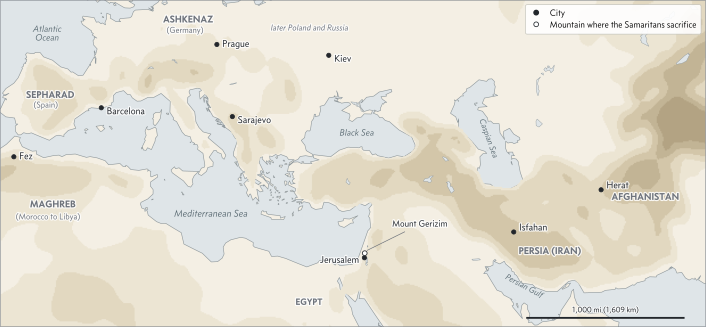
Jews of Iran and Afghanistan, among the oldest communities of the diaspora, keep the liveliest custom of all. When the singing of “Dayenu” reaches the stanzas about the years in the desert, they hit each other with scallions,In Iran and Afghanistan, celebrants of this holiday hit each other on the head with scallions or leeks while singing. → Passover•• or with leeks, on the head and shoulders. One explanation points to the Book of Numbers, where the Israelites in the wilderness grow tired of manna and complain: “We remember the fish, which we did eat in Egypt freely; the cucumbers, and the melons, and the leeks, and the onions, and the garlick.” A swat with a green onion reminds everyone at the table not to long for the food of slavery.
In North Africa the holiday ends with a party. Jews of the Maghreb (mah-greb), the Arabic name for the lands of northwest Africa from Morocco to Libya, hold the Mimouna (mee-moo-nah) on the night Passover ends. Houses are thrown open to visitors, tables are covered with sweets and with charms for luck, and the first leavened food since the holiday began is served. At the Mimouna Maghrebi Jews eat moufletaNorth African Jews (Maghrebis) eat moufleta during a meal called the Mimouna held after this holiday. → Passover• (moo-fleh-tah), a thin pancake fried in a pan and spread with butter and honey. In Morocco, non-Jewish neighbors often sold the family its first leavened food. No one knows where the name comes from. Some connect it with Maimon, the father of Maimonides, the greatest Jewish scholar of the Middle Ages, and others with an Arabic word for good luck. Since 1966, Moroccan immigrants have made the Mimouna a spring picnic for all of Israel.
One community still keeps Passover the way Exodus describes it. The Samaritans are a small people, about nine hundred today, who live on Mount Gerizim (gair-ih-zim) above the city of Nablus, the ancient Shechem, and in Holon, near Tel Aviv. They call themselves Israelites, descended from the northern tribes of the Bible, and they keep their own version of the Torah, the five books of Moses, and no other scripture. Their great difference from Jews is the holy place. Deuteronomy forbids the Passover lamb to be sacrificed anywhere but “at the place which the Lord thy God shall choose to place his name in.” Jews read that place as Jerusalem, and since the Temple fell they have had nowhere to offer the lamb. The Samaritans read it as Gerizim, and they still have their mountain (Chapter 29).

So every spring, at sunset on the day their own calendar sets, the men of the community slaughter dozens of sheep on the mountain and mark their foreheads with the blood. They roast the meat whole in pits and eat it at midnight with matzah and bitter herbs, dressed for a journey and in haste (Figure 14.8). The Hebrew word for a sacrifice is korban (kor-bahn), and the Samaritans alone still offerThis holiday's animal sacrifices (korban) are today only conducted by the Samaritans. → Passover• the korban of Passover. Everyone else has kept the holiday for nearly two thousand years with a bone on a plate in place of the lamb.
Counting to Sinai
On the second night of Passover a new count begins. Leviticus commands the Israelites to bring the first sheaf of the harvest, an omer (oh-mer), to the priest, and then to count. “And ye shall count unto you from the morrow after the sabbath,” it says, until “seven sabbaths shall be complete.” The rabbis read “the sabbath” here as the first day of Passover, so for them the Counting of the Omer beginsThe forty-nine-day Counting of the Omer begins on the second night of this holiday. → Passover•• on the second night, 16 Nisan. Every evening for forty-nine nights, observant Jews say a blessing and announce the number: “Today is one day of the Omer,” and later, “Today is eight days, which is one week and one day of the Omer.”

The verse could be read another way, and it was. In the days of the Temple the Sadducees (sad-yuh-seez), the party of the leading priestly families, took “the sabbath” to mean the ordinary Saturday. The Samaritans, and the Karaites (kair-uh-ites), Jews who reject the rabbis’ traditions (Chapter 34), still count that way, always starting on a Sunday. Either way the count ends after seven full weeks, and the fiftieth day is Shavuot, the Feast of Weeks. In the Temple the count joined two harvests, barley at Passover and wheat at Shavuot. Jewish tradition gave it a second meaning. Shavuot became the day the Torah was given at Mount Sinai, and the forty-nine nights became a march from the freedom of the Exodus to the Law (Chapter 15).
What to remember
- Passover (Pesach) commemorates the Exodus. It begins on 15 Nisan, at the full moon of spring, and lasts seven days in Israel and eight in the diaspora.
- Chametz, grain that has been wet and allowed to rise, is forbidden. Matzah (flour and water baked before yeast can raise it) takes its place and recalls the haste of the Exodus; shmurah matzah is guarded from the harvest on.
- The seder (“order”) follows fifteen steps, with four cups of wine, two hand-washings, karpas dipped in salt water, and the broken matzah whose hidden half, the afikoman, ends the meal.
- The seder plate holds a shankbone and a roasted egg for the Temple sacrifices, maror for the bitterness of slavery, charoset for the mortar, and karpas; some families add an orange.
- The Haggadah (“telling”) contains the youngest child’s Four Questions, the four sons, a drop of wine for each of the ten plagues, “Dayenu,” Elijah’s cup and the open door, and “Next year in Jerusalem!”
- The late songs are “Adir Hu” (Ashkenazi, alphabetical), “Who Knows One?” (counting to thirteen), and “Chad Gadya” (a goat bought for two zuzim).
- Ashkenazim avoid kitniyot and most Sephardim do not; Iranian and Afghan Jews swat each other with scallions during “Dayenu”; Maghrebi Jews end the holiday with the Mimouna; only the Samaritans still sacrifice the Passover lamb.
- The Counting of the Omer begins on the second night and runs forty-nine days to Shavuot.
Chapter 15 · 63 clues
Sinai and the Wilderness
In the third month after they left Egypt, the book of Exodus says, the Israelites came to a mountain in the desert and pitched their tents at its foot. Moses had met God at this mountain, Sinai, once before, at the burning bush (Chapter 13), and now he had brought a whole people back with him. On the third morning there was thunder and lightning, a thick cloud sat on the summit, and a trumpet sounded so loud that everyone in the camp trembled. The mountain, says Exodus, “was altogether on a smoke, because the Lord descended upon it in fire.”
What happens at that mountain, and in the forty years after it, fills the rest of the Torah: the second half of Exodus, then Leviticus, Numbers, and Deuteronomy. It is a story of laws and of rebellions. A covenant is made and broken within six weeks. A tent is built for God to live in, and one family is made into priests. Ten of twelve spies lose their nerve, a donkey talks, and a leader who has led for forty years is not allowed to arrive. This chapter tells the story as the Torah tells it. As Chapter 13 explained, no archaeologist has found any trace of a nation camped in the Sinai desert for a generation, and none of these events has a secure date. Where the text, Jewish and Christian tradition, and modern scholars part company, the chapter says so. The map of the route in Chapter 13 follows the people from the mountain to the oasis of Kadesh-barnea, around Edom and Moab, and up to Mount Nebo.
The Ten Commandments
Moses went up the mountain, came down, and then God spoke. The twentieth chapter of Exodus begins, “And God spake all these words, saying,” and what follows is spoken aloud to the whole people from the fire. God first names himself by what he has done: “I am the Lord thy God, which have brought thee out of the land of Egypt, out of the house of bondage.” Then come the commands. Israel must have no other gods, make no carved images to worship, and never misuse God’s name. It must keep the Sabbath, the seventh day, as a day of rest, and honor father and mother. Three of the commands are only four or five words long in the King James Version: “Thou shalt not kill. Thou shalt not commit adultery. Thou shalt not steal.” Lying in court and coveting, which means wanting what belongs to your neighbor, are forbidden last.
The people were terrified. They stood far off and begged Moses to speak to them instead: “let not God speak with us, lest we die.” So the rest of the law came through Moses. Exodus gives the commandments in its twentieth chapter,In this book, Moses receives the Ten Commandments from God. → Book of Exodus•• and Deuteronomy repeats them, with small differences of wording, in its fifth, as Moses recalls them forty years later. In both books they are the only laws that God speaks to all Israel directly.
The Hebrew text never numbers the commandments, but it does give their total. Exodus calls them “the ten commandments,” in Hebrew literally “the ten words,” and so does Deuteronomy. The Greek translators made that dekalogos, from which English gets the Decalogue (dek-uh-log). Everyone agrees that there were ten of them.This many commandments were given to Moses on Mount Sinai. → ten• The trouble is that the passage has more than ten sentences, and different traditions divide it differently, as Table 15.1 shows. Jews count God’s opening words as the first. Catholics and Lutherans, following Saint Augustine, a bishop in North Africa about AD 400, join “no other gods” to “no images” and split the coveting in two. The Orthodox churches and most Protestants keep the older division that Philo (fy-loh), a Jewish philosopher of Alexandria, and Josephus, a Jewish historian, were already using in the first century AD.
| Words of Exodus 20 | Jewish | Catholic | Orthodox, most Protestant |
|---|---|---|---|
| “I am the Lord thy God, which have brought thee out of the land of Egypt” | 1 | (part of 1) | (preface) |
| “Thou shalt have no other gods before me” | 2 | 1 | 1 |
| “Thou shalt not make unto thee any graven image” | 2 | 1 | 2 |
| “Thou shalt not take the name of the Lord thy God in vain” | 3 | 2 | 3 |
| “Remember the sabbath day, to keep it holy” | 4 | 3 | 4 |
| “Honour thy father and thy mother” | 5 | 4 | 5 |
| “Thou shalt not kill” | 6 | 5 | 6 |
| “Thou shalt not commit adultery” | 7 | 6 | 7 |
| “Thou shalt not steal” | 8 | 7 | 8 |
| “Thou shalt not bear false witness against thy neighbour” | 9 | 8 | 9 |
| “Thou shalt not covet thy neighbour’s house … wife …” | 10 | 9 (wife) and 10 (goods) | 10 |
After the Ten come three chapters of further laws, about servants, injuries, property, and festivals, which Exodus calls “the book of the covenant” (Chapter 3 sets some of them beside Hammurabi’s). Moses wrote them down and read them aloud, and the people answered: “All that the Lord hath said will we do, and be obedient.” Then he climbed the mountain again, taking his young assistant Joshua, son of Nun, of the tribe of Ephraim, who had already led Israel’s fighting men against desert raiders called the Amalekites (am-uh-leh-kites). Moses left his brother Aaron and a leader named Hur in charge of the camp and walked into the cloud. He stayed there, Exodus says, “forty days and forty nights.”
At the end of that time God gave him “two tables of testimony, tables of stone, written with the finger of God.” A table here means a tablet. On the summit of Sinai, then, Moses received the Ten CommandmentsThis man received the Ten Commandments on Mount Sinai. → Moses••• in writing, carved on stone by God himself, as Exodus tells it. One rabbinic view puts five commandments on each tablet, as Jewish art usually shows them, but other sages held that each tablet carried all ten, like two copies of one agreement, one for each party. Christian art often puts the duties to God on one tablet and the duties to other people on the other, and the King James Version’s summary of Exodus 20 likewise speaks of “The first table” and “The second table.”

The commandments became some of the best-known words ever written. They were copied onto parchment, recited in prayer, carved over church doors, and painted on synagogue walls. Their hold rests on their shortness. A child can learn them in an afternoon, and yet they cover worship, family, life, marriage, property, truth, and even private wishes, since coveting happens in the mind.
The golden calf
Forty days is a long time to wait at the foot of a smoking mountain. Exodus 32 tells what happened in the camp below. The people gathered around Aaron, Moses’s older brother and spokesman (Chapter 13), and made a demand. “Up, make us gods, which shall go before us,” they said; “for as for this Moses, the man that brought us up out of the land of Egypt, we wot not what is become of him.” (“Wot not” is older English for “know not.”) They had been slaves for generations, and they wanted a god they could see.
Aaron did not argue. He told them to break off the golden earringsAaron makes this object from gold earrings. → golden calf• worn by their wives, sons, and daughters and to bring them to him. He melted the gold, worked it with an engraving tool, and made it into a calf. A calf here means a young bull. Bulls stood for strength and fertility all over the ancient Near East: Egypt honored the Apis bull at Memphis (Chapter 5), and the Canaanites (Chapter 16) called their chief god “Bull El” and pictured their storm god standing on a bull’s back. So when the people saw a golden idol of a young bullWhile Moses was on Mount Sinai, the Israelites worshiped a golden idol of one of these animals. → cattle•• (Figure 15.2), they knew how to read it, and they cried, “These be thy gods, O Israel, which brought thee up out of the land of Egypt.”

Aaron built an altar in front of the calf and announced, “To morrow is a feast to the Lord.” He used God’s own name for the feast, which suggests that he meant the calf as an image of Israel’s God, or a pedestal for him, rather than as a rival god. Either way, the commandment against images had forbidden exactly this. The next morning the people sacrificed, ate, drank, and “rose up to play.” The story also looks ahead. Centuries afterward, King Jeroboam (jer-uh-boh-um) of the northern kingdom set up two golden calves at Bethel and Dan and presented them to the people with nearly the same words (Chapter 17), and the two stories seem to have been told with each other in mind.
On the mountain, Exodus says, God told Moses what was happening and offered to destroy the people and make a great nation from Moses alone. Moses argued back. What would the Egyptians say, he asked, if God brought Israel out only to kill it in the mountains? He reminded God of his promises to Abraham, Isaac, and Jacob, and “the Lord repented of the evil which he thought to do unto his people.” It is one of several places in the Torah where Moses talks God out of his anger, and it shows him as a leader who defends the people he will later punish.
Then Moses came down with the tablets in his hands. As soon as he came near the camp, “he saw the calf, and the dancing: and Moses’ anger waxed hot, and he cast the tables out of his hands, and brake them beneath the mount.” So Moses broke the tabletsMoses broke the Stone Tablets upon seeing one of these objects. → golden calf••This man broke the tablets of the Law after finding the Israelites worshipping a golden calf. → Moses•• at the foot of the mountain, on seeing the people worship the calf. The covenant had lasted barely six weeks, and the written copy lay in pieces on the ground.

His next act was cold and deliberate. He took the calf, burned it, ground it to powder,Moses burns this object, grinds it into powder, and makes the Israelites drink it in water. → golden calf•• scattered the powder on the water, and made the Israelites drink it. The god they had made ended up in their own stomachs. Then he turned on his brother and asked what the people had done to him, that he had brought so great a sin on them. Aaron had made the golden calf himself,This man created the Golden Calf. → Aaron•• with his own hands and an engraving tool, but his answer makes it sound like an accident: “So they gave it me: then I cast it into the fire, and there came out this calf.” It is the feeblest excuse in the Bible.
What followed is one of the darkest passages in the Torah. Moses stood in the gate of the camp and called out, “Who is on the Lord’s side? let him come unto me.” The men of his own tribe, the Levites, descendants of Jacob’s son Levi, gathered to him. He ordered them to go through the camp with swords and kill, even a brother, a friend, or a neighbor, “and there fell of the people that day about three thousand men.”The Levites were instructed to kill 3,000 people after one of these objects was constructed. → golden calf•• Exodus presents the slaughter as the price of the great betrayal, and Moses told the Levites that they had dedicated themselves to God that day at the cost of their own kin. From then on, the tribe of Levi was set apart for holy work. God, Exodus adds, also struck the people with a plague.
All of this, from the earrings to the broken tablets, is told in Exodus 32.This book recounts the Israelites worshipping Aaron’s golden calf and Moses breaking the tablets of the Law. → Book of Exodus•• Two chapters later God told Moses to cut two new tablets like the first, and Moses went up for another forty days and nights, eating no bread and drinking no water. “And he wrote upon the tables the words of the covenant, the ten commandments.” Rabbinic tradition dates his return to the tenth day of the seventh month, the day that became Yom Kippur, the Day of Atonement (Chapter 35).
When Moses came down the second time, he did not know that “the skin of his face shone”This man’s face shone after he came down from Mount Sinai. → Moses• from speaking with God. Aaron and the people saw it and were afraid to come near him. From then on Moses wore a veil over his face among the people, and took it off when he went in to speak with God. The Hebrew verb for “shone” comes from the same root as the Hebrew word for “horn.” A Greek translator of the second century AD, Aquila (ak-wih-luh), and then Saint Jerome’s Latin Vulgate (the Stage) both read it as “horned.” For centuries, as a result, Western artists gave Moses two horns.

The most famous horned Moses is the marble statue that Michelangelo carved for the tomb of Pope Julius II in Rome, about 1513 to 1515 (Vol. 10, Rebirth). Moses sits holding the tablets, and his face is turned aside as if he has just seen the calf. By then some scholars knew that “horned” was a mistranslation, and many artists were giving Moses two beams of light instead, which is closer to what Exodus says.
The names of God
Between the two ascents, Moses asked to see God’s glory, and God answered that he would pass by and proclaim his own name. In Exodus 34 he does, calling himself “merciful and gracious” (Chapter 35 will return to those words). Names mattered in this story from the start. At the burning bush God had answered Moses’s question about his name with “I AM THAT I AM” (Chapter 13). In Exodus 6 he tells Moses that Abraham, Isaac, and Jacob knew him as “God Almighty,” “but by my name JEHOVAH was I not known to them.” Nearly everywhere else, the King James Version prints that name as “the Lord,” in capital letters. The reason begins with four letters.
As the Stage explained, God’s personal name is written with four Hebrew letters, yod, he, vav, and he, which English transliterates, letter for letter, as Y-H-W-H,Another name for this deity is the four-letter Tetragrammaton, transliterated as "Y-H-W-H." → God• and Greek-speaking writers called it the Tetragrammaton, “the four letters” (Figure 15.5). Hebrew is written from right to left, and in biblical times it was written with consonants only, so the letters alone do not tell us how the name sounded. It is the commonest name for God in the Hebrew Bible, appearing thousands of times, but nobody alive knows for certain how it was said.

That is because Jews stopped saying it aloud. By the third or second century BC, out of reverence, and in the spirit of the commandment against taking God’s name “in vain,” the name came to be avoided. Where it stood in the text, a reader said Adonai, “my Lord,” instead,This deity may be referred to by the title "Adonai." → God• as Jews still do in prayer; in everyday talk many say HaShem, “the Name” (the Stage). Greek copies of the Septuagint, the old Greek translation, usually wrote Kyrios (keer-ee-ohs), “Lord,” where the four letters stood. English Bibles followed them with “the Lord,” set in capitals to show that the four letters stand behind it.
“Jehovah” was born from a misunderstanding. When the Masoretes added vowel marks to the Hebrew text in the early Middle Ages, they wrote the vowels of Adonai under the four letters, as a reminder to say Adonai. Christian scholars of the late Middle Ages read the letters together with those vowels and got “Yehowah,” which in Latin letters became “Iehoua.” William Tyndale, an English scholar who translated the Bible from Hebrew and Greek and was executed for heresy in 1536, wrote “Iehouah” in his English version of the five books of Moses in 1530. The King James Version kept “JEHOVAH” in a few verses, Exodus 6:3 among them.
Most scholars today think the name was once pronounced Yahweh. The evidence includes the short form “Yah,” heard in “Hallelujah,” which means “praise Yah”; Hebrew names that end in -yahu or -iah, such as Isaiah; and the way some early Christian writers spelled the name in Greek. So when a scholar writes Yahweh (yah-way), he is adding vowels to the four-letter Tetragrammaton,This deity's name is typically written out as the Tetragrammaton, consisting of four letters. → Yahweh• and when an English Bible prints “the Lord,” it is following the old Jewish habit of not saying it at all.
Where did the worship of this God begin? The Bible’s own answer is Sinai, and it places Moses there twice in the company of Midianites, desert herdsmen of the lands east of the Gulf of Aqaba. Moses first met God while tending the flocks of his father-in-law Jethro, “the priest of Midian,” whose daughter Zipporah he had married (Chapter 13). In Exodus 18, Jethro visits the camp near the mountain, hears what God did to Egypt, and says, “Now I know that the Lord is greater than all gods.” Then he offers sacrifices, and Aaron and the elders of Israel eat with him. The book of Judges calls Moses’s father-in-law a Kenite (kee-nite), a member of a clan living among the Midianites, whose name may mean “smith.”
Other evidence points the same way. Some of the oldest poems in the Bible bring God from the south: “Lord, when thou wentest out of Seir, when thou marchedst out of the field of Edom,” sings the Song of Deborah in Judges. And on a temple at Soleb (soh-leb) in Nubia, the Egyptian king Amenhotep III, the father of Akhenaten (Chapter 9), listed a foreign place called “the land of the Shasu of Yhw” during his reign (about 1391 to 1353 BC). The Shasu were the herdsmen of the deserts of Edom and Midian. Scholars of the later nineteenth century, above all the German Karl Budde (bood-eh), had already built from the biblical evidence what is called the Kenite hypothesis:The Kenite hypothesis traces the origin of worship of this deity. → Yahweh• that the worship of Yahweh came to Israel from the Midianites, through Moses’s family by marriage. Its critics answer that there is little sign of contact between those southern deserts and the hill country where Israel first appears. Many scholars reject it, while others, such as the biblical scholar Joseph Blenkinsopp in 2008, have called it the best explanation available. The text itself says only that a Midianite priest praised Israel’s God.
Priests and offerings: Leviticus
During his forty days on the mountain, Exodus says, Moses also received detailed plans for a sanctuary that could be taken apart and carried. “And let them make me a sanctuary; that I may dwell among them.” The Hebrew name for it, mishkan (meesh-kahn), means “dwelling”; the English Tabernacle comes from the Latin for “tent.” The people brought gold, silver, bronze, dyed wool, linen, and acacia wood, and they brought so much that the craftsmen complained, “The people bring much more than enough,” and Moses had to tell them to stop. The master craftsman was Bezalel (bez-uh-lel) of the tribe of Judah. On the first day of the first month of the second year, nearly a year after leaving Egypt, the Tabernacle was set up, and a cloud covered it.

The plan in Figure 15.6 has the logic of a set of nested boxes. The courtyard measured 100 by 50 cubits. A cubit, a forearm’s length (Chapter 11), was about 45 centimeters, so the court was about 45 by 22.5 meters, a little smaller than an Olympic swimming pool. Linen curtains hung on pillars all around it, with a gate on the east. Inside stood a bronze altar for sacrifices and a bronze basin, the laver, where the priests washed. Beyond them was the tent itself, 30 cubits long, divided by a curtain called the veil. The outer room, the Holy Place, held a seven-branched golden lampstand (in Hebrew a menorah), a table for twelve loaves of “showbread” set out before God, and a small golden altar where incense was burned.
The inner room was the Holy of Holies, 10 cubits square, which most reconstructions make a perfect cube. It held only the Ark of the Covenant, a chest of acacia wood covered in gold, about 1.1 meters long, carried on poles through golden rings. Inside lay the tablets of the law. On its lid, called the mercy seat, two golden cherubim (Chapter 11) faced each other with their wings spread. “I will commune with thee from above the mercy seat,” God tells Moses, “from between the two cherubims which are upon the ark of the testimony.”
To serve in the Tabernacle, Exodus says, God chose one family. A priest, in Hebrew a kohen (koh-hen), is a man who offers sacrifices for the people at the altar and teaches them God’s law. Exodus 28 and 29 and Leviticus 8 tell how Moses dressed Aaron and his sons as the first priestsThe first men to be appointed as these people were Aaron and his sons. → Jewish priests•• and anointed them, that is, marked them with sacred oil. The sons were Nadab (nay-dab), Abihu (uh-by-hyoo), Eleazar (el-ee-ay-zer), and Ithamar (ith-uh-mar). The rest of the tribe of Levi, the Levites, carried and guarded the Tabernacle and assisted the priests. Every priest was a Levite, but most Levites were not priests; Moses and Aaron were themselves Levites, sons of Amram (Chapter 13). Moses poured oil on his brother’s head as well, and so Aaron became the first High Priest of Israel,This man became the first High Priest of Israel. → Aaron•• the chief priest, who alone could enter the Holy of Holies.
The High Priest’s clothes are described stitch by stitch (Figure 15.7). Over a blue robe hung with golden bells and pomegranates he wore the ephod (ee-fod), a richly woven apron. On his chest was a square breastplate set with twelve precious stones, each engraved with the name of one of the twelve tribes, and on his turban was a gold plate engraved “HOLINESS TO THE Lord.” Inside the breastplate, Exodus says, were placed the Urim and the ThummimMembers of this profession used the Urim and the Thummim for divination. → Jewish priests• (yoor-im and thum-im), so that Aaron would “bear the judgment of the children of Israel upon his heart.” The priests used them for divination, to ask God questions; Numbers later says that Joshua would stand before Eleazar the priest, “who shall ask counsel for him after the judgment of Urim.” No one knows what they looked like. The names may mean “lights and perfections,” and the stones seem to have worked like sacred lots, giving a yes or a no.

The priesthood began with a disaster. On the eighth day of the ceremonies, Leviticus says, fire came out from God and burned up the offering on the altar, and the people shouted and fell on their faces. Then Aaron’s sons Nadab and AbihuNadab and Abihu were this man's sons. → Aaron•• each took a censer, a metal pan for carrying burning coals, put fire in it, laid incense on the fire, and brought it before God. Exodus had already forbidden the priests to offer “strange incense,” meaning incense not made by the sacred recipe. Leviticus says that the brothers offered strange fire before the Lord,The divine fire that consumed this man's sons was caused by their offering of strange incense. → Aaron••In this book, Nadab and Abihu are killed for using "strange fire" in a sacrifice. → Leviticus•• “which he commanded them not. And there went out fire from the Lord, and devoured them.” Moses told his brother that God would be honored by those who came near him, “And Aaron held his peace.”
Why they did it, the text does not say. Because the very next law in Leviticus forbids priests to drink wine before they enter the Tabernacle, one rabbinic explanation is that the brothers had been drinking. Nadab and Abihu died childless, so the priesthood passed to their younger brothers. Since the office went from father to son, every Jewish priest after Aaron was, by the Torah’s law, his descendant. Hebrew calls the priests the kohanim (koh-hah-neem), and in Jewish tradition Aaron is the ancestor of the kohanimThis man is an ancestor of the Kohanim. → Aaron•• to this day. Many Jews named Cohen or Kahn belong to families that hold they descend from him. In synagogues, kohanim still bless the congregation with the words God gave Aaron in Numbers 6: “The Lord bless thee, and keep thee: The Lord make his face shine upon thee, and be gracious unto thee.”
Centuries later, after Solomon built the Temple in Jerusalem (Chapter 17), the priests led the worship and offered the sacrificesThese people led Jewish worship and sacrifices at the Temple in Jerusalem. → Jewish priests• there, with the Levites as singers, gatekeepers, and assistants. They served there, with one long break during the exile in Babylon, until the Romans destroyed the Second Temple in AD 70. Since then no Jewish sacrifices have been offered.
The rules for their work fill the next book. Leviticus, the third book of the Torah,This third book of the Torah follows Exodus. → Leviticus•• follows Exodus, and its English name comes through Latin from the Greek for “the book of the Levites,” the priests’ book. Its Hebrew name, Vayikra (vah-yee-krah), “And he called,” is simply its first word, the usual way Hebrew books are named. It opens where Exodus ends, with God calling to Moses from the newly finished Tabernacle. Its first seven chapters give the laws for each kind of offeringThis book gives laws for offerings in the recently completed Tabernacle. → Leviticus•• made there. A sacrifice was an animal or food given to God, wholly or partly burned on the altar. In the burnt offering the whole animal went up in smoke; in the peace offering most of the meat became a shared meal; the sin and guilt offerings made amends for wrongs; and the grain offering was flour, oil, and incense.
That grain offering is the King James Version’s “meat offering,” because in 1611 “meat” meant any food. Every offering had to be salted. “Neither shalt thou suffer the salt of the covenant of thy God to be lacking from thy meat offering,” says Leviticus 2:13: “with all thine offerings thou shalt offer salt.”Leviticus 2:13 requires that grain offerings be accompanied by an offering of this substance. → salt• Salt keeps food from rotting, and so it stood for a covenant meant to last forever. The Bible speaks more than once of a “covenant of salt,” and a king of Judah later used the phrase for God’s promise to David (Chapter 17).
Leviticus 16 explains what happened after Nadab and Abihu died. Aaron was never again to walk into the Holy of Holies whenever he liked. He could enter only once a year, on the tenth day of the seventh month, the day later called Yom Kippur. On that day he took two goats and cast lots over them, “one lot for the Lord, and the other lot for the scapegoat.” The first goat was sacrificed. On the second, Aaron laid both hands and confessed “all the iniquities of the children of Israel,” and then a man led it into the desert, “unto a land not inhabited,” and let it go. The Hebrew says that this goat was sent to AzazelThis book instructs that a scapegoat be sent into the wilderness to Azazel. → Leviticus•• (uh-zay-zel) in the wilderness. Nobody is sure what Azazel means. It may name a rugged place in the desert, or a demon of the wilderness, as he is in the Book of Enoch, a Jewish writing of the last centuries BC that most Bibles leave out. Or it may simply mean “complete removal.” William Tyndale guessed “the goat that escapes” and coined the word “scapegoat” in 1530; today it means anyone blamed for other people’s faults. How Yom Kippur is kept now, without a Temple, will be told in Chapter 35.
The heart of the book comes next. In 1877 a German scholar, August Klostermann (kloss-ter-mahn), noticed that chapters 17 to 26 read like a separate law code. He named it the Holiness Code for the command that runs through itThis book’s Holiness Code repeatedly commands, “Be holy, for I the Lord your God am holy.” → Leviticus•• like a refrain: “Ye shall be holy: for I the Lord your God am holy.” In Hebrew, “holy” first meant “set apart.” The code applies it to everything: food, family, farming, festivals, and justice, all the way to leaving the corners of a field unharvested for the poor. In the middle of Leviticus 19 stands the verse “thou shalt love thy neighbour as thyself.”
The rabbis, the teachers who rebuilt Jewish learning after the Temple fell (Chapter 34), studied Leviticus with special care, since its laws of purity and sacrifice were the hardest to keep without a Temple. They read scripture verse by verse, searching out every implication, in the kind of commentary called midrash, Hebrew for “searching out” (Chapter 13). The Sifra (sif-ruh) is a midrash on Leviticus.The Sifra is a midrash on this book. → Leviticus• Its name, Sifra, is Aramaic for “the book,” and it is also called “the law of the priests.” It is there that the second-century sage Rabbi Akiva (ah-kee-vah) is quoted calling “thou shalt love thy neighbour as thyself” a great principle of the Torah.
Leviticus ends with money. Its twenty-seventh and last chapter deals with vows.This book's 27th chapter discusses the redemption of votive offerings. → Leviticus• A person could promise God the value of a human being, or an animal, a house, or a field, and the gift became a votive offering, from the Latin word for a vow. The chapter sets the prices, beginning with fifty shekels of silver for a man between twenty and sixty. If the giver later wanted his house or field back, he could “redeem” it, buying it back for its value plus a fifth.
The wanderings: Numbers
After nearly a year at Sinai the cloud lifted from the Tabernacle, and the Israelites set out, the Ark going before them. Before they left, Moses counted the men who could bear arms. This census and a second one forty years later give the fourth book of the Bible its name:This fourth book of the Bible takes its name from two censuses of the Israelites. → Book of Numbers•• Numbers, from the Greek for “numbers.” In Hebrew it is called Bemidbar (beh-mid-bar), “In the wilderness,” from a word in its first verse, which is a better summary. The first count found 603,550 men aged twenty and over, not counting the Levites; the second found 601,730.
At Kadesh-barnea, an oasis on the southern edge of Canaan (not the Kadesh in Syria where Ramses II fought, Chapter 10), Moses sent twelve spies, one leader from each tribe, to “search the land of Canaan.” Among them were Caleb (kay-leb), son of Jephunneh (jih-fun-eh), of the tribe of Judah, and Moses’s assistant Joshua. It was “the time of the firstripe grapes.” In a valley near Hebron the spies cut a single cluster of grapes so heavy that two men carried it on a pole between them, and they named the place Eshcol (esh-kol), “cluster.” Two men with a pole and grapes are now the emblem of Israel’s Ministry of Tourism.
After forty days they came back. The land, they said, “floweth with milk and honey; and this is the fruit of it.” But its cities were walled and its people strong, and they had seen giants, the sons of Anak: “we were in our own sight as grasshoppers, and so we were in their sight.” Caleb said, “Let us go up at once, and possess it,” but ten of the twelve spread an “evil report” through the camp. The people wept all night and talked of choosing a captain to lead them back to Egypt. Of the twelve, as Numbers tells it, only Joshua and Caleb gave a good report.Only Joshua and Caleb give a good report among the twelve spies dispatched in this book. → Book of Numbers••Only this man and Caleb gave favorable reports after spying out Canaan. → Joshua•• They tore their clothes in grief and pleaded, “the Lord is with us: fear them not,” and the people wanted to stone them.
God’s sentence shaped the rest of the story. The people would wander for forty years, a year for each day of the spying, until every man counted in the census had died in the wilderness, “save Caleb the son of Jephunneh, and Joshua the son of Nun.” The ten faithless spies died at once of a plague. The generation that had left Egypt would not enter Canaan; their children would. From here on, Numbers is the story of a people waiting for its elders to die.
Waiting bred rebellion. Korah (kor-uh) was a Levite, the son of Amram’s brother Izhar (iz-har), and so a first cousin of Moses and Aaron. He resented that the priesthood had gone to one branch of the family. With Dathan (day-thun) and Abiram (uh-by-rum) of the tribe of Reuben and 250 leaders of the people, he confronted the brothers: “Ye take too much upon you, seeing all the congregation are holy, every one of them.” He was turning the Holiness Code’s own words against Aaron. Moses proposed a test: the rebels should bring censers of incense before God, as Aaron would, and God would choose. Moses then staked his own authority on a sign: if the earth swallowed the rebels alive, all would know that God had sent him. At once “the ground clave asunder that was under them,” and the earth opened and swallowed Korah’s followers,Followers of Korah were swallowed by the earth for rebelling against this man. → Moses•• their tents, and all their goods (Figure 15.8). Fire from God burned up the 250 who held censers. Numbers later adds that Korah’s sons did not die. Eleven psalms are headed “for the sons of Korah,” the name of a guild of Temple singers.

To end the quarrel for good, God told Moses to collect a rod, or staff, from the leader of each of the twelve tribes and write each man’s name on his rod, with Aaron’s name on the rod of Levi. The rods were left overnight in the Tabernacle. In the morning, “the rod of Aaron for the house of Levi was budded, and brought forth buds, and bloomed blossoms, and yielded almonds.”An object belonging to this man budded and yielded almonds. → Aaron•• In the story, dead wood had flowered and fruited in one night. Aaron’s rod was kept in the Tabernacle as a warning to rebels, and the New Testament’s Letter to the Hebrews says that the Ark held “Aaron’s rod that budded” beside the tablets. It is not the same miracle as the rod that turned into a snake before Pharaoh (Chapter 13).
Numbers 19 then gives the strangest ritual in the Torah. A heifer is a young cow that has not yet had a calf, and the law asks for “a red heifer without spot, wherein is no blemish, and upon which never came yoke.” She was killed outside the camp in the presence of Eleazar the priest and burned whole, with cedar wood, the herb hyssop, and scarlet thread thrown into the fire. Water mixed with the ashes of the red heiferIn Numbers 19, ashes of a red female of these animals purify people defiled by contact with a corpse. → cattle•• was sprinkled, on the third day and the seventh, on anyone who had touched a corpse, to make him pure again. The Torah gives no reason for the rite. The rabbis made it their example of a law to be obeyed without being understood, especially because the ashes made the impure pure but made impure the priests who prepared them. Jewish tradition counts only nine red heifers from Moses to the fall of the Second Temple.
Near the end of the forty years, Moses’s sister Miriam died at Kadesh, and the people, out of water, turned on Moses again. God told him to take his rod, gather the people, “and speak ye unto the rock before their eyes; and it shall give forth his water.” Moses gathered them and said instead, “Hear now, ye rebels; must we fetch you water out of this rock?” Then he raised his rod and “smote the rock twice: and the water came out abundantly.” The punishment was immediate. “Because ye believed me not,” God said to Moses and Aaron, “ye shall not bring this congregation into the land.” Because he struck the rock instead of speaking to it,This man was barred from the Promised Land after striking a rock to obtain water instead of speaking to it. → Moses••• Moses would never enter the Promised Land of Canaan. The place was named Meribah (mer-ih-buh), “strife.”
Readers have argued for centuries about why so small an act cost so much, especially since forty years earlier God had told Moses to strike a rock for water. The great medieval French commentator Rashi (rah-shee) said the sin lay in striking instead of speaking, which hid the miracle of a rock that obeys a word. The philosopher Maimonides blamed Moses’s anger at the people, since a leader’s temper teaches his followers. Others point to “must we”: Moses seemed to claim the miracle for himself.
The road north ran through Edom, the land of Esau’s descendants (Chapter 12). Moses asked to pass along “the king’s high way,” promising not to drink from Edom’s wells, but the king of Edom came out with an army, and Israel turned away. At Mount Hor, “by the coast of the land of Edom,” God told Moses to take Aaron and his son Eleazar up the mountain. There Moses stripped Aaron of his priestly garments and put them on Eleazar, “and Aaron died there in the top of the mount,” aged 123. So Aaron died on Mount Hor,This man died on Mount Hor. → Aaron•• in the fortieth year after the Exodus, and all Israel mourned him for thirty days. Since the time of the Jewish historian Josephus, Mount Hor has been identified with a twin-peaked mountain near Petra, in southern Jordan, which Arabic speakers call Jebel Harun (jeb-el hah-roon), “Aaron’s Mountain.” A small shrine on its summit still marks the traditional tomb. The garments carried the office with them, and Aaron was succeeded by his son EleazarThis man was succeeded by his son Eleazar. → Aaron•• as High Priest. Eleazar would stand beside Joshua when the land of Canaan was divided among the tribes (Chapter 16).
To go around Edom the people had to march south again “by the way of the Red sea,” and they lost heart. They complained against God and Moses that there was no bread and no water, “and our soul loatheth this light bread.” They meant the manna, the flakes of “bread from heaven” that, Exodus says, God sent every morning of the forty years. “And the Lord sent fiery serpents among the people,God sends “fiery” examples of these animals as a plague against the Israelites. → snakes•• and they bit the people; and much people of Israel died.” The Hebrew word for these snakes is seraphim (ser-uh-fim), “burning ones,” perhaps for the burning pain of the bite; the same word later names a rank of fiery angels (Chapter 20).

The people came to Moses and confessed, and Moses prayed for them. Numbers says that God then ordered a fiery serpent set on a pole:In this book, God orders the creation of a fiery serpent atop a pole. → Book of Numbers• “every one that is bitten, when he looketh upon it, shall live.” The cure, in other words, would look like the thing that bit them. The serpent was to be lifted high so that the whole camp could see it, and the only remedy was to look up at it.
“And Moses made a serpent of brass,This man raised a bronze serpent on a pole to heal snakebites. → Moses•• and put it upon a pole, and it came to pass, that if a serpent had bitten any man, when he beheld the serpent of brass, he lived.” The King James Version’s “brass” means what we would call bronze, an alloy of copper and tin. Archaeologists have found serpent images, some of them bronze, in the Bronze Age levels of Canaanite cities, at Megiddo, Gezer, Hazor (hay-zor) (in a temple), and Shechem, so the image was an old one in the region.
Moses’s snake, as the Bible tells it, had a long afterlife. A bronze serpent said to be his was kept in Jerusalem for centuries, until about 700 BC, when Hezekiah (hez-ih-ky-uh), king of Judah, cleansed the worship of Jerusalem (Chapter 19). The second book of Kings says that he “brake in pieces the brasen serpent that Moses had made: for unto those days the children of Israel did burn incense to it: and he called it Nehushtan.” That is how the bronze serpent came to be called NehushtanMoses makes this bronze serpent and mounts it on a pole to heal people bitten by snakes. → Nehushtan•• (neh-hoosh-tahn). The name is a pun, since Hebrew nachash is “snake” and nechoshet is “bronze,” and it may mean “a mere bronze thing.”
Beyond Edom and Moab the Israelites defeated Sihon (sy-hon) and Og, kings of the Amorites, who held the lands north of Moab, and camped in the plains of Moab, across the Jordan from Jericho. Their new neighbor, Balak (bay-lak) son of Zippor, king of Moab, was terrified of them. He sent princes with money to Balaam (bay-lum) son of Beor (bee-or), a famous seer who lived at Pethor (pee-thor) “by the river,” the Euphrates, with a request: “Come now therefore, I pray thee, curse me this people; for they are too mighty for me.” A curse from such a man was believed to work like a weapon. Three chapters of Numbers tell how Balak tried to make Balaam curseThis book recounts Balak’s attempts to have Balaam curse the Israelites. → Book of Numbers• Israel, and how every attempt went wrong.
Balaam did not say yes at once. He told the princes to stay the night while he asked God what to do, and God came to him and said, “Thou shalt not go with them; thou shalt not curse the people: for they are blessed.” So Balaam refused Balak’s request.This prophet refused Balak’s request to curse the Israelites. → Balaam• When the king sent grander princes and promised great honor, Balaam answered, “If Balak would give me his house full of silver and gold, I cannot go beyond the word of the Lord my God.” At last God let him go, on condition that he say only what God told him, and yet God was angry that he went.

What followed is the Bible’s great comic scene. Balaam saddled his donkey and rode off with the princes of Moab. The angel of the Lord stood in the road with a drawn sword. The donkey saw the angel and Balaam did not. Three times she swerved: into a field, against a wall, where she crushed her master’s foot, and at last down onto the ground. Three times Balaam beat her. “And the Lord opened the mouth of the ass, and she said unto Balaam, What have I done unto thee, that thou hast smitten me these three times?” So Balaam’s donkey saw the angel and spoke,This prophet’s donkey sees an angel and speaks after being beaten. → Balaam•• and Balaam, not even surprised, argued with her and said he would kill her if he had a sword. She asked whether she had ever done such a thing before, and he had to admit, “Nay.” Then God opened Balaam’s eyes, and he saw the angel and fell on his face. The professional seer had seen less than his donkey.
Three times Balak built seven altars on a high place overlooking the Israelite camp, and three times Balaam opened his mouth and blessed. “How goodly are thy tents, O Jacob, and thy tabernacles, O Israel!” he said, and those words now open the Jewish morning prayers. He even foretold that “there shall come a Star out of Jacob, and a Sceptre shall rise out of Israel, and shall smite the corners of Moab,” a verse later read as a promise of a great king. Balak struck his hands together: “I called thee to curse mine enemies, and, behold, thou hast altogether blessed them these three times.” Balaam’s end was less noble. Numbers later blames him for advising the Midianites to lure Israel into worshipping Baal, the Canaanite storm god (Chapter 16), at a place called Peor, and he was killed in the war with Midian. In 1967 archaeologists at Deir Alla (dair ah-lah) in Jordan found ink writing on a plastered wall, brought down by an earthquake about 800 BC, that tells of visions of “Balaam son of Beor, a seer of the gods.”
Near the end of Numbers, Moses counted the people a second time. Not one of the men of the first census was left, “save Caleb the son of Jephunneh, and Joshua the son of Nun.” God then told Moses to lay his hands on Joshua in front of Eleazar the priest and the whole congregation, and so Joshua became Moses’s chosen successor.
The death of Moses and the Torah
The last book of the Torah is a farewell. In Deuteronomy, Moses stands on the plains of Moab in the last weeks of his life and speaks to the children of the people he led out of Egypt. He retells the forty years, repeats the Ten Commandments, and gives the words that became Judaism’s central prayer, the Shema (sheh-mah), “Hear, O Israel” (Chapter 36). The Greek name means “second law”; the Hebrew name, Devarim (deh-vah-reem), means “words.” Near the end he gives the people a choice: “I have set before you life and death, blessing and cursing: therefore choose life.”

Then Moses climbed Mount Nebo, a ridge east of the north end of the Dead Sea, whose summit Deuteronomy calls Pisgah (piz-guh). He “went up from the plains of Moab unto the mountain of Nebo, to the top of Pisgah, that is over against Jericho.” From the summit God showed him the whole land, from Gilead in the north to the western sea and the south (Figure 15.11). “I have caused thee to see it with thine eyes,” God said, “but thou shalt not go over thither.” So Moses died there on Mount Nebo,This man died on Mount Nebo. → Moses•• “in the land of Moab, according to the word of the Lord.” “He buried him in a valley” nearby, the verse goes on, and most readers take “he” to mean God, “but no man knoweth of his sepulchre unto this day.” Nebo stands about 700 meters above sea level in modern Jordan, and on a clear day Jericho and the Dead Sea lie spread out below it.
Deuteronomy adds a last portrait. “Moses was an hundred and twenty years old when he died: his eye was not dim, nor his natural force abated.”Neither this man's eyesight nor strength had declined when he died. → Moses• He died, in other words, still strong, as if only God’s sentence could have stopped him. Jews still wish each other a life “until a hundred and twenty.” Israel wept for him thirty days on the plains of Moab. Joshua, “full of the spirit of wisdom; for Moses had laid his hands upon him,” took command. The book’s verdict closes the Torah: “there arose not a prophet since in Israel like unto Moses, whom the Lord knew face to face.”
So ends the Torah, the “teaching,” which the Stage described as the first of the three parts of the Hebrew Bible. Its five books, Genesis, Exodus, Leviticus, Numbers, and Deuteronomy, make up the Pentateuch. Jewish and Christian tradition hold that Moses wrote all five books,This text comprises the five books traditionally attributed to Moses. → the Torah••• from the creation of the world to his own farewell. The opening words of Avot, a book of the rabbis’ sayings, trace a chain from the mountain. Moses received the Torah at Sinai and handed it to Joshua; Joshua passed it to the elders, the elders to the prophets, and the prophets to the men of the Great Assembly, the council of sages that tradition says led the Jews after the exile. The later books of the Bible, and the New Testament after them, call it “the law of Moses”,The first five books of the Bible are often called the "Law of" this man. → Moses• a name the five books still carry.
One passage raised a question even for believers: who wrote the account of Moses’s own death? The Talmud, the great collection of rabbinic law and discussion (Chapter 34), records one rabbi’s view that Joshua wrote the last eight verses of Deuteronomy. Another, Shimon bar Yochai (shee-mohn bar yoh-khye), a pupil of Rabbi Akiva, held that Moses wrote them himself as God dictated, with tears in his eyes.
Later readers found other puzzles. Some stories appear twice, as in the two accounts of creation. Some passages call God by his name, YHWH, and others by the general Hebrew word for God, Elohim (Chapter 11). Some say that a thing remains “unto this day,” as if written long afterward. In the seventeenth century the English philosopher Thomas Hobbes and the Dutch Jewish philosopher Baruch Spinoza argued that Moses could not have written it all. In 1753 a French doctor, Jean Astruc (as-trook), suggested that Moses had stitched Genesis together from two older documents, one that used each name. A century later the German scholar Julius Wellhausen (vel-how-zen) gave the theory its classic form in 1878.
In Wellhausen’s version the Torah was woven by editors from four sources written centuries apart. J, the Yahwist (from the German spelling Jahwe), used the name YHWH; E, the Elohist, used Elohim; D, the Deuteronomist, wrote most of Deuteronomy; and P, the Priestly writer, supplied most of Leviticus. This is the Documentary Hypothesis,The Documentary Hypothesis is a model describing the possible aggregation of this text. → the Torah• which almost all academic scholars accepted for most of the twentieth century. Since the 1970s many have given up its four neat documents for models in which a core text grew by additions. Most now think the Torah reached its final form in the Persian period, between about 450 and 350 BC (Chapter 21). Traditional Jews and many Christians reject the whole approach and hold that the Torah came from Moses.
The rabbis, for their part, held that the Torah was older than Moses, older even than the world. A midrash on Genesis, Genesis Rabbah, says that six things came before the creation of the world. Four were only planned, but two were actually created: the Torah and the Throne of Glory, the throne from which God rules in heaven. Of those two the Torah came first, created even before the Throne of Glory.According to the Midrash, this text was the first thing to be created, just before the Throne of Glory. → the Torah• The rabbis found their proof in Proverbs 8, where Wisdom says, “The Lord possessed me in the beginning of his way,” and they read Wisdom as the Torah. The same midrash says that God looked into the Torah as an architect looks at his plans, and so created the world.
Sukkot
Every autumn many Jews leave their houses for a week and eat their meals in leafy huts. The holiday of Sukkot, “booths,” remembers the forty years in the wilderness, and its rules stand in Leviticus 23, in the Holiness Code’s calendar of feasts: “The fifteenth day of this seventh month shall be the feast of tabernacles for seven days unto the Lord.” The seventh month is Tishrei, the autumn month from which the Jewish year is counted (the Stage). Sukkot begins on the fifteenth of Tishrei, five days after Yom Kippur,This festival begins on the fifteenth of Tishrei, five days after Yom Kippur. → Sukkot•• so the most solemn day of the year is followed almost at once by the most joyful week (Figure 15.12).

Sukkot was first a farmers’ holiday. Exodus calls it “the feast of ingathering, which is in the end of the year,” when the grapes, olives, and figs had been gathered in, and it is a seven-day autumn harvest festival.This seven-day autumn harvest festival is one of Judaism’s three pilgrimage festivals. → Sukkot••• It was also one of the three pilgrimage festivals. “Three times in a year,” says Deuteronomy, every man was to appear before God “in the feast of unleavened bread, and in the feast of weeks, and in the feast of tabernacles.” These are Passover (Chapter 14), Shavuot, the Feast of Weeks in early summer, and Sukkot. While the Temple stood, crowds of pilgrims walked up to Jerusalem for each of the three.
The harvest is only half the meaning. “Ye shall dwell in booths seven days,” Leviticus continues, and it gives the reason: “That your generations may know that I made the children of Israel to dwell in booths, when I brought them out of the land of Egypt.” Living for a week in a fragile hut, under a roof that lets in the stars, Jews remember the forty years in the wilderness,This holiday commemorates the Israelites’ forty years in the wilderness. → Sukkot•• when Israel had no houses at all. The rabbis disagreed about what the original booths had been. One view, recorded in the Talmud in the name of Rabbi Eliezer, was that they were the clouds of glory with which God sheltered the camp; Rabbi Akiva said they were real huts.
The hut is a sukkah (sook-uh). Jewish law says it needs at least three walls, which may be made of anything that keeps out the wind. Its roof is the important part. Worshippers live in temporary booths roofed with s’chachDuring this holiday, worshippers dwell in temporary booths roofed with s’chach made of detached vegetation. → Sukkot••• (skhahkh), which is cut plant material: branches, palm leaves, reeds, or bamboo, anything that once grew but is no longer attached to the ground. The roof must give more shade than sun, but it should be thin enough to see the stars through at night. Families eat in the sukkah, hang fruit and paper chains from its roof, and some sleep in it (Figure 15.13).


Leviticus also commands, “ye shall take you on the first day the boughs of goodly trees, branches of palm trees, and the boughs of thick trees, and willows of the brook; and ye shall rejoice before the Lord your God seven days.” The rabbis identified these as the four species: a closed palm frond, the lulav (loo-lahv); three branches of myrtle; two of willow; and a citron. The palm, myrtle, and willow are bound together, and on each day of the festival except the Sabbath worshippers wave the four species,Worshippers wave palm, myrtle, willow, and citron—the four species—during this holiday. → Sukkot••• holding them together and shaking them toward the east, south, west, and north, upward and downward. A midrash compares the four to four kinds of Jews, some with both learning and good deeds, some with learning only, some with good deeds only, and some with neither, all bound into one bundle.
The citron is the prize. Called the etrog (et-rohg) in Hebrew, it is a fruit of the citrus family,The etrog is a ceremonially important example of these objects used during Sukkot. → fruit• like a large, knobbly, fragrant lemon. It must be perfect: unblemished and, for most buyers, with its tip unbroken, and families pay large sums for a fine one and keep it through the week in a silver box.
Since Sukkot is a week of hospitality, a custom from the Kabbalah (kuh-bah-luh), the Jewish mystical tradition that grew up in the Middle Ages (Chapter 34), invites more guests. Each evening a short prayer welcomes one of seven ancestral guests called ushpizinSeven ancestral guests called ushpizin, including Abraham and Moses, are welcomed during this holiday. → Sukkot•• (oosh-pee-zeen), Aramaic for “guests”: Abraham, Isaac, Jacob, Moses, Aaron, Joseph, and David. These are the “seven shepherds” of Israel. Many families also make a point of inviting real guests, especially the poor, to eat in the sukkah.
The seventh day is the most elaborate. On Hoshana Rabbah (hoh-shah-nah rah-bah), “the great Hoshana,” worshippers circle the synagogue seven times with their lulav and etrog, chanting prayers that begin hoshana, “save, please.” The same word, as “Hosanna,” is what the crowds shout when Jesus rides into Jerusalem (Chapter 31). At the end, bundles of willow are beaten on the ground. On the night before, many stay awake reading Deuteronomy and the whole book of Psalms,Hoshana Rabbah, on which some read all the Psalms, is the seventh day of this festival. → Sukkot•• since tradition holds that the judgment of each person, written on Rosh Hashanah, the New Year, and sealed on Yom Kippur, is finally sent out that day.
In Temple times the festival had a ceremony of water. Each morning of Sukkot a priest went down with a golden flask to the Pool of SiloamTemple celebrations of this festival included drawing water from the Pool of Siloam. → Sukkot•• (sy-loh-um), a reservoir at the southern end of Jerusalem. He drew water and carried it up to the Temple, where it was poured on the altar beside the wine as a prayer for the winter rains. At night there were torches, music, and dancing in the Temple courts. The Mishnah, the first great book of rabbinic law, says that whoever has not seen the rejoicing at this water-drawing has never seen rejoicing in his life.
Then the week ends and two more holidays follow. Leviticus adds an eighth day, “a solemn assembly,” and that day is Shemini Atzeret (sheh-mee-nee aht-seh-ret), “the eighth day of assembly,” a holiday of its own, when Jews begin to pray for rain. With it comes Simchat Torah (sim-khaht toh-rah), “rejoicing in the Torah.” In Israel the two fall on the same day; elsewhere Simchat Torah comes on the next. So Shemini Atzeret and Simchat Torah followShemini Atzeret and Simchat Torah follow this seven-day festival. → Sukkot•• the seven days of booths, and on Simchat Torah the synagogue finishes its year-long reading of the five books (Chapter 36). The scrolls are carried round and round the synagogue with singing and dancing. The reader chants the last verses of Deuteronomy, Moses’s death on Nebo, and at once begins again with the first verse of Genesis, “In the beginning.”
What to remember
- At Sinai, Exodus says, God spoke the Ten Commandments to Israel and gave Moses two stone tablets; Exodus 20 and Deuteronomy 5 give them, and Jews, Catholics, and Protestants count them differently.
- While Moses was on the mountain, Aaron made a golden calf from the people’s earrings. Moses broke the tablets, ground the calf to powder, and the Levites killed about three thousand men. His face shone when he came down again, which the Vulgate turned into horns.
- God’s name, YHWH, is the Tetragrammaton. Jews read it as Adonai; “Jehovah” mixes its letters with Adonai’s vowels; scholars reconstruct Yahweh. The Kenite hypothesis traces Yahweh’s worship to the Midianites of Moses’s father-in-law.
- Aaron was the first High Priest and ancestor of the kohanim. His sons Nadab and Abihu died for offering strange fire; Eleazar succeeded him on Mount Hor.
- Leviticus, the third book, gives the laws of offerings (salted, Leviticus 2:13), the scapegoat for Azazel on the Day of Atonement, and the Holiness Code, “Ye shall be holy.”
- Numbers takes its name from two censuses. Only Joshua and Caleb of the twelve spies trusted God; Korah’s rebels were swallowed by the earth; Aaron’s rod budded; the red heifer’s ashes purified; Moses struck the rock and lost the Promised Land; the bronze serpent, later called Nehushtan, healed snakebites; Balaam’s donkey spoke.
- Moses died on Mount Nebo at 120, his eye not dim. Tradition holds that he wrote the five books, the Law of Moses; the Documentary Hypothesis holds that editors wove them from older sources.
- Sukkot, from 15 Tishrei, is a seven-day harvest and pilgrimage festival that remembers the forty years in booths: the sukkah with its s’chach roof, the four species with the etrog, the ushpizin, Hoshana Rabbah, then Shemini Atzeret and Simchat Torah.
Chapter 16 · 31 clues
Joshua and the Judges
Moses was dead. At the end of Deuteronomy, the last book of the Torah, the tribes of Israel were camped on the plains of Moab, east of the Jordan River. The man who had led them out of Egypt had died on Mount Nebo, looking across at a land he would never enter (Chapter 15). Across the river, in a green oasis below the hills, stood the walled town of Jericho. Beyond it rose the hill country of Canaan, a land of small kingdoms, each ruled from a fortified town.
How could a people of herders, with no king, no city, and no chariots, take such a land? The Bible answers in two books. The book of Joshua tells of a lightning conquest, with walls that fall at a shout. The book of Judges tells of something slower: generations in which Israel keeps forgetting its God and a string of unlikely heroes keeps saving it. Archaeologists have found a third story in the ground.
Joshua and Jericho
The new leader had been at Moses’s side for forty years. Joshua, the son of Nun, of the tribe of Ephraim, first appears in Exodus leading Israel’s fighters against the desert raiders of Amalek. He was one of the twelve spies sent into Canaan, the only one besides Caleb to come back saying the land could be taken (Chapter 15). His Hebrew name, Yehoshua (yeh-ho-shoo-ah), means “the Lord saves.” In Greek it became Iesous, the same name the Gospels give to Jesus. Before he died, Moses laid his hands on Joshua in front of the people, naming him leader. It was Joshua, Moses’s successor, who led the conquestThis successor of Moses led the Israelite conquest of Canaan. → Joshua•• of Canaan that the book of Joshua describes. Canaan was the land between the Jordan and the Mediterranean, for centuries a patchwork of small city-states, most of them paying tribute to Egypt (Chapter 9).
The book opens with God’s charge to him: “Be strong and of a good courage; be not afraid.” Joshua’s first move was a soldier’s. He sent two spies across the river to Jericho.
In Jericho the two men went to the house of a woman named Rahab (ray-hab). The book calls her a harlot, a prostitute, and her house was built into the town wall. When the king of Jericho sent men to her door, she hid the spies on her flat roofRahab sheltered Israelite spies in this city. → Jericho•• under stalks of flax and said the strangers had already left. Then she told the spies why she had saved them. Everyone in the town, she said, had heard how Israel’s God dried up the Red Sea, and their hearts had melted with fear.
She asked one thing in return: that when the city fell, her family would be spared. The spies swore it. She let them down from her window on a rope, and they told her how her house would be known on the day of the attack. She was to bind “this line of scarlet thread in the window” and gather her whole family inside. When they had gone, she tied the scarlet cord in her window.This woman hid Joshua’s spies and marked her window with a scarlet cord to spare her household. → Rahab•• The Gospel of Matthew later named Rahab among the ancestors of King David and of Jesus.
The Jordan was in flood, for it was the time of the spring harvest. Joshua sent the priests first, carrying the Ark of the Covenant, the gold-covered chest that held the tablets of the Law (Chapter 15). The book says that as soon as their feet touched the water, the river stopped and piled up far upstream, and the people crossed on dry ground. Twelve men, one from each tribe, carried a stone from the riverbed to the first camp on the western bank, a place called Gilgal (gil-gal).
There, before any battle, he did something strange for an army on enemy ground. Circumcision, the cutting away of the foreskin, was the sign of the covenant that Genesis says God made with Abraham (Chapter 12), and the men who left Egypt had all been circumcised. The boys born during the forty years in the wilderness had not. So Joshua circumcised the Israelites at Gilgal,In Joshua, Israelites undergo this procedure at Gilgal after it had not been performed during the wilderness journey. → circumcision• with knives of flint, and the whole camp waited, its men too sore to fight, until they were healed. “This day have I rolled away the reproach of Egypt from off you,” God told Joshua, words often read as lifting the disgrace of their slavery, and the book explains the name Gilgal from the Hebrew verb galal, “to roll.” A few days later the people kept the Passover (Chapter 14), and the manna that had fed them in the desert stopped falling.

Jericho shut its gates. The plan God gave Joshua, as the book tells it, was not a siege but a procession. Armed men went first, then seven priests blowing trumpets of rams’ horns, then the Ark. The ram’s horn is the shofar (shoh-far), still blown in synagogues on the Jewish New Year (Chapter 35). Once a day for six days Joshua led Israel around JerichoThis man led the Israelites around Jericho with priests carrying trumpets and the Ark. → Joshua•• behind the priests and the Ark, while the defenders watched from the walls. On the seventh day they went around seven times. Then the priests blew a long blast, Joshua cried “Shout; for the Lord hath given you the city,” the people shouted, and the walls of Jericho fell down flat.This city’s walls fell after Joshua’s army marched around it and blew trumpets. → Jericho••
What followed is told without softening. The city was put under the ban (in Hebrew herem (hair-em)): it was given over wholly to God, so every person and animal in it was killed and the town was burned. Only Rahab’s family, behind the scarlet cord, came out alive. Then Joshua laid a curse on the ruins: “Cursed be the man before the Lord, that riseth up and buildeth this city Jericho: he shall lay the foundation thereof in his firstborn, and in his youngest son shall he set up the gates of it.” The First Book of Kings tells how, centuries later, a man from Bethel rebuilt Jericho and lost his sons, as the curse foretold (Chapter 19).
When a man named Achan (ay-kan) kept some of Jericho’s silver and gold for himself, Israel’s attack on the next town, Ai (ay-eye), failed until he was found and stoned. The people of Gibeon (gib-ee-un), a town in the hills west of Jericho, chose cunning instead. Their envoys came to Joshua’s camp in worn-out sandals, with moldy bread, claiming to come from a distant country. Joshua swore a treaty with them, and three days later he learned that they were his neighbors. He kept his oath.
When five kings of the Amorites, as the Bible calls the peoples of the hills, besieged Gibeon to punish it, Joshua marched all night from Gilgal and routed them. The book says that God threw great hailstones on the fleeing army, killing more than the swords did. Then, with the enemy running down the pass toward the valley of Aijalon (ay-juh-lon), Joshua spoke the most famous words in his book: “Sun, stand thou still upon Gibeon; and thou, Moon, in the valley of Ajalon.” And so Joshua commanded the sun and moonThis man commanded the sun and moon to stand still during a battle. → Joshua•• to stop until the battle was won, and the sun “hasted not to go down about a whole day” (Figure 16.1). The book names its source, the Book of Jasher, a collection of old poems now lost.
By the book’s count, Joshua defeated thirty-one kings and burned Hazor, the greatest city of the north. Then, grown old, he and Eleazar the priest divided the land by lot (Figure 16.2). The tribes descend from the twelve sons of Jacob (Chapter 12), but the shares had changed. Levi, the tribe of priests, received only forty-eight towns scattered among the others, while Joseph’s two sons, Ephraim and Manasseh, each became a tribe, so there were still twelve shares. Reuben, Gad, and half of Manasseh had already settled east of the Jordan.

Yet the book admits that the conquest was not complete. “There remaineth yet very much land to be possessed,” God tells the aged Joshua, beginning with “all the borders of the Philistines,” the people of the southern coast. Joshua’s last act was to gather the tribes at Shechem and make them choose between God and the gods of their neighbors. “Choose you this day whom ye will serve,” he said, whether the gods their fathers had served beyond the Euphrates or the gods of the Amorites, “but as for me and my house, we will serve the Lord.” He died at 110. The book of Judges begins with the unfinished business: a list of the towns the tribes failed to take.
What the archaeologists found
Jericho is real, and it is very old. The ancient town is a mound called Tell es-Sultan (tel es-sool-tahn), beside a spring on the northern edge of the modern city. A tell is a hill made by people: each town was built on the ruins of the one before. By about 8000 BC the village by the spring had a stone wall and a round stone tower about 8.5 meters high, with a staircase inside. It is one of the oldest stone monuments anywhere, older than the first Egyptian pyramid by more than five thousand years.
In the 1930s the British archaeologist John Garstang dug at Jericho and announced that he had found the town’s walls, fallen and burned, from about 1400 BC. That was close to the date the Bible’s own numbers give for the conquest. Then, from 1952 to 1958, Kathleen Kenyon dug there. Kenyon (1906–1978), the daughter of a director of the British Museum, was one of the best excavators of her century. She read the layers in the sides of her trenches like the pages of a book, dating each by its broken pottery.

Garstang’s fallen walls, Kenyon showed, were about a thousand years older than he thought. The last great walled Jericho had burned about 1550 BC, perhaps during Egypt’s wars against the Hyksos, the foreign kings who had ruled the north of Egypt (Chapter 9). After that the mound held only a small settlement, much of it later washed away. From the late 1200s BC, where most scholars who look for a conquest would place it, Kenyon found almost nothing. In 1990 the American archaeologist Bryant Wood argued from the pottery that the burning came about 1400 BC after all. Radiocarbon dates from charred grain in the burned layer have since placed it in the late 1600s or the 1500s BC, as Kenyon had said.
Other towns tell the same story. Ai, whose name means “the ruin,” is usually placed at a mound called et-Tell, which lay empty from about 2400 BC until a small village grew there about 1200 BC. Gibeon, too, shows little sign of a town in the late 1200s. Of the three towns the book says Joshua burned, Jericho, Ai, and Hazor, only Hazor in the north really did burn in that century, and no one knows who burned it.
What the archaeologists found instead was a quiet change in the hill country. From the late 1970s on, teams surveyed it on foot, among them Adam Zertal in the hills of Manasseh and Israel Finkelstein in the hills of Ephraim. They found that the number of villages grew from about twenty-five in the Late Bronze Age to some 250 or 300 by about 1000 BC. They were unwalled farming hamlets of a few hundred people each. Their pottery was much like their Canaanite neighbors’, but the bones in their rubbish heaps show that they did not eat pigs. About 1208 BC the pharaoh Merneptah boasted on a stone monument that he had laid Israel waste, the first mention of Israel outside the Bible, already a people living in Canaan (Chapter 13).
Most historians and archaeologists now conclude that Israel did not arrive in Canaan as a conquering nation. It grew up inside Canaan, out of hill farmers and herders, perhaps joined by newcomers who may have carried memories of Egypt. A minority still defend a conquest of at least some towns. On the majority view the book of Joshua took shape centuries later, as the national story of how the land became Israel’s. Jewish tradition, recorded in the Talmud, holds that Joshua wrote it himself, except the last verses telling of his death.
Baal, Asherah, and Dagon
When the book of Judges explains why Israel kept losing its wars, it names the rivals for Israel’s loyalty: Baal and the Ashtaroth (images of the goddess Astarte, Chapter 7), Baal and the “groves,” the gods of Canaan. Until the twentieth century nearly everything known about them came from the Bible, which was their enemy.
Then, in 1928, a farmer plowing on the Syrian coast, near a mound called Ras Shamra, broke into an ancient tomb. The French archaeologists who began digging the next year uncovered the city of Ugarit, a rich port destroyed about 1185 BC. In its ruins were clay tablets written in an alphabet of thirty cuneiform letters, and among them the myths of the Canaanite gods, told by their own worshipers.
At the head of the gods sat El, a gray-bearded king called the father of years. “El” is also simply the Semitic word for “god,” and the Hebrew Bible uses it for Israel’s God too. El’s wife was Athirat, the mother of the gods, whom the Bible calls Asherah (ash-er-uh). The hero of the myths was a younger god, Baal, lord of the storm. His name is really a title meaning “lord” or “owner”; in Hebrew it could also mean “husband.” Baal rode the clouds, threw the lightning, and sent the rain. Egypt drank from the Nile, and Mesopotamia from its two rivers, but the farms of Canaan lived on winter rain, and a dry year meant hunger.

The longest poem from Ugarit, which scholars call the Baal Cycle, tells how he won his kingship. He fought Yam, the Sea, and beat him with two magic clubs; the craftsman of the gods built him a palace of gold and silver; then Mot, whose name means Death, swallowed him, and the earth dried up. Baal’s fierce sister Anat hunted Mot down, split him with a blade and scattered him like threshed grain. Baal came back to life, and the rain came with him.
Many people in Israel saw no harm in honoring such gods beside their own. Inscriptions from about 800 BC, found at Kuntillet Ajrud (koon-til-et ahj-rood) in the Sinai, ask for blessings in the name of Yahweh and his Asherah. The books from Deuteronomy to Kings treat every such altar as betrayal. In them “the Baalim” (bay-uh-lim) are the many local Baals, such as Baal-berith, “lord of the covenant,” who had a temple at Shechem. An asherah is often an object, a wooden pole or living tree set up beside an altar, which the King James Version translates “grove.” When Gideon (gid-ee-un), one of the heroes of Judges, cuts down his father’s asherah, he is felling such a pole.
The third god belonged to the Philistines, Israel’s great enemy in the later stories of Judges. Their early pottery copies the wares of Mycenaean Greece, a sign that they came from the Aegean world. They were among the Sea Peoples whom Ramses III fought off from Egypt about 1177 BC (Chapter 10), and they settled the southern coast of Canaan in five cities: Gaza, Ashkelon, Ashdod, Ekron, and Gath. They ate pork, did not circumcise, and were ruled by five “lords.” In the Bible their chief god is Dagon, with temples at Gaza and Ashdod, though nothing yet found outside the Bible confirms that the Philistines worshiped him. He was far older than the Philistines. Along the middle Euphrates, at Mari and Terqa (ter-kuh), Dagan had been worshiped for a thousand years as a father of gods and giver of good harvests, and the poems of Ugarit call Baal his son. In Hebrew dagan means “grain.”
Medieval Jewish commentators linked the name instead with dag, “fish,” and so later artists, and John Milton in Paradise Lost, made Dagon half man and half fish; the ancient sources give no sign of a fish. The First Book of Samuel tells a better story. When the Philistines captured the Ark and set it in Dagon’s temple at Ashdod, his statue was found next morning fallen on its face before it, and the morning after that with its head and hands broken off on the threshold.
The judges as an office
After Joshua died, says the book of Judges, “there arose another generation after them, which knew not the Lord.” They married their neighbors’ daughters and served their neighbors’ gods. The book of Judges recountsThis biblical book recounts Israelite leaders including Deborah, Gideon, and Samson. → Book of Judges•• what came next through the deeds of twelve leaders, from Othniel (oth-nee-el) to Samson, with Deborah and Gideon among them. In Jewish Bibles it comes second among the Former Prophets, the history books (Joshua, Judges, Samuel, and Kings) that open the Prophets. In Christian Bibles it stands seventh, followed by the short book of Ruth, set “in the days when the judges ruled.”
The Hebrew word for these leaders is shofet (shoh-fet), and its plural, Shoftim, is the book’s Hebrew name. It means more than a judge in a courtroom. In the book a shofet is a champion whom God “raised up” in a crisis to rescue his people from an enemy, and who then leads them for life. Only one of the book’s judges is shown hearing a lawsuit; the others whose deeds it tells lead raids. They wore no crown, ruled from no capital, and passed nothing to their sons. Each came from one tribe and usually fought alongside a few neighboring tribes, never with all twelve (Figure 16.6).

The book sets out a pattern in its second chapter and runs every story through it (Figure 16.5). Israel does evil and serves Baal. God, angry, “sold them into the hands of their enemies.” They suffer and cry out, and God raises up a judge, who saves them. The land has rest, often for forty years, and then the judge dies and Israel falls back. Read straight through, the stories darken as the wheel turns: the early judges are clever heroes, the later ones flawed and violent men.
| Judge | Tribe or home | Enemy | Years in the book |
|---|---|---|---|
| Othniel | Judah | Cushan-rishathaim of Mesopotamia | 8 years oppressed, 40 of rest |
| Ehud | Benjamin | Eglon of Moab | 18 oppressed, 80 of rest |
| Shamgar | (not given) | Philistines | one verse: 600 killed with an ox goad |
| Deborah, with Barak | hills of Ephraim; Naphtali | Jabin of Hazor, Sisera | 20 oppressed, 40 of rest |
| Gideon | Manasseh | Midianites | 7 oppressed, 40 of rest |
| Tola | Issachar | (none named) | judged 23 |
| Jair | Gilead | (none named) | judged 22 |
| Jephthah | Gilead | Ammonites | 18 oppressed, judged 6 |
| Ibzan | Bethlehem | (none named) | judged 7 |
| Elon | Zebulun | (none named) | judged 10 |
| Abdon | Ephraim | (none named) | judged 8 |
| Samson | Dan | Philistines | 40 oppressed, judged 20 |
The first judge, Othniel, was the younger brother of Caleb, Joshua’s fellow spy, and his story fills five verses (Table 16.1). Jewish tradition, recorded in the Talmud, says the prophet Samuel wrote the book. Most modern scholars follow the German scholar Martin Noth, who argued in 1943 that Deuteronomy, Joshua, Judges, Samuel, and Kings form one long work, the Deuteronomistic History. Its writers, steeped in Deuteronomy, gathered older hero stories in the seventh and sixth centuries BC and framed them with the cycle, to explain why Israel had lost its land.
Ehud, Deborah, and Jael
The second rescue is a murder story with a joke in it. King Eglon (eg-lon) of Moab, east of the Dead Sea, had taken “the city of palm trees” (Jericho) and made the Israelites pay him tribute for eighteen years. When they cried out, God raised up Ehud (ee-hud) of the tribe of Benjamin, “a man lefthanded.” The joke is in the name: Benjamin means “son of the right hand.” Ehud made a two-edged dagger about a cubit long, some 45 centimeters, and strapped it under his clothes on his right thigh, where guards expecting a right-handed man would not feel for it.

Ehud brought the tribute to Eglon, “a very fat man,” and sent the porters home. Then he came back alone and said, “I have a secret errand unto thee, O king.” Eglon sent his servants away and rose from his seat. “I have a message from God unto thee,” said Ehud, and drove the dagger into the king’s belly with his left hand. The King James Version goes on: “the haft also went in after the blade; and the fat closed upon the blade, so that he could not draw the dagger out of his belly.” In this way Ehud stabbed Eglon so deeplyThis judge stabs King Eglon so deeply that his fat closes over the sword. → Ehud•• that the king’s fat swallowed the blade, and Ehud locked the doors and walked out. The servants, finding the doors locked, assumed their master was relieving himself and waited politely outside. By the time they found a key, Ehud was gone. He called out the men of the hills of Ephraim with a trumpet, seized the fords of the Jordan, and cut down the Moabites as they fled home. Though the book calls him a “deliverer,” Ehud is counted among the judges,Ehud held this title. → Judges• and after him the land had rest for eighty years.
The next oppressor came from the north. Jabin (jay-bin), “king of Canaan, that reigned in Hazor,” held Israel down for twenty years with his general Sisera (sis-er-uh) and nine hundred “chariots of iron.” (Joshua had already killed a king named Jabin of Hazor, a sign that the two books drew on different traditions.) In those days, says the book, Deborah, a prophetess, “judged Israel.” She sat under a palm tree between Ramah and Bethel, in the hill country of Ephraim, and the people came to her to settle their disputes. Deborah is the only woman judgeDeborah was the only woman described as holding this biblical title. → Judges•• in the Bible, and the only one of the major judges shown actually judging.
She sent for Barak (bair-ak), a man of the tribe of Naphtali, and told him that God commanded him to gather ten thousand men on Mount Tabor (tay-bur). Barak said he would go only if she went with him. Deborah agreed, but warned him that the honor of the victory would not be his, for “the Lord shall sell Sisera into the hand of a woman.” Sisera brought his chariots into the flat valley below Tabor, along the brook Kishon (ky-shon), where chariots ought to win. Barak’s men charged down the mountain, and the chariots broke. The victory poem that follows in Judges says the Kishon swept them away, so a storm may have turned the valley to mud.

Sisera jumped down from his chariot and ran on foot to the tents of Heber the Kenite. The Kenites were a desert clan, kin of Moses’s father-in-law, and Heber was at peace with King Jabin. His wife Jael (jayl) came out to meet the general: “Turn in, my lord, turn in to me; fear not.” She covered him with a blanket, and when he asked for water she gave him milk. When he was fast asleep she took a tent peg, which the King James Version calls a nail, and a hammer, and Jael drove the tent peg throughThis woman killed Sisera by driving a tent peg through his head. → Jael•• his temple into the ground. Barak, arriving in pursuit, found his enemy dead and the victory in a woman’s hands, as Deborah had foretold.
The next chapter of Judges tells the same victory again as a poem, the Song of Deborah and Barak. The Song of Deborah is often regardedThis book includes the Song of Deborah, often regarded as an especially early Hebrew poem. → Book of Judges•• by scholars as one of the oldest pieces of Hebrew poetry, perhaps from the twelfth century BC, close to the events it sings, though its date is debated. Its lines echo each other in pairs, the style of the poems found at Ugarit:
The Song praises the tribes that came to fight and mocks those that stayed home, such as Reuben by his sheepfolds. Judah and Simeon are not mentioned at all, which suggests a loose league of northern tribes, not a nation of twelve. Deborah calls herself “a mother in Israel,” and the poem blesses Jael “above women.” It ends in the enemy’s house, with Sisera’s mother at her window, wondering “Why is his chariot so long in coming?”
Gideon and Jephthah
The Midianites, camel-riding herders from the desert east and south of Canaan, came every harvest “as grasshoppers for multitude” and stripped the land bare. For seven years the Israelites hid from them in caves and dens in the hills. Gideon, of the tribe of Manasseh, was threshing wheat in a winepress to hide it from raiders when, the book says, an angel sat down under an oak and greeted him: “The Lord is with thee, thou mighty man of valour.” Gideon protested that his family was the poorest in Manasseh and he the least of it.
His first task was at home. His father, Joash, kept an altar of Baal with an asherah pole beside it. That night Gideon and ten servants pulled down the altar,This man destroyed an altar to Baal. → Gideon• cut down the pole, and burned a bull on a new altar to God, using the pole for firewood. The next morning the townsmen wanted him killed. His father faced them down. “If he be a god,” Joash said of Baal, “let him plead for himself.” From that day Gideon had a second name, Jerubbaal (jer-ub-bay-ul), “let Baal plead.”

When the Midianites camped in the Valley of Jezreel (jez-ree-ul), four tribes answered Gideon’s trumpet. Still he wanted proof that God would save Israel by his hand, and Gideon tested God with a fleeceThis man tested God by asking that a fleece be wet with dew while the ground stayed dry. → Gideon•• of wool. He laid it on the threshing floor and asked God to put dew on the fleece alone while the ground stayed dry. Next morning he wrung a bowlful of water out of it. Then, nervous, he asked for the opposite: a dry fleece on wet ground. That too was granted, says the book.
Gideon had 32,000 men, and God told him they were too many, “lest Israel vaunt themselves against me, saying, Mine own hand hath saved me.” Everyone who was afraid could go home, and 22,000 did. The remaining 10,000 were led down to the water to drink. Most knelt down to drink; 300 lapped, raising the water to their mouths with their hands. God chose the three hundred and sent the rest away, so Gideon chose his army by watchingThis man selected his army by observing how soldiers drank water. → Gideon• how his men drank. Later readers often guessed that the lappers were the more alert soldiers, but the book’s own reason is different: the smaller the army, the plainer it would be who had won.
Gideon gave each man a ram’s-horn trumpet and a clay jar with a burning torch hidden inside it (the King James Version calls them lamps), and in the middle of the night they surrounded the Midianite camp. At his signal they smashed the jars, held up the blazing torches in their left hands, blew the trumpets in their right, and shouted, “The sword of the Lord, and of Gideon.” The sleeping camp woke to sudden light and noise on every side, and in the panic the Midianites turned their swords on one another and fled. Gideon’s three hundred routed MidianThis man’s three hundred soldiers defeated the Midianites using trumpets and torches hidden in jars. → Gideon•• without, the story implies, striking a blow.
The grateful Israelites offered him a crown for himself and his sons. “I will not rule over you, neither shall my son rule over you,” he answered; “the Lord shall rule over you.” The land had rest forty years in his days, and though the book never uses the title for him, Gideon is counted among the judges.Gideon held this title. → Judges•• But he melted the golden earrings taken from the enemy into an ephod, an object used for asking God’s will, and the book says that all Israel went astray after it. He had many wives and seventy sons. A concubine in Shechem, a wife of lower rank, bore him one more, and Gideon fathered Abimelech,This man fathered Abimelech. → Gideon• whose name means “my father is king.” The name was a warning.
After Gideon died, Abimelech took seventy pieces of silver from the temple of Baal-berith at Shechem, hired a band of worthless men, and killed his half-brothers on one stone. Only the youngest, Jotham (joh-thum), escaped. When the men of Shechem made Abimelech king, Jotham shouted a fable down at them from Mount Gerizim above the town. The trees wanted a king, he said, but the olive, the fig, and the vine would not leave their useful work, so they asked the bramble, which offered them its shade or else fire. The trees were Shechem, and the bramble was Abimelech. He reigned three years, then destroyed the town when it rebelled and sowed its ground with salt. At the siege of Thebez a woman dropped a millstone on his head from a tower. Dying, he ordered his armor-bearer to run him through, “that men say not of me, A woman slew him.”

The next judge with a long story was an outcast. Jephthah (jef-thuh) was the son of a harlot and of a man named Gilead, which is also the name of the hill country east of the Jordan where they lived. His half-brothers drove him out, and he became the leader of a band of raiders. Then the Ammonites, from the desert edge farther east, attacked Gilead, and the elders came begging. Jephthah agreed to lead them if they made him their head for good.
Before the battle, Jephthah made a vow: “whatsoever cometh forth of the doors of my house to meet me, when I return in peace from the children of Ammon, shall surely be the Lord’s, and I will offer it up for a burnt offering.” He won. When he came home to Mizpah (miz-puh), the first to come out of his door, dancing with timbrels, was his daughter, his only child. He tore his clothes. She told him he must keep his word, and asked only for two months in the mountains with her friends to mourn that she would never marry. At the end of it, says the book, he “did with her according to his vow,” and so Jephthah’s vow cost his daughterThis judge vowed to sacrifice whatever first came out of his house, only to be greeted by his daughter. → Jephthah• her life. Most readers, Jewish and Christian, have taken the verse to mean that he sacrificed her, though the Law forbids human sacrifice. Some medieval Jewish commentators, among them David Kimhi (kim-hee), argued instead that she was set apart to live unmarried. The book adds that the daughters of Israel went out four days every year to lament her.
Then the men of Ephraim, the proud tribe west of the river, crossed over in arms, angry that Jephthah had fought without them. Jephthah’s Gileadites beat them and seized the fords of the Jordan. When a fleeing man asked to cross and denied being from Ephraim, the guards told him to say shibboleth (shib-uh-leth), a Hebrew word meaning an ear of grain. “And he said Sibboleth: for he could not frame to pronounce it right,” most likely because Ephraimites said the sound sh differently. Jephthah’s men used “shibboleth”This judge’s men used “shibboleth” to identify Ephraimites. → Jephthah• to unmask their enemies, and the book says that forty-two thousand Ephraimites died at the fords. In English a shibboleth still means a word or custom that marks out who belongs to a group. The book closes Jephthah’s story with his title and his term: Jephthah judged Israel six years,Jephthah held this title. → Judges•• and he was buried in Gilead.
Samson
Judges tells that for forty years the Philistines ruled Israel. In the little town of Zorah (zor-uh), in the low hills of the tribe of Dan, lived a man named Manoah (muh-noh-uh), whose wife had no children. An angel appeared to her and told her that she would bear a son who would “begin to deliver Israel out of the hand of the Philistines.” She was to drink no wine while she carried him, and “no razor shall come on his head: for the child shall be a Nazarite unto God from the womb.”
A Nazirite (naz-uh-rite) was a man or woman set apart for God by a vow, usually for a set time, under rules laid down in the sixth chapter of Numbers; the King James Version spells it Nazarite. The Nazirite vow forbids cutting hair,Touching corpses, drinking wine, and performing this action are forbidden by the Nazirite vow. → cutting hair• so the hair grows long as a visible sign of the vow; it also forbids wine, and even grapes, and any contact with a dead body, even a parent’s. Samson was to be a Nazirite for life. His name, Shimshon in Hebrew, probably comes from shemesh, “sun.”
Samson’s story is a run of escapades, each wilder than the last. He fell for a Philistine woman of Timnah (tim-nuh), and his parents could not talk him out of marrying one of “the uncircumcised Philistines.” On the way to Timnah a young lion came roaring at him, and he tore it apart with his bare hands. Later he went back to look at the body and found bees and honey in the lion’s carcass.This man finds honey in the carcass of a lion he killed. → Samson•Samson discovered honey inside the carcass of one of these animals. → lions•• He scooped out the honey, ate it as he walked, and shared it with his parents without saying where it came from.
At his seven-day wedding feast he bet thirty young Philistine guests a set of clothes each that they could not solve a riddle: “Out of the eater came forth meat, and out of the strong came forth sweetness.” They threatened his bride until she wept the answer out of him, and on the seventh day they asked, “What is sweeter than honey? and what is stronger than a lion?” Samson paid the bet with the clothes of thirty Philistines he killed in Ashkelon.
The feud grew. When his bride was given to another man, he tied torches to the tails of three hundred foxes and set the Philistines’ grain fields ablaze. The Philistines burned the woman and her father, and Samson slaughtered them. Then three thousand men of Judah, afraid of their rulers, tied Samson with two new ropes and handed him over to the Philistines at a place called Lehi (lee-hy), which means “jawbone.” The ropes fell from his arms like burned flax. He picked up a fresh jawbone of a donkey, an “ass” in the King James Version, and Samson killed a thousand Philistines with the jawbone.This man killed Philistines with a donkey’s jawbone. → Samson••In the Book of Judges, Samson killed a thousand Philistines with one of these objects taken from an ass. → bones• His victory song is built on a pun, for the Hebrew word for donkey also means “heap”: “With the jawbone of an ass, heaps upon heaps, with the jaw of an ass have I slain a thousand men.” In all, the book says, Samson judged Israel twenty years.Samson held this title. → Judges••
One night in Gaza, the Philistines waited at the city gate to kill him at dawn. At midnight Samson tore the gates from the wall, posts and all, and carried them to the top of a hill “that is before Hebron.” If that means a hill near Hebron itself, it was a walk of some 60 kilometers, climbing nearly a kilometer.

Then he fell in love with a woman named Delilah, who lived in the valley of Sorek (sor-ek). The text never says whether she was a Philistine. The five lords of the Philistines each promised her 1,100 pieces of silver if she found the secret of his strength: 5,500 pieces in all, when Abimelech had raised an army for seventy. Three times she asked, and three times he lied, and each time the Philistines rushed in and he broke free. She nagged him “daily,” until at last he told her the truth: no razor had ever touched his head, for he was a Nazirite. She lulled him to sleep on her knees and called a man to shave off the seven locks,Delilah has this man’s hair cut, depriving him of his strength and allowing the Philistines to capture and blind him. → Samson••• and his strength left him, for “the Lord was departed from him.” The Philistines seized him, put out his eyes, and set him to grinding grain in the prison at Gaza, bound in bronze chains.

The lords of the Philistines held a great feast in Dagon’s temple to thank their god for delivering Samson into their hands, and sent for the blind prisoner to entertain them. But his hair had begun to grow again. He asked the boy leading him to let him lean on the pillars that held up the house, while about three thousand people watched from the roof. Samson prayed for strength “only this once,” took hold of the two middle pillars, one with each hand, and cried, “Let me die with the Philistines.” He pushed, and Samson pulled down the temple of DagonThis figure destroys the Philistines’ temple of Dagon by pulling down its pillars. → Samson•• on the lords and all the people in it (Figure 16.11). “So the dead which he slew at his death were more than they which he slew in his life.” His family carried his body home and buried him in his father’s tomb. Archaeologists digging at Tell Qasile (kah-see-leh), a Philistine town in modern Tel Aviv, have found a temple whose roof rested on two wooden pillars, set on stone bases down the middle of its hall.
After Samson the book ends in chaos. The tribe of Dan, unable to hold its land near the Philistines, steals an idol and a priest, marches north, slaughters the quiet town of Laish, and renames it Dan. Then the men of Gibeah in Benjamin abuse a traveling Levite’s concubine until she dies, and the crime starts a civil war that nearly wipes out the tribe of Benjamin. Four times in these chapters the book says there was no kingThis book repeats that Israel had no king and everyone did what was right in their own eyes. → Book of Judges•• in Israel, and twice it adds the verdict with which it closes: “In those days there was no king in Israel: every man did that which was right in his own eyes.” It leaves the reader waiting for a king, and the next books tell how Samuel, the last of the judges, gave Israel one (Chapter 17).
What to remember
- In the book that bears his name, Joshua, Moses’s successor, leads Israel into Canaan: Rahab hides the spies behind a scarlet cord, the men are circumcised at Gilgal, Jericho’s walls fall after seven days of trumpets, and the sun stands still over Gibeon.
- Joshua divides the land among the twelve tribes; Levi gets towns, not land, and Ephraim and Manasseh each count as a tribe.
- Kathleen Kenyon’s digs at Jericho (1952–1958) showed its last great walls fell about 1550 BC; most historians now think Israel emerged inside Canaan rather than conquering it.
- Baal was the Canaanite storm god and Asherah the mother goddess, known from the Ugarit tablets; Dagon was the Philistines’ god, with temples at Gaza and Ashdod.
- The judges were champions raised up in a crisis, not kings; the book runs their stories through a cycle of sin, oppression, rescue, and rest.
- Ehud stabs fat King Eglon; Deborah, the only woman judge, sends Barak against Sisera, and Jael kills Sisera with a tent peg; the Song of Deborah is among the oldest Hebrew poems.
- Gideon pulls down Baal’s altar, tests God with the fleece, chooses three hundred men by how they drink, and routs Midian with trumpets and lamps in jars.
- Jephthah’s vow costs him his daughter, and his men catch the Ephraimites with the word “shibboleth.”
- Samson, a Nazirite, finds honey in a lion, kills a thousand Philistines with a jawbone, loses his strength when Delilah has his hair cut, and pulls down Dagon’s temple.
- The book ends: “In those days there was no king in Israel: every man did that which was right in his own eyes.”
Chapter 17 · 57 clues
David, Solomon, and the Temple
In July 1993, at Tel Dan in the far north of Israel, Gila Cook, a member of the archaeologist Avraham Biran’s team, noticed letters cut into a broken slab of dark basalt. Builders long ago had reused the stone in a wall, and two more pieces of it turned up the following June. The letters were Aramaic, the language of Aram, the kingdom whose capital was Damascus. The king who set it up was most likely Hazael (haz-ay-el) of Aram, boasting about 840 BC of his wars. In its eighth and ninth lines he claims to have killed a king of Israel and a king of the “House of David.”
Most scholars read those two words as the oldest certain mention of David outside the Bible, carved about a century and a half after he would have lived. Nearly everything else we know of him comes from the Bible itself: the two books of Samuel, the two books of Kings, and the two books of Chronicles, a later retelling. They tell how Israel got its first kings, about 1000 BC, and how the kingdom of David and his son Solomon broke in two about 930 BC. The story begins with a prophet who did not want Israel to have a king at all.
Samuel and Saul
The book of Judges ends with Israel in disorder (Chapter 16). Its last verse says that in those days there was no king in Israel, and every man did what was right in his own eyes. The twelve tribes, the clans that traced their descent to Jacob’s twelve sons (Chapter 12), had no capital and no standing army, only farmers who answered a leader’s call. On the coast to the southwest lived their strongest enemy, the Philistines, the people of the five walled cities whom Samson had fought.
The first book of Samuel opens with a child given to God. His mother, Hannah, had prayed for a son for years, and when Samuel was born she brought him to the shrine at Shiloh, where the old priest Eli raised him. Samuel grew up to be the last of the judges and a prophet, a person through whom, the Bible says, God speaks to his people (Chapter 19 will say more about them). In his time the Philistines beat Israel in battle and even captured the Ark of the Covenant, the gold-covered chest that held the tablets of the Law (Chapter 15). They sent it back seven months later, when plague broke out in every city that kept it.
When Samuel grew old, his sons, whom he had made judges, took bribes. The elders of Israel came to his home at Ramah with a demand, in the King James Version’s words: “make us a king to judge us like all the nations.” Samuel was displeased, but God told him that the people had rejected not Samuel but God himself, who was meant to be Israel’s only king. Samuel warned them what a king would take: their sons for his chariots, their daughters for his kitchens, and a tenth of their grain and their flocks. The people insisted, and 1 Samuel says that God told Samuel to give them what they asked.
The man chosen was Saul, son of Kish, from Benjamin, the smallest of the tribes. The book says that he stood a head taller than anyone in Israel. He was out searching for his father’s lost donkeys when he came to Samuel, and the prophet took a vial of olive oil and poured it on his head. To anoint someone is to pour oil on him to set him apart for God’s service, as the Law set apart its priests. In Israel it became the ceremony that made a king, and a king was called “the Lord’s anointed.”
Saul began well. When the Ammonites, a people east of the Jordan, besieged the Israelite town of Jabesh-gilead and offered to spare it if every man would let them put out his right eye, Saul raised the tribes and broke the siege. But he failed Samuel twice. Before one battle with the Philistines, Samuel told him to wait seven days at the camp of Gilgal, near the Jordan, until he came to make the offering. When the week ran out and the army was melting away, Saul made the offering himself, and Samuel arrived just as he finished. Later Samuel ordered him to destroy the Amalekites, desert raiders who had attacked Israel in the wilderness, and to keep nothing. Saul spared their king, Agag (ay-gag), and the best of their sheep and cattle, saying the animals were meant for sacrifice. Samuel’s answer became famous: “to obey is better than sacrifice.” God, the book says, had rejected Saul as king.
So Samuel went quietly to Bethlehem, a village of Judah a few miles south of Jerusalem’s hill, to a farmer named Jesse. Jesse’s sons came before him one by one. The eldest, Eliab, was tall and handsome, and Samuel was sure he had found his king. But God told him, “man looketh on the outward appearance, but the Lord looketh on the heart.” Seven sons passed, and none was chosen. Was there no other? There was the youngest, said Jesse, and he was out keeping the sheep. That boy was David, and David was a shepherd before he was king,David held this profession before becoming king of Israel. → shepherd•• as the Bible never lets its readers forget. Keeping sheep was work for a youngest son: long days alone in the hills, with a staff and a sling against lions and bears and a lyre for company.
They sent for him, a ruddy boy with fine eyes, and God told Samuel that this was the one. In 1 Samuel 16, Samuel took his horn of oil and anointed David, the youngest son of Jesse,This man is the son of Jesse. → David•• in front of his seven brothers, and the spirit of the Lord came upon David from that day on. No one told Saul. The king of Israel now had a secret rival, a teenage shepherd in Bethlehem.

The same chapter tells what happened to Saul. The spirit of the Lord left him, “and an evil spirit from the Lord troubled him,” a black mood that seized him without warning. His servants suggested music and looked for a man who could play. One of them knew a son of Jesse who played well, and so David came to Saul’s court for his lyre playing.This man gained Saul's attention for his lyre playing. → David• The King James Version calls his instrument a harp, but the Hebrew word, kinnor (kin-or), means a lyre: a small frame of wood with strings stretched down to a sound box, held in the arm and plucked. When the dark mood came, David played, and Saul was refreshed. Saul loved him and made him his armor-bearer, the young man who carried a warrior’s shield and spare weapons (Figure 17.1).
David
The Philistines came up into the hills again, and the two armies faced each other across the Valley of Elah (ee-luh), a broad valley that climbs from the Philistine plain toward Bethlehem (Figure 17.2). Every morning and evening for forty days, 1 Samuel 17 says, a Philistine champion from the city of Gath walked out and dared Israel to send one man to fight him, with the loser’s people to serve the winner’s. His name was Goliath. The King James Version gives his height as “six cubits and a span.” A cubit was a forearm’s length, about 18 inches (Chapter 11), and a span half that, so he stood about 9 feet 9 inches. The oldest Hebrew copy of the passage, among the Dead Sea Scrolls, and the Greek Septuagint say 4 cubits and a span, about 6 feet 9 inches. Either way he was a giant beside the men of the time, and his bronze coat of mail weighed five thousand shekels, perhaps 125 pounds. Saul and his army were afraid.

David was too young for the army. His father had sent him with bread and roasted grain for his three eldest brothers, and he heard the challenge. Saul put his own armor on the boy, and David took it off again, since he could not walk in it. He took his staff, chose “five smooth stones out of the brook,” and went out with his sling, the shepherd’s weapon: a leather pouch on two cords, whirled around the head to hurl a stone. The first stone sank into Goliath’s forehead. David cut off the giant’s head with Goliath’s own sword, and the Philistines fled. That is how, in 1 Samuel 17, the shepherd boy slew Goliath with a slingThis man slew the Philistine giant Goliath with a sling in the Valley of Elah. → David••• in the Valley of Elah.
The Bible itself holds a puzzle about the fight. In the Hebrew text, a list of heroes in 2 Samuel 21 says that a man of Bethlehem named Elhanan killed Goliath of Gath; the King James Version, following 1 Chronicles 20, adds the words “the brother of.” After the fight, too, Saul asks whose son the boy is, as though he had never met his own lyre player. The Septuagint lacks the verses in which Saul does not know David, and the Bible scholar Emanuel Tov concluded that two stories of how David came to court were joined in the Hebrew of 1 Samuel. Others, such as the historian Baruch Halpern, think the famous deed once belonged to Elhanan, a lesser hero.

The victory won David a friend. Saul’s eldest son, Jonathan, was already a famous fighter, and 1 Samuel says that “the soul of Jonathan was knit with the soul of David.” Jonathan gave David his own robe, his sword, his bow, and his belt, and the two swore a covenant of friendship. Ever afterward, Jonathan was David’s dearest friend and protector,Jonathan was this man's best friend and companion. → David•• even when protecting David meant defying his own father and giving up his own claim to the throne.
For Saul soon turned on David. As the army came home, the women danced in the streets singing “Saul hath slain his thousands, and David his ten thousands,” and the king never forgot it. Twice, as David played for him, Saul hurled his spear at him, and twice David dodged it. Then Saul tried a cleverer trap. His younger daughter, Michal (my-kul), loved David. In Israel a bridegroom paid the bride’s father a bride-price (Chapter 12), and David was too poor to pay a king’s. Saul asked for no money, only proof that David had killed a hundred Philistines: their foreskins. Circumcision was Israel’s mark of the covenant (Chapter 12), and the Philistines did not practice it, so a foreskin proved that the dead man was a Philistine. Saul hoped David would die trying. Instead David brought Saul two hundred Philistine foreskins,This man brought Saul two hundred Philistine foreskins to marry Michal. → David•• twice the price, and married Michal.
When Saul sent men to kill him in his bed, Michal let David down through a window and put a household idol in the bed with a goat’s-hair pillow to fool the soldiers. For years after, David lived as an outlaw in the dry hills of Judah, with about four hundred men who, the book says, were in distress, in debt, or discontented. He even served the Philistine king of Gath for a time. Twice he could have killed Saul. Once, in a cave near En-gedi (en-ged-ee) above the Dead Sea, he cut off a corner of the king’s robe instead. Another night he crept into Saul’s camp and took the spear from beside the sleeping king’s head. Each time he refused to strike, saying “who can stretch forth his hand against the Lord’s anointed, and be guiltless?”
At last the Philistines gathered in the north, in the Jezreel Valley, and Saul’s army camped on Mount Gilboa (gil-boh-uh) above it. The night before the battle, Saul, desperate, went in disguise to a woman at Endor who could call up the dead, and, 1 Samuel 28 says, she raised the ghost of Samuel, who had died. The ghost foretold that Saul and his sons would be with him the next day. In the battle Jonathan and two of his brothers were killed, and Saul, wounded by archers, fell on his own sword. The Philistines hung the bodies on the wall of the town of Beth-shan, and the men of Jabesh-gilead, whom Saul had saved at the start of his reign, marched all night to take them down.
When the news reached David, he made a lament, a poem of mourning, that 2 Samuel 1 preserves: “How are the mighty fallen!” it cries again and again. “Tell it not in Gath,” it begs, lest the Philistine girls rejoice. Grief makes the poet turn on the land itself, and David cursed the mountains of GilboaThis man cursed the Mountains of Gilboa, calling for them to "have neither dew nor rain," following Jonathan's death. → David• where Saul and Jonathan fell: “Ye mountains of Gilboa, let there be no dew, neither let there be rain, upon you.” Near its end it turns to Jonathan: “thy love to me was wonderful, passing the love of women.”
David went up to Hebron, the chief town of Judah, and the men of Judah anointed him king. Saul’s general, Abner, made Saul’s surviving son, Ish-bosheth (ish-boh-sheth), king of the other tribes, and there were two kingdoms, with what 2 Samuel calls a “long war” between them. The war was fought for David by his nephew Joab (joh-ab), the son of David’s sister Zeruiah. From then until David was old, Joab commanded David’s army:Joab commanded this man's army. → David• brave, loyal, and ruthless, the man who won his uncle’s wars and did his dirty work. When Abner came to Hebron to make peace, Joab murdered him at the gate in revenge for his brother Asahel, whom Abner had killed in battle. David mourned Abner publicly and cursed Joab, but he did not punish him.
Two of Ish-bosheth’s own captains then murdered their king, and the elders of all the tribes came to Hebron and anointed David over them all. So David succeeded Saul as king of Israel.This man succeeded Saul as king of Israel. → David••• He had been thirty, says 2 Samuel, when he began to reign at Hebron, and he reigned forty years, seven and a half at Hebron and thirty-three at Jerusalem.
Jerusalem was his next prize. It was a fortified town on a ridge between Judah and the northern tribes, held by a Canaanite people, the Jebusites (jeb-yoo-syts), and no tribe of Israel had ever taken it. David’s men took “the strong hold of Zion,” and he renamed it “the city of David.” The choice was shrewd: a capital that no tribe had held could not be called Judah’s or Benjamin’s, much as the United States later built Washington on land that belonged to no state. David then brought the Ark of the Covenant up to Jerusalem with music and shouting, and he danced before it with all his might, wearing a linen priest’s apron. Michal watched from a window and despised him for it, and the book says she had no child to the day of her death.
Next David wanted to build God a house of cedar, a temple to replace the tent where the Ark had rested since the wilderness. The prophet Nathan brought God’s answer: no. David’s son would build the temple. Instead God would build David a “house” of another kind, a dynasty. Nathan’s words in 2 Samuel 7 are the root of every later hope for a king of David’s line: “thine house and thy kingdom shall be established for ever before thee: thy throne shall be established for ever.”

Then David did the worst thing of his life, and 2 Samuel tells it without excuses. In the spring, when kings went to war, he sent Joab with the army against Rabbah, the capital of Ammon, and stayed home. From the roof of his palace he saw a woman bathing. She was Bathsheba (bath-shee-buh), the wife of Uriah the Hittite, a soldier of foreign descent and one of David’s own officers, who was away at the siege. David sent for her and slept with her, and she sent him word that she was pregnant. He called Uriah home on leave, hoping he would go to his wife, but Uriah would not sleep in his house while his comrades camped in the field. So David sent him back to Joab carrying a letter: set Uriah “in the forefront of the hottest battle,” then pull back and leave him to die. Joab obeyed, and David married the widow.
Nathan came to the king with a story. A rich man with great flocks had a guest to feed, and instead of taking one of his own sheep he took the one ewe lamb of a poor neighbor, a pet that ate from the poor man’s plate and slept in his arms. David, furious, swore that the rich man deserved to die. “Thou art the man,” said Nathan. In this way the prophet Nathan rebuked DavidNathan rebuked this ruler for taking Bathsheba and arranging Uriah’s death. → David••• for taking Bathsheba and arranging Uriah’s death, and he pronounced God’s sentence: “the sword shall never depart from thine house.” David confessed at once. The child died, but Bathsheba bore a second son, and Nathan gave him a name meaning “beloved of the Lord.” His other name was Solomon. Out of the worst marriage in the story came the heir: Solomon, David’s son by Bathsheba,Solomon, this ruler’s son by Bathsheba, succeeded him. → David•• would one day take his father’s throne.
Absalom
Nathan’s sentence came true inside David’s own house. He had many wives, as kings of his time did, and each kept her own household of children (Figure 17.5). The eldest son, Amnon, was the son of Ahinoam; Absalom (ab-suh-lum) and his sister Tamar were the children of Maacah (may-uh-kuh), a princess of Geshur, a small kingdom east of the Sea of Galilee. Amnon assaulted his half-sister Tamar, and David, though angry, did nothing. Absalom waited two years. Then he invited the king’s sons to a sheep-shearing feast and had his servants kill Amnon at the table, and he fled to his grandfather in Geshur.

After three years Joab persuaded David to let his son come home. Absalom was the most admired man in Israel: 2 Samuel says there was no blemish on him from head to foot, and his hair was so thick that when he cut it once a year it weighed two hundred shekels, about 5 pounds. He rode in a chariot with fifty men running before him. Every morning he stood by the city gate, where people waited for the king’s judgment, told each one that his case was good but the king had no one to hear it, and sighed that he wished he were judge. “So Absalom stole the hearts of the men of Israel.” When he was ready, he went to Hebron, where his father had first been made king, and had trumpets proclaim him king. So Absalom rebelled against his father,This ruler’s son Absalom rebelled against him. → David•• and David’s wisest counselor, Ahithophel (uh-hith-oh-fel), went over to him.
David chose not to fight in the streets of Jerusalem. He fled barefoot up the Mount of Olives, the ridge east of the city, weeping, and crossed the Jordan to the town of Mahanaim (may-huh-nay-im), leaving behind a friend, Hushai (hoo-shy), to pretend to join the rebels. Ahithophel urged Absalom to strike at once while the old king was weary; Hushai urged him to wait and gather all Israel, and Absalom took Hushai’s advice. Ahithophel saw that the rebellion was lost, went home, and hanged himself.

The battle was fought in the forest of Ephraim, east of the Jordan. Before it began, David begged his commanders, “Deal gently for my sake with the young man, even with Absalom.” His veterans routed the rebels, and the book says that “the wood devoured more people that day than the sword devoured.” Absalom, riding a mule under a great oak, caught his head in its thick branches, and the mule went on and left him hanging between heaven and earth. Later readers, remembering his famous hair, said it was the hair that caught him. A soldier who found him refused to touch the king’s son, but Joab took three darts, or short spears, and thrust them into Absalom’s heart, and his armor-bearers finished him.
A runner brought the news to Mahanaim. David went up to the room over the city gate and wept, and 2 Samuel 18 gives his words: “O my son Absalom, my son, my son Absalom! would God I had died for thee, O Absalom, my son, my son!” Joab came in and told him bluntly that he was shaming the men who had saved his life. The king went out and sat in the gate, but he did not forgive Joab. He gave command of the army to Amasa (am-uh-suh), Absalom’s general and another of his nephews. When Joab met Amasa, he took him by the beard with his right hand as if to kiss him and stabbed him with the sword in his other hand. Then he took back the army.
Solomon
David grew old and cold, and his court divided over who would be the third king of Israel,This man is the third king of Israel. → Solomon• after Saul and David himself. His eldest surviving son, Adonijah (ad-oh-ny-juh), held a feast and had himself hailed as king, with Joab on his side. Nathan and Bathsheba went to the king and reminded him of his promise that Bathsheba’s son would rule. David ordered Solomon set on the king’s own mule and taken down to the spring of Gihon, below the city, where Zadok (zay-dok) the priest anointed him from a horn of oil. The trumpets blew and the people shouted “God save king Solomon,” so loudly, says 1 Kings, that the earth split with the sound. Adonijah’s guests heard it and scattered. That is how Solomon, the son of King David, succeeded him.This man is the son and successor of King David. → Solomon••
On his deathbed, 1 Kings 2 says, David gave his son advice about God’s law and about old debts. Joab, he said, had killed two commanders, Abner and Amasa, and shed “the blood of war in peace.” When Adonijah plotted again, Solomon had him killed. Joab, who had backed Adonijah, fled to the tent that sheltered the Ark and took hold of the horns on the corners of the altar, where by custom no one could be harmed. Solomon sent his captain Benaiah (bih-ny-uh), who killed him there. So, on taking the throne, Solomon ordered Joab’s execution for murdering two generals,On taking the throne, this ruler ordered Joab’s execution for murdering two generals. → Solomon• and the man who had served David for forty years died at the altar.
At Gibeon, near Jerusalem, 1 Kings says, God appeared to the young king in a dream and told him to ask for whatever he wanted. Solomon asked for “an understanding heart to judge thy people.” God was pleased that he had not asked for long life or riches or the death of his enemies, and gave him wisdom, and riches and honor besides. First Kings says he spoke three thousand proverbs and wrote 1,005 songs, and could talk of every plant, from the great cedar to the little hyssop herb: “from the cedar tree that is in Lebanon even unto the hyssop that springeth out of the wall.” Ever since, Solomon has been the famously wise king of Israel,This man is described as a famously wise king of Israel. → Solomon•• the Bible’s model of a ruler who judges well.

First Kings 3 tells the story that proved it. Two women who shared a house came before him, each with a baby boy born three days apart. One baby had died in the night, and each woman claimed the living one. With no witnesses, Solomon called for a sword: “Divide the living child in two, and give half to the one, and half to the other.” One woman cried out to give the baby to the other and not kill it. The other said, “Let it be neither mine nor thine, but divide it.” Solomon gave the child to the first woman, for only the real mother would rather lose her son than see him die. By proposing to cut the baby in half,This figure resolved a maternity dispute by proposing to cut a baby in half. → Solomon•• he had made the truth come out (Figure 17.7).
Solomon spent his wisdom and his money on building. His father’s friend Hiram (hy-rum) was king of Tyre, the Phoenician port to the north whose merchants sailed the whole Mediterranean (Chapter 18). Lebanon’s mountains grew cedars, the tallest, straightest, and longest-lasting timber anywhere in the region, and Hiram’s woodsmen knew how to fell them. In 1 Kings 5, Hiram of Tyre supplied Solomon with cedars,According to the Bible, Hiram of Tyre supplied this ruler with cedars for his building projects. → Solomon• which his men floated down the coast in rafts, and Solomon paid him twenty thousand measures of wheat and twenty measures of pure olive oil every year. Israelites did the heavy work. Solomon drafted thirty thousand men, who took turns cutting timber in Lebanon a month at a time.
The work was for the house that David had not been allowed to build. In the fourth year of his reign, which 1 Kings dates 480 years after the Exodus, Solomon began a temple for God on the hill north of David’s city. It took seven years. Jews and historians call it the First Temple, which Solomon built,This figure built the First Temple. → Solomon•• because a second temple later rose in its place.

The building was not large by later standards (Figure 17.8). Its inner house was 60 cubits long, 20 wide, and 30 high, which is about 90 feet long and 30 feet wide, roughly the length of a basketball court and a little over half its width, and as tall as a four-story building. Its plan was that of the Tabernacle, the tent shrine of the wilderness, at twice the length and width (Chapter 15). A porch led into the Holy Place, and beyond it lay the Holy of Holies, a dark cube 20 cubits each way. There stood the Ark, under two cherubim, winged guardian figures carved of olive wood, whose spread wings touched both walls. Cedar paneled every wall and gold covered the cedar, so that no stone showed inside. In front of the porch rose two bronze pillars 18 cubits high, named Jachin (jay-kin) and Boaz, and in the court stood a great bronze basin, “a molten sea,” resting on twelve bronze oxen. It was 10 cubits across, about 15 feet, and held perhaps twelve thousand gallons of water for the priests’ washing.
Solomon dedicated the Temple at the autumn festival, and 1 Kings 8 says that a cloud filled the house so that the priests could not stand to serve. In his prayer he admitted what no building could do: “the heaven and heaven of heavens cannot contain thee; how much less this house that I have builded?”

His fame traveled (Figure 17.9). First Kings 10 says that the queen of Sheba, a kingdom far to the south, heard of it and came to test him with hard questions. Sheba was most likely in southern Arabia, in today’s Yemen, the land of the Sabaeans (suh-bee-unz), which grew rich on the incense trade (Chapter 18). She arrived with camels carrying spices, gold, and precious stones. Solomon answered every question, and when she had seen his palace, his table, and his servants, she told him: “the half was not told me.” She gave him 120 talents of gold, about 4 tons, and went home. The Hebrew Bible tells no more of her, and no trace of her has been found in Arabia.
Later traditions filled the silence. The Quran, in the chapter called “The Ant,” tells of a queen of Sheba who ends by submitting to God with Solomon, and Muslim tradition calls her Bilqis (bil-kees). Ethiopia’s national epic, the Kebra Nagast (keb-ruh nah-gast) or “Glory of the Kings,” written in the fourteenth century AD, calls her Makeda (mah-kay-dah) and says that she bore Solomon a son, Menelik (men-uh-lik), founder of Ethiopia’s royal line. In these versions Solomon converts the visiting queen of ShebaThe Queen of Sheba visits this figure, who converts her in some traditions. → Solomon•• to the worship of the God of Israel.
The end of the reign was darker. First Kings 11 says that Solomon had seven hundred wives, princesses of Egypt, Moab, Ammon, Edom, Sidon, and the Hittites, and three hundred concubines, wives of lower rank, “and his wives turned away his heart.” He built shrines on the hills outside Jerusalem for their gods, among them Chemosh (kee-mosh) of Moab and Molech (moh-lek) of Ammon. His buildings were paid for with heavy taxes and forced labor, and the northern tribes resented both. God told him that the kingdom would be torn from his son, except for one tribe, kept for David’s sake.
Solomon’s fame for wisdom slowly became a fame for magic. The Jewish historian Josephus, writing about AD 94, said that God had taught Solomon spells against demons, and a Greek book called the Testament of Solomon tells how an archangel gave him a ring that let him command demons to build the Temple. In the mid-1600s someone in Europe gathered older spells into a grimoire, a handbook of magic, called the Lesser Key of Solomon or Lemegeton (leh-meg-eh-ton). Its first book, the Ars GoetiaA grimoire named for this figure contains a section called the Ars Goetia. → Solomon• (goh-ee-shee-uh), lists seventy-two demons and the seals said to summon them, and it was printed in English in 1904. None of this is in the Bible.
The Temple Mount
How much of this story is history? The question divides scholars, and the evidence is thin. No inscription from David’s or Solomon’s own reign has been found, and no record of any neighboring people from their lifetimes names either king. The Tel Dan Stele, from about a century and a half later, shows that the kings of Judah were then known as the “House of David,” which strongly suggests that a real founder named David stood behind the dynasty (Figure 17.10).

Beyond that, archaeologists disagree. Israel Finkelstein of Tel Aviv University argues that tenth-century Jerusalem was a small hill-country town and that David and Solomon were local chieftains, whose splendor was imagined by writers in the much richer Judah of three centuries later. Others, among them Amihai Mazar of the Hebrew University and Yosef Garfinkel, who dug a fortified town above the Valley of Elah, Khirbet Qeiyafa (keer-bet kay-yah-fah), dated to about 1000 BC, argue for a modest but real kingdom. Neither side doubts that the stories were written down long after the events, and the argument goes on with every new dig.
The one place that would settle much of it cannot be dug at all. North of the old city of David, on the highest part of the ridge, lies a vast stone platform. Jews and Christians call it the Temple Mount, and Muslims call it the Haram al-Sharif (hah-rahm ahl-shah-reef), the Noble Sanctuary. Jerusalem’s Temple MountThis city contains the Temple Mount. → Jerusalem••• is holy to Jews and Muslims alike and is run by a Muslim religious trust, and archaeologists have never been allowed to excavate it. Whatever may survive of Solomon’s Temple lies buried beneath the platform and the Muslim shrines on top of it.
The Bible gives the site its own history. In 2 Samuel 24, David ordered a count of his fighting men, a census that the book treats as a sin, and a plague followed. The angel of the plague stopped beside the threshing floor of a Jebusite named Araunah (uh-raw-nuh), a flat, hard place where grain was beaten out of its husks. David bought the threshing floor and its oxen for fifty shekels of silver and built an altar there, and the plague stopped. Second Chronicles says that Solomon built the Temple “in mount Moriah,” on that same threshing floor, and Genesis had sent Abraham to “the land of Moriah” to sacrifice Isaac; Jewish tradition joined the two places (Chapter 12). So tradition places Araunah’s threshing floorTradition locates Araunah’s threshing floor at the temple site in this city. → Jerusalem•• on the Temple Mount, where three of the Bible’s great stories meet.
Solomon’s Temple stood for nearly four hundred years, until the Babylonians burned it in 587 or 586 BC (Chapter 20). Exiles who came home rebuilt it on a humbler scale, finishing about 516 BC (Chapter 21). About 20 BC Herod, the king of Judea whom Rome had put on the throne, began rebuilding that Second Temple on a far grander scale and enlarged the hilltop into the great platform that exists today, holding it up with massive walls (Chapter 26). The Romans burned Herod’s Temple in AD 70 (Chapter 34), but the walls of the platform survived. A stretch of its western side, about 187 feet long, built of blocks that can weigh many tons, became the holiest place where Jews could pray. Today Jerusalem’s Western Wall, the KotelThis city contains remains sometimes called the Western Wall or Wailing Wall. → Jerusalem•• (koh-tel), draws worshipers day and night (Figure 17.11). Christian travelers called it the Wailing Wall, from the Jewish custom of mourning there for the lost Temple.

On top of the platform, in AD 691, the caliph Abd al-Malik (ahb-dul mah-lik), ruler of the Muslim empire as a successor of Muhammad, finished the Dome of the Rock, a shrine built over a bare outcrop of the hill’s own bedrock (Vol. 37, The House of Islam). Jews call that rock the Foundation Stone, in Hebrew Even ha-Shetiyah (eh-ven hah-sheh-tee-yah), and the Foundation Stone is Jerusalem’s most sacred spotThe Foundation Stone is a sacred site in this city. → Jerusalem•• in Jewish tradition. God began the creation of the world from it, that tradition says, and the Holy of Holies stood over it. The Mishnah, the code of Jewish law written down about AD 200, says that in the Second Temple, when the Ark was long gone, the high priest set his incense on this stone. Muslim tradition holds that Muhammad rose to heaven from the same rock. The rock is thus holy to two religions at once, which is why the Temple Mount is among the most disputed places on earth.
The kingdom divided
The united kingdom did not survive Solomon. By the Bible’s count, the kingdom of Israel ruled by David and SolomonAccording to the Bible, this kingdom was ruled by David and Solomon. → Kingdom of Israel• had lasted about eighty years and held all twelve tribes together, but the north had long resented the taxes and the forced labor. First Kings 11 tells how a prophet named Ahijah (uh-hy-juh) met one of Solomon’s officials, an able young man named Jeroboam, who was in charge of forced labor in the north. Ahijah tore his own new cloak into twelve pieces and handed Jeroboam ten: God would give him ten tribes. Solomon tried to kill Jeroboam, who fled to Egypt, to Pharaoh Shishak (shy-shak), and waited.
Solomon died after forty years on the throne. The heir was his son Rehoboam (ree-uh-boh-um), whose mother was an Ammonite woman named Naamah; Solomon was the father of Rehoboam,This man is the father of Rehoboam. → Solomon• and the son had his father’s throne without his father’s wisdom. The northern tribes met him at Shechem, their old meeting place, with Jeroboam back from Egypt to speak for them. Lighten the heavy yoke your father laid on us, they said, and we will serve you. The old counselors who had served Solomon told Rehoboam to agree. His young friends told him to answer: “my father hath chastised you with whips, but I will chastise you with scorpions.” He took the young men’s advice.
The answer came back as a war cry: “What portion have we in David? … to your tents, O Israel.” The northern tribes stoned Rehoboam’s overseer of forced labor to death and made Jeroboam their king. Only Judah, with most of little Benjamin, stayed with the house of David. So, after Solomon’s death, Judah separated from the kingdom of Israel,According to the Bible, Judah separated from this kingdom after Solomon’s death. → Kingdom of Israel• or rather the kingdom broke in two. The ten northern tribes kept the name Israel, and the southern kingdom took the name of its largest tribe, Judah (Figure 17.12).

Jeroboam now faced a danger of his own making. Three times a year, the Law said, every Israelite man should go up to the house of God, and the house of God was in Jerusalem, in his enemy’s capital. If his people kept going there, he reasoned, their hearts would turn back to the house of David. So he made two calves of gold and told the people, in words that echo the cry over Aaron’s calf at Sinai (Chapter 15): “behold thy gods, O Israel, which brought thee up out of the land of Egypt.” First Kings 12 says Jeroboam set up golden calves at Bethel and Dan,Jeroboam placed two of these objects at Bethel and Dan to discourage worship in Jerusalem. → golden calf• at the southern and northern ends of his kingdom, so that northerners would worship at home and not in Jerusalem. The American archaeologist William F. Albright argued that the calves were meant as pedestals on which the unseen God stood, much as the cherubim in Jerusalem were his throne. The writers of Kings, loyal to Jerusalem, called the calves Jeroboam’s sin and judged every later northern king by whether he kept them.

War between the two kingdoms went on for a generation. Second Chronicles 13 tells of a battle between Jeroboam and Rehoboam’s son Abijah (uh-by-juh), king of Judah for three years. Before it began, Abijah climbed Mount Zemaraim, in the hills of Ephraim, and shouted down a speech to Jeroboam’s army. God, he reminded them, had given the kingdom over Israel to David and his sons forever, “by a covenant of salt.” Salt, which keeps food from spoiling, went on every offering under the Law (Chapter 15), and a covenant sealed with it could not decay. In this speech King Abijah calls God’s covenant with DavidIn Second Chronicles, King Abijah uses this substance as a metaphor for the covenant by which God gives David dominion over Israel. → salt• a covenant of salt, one that the rebels had broken. Chronicles, written centuries later in Judah, takes Abijah’s side and gives him the victory.
The first event of the divided kingdom that another nation also recorded had come earlier, from Egypt. In the fifth year of Rehoboam, 1 Kings 14 says, Shishak marched on Jerusalem and carried off the treasures of the Temple and Solomon’s shields of gold. Shishak is almost certainly the pharaoh Shoshenq (shoh-shenk) I, who carved a list of the towns he took in Canaan on a gateway of the temple of Amun at Karnak. Jerusalem is not on the surviving list, perhaps because Rehoboam paid him off.
The Psalms
David the shepherd and lyre player was remembered as a poet, and his lament for Saul and Jonathan shows why. Tradition gave him the Bible’s great book of religious poems. In Hebrew the book is called TehillimThis book's Hebrew title is Tehillim. → Book of Psalms• (teh-hee-leem), “praises,” and its English name comes from the Greek psalmoi, songs sung to plucked strings. It stands among the Writings, the third part of the Hebrew Bible (the Stage), and Christian Bibles place it after Job, as the second of their books of poetry.
Ancient editors divided the Book of Psalms, 150 poems,This book contains 150 poems, many traditionally attributed to King David. → Book of Psalms•• into five books, perhaps to match the five books of the Torah. The Greek Bible adds a 151st, a short song in David’s voice about the shepherd boy who killed Goliath. Many psalms carry a heading in Hebrew, and seventy-three of them are headed “of David.” Some headings name the moment in his life that the psalm belongs to. Psalm 51, a plea for mercy, is headed “A Psalm of David, when Nathan the prophet came unto him, after he had gone in to Bathsheba.”
On the strength of these headings, Jewish and Christian tradition has always held that David wrote many of the Psalms,This man is traditionally credited with writing many of the Psalms. → David••• and he is often pictured crowned, with his harp. Other headings name other poets: the temple singer Asaph, the sons of Korah (a family of temple singers), Solomon, and in one case Moses. Yet the psalms themselves show that they were written over many centuries: Psalm 137 mourns the exile in Babylon, four hundred years after David (Chapter 20). The Hebrew words translated “of David” could mean “dedicated to David” or “in the manner of David” as easily as “by David.” A note at the end of Psalm 72 shows the book being put together: “The prayers of David the son of Jesse are ended.”
The psalms come in several kinds. Some are hymns of praise, some are laments that cry out of trouble, some thank God for rescue, and some were sung at the crowning of a king. The most famous of all is the twenty-third. It is only six verses long, and generations have learned it by heart in the King James wording. Psalm 23 walks through “the valley of the shadow of death”This book’s twenty-third psalm begins “The Lord is my shepherd” and describes the “valley of the shadow of death.” → Book of Psalms•• without fear, because the Lord is its shepherd.
Other psalms praise God for the created world. Psalm 104 walks through creation from the heavens to the sea, where God made the great sea beast Leviathan (lih-vy-uh-thun) “to play therein.” It is the psalm that Chapter 9 set beside the Great Hymn to the Aten, the sun disk that the pharaoh Akhenaten tried to make Egypt worship alone. Among the gifts of the earth, Psalm 104 praises wine that cheers men’s hearts:Psalm 104 states that this substance "cheers the hearts of men." → wine• in the King James wording, “wine that maketh glad the heart of man, and oil to make his face to shine, and bread which strengtheneth man’s heart.”
Psalm 147, a song for the rebuilding of Jerusalem, praises the same God for knowing the sky as a shepherd knows his flock: “He telleth the number of the stars”,According to Psalm 147, God has the power to name and number these objects. → stars• it says, and “he calleth them all by their names.” The God who counts the stars, the psalm goes on, also heals the brokenhearted and lifts up the meek.
The longest psalm is a different sort of poem altogether. It runs to 176 verses in praise of God’s law, which makes Psalm 119 the longest chapter in the Bible.This book's 119th chapter is the longest chapter in the Bible. → Book of Psalms• It is an acrostic, a poem whose lines begin with the letters of the alphabet in order: it has twenty-two stanzas, one for each letter of the Hebrew alphabet, and all eight verses of each stanza begin with that letter. The King James Version prints the letters’ names, Aleph, Beth, and so on, at the head of each stanza. One of its verses is often quoted: “Thy word is a lamp unto my feet, and a light unto my path.”
The Psalms became the hymnbook of two religions. Jews chant them at every synagogue service and recite them beside the sick and the dead, and medieval Christian monks sang all 150 every week.
Proverbs, Ecclesiastes, and the Song of Songs
Three more books of the Writings belong to the family that scholars call wisdom literature: books of advice and reflection about how to live, which every ancient Near Eastern people produced. Tradition gave all three to Solomon, the wisest of kings, and a Jewish teaching neatly divides them across his life: he wrote the Song of Songs as a young man in love, Proverbs in his prime, and Ecclesiastes in old age.
Proverbs opens with “The proverbs of Solomon the son of David, king of Israel,” and tradition holds that Solomon wrote the Book of Proverbs,Tradition holds that this man wrote the Book of Proverbs. → Solomon• matching 1 Kings’ three thousand proverbs. It is a book of short, sharp sayings about work, money, speech, temper, and the raising of children, such as “He that spareth his rod hateth his son.” Its motto is “The fear of the Lord is the beginning of knowledge.” The book admits it is a collection: one section was copied out, it says, by “the men of Hezekiah king of Judah,” two centuries after Solomon, and the last two chapters are credited to two otherwise unknown men, Agur and King Lemuel. The book ends with a poem in praise of a capable wife: “Who can find a virtuous woman? for her price is far above rubies.”
Ecclesiastes is the strangest book in the Bible. Its speaker calls himself Qoheleth (koh-hel-et), “one who gathers an assembly,” which the King James Version translates “the Preacher,” and he says he is “the son of David, king of Jerusalem,” which is why tradition makes him Solomon. He tried wisdom, pleasure, great works, and wealth, and found that the same death waits for the wise man and the fool. “Vanity of vanities, saith the Preacher, vanity of vanities; all is vanity,” he begins, using “vanity” in its old sense of emptiness, a breath of air. The world goes round, he says, and “there is no new thing under the sun.” Yet he also wrote “To every thing there is a season,” and he advises enjoying bread, wine, and work while one can. From its late Hebrew, which borrows Persian words, scholars date the book between about 450 and 180 BC.
The Song of Songs, which the King James Version calls the Song of Solomon, begins “The song of songs, which is Solomon’s,” so tradition makes Solomon its author.This figure is the traditional author of the Song of Songs. → Solomon• It is a set of love poems in which a bride and her beloved speak to each other, and to the “daughters of Jerusalem,” about vineyards, gardens, and spring: “For, lo, the winter is past, the rain is over and gone.” It never clearly mentions God. Jewish tradition reads it as an allegory of God’s love for Israel and chants it at Passover, and Christian tradition reads it as the love of Christ for his church. When some rabbis questioned whether it belonged in the Bible, Rabbi Akiva, the greatest teacher of his day in the early second century AD, answered that all the Writings are holy, but the Song of Songs is the holy of holies.
Shepherds and kings
Why does the Bible keep calling kings shepherds? In the hill country of Israel, most families kept sheep and goats, and everyone knew what a good shepherd did. He led the flock to grass and water, guarded it at night from lions and wolves, and went after the one that strayed. A king was supposed to do the same for his people. The idea was much older than David. Hammurabi of Babylon, in L. W. King’s translation of his laws, calls himself “the shepherd of the oppressed and of the slaves” (Chapter 3), and Egypt’s pharaohs held a shepherd’s crook as a sign of rule (Chapter 4).
The Bible gives the image a twist: the true shepherd of Israel is God. The twenty-third psalm, sung in David’s voice, opens with “The Lord is my shepherd; I shall not want”,Psalm 23 declares "The Lord is my [this profession]; I shall not want." → shepherd•• so that the shepherd-king himself becomes one of the sheep. The prophets turned the image against Israel’s rulers, condemning shepherds who fed themselves instead of their flocks (Chapter 20), and in the Gospel of John, Jesus calls himself the good shepherd who gives his life for the sheep (Chapter 30).
The image passed into Christian language for good. The Latin word for a shepherd is pastor, from a verb meaning “to feed” or “to graze,” and the clergy who care for a congregation came to be called its shepherds. That is why the word “pastor” comes from shepherd,This profession is the source of the word "pastor." → shepherd• and why a church’s flock still means its members. A pastoral poem or painting, one about country life, comes from the same root.
The book of Job
The hardest of the wisdom books asks the hardest question: why do good people suffer? The book of Job is set long ago and far away, outside Israel altogether, and it tells its tale as a folk story would. “There was a man,” it begins, “in the land of Uz, whose name was Job”,This man lives in the Land of Uz. → Job•• a place probably to the east or southeast, toward Edom and the Arabian desert. Job was “perfect and upright,” the richest man in the East, with seven sons and three daughters, seven thousand sheep, three thousand camels, five hundred yoke of oxen, and five hundred donkeys. The prophet Ezekiel (Chapter 20) names him with Noah and Daniel as one of three famously righteous men of old, so the story was probably known before the book was written.
The tale moves to heaven. The “sons of God,” the heavenly beings of his court, come before the Lord, and among them comes one the Hebrew calls ha-satan, “the adversary,” whom the King James Version names Satan. Christian readers have long taken him for the Devil (Chapter 33), but most modern scholars see him here as a kind of prosecutor in God’s court, who goes “to and fro in the earth” looking for faults. God points to Job. The Satan answers, “Doth Job fear God for nought?” Take away his blessings, and he will curse you to your face. God gives him leave to test Job. So the book of Job turns on a wager between God and Satan,This book describes a wager between God and Satan over the title character's faith. → Book of Job•• and Job never learns of it.
In a single day, messengers come running one after another. Raiders have taken the oxen and the camels and killed the servants; fire from heaven has burned the sheep; a great wind has struck the house where his children were feasting, and all ten are dead. Job tears his robe and shaves his head. Then he says the most famous words in the book: “Naked came I out of my mother’s womb,This man proclaims, "Naked I came from my mother's womb, and naked will I depart." → Job•• and naked shall I return thither: the Lord gave, and the Lord hath taken away; blessed be the name of the Lord.” He does not curse God.
In heaven, God points out that Job has kept his integrity. The Satan answers that a man will give anything to save his own skin, and asks for one more test: touch his body. So, after losing his property and his children, Job is afflicted with boilsAfter losing his property and children, this man is afflicted with boils. → Job••• “from the sole of his foot unto his crown,” and he sits in the ashes scraping himself with a piece of broken pottery. He is so changed that his friends, when they come, do not recognize him. His wife can bear no more. “Curse God, and die,” she tells him, but Job refuses his wife’s adviceThis man refuses his wife’s advice to “curse God and die.” → Job•• and asks, “shall we receive good at the hand of God, and shall we not receive evil?”
Three friends come from far away to comfort him: Eliphaz (el-ih-faz) the Temanite, Bildad the Shuhite, and Zophar (zoh-far) the Naamathite (nay-uh-muh-thyt). At first they do the kindest thing they ever do, which is to sit with him on the ground for seven days and nights without a word. Then Job breaks the silence by cursing the day he was born, and the long poem that fills most of the book begins.

The friends take turns to speak, and Job answers each. Their argument is simple: God is just, so suffering must be punishment, and Job must have sinned. Eliphaz, who speaks first and most gently, tells him that trouble is part of life: “man is born unto trouble, as the sparks fly upward”,In this book, Eliphaz says "Man is born to trouble, as the sparks fly upward." → Book of Job• so Job should turn to God and confess. Bildad says that Job’s children must have sinned. Zophar says that Job deserves worse than he has got. Each round of speeches grows harsher, until Eliphaz invents crimes for him: that he “stripped the naked of their clothing” and “sent widows away empty.” So Eliphaz, Bildad, and Zophar wrongly accuse JobEliphaz, Bildad, and Zophar wrongly accuse this man of sinning. → Job••• of a sin that he knows he has not committed. “Miserable comforters are ye all,” he tells them, and English still calls someone who makes a sufferer feel worse a “Job’s comforter.”
Job never curses God, but he demands a hearing. He wishes there were an umpire between himself and God. In chapter 19, at his lowest point, he cries that his words should be cut in rock forever: “For I know that my redeemer liveth, and that he shall stand at the latter day upon the earth.” A redeemer, in Hebrew go’el, was the kinsman who bought back a relative from slavery or avenged his death. Christians read the verse as a prophecy of Christ. The German-born composer George Frideric Handel, who worked in London, set “I know that my Redeemer liveth”This man declares, “I know that my Redeemer lives,” words set by Handel. → Job•• as the soprano solo that opens the third part of Messiah. That oratorio, a long sacred work for chorus, soloists, and orchestra, was first performed in Dublin in 1742 (Vol. 12, Crown and Parliament).
In the middle of the arguments stands a poem of a different kind, chapter 28, which may once have stood alone. It praises the miners who sink shafts into the rock and find silver, gold, and sapphires in places no bird has ever seen. “But where shall wisdom be found?” it asks. It cannot be mined or bought. Job 28 sets mining and precious metals against wisdom,This book’s chapter 28 compares mining and precious metals with the search for wisdom. → Book of Job•• which only God knows, and ends: “the fear of the Lord, that is wisdom.”
When the three friends fall silent, a fourth speaker appears whom the story has not mentioned before: a young man, Elihu (ih-ly-hyoo), son of Barachel the Buzite. He has waited out of respect for his elders, but now he is angry with all of them: with the friends for failing to answer Job, and with Job “because he justified himself rather than God.” For six chapters the young man Elihu condemns JobThis man is condemned by the young man Elihu, who is angered by his self-justification. → Job•• for defending his own innocence at God’s expense, and he argues that suffering can teach and correct. His speeches differ in style from the rest of the poem, and neither Job nor God answers him, so they may have been added to the book later.
Then the storm comes. In chapter 38, God speaks to Job out of a whirlwind,God speaks to this man out of a whirlwind. → Job•• and he goes on speaking for four chapters. He never mentions the wager, never tells Job why he has suffered, and never accuses him of any sin. Instead he asks questions that no man could answer, as a teacher might quiz a boastful pupil. God begins with a command: “Gird up now thy loins like a man”,God commands this man to "Gird up your loins like a man." → Job•• an old way of saying “get ready.” A man in a long robe tucked its skirt into his belt before he ran or fought, and God means: you wanted a hearing, so stand and answer me. Then comes the first question: “Where wast thou when I laid the foundations of the earth?”God asks this man "Where were you when I laid the foundations of the earth?" → Job•• Who set the stars, the sea’s limits, and the snow in their places, “when the morning stars sang together”? Who feeds the lion and the raven, and who gave the horse its strength?
Last, God shows Job two monsters. Behemoth (bih-hee-muth) “eateth grass as an ox” and lies among the reeds of the river, and Leviathan breathes fire and laughs at spears. The questions about Leviathan begin with the most famous: “Canst thou draw out leviathan with an hook?”In this book, God illustrates divine power by asking whether the title character can draw out Leviathan with a hook. → Book of Job•• God mocks the idea that a man could land the monster like a fish, with a line and a hook through its jaw. Many readers have seen in the two beasts the hippopotamus and the crocodile, the greatest animals of the Nile. Others see the sea dragon that God crushes in Psalm 74, a cousin of Lotan, the seven-headed serpent that the storm god Baal fought in the same Canaanite poems that tell of his battle with the Sea (Chapter 16). Either way Job is asked whether he can control Behemoth and Leviathan,This man is asked whether he can control the ancient monsters Behemoth and Leviathan. → Job• and the answer is plain.
Job answers in a few lines. He had heard of God by the hearing of the ear, he says, but now his eye sees him: “Wherefore I abhor myself, and repent in dust and ashes.” Sitting in the dust as a mourner does, Job promises to repent in dust and ashes,This man promises to "repent in dust and ashes." → Job• not for a hidden sin but for speaking of things too wonderful for him. Then the folk tale returns. God tells Eliphaz that he and his friends have not spoken rightly of him, “as my servant Job hath,” and Job prays for them. God gives Job twice the flocks and herds he had before, and seven more sons and three daughters, Jemima, Kezia, and Keren-happuch, the fairest women in the land, and Job lives another 140 years. Most scholars date the book from its language to the years when Persia ruled Judah, between about 540 and 330 BC (Chapter 21). The New Testament Letter of James later holds him up as a model of “the patience of Job,” though the Job of the poem argues with God for thirty chapters.
What to remember
- Samuel, the last judge, anointed Saul as Israel’s first king and then, in secret, the shepherd boy David, son of Jesse. “Anointed” is mashiach in Hebrew (Messiah) and christos in Greek (Christ).
- David came to court as Saul’s lyre player, killed Goliath in the Valley of Elah, loved Saul’s son Jonathan, married Saul’s daughter Michal, and mourned Saul and Jonathan on Gilboa with “How are the mighty fallen!”
- As king, David took Jerusalem as his capital. Nathan rebuked him for taking Bathsheba and having Uriah killed; their son Solomon succeeded him. His son Absalom rebelled and died hanging in an oak.
- Solomon, the third king, executed Joab, judged between two mothers by calling for a sword, got cedars from Hiram of Tyre, built the First Temple, and received the Queen of Sheba.
- The Temple Mount holds the Foundation Stone under the Dome of the Rock; tradition places Araunah’s threshing floor there; the Western Wall survives from Herod’s platform for the Second Temple.
- About 930 BC, under Solomon’s son Rehoboam, the north broke away as the kingdom of Israel under Jeroboam, who set golden calves at Bethel and Dan; Judah kept Jerusalem and David’s line.
- Tradition gives David many of the 150 Psalms (Tehillim), including Psalm 23, and gives Solomon Proverbs, Ecclesiastes, and the Song of Songs.
- In the book of Job, God allows Satan to test a righteous man of Uz; three friends wrongly blame him, Elihu condemns him, and God answers out of the whirlwind with Behemoth and Leviathan.
Empires of the Iron Age
Chapter 18 · 31 clues
Purple Dye and the Assyrian Lion
In 701 BC an Assyrian army came marching down the coast of the Levant, the strip of land along the eastern shore of the Mediterranean. The cities ahead of it had to choose between paying, fighting, and running. Luli (loo-lee), king of Tyre, chose the sea. He boarded a ship and fled across the water to Cyprus, to his city’s colony of Kition (kit-ee-on), and he seems never to have come home. The Assyrian king, Sennacherib (suh-nak-uh-rib), had the flight recorded among that year’s victories in his annals, the official year-by-year record of his campaigns.
The two powers that met on that shore had grown great in opposite ways. The Phoenicians of Tyre had a few miles of coast, a fleet, and things to sell that no one else could make, above all a purple dye squeezed from sea snails. The Assyrians of the upper Tigris had an army, and they grew rich by taking. Their kings lined their palaces with stone pictures of burning cities and of themselves killing lions with their own hands. The two stories run side by side for more than a thousand years, from about 1900 BC to the fall of Nineveh in 612 BC.
The Phoenician cities
The Greeks called the people of this coast Phoenicians. The name probably comes from the Greek phoinix, “purple-red,” the color of their most famous product. The people themselves had no single name for their country. A man was a Tyrian or a Sidonian, a citizen of his city first; when he needed a wider word, he called himself a Canaanite. They spoke a Canaanite language close to Hebrew, and they were the heirs of the Bronze Age city-states whose kings had written to the pharaohs in the Amarna letters (Chapter 9).
Their country was a strip of coast, mostly in what is now Lebanon, about 150 miles long and in many places only a few miles deep, squeezed between the sea and the mountains of Lebanon. The cedar forests on those mountains were the most famous timber of the ancient world. The cities stood on headlands and offshore islands, each with its own king: Arwad (ar-wad) in the north, then Byblos, Sidon, and Tyre (Figure 18.1). There was little farmland behind them, and the mountains blocked the way inland. So the cities turned to the water, and the Phoenicians became the seafaring peopleThis civilization was a seafaring people of the eastern Mediterranean. → Phoenicians•• of the eastern Mediterranean, whose ships carried the goods of a whole sea.

Tyre was the greatest of them by the tenth century BC. It stood on a rocky island about half a mile off the shore, with a town on the mainland opposite and harbors on both sides of the island. Tyre was a Phoenician portThis city is a Phoenician port. → Tyre•• that could be starved but hardly stormed. The Jewish historian Josephus says that a Babylonian army sat outside it for thirteen years in the sixth century BC, and the island fell to an attacker only when Alexander the Great built a causeway out to it in 332 BC (Chapter 25). Tyre’s king Hiram had sent Solomon cedar and craftsmen for the Temple in Jerusalem, as the book of Kings tells (Chapter 17), and the same book says that a century later the Phoenician king Ethbaal (eth-bay-ul) married his daughter Jezebel to Ahab, king of Israel (Chapter 19).
About 586 BC, the prophet Ezekiel, a priest exiled to Babylon (Chapter 20), wrote a lament for Tyre that pictures the city as a splendid ship wrecked at sea. In the King James Version he calls the city “situate at the entry of the sea” and “a merchant of the people for many isles.” Her masts, he says, were cedars of Lebanon and her sail was embroidered linen from Egypt; the men of Sidon and Arwad rowed her, and the old men of Gebal, which is Byblos, caulked her seams, packing them tight against the sea.
Byblos was older than Tyre, and for well over a thousand years it was Egypt’s door to the cedar forests. It appears in other stories too: in Plutarch’s story, Isis found Osiris’s coffin inside a tree at Byblos (Chapter 6), and in the Amarna letters its king Rib-Hadda begged the pharaoh for help (Chapter 9). Egypt paid for timber with papyrus, the writing paper made from a Nile reed, and so much of it passed through the port that the Greeks called papyrus byblos. From that word come the Greek biblion, “book,” and the English “Bible.” In the Iron Age, Byblos was a Phoenician cityThis civilization ruled over the city of Byblos. → Phoenicians• with its own line of kings.

In 1923 a landslide in the cliffs at Byblos opened a row of royal tombs. At the bottom of a shaft about 33 feet (10 meters) deep, the French archaeologist Pierre Montet found a limestone sarcophagus, a large stone coffin, carved with lions and mourners. Along its lid runs an inscription of thirty-eight words. The son of King Ahiram (ah-hee-rahm), who calls himself king of Byblos, made this coffin for his father, it says, and it curses any king or general who opens it: may his scepter be torn from him and his throne overturned. Most scholars date the words to about 1000 BC. The inscription on Ahiram’s sarcophagusAn early inscription on King Ahiram’s sarcophagus uses this civilization’s alphabet. → Phoenicians•• is the oldest text of any length in the fully developed Phoenician alphabet.
That alphabet was the Phoenicians’ greatest export. An alphabet is a set of signs in which each sign stands for one sound, so that a few dozen signs can write every word of a language. The Phoenician alphabet had twenty-two letters, and every one stood for a consonant: b, d, k, m, and the rest. The reader supplied the vowels from knowing the language, much as an English reader can manage “th qck brwn fx.” The idea was older than the Phoenicians, invented by Canaanites in contact with Egypt several centuries before, but the Phoenicians gave the letters their standard shapes and carried them across the sea.
Each letter was named for a thing whose name began with its sound, often drawn from an Egyptian picture-sign: aleph, “ox”; beth, “house”; daleth, “door” (Table 18.1). The Greeks borrowed the letters, probably in the ninth or eighth century BC, and kept the names as alpha, beta, delta, though in Greek they meant nothing. They changed one thing that mattered enormously. Greek words cannot be guessed without their vowels. So the Greeks took the signs for consonants that Greek did not use and made them vowels. Aleph became A, and ayin, “eye,” became O. In this way the Phoenicians’ consonantal alphabet became a modelThis civilization’s consonantal alphabet became a model for Greek writing. → Phoenicians•• for Greek writing, and through Greek for the Latin letters on this page. Greek legend gave the credit to a Phoenician prince, Cadmus, who came to Greece looking for his sister Europa (Vol. 4, Classical Myth). The Greek letters themselves are taught one by one with Homer (Vol. 6, The Greeks).
| Phoenician | Meaning | Greek | Latin |
|---|---|---|---|
| aleph | ox | alpha | A |
| beth | house | beta | B |
| daleth | door | delta | D |
| yodh | hand | iota | I |
| kaph | palm of the hand | kappa | K |
| mem | water | mu | M |
| ayin | eye | omicron | O |
| resh | head | rho | R |
| taw | mark | tau | T |

Tyre’s fortune came from a snail. Along the rocky shores lived murex snails, spiny sea creatures that hunt other shellfish, and a gland inside each one makes a few drops of pale mucus. Exposed to air and sunlight, the mucus turns green and then a deep red-purple that does not fade; it grows brighter with washing and sun. The Phoenicians made purple dye from murex snailsThis civilization made prized purple dye from murex snails at Tyre. → Phoenicians•• gathered by the thousand, cracked open, and left to rot in great vats at Tyre and Sidon. Ancient writers complained of the smell, and the heaps of broken shells found beside Sidon’s harbor show the scale of the work.
The snails belonged to what naturalists long called Murex, a genus, a group of closely related species. Biologists have since moved the dye snails into other genera, but the old name stuck, and snails of the murex genusThe murex genus of these animals was used by Phoenicians to make Tyrian purple dye. → snails• are still the ones people mean when they speak of Phoenician purple. The Greeks called the color porphyra and the Romans purpura, the word that became English “purple.” Dyers everywhere knew that the finest grade came from one city, and the color took its name from it: the world remembers it as Tyrian purple, the dye of Tyre.This city names a purple dye made from murex snails. → Tyre••
Sidon’s other famous product was glass. Pliny the Elder, a Roman writer of the first century AD who collected everything he heard into his Natural History, tells how glass was discovered. Phoenician merchants carrying natron, a natural salt much like washing soda, camped on the beach near the river Belus, south of Tyre, and propped their cooking pots on lumps of their cargo; the fire melted sand and soda together into a clear, flowing liquid. It is a legend, since glass had been made in Mesopotamia and Egypt for more than a thousand years, but the coast had exactly the right sand. In the first century BC, craftsmen on this coast invented glassblowing, which turned glass from a luxury into everyday tableware, and Sidon was the center of Phoenician glassmakingThis civilization's glassmaking industry was centered at Sidon. → Phoenicians• for centuries.
From the ninth century BC on, if not earlier, Tyre sent its people west. It planted trading posts and colonies at Kition on Cyprus, at Motya in Sicily, at Utica in North Africa, and at Gades (gay-deez), now Cádiz (kuh-diz), beyond the Strait of Gibraltar, where Spain’s silver mines lay within reach. The greatest of the colonies was Qart-hadasht (kart-hah-dasht), “New City,” which Greeks and Romans called Carthage. The Phoenicians of Tyre founded CarthageThis civilization founded Carthage. → Phoenicians•• on the coast of what is now Tunisia, in 814 BC by the date that Greek historians give. Roman poets told a story of its founding queen, Dido (dy-doh) (Vol. 4, Classical Myth), and the city’s own history will come in Chapter 24.
The gods of Tyre and Syria
Each Phoenician city honored a divine lord and lady: a god who protected the city and a goddess beside him. They belonged to the same family of Canaanite gods as Baal, the storm god, and Asherah, whom the book of Judges warns Israel against (Chapter 16). Most of what we know about them comes from inscriptions, coins, and what foreigners wrote, because the Phoenicians’ own books, on papyrus and parchment, have rotted away.
Tyre’s god was Melqart (mel-kart), whose name means “king of the city.” Josephus quotes an older history of Tyre which says that King Hiram built him a new temple and was the first to celebrate the god’s “awakening,” a yearly festival that many scholars read as the god’s return from death. When the Greek historian Herodotus visited the temple about 450 BC, he saw two pillars inside, one of gold and one of a green stone that shone at night. Wherever Tyrians settled, the Phoenicians worshipped MelqartThe god Melqart was worshipped by this civilization. → Phoenicians•• as their city’s protector, and they built him temples at Gades and Carthage. The Greeks decided he was their own hero Heracles (Vol. 4, Classical Myth). The Baal whom Ahab’s Phoenician wife Jezebel brought to Israel may have been Melqart (Chapter 19).
Beside the lord stood the lady. Astarte was the Phoenician form of the great goddess whom the Babylonians called Ishtar (Chapter 2), a goddess of love, war, and royal power. She was the patron of Sidon, whose kings were her priests, and Sidon’s coins showed her standing on the prow of a ship. Hebrew writers called her Ashtoreth (ash-toh-reth), a spelling that seems to borrow the vowels of their word for “shame.” The First Book of Kings says that in his old age Solomon “went after Ashtoreth the goddess of the Zidonians,” its word for Phoenicians. From Arwad to Carthage, the Phoenicians worshipped Astarte,The goddess Astarte was worshipped by this civilization. → Phoenicians• and the Greeks came to identify her with their Aphrodite.
Older in the written record is Anat. She appears on the clay tablets of Ugarit, the Canaanite port destroyed about 1185 BC whose myths Chapter 16 told, and in the longest of them, the Baal Cycle, she is the storm god’s fierce sister. Anat was the Canaanite goddess of war,Anat was a Canaanite goddess of this domain. → war• and the tablets paint her as terrible. She slaughters warriors until she wades knee-deep in their blood. When Mot, the god of death, swallows Baal, she seizes Mot, splits him with a sword, winnows him, burns him, grinds him like grain, and sows him in the fields for the birds to eat.
Farther inland, the great goddess of Syria was Atargatis (uh-tar-guh-tis), whose name joins the names of Astarte and Anat. She was a mother goddess who gave fertility to fields and families and guarded her city. Her chief temple stood at Hierapolis (hy-uh-rap-uh-lis) in northern Syria, where, the Greek writer Lucian (loo-shun) says, sacred fish swam in a lake beside it. On the coast she had a stranger form. At Ascalon, the Philistine port south of Tyre that the Bible calls Ashkelon (Chapter 16), the Greeks knew her as Derketo. The Greek historian Diodorus, writing in the first century BC from an older Greek account, says that the goddess at Ascalon had a fish’s bodyAt Ascalon, the Syrian mother goddess Atargatis was depicted with the features of these animals. → fish• with a woman’s face. She had drowned herself in a lake near the city, the story ran, and been changed into a fish, and for her sake the Syrians would not eat fish and honored them as gods.
The Phoenicians’ own account of their gods survives only secondhand. About AD 100 a scholar of Byblos named Philo, writing in Greek, published what he said was a translation of a very old Phoenician history by Sanchuniathon (san-koo-ny-uh-thon), a writer of Beirut who had supposedly lived before the Trojan War. Philo of Byblos translated Sanchuniathon’s historyPhilo of Byblos translated a history of this civilization attributed to Sanchuniathon. → Phoenicians•• of the gods into Greek. In it the gods begin as ancient kings and inventors whom later people worshipped. Two centuries later the Christian bishop Eusebius quoted long passages to discredit the old gods, and his quotations are all that survive. For a long time, scholars suspected that Philo had invented Sanchuniathon. The tablets from Ugarit, which share many of his gods, persuaded many of them that he drew on genuine old tradition.
The incense trade
Phoenician ships carried the goods of the sea; caravans brought something just as precious from the far end of Arabia. Frankincense and myrrh are resins, the dried sap of small, gnarled desert trees. Cut the bark and the tree bleeds a milky gum that hardens into lumps called tears. Burned, frankincense gives off a sweet white smoke. Temples across the ancient world burned it to their gods, and Exodus names frankincense among the spices of the holy incense (Chapter 15). Egyptian embalmers used myrrh (Chapter 8), and everyone used both in perfumes and medicines.
The trees the ancient world prized grow wild in only a few places: the dry hills of southern Arabia and, across the narrow sea, the coast of Somalia (Figure 18.4). In southern Arabia, kingdoms grew rich by selling the resin north. The greatest was Saba, which most historians take to be the Sheba whose queen, the book of Kings says, visited Solomon (Chapter 17); its capital, Marib (mah-rib), watered its fields from a great dam across a desert valley. Those kingdoms stood in what is now Yemen, the center of the frankincense and myrrh tradeThis country was a center for the frankincense and myrrh trade. → Yemen• for a thousand years. The Bible remembered their wealth: Ezekiel’s lament for Tyre names “the merchants of Sheba” who came to its fairs “with chief of all spices, and with all precious stones, and gold.”

Between the trees and the buyers lay some of the driest land on earth, and the trade grew large only when people had camels to cross it. The one-humped camel was tamed in Arabia, and by the beginning of the first millennium BC its caravans could carry loads for days between wells. From Shabwa to Gaza the incense road ran about 1,500 miles (2,400 km), farther than from New York to Dallas. At 20 miles a day, a fair pace for a loaded caravan, that is seventy-five days of walking, and every town on the way charged for water, food, and protection. Kings wanted a share. In the 730s BC the Assyrian king Tiglath-Pileser III (tig-lath-pih-lee-zur), the builder of Assyria’s standing army, marched to Gaza, the road’s end on the Mediterranean, to take control of its trade.
Centuries later the northern half of the road belonged to the Nabataeans, an Arab people first mentioned in 312 BC, when one of Alexander’s successors sent an army against them and failed. Diodorus describes them as desert nomads who refused to plant crops, build houses, or drink wine, and who knew where every hidden cistern of rainwater lay. In the first century BC, they built up Petra, their capital, carved into rose-red sandstone cliffs in what is now southern Jordan, where the incense road forked west to Gaza and north to Damascus. The Nabataeans grew rich on the incense roadThe Nabataeans profited from this substance's namesake trade route. → incense• until Rome annexed their kingdom in AD 106. Frankincense and myrrh have one more journey in this volume, as two of the gifts that Matthew’s Gospel says the Magi (may-jye) brought to the infant Jesus (Chapter 28).
The Assyrian empire
Assyria began as one city. Assur stood on a bluff above the Tigris River in northern Mesopotamia, at the edge of the land where rain alone could water the wheat. The city and its god had the same name, Ashur, and the country was simply “the land of Ashur.” Assyria was governed from AssurThis empire was originally governed from Assur. → Assyria• for more than a thousand years. Only in the ninth century BC did its kings move to grander capitals farther north, and Assur stayed the holy city where they were crowned and buried.
The Assyrians kept a list of their kings, copied and recopied; copies survive from three of their capitals. The list begins with seventeen kings who lived in tents,This kingdom’s king list begins with rulers “who lived in tents,” starting with Tudiya. → Assyria• starting with a man named Tudiya (too-dee-yah). No inscription of any of them survives, and many of their names rhyme, which suggests that some were invented. If they were real, they were probably chiefs of wandering tribes who camped somewhere near Assur rather than kings of the city.
Assur’s first fortune came from trade. About 1900 BC, its merchant families sent donkey caravans northwest over the Taurus Mountains into Anatolia, the high plateau that is now Turkey. They carried tin, which bronzesmiths needed and Anatolia lacked, and fine woolen cloth woven by the women of Assur, and they came home with silver and gold. In Anatolian cities Assyrian merchants set up trading posts called karums,Merchants from this empire established Anatolian trading posts called karums, notably at Kanesh. → Assyria• an Akkadian word for a harbor or trading district. The largest lay in the lower town below the citadel of Kanesh, the city the Hittites later called Nesha (Chapter 10). Archaeologists there have found more than 22,000 clay tablets, most of them the merchants’ own letters and contracts, the oldest written documents from Anatolia. They show family firms, not a government, in charge of the trade, and wives at home in Assur running the business end.
For centuries after that, Assyria was small, and for a time it was ruled by Mitanni, the kingdom of northern Syria whose king corresponded with the pharaohs (Chapter 9). When the Hittite king Suppiluliuma broke Mitanni’s power (Chapter 10), Assyria rose. Adad-nirari I (ah-dahd-nih-rah-ree), who reigned about 1300 BC, defeated Mitanni’s last kings. Under Adad-nirari I, Assyria conquered Mitanni,Under Adad-Nirari I, this empire conquered Mitanni and deported populations. → Assyria•• annexed it, carried its captured king and his court in chains to Assur, and deported its people. Proud of his victories over Mitanni, he wrote to the Hittite king as a fellow “great king” and a brother. The Hittite reply survives, asking scornfully whether the two of them had been born of the same mother.
After about 1200 BC, when the Bronze Age world collapsed, Assyria shrank to its heartland, but it never fell. From the late tenth century BC its kings won back the old lands, and every spring the king led the army out on campaign. Cities that paid tribute were spared; cities that rebelled were burned, and their leaders were impaled on stakes or flayed, skinned alive. Ashurnasirpal II (ah-shoor-nah-zir-pahl), who reigned from 883 to 859 BC, built a new capital at Nimrud (nim-rood) on the Tigris, and his son carried the war west.
That son was Shalmaneser III (shal-muh-nee-zur), who reigned from 858 to 824 BC. In 853 BC his army met an alliance of the western kingdoms at Qarqar, on the Orontes River in Syria. His scribes counted twelve kings against him, led by Hadadezer of Damascus. One of them was Ahab, king of Israel and husband of Jezebel. He was the son of Omri, who had built Samaria as Israel’s capital. Shalmaneser’s monolith from Kurkh (kurk), a carved stone found in southeastern Turkey in 1861, lists the enemy’s forces. Ahab brought 2,000 chariots and 10,000 foot soldiers. Gindibu the Arab brought 1,000 camels,An Assyrian account credits Gindibu the Arab with bringing 1,000 of these animals to Qarqar. → camels• the first time the Arabs appear in any written record. Shalmaneser claimed 14,000 enemy dead, but he had to come back to fight the same alliance again and again, so the battle was probably a draw. The Bible does not mention it.


Twelve years later, Israel had a new king. Second Kings tells how Jehu (jee-hyoo), an army commander, seized the throne in a bloody revolt that destroyed Ahab’s family (Chapter 19). In 841 BC Jehu paid tribute to Assyria. In 1846 the English adventurer Austen Henry Layard, digging at Nimrud, found a black limestone pillar about 6.5 feet tall (Figure 18.5). In five rows of pictures on each side, the kings of five lands bring their tribute, and in the second row a man kneels with his face to the ground. The caption above him calls the gifts the tribute of Jehu of the House of Omri, the Assyrians’ name for Israel. The Black Obelisk records the deeds of Shalmaneser IIIThe Black Obelisk from Nimrud records the deeds of Shalmaneser III of this empire. → Assyria•• year by year, and its picture of Jehu is the oldest surviving image of an Israelite king, though a few scholars doubt the identification.

For a century after Shalmaneser, Assyria was troubled by revolts and weak kings. Then, in 745 BC, a new king, possibly a usurper, seized the throne: Tiglath-Pileser III (Figure 18.6). He turned an army of farmers called up each summer into a standing army of trained soldiers. He turned conquered kingdoms into provinces ruled by Assyrian governors, and he made deportation a system, moving tens of thousands of conquered people across the empire, so that uprooted peoples far from home would be less likely to rebel. In his first year he marched south into Babylonia, the old land of Babylon (Chapter 3), then ruled by its own king, Nabonassar (nab-oh-nas-ur). There Tiglath-Pileser III campaigned in BabyloniaTiglath-Pileser III ruled this empire and campaigned in Babylonia during Nabonassar’s reign. → Assyria•• against the Aramean (air-uh-mee-un) and Chaldean tribes who had settled there, and Nabonassar became his vassal, a king who kept his throne by obeying and paying tribute. Babylonian scribes kept careful records of the stars and of events from Nabonassar’s reign onward, and the Greek astronomer Ptolemy later counted years from his accession in 747 BC. In 729 BC Tiglath-Pileser took Babylon’s throne himself, and later Babylonian lists of kings call him Pulu. The Bible calls him both Pul and Tiglath-Pileser, and Second Kings says that he carried the people of Galilee away to Assyria.
Samaria and Jerusalem
Israel’s last king, Hoshea (hoh-shee-uh), paid tribute and then gambled on Egypt. Second Kings tells the end. When Shalmaneser V, Tiglath-Pileser’s son, found that Hoshea had sent messengers to the king of Egypt, he put him in prison, and then the king of Assyria “went up to Samaria, and besieged it three years.” In 722 BC Samaria fell. Second Kings and a Babylonian chronicle both credit the conquest to Shalmaneser V, who died that same year.
The next king took the credit anyway. Sargon II ruled AssyriaSargon II was a ruler of this empire. → Assyria• from 722 to 705 BC, and his inscriptions say that he took Samaria and deported 27,280 of its people. Second Kings says the Israelites were carried away to the river Habor in northern Mesopotamia and “the cities of the Medes,” and that people from Babylon, Hamath, and other places were settled in Samaria in their place. The kingdom of Israel became the Assyrian province of Samerina. Jewish tradition remembers the northern tribes as the Ten Lost Tribes; historians think the deportees blended into the peoples around them, while those left behind mixed with the newcomers.
Sargon built himself a new capital, Dur-Sharrukin, “Fortress of Sargon,” at modern Khorsabad (kor-suh-bahd), about 11 miles northeast of Nineveh. He barely lived in it. In 705 BC he was killed in battle in Anatolia, and his army could not recover the body. To Assyrians, an unburied king was a cursed ghost, and the gods must have abandoned him. His son turned his back on the new city, and Sargon was so thoroughly forgotten that Europeans knew his name only from a single verse of Isaiah until the French consul Paul-Émile Botta dug up his palace in 1843.
The son was Sennacherib, who made Nineveh his capital and built there a palace he called the “Palace without Rival.” Sennacherib ruled the Assyrian empireSennacherib ruled this empire. → Assyria••• from 705 to 681 BC, and he began by facing a revolt. When Sargon died, the western vassals stopped paying. Among them were Luli of Tyre and Hezekiah, king of Judah, the southern kingdom still ruled by David’s descendants (Chapter 17). In 701 BC Sennacherib came west. Luli fled to Cyprus, the coastal cities submitted, and an Egyptian army that marched to help the rebels was beaten.
Then he turned on Judah. By his own count he took forty-six walled cities and carried off 200,150 people. The strongest of the cities was Lachish (lay-kish), which guarded the road from the coast into the hills. His army built a ramp of earth and stones against its walls, rolled siege engines up it, and took the town; archaeologists have excavated the ramp. Jerusalem was another matter. In the annals inscribed on clay prisms, Sennacherib boasts that he shut Hezekiah up in Jerusalem, his royal city, like a bird in a cage. He does not say that he took it. Hezekiah submitted and paid a heavy tribute, which Second Kings sets at “three hundred talents of silver and thirty talents of gold.” A talent was a weight of about 66 pounds (30 kg), so that is about 10 tons of silver and one of gold. The Bible gives its own account of why the Assyrians left Jerusalem standing, the story of “the angel of the Lord” that Chapter 19 will tell.
Nineveh at its height
Sennacherib’s real trouble was Babylon. The old city of Marduk (Chapter 3) was one of the holiest in Mesopotamia, and Assyrian kings respected it even when they ruled it. But Babylonians would not stay ruled. A Chaldean chief whom the Bible calls Merodach-baladan seized the city twice. Sennacherib made his own eldest son king of Babylon, and in 694 BC the Babylonians’ allies the Elamites, probably with Babylonian help, seized the prince and carried him off; he was never heard of again. In 689 BC, after a long siege, Sennacherib took his revenge. His own inscription boasts that he smashed the city’s gods and tore down its houses, temples, and ziggurat. He dumped the rubble into the canal and dug channels through the city to flood the site, so that no one in the future could find where it had stood.
Eight years later his own family turned on him. He had passed over his son Arda-Mulissu (ar-dah-moo-lis-soo) for the succession in favor of a younger son, Esarhaddon (ee-sar-had-un). In October 681 BC Arda-Mulissu and another brother killed their father in a temple at Nineveh. Second Kings tells it in a single sentence: “as he was worshipping in the house of Nisroch his god, … Adrammelech and Sharezer his sons smote him with the sword.” Adrammelech is the Hebrew form of Arda-Mulissu’s name. Sennacherib was murdered by his sons,This ruler was murdered by his sons; a Babylonian tradition interpreted his death as punishment for destroying Babylon. → Sennacherib• and in Babylon nobody mourned: Babylonians took his death as Marduk’s punishment for the city he had drowned.
The murderers fled north to Urartu, and Esarhaddon won the throne in a short civil war. He set out at once to win over Babylon, and so the son undid his father’s work. Esarhaddon rebuilt the Babylon that Sennacherib destroyed,This Assyrian king destroyed Babylon, which his son Esarhaddon later rebuilt. → Sennacherib•• clearing the rubble, bringing back its scattered people, and restoring the great temple of Marduk. Then he struck at Egypt, which had been stirring up revolt in the Levant. In 671 BC his army took Memphis, Egypt’s ancient capital, and the pharaoh Taharqa (tuh-har-kuh), a king from Nubia, fled south. For a few years the Assyrian empire reached from the Persian Gulf to the Nile (Figure 18.7).

Esarhaddon’s son Ashurbanipal reigned from 669 to 631 BC, and he was the last great king of Assyria. He had been trained as a scribe, and he boasted that he could read Sumerian, the dead language of Mesopotamia’s oldest texts (Chapter 1), and inscriptions from before the Flood, the great flood of Mesopotamian legend (Chapter 2). He sent scribes across the empire to copy every tablet worth having, and took others as loot. Ashurbanipal’s library at NinevehThis Assyrian king assembled a library at Nineveh containing a version of the Epic of Gilgamesh. → Ashurbanipal••• held omens, prayers, medicine, dictionaries, and myths, among them the Enuma Elish (Chapter 3) and the Standard Babylonian version of the Epic of Gilgamesh (Chapter 2). Layard and Rassam dug it out (Chapter 2), and its tablets had survived because the fire that destroyed Nineveh baked the clay hard.
Ashurbanipal was also one of the cruelest of Assyrian kings. He crushed a revolt by his own brother, whom their father had chosen to rule Babylon, and sacked Susa, the capital of Elam, in the 640s BC. After his death the empire fell into civil war, and in 612 BC Nineveh itself was taken and burned (Chapter 20). Greek writers remembered the last king of Assyria as Sardanapalus (sar-duh-nap-uh-lus), a pleasure-loving weakling who burned himself on a pyre with his treasures when his capital fell. The name probably comes from Ashurbanipal’s, though the story is legend, and the poets and painters of the early nineteenth century loved it (Vol. 15, The Age of Revolution).
Assyrian reliefs and lamassu
An envoy who came to an Assyrian palace with his king’s tribute walked past miles of pictures. The walls of the halls were lined with slabs of gypsum alabaster, a soft white stone, carved in low relief, in which the figures stand out only slightly from a flat background. The slabs were probably once painted in bright colors. They showed the king at war, receiving tribute, and hunting, and they were meant to be read as warnings. Here are cities burning; here is what happens to rebels.
At the great gateways stood the guardians, the lamassu (luh-mah-soo), protective spirits who kept evil from the door. The Assyrians carved lamassu as winged bullsThis empire made sculptures called lamassu, depicted as winged bulls with human heads or winged lion-men. → Assyria•• or winged lions with human heads (Figure 18.8). Each wears the horned cap of a god and the curled beard of a king, and each is carved from a single huge block of stone. The sculptors gave them five legs. Seen from the front, a lamassu stands firm on two forelegs; seen from the side, it strides forward on four, and the extra leg makes both views complete. Layard dragged two of them from Nimrud to the Tigris and floated them downriver on rafts to Basra, bound for London; others went to Paris and Chicago. Some left standing in northern Iraq were smashed by Islamic State militants in 2015.


Sennacherib gave one whole room of his Palace without Rival to the siege of Lachish. The carving runs around the walls like a comic strip (Figure 18.9). Assyrian archers and slingers advance in ranks, and siege engines with battering rams grind up the ramps against the walls. Defenders on the towers hurl torches and stones down at them. Families of Lachish file out of the gate with their belongings, while prisoners are impaled and flayed. At the end of the story Sennacherib sits on his throne outside the town to receive the surrender, and an inscription above him names the city. Layard found the room in the 1840s and recognized the Lachish of the Bible.

The finest Assyrian reliefs of all were the last. In Ashurbanipal’s North Palace at Nineveh, carved about 645 to 635 BC, the king hunts lions. Killing lions had been a royal privilege in Mesopotamia for more than a thousand years: the king was the shepherd of his people, and the lion stood for the wild chaos that threatened them. By Ashurbanipal’s day the hunt was a ceremony in an arena. Lions were caught, brought in cages, and released into a ring of soldiers with shields, where the king shot them from his chariot or killed them on foot with spear and sword. Afterward he poured a libation, an offering of liquid to the gods, over the dead lions.

The sculptors gave the lions more life than the men. The king appears again and again in the same stiff, perfect profile, while the lions leap, roar, stagger, and die in a hundred different poses. A lioness with arrows in her spine drags her paralyzed hind legs and still snarls. These reliefs in the British Museum show Ashurbanipal hunting lionsReliefs in the British Museum depict this Assyrian king hunting lions. → Ashurbanipal• (Figure 18.10), and they are often called the masterpieces of Assyrian art. They were carved perhaps twenty-five years before the palace burned.
What to remember
- The Phoenicians were the seafaring Canaanites of the Lebanese coast, in independent cities: Tyre on its island, Sidon, Byblos, and Arwad.
- Tyre gave its name to Tyrian purple, made from murex sea snails; Sidon was famous for glass.
- The Phoenicians’ twenty-two-letter alphabet wrote only consonants. Ahiram’s sarcophagus at Byblos carries an early example, and the Greeks adapted the letters and added vowels.
- Tyre founded Carthage, by the traditional date in 814 BC. Tyre’s god was Melqart; the Phoenicians also worshipped Astarte. Anat was the Canaanite war goddess, and Atargatis of Syria had a fish form at Ascalon. Philo of Byblos translated Sanchuniathon’s history of the gods.
- Frankincense and myrrh came from southern Arabia (Yemen) and Somalia by camel caravan; the Nabataeans of Petra later controlled the road.
- Assyria grew from the city of Assur. Its merchants traded at Kanesh about 1900 BC, and Adad-nirari I conquered Mitanni about 1300 BC.
- Shalmaneser III fought Ahab’s alliance at Qarqar (853 BC), and his Black Obelisk shows Jehu’s tribute. Tiglath-Pileser III built a standing army and a system of deportation.
- Samaria fell in 722 BC, ending the northern kingdom; Sargon II claimed the victory. Sennacherib took Lachish in 701 BC, blockaded Jerusalem, destroyed Babylon in 689 BC, and was murdered by his sons; his son Esarhaddon rebuilt Babylon.
- Ashurbanipal’s library at Nineveh preserved the Epic of Gilgamesh, and his lion-hunt reliefs are in the British Museum. Assyrian gateways were guarded by lamassu, winged bulls or lions with human heads.
Chapter 19 · 37 clues
Elijah and the Prophets
Some time around 860 BC, the First Book of Kings says, a stranger from the hill country east of the Jordan came before the king of Israel with a threat about the weather. “As the Lord God of Israel liveth, before whom I stand,” he said, in the King James Version’s words, “there shall not be dew nor rain these years, but according to my word.” Then he disappeared. The king was Ahab, one of the strongest rulers the northern kingdom of Israel ever had. The stranger was Elijah, and his name was an argument in itself: in Hebrew, Eliyahu means “My God is Yahweh.”
For the next three hundred years, men like Elijah kept turning up at the doors of kings. They had no army and usually no office, only a message that they said came from God, and it was rarely welcome.
Prophets as a role
The Hebrew word for a prophet is navi (nah-vee). The English word comes from the Greek prophetes, “one who speaks for” another. A prophet in the Bible is not mainly a fortune-teller. He is a messenger, and his speeches often open the way a herald’s did: “Thus saith the Lord.” Sometimes he foretells the future, but more often he tells a king or a people what God thinks of what they are doing now.
Israel was not the only kingdom with such people. Letters found at Mari, the city on the Euphrates that Hammurabi conquered (Chapter 3), report men and women who brought King Zimri-Lim messages from the gods about 1770 BC. In Israel, the First Book of Samuel says, a prophet was “beforetime called a Seer.” Kings tells of bands of “sons of the prophets” who lived together, and of court prophets such as Nathan, who rebuked King David (Chapter 17).
The Hebrew Bible’s second part, the Prophets (the Stage), has two halves. The first, the Former Prophets (Joshua, Judges, Samuel, and Kings), is history in which prophets act; Elijah’s story is told there. The second, the Latter Prophets, holds books of prophets’ words: Isaiah, Jeremiah, Ezekiel, and the Twelve. Christian Bibles group the three long books, with Lamentations and Daniel, as the Major Prophets and call the twelve short ones the Minor Prophets. “Minor” means short, not unimportant: all twelve fit on a single scroll.
Most scholars count Amos’s book the oldest of them, from about 760 BC. Amos came from Tekoa, a village in Judah, but he preached at Bethel, the royal shrine of the northern kingdom, where Jeroboam I had set up a golden calf (Chapter 17). Israel was rich, and Amos accused the rich of having “sold the righteous for silver, and the poor for a pair of shoes.” God, Amos said, wanted something else: “let judgment run down as waters, and righteousness as a mighty stream.” Martin Luther King Jr. quoted the verse, in a modern wording, in his “I Have a Dream” speech of 1963 (Vol. 33, The American Century).
Amaziah, the priest of Bethel, told Amos to go home to Judah and earn his bread prophesying there. Amos’s answer shows what the role was not: “I was no prophet, neither was I a prophet’s son; but I was an herdman, and a gatherer of sycomore fruit: And the Lord took me as I followed the flock.” He was no professional, paid by a shrine or a court. Amos had worked as a shepherdThe prophet Amos worked in this profession. → shepherd• and a tender of fig trees until, as he tells it, God called him away from the flock.
The Bible also calls some women prophets. Miriam, Moses’s sister, led the women’s song after the crossing of the sea (Chapter 13), and Deborah judged Israel (Chapter 16). In 622 BC the officials of Josiah (joh-sy-uh), king of Judah, consulted the prophet Huldah (hul-duh) about a book of the Law found in the Temple. The Talmud, the great collection of rabbinic law and debate completed about AD 500 (Chapter 34), counts forty-eight prophets and seven prophetesses, Miriam among them:Seven women held this role in Judaism, including Miriam. → prophets• Sarah, Miriam, Deborah, Hannah, Abigail, Huldah, and Esther.

These prophets lived in the three centuries after the kingdom of David and Solomon split in two, about 930 BC (Chapter 17). In the north was Israel, the larger kingdom, with its capital, from Omri’s time, at Samaria. In the south was Judah, ruled from Jerusalem by kings of David’s line. Over both rose Assyria (Chapter 18), which destroyed Israel in 722 BC and besieged Jerusalem in 701 (Figure 19.1).
Elijah and Elisha
Ahab’s father, Omri, was an army commander who seized Israel’s throne about 885 BC and built a new capital, Samaria, on a hill he bought for two talents of silver (a talent was a weight of roughly 30 kilograms). Ahab ruled from about 874 to 853 BC. At the battle of Qarqar, in 853 BC, he brought two thousand chariots, by the Assyrians’ own count, against their king (Chapter 18). He married Jezebel, the daughter of Ethbaal, king of Tyre and Sidon, which tied Israel to the rich Phoenician cities of the coast. Kings tells that Jezebel brought her own god, Baal, the Canaanite storm god who sent the rain (Chapter 16). Ahab built him a temple in Samaria. Jezebel, it says, fed hundreds of prophets of Baal and Asherah at her table and killed the prophets of the Lord. The writers of Kings judged kings by their faith, not their wars, and they say Ahab “did evil in the sight of the Lord above all that were before him.”
Kings adds a grim note from the same reign. Hiel of Bethel rebuilt Jericho,Hiel rebuilt this city at the cost of his firstborn and youngest sons, fulfilling Joshua’s curse. → Jericho•• it says, at the cost of two sons: he laid its foundation “in Abiram his firstborn” and set up its gates “in his youngest son Segub.” Kings tells it as the curse Joshua had laid on anyone who rebuilt the city, come true (Chapter 16). The text does not say how the sons died.
Into this kingdom walked Elijah “the Tishbite” (tish-byte), from Tishbe in Gilead, east of the Jordan; where Tishbe stood is uncertain. After his warning to Ahab, Kings tells, God sent him to hide by the brook Cherith (keer-ith). There ravens brought him bread and meatThis figure was fed by ravens. → Elijah• every morning and evening, and he drank from the stream.
When the brook dried up, God sent him to Zarephath (zair-uh-fath), a coastal town “which belongeth to Zidon,” inside the kingdom of Jezebel’s father. At the gate a widow was gathering sticks. She had only a handful of meal (flour) and a little oil, and she meant to bake a last cake for herself and her son and then die. Elijah asked her to bake one for him first. He promised that her barrel of meal would not run low and her small jar of oil would not fail until the day God sent rain on the land again. She did as he asked, and her flour and oil never ran out.This man provided the widow of Zarephath with an endless supply of flour and oil. → Elijah••
Later her son fell ill and stopped breathing. The widow turned on Elijah and asked whether he had come to remind God of her sins and kill her son. Elijah carried the boy to his own upstairs room, stretched himself on the child three times, and prayed. The dead boy came back to life,This man raised the dead son of the widow of Zarephath. → Elijah•• the first such story in the Bible, and Elijah brought him down: “See, thy son liveth.” The widow answered that now she knew “that the word of the Lord in thy mouth is truth.”
The contest on Mount Carmel
In the third year of the drought Elijah came back. “Art thou he that troubleth Israel?” Ahab asked. Elijah said the trouble came from Ahab, who had followed Baal, and he proposed a test. All Israel was to gather on Mount Carmel, a ridge running down to the sea at today’s Haifa, with the 450 prophets of Baal and the 400 prophets of the goddess Asherah. “How long halt ye between two opinions?” Elijah asked the crowd. “If the Lord be God, follow him: but if Baal, then follow him.”
Each side would lay a bull on wood with no fire beneath it, “and the God that answereth by fire, let him be God.” The test was fought on Baal’s own ground, for he was the storm god whose weapon was lightning, and the land had had no rain for three years. Baal’s prophets called on him from morning until noon and leaped about their altar. Elijah mocked them: “Cry aloud: for he is a god; either he is talking, or he is pursuing, or he is in a journey, or peradventure he sleepeth, and must be awaked.” They slashed themselves with knives, and no answer came.

Then Elijah rebuilt the broken altar of the Lord with twelve stones, one for each tribe of Israel, and dug a trench around it. He had four barrels of water poured over the offering three times, twelve barrels in a drought, until the water ran round the altar and filled the trench. He prayed, and fire fell on the soaked altarThis prophet called fire onto a water-soaked altar in a contest with Baal’s prophets on Mount Carmel. → Elijah•• (Figure 19.2). It burned the bull, the wood, the stones, and the dust, “and licked up the water that was in the trench.” The people fell on their faces crying, “The Lord, he is the God,” and Elijah had Baal’s prophets killed at the brook Kishon. Then “a little cloud out of the sea, like a man’s hand” rose, the sky went black, and the rain came. Ahab drove his chariot to his palace at Jezreel, about 30 kilometers away, and Elijah ran in front of it the whole way.
The still small voice
Jezebel swore by her gods that within a day Elijah would be as dead as her prophets. He fled south past Beersheba into the desert, sat under a broom bush, and asked to die. An angel fed him twice, and on that food, Kings says, he walked forty days and forty nights to Horeb, “the mount of God,” the mountain of the burning bush and of the Law, also called Sinai (Chapter 13, Chapter 15). He spent the night there in a cave (Figure 19.3).

On the mountain where God had once come down in thunder and smoke, he came to Elijah in another way. A wind split the rocks, then an earthquake shook the mountain, then a fire passed, and God was in none of them. So on Horeb Elijah heard God in a still small voice,At Mount Horeb, this man hears God not in an earthquake, wind, or fire, but in a "still, small voice." → Elijah•• and he wrapped his face in his mantle. The voice asked, “What doest thou here, Elijah?” and gave him three tasks: to anoint Hazael as king of Aram (the kingdom of Damascus), Jehu as king of Israel, and Elisha (ih-ly-shuh) as the prophet who would succeed him.
He found Elisha plowing with twelve pairs of oxen near Abel-meholah in the Jordan valley, and threw his cloak, his mantle, over the young man’s shoulders. It was a sign that claimed him. Elisha killed a pair of his oxen, cooked them over the wood of their yoke, fed the people, and followed him, with no plow left to go back to.
Naboth’s vineyard
Next to Ahab’s palace at Jezreel lay a vineyard that belonged to Naboth (nay-both). Ahab offered to buy it, and Naboth refused: “The Lord forbid it me, that I should give the inheritance of my fathers unto thee.” Under the Law of Moses, a family’s land was meant to stay in the family forever. Jezebel then had two false witnesses swear that Naboth had cursed God and the king, and he was stoned to death. When Ahab went down to take the vineyard, Elijah was waiting. “Hast thou found me, O mine enemy?” said the king. Then Elijah condemned Ahab and Jezebel:This prophet condemns Ahab and Jezebel and predicts that dogs will consume Jezebel. → Elijah•• “In the place where dogs licked the blood of Naboth shall dogs lick thy blood.” Of the queen he said, “The dogs shall eat Jezebel by the wall of Jezreel.”
Kings tells the rest of the story as the fulfillment of those words. Ahab died about 853 BC fighting the Arameans at Ramoth-gilead, when an arrow shot “at a venture,” at random, slipped between the plates of his armor; when his chariot was washed at Samaria, dogs licked up his blood. Jezebel lived twelve years longer. In 841 BC Jehu, the man named at Horeb and now an army commander, was anointed king by a messenger of Elisha’s. He killed Ahab’s son King Jehoram and rode to Jezreel. Jezebel “painted her face, and tired her head” (dressed her hair), and taunted him from a window. Her own servants threw her down, and when Jehu’s men went to bury her, the dogs had left only her skull, her feet, and the palms of her hands. Jehu went on to wipe out Ahab’s family and the worshipers of Baal, and an Assyrian monument shows him bowing to its king (Chapter 18).
The chariot of fire
The Second Book of Kings tells how Elijah’s life ended, or rather did not. He walked with Elisha from Gilgal to Bethel to Jericho, and each time he told his disciple to stay behind, Elisha answered, “As the Lord liveth, and as thy soul liveth, I will not leave thee.” At the Jordan, Elijah struck the water with his rolled-up mantle, and it parted. Elisha asked for “a double portion of thy spirit,” the share an eldest son inherited. He would have it, Elijah said, if he saw his master taken.

As they walked on, Kings says, a chariot and horses of fireThis prophet ascended to heaven in a whirlwind after a fiery chariot separated him from Elisha. → Elijah•••A chariot and horses of this substance separate Elijah from Elisha before Elijah ascends in a whirlwind. → fire•• came between the two men, “and parted them both asunder; and Elijah went up by a whirlwind into heaven.” Elisha cried, “My father, my father, the chariot of Israel, and the horsemen thereof,” and tore his clothes in grief. He seems to have meant that his master had been worth more to Israel than all its chariots. Then he picked up the cloak that had fallen: Elijah’s mantle had passed to Elisha,This prophet passed his mantle to his successor Elisha. → Elijah•• as the cloak thrown over him at the plow had foretold, and “passing the mantle” still means handing on a great task. Elisha struck the Jordan with it, and the water parted for him too. The watching prophets said, “The spirit of Elijah doth rest on Elisha.”
Elisha’s first miracle came at Jericho, the city Hiel had rebuilt. Its men complained that “the water is naught, and the ground barren.” Elisha asked for a new bowl with salt in it, and he threw the salt into Jericho’s spring:The prophet Elisha cleansed the waters of this city by casting salt into its spring. → Jericho•Elisha heals the waters of Jericho by throwing this substance into a well. → salt• “Thus saith the Lord, I have healed these waters.” The spring beside the ruins of old Jericho is still called Elisha’s Spring. Kings gives him many more wonders: he raised a dead boy, cured the Aramean general Naaman (nay-uh-mun) of leprosy by sending him to bathe seven times in the Jordan, and made an iron ax head float.
The promise of Elijah’s return
Because, in Kings, Elijah did not die, the Bible leaves room for him to come back. The last of the Twelve is the book of Malachi, whose name means “my messenger”; it was written in the Persian period, after the exiles had come home from Babylon (Chapter 21). In its closing words Malachi foretells Elijah’s return:Malachi predicts this prophet’s return before the great day of the Lord. → Elijah•• “Behold, I will send you Elijah the prophet before the coming of the great and dreadful day of the Lord.” In most Christian Bibles these are the last words of the Old Testament. (Hebrew Bibles put the Writings after the Prophets, so Malachi is not last there.) Jewish tradition waits for Elijah to announce the Messiah, the anointed king of the last days (Chapter 17), and pours a cup for him at the Passover seder (Chapter 14).
Isaiah
A century after Elijah, the prophets of Judah took the stage. Isaiah was a prophet in Jerusalem,Isaiah is one of these people. → prophets• the son of Amoz (ay-moz), and he spoke to the kings of Judah from about 740 to 700 BC. His call came “in the year that king Uzziah died.” In a vision he saw God enthroned in the Temple, with seraphim, six-winged angels (Chapter 20), crying, “Holy, holy, holy, is the Lord of hosts.” Isaiah cried that he was “a man of unclean lips,” and one of the seraphim touched his mouth with a live coal from the altar. Then a voice asked, “Whom shall I send, and who will go for us?” Isaiah answered, “Here am I; send me.”

His book is the first of the Major Prophets,This book is the first of the Major Prophets and precedes Jeremiah. → Book of Isaiah•• standing before Jeremiah, the prophet of Jerusalem’s fall (Chapter 20). It has sixty-six chapters, more than any other prophet’s book. The Great Isaiah Scroll from Qumran (the Stage) holds all of it, copied about 125 BC on a parchment roll more than 7 meters (24 feet) long.
The book opens like a lawsuit, with heaven and earth as witnesses against God’s people: “The ox knoweth his owner, and the ass his master’s crib: but Israel doth not know.” A crib is a manger, a feeding trough. Even a farm animal, says the verse about the ox and the ass,This book contains the line "the ox knoweth his owner, and the ass his master's crib." → Book of Isaiah• knows who feeds it, while Israel has forgotten its God. The Gospels mention no animals at Jesus’s manger, but Christians later put an ox and an ass in nearly every Nativity scene, partly because of this verse.
Swords into plowshares
Isaiah’s second chapter looks ahead to “the last days,” when all nations will come to Jerusalem to learn God’s ways. Then “they shall beat their swords into plowshares, and their spears into pruninghooks: nation shall not lift up sword against nation, neither shall they learn war any more.” A plowshare is the iron blade of a plow, and a pruning hook is a curved knife for trimming vines. So beating swords into plowsharesThis Major Prophet’s book describes beating swords into plowshares and spears into pruning hooks. → Book of Isaiah•• means turning weapons into farm tools. The same verse appears in the book of Micah, named for Isaiah’s younger contemporary, and it is carved today on a wall across the street from the United Nations in New York.
Immanuel
Isaiah’s most famous prophecy began with a war. In 734 BC the kings of Aram and of Israel marched on Jerusalem to force Judah into their alliance against Assyria, and King Ahaz (ay-haz) and his people shook “as the trees of the wood are moved with the wind.” Isaiah told the king to keep calm, for the two kings were only “smoking firebrands,” and he offered him a sign: “Behold, a virgin shall conceive, and bear a son, and shall call his name Immanuel” (ih-man-yoo-el), which means “God is with us.” Before the child could tell good from evil, he said, both enemy lands would be deserted. Ahaz trusted Assyria instead and sent it the Temple’s silver and gold.
Isaiah’s Hebrew word, almah (al-mah), means a young woman old enough to marry. The Greek translation called the Septuagint (the Stage) rendered it parthenos, “virgin,” and the Gospel of Matthew quotes that wording at the birth of Jesus (Chapter 28). So Christian tradition reads Isaiah’s sign of ImmanuelChristian tradition reads this book’s prophecy of a virgin bearing Immanuel as foretelling Jesus. → Book of Isaiah•• as a prophecy of Jesus, born of the Virgin Mary. Jewish interpreters read it as a sign for Ahaz’s own day, about a child born then, perhaps the king’s son Hezekiah.
Lucifer, son of the morning
In the fourteenth chapter the prophet mocks a fallen king of Babylon: “How art thou fallen from heaven, O Lucifer, son of the morning!” The Hebrew means “shining one, son of the dawn”: the morning star, the planet Venus, which blazes before sunrise and then fades. The king who meant to set his throne “above the stars of God” is thrown down to the pit. Jerome’s Latin Bible, the Vulgate (the Stage), used lucifer, “light-bringer,” the Latin name of the morning star, and the King James Version kept it as a name. From about AD 200, Christian writers such as Tertullian (tur-tul-ee-un) and Origen (or-ih-jen) read the passage as the fall of Satan, an angel thrown out of heaven for pride, and Lucifer became a name for the devil, as in Milton’s Paradise Lost (Vol. 11, The Age of Shakespeare).
Hezekiah and Sennacherib
Ahaz’s son Hezekiah ruled Judah from about 715 to 686 BC, and Kings praises him as a reformer who tore down the country shrines. He also smashed a relic kept in Jerusalem, the bronze serpent called Nehushtan, which, Kings says, Moses had made in the wilderness (Chapter 15). By Hezekiah’s time the people of Judah were burning incense to it, as if the bronze itself were a god. To the reforming king that was idolatry, and so Hezekiah broke the bronze serpentHezekiah destroys this bronze serpent. → Nehushtan• in pieces.
Hezekiah also rebelled against Assyria. In 701 BC Sennacherib marched into Judah, took the fortress city of Lachish and dozens of other towns, and shut Hezekiah up in Jerusalem “like a bird” in a cage, as his annals boast (Chapter 18). Isaiah promised the king that the Assyrian “shall not come into this city, nor shoot an arrow there.” Then, Isaiah and Second Kings both say, “the angel of the Lord went forth, and smote in the camp of the Assyrians a hundred and fourscore and five thousand,” that is, 185,000 men. Sennacherib went home to Nineveh, where his own sons later murdered him.
Historians can check part of this. Sennacherib’s annals agree that he never took Jerusalem, and both they and Kings say Hezekiah paid him thirty talents of gold. What sent the army home, no Assyrian record says. The Greek historian Herodotus, writing some 270 years later, heard an Egyptian tale of mice gnawing through the Assyrians’ bowstrings. Lord Byron retold the Bible’s version in “The Destruction of Sennacherib” (Vol. 15, The Age of Revolution).
Second Isaiah
With the fortieth chapter the book changes. Jerusalem has already fallen, and its people are captives in Babylon (Chapter 20). The new voice comforts them, “Comfort ye, comfort ye my people,” and names their rescuer: Cyrus, the Persian king who would take Babylon in 539 BC and send the exiles home (Chapter 21).
Second Isaiah opens with a road: “The voice of him that crieth in the wilderness, Prepare ye the way of the Lord, make straight in the desert a highway for our God.” In Isaiah it is a highway on which God will lead the exiles home. All four Gospels quote the verse in its Greek form, “the voice of one crying in the wilderness,” and apply Isaiah’s crying voice to John the Baptist,The New Testament description of John the Baptist as a "voice crying in the wilderness" is traced to this book. → Book of Isaiah• the preacher who baptized Jesus in the Jordan (Chapter 28).
These chapters also say more plainly than almost any other part of the Bible that only one God exists: “I am the Lord, and there is none else, there is no God beside me.” Many other passages forbid Israel to worship other gods, as in “Thou shalt have no other gods before me,” without saying the others do not exist. Here the other gods are mere wood and metal. So scholars often call this explicit monotheism,Scholars often identify the statements “I am the Lord, and there is no other” in this book as explicit biblical monotheism. → Book of Isaiah•• the belief that there is only one god; Mark S. Smith, a historian of Israel’s religion, places this step around the time of the exile.

Four poems in these chapters, which Duhm called the Servant Songs, describe a “servant” whom God has chosen. The last of them, in the fifty-third chapter, describes a servant who is a man of sorrowsThis book’s Servant Songs include the description of a “man of sorrows” in chapter 53. → Book of Isaiah•• and suffers for others: “He is despised and rejected of men; a man of sorrows, and acquainted with grief.” Christians read the servant as Jesus, and the New Testament quotes this chapter about his death; Handel set “He was despised” in Messiah (Vol. 12, Crown and Parliament). Jewish tradition has most often read the servant as the people of Israel, whom an earlier song calls “my servant, O Israel.”
Jonah
Second Kings mentions a prophet named Jonah, the son of AmittaiThis person is described as the son of Amittai. → Jonah•• (uh-mit-eye), from Gath-hepher (gath-hee-fer) in Galilee, who foretold the victories of Jeroboam II, king of Israel, about 780 BC. His name means “dove.” The book that carries his name is unlike any other prophet’s: it tells what the prophet did, and his whole prophecy in it is five Hebrew words. Scholars date the book centuries after Jonah, usually to the Persian period or later, because its Hebrew is colored by Aramaic, and many read it as a parable. Jewish and Christian tradition long read it as history.
God tells Jonah, “Arise, go to Nineveh, that great city, and cry against it.” Nineveh was a city of Assyria, the empire that would destroy Israel (Chapter 18), the last place an Israelite would want to save. Jonah instead went down to Joppa and boarded a ship for Tarshish,Commanded to preach in Nineveh, this prophet instead boards a ship for Tarshish at Joppa. → Jonah••• “from the presence of the Lord.” Joppa, today’s Jaffa, was a port; Tarshish stood for the far end of the known world. Many scholars identify it with Tartessos (tar-tess-os) in southern Spain, whose silver the Phoenicians shipped home. God sent Jonah some 800 kilometers to the northeast, and he sailed for a place nearly 4,000 kilometers to the west (Figure 19.7).

God “sent out a great wind into the sea,” and the ship began to break up. The sailors each prayed to his own god and threw the cargo overboard while Jonah slept below. Then, to learn whose fault the storm was, the sailors cast lots, and the lot fell on Jonah,During a storm, sailors cast lots and throw this prophet overboard at his request. → Jonah•• leaving the choice, they believed, to heaven. Jonah confessed that he was fleeing “the Lord, the God of heaven, which hath made the sea and the dry land,” and told them to throw him into the sea. They rowed hard for land first, then prayed not to be blamed for his death and threw him over. The sea went calm, and the foreign sailors offered a sacrifice to Jonah’s God, more readily obedient than his prophet.
“Now the Lord had prepared a great fish to swallow up Jonah,” the book says, and Jonah spent three days and three nightsThis prophet spends three days and three nights inside a great fish. → Jonah••• in its belly. The Hebrew says only “a great fish.” The whale came from Matthew’s Gospel, whose Greek word for a sea monster English Bibles translated “whale.”
From inside the fish Jonah prays: “out of the belly of hell cried I, and thou heardest my voice.” The Hebrew word translated “hell” is Sheol (shee-ohl), the dark pit where, in the older books of the Bible, all the dead go, good and bad alike. So Jonah prays from the depths of Sheol,From inside a fish, this prophet prays that he called for help from the depths of Sheol. → Jonah•• as if he were already dead. Then the prayer describes a man sinking to the floor of the sea: “I went down to the bottoms of the mountains,” in the King James Version’s words, “the earth with her bars was about me for ever.” Modern translations make it the roots of the mountains, and the earth’s barsThis person's prayer includes the line "To the roots of the mountains I sank down; the earth beneath barred me in forever." → Jonah• closing over him like a prison.
The rabbis filled in what the book leaves out. In one midrash (Chapter 13), written down in the Middle Ages, the fish warned Jonah that Leviathan, the sea monster of the book of Job (Chapter 17), was about to eat them both. Jonah showed the monster the sign of the covenant, his circumcision (Chapter 12), and Leviathan fled from the circumcised Jonah,A midrash tells that the Leviathan fled from this person upon realizing he was circumcised. → Jonah• seeing that God protected him.
The fish “vomited out Jonah upon the dry land,” and God sent him to Nineveh a second time. Jonah walked a day’s journey into the city and cried, “Yet forty days, and Nineveh shall be overthrown.” The people believed him. They fasted and put on sackcloth, rough goat’s-hair cloth worn in mourning, and Nineveh’s king put on sackclothAfter this prophet predicts Nineveh’s destruction in forty days, its king repents in sackcloth. → Jonah•• and sat in ashes. He ordered that no one, not even the cattle, should eat or drink, and that all should turn from violence. God saw them change their ways and spared the city.
Jonah was furious, and now he gave his real reason for running: “I knew that thou art a gracious God, and merciful, slow to anger.” He sat east of the city to see what would become of it, and God made a plant grow up overnight to shade his head. The Hebrew calls it a kikayon (kee-kah-yohn), perhaps the castor-oil plant; the King James Version calls it a “gourd.” At dawn God sent a worm that killed the plant, and in the scorching sun Jonah complained bitterly about the withered plant:This prophet complains after a worm destroys the plant shading him. → Jonah••• “I do well to be angry, even unto death.”
God’s answer ends the book. Jonah had pitied a plant that came up in a night and died in a night. “And should not I spare Nineveh, that great city, wherein are more than sixscore thousand persons that cannot discern between their right hand and their left hand; and also much cattle?” A score is twenty, so sixscore thousand is 120,000. Some readers take those who cannot tell their right hand from their leftGod asks this person about a city's inhabitants who cannot tell their right hand from their left. → Jonah•• to be small children, others people who simply knew no better. The book ends on God’s question, and Jonah’s answer is never given.

Even the plant’s name caused trouble among Christian scholars. Translating the Bible from Hebrew into Latin about AD 400, Jerome rendered Jonah’s plant as ivy,Jerome translated a plant in this person’s book as "ivy" instead of "gourd." → Jonah• hedera, instead of cucurbita, “gourd,” the word of the older Latin versions. Augustine of Hippo wrote to him that a North African congregation had been in uproar when its bishop read the new word aloud.
Jonah in later tradition
Jewish tradition gave Jonah a childhood: some rabbis said that Jonah was the widow’s son whom Elijah raisedIn Jewish tradition, this person was the boy Elijah brought back to life. → Jonah•• at Zarephath. They linked his father’s name, Amittai, with the Hebrew emet, “truth,” the widow’s word when her son lived again. On Yom Kippur, the Day of Atonement, the whole book of Jonah is read in the afternoon service (Chapter 35), as a story of a city that repented.
Christians found in Jonah a sign of Jesus. In the eleventh chapter of Luke, when a crowd demands a miracle, Jesus offers the sign of Jonah:In Luke 11, Jesus offers a sign named for this figure. → Jonah•• “For as Jonas was a sign unto the Ninevites, so shall also the Son of man be to this generation.” Luke seems to mean Jonah’s preaching. Matthew’s version adds the fish: “as Jonas was three days and three nights in the whale’s belly: so shall the Son of man be three days and three nights in the heart of the earth.” Christians read this as a prophecy of Jesus’s death and resurrection (Chapter 31), and early Christians painted Jonah and the fish in the catacombs of Rome. Early in Moby-Dick, Herman Melville has Father Mapple preach a sermon on Jonah to New England whalemen (Vol. 30, Whitman to Wharton).
What to remember
- A prophet (Hebrew navi) is a messenger who speaks for God, usually to a king or a people about the present. Isaiah, Jeremiah, and Ezekiel (with Lamentations and Daniel in Christian Bibles) are the Major Prophets; the Twelve, among them Amos, Jonah, and Malachi, are the Minor Prophets.
- Amos, a shepherd from Tekoa, preached justice at Bethel about 760 BC. The Talmud counts seven prophetesses, among them Miriam, Deborah, and Huldah.
- In Kings, Elijah opposed King Ahab, Queen Jezebel, and their god Baal. Fed by ravens, he kept the widow of Zarephath in flour and oil and raised her son, called down fire on Mount Carmel, and heard a still small voice on Horeb.
- Elijah rose to heaven in a whirlwind after a chariot of fire parted him from Elisha, who took up his mantle and healed Jericho’s spring with salt. Malachi promises Elijah’s return.
- Isaiah of Jerusalem (about 740–700 BC) spoke of swords beaten into plowshares and gave the sign of Immanuel, which Christians read as Jesus’s birth. Hezekiah broke the bronze serpent, and Sennacherib’s siege of Jerusalem in 701 BC failed.
- Chapters 40–55, Second Isaiah, come from the exile, most scholars hold (tradition gives all sixty-six chapters to Isaiah): the voice crying in the wilderness, “there is none else,” and the suffering servant, the man of sorrows.
- In his book, Jonah, son of Amittai, fled toward Tarshish, was thrown overboard, spent three days and nights in a great fish, made Nineveh repent, and sulked over a withered gourd.
Chapter 20 · 49 clues
By the Rivers of Babylon
A scribe in Babylon once pressed into a clay tablet a few lines about what his king had done in the spring of 597 BC. In the seventh year of his reign, the tablet says, the king of Babylon marched west, camped against the city of Judah, and on the second day of the month of Adar took the city and seized its king. He set up a new king of his own choosing, collected a heavy tribute, and sent it to Babylon. The city was Jerusalem. The tablet, part of a series that modern scholars call the Babylonian Chronicles, is now in the British Museum, and it is one of the few places where a Babylonian record and the Bible tell the same event from opposite sides of a city wall.
Eleven years later the Babylonians came back, and this time they burned Solomon’s Temple. The people of Judah who were marched east to Babylonia had lost their king, their capital, and the house of their God. A song in the Book of Psalms remembers how they sat by the rivers of Babylon and wept.
Nineveh and Carchemish
When Ashurbanipal of Assyria died in 631 BC, his empire was the largest the world had yet seen (Chapter 18). It reached from Egypt to the mountains of Iran, and its kings had crushed every rebel for two hundred years. Twenty years later it had vanished. The speed of its fall astonished the ancient world, and historians still argue over its causes: a civil war among Ashurbanipal’s heirs, an empire stretched too thin, and two enemies who learned to fight together.
The first enemy was Babylon, which Assyria had ruled for a century and never tamed. Its leader was Nabopolassar, a man of uncertain family who may have been a Chaldean, one of the Aramaic-speaking tribes of the southern marshes. The Bible later used the word for all Babylonians, and the King James Version calls them “the Chaldees.” In November 626 BC Nabopolassar was crowned king in Babylon, and after ten years of hard fighting he had driven the Assyrian garrisons out of Babylonia. The kingdom he founded is called the Neo-Babylonian empire, the “new” Babylonian empire, to tell it apart from Hammurabi’s kingdom a thousand years before (Chapter 3).
The second enemy was the Medes, an Iranian people of the Zagros Mountains (the Stage), whose capital was Ecbatana (ek-bat-uh-nuh). Their king was Cyaxares (sy-ak-suh-reez), who had made the Medes a power (Chapter 21). In 614 BC the Medes stormed Assur, the old holy city of Assyria, and slaughtered its people. Nabopolassar arrived too late for the battle, but he and Cyaxares made a treaty among the ruins. According to Berossus, the Babylonian priest who wrote his country’s history in Greek (Chapter 3), the alliance was sealed with a marriage: a Median princess for Nabopolassar’s eldest son.
Two years later the allies marched on Nineveh itself. The siege began in May 612 BC and lasted three months. In August the walls gave way, the Assyrian king Sinsharishkun (sin-shar-ish-koon) died in the fighting, and the attackers plundered and burned the city. So in 612 BC two allied kings, Cyaxares of the Medes and Nabopolassar, the founder of a new empire centered on Babylon, sacked Nineveh, the capital of AssyriaA Babylonian-Median coalition sacked this empire’s capital, Nineveh, in 612 BC. → Assyria•••Nabopolassar founded an empire centered on this city and allied with Cyaxares against Assyria. → Babylon•• (Figure 20.1). In Judah, which had suffered under Assyria for a century, the prophet Nahum had foretold the fall with grim joy. “Woe to the bloody city!” his book begins its third chapter, in the King James Version. “It is all full of lies and robbery.”
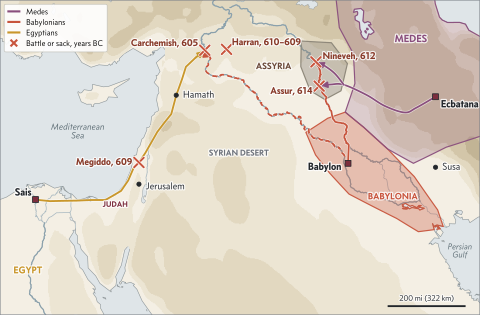
Nineveh never recovered. A prince of the royal family, Ashur-uballit II (ah-shoor-oo-bal-it), escaped west and had himself crowned at Harran, the city of the moon god in northern Mesopotamia. He had one ally left: Egypt. Its pharaoh Psamtik I (sam-tik) had once been an Assyrian vassal, but a weak Assyria now looked safer to him than a strong Babylon. In 610 BC the Babylonians and Medes took Harran anyway. The next spring, in 609 BC, a new pharaoh, Necho II (nee-koh), led an Egyptian army north to win it back.
Necho’s road ran north along the coast and through the pass at Megiddo, and there a small kingdom stood in his way. Judah was ruled by Josiah, the reforming king in whose reign, in 622 BC, a book of the Law was found in the Temple (Chapter 19), and who purged the country of foreign gods. Josiah went out to block the Egyptians, perhaps hoping to see Assyria finished for good. The Second Book of Kings gives the result in a single cold sentence: Necho “slew him at Megiddo, when he had seen him.” Josiah’s son Jehoahaz (jih-hoh-uh-haz) ruled for three months before Necho deposed him, carried him off to Egypt, and made his brother Eliakim king in his place under a new name, Jehoiakim (jih-hoy-uh-kim). Judah had become an Egyptian vassal.
For four years Necho’s army held the crossing of the Euphrates at Carchemish, an old fortress city on the river’s west bank. In 605 BC Nabopolassar, old and ill, gave the Babylonian army to his eldest son, the crown prince Nebuchadnezzar (Chapter 3 told of an earlier king of the same name). The Babylonian Chronicle tells what happened. The prince crossed the river, the Egyptians fell back before him, and he cut their army to pieces, running down the survivors near Hamath, about 140 miles to the south. Egypt, the last ally of the fallen Assyrians, was beaten, and at Carchemish Nebuchadnezzar defeated Pharaoh Necho II.Egypt, an ally of this fallen empire, was defeated by Babylonia at Carchemish. → Assyria••This Babylonian king defeated Pharaoh Necho II at Carchemish. → Nebuchadnezzar II•• The Book of Jeremiah keeps a war poem about the battle, dated “in the fourth year of Jehoiakim”: “Let not the swift flee away, nor the mighty man escape; they shall stumble, and fall toward the north by the river Euphrates.”
A few weeks later Nabopolassar died. The news reached his son in Syria, and Nebuchadnezzar hurried back across the desert and was proclaimed king in Babylon about three weeks afterward. Nebuchadnezzar II ruled BabylonNebuchadnezzar II ruled this city. → Babylon••• for forty-three years, from 605 to 562 BC, the longest reign of his dynasty (Figure 20.2). The Second Book of Kings sums up what Carchemish had decided: “the king of Egypt came not again any more out of his land.” Everything from the border of Egypt to the Euphrates now belonged to Babylon.

Nebuchadnezzar’s Babylon
The end of Judah
Judah now lay between two empires, and its last kings tried to play one against the other. Jehoiakim switched sides and paid tribute to Babylon for three years. Then, in 601 BC, Nebuchadnezzar tried to invade Egypt and was driven back with heavy losses on both sides, and Jehoiakim stopped paying. The punishment came in the winter of 598 BC. Jehoiakim died as the Babylonians marched west, and his eighteen-year-old son Jehoiachin (jih-hoy-uh-kin), whom some books of the Bible call Jeconiah (jek-oh-ny-uh), was king for barely three months. The Second Book of Kings says that he “went out to the king of Babylon,” that is, he surrendered, with his mother and his officials. On March 16, 597 BC, by our calendar, the city opened its gates.

Nebuchadnezzar did not burn Jerusalem that time. He stripped the Temple’s treasures and carried off the king and “all the princes, and all the mighty men of valour, even ten thousand captives, and all the craftsmen and smiths: none remained, save the poorest sort of the people of the land.” A young priest named Ezekiel went with them. In Jehoiachin’s place Nebuchadnezzar set up the young king’s uncle Mattaniah, another son of Josiah, and renamed him Zedekiah (zed-uh-ky-uh). Overlords often renamed their vassal kings, as Necho had done, as a sign of whose servants they were.
Zedekiah was weak, and his court was full of men who believed that Egypt would save them. In 589 BC, with a new pharaoh promising help, he rebelled. The Babylonian army came back and besieged Jerusalem for a year and a half, and hunger did the rest of the work. In the summer the walls were breached. Zedekiah fled by night toward the Jordan, but the Babylonians caught him in the plains of Jericho and brought him north to Riblah (rib-luh), Nebuchadnezzar’s headquarters in Syria. Kings tells what happened there without a wasted word: “they slew the sons of Zedekiah before his eyes, and put out the eyes of Zedekiah, and bound him with fetters of brass, and carried him to Babylon.” The last thing he ever saw was the death of his children.
A month later Nebuzaradan (neb-yoo-zar-uh-dan), the captain of Nebuchadnezzar’s guard, came to Jerusalem to finish the work. “He burnt the house of the Lord, and the king’s house, and all the houses of Jerusalem,” and his soldiers broke down the city walls. So Nebuchadnezzar’s army destroyed the First Temple and deportedThis Babylonian king destroyed Jerusalem’s First Temple and deported people from Judah. → Nebuchadnezzar II•• the leading people of Judah to Babylonia. The Temple Solomon had built had stood for nearly four hundred years (Chapter 17). The Ark of the Covenant is not among the treasures Kings lists as carried off, and what became of it is unknown. Kings dates the burning to the seventh day of the fifth month, Av, and Jeremiah to the tenth. Jewish tradition mourns it on the ninth of Av, the fast of Tisha B’Av, which also remembers the Second Temple’s fall in AD 70 (the Stage).
The exile
How many people went into exile? Jeremiah 52 gives exact numbers for three deportations: 3,023 people in 597 BC, 832 when Jerusalem fell, and 745 more five years later, 4,600 in all. Kings gives 10,000 for 597 alone. The two may count different things, men only or whole households, and historians’ estimates of the total vary widely. Those deported were the kingdom’s leaders, priests, soldiers, and craftsmen, not its whole population. The farmers stayed, and the Babylonians made a Judean noble named Gedaliah (ged-uh-ly-uh) governor of the ruined land, at Mizpah, north of Jerusalem. Not long afterward a member of the royal family named Ishmael, sent by the king of Ammon, murdered him at a meal, and many of the survivors fled to Egypt in fear of Babylon’s revenge (Figure 20.4). Jews still keep a fast for Gedaliah the day after Rosh Hashanah (Chapter 35).

The exiles were not chained in dungeons. Most were settled in farming villages along the canals of Babylonia, some of them near the old city of Nippur, in the south, where they built houses and kept their own elders. One of their villages was called Tel-abib (tel-ay-bib), “mound of the flood,” a name modern Tel Aviv borrowed. About two hundred cuneiform tablets from a village called Al-Yahudu, “the town of Judah,” and its neighbors, dated from 572 BC onward, record Judean families renting land, paying taxes, and borrowing money, and many of their names honor the God of Israel.
The captive king was kept in Babylon itself. German excavators found tablets in Nebuchadnezzar’s palace that list rations of oil for Jehoiachin, king of the land of Judah, and for his five sons. When Nebuchadnezzar died in 562 BC, his son Amel-Marduk (ah-mel-mar-dook), whom the Bible calls Evil-merodach, let Jehoiachin out of prison and gave him a seat at the royal table “all the days of his life.” The Second Book of Kings ends there. Its long history of the kings closes with a captive king eating at Babylon’s table.
The greatest city in the world
Nebuchadnezzar spent the riches of his empire on his capital. Babylon in his reign was probably the largest city in the world, with perhaps more than 200,000 people. The Euphrates ran through its middle, crossed by a bridge on piers, and the inner city was ringed by a double wall and a moat, with an outer wall farther out on the east (Figure 20.5). Eight gates, each named for a god, led in. The king rebuilt palaces, temples, and walls with fired bricks stamped with his name, and his inscriptions talk far more about building than about war. Villagers around the ruins were still building houses with his bricks in the nineteenth century.

At the center stood the Esagila, the temple of Marduk, the god of Babylon (Chapter 3), and beside it, in a walled precinct of its own, rose the ziggurat Etemenanki, the stepped tower that may lie behind the story of the Tower of Babel (Chapter 11). Nabopolassar had begun to rebuild it, and Nebuchadnezzar finished rebuilding Etemenanki,The Etemenanki ziggurat, rebuilt by Nebuchadnezzar II, stood in this city. → Babylon•• the great ziggurat of Babylon.
Most of what we know about the city’s plan comes from one man. Robert Koldewey (kol-duh-vy) was a German architect who had become an archaeologist, and from March 1899 to 1917, on behalf of the German Oriental Society, Koldewey led the excavation of Babylon.Robert Koldewey led an excavation of this city. → Babylon• His team dug nearly every day for eighteen years. Koldewey trained his workmen to trace walls of crumbling, unbaked mud brick, which looks almost exactly like the earth around it, and so he could map a whole city for the first time.
The Hanging Gardens
The Greeks of the last centuries BC made a list of the Seven Wonders of the World, and of the seven only the Great Pyramid still stands (Chapter 8). One wonder was the Hanging Gardens, which Greek writers described as terraces planted with trees and raised so high on vaults that they looked like a green mountain. The writers said that machines lifted water from the Euphrates to the top. Every one of them set the Hanging Gardens in Babylon,The Hanging Gardens were traditionally located in this city. → Babylon••• and they tied them to a king, though not always to the same one.

The oldest surviving account is Berossus’s, written about 280 BC and quoted nearly four centuries later by the Jewish historian Josephus. In William Whiston’s translation of Josephus, Nebuchadnezzar planted “what was called a pensile paradise,” a hanging park, with all sorts of trees, “an exact resemblance of a mountainous country. This he did to please his queen, because she had been brought up in Media, and was fond of a mountainous situation.” Another passage of Berossus names the queen Amytis (am-ih-tis), a daughter of the Median king. So tradition holds that Nebuchadnezzar built the gardens for Amytis,According to tradition, Nebuchadnezzar II built these gardens for Amytis, who missed the greenery of Media. → Hanging Gardens of Babylon•• his Median queen, who missed the green hills of her homeland on the flat Babylonian plain. Her marriage had sealed the alliance against Assyria.
Yet no Babylonian text mentions the gardens. Nebuchadnezzar’s own inscriptions describe his walls, palaces, and temples in loving detail and say nothing of them, and Herodotus, who described Babylon about 450 BC, never mentions them either. Koldewey thought he had found their base in a vaulted building with deep wells in a corner of the Southern Palace, but later scholars decided it was a storehouse, and it was there that Jehoiachin’s ration tablets lay. In 2013 Stephanie Dalley, an Assyriologist at Oxford, argued that the gardens were really those of the Assyrian king Sennacherib (Chapter 18) at Nineveh, which his inscriptions describe with their aqueduct and water-raising screws, and that later Greeks confused the two cities. Of all the Seven Wonders of the Ancient World,These gardens were listed among the Seven Wonders of the Ancient World, although their existence and location are debated. → Hanging Gardens of Babylon•• the Hanging Gardens are the only one whose site has never been found, and whether they existed, and where, is still debated.
The Ishtar Gate
Every spring, at the New Year festival called the Akitu (Chapter 3), the statue of Marduk was carried out of the Esagila and north along a broad paved avenue, out through the city wall to the New Year house in the fields. This avenue was the Processional Way. Its walls were faced with glazed brick, and on each side about sixty lions strode in procession, the animals of the goddess Ishtar (Chapter 2). Where the avenue passed through the inner wall, Nebuchadnezzar built a gate on the Processional WayNebuchadnezzar II built this gate on Babylon’s Processional Way. → Ishtar Gate•• and named it for the same goddess. It was a double gate, a smaller front gate about 50 feet high and a taller one behind, roofed with cedar.
The gate’s surface is what made it famous. Babylon had no building stone, so its builders made beauty out of clay. Each brick was pressed into a mold, fired, painted with a glaze of ground glass and minerals, and fired again until the glaze fused into a hard, shining skin. The bricks were glazed mostly blue,The Ishtar Gate’s glazed bricks are predominantly this color. → blue• a deep color meant to imitate lapis lazuli, the precious blue stone of the Afghan mountains (Figure 20.7). Against the blue, rows of animals stood out in low relief, yellow and brown and white.

The gate itself shows two kinds of animals, in alternating rows. On the blue-glazed gate, bulls and dragonsThis blue-glazed Babylonian gate is decorated with bulls and mušḫuššu dragons. → Ishtar Gate•• marched toward anyone who entered. The bulls are aurochs, the huge wild cattle of the ancient Near East, sacred to Adad, the storm god. The dragons are the mushhushshu, Marduk’s scaly beast with a snake’s head, a lion’s forelegs, and an eagle’s hind feet (Chapter 3); scholars write its name mušḫuššu. Nebuchadnezzar’s dedication, set in the gate’s wall in cuneiform, says that he rebuilt the gates on foundations dug down to the water, faced them with blue brick on which bulls and dragons were shown, and hung doors of cedar plated with bronze (Figure 20.8).


For some twenty-five centuries after Nebuchadnezzar built it, the Ishtar Gate stood in Babylon,The Ishtar Gate stood in this city. → Babylon••• sinking under its own rubble as the city emptied. Koldewey’s team reached it in 1902. Its lower walls still stood, and the glazed upper walls lay around them in tens of thousands of fragments. The fragments were packed in crates and, after the First World War, shipped to Germany, where they were soaked to draw out the salt and pieced together, with new bricks fired to fill the gaps. In 1930 the front gate and part of the Processional Way were reconstructed in Berlin’s Pergamon (pur-guh-mon) Museum,A reconstruction of this Babylonian gate is in Berlin’s Pergamon Museum. → Ishtar Gate•• an archaeological museum on an island in the river Spree, named for a great Greek altar it also holds.
Other lions, bulls, and dragons went to museums from Istanbul to Chicago, and Iraq has asked Germany to return the gate. The Pergamon Museum closed in 2023 for a renovation expected to last many years, and the gate waits inside it. So Berlin is home to the Ishtar Gate,This city is home to the Ishtar Gate. → Berlin• more than two thousand miles from the city that built it, while at Babylon only the unglazed foundation walls stand, with their bulls and dragons in plain brick.
Jeremiah and Lamentations
Among the people inside Jerusalem’s walls during the siege was the man who had spent forty years predicting it. Jeremiah was the son of a priest from Anathoth (an-uh-thoth), a village 3 miles northeast of Jerusalem. According to his book, God called him in 627 or 626 BC, the thirteenth year of Josiah: “Before I formed thee in the belly I knew thee.” Jeremiah answered, “Ah, Lord GOD! behold, I cannot speak: for I am a child.” He was told to speak anyway, and his message hardly changed for four decades. Judah had broken its covenant with God, an enemy from the north would come as God’s punishment, and the only way to survive was to submit to Babylon.
It was the most unpopular message in the kingdom. Standing in the Temple gate, Jeremiah warned the crowds that the Temple would not protect them: “Trust ye not in lying words, saying, The temple of the Lord.” Another time a Temple officer had him beaten and locked in the stocks. He is often called the “weeping prophet,” and his name gave English the word jeremiad, a long, bitter complaint.
In 605 or 604 BC, Jeremiah dictated all his prophecies to his scribe Baruch, who read the scroll aloud in the Temple, and royal officials took it to King Jehoiakim. It was winter, and the king sat in his winter house with a fire burning in a brazier before him. A courtier named Jehudi read it to him, and the king answered with a knife. “When Jehudi had read three or four leaves, he cut it with the penknife, and cast it into the fire that was on the hearth,” until the whole scroll was burned. The king and his courtiers, the book notes, were not afraid. Jeremiah simply dictated the whole scroll again, and added more.

Under Zedekiah, about 594 BC, envoys from Edom, Moab, Ammon, Tyre, and Sidon came to Jerusalem to plan a revolt. Jeremiah walked among them wearing a wooden ox yoke on his neck: they must bow their necks to Babylon. A rival prophet, Hananiah (han-uh-ny-uh), took the yoke off Jeremiah’s neck and broke it, announcing that God would break Babylon’s yoke within two years. Jeremiah’s reply was grim: “Thou hast broken the yokes of wood; but thou shalt make for them yokes of iron.” He told Hananiah that he would die within the year, and the book records that he did, two months later.
To the exiles already in Babylonia Jeremiah sent a letter that shocked them. They were not to wait for a quick return. They should build houses, plant gardens, marry, and “seek the peace of the city whither I have caused you to be carried away captives, and pray unto the Lord for it.” Babylon’s rule, he said, would last seventy years. The advice to pray for the conquerors’ city shaped how Jews lived outside the land of Israel for the next twenty-five centuries.
During the final siege, the king’s officials accused Jeremiah of weakening the soldiers’ will to fight. Zedekiah, afraid of his own court, handed him over, and they let him down on ropes into a cistern, a pit cut in the rock to store rainwater. The King James Version calls it a “dungeon.” “In the dungeon there was no water, but mire: so Jeremiah sunk in the mire.” A palace official, Ebed-melech (ee-bed-mel-ek) the Ethiopian, went to the king and won permission to save him. With thirty men he lowered old rags for Jeremiah to put under his armpits, so the ropes would not cut him, and hauled him out. Even then, with the Babylonians camped outside, Jeremiah bought a field in his village, as a sign that “houses and fields and vineyards shall be possessed again in this land.”
When the city fell, the Babylonians freed him, and he chose to stay with Gedaliah at Mizpah. After Gedaliah’s murder the frightened survivors took him to Egypt against his advice, to Tahpanhes (tah-puhn-heez) on the edge of the Delta, and nothing is known of his death.
Lamentations
Five poems mourning the fallen city make up the Book of Lamentations. Its Hebrew name is Eikhah (ay-khah), “How,” from its first word: “How doth the city sit solitary, that was full of people! how is she become as a widow!” The poems are built with great art. In the first, second, and fourth, each of the twenty-two verses begins with the next letter of the Hebrew alphabet, a form called an acrostic, like Psalm 119 (Chapter 17). The third has sixty-six verses, three for each letter, and the fifth, a prayer, has twenty-two verses but no acrostic, as if the alphabet itself had broken down.
Tradition gives the book to Jeremiah. The Greek translation, the Septuagint, opens it with a note that Jeremiah sat weeping and spoke these words, and Christian Bibles therefore place it beside his book, among the Prophets. In the Hebrew Bible it stands among the Writings, as one of five short scrolls read at holidays, and Jews chant it on Tisha B’Av. Since the nineteenth century most scholars have doubted that Jeremiah wrote it; they think it is the work of one or more poets who saw the ruins soon after the city fell. Its grief is broken once by hope, in the third poem: “They are new every morning: great is thy faithfulness.”
Psalm 137
The exiles’ most famous song is a psalm, one of the 150 poems of the Book of Psalms (Chapter 17). It names no author and no date, but it speaks in the voice of people who had been carried to Babylonia and remembered Jerusalem’s fall. It is the song of the Babylonian captivity, when Jews were exiledJews were exiled to this city during a namesake captivity. → Babylon••• to Babylon and its villages, the years that Jewish tradition calls the Babylonian exile. Here are its first six verses in the King James Version.
The rivers are the Euphrates and the canals that watered the Babylonian plain. Zion was the hill of Jerusalem where the Temple stood, and the name had come to mean the city itself. The “harps” were lyres, the instrument David played, and the “willows” were probably poplars, which grow along the Euphrates. The captors wanted entertainment, songs of the famous temple, and the singers refused. Instead they swore an oath. If they ever forgot Jerusalem, let the right hand that plucked the strings lose its “cunning,” its skill, and let the tongue that sang stick to the roof of the mouth.

The last three verses turn from grief to fury. They call on God to remember the Edomites, Judah’s neighbors to the southeast, who had cheered Jerusalem’s destruction, crying “Rase it, rase it, even to the foundation thereof.” Then the psalm turns on Babylon itself. “O daughter of Babylon, who art to be destroyed; happy shall he be, that rewardeth thee as thou hast served us. Happy shall he be, that taketh and dasheth thy little ones against the stones.” Many readers recoil from the last line, and some churches leave it out when they sing the psalm, but it is part of the text, and it shows how the exiles felt about the city that had destroyed theirs.
Jews have kept the psalm in daily life. In many communities it is said before the grace after meals on weekdays, so that no ordinary meal passes without a thought of Jerusalem. At a Jewish wedding, verses 5 and 6 are often recited just before the groom breaks a glass, a moment of mourning at the height of joy. The chorus of Hebrew slaves in Verdi’s opera Nabucco (nah-boo-koh) (1842), whose title is the Italian form of Nebuchadnezzar, is based on it (Vol. 19, Wagner and Verdi). In 1970 the Jamaican group the Melodians made it a reggae song, “Rivers of Babylon,” a hit again for Boney M. in 1978.
Ezekiel
While Jeremiah warned Jerusalem from inside its walls, another prophet was preaching to the exiles some six hundred miles away as the crow flies. Ezekiel was a priest, the son of a man named Buzi, and he had been carried off to Babylonia with King Jehoiachin in 597 BC. He lived with other exiles in the village of Tel-abib, beside a canal the Bible calls the river Chebar (kee-bar), which Babylonian documents name the Kabaru near Nippur. Ezekiel, a younger contemporary of Jeremiah,This prophet, a contemporary of Jeremiah, received visions by the Chebar River. → Ezekiel•• received his visions by the Chebar River, though neither prophet’s book ever names the other. His name means “God strengthens.” His book carries more exact dates than any other prophet’s, counted in years of Jehoiachin’s exile, from 593 to 571 BC.
In the Hebrew Bible his book follows Jeremiah’s among the Latter Prophets. Christian Bibles move Lamentations and Daniel in among the Prophets (the Stage), and so in the Protestant Old Testament, as in the King James Version, Ezekiel’s book lies between Lamentations and Daniel,This prophet’s book lies between Lamentations and Daniel in the Christian Old Testament. → Ezekiel•• as the third of the Major Prophets, after Isaiah and Jeremiah. Catholic and Orthodox Bibles slip a short deuterocanonical book, Baruch or the Letter of Jeremiah, in just before Ezekiel.
The chariot by the Chebar
In the summer of 593 BC, Ezekiel says, “the heavens were opened, and I saw visions of God.” A whirlwind came out of the north, a great cloud flashing with fire, and out of it came four living creatures, each with four wings and legs that ended in calves’ hooves gleaming like polished bronze. Each creature had four faces. “They four had the face of a man, and the face of a lion, on the right side: and they four had the face of an ox on the left side; they four also had the face of an eagle.” So Ezekiel saw four creatures with four faces,This prophet saw four creatures with faces of a man, lion, ox, and eagle. → Ezekiel•• of a man, a lion, an ox, and an eagle, and they could go in any direction without turning.

Beside each creature stood a wheel that sparkled like beryl, and the wheels were the strangest part of the vision. Their “appearance and their work was as it were a wheel in the middle of a wheel,” and their tall rims “were full of eyes round about.” The wheels rose and moved with the creatures, “for the spirit of the living creature was in the wheels.” Above them stretched a firmament like crystal, and on it a throne like sapphire, and on the throne “the likeness as the appearance of a man,” wrapped in fire and surrounded by a brightness like the rainbow. “This was the appearance of the likeness of the glory of the Lord.” Ezekiel fell on his face (Figure 20.11).
Later in the book Ezekiel calls the four creatures cherubim, and God’s throne rides on them and their wheels like a chariot. Jewish tradition calls it the merkavah (mer-kah-vah), the “chariot,” though the word never appears in Ezekiel. The rabbis allowed it to be taught only to a student wise enough to understand it by himself, and Jewish mystics who meditated on it were called “descenders to the chariot.” Christians gave the four faces to the four evangelists, the writers of the Gospels: the man to Matthew, the lion to Mark, the ox to Luke, and the eagle to John (Chapter 27), and the Book of Revelation sees four similar creatures around God’s throne (Chapter 33).
The glory then speaks to Ezekiel, and its first words are “Son of man, stand upon thy feet.” In Hebrew, ben adam, “son of man,” means simply a human being, a mortal, and it sets the frail prophet against the blazing glory above him. God repeatedly calls Ezekiel “son of man”,This prophet is repeatedly referred to as "son of man." → Ezekiel• more than ninety times in the book. A hand holds out a scroll written on both sides with “lamentations, and mourning, and woe,” and God tells Ezekiel to eat it; in his mouth it tastes “as honey for sweetness.”
The prophet as actor
Ezekiel’s most startling prophecies were performances, a kind of street theater acted out for the exiles. He drew Jerusalem on a clay brick, built tiny siege works around it, and set an iron pan between himself and the city like a wall. Then God told him to lie on his left side for 390 days,This prophet lies on his left side for 390 days and his right for 40 to symbolize Israel and Judah. → Ezekiel•• a day for each year of the sins of Israel, the northern kingdom, and then on his right side for forty days for Judah’s. For more than a year he was a living picture of a city under siege and of the long punishment of both kingdoms.
While he lay there he was to live on siege rations: a coarse bread of wheat, barley, beans, lentils, millet, and spelt, 8 ounces a day, with a little water. God told him to bake it on a fire of dried human dung, in front of everyone, for “even thus shall the children of Israel eat their defiled bread among the Gentiles,” the foreign nations. Ezekiel was a priest, and he protested that he had never in his life eaten anything unclean. God relented, and allowed cow’s dung instead of human,After this prophet objects to baking bread over human excrement, God permits cow dung instead. → Ezekiel•• the common fuel of villages where wood was scarce. The bread would still be the bread of exile.
Next God told him to shave his head and beard with a sharp blade, used as a barber’s razor, and to weigh the hair on scales and divide it into three parts. He burned a third inside his model city, struck a third with the blade all around it, and scattered a third to the wind. So Ezekiel divided his shaved hair into thirds,This prophet divides his shaved hair into thirds, burning one, striking one with a sword, and scattering one. → Ezekiel•• which stood for the fates of Jerusalem’s people: death by plague and famine in the city, death by the sword around it, and scattering among the nations. He was to tie a few hairs in the hem of his robe, a small remnant saved.
In visions Ezekiel was carried back to Jerusalem, where he saw women at the Temple gate weeping for Tammuz, the Mesopotamian god of shepherds (Chapter 2), and men with their backs to the Temple bowing toward the rising sun. Then he watched the glory of God rise from the Temple on the cherubim and leave the city. In his telling, God abandoned Jerusalem before the Babylonians took it. And in the twelfth year of the exile, in the winter of 586 or 585 BC, a survivor reached him with the news: “The city is smitten.”
Shepherds, bones, and Gog
After the news, Ezekiel’s message changed from doom to rebuilding. Kings were often called shepherds of their people (Chapter 17). In his thirty-fourth chapter Ezekiel prophesied against the shepherds of Israel,Ezekiel 34 prophesies against people with this profession in Israel. → shepherd• the bad kings who had brought Judah down: “Woe be to the shepherds of Israel that do feed themselves! should not the shepherds feed the flocks?” They had eaten the fat and worn the wool and let the sheep scatter. In their place God promised to search for his lost sheep himself and to set over them one good shepherd, “my servant David.”

The most famous of all his visions came next. “The hand of the Lord was upon me,” and the spirit set him down “in the midst of the valley which was full of bones,” and the bones were very dry. This is Ezekiel’s vision of the valley of dry bones.This prophet had a vision of the valley of dry bones. → Ezekiel••Ezekiel had a vision of a valley full of these objects. → bones• “Son of man, can these bones live?” God asked, and Ezekiel answered, “O Lord GOD, thou knowest.” He was told to prophesy to the bones, and as he spoke there was a rattling, “and the bones came together, bone to his bone.” Sinews, flesh, and skin covered them, but they did not breathe. Then he called to the breath from the four winds, and the dead stood up on their feet, “an exceeding great army.” In Hebrew one word, ruach, means breath, wind, and spirit, and the vision plays on all three.
God explains the vision himself: “these bones are the whole house of Israel.” The exiles were saying, “Our bones are dried, and our hope is lost,” and the vision answers that God would open their graves and bring them home. Later Jewish and Christian readers also found in it a picture of the resurrection of the dead at the end of time. Then Ezekiel took two sticks, wrote “Judah” on one and “Joseph” on the other for the lost northern kingdom, and joined them in his hand: the two kingdoms would be one again.
After Israel’s return, Ezekiel foresaw one more war. A great enemy called Gog, of the land of MagogThis prophet's accounts describe a war involving Gog and Magog. → Ezekiel•• (may-gog), “the chief prince of Meshech and Tubal,” would come down from the far north “in the latter years.” His vast army, with men of Persia, Ethiopia, and Libya, would attack Israel living safely in its land. God would destroy him with hail, fire, and brimstone. Israel would spend seven months burying the dead and seven years burning the enemy’s weapons for fuel. Genesis’s Table of Nations (Chapter 11) also lists Magog, Meshech, and Tubal among the sons of Japheth, peoples of the far north. In the Book of Revelation, Gog and Magog become the nations Satan gathers for the last battle (Chapter 33).
The book ends with a long vision of a new Temple, measured cubit by cubit by a heavenly guide who shone like bronze and carried a measuring reed. From under its threshold flows a river that grows deeper as it goes until it reaches the Dead Sea and makes its salt water fresh. The new city’s name will be “The Lord is there.”
Daniel
The Book of Daniel is set at the courts of Babylon and Persia, from Nebuchadnezzar’s first years to the reign of Cyrus, and its hero is a young Judean noble carried off to Babylon. Its first six chapters are stories about Daniel and his friends at court; its last six are Daniel’s visions of the future, full of beasts and horns and angels. Part of the book is in Hebrew and part, from the middle of chapter 2 to the end of chapter 7, in Aramaic, the common language of the Babylonian and Persian empires (the Stage). The Hebrew Bible places it among the Writings, not the Prophets, and Jewish tradition does not count Daniel as a prophet. Christian Bibles place the book after Ezekiel and count Daniel among the Major Prophets.
When was it written? Jewish and Christian tradition long held that Daniel himself wrote it in the sixth century BC. Most modern scholars conclude that the visions were written about 164 BC, in Judea, during the persecution by the Seleucid king Antiochus IV (Chapter 26). Their reason is that the visions describe the wars of the Greek kings after Alexander the Great in close and accurate detail down to Antiochus’s desecration of the Temple in 167 BC, but then predict his death wrongly. Porphyry (por-fih-ree), a Greek philosopher and an enemy of Christianity, made this argument about AD 270. Some conservative scholars still defend the traditional date. The court tales are probably older, collected by the author of the visions.
The tales of the court
The book opens with Nebuchadnezzar choosing gifted young nobles from Jerusalem to be taught “the learning and the tongue of the Chaldeans.” Four were from Judah: Daniel, Hananiah, Mishael, and Azariah. They were given Babylonian names, and are better known by these: Daniel became Belteshazzar (bel-tuh-shaz-ur), and his three friends Shadrach (shad-rak), Meshach (mee-shak), and Abednego (uh-bed-nih-goh). Daniel “purposed in his heart that he would not defile himself” with the king’s food and wine, which would not have been prepared according to Jewish law. He asked for a test instead, and Daniel and his companions ate only vegetablesThis prophet and his companions eat only vegetables and water for ten days. → Daniel•• and drank only water for ten days. At the end they looked healthier than the young men who ate the king’s food. The King James Version calls their vegetables “pulse,” an old word for beans and other seeds.
In the second year of his reign Nebuchadnezzar dreamed a dream that terrified him, and he demanded that his wise men tell him both the dream and its meaning, or die. Only Daniel could. The king had seen a huge statueIn this book, a figure dreams of a statue made of four metals with feet of clay. → Book of Daniel•• whose “head was of fine gold, his breast and his arms of silver, his belly and his thighs of brass, His legs of iron, his feet part of iron and part of clay.” A stone “cut out without hands” struck the statue on its feet and shattered the whole thing, and the stone became a mountain that filled the earth. The four metals, Daniel said, were four kingdoms, beginning with Nebuchadnezzar’s own, the head of gold, and the stone was a kingdom God would set up that would never be destroyed. To have “feet of clay” still means to have a hidden weakness at the base of one’s greatness.
Nebuchadnezzar then set up a golden image “whose height was threescore cubits,” about 90 feet, on the plain of Dura, and ordered everyone to bow down to it when they heard “the cornet, flute, harp, sackbut, psaltery, dulcimer, and all kinds of musick.” Shadrach, Meshach, and Abednego refused. Their God could save them from the king’s furnace, they said, “But if not, be it known unto thee, O king, that we will not serve thy gods, nor worship the golden image which thou hast set up.” The furious king had the furnace heated seven times hotter than usual, so hot that the flames killed the soldiers who threw the three men in. Then he looked and saw “four men loose, walking in the midst of the fire, and they have no hurt; and the form of the fourth is like the Son of God.” The three survived the fiery furnaceIn this book, Shadrach, Meshach, and Abednego survive a fiery furnace after refusing to worship a golden statue. → Book of Daniel••• without even the smell of fire on their clothes.
The fourth chapter is written as a letter from Nebuchadnezzar himself to all nations. He had dreamed of a great tree that reached to heaven. Its fruit was plentiful, “and in it was meat for all: the beasts of the field had shadow under it, and the fowls of the heaven dwelt in the boughs thereof, and all flesh was fed of it.”This book describes a king's dream about a tree where 'all flesh was fed of it.' → Book of Daniel• Then “a watcher and an holy one,” an angel, came down from heaven and cried, “Hew down the tree,” leaving only the stump bound with iron and brass. The tree was the king, Daniel said. He would be driven out from among men to eat grass like an ox until “seven times,” probably seven years, had passed and he learned that God rules the kingdoms of men. So, the chapter says, it happened: his hair grew like eagles’ feathers and his nails like birds’ claws, until his reason returned and he praised the God of heaven.
No Babylonian record tells of Nebuchadnezzar going mad. But among the Dead Sea Scrolls is a fragment called the Prayer of Nabonidus, in which Babylon’s last king, Nabonidus, suffers an illness for seven years at Tayma (tay-muh) in Arabia and is cured when he prays to the God of the Jews. The story may first have been told about Nabonidus, who really did leave Babylon and live at Tayma for ten years, and was later moved to the more famous king.
The writing on the wall
The fifth chapter takes place on the last night of Babylon. King Belshazzar (bel-shaz-ur) gave a feast for a thousand of his lords. In his wine he ordered the gold and silver vessels from the Temple of Jerusalem brought in, and he and his wives and guests drank from them while they praised gods of gold and silver, bronze and iron, wood and stone. At that moment “came forth fingers of a man’s hand, and wrote” on the plaster of the palace wall. The king’s face went pale and his knees knocked together. None of his wise men could read the words, until the queen remembered Daniel, now an old man.

The words were “MENE, MENE, TEKEL, UPHARSIN,” and Daniel interpreted the writing on the wall:This prophet interprets “mene, mene, tekel, upharsin,” written on the wall at Belshazzar’s feast. → Daniel••• “MENE; God hath numbered thy kingdom, and finished it. TEKEL; Thou art weighed in the balances, and art found wanting. PERES; Thy kingdom is divided, and given to the Medes and Persians.” Scholars read the words as names of weights, a mina, a shekel, and halves of a mina (UPHARSIN is “and PERES” in the plural), and Daniel reads each as a verb: numbered, weighed, divided. The last also sounds like Paras, Persia. “In that night was Belshazzar the king of the Chaldeans slain. And Darius the Median took the kingdom” (Figure 20.13). “The writing on the wall” still means a sign that disaster is coming.
Here history and the book can be compared. Belshazzar was real, but he was not Nebuchadnezzar’s son, as the book calls him. He was the son of Nabonidus, who took the throne in 556 BC after Nebuchadnezzar’s son and two other kings had come and gone in six years. Nabonidus spent ten years, from 553 to 543 BC, at the oasis of Tayma in Arabia, and left Belshazzar to govern Babylon as his regent, with most of a king’s powers but never a king’s crown. His name, Bel-shar-usur, means “Bel, protect the king.” Babylon fell to Cyrus the Persian in October 539 BC (Chapter 21), apparently without a siege, and Belshazzar’s fate is not recorded.
The den of lions
The book’s next king is “Darius the Median,” who appoints 120 governors with three presidents over them, Daniel first among the three. The jealous officials, unable to find any fault in Daniel, trapped him through his religion. They persuaded the king to sign a decree that for thirty days anyone who prayed to any god or man except the king would be thrown to the lions. It was now “the law of the Medes and Persians, which altereth not,” and not even the king could change it. Daniel went home and, “his windows being open in his chamber toward Jerusalem, he kneeled upon his knees three times a day, and prayed,” as he always had.

The king worked until sunset to save him and could not. Daniel was thrown into the den, a stone was rolled over its mouth and sealed with the king’s ring, and the king spent the night without food or sleep. At dawn he ran to the den and called down, and Daniel answered, “My God hath sent his angel, and hath shut the lions’ mouths.” So the Book of Daniel tells how, after defying the decree that Darius (duh-ry-us) signed, Daniel survived the den of lionsThis book tells of its title prophet surviving a lions’ den. → Book of Daniel•••This prophet survives being thrown into a lions’ den by Darius. → Daniel•••Daniel survives being thrown into a den of these animals after defying a decree associated with Darius. → lions•• unharmed. His accusers were thrown in with their wives and children, and the lions broke all their bones before they reached the bottom of the den.
History knows no “Darius the Mede.” No king ruled Babylon between Nabonidus and Cyrus, and the famous Darius, Darius I, came to the Persian throne seventeen years after Babylon fell (Chapter 21). Most scholars think that the author placed a Median kingdom between Babylon and Persia because his scheme of four kingdoms needed one, and borrowed the name of a later Persian king. Defenders of the book’s history identify him with Cyrus or one of his generals.
The visions
In the seventh chapter, dated to the first year of Belshazzar, Daniel dreamed that “the four winds of the heaven strove upon the great sea. And four great beasts came up from the sea.” The first was a lion with eagle’s wings, the second a bear with three ribs in its mouth, the third a leopard with four wings and four heads. The fourth was a beast “dreadful and terrible, and strong exceedingly,” with great iron teeth and ten horns, among which a little horn grew up with human eyes and “a mouth speaking great things.” Thus Daniel’s vision of four beasts from the seaThis book describes a vision of four beasts coming out of the sea. → Book of Daniel•• repeats the dream of the statue in another key: four empires, the last the worst of all. Most scholars identify them as Babylon, Media, Persia, and the Greek kingdoms, and the little horn as Antiochus IV, the persecutor. Christian tradition long read them as Babylon, Persia, Greece, and Rome.
Then thrones were set, and the judge of the world took his seat. “The Ancient of days did sit, whose garment was white as snow, and the hair of his head like the pure wool.” The title “Ancient of days” describes GodThis book uses the phrase 'Ancient of Days' to describe God. → Book of Daniel•• as the one older than all things, the judge before whom the beasts are tried. The English poet and painter William Blake used it as the title of a famous print of an old man in the sky measuring out the world with a pair of compasses (Vol. 15, The Age of Revolution). “His throne was like the fiery flame, and his wheels as burning fire,”Daniel 7 describes fiery examples of these objects beneath a divine throne. → wheel• and a stream of fire poured out before him, so the throne in Daniel 7 is a chariot like Ezekiel’s, its wheels made of flame. Then “one like the Son of man came with the clouds of heaven” and was given a kingdom that would never pass away. Jewish interpreters have read this figure as Israel or the Messiah, and Christians as Jesus, who in the Gospels calls himself the Son of man.
Two years later, by the river Ulai at Susa, Daniel saw a ram with two horns, one longer than the other, butting to the west, north, and south, until a he-goat came from the west so fast that its feet did not touch the ground. It had a single great horn between its eyes. The goat smashed the ram’s two hornsThis book describes a goat defeating a ram, after which the goat’s great horn breaks into four. → Book of Daniel•• and trampled it, and then “the great horn was broken; and for it came up four notable ones.” The angel Gabriel explains the vision: the ram is the kings of Media and Persia, the goat is the king of Greece, and its great horn the first king. Readers have always seen Alexander the Great, who beat the Persian king in 331 BC and whose empire was split among his generals after his death (Vol. 6, The Greeks).
The last vision ends the book with the end of time. A great time of trouble will come, “and many of them that sleep in the dust of the earth shall awake, some to everlasting life, and some to shame and everlasting contempt.” Scholars count this the Hebrew Bible’s clearest statement that the dead will rise. “And they that be wise shall shine as the brightness of the firmament; and they that turn many to righteousness as the starsThe Book of Daniel compares people who lead others to righteousness with these objects. → stars• for ever and ever.”
Susanna and Bel
The Greek Septuagint has a longer Book of Daniel than the Hebrew, and Catholic and Orthodox Bibles keep its extra stories, which may first have been written in Greek. Besides a prayer and a hymn sung in the furnace, the stories of Susanna and of Bel and the DragonSusanna and the Elders and Bel and the Dragon are deuterocanonical additions to this book. → Book of Daniel•• are deuterocanonical additions, which Protestant Bibles place among the Apocrypha, if they print them at all (the Stage). In the story of Susanna, also called Susanna and the Elders, a virtuous Jewish wife in Babylon is spied on by two elders who are also judges. When she refuses them, they accuse her of adultery with a young man under a tree in her garden, and she is condemned to death. The young Daniel stops the execution and questions the elders separately: under what tree? One says a mastic tree and the other an evergreen oak. In the Greek, Daniel answers each with a pun on his tree, that the angel will “cut” or “saw” him in two, and the lying judges are put to death.
The story of Bel and the Dragon is set at the court of Cyrus. The Babylonians worship a statue of Bel, the title of Marduk (Chapter 3), which is given “twelve great measures of fine flour, and forty sheep, and six vessels of wine” every day. Daniel laughs: Bel is clay inside and brass outside and never ate anything. That night he has ashes scattered on the temple floor, and in the morning the footprints of the priests, their wives, and their children lead to a secret door under the table. Then the Babylonians show him a great dragon that really does eat. Daniel kills it without sword or staff: he makes cakes of pitch, fat, and hairIn Bel and the Dragon, this prophet kills a dragon using cakes of pitch, fat, and hair. → Daniel• and feeds them to the beast, “and so the dragon burst in sunder.” The angry crowd has him thrown to seven lions for six days, and an angel carries the prophet Habakkuk (huh-bak-uk) from Judea by the hair of his head to bring him dinner. On the seventh day the king comes to mourn Daniel and finds him alive among the lions.
Angels
The Hebrew word for an angel, malakh, means simply “messenger,” and so does the Greek angelos, from which the English word comes. In the older books of the Bible, angels are mostly nameless messengers. In the books from the exile and after, heaven grows crowded and ordered. Ezekiel sees strange winged beings carrying God’s throne, and in Daniel angels have names and are put in charge of nations.
Two kinds of heavenly beings in the Bible became classes of angels in later tradition. The cherubim are the winged guardians of Eden, of the Ark, and of Solomon’s Temple (Chapter 11), and Ezekiel calls his four-faced living creatures cherubim; scholars compare them with the winged bulls that guarded Assyrian gateways (Chapter 18). The seraphim, the “burning ones,” surround God’s throne in Isaiah’s vision (Chapter 19), each with six wings: “with twain he covered his face, and with twain he covered his feet, and with twain he did fly.” In Jewish and Christian tradition, cherubim and seraphim are classes of angels,Cherubim and seraphim are classes of these beings. → angels•• and Christians count them the two highest.

A third class came out of Ezekiel’s vision itself, and its name is a plain Hebrew noun. The Hebrew for “wheel” is ofan, plural ophanim (oh-fah-neem). Later Jewish writers made Ezekiel’s wheels a class of angels. One section of the Book of Enoch, a Jewish book of visions written around the time of Jesus, names the ophanim beside the cherubim and seraphim among the beings who never sleep. Maimonides, the great Jewish philosopher and rabbi of the twelfth century (Vol. 9, Cathedrals and Crusades), listed ten ranks of angels in his code of Jewish law, the Mishneh Torah, and put Ezekiel’s “holy living creatures” first and the ophanim second. Their rank goes back to Ezekiel’s vision of God’s chariot by the Chebar, where the wheels within wheels, their rims full of eyes,This prophet’s vision of God’s chariot includes wheels within wheels. → Ezekiel••The ophanim, ranked second among angels by Maimonides, appear as these objects in Ezekiel’s vision. → wheel•A class of these beings appeared as wheels with many eyes on the rims. → angels• were alive, “for the spirit of the living creature was in the wheels.” In the Christian ranking of nine choirs, made about AD 500, the “thrones” just below the cherubim are sometimes identified with them.
Only two angels have names in the Hebrew Bible, and both appear in Daniel: Gabriel, who explains the visions, and Michael. A third, Raphael, guides the hero of the deuterocanonical Book of Tobit. In Daniel’s last vision an angel in linen tells him that he was delayed for twenty-one days: “the prince of the kingdom of Persia withstood me one and twenty days: but, lo, Michael, one of the chief princes, came to help me.” He must now “return to fight with the prince of Persia,” and after him “the prince of Grecia shall come.” Each nation, it seems, has an angelic prince, and their wars in heaven mirror the wars of empires on earth. Here Michael fights the prince of PersiaOne of these beings appears in the book of Daniel and is described as fighting the prince(s) of Persia. → angels• as Israel’s champion, “the great prince which standeth for the children of thy people.”
Both named angels have long careers ahead. Gabriel announces the births of John the Baptist and Jesus in the Gospel of Luke (Chapter 28). Michael, called “the archangel” in the Epistle of Jude, leads the angels against the dragon in the war in heaven in the Book of Revelation (Chapter 33).
What to remember
- Nabopolassar of Babylon and Cyaxares of the Medes destroyed Assyria; Nineveh fell in 612 BC. At Carchemish in 605 BC the crown prince Nebuchadnezzar beat Assyria’s last ally, Pharaoh Necho II, who had killed King Josiah of Judah at Megiddo in 609.
- Nebuchadnezzar II (605–562 BC) took Jerusalem in 597 BC and carried off King Jehoiachin; after Zedekiah’s revolt he burned Solomon’s Temple in 587 or 586 BC and deported Judah’s leaders to Babylonia. Jews mourn the Temples on Tisha B’Av.
- Nebuchadnezzar rebuilt Babylon and finished Etemenanki. Berossus says he built the Hanging Gardens, one of the Seven Wonders, for his Median queen Amytis, but no Babylonian text mentions them. Robert Koldewey excavated the city from 1899 to 1917.
- The Ishtar Gate on the Processional Way is faced with blue-glazed brick, with bulls of Adad and mushhushshu dragons of Marduk; it was rebuilt in the Pergamon Museum, Berlin.
- Jeremiah warned Judah to submit to Babylon. Jehoiakim burned his scroll, Hananiah broke his yoke, and the king’s officials put Jeremiah in a cistern. Lamentations, which tradition gives him, mourns the city in acrostic poems. Psalm 137 is the exiles’ song, “By the rivers of Babylon.”
- Ezekiel, a priest exiled in 597 BC, saw God’s chariot by the Chebar: four creatures with the faces of a man, a lion, an ox, and an eagle, and wheels within wheels full of eyes. He acted out the siege, condemned the shepherds of Israel, saw the valley of dry bones live, and foretold the war of Gog and Magog.
- The Book of Daniel, set in Babylon but dated by most scholars to about 164 BC, tells of the vegetables, the statue with feet of clay, the fiery furnace, the writing on the wall at Belshazzar’s feast, and the lions’ den under “Darius the Mede.” Its visions show four beasts, the Ancient of Days, and the ram and the goat. Susanna and Bel and the Dragon are Greek additions.
- Cherubim, seraphim, and ophanim (Ezekiel’s wheels) became classes of angels. Gabriel and Michael are the only angels named in the Hebrew Bible, both in Daniel, where Michael fights the prince of Persia.
Chapter 21 · 63 clues
Cyrus, Darius, and Xerxes
The old main post office in New York City stands on Eighth Avenue behind a long row of columns. Above them runs a sentence cut in stone: “Neither snow nor rain nor heat nor gloom of night stays these couriers from the swift completion of their appointed rounds.” Many Americans take it for the motto of their mailmen. The building’s architect, William Mitchell Kendall, put it there when the post office went up between 1911 and 1914, and he took it from the Greek historian Herodotus. Herodotus wrote it about 430 BC, and he was not describing mailmen. He was describing the royal riders of the king of Persia.
Those riders galloped in relays across the largest empire the world had yet seen. In 559 BC its founder, Cyrus the Great, was the king of a small hill country in southwestern Iran, and he paid homage to a greater king. Within forty-five years his successors ruled from Egypt and the shores of the Aegean Sea to the river Indus in what is now Pakistan. The empire lasted more than two centuries, until Alexander the Great. Its kings appear in three very different kinds of record. The Bible remembers them as the rulers who let the exiles of Judah go home and rebuild their Temple. Greek writers remember them as the invaders beaten at Marathon and Salamis (sal-uh-mis). And in their own words, carved on cliffs and palace walls, they are kings chosen by their god to keep the whole world in order.
The Medes
Iran is a high plateau, a great bowl of desert and dry grassland ringed by mountains. The Zagros range walls it off from Mesopotamia on the west, and the Alborz (al-borz) runs along its northern edge beside the Caspian Sea. Rain and snow fall on the mountains and hardly at all in the middle, so people lived where streams came down from the heights. The oldest kingdom in this land was Elam, whose capital, Susa, stood in the lowland at the foot of the Zagros, with a highland capital at Anshan farther east (Chapter 1). The Elamites spoke a language related to no other known tongue, and the Elamites lived in what is now IranThis country was home to the Elamites. → Iran•• for more than two thousand years before any Persian king ruled there.
Sometime before 1000 BC new peoples drifted onto the plateau from the steppes of Central Asia. They were herders of horses, cattle, and sheep, and they spoke Iranian languages, cousins of the Sanskrit of India and members of the great Indo-European family that also includes Greek, Latin, and English (Chapter 10). They called themselves arya, and the modern name Iran comes from an old phrase meaning “land of the Aryans.” Two of these peoples matter here. The Medes settled in the northwest, around the city of Ecbatana, which lies under modern Hamadan (ham-uh-dan). The Persians settled in the southwest, in the old highland of Elam around Anshan. The Greeks called that land Persis, and its modern name is Fars, which is why the Persian language is called Farsi. Europeans used the name Persia for the whole country until 1935, when its ruler, Reza Shah, asked foreign governments to call it Iran. That plateau, the country now called Iran, formed the core of the Persian empireThis country formed the core of the Achaemenid Persian Empire. → Iran•• through the whole of its history, and the rest of the empire was its conquests.
The Medes left no writing that has been found. Assyrian kings first mention them in the ninth century BC, as people of the eastern mountains whom they raided for horses, living in fortified villages under many small chiefs. The Greek account of how those chiefs became a kingdom comes from Herodotus. He says that a Mede named Deioces (dee-oh-sih-seez) won such a name for fair judgment that the Medes made him their king, and that he built Ecbatana with seven rings of walls, each rising above the one outside it. The battlements of the five outer rings were painted white, black, crimson, blue, and red, and those of the last two were “overlaid with silver” and with gold, in G. C. Macaulay’s translation. Excavators at Hamadan have found a massive mud-brick wall that may date from the Medes, but nothing like seven painted rings, and the story of Deioces reads like a tale about how kings ought to arise.
The Medes are surer history from 615 BC. In that year their king, Cyaxares, attacked Assyria, and three years later he and Nabopolassar, the king of Babylon, took and burned Nineveh (Chapter 20). The two victors divided the Assyrian empire. Babylon took the river valleys and the west, down to the borders of Egypt. The Medes took the north and the mountains, and pushed west across Anatolia until they met the kingdom of Lydia at the river Halys. For half a century, four great kingdoms shared the Near East: Media, Lydia, Babylonia, and Egypt (Figure 21.1).

The last king of the Medes was Astyages (uh-sty-uh-jeez), the son of Cyaxares, who reigned from 585 to 550 BC. Herodotus tells a folktale about his fall. Astyages dreamed that a vine grew from the womb of his daughter, Mandane (man-day-nee), and spread over all of Asia. His dream interpreters, the priests the Medes called Magi, told him that her child would rule in his place. He had married her to a Persian of good family and “of a quiet disposition,” as Macaulay renders it, named Cambyses (kam-by-seez), who was in truth, as Cyrus’s own inscription shows, a vassal king of Anshan. When Mandane bore a son, Astyages handed the baby to his kinsman Harpagus (har-puh-gus) and told him to kill it.
Harpagus could not bring himself to do it. He gave the child to a royal herdsman to leave on a mountainside, but the herdsman’s wife had just lost a baby of her own, and the couple raised the prince as their son. At ten, Herodotus says, the boy played at being king with the village children. He gave each a post: builders of his palaces, guards, a messenger, and one boy to be “the eye of the king,” his royal spy. When he whipped a nobleman’s son who disobeyed him, he was hauled before Astyages, who recognized his grandson. Astyages let the boy go home to his real parents and took revenge on Harpagus instead, serving him the flesh of his own son at a banquet. Herodotus even explains a rumor that a dog had nursed the baby: the herdsman’s wife was named Spaco, the Median word for a female dog.
Herodotus says the boy grew up to be Cyrus, and that Harpagus waited years to strike back. He smuggled Cyrus a letter sewn inside a hare’s belly, urging the Persians to revolt and promising that the Median nobles would change sides. The Babylonian record of these years is much shorter. A clay tablet known as the Nabonidus Chronicle says that in 550 BC Astyages marched against Cyrus, whom it calls king of Anshan, and that his own army mutinied, seized him, and handed him over to Cyrus. Cyrus took Ecbatana and carried its treasure home to Anshan. The two accounts agree on what matters: Cyrus conquered the Median kingdomThis ruler conquered the Median Empire. → Cyrus the Great•• without a hard fight, because the Medes deserted their king. He spared Astyages, and the Medes became partners in the new state. Greeks often called the whole empire “the Mede” long afterward.
The kings after him counted Cyrus’s family among the Achaemenids, a royal clan of the Persians that took its name from an ancestor called Achaemenes (uh-kee-muh-neez). So historians call the empire Cyrus founded the Achaemenid Empire,This empire was founded by Cyrus the Great. → Achaemenid Empire••• to tell it apart from the later Iranian empires of the Parthians and the Sasanians (the Stage). It began in 550 BC with two peoples, the Persians and the Medes, under one king. Within eleven years it would swallow two of the three other great kingdoms, and within twenty-five years all of them.
Lydia and the first coins
West of the Halys lay Lydia, the richest kingdom of Anatolia. It held the western third of the peninsula, the valleys that run down to the Aegean Sea, and its last king would also rule the Greek cities on the coast, the cities of the Ionian Greeks. Lydia’s capital was Sardis,This kingdom's capital was Sardis. → Lydia•• a city at the foot of Mount Tmolus (tuh-moh-lus), with a citadel on a crag so steep that the Lydians thought it could never be taken. Its people spoke an Indo-European language related to Hittite, and Herodotus says their customs were much like those of the Greeks.
Through the middle of Sardis’s marketplace ran a stream called the Pactolus (pak-toh-lus). In Herodotus’s words, it “brings down gold-dust for them from Tmolos.” The Pactolus carried golden sandA stream in this kingdom's capital was said to carry golden sands. → Lydia• from the mountain, and the grains were not pure gold but electrum, the natural mix of gold and silver met in Chapter 9. Greek myth explained the gold with the story of King Midas, who washed away his golden touch in the Pactolus and left the gold in its sands (Vol. 4, Classical Myth). Archaeologists digging at Sardis since 1958 have found the river’s other secret: a workshop beside the stream where the Lydians refined that gold.


Before coins, people who traded paid in measured goods: barley, cattle, or lumps of silver weighed out on a balance at every sale. A coin is a piece of metal of a fixed weight, stamped with a mark that says who stands behind it, so that it can be counted instead of weighed. The oldest coins anyone has found come from Lydia and the Greek cities along its coast, and the first Lydian coins were made of electrum,This kingdom produced some of the earliest known coins, initially using electrum. → Lydia•• the metal of the Pactolus. They were small, thick lumps, each stamped on one side with a design and on the other with punch marks (Figure 21.2). Many carry the roaring lion’s head that was the mark of the Lydian kings. Herodotus, a century and a half later, believed that the Lydians were “the first of men, so far as we know, who struck and used coin of gold or silver.”
The first Lydian coins are usually dated to the reign of one king. Alyattes (al-ee-at-eez) ruled LydiaThis kingdom was ruled by Alyattes. → Lydia• for more than fifty years, from about 610 to 560 BC by the older dating, or from about 635 to 585 BC by a newer one, and he made Lydia a great power. His tomb still stands outside Sardis, a mound of earth on a base of stone that Herodotus ranked behind only the works of Egypt and Babylon. Alyattes drove back the Cimmerians, nomad raiders from the north, and pushed east toward the Halys, where he ran into the Medes.
For five years Lydians and Medes fought without a winner. Then, Herodotus says, in the sixth year a battle took place “in which it happened, when the fight had begun, that suddenly the day became night.” The moon had passed in front of the sun. Both armies took the darkness as a sign that the gods were angry, laid down their arms, and made peace. The only total eclipse of the sun that fits the place and the time fell on May 28, 585 BC, so the battle stopped by an eclipseThis kingdom's war with the Medes was called off due to a solar eclipse. → Lydia•• is one of the few events of its age that can be dated to the day. Herodotus adds that Thales (thay-leez) of Miletus, the first Greek philosopher, had foretold the eclipse to the year (Vol. 6, The Greeks). Modern astronomers doubt that anyone in 585 BC knew enough to predict an eclipse. The peace, Herodotus says, made the Halys the border between the two kingdoms, and Alyattes’s daughter married Astyages, the crown prince of the Medes, to seal it.

Alyattes’s son Croesus (kree-sus) came to the throne about 560 BC, or in 585 BC by the newer dating. He forced the Greek cities of the Aegean coast to pay him tribute, and Herodotus says he ruled all of Anatolia west of the Halys except Lycia and Cilicia (sih-lish-uh). He also solved the problem with electrum. The mix of gold and silver in a natural nugget varies, and the coins were often debased with extra silver and copper, so nobody could be sure what one was worth. In the workshops by the Pactolus, refiners heated electrum with salt to draw off the silver, leaving gold, and recovered the silver separately. Croesus struck coins of pure goldCroesus introduced examples of these objects made separately from refined gold and silver. → coins• and coins of pure silver, all with the same lion and bull, in fixed weights, and a gold coin was worth a fixed number of silver ones. It was the first money made of two metals at a set rate of exchange, and the Persians copied it after they took Sardis.
The gold made Croesus a byword. English still says “rich as Croesus.” Herodotus tells how the Athenian lawmaker Solon (Vol. 6, The Greeks) visited Sardis and was shown the treasure rooms. Croesus asked him who was the happiest man in the world, expecting to hear his own name. Solon named instead an Athenian citizen who had seen his grandchildren grow up and had died bravely for his city. Call no one happy, Solon told the king in substance, until you see how his life ends. The meeting probably never happened, since Solon’s travels seem to have come before Croesus’s reign, but the story frames everything that followed.
In 547 BC Croesus decided to strike before the new Persian king grew too strong. He sent rich gifts to the oracle of Apollo at Delphi, the most famous shrine of prophecy in Greece (Vol. 4, Classical Myth), and asked whether he should march. The answer, as Herodotus reports it, was that “if he should march against the Persians he should destroy a great empire.” Croesus crossed the Halys. At Pteria (teer-ee-uh), in what is now central Turkey, he fought Cyrus to a draw. Since armies rarely fought in winter, he went home to Sardis and sent his mercenaries away, planning to return in spring with allies from Egypt, Babylon, and Sparta.
Cyrus did not wait for spring. He marched straight after Croesus and appeared outside Sardis before the Lydians knew he was coming. The Lydian horsemen, armed with long spears, were the best cavalry in Asia, and on the plain before the city Cyrus met them with a trick that Herodotus credits to Harpagus. He took the baggage off the camels that carried his army’s food, put riders on them, and sent them ahead of his whole army. Horses fear the sight and smell of camels, and the Lydian horses wheeled and bolted. Xenophon, a Greek writer of the next century, calls this the Battle of Thymbra (thim-bruh), and he too says that camels frightened the Lydian cavalry.An improvised corps of these animals was used to frighten the Lydian cavalry at the Battle of Thymbra. → camels• The Lydians jumped down and fought on foot, but they were driven back inside the walls.
Sardis held out for fourteen days. Then a Persian soldier saw a Lydian climb down the steepest side of the citadel to fetch a fallen helmet and climb back up. Where one man could climb, others could follow, and the city fell, in 547 or 546 BC. Delphi’s answer had come true: Croesus ruled Lydia until Cyrus conquered it,Croesus ruled this kingdom before its conquest by Cyrus the Great. → Lydia•• and the great empire Croesus destroyed was his own. Lydia became a province of Persia, and Sardis its western capital.
What happened to Croesus is a story in three versions. Herodotus says Cyrus had him chained on a great pyre. As the flames were lit, Croesus remembered Solon’s warning and “three times he uttered the name of Solon.” Cyrus asked what he meant, heard the story, and ordered the fire put out, but it had taken hold. Croesus prayed to Apollo, and “after clear sky and calm weather clouds gathered and a storm burst,” and the rain put out the pyre. Cyrus kept Croesus as an adviser. The Greek poet Bacchylides (buh-kil-ih-deez), writing about 468 BC, said instead that Croesus climbed the pyre of his own will and Apollo carried him away to a happy land in the far north. The vase in Figure 21.3 seems to follow that older story, showing a king in command of his own death. The Babylonian chronicle for 547 BC says that Cyrus marched against a land whose name is broken off, and killed its king. If that land was Lydia, Croesus died when Sardis fell.
Cyrus
With Lydia came the Greek cities of the coast. The Ionians had refused when Cyrus asked them to rise against Croesus, and now they offered to submit on the same terms Croesus had given them. Herodotus says Cyrus answered with a fable about a piper who played to the fish in the sea. They would not come out to dance, so he caught them in a net, and when they flopped about on the shore he told them to stop dancing now. Harpagus took the Greek cities one by one, and they were ruled for Persia by Greek tyrants, single rulers who held power with Persian backing. Cyrus himself turned east, and in the next few years his armies conquered the lands of Central Asia as far as the river Jaxartes.
The last great kingdom of Mesopotamia stood between him and the sea. Babylon had grown splendid under Nebuchadnezzar II, who had destroyed Jerusalem in 587 or 586 BC and carried the people of Judah into exile (Chapter 20). Its king now was Nabonidus, a man of the north who had seized the throne in 556 BC. He loved the moon god Sin of Harran more than Babylon’s own god, Marduk, and he spent ten years at the oasis of Tayma in Arabia, leaving his son Belshazzar to govern. While he was away, the great New Year festival, the Akitu, could not be held, because the king had to take Marduk’s hand to begin it (Chapter 3). Many in Babylon, above all its priests, were ready for a change of king.
Cyrus attacked in the autumn of 539 BC, coming down from the Zagros toward the Tigris. Late in September, at Opis (oh-pis), a city on the Tigris near where Baghdad stands now, Cyrus beat Nabonidus’s army at Opis.This ruler conquered Nabonidus’s Babylonian Empire after the Battle of Opis. → Cyrus the Great••• The Babylonian chronicle says that Cyrus took plunder and slaughtered the people there. Then the resistance collapsed. Sippar, upstream from Babylon, surrendered without a fight, and Nabonidus fled. On October 12, 539 BC, the chronicle says, Cyrus’s general Gubaru entered Babylon “without battle.” Cyrus himself rode in on October 29, and green branches were spread on the road before him.
Herodotus heard a more exciting story, and it has lasted longer than the chronicle. In his telling the Babylonians had stored food for many years and laughed at the siege. So Cyrus posted soldiers where the Euphrates flowed into the city and where it flowed out, and led the rest of his men upstream to an old basin dug by a former queen. There he cut a channel and turned the river into the basin, a swamp at the time, until the water in the city sank “to the middle of a man’s thigh.” The Persians waded in along the riverbed. Babylon was so large, Herodotus adds, that people in its center went on dancing at a festival for hours after the outer districts had fallen. That is how, in Herodotus’s account, Cyrus diverted the Euphrates to take Babylon.According to Herodotus, Cyrus diverted the Euphrates to capture this city. → Babylon•• No Babylonian record mentions the trick, and many historians doubt it.

Cyrus told the story his own way, in the language and style of the Babylonians. In March 1879 Hormuzd Rassam, digging at Babylon for the British Museum (Chapter 18), found a barrel-shaped cylinder of clay in the foundations of the Esagila, the great temple of Marduk. Builders had buried it there as a foundation deposit, a message for future kings who repaired the building. Its lines of Akkadian cuneiform are written in Cyrus’s name. The Cyrus Cylinder tells how Babylon fellAfter taking Babylon, this ruler had a namesake cylinder inscribed. → Cyrus the Great•The Cyrus Cylinder records the Persian conquest of this city. → Babylon• to him, as Marduk’s own choice. Nabonidus, it says, had neglected Marduk and oppressed the people, so Marduk searched all lands for a righteous king, called Cyrus by name, and let him enter Babylon without a battle. Then the text speaks in Cyrus’s own voice. He calls himself king of the world, king of Babylon, and king of the four quarters of the earth, and he names his father, Cambyses, and his grandfather, Cyrus, as kings of Anshan.
The most famous lines come near the end. Cyrus says that he returned the images of the gods, which Nabonidus had brought into Babylon, to their own temples in the cities across the Tigris, and that he gathered those cities’ people and returned them to their homes. The towns it names are all in Mesopotamia and western Iran. It does not mention Jews, Judah, or Jerusalem. The last Shah of Iran called the Cylinder the first charter of human rights, and in 1971 his sister gave the United Nations a copy, which it keeps in New York. Most historians call that idea out of place in the sixth century BC. The Cylinder is royal propaganda, written to show Cyrus as a pious king of the old Babylonian kind. But it also shows a real policy: Cyrus won his subjects over by honoring their gods instead of carrying them off, as the Assyrians and Babylonians had often done.
Babylon brought Cyrus everything Nebuchadnezzar had held, from the Persian Gulf to the borders of Egypt, Jerusalem included. Even so, he did not rest. In 530 BC he marched against the Massagetae (muh-saj-ih-tee), horse-riding nomads who lived east of the Caspian Sea, beyond a river Herodotus calls the Araxes. Their ruler was a widowed queen, Tomyris (tom-ih-ris). Herodotus says Cyrus first offered to marry her, and she saw that he wanted her kingdom, not her. So he crossed the river and set a trap. He left a camp full of food and strong wine with only his weakest troops to guard it, the Massagetae seized it and drank themselves to sleep, and the Persians fell on them. Among the prisoners was the queen’s son, who killed himself in shame when he sobered up.
Tomyris then gathered all her forces, and Herodotus judged the battle that followed the fiercest ever fought by foreigners. It ended in a Persian defeat, and Cyrus was killed fighting Tomyris.According to Herodotus, this ruler was killed fighting Tomyris, queen of the Massagetae. → Cyrus the Great• The queen had his body found among the dead, filled a skin with human blood, and pushed his head into it, saying, in Macaulay’s translation, “I will give thee thy fill of blood.” Herodotus admits that many other tales of Cyrus’s death were told, and he chose this one as the most believable. A Greek doctor at the Persian court, Ctesias (tee-see-us), wrote that Cyrus died of a wound after a battle with a different people.
His body, at least, came home. At Pasargadae (puh-sar-guh-dee), the capital he had built in Persis, a stone tomb still stands: a small house with a pitched roof on six great steps, about 36 feet (11 m) high in all. Two centuries later Alexander the Great found it robbed and had it repaired. Cyrus had reigned for twenty-nine years. Persians remembered him as a father, and Greeks who hated Persia admired him. In the next century Xenophon wrote a whole book, the Education of Cyrus, holding him up as the model of a wise king.
The return and the Second Temple

In Babylon there lived, by 539 BC, the children and grandchildren of the people of Judah whom Nebuchadnezzar had carried away. Among them, scholars believe, was the prophet whose words fill chapters 40 to 55 of the book of Isaiah, often called Second Isaiah (Chapter 19). He saw Cyrus coming and hailed him as God’s instrument. In Isaiah 44 God says of Cyrus, in the King James Version, “He is my shepherd, and shall perform all my pleasure: even saying to Jerusalem, Thou shalt be built.” Isaiah 45 opens, “Thus saith the Lord to his anointed, to Cyrus.” The word is mashiach, messiah, the title of Israel’s own kings (Chapter 17). No other foreigner in the Hebrew Bible is given it.
The book of Ezra opens with what it presents as Cyrus’s proclamation, made “in the first year of Cyrus king of Persia,” that is, his first year as king of Babylon, 538 BC. “Thus saith Cyrus king of Persia,” it begins, “The Lord God of heaven hath given me all the kingdoms of the earth; and he hath charged me to build him an house at Jerusalem, which is in Judah.” Any of God’s people who wished could go up and rebuild it, and their neighbors were to help them with silver, gold, and animals. So, the Bible says, Cyrus let the exiled Jews returnAfter conquering Babylon, this ruler allowed exiled Jews to return to their homeland. → Cyrus the Great•• to their homeland after he conquered Babylon. Ezra adds that Cyrus brought out the gold and silver vessels Nebuchadnezzar had taken from the Temple, 5,400 of them, and gave them to Sheshbazzar (shesh-baz-er), “the prince of Judah,” to carry home.
The Hebrew decree, with its talk of the God of heaven, may have been reworded by the book’s later authors. But Ezra 6 quotes a second version in Aramaic, the language of Persian government (the Stage): a memorandum found years later in the royal archive at Ecbatana, giving the Temple’s measurements and ordering the costs paid from the king’s treasury. Its plain, businesslike wording reads like a real Persian government record. And the policy fits what Cyrus did elsewhere, as his Cylinder shows: send gods and peoples home, and win their thanks. The Cylinder does not name the Jews, so Ezra is the only source for this particular return.
Not everyone went back. Ezra 2 lists the families who returned and counts the whole company at “forty and two thousand three hundred and threescore,” with more than seven thousand servants besides. Many more stayed in Babylonia, where they had houses, land, and businesses. A Jewish community lived there for the next 2,500 years, and its scholars would write the Babylonian Talmud (Chapter 34). From this time on, the Jews lived both in their own land and scattered among other nations, a pattern later called the diaspora (Chapter 14).
The returning exiles found Jerusalem in ruins, its walls broken and the site of the Temple bare. Their leaders were Zerubbabel (zuh-rub-uh-bul), a grandson of Judah’s exiled king Jehoiachin, whom the Persians made governor, and Jeshua (jesh-oo-uh), the high priest. They set up an altar first, so the sacrifices could begin again. Then they laid the foundation of a new Temple, with priests blowing trumpets and Levites singing. Ezra 3 describes what happened next. Many of the old men, “who were ancient men, that had seen the first house,” wept with a loud voice, because the new foundation was so much smaller than Solomon’s. Others shouted for joy, “so that the people could not discern the noise of the shout of joy from the noise of the weeping of the people.”
The work soon stopped. The book of Ezra says that “the adversaries of Judah and Benjamin,” the people of the land around Jerusalem, offered to help build. Zerubbabel refused, since they were not of the returned community, and they set out to hinder the work and complained about it to the Persian officials. The site lay half-built for about sixteen years. In 520 BC two prophets, Haggai (hag-eye) and Zechariah (zek-uh-ry-uh), told the people that God would not bless them while they lived in fine houses and his house lay waste. Building began again, and when the governor of the province asked who had allowed it, the search of the archives turned up Cyrus’s decree. Ezra 6 says the house “was finished on the third day of the month Adar, which was in the sixth year of the reign of Darius the king,” that is, in 516 or 515 BC.
That building, rebuilt and greatly enlarged five centuries later by Herod (Chapter 26), was the Second Temple. It stood until the Romans burned it in AD 70 (Chapter 34). Historians call the nearly six centuries it stood the Second Temple period, and in them Judaism took much of the shape it has today.
Two later leaders, both sent from the Persian court, completed the work. The book of Ezra says that Ezra, a priest and “a ready scribe in the law of Moses,” came from Babylon in the seventh year of King Artaxerxes (ar-tuh-zurk-seez), probably Artaxerxes I, in 458 BC. He brought a letter from the king allowing him to teach the Law and to appoint judges. Then, Nehemiah 8 says, all the people gathered in the square before the Water Gate “upon the first day of the seventh month,” the day Jews now keep as Rosh Hashanah (the Stage). Ezra stood on “a pulpit of wood” and read the book of the law of Moses “from the morning until midday.” When he opened the book, all the people stood up. Levites moved among them explaining what was read, and in Jewish tradition that explanation was a translation into Aramaic, the language most of them now spoke. Jewish tradition honors Ezra as a second Moses, who restored the Torah to the people. Ezra 10 also tells how he made the men of Judah send away the foreign wives they had married, a harsh measure meant to keep the small community separate.
Nehemiah, whose own memoir fills much of the book named for him, was a Jew of the court who served Artaxerxes as his cupbearer at Susa, pouring and tasting the king’s wine. In 445 BC, the twentieth year of the king, he heard that Jerusalem’s walls still lay in ruins, and he wept and fasted. The king noticed his sad face and gave him leave, letters, and timber to rebuild them. Nehemiah rode around the broken walls by night and set the people to work, each family on its own stretch. Their enemies were three neighboring officials: Sanballat (san-bal-at), the governor of Samaria, Tobiah the Ammonite, and Geshem the Arab. They laughed at the builders and then threatened to attack. So, Nehemiah 4 says, “every one with one of his hands wrought in the work, and with the other hand held a weapon.” The wall “was finished in the twenty and fifth day of the month Elul, in fifty and two days.” Sanballat was a real man: a letter of 407 BC from the Jews of Elephantine in Egypt names his sons (Chapter 4).
Scholars still argue about whether Ezra came before Nehemiah, as the Bible’s order suggests, or decades after him, under a later Artaxerxes. Either way, by about 400 BC the small Persian province of Judah, which the Persians called Yehud, had what it needed: a rebuilt Temple, a walled city, and a people gathered around the reading of the Torah.
Cambyses in Egypt
Cyrus’s eldest son succeeded him in 530 BC. He bore his grandfather’s name, Cambyses, and Cambyses II ruled the Achaemenid EmpireCambyses II was a ruler of this empire. → Achaemenid Empire•• for eight years. Cyrus had left him one great kingdom still to take. Egypt had been independent since the Assyrians left it more than a century before, ruled by kings of the Twenty-sixth Dynasty from Sais in the Delta (Chapter 4). Its king, Amasis (uh-may-sis), had hired Greek soldiers and allied himself with Croesus, and he died in 526 BC, just as the Persians were getting ready. His son Psamtik III had been king for six months when the Persian army came.
Between Gaza and Egypt lies the desert of northern Sinai, three days with no water. Herodotus says a Greek officer named Phanes (fay-neez) deserted from Egypt to the Persians and advised Cambyses to ask the king of the Arabs for help, and the Arabs met the army in the desert with water carried in camel skins. In 525 BC the two armies met at Pelusium (peh-loo-see-um), the fortress that guarded Egypt’s eastern edge at the easternmost mouth of the Nile. Cambyses defeated Psamtik III at PelusiumThis ruler defeated King Psamtik III at the Battle of Pelusium. → Cambyses II•• in a bloody battle. Years later Herodotus walked over the field, where the bones still lay in two heaps. He reports that the Egyptian skulls were so hard a stone could hardly crack them, while a pebble would go through a Persian’s, because Egyptians shaved their heads in the sun from childhood and Persians wore felt caps.
Psamtik fled up the river to Memphis, and the city fell after a siege. So the Achaemenids conquered Egypt under Cambyses,The Achaemenids conquered Egypt under this ruler. → Cambyses II•• and it became a Persian province for more than a century (Chapter 4). Cambyses took the titles of a pharaoh, and Egyptian lists count him and his successors as the Twenty-seventh Dynasty. An Egyptian official named Udjahorresnet (ooj-uh-hor-res-net), a priest and admiral of the old regime, tells on his statue how he taught Cambyses the ceremonies and composed the king’s Egyptian throne name for him.
Seven centuries later, a Greek writer named Polyaenus (pol-ee-ee-nus) told a different story of the battle in a book of clever tricks of war, which he dedicated to the Roman emperors about AD 163. In his version Cambyses stormed Pelusium by setting before his army the animals the Egyptians held sacred, dogs, sheep, ibises, and above all cats, the animals of the goddess Bastet (Chapter 5). The Egyptians would not shoot for fear of hurting them. It is a good story and a late one, and cats helped Persia defeat EgyptAccording to a later story, Cambyses II used sacred cats to defeat this country. → Egypt• only in that later telling. Herodotus, who knew the battlefield, says nothing of it.

Herodotus heard much worse of Cambyses from Egyptian priests. They told him that the king sent an army against Ethiopia, the land of Kush up the Nile, and it ran out of food in the desert. Another army, of fifty thousand men, marched against the oracle of Amun at the oasis of Siwa (see-wuh), and it vanished in a sandstorm and was never seen again. Then Cambyses came back to Memphis while the city was celebrating the birth of a new Apis, the living bull in which the god Ptah showed himself (Chapter 5). Thinking the Egyptians were rejoicing over his failures, the king had the bull brought in, drew his dagger, aimed at its belly, and struck its thigh. Then he laughed at the priests, in Macaulay’s translation: “O ye wretched creatures, are gods born such as this, with blood and flesh, and sensible of the stroke of iron weapons?” Herodotus says that Cambyses stabbed the Apis bullThis ruler stabbed the Apis Bull. → Cambyses II•• and that it died of the wound, and that from that day the king went mad.
The Egyptians’ own records tell against the story. An Apis did die in 524 BC, in the sixth year of Cambyses, but it was buried with full honors in a granite coffin that, its inscription says, Cambyses himself gave. The stela that marked the burial shows the king kneeling before the bull (Figure 21.6). Historians think the tale came from Egyptian priests who resented Cambyses for cutting the temples’ income.
Cambyses was in Syria, on his way home in 522 BC, when a herald arrived with news that his younger brother Bardiya (bar-dee-yuh) had made himself king. Herodotus says Cambyses had already had that brother secretly killed, so the news could only mean a pretender, and on that point the next king, Darius, agreed. Herodotus says that as Cambyses leaped onto his horse to ride against the rebel, the cap fell off his sword’s sheath and the bare blade cut his thigh, in the very place where he had wounded Apis. He asked the name of the town and was told Agbatana, a Syrian Ecbatana. An oracle had warned him he would die at Ecbatana, and he had thought it meant the Median capital and old age. So, according to Herodotus, the blade that pierced his thigh killed Cambyses:Herodotus claims this ruler was killed after a blade pierced his thigh. → Cambyses II• the wound festered, and he died about twenty days later. Darius’s account says only that Cambyses died a death of his own, words that may mean an accident, an illness, or suicide.
Darius and the empire’s machinery
What happened next is told by the man who came out on top. Darius, a young officer of about twenty-eight, was the son of Hystaspes (hih-stas-peez), a Persian noble of a different branch of the Achaemenid clan, and he had served Cambyses in Egypt. He later wrote that Cambyses had secretly killed his brother Bardiya before going to Egypt. A Magian priest named Gaumata (gow-muh-tuh), who looked like the dead prince, then claimed to be Bardiya, raised a revolt in March 522 BC, and was king by that summer. Everyone feared him, Darius says, because he killed anyone who had known the real Bardiya. Then Darius and six nobles killed GaumataAccording to his own account, this ruler and six other nobles overthrew Gaumata, an impostor claiming to be Bardiya. → Darius I•• at a fortress in Media on September 29, 522 BC, and Darius became king.
Herodotus, who calls Bardiya Smerdis (smur-dis), tells the same story with Greek embroidery. The conspirators unmask the impostor through a noble’s daughter in his harem, who feels in the dark that he has no ears, cut off long ago as a punishment. After the killing the seven agree that the one whose horse neighs first at sunrise will be king, and Darius’s groom, a man named Oebares (ee-bair-eez), plays a trick so that his master’s horse wins. Many modern historians suspect a simpler story under both versions: that the man killed in 522 BC really was Bardiya, Cyrus’s son, and that Darius, from another branch of the family, invented the impostor to justify taking the throne. No one can prove it either way.
Darius’s first year was a war on all sides. Babylon, Media, Elam, Armenia, and even Persia rose against him under kings of their own. He says he fought nineteen battles in a single year and captured nine rebel kings. Then he made sure the world would know. On a cliff at Behistun (bay-his-toon), near the town of Kermanshah (kur-mahn-shah) in western Iran, beside the main road from Babylon to Ecbatana, he had his story carved about 330 feet (100 m) above the ground. Darius created the Behistun InscriptionThis ruler created the Behistun Inscription. → Darius I••• as his own account of how he won the throne.

The relief shows Darius with his foot on the fallen Gaumata and the nine rebel kings roped together by the neck before him (Figure 21.7). Above them floats a winged figure in a ring, which most scholars take for Ahura Mazda (uh-hoor-uh maz-duh), the great god of the Persian kings. Again and again Darius says that he is king by the favor of Ahura Mazda, and he calls each rebel a liar, a servant of the Lie, the power of falsehood (Chapter 22). The text is written three times, in Old Persian, in Elamite, and in Babylonian Akkadian, all in cuneiform. Old Persian had probably never been written before. A passage near the end of the text seems to say that Darius had a new kind of writing made, and no certainly older monument uses the Old Persian script. Copies went out across the empire. Pieces of a Babylonian version have been found at Babylon, and an Aramaic translation on papyrus turned up at Elephantine in Egypt.
Climbing the cliff was hard even in Darius’s time, and the carving was set where no one could easily reach it to deface it. In the 1830s and 1840s a British officer of the East India Company’s army, Henry Rawlinson, hung from ladders and ropes to copy the Old Persian text, and a local boy swung across the rock face to make a paper cast of the Babylonian. Because the three versions say the same thing, the Old Persian, which scholars could work out first, became a key to Babylonian. Behistun did for cuneiform what the Rosetta Stone, a decree carved in Greek and Egyptian, did for hieroglyphs (Chapter 25). The Behistun Inscription stands in western Iran,This country is the site of the Behistun Inscription. → Iran•• and UNESCO named it a World Heritage Site in 2006.
With the rebels beaten, Darius set about holding what he had won. To tie himself to the line of the founder, he married Atossa (uh-toss-uh), the daughter of Cyrus, and other women of Cyrus’s family (Figure 21.8). He also named the dynasty. In the Behistun text Darius traces his family back to Achaemenes, and from his time on the kings were Achaemenids. Cyrus’s own Cylinder, which names his ancestors back to Teispes (ty-speez), never mentions Achaemenes at all. Darius I ruled the Achaemenid EmpireDarius I was a ruler of this empire. → Achaemenid Empire•• for thirty-six years, from 522 to 486 BC, and he is the king who made it last. Later ages called him Darius the Great.

Darius divided the empire into provinces, each ruled by a governor. The Persian title was khshathrapavan, “protector of the kingdom,” and the Greeks turned it into the word satrap (say-trap). Satraps were the provincial governorsThese provincial governors administered the Achaemenid Empire. → satraps•• of the empire, usually Persian nobles and often the king’s own relatives. A satrap collected taxes, judged lawsuits, and raised troops, and in his capital he lived like a little king. Herodotus says Darius set up twenty satrapies, as the provinces were called, and fixed for the first time what each must pay. Babylonia paid a thousand talents of silver a year, about 30 tons, while the Indians along the Indus paid in gold dust. To keep the satraps loyal, Darius made the garrison commanders and royal secretaries in each province report to him separately, and inspectors called “the King’s Eye” and “the King’s Ears” toured the provinces. Herodotus’s boy king had appointed a King’s Eye in his game of make-believe.
Darius also issued coins of his own, borrowing Croesus’s idea. His gold coin, the daric (dair-ik), showed the king running or kneeling with a bow and spear, and Greeks called it “the archer.” A daric was worth about a month’s pay for a soldier, and it was the gold coin of the whole eastern Mediterranean for two centuries.
An empire that stretched across three months of travel needed roads. The most famous was the Royal Road. From Susa, the old Elamite capital that Darius rebuilt as his chief residence, Darius built a Royal Road to Sardis,Darius the Great built a "Royal" one of these structures between Susa and Sardis in the Persian Empire. → roads•• by improving older roads that may go back to the Assyrians. Herodotus, a Greek from the Anatolian coast, describes it in detail. It ran northwest across the Tigris and the upper Euphrates, through Cappadocia (kap-uh-doh-shuh) and over the Halys at a guarded gate, then west to the coast country of Lydia (Figure 21.9). Its western end was the satrap’s capital, so the Royal Road ended at Sardis,This empire was served by a Royal Road that ended at Sardis. → Achaemenid Empire•• only three days’ journey from the Greek port of Ephesus (ef-uh-sus) on the Aegean.

“Everywhere there are royal stages and excellent resting-places,” Herodotus says, “and the whole road runs through country which is inhabited and safe.” He counts 111 stages between Sardis and Susa. The tablets of Persepolis confirm the system: travelers with a sealed document from the king could draw flour, beer, and wine at each station. Later travelers on the roads of Iran and the Near East stopped at inns called caravanserais (kair-uh-van-suh-ryz), from the Persian words for a caravan and a palace. A caravanserai was a walled square around an open courtyard, with rooms for travelers on every side, stalls for their camels and horses, and one gate that was shut at night. They were built about a day’s ride apart, so that the trade routes of Asia became roads lined with caravanserais,These structures were often lined with caravanserais. → roads• busy with merchants until the coming of railways.
Persian kings cared for water as much as for roads. Rivers are few on the plateau, but under the gravel slopes at the foot of the mountains lies water that has soaked down from the snow. To bring it out, Iranians dug qanats (kuh-nahts): tunnels that run from the foot of the hills out under the plain, sloping just enough for the water to run down by its own weight, hidden from the sun that would dry it up. A qanat begins with a deep well dug down into the water-bearing gravel, and the tunnel is dug back toward it from the plain below, with a line of shafts every few dozen yards to haul out the earth and let in air (Figure 21.10). Where the tunnel meets the surface, the water flows into the fields. Long before the Persian empire, irrigation, bringing water to land the rain does not reach (Chapter 4), had made farming possible in Mesopotamia and Egypt. On the plateau, Persians used qanats for irrigation.Ancient Persians used qanats for this process. → irrigation•• Polybius (puh-lib-ee-us), a Greek historian of the second century BC, says the Persian kings let anyone who brought water to dry land farm it for five generations. Thousands of qanats still flow in Iran, and the one at Gonabad, in the east, is said to be about 2,700 years old.

Darius wanted to know the edges of his world. Herodotus says he sent ships down the Indus River, among them Scylax (sky-laks), a Greek sea captain from Caryanda (kair-ee-an-duh) on the coast of Caria, to see where the river reached the sea. Darius sent Scylax to explore the Indus,This ruler sent Scylax of Caryanda to explore the Indus River. → Darius I•• and the ships sailed down it to the ocean and then west along the coasts, arriving “in the thirtieth month” at the head of the Red Sea, near where the Suez Canal begins now. After that voyage, Herodotus says, Darius conquered the Indians of the Indus valley, and in Herodotus’s list of tribute their province pays more than any other. He also finished a canal from the Nile to the Red Sea, which an Egyptian king had begun. Stone slabs he set up along it boast that ships could now sail from Egypt to Persia.
The Persians were a small people ruling many larger ones, and Herodotus thought he knew what held them together. Persian boys, he says, were brought up from five to twenty “in three things only, in riding, in shooting, and in speaking the truth.” Persian boys learned to ride, shoot, and speak the truth,According to Herodotus, boys in this empire were only taught to "ride, shoot, and speak the truth." → Achaemenid Empire• and Herodotus adds that Persians thought lying the most shameful thing a man could do, and owing money the next, because a debtor is driven to lie. It fits Darius’s own words at Behistun, where every rebel is a liar. A Persian noble on horseback with a bow was the empire’s soldier, and his word was meant to be its bond.
Persepolis
Susa was the king’s winter residence, Ecbatana in the mountains his summer one, and Babylon a third royal city. But Darius wanted a royal city in the Persian homeland itself. About 518 BC he began to build at the foot of a mountain on the plain of Marvdasht (marv-dasht), some 25 miles (40 km) from Cyrus’s Pasargadae, in the province now called Fars. The Persians called the place Parsa, simply “Persia,” and the Greeks called it Persepolis, “the city of the Persians.” Darius began building Persepolis’s terrace and palaces:This ruler began the construction of Persepolis. → Darius I•Construction of this city's terrace and palace began under Darius I. → Persepolis• first a stone platform about 1,500 feet long, partly cut from the mountain and partly built up with blocks, up to about 40 feet above the plain. On it his son and grandson went on building, and later kings after them. Today Persepolis lies in Iran,This country is home to the ancient city of Persepolis. → Iran•• about 35 miles from the city of Shiraz (shee-rahz), and UNESCO named it a World Heritage Site in 1979.
Persepolis was not a large city where crowds lived and traded. It was a set of palaces, halls, and treasuries, used above all for ceremonies. The king may have come there in spring for the New Year, Nowruz (noh-rooz), the festival Iranians still keep at the spring equinox, and received the peoples of the empire with their gifts, though no ancient writer says so. It was the heart of the empire’s pride, and so Persepolis was a capital of the empire,Persepolis was this empire's capital. → Achaemenid Empire••This city was a capital of the Achaemenid empire. → Persepolis• its ceremonial capital, although the king’s offices worked mostly from Susa.

A visitor came up from the plain by a broad double staircase, its steps so low and deep that, it is often said, a horse could climb them. At the top stood a gatehouse built by Darius’s son Xerxes (zurk-seez). Its doors were guarded by pairs of colossal stone bulls, two with bulls’ heads at the west and two with bearded men’s heads and wings at the east, like the guardian bulls of Assyrian palaces (Chapter 18). Over them Xerxes carved his name in three languages and called the building the Gate of All Lands. Today it is called the Gate of All Nations at Persepolis,The Gate of All Nations is located at this city. → Persepolis• because the envoys of every people in the empire passed through it (Figure 21.11).
From the gate a path led south to the largest building on the terrace, which Darius began and Xerxes finished. Its Old Persian name was apadana, a word for a great hall of columns, and the Apadana (ah-puh-dah-nuh) of PersepolisThis city is home to the Apadana Palace. → Persepolis• was the audience hall where the king received his subjects. Its roof of cedar beams rested on seventy-two stone columns more than 60 feet (19 m) tall, crowned with pairs of carved animals, most often bulls, kneeling back to back, and fourteen of them stand today. In its foundations archaeologists found two stone boxes, each holding a tablet of gold and a tablet of silver, on which Darius names the bounds of his kingdom: from the Scythians (sith-ee-unz) beyond Sogdia to Kush, and from India to Lydia.
The Apadana’s two grand staircases carry the most famous reliefs of Persepolis. On them twenty-three delegations from the empire’s peoples climb toward the king, each led by a Persian or Median usher holding the leader’s hand. Each people brings what its land is known for: Lydians carry bowls and bracelets of metal, Indians bring baskets of gold dust, and Ethiopians from Kush bring an elephant’s tusk. Two delegations lead camels, and the sculptors took care to show two different kinds (Figure 21.12). The men of Bactria (bak-tree-uh), on the cold plains of what is now northern Afghanistan, lead a sturdy camel with two humps and a shaggy coat. That kind is the Bactrian, the two-humped camel,Bactrian is a variety of these animals. → camels• still named after their country. It can stand the bitter winters of Central Asia, and it later carried the silk caravans across the steppes. The Arabs lead a lean camel with a single hump, an animal built for heat. That is the dromedary (drom-ih-dair-ee), the one-humped camelDromedary is a variety of these animals. → camels• of the hot deserts of Arabia and North Africa, the kind the incense caravans used (Chapter 18).

East of the Apadana, Xerxes began an even larger hall, square, about 230 feet (70 m) on a side, its roof held up by a hundred columns. His son Artaxerxes I finished it. Persepolis’s Hall of a Hundred ColumnsThis city has a Hall of a Hundred Columns. → Persepolis• was the empire’s throne hall. Its doorways are carved with the king on his throne, held up by rows of men from the subject peoples, and with the king stabbing a lion or a monster. Nearby stood the Treasury, where the gifts and tribute were stored, and in it excavators found a pair of great reliefs of the king on his throne receiving an official (Figure 21.13).

The most valuable finds at Persepolis are not carvings but clay. In March 1933 the German archaeologist Ernst Herzfeld (hairts-felt), digging for the Oriental Institute of the University of Chicago, was about to build a roadway to haul rubble through the northeast corner of the fortification wall. He dug first to make sure nothing would be harmed and broke into two small rooms, bricked up in antiquity, filled with tens of thousands of unbaked clay tablets and fragments. They are the Persepolis Fortification Tablets,This city is home to the Fortification Tablets. → Persepolis• the receipts of the royal storehouses between 509 and 493 BC. Most are written in Elamite cuneiform, the old language of the land, which Persian clerks still used for their accounts, and some in Aramaic. They record grain, flour, beer, wine, sheep, and fruit handed out to workers, priests, officials, and travelers on the royal roads. Women appear on them often, beside men. New mothers received extra rations, and the mother of a boy got twice as much as the mother of a girl.
Iran lent the tablets to Chicago in 1935 so scholars could read them, and part of the collection has gone home since. They show the empire from the inside, not as Herodotus imagined it: a vast, orderly machine of clerks, seals, and rations, paying stonecutters from Egypt, Lydia, and Ionia to build the king’s city.
The wars with the Greeks
The empire’s longest troubles began on its smallest frontier. The Greek cities of Ionia, on the Aegean coast that Cyrus had taken from Croesus, were rich ports, and they chafed under the tyrants Persia propped up. Aristagoras (air-is-tag-uh-rus), the ruler of Miletus, the greatest of the Ionian cities, talked the Persians into attacking the island of Naxos and promised them an easy victory. The attack failed, and in 499 BC, afraid that he would lose his city for it, Aristagoras turned against Persia and led the cities into revolt. He sailed to Greece for help. Sparta refused, but Athens sent twenty ships and Eretria (ih-ree-tree-uh), a city on the island of Euboea (yoo-bee-uh), sent five. The Achaemenid Empire suffered the Ionian RevoltThis empire suffered the Ionian Revolt. → Achaemenid Empire• for six years, from 499 to 493 BC (Figure 21.14).

In 498 BC the rebels and their allies marched up to Sardis and burned it, temples and all, though the citadel held. Herodotus says that when Darius heard the news, he asked who the Athenians were, then took his bow and shot an arrow into the sky, praying for vengeance. He ordered a servant to say to him three times whenever his dinner was served: “Master, remember the Athenians.” The revolt was settled at sea. In 494 BC the Ionian fleet met the Persian fleet, mostly Phoenician ships, off the little island of Lade (lay-dee) outside Miletus. Many of the Greek crews from Samos sailed away before the battle, the Persian fleet won, and Darius crushed the revolt after Lade.This ruler suppressed the Ionian Revolt after his fleet’s victory at Lade. → Darius I•• Miletus was stormed, most of its men killed, and its women and children enslaved; the captives were taken to Susa and settled by the Persian Gulf.
Darius then turned to punish Athens and Eretria. In 490 BC a fleet under his commanders Datis and Artaphernes sailed straight across the Aegean, island by island. Eretria held out for six days. On the seventh two of its leading men betrayed it, and Darius’s forces burned EretriaThis ruler's forces burned Eretria. → Darius I• and its temples, in revenge for Sardis. Its people were marched off as captives and settled, Herodotus says, near Susa. The fleet crossed the narrow strait to the plain of Marathon, about 25 miles northeast of Athens, where the Athenians, with help from the small city of Plataea (pluh-tee-uh), charged the Persian line and broke it. Herodotus counts 6,400 Persian dead and 192 Athenians. So Persia’s first invasion of Greece was defeated at Marathon,This empire's first invasion of Greece was defeated at the Battle of Marathon. → Achaemenid Empire• and the fleet sailed home. A later volume tells the battle from the Greek side (Vol. 6, The Greeks). Darius began to gather an army for a second invasion, but Egypt revolted, and he died in 486 BC. He was buried in a tomb cut into the cliff of Naqsh-e Rostam (naksh-eh ros-tahm), a few miles from Persepolis.
His successor was not his eldest son. Herodotus says Darius had three sons by his first wife before he was king, and four by Atossa after. The eldest of the first group, Artobazanes, claimed the throne as the firstborn. But Xerxes argued that he was the son of Atossa, Cyrus’s daughter, and born to a reigning king, and Herodotus adds that “Atossa was all-powerful.” Darius chose Xerxes. Xerxes was the son of DariusThis ruler was the father of Xerxes I. → Darius I••This ruler was the son of Darius the Great. → Xerxes I•• and Atossa, and through her the grandson of Cyrus. In an inscription at Persepolis, Xerxes himself says that Darius had other sons, but that by the will of Ahura Mazda his father made him the greatest after himself. When his father died, Xerxes I ruled the Achaemenid Empire,Xerxes I was a ruler of this empire. → Achaemenid Empire••• from 486 to 465 BC. He spent his first years crushing revolts in Egypt and Babylon, and then he took up his father’s war with Greece.
In 481 BC his army gathered at Sardis. On the way there, Herodotus says, at the town of Celaenae (seh-lee-nee) in Phrygia, a Lydian named Pythius (pith-ee-us), the richest man in the empire after the king, feasted the whole army. He had once given Darius a golden plane tree and a golden vine. Now he offered Xerxes nearly four million gold darics for the war. Xerxes refused the money and gave him seven thousand darics to make his fortune a round four million. In the spring, as the army set out, Pythius asked one favor: that the eldest of his five sons, who were all marching with the army, might stay behind to care for him in his old age. Xerxes flew into a rage at a subject who dared to ask a king for his son. Xerxes had Pythius’s son cut in two,This ruler had Pythius's son cut in two. → Xerxes I• the halves set on either side of the road, and the whole army marched out between them.

To cross from Asia into Europe, the army had to pass the Hellespont (hel-is-pont), the narrow strait now called the Dardanelles, which at Abydos is less than a mile wide. Xerxes’s engineers built two bridges by tying hundreds of ships together side by side and laying a road across them on great cables of flax and papyrus. A storm tore them apart. Xerxes, Herodotus says, ordered the Hellespont to be given three hundred lashes and a pair of fetters thrown into it, and Herodotus had heard that men were sent to brand it as well. As they whipped the water, they were to say: “Thou bitter water, thy master lays upon thee this penalty.” So Xerxes ordered the Hellespont whipped,This ruler ordered the Hellespont to be whipped. → Xerxes I• and he had the builders of the bridges beheaded. New bridges held, and in 480 BC the army took seven days and seven nights to cross them.
Herodotus says that army numbered 1,700,000 foot soldiers. That would have stretched along the roads for hundreds of miles and drunk the rivers dry, as Herodotus himself says some did, and modern estimates of the true number run to a tenth as many or fewer. Its best troops were the king’s guard of ten thousand picked Persian foot soldiers, under a commander named Hydarnes (hy-dar-neez). Herodotus says the royal guard was called the Immortals,This empire's royal bodyguard was called the Immortals. → Achaemenid Empire• because whenever one of them died or fell sick, another man stepped into his place at once, so they were always exactly ten thousand. They marched in splendor, he says, with gold on their armor and carriages for their women, and camels to carry their food.
The army came down through Thessaly to Thermopylae (thur-mop-ih-lee), “the Hot Gates,” a pass between the mountains and the sea named for its hot springs, which was the only road south into central Greece. There Leonidas (lee-on-ih-dus), one of Sparta’s two kings, held the pass with three hundred Spartans and a few thousand other Greeks. For two days the Persians, the Immortals among them, attacked and failed. Then a local man showed Xerxes a mountain path around the pass, and the Immortals marched over it by night. On the third day, surrounded, Leonidas and his men fought to the last. So Xerxes defeated the 300 Spartans at Thermopylae,This ruler defeated the 300 Spartans at Thermopylae. → Xerxes I••• and Greek stories turned their stand into the most famous defeat in history (Vol. 6, The Greeks).
Nothing now stood between Xerxes and Athens. The Athenians had left their city: the women, children, and old men had gone by ship to the island of Salamis and to other towns, and the men of fighting age were on the fleet. A few defenders barricaded themselves on the Acropolis, the rock at the city’s heart where its temples stood. The Persians climbed the rock where it was too steep to be guarded, killed them, and set the temples on fire. So, in September 480 BC, Xerxes sacked Athens,This Persian ruler sacked Athens. → Xerxes I• eighteen years after Sardis had burned. The Athenians later built the Parthenon on the ruins (Vol. 6, The Greeks).
The Greek fleet waited in the narrow strait between Salamis and the mainland. The Athenian leader Themistocles (thuh-mis-tuh-kleez) wanted to fight there, where the larger Persian fleet would have no room to use its numbers, and he sent a secret message to Xerxes that the Greeks were about to flee. Xerxes sent his ships into the strait at dawn and sat on a throne on a hill above the shore, with scribes beside him to write down which captains fought well. He watched his fleet crowd together, foul one another’s oars, and break. Xerxes lost the Battle of Salamis,This ruler lost the Battle of Salamis. → Xerxes I••• and with the fleet gone he could not feed a great army in Greece. He went back to Asia, leaving his general Mardonius (mar-doh-nee-us) with a picked force to finish the war. Eight years later the Athenian poet Aeschylus (es-kih-lus), who had fought at Marathon, put the defeat on the stage in The Persians, set at the Persian court (Vol. 6, The Greeks).
In August 479 BC, at Plataea in central Greece, the largest Greek army ever gathered met Mardonius’s army. The Spartan infantry broke the Persians, Mardonius was killed, and his camp was taken. So the Achaemenid Empire was defeated at Plataea,This empire was defeated at the Battle of Plataea. → Achaemenid Empire•• and on the same day, Greek tradition says, a Greek fleet destroyed what was left of the Persian navy at Mycale (mik-uh-lee), on the coast of Ionia. The Persians never again sent an army into Greece. To Greeks the war proved that free citizens could beat a king’s slaves. To the Persian court it was a failed campaign on the far western edge of an empire that still ran from Egypt to India.
Xerxes went home to his building at Persepolis and to the court life that the book of Esther describes, where he appears under his Hebrew name, Ahasuerus (uh-haz-yoo-eer-us) (Chapter 23). In August 465 BC he was murdered in his palace. His killer was Artabanus (ar-tuh-bay-nus), the commander of the royal bodyguard and the most powerful man at court, who acted with a eunuch of the bedchamber. So Xerxes was assassinated by Artabanus,This ruler was assassinated by Artabanus. → Xerxes I• and the plot also cost the life of Xerxes’s eldest son. His younger son Artaxerxes I, the king of Ezra and Nehemiah, avenged his father, killed Artabanus, and took the throne.
The empire lasted another 135 years. It never conquered Greece, but it learned to win there with gold, paying one Greek city to fight another. In 401 BC a Persian prince, Cyrus the Younger, rebelled against his brother, King Artaxerxes II, and hired more than ten thousand Greek soldiers to march with him to Babylon. At Cunaxa (kyoo-nak-suh), on the Euphrates north of Babylon, the king’s army charged with chariots that carried long curved blades, like the scythes farmers used to mow grain. Persians fixed blades to their chariotsThe Persians attached blades to these objects to create their "scythed" variety. → chariots•• at the axles and under the car, so that a chariot driven into a line of soldiers would cut down anyone in its path. The Greek infantry simply opened ranks and let the scythed chariots rattle through.
The Greeks won their part of the field, but Cyrus the Younger was killed, and the Persians then lured the Greek generals to a parley and murdered them. The soldiers chose new leaders, among them a young Athenian, Xenophon, who had been a student of the philosopher Socrates (Vol. 6, The Greeks). He led them north through the mountains of what is now Kurdistan and the snows of Armenia to the Black Sea, where the men in front, seeing the water at last, shouted “The sea! The sea!” Greeks remembered the soldiers as the Ten Thousand. The Ten Thousand marched out of the empireThe Ten Thousand Greek mercenaries retreated from this empire in the journey recounted in Xenophon’s Anabasis. → Achaemenid Empire• to safety, and Xenophon told their story in the Anabasis (uh-nab-uh-sis), Greek for “the march up-country.” Their escape showed every Greek that a small, disciplined army could cross the Persian empire.
Seventy years later one did. In 334 BC Alexander, the young king of Macedon, crossed the Hellespont with about forty thousand men. He beat the Persians three times, and at the last of these battles, Gaugamela (gaw-guh-mee-luh) in 331 BC, the last king, Darius III, sent scythed chariots against him in vain. Early in 330 BC Alexander’s army looted Persepolis, and that spring its palaces burned, perhaps on purpose in revenge for the burning of Athens, perhaps after a drunken feast. The fire may also have brought down the upper part of the wall that kept the Fortification Tablets hidden. That summer Darius, fleeing east, was murdered by his own satrap of Bactria. Alexander’s own story will be told in Chapter 25 and in a later volume (Vol. 6, The Greeks). Iranian kings would rule an empire again under the Parthians and the Sasanians (Chapter 26, Chapter 22), but the Achaemenid empire, the first to join Egypt, Mesopotamia, Iran, and India under one king, ended with Darius III.
What to remember
- The Medes of Ecbatana and the Persians of the southwest were Iranian peoples. In 550 BC Cyrus, king of Anshan, took the Median kingdom from his grandfather Astyages and founded the Achaemenid Empire, whose core was Iran.
- Lydia, with its capital at Sardis and the gold-bearing Pactolus, made the first coins, of electrum, under Alyattes; Croesus struck coins of pure gold and silver. An eclipse in 585 BC ended Lydia’s war with the Medes.
- Cyrus took Sardis in 547 or 546 BC (with camels at Thymbra) and Babylon in 539 BC, after the battle of Opis. Herodotus says he diverted the Euphrates; the Cyrus Cylinder says he entered in peace and sent gods and peoples home. Herodotus says Queen Tomyris of the Massagetae killed him in 530 BC.
- The book of Ezra says Cyrus let the exiles return. Zerubbabel’s Second Temple was finished in 516 or 515 BC under Darius; Ezra read the Law to the people, and Nehemiah rebuilt Jerusalem’s walls in fifty-two days.
- Cambyses II conquered Egypt at Pelusium in 525 BC. Herodotus says he stabbed the Apis bull and died of a sword wound in the thigh; Egyptian records cast doubt on the first story, and the cats of Pelusium come from Polyaenus, seven centuries later.
- Darius I took the throne after killing Gaumata and told the story at Behistun in three languages. He organized the empire into satrapies, built the Royal Road from Susa to Sardis, sent Scylax down the Indus, and began Persepolis.
- Persepolis has Xerxes’s Gate of All Nations, the Apadana with its reliefs of tribute bearers (including Bactrian and dromedary camels), the Hall of a Hundred Columns, and the Fortification Tablets.
- The Ionian Revolt ended at Lade (494 BC); Darius burned Eretria and lost at Marathon (490 BC). Xerxes whipped the Hellespont, won at Thermopylae, burned Athens, lost at Salamis (480 BC) and Plataea (479 BC), and was murdered by Artabanus in 465 BC. Alexander ended the empire in 330 BC.
Chapter 22 · 49 clues
Zoroaster and the Fire Temples
In a walled garden in Yazd, a city of mud brick on the edge of the great desert of central Iran, a fire burns in a tall metal vessel behind a window of glass. Visitors may look at it but may not go in. The priests who tend it wear white, and a cloth covers their mouths so that their breath will not touch the flame. Its keepers date the fire to AD 470, which would make it a century older than the prophet Muhammad. It has been carried from place to place more than once, but it has never, they say, gone out.
The people who keep it are Zoroastrians. For more than a thousand years some form of their faith was the religion of the kings of Iran, from the Persian empire that let the Jews go home from Babylon (Chapter 21) to the Arab conquest in the seventh century AD. Today there are only about 110,000 to 120,000 of them in the whole world, most in Iran and in India. They do not worship the fire. To them it is the sign of a god, and the prophet who taught them so lived so long ago that no one can say within a thousand years when he was born.
The prophet and the Gathas
In his own language the prophet’s name was Zarathushtra (zar-uh-thoosh-truh). It probably means something like “he who manages camels,” a reminder that he came from a people of herders. Greek writers turned the name into Zoroaster (zor-oh-as-ter), and through Latin that form came into English. German has kept a spelling closer to the original, Zarathustra, which became famous in 1883 when the philosopher Friedrich Nietzsche (nee-chuh) gave it to the hero of his book Thus Spoke Zarathustra (Vol. 19, Wagner and Verdi). The prophet’s followers call their faith the Good Religion, or the worship of Mazda. Outsiders named it after its founder, so that the religion of Zarathustra became Zoroastrianism.This religion is named for a prophet also known as Zarathustra. → Zoroastrianism••
He spoke Avestan (uh-ves-tun), an ancient Iranian language that survives only in the scriptures of his religion, the Avesta (uh-ves-tuh). Avestan is a close cousin of the Sanskrit of India’s oldest scriptures, the hymns of the Rigveda (rig-vay-duh). Both belong to the Indo-European family of languages that Chapter 10 described, and scholars think the ancestors of the Iranians and of the Vedic Indians were once one people with one religion. The younger parts of the Avesta name rivers and lands in eastern Iran and Central Asia, and no part of it names the Medes or the Persians of the west. So scholars place the prophet’s homeland in the east, perhaps near Bactria, in what is now northern Afghanistan. His date is much harder, as the box below shows.
The Iranians of his time worshipped many gods. Like their cousins in India they sorted the gods into two kinds, the ahuras, or “lords,” and the daevas (day-vuz), or “gods.” Priests offered animals in sacrifice and pressed the stems of a sacred plant, haoma (how-muh), to make a drink for the gods and for themselves. The Indians called the same plant soma. No one now knows for certain what plant it was, though Iranian Zoroastrians have long used ephedra, a scrubby desert shrub.
Zarathushtra was born into this world as a priest’s son, of a family called Spitama. Zoroastrian tradition, written down much later, names his father Pourushaspa (poh-roo-shahs-puh), “owner of gray horses,” and his mother Dughdova, “milkmaid.” It says he began his training as a priest at about seven and became a priest at about fifteen. When he was thirty, the story goes, he went down to a river at dawn during a spring festival, to draw water for the haoma rite. On the bank he met a shining being who said his name was Vohu Manah (voh-hoo man-uh), “Good Mind,” and who led him into the presence of the god Ahura Mazda. Tradition holds that his mission began with this visionThis prophet began his mission after a vision of Vohu Manah, the Good Mind. → Zoroaster•• of Vohu Manah, the Good Mind.
Ahura Mazda means “Wise Lord.” Zarathushtra taught that this god alone was uncreated, wise, and wholly good, the maker of everything good in the world. In his own hymns the prophet speaks to the god directly and asks him questions, and his writings praise the Wise LordThis prophet's writings praise the Wise Lord Ahura Mazda. → Zoroaster• on almost every line. He told his hearers to stop offering to the daevas, whom he called false gods, and to worship Ahura Mazda alone.
At the center of his teaching was a choice. Everything in the world, he said, belongs to one of two sides. On one side is asha (ah-shuh), truth and right order, the way things ought to be. On the other is druj (drooj), the Lie, the deceit and disorder that spoil the world. A person who follows asha is ashavan, “truthful”; one who follows the Lie serves the enemy. So, he taught, life is a conflict between asha and druj,This prophet taught that life involves a conflict between asha (truth) and druj (falsehood/lies). → Zoroaster•• and every man and woman must take a side.
Evil, in this teaching, does not come from God at all. It has a source of its own, and the world is the field where the two meet. A religion that sees the world as a battle between two opposed powers, good and evil, is called dualistic. Zoroaster’s is the earliest such religion whose scriptures survive, and Zoroaster founded a dualistic religionThis prophet founded a dualistic Persian religion. → Zoroaster•• that spread among all the Iranian peoples.

At first almost no one listened. His enemies were the princes and priests of the old gods, whom his hymns call kavis and karapans. The breakthrough came, tradition says, when he was about forty-two, at the court of a ruler named Vishtaspa (vish-tahs-puh). The Gathas (gah-thuz) themselves name Vishtaspa as a supporter. The rest is legend, told in books of the ninth and tenth centuries AD and in a Persian poem of the thirteenth. Zoroaster defeated the king’s priests in a debate that lasted three days. They took revenge by slandering him, and the king threw him into prison. Then the king’s favorite horse suddenly lost the use of its legs. From his cell Zoroaster offered to help, and he healed the paralyzed horseThis prophet is said to have converted King Vishtaspa by healing a paralyzed horse. → Zoroaster•• one leg at a time, asking a promise for each leg. Vishtaspa must accept the faith; his son must fight for it; his queen must convert; and the slanderers must be punished. When all four promises were given, the horse stood up, and the king became the prophet’s patron.
The Greek form of Vishtaspa is Hystaspes, which was also the name of the father of Darius I (Chapter 21). Some scholars once thought the two were the same man, which would put the prophet in the sixth century BC. Most now think the prophet’s patron was a chieftain of the east who lived centuries earlier.
Another legend grew around the king’s conversion. In the Shahnameh (shah-nah-meh), the great Persian epic of kings that the poet Ferdowsi (fur-dow-see) finished about AD 1010 (Vol. 37, The House of Islam), Zoroaster planted a cypress from ParadiseThis prophet is said to have planted a sacred cypress with a branch from Paradise. → Zoroaster•• to mark the day. He had carried a branch from Paradise and set it in the ground at Kashmar (kash-mar), in northeastern Iran, and it grew into a tree of enormous size. Later writers tell how that tree, or one believed to be it, met its end. In AD 861 the caliph al-Mutawakkil (al-moo-tuh-wak-kil), the Muslim ruler of an empire governed from Iraq, ordered it cut down and hauled to his capital to make beams for a palace. The local people offered a fortune to save it and were refused. The caliph was murdered before the pieces arrived. Tradition says Zoroaster himself was murdered too, at the age of seventy-seven, struck down by an enemy while he prayed at an altar.
What survives of the prophet’s own words is small. Tradition credits Zoroaster with seventeen hymns,Seventeen hymns called the Gathas are traditionally attributed to the founder of this religion. → Zoroastrianism••• called the Gathas, “songs,” in five groups, each with its own pattern of rhythm, 238 stanzas in all. They are difficult poems, compressed and allusive, and translators still argue over many lines. For more than a thousand years they were not written down at all. Generations of priests learned them by heart, sound for sound, long after anyone spoke their language. They survived because they were recited inside the main act of worship, the Yasna (yahs-nuh), a long liturgy of seventy-two chapters that priests chant before a fire. The seventeen Gathas form the Yasna’s core,This prophet is traditionally credited with the seventeen Gathas, hymns forming the core of the Avesta’s Yasna. → Zoroaster•• spread through chapters 28 to 53, the holiest part of the holiest service.

The Greeks and Romans knew almost nothing of the Gathas. To them Zoroaster was a wise man of the East, the founder of the Magi, a tribe of the Medes who served as priests, and a master of the stars. They used “Persia” for the whole country of the Iranian peoples, after its southwestern province, and so to them Zoroastrianism originated in Persia,This religion originated in Persia. → Zoroastrianism••• though the prophet’s own country lay far to the east of Persia proper. The Roman writer Pliny the Elder made him the inventor of magic, a word that comes from magus, one of the Magi. Europe kept that picture for centuries. When the Italian painter Raphael painted the great thinkers of the ancient world on a wall of the Vatican, he put Zoroaster among them, holding a globe of the stars.
Zoroastrian belief
Zoroaster’s god had an enemy. In the Gathas the prophet tells how, in the beginning, there were two spirits, “twins.” The one, the Bounteous Spirit, chose truth and life; the other chose the Lie and destruction. The second is called Angra Mainyu (ang-ruh mine-yoo), the “Destructive Spirit.” Later Zoroastrians spoke Middle Persian, the language of Iran in the centuries around AD 500, and in it the old names wore down: Ahura Mazda became Ohrmazd (or-muzd) and Angra Mainyu became Ahriman (ah-rih-mun). In this later teaching the fight is between God and his enemy directly. Ohrmazd makes the world good, and Ahriman attacks it with death, disease, and decay. The conflict between Angra Mainyu and Ahura MazdaThis prophet's religion concerns the conflict between the evil spirit Angra Mainyu (Ahriman) and the creator Ahura Mazda. → Zoroaster•• runs through all of history, and the Zoroastrian believer lives inside it.
In Zoroastrian teaching the two sides are not equals, and that matters. Ohrmazd has always existed and always will; he creates. Ahriman creates nothing real. He can only spoil what Ohrmazd has made, and he is doomed to lose. So Ahura Mazda and Angra Mainyu are cosmic oppositesThis religion describes a cosmic opposition between Ahura Mazda and Angra Mainyu. → Zoroastrianism••• only for a time, the span of the world’s history, and not forever. When history ends, the enemy will be destroyed and the good creation made whole. Until then the same opposition runs through ideas as well as beings, and through every ordinary day of a believer’s life. Asha and druj, truth and falsehood,In this religion, asha and druj represent truth and falsehood in constant conflict. → Zoroastrianism•• are always at war, in the world and in each human heart.
In Zoroastrian belief, six holy beings who came from Ahura Mazda stand around him: the Amesha Spentas (ah-meh-shuh spen-tuz). The Amesha Spentas, the Bounteous Immortals,The Amesha Spentas, or “Bounteous Immortals,” embody attributes such as Good Mind and Best Truth in this religion. → Zoroastrianism•• are at once divine beings and good qualities: Good Mind, Best Truth, Desirable Dominion, Holy Devotion, Wholeness, and Immortality. Each one guards one of the good things of creation (Table 22.1). A person who cares for cattle serves Good Mind; one who keeps water clean serves Wholeness. In the Gathas they are mostly qualities a believer should try to acquire. In later teaching they became more like archangels. Below them come many lesser beings worthy of worship, the yazatas (yah-zah-tuz), among them Mithra (mith-ruh), god of contracts and of the light, and Anahita (ah-nuh-hee-tuh), goddess of the waters. The Romans later worshipped a god called Mithras in secret underground shrines, but how much he had to do with the Iranian Mithra is debated (Vol. 4, Classical Myth).
| Avestan name | Meaning | Guards | Opposed by |
|---|---|---|---|
| Vohu Manah | Good Mind | cattle | Evil Mind |
| Asha Vahishta | Best Truth | fire | the Lie |
| Khshathra Vairya | Desirable Dominion | metals | bad rule |
| Spenta Armaiti | Holy Devotion | the earth | arrogance |
| Haurvatat | Wholeness | water | thirst |
| Ameretat | Immortality | plants | hunger |
Against them stand the demons. The old Iranian gods that Zoroaster rejected became the religion’s devils: the word daeva comes from the same root as Sanskrit deva, “god,” and Latin deus. In India the devas stayed gods; in Iran they turned into demons. One of them is Indra, the storm god whom the Mitanni treaty of Chapter 10 called to witness. Another is Aeshma (aysh-muh), “Wrath,” whose name many scholars hear in Asmodeus (az-moh-dee-us), the demon of the deuterocanonical book of Tobit (Chapter 20). The daevas are led by Angra Mainyu,In this religion, demons called daevas are led by Angra Mainyu. → Zoroastrianism• and each great demon fights one of the Amesha Spentas, as Evil Mind fights Good Mind.
Is this one god or two? Zoroastrians themselves say one. Only Ahura Mazda is God, and Ahriman is a destroyer who will be destroyed. In the nineteenth century, when Christian missionaries in India attacked the Parsis (par-seez), the Zoroastrians of India, for believing in two gods, Parsi writers answered by stressing that their faith had always worshipped one. Modern scholars disagree about how to classify it. Some call it monotheistic; others call it dualistic, or a religion with one supreme god and many lesser ones. So Zoroastrianism is often described as monotheistic,This ancient Iranian religion is often described as monotheistic despite its cosmic dualism. → Zoroastrianism•• but with a devil so powerful that the world is his battlefield until the end of time.

The kings of Iran took sides in this battle in stone. The Persian kings of Chapter 21 never named Zoroaster in their inscriptions, but they credited their power to Ahura Mazda, and scholars still debate whether they were Zoroastrians in the later sense. The last Iranian dynasty before Islam left no doubt. In AD 224 Ardashir (ar-duh-sheer), a prince of Persia’s southwestern province, overthrew the Parthians, an Iranian dynasty from the northeast that had ruled since the third century BC (Chapter 26). His family, the Sasanians, the last of the three Iranian dynasties on the timeline of the Stage, ruled Iran until 651 and made Zoroastrianism the religion of the state. On a cliff near Persepolis Ardashir had himself carved receiving his crown from Ahura Mazda, and the god’s horse tramples Ahriman (Figure 22.3).
The books
The Sasanian priests gathered the old oral texts and, about the fifth or sixth century AD, invented an alphabet to write them down. The Zoroastrian scriptures are collected in the Avesta.This religion’s scriptures are collected in the Avesta, including the Yasna, Vendidad, and Visperad. → Zoroastrianism••• Only part of it survives, because much was lost after the fall of the Sasanians. The main surviving books are four. The Yasna is the liturgy with the Gathas at its heart, and the Visperad (vis-peh-rad) adds prayers to it on holy days. The Yashts are hymns to the yazatas. The Vendidad (ven-dih-dad), the “law against the demons,” is a book of rules about purity and impurity. Later Zoroastrians told how Alexander the Great, whom one of their books calls accursed, had burned the scriptures when he took Persia in 330 BC. The Avesta’s own language tells a different story: its oldest hymns kept their ancient sounds because, for most of their history, they were learned by heart and never written at all.
After the Arab conquest the priests wrote their teachings down in Middle Persian, in a script called Pahlavi (pah-luh-vee). Two of these Pahlavi books matter most. The Bundahishn (boon-dah-hishn), “Primal Creation,” was put together mostly in the eighth and ninth centuries AD, and the Bundahishn tells how the world was createdThis religion's creation text is known as the Bundahishn. → Zoroastrianism• and how it will end. Much of the story in the rest of this section comes from it. The Denkard (den-kard), “Acts of the Religion,” compiled by priests in the ninth and tenth centuries, is an encyclopedia in nine books, of which the first two are lost. The Denkard contains the religion’s teachings,The Denkard contains information about this religion. → Zoroastrianism•• its laws, its history, and, in its seventh book, the legends of Zoroaster’s life, the horse among them.
The making of the world
The Bundahishn tells the creation as a war story. For three thousand years Ohrmazd’s world existed only in spirit. Then he made it solid, in a fixed order: the sky, water, the earth, plants, animals, man, and fire. Ahriman, waking, attacked it from below and broke through the sky, bringing death, disease, and the creeping things that Zoroastrians count among his creatures: snakes, scorpions, and flies.
The first animal was a single ox, the “uniquely created” bull, Gavaevodata (gav-ay-voh-dah-tuh). The Bundahishn makes it both male and female, a hermaphrodite, the parent of every useful beast. Ahriman’s attack killed it, but its death was not wasted. From its marrow grew grains and healing herbs. Its seed was carried up to the moon and purified there, and from it came a male and a female of every kind of good animal. So animals were created from the primordial ox,In this religion, animals were created from the body of a primordial hermaphroditic ox named Gavaevodata. → Zoroastrianism• as plants grew from its body.
Opposite the ox, on the other bank of a mythical river, lived Gayomart (gah-yoh-mart), whose name means “living mortal.” Like the ox he was neither simply male nor female, and Ahriman’s attack doomed him too, though he lived on for thirty years. When he died, his seed fell to the ground and was purified by the sun. Forty years later a rhubarb plant grew from it, and from the plant came Mashya and Mashyana, the first man and woman. So Zoroastrians count Gayomart as the first man,Gayomart is the first human in this religion. → Zoroastrianism• the ancestor of every human being, and in Ferdowsi’s Shahnameh he became the first king of the world.
In the middle of the cosmic sea, Vourukasha (voh-roo-kah-shuh), the Bundahishn plants a tree of life called Gaokerena (gow-keh-reh-nuh), the White Haoma. It is said to hold the seeds of all trees, and at the end of time its juice will make the risen dead immortal. Ahriman made a lizard to gnaw its roots, but the tree has guardians, fish called Kar or Kara. Ten Kar fish circle the GaokerenaIn Zoroastrian iconography, ten of these creatures known as Kara protect the Gaokerena "tree of life." → fish• and keep the lizard from ever reaching its roots. Readers of Genesis will think of the tree of life guarded by cherubim (Chapter 11).
The bridge and the end of time

Teaching about death and the end of the world is called eschatology, from the Greek word for “last.” In Zoroastrian eschatology, what happens to a person after death follows from the choice between truth and the Lie. For three nights, the Zoroastrian books say, the soul sits by the head of the body, remembering its life. At dawn on the fourth day it comes to the Chinvat Bridge (chin-vaht), the “bridge of the separator,” which spans the abyss between this world and the next (Figure 22.4). Three yazatas judge the soul there, and one of them, Rashnu, weighs its good and evil deeds on a scale. The dead cross the Chinvat Bridge,In this religion, the dead cross the Chinvat Bridge, guarded by two four-eyed dogs. → Zoroastrianism••• which two four-eyed dogs guard. Zoroastrians take a “four-eyed” dog to be one with a spot above each eye.
For the righteous, the bridge is wide. The soul meets its own conscience, its daena, in the shape of a beautiful girl of fifteen, who says that she is the soul’s good thoughts, words, and deeds and leads it across. For the wicked, the bridge turns on its edge and becomes as narrow as a blade. The soul meets a hideous hag, who is its own evil deeds, and it falls. Souls go to the House of Song or the House of Lies,In this religion, souls are taken to either the House of Song or the House of Lies after death. → Zoroastrianism•• the Zoroastrian heaven and hell. A later book adds a third place, for those whose good and evil exactly balance, where they wait without joy or pain.
Even hell is not forever, for the Zoroastrian books end with an apocalypse, an end of the world: history will stop, and the world will be made new. They call this final renewal frashokereti (frah-shoh-keh-reh-tee), “making wonderful.” A last savior, the Saoshyant (sow-shyahnt), “one who brings benefit,” will be born to a virgin who bathes in a lake where Zoroaster’s own seed has been kept, miraculously, through the ages. The Saoshyant will bring about frashokereti,This religion teaches that the Saoshyant will bring about Frashokereti, the final renovation of the world. → Zoroastrianism••Zoroastrianism envisions this end-time renewal as frashokereti, associated with the Saoshyant. → the apocalypse•• the final renovation of the world. He will raise the dead in their bodies, and good will win the last battle.
Then comes the last judgment, by ordeal. The metal in the mountains will melt and flow over the earth like a river, and every human being, living and risen, must wade through it. The righteous will feel the molten metal as warm milk,According to this religion's eschatology, righteous people will experience a river of molten metal as milk, while the wicked are burned. → Zoroastrianism•• while the wicked will be burned. The later books say the burning purifies them, so that in the end every soul is saved. The river flows down into hell and destroys Ahriman and the last of evil, and the world returns to the perfection it had at its making.
Sacred fire
The Greek historian Herodotus, who wrote about 440 BC, says that the Persians of his day had no temples at all. In G. C. Macaulay’s translation, “Images and temples and altars they do not account it lawful to erect.” They offered sacrifice on mountaintops, he says, to the sky and the sun, to fire and water. On the tombs of the Persian kings cut into the cliff at Naqsh-e Rostam, the king stands before an altar on which a fire burns. Whatever Herodotus was told, fire was already at the center of the kings’ worship. Some time after Herodotus, perhaps under the later Persian kings, the Iranians began to build houses for fires that were never allowed to go out.
Fire matters to Zoroastrians because they hold it the purest of Ohrmazd’s creations and the closest to his light. It belongs to Asha Vahishta, Best Truth, and a Zoroastrian prays facing a source of light: the sun by day, a lamp or a fire at night. In Avestan, fire is called atarThis substance is known as atar in Zoroastrianism. → fire•• (ah-tar), a word that lives on in modern Persian as atash, “fire.” The word names a yazata too, a being worthy of worship whom the Avesta calls the son of Ahura Mazda, and to whom one of the prayers of the Khordeh (khor-deh) Avesta, the “Little Avesta” of daily prayers, is addressed. Atar is the sacred fireĀtar is sacred fire in this religion. → Zoroastrianism• itself, to believers the visible presence of the divine on earth. Zoroastrians insist that they do not worship the fire, any more than Christians worship a cross. They pray before it, as before the purest thing on earth.
A building made to house a sacred fire is called a fire temple. Only priests may enter the inner room where the fire burns on its altar under a dome, and the people pray from outside, facing it. Zoroastrians worship at fire temples,Followers of this religion worship at fire temples. → Zoroastrianism••• which are fullest at the New Year, Nowruz, and at the seasonal festivals. There are three grades of fire, from the simplest, which two priests can consecrate in a few hours by reciting the whole Yasna, to the most solemn. Zoroastrian temples maintain sacred firesZoroastrian temples maintain sacred examples of this substance. → fire••• day and night, and the priests feed them dry wood and incense at fixed times through the day.
The highest grade is the Atash Behram (ah-tahsh beh-rahm), the “Fire of Victory.” Making one is the work of a large team of priests for up to a year. The Atash Behram is assembled from sixteen firesThe Zoroastrian Atash Behram is a sacred example of this substance assembled from sixteen sources. → fire•• of different kinds. Fire is gathered from the hearths of a king, a soldier, a shepherd, and an ordinary Zoroastrian, from the furnaces of a potter, a brickmaker, a goldsmith, a baker, and a smith, from a tree set ablaze by lightning, and even from a burning corpse. Each fire is purified again and again before it joins the others, so that every fire in the world is rescued and returned to its pure state. Only nine Atash Behrams burn today, one in Yazd (Figure 22.6) and eight in India.

Under the Sasanians three fires were greater than all the rest, and each belonged to one class of society, as a Pahlavi text of the ninth century says (Figure 22.5). The first was Adur Farnbag (farn-bahg), in Pars, the province of the Persians. Adur Farnbag was the fire of the priests,The Zoroastrian Farnbag is a sacred example of this phenomenon associated with priests. → fire•• the first of the classes.
The second, Adur Gushnasp (goosh-nasp), burned at Shiz, in the mountains of Azerbaijan in the northwest, in a walled temple beside a deep lake. The Sasanian kings belonged to the warrior class themselves, and they made this fire their own. Adur Gushnasp was the fire of the warriors,The Zoroastrian Gushnasp is a sacred example of this phenomenon associated with warriors. → fire•• and its temple is the only one of the three that archaeologists have found.
The third, Adur Burzen-Mihr (boor-zen-meer), burned on a mountain in Parthia, in the northeast. It was founded perhaps as early as the fourth century BC, and it remained a great place of pilgrimage. Adur Burzen-Mihr was the fire of the farmers,The Zoroastrian Burzen-Mihr is a sacred example of this phenomenon associated with farmers. → fire•• who were counted the humblest of the classes, and so its name always came third.
None of the three great fires is known to burn today. Adur Gushnasp, the one whose fate is best known, was probably put out about three and a half centuries after the Arab conquest. The Arabs defeated the Sasanian armies in the 630s and 640s, and the last king, Yazdegerd III (yaz-deh-gurd), was killed in 651 (Vol. 37, The House of Islam). Over the next three centuries most Iranians became Muslims. Some Zoroastrians sailed for India. The Parsis’ own history, written down centuries later, says that their ancestors left Iran to keep their faith and landed at Sanjan, on the coast of Gujarat, and consecrated a Fire of Victory there with sacred implements brought from Iran. That fire has burned at Udvada (ood-vah-duh) since the 1740s, and the Parsis call it the Iranshah, the “King of Iran.”

Fire has a partner. Water is the other pure creation, and Zoroastrians guard both with the same care. Nothing dead or dirty may touch either one. Fire and water purify,This substance is used in Zoroastrian purification rituals along with its counterpart, water. → fire•• and purification rites with water and fire are the backbone of Zoroastrian ritual life. A person made impure, by touching a corpse for example, must be washed in a long ceremony before he may again approach a sacred fire.
The great daily service shows both elements at work. In the morning, between sunrise and noon, two priests perform the Yasna before a fire. They pound haoma twigs with pomegranate leaves, water, and milk to make a sacred drink, and they recite all seventy-two chapters of the liturgy. The yasna text is recited during services,During services, adherents of this religion recite the yasna text. → Zoroastrianism•• and with it the Gathas at its center, in the words the prophet’s followers have memorized for well over two thousand years.
At the end the priest carries the mortar with the sacred drink out of the temple to a well or a stream and pours it in three offerings, calling on Anahita, the goddess of the waters. This rite is the Ab-Zohr (ahb-zohr), “offering to the water.” Zoroastrians hold that people harm the water every day by using it, and the offering pays it back. The Ab-Zohr offers haoma to the water,The Zoroastrian Ab-Zohr ritual makes a haoma offering to this substance. → water•• to strengthen and purify it, and the last of the liquid is poured on the roots of fruit trees.
Zoroastrian practice

A Zoroastrian child is not born into the faith in full. Somewhere between the ages of seven and fifteen, a boy or girl is received into it at a ceremony the Parsis call the Navjote (nahv-joht) and Iranian Zoroastrians call “putting on the sudreh.” The child bathes, recites the prayers learned for the day, and declares the faith before a priest and a fire. At the Navjote the child receives the sudreh (sood-ray) and the kushtiDuring this religion’s Navjote initiation, participants receive a sudreh shirt and a kushti cord. → Zoroastrianism•• (koosh-tee). The sudreh is a white undershirt with a small pocket at the front, meant to collect the wearer’s good deeds. The kushti is a cord woven from seventy-two woolen threads, one for each chapter of the Yasna. It is wound three times around the waist and knotted in front and behind. The child will wear both for life, and several times a day will untie and retie the kushti while saying the prayers.
The religion asks its followers to enjoy the good world that Ohrmazd made, not to escape it. A Zoroastrian is meant to marry, raise children, farm, eat, and work, because a strong and healthy body fights evil better than a weak one. Zoroastrianism rejects fasting,Zoroastrianism traditionally rejects this practice because it weakens the body. → fasting• because it weakens the body that must do good. The Vendidad says so plainly. In the French scholar James Darmesteter’s translation of 1895 it tells the faithful to learn by heart that “by eating every material creature lives, by not eating it dies away.”
In Zoroastrian belief, death is Ahriman’s work, and a corpse is the most impure thing on earth. The moment the soul leaves, the books say, a demon called Nasu (nah-soo) rushes on the body in the shape of a fly and contaminates everything it touches. Before anyone handles the body, a dog is brought to look at it, best of all a “four-eyed” dog, because the demon flees from a dog’s gaze. Then the body must be disposed of without polluting any of the good creations. Burying it would pollute the earth; sinking it in a river would pollute the water.
Burning it would be worst of all. Zoroastrianism forbids cremation,Zoroastrianism traditionally forbids this treatment of the dead because it would pollute fire. → cremation• because the dead body would pollute the holy fire. Herodotus tells how Cambyses, the Persian conqueror of Egypt (Chapter 21), had the mummy of the pharaoh Amasis, who had died just before the invasion, dragged from its tomb and burned. In Macaulay’s translation it was “a thing which was not permitted by religion: for the Persians hold fire to be a god.”


The answer was exposure. Herodotus heard that a Persian’s body was not buried until birds or dogs had torn it, and he knew that the Magi did this openly. Later Zoroastrians built round stone towers on hilltops far from any town, called dakhmas (dakh-muz); English writers named them towers of silence. A Zoroastrian funeral ended at the tower. Inside, men’s bodies were laid in an outer ring, women’s in a middle ring, and children’s nearest the center. Zoroastrians exposed their dead on towers of silenceAdherents of this religion traditionally expose their dead to scavenging birds on circular dakhmas, or Towers of Silence. → Zoroastrianism•••Zoroastrians traditionally expose these remains in Towers of Silence for scavenging birds. → corpses••Zoroastrians use Towers of Silence to avoid contaminating this substance with corpses. → fire•Zoroastrian rites for these events traditionally expose bodies to scavengers in Towers of Silence. → funerals•• to the vultures, so that no corpse would defile the earth, water, or fire. The birds stripped a body quickly. When the bones had dried and bleached in the sun, which could take a year, they were swept into a pit at the center of the tower, where lime slowly dissolved them (Figure 22.8).
In Iran the practice ended in the twentieth century. As the towns grew out toward the towers, Zoroastrians turned to burial in graves lined with cement and stone, and the city of Yazd asked them to close the last towers in 1974. In India the Parsis of Mumbai, the city once called Bombay, still use theirs. But since the 1990s more than 97 percent of India’s vultures have died, poisoned by a drug given to cattle, and the community has had to look for other ways (Vol. 39, India).

Iranian Zoroastrians have holy places as well as fire temples. A shrine of this kind is called a pir (peer), and the most honored are six mountain shrines around Yazd. Pilgrimage is made to the six pirs,In Zoroastrianism, this practice is done in six sites known as pirs. → pilgrimage• where pilgrims used to stay for three days of prayer and feasting. The holiest is Pir-e Sabz, the “Green Shrine,” better known as Chak Chak, “drip, drip,” after the spring that drips from its cliff. According to the story told there, when the Arab armies conquered Iran, a daughter of Yazdegerd III, the last king, fled into these mountains. Cornered, she prayed to Ahura Mazda, and the mountain opened and hid her. The dripping water is her tears. Every year in mid-June thousands of Zoroastrians from Iran, India, and farther away make the pilgrimage to Chak Chak.

Yazd and Kerman, on the edge of the desert, became the strongholds of the Iranian Zoroastrians after the conquest, because they were far from the centers of Muslim power. For centuries they lived there as a poor and often persecuted minority, and their numbers fell (Figure 22.10). Yet Iran is still the home of Zoroastrianism,This country is the home of Zoroastrianism. → Iran•• the heart of the Iranian world in which its prophet preached, the land where its scriptures were first written down, and the keeper of its oldest fire.
The religion was never a single church with one teaching. Under the Sasanians many Zoroastrians followed a teaching about Zurvan (zoor-vahn), whose name means “Time.” Armenian and Syriac (seer-ee-ak) Christian writers, from the fifth century on, recorded its myth. In the beginning, they said, Zurvan was alone. He offered sacrifice for a thousand years so that he might have a son, and then he doubted whether the sacrifice would work. At that moment he conceived twins: Ohrmazd from his sacrifice and Ahriman from his doubt. Zurvan promised to make the firstborn king, so Ahriman tore his way out of the womb to be born first. Zurvan kept his word, but limited Ahriman’s reign to nine thousand years, after which Ohrmazd would rule forever. A sect of Zoroastrians worshipped ZurvanA sect of this religion worshipped Zurvan. → Zoroastrianism•• as the father of both, and the priests who wrote the Pahlavi books treated the teaching as an error. It vanished after the tenth century.
Mani and the religion of light
In the first years of Sasanian Iran another prophet founded a religion that spread from Roman Africa to the coast of China. Mani (mah-nee) was born in April 216, while the Parthians still ruled, near their royal city of Ctesiphon (tes-ih-fon) on the Tigris. His father had joined a strict Jewish-Christian sect that baptized its members again and again, ate no meat, and drank no wine, and he took the four-year-old boy into it. At twelve, and again at twenty-four, Mani said, he had visions of a heavenly being he called his Twin, who told him to leave the sect and preach a new message. He traveled to India, where he met Buddhists, and came back to the court of King Shapur (shah-poor) I, Ardashir’s son. Shapur remained a Zoroastrian but let Mani preach throughout the empire, and Mani wrote a book of his teachings in Persian for him.
Mani taught that the Buddha, Zoroaster, and Jesus had each brought part of the truth to one land, and that their followers had corrupted it. He, the last of the line, would bring the whole truth to the whole world, and he wrote it down himself so that it could not be lost. Zoroastrian priests saw a dangerous rival. After Shapur’s death the chief priest Kartir (kar-teer) turned Shapur’s son, King Bahram I, against him, and Mani was thrown into prison at Gundeshapur (goon-deh-shah-poor). He died there in 274 or 277, and his followers called his death his crucifixion.
Mani joined Zoroaster’s dualism to Christian and Buddhist teaching to make a faith called Manichaeism (man-ih-kee-iz-um). In the beginning, he taught, there were two worlds, eternal and separate. The Father of Greatness ruled the World of Light,The Father of Greatness rules a world of this phenomenon in Manichaeism. → light•• peaceful and good; the King of Darkness ruled the World of Darkness below it. Darkness grew greedy, attacked the light, and swallowed part of it, and our world was made from the mixture. Every plant, animal, and person holds sparks of light trapped in dark matter, and the purpose of religion is to set them free. The sun and the moon are ships that carry the freed light home.

Here Mani and Zoroaster part company. For a Zoroastrian, the material world is Ohrmazd’s good creation, to be enjoyed and defended. For Mani, matter was the prison of the light. His most devoted followers, the Elect, wore white, stayed unmarried, ate no meat, and drank no wine. They would not even pick fruit or reap grain, since that hurt the light inside the plants. Ordinary believers, the Hearers, did that work for them, a sin in Mani’s teaching, and fed them (Figure 22.11).

The religion spread fast and far. In the Roman Empire the young Augustine, later a bishop in North Africa and one of the greatest Christian thinkers, was a Hearer for about nine years before he became a Christian and Mani’s fiercest critic (Vol. 7, The Romans). Christian emperors and Zoroastrian kings both hunted Manichaeans (man-ih-kee-unz). In the east the faith did better. The khagan, or emperor, of the Uyghurs (wee-gurz), a Turkic people whose empire stretched across the steppes north of China, made it his state religion in 763. In China it outlived a ban by the first Ming emperor in 1370 and lingered in Fujian, in the guise of Buddhism, for two centuries more. A statue of Mani still sits in a hillside temple there (Figure 22.12). The religion itself has died out, but its name lives on in English: to call a view “Manichaean” is to say that it sees the world as a war of pure light against pure darkness.
What to remember
- Zoroaster (Zarathushtra) lived in the east of the Iranian world sometime between about 1500 and 500 BC. Tradition says his mission began with a vision of Vohu Manah, the Good Mind, and that he won King Vishtaspa by healing his paralyzed horse.
- His seventeen hymns, the Gathas, form the core of the Yasna, the main liturgy of the Avesta. Its other books include the Visperad, the Yashts, and the Vendidad; the Pahlavi books include the Bundahishn and the Denkard.
- Ahura Mazda (Ohrmazd), the Wise Lord, is opposed by Angra Mainyu (Ahriman), as asha, truth, is opposed by druj, the Lie. The Amesha Spentas stand with God; the daevas serve Ahriman.
- In the Bundahishn, the first animal was the primordial ox and the first man was Gayomart; at the world’s end the Saoshyant raises the dead, all pass through molten metal, and frashokereti makes the world new.
- The dead cross the Chinvat Bridge, guarded by two four-eyed dogs, to the House of Song or the House of Lies.
- Zoroastrians pray before sacred fire (atar) in fire temples. The highest grade, the Atash Behram, is made from sixteen fires; the three great Sasanian fires belonged to priests, warriors, and farmers.
- Fire and water must never be polluted, so the dead were exposed on towers of silence instead of being burned or buried. The Ab-Zohr offers haoma to the waters.
- At the Navjote a child receives the sudreh and the kushti. The religion rejects fasting, and its pilgrims visit the six pirs around Yazd.
- Mani (216 to 274 or 277) mixed Zoroastrian, Christian, and Buddhist teaching into Manichaeism, in which the Father of Greatness rules a World of Light against a World of Darkness.
Chapter 23 · 26 clues
Esther and the Feast of Lots
On an evening in late winter a synagogue fills with children dressed as kings, queens, clowns, and astronauts. At the front a reader unrolls a handwritten parchment scroll, folding it back page by page like a long letter, and begins to chant a story in Hebrew. The room is quiet, but it is the quiet of people waiting for a cue. When one particular name is chanted, the place erupts: wooden rattles whirl, feet stamp, and children boo until the reader stops and waits. Then the chanting goes on, until the name comes around again.
The name belongs to the chief minister of a Persian king who, the story says, set out to kill every Jew in the empire in a single day. The story is the Book of Esther, and the noisy evening is the holiday of Purim. Few books of the Bible are so full of feasting, plotting, and sudden reversals, and only one other book of the Hebrew Bible never mentions God at all.
The book of Esther
The Book of Esther is short, ten chapters and 167 verses. In the Hebrew Bible it stands among the Writings, the Ketuvim (the Stage), as one of five short books that are each read aloud at a holiday. The Song of Songs is read at Passover, Ruth at Shavuot, Lamentations on Tisha B’Av, Ecclesiastes at Sukkot, and Esther at Purim. In Hebrew each of the five is a megillah (meh-gil-uh), a “scroll,” but Esther is the one that Jews call simply the Megillah. Christian Bibles place it among the histories.
The story is set at the Persian court in Shushan (shoo-shahn), and Shushan is the city of Susa,This book is partly set in Susa, also called Shushan. → Book of Esther• which the book never leaves. Susa had been the capital of Elam, in the lowland of southwestern Iran, for well over a thousand years before the Persians took it (the Stage). Darius I, the great organizer of the Persian empire (Chapter 21), rebuilt it as a royal capital, with a palace on a platform of packed earth about 50 feet high (Figure 23.1). The book calls the place “Shushan the palace,” meaning its fortified royal quarter.

The king of the story is Ahasuerus. That is the Hebrew spelling of the Persian royal name that the Greeks wrote as Xerxes, and most scholars identify him with Xerxes I, the son of Darius. Xerxes ruled from 486 to 465 BC and invaded Greece in 480 BC (Chapter 21; Vol. 6, The Greeks). The Greek translation of Esther and the Jewish historian Josephus called him Artaxerxes instead. The book says that he “reigned, from India even unto Ethiopia, over an hundred and seven and twenty provinces.” India here means the land of the Indus River, and Ethiopia means Kush, south of Egypt.
Is the story history? No Persian record mentions Queen Esther or her enemy Haman, or anything else that the book tells. Clay tablets from the reigns of Darius and Xerxes do name court officials called Marduka, the same name as Esther’s cousin Mordecai, but nothing ties any of them to the story. Herodotus, who wrote about Xerxes a generation later, names his queen as Amestris (uh-mes-tris) and counts about twenty great provinces, not 127. Most modern scholars therefore read the book as a historical novella, an invented story set at a real court, written perhaps in the fourth century BC to tell how Purim began; a minority defend it as history. Jewish tradition, recorded in the Talmud, says that the men of the Great Assembly, the council of sages after the exile (Chapter 15), wrote it down from Mordecai’s account. Even scholars who doubt the story grant that its author knew Persian names and court customs.
Jews had come to this Persian palace town through a conquest. In 597 BC the Babylonian king Nebuchadnezzar took Jerusalem and carried King Jeconiah of Judah, the Jehoiachin of Chapter 20, into exile with thousands of his people, and in 587 or 586 BC he burned the Temple (Chapter 20). When Cyrus of Persia took Babylon in 539 BC, he let the exiles go home (Chapter 21), but many stayed where they had settled. By then the Hebrew Yehudi, at first “a man of Judah,” had become the name for the whole people. So the book can call Mordecai, of the tribe of Benjamin, “a certain Jew.” Esther is a story of the diaspora (Chapter 14), of the Jews who stayed in the east.
It opens with a party. Ahasuerus feasted the princes of his provinces for 180 days, and then all the people of Shushan for seven more, in a garden court where “the beds were of gold and silver,” couches on which the guests lay to eat and drink. On the seventh day, when the king’s heart “was merry with wine,” he sent his chamberlains to fetch his queen, Vashti (vash-tee), “with the crown royal, to shew the people and the princes her beauty.” And so the book opens with Vashti’s refusal:This book opens with Vashti refusing the king’s command to display her beauty at a banquet. → Book of Esther•• the queen would not come at the king’s command to be shown off to a hall of drunken men.
The king’s counselor Memucan (meh-moo-kan) warned that when the women of the empire heard of this, every wife would despise her husband. So Vashti lost her crown, and letters went out to every province, each in its own language, decreeing “that every man should bear rule in his own house.” The book tells this with a straight face, but it is hard to miss the comedy of an empire that answers one queen’s refusal with a law for every household. What became of Vashti the book never says. Then beautiful young women were gathered from every province into the king’s “house of the women,” where each was prepared for a full year before she went in to the king.
Among them was Esther, a cousin of Mordecai, “the son of Jair, the son of Shimei, the son of Kish, a Benjamite,” whose family had gone into exile with Jeconiah. Mordecai’s own name comes from Marduk, the god of Babylon (Chapter 3). The girl was the daughter of his uncle Abihail (ab-ih-hayl), and when her father and mother died, Mordecai raised his orphaned cousinMordecai raised this woman, his cousin. → Esther••• as his own daughter. That is what the book says, though some later rabbis read the words to mean that he married her. Mordecai told her not to reveal her people, and she did not.
Her Hebrew name, Hadassah (huh-dah-suh), means “myrtle,” a fragrant evergreen shrub. Everyone at court knew her by another, for Hadassah went by the name Esther,This woman was originally named Hadassah. → Esther•• which scholars connect with the Persian word for “star” or with the goddess Ishtar (Chapter 2). In the tenth month, Tevet, of the king’s seventh year, Esther was brought to Ahasuerus, and “the king loved Esther above all the women.” He set the royal crown on her head and made her queen instead of Vashti.This woman replaced Vashti as Ahasuerus’s queen. → Esther••• A Jewish orphan was now queen of the largest empire the world had yet seen, and no one at court knew what she was.
About that time Mordecai was sitting “in the king’s gate,” the gatehouse where royal officials sat and business was done. Two of the king’s chamberlains who guarded the door, Bigthan (big-than) and Teresh (teer-esh), plotted to kill the king. Mordecai learned of it and told Esther, who told the king in Mordecai’s name. So Mordecai uncovered the guards’ plot against Ahasuerus.This man uncovered Bigthan and Teresh’s plot to assassinate Ahasuerus. → Mordecai••• The two men were hanged, and the matter was written in the king’s chronicle. Nobody thanked Mordecai, and the page lay in the archive for years.
Haman’s plot
“After these things,” the king promoted a man named Haman, the son of Hammedatha (ham-uh-day-thuh) the Agagite, and set his seat above all the princes. Haman became the king’s vizier, his chief minister, the post that Genesis gives Joseph in Egypt (Chapter 12). The king commanded that everyone at the gate bow down to him, and everyone did except Mordecai. Asked day after day why he disobeyed the king, Mordecai told the servants that he was a Jew. The Hebrew book gives no other reason.
The word “Agagite” carried an old quarrel. Agag had been king of the Amalekites, the desert raiders whom Israel counted as its oldest enemy, and King Saul, the son of Kish of Benjamin, had spared him against Samuel’s orders (Chapter 17). Mordecai, too, is “the son of Kish, a Benjamite.” Jewish tradition, followed by Josephus, makes Haman Agag’s descendant, so that the quarrel at the gate finishes what Saul left undone. The book itself says only “Agagite” and “Benjamite” (Figure 23.2).

To be insulted by one Jew was too much for Haman, and to punish only one was too little. He “thought scorn to lay hands on Mordecai alone,” as the King James Version puts it, and resolved to destroy all the Jews in the empire. First he needed a day. A lot is an object such as a die or a marked stone, thrown or drawn so that chance or, as many believed, the gods will decide. In Nisan, the first month of the king’s twelfth year, “they cast Pur, that is, the lot, before Haman from day to day, and from month to month,” until it fell on the twelfth month, Adar. In this way Haman cast lots to choose the day.This man casts lots to choose the date for exterminating the Jews. → Haman•• Pur (poor) is not a Hebrew word but an Akkadian one, puru, and the book stops to translate it. The lot fell eleven months away, and that delay would undo Haman.
He went to the king without naming his victims. “There is a certain people scattered abroad and dispersed among the people in all the provinces of thy kingdom,” he said, “and their laws are diverse from all people; neither keep they the king’s laws.” Destroy them, he proposed, and he would pay ten thousand talents of silver into the treasury. The king gave him his signet ring, whose seal made a document the king’s own word. On the thirteenth of Nisan the scribes wrote to every province, ordering its governors “to destroy, to kill, and to cause to perish, all Jews, both young and old, little children and women, in one day,” the thirteenth of Adar. “And the king and Haman sat down to drink; but the city Shushan was perplexed.”
When Mordecai learned of the decree, he tore his clothes, put on sackcloth (Chapter 19) and ashes, and went crying through the city to the king’s gate. In every province the Jews fasted and wept. Through a messenger Mordecai sent Esther a copy of the decree and charged her to plead with the king. She answered with the law of the palace. Anyone who came to the king in the inner court without being called was put to death, unless the king held out his golden scepter; and she had not been called for thirty days.
Mordecai’s reply is the turning point of the book. “Think not with thyself that thou shalt escape in the king’s house, more than all the Jews,” he warned. If she kept silent, deliverance would “arise to the Jews from another place,” but she and her father’s house would perish. “And who knoweth whether thou art come to the kingdom for such a time as this?” Esther asked all the Jews of Shushan to fast for her for three days, as she and her maids would, and then she would go in to the king against the law. She ended her message with the most famous words in the book, “and if I perish, I perish.”This woman declares, “If I perish, I perish.” → Esther•• Mordecai, the book says, went and did all that Esther had commanded him. The cousin who had obeyed now gave the orders.

On the third day Esther put on her royal robes and stood in the inner court, facing the king on his throne. She had come in unsummoned, risking death,This figure risks death by appearing before Ahasuerus without being summoned. → Esther• and everything hung on the king’s mood (Figure 23.3). He held out the golden scepter, and she came near and touched its tip. “What wilt thou, queen Esther?” he asked. “It shall be even given thee to the half of the kingdom.” Esther asked only that the king and Haman come that day to a banquet she had prepared.
At the banquet, over the wine, the king asked again what she wanted. Again she did not say. Instead she invited them to a second banquet,This figure invites Ahasuerus and Haman to two banquets before exposing Haman’s plot. → Esther• the next day, and promised to answer then. The book does not explain the delay, but it gave Haman one more night, and the night went badly for him.
Haman left the banquet happy, until at the gate Mordecai neither stood nor moved for him. At home he boasted to his friends and his wife, Zeresh (zeer-esh), of his riches, his sons, and the queen’s invitation. “Yet all this availeth me nothing,” he said, “so long as I see Mordecai the Jew sitting at the king’s gate.” Zeresh and his friends had an answer: build a gallows 50 cubits high, and ask the king in the morning to hang Mordecai on it. A cubit was about 18 inches (Chapter 17), so the gallows stood some 75 feet tall, as high as a seven-story building. Haman had it built that night.
That same night the king could not sleep. He ordered the royal chronicle read to him, and the reader came to the page where Mordecai had saved his life. What honor had Mordecai received for it? None, said the servants. Just then Haman arrived in the outer court, come early to ask for Mordecai’s death. The king called him in and asked, “What shall be done unto the man whom the king delighteth to honour?” Haman thought, “To whom would the king delight to do honour more than to myself?” So he described his own dream. The man should wear the king’s robe and ride the king’s horse, led through the city by a noble prince crying, “Thus shall it be done to the man whom the king delighteth to honour.” Then do all of that, said the king, for Mordecai the Jew.

So Haman led his enemy’s horse through the streets of Shushan and shouted the words he had written for himself. About AD 245 the scene was painted on the wall of the synagogue at Dura-Europos, whose painted crossing of the Red Sea appears in Chapter 13, and it is one of the oldest surviving pictures of the story (Figure 23.4). Haman hurried home with his head covered, like a mourner. “If Mordecai be of the seed of the Jews, before whom thou hast begun to fall,” his wife and advisers told him, “thou shalt not prevail against him.” While they were still speaking, the king’s servants came to rush him to the second banquet.
At the second banquet the king asked once more, and this time Esther answered. “Let my life be given me at my petition, and my people at my request: For we are sold, I and my people, to be destroyed, to be slain, and to perish.” For five years Esther had kept her people secret. Now, with Haman sitting across from her, Esther revealed that she was JewishThis figure reveals her Jewish identity to stop Haman’s plot. → Esther•• and that the decree would kill her too. Who had dared to do this, the king demanded. “The adversary and enemy is this wicked Haman,” she said.
The king rose in a fury and went out into the palace garden, and Haman stayed behind to beg the queen for his life. Persian nobles, like Greeks, ate their banquets lying on couches, and Esther was reclining on hers. When the king came back, “Haman was fallen upon the bed whereon Esther was.” Whether Haman had stumbled or thrown himself at her feet, the king took it for an assault:Ahasuerus finds this vizier fallen on the queen’s couch and interprets it as an assault. → Haman•• “Will he force the queen also before me in the house?” The servants covered Haman’s face, probably the mark of a man condemned to die.
A chamberlain, Harbonah (har-boh-nuh), mentioned that a gallows 50 cubits high stood at Haman’s house, built for Mordecai. “Hang him thereon,” said the king. And so Haman died on his own gallows,This man was executed on the gallows he had prepared for Mordecai at his wife Zeresh’s suggestion. → Haman•• the one that his wife Zeresh had urged him to raise for Mordecai. The Hebrew word for it means simply a tree or a wooden pole; “gallows” is the King James Version’s word.
Haman was dead, but his decree was not, for a royal order sealed with the king’s ring “may no man reverse.” The king had already given Haman’s ring to Mordecai, and now he let him answer one sealed decree with another. On the twenty-third of Sivan, Mordecai sent riders out with a second decree: on the thirteenth of Adar the Jews of every city might gather, defend themselves, and kill anyone who attacked them. Mordecai came out from the king in royal robes of blue and white with a great crown of gold, and “the Jews had light, and gladness, and joy, and honour.”
When the thirteenth of Adar came, “it was turned to the contrary.” The queen and her cousin had thwarted Haman’s plot against the Jews,This biblical book tells how its title queen and Mordecai thwart Haman’s plot against the Jews. → Book of Esther••• and the day meant for their destruction became the day of their revenge. The book says that the Jews killed 500 men in Shushan and the ten sons of Haman; at Esther’s request they were given a second day in the capital and killed 300 more, and in the provinces they killed 75,000. The numbers belong to the storyteller. The book insists that the Jews struck only those who rose against them, and three times it says that they took no plunder. Mordecai, the last chapter says, stood next to the king, “great among the Jews.”
Read the Hebrew book from end to end, and one word never appears. The Book of Esther never names God:The Hebrew text of this biblical book never explicitly names God. → Book of Esther••• it has no prayer, no prophet, no miracle, no Temple, and no Law of Moses. Esther fasts before she goes to the king, but the book does not say she prays, and the nearest it comes is Mordecai’s “another place.” The only other book of the Hebrew Bible that never names God is the Song of Songs. Esther is also the one book of the Hebrew Bible missing from the Dead Sea Scrolls (the Stage), whether by chance or by choice.
Jewish tradition reads the silence as the point. A passage in the Talmud asks where Esther is hinted at in the Torah, and answers with God’s words in Deuteronomy, “I will surely hide my face,” because the Hebrew for “I will surely hide,” haster astir, sounds like Esther’s name. In this reading God works unseen and unnamed, through a sleepless night, a forgotten page in a chronicle, and a man who walks into the court at exactly the wrong moment.
The Greek translators of the Septuagint (the Stage) were less content with the silence. Their version, made probably about 100 BC, adds six passages. Among them are a dream in which Mordecai sees two dragons fighting, the full texts of the king’s two letters, and a prayer by Mordecai and another by Esther before she goes in to the king. In that way the Greek version added prayers naming God,The version of this book in the Septuagint added prayers to include the name of God. → Book of Esther• again and again. Mordecai explains in his prayer, in the King James Version’s words, that he would not bow so as not to “prefer the glory of man above the glory of God.” Esther prays, “O my Lord, thou only art our King.” Catholic and Orthodox Bibles keep the additions as scripture. Protestant Bibles print them, if at all, in the Apocrypha, where the King James Version calls them “The Rest of Esther.”
Purim
When the fighting was over, Mordecai wrote to the Jews in every province, “both nigh and far.” They were to keep the fourteenth and fifteenth of Adar every year, the days when the Jews rested from their enemies. These were to be “days of feasting and joy, and of sending portions one to another, and gifts to the poor.” Queen Esther joined him in a second letter, written “with all authority,” to confirm it, and ever since, Purim has celebrated Esther’s rescueThis holiday celebrates Esther’s rescue of the Jews from Haman’s plot. → Purim••• of her people from Haman’s plot.
Unlike Passover or Sukkot, the holiday is not commanded in the Law of Moses; the book says that Mordecai and Esther founded it by letter. Its name comes from the story too. “Wherefore they called these days Purim after the name of Pur,” the book explains, and since Purim is the plural of pur, the holiday is the Feast of Lots,This holiday is known as the "Festival of Lots" or "Feast of Lots." → Purim•• named for the lots that Haman cast. The oldest mention of it outside the book is in the Second Book of Maccabees (Chapter 26). It dates a victory of the Jewish rebel leader Judah Maccabee over a Syrian general to the thirteenth of Adar, “the day before Mardocheus’ day,” using the Greek form of Mordecai’s name.
The date follows the story. In the provinces the Jews fought on the thirteenth of Adar and rested on the fourteenth, so Purim falls on 14 Adar,This holiday falls on the fourteenth of Adar, or the fifteenth in traditionally walled cities. → Purim•• which comes in February or March. In Shushan they fought for two days and rested on the fifteenth, and the book gives the capital its own day (Figure 23.5). The Mishnah, the first code of Jewish law (Chapter 14), turned that into a rule: towns walled since the days of Joshua (Chapter 16) keep the fifteenth, called Shushan Purim. Today only Jerusalem keeps the fifteenth alone. In a leap year Purim moves into the second Adar (the Stage), and the day before Purim is the Fast of Esther, named for the queen’s fast.

The center of the day is the reading of the Book of Esther from a handwritten parchment scroll, once in the evening and again the next morning. Jews say that they go to hear the Megillah readThe Book of Esther, or Megillah, is read during this holiday. → Purim•• on Purim, and the word has passed into English, where “the whole megillah” means a long story told in every detail. Because the book calls itself a letter, the reader unrolls the whole scroll first and folds it like a letter. The names of Haman’s ten sons are read in one breath, because, the Talmud says, they died together. Esther scrolls were often painted, perhaps because a scroll with no name of God in it could be decorated freely (Figure 23.6).

The noise belongs to the reading. Whenever Haman’s name is read from the book,This biblical book is read on Purim, when noisemakers drown out Haman’s name. → Book of Esther••• more than fifty times in all, the congregation drowns it out. The custom grew from a verse of Deuteronomy, “thou shalt blot out the remembrance of Amalek from under heaven,” and from the tradition that Haman was Amalek’s descendant. By the thirteenth century, Jews in France and Germany wrote Haman’s name on two smooth stones and knocked them together until it wore away, or wrote it on the soles of their shoes and stamped. The usual tool today is a ratchet that clatters when whirled, in Yiddish a grager (grah-gur) and in English a grogger, to blot out Haman’s nameOn this holiday, noisemakers called groggers are used to blot out Haman's name. → Purim•• (Figure 23.7). Many Sephardic congregations think the din an improper interruption and do without it.
The book itself orders the rest of the day, and Jewish law counts four duties in all, the first of them hearing the Megillah. Following the book’s verse about “sending portions one to another,” every adult sends gift baskets called mishloach manotPeople exchange gift baskets called mishloach manot on this holiday. → Purim•• (mish-loh-akh mah-noht), Hebrew for “the sending of portions,” with at least two kinds of ready-to-eat food, to at least one friend. Every adult also gives gifts to at least two poor people, as the same verse commands, and sits down to a festive meal in the afternoon.
Most baskets also hold the holiday’s own pastry, baked by the trayful in the weeks before. Ashkenazi Jews bake triangular pastries called hamantaschenTriangular hamantaschen pastries are eaten during this holiday. → Purim•• (hah-mun-tah-shun), Yiddish for “Haman’s pockets,” rounds of dough folded around a filling of poppy seeds, prunes, or apricot jam. The name may have begun as mohntaschen, “poppy-seed pockets,” and turned into Haman’s by a pun. In Israel they are oznei Haman, “Haman’s ears,” and a twentieth-century story explains the three corners as Haman’s three-cornered hat.


Since the end of the fifteenth century, Purim has been a day of costumes.Many people wear costumes on this holiday. → Purim•• The custom is first recorded among the Jews of Italy, who may have borrowed it from Carnival, the season of masks and feasting that Catholics kept before the fast of Lent. Its usual explanations come from the story: Esther hid who she was, and God, in the book, is hidden too.
Then there is the wine. The Talmud, the record of the rabbis’ discussions (Chapter 14), quotes a fourth-century rabbi of Babylonia, Rava (rah-vuh). On Purim, Rava said, a man should drink until he cannot tellThe Talmud instructs adherents of this holiday to drink until the phrases "Blessed be Mordechai" and "Cursed be Haman" become indistinguishable. → Purim•• “Cursed be Haman” from “Blessed be Mordecai.” The very next lines tell a story that many later rabbis read as a warning. Two rabbis feasted together on Purim, one drank so much that he killed the other, and only his prayers brought his friend back. The next year the friend declined the invitation, saying that a miracle does not happen every time. Later teachers argued over Rava’s rule, and many told Jews to drink only a little more than usual.
So a story set in one Persian city became a holiday for Jews everywhere, kept for more than two thousand years.
What to remember
- The Book of Esther is set at Shushan (Susa) under King Ahasuerus, most likely Xerxes I (486–465 BC). No Persian record mentions its events, and most scholars read it as a historical novella.
- Vashti refused to be shown off at the king’s banquet and was deposed. The orphan Hadassah, raised by her cousin Mordecai, became Queen Esther.
- Mordecai saved the king from the plot of Bigthan and Teresh, and the deed was recorded and forgotten.
- Haman the Agagite, the king’s vizier, enraged that Mordecai would not bow, cast lots (pur) to choose a day to destroy all the Jews. The lot fell on the thirteenth of Adar.
- Esther went to the king unsummoned (“if I perish, I perish”), gave two banquets, revealed that she was Jewish, and named Haman. Found on her couch, Haman was hanged on the gallows Zeresh had urged him to build for Mordecai.
- The Hebrew book never names God; the Septuagint added prayers that do.
- Purim, the Feast of Lots, falls on 14 Adar (on 15 Adar, Shushan Purim, in cities walled since Joshua). Jews hear the Megillah, drown out Haman’s name with groggers, send mishloach manot, eat hamantaschen, and wear costumes.
Between Greece and Rome
Chapter 24 · 47 clues
Carthage
In 237 BC a Carthaginian general named Hamilcar Barca (huh-mil-kar bar-kuh) offered a sacrifice before sailing with his army for Spain. His nine-year-old son stood beside the altar. When the omens came out well, Hamilcar sent everyone else a little way off and asked the boy whether he wanted to come along. The boy said yes and begged to go. His father took him by the hand, led him to the altar, and made him lay his hand on the sacrificed animal and swear, in W. R. Paton’s translation of the Greek historian Polybius, “never to be the friend of the Romans.”
The boy was Hannibal. He told the story himself more than forty years later, as an old exile at the court of a foreign king, to prove that he could be trusted against Rome. No one can check whether it happened just so. But it fits a war that nearly ended Rome, and it raises the questions of this chapter: what kind of city made its children swear such oaths, and why did Rome come to hate it enough to wipe it from the earth?
The Phoenician city
Dido’s city
Carthage began as a colony of Tyre, the Phoenician sea power on the coast of what is now Lebanon (Chapter 18). Its founders called it Qart-hadasht, “New City.” The Greeks bent the name into Karchedon and the Romans into Carthago, and English made it Carthage. Like Tyre’s other colonies, it was a merchants’ town: traders from Phoenicia founded CarthageThis city was founded by Phoenician traders in Tunisia. → Carthage• on the coast of North Africa, in what is now Tunisia, in 814 BC by the reckoning of Greek historians (Figure 24.1). The first of them whose date survives, Timaeus (ty-mee-us) of Sicily, wrote about 300 BC, five centuries after the event, so the year is a tradition rather than a record.
The Greeks and Romans also told who led the settlers, and an earlier volume tells that story in full (Vol. 4, Classical Myth). A Tyrian princess, Elissa (eh-liss-uh), fled after her brother, King Pygmalion, murdered her husband. In Africa a local king offered her as much land as an oxhide would cover, and she cut the hide into thin strips and laid them around a whole hill. The Roman poet Virgil, writing under the emperor Augustus more than a century after Carthage fell, made famous the name most readers know her by. In his epic, the Aeneid (ih-nee-id), Carthage is ruled by Dido,In the Aeneid, this city is ruled by its legendary founder Dido, also called Elissa. → Carthage••• also called Elissa, its founder and queen, who falls in love with the Trojan hero Aeneas (ih-nee-us) and kills herself when he sails away to Italy. The love story is Virgil’s: it is Rome’s version of Carthage’s beginning, and it makes the wars between the two cities the working out of a curse.
The hill of the oxhide had a name, the Byrsa (bur-suh). Greek speakers heard in it their own word byrsa, “oxhide,” and the tale of Elissa’s trick probably grew out of that pun. Carthage was centered on the Byrsa,This city was centered on a hill or citadel called the Byrsa. → Carthage•• a steep hill crowned by a walled citadel and the temple of Eshmun (esh-moon), a Phoenician god of healing. Around it the city spread across a peninsula between a lagoon and the open sea. The position commanded the narrows between Africa and Sicily, about 90 miles wide, the main passage for ships sailing between the eastern and western Mediterranean.

Suffets and judges
Greek writers called Carthage’s early leaders kings, but by the fifth century BC the city was a republic run by its richest families. At its head each year stood two magistrates whom the Romans called suffets (suf-et). The title is the Phoenician shophet, the same word as the Hebrew shofet that gives the book of Judges its name (Chapter 16). Two suffets were elected every year,This city was ruled by two annually elected magistrates called suffets. → Carthage•• much as Rome elected two consuls, its chief magistrates. They called the council together, put business before the citizens, and judged lawsuits. Unlike Roman consuls, they did not command armies, because Carthage kept its generals in a separate office.
The real power lay with a council of the leading men. Carthaginian inscriptions call its members the adirim (ah-dee-reem), “the mighty ones,” and Greek and Roman writers compared the body to Rome’s Senate. The adirim, a council of aristocrats,This city had a council of aristocrats called the adirim, or 'mighty ones.' → Carthage• ran the treasury and dealt with foreign states. When the suffets and the council disagreed, an assembly of the citizens decided.
Over the generals stood a court. The Greek philosopher Aristotle, who collected the constitutions of many states in the fourth century BC, chose Carthage as his one example from outside the Greek world, and he praised its government as among the best he knew, comparing it with Sparta’s. He called its highest authority a body of 104 judges. The tribunal of the Hundred and FourThis city had a tribunal called the Hundred and Four. → Carthage•• examined every general when his campaign was over. It could fine him, and it could crucify him. Carthage crucified failed commanders often enough that its generals learned to fear their own city as much as the enemy.
For two centuries one family led the state. About 550 BC a general named Mago (may-goh) took command, and his sons and grandsons followed him. The Magonid dynasty ruled CarthageThis city was ruled by the Magonid dynasty. → Carthage•• (mag-uh-nid) until about 340 BC, as generals and kings chosen by the council rather than born to the office. Under them Carthage became the leader of the Phoenician West. It conquered most of Sardinia, took the lead among the Phoenician towns of Spain and Sicily, and joined the Etruscans of Italy to drive Greek colonists out of Corsica. In 509 BC, the year Romans dated their republic from, Carthage and Rome signed their first treaty, which shared out the sea between them. Polybius, a Greek brought to Rome as a hostage in 167 BC, who became a friend of its leading men and wrote the history of its rise to power, read it on a bronze tablet kept there.
Beyond the Pillars
Carthage lived by the sea. Its ships carried silver and tin from Spain, wine and oil from its own farms, and purple cloth and glass from the Phoenician homeland, and its merchants traded as far as Britain. The Strait of Gibraltar, which the ancients called the Pillars of Hercules, was the door to the Atlantic, and Carthage tried to keep it shut to everyone else.
Sometime in the fifth century BC a Magonid admiral sailed through it on a voyage of exploration. Hanno the Navigator, an explorer from Carthage,Hanno the Navigator was an explorer from this city. → Carthage•• set up an account of it in a temple of his city, and a Greek translation survives in a manuscript now in Heidelberg. It is a periplus (pair-ih-plus), Greek for “a sailing around,” the name for a captain’s account of a voyage along a coast. In W. H. Schoff’s translation of 1913, Hanno sets out with “sixty ships of fifty oars” and a multitude of settlers, and founds towns on the coast of what is now Morocco. Then he sails south.
The farther he goes, the stranger his report. At night his crews see fires along the shore and hear pipes, cymbals, and drums. They pass a burning country where streams of fire run down to the sea, and “one lofty fire, greater than the rest, which seemed to touch the stars,” a very high mountain called the Chariot of the Gods. In this way Hanno described a voyage down Africa’s Atlantic coastThis Carthaginian navigator described a voyage down Africa’s Atlantic coast in a periplus. → Hanno the Navigator•• as far as an island “full of savage men,” with hairy bodies, whom the interpreters called Gorillae (guh-ril-ee). The sailors caught three women, killed them, and brought their skins home to hang in a temple. In 1847 naturalists named the gorilla after them. Scholars still argue whether the Chariot of the Gods was Mount Cameroon, a volcano more than 13,000 feet high, or whether Hanno turned back far to the north.
East of Carthage the coast curves around the Gulf of Sidra toward Cyrene (sy-ree-nee), a Greek city in what is now eastern Libya. The Roman historian Sallust tells how the two cities settled their border. Each sent out runners at the same hour, and the frontier would be wherever they met. The Carthaginian brothers called the Philaeni (fih-lee-ny) ran much farther, and the Greeks of Cyrene, crying foul, offered them a choice: give up the ground or be buried alive on it. The Philaeni brothers were buried aliveAccording to legend, a border of this city’s territory was marked by altars where the Philaeni brothers were buried alive. → Carthage• where they stood, and Carthage raised altars over them to mark the edge of its land. The story may be a legend, but the Altars of the Philaeni were a real landmark, and in 1937 Mussolini’s Italy, which then ruled Libya, built a triumphal arch near the spot with bronze statues of the brothers. Libya’s ruler Muammar Gaddafi pulled it down in the early 1970s.
Carthaginian religion
The settlers brought Tyre’s gods with them: Melqart, the city’s divine king, and the goddess Astarte (Chapter 18). At Carthage, however, the head of the gods was another lord. His title, Baal (also written Ba’al), means “lord” or “master,” as it does in the stories of Baal in the book of Judges (Chapter 16), and what Hammon (hah-mohn) meant is still disputed. Carvings show him as a bearded old man with ram’s horns, seated on a throne. Baal Hammon was worshipped at CarthageBa’al Hammon was worshipped in this city. → Carthage• as king of the gods and giver of the harvest, with a great open-air sanctuary on the two-horned mountain across the bay. The Greeks identified him with Cronus, the father of Zeus, and the Romans with Saturn.
From the fifth century BC on, inscriptions name a goddess before him. She was Tanit (tah-nit), whom the Carthaginians called “Face of Baal.” Tanit was worshipped at CarthageTanit was worshipped in this city. → Carthage• as the city’s protector, and her sign was carved on thousands of stones: a triangle with a bar across its top and a circle above it, which many scholars read as a woman lifting her arms. The Romans later called her Juno Caelestis (see-les-tis), “heavenly Juno.” That is probably why Virgil makes Juno, queen of the gods, the patron of Carthage and the enemy of the Trojans.
In 1921 Paul Gielly and François (frahn-swah) Icard, two French officials in Tunisia, which France then ruled, were offered a carved stone by a dealer. They found where it came from, bought the plot of ground, and began to dig. Beneath it lay a field of buried pots packed with ashes and small burned bones, many of them marked by stones dedicated to Tanit and Baal Hammon (Figure 24.2). Archaeologists named the place the Tophet (toh-fet), with a word from the Hebrew Bible. In Jeremiah 7:31, in the King James Version, God condemns the people of Judah who “have built the high places of Tophet, which is in the valley of the son of Hinnom, to burn their sons and their daughters in the fire.”


The Tophet of Salammbô (sah-lahm-boh) held children’s ashes:This city’s Tophet of Salammbô contains cremated children’s remains, often interpreted as evidence of child sacrifice. → Carthage•• some twenty thousand urns of cremated infants and young children, and of lambs and young goats too, buried over about six hundred years. The district of modern Carthage where it lies is called Salammbô, after a novel of 1862 by the French writer Gustave Flaubert (floh-bair) set in ancient Carthage (Vol. 18, Paris, Capital of the Arts).
What the bones mean has been argued ever since. Greek and Roman writers accused the Carthaginians of burning children to their gods. Diodorus, a Greek historian of the first century BC, says that when a Greek army from Syracuse invaded Africa in 310 BC, the leading families sacrificed two hundred of their own children to win back the favor of the god he calls Cronus. The Carthaginians’ own inscriptions call some offerings molk, a word many scholars connect with the Molech whom the Bible condemns (Chapter 17). Many archaeologists, such as the Italian scholar Paolo Xella, read the Tophet as evidence that children were sacrificed, at least in times of crisis and perhaps with animals often given in their place. Others, such as the American anthropologist Jeffrey Schwartz, who measured the bones, argue that it was a cemetery for babies who died at or near birth and were offered to the gods after death. The writers who accused Carthage were its enemies, and no Carthaginian text explains the rite, so the question is still open.
The First Punic War
The wars for Sicily
Sicily lies across the narrows from Carthage like a stepping-stone, and for three centuries the two peoples who had settled it fought over it (Figure 24.3). Greek colonists held the east, with Syracuse the greatest of their cities, and Phoenicians held the west. In 480 BC a Magonid general, another Hamilcar, landed in the north of the island with a huge army of Africans, Spaniards, Sardinians, Corsicans, and Ligurians to restore the exiled ruler of the Greek city of Himera (him-er-uh). Gelon (jee-lon), tyrant of Syracuse, and Theron (theer-on) of Akragas (ak-ruh-gus) marched against him. Hamilcar’s army lost at Himera,This city’s army under Hamilcar lost at Himera in 480 BCE, traditionally on the same day as the Battle of Salamis. → Carthage•• and the Greeks of Sicily remembered it as their share of the great victory over the Persians that same year. Herodotus, in G. C. Macaulay’s translation, reports the Sicilian story that Gelon beat Hamilcar “on the very same day when the Hellenes were victorious at Salamis over the Persian,” the sea battle near Athens that turned back the invasion of Xerxes (Chapter 21; Vol. 6, The Greeks). Modern scholars doubt the coincidence.
Herodotus also heard the Carthaginians’ own account of Hamilcar’s end. All day, while the battle went on, the general stayed in camp, burning whole animals on a great pyre to win good omens. When he saw his army break, he “threw himself into the fire, and thus he was burnt up and disappeared.” His city honored him with sacrifices afterward.
The wars went on for another century and a half, with Greek tyrants and Carthaginian generals taking and losing the same towns. In 341 BC Timoleon (tih-moh-lee-on), a general from Corinth who had come to free Syracuse from its tyrants, caught a Carthaginian army crossing the river Crimisus (krim-ih-sus) in western Sicily as a storm broke over the field. At its front marched Carthage’s citizen infantry, which Diodorus calls the Sacred Band: 2,500 men from the best families. Plutarch describes Carthage’s citizen foot marching in white shields and costly armor. The Sacred Band was destroyed at the Crimisus,This city-state's Sacred Band was destroyed at the Battle of the Crimisus. → Carthage• cut down to the last man in the hail and mud. Carthage mourned its richest sons and afterward fought more than ever with hired soldiers. The ancient writers disagree about the year; some modern historians put the battle in 339 BC.

Rome at sea
In 264 BC the quarrel over Sicily drew in a new power. A band of Italian mercenaries, soldiers who fight for pay rather than for their own country, held the town of Messana (meh-sah-nuh), at the island’s northeast tip. They asked both Carthage and Rome for help, and a Roman army crossed the strait, the first ever to leave Italy. The Romans called the Carthaginians Poeni (pee-nee), their word for Phoenicians, and its adjective was Punicus. So began three wars between Rome and Carthage,These were a series of three wars between Rome and Carthage. → Punic Wars••This city fought Rome in the three Punic Wars. → Carthage••• which the Romans called the Punic Wars and which filled, with their truces, the 118 years from 264 to 146 BC.
Rome had an army and almost no navy, and Carthage was the greatest sea power in the West. The Romans copied a wrecked Carthaginian warship and built over a hundred in a few months. They fitted them with a hinged boarding bridge that dropped onto an enemy deck so that Roman foot soldiers could fight at sea as on land, and with it they beat the Carthaginian fleet at Mylae (my-lee) in 260 BC (Vol. 7, The Romans). In 256 BC a Roman army under the consul Marcus Atilius Regulus (reg-yuh-lus) landed in Africa and marched to within sight of Carthage. The city hired a Spartan soldier of fortune named Xanthippus (zan-thip-us), who drilled its army and in 255 BC smashed Regulus with a charge of a hundred elephants.
From then on Carthage and Rome fought for Sicily in a long stalemate. Hamilcar Barca, the father of the boy at the altar, took command on the island in 247 BC and held out for six years in the hills of the west, at last on Mount Eryx (eer-iks), raiding and never beaten. The war was decided at sea. In 241 BC a new Roman fleet, paid for by loans from rich citizens, caught an overloaded Carthaginian convoy off the Aegates (ee-gay-teez) Islands west of Sicily and destroyed it. Carthage gave up Sicily and agreed to pay 3,200 talents of silver over ten years. These were Greek talents of about 26 kilograms, lighter than the Babylonian talent of Chapter 23.
The Truceless War
Peace brought a worse war. About twenty thousand mercenaries came home from Sicily to be paid, and Carthage, its treasury empty, tried to haggle. The soldiers marched on Tunis, chose as leaders a runaway slave from Italy named Spendius and a Libyan named Matho, and called on the Libyans, the native farmers of the African countryside, whom Carthage taxed heavily, to join them. Some seventy thousand did. The rebels tortured to death the general Gisco, who had come to negotiate, with seven hundred other prisoners, and both sides then killed every captive they took. The revolt of Carthage’s former mercenaries,This revolt of Carthage’s former mercenaries followed the First Punic War and was also called the Truceless War. → Mercenary War••• the Mercenary War, lasted from 241 to 237 BC. Polybius held it up as the best example of a “truceless war,” one in which neither side gave quarter, and it has been called the Truceless War ever since. Hamilcar Barca was put in command, trapped a great rebel army in a pass called the Saw, and by 237 BC had crushed the rising. Flaubert set his novel Salammbô in this war.
While Carthage was helpless, Rome seized Sardinia and Corsica and demanded 1,200 more talents. Polybius, though he admired Rome, called this the principal cause of the next war. Hamilcar decided that if Carthage had lost its islands, it would build a new empire where Rome could not reach.
Hannibal
The Barcids in Spain
In 237 BC Hamilcar sailed to Spain with his army and his sons. His surname, Barca, means “thunderbolt,” the same word as the name of Barak, Deborah’s general in the book of Judges (Chapter 16). In nine years he conquered the south of the peninsula, and the silver mines of Spain paid Carthage’s debt to Rome and his soldiers’ wages, so that the army became his family’s own. In 228 BC he died fighting a Spanish tribe; by one account he drowned while crossing a river. His son-in-law, Hasdrubal the Fair (haz-droo-bul), took his place and founded a capital on a fine harbor. He named it Qart-hadasht, “New City,” like Carthage itself, and the Romans called it Carthago Nova, New Carthage; it is now Cartagena. A treaty with Rome in 226 BC made the river Ebro the limit of Carthaginian Spain.

When an assassin killed Hasdrubal in 221 BC, the army chose his successor by acclaim. Hannibal was Hamilcar’s eldest son,This general was the eldest son of Hamilcar. → Hannibal Barca• then twenty-six, and his younger brothers, another Hasdrubal and Mago, became his lieutenants (Figure 24.5). The Roman historian Livy, no friend of Carthage, wrote that the old soldiers thought they saw Hamilcar young again. Hannibal ate and slept like his men, wrapped in a soldier’s cloak on the ground, and was first into battle and last out of it.
In 219 BC Hannibal turned against Saguntum (suh-gun-tum), a town on the coast south of the Ebro that had made itself Rome’s friend. Hannibal besieged Saguntum,This general besieged Saguntum. → Hannibal Barca••• and after eight months of famine it fell. Roman envoys came to Carthage to ask whether the city stood behind its general. When its senators argued back, the leader of the embassy, Quintus Fabius (fay-bee-us), gathered up a fold of his toga, the Roman citizen’s robe. “Here we bring you war and peace,” he said, in Canon Roberts’s translation of Livy, “take which you please.” They told him to give whichever he liked. He let the fold fall and said that he gave them war, and they accepted it.

Over the Alps
Rome ruled the sea, so Hannibal would go by land. Hannibal, a general from Carthage,Hannibal Barca was a general from this city. → Carthage••• planned to march from Spain over the Pyrenees and the Alps into northern Italy, where the Gauls of the Po valley hated Rome and might join him. Rome expected to fight in Spain and Africa; it did not expect an army to come over the mountains. He left New Carthage in the spring of 218 BC (Figure 24.6).
War elephants were Carthage’s tanks: huge, frightening, and hard to steer. Carthage’s own came from the forests of North Africa and were smaller than the elephants of India or of Africa today, about 8 feet at the shoulder. Polybius says Hannibal had thirty-seven when he reached the river Rhône (rohn) in southern Gaul. To ferry them across, his engineers built a pier of rafts covered with earth so that it looked like solid ground, led the beasts onto it behind two females, and cut the end rafts loose. Some panicked and jumped into the river, and their drivers drowned, but the elephants swam to the far bank breathing through their trunks.

Then came the Alps, in autumn, with the first snow already on the passes. Mountain tribes rolled boulders onto the column, and on the way down the army found the path swept away by a landslide and had to cut a new one in the rock. Livy adds that Hannibal’s men split the stone by heating it with fire and pouring vinegar on it; Polybius, who walked the route himself, says nothing of that. The crossing took fifteen days. In this way Hannibal crossed the Alps with war elephantsHannibal famously brought these animals across the Alps. → elephants•••This general crossed the Alps with war elephants. → Hannibal Barca••• and came down into Italy with, by the figures he later had carved on a column in southern Italy, 20,000 infantry and 6,000 cavalry. Which pass he used was argued even in Polybius’s day, and it still is.

The first Roman to meet him was the consul Publius Cornelius Scipio (skip-ee-oh), who had sailed to Gaul to stop him and missed him. In late November 218 BC the two armies’ cavalry clashed on the plain by the river Ticinus (tiss-ih-nus). Hannibal had horsemen from Numidia (noo-mid-ee-uh), the land of the Berber tribes west of Carthage, who rode without bridles and fought with javelins. Numidian cavalry outflanked the RomansThis general used Numidian cavalry to outflank the Romans at the Battle of Ticinus. → Hannibal Barca•• at the Ticinus, sweeping around both ends of their line. Scipio was wounded, and his son, still in his teens, saved his life.
A month later the second consul, Tiberius Sempronius Longus (sem-proh-nee-us), arrived, eager for glory. The night before the battle Hannibal hid his youngest brother, Mago, with two thousand men in an overgrown stream bed. At dawn in late December his Numidians rode up to the Roman camp and threw javelins. Hannibal lured Sempronius Longus into a trapThis general lured Sempronius Longus into a trap at the Battle of the Trebia. → Hannibal Barca••• at the river Trebia (tree-bee-uh). The Romans, who had not eaten, waded the icy, swollen river chest-deep to chase the horsemen. On the far bank they met Hannibal’s whole army, and Mago’s men burst out of hiding behind them. Only about ten thousand Romans cut their way to safety. The cold that followed killed all the elephants but one.
Trasimene and Cannae
In the spring of 217 BC Hannibal took a short route south through the flooded marshes of the river Arno. For four days and three nights his men waded through water and mud without sleep. Livy writes that Hannibal, his eyes already inflamed, “rode upon the only surviving elephant so that he might be a little higher above the water,” and lost the sight of one eye.
The consul Gaius Flaminius (fluh-min-ee-us) followed him, angry to see Hannibal burning the farms of Rome’s allies. On the morning of June 21, 217 BC, in a thick mist, Flaminius’s army marched along a narrow road between the hills and the north shore of Lake Trasimene (traz-ih-meen). Hannibal’s men were waiting in the hills. Hannibal ambushed Flaminius’s army at Lake Trasimene,This general ambushed Gaius Flaminius's army at Lake Trasimene. → Hannibal Barca••• attacking the column from the flank and rear at once, and in three hours about fifteen thousand Romans died, Flaminius among them. Nearly all the rest were captured.
Rome, in panic, named a dictator, a single commander with full power for six months in an emergency. Quintus Fabius Maximus, probably the envoy who had given Carthage war, saw that Hannibal could not be beaten in open battle, but that his army lived off the land, far from home, and could not replace its losses. So Fabius shadowed him through the hills, cut off his foragers, and refused to fight. Fabius used delaying tactics against Hannibal,Fabius Maximus used delaying tactics (the "Fabian strategy") against this general. → Hannibal Barca•• and the Romans mocked him as Cunctator, “the Delayer.” The name later became an honor, and any war of waiting out a stronger enemy is still called a Fabian strategy.
Rome lost patience. In 216 BC it sent both consuls, Lucius Aemilius (ee-mil-ee-us) Paullus and Gaius Terentius Varro, with about 86,000 men, the largest army it had ever raised. On August 2 they met Hannibal near the village of Cannae (kan-ee) in southeast Italy. Hannibal set his Gauls and Spaniards in a line that bulged toward the enemy and let it give way slowly as the Romans pushed into the middle. His African veterans, waiting on either side, turned inward, and his cavalry, having chased off the Roman horse, closed the back of the trap. The Romans were packed so tight that most could not lift their swords. Hannibal won the Battle of CannaeThis general won the Battle of Cannae. → Hannibal Barca••• by surrounding a larger army on all sides, and generals have studied it ever since. Polybius says 70,000 Romans died and Livy about 48,000, and Paullus was among them. Livy says that Hannibal’s brother Mago later piled up the gold rings taken from dead Roman knights in the entrance of Carthage’s senate house.
Hannibal’s cavalry commander, Maharbal (muh-har-bul), urged him to march on Rome at once. When Hannibal hesitated, Maharbal told him that the gods do not give all their gifts to one man. “You know how to win victory, Hannibal,” he said, in Roberts’s translation of Livy, but not how to use it. Capua, the second city of Italy, and much of the south went over to Carthage. But Rome would not ask for peace.
Zama
Hannibal stayed in Italy for fifteen years and was never decisively beaten there, but he could not win. Most of Rome’s allies in central Italy stayed loyal, Rome raised army after army, and Hannibal had no siege engines to take its walls. Everything depended on help from home. In 209 BC the son of the consul wounded at the Ticinus, Publius Cornelius Scipio, the young man who had saved his father, took New Carthage by storm and began to drive the Carthaginians out of Spain.
In 207 BC Hannibal’s brother Hasdrubal crossed the Alps with a second army. His messengers to Hannibal were caught, and the consul Gaius Claudius Nero marched north in secret to join his colleague. They destroyed Hasdrubal’s army on the river Metaurus (meh-tor-us), and Hasdrubal died fighting. Nero carried his head south. Hasdrubal’s severed head was thrown into Hannibal’s camp,The severed head of this general's brother Hasdrubal was thrown into his camp after the Battle of Metaurus. → Hannibal Barca••• and Livy writes that Hannibal, “stunned by the blow which had fallen on his country and on his family,” declared that he recognized the doom awaiting Carthage.
In 204 BC Scipio landed in Africa. He was soon joined by Masinissa (mas-ih-niss-uh), a Numidian prince who had fought for Carthage in Spain and then changed sides. Carthage called Hannibal home, and in 202 BC the two armies met near Zama (zay-muh), southwest of the city. Hannibal opened with a charge of eighty elephants (Figure 24.8). Scipio had lined up his companies one directly behind another, leaving open lanes through his army, instead of staggering them like the squares of a checkerboard as Romans usually did. Roman troops countered elephants with trumpet blastsAt this battle, Roman troops countered elephants with trumpet blasts and gaps in their lines. → Battle of Zama••• and gaps in their lines: the trumpets and shouting terrified the animals, and most of those that charged ran harmlessly down the lanes, where light troops speared them from both sides, or turned back onto their own cavalry.
The infantry fought for hours, line against line, over ground slippery with blood. Then Masinissa’s horsemen came back from chasing Hannibal’s cavalry and struck his army from behind. Scipio Africanus defeated Hannibal at Zama,Scipio Africanus defeated Hannibal at this battle. → Battle of Zama•••This general was defeated by Scipio Africanus at the Battle of Zama. → Hannibal Barca••• the only great battle Hannibal ever lost, and Rome gave its victor the name Africanus. The peace of 201 BC took away Spain, all of Carthage’s elephants, and all but ten of its warships. Carthage was to pay 10,000 talents over fifty years and could make no war, even in Africa, without Rome’s permission.

Exile
Hannibal turned statesman. Elected suffet in 196 BC, he attacked the corruption of the rich, showed that the city could pay Rome without new taxes, and made the judges of the Hundred and Four, who had held their seats for life, stand for election every year. His enemies told Rome that he was plotting with Antiochus III, the Macedonian king of Syria, one of the Seleucids (Chapter 26). In 195 BC Hannibal fled, first to Tyre, his people’s mother city, and then to Antiochus. When Rome beat Antiochus in 190 BC and demanded Hannibal’s surrender, he fled again. He found a home at last with Prusias (proo-see-us) I, king of Bithynia (bih-thin-ee-uh) on the Asian shore of the Sea of Marmara, who was at war with Rome’s friend King Eumenes (yoo-muh-neez) II of Pergamon.
The Roman biographer Cornelius Nepos (nee-pos) tells how Hannibal won a sea battle for Prusias with a trick. He had his men collect live snakes and seal them in clay jars, then sent a herald to find out which ship carried Eumenes. The fleet attacked that ship, and Hannibal threw pots of venomous snakesThis general defeated King Eumenes II of Pergamon by throwing pots of venomous snakes onto his ships. → Hannibal Barca•• onto the enemy decks. Eumenes’s sailors laughed when the jars broke, then saw what crawled out of them and fled.
Rome would not let him be. When the Roman general Titus Quinctius Flamininus (flam-ih-ny-nus), no kin of the Flaminius killed at Trasimene, came to demand his surrender, soldiers surrounded Hannibal’s house at Libyssa (lih-biss-uh), near the Sea of Marmara. Hannibal killed himself at Prusias’s courtThis general committed suicide at the court of Prusias I of Bithynia. → Hannibal Barca• by poison, between 183 and 181 BC; the ancient writers give all three years. Livy, in Roberts’s translation, gives his last words: “Let us relieve the Romans from the anxiety they have so long experienced, since they think it tries their patience too much to wait for an old man’s death.”
The destruction of Carthage
Carthage recovered fast. Its farms were among the richest in the Mediterranean, its merchants were busy again, and it rebuilt its harbors. A cothon (koh-thon) is an artificial harbor dug out of dry land. Appian (ap-ee-un), a Greek historian of the second century AD who drew on Polybius, describes a narrow entrance from the sea, closed with iron chains, opening into an outer harbor for merchant ships, which archaeologists have found to be rectangular. Behind it, walled off so that traders could not look in, lay a circular naval harbor with room for 220 warships,This city’s cothon had a rectangular merchant harbor and a circular naval harbor with room for about 220 warships. → Carthage•• each in its own shed beneath a pair of columns, with an island in the middle for the admiral’s headquarters (Figure 24.9). Archaeologists have dug both basins and found slipways for about 170 ships; they date the harbors as they stand to the second century BC, when the treaty of 201 BC allowed Carthage only ten warships.


West of Carthage, Masinissa had become king of all Numidia, and he lived to be ninety. For fifty years he took one piece of Carthaginian land after another, and each time Carthage asked Rome to judge between them, Rome found for its friend. In 151 BC, its last payment made, Carthage raised an army and fought back without Rome’s permission. Carthage violated the treaty by fighting Masinissa,This city violated a treaty by going to war with the forces of King Masinissa of Numidia. → Carthage• and its army was surrounded and destroyed. Rome now had its pretext.
A few years earlier Rome had sent a commission to Carthage to settle a quarrel with Masinissa. One of its members was Marcus Porcius Cato, a veteran of the war against Hannibal and a former censor, the official who kept the list of citizens and policed the morals of the Senate. He is called Cato the Elder to tell him from his great-grandson. He came home alarmed by the city’s wealth. Plutarch says that Cato let fall a fold of his toga in the Senate and spilled out some ripe African figs, so fresh that they showed how close the enemy was. Cato ended his speeches by declaringCato the Elder ended his speeches by declaring that this city 'must be destroyed.' → Carthage••• that Carthage must be destroyed, whatever else he had been speaking about. The short Latin form everyone knows, Carthago delenda est, is a later wording of what he said.
In 149 BC, at the start of the Third Punic War, a Roman army landed at Utica, a Phoenician port near Carthage that had gone over to Rome. The Carthaginians, desperate to avoid a war, handed over hostages and every weapon in the city, which the Romans reckoned at 200,000 sets of armor and 2,000 catapults. Then the consul told them the rest: they must abandon Carthage and build a new town 10 miles from the sea. A city of merchants could not live inland, and the Carthaginians refused. They forged new weapons day and night, and Appian says the women cut off their hair to make the cords for the catapults. The city held out for three years.
The man who took it was Publius Cornelius Scipio Aemilianus, born the son of Lucius Aemilius Paullus, the conqueror of Macedon, whose father of the same name had died at Cannae, and adopted by Scipio Africanus’s son. Made consul in 147 BC, he built a mole, a dam of stone and earth, across the harbor mouth to starve the city. In the spring of 146 BC his troops broke in from the harbor and fought their way toward the Byrsa for six days, house by house, burning the streets behind them. Scipio Aemilianus destroyed Carthage in 146 BC,This city was destroyed by Scipio Aemilianus in 146 BCE, ending the Third Punic War. → Carthage•• ending the Third Punic War. About fifty thousand survivors surrendered and were sold as slaves. Nine hundred Roman deserters, who could expect no mercy, burned the temple of Eshmun around themselves. The last Carthaginian general, Hasdrubal, came out to beg for his life, and his wife, watching from the temple wall, cursed him and threw herself and her sons into the fire.
Polybius stood beside Scipio as the city burned. His account survives as Appian retold it, and in Paton’s translation of the passage Scipio “shed tears and wept openly for his enemies.” He thought how Troy, Assyria, Media, Persia, and Macedon had all fallen in their turn, and he quoted two lines of Homer: “A day will come when sacred Troy shall perish, / And Priam and his people shall be slain.” Asked what he meant, Scipio said that he feared the same fate for Rome.
The Punic Wars ended with Carthage’s destruction.These wars ended with the destruction of Carthage. → Punic Wars• Rome put a curse on anyone who tried to rebuild the city, made its land into the new province of Africa, a territory ruled by a Roman governor, with Utica as capital, and celebrated a triumph. In the same year a Roman army destroyed Corinth in Greece (Vol. 6, The Greeks).
A famous detail is missing from the ancient sources. A later legend says Rome sowed Carthage with saltAccording to a later legend, this city was sown with salt after its destruction by Rome. → Carthage••According to a later legend, the Romans sowed Carthage with this substance after destroying it. → salt•• so that nothing would grow there again. No ancient writer says so. The story appears in print by 1863 and entered the textbooks through the Cambridge Ancient History of 1930. It was probably borrowed from the book of Judges, where Abimelech sows the ruins of Shechem with salt (Chapter 16); kings of the ancient Near East did strew salt over cities they had destroyed, as a curse on anyone who rebuilt them. Rome cursed Carthage’s ground but did not salt it, and within twenty-five years Romans were trying to farm it.
Roman and Vandal Carthage
The first Roman to try was Gaius Gracchus (grak-us), a reforming politician and a grandson of Scipio Africanus. In 122 BC he sent six thousand poor Roman farmers to the cursed ground to found a colonia, a town of Roman citizens planted on conquered land. Rome founded Colonia Junonia on the site,Rome founded Colonia Junonia on the site of this city. → Carthage•• naming it for Juno, the Roman name of Tanit. The Senate, which hated Gracchus, dissolved the colony after he was killed in 121 BC, though some of the settlers stayed on the land.
Julius Caesar planned a new city on the site, and under Augustus Roman colonists built it. They sliced off the top of the Byrsa to make a level forum, the public square of a Roman town, and laid the streets in a grid over the Punic ruins. Roman Carthage shipped the wheat of North Africa to feed Rome, and it grew vast. The largest city in the province of Africa,During the Roman empire, this city was the largest city in the province of Africa. → Carthage• it was by the second century AD one of the biggest in the whole empire, and the Greek historian Herodian, writing in the third century AD, says it rivaled Alexandria for second place after Rome. Its baths, built under the emperor Antoninus Pius, were among the largest in the Roman world.


Christianity reached Carthage early, and the city’s church became known for its martyrs, Christians put to death for refusing to give up their faith. In AD 203 a young noblewoman of twenty-two named Vibia Perpetua (per-pet-choo-uh), who was nursing her baby son, and a pregnant slave named Felicity were arrested with other new believers (Figure 24.10). Perpetua kept a diary in prison, recording her father’s pleas that she give up her faith and the dreams she had of a ladder to heaven, and it was later finished by another hand. Felicity gave birth in her cell a few days before the games. Perpetua and Felicity were martyred in CarthagePerpetua and Felicity were martyred in this city. → Carthage• on March 7, 203, in the amphitheater at games held for the birthday of the emperor’s son Geta. The account of their death, partly in Perpetua’s own words, is one of the oldest writings by a Christian woman.
Half a century later the church of Carthage was led by a bishop, the overseer of a city’s Christians. Cyprian was bishop of CarthageCyprian was a bishop of this city. → Carthage• (sip-ree-un) from about 249. When the emperor Decius (dee-shee-us) ordered everyone to sacrifice to the gods in 250, Cyprian went into hiding and ran his church by letter, and many Christians gave in and sacrificed. Cyprian argued that these “lapsed” could return after doing penance, a time of public sorrow for sin, but only through the bishops. In his treatise on the unity of the Church, translated by Ernest Wallis in 1886, he wrote that a man “can no longer have God for his Father, who has not the Church for his mother.” Under the next persecution he was arrested, and when he was sentenced to death on September 14, 258, he answered in Latin, Deo gratias, “Thanks be to God.” He was beheaded the same day. A century later the young Augustine came to Carthage as a student (Vol. 7, The Romans).
The Roman city ended at the hands of a Germanic people from central Europe. The Vandals had crossed the Rhine in 406, fought their way through Gaul and Spain, and in 429 crossed to Africa, perhaps eighty thousand of them, under their king Gaiseric (gy-zuh-rik). On October 19, 439, they took Carthage by surprise. The Vandals made Carthage their kingdom’s center,The Vandals established a kingdom centered on this city. → Carthage• built a fleet in its harbors, and in 455 sailed to Italy and sacked Rome itself. They were Arian Christians, who believed that the Son, Jesus, was not fully equal to God the Father, and they persecuted the city’s Catholics, who held that the Son was fully equal to the Father. In 533 the general Belisarius (bel-ih-sair-ee-us) won Carthage back for the eastern Roman emperor Justinian (Vol. 9, Cathedrals and Crusades).
In 698 an Arab army under Hassan ibn al-Nu’man took Carthage and pulled down its walls, and the new rulers made nearby Tunis their city instead. For centuries Carthage was a quarry for builders. Tunisia contains the ruins of CarthageThis North African country contains the ruins of Carthage. → Tunisia•• in a seaside suburb of its capital, Tunis, protected since 1979 as a World Heritage Site. Tunisia has printed Hannibal’s portrait on its money.
What to remember
- Carthage was founded by Phoenicians from Tyre in what is now Tunisia, in 814 BC by the Greek historians’ date. Virgil’s Aeneid makes its founding queen Dido (Elissa); the city centered on the hill of the Byrsa.
- Two suffets were elected each year; a council called the adirim held real power; the court of the Hundred and Four judged generals. The Magonid family led the city from about 550 to 340 BC, and Hanno the Navigator sailed down Africa’s Atlantic coast.
- Carthage’s chief gods were Baal Hammon and Tanit. The Tophet of Salammbô holds the ashes of thousands of children; whether they were sacrificed is debated.
- Carthage fought the Greeks for Sicily (Himera, 480 BC; the Sacred Band destroyed at the Crimisus, 341 BC) and then fought Rome in three Punic Wars (264 to 146 BC). After the first came the Mercenary, or Truceless, War.
- Hannibal, Hamilcar’s eldest son, besieged Saguntum, crossed the Alps with elephants, and won at the Ticinus, the Trebia, Lake Trasimene, and Cannae, while Fabius tried to wear him down. His brother Hasdrubal died at the Metaurus, and Scipio Africanus beat him at Zama in 202 BC.
- Exiled, Hannibal threw pots of snakes onto the ships of Eumenes II and poisoned himself at the court of Prusias I of Bithynia.
- After Carthage fought Masinissa without Rome’s permission, and Cato demanded that it be destroyed, Scipio Aemilianus destroyed it in 146 BC. The story that Rome sowed it with salt is a modern legend.
- Rome built Colonia Junonia and then a great Roman city on the site, where Perpetua and Felicity were martyred and Cyprian was bishop. The Vandals made it their capital in 439, and its ruins lie in Tunisia.
Chapter 25 · 63 clues
Alexandria, the Ptolemies, and Cleopatra
Early in 331 BC a young king stood on a strip of sand between the Mediterranean and a shallow lake on the western edge of the Nile Delta. He had decided to build a city there, and he wanted to see its shape at once. The soil was black, and his builders had no chalk to mark the lines of the walls and streets, so they used barley flour. As they worked, the Greek writer Plutarch tells, great flocks of birds rose “like a black cloud out of the river and the lake” and ate every grain. The king was troubled until his soothsayers explained the sign. The city would have plenty of its own, they said, and in Arthur Hugh Clough’s translation it would also be “the nurse and feeder of many nations.”
They were right. The city was Alexandria, and for three centuries its kings ruled Egypt from it, while its harbor, its lighthouse, and its library made it the greatest city in the Greek-speaking world. It was where scholars measured the earth and Jews put their scriptures into Greek. It was where the last queen of Egypt played her part in the history of Rome and lost. And on the day her kingdom became a Roman province, the city went on feeding many nations, exactly as the birds had promised.
Alexander and the Ptolemies
Alexander was the king of Macedon, the rugged kingdom north of the Greek cities, and he came to the throne in 336 BC, at the age of twenty, when his father was murdered. Aristotle had been his tutor, and he had grown up on Homer’s Iliad, which he is said to have kept under his pillow. In 334 BC he crossed into Asia to conquer the Persian empire, the largest state the world had yet seen, which ruled everything from the Aegean to India, Egypt included (Chapter 21). His campaigns belong to a later volume (Vol. 6, The Greeks). This chapter follows him only where he touched the lands of this book.
After beating the Persian king at Issus in 333 BC, Alexander turned south along the coast of Syria. The Persians still had a powerful fleet, manned mostly by Phoenicians, and he meant to take its harbors one by one so that the ships would have nowhere to go. Most of the Phoenician cities opened their gates. Tyre, the old island city of the purple dye (Chapter 18), refused. It stood about half a mile out to sea, with walls rising straight from the water, and its people had once held out against a Babylonian army for thirteen years. Alexander had no fleet to speak of. So in 332 BC his soldiers built a causeway out to the island,Alexander the Great built a causeway to besiege this Phoenician city. → Tyre•• a road of stones and timber about 200 feet wide pushed across the strait toward the walls. The Tyrians shot at the workers from the walls and from boats, and once sent a burning ship against the towers at the causeway’s end. Alexander rebuilt everything they burned. After seven months, with ships now supplied by cities that had changed sides, his siege engines broke the walls, and the city fell.
The ancient writers tell what followed in grim numbers. Arrian (air-ee-un), a Greek official of the second century AD who based his history on the memoirs of Alexander’s own officers, says that eight thousand Tyrians were killed in the fighting and thirty thousand sold as slaves. Quintus Curtius Rufus (kur-shee-us), a Roman who wrote a history of Alexander in the first century AD, adds a crueler detail. According to him, two thousand prisoners were crucifiedAccording to ancient accounts, Alexander crucified two thousand prisoners after besieging this city. → Tyre• along the beach as a warning to anyone else who resisted. The causeway itself never went away. Sand piled up against it over the centuries, and Tyre today stands at the end of a broad neck of land. It has not been an island since Alexander.
Gaza held out for two months more, and then the road to Egypt was open. The Persian governor of Egypt had no army and surrendered without a fight, and the Egyptians, who had hated Persian rule, welcomed the newcomer. At Memphis, the old capital, Alexander made offerings to the Apis bull (Chapter 5), a pointed contrast with the Persian king Cambyses, who, Herodotus said, had stabbed one (Chapter 21). Then he sailed down the western branch of the Nile to the coast and founded a city that bore his nameAlexander the Great founded this Egyptian city. → Alexandria••• on the strip of sand where the birds ate the flour. He chose the site well. A long, low island called Pharos (fair-os) lay just offshore and sheltered a good harbor. Behind the coast, Lake Mareotis (mair-ee-oh-tis) was joined by canals to the Nile, so that the grain of Egypt could reach the sea without crossing the sandbars of the river’s mouths.

From the coast Alexander turned into the desert. Far to the southwest, in Egypt’s western desert, at the oasis of Siwa, stood a temple of Amun, the hidden god of Thebes (Chapter 5), whom the Greeks called Ammon and identified with their own Zeus. Its oracle was famous across the Greek world, and Herodotus says Cambyses had once sent an army against it that vanished in a sandstorm (Chapter 21). The march across waterless sand became a legend almost at once. Arrian reports that Ptolemy, an officer on the march who later became king of Egypt, said two speaking snakes guided the army, while another of Alexander’s companions remembered two ravens. At Siwa, Plutarch says, the high priest “bade Alexander welcome from his father Ammon.” To an Egyptian, this was only the proper greeting for a pharaoh, since every pharaoh was the son of the god, but the young king took it to heart. From the day Alexander visited the oracle of Amun at Siwa,Alexander the Great visited the oracle of Amun at Siwa in this country. → Egypt• he believed, or wished others to believe, that he was more than a man. He never said what he asked inside the temple. In the spring of 331 BC he left Egypt, and he never saw his city again (Figure 25.1).
Alexander beat the Persians a last time at Gaugamela that autumn (Chapter 21), and marched on through Iran to the edge of India. He came back west to make Babylon his capital. In June 323 BC, after a banquet, he fell ill with a fever, and within days Alexander died at Babylon,Alexander the Great died in this city. → Babylon•• in the palace that Nebuchadnezzar II had built (Chapter 20). He was thirty-two. Whether he died of malaria, of some other fever, of drink, or of poison has been argued ever since. He left no grown heir, and his generals, the Successors, spent the next forty years fighting over his empire.

The shrewdest of them was Ptolemy. He was a Macedonian noble some years older than Alexander, a friend from his youth who had become one of the seven officers of the royal bodyguard. When the generals divided the provinces at Babylon, Ptolemy asked for Egypt and became its satrap, its governor under the Persian title (Chapter 21). He saw at once what Alexander’s body was worth to whoever held it, since in Macedon burying the old king was the right of the new one. In 321 BC, when the funeral cart was crossing Syria on its way to Macedon, he seized it and carried the body to Memphis, and later to a tomb in Alexandria, the Soma (soh-muh), “the Body.” A rival general invaded Egypt to punish him and was murdered by his own officers on the banks of the Nile. In 305 BC Ptolemy took the title of king. About the same time the people of the island of Rhodes, whom he had helped against a siege, hailed him as Soter (soh-ter), “the Savior,” as the Greek traveler Pausanias reported more than four centuries later. Historians call him Ptolemy I Soter, and the dynasty he founded ruled EgyptThe Ptolemaic dynasty, founded by Ptolemy I Soter, ruled this region from Alexandria. → Egypt•• from Alexandria for 275 years (Figure 25.2).
Ptolemy first governed from Memphis, the old city of the pharaohs, where the priests of Ptah crowned Egypt’s kings. Before long he moved his court to the new city on the coast, and around the palaces Alexander’s foundation grew into the capital of Ptolemaic Egypt.This city was the capital of Ptolemaic Egypt. → Alexandria•• The Ptolemies were Greeks, and they stayed Greek. Their court spoke Greek, their soldiers and officials were mostly Greeks and Macedonians, and almost none of them ever learned Egyptian. To their Egyptian subjects, though, they were pharaohs. They were crowned at Memphis by the high priest of Ptah, carved on temple walls in the old crowns and kilts making offerings to the gods, and given throne names in cartouches. Several of the best-preserved temples along the Nile, among them Edfu (Chapter 7), Dendera (Chapter 5), and Philae (Chapter 6), were built or finished under them. Ptolemy I’s son and heir, Ptolemy II, went further and married his own full sister, Arsinoe II (ar-sin-oh-ee), as the gods Osiris and Isis had married (Chapter 6), and the Greeks were shocked. The pair were worshiped as the Brother-and-Sister Gods, and Ptolemy II has been known ever since by her title, Philadelphus (fil-uh-del-fus), “sibling-loving.” Later Ptolemies often married their sisters too.
The family kept its names in the family. Every king of the line was called Ptolemy,Fifteen rulers of Egypt’s Hellenistic dynasty shared this regnal name. → Ptolemy• so modern historians number all fifteen, from Ptolemy I to Ptolemy XV, and tell them apart by the Greek nicknames they took or were given (Table 25.1). The queens were nearly all named Arsinoe, Berenice (bair-uh-ny-see), or Cleopatra, which in Greek means “glory of her father.” The famous Cleopatra was the seventh queen of that name.
| King | Nickname | Reigned, BC | In this chapter |
|---|---|---|---|
| Ptolemy I | Soter, “Savior” | 305–282 | Alexander’s general; brought his body to Egypt; Serapis; the lighthouse begun |
| Ptolemy II | Philadelphus, “sibling-loving” | 285–246 | the Library; the lighthouse finished; the Septuagint |
| Ptolemy III | Euergetes, “Benefactor” | 246–222 | the Serapeum; books borrowed from Athens |
| Ptolemy IV | Philopator, “father-lover” | 221–204 | won at Raphia, 217 BC |
| Ptolemy V | Epiphanes, “god made manifest” | 204–180 | the Rosetta Stone, 196 BC |
| Ptolemy VI–XI | 180–80 | brothers’ wars and a century of decline | |
| Ptolemy XII | Auletes, “the Flute Player” | 80–51 | Cleopatra’s father |
| Ptolemy XIII | 51–47 | Cleopatra’s brother; Pompey’s death | |
| Ptolemy XIV | 47–44 | Cleopatra’s younger brother | |
| [Cleopatra VII] | Philopator | 51–30 | the last queen |
| Ptolemy XV | Caesarion, “little Caesar” | 44–30 | Cleopatra’s son by Julius Caesar |
Egypt’s richest neighbor was also its rival. Another of Alexander’s generals, Seleucus (suh-loo-kus), had founded the Seleucid kingdom (the Stage), which ruled Syria and Mesopotamia from Antioch (an-tee-ok). Between the two lay Coele-Syria (see-lee seer-ee-uh), “Hollow Syria,” the coastland of Phoenicia and Judea, and the two houses fought six wars over it. The greatest battle came in 217 BC, at Raphia (ruh-fy-uh), on the coast road south of Gaza. The Greek historian Polybius says that Ptolemy IV brought 70,000 foot soldiers and seventy-three African elephants, and the Seleucid king Antiochus III brought 62,000 foot and 102 elephants from India. Ptolemy’s elephants, smaller than the Indian beasts, turned and fled. But Ptolemy had done something new. He had trained 20,000 native Egyptians to fight in the Macedonian manner, packed shoulder to shoulder with long pikes, and with them in his center Ptolemy IV defeated Antiochus III at Raphia.A ruler of this modern-day country won the Battle of Raphia against Antiochus III. → Egypt• The victory saved Coele-Syria for a time, though Antiochus took it in the end, in 200 BC (Chapter 26). It also taught the Egyptians that they could fight. Within eleven years Upper Egypt had broken away under pharaohs of its own, and the Ptolemies needed twenty years to win it back.
The city and its lighthouse
Alexander’s architect, Dinocrates (dy-nok-ruh-teez) of Rhodes, laid out the city on a grid of straight streets, the way new Greek cities were planned. It ran along the strip between the sea and Lake Mareotis. The Jewish historian Josephus (the Stage), in William Whiston’s translation, gives its size as “thirty furlongs” long and “no less than ten” broad, about 3.5 miles by 1.25. Its main avenue, the Canopic Way, crossed it from the Gate of the Moon in the west to the Gate of the Sun in the east. Out to the island of Pharos the Ptolemies built a causeway called the Heptastadion (hep-tuh-stay-dee-on), Greek for “seven stadia,” since it was 7 stadia long. A stadion was 600 Greek feet, about 200 yards, so the causeway ran about three-quarters of a mile. It split the water into two harbors. To the east lay the Great Harbor, with the royal quarter on its shore, where the palaces, the tomb of Alexander, and the Library stood; to the west, the harbor the Greeks called Eunostos (yoo-nos-tos), “Happy Return” (Figure 25.3).

Three peoples lived in it, each in its own part. The Greeks, from every corner of the Greek world, were its citizens, and the gymnasium was the center of their life. Egyptians lived mostly in the west, in Rhakotis (ruh-koh-tis), the fishing village that had stood on the site before Alexander came. The Jews had a quarter of their own in the northeast, near the palace. Under the early Ptolemies many came as soldiers and settlers, and more followed as traders, until Alexandria had one of the largest Jewish communitiesThis city had one of antiquity’s largest Jewish communities. → Alexandria• of the ancient world. Philo, a Jewish philosopher of the city who lived in the time of Jesus, wrote that Jews filled two of its five districts, which were named after the first five letters of the Greek alphabet. The Talmud (Chapter 34) remembers a synagogue there so vast that an attendant waved a scarf to show the congregation when to answer “Amen.” Within a century of its founding Alexandria was the largest city in the world, and under the Roman emperors it had perhaps half a million people, second only to Rome.
Before Alexandria, Egypt’s door for Greek ships had been a port 20 miles to the east, at the mouth of the Nile’s westernmost branch, the Canopic. The Egyptians called it Thonis (thoh-nis) and the Greeks Heracleion (hair-uh-kly-on), after a temple of Heracles there. Herodotus heard that the Trojan prince Paris and Helen had landed there on their flight from Sparta (Vol. 4, Classical Myth). As Alexandria rose, the old port declined. Its ground was waterlogged clay, and in the second century BC floods and earth tremors began turning it to mud, until by the eighth century AD the last of it had slid under the sea. Historians took Thonis and Heracleion for two different towns until the French diver Franck Goddio began searching Abu Qir (ah-boo keer) Bay in the 1990s. His team found the city in 2000, and a stone inscription that names the place by both names showed that it was one. Thonis-Heracleion now lies underwater off Egypt’s coast,The submerged city of Thonis-Heracleion lies off this country’s coast. → Egypt• about 4 miles out and 19 feet down, with its harbor, its temple, and colossal statues of a king, a queen, and Hapi, the god of the Nile flood (Chapter 4).

The harbor needed a light. The coast of the Delta is low and featureless, and ships making for it from the open sea had nothing to steer by. Ptolemy I began a great tower on the eastern tip of Pharos, and it was finished under Ptolemy II,This ancient tower on Pharos was completed under Ptolemy II. → Lighthouse of Alexandria• about 280 BC. The Greek geographer Strabo (stray-boh), who saw it about 25 BC, says that Sostratus (sos-truh-tus) of Cnidus (ny-dus), a friend of the kings, dedicated it to the Savior Gods for the safety of sailors. The Savior Gods may be the first Ptolemy and his queen, and later writers call Sostratus the tower’s architect. The Greek satirist Lucian later told a story that Sostratus carved his own name in the stone and covered it with plaster bearing the king’s, so that his name would appear when the plaster fell away. It rose in three stages, square at the bottom, then eight-sided, then round, and at the top a fire burned at night. The island gave it its name, the Pharos, and it gave the name in turn to every lighthouse after it: a lighthouse is still phare in French and faro in Italian and Spanish. It was reckoned among the Seven Wonders of the World, the list of marvels that also held Babylon’s Hanging Gardens (Chapter 20). Today the Great Pyramid alone survives, but the lighthouse on Pharos was a WonderThis city’s lighthouse on Pharos was one of the Seven Wonders of the Ancient World. → Alexandria•• that stood longer than any other except the Pyramid and the Mausoleum, a king’s tomb at Halicarnassus in Asia Minor.

Medieval Arab travelers climbed it and measured it, and their figures, along with the stone that survives, are the basis of modern estimates. It stood more than 100 meters high,This ancient wonder, estimated at over 100 meters high, was destroyed by earthquakes. → Lighthouse of Alexandria•• over 330 feet, as tall as a thirty-story building, and for centuries only the two largest pyramids at Giza were taller (Figure 25.5). It outlasted the Ptolemies, the Roman emperors, and the Arab conquest of Egypt in AD 641, and its keepers repaired it more than once. Earthquakes cracked it in AD 796 and 951, brought down its top in 956, and badly damaged it in 1303. The Moroccan traveler Ibn Battuta found it whole enough to enter in 1326 and in ruins in 1349, and so, shock by shock, earthquakes destroyed the lighthouse on Pharos.Earthquakes destroyed the ancient lighthouse on Pharos in this country. → Egypt• In 1480 the sultan Qaitbay (kayt-bay) built a fort on its base with its fallen stones, and in 1994 French divers found blocks of the tower on the floor of the harbor.
The early Ptolemies also gave their capital a god. They ruled two peoples with two religions, and Ptolemy I wanted a god whom Greeks and Egyptians could both worship. Plutarch and the Roman historian Tacitus tell that in a dream Ptolemy was ordered to bring a god’s colossal statue to Alexandria. It was fetched, they say, from Sinope (sih-noh-pee) on the Black Sea. The god himself had Egyptian roots. When an Apis bull died at Memphis, the Egyptians believed, he became one with Osiris, the king of the dead (Chapter 6), and they worshiped him as Osiris-Apis in the galleries at Saqqara (Chapter 5). In Greek mouths the name became Sarapis or Serapis. So Serapis joined Osiris and the Apis bull,This figure combined aspects of Osiris and the Apis bull in a cult promoted in Ptolemaic Egypt. → Serapis••• and the Ptolemies spread his worship as a matter of policy. To look at, though, he was entirely Greek, a bearded father god like Zeus or Hades, with a grain measure on his head for the plenty of the earth (Figure 25.6).

Joining two gods into one is syncretism (Chapter 6). Egyptians had always joined their own gods, as Amun was joined to Ra (Chapter 5), and under the Ptolemies the habit crossed between peoples, as when Anubis was joined with Hermes (Chapter 8). In this sense the worship of syncretic gods like SerapisThe worship of syncretic deities such as Serapis began in this region. → Egypt• began in Ptolemaic Egypt. Serapis was often paired with Isis, and the two went abroad together. Merchants and soldiers carried their cult around the Mediterranean, and temples of Serapis rose at Athens, at Rome, and as far off as York, in Britain; a marble head of the god was dug up in London in 1954.
His home stood on the hill of Rhakotis. Ptolemy III built the Serapeum, the great temple of Serapis,This city's Serapeum was the main temple of the cult of Serapis. → Alexandria• between 246 and 222 BC, and placed under its corners plaques that named him in Greek and in hieroglyphs. Its courts held the god’s huge statue and, the Romans said, rooms of books. It stood until AD 391, when Christians led by the bishop of Alexandria pulled it down (Chapter 34). A tall Roman column of red granite, raised there about AD 300 for the emperor Diocletian (dy-uh-klee-shun), still marks the spot; it is called Pompey’s Pillar, though it has nothing to do with Pompey.
The Library
The Ptolemies wanted their city to be the capital of Greek learning as well as of Egypt. In the royal quarter they built the Mouseion (moo-say-on), the “shrine of the Muses,” the nine goddesses of poetry, music, and learning (Vol. 4, Classical Myth), from which our word “museum” comes. It was a research institute rather than a museum. Strabo describes scholars who lived there on salaries from the king, ate together in a common dining hall, paid no taxes, and walked and argued under a covered colonnade. Their tool was the collection of books beside them.
Tradition credits the idea to an Athenian exile, Demetrius (dih-mee-tree-us) of Phalerum (fuh-leer-um). He was a pupil of Aristotle’s school who had ruled Athens for ten years until he was driven out in 307 BC, and at Ptolemy I’s court, the story goes, Demetrius of Phalerum planned the LibraryTradition associates Demetrius of Phalerum with planning this Ptolemaic institution, part of the Mouseion. → Library of Alexandria•• as part of the Mouseion. He advised the king to gather the books of all the world, the laws and histories of every people included. The building itself probably went up under Ptolemy II, after Demetrius had fallen from favor. Either way, the early Ptolemies founded the LibraryThe early Ptolemies founded this famous scholarly institution in Alexandria. → Library of Alexandria•• in the decades after 300 BC. No one knows how many books it held. Ancient guesses run from 40,000 to 700,000 scrolls, and a single long work took many scrolls, since a scroll of papyrus held about as much as a modern chapter. Its fame spread across the whole Mediterranean, and it became known simply as the Great Library of Alexandria.This city was home to a Great Library. → Alexandria•••
The kings collected with an appetite that did not stop at honesty. Their agents bought books at the markets of Rhodes and Athens. According to Galen (gay-lun), the Greek doctor who served the Roman emperors in the second century AD, the king ordered that every ship that put in at Alexandria be searched. Books found aboard ships were seized,According to Galen, Ptolemaic officials copied books seized from visiting ships for this institution. → Library of Alexandria• copied by the Library’s scribes, and returned to their owners as copies, while the originals stayed on the shelves, cataloged as books “from the ships.” Galen also tells how Ptolemy III borrowed from Athens the official copies of the plays of Aeschylus, Sophocles (sof-uh-kleez), and Euripides (yoo-rip-ih-deez) (Vol. 6, The Greeks), leaving fifteen talents of silver as a pledge. He had fine copies made, sent the copies back, and let the Athenians keep the silver.
Hundreds of thousands of scrolls are useless if nobody can find one. The poet Callimachus (kuh-lim-uh-kus) of Cyrene, who worked in the Library under Ptolemy II, compiled the Pinakes to catalog its books.Callimachus compiled the Pinakes to catalogue this institution’s books. → Library of Alexandria•• The Pinakes (pin-uh-keez), “Tables,” filled 120 scrolls. They sorted the Library’s authors by kind of writing, such as epic, drama, history, philosophy, medicine, and law, and under each author gave a short life, the titles of his works, their opening words, and their length in lines. It is often called the first library catalog of the Western world, and later scholars used it to learn what Greek literature had contained. The Pinakes are lost, and only scraps quoted by others survive.
Callimachus was never in charge. The Library had a chief librarian appointed by the king, who was usually also tutor to the royal heir. The first was Zenodotus (zuh-nod-uh-tus), who edited Homer and was the first person known to put words in alphabetical order. The next were Apollonius (ap-uh-loh-nee-us) of Rhodes and EratosthenesApollonius of Rhodes and Eratosthenes served as heads of this ancient institution. → Library of Alexandria•• (er-uh-tos-thuh-neez). Apollonius wrote the Argonautica, the epic of Jason and the Golden Fleece (Vol. 4, Classical Myth). Eratosthenes, the man who measured the earth, followed him about 245 BC. After them came the editors Aristophanes (air-ih-stof-uh-neez) of Byzantium and Aristarchus (air-ih-star-kus) of Samothrace, whose editions of Homer lie behind the text we still read. In 145 BC Ptolemy VIII drove the scholars out of the city in a quarrel over the throne, and the Library never fully recovered its glory, though it went on for centuries more.
The Library had a branch. Ptolemy III set up a daughter library in the Serapeum,The Serapeum in Alexandria housed a daughter collection associated with this institution. → Library of Alexandria• across the city in the god’s temple, perhaps for copies and for readers who were not members of the Mouseion. It may have outlived the main Library, whose quarter was wrecked in the fighting when the Roman emperor Aurelian retook Alexandria in AD 272. The famous story that Arab conquerors burned the Library in AD 642 was first written down some six hundred years later, and most historians reject it.
One translation made in Alexandria outlasted every scroll in the Library. A Greek book called the Letter of Aristeas (ar-iss-tee-us) tells the story. Demetrius of Phalerum, it says, told Ptolemy II that his Library lacked the laws of the Jews, which were written in Hebrew. The king wrote to Eleazar, the high priest in Jerusalem, who sent six elders from each of the twelve tribes. In Alexandria seventy-two Jewish scholars translated the TorahTradition says that 72 Jewish scholars produced the Greek Septuagint in this country. → Egypt• into Greek, working, the later writer Philo says, on the quiet island of Pharos, and they finished in seventy-two days. The Jews of the city heard it read and blessed it, and Philo says they held a yearly festival on Pharos in its memory. The Talmud tells a more wonderful version, in which the king shut each elder in a separate room and all seventy-two wrote the same translation word for word. The Greek Bible was named for the round number, the Septuagint, “the Seventy” (the Stage).
Historians read the Letter differently. Most think a Jew of Alexandria wrote it in the second century BC or a little earlier, long after the events, to honor a translation that some still questioned. What is not in doubt is the need it met. By then the Jews of Egypt spoke Greek, and many could no longer follow the Hebrew read in their synagogues. Whoever wrote the Letter, the Septuagint was made in Alexandria,The Septuagint was created in this city. → Alexandria•• the Torah in the third century BC and the other books, some of them perhaps elsewhere, over the next two centuries. It became the Bible of Greek-speaking Jews everywhere, and then of the first Christians, whose New Testament quotes it again and again.
The scholars of the Mouseion
The most famous mathematics book ever written came out of Alexandria. Almost nothing is known of the life of Euclid (yoo-klid), except that Euclid taught geometry in AlexandriaEuclid worked in this city. → Alexandria•• about 300 BC, under the first Ptolemy. His Elements, in thirteen books, begins from a handful of definitions and five simple assumptions and proves, one step after another, nearly everything the Greeks knew about lines, circles, triangles, and numbers. It was copied, translated, and taught for more than two thousand years, and every school geometry course still follows its plan (Vol. 47, Mathematics). A story told seven centuries later by the philosopher Proclus says that the king asked Euclid for a shorter way to learn geometry than the Elements. Euclid answered that there was no royal road to geometry.
Eratosthenes came from Cyrene, west of Egypt, and was the third chief librarian. He wrote poetry, history, and philosophy, drew a map of the known world, and coined the word “geography.” His admirers called him Pentathlos, after the athletes who competed in five events at once; his critics called him Beta, the second letter of the alphabet, because he was second-best at everything. His most famous work was a measurement of the whole earth, made with a stick, a shadow, and the distance between Alexandria and Syene (sy-ee-nee) to the south.Eratosthenes used the distance between this city and Syene to calculate the circumference of the Earth. → Alexandria• Syene, now Aswan (Chapter 4), lay at Egypt’s southern border, at the First Cataract. Our account of his method comes from a later writer, Cleomedes, and it is beautifully simple (Figure 25.7).

The Mouseion also changed medicine. Greeks believed it was impious to cut open a human body, and doctors before this had learned anatomy from animals. In Alexandria, where the kings allowed it and where Egyptian embalmers had opened bodies for centuries (Chapter 8), Herophilus (heh-rof-ih-lus) of Chalcedon became the first doctor to dissect human corpses one after another and write down what he found. Herophilus dissected bodies in public,Herophilus conducted public dissections in this city. → Alexandria• explaining as he cut to the students and onlookers who crowded around. He showed that the brain, not the heart, was the seat of thought, told nerves from tendons, studied the pulse, and named the first part of the small intestine the duodenum, after its length of twelve finger-breadths. Two later Roman writers, the medical author Celsus and the Christian Tertullian, accused him of cutting up living criminals supplied by the king, six hundred of them, Tertullian says. Many historians doubt it.
Long after the Ptolemies, under Roman rule, Alexandria still bred inventors. Hero of Alexandria, who lived in the first century AD, wrote books on machines, measurement, and air pressure. He also described the toys and temple marvels that could be built with them, such as doors that opened by themselves when a fire was lit on an altar, and a machine that gave out holy water when a coin was dropped in its slot. In his Pneumatics, Hero described the aeolipileHero of this city described the aeolipile, a steam-powered rotary device. → Alexandria• (ee-ol-ih-pyle), the “ball of Aeolus,” after Aeolus (ee-uh-lus), the god of the winds. Water boiled in a closed pot below, and the steam rose through a bent pipe into a ball, which turned between that pipe and a pivot on the other side. Two bent nozzles stuck out of the ball, and as the steam rushed out of them, it spun the ball around. It was the first steam engine on record, and no one in antiquity used it for anything but wonder.
The Rosetta Stone and decipherment
Ptolemy V became king in 204 BC at the age of five, when both his parents died in mysterious circumstances. Ministers quarreled over the boy, a mob in Alexandria tore one of them to pieces, Antiochus III took Coele-Syria, and the south of Egypt was in revolt. When the king came of age, at about twelve, he was crowned at Memphis in the Egyptian way, and he needed the priests on his side. A year later they met there again and passed a decree honoring Ptolemy V,This object records a priestly decree honoring Ptolemy V on the first anniversary of his coronation. → Rosetta Stone•• dated March 27, 196 BC, near the first anniversary of his coronation. It praises the young king as a god, lists his gifts to the temples, his remission of taxes, and his pardons for rebels, and describes his siege of a rebel town in the Delta. Then it orders that the decree be carved on a slab of hard stone in sacred, native, and Greek letters and set up in every temple of the land.
One of those slabs is the most famous stone in the world. It is a stele (Chapter 1), of granodiorite, a dark rock like granite, about 3 feet 8 inches tall and weighing about 1,700 pounds, and its top and a corner are broken off (Figure 25.8). It carries the same decree in three scripts:This fragmentary stele records the same decree in Egyptian hieroglyphs, Demotic and Greek. → Rosetta Stone•• hieroglyphs at the top, of which fourteen damaged lines survive; Demotic, the everyday script of late Egypt (Chapter 4), in thirty-two lines in the middle; and Greek in fifty-four lines at the bottom. Three scripts are not three languages. The hieroglyphs and the Demotic both write Egyptian, which the priests used, and the Greek was the language of the king’s government.

For two thousand years the stone lay forgotten. At some point it was carried off and built into a wall. In 1798 Napoleon Bonaparte invaded Egypt with a French army and a company of scholars to study the country (Vol. 15, The Age of Revolution). In July 1799, French soldiers were strengthening an old fort near the town of Rashid (rah-sheed), which Europeans called Rosetta, on the branch of the Nile that still bears that name (Figure 25.4). They had renamed it Fort Julien. Knocking down a wall, they turned up a slab covered with writing, and their officer, Lieutenant Pierre-François Bouchard (boo-shar), saw at once that it might matter. The stone Bouchard found at Fort JulienPierre-François Bouchard discovered this object at Fort Julien near Rashid during Napoleon’s Egyptian campaign. → Rosetta Stone•• was sent to the scholars in Cairo, who recognized that its three bands might be one text and made inked copies for Europe.
The French did not keep it. British and Ottoman armies beat them in 1801 and besieged the last French troops in Alexandria. Their general, Jacques-François Menou (muh-noo), claimed the stone as his own property, but the British would not have it. Under Article 16 of the surrender treaty, the French army’s antiquities passed to the victors. Surrendered under the Capitulation of Alexandria,The French surrendered this object under the Capitulation of Alexandria; it was taken to Britain and displayed in the British Museum. → Rosetta Stone•• as the treaty was called, the stone sailed for England in a captured French frigate. It reached Portsmouth in February 1802 and has been in the British Museum ever since, with “Captured in Egypt by the British Army in 1801” painted on one edge. It is the most visited object in the museum.
Its name became a word for any key that unlocks a mystery. A language-learning software company called Rosetta Stone,A brand of language-learning software is named after this object. → Rosetta Stone• founded in Virginia in 1992, teaches languages by pictures and sound without translation. When the European Space Agency launched a probe to a comet in 2004, it named the spacecraft Rosetta. The lander that it set down on the comet in 2014 was called Philae, after another stone that helped read hieroglyphs.
The Greek on the stone could be read at once, and scholars knew what the Egyptian parts must say. The difficulty was how. The English doctor and physicist Thomas Young, best known for showing that light travels as a wave (Vol. 49, Physics: Heat, Waves, and Fields), took up the stone in 1814. He saw that the ovals called cartouches (Chapter 4) held royal names, and he worked out the cartouche of Ptolemy, guessing that its signs stood for sounds because a foreign name had to be spelled out. But he believed that only foreign names were spelled that way, and that the rest of the script wrote ideas, not sounds.

The man who proved him wrong was Jean-François Champollion, born in 1790 at Figeac in southern France. He was a prodigy in languages, and as a boy he set himself to master Coptic (kop-tik), the last stage of the Egyptian language, written in Greek letters and still used in the services of Egypt’s Christians (Chapter 34). If hieroglyphs wrote a language, he reasoned, it was an older form of Coptic. In 1822 he received a copy of the inscriptions on an obelisk from Philae, the island of Isis (Chapter 6), which the English collector William Bankes had carried home to his estate in Dorset. Its base bore a Greek text naming a King Ptolemy and a Queen Cleopatra, and its shaft had two cartouches. One was Ptolemy’s, already known from the Rosetta Stone. The other must be Cleopatra’s. The names share the sounds p, t, o, and l, and Champollion found that the same signs stood for p, o, and l in both cartouches, in different places, while t was written two ways (Figure 25.10). Through the cartouches on the obelisk from PhilaeInscriptions on the Philae Obelisk helped scholars decipher this object. → Rosetta Stone• he could at last read the names on the Rosetta Stone sign by sign.

The breakthrough came on September 14, 1822, with copies of carvings from the temples of Abu Simbel, built by Ramses II (Chapter 10). In one cartouche Champollion saw a sun disk, which in Coptic is re, followed by signs he could already read as ms and s. It spelled Ra-mes-s, Ramses, a pharaoh’s own Egyptian name and no foreigner’s. Sound signs, then, were used for Egyptian words too. According to a story his family told, he ran to his brother’s office, shouted that he had found it, and fainted. Two weeks later he read his Letter to Monsieur Dacier, addressed to the secretary of the French Academy of Inscriptions, to the academy in Paris, with Thomas Young in the audience. Thus Champollion, building on Young, used the stoneJean-François Champollion, building on work by Thomas Young, used this object to decipher Egyptian hieroglyphs. → Rosetta Stone•• to crack the Egyptian scripts. In 1824 he set out the whole system in a second book. Hieroglyphic writing, he showed, was neither an alphabet nor a code of symbols for ideas, as scholars had argued for centuries, but both at once. It mixed signs for sounds, for words, and determinatives,This ancient Egyptian writing system uses signs that can represent sounds, words or determinatives. → Egyptian hieroglyphics• the silent signs at the end of a word that show what kind of thing it names (the Stage).
Young and his friends complained that Champollion never gave him enough credit, and the quarrel lasted long after both men were dead. Today historians share it out. Young took the first true steps, but Champollion saw how the whole script worked, so Champollion deciphered hieroglyphs, with contributions from Young.Jean-François Champollion deciphered this writing system with contributions from Thomas Young. → Egyptian hieroglyphics• Champollion went to Egypt at last in 1828, read inscriptions that no one had understood for fourteen centuries, and died in 1832, at forty-one. Within a generation scholars could read Egyptian texts with confidence. Every hymn, tale, and spell of Egypt in this book reaches us because the Rosetta Stone helped decipher hieroglyphs.The Rosetta Stone helped decipher this writing system. → Egyptian hieroglyphics•
Cleopatra
By the first century BC the Ptolemies had become a family of quarreling brothers, sisters, and cousins who murdered one another for the throne and leaned on Rome to keep it. Rome now ruled most of the Mediterranean, and Egypt, rich and weak, was the last great kingdom of Alexander’s successors still standing. Ptolemy XII, nicknamed Auletes (aw-lee-teez), “the Flute Player,” for his love of piping at festivals, bought Rome’s friendship with enormous bribes. When his subjects threw him out in 58 BC, a Roman army put him back. His daughter Cleopatra was born in 69 BC.
She was the cleverest of her line. Plutarch says she spoke many languages and could answer most foreign envoys without an interpreter, and that she was the first of the Ptolemies to learn Egyptian. He says, too, that her beauty was not remarkable, but that “the contact of her presence, if you lived with her, was irresistible,” because of her talk and her charm. When her father died in 51 BC, his will left the throne to her, at eighteen, to rule jointly with Ptolemy XIII,This ruler ruled territory jointly with Ptolemy XIII. → Cleopatra•• her brother, a boy of about eleven, whom by family custom she married.
She meant to rule alone, and the boy’s advisers meant to rule through him. Chief among them was Pothinus (poh-thy-nus), a eunuch, a man castrated as a boy to serve at court, who was the young king’s guardian and ran the government. With the general Achillas and the boy’s tutor Theodotus (thee-od-uh-tus), he turned the court against the queen. Late in 49 BC or early in 48 BC, Pothinus drove Cleopatra into exile,The eunuch Pothinus helped drive this ruler into exile in favor of Ptolemy XIII. → Cleopatra•• and she fled up the Nile and then to Syria, raised an army, and came back to camp near Pelusium, at the edge of the Delta, to fight her brother.
Then a Roman civil war landed on their beach. Julius Caesar and Pompey, the two greatest generals of Rome, were fighting for mastery of the Republic (Vol. 7, The Romans). In August 48 BC Caesar crushed Pompey at Pharsalus (far-say-lus) in Greece, and Pompey fled to Egypt, where he had been the old king’s patron and hoped for help. The boy king’s council debated, and Theodotus, Plutarch says, settled it with a smile: “a dead man cannot bite.” When Pompey was rowed ashore at Pelusium on September 28, he was stabbed to death in front of his wife, who was watching from his ship. Ptolemy XIII is thought to have ordered Pompey’s death,This ruler's brother Ptolemy XIII is thought to have ordered the death of Pompey. → Cleopatra• though at about fourteen he could only have nodded at what his council chose. Caesar arrived a few days later, was shown Pompey’s head, and wept.
Caesar settled into the palace with a small force and summoned both of Ptolemy XII’s children to make peace. Cleopatra’s problem was getting to him alive, since her brother’s men held the city. Plutarch tells the story in a few lines. With one friend, Apollodorus the Sicilian, she landed by the palace at dusk in a small boat and lay down at full length inside a bedding sack. Then, in Clough’s words, Apollodorus “tied up the bedding and carried it on his back through the gates to Cæsar’s apartment.” So she was smuggled to Caesar in a bedding sack,Plutarch recounts that this ruler was smuggled to Caesar inside a bedding sack. → Cleopatra•• and the rolled carpet she tumbles out of in films is a later improvement on the story. The Roman historian Cassius Dio (kash-us dee-oh) tells it more simply: she came to the palace without telling her brother, dressed to charm, and won Caesar over with her wit. Caesar was fifty-two and she was twenty-one. Before long, if not that very night, she became the lover of Julius Caesar.This ruler was the lover of Julius Caesar. → Cleopatra••
The next morning the young king found his sister with Caesar and ran into the street crying that he was betrayed. Pothinus summoned Achillas and 20,000 soldiers, and for six months Caesar was besieged in the palace quarter with a few thousand men. Caesar took Cleopatra’s side in the warThis ruler was supported by Julius Caesar in a civil war against her brother Ptolemy XIII. → Cleopatra•• against her brother, and fought it street by street. To keep the Egyptian fleet from cutting him off, he set fire to the ships in the harbor, and the fire spread to the docks. The Roman writer Seneca, quoting the historian Livy, says that forty thousand scrolls burned, and Plutarch, in Clough’s translation, says the fire “destroyed the great library.” Cassius Dio says instead that the fire burned storehouses of books by the docks, perhaps waiting for export. In any case, Caesar’s fire destroyed books,Ancient accounts connect damage to books associated with this institution to Caesar’s fire during his Egyptian war. → Library of Alexandria•• but the Library went on: Strabo visited the Mouseion about twenty-five years later. Caesar had Pothinus executed. Help arrived early in 47 BC, among it Jewish troops led by Antipater (an-tip-uh-ter) of Judea (Chapter 26), and in a battle by the Nile Ptolemy XIII drowned while trying to escape by boat.
Caesar made Cleopatra queen again, with another, younger brother, Ptolemy XIV, as her husband and partner in name. He cruised with her up the Nile, and in June 47 BC she bore a son, Ptolemy Caesar, whom the Alexandrians nicknamed Caesarion (sih-zair-ee-on), “little Caesar.” She spent the next two years in Rome as Caesar’s guest, and was there when he was murdered on March 15, 44 BC. She sailed home. Within months Ptolemy XIV was dead, most likely poisoned, and she shared the throne with her son Caesarion,This ruler shared the Egyptian throne with her son Caesarion. → Cleopatra••• a boy of three.

On the walls of Egypt’s temples, mother and son appear exactly like the kings and queens of the old dynasties, wearing their crowns and bringing gifts to the gods (Figure 25.11). To the priests who carved them, Cleopatra held the title of pharaoh,Cleopatra held this title. → pharaoh•• the Egyptian word for a king (Chapter 4), and she was the last ruler of an independent Egypt to hold it; the Roman emperors after her were pharaohs only on temple walls.
The murder of Caesar threw Rome into another civil war. Caesar’s friends hunted down his murderers and divided the Roman world among themselves, and the East fell to Mark Antony, Caesar’s old lieutenant, a soldier famous for his courage, his appetites, and his debts. In 41 BC he summoned Cleopatra to Tarsus (tar-sus), a city on the river Cydnus (sid-nus) in Asia Minor, to explain why she had not helped him against the murderers. She took her time, and then, Plutarch says, “came sailing up the river Cydnus, in a barge with gilded stern and outspread sails of purple, while oars of silver beat time to the music of flutes and fifes and harps.” She was dressed as Aphrodite, the goddess of love. Antony was conquered, and she became the lover of Mark Antony.This ruler was the lover of Mark Antony. → Cleopatra••• One of her first requests was her sister’s death. Arsinoe IV, who had fought against her in the war with Caesar, had been led through Rome in Caesar’s triumphal parade. Then she was allowed to live in the temple of Artemis at Ephesus, another of the Seven Wonders, where anyone who took refuge was supposed to be safe from harm. At Cleopatra’s request, Antony had her dragged out, and Arsinoe IV was killed under sanctuary at Ephesus,This ruler’s sister Arsinoe IV was killed while living under sanctuary at the Temple of Artemis in Ephesus. → Cleopatra•• in the temple that should have protected her.
Antony followed her to Alexandria and spent the winter there as her guest, while his armies and the business of the East waited. Plutarch says that the two of them formed a club of friends who feasted together every day, which Clough’s translation calls “the Order of the Inimitable Livers.”With one of her lovers, this ruler created a drinking society dubbed the "Order of the Inimitable Livers." → Cleopatra•• The name meant people who lived in a style no one could copy, and its members lived up to it. Plutarch heard about it from his own grandfather, who had a friend in Alexandria. The friend was taken into the palace kitchen and saw eight wild boars roasting at once for a dinner of twelve, each started at a different time, so that one would be roasted just right whenever Antony chose to eat. At night the couple dressed as servants and roamed the streets playing tricks on the townspeople.

A Roman writer told a story that has outlived the club. Pliny the Elder, the naturalist who died in the eruption of Vesuvius in AD 79, says that Cleopatra bet Antony that she could spend ten million sesterces, a fortune, on a single dinner. When the course arrived, it was only a cup of vinegar. She took one of the two largest pearls in the world from her ear, dissolved the pearl in vinegar,Pliny the Elder tells how this ruler dissolved a pearl in vinegar and drank it to win a wager. → Cleopatra•• and drank it. The judge of the wager, a Roman named Plancus, stopped her before she could drop in the other, and declared that she had won (Figure 25.12). Modern experimenters who have tried it find that vinegar does dissolve pearl, though only slowly, unless the pearl is crushed first.
In 40 BC Cleopatra bore Antony twins, Alexander Helios, “the Sun,” and Cleopatra Selene (sih-lee-nee), “the Moon,” and later a third child, Ptolemy Philadelphus. Antony meanwhile made peace in Rome with Caesar’s adopted son and heir, Octavian, and married his sister Octavia; but he returned to Cleopatra, and he spent huge sums on a failed war against the Parthians, the kings of Iran and Mesopotamia. In 34 BC he staged a pageant in the Gymnasium of Alexandria that has been called the Donations of Alexandria. Seated on golden thrones on a silver platform, Antony and Cleopatra gave away kingdoms. Cleopatra was proclaimed Queen of Kings, and Caesarion King of Kings. In the Donations, Armenia went to Alexander Helios,The Donations of Alexandria granted royal titles to this ruler’s children, including Armenia to Alexander Helios. → Cleopatra•• with Media and the still unconquered Parthia; Libya and Cyrene went to Cleopatra Selene, and Syria and Cilicia to the little Ptolemy (Figure 25.13).

To Romans, a Roman general handing out Rome’s provinces to the children of an Eastern queen looked like treason, and Octavian made sure they saw it so. In 32 BC Rome declared war, not on Antony, but on Cleopatra, so that it would look like a foreign war and not another civil war. On September 2, 31 BC, the two fleets met off Actium (ak-tee-um), on the west coast of Greece. In the middle of the battle Cleopatra’s squadron of sixty ships broke away and sailed for Egypt, Antony followed her, and the rest of his fleet and army surrendered. Cleopatra was defeated at the Battle of Actium,This ruler was defeated at the Battle of Actium. → Cleopatra••• and Rome’s side of the battle is told in a later volume (Vol. 7, The Romans). Back in Alexandria, the lovers broke up the Inimitable Livers and, in Clough’s words, “constituted another in its place,” which they called “the Diers together.”
In the summer of 30 BC Octavian took Alexandria. Antony, falsely told that Cleopatra was dead, fell on his sword, and died in her arms. She was taken prisoner, and she knew that Octavian meant to lead her in chains through Rome. On August 10 or 12, as modern historians reckon the date, a countryman came to her prison with a basket of figs, Plutarch says. The guards looked inside, admired the size of the fruit, and let him in. Plutarch tells that some say an asp was hidden in the basket of figs,According to an ancient account, this ruler killed herself with an asp hidden in a basket of figs. → Cleopatra••• and that when she saw it she said “So here it is,” and held out her arm to be bitten. The asp was the Egyptian cobra, the royal serpent on the pharaohs’ crown (Chapter 5). Plutarch admits that no one knew the truth, and that others said she carried poison in a hollow hairpin. Her two maids, Iras and Charmion, died with her. She was thirty-nine.
Octavian spared her children by Antony and sent them to Rome, where Octavia brought them up. Caesar’s son was another matter. Caesarion had been sent toward India with a fortune, but his tutor persuaded him to come back. One of Octavian’s philosophers, Plutarch says, advised him that “Too many Caesars are not well,” and Caesarion was killed on Octavian’s ordersThis ruler’s son Caesarion was killed on Octavian’s orders after her death. → Cleopatra• at seventeen. Cleopatra Selene later married a learned African king, Juba II of Mauretania, and their son Ptolemy, the last of the line, was put to death by the emperor Caligula in AD 40 (Vol. 7, The Romans), nearly seventy years after his grandmother’s death. After Cleopatra’s death Egypt became a Roman province,After this last Ptolemaic queen’s death, Egypt became a Roman province. → Cleopatra••• and three thousand years of pharaohs came to an end.
Egypt under Rome
Octavian came home to Rome in 29 BC to celebrate his victories, and since the queen herself could not walk in his parade, Plutarch says, “there was carried a figure of Cleopatra, with an asp clinging to her.” Actium had decided the war, and Egypt was its prize. Within a year of Antony’s defeat there, Egypt became a Roman province,This region became a Roman province after the defeat of Antony at the Battle of Actium. → Egypt• and Octavian, soon to be called Augustus, treated it as his own. Other provinces were governed by senators. Egypt had a prefect, an officer chosen by the emperor from the knights, the rank of Roman society below the senators, and no senator could set foot in Egypt without the emperor’s permission. In the Roman historian Suetonius (swih-toh-nee-us), in Alexander Thomson’s translation, Augustus visited Alexander’s tomb, laid a golden crown on the body, and scattered flowers. Asked whether he would also like to see the tombs of the Ptolemies, he replied, “I wish to see a king, not dead men.”
The first prefect was a poet. Gaius Cornelius Gallus served as Egypt’s first prefectCornelius Gallus served as this region's first prefect. → Egypt• from 30 BC. He was a friend of the poet Virgil, who addressed a poem to him, and he wrote four books of love poems to a woman he called Lycoris. The Romans admired them, but they are lost, except for nine lines on a scrap of papyrus found in 1978 at Qasr Ibrim (kasr ih-breem) in Nubia. In Egypt he crushed a revolt in the south, and then boasted of it on a stone in three languages at Philae, and had his statues set up across the country. Augustus recalled him in disgrace, and in 26 BC Gallus killed himself.
What Rome wanted from Egypt was bread. Every year the Nile’s flood (Chapter 4) left the fields ready to sow, and the farmers’ taxes were paid in wheat. Suetonius says Augustus set his soldiers to clear the canals “to render it more fertile, and more capable of supplying Rome with corn,” using corn in its old English sense of grain. The grain went down the river to Alexandria and sailed for Italy in great merchant ships, the largest of their day. Egypt was the Roman Empire’s largest grain provider:This region served as the Roman Empire's largest grain provider. → Egypt•• in Whiston’s Josephus, Egypt “sends corn to Rome that supports it for four months” in the year, a third of what the capital ate. Whoever held Egypt could starve Rome, which is why the emperors kept it so close. Alexandria went on as the empire’s second city, a port, a market, and a seat of learning, and soon of Christian learning too (Chapter 34).
The Faiyum portraits
The faces of the people of Roman Egypt still look at us. In the first century AD, Greek-speaking families in the towns of Egypt began to have portraits painted on thin wooden panels and placed over the faces of their mummies. The panels were bound in by the wrappings, so that the dead person seemed to look out from the body. The painters worked either in tempera, color mixed with glue, or in encaustic (en-kaw-stik), colors mixed into hot beeswax and worked on while still soft, which gives the faces their glow. The custom lasted until about the middle of the third century. Most of the panels come from the cemeteries of the Faiyum (Chapter 4), especially Hawara (huh-wah-ruh), and so Egypt’s mummy portraits are called Faiyum portraits,This country is home to the Fayyum portraits. → Egypt• a name also spelled Fayyum.

They are a strange mixture. The mummy, the wrappings, and the gods painted on the coffins are Egyptian. The painting is Greek, a realistic face in light and shadow, in the manner of Greek painters whose own panels have nearly all perished. The clothes, the hairstyles, and the jewelry follow fashions in Rome (Figure 25.14). In 1887 the British archaeologist Flinders Petrie dug at Hawara and found eighty-one portrait mummies in his first season. About nine hundred panels are known today, the largest group of ancient panel paintings to survive. Many of the faces are young, because people died young, and the painters seem to have shown them as they looked near the end. Four centuries and more after Alexander’s birds ate the flour, the mixed people of the land he took, Greek and Egyptian at once, are here to be seen.
What to remember
- Alexander the Great took Tyre in 332 BC by building a causeway to the island, visited the oracle of Amun at Siwa, founded Alexandria in 331 BC, and died at Babylon in 323 BC.
- His general Ptolemy I Soter made Egypt his kingdom; fifteen kings named Ptolemy ruled it from Alexandria until 30 BC, Greek at court and pharaohs in the temples. Ptolemy IV beat Antiochus III at Raphia in 217 BC.
- The Pharos lighthouse, one of the Seven Wonders, was finished under Ptolemy II and destroyed by earthquakes; the Ptolemies’ god Serapis joined Osiris and Apis, and his temple was the Serapeum.
- The Library, part of the Mouseion, was cataloged by Callimachus in the Pinakes and headed by Apollonius of Rhodes and Eratosthenes. The Septuagint was made in Alexandria, by tradition by seventy-two Jewish elders.
- Euclid taught geometry there; Eratosthenes measured the earth from the angle of the sun at Alexandria and Syene; Herophilus dissected human bodies; Hero described the steam-driven aeolipile.
- The Rosetta Stone carries a decree of Ptolemy V of 196 BC in hieroglyphs, Demotic, and Greek. Bouchard’s soldiers found it in 1799; it went to the British Museum in 1802; Champollion, building on Thomas Young and the Philae obelisk, deciphered hieroglyphs in 1822.
- Cleopatra VII ruled with her brothers and then with Caesarion, her son by Julius Caesar; she loved Caesar and then Mark Antony, lost at Actium in 31 BC, and died in 30 BC, by an asp in a basket of figs as the best-known story in Plutarch tells it.
- Egypt then became a Roman province, governed by a prefect, Cornelius Gallus first, and Rome’s largest source of grain; the Faiyum mummy portraits show its people.
Chapter 26 · 30 clues
The Maccabees, Herod, and the Parthians
In the summer of 168 BC the most powerful king in Asia stood at the gates of Alexandria, about to take Egypt. He was Antiochus IV, king of the Seleucids, the Macedonian dynasty that ruled from Syria to Iran (the Stage). At Eleusis, a suburb a few miles from the city, a Roman envoy named Gaius Popillius Laenas (poh-pil-ee-us lee-nus) came to meet him. The king held out his hand. Popillius handed him a tablet instead, with the Roman Senate’s order to leave Egypt at once. When Antiochus said he would think it over with his advisers, the Greek historian Polybius tells, the Roman drew a circle around him in the sand with his stick and told him to give his answer before he stepped out of it.
Antiochus said he would obey. Rome had no army in Egypt that day, but a few weeks earlier its legions had destroyed the kingdom of Macedon at Pydna (Vol. 6, The Greeks), and every king in the East knew what a Roman refusal could cost. The humiliated king marched home by way of Judea. What he did there began a war, a festival that Jews still keep every winter, and a Jewish kingdom that lasted until Rome came back for it a century later.
The Maccabean revolt
When Alexander the Great died at Babylon in 323 BC (Vol. 6, The Greeks), his generals divided his empire. Ptolemy took Egypt (Chapter 25). Seleucus took Babylon and later Syria, where he founded Antioch on the river Orontes, and his heirs, the Seleucids, ruled from there. Between the two kingdoms lay Judea, the small district around Jerusalem, governed by its high priests from the Temple that Jews had rebuilt after the exile (Chapter 21). For a century it belonged to the Ptolemies. Then in 200 BC the Seleucid king Antiochus III beat the Ptolemaic army at Panium (pay-nee-um), near the springs of the Jordan, and Judea changed masters. Josephus, the Jewish historian of the first century AD (the Stage), says the new king promised that the Jews could go on living by their ancestral laws.
The new masters brought a way of life as well as tax collectors. Greek was now the language of trade and government from Egypt to Iran, and every Greek city had a gymnasium, a school and sports ground where young men trained naked and learned Greek letters. Some of Jerusalem’s priestly families wanted that world for their sons. What followed is told in two Jewish books of the century after the war, both kept in Catholic and Orthodox Bibles (the Stage): First Maccabees, written in Hebrew, and Second Maccabees, written in Greek. Second Maccabees tells that about 175 BC a priest named Jason paid the new king, Antiochus IV, to make him high priest, and built a gymnasium near the Temple. It calls what followed hellenismos, which the King James Version renders “Greek fashions.” Against it stood what it calls ioudaismos, loyalty to the Jews’ own ways. That is the oldest known use of the word Judaism. It comes from Ioudaioi, “Judeans,” the Greek name for the people of Judea and its scattered communities, which came through Latin and French into English as Jews.

Antiochus IV called himself Epiphanes (ih-pif-uh-neez), “god made manifest.” Polybius says some of his subjects punned it into Epimanes, “the madman.” On his way back from Egypt in 168 BC, Second Maccabees says, he found Jerusalem in an uproar. Jason, pushed out of the high priesthood by a rival who had paid the king more, had heard a false rumor of the king’s death and tried to seize the city. The king treated it as rebellion. His troops killed thousands. The year before, First Maccabees says, he had already carried off the Temple’s golden altar and lampstand.
In 167 BC he went further than any ruler before him and outlawed the Jews’ religion itself. The First Book of Maccabees says the Sabbath and the circumcision of boys were banned on pain of death, and the books of the Law were torn up and burned. Second Maccabees says the Temple was renamed for Zeus Olympios, the Greeks’ king of the gods. On 15 Kislev, in the King James Version’s words, “they set up the abomination of desolation upon the altar,” and ten days later the first sacrifice to Zeus was offered on it. Second Maccabees remembers those who died rather than eat pork: Eleazar, a scribe of ninety, and a mother who watched her seven sons die one by one. Why a Greek king whose empire held dozens of religions turned on one is still debated. In 1937 the Russian-born historian Elias Bickerman argued that the king was taking sides in a quarrel among the Jews, backing the Greek party. Victor Tcherikover (cheh-rih-koh-ver), a historian in Jerusalem, argued instead that he was punishing a rising that had already begun.
The rising began in a village. First Maccabees tells that an old priest named Mattathias (mat-uh-thy-us) had left Jerusalem for Modein (moh-deen), in the hills about 20 miles to the northwest. When the king’s officers came to make the villagers sacrifice and a Jew stepped forward to do it, Mattathias killed him and the king’s man at the altar, and tore the altar down. “Whosoever is zealous of the law, and maintaineth the covenant, let him follow me,” he cried, and fled to the hills with his five sons. He died the next year, and his third son, Judah, took command. Judah was surnamed Maccabeus (mak-uh-bee-us), probably from the Aramaic word for a hammer, and the family became known as the Maccabees.
Judah fought as a guerrilla, from the hills and by night, against armies far larger than his. He ambushed one Seleucid column in the narrow pass of Beth Horon (hor-on) and surprised another camped at Emmaus (eh-may-us). This rising of the Jews against the Seleucid empire,A revolt of these people against the Seleucid Empire was led by Judah Maccabee. → Jews• led by Judah Maccabee, is called the Maccabean Revolt. By the winter of 164 BC Judah’s men held Jerusalem. They found the sanctuary desolate, the gates burned, and, in the words of First Maccabees, “shrubs growing in the courts as in a forest.” They pulled down the defiled altar, built a new one of uncut stones, made new holy vessels, and lit the lamps again. On 25 Kislev, three years to the day after the sacrifice to Zeus, the Temple was dedicated anew.
The war did not end there. Judah’s brother Eleazar died at Beth Zechariah, crushed by a war elephant he had stabbed from beneath, and Judah himself was killed in battle at Elasa in 160 BC. His brothers fought on while rival Seleucid kings battled each other for the throne. In 142 BC, says First Maccabees, “the yoke of the heathen was taken away from Israel” under the last brother, Simon. His descendants ruled as high priests, and from 104 BC as kings. They are called the Hasmoneans, after an ancestor whom Josephus names as Mattathias’s great-grandfather.
Simon’s son John Hyrcanus (hur-kay-nus), who ruled from 134 to 104 BC, conquered Samaria, where he destroyed the Samaritans’ temple on Mount Gerizim (Chapter 14), and Idumea, the hill country south of Judea where Edomites had settled (the Stage). In William Whiston’s translation of Josephus, “Hyrcanus took also Dora and Marissa, cities of Idumea, and subdued all the Idumeans,” allowing them to stay only if they would be circumcised and keep the laws of the Jews. Marissa is Maresha (mah-reh-shah), a Hellenistic town of Greek-speaking Idumeans, now excavated. Its soft chalk is honeycombed with hand-cut caves, among them dovecotes with thousands of niches for pigeons. Among the animal bones in its rubbish archaeologists found chicken bones in unusual numbers,Bones of these birds were unusually abundant at Hellenistic Maresha, indicating extensive use for food. → chickens• a sign that its people raised chickens to eat, birds that had only recently become common in the Near East (Chapter 4). The town never recovered from the conquest, and Parthian invaders from Iran destroyed what was left of it in 40 BC.
The Hasmonean kingdom grew until it was nearly as large as the kingdom the Bible gives to David and Solomon. But the heroes’ grandsons became ordinary Hellenistic kings, with Greek names and hired armies. Alexander Jannaeus (juh-nee-us), who ruled from 103 to 76 BC, crucified hundreds of his Jewish opponents, Josephus says. After his widow, Salome Alexandra, who reigned after him, died in 67 BC, their two sons, Hyrcanus II and Aristobulus II (air-ih-stuh-byoo-lus), fought each other for the throne, and both asked Rome for help.
Hanukkah
Jews remember Judah’s victory every winter. Hanukkah remembers the Temple’s rededication by the Maccabees,This festival commemorates the Maccabees’ rededication of the Temple after overthrowing Seleucid rule. → Hanukkah•• and its name is Hebrew for “dedication.” The Gospel of John says that Jesus walked in the Temple when “it was at Jerusalem the feast of the dedication, and it was winter.” Josephus, writing about AD 94, gives it another name: “And from that time to this we celebrate this festival, and call it Lights,” in Whiston’s translation. So it is also called the Festival of Lights. It is a minor holiday in Jewish law, with no ban on work, but it has become one of the best loved.
On the Hebrew calendar (the Stage) Hanukkah begins on 25 Kislev,This festival begins on the twenty-fifth of Kislev. → Hanukkah•• the date of the rededication, and lasts eight days, into the month of Tevet. Because the calendar follows the moon, Hanukkah falls on a different day of our calendar every year, always beginning between late November and late December. Why eight days? First Maccabees says only that Judah ordered the dedication kept “by the space of eight days.” Second Maccabees says the people kept it “as in the feast of the tabernacles,” Sukkot, the seven-day autumn festival with an eighth day of assembly after it (Chapter 15). That autumn they had spent the feast hiding in the mountains like wild beasts. By that account, the first Hanukkah was a Sukkot kept late.
The Talmud, the great record of the rabbis’ teaching completed about AD 500 (Chapter 34), tells the story most Jews know. When the Hasmoneans entered the Temple, it says, they found all the oil for the lamps defiled except one small jar, still sealed with the high priest’s seal. It held enough for one day, but it burned for eight. So, by this story, the festival lasts eight days for the oilThis festival lasts eight days in memory of a one-day supply of Temple oil lasting eight days. → Hanukkah••• that should have lasted one. The story was written down some six hundred years after the war, and the books of Maccabees do not tell it.

The Temple’s menorah, the golden lampstand of the Tabernacle (Chapter 15), had seven branches. The lamp lit at Hanukkah has nine, and many Jews call it a hanukkiah (hah-noo-kee-uh) to tell the two apart, though most simply say “menorah” (Figure 26.2). Eight of its lights, candles in most homes today, are for the eight nights. The ninth is the shamash (shah-mahsh), Hebrew for “servant,” and it sits apart, higher or lower than the rest. The Talmud forbids using the Hanukkah lights for any other purpose, even to count coins by, so the shamash does the work. It is kindled first, and the shamash lights the other candles.A shamash lights the other candles of a special menorah during this Festival of Lights. → Hanukkah••During Hanukkah, a shamash is used to light the other examples of these objects in a menorah. → candles••• Families set the lamp in a window or by the door, to make the miracle known, as the rabbis put it, to the street.
The Talmud records a dispute over how many lights to kindle. It was between the followers of Hillel, the gentle teacher of King Herod’s time who appears at the Passover table (Chapter 14), and those of his stricter colleague Shammai (sham-eye). Hillel’s school added a light each night,Hillel’s school favored increasing the number of lights each night of this holiday, while Shammai’s favored decreasing it. → Hanukkah••• from one to eight. Shammai’s school began with eight and took one away each night, counting the days still to come; Hillel’s counted the days already past. Another rabbi in the Talmud explains Hillel’s rule by a principle: in holy things one goes up and not down. Jewish practice follows Hillel, as it nearly always does.
The candles also go in a set order. On the first night one candle stands at the far right of the lamp. Each night a new candle is added just to the left of the last one, and the newest candle is lit first, so the lights are placed from right to left, lit from left to right.Candles for this holiday are commonly placed from right to left and lit from left to right. → Hanukkah• The light for the new night is honored before the rest.
The lighting has its own words. The first blessing thanks God, “who has sanctified us with his commandments and commanded us to kindle the Hanukkah light.” The second blesses him “who performed miracles for our fathers in those days, at this season.” These two blessings are said before lighting,Two blessings are normally recited before lighting the candles for this holiday, with Shehecheyanu added on the first night. → Hanukkah• and on the first night a third is added, the Shehecheyanu (sheh-heh-kheh-yah-noo), “who has kept us alive.” It is a blessing for happy firsts, such as a festival’s first night or the first taste of a new season’s fruit.
After the lighting, the family sings “Ma’oz Tzur”Ma’oz Tzur is sung after lighting the candles for this holiday. → Hanukkah••• (mah-oz tsoor), “Rock of Ages,” a hymn written in the twelfth or thirteenth century by an Ashkenazi Jew, one of the Jews of medieval Germany (Chapter 14). The first letters of its first five stanzas spell its author’s name, Mordecai. The four middle stanzas recall four rescues: from Egypt, from Babylon, from Haman (Chapter 23), and from the Greeks in the days of the Hasmoneans.
Children play with a dreidel (dray-dul), a spinning top with four sides, each with a Hebrew letter: nun, gimel, hei, and shin. They are said to stand for Nes gadol hayah sham, “A great miracle happened there,” so children spin dreidels whose letters recall the miracle.During this festival, children spin dreidels whose letters abbreviate “A great miracle happened there.” → Hanukkah•• In Israel the last letter is pe, for po, “here.” The letters also give the rules of the game in Yiddish, the German-based language of the Ashkenazim. On nun the spinner takes nisht, nothing; on gimel, gants, all of the pot; on hei, halb, half; and on shin he must shtel, put one in. The stakes are often nuts, raisins, or chocolate coins called gelt,Chocolate coins called gelt are associated with this holiday. → Hanukkah•• wrapped in gold and silver foil. Gelt is Yiddish for “money.” Parents once gave children real coins at Hanukkah, and in the twentieth century, candy makers began selling the chocolate kind.
The food remembers the oil. Latkes (laht-kuhz) are pancakes of grated potato, an Ashkenazi dish, and sufganiyot (soof-gah-nee-yoht) are jelly doughnuts, the favorite Hanukkah food in Israel. Families eat latkes and sufganiyot, fried in oil,Fried foods such as latkes and sufganiyot are eaten during this holiday. → Hanukkah•• in memory of the oil in the Talmud’s story. Before potatoes became a common crop in Eastern Europe in the nineteenth century, latkes were usually made of cheese, and the cheese has a story of its own.
Judith
The Book of Judith is one of the deuterocanonical books (the Stage): scripture for Catholic and Orthodox Christians, part of the Apocrypha for Protestants, and not part of the Hebrew Bible. It opens with a line that historians notice at once: “Nabuchodonosor, who reigned in Nineve.” Nebuchadnezzar ruled from Babylon (Chapter 20), and Nineveh had been destroyed before he came to the throne (Chapter 18). The Catholic Church long taught that the story was history. Most scholars now read the book as a pious novel, written about the time of the Hasmoneans, and many think the mismatch is deliberate, a sign to readers that the tale is not history.
Nebuchadnezzar’s general, Holofernes (hol-oh-fur-neez), besieges Bethulia (beth-yoo-ly-uh), a hill town on the road to Jerusalem, and cuts off its springs. Its elders promise to surrender in five days. Judith, a rich and devout widow, rebukes them for setting God a deadline. She puts off her widow’s clothes and walks to the enemy camp with her maid, carrying her own food so as to eat nothing forbidden. Holofernes is charmed. On the fourth day he gives a banquet and drinks “much more wine than he had drunk at any time in one day since he was born.” Left alone with him as he sleeps, she takes down his sword: “she smote twice upon his neck with all her might, and she took away his head from him.” Her maid carries the head home in their food bag, the townsmen hang it on the wall, and the leaderless army flees.

The scene of Judith beheading HolofernesThis person is a Biblical woman depicted beheading Holofernes. → Judith• became a favorite of European artists. The sculptor Donatello cast her in bronze for the Medici of Florence about 1460, sword raised over the drunken general. The Italian painter Caravaggio (kar-uh-vah-joh) painted the beheading about 1599, and the Roman-born painter Artemisia Gentileschi (jen-tih-les-kee) painted it twice, about 1612 and about 1620, with a force that made it her most famous picture. Botticelli chose the quiet walk home (Figure 26.3).
The Greek Book of Judith, which the King James Version follows, says nothing of cheese, and Jerome’s Latin, in the Catholic Douay-Rheims version, puts “bread and cheese” only in her food bag. But medieval Hebrew retellings of the story, which set it in the days of the Maccabees, say she fed Holofernes salty cheese to make him thirsty, and then gave him wine until he was drunk. So some eat cheese at HanukkahSome celebrate this holiday with cheese in memory of Judith’s victory over Holofernes. → Hanukkah•• in memory of Judith, and Italian Jews still fry cheese pancakes for the holiday.
Roman Judea
The two Hasmonean brothers, Hyrcanus II and Aristobulus II, took their quarrel to Pompey, the Roman general who had just swept up the last of the Seleucid kingdom and made Syria a Roman province (Vol. 7, The Romans). In 63 BC he chose Hyrcanus. Aristobulus’s men held out in the Temple, and Pompey took it after a siege of three months. Then, Josephus says, he walked into the Holy of Holies, the inner room that only the high priest might enter, once a year (Chapter 17). He left the Temple’s gold untouched, and the Roman historian Tacitus adds that he found no image of a god there. Hyrcanus II was made high priest of a smaller Judea that paid tribute to Rome. The kingdom the Maccabees had won lasted barely eighty years.
The real power behind Hyrcanus was his adviser Antipater, an Idumean whose family had been made Jews by John Hyrcanus. He backed every Roman who came east, and when Julius Caesar was trapped in Alexandria in 47 BC, Antipater marched to his rescue. Caesar rewarded him with Roman citizenship and charge of Judea’s affairs, and Antipater made his elder son governor of Jerusalem and his younger son, Herod, governor of Galilee. In 43 BC a rival poisoned him. Three years later the Parthians, the Iranian empire to the east, overran Syria and set Aristobulus’s son Antigonus (an-tig-uh-nus) on Judea’s throne. Herod left his family in Masada (muh-sah-duh), a fortress on a flat-topped rock above the Dead Sea, and fled to Rome, where the Senate, urged by Mark Antony and Octavian, named him King of Judea. Antigonus sneered that Herod was “an Idumean, i.e. a half Jew,” in Whiston’s Josephus, but in 37 BC Herod took Jerusalem with Roman legions. During the siege he married Mariamne (mair-ee-am-nee), a Hasmonean princess, joining his house to the old one.
Herod the Great ruled for thirty-three years and built more than any king of the Jews before or since. About 20 BC he began to rebuild the Second Temple and doubled the platform it stood on; its western retaining wall survives as the Western Wall (Chapter 17). On the open coast he built a whole port city, Caesarea (see-zuh-ree-uh), named for his patron Caesar Augustus, with a harbor walled by breakwaters of concrete poured under the sea. On Masada he built palaces and storerooms (Figure 26.4), and on a hill near Bethlehem he built the Herodium (heh-roh-dee-um), a palace-fortress where the Israeli archaeologist Ehud Netzer found his tomb in 2007. He also walled the cave of the patriarchs at Hebron (Chapter 12).

He was also a murderer within his own house. Fearing every rival, he had Mariamne’s young brother, the high priest, drowned in a pool at Jericho, and then executed her grandfather Hyrcanus, Mariamne herself in 29 BC, their two sons in 7 BC, and his eldest son, Antipater, five days before his own death. The emperor Augustus is said to have joked that it was better to be Herod’s pig than his son, a pun in Greek, where “pig” is hys and “son” huios; as a Jew, Herod would eat no pork. The story comes from Macrobius, a Roman writer of about AD 400. The Gospel of Matthew adds one more crime, the Massacre of the Innocents: Herod’s order to kill the little boys of Bethlehem, to be rid of the newborn Jesus, whose family had already fled to Egypt (Chapter 28). Josephus, who records Herod’s crimes at length, does not mention it, and historians debate whether it happened.

Herod died at Jericho in 4 BC. Augustus divided his kingdom among three sons (Figure 26.5). Archelaus (ar-keh-lay-us) became ethnarch, “ruler of a people,” of Judea, Samaria, and Idumea. Matthew says that Joseph, Mary’s husband, bringing the child Jesus home from Egypt, “heard that Archelaus did reign in Judea in the room of his father Herod” and settled in Galilee instead. Archelaus ruled so brutally that in AD 6 Augustus deposed him and banished him to Gaul.
Herod Antipas (an-tih-pas) became tetrarch (tet-rark), “ruler of a fourth part,” of Galilee and Perea; Josephus says Archelaus had half the kingdom and each brother a quarter. He built Tiberias on the Sea of Galilee, named for Augustus’s successor, the emperor Tiberius. He divorced his wife, a Nabataean princess, to marry Herodias (heh-roh-dee-us), who was his niece and the wife of his half-brother. John the Baptist condemned the marriage, and Antipas imprisoned and beheaded him (Chapter 28). Jesus called Antipas “that fox,” in Luke’s Gospel. In AD 39 the emperor Caligula exiled him to Gaul too. The third son, Philip, ruled the lands northeast of the Sea of Galilee from his new city of Caesarea Philippi (fil-ih-py), quietly, until his death in AD 34.

From AD 6, Judea, Samaria, and Idumea were a Roman province (Figure 26.6). Its governor was a prefect (Chapter 25), a Roman knight answerable to the governor of Syria. He lived at Caesarea and came up to Jerusalem with troops at the great festivals, when crowds were largest. The fifth prefect, Pontius Pilate, ruled from AD 26 to 36. In 1961 Italian archaeologists at Caesarea found a stone that names him with this very title, praefectus. Josephus says Pilate’s soldiers carried standards bearing the emperor’s image into Jerusalem by night, though the Law forbade images (Chapter 15). A crowd of Jews then followed him to Caesarea, and when he threatened them with swords they bared their necks rather than give way, until he gave way himself. His part in the trial of Jesus belongs to Chapter 31.
The Gospels take for granted the parties into which Jews were divided, which Josephus calls three “philosophies.” The Pharisees (fair-ih-seez), probably “the separated ones,” taught that God had given Moses an oral law beside the written Torah, handed down by teachers, and they believed the dead would rise. Hillel and Shammai were Pharisees, and the rabbis who carried on after the Temple fell were their heirs (Chapter 34). The Sadducees, probably named for Solomon’s priest Zadok, were the priestly families who ran the Temple, and they accepted only the written law. “For the Sadducees say that there is no resurrection, neither angel, nor spirit: but the Pharisees confess both,” as Acts puts it. The Essenes, the third party, lived in strict communities that shared their property; many scholars connect them with the Dead Sea Scrolls of Qumran (the Stage). Over the Temple and the law stood the Sanhedrin (san-hed-rin), from a Greek word for “sitting together,” the high council of priests and elders under the high priest, of seventy-one members according to the Mishnah.
Herod’s Temple was finished only in the 60s AD. A few years later Judea rose against Rome, and in AD 70 the Romans burned it (Chapter 34).
The Parthian Empire
The Seleucids lost their eastern lands even before they lost Judea. About 247 BC, by their own later count, the Parni, horsemen from the steppes east of the Caspian Sea, founded a kingdom. Soon they took Parthia, a province in what is now northeastern Iran and southern Turkmenistan that had just broken away from the Seleucids. Their leader was Arsaces (ar-suh-seez), and every later king put his name on the coins, so the empire was ruled by the Arsacid dynastyThis empire was ruled by the Arsacid dynasty. → Parthian Empire•• (ar-sas-id). The Parthians spoke an Iranian language, but their coins were in Greek, for the Greek cities of their empire, and some kings called themselves “friend of the Greeks.” When envoys of the Han emperors of China first heard of it, about 126 BC, they called it AnxiOne name for this empire is the source of the Chinese name Anxi. → Parthian Empire•• (ahn-shee), from Arsak, the dynasty’s own name (Vol. 40, The Middle Kingdom).

The great conqueror of the house was Mithridates I (mith-rih-day-teez), who reigned for more than thirty years, until 132 BC. While the Seleucids were fighting the Maccabees and each other, he took Media and then, in 141 BC, Babylonia. So an Iranian empire rose after the SeleucidsThis Iranian empire rose after the Seleucids and was supplanted by the Sassanids. → Parthian Empire•• on their eastern lands, and it lasted nearly five centuries, until another Iranian house, the Sasanians (also spelled Sassanids), overthrew it in AD 224 (Chapter 22).
As the empire grew, its kings moved west. One of their earliest royal cities was Nisa, near today’s Ashgabat in Turkmenistan. Isidore, a Greek geographer of Augustus’s time, calls it the place of the royal tombs, so Nisa was a royal necropolis,Capitals of this empire included the royal necropolis Nisa. → Parthian Empire• a “city of the dead.” Farther west, on the main road across northern Iran, stood Hecatompylos (hek-uh-tom-pih-los), Greek for “hundred gates.” Alexander the Great had camped there in 330 BC on his march east (Vol. 6, The Greeks), and Greek and Roman geographers call Hecatompylos the royal city of the Parthians.Hecatompylos was an early capital of this empire. → Parthian Empire•• Later the kings moved to Mesopotamia and wintered at Ctesiphon, on the east bank of the Tigris. Across the river stood Seleucia (seh-loo-shuh), the great Greek city that Seleucus had founded about 305 BC, and the Greek geographer Strabo says the kings camped at Ctesiphon to spare Seleucia from their soldiers. So Ctesiphon stood across the Tigris from Seleucia,This empire’s capital Ctesiphon stood across the Tigris from Seleucia. → Parthian Empire•• a Parthian royal town facing a Greek city.
The Parthian ruler took the old Persian title “king of kings,” and he ruled through lesser kings and through a few great noble families, each with its own lands and its own army of mounted retainers. The House of SurenThis empire’s powerful noble families included the House of Suren. → Parthian Empire•• (soo-ren) held Sakastan, now Sistan, in the far east, and by ancestral right, Plutarch says, its head set the crown on each new king’s head. The empire grew rich on the caravan trade between Rome and China, which carried silk west and gold east, and took its tolls on both. The same Isidore, called Isidore of Charax (kair-aks), probably for the port of that name at the head of the Persian Gulf, listed the caravan halts from the Euphrates to Arachosia (ar-uh-koh-zhuh), now southern Afghanistan, with the distance between each. His Parthian StationsThis empire's trade stations title the most famous work of Isidore of Charax. → Parthian Empire• is the best-known work of an author about whom almost nothing else is known (Figure 26.8).

The Parthians kept Rome and China apart. In AD 97 the Han general Ban Chao (bahn chow), who had brought the oasis cities of Central Asia under China, sent his officer Gan Ying (gahn ying) west to find Daqin (dah-chin), the Chinese name for the Roman Empire (Vol. 7, The Romans). Gan Ying crossed Parthia to the shore of a great sea, probably the Persian Gulf. There, the Han dynasty’s official history says, sailors warned him that the crossing could take two years and that men at sea grew homesick and died. Gan Ying turned back in Parthia.Han emissary Gan Ying halted his mission to Rome in this empire. → Parthian Empire•• The same history says that the Parthians, who wanted to keep the trade in Chinese silk in their own hands, blocked the way between the two empires.
Few Parthian books survive, but one of their stories does. Parthian gosans (goh-sahnz) were minstrels who sang and played at court and in the villages. In the eleventh century the Persian poet Gorgani (gor-gah-nee) turned an old tale into a long poem, Vis and Ramin (vees and rah-meen). The princess Vis is married against her will to Mobad, the old king of Merv, and falls in love with his young brother, Ramin. The Russian orientalist Vladimir Minorsky argued from its world of rival noble houses that the tale is Parthian, and the British scholar Mary Boyce argued that Vis’s tale began with the gosans,The tale of the princess Vis is believed to have originated in performances by this empire's gosan minstrels. → Parthian Empire• whose name Gorgani’s poem is the first Persian text to use. Its triangle of king, queen, and royal lover is much like that of Tristan and Iseult (Vol. 8, The Northern Worlds).
Carrhae
Marcus Licinius Crassus was the richest man in Rome, and since 60 BC he had shared power there with Pompey and Julius Caesar (Vol. 7, The Romans). Pompey had won glory in the East and Caesar was winning it in Gaul. Crassus, past sixty, wanted his own. As governor of Syria he crossed the Euphrates at Zeugma (zoog-muh) in the spring of 53 BC with seven legions, perhaps 35,000 heavy infantry, and marched across the open plain of northern Mesopotamia toward Carrhae (kar-ee). That was Harran, the town where Genesis says Abraham’s family lived before Canaan (Chapter 12).
The Parthian king, Orodes II (oh-roh-deez), marched north to punish Armenia, Rome’s ally. Against Crassus he sent his general Surena (soo-ree-nuh), the head of the House of Suren, a man of about thirty whom Plutarch calls the tallest and handsomest of the Parthians. Surena had about ten thousand horsemen. A thousand were cataphracts (kat-uh-frakts), men in armor on armored horses, with long lances. The rest were horse archers with the composite bow, made of wood, horn, and sinew glued together, short enough to use from the saddle and strong enough to pierce a Roman shield. Their trick was the Parthian shot:This empire's horse archers fired composite bows backwards while retreating on horseback, a tactic known as its namesake "shot." → Parthian Empire•• they galloped away as if in flight, then turned in the saddle and shot backward at the men chasing them. A thousand camels carried spare arrows, so the shooting never stopped. English still calls a cutting remark made while leaving “a Parthian shot,” or more often a “parting shot.”
The Parthians destroyed Crassus’s armyThis empire defeated Crassus at the Battle of Carrhae. → Parthian Empire•• near Carrhae, probably on June 9, 53 BC. The Romans formed a hollow square and locked their shields while the arrows came in. Crassus’s son Publius led a charge, was drawn off into the desert and surrounded, and took his own life. The Parthians rode back with his head on a lance. That night the survivors fell back to Carrhae. Surena offered a parley, a scuffle broke out, and Crassus was cut down. Plutarch counts twenty thousand Romans killed and ten thousand captured, and the Parthians took the legions’ eagle standards.
Romans told terrible stories about the end. The Roman historian Cassius Dio, writing in Greek about AD 230, says that the Parthians poured molten gold into Crassus’s mouth,According to Cassius Dio, molten gold was poured into Crassus’s mouth after his defeat by this empire. → Parthian Empire•• mocking the greed of a man who had died for riches. Plutarch says Crassus’s head was brought to King Orodes in Armenia, at a wedding feast that sealed his new peace with the Armenian king, while actors were performing a Greek tragedy, Euripides’s Bacchae (bak-ee). The actor playing the mother who carries her own son’s head in that play took up Crassus’s head and sang her lines over it. Surena did not enjoy his victory long. Plutarch says that Orodes executed Surena out of jealousy,According to Plutarch, this empire’s king Orodes II executed Surena out of jealousy after his victory over Crassus. → Parthian Empire• fearing a subject so famous.
Carrhae set the frontier for centuries: Rome on the Euphrates, the Iranian kings beyond it. In 40 BC the Parthians struck back across it, overran Syria, and drove Herod to Rome. Augustus won the lost eagles back by treaty in 20 BC (Vol. 7, The Romans), and Roman armies took Ctesiphon more than once, but none held Mesopotamia for long. It was not Rome that ended the Parthian Empire, but a revolt from within, by the Persian prince Ardashir in AD 224.
What to remember
- The Seleucid king Antiochus IV Epiphanes banned Judaism in 167 BC and gave the Temple to Zeus. Mattathias of Modein and his son Judah Maccabee led the revolt, and Judah rededicated the Temple on 25 Kislev, 164 BC.
- The Hasmoneans, the Maccabees’ family, ruled as high priests and kings; John Hyrcanus conquered Idumea and its town of Maresha.
- Hanukkah, the Festival of Lights, begins on 25 Kislev and lasts eight days; the Talmud tells of one day’s oil burning for eight.
- The Hanukkah lamp has eight lights and a shamash; by Hillel’s rule one light is added each night, placed right to left and lit left to right. Customs include two blessings (three on the first night), “Ma’oz Tzur,” dreidels, gelt, latkes, and sufganiyot.
- In the Book of Judith, a widow beheads Nebuchadnezzar’s general Holofernes and saves Bethulia; some Jews eat cheese at Hanukkah in her memory.
- Pompey took Jerusalem in 63 BC. Herod the Great, an Idumean, ruled Judea for Rome from 37 to 4 BC and built the Temple platform, Caesarea, Masada, and the Herodium.
- After Herod, Archelaus, Herod Antipas, and Philip divided the kingdom; from AD 6 Roman prefects such as Pontius Pilate (26–36) governed Judea.
- The Pharisees taught the oral law, the Sadducees ran the Temple, the Essenes lived apart, and the Sanhedrin was the high council.
- The Parthian Empire of the Arsacids (about 247 BC to AD 224) had capitals at Nisa, Hecatompylos, and Ctesiphon; it destroyed Crassus’s army at Carrhae in 53 BC.
The New Testament
Chapter 27 · 33 clues
Four Gospels
About AD 180, in the Roman city of Lyon in Gaul, now France, a bishop named Irenaeus (eye-ruh-nee-us) was writing a long book against teachers he believed were leading Christians astray. One of his arguments sounds odd today. “It is not possible that the Gospels can be either more or fewer in number than they are,” he wrote, in the English of the Ante-Nicene Fathers, a collection of early Christian writings published in 1885. There are four zones of the world, he explained, and four chief winds, and so the church, scattered through all the world, should stand on four pillars.
Irenaeus had reasons to argue the point. Some Christians of his day read only one gospel. Others were weaving the four into a single smooth story, and still others read gospels that he thought were forgeries. The four he defended tell one life four times, and they do not always tell it the same way. Before that life is told, from a manger in Bethlehem to an empty tomb, it helps to know the books themselves: who wrote them, when, and what each tells that the others leave out.
What a gospel is
All four books are about one man, Jesus of Nazareth, a Jewish teacher from a village in Galilee, the northern hill country of the land of Israel (the Stage). Matthew and Luke place his birth in the last years of Herod the Great, the king of Judea under Rome, who died in 4 BC. For a few years, perhaps three, he taught in Galilee and Judea, won a name as a healer, and gathered followers. About AD 30 he was crucified at Jerusalem by order of Pontius Pilate, the Roman governor. His followers said that on the third day God raised him from the dead and that he appeared to them, and they set out to tell the world. Christianity began as a movement inside Judaism.
His name was Yeshua (yeh-shoo-ah), a short form of Yehoshua, the Hebrew name of Joshua, Moses’s successor (Chapter 16). It means “the Lord saves,” and in Greek it became Iesous, which became the English Jesus. Matthew makes the meaning part of the story: an angel tells Joseph, the man engaged to Jesus’s mother, Mary, “thou shalt call his name JESUS: for he shall save his people from their sins.” “Christ” is not a surname but a title, the Greek for Messiah, “anointed one,” the king of David’s line whom the prophets promised (Chapter 17). “Jesus Christ” means “Jesus the Messiah,” and that phrase is the claim all four Gospels make. Jews who did not follow Jesus did not accept the claim, and Jewish tradition still awaits the Messiah (Chapter 34).
What the first Christians announced, they called in Greek the euangelion (yoo-an-gel-ee-on), “good news.” The word was not new. In 9 BC the assembly of the Roman province of Asia, in what is now western Turkey, passed a decree, carved in stone at Priene (pry-ee-nee) and other cities, that called the birthday of the emperor Augustus the beginning of good news for the world. Paul, the missionary whose letters are the oldest Christian writings (Chapter 33), used the word in the 50s AD for the message itself. The Gospel of Mark begins with it: “The beginning of the gospel of Jesus Christ, the Son of God.” Only in the second century did the word come to mean a book. A writer of one is an evangelist. The English word “gospel” comes from the Old English godspel, “good story,” a translation of the Greek. So a gospel is an account of the words and deeds of Jesus, ending with his death and his rising.
The four Gospels open the New Testament,The first four New Testament books, according to Matthew, Mark, Luke, and John, are known by this term. → gospel•• in the order Matthew, Mark, Luke, and John, and in the oldest manuscripts each bears a title of the same form: the gospel “according to Matthew,” “according to Mark,” and so on. The books themselves never name their authors. The titles were added by copyists, probably early in the second century, and the names are those that tradition gave. Most scholars date Mark about AD 70, Matthew and Luke about 80 to 90, and John about 90 to 100. That is forty to seventy years after the crucifixion, about as far back as the 1950s to the 1980s are from today. All four were written in Greek, the common language of the eastern Roman Empire, though Jesus himself spoke Aramaic (the Stage). Before them, his sayings and stories passed mostly by word of mouth.
| Matthew | Mark | Luke | John | |
|---|---|---|---|---|
| Tradition’s author | the apostle Matthew, a tax collector | John Mark, Peter’s interpreter | Luke, a physician who traveled with Paul | the apostle John, one of Jesus’s twelve disciples |
| Written | about AD 80–90 | about AD 70 | about AD 80–90 | about AD 90–100 |
| Opens with | Jesus’s family tree from Abraham | John the Baptist in the wilderness | a preface on how it was written | “In the beginning was the Word” |
| Chapters (verses) | 28 (1,071) | 16 (678) | 24 (1,151) | 21 (879) |
| Symbol | a man | a lion | an ox | an eagle |

Matthew, Mark, and Luke are so alike that whole paragraphs match word for word, and they tell the story in much the same order. Since the eighteenth century they have been called the Synoptic Gospels (sih-nop-tik), from the Greek synopsis, “a seeing together,” because they can be printed side by side in columns and read across. Many other gospels were written in the second century and later, among them gospels named for Jesus’s followers Thomas, Peter, Mary Magdalene (mag-duh-leen), and Judas (Chapter 31, Chapter 34), and the early churches had to decide which to read in worship.
The sharpest challenge came from Marcion (mar-see-un), a rich shipowner from Sinope on the Black Sea. About 140 he came to Rome, joined the church, and gave it a large gift of money. He taught that the God of the Hebrew Bible, who made the world and gave the Law, was a harsh and lesser god, and that Jesus had revealed a different God, a loving Father unknown before. So Marcion threw out the Jewish scriptures, kept ten letters of Paul, and made a gospel of his own,Marcion compiled a version of this kind of narrative about Jesus. → gospel• a single account of Jesus with every passage he disliked removed. The church of Rome expelled him in 144, but his own churches spread for centuries. About 170 a Syrian Christian named Tatian (tay-shun) went the other way and wove all four Gospels into one continuous story, the Diatessaron (dy-uh-tess-uh-ron), “through four,” which Syrian churches read in worship for more than two centuries. Irenaeus’s answer, four books kept separate, is the one that won, and these four are called the canonical Gospels, the ones in the church’s canon (the Stage).
The Gospel of Matthew
Matthew stands first because early Christians believed it was written first, and for most of Christian history it was the gospel quoted most often. Its first verse shows whom it was written for: “The book of the generation of Jesus Christ, the son of David, the son of Abraham.” A family tree follows. It runs from Abraham, the father of the Jewish people (Chapter 12), down through David and the kings of Judah to Joseph, the husband of Mary. Matthew arranges it in three sets of fourteen generations: from Abraham to David, from David to the exile in Babylon, and from the exile to Jesus. Abraham and David were the two names a Jewish reader most needed to hear. The author was probably a Jewish Christian writing for other Jewish Christians, perhaps at Antioch in Syria.
About ten times Matthew pauses to say that an event happened “that it might be fulfilled which was spoken of the Lord by the prophet.” In Matthew’s telling, the child is born of a virgin, as Isaiah’s sign of Immanuel says in the Greek translation (Chapter 19). He is born in Bethlehem, the town from which, in the prophet Micah’s words, a ruler would come. The family flees to Egypt and returns, so that, Matthew says, a verse of Hosea is fulfilled: “Out of Egypt have I called my son.” Matthew wants his readers to see Jesus as the goal their own scriptures pointed to.
The teaching in Matthew is gathered into five long speeches. The first is the Sermon on the Mount, chapters 5 to 7, the most famous of all (Chapter 30). The second is Jesus’s charge to the Twelve, his chosen disciples, as he sends them out. The third is a chapter of parables, the short stories with a lesson that Jesus told. The last two are a speech on life in the community of believers and a long speech about the end of the age. Each ends with a phrase like “when Jesus had ended these sayings.”
Some things only Matthew tells. Only Matthew has the Magi, wise men from the east who follow a star to the child and bring gold, frankincense, and myrrh (Chapter 28); Luke has shepherds instead. Their title is the name of the priests of the Medes and Persians (Chapter 22). Only Matthew has Jesus tell Simon Peter, the leading disciple, “thou art Peter, and upon this rock I will build my church,” and give him “the keys of the kingdom of heaven” (Chapter 32). It is the only gospel that uses the word “church” at all. Tradition names the author as Matthew, a tax collector whom Jesus called from “the receipt of custom,” his tollbooth, to follow him (Chapter 29). About 110, Papias (pay-pee-us), a bishop in Asia Minor, the peninsula also called Anatolia that is now most of Turkey, wrote that Matthew had gathered the sayings of Jesus in Hebrew. But the Matthew we have was written in Greek and copies whole passages of Mark’s Greek. Scholars reason that an apostle who had walked with Jesus would hardly need to borrow another man’s account, so most conclude that its author was not the tax collector himself.
The Gospel of Mark
Mark is the second book of the New Testament, and at sixteen chapters it is the shortest of the four,This shortest canonical gospel appears between Matthew and Luke. → Gospel of Mark•• set between Matthew and Luke. Papias, the same bishop who wrote about Matthew, passed on what an elder had told him: Mark had been Peter’s interpreter, and he wrote down accurately, though not in order, what he remembered of Peter’s teaching. Tradition identifies him with John Mark, who appears in the Acts of the Apostles as a companion of Paul, and says that he later founded the church of Alexandria in Egypt (Chapter 34). Most scholars date the book close to AD 70, the year the Romans destroyed the Temple in Jerusalem. Many place it at Rome, as early tradition did. Mark explains Jewish customs, such as the washing of hands before meals, as if to readers who did not know them.
Mark wastes no time. After a one-line title, Mark opens with Isaiah’s crying voice:This book opens by quoting the prophecy of a voice crying in the wilderness to "make the paths straight" for the lord. → Gospel of Mark• “The voice of one crying in the wilderness, Prepare ye the way of the Lord, make his paths straight.” The verse comes from Second Isaiah, where it promised the exiles in Babylon a road home (Chapter 19). Mark applies it to John the Baptist, a preacher in the desert by the Jordan, who baptizes Jesus (Chapter 28). So the book begins with Jesus already a grown man. There is no star and no manger: of the three Synoptic Gospels, only Mark has no story of Jesus’s birth.This book is the only synoptic gospel that lacks a birth narrative of Jesus. → Gospel of Mark• Within thirteen verses Jesus has been baptized and tempted, and the story is running.
It keeps running. In the King James Version the words “straightway” and “immediately” turn up dozens of times, and Jesus moves from one scene to the next as if pursued. Mark shows Jesus’s feelings more than the others do: he is angry, he sighs, he is amazed at people’s unbelief. Mark also has a parable that no other gospel tells, the parable of the growing seed.This gospel uniquely contains the Parable of the Growing Seed. → Gospel of Mark• A man scatters seed, then sleeps and rises, night and day, “and the seed should spring and grow up, he knoweth not how,” first the blade, then the ear, then the full grain. So, Jesus says, is the kingdom of God: it grows by a power the sower does not control.
Again and again in Mark, Jesus tells people to keep quiet about him. He silences the demons who cry out who he is. He tells a healed leper to “say nothing to any man.” When Peter declares, “Thou art the Christ,” Jesus “charged them that they should tell no man of him.” In 1901 the German scholar William Wrede (vray-duh) gathered these passages and named the pattern the Messianic Secret.William Wrede described this book's recurring "Messianic Secret" motif. → Gospel of Mark• He argued that the secret was not history but a device of Mark, or of the Christians before him, to explain why Jesus had not been openly hailed as Messiah in his lifetime. Yet Jesus may really have avoided the title, since a Messiah meant a king, and a king meant trouble with Rome. The question is still argued.
The Synoptic problem
Why do Matthew, Mark, and Luke agree so closely, often word for word? Somebody copied somebody. This puzzle is called the Synoptic problem. Augustine of Hippo, about AD 400, thought Matthew wrote first and Mark followed, shortening Matthew’s book. In 1776 the German scholar Johann Griesbach (grees-bahk) printed the three Gospels in parallel columns, and the patterns became easier to study. In 1838 another German, Christian Hermann Weisse (vy-suh), argued that Mark came first and that Matthew and Luke had a second source as well.

The case rests on a few observations. When Matthew and Luke tell the same stories as Mark, they almost always follow Mark’s order, and when one of them leaves it, the other usually keeps it. Nearly every story in Mark reappears in Matthew. By the count of the American scholar Robert Stein, 97 percent of Mark’s words have a parallel in Matthew, and 88 percent in Luke. It is easier to see why a later writer would add a birth story and a sermon to Mark than why an earlier one would cut them out. But Matthew and Luke also share about two hundred verses that are not in Mark, mostly sayings, among them the Lord’s Prayer and the Beatitudes (bee-at-ih-toodz), Jesus’s sayings that each begin “Blessed” (Chapter 30). Scholars call that lost source Q, from the German Quelle (kvel-uh), “source.” The two-source hypothesis puts these together: Matthew and Luke each used Mark and Q,Under the two-source hypothesis, Matthew and Luke used this gospel and a lost sayings source called Q. → Gospel of Mark••The two-source hypothesis claims that two of these texts were based on another one of them and a hypothetical "Q source." → gospel• and each added stories of its own (Figure 27.2). In 1924 the English scholar B. H. Streeter called their own private sources M and L.
No copy of Q has ever been found, and that is the theory’s weak point. Since 1955, when the Oxford scholar Austin Farrer argued that Luke simply used Matthew, a growing number of scholars have done without Q altogether. Most New Testament scholars still accept the two-source hypothesis, and most agree that Mark came first.
The lost ending
Mark’s last chapter begins at dawn on the day after the Sabbath. Three women come to Jesus’s tomb with spices to anoint his body. The great stone has been rolled back, and inside sits a young man in a long white garment, who tells them that Jesus is risen and will go before the disciples into Galilee. Then, in the King James Version: “And they went out quickly, and fled from the sepulchre; for they trembled and were amazed: neither said they any thing to any man; for they were afraid.”

That is verse 8, and in the oldest complete copies of Mark that is where the book stops. The two great Greek Bibles of the fourth century, Codex Sinaiticus (sy-nay-it-ih-kus) and Codex Vaticanus (vat-ih-kay-nus), end with the women fleeing in fearThe earliest surviving complete manuscripts of this gospel end with the women fleeing the empty tomb in fear. → Gospel of Mark• (Figure 27.3). The scribe of Vaticanus left a blank column after verse 8, perhaps because he knew that other copies went on. Most later manuscripts add twelve more verses, Mark 16:9–20, called the longer ending, in which the risen Jesus appears to Mary Magdalene and the disciples, sends them out to preach, and is taken up to heaven. Its style differs from Mark’s, and nearly all scholars think it was added early in the second century. Whether Mark meant to end on fear and silence, or whether his last page was lost, is still debated.
The longer ending makes a promise: “And these signs shall follow them that believe; In my name shall they cast out devils; they shall speak with new tongues; They shall take up serpents; and if they drink any deadly thing, it shall not hurt them.” Some Christians took it literally. In the hills of Appalachia, about 1910, the practice of handling venomous snakes in services, as a test of faith, began to spread. Its best-known early leader was George Went Hensley, a preacher in Tennessee, though historians doubt that he was the first. Today some congregations handle live snakes,Some Pentecostal and Holiness congregations handle these animals, citing the long ending of Mark. → snakes•• citing the long ending of Mark (Figure 27.4). They are Holiness churches, from a movement that grew out of Methodism in the nineteenth century, and Pentecostal churches, which arose in revivals about 1900 and seek the gifts of the Holy Spirit, such as speaking in tongues. Pentecostals take their name from Pentecost, when, Acts says, the Spirit came on the disciples (Chapter 32). Kentucky, Tennessee, and several other southern states passed laws against snake handling, but West Virginia never did. Hensley himself was bitten during a service in Florida in July 1955 and died the next day.

The Gospel of Luke
Luke, which stands third, between Mark and John,This third New Testament book appears between Mark and John. → Gospel of Luke•• opens like a work of history. Its first four verses, one long sentence in Greek, are a formal preface of the kind Greek historians wrote, addressed to a man named Theophilus (thee-of-ih-lus). “Forasmuch as many have taken in hand to set forth in order a declaration of those things which are most surely believed among us,” it begins in the King James Version. The author, too, “having had perfect understanding of all things from the very first,” has resolved “to write unto thee in order, most excellent Theophilus, That thou mightest know the certainty of those things.” So Luke is an orderly account for Theophilus,This gospel, addressed to Theophilus, promises an orderly account based on careful investigation. → Gospel of Luke• built on the reports of eyewitnesses and on the author’s own careful study. Nobody knows who Theophilus was. “Most excellent” was a way of addressing a man of rank, so he may have been a patron who paid for the book.
Theophilus comes back. The Acts of the Apostles, the fifth book of the New Testament, begins: “The former treatise have I made, O Theophilus, of all that Jesus began both to do and teach.” Acts picks up where Luke ends, with the risen Jesus taken up to heaven, and follows the first Christians from Jerusalem to Rome (Chapter 32). Nearly all scholars agree that Luke and Acts share one author,This gospel shares its author with Acts of the Apostles. → Gospel of Luke•• and they call the two together Luke–Acts. They make up more than a quarter of the New Testament, more than any other single writer, Paul included, though in every Bible the Gospel of John stands between them.

Who was the author? In his letter to the Colossians (kuh-losh-unz), Paul sends greetings from “Luke, the beloved physician.” Another letter names Luke among Paul’s “fellow labourers,” and in several passages of Acts the narrator stops saying “they” and says “we,” as if he were sailing with Paul. From these hints, Luke, the beloved physician,Christian tradition identifies this physician and companion of Paul as the author of Acts and the third Gospel. → Saint Luke the Evangelist•• became the author in Christian tradition: a doctor and a companion of Paul on his journeys, who wrote both the third Gospel and Acts. Irenaeus is the first writer known to say so, about 180, and scholars still argue whether the author really traveled with Paul. A later legend made Luke a painter who painted the Virgin Mary from life, and so he became the patron saint of painters as well as of doctors.
Luke is also the longest of the four Gospels,This book is the longest of the four canonical Gospels. → Gospel of Luke•• with twenty-four chapters. Matthew has four more chapters, but Luke has more verses and more words. Of the four it gives the fullest story of Jesus’s birth: the angel Gabriel’s visit to Mary, the census that brings her to Bethlehem, the manger, and the shepherds (Chapter 28). It also has the most stories about women and about the poor.
Some of the best-known stories Jesus tells are in Luke alone. Two are the Good Samaritan and the Prodigal Son,This gospel uniquely includes the parables of the Good Samaritan and the Prodigal Son. → Gospel of Luke•• and neither appears in any other gospel. In the first, a man robbed on the road to Jericho is passed by a priest and a Levite and rescued by a Samaritan, one of a people the Jews of Judea despised. In the second, a younger son wastes his inheritance, comes home in rags, and is welcomed with a feast. Chapter 30 will tell both.
Luke alone also tells the parable of the rich man and Lazarus.This book recounts the parable of the rich man and Lazarus. → Gospel of Luke• A rich man dressed in purple feasts every day, while a beggar named Lazarus, covered in sores, lies at his gate. When both die, the angels carry Lazarus to “Abraham’s bosom,” and the rich man, in torment, begs for a drop of water. Abraham answers that between them “there is a great gulf fixed.” Apart from Abraham, Lazarus is the only person in any of Jesus’s parables who is given a name. He is not the Lazarus of Bethany whom Jesus raised from the dead in the Gospel of John (Chapter 29).
The strangest of Luke’s parables is that of the unjust steward,This book contains the story of the corrupt steward. → Gospel of Luke• also called the dishonest or corrupt steward. A steward, the manager of a rich man’s estate, is accused of wasting his master’s goods and told he will be dismissed. “I cannot dig; to beg I am ashamed,” he says to himself. So he calls in his master’s debtors one by one and cuts their bills, to make friends who will take him in. Then, to every reader’s surprise, “the lord commended the unjust steward, because he had done wisely.” Jesus draws the lesson that “the children of this world are in their generation wiser than the children of light.”
Luke has a further distinction: it is the gospel chosen by a man the church condemned as a heretic. Marcion, the shipowner who rejected the God of the Hebrew Bible, put no author’s name on his gospel. The church writers who attacked him, Irenaeus and later Tertullian of Carthage, set it beside the four and recognized it. Irenaeus wrote that Marcion “mutilates the Gospel which is according to Luke, removing all that is written respecting the generation of the Lord,” that is, his birth. Marcion’s gospel began with Jesus coming down to Capernaum and teaching on the Sabbath, and it left out passages that tied Jesus to the Jewish scriptures. No copy survives, and scholars rebuild it from its enemies’ quotations. Most conclude that Marcion’s gospel was a cut-down Luke;Marcion’s gospel is closely related to this canonical gospel. → Gospel of Luke• a few argue that it was older and that Luke expanded it.
The Gospel of John
Genesis, the first book of the Bible, begins, “In the beginning God created the heaven and the earth” (Chapter 11). The fourth Gospel begins with the same three words and goes back further still: “In the beginning was the Word.”This book begins "In the beginning was the Word." → Gospel of John•• Matthew starts with Abraham, and Luke’s story with an old priest in the Temple. John starts before the world existed.
“The Word” translates the Greek Logos (loh-gos), which means both a word and the reason behind it. Greek philosophers used it for the reason that orders the universe, and Philo, a Jewish thinker of Alexandria in Jesus’s lifetime, used it for the power through which God made the world. John says that the Word was God and that the Word “was made flesh.” Christians believe that this describes Jesus, the eternal Son of God who became a man, a belief called the Incarnation, from the Latin for “becoming flesh.”
The rest of the book is as different as its opening. John stands outside the Synoptics:This fourth canonical gospel is the only one outside the Synoptic Gospels. → Gospel of John••• of the four canonical Gospels, it is the only one not grouped with the other three. It has no birth story, no parables of the Synoptic kind, and no casting out of demons. Jesus does not speak in short sayings but in long speeches about himself. In the Synoptics he goes up to Jerusalem only once in his public life, at the end; in John he goes several times and keeps three Passovers, which is where the tradition of a three-year ministry comes from. Tradition holds that the apostle John wrote it in old age at Ephesus, on the coast of Asia Minor.
John never uses the Synoptics’ Greek word for Jesus’s miracles, dynameis, “mighty works.” It calls them semeia, signs, deeds that point to who he is (the King James Version often translates the word “miracles”), and by the usual count it tells seven. The first of John’s seven signsThe first of seven signs in this gospel is turning water into wine at Cana. → Gospel of John•• is at a wedding at Cana (kay-nuh) in Galilee, where Jesus turns water into wine (Chapter 29). “This beginning of miracles did Jesus in Cana of Galilee,” the King James Version says, “and manifested forth his glory.” Then come the healing of an official’s son, the healing of a lame man at the pool of Bethesda (beh-thez-duh) in Jerusalem, the feeding of five thousand, the walking on the water, the healing of a man born blind, and last the raising of Lazarus.
Beside the seven signs John sets seven “I am” sayings,This gospel includes seven “I am” sayings, including “the true vine” and “the bread of life.” → Gospel of John•• in which Jesus names himself with an image. “I am the bread of life,” he says, and “I am the light of the world.” He is also the door, the good shepherd, “the resurrection, and the life,” and “the way, the truth, and the life.” Last comes “I am the true vine.” Readers of the Hebrew Bible hear in them the name that, in Exodus, God gives Moses at the burning bush, “I AM THAT I AM” (Chapter 13). Once Jesus uses the words alone: “Before Abraham was, I am.”
Nicodemus and the new birth
In its third chapter John tells of Nicodemus (nik-uh-dee-mus), one of the Pharisees and “a ruler of the Jews,” who “came to Jesus by night.” The Pharisees were teachers devoted to the strict keeping of the Law of Moses and of the traditions that explained it (Chapter 26), and Nicodemus was a member of the council that governed the Jews of Jerusalem. Jesus tells him, “Except a man be born again, he cannot see the kingdom of God.” The Greek word for “again” can also mean “from above,” as the King James Version notes in its margin. Nicodemus takes it the first way: “How can a man be born when he is old?”In this book, a Pharisee named Nicodemus asks, "How can a man be born when he is old?" → Gospel of John•• he asks. “Can he enter the second time into his mother’s womb, and be born?” Jesus answers that he means a birth “of water and of the Spirit.” From this conversation comes the phrase “born again,” which many Protestant Christians use for their own conversion.

In the same chapter comes the verse at John 3:16,The line "for God so loved the world that He gave His only begotten Son" appears in this book's chapter 3, verse 16. → Gospel of John•• which many Christians call the whole gospel in one sentence: “For God so loved the world, that he gave his only begotten Son, that whosoever believeth in him should not perish, but have everlasting life.” It is probably the best-known verse in the Bible, and fans hold up signs reading simply “John 3:16” at American football games. Nicodemus returns twice. Later he defends Jesus before the council, and after the crucifixion he brings about a hundred pounds of myrrh and aloes to bury him (Chapter 31).
Another episode that John alone tells is the raising of Lazarus, the brother of Martha and Mary, four days after his burial at Bethany, a village near Jerusalem (Chapter 29). When Jesus sees Mary and the mourners with her weeping, and asks where Lazarus has been laid, John 11:35 says simply, “Jesus wept.”In the King James Version, this gospel contains the two-word verse “Jesus wept.” → Gospel of John•• Two words make the whole verse, the shortest in the King James Version. In John, it is the raising of Lazarus that drives the chief priests to plot Jesus’s death.
The woman taken in adultery
One morning, as John tells it, Jesus is teaching in the Temple courts when the Pharisees and the scribes, the experts in the Law, bring in a woman caught in adultery and stand her in the middle of the crowd. “Now Moses in the law commanded us, that such should be stoned: but what sayest thou?” The Law of Moses forbade adultery (Chapter 15), and Leviticus 20 did set death as its penalty. The question was a trap. If Jesus said to let her go, he defied Moses; if he said to stone her, he gave up his own teaching of mercy, and he claimed a power of life and death that the Romans kept for themselves.

“But Jesus stooped down, and with his finger wrote on the ground, as though he heard them not.” John never says what he wrote on the ground.In a controversial episode in this book, a figure writes on the ground with his finger while ignoring a question about the Mosaic Law. → Gospel of John• When they kept asking, he stood up and said, “He that is without sin among you, let him first cast a stone at her.” Then he stooped and wrote again. One by one the accusers went out, “beginning at the eldest, even unto the last,” until Jesus was left alone with the woman. “Neither do I condemn thee,” he told her: “go, and sin no more” (Figure 27.7).
The episode is one of the best-loved stories in the Gospels, but it has a puzzle attached. It is missing from the oldest manuscripts of John, among them two papyri copied about AD 200 and Codices Sinaiticus and Vaticanus. The first Greek manuscript known to have it is Codex Bezae (bee-zee), copied in the fifth or sixth century. Some later manuscripts put it in another place in John, and one family of them puts it in Luke. Nearly all scholars conclude that it was not part of John as first written. Most think it was an early story about Jesus, passed from mouth to mouth, which a copyist later wrote into John at 7:53–8:11. Jerome kept it in his Latin Vulgate (the Stage), and most modern Bibles print it in brackets with a note.
The epilogue and the beloved disciple
At the end of its twentieth chapter, John seems to finish: “these are written, that ye might believe that Jesus is the Christ, the Son of God.” Then comes one more chapter, an epilogue, a closing scene added after a story’s end. Seven disciples have gone back to fishing on the Sea of Galilee, which John calls the Sea of Tiberias. They fish all night and catch nothing. At dawn a stranger on the shore tells them to cast the net on the right side of the boat, and the net fills so full that they cannot pull it in. Simon Peter drags it ashore with 153 fish,This book features a miraculous catch of 153 fish in its epilogue. → Gospel of John• “and for all there were so many, yet was not the net broken.” Readers have long asked why John gives an exact count. Augustine noticed that 153 is the sum of all the numbers from 1 to 17 (seventeen times eighteen, halved), a “triangular” number, and made a sermon of it. On the shore, the stranger, whom the disciples now recognize as the risen Jesus, asks Peter three times, “lovest thou me?” and each time tells him to feed his lambs or his sheep (Chapter 32).
All through the last chapters John speaks of a figure the others never mention: the disciple whom Jesus loved.This gospel associates its testimony with the “disciple whom Jesus loved.” → Gospel of John•• He leans on Jesus’s breast at the Last Supper, stands at the foot of the cross, outruns Peter to the empty tomb, and is first to recognize the stranger on the shore. The epilogue ends by naming him as the gospel’s witness: “This is the disciple which testifieth of these things, and wrote these things: and we know that his testimony is true.” The “we” suggests that others finished the book. Tradition identifies the Beloved Disciple with John, the son of Zebedee (zeb-uh-dee) and one of the Twelve (Chapter 32).
Modern scholars have looked for the people behind that “we.” The American Catholic priest Raymond E. Brown (1928–1998), a leading New Testament scholar, gave the most famous answer in The Community of the Beloved Disciple (1979). Brown proposed that the Gospel grew in stages within a community around the Beloved Disciple,Raymond E. Brown proposed that this gospel arose from a community associated with the Beloved Disciple. → Gospel of John• a circle of Christians who looked to that disciple as their founder. Brown thought their history could be read in the layers of the text. For instance, when John says that anyone who confessed Jesus as the Christ “should be put out of the synagogue,” Brown heard the community’s own expulsion. For decades most scholars followed him. More recently many have treated John as the work of one author for a wide audience, and doubt that a community’s history can be read out of it.
The evangelists
In Christian art the four evangelists are seldom shown alone. Each has a creature beside him, and often the creature stands for the man. The creatures come from two visions. The prophet Ezekiel, in exile in Babylon, saw four living creatures beneath the throne of God (Chapter 20). In the King James Version, “they four had the face of a man, and the face of a lion, on the right side: and they four had the face of an ox on the left side; they four also had the face of an eagle.” The book of Revelation, the last book of the New Testament, places four beasts around God’s throne, “like a lion,” “like a calf,” with “a face as a man,” and “like a flying eagle” (Chapter 33). Both visions give the creatures wings.
Christian writers soon matched the four creatures to the four Gospels, but not at first in today’s way. Irenaeus, the bishop of Lyon, gave the lion to John and the eagle to Mark. The scheme that lasted appears first in Victorinus (vik-tuh-ry-nus), a bishop in what is now Slovenia who died about 304, but it was Jerome, the translator of the Vulgate (the Stage), who made it standard, setting it out in 398 in his commentary on Matthew. As Jerome explained it, each creature fits the way its Gospel opens. Matthew is the man, because he begins with Jesus’s human family tree. Mark is the lion, because he begins with a voice crying in the wilderness, like a lion roaring in the desert. Luke is the ox, because he begins with the priest Zechariah, the father of John the Baptist, offering incense in the Temple, where oxen were sacrificed. John is the eagle, because he soars from the first verse to heaven.

So Mark’s sign is the winged lion,This man's symbol is a winged lion. → Mark the Evangelist• often shown with a book open under its paw. In 828 two merchants of Venice took what they believed was Mark’s body from Alexandria, where tradition says he had been bishop, and brought it home to their city. The Venetians built the Basilica of San Marco to hold it, and the winged lion became the emblem of the Republic of Venice. It still stands on a column beside the palace of the Doge (dohj), the elected ruler of the old Republic, and the top prize of the Venice Film Festival is the Golden Lion.
In the same way, Luke’s sign is the winged ox,This evangelist’s symbol is a winged ox. → Saint Luke the Evangelist• sometimes drawn as a calf or a bull, the animal of priests and sacrifice (Figure 27.5). Matthew’s man is usually drawn with wings too, so that he looks like an angel. John’s eagle lives on in many churches, which read the Bible from a lectern, a reading stand, shaped like an eagle with its wings spread (Figure 27.8).
What to remember
- A gospel (Greek euangelion, “good news”) tells the words and deeds of Jesus, ending with his death and rising. Matthew, Mark, Luke, and John open the New Testament. “Christ” is a title, the Greek for Messiah.
- The authors’ names are tradition’s. Matthew, Mark, and Luke are the Synoptic Gospels; the two-source hypothesis holds that Matthew and Luke each used Mark, the earliest, and a lost sayings source, Q.
- Matthew traces Jesus’s family from Abraham, cites prophecies fulfilled, and gathers his teaching into five speeches; only Matthew has the Magi and Peter’s keys.
- Mark is the shortest and has no birth story. It opens with the voice crying in the wilderness, has the growing seed and the Messianic Secret, and in its oldest copies ends at 16:8 with the women afraid. Snake handlers cite its longer ending.
- Luke, the longest, is addressed to Theophilus by the author of Acts, in tradition Luke the physician, Paul’s companion. Only Luke has the Good Samaritan, the Prodigal Son, the rich man and Lazarus, and the unjust steward. Marcion’s gospel was a cut-down Luke.
- John begins “In the beginning was the Word” and has seven signs, the first at Cana, and seven “I am” sayings. Only John has Nicodemus, “Jesus wept,” the woman taken in adultery (missing from the oldest manuscripts), the 153 fish, and the disciple whom Jesus loved.
- The evangelists’ symbols come from Ezekiel’s and Revelation’s four creatures: Matthew a man, Mark a lion, Luke an ox, John an eagle.
Chapter 28 · 45 clues
The Birth of Jesus and John the Baptist
On Christmas Eve of 1223, at the hill town of Greccio (grech-oh) in central Italy, Francis of Assisi had a manger filled with hay and an ox and a donkey led up beside it. A priest said Mass, the church’s central service, over the manger, and the people of the valley climbed up with torches to see. Francis, a rich merchant’s son who had given away everything he owned, wanted them to see how poor the birth of Jesus had been. So says Bonaventure, who wrote Francis’s life about forty years later, and Greccio is usually counted as the first Nativity scene.
Since then the scene has grown. Shepherds kneel at the manger beside three kings in crowns, and a star hangs over the stable. No Gospel puts all of these in one place. Mark and John begin with Jesus already grown (Chapter 27). Only Matthew and Luke tell of his birth, and their two stories meet at only a few points (Table 28.1). Luke begins with another birth as well, that of John, the desert preacher who would baptize Jesus in the Jordan.
| Only Luke | Only Matthew |
|---|---|
| Gabriel’s visits to Zechariah and to Mary | the angel’s visits to Joseph in dreams |
| the birth of John the Baptist | the star and the Magi |
| the census and the journey from Nazareth | Herod’s Massacre of the Innocents |
| the manger and the shepherds | the flight into Egypt |
| the presentation in the Temple | the move to Nazareth on the return |
| Both: Mary and Joseph; Mary a virgin; the birth in Bethlehem in the reign of Herod the Great; the name Jesus; the home in Nazareth |
Annunciation and Visitation
Luke’s story opens in the Temple at Jerusalem, “in the days of Herod, the king of Judea,” that is, Herod the Great, whom Rome made king of the Jews (Chapter 26). The Temple’s priests were divided into twenty-four courses, or shifts, which took turns serving there. In the course of Abijah served an old priest named Zechariah, whose wife, Elizabeth, was descended from Aaron, the first high priest (Chapter 15). “And they had no child, because that Elisabeth was barren, and they both were now well stricken in years,” says the King James Version. Readers of the Hebrew Bible knew such couples: Abraham and Sarah had Isaac in old age (Chapter 12), and Hannah prayed for years before Samuel was born (Chapter 17).
Every morning and evening a priest went alone into the Holy Place, the outer room of the Temple, to burn incense on a small golden altar while the people prayed outside (Chapter 15, Chapter 17). The honor went by lot. It fell to Zechariah, and “there appeared unto him an angel of the Lord standing on the right side of the altar of incense.” Elizabeth would bear a son, the angel said, to be called John. He would drink no wine, and he would go before the Lord “in the spirit and power of Elias,” the prophet Elijah, whose return the last of the prophets had promised (Chapter 19).
Zechariah could not believe it: “Whereby shall I know this? for I am an old man.” The angel gave his name: “I am Gabriel, that stand in the presence of God.” An angel, from the Greek angelos, is a messenger of God, and Gabriel is one of only two angels the Hebrew Bible names, both in Daniel (Chapter 20). For a sign, the priest would be “dumb, and not able to speak, until the day that these things shall be performed.” So Gabriel struck Zechariah mute for his disbelief,This figure announced John’s birth to Zechariah and struck him mute for his disbelief. → Gabriel•• and when he came out to the people waiting in the court, he could only make signs with his hands. He went home to the hill country of Judea, and soon Elizabeth found that she was pregnant. Of the four Gospels only Luke tells that Gabriel announced John’s birth to aged parents,Gabriel announced this man’s birth to his elderly parents, Zechariah and Elizabeth. → John the Baptist••• and so only Luke makes John the Baptist the son of a priest.

Six months later, Luke says, God sent Gabriel to Nazareth, a village of Galilee, “to a virgin espoused to a man whose name was Joseph, of the house of David; and the virgin’s name was Mary.” To be espoused, or betrothed, was more than an engagement is today: it was a binding agreement that only a divorce could end, though the bride lived in her father’s house until the wedding. “Hail, thou that art highly favoured,” said Gabriel, “the Lord is with thee: blessed art thou among women.” She would bear a son and “call his name JESUS,” and God would give him “the throne of his father David.” Mary asked how, “seeing I know not a man,” since she was a virgin. “The Holy Ghost shall come upon thee,” the angel answered, “and the power of the Highest shall overshadow thee.” He added that her kinswoman Elizabeth was six months pregnant. “Behold the handmaid of the Lord,” Mary said; “be it unto me according to thy word.”
This scene, Gabriel’s announcement to the betrothed Mary,This figure announced to Mary that she would bear Jesus. → Gabriel•••The angel Gabriel announced this woman’s pregnancy, an event called the Annunciation. → Virgin Mary••Gabriel announced this event to Mary, who was betrothed to Joseph. → birth of Jesus• is called the Annunciation, from the Latin for “announcement.” From it and from Matthew’s account, Christians believe in the virgin birth: that Mary conceived Jesus by the power of God, with no human father. The King James Version’s Holy Ghost (“ghost” is the old English word for a spirit) is the Holy Spirit, whom Christians believe to be the third person of the Trinity (the Stage). The Feast of the Annunciation falls on March 25, nine months before Christmas, and Fra Angelico’s fresco (Figure 28.1) is the best known of thousands of paintings of the scene.
Gabriel became the herald angel of Christian art, and popular tradition gave him one more announcement to make. Christians believe that at the end of time the dead will rise to be judged, and Paul wrote that “the trumpet shall sound, and the dead shall be raised.” The Bible never says who blows it. The earliest writer known to give the trumpet to Gabriel was Nerses the Gracious, head of the Armenian Church in the twelfth century. Hymns, paintings, and above all African American spirituals spread the picture, until Gabriel’s trumpet raising the deadPopular Christian tradition assigns this figure a trumpet announcing the resurrection of the dead. → Gabriel•• became a figure of everyday English.
Then “Mary arose in those days, and went into the hill country with haste, into a city of Juda.” Luke does not name the town; an old Christian tradition places it at Ein Karem (ayn kar-em), just west of Jerusalem and about 65 miles from Nazareth. So Mary went to visit Elizabeth,Mary visited this man’s mother Elizabeth during her pregnancy. → John the Baptist•• then in the sixth month of her pregnancy, and the meeting is called the Visitation. Two pregnant women, one too old and one very young, met at the door.
“And it came to pass, that, when Elisabeth heard the salutation of Mary, the babe leaped in her womb.” Elizabeth cried out, “Blessed art thou among women, and blessed is the fruit of thy womb,” and asked why “the mother of my Lord should come to me.” Christians read this as the unborn John’s first act: the baby leaped in Elizabeth’s wombWhen this woman visited Elizabeth, John the Baptist leapt in Elizabeth’s womb. → Virgin Mary•• because he knew who Mary’s child was. Gabriel’s greeting and Elizabeth’s together make the opening of the Hail Mary, the best-known prayer to Mary (Vol. 46, Faiths and Ideas).
Mary answered with a song. “My soul doth magnify the Lord, And my spirit hath rejoiced in God my Saviour,” it begins, and it praises a God who “hath put down the mighty from their seats, and exalted them of low degree.” It echoes the song of thanks that Hannah sang for her son Samuel, which says that God “raiseth up the poor out of the dust.” In the Latin Vulgate (the Stage) its first word is Magnificat, “magnifies,” and so Mary’s song is called the MagnificatThis figure speaks a prayer known as the Magnificat. → Virgin Mary•• (mag-nif-ih-kat). Churches and monasteries sing it at evening prayer, and Bach set it to music in Leipzig (Vol. 14, From Luther to Mozart). Mary stayed about three months and went home.
When Elizabeth’s son was born, the neighbors came on the eighth day to circumcise him, cutting away the foreskin as the sign of God’s covenant with Abraham (Chapter 12), and to name him. They expected him to be called Zacharias, after his father. “Not so,” said Elizabeth; “he shall be called John,” a name no one in the family had borne. They made signs to the father. Zechariah “asked for a writing table,” a little board coated with wax, “and wrote, saying, His name is John.” At once his speech returned as he wrote:This man’s father regained his speech after writing the newborn’s name on a tablet. → John the Baptist••• “his mouth was opened immediately, and his tongue loosed.” The Hebrew name, Yohanan, means “God has been gracious.”
Then, Luke says, Zechariah “was filled with the Holy Ghost, and prophesied.” His song, called the Benedictus (ben-eh-dik-tus) from its first Latin word, thanks God, who “hath raised up an horn of salvation for us in the house of his servant David.” Christians take that horn, a sign of strength, to be Jesus, not yet born, of David’s family. So filled with the Holy Spirit, Zechariah foretoldAfter Zechariah named John the Baptist, he predicted the coming of Jesus with the power of this figure. → Holy Spirit• the coming of Jesus. To his own son he said, “thou shalt go before the face of the Lord to prepare his ways.” The boy grew up and “was in the deserts till the day of his shewing unto Israel.”
Mary and Joseph
Luke tells the story from Mary’s side; Matthew tells it from Joseph’s, and in Matthew the angel never speaks to Mary at all. Mary “was found with child of the Holy Ghost” before the wedding, and Joseph knew that the child was not his. He was “a just man,” Matthew says, “and not willing to make her a publick example, was minded to put her away privily”: he meant to end the betrothal by a quiet divorce. Then an angel came to him in a dream: “Joseph, thou son of David, fear not to take unto thee Mary thy wife.” The child was to be named Jesus, “for he shall save his people from their sins” (Chapter 27 explains the name), and Matthew adds that all this fulfilled Isaiah’s sign of a virgin who would bear a son called Immanuel (Chapter 19).
Joseph woke and obeyed. He “took unto him his wife,” and so Mary became the wife of Joseph,This figure was married to Joseph. → Virgin Mary•• though Matthew says he “knew her not,” that is, did not sleep with her, until her son was born. Three more dreams come to him, and each time he does exactly what he is told. He never speaks a word in any Gospel.

In Christian belief Joseph was Mary’s husband and Jesus’s legal father,This man was Mary’s husband and Jesus’ legal father. → Saint Joseph•• not his father by blood. Under Jewish law a child belonged to the family of his mother’s husband, so Matthew’s family tree (Chapter 27) runs from David down to Joseph, and through him Jesus is “the son of David.” Luke says that Jesus was “(as was supposed) the son of Joseph,” and gives a second tree in which Joseph’s father is Heli, not Jacob (Figure 28.2). Later the people of Nazareth would ask, “Is not this the carpenter’s son?” The Greek word for his trade, tekton, means a builder in wood or stone. Joseph is last seen when Jesus, at twelve, stays behind among the teachers in the Temple, and Christians have long believed that he died before Jesus began to preach.
The Gospels never name Mary’s parents. Their names come from a book of the second century called the Protoevangelium (proh-toh-ee-van-jel-ee-um) of James, the “first gospel,” because it tells what happened before the Gospels begin. It claims to be by James, whom the New Testament calls the Lord’s brother, but no church counts it as scripture. In it a rich man named Joachim (joh-uh-kim) is told at the Temple that he may not bring his offering first, because he has fathered no child in Israel. Ashamed, he goes into the desert to fast for forty days, while his wife, Anna, weeps under a laurel tree in her garden. An angel comes to each, and they meet at a gate, a scene the Florentine artist Giotto (jot-oh) painted at Padua (Vol. 9, Cathedrals and Crusades). Their child is Mary, and so Mary’s parents are Joachim and Anne,This figure's parents are Saints Joachim and Anne. → Virgin Mary•• as Christians call them, Anne being the English form of Anna.
The book goes on to tell that Mary was given to the Temple at three, and that at twelve the high priest, Zacharias, who in this book is John’s father, called the widowers of Israel to bring their rods. In Alexander Walker’s Victorian translation, from Joseph’s rod “a dove came out of the rod, and flew upon Joseph’s head,” and he was chosen. “I have children,” he protested, “and I am an old man.” This elderly widower became the Joseph of most Christian art. His sons also answered a question that Mark raises, since Mark names four “brothers” of Jesus. Catholics and Orthodox, who hold that Mary remained a virgin all her life, explain them as Joseph’s sons or as cousins; most Protestants read them as younger children of Mary and Joseph.
Mary’s greatest title came later. Christians believed that the child she bore was God made man, and by the third century some were calling her the Theotokos (thee-uh-toh-kos), Greek for “God-bearer,” usually rendered “Mother of God.” In 428 Nestorius (neh-stor-ee-us), the new archbishop of Constantinople, objected and wanted her called “Christ-bearer,” to keep Jesus’s human nature apart from his divine one. Cyril, the bishop of Alexandria, fought him bitterly (Chapter 34). In 431 the emperor Theodosius II (thee-uh-doh-shus) gathered the bishops at Ephesus, the great Greek city on the west coast of Anatolia, in a church dedicated to Mary herself. They condemned Nestorius, and the Council of Ephesus affirmed Mary as Theotokos.The Council of Ephesus affirmed this woman’s title Theotokos, meaning “God-bearer.” → Virgin Mary•• In icons, the holy images of the Orthodox churches, Mary still bears four Greek letters that abbreviate “Mother of God” (Figure 28.10).
The birth in Bethlehem
In Luke, Mary is in Nazareth when her time draws near, and an order from Rome sends her south. “There went out a decree from Cesar Augustus that all the world should be taxed.” Augustus was the first Roman emperor, who ruled from 27 BC to AD 14 (Vol. 7, The Romans), and “taxed” means enrolled for the tax lists: the decree was a census. Luke adds that it was “first made when Cyrenius was governor of Syria,” giving in Greek form the name of Quirinius (kwih-rin-ee-us), a Roman senator. Each man was counted in his own city, and so Joseph, “because he was of the house and lineage of David,” went from Nazareth to Bethlehem, “the city of David,” with Mary, “being great with child.”

Bethlehem was a hill village about 6 miles south of Jerusalem, the home of King David’s family (Chapter 17), and the prophet Micah had promised that a ruler of Israel would come from it. From Nazareth it is about 70 miles as the crow flies, several days on foot (Figure 28.3). Luke never mentions the donkey Mary rides in so many pictures. The two Gospels go their own ways on almost every point, but Matthew and Luke both place the birth in Bethlehem.According to Matthew and Luke, this event occurred in Bethlehem. → birth of Jesus•• In Matthew, though, Joseph and Mary seem to live there already.
How much of either story is history? The American scholar E. P. Sanders, among many others, thought the infancy stories were written mainly to show who Jesus was, the son of David and the fulfillment of prophecy. On that view he was probably born in Nazareth, the town the rest of the New Testament calls his own. Raymond E. Brown (Chapter 27), in his study The Birth of the Messiah (1977), argued that the points on which Matthew and Luke agree came from a tradition older than either Gospel. The dates, at least, can be checked against Roman history.

The manger and the shepherds
Luke tells the birth in one verse. “And she brought forth her firstborn son, and wrapped him in swaddling clothes, and laid him in a manger; because there was no room for them in the inn.” Swaddling clothes were strips of cloth wound tightly around a newborn baby. A manger is a feeding trough for animals, and the newborn was laid in a mangerLuke describes a baby being laid in a manger after this event because there was no room in the lodging place. → birth of Jesus• because there was no room for the family where travelers lodged. Luke’s word for that place, kataluma (kah-tah-loo-mah), is the one he uses later for the “guestchamber” where Jesus eats his last Passover. So it may mean the crowded guest room of a village house, whose animals were stabled in a lower room or a cave at the back, rather than an inn.

The first visitors were not kings. “And there were in the same country shepherds abiding in the field, keeping watch over their flock by night.” The angel of the Lord came upon them, and the glory of the Lord shone around them, and “they were sore afraid.” The angel said, “Fear not: for, behold, I bring you good tidings of great joy, which shall be to all people. For unto you is born this day in the city of David a Saviour, which is Christ the Lord.” Then “a multitude of the heavenly host” sang, “Glory to God in the highest, and on earth peace, good will toward men.” So in Luke angels announced the birth to shepherds,In the Nativity story, angels appear to people with this profession to announce the birth of Jesus. → shepherd•• men who slept out with the sheep and stood near the bottom of village life. Yet Bethlehem’s most famous shepherd had been David himself. The angels’ words became the Gloria, a hymn sung at the Mass.
The shepherds “came with haste, and found Mary, and Joseph, and the babe lying in a manger,” and told what they had heard, while “Mary kept all these things, and pondered them in her heart.” Painters call their visit the Adoration of the Shepherds,The Adoration of the Shepherds happened during this event. → birth of Jesus• adoration meaning worship, and have shown them kneeling at the manger for centuries. The ox and the ass behind the manger in the icon by Rublev (roo-blef) (Figure 28.5) are not in Luke. They came from Isaiah’s verse about an ox that knows its owner and an ass that knows its master’s crib (Chapter 19).
Christians found the birth foretold in other words of Isaiah, written in the eighth century BC: “For unto us a child is born, unto us a son is given: and the government shall be upon his shoulder.” The child’s titles follow. The King James Version prints the first two, Wonderful and Counsellor, as separate names; most modern translations join them as “Wonderful Counselor.” The rest run, “The mighty God, The everlasting Father, The Prince of Peace.” Christians read Isaiah’s child called Wonderful CounselorChristians connect Isaiah’s “Wonderful Counselor” prophecy with this event. → birth of Jesus• as foretelling the birth of Jesus, and Handel set the verse as a chorus in Messiah (1742; Vol. 12, Crown and Parliament). Jewish interpreters such as the medieval scholar Rashi read it as a promise about Hezekiah, the good king born in Isaiah’s own time (Chapter 19).
Luke does not say where in Bethlehem the birth took place, but about AD 150 the Christian writer Justin Martyr said that it was a cave, and the Protoevangelium agrees. About 326 the emperor Constantine’s mother, Helena, visited the Holy Land, and Constantine built a church over the cave. Rebuilt by Justinian in the sixth century, the Church of the Nativity is the oldest major church in the Holy Land. A silver star in the floor of its grotto, first set there in 1717, bears the Latin words “Here Jesus Christ was born of the Virgin Mary.”
The cave has a stranger history. Jerome, the translator of the Vulgate (the Stage), lived at Bethlehem from 386 until his death. In a letter of about 395 he complained that in the years between the emperor Hadrian and Constantine, Rome’s old gods had been set up in the holy places. Even Bethlehem “was overshadowed by a grove of Tammuz, that is of Adonis.” The words are W. H. Fremantle’s translation of 1893. “In the very cave where the infant Christ had uttered His earliest cry,” Jerome went on, “lamentation was made for the paramour of Venus.” Tammuz was the Mesopotamian shepherd god for whom women wept every summer (Chapter 2), and Jerome, like many in his day, took him to be the Greeks’ Adonis, the beloved of the goddess the Romans called Venus. So the Nativity cave was linked to Tammuz.One structure at the supposed site of this event is thought to be associated with Tammuz. → birth of Jesus• The German scholar Peter Welten argued that Jerome mistook Christian mourning for the murdered children of Bethlehem for a rite of Adonis; the historian Joan Taylor, among others, thinks Jerome knew what he was describing.
Forty days later
Luke follows Jewish law step by step. “And when eight days were accomplished for the circumcising of the child, his name was called JESUS.” The churches long kept January 1, the eighth day after Christmas, as the Feast of the Circumcision. Over the centuries as many as thirty-one churches in Europe claimed to own the foreskin cut away that day, as a relic of Jesus’s own body. Leo Allatius (uh-lay-shus), a Greek from the island of Chios who became keeper of the Vatican Library and died in 1669, is said to have written a short essay on it. According to a report first found in the nineteenth century and never confirmed, Allatius argued it became Saturn’s rings,An unconfirmed story attributed to Leo Allatius links the result of Jesus’s undergoing this procedure to Saturn’s rings. → circumcision• having risen to heaven with Jesus. Galileo had first glimpsed the rings through his telescope in 1610, and they were the new wonder of the age.
Under the Law of Moses a mother became ritually pure again forty days after the birth of a son, and every firstborn son belonged to God, in memory of the night when, Exodus says, Egypt’s firstborn died (Chapter 13). So on the fortieth day Joseph and Mary brought the child to the Temple “to present him to the Lord,” with “A pair of turtledoves, or two young pigeons.” Leviticus allows that offering when a mother cannot afford a lamb, and so Luke quietly shows that the family was poor.

In the Temple waited an old man named Simeon, “just and devout, waiting for the consolation of Israel: and the Holy Ghost was upon him.” The Spirit had told him that he would not die before he saw “the Lord’s Christ,” the Messiah, and led by the Spirit he came in just as the parents arrived. He took the baby in his arms and knew that he could now die in peace:Simeon realized he could die in peace while under the influence of this figure. → Holy Spirit• “Lord, now lettest thou thy servant depart in peace, according to thy word: For mine eyes have seen thy salvation.” His song is called the Nunc Dimittis from its first Latin words. To Mary he gave a darker word: “a sword shall pierce through thy own soul also.” This Simeon is not Jacob’s son Simeon, who with Levi killed the men of Shechem (Chapter 12).
Then came Anna, a prophetess “of a great age,” a widow of the tribe of Asher who “departed not from the temple, but served God with fastings and prayers night and day.” She too gave thanks and spoke of the child to all who waited for the redemption of Jerusalem. So on the fortieth day after the birth Simeon and Anna recognized the childSimeon and Anna recognized Jesus at the Temple presentation forty days after this event. → birth of Jesus• as the one they had waited for (Figure 28.6). Then “they returned into Galilee, to their own city Nazareth.” Luke has no star, no Magi, and no flight into Egypt. Those belong to Matthew.
The Magi and the flight
“Now when Jesus was born in Bethlehem of Judea in the days of Herod the king, behold, there came wise men from the east to Jerusalem.” Matthew’s Greek word for them is magoi, the Magi, the priests of the Medes and Persians, famous for reading stars and dreams (Chapter 22); the English magic comes from their name. They asked, “Where is he that is born King of the Jews? for we have seen his star in the east, and are come to worship him.” Nothing could have frightened Herod more. He was old and sick, and he had already put to death his own wife and two of his sons for fear of plots against his throne (Chapter 26). “He was troubled,” Matthew says, “and all Jerusalem with him.”
The chief priests and the scribes, the experts in the law, told the king where the Messiah was to be born: in Bethlehem, as Micah said. Herod met the Magi in secret, learned when the star had appeared, and sent them on: “bring me word again, that I may come and worship him also.” And “the star, which they saw in the east, went before them, till it came and stood over where the young child was.” So in Matthew the star guided the Magi to Bethlehem,One of these celestial objects guides the Magi to Bethlehem. → stars•• the last 6 miles of their long road.


What was the star? In 1614 the German astronomer Johannes Kepler calculated that in 7 BC the planets Jupiter and Saturn passed close together in the sky three times in one year. Chinese astronomers recorded a comet or a new star about 5 BC, and Giotto painted the star as a comet (Figure 28.7). Matthew’s star, though, moves ahead of travelers and stops over one house, as no ordinary star does, and many Christians take it as a miracle.
“And when they were come into the house, they saw the young child with Mary his mother, and fell down, and worshipped him.” Notice “the house”: in Matthew the Magi come to a house, perhaps months after the birth, not to a stable. “When they had opened their treasures, they presented unto him gifts”: gold, frankincense, and myrrh.These visitors brought gold, frankincense, and myrrh to Jesus. → Magi••According to Matthew, the Magi gave this aromatic resin to Jesus along with gold and myrrh. → frankincense• Frankincense and myrrh are fragrant resins from small desert trees of southern Arabia and Somalia, carried north by camel caravans (Chapter 18). Frankincense was burned as incense in the Temple, and myrrh went into perfumes, medicines, and the spices for the dead. In the third century the Christian scholar Origen gave each gift a meaning that lasted: gold for a king, frankincense for God, and myrrh for a man who would die. About AD 400 the Spanish poet Prudentius (proo-den-shus) put the same meanings into a hymn.
Matthew never says how many Magi came, or that they were kings. Readers counted three from the three gifts, and made them kings from verses such as Psalm 72, “The kings of Tarshish and of the isles shall bring presents.” The names came later still. A Greek chronicle of the sixth century, which survives only in Latin, spells them Gathaspa, Melchior (mel-kee-or), and Bithisarea. Over the centuries the spellings settled, and the Magi are traditionally named Caspar, Melchior, and BalthasarThese visitors are traditionally named Caspar, Melchior, and Balthasar. → Magi• (bal-thaz-ar) in the West. Syrian Christians gave them Persian names and often counted twelve. After the emperor Frederick Barbarossa took Milan in 1162, bones said to be theirs were carried off to Cologne in 1164, and they lie there in a golden shrine in the cathedral.

That Persian dress, shown in Figure 28.8, once saved a church. In 614 a Persian army took Jerusalem and burned its churches, but according to a later story its general spared the Church of the Nativity, because a mosaic over the door showed the Magi dressed as Persians. Matthew ends their part with a dream: “being warned of God in a dream that they should not return to Herod, they departed into their own country another way.”
The flight into Egypt
When they had gone, Joseph dreamed again: “Arise, and take the young child and his mother, and flee into Egypt, and be thou there until I bring thee word: for Herod will seek the young child to destroy him.” So an angel told Joseph to flee into Egypt,An angel tells this man in a dream to take Mary and Jesus to Egypt. → Saint Joseph• and he left at once, by night. Egypt was near and beyond Herod’s reach. It had been a Roman province since Cleopatra’s death in 30 BC (Chapter 25), and Alexandria held one of the largest Jewish communities in the world. Matthew sees in the journey a verse of Hosea, “Out of Egypt have I called my son,” which in Hosea speaks of Israel brought out of Egypt in the Exodus (Chapter 27).
When the Magi did not return, Herod “was exceeding wroth, and sent forth, and slew all the children that were in Bethlehem, and in all the coasts thereof, from two years old and under.” So in Matthew Herod ordered the Massacre of the InnocentsHerod ordered the Massacre of the Innocents after this event. → birth of Jesus•• after the birth. Matthew hears the mothers in a verse of Jeremiah: “Rachel weeping for her children, and would not be comforted.” Rachel, Jacob’s wife, was buried by the road to Bethlehem (Chapter 12). The story recalls Pharaoh, who ordered the Hebrew boys drowned when Moses was born (Chapter 13). Josephus, who lists Herod’s crimes one by one, does not mention this one, and most historians doubt it happened, though it fits the king he describes. Bethlehem was small, so if it did happen, the children may have been few. The Western churches remember them as the Holy Innocents on December 28.
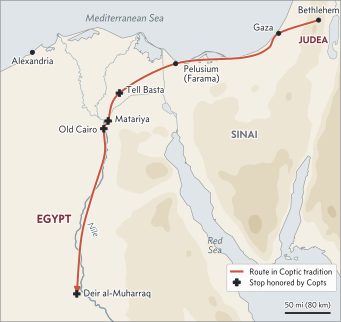
Later writers filled in the journey. A book of perhaps the seventh century, the Gospel of Pseudo-Matthew (“false Matthew,” since it was once credited to Matthew), tells that a palm tree bent down to give the tired Mary its dates and that a spring opened among its roots. The Copts, the Christians of Egypt, named the places where the family rested, from the Delta to Deir al-Muharraq (moo-har-rak), a monastery nearly 200 miles south of Cairo (Figure 28.9). They keep June 1 as the feast of the Entry of the Lord into Egypt. Painters loved the subject. Renaissance artists often painted the flight into Egypt,Renaissance artists often depicted the Biblical 'flight into' this country. → Egypt• and from the late fourteenth century on they added a scene of their own, the Rest on the Flight, with the family at ease under a tree in a wide landscape.
Then Herod died, in 4 BC. Another dream told Joseph to go home, but he heard “that Archelaus did reign in Judea in the room of his father Herod,” that is, in his place. Afraid to go there, he took the family north to Galilee and settled in Nazareth (Chapter 26). Matthew’s story and Luke’s have come by different roads to the same village.
Christmas and Epiphany
Neither Gospel gives the day of the birth. The first record of December 25 comes from a list of feasts drawn up in Rome in 336. December 25 was the Roman date of the winter solstice, when the days begin to lengthen, and the birthday of the Unconquered Sun; the church may have set its feast of the light of the world on that day. Or Christians may have counted nine months from March 25, the day of the Annunciation. Either way, Christmas commemorates the birth of Jesus,This event is commemorated on Christmas. → birth of Jesus•• and its English name means “Christ’s Mass.” Orthodox churches that keep the old Julian calendar celebrate on January 7 by our reckoning.
The twelve days of Christmas end at Epiphany (ih-pif-uh-nee), on January 6, from the Greek for “appearance” or “showing forth.” In the West Epiphany celebrates the coming of the Magi,These people are celebrated on Epiphany. → Magi• the first foreigners to worship Jesus, and in Spain and Latin America children receive presents that day from the Three Kings. The Eastern churches call the day the Theophany (thee-of-uh-nee), “the appearance of God,” and keep it for the baptism of Jesus by John in the Jordan, to which the story now turns. The customs of both feasts belong to a later volume (Vol. 46, Faiths and Ideas).
John the Baptist
Luke dates the next part like a historian: “in the fifteenth year of the reign of Tiberius Cesar, Pontius Pilate being governor of Judea, and Herod being tetrarch of Galilee.” Tiberius had succeeded Augustus in AD 14, so the year is AD 28 or 29. This Herod is Herod Antipas, the son of Herod the Great (Chapter 26). Then “the word of God came unto John the son of Zacharias in the wilderness,” the bare hills that fall from Jerusalem to the Jordan. John, now about thirty, came out of the desert preaching, and crowds went out from Jerusalem to hear him.
He looked the part of a prophet. “And the same John had his raiment of camel’s hair, and a leathern girdle about his loins,” Matthew says. His clothing made of camel’s hairThis man wore clothing made of camel hair. → John the Baptist•• was rough, the dress of a man who had turned his back on towns, and it had a meaning. The book of Kings describes Elijah as “an hairy man, and girt with a girdle of leather,” and Malachi had promised that Elijah would return (Chapter 19). Jesus later said of John, “this is Elias, which was for to come.”
“His meat was locusts and wild honey,” Matthew adds, “meat” meaning food in the English of 1611. Locusts are large grasshoppers, the insects of Egypt’s eighth plague (Chapter 13), and Leviticus lists them among the few insects that may be eaten. Wild honey came from wild bees nesting in the rocks. So John lived on locusts and wild honey,This man ate locusts and wild honey. → John the Baptist••These creatures, along with wild honey, made up the diet of John the Baptist. → locusts•• food that needed no farm and no market. Some later Christians, uneasy at a saint eating insects, decided that his “locusts” were carob pods, and English still calls the carob “St. John’s bread.”
The voice in the wilderness
John’s message was short: “Repent ye: for the kingdom of heaven is at hand.” To repent is to be sorry for one’s sins and turn from them. Those who repented he baptized, from the Greek for “to dip,” plunging them into the Jordan. Jews already washed in water to become ritually pure, but John’s baptism was given once, by a prophet, as the sign of a changed life. He had hard words for the proud: “O generation of vipers, who hath warned you to flee from the wrath to come?” The Jewish historian Josephus remembered him too. In William Whiston’s translation of 1737, John was “a good man, and commanded the Jews to exercise virtue, both as to righteousness towards one another, and piety towards God, and so to come to baptism.”
Some wondered whether John was the Messiah. In the Gospel of John, priests from Jerusalem asked him, “Who art thou?” He said, “I am not the Christ.” Was he Elijah? “I am not.” Who, then? “I am the voice of one crying in the wilderness, Make straight the way of the Lord, as said the prophet Esaias.” He answered with Isaiah’s verse promising the exiles in Babylon a road home (Chapter 19), and so John called himself “the voice of one crying,”This man called himself the “voice of one crying in the wilderness,” echoing Isaiah. → John the Baptist•• a voice that clears the road for someone greater.
John said plainly who that was. “There cometh one mightier than I after me, the latchet of whose shoes I am not worthy to stoop down and unloose,” he says in Mark: he was not worthy even to untie the man’s sandal strap, a slave’s job. A herald ran ahead of a king’s chariot to clear the road, and Christians call John by a herald’s name. He is the Forerunner of Jesus,This man is referred to as the "forerunner" of Jesus. → John the Baptist•• in Greek Prodromos (prod-roh-mos), “one who runs before,” and in the Orthodox churches simply St. John the Forerunner. Jesus said, in Matthew, “Among them that are born of women there hath not risen a greater than John the Baptist.”

Byzantine artists, those of the Christian empire ruled from Constantinople, gave John a place beside Mary in a scene called the Deesis, Greek for “entreaty.” The two stand on either side of Jesus and plead with him for the world (Figure 28.10): the mother who bore him and the herald who announced him.
The baptism of Jesus
Mark tells the baptism of Jesus in three verses. “Jesus came from Nazareth of Galilee, and was baptized of John in Jordan. And straightway coming up out of the water, he saw the heavens opened, and the Spirit like a dove descending upon him: And there came a voice from heaven, saying, Thou art my beloved Son, in whom I am well pleased.” So in Mark, John baptized Jesus in the Jordan, and the Holy Spirit descended like a dove.This man baptized Jesus in the Jordan, after which the Holy Spirit descended like a dove. → John the Baptist•••Mark described this figure descending on Jesus like a dove at his baptism. → Holy Spirit• Matthew adds that John at first refused: “I have need to be baptized of thee, and comest thou to me?” Christians see the whole Trinity in the scene: the Father’s voice, the Son in the water, and the Holy Spirit as a dove.
The Gospel of John places the baptizing at “Bethabara beyond Jordan,” or in other old manuscripts Bethany beyond the Jordan, on the east bank. Since Byzantine times pilgrims have honored a site there called Al-Maghtas, “the immersion,” a few miles north of the Dead Sea (Figure 28.3). Above it rises a hill named for Elijah, who, Kings says, crossed the Jordan near Jericho before the chariot of fire took him up.
The next day, in John’s Gospel, John saw Jesus coming and said, “Behold the Lamb of God, which taketh away the sin of the world”; modern translations write “who takes away.” The words joined Jesus to the lambs of the Temple sacrifices, above all to the Passover lamb whose blood, in Exodus, saved Israel’s firstborn (Chapter 14). So John hailed Jesus as the Lamb of God,This man described Jesus as the "Lamb of God, who takes away the sin of the world." → John the Baptist•• in Latin Agnus Dei (ahn-yoos day-ee), words sung at every Mass, and in paintings John often points at Jesus or carries a lamb. Two of John’s disciples heard him and followed Jesus instead; one was Andrew, the brother of Simon Peter (Chapter 29).
Herod and Herodias
Herod Antipas had divorced his wife, the daughter of Aretas (air-uh-tus) IV, king of the Nabataean Arabs, to marry Herodias, who was both his niece and his half-brother’s wife (Chapter 26). The law of Moses forbade a man to take his brother’s wife while the brother lived, and John told the ruler so to his face: “It is not lawful for thee to have thy brother’s wife.” Herodias never forgave him, and John was imprisoned for condemning the marriage.This man was imprisoned for criticizing Herod's marriage to Herodias. → John the Baptist• Josephus gives a political reason as well. Antipas feared that John’s hold on the crowds “might put it into his power and inclination to raise a rebellion.” So he sent him as a prisoner to Machaerus (muh-keer-us), a fortress on a hilltop east of the Dead Sea.
Mark tells the rest. On his birthday Herod gave a supper for the lords and captains of Galilee. Then “the daughter of the said Herodias came in, and danced, and pleased Herod and them that sat with him.” He swore to give her whatever she asked, “unto the half of my kingdom.” She went to ask her mother and came back with the answer: “I will that thou give me by and by in a charger the head of John the Baptist.” A charger is a large dish, and “by and by” then meant “at once.” The king was “exceeding sorry,” but he had sworn before his guests. He sent an executioner to the prison, and the head was brought in on the dish and given to the girl, who gave it to her mother.
Mark does not name the dancer. Josephus, who says nothing of the dance, records that Herodias had a daughter named Salome, and later readers joined the two accounts. So John was beheaded after Salome’s dance,This man was beheaded after Salome’s dance and demand for his head on a platter. → John the Baptist••• his head on a platter, as the story is usually told. Oscar Wilde’s play Salome of 1891 gave her dance its famous name, the dance of the seven veils, and Richard Strauss made the play an opera in 1905 (Vol. 19, Wagner and Verdi). Antipas’s punishment, in the eyes of his subjects, came a few years later, when King Aretas, angry at his daughter’s treatment, destroyed Antipas’s army. “Some of the Jews thought that the destruction of Herod’s army came from God, and that very justly,” Josephus wrote, “as a punishment of what he did against John, that was called the Baptist.”
Relics and the Mandaeans
“And when his disciples heard of it, they came and took up his corpse, and laid it in a tomb.” By the fourth century, Christians were showing John’s grave at Sebaste (seh-bas-tee), Herod’s rebuilt city of Samaria, and his head became one of the most famous relics in the world. More than one shrine has claimed it, and Amiens (ah-myan) Cathedral and the Umayyad (oo-my-ad) MosqueThis saint's relics are disputed to be in sites like Amiens Cathedral or the Umayyad Mosque. → John the Baptist• are the best known. A crusader brought a skull said to be John’s from Constantinople to Amiens, in northern France, in 1206, after the Fourth Crusade had sacked that city (Vol. 9, Cathedrals and Crusades). In Damascus the Umayyad caliphs, the Muslim rulers whose capital it was, built a great mosque early in the eighth century on the site of a church of St. John. A shrine inside it is said to hold the head. Muslims honor John as the prophet Yahya (yah-yah) (Vol. 37, The House of Islam), and when Pope John Paul II visited the shrine in 2001, he became the first pope to enter a mosque. The churches keep John’s birthday on June 24, at midsummer, and his beheading on August 29.

One people still give John a higher place than any church does. The Mandaeans (man-dee-unz) are a small religious community of southern Iraq and of Khuzestan (koo-zeh-stahn), in southwestern Iran. Their language, Mandaic, is a form of Aramaic, and their name comes from its word manda, “knowledge.” Like the Gnostics (nos-tiks) of early Christian times (Chapter 34), they believe that the soul is saved by secret knowledge of a world of light. They count Adam as the first prophet, and the Mandaeans revere John as their greatest prophet,Mandaeism reveres this man as its chief prophet. → John the Baptist•• the last and truest, whom they call Yahya or Yuhana. They do not accept Jesus.

Baptism is the center of Mandaean worship. Unlike Christians, Mandaeans are baptized again and again, every Sunday if they can, always in flowing water, and every river used for baptism is called a yardena, a “Jordan,” so the community must live by rivers. In 2007 there were perhaps 60,000 to 70,000 Mandaeans in the world. Until the war of 2003 nearly all lived in Iraq; since then most have fled abroad (Vol. 38, The Modern Middle East).
What to remember
- Only Matthew and Luke tell of Jesus’s birth. Luke has Gabriel, the census, the manger, the shepherds, and the presentation in the Temple; Matthew has Joseph’s dreams, the star, the Magi, Herod’s massacre, and the flight into Egypt. Both set the birth in Bethlehem under Herod the Great, about 6 to 4 BC.
- In Luke, Gabriel announces John’s birth to the old priest Zechariah, who is struck mute until he writes “His name is John,” and Jesus’s birth to Mary in Nazareth (the Annunciation).
- Mary visits Elizabeth (the Visitation), and the unborn John leaps; Mary sings the Magnificat, Zechariah the Benedictus, and Simeon the Nunc Dimittis.
- Joseph is Mary’s husband and Jesus’s legal father. The Protoevangelium of James names Mary’s parents, Joachim and Anne. The Council of Ephesus (431) affirmed Mary’s title Theotokos, “God-bearer.”
- The Magi bring gold, frankincense, and myrrh; tradition makes them three kings named Caspar, Melchior, and Balthasar. Christmas falls on December 25 and Epiphany, the Magi’s feast in the West, on January 6.
- John the Baptist wore camel’s hair and ate locusts and wild honey. He called himself “the voice of one crying in the wilderness,” baptized Jesus in the Jordan as the Spirit came down like a dove, and hailed him as “the Lamb of God.”
- Herod Antipas imprisoned John for condemning his marriage to Herodias and beheaded him after the dance of her daughter, whom Josephus names Salome. The Mandaeans of Iraq and Iran revere John as their greatest prophet.
Chapter 29 · 33 clues
Temptation, Miracles, and Friends
In 1986 a long drought pulled the Sea of Galilee, the freshwater lake in the north of the land of Israel (the Stage), back from its shores. Two brothers from Kibbutz Ginosar (gee-noh-sar), a farming village on the northwest shore, Moshe and Yuval Lufan, were fishermen and keen amateur archaeologists. Walking on the newly bared mud, they found the outline of a wooden boat. For twelve days and nights archaeologists and volunteers dug it out before the water could rise again. They wrapped the fragile timbers in fiberglass and foam and floated the hull to the kibbutz, where it now stands in a museum (Figure 29.1). A cooking pot, a lamp, and the nails found with it date it to between about 50 BC and AD 50.

The boat is 27 feet long and 7.5 feet wide. Four men rowed it, and it carried a mast and a sail. It was built mostly of cedar but patched with ten kinds of wood, so it had been mended again and again for decades before its owners stripped out every useful plank and let the hull sink. Nothing ties it to anyone we know, but it is the kind of boat the Gospels mention some fifty times, and in the Gospels the first men who follow Jesus fish from boats like it. This chapter tells his public life in the order the Gospels give it, from forty days in the desert to the grave of a friend 2 miles from Jerusalem.
Forty days in the wilderness
In Matthew, Mark, and Luke, the public story of Jesus begins at the river Jordan. There John the Baptist, the prophet in camel’s hair who called Israel to repent, baptized him. As Jesus came up out of the water, they tell, the Spirit came down on him like a dove, and a voice from heaven said, “Thou art my beloved Son, in whom I am well pleased” (Chapter 28). What came next came at once. “And immediately the spirit driveth him into the wilderness,” says Mark, and in Matthew too the temptation follows straight after the baptism.The narrative of this event immediately follows the baptism of Jesus by John. → temptation of Christ•• Luke sets Jesus’s family tree between the two, then picks up the story as Jesus “returned from Jordan.” The wilderness, which modern translations often call the desert, was the bare, broken country of rock and gully that falls from the hills of Judea to the Jordan and the Dead Sea, where John had preached.
Mark tells the episode in two verses. Jesus “was there in the wilderness forty days, tempted of Satan; and was with the wild beasts; and the angels ministered unto him.” Satan is a Hebrew word for “adversary” or “accuser” (Chapter 11), and by the time of the Gospels it had become the name of the devil, the leader of the evil spirits and the enemy of God. To tempt someone is to try to lure him into doing wrong, and the Greek word the Gospels use also means to test. Christians call the episode the temptation of Christ. Matthew and Luke tell it at length, and Matthew begins: “Then was Jesus led up of the spirit into the wilderness to be tempted of the devil. And when he had fasted forty days and forty nights, he was afterward an hungred.” The devil came, that is, after forty days and forty nights of fasting,This event involves fasting for forty days and forty nights in the desert. → temptation of Christ•• when hunger had made Jesus weakest.
To fast is to go without food, and sometimes without drink, on purpose, as an act of prayer, mourning, or repentance. Jews fasted in times of grief or danger, and every year on Yom Kippur, the Day of Atonement (Chapter 35). A reader who knew the scriptures heard old echoes in the number forty. Exodus says that Moses stayed on Sinai “forty days and forty nights; he did neither eat bread, nor drink water” (Chapter 15). Elijah walked forty days to the mountain of God (Chapter 19), and Israel wandered forty years in the wilderness. Christians in turn remember the forty days that Jesus fastedJesus performed this action for 40 days in the desert while resisting the devil. → fasting•• every spring in Lent, the forty days of fasting and self-denial before Easter (Vol. 46, Faiths and Ideas).
Three offers
The devil’s first offer went straight at the hunger. “If thou be the Son of God, command that these stones be made bread.” Jesus answered, “It is written, Man shall not live by bread alone, but by every word that proceedeth out of the mouth of God.” The words were not his own. They come from Deuteronomy, where Moses reminds Israel that God let them go hungry in the wilderness and fed them with manna, “that he might make thee know that man doth not live by bread only.” So Jesus refused to turn stones into bread:During this event, Jesus refuses to turn stones into bread, replying “Man does not live on bread alone.” → temptation of Christ•• whatever power he had, he would not use it to feed himself.
Next the devil took him to Jerusalem, “the holy city,” and set him on “a pinnacle of the temple,” the highest edge of its roof or walls. This time the devil quoted scripture himself. “If thou be the Son of God, cast thyself down,” he said, “for it is written, He shall give his angels charge concerning thee: and in their hands they shall bear thee up, lest at any time thou dash thy foot against a stone.” Satan quoted Psalm 91,During this event, Satan quotes Psalm 91 while urging Jesus to jump from the Temple. → temptation of Christ•• a song of trust in God’s protection, and turned its promise into a dare: leap from the Temple, and let the angels catch you. Jesus answered with Deuteronomy again: “Thou shalt not tempt the Lord thy God.” Do not, that is, put God to the test. Moses had said it of Massah (mas-uh), the place in Exodus where the thirsty Israelites demanded water and asked, “Is the Lord among us, or not?”

Last “the devil taketh him up into an exceeding high mountain, and sheweth him all the kingdoms of the world, and the glory of them.” Then he made his boldest offer: “All these things will I give thee, if thou wilt fall down and worship me.” Every empire on earth, Rome’s included, could be his for the price of bowing down to worship the devil.During this event, Jesus is instructed to bow down and worship the devil in return for all the kingdoms of the world. → temptation of Christ• “Get thee hence, Satan,” Jesus said: “for it is written, Thou shalt worship the Lord thy God, and him only shalt thou serve.” Then the devil left him, “and, behold, angels came and ministered unto him” (Figure 29.2).
Set the three answers side by side and a pattern appears (Figure 29.3). Each time Jesus answers from Deuteronomy,During this event, Jesus quotes Deuteronomy three times. → temptation of Christ•• the fifth book of the Torah, in which Moses, at the end of the forty years, reminds Israel how God tested them in the wilderness (Chapter 15). All three verses come from its sixth and eighth chapters. Commentators on Matthew point out that his order follows Israel’s own failures in Exodus: the people grumbled for bread and were given manna, they put God to the test at Massah, and they bowed down to a golden calf. In that reading, where Israel had failed in forty years, Matthew’s Jesus, in forty days, does not.

Luke tells the same three temptations but swaps the last two, so that his telling ends at the Temple in Jerusalem, where his whole Gospel ends too. He closes on a warning: the devil “departed from him for a season.” Mark gives none of the three.
No Gospel names the mountain, or the place of the fast. Since at least the fourth century, Christian tradition has placed the forty days in a cave on a cliff above Jericho, and pilgrims came to believe that the devil showed Jesus the kingdoms from its summit, about 1,300 feet above the town. They named it for the forty days: the mountain of the temptation, QuarantaniaOne stage of this event traditionally occurred on the hill Quarantania. → temptation of Christ• (kwor-un-tay-nee-uh), from quaranta, late Latin for “forty.” In Arabic it is still Jebel Quruntul. In 1895 Greek Orthodox monks built the present Monastery of the Temptation into the cliff around the cave. The same number gave English the word quarantine: from 1448 Venice made ships from plague ports wait forty days, a quarantena, before landing.
Calling the disciples
After the forty days, Matthew says, Jesus heard that John the Baptist had been thrown into prison by Herod Antipas, a son of Herod the Great and the ruler of Galilee for Rome (Chapter 26). He went north, left the hill village of Nazareth where he had grown up, and settled at Capernaum, a fishing town on the north shore of the lake (Figure 29.4). Along its shore Jesus found his first followers, among them a fisherman named Simon, the man later called Peter. Mark tells it in a few lines:
A little farther on he saw two more brothers, James and John, the sons of Zebedee, mending nets in their boat, and called them too; “they left their father Zebedee in the ship with the hired servants, and went after him.” Zebedee could pay hired men, so his was a family business of some size. The Gospel of John tells the first meeting another way. In John, Andrew had been a disciple of John the Baptist, heard him call Jesus “the Lamb of God,” and went to find his brother (Chapter 28): “We have found the Messias,” he told Simon, using the Greek spelling of Messiah (Chapter 17). Jesus looked at Simon and gave him a new name, Cephas (see-fus), Aramaic for “stone.” Its Greek form, Petros, is the English Peter (Chapter 32).

That Sabbath, Mark says, Jesus taught in the synagogue of Capernaum, the meeting house where Jews gathered to pray and to hear the scriptures read, and he drove an evil spirit out of a man there. Then he went home with Simon and Andrew, and “Simon’s wife’s mother lay sick of a fever.” Jesus “took her by the hand, and lifted her up; and immediately the fever left her, and she ministered unto them,” serving them their meal. So in Capernaum Jesus healed Peter’s mother-in-law,This man's mother-in-law was healed by Jesus at their home in Capernaum. → Saint Peter the Apostle• and the story shows in passing that Peter was married; Paul later wrote that Cephas took his wife along on his travels. At Capernaum excavators found a first-century house that early Christians honored as Peter’s, beneath the ruins of an eight-sided church of the fifth century.
The tax collector
The next man Jesus called was a surprise. Matthew’s Gospel says that Jesus “saw a man, named Matthew, sitting at the receipt of custom,” a booth where tolls were paid; Mark and Luke call him Levi, and Mark adds that he was the son of Alphaeus (al-fee-us). In Galilee, as across the Roman world, the right to collect tolls and taxes was sold to contractors, who paid the ruler in advance and kept whatever more they could squeeze out. The King James Version calls these men publicans. Their neighbors despised them as cheats who grew rich in the service of Herod and of Rome, and the Gospels name them in one breath with “sinners.” Jesus said to Matthew, “Follow me. And he arose, and followed him” (Figure 29.5).

Afterward Jesus ate at Matthew’s house among “many publicans and sinners.” The Pharisees, the party of strict teachers of the Law (Chapter 26), asked why he ate with such people. Jesus answered, “They that be whole need not a physician, but they that are sick.” Christian tradition made this tax collector the author of the first Gospel (Chapter 27).
The Twelve
Out of all who followed him, Luke says, Jesus went up a mountain, prayed all night, and in the morning chose twelve, “whom also he named apostles.” A disciple is a pupil, one who learns from a teacher. An apostle, from the Greek apostolos, is one who is sent out, a messenger, and these twelve Jesus would send out to preach and to heal in his name. The number was a sign, for Israel had twelve tribes, descended from the twelve sons of Jacob (Chapter 12). Christians call them simply the Twelve. Their names appear four times in the New Testament, in Matthew, Mark, Luke, and the Acts of the Apostles, and the four lists agree on all but one name (Table 29.1).
| Matthew 10 | Mark 3 | Luke 6 | Acts 1 | |
|---|---|---|---|---|
| Simon Peter | 1 | 1 | 1 | 1 |
| Andrew | 2 | 4 | 2 | 4 |
| James, son of Zebedee | 3 | 2 | 3 | 2 |
| John, his brother | 4 | 3 | 4 | 3 |
| Philip | 5 | 5 | 5 | 5 |
| Bartholomew | 6 | 6 | 6 | 7 |
| Thomas | 7 | 8 | 8 | 6 |
| Matthew | 8, “the publican” | 7 | 7 | 8 |
| James, son of Alphaeus | 9 | 9 | 9 | 9 |
| Thaddaeus, or Jude | 10, “Lebbaeus, whose surname was Thaddaeus” | 10, Thaddaeus | 11, “Judas the brother of James” | 11, the same |
| Simon | 11, “the Canaanite” | 11, the same | 10, “Zelotes” | 10, the same |
| Judas Iscariot | 12 | 12 | 12 | — |
Peter always comes first. With him stand his brother Andrew and James and John, the sons of Zebedee: four fishermen. Philip, John’s Gospel says, came from Bethsaida (beth-say-ih-duh), a town at the north end of the lake, like Andrew and Peter. Bartholomew is only a name in the lists, and tradition makes him the Nathanael (nuh-than-yel) of John’s Gospel, who asked, “Can there any good thing come out of Nazareth?” Thomas is “called Didymus” (did-ih-mus), Greek for “twin,” and his Aramaic name, Thomas, means the same. Then come Matthew, James the son of Alphaeus, and Simon. Matthew and Mark call Simon “the Canaanite,” from an Aramaic word for “zealous,” and Luke calls him “Zelotes,” the Zealot, the same word in Greek.
The one name that differs comes near the end. Matthew and Mark have Thaddaeus (thad-ee-us); Luke and Acts have “Judas the brother of James.” Christian tradition makes the two one man, the apostle Jude (Chapter 32). Last in each Gospel’s list, always with words such as “which also betrayed him,” stands Judas Iscariot (is-kair-ee-ut). His surname may mean “man of Kerioth,” a town in Judea, but no one is sure.
Water into wine
The Gospel of John has no calling by the lakeside. In John, three days after Jesus gathered his first followers, “there was a marriage in Cana of Galilee; and the mother of Jesus was there,” and Jesus and his disciples were invited too. A Jewish marriage of the time came in two steps. First came the betrothal, a binding promise that only a divorce could undo, as with Mary and Joseph (Chapter 28). Months later came the wedding itself, when the bridegroom brought his bride home and gave a feast for family and village that could last for days; Samson’s wedding feast, in the Book of Judges, lasts seven. The bridegroom’s family provided the food and the wine, and to run out of wine was a public disgrace.
Mary noticed first. “They have no wine,” she told her son. His answer sounds cold in English, “Woman, what have I to do with thee? mine hour is not yet come,” but “woman” was a respectful way to address a lady in Greek, and he uses it again to his mother from the cross. Mary told the servants, “Whatsoever he saith unto you, do it.” Six large jars of stone stood at the feast in Cana (Figure 29.6), “after the manner of the purifying of the Jews,” holding water for washing before meals; stone, unlike clay, could not become ritually unclean, that is, tainted in the eyes of the Law. Jesus told the servants to fill the six stone waterpots with water,Jesus turned water in six stone jars into wine at a wedding in this place. → Cana••• and they filled them to the brim. What they drew out and carried to the governor of the feast, the man in charge of the banquet, was wine.

The governor did not know where the wine had come from. He called the bridegroom and teased him: “Every man at the beginning doth set forth good wine; and when men have well drunk, then that which is worse: but thou hast kept the good wine until now.” John calls the deed the “beginning of miracles,” the first of seven signs (Chapter 27). Jesus’s first miracle was at a weddingJesus performed his first miracle of turning water into wine while attending one of these events at Cana. → marriage•• in Cana, and Christians drew a lesson about marriage from it. In the Church of England’s Book of Common Prayer of 1662, the marriage service calls matrimony a “holy estate” which “Christ adorned and beautified with his presence, and first miracle that he wrought in Cana of Galilee.”
Where was Cana? Pilgrims today go to Kafr Kanna (kah-fur kah-nuh), a town about 4 miles northeast of Nazareth, where Franciscan friars keep a Wedding Church. Many archaeologists prefer Khirbet Qana (khir-bet kah-nuh), “the ruins of Cana,” a hilltop about 6 miles farther north. There excavators found a cave used for worship, with a shelf that held two stone vessels and had room for four more, a sign that early pilgrims honored the place of the six jars.
John calls the wine a sign; the other Gospels call such deeds “mighty works.” A miracle is an event that, as the Gospels tell it, nature alone could not bring about, a deed done by the power of God. The Gospels’ miracles are of a few kinds: healings of the sick, the blind, and the lame; the driving out of evil spirits; three raisings of the dead; and a handful of wonders over wind and water, bread and wine. Christians have traditionally believed that they happened as the Gospels tell them, as signs of who Jesus was.
Loaves, fishes, and demons
Only one miracle besides the resurrection is told in all four Gospels: the feeding of the five thousand. Matthew sets it just after Herod Antipas had beheaded John the Baptist (Chapter 28). Jesus withdrew by boat “into a desert place apart,” an empty stretch of shore that Luke places near Bethsaida, and the crowds followed on foot around the lake. At evening the disciples wanted to send everyone away to buy food in the villages. “They need not depart; give ye them to eat,” Jesus said. “We have here but five loaves, and two fishes,” they answered. He had the people sit on the grass, looked up to heaven, blessed the bread and broke it, and the disciples handed it out. “And they did all eat, and were filled: and they took up of the fragments that remained twelve baskets full.” So, the Gospels tell, Jesus fed five thousand with five loavesThis figure fed five thousand people with five loaves and two fish. → Jesus••Jesus used five of these foods and two fish to feed the five thousand. → bread•• and two fish. Matthew’s count was “about five thousand men, beside women and children.”

John adds touches of his own. The food belonged to a boy. “There is a lad here, which hath five barley loaves, and two small fishes,” Andrew says, “but what are they among so many?” Barley made the cheap bread of the poor. Philip had already reckoned that “two hundred pennyworth” of bread would not give everyone a bite. The penny here is the Roman denarius (dih-nair-ee-us), a laborer’s pay for a day, so two hundred pennyworth was more than half a year’s wages. Since the fourth century, Christians have honored the feeding at Tabgha (tahb-gah), on the shore between Capernaum and Magdala (mag-duh-luh).
Matthew goes straight on. Jesus sent the disciples ahead by boat across the lake, sent the crowd home, and went up a mountain alone to pray. The wind rose against the boat, and “in the fourth watch of the night,” the last quarter of the night, between three and six in the morning, “Jesus went unto them, walking on the sea.” The disciples cried out in fear, “It is a spirit.” “Be of good cheer; it is I; be not afraid,” Jesus answered at once. Then Peter called out, “Lord, if it be thou, bid me come unto thee on the water.” “Come,” said Jesus. Peter climbed down and walked toward him across the waves.
“But when he saw the wind boisterous, he was afraid; and beginning to sink, he cried, saying, Lord, save me.” Jesus caught him by the hand: “O thou of little faith, wherefore didst thou doubt?” Mark and John also tell how Jesus came to the boat walking on the lake, but only in Matthew does Peter walk on the water and sink.This man walked on water to reach his disciples. → Jesus••In the Gospel of Matthew, this apostle briefly walks on water before losing faith and beginning to sink. → Saint Peter the Apostle•• The scene is Peter as all four Gospels draw him: the first to leap, and the first to falter.
Matthew tells one more story of Peter and the lake, a little later, at Capernaum. The collectors of the Temple tax asked him, “Doth not your master pay tribute?” This was the half shekel that every Jewish man paid each year for the upkeep of the Temple in Jerusalem, a custom drawn from Exodus, where every man counted in a census gives “half a shekel” to the Lord. Jesus told Peter, “go thou to the sea, and cast an hook, and take up the fish that first cometh up; and when thou hast opened his mouth, thou shalt find a piece of money: that take, and give unto them for me and thee.” The coin was a stater, worth two half shekels. So Peter was to pull a coin from the fish’s mouthPeter is told to find a coin in the mouth of one of these animals to pay the Temple tax. → fish• and pay the Temple tax for them both. Matthew never says whether he went fishing.
Legion
Across the lake lay a different world. Much of the eastern shore belonged to the Decapolis, the league of Greek-speaking cities (the Stage), whose people worshiped Greek gods and raised pigs, animals the Law of Moses forbids Jews to eat (Chapter 36). In the Gospels, as in the belief of most people of their time, some madness and illness were the work of demons, evil spirits that could enter a person and rule him; to drive one out was an exorcism. Mark tells that when Jesus came “into the country of the Gadarenes” (gad-uh-reenz), a madman ran at him from the tombs where he lived. No chain could hold him, and night and day he cried out among the tombs and cut himself with stones.
Jesus asked the spirit its name. “My name is Legion: for we are many.” A legion was a unit of the Roman army, about five thousand soldiers. The spirits begged to be sent into a great herd of pigs feeding on the hillside, and Jesus let them go. So the demons called Legion entered the pigs,Demons called Legion enter these animals, which then rush into the sea and drown. → pigs• and the herd, “about two thousand,” rushed down a steep bank into the lake and drowned. The townspeople found the madman “sitting, and clothed, and in his right mind,” and, frightened, begged Jesus to leave. The man asked to go with him, but Jesus sent him home to tell his friends what the Lord had done for him, and he told it through all the Decapolis.
The manuscripts disagree about the place. Some name Gerasa (jair-uh-suh), more than 30 miles from the lake, others Gadara, 6 miles away, and Matthew has two madmen instead of one. Since the fifth century, pilgrims have honored Kursi (koor-see), on the eastern shore below steep slopes, where a Byzantine monastery marks the spot. In 1871 the Russian novelist Fyodor Dostoevsky (dos-tuh-yef-skee) set Luke’s version of it at the head of his novel Demons, about young revolutionaries possessed by ideas (Vol. 20, The North and the East).
The Transfiguration
Halfway through Matthew, Mark, and Luke, the story turns toward Jerusalem. Near Caesarea Philippi, the new city of Herod’s son Philip at the springs of the Jordan (Chapter 26), Peter declared that Jesus was the Christ (Chapter 32). Jesus began to tell the disciples that he must suffer and die in Jerusalem. Six days later, Matthew says, he took Peter, James, and John “up into an high mountain apart, And was transfigured before them: and his face did shine as the sun, and his raiment was white as the light.” To transfigure is to change in form, and the Greek verb is the one that gives English the word metamorphosis. “And, behold, there appeared unto them Moses and Elias talking with him.”

Elias is the Greek form of Elijah, and so Moses and Elijah appeared beside him.This prophet appeared with Moses at the Transfiguration of Jesus. → Elijah•• Each had met God on the mountain called both Sinai and Horeb. Moses had given Israel the Law (Chapter 15). Elijah, Second Kings says, had never died but had gone up to heaven in a whirlwind, and the prophet Malachi had promised that he would come back before “the great and dreadful day of the Lord” (Chapter 19). Since Origen in the third century, Christian writers have read the two as the Law and the Prophets, the two great parts of the scriptures, standing beside Jesus. Luke adds what they talked about: his “decease which he should accomplish at Jerusalem.”
Peter, not knowing what to say, offered to build “three tabernacles; one for thee, and one for Moses, and one for Elias,” booths like those of the feast of Sukkot (Chapter 15). A bright cloud overshadowed them, and a voice spoke out of it the words heard at the baptism, with three more: “This is my beloved Son, in whom I am well pleased; hear ye him.” The disciples fell on their faces. When they looked up, “they saw no man, save Jesus only.” Coming down, Jesus told them to tell no one until he had risen from the dead. They asked why the scribes said that Elijah must come first. Elijah had come already, he answered, “and they knew him not”; and the disciples understood that he meant John the Baptist.
None of the Gospels names the mountain. Since the third century, Christian tradition has chosen Mount Tabor, the round, steep hill that rises alone from the plain southwest of the lake, where Deborah’s army once gathered (Chapter 16); a Franciscan church crowns it today. Many modern scholars prefer Mount Hermon, the highest mountain of the land, which towers over Caesarea Philippi, where the story has just been. The churches keep the Feast of the Transfiguration on August 6.
The Samaritans
Between Galilee and Judea lay Samaria, the hill country of the old northern kingdom of Israel (the Stage), and its people were the Samaritans. The Gospels show how they and the Jews felt about each other. When Jesus first sent out the Twelve, Matthew says, he told them, “into any city of the Samaritans enter ye not.” When a Samaritan village refused to receive Jesus on his last journey to Jerusalem, Luke says, James and John asked, “wilt thou that we command fire to come down from heaven, and consume them, even as Elias did?” Jesus rebuked them.
Who were the Samaritans? The Second Book of Kings tells one story. After Assyria took Samaria in 722 BC (Chapter 18), its king brought in settlers from Babylon, Cuthah (koo-thuh), and other cities. Lions attacked them, so an exiled priest of Israel was sent back to teach them how to worship the God of the land; but “They feared the Lord, and served their own gods.” From this account Jewish writers, Josephus among them, called the Samaritans Cutheans, as if they were foreigners. The Samaritans tell a different story. They call themselves Israelites, descended from the tribes of Ephraim and Manasseh, the sons of Joseph (Chapter 12), and from priests of the tribe of Levi, who never left the land. Their name, they say, means “keepers” of the Law.
Most historians now place the truth between the two. The Israeli archaeologist Adam Zertal estimated that the Assyrians deported only about a tenth of Samaria’s people, and genetic studies tie today’s Samaritans to the ancient Israelites. In their view the community grew from the old people of the north, with some newcomers, and took its separate shape in the Persian and Greek centuries.
The Samaritans’ own chronicles put the split much earlier, in the days of the judges. They tell that the true high priest, Uzzi (uz-eye), a descendant of Aaron’s grandson Phinehas, served at the sanctuary on Mount Gerizim. Then a rival priest named Eli broke away, led his followers to Shiloh, and built an altar there, and even made a copy of the Ark of the Covenant. He is the same Eli whom the Book of Samuel describes as the old priest of Shiloh who raised the boy Samuel (Chapter 17). So the Samaritans hold that Eli usurped the priesthood,These people believe that Eli secretly usurped the priesthood. → Samaritans• and that the priests and the Temple of Jerusalem descend from his breakaway. In their telling it was the Jews, not the Samaritans, who left the true faith.

Everything turned on a mountain. Above Shechem stand two peaks, Mount Ebal (ee-bul) to the north and Mount Gerizim to the south. Deuteronomy commands that when Israel entered the land the blessings be spoken from Gerizim and the curses from Ebal. It also commands that sacrifice be offered only at the place God would choose (Chapter 14). Jews read that place as Jerusalem, and the Samaritans as Gerizim; their version of the Ten Commandments even adds a commandment to build an altar there. For the Samaritans Mount Gerizim is the holiest placeThis religious community regards Mount Gerizim as its holiest site and the place of Abraham’s intended sacrifice. → Samaritans•• on earth, and it is the true Moriah, where Abraham bound Isaac for sacrifice (Chapter 12). Excavations by the Israeli archaeologist Yitzhak Magen show that a Samaritan temple stood on the summit by the middle of the fifth century BC. About 110 BC the Hasmonean ruler John Hyrcanus destroyed it (Chapter 26), and the hatred between the two peoples hardened.
The woman at the well
Against this history John tells his most famous story of a Samaritan. Jesus was walking from Judea back to Galilee, “And he must needs go through Samaria.” About noon, tired, he came to the town of Sychar (sy-kar), near Shechem, and sat down by Jacob’s well, close to the ground that, John says, the patriarch had given to his son Joseph (Figure 29.10). His disciples had gone to buy food. A woman of Samaria came to draw water, and Jesus asked her, “Give me to drink.” She was astonished: “How is it that thou, being a Jew, askest drink of me, which am a woman of Samaria? for the Jews have no dealings with the Samaritans.” Jesus answered that if she knew who was asking, she would have asked him instead, “and he would have given thee living water.” So, by Jacob’s well, a Samaritan woman was offered living water.Jesus offers “living water” to a woman of this people at Jacob’s well. → Samaritans••

“Living water” was the everyday phrase for fresh water from a spring, as against still water in a cistern, and the woman took it that way: “Sir, thou hast nothing to draw with, and the well is deep.” But Jesus meant something else. “Whosoever drinketh of this water shall thirst again: But whosoever drinketh of the water that I shall give him shall never thirst; but the water that I shall give him shall be in him a well of water springing up into everlasting life.” In John’s language, Jesus promised her living waterThis figure promises “living water” to a Samaritan woman. → Jesus• that only he could give, and three chapters later John says that by living water Jesus meant the Spirit.
Jesus told her that she had had five husbands and that the man she now lived with was not her husband. “Sir, I perceive that thou art a prophet,” she said, and she raised the great question between their peoples: “Our fathers worshipped in this mountain; and ye say, that in Jerusalem is the place where men ought to worship.” Gerizim stood over them as she spoke. Jesus answered that the hour was coming “when ye shall neither in this mountain, nor yet at Jerusalem, worship the Father,” for “God is a Spirit: and they that worship him must worship him in spirit and in truth.” “I know that Messias cometh,” the woman said, and Jesus answered, “I that speak unto thee am he.” She left her water jar, ran to tell the town, and many Samaritans believed.
The word Messias is John’s, in a book written for Christian readers. The Samaritans accepted only the five books of Moses, so they did not wait for a king of David’s line, whom the Prophets promise. They looked instead for a prophet like Moses, as Deuteronomy promises: “I will raise them up a Prophet from among their brethren, like unto thee.” Samaritans call their messiah the TahebThese people believe that their messiah is known as the Taheb. → Samaritans• (tah-heb), “the Restorer.” They believe that he will come from the tribe of Joseph, reveal the hidden Tabernacle of Moses, and bring back Gerizim’s glory.
John’s Gospel also shows what the name could mean as an insult, in its eighth chapter, where Jesus is teaching in the Temple courts in Jerusalem. The chapter opens with the woman taken in adultery (Chapter 27), whom the scribes and Pharisees brought before him to be stoned. Jesus left the first stone to the one without sin,In John 8:7, when presented with an adulteress, Jesus says "let him who is without sin among you be the first to throw" one of these objects. → stones•• and no one threw it.
Later in the same chapter the argument with his opponents turns bitter. “Say we not well,” they answer him, “that thou art a Samaritan, and hast a devil?” To call a Jew a Samaritan was probably to call him a heretic and a traitor to his people, so in John they accused him of being a SamaritanIn the Gospel of John, the Jewish authorities accused Jesus of being one of these people. → Samaritans• and possessed by a demon in one breath. Jesus answered only the second charge: “I have not a devil.”
The ten lepers
Luke tells the last of these Samaritan stories. On his final journey to Jerusalem, Jesus was passing between Samaria and Galilee when ten lepers met him at the edge of a village, standing far off, and cried, “Jesus, Master, have mercy on us.” Leprosy in the Bible is not one disease. The Hebrew word, tzaraath, covers several skin diseases that made a person ritually unclean (Chapter 13). Leviticus commands that a leper wear torn clothes, cover his upper lip, cry “Unclean, unclean,” and live alone outside the camp, and only a priest could declare him clean again. The disease that doctors now call leprosy is caused by a bacterium that the Norwegian doctor Gerhard Armauer Hansen found in 1873. DNA from a man buried in a shroud in a tomb beside Jerusalem, dated to about the time of the Gospels, shows that it was there by then.
Jesus told the ten, “Go shew yourselves unto the priests,” and on the way they were healed. One of them came back praising God, threw himself at Jesus’s feet to thank him, “and he was a Samaritan.” “Were there not ten cleansed?” Jesus asked. “But where are the nine?” Of the ten lepers, only the SamaritanIn the Gospel of Luke, Jesus heals ten people with this condition, and only a Samaritan returns to thank him. → leprosy•• returned to give thanks. Like the parable of the Good Samaritan, which only Luke tells (Chapter 30), the story puts the despised outsider in the right and the insiders in the wrong.
Zacchaeus of Jericho
The road from Galilee down the Jordan valley ended at Jericho, where travelers to Jerusalem turned west and climbed more than 3,000 feet in about 15 miles. On the road from Perea into Judea, Jericho was a customs town, and the chief tax collector there, Luke says, was a man named Zacchaeus (za-kee-us), “chief among the publicans, and he was rich.” So Zacchaeus lived in JerichoThe tax collector Zacchaeus lived in this city. → Jericho•• and grew rich on its tolls. The Jericho he knew was not the ancient mound whose walls, the Book of Joshua says, fell at the blast of the trumpets (Chapter 16). It was a newer town nearby, rich with date palms and with balsam, a sweet-smelling resin that sold for high prices. Herod the Great had built winter palaces there, and he died there (Chapter 26).
When Jesus came through Jericho on his last journey, crowds lined the street. Zacchaeus “sought to see Jesus who he was; and could not for the press,” the crush of people, “because he was little of stature.” So he ran ahead and climbed up into a sycamore treeThis tax collector climbed a sycamore tree to see Jesus, who then visited his house. → Zacchaeus•• beside the road. This was not the American sycamore but the sycamore fig, whose fruit the prophet Amos gathered (Chapter 19), a tree with a short trunk and low, spreading branches, easy to climb. When Jesus reached the spot, he looked up, called Zacchaeus by name, and told him to hurry down, “for to day I must abide at thy house” (Figure 29.11).

The crowd grumbled that Jesus had gone “to be guest with a man that is a sinner.” Zacchaeus stood and made a promise: “Behold, Lord, the half of my goods I give to the poor; and if I have taken any thing from any man by false accusation, I restore him fourfold.” Fourfold was the penalty that the Law of Moses set for a man who stole a sheep and sold it, “four sheep for a sheep,” so Zacchaeus was judging himself as a thief. Jesus answered, “This day is salvation come to this house, forsomuch as he also is a son of Abraham. For the Son of man is come to seek and to save that which was lost.” Eastern Orthodox churches read his story on “Zacchaeus Sunday,” as the season before Lent begins, and American children learn a Sunday-school song about the “wee little man.”
Lazarus of Bethany
Two miles east of Jerusalem, over the Mount of Olives, lay the village of Bethany, the last stop on the road up from Jericho. There lived three friends of Jesus: two sisters, Martha and Mary, and their brother, Lazarus. Luke tells of a visit, in a village he does not name. Martha welcomed Jesus into her house and hurried about with the serving, while her sister Mary “sat at Jesus’ feet, and heard his word.” At last Martha complained: “Lord, dost thou not care that my sister hath left me to serve alone? bid her therefore that she help me.” Jesus answered, “Martha, Martha, thou art careful and troubled about many things: But one thing is needful: and Mary hath chosen that good part, which shall not be taken away from her.” “Careful” here means full of cares. Luke does not mention a brother, but John’s Gospel does, and so we know her as Mary of Bethany, sister of MarthaThis woman was the sister of Martha and Lazarus. → Mary of Bethany•• and of Lazarus. For Christians she became the pattern of the listening disciple, as busy Martha became the patron saint of cooks.

John begins his story of this family with an illness: “a certain man was sick, named Lazarus, of Bethany, the town of Mary and her sister Martha.” The name Lazarus is the Greek form of the Hebrew Eleazar, “God has helped.” John calls Lazarus the brother of Mary and Martha,This man of Bethany was the brother of Mary and Martha. → Lazarus of Bethany•• and he says that Jesus loved all three. The sisters sent word: “Lord, behold, he whom thou lovest is sick.” Jesus was across the Jordan, and he stayed two days more; the sickness, he said, was “for the glory of God.” When at last he set out, his disciples warned him that the people of Judea had lately tried to stone him there. Thomas spoke up: “Let us also go, that we may die with him.”
By the time they came to Bethany, Lazarus “had lain in the grave four days already.” Four days dead,Jesus raised this man after he had been dead for four days. → Lazarus of Bethany•• he was long past any hope. Martha ran out to meet Jesus: “Lord, if thou hadst been here, my brother had not died.” “Thy brother shall rise again,” he said. She took him to mean the end of time: “I know that he shall rise again in the resurrection at the last day,” as the Pharisees taught (Chapter 26). “I am the resurrection, and the life,” Jesus told her: “he that believeth in me, though he were dead, yet shall he live.” Martha answered, “I believe that thou art the Christ, the Son of God.”
Then Mary came, fell at his feet weeping, and said the same words as her sister. Seeing her tears and those of the mourners with her, Jesus “groaned in the spirit, and was troubled,” and asked, “Where have ye laid him?” “Lord, come and see.” Then comes the shortest verse in the King James Version, John 11:35: “Jesus wept.” He knew, John says, what he was about to do, and still Jesus wept for his friendJesus wept before raising this man from the dead. → Lazarus of Bethany•• before he raised him. “Behold how he loved him!” said the mourners.

The grave “was a cave, and a stone lay upon it.” “Take ye away the stone,” Jesus said. Practical Martha objected: “Lord, by this time he stinketh: for he hath been dead four days.” The stone was moved. Jesus prayed aloud, and “he cried with a loud voice, Lazarus, come forth. And he that was dead came forth, bound hand and foot with graveclothes: and his face was bound about with a napkin. Jesus saith unto them, Loose him, and let him go” (Figure 29.13).
In John this is the last and greatest of the seven signs, and it leads straight to the cross. The chief priests met in council, afraid that if everyone followed him, “the Romans shall come and take away both our place and nation.” Caiaphas (ky-uh-fus), the high priest, told them, “it is expedient for us, that one man should die for the people,” and from that day they plotted to kill Jesus, and Lazarus too (Chapter 31). Six days before the Passover, Jesus came to Bethany again. At supper Martha served, Lazarus sat at the table, and Mary poured a pound of costly ointment on Jesus’s feet and wiped them with her hair (Chapter 31). John’s seven signs thus open at a wedding in Cana and close at an open tomb in Bethany. Those two, turning water into wine and raising Lazarus,Jesus raising Lazarus and turning water into wine are biblical examples of these extraordinary events. → miracles•• are among the best-known miracles in the Bible.
Bethany is now an Arab town called al-Eizariya (al-ay-zah-ree-yah), “the place of Lazarus,” where pilgrims are shown his tomb. The Bible says nothing more about him, but legends do. In Eastern tradition he became the first bishop of Kition, on Cyprus, where in 890 a tomb was found inscribed “Lazarus the friend of Christ.” A Western legend says instead that he and his sisters drifted in a boat without sails to Provence, in southern France, and that he became the first bishop of Marseille.
What to remember
- After his baptism, Jesus fasted forty days in the wilderness and was tempted three times: stones into bread, a leap from the Temple (the devil quoting Psalm 91), and the kingdoms of the world for worship. He answered from Deuteronomy each time. Tradition places the fast on Quarantania, above Jericho.
- Jesus called the fishermen Peter and Andrew to be “fishers of men,” then James and John, sons of Zebedee, and the tax collector Matthew. At Capernaum he healed Peter’s mother-in-law.
- Four lists name the Twelve; they differ only on Thaddaeus, or “Judas the brother of James.” Thomas is “Didymus,” the Twin, and Judas Iscariot always comes last.
- At a wedding in Cana, John’s first sign, Jesus turned the water in six stone jars into wine.
- He fed five thousand with five loaves and two fish, walked on the water (in Matthew, Peter too, until he sank), sent the demons called Legion into pigs, and told Peter to find the Temple tax in a fish’s mouth.
- At the Transfiguration, before Peter, James, and John, Moses and Elijah appeared beside Jesus; tradition sets it on Mount Tabor.
- The Samaritans hold Mount Gerizim holy, say that Eli usurped the priesthood, and await the Taheb. Jesus offered living water to a Samaritan woman at Jacob’s well, and of ten healed lepers only a Samaritan gave thanks.
- Zacchaeus, chief tax collector of Jericho, climbed a sycamore to see Jesus. At Bethany Jesus wept, then raised Lazarus, brother of Martha and Mary, four days dead.
Chapter 30 · 44 clues
The Sermon on the Mount and the Parables
By Matthew’s account, word had spread through Galilee of a teacher from Nazareth who healed the sick, and crowds followed him wherever he went. Matthew lists where they came from: “from Galilee, and from Decapolis, and from Jerusalem, and from Judea, and from beyond Jordan.” Some had walked from the Greek cities east of the lake, and some from Jerusalem, about 80 miles to the south. Then Matthew sets the stage for the most famous speech in the Bible. “And seeing the multitudes, he went up into a mountain: and when he was set, his disciples came unto him: And he opened his mouth, and taught them.” A Jewish teacher sat down to teach, and his pupils gathered around him.
Matthew does not name the mountain. Pilgrims were already being shown a hillside above the Sea of Galilee in the fourth century. The hill the guides point to today rises behind the shore near Capernaum, the fishing town where, Matthew says, Jesus went to live after he left Nazareth (Figure 30.1). It is a mountain only by courtesy: its top lies about 80 feet below sea level, though some 650 feet above the lake. The church completed on it in 1938 has eight sides, one for each of the blessings with which the speech begins.

What Jesus taught there and elsewhere, as the Gospels report it, is the subject of this chapter: a sermon, a prayer, two commandments, and a set of stories that are among the best known ever told. Many of their phrases are now plain English: the salt of the earth, turning the other cheek, going the extra mile, pearls before swine, the blind leading the blind, a good Samaritan, a prodigal son.
The Sermon on the Mount
The Sermon on the Mount, as the speech is called, fills chapters 5, 6, and 7 of Matthew,Jesus delivers this sermon in Matthew 5–7. → Sermon on the Mount•• 111 verses in the King James Version. It is the first of the five long speeches into which Matthew gathers Jesus’s teaching (Chapter 27). Its name comes from a Latin commentary that Augustine of Hippo, then a priest in that North African city and later its bishop, wrote in 393, On the Lord’s Sermon on the Mount. Matthew presents it as one address on one day, but it may be a collection: many of its sayings turn up scattered through Luke, and on the two-source hypothesis both Gospels took them from the lost sayings source Q (Chapter 27). Figure 30.2 shows the scene as a nineteenth-century painter imagined it.

The Beatitudes
The sermon opens with a string of blessings. Each begins with the word “Blessed,” beati in Latin, and from the Latin they are called the Beatitudes, the “blessednesses.” The first is the most famous: “Blessed are the poor in spirit,”This sermon opens with the Beatitudes, including “Blessed are the poor in spirit.” → Sermon on the Mount•• Jesus begins, for the kingdom of heaven belongs to them. The kingdom of heaven is Matthew’s usual name for what the other Gospels call the kingdom of God, God’s rule over the world, which Jesus announced as near. Jews of his day often said “heaven” to avoid naming God, out of reverence, and Matthew, probably writing for Jewish Christians (Chapter 27), kept the habit.
Each Beatitude pairs a kind of person with a reward (Table 30.1). Those who mourn shall be comforted. The meek shall inherit the earth, words taken almost exactly from Psalm 37. The merciful shall obtain mercy, the pure in heart shall see God, and the peacemakers shall be called the children of God. Most of the people named are ones the world counts unlucky: the poor, the grieving, the hungry, the persecuted. The blessings turn the world’s judgment upside down.
| Matthew: blessed are | Luke: blessed | Luke: woe unto |
|---|---|---|
| the poor in spirit | ye poor | you that are rich |
| they that mourn | ye that weep now | you that laugh now |
| the meek | ||
| they which do hunger and thirst after righteousness | ye that hunger now | you that are full |
| the merciful | ||
| the pure in heart | ||
| the peacemakers | ||
| they which are persecuted for righteousness’ sake | ye, when men shall hate you | you, when all men shall speak well of you |
Readers have counted them differently, because after the blessing on the persecuted, verse 11 adds another: “Blessed are ye, when men shall revile you, and persecute you.” It repeats the one before, now spoken straight to the listeners, so most readers treat the two as one. Counted that way, the Beatitudes number eight,The Beatitudes in Matthew are commonly counted as this many blessings. → eight• from verse 3 to verse 10. The first and the eighth promise the same reward, the kingdom of heaven, so the list opens and closes like a frame.
Salt and light
Then Jesus turns to his listeners: “Ye are the salt of the earth.” In a world without refrigerators, salt kept meat and fish from rotting, and the Law of Moses required every offering on the altar to be salted, as a sign of a covenant meant to last (Chapter 15). Salt also gives food its taste, and that is the side Jesus presses: “but if the salt have lost his savour, wherewith shall it be salted? it is thenceforth good for nothing.” Savour is the King James Version’s word for flavor, and salt without it is only white dust.
Next he says, “Ye are the light of the world. A city that is set on an hill cannot be hid.” Nobody lights a lamp and hides it under a basket; it goes on a stand, to light the whole house. The two pictures make one demand: as the salt of the earth and the light of the world,This sermon calls its listeners “the salt of the earth” and “the light of the world.” → Sermon on the Mount••In the Sermon on the Mount, Jesus calls his disciples "salt of the earth" and this thing "of the world." → light••In the Sermon on the Mount, Jesus calls his followers this substance “of the earth” and asks what happens if it loses its savor. → salt•• the disciples were to make a difference that others could taste and see. In 1630 John Winthrop, leader of a company of strict English Protestants called Puritans, borrowed the city on a hill for the colony his people were sailing to found in Massachusetts (Vol. 27, New Worlds).
“But I say unto you”
Jesus next sets his teaching beside the Law of Moses, and he heads off a misunderstanding first: “Think not that I am come to destroy the law, or the prophets: I am not come to destroy, but to fulfil.” Six times he recalls what his hearers “have heard” or what “hath been said,” and six times he answers, “But I say unto you.” These six passages are called the antitheses, “opposites,” though most of them do not overturn the Law so much as press it inward, to the heart. The Law said, “Thou shalt not kill”; Jesus said that whoever is angry with his brother is in danger of judgment. The Law said, “Thou shalt not commit adultery”; Jesus said that a man who looks at a woman with desire has done it already in his heart.
Then comes one of his hardest sayings: “if thy right eye offend thee, pluck it out,”The Sermon on the Mount says to pluck out the right one of these body parts if it causes sin. → eyes• and throw it away, for it is better to lose one part of the body than for the whole body to be cast into hell. The right hand gets the same treatment in the next verse. To offend here means to cause someone to sin; the Greek word pictures a trap or a stone that trips the foot. The right side was counted the stronger and better side, so the saying demands the costliest loss imaginable. Christians have almost never taken it literally. It is hyperbole, deliberate exaggeration, a teacher’s way of saying that nothing, however precious, is worth keeping if it leads to sin.
The fifth antithesis takes up a rule far older than Jesus. “Ye have heard that it hath been said, An eye for an eye, and a tooth for a tooth.” The words stand in Exodus, and the rule stood long before that in the laws of Hammurabi of Babylon, carved about 1754 BC (Chapter 3). It is usually read as a limit on revenge: one eye for an eye, and no more. Later the rabbis of the Mishnah read it as a rule for payment, the worth of an eye. Jesus asks for more than a limit: in place of an eye for an eye,This passage reinterprets the rule of "an eye for an eye" by telling listeners to "turn the other cheek." → Sermon on the Mount• he teaches his hearers to turn the other cheek. “But I say unto you, That ye resist not evil: but whosoever shall smite thee on thy right cheek, turn to him the other also.” A blow on the right cheek from a right-handed man is a backhanded slap, an insult more than an injury, and the listener is told not to answer it in kind.
The examples that follow come from life under Roman rule. If a man sues you for your coat, Jesus says, give him your cloak as well. “And whosoever shall compel thee to go a mile, go with him twain.” A Roman soldier could force a civilian to carry his pack along the road, and the Gospels use the same word when soldiers “compel” a passerby, Simon of Cyrene, to carry Jesus’s cross (Chapter 31). From this verse English gets “going the extra mile.” The last antithesis goes furthest of all: “Love your enemies, bless them that curse you, do good to them that hate you.” In 1894 the Russian novelist Leo Tolstoy built a philosophy of nonresistance on these verses in The Kingdom of God Is Within You (Vol. 20, The North and the East), a book that helped shape the nonviolent campaigns of the Indian leader Mohandas Gandhi (gahn-dee).
In secret
Matthew’s sixth chapter turns to three duties that every devout Jew practiced: giving to the poor, praying, and fasting. For each, Jesus gives the same advice. Do it in secret, not to be seen and praised, “and thy Father which seeth in secret himself shall reward thee openly.” Those who make a show of their goodness he calls hypocrites, from the Greek word for an actor on the stage. They “sound a trumpet” before them when they give, and they have their reward already, in the applause.
Gifts to the poor are alms, an English word that comes, through Latin, from the Greek for “mercy.” Jesus’s rule for them is a picture anyone can act out: let not the left hand knowMatthew says not to let your left hand know what your right is doing during this action. → charity• what the right hand is doing. Give so quietly that even your other hand does not notice. That is charity in the usual sense of the word, help given to the needy for its own sake. Some Greek manuscripts have “righteousness” here instead of “alms,” as the King James Version’s margin notes, and in Judaism giving to the poor is itself called righteousness (Chapter 36).
Prayer belongs in private too: “enter into thy closet, and when thou hast shut thy door, pray to thy Father which is in secret.” It needs no long speeches, Jesus says, for God knows what his children need before they ask. Then Jesus gives a model, and so the sermon contains the Lord’s Prayer,This passage includes the Lord's Prayer. → Sermon on the Mount•• set between the alms and the fasting.
Jews fasted (Chapter 29) on the Day of Atonement and in times of grief, and very devout men fasted more often. A man who fasted to be admired let his hair go uncombed and his face look gaunt and dirty, so that everyone could see. Jesus says to do the opposite, “anoint thine head, and wash thy face,”Jesus advised anointing one's head and washing one's face while performing this action. → fasting• so that no one guesses. To rub a little olive oil into the hair was everyday grooming. The first Christians kept fasting. A short handbook of church life called the Didache (did-uh-kee), “the Teaching,” which most scholars date to the first century, tells them to fast on Wednesdays and Fridays, not on Mondays and Thursdays, the fast days of the devout Jews it calls hypocrites.
Treasure, lilies, and pearls
The rest of chapter 6 is about money and worry. “Lay not up for yourselves treasures upon earth, where moth and rust doth corrupt, and where thieves break through and steal,” Jesus says, but treasures in heaven, “For where your treasure is, there will your heart be also.” And again: “Ye cannot serve God and mammon.” Mammon is an Aramaic word for wealth, which later writers turned into a demon of greed; in the English poet John Milton’s Paradise Lost Mammon is a fallen angel (Vol. 11, The Age of Shakespeare).
Do not worry about what you will eat or wear, Jesus goes on. “Behold the fowls of the air: for they sow not, neither do they reap,” yet God feeds them. “Consider the lilies of the field,”This sermon urges listeners not to worry and to “consider the lilies of the field.” → Sermon on the Mount•• he says, “how they grow; they toil not, neither do they spin: And yet I say unto you, That even Solomon in all his glory was not arrayed like one of these.” Solomon was the richest king in Israel’s story, the builder of the Temple (Chapter 17), and a wildflower outdresses him. The Greek word for lily was used loosely, and many readers think of the red anemones that cover the hills of Israel each spring. The chapter ends with a proverb: “Sufficient unto the day is the evil thereof.” Each day has trouble enough of its own.
Chapter 7 opens with a warning: “Judge not, that ye be not judged,”This passage warns "judge not, lest ye be judged." → Sermon on the Mount•• for you will be judged by the same measure you use on others. Jesus makes the point comic. Why stare at the “mote,” the speck of sawdust in your brother’s eye, and not notice the “beam,” the whole wooden rafter, in your own? Pull out the beam first, and then you will see clearly enough to help your brother with his speck.
The next verse guards against the opposite fault, of offering what is holy to those who will only trample on it. “Give not that which is holy unto the dogs, neither cast ye your pearls before swine,The Sermon on the Mount contains a warning to avoid casting pearls before these animals. → pigs• lest they trample them under their feet, and turn again and rend you.” Swine is the old word for pigs. Dogs and pigs were unclean animals to Jews; Leviticus forbids eating pork, and the rubbish heaps of the first Israelite villages hold almost no pig bones (Chapter 16). A pig cannot eat a pearl. It would trample the useless thing into the mud and then turn on whoever threw it.
A little further on comes the sentence called the Golden Rule: “Therefore all things whatsoever ye would that men should do to you, do ye even so to them: for this is the law and the prophets.” A famous story in the Talmud puts it the other way round. Hillel, the great Pharisee teacher of Herod’s time (Chapter 26), was challenged by a Gentile, a man who was not a Jew, to teach him the whole Torah while he stood on one foot. What is hateful to you, Hillel answered, do not do to your neighbor; that is the whole Torah, and the rest is commentary.
The sermon ends with warnings. “Beware of false prophets, which come to you in sheep’s clothing, but inwardly they are ravening wolves,” Jesus says, and so the wolf in sheep’s clothing entered English. How can they be told from true ones? “Ye shall know them by their fruits,” as you know a tree. “Do men gather grapes of thorns, or figs of thistles?”This passage warns against false prophets with the analogy of "figs from thistles." → Sermon on the Mount• A good tree bears good fruit and a rotten tree bad, so a prophet is known by the life he leads and the followers he makes.
Last comes a short story about two builders. A foolish man built his house upon the sand, and a wise man built his house upon a rock.This passage closes with a comparison between a house built on sand versus one built on rock. → Sermon on the Mount•• “And the rain descended, and the floods came, and the winds blew, and beat upon that house.” The house on the rock stood; the other “fell: and great was the fall of it.” In Galilee a dry streambed could look like level ground for building until a winter storm filled it with a torrent. Whoever hears these sayings and does them, Jesus says, is the wise builder. Matthew closes with the crowd’s reaction: they “were astonished at his doctrine: For he taught them as one having authority, and not as the scribes.” The scribes, the experts in the Law, taught by quoting earlier teachers. Jesus had said, “I say unto you.”
The Sermon on the Plain
Luke has the same speech in a shorter form, and he sets it lower down. In his Gospel Jesus spends a night praying on a mountain and in the morning chooses twelve of his followers as his apostles (Chapter 29). Then “he came down with them, and stood in the plain,” on a level place, before a crowd from Judea, Jerusalem, and the coast of Tyre and Sidon. So Luke’s version is called the Sermon on the Plain. It fills thirty verses of Luke 6, against Matthew’s 111.
It opens with blessings too, but Luke gives only four Beatitudes,This passage contains four Beatitudes. → Sermon on the Plain• and they are sharper (Table 30.1). His Jesus says simply “Blessed be ye poor,” not “poor in spirit,” and “Blessed are ye that hunger now.” Four woes follow that mirror the blessings, beginning, “But woe unto you that are rich! for ye have received your consolation.” The rest of the sermon follows Matthew’s order closely, with the love of enemies, the other cheek, “Judge not,” the mote and the beam, the tree known by its fruit, and the house on the rock. It adds a question of its own: “Can the blind lead the blind? shall they not both fall into the ditch?”
The Lord’s Prayer
“But when ye pray,” Jesus says in the Sermon on the Mount, “use not vain repetitions, as the heathen do: for they think that they shall be heard for their much speaking.” By “the heathen” the King James Version means the worshipers of other gods, who sometimes heaped up their gods’ names and titles to be sure of being heard. “After this manner therefore pray ye.” So in Matthew the prayer is offered insteadMatthew includes this prayer in the Sermon on the Mount as an alternative to long, repetitive prayers. → Lord's Prayer• of long and repetitive prayers. It is short: fifty-two words in the King James Version before its closing line of praise.
Luke tells how it came to be taught. Jesus had been praying, and when he finished, “one of his disciples said unto him, Lord, teach us to pray, as John also taught his disciples,” meaning John the Baptist (Chapter 28). In Luke’s oldest manuscripts the answer begins with the single word “Father” and has five requests instead of seven, and Matthew’s longer form is the one Christians say (Figure 30.3). They call it the Lord’s Prayer, the prayer the Lord taught, and its first words, “Our Father,”This prayer taught by Jesus begins “Our Father,” or “Pater Noster.” → Lord's Prayer•• give it a second name, Pater Noster (pah-ter nos-ter) in Latin. Medieval Christians counted their prayers on strings of beads called paternosters, and an elevator whose open cars run in an endless loop, like beads on a string, is still called a paternoster.

The prayer has an address and then a series of requests, which Christians call petitions. The Catechism of the Catholic Church, the official summary of Catholic teaching issued in 1992, divides the prayer into seven petitions.The Catholic catechism divides this prayer into seven petitions. → Lord's Prayer•• The first three are about God: that his name be “hallowed,” treated as holy; that his kingdom come; and that his will be done. The last four are about the people praying, and ask for bread, forgiveness, and protection from temptation and from evil. The first three turn on the word “thy,” the last four on “us.”
The second and third carry the heart of Jesus’s preaching. “Thy kingdom come. Thy will be done,”This prayer addresses God with the lines "Thy kingdom come, Thy will be done." → Lord's Prayer• the prayer says, “in earth, as it is in heaven.” The coming of that kingdom is what Jesus announced from the start of his work, and many of his parables are about it, among them the Sower and the Mustard Seed later in this chapter. To pray for it is to ask that the world be put right.
The fourth petition is the most ordinary and the most puzzling: “Give us this day our daily bread.” Bread was the staple food of the Mediterranean world, and to ask for it was to ask for everything needed to live. The puzzle is the word translated “daily.” In Greek it is epiousios (ep-ee-oo-see-os), and it appears nowhere in all of Greek writing except in this prayer, in Matthew and in Luke. Built from epi, “upon” or “for,” and a form either of the verb “to be” or of the verb “to come,” it might mean “for the coming day,” “needed for existence,” or something beyond ordinary being. Jerome, making the Latin Vulgate (the Stage), chose “daily” in Luke but coined a word in Matthew, supersubstantialem, “above substance.” The Catholic Douay–Rheims translation of 1582 kept it as “supersubstantial bread,” and many readers took it for the bread of the Eucharist (yoo-kuh-rist), the Christian meal of bread and wine (Chapter 31). So the daily bread is epiousios bread,This prayer asks "give us this day our daily bread." → Lord's Prayer•In the Lord's Prayer, this food is described by the unusual Greek word epiousios, sometimes translated as "super-substantial" but more often as "daily." → bread•The Greek word epiousios in this prayer is usually rendered “daily” but was translated “supersubstantial” in Jerome’s Matthew. → Lord's Prayer•• a word nobody has ever been sure how to translate.
The fifth petition asks forgiveness and attaches a condition. Matthew has “forgive us our debts, as we forgive our debtors,” because in Aramaic, the language Jesus spoke, a sin was often called a debt, something owed to God. Luke has “forgive us our sins.” English translators chose differently. The Wycliffe Bible of the 1380s and 1390s, the first complete Bible in English, said “debts.” William Tyndale’s New Testament of 1526 said “trespasses,” wrongs that cross a line, the word Matthew uses just after the prayer ends, and the Church of England’s Book of Common Prayer used it too in 1549. So some pray “debts,” others “trespasses,”Versions of this prayer ask forgiveness of “debts,” “sins,” or “trespasses,” as the speaker forgives others. → Lord's Prayer• and many modern versions say “sins.” Presbyterians and other Reformed churches pray with Matthew and the King James Version, while Catholics, Anglicans, Lutherans, and Methodists mostly say “trespasses.” In every version the condition stands: “if ye forgive not men their trespasses, neither will your Father forgive your trespasses.”
The last two petitions ask for protection: “lead us not into temptation, but deliver us from evil.”This prayer asks “lead us not into temptation, but deliver us from evil.” → Lord's Prayer• The Greek word for temptation, peirasmos, also means a test or a trial. “Evil” can mean evil in general or “the evil one,” the devil, and the Greek allows both. Christians have long been uneasy with the thought that God might lead anyone into temptation. In December 2017 Pope Francis said on Italian television that the usual wording was a poor translation, since a father does not push his children into sin. In 2018 the Catholic bishops of Italy adopted a new form, “do not abandon us to temptation.”
Most Protestants end the prayer with a line of praise, “For thine is the kingdom, and the power, and the glory,”Many Protestant versions of this prayer end “For thine is the kingdom, and the power, and the glory.” → Lord's Prayer•• which runs on “for ever. Amen.” A short burst of praise like this is a doxology (dok-sol-uh-jee), from the Greek doxa, “glory.” It echoes King David’s prayer in 1 Chronicles 29: “Thine, O Lord, is the greatness, and the power, and the glory.” It is missing from the oldest manuscripts of Matthew and from Luke’s version, and it was probably added by worshipers who said the prayer together. The Didache already closes the prayer with a shorter doxology, and tells Christians to say the prayer three times a day. Later Greek manuscripts carried the full line into Matthew, and the King James translators printed it as part of the verse.
Roman Catholics say the prayer without the doxology, except at Mass, their service of the Eucharist. There, after the people finish “deliver us from evil,” the priest adds a short and very old prayer that enlarges on that last petition, asking God to deliver them from every evil and to grant peace. This inserted prayer is the embolism.Many Roman Catholics insert an embolism at the end of this prayer to elaborate on the last of its seven petitions. → Lord's Prayer• Since the reform of the Mass in 1970, the people answer it with the doxology. Embolism comes from the Greek for “something thrown in,” and calendar makers call a year with an extra month thrown in, such as a Hebrew year with a second Adar, an embolismic year (the Stage).

Catholics also say the Lord’s Prayer as part of the rosary, a string of beads used to count prayers, and also the series of prayers said on it (Figure 30.4). The beads come in groups of ten, called decades. On each bead of a decade the person praying says the Hail Mary, a prayer built from the greetings that Gabriel and Elizabeth gave Mary in Luke’s Gospel (Chapter 28). The Lord’s Prayer is said on the single bead before each group, so that between the decades comes the Lord’s Prayer.This prayer is recited between the decades of the rosary. → Lord's Prayer• A rosary usually runs to five decades, each spent thinking about one scene from the lives of Jesus and Mary.
The commandment of love
In the last days before his arrest, the Gospels say, Jesus taught in the courts of the Temple at Jerusalem, and the city’s religious parties came at him with questions meant to trap him. In Matthew one was put by a Pharisee who was a “lawyer,” an expert in the Law of Moses: “Master, which is the great commandment in the law?” It was a real question. Later rabbis counted 613 commandments in the Torah, and teachers in every age debated which ones held up the rest. Jesus answered with two verses. The first comes from the Shema, the words from Deuteronomy that Jews say morning and evening (Chapter 15): “Thou shalt love the Lord thy God with all thy heart, and with all thy soul, and with all thy mind.” “This is the first and great commandment. And the second is like unto it, Thou shalt love thy neighbour as thyself,” from Leviticus 19. “On these two commandments hang all the law and the prophets.”
So love of God and love of neighborApplying this concept to God and neighbors are the two greatest commandments according to Matthew. → love• are the two greatest commandments, as Matthew tells it. Neither was new, since Jesus quoted both from the Torah, and a century later Rabbi Akiva, the greatest teacher of his day (Chapter 15), called “love thy neighbour as thyself” the great principle of the Torah. Jesus’s answer joined the two and hung everything else upon them. In Mark the questioner is a friendly scribe, who agrees and is told, “Thou art not far from the kingdom of God.” In Luke the lawyer recites the two commandments himself and then, “willing to justify himself,” asks another question: “And who is my neighbour?” The answer is the parable of the Good Samaritan, later in this chapter.
John’s Gospel gives Jesus’s fullest teaching on love in the long speech he makes to his disciples at their last supper together, on the night before he died (Chapter 31). “A new commandment I give unto you, That ye love one another; as I have loved you.” The measure is no longer “as thyself” but “as I have loved you.” Two chapters later, in John 15, he says what that means, “Greater love hath no man than this”:In John 15, Jesus says the greatest example of this concept is to "lay down one's life for a friend." → love• “that a man lay down his life for his friends. Ye are my friends, if ye do whatsoever I command you.” Spoken hours before the crucifixion, the words point to his own death, and Christians have always read them so. They have also been carved on many memorials to soldiers who died in the two world wars.
At the same supper Jesus promises that his disciples will not be left alone. “I will pray the Father, and he shall give you another Comforter, that he may abide with you for ever; Even the Spirit of truth.” A little later he names him: “the Comforter, which is the Holy Ghost.” The Holy Ghost is the King James Version’s name for the Holy Spirit (Chapter 28). In Genesis the Spirit of God moves on the waters at the creation, and later it comes upon prophets and kings. In the Gospels it comes down on Jesus like a dove at his baptism (Chapter 28), and Christians believe it is the third person of the Trinity, one God with the Father and the Son (Chapter 32).
The Greek word behind “Comforter” is parakletos, in English Paraclete (pair-uh-kleet): one called to stand beside you, a helper, or an advocate who speaks for you in court. When the King James Version appeared in 1611, comfort could still carry its Latin sense, “to make strong.” The First Letter of John uses the same word of Jesus himself: “we have an advocate with the Father.” So in John’s Gospel Jesus promises the Holy Spirit as Paraclete,Jesus promises this figure as the Paraclete, or Helper. → Holy Spirit• a second helper to take his place when he is gone. The Acts of the Apostles tells how the promise was kept at Pentecost (Chapter 32), and Jesus’s words that the Spirit “proceedeth from the Father” later divided the churches of East and West (Vol. 9, Cathedrals and Crusades).
The parables
Jesus’s favorite way of teaching was the story. A parable, from the Greek parabole, “a setting side by side,” is a short story from ordinary life laid beside a truth about God, so that each throws light on the other. The Hebrew Bible has parables too. When the prophet Nathan wanted King David to see his own crime, he told him of a rich man who took a poor man’s only lamb, and when David burst out that the man deserved to die, Nathan said, “Thou art the man” (Chapter 17). A parable works like that: the listener judges the case before he knows it is his own. The Synoptic Gospels, Matthew, Mark, and Luke, hold some thirty or forty of Jesus’s parables, about a third of his recorded teaching. The two best loved are both in Luke and only in Luke (Chapter 27): the Good Samaritan and the Prodigal Son,The Good Samaritan and the Prodigal Son are examples of these teaching stories. → parables of Jesus•• the stories of a stranger who stops to help a wounded traveler and of a runaway son welcomed home.
A house divided
The Gospel of Mark first shows Jesus speaking “in parables” to answer an accusation. He had been driving out demons, the evil spirits that the Gospels say possessed the sick, and teachers of the Law down from Jerusalem explained it away: “He hath Beelzebub, and by the prince of the devils casteth he out devils.” In the Second Book of Kings, Baal-zebub, “lord of the flies,” is the god of the Philistine city of Ekron (the Stage), and by Jesus’s time Beelzebub (bee-el-zih-bub) meant the prince of the demons. “How can Satan cast out Satan?” Jesus asked. A kingdom at war with itself falls, “And if a house be divided against itself, that house cannot stand.” In 1858 Abraham Lincoln borrowed the sentence for a nation divided over slavery (Vol. 29, A House Divided).
Then Jesus warned them. Every other sin would be forgiven, “But he that shall blaspheme against the Holy Ghost hath never forgiveness,” Mark says, “Because they said, He hath an unclean spirit.” Blasphemy is speaking evil of God or of what is holy. In Mark’s telling, the scribes had seen the Spirit of God at work and called it the devil’s. Blasphemy against the Holy SpiritJesus says that blasphemy against this figure will not be forgiven. → Holy Spirit• alone, Jesus says, will not be forgiven, “neither in this world, neither in the world to come,” as Matthew adds. Most Christian teachers have said that the sin is not a word spoken in anger but a final refusal of God’s mercy, and that anyone who fears he has committed it has not.
Seeds
Mark’s fourth chapter, and Matthew’s thirteenth, begin by the lake. So many people gathered that Jesus got into a boat and taught from the water while the crowd stood on the shore. “Behold, a sower went forth to sow.” A farmer of Galilee sowed by hand, flinging seed in wide sweeps as he walked. Some fell by the path, where birds ate it, and some on stony ground with little soil, where it sprang up fast and withered in the sun. Some fell among thorns, which choked it. “But other fell into good ground, and brought forth fruit, some an hundredfold, some sixtyfold, some thirtyfold.”
Jesus explained this parable himself, as he seldom did. The seed is “the word of the kingdom.” The birds are the devil snatching it away, the stony ground is the listener who gives up when trouble comes, and the thorns are “the care of this world, and the deceitfulness of riches.” The good ground is the one who hears and understands. Later in the chapter Matthew sets a shorter story beside it. “The kingdom of heaven is like to a grain of mustard seed, which a man took, and sowed in his field.” It is “the least of all seeds,” but when grown it “becometh a tree, so that the birds of the air come and lodge in the branches thereof.”
A mustard seed was the proverbial smallest thing, no bigger than a pinhead, and black mustard, the plant most readers take it to be, grows in a single season into a bush several feet tall. The kingdom begins as something a passerby would hardly notice, and it ends as a tree full of birds. Both stories are about sowing, and Matthew, Mark, and Luke all tell the Sower and the Mustard Seed.These teaching stories include the Sower and the Mustard Seed. → parables of Jesus•• Elsewhere Jesus told his disciples that faith “as a grain of mustard seed” could move a mountain.
The Good Samaritan
Luke’s lawyer, the one who recited the two great commandments, had asked who his neighbor was, and he got a story instead of a definition. “A certain man went down from Jerusalem to Jericho,The parable of the Good Samaritan takes place on the road from Jerusalem to this city. → Jericho• and fell among thieves, which stripped him of his raiment, and wounded him, and departed, leaving him half dead.” Every listener knew that road. It runs east from Jerusalem over the shoulder of the Mount of Olives and past the village of Bethany, then drops through the bare hills of the Judean Desert to the oasis of Jericho (Figure 30.5). “Went down” is exact. Jerusalem stands about 2,500 feet above sea level and Jericho about 850 feet below it, so in some 15 miles as the crow flies the road falls more than half a mile. Its gullies and bends made it a road for robbers. In Matthew, Mark, and Luke alike, Jesus himself climbs it on his last journey to Jerusalem.

First a priest came down the road, and when he saw the wounded man, “he passed by on the other side.” Then a Levite did the same. The priests were the descendants of Aaron, who offered the sacrifices in the Temple, and the Levites were men of the tribe of Levi who served under them as singers and gatekeepers (Chapter 15). Both were men of the Temple, perhaps on their way home from their turn of duty. Luke does not say why they passed by. The Law forbade a priest to touch a dead body other than a close relative’s, so perhaps they feared the man was dead. Whatever the reason, the two men whom the listeners expected to stop did not.
Then came “a certain Samaritan.” The Samaritans (Chapter 29), who worshiped on Mount Gerizim rather than at Jerusalem, were the people the Jews of Judea counted half-foreigners and heretics, and the hatred ran both ways. Yet the Samaritan stopped and helped.In Jesus’ parable, a “good” member of this people helps a wounded traveler after a priest and Levite pass by. → Samaritans•• He “bound up his wounds, pouring in oil and wine,” the wine to clean them and the oil to soothe them, set the man on his own animal, and took him to an inn. The next morning he gave the innkeeper “two pence,” two Roman silver coins, each a laborer’s wage for a day, and promised to pay whatever more it cost on his way back.

Then Jesus turned the question around. “Which now of these three, thinkest thou, was neighbour unto him that fell among the thieves?” The lawyer answered, “He that shewed mercy on him,” as if he could not bring himself to say “the Samaritan.” “Go, and do thou likewise.” The lawyer had asked whom he was bound to treat as a neighbor; Jesus asked who had acted as one. From the parable comes “a good Samaritan” for anyone who helps a stranger in trouble. Vincent van Gogh (van goh) painted the scene in 1890 (Figure 30.6).
Early Christian writers read the story as an allegory of salvation. Origen, the great Christian scholar of Alexandria (Chapter 34), and later Augustine took the wounded man for Adam, fallen from paradise, the Samaritan for Christ, and the inn for the church. The Protestant reformer John Calvin thought this far too clever and read the story plainly, as a lesson in mercy owed to every human being. An old roadside inn halfway down the road, now a museum of ancient mosaics, bears the parable’s name.
The Prodigal Son
Luke’s chapter 15 begins with grumbling. “This man receiveth sinners, and eateth with them,” the Pharisees and scribes complained, because Jesus shared meals with publicans, the despised tax collectors (Chapter 29). Jesus answered with three stories of lost things. A shepherd leaves ninety-nine sheep to search for one that has strayed, and carries it home on his shoulders. A woman who loses one of her ten silver coins sweeps the house until she finds it. Each calls in the neighbors to celebrate, and “likewise joy shall be in heaven over one sinner that repenteth.” The third story is the longest and the most loved.
“A certain man had two sons: And the younger of them said to his father, Father, give me the portion of goods that falleth to me.” To ask for an inheritance while the father lived was shocking, as if to wish him dead. Under the Law the eldest son received a double portion, so with two sons the younger’s share was a third of the estate. He took it, went into “a far country,” and “wasted his substance with riotous living.” The word prodigal means wasteful, from a Latin verb for squandering, and it gives the story its name, though it never appears in the story itself.

Then famine struck the far country. Penniless, the young man hired himself to a landowner there, who “sent him into his fields to feed swine.”In the parable of the Prodigal Son, the son is temporarily employed as a caretaker for these animals. → pigs• For a Jewish listener nothing could be lower. Pigs were unclean, and a country that kept them was plainly a land of Gentiles. The son was so hungry that he envied the pigs the “husks” they ate, the pods of the carob tree. “And when he came to himself,” he remembered that his father’s hired servants had bread to spare. He would go home, confess, and ask to be taken on as a servant. The German artist Albrecht Dürer (dyoo-rer) engraved him at that moment (Figure 30.7).
“But when he was yet a great way off, his father saw him, and had compassion, and ran, and fell on his neck, and kissed him.” A dignified old man in that world did not run. The son began his speech, “Father, I have sinned against heaven.” Before he could ask to be a servant, the father called for the best robe, a ring, and shoes, and for the fatted calf to be killed for a feast. So the father welcomed home the wasteful son:In this parable, a father welcomes home a son who has squandered his inheritance. → the Prodigal Son•• “For this my son was dead, and is alive again; he was lost, and is found.”

Meanwhile the elder brother came in from the fields, heard music and dancing, and would not go in. “Lo, these many years do I serve thee,” he told his father, “and yet thou never gavest me a kid, that I might make merry with my friends.” The father answered gently that all he had was his elder son’s already, but that they had to celebrate, “for this thy brother was dead, and is alive again.” There the story stops, without telling whether the elder brother went in. Jesus had told it to men who were complaining about a welcome given to sinners, and the open ending seems meant for them. Rembrandt painted the return about 1668 (Figure 30.8).
The persistent widow
Luke tells another parable “to this end, that men ought always to pray, and not to faint,” that is, not to lose heart. In a certain city lived a judge “which feared not God, neither regarded man.” A widow kept coming to him with her plea: “Avenge me of mine adversary,” meaning, give me justice against the man who has wronged me. In the Bible widows stand for the helpless, since they had no husband to speak for them. For a while the judge ignored her. Then he said to himself, “Yet because this widow troubleth me, I will avenge her, lest by her continual coming she weary me.” If even an unjust judge gives way to persistence, Jesus asks, will not God answer his chosen ones who cry to him day and night? So the persistent widow teaches persistent prayer.Luke’s Parable of the Persistent Widow emphasizes this action. → prayer• Its older name, the parable of the importunate widow, uses an old word for someone who will not stop asking.
The Good Shepherd
John’s Gospel has none of the Synoptic kind of parables (Chapter 27). It has long images instead, called by a related Greek word that the King James Version also translates “parable,” and the best known is about sheep. Jesus speaks of a sheepfold, of thieves who climb in over the wall, and of the shepherd who comes in by the door and calls his own sheep by name. “This parable spake Jesus unto them: but they understood not.” So he spoke more plainly. “I am the good shepherd,”In John 10, Jesus calls himself the "good" type of this profession. → shepherd•• he says in John 10: “the good shepherd giveth his life for the sheep.” A hired hand who does not own the flock runs away when he sees the wolf coming. The good shepherd stays: “I lay down my life for the sheep.”

The image had deep roots. David had kept sheep before he became king, and Psalm 23 begins, “The Lord is my shepherd” (Chapter 17). The prophet Ezekiel had condemned Israel’s rulers as shepherds who fed themselves instead of the flock, and promised that God himself would seek out his lost sheep (Chapter 20). A shepherd carrying a lamb on his shoulders, like the shepherd of Luke’s lost sheep, was among the first pictures of Jesus that Christians made, painted on the walls of the catacombs, the underground burial tunnels of Rome. Its form was borrowed from an older Greek figure, a young man carrying a ram to sacrifice. By the fifth century the shepherd had a halo and a golden robe (Figure 30.9).
Wealth and charity
Jesus said a great deal about money, and little of it comforted the rich. Matthew tells of a young man who came to ask, “Good Master, what good thing shall I do, that I may have eternal life?” Keep the commandments, Jesus told him, and named them. “All these things have I kept from my youth up: what lack I yet?” “If thou wilt be perfect,” Jesus said, “go and sell that thou hast, and give to the poor, and thou shalt have treasure in heaven: and come and follow me.” The young man “went away sorrowful: for he had great possessions.”
Watching him go, Jesus told his disciples, “It is easier for a camel to go through the eye of a needle, than for a rich man to enter into the kingdom of God.” The camel was the largest animal in the land, and the eye of a needle the smallest opening anyone knew; the Talmud uses an elephant passing through a needle’s eye as a picture of the impossible. Matthew 19:24 sets a rich man entering the kingdomMatthew 19:24 compares the difficulty of a person with this quality entering the kingdom of God to "a camel to go through the eye of a needle." → wealth• beside a camel squeezing through a needle, and the camel has the easier time. Later readers tried to soften the saying. A story told since the Middle Ages makes the Needle’s Eye a small gate in Jerusalem’s wall, which a camel could pass only by kneeling, but no such gate is known. The disciples took the saying at full strength. “Who then can be saved?” they asked, and Jesus answered, “With men this is impossible; but with God all things are possible.”
The rich man and Lazarus
Luke’s parable of a rich man and a beggar turns the same warning into a picture of the life after death. “There was a certain rich man, which was clothed in purple and fine linen, and fared sumptuously every day.” Purple was the costliest dye of the ancient world, made from sea snails at Tyre (Chapter 18), so his clothes alone announced his wealth. At his gate lay a beggar named Lazarus, “full of sores,” who longed for the crumbs from the rich man’s table, while the street dogs licked his sores. Both men died. Lazarus “was carried by the angels into Abraham’s bosom,” the place of honor beside Abraham, the father of the Jewish people (Chapter 12), as a favored guest reclined next to his host at a feast. The rich man found himself in torment in Hades, the world of the dead, which the King James Version calls hell (Figure 30.10).

From the flames he saw Abraham far off and begged him to send Lazarus to “dip the tip of his finger in water, and cool my tongue.” Abraham reminded him that he had received his good things in his lifetime and Lazarus evil things, and that “between us and you there is a great gulf fixed,” which no one can cross. Then send Lazarus to my father’s house, the rich man begged, “For I have five brethren,” and if one went to them from the dead, they would repent. “If they hear not Moses and the prophets,” Abraham answered, “neither will they be persuaded, though one rose from the dead.” So the beggar rests in Abraham’s bosomIn this parable, a beggar rests in Abraham’s bosom while a rich man begs for water and asks that his brothers be warned. → the rich man and Lazarus•• while the rich man begs for a drop of water, and his plea to warn his brothers is refused. The rich man has no name in the Bible. Medieval readers called him Dives (dy-veez), from the Latin word for “rich man” in the Vulgate.
The widow’s mites
Mark and Luke close Jesus’s teaching in the Temple with a scene rather than a story. Jesus sat opposite the treasury, where worshipers dropped their gifts into collection chests, and watched. “Many that were rich cast in much. And there came a certain poor widow, and she threw in two mites, which make a farthing.” The mites were lepta (lep-tah), “little thin ones,” the smallest copper coins in use in Judea, many of them probably struck a century earlier by the Hasmonean king Alexander Jannaeus (Chapter 26). Two made a Roman quadrans, a quarter of the copper coin called the as, which the King James Version calls a farthing (Figure 30.11).

Jesus called his disciples over. The widow, he said, “hath cast more in, than all they which have cast into the treasury: For all they did cast in of their abundance; but she of her want did cast in all that she had, even all her living.”
So the widow’s gift of two mitesJesus praised a widow’s gift of two mites as an example of this practice. → charity• became the great Christian example of charity, and many churches still hand out “mite boxes” for small gifts. The English mite was the name of the smallest coin of Flanders in Tyndale’s day, and it has come to mean any tiny thing.
Christians took these sayings as a rule of life. About AD 251, Cornelius, bishop of Rome, reckoned in a letter that his church was feeding more than fifteen hundred widows and people in need, and the hospitals and almshouses of later centuries grew from the same teaching.
What to remember
- The Sermon on the Mount fills Matthew 5–7. It opens with the eight Beatitudes (“Blessed are the poor in spirit”), calls the disciples the salt of the earth and the light of the world, and sets “turn the other cheek” in place of “an eye for an eye.”
- It also teaches plucking out the right eye that causes sin, alms given so the left hand does not know, fasting with an anointed head, “Consider the lilies of the field,” “Judge not,” pearls before swine, false prophets known by their fruits, and the houses on rock and on sand. Luke’s shorter Sermon on the Plain has four Beatitudes and four woes.
- The Lord’s Prayer (“Our Father,” Pater Noster) is in the Sermon on the Mount. Catholics count seven petitions; its “daily” bread is the puzzling Greek epiousios, “supersubstantial” in Jerome’s Matthew. Churches say “debts,” “trespasses,” or “sins.” Protestants add the doxology; at Mass the priest’s embolism comes first; the rosary sets the prayer between the decades.
- The two greatest commandments are to love God and to love your neighbor. In John 15, “Greater love hath no man than this, that a man lay down his life for his friends.” Jesus promises the Holy Spirit as the Paraclete, and says that blasphemy against the Spirit will not be forgiven.
- The parables include the Sower and the Mustard Seed, the Good Samaritan on the road to Jericho, the Prodigal Son who fed pigs, the persistent widow, and, in John 10, the Good Shepherd.
- On wealth: a camel goes through a needle’s eye more easily than a rich man enters the kingdom (Matthew 19:24); the beggar Lazarus rests in Abraham’s bosom while the rich man burns; a poor widow’s two mites outweigh the gifts of the rich.
Chapter 31 · 36 clues
The Last Supper, the Cross, and the Empty Tomb
In the spring of about AD 30, the roads into Jerusalem were crowded. Passover was a week away, and the Law of Moses told every Jewish man to come before God at the feast, so pilgrims climbed toward the city from Galilee, from Judea, and from Jewish towns across the Roman world. Pontius Pilate, the Roman governor, came up from the coast with soldiers, as governors did at the festivals, when the crowds were largest (Chapter 26). Among the pilgrims was a teacher from Galilee, Jesus of Nazareth, with his twelve closest followers.
What happened to him in the next eight days fills more of the Gospels than any other part of his life. Mark gives that week six of his sixteen chapters, and John nearly half of his twenty-one. Christians call it Holy Week, and they call the story of Jesus’s suffering and death the Passion, from the Latin passio, “suffering.” The four Gospels (Chapter 27) tell the week in the same order, but each tells it a little differently, and this chapter says whose account it follows.
The Last Supper
Jesus spent the nights of that week at Bethany, a village on the far slope of the Mount of Olives, the ridge east of the city (Chapter 17), where his friends Martha, Mary, and Lazarus lived (Chapter 29). On the Sunday before the feast, as Christians reckon it, he came to Bethphage (beth-fuh-jee), another village on the ridge, and sent two disciples ahead to fetch a young donkey. He rode it down toward the city, and so Jesus entered Jerusalem riding a donkey.This figure entered Jerusalem riding a donkey. → Jesus•• Centuries earlier the prophet Zechariah had written, in the King James Version: “behold, thy King cometh unto thee: he is just, and having salvation; lowly, and riding upon an ass, and upon a colt the foal of an ass.” Matthew and John both cite the verse. A conqueror rode a warhorse; the king of the prophecy came humbly, on the animal of farmers. Matthew alone gives Jesus two animals, an ass and a colt, as if he read the prophet’s two lines as two beasts.

The crowd treated him like a king. People spread their cloaks on the road before him, and others cut branches and laid them down; John says they were branches of palm trees, which is why Christians call the day Palm Sunday. They shouted “Hosanna,” the Hebrew hoshana, “save, please,” that worshipers chanted at the feast of Sukkot (Chapter 15). They cried out a line of Psalm 118, one of the psalms of praise sung at Passover (Chapter 14): “Blessed is he that cometh in the name of the Lord” (Figure 31.1).
Some Pharisees, the party of strict teachers of the Law (Chapter 26), told Jesus to quiet his followers: “Master, rebuke thy disciples.” In Luke he answered that if his followers held their peace, the stones would cry out:In Luke 19:40, Jesus tells the Pharisees that if his followers were silent, these objects would cry out. → stones• “I tell you that, if these should hold their peace, the stones would immediately cry out.” He meant that the moment could not be hushed: if people fell silent, the very stones of Jerusalem would shout.
The next day, Mark says, Jesus went into the Temple courts and drove out the buyers and sellers. He overturned the tables of the moneychangers who served the pilgrims and the seats of the dove sellers, saying that they had made God’s house “a den of thieves.” The chief priests, the leading priestly families who ran the Temple, “sought how they might destroy him: for they feared him.” John tells this scene at the start of Jesus’s ministry, not at its end.
Nard and silver
The last name in every list of the Twelve, the inner circle of disciples Jesus had chosen, is Judas Iscariot, perhaps “the man of Kerioth,” a town in Judea (Chapter 29). John says that he kept the bag, the group’s common purse. Mark and Matthew tell of a dinner at Bethany where a woman poured a jar of costly ointment over Jesus’s head. In John’s version the woman is Mary, the sister of Martha and Lazarus, who poured “a pound of ointment of spikenard, very costly” on his feet and wiped them with her hair. Spikenard, or nard, was a perfumed oil from a plant of the Himalayas, carried thousands of miles by trade. In Mark “some” of the guests complain, but in John it is Judas: Judas objected to the costly nard.This man objected to Mary’s costly nard being used to anoint Jesus rather than sold for the poor. → Judas Iscariot•• “Why was not this ointment sold for three hundred pence, and given to the poor?” John adds a hard judgment, that Judas said it “not that he cared for the poor; but because he was a thief, and had the bag.” Jesus defended her, saying she had anointed his body for its burial.
Then Judas went to the chief priests. “What will ye give me, and I will deliver him unto you?” he asked, in Matthew’s account. “And they covenanted with him for thirty pieces of silver.” So Judas betrayed Jesus for thirty pieces of silver,This man received thirty pieces of silver for betraying Jesus, money later used to buy a potter’s field. → Judas Iscariot••• money that, as Matthew tells later, would buy a potter’s field. The sum had echoes. In the Law of Moses, thirty shekels of silver is the price paid for a slave gored by an ox, and the prophet Zechariah, valued at “thirty pieces of silver,” throws them “to the potter in the house of the Lord.” Why Judas did it the Gospels hardly say. Matthew hints at greed; Luke and John say that Satan entered into him.
The upper room
On Thursday, “the first day of unleavened bread, when they killed the passover,” as Mark puts it, Jesus sent two disciples into the city to follow a man carrying a pitcher of water. He would show them “a large upper room furnished and prepared.” There, that evening, Jesus ate his last meal with the Twelve, the meal Christians call the Last Supper.
Here the Gospels disagree about the date. A Hebrew day begins at sunset (the Stage), and the Passover lambs were killed in the Temple on the afternoon of 14 Nisan and eaten that night, at the start of 15 Nisan (Chapter 14). In Matthew, Mark, and Luke, the Last Supper is that Passover meal. John’s supper comes “before the feast of the passover.” The next morning the priests will not enter Pilate’s headquarters, “lest they should be defiled; but that they might eat the passover,” and Jesus is sentenced on “the preparation of the passover” (Figure 31.2). In John, then, Jesus dies in the very hours when the lambs are dying in the Temple, and John the Baptist had called him “the Lamb of God” (Chapter 28). Whether John moved the date to make that point, or kept the true date that the other three changed, New Testament scholars still debate.

John alone tells how the meal began. Jesus tied a towel around his waist, poured water into a basin, and began to wash his disciples’ feet, the work of the lowest servant in a house in a land of dusty roads and sandals. He came to Simon Peter, the Galilean fisherman who led the Twelve and whose nickname means “rock” (Chapter 29), and Peter refused to let Jesus wash his feet.This apostle initially refused to have his feet washed by Jesus at the Last Supper. → Saint Peter the Apostle• “Thou shalt never wash my feet,” he said. When Jesus answered that then Peter would have no part with him, Peter swung the other way: “Lord, not my feet only, but also my hands and my head.” Jesus gave them “a new commandment,” that they love one another. The Latin for commandment is mandatum, which gave its name to Maundy Thursday, the Thursday before Easter, when popes and bishops still wash the feet of chosen people, usually twelve.
During supper Jesus said, “one of you shall betray me,” and they began to ask, one by one, “Is it I?” In John the disciple whom Jesus loved, leaning against him at table (Chapter 27), asked who it was. Jesus answered, “He it is, to whom I shall give a sop, when I have dipped it.” A sop was a morsel of bread dipped in the dish, and Jesus gave the dipped bread to Judas.This man was singled out by being given a piece of dipped bread at the Last Supper. → Judas Iscariot• “That thou doest, do quickly,” he told him. The others thought Judas was going out to buy something for the feast. “He then having received the sop went immediately out: and it was night.”

Then, Matthew, Mark, and Luke say, Jesus took bread, gave thanks, broke it, and gave it to them: “Take, eat; this is my body.” Of a cup of wine he said, “this is my blood of the new testament, which is shed for many for the remission of sins,” and in Luke, “this do in remembrance of me.” The oldest written account of these words is in Paul’s first letter to the Corinthians, about AD 54 (Chapter 33). Christians have repeated the meal ever since, calling it the Eucharist, from the Greek for “thanksgiving,” or the Lord’s Supper, Holy Communion, or, among Catholics, the Mass. Catholic and Orthodox Christians believe that the bread and wine become the body and blood of Christ; many Protestants hold that Christ is present in another way, or that the meal is a memorial. Leonardo’s painting (Figure 31.3) is taught in full in a later volume (Vol. 10, Rebirth).
After supper Jesus warned that all of them would fall away. Peter protested, “Although all shall be offended, yet will not I.” Jesus answered, in Mark’s words, “before the cock crow twice, thou shalt deny me thrice.”
Betrayal and arrest
They sang a hymn and went out of the city by night. They crossed the brook Kidron (kid-run), which runs in the valley east of the Temple only after winter rains, and climbed into an olive grove on the Mount of Olives. Matthew and Mark call the place Gethsemane (geth-sem-uh-nee), Aramaic for “oil press,” and John calls it a garden. Figure 31.4 shows where tradition puts it and the other places of the week.
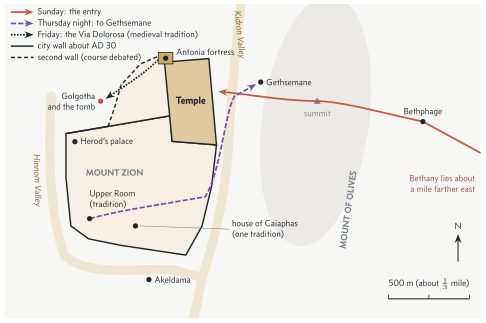
There Jesus prayed alone, “O my Father, if it be possible, let this cup pass from me: nevertheless not as I will, but as thou wilt.” Three times he came back and found Peter and the brothers James and John asleep. Luke adds that “his sweat was as it were great drops of blood,” though some of the oldest manuscripts of Luke lack the verse. Painters call the scene the Agony in the Garden.
Judas knew the place. He came with “a great multitude with swords and staves, from the chief priests,” and in John with soldiers carrying lanterns and torches. In the dark they needed to know which man to seize, and Judas had given them a sign: “Whomsoever I shall kiss, that same is he: hold him fast.” In the garden of Gethsemane, Judas betrayed Jesus with a kiss:This man betrayed Jesus with a kiss in Gethsemane. → Judas Iscariot•• he went straight to Jesus, said “Hail, master,” and kissed him, as a disciple might greet his teacher. Luke gives Jesus’s answer: “Judas, betrayest thou the Son of man with a kiss?” A “Judas kiss” still means friendship that hides a betrayal. In John there is no kiss; Jesus steps forward and says, “I am he.”

One of the disciples drew a sword and struck the high priest’s servant, cutting off his ear; Luke and John say it was the right ear. Only John names them both: in his account Peter cut off the ear of MalchusThis man cut off the ear of the high priest's servant Malchus. → Saint Peter the Apostle•• (mal-kus). “Then Simon Peter having a sword drew it, and smote the high priest’s servant, and cut off his right ear.” In Luke, Jesus touched the ear and healed it. In Matthew he rebuked the swordsman: “all they that take the sword shall perish with the sword” (Figure 31.5).
Then, Mark says, “they all forsook him, and fled,” and he adds a strange detail that no other Gospel has. “And there followed him a certain young man, having a linen cloth cast about his naked body; and the young men laid hold on him: And he left the linen cloth, and fled from them naked.” The young man who fled nakedThis book includes an account of a naked young man fleeing the Garden of Gethsemane after Jesus's arrest. → Gospel of Mark•This man is sometimes identified with the naked young man who fled the Garden of Gethsemane after Jesus's arrest. → Mark the Evangelist• is never named. Christian tradition has long guessed that he was Mark himself, the author tradition gives to this Gospel (Chapter 27), slipping quietly into his own story. Acts says that the first Christians of Jerusalem met in the house of “Mary the mother of John, whose surname was Mark,” so a boy from that house might have followed. Other readers see only a picture of total desertion. Nobody knows.
The arresting party led Jesus to the high priest. John says they took him first to Annas (an-us), a former high priest, and then to Annas’s son-in-law Caiaphas, high priest from about AD 18 to 36, who had already urged the council that one man should die for the people (Chapter 29). In Mark the Sanhedrin, the high council of priests and elders (Chapter 26), met that night. Its witnesses contradicted one another. At last the high priest asked, “Art thou the Christ, the Son of the Blessed?” Jesus answered, “I am.” The high priest tore his clothes and called it blasphemy, an insult to God, and the council condemned him to death.
Peter had followed into the courtyard and sat with the servants by a fire, for the night was cold. In Matthew’s telling, a servant girl looked at him: “Thou also wast with Jesus of Galilee.” He denied it. A second girl said the same, and he denied it with an oath. Then the bystanders said, “thy speech bewrayeth thee”: his Galilean accent gave him away. In John the third questioner is a relative of Malchus, who asks, “Did not I see thee in the garden with him?” Peter swore, “I know not the man,” and a rooster crowed (in Mark, for the second time). So, as Jesus had foretold, Peter denied him three times before the rooster crowed.This apostle denied knowing Jesus three times before a rooster crowed. → Saint Peter the Apostle••• In Luke, “the Lord turned, and looked upon Peter,” and “Peter went out, and wept bitterly.” The church of Saint Peter in Gallicantu, “at the cock’s crow,” marks the place by one tradition. When, in John’s last chapter, the risen Jesus asks Peter three times, “lovest thou me?” (Chapter 32), readers have long heard an answer to the three denials.
The end of Judas
In the morning, Matthew says, when Judas saw that Jesus was condemned, he repented. He brought the thirty pieces of silver back to the chief priests: “I have sinned in that I have betrayed the innocent blood.” They answered, “What is that to us? see thou to that.” He threw the silver down in the Temple and went and hanged himself. The priests would not put blood money in the treasury, so they bought “the potter’s field, to bury strangers in,” and it was called “The field of blood.” Readers of the Hebrew Bible remember another traitor who hanged himself, Ahithophel, the counselor who deserted David for the rebel Absalom (Chapter 17).
The Acts of the Apostles, by the author of Luke, tells it another way. There Peter says that Judas “purchased a field with the reward of iniquity; and falling headlong, he burst asunder in the midst, and all his bowels gushed out.” The field was called in Aramaic Aceldama, “The field of blood,” a name usually spelled Akeldama (uh-kel-duh-muh) today, and tradition places it in the Hinnom Valley south of the old city. So Matthew says Judas hanged himself,Matthew says this man hanged himself; Acts says he fell headlong and burst open at Akeldama. → Judas Iscariot•• while Acts says he fell headlong and burst open at Akeldama. Both accounts say a field bought with his money got that grim name; they disagree about who bought it and how he died.
A third account shows how such stories grew. Papias, the bishop in Asia Minor who wrote about AD 110 on the Gospels’ authors (Chapter 27), told a story found in no book of the canon, the list of books the churches accepted as scripture (the Stage). In Papias’s account, Judas’s body swelledPapias gives a noncanonical account in which this man’s body becomes grotesquely swollen. → Judas Iscariot•• so enormously that he could not pass where a wagon passes easily, not even his head alone. He died on his own land, which stank so badly that in Papias’s day people still held their noses as they passed.
Pilate
At daybreak the council bound Jesus and led him to the man who would decide his fate. Pontius Pilate was the Roman prefect of Judea,This man was a Roman governor/prefect of Judea. → Pontius Pilate•• the governor whom the emperor Tiberius had sent in AD 26 to rule Judea, Samaria, and Idumea (Chapter 26). The stone from Caesarea that names him with that title is shown in Figure 31.6. The Jewish writers Philo and Josephus describe a hard man who more than once enraged the Jews of Jerusalem.

Why bring Jesus to Pilate at all? In John the council’s men explain, “It is not lawful for us to put any man to death,” for Rome kept the power of execution for its own governor. Their charge was political: that Jesus called himself the King of the Jews, and so challenged Caesar. “Art thou the King of the Jews?” Pilate asks in all four Gospels. “Thou sayest,” Jesus answers in the first three.
John makes the hearing a conversation. “My kingdom is not of this world,” Jesus tells Pilate. “To this end was I born, and for this cause came I into the world, that I should bear witness unto the truth.” Then Pilate asked, “What is truth?”This man asked "What is truth?" → Pontius Pilate•• and, without waiting for an answer, went out and told the crowd, “I find in him no fault at all.” The English statesman and philosopher Francis Bacon opened his essay “Of Truth,” in 1625, with that moment: “What is Truth? said jesting Pilate; and would not stay for an answer” (Vol. 12, Crown and Parliament).
Luke adds a scene of his own. Hearing that Jesus was a Galilean, Pilate sent him to Herod Antipas, the son of Herod the Great who ruled Galilee and had beheaded John the Baptist (Chapter 26). Herod, in Jerusalem for the feast, hoped to see a miracle. Jesus would not answer him, so Herod’s soldiers mocked him, dressed him in a gorgeous robe, and sent him back. “And the same day Pilate and Herod were made friends together.”
As Pilate sat on the judgment seat, Matthew says, a message came from his wife. Pilate’s wife had a troubling dream,This man's wife had a disturbing dream and urged him to have nothing to do with an innocent man. → Pontius Pilate• and she urged her husband to leave the innocent man alone: “Have thou nothing to do with that just man: for I have suffered many things this day in a dream because of him.” Matthew does not name her. Later tradition called her Procula, or Claudia Procula, and the Orthodox churches honor her as a saint.
At the feast, the Gospels say, the governor freed one prisoner of the crowd’s choosing, a custom known only from the Gospels. In prison lay a man named Barabbas (buh-rab-us), “a notable prisoner,” as Matthew calls him. Mark says he had been jailed with rebels and “had committed murder in the insurrection.” His name is Aramaic, bar abba, “son of the father,” and some old manuscripts of Matthew call him “Jesus Barabbas,” so that the crowd chose between two men named Jesus. “Whom will ye that I release unto you? Barabbas, or Jesus which is called Christ?” Pilate asked. The chief priests stirred up the people, and the crowd demanded that Pilate release Barabbas.A crowd demanded this man release Barabbas. → Pontius Pilate•• Of Jesus they cried, “Let him be crucified.”
Matthew alone records what Pilate did next. “When Pilate saw that he could prevail nothing, but that rather a tumult was made, he took water, and washed his hands before the multitude, saying, I am innocent of the blood of this just person: see ye to it.” The Law of Moses had a similar rite, in which elders washed their hands and declared, “Our hands have not shed this blood.” So Pilate washed his handsThis man washed his hands, declaring the crowd responsible for the blood of his prisoner. → Pontius Pilate•• of the prisoner’s blood, and to “wash one’s hands” of something still means to refuse responsibility. Matthew goes on: “Then answered all the people, and said, His blood be on us, and on our children.” For centuries Christians quoted that verse to blame the Jewish people as a whole for the death of Jesus, and it fed persecution and murder. In 1965 the Catholic Church, at the Second Vatican Council, a worldwide meeting of its bishops, declared that his death cannot be charged against all the Jews then living, nor against the Jews of today.
The sources disagree about Pilate. The Gospels paint him as weak and unwilling, while Philo and Josephus show a governor quick to use force; and the Gospel writers, Christians living under Roman rule, had reason not to blame Rome more than they must. Whatever Pilate felt, the decision was his. His soldiers flogged Jesus, twisted a crown of thorns onto his head, robed him in purple, and mocked him as “King of the Jews.” In John, Pilate showed him to the crowd: “Behold the man!” In Latin the words are Ecce homo (ek-ay hoh-moh), the title of many later paintings. Then Pilate ordered Jesus crucifiedThis man was killed on the orders of Pontius Pilate. → Jesus•This man ordered the crucifixion of Jesus. → Pontius Pilate•• and handed him over to the soldiers.
The Romans hung a notice of the crime on a crucified man. John says Pilate himself wrote it, “in Hebrew, and Greek, and Latin”: “JESUS OF NAZARETH THE KING OF THE JEWS.” Its Latin initials, INRI, for Iesus Nazarenus Rex Iudaeorum (yoo-day-or-um), appear above the cross in countless paintings and carvings. The chief priests asked him to change it to say only that Jesus claimed to be king. Pilate refused: “What I have written I have written.” In Jerome’s Latin Bible Pilate answered, quod scripsi, scripsiThis man declared "quod scripsi, scripsi" ("What I have written, I have written") when asked to change an inscription on a sign. → Pontius Pilate•• (kwod skrip-see), and the phrase still means that a decision is final.
The Christian creeds, the short statements of belief recited in church, still say that Jesus “suffered under Pontius Pilate.” Pilate kept his post until AD 36, when his soldiers killed Samaritans gathering near Mount Gerizim (Chapter 14) and he was sent to Rome to answer for it. After that he vanishes from history.
The crucifixion
Crucifixion was the Romans’ cruelest punishment, kept for slaves, pirates, and rebels. The condemned man was whipped, made to carry the crossbeam to the place of death, and tied or nailed to it with his arms spread. He hung there until he died, probably of exhaustion and suffocation, which could take a day or more, in public beside a road, as a warning. After the slave revolt of Spartacus, in 71 BC, about six thousand rebels were crucified along the Appian Way (Vol. 7, The Romans). Constantine, the first Christian emperor, later abolished the punishment.
In Matthew, Mark, and Luke, the soldiers made a passerby, Simon of Cyrene, a city in what is now Libya, carry the beam for him, perhaps because the flogging had left Jesus too weak; in John, Jesus carries it himself. They came to a place outside the wall called Golgotha (gol-guh-thuh), Aramaic for “a place of a skull”; Luke’s word in the King James Version is Calvary, from the Latin calvaria, “skull.” There, at about nine in the morning, Mark says, they crucified him between two criminals. All four Gospels agree that Jesus was crucified and died on a cross.Jesus Christ was crucified and died on this object. → cross•• Their Greek word, stauros, first meant an upright stake, but tradition has always pictured a cross with a crossbeam, which fits Matthew’s notice “over his head.” For three centuries Christians seldom pictured the cross, the gallows of criminals; after Constantine it became the chief sign of their faith. A cross bearing the figure of Jesus is a crucifix.

The Gospels between them record seven sayings of Jesus on the cross. In Luke he prays for his executioners, “Father, forgive them; for they know not what they do,” and promises a criminal beside him, “To day shalt thou be with me in paradise.” Darkness, the first three Gospels say, covered the land from noon until three. Then, in Matthew and Mark, he cried out the first line of Psalm 22 in Aramaic, Eli, Eli, lama sabachthani (sah-bahk-tah-nee), “My God, my God, why hast thou forsaken me?” The same psalm says, “They part my garments among them, and cast lots upon my vesture,” and the soldiers did just that. In John he says, “I thirst,” and, when he has been given vinegar on a sponge, “It is finished.” In Luke his last words are “Father, into thy hands I commend my spirit.” Matthew, Mark, and Luke add that the veil of the Temple tore in two, and in Matthew the centurion, the Roman officer in charge of the execution, said, “Truly this was the Son of God” (Figure 31.7).
Near the cross, John says, stood Jesus’s mother, her sister, Mary the wife of Cleophas, and Mary Magdalene, and beside them the disciple whom Jesus loved. Jesus said to his mother, “Woman, behold thy son!” and to the disciple, “Behold thy mother!” “And from that hour that disciple took her unto his own home.” John never names him, but Christian tradition identifies him as John,Christian tradition identifies this apostle as the disciple whom Jesus entrusted to Mary at the crucifixion. → Saint John the Apostle•• the son of Zebedee, one of the Twelve (Chapter 32). So, in tradition, Jesus entrusted his mother to John, and a later legend says that Mary went with John to Ephesus.
The next day was the Sabbath, and the Law of Moses said that a hanged man’s body “shall not remain all night upon the tree.” So the Jewish authorities asked Pilate to have the legs of the crucified broken. A crucified man, it is usually thought, had to push up on his legs to breathe, so breaking them killed him quickly. The soldiers broke the two criminals’ legs, but Jesus was already dead. Then, John says, a Roman soldier pierced his sideOne of these objects was used by a Roman soldier to pierce the side of Jesus. → spears• with a spear: “one of the soldiers with a spear pierced his side, and forthwith came there out blood and water.” John insists that an eyewitness saw it, and he finds two scriptures fulfilled. Of the Passover lamb the Law said, “neither shall ye break a bone thereof”; and Zechariah wrote, “they shall look upon me whom they have pierced.” A later book named the soldier Longinus (lon-jy-nus), and many churches have claimed his spear, among them the crusaders who said they found it at Antioch in 1098 (Vol. 9, Cathedrals and Crusades).
Bodies of the crucified were often left for the birds or thrown in a common pit. That evening a secret follower intervened. Joseph of Arimathea, from a town whose site is uncertain, was a rich man and “an honourable counseller,” a member of the council who had not agreed to its decision, and a disciple of Jesus “secretly for fear of the Jews.” He “went in boldly unto Pilate, and craved the body.” Pilate, surprised that Jesus was already dead, checked with the centurion and gave it to him. Joseph wrapped the body in clean linen and, as Matthew tells it, Joseph laid it in his own new tomb,This man provided the tomb in which Jesus was buried. → Joseph of Arimathea•• “which he had hewn out in the rock,” and rolled a great stone across the door. John adds that Nicodemus brought about a hundred pounds of myrrh and aloes for the burial (Chapter 27). Mary Magdalene and other women watched where he was laid. In medieval legend Joseph later carried the cup of the Last Supper, the Holy Grail, to Britain (Vol. 8, The Northern Worlds).
The resurrection
At dawn on Sunday, “the first day of the week,” women came to the tomb with spices to anoint the body. The Gospels name different women and tell what they found in different ways. In Matthew an angel rolls back the stone while the guards shake with fear; in Mark a young man in white sits inside; in Luke two men stand by “in shining garments”; in John Mary Magdalene comes alone in the dark. The message is the same: “He is not here: for he is risen.”
That message is the center of Christian belief. Christians believe that God raised Jesus from the dead, his resurrection, and Easter celebrates his rising on the third day.Easter celebrates Jesus’s undergoing this event on the third day after his death. → resurrection•• Counting as the ancients did, Friday was the first day, Saturday the second, and Sunday the third. Easter is dated by Passover’s moon, and in many languages its name comes from Pascha (Chapter 14). The oldest written statement of the belief is again Paul’s, about AD 54: “that Christ died for our sins according to the scriptures; And that he was buried, and that he rose again the third day according to the scriptures.” Historians cannot test a miracle. They can say that Jesus’s followers came very quickly to believe that he had risen and appeared to them, and that this belief launched the church. Matthew shows that the argument was already old when he wrote: the guards, he says, were bribed to say that the disciples had stolen the body, and the story was still told “until this day.”
The first witness in John’s account is Mary Magdalene. She came from Magdala, a fishing town on the western shore of the Sea of Galilee. Luke names her among the women who traveled with Jesus and supported him “of their substance,” and says why she followed him: she was “Mary called Magdalene, out of whom went seven devils.” So, in Luke, seven demons had been driven from her,This person was described as having had seven demons driven from her. → Mary Magdalene• and the longer ending of Mark says the same (Chapter 27). She stood by the cross and watched the burial, and in all four Gospels she came to the tomb.
In John, she found the stone taken away and ran to tell Simon Peter and the disciple whom Jesus loved. “So they ran both together: and the other disciple did outrun Peter, and came first to the sepulchre.” The other disciple stooped and looked in at the linen grave clothes, but did not go in. Arriving second, Peter was the first to enter the tomb.According to John’s Gospel, this apostle was the first of the two disciples racing to Jesus’ tomb to enter it. → Saint Peter the Apostle• He saw the linen lying there and the cloth from Jesus’s head folded by itself. Then the other disciple went in, “and he saw, and believed” (Figure 31.8).


The two went home, but Mary stood outside the tomb weeping. She turned and saw a man standing there and, “supposing him to be the gardener,” begged him to tell her where he had put the body. He said one word, “Mary.” She knew him then and called him Rabboni (rab-boh-nye), Aramaic for “Master.” “Touch me not,” he told her, “for I am not yet ascended to my Father.” In Latin his words are Noli me tangere (noh-lee may tan-jeh-ray), the title of many paintings of the scene (Figure 31.9). So in John’s Gospel Mary Magdalene first saw the risen Jesus,According to John’s Gospel, this woman was the first to encounter the risen Jesus. → Mary Magdalene•• and she went and told the disciples. Medieval writers called her “the apostle to the apostles.”
The Gospels tell of women who anointed Jesus, as Chapter 29 told. In Luke an unnamed “woman in the city, which was a sinner” washes his feet with her tears in Galilee; in Mark and Matthew an unnamed woman anoints his head at Bethany; and in John, Mary of Bethany anoints his feet. Mary Magdalene is in none of these stories, though Luke introduces her in the very next chapter after the sinful woman. Yet Western Christians, those of the Latin church of Rome and later the Protestants, came to see these women as one. In a sermon of 591, Pope Gregory the Great identified Mary Magdalene with Mary of Bethany and with Luke’s sinful woman, and so Western tradition conflated Mary Magdalene with the sinful womanThis woman was traditionally conflated in Western Christianity with the unnamed sinful woman who anointed Jesus. → Mary Magdalene•• who anointed Jesus. She became the model of the repentant sinner, painted weeping, with loose hair and a jar of ointment, and her tears gave English the word “maudlin.” The Eastern Orthodox churches always kept the women apart, and in 1969 the Catholic calendar of saints’ days separated them too.
That evening, John says, Jesus came and stood among the disciples behind shut doors. One of the Twelve was absent: Thomas, called Didymus, “the twin” (Chapter 29). When the others said, “We have seen the Lord,” he refused to accept it. “Except I shall see in his hands the print of the nails, and put my finger into the print of the nails, and thrust my hand into his side, I will not believe.” Eight days later Jesus came again and told Thomas to touch his hands and his side. Thomas answered, “My Lord and my God.” So Thomas, who first doubted the resurrection,This apostle initially doubted Jesus’ resurrection, then declared “My Lord and my God!” → Thomas the Apostle•• became the first disciple in John’s Gospel to call Jesus God outright. A “doubting Thomas” is still anyone who will not believe without proof.

Jesus answered Thomas with words for everyone who would come after: “blessed are they that have not seen, and yet have believed.” The quality he praised is faith, trust in what cannot be seen or proved, and those who have faithThose who possess this concept "have not seen and yet have believed," according to Jesus. → faith• are, in his words, those who “have not seen, and yet have believed.” The Letter to the Hebrews gives the classic definition: “Now faith is the substance of things hoped for, the evidence of things not seen.” John says that he wrote his whole book so that its readers “might believe,” and Paul built his teaching on faith (Chapter 33). In Acts, after forty days of appearances, Jesus is taken up into heaven (Chapter 32).
Relics and apocrypha
The places of the Passion soon lay under a Roman city. The Romans destroyed Jerusalem in AD 70 (Chapter 34), and in the 130s the emperor Hadrian rebuilt it as a Roman colony, Aelia Capitolina (ee-lee-uh kap-ih-toh-ly-nuh), with a temple of Venus over the spot where Christians remembered the tomb. About 326 the emperor Constantine (the Stage) had the temple torn down, and beneath it, says Eusebius, a bishop who knew Constantine, the workmen found a tomb cut in the rock. Over it Constantine built a great church, dedicated in 335, that enclosed both the tomb and the rock of Golgotha. Jerusalem’s Church of the Holy SepulchreThe Church of the Holy Sepulchre is located in this city. → Jerusalem• has stood there ever since; “sepulchre” is an old word for a tomb.

The caliph al-Hakim, Muslim ruler of Egypt, ordered it destroyed in 1009, and it was rebuilt by 1048; crusaders took Jerusalem in 1099 and remodeled it (Vol. 9, Cathedrals and Crusades). Today six churches share it: Catholic, Greek Orthodox, Armenian, Coptic, Syriac, and Ethiopian. Since 1757 an agreement called the Status Quo has forbidden any of them to change anything without the consent of all, so a ladder left on a ledge of the front wall has stood there for nearly three centuries (Figure 31.11). Two Muslim families keep the key and open the door each morning. Is it the real place? Archaeologists have found that the site was an old quarry with rock-cut tombs of the right age, just outside the wall of AD 30. It may well be authentic; nobody can prove it.

Christians soon told how the cross itself was found. Constantine’s mother, Helena, journeyed to the Holy Land about 326 (Chapter 28). Eusebius, who described her journey, says nothing of a cross, though about 350 Cyril, bishop of Jerusalem, wrote that the world was already full of pieces of its wood. The full story appears only in the 390s. In the version that Rufinus, a church historian, told about 402, Helena dug at Golgotha and found three crosses. To learn which was Christ’s, the bishop had a dying woman touched with each, and at the touch of the third she rose healed. So the True Cross, traditionally found by Helena,Relics of this object on which Jesus was crucified were traditionally discovered by Helena. → True Cross• became Christendom’s most precious relic, an object honored for its link to a holy person, cut into fragments sent across the world. In the sixteenth century the reformer John Calvin scoffed that the fragments would fill a ship, and historians doubt that any is genuine (Figure 31.12).
Stories about the Passion also grew into whole books. About 155 the Christian writer Justin Martyr told the emperor that he could read the “Acts” of Pontius Pilate, meaning official records Justin assumed must exist. A later book claimed to be those records. In its present form it dates from the fourth or fifth century and calls itself an account written by Nicodemus. The Acts of Pilate, also called the Gospel of Nicodemus,"The Acts of" this person is an alternative title for the Gospel of Nicodemus. → Pontius Pilate•• retells the trial at length and names people the Gospels leave nameless: the soldier with the spear is Longinus, and the two criminals are Dismas and Gestas. Its second part tells how Christ went down into hell before rising and led out Adam and the righteous dead, the scene known as the Harrowing of Hell. No church counts it as scripture; it is apocryphal, in the looser sense of that word (the Stage). But it was copied and translated all through the Middle Ages.
The strangest of these books turns the story inside out. About 180 the bishop Irenaeus (Chapter 27) attacked a “Gospel of Judas” as a work of the Gnostics, Christians who taught that salvation came through secret knowledge and that the material world was made by a lesser god (Chapter 34). For eighteen centuries only its name was known. Then, in the 1970s, a farmer in Middle Egypt found a papyrus book in Coptic, the late form of Egyptian written by Egypt’s Christians, now called the Codex Tchacos (chah-kos). It passed among dealers for decades, crumbling into a thousand pieces, before it was restored and published in 2006. The apocryphal Gospel of JudasAn apocryphal gospel named for this man consists largely of a dialogue with Jesus. → Judas Iscariot• consists largely of a dialogue between Jesus and Judas in the days before Passover. Jesus laughs at the other disciples, who misunderstand him, and reveals the secrets of heaven to Judas alone; Judas, he says, will outdo them all, for he will sacrifice the human body that Jesus wears. Scholars still argue whether the book makes Judas a hero who frees Jesus from his body or a demon who truly betrays him.
What to remember
- The Passion is the story of Jesus’s last week. He entered Jerusalem on a donkey, as Matthew and John say Zechariah foretold, to shouts of “Hosanna”; in Luke he says the stones would cry out if his followers were silent.
- Judas Iscariot objected to Mary’s costly nard, took thirty pieces of silver from the chief priests, was given the dipped bread at the Last Supper, and betrayed Jesus with a kiss in Gethsemane.
- In Matthew, Mark, and Luke the Last Supper is a Passover meal; in John it comes the evening before, and Jesus dies as the lambs are killed. John alone tells of the washing of the feet, which Peter at first refused.
- At the arrest Peter cut off Malchus’s ear, and a young man fled naked (in Mark alone; tradition says Mark himself). Peter denied Jesus three times before the rooster crowed.
- Matthew says Judas hanged himself and the silver bought a potter’s field; Acts says he fell headlong in the Field of Blood, Akeldama. Papias told of his body swelling grotesquely.
- Pontius Pilate was the Roman prefect of Judea. He asked “What is truth?” and heard of his wife’s dream. The crowd chose Barabbas, and Pilate washed his hands and ordered the crucifixion. Of the sign on the cross he said, “What I have written I have written.”
- On the cross Jesus entrusted his mother to the beloved disciple, whom tradition takes to be John. A soldier pierced his side with a spear, and Joseph of Arimathea laid him in his own new tomb.
- Christians celebrate the resurrection on the third day at Easter. In John, Peter and the beloved disciple raced to the tomb, and Mary Magdalene, healed of seven demons, first saw the risen Jesus; Western tradition conflated her with the sinful woman who anointed him. Thomas doubted, and Jesus blessed those who “have not seen, and yet have believed.”
- Constantine built the Church of the Holy Sepulchre in Jerusalem, and a legend first told late in the fourth century says that his mother, Helena, found the True Cross. The Acts of Pilate, or Gospel of Nicodemus, and the Gnostic Gospel of Judas are apocryphal gospels.
Chapter 32 · 47 clues
The Twelve and the Acts of the Apostles
Pope Pius XI, the head of the Catholic Church, died in February 1939, and workmen went down beneath the floor of St. Peter’s Basilica in Rome to make room for his tomb. Under the floor they broke into something much older: the roofs and painted walls of a Roman cemetery, buried when Constantine, the first Roman emperor to favor the Christians, leveled the hillside for the first church on the spot about 320. For ten years excavators dug in secret along a whole street of tombs. Directly under the high altar, where no family had ever built a tomb, they found shallow graves and a small shrine of the second century set against a red-plastered wall. Visitors had scratched their prayers on a wall beside it, and among the scratches some scholars read a name.
The name was Peter. The man it honored had been a fisherman on a lake in Galilee, some 1,400 miles away, and had died more than two and a half centuries before the first church rose over his grave. How a band of Galilean Jews became a church that reached the capital of the world is told by two kinds of source. One is the Acts of the Apostles, the book that follows the Gospels in the New Testament. The other is the traditions that later Christians wrote down about where each of the Twelve went and how each died. This chapter keeps the two apart.
Peter
His name was Simon, and Matthew calls him “Simon Bar-jona,” Aramaic for “son of Jonah.” He came from Bethsaida, a fishing town at the north end of the Sea of Galilee, and he kept a house at Capernaum, a few miles along the shore, with his brother Andrew. He was married, for the Gospels tell how Jesus healed his mother-in-law there (Chapter 29). By the sea, in words Matthew and Mark record, Jesus called Peter and Andrew to be fishers of men:Jesus called this apostle and his brother Andrew to be “fishers of men.” → Saint Peter the Apostle•• they had caught fish for a living, and now they would win people for the kingdom of God. Luke sets the same call after a catch so large that the nets broke, and has Jesus say, “from henceforth thou shalt catch men.”
In every list of the Twelve, Simon comes first; Matthew’s begins, “The first, Simon, who is called Peter.” With James and John, the sons of Zebedee (Chapter 29), he formed an inner circle that alone saw the Transfiguration and watched with Jesus in the garden of Gethsemane. He was also the most impulsive of the Twelve. He tried to walk on the water to Jesus and began to sink (Chapter 29), and on the night of the arrest he denied three times that he knew him (Chapter 31).
Jesus gave him a new name (Chapter 29). “Thou art Simon the son of Jona,” he says in the first chapter of John’s Gospel: “thou shalt be called Cephas, which is by interpretation, A stone.” Kepha is Aramaic for a rock, and its Greek translation is Petros, from petra, “rock.” So “Peter” began as a nickname, something like “Rocky.”
Matthew tells when the name earned its meaning. Near Caesarea Philippi, a town at the foot of Mount Hermon in the far north, Jesus asked the disciples, “But whom say ye that I am?” Peter answered, “Thou art the Christ, the Son of the living God.” Jesus blessed him and answered with a pun on his name: “That thou art Peter, and upon this rock I will build my church; and the gates of hell shall not prevail against it.” The pun links Peter’s name, “a stone,” to the rock on which Jesus would build his church.Jesus tells this apostle "on this rock I will build my church." → Saint Peter the Apostle•••In Matthew 16:18, Jesus says "you are Peter, and on one of these objects I will build my church." → stones• Jesus went on: “I will give unto thee the keys of the kingdom of heaven: and whatsoever thou shalt bind on earth shall be bound in heaven.” To “bind” and, as the verse goes on, to “loose” were the words rabbis used for forbidding and permitting. The Catholic Church reads the rock as Peter himself, with an authority handed on to the bishops of Rome. Many Protestant readers, from the sixteenth-century Reformers on, have taken the rock to be Peter’s confession of faith, or Christ himself. Only Matthew has the saying (Chapter 27).

The last scene of John’s Gospel, the epilogue told in Chapter 27, brings Peter back to his boat on the Sea of Galilee, where the risen Jesus, John says, found him after a night of catching nothing. When the disciple whom Jesus loved cries, “It is the Lord,” Peter throws on his coat and jumps into the water. Then Peter hauled the net of 153 fish ashore,This man hauled in a miraculous catch of 153 fish after Jesus appears on the Sea of Galilee. → Saint Peter the Apostle• the catch whose exact count that chapter explained, and the net did not break. Jesus has a fire of coals burning, with fish and bread on it, and they eat breakfast together.
After breakfast Jesus asks, “Simon, son of Jonas, lovest thou me more than these?” Peter says yes, and Jesus answers, “Feed my lambs.” He asks a second time and a third, and Peter is hurt: “Lord, thou knowest all things; thou knowest that I love thee.” So, after the third answer, Jesus told Peter to feed his sheep.After asking three times whether this apostle loved him, Jesus told him to “Feed my sheep.” → Saint Peter the Apostle•• Readers have long noticed the echo. Peter denied Jesus three times while warming himself at a “fire of coals” in the high priest’s courtyard, and now, by another fire of coals, he says three times that he loves him. The fisherman is made a shepherd of Jesus’s flock, and a Christian minister is still called a pastor, Latin for “shepherd.” Then Jesus tells him that when he is old “thou shalt stretch forth thy hands, and another shall gird thee, and carry thee whither thou wouldest not.” John adds that this was said “signifying by what death he should glorify God.” Early Christians read the stretched-out hands as a cross.
Pentecost and the Holy Spirit
The book of Acts
The Gospels end with Jesus risen. What his followers did next is the subject of the Acts of the Apostles, the fifth book of the New Testament,This book is the fifth book of the New Testament. → Acts of the Apostles•• which stands right after the four Gospels. Its first words are addressed to the same Theophilus as the Gospel of Luke, and nearly all scholars agree that one author wrote both books (Chapter 27). Since the second century, tradition has named Luke as the author,Luke is traditionally credited as the author of this book. → Acts of the Apostles•• the doctor who traveled with Paul. Most date the book about AD 80 to 90.
Acts means “deeds.” Greek readers knew books of the deeds of famous men, and the title this one bears is first found in the second century. It is a history of the deeds of Jesus’s followers after his deathThis book chronicles the deeds of Jesus's followers after his death. → Acts of the Apostles•• and, as they believed, his rising, told in twenty-eight chapters (Figure 32.2). The first twelve follow Peter and the church in Jerusalem. The rest follow Paul, the persecutor who became a missionary, from the coast of Syria to Greece and at last to Rome (Chapter 33). Acts ends with Paul a prisoner in Rome, about AD 62, preaching “with all confidence, no man forbidding him.” It never tells how Peter or Paul died.

The twelfth seat
Acts opens with forty days in which the risen Jesus appears to the apostles. Then, on the Mount of Olives outside Jerusalem, “he was taken up; and a cloud received him out of their sight.” Christians call this the Ascension. The eleven go back to an upper room in the city with Jesus’s mother and his brothers, about 120 believers in all.
Peter stands up to fill a gap. Judas Iscariot, who betrayed Jesus, is dead; Acts tells his death differently from Matthew (Chapter 31). There had been twelve apostles for a reason. Israel was twelve tribes, the descendants of Jacob’s twelve sons (Chapter 12), and Jesus had promised the Twelve that they would “sit upon twelve thrones, judging the twelve tribes of Israel.” Peter quotes a psalm, “his bishoprick let another take,” that is, his office, and sets one condition. The new apostle must have been with them from John’s baptism of Jesus to the Ascension, so that he could be “a witness with us of his resurrection.” Two men qualify, Joseph called Barsabbas (bar-sab-us), who was also named Justus, and Matthias (muh-thy-us). The disciples pray and then cast lots, a kind of drawing straws that the priests of Israel had used to learn God’s will. “The lot fell upon Matthias; and he was numbered with the eleven apostles.” So, in the first chapter of Acts, Matthias, not Joseph Barsabbas, replaced Judas,This disciple was replaced by Matthias. → Judas Iscariot••In this book, Matthias is chosen to replace Judas Iscariot near the beginning. → Acts of the Apostles••This apostle was chosen over Joseph Barsabbas to replace Judas. → Matthias•Matthias was chosen to restore the number of apostles to this many. → twelve•• and the apostles were twelve again. The Bible never mentions Matthias after this.
The day of Pentecost

The next scene takes place at a Jewish festival. Shavuot, the Feast of Weeks, falls on the fiftieth day after the start of Passover (Chapter 14). It marked the wheat harvest, and Jewish tradition made it the day the Torah was given at Sinai. Greek-speaking Jews called it Pentecost, from the Greek for “fiftieth.” Jews came up to Jerusalem for it from all over the world, and Acts lists their homelands like a roll call of this volume: “Parthians, and Medes, and Elamites, and the dwellers in Mesopotamia,” Egypt, Libya, Rome, “Cretes and Arabians.”
The apostles “were all with one accord in one place.” Acts continues: “And suddenly there came a sound from heaven as of a rushing mighty wind, and it filled all the house where they were sitting. And there appeared unto them cloven tongues like as of fire, and it sat upon each of them.” This is how Acts tells the coming of the Holy Spirit: a mighty wind and tongues of fireIn this book, tongues of fire representing the Holy Spirit appear over the heads of men. → Acts of the Apostles••This figure descends on the apostles with wind and tongues of fire at Pentecost. → Holy Spirit••During Pentecost, the Holy Spirit descends with the sound of a blowing wind and tongues of this substance. → fire• resting over each head. Both signs had a long history. In Hebrew and in Greek one word means both “wind” or “breath” and “spirit,” and in Exodus God had come to Israel as fire, in the burning bush and the pillar of fire (Chapter 13). The apostles “began to speak with other tongues,” and the crowd was amazed, “because that every man heard them speak in his own language.” Christian readers have long seen the scene as the Tower of Babel undone, where God had once scattered mankind by its languages (Chapter 11). Speaking in tongues, which scholars call glossolalia (glos-oh-lay-lee-uh), is what Pentecostal churches, named for this day, seek in worship (Chapter 27).
Not everyone was impressed. “Others mocking said, These men are full of new wine.” Peter, the man who had denied Jesus to a servant girl a few weeks before, stood up to answer a crowd. “These are not drunken, as ye suppose,” he said, “seeing it is but the third hour of the day.” It was too early in the morning for drunkenness.At Pentecost, this apostle explained that it was too early to be drunk before preaching a sermon that converted about three thousand people. → Saint Peter the Apostle•• Then he preached. He quoted the prophet Joel, who had foretold that God would pour out his spirit on all flesh, “and your young men shall see visions, and your old men shall dream dreams.” He told them that the Jesus whom they had crucified had risen, and he called them to repent and be baptized. “The same day there were added unto them about three thousand souls.”
The Holy Spirit
The King James Version calls the Spirit the Holy Ghost, using the old English word for a spirit (Chapter 28). In Acts the Spirit acts like a person: it “said unto Philip,” it can be lied to, and it sends out missionaries. Over the next three centuries Christian thinkers worked out what that meant. Early in the third century, Tertullian of Carthage became the first writer in Latin known to use the word trinitas, “threeness.” In 325 the bishops at the Council of Nicaea (ny-see-uh), called by the emperor Constantine (Vol. 7, The Romans), declared that the Son was “of one substance” with the Father, but they said almost nothing about the Spirit. In 381 a second council, at Constantinople, enlarged their creed: the Spirit is the Lord and the giver of life, proceeds from the Father, and is worshiped and glorified together with the Father and the Son. From then on, in the creed that most churches still say, the Holy Spirit was the third person of the Trinity,This figure is the third person of the Trinity alongside the Father and the Son. → Holy Spirit•• one God in three persons with the Father and the Son (the Stage). A later quarrel over whether the Spirit proceeds from the Son as well helped split the churches of East and West (Vol. 9, Cathedrals and Crusades).
The first church in Jerusalem
The believers met daily in the Temple courts and in each other’s houses, and “had all things common,” selling their land and sharing the money. One afternoon, Acts says, Peter and John passed a man lame from birth who begged at the Temple gate called Beautiful. “Silver and gold have I none,” Peter told him, “but such as I have give I thee: In the name of Jesus Christ of Nazareth rise up and walk.” The man leaped up (Figure 32.7). The healing drew a crowd, and the crowd drew the priests. The Sadducees, the priestly party that ran the Temple and denied that the dead would rise (Chapter 26), were angry that the apostles preached a resurrection. Twice the apostles were arrested and brought before the Sanhedrin, the high council. Its members marveled that such “unlearned and ignorant men” spoke so boldly. Ordered to be silent, Peter answered, “We ought to obey God rather than men.”
Gamaliel’s advice
The council was ready to kill them. Then one of its members stood up, “a Pharisee, named Gamaliel, a doctor of the law, had in reputation among all the people.” Jewish tradition remembers him as Rabban Gamaliel (guh-may-lee-ul), “our master,” a grandson of Hillel, the gentle teacher of Herod’s time (Chapter 26), and the later rabbis counted him among the greatest teachers of the Law. Paul would say that he had been brought up “at the feet of Gamaliel.” Gamaliel reminded the council of two would-be leaders who had gathered followers and come to nothing. “Refrain from these men, and let them alone,” he said: “for if this counsel or this work be of men, it will come to nought: But if it be of God, ye cannot overthrow it; lest haply ye be found even to fight against God.” In the fifth chapter of Acts, Gamaliel persuaded the council to let them alone,In this book, a Pharisee named Gamaliel advises a council to leave some men alone. → Acts of the Apostles• though not before the apostles were beaten and ordered again not to preach. They went out “rejoicing that they were counted worthy to suffer shame for his name.”
One of Gamaliel’s two examples is a puzzle. He names a rebel called Theudas (thoo-dus), but the Jewish historian Josephus dates a rebel of that name about AD 45, a decade or more after the speech. Scholars disagree whether Josephus and Acts meant different men or whether Acts has the order wrong.
Stephen
The church grew, and it had Greek-speaking members as well as Aramaic-speaking ones. The Greek speakers complained that their widows were being passed over in the daily handing out of food. The apostles answered that they could not leave preaching “to serve tables,” and the believers chose seven men “full of the Holy Ghost and wisdom” for the work. All seven had Greek names, among them Stephen and Philip. Later Christians called such men deacons, from the Greek diakonos, “servant,” and the word still names an order of ministers in many churches.

Stephen, Acts says, preached and worked wonders, and he argued in the synagogues of Greek-speaking Jews from Cyrene, Alexandria, and Asia Minor. When they could not answer him, they brought false witnesses who said he spoke against the Temple and the Law of Moses. Figure 32.4 shows how it ended. He was charged before the council with blasphemy (Chapter 30), and Acts says his face looked like the face of an angel. His defense, which fills the seventh chapter of Acts, is the longest speech in the book. It retells Israel’s story from Abraham through Joseph and Moses to Solomon’s Temple, and it argues that God was never tied to one building: “the most High dwelleth not in temples made with hands.” At the end Stephen turned on his judges: “Ye stiffnecked and uncircumcised in heart and ears, ye do always resist the Holy Ghost: as your fathers did, so do ye.”
They “gnashed on him with their teeth.” Stephen looked up and said, “Behold, I see the heavens opened, and the Son of man standing on the right hand of God.” The Law of Moses made stoning the penalty for blasphemy. His hearers stopped their ears, dragged him out of the city, and stoned him to death.After the high priests charge Saint Stephen with blasphemy, he is killed with these objects. → stones• Acts does not make clear whether this was a lawful sentence or a lynching; John’s Gospel says that under Roman rule the council could not lawfully put anyone to death. Acts adds a detail that matters later: “the witnesses laid down their clothes at a young man’s feet, whose name was Saul” (Chapter 33). As the stones fell, Stephen prayed in words that echo Jesus’s on the cross: “Lord Jesus, receive my spirit,” and “Lord, lay not this sin to their charge.” Then, Acts says, “he fell asleep.”
The Greek word martys means a “witness,” and Christians came to use it for a witness who dies for the faith. Paul later speaks of “thy martyr Stephen,” and since no follower of Jesus dies for the faith earlier in Acts, Stephen became the first Christian martyr,Stephen is identified as the first Christian martyr in this book. → Acts of the Apostles•• whom Christians call the protomartyr, the “first martyr.” Western churches keep his feast on December 26, the day after Christmas, which is why the carol says that Good King Wenceslas looked out “on the feast of Stephen.” The seventh chapter of Acts, which tells the stoning of Stephen,This book recounts the stoning of Stephen. → Acts of the Apostles•• also marks a turn in the book. “At that time there was a great persecution against the church which was at Jerusalem; and they were all scattered abroad throughout the regions of Judaea and Samaria, except the apostles.” The plan of Acts 1:8 was carried out by an attack, and Figure 32.5 follows the scattered.
Philip in Samaria
One of the scattered was Philip, the second of the seven. He is not the apostle Philip but a different man, whom Acts later calls “Philip the evangelist,” living at Caesarea with “four daughters, virgins, which did prophesy.” He went north to the city of Samaria, the old capital of the northern kingdom, which Herod the Great had rebuilt as Sebaste (Chapter 28). Its people, the Samaritans, worshiped Israel’s God at their own temple site and were scorned by the Jews of Judea (Chapter 29). Philip preached and, Acts says, healed, “and there was great joy in that city.”

Samaria had a celebrity already: “a certain man, called Simon, which beforetime in the same city used sorcery, and bewitched the people.” The Samaritans said of him, “This man is the great power of God.” Simon was baptized with the rest and followed Philip everywhere, amazed at his miracles. When Peter and John came down from Jerusalem and laid their hands on the new believers, they received, Acts says, the Holy Spirit, and Simon saw what he took for a trick worth buying. He offered the apostles money: “Give me also this power, that on whomsoever I lay hands, he may receive the Holy Ghost.” There, in the city where Philip had met him, Peter rebuked Simon for trying to buy the Spirit:In this book, Philip encounters Simon Magus, a sorcerer with "Great Power," in Samaria. → Acts of the Apostles•This man rebuked Simon Magus for trying to purchase the power to impart the Holy Spirit. → Saint Peter the Apostle• “Thy money perish with thee, because thou hast thought that the gift of God may be purchased with money.” Christians call him Simon Magus, “Simon the magician,” using the word that names the Magi (Chapter 28), and his name gave English simony, the buying and selling of church offices. Second-century writers made him the father of all heresies and Peter’s rival to the end.
The road to Gaza
Then, Acts says, an angel sent Philip south, “unto the way that goeth down from Jerusalem unto Gaza, which is desert.” A chariot was on it. In it sat “a man of Ethiopia, an eunuch of great authority under Candace queen of the Ethiopians, who had the charge of all her treasure,” going home from worship in Jerusalem. To Greeks, Ethiopia meant the land south of Egypt that the Egyptians called Kush, ruled from Meroë on the Nile (the Stage), not the later Ethiopia of the highlands. Candace (kan-duh-see) was not a name but a title, kandake (kan-dah-kee), the Meroitic word for a queen or queen mother. Many royal courts trusted eunuchs (Chapter 25) with their treasures, because a eunuch could have no children of his own to enrich. This one was, in effect, the finance minister of Kush.

He was reading aloud, as ancient readers did, and Philip heard the words. They were from the prophet Isaiah: “He was led as a sheep to the slaughter; and like a lamb dumb before his shearer, so opened he not his mouth.” This is the song of the suffering servant (Chapter 19). “Understandest thou what thou readest?” Philip asked. “How can I,” the official answered, “except some man should guide me?” He invited Philip into the chariot and asked whom the prophet meant, himself or another. Then Philip explained the passage from IsaiahIn Acts, this figure explains a passage from Isaiah to the Ethiopian eunuch and baptizes him. → Philip the Evangelist• as a prophecy of Jesus.
They rode on until they came to some water beside the road. “See, here is water,” the official said; “what doth hinder me to be baptized?” The chariot stopped, and they went down into the water, and Philip baptized the Ethiopian official,In this book, an Ethiopian eunuch converts to Christianity. → Acts of the Apostles• a man from beyond the borders of the Roman world. (Verse 37, in which he declares his faith, is missing from the oldest manuscripts, though the King James Version prints it.) The Spirit “caught away Philip,” and the official “went on his way rejoicing.” Philip turned up at Azotus (uh-zoh-tus), the old Philistine city of Ashdod, and preached up the coast to Caesarea. The Ethiopian Orthodox Church honors the official as a founder of its faith, though his own kingdom of Kush stayed with its old gods, and the kings of the Ethiopian highlands became Christian three centuries later (Vol. 43, Africa).
Peter and the Gentiles
While Philip worked the coast, Peter went on a tour of the believers in the small towns west of Jerusalem. At Lydda (lid-uh), on the road down to the sea, Acts says, he healed a man who had been paralyzed and bedridden for eight years. About 10 miles away, at the port of Joppa, a woman disciple had just died. Acts calls her “Tabitha, which by interpretation is called Dorcas”: her Aramaic name, Tabitha (tab-ih-thuh), and her Greek one, Dorcas (dor-kus), both mean “gazelle.” She was “full of good works and almsdeeds,” and she had sewn clothes for the poor widows of the town.

The disciples of Joppa sent two men to Lydda to fetch Peter. When he came, they took him to the upper room where her body lay, “and all the widows stood by him weeping, and shewing the coats and garments which Dorcas made.” Peter sent everyone out, knelt, and prayed. Then, Acts tells, he turned to the body and said, “Tabitha, arise,” and she opened her eyes and sat up. The news that Peter had raised Tabitha from the deadThis apostle revived Tabitha, also called Dorcas. → Saint Peter the Apostle•• ran through Joppa, and many believed. The words were almost the ones Peter had heard Jesus use when he raised a dead girl in Galilee, “Talitha cumi,” which Mark translates “Damsel, I say unto thee, arise”: Talitha and Tabitha differ by a single letter.
Peter stayed on at Joppa in the house of “one Simon a tanner, whose house is by the seaside.” Tanners worked with the hides of dead animals, a smelly trade that many Jews looked down on.
Some 30 miles up the coast, at Caesarea, the Roman governor’s city (Chapter 26), lived a man named Cornelius. He was a centurion, an officer who commanded about a hundred soldiers, in “the band called the Italian band,” a unit of the Roman army. He was not a Jew, but “a devout man, and one that feared God with all his house,” who gave alms and prayed. In a vision an angel told him to send to Joppa for Simon Peter.
The sheet from heaven
The next day, as his messengers neared Joppa, Peter went up on the flat roof of the house to pray at about noon. He was hungry, and while the meal was being made ready, he fell into a trance. He “saw heaven opened, and a certain vessel descending unto him, as it had been a great sheet knit at the four corners.” In it were “all manner of fourfooted beasts of the earth, and wild beasts, and creeping things, and fowls of the air.” A voice said, “Rise, Peter; kill, and eat.” Peter’s answer rests on the Jewish food laws. The Law of Moses lets Jews eat only certain animals: beasts that chew the cud and have split hooves, fish with fins and scales, and birds not on a list of forbidden ones (Chapter 36). Everything else is unclean. Peter refused: “Not so, Lord; for I have never eaten any thing that is common or unclean.” The voice answered, “What God hath cleansed, that call not thou common.” Three times Peter was shown a sheet full of unclean animalsIn this book, a vision shows a sheet of unclean animals descending from heaven as a voice says “Kill and eat.” → Acts of the Apostles•This apostle saw a sheet of unclean animals lowered from heaven and was told to “kill and eat.” → Saint Peter the Apostle•• and told to eat, and then the sheet was taken back up into heaven.
While he was puzzling over it, the men from Cornelius knocked at the gate. Peter went with them to Caesarea and entered the centurion’s house, something a Jew who kept the Law did not ordinarily do. Now he saw what the vision meant. “God hath shewed me,” he said, “that I should not call any man common or unclean.” The sheet had been about people, not only about food. “Of a truth I perceive that God is no respecter of persons: But in every nation he that feareth him, and worketh righteousness, is accepted with him.” Jews and Christians call non-Jews Gentiles, from the Latin for “the nations.”
As Peter spoke, Acts says, the Holy Spirit fell on Cornelius and his household, and they began to speak in tongues, a Pentecost of the Gentiles. The Jewish believers who had come with Peter were astonished. “Can any man forbid water,” Peter asked, “that these should not be baptized, which have received the Holy Ghost as well as we?” So Peter had the centurion Cornelius baptized,This apostle baptized the Gentile centurion Cornelius. → Saint Peter the Apostle•• with his family and friends, the first converts Acts calls Gentiles, baptized without first becoming Jews. Back in Jerusalem, some believers charged Peter, “Thou wentest in to men uncircumcised, and didst eat with them.” He told them the whole story, and they gave way. Soon Gentiles were joining in numbers at Antioch, the great city of Syria, and “the disciples were called Christians first in Antioch.”
Peter at the gate

About AD 44 a new ruler struck at the church. Herod Agrippa I, a grandson of Herod the Great, had been made king of all Judea by the emperor Claudius (Chapter 26). “He killed James the brother of John with the sword,” Acts says, and, seeing that this pleased his subjects, he arrested Peter too, at Passover. Peter was guarded by four squads of four soldiers and chained between two of them. In the night, Acts tells, an angel woke him, the chains fell off his hands, and the iron gate that led into the city “opened to them of his own accord” (Figure 32.8). Out in the street, Peter realized he was not dreaming.
He went to the house of Mary, the mother of John Mark, the man tradition takes for the evangelist Mark (Chapter 27), where the church was praying for him. He knocked at the gate, and a servant girl named Rhoda (roh-duh) came to answer. “And when she knew Peter’s voice, she opened not the gate for gladness, but ran in, and told how Peter stood before the gate.” In her joy, Rhoda forgot to open the gate.Rhoda was so excited to recognize this apostle at the gate that she forgot to open it. → Saint Peter the Apostle•• “Thou art mad,” the praying believers told her, and when she insisted, “It is his angel.” Meanwhile “Peter continued knocking.” When at last they let him in, he told them how he had escaped. Then he “departed, and went into another place.” Acts never says where. Herod Agrippa died soon afterward at Caesarea, in AD 44; Acts says he was “eaten of worms,” and Josephus also tells of his sudden, painful death there.
Peter appears in Acts only once more. About AD 49 the apostles and elders met at Jerusalem to decide whether Gentile believers must be circumcised and keep the whole Law of Moses. Peter reminded them of Cornelius, and the meeting, called the Council of Jerusalem, decided that Gentiles need keep only a few rules. From then on Acts follows Paul, the apostle to the Gentiles (Chapter 33). The church that began as a party within Judaism was on its way to becoming a religion of its own.
John, James, Thomas, and Jude
Acts says almost nothing about what most of the Twelve did after Pentecost (Figure 32.9). Later Christians filled the silence. Writers of the second and third centuries told where each apostle went, and a set of apocryphal books, among them the Acts of Peter, the Acts of John, and the Acts of Thomas, told their adventures and deaths in the manner of popular novels. No church counts these books as scripture, but their stories shaped how the apostles were painted and where their relics were honored (Table 32.1). Four of the Twelve have stories worth telling here.
| Apostle | Emblem in art | Death, in tradition |
|---|---|---|
| Peter | keys | crucified head downward in Rome |
| Andrew, his brother | an X-shaped cross | crucified at Patras, in Greece |
| James, son of Zebedee | a pilgrim’s scallop shell | beheaded in Jerusalem, AD 44 (Acts 12) |
| John, son of Zebedee | an eagle; a cup with a snake | died old at Ephesus |
| Philip | a cross | crucified at Hierapolis, in Asia Minor |
| Bartholomew | a flaying knife | flayed alive in Armenia |
| Thomas | a spear; a builder’s square | speared near Mylapore, India |
| Matthew | a purse | traditions disagree: Ethiopia or Persia |
| James, son of Alphaeus | a fuller’s club | Jerusalem, if he is James the brother of Jesus |
| Jude Thaddaeus | a club | in Persia with Simon, or in Armenia |
| Simon the Zealot | a saw | sawn in two in Persia |
| Matthias | an axe | traditions disagree |
The sons of thunder
James and John were the sons of Zebedee, a fisherman of the Sea of Galilee, and Luke says the brothers were Simon’s partners. Jesus called them from their father’s boat, where they sat mending nets. In Mark’s Gospel he gave them a nickname of their own: “he surnamed them Boanerges (boh-uh-nur-jeez), which is, The sons of thunder.” Mark does not explain why Jesus called the brothers the sons of thunder,Jesus called this apostle and his brother John the “sons of thunder.” → Saint James the Greater• but the Gospels give hints of a temper. When a Samaritan village refused to receive Jesus, the brothers asked, “Lord, wilt thou that we command fire to come down from heaven, and consume them, even as Elias did?” Elias is the Greek form of Elijah, who had called fire down from heaven (Chapter 19), and Jesus rebuked them. Another time they asked to sit at his right and his left “in thy glory”; in Matthew, their mother asks for them.
James, called James the Greater to tell him from the other apostle James, was the first of the Twelve to die for his faith, under Herod Agrippa in AD 44. Many centuries later a legend sent him to preach in Spain and had his followers carry his body there by sea. In the ninth century a tomb in Galicia, in northwestern Spain, was declared to be his. The town that grew around it, Santiago de Compostela (sahn-tee-ah-goh day kom-poh-stel-uh), “Saint James of Compostela,” became one of the great pilgrimage places of Europe (Vol. 3, Geography: Europe, Asia, and Africa). Pilgrims came home wearing scallop shells from the Galician shore, and the shell became his emblem.
John

John, Zebedee’s other son, is the apostle around whom the most traditions gathered. Christian writers from the second century on held that he was the unnamed “disciple whom Jesus loved” in the Fourth Gospel, who leaned on Jesus’s breast at the Last Supper and stood at the cross (Chapter 27). So tradition made John the beloved disciple,Christian tradition identifies this apostle as the “beloved disciple” and author of the fourth Gospel. → Saint John the Apostle•• and also the author of that Gospel, though the Gospel never names its author. Three short letters, or epistles, of the New Testament, 1, 2, and 3 John, are also given to him by tradition. They sound like the Gospel, and the first of them contains the famous sentence “God is love.” Most scholars now agree that the fisherman did not write the Gospel, whatever they make of Raymond Brown’s community of John’s followers (Chapter 27).
The first letter of John holds the most famous disputed verse in the Bible. In the King James Version, 1 John 5:7 reads: “For there are three that bear record in heaven, the Father, the Word, and the Holy Ghost: and these three are one.” No Greek manuscript before the fourteenth century has those words. They first appear in Latin, in the late fourth century, perhaps as a note in a margin that a copyist took into the text. When the Dutch scholar Erasmus published his Greek New Testament in 1516, the first one in print to reach readers, he left them out, because his Greek manuscripts lacked them. Churchmen accused him of undermining the Trinity, and in his third edition, of 1522, he put them in, while saying in his notes that he doubted them. From his text they passed into the King James Version. The words are called the Johannine Comma (joh-han-yne), from the Latin comma, a short clause. Most modern Bibles print the disputed Johannine CommaThe disputed Johannine Comma adds “the Father, the Word, and the Holy Ghost: and these three are one” to an epistle attributed to this apostle. → Saint John the Apostle•• only in a footnote, if at all.
Tradition says that John was the youngest of the Twelve and that he settled at Ephesus, the great city on the coast of Asia Minor. Irenaeus, the bishop of Lyon (Chapter 27), wrote about AD 180 that John lived on there until the reign of the emperor Trajan, which began in AD 98. The book of Revelation was written by a John on the island of Patmos (pat-mos), where he had been sent for his faith, and tradition made him the apostle (Chapter 33). About AD 200 Tertullian told a story of how John came to Patmos. In Peter Holmes’s translation in the Ante-Nicene Fathers, Tertullian speaks of Rome, “where the Apostle John was first plunged, unhurt, into boiling oil, and thence remitted to his island-exile!” So, Tertullian says, John survived a vat of boiling oil;Tertullian reports that this apostle survived being plunged into boiling oil. → Saint John the Apostle• the place was later shown at the Latin Gate of Rome. Another legend, added to later versions of the Acts of John, says he drank a cup of poison without harm, and painters gave him a cup with a snake rising from it.
Of all the Twelve, tradition says, only John was not killed. The Gospel of John itself mentions a rumor “that that disciple should not die,” and corrects it. In the traditions most often told, the others died as martyrs, but John died of old ageAccording to tradition, this apostle alone among the Twelve died of old age. → Saint John the Apostle• at Ephesus, about the year 100. His tomb there became a great church, whose ruins stand above the modern Turkish town of Selçuk (sel-chook).
Thomas the Twin
Thomas appears in the Synoptic Gospels only in the lists of the Twelve. John’s Gospel gives him a character, and three times adds that he was “called Didymus.” Thomas comes from the Aramaic for “twin,” and Didymus is the Greek for twin.This apostle is also known by the name Didymus, meaning "the twin." → Thomas the Apostle•• Whose twin he was the Gospels never say. He is best known as “doubting Thomas,” who would not believe that Jesus had risen until he could touch the wounds (Chapter 31). But John also shows him brave: when Jesus decided to return to Judea, where men had tried to stone him, Thomas told the others, “Let us also go, that we may die with him.”
The Acts of Thomas, written early in the third century at Edessa (ih-des-uh) in northern Mesopotamia, in the city’s form of Aramaic, called Syriac, sends him much farther. In its story the apostles cast lots for the regions of the world, and India falls to Thomas, who refuses to go. So the risen Jesus sells him as a slave to a merchant of an Indian king called Gundaphorus. Thomas is a carpenter, and the king gives him money to build a palace. He gives it all to the poor and tells the king that he has built him a palace in heaven. That is why Thomas is the patron saint of builders and holds a builder’s square in art. The king is real: coins and an inscription name Gondophares (gon-dof-uh-reez), who ruled a kingdom in what are now Afghanistan and Pakistan from about AD 19 to 46.
The Christians of Kerala (kehr-uh-luh), on the southwest coast of India, tell a different story. Thomas, they say, landed at Muziris (moo-zih-ris), a port of the Roman pepper trade, in AD 52, and Thomas founded churches in India,Tradition credits this apostle with founding churches in India. → Thomas the Apostle•• seven by their count. They call themselves the Saint Thomas Christians. Historians cannot prove or disprove the mission. Roman traders certainly sailed to Muziris in those years, and in the sixth century an Alexandrian merchant named Cosmas reported a church in the pepper country of that coast, and a bishop sent from Persia at another port of India.


Both traditions end with the same death. In the Acts of Thomas a king, angry that Thomas had converted his wife, had him led to a hill and run through by soldiers’ spears. Kerala tradition puts his death near Mylapore (my-luh-por), on the coast of the Bay of Bengal and now part of Chennai, the city once called Madras, in AD 72. So Thomas was martyred with a spear,According to tradition, this apostle was martyred with a spear. → Thomas the Apostle•• and the spear became his emblem. The Portuguese built a church over the tomb at Mylapore in the sixteenth century, and its successor of the 1890s is the San Thome Basilica. Bones said to be his were carried to Edessa, later to the Greek island of Chios, and in 1258 to Ortona, in Italy, where they still lie.
One more story gave Thomas a second chance. Many Christians believe that Mary, at the end of her life, was taken up body and soul into heaven, which they call the Assumption (Vol. 46, Faiths and Ideas). In a legend that probably began in the East and was well known in Italy by the fourteenth century, the apostles gather at her tomb, but Thomas arrives late and doubts again. So, as she rose, Mary dropped her girdle to ThomasAccording to a legend, this apostle received Mary’s girdle as she was assumed into heaven. → Thomas the Apostle• to give him proof; a girdle is the belt of a robe. The cathedral of Prato, near Florence, claims to keep it, and Italian painters loved the scene (Figure 32.10).
Jude

The lists of the Twelve disagree on one name (Chapter 29). Matthew and Mark have Thaddaeus; Luke and Acts have “Judas the brother of James.” Christians have long taken them for one man, Jude Thaddaeus. John’s Gospel takes care to call him “Judas … not Iscariot,” and English-speaking Christians call him Jude to keep him apart from the traitor. A short letter near the end of the New Testament is signed by “Jude, the servant of Jesus Christ, and brother of James.” Most scholars take that James to be the brother of Jesus, which would make the letter’s named author Jesus’s brother Jude rather than the apostle.
Tradition says he preached in Persia with Simon the Zealot and was killed there with a club. His name was so like the betrayer’s that few Christians prayed to him, and so, the usual explanation goes, he became the saint to ask when every other hope had failed. In Catholic devotion Jude is the patron saint of lost causes,This patron saint of lost causes is often depicted holding a club. → Jude• and he is often shown holding a club. As a struggling young entertainer, the comedian Danny Thomas prayed to Saint Jude and promised him a shrine; he kept his promise by founding St. Jude Children’s Research Hospital in Memphis, which opened in 1962.
Peter in Rome
When Acts loses sight of Peter, his letters and the traditions take him west. Paul’s letters show him at Antioch, where the two apostles quarreled over eating with Gentiles (Chapter 33). The New Testament has two letters in Peter’s name. The first is written to Christians in Asia Minor who were suffering for their faith, and it sends greetings from “The church that is at Babylon … and so doth Marcus my son.” Christians used “Babylon” as a code name for Rome, the new empire that, as they saw it, oppressed God’s people as the old one had (Chapter 20), and Marcus is taken to be John Mark. Most scholars judge that neither letter was written by Peter himself: the first probably came from his followers at Rome, writing in his name, and the second, which many date to the second century, may be the last New Testament book written.

The First Letter of Peter gives two lines that later Christians made much of. One is a warning: “Be sober, be vigilant; because your adversary the devil, as a roaring lion, walketh about, seeking whom he may devour.” For centuries this verse about the devil prowling like a roaring lionAn epistle traditionally attributed to this apostle says the Devil prowls “like a roaring lion.” → Saint Peter the Apostle• opened Compline, the last of the Catholic Church’s daily services of prayer. The other is stranger. Christ, the letter says, was killed and made alive again, “put to death in the flesh, but quickened by the Spirit: By which also he went and preached unto the spirits in prison,”A book attributed to this man references "spirits in prison," which serves as the basis for the Harrowing of Hell. → Saint Peter the Apostle•• the dead who had disobeyed God in the days of Noah. From this passage, among others, grew the belief that between his death and his rising Jesus went down among the dead, which the Apostles’ Creed, a short statement of belief that Western churches recite, puts as “He descended into hell.” Medieval writers called it the Harrowing of Hell, from an old English word for raiding: Jesus breaks down the gates of hell and leads out Adam, Eve, and the righteous of the Old Testament. The apocryphal Acts of Pilate, or Gospel of Nicodemus (Chapter 31), tells it in full, and in Eastern icons it is the usual picture of the resurrection.
There were Christians in Rome by the 40s. In AD 64 a great fire burned much of the city, and the emperor Nero, suspected of starting it, blamed the Christians (Vol. 7, The Romans). The Roman historian Tacitus describes what followed: some were torn by dogs, some crucified, some burned as torches. A letter from the church of Rome to the church of Corinth, written about AD 96 and traditionally ascribed to its bishop Clement, already names Peter, with Paul, among the heroes of its own generation who suffered and died for the faith. It does not say where. Tertullian, about 200, calls Rome the city “where Peter endures a passion like his Lord’s!” The Alexandrian scholar Origen (Chapter 34), writing in the third century, says that Peter was crucified head downward.
The story behind that detail comes from the Acts of Peter, written late in the second century. Peter, warned of danger, is fleeing Rome when he meets Jesus coming toward the city; later tradition put the meeting on the Appian Way. Peter asks the Lord where he is going, in the Latin version Quo vadis?, and Jesus answers that he is going to Rome to be crucified again. Peter turns back, is arrested, and asks to be hung on the cross upside down. In the Acts of Peter the reason is a lesson he preaches from the cross: the world has everything upside down. Jerome, the translator of the Vulgate (the Stage), writing about 392, gave the reason most people remember: Peter asked to be crucified head downward,According to tradition, this apostle asked to be crucified upside down, feeling unworthy to die like Jesus. → Saint Peter the Apostle•• because he felt unworthy to die in the same way as his Lord. Most historians accept that Peter very probably died in Rome under Nero, between 64 and 68; the manner of his death is tradition.
Peter’s grave, tradition says, lay on the Vatican Hill, beside a circus, a racetrack for chariots, where Nero’s victims died, in a cemetery outside the city. About AD 200 a Roman Christian named Gaius wrote that he could show visitors the “trophies,” the memorials, of the apostles, Peter’s on the Vatican and Paul’s on the road to Ostia. Constantine began the first St. Peter’s about 320, with its altar right over that memorial, and the present basilica replaced it between 1506 and 1626 (Vol. 10, Rebirth). So, by tradition, Peter lies beneath the basilica named for him.According to tradition, this apostle is buried beneath the Vatican basilica named for him. → Saint Peter the Apostle• The excavations that began in 1939 found the second-century shrine where the old writers said it would be. In 1968 Pope Paul VI announced that bones found nearby had been identified as Peter’s in a way he judged convincing, though archaeologists still dispute it.
Catholic teaching holds that Peter was the first bishop of Rome. About AD 180 Irenaeus listed the bishops of Rome back to the apostles, saying that Peter and Paul founded the church there and handed it to a man named Linus. Later lists put Peter himself at the head, and so Catholics count Peter as the first pope.This apostle is traditionally considered the first Pope of the Catholic Church. → Saint Peter the Apostle•••Saint Peter is traditionally considered the first holder of this position. → Pope•• The word pope comes from the Greek pappas, “father.” It was once used for many bishops, and in the West it came to be kept for the bishop of Rome from the fifth century. Many historians add that the church at Rome was probably led by a council of elders, with no single bishop, until about the middle of the second century. The Orthodox and Protestant churches honor Peter, but they do not accept that his authority passed to the popes.
Peter’s emblem tells the claim at a glance. Since late antiquity Peter has been painted holding the keysThis apostle is commonly depicted holding the keys to heaven. → Saint Peter the Apostle•• of the kingdom of heaven that Jesus promised him in Matthew. In the fresco by Perugino (per-uh-jee-noh) in the Sistine Chapel (Figure 32.1) there are two, gold and silver, and crossed gold and silver keys still stand on the pope’s coat of arms and the flag of Vatican City. The cardinals, the senior clergy of the Catholic Church, meet in that chapel to elect each new pope, and early in the sixteenth century, the story went, the cardinal whose sleeping cell lay under Perugino’s fresco would be chosen. In cartoons Peter still stands at the gates of heaven, keys in hand, deciding who may come in.
What to remember
- Simon, a Galilean fisherman, and his brother Andrew were called to be “fishers of men.” Jesus named him Cephas or Peter, “rock”; in Matthew he says, “upon this rock I will build my church,” and gives him the keys. In John’s last chapter, after the catch of 153 fish, Jesus asks him three times whether he loves him and tells him, “Feed my sheep.”
- The Acts of the Apostles, the fifth book of the New Testament, is by the author of Luke, Luke in tradition. It tells what Jesus’s followers did after his death, first in Jerusalem with Peter, then across the empire with Paul.
- Matthias was chosen by lot over Joseph Barsabbas to replace Judas and make the apostles twelve again. At Pentecost the Holy Spirit came with wind and tongues of fire; Peter said it was too early to be drunk, preached, and about three thousand were baptized.
- The Council of Constantinople (381), enlarging the creed of Nicaea (325), defined the Holy Spirit as the third person of the Trinity.
- Gamaliel told the Sanhedrin to let the apostles alone. Stephen, one of the seven, was stoned for blasphemy and became the first Christian martyr; Saul held the coats.
- Philip the evangelist preached in Samaria, where Peter rebuked Simon Magus for trying to buy the Spirit, and baptized the Ethiopian official after explaining Isaiah to him.
- Peter raised Tabitha (Dorcas) at Joppa, saw a sheet of unclean animals, and had the centurion Cornelius and his household baptized, the first Gentiles Acts shows joining the church. Freed from Herod Agrippa’s prison, he was left knocking at the gate by Rhoda.
- James and John were the sons of thunder; James was the first apostle martyred. Tradition makes John the beloved disciple, survivor of boiling oil, and the only one of the Twelve to die old. In tradition Thomas Didymus, the Twin, went to India and was killed with a spear; Jude, with his club, is the patron of lost causes.
- In tradition Peter was the first bishop of Rome, the first pope as Catholics count, was crucified upside down under Nero, and lies under St. Peter’s Basilica.
Chapter 33 · 51 clues
Paul’s Letters and the Revelation to John
In about AD 57, in the Greek port of Corinth, a man named Tertius (tur-shee-us) sat with a pen and a sheet of papyrus and wrote down a long letter as another man spoke it. The speaker was a traveling preacher who earned his bread by making tents. He was writing to the Christians of Rome, a city he had never seen. First, he told them, he would carry a gift of money to the poor believers in Jerusalem; then he would visit Rome, and from there sail on to Spain, at the western edge of the known world. Near the end Tertius slipped in a greeting of his own, and it is still there: “I Tertius, who wrote this epistle, salute you in the Lord.”
The speaker was Paul. Twenty-odd years before, he had hunted the followers of Jesus from house to house. Now he was the most traveled missionary of their faith, and his letters to little churches around the eastern Mediterranean are the oldest writings in the New Testament. About forty years later, on a rocky island in the Aegean Sea, another Christian named John wrote down a series of visions: horsemen, a dragon, a beast with a number, and a city of gold coming down out of the sky. His book closes the Bible.
Paul’s conversion
Paul was a native of Tarsus,This man was a native of Tarsus. → Paul the Apostle• a busy Greek-speaking city on the river Cydnus, where Cleopatra had once sailed to meet Mark Antony (Chapter 25). Tarsus was the chief city of Cilicia, the southeastern corner of Asia Minor. Paul’s family were Jews of the diaspora, the Jews who lived outside the land of Israel. Acts says that he was also a Roman citizen from birth, which was rare for a provincial Jew. A Roman citizen could not be flogged without a trial and could appeal his case to the emperor, and if he was condemned to death, he was beheaded rather than crucified. By trade Paul was a tentmaker, and he made a point of paying his own way with his hands.
Paul was not his only name. In a letter he calls himself “of the tribe of Benjamin, an Hebrew of the Hebrews; as touching the law, a Pharisee,” one of the party that kept the Law of Moses most strictly (Chapter 26). Acts says he studied in Jerusalem “at the feet of Gamaliel,” the famous teacher (Chapter 32). Like many Jews of the diaspora he had two names. His Hebrew name was Saul,This apostle was also known by the Hebrew name Saul. → Paul the Apostle•• Sha’ul, the name of the most famous Benjaminite of all, Israel’s first king (Chapter 17). His Roman name was Paulus, Latin for “small.” Acts calls him Saul until partway through his first missionary journey and Paul from then on.
The young Pharisee first appears in Acts at the stoning of Stephen, the first Christian martyr. The witnesses “laid down their clothes at a young man’s feet, whose name was Saul,” and “Saul was consenting unto his death” (Chapter 32). Then Saul made havock of the church,This man persecuted Christians before his conversion. → Paul the Apostle•• as the King James Version puts it, “entering into every house, and haling men and women committed them to prison.” Paul never denied it: “beyond measure I persecuted the church of God, and wasted it,” he wrote. His letters hint at the reason. He later called a crucified Messiah “unto the Jews a stumblingblock,” and to a devout Pharisee such a Messiah was a contradiction, for the Law of Moses says that a man hanged on a tree is accursed of God. Preaching such a man as God’s anointed would have sounded to Saul like blasphemy.

So he asked the high priest for letters to the synagogues of Damascus, about 135 miles north of Jerusalem, giving him power to arrest any followers of “this way” and bring them back in chains. Near the city, about noon, a light brighter than the sun flashed around him. He fell to the ground and heard a voice: “Saul, Saul, why persecutest thou me?” In modern English, “Why do you persecute me?” “Who art thou, Lord?” he asked. “I am Jesus whom thou persecutest: it is hard for thee to kick against the pricks.” A prick was a goad, a pointed stick for driving oxen, and an ox that kicks back at it only hurts itself. Saul got up from the ground blinded on the road to Damascus,In this book, Saul is blinded on the road to Damascus. → Acts of the Apostles••This man was blinded on the road to Damascus after hearing “Why do you persecute me?” → Paul the Apostle••• and his companions led him by the hand into the city, where for three days he neither ate nor drank (Figure 33.1; Vol. 10, Rebirth).
In Damascus lived a Christian named Ananias (an-uh-ny-us). In a vision, Acts says, Jesus sent him to “the street which is called Straight” to find Saul of Tarsus. Ananias protested that he had heard how much harm this man had done. Jesus answered that Saul was “a chosen vessel unto me, to bear my name before the Gentiles, and kings, and the children of Israel.” So Ananias laid his hands on him and called him “Brother Saul.” Then “there fell from his eyes as it had been scales,” and Ananias restored his sight.This man's sight was restored by Ananias. → Paul the Apostle•• The persecutor was baptized. To this day a person who suddenly sees the truth is said to have had the scales fall from his eyes.
Christians call this the conversion of Saint Paul, and the Western church keeps it as a feast on January 25. The story mattered so much that Acts tells Paul’s conversionIn this book, Paul converts to Christianity. → Acts of the Apostles•• three times, once as narrative and twice more in speeches that Paul makes in his own defense. The tellings differ in small ways: in the first his companions hear the voice but see no one, and in the second they see the light but do not hear the voice. Paul’s own letters say only that God chose “to reveal his Son in me” and that the risen Jesus “was seen of me also, as of one born out of due time.”
Paul began at once to preach in the synagogues of Damascus that Jesus was the Son of God, and the Jews of the city plotted to kill him. They watched the gates day and night, but his disciples took him by night “and let him down by the wall in a basket.” Paul himself tells the story of his escape in a basketThis man was rescued by being lowered in a basket outside city walls. → Paul the Apostle• in a letter, adding that he went “through a window” and that the governor who hunted him served Aretas, king of the Nabataeans (Figure 33.2). In Jerusalem the disciples were afraid of him, until Barnabas (bar-nuh-bus), a Levite from Cyprus who had sold his land and given the money to the apostles, vouched for him. When enemies plotted against him there too, his friends sent him home to Tarsus.

Paul’s journeys
Some years later Barnabas came looking for him. A church had grown up in Antioch, the capital of the Roman province of Syria and, after Rome and Alexandria, one of the largest cities of the empire. Its members had begun to preach to Gentiles, people who were not Jews, as Peter had done with the Roman officer Cornelius (Chapter 32). Barnabas fetched Saul from Tarsus, and the two taught in Antioch for a whole year. “And the disciples were called Christians first in Antioch,” Acts adds. From that city Paul set out on three long journeys, and Acts follows him, sometimes day by day (Figure 33.3).

Cyprus and Galatia
The first journey began about AD 46. The church at Antioch sent off Barnabas and Saul, with Barnabas’s kinsman John Mark, the man whom tradition credits with the Gospel of Mark, as their helper (Chapter 27). They sailed to Cyprus, Barnabas’s home, and crossed it to Paphos (pay-fos), where the Roman proconsul, Sergius Paulus (sur-jee-us paw-lus), sent for them to hear their message. But a Jewish sorcerer at his court, Bar-Jesus, also called Elymas (el-ih-mus), “withstood them, seeking to turn away the deputy from the faith.”
“Then Saul, (who also is called Paul,) filled with the Holy Ghost, set his eyes on him.” Paul struck Elymas blind:This man blinded Elymas the magician. → Paul the Apostle• “thou shalt be blind, not seeing the sun for a season.” At once a mist and a darkness fell on the magician, and he went about looking for someone to lead him by the hand, as Saul himself had once been led into Damascus. The proconsul, astonished, believed. It is the first miracle Acts gives to Paul, and from this verse on, the narrator of Acts never calls him Saul again. Raphael painted the scene for a tapestry in the Sistine Chapel (Figure 33.4).
From Paphos they sailed to Perga (pur-guh), on the south coast of Asia Minor, where John Mark left them and went home, a desertion Paul did not forget. The other two pushed over the Taurus Mountains to the cities of the high plateau: Antioch in Pisidia (pih-sid-ee-uh), Iconium (eye-koh-nee-um), Lystra (lis-truh), and Derbe (dur-bee). At Lystra Paul healed a man lame from birth, and the crowd cried that the gods had come down in the likeness of men. They called Barnabas Jupiter and Paul Mercurius, the Roman names of Zeus and Hermes (Vol. 4, Classical Myth), “because he was the chief speaker,” and a priest brought oxen to sacrifice to them. Then the same crowd, stirred up by Paul’s enemies, stoned Paul and dragged him out of the city for dead. He got up and walked back in. Paul had traveled with BarnabasThis apostle traveled with Barnabas and wrote many New Testament epistles. → Paul the Apostle•• across Cyprus and the plateau and home again to Antioch. He had set out as the junior partner, and he would go on to write many of the New Testament’s letters.


The journey raised a hard question. Did a Gentile who believed in Jesus have to become a Jew first, by being circumcised (Chapter 12) and keeping the whole Law of Moses? Some Christians from Judea said yes; Paul and Barnabas said no. About AD 48 or 49 the apostles and elders met to decide, at the Council of Jerusalem (Chapter 32). James, the brother of Jesus and the leader of the Jerusalem church, ruled that Gentile believers need not be circumcised, but must keep away from food offered to idols, from blood, from the meat of strangled animals, and from sexual sin.
That did not settle how Jewish and Gentile Christians should eat together, for the Law forbade Jews many foods (Chapter 36), and some Jews would not share a table with Gentiles at all. Paul’s letter to the Galatians tells what happened next, in what scholars call the Incident at Antioch. Peter came to Antioch and ate freely with the Gentile Christians, until some men arrived from James. Then he “withdrew and separated himself, fearing them which were of the circumcision,” and even Barnabas followed him. Paul rebuked Peter at Antioch:This man confronted Peter at the Incident at Antioch regarding eating with Gentiles. → Paul the Apostle••Paul rebuked this apostle at Antioch for withdrawing from meals with Gentiles. → Saint Peter the Apostle•• “I withstood him to the face, because he was to be blamed.” He asked Peter before them all how a Jew who lived like a Gentile could compel Gentiles to live like Jews. Paul does not say how the quarrel ended. Acts says that he and Barnabas parted soon after the council, over whether to take John Mark along again, and Paul chose a new partner, Silas (sy-lus).
Into Europe
The second journey, about AD 49 to 52, began overland to Derbe and Lystra, where a young man named Timothy joined them. Then Paul tried to turn west and north, and twice he was stopped. The travelers were “forbidden of the Holy Ghost to preach the word in Asia,” meaning the Roman province in the west of Asia Minor. Then “they assayed to go into Bithynia: but the Spirit suffered them not.” The Holy Ghost, as the King James Version calls the Holy Spirit, is the third person of the Trinity in Christian belief (Chapter 32). So, Acts says, the Spirit kept Paul out of Bithynia,This figure was sent to stop Paul from preaching in the province of Bithynia. → Holy Spirit• the province on the Black Sea coast, and the travelers came down instead to Troas (troh-as), a port on the Aegean near the ruins of Troy.
At Troas Paul saw a vision in the night: a man of Macedonia, across the sea, begging him, “Come over into Macedonia, and help us.” Here the narrator of Acts begins to say “we” instead of “they,” as if he had joined the party (Chapter 27). They sailed to Europe and walked inland to Philippi, a Roman colony settled by retired soldiers. The first convert there was a woman named Lydia, “a seller of purple” from Thyatira (thy-uh-ty-ruh), that is, a dealer in the costly purple cloth of kings (Chapter 18).
At Philippi a slave girl with “a spirit of divination” followed Paul about for days, until he ordered the spirit out of her, and with it went her fortune-telling and her owners’ income. The owners dragged Paul and Silas before the magistrates, who had them beaten with rods and thrown into the inner prison, their feet fast in the stocks. At midnight the two were praying and singing hymns. Suddenly a great earthquake shook the prison, every door flew open, and every prisoner’s chains fell loose. The jailer woke, saw the open doors, and drew his sword to kill himself, for a jailer who lost his prisoners could pay with his life. “Do thyself no harm,” Paul shouted, “for we are all here.” The prisoners had stayed in their cells.While this man was imprisoned with Silas, an earthquake opened their cell doors, but they stayed. → Paul the Apostle•• “Sirs, what must I do to be saved?” the trembling jailer asked, and that night he and his household were baptized. In the morning Paul made the frightened magistrates come in person to let out the Roman citizens they had beaten without a trial.
Paul moved on to Thessalonica (thes-uh-luh-ny-kuh), where his enemies said that these men “have turned the world upside down,” then to Berea (buh-ree-uh), and then alone to Athens, still a university town five centuries after its golden age (Vol. 6, The Greeks). Paul’s “spirit was stirred in him, when he saw the city wholly given to idolatry.” In the marketplace he argued with Epicureans (ep-ih-kyoo-ree-unz), who taught that the gods do not meddle in human life, and Stoics (stoh-iks), who taught that one divine reason runs through everything. They brought him to the Areopagus (air-ee-op-uh-gus), the “hill of Ares” below the Acropolis, which gave its name to the ancient council that met there. The King James Version calls it Mars’ hill, and in Greek myth the war god himself was once tried on it (Vol. 4, Classical Myth).
Paul’s speech there is the most famous sermon in Acts. “Ye men of Athens,” he began, “I perceive that in all things ye are too superstitious.” Passing through the city, he said, he had seen an altar inscribed “TO THE UNKNOWN GOD.”In this book, a man delivers a speech at the Areopagus referencing an altar "to an unknown god." → Acts of the Apostles• “Whom therefore ye ignorantly worship, him declare I unto you.” The God who made the world, he went on, does not live in temples made with hands: “For in him we live, and move, and have our being; as certain also of your own poets have said, For we are also his offspring.” Then he spoke of a man whom God had raised from the dead. At that some of the philosophers laughed, and others said politely that they would hear him another time. A few believed, among them a member of the council, Dionysius the Areopagite, and a woman named Damaris (dam-uh-ris).
From Athens Paul went to Corinth, a rich port on the narrow neck of land between southern Greece and the rest of the mainland. He lodged with Aquila and his wife, Priscilla, Jewish Christians and tentmakers like himself, whom the emperor Claudius had expelled from Rome. He stayed a year and a half, and there he met Gallio, who threw out his enemies’ case as a quarrel over Jewish “words and names,” not a crime.
Ephesus, Jerusalem, and Rome
On his third journey, about AD 53 to 57, Paul settled for more than two years at Ephesus, the chief city of the province of Asia (Chapter 27). His fame as a healer grew so great, Acts says, that people carried off handkerchiefs that had touched him to lay on the sick, and converts who had practiced magic burned their books of spells, worth fifty thousand pieces of silver.
Ephesus was the city of Artemis, whom the King James Version calls by her Roman name, Diana. Her temple there was one of the Seven Wonders of the World, and pilgrims came from all over Asia to see it. A silversmith named Demetrius, Acts says, made little silver shrines of the goddess for them to buy, and he saw that Paul’s preaching was bad for business. Paul, he told the other craftsmen, was teaching “that they be no gods, which are made with hands.” Their trade was in danger, and the goddess herself might be despised. So Demetrius stirred up the silversmiths,In this book, Demetrius begins a riot of silversmiths who worry about the future of their trade. → Acts of the Apostles• and the whole city rushed into the great theater (Figure 33.5). For about two hours the crowd shouted, “Great is Diana of the Ephesians,” until the town clerk quieted them: the courts were open, he said, and the city risked being charged with rioting. Soon afterward Paul left for Macedonia and Greece.

He came back by ship and reached Jerusalem with his gift of money about AD 57. There Jews from Asia accused him of bringing a Gentile into the inner courts of the Temple, a crime punishable by death, and a mob was beating him when Roman soldiers rescued him. When a plot to murder him came to light, the commander sent him under guard to Caesarea, the seat of the Roman governor on the coast (Chapter 26). Paul spent two years there in prison, while the governor Felix hoped, Acts says, for a bribe. When the next governor, Festus (fes-tus), proposed to send him back to Jerusalem for trial, Paul used a citizen’s right: “I appeal unto Caesar.” Before he left, he made his defense to King Agrippa II, the great-grandson of Herod the Great, who answered, “Almost thou persuadest me to be a Christian.”
The voyage to Rome, in Acts 27, is one of the best sea stories of the ancient world. It began about AD 59, late in the sailing season. At Fair Havens, on the south coast of Crete, Paul warned that sailing on would cost the cargo, the ship, and their lives, but the captain wanted a better harbor for the winter. A northeasterly gale that sailors called Euroclydon (yoo-rok-lih-don) caught the ship and drove it west for fourteen days, with neither sun nor stars to steer by. Paul told the 276 people aboard that an angel had promised that none would die, and he made them eat. At last the ship ran aground on the island of Melita (mel-ih-tuh), which is Malta, and broke up in the surf, and everyone reached the shore. There a viper fastened on Paul’s hand as he laid sticks on a fire. He shook it off and felt no harm, and the islanders, who had waited for him to drop dead, decided he was a god.
In the spring he sailed on by Syracuse to Puteoli (pyoo-tee-oh-lee) on the Bay of Naples, and walked up the Appian Way to Rome. There he lived “two whole years in his own hired house” under guard, preaching to all who came, “no man forbidding him.” With those words the Acts of the Apostles ends, without saying what became of him. A letter from the church of Rome, written about AD 96 and traditionally ascribed to its bishop Clement, already speaks of Paul as a martyr. Later writers place his death at Rome under the emperor Nero, who blamed the Christians for the great fire of AD 64 (Vol. 7, The Romans). As a citizen, tradition says, he was beheaded with a sword, not crucified like Peter (Chapter 32). The church of Saint Paul Outside the Walls, on the road to Ostia, stands over his traditional grave, and in Christian art Paul holds a sword and a book: the sword of his death, and the book of his letters.
Paul’s letters
Thirteen of the New Testament’s twenty-one epistles (Chapter 32) carry Paul’s name. Paul wrote his to the little churches he had founded, to keep them going while he was away. A church then was not a building but a few dozen people meeting in someone’s house, and the letters were read aloud to the whole gathering. Paul usually dictated, as he did to Tertius, and then took the pen for the last lines: “Ye see how large a letter I have written unto you with mine own hand,” he tells the Galatians. Collected after his death, the letters are older than any of the Gospels (Figure 33.6).
Thirteen letters in the New Testament carry Paul’s name (Table 33.1). They are arranged not by date but by kind and length: first nine letters to churches, roughly from the longest, Romans, to the shortest, and then four to individual friends. Nearly all modern scholars accept seven of them as Paul’s own. They are divided over three more, and most doubt the other three, the letters to his helpers Timothy and Titus, which they think followers wrote in his name after his death. The Letter to the Hebrews was long counted as Paul’s as well, but it names no author (Chapter 12).
| Letter | Written to | When, and from where | By Paul? |
|---|---|---|---|
| Romans | the church of Rome, which Paul had not yet visited | about 57, Corinth | yes |
| 1 Corinthians | the church he founded at Corinth | about 54, Ephesus | yes |
| 2 Corinthians | Corinth again | about 55–56, Macedonia | yes |
| Galatians | the churches of Galatia, in central Asia Minor | about 48–55 | yes |
| Ephesians | the oldest copies name no city | late first century? | debated |
| Philippians | the church of Philippi | 50s or early 60s, in prison | yes |
| Colossians | Colossae, near Laodicea | debated | debated |
| 1 Thessalonians | the church of Thessalonica | about 50, Corinth | yes |
| 2 Thessalonians | Thessalonica again | debated | debated |
| 1 and 2 Timothy, Titus | his helpers Timothy and Titus | about 100? | most say no |
| Philemon | a Christian at Colossae, about his runaway slave | 50s or early 60s, in prison | yes |
The oldest is the First Epistle to the Thessalonians (thes-uh-loh-nee-unz), written from Corinth about AD 50 to the church Paul had been forced to leave a few months before. Near its end comes a string of short commands: “Rejoice evermore. Pray without ceasing. In every thing give thanks.” When Paul commands prayer “without ceasing,”1 Thessalonians commands performing this action "without ceasing." → prayer• most readers take him to mean a life turned toward God at every moment, though monks of the Eastern churches later took the words literally and learned to repeat one short prayer all day long.
Galatia took its name from Celtic tribes, kin of the Gauls of France, who had settled on the central plateau of Asia Minor in the third century BC. By Paul’s day the Roman province of Galatia also took in Lystra, Iconium, and the other cities of his first journey, and scholars still debate which of its churches he was writing to. After Paul left them, other Christian teachers told his Gentile converts there that they must be circumcised and keep the Law. His answer, the Epistle to the Galatians,This apostle wrote an epistle to the Galatians. → Paul the Apostle•• is the angriest letter he wrote. “O foolish Galatians,” it begins its third chapter, “who hath bewitched you?” He tells his side of the quarrel at Antioch and insists that a man is “not justified,” or counted righteous by God, “by the works of the law, but by the faith of Jesus Christ.” In Christ, he says, “There is neither Jew nor Greek, there is neither bond nor free, there is neither male nor female.”
Near the end Paul sets two lists side by side. “The works of the flesh” include idolatry, witchcraft, hatred, strife, envy, murder, and drunkenness. Against them stands a single harvest: “But the fruit of the Spirit is love, joy, peace, longsuffering, gentleness, goodness, faith, Meekness, temperance: against such there is no law.” These nine qualities, the fruit of the Spirit,Galatians lists love, joy, and peace among the fruits of this figure. → Holy Spirit•• are what Paul believes the Holy Spirit grows in a believer, as a tree bears fruit, with no law to force it. Many Christians memorize them, and some speak of them in the plural as “the fruits.”
The church at Corinth was clever, quarrelsome, and proud. Its members split into factions, “I am of Paul; and I of Apollos; and I of Cephas,” Apollos being an eloquent preacher from Alexandria and Cephas Peter’s name in Aramaic. They sued one another before unbelieving judges, argued over meat sacrificed to idols, and got drunk at the shared supper of the Lord. In answering them, Paul’s epistles to the CorinthiansThis apostle wrote epistles to the Corinthians. → Paul the Apostle•• preserve the oldest written account of the Last Supper, with the words “this do in remembrance of me” (Chapter 31), and the oldest list of the people to whom the risen Jesus appeared. Paul puts himself last: “For I am the least of the apostles, … because I persecuted the church of God.” The chapter on the resurrection of the dead ends in a shout: “O death, where is thy sting? O grave, where is thy victory?”
The longest and weightiest letter is the one Tertius wrote down. Paul had not founded the church of Rome, so in the Epistle to the RomansThis apostle wrote an epistle to the Romans. → Paul the Apostle•• he introduced himself by setting out his gospel at length, the nearest thing to a book of theology he wrote. Its theme is in its first chapter: the gospel is “the power of God unto salvation to every one that believeth,” for, as the prophet Habakkuk had said, “The just shall live by faith.” Romans went on changing lives. In a garden in Milan in 386, the young teacher Augustine opened it at random, read a verse of its thirteenth chapter, and turned to Christianity (Vol. 7, The Romans). Martin Luther’s reading of its first chapter lay behind the Protestant Reformation of the sixteenth century.

Ephesians is traditionally credited to Paul,This apostle is traditionally credited with the Epistle to the Ephesians. → Paul the Apostle• and its first verse addresses “the saints which are at Ephesus.” But the words “at Ephesus” are missing from the oldest copies, among them Papyrus 46 and Codex Sinaiticus (Chapter 27), and its long sentences and some of its ideas differ from those of the seven letters everyone accepts. For these reasons it is often judged the work of a disciple, written after Paul’s death, perhaps to circulate among several churches; others still defend it as Paul’s.
Ephesians speaks often of the Holy Spirit. Believers, it says, were “sealed” with the Spirit when they believed. In the ancient world a seal pressed into wax or clay marked a thing as its owner’s and kept it shut until the right time. So the letter pleads, “And grieve not the holy Spirit of God, whereby ye are sealed unto the day of redemption,” the day when God will claim his own. Here Ephesians forbids grieving the Spirit,Ephesians urges readers not to grieve this figure, by whom they are sealed for redemption. → Holy Spirit• as if he were a friend who could be hurt by the lies, anger, and bitter words that the verses around it condemn.
At the end Ephesians arms the believer like a Roman soldier: “Put on the whole armour of God, that ye may be able to stand against the wiles of the devil.” Truth is a belt, righteousness a breastplate, faith a shield to quench “all the fiery darts of the wicked,” and salvation a helmet. The only weapon for attack comes last, “the sword of the Spirit, which is the word of God,” the very words on the page of Papyrus 46 in Figure 33.6. For Ephesians the sword of the Spirit is God’s word,Paul described this figure's sword as the word of God. → Holy Spirit• the scriptures and the message of the gospel.
Love, grace, and sin
Three words carry Paul’s teaching, and Christians have argued over them ever since. The first is the darkest. The Hebrew and Greek words most often translated “sin” first meant missing a mark, as an archer misses a target. “Sin is the transgression of the law,” says the First Epistle of John, a short letter that Christian tradition credits to the apostle John. In the Bible sin is an offense against God,These are acts of offense or transgression against God. → sin• a breaking of his law and a wrong done not only to other people but to God himself. Paul treats sin almost as a power that rules the world. “For all have sinned, and come short of the glory of God,” he writes in Romans, and “by one man sin entered into the world, and death by sin.” The one man was Adam (Chapter 11). Then comes the hope: “For the wages of sin is death; but the gift of God is eternal life through Jesus Christ our Lord.”
The gift is the second word. Grace in the New Testament translates the Greek charis, “favor” or “gift”: God’s kindness to people who have not earned it and cannot. Paul even made it his greeting. Where a Greek letter-writer wrote chairein, “greetings,” and a Jew wished shalom, “peace,” Paul opens almost every letter with grace and peace together. The clearest single statement comes in Ephesians: “For by grace are ye saved through faith; and that not of yourselves: it is the gift of God: Not of works, lest any man should boast.” For this letter, salvation is by grace through faith,The Epistle to the Ephesians says that salvation is by this concept through faith. → grace• a free gift and not a wage for good deeds. Christians agree on that much; how faith and good works fit together split Protestants from Catholics in the sixteenth century (Vol. 14, From Luther to Mozart).
The third word is the greatest, and Paul praises it in the most famous chapter he wrote, the thirteenth of the First Epistle to the Corinthians. The Corinthians boasted of their spiritual gifts: speaking in unknown tongues, prophesying, deep knowledge. Paul answers that every gift is worthless without love. His Greek word is agapē (ah-gah-pay), the love that gives without asking anything back, which Jerome’s Latin Bible translated caritas. The King James Version, following the Latin, says “charity,” which then meant Christian love, not only giving to the poor. William Tyndale’s translation of 1526 had said “love,” and nearly every modern translation does too.
To “suffer long” is to be patient, and modern translations say so. Their version of verse 4, which says simply that love is patient and kind, is read at countless weddings from the love chapter of First Corinthians.1 Corinthians 13 calls this virtue patient and kind, and greater than faith and hope. → love••This epistle’s chapter 13 says that “love is patient, love is kind.” → First Corinthians•• Love outlasts prophecy, tongues, and knowledge, which are only partial: “For now we see through a glass, darkly; but then face to face.” The glass is a mirror of polished metal, which showed a dim and blurry face. And of the three things that last, faith, hope, and love, love is the greatest.
Paul had made the same point earlier in the letter. The Corinthians asked whether a Christian might eat meat that had been sacrificed to an idol and then sold in the market. Some, proud of knowing that idols are nothing, ate it in front of weaker believers who were shocked. “Knowledge puffeth up,” Paul replied, “but charity edifieth.” To edify is to build up, from the Latin aedificare, “to build,” the root of edifice. Knowledge alone makes a person swell with pride, but love builds upA passage concerning food sacrificed to idols states that this concept "builds up" while knowledge "puffs up." → love• the whole community: better never to eat meat again, Paul says, than to make a brother stumble.
Paul was not the only letter-writer to put love first. The First Epistle of John uses the same Greek word: “Beloved, let us love one another: for love is of God.” Then it makes the boldest claim about love in the New Testament: “He that loveth not knoweth not God; for God is love.” For its author, God is loveAccording to the First Epistle of John, "anyone who does not know this concept does not know God, for God is it." → love• itself, and anyone who does not love has not known God at all.
The book of Revelation
The Bible’s closing book begins with its own title: “The Revelation of Jesus Christ, which God gave unto him, to shew unto his servants things which must shortly come to pass.” The Greek for revelation is apokalypsis (ah-pok-ah-lip-sis), an “uncovering,” like a curtain drawn back. So the last book of the New TestamentThis book is the last book of the New Testament. → Book of Revelation••• is called both Revelation, in the singular, and the Apocalypse. It gave its name to a kind of writing, the apocalypse: a book of visions, full of beasts, numbers, and angels who explain them, that reveals God’s hidden plan for the end of the present age. In everyday English, “the apocalypse” has come to mean that end itself, the end of the world. The second half of Daniel, which most scholars date to the persecution of Antiochus IV, is the Hebrew Bible’s great example (Chapter 20), and Revelation borrows from it on almost every page.
The author gives his name and his place. “I John, who also am your brother, and companion in tribulation, … was in the isle that is called Patmos, for the word of God, and for the testimony of Jesus Christ.” Patmos is a small rocky island in the Aegean, about 13 square miles, some 60 miles southwest of Ephesus (Figure 33.8); the words “for the word of God” suggest that he had been banished there for preaching. So John wrote Revelation on Patmos,This visionary wrote Revelation. → John of Patmos•• and there, on “the Lord’s day,” Sunday, he heard behind him “a great voice, as of a trumpet.” Pilgrims still visit the cave where tradition says he saw his visions.

Which John was he? Justin Martyr, about 155, and Irenaeus, about 180 (Chapter 27), said that he was the apostle John, the son of Zebedee, and Christian tradition made the apostle, the author of the fourth Gospel, and the seer of Patmos one man (Chapter 32). But about AD 250 Dionysius, bishop of Alexandria, noticed that Revelation’s rough Greek is nothing like the smooth Greek of the Gospel of John, and argued that two different men wrote them. His argument has persuaded most New Testament scholars today. For them Revelation’s author is John of Patmos,This book is attributed to John of Patmos. → Book of Revelation••• a Christian prophet otherwise unknown, who wrote, as Irenaeus said, at the end of the reign of the emperor Domitian (doh-mish-un), about AD 95. The King James Version calls him “St. John the Divine,” an old word for a theologian.
John first sees seven golden lampstands, which the King James Version calls candlesticks, and among them “one like unto the Son of man,” with hair white as snow and eyes like fire, holding seven stars, a sharp two-edged sword coming out of his mouth. He calls himself “the first and the last.” In the book’s last chapter the speaker, who says “I Jesus have sent mine angel,” declares: “I am Alpha and Omega, the beginning and the end, the first and the last.” Alpha and omega are the first and last letters of the Greek alphabet. Here Jesus is the Alpha and the Omega,Jesus says "I am the Alpha and the Omega" in this book. → Book of Revelation•• as if to say “A to Z,” before all things and after all things.
The seven stars, John is told, are the angels of seven churches in Asia, the Roman province where Paul had preached: Ephesus, Smyrna (smur-nuh), Pergamon (Pergamos in the King James Version), Thyatira, Sardis, Philadelphia, and Laodicea (lay-od-ih-see-uh). John names them in the order in which a messenger landing at Ephesus would reach them on the road, as the Scottish archaeologist William Ramsay pointed out in 1904. So Revelation is addressed to the seven churchesThis book is addressed to the seven churches of Asia. → Book of Revelation•• of Asia, and each receives a short letter of praise and warning. Ephesus has “left thy first love”; Smyrna must “be thou faithful unto death, and I will give thee a crown of life”; Pergamon lives “where Satan’s seat is.” Rich Laodicea hears the harshest words: “because thou art lukewarm, and neither cold nor hot, I will spue thee out of my mouth.” The city drew its water through an aqueduct, and a common modern suggestion is that it arrived tepid, unlike the hot springs of nearby Hierapolis or the cold water of Colossae (kuh-los-ee).

Then “a door was opened in heaven,” and John is called up to see the throne of God. The one who sits on it shines like jasper and sardine stone, a rainbow green as emerald arches over it, and twenty-four elders in white sit around it with crowns of gold. In the midst of it and around it are four living creatures, full of eyes and each with six wings. “The first beast was like a lion, and the second beast like a calf, and the third beast had a face as a man, and the fourth beast was like a flying eagle”; the calf is a young ox. Day and night they sing, “Holy, holy, holy, Lord God Almighty, which was, and is, and is to come,” like the seraphim of Isaiah (Chapter 19). These four creatures surround the throneIn Revelation, this kind of object is flanked by four creatures: a man, an ox, an eagle, and a lion. → thrones• as they had borne up the throne in Ezekiel’s vision (Chapter 20), and later Christians made the man, the lion, the ox, and the eagle the signs of the four evangelists (Chapter 27).
In the right hand of the one on the throne is a scroll, “sealed with seven seals,” the lumps of wax or clay that kept a rolled document shut until someone with the right broke them. No one in heaven or on earth is worthy to open it, and John weeps. Then one of the elders says, “Weep not: behold, the Lion of the tribe of Juda, the Root of David, hath prevailed to open the book.” In Genesis the dying Jacob called his son Judah “a lion’s whelp,” and David was of Judah’s tribe (Chapter 12), so Christians read the Lion of the tribe of JudahJesus is described as this animal "of Judah" in the Book of Revelation. → lions• as Jesus, the Messiah of David’s line. Yet when John turns to look at the lion, he sees “a Lamb as it had been slain.” The conqueror is the sacrificed lamb, the “Lamb of God” whom John the Baptist had hailed (Chapter 28).

The Lamb takes the scroll and opens the seals one by one (Figure 33.9). At each of the first four, a living creature calls, “Come and see,” and a rider goes out. The first, on a white horse, has a bow and a crown, “and he went forth conquering, and to conquer.” The second, on a red horse, carries a great sword, with power “to take peace from the earth.” The third, on a black horse, holds a pair of scales, and a voice calls famine prices: “A measure of wheat for a penny.” The measure was about a quart, one man’s bread for a day, and the penny, the Roman denarius, was a laborer’s whole day’s pay. The fourth horse is pale, “and his name that sat on him was Death, and hell followed with him.” Revelation names only Death. Later readers named the rest, so the Four Horsemen of the ApocalypseThe opening of the first four of seven seals in this book releases the Four Horsemen of the Apocalypse. → Book of Revelation•••The Four Horsemen—Conquest, War, Famine, and Death—herald this event in Revelation. → the apocalypse•• are Conquest, War, Famine, and Death, though some call the first Pestilence instead. Albrecht Dürer’s woodcut of 1498 made them, and him, famous across Europe (Figure 33.10; Vol. 14, From Luther to Mozart).

At the fifth seal the souls of the martyrs cry out from under the altar of heaven, and at the sixth comes a great earthquake; the sun turns “black as sackcloth,” and the stars fall like unripe figs in a gale. Then the story pauses while an angel marks the servants of God on their foreheads, “an hundred and forty and four thousand of all the tribes of the children of Israel,” twelve thousand from each of the twelve tribes. Twelve times twelve is 144, so the number is the square of Israel’s number, times a thousand. Most Christians read it as a symbol of the whole people of God. But the 144,000 sealed servantsThis book describes 144,000 sealed servants of God, a number important in Jehovah’s Witness theology. → Book of Revelation•• are central to the Jehovah’s Witnesses, a Christian movement that grew from Bible study groups begun in the United States by Charles Taze Russell in the 1870s. Witnesses hold that exactly 144,000 faithful Christians will rule with Christ in heaven, and that the rest of the saved will live forever on a renewed earth.
When the Lamb opens the seventh seal, “there was silence in heaven about the space of half an hour,” the hush that gave Ingmar Bergman’s film The Seventh Seal its title (Vol. 26, Behind the Curtain). Then seven angels are given seven trumpets,Seven angels sound trumpets after the seventh seal is opened in this book. → Book of Revelation•• and each blast strikes a third part of the world. Hail and fire mixed with blood burn a third of the trees, and a burning mountain falls into the sea and turns a third of it to blood. At the third trumpet “there fell a great star from heaven, burning as it were a lamp,” and “the name of the star is called Wormwood,” after a bitter herb from which the drink absinthe was later made. So the star Wormwood poisoned the rivers:In this book, the star Wormwood poisons one-third of the world's rivers. → Book of Revelation• a third of the waters turned bitter, “and many men died of the waters.” At the fourth trumpet a third of the sun, moon, and stars go dark, and an angel cries “Woe, woe, woe” for the three blasts still to come, which are therefore called the three woes.
The fifth trumpet is the first woe. A fallen star is given “the key of the bottomless pit,” and when the pit is opened, locusts swarm out of its smoke, like the eighth plague of Egypt (Chapter 13) but far worse. They are shaped like horses armored for battle, with crowns of gold, and “their faces were as the faces of men.” They have women’s hair, lions’ teeth, and breastplates of iron, and their wings roar like chariots. They may not kill, only torment, and only those without God’s seal: the locusts of the first woeIn Revelation’s first woe, these creatures have human faces and scorpion-like tails and torment people for five months. → locusts•• “had tails like unto scorpions, and there were stings in their tails: and their power was to hurt men five months.” Their king is the angel of the pit, called Abaddon (uh-bad-un) in Hebrew and Apollyon (uh-pol-ee-un) in Greek, “destruction” and “destroyer.” At the sixth trumpet, the second woe, two hundred million horsemen ride out from the Euphrates.
Before the seventh trumpet the story pauses again. A mighty angel stands with one foot on the sea and one on the land, holding a little scroll, and John is told to take it and eat it. “It shall make thy belly bitter,” the angel warns, “but it shall be in thy mouth sweet as honey.” John ate it, and the little scroll was sweet, then bitter,This book's narrator eats a small scroll that initially tastes sweet but turns bitter in his stomach. → Book of Revelation•• as the scroll that the prophet Ezekiel ate had tasted “as honey for sweetness” (Chapter 20). The sweetness is the word of God; the bitterness is the hard judgment that John must now prophesy “before many peoples, and nations, and tongues, and kings.” Then the seventh angel blows. Voices in heaven sing words that Handel set in the “Hallelujah” chorus of his Messiah (Vol. 12, Crown and Parliament): “The kingdoms of this world are become the kingdoms of our Lord, and of his Christ; and he shall reign for ever and ever.”
The end of days
In chapter 12 Revelation tells its story again from another side. “And there appeared a great wonder in heaven; a woman clothed with the sun, and the moon under her feet, and upon her head a crown of twelve stars.” She is about to give birth. Before her stands “a great red dragon, having seven heads and ten horns, and seven crowns upon his heads,” whose tail sweeps a third of the stars from the sky; he waits to devour her child. But the child, a son “who was to rule all nations with a rod of iron,” is caught up to God’s throne, and the woman flees into the wilderness. Christians have read her as Israel, whose twelve tribes the stars recall, as the church, or as Mary, and Catholic painters followed the last reading when they showed Mary standing on the moon, crowned with stars (Figure 33.11).

“And there was war in heaven: Michael and his angels fought against the dragon.” Michael, the warrior angel of Daniel (Chapter 20), wins, and “the great dragon was cast out, that old serpent, called the Devil, and Satan, which deceiveth the whole world.” This verse joined two figures for good. Satan, Hebrew for “the adversary,” had been an accuser in God’s court in the book of Job (Chapter 17), and in the Gospels he is the tempter who tries Jesus in the wilderness (Chapter 29). Revelation also gives him his Greek title, diabolos, “the slanderer,” from which comes the English devil, and calls him “the accuser of our brethren.” By naming him “that old serpent,” it made him the serpent of Eden (Chapter 11), and Christian tradition has read the Fall that way ever since. Readers also saw his fall in Isaiah’s fallen “Lucifer, son of the morning” (Chapter 19).
Cast down to earth, the dragon gives his power to a beast that rises out of the sea, with seven heads and ten horns, like a leopard with a bear’s feet and a lion’s mouth: Daniel’s four beasts rolled into one (Chapter 20). One of its heads has a deadly wound that has healed. A second beast, from the earth, “had two horns like a lamb, and he spake as a dragon,” and it makes everyone worship the first. No one may buy or sell without the beast’s mark on the right hand or forehead, “or the name of the beast, or the number of his name.” Then comes the riddle: “Let him that hath understanding count the number of the beast: for it is the number of a man; and his number is Six hundred threescore and six.” So 666 is the number of the beast.The number 666 is the "number of the beast" in this book. → Book of Revelation••
Then seven angels pour out seven bowls, “the vials of the wrath of God” in the King James Version: sores, seas and rivers of blood, a scorching sun, and darkness. When the sixth bowl dries up the Euphrates, three unclean spirits like frogs gather the kings of the whole world “to the battle of that great day of God Almighty … into a place called in the Hebrew tongue Armageddon.” The name is the Hebrew Har Megiddo, “the mountain of Megiddo,” the fortress where Thutmose III had won his great battle (Chapter 9) and King Josiah had fallen (Chapter 20). From this verse Armageddon became the last battleA battle called Armageddon is associated with this event. → the apocalypse• of the apocalypse, and the word now means any final, world-ending war. At the seventh bowl a voice from the throne says, “It is done.”
The enemy is named as a city, “BABYLON THE GREAT,” pictured as a woman in purple and scarlet riding a scarlet beast and “drunken with the blood of the saints.” The beast’s seven heads “are seven mountains, on which the woman sitteth,” and Rome was the city of seven hills. Babylon had destroyed the first Temple, and Rome had destroyed the second in AD 70, so most scholars read Babylon as John’s code name for Rome. Its fall is mourned by the kings and merchants of the earth. Then heaven opens, and a rider on a white horse called “Faithful and True” rides out with the armies of heaven, his robe inscribed “KING OF KINGS, AND LORD OF LORDS.” Christians believe that he is Jesus returning. The beast and its false prophet are thrown alive into a lake of fire.
An angel binds “the dragon, that old serpent, which is the Devil, and Satan,” and shuts him in the bottomless pit for a thousand years, the millennium, while the martyrs reign with Christ. When the thousand years end, Satan gathers Gog and MagogIn Revelation, this figure gathers Gog and Magog for battle. → Satan• from the four corners of the earth, an army “as the sand of the sea,” to surround “the beloved city.” In Ezekiel, Gog was a prince of the land of Magog (Chapter 20); here the two names stand for all the hostile nations of the world. Fire falls from heaven and devours them, and the devil joins the beast in the lake of fire. Then John sees “a great white throne,” where the dead, small and great, are judged out of the books, and whoever is not written in “the book of life” goes into the lake, “the second death.”

At last comes “a new heaven and a new earth: for the first heaven and the first earth were passed away; and there was no more sea.” The New Jerusalem comes down out of heaven “prepared as a bride adorned for her husband,” and a voice promises that “God shall wipe away all tears from their eyes; and there shall be no more death.” The city is “twelve thousand furlongs” long, wide, and high. The Greek measure is the stadium, about 600 feet, so each side is roughly 1,400 miles, about the distance from New York to Dallas. Its wall has twelve gates, each a single pearl and each named for a tribe of Israel (Chapter 12): the “pearly gates” of later Christian talk. Its street is “pure gold, as it were transparent glass,” and it needs no temple and no sun, for God and the Lamb are its temple and its light (Figure 33.12).
Through the city runs “a pure river of water of life, clear as crystal,” from the throne of God, and on either side of it grows the tree of life. God had barred that tree to Adam and Eve with cherubim and a flaming sword (Chapter 11); now it stands open to all. In the New Jerusalem the tree of life bears twelve kinds of fruit,This book’s vision of New Jerusalem includes a tree of life bearing twelve kinds of fruit. → Book of Revelation•• “and yielded her fruit every month: and the leaves of the tree were for the healing of the nations.” The Bible that began in a garden ends in a garden city, and its last verses hold a promise and a prayer: “Surely I come quickly. Amen. Even so, come, Lord Jesus.”
Christians believe that Jesus, who ascended into heaven, will return in glory to judge the living and the dead, as their oldest creeds say. The Second Coming of ChristThe Second Coming of Christ is associated with this event. → the apocalypse• crowns the events of the apocalypse. Their study is eschatology, the teaching about last things (Chapter 22). Christians read Revelation in different ways: as a coded message about Rome for the persecuted churches of John’s day; as a picture of the present age of the church, as Augustine read the thousand years; or as a timetable of events still to come.
The last way of reading produced two ideas that many American Protestants hold today. Jesus warned in Matthew of “great tribulation, such as was not since the beginning of the world,” and Revelation speaks of a multitude that came “out of great tribulation.” From these verses, and from a prophecy in Daniel, many readers expect a Great TribulationThe Great Tribulation is associated with this event. → the apocalypse• before the end: a time, often reckoned at seven years, of war, famine, and persecution under a world ruler, the Antichrist. The second idea comes from Paul’s oldest letter. At the Lord’s coming, he told the Thessalonians, “the dead in Christ shall rise first: Then we which are alive and remain shall be caught up together with them in the clouds, to meet the Lord in the air.” “We shall be caught up” is rapiemur in Jerome’s Latin, and from it comes the word rapture.
In the 1830s an Anglo-Irish preacher, John Nelson Darby, a leader of the Plymouth Brethren, a new Protestant movement, taught that Christ would snatch his believers up to heaven before the Tribulation began, leaving everyone else behind. The notes of the Scofield Reference Bible of 1909 spread the idea, and so did the Left Behind novels of Tim LaHaye and Jerry B. Jenkins, which began in 1995 and sold tens of millions of copies. So a Rapture of believersSome Christian interpretations associate this event with a Rapture of believers. → the apocalypse• belongs to the apocalypse as many Protestant churches teach it, above all in the United States. The Catholic and Orthodox churches and most older Protestant churches teach no separate rapture: they read Paul’s words as a picture of believers rising to meet Christ at his one Second Coming.
What to remember
- Paul, born at Tarsus as Saul, a Pharisee and Roman citizen, persecuted the first Christians until, as Acts tells three times, he was blinded by a light on the road to Damascus. Ananias, Acts says, restored his sight, and he escaped from Damascus in a basket over the wall.
- With Barnabas, Paul took the faith to Cyprus, where, Acts says, he blinded Elymas, and to Galatia; later, with Silas, he crossed into Europe. In Acts an earthquake opened their prison at Philippi, but they stayed. At Athens he preached on the Areopagus about the altar “TO THE UNKNOWN GOD,” and at Ephesus Demetrius led a riot of silversmiths.
- At Antioch Paul rebuked Peter for withdrawing from meals with Gentiles. Arrested in Jerusalem, Paul appealed to Caesar, was shipwrecked on Malta, and reached Rome, where tradition says Nero had him beheaded.
- Thirteen letters carry Paul’s name, and scholars accept seven as his own; Ephesians is traditionally his but debated. Romans is the longest; First Thessalonians, which says “Pray without ceasing,” is the oldest; Galatians lists the fruit of the Spirit; Ephesians teaches grace through faith and the sword of the Spirit.
- First Corinthians 13 calls love (“charity” in the King James Version) patient and kind, and greater than faith and hope. First John says that God is love.
- Revelation, the last book of the New Testament, was written about AD 95 by John of Patmos to the seven churches of Asia. In it Jesus is the Alpha and the Omega, and the Lion of Judah who is also the Lamb.
- The seven seals release the Four Horsemen; the seventh opens seven trumpets, with the star Wormwood and the locusts of the first woe. John eats a scroll sweet as honey and bitter in his belly. The number of the beast is 666, which most scholars read as Nero.
- Michael casts down the dragon, “that old serpent, called the Devil, and Satan.” Armageddon, Satan’s last army of Gog and Magog, the New Jerusalem, and the tree of life with twelve fruits follow. Later readers added a Great Tribulation and a Rapture before the Second Coming.
After the Temple
Chapter 34 · 54 clues
Rabbis, Gnostics, and the Church of Egypt
In the summer of AD 71 a victory parade wound through the streets of Rome. The emperor Vespasian (veh-spay-zhun) and his elder son, Titus, rode in it as conquerors, and before them soldiers carried the treasures of a temple. Josephus, the Jewish historian who watched, describes in William Whiston’s translation “the golden table, of the weight of many talents; the candlestick also, that was made of gold.” A talent was a weight of more than 50 pounds, and the table had held the holy bread of the Temple. Behind them, “the last of all the spoils, was carried the Law of the Jews.” The golden lampstand had stood for centuries in the Temple at Jerusalem, the one place on earth where Jews offered sacrifice to their God. Now the Temple was a ruin, and its lamp was loot.
Neither the Temple nor the lampstand ever came back. In the five centuries that followed (Figure 34.4), Jewish teachers rebuilt their religion around a book instead of a building. In the same centuries Christians, who were also learning to live without the Temple, built in Egypt a church with its own scholars, martyrs, and monks, which in the end went its own way.
The Jewish revolts
Judea had been a Roman province since AD 6, ruled by a Roman governor from Herod’s port of Caesarea (Chapter 26). Most governors were small men in a hard post, and they made it harder. In AD 66 the governor Gessius Florus took seventeen talents of silver from the Temple treasury. When Jerusalem jeered at him, he let his soldiers loose on part of the city. The young priest in charge of the Temple then stopped the daily sacrifice offered on behalf of the emperor, which was the same as declaring war. That autumn the Roman governor of Syria marched on Jerusalem, failed to take it, and turned back. In the pass of Beth Horon the rebels caught his column and destroyed it. Judea was free, and everyone knew Rome would return.
Among the generals the rebel government sent out was a priest of twenty-nine named Joseph son of Matthias, put in command of Galilee. In AD 67 the emperor Nero sent a veteran general, Vespasian, with three legions and his son Titus. Joseph held the hill town of Jotapata (joh-tap-uh-tuh) for forty-seven days. When it fell he hid in a cave with forty men who swore to die rather than surrender. By his own account he persuaded them to draw lots, each man to be killed by the next. He was one of the last two left, and he talked the other into giving up with him. Led before Vespasian, he announced that the general would one day be emperor.
In AD 69, after Nero’s death and three short reigns, Vespasian’s legions did make him emperor. He freed his prisoner, who took the family name of his patron and became Flavius Josephus. Josephus spent the rest of the war at Titus’s side, shouting appeals to the defenders from below the walls of Jerusalem. Later, living in Rome on an imperial pension, he wrote The Jewish War, seven books first written in his own language and then in Greek, finished in the late 70s. It is almost the only account of the war that survives. Historians read it with care: Josephus wrote for the emperors who had won, and he blamed the disaster on a few fanatics.

Titus came to Jerusalem in the spring of AD 70, at Passover, when the city was packed with pilgrims (Figure 34.1). Inside, rival rebel leaders, John of Gischala (gis-kuh-luh) in the Temple and Simon bar Giora in the upper city, fought each other and burned each other’s grain. The Romans ringed the city with a wall and starved it. In midsummer they broke into the Temple courts, and the Temple burned. Josephus, who says that Titus wanted to spare it, gives the date in Whiston’s words: “it was the tenth day of the month Lous, [Ab,] upon which it was formerly burnt by the king of Babylon.” Lous was the Greek name for the Hebrew month of Av, or Ab. Jewish tradition sets both destructions a day earlier, on the ninth of Av, and mourns them on that day, Tisha B’Av (Chapter 35). A month later the rest of the city fell, and Titus pulled most of it down.

The victory parade of AD 71 ended with the execution of Simon bar Giora. Ten years later, after Titus’s own death, his brother Domitian raised an arch to him on the Sacred Way, the road through the heart of Rome, and inside it a carved relief still shows the menorah carried on soldiers’ shoulders (Figure 34.2). Its lampstand was the model for the emblem of the State of Israel. How Rome paid for its new buildings from the spoils, the Colosseum among them, belongs to a later volume (Vol. 7, The Romans).
Three fortresses still held out. The last of them was Masada, Herod’s palace on a flat-topped rock above the Dead Sea (Chapter 26). It had been seized in AD 66 by the Sicarii (sik-uh-ree-eye), the “dagger men,” the most extreme of the rebels, named for the short curved dagger, the sica, they hid in their clothes. Their leader was Eleazar ben Yair. In AD 72 the Roman governor Flavius Silva arrived with the Tenth Legion, walled the rock in, and built an enormous ramp of earth and stones up its western side. By the spring of AD 73 his battering ram had broken the wall, though inscriptions that trace Silva’s career suggest the year may have been AD 74.
That night, Josephus says, Eleazar persuaded his people to die free rather than live as slaves. The men killed their own families, ten chosen by lot killed the rest, and the last man killed himself. So, according to Josephus, the Jewish defenders of Masada died by their own hands,According to Josephus, defenders from this people committed mass suicide at Masada near the end of a war against Rome. → Jews• “nine hundred and sixty in number, the women and children being withal included in that computation.” Two women and five children had hidden in the underground water channels, and they told the story to the Romans. Between 1963 and 1965 the Israeli archaeologist Yigael Yadin (yah-deen) excavated Masada. The Roman camps and the ramp are still there, and in front of the northern palace he found eleven small pieces of pottery, each bearing a single name; one reads “ben Yair.” Yadin thought they might be the lots. He did not find 960 skeletons, and scholars still debate how much of Josephus’s account, with its long speeches, could be known. In modern Israel the rock became a national symbol, and soldiers swore an oath there that Masada would not fall again.

Sixty years later the Jews of Judea rose again. About 130 the emperor Hadrian decided to rebuild Jerusalem as a Roman colony called Aelia Capitolina, with a temple of Jupiter, which ended any hope of a new Temple. A later Roman source adds that he banned circumcision, but many historians doubt it. In 132 a commander remembered as Simon bar Kokhba (kokh-vah) led a revolt of the JewsSimon bar Kokhba led a revolt of these people against the Romans. → Jews•• that took the Romans three years to crush. His real name was Shimon ben Kosiba (koh-see-vah). He called himself Nasi, “prince” of Israel, and struck coins over Roman ones with the front of the Temple and the words “for the freedom of Jerusalem” (Figure 34.3). In 1960 and 1961 Yadin’s team found some of his letters in the Cave of Letters, high in a cliff above the Dead Sea. They are short, blunt orders to his commanders, signed with his name.
Hadrian brought his best general, Julius Severus, from Britain, and the Romans ground the rebels down village by village. In 135 they took Betar (beh-tar), a fortress southwest of Jerusalem, on the ninth of Av, as tradition holds, and Bar Kokhba died there. Cassius Dio, a Roman senator writing about a century later, says that fifty fortresses and 985 villages were razed and 580,000 men killed in battle. His numbers may be inflated, but Judea was a ruin. Christian writers say that Jews were barred from Jerusalem, except once a year to mourn on the ninth of Av, and Rome renamed the province Syria Palaestina (the Stage). The heart of Jewish life moved north to Galilee and east to Babylonia.
The Messiah
The man who gave Shimon ben Kosiba his famous name was the greatest scholar of the age, Rabbi Akiva (Chapter 15). The Jerusalem Talmud records that he applied to the rebel a verse from the prophecy of Balaam in Numbers, which the King James Version renders, “there shall come a Star out of Jacob, and a Sceptre shall rise out of Israel.” Kosiba sounds like kokhav, the Hebrew for “star,” and Akiva hailed him as the promised king. Christian writers called him Bar Kokhba, “son of the star.” They said that he presented himself as a light come down from heaven, and he is remembered as the most famous of the men who claimed to be the Messiah.Bar Kokhba claimed to be this person. → Messiah•• The same Talmudic passage records another rabbi’s retort: grass would grow out of Akiva’s cheeks, he said, and the son of David would still not have come. After the defeat, the rabbis turned his name into Bar Koziba, “son of the lie.” Akiva himself was arrested for teaching the Torah, which Hadrian had banned, and put to death by torture. The Talmud says he died reciting the Shema, the declaration that God is one (Chapter 15).
What had Akiva hoped for? The Messiah, in Hebrew mashiach, “anointed one,” was at first any anointed king or high priest, and then the perfect king the prophets promised (Chapter 17). Isaiah describes him in the King James Version: “there shall come forth a rod out of the stem of Jesse, and a Branch shall grow out of his roots.” Jesse was the father of King David, so Jewish tradition holds that the Messiah will be a descendant of David,This person is expected to be a descendant of David. → Messiah• a man of the royal line, and a human being rather than God. The prophet Micah adds that the ruler of Israel will come out of Bethlehem, David’s town, a verse that Matthew quotes at the birth of Jesus (Chapter 28).
His work will be to set right what the exile and the Romans undid. In Jewish expectation the Messiah will gather the exilesIn Jewish expectation, this figure will gather the exiles and restore the Temple and Sanhedrin. → Messiah•• from every land back to the land of Israel and rebuild the Temple. He will also restore the Sanhedrin, the high court of seventy-one sages that once sat in Jerusalem (Chapter 26). After that comes an age of peace, when, in Isaiah’s words, “they shall beat their swords into plowshares.” Christians believe that Jesus is the Messiah, and “Christ” is the Greek translation of the title (Chapter 27). Jewish tradition answers that the exiles have not been gathered nor the Temple rebuilt, so the Messiah has not yet come. Later claimants rose and fell, among them Sabbatai Zevi in the Ottoman Empire in 1666 (Vol. 37, The House of Islam).
The hope became an article of faith. About 1168 the philosopher Maimonides (Chapter 13), the greatest Jewish scholar of the Middle Ages, set out thirteen principles that every Jew should believe, in his commentary on the Mishnah. His twelfth principle concerns the Messiah:The twelfth of Maimonides' thirteen principles of faith concerns this person. → Messiah• that he will come, and that a Jew must wait for him every day, however long he delays. A short creed made from the thirteen principles stands in the Jewish prayer book, and each of its articles begins Ani ma’amin, “I believe.”

Rabbis and the Talmud
From Yavneh to the Mishnah
A story in the Talmud tells how Judaism survived the fall of Jerusalem. Its hero is Yohanan ben Zakkai (yoh-khah-nahn ben zah-kye), an old teacher of the Pharisees, the party of the oral law (Chapter 26). During the siege, it says, he had himself carried out of the city in a coffin by two of his students, since the rebels let only the dead pass the gates. Brought before Vespasian, he asked first of all for the little coastal town of Yavneh (yahv-neh), also called Jamnia (jam-nee-uh), and its scholars. The story was written down centuries later, and historians treat it as a legend. What is history is that Yavneh became the place where the surviving sages met and reorganized their religion. Prayer took the place of sacrifice, and study took the place of the Temple.
Its teachers were the first rabbis. The Hebrew rav means “master,” and rabbi means “my master”This title means "my teacher" or "my master." → rabbi• or “my teacher.” The Gospel of John already explains the word to its Greek readers: “Rabbi, (which is to say, being interpreted, Master,)” in the King James Version. After AD 70 it became the title of a recognized teacher of the law, put before his name, as in Rabbi Akiva.
A rabbi was made by other rabbis. Numbers tells that Moses, at God’s command, appointed Joshua to lead after him, and “he laid his hands upon him, and gave him a charge.” The rabbis traced their own chain of authority back to that moment and called it semikha (smee-khah), “leaning” or “laying on” of hands. Rabbis receive ordination called semikha,These Jewish teachers receive ordination called semikha. → rabbi• and only a man who had received it could ordain others. The ancient chain was broken in the fourth or fifth century. Since then semikha has been a certificate that a teacher grants after years of study, which says that its holder may decide questions of Jewish law.
After Bar Kokhba’s revolt Hadrian tried to break the chain. The Talmud says that Rome forbade ordination on pain of death for the teacher, the students, and their town. An old sage, Judah ben Bava (ben bah-vah), took five students to a lonely spot between the Galilean towns of Usha (oo-shah) and Shefaram, where no town could be blamed. There, the Talmud says, Judah ben Bava ordained five men as rabbisAccording to the Talmud, Judah ben Bava defied Hadrian by ordaining five men to this religious role and was killed. → rabbi• in defiance of Hadrian, among them Rabbi Meir and Shimon bar Yochai (Chapter 15). When Roman soldiers appeared, he told the young men to run. He was too old to run himself, and the soldiers killed him with their spears. He is counted among the Ten Martyrs whom Jews remember on Yom Kippur (Chapter 35).
The sages of these generations taught by repetition. Jewish tradition holds that at Sinai (Chapter 15) God gave Moses two Torahs: the written Torah, the five books, and an Oral Torah that explained how to keep them, passed down by word of mouth from teacher to student. A student learned a ruling by repeating it until he knew it by heart. So the rabbis whose words fill the Mishnah, the first book of that oral law, were called the Tannaim (tah-nah-eem), Aramaic for “repeaters” or “teachers.” The Tannaim contributed to the Mishnah,A group of these people who contributed to the Mishnah are known as the Tannaim. → rabbi• and about 120 of them are known by name, from the time of Hillel and Shammai, in Herod’s day (Chapter 26), to about AD 220.
After Bar Kokhba the danger was that the oral law would be forgotten as its teachers were killed and scattered. The man who fixed it in writing was Judah ha-Nasi (hah-nah-see), “Judah the Prince.” As Nasi he was the head of the Jews of the land of Israel, recognized by Rome, and he lived from about 135 to about 217. His students called him simply Rabbi. About 200, at Beit She’arim and Sepphoris (seh-for-is) in Galilee, Judah ha-Nasi redacted the Mishnah,The Mishnah underlying this text was redacted by Judah ha-Nasi and has six orders containing sixty-three tractates. → Talmud•• “the repetition,” in Hebrew. To redact is to edit many sources into one finished text, and his Mishnah became the foundation on which the Talmud was later built. He sorted its laws into six orders, which hold sixty-three tractates, or books. The orders are Seeds, on farming and blessings; Appointed Times, on the Sabbath and festivals; Women, on marriage and divorce; and Damages, on civil and criminal law. Then come Holy Things, on the Temple and its sacrifices, and Purities, on what makes a person or a thing ritually clean.
One tractate of the Mishnah, and so of the Talmud, has almost no law in it. Avot, “Fathers,” usually called Pirkei Avot (peer-kay ah-voht), “Chapters of the Fathers,” is a collection of the sages’ sayings. It opens with the chain from Sinai to the rabbis (Chapter 15). Among its best-known lines, Pirkei Avot gives Hillel’s three questions:This text’s Pirkei Avot includes Hillel’s questions “If I am not for myself, who will be for me?” and “If not now, when?” → Talmud•• who will stand up for me if I do not stand up for myself; what am I if I stand up only for myself; and if not now, when? The Talmud also tells the story of the Gentile who asked to learn the whole Torah while he stood on one foot (Chapter 30). The stern Shammai drove him off with a builder’s measuring rod, and Hillel accepted him and said, in Michael Rodkinson’s translation of 1896: “What is hateful to thee, do not unto thy fellow; this is the whole law. All the rest is a commentary to this law; go and learn it.”
The two Talmuds
The Mishnah is short and terse. It often gives two opinions and leaves the reader to decide, and it says nothing about why. For the next three centuries scholars called the Amoraim (ah-moh-rah-eem), “speakers” or “interpreters,” argued over every line of it in the academies of Galilee and of Babylonia, where a great Jewish community had lived since the exile (Chapter 21). Their discussions, mostly in Aramaic, are the Gemara (geh-mah-ruh), “completion” or “study.” The Talmud combines the Mishnah with the Gemara:This text combines the Mishnah with commentary called Gemara. → Talmud•• each passage of the Mishnah is followed by the Gemara’s long discussion of it. Talmud itself means “study” or “learning.”
Because the Mishnah was discussed in two lands, the Talmud exists in two versions.This text exists in two versions, the "Palestinian" or "Jerusalem" version and the "Babylonian" version. → Talmud•• The Jerusalem Talmud, also called the Palestinian Talmud, was compiled in the academies of Tiberias, Sepphoris, and Caesarea about 400. It is named for the land of Israel, not for the city, from which Jews were still barred. The Babylonian Talmud was compiled in the academies of Sura and Pumbedita, on the Euphrates, in about 500 or a little later; tradition names its editors as Rav Ashi and Ravina. It is longer and more polished, and it became the one that counts. When Jews say “the Talmud” they mean the Babylonian one, the source of the Purim saying of the Babylonian rabbi Rava (Chapter 23).
The Talmud’s subject is everything. Some of it is halakha (hah-lah-khah), “the way to walk,” the law itself: how to keep the Sabbath, what makes a contract, when a witness may be believed. Some is aggadah (ah-gah-dah), “telling”: legends of the patriarchs, stories of the rabbis, proverbs, medicine, dreams, and jokes. It records the arguments of the losers along with the rulings of the winners, often by name. The Talmud is central to Rabbinic Judaism,This compilation of oral law and commentary is central to Rabbinic Judaism. → Talmud•• the Judaism of the rabbis, from which nearly every Jewish community today descends. For traditional Jews it stands second only to the Bible, and to learn Jewish law means, above all, to learn the Talmud.
The rabbis also explained the Bible verse by verse, and their explanations are called midrash (Chapter 13), from a verb meaning “to search out.” Rabbis composed midrash of both kinds.These Jewish scholars compose midrash containing halakhic legal interpretation and aggadic narratives. → rabbi• Halakhic midrash draws laws from the words of the Torah, as the Sifra does for Leviticus (Chapter 15). Aggadic midrash fills the Bible’s silences with stories, sermons, and parables, as Genesis Rabbah does for the first book of the Bible.
The Talmud itself teaches respect for such learning. Leviticus commands in the King James Version, “Thou shalt rise up before the hoary head, and honour the face of the old man.” The Talmud reads “the old man” to mean anyone old in wisdom, and so one should stand for a Torah scholarAccording to the Talmud, one should stand to honor a Torah scholar with this title. → rabbi• when he passes, however young he is. In the Talmud’s world a rabbi was above all such a scholar, a judge and teacher of the law. In the nineteenth century, in Germany and America, the rabbi also took on the preaching, visiting, and counseling that a Christian minister did. Today rabbis commonly serve synagogues,These Jewish teachers and religious leaders commonly serve synagogues. → rabbi•• where they lead prayer, teach, preach, answer questions of Jewish law, and marry and bury the members of their congregations.
Reading the Talmud
Not every Jew accepted the Talmud. In Babylonia in the eighth century a scholar named Anan ben David taught that God had given Moses only the written Torah, and that every Jew should read it for himself. His followers came to be called the Karaites, from the Hebrew mikra, “scripture.” The Karaites rejected the Talmud’s authorityThe Karaites rejected this text's authority. → Talmud• and read the Torah as plainly as they could. Exodus says, “Ye shall kindle no fire throughout your habitations upon the sabbath day,” so Karaites sat in darkness on Friday nights, while rabbinic Jews light their Sabbath candles before sunset (Chapter 35). The rabbis’ great champion against them was Saadia Gaon (sah-ah-dee-uh gah-ohn), head of the academy of Sura in the tenth century. A small Karaite community survives, most of it now in Israel.

To study the Talmud is to read a page with many voices. When Daniel Bomberg, a Christian printer in Venice, published the whole Babylonian Talmud between 1520 and 1523, he set each page in the same way, and his page numbers are still used. The standard edition today is the one printed at Vilna, now Vilnius in Lithuania, in the 1880s (Figure 34.5). The Mishnah and Gemara sit in the middle of the page. Around them run the commentary of Rashi, the eleventh-century French scholar (Chapter 15), and the Tosafot (toh-sah-foht), “additions,” by the scholars who came after him. A student works through such a page with a partner, arguing aloud, in a house of study called a yeshiva (yuh-shee-vuh).
Over the centuries students developed methods for the hardest passages of the Talmud. In the schools of Poland in the sixteenth century, students sharpened their wits with pilpul (pil-pool). Pilpul, “sharp analysis,” was a techniquePilpul, also known as sharp analysis, is a technique used by students of this text. → Talmud• for reconciling texts that seemed to contradict each other. Its name comes from pilpel, “pepper.” At its best pilpul trained razor-sharp minds; its critics said it built towers of reasoning on a single hair. In the 1880s Rabbi Chaim Soloveitchik (suh-luh-vay-chik) of Brisk, the city now called Brest in Belarus, taught a cooler approach. He asked students to define each legal idea exactly and to split a puzzling rule into the separate laws hidden inside it. The Brisker method approaches the TalmudThe Brisker method is an approach to studying this text. → Talmud• in that way, and it still rules the great yeshivas.
The most popular way of reading the Talmud began in 1923. At a congress in Vienna, Rabbi Meir Shapiro of Poland proposed that Jews everywhere study the same page of the Babylonian Talmud each day, so that a traveler could join a class in any city. The first page was read on Rosh Hashanah, September 11, 1923. The plan was called Daf Yomi (dahf yoh-mee), “a page a day,” and in Hebrew a daf is both sides of a leaf. The Daf Yomi cycle studies the TalmudThe Daf Yomi cycle studies this text one page a day over roughly seven and a half years. → Talmud•• one page a day and finishes it in about seven and a half years. Each finished cycle is celebrated with a Siyum HaShas (see-yoom hah-shahs), “completion of the Talmud”; the one on January 1, 2020, filled MetLife Stadium in New Jersey.
Kabbalah
In the 1280s copies of a strange book began to pass from hand to hand among the Jews of Castile, in the middle of Spain. It was written in Aramaic, the language of the Talmud, and it claimed to record the teachings of Shimon bar Yochai (Chapter 15), a student of Rabbi Akiva who, the stories say, hid from the Romans in a cave for thirteen years. In it the rabbi and his friends wander the hills of Galilee, and as they walk they unfold the hidden meaning of the Torah, verse by verse. The book was the Zohar (zoh-har), “Radiance,” from a verse in Daniel: “they that be wise shall shine as the brightness of the firmament.”

The man who copied and handed out the Zohar was Moses de León (day lay-ohn), a Jewish mystic who lived in Guadalajara and later in Ávila (ah-vee-lah) and died in 1305. He said he had copied it from an ancient manuscript. Another mystic, who came to Spain to look for the ancient manuscript, recorded a story that after Moses died, his widow swore that her husband had never owned such a book and had written it all from his own head. In the twentieth century the scholar Gershom Scholem (shoh-lem) argued from its language and its ideas that it was a medieval work, and most scholars now credit Moses de León, perhaps with a circle of friends. Many traditional Jews still hold it to be the ancient teaching it claims to be. Either way, the Zohar is the major textThe Zohar is a major text of this Jewish mystical tradition. → Kabbalah•• of the movement it crowned (Figure 34.6).
That movement is the Kabbalah, “receiving” or “tradition,” because its teachers claimed to have received secret knowledge passed down from Moses. It grew up among the Jews of Provence and Spain in the twelfth and thirteenth centuries. Kabbalah is described as Jewish mysticism:This tradition is described as Jewish mysticism. → Kabbalah•• a mystic seeks to know God directly, by experience, and not only through law and reason. The Kabbalists did not reject the Talmud; most of them were rabbis who kept every law of it. They believed that the Torah and its commandments had a hidden inner meaning, and that a person who understood it could draw near to God.

At the center of their teaching is a puzzle. God, the Kabbalists said, is in himself Ein Sof (ayn sohf), “without end,” infinite and beyond anything a mind can grasp. Yet the Bible speaks of a God who creates, judges, loves, and is angry. The Kabbalah’s answer is that the infinite God is Ein Sof,This deity's infinite form is known as the Ein Sof in Kabbalah. → God• who shows himself through ten emanations, powers that flow out from him like light from a lamp, called the sefirot (sfee-roht), “countings.” They are Crown, Wisdom, Understanding, Mercy, Judgment, Beauty, Victory, Splendor, Foundation, and Kingdom. The last, Kingdom, is also the Shekhinah (sheh-khee-nuh), God’s presence in the world. Kabbalah depicts the sefirot as a TreeThis Jewish mystical tradition depicts ten emanations of Ein Sof, called sefirot, as a Tree of Life. → Kabbalah•• of Life, with the powers of mercy down one side, those of judgment down the other, and Beauty holding them in balance in the middle (Figure 34.7).
The Zohar also gave evil a place in this world of light. It calls the dark side of creation the Sitra Achra (sit-rah akh-rah), Aramaic for “the Other Side.” In the Kabbalah evil exists in “the other side,”In this tradition, evil is understood as existing in "the other side," or Sitra Achra. → Kabbalah• a dark world that mirrors the ten sefirot in reverse. Evil in this picture is not a second god. It lives off holiness as a parasite lives off its host, and every sin feeds it. Its forces are the qliphoth (klee-poht). The qliphoth are husks or shellsIn this tradition, evil also exists in husks or shells called qliphoth. → Kabbalah• that wrap around holiness as a husk wraps a seed.
Souls, too, had a fate the Talmud never spoke of. Saadia Gaon, the Karaites’ great opponent, had rejected the old Greek idea that a soul can pass from body to body. The Kabbalists took it up. Kabbalists believe in reincarnation, called gilgulThis tradition's practitioners believe in reincarnation called Gilgul. → Kabbalah• (gil-gool), “rolling,” in which a soul returns in a new body to finish a task left undone in an earlier life.
In 1492 the Jews were expelled from Spain (Vol. 10, Rebirth). Some of the exiles found their way to Safed (sah-fed), a hill town in Galilee then ruled by the Ottoman Turks, a few miles from the tomb of Shimon bar Yochai. There, in the sixteenth century, gathered the greatest Kabbalists of the age, and Safed became a center of the Kabbalah;Safed, or Tsfat, is a center for this tradition. → Kabbalah• it is also spelled Tsfat (tsfaht). One of its rabbis wrote the Sabbath hymn “Lecha Dodi” (Chapter 35). Another, Joseph Karo (kah-roh), wrote the code of Jewish law that most observant Jews still follow.
The most famous of them came last. Isaac Luria (loor-ee-uh), born in Jerusalem about 1534 and raised in Egypt, arrived in Safed about 1570. He taught for barely two years before he died in an epidemic in 1572, at thirty-eight, and he wrote almost nothing; his student Hayyim Vital wrote down his teaching. His followers called him the Ari (ah-ree), “the Lion,” and Isaac Luria developed an influential formIsaac Luria developed an influential form of this tradition. → Kabbalah• of the Kabbalah, still called Lurianic.
Luria’s story of creation begins with a withdrawal. If God is infinite and fills everything, where is there room for a world that is not God? Earlier Kabbalists had pictured creation as God’s light flowing outward. Luria answered that God first drew himself in, a contraction he called tzimtzum (tsim-tsoom). This contraction of divine lightIn this tradition, tzimtzum describes a contraction of divine light that makes room for creation. → Kabbalah•• left an empty space in which the world could be made. Into it God sent his light in vessels, but the vessels could not hold it, and they shattered. Sparks of holiness fell and were trapped in the husks. The task of every Jew, Luria taught, is to free those sparks through prayer and the commandments. When all are lifted, the world will be repaired, and the Messiah will come.
The goal of all this was nearness to God. The Torah commands Israel, in the King James Version, “to walk in all his ways, and to cleave unto him,” and the Kabbalists named the highest state of the soul devekut (deh-veh-koot), “cleaving” to God. In the eighteenth century the Hasidim (khah-see-dim), members of the movement founded in Poland by the Baal Shem Tov (bahl shem tohv) (Vol. 14, From Luther to Mozart), made devekut the aim of every prayer. Stories of the Hasidic masters tell of souls rising to heaven in such a state. One rabbi claimed to have reached devekutOne of these people claimed to have reached a state called devekut, where he could speak to anyone in heaven. → rabbi• so fully that he could speak with anyone in heaven: a letter ascribed to the Baal Shem Tov describes how his soul rose on Rosh Hashanah in 1746 and spoke with the Messiah himself.
Gnostics
In December 1945 a young farmer named Muhammad Ali al-Samman and his brothers were digging at the foot of a cliff near the town of Nag Hammadi (nahg hah-mah-dee) in Upper Egypt, close to some ancient tombs. They were after soft earth to spread on their fields, and instead they struck a sealed clay jar, smashed it open, and found old books inside. In 1945, near Nag Hammadi in Egypt,In 1945, the largest known collection of Gnostic texts was discovered near Nag Hammadi in this country. → Egypt• they had found the largest collection of Gnostic texts known: twelve books bound in leather, and part of a thirteenth, holding fifty-two writings. His mother, he later said, burned some loose pages in the oven. The books passed through dealers and smugglers until Egypt claimed them; they are now in the Coptic Museum in Cairo.

The books are written in Coptic, the Egyptian language in Greek letters (Chapter 25), and were copied in the fourth century, translated from Greek works mostly of the second and third. Who buried them is not known. The American scholar James Robinson suggested that they belonged to the monks of a monastery nearby. In his view they were hidden after 367, when the bishop of Alexandria, Athanasius, wrote to all the churches of Egypt listing the books that were scripture and condemning the secret books of the heretics; other scholars doubt it.
Most of them were the scriptures of the Gnostics, Christians of the second and third centuries whose name comes from gnosis (noh-sis), Greek for “knowledge.” They taught that people are saved not by faith or deeds alone but by secret knowledge of where the soul came from. The soul, they said, is a spark of a higher world of light, trapped in a body and a material world made by a lesser and ignorant god. Bishops such as Irenaeus (Chapter 27), who wrote a long book against them about 180, called them heretics, and until 1945 most of what was known about the Gnostics came from their enemies.
The most famous Gnostic story is a new account of creation, told in a book of the library called the Secret Book of John, which claims to be a secret teaching that the risen Jesus gave to the apostle John. Far above our world, it says, is a perfect, unknowable God. From him come lesser divine beings in pairs, and the last of them, Wisdom, called Sophia in Greek, tried to create something on her own, without her partner. What she made was a monster, and she hid it away in a cloud. Its name was Yaldabaoth (yal-duh-bay-oth). In Gnostic tradition Yaldabaoth had the face of a lion,In Gnostic tradition, Yaldabaoth was often pictured with the face of one of these animals. → lions• set on the body of a serpent, with eyes that flashed like fire. Ignorant of the world above him, Yaldabaoth made the material world and its rulers and boasted that he was God and there was no other. Those are the words that Isaiah gives to the God of Israel: “I am the Lord, and there is none else, there is no God beside me.” So these Gnostics took the creator of Genesis for a blind and jealous lesser god, and Christ for the messenger sent from the true God to wake the sparks of light in men.
Thomas is the Aramaic for “twin,” and Didymus the Greek (Chapter 32). The best-known book of the library bears the apostle’s name. It calls itself the hidden sayings that the living Jesus spoke and that Didymus Judas Thomas wrote down, and the Gospel of Thomas was discovered at Nag HammadiThis apostle's namesake gospel was discovered at Nag Hammadi. → Thomas the Apostle•• complete, for the first time (Figure 34.8). It is not a story at all, but 114 sayings of Jesus, each introduced with “Jesus said.” About half have close parallels in the Gospels of Matthew, Mark, and Luke, and others are new and strange. It tells nothing of Jesus’s birth, miracles, death, or rising. Greek scraps of it had been dug up about 1900 in the rubbish heaps of Oxyrhynchus, the Egyptian town named for the fish of the Osiris story (Chapter 6), though no one knew which book they came from. Most scholars date it to the second century, and they still argue whether it is Gnostic at all.
The same book of the library, Codex II, ends with another work in the twin’s name. In the Book of Thomas the Contender,A book named for this apostle "the Contender" was discovered at Nag Hammadi. → Thomas the Apostle• Jesus talks with “Judas Thomas,” whom he calls his twin and his brother, and warns him against the fire of bodily desire. A contender is an athlete, a wrestler in the games, and the book’s Thomas is to be a contender against the passions. None of the Nag Hammadi books is in any church’s Bible, but they let scholars hear the Gnostics in their own words for the first time.
The church of Alexandria
About AD 150 Alexandria was the second city of the Roman Empire and the home of the great Library (Chapter 25). Its Jewish community, once the largest outside Judea, had been all but wiped out when Rome crushed a Jewish revolt in Egypt between 115 and 117. The city’s Christians, who traced their church to Mark the evangelist, set up a school to teach new believers and to answer the philosophers in their own terms. It is known as the Catechetical School, from the Greek for “teaching by word of mouth.” Its first known heads were Pantaenus (pan-tee-nus), a convert from Stoic philosophy, and his pupil Clement of Alexandria.
Its greatest teacher was born in the city about 185. Origen was not yet seventeen when his father, Leonides (lee-on-ih-deez), was arrested in a persecution in 202. The boy wanted to give himself up and die beside him. The church historian Eusebius tells that his mother hid all his clothes, so that he could not leave the house. His father was beheaded, the family’s property was seized, and Origen supported his mother and six younger brothers by teaching. At about eighteen Origen taught at the Catechetical School of Alexandria,Origen taught at a Catechetical School in this city. → Alexandria•• as its head, Eusebius says, though some modern scholars doubt that so young a man led it. Students crowded to hear him. He wrote perhaps two thousand works. The most famous was the Hexapla (hek-suh-pluh), “sixfold,” an Old Testament set out in six columns: the Hebrew, the Hebrew spelled in Greek letters, and four Greek translations side by side. He read the Bible on several levels, and was sure that its stories also held hidden spiritual meanings, an approach called allegory.
Origen quarreled with his bishop, Demetrius, and about 231 he left Alexandria for Caesarea in Palestine, where he set up a school of his own (Figure 34.9). There, for five years or more in the 230s, Gregory the Miracle Worker, or Gregory Thaumaturgus (thaw-muh-tur-gus), a young man from a rich family of Pontus on the Black Sea, studied under Origen, once the head of Alexandria’s Catechetical School.Gregory the Miracle Worker studied under Origen, head of the Catechetical School of this city, at Caesarea in Palestine. → Alexandria• He later gave a speech of thanks to his teacher that still survives. Gregory went home as bishop of his city, Neocaesarea (nee-oh-see-zuh-ree-uh), where the miracles credited to him gave him his name. A story told a century later says he found only seventeen Christians there when he came and left only seventeen who were not Christians when he died. Origen himself was tortured in the persecution of the emperor Decius in 250 (Chapter 24) and died of it a few years later.


Persecution made heroes, and heroes gathered legends. The most famous belongs to Catherine of Alexandria, a princess and scholar, the story says, who became a Christian and rebuked the emperor for his cruelty early in the fourth century. The story names him as Maxentius (mak-sen-shus), though Maxentius never ruled Egypt. He summoned fifty philosophers to argue her out of her faith, and she won them all over. He then condemned her to be broken on a spiked wheel. According to her legend, Catherine shattered the wheelAccording to her legend, Catherine of Alexandria shattered one of these execution devices. → wheel• at her touch, and she was beheaded instead. Angels, the monks of Sinai said, carried her body to a peak near their monastery, which took her name (Chapter 13). Her story was first written down some six hundred years after her death, and many historians doubt she existed; some think her legend borrowed from the life of Hypatia (hy-pay-shuh), the woman philosopher of Alexandria murdered in 415. A firework that spins and throws off sparks is still called a Catherine wheel (Figure 34.10).
In 312 the emperor Constantine took the Christians’ God for his own (Vol. 7, The Romans), and within a lifetime the persecuted church became the church of the empire. Its bishops now had the emperor’s ear. One of the most powerful was the bishop of Alexandria, who was already called papa, “father” or pope, a title first recorded for a bishop of Alexandria, Heraclas, in the third century. The bishops of the greatest cities also came to be called patriarchs, “chief fathers,” a church title with nothing to do with the patriarchs of Genesis (Chapter 12). Athanasius (the Stage), bishop from 328 to 373, was exiled five times for his stand against Arius (uh-ry-us), an Alexandrian priest who taught that Christ, the Son, was created by God the Father and was not his equal; the Council of Nicaea condemned him in 325 (Vol. 7, The Romans). Athanasius outlasted his enemies.

In 391 the emperor Theodosius I forbade sacrifice to the old gods and closed their temples. Alexandria’s bishop, Theophilus, had already provoked the worshipers of the old gods by parading objects from a temple he had taken over, and they barricaded themselves in the Serapeum, the great temple of the god Serapis (Chapter 25). When the emperor’s letter came, the defenders fled. Theophilus ordered the destruction of the Serapeum,Bishop Theophilus ordered the destruction of this city's Serapeum. → Alexandria•• and soldiers and monks pulled down its colossal statue of the god and wrecked the temple. A church was later built on the site (Figure 34.11).
Cyril, Orestes, and Hypatia
Theophilus was succeeded in 412 by his nephew Cyril, as forceful as his uncle and more learned. The emperor’s governor of Egypt, the prefect Orestes (oh-res-teez), lived in Alexandria, and the two men soon became enemies. In 414 a quarrel between the city’s Jews and Christians ended in a massacre of Christians at night, and Cyril answered by driving many Jews out of the city and seizing their property. Orestes, who thought the bishop had taken the government’s power, protested to the emperor. Governor Orestes clashed with Patriarch Cyril,Governor Orestes clashed with Patriarch Cyril in this city. → Alexandria• and the bishop’s monks came down from the desert. One of them, Ammonius, struck Orestes on the head with a stone. Orestes had him tortured to death, and Cyril tried to honor him as a martyr, which embarrassed even many Christians.
Caught between the two men was the most admired teacher in the city. Hypatia, the daughter of the mathematician Theon, taught philosophy, mathematics, and astronomy, and wrote commentaries on the great Greek mathematicians. She taught Christians as well as worshipers of the old gods, and Orestes was among those who sought her advice. Rumor said that she was the obstacle to peace between governor and bishop. One day in March 415, during Lent, a mob of Christians led by Peter, a reader who read the scriptures aloud in church, pulled her from her carriage. A Christian mob murdered HypatiaThe scholar Hypatia was murdered by a Christian mob in this city. → Alexandria•• in a church called the Caesareum (see-zuh-ree-um), and burned her remains. The Christian historian Socrates Scholasticus (skuh-las-tih-kus), no kin to the Athenian philosopher, wrote a generation later and said that it disgraced Cyril and his church. In the English of the Nicene and Post-Nicene Fathers (1890) he adds, “surely nothing can be farther from the spirit of Christianity than the allowance of massacres, fights, and transactions of that sort.” How far Cyril was to blame has been argued ever since.
Cyril’s real fight was with a churchman. In 428 Nestorius, the new archbishop of Constantinople, refused to call Mary the Theotokos, the “God-bearer,” a title that Chapter 28 explains. To Cyril that split Christ into two persons, a man and God. Both appealed to the emperor Theodosius II, who called a council at Ephesus in 431. Cyril opened it before the bishops who supported Nestorius had arrived, and Cyril denounced Nestorius at Ephesus.Cyril, the bishop of this city, denounced Nestorius at the Council of Ephesus. → Alexandria• The council deposed him, and he died in exile in the Egyptian desert. The churches of Persia that kept his teaching went their own way as the Church of the East.
Desert fathers and the Copts
About 270, in a village of Middle Egypt, a young man of about twenty walked into church and heard the Gospel read. Anthony’s parents had died and left him rich. The words he heard were Jesus’s in Matthew, in the King James Version: “If thou wilt be perfect, go and sell that thou hast, and give to the poor, and thou shalt have treasure in heaven: and come and follow me.” He gave away his land, sold the rest, and went to live among the tombs outside the village. Then he moved into an abandoned fort at Pispir (pis-peer), by the Nile, and shut himself in for twenty years. Christians who had heard of him came and camped outside, until the desert, as his biographer put it, became a city.

Anthony was not the first Christian to live alone for God, but he was among the first to go out into the real desert, and the most famous. Such hermits were called monks, from the Greek monos, “alone,” and the men and women who followed him are the desert fathers and mothers. Anthony later moved far into the Eastern Desert, to a mountain near the Red Sea, where the Monastery of Saint Anthony still stands. Stories told how, in his years alone, demons tempted and beat him in the shape of wild beasts and of women, a subject painters have loved ever since. Jerome, the translator of the Vulgate (the Stage), later told how the aged Anthony crossed the desert to visit an even older hermit, Paul of Thebes (Figure 34.12). Twice he came down to Alexandria, once in a persecution to encourage the martyrs, and once to support his friend Athanasius against the followers of Arius.
He died in 356, at the age of 105. He asked his two companions to bury him where no one would find him, and before he died he divided his clothes. In H. Ellershaw’s translation, printed in the Nicene and Post-Nicene Fathers in 1892, he says: “To Athanasius the bishop give one sheepskin and the garment whereon I am laid.” Then: “To Serapion the bishop give the other sheepskin, and keep the hair garment yourselves.” So Anthony left a sheepskin cloak to SerapionThis desert saint left a sheepskin cloak to his disciple Serapion. → Saint Anthony the Great• (seh-rap-ee-on), his disciple, who had become bishop of Thmuis (thmoo-is) in the Delta. A sheepskin was a desert monk’s cloak by day and his blanket by night, and the old man had nothing else to leave. We know the scene because Athanasius wrote the life of AnthonyAthanasius wrote a biography of this desert saint. → Saint Anthony the Great• within a few years of his death. It was translated into Latin and read across the empire. In his Confessions, Augustine tells how hearing about it helped to change his own life (Vol. 7, The Romans). Other monks soon lived together under a rule, a written code for their shared life. Pachomius (puh-koh-mee-us), a former soldier, founded the first such monastery at Tabennisi (tab-uh-nee-see), in the Thebaid, about 320.
The Coptic Church
The Christians of Egypt are called Copts. The word comes through Arabic from the Greek Aigyptios, “Egyptian,” and their language, Coptic, was the last form of the old Egyptian tongue, written in Greek letters with a few signs borrowed from demotic, the everyday Egyptian script (Chapter 25). Their tradition says that Mark, the author of the second Gospel (Chapter 27), preached in Alexandria about AD 42 and was dragged to his death through its streets in AD 68. So the Coptic Church traces its founding to Saint Mark,This church traces its founding to Saint Mark. → Coptic Orthodox Church• and its head is the successor of Mark.
The split came over the question Cyril had fought for. In 449 Cyril’s successor, Dioscorus (dy-os-kuh-rus), ran a council at Ephesus that taught that Christ, after he became man, had one nature, at once divine and human. Two years later the emperor called a larger council at Chalcedon, across the strait from Constantinople. It deposed Dioscorus and declared, following Pope Leo I of Rome, that Christ is one person “in two natures,” fully God and fully man. Most Egyptians held to Cyril’s words, “one nature,” and called the council’s formula a betrayal. The Coptic Church split at the Council of ChalcedonThis church split from the main Christian body at the 451 Council of Chalcedon. → Coptic Orthodox Church•• in 451, and with the Armenian, Syriac, and Ethiopian churches it forms the Oriental Orthodox family. Its opponents called its teaching Monophysite, “one nature”; the Copts reject the label.
The Copts kept their own bishop, and they still call him their pope. The Coptic Church is based in Alexandria,This church is based in Alexandria, Egypt. → Coptic Orthodox Church• the city of Mark, Origen, Athanasius, and Cyril, whose teachers it counts as its own. The Arabs who conquered Egypt in the 640s built a new capital on the Nile, where Cairo later grew, and in the Middle Ages the patriarch moved his seat to Cairo. Even so, the Coptic Pope is officially the bishop of Alexandria,The Coptic Pope is officially the bishop of this city. → Alexandria• and his title still names that city and the see, or throne, of Saint Mark. For sixteen centuries the bishop of the Christians of Ethiopia was an Egyptian monk sent from Alexandria. In the twentieth century the Ethiopian emperor Haile Selassie (hy-lee suh-lass-ee) pressed for his people to have a church head of their own (Vol. 43, Africa). At last the Coptic Church granted autocephaly in 1959,This church granted autocephaly in 1959 to the Ethiopian Orthodox Tewahedo Church. → Coptic Orthodox Church• the right to choose its own head, to the Ethiopian Orthodox Tewahedo (teh-wah-hay-doh) Church, whose first patriarch was crowned by the Coptic pope. The Copts are now perhaps a tenth of Egypt’s people, the largest Christian community in the Middle East (Vol. 38, The Modern Middle East).
The Copts also kept their own calendar, the old calendar of the Egyptian farmers. It has twelve months of thirty days. Since twelve times thirty makes only 360, a thirteenth, “little month” of five days, six in leap years, closes the year. The Coptic calendar includes Pi Kogi EnavotThe calendar of this church includes a five or six day period called Pi Kogi Enavot. → Coptic Orthodox Church• (pee koh-gee en-ah-vot), as that short month is called in Coptic. The years are counted from AD 284, when Diocletian became emperor, and are called the Years of the Martyrs, in memory of the Christians who died in his persecution.
The Shepherd of Hermas and the Seven Sleepers
Two stories from outside Egypt close the chapter, one of the second century and one first told in the fifth. About 140 a Christian of Rome named Hermas (hur-mus) wrote a book of visions. He had been a slave, he says, sold by the man who raised him to a woman named Rhoda in Rome. An old list of Christian books, the Muratorian (myoor-uh-tor-ee-un) fragment, says that he was the brother of Pius, the bishop of Rome. In the visions an old woman, who is the Church, grows younger as Christians repent, and a great tower, which is also the Church, is built of stones that are believers.
Then an angel comes to him, sent to teach repentance, “dressed like a shepherd, with a white goat’s skin, a wallet on his shoulders, and a rod in his hand,” in Frederick Crombie’s translation, printed in the Ante-Nicene Fathers in 1885. From that angel the whole book takes its name, the Shepherd of Hermas.A book of New Testament Apocrypha is titled after this profession "of Hermas." → shepherd•• Its message was that a Christian who sinned badly after baptism could repent once more, but only once. Many early Christians read it as scripture, and it was copied into the Codex Sinaiticus, a fourth-century Greek Bible found at Saint Catherine’s Monastery (Chapter 27). The Muratorian fragment allowed it to be read at home but not in church, and today it is printed among the Apostolic Fathers, the earliest Christian writers after the apostles, and often counted among the New Testament apocrypha.

The second story was being told in Syriac and Greek by the end of the fifth century, and one of its earliest surviving versions is a verse sermon by Jacob of Serugh (seh-roog), a Syriac poet-bishop who died in 521. In the persecution of Decius in 250, it says, seven young Christians of Ephesus, the great city on the west coast of Anatolia, fled into a cave on a hill outside the city. There they fell asleep, and the emperor’s men walled up the entrance. Nearly two centuries later, under the Christian emperor Theodosius II, a landowner opened the cave. One of the sleepers walked into town to buy bread and paid with coins of Decius. He found crosses on the buildings, and the townspeople found that they had a saint among them. The Seven Sleepers took refuge in a caveThe Seven Sleepers take refuge in this type of place and awaken centuries later. → caves•• and woke centuries later, and their story was taken as a proof that the dead will rise. It reached the West through Gregory of Tours, a bishop and historian in sixth-century Gaul, and the Quran tells a version of it in the chapter called “The Cave” (Vol. 37, The House of Islam).
What to remember
- The Jews revolted against Rome in AD 66. Titus took Jerusalem and the Temple burned in AD 70 (the Arch of Titus shows its menorah carried in triumph), and Masada fell in 73 or 74, where, Josephus says, 960 defenders died by their own hands.
- Josephus, a rebel general who went over to Vespasian, wrote The Jewish War, the main source for the revolt.
- Simon bar Kokhba led the second revolt (132–135) and was hailed by Rabbi Akiva as the Messiah. In Jewish expectation the Messiah is a descendant of David who will gather the exiles and rebuild the Temple; it is the twelfth of Maimonides’ thirteen principles.
- Rabbi means “my master”; rabbis are ordained by semikha. The Tannaim made the Mishnah, edited by Judah ha-Nasi about 200 in six orders and sixty-three tractates; its Pirkei Avot holds Hillel’s sayings.
- The Talmud is the Mishnah with the Gemara; there is a Jerusalem Talmud (about 400) and a Babylonian Talmud (about 500). The Karaites rejected it; pilpul and the Brisker method are ways of studying it; Daf Yomi reads a page a day.
- The Kabbalah is Jewish mysticism. The Zohar, credited to Shimon bar Yochai and by scholars to Moses de León, describes Ein Sof and the ten sefirot. Isaac Luria of Safed taught tzimtzum and the shattering of the vessels.
- The Nag Hammadi library (1945) holds Gnostic books, among them the Gospel of Thomas; Gnostics pictured the creator Yaldabaoth with a lion’s face.
- In Alexandria Origen taught at the Catechetical School and later at Caesarea; Theophilus destroyed the Serapeum (391); a Christian mob killed Hypatia (415); Cyril fought Nestorius at Ephesus (431).
- Anthony the Great was the most famous of the desert fathers, and Athanasius wrote his life. The Coptic Church traces itself to Mark and split from the main church at Chalcedon (451).
- The Shepherd of Hermas was written at Rome about 140; in legend the Seven Sleepers of Ephesus slept in a cave for nearly two centuries.
Chapter 35 · 48 clues
The Sabbath and the High Holy Days
Late on a Friday afternoon, the Talmud says, a third-century rabbi named Hanina would wrap himself in his cloak as the sun went down and call to the people around him. In the first English translation of the Talmud, which Michael Rodkinson began to publish in 1896, his words are “Come with me, and let us go toward Sabbath the queen.” His colleague Yannai put on his best clothes at the same hour and said, “Come, bride; come, bride.” Neither man was going anywhere. They were greeting a day of the week as if it were a royal visitor arriving at the door.
Most Jewish holidays remember a story. Passover remembers the Exodus (Chapter 14), Sukkot the years in the wilderness (Chapter 15), Purim Queen Esther (Chapter 23), and Hanukkah the Maccabees (Chapter 26). The days in this chapter remember no single event. The Sabbath comes every seventh day, and the High Holy Days come every autumn, and they are about time itself: the week, with its day of rest, and the year, with its days of judgment. Between them they give Jewish life its rhythm, and they have kept it going for nearly two thousand years without a Temple, a king, or a country.
Shabbat
The Hebrew word is Shabbat (shah-baht), from a verb meaning “to stop” or “to rest,” and the English word Sabbath comes from it through Greek and Latin. Jews of German and East European descent, the Ashkenazim (Chapter 14), often say Shabbos. Genesis tells that God made the world in six days and “rested on the seventh day from all his work” (Chapter 11). The Ten Commandments turn that rest into a law for people (Chapter 15). They appear twice in the Torah, in Exodus and in Deuteronomy, and the Sabbath commandment begins differently each time. Exodus says, in the King James Version, “Remember the sabbath day, to keep it holy”; Deuteronomy says, “Keep the sabbath day to sanctify it.” Exodus gives the creation as the reason. Deuteronomy gives another: “remember that thou wast a servant in the land of Egypt,” so that “thy manservant and thy maidservant may rest as well as thou.” The day of rest belongs to the slave and the ox as much as to the master.
A Hebrew day begins at sunset, because in Genesis “the evening and the morning were the first day” (the Stage). The seventh day of the week is Saturday, so the day of rest begins on Friday at sunset.This Jewish day of rest runs from Friday sunset to Saturday nightfall. → Shabbat•• It ends when the next day ends, at nightfall on Saturday, which Jewish law sets at the moment three stars can be seen in the sky. The rabbis added a little at both ends, so that no one would work into the holy day by mistake.
Candles, songs, and wine

The Sabbath begins in the home, with fire. Before sunset on Friday, the woman of the house usually lights the Sabbath lamps. Oil lamps were the custom in ancient times, and the Mishnah, the first code of Jewish law, written down about AD 200 (Chapter 34), already treats them as an old and settled practice. A Roman poet, Persius (pur-shee-us), who died in AD 62, sneered at the lamps set smoking on windowsills when the Jews’ holy day came around. Today the lights are usually candles. She lights them, covers her eyes with her hands, and says a blessing. Like every blessing said before a commandment is kept, it praises God “who has made us holy with his commandments.” Then it names the commandment, lehadlik ner, “to kindle a light”Prayers involving these objects traditionally include the words 'lehadlik ner.' → candles•• (leh-hahd-leek nayr), “of Shabbat.” The same two Hebrew words end the blessing over the Hanukkah lights, with the name of the holiday changed (Chapter 26). She covers her eyes because in Ashkenazi custom the blessing comes after the lighting, and she must not enjoy the light until she has blessed it.
Most families light at least two candles, though some add one for each child. The usual explanation goes back to the two wordings of the commandment. Exodus says zachor (zah-khor), “remember,” and Deuteronomy says shamor (shah-mor), “keep.” The rabbis taught that God spoke both words at once, in a single utterance that human ears could not take in, so two candles stand for zachor and shamor.Two of these objects are traditionally lit at the beginning of Shabbat to represent zachor and shamor. → candles•• Once she has lit them, the Sabbath has begun for her, and from sunset no one in the house may make fire until it ends.
Meanwhile the men, and many women, have gone to the synagogue, the Jewish house of prayer, to welcome the day with psalms and songs. The best loved was written in the sixteenth century by Solomon Alkabetz (ahl-kah-bets), a scholar of the Kabbalah, the Jewish mystical tradition (Chapter 34), in the town of Safed in Galilee. Its first stanzas spell his name in an acrostic. Its title, “Lecha Dodi” (leh-khah doh-dee), means “Come, my beloved,” and its refrain, taking up the words of Hanina and Yannai, invites the singer’s beloved to go out with him to meet the bride. “Lecha Dodi” calls the Sabbath a bride,The song Lecha Dodi compares this day to a "bride." → Shabbat• and the beloved, in the Kabbalists’ reading, is God himself. The first stanza says that “keep” and “remember” were spoken in one word. At the last stanza the whole congregation stands and turns toward the door to bow to the bride as she comes in.
Back at home the family gathers around the table, and before anything is eaten they sing. Jewish table songs for the Sabbath are called zemirot (zeh-mee-roht), “songs,” and the first on Friday night is “Shalom Aleichem” (shah-lohm ah-lay-khem), “Peace be upon you,” written by the Kabbalists of Safed in the late sixteenth or early seventeenth century. Its words greet angels. The Talmud, the great record of the rabbis’ discussions (Chapter 34), tells that two angels walk every man home from the synagogue on Friday evening, a good one and an evil one. In Rodkinson’s translation, if the man “finds the candles lit, the table set, and his bed made up,” the good angel blesses the house and “the evil angel answers ‘Amen’ involuntarily.” If the house is not ready, the evil angel wishes it the same next week, and the good angel must say amen. “Shalom Aleichem,” one of the zemirot,Shalom Aleichem is a zemirot sung during this holiday. → Shabbat• is sung to those two angels, and many families sing each verse three times.
Then comes the wine. A cup is filled, and the head of the household recites the kiddush, “sanctification,” the blessing that declares the day holy. The rabbis read the commandment to “remember” the Sabbath as a command to say so aloud, and the kiddush is recited over wineThe kiddush is recited during this observance. → Shabbat•• on Friday evening and again before the meal on Saturday. On Friday night it begins with the end of the creation story in Genesis, “Thus the heavens and the earth were finished,” and then blesses the wine. The blessing for wine is short: “Blessed art thou, Lord our God, King of the universe,” and then, in Hebrew, borei pri ha-gafenThe kiddush blessing over this drink includes “Borei Pri HaGafen.” → wine•• (boh-ray pree hah-gah-fen), “who creates the fruit of the vine.” A longer blessing follows, which calls the Sabbath a memorial of the creation and a remembrance of the Exodus from Egypt, the two reasons of the two commandments. Everyone drinks, or sips grape juice, which Jewish law also counts as the fruit of the vine.
Wine is the drink of Jewish holy days because it is the drink of joy. “Wine that maketh glad the heart of man,” says Psalm 104, and Deuteronomy commands Israel at its festivals, “thou shalt rejoice in thy feast.” The Talmud asks how a household is to rejoice once there are no more sacrifices to feast on, and answers each to his own taste: men rejoice with wine on festivals,In traditional Jewish observance, men drink this beverage to fulfill the obligation of rejoicing on festivals. → wine• women with new clothes, and children with roasted grain and nuts. So the kiddush opens every festival meal as well as every Sabbath meal, and a cup of wine is the first thing on the table at the Passover seder (Chapter 14).
Two loaves

Next to the wine, under an embroidered cloth, lie two braided loaves of a rich, soft bread made with eggs, the challah (khah-luh). The name first meant something else. Numbers commands, in the King James Version, “Ye shall offer up a cake of the first of your dough.” The Hebrew word for that cake was challah, and the rabbis ruled that a small piece of every batch of dough must be set aside for the priests. Observant bakers still pull off a piece and burn it, since there are no priests to receive it, and the name passed to the whole loaf.
Why two? Exodus tells that in the wilderness God fed Israel with manna, a bread that fell from heaven each morning (Chapter 15). It spoiled if anyone kept it overnight, and none fell on the Sabbath. Instead, “on the sixth day they gathered twice as much bread, two omers for one man,” and the extra portion stayed fresh for the day of rest. In memory of that double portion, two loaves of challah are set outTwo loaves of challah bread are part of this holiday's meals. → Shabbat•• at every Sabbath meal. They are covered, one explanation says, as the manna lay between two layers of dew. After the kiddush the leader lifts both loaves and blesses God, “who brings forth bread from the earth.” Then he cuts one, salts it, and hands the slices around. Most challah is braided. The baker and food writer Maggie Glezer traces the braid to Jewish housewives of the fifteenth century in Austria and southern Germany, who copied the braided Sunday loaves of their Christian neighbors.
Some Ashkenazi families bake one special challah a year. On the first Sabbath after Passover, when bread returns to Jewish tables after a week of matzah, they bake a key-shaped challah called schlisselA key-shaped version of this bread is called schlissel. → challah• (shliss-ul), Yiddish for “key.” Some shape the whole loaf as a key, some lay a key of dough on top, and some bake a real key inside. It is a prayer in bread for a year’s livelihood, a key to open the gates of heaven.
Thirty-nine kinds of work
The heart of the Sabbath is what does not happen. “In it thou shalt not do any work,” says the commandment, and Exodus adds one example: “Ye shall kindle no fire throughout your habitations upon the sabbath day.” But what counts as work? Carrying a chair across the room is hard; writing two letters of the alphabet is easy. The rabbis found the answer in the structure of Exodus itself. Twice, the book sets the Sabbath law right beside God’s instructions for building the Tabernacle, the tent-sanctuary that Israel carried through the wilderness (Chapter 15). They reasoned that the work forbidden on the Sabbath must be the work that built the Tabernacle: even the holiest building project stopped for the day of rest.

The result is the Mishnah’s famous list. It names thirty-nine categories of forbidden work,39 types of work (melachot) are prohibited on this day. → Shabbat•• in Hebrew melachot (meh-lah-khoht), and counts them as “forty less one” (Figure 35.3). They run in order from the field to the finished building. Sowing, plowing, and reaping lead on to baking; shearing wool leads to sewing; trapping an animal leads to cutting its leather. Then come writing and erasing, building and tearing down, putting out a fire and lighting one, the last hammer blow that finishes a thing, and carrying from a private place into a public one. So writing two letters breaks the Sabbath, while carrying a heavy chair across a room at home does not. Each is a whole family of acts. Plucking a leaf counts as reaping; tying a knot that is meant to last counts as tying.
The rabbis built further fences around these laws, and later generations had to apply them to things the Mishnah never imagined. Most Orthodox authorities of the twentieth century, the rabbis of those Jews who keep Jewish law in its traditional form, ruled that closing an electric circuit is forbidden on the Sabbath. Some likened it to building, since it finishes a working thing, and the glowing wire of a light bulb counts as fire. So observant Jews leave lights on, or put them on timers set before the Sabbath. An elevator is a puzzle, since pressing its button closes a circuit. The answer is the Sabbath elevator, which runs by itself on a fixed program: it stops at every floor,To be consistent with this observance, some elevators stop at every floor. → Shabbat• and riders simply step in and out. Israel passed a law in 2001 that new buildings with more than one elevator must have one that can run this way, and hospitals and hotels there are full of them. Some rabbis object even to these.
The rules are many, but the day they make is not a gloomy one. The prophet Isaiah told Israel to “call the sabbath a delight,” and Jewish law treats the pleasure of the day as a duty: the best clothes, the best food, sleep, walks, and study. Because no cooking is allowed, Ashkenazi families developed cholent (chul-ent), a stew of meat, beans, and barley put on a low fire before sunset on Friday and left to cook all night for Saturday’s lunch.
Saturday morning brings the longest service of the week, with the reading of the Torah from the scroll (Chapter 36). Lunch begins with a second kiddush. In the late afternoon, after the afternoon prayers, comes a smaller meal, the seudah shlishit (seh-oo-dah shlee-sheet), “third meal.” The rabbis found it in the manna story, where Moses, giving out the double portion, says, “Eat that to day; for to day is a sabbath unto the Lord: to day ye shall not find it in the field.” The rabbis counted the three “to days” as three meals, and so a third meal is eaten on the Sabbath,Part of this observance involves eating a third meal. → Shabbat•• often of bread, fish, and songs, as the light fades and the day nears its end.
Havdalah
When three stars can be seen on Saturday night, the Sabbath is over, but it is not simply left behind. It is closed with a ceremony, as it was opened with one. The ceremony is Havdalah (hahv-dah-lah), “separation,” because it marks the line between the holy day and the ordinary week, and it takes about five minutes.


The family stands in a dim room. Someone holds up a braided candle with several wicks, which burns with one large flame like a torch. The leader fills a cup of wine until it overflows a little into the saucer below, a sign of blessings to come. Then he says four blessings, over the wine, over sweet spices, over the flame, and last over the separation itself. So Havdalah uses wine, spices, and a braided candleThis ceremony marks the end of Shabbat with blessings over wine, spices, and a braided candle. → Havdalah••Havdalah uses wine, spices, and a braided candle to mark the end of this observance. → Shabbat•• to end the Sabbath (Figure 35.4).
The spices, called besamim (beh-sah-meem), are usually cloves or cinnamon, kept in a little box of silver or wood, often shaped like a tower. They are passed around for everyone to smell. The Talmud says that every Jew receives an extra soul on the Sabbath, which leaves when the day ends, and later rabbis explained that the sweet smell revives the soul that remains. The candle has its own story. A rabbinic legend tells that Adam and Eve, created on the sixth day, saw darkness fall for the first time at the end of their first Sabbath. God gave Adam the wisdom to strike two stones together, and so fire was made on a Saturday night. The blessing praises God, “who creates the lights of the fire,” and since “lights” is plural, the candle has more than one wick. Everyone holds up a hand and looks at the light shining on the fingernails, to make use of the light just blessed. At the end the leader drinks the wine and puts out the candle in what is left of it.
Then comes a song. It is addressed to Elijah, the prophet of the ninth century BC who, the Second Book of Kings tells, never died, but went up to heaven in a whirlwind with a chariot of fire (Chapter 19). The last of the prophets, Malachi, promised that God would send Elijah back before “the great and dreadful day of the Lord,” and Jewish tradition holds that he will come to announce the Messiah, the king of David’s line who will one day restore Israel. So at the close of every Sabbath, families sing “Eliyahu ha-Navi,” “Elijah the Prophet”A song titled for this person is sung at the conclusion of the Havdalah ceremony. → Elijah•• (el-ee-yah-hoo hah-nah-vee): Elijah the prophet, Elijah the Tishbite, Elijah of Gilead, may he come soon, in our days, with the Messiah, the son of David. One reason given for singing it now is a tradition that Elijah will not come on the Sabbath itself, so the moment it ends is the first moment he might. Then everyone wishes everyone else shavua tov, “a good week,” and the lights go on.
Rosh Hashanah
Every Hebrew month begins at a new moon, and one month of the year is spent getting ready for Rosh Hashanah, the Jewish New Year. In Elul, the month of late summer (the Stage), the shofar, a trumpet made of a ram’s horn, is blown in Ashkenazi synagogues after the morning prayers on every weekday but the last. Its harsh, wavering call is meant as a warning that judgment is coming. Rabbinic tradition counts forty days from the new moon of Elul to Yom Kippur, the Day of Atonement. It makes them the forty days that Moses spent on Mount Sinai a second time, after the sin of the golden calf, to bring down the new tablets of the Law (Chapter 15). On that second ascent, Exodus tells, God passed before him and proclaimed his own mercy: “The Lord, The Lord God, merciful and gracious, longsuffering, and abundant in goodness and truth.” Those words, called the Thirteen Attributes of Mercy, run through the whole season.

They are the center of the Selichot (seh-lee-khoht), “forgivenesses,” prayers of repentance said in the early morning or late at night. Sephardim, the Jews whose families came from Spain (Chapter 14), say them from the beginning of Elul. Ashkenazim begin later, at a midnight service on the Saturday night before the New Year, or a week earlier if that would leave fewer than four days of them. Either way, Selichot are recited in the days beforeSelichot penitential prayers are recited in the period leading up to this holiday. → Rosh Hashanah•• the New Year, and the season of awe begins in the dark (Figure 35.5).
The head of the year
The Torah never calls the autumn holiday a New Year. It numbers the months from Nisan in the spring, and in Leviticus the holiday falls “In the seventh month, in the first day of the month.” But by the time of the Mishnah the first of the seventh month, Tishrei, was the day on which the years were counted, the way a school year and a calendar year begin at different times. The Mishnah lists four “heads of the year” for different purposes, among them one for kings and festivals in Nisan and one for trees in the winter. The one that counts the years is on 1 Tishrei. So the holiday begins on the first of Tishrei,This Jewish New Year begins on the first of Tishrei. → Rosh Hashanah••• and its name, Rosh Hashanah, means “head of the year.” Jewish tradition holds that the world, or Adam, was created on this date, and the year’s number changes on it.
That makes it a birthday as well as a beginning, and Rosh Hashanah celebrates the New YearRosh Hashanah is a Jewish celebration of this event. → New Year••• of the Jewish calendar with feasting as well as prayer. Though the Torah gives the holiday one day, most communities keep it for two, even in the Land of Israel. In the days when the new moon was announced from Jerusalem by witnesses (the Stage), the first of the month could not be known in advance, and the two days came to be treated as one long day. On the evening it begins, Jews greet one another with L’shanah tovah, “for a good year”The traditional greeting on this holiday is "L'shanah tovah" or "shanah tovah," meaning "good year." → Rosh Hashanah• (leh-shah-nah toh-vah), or simply shanah tovah, “a good year.” In full the greeting adds tikatevu, “may you be inscribed,” for reasons that the Book of Life will explain.
The day of the horn
The Torah’s own name for the day is different. Numbers says, “it is a day of blowing the trumpets unto you,” and in Hebrew that is Yom Teruah (yohm teh-roo-ah), “the day of the blast.” The Samaritans, who keep only the five books of Moses, still use the old name and do not count it as a New Year. For Jews, Rosh Hashanah is also Yom Teruah,This holiday is also known as Yom Teruah. → Rosh Hashanah• and its one great command is to hear the horn.

The horn is the shofar (Chapter 16), usually made from the curved horn of a ram, softened, shaped, and hollowed. It has no valves or finger holes, and a good blower makes three sounds with it. The tekiah (teh-kee-ah) is one long blast; shevarim (sheh-vah-reem), “breaks,” is three shorter, broken notes; and the teruah is a rapid trembling of nine very short ones. The law requires thirty sounds on each day of the holiday, but the custom is to blow the shofar a hundred times,A ram’s-horn shofar is traditionally sounded a hundred times during this holiday. → Rosh Hashanah••• through the long morning. Only when Rosh Hashanah falls on the Sabbath is the shofar silent, since the rabbis feared that someone might carry it through the street.
The sound carries meanings from all over the Bible. The ram recalls the animal caught in a thicket by its horns that Abraham sacrificed in place of his son Isaac (Chapter 12), whose story is read on the second day. The Talmud learns what a teruah sounds like from the cries of Sisera’s mother, waiting at her window for a son who would never come home (Chapter 16). A medieval tradition says that the hundred blasts answer her hundred sobs. Maimonides, the great Jewish thinker of the twelfth century, heard in the shofar a voice saying, in effect: wake up, you sleepers, and remember your Creator.
The Book of Life
The prayers of Rosh Hashanah are long enough to fill a book of their own. The everyday Jewish prayer book is the siddur (sih-door) (Chapter 36). For the High Holy Days and the festivals there is the machzor (mahkh-zor), “cycle,” and the machzor holds the special prayersA machzor supplies the special prayers for this Jewish New Year. → Rosh Hashanah•• that the rabbis and medieval poets composed for these days. Their theme is God as king and judge. The Mishnah says that on Rosh Hashanah all the world’s creatures pass before him one by one, and the Talmud explains the picture as a flock of sheep counted by a shepherd.
The judge keeps books. When Israel worshiped the golden calf, Moses begged God to forgive them, “and if not, blot me, I pray thee, out of thy book which thou hast written,” and a psalm curses the wicked: “Let them be blotted out of the book of the living.” The Talmud turned these verses into a picture of the New Year. Three books are opened on Rosh Hashanah, it says: one for the wholly wicked, one for the wholly good, and one for everybody in between. The good are written at once in the Book of Life. The great majority, neither saints nor villains, are left in suspense for ten days. So, in Jewish tradition, fates are inscribed in the Book of LifeAccording to tradition, people’s fates are inscribed in the Book of Life on this holiday. → Rosh Hashanah•• on Rosh Hashanah, and the sentence is not final until Yom Kippur. A famous prayer of the machzor, Unetaneh Tokef (oo-neh-tah-neh toh-kef), says it plainly: on Rosh Hashanah it is written and on Yom Kippur it is sealed, who will live and who will die. Then it adds the remedy, that repentance, prayer, and charity can turn aside the evil decree.
Apples and honey
The judgment is solemn, but the holiday is a feast, and its foods are wishes that can be eaten. The best known is a medieval addition to the holiday, first recorded as a custom of the Jews of Germany. At the evening meal, apples are dipped in honey,Apples dipped in honey are eaten during this holiday. → Rosh Hashanah••• and everyone says a short prayer that the new year will be good and sweet. Pomegranates are eaten in the hope that good deeds will be as many as their seeds. Some families serve the head of a fish, or of a sheep, for the verse in Deuteronomy, “the Lord shall make thee the head, and not the tail.”
Even the bread changes. For the rest of the year the Sabbath loaf is braided and long, but for the New Year the braided challah is baked round,This bread is often braided for Shabbat but made round for Rosh Hashanah. → challah•• often with raisins, and is often dipped in honey instead of salt. Families explain the circle as the cycle of the year, which has no end, or as a crown, for the King who judges on this day.
Casting away sins
On the afternoon of the first day, many Jews walk to a river, a lake, or the sea, with fish in it if possible (Figure 35.7). There they say verses from the prophet Micah that end, in the King James Version, “thou wilt cast all their sins into the depths of the sea.” The ceremony takes its name from the Hebrew for “thou wilt cast,” tashlikh (tahsh-likh). Its earliest written mention is by Jacob Moelin (mur-lin), the leading rabbi of the German Jews, who died at Worms in 1427. Worshipers shake out the pockets and hems of their clothes over the water, and many bring crumbs. During tashlikh, bread crumbs are thrown into waterDuring this holiday’s tashlikh, bread crumbs are thrown into water to symbolize casting away sins. → Rosh Hashanah••• as if the sins were being carried away by the current. Moelin himself warned against feeding the fish on a holy day, but the crumbs stuck. If the first day falls on the Sabbath, Ashkenazim go on the second day instead.

Ten days
Rosh Hashanah does not stand alone. It opens the Ten Days of Repentance,This holiday opens the Ten Days of Repentance that end with Yom Kippur. → Rosh Hashanah••• which end with Yom Kippur on the tenth of Tishrei. The Hebrew word for repentance is teshuvah (teh-shoo-vah), which means “return,” as if a sinner had wandered off a road and must find his way back. The Sabbath that falls between the two holidays is called the Sabbath of Return, after its reading from the prophet Hosea: “O Israel, return unto the Lord thy God; for thou hast fallen by thine iniquity.” During these days Jews add special prayers, give to charity, and seek out people they have wronged, for a reason that Yom Kippur will make clear. The third day of the ten is a fast, kept for a murdered governor; its story belongs with the other fast days at the end of the chapter.
Yom Kippur
On the day before Yom Kippur, in some neighborhoods even now, you can see a strange sight. A father stands with a live chicken in his hands, a rooster for a man or a hen for a woman. He swings it gently around his head three times, saying a short prayer in Hebrew: this is my exchange, this is my substitute, this is my atonement; this bird will go to its death, and I will go on to a good, long life. The ceremony is called kapparot (kah-pah-roht), “atonements.” Afterward the bird is slaughtered by the rules of Jewish law and given to the poor for their meal before the fast. Today many people swing money instead of a chicken,Before this holiday, some Jews perform kapparot by swinging a chicken or money overhead and giving it to charity. → Yom Kippur••• a bundle of coins knotted in a handkerchief, and give it to charity.

Kapparot has always had critics. Rabbis first mention it in the ninth century AD. Later great rabbis attacked it, among them Nachmanides (nahkh-man-ih-deez) in thirteenth-century Spain and Joseph Karo, the sixteenth-century author of the standard code of Jewish law. Karo condemned it as one of “the ways of the Amorites,” the rabbis’ name for superstitions borrowed from idol worshipers. His Polish contemporary Moses Isserles (iss-er-less) defended it, and since Ashkenazim follow Isserles where the two disagree, the custom lived on among them. Its idea is old: one creature’s life in exchange for another’s. In the Temple, the idea had been carried out in public, with two goats.
From evening to evening
Yom Kippur is the Day of Atonement, the day when, the Torah promises, sins are forgiven. Leviticus fixes it on “the tenth day of this seventh month,” and so it falls on the tenth of TishreiThis holiday falls on the tenth of Tishrei and concludes the Ten Days of Repentance. → Yom Kippur••• and concludes the Ten Days of Repentance. Leviticus also gives its rule: “ye shall afflict your souls.” The Bible’s word is a hard one, but the rabbis read it as fasting and self-denial. It also gives the day its hours: “from even unto even, shall ye celebrate your sabbath.”
That word “sabbath” matters. Leviticus calls the day, in Hebrew, shabbat shabbaton, which the King James Version translates “a sabbath of rest” and which can also be read as the greatest Sabbath of all. So Yom Kippur is the “Sabbath of Sabbaths”,This holiday is referred to as the 'Sabbath of Sabbaths.' → Yom Kippur• and all thirty-nine labors are forbidden on it, exactly as on the weekly Sabbath. When the tenth of Tishrei falls on a Saturday, the fast is kept anyway; every other Jewish fast that lands on a Saturday is moved, because the Sabbath is a day of delight. Of all the days of the Jewish year, Yom Kippur is the holiest,This holiday is the holiest day of the Jewish calendar. → Yom Kippur•• and many Jews who keep no other custom still come to synagogue on it.
The last meal of the eve is eaten in the afternoon, and it must end before sunset. Then candles are lit, as on the Sabbath, and families walk to the synagogue in white. Many Ashkenazi men put on the kittel, the plain white robe that some also wear at the Passover seder (Chapter 14), and white kittel (kit-ul) robes are wornSome worshippers wear white kittel robes on this holiday. → Yom Kippur•• on this day for several reasons. White stands for purity, after Isaiah: “though your sins be as scarlet, they shall be as white as snow.” The high priest wore white linen on this one day of the year. And the kittel is also the garment in which many Jews are buried, a reminder, on a day of judgment, of how life ends.
Kol Nidre
Before the sun has quite set, the doors of the ark, the cabinet at the front of the synagogue where the Torah scrolls are kept, are opened. Two men take out scrolls and stand on either side of the hazzan (khah-zahn), the cantor who leads the singing. The three of them form a little court, as Jewish law requires for releasing a person from a vow. Then the cantor chants a short text, softly at first, then louder, three times. It is Kol Nidre (kohl nid-ray), and the whole evening service takes its name from it: Kol Nidre opens the eve of Yom Kippur,Kol Nidre is recited on the eve of this holiday. → Yom Kippur••• and a Jew asked what he did that night may say, “I went to Kol Nidre.”
The words are a legal formula, not a prayer. They are in Aramaic, the everyday language of the Jews of Babylonia (the Stage), and they begin kol nidrei, “all vows.” The text lists every kind of vow and oath and declares them all released and void. So the Aramaic “all vows” annuls vowsThis Aramaic declaration recited before Yom Kippur means “all vows” and annuls certain vows. → Kol Nidre•• a person has made to God and could not keep. It has no power over promises made to other people. The oldest known version, a Hebrew one, is in the ninth-century prayer book of Amram, the head of a Babylonian academy whose book also holds the oldest complete Haggadah (Chapter 14). It cancels the vows of the past year. In twelfth-century France, Rabbeinu Tam (rah-bay-noo tahm), a grandson of the Bible commentator Rashi (Chapter 15), argued for a wording that cancels vows of the year ahead instead, and Ashkenazim still say it that way.
Few texts have caused more trouble. Babylonian rabbis of the ninth century disliked it, and Amram himself, though he recorded it, called it a foolish custom. Enemies of the Jews claimed for centuries that it proved a Jew’s oath was worthless. In the nineteenth century many congregations of the Reform movement dropped the words while keeping the tune. That movement began in Germany early in the century to modernize Jewish worship, spread to America, and treats Jewish law as a guide rather than a command. A popular story says that Kol Nidre was written by the forced converts of Spain, who had to make Christian vows they did not mean; but the text is centuries older than their troubles. What kept it alive was its melody, a slow, rising chant that the German composer Max Bruch turned into his Kol Nidrei for cello and orchestra in 1880 (Vol. 19, Wagner and Verdi).
Five abstentions

From that evening until nightfall the next day, an observant Jew eats and drinks nothing at all, not even water. Yom Kippur is a twenty-five-hour fast,This Jewish Day of Atonement includes a twenty-five-hour fast. → Yom Kippur••• for the same reasons that make the Sabbath twenty-five hours long: it starts before sunset and ends only when the stars come out (Figure 35.9). The Mishnah gives the day a whole tractate, one of its sixty-three books, called simply Yoma, “The Day,” and near its end it spells out what “afflicting your souls” means. It names five abstentions: food and drink, washing,This holiday’s five abstentions include food and drink, washing, anointing, leather shoes, and sexual relations. → Yom Kippur•• anointing the skin with oil or lotion, wearing leather shoes, and marital relations. Many worshipers wear canvas sneakers or slippers with their best clothes, a combination that has puzzled non-Jewish visitors. The law also says who must not fast: the sick, women who have just given birth, and young children, since in Jewish law saving a life comes before nearly every other command.
Five services
An ordinary weekday has three services of prayer, in the evening, morning, and afternoon (Chapter 36), and the Sabbath adds a fourth. Yom Kippur is the only day with a fifth, and the day holds five prayer services,This holiday's observance involves five prayer services. → Yom Kippur•• so that the faithful spend most of their waking hours in the synagogue. The evening service, Ma’ariv (mah-ah-reev), follows Kol Nidre. The morning brings Shacharit (shah-khah-reet), with the reading of Leviticus 16, the Temple ritual for the day. Then comes Musaf (moo-sahf), the “additional” service; in the afternoon, Minchah (min-khuh); and at sunset the last, which belongs to this day alone.
Every service has a confession, and its words are always in the plural, “we,” because the community confesses together and every member takes on the sins of all. The short confession is called Ashamnu (ah-shahm-noo), “we have been guilty,” after its first word. Its other short verbs run through the Hebrew alphabet in order: we have betrayed, we have robbed, we have spoken slander, and on to the last letter. Worshipers stand with heads bowed and strike their chests over the heart with a fist at each sin. The Ashamnu confession is recited repeatedlyThe Ashamnu confession is recited repeatedly during this holiday. → Yom Kippur•• through the day, in every one of its services.
The long confession is Al Chet (ahl khet), “for the sin.” Each line begins, “For the sin which we have sinned before you,” and then names one: by hardness of heart, by idle talk, by a bribe, by a proud look, by a light head. In the Ashkenazi prayer book it has two lines for every letter of the twenty-two-letter alphabet, forty-four sins in all, so Al Chet is a double alphabetic acrostic.The Al Chet confession on this holiday uses a double alphabetic acrostic. → Yom Kippur•• Why the alphabet? One answer is that it lets the worshiper confess everything from A to Z. Another is simpler: a list in alphabetical order is easy to remember.
The confessions are addressed to God, and the Mishnah sets a limit on what they can do. Yom Kippur, it says, atones for sins against God; for sins against another person it does not atone until the wronged person has been set right. That is why the Ten Days are a season for apologies.
The high priest’s day
The middle of the day recalls the Temple in Jerusalem, where the high priest once performed the day’s rites alone (Chapter 15). In Musaf the cantor recites the Avodah (ah-voh-dah), “the service,” a long poem that describes them step by step, as the Mishnah records them. It recalls the two goats of Leviticus 16, over which the high priest cast lots, and the Mishnah adds that the lots were drawn from an urn, and that a strip of crimson wool was tied to the scapegoat’s head. So one goat was chosen by lot for GodThe ancient Temple ritual for this holiday assigned one goat to God and a scapegoat to Azazel by lot. → Yom Kippur••• and sacrificed, while the other, the scapegoat, carried the people’s sins to Azazel in the wilderness. When the cantor reaches the moment when the high priest spoke God’s holy name aloud (the Stage) and the people in the Temple court fell on their faces, Ashkenazi worshipers kneel and bow to the floor. Only on the High Holy Days do they do so.
The same service remembers the price paid for the Torah. The poem called Eleh Ezkerah (el-eh ez-keh-rah), “These I remember,” tells a legend of ten great rabbis put to death by the Romans after the Temple fell. In it the emperor learns from the Torah that kidnapping and selling a man is a crime punished with death. He remembers that Joseph’s ten brothers sold him into Egypt and were never punished (Chapter 12), and he demands ten sages in their place. Rabbi Akiva (Chapter 15) dies with his skin torn by iron combs; Hanina ben Teradion (teh-rah-dee-on), an earlier Hanina than the one who greeted the Sabbath queen, is wrapped in a Torah scroll and burned. Judah ben Bava, the old sage who ordained five students in defiance of Rome (Chapter 34), is among them too. In fact the ten did not die together, and two of them lived long before the rest; the poem gathers the martyrs of a century into one scene. In many congregations the account of the Ten MartyrsSome celebrations of this holiday include a reading of the account of the Ten Martyrs. → Yom Kippur• is read on Yom Kippur, and another poem about them is read on Tisha B’Av.

Jonah
In the afternoon, at Minchah, the Torah is read again, from the laws of forbidden marriages in Leviticus 18. Then comes the haftarah, the reading from the Prophets that follows the Torah reading (Chapter 36), and today it is a whole book. The Book of Jonah is readThe Book of Jonah is read at the afternoon Minchah service on this holiday. → Yom Kippur••• at Minchah on Yom Kippur, all four chapters (Figure 35.10). Jonah is the prophet who ran from God’s command, spent three days in the belly of a great fish, and at last warned Nineveh, the great city of Israel’s enemy Assyria, that it would be destroyed in forty days (Chapter 19). The people of Nineveh fasted and put on sackcloth, and God spared them. The book is read on this day for the plain lesson the rabbis drew from it: even the worst city on earth was forgiven when it repented, and no one, not even a prophet, could run away from God. It ends with a question that God asks and Jonah never answers.
The closing of the gates
As the sun sinks, the fifth service begins. It is Ne’ila (neh-ee-lah), “locking,” because in the Temple the gates were shut at this hour; the prayers picture the gates of heaven closing too. The ark stays open, and many stand for the whole service. Here the language of the prayers changes. All through the Ten Days they have asked God to “inscribe” the worshipers in the Book of Life. In Ne’ila they ask him to “seal” them: in Jewish tradition a person’s fate is sealedA person's fate is sealed in the Book of Life on this holiday for the following year. → Yom Kippur•• at the end of Yom Kippur for the year to come.
The service ends in a burst of declarations. Once, the congregation cries the first line of the Shema, “Hear, O Israel: The Lord our God is one Lord” (Chapter 36). Three times it repeats a line of praise. Then, seven times, it shouts the words of the people on Mount Carmel when Elijah’s fire fell from heaven: “The Lord, he is the God” (Chapter 19). Then Ne’ila ends with one shofar blast,The Ne’ila service and a shofar blast conclude this holiday. → Yom Kippur••• a single long tekiah, and the congregation calls out, “Next year in Jerusalem!” as at the end of the Passover seder (Chapter 14).
Some communities add customs of their own. Chabad (khah-bahd) is a movement of Hasidim, followers of an eighteenth-century revival of Jewish piety in Eastern Europe (Chapter 34), whose world center is now in Brooklyn (Vol. 33, The American Century). Its founder, Rabbi Schneur Zalman of Liadi (shnay-ur zahl-mun of lyah-dee), supported the Russian tsar against Napoleon’s invasion in 1812 (Vol. 16, Romantic Europe). Chabad tradition holds that a wordless march once played by Napoleon’s army became, after the invader’s defeat, a song of victory, and just before the last shofar blast Chabad Hasidim sing Napoleon’s MarchMembers of the Chabad movement sing Napoleon's March towards the end of this holiday. → Yom Kippur• at full voice.
When the stars are out, the fast is over. Havdalah is said over wine and a flame, and everyone goes home to eat. In many families the first act after the meal is to drive the first stake of the sukkah, the booth for the next festival, five days away (Chapter 15).
The day has also entered modern history. On October 6, 1973, which was Yom Kippur, the armies of Egypt and Syria attacked Israel, and the war that followed is still called by the holiday’s name (Vol. 38, The Modern Middle East).
Fast days
Yom Kippur is the only fast the Torah commands. The others were added after disasters. About 518 BC, when the exiles had come home from Babylon and the Temple was being rebuilt (Chapter 21), men came to the prophet Zechariah to ask whether they should go on fasting as they had for seventy years. His answer names four fasts. In the King James Version it reads: “The fast of the fourth month, and the fast of the fifth, and the fast of the seventh, and the fast of the tenth, shall be to the house of Judah joy and gladness, and cheerful feasts.” Counting from Nisan, as the Bible does, these are Tammuz, Av, Tishrei, and Tevet, and each remembers a step in the fall of Jerusalem to Nebuchadnezzar of Babylon (Figure 35.11).

The story begins in the tenth month. On its tenth day, says the Second Book of Kings, Nebuchadnezzar’s army came up against Jerusalem, and Jews still fast on 10 Tevet for the beginning of the siege. A year and a half later, in the fourth month, the wall was broken through; the fast of 17 Tammuz remembers that breach, and also, the Mishnah says, the day on which Moses broke the first tablets of the Law (Chapter 15). The three weeks from 17 Tammuz to 9 Av are a time of mourning, without weddings or music.
The fast of the seventh month remembers a murder. When Jerusalem fell, the Babylonians left Gedaliah, a Judean noble, to govern what remained of the land from Mizpah (Chapter 20). It was the last scrap of Jewish self-rule. “Now it came to pass in the seventh month,” Jeremiah says, that Ishmael, a man “of the seed royal,” came to Mizpah with ten men, ate bread with Gedaliah, and killed him. The survivors fled to Egypt in fear of Babylon’s revenge, and Judah was left without a leader. The Talmud dates the murder to the third of the month; other sources put it on the first, with the fast moved past the New Year, when no one may fast. Either way, Jews fast in memory of GedaliahThis practice is performed in remembrance of the assassination of Gedaliah in Judaism. → fasting•• on 3 Tishrei, the day after Rosh Hashanah, from dawn to dark. The Talmud draws the lesson that the death of a righteous man is as great a loss as the burning of the Temple.
Tisha B’Av
The fifth month brings the saddest day of the Jewish year. In 587 or 586 BC, Nebuchadnezzar’s captain burned Solomon’s Temple (Chapter 20). Kings dates the fire to the seventh of Av and Jeremiah to the tenth, and the Talmud reconciles them: the enemy entered the Temple on the seventh, set the fire toward evening on the ninth, and it burned through the tenth. More than six centuries later, in AD 70, Roman soldiers under Titus burned the Second Temple, by Jewish tradition on the same day (Chapter 34). So Tisha B’Av mourns both Temples in Jerusalem,Tisha B’Av commemorates the destruction of the First and Second Temples in this city. → Jerusalem• the city that King David made his capital and where Solomon built the first house of God (Chapter 17). The Mishnah gathers other disasters onto the date. On it the spies came back from Canaan with their frightening report, and Israel was sentenced to forty years in the wilderness (Chapter 15). On it, too, fell Betar, the last fortress of Bar Kokhba’s revolt against Rome, in AD 135 (Chapter 34). Later Jews added the expulsion from England in 1290, decreed in July on 9 Av, and the expulsion from Spain in 1492, whose deadline fell within days of it.
Tisha B’Av is kept like a funeral. It is a full fast of about twenty-five hours, from sunset to nightfall, with the same five abstentions as Yom Kippur. The lights in the synagogue are dimmed. The ark’s curtain is taken down. Worshipers sit on the floor or on low stools, as mourners do in their first week (Chapter 37), and the Book of Lamentations (Chapter 20) is chanted to a slow, weeping tune, followed by kinot (kee-noht), poems of grief written over the centuries for every later catastrophe. In the morning men pray without the prayer shawl and the tefillin (teh-fil-in), the small leather boxes holding verses of the Torah that are bound on the arm and head at weekday morning prayer (Chapter 36), and put them on only for the afternoon service.
Zechariah promised that the fasts would one day become feasts. Jewish tradition still waits for that, and a story in the Jerusalem Talmud says that the Messiah was born on the day the Temple burned. Meanwhile mourning gives way to comfort. The Sabbath after Tisha B’Av is called the Sabbath of Comfort, after its reading from Isaiah 40, “Comfort ye, comfort ye my people, saith your God,” and it begins seven weeks of readings of consolation from Isaiah. The seventh is read on the Sabbath just before Rosh Hashanah, when the shofar of Elul has been sounding for a month.
What to remember
- Shabbat runs from Friday sunset to nightfall on Saturday. It opens with two candles (“remember” and “keep”), “Lecha Dodi” (the Sabbath as a bride), “Shalom Aleichem,” the kiddush over wine (“who creates the fruit of the vine”), and two challahs for the double manna; a third meal comes on Saturday afternoon.
- The Mishnah forbids thirty-nine categories of work (melachot), modeled on the building of the Tabernacle; a Sabbath elevator stops at every floor so that no one presses a button.
- Havdalah (“separation”) ends the Sabbath with wine, spices, and a braided candle with several wicks, followed by the song “Elijah the Prophet.”
- Rosh Hashanah (“head of the year”), on 1 and 2 Tishrei, is the Jewish New Year, called Yom Teruah in the Torah. The shofar is blown a hundred times; apples are dipped in honey, the challah is round, and sins are cast into water at tashlikh. Selichot are said before it.
- In Jewish tradition, fates are written in the Book of Life on Rosh Hashanah and sealed on Yom Kippur; the Ten Days of Repentance (teshuvah, “return”) lie between.
- Yom Kippur, on 10 Tishrei, is the holiest day and the “Sabbath of Sabbaths”: a twenty-five-hour fast with five abstentions and five services, from Kol Nidre (“all vows,” in Aramaic) to Ne’ila and one last shofar blast. The kittel is white; Ashamnu and Al Chet are the confessions; the Avodah recalls the high priest’s two goats; Jonah is read at Minchah.
- Kapparot, swinging a chicken or money overhead for charity, is done before Yom Kippur.
- Zechariah’s four fasts remember Jerusalem’s fall: 10 Tevet (the siege), 17 Tammuz (the wall breached), 9 Av (Tisha B’Av, both Temples burned, 587 or 586 BC and AD 70), and 3 Tishrei (the murder of Gedaliah).
Chapter 36 · 34 clues
Torah, Prayer, and the Kosher Table
When a new Torah scroll is finished, the last letters are left for the guests. The scribe has spent a year or more copying the five books of Moses by hand onto sheets of parchment, about three hundred thousand letters, every one of them checked. Near the end of Deuteronomy he leaves a few letters drawn only in outline. At the celebration each honored guest takes the quill in turn and fills in one of them. Then the scroll is rolled up, dressed in velvet and silver, and carried through the streets to its synagogue with singing and dancing. Jewish tradition finds the model for the procession in the Second Book of Samuel, which tells how King David “danced before the Lord with all his might” when the Ark of the Covenant was brought up to Jerusalem.
The Romans burned the Temple in Jerusalem in AD 70 (Chapter 34), and since then Judaism has had no altar and no sacrifices. What it has had instead is this scroll, read aloud week after week; prayers said three times a day wherever ten Jewish men can gather; and a table where every meal is governed by law. The Talmud states the exchange plainly: as long as the Temple stood, the altar atoned for Israel; now a man’s table atones for him.
The Torah scroll
The scroll is a Sefer Torah (say-fer), “book of the Torah”: the five books from Genesis to Deuteronomy, the first of the three parts of the Hebrew Bible (the Stage). Jews read and study the same words in printed books every day, but only a handwritten scroll may be read aloud in public worship, and Jewish law treats it as the holiest object a community owns. Scrolls are written by trained scribes, the soferimScrolls containing this text are produced by scribes called soferim. → the Torah• (soh-feh-reem). A single scribe is a sofer (soh-fair), the same Hebrew word that the Book of Ezra uses for Ezra himself, “a ready scribe in the law of Moses” (Chapter 21). A sofer writes with a quill cut from a goose or turkey feather, in black ink, along lines he has ruled in advance. A scroll holds 304,805 letters, usually in columns of forty-two lines. A wrong letter may be scraped off the parchment and written again. The name of God, once written, may never be erased: if the scribe makes a mistake in it, the whole sheet is cut out and replaced, and the spoiled sheet is buried.
The parchment must come from the hide of an animal that Jews may eat, usually a calf, a sheep, or a goat. Jewish law knows two kinds of parchment for a scroll. Klaf (klahf) is made from a hide split into two layers, one of which is used. The older kind is made from the full-grain hide, called gevilScrolls of this text can be created from full-grain animal hide called gevil. → the Torah•• (geh-veel), in its whole thickness, salted, rubbed with flour, and tanned with gallnuts, the hard round growths that wasps cause on oak trees. The Talmud says that Moses wrote his own scroll on gevil, and most of the Dead Sea Scrolls (the Stage) are written on it. Most scrolls today are on klaf, but a few scribes still prepare gevil in the old way. The finished sheets are sewn end to end with thread made of animal sinew, and the two ends of the long strip are fixed to wooden rollers. Each roller is called a “tree of life,” after Proverbs 3:18, where wisdom “is a tree of life to them that lay hold upon her.” The rabbis read that wisdom as the Torah, and in many synagogues the verse is sung each time the scroll goes back into its place.

Open a scroll and the first surprise is what is missing (Figure 36.1). Ever since the Masoretes added their dots and dashes (the Stage), the Hebrew Bible in book form has carried vowels and the small accent marks that tell a reader how to chant each word. The chant, the melody to which the Torah is sung aloud in the synagogue, is called cantillation, and the accents are cantillation marks. A Torah scroll has neither vowels nor cantillation marks, and no verse numbers or punctuation either. It looks as the Dead Sea Scrolls look: columns of bare consonants. A reader must therefore know the vowels and the tune of every word before he stands up, so he studies the passage beforehand in a tikkunRitual scrolls of this text omit vowels and cantillation marks, which readers study from a tikkun. → the Torah•• (tee-koon). A tikkun is a book that prints the text twice, side by side: on one side with vowels and cantillation marks, on the other exactly as it looks in the scroll, so that the reader can learn to see the second through the first.
A scroll that holds the holiest words is dressed like a king. In Ashkenazi synagogues, those of Jews from Germany and Eastern Europe (Chapter 14), it wears a mantle of embroidered velvet, and a silver breastplate hangs on its front. On the tops of the rollers sits a silver crown called a keterScrolls of this text are decorated with a silver crown called a keter. → the Torah•• (keh-ter), the Hebrew word for crown, or else a pair of silver ornaments shaped like pomegranates, often hung with little bells. The crown recalls a saying in Avot, the rabbis’ book of sayings (Chapter 15): there are three crowns, those of the Torah, of the priesthood, and of kingship, and the crown of a good name excels them all. Many Jews of the Middle East and North Africa keep the scroll instead in a hard case of wood or silver that stands upright on the reading desk. Hanging from the dressed scroll on a chain is a pointer for reading without touching, the yadA yad pointer is used to read scrolls of this text without touching the parchment. → the Torah••• (yahd). Its name means “hand,” and it is a short rod of silver or wood that ends in a little hand with a pointing finger (Figure 36.1). Many people explain it as protecting the parchment from the oil of fingers. The Talmud’s reason was ritual purity: the rabbis ruled that bare hands that touched a sacred scroll became impure, which made people slow to handle scrolls carelessly.


Between readings the scrolls stand upright in a cabinet called the aron kodesh (ah-rohn koh-desh), the “holy ark.” A synagogue’s scrolls are kept in the aron kodesh,Scrolls of this text are kept in a synagogue’s aron kodesh, often behind a parochet curtain. → the Torah••• usually behind an embroidered curtain called the parochet (pah-roh-khet) (Figure 36.2). Both names come from the Tabernacle in the wilderness (Chapter 15). The ark recalls the Ark of the Covenant, the gold-covered chest that held the tablets of the law. The curtain recalls the veil that hid it: “the vail shall divide unto you between the holy place and the most holy,” as Exodus 26 puts it in the King James Version. The ark stands on the wall that faces Jerusalem, so that a congregation facing the ark also faces the city where the Temple stood; in Europe and the Americas that is the eastern wall. Above it hangs a lamp that is never put out, as Exodus commanded a lamp “to burn always” in the Tabernacle. On the High Holy Days many synagogues change the curtain for a white one.
Reading the Torah
Reading the Torah aloud to the people is older than the synagogue. The Book of Nehemiah tells how Ezra, back from Babylon, stood on “a pulpit of wood” in a square of Jerusalem and read the law of Moses “from the morning until midday,” while all the people stood (Chapter 21). Where the synagogue itself began, scholars cannot agree. The earliest firm evidence comes from Egypt, where Greek inscriptions from the reign of Ptolemy III (246 to 222 BC), one of the Greek kings of Egypt (Chapter 25), dedicate Jewish “houses of prayer.” In Jerusalem a limestone block found in 1913 records that a priest named Theodotus built a synagogue for the reading of the Law and the teaching of the commandments. It had rooms and water for pilgrims from abroad, and most scholars date the stone to before the Romans destroyed the city in AD 70. The Talmud says that the reading was arranged so that Israel would never go three days without the Torah, and it is still read on Monday and Thursday mornings as well as on the Sabbath.
In the middle of a traditional synagogue stands a raised platform with a reading desk, the bimah (bee-muh), from the Greek bema, the platform from which the orators of Athens spoke. When the time comes, the ark is opened, the congregation stands, and a scroll is carried in procession to the bimah and unrolled on the desk. Like Ezra on his pulpit, the reader stands on the bimah,This action's performer stands on a bimah. → reading the Torah•• above the congregation so that everyone can hear. Modern Judaism has three main movements: the Orthodox and the Reform, met in Chapter 35, and the Conservative, which grew up later in the nineteenth century and takes a middle way between them. In Orthodox synagogues the bimah stands apart from the ark, usually in the center of the room (Figure 36.3); in Reform and many Conservative synagogues it is joined to the platform in front of the ark. The reader does not simply read. He chants each verse to the melody of its cantillation marks, which he has learned by heart from the tikkun.

The reading is shared out. A synagogue officer calls members of the congregation up one at a time. Each one is called up for an aliyahAn aliyah calls a worshipper to the bimah to bless a public reading of this text. → the Torah•• (ah-lee-yah), a “going up,” and climbs to the bimah to bless the reading. He says a blessing before his section, follows along as it is read, and says another blessing after it. Usually he does not chant the words himself: an expert reader does it for him, while the man who has the aliyah stands at his side. By old custom the first aliyah goes to a kohen, a descendant of Aaron, the first high priest; the second goes to a Levite, a man of Aaron’s tribe; and the rest go to other Jews (Chapter 15). On a Sabbath morning seven people are called; on Monday and Thursday mornings, three. As he chants, the reader follows each word with the yad,A yad pointer is used when performing this action. → reading the Torah•• so that the man beside him can follow too. Before or after the reading, by local custom, one man lifts the open scroll high for the congregation to see, and another rolls it up and dresses it again.
The Torah is divided into fifty-four portions.This text is divided into fifty-four parashot for an annual reading cycle. → the Torah•• Each portion is a parashah (pah-rah-shah) (plural parashot (pah-rah-shoht)), and each is named by its first important word or two. The first portion is Bereshit, “In the beginning”; the second is Noach, “Noah”; the third is Lech-Lecha, “Go forth,” God’s command to Abraham to leave his country (Chapter 12). The Hebrew names of the five books are simply the names of their first portions (Figure 36.4). In the Land of Israel in the time of the Talmud, synagogues read the Torah in shorter sections and took about three years to finish it. In Babylonia it was read in a single year, and the Babylonian custom won.

So most synagogues read one portion each Sabbath, in order,This synagogue practice follows a cycle of fifty-four weekly portions called parashot. → reading the Torah•• and the cycle of weekly portions runs through the whole Torah in a year. Each portion is read in full on Saturday morning; on Saturday afternoon and on Monday and Thursday mornings, the opening of the next week’s portion is read as a preview. The week itself takes the portion’s name, so that a Jew may say that something happened “in the week of Noach.” Many Reform and Conservative synagogues read about a third of each portion every year and finish the Torah in three years, an echo of the old three-year custom.
On the Sabbath, after the seventh aliyah, one more man is called up. He is the maftir (mahf-teer), the last called,The maftir is the final person to perform this action on a given day. → reading the Torah• “the one who concludes.” He rereads the last few verses of the portion and then chants the haftarah (hahf-tah-rah), a passage from the Prophets chosen to match the portion or the season, usually from a printed book. How the haftarah began nobody knows. A story first written down in the fourteenth century says that when the Seleucid king Antiochus IV forbade the Torah (Chapter 26), Jews read the Prophets instead and kept the habit; scholars doubt it. The custom is at least as old as the first century AD. The Gospel of Luke tells that Jesus went into the synagogue of Nazareth on the Sabbath, “and stood up for to read,” and was handed “the book of the prophet Esaias,” that is, Isaiah.
The reading also marks the day a young Jew comes of age. At thirteen a boy becomes bar mitzvah (mits-vuh), “son of the commandment,” bound by Jewish law as an adult. On a Sabbath soon after his birthday he is called to the Torah for his first aliyah. After months of practice with the tikkun, he usually reads from the scroll himself,A portion of these objects is read from during a bar or bat mitzvah. → the Torah•• the maftir’s verses or even the whole portion, and then he chants the haftarah. In Reform and Conservative synagogues a girl celebrating her bat mitzvah does the same (Chapter 37).
The year of reading ends in the autumn on Simchat Torah, the holiday that closes the festival of Sukkot (Chapter 15). In the evening every scroll is taken from the ark and carried around the synagogue in seven circuits, with singing and dancing that can spill out into the street (Figure 36.3). In the Land of Israel the dancing falls on Shemini Atzeret itself. The diaspora (Chapter 14) keeps Shemini Atzeret for two days, and there the scrolls are danced on the second day of Shemini Atzeret,Scrolls of this text are danced around the synagogue on the second day of Shemini Atzeret in the diaspora. → the Torah•• the day that bears the name Simchat Torah. Next morning the reading runs from Moses’s death straight on into Genesis, as Chapter 15 told, so that it never stops. The man honored with the last verses of Deuteronomy is called the bridegroom of the Torah, and the man who begins Genesis the bridegroom of Genesis.
Prayer and the minyan
While the Temple stood, the priests offered a lamb at the altar every morning and another in the afternoon, and the fat of the day’s offerings burned through the night (Chapter 15). When the Romans destroyed the Temple, the rabbis made words of prayer stand in for the offerings. They pointed to the prophet Hosea, who told Israel to come back to God with words and say, “so will we render the calves of our lips.” So Jewish law sets three services of prayer a day.Jewish forms of this practice include Shacharit, Mincha, and Ma'ariv (also known as Arvit). → prayer•• Shacharit is the morning service, from the Hebrew for dawn. Minchah (also spelled Mincha) is the afternoon service, named for the offering of flour that went with the afternoon sacrifice. Ma’ariv, “bringing on the night,” also called Arvit (ar-veet), “of the evening,” is said after dark. On Sabbaths and holidays an extra service is added, as an extra offering once was.
The Talmud gives a second explanation beside the sacrifices: the three services came from the three patriarchs (Chapter 12). Abraham “gat up early in the morning” to the place where he had stood before God; Isaac “went out to meditate in the field at the eventide”; and Jacob, on the road to Harran, “tarried there all night” and dreamed of the ladder. The Bible gives older witnesses too. A psalm says, “Evening, and morning, and at noon, will I pray.” The Book of Daniel tells how Daniel in Babylon, forbidden to pray, went home anyway, “and his windows being open in his chamber toward Jerusalem, he kneeled upon his knees three times a day” (Chapter 20). Jews still face Jerusalem when they pray.
Twice a day, at the morning and the evening services, every observant Jew says the Shema (Chapter 15), named for its first word. It begins with Deuteronomy 6:4: “Hear, O Israel: The Lord our God is one Lord.” The verses that follow tell Israel to speak these words “when thou liest down, and when thou risest up,” and the rabbis read that as an order to say them every night and every morning. So reciting the ShemaSaying the Shema is a form of this practice in Judaism. → prayer•• is the core of the evening and morning prayers. The Shema joins three passages of the Torah: Deuteronomy 6:4–9, Deuteronomy 11:13–21, and Numbers 15:37–41, which commands fringes on the corners of garments. Many cover their eyes with the right hand while saying the first line, to shut out everything else. Jews also say it at bedtime and hope to say it as their last words. The Talmud tells that Rabbi Akiva, tortured to death by the Romans at the time of the revolt of AD 132 to 135 (Chapter 34), died saying the Shema, drawing out its last word, “one,” with his last breath.
The other center of every service is the Amidah (ah-mee-dah), “standing,” because it is said standing, feet together, facing Jerusalem. Its other name, Shemoneh Esreh (sheh-moh-neh es-ray), means “eighteen,” for the eighteen blessings of the weekday prayer. Today it has nineteen, because, the Talmud says, the rabbis added one in the first or second century AD. It is said in a whisper, after the model of Hannah, the mother of the prophet Samuel, who prayed for a son so silently that “only her lips moved, but her voice was not heard.” The feet are kept together in imitation of the angels Ezekiel saw, whose “feet were straight feet” (Chapter 20). Before it, many worshippers take three steps back and three forward,Before and after the Amidah form of this practice, participants take three steps backward and forward. → prayer• as a man might approach a king. When it is finished they step three paces back again, bowing to the left, to the right, and forward, like a courtier taking leave. Then, if enough men are present, the leader repeats the whole prayer aloud.
For centuries the prayers were said from memory. The oldest known written order of the services was sent to the Jews of Spain about AD 850 by Amram, the head of a rabbinic academy in Babylonia (not Moses’s father of that name). Today the words of the prayers and the instructions for saying them, when to stand, when to bow, and what to add on a holiday, are printed in a prayer book, the siddur.Instructions for this practice in Judaism are printed in a book called a siddur. → prayer•• Its name means “order,” from the same Hebrew root as the seder of Passover (Chapter 14).
Some prayers may be said only before a quorum, the smallest gathering that counts as a congregation. The repetition of the Amidah, the public reading of the Torah, and the Kaddish (kah-dish), a prayer of praise that mourners say, require a minyan (min-yun) of ten men:Certain types of this practice in Judaism require a quorum of ten people called a minyan. → prayer••In traditional Jewish law, a minyan requires this many adult Jewish men. → ten• in traditional Jewish law, ten Jewish men aged thirteen or older. The rabbis found the number in the Torah. In Numbers, God calls the ten spies who brought back a bad report of Canaan “this evil congregation” (Chapter 15), so the Talmud reasons that a congregation is ten. Abraham, bargaining with God for Sodom, stopped at ten righteous men (Chapter 12). A rabbi is not needed, since the old saying is that nine rabbis do not make a minyan, but ten cobblers do. Reform Judaism began counting women in 1845, and Conservative Judaism voted to do so in 1973; Orthodox Judaism counts only men.

On weekday mornings traditional Jewish men wear tefillin at the morning service.In traditional Jewish morning services, men wear tefillin while performing this practice. → prayer• Tefillin (Chapter 35) are a pair of small black leather boxes with leather straps, one bound on the arm and one on the head (Figure 36.5). They obey the verse that follows the Shema: “thou shalt bind them for a sign upon thine hand, and they shall be as frontlets between thine eyes.” The arm box sits on the upper arm, the left arm for a right-handed man, facing the heart, and its strap is wound seven times around the forearm. The head box sits above the hairline, in the middle of the forehead. Tefillin are not worn on the Sabbath or on festivals, which the rabbis said are signs of their own.
Inside the boxes, written on parchment by a scribe, are four passages from the Torah:Passages from this text are placed in tefillin worn on the arm and head. → the Torah•• Exodus 13:1–10 and 13:11–16, which tell Israel to remember the Exodus as a sign on the hand, and the first two passages of the Shema. The head box has four compartments, one for each passage; the arm box holds all four on a single strip. Tefillin of the first century, with their tiny folded texts, were found in the caves of Qumran. A boy begins to wear them shortly before his bar mitzvah (Chapter 37).
Kashrut
The word kosher means “fit” or “proper,” and kashrut (kahsh-root) is the set of Jewish dietary laws:This is a set of Jewish dietary laws. → kosher•• which foods may be eaten, and how they must be prepared. The rules come from Leviticus 11 and Deuteronomy 14, and the rabbis worked out their details in the Mishnah and the Talmud. The Torah gives no practical reason for them. It says only, “ye shall be holy; for I am holy.” Later thinkers looked for reasons. The Letter of Aristeas (Chapter 25) read the rules as lessons in virtue, and Maimonides, the great Jewish philosopher and rabbi of the twelfth century (Vol. 9, Cathedrals and Crusades), suggested that forbidden foods were unhealthy. Many rabbis answered that the food laws are commands to be kept because God gave them, whether or not a reason can be found.
Leviticus sorts the land animals by two signs: “Whatsoever parteth the hoof, and is clovenfooted, and cheweth the cud, among the beasts, that shall ye eat.” Chewing the cud is what cows do: they swallow grass, bring it back up, and chew it a second time. So the kosher land animals are those that both chew the cud and have split hooves,These Jewish dietary laws permit land animals that both chew their cud and have split hooves, excluding pigs. → kosher•• such as cattle, sheep, goats, and deer (Figure 36.6). Leviticus names the four that have only one sign. The camel, the coney or rock hyrax, and the hare count as chewing the cud, but their hooves are not split; the pig has split hooves, “yet he cheweth not the cud.” Of all forbidden foods, pork became the one most Jews and their neighbors thought of first. Fish must have “fins and scales,” which rules out shellfish. Leviticus names twenty kinds of forbidden birds, most of them birds of prey, and forbids nearly all insects, except some kinds of locust.

The rule that shapes a kosher kitchen most is a single sentence, which the Torah gives three times: “Thou shalt not seethe a kid in his mother’s milk,” that is, boil a young goat in its mother’s milk. The rabbis held that a law repeated three times must forbid three things: cooking meat with milk, eating them together, and profiting from the mixture. They also widened the rule from goats to all meat, chicken included. So a kosher kitchen never mixes meat and milk.This practice prohibits mixing meat and dairy. → kosher•• There is no cheeseburger, no chicken in cream sauce, no butter on the bread at a steak dinner. Observant households keep two sets of dishes, pots, and cutlery, one for meat and one for dairy. Many also wait after a meat meal before eating dairy: six hours among most Jews of Eastern European or Sephardic descent, three among German Jews, and one among Dutch Jews (Figure 36.7). The historian David Kraemer (kray-mer) has argued that separate sets of dishes became the rule only in the late Middle Ages.

Food that is neither meat nor dairy is pareve (par-vuh), “neutral,”,Pareve describes "neutral" items in this system that can be consumed with either dairy or meat. → kosher• and it can be eaten with either. Fish, eggs, fruit, vegetables, grains, sugar, and oil are pareve, as long as they have not been cooked in a meat or dairy pot, though by an old rule fish is not eaten together with meat. A packet of cookies in an American supermarket may carry a small symbol of a kosher-certifying agency, with a “D” if the cookies contain dairy or the word “pareve” if they contain neither. Certificates of this kind are old. An eleventh-century letter from a rabbinic court, found among the discarded papers of a Cairo synagogue, declares kosher the cheese sold by a grocer in Jerusalem who was a Karaite, one of the Jews who rejected the rabbis’ traditions (Chapter 34).
Even a cow is kosher only if it is slaughtered by shechitaThese dietary rules require shechita, ritual slaughter discussed in tractate Chullin. → kosher•• (sheh-khee-tah), the ritual slaughter of Jewish law. It is done by a shochet (shoh-khet), a slaughterer trained in the law, with a long knife sharpened until it has not the smallest nick. He cuts across the throat in one quick, unbroken stroke, and if he pauses, presses, or tears, the animal may not be eaten. Then the body is inspected, above all the lungs, for any disease or injury that would have killed it. These rules fill Chullin (khoo-leen), “ordinary things,” a tractate of the Mishnah: one of the sixty-three books into which it is divided, many of them discussed at length in the Talmud (Chapter 34). Chullin sits among the tractates on the holy offerings of the Temple, though its subject is meat for the ordinary table.
The Torah forbids blood above all. “The blood is the life,” says Deuteronomy, “and thou mayest not eat the life with the flesh.” So kosher meat is soaked and then salted with coarse salt to draw the blood out, which is why coarse salt is sold in American stores as kosher salt. One more piece of the animal is forbidden for the sake of a story. Genesis tells that Jacob’s hip was put out of joint when he wrestled with the stranger by night, and that therefore Israel does not eat “the sinew which shrank” (Chapter 12). Jews identify it as the sciatic nerve of the hind leg, and since it is hard to cut out, butchers in many countries sell the hindquarters of kosher animals to non-kosher markets.
An animal that fails the inspection is terefah (teh-reh-fah), “torn,” the word Exodus uses when it forbids “any flesh that is torn of beasts in the field; ye shall cast it to the dogs.” In Yiddish, the language of the Ashkenazim, the word became treif (trayf), and in everyday speech any food unfit for eating is treif:In Judaism, substances unfit for this action are deemed treif according to kashrut. → eating• pork, lobster, a cheeseburger, or kosher meat cooked in a pot that once held milk.
Wine has rules of its own, because in the ancient world wine was poured out to the gods. The rabbis forbade wine that might have been offered to an idol, and then wine handled by any non-Jew. In strict practice today only Sabbath-observant Jews may handle kosher wine, from the crushing of the grapes to the bottling. A bottle opened and poured by anyone else, a Jew who does not keep the Sabbath included, is no longer kosher. The exception is wine that is mevushal (meh-voo-shahl), “cooked.” The rabbis held that boiled wine was unfit to be offered to idols, so mevushal wine keeps its statusIt is permissible for non-observant Jews to handle the mevushal type of this substance. → wine• whoever handles it, and non-Jews and non-observant Jews may pour it. Today it is heated quickly to between 74 and 90 °C (165 and 194 °F) and cooled again. Kosher caterers serve mevushal wine so that any waiter can pour it, though the wine needed for the blessing called kiddush at the start of the Sabbath (Chapter 35) may be either kind.
A meal also ends by law. Deuteronomy 8:10 says, “When thou hast eaten and art full, then thou shalt bless the Lord thy God for the good land which he hath given thee.” From this verse comes the grace after meals, Birkat Hamazon (beer-kaht hah-mah-zohn), the “blessing of the food.” It is required after eating an olive’s bulk of bread,After a kezayit of this food is eaten, Birkat Hamazon is recited. → bread• a kezayit (keh-zah-yit), “like an olive,” the smallest amount the rabbis counted as eating. Tradition assigns its four blessings to four authors. The blessing for food is credited to Moses, for the manna, and the blessing for the land to Joshua. The blessing for Jerusalem goes to David and Solomon, and the blessing for God’s goodness to the rabbis after the fall of the Temple. When three people have eaten together, one invites the others to bless, and when ten have eaten, the invitation adds God’s name. Before the meal comes a single short blessing over the bread, thanking God for bringing forth bread from the earth.
Washing and giving
Before observant Jews eat bread, they wash their hands, not to clean them but as a rite. Such a religious washing is an ablution, and this one is called netilat yadayim (neh-tee-laht yah-dah-yim), “lifting of the hands.” Water is poured from a cup over each hand in turn, the hands are lifted while a blessing is said, and then they are dried. For this the washing cup has two handles,Netilat yadayim is a form of this practice that often uses two-handled cups. → ablution• so that the hand that has just been washed can take the cup by a handle that the unwashed hand never touched (Figure 36.8). Many Jews also wash this way on waking, and twice at the Passover seder (Chapter 14).

The rite began with the priests. Exodus commands them to wash their hands and feet at the bronze laver before they serve in the Tabernacle (Chapter 15), and rabbinic law later required them to wash before eating the holy food of their share. Over time the rabbis extended the washing to every Jew before every meal of bread, making every table a little like the altar. The Gospel of Mark shows the custom in Jesus’s day: “For the Pharisees, and all the Jews, except they wash their hands oft, eat not, holding the tradition of the elders.” The Pharisees (Chapter 26) were the teachers of that tradition.

For the whole body there is the mikvah (mik-vuh), Hebrew for a “gathering,” the word Genesis uses for “the gathering together of the waters.” It is a pool of natural water:This substance is contained in a mikvah. → water• rain or spring water that has flowed in by itself, never carried in buckets or pumped. Leviticus says that “a fountain or pit, wherein there is plenty of water, shall be clean,” and the rabbis built the law of the mikvah on that verse. The pool must hold enough to cover a grown person, a measure the rabbis set at forty se’ah, about 575 liters or 150 gallons by the strict reckoning most Orthodox Jews follow. Modern mikvahs use a cistern of rainwater joined to an ordinary heated pool. A convert to Judaism immerses in it, and so do brides before their weddings, married women each month, and many men before the Sabbath and Yom Kippur. Jewish law ranks the mikvah so high that a new community should build one even before a synagogue. Archaeologists have found no such pools from before the first century BC, and then hundreds from the following century and a half, in Jerusalem, in Hebron, and on Masada (Figure 36.9).
The Torah’s laws of giving begin with the harvest. To tithe is to give a tenth of one’s produce,This practice traditionally involves giving one tenth of one’s income or produce. → tithing• or of one’s income, to God or to the poor. Genesis tells that Abram gave Melchizedek a tenth of his spoils (Chapter 12), and that Jacob at Bethel vowed, “of all that thou shalt give me I will surely give the tenth unto thee.” The Torah turned the gift into law. The Levites, who owned no land, received a tithe of every farmer’s grain, wine, and oil, and passed a tenth of it to the priests. A second tithe was to be eaten by the farmer’s own family in Jerusalem, and in the third and sixth years of every seven it went to the poor instead. In Deuteronomy 14 the command comes right after the rule about the kid and its mother’s milk: “Thou shalt truly tithe all the increase of thy seed, that the field bringeth forth year by year.” Centuries later the prophet Malachi told the people, “Bring ye all the tithes into the storehouse.” Without a Temple, the tithe of produce is now kept only in a token way, and only in the Land of Israel, but many Jews give a tenth of their income to the poor. The Shulchan Aruch (shool-khahn ah-rookh), the code of Jewish law that Joseph Karo wrote in the sixteenth century, calls a tenth the ordinary measure, a fifth the best, and less than a tenth mean.

The Hebrew word for charity, giving to the poor, is tzedakah (tseh-dah-kah), “righteousness,”,Tzedakah, a Hebrew term meaning “righteousness,” commonly refers to this practice. → charity•• from tzedek, “justice.” The word teaches that a gift to the poor is not a favor but a debt owed to justice, and the Talmud says that even a poor man who lives on tzedakah must give some of it away. Proverbs says that “righteousness delivereth from death,” and Jewish readers have long taken the Hebrew word there to mean charity. Many Jewish homes keep a small collection box, in Yiddish a pushke (push-kuh), for coins dropped in before the Sabbath. Maimonides ranked the ways of giving in eight levels (Figure 36.10). The lowest is to give unwillingly. Above it come gifts given gladly, gifts given before anyone asks, and gifts so secret that neither giver nor receiver knows the other. The highest is to help a poor man stand on his own, with a gift, a loan, a partnership, or a job. In Matthew’s Gospel, Jesus teaches the same preference for secret giving: “when thou doest alms, let not thy left hand know what thy right hand doeth” (Chapter 30).
What to remember
- A Torah scroll is copied by hand by a scribe (sofer) on parchment, gevil or klaf, without vowels or cantillation marks; readers prepare from a tikkun. It is dressed with a mantle and a silver crown (keter) and kept in the aron kodesh behind a curtain, the parochet.
- The reader stands on the raised bimah and keeps his place with a yad. Members of the congregation are called up for an aliyah to bless each section; the last on the Sabbath is the maftir, who also chants the haftarah from the Prophets.
- The Torah is divided into fifty-four weekly portions (parashot), read in a yearly cycle that ends and begins again on Simchat Torah, when the scrolls are danced around the synagogue.
- There are three daily services: Shacharit, Minchah, and Ma’ariv (Arvit). Their centers are the Shema, “Hear, O Israel,” and the Amidah, said standing, with three steps back and forward. The prayers are printed in the siddur.
- Public prayer needs a minyan of ten Jewish men in traditional law. Men wear tefillin, boxes holding four Torah passages, at weekday morning prayers.
- Kashrut, the dietary law, permits land animals that chew the cud and have split hooves, forbids mixing meat and milk, calls neutral foods pareve, requires slaughter by shechita (tractate Chullin), and calls forbidden food treif. Mevushal wine stays kosher whoever pours it. Birkat Hamazon follows a meal with bread.
- Hands are washed before bread from a two-handled cup (netilat yadayim); the mikvah is a pool of natural water for immersion. A tithe is a tenth; tzedakah, “righteousness,” is the duty of charity, ranked by Maimonides in eight levels.
Chapter 37 · 33 clues
From Circumcision to Shiva
A saying in the Mishnah, the first code of Jewish law, finished about AD 200 (Chapter 34), lays out a human life as a ladder of ages. At five a child is ready for the Bible, it says, and at ten for the Mishnah. At thirteen he takes on the commandments, at eighteen he marries, and at thirty he has his full strength. At sixty he is old, at seventy gray, and at a hundred he is as good as gone from the world.
Jewish practice marks the rungs of that ladder with ceremonies. A few come straight from the Bible, and one, circumcision on the eighth day, is as old as the story of Abraham. Most grew up later, in the centuries of the rabbis and in the Jewish communities of medieval and modern Europe, North Africa, and the Middle East, and those communities still keep them in different ways. Figure 37.1 sets them in order, from the eighth day of a boy’s life to the candle lit every year after a death. A blessing said at the first of them names the stages still to come: the Torah, the wedding canopy, and good deeds.
Brit milah
Genesis tells that when Abraham was ninety-nine years old, God made circumcision, the cutting away of the foreskin, the sign of his covenant with Abraham and his descendants (Chapter 12). The ceremony takes its name from that covenant: in Hebrew it is brit milahIn Judaism, this ritual is called brit milah or bris. → circumcision•• (breet mee-lah), “the covenant of circumcision,” with brit the same word as the berit of Sinai (Chapter 15). The Ashkenazim, the Jews of Central and Eastern European descent (Chapter 14), pronounce the first word bris, and in English the whole ceremony is often simply called a bris.
The Torah fixes the day. “He that is eight days old shall be circumcised among you,” God tells Abraham in the King James Version of Genesis, and Genesis goes on to say that Abraham “circumcised his son Isaac being eight days old, as God had commanded him.” Leviticus repeats the rule: “And in the eighth day the flesh of his foreskin shall be circumcised.” So in traditional Judaism the ceremony falls on the eighth dayIn traditional Judaism, this ritual is performed on the eighth day after birth. → circumcision•• of a boy’s life, and the day is so binding that it overrides the Sabbath and even Yom Kippur, when nearly all other work stops. Only the baby’s health may delay it. A sick child waits until he is well, however long that takes.
The count begins with the birth. By Jewish reckoning a boy is circumcised eight days afterIn Judaism, a boy is circumcised eight days after this event in a ceremony called brit milah. → childbirth• he is born, with the day of birth counted as the first of the eight, so the ceremony falls on the same day of the week as the birth. There is one complication. A Hebrew day begins at sunset (the Stage), so a boy born on a Sunday afternoon is circumcised on the next Sunday, but a boy born that Sunday evening, after dark, is counted as born on Monday and is circumcised a week from Monday. The New Testament keeps the same count. Luke tells that John the Baptist and Jesus were each circumcised and named on the eighth day (Chapter 28).
The birth brings other laws as well. Leviticus counts a mother as ritually impure for some weeks after she gives birth, and when the time is over she brings an offering (Chapter 28). If the baby is his mother’s firstborn son, Numbers says that he belongs to God, and that “from a month old” he must be redeemed “for the money of five shekels.” So on his thirty-first day the father hands five silver coins to a kohen, a man descended from Aaron, the first high priest (Chapter 15), and buys his son back. The ceremony is the pidyon haben (pid-yohn hah-ben), “the redemption of the son.”
The mohel and his knife
In Jewish law the duty to circumcise belongs to the father, as it belonged to Abraham. Few fathers have the skill, so they appoint an expert in their place, a mohel (moy-el), Hebrew for “circumciser” (the plural is mohalim). A mohel performs the ritualIn Judaism, a mohel performs this ritual. → circumcision••• as the father’s agent. A mohel is trained in both the surgery and the law, and many have performed thousands of circumcisions. Among Orthodox Jews, who keep Jewish law in its traditional form, the mohel is a man. The Reform movement, one of the branches of Judaism that grew up in the nineteenth century to adapt the law to modern life, trained its first women mohels in the 1980s.


The mohel’s knife is the izmelThis action is often performed with a tool called an izmel. → circumcision•• (iz-mel), a short, flat blade with a point, sharpened along both edges, often set in a handle of silver, bone, or ivory (Figure 37.2). He also uses a slotted metal guard, which protects the child from the blade while the cut is made. The Mishnah names the steps of the operation. The first is milah, the cut that removes the foreskin. The second is priahIn Jewish practice, priah and metzitzah are stages associated with this ritual. → circumcision•• (pree-ah), “uncovering,” in which the thin inner layer of skin is folded back. The third is metzitzah (meh-tsee-tsah), “suction,” in which a little blood is drawn from the wound. The rabbis of the Talmud explained the suction as a way of protecting the child’s health, much as a dressing does.
That last step has caused a long quarrel. In the old practice, called metzitzah b’peh (buh-peh), “suction by the mouth,” the mohel drew the blood with his lips. In the 1830s Moses Sofer, the leading rabbi of Pressburg (now Bratislava, in Slovakia), ruled that a sponge could be used instead, since the Talmud gave the suction a medical purpose and a sponge served it as well. Most mohels today use a sponge or a glass tube. A few of the strictest Orthodox communities keep the old way, and the danger proved real. In the 2000s doctors in Israel and New York traced cases of herpes, a virus that is usually mild in adults but can kill a newborn, to oral suction by an infected mohel,Metzitzah b’peh, oral suction associated with this ritual, has raised concerns about herpes transmission. → circumcision••• and in New York at least one baby died. In 2012 New York City’s Board of Health ordered that parents sign a form, warning them of the risk, before the old method could be used.
Elijah’s chair

The ceremony takes a few minutes, but every part of it carries an honor, and families share the honors out among relatives and friends (Figure 37.3). In Ashkenazi practice the first honor goes to the kvatter (kvah-ter), whose title is Yiddish, from an old German word for a godfather: the kvatter carries the baby in.In Ashkenazi practice, a kvatter carries the child to this ritual. → circumcision•• Often the honor goes to a married couple who have no children yet, in the hope that they soon will. The woman, the kvatterin, takes the baby from his mother and hands him to her husband, who carries him into the room to the father and the mohel. Everyone stands and says, “Blessed is he who comes.”
The greatest honor goes to the sandek (sahn-dek), often a grandfather or a respected rabbi. The word probably comes from Greek and means “companion of the child,” and in modern Hebrew it means godfather, so that the film The Godfather is called HaSandak in Israel. The sandek holds the baby on a pillow across his knees while the mohel works. He sits, by long tradition, beside a chair reserved for Elijah,A chair is reserved for this prophet at Jewish circumcision ceremonies. → Elijah••A sandek holds the child during this ritual, traditionally beside a chair reserved for Elijah. → circumcision•• and in many communities the baby is first laid on that chair for a moment, while the mohel declares it the chair of the prophet Elijah.
Why Elijah? He was a prophet of the northern kingdom of Israel in the ninth century BC, who, the Books of Kings tell, did not die but went up by a whirlwind into heaven, after a chariot of fire came between him and his disciple (Chapter 19). On the run from Queen Jezebel he hid in a cave on Mount Horeb, and when God asked him what he was doing there, he complained about his people. In the King James Version he says, “I have been very jealous for the Lord God of hosts: for the children of Israel have forsaken thy covenant.” The rabbis read those words as an accusation that went too far. In a story they told about the passage, God answered that since Elijah had said Israel abandoned the covenant, he would have to attend every circumcision in Israel and see for himself that it had not. So, tradition holds, Elijah comes invisibly to every brit, and the empty chair waits for him. In the Book of Malachi God promises that “the messenger of the covenant” will come, and that he will send Elijah the prophet, and Jewish tradition took the messenger to be Elijah.
When the cut is made, the father thanks God for commanding him “to bring him into the covenant of Abraham our father.” Everyone answers, “As he has entered into the covenant, so may he enter into the Torah, into the wedding canopy, and into good deeds.” A blessing is said over a cup of wine, a drop of the wine is put on the baby’s lips, and the boy is given his Hebrew name: “Let his name be called in Israel…”
After the ceremony comes a festive meal, and every Jewish meal with bread ends with the grace after meals, the Birkat Hamazon (Chapter 36). At a circumcision feast it changes. In the rite of the Ashkenazim of Eastern Europe, the grace opens with extra linesAt the meal following this ritual, lines known as the Nodeh Leshimcha are added to the ordinary birkat hamazon prayers. → circumcision•• called Nodeh Leshimcha (noh-deh leh-shim-khah), “We give thanks to your name.” In them the leader praises God and asks leave of God, of the Torah, of the priests, and of the company before beginning. At the end come special prayers that ask God to bless the parents, the sandek, and the mohel, and to send Elijah the prophet.
The first haircut
For three years, in many strictly Orthodox families, a little boy’s hair is never cut. It grows long and curly, and strangers sometimes take him for a girl. Then, at about his third birthday, the family holds an upsherin (oop-sher-in), Yiddish for “shearing off.” On that day his hair is cut for the first time.In Orthodox Judaism, the upsherin ritual involves performing this action on three-year-old boys for the first time. → cutting hair• Relatives and guests each snip off a lock, often while the boy drops a coin into a box for the poor, and then the hair is cut short all over.
The custom is strongest among the Hasidim, the followers of the eighteenth-century revival of Jewish piety in Eastern Europe (Chapter 34). It is not ancient. Its present form goes back to the Jews of Galilee in the sixteenth century, and above all to the great mystic Isaac Luria of Safed (Chapter 34); Hasidim in Eastern Europe took it up only in the last two centuries. Its explanation comes from a law about trees. Leviticus forbids the fruit of a newly planted tree for its first three years, and in the King James Version it says, “three years shall it be as uncircumcised unto you: it shall not be eaten of.” Deuteronomy compares a man to a tree: “for the tree of the field is man’s life.” So, the Hasidic teachers explained, a boy is left to grow like a young tree for three years before anything is harvested.

The haircut is also a beginning. From that day the boy wears a skullcap, a kippah (kee-pah) or yarmulke (yah-mul-kuh), and a small fringed garment under his shirt, and he starts to learn the Hebrew alphabet. In many families the letters are written on a card and smeared with honey, which the child licks off as he names them, so that learning should taste sweet.
A boy who turns three in the spring may have to wait. The Talmud tells that twenty-four thousand students of Rabbi Akiva (Chapter 15) died between Passover and Shavuot. In their memory the forty-nine days of the Omer, counted between the two festivals (Chapter 14), became a season of mourning in which observant Jews do not cut their hair. The one exception is the thirty-third day, Lag BaOmer (lahg bah-oh-mer), so many spring birthdays end in a haircut on that day. The name is a number. Every Hebrew letter is also a number, and the art of adding up the letters of a word, gematria (Chapter 33), finds numbers everywhere. Lamed is worth thirty and gimel three, so the two letters of “Lag” spell thirty-three. On Lag BaOmer crowds of Hasidim and others go up to Meron (meh-rohn), a village near Safed. There lies the tomb of Shimon bar Yochai, the second-century pupil of Akiva whose teaching the Zohar, the chief book of the Kabbalah, claims to record (Chapter 34). Lag BaOmer is, by tradition, the anniversary of his death. The pilgrims light bonfires, and fathers lift three-year-olds onto their shoulders for their first haircuts (Figure 37.4).
The side curls
Even at the upsherin one patch of hair is never cut: the hair in front of each ear. Leviticus says, in the King James Version, “Ye shall not round the corners of your heads, neither shalt thou mar the corners of thy beard.” The Hebrew word for a corner is pe’ah, and the plural, pe’ot (peh-oht), is usually spelled payot (pah-yoht) in English; in Yiddish it is payes. The rabbis read the verse as forbidding a man to shave the hair at his temples, and the medieval scholar Maimonides explained that shaving it had been a custom of idol worshipers.
So payot are side curls of hairPayot are a variety of this substance worn in Orthodox Judaism. → hair• that many Orthodox men and boys let grow. Each community wears them its own way. Many Hasidim grow them long and curl them into ringlets that hang past the jaw, and some tuck them behind their ears or under their caps. Yemenite Jews wear long, thin twisted locks and call them simanim, “signs,” because they set the Jews apart from their Muslim neighbors. Rulers noticed the sign too: in 1845 the government of the Russian Empire banned side curls, as part of a campaign against traditional Jewish dress. In some communities where the men do not wear them, boys keep their payot until their bar mitzvah.
Bar and bat mitzvah
A boy who turns thirteen becomes bar mitzvah, “son of the commandment,” bound by Jewish law as an adult (Chapter 36). Bar is Aramaic for “son,” and a mitzvah is a commandment; the rabbis counted 613 mitzvot in the Torah. Strictly, the words describe a person, not a party: until thirteen a boy’s father answers for his keeping of the law, and from then on a boy becomes responsible for the mitzvotThis ceremony marks a boy’s becoming responsible for the mitzvot under Jewish law. → bar mitzvah•• himself and answers for his own sins. In Jewish law he can now also own property, be a witness before a rabbinical court, and lead prayers. The change happens on his birthday whether or not anyone holds a ceremony. The ceremony only celebrates it, and its forms grew up in the Middle Ages. It traditionally marks a boy’s thirteenth birthday,This Jewish coming-of-age celebration traditionally marks a boy’s thirteenth birthday. → bar mitzvah••• counted on the Hebrew calendar, and it is usually held on the first Sabbath after it.
The Bible never names the age. The rabbis set it where, they believed, a boy becomes a man, and they told stories that put the turning point at thirteen. In Genesis Rabbah, a rabbinic commentary on Genesis compiled about the fifth century AD, Jacob and Esau go to school together until they are thirteen. Then Jacob turns to the house of study and Esau to the temples of idols (Chapter 12). Rabbi Eleazar, one of the sages it quotes, draws the lesson that a father must guide his son until thirteen, and after that may say, “Blessed is he who has freed me from the punishment of this one.” So when his son is called to the Torah for the first time, the father says Baruch ShepetaraniA participant’s father delivers the Baruch Sheptarani blessing at this ceremony. → bar mitzvah•• (bah-rookh sheh-peh-tah-rah-nee), the blessing’s first words, “Blessed is he who has freed me.”
Some of the commandments are worn. Every weekday morning a traditional Jewish man binds on tefillin, the boxes of Torah passages strapped to the arm and forehead (Chapter 36). The duty starts at thirteen, and nobody learns to wind the straps properly in a day. So he begins to wear tefillin shortly beforeA boy traditionally begins wearing tefillin shortly before reaching the age marked by this ceremony. → bar mitzvah•• his bar mitzvah, usually one to three months ahead, and by the day itself he can put them on without help.
Called up to the Torah
The heart of the ceremony is the Sabbath reading of the Torah in the synagogue. Seven men are called up to the reading desk, one after another, to bless a section of the week’s portion; each call is an aliyah, a “going up” (Chapter 36). In traditional synagogues only a man who is bar mitzvah may receive one, so on his first Sabbath as a man the boy receives his first aliyah.At this celebration, a boy commonly receives his first aliyah to the Torah. → bar mitzvah•• Often it is the extra call that follows the seven, the maftir. The man called as maftir also reads the haftarah, the passage from the Prophets that follows the Torah reading, and a boy may spend a year learning his. On his own day the bar mitzvah boy chants the haftarah,During this ceremony, the participant leads the haftarah reading. → bar mitzvah•• with its blessings before and after, to the melody that the Masoretes’ accents mark (the Stage). It is usually the longest piece of Hebrew he has ever sung in public (Figure 37.5).

When he finishes, the congregation may rain sweets on him. In some traditions candy is thrown at himIn some traditions, candy is thrown at the main participant during these ceremonies. → bar mitzvah•• from the pews and the women’s gallery, usually soft candies, so that no one is hurt. The sweets are a wish that his life be sweet, and the younger children scramble to collect them.
He is now an adult for another purpose as well. Some prayers may be said only before a minyan, ten Jewish men aged thirteen or older in traditional law (Chapter 36). Until his birthday a boy can stand in the room without adding to the count. Afterward a boy who is bar mitzvah counts toward the minyan,A boy who has reached the age marked by this celebration can count toward a traditional minyan. → bar mitzvah•• and on some weekday morning he may be the tenth man who lets the service begin.
The day ends with a festive meal. A sixteenth-century rabbi of Poland, Solomon Luria, ruled that the bar mitzvah feast is a religious duty, a meal held for the sake of a commandment, and later rabbis told fathers to make it as they would a wedding feast. The guests used to expect a show of learning, and many still do. At the meal, or in the synagogue, the boy gives a d’var TorahDuring this ceremony, the participant may give a d'var Torah speech about that week's scripture. → bar mitzvah• (dvar tor-uh), “a word of Torah,” a short speech on the week’s portion, explaining a verse or a puzzle in it as the rabbis would.
Eighteen and eighty-three
The meal grew into a party, and in America the party sometimes grew larger than the ceremony. In the 1950s a New York rabbi, Harold Saperstein, complained that too many bar mitzvahs were “more bar than mitzvah.” The guests bring presents, and gifts of money come in multiples of eighteen:During these ceremonies, participants often give monetary gifts in multiples of 18. → bar mitzvah• $18, $36, $180. The number comes from gematria. The Hebrew word chai (khy), “alive,” is spelled with the letters chet, worth eight, and yod, worth ten, so its value is eighteen, and a gift of eighteen dollars is a wish for life.
Psalm 90 gives a human life its usual span: “The days of our years are threescore years and ten.” Some Jews have taken the verse to mean that a man who reaches seventy begins life over again. At eighty-three, then, he is thirteen a second time, and a second bar mitzvahA second one of these ceremonies may be celebrated 70 years after the first. → bar mitzvah•• can be held seventy years after the first, with the man called up to the Torah once more. The custom has grown as people live longer. The film actor Kirk Douglas, born in 1916 to Jewish immigrants from the Russian Empire, held his second bar mitzvah in 1999.
Bat mitzvah
For girls the rabbis set the age one year earlier, because, they said, girls mature sooner. So a girl becomes a bat mitzvah, “a daughter of the commandment,” at twelve, and in many communities, Orthodox ones among them, girls celebrate it at twelve.Females celebrate this ceremony at age 12 in many communities. → bat mitzvah• For centuries the change passed without a ceremony in the synagogue. The first public bat mitzvah in America was held in New York on March 18, 1922, for Judith Kaplan, the twelve-year-old daughter of Rabbi Mordecai Kaplan, who later founded Reconstructionist Judaism, a small fourth branch of American Judaism (Vol. 32, Jazz, Depression, and War). She said the blessings and read from that week’s Torah portion in Hebrew and English. Long afterward she remembered, “No thunder sounded. No lightning struck.”
Today the Reform and Conservative movements, the latter a middle way between Reform and Orthodoxy, hold a girl’s bat mitzvah in the synagogue exactly as a boy’s, usually at thirteen. Orthodox girls mark the day at twelve in other ways, often with a speech of learning or a party.
Marriage law
A Jewish wedding takes place under a canopy, the chuppah (khoo-puh), the “wedding canopy” of the blessing said at every brit. The best-known part of the Bible’s marriage law, though, concerns not a bride but a widow. In Genesis, Tamar’s husband, a son of Judah, died childless, and his brother Onan was expected to give her a son who would carry on the dead man’s name (Chapter 12). This is levirate marriage, which Hebrew calls yibbum (yih-boom). It joins a widow to her dead husband’s brother.This form of marriage joins a widow to her deceased husband’s brother. → levirate marriage••
Deuteronomy makes it a law. “If brethren dwell together, and one of them die, and have no child,” says the King James Version, “her husband’s brother shall go in unto her, and take her to him to wife.” The first son born to them is counted as the dead man’s, “that his name be not put out of Israel.” The point was the name and the land. In a society where property passed from father to son, a man who died childless left no heir, and his share of the family’s land would vanish into his brothers’. The widow, too, was protected, for without a son she had no one to support her.

But Deuteronomy also gives the brother a way out, and the way out is a humiliation. If he refuses, the widow goes to the elders at the town gate. Before them she must “loose his shoe from off his foot, and spit in his face,” and declare, “So shall it be done unto that man that will not build up his brother’s house.” His family will be known forever as “The house of him that hath his shoe loosed.” Jewish law calls this ceremony halizah (khah-lee-tsah), “taking off,” and halizah releases the brother and the widowThe ritual of halizah releases a person from the obligation to enter this form of marriage. → levirate marriage•• from the duty to marry. After it she is free to marry whom she likes.
Over the centuries the rabbis turned the Bible’s preference around. They worried that a brother might marry his brother’s widow for her beauty or her money rather than for the dead man’s name, and from the twelfth century the rabbis of France and Germany taught that halizah was always better. In 1950 Israel’s chief rabbis forbade levirate marriage altogether. Halizah is still performed, though rarely, before a court of three judges. The brother laces on a special leather shoe that belongs to the community (Figure 37.6). The widow unties it with her right hand, throws it aside, spits on the floor in front of him, and repeats the words of Deuteronomy. The Book of Ruth seems to remember a related custom. Ruth, the heroine of a short book set in the days of the judges, was a widow from Moab. When a nearer kinsman of her dead husband gives up his right to marry her and buy the dead man’s land, “he drew off his shoe,” and Boaz, a landowner of Bethlehem, marries her instead; their great-grandson was King David.
The law had a long afterlife. The Gospel of Mark tells that the Sadducees, the priestly party who denied that the dead would rise (Chapter 26), tried to trap Jesus with a riddle about it. A woman married seven brothers in turn, each dying childless: “In the resurrection therefore, when they shall rise, whose wife shall she be of them?” Jesus answered that the risen “neither marry, nor are given in marriage; but are as the angels which are in heaven.” Fifteen centuries later England’s King Henry VIII, who had married his dead brother’s widow, Catherine of Aragon, told the pope that a verse of Leviticus forbade such marriages; Catherine’s defenders answered with Deuteronomy (Vol. 12, Crown and Parliament).
Mourning
Jewish mourning begins with a sound: the tearing of cloth. When Jacob was shown his son Joseph’s bloody coat, Genesis says, “Jacob rent his clothes, and put sackcloth upon his loins, and mourned for his son many days” (Chapter 12). When David heard that Saul and Jonathan had fallen in battle, he “took hold on his clothes, and rent them.” The rabbis made the gesture a law. It is called keriah (kree-ah), “tearing,” and it is done for the seven closest relatives: father, mother, son, daughter, brother, sister, and husband or wife.
The tear is made standing, down from the neckline of an outer garment, about a hand’s breadth long, and the mourner says a blessing, “Blessed be the true Judge.” For a parent the tear is made on the left, over the heart, and for any other relative on the right. Many Reform and Conservative Jews tear a black ribbon pinned to the clothes instead. The tearing may be done at the moment of death, but most often mourners perform keriah before the funeral,Jewish mourners perform keriah by tearing their clothes before these ceremonies. → funerals• at the funeral home or the cemetery, with a rabbi to help. The torn garment is worn all through the week that follows.
Burial comes quickly, if possible within a day. The body is washed by a volunteer burial society, dressed in a plain white shroud, and laid in a plain wooden coffin, so that rich and poor go to the grave alike. At the graveside the mourners and friends shovel earth onto the coffin themselves. Then comes the Kaddish, “sanctification,” a prayer in Aramaic that praises God and asks that his kingdom come soon. It does not mention death at all. Mourners say it, in the form called the Mourner’s Kaddish, at every service for eleven months after the death of a parent, but only with a minyan, since it is a public prayer. At the funeral itself, a special version of the Mourner’s KaddishIn Judaism, a special version of the Mourner's Kaddish accompanies these events. → funerals• is said at the grave after the burial. It adds lines about the world that God will make new, when he will raise the dead and rebuild Jerusalem and its Temple.
Sitting shiva
The family goes home to a meal that neighbors have cooked, often with hard-boiled eggs and lentils, round foods that by tradition recall the circle of life. Then begins the week of mourning called shiva (shiv-uh), Hebrew for “seven.” After the funeral, the mourners sit shivaAfter these events in Judaism, people "sit Shiva" for seven days of sustained bereavement. → funerals• for seven days at home, counted from the burial. The custom is old. Genesis tells that when Joseph brought his father’s body back to Canaan, “he made a mourning for his father seven days.” In the Book of Job, three friends sat beside Job on the ground “seven days and seven nights, and none spake a word unto him” (Chapter 17).
The mourners sit on low stools or on the floor. They do not work, shave, wear leather shoes, or go out, and the mirrors in the house are covered. The door is left open, and friends come in without knocking to bring food and to sit with them. By custom a visitor waits for a mourner to speak first, as Job’s friends waited. A candle burns all week. On the seventh morning the mourners get up and walk around the block, back into the world. Lighter rules last until the thirtieth day, the shloshim (shloh-sheem), the length of time that Deuteronomy says Israel wept for Moses; for a parent they last a year (Figure 37.1).
The Yahrzeit and the yellow candle
Every year after that, on the anniversary of the death by the Hebrew calendar, the family keeps the Yahrzeit (yar-tsite), Yiddish for “year-time.” The rabbis of the Talmud already mention fasting on the day a father died, but the Yahrzeit as it is kept today probably began among the Jews of medieval Germany and spread from them to Jews everywhere. On the evening it begins, a Yahrzeit candle is litA Yahrzeit version of these objects is used on the anniversary of a loved one's death in Judaism. → candles•• at home, a squat candle in a glass that burns for twenty-four hours, and the mourner says Kaddish at the synagogue. Jews explain the flame with a verse of Proverbs: “The spirit of man is the candle of the Lord.”
One day of remembrance belongs to a whole people. In the Holocaust, from 1941 to 1945, Nazi Germany and its allies murdered about six million Jews, two out of every three in Europe (Vol. 23, Revolution and Ruin). Millions had no one left to light a candle on the day they died, and for most the day was never known. In 1951 Israel’s parliament, the Knesset (kness-et), chose 27 Nisan, near the anniversary of the Warsaw Ghetto uprising of 1943, as Yom HaShoah (yohm hah-shoh-ah), Holocaust Remembrance Day. In Israel a siren sounds for two minutes at ten in the morning, and drivers stop their cars on the highways and stand in silence beside them.
In 1981 the Federation of Jewish Men’s Clubs (FJMC), an association of men’s groups in Conservative synagogues, made a Yahrzeit candle for the day. Since then the FJMC’s yellow candle for Yom HaShoahThe FJMC created a yellow one of these items as a symbol for Yom HaShoah. → candles• has been handed out each spring, some two hundred thousand a year. Its wax is yellow, and on it is a six-pointed star wrapped in barbed wire. Both recall the yellow star that the Nazis forced Jews to wear on their clothes, so that anyone could see who was a Jew.
The Shield of David
The Nazis chose that badge because by their time the six-pointed star had come to stand for the Jews everywhere. In English it is the Star of David. In Hebrew it is the Magen David (mah-gen dah-veed), “the Shield of David,” after King David, and the boy who chants a haftarah ends one of the blessings after it with the same words, thanking God as the “Shield of David.” The shape is far older than its name, and for most of history it was not Jewish in particular. It is a hexagram, two equal triangles laid one upon the other, and it decorated Christian churches and Muslim buildings as well as synagogues. Muslim and Jewish magicians drew it on charms and called it the Seal of Solomon. Jewish artists used it as an ornament: the Leningrad Codex of 1008 or 1009, the oldest complete Hebrew Bible (the Stage), has a great gilded hexagram on one of its decorated pages (Figure 37.7).

The star became a badge in Prague. In 1354 King Charles IV of Bohemia allowed the city’s Jews to carry a red flag with a hexagram on it, and the first Hebrew prayer book printed in Prague, in 1512, carries a large one on its cover. After the Jews of Prague helped defend the city against a Swedish army in 1648, the Holy Roman Emperor Ferdinand III, who was also king of Bohemia, granted them a new banner with the star, and the community used it as its seal (Figure 37.8). So the Star of David became the symbolOne of these shapes named for David is the symbol of Judaism. → stars•• of a Jewish community first in seventeenth-century Prague, and from there of other communities in Central and Eastern Europe. In the nineteenth century, Jews everywhere adopted it as a sign of their religion, much as Christians used the cross, and it began to appear on synagogues, prayer books, and gravestones.

Then it became a flag. The journalist Theodor Herzl (hairt-sul) led Zionism, the movement to give the Jews a state of their own in the Land of Israel (Vol. 38, The Modern Middle East), and he wanted a flag for it. In his book The Jewish State, in 1896, he proposed a white flag with seven gold stars, one for each hour of the working day he hoped the new state would keep. His colleague David Wolffsohn (volf-zohn), a businessman, had a better idea. For the First Zionist Congress at Basel, Switzerland, in 1897, he hung a flag of white and blue, the colors of the striped prayer shawl, with the Shield of David in the center. On October 28, 1948, five months after it declared its independence, the State of Israel adopted that design as its national flag. Its two blue stripes are the stripes of the prayer shawl.
What to remember
- The brit milah (bris) circumcises a boy on the eighth day after birth, even on the Sabbath. A mohel cuts with a double-edged izmel in three steps (milah, priah, metzitzah); the sandek holds the baby beside the empty chair of Elijah, whom tradition sends to every circumcision.
- In Ashkenazi practice a kvatter carries the baby in, and at the meal afterward the grace after meals opens with the lines called Nodeh Leshimcha.
- At the upsherin, held at about age three and often on Lag BaOmer at Meron, a boy’s hair is cut for the first time; the side curls (payot) are left, after Leviticus’s “corners of your heads.”
- A bar mitzvah (“son of the commandment”) marks a boy’s thirteenth birthday: he begins tefillin a little before, receives his first aliyah, chants the haftarah, counts in a minyan, and may give a d’var Torah, while his father says Baruch Shepetarani.
- Gifts come in multiples of eighteen (chai, “alive”); a second bar mitzvah may follow at eighty-three; girls celebrate a bat mitzvah at twelve in many communities, and the first public one in America was Judith Kaplan’s in 1922.
- Levirate marriage (yibbum) joins a childless widow to her dead husband’s brother; halizah, in which she removes his shoe, releases them both.
- Mourners tear their clothes (keriah) before the funeral, say Kaddish, sit shiva for seven days, and light a Yahrzeit candle each year; a yellow candle marks Yom HaShoah, 27 Nisan.
- The Star of David became a symbol of the Jewish people in seventeenth-century Prague, then of Zionism at Basel in 1897, and of Israel’s flag in 1948.
Back matter
Answers by Type
Every question asks for one kind of thing, and its first line usually says which: “this goddess,” “this pharaoh,” “this prophet,” “this book of the Bible,” “this holiday.” That kind of thing is the question’s answer type. The chapters of this volume followed history and the Bible’s own story, from the first temples of Sumer to the rabbis and the churches that outlived the Temple. This section takes the volume’s 311 answers out of their stories and sorts them by type into thirty-one groups. The gods of Mesopotamia and Egypt come first, then kings, peoples, places, and monuments, then the people and books of the Hebrew Bible and the New Testament, then Jewish and Zoroastrian practice. Last come the animals, foods, objects, and numbers that Egypt, Mesopotamia, and the Bible share.
Each group opens with a table for comparing its answers at a glance and then gives a short entry for each answer, with the chapter that teaches it. The entries reprint only the clues that tell an answer from its look-alikes. Boxes at the end of a group take apart the names that players confuse most: Set and Seth, two Sargons and two Nebuchadnezzars, three Josephs, several Marys and Johns, and Judah, Judas, Jude, and Judith.
Gods and heroes of Mesopotamia
Nine answers come from the myths of Sumer and Babylon (Table A.1). Most Mesopotamian gods have a Sumerian and an Akkadian name, and a clue may use either: Inanna is Ishtar, Nanna is Sin, Enki is Ea, and Utu is Shamash. A god’s clue usually names a parent, a city, or a symbol (Figure A.1). The heroes come almost all from the Epic of Gilgamesh, where the hard part is telling apart two friends who share every adventure.
| Name | Who | Family | Known for | Ch. |
|---|---|---|---|---|
| Enlil | God of the wind, ruler of the gods, at Nippur | Son of An; husband of Ninlil | Took Ninlil in three disguises; set Humbaba over the cedars; sent the flood | 1 |
| Nanna | The moon god of Ur; Akkadian Sin | Son of Enlil and Ninlil; husband of Ningal | Father of Utu, the sun, and Inanna | 1 |
| Ishtar | Goddess of love and war; Sumerian Inanna | Daughter of Nanna, or of Anu; sister of Ereshkigal | Eight-pointed star; lions; the descent through seven gates; Dumuzid; the Bull of Heaven | 2 |
| Marduk | Chief god of Babylon, called Bel | Son of Ea; husband of Sarpanit; father of Nabu | Killed Tiamat; took the Tablet of Destinies; fifty names; the dragon mushhushshu | 3 |
| Tiamat | The salt water, the sea | With Apsu, mother of the first gods | Made Kingu her consort; split by Marduk to make heaven and earth | 3 |
| Gilgamesh | King of Uruk, two-thirds god | Son of Ninsun and Lugalbanda | Killed Humbaba and the Bull; sought eternal life; lost the plant to a snake | 2 |
| Enkidu | The wild man made as Gilgamesh’s equal | Made by Aruru from clay | Tamed by Shamhat; threw the Bull’s thigh at Ishtar; the friend who dies | 2 |
| Humbaba | Guardian of the Cedar Forest | Set there by Enlil | Seven terrible auras; pinned by Shamash’s winds; killed by the friends | 2 |
| Utnapishtim | Survivor of the flood, made immortal | A man of Shuruppak | Warned by Ea; built the boat; set Gilgamesh the test of sleep | 2 |
Enlil. The Sumerian god of the wind, son of An and the real ruler of the gods, whose temple stood at Nippur. In anger he sent famine and the great flood. Banished to the underworld for taking the young Ninlil, he disguised himself as the gatekeeperThis figure disguised himself as a gatekeeper and a ferryman to approach Ninlil. → Enlil• on the road, then twice more, and fathered a son by her each time. Taught in Chapter 1.
Nanna. The moon god of Ur, Sin in Akkadian, who sailed the night sky in a crescent boat. Nanna, son of Enlil and Ninlil,This Sumerian figure, born to Enlil and Ninlil, was Ningal’s consort and the father of Utu and Inanna. → Nanna (Sumerian god)•• was the first child of their union; he married Ningal and fathered the twins Utu and Inanna. Taught in Chapter 1.
Ishtar. The goddess of love and war, Inanna in Sumerian, worshiped above all at Uruk and seen in the sky as Venus; the eight-pointed star was Ishtar’sThe eight-pointed star is a symbol of this figure. → Ishtar•• sign. She went down to her sister Ereshkigal’s kingdom through seven gates, and in the epic Gilgamesh scorned her and she sent the Bull of Heaven. Her beast was the lion,This figure is associated with lions and a lion-drawn chariot. → Ishtar•• on which she stands armed on Akkadian seals. Taught in Chapter 2.
Marduk. The chief god of Babylon, son of Ea. In the city’s creation poem Marduk defeated Tiamat,This figure defeats Tiamat in the Enuma Elish. → Marduk••• took the Tablet of Destinies from Kingu, and was given fifty names. To Babylonians the title “lord” meant him alone: Marduk was called Bel.This figure's name is often preceded by the title "Bel," meaning "lord." → Marduk•• His temple was the Esagila, his beast the dragon mushhushshu, and his son was Nabu, god of writing.This figure is the father of Nabu, the god of writing. → Marduk•• Taught in Chapter 3.
Tiamat. The salt water, the sea, whose name is the Akkadian word for it; with Apsu, the fresh water, she bore the first gods. After Ea killed Apsu she bore eleven monsters, and Tiamat made Kingu her consortThis primordial figure, associated with salt water, makes Kingu her consort before being defeated by Marduk. → Tiamat•• and her captain. Marduk caught her in his net, shot her through, and built the world from her body. Taught in Chapter 3.
Gilgamesh. The hero of the oldest great epic, probably a real ruler of about 2800 to 2500 BC, remembered as the king of Uruk.This figure is the king of Uruk. → Gilgamesh••• The poem calls him two-thirds god and one-third man,This figure is two-thirds divine and one-third human. → Gilgamesh•• the son of the goddess Ninsun. After Enkidu died he crossed the Waters of Death to Utnapishtim, failed the test of sleep, and lost the plant of youth when a snake stole the plant.A snake steals a plant that would restore youth from this figure. → Gilgamesh••• Taught in Chapter 2.
Enkidu. The wild man whom the goddess Aruru made from a pinch of clay. He grazed beside the gazelles until Shamhat tamed the wild man;Shamhat tames this wild figure. → Enkidu•• then he wrestled Gilgamesh and became his wild companion.This figure is Gilgamesh's wild companion. → Enkidu•• When the two had killed Humbaba and the Bull of Heaven, the gods decreed that one must die, and Enlil chose Enkidu. Taught in Chapter 2.
Humbaba. The monster whom Enlil set over the Cedar Forest, far to the west. Humbaba guards the cedarsThis figure guards the cedar forest in the Epic of Gilgamesh. → Humbaba• with seven terrible auras, and his roar is the flood. Shamash pinned him with thirteen winds, and Gilgamesh struck him in the neck. Taught in Chapter 2.
Utnapishtim. The man of Shuruppak who survived the great flood and was made immortal. At the edge of the world he told Gilgamesh how he survived:This figure tells Gilgamesh how he survived a great flood. → Utnapishtim••• Ea spoke to the reed wall of his hut, and Utnapishtim overheard and built a boat that some translations name the Preserver of Life.This figure survived a flood aboard a vessel called the Preserver of Life in some translations. → Utnapishtim••• Compare Noah, among the people of the Hebrew Bible. Taught in Chapter 2.
The great gods of Egypt
Nine answers are the great gods of Egypt (Table A.2). Five belong to the Ennead of Heliopolis and its heir Horus, so a clue that names a parent, a spouse, or a murdered brother points into one tree (Figure A.2). Their heads tell the gods apart, with a falcon for Ra and Horus, an ibis or a baboon for Thoth, a jackal for Anubis, a cow for Hathor, and the unknown sha animal for Set. The chest, the tree at Byblos, and the fish in Osiris’s story come only from the Greek writer Plutarch.
| God | Looks like | God of | Family | Cult center | Ch. |
|---|---|---|---|---|---|
| Ra | Falcon head with the sun disk; scarab Khepri at dawn; ram head at night | The sun | One god with Atum; father of Shu and Tefnut | Heliopolis | 5 |
| Osiris | Green skin, mummy wrappings, atef crown, crook and flail | First king; then ruler of the dead | Eldest son of Geb and Nut; husband of Isis | Abydos | 6 |
| Isis | Throne-shaped headdress; a kite | Magic; the devoted mother | Daughter of Geb and Nut; mother of Horus | Philae | 6 |
| Horus | A falcon, or a man with a falcon’s head | Kingship; the living pharaoh | Son of Osiris and Isis; husband of Hathor | Nekhen; Edfu | 7 |
| Set | The sha, an animal no one has identified | Chaos and the desert | Son of Geb and Nut; husband of Nephthys | Ombos | 7 |
| Thoth | Ibis head, its beak the crescent moon; a baboon | Writing, wisdom, and the moon | Consort Ma’at; female counterpart Seshat | Hermopolis | 7 |
| Anubis | Jackal head | Embalming; guide of the dead | Son of Osiris and Nephthys, in Plutarch | Cynopolis | 8 |
| Hathor | A cow, or a woman with cow’s horns | Love, music, and joy | Ra’s Eye; wife, or mother, of Horus | Dendera | 5 |
| Serapis | A bearded Greek father god with a grain measure on his head | Made for Greeks and Egyptians alike | Osiris joined with the Apis bull | Alexandria | 25 |
Ra. The sun god, a falcon-headed man crowned with the sun disk and its cobra, who was the scarab Khepri at dawn and ram-headed at night. He crossed the sky in the MandjetThis figure crosses the sky and underworld in boats called the Mandjet and Mesektet. → Ra••• by day and the underworld in the Mesektet by night, when the serpent Apep attacked his boat. The priests made him one with the creator Atum, and Heliopolis was the center of his worship.This figure's center of worship was Heliopolis. → Ra•• Taught in Chapter 5.
Osiris. The eldest son of Geb and Nut and first king of Egypt, murdered by his brother Set and revived by Isis long enough to father Horus. Then he ruled the dead and the underworld.This figure is the Egyptian ruler of the dead and the underworld. → Osiris••• In pictures he is wrapped like a mummy, with a crook and flail, the atef crown, and his skin painted green,This figure is often depicted with green skin. → Osiris•• the color of young plants. Taught in Chapter 6.
Isis. The sister and wife of Osiris, mother of Horus, and the goddess of magic. To learn Ra’s secret name she made a snake from Ra’s spittleThis figure made a snake from Ra's spittle and used its bite to force him to reveal his secret name. → Isis••• and cured its bite only when he told her. She gathered her husband’s pieces and, as a kite, conceived Horus. Her name was written with the sign of a seat, so her headdress was shaped like a throne.This figure normally wears a throne-shaped headdress. → Isis•• Greek writers brought her into the myths of Io and Iphis (Vol. 4, Classical Myth). Taught in Chapter 6.
Horus. The falcon god, son of Osiris and Isis, hidden by his mother in the Delta marshes. In the Contendings he defeated his uncle SetThis figure defeated his uncle Set to avenge his father Osiris. → Horus••• after eighty years of contests. Egyptians held that the living pharaoh was Horus on earth,Pharaohs were believed to be this figure's earthly incarnations. → Horus•• who became Osiris at death. Set tore out his left eye, the moon, and Thoth healed it: the wedjat was the eye of Horus.The wedjat symbol represents this figure's eye. → Horus••• Taught in Chapter 7.
Set. The husband of his sister Nephthys, who murdered his brother Osiris and fought his nephew Horus for the throne. Set was the god of chaosThis figure is an Egyptian god of chaos and disorder. → Set•• and of the desert, the Red Land. His beast is unknown to zoology: Set’s animal was the sha,This figure is represented by a mysterious doglike animal called the sha. → Set•• lean and doglike, with squared-off ears and an upright tail. Yet every night he speared the serpent ApepThis figure protects Ra's solar boat on its nightly journey by slaying the serpent Apep. → Set••• from the prow of Ra’s boat. Taught in Chapter 7.
Thoth. The scribe of the gods, who appeared as a baboon or as an ibis: Thoth had the head of an ibis,This figure is depicted with the head of an ibis. → Thoth••• its beak the crescent moon. He was the god of writingThis figure is the Egyptian god of writing and wisdom. → Thoth••• and wisdom, who won Nut five extra days, gave Isis the words to revive Osiris, and healed the eye of Horus. At the weighing of the heart Thoth recorded the result,This figure served as a scribe recording the results of the weighing of the hearts of the dead. → Thoth•• and the Greeks matched him with Hermes. Taught in Chapter 7.
Anubis. The guardian of the dead and their bodies: Anubis has the head of a jackalThis figure is depicted with the head of a jackal. → Anubis••• on a man’s body. He embalmed Osiris, and so he became the god of embalming.This figure is associated with embalming and mummification. → Anubis••• In the Hall of Two Truths he weighed the heart against Ma’at’s feather.This figure weighs hearts against Ma'at’s feather in the Hall of Two Truths. → Anubis••• Plutarch makes him the son of Osiris by Nephthys. Taught in Chapter 8.
Hathor. The goddess of love, music, and joy, a cow or a woman with cow’s horns. She was the gentle form of Ra’s Eye, but sent against rebellious mankind she could take the form of Sekhmet,This figure could take the form of the lioness goddess Sekhmet. → Hathor• the lioness. The temples made her the wife of Horus, or his mother, and she healed his eyes with a gazelle’s milk. Hathor was worshiped at Dendera.This figure was worshipped at the temple complex at Dendera. → Hathor•• Taught in Chapter 5 and Chapter 7.
Serapis. The god whom the first Ptolemies gave Alexandria, for Greeks and Egyptians to worship together. A dead Apis bull became one with Osiris, and from that Osiris-Apis Serapis joined Osiris and the Apis bull.This figure combined aspects of Osiris and the Apis bull in a cult promoted in Ptolemaic Egypt. → Serapis••• He looks like a bearded Greek father god with a grain measure on his head. Taught in Chapter 25.
Lesser gods, monsters, and the afterlife of Egypt
Ten answers are lesser powers of Egypt, with the trial and the place that waited for the dead (Table A.3). The animal is usually the clue: a lioness for Sekhmet, a cat for Bastet, a ram for Khnum, a bull for Apis, a serpent for Apophis, and three beasts in one for Ammit. Sekhmet, Bastet, and Hathor were all called the Eye of Ra, so a clue about the sun’s angry daughter may want the Eye itself.
| Answer | What | Looks like | Known for | Ch. |
|---|---|---|---|---|
| Sekhmet | War goddess of Memphis | A woman with a lioness’s head | Ra’s Eye sent against mankind, stopped with red beer; wife of Ptah | 5 |
| Bastet | Goddess of Bubastis | A cat; at first a lioness | Cats sacred to her; the Eye of Ra made gentle | 5 |
| Khnum | God of Elephantine | A man with a ram’s head | Released the flood from caves; shaped people on a potter’s wheel | 4 |
| Hapi | The Nile’s yearly flood | A plump man with a potbelly and papyrus on his head | Lived in a cave under the First Cataract | 4 |
| Apis | The living bull of Memphis | A black bull with a white triangle on his forehead | Herald of Ptah; became Osiris-Apis at death | 5 |
| Apophis | Apep, the serpent of chaos | A vast snake | Attacked Ra’s boat every night; caught in nets; born of Neith’s spit | 5 |
| Ammit | Devourer of the Dead | Crocodile, lion, and hippopotamus in one | Ate the hearts that failed the weighing | 8 |
| Eye of Ra | The sun’s fiery daughter | A lioness, or the cobra on his brow | Fetched Shu and Tefnut; the Distant Goddess | 5 |
| weighing of the heart | The judgment of the dead | A scale, with a heart and a feather | Hall of Two Truths; forty-two judges; Aaru for the true | 8 |
| the underworld | The land of the dead | The Duat, ruled by Osiris; Ereshkigal’s kingdom in Mesopotamia | 8 |
Sekhmet. The lioness goddess of war, “the Powerful One.” Sent against rebellious mankind, Ra’s Eye went out as Hathor and in her rage became Sekhmet. Ra pacified Sekhmet with red beerRa pacified this figure with beer dyed red to resemble blood after sending her to punish humanity. → Sekhmet••• poured over the fields like blood; she drank it, grew drunk, and forgot her killing. At Memphis she was the lioness-headed wife of Ptah.This figure was the lioness-headed wife of Ptah. → Sekhmet•• Taught in Chapter 5.
Bastet. The goddess of Bubastis in the Delta, a lioness at first and by about 800 BC a cat, the Eye of Ra made gentle. Cats were sacred to Bastet,Cats were sacred to this Egyptian goddess. → Bastet• and excavators at Bubastis found more than 300,000 cat mummies. Taught in Chapter 5.
Khnum. The ram-headed god of Elephantine, at the First Cataract, who released the water each year: Khnum controlled the Nile from cavesThis figure was believed to control the Nile from caves beneath Elephantine. → Khnum• beneath the island. The flood brought mud, which is a potter’s clay, and so he shaped people on a potter’s wheel.This figure fashioned humans from clay on a potter's wheel. → Khnum•• Taught in Chapter 4.
Hapi. The Nile’s yearly flood in the shape of a man, whose arrival fed everyone: Hapi had a potbelly and drooping breasts,This figure personifies the Nile's inundation and is depicted with a potbelly and breasts. → Hapi•• though he was a bearded male god, because his was the body of someone who never goes hungry. He lived in a cave under the First Cataract, kept by Khnum. Taught in Chapter 4.
Apis. The living bull of Memphis, kept beside Ptah’s temple and worshiped as the herald of Ptah.Believed to be conceived by a flash of light, this sacred bull was worshipped at Memphis as a herald of Ptah. → Apis•• The priests knew each new Apis by a white triangle on his forehead,This sacred bull was identified by markings including a white triangle on its forehead and a scarab-shaped mark under its tongue. → Apis•• a black hide, and a scarab under his tongue. A dead Apis became Osiris-Apis, the root of Serapis. Taught in Chapter 5.
Apophis. The serpent of chaos, Apep in Egyptian. Every night Apep attacked the sun’s boat,This serpent figure attacks Ra’s solar barge during its nightly passage through the underworld. → Apophis (or Apep)•• trying to swallow Ra and the next day with him; Set speared him, and in the Book of Gates the gods catch him in nets. A late story at Esna says that Apep sprang from Neith’s spit,In some traditions, this figure sprang from the spit of the goddess Neith. → Apophis (or Apep)• the mother of the sun he hunted. Taught in Chapter 5.
Ammit. The Devourer of the Dead, who crouched beside the scale in the Hall of Two Truths, with a crocodile head, lion forequarters, hippopotamus hindquarters.This figure has the head of a crocodile, the forequarters of a lion, and the hindquarters of a hippopotamus. → Ammit•• If the heart sank, Ammit devoured the unworthy heart,This figure devours the hearts of the dead who fail the weighing ceremony. → Ammit•• and its owner never reached the Field of Reeds. Taught in Chapter 8.
Eye of Ra. A goddess, the sun’s fiery daughter, who could leave him and act alone. She fetched home the lost Shu and Tefnut, and Atum calmed her anger by setting her on his forehead, so that the Eye became the uraeus,In an Egyptian creation myth, this divine entity recovered Shu and Tefnut and was placed on Atum’s brow as the uraeus. → Eye of Ra• the rearing cobra of every crown. Fleeing to Nubia in a rage, she was the “Distant Goddess,” Ra’s runaway Eye,The “Distant Goddess” is a personification of this divine entity. → Eye of Ra• whom Thoth and Shu coaxed home. Taught in Chapter 5.
weighing of the heart. The judgment every Egyptian hoped to pass. In the Hall of Two Truths the dead recited negative confessionsDuring this event, the deceased recites negative confessions before forty-two divine judges. → weighing of the heart•• before forty-two judges, denying one sin to each, and only then came the scale. There the heart was balanced against the featherDuring this event, an organ of the deceased is balanced against the feather of Ma'at. → weighing of the heart•• of Ma’at, the sign of truth; a heart that hung level earned Aaru, the Field of Reeds. Taught in Chapter 8.
the underworld. The land of the dead, in two countries. The Egyptian underworld was called the Duat,The Egyptian version of this place is called the Duat. → the underworld•• a dark country of twelve regions, one for each hour of the night, ruled by Osiris. The Mesopotamians imagined a gloomy “land of no return,” where Ereshkigal ruled the underworld,Ereshkigal, Ishtar's sister, rules one of these places. → the underworld•• the elder sister of Inanna. Taught in Chapter 8 and Chapter 2.
Epics, laws, and tales
Five answers are writings: two Mesopotamian poems, a code of laws, and two Egyptian stories (Table A.4). Scribes named a poem by its first words, so a clue may quote them: “When on high” is the Enuma Elish, and “He who saw the deep” is the Epic of Gilgamesh. Both poems came out of Ashurbanipal’s library at Nineveh, and George Smith published both in the 1870s, so the library alone does not decide between them.
| Title | What it is | Date and source | Known for | Ch. |
|---|---|---|---|---|
| Epic of Gilgamesh | Epic of the king of Uruk | Sumerian poems; Old Babylonian epic, about 1800 BC; Sin-leqi-unninni’s twelve tablets, about 1300–1000 BC | “He who saw the deep”; Enkidu; Utnapishtim’s flood on Tablet XI | 2 |
| Enuma Elish | Babylon’s creation epic | Seven tablets, about a thousand lines; oldest copy from the ninth century BC | “When on high”; Marduk kills Tiamat; recited at the New Year | 3 |
| Code of Hammurabi | Laws of Babylon | Black basalt stele, about 1754 BC; found at Susa in 1901–1902; now in the Louvre | 282 laws; “an eye for an eye”; the king before Shamash | 3 |
| “The Shipwrecked Sailor” | Egyptian tale | Middle Kingdom; one papyrus, now in Moscow | A castaway meets a golden serpent, the Lord of Punt | 4 |
| Book of Thoth | Magic book in a ghost story | Demotic tale of Setne Khamwas, on a papyrus of the last centuries BC | Nested boxes at Coptos; Neferkaptah; stolen and returned | 8 |
The Epic of Gilgamesh. The story of the king of Uruk. It grew from Sumerian poems to the twelve tablets of Sin-leqi-unninni, which began “He who saw the deep,” but modern scholars titled the poemThis text is titled for a king of Uruk. → The Epic of Gilgamesh•• for its hero. Its eleventh tablet, the flood, was the one George Smith deciphered in 1872. Taught in Chapter 2.
Enuma Elish. Babylon’s creation poem, seven tablets named for their opening words: the epic begins “When on high”,This Babylonian creation epic begins “When on high.” → Enuma Elish•• in Akkadian Enuma elish. It tells how Marduk split Tiamat to make heaven and earth and received fifty names, and a priest recited it at the Akitu, the spring New Year. Taught in Chapter 3.
Code of Hammurabi. The laws that Hammurabi set up about 1754 BC. The stele that survives whole is black basalt,This law collection was inscribed on a black basalt stele. → Code of Hammurabi•• 7 feet 4 inches tall, with the king before the sun god Shamash at the top. Modern scholars count 282 laws, and the code demands an eye for an eyeThis law collection includes “an eye for an eye” and “a tooth for a tooth.” → Code of Hammurabi••• between equals. Elamites carried the stone off, and it was found at SusaThe stele bearing this law collection was discovered at Susa. → Code of Hammurabi•• in 1901–1902. Taught in Chapter 3.
The Shipwrecked Sailor. A Middle Kingdom tale on a single papyrus now in Moscow. A sailor cast up on an island meets a golden serpent thirty cubits long, and the serpent called itself the Lord of Punt,In this ancient Egyptian tale, the protagonist meets a serpent who calls himself the Lord of Punt. → "The Shipwrecked Sailor"• the land of incense on the Red Sea. Taught in Chapter 4.
Book of Thoth. The book of spells that Thoth wrote with his own hand, in a Demotic ghost story. Prince Neferkaptah found it at Coptos, locked in nested boxes and guarded by serpents,This magical text was hidden in nested boxes beneath the Nile at Coptos, guarded by serpents. → Book of Thoth•• and lost his wife and son to Thoth’s revenge. Then the book was stolen againThis magical text was taken by Neferkaptah and later by Setne Khamwas. → Book of Thoth• from his tomb by Setne Khamwas, a magician modeled on a son of Ramses II. Taught in Chapter 8.
Pharaohs, queens, and the court of Egypt
Eleven answers are Egypt’s rulers and the people around them, from the title of the king to the last queen of the Ptolemies (Table A.5). A clue for a pharaoh usually names a monument, a wife or a son, a battle, or the archaeologist who found the tomb, so the surest guide is where each reign falls among the dynasties (Figure A.3). Hatshepsut, Akhenaten, and Tutankhamun all belong to the Eighteenth Dynasty, and their stories touch. Names repeat, too: the sculptor Thutmose was no king, Nefertiti is not Nefertari, and every Greek king of Egypt was called Ptolemy.
| Answer | Who or what | Dynasty and dates | Known for | Ch. |
|---|---|---|---|---|
| pharaoh | The title of Egypt’s king, from per-aa, “great house” | From Menes to Cleopatra | Double crown of white and red; crook and flail; five great names | 4 |
| New Kingdom | Egypt’s age of empire | Dynasties 18 to 20, 1550–1070 BC | Began when Ahmose I drove out the Hyksos; kings buried in the Valley of the Kings | 9 |
| Hatshepsut | Woman pharaoh | 18th; 1479–1458 BC | Regent for Thutmose III, then king; false beard; Punt; Deir el-Bahari | 9 |
| Akhenaten | Pharaoh, born Amenhotep IV | 18th; 1353–1336 BC | Worship of the Aten alone; new capital at Amarna; the Amarna letters | 9 |
| Nefertiti | Akhenaten’s Great Royal Wife | 18th; about 1350 BC | The painted bust in Berlin; perhaps the woman king Neferneferuaten | 9 |
| Tutankhamun | The “boy king” | 18th; 1332–1323 BC | Restored the old gods; tomb KV62, found nearly intact in 1922 | 9 |
| Thutmose | Akhenaten’s master sculptor | 18th; about 1345 BC | The bust of Nefertiti was found in his workshop at Amarna | 9 |
| Ramses II | “The Great,” son of Seti I | 19th; 1279–1213 BC | Kadesh, 1274 BC; Abu Simbel; Ozymandias; his queen Nefertari | 10 |
| Ramses III | Son of Setnakhte | 20th; killed 1155 BC | Beat the Sea Peoples about 1177 BC; murdered in a harem plot | 10 |
| Ptolemy | The name of all fifteen Greek kings of Egypt | 275 years, to 30 BC | The line of Alexander’s general Ptolemy I Soter, ruling from Alexandria | 25 |
| Cleopatra | Cleopatra VII, the last of the Ptolemies | 51–30 BC | Caesar and Antony; Caesarion; Actium, 31 BC; the asp | 25 |
pharaoh. The title of Egypt’s king, from per-aa, “great house,” which first meant the palace. At ceremonies every pharaoh wore the white Hedjet and red Deshret,These rulers wore the white Hedjet and red Deshret crowns, combined in the Pschent. → pharaoh•• the crowns of Upper and Lower Egypt, and held the crook and flail. The priest Manetho later sorted the kings into thirty dynasties, and his first king was Menes.The first of these people was named Menes by Manetho. → pharaoh• Taught in Chapter 4.
New Kingdom. Egypt’s age of empire, from about 1550 to 1070 BC, the third of the three kingdoms into which historians group the dynasties. Historians date its start from Ahmose I’s victoryAhmose I’s expulsion of the Hyksos marked the beginning of this period after the Second Intermediate Period. → New Kingdom• over the Hyksos, foreign kings who had ruled the Delta. Taught in Chapter 9.
Hatshepsut. The widow of Thutmose II, who ruled first as regent for her stepson, Thutmose III,This ruler served as regent for her stepson Thutmose III before ruling jointly with him. → Hatshepsut•• and then as king, the longest-reigning woman pharaoh of any native dynasty, with a king’s false beard in her statues. Her temple at Deir el-Bahari shows the expedition to Punt that brought back living myrrh trees.This pharaoh sent a trading expedition to Punt that brought back myrrh trees and other valuable goods. → Hatshepsut••• Thutmose III later had her names chiseled away. Taught in Chapter 9.
Akhenaten. Born Amenhotep IV, he renamed himself “effective for the Aten” and made the Aten, drawn as a sun disk with rays ending in hands,This pharaoh promoted exclusive worship of Aten, depicted as a sun disk with rays ending in hands. → Akhenaten••• the one god of Egypt. His men chiseled Amun’s name out of temples and tombs, and for the new god he moved his capital from Thebes to Amarna,This pharaoh moved his capital from Thebes to Amarna. → Akhenaten•• where the Amarna letters were found. DNA makes him Tutankhamun’s father. Taught in Chapter 9.
Nefertiti. Akhenaten’s queen, whose name means “the beautiful one has come.” The king had lesser wives, but she was his Great Royal Wife,This figure was Akhenaten’s wife. → Nefertiti•• and her painted bust from Amarna is in Berlin. A short-lived woman king after Akhenaten bore one of her names, so some Egyptologists identify Nefertiti with Neferneferuaten.Some Egyptologists identify this figure with the pharaoh Neferneferuaten. → Nefertiti• Taught in Chapter 9.
Tutankhamun. The “boy king,” born Tutankhaten at Amarna and the son of Akhenaten, who came to the throne at eight or nine and restored the worship of the old gods.This ruler restored traditional Egyptian worship after Akhenaten’s promotion of Aten. → Tutankhamun•• He is remembered for his burial, the one royal tomb in the Valley of the Kings found nearly intact: Howard Carter, backed by Lord Carnarvon,Howard Carter, backed by Lord Carnarvon, discovered this ruler’s largely intact tomb KV62. → Tutankhamun•• opened KV62 in 1922. Taught in Chapter 9.
Thutmose. Akhenaten’s master sculptor at Amarna. The bust of Nefertiti was found in his workshopThe famous painted bust of Nefertiti was found in this sculptor’s Amarna workshop. → Thutmose (sculptor)•• in 1912, so it is credited to him. He shares his name with four kings of the same dynasty, among them Hatshepsut’s father, her husband, and her stepson. Taught in Chapter 9.
Ramses II. Ramses the Great, the son of Seti I, who reigned sixty-six years, fought the Hittites at Kadesh, and built Abu Simbel. The Greeks called him Ozymandias,This pharaoh was known as Ozymandias, the name used in a poem by Shelley. → Ramses II••• the name Shelley gave his poem, and he is the usual candidate for the pharaoh of the Exodus. His chief wife, Nefertari, was buried in tomb QV66,This pharaoh’s chief consort Nefertari was buried in the richly decorated tomb QV66. → Ramses II•• in the Valley of the Queens. Taught in Chapter 10.
Ramses III. A king of the Twentieth Dynasty and the son of its founder, Setnakhte. About 1177 BC he defeated the Sea PeoplesThis pharaoh defeated Sea Peoples at Djahy and in the Nile Delta. → Ramses III• on land and at sea, in the years when Hattusa and Ugarit fell. In 1155 BC a lesser wife, Tiye, plotted to crown her son, and a scan of his mummy shows that he was killed in the plot.This pharaoh was killed in the Harem Conspiracy involving Tiye and her son Pentawere. → Ramses III• Taught in Chapter 10.
Ptolemy. The name of the Greek dynasty founded by Alexander’s general Ptolemy I Soter. Because every king of the line was called Ptolemy,Fifteen rulers of Egypt’s Hellenistic dynasty shared this regnal name. → Ptolemy• historians number all fifteen and tell them apart by their Greek nicknames. Taught in Chapter 25.
Cleopatra. Cleopatra VII, the last of the Ptolemies and the last ruler of an independent Egypt to hold the title of pharaoh. After ruling beside her brothers, she shared the throne with Caesarion,This ruler shared the Egyptian throne with her son Caesarion. → Cleopatra••• her son by Julius Caesar. She then became the lover of Mark Antony, and the two of them lost their war with Octavian: she was defeated at ActiumThis ruler was defeated at the Battle of Actium. → Cleopatra••• in 31 BC and died the next year, by an asp in Plutarch’s best-known story. Rome’s side belongs to Vol. 7, The Romans. Taught in Chapter 25.
Kings of Mesopotamia and Persia
Nine answers are kings of the empires between the rivers and in Iran, and one is the title of a Persian governor (Table A.6). Their clues give a conquest, a building, an inscription, or a death. The traps are the names. Assyria’s kings reused the names of famous predecessors, and Babylon had two kings called Nebuchadnezzar. The Bible adds a “Darius the Mede” whom history does not know, and calls Xerxes Ahasuerus.
| Answer | Kingdom | Reign | Known for | Ch. |
|---|---|---|---|---|
| Sargon of Akkad | Akkad | From about 2334 BC | Founded the first empire; once cupbearer to the king of Kish; the reed basket | 1 |
| Hammurabi | Babylon, Amorite dynasty | 1792–1750 BC | The law code; took Larsa, Eshnunna, and Mari | 3 |
| Sennacherib | Assyria | 705–681 BC | Made Nineveh his capital; took Lachish; destroyed Babylon; murdered by his sons | 18 |
| Ashurbanipal | Assyria | 669–631 BC | The library at Nineveh; the lion-hunt reliefs | 18 |
| Nebuchadnezzar II | Neo-Babylonian empire | 605–562 BC | Carchemish; destroyed the First Temple; the exile; the Ishtar Gate | 20 |
| Cyrus the Great | Achaemenid Persia | 559–530 BC | Took Media, Lydia, and Babylon; let the exiles return; killed by Tomyris | 21 |
| Cambyses II | Achaemenid Persia | 530–522 BC | Conquered Egypt at Pelusium in 525 BC; the Apis bull | 21 |
| Darius I | Achaemenid Persia | 522–486 BC | Behistun; satrapies; Royal Road; Persepolis; Marathon | 21 |
| Xerxes I | Achaemenid Persia | 486–465 BC | Whipped the Hellespont; Thermopylae, Salamis; the Ahasuerus of Esther | 21 |
| satraps | Achaemenid Persia | The governors of the provinces, the satrapies | 21 |
Sargon of Akkad. The founder of the Akkadian Empire, the first in history by most counts, who conquered Sumer about 2334 BC. By tradition he began as cupbearer to the kingAccording to tradition, this founder of the Akkadian Empire served as a cupbearer to the king of Kish. → Sargon of Akkad• of Kish. A legend copied in Assyria in the seventh century BC, which makes readers of the Bible think of Moses, says that his mother set him in a reed basketAccording to his birth legend, this ruler was set afloat in a reed basket as a baby. → Sargon of Akkad• on the river. Taught in Chapter 1.
Hammurabi. The sixth king of Babylon’s Amorite dynasty, who succeeded his father, Sin-muballit,This ruler succeeded his father Sin-Muballit. → Hammurabi•• in 1792 BC and made himself master of southern Mesopotamia, beating the coalition that Elam led and destroying Mari. In 1763 BC he conquered Rim-Sin I’s kingdom of Larsa.This ruler conquered Rim-Sin I’s kingdom of Larsa after receiving no aid from him against Elam. → Hammurabi•• His laws have their own entry among the texts. Taught in Chapter 3.
Sennacherib. The son of Sargon II, the Assyrian king who in 689 BC destroyed Babylon,This Assyrian king destroyed Babylon, which his son Esarhaddon later rebuilt. → Sennacherib•• which his son Esarhaddon later rebuilt. He had made Nineveh his capital, built its “Palace without Rival,” and shut Hezekiah up in Jerusalem “like a bird in a cage.” In 681 BC he was murdered by his sons,This ruler was murdered by his sons; a Babylonian tradition interpreted his death as punishment for destroying Babylon. → Sennacherib• and Babylonians called it Marduk’s punishment. Taught in Chapter 18.
Ashurbanipal. The last great king of Assyria, from 669 to 631 BC. His library at NinevehThis Assyrian king assembled a library at Nineveh containing a version of the Epic of Gilgamesh. → Ashurbanipal••• held omens, prayers, dictionaries, and myths, among them the Standard Babylonian version of the Epic of Gilgamesh, and the reliefs of him hunting lionsReliefs in the British Museum depict this Assyrian king hunting lions. → Ashurbanipal• are in the British Museum. Taught in Chapter 18.
Nebuchadnezzar II. The king of Babylon who as crown prince in 605 BC defeated Pharaoh Necho II at Carchemish,This Babylonian king defeated Pharaoh Necho II at Carchemish. → Nebuchadnezzar II•• the last ally of the fallen Assyrians. As king he took Jerusalem in 597 BC and carried off King Jehoiachin; after Zedekiah’s revolt he destroyed the First Temple,This Babylonian king destroyed Jerusalem’s First Temple and deported people from Judah. → Nebuchadnezzar II•• in 587 or 586 BC, and deported Judah’s leaders. He built the Ishtar Gate. Taught in Chapter 20.
Cyrus the Great. The founder of the Achaemenid Empire, who in 550 BC conquered the Median kingdomThis ruler conquered the Median Empire. → Cyrus the Great•• of his grandfather Astyages, and then took Lydia and, after the battle of Opis in 539 BC, Babylon. The Bible remembers him because he let the exiled Jews returnAfter conquering Babylon, this ruler allowed exiled Jews to return to their homeland. → Cyrus the Great•• home. Herodotus says Queen Tomyris of the Massagetae killed him in 530 BC. Taught in Chapter 21.
Cambyses II. Cyrus’s eldest son, who in 525 BC defeated Psamtik III at PelusiumThis ruler defeated King Psamtik III at the Battle of Pelusium. → Cambyses II•• and made Egypt a Persian province. In Herodotus’s story the new master of Egypt mocked its gods and stabbed the Apis bull,This ruler stabbed the Apis Bull. → Cambyses II•• though Egyptian records cast doubt on it, and later his own sword cut his thigh in the same place and killed him. Taught in Chapter 21.
Darius I. A noble of another branch of the Achaemenid clan, who by his own account killed Gaumata with six nobles,According to his own account, this ruler and six other nobles overthrew Gaumata, an impostor claiming to be Bardiya. → Darius I•• the impostor posing as Cyrus’s son, and told the story at Behistun in three languages. He organized the satrapies, built the Royal Road, and began Persepolis, but his army lost at Marathon in 490 BC. He was the father of Xerxes I.This ruler was the father of Xerxes I. → Darius I•• Taught in Chapter 21.
Xerxes I. Darius’s son, who invaded Greece in 480 BC. When a storm smashed his bridges of boats, he ordered the Hellespont whipped.This ruler ordered the Hellespont to be whipped. → Xerxes I• Marching across, he won at Thermopylae and burned Athens, eighteen years after Sardis had burned, but then he lost the Battle of Salamis,This ruler lost the Battle of Salamis. → Xerxes I••• and with it the war. The book of Esther calls him Ahasuerus. Taught in Chapter 21.
satraps. The governors of the provinces, or satrapies, into which Darius I divided the Persian empire, each paying a fixed tribute. Satraps were usually Persian nobles,These provincial governors administered the Achaemenid Empire. → satraps•• often the king’s relatives. Taught in Chapter 21.
Peoples, empires, and kingdoms
Nine answers are peoples and the states they built, and their clues say “this people,” “this civilization,” “this empire,” or “this kingdom” (Table A.7). The quickest way to place one is by its capital and one famous king. The Sumerians built city-states, and Akkad conquered them and made the first empire. Iran had three empires, the Achaemenid, the Parthian, and the Sasanian, and only the first two are answers here.
| Answer | Where | When | Capital | Known for | Ch. |
|---|---|---|---|---|---|
| Sumerians | Southern Mesopotamia | Writing at Uruk about 3300 BC; Ur III fell 2004 BC | City-states: Uruk, Ur, Lagash, Umma | Cuneiform; the lugal, “big man”; the Great Ziggurat of Ur | 1 |
| Akkad | Mesopotamia | About 2334–2154 BC | Akkad, or Agade, never found | The first empire; Sargon, Naram-Sin, and Enheduanna | 1 |
| Assyria | Northern Mesopotamia | Merchants at Kanesh about 1900 BC; Nineveh fell 612 BC | Assur, later Nimrud and Nineveh | Lamassu; the Black Obelisk; deportations; Ashurbanipal’s library | 18 |
| Hittites | Anatolia | About 1650–1180 BC | Hattusa | Kadesh; the treaty with Ramses II; the oldest Indo-European texts | 10 |
| Phoenicians | The coast of Lebanon | Iron Age | Independent cities: Tyre, Sidon, Byblos, Arwad | Purple dye; the alphabet; Melqart; founded Carthage | 18 |
| Kingdom of Israel | Canaan | United under Saul, David, and Solomon; split after Solomon’s death | Jerusalem; the north later at Samaria | The twelve tribes; the north fell to Assyria in 722 BC | 17 |
| Lydia | Western Anatolia | Taken by Cyrus 547 or 546 BC | Sardis | The first coins, of electrum; Croesus; the Pactolus | 21 |
| Achaemenid Empire | Iran, from Egypt to the Indus | 550–330 BC | Persepolis and Susa | Cyrus, Darius, Xerxes; satraps; the Royal Road; the Immortals | 21 |
| Parthian Empire | Iran and Mesopotamia | About 247 BC to AD 224 | Nisa, Hecatompylos, Ctesiphon | The Arsacids; the Parthian shot; Carrhae, 53 BC | 26 |
Sumerians. The people of southern Mesopotamia who built city-states such as Uruk and Ur,These people developed early Mesopotamian city-states such as Uruk and Ur. → Sumerians•• each ruled by a lugal, a “big man.” Their accounting marks on clay grew into writing, and the Sumerians invented cuneiform,This people invented cuneiform. → Sumerians• which later peoples borrowed for their own languages. Taught in Chapter 1.
Akkad. The empire that Sargon the Great foundedSargon the Great founded this Mesopotamian empire. → Akkad• by conquering Sumer, ruled from a city also called Agade, which has never been found. Sargon made his daughter high priestess of the moon god at Ur, and her hymns make Enheduanna, a priestess from Akkad,Enheduanna, a priestess from this empire, is traditionally regarded as the earliest named author. → Akkad• the earliest author whose name we know. Taught in Chapter 1.
Assyria. The kingdom of northern Mesopotamia that was governed from AssurThis empire was originally governed from Assur. → Assyria• for more than a thousand years, before its great kings moved to Nimrud and Nineveh. Their palace gates were guarded by winged bulls called lamassu,This empire made sculptures called lamassu, depicted as winged bulls with human heads or winged lion-men. → Assyria•• with human heads. Assyria ended the northern kingdom of Israel in 722 BC and fell when the Medes and Babylonians sacked Nineveh in 612 BC. Taught in Chapter 18.
Hittites. An Indo-European people of Anatolia, whose oldest text is the oldest in any Indo-European language. They called their language Neshili,This people called their language Neshili, meaning "the language of Nesha." → Hittites• after the town of Nesha. Their king Muwatalli II fought Ramses II at Kadesh, and for about 450 years the Hittite capital was Hattusa,This people's capital was at the city of Hattusa. → Hittites••• until it was abandoned about 1180 BC. Taught in Chapter 10.
Phoenicians. The seafaring Canaanites of the Lebanese coast, in the independent cities of Tyre, Sidon, Byblos, and Arwad. They made purple dye from murex snailsThis civilization made prized purple dye from murex snails at Tyre. → Phoenicians•• left to rot by the thousand in vats at Tyre and Sidon. Their twenty-two-letter alphabet wrote only consonants, and the Greeks took it as a model,This civilization’s consonantal alphabet became a model for Greek writing. → Phoenicians•• adding vowels. Tyre founded Carthage. Taught in Chapter 18.
Lydia. A rich kingdom of western Anatolia, with its capital at Sardis, where the Pactolus carried down grains of electrum, a natural mix of gold and silver. The first Lydian coins were madeThis kingdom produced some of the earliest known coins, initially using electrum. → Lydia•• of it, the oldest coins found anywhere. Delphi told Croesus that if he marched against the Persians he would destroy a great empire; he marched, and Cyrus conquered Croesus’s Lydia.Croesus ruled this kingdom before its conquest by Cyrus the Great. → Lydia•• Taught in Chapter 21.
Achaemenid Empire. The first Persian empire, named for Achaemenes, the ancestor Darius I claimed. Cyrus founded itThis empire was founded by Cyrus the Great. → Achaemenid Empire••• in 550 BC by taking the Median kingdom, and its kings ruled from Egypt to the Indus until Alexander ended it in 330 BC. Herodotus says that the royal guard was called the Immortals,This empire's royal bodyguard was called the Immortals. → Achaemenid Empire• because a new man always stepped into a dead man’s place. Taught in Chapter 21.
Parthian Empire. The second Iranian empire, founded about 247 BC on the Seleucids’ eastern lands and ruled by the Arsacid dynastyThis empire was ruled by the Arsacid dynasty. → Parthian Empire•• until the Sasanians overthrew it in AD 224. In 53 BC it destroyed Crassus’s army near Carrhae. Its horse archers were famous for the Parthian shot,This empire's horse archers fired composite bows backwards while retreating on horseback, a tactic known as its namesake "shot." → Parthian Empire•• fired backward from the saddle while they seemed to flee. Taught in Chapter 26.
Kingdom of Israel. In the Bible’s story, the kingdom that was ruled by David and Solomon,According to the Bible, this kingdom was ruled by David and Solomon. → Kingdom of Israel• after Saul, over all twelve tribes. The north resented Solomon’s taxes and forced labor, so after his death it made Jeroboam king, and Judah separated from the kingdom of Israel.According to the Bible, Judah separated from this kingdom after Solomon’s death. → Kingdom of Israel• The ten northern tribes kept the name until Assyria took Samaria in 722 BC. Taught in Chapter 17.
Carthage and the wars of the ancient world
Eight answers belong to war: one city, two Carthaginians, the Punic and Mercenary Wars, two battles, and war itself as the domain of a goddess (Table A.8). Clues for a battle name the commanders, the river or plain, and a turn of the fighting. On Carthage’s side the trouble is a small stock of names, Hamilcars, Hasdrubals, and Magos, and on Rome’s the two Scipios (Figure A.4). Kadesh comes a thousand years earlier, but it is the battle in this volume most often asked about.
| Answer | What | When | Known for | Ch. |
|---|---|---|---|---|
| Battle of Kadesh | Ramses II against Muwatalli II, on the Orontes | 1274 BC | Perhaps the largest chariot battle ever; a draw, proclaimed a victory; the treaty of 1259 BC | 10 |
| war | The domain of Anat, the Canaanite goddess of war | The Baal Cycle of Ugarit; Anat wades in blood and grinds Mot like grain | 18 | |
| Carthage | Phoenician city in what is now Tunisia | Founded 814 BC by the Greek date; destroyed 146 BC | The Byrsa; two suffets; Ba’al Hammon and Tanit; the Tophet; the two harbors | 24 |
| Hanno the Navigator | Carthaginian explorer, a Magonid admiral | Fifth century BC | Sailed down Africa’s Atlantic coast; the hairy “Gorillae” | 24 |
| Punic Wars | Three wars of Rome against Carthage | 264–146 BC | Ended with Carthage destroyed | 24 |
| Mercenary War | The revolt of Carthage’s mercenaries over their pay | 241–237 BC | Followed the First Punic War; the “Truceless War” | 24 |
| Hannibal Barca | Carthage’s general, Hamilcar’s eldest son | 247 to 183 or 181 BC | Saguntum; the Alps with elephants; Trebia, Trasimene, Cannae; lost at Zama | 24 |
| Battle of Zama | Scipio Africanus against Hannibal | 202 BC | Elephants turned by trumpets and open lanes; ended the Second Punic War | 24 |
Battle of Kadesh. The battle of 1274 BC beside the Orontes, in Syria, between Ramses II and the Hittites of Muwatalli II. With perhaps five or six thousand chariots, Kadesh is often called the largest chariot battleThis engagement between Egyptians and Hittites is often described as the largest chariot battle in history. → Battle of Kadesh••• ever fought. It ended in a draw, which Ramses proclaimed a victory in two texts that Egyptologists call the Bulletin and the Poem.The Bulletin and the Poem of Pentaur celebrate an Egyptian victory in this battle. → Battle of Kadesh•• Taught in Chapter 10.
war. On the tablets of Ugarit, the Canaanite port, Anat was the Canaanite goddess of war,Anat was a Canaanite goddess of this domain. → war• Baal’s fierce sister, who wades knee-deep in blood. Ishtar of Mesopotamia was a goddess of love and of war. Taught in Chapter 18.
Carthage. The city that traders from Tyre founded in what is now Tunisia, in 814 BC by the Greek historians’ date. Carthage was centered on the Byrsa,This city was centered on a hill or citadel called the Byrsa. → Carthage•• a steep hill crowned by a citadel, and it was governed by two suffets elected every year and a council of aristocrats. It fought Rome in three Punic Wars, and in 146 BC Scipio Aemilianus destroyed Carthage.This city was destroyed by Scipio Aemilianus in 146 BCE, ending the Third Punic War. → Carthage•• Its founder Dido, the queen of the Aeneid, belongs to Vol. 4, Classical Myth. Taught in Chapter 24.
Hanno the Navigator. A Carthaginian admiral of the Magonid family who sailed through the Strait of Gibraltar in the fifth century BC; his account survives in Greek translation. In it Hanno described a voyage down Africa’s Atlantic coastThis Carthaginian navigator described a voyage down Africa’s Atlantic coast in a periplus. → Hanno the Navigator•• with sixty ships, as far as an island of hairy “savage men” whom his interpreters called Gorillae. Taught in Chapter 24.
Punic Wars. The three wars between Rome and Carthage,These were a series of three wars between Rome and Carthage. → Punic Wars•• from 264 to 146 BC, named for the Romans’ word for Phoenicians, Poeni. The first was fought for Sicily, the second was Hannibal’s, and the third ended with Carthage destroyed. Rome’s side belongs to Vol. 7, The Romans. Taught in Chapter 24.
Mercenary War. The revolt of Carthage’s former mercenariesThis revolt of Carthage’s former mercenaries followed the First Punic War and was also called the Truceless War. → Mercenary War••• from 241 to 237 BC, after the First Punic War, when Carthage, its treasury empty, tried to haggle over their pay. Polybius called it a “truceless war,” in which neither side gave quarter, and the name stuck. Taught in Chapter 24.
Hannibal Barca. The eldest son of Hamilcar Barca, Carthage’s general in the Second Punic War. In 218 BC he crossed the Alps with war elephantsThis general crossed the Alps with war elephants. → Hannibal Barca••• and beat the Romans at the Ticinus, the Trebia, and Lake Trasimene. At Cannae Hannibal won by surrounding a larger army,This general won the Battle of Cannae. → Hannibal Barca••• a battle generals still study. His one great defeat came at Zama, and in exile he poisoned himself. Taught in Chapter 24.
Battle of Zama. The battle of 202 BC, southwest of Carthage, that ended the Second Punic War. Roman troops countered elephants with trumpet blastsAt this battle, Roman troops countered elephants with trumpet blasts and gaps in their lines. → Battle of Zama••• and lanes left open in their lines, so Hannibal’s opening charge failed. Scipio Africanus defeated Hannibal at Zama,Scipio Africanus defeated Hannibal at this battle. → Battle of Zama••• the only great battle Hannibal ever lost. Taught in Chapter 24.
Cities and sites
Thirteen answers are places where people lived, worshiped, or buried their dead, from the hilltop pillars of Göbekli Tepe to the Alexandria of the Ptolemies (Table A.9). Most of them stand on the map in Figure A.5. A clue for a city usually names something built or found there: a temple, a wall, a tomb, or a scholar who worked there. The commonest trap is a building that is an answer of its own, such as the Ishtar Gate of Babylon or the Library and the Lighthouse of Alexandria.
| Answer | Where | When | Known for | Ch. |
|---|---|---|---|---|
| Göbekli Tepe | Southeastern Turkey, near Şanlıurfa | About 9500 BC | Carved T-shaped pillars raised before farming; dug by Klaus Schmidt | 1 |
| Çatalhöyük | Central Turkey | About 7500 to 5600 BC | Mud-brick town entered through the roofs; horned “shrines”; the Seated Woman | 1 |
| Ur | Southern Iraq | Third Dynasty from about 2112 BC | City of the moon god Nanna; the Great Ziggurat; Woolley’s Royal Cemetery | 1 |
| Babylon | Iraq, on the Euphrates, south of Baghdad | Hammurabi, 1792–1750 BC; Nebuchadnezzar II, 605–562 BC | Marduk’s Esagila; Etemenanki; the Ishtar Gate; the Hanging Gardens; the exile | 3 |
| Thebes | Luxor, Egypt | New Kingdom | Karnak; the Colossi of Memnon; across the Nile from the Valley of the Kings | 9 |
| Tyre | An island off Lebanon | Phoenician port | Tyrian purple; Alexander’s causeway, 332 BC | 18 |
| Jericho | Tell es-Sultan, about 15 miles from Jerusalem | Tower about 8000 BC | Walls that fell to Joshua; Rahab; Elisha’s spring; Zacchaeus | 16 |
| Jerusalem | The hills of Judea | David’s capital | The Temple Mount; the Western Wall; the Church of the Holy Sepulchre | 17 |
| Persepolis | Iran, near Shiraz | Begun by Darius I; burned 330 BC | Gate of All Nations; the Apadana; Hall of a Hundred Columns; Fortification Tablets | 21 |
| Alexandria | Egypt, west of the Delta | Founded 331 BC | Capital of the Ptolemies; the Library and the Lighthouse; the Septuagint; Hypatia | 25 |
| Cana | Galilee, near Nazareth | Jesus’s ministry | Water into wine at a wedding | 29 |
| Berlin | Germany | Now | The Ishtar Gate in the Pergamon Museum; the bust of Nefertiti in the Neues Museum | 20 |
| caves | Ephesus; Qumran | Legend set in AD 250 | The Seven Sleepers; the Dead Sea Scrolls | 34 |
Göbekli Tepe. A hilltop in southeastern Turkey where people raised rings of carved T-shaped pillars about 9500 BC, before farming. Its excavator, the German archaeologist Klaus Schmidt, argued that the temple came before the city:Klaus Schmidt proposed “first came the temple, then the city” after excavating this megalithic site. → Göbekli Tepe• if he was right, settled life grew out of religion. Taught in Chapter 1.
Çatalhöyük. A crowded Neolithic town of mud-brick houses in central Turkey, entered through the roofs and lived in from about 7500 to about 5600 BC. James Mellaart, who dug it in the 1960s, found rooms set with the horns of wild cattle and a small clay woman seated between two great cats.A figurine called the “Seated Woman,” with feline-shaped armrests, was found at this Neolithic settlement. → Çatalhöyük•• Göbekli Tepe is two thousand years older and known for its rings of pillars. Taught in Chapter 1.
Ur. A Sumerian port near the head of the Gulf, in what is now southern Iraq, and the city of the moon god Nanna. Ur-Nammu, who founded its Third Dynasty about 2112 BC, raised the stepped tower that makes it famous, and the Great Ziggurat still stands at Ur.The Great Ziggurat is located at this Sumerian city. → Ur• From 1926 Leonard Woolley’s workers uncovered the Royal Cemetery of Ur,This city's Royal Cemetery was excavated by Leonard Woolley. → Ur• with Pu-abi’s tomb and the Ram in a Thicket. Taught in Chapter 1.
Babylon. The city on the Euphrates, about fifty miles south of modern Baghdad, that twice ruled Mesopotamia. Hammurabi reigned there from 1792 to 1750 BC, and after him Hittites sacked it and Kassites ruled it. Its second glory came under Nebuchadnezzar II, who finished rebuilding the ziggurat EtemenankiThe Etemenanki ziggurat, rebuilt by Nebuchadnezzar II, stood in this city. → Babylon•• near Marduk’s temple, the Esagila. The Jews of Judah were carried there in the exile, and the Ishtar Gate stood in BabylonThe Ishtar Gate stood in this city. → Babylon••• for some twenty-five centuries. Taught in Chapter 3 and Chapter 20.
Thebes. The great city of Upper Egypt, which the Egyptians called Waset; its ruins lie under modern Luxor. On the east bank stood Amun’s city of temples, the temple of Karnak,The temple of Karnak was located in this city. → Thebes• and the living city lay across the river from the Valley of the Kings,This city is located across from the Valley of the Kings. → Thebes• where the New Kingdom kings were buried. The Greeks gave it the name of their own Thebes, the city of Oedipus (Vol. 4, Classical Myth). Taught in Chapter 9.
Tyre. The greatest Phoenician city, on a rocky island about half a mile off the coast of what is now Lebanon. Its dyers made the finest purple of the ancient world from murex snails, and the color is still called Tyrian purple, after the city.This city names a purple dye made from murex snails. → Tyre•• It could be starved but hardly stormed: Alexander took it in 332 BC only after his men built a causewayAlexander the Great built a causeway to besiege this Phoenician city. → Tyre•• out to the island. Taught in Chapter 18 and Chapter 25.
Jericho. “The city of palm trees,” about 15 miles from Jerusalem, whose mound, Tell es-Sultan, holds a stone tower of about 8000 BC. The book of Joshua tells that after the trumpets and the shout the walls of Jericho fell down flat;This city’s walls fell after Joshua’s army marched around it and blew trumpets. → Jericho•• Kathleen Kenyon found that the last walled town had burned about 1550 BC. Elisha healed its spring, Zacchaeus collected its tolls, and the traveler of the Good Samaritan parable went down from Jerusalem to Jericho.The parable of the Good Samaritan takes place on the road from Jerusalem to this city. → Jericho• Taught in Chapter 16.
Jerusalem. David’s capital, where Solomon built the Temple, and a city holy to Jews, Christians, and Muslims. Jewish tradition sets on the Temple Mount the Foundation Stone, Araunah’s threshing floor, and the binding of Isaac, and the Temple platform survives as the Western Wall, the Kotel.This city contains remains sometimes called the Western Wall or Wailing Wall. → Jerusalem•• For Christians, Constantine’s Church of the Holy Sepulchre,The Church of the Holy Sepulchre is located in this city. → Jerusalem• dedicated in 335, encloses the tomb and the rock of Golgotha. Taught in Chapter 17.
Persepolis. The ceremonial capital of the Persian kings, in what is now Iran, about 35 miles from Shiraz; its Greek name means “city of the Persians.” Darius began its terrace and palaces,Construction of this city's terrace and palace began under Darius I. → Persepolis• where envoys passed the Gate of All Nations to the Apadana and the Hall of a Hundred Columns. Alexander’s army looted it in 330 BC, and its palaces burned. Taught in Chapter 21.
Alexandria. The city on the coast west of the Nile Delta that Alexander founded and named for himselfAlexander the Great founded this Egyptian city. → Alexandria••• in 331 BC. It became the capital of the Ptolemies and the home of Euclid, Eratosthenes, and Hero, and there, tradition says, seventy-two Jewish scholars made the Greek Torah, so the Septuagint was made in Alexandria.The Septuagint was created in this city. → Alexandria•• In March 415 a Christian mob murdered HypatiaThe scholar Hypatia was murdered by a Christian mob in this city. → Alexandria•• there. Taught in Chapter 25 and Chapter 34.
Cana. A village of Galilee where, John’s Gospel says, Jesus turned water into wine at a wedding, his first miracle. The servants filled six stone waterpots with water,Jesus turned water in six stone jars into wine at a wedding in this place. → Cana••• and what they drew out was wine. Taught in Chapter 29.
Berlin. Germany’s capital, the answer when a clue asks where an ancient treasure is now. The glazed bricks of Babylon were shipped there after the First World War, so Berlin is home to the Ishtar Gate,This city is home to the Ishtar Gate. → Berlin• rebuilt in the Pergamon Museum. The bust of Nefertiti is in the city’s Neues Museum. Taught in Chapter 20.
caves. The setting of a Christian legend first told in the fifth century. Fleeing the persecution of Decius in 250, seven young Christians took refuge in a caveThe Seven Sleepers take refuge in this type of place and awaken centuries later. → caves•• outside Ephesus and woke nearly two centuries later, under Theodosius II. The Dead Sea Scrolls were found in caves near Qumran from 1947. Taught in Chapter 34.
Countries and rivers
Eight answers are countries and rivers. A clue for a country names an ancient site inside its modern borders, so the answer is today’s name even where the chapters use the ancient one (Table A.10). Persia is Iran, most of Anatolia is Turkey, Carthage lies in Tunisia, and the incense kingdom of Saba lay in Yemen. The Hittite world is split between two of them: Hattusa, the Hittite capital, is in Turkey, but Kadesh, where the Hittites fought Ramses II, is in Syria.
| Answer | In the chapters | Sites and stories | Ch. |
|---|---|---|---|
| Egypt | The Two Lands | Narmer Palette; pyramids; Joseph and the Exodus; the Ptolemies; a Roman province from 30 BC; Nag Hammadi | 4, 8, 25 |
| Iran | Persia; Elam | Persepolis; the Behistun Inscription; the home of Zoroastrianism | 21 |
| Syria | Mari; Kadesh | Mari in the east; Kadesh, near Homs, in the west | 3, 10 |
| Turkey | Anatolia; the Hittites | Göbekli Tepe; Çatalhöyük; Nevalı Çori; Yortan; Hattusa; the Uluburun wreck | 1, 10 |
| Tunisia | Carthage | The ruins of Carthage in a suburb of Tunis | 24 |
| Yemen | Saba, the Bible’s Sheba | The frankincense and myrrh trade | 18 |
| Nile River | The river of Egypt | Nubia beyond the First Cataract; Elephantine; papyrus; Sobek, Khnum, and Hapi; the tears of Isis | 4 |
| rivers | The Nile, as a kind of thing | Hapi, the yearly flood | 4 |
Egypt. The Two Lands of the Nile, with more clues than any other answer in the volume. Many come from the Bible: Joseph was sold as a slave in Egypt,Joseph, a son of Jacob, is sold into slavery in this country by his brothers. → Egypt•• and Moses led Israel out of it. Others follow its rulers: the dynasty of Ptolemy I ruled Egypt from AlexandriaThe Ptolemaic dynasty, founded by Ptolemy I Soter, ruled this region from Alexandria. → Egypt•• for 275 years, and within a year of Actium Egypt became a Roman province.This region became a Roman province after the defeat of Antony at the Battle of Actium. → Egypt• A clue that names a single building or the city by the sea wants Alexandria instead. Taught in Chapter 4, Chapter 8, and Chapter 25.
Iran. The land the chapters call Persia and, before the Persians, Elam. Clues name its monuments, Persepolis near Shiraz and the Behistun Inscription in western Iran,This country is the site of the Behistun Inscription. → Iran•• and its religion: it is still the home of Zoroastrianism,This country is the home of Zoroastrianism. → Iran•• the keeper of its oldest fire. Taught in Chapter 21 and Chapter 22.
Syria. Two ancient sites lie in today’s Syria. Mari, the trading city of King Zimri-Lim far up the Euphrates, lies in eastern Syria,This country is home to the ancient site of Mari. → Syria• close to Iraq, and Kadesh, where Ramses II fought the Hittites, lies as a mound near Homs, in western Syria.This country is home to the ancient site of Qadesh. → Syria• Taught in Chapter 3 and Chapter 10.
Turkey. Most of ancient Anatolia, and the answer for the oldest sites in the volume: Göbekli Tepe in southeastern TurkeyThe site of Göbekli Tepe is located in this country. → Turkey•• and Çatalhöyük in its center. Its Bronze Age clues are Hittite: the capital, Hattusa, in north-central Turkey,The Hittite capital of Hattusa lies in this country. → Turkey•• and the Uluburun wreck off its southern coast. Taught in Chapter 1 and Chapter 10.
Tunisia. The North African country whose capital, Tunis, has the ruins of CarthageThis North African country contains the ruins of Carthage. → Tunisia•• in a seaside suburb, a World Heritage Site since 1979. Taught in Chapter 24.
Yemen. The country in the southwest corner of Arabia, where Saba, which most historians take for the Bible’s Sheba, and its neighbors grew rich on resin. It was the center of the frankincense and myrrh tradeThis country was a center for the frankincense and myrrh trade. → Yemen• for a thousand years. Taught in Chapter 18.
Nile River. Egypt’s river and road. The First Cataract at Aswan made a natural frontier, and beyond the First Cataract lay Nubia.Nubia lay along this river beyond its first cataract. → Nile River•• Sobek kept its crocodiles from travelers, and Khnum and Hapi were its gods:Khnum and Hapi were gods of this river. → Nile River• Hapi was the flood, and Khnum kept the doors it came through. Taught in Chapter 4.
rivers. The answer when a clue asks for the kind of thing, not its name. Its one clue is Egyptian: Hapi presided over the river’s annual flooding,Hapi presided over the annual flooding of one of these features in Egypt. → rivers• or rather he was the flood itself. Taught in Chapter 4.
Monuments, wonders, and works of art
Thirteen answers were built, carved, or painted, and three of them were among the Seven Wonders of the Ancient World (Table A.11). A clue for a monument usually gives its builder, its excavator, or the museum that holds it. The pyramids need the most care, because there is a general answer and two named ones, Djoser’s Step Pyramid and Khufu’s Great Pyramid (Figure A.6).
| Answer | Where | Made for, when | Known for | Ch. |
|---|---|---|---|---|
| pyramids | West of the Nile | Egypt’s kings, for about 1,000 years | Grew from stacked mastabas; Giza’s three; Sneferu’s Bent Pyramid; Lepsius’s list | 8 |
| Step Pyramid of Djoser | Saqqara | Djoser, about 2650 BC | The first pyramid, six stone tiers; designed by Imhotep | 8 |
| Great Pyramid of Giza | Giza | Khufu, about 2560 BC | The only Wonder still standing; the boat pits | 8 |
| Great Sphinx of Giza | Giza | Probably Khafre | Human head, lion’s body; the Dream Stele; the lost nose | 8 |
| tombs | Everywhere | All ages | The mastaba, a flat-roofed tomb | 8 |
| Tomb of Nebamun | Thebes; paintings in the British Museum | A scribe, about 1350 BC | Hunting birds in the marshes; Amun’s name chiseled out | 9 |
| Egyptian obelisks | Karnak and other temples | Hatshepsut and other kings | Single stones of Aswan granite; gilded tips | 9 |
| Abu Simbel | Nubia, south of Aswan | Ramses II, from about 1264 BC | Four seated colossi; the temple of Nefertari and Hathor; moved 1964–68 | 10 |
| Bust of Nefertiti | Amarna; now Berlin | Thutmose’s workshop, about 1345 BC | Limestone and plaster; one inlaid eye; broken uraeus; found 1912 | 9 |
| Narmer Palette | Nekhen; now Cairo | Narmer, about 3100 BC | Gray-green siltstone; the king in each crown | 4 |
| Ishtar Gate | Babylon; now Berlin | Nebuchadnezzar II | Blue glazed brick, bulls and dragons; Processional Way | 20 |
| Hanging Gardens of Babylon | Never found | Nebuchadnezzar II, by tradition | A Wonder for Queen Amytis, says Berossus | 20 |
| Lighthouse of Alexandria | Pharos | Ptolemy I and II, about 280 BC | A Wonder over 100 meters high; felled by earthquakes | 25 |
pyramids. Egypt’s royal tombs, built for about a thousand years, all on high ground west of the Nile. The stepped pyramid grew out of stacked mastabas,The stepped form of these structures developed from stacked mastabas. → pyramids•• and Sneferu tried twice for smooth sides, once with the Bent Pyramid at Dahshur,A "Bent" one of these structures was built for Sneferu. → pyramids•• whose slope changes partway up. Khufu, Khafre, and Menkaure built the three at Giza, and Lepsius listed sixty-seven pyramids in 1842 and 1843. Taught in Chapter 8.
Step Pyramid of Djoser. The first pyramid, built at Saqqara about 2650 BC for Djoser, a king of the Third Dynasty. It began as a stone mastaba and grew into six shrinking tiers 62.5 meters high. No ancient text names its planner, but Egyptologists conclude that Imhotep designed the Step Pyramid.Imhotep designed this stepped structure at Saqqara for Djoser. → Step Pyramid of Djoser•• Taught in Chapter 8.
Great Pyramid of Giza. Khufu’s tomb at Giza, 146.6 meters high and finished about 2560 BC. The oldest of the Seven Wonders, it is the only Wonder still largely intact.This tomb built for Khufu is the only largely surviving Wonder of the Ancient World. → Great Pyramid of Giza•• Taught in Chapter 8.
Great Sphinx of Giza. The statue beside the Giza pyramids with a king’s head on a lion’s body,This Egyptian monument has a human head and a lion’s body. → The Great Sphinx of Giza• its face most likely Khafre’s. Thutmose IV set up the Dream SteleThe Dream Stele was constructed next to this monument by Thutmose IV. → The Great Sphinx of Giza• between its paws to tell how the Sphinx had promised him the crown. The story that Napoleon’s soldiers shot off its nose is false: Frederic Norden drew it without one in 1737. Taught in Chapter 8.
tombs. The general answer. Egypt’s commonest kind was the mastaba, a kind of tombThe mastaba is a type of these structures. → tombs• built over the grave, named from the Arabic word for a mud-brick bench, and streets of them surround the pyramids of Giza and Saqqara. Taught in Chapter 8.
Tomb of Nebamun. The painted tomb-chapel of a scribe on the west bank at Thebes, about 1350 BC, whose most famous scene shows him hunting birds from a papyrus boat; the paintings are now in the British Museum. Akhenaten’s agents later entered it, and the name Amun was erased,The name Amun was erased from paintings in this tomb-chapel, whose surviving scenes include a man hunting birds in the marshes. → Tomb of Nebamun• even from Nebamun’s own name. Taught in Chapter 9.
Egyptian obelisks. A tall, four-sided pillar cut from a single stone,These are tall monuments made of a single stone that were erected in ancient Egypt. → Egyptian obelisks• narrowing to a small pyramid at the top that was often covered in gold or electrum. They were cut from red granite at Aswan and floated down the Nile, and one of Hatshepsut’s twin obelisks still stands at Karnak, about 29 meters tall. Taught in Chapter 9.
Abu Simbel. Two temples that Ramses II cut into a sandstone cliff in Nubia, beginning about 1264 BC. Before the Great Temple four colossal statues of RamsesFour colossal statues of Ramesses II flank the entrance to the great temple at this complex. → Abu Simbel• sit, each about 66 feet high, and twice a year the rising sun lights the sanctuary. The smaller temple honors Nefertari and Hathor;The smaller temple at this complex honors Nefertari and Hathor. → Abu Simbel•• Nefertari was Ramses’s queen, not Akhenaten’s Nefertiti. UNESCO moved both above the rising Lake Nasser between 1964 and 1968. Taught in Chapter 10.
Bust of Nefertiti. The painted portrait of Akhenaten’s queen, carved in limestone and built up in plaster about 1345 BC. Ludwig Borchardt found it at Amarna in 1912, in the workshop of the sculptor Thutmose.The sculptor Thutmose’s workshop produced this famous painted bust of an Amarna queen. → Bust of Nefertiti•• Its tall blue crown, broken uraeus, and single inlaid eye make it unmistakable, and it stands alone in the Neues MuseumThis work is exhibited in a special room in the Neues Museum in Berlin. → Bust of Nefertiti•• in Berlin, not in the Pergamon with the Ishtar Gate. Taught in Chapter 9.
Narmer Palette. A ceremonial palette 25 inches tall, from about 3100 BC, found at Nekhen in 1897 and 1898 and now in Cairo. It is carved from gray-green siltstone,This gray-green siltstone palette depicts intertwined serpopards and an early king wearing the crowns of Upper and Lower Egypt. → Narmer Palette•• not slate as older books say, and shows Narmer, the first king known to rule all Egypt, wearing each of the two crowns in turn. Taught in Chapter 4.
Ishtar Gate. Nebuchadnezzar II’s gate through Babylon’s inner wall on the Processional Way, named for the goddess and faced with blue-glazed brickThis blue-glazed Babylonian gate is decorated with bulls and mušḫuššu dragons. → Ishtar Gate•• on which bulls and dragons march. German excavators shipped the broken bricks home, and since 1930 its front has stood reconstructed in Berlin’s Pergamon Museum.A reconstruction of this Babylonian gate is in Berlin’s Pergamon Museum. → Ishtar Gate•• Taught in Chapter 20.
Hanging Gardens of Babylon. The one Wonder no one has found. Berossus wrote, and tradition holds, that Nebuchadnezzar built the gardens for Amytis,According to tradition, Nebuchadnezzar II built these gardens for Amytis, who missed the greenery of Media. → Hanging Gardens of Babylon•• his Median queen, who missed the green hills of home. No Babylonian text mentions them, and in 2013 Stephanie Dalley argued that they were Sennacherib’s gardens at Nineveh, so whether this Wonder existedThese gardens were listed among the Seven Wonders of the Ancient World, although their existence and location are debated. → Hanging Gardens of Babylon•• is still debated. Taught in Chapter 20.
Lighthouse of Alexandria. The tower on the island of Pharos, begun by Ptolemy I and finished under Ptolemy IIThis ancient tower on Pharos was completed under Ptolemy II. → Lighthouse of Alexandria• about 280 BC. It was a Wonder and stood more than 100 meters high,This ancient wonder, estimated at over 100 meters high, was destroyed by earthquakes. → Lighthouse of Alexandria•• a height that only the great pyramids of Egypt surpassed; earthquakes brought it down, and Ibn Battuta found it in ruins in 1349. Taught in Chapter 25.
Writing and learning
Three answers tell how Egypt wrote, how the Greeks of Alexandria collected books, and how modern scholars learned to read the script again (Table A.12). The clues for the hieroglyphs and the Rosetta Stone overlap, because Champollion read the one with the help of the other. A clue about an object, a decree, or a find wants the Rosetta Stone; one about signs for sounds and words wants Egyptian hieroglyphics.
| Answer | What it is | When | People to know | Ch. |
|---|---|---|---|---|
| Egyptian hieroglyphics | Egypt’s picture script for monuments | Deciphered 1822 | Thomas Young; Jean-François Champollion | 25 |
| Rosetta Stone | A broken granodiorite stele with one decree in three scripts | 196 BC; found July 1799 | Ptolemy V; Bouchard; Champollion; the British Museum | 25 |
| Library of Alexandria | The Ptolemies’ library in the Mouseion | Founded after 300 BC | Demetrius of Phalerum; Zenodotus, Apollonius, Eratosthenes; Callimachus; Caesar | 25 |
Egyptian hieroglyphics. Egypt’s picture script, kept for monuments, which mixed signs for sounds, words, and determinatives,This ancient Egyptian writing system uses signs that can represent sounds, words or determinatives. → Egyptian hieroglyphics• the silent signs that show what kind of thing a word names. In 1822 Champollion, building on Thomas Young,Jean-François Champollion deciphered this writing system with contributions from Thomas Young. → Egyptian hieroglyphics• cracked the script, and in 1824 he set out the whole system. Taught in Chapter 25.
Rosetta Stone. A broken stele of granodiorite carrying the same decree in three scripts:This fragmentary stele records the same decree in Egyptian hieroglyphs, Demotic and Greek. → Rosetta Stone•• hieroglyphs, Demotic, and Greek. Egypt’s priests passed it, honoring Ptolemy V,This object records a priestly decree honoring Ptolemy V on the first anniversary of his coronation. → Rosetta Stone•• on March 27, 196 BC. French soldiers under Pierre-François Bouchard found it at Fort Julien near Rashid in July 1799, and after the French surrendered it, it went to the British Museum. Taught in Chapter 25.
Library of Alexandria. The early Ptolemies’ library, part of the Mouseion, planned, the story goes, by Demetrius of Phalerum. Its chief librarians included Zenodotus, Apollonius of Rhodes, and Eratosthenes, while the poet Callimachus, never in charge, compiled the Pinakes to catalog its books.Callimachus compiled the Pinakes to catalogue this institution’s books. → Library of Alexandria•• Caesar’s fire destroyed booksAncient accounts connect damage to books associated with this institution to Caesar’s fire during his Egyptian war. → Library of Alexandria•• during his war in Alexandria, but the Library went on. Taught in Chapter 25.
From Adam to Joseph
Ten answers come from Genesis: the first family, the Flood, and the three generations of patriarchs, the fathers of Israel (Table A.13). A clue for one of them usually names a relative or a single deed, so the family tree settles most of them. Genesis reuses names, and that is where players slip: it has two Lamechs and two Enochs, Abraham meets one Abimelech and Judges has another, and Jacob’s son Simeon shares his name with an old man in Luke’s Gospel. Adam’s third son, Seth, is not an answer, and his name is easily mistaken for Set, the Egyptian god of chaos.
| Name | Who | Family | Known for | Ch. |
|---|---|---|---|---|
| Adam | The first man, formed from the dust | Husband of Eve; father of Cain, Abel, and Seth | The rib; ate from the Tree of Knowledge; driven from Eden; Lilith in later Jewish folklore | 11 |
| Eve | The first woman | Wife of Adam; mother of Cain, Abel, and Seth | Spoken to by the serpent; ate the fruit and gave it to Adam | 11 |
| Cain | A farmer; the first murderer | Eldest son of Adam and Eve; father of Enoch | Offering rejected; killed Abel; “Am I my brother’s keeper?”; the mark; the land of Nod | 11 |
| Abel | A shepherd | Second son of Adam and Eve | Offering accepted; his blood cries from the ground | 11 |
| Noah | Builder of the ark | Son of Lamech of Seth’s line; father of Shem, Ham, and Japheth | The raven and the dove; the rainbow covenant; the first vineyard; cursed Canaan | 11 |
| Abraham | The first patriarch, from Ur | Husband of Sarah; father of Ishmael by Hagar and of Isaac by Sarah; uncle of Lot | Left his country; bargained for Sodom; nearly sacrificed Isaac on Moriah; the Cave of Machpelah | 12 |
| Lot | Abraham’s nephew | Son of Abraham’s brother Haran | Settled near Sodom; sheltered two angels; his wife became a pillar of salt | 12 |
| Ishmael | Abraham’s elder son | Son of Abraham and Hagar, Sarah’s Egyptian maid | Sent into the desert with his mother | 12 |
| Jacob | The third patriarch, renamed Israel | Son of Isaac and Rebekah; Esau’s twin; husband of Leah and Rachel | Lentil stew for the birthright; the goatskins; the ladder; wrestled at Peniel; twelve sons | 12 |
| Joseph | Jacob’s favorite son | Rachel’s firstborn; father of Manasseh and Ephraim | The coat of many colors; sold by his brothers; Potiphar’s wife; Pharaoh’s dreams; vizier of Egypt | 12 |
Adam. The first man in Genesis, whose name is the Hebrew word for “man,” a pun on adamah, “ground.” He is the first man God created,This is the first man created by God. → Adam•• formed from the dust, and from his rib God built the woman. Driven from Eden with Eve, he lost Abel to Cain, and then Adam became the father of Seth,This man became the father of Seth. → Adam•• the ancestor of Noah. Taught in Chapter 11.
Eve. The first woman in the Bible,This biblical figure is the first woman to appear in the Bible. → Eve• built from Adam’s rib and named Eve only later in the story. The serpent spoke to her, not to the man, and told her that she would not surely dieA serpent assured this biblical figure, "you will not certainly die," before she ate forbidden fruit. → Eve• if she ate. Clues for Adam and Eve overlap (both name Lilith and Seth), so the clue’s “this man” or “this woman” decides. Taught in Chapter 11.
Cain. Adam and Eve’s eldest son in Genesis, a farmer, whose offering God rejected and who killed his brother Abel. Asked where Abel was, he answered, “Am I my brother’s keeper?”This figure asked "Am I my brother's keeper?" → Cain•• God marked him and sent him to the land of Nod. His descendant Lamech, in the Song of the Sword, set his vengeance against Cain’s,In the “Song of the Sword,” Lamech contrasts this ancestor’s sevenfold vengeance with his own seventy-sevenfold vengeance. → Cain• seventy-sevenfold against sevenfold. Taught in Chapter 11.
Abel. In Genesis, Adam’s second son, a shepherd, whose offering from his flock God accepted. After the murder God told Cain that his brother’s blood cried from the ground.God tells Cain that this figure’s blood cries out from the ground. → Abel• Taught in Chapter 11.
Noah. The builder of the ark in Genesis 6 to 9, of Seth’s line: Methuselah’s son was the second Lamech, and that Lamech’s son was Noah.This man is a son of Lamech. → Noah•• After the rain he sent out a raven and then a dove, and the dove came back with an olive leaf.A dove sent out by this man returned with an olive leaf. → Noah•• God set the rainbow as the sign of his covenant; Noah planted the first vineyard and cursed Ham’s son Canaan. Mesopotamia’s flood hero, Utnapishtim, has an entry among its heroes. Taught in Chapter 11.
Abraham. The first patriarch of Genesis, a man of Ur whom God called to Canaan, and Sarah’s husband. Genesis tells three times of a man passing off his wife as his sister, and the second time Abraham told Abimelech of GerarThis prophet told Abimelech that his wife was his sister. → Abraham [or Ibrahim]• that Sarah was his sister. He bargained with God for Sodom. The son he was told to sacrifice on Moriah was Isaac, the son of the promise,In Biblical accounts, the son this prophet was ordered to sacrifice is Isaac. → Abraham [or Ibrahim]••• not Ishmael; Jews call the story the Akedah, “the binding.” Taught in Chapter 12.
Lot. Abraham’s nephew, the son of his brother Haran, who chose the well-watered plain of the Jordan and settled near Sodom. When, as Genesis tells, two angels led his family out of the burning city, his wife looked back and became salt,This man’s wife becomes a pillar of salt after looking back at Sodom. → Lot•• a pillar of it. Taught in Chapter 12.
Ishmael. Abraham’s elder son, by Hagar, Sarah’s Egyptian maid. Once Isaac was born, Sarah feared for her son’s inheritance, and Ishmael and his mother were sent away into the desert,This figure and his mother were sent away into the desert. → Ishmael•• where an angel found them. The same banishment, told from the father’s side, is a clue for Abraham. Taught in Chapter 12.
Jacob. Isaac’s son and Esau’s twin, the third patriarch. In Genesis he bought the birthright with lentil stew,This son of Isaac traded lentil stew for his twin brother Esau’s birthright. → Jacob•• stole the blessing in goatskins, and dreamed of a ladder to heaven. Coming home after twenty years in Haran, fourteen of them worked for Leah and Rachel, he wrestled at Peniel and was renamed Israel,This man was renamed Israel after wrestling at Peniel. → Jacob•• the name his sons’ tribes would carry (Figure A.8). When Simeon and Levi massacred the men of Shechem, Jacob condemned the two brothers.This man condemned his sons Simeon and Levi for massacring the men of Shechem after the rape of Dinah. → Jacob•• Taught in Chapter 12.
Joseph. Rachel’s firstborn and Jacob’s favorite, who owned a coat of many colors.This man owned a coat of many colors. → Joseph•• Sold by his brothers and jailed on the word of Potiphar’s wife, he read dreams, and Pharaoh’s seven thin cows eating seven fat onesThis figure interpreted Pharaoh’s dream of seven thin cows devouring seven fat cows as seven years of famine following seven years of plenty. → Joseph••• meant famine after plenty. Pharaoh made him vizier. His namesakes in the Gospels, Mary’s husband and Joseph of Arimathea, have entries of their own. Taught in Chapter 12.
From Moses to Solomon
Fifteen answers carry the story from Egypt to Jerusalem: Moses and Aaron, the plagues and the wilderness, Joshua’s conquest, the judges, and the first kings, with Job, whose book is taught beside Solomon’s wisdom (Table A.14). Clues here name a deed more often than a family. The two brothers are the hardest pair, for they shared a rod, a mission, and a death on a mountaintop. The judges are easier, since each has his own weapon: Ehud’s dagger, Jael’s tent peg, Gideon’s jars and torches, and Samson’s jawbone. Saul, the first king, is not an answer; Paul’s Hebrew name was also Saul.
| Answer | Who or what | Book | Known for | Ch. |
|---|---|---|---|---|
| Moses | Leader of the Exodus; son of Amram and Jochebed | Exodus to Deuteronomy | The basket on the Nile; the burning bush; the plagues; parted the sea; the tablets; the bronze serpent; died on Nebo | 13 |
| Aaron | Moses’s elder brother; the first High Priest | Exodus, Leviticus, Numbers | His rod became a serpent; made the golden calf; his rod budded almonds; died on Mount Hor | 15 |
| plagues of Egypt | The ten blows on Pharaoh | Exodus 7–12 | From the Nile turned to blood to the death of the firstborn | 13 |
| Balaam | A prophet hired by Balak, king of Moab | Numbers | Refused to curse Israel; his donkey saw an angel and spoke | 15 |
| Joshua | Moses’s successor; son of Nun, of Ephraim | Numbers, Joshua | Spy with Caleb; the walls of Jericho; the sun and moon stand still | 16 |
| Rahab | A woman of Jericho | Joshua | Hid the spies; the scarlet cord in her window | 16 |
| Judges | Israel’s leaders between Joshua and the kings | Judges | Twelve, from Othniel to Samson; Deborah the only woman | 16 |
| Ehud | A left-handed judge of Benjamin | Judges | Stabbed fat King Eglon of Moab | 16 |
| Jael | Wife of Heber the Kenite | Judges | Drove a tent peg through Sisera’s temple | 16 |
| Gideon | A judge of Manasseh | Judges | The fleece; three hundred men with trumpets and torches in jars; father of Abimelech | 16 |
| Jephthah | A judge of Gilead | Judges | A vow that cost his daughter; “shibboleth” | 16 |
| Samson | A judge of Dan, a Nazirite for life | Judges | The lion and the honey; the jawbone; Delilah; the temple of Dagon | 16 |
| David | Second king of Israel; son of Jesse | 1 and 2 Samuel | Goliath; Jonathan; Bathsheba and Nathan; Absalom; the Psalms | 17 |
| Solomon | Third king; son of David and Bathsheba | 1 Kings | The baby to be cut in half; the First Temple; the queen of Sheba | 17 |
| Job | A righteous man of Uz | Job | God’s wager with Satan; boils; three friends; the whirlwind | 17 |
Moses. The Levite who, in the Bible’s story, led Israel out of Egypt and received the Law at Sinai. Hidden on the Nile as a baby, he was adopted from the basketPharaoh’s daughter adopted this man after finding him in a basket on the Nile. → Moses•• by Pharaoh’s daughter, who named him. God called him from the burning bush, and with his rod he parted the sea. In the wilderness he struck the rock instead of speakingThis man was barred from the Promised Land after striking a rock to obtain water instead of speaking to it. → Moses••• to it, so he could not enter Canaan, and at 120 he died on Mount Nebo,This man died on Mount Nebo. → Moses•• in Moab. Taught in Chapter 13 and Chapter 15.
Aaron. Moses’s elder brother, his spokesman before Pharaoh, and the first High Priest. Before the king, Exodus tells, Aaron’s rod became a serpentThis man's staff turned into a snake. → Aaron•• and swallowed the magicians’ serpents, and it brought the first three plagues (Table A.15). He made the golden calf at Sinai. When the tribes quarreled over the priesthood, Numbers says, his rod budded and yielded almondsAn object belonging to this man budded and yielded almonds. → Aaron•• overnight. He died on Mount Hor. Taught in Chapter 13 and Chapter 15.
plagues of Egypt. The ten disasters by which, Exodus says, God forced Pharaoh to let Israel go (Table A.15), from the Nile turned to blood to the locusts, the eighth, and darkness. The last killed the firstborn in every unmarked houseThe last of these events killed the firstborn in households whose doorposts were not marked with lamb’s blood. → plagues of Egypt•• and passed over the doors marked with lamb’s blood, the night Passover remembers. Taught in Chapter 13.
| Plague | Brought by | |
|---|---|---|
| 1 | Water to blood | Aaron’s rod |
| 2 | Frogs | Aaron’s rod |
| 3 | Lice (gnats) | Aaron’s rod |
| 4 | Swarms of flies | God |
| 5 | Murrain (cattle die) | God |
| 6 | Boils | Moses throws ashes |
| 7 | Hail | Moses’s rod |
| 8 | Locusts | Moses’s rod |
| 9 | Darkness | Moses’s hand |
| 10 | Death of the firstborn | God, at midnight |
Balaam. A prophet in the Book of Numbers whom Balak, king of Moab, hired to curse the Israelites; God forbade it, and every attempt went wrong. On the road his donkey saw the angel and spoke,This prophet’s donkey sees an angel and speaks after being beaten. → Balaam•• and Balaam argued with her. Taught in Chapter 15.
Joshua. Moses’s assistant and successor, a man of the tribe of Ephraim, who with Caleb was the only spy to bring back a good report of Canaan. The book of Joshua tells that for six days he led Israel around JerichoThis man led the Israelites around Jericho with priests carrying trumpets and the Ark. → Joshua•• behind the Ark, and on the seventh its walls fell. At Gibeon he commanded the sun and moonThis man commanded the sun and moon to stand still during a battle. → Joshua•• to stand still until the battle was won. Taught in Chapter 16.
Rahab. A woman of Jericho who hid Joshua’s two spies on her roof. She tied the scarlet cord in her window,This woman hid Joshua’s spies and marked her window with a scarlet cord to spare her household. → Rahab•• and when the city fell only her household was spared. Matthew names her among the ancestors of David and Jesus. Taught in Chapter 16.
Judges. The title of the twelve leaders who ruled Israel’s tribes between Joshua and the first king, from Othniel to Samson, most of them war leaders raised against an oppressor. Deborah is the only woman judgeDeborah was the only woman described as holding this biblical title. → Judges•• in the Bible, and the only major judge shown actually judging. The book has its own entry. Taught in Chapter 16.
Ehud. The left-handed judge of Benjamin, who hid a dagger on his right thigh. Bringing tribute to Eglon of Moab, he stabbed Eglon so deeplyThis judge stabs King Eglon so deeply that his fat closes over the sword. → Ehud•• that the fat closed over the blade. Taught in Chapter 16.
Jael. The wife of Heber the Kenite, in whose tent the Canaanite general Sisera hid after Deborah and Barak’s victory. She gave him milk, and while he slept she drove a tent peg throughThis woman killed Sisera by driving a tent peg through his head. → Jael•• his temple. Taught in Chapter 16.
Gideon. The judge of Manasseh who, in the Book of Judges, freed Israel from Midian. Unsure of his call, he tested God with a fleece,This man tested God by asking that a fleece be wet with dew while the ground stayed dry. → Gideon•• then routed Midian with three hundred men and trumpets and torches hidden in jars. He refused to be king, but Gideon fathered Abimelech,This man fathered Abimelech. → Gideon• who made himself one. Taught in Chapter 16.
Jephthah. The judge of Gilead, a harlot’s son, who fought the Ammonites. His vow cost his daughterThis judge vowed to sacrifice whatever first came out of his house, only to be greeted by his daughter. → Jephthah• her life, for she was the first to come out of his house to meet him. In a later war his men used “shibboleth”This judge’s men used “shibboleth” to identify Ephraimites. → Jephthah• at the fords to unmask Ephraimites, who could not say it. Taught in Chapter 16.
Samson. The strongman of Dan, a Nazirite for life, whose uncut hair was the sign of his vow. Judges tells that he killed a thousand PhilistinesThis man killed Philistines with a donkey’s jawbone. → Samson•• with a donkey’s jawbone. Delilah had his locks shaved, and the Philistines blinded him, but at the end he pulled down the temple of DagonThis figure destroys the Philistines’ temple of Dagon by pulling down its pillars. → Samson•• on himself and them. Taught in Chapter 16.
David. Jesse’s youngest son, a shepherd of Bethlehem, who slew Goliath with a slingThis man slew the Philistine giant Goliath with a sling in the Valley of Elah. → David••• and succeeded Saul as king. He played the lyre for Saul and loved Saul’s son Jonathan; Nathan rebuked him over Bathsheba, and his son Absalom rebelled. Tradition holds that David wrote many of the Psalms.This man is traditionally credited with writing many of the Psalms. → David••• Taught in Chapter 17.
Solomon. David’s son by Bathsheba and the third king of Israel, the Bible’s model of wisdom. Two women claimed one baby, and by proposing to cut it in halfThis figure resolved a maternity dispute by proposing to cut a baby in half. → Solomon•• he found its mother. With Hiram of Tyre’s cedars he built the First Temple.This figure built the First Temple. → Solomon•• Tradition gives him Proverbs and the Song of Songs. Taught in Chapter 17.
Job. A righteous man of Uz whom God, in the book named for him, lets Satan test. He loses his property and children and is covered with boils, but he refuses his wife’s adviceThis man refuses his wife’s advice to “curse God and die.” → Job•• to “curse God, and die.” Three friends wrongly blame him, and at last God speaks out of a whirlwind.God speaks to this man out of a whirlwind. → Job•• The book has its own entry. Taught in Chapter 17.
Prophets, exiles, and heroines
Nine answers belong to the divided kingdom and the exile, and to stories of Jews under foreign kings (Table A.16). A prophet in the Bible is a messenger who speaks for God, and a clue for one usually gives a vision, a sign he acted out, or a miracle. Elijah’s stories are miracles in the northern kingdom, Jonah’s a voyage, Ezekiel’s visions in Babylonia, and Daniel’s a career at foreign courts. Esther, Mordecai, and Haman share one book, so their clues turn on who did what to whom. Judith is not Judah, Judas, or Jude, whose box stands among the people of the Gospels.
| Answer | When and where | Book | Known for | Ch. |
|---|---|---|---|---|
| prophets | Messengers who speak for God | The Prophets | The Talmud counts forty-eight prophets and seven prophetesses | 19 |
| Elijah | The northern kingdom, under Ahab (about 874–853 BC) | 1 and 2 Kings | Ravens; the widow of Zarephath; Mount Carmel; the still small voice; the chariot of fire | 19 |
| Jonah | Son of Amittai, of Galilee; in 2 Kings about 780 BC | Jonah | The ship for Tarshish; the great fish; Nineveh repents; the withered plant | 19 |
| Ezekiel | A priest carried to Babylonia in 597 BC; by the Chebar | Ezekiel | The four living creatures and the wheels; the dry bones; Gog of Magog | 20 |
| Daniel | A young Judean at the courts of Babylon and Persia | Daniel | Vegetables and water; the writing on the wall; the lions’ den | 20 |
| Esther | Queen of Ahasuerus at Shushan | Esther | Born Hadassah; “if I perish, I perish”; unmasked Haman | 23 |
| Mordecai | Esther’s cousin and guardian | Esther | Uncovered a plot against the king; would not bow to Haman | 23 |
| Haman | The king’s vizier | Esther | Cast lots for the day to destroy the Jews; hanged on his own gallows | 23 |
| Judith | A widow of Bethulia | Judith (deuterocanonical) | Beheaded Holofernes, Nebuchadnezzar’s general | 26 |
prophets. In Hebrew navi, a messenger who speaks for God, usually to a king or a people about the present. Isaiah was a prophet in Jerusalem,Isaiah is one of these people. → prophets• and his book opens the Latter Prophets. The Talmud counts forty-eight prophets and seven prophetesses, Miriam among them.Seven women held this role in Judaism, including Miriam. → prophets• Taught in Chapter 19.
Elijah. The prophet who, in the books of Kings, defied Ahab and Jezebel in the northern kingdom. Ravens fed him, and he raised the widow of Zarephath’s son. On Mount Carmel fire fell on his soaked altar,This prophet called fire onto a water-soaked altar in a contest with Baal’s prophets on Mount Carmel. → Elijah•• and on Horeb he heard the still small voice. In Kings he never died: a chariot and horses of fireThis prophet ascended to heaven in a whirlwind after a fiery chariot separated him from Elisha. → Elijah••• parted him from Elisha. Because Malachi foretold his return, Jews keep a cup for him at the seder. Taught in Chapter 19.
Jonah. The son of Amittai, whom God, in the book that bears his name, sent to preach to Nineveh. Instead he boarded a ship for Tarshish,Commanded to preach in Nineveh, this prophet instead boards a ship for Tarshish at Joppa. → Jonah••• and the sailors cast lots and threw him overboard. He spent three days and three nightsThis prophet spends three days and three nights inside a great fish. → Jonah••• in a great fish, then preached, and Nineveh repented. Some rabbis said he was the widow’s son Elijah raised. Taught in Chapter 19.
Ezekiel. A priest carried to Babylonia in 597 BC, who saw visions by the Chebar while Jeremiah preached in Jerusalem. In the first he saw four creatures with four faces,This prophet saw four creatures with faces of a man, lion, ox, and eagle. → Ezekiel•• of a man, a lion, an ox, and an eagle, beside wheels within wheels. Later he prophesied over the valley of dry bonesThis prophet had a vision of the valley of dry bones. → Ezekiel•• and against Gog of Magog. Taught in Chapter 20.
Daniel. A young Judean noble in Babylon who, in the book that bears his name, ate only vegetables and waterThis prophet and his companions eat only vegetables and water for ten days. → Daniel•• rather than the king’s food. At Belshazzar’s feast he interpreted the writing on the wall,This prophet interprets “mene, mene, tekel, upharsin,” written on the wall at Belshazzar’s feast. → Daniel••• and under Darius he survived the lions’ den. In the Greek additions he kills a dragon with cakes of pitch, fat, and hair. Taught in Chapter 20.
Esther. The orphan raised by her cousin Mordecai who became queen of the Persian king Ahasuerus in place of Vashti. Her Hebrew name was Hadassah, and Hadassah went by the name Esther.This woman was originally named Hadassah. → Esther•• To save her people she went to the king unsummoned, saying “and if I perish, I perish,”This woman declares, “If I perish, I perish.” → Esther•• and then revealed that she was Jewish. Taught in Chapter 23.
Mordecai. Esther’s cousin and guardian, who would not bow to Haman. He uncovered the guards’ plot against Ahasuerus;This man uncovered Bigthan and Teresh’s plot to assassinate Ahasuerus. → Mordecai••• read to the sleepless king years later, the record forced Haman to lead Mordecai through the city in the king’s robe. Taught in Chapter 23.
Haman. The king’s vizier, who cast lots to choose the dayThis man casts lots to choose the date for exterminating the Jews. → Haman•• on which every Jew would die; the lots, pur, gave Purim its name. Exposed by Esther, he died on his own gallows,This man was executed on the gallows he had prepared for Mordecai at his wife Zeresh’s suggestion. → Haman•• the one his wife Zeresh had urged him to build for Mordecai. Taught in Chapter 23.
Judith. The widow of Bethulia in the Book of Judith, scripture for Catholic and Orthodox Christians and Apocrypha for Protestants. When Nebuchadnezzar’s general besieged her town, she went to his camp, and Judith beheading HolofernesThis person is a Biblical woman depicted beheading Holofernes. → Judith• became a favorite scene of European painters. Taught in Chapter 26.
Books of the Hebrew Bible
Eleven answers are books, and a clue for one says “this book,” quotes a verse, or names a scene (Table A.17). Five are the Torah and four of its books; the rest come from the Prophets and the Writings. Most slips come from books named for their heroes. Job, Daniel, and Esther are each answers twice, as a person and as a book, and Judges is both a book and a title, so the first words of the clue decide it.
| Book | Place | Hebrew name | What it contains | Ch. |
|---|---|---|---|---|
| the Torah | The first part of the Hebrew Bible: Genesis to Deuteronomy | “Teaching” | The five books of Moses; read in fifty-four portions a year | 15, 36 |
| Genesis | Torah, first book | Bereshit, “In the beginning” | Creation, Eden, the Flood, Babel, the patriarchs, Joseph | 11, 12 |
| Exodus | Torah, second book | Shemot, “Names” | Slavery, the plagues, the Red Sea, the Ten Commandments, the golden calf | 13, 15 |
| Leviticus | Torah, third book | Vayikra, “And he called” | The priests’ book: offerings, strange fire, the scapegoat, the Holiness Code | 15 |
| Numbers | Torah, fourth book | Bemidbar, “In the wilderness” | Two censuses, the twelve spies, Korah, Balaam, the bronze serpent | 15 |
| Judges | Prophets (the Former Prophets) | Twelve judges from Othniel to Samson; the Song of Deborah | 16 | |
| Job | Writings (wisdom) | God’s wager with Satan; the friends; the whirlwind | 17 | |
| Psalms | Writings | Tehillim, “Praises” | 150 poems in five books; Psalm 23; Psalm 119 | 17 |
| Isaiah | Prophets; the first of the Major Prophets | Immanuel; swords into plowshares; the man of sorrows | 19 | |
| Daniel | Writings; among the Prophets in Christian Bibles | The furnace, the lions’ den, the statue, the four beasts | 20 | |
| Esther | Writings; read aloud at Purim | Vashti, Esther, Mordecai, Haman; never names God | 23 |
the Torah. The first part of the Hebrew Bible, the five books from Genesis to Deuteronomy. Jewish and Christian tradition says that Moses wrote all five,This text comprises the five books traditionally attributed to Moses. → the Torah••• while the Documentary Hypothesis, which almost all scholars accepted for most of the last century, holds that editors wove them from older sources. In the synagogue it is a handwritten scroll, read with a yad pointer and divided into fifty-four portionsThis text is divided into fifty-four parashot for an annual reading cycle. → the Torah•• for the year. Taught in Chapter 15 and Chapter 36.
Book of Genesis. The first book of the Bible,This first book of the Bible opens with the creation of the world. → Book of Genesis••• Bereshit in Hebrew. Chapters 1 to 11 tell of all mankind, from the creation to the Flood and Babel; the rest tell of Israel’s ancestors. In it Sodom and Gomorrah were destroyed,In this book, the cities of Sodom and Gomorrah are destroyed. → Book of Genesis•• Abraham nearly sacrificed Isaac, and Tamar disguised herself to win a child. Taught in Chapter 11 and Chapter 12.
Book of Exodus. The second book of the Torah, Shemot in Hebrew, the story of Israel’s slavery and escape. Exodus begins the ten plaguesThis book recounts the ten plagues of Egypt, beginning with water turning to blood. → Book of Exodus•• with the water turned to blood; the sea parts in it, and it gives the commandments in its twentieth chapter.In this book, Moses receives the Ten Commandments from God. → Book of Exodus•• The golden calf comes twelve chapters later. Taught in Chapter 13 and Chapter 15.
Leviticus. The third book of the Torah,This third book of the Torah follows Exodus. → Leviticus•• the priests’ book, named through Latin from the Greek for “the book of the Levites.” It gives the laws for the offerings and orders that on the Day of Atonement a goat be sent to AzazelThis book instructs that a scapegoat be sent into the wilderness to Azazel. → Leviticus•• in the wilderness. Its Holiness Code repeats, “Ye shall be holy.” Taught in Chapter 15.
Book of Numbers. The fourth book of the Torah, Bemidbar, “In the wilderness,” in Hebrew. Two censuses forty years apart give the book its English name.This fourth book of the Bible takes its name from two censuses of the Israelites. → Book of Numbers•• It tells of the twelve spies, Korah’s rebellion, Balaam’s blessings, and the fiery serpent set on a pole.In this book, God orders the creation of a fiery serpent atop a pole. → Book of Numbers• Taught in Chapter 15.
Book of Judges. The story of Israel’s twelve judges, the second of the Former Prophets in Jewish Bibles. It contains the Song of Deborah, which many scholars regard as one of the oldest Hebrew poems, and the book says there was no kingThis book repeats that Israel had no king and everyone did what was right in their own eyes. → Book of Judges•• in Israel: “every man did that which was right in his own eyes.” Taught in Chapter 16.
Book of Job. One of the wisdom books of the Writings, which opens like a folk tale and gives most of its length to a long poem. It turns on a wager between God and Satan,This book describes a wager between God and Satan over the title character's faith. → Book of Job•• which Job never learns of. God’s speeches end with Behemoth and “Canst thou draw out leviathan”In this book, God illustrates divine power by asking whether the title character can draw out Leviathan with a hook. → Book of Job•• with a hook. Taught in Chapter 17.
Book of Psalms. The Bible’s book of religious poems, Tehillim, “praises,” 150 poems in all,This book contains 150 poems, many traditionally attributed to King David. → Book of Psalms•• divided into five books. Psalm 23, “The LORD is my shepherd,” walks through “the valley of the shadow of death”,This book’s twenty-third psalm begins “The Lord is my shepherd” and describes the “valley of the shadow of death.” → Book of Psalms•• and Psalm 119 is the longest chapter in the Bible. Tradition gives many psalms to David. Taught in Chapter 17.
Book of Isaiah. The book of the prophet of Jerusalem, the first of the Major Prophets.This book is the first of the Major Prophets and precedes Jeremiah. → Book of Isaiah•• Christians read its virgin bearing Immanuel and its “man of sorrows” as prophecies of Jesus. Its best-known promise is beating swords into plowshares.This Major Prophet’s book describes beating swords into plowshares and spears into pruning hooks. → Book of Isaiah•• Taught in Chapter 19.
Book of Daniel. Six chapters of stories at the courts of Babylon and Persia and six of visions. In the stories Nebuchadnezzar dreams of a huge statue with feet of clay;In this book, a figure dreams of a statue made of four metals with feet of clay. → Book of Daniel•• in the visions four beasts come out of the seaThis book describes a vision of four beasts coming out of the sea. → Book of Daniel•• before the Ancient of Days. Modern scholarship dates the visions to about 164 BC. Susanna and Bel and the Dragon are deuterocanonical additions. Taught in Chapter 20.
Book of Esther. The story of Esther, Mordecai, and Haman at the Persian court, read from a scroll at Purim. It opens with Queen Vashti’s refusal, and the Book of Esther never names God,The Hebrew text of this biblical book never explicitly names God. → Book of Esther••• though the Greek version added prayers that do. Taught in Chapter 23.
God, angels, and the adversary
Seven answers are beings of heaven as the Bible and later tradition describe them (Table A.18). God and Yahweh are one being under two names, and both are clued by the Tetragrammaton, the four letters of God’s personal name, so only the rest of the clue decides. The Holy Spirit and the Messiah are clued from both Jewish and Christian belief, and each entry says whose belief a clue reports.
| Answer | What it is | Clues to know | Ch. |
|---|---|---|---|
| God | The one God of Israel | “I AM THAT I AM”; Adonai; YHWH; the Ein Sof of Kabbalah | 13, 15 |
| Yahweh | The reconstructed pronunciation of YHWH | The Tetragrammaton; the Kenite hypothesis | 15 |
| Holy Spirit | In Christian belief, the third person of the Trinity | A dove at Jesus’s baptism; wind and fire at Pentecost; the Paraclete; the fruit of the Spirit | 28, 32, 33 |
| Messiah | Hebrew “anointed one”; in Greek, christos | A descendant of David; Bar Kokhba; Maimonides’s twelfth principle | 17, 34 |
| angels | God’s messengers | Cherubim and seraphim; wheels full of eyes; Michael and the prince of Persia | 20 |
| Gabriel | One of the two angels named in the Hebrew Bible | Explains Daniel’s visions; announces John and Jesus; the trumpet | 28 |
| Satan | Hebrew “the adversary” | God’s wager in Job; the serpent of Eden; Gog and Magog in Revelation | 11, 33 |
God. The one God of Israel, whom the Hebrew Bible calls by several names. At the burning bush he tells Moses that his name is “I AM THAT I AM.”At the burning bush, this being tells Moses “I am that I am.” → God•• His personal name is written with four letters, transliterated Y-H-W-H,Another name for this deity is the four-letter Tetragrammaton, transliterated as "Y-H-W-H." → God• which Jews do not say aloud; a reader says Adonai, “my Lord,” instead. In the Kabbalah the infinite God is the Ein Sof. Taught in Chapter 13 and Chapter 15.
Yahweh. The reconstructed pronunciation of God’s four-letter name, supported by the short form “Yah” in “Hallelujah.” A scholar who writes Yahweh is adding vowels to the four-letter Tetragrammaton.This deity's name is typically written out as the Tetragrammaton, consisting of four letters. → Yahweh• Where Israel’s worship of Yahweh began is debated: the Kenite hypothesisThe Kenite hypothesis traces the origin of worship of this deity. → Yahweh• traces it to the Midianites of Moses’s father-in-law. Taught in Chapter 15.
Holy Spirit. The Spirit of God, in Christian belief the third person of the Trinity.This figure is the third person of the Trinity alongside the Father and the Son. → Holy Spirit•• Mark says that at Jesus’s baptism the Spirit descended like a dove,Mark described this figure descending on Jesus like a dove at his baptism. → Holy Spirit• and Acts that it came at Pentecost in wind and tongues of fire. In Luke it rested on the old man Simeon, who knew that he could now die in peace.Simeon realized he could die in peace while under the influence of this figure. → Holy Spirit• Paul names love, joy, and peace as its fruit. Taught in Chapter 28, Chapter 32, and Chapter 33.
Messiah. The Hebrew mashiach, “anointed one,” first a title of Israel’s kings and high priests; its Greek translation, christos, became “Christ.” Jewish tradition expects a descendant of DavidThis person is expected to be a descendant of David. → Messiah• who will gather the exiles and rebuild the Temple. Bar Kokhba, who led the revolt of AD 132, is the most famous man who claimed to be the Messiah.Bar Kokhba claimed to be this person. → Messiah•• Christians believe that Jesus is the Messiah. Taught in Chapter 17 and Chapter 34.
angels. God’s messengers. In Jewish and Christian tradition cherubim and seraphim are classes of angels,Cherubim and seraphim are classes of these beings. → angels•• the cherubim guarding Eden and the Ark and the six-winged seraphim surrounding God’s throne. Only two angels have names in the Hebrew Bible, both in Daniel, where Michael fights the prince of Persia;One of these beings appears in the book of Daniel and is described as fighting the prince(s) of Persia. → angels• Gabriel is the other. Taught in Chapter 20.
Gabriel. The angel who explains Daniel’s visions and, in Luke, announces two births. In the Temple he struck Zechariah muteThis figure announced John’s birth to Zechariah and struck him mute for his disbelief. → Gabriel•• for doubting that he would have a son, John the Baptist; six months later he announced to MaryThis figure announced to Mary that she would bear Jesus. → Gabriel••• that she would bear Jesus. Popular tradition gives him the trumpet that raises the dead. Taught in Chapter 28.
Satan. In Hebrew ha-satan, “the adversary,” who in Job wagers that Job will curse God. Later Christian tradition identified the serpentChristian tradition identifies this figure with the serpent that tempts Eve. → Satan••• of Eden with Satan, the leader of the rebel angels. In Revelation Satan gathers Gog and Magog,In Revelation, this figure gathers Gog and Magog for battle. → Satan• who in Ezekiel were a prince and his land, for a last battle. Taught in Chapter 11 and Chapter 33.
Jesus, his family, and the people of the Gospels
Twelve answers are the people of the Gospels, from Jesus’s own family to the Roman governor who condemned him, with one people, the Samaritans (Table A.19). A clue usually tells a single scene, so what matters is knowing which scene belongs to whom. The names are the trouble: the New Testament has several Marys, three Josephs if Jacob’s son is counted, two men called Lazarus, and more than one Herod. The boxes at the end of this group take them apart, and Figure A.9 shows how the families of Jesus and John the Baptist were joined.
| Answer | Who | Scenes to know | Ch. |
|---|---|---|---|
| Jesus | The teacher and healer from Nazareth | Fed five thousand; walked on the lake; living water for a Samaritan woman; rode into Jerusalem on a donkey; crucified on Pilate’s orders | 29 |
| Virgin Mary | His mother, betrothed to Joseph | The Annunciation; the Visitation and the Magnificat (Luke); parents Joachim and Anne; called Theotokos at Ephesus, 431 | 28 |
| Saint Joseph | Mary’s husband, of the house of David | Jesus’s legal father; warned in dreams to flee into Egypt (Matthew) | 28 |
| John the Baptist | Prophet; son of Zechariah and Elizabeth | Camel’s hair, locusts and wild honey; baptized Jesus; “Lamb of God”; beheaded after Salome’s dance; revered by the Mandaeans | 28 |
| Lazarus of Bethany | Brother of Martha and Mary | Raised after four days in the tomb; “Jesus wept” (John) | 29 |
| Mary of Bethany | Sister of Martha and Lazarus | Sat at Jesus’s feet (Luke); anointed his feet with nard (John) | 29 |
| Mary Magdalene | A follower from Magdala | Seven devils driven out (Luke); first to see the risen Jesus (John) | 31 |
| Zacchaeus | Chief tax collector of Jericho | Climbed a sycamore fig to see Jesus (Luke) | 29 |
| Samaritans | The people of Samaria, who kept only the five books of Moses | Mount Gerizim; the woman at Jacob’s well; the Good Samaritan; the one grateful leper of ten | 29 |
| Joseph of Arimathea | A rich councilor and secret disciple | Laid Jesus in his own new tomb | 31 |
| Pontius Pilate | Roman prefect of Judea, AD 26 to 36 | Released Barabbas; “What is truth?”; washed his hands (Matthew); “What I have written I have written” | 31 |
| Judas Iscariot | The disciple who betrayed Jesus | Thirty pieces of silver; the kiss in Gethsemane; hanged himself (Matthew) or burst open (Acts) | 31 |
Jesus. The Jewish teacher from Nazareth whose life the four Gospels tell, and whom Christians believe to be the Messiah and the Son of God. The Gospels say he fed five thousand with five loavesThis figure fed five thousand people with five loaves and two fish. → Jesus•• and two fish, the one miracle besides the resurrection that all four tell. On the Sunday before his death, Palm Sunday, Jesus entered Jerusalem riding a donkey.This figure entered Jerusalem riding a donkey. → Jesus•• Taught in Chapter 29 and Chapter 31.
Virgin Mary. The mother of Jesus, a young woman of Nazareth betrothed to Joseph. Gabriel’s announcement to the betrothed MaryThe angel Gabriel announced this woman’s pregnancy, an event called the Annunciation. → Virgin Mary•• is called the Annunciation, and her visit to her kinswoman Elizabeth, where she sang the Magnificat, is the Visitation. The Gospels never name her parents, but a second-century book says her parents were Joachim and Anne.This figure's parents are Saints Joachim and Anne. → Virgin Mary•• Taught in Chapter 28.
Saint Joseph. Mary’s husband, a man of the house of David, and in Christian belief Jesus’s legal father, not his father by blood.This man was Mary’s husband and Jesus’ legal father. → Saint Joseph•• He never speaks a word in any Gospel, and in Matthew each of his orders comes in a dream. After the Magi have gone, an angel tells him to flee into EgyptAn angel tells this man in a dream to take Mary and Jesus to Egypt. → Saint Joseph• with the child. Taught in Chapter 28.
John the Baptist. The prophet of the Jordan, son of the priest Zechariah and of Elizabeth. He wore camel’s hair, lived on locusts and wild honey,This man ate locusts and wild honey. → John the Baptist•• baptized Jesus, and hailed him as the Lamb of God. Herod Antipas imprisoned him for condemning his marriage to Herodias, and he was beheaded after Salome’s dance,This man was beheaded after Salome’s dance and demand for his head on a platter. → John the Baptist••• as the story is usually told. A small faith of Iraq and Iran honors him above all: the Mandaeans revere him as their greatest prophet.Mandaeism reveres this man as its chief prophet. → John the Baptist•• Taught in Chapter 28.
Lazarus of Bethany. In John’s Gospel, the brother of Mary and Martha,This man of Bethany was the brother of Mary and Martha. → Lazarus of Bethany•• the family Jesus loved in Bethany, near Jerusalem. When Jesus came after his friend’s death, Lazarus had been four days dead in the tomb,Jesus raised this man after he had been dead for four days. → Lazarus of Bethany•• and Jesus wept before calling him out alive. He is not the beggar of Luke’s parable. Taught in Chapter 29.
Mary of Bethany. The quiet sister, who in Luke sits at Jesus’s feet while Martha serves. John adds a brother, so we know her as Mary of Bethany, sister of MarthaThis woman was the sister of Martha and Lazarus. → Mary of Bethany•• and of Lazarus, and in John she anoints Jesus’s feet with costly nard. Taught in Chapter 29.
Mary Magdalene. A follower of Jesus from Magdala, on the Sea of Galilee. Luke says seven devils had been driven from her,This person was described as having had seven demons driven from her. → Mary Magdalene• and she was among the women who supported Jesus on his travels. In John’s Gospel, at the tomb on Easter morning, she was the first to see the risen Jesus.According to John’s Gospel, this woman was the first to encounter the risen Jesus. → Mary Magdalene•• Pope Gregory the Great made her one woman with Mary of Bethany and Luke’s sinful woman, and the West long followed him. Taught in Chapter 31.
Zacchaeus. The chief tax collector of Jericho, in Luke, a man grown rich on the town’s tolls. Too short to see over the crowd, he ran ahead and climbed up into a sycamore tree,This tax collector climbed a sycamore tree to see Jesus, who then visited his house. → Zacchaeus•• and Jesus called him down and stayed at his house. Taught in Chapter 29.
Samaritans. The people of Samaria, who kept only the five books of Moses. For them Mount Gerizim is the holiest placeThis religious community regards Mount Gerizim as its holiest site and the place of Abraham’s intended sacrifice. → Samaritans•• on earth, the true Moriah of Abraham’s sacrifice. Jews and Samaritans had no dealings with each other, which gives Jesus’s stories their edge. There is the woman at Jacob’s well, the one leper of ten who came back, and the parable in which the Samaritan stopped and helpedIn Jesus’ parable, a “good” member of this people helps a wounded traveler after a priest and Levite pass by. → Samaritans•• after a priest and a Levite passed by. Taught in Chapter 29 and Chapter 30.
Joseph of Arimathea. A rich member of the council in Jerusalem, and a disciple of Jesus in secret. He asked Pilate for the body and, as Matthew tells it, laid it in his own new tomb,This man provided the tomb in which Jesus was buried. → Joseph of Arimathea•• cut in the rock. Taught in Chapter 31.
Pontius Pilate. The Roman prefect of Judea from AD 26 to 36, who tried Jesus. In John he asks “What is truth?”This man asked "What is truth?" → Pontius Pilate•• and goes out without waiting for an answer. In Matthew alone, after the crowd chose Barabbas, Pilate washed his handsThis man washed his hands, declaring the crowd responsible for the blood of his prisoner. → Pontius Pilate•• of the prisoner’s blood. Taught in Chapter 31.
Judas Iscariot. The last name in every list of the Twelve, the disciple who kept the common purse. Matthew says the priests paid him thirty pieces of silver,This man received thirty pieces of silver for betraying Jesus, money later used to buy a potter’s field. → Judas Iscariot••• money that later bought a potter’s field. In the garden of Gethsemane he gave the arresting party their sign: he betrayed Jesus with a kiss.This man betrayed Jesus with a kiss in Gethsemane. → Judas Iscariot•• Matthew says he hanged himself; Acts says he fell headlong and burst open. Taught in Chapter 31.
Apostles, evangelists, and saints
Thirteen answers are the leaders of the first church, the men tradition names as the authors of its books, a desert saint, and an office (Table A.20). A clue for an apostle gives a scene from the Gospels or Acts, or a tradition about his death or his emblem in art. Here too the names cause the trouble. Christian tradition made three Johns into one man, Acts has three Simons and two Philips, and Paul carries the name of Israel’s first king.
| Answer | Who | Emblem | Known for | Ch. |
|---|---|---|---|---|
| Peter | Simon, a Galilean fisherman, first of the Twelve | Keys | “Upon this rock”; denied Jesus three times; raised Tabitha; crucified head downward in Rome | 32 |
| John the Apostle | Son of Zebedee, brother of James | An eagle; a cup with a snake | In tradition the beloved disciple; survived boiling oil; died old at Ephesus | 32 |
| James the Greater | Son of Zebedee, brother of John | A scallop shell | A son of thunder; first of the Twelve to die, AD 44; Santiago de Compostela | 32 |
| Thomas | “Didymus,” the Twin | A spear; a builder’s square | Doubted, then said “My Lord and my God”; India; the Gospel of Thomas | 32 |
| Jude | Thaddaeus, or “Judas the brother of James” | A club | Patron of lost causes; killed in Persia, in tradition | 32 |
| Matthias | Chosen by lot to replace Judas | An axe | Chosen over Joseph Barsabbas | 32 |
| Philip the Evangelist | One of the seven, not the apostle Philip | Preached in Samaria; baptized the Ethiopian official | 32 | |
| Paul | Saul of Tarsus, apostle to the Gentiles | A sword and a book | Blinded on the road to Damascus; letters to Romans, Corinthians, Galatians; rebuked Peter at Antioch | 33 |
| Mark the Evangelist | John Mark; Peter’s interpreter, in tradition | A winged lion | The second Gospel; founded the church of Alexandria, in tradition | 27 |
| Luke the Evangelist | “The beloved physician,” Paul’s companion | A winged ox | The third Gospel and Acts | 27 |
| John of Patmos | The prophet who wrote Revelation | Wrote on Patmos about AD 95 | 33 | |
| Anthony the Great | Hermit of the Egyptian desert, died 356 | Life by Athanasius; sheepskins for Athanasius and Serapion | 34 | |
| Pope | Bishop of Rome | Catholics count Peter first; the Coptic head is also called pope | 32 |
Peter the Apostle. Simon, a fisherman of Galilee whom Jesus renamed Cephas or Peter, “rock,” first in every list of the Twelve. In Matthew Jesus tells him, “upon this rock I will build my church,”Jesus tells this apostle "on this rock I will build my church." → Saint Peter the Apostle••• and promises him the keys, his emblem in art. On the night of the arrest Peter denied him three timesThis apostle denied knowing Jesus three times before a rooster crowed. → Saint Peter the Apostle••• before the rooster crowed. In Acts he leads the church of Jerusalem and rebukes Simon Magus for trying to buyThis man rebuked Simon Magus for trying to purchase the power to impart the Holy Spirit. → Saint Peter the Apostle• the Spirit. Tradition says he was crucified head downward in Rome. Taught in Chapter 32 and Chapter 31.
John the Apostle. The son of Zebedee and brother of James, called from his father’s fishing boat. The fourth Gospel never names its “disciple whom Jesus loved,” but tradition made John the beloved disciple,Christian tradition identifies this apostle as the “beloved disciple” and author of the fourth Gospel. → Saint John the Apostle•• the Gospel’s author, and the seer of Patmos as well. Tertullian says he came through boiling oil unhurt, and of all the Twelve, tradition says, only John died of old age,According to tradition, this apostle alone among the Twelve died of old age. → Saint John the Apostle• at Ephesus. Taught in Chapter 32.
James the Greater. The son of Zebedee and brother of John. Jesus called the two brothers the sons of thunder,Jesus called this apostle and his brother John the “sons of thunder.” → Saint James the Greater• perhaps for their tempers. In AD 44 he became the first of the Twelve to die for his faith, and a much later legend carried his body to Santiago de Compostela in Spain. He is the Greater to tell him from James the son of Alphaeus. Taught in Chapter 32.
Thomas the Apostle. The apostle whom John calls Didymus, Greek for “twin,” as Thomas is the Aramaic. He would not believe until he saw the wounds, and then said, “My Lord and my God,” so Thomas first doubted the resurrection.This apostle initially doubted Jesus’ resurrection, then declared “My Lord and my God!” → Thomas the Apostle•• The Christians of Kerala say he founded churches in India,Tradition credits this apostle with founding churches in India. → Thomas the Apostle•• landing in AD 52, and tradition says he was killed with a spear. Taught in Chapter 32 and Chapter 31.
Jude. The apostle whom Matthew and Mark call Thaddaeus and Luke calls “Judas the brother of James.” Tradition says he was killed in Persia with a club. His name was so like the betrayer’s that few prayed to him, the usual explanation goes, and so in Catholic devotion he is the patron saint of lost causes.This patron saint of lost causes is often depicted holding a club. → Jude• Taught in Chapter 32.
Matthias. The apostle chosen after the crucifixion to make the Twelve whole again. In the first chapter of Acts lots were cast, and Matthias, not Joseph Barsabbas, replaced Judas.This apostle was chosen over Joseph Barsabbas to replace Judas. → Matthias• Taught in Chapter 32.
Philip the Evangelist. One of the seven men whom the church of Jerusalem chose to share out its food, and not the apostle Philip. He preached in Samaria, where he met Simon Magus, and on the road toward Gaza he explained the passage from IsaiahIn Acts, this figure explains a passage from Isaiah to the Ethiopian eunuch and baptizes him. → Philip the Evangelist• to an Ethiopian official, then baptized him. Taught in Chapter 32.
Paul the Apostle. Saul of Tarsus, a Pharisee who hunted the first Christians and became the apostle to the Gentiles. His Hebrew name was Saul,This apostle was also known by the Hebrew name Saul. → Paul the Apostle•• the name of Israel’s first king, who was also of the tribe of Benjamin. Acts tells three times how he was blinded on the road to DamascusThis man was blinded on the road to Damascus after hearing “Why do you persecute me?” → Paul the Apostle••• and how Ananias restored his sight. He traveled with Barnabas and Silas, wrote the letters to the Romans, Corinthians, and Galatians, and rebuked Peter at Antioch. Taught in Chapter 33.
Mark the Evangelist. The author whom tradition gives to the second Gospel. Papias said that Mark had been Peter’s interpreter, and tradition makes him the founder of the church of Alexandria. In the scheme Jerome made standard, his sign is the winged lion.This man's symbol is a winged lion. → Mark the Evangelist• Only his Gospel has the young man who fled naked from Gethsemane, and tradition guesses that Mark was that young man.This man is sometimes identified with the naked young man who fled the Garden of Gethsemane after Jesus's arrest. → Mark the Evangelist• Taught in Chapter 27 and Chapter 31.
Luke the Evangelist. In Christian tradition, the author of the third Gospel and of Acts, Luke, “the beloved physician”Christian tradition identifies this physician and companion of Paul as the author of Acts and the third Gospel. → Saint Luke the Evangelist•• of Paul’s letters and a companion on Paul’s journeys. His two books make up more than a quarter of the New Testament. In art his sign is the winged ox,This evangelist’s symbol is a winged ox. → Saint Luke the Evangelist• the animal of priests and sacrifice. Taught in Chapter 27.
John of Patmos. The prophet who says he was on the island of Patmos “for the word of God,” where he wrote RevelationThis visionary wrote Revelation. → John of Patmos•• about AD 95. Justin Martyr and Irenaeus said he was the apostle John, but about 250 Dionysius of Alexandria saw that Revelation’s rough Greek is nothing like the Gospel of John’s and argued that two men wrote them. Taught in Chapter 33.
Anthony the Great. A rich young Egyptian who, about 270, gave everything away and went into the desert, the most famous of the first monks. Athanasius wrote his lifeAthanasius wrote a biography of this desert saint. → Saint Anthony the Great• within a few years of his death in 356. Dying at 105, he left one sheepskin to Athanasius and the other to his disciple Serapion.This desert saint left a sheepskin cloak to his disciple Serapion. → Saint Anthony the Great• Taught in Chapter 34.
Pope. The bishop of Rome, head of the Catholic Church, from the Greek pappas, “father.” About AD 180 Irenaeus traced the bishops of Rome back to Linus, but later lists put Peter at the head, so Catholics count Peter as the first pope.Saint Peter is traditionally considered the first holder of this position. → Pope•• The Coptic Church calls its own head pope too. Taught in Chapter 32.
Books of the New Testament
Seven answers are books of the New Testament, or the kind of book the first four are (Table A.21). A clue for a book quotes a famous line, names a scene only that book tells, or gives its place in the New Testament. Three books share a name with an evangelist: a clue that says “this gospel” wants the book, and one that says “this man” wants the evangelist. Matthew and Luke, in the theory most scholars hold, each drew on Mark and on a lost collection of sayings (Figure A.10).
| Book | Place | Author in tradition | Opens with, or known for | Ch. |
|---|---|---|---|---|
| gospel | Books 1 to 4 | Matthew, Mark, Luke, John | “Good news”; the four open the New Testament; Marcion made his own | 27 |
| Gospel of Mark | 2nd | John Mark | About AD 70; Isaiah’s crying voice; 16 chapters, the shortest; no birth story | 27 |
| Gospel of Luke | 3rd | Luke the physician | About AD 80 to 90; a preface for Theophilus; 24 chapters, but the most verses | 27 |
| Gospel of John | 4th | The apostle John | About AD 90 to 100; “In the beginning was the Word”; seven signs | 27 |
| Acts of the Apostles | 5th | Luke | Matthias; Pentecost; Stephen; Paul’s conversion; 28 chapters | 32 |
| First Corinthians | 7th | Paul | About AD 54, from Ephesus; chapter 13 on love | 33 |
| Revelation | 27th, the last | John of Patmos | About AD 95; seven churches, seals, and trumpets; 666 | 33 |
gospel. A book that tells the life of Jesus; the word translates the Greek euangelion, “good news.” The four Gospels open the New Testament,The first four New Testament books, according to Matthew, Mark, Luke, and John, are known by this term. → gospel•• in the order Matthew, Mark, Luke, and John, and their authors’ names are tradition’s. About 140 the shipowner Marcion made a gospel of his own,Marcion compiled a version of this kind of narrative about Jesus. → gospel• probably by cutting down Luke. Taught in Chapter 27.
Gospel of Mark. The second book of the New Testament, written about AD 70, and at sixteen chapters the shortest of the four.This shortest canonical gospel appears between Matthew and Luke. → Gospel of Mark•• It opens with Isaiah’s “voice of one crying in the wilderness,” and there is no star and no manger, for of the Synoptic Gospels only Mark has no story of Jesus’s birth.This book is the only synoptic gospel that lacks a birth narrative of Jesus. → Gospel of Mark• Its oldest complete manuscripts end with the women fleeing the tomb. Taught in Chapter 27.
Gospel of Luke. The third Gospel, and the longest of the fourThis book is the longest of the four canonical Gospels. → Gospel of Luke•• in verses and words, though at twenty-four chapters it has four fewer than Matthew. It opens like a work of history, promising an orderly account to “most excellent Theophilus.” Nearly all scholars agree that Luke and Acts share one author,This gospel shares its author with Acts of the Apostles. → Gospel of Luke•• and only Luke tells the Good Samaritan, the Prodigal Son, and the rich man and Lazarus. Taught in Chapter 27.
Gospel of John. The fourth Gospel, and the only one outside the Synoptics,This fourth canonical gospel is the only one outside the Synoptic Gospels. → Gospel of John••• the three that can be read side by side. It begins “In the beginning was the Word,”This book begins "In the beginning was the Word." → Gospel of John•• and goes on to seven signs, the first at Cana, and seven “I am” sayings. It holds John 3:16 and “Jesus wept,” and its “disciple whom Jesus loved” was taken by tradition to be its author. Taught in Chapter 27.
Acts of the Apostles. The fifth book of the New Testament,This book is the fifth book of the New Testament. → Acts of the Apostles•• the history of the first church, which tradition gives to Luke. It opens with Matthias chosen in place of Judas and with Pentecost, when the Holy Spirit came as a mighty wind and tongues of fire.In this book, tongues of fire representing the Holy Spirit appear over the heads of men. → Acts of the Apostles•• It tells the stoning of Stephen and Paul’s conversion, and it ends with Paul preaching in Rome. Taught in Chapter 32 and Chapter 33.
First Corinthians. Paul’s letter to the church he had founded at Corinth, written about AD 54 from Ephesus. It keeps the oldest written account of the Last Supper, and its thirteenth chapter is the love chapter,This epistle’s chapter 13 says that “love is patient, love is kind.” → First Corinthians•• read at countless weddings, where the King James Version says “charity.” Taught in Chapter 33.
Book of Revelation. The last book of the New Testament,This book is the last book of the New Testament. → Book of Revelation••• also called the Apocalypse, from the Greek for “uncovering,” written about AD 95 by John of Patmos. Its visions run in sevens, among them seven seals and seven trumpets, and its beast bears a number: 666 is the number of the beast.The number 666 is the "number of the beast" in this book. → Book of Revelation•• Like the prophet Ezekiel, John eats a scroll, and the little scroll was sweet, then bitter.This book's narrator eats a small scroll that initially tastes sweet but turns bitter in his stomach. → Book of Revelation•• Taught in Chapter 33.
Sermons, prayers, and parables
Six answers are passages of the Gospels: two sermons, a prayer, and the parables, two of which are answers by name (Table A.22). Clues for them quote a line, and each line belongs to one passage. The two sermons are one speech in two forms, Matthew’s long and Luke’s short, told apart by their Beatitudes and their setting.
| Answer | Where | Lines and scenes to know | Ch. |
|---|---|---|---|
| Sermon on the Mount | Matthew 5 to 7 | Eight Beatitudes, “Blessed are the poor in spirit”; salt and light; the other cheek; the Lord’s Prayer; “Consider the lilies”; “Judge not”; the house on the rock | 30 |
| Sermon on the Plain | Luke 6 | Four Beatitudes, “Blessed be ye poor,” and four woes | 30 |
| Lord’s Prayer | Matthew; Luke | “Our Father”; daily bread; debts or trespasses; “For thine is the kingdom” | 30 |
| parables of Jesus | Matthew, Mark, Luke | The Sower; the Mustard Seed; the Growing Seed (Mark); the Good Samaritan and the Prodigal Son (Luke) | 30 |
| the Prodigal Son | Luke | The wasteful son who fed swine; the fatted calf; the elder brother | 30 |
| the rich man and Lazarus | Luke 16 | The beggar at the gate, carried to Abraham’s bosom | 30 |
Sermon on the Mount. Jesus’s longest speech, which fills chapters 5, 6, and 7 of Matthew,Jesus delivers this sermon in Matthew 5–7. → Sermon on the Mount•• 111 verses in the King James Version. It teaches the salt and the light, the other cheek in place of an eye for an eye, the Lord’s Prayer, the lilies of the field, and “Judge not.” It opens with eight Beatitudes, and the first, “Blessed are the poor in spirit,”This sermon opens with the Beatitudes, including “Blessed are the poor in spirit.” → Sermon on the Mount•• marks Matthew’s version. Taught in Chapter 30.
Sermon on the Plain. Luke’s shorter form of the same speech, thirty verses of Luke 6, given after Jesus “came down with them, and stood in the plain.” Luke gives only four Beatitudes,This passage contains four Beatitudes. → Sermon on the Plain• plainer than Matthew’s, and four woes follow, beginning “But woe unto you that are rich!” Taught in Chapter 30.
Lord’s Prayer. The prayer Jesus taught his disciples, named from its first words, “Our Father,”This prayer taught by Jesus begins “Our Father,” or “Pater Noster.” → Lord's Prayer•• in Latin Pater Noster. In the Sermon on the Mount it is a model offered instead of long, repetitive prayers.Matthew includes this prayer in the Sermon on the Mount as an alternative to long, repetitive prayers. → Lord's Prayer• It asks for daily bread, the forgiveness of “debts” or “trespasses,” and deliverance from evil, and most Protestants close it with “For thine is the kingdom, and the power, and the glory.” Taught in Chapter 30.
parables of Jesus. Short stories from ordinary life that Jesus laid beside a truth about God; the Greek parabole means “a setting side by side.” Matthew, Mark, and Luke all tell the Sower and the Mustard Seed,These teaching stories include the Sower and the Mustard Seed. → parables of Jesus•• two stories of sowing, but the two best loved, the Good Samaritan and the Prodigal Son, are Luke’s alone. Taught in Chapter 30.
the Prodigal Son. Luke’s parable of a younger son who wasted his inheritance “with riotous living” and ended feeding swine. When he came home, his father ran to meet him and had the fatted calf killed: the father welcomed home the wasteful son,In this parable, a father welcomes home a son who has squandered his inheritance. → the Prodigal Son•• while the elder brother refused to go in. Taught in Chapter 30.
the rich man and Lazarus. Luke’s parable of a rich man who feasted every day while the beggar Lazarus lay covered in sores at his gate. After death the beggar rests in Abraham’s bosom,In this parable, a beggar rests in Abraham’s bosom while a rich man begs for water and asks that his brothers be warned. → the rich man and Lazarus•• while the rich man in torment begs for a drop of water. Lazarus is the only person in Jesus’s parables who is given a name. Taught in Chapter 30.
Events and ideas of the New Testament
Fifteen answers are events of Jesus’s life, the objects and feasts that remember them, ideas from the letters, and one church (Table A.23). Clues for an idea quote the verse that defines it, so these entries name the book each verse comes from. Two answers meet in one Greek word: Paul’s agapē is “love” in modern Bibles and “charity” in the King James Version, while charity in the everyday sense is giving to the poor.
| Answer | What it is | Where it is told | Ch. |
|---|---|---|---|
| birth of Jesus | In Bethlehem; kept at Christmas, December 25 | Matthew (the Magi, Herod); Luke (the manger, the shepherds) | 28 |
| temptation of Christ | The devil’s three offers after forty days of fasting | Matthew, Mark, and Luke | 29 |
| miracles | Deeds the Gospels say only God’s power could do | All four Gospels; John’s seven signs | 29 |
| marriage | The wedding at Cana, where water became wine | John | 29 |
| leprosy | Tzaraath, a name for several skin diseases | Leviticus; Luke’s ten lepers | 29 |
| resurrection | Jesus’s rising on the third day, kept at Easter | All four Gospels | 31 |
| cross | The Roman gallows on which Jesus died | All four Gospels | 31 |
| True Cross | The relic of that cross | A legend first told in the late fourth century | 31 |
| the apocalypse | The end of the world | Revelation; the Zoroastrian books | 33 |
| faith | Trust in what cannot be seen | John (Thomas); First Corinthians | 31 |
| grace | God’s free gift of salvation | Ephesians | 33 |
| sin | An offense against God | Romans; the whole Bible | 33 |
| love | Agapē, “charity” in the King James Version | First Corinthians 13; Matthew; John; First John | 33 |
| charity | Giving to the poor; tzedakah | Matthew; the widow’s mites; Jewish law | 30 |
| Coptic Orthodox Church | The church of Egypt, based in Alexandria | Split at Chalcedon, 451 | 34 |
birth of Jesus. Only Matthew and Luke tell it, and they differ on almost every point, but both place the birth in Bethlehem.According to Matthew and Luke, this event occurred in Bethlehem. → birth of Jesus•• Luke has the manger and the shepherds; Matthew has the Magi and the star, after which Herod ordered the Massacre of the Innocents.Herod ordered the Massacre of the Innocents after this event. → birth of Jesus•• Christmas, December 25, is first recorded in Rome in 336. Taught in Chapter 28.
temptation of Christ. The devil’s three offers to Jesus in the wilderness, straight after his baptism. After forty days and forty nights of fasting,This event involves fasting for forty days and forty nights in the desert. → temptation of Christ•• he was told to make stones into bread, to leap from the Temple, and to bow down for the kingdoms of the world. Jesus refused to turn stones into breadDuring this event, Jesus refuses to turn stones into bread, replying “Man does not live on bread alone.” → temptation of Christ•• and answered every offer from Deuteronomy. Tradition sets the fast on Quarantania, above Jericho. Taught in Chapter 29.
miracles. Events that, as the Gospels tell them, nature alone could not bring about: healings, the feeding of the five thousand, the walk on the lake. Turning water into wine and raising LazarusJesus raising Lazarus and turning water into wine are biblical examples of these extraordinary events. → miracles•• are among the best known. Taught in Chapter 29.
marriage. John’s Gospel says that Jesus’s first miracle was at a wedding,Jesus performed his first miracle of turning water into wine while attending one of these events at Cana. → marriage•• at Cana in Galilee, where he turned water into wine, and Christians drew a lesson about marriage from it. Taught in Chapter 29.
leprosy. In the Bible the Hebrew tzaraath, a word for several skin diseases that made a person unclean and sent him to live outside the camp. Luke tells how ten lepers were healed, and of the ten lepers, only the SamaritanIn the Gospel of Luke, Jesus heals ten people with this condition, and only a Samaritan returns to thank him. → leprosy•• came back to give thanks. Taught in Chapter 29.
resurrection. Jesus’s rising from the dead, which Christians believe God brought about. All four Gospels tell of the empty tomb, and Easter celebrates his rising on the third day.Easter celebrates Jesus’s undergoing this event on the third day after his death. → resurrection•• Taught in Chapter 31.
cross. The Roman gallows for criminals. Jesus was crucified and died on a cross,Jesus Christ was crucified and died on this object. → cross•• all four Gospels agree; their Greek word first meant an upright stake, but tradition has always pictured a crossbeam. Taught in Chapter 31.
True Cross. The cross of the crucifixion as a relic. A legend first told in the 390s says that Constantine’s mother dug at Golgotha, found three crosses, and knew the true one when it healed a dying woman, so the True Cross, traditionally found by Helena,Relics of this object on which Jesus was crucified were traditionally discovered by Helena. → True Cross• was cut into fragments sent across Christendom. Taught in Chapter 31.
the apocalypse. The end of the world and its renewal. In Revelation it comes with the Four Horsemen, the Second Coming, and Armageddon, the last battle,A battle called Armageddon is associated with this event. → the apocalypse• and many Protestants also expect a Rapture. The Zoroastrian books have an apocalypse of their own, in which the Saoshyant will bring about frashokereti,Zoroastrianism envisions this end-time renewal as frashokereti, associated with the Saoshyant. → the apocalypse•• the making new of the world. Taught in Chapter 33 and Chapter 22.
faith. Trust in what cannot be seen or proved. In John’s Gospel, when Thomas believed only after he saw the risen Jesus, Jesus blessed those who have faith,Those who possess this concept "have not seen and yet have believed," according to Jesus. → faith• “that have not seen, and yet have believed.” Taught in Chapter 31.
grace. God’s favor, given freely and not earned. The letter to the Ephesians says that salvation is by grace through faith,The Epistle to the Ephesians says that salvation is by this concept through faith. → grace• “the gift of God: Not of works.” Taught in Chapter 33.
sin. In the Bible sin is an offense against God,These are acts of offense or transgression against God. → sin• a wrong done to him as well as to other people. “For all have sinned,” Paul writes in Romans, “and come short of the glory of God.” Taught in Chapter 33.
love. The greatest of the three things that last, faith, hope, and love, in Paul’s love chapter, 1 Corinthians 13.1 Corinthians 13 calls this virtue patient and kind, and greater than faith and hope. → love•• His Greek word is agapē, the love that gives without asking anything back. Jesus named love of God and of neighbor the two greatest commandments, and the First Epistle of John says that God is loveAccording to the First Epistle of John, "anyone who does not know this concept does not know God, for God is it." → love• itself. Taught in Chapter 33 and Chapter 30.
charity. Giving to the poor, which Jesus said should be done so quietly that the left hand does not know what the right is doing. He praised the widow’s gift of two mites,Jesus praised a widow’s gift of two mites as an example of this practice. → charity• all she had. Jewish law calls charity tzedakah, “righteousness,”Tzedakah, a Hebrew term meaning “righteousness,” commonly refers to this practice. → charity•• a debt owed to justice, and Maimonides ranked its kinds in eight levels. Taught in Chapter 30 and Chapter 36.
Coptic Orthodox Church. The church of the Copts, the Christians of Egypt. It split from the main church at ChalcedonThis church split from the main Christian body at the 451 Council of Chalcedon. → Coptic Orthodox Church•• in 451, and with the Armenian, Syriac, and Ethiopian churches it forms the Oriental Orthodox family. Based in Alexandria and headed by a pope, it traces its founding to Saint Mark.This church traces its founding to Saint Mark. → Coptic Orthodox Church• Taught in Chapter 34.
Jewish holidays
Nine answers belong to the Jewish year: the weekly Sabbath and the ceremony that closes it, six holidays, and the New Year as a general answer (Table A.24). Clues give a food, a song, an object, or a date, and the date on the Hebrew calendar usually settles the question (Figure A.11). The confusions come in pairs. Rosh Hashanah and Yom Kippur open and close the same ten days of Tishrei; Passover and Sukkot both begin on the fifteenth of a month, half a year apart; and Hanukkah and Purim both remember a rescue told in books later than the Torah.
| Answer | Date | Remembers or marks | Customs clues use | Ch. |
|---|---|---|---|---|
| Shabbat | Friday sunset to Saturday nightfall | God’s rest on the seventh day | Candles; kiddush; two challahs; “Lecha Dodi”; thirty-nine forbidden labors | 35 |
| Havdalah | Saturday nightfall | The Sabbath’s end | Wine, spices, and a braided candle | 35 |
| Rosh Hashanah | 1 Tishrei | The New Year | A hundred shofar blasts; apples in honey; tashlikh; the Book of Life | 35 |
| New Year | 1 Tishrei for Jews | The turn of the year | Babylon’s Akitu and Iran’s Nowruz came in spring | 35 |
| Yom Kippur | 10 Tishrei | The Day of Atonement | A twenty-five-hour fast; Kol Nidre; five services; Jonah; Ne’ila | 35 |
| Sukkot | 15 Tishrei, seven days | The forty years in the wilderness; the harvest | Booths roofed with s’chach; the four species; the ushpizin | 15 |
| Hanukkah | 25 Kislev, eight days | The Maccabees’ rededication of the Temple | Shamash; dreidels; gelt; fried food; “Ma’oz Tzur” | 26 |
| Purim | 14 Adar | Esther’s rescue of the Jews from Haman | The Megillah; groggers; hamantaschen; costumes | 23 |
| Passover | 15 Nisan, seven or eight days | The Exodus from Egypt | The seder; the Haggadah; matzah; four cups; Elijah’s cup | 14 |
Shabbat. The Sabbath, the weekly day of rest, which Genesis traces to God’s rest on the seventh day of creation. A Hebrew day begins at sunset, so the day of rest begins on Friday at sunsetThis Jewish day of rest runs from Friday sunset to Saturday nightfall. → Shabbat•• and ends when three stars appear on Saturday night. The Mishnah names thirty-nine categories of forbidden work,39 types of work (melachot) are prohibited on this day. → Shabbat•• all of them forbidden on Yom Kippur too. Taught in Chapter 35.
Havdalah. “Separation,” the short ceremony that closes the Sabbath on Saturday night, as the candles and the kiddush opened it on Friday: Havdalah uses wine, spices, and a braided candle.This ceremony marks the end of Shabbat with blessings over wine, spices, and a braided candle. → Havdalah•• Taught in Chapter 35.
Rosh Hashanah. “The head of the year,” the Jewish New Year, which begins on the first of Tishrei.This Jewish New Year begins on the first of Tishrei. → Rosh Hashanah••• Families dip apples in honey for a sweet year, and the great command of the day is to hear the ram’s horn, so the custom is to blow the shofar a hundred times.A ram’s-horn shofar is traditionally sounded a hundred times during this holiday. → Rosh Hashanah••• In Jewish tradition each person’s fate for the year is inscribed in the Book of LifeAccording to tradition, people’s fates are inscribed in the Book of Life on this holiday. → Rosh Hashanah•• on this day. Taught in Chapter 35.
New Year. The Jewish calendar keeps it in the autumn: Rosh Hashanah celebrates the New YearRosh Hashanah is a Jewish celebration of this event. → New Year••• on 1 Tishrei, though the months are numbered from Nisan, in the spring. Babylon’s New Year festival, the Akitu (Chapter 3), and Nowruz, the Iranian New Year that fills the Zoroastrian fire temples (Chapter 22), both come in spring. Taught in Chapter 35.
Yom Kippur. The Day of Atonement, the holiest day of the Jewish year, a fast of twenty-five hours. It falls on the tenth of TishreiThis holiday falls on the tenth of Tishrei and concludes the Ten Days of Repentance. → Yom Kippur••• and closes the Ten Days of Repentance that Rosh Hashanah opens. Its services run from Kol Nidre on the eve to Ne’ila at nightfall, and in Jewish tradition each person’s fate, written at the New Year, is sealed at its close.A person's fate is sealed in the Book of Life on this holiday for the following year. → Yom Kippur•• Taught in Chapter 35.
Sukkot. The Feast of Booths, an autumn harvest festival and one of the three pilgrimage festivals. It begins on the fifteenth of Tishrei, five days after Yom Kippur,This festival begins on the fifteenth of Tishrei, five days after Yom Kippur. → Sukkot•• and for seven days Jews live in booths roofed with cut branches and wave the palm, myrtle, willow, and citron. In the booths they remember the forty years in the wilderness,This holiday commemorates the Israelites’ forty years in the wilderness. → Sukkot•• when Israel had no houses. Taught in Chapter 15.
Hanukkah. The Festival of Lights, whose name is Hebrew for “dedication”: it remembers the Temple’s rededication by the Maccabees.This festival commemorates the Maccabees’ rededication of the Temple after overthrowing Seleucid rule. → Hanukkah•• It begins on 25 Kislev,This festival begins on the twenty-fifth of Kislev. → Hanukkah•• and lasts eight days, for the Talmud’s story of one day’s oil that burned for eight. Children spin dreidels for gelt, families eat food fried in oil, and some eat cheese at HanukkahSome celebrate this holiday with cheese in memory of Judith’s victory over Holofernes. → Hanukkah•• in memory of Judith. Taught in Chapter 26.
Purim. The Feast of Lots, named for the lots that Haman cast, which celebrates Esther’s rescue of her peopleThis holiday celebrates Esther’s rescue of the Jews from Haman’s plot. → Purim••• from his plot. The Jews of the provinces rested from their enemies on the fourteenth of Adar, so Purim falls on 14 Adar,This holiday falls on the fourteenth of Adar, or the fifteenth in traditionally walled cities. → Purim•• while Shushan, the capital, keeps the fifteenth. When the Megillah is read, groggers blot out Haman’s name. Taught in Chapter 23.
Passover. Pesach, the spring festival of the Exodus from Egypt, which begins on 15 Nisan,This holiday begins on the 15th of Nisan. → Passover•• at the full moon, and lasts seven days or eight. Matzah replaces all leavened food, and on the first night the family keeps the seder, a feast of fifteen steps read from the Haggadah, with four cups of wine and a cup for Elijah. On the second night the Counting of the Omer begins,The forty-nine-day Counting of the Omer begins on the second night of this holiday. → Passover•• forty-nine days that end at Shavuot. Taught in Chapter 14.
Jewish life, law, and learning
Seventeen answers describe how Judaism is lived and studied: its people and teachers, its books after the Bible, its prayer and food laws, and the ceremonies from the eighth day of life to the grave (Table A.25). Clues for them nearly always give a Hebrew or Aramaic word, so the words in the table are the surest guide. Two confusions matter most: the priests and the rabbis, and the three books on which Jewish law rests.
| Answer | What it is | Words, names, and stories clues use | Ch. |
|---|---|---|---|
| Jews | The people of Judah | The Maccabean Revolt; Masada; Bar Kokhba’s revolt | 26, 34 |
| Jewish priests | Descendants of Aaron | Kohen; the Urim and Thummim | 15 |
| rabbi | “My master”: a teacher of the law | Yavneh; semikha; the Tannaim; midrash | 34 |
| Talmud | The Mishnah with the Gemara | Judah ha-Nasi; two versions; Daf Yomi; pilpul; the Karaites | 34 |
| Kabbalah | Jewish mysticism | The Zohar; the sefirot; tzimtzum; Isaac Luria at Safed; gilgul | 34 |
| Haggadah | The book of the Passover seder | The four sons; the Four Questions | 14 |
| Kol Nidre | “All vows,” on the eve of Yom Kippur | Annuls vows to God | 35 |
| prayer | Three services a day | The Shema; the Amidah; the minyan; the siddur | 36 |
| reading the Torah | The weekly portion from the scroll | Bimah; yad; aliyah; maftir; haftarah | 36 |
| kosher | “Fit”: the dietary laws | Cud and split hooves; meat and milk apart; shechita; pareve | 36 |
| tithing | Giving a tenth | Abram and Melchizedek | 36 |
| ablution | Washing as a rite | Netilat yadayim; the two-handled cup; the mikvah | 36 |
| circumcision | The sign of Abraham’s covenant | Brit milah on the eighth day; mohel; izmel; Zipporah | 37 |
| bar mitzvah | “Son of the commandment” | Thirteen; first aliyah; haftarah; tefillin; the minyan | 37 |
| bat mitzvah | “Daughter of the commandment” | Twelve in many communities; Judith Kaplan, 1922 | 37 |
| levirate marriage | A widow weds her husband’s brother | Yibbum; Tamar and Onan; halizah | 37 |
| funerals | Burial within a day | Keriah; the Mourner’s Kaddish; shiva | 37 |
Jews. The people of Judah and the religion of the Torah. Under Judah Maccabee the Jews rose against the Seleucid empireA revolt of these people against the Seleucid Empire was led by Judah Maccabee. → Jews• and won back the Temple. Under Rome they rose twice and lost twice: the first war ended at Masada, where by Josephus’s account the defenders died by their own hands, and in 132 Simon bar Kokhba led a revoltSimon bar Kokhba led a revolt of these people against the Romans. → Jews•• that took Rome three years to crush. Taught in Chapter 26 and Chapter 34.
Jewish priests. Exodus and Leviticus tell how Moses dressed Aaron and his sons as the first priests,The first men to be appointed as these people were Aaron and his sons. → Jewish priests•• whose line offered the sacrifices in the Tabernacle and then in the Temple. Inside the high priest’s breastplate lay the Urim and the Thummim,Members of this profession used the Urim and the Thummim for divination. → Jewish priests• which the priests used to ask God questions. Taught in Chapter 15.
rabbi. A teacher of Jewish law. The Hebrew rav means “master,” and rabbi means “my master”This title means "my teacher" or "my master." → rabbi• or “my teacher.” After the Temple fell in AD 70, the sages who met at Yavneh became the first rabbis, and study and prayer took the place of sacrifice. The Tannaim contributed to the Mishnah,A group of these people who contributed to the Mishnah are known as the Tannaim. → rabbi• and rabbis are still ordained by other rabbis through semikha. Taught in Chapter 34.
Talmud. The great work of rabbinic law and argument. It combines the Mishnah with the Gemara:This text combines the Mishnah with commentary called Gemara. → Talmud•• the oral law that Judah ha-Nasi edited about 200, followed passage by passage by the later rabbis’ discussion of it, mostly in Aramaic. The Mishnah was studied in two lands, so the Talmud exists in two versions,This text exists in two versions, the "Palestinian" or "Jerusalem" version and the "Babylonian" version. → Talmud•• the Jerusalem Talmud of about 400 and the longer Babylonian Talmud of about 500. Taught in Chapter 34.
Kabbalah. “Receiving” or “tradition,” the mystical movement that grew up among the Jews of Provence and Spain and found its great book in the Zohar, in the 1280s. Its diagram draws the ten sefirot as a TreeThis Jewish mystical tradition depicts ten emanations of Ein Sof, called sefirot, as a Tree of Life. → Kabbalah•• of Life, the emanations of Ein Sof, the infinite God. In sixteenth-century Safed Isaac Luria developed an influential formIsaac Luria developed an influential form of this tradition. → Kabbalah• of it, which taught that God first drew himself in, the contraction called tzimtzum. Taught in Chapter 34.
Haggadah. “Telling,” the book read at the Passover seder from start to finish. From four verses of the Torah it builds four sons: wise, wicked, simple,This seder text teaches four sons: the wise, the wicked, the simple, and the one who cannot ask. → Haggadah•• and one who does not know how to ask. Taught in Chapter 14.
Kol Nidre. The short Aramaic text, “all vows,” that the cantor chants three times as Yom Kippur begins: it annuls vowsThis Aramaic declaration recited before Yom Kippur means “all vows” and annuls certain vows. → Kol Nidre•• that a person made to God and could not keep. Taught in Chapter 35.
prayer. Jewish law fixes three services of prayer a day,Jewish forms of this practice include Shacharit, Mincha, and Ma'ariv (also known as Arvit). → prayer•• Shacharit, Mincha, and Ma’ariv, with the Shema and the Amidah at their center and the words printed in the siddur. Some prayers may be said only before a minyan of ten men,Certain types of this practice in Judaism require a quorum of ten people called a minyan. → prayer•• in traditional law ten Jewish men aged thirteen or older. Taught in Chapter 36.
reading the Torah. The chanting of the five books of Moses from the scroll in the synagogue, where the reader stands on the bimahThis action's performer stands on a bimah. → reading the Torah•• and follows each word with a pointer, the yad. The Torah is divided into fifty-four weekly portions, and most synagogues read one portion each Sabbath,This synagogue practice follows a cycle of fifty-four weekly portions called parashot. → reading the Torah•• finishing in a year. Taught in Chapter 36.
kosher. “Fit” or “proper”: food allowed by the Jewish dietary laws. Leviticus permits the land animals that both chew the cud and have split hooves,These Jewish dietary laws permit land animals that both chew their cud and have split hooves, excluding pigs. → kosher•• so the pig is forbidden. From the verse against boiling a kid in its mother’s milk, given three times, the rabbis ruled that a kosher kitchen never mixes meat and milk.This practice prohibits mixing meat and dairy. → kosher•• Taught in Chapter 36.
tithing. To tithe is to give a tenth of one’s produce,This practice traditionally involves giving one tenth of one’s income or produce. → tithing• or of one’s income, to God or to the poor. Genesis tells that Abram gave Melchizedek a tenth of his spoils. Taught in Chapter 36.
ablution. A washing done as a rite rather than to get clean. Before bread, observant Jews pour water over each hand, and for this rite the washing cup has two handles.Netilat yadayim is a form of this practice that often uses two-handled cups. → ablution• For the whole body there is the mikvah. Taught in Chapter 36.
circumcision. The cutting away of the foreskin, which in Genesis became the sign of the covenantIn Genesis, this action is the sign of Abraham’s covenant with God. → circumcision•• between God and Abraham. The Jewish ceremony, brit milah, is held on the eighth day after birth by a mohel, beside a chair kept for Elijah. On the road to Egypt, Exodus tells, Zipporah saved Moses by circumcising their son.Zipporah performed this action at an inn to save Moses from being killed by God. → circumcision•• Taught in Chapter 12, Chapter 13, and Chapter 37.
bar mitzvah. “Son of the commandment,” the name for a boy who becomes responsible for the mitzvot,This ceremony marks a boy’s becoming responsible for the mitzvot under Jewish law. → bar mitzvah•• the commandments, as an adult. The rabbis set the day at his thirteenth birthday on the Hebrew calendar. On the first Sabbath after it he receives his first aliyah,At this celebration, a boy commonly receives his first aliyah to the Torah. → bar mitzvah•• and from then on he counts toward the minyan. Taught in Chapter 37.
bat mitzvah. The same coming of age for a girl, set one year earlier: in many communities, Orthodox ones among them, girls celebrate it at twelve.Females celebrate this ceremony at age 12 in many communities. → bat mitzvah• Reform and Conservative synagogues usually hold it at thirteen. Taught in Chapter 37.
levirate marriage. In Hebrew yibbum: the law that joins a widow to her dead husband’s brotherThis form of marriage joins a widow to her deceased husband’s brother. → levirate marriage•• when her husband died childless, so that their first son carries on the dead man’s name, as Onan was expected to do for Tamar. In the ceremony of halizah the widow takes off the brother’s shoe and spits, and halizah releases the brother and the widow.The ritual of halizah releases a person from the obligation to enter this form of marriage. → levirate marriage•• Taught in Chapter 37.
funerals. Before a Jewish funeral mourners perform keriah,Jewish mourners perform keriah by tearing their clothes before these ceremonies. → funerals• tearing a garment, as Jacob tore his clothes for Joseph. Burial comes quickly, if possible within a day, and the Mourner’s Kaddish is said at the grave. Afterward the mourners sit shivaAfter these events in Judaism, people "sit Shiva" for seven days of sustained bereavement. → funerals• for seven days at home. Taught in Chapter 37.
Zoroastrianism
Nine answers belong to the religion of ancient Iran or meet it there (Table A.26). Zoroastrianism is the religion and Zoroaster its prophet: a clue about a life wants the prophet, and one about a teaching or a rite wants the religion. Six general answers are here because Zoroastrian clues claim most of them, though fire and fasting appear in the Bible too, and the Magi are both Persian priests and Matthew’s wise men.
| Answer | In Zoroastrianism | Elsewhere in this volume | Ch. |
|---|---|---|---|
| Zoroastrianism | Ahura Mazda and Angra Mainyu; asha and druj; the Avesta; the Chinvat Bridge | 22 | |
| Zoroaster | The prophet; Vohu Manah; King Vishtaspa’s horse; the Gathas | 22 | |
| Magi | Priests of the Medes and Persians | Matthew’s wise men; gold, frankincense, and myrrh | 28 |
| fire | Atar; the Atash Behram of sixteen fires | Elijah’s chariot of fire; Pentecost | 22 |
| water | The Ab-Zohr offers haoma to it | The mikvah | 22 |
| corpses | Towers of silence | 22 | |
| cremation | Forbidden, for it pollutes fire | 22 | |
| fasting | Rejected, for it weakens the body | Gedaliah; Jesus’s forty days | 22 |
| pilgrimage | The six pirs around Yazd | The three pilgrimage festivals | 22 |
Zoroastrianism. The religion of ancient Iran, often described as monotheistic despite its two warring spirits. Outsiders named it after its founder, so the religion of Zarathustra became Zoroastrianism.This religion is named for a prophet also known as Zarathustra. → Zoroastrianism•• It sets the Wise Lord, Ahura Mazda, against the Destructive Spirit, Angra Mainyu, as truth, asha, is set against the Lie, druj, and its scriptures are collected in the Avesta. After death souls cross the Chinvat BridgeIn this religion, the dead cross the Chinvat Bridge, guarded by two four-eyed dogs. → Zoroastrianism••• to the House of Song or the House of Lies. Taught in Chapter 22.
Zoroaster. The prophet, also called Zarathustra, who lived in the east of the Iranian world sometime between about 1500 and 500 BC. Tradition holds that his mission began with a visionThis prophet began his mission after a vision of Vohu Manah, the Good Mind. → Zoroaster•• of Vohu Manah, the Good Mind. The king who became his patron, Vishtaspa, was won over, the story goes, when the prophet healed his paralyzed horseThis prophet is said to have converted King Vishtaspa by healing a paralyzed horse. → Zoroaster•• one leg at a time. Taught in Chapter 22.
Magi. The priests of the Medes and Persians, famous for reading stars and dreams, whose name gave English the word magic. Matthew uses the word for the wise men from the east who followed a star to Bethlehem, and they brought gold, frankincense, and myrrh.These visitors brought gold, frankincense, and myrrh to Jesus. → Magi•• Matthew never says how many came, or that they were kings; readers counted three from the three gifts, and in the West the Magi are named Caspar, Melchior, and Balthasar.These visitors are traditionally named Caspar, Melchior, and Balthasar. → Magi• Taught in Chapter 28.
fire. The holiest thing in a Zoroastrian temple, called atar, which priests feed day and night while the people pray facing it. Of its three grades, the Atash Behram, made from sixteen fires,The Zoroastrian Atash Behram is a sacred example of this substance assembled from sixteen sources. → fire•• is the highest. In the Bible fire often signals God at work, from the burning bush on. A chariot and horses of fireA chariot and horses of this substance separate Elijah from Elisha before Elijah ascends in a whirlwind. → fire•• parted Elijah from Elisha, and at Pentecost, Acts says, the Holy Spirit came as tongues of fire. Taught in Chapter 19, Chapter 22, and Chapter 32.
water. With fire, the element that purifies in Zoroastrian ritual, and that no corpse may defile. The ritual called the Ab-Zohr offers haoma to the waterThe Zoroastrian Ab-Zohr ritual makes a haoma offering to this substance. → water•• to strengthen and purify it. In Judaism the mikvah, for immersing the whole body, is a pool of natural waterThis substance is contained in a mikvah. → water• that flowed in by itself. Taught in Chapter 22 and Chapter 36.
corpses. Dead bodies, which in Zoroastrian belief would defile the earth, water, or fire they touched. So Zoroastrians exposed their dead on towers of silence,Zoroastrians traditionally expose these remains in Towers of Silence for scavenging birds. → corpses•• stone towers on hilltops far from any town, for the vultures. Taught in Chapter 22.
cremation. The burning of the dead. Zoroastrianism forbids cremation,Zoroastrianism traditionally forbids this treatment of the dead because it would pollute fire. → cremation• because the dead body would pollute the holy fire. Taught in Chapter 22.
fasting. Going without food for a religious reason. Zoroastrianism rejects fasting,Zoroastrianism traditionally rejects this practice because it weakens the body. → fasting• because it weakens the body that must do good. Jews fast on Yom Kippur, on Tisha B’Av, and in memory of GedaliahThis practice is performed in remembrance of the assassination of Gedaliah in Judaism. → fasting•• on the day after Rosh Hashanah. Christians remember in Lent the forty days that Jesus fastedJesus performed this action for 40 days in the desert while resisting the devil. → fasting•• in the desert, where the devil tempted him. Taught in Chapter 22, Chapter 29, and Chapter 35.
pilgrimage. A journey to a holy place. Zoroastrian pilgrimage is made to the six pirs,In Zoroastrianism, this practice is done in six sites known as pirs. → pilgrimage• mountain shrines around Yazd such as Chak Chak, where pilgrims used to stay three days. In ancient Israel every man was to go up to the Temple for the three pilgrimage festivals. Taught in Chapter 22.
Animals and the shepherd
Seventeen answers are animals, with the shepherd who keeps them, and nearly all are generic: the clue tells of one famous beast and asks for its kind (Table A.27). Each kind turns up in Egypt, in Mesopotamia, and in the Bible, so the entries set its stories side by side. Bulls and snakes recur most: Egypt worshiped living bulls and feared a serpent of chaos, and the Bible tells of a golden calf and a serpent in the garden. Leviticus sorts the same animals another way, into those Jewish law allows at the table and those it forbids (Figure A.12).
| Answer | The ancient world outside the Bible | The Bible and after | Ch. |
|---|---|---|---|
| shepherd | Abel; David; Psalm 23; Amos; Ezekiel against the shepherds of Israel; the shepherds at Jesus’s birth; the good shepherd of John 10; the Shepherd of Hermas | 17 | |
| snakes | Apep attacks the sun’s boat; the ouroboros; the uraeus and Wadjet; wax snakes burned by priests; Isis’s snake made from Ra’s spittle; the serpopards of the Narmer Palette | The serpent of Eden; Aaron’s rod; the fiery serpents; churches that handle snakes, citing Mark | 5 |
| Nehushtan | The bronze serpent Moses raised on a pole; broken by Hezekiah | 15 | |
| cattle | The Bull of Heaven, perhaps Gugalanna; Hathor the cow; the Apis bull of Memphis; the Mnevis bull of Heliopolis; Nut as the heavenly cow | Pharaoh’s dream of seven thin and seven fat cows; the golden calf; the red heifer | 5 |
| golden calf | Made by Aaron from earrings; ground to powder by Moses; about three thousand killed; Jeroboam’s calves at Bethel and Dan | 15 | |
| lions | Sekhmet’s head; the Sphinx’s body | Samson’s honey; Daniel’s den; the Lion of the tribe of Judah; Yaldabaoth’s face | 8 |
| fish | The Apkallu sages; Rem’s tears; the fish that ate Osiris’s phallus; Atargatis at Ascalon; the ten Kar fish of the Gaokerena | The coin in the fish’s mouth | 1 |
| birds | The Bennu heron, which the Greeks made the phoenix; Horus’s falcon head | Noah’s raven and dove | 5 |
| crocodiles | Sobek; Webaoner’s wax crocodile; the crocodile that carried Menes; Ammit’s head | 4 | |
| donkey | Ishmael, “a wild ass of a man”; Issachar; Samson’s jawbone; Balaam’s donkey; Jesus’s ride into Jerusalem | 12 | |
| pigs | Legion and the drowned herd; the Prodigal Son among the swine; pearls before swine | 30 | |
| locusts | The eighth plague; John the Baptist’s food; the locusts of Revelation’s first woe | 13 | |
| camels | Gindibu’s 1,000 at Qarqar; the camels at Thymbra; Bactrian and dromedary | 21 | |
| chickens | Hatched in mud ovens in Egypt; bones at Maresha | 4 | |
| horses | Kikkuli’s manual for chariot horses | 10 | |
| elephants | Hannibal’s crossing of the Alps | 24 | |
| snails | The murex of Tyrian purple | 18 |
shepherd. The keeper of sheep, and the Bible’s favorite picture of a ruler and his people. Abel kept sheep, and David was a shepherd before he was king,David held this profession before becoming king of Israel. → shepherd•• so Psalm 23, sung in his voice, makes the shepherd-king one of the flock. Ezekiel called the bad kings of Judah the shepherds of Israel. In Luke angels announced Jesus’s birth to shepherdsIn the Nativity story, angels appear to people with this profession to announce the birth of Jesus. → shepherd•• who slept out with their flocks near Bethlehem. In John 10 Jesus calls himself the good shepherd,In John 10, Jesus calls himself the "good" type of this profession. → shepherd•• and a minister is still a pastor, Latin for “shepherd.” Taught in Chapter 17, Chapter 28, and Chapter 30.
snakes. The commonest beast in the volume, feared in Egypt and cursed in Eden. Every night the serpent Apep attacked the sun’s boatOne of these creatures named Apep attacks Ra's solar barge every night. → snakes•• in the underworld, and priests burned wax snakes to help the sun win. Yet Wadjet, the cobra goddess of Buto,The goddess Wadjet was often depicted as one of these creatures. → snakes•• guarded Lower Egypt and reared on the king’s brow as the uraeus. In Genesis the serpent who tempted Eve was cursed to crawl on its belly.One of these creatures tempts Eve in Genesis and is cursed to crawl on its belly. → snakes•• Exodus answers Egypt’s snakes with Israel’s: before Pharaoh, Aaron’s rod turned into a serpentAaron's rod transformed into one of these animals. → snakes•• and swallowed the magicians’ rods. Numbers tells how, in the wilderness, God sent fiery serpents among the people.God sends “fiery” examples of these animals as a plague against the Israelites. → snakes•• Taught in Chapter 5, Chapter 11, Chapter 13, and Chapter 15.
Nehushtan. The bronze serpent of the wilderness. Numbers tells that when fiery serpents bit the Israelites, Moses raised a bronze serpent on a pole,Moses makes this bronze serpent and mounts it on a pole to heal people bitten by snakes. → Nehushtan•• and anyone bitten who looked at it lived. It was kept in Jerusalem until about 700 BC, when King Hezekiah broke it in piecesHezekiah destroys this bronze serpent. → Nehushtan• as an idol. The name puns on the Hebrew words for “snake” and “bronze.” Taught in Chapter 15 and Chapter 19.
cattle. The most honored beasts of the ancient Near East. In Egypt Hathor was a cow, or a woman with cow’s horns,Hathor was depicted as one of these animals or as a woman with its horns. → cattle•• and the sky goddess Nut became a heavenly cow to carry Ra. Apis was a living bullApis took the form of one of these animals. → cattle•• kept at Memphis, as the black Mnevis bull belonged to Ra at Heliopolis. In Gilgamesh, Ishtar has the Bull of Heaven sent against Uruk. Genesis has Pharaoh dream of seven thin cowsIn Genesis, the Pharaoh dreams of seven thin examples of these animals eating seven fat ones. → cattle•• eating seven fat ones, and Numbers purifies with the ashes of a red heifer. At Sinai the Israelites worshiped a golden young bull.While Moses was on Mount Sinai, the Israelites worshiped a golden idol of one of these animals. → cattle•• Taught in Chapter 5, Chapter 12, and Chapter 15.
golden calf. The idol Aaron cast at the foot of Sinai from the people’s golden earrings. When he came down and saw the dancing, Moses broke the tablets of the Law,Moses broke the Stone Tablets upon seeing one of these objects. → golden calf•• then burned the calf, ground it to powder, and made the Israelites drink it. Centuries later Jeroboam set golden calves at Bethel and DanJeroboam placed two of these objects at Bethel and Dan to discourage worship in Jerusalem. → golden calf• to keep his northern kingdom away from Jerusalem. Taught in Chapter 15 and Chapter 17.
lions. Royal strength in Egypt, and danger or majesty in the Bible. Sekhmet, the war goddess, had a lion’s head,The war goddess Sekhmet was depicted with the head of this animal. → lions•• and her breath was the hot desert wind. The beast that stood for a king’s might gave the Great Sphinx its lion’s body.This animal forms the body of the Sphinx. → lions•• In Judges Samson found honey in a lion’s carcass,Samson discovered honey inside the carcass of one of these animals. → lions•• the lion he had torn apart with his bare hands. The Book of Daniel tells how, after Darius signed his decree, Daniel survived the den of lions.Daniel survives being thrown into a den of these animals after defying a decree associated with Darius. → lions•• Christians read Revelation’s “Lion of the tribe of Juda” as Jesus, and Gnostics gave their false creator, Yaldabaoth, a lion’s face. Taught in Chapter 5, Chapter 8, Chapter 16, and Chapter 20.
fish. Enki’s servants were the Apkallu, half man and half fish,In Mesopotamian legend, these animals form the bodies of a group of seven sages called the Apkallu. → fish• seven sages sent up from the waters to teach the arts before the flood. In an Egyptian creation story the fish Rem fertilized the land with tears;In Egyptian mythology, one of these creatures named Rem fertilizes the land with its tears. → fish•• a fish ate the missing phallus of Osiris; and Atargatis of Syria had a fish’s body at Ascalon. In Matthew, Jesus told Peter to take a coin from a fish’s mouthPeter is told to find a coin in the mouth of one of these animals to pay the Temple tax. → fish• to pay the Temple tax. Taught in Chapter 1, Chapter 5, and Chapter 29.
birds. Two of Egypt’s sacred birds were the falcon and the heron. Horus had a falcon’s head,Horus had the head of one of these animals. → birds• and the Bennu, the heron of Heliopolis, renewed himself like the sun. The Greeks turned the Bennu into the phoenix, and in their telling the phoenix burned and rose from its ashes,The phoenix is a mythical one of these animals associated with fiery death and rebirth. → birds•• which Christians made a sign of Jesus’s rising. Taught in Chapter 5 and Chapter 7.
crocodiles. The terror of the Nile bank, and so a god: Sobek was shown with a crocodile’s headSobek, worshipped at Faiyum, was depicted with the head of this animal. → crocodiles•• on a man’s body. The Westcar Papyrus tells of a priest, Webaoner, whose wax crocodile came alive in his lake, and a legend tells of a crocodile that carried King Menes to safety. At the judgment of the dead, Ammit had a crocodile’s head.Ammit had the head of this animal. → crocodiles• Taught in Chapter 4 and Chapter 8.
donkey. The “ass” of the King James Version. The angel who found Hagar by a spring said that Ishmael would be a wild donkeyIn Genesis, an angel describes Ishmael as a wild one of these animals. → donkey• of a man, and the dying Jacob compared his son Issachar to a strong donkey. Samson’s jawbone came from a donkey, Balaam’s donkey spoke, and Jesus rode a young donkey into Jerusalem. Taught in Chapter 12.
pigs. Animals Jewish law forbids, and so the Gospels’ picture of the lowest place. Across the Sea of Galilee the demons called Legion entered pigs,Demons called Legion enter these animals, which then rush into the sea and drown. → pigs• and the herd rushed into the lake. In the parable, the penniless younger son hired himself out to feed swine,In the parable of the Prodigal Son, the son is temporarily employed as a caretaker for these animals. → pigs• and the Sermon on the Mount warns against casting pearls before swine. Taught in Chapter 29 and Chapter 30.
locusts. The eighth plague of Egypt, which ate what the hail had left. In the wilderness John the Baptist ate locusts and wild honey,These creatures, along with wild honey, made up the diet of John the Baptist. → locusts•• food that needed no farm and no market. In Revelation the fifth trumpet looses the locusts of the first woe,In Revelation’s first woe, these creatures have human faces and scorpion-like tails and torment people for five months. → locusts•• with scorpions’ tails, to torment men for five months. Taught in Chapter 13, Chapter 28, and Chapter 33.
camels. The animals that opened the desert to armies and caravans. At Qarqar in 853 BC Gindibu the Arab brought 1,000 camels,An Assyrian account credits Gindibu the Arab with bringing 1,000 of these animals to Qarqar. → camels• the first mention of Arabs in any written record. When Cyrus fought the Lydians at Thymbra, camels frightened the Lydian cavalry.An improvised corps of these animals was used to frighten the Lydian cavalry at the Battle of Thymbra. → camels• Taught in Chapter 18 and Chapter 21.
chickens. Birds that became common in the Near East late. Egyptians hatched chickens in mud ovensEgyptians used mud oven incubators to raise these animals. → chickens• from about the fourth century BC, and Hellenistic Maresha’s rubbish holds chicken bones in unusual numbers. Taught in Chapter 4 and Chapter 26.
horses. Kikkuli of Mitanni wrote a manualKikkuli of Mitanni wrote an early Hittite-language training manual for these animals. → horses• for training chariot horses, in Hittite, on four clay tablets. Taught in Chapter 10.
elephants. Carthage’s war beasts. On his march from Spain into Italy Hannibal crossed the Alps with elephants.Hannibal famously brought these animals across the Alps. → elephants••• Taught in Chapter 24.
snails. The source of Tyre’s wealth: a gland in snails of the murex genusThe murex genus of these animals was used by Phoenicians to make Tyrian purple dye. → snails• gave the drops from which Tyrian purple was made. Taught in Chapter 18.
Food and drink
Eight answers are foods and drinks, with the act of eating, and most belong to the Jewish table: the matzah of Passover, the challah and wine of the Sabbath, and the law of kosher food (Table A.28). Bread and its relatives are the commonest trap, and salt has the widest range, from Lot’s wife to the ruins of Carthage. The chapters spell the Passover bread matzah; the answer is often written matzo.
| Answer | What it is | Stories and customs | Ch. |
|---|---|---|---|
| bread | The everyday loaf; matzah and challah are kinds of it | Five loaves for five thousand; the daily bread of the Lord’s Prayer; the grace after meals | 14 |
| matzo | Flatbread of flour and water, made without leaven | Passover; the Exodus in haste; the afikoman; shmurah matzah, guarded from the field to the oven | 14 |
| yeast | The leaven that makes dough rise | What matzah is made without | 14 |
| challah | The Sabbath loaf | Braided for the Sabbath, round for Rosh Hashanah; the key-shaped schlissel | 35 |
| wine | The drink of blessing | Four cups at the seder; the kiddush; Psalm 104; festival joy; mevushal wine | 35 |
| salt | A preservative, so a sign of what lasts | Lot’s wife; the salt of the covenant; Elisha’s spring; Carthage salted, in a later legend; the salt of the earth | 12 |
| fruit | The fruit of the Tree of Knowledge, never named; the etrog of Sukkot | 11 | |
| eating | Food unfit for it is treif | 36 |
bread. Jewish law counts matzah as an unleavened breadMatzah is an unleavened form of this food eaten during Passover. → bread•• and says the blessing for bread over it, and the grace after meals is owed once an olive’s bulk of bread is eaten. In the Gospels Jesus fed five thousand with five loavesJesus used five of these foods and two fish to feed the five thousand. → bread•• and two fish. The daily bread of the Lord’s Prayer is epiousios, a Greek word no one has been sure how to translate. Taught in Chapter 14, Chapter 29, and Chapter 30.
matzo. The flatbread of Passover, of nothing but flour and water. Matzah recalls the Israelites leaving EgyptThis food recalls the Israelites leaving Egypt before their bread could rise. → matzo• too fast for their dough to rise. At the seder the larger half of the middle matzah is wrapped and set aside: the afikoman is that piece of matzah,The afikoman is a piece of this food hidden during the Passover seder. → matzo• eaten as the last food of the night. Taught in Chapter 14.
yeast. Yeast, the leavening agent in bread,This organism is a leavening agent absent from matzah. → yeast• is exactly what matzah is made without. Taught in Chapter 14.
challah. Challah is braided for the SabbathThis bread is often braided for Shabbat but made round for Rosh Hashanah. → challah•• but baked round for Rosh Hashanah, and dipped in honey instead of salt. On the first Sabbath after Passover some bake a key-shaped challah called schlissel,A key-shaped version of this bread is called schlissel. → challah• Yiddish for “key.” Taught in Chapter 35.
wine. The drink of blessing at the Jewish table. At the seder four cups of wine are drunk,Four cups of this drink are used in the Passover seder, with drops removed when naming the ten plagues. → wine•• and drops are spilled for the ten plagues. Each Sabbath opens with the kiddush, and the blessing over wine says borei pri ha-gafen,The kiddush blessing over this drink includes “Borei Pri HaGafen.” → wine•• “who creates the fruit of the vine.” Taught in Chapter 14 and Chapter 35.
salt. Salt keeps food from rotting, so it stood for what lasts. Fleeing Sodom, Lot’s wife became a pillar of saltLot’s wife was turned into a pillar of this substance after looking back. → salt•• when she looked back. Leviticus requires salt with every offering, and King Abijah called God’s covenant with David a covenant of salt. A later legend says Rome sowed Carthage with saltAccording to a later legend, the Romans sowed Carthage with this substance after destroying it. → salt•• after destroying it. In the Sermon on the Mount the disciples are the salt of the earth.In the Sermon on the Mount, Jesus calls his followers this substance “of the earth” and asks what happens if it loses its savor. → salt•• Taught in Chapter 12, Chapter 24, and Chapter 30.
fruit. Genesis says only that fruit grew on the Tree of Knowledge,These objects grew on the Tree of Knowledge in the Garden of Eden. → fruit• and never names it. Among the four species of Sukkot is the etrog, a citrus fruitThe etrog is a ceremonially important example of these objects used during Sukkot. → fruit• like a large, knobbly lemon. Taught in Chapter 11 and Chapter 15.
eating. In kashrut, the Jewish law of food, food unfit for eating is treif,In Judaism, substances unfit for this action are deemed treif according to kashrut. → eating• from the Hebrew for “torn”: pork, lobster, or a cheeseburger. Taught in Chapter 36.
Sacred objects and signs
Twelve answers are things: candles and stars, stones and bones, blood and frankincense, a bush, an eye, a feather, a spear, a wheel, and a throne (Table A.29). Nearly all are generic, so the clue tells a story and asks what object it turns on. Candles and stars belong mostly to Jewish practice and the birth of Jesus, bones and stones to the Bible’s stories, and the eye and the feather to Egypt. Two visions supply the strangest: Ezekiel’s wheels, their rims full of eyes, and the throne of Revelation.
| Answer | Stories | Ch. |
|---|---|---|
| candles | The shamash of the Hanukkah menorah; the two Sabbath candles for zachor and shamor; lehadlik ner, “to kindle a light”; the Yahrzeit candle; the yellow candle for Yom HaShoah | 35 |
| the burning bush | “I AM THAT I AM”; the bush not consumed; Moses’s leprous hand; seneh and Sinai; Saint Catherine’s Monastery | 13 |
| stars | God numbers them in Psalm 147; Daniel’s wise shine like them; the star of the Magi; the Star of David | 17 |
| stones | The first stone, for “he that is without sin”; the stones that would cry out; Stephen stoned; Peter the rock | 32 |
| bones | Adam’s rib; Joseph’s bones carried out of Egypt; Samson’s jawbone; Ezekiel’s valley of dry bones | 11 |
| blood | The lamb’s blood on the doorposts at the first Passover | 13 |
| eyes | The wedjat, the healed Eye of Horus; “if thy right eye offend thee” | 7 |
| feathers | Ma’at’s feather of truth at the weighing of the heart | 8 |
| frankincense | Gold, frankincense, and myrrh, the Magi’s gifts | 28 |
| wheel | Ezekiel’s wheels within wheels, the ophanim; the fiery wheels of Daniel’s vision; Catherine of Alexandria’s wheel | 20 |
| spears | The soldier’s spear in Jesus’s side | 31 |
| thrones | The throne in Revelation, with four living creatures around it | 33 |
candles. The lights that mark Jewish time. On Friday evening two candles stand for zachor and shamor,Two of these objects are traditionally lit at the beginning of Shabbat to represent zachor and shamor. → candles•• “remember” and “keep,” and their blessing names the commandment lehadlik ner, “to kindle a light.” At Hanukkah the shamash lights the other candlesDuring Hanukkah, a shamash is used to light the other examples of these objects in a menorah. → candles••• of the menorah. On the anniversary of a death a Yahrzeit candle is lit,A Yahrzeit version of these objects is used on the anniversary of a loved one's death in Judaism. → candles•• and it burns for a full day. Taught in Chapter 35, Chapter 26, and Chapter 37.
the burning bush. The thornbush from which, Exodus tells, God called Moses while he kept the flocks of his father-in-law, Jethro. The bush burned but was not consumed,This plant is unharmed despite being on fire. → the burning bush• and its Hebrew name, seneh, sounds like Sinai. Out of it God named himself “I AM THAT I AM”God identifies himself to Moses as “I am that I am” while speaking from this object. → the burning bush•• and sent Moses back to Egypt. Taught in Chapter 13.
stars. Psalm 147 says that God “telleth the number of the stars,” and Daniel promises that those who turn many to righteousness will shine like them. In Matthew a star guided the Magi to Bethlehem.One of these celestial objects guides the Magi to Bethlehem. → stars•• The six-pointed Star of David became the symbol of a Jewish communityOne of these shapes named for David is the symbol of Judaism. → stars•• first in seventeenth-century Prague. Taught in Chapter 17, Chapter 28, and Chapter 37.
stones. In John 8, Jesus left the first stone for the one among them without sin,In John 8:7, when presented with an adulteress, Jesus says "let him who is without sin among you be the first to throw" one of these objects. → stones•• and no one threw it. In Luke he said that if his followers fell silent the stones would cry out. Acts tells how Stephen was stoned to death,After the high priests charge Saint Stephen with blasphemy, he is killed with these objects. → stones• the first Christian martyr, and Matthew how Jesus named Peter the rock on which he would build his church. Taught in Chapter 29, Chapter 31, and Chapter 32.
bones. Four stories turn on bones. God took one of Adam’s ribs to make Eve,One of these objects was taken from Adam to create Eve. → bones• and Moses carried Joseph’s bones out of Egypt, as Joseph had made his brothers swear. With the jawbone of a donkey Samson killed a thousand Philistines.In the Book of Judges, Samson killed a thousand Philistines with one of these objects taken from an ass. → bones• In exile, Ezekiel saw a valley of dry bonesEzekiel had a vision of a valley full of these objects. → bones• come together and live. Taught in Chapter 11, Chapter 16, and Chapter 20.
blood. At the first Passover, Exodus tells, each Israelite family killed a lamb and, with a bunch of hyssop, marked the doorposts with its blood,Jews avoided the plague on the firstborn sons in Egypt by marking their doorposts with this substance. → blood• so that the plague on the firstborn passed over the house. Taught in Chapter 13.
eyes. Egypt’s eye is the wedjat, the protective Eye of Horus,These body parts are depicted by the protective wedjat. → eyes• torn out by Set and made whole again, and Egypt’s favorite charm. The Bible’s is in the Sermon on the Mount, where Jesus says to pluck out the right eyeThe Sermon on the Mount says to pluck out the right one of these body parts if it causes sin. → eyes• that leads to sin. Taught in Chapter 7 and Chapter 30.
feathers. At the weighing of the heart, the dead man’s heart lay in one pan of the scales and Ma’at’s feather, which represented truth,One of these objects belonging to Ma’at represents truth and is weighed against the hearts of the dead. → feathers•• in the other. Taught in Chapter 8.
frankincense. A fragrant resin of southern Arabia, carried north on the incense road. In Matthew the Magi bring the child gold, frankincense, and myrrh.According to Matthew, the Magi gave this aromatic resin to Jesus along with gold and myrrh. → frankincense• Taught in Chapter 28.
wheel. Ezekiel saw God’s throne on a chariot whose wheels within wheels had rims full of eyes;The ophanim, ranked second among angels by Maimonides, appear as these objects in Ezekiel’s vision. → wheel• these are the ophanim, which later tradition ranked among the angels. Daniel too sets God’s throne on wheels of fire. According to her legend, Catherine of Alexandria shattered the wheelAccording to her legend, Catherine of Alexandria shattered one of these execution devices. → wheel• on which she was to be broken, and she was beheaded instead. Taught in Chapter 20 and Chapter 34.
spears. John alone tells that a Roman soldier pierced Jesus’s sideOne of these objects was used by a Roman soldier to pierce the side of Jesus. → spears• with a spear as he hung on the cross, and that blood and water came out. Taught in Chapter 31.
thrones. In Revelation four creatures surround the throne of God:In Revelation, this kind of object is flanked by four creatures: a man, an ox, an eagle, and a lion. → thrones• a lion, a calf, one with a man’s face, and a flying eagle. Creatures like them had borne up the throne in Ezekiel’s vision, and later Christians gave the four to the evangelists. Taught in Chapter 33.
Crafts, tools, and trade
Ten answers are the materials and tools of ancient work and trade: clay, copper, iron, a blue glaze, coins, incense, chariots, roads, a water lift, and irrigation itself (Table A.30). Their clues come from history and archaeology rather than myth, and most name a place, a find, or a king. Copper is the metal of the Bronze Age, which iron ended, and the shaduf is one tool of irrigation.
| Answer | Finds, places, and rulers | Ch. |
|---|---|---|
| clay | Accounting tokens sealed inside a hollow clay bulla, about 3500 BC | 1 |
| copper | Nanni’s complaint to the trader Ea-nasir; the oxhide ingots of the Uluburun shipwreck | 1 |
| iron | The Iron Age, from about 1200 BC; the Hittites’ traditional credit for ironworking, which most historians doubt | 10 |
| blue | The glaze of the hippo called William; the glazed bricks of the Ishtar Gate | 4 |
| coins | Croesus of Lydia’s coins of pure gold and pure silver | 21 |
| incense | The incense road of the Nabataeans, from southern Arabia to Petra and Gaza | 18 |
| chariots | The maryannu chariot warriors; chariot burials at Krivoye Ozero; the four-horse quadriga; the scythed chariots of Persia | 10 |
| roads | Darius’s Royal Road from Susa to Sardis; caravan roads lined with caravanserais | 21 |
| shaduf | The counterweighted pole and bucket of Egypt | 4 |
| irrigation | The shaduf in Egypt; the qanats of Persia | 4 |
clay. Long before writing, farmers counted their goods with small clay tokens, and by about 3500 BC they sealed the tokens inside a bulla,"Accounting tokens" made of this material were stored in hollow envelopes called bulla, also made of it. → clay• a hollow ball of clay, to keep a deal honest. Taught in Chapter 1.
copper. The metal that, mixed with tin, made bronze. About 1750 BC a man named Nanni sent a complaint about bad copperEa-Nasir received a complaint about poor-quality supplies of this metal. → copper•• to the trader Ea-nasir at Ur. The Uluburun shipwreck off Turkey carried 354 copper ingots shaped like oxhides,The cargo of the Uluburun shipwreck primarily contained this material in oxhide-shaped units. → copper• the richest cargo of the Bronze Age ever found. Taught in Chapter 1 and Chapter 10.
iron. The metal that names the Iron Age,This metal names the age that followed the Late Bronze Age collapse in the eastern Mediterranean. → iron•• which began about 1200 BC after the Late Bronze Age collapse. The Hittites were long credited with pioneering ironworking, but most historians now doubt it. Taught in Chapter 10.
blue. The hippo called William is glazed blue,The Egyptian hippo figurine nicknamed William has a glaze of this color decorated with dark river plants. → blue• colored with copper and painted with lotus flowers, so that he seems to stand in the river. Nebuchadnezzar’s Ishtar Gate was faced with bricks glazed mostly blue,The Ishtar Gate’s glazed bricks are predominantly this color. → blue• to imitate lapis lazuli. Taught in Chapter 4 and Chapter 20.
coins. Lydia made the first coins, of electrum, and then Croesus struck coins of pure goldCroesus introduced examples of these objects made separately from refined gold and silver. → coins• and of pure silver, of fixed weights. Taught in Chapter 21.
incense. Frankincense and myrrh came from southern Arabia by camel caravan, and the Nabataeans grew rich on the incense roadThe Nabataeans profited from this substance's namesake trade route. → incense• until Rome annexed their kingdom in AD 106. Taught in Chapter 18.
chariots. The weapon that decided the wars of the Late Bronze Age; Kadesh may have been their largest battle. In Mitanni chariot warriors formed the maryannu,The use of these objects was the defining feature of a caste called the maryannu. → chariots•• a hereditary caste. Some of the earliest chariots were buried at Krivoye Ozero about 2000 BC. The Persians fixed blades to their chariotsThe Persians attached blades to these objects to create their "scythed" variety. → chariots•• to cut down soldiers in their path. Taught in Chapter 10 and Chapter 21.
roads. From Susa, his chief residence, Darius built a Royal Road to SardisDarius the Great built a "Royal" one of these structures between Susa and Sardis in the Persian Empire. → roads•• by improving older roads, and Herodotus describes it stage by stage. Later the trade routes of Asia were lined with caravanserais, inns a day’s ride apart. Taught in Chapter 21.
shaduf. The Egyptian water lift, a pole on a post with a bucket at one end and a weight at the other: the counterweight lifts the full bucketThis counterweighted pole-and-bucket device was used in ancient Egypt to lift water. → shaduf•• for the worker. Taught in Chapter 4.
irrigation. Watering fields by canal and machine. In Egypt the shaduf lifted water to fieldsAncient Egyptians used the shaduf, a lever with a counterweight and bucket, for this process. → irrigation•• the flood could not reach. On the Iranian plateau Persians used qanats for irrigation,Ancient Persians used qanats for this process. → irrigation•• tunnels that bring groundwater from the foot of the hills. Taught in Chapter 4 and Chapter 21.
Sky, weather, and flood
Six answers are things of the sky and the weather: the sun and the moon, light, the wind, the rainbow, and the flood (Table A.31). In Egypt and Mesopotamia each had its god, so a clue that names the god and asks for “this celestial body” or “this phenomenon” wants the thing: Ra was the sun, Khonsu the moon, and Enlil the wind. The flood is the great shared story, told of Atrahasis and Utnapishtim in Mesopotamia and of Noah in Genesis.
| Answer | Egypt, Mesopotamia, and Persia | The Bible | Ch. |
|---|---|---|---|
| the Sun | Ra was the sun; Apep attacks his boat each night; the sun disk wears the uraeus | 5 | |
| the Moon | Khonsu, the moon god of Thebes | 5 | |
| light | Mani’s World of Light, ruled by the Father of Greatness | The first thing God makes; “the light of the world” | 11 |
| wind | Enlil, “Lord Wind”; Shamash’s thirteen winds against Humbaba; Marduk’s evil wind; Adapa breaks the south wind’s wings | 3 | |
| rainbows | God’s sign to Noah after the flood | 11 | |
| floods | Atrahasis; Enlil angered by noisy humans; Akhet, Egypt’s season of the flood | Noah’s flood | 2 |
the Sun. To the Egyptians the blazing disk was the god himself: Ra was the sun,The Egyptian god Ra represents this entity. → the Sun••• as no statue could be. Every night his boat crossed the underworld, where the serpent Apep tried to swallow it. In Egyptian art the sun disk wears the uraeus cobraA disk representing this celestial body often accompanies the uraeus cobra in Egyptian iconography. → the Sun• so often that the two make one sign. Taught in Chapter 5.
the Moon. At Thebes, Amun and Mut had a son named Khonsu, “the Traveler,” and Khonsu was the god of the moon,This is the domain of the Egyptian god Khonsu. → the Moon•• shown as a boy wrapped like a mummy with a full moon in a crescent on his head. Taught in Chapter 5.
light. In Genesis light is the first thing God makesThis phenomenon is the first thing God creates after the heavens and the earth in Genesis. → light• after the heavens and the earth, three days before the sun. In the Sermon on the Mount Jesus calls his disciples the light of the world.In the Sermon on the Mount, Jesus calls his disciples "salt of the earth" and this thing "of the world." → light•• In Mani’s religion the Father of Greatness ruled a World of Light against the King of Darkness. Taught in Chapter 11, Chapter 30, and Chapter 22.
wind. The Sumerians thought of Enlil as the god of the wind,Enlil is a Sumerian god of this domain. → wind• “Lord Wind,” of the air and the storm. In Gilgamesh, Shamash pins Humbaba with thirteen winds. When Tiamat opened her mouth to swallow him, Marduk drove the evil wind down her throat,Marduk forces the imhullu, the “evil” form of this phenomenon, down Tiamat’s throat. → wind•• and Adapa, a priest of Ea, broke the wings of the south wind. Taught in Chapter 1, Chapter 2, and Chapter 3.
rainbows. In Genesis, after the flood God set the rainbow as his promiseGod sends one of these things to Noah as a promise that he will not send another flood. → rainbows• never to send another. Taught in Chapter 11.
floods. In the Akkadian poem that bears his name, Atrahasis survived the floodAtrahasis survived one of these events. → floods•• that Enlil sent because thriving humans made too much noise. In Egypt the flood was welcome: Akhet was the season of the flood,The ancient Egyptian season Akhet coincided with these annual events on the Nile. → floods• roughly July to October, when the Nile spread across the fields. Taught in Chapter 2 and Chapter 4.
Numbers, customs, and ideas
Ten answers are numbers, customs, and ideas (Table A.32). The four numbers are the easiest to confuse, because each counts several things. Hair supplies two answers, the side curls that many Orthodox men grow and the act of cutting it. The rest are single deeds or sayings: Jacob’s wrestling, Abraham’s sacrifice that was stopped, and Jesus’s warning to the rich.
| Answer | What clues name | Ch. |
|---|---|---|
| four | The Four Questions of the seder | 14 |
| eight | The Beatitudes of Matthew | 30 |
| ten | The commandments; the minyan | 15 |
| twelve | The tribes of Israel; the apostles, restored by Matthias | 12 |
| childbirth | Taweret’s protection; the brit milah eight days after birth | 5 |
| hair | Payot, side curls | 37 |
| cutting hair | Forbidden by the Nazirite vow; the upsherin at about three | 16 |
| wrestling | Jacob renamed Israel at Peniel | 12 |
| human sacrifice | Abraham stopped from sacrificing Isaac | 12 |
| wealth | A camel through the eye of a needle | 30 |
four. Early in the seder the youngest child sings the Ma Nishtana, “Why is this night different from all other nights?” It makes a set of four questions,"How is this night different from all other nights?" is asked by a child during the Passover seder in a set of this many questions. → four• each pointing at something on the table. Four cups of wine are drunk the same night. Taught in Chapter 14.
eight. Most readers join the blessing of verse 11 to the one before it, and counted that way the Beatitudes number eight,The Beatitudes in Matthew are commonly counted as this many blessings. → eight• from “Blessed are the poor in spirit” to the blessing on the persecuted. Taught in Chapter 30.
ten. Exodus and Deuteronomy agree that the commandments were ten,This many commandments were given to Moses on Mount Sinai. → ten• though traditions divide the passage differently. In Jewish law the public prayers need a minyan of ten menIn traditional Jewish law, a minyan requires this many adult Jewish men. → ten• aged thirteen or older. Taught in Chapter 15 and Chapter 36.
twelve. The number of Israel. Jacob’s twelve sons gave their names to the twelve tribes of Israel,This is the number of tribes of Israel. → twelve•• and Jesus chose twelve apostles. When Judas was gone the lot fell on Matthias, and Matthias replaced JudasMatthias was chosen to restore the number of apostles to this many. → twelve•• to make the Twelve whole again. Taught in Chapter 12 and Chapter 32.
childbirth. Taweret protected women during childbirth:Taweret protects women during this process. → childbirth• a hippopotamus on her hind legs, with a lion’s paws and a crocodile’s tail. In Jewish law a boy is circumcised eight days afterIn Judaism, a boy is circumcised eight days after this event in a ceremony called brit milah. → childbirth• he is born, counting the day of birth as the first. Taught in Chapter 5 and Chapter 37.
hair. Leviticus forbids rounding “the corners of your heads,” and so payot are side curls of hairPayot are a variety of this substance worn in Orthodox Judaism. → hair• that many Orthodox men and boys let grow. Taught in Chapter 37.
cutting hair. The Nazirite vow forbids cutting hair,Touching corpses, drinking wine, and performing this action are forbidden by the Nazirite vow. → cutting hair• as well as wine and contact with the dead, and Samson the Nazirite lost his strength when Delilah had his hair cut. At the upsherin, a ceremony of Orthodox families, a boy’s hair is first cutIn Orthodox Judaism, the upsherin ritual involves performing this action on three-year-old boys for the first time. → cutting hair• at about his third birthday. Taught in Chapter 16 and Chapter 37.
wrestling. At Peniel, Genesis tells, Jacob wrestled all night with a mysterious stranger, an angel in the prophet Hosea’s telling, and Jacob was renamed Israel after wrestling.Jacob was renamed Israel after engaging in this activity with an angel. → wrestling• Taught in Chapter 12.
human sacrifice. Genesis tells how God commanded Abraham to offer his son Isaac and then stopped Abraham from the sacrifice;In the Book of Genesis, Abraham is narrowly prevented from performing this act. → human sacrifice• Abraham offered a ram caught in a thicket instead. Taught in Chapter 12.
wealth. In Matthew’s Gospel, Jesus says that a camel will pass through the eye of a needle more easily than a rich man enters the kingdomMatthew 19:24 compares the difficulty of a person with this quality entering the kingdom of God to "a camel to go through the eye of a needle." → wealth• of God. Taught in Chapter 30.